Page 1194

Gallery: Peaceful protest highlights ‘Nakba’ injustices in Palestine

]]>

Pacific Media Centre Newsdesk

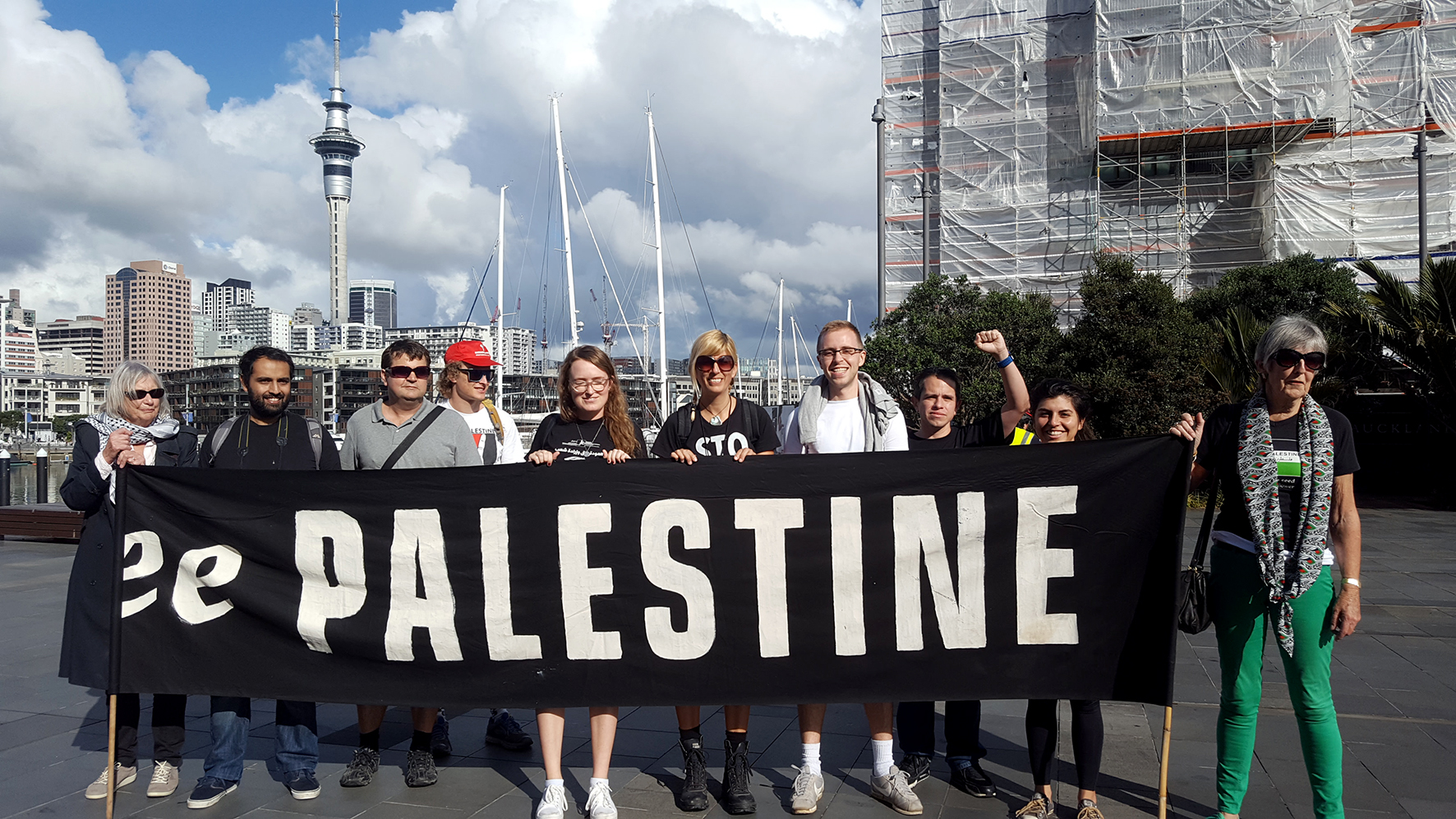
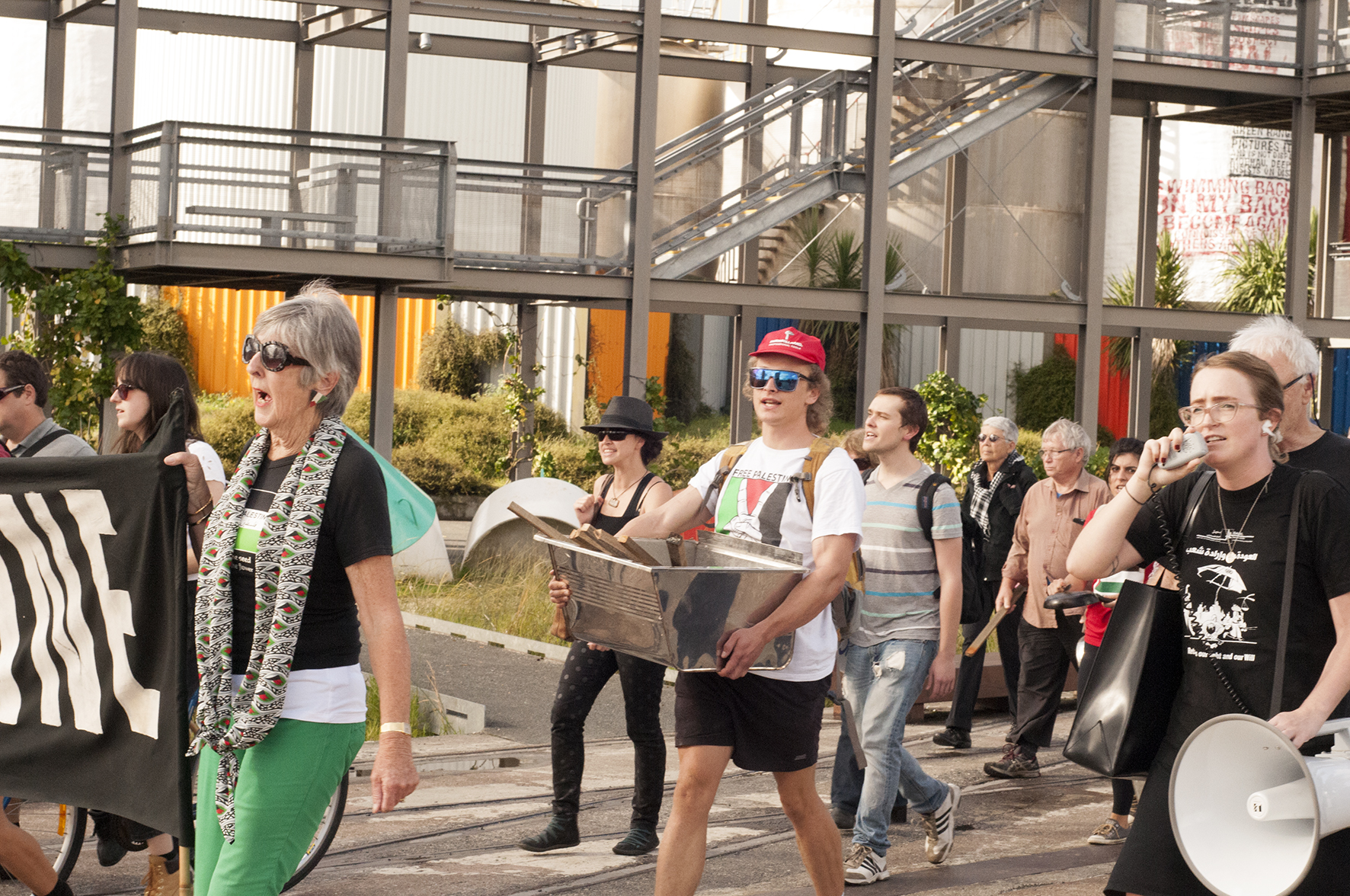
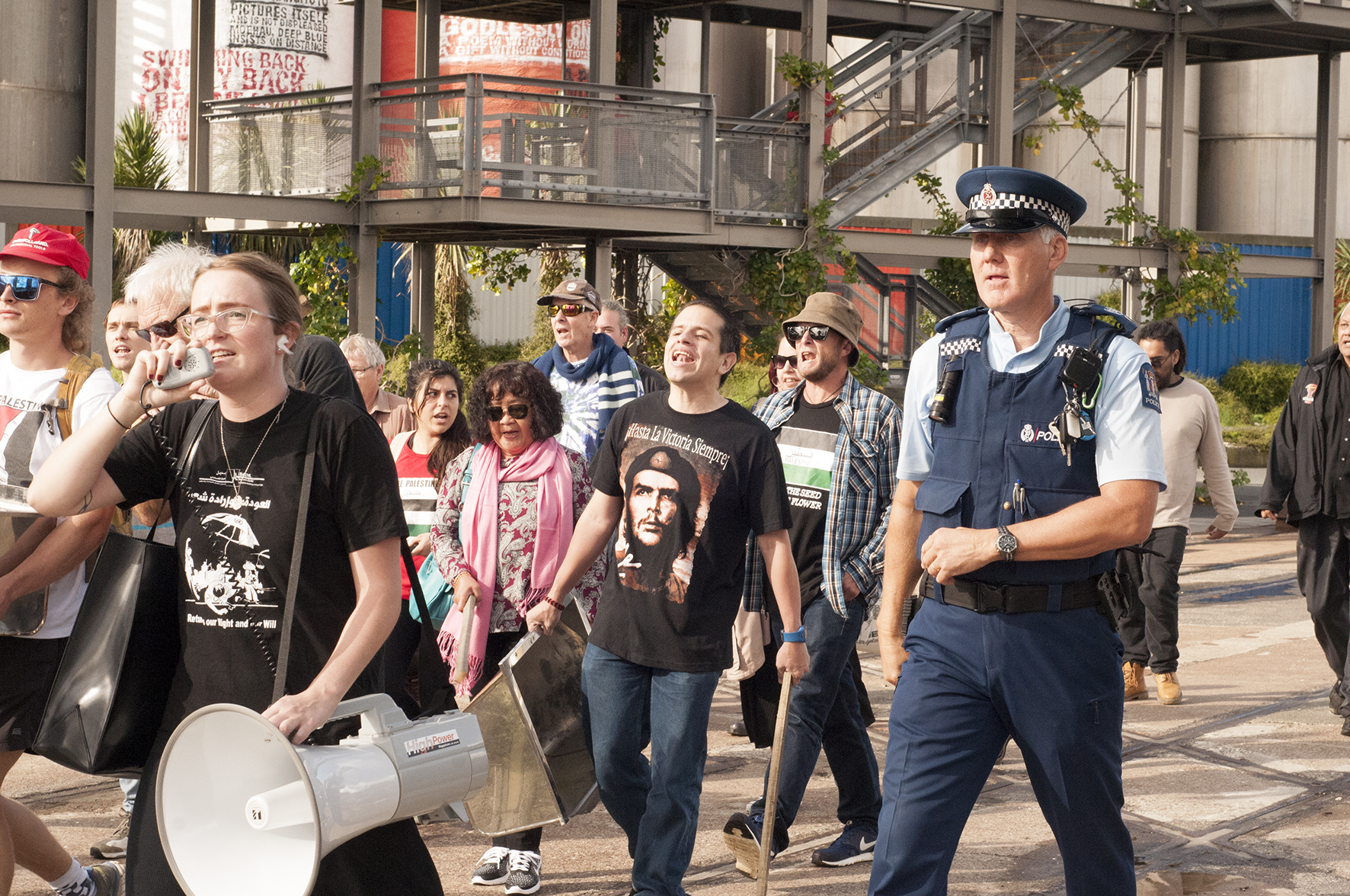
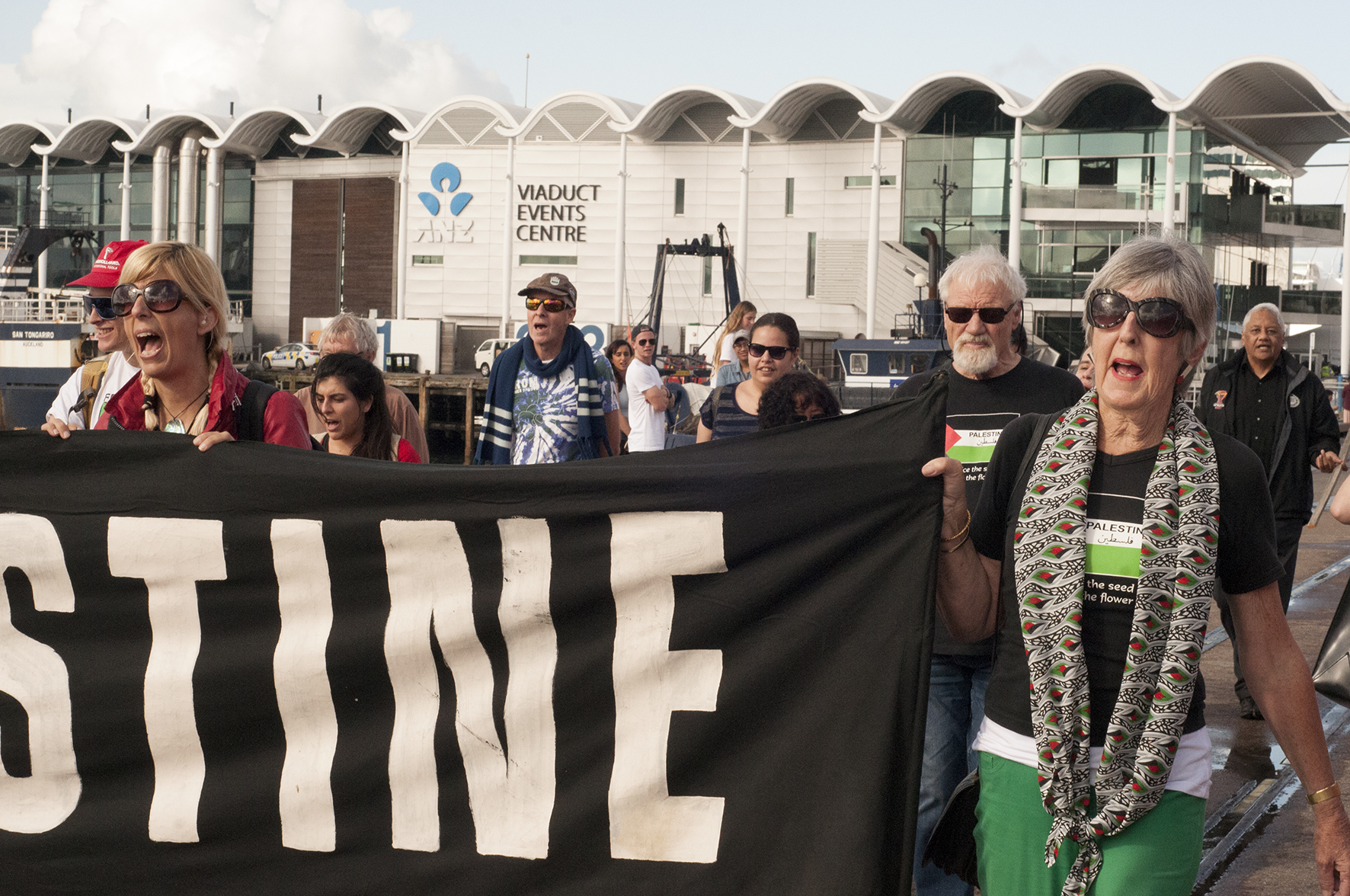
About 50 people staged a “wall of noise” protest in Auckland’s port today in a bid to shut down the Israeli “festival of oppression” marking 70 years of illegal occupation of Palestinian land.

Protesting at the Silo Park over what Palestinians regard as the Nakba – “the catastophe” – when the state of Israel was established in 1948 through “ethnic cleansing” of an estimated 750,000 to one million indigenous Palestinians.

The Palestinians were forced to become refugees in a Jewish-majority state in Palestine and the day – 14 May 1948 – is regarded as Israel’s independence day.

“The Nakba isn’t just a crime of the past,” said Auckland Peace Action group spokesperson Valerie Morse, one of the organisers. “The repression is ongoing.”

The Pacific Media Centre’s Rahul Bhattarai and Del Abcede were at Silo Park to capture the protest in pictures.

1. Free Palestine march in Auckland. Image: Rahul Bhattarai/PMC

2. Getting ready for the march. Image: Del Abcede/PMC

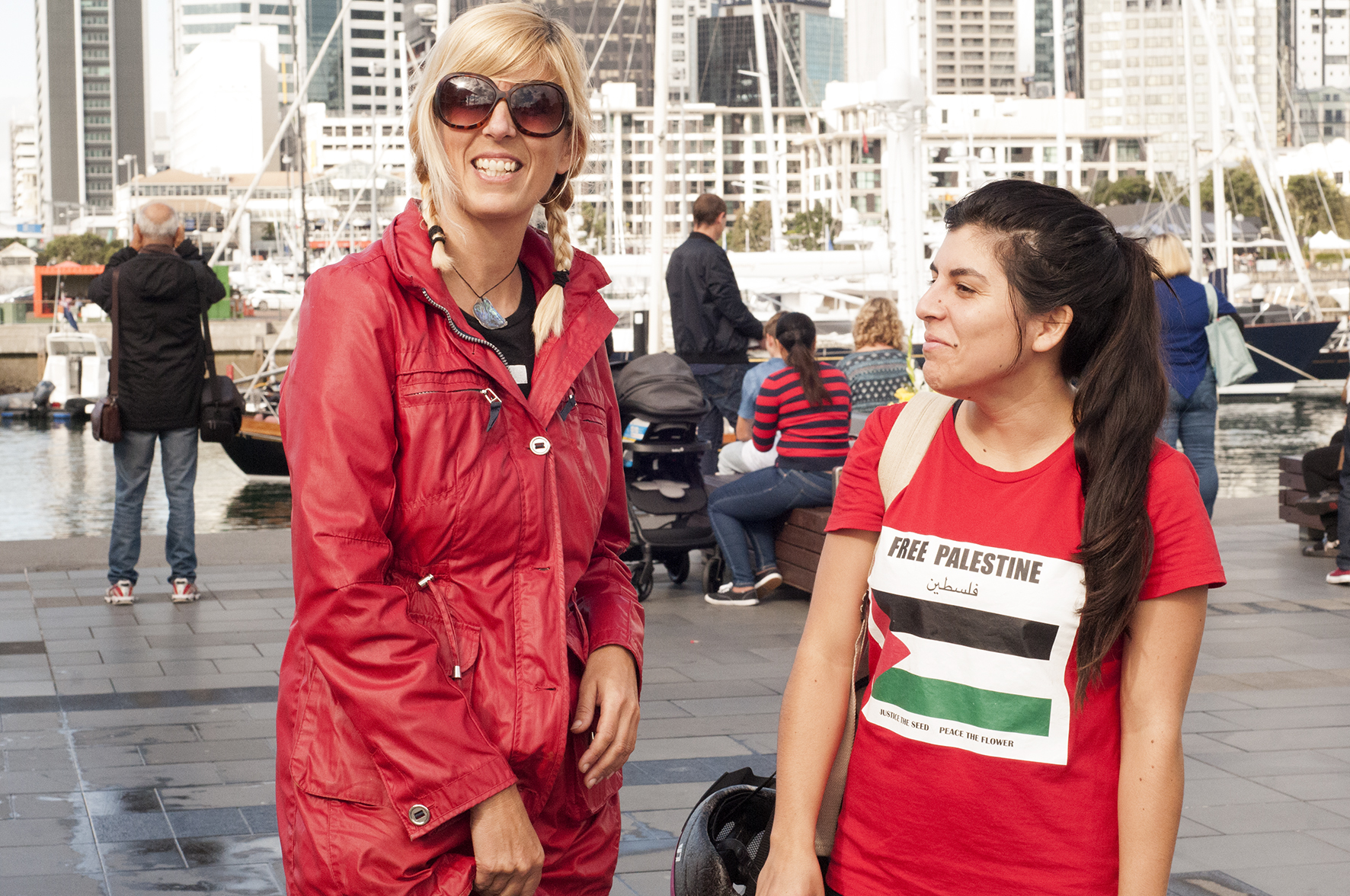
3. Women in red – Auckland Peace Action’s Valerie Morse (left) and a protester from Argentina. Image: Rahul Bhattarai/PMC

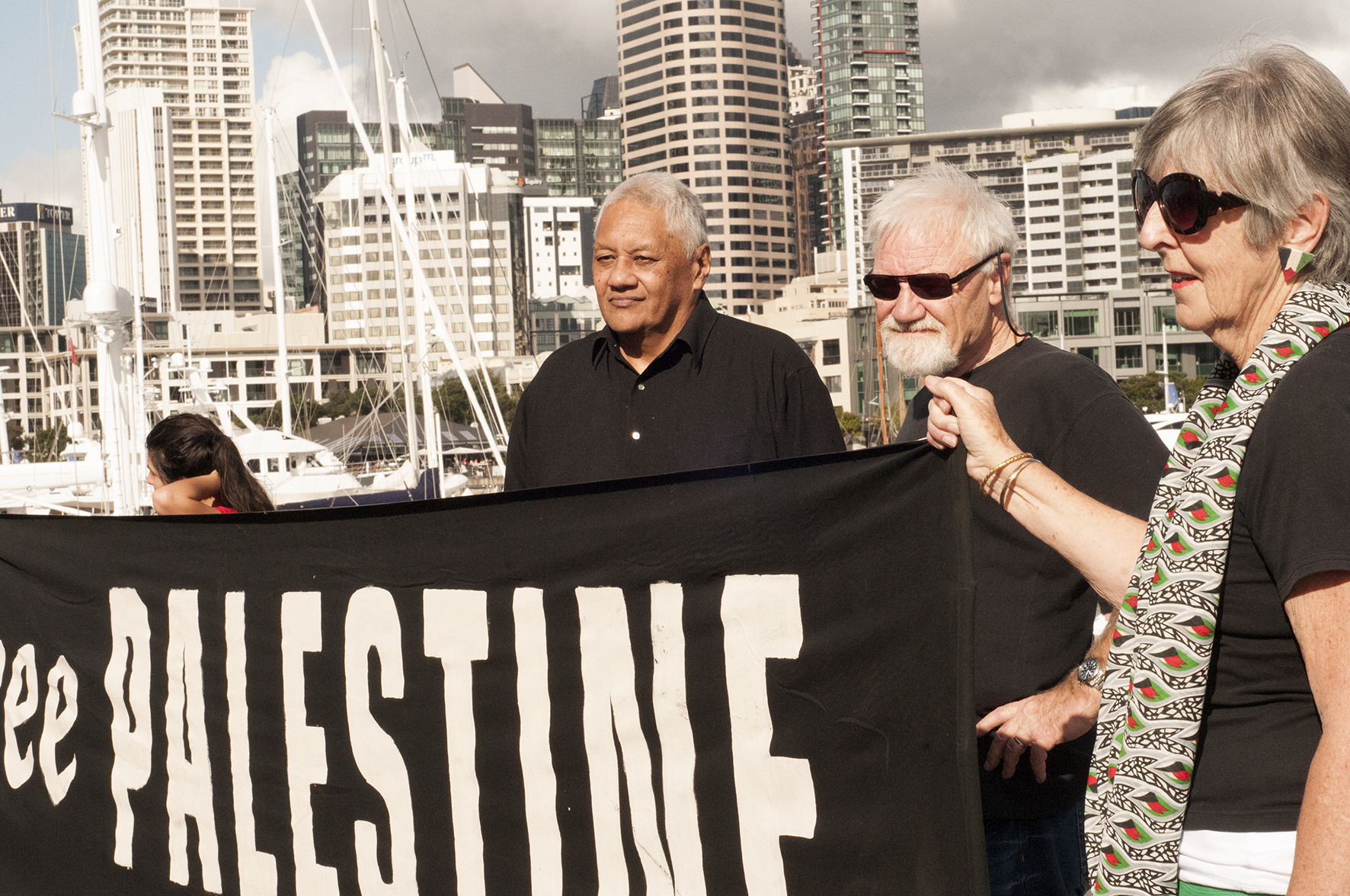
4. Pacific human rights and independent media advocate Will ‘Ilolahia and media academic David Robie. Image: Rahul Bhattarai/PMC

5. Protesting against Zionist oppression for 70 years through the Israeli occupation of Palestine. Image: Del Abcede/PMC

6. Marching for Palestine. Image: Rahul Bhattarai/PMC

7. Marching for Palestine. Image: Rahul Bhattarai/PMC

8. Marching for Palestine. Image: Rahul Bhattarai/PMC

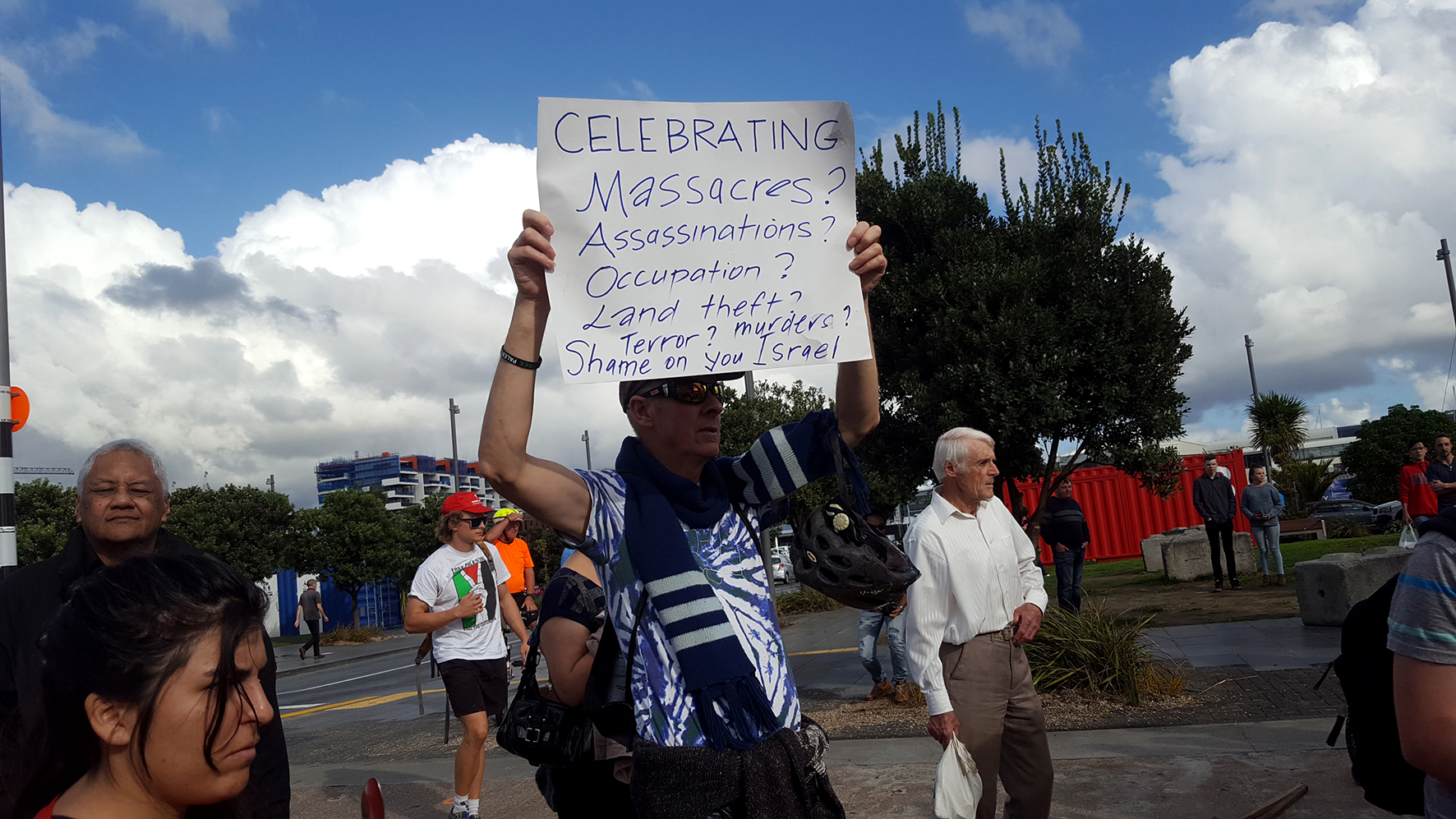
9. Protest placard against the Israeli massacres. Image: Del Abcede/PMC

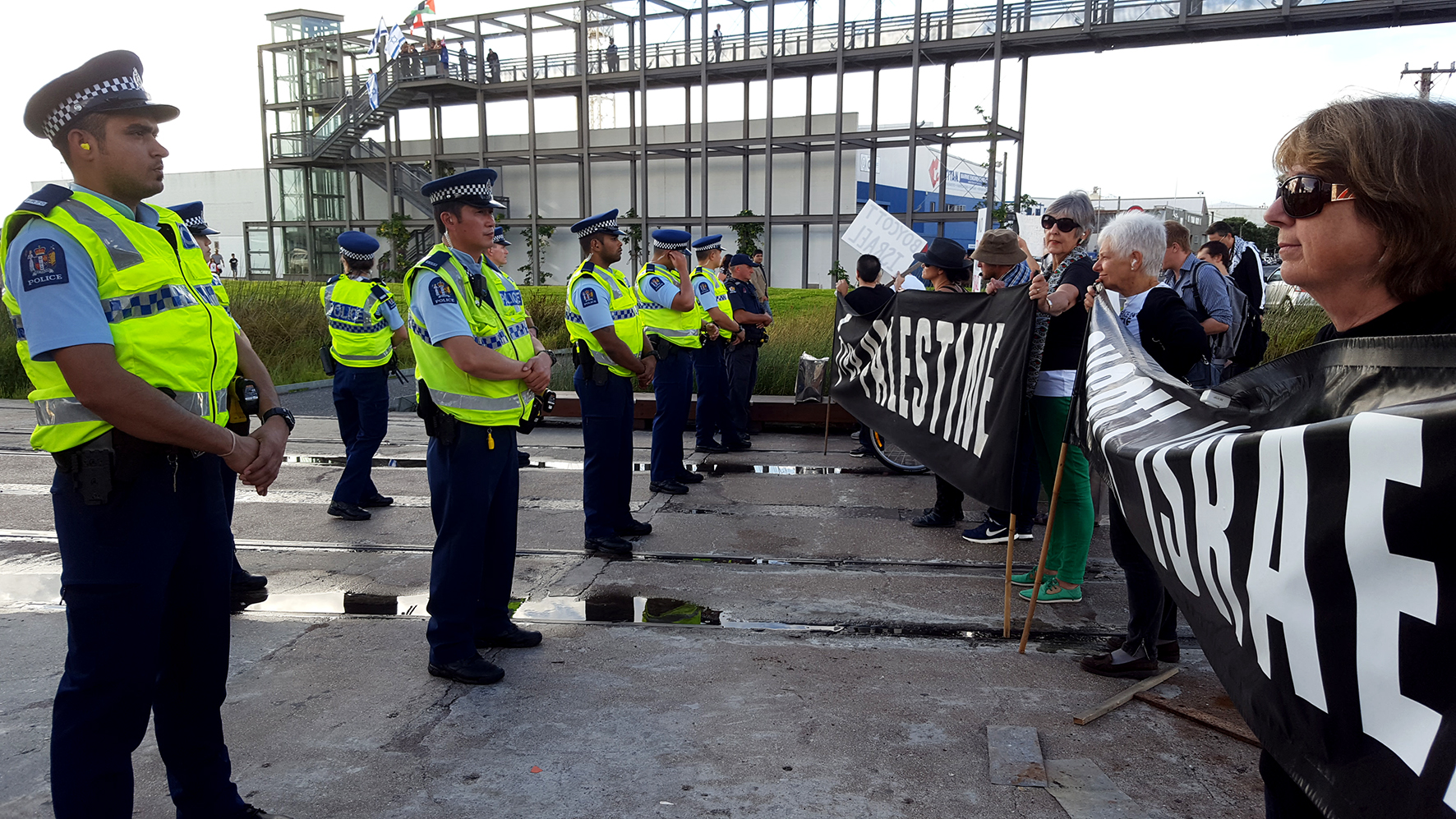
10. Reaching the “safe zone” line. Image: Del Abcede/PMC

11. Protest for Palestine. Image: Rahul Bhattarai/PMC

12. Boycott Israel call as part of the international BDS movement. Image: Rahul Bhattarai/PMC

13. Zionist counter-protesters breach the “safe zone” under the oblivious eye of the police. Image: Rahul Bhattarai/PMC

14. Boycott Israel under watchful eye of the police. Image: Rahul Bhattarai/PMC

15. “No trade with Israel”. Image: Del Abcede/PMC

Print Friendly, PDF & Email

Article by AsiaPacificReport.nz

]]>

‘Sword of Damocles’ condemned after Philippines judges oust chief justice

]]>

Ousted … Philippines Chief Justice Maria Lourdes Sereno waves to supporters the day she returned to the Supreme Court on May 9, 2018, after two months on leave. Image: Maria Tan/Rappler

By Ralf Rivas in Manila

After the ousting of the Philippines’ Chief Justice Maria Lourdes Sereno, the six justices who voted against the quo warranto petition have claimed the decision has made the Office of the Solicitor-General more powerful.

The justices raised their concern in their separate dissenting opinions following the Supreme Court’s 8-6 unprecedented and historic vote in favour of the petition – a prerogative warrant – on Friday.

Associate Justice Mariano del Castillo wrote in his dissenting opinion that the decision of the majority had granted the Solicitor-General (SolGen) powers to “remake the composition” of the High Court, “causing the removal of its members”.

READ MORE: Quo warranto v elected impeachable allowed, says Supreme Court

“With the SolGen wielding a quo warranto sword of Damocles over the heads of these officers, the Filipino people cannot be assured that they will discharge their constitutional mandate and functions without fear or favor,” said Del Castillo.

Without such assurance, there can be no guarantee that the primordial interest of the sovereign people is promoted.”

-Partners-

Del Castillo called the SolGen’s move a form of “constitutional adventurism”.

The quo warranto petition to remove Sereno from office was on the basis of an alleged invalid appointment.

The decision is “immediately executory without need for further action,” SC spokesperson Theodore Te said during Friday’s press briefing.

‘Violated requirements’
Nine of the justices said she violated requirements on the Statement of Assets, Liabilities, and Net Worth (SALN). The same number of justices ruled that quo warranto was the proper remedy in the ouster of Sereno.

This is the first time that the Supreme Court has removed its own chief, in a petition widely slammed for violating Sereno’s constitutional right to an impeachment process.

Sereno is the second chief justice to be removed from office after Renato Corona was ousted in 2012. He was found guilty of betraying the public trust and committing culpable violation of the Constitution.

Associate Justice Mariano del Castillo’s sentiment was echoed by the dissenting opinions of Associate Justices Marvic Leonen and Benjamin Caguioa.

Lawmakers, including Senate Minority Leaders Franklin Drilon, a former justice secretary, shared the same concern.

The others who voted against the petition are Senior Associate Justice Antonio Carpio and Associate Justices Presbitero Velasco Jr, and Estela Perlas-Bernabe.

Quo warranto or impeachment?
The six dissenters all agreed that impeachment was the only way to unseat an impeachable officer like Sereno.

Del Castillo stressed that allowing the quo warranto proceeding “impairs the independence of constitutional offices”.

Bernabe wrote in her opinion that the OSG should have questioned the discretion of the Judicial and Bar Council (JBC) to include Sereno in the shortlist of chief justice applicants.

Bernabe pointed out that the OSG “voluntarily admitted that the JBC’s grave abuse of discretion is not at all an issue.”

In his dissenting opinion, Velasco relayed the same sentiment.

“There was no attempt to assail and contest much less nullify the JBC’s findings that the respondent possessed all qualifications, the JBC’s decision must stand,” Velasco said.

Yes to quo warranto but…
Velasco said that the “remedy of quo warranto is available to unseat, in the extreme, even an impeachable officer”.

However, he clarified that the one-year prescribed period for filing such a petition had lapsed. He said that Sereno’s nomination and appointment “has not been timely challenged, much less nullified,” and that “the findings and qualifications should be respected.”

Velasco insisted that the OSG had to file a petition for certiorari against the JBC before seeking Sereno’s removal from office.

Bernabe also said that impeachment was not the sole move of removing impeachable officials as it would be “clearly absurd for any of them to remain in office despite their failure to meet the minimum eligibility requirements”.

She said that there “should be a remedy to oust all our public officials, no matter how high-ranking they are, or how critical their functions may be,” but after clear “determination that they have not actually qualified for election or appointment”.

Bernabe stressed that the JBC’s rigorous process was lenient on the Statement of Assets, Liabilities, and Net Worth (SALN) requirement. In fact, none of the applicants were able to submit all SALNs up to 2012.

Despite voting for the retention of Sereno, Bernabe said she made no claim that Sereno “is or is not a person of integrity.”

“In fact, if there is one thing that is glaringly apparent from these proceedings, it is actually the lack of respondent’s candor and forthrightness in the submission of her SALNs. Integrity must be threshed out in the appropriate case for certiorari,” Bernabe said.

Print Friendly, PDF & Email

Article by AsiaPacificReport.nz

]]>
Timorese vote in fresh general election after tense campaign

]]>

By Michael Leach in Dili

After a tense month-long campaign and two rest days, East Timorese cast their votes today in the Timor-Leste’s latest parliamentary elections. With the campaign characterised by considerable bitterness between the major parties, much is at stake.

Despite narrowly prevailing at the election just nine months ago, the Fretilin-led minority government failed to gain parliamentary support for its programme and budget during 2017.

The president — also from Fretilin — dissolved parliament and called today’s poll.

READ MORE: Choices sharpen in Timor-Leste

The East Timorese electoral agencies, short of funds after last year’s election and the parliamentary impasse, have risen to the occasion extremely well.

And, in a remarkable testimony to Timor-Leste’s young population, the electoral roll has grown by 3.1 percent to 784,000 voters, with around 24,000 voters turning 17 in just over nine months since last July.

-Partners-

Last year’s campaign came in the wake of a national unity government involving informal power-sharing between Xanana Gusmão’s CNRT and Fretilin. But relations quickly soured after an election that Fretilin won narrowly with 23 seats to CNRT’s 22.

In the end, Fretilin was only able to attract the Democratic Party, with its seven seats, to its minority coalition government, giving prime minister Dr Mari Alkatiri 30 seats in the 65-seat Parliament.

Rejected programme
Within weeks, the remaining parties had formed the Parliamentary Majority Alliance (AMP) a coalition controlling 35 seats, and had voted down the government’s programme and budget.

Fretilin feels aggrieved that it did not receive parliamentary support after narrowly finishing ahead last year, despite an alternative coalition having been ruled out publicly by Xanana Gusmão in the immediate wake of the July election.

For its part, the AMP feels bitter about Fretilin’s parliamentary tactics last year, which delayed the second presentation of the government programme and prevented it from falling before the six-month mark, when the president could dissolve Parliament and call fresh elections.

AMP figures feel that their alliance should have been installed in government during the life of the Parliament. How these issues have influenced the voting public will be known tomorrow.

This year’s campaign has been marked by the resurgence of the “history wars,” the clash between the two wings of the East Timorese resistance during the Indonesian occupation.

The AMP has reunited Xanana Gusmão and his CNRT with former president Taur Matan Ruak’s Popular Liberation Party (PLP), which were at loggerheads during the 2017 election. Both were leaders of the armed resistance, Falintil.

The campaign has been frequently depicted as a contest between the armed front and members of the diplomatic front, who were outside the country during the occupation, including prime minister Alkatiri and key diplomatic figure Jose Ramos-Horta, who has thrown his weight behind the Fretilin campaign.

Hurt by attacks
Though he has not responded to them, Ramos-Horta has evidently been hurt by the attacks on his legacy, some of which have sought to diminish the contribution of those who struggled for independence in the international arena.

This division over resistance history has lent an unpleasant air to a campaign that has also been marked by exchanges of personal slurs between the major party leaders, including some outbursts of anti-Muslim sentiment directed at the Fretilin leader Dr Mari Alkatiri, and fractious personal debates on Facebook.

From the east of the country have come reports of rock attacks on AMP caravans in Viqueque, bringing back memories of the divisive 2007 election, which occurred in the wake of the 2006 political–military crisis.

The AMP parties have also complained of low-level attacks in Laga region of Baucau, were temperatures still run hot over the death of dissident veteran Mauk Moruk in 2014.

Yet the campaign has been remarkably peaceful on the whole, with colourful mass rallies of party supporters generally well behaved throughout most of the country.

The campaign has also been marred by a handful of accusations of favouritism and irregularities against the electoral agencies, prompting the head of the National Electoral Commission (CNE) to publicly defend the organisation in press conferences.

Several complaints originated on AMP’s Facebook page, including concerns over printing errors in the ballots, which were quickly identified and cancelled, and suspicions about meetings between CNE and political parties that turned out to be part of routine investigation of previous complaints.

Closely watched
The CNE has responded quickly and satisfactorily. With domestic and international observers closely watching the process and extremely professional electoral agencies, there is very little scope for manipulation.

The CNE and the Technical Secretariat of Electoral Administration have done an excellent job under trying circumstances with limited budgets.

While the parties have discussed differing visions for the future, especially during the series of TV debates, considerable energy has been diverted into personal and historical debates within the small political elite. The new AMP alliance brings together two parties that ran last year on fundamentally different development agendas, and it remains to be seen how the CNRT’s focus on major infrastructure spending can be reconciled with the PLP’s more grassroots focus on basic development spending on health education and agriculture.

How voters have received this new combination will be known tomorrow.

For their part, supporters of Fretilin and the Democratic Party (PD) have been on friendly terms throughout the campaign, suggesting the alliance seems to be holding, though this relationship could be easily revisited in the interparty negotiations that follow the election.

The AMP is a formidable coalition of parties that received 29.5 percent, 10.5 percent and 6.5 percent last year: a total of 46.5 per cent. It could also receive the support of the Democratic Development Front, or FDD, the coalition of the smaller parties most likely to exceed the 4 per cent threshold required to get seats. This is not certain, though, and there are at least some rumblings of dissent from one of the parties inside FDD. On the other side, Fretilin received 29.7 percent in 2017, and its PD partner in the minority government received 9.8 percent.

No polls have been taken to indicate the likely result tomorrow. As a baseline indication, if last year’s vote is notionally combined into the new party coalitions that have formed, the AMP would start with a nominal allocation of 33 seats — the minimum majority required.

Favourite on paper
In turn, Fretilin, PD and the FDD would receive 21, six and five seats respectively. If FDD cannot clear the 4 percent hurdle, these notional numbers rise to 36 for the AMP, 22 for Fretilin, and seven for PD.

The AMP therefore starts as favourite on paper, but the outcome tomorrow can easily change from the 2017 results., As a rough guide, Fretilin requires a swing of just under 4 per cent (if FDD does not take seats) rising to more like 6 per cent if the FDD gains seats and backs the AMP.

These are clearly challenging targets for Fretilin, though not impossible, especially in the former case. It may be that the smaller coalition becomes instrumental in the final result if things run close.

Some longer-term trends are striking. At a forum on the elections I conducted in Dili on Thursday, younger Timorese commented that though they are often reluctant to openly criticise their resistance-era leaders, young people are more interested in the development policies of the government and how they will help to create future jobs.

There was also a sense in last year’s election result that while resistance-era legitimacy remains important to political fortunes, it is starting to offer diminishing returns for East Timorese leaders as the median age of the voting public falls, and voters look for solutions to entrenched development problems.

The young people at the forum also felt that the direst warnings of potential trouble if one side or the other loses tomorrow have come from political insiders themselves, with most ordinary people confident that the national police can manage any post-election troubles.

Young voters also said Dili’s noisy and active social media has played a mixed role — allowing more opportunities for debate, on the one hand, and especially for women’s and young people’s voice to come through, but also distributing fake news and rumours, and not fully representing rural voices.

Potential sleeper trend
Another potential sleeper trend is the changing attitude of the Catholic Church to the major parties. The Church responded positively to the concordat with the Vatican orchestrated by the PM of the previous national unity government, Fretilin’s Rui Araujo.

Despite occasional slurs against Mari Alkatiri, most of the older political leadership from the 1970s does not identify strongly with the church, though younger Timorese broadly do.

As tomorrow’s poll approaches, both sides are supremely confident of victory in their public statements. Either way, it is likely that Timor-Leste will be in good hands, and the real issue as always will be how the unsuccessful parties accept the results.

After last year’s uncertain result, East Timorese will be hoping for a clear and decisive outcome.

Dr Michael Leach is Professor of Politics and International Relations at Swinburne University of Technology. This article was first published by Inside Story.

Print Friendly, PDF & Email

Article by AsiaPacificReport.nz

]]>
Tuilaepa accuses Pohiva of being ‘jello’ over Samoan press freedom

]]>

Tongan Prime Minister ‘Akilisi Pohiva … something “odd” with the world press freedom rankings. Image: Samoa Observer

By Joyetter Feagaimaali’i-Luamanu

Prime Minister Tuilaepa Sa’ilele Malielelgaoi has accused his Tongan counterpart ‘Akilisi Pohiva of being “jello” – jealous – of Samoa’s media freedom ranking.

Tuilaepa made the comment in response to Pohiva questioning Samoa’s ranking on the Reporters Without Borders’ World Press Freedom Index.

Samoa is ranked 22nd while Tonga is ranked 51st.

READ MORE: Fifth Pacific Media Summit

Speaking at the opening of the 5th Pacific Media Summit being held in Nuku’alofa, Tonga, Pohiva suggested that something was “odd” with the rankings.

“You have all heard by now how that Tonga dropped two places from 49 to 51 on the 2018 World Press Freedom index,” he said.

-Partners-

“You have also learned that the reason for the drop is because of my government’s unfair treatment of senior journalists in the Tonga Broadcasting Commission.

“I have no problems with that but let me assure you all that it is a work in progress.

‘Continuing to talk’
“We are continuing to talk with the management and staff members of the Tonga Broadcasting Commission about improving our relationship, and of course our position in the 2019 Press Freedom Index.”

This is when he turned his attention to Samoa.

“I must say that I am surprised by Samoa’s position on the Press Freedom Index where Samoa is 22nd,” he said.

“Oh congratulations! However, what I went on about is the ongoing battle between my Samoan counterpart and the Samoa Observer. I can’t believe that Samoa is 22nd and Tonga is 51st. This is unbelievable.”

Asked for a comment, Prime Minister Tuilaepa laughed.

“Our ranking is far superior than the United States of America, which is ranked 45th and this is good news for the media and everyone who is here in my office,” Tuilaepa said.

Freedom of journalists
“I am thankful that the government puts up with you people,” he said, laughing.

“I am talking about freedom of journalists in our country and that is why the Tongan Prime Minister is somewhat “jello” (jealous) given that their ranking is very low, yet Samoa’s ranking is quite significant.”

According to Prime Minister Tuilaepa, there is a difference in the governance of Samoa and Tonga, but he did not elaborate on this.

Joyetter Feagaimaali’i-Luamanu is a journalist working with the Samoa Observer.

Print Friendly, PDF & Email

Article by AsiaPacificReport.nz

]]>
Future of Panguna mine at stake in PNG, Melbourne court hearings

]]>

The abandoned Panguna mine site after Rio Tinto closed down the operation. Image: Business Advantage PNG/SMH

By Kevin McQuillan of Business Advantage PNG

Two court hearings next week – one in Port Moresby and the other in Melbourne – will help determine the future of the exploration licence for the Panguna copper mine in Bougainville.

The decision to refuse an extension of Bougainville Copper Limited’s exploration licence and to impose an indefinite moratorium over the Panguna resource, followed a statutory Warden’s meeting in December 2017.

There was “a narrow divide between those supporting the mine to be opened by Bougainville Copper Ltd (BCL) and those that oppose it”, according to Bougainville President John Momis.

BCL has successfully sought leave to apply for a judicial review of the decision to refuse its licence extension, citing legal and procedural concerns.

“While the moratorium has been gazetted, it has no impact on existing exploration licences or applications for extension, lodged prior to the moratorium,” said BCL Company Secretary, Mark Hitchcock.

“BCL remains the holder of the exploration licence (EL1) until the matter is ultimately determined,” he said.

-Partners-

BCL has held the licence since the mine closed in 1989. The company is now owned by the PNG national government (36.4 percent), the Autonomous Bougainville Government (36.4 percent), European shareholders (four percent) and 23.2 percent through the Australian Securities Exchange (ASX).

Rio Tinto gave away its stake in 2016.

Opposing BCL
Those opposing BCL’s involvement are led by Philip Miriori, who claims chairmanship of the Special Mining Lease Osikaiyang Landowners’ Association (SMLOLA).

He has thrown his support behind a bid by Perth-based junior miner, RTG Mining, to gain the exploration licence, setting up a joint venture company, Central Exploration, of which RTG owns 24 percent.

One of RTG’s major shareholders holds another 32 percent, and the SMLOLA retains 44 percent.

Miriori’s chairmanship of the SMLOLA remains in dispute. The 367 authorised customary heads of the 510 blocks of land within the special mining lease area of Panguna say they do not recognise Miriori as the Chairman of the SMLOLA and support the extension of BCL’s exploration licence.

On the same day as the Port Moresby hearing, on May 17, BCL will be in court in Melbourne, seeking disclosure about the relationship between RTG Mining and the SMLOLA.

Miriori and other supporters admit they are being paid by RTG, but Miriori has told the ABC that the payments are legitimate salaries, not inducements.

“That is always a normal part of anything, nothing is free,” he said.

Seeking disclosure
The action seeks disclosure from RTG Mining and Central Exploration about any compensation or benefits paid to the SMLOLA.

One analyst close to the proceedings says any disclosure could determine the possibility of “unlawful interference” with BCL’s exploration licence.

For his part, Momis says his government believes it would be “untenable under current circumstances” for any developer to develop the mine.

“BCL has an extensive database of historical data and project information from the mine operations prior to closure.”

“We have some problems with RTG right now,” Momis told RNZI.

“In fact, they are causing a lot of confusion and division in the community and we are not prepared to go ahead while this situation prevails.”

Exploration data
Should RTG Mining or any other company win the exploration licence, the next battle will be over the data about the location and extent of resources.

“BCL has an extensive database of historical data and project information from the mine operations prior to closure in 1990,” said Hitchcock. “This data remains the intellectual property of the company.”

Even if that data is not protected by intellectual property law but is only considered confidential information, it will still require cooperation from BCL to access, according to Alexandra George, senior lecturer at the University of New South Wales, who specialises in international intellectual property law.

She said it might be expensive and time-consuming to obtain.

She said that under Australian copyright law, ownership of a database is not straightforward. Whether or not RTG Mining could access the data may depend on the terms of the exploration licence, any special legislation, and on the terms of any contracts or licence agreements that have been entered into.

“If [the data] was not available, having to reinvent the wheel would add significant costs,” said George.

“Perhaps the safest way of assessing value is what the market is prepared to pay.”

Hitchcock said: “We estimate it would take any other company or entity at least two-to-three years to replicate the BCL database through exploration activities and would cost in excess of A$200 million (K400 million).”

Kevin McQuillan writes for Business Advantage PNG.

Print Friendly, PDF & Email

Article by AsiaPacificReport.nz

]]>

Newsletter: New Zealand Politics Daily – May 11 2018 – Today’s content

Newsletter: New Zealand Politics Daily – May 11 2018 – Today’s content Editor’s Note: Here below is a list of the main issues currently under discussion in New Zealand and links to media coverage. [caption id="attachment_297" align="aligncenter" width="640"] The Beehive and Parliament Buildings.[/caption] Below are the links to the items online. The full text of these items are contained in the PDF file (click to download). Employment Michael Morrah (Newshub): Immigration NZ to investigate illegal migrant contracts Michael Morrah (Newshub): Exclusive: Migrant construction workers languishing in crowded Auckland houses on illegal contracts Emma Hatton (RNZ): Questions over Filipino labour-hire contracts: ‘They’re scared’ Megan Gattey (Stuff): ‘If Immigration NZ did sign off on an illegal contract, that would be a serious matter’: Minister RNZ: Exploitation of kiwifruit workers is rife – union Brian Fallow (Herald): Looking for the job limit Donal Curtin: Unemployment strikes selectively (revisited) Tracy Neal (RNZ): Tasman seasonal labour shortest in years – growers Stuff: Waikato tractor driver clocked almost 200 hours in the two weeks before his death Willie Jackson (Daily Blog): A rockstar economy that plays for everyone, not just the rich Rose Hoare (Stuff): The last bastion of inequality: unpaid work Budget and tax Matthew Hooton (Herald): Budget must show cultural change Bernard Hickey and Shane Cowlishaw (Newsroom): More Robertson belt-tightening ahead of Budget RNZ: Govt announces $42b capital spending boost Jo Moir (Stuff): Finance Minister: first Budget will deliver $10b more than forecast over next five years Josie Pagani (Herald): Labour won’t have enough in the pie to satisfy all hungry kids Tom Pullar-Strecker (Stuff): CGT would make it harder to keep a roof over everyone’s head Anna Bracewell-Worrall (Newshub): Most Kiwis think the Government should increase taxes – poll Heath Moore (Herald): ‘Pay up or get arrested’: Kiwis hit by IRD scam International relations and trade Nicholas Jones (Herald): Saudi sheep saga: ‘model farm in desert’ still unfinished Herald Editorial: Big boost of Pacific aid has no clear purpose Jo Spratt (RNZ): Pacific aid boost must be spent well to be effective RNZ: NZ exporters cautious about dealing with Iran Herald: US Director of National Intelligence Dan Coats in New Zealand for meeting John Gibb (ODT): NZ should stand its ground over Iran issue: academic Reserve Bank Richard Harman (Politik): New Reserve Bank Governor Adrian Orr unbuttons Hamish Rutherford (Stuff): ‘O is for Orrsome’: New Reserve Bank governor gets high praise on his first outing Thomas Coughlan and Lynn Grieveson (Newsroom): Interest rates unchanged, but a very different governor Jason Walls (Interest): The new Governor’s approach to the central bank’s communication was on full display on Thursday, turning the heads of journalists, MPs and economists Nikki Mandow (BusinessDesk): Orr’s first OCR: a breath of fresh air Michael Reddell: Something of a mixed bag RNZ: Reserve Bank keeps cash rate at 1.75% Tamsyn Parker (Herald): Bank costs may drive mortgage rates higher, warns Reserve Bank Herald: New Zealand central bank governor says economy in sweet spot Graham Adams (Noted): Are New Zealand banks approving liar loans? Interest: Commerce Commission probes problems with ANZ loan calculator that undercharged interest to about 100,000 customers Rob Stock (Stuff): How banks’ whistleblower scheme should work Government Claire Trevett (Herald): Ministers’ expenses show Corrections Minister Kelvin Davis, Transport Minister Phil Twyford top spenders Tova O’Brien (Newshub): Winston Peters threatens fellow ministers ahead of stint as Prime Minister Peter Hughes (Herald):‘Faceless bureaucrats’ are hard working, public spirited people Northcote by-election and parliament Simon Wilson (Herald): Northcote Notebook: Coffee with National’s candidate Dan Bidois Henry Cooke (Stuff): Northcote by-election: Greens select Rebekah Jaung as candidate Moana Makapelu Lee (Māori TV): Māori voters opt for General Roll Yvette McCullough (Newstalk ZB): Peters says Maori roll not needed under MMP Laura Walters (Stuff): Political parties ramp up attack ads – smart politics or fake news? Health Phil Pennington (RNZ): Middlemore: Board was pressured to settle for $3m Sarah Robson (RNZ): Middlemore will prioritise maternity services if needed – Board Katie Doyle (RNZ): DHBs face large rise in infections from treatment Stuff: Men die quicker but women are sicker Phil Pennington (RNZ): Middlemore: Board was pressured to settle for $3m Hamish McNeilly (Stuff): Pill prices hard to swallow for prostate cancer survivors 1News: HPV vaccine could potentially eradicate cervical cancer, expert urges anti-vaxxers to ‘look at the science’ Natalie Akoorie (Herald): New Zealand Organisation for Rare Diseases facing closure without enough funding Stuff: New Zealand infants with high nicotine exposure twice as likely to have respiratory problems Lisa Davies (1News): Shocking impact of passive smoking on young children highlighted in New Zealand study 1News: The Kiwi dentist with a new approach to treating tooth decay in children Kyle MacDonald (Herald): What we’re forgetting about cannabis Madison Reidy (Stuff): Medicinal cannabis company’s $1m investment round crashes crowdfunding site Anusha Bradley (RNZ): NZ medicinal cannabis product hits $2m in crowdfunding Alex Braae (Spinoff): Greened out: Weed buyers crash crowdfund site Education Simon Collins (Herald): A $3.4 billion bill for Auckland schools over the next 10 years is tightening the squeeze on cash to meet other political promises in next week’s Budget Madison Reidy (Stuff): Filipino agency’s promises of NZ visas for students ‘sickening’, says migrant spokesman Simon Collins (Herald): Overseas students launch campaign against labour exploitation Vaimoana Tapaleao (Herald): Iwi gives $100,000 to children’s charity KidsCan Mikaela Collins (Herald): Whangārei’s Te Kāpehu Whetū applies to become designated character school Dan Satherley (Newshub): Jacinda Ardern labelled a ‘liar’ over charter school transition process John Moir (Herald): School meth lessons do not reduce drug harm Jennifer Eder (Stuff): Parents get behind teachers adapting to ‘modern learning environment’ classes Amy Paulussen (Spinoff): Penalising part-time teachers is a gender pay gap issue Karoline Tuckey (Stuff): Massey’s Albany campus student growth surpasses Manawatū numbers Housing and overseas investment Dan Satherley (Newshub): Govt hikes cost of one-bedroom KiwiBuild homes John Boynton (RNZ): Northland housing woes: ‘Every winter decimates our people’ Jenna Lynch (Newshub): Will KiwiBuild be another broken promise by the Government? Henry Cooke (Stuff): Judith Collins says the KiwiBuild goalposts have shifted David Hargreaves (Interest): Bad signs from the Government’s so-called Kiwibuild ‘buying off the plans’ scheme Cameron Bagrie (Herald): Comment: Big change coming to property market Steven Cowan: Phil will fix it! (No, he won’t) Susan Edmunds (Stuff): ‘Why should the landlord pick up the tab, time and time again?’ Charlie Mitchell (Stuff): Wealthy overseas landowners forced to sell in government crackdown Primary industries Simon Hartley (ODT): Dairy review’s scope irks environmentalists Craig McCulloch (RNZ): M Bovis has ‘turned neighbour against neighbour’ Gerard Hutching (Stuff): Farms under question with cow disease Mycoplasma bovis explode to exceed MPI estimates Isaac Davison (Herald): Numbers of farms under regulatory control for Mycoplasma bovis jumps from 130 to 290 1News: Mycoplasma bovis spread ‘has gone totally above all expectations’ in last week Anna Bracerwell-Worrall (Newshub): 22,000 cows culled, but Mycoplasma bovis worse than previously thought Environment Benedict Collins (RNZ): Former EPA chief scientist’s irrigation comments defied boss RNZ: 100% Pure a ‘marketing strategy … not an environmental standard’ Sophia Duckor-Jones (RNZ): Calls for Ministry to hand over kauri dieback response Simon Smith (Stuff): Call to sack MPI from leading the fight against kauri dieback Herald: Mitre 10 to remove single-use plastic bags from its stores Chloe Winter (Stuff): Mitre 10 announces date for plastic bag ban just days after Countdown Michael Daly (Stuff): Plastic bag found in Mariana Trench, deepest place on Earth 1News: Watch: Where did they go? NIWA’s confronting aerial video shows the shocking state of South Island glaciers Maja Burry (RNZ): New invasive weed spreads into Canterbury Auckland Wayne Mapp (Spinoff): Why we should be wary about jumping aboard the light rail bandwagon John Anthony (Stuff): Auckland Council selling Remuera Golf Course land to make way for housing Anuja Nadkarni (Stuff): ‘Circular economy’ could bring $8b in benefits to Auckland Auckland Now: Auckland activist Penny Bright says she has ‘incurable and inoperable’ cancer Media Mark Jennings (Newsroom): New life for a wavering industry John Drinnan (Noted): Media moves: RNZ and Māori Television look to form closer ties Mark Jennings (Newsroom): RNZ feels impact of music radio revival Māori wards Richard Mays (Manawatu Standard): Full house at Massey University for Māori wards forum Kate Frykberg (Stuff): Harmony and the case for Māori wards Adoption Nicholas Jones (Herald): Exclusive: Inquiry on forced adoption considered Nicholas Jones (Herald): Plea for adoption inquiry: ‘I tried to photograph her with my eyes’ Made in NZ and marketing Aimee Shaw (Herald): Revealed: Where your favourite NZ brands are really made Katie Doyle (RNZ): Made in NZ tag could be ‘lost forever’ by 2020 Jenny Keown (Spinoff): ‘Natural’, ‘sustainable’, ‘Made in New Zealand’: How greenwashing became big business Kate Dickie-Davis (Daily Blog): The devil is in the retail Transport Tom Pullar-Strecker (Stuff): Airline fuel surcharges tipped to make comeback Lucy Bennett (Herald): ‘Ignorant’ foreign tourists using drones put aircraft at risk Jenna Lynch (Newshub): Playtime over? Authority considering registration scheme for drone users Kim Dirks (Newsroom): NZ’s old cars a public health hazard Rebecca Stevenson (Spinoff): Ten numbers which show how addicted to our cars we still are Justice Melissa Nightingale (Herald): Daniel Clinton Fitzgerald granted leniency for kissing stranger despite three strikes law Barry Soper (Newstalk ZB): Not fair to blame three strikes law for overflowing prisons Natasha Jojoa Burling (Newstalk ZB): Law Professor: Trial for Rewa may be unfair David Fisher and Nicky Harper (Herald): How Garth McVicar’s quick-fire praise over police shooting led to a ‘mistake’ receipt and tax concerns over Sensible Sentencing’s trusts Treaty settlements and Crown-Maori relations Te Aniwa Hurihanganui (RNZ): Crown-Māori relations: Taking time to ‘get the job right’ Te Aniwa Hurihanganui (RNZ): Treaty overlap: Settlement could leave iwi high and dry Alexia Russell (Newsroom):Iwi’s Gulf Island rights to be tested Deena Coster (Stuff): Tide turning regarding Māori experiences of ageing: academic Tourism Grant Bradley (Herald): Rising costs for Kiwis at holiday hot spots a ‘concern’, says Tourism Minister Kelvin Davis Belinda McCammon (RNZ): Tourist levy details coming – minister Animal welfare 1News: Those testing on animals should have to care for them afterwards, advocates say 1News: Re-homing of lab tested animals might become mandatory to save them from being put down National Mike Bain (Stuff): Cambridge people swamp venue to hear National leader Simon Bridges Bryan Gould: What was he doing? Sexuality Bob Edlin (Kiwiblog): Guest Post: Measuring Rainbows 1News: ‘It’s a good thing’ – Auckland Anglican vicar welcomes vote for same-sex blessings Jane Matthews (Stuff): Anglican Church takes step towards blessing same-sex relationships RNZ: Pacific Anglican church says no to same-sex marriage Other Robin Martin (RNZ):‘They’ve lost their family home’ – Whanganui couple battle EQC Melissa Nightingale (Herald): Battle of the macrons for Wikipedia spelling of Paekākāriki Graeme Austin (Newsroom): A copyright exemption for parody and satire Herald: Hamilton Council reveals the eight naughty words removed from public feedback]]>

Talking journalist ‘targeting’ and Papuan media on World Press Freedom Day

Author profile: 

By Craig Major
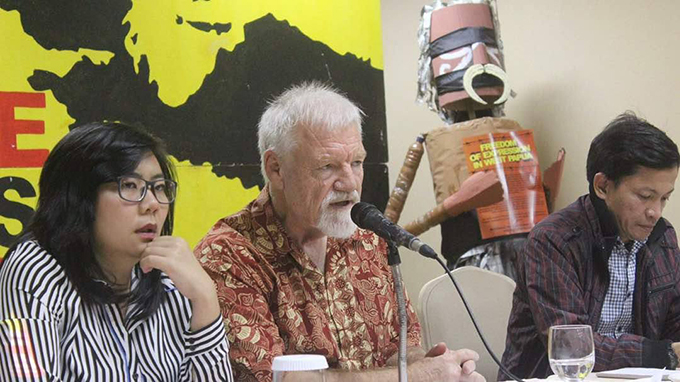
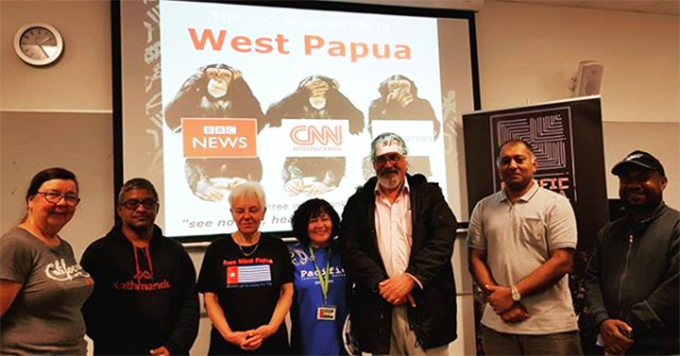
School of Communication Studies Professor and Pacific Media Centre director Professor David Robie marked World Press Freedom Day last week with a seminar covering the “targeting” and killing of Journalists, as well as the state of the media in West Papua.

During a seminar on Friday 3 May to coincide with World Press Freedom Day, David spoke to the shocking statistics around journalists killed in the couse of duty worldwide.

““Reporters Sans Frontières (RSF) [Reporters Without Borders] statistics showed 65 journalists were killed worldwide in 2017,” David said.. “Of the 65 journalists killed, 7 of these people were so-called citizen journalists.”

“Although this statistic showed a drop from the previous year, the growth of “hatred” for media and targeting of journalists was a worsening problem.”

Also on the seminar agenda was a discussion about the media “gags” affecting areas such as the Melanesian region of West Papua inside Indonesia.

“There are more and more independent journalists [in the region] that are disillusioned” David said. “These journalists are taking on the role of the ‘citizen journalist’ and publishing untold stories on their own blogs.”

David highlighted the work of Papua New Guinea-based journalist and Pacific Media Centre collaborator Scott Waide, who curates and publishes articles by independent journalists and citizens on his blog My Land, My Country. as an example of this phenomenon.  

The seminar was well-attended and the issues raised documented in a comprehensive post published on the Pacific Media Centre website.

Read the full post about the World Press Freedom Day seminar.

Read more about journalist targeting and killing during Free Media Week on the Pacific Media Centre website.

This work is licensed under a Creative Commons Attribution-NonCommercial 3

Pacific Media Centre director Professor David Robie talking about media freedom and West Papua at Auckland University of Technology. Image: Khariah A. Rahman/PMC
Friday, May 11, 2018

Report by Pacific Media Centre ]]>

Malaysian opposition wins elections, seeks pardon for jailed leader

]]>

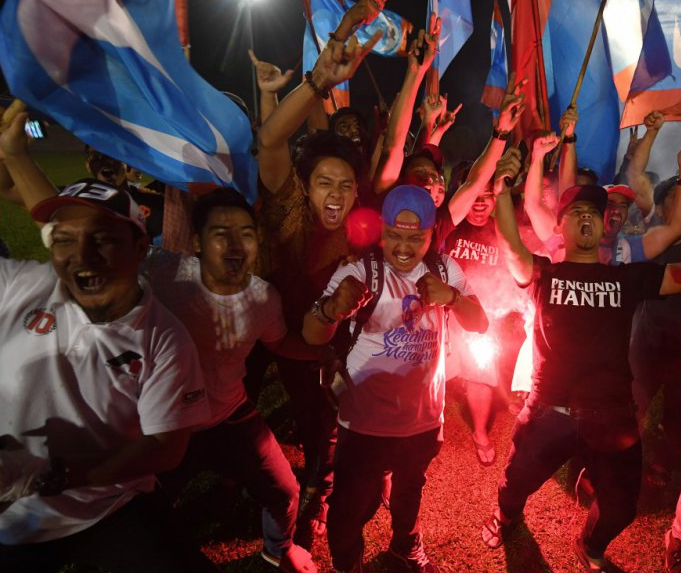
Supporters of former Malaysian prime minister and successful opposition candidate Dr Mahathir Mohamad celebrate in Kuala Lumpur. Image: Mohd Rasfan/Asian Correspondent/AFP

By Emma Richards of Asia Correspondent

In a truly historic vote, Malaysia for the first time since independence has fallen to the opposition coalition.

“The Palace has contacted us to tell us that we have achieved an unofficial majority,” opposition leader Dr Mahathir Mohamad told reporters at a press conference in Petaling Jaya.

“PKR (People’s Justice Party) achieved a simple majority a long time before the official announcement, but if you add the 14 from Warisan (Sabah Heritage Party), Pakatan Harapan now has a ‘substantial majority.’”

READ ALSO: Malaysia decides today in ‘Mother of all elections’

Pakatan Harapan (PH), the victorious coalition, is made up of several political parties forming an alliance – People’s Justice Party (PKR), Democratic Action Party (DAP), Amanah, Warisan, and Parti Pribumi Bersatu Malaysia, known as Bersatu.

It is expected Mahathir will be sworn in as the new prime minister of Malaysia later today.

-Partners-

Dr Mahathir said the party would work on acquiring a pardon for PKR’s official leader Anwar Ibrahim who is currently in prison on sodomy charges. He will require a royal pardon to be eligible to take the position of prime minister, as PH plan.

As polls opened at 8am on Wednesday, the mood was hopeful for change, but few expected it to come.

Spoilt ballot allegations
Allegations of spoilt ballots flooded social media, but that was not enough to hold back the wave of support for the opposition coalition.

After a close run race that had the nation on tenterhooks, the outcome started to take form when Barisan Nasional lost a number of key seats. Several party leaders lost their seats, including MIC president Dr S Subramaniam for the Segamat seat, MCA president Liow Tiong Lai in Bentong, and Gerakan president Mah Siew Keong in Teluk Intan.

Then the states started to fall. Negeri Sembilan and Johor – a frontline state and birthplace of Prime Minister Najib Razak’s own party – fell to PH, and Terrenganu was lost to Pan-Islamic Party (PAS).

For the first time in 60 years, it looked like the mighty BN may fall.

The night took a dramatic turn when Dr Mahathir called a press conference just before midnight to announce an unofficial victory for PH.

Accusing the Election Commission of dragging their feet on signing off seats, he claimed PH had already reached the 112 parliamentary constituencies needed to form government.

While Mahathir was just falling short of a victory lap, Najib was showing signs of retreat, cancelling a long-awaited press conference to address the incoming results.

At 2.50am today, the Election Commission announced the 112nd seat in favour of PH, making it official – Barisan Nasional was out, Pakatan Harapan was in.

Dr Mahathir Mohamad will once again take his place as the prime minister of Malaysia, 15 years after he stepped down.

Najib’s future uncertain
This leaves Najib’s future uncertain. Plagued with corruption allegations and embroiled in the 1MDB scandal, people have been calling for the former PM to be investigated and charged.

“We are not seeking revenge,” said DrvMahathir when asked whether he would pursue charges against Najib.

“All we want is to restore the rule of law.”

The significance of today’s result for the country cannot be understated.

“Both the system and the society will be shaken up,” head of political studies at the Penang Institute Wong Chin Huat said when asked what can be expected from a PH victory.

“Voters will believe that their vote matters. Bureaucrats and police will ditch partisanship towards professionalism. Corruption will be curbed not least because the old rascals will get kicked out.”

Emma Richards is a journalist with Asian Correspondent.

Print Friendly, PDF & Email

Article by AsiaPacificReport.nz

]]>
Tahiti incumbent defies corruption cloud to easily win election

]]>

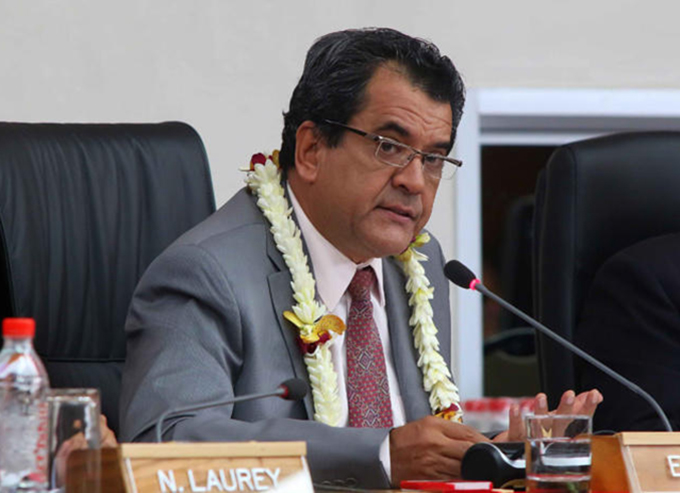
Tahitian President Edouard Fritch … increased majority as pro-independence groups take a hit. Image: Hawai’an Public Radio/Alchetron

Pacific Media Centre Newsdesk

In the elections held in French Polynesia over the weekend, the ruling party of President Edouard Fritch scored a decisive victory and will return to power with an expanded majority.

Neal Conan of Hawai’i Public Radio reports:

After a campaign where corruption emerged as a major issue, the party with no fewer than nine candidates convicted of corruption won easily.

President Edouard Fritch – a two-time convict – and his Tapura Huiraatira won just under 50 percent of the vote.

The rival Tāhōʻēraʻa Huiraʻatira received about 30 percent, while the pro-independence Tavini Huiraatira got 20 percent. Turnout was 67 percent.

French Polynesia’s election law automatically awards 19 seats in the National Legislature to the party that comes first, which guarantees the winners a ruling majority. The legislature then elects one of its own as President.

-Partners-

Former President Gaston Flosse was barred from running because of his corruption convictions, but still campaigned as the leader of the Tāhōʻēraʻa and tried to label President Fritch as unacceptably corrupt and indifferent to high unemployment.

‘Thieves and colonialists’
Veteran independence advocate Oscar Temaru described both Fritch and Flosse as “thieves and colonialists”, but his pro-independence party will again be relegated to third place in the legislature.

At present, hopes to revive the independence movement in French Polynesia rest on the referendum to be held in New Caledonia on November 4.

But two opinion polls released six months ahead of that referendum show strong majorities opposed to independence from France.

President Emmanuel Macron on France visited the territory last week to bolster pro-French sentiments.

Print Friendly, PDF & Email

Article by AsiaPacificReport.nz

]]>
Newsletter: New Zealand Politics Daily – May 09 2018 – Today’s content

Newsletter: New Zealand Politics Daily – May 09 2018 – Today’s content Editor’s Note: Here below is a list of the main issues currently under discussion in New Zealand and links to media coverage. [caption id="attachment_297" align="aligncenter" width="640"] The Beehive and Parliament Buildings.[/caption] Below are the links to the items online. The full text of these items are contained in the PDF file (click to download). Foreign affairs and aid, budget Richard Harman (Politik): Winston gets his first big win Claire Trevett (Herald): Budget 2018: Foreign Minister Winston Peters secures $900 million for more diplomats, aid Stacey Kirk (Stuff): Budget 2018: ‘Pacific reset’ will increase foreign affairs funding to $1b over four years Craig McCulloch (RNZ): $714m to be pumped into govt’s ‘Pacific reset’ plan RNZ: Pacific to receive bulk of bolstered NZ aid budget Arun Soma (Herald): Just how much do our Pacific neighbours need humanitarian aid from Kiwi taxpayers? Lisa Martin (AAP): Australia cuts foreign aid in budget as New Zealand delivers major boost RNZ: Australia boosts aid to Pacific Interest: Foreign Affairs Minister Winston Peters unveils $900 million funding increase to help ‘rebuild our place in the world’ Barry Soper (Newstalk ZB):Winston Peters announces pre-budget spending Stacey Kirk (Stuff): More money for aid in the Pacific when Winston Peters unveils foreign affairs budget RNZ: Govt finances $900m better than forecast Isaac Davison and Michael Neilson (Herald): Prime Minister Jacinda Ardern: Donald Trump’s withdrawal from Iran nuclear deal a step backwards Primary industries and environment Hamish Rutherford (Stuff): Hold your heifers: For all of David Parker’s problems, he has a point Herald Editorial: David Parker’s waterway plan needs more clarity Gerald Piddock (Stuff): Agriculture Minister rules out cap on dairy cattle numbers Isaac Davison (Herald): Climate Change Minister James Shaw goes deep into farming country Heather Chalmers (Stuff): Canterbury cow numbers lift to buck national trend David Williams (Newsroom): Controversial land sale scrapped Laura Dooney (RNZ): Moves made to reduce runoff already – farmers Gerald Piddock (Stuff): Budget day the benchmark for judging Government’s C+ performance in regions Tracy Neal (RNZ): Researchers reject claims of spreading oyster disease Jane Matthews (Stuff): Opposition climate change spokesperson talks on Taranaki’s oil and gas sector Nicki Harper (Herald): Watch Video: Craggy Range report on Te Mata track disappoints Mana whenua Health Marty Sharpe and Jessica Long (Stuff): Serving alcohol at school fundraisers may breach the rights of children, DHB says Shannon Haunui-Thompson (RNZ): Rheumatic fever sufferers allegedly called ‘coconuts’ in hospital RNZ: Racism and rough handling of Pasifika patients uncovered Dave Macpherson (Daily Blog): The Mental Health Inquiry – get involved Katarina Williams (Herald): Violence ‘leading cause’ of facial fractures, Wellington study finds Lucy Bennett (Herald): ‘Whole lot’ of priorities for Middlemore, says new chairman Mark Gosche RNZ: New DHB head gets first look at hospital building issues Jenna Lynch (Newshub): Government warned not to rush Dunedin hospital build Mike Houlahan (ODT): Business case to Cabinet next year Kristin Edge (Northern Advocate): Asbestos debris and residue discovered in storeroom at Whangarei Hospital Matthew Rosenberg (Auckland Now): ‘Babies are moved like pieces of the chessboard’ at North Shore unit: New mum Stacey Kirk (Stuff): Govt to withdraw support for National’s bill requiring newborns to be registered with GPs Anna Loren (Stuff): Elderly patient left lying in urine-soaked bed at Auckland retirement facility Hinerangi Rhind-Wiri (Spinoff): Where is the support for Māori midwives? Rachel Thomas (Stuff): Hospitals ‘on notice’ as anaesthetists and surgeons complain of burnout Surveillance law Laura Walters (Stuff): Botched legislation left spies without some powers for six months Anna Bracwell-Worrall (Newshub): Former Minister forced into defence mode over gap in spy law Sam Sachdeva (Newsroom): Officials to blame for spy law blunder – Finlayson Jane Patterson (RNZ): Former spy minister aware of surveillance gap No Right Turn: There’s a lesson here Poverty, inequality and welfare Thomas Manch (Stuff): Government’s child poverty bill will leave children poor, experts warn Ian Hyslop (Newsroom): The ‘sturdy beggar’ back to haunt us Chris Bramwell (RNZ): Govt announces $76m boost for family violence services Muriel Newman (NZCPR): Labour’s Disastrous Track Record of Welfare Reform Media Richard Harman (Politik): How Griffin and Curran parted Lucy Bennett (Herald): Broadcasting Minister Clare Curran releases information on RNZ saga Henry Cooke (Stuff): Clare Curran releases voicemail from Richard Griffin Tim Murphy (Newsroom): Media firms touch, pause, engage Parliament Jo Moir (Stuff): A bill to entrench the Māori seats won’t get NZ First or National support Jane Clifton (Listener):Is Judith Collins politically immortal? National Gordon Campbell: On National’s latest attempts at relevance Tova O’Brien (Newshub): ACT’s future looks shaky as Simon Bridges noncommittal about Epsom deal Martyn Bradbury: Real reason why National are considering cutting ACT off Education Henry Cooke (Stuff): Winston Peters tells ministers touting compulsory te reo to get ‘on the same page’ Herald: Winston Peters hits out at MPs following slip-up on wording around compulsory te reo Henry Cooke (Stuff): Nanaia Mahuta: compulsory Te Reo in schools ‘not if but when’ 1News: Compulsory Te Reo Maori in schools ‘only a matter of time’ – MP Nanaia Mahuta Adele Redmond (Stuff): Sticks and Stones: Bullying’s cost to society reaches beyond schools into workplaces, courthouses and the mental health system ODT Editorial: Labour’s grand education plans Simon Collins (Herald): Second family complains about accident at Palmerston North’s Little Monkeys Preschool Dominion Post Editorial: We can’t afford to ignore teachers’ claim for better pay 1News: Pay teachers on ‘merit’: ACT’s David Seymour would increase teacher salaries funding by $1 billion, pay the best more and attract the brightest minds Simon Collins (Herald): Foreign doctoral student numbers leap with $50m subsidy Tiana Mihaere (Critic): Why Otago University Needs A Marae Employment RNZ: ‘People will choose to go hungry rather than work in a packhouse’ Maori TV: More youth in Opōtiki to be employed Jamie Wall (RNZ): Ferns’ pay parity deal took its toll before being struck RNZ: ‘Focus is on us’ – NZ Football CEO Michael Burgess (Herald): New Zealand Football announce parity for Football Ferns and All Whites RNZ: Pay parity deal for Football Ferns and All Whites Alex Braae (Spinoff): Equal pay for women (soccer players): The Football Ferns score pay parity Herald: Widower Keith Falconer sparks Government intervention after being denied paid parental leave Herald: Widowed father initially denied paid parental leave welcomes Government payment Cate Broughton (Stuff): Canterbury father Keith Falconer exposes ‘wackiness’ of paid parental leave law World Made in NZ controversy and fashion industry ethics Hamish Fletcher (Herald): Comment: Why ‘NZ-made’ saga is so damaging for World Damien Venuto (Herald): Is it time to ditch ‘made in New Zealand’ for ‘designed in New Zealand’? RNZ: World customers could take clothing back – Consumer NZ Aimee Shaw (Herald): Three more ComCom complaints lodged against World following World ‘Made in NZ’ report Aimee Shaw (Herald): Commerce Commission receives five complaints following World report 1News: Commerce Commission to assess six complaints about WORLD t-shirt labelling before deciding whether to investigate Southland Times Editorial: Labels can be so hurtful . . . Michael Daly (Stuff): How Christian aid group Tearfund made itself the arbiter of fashion industry ethics Migration and refugees Laura Walters and Stacey Kirk (Stuff): Jacinda Ardern walking a tightrope on asylum seekers Newshub: Jacinda Ardern responds to Australia’s people smuggling allegations Newshub: ‘No evidence’ people smugglers targeting New Zealand – Golriz Ghahraman Emma Hatton (RNZ): Filipinos ‘chasing a false dream’ in NZ after broadcast Debrin Foxcroft (Stuff): One in six Māori now living in Australia, research shows John Boynton (RNZ): High living costs drive Kiwis back across the ditch Local government Phil Pennington (RNZ): Building systems WOFs: Council checks fall far short Matt Shand (Stuff): Bella Vista homeowners sour, but hopeful, after meeting investigator Don Brash (Stuff): Joel Maxwell’s on the wrong side of history Tourism Grant Bradley (Herald): Tourism New Zealand to change tack with its 100% Pure campaign Grant Bradley (Herald): The big five million: Surge in visitors to New Zealand forecast into next decade Oliver Lewis (Stuff): Akaroa residents call for action amidst ‘explosion’ in freedom camping Auckland Todd Niall (RNZ): Troubled waters: Govt’s America’s Cup negotiations dissected Farah Hancock (Newsroom): Auckland’s $58m congestion charging plan Transport Dene Mackenzie (ODT):Rising fuel prices may be hurting spending Paul Mitchell (Stuff): BP reaches out to Palmerston North family in voucher dispute RNZ: Electric vehicle owners await response to battery concerns Hillary Clinton NZ speaking engagement Ben Doherty and Eleanor Ainge Roy (Guardian): Hillary Clinton says China’s foreign power grab ‘a new global battle’ Patrick Gower (Newshub): How Russia and China could hurt New Zealand Tracy Watkins (Stuff): New Zealand is part of the answer to China’s rise, says Hillary Clinton Talisa Kupenga (Maori TV): Heed foreign influence warnings – Peters Patrick Gower (Newshub): Hillary Clinton’s greatest hits Charlotte Graham-McLay (Spinoff): But where was the roar? Watching the Hillary Clinton show in Auckland Housing Adam Jacobson (Auckland Now): ‘Morally irresponsible’ of govt to subsidise hotels Tristram Clayton (Herald): Rental home offer rejected by Housing NZ because it was built before 2000 Madison Reidy (Stuff): Government asks to buy developers’ plans to contribute to KiwiBuild target Stuff: Would you move to the West Coast to save $16,000? Other Herald: New survey reveals housing, poverty and healthcare most concern New Zealanders RNZ: Kiwis’ privacy concerns on the rise Susan Edmunds (Stuff): Bank profits race ahead of rest of NZ’s earnings Tom Pullar-Strecker (Stuff): Government re-advertises for CTO after $400k job failed to attract right candidate Ged Cann (Stuff): Most Kiwis don’t know New Zealand has its own space agency – but they should RNZ: Dunedin arts enthusiasts determined to keep theatre alive Herald: Former Far North Māori trust executive admits stealing almost $1m for personal gain Stuff: Woman pleads guilty to defrauding Far North Māori trust of nearly $1 million Jo Lines-MacKenzie (Stuff): Waikato Rodeo Association cleared after injury to horse]]>

‘Time of anxiety’ – a depressing new normal for local journalists in conflict zones

]]>

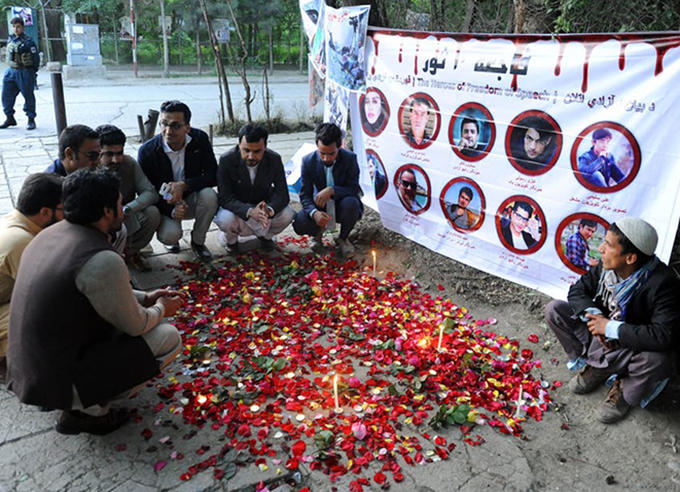
Afghan journalists light candles to remember the local reporters killed in last week’s Kabul bomb blast. Image: Hedayatullah Amid/EPA/The Conversation

By Colleen Murrell in Melbourne

For journalists who cover Afghanistan, the bombing that killed nine local reporters last week in Kabul was a sober reminder of the dangers the media continue to face in the country’s seemingly endless conflict.

The victims were not well-known foreign correspondents, but a group of courageous Afghan photographers, reporters and cameramen who had gone to report on another bomb blast that had exploded about 40 minutes earlier.

They included a photographer from the French news agency Agence France-Presse (AFP), as well as contributors to Radio Free Europe/Radio Liberty and several local media companies.

READ MORE: Free media week killings underscore crimes of impunity against journalists

Elsewhere on the same day, a 10th journalist was shot dead – a reporter for the BBC’s Pashto service, Ahmad Shah.

According to Reporters Without Borders, it was the deadliest single day for journalists in the country since the overthrow of the Taliban in 2001.

-Partners-

The principal way we receive news from conflict zones like Afghanistan, Syria and Iraq is via eyewitnesses on social media and the global news agencies – AFP, Associated Press and Reuters. Agency reporters are often the first “media responders” to deadly incidents like suicide bombings and terror attacks. They also negotiate with local reporters on the ground to secure the best pictures, which then get relayed to the thousands of media companies around the world who subscribe to their services.

To feed this beast of global 24/7 news coverage, there is still an expectation that agency journalists will dare to tread where others will not.

Journalists as targets
Increasingly, this has become even more dangerous, as extremist groups like the Islamic State have shifted tactics to specifically target journalists.

The Afghan Journalists Safety Committee warned of “an unprecedented increase in threats and violence against journalists” in a 2017 report:

Increased threats from DAESH to media and journalists have created a new wave of concerns about the security of journalists and media. What is seriously worrying is the group’s direct attacks against media, which in 2017 is responsible for the vast majority of journalists’ deaths.

Reporters Without Borders says 34 journalists and media workers have died in attacks by the Islamic State and Taliban in Afghanistan since the start of 2016. The situation has become so dire that the group has called on the United Nations to appoint a special representative dedicated to protecting the lives of journalists. The proposal has been backed by French President Emmanuel Macron and the German Parliament.

Without adequate security provisions, journalists have also been abandoning countries that have become too dangerous, Reporters Without Borders notes in its 2017 annual report on reporters killed in the line of duty.

AFP continues to operate with a team of two or three foreign journalists in Kabul, backed up by seven full-time Afghan journalists and various stringers working across the country. Reuters employs just one foreign correspondent and one local journalist in Kabul, and AP has two local reporters and two local photographers.

Former BBC journalist Bilal Sarwary, who now works as a freelancer, tells me there are very few Western journalists left in Afghanistan because “Iraq and then Syria have commanded their attention” in recent years. He said The New York Times, The Wall Street Journal and The Washington Post still have reporters based in the country, but now rely almost entirely on freelance photographers.

Responding to the new reality
Under global news director Michèle Léridon, AFP has been highly innovative at adapting to news gathering challenges, but also strict in its policy of not being made stooges by terrorists. According to Phil Chetwynd, AFP’s global editor-in-chief, the company is constantly evaluating its security procedures.

We have always been cautious about rushing to the scene of attacks. We have moved our office several times in Kabul to find a better location as the threat level has changed. We have sent security experts to review our procedures and to recommend physical reinforcements and measures to our buildings.

We have also sent reporters on hostile environment courses and sent trainers to Kabul to train all staff including non-journalists. The message to all our reporters remains that security comes first.

Chetwynd notes the suicide bomber who killed the nine Afghan journalists in Kabul last week – a group that included AFP photographer Shah Marai – had apparently been posing as a fellow reporter, a new tactic by terror groups.

“We are already changing and reacting to this appalling new reality,” he says.

It’s clear that all media organisations need to constantly rethink their strategies when it comes to reporting in conflict zones.

Media scholars, too, are tackling the issue. At the upcoming International Communications Association conference in Prague later this month, I will be joining other academics on a panel titled “Voices in journalism: Local news staff producing international news” to discuss the latest research examining the working conditions of stringers, fixers and local journalists.

Researched challenges
One of the panellists, Saumava Mitra, has researched the work of photojournalists in Afghanistan and co-authored an essay last week on the challenges they face:

We have seen that local journalists usually have much poorer access to hostile-environment training, work-hazard insurance or even medical benefits from their employers. They face different threats and risks than those who parachute into the conflict and have nowhere to go if the situation escalates.

They are also much more prone to reprisals. The first step to help prevent their deaths is to acknowledge that the news we consume is often produced by journalists working under precarious conditions in hostile places.

Marai, for one, always knew the dangers of working in Kabul, as his blog on the AFP website so devastatingly shows. In it, he recounts how life changed for the worse when the Taliban returned to stage attacks in Kabul in the mid-2000s:

“I don’t dare to take my children for a walk. I have five and they spend their time cooped up inside the house. Every morning as I go to the office and every evening when I return home, all I think of are cars that can be booby-trapped, or of suicide bombers coming out of a crowd. I can’t take the risk. So we don’t go out.

“I have never felt life to have so little prospects and I don’t see a way out. It’s a time of anxiety.”

Dr Colleen Murrell is undergraduate coordinator for journalism at Monash University, Melbourne, and the author of Foreign Correspondents and International Newsgathering: The role of fixers.This article was first published by The Conversation and is republished on Asia Pacific Report under a Creative Commons licence.

Print Friendly, PDF & Email

Article by AsiaPacificReport.nz

]]>
Mass staff walkout at Phnom Penh Post owner’s self-censorship order

]]>

By Thomas Brent, Tom O’Connell, Janelle Retka in Phnom Penh

Cambodia’s last independent newspaper has had its editorial team gutted after its managing editor, web editor and two senior journalists resigned following a demand from the Phnom Penh Post’s new owner to take down an article reporting on the sale of the paper over the weekend.

The Post’s editor-in-chief Kay Kimsong was then sacked for his role in the article’s publication.

“I got fired by the new owner…because I’m the editor-in-chief and I allowed the printing of the independent story based on journalistic integrity,” Kimsong told Southeast Asia Globe shortly after he was dismissed.

“I trust my reporters and my editors and I think that being journalists, we made the right decision. But it’s their business and they said, ‘Kimsong, you’re the editor-in-chief – and you made a big mistake.’”

The article, which was published on Sunday evening, confirmed that Sivakumar S. Ganapathy, chief executive and managing director of Malaysia-based public relations firm Asia PR, was the new owner of the newspaper, which has been the nation’s paper of record since 1992.

Outgoing publisher Bill Clough announced the sale in a press release on Saturday, welcoming Sivakumar – also known as Siva – to the role and praising his credentials.

-Partners-

“Siva is a well respected newspaper man, with a [sic] experienced journalist background, and represents a strong investment group from Malaysia,” said Clough, an Australian mining magnate who has be in charge of the paper since 2008.

Doubts over future independence
But journalists and media watchdogs across the region have raised doubts about the paper’s future independence due to a number of concerning links between the Post’s new owner and the Cambodian and Malaysian governments.

Asia PR’s website lists “Cambodia and [Prime Minister] Hun Sen’s entry into the government seat” as one of its previous clients. More worryingly, Sivakumar’s personal description maintains that he currently “leads the Asia PR team in managing ‘covert operations’ for our clients.”

Phil Robertson, the deputy Asia director of Human Rights Watch, described the deal as “a staggering blow to press freedom in Cambodia”.

The Phnom Penh Post had been the subject of a US$3.9 million tax bill, which drew widespread parallels with the circumstances surrounding the shuttering of former English-language publication the Cambodia Daily.

The newspaper, which frequently published stories criticising the government, was shut down last September after being hit with a $6.3 million tax bill widely believed to be politically motivated.

The Post has also been dogged by an ongoing legal action launched by former chief executive Chris Dawe for wrongful dismissal during his tenure at the paper. Clough stated that the Post’s tax bill had been settled as part of the sale.

Post office plunged into chaos
Emotions ran high in the hallways and offices of the Post on Monday afternoon after the new ownership tussled with editors over the story.

Managing editor Stuart White, who has worked for the Post for six years, was the first staff member to refuse to remove the article.

“I was asked to take down the story about the sale by a colleague, who characterised it as a direct order from the new management,” White said. “I didn’t feel like I could do that in good conscience, so I resigned immediately.”

The order was passed through the ranks, with each editor refusing to take down the story.

Web editor Jenni Reid then refused and resigned, followed by the co-authors of the piece, business editor Brendan O’Byrne and senior journalist Ananth Baliga. Chief ececutive Marcus Holmes was the last to tender his resignation.

A senior Cambodian staffer who requested anonymity said that local reporters had pleaded with the new management not to put the paper’s long-running record of independent journalism at risk.

“The rest of the Khmer staff just stayed in the meeting to say, ‘Can you run a second story?’ ‘Do not pull [the original] down…run a second article, correction, make a clarification,’” the staffer said. Management refused, and Kimsong was fired shortly after.

Editors targeted by Sivakumar
Kimsong, O’Byrne and Baliga were all targeted by Sivakumar in an internal memo savaging the Post’s coverage of the newspaper’s sale, with the new owner calling on all three staff members to be “terminated”.

Although a press release from the paper’s new owners announcing the sale maintained that Sivakumar was “fully committed to upholding the paper’s 26-year-old legacy and editorial principles/independence without infringing any relevant laws and regulations of the Kingdom of Cambodia,” the memo – which was published earlier today by local news site AEC News – served up a stinging rebuke to the article, claiming that the piece did not meet the “high caliber” [sic] that the new owners expected from the paper.

Sivakumar called the piece “a disgrace and an insult to the independence claim of the newspaper” and said it “borders on internal sabotage”.

Today it is clear that the editorial independence of Cambodia’s last true independent media is at threat

Among Sivakumar’s complaints against the article were that the reporters forgot to publish his middle initial and that they identified him as “an executive”and “executive director” of Asia PRrather than CEO and managing director.

In the past year, Cambodia’s shrinking independent press has come under fire as the country gears up for a national election in July, with former Khmer Rouge commander Hun Sen the clear favourite to continue his 33-year reign.

The last gasp of the free press
Daniel Bastard, head of the Asia-Pacific desk of Reporters Without Borders, expressed his solidarity with the Post’s journalists.

“Rumours about pressures from Hun Sen’s government to try and muzzle the Phnom Penh Post have spread for a few months,” he said. “Today it is clear that the editorial independence of Cambodia’s last true independent media is at threat.

“The removal of the Post’s editor and the censorship on articles detailing the journal’s sale are dreadful signs that journalists will no longer be able to do their work freely.”

More than 30 radio stations known to be critical of Hun Sen’s rule were silenced by the government last year, including Radio Free Asia and Voice of America.

Cambodia plunged ten places in the 2018 Reporters Without Borders’ press freedom index to number 142 out of 180 countries.

Since launching in January 2007, the Cambodia-based Southeast Asia Globe has sought to “engage our readers through reports that dig deeper and stories that inspire”.

Print Friendly, PDF & Email

Article by AsiaPacificReport.nz

]]>
O’Neill ‘undermining’ Bougainville peace deal, vote plan, says Miriori

]]>

The trailer for New Zealand documentary maker Will Watson’s forthcoming documentary about the Bougainville peace process, Soldiers Without Guns. Video: Boosted

Pacific Media Centre Newsdesk

A Bougainvillean leader has accused Papua New Guinean Prime Minister Peter O’Neill of “undermining” the island’s 17-year-old peace agreement and the independence vote due next year.

Martin Miriori also condemned O’Nell for lacking sensitivity over Bougainville that struck a New Zealand-brokered peace agreement which ended a 10-year civil war and included a referendum vote on independence.

Miriori, a Panguna landowner and pro-independence leader, was reacting to a statement by O’Neill at the Business Forum in Brisbane last week and repeated in PNG’s The National newspaper that the vote was not about independence, but what was best for the people of Bougainville.

https://www.radionz.co.nz/international/pacific-news/356876/png-pm-says-bougainville-vote-not-about-independence

“When the prime minister comes out openly making such a statement in public, my view is that he is already undermining the good intentions and the spirit of the Bougainville Peace Agreement which, among other issues, clearly states that the issue of independence for Bougainville will be also among the options for a referendum vote to be taken by the people [in] June next year,” he said today in a statement.

-Partners-

“This is also the common understanding of the international community as well [as] including the United Nations,” Miriori said.

“For the prime minister to water down the main focus on the independence issue at this time is simply a big slap on the face [of] the people of Bougainville.”

Miriori said Bougainvilleans would not have “fully committed themselves” to the joint partnership with Papua New Guinea in the peace process if they knew that they were “going to be tricked”.

“We must not lose the trust and confidence of the people at all cost, and in doing so try to confuse them by making such statements, which could easily undermine all our good work and tireless efforts being invested in this very delicate and sensitive process since we first fully committed ourselves at Burnham [New Zealand] in July 1997 towards achieving lasting peace by peaceful means,” Miriori said.

RNZ Pacific reports that O’Neill told the Business Forum in Brisbane that when the outcome of the referendum was tabled in the national Parliament, he was sure every MP would vote in the interests of a unified and harmonious country.

Guitars instead of guns
Meanwhile, the film maker of a forthcoming documentary about the Bougainville peace process, Soldiers Without Guns, has released a trailer.

In a social media message message to supporters last week, Will Watson said: “We were celebrating the 20th anniversary of lasting peace for Bougainville yesterday.

“Yes, the 30 April 1998 was the signing of the peace accord.

“The other big news is that I completed the trailer for the upcoming movie, Soldiers Without Guns. It took lots of work but I think it describes the Pacific’s worst civil war and peacekeeping with guitars instead of guns.

“Still lots of work to do to complete the film. I hope you like the trailer.

“I have been inspired to tell this story for the last 12 years. I am now very close to completing the feature length film.”

Watson won the 2017 Cannes Film Festival peace feature for his documentary Haka and Guitars.

He has appealed for support in a funding campaign to complete the Bougainville project.

Print Friendly, PDF & Email

Article by AsiaPacificReport.nz

]]>
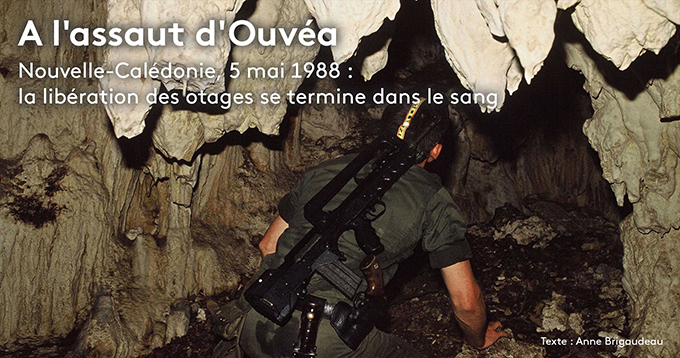
Blood in the Pacific: 30 years on from the Ouvéa Island cave massacre

]]>

SPECIAL REPORT: By Max Uechtritz

On Saturday, 30 years ago in 1988, I smelled death for the first time – literally.

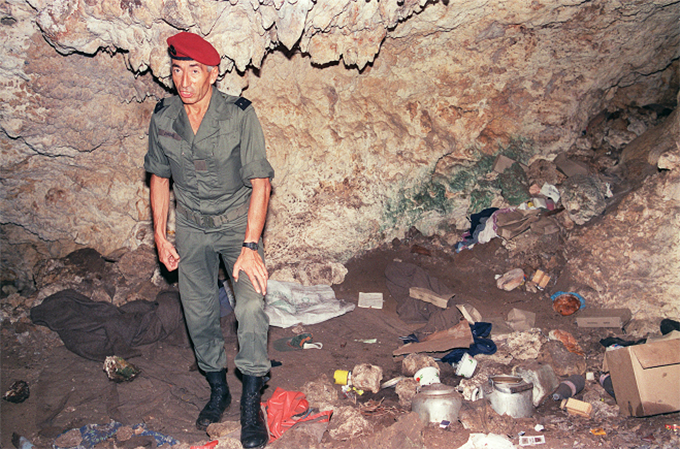
A sickening, almost suffocating, stench assaulted my nostrils in a dank cave where 21 men – 19 Kanak militants and two French military – had been killed the previous day in what lives on infamously as the “Ouvéa Island massacre” in New Caledonia.

Our feet sunk deep into the loose layer of moist loam the gendarmes had shovelled from the jungle outside onto the cave floor to cover the blood and waste of the dead.

On what we trod it was impossible to know. I dry retched.

My ABC cameraman Alain Antoine, sound recordist Stewart Palmer and I were the very first of the first group of journalists to be allowed inside the Gossannah cave complex on Ouvéa where the Kanaks had died in an assault by French Special Forces.

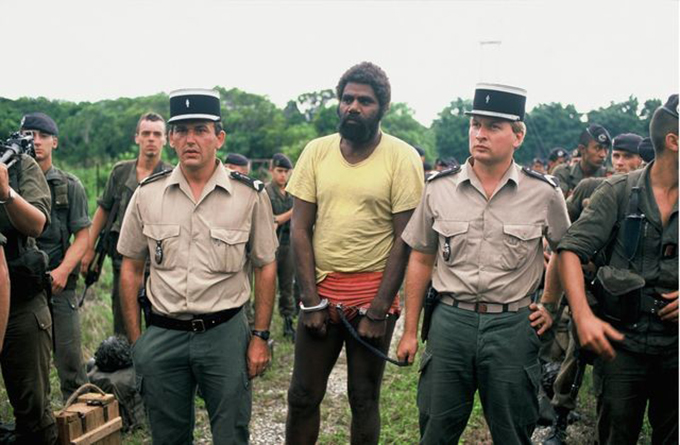
We’d been flown from the capital Nouméa in a French military helicopter. As we’d scrambled onto the Ouvéa tarmac we bumped into a giant Kanak prisoner sporting red shorts, yellow T shirt and manacles being led the other way by French military (pictured below).

A Kanak militant being led away in handcuffs by French securiuty forces on Ouvéa Island in May 1988. Image: revolutionpermanente.fr

-Partners-

A few days earlier on the main island I experienced for the first of many times in my career the shock of having a cocked, loaded gun pointed at me. We’d happened upon the helicopter evacuation of a French officer wounded in an ambush. He later died.

Not worth shooting
A frightened, angry adrenalin-charged soldier raced up to our car screaming and pointing his automatic weapon before being calmed by a superior who chose to believe we were civilian journalists, not rebels and not worth shooting.

They were tense days.

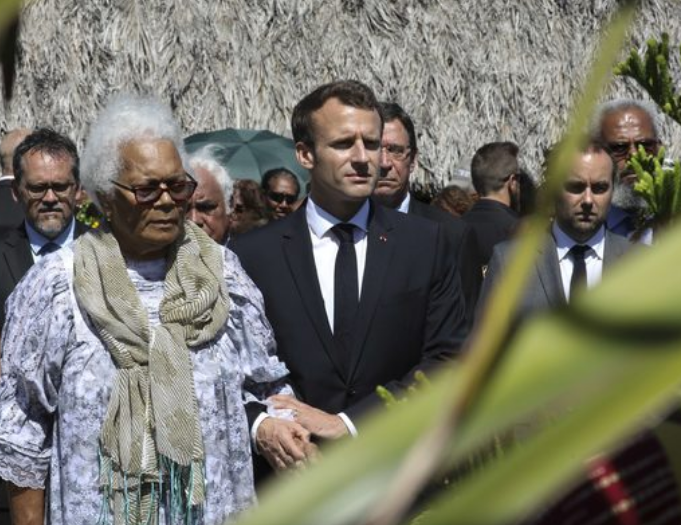
The Ouvéa event is still cloaked in controversy (French President Emmanuel Macron visited Ouvéa yesterday for the 30th anniversary but, under pressure from families of the dead, refrained from laying a wreath at the graves of the 19 Kanaks).

The action and its context is described by respected Pacific author David Robie in Pacific Journalism Review (2012, pp. 214-215):

“I wrote the following in my book Blood on their Banner[1989, pp. 275-278] – the “blood” being that symbolised by the Kanak flag as being shed by the martyrs of more than a century of French rule:

“Mounting tension as the French security forces were built up in New Caledonia to 9500 for the elections finally erupted on Friday, 22 April 1988, two days before the poll. Kanak militants, arguably the first real guerrilla force in the territory, seized a heavily armed Fayaoué gendarme post on Ouvéa, in the Loyalty Islands.

“Armed with machetes, axes and a handful of sporting guns hidden under their clothes, they killed four gendarmes who resisted, wounded five others and seized 27 as hostages.

“They abducted most of their prisoners to a three-tiered caved in rugged bush country near Gossanah in the north-east of the island; the rest were taken to Mouli in the south.

As almost 300 gendarmes flown to Ouvéa searched for them, the militants demanded that the regional elections be abandoned and that a mediator be flown from France to negotiate for a real referendum on self-determination under United Nations supervision. They threatened to kill their hostages if their demands were not met.

“Declaring on Radio Djiido that he was dismayed by the attack, Tjibaou blamed it on the “politics of violence” adopted by the Chirac government against the Kanak people.

“‘The [colonial] plunderers refuse to recognise their subversive lead,’ he said. ‘From the moment they stole our country, they have tried to eliminate everybody who denounces their evil deeds. It has been like that since colonialism began.’

Appeal for calm
“(French President) Mitterrand appealed for calm and a halt to spiral of violence; (Premier) Chirac condemned the ‘savage brutality’ of the attack, claiming the guerrillas were ‘probably full of drugs and alcohol’.

“The guerrillas freed 11 hostages but remained hidden in their Wadrilla cache with the others. Another hostage, who was ill, was later released.

“[French Minister for Territorial Affairs Bernard] Pons portrayed the guerrilla leader, Alphonse Dianou, as a ‘Libyan-trained religious fanatic’. In fact, he had trained at a Roman Catholic seminary in Fiji and was regarded by people who knew him as ‘a reflective man, found of books and non-violent’. He spent hours explaining to his captives why they had been seized.

“At dawn on Thursday, May 5, French military and special forces launched their attack on the Ouvéa cave and killed 19 Kanaks in what was reported by the authorities to be a fierce battle. The hostages were freed for the loss of only two French soldiers.

“If the military authorities were to be believed, their casualties were from the 11th Shock Unit of the DGSE. (This unit was formerly the Service Action squad, used to bomb the Rainbow Warrior in Auckland Harbour on 10 July 1985).

“The assault came just three days before the crucial presidential vote, and hours after three French hostages had been freed in Lebanon following the Chirac government’s reported payment of a massive ransom.

“To top it off, convicted Rainbow Warrior bomber Dominique Prieur, now pregnant, was repatriated back from Hao Atoll to France.

Massacre ‘engineered’

Leaders of the [pro-independence] FLNKS immediately challenged the official version of the attack. Léopold Jorédie issued a statement in which he questioned how the “Ouvéa massacre left 19 dead among the nationalists and no one injured” and the absence of bullet marks on the trees and empty cartridges on the ground at the site”.

Yéiwene Yéiwene insisted that at no time did the kidnappers intend to kill the hostages – ‘this whole massacre was engineered by Bernard Pons who knew very well there was never any question of killing the hostages”. Nidoish Naisseline also condemned the action:

“Pons and Chirac have behaved like assassins. I accuse them of murder. They could have avoided the butchery. They preferred to buy votes of [Nationalist Front leader] Le Pen’s friends with Kanak blood.”

The Ouvéa assault on 5 May 1988.

The following extract sums up claims and counter claims:

According to a later report of Captain Philippe Legorjus, then GIGN leader: “Some acts of barbarity have been committed by the French military in contradiction with their military duty”. In several autopsies, it appeared that 12 of the Kanak activists had been executed and the leader of the hostage-takers, Alphonse Dianou, who was severely injured by a gunshot in the leg, had been left without medical care, and died some hours later. Prior to this report, Captain Philippe Legorjus was accused by many of the GIGN agents who took part in the operation of weaknesses in command and to have had “dangerous absences” (some even said he fled) in the final stages of the case. He was forced to resign from the GIGN after this operation, since nobody wanted him as chief and to fight under him anymore.

The military authorities have always denied the version of events given by Captain Philippe Legorjus. Following a command investigation, Jean-Pierre Chevènement, Minister of Defence of the Michel Rocard government, notes that “no part of the investigation revealed that there had been summary executions”. In addition, according to some participants of the operation interviewed by Le Figaro, no shots were heard on area after the fighting ended.

Legorjus said French Premier Jacques Chirac, who was challenging Mitterrand in the French presidential elections, wanted to stage the assault. And Pons said that he had acted throughout the drama on the orders of Chirac, who believes the “separatist” movement should be outlawed.

Radio NZ on Saturday: “The two-week hostage crisis in 1988 was a turning point in the separatist campaign of the indigenous Kanaks because it ushered in reconciliation talks, which led to the 1988 Matignon Accord.

The Accord and its subsequent 1998 Noumea Accord allowed for the creation of a power-sharing collegial government and the phased and irreversible transfer of power from France to New Caledonia.”

Whatever the truth, the blood of 1988 will stain this territory for a long time yet.

Max Uechtritz is managing director of Kundu Productions Pty Ltd and is republished by Asia Pacific Report with permission. Photos thanks to France TV Outre-Mer and revolutionpermanente.fr

References:
Robie, D. (2012). Gossanah cave siege tragic tale of betrayal. Pacific Journalism Review,  18(2), 212-216.
Robie, D. (1989). Blood on their banner: nationalist struggles in the South Pacific (pp. 275-280). London, UK: Zed Books.

Inside the Gossanah cave on Ouvéa.

Southern Cross radio comment about the Ouvéa visit on 5 May 2018 by President Macron.

Print Friendly, PDF & Email

Article by AsiaPacificReport.nz

]]>
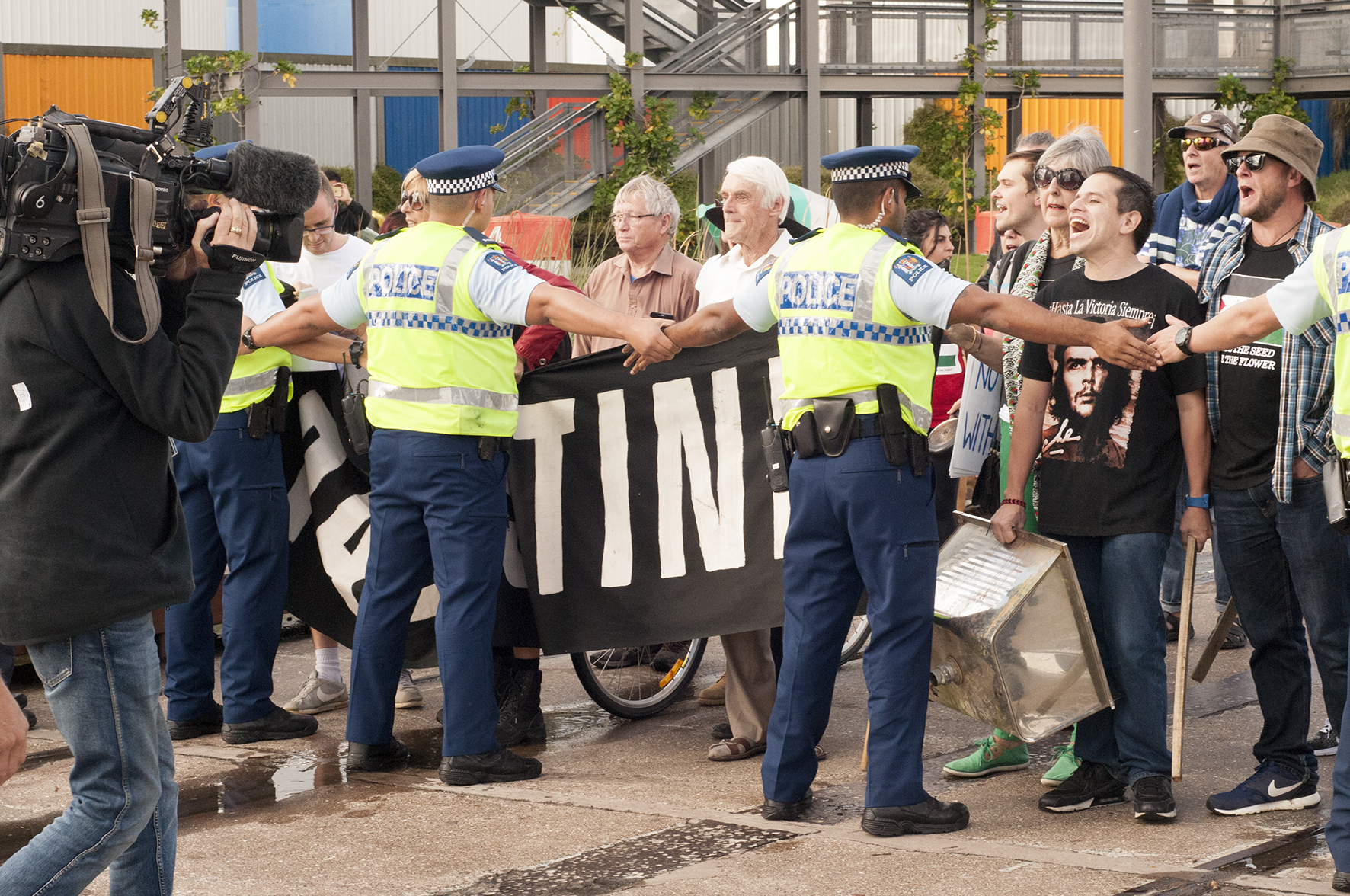
Journalist turns tales of undercover Papuan reporting into love novel

]]>

Stranger than fiction … Aprila Wayar poses with her latest novel Sentuh Papua which chronicles a Dutch journalist’s undercover reporting of Papua and is based on actual events. Image: Bambang Muryanto/Jakarta Post

BOOK REVIEW: By Bambang Muryanto in Yogyakarta

A Dutch freelance journalist, Rohan (a pen name), had been interested in the political turmoil in Papua for years. In 2015, his application for a journalistic visa was denied. The 32-year-old then decided to embark on an undercover reporting assignment in the country’s easternmost province.

For 153 days, he observed the way local people lived, met with leaders of the pro-independence Free Papua Movement (OPM) in the jungle, enjoyed the beauty of Papua’s nature and met Aprila Russiana Amelia Wayar, or Emil, a local journalist who later became his girlfriend.

It was Emil who wrote about Rohan’s adventures in Papua and their love story in the novel Sentuh Papua, 1500 Miles, 153 Hari, Satu Cinta (Touch Papua, 1500 Miles, 153 Days, One Love).

In the novel, Rohan’s character said foreign media agencies in Jakarta refused to publish his report on Papua, worrying that the government would revoke the visas of their Jakarta correspondents.

Emil recently launched her 374-page novel in a discussion forum organised by the Alliance of Independent Journalists’ (AJI) Yogyakarta chapter and the Yogyakarta Legal Aid Institute (LBH).

Emil has been in Yogyakarta since early this year to publish the book. She chose Yogyakarta because she had spent time there as a student at Duta Wacana Christian University (UKDW).

-Partners-

The 38-year-old author said she initially intended to write a journalistic piece that was rich in data and interviews. She used the character of Rohan to describe the lack of press freedom in Papua, human rights violations in the province and challenges to OPM’s quest for self-determination.

‘Easier to understand’
“I then chose [to write a] novel to make it easier for Papuans and Indonesians to understand the [province’s] issues,” she said.

Through the book, Emil, who used to work for independent media platform Tabloid Jubi, was determined to represent the other side of Papua’s story vis-a-vis mainstream reporting on the province, which she deemed mostly biased.

She said many journalists covering cases of human rights abuses in Papua only interviewed security personnel and neglected the victims.

“Journalists writing about Papua have to cover both sides,” she said.

However, she realised both the challenge and risks that come with reporting Papua as a journalist, as she herself often received threats and harassment while doing her job.

In her book, the characters Rohan and Amelia, who is based on herself, are chased by a group of people armed with machetes.

According to Reporters Sans Frontier’s (RSF) latest World Press Freedom Index, Indonesia ranks 124th out of 180 countries – the same position as last year.

Open access promise
The Paris-based group highlighted the restriction of media access to Papua and West Papua as a factor that has kept Southeast Asia’s largest democracy at the bottom of the list.

The condition prevails despite President Joko “Jokowi” Widodo’s campaign promises to open access to Papua for foreign journalists.

Meanwhile, the Indonesian Press Council categorised Papua and West Papua as “medium/relatively free” in its 2017 press freedom index.

Yogyakarta-based lawyer Emmanuel Gobay said Emil’s book, despite being published as fiction, was a good reference for those who want to understand Papua from both the local and professional perspective.

“This novel reflects the state of press freedom in Papua,” he said.

The novel, which Emil wrote in eight months, is her third after Mawar Hitam Tanpa Akar (Black Rose Without Its Stem) and Dua Perempuan (Two Women), both of which told stories about social issues in Papua.

Emil was the first indigenous Papuan novelist invited to the Ubud Writers and Readers Festival (UWRF) in Bali in 2012. She plans to write a fourth book in the Netherlands, where she is currently undergoing medical treatment for a heart condition.

Bambang Muryanto is a Jakarta Post journalist and an Alliance of Independent Journalists (AJI) advocate.

Print Friendly, PDF & Email

Article by AsiaPacificReport.nz

]]>
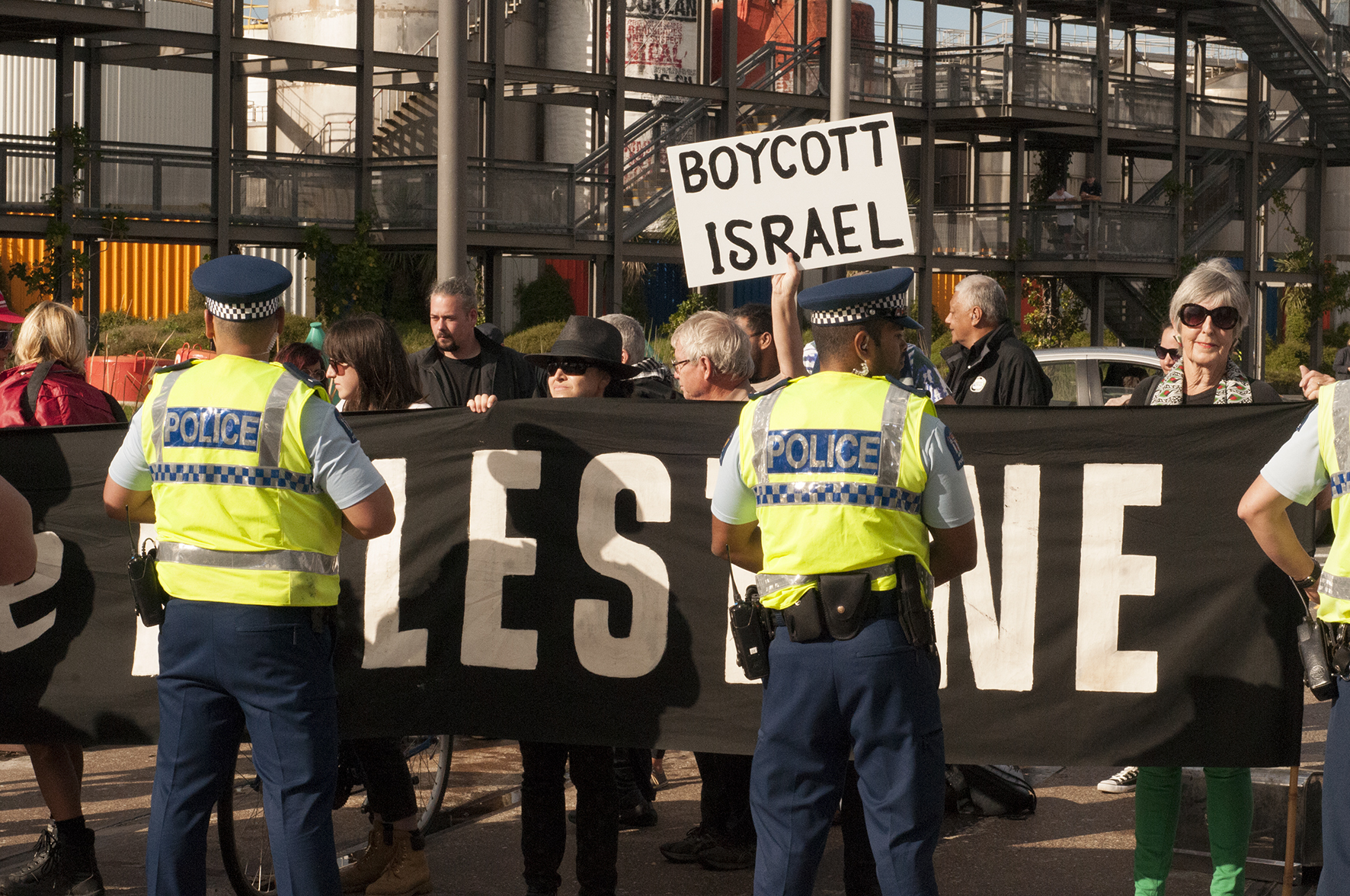
OP-ED: Shamshad Akhtar – Economic and Social Survey for Asia and the Pacific 2018

]]>

Economic and Social Survey for Asia and the Pacific 2018 – Mobilizing finance for sustained, inclusive and sustainable economic growth

OP-ED by Shamshad Akhtar

[caption id="attachment_15680" align="alignleft" width="150"] Dr. Shamshad Akhtar.[/caption]

Asia and the Pacific remains the engine of the global economy. It continues to power trade, investment and jobs the world over. Two thirds of the region’s economies grew faster in 2017 than the previous year and the trend is expected to continue in 2018. The region’s challenge is now to ensure this growth is robust, sustainable and mobilised to provide more financing for development. It is certainly an opportunity to accelerate progress towards achieving the 2030 Agenda for Sustainable Development.

Recent figures estimate economic growth across the region at 5.8 per cent in 2017 compared with 5.4 per cent in 2016. This reflects growing dynamism amid relatively favourable global economic conditions, underpinned by a revival of demand and steady inflation. Robust domestic consumption and recovering investment and trade all contributed to the 2017 growth trajectory and underpin a stable outlook.

Risks and challenges nevertheless remain. Rising private and corporate debt, particularly in China and countries in South-East Asia, low or declining foreign exchange reserves in a few South Asian economies, and trends in oil prices are among the chief concerns.  Policy simulation for 18 countries suggests a $10 rise in the price of oil per barrel could dampen GDP growth by 0.14 to 0.4 per cent, widen external current account deficits by 0.5-to 1.0 percentage points and build inflationary pressures in oil-importing economies. Oil exporters, however, would see a positive impact.

These challenges come against the backdrop of looming trade protectionism.  Inward-looking trade policies will create uncertainty and would entail widespread risks to region’s export and their backbone industries and labour markets. While prospects for the least developed countries in the region are close to 7 per cent, concerns persist given their inherent vulnerabilities to terms-of-trade shocks or exposure to natural disasters.

The key questions are how we can collectively take advantage of the solid pace of economic expansion to facilitate and improve the long-term prospects of economies and mobilize finance for development as well as whether multilateral institutions, such as the World Trade Organization membership can resolve the global gridlock on international trade?

Economic and financial stability along with liberal trade access to international markets will be critical for effective pursuit of the 2030 Agenda.  Regional economies, whose tax potential remains untapped, now need to lift domestic resource mobilization and prudently manage fiscal affairs.  Unleashing their financial resource potential need to be accompanied by renewed efforts to leverage private capital and deploy innovative financing mechanisms. The investment requirements to make economies resilient, inclusive and sustainable are sizeable − as high as $2.5 trillion per year on average for all developing countries worldwide.  In the Asia-Pacific region, investment requirements are also substantial but so are potential resources. The combined value of international reserves, market capitalization of listed companies and assets held by financial institutions, insurance companies and various funds is estimated at some $56 trillion. Effectively channelling these resources to finance sustainable development is a key challenge for the region.

The need to come up with supplementary financial resources will remain. Public finances are frequently undermined by a narrow tax base, distorted taxation structures, weak tax administrations, and ineffective public expenditure management. This has created problems of balanced fiscalization of sustainable development, even if the national planning organizations have embraced and integrated sustainable development agenda in their forward looking plans.

Despite a vibrant business sector, the lack of enabling policies, legal and regulatory frameworks, and large informal sectors, have deterred sustainability and its appropriate financing. The external assistance from which some countries benefit is insufficient to meet sustainable development investment requirements, a problem often compounded by low inbound foreign direct investment. Capital markets in many countries are underdeveloped and bond markets are still in their infancy. Fiscal pre-emption of banking resources is quite common. For those emerging countries which have successfully tapped international capital markets, a tightening of global financial conditions means borrowing costs are on the rise.

Our ESCAP flagship report, Economic and Social Survey of Asia and the Pacific 2018 (Survey 2018) which has been launched today calls for stronger political will and governments strengthening tax administrations and expanding the tax base. If the quality of the tax policy and administrations in Asia-Pacific economies matches developed economies, the incremental revenue impact could be as high as 3 to 4 per cent of GDP in major economies such as China, India and Indonesia and steeper in developing countries. Broadening the tax base by rationalizing tax incentives for foreign direct investment and introducing a carbon tax could generate almost $60 billion in additional tax revenue per year.

But government action must be complemented by the private sector to effectively pursue sustainable development. The right policy environment could encourage private investment by institutional investors in long-term infrastructure projects. Structural reforms should focus on developing enabling policy environment and institutional setting designed to facilitate public-private partnerships, stable macroeconomic conditions, relatively developed financial markets, and responsive legal and regulatory frameworks.

Finally, while much of the success in mobilizing development finance will depend on the design of national policies, regional cooperation is vital. Coordinated policy actions are needed to reduce tax incentives for foreign direct investment and to introduce a carbon tax. For many least developed countries, the role of external sources of finance remains critical. In many cases, the success of resource mobilization strategies in one country is conditional on closer regional cooperation.   ESCAP’s remains engaged and its analysis can support the planning and cooperation needed to effectively mobilize finance for sustained, inclusive and sustainable economic growth.

—————

Shamshad Akhtar is the Under-Secretary-General of the United Nations and Executive Secretary of Economic and Social Commission for Asia and the Pacific (ESCAP)

]]>

Highlands security crisis hampers PNG quake response

]]>

By Johnny Blades of Radio NZ Pacific

An ongoing security crisis in Papua New Guinea’s Hela province is preventing many earthquake-affected communities receiving relief.

February’s magnitude 7.5 quake caused widespread devastation and about 150 deaths in Hela, Southern Highlands and Western provinces.

Hela was the worst-affected but its long-running problem of tribal violence, which has surged since last year’s election period, has now caused international humanitarian agencies to pull out of the province.

Hela’s provincial capital Tari is the focal point of some of the worst tribal fighting, exacerbated by mass displacement of Hela communities caused by the quake.

With more than a dozen tribal killings reported in and around Tari since February, Hela police have recently received reinforcements from other provinces but have often been outnumbered and outgunned by the fighting tribes.

Not even the presence of extra Defence Force personnel in Hela has been able to “We leaders are trying to resolve the problem. But some of the men… it’s too hard for the leaders to control their men.”bring the tribal fighting under control.

-Partners-

The sergeant in charge of Tari police station, Thomas Levongo, said five people were killed in the area last week, scuppering an attempt at peace talks.

‘It’s too hard’
“We leaders are trying to resolve the problem,” he explained. “But some of the men… it’s too hard for the leaders to control their men.”

The head of PNG’s Emergency Disaster Restoration Team said the overall response to the disaster had been successful, in that disease outbreaks and starvation had been prevented so far.

But according to Bill Hamblin, there were areas that Papua New Guinea can improve on in responses to future disasters. Meanwhile, he said there were parts of Hela that his team cannot reach, due to civil unrest.

“Although the UN tried to go into Komo the other day; we’ve had the United Church people who went in there attacked; we’ve had the UN turned back by the security forces because of the helicopters being stoned,” he said.

“So that security situation has to be addressed before you can bring in relief. No organisation’s going to send in people who look like they’re going to get killed.”

UNICEF in Papua New Guinea said humanitarian operations had been suspended in an area where more than 40,000 earthquake affected people were in need.

The agency has called for more global attention, from the UN in New York and Geneva, on the plight of the quake-affected people of Hela.

Too unsafe
Monjur Hossain, the Acting Country Director for PNG, said UNICEF had delivered aid supplies to Tari the capital of Hela after the quakes but could no longer access the province as it was considered too unsafe.

He said the situation was extremely complex, there was very little communication with province due to ongoing unrest, leaving the health and welfare of the people seriously threatened.

“The situation is really grave in terms of the deprivation in terms of the services and the lives of the people,” Hossain said.

“So we’ve been actually working at the regional and global level to raise this issue. We have recently had a global press conference organised in Geneva to raise the issue that we need to talk about Papua New Guinea.”

Despite the suspension of humanitarian services in the area, UNICEF said it had been able to launch a measles and tetanus vaccination campaign in other quake-affected districts of neighbouring Southern Highlands (Mendi-Munihu and Nipa Kutube).

Water and sanitation are among the most pressing needs in Hela and Southern Highlands. UNICEF’s latest situational report on the quake response said it had reached 10,000 people with water purification tablets and was also providing ‘psychosocial’ support.

The UN agency also said 55,000 people were estimated to be displaced and 65 percent of health facilities in Hela and Southern Highlands were severely damaged.

Aftershocks, landslides
The PNG government estimates more than half a million people in total were affected by the quake, its aftershocks and landslides; and 270,000 people – nearly half of whom are children – need urgent assistance.

Many schools are closed, having sustained extensive damages in the quake, although education in the region had already been badly disrupted since last year when the election-related violence spiralled out of control in pockets of both of the Highlands provinces.

Unicef said its funding requirement for the response was US$13 million, but it had a  shortfall of nearly 80 percent.

Meanwhile, the Emergency Disaster Restoration Team is clamping down on misuse of helicopter charters for medevacs.

The team is taking over the management of helicopters in relief operations from the Department of Defence.

Dr Hamblin said unnecessary charter of helicopters, at around US$7000 an hour, had been fast draining emergency funding.

He said opportunists using the choppers to reach health services for medical needs unrelated to the quake needed to be kept in check.

Tasking the helicopters
“We’ve got to control the tasking of those helicopters, so that’s now coming in to my office,” he explained.

“That’s been happening, when a helicopter sees you and someone says ‘oh we’ve got to get our three people out to Dodomona, away we go’, and I’m saying ‘well no way, you don’t go’. We’ve got to look at the priority and see what should be done.”

As the unrest and opportunism complicate the disaster response, the Tari MP James Marape appealed for calm among people in his electorate.

Having this week seen a court petition against his 2017 election win dismissed in PNG’s capital Port Moresby, Marape said he would now turn his efforts to forging peace in Hela and focussing on helping with relief efforts in the province.

He claimed he had been prevented from doing this in the past month due to the court petition, which was based on allegations that the MP had bribed voters during 2017’s troubled and violent election.

This article has been republished as part of the content sharing agreement between Radio New Zealand and the AUT Pacific Media Centre.

Print Friendly, PDF & Email

Article by AsiaPacificReport.nz

]]>

Newsletter: New Zealand Politics Daily – May 07 2018 – Today’s content

Newsletter: New Zealand Politics Daily – May 07 2018 – Today’s content Editor’s Note: Here below is a list of the main issues currently under discussion in New Zealand and links to media coverage. [caption id="attachment_297" align="aligncenter" width="640"] The Beehive and Parliament Buildings.[/caption] Below are the links to the items online. The full text of these items are contained in the PDF file (click to download). Government spending and budget Tracy Watkins (Stuff): Forget the gossip; Labour’s first Budget will set the tone for Jacinda Ardern’s Government John Armstrong (Herald): Government’s broken promises won’t necessarily lead to dip in polls Chris Trotter: Rainy Day Ministers Stacey Kirk (Stuff): The pre-budget dance has the MPs spinning like tops Herald: Grant Robertson ready for Budget day spotlight Liam Dann (Herald): New Zealand is balancing a mortgage debt time bomb. Will it blow? The Spinoff: From ambitious to zero budget: an A-Z guide for Budget 2018 Jason Walls (Interest): NZ First is making a clear pitch to rural Kiwi voters and has a $3b war chest to help plead its case Nadine Higgins (Stuff): Let’s put primary healthcare before free university classes for rich kids Don Franks (Redline):Jacinda and the Elephant Government Shane Cowlishaw (Newsroom): PM Peters: what should we expect? Teuila Fuatai (Newsroom): Government’s smoke and mirrors for Māori Audrey Young (Herald): Winston Peters ploughs ahead with bill to fix non-existent problem Lucy Bennett (Herald): Parliament’s orator Shane Jones: ‘I wanted to be like Cicero … then I realised he was executed’ Fran O’Sullivan (Herald):Jones’ new SOE job spurs unease Bill Ralston (Listener): What Jacinda needs to do when Winston takes over Petrol industry pricing and transport Hamish Rutherford (Stuff): Even as the story unwinds, petrol industry continues with the same tune Dominion Post Editorial: Petrol industry’s lucrative sunset smells like a plea for regulation Gordon Campbell (Werewolf): On petrol pricing and the midwives march 1News:Kiwis possibly paying ‘over the odds’ for fuel in parts of NZ – Energy Minister Todd Niall (RNZ): Being taken for a ride on the 125X Jami-Lee Ross (Herald): Fuel tax imposes unnecessary burden on Aucklanders Ben Leahy, Carla Penman and Nikki Preston (Herald): Paramedics are counting the horror of New Zealand’s rising road toll 1News: Road safety activist calls for tougher rental standards Environment, primary industries and energy 1News: Environment Minister admits some dairy farmers may have to reduce cow numbers under tough new waterway pollution rules 1News: Environment Minister warns regulation on its way for farmers denying dairy farming causes pollution of rivers Jamie Morton (Herald): New Govt water plan would curb intensification Stuff: NZ has too many cows, says minister Guy Trafford (Interest): The hits the new Government keeps making on farming have the look of scaremongering 1News: ‘There’s no analysis’: Bridges lashes plan to reduce NZ’s dairy cows as ‘an assault on regions’ Gerard Hutching (RNZ): Plan to reduce farm pollution ‘assault on the regions’, says Simon Bridges No Right Turn: Too many cows Guy Trafford (Interest): Farmers should resist writing blank cheques for MPI to eradicate MPB until the Government can justify this Brittany Pickett (Stuff): Climate change minister faces Southland farmers Jenée Tibshraeny (Interest): Energy and Resources Minister Megan Woods talks up NZ’s comparative advantage producing renewable energy ODT Editorial: Smelter future strengthened Jamie Morton (Herald): Shake-up needed in grass-roots war on pests, says Predator Free NZ Jo Lines-MacKenzie (Stuff): National Portrait: Pete Bethune’s long road from oil explorer to enviro campaigner Rachel Rose (Herald):Global climate change campaigner’s message to be heard in Whanganui Dominic Harris and Chris Hutching (Stuff): Water expert sacked from city council contract after raising concerns over public health Steve Liddle (The Spinoff): Now is the time to spend real money on solving our water quality woes Caitlin Moorby and Leith Huffadine (Stuff): China has stopped taking our recycling and waste. Here’s where it’s ending up Chloe Winter (Stuff): Countdown chooses 10 supermarkets to go plastic bag free, rest to follow Herald: First 10 Countdown stores to phase out plastic bags by 21 May Stuff: Te Mata Peak track could stay after winery says removing it is not so simple Health Martin van Beynen (Stuff): Murray Cleverley’s funding letter says a lot about how Government should not work Nicholas Jones (Herald): Exclusive: Cancer care held back by ‘internal politics’ as surgeons demand urgent changes Nicholas Jones (Herald): Exclusive: Auckland DHB surgeons demand change as big gaps in cancer care found Simon Wilson (Herald): Is ‘ignorance is bliss’ the official cancer policy? Herald Editorial: Another troubling problem in the health system RNZ: Auckland’s Pasifika children at higher risk of diabetes ODT Editorial: Hospital rebuild: major milestone Hamish McNeilly (Stuff): Popular tourist attraction Cadbury World closing to make way for $1.4 billion Dunedin Hospital  Cecile Meier (Stuff): Christchurch’s Hillmorton Hospital ‘inadequate’, unsafe and leaky Phil Pennington (RNZ): Middlemore maternity services threatened by seismic risk Natalie Akoorie (Herald): Millions to be saved through email, phone, video GP consults under Health Care Home model Housing Eleanor Ainge Roy (The Guardian): Jacinda Ardern pledges shelter for all homeless people within four weeks Tim Murphy (Newsroom): Govt officials told to try a little kindness John Minto (Daily Blog): Come on Phil Twyford – the government can do better than this! Greg Presland (The Standard): Everyone applauds Labour’s homelessness plan … except National Isaac Davison (Herald): Govt appeals to public to identify rentals, marae and land which can be used for homeless Mānia Clarke (Maori TV): Te Puea marae want slice of $100 million homelessness fund Alice Wilkins (Newshub): Govt announces $100m plan to combat homelessness RNZ: Homelessness pledge makes problem ‘manageable’ – advocate Zane Small (Newshub): Housing crisis? Leave the market alone – Mark Richardson Rowan Quinn (RNZ): Govt’s use of motels ‘morally irresponsible’ – housing advocate Brittany Keogh (Herald): Housing and poverty biggest concerns for Kiwis — survey Oliver Lewis (Stuff):‘Housing crisis’ hits refugees as Government looks to boost bed capacity Stuff: Minister rules out ’empty homes tax’ to battle homelessness Imram Ali (Northern Advocate): Housing NZ accused of arrogance about potential state housing site Susan Edmunds (Stuff): Caution urged on rent rise warning Susan Edmunds (Stuff): Landlords say proposed change to tenant liability rules unfair Dominion Post Editorial: It’s time for action from building owners and council Education Herald: Government’s challenge to turn high hopes of education summit into tangible change John Gerritsen (RNZ): Emphasise Māori knowledge, students tell summit Simon Collins (Herald): Sir Lockwood Smith appointed ‘guardian’ of wide-ranging education review RNZ: Govt moves to address dwindling teacher numbers Simon Collins (Herald): Education Minister Chris Hipkins promises to reduce paperwork for teachers and principals Lucy Bennett (Herald): Education Minister: $1.1billion more than expected needed for new classrooms and schools Adele Redmond (Stuff): Education minister claims $215m hole in schools rebuild budget, says schools ‘shouldn’t notice a difference’ RNZ: ‘Can’t allow another generation to slip through the educational cracks’ Teresa Cowie (RNZ): Education funding gap ‘no surprise’ – National Philip Matthews (Press): Bullying remains our national shame Zoe Hunter (Bay of Plenty Times): Why do more Māori kids end up in alternative education? Jennifer Eder (Stuff): New classrooms put to the test, with mixed results Zizi Sparks (The Daily Post): Tamati Coffey calls for meeting on Toi Ohomai Institute of Technology Leonie Hayden (The Spinoff): Otago’s Māori students are raising their voices Political donations Charlie Gates and Hannah Martin (Stuff): Dine-and-dosh: ‘Stunningly naive’ date with controversial donor Donghua Liu Jonathan Milne (Stuff): MPs who value integrity must tighten the rules on secret donations Laura Walters (Stuff): The National Party was donated three times more money than Labour last year – but Labour won Greg Presland (The Standard): The election year party donations returns Kirsty Wynn (Herald): National receives more party donations than Labour Newshub: National Party wins political donations race Parliament Richard Harman (Politik): National walks out on Mallard Barry Soper (Newstalk ZB): Seven Maori seats are obsolete Te Aniwa Hurihanganui (RNZ): Drop in Māori electoral roll numbers David Farrar: Members’ bills getting interesting Northcote by-election Tracy Watkins (Stuff): Strange things happen in by-elections – why Northcote can’t be ignored Richard Harman (Politik): Over the bridge – and stuck in the traffic Felicity Reid (Stuff): National’s Dan Bidois vows to hold Auckland Council accountable if elected Herald: National’s Northcote candidate Dan Bidois launches byelection campaign Herald: ACT names ‘maverick’ Stephen Berry as Northcote byelection candidate Clarke Gayford and political ethics Danyl Mclauchlan (The Spinoff): Seven ways of looking at the Clarke Gayford rumours Liam Hehir (Pundit): Rules of engagement: think of the children Steve Braunias (Herald): The secret diary of the Clarke Gayford rumour Heather du Plessis-Allan (Herald): Clarke Gayford denial had to happen Henry Cooke (Stuff): Where did the false Clarke Gayford rumours come from? Oscar Kightley (Stuff): Stay strong Clarke, these underhand tactics truly suck Pete George:A record of some rumourmongering Martyn Bradbury (Daily Blog): The false equivalence of comparing Left wing dirty politics with Right wing dirty politics Pete George: Kiwiblog still has problems Economy, banking and business Duncan Garner: We’re being ripped off and rorted at our own expense Andrew Gunn (Stuff): Who will love you more? The big banks, BP or Facebook? Mike O’Donnell (Stuff): New Zealand consumers’ trust in business is shaky Tamsyn Parker (Herald): Ombudsman acts to step up bank vigilance Claire Matthews (RNZ): Banking enquiry would appease doubting customers RNZ: Regulators put NZ banks put on notice Susan Edmunds (Stuff): Financial advisers will be forced to put customer interests first: experts Susan Edmunds (Stuff): Banks told: Front up with evidence Rod Oram: NZ not ready for the rise of the AI machine Michael Reddell: Debt: dodgy analysis from the IMF Michael Reddell: Misconduct Michael Reddell: Split the Reserve Bank in two Mary Holm (Herald): The ‘unfair’ loophole in KiwiSaver Tom Pullar-Strecker (Stuff): Amazon’s arrival in NZ will be speeded-up by GST change Herald: Shadow economy leaving NZ taxman $1 billion out of pocket Anuja Nadkarni (Stuff): Cadbury’s move on ethical trade ‘a terrible step back’ Inequality and poverty Janine Starks (Stuff): Winter Energy Payment now looks a lot less enticing Joel Ineson (Stuff): More working poor seeking charity in Christchurch as food bank recipient numbers grow nationwide Tina Law (Stuff): Is Shirley Christchurch’s forgotten suburb?  Tess Nichol (Herald): Restaurant feeding the needy serves up shoes in fundraising effort Justice Jared Savage (Herald): Police Minister Stuart Nash announces ban on Comanchero gang patch in public buildings Debrin Foxcroft (Stuff): Top Auckland police officer delves into the recesses of the dark web Newshub:Govt could back Bill to take firearms from gangs RNZ: Govt on target to get 1800 new police on streets 1News: Lawyer facing investigation for questioning judge’s domestic violence ruling unapologetic Herald Editorial: NZ needs to make progress on reducing sexual assaults Laura Cunningham (Newshub): Warnings law may be too weak on revenge porn Migration and refugees RNZ: Tanker smuggling migrants ‘never would have made it to NZ’ Herald: New Zealand thanks Malaysia for stopping tanker headed here with illegal immigrants AP (Guardian): Malaysian police stop boat carrying 131 Sri Lankans to Australia and New Zealand Sophie Bateman (Newshub): ‘Personal vendetta’ behind claims illegal migrants stealing work – sex worker Lincoln Tan (Herald): Immigration New Zealand pulls sex worker from skilled employment list checker RNZ: Tanker smuggling migrants intercepted on way to New Zealand Herald: Tanker crammed with illegal migrants bound for New Zealand intercepted Rebecca Stevenson (The Spinoff): Who is reclusive Kiwi billionaire Christopher Chandler? And is he a Russian spy? Local government Henry Cooke (Stuff): Wellington’s mayors want a piece of new transport funding – and are open to using new taxes to get it John Anthony (Stuff): Councils eye regional fuel tax to help pay for roads, amenities 1News: Watch: ‘Double standard’ – Marama Davidson questions Government over ‘discriminatory’ Maori ward polls Evan Harding (Stuff): ICC boss tightens rules with media Kīngitanga , Māori issues and ethnicity debates John Boynton (RNZ): Māori King ‘determined’ to ensure future of Kīngitanga 1News: Watch: Thousands turn out to support Kingitanga movement on 160th anniversary Jo Lines-MacKenzie (Stuff): The Māori King participates in 160th Kiingitanga commemorations Catherine Delahunty (The Spinoff): The Ministry of Pākehā Affairs – the time has come  Joel Maxwell (Stuff): You’re a loser, Don Brash, but I love you anyway Cameron Smith (Herald): Māori business leaders celebrated at awards night RNZ: Children in low-income areas speak better Māori Damien Venuto (Herald): Words matter: why the ‘white way’ isn’t the right way anymore Bayley Moor (Stuff): Locals worried at international resort plans for Waitangi’s historic Treaty Grounds RNZ: New Waitangi hotel could be built near Treaty grounds Dale Husband (E-Tangata): Anand Satyanand: ‘Through truth comes joy’ Gender and sexual politics Joel Kulasingham (Herald): Corporate benevolence or cynical brand promotion? How the All Blacks became woke Grant Miller (Stuff): Folau firestorm shows society shift Alison Mau (Stuff):Is it ever OK to laugh at sexism? We may have the answer Megan Nicol Reed (Stuff): Am I a fake feminist? 1News: Inside Parliament: ‘It drives me insane’ – Jacinda Ardern’s pregnancy shouldn’t overshadow the business of politics 1News: Transgender downhill mountain biker faces scrutiny after gender switch outed prematurely Natalie Akoorie (Herald): Facebook deletes Helen Corry’s page for nudity in La Femme music video Stuff: Too rude? Kiwi singer Helen Corry banned from Facebook over feminist music video Newshub: Kiwi singer’s deleted Facebook page could cost her NZ On Air funding 1News: Kiwi singer Helen Corry banned from Facebook over her music video that protests against sexual harassment Employment Shamubeel Eaqub (Stuff): The puzzle of a low paid but highly employed workforce Amanda Cropp (Stuff): Freebie labour and the story of Robinwood Farm Newshub: Teachers marching for pay equity Astrid Austin (Hawkes Bay Today): Hawke’s Bay educators join national movement for pay equity 1News: Large crowds push for pay equity for women in education Kirsty Johnston (Herald): More workers allege bullying at Housing New Zealand after suspected suicide Jared Savage (Herald): Immigration Minister downplays KiwiBuild visas for illegal migrants but has post-Budget proposal for construction industry Emma Hatton (RNZ): Transmission Gully too big for local workforce – immigration lawyer Media Martin van Beynen (Stuff): The public intellectual and afternoon television Max Christoffersen (Stuff): The Times, it is a-changin’ RNZ: Newspaper arts coverage dramatically cut Britt Mann (Stuff): Joel MacManus is the Critic – Te Arohi magazine editor reviving student media Damien Grant (Stuff): I’m sorry, but good-looking people just aren’t worth my time Alex Braae (The Spinoff): A global broadcasting giant has slipped into NZ. Should Sky be worried? Hillary Clinton NZ speaking engagement Herald: Jacinda Ardern and Hillary Clinton meet in Auckland Stuff: Hillary Clinton meets with Jacinda Ardern in Auckland Claire Trevett (Herald): No Crown limos but tight security likely for NZ visit by former US Secretary of State Hillary Clinton Dileepa Fonseka (Auckland Now): Secret Service and NZ police face unexciting job protecting Clinton from ‘lone maniac’ Laine Moger (Auckland Now): Hillary Clinton a Kiwi woman’s role model too Other Laura Walters (Stuff): NZ won’t leave Iraq high and dry – Defence Minister Ron Mark Tracy Watkins (Stuff): Below the beltway Eric Crampton (Idealog): What Keeps me up At Night: the New Zealand Initative’s Eric Crampton David Slack (Stuff): There’s no problem too small for Uncle Dave Eugene Bingham (Stuff): He’s paid taxes for 60 years but is being denied full pension as his partner is Russian Alice Snedden (Stuff):Why we should make marijuana legal Sam Price (World socialist website): Decision not to prosecute over New Zealand building collapse ignored crucial evidence Stuff: Former National MP Katherine O’Regan dies]]>

Macron visits Ouvéa on anniversary of defining 1988 hostage crisis

]]>

FLASHBACK: The controversial feature film Rebellion, screened at the 2012 NZ International Film Festival by director Mathieu Kassovitz and featuring some Kanak relatives of the victims, relates the story of the 1988 Ouvea cave massacre. Video: Nord-Ouest Films

Pacific Media Watch Newsdesk

French President Emmanuel Macron has visited the island of Ouvéa in New Caledonia on the 30th anniversary of the bloody end of the 1988 hostage crisis, reports RNZ Pacific.

Facing opposition by some Kanak families, the president altered Saturday’s programme marking the May 5 ending to the two-week cave siege and refrained from laying a wreath at the grave of the 19 Kanaks killed by the French security forces.

Macron is the first French president to visit Ouvéa but members of one tribe warned that his presence on the anniversary was unwanted and would be seen as a provocation.

Instead, he took part in a ceremony at the site, planting a coconut tree.

He said to forget the events would be another wound for the mourning families.

-Partners-

Earlier in the day, he paid tribute at the tomb of the French security forces killed during the hostage drama.

Macron then also went to the grave of the two Kanak pro-independence leaders, Jean-Marie Tjibaou and Yeiwene Yeiwene, who were assassinated a year later on 4 May 1989.

French President Emmanuel Macron walks with Marie-Claude Tjibaou, the widow of Jean-Marie Tjibaou, the Kanak pro-independence leader who was assassinated in 1988. Image: RNZ Pacific/AFP

Tight security
Security was tight, with police blocking an access road and checking travellers amid concern over possible disturbances.

The hostage crisis in 1988 was a turning point in the pro-independence campaign of the indigenous Kanaks because it ushered in reconciliation talks which led to the Matignon Accord.

The Accord and its subsequent Noumea Accord allowed for the creation of a power-sharing collegial government and the phased and irreversible transfer of power from France to New Caledonia

The Accord expires this year with a referendum on November 4 on whether New Caledonians want to attain sovereignty and assume the remaining powers, such as defence, judiciary, policing and monetary policy.

The Ouvéa hostage crisis, which also claimed the life of six French gendarmes, has remained a sensitive issue.

A feature film based on the events, which happened to coincide with the French presidential race between Francois Mitterrand and Jacques Chirac, could not to be filmed on Ouvéa.

The film Rebellion (English title) was subsequently shot in French Polynesia, but on its release in 2011 cinema operators in Noumea refused to screen it.

At the time it was alleged it could cause resentment and weaken the forces of consensus.

The film was screened in the NZ International Film festival.

This article has been republished as part of the content sharing agreement between Radio New Zealand and the AUT Pacific Media Centre.

Print Friendly, PDF & Email

Article by AsiaPacificReport.nz

]]>

Biggest quake since 1975 shakes Hawai’i, volcano spews lava

]]>

Lava spews to the surface and onto a road at Leilani Estates, Hawai’i Island. Image: Mick Kabera/HNN

Pacific Media Centre Newsdesk

The 6.9-magnitude earthquake that shook the Big Island on Friday and was felt as far away as Oahu was the strongest tremor in Hawai’i in 43 years, reports Hawai’i News Now.

The Friday quake happened about 12:30 pm and was centered on the south flank of Kilauea volcano, which has been erupting and spewing lava into Leilani Estates since Thursday.

Dr Charles McCreery, director of the Pacific Tsunami Warning Centre, said the quake was the largest to strike the big island of Hawai’i since November 1975, when a tremor centered 3.2 km off Kalapana Beach was measured at a magnitude 7.2.

He said the small tsunami waves did not pose any threat but underscored the importance of vigilance as the Kilauea eruptions continue.

That quake caused a local tsunami that killed two people and injured several others.

Another pair of quakes in 2006 — the largest of which was a magnitude 6.7 — were centred off the northwest coast of Hawai’i island and caused an island-wide power outage on Oahu that lasted 19 hours.

-Partners-

The strongest quake ever to hit Hawaii was a 7.9-magnitude. It was recorded on April 4, 1868.

Print Friendly, PDF & Email

Article by AsiaPacificReport.nz

]]>
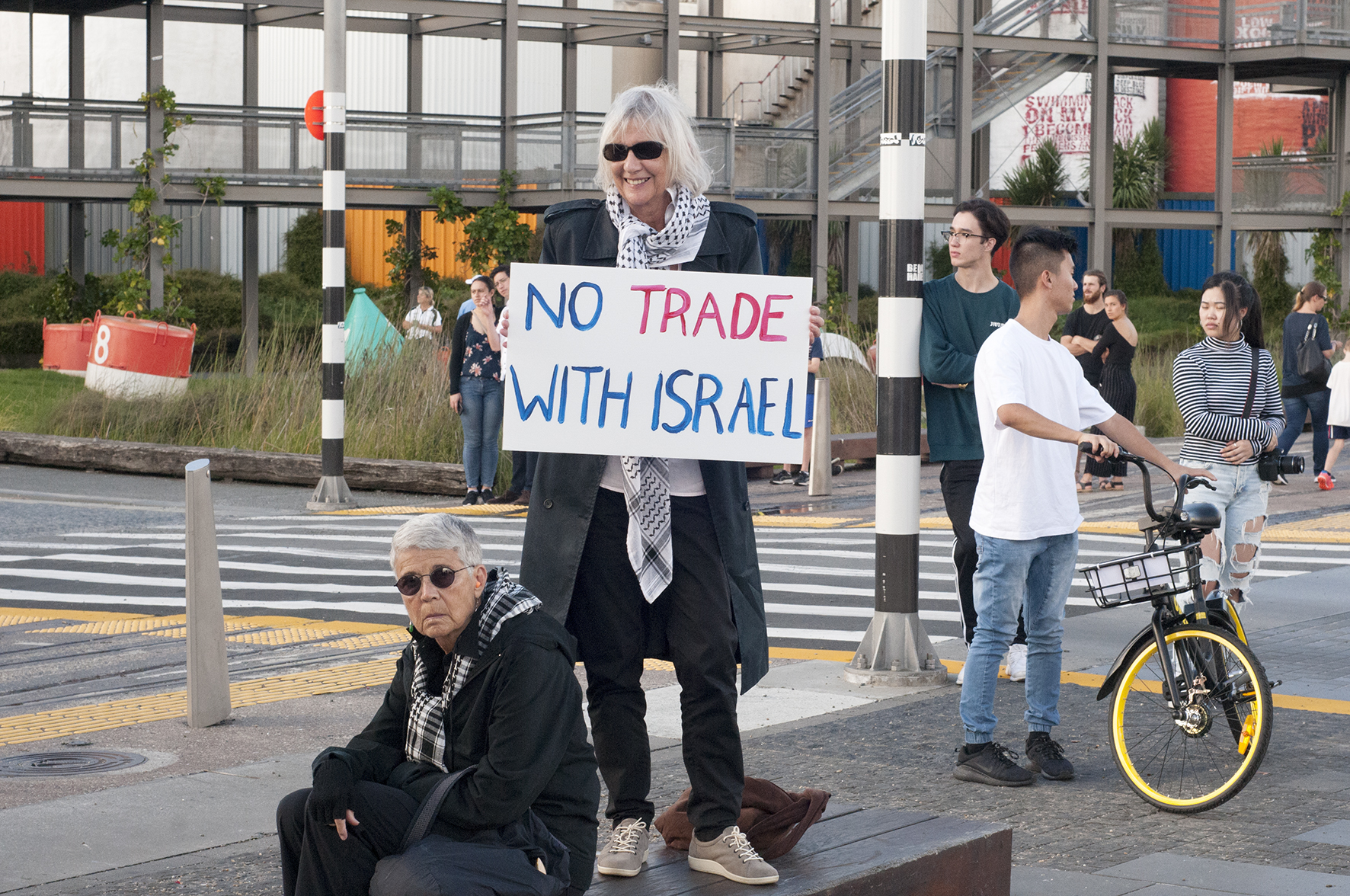
PMC director condemns ‘targeting’ of journalists and silence on West Papua

]]>

By Jean Bell in Auckland

An alarming number of “targeted” journalists being killed and West Papua media for independence were just some of the topics covered in wide-ranging seminar by the director of the Pacific Media Centre last night.

Professor David Robie called for the media, universities and journalism schools to take their Pacific “backyard” more seriously and not just wait for crises to happen.

The seminar was in marking May 3 – World Press Freedom Day. This year’s conference is in Accra, Ghana.

Dr Robie cited the number of journalists killed while working in 2017 and called journalism an increasingly “dangerous occupation”.

“Reporters Sans Frontières (RSF) [Reporters Without Borders] statistics showed 65 journalists were killed worldwide in 2017,” Dr Robie said. Of the 65 journalists killed, 7 of these people were so-called citizen journalists.

This number of casualties varied between media freedom monitoring agencies depending on the definitions of journalists and media workers counted in the statistics, he said.

-Partners-

Although this statistic showed a drop from the previous year, the growth of “hatred” for media and targeting of journalists was a worsening problem.

“This is a dire situation that is getting worse.” 

On top of the killings, the Paris-based statistics showed that 326 journalists were detained in prison and a further 54 were being held hostage. 

Dr Robie said use of the term “citizen journalist” was problematic, as it gave an impression of untrained journalists working without an ethical basis. In fact, many professional journalists were becoming “citizen” journalists tactically and using social media to defeat mainstream media “gags” such as relating to the Melanesian region West Papua inside Indonesia.

“There are more and more independent journalists that are disillusioned” and publishing untold stories on their own blogs.

One such journalist is Papua New Guinea’s Scott Waide, with whom Pacific Media Centre is collaborating with, published many articles by independent journalists and civil society people on his blog My Land, My Country.

Some of the audience at the WPFD 2018 seminar last night. Image: Del Abcede/PMC

A Filipino radio journalist, Edmond Sestoso, was shot last Monday – three days before Press Freedom Day – and died the next day. He was murdered in a drive-by scenario by a gunman on a motorcycle. According to Dr Robie, it is a “very common way of doing it” in the Philippines.

World Press Freedom Day 2017
In 2017, Dr Robie was invited to go to the week-long UNESCO World Press Freedom Day media conference in Jakarta, Indonesia.

He was one of just two New Zealanders at the conference out of the 1500 people attending the WPFD conference. He spoke a journalist safety academic conference at WPFD but was also a guest keynote speaker at an alternative “Free Press in West Papua” conference organised by Indonesia’s Alliance of Independent Journalists (AJI).

Dr Robie said it was “astonishing” that were not more people from New Zealand present at WPFD and said it shows how “appalling” New Zealand’s interest in international affairs is with an information gap in coverage of Asia-Pacific issues. The other New Zealander present was Mary Major, executive director of the New Zealand Media Council.

Dr Robie described the week as “challenging” and “inspiring”.

“I was representing AUT university and also entering a fraught situation.”

Independent Indonesian journalists were planning to protest against the treatment of West Papua and make a showcase stand before the world’s press, said Dr Robie.

At the WPFD, there was a tight military and police security cordon which kept out West Papua protesters and prevented conference participants from joining the protests in solidarity.

Professor David Robie with Indonesian human rights lawyer Veronica Koman and Amnesty International Indonesia’s Usman Hamid at the “Free Press in West Papua” seminar at WPFD in Jakarta last May. Image: Bernard Agape/PMC

While en route to Jakarta, Dr Robie was also invited to speak at a conference hosted by the Australian Centre for Independent Journalism, the last investigative journalism unit at an Australian university, which was closing under protest after 25 years on the “frontline”.

He was able to address West Papua there too.

“I’m an educator and a journalist….I have a responsibility to share my knowledge with as many people as I can about issues,” said Dr Robie, who is author of Don’t Spoil My Beautiful Face: Media, mayhem and human rights in the Pacific.

West Papua plight ‘censored’

The Facebook “censored” Ben Bohane image after a “facelift” by the Vanuatu Daily Post.

Dr Robie discussed Facebook recently wrongly “censoring” a 1995 photo of an armed West Papuan OPM guerilla and fellow tribespeople in traditional nambas (penis sheaths), pointing to the Pacific Media Centre coverage that sparked an RNZ Mediawatch story on the issue.

Photojournalist Ben Bohane, who has extensively covered conflict issues in the Asia-Pacific region, wrote a two-page article in the Vanuatu Daily Post in response to a piece about China and Vanuatu by The Sydney Morning Herald that had speculated about a “naval base” plan for a wharf aid project at Luganville, Espiritu Santo. Dr Robie said the Australian article was  “scaremongering.”

“Ben Bohane’s article said China was not the real concern,” he said. “The real threat in terms of stability and security is Indonesia, for which New Zealand media have a blindspot.”

When the PMC republished the article on its current affairs website Asia Pacific Report, Facebook links were removed. “I got a message saying the picture breached Facebook’s community standards.” While the Facebook “block” did not affect the actual article itself, Dr Robie said it limited the reach of the important article.

Dr Robie said he believed the photo censorship had more to do with “politics” rather than “nudity” and was undoubtedly an attempt by Indonesian sources to curb the debate regarding West Papua.

“It is not the picture that is the real issue,” said Dr Robie. He quoted from Ben Bohane’s latest message saying the cenorship was ongoing in spite of Facebook saying it had lifted the block.

It is not the first time Facebook has censored an iconic photo that illustrates dire situations in the Asia-Pacific region. Dr Robie pointed to how Mediawatch raised the issue of how the social media platform in 2016 censored images of the “napalm girl” taken during the Vietnam War in 1973. This caused an international storm of protest.

Activists, acdemics and journalists at the Pacific Media Centre WPFD seminar last night. Image: PMC

WPFD in Indonesia – an irony
Dr Robie pointed out the irony over Jakarta hosting the WPFD 2017 conference in light of censorship and repressive actives by security forces in West Papua.

According to Dr Robie, Indonesia has a vibrant “plurality” of voices but forces were seeking to radicalise people, along with targeting journalists.

While President Joko Widodo had changed policy in 2015 to “allow foreign journalists into” West Papua after he was elected in 2014, not much had really changed. Arrests and deportations were continuing.

“It’s very tightly controlled by the bureaucracy and security authorities,” said Dr Robie.

He highlighted the message from critics and researchers of a “secret genocide” in West Papua.

“The state of mainstream international media is a big part of how West Papua is ignored. There is a big difference when you watch some news media that take a more independent stance, such as Al Jazeera.”

He praised Al Jazeera’s Dutch journalist in Jakarta, Step Vaessen, for her coverage.

The penalties for showing support for West Papuan independence is severe “15 year prison sentence if you raise the banned Morning Star independence flag – even wearing a t-shirt like I am wearing tonight with the flag on can get you into trouble,” Dr Robie said.

“It is a very serious situation for West Papuans.”

“They believe their independence was declared in 1962 and despite that, Indonesian forces invaded.

“Western countries have become persuaded that West Papua has become part of Indonesia, making the situation a wrong that has never been righted.”

The WPFD 2018 seminar last night. Image: Del Abcede/PMC

NZ media coverage
While the situation is still dire, there has been some sporadic New Zealand coverage of the West Papua situation, said Dr Robie.

New Zealander Karen Abplanalp, who researched journalist access into West Papua for her masters degree, assisted Māori Television in a reporting mission with Adrian Stevenon to West Papua in 2015. The crew had to “dress” up the assignment bid with the authorities by saying it was a cultural showcase and had a nice side report about a kumara aid project in the Highlands.

Johnny Blades and Koroi Hawkins from RNZ also visited West Papua that year and did a rare interview with Lukas Enembe, the governor of Papua.

Dr Robie said New Zealand media covered disasters, coups and cyclones, while ignoring many of the social justice and development stories that were “crying out to be covered” in the Asia-Pacific region.

“Universities have responsibilities to shed light through research,” concluded Dr Robie.

He called for Indonesia to genuinely “open the door” to journalists and non-government agencies to visit West Papua, and for a “real” UN referendum on self-determination for the Papuans.

Social justice activist Maire Leadbeater (right), author of a forthcoming book on West Papua, with “wantok” Melanesians at the Pacific media Centre seminar last night. Image” Del Abcede/PMC

Peace and human rights activist Maire Leadbeater said the presentation was enlightening and covered many topics.

“It was great, I really enjoyed it. Dr Robie covered a lot of bases,” Leadbeater said.

Leadbeater is due to have a book published next month about the issue, See No Evil: New Zealand’s betrayal of the people of West Papua.

“The book will be a probe into New Zealand’s diplomacy that hasn’t been done before.”

Print Friendly, PDF & Email

Article by AsiaPacificReport.nz

]]>

Journalists talk press freedom – ‘be afraid, but do the job’

]]>

In this World Press Freedom Day video, Filipino journalists Ed Lingao, Jason Gutierrez, Inday Espina-Varona, Ezra Acayan, and JC Gotinga speak about facing threats against the press, and why it’s important to keep reporting. Video: Rappler

By Patricia Evangelista in Manila

The threat against press freedom, say local journalists in the Philippines, one of the world’s dangerous zones according to Reporters Without Borders, comes from the republic’s highest office.

The Philippines has dropped six places to 133rd in the RSF’s latest World Press Freedom Index – and a Filipino radio journalist was gunned down on Monday, just three days before World Press Freedom Day yesterday.

The country is now ranked the deadliest country for journalists in Asia.

“Do I think the President is a threat to press freedom?” asks international broadcast producer JC Gotinga. “He has threatened press freedom – in public.”

Ed Lingao, a conflict journalist who has found himself in the crossfire of anger from government supporters, characterises the administration as one uncomfortable with criticism – “and it has taken out a very big stick.”

-Partners-

“I think people are getting their strength in the fact that government seems very courageous in whipping up the crowd,” says Lingao.

The threats online are varied, he says, and occasionally specific.

‘Death threat … rape threat’
“Every day over breakfast,” says Rappler Presidential Palace reporter Pia Ranada, “it’s kind of a routine that I look through my Twitter feed, my Facebook messages, my emails. No fail, there will be a death threat, mixed in with those trolling.

“There will always be a rape threat.”

Veteran journalist Inday Espina-Varona calls the attack against the press “consistent and systematic.”

The most dangerous threat, she says, comes from members of the propaganda machine whose goal is to “scare the media into silence”.

Although she laughs off many of the insults – “they call me old, of course, I’m a grandmother of 3!” – she says it is necessary to take the physical threats seriously.

“Am I afraid? All the time,” says Lingao. “Only a stupid person would be a reporter and not be afraid. So be afraid. Be very afraid. But do the job.”

Freelance photojournalist Ezra Acayan, whose work covering the brutality of the drug war has seen publication in The New York Times, Le Monde, The Guardian, and The Washington Post, denies there is reason for concern when journalists stand for particular principles.

Bias constant refrain
Bias is a constant refrain among detractors of critical reportage.

“When they say we shouldn’t take sides, I think that’s wrong,” says Acayan. “We should be on the side of what’s right and true.”

“Before I am a journalist, I am also a Filipino,” says international correspondent Jason Gutierrez.

“I care about what is happening to my country. That’s a large part of my being a journalist.”

The trouble, says Gutierrez, is that people are locked within echo chambers constantly validating their own opinions.

Gotinga, a former local broadcast journalist himself, says part of the mandate of journalism is to provide information to protect citizens from abuse.

It is the reason, he says, why news is often negative.

“Otherwise,” he says, “the other word for it is propaganda.”

Patricia Evangelista is a journalist for Rappler in Manila.

Print Friendly, PDF & Email

Article by AsiaPacificReport.nz

]]>

Student journalists speak up – not all glamour but risky in ‘real world’

]]>

Student journalists Iliesa Moceituba (left) speaks to Carolyn Kitione at the University of the South Pacific’s World Press Freedom Day seminar yesterday. Image: Wansolwara

By Laiseana Nasiga in Suva

Final-year student journalists at the University of the South Pacific took centre stage at this year’s World Press Freedom Day celebrations in Fiji by participating in a panel discussion about media freedom and the challenges being faced.

USP’s journalism programme gave student journalists the platform to speak on these pressing issues yesterday rather than be spoken to.

Carolyn Kitione, a journalism and psychology double major, highlighted the risks and conflicts that journalists faced in their profession.

“When we are out in what people like to call the real world, you’re forced to realise that the things that you read about in the newspapers are a possibility of things that might happen to you as journalists,” she said.

“People talk about the glamour of having to travel but nobody wants to talk about the stones that are constantly thrown at us. People want to glamourise the interviews that we had with someone but not the substance of what is said or written.

“In the sort of environment that we live in, there is genuine concern of people getting hurt both physically and emotionally.

-Partners-

“There are chances that we could never work a day of our lives in the field that we choose because of one mistake.

Risks faced
“There are essentially risks that we face and conflicts that we are exposed to and when we talk about conflicts we are not necessarily talking about violence, we’re in the profession of watching our backs.”

There was also a discussion about media freedom in Vanuatu which was shared by Telstar Jimmy, who studies journalism, and literature and language.

Jimmy said although there was more press freedom in Vanuatu, there were also serious risks.

“In the 2013 Global World Press Freedom ranking, Vanuatu came seventh out of the 14 Asia Pacific countries and that was due to little regulation or censorship on the media,” she said.

“Even though this was so, the media workers were threatened and assaulted by people in power and that continued to rise from 2010 up to 2015.”

Jimmy also highlighted ta threat of citizen journalism for professional journalism.

“Even though we have one of the most free press environments in the Pacific, there is also a threat in terms of upcoming challenges. One of these would be that through citizen journalism, online media would give rise to more fake news and therefore degrade professional journalism in mainstream media,” she said.

Online freedom
Another student journalist, Elizabeth Osifelo, talked about freedom of information online, the challenges and the way forward for the media in the Solomon Islands.

Contrary to the challenges faced by the media in Fiji, Osifelo said media was free in the Solomon Islands, although there were certain challenges that existed.

“Social media today in Solomon Islands has a really good flow of information but the challenge here is that it only serves a small fraction of our population. The mainstream media also heavily relies on these networks for information,” she said.

“Another big challenge is the ‘big man’ system in the Solomon Islands and asking sensitive questions of the people regarded as a ‘big man’. Culture is a very challenging element for journalists in the Solomon Islands.

“When you do that, compensation is bound to happen and you will end up having truckloads of people arriving at your doorsteps [asking for] compensation.”

Fiji’s Media Industry Development Decree 2010 and its influence on press freedom were also discussed by student journalist Koroi Tadulala, who also majors in literature and language.

“In order for us to achieve press freedom, we must advocate for the removal of constraints that hinder the work of the media. We can talk about press freedom as much as we want, for however long we want, but as long as the constraints are in place, we will never be able to achieve true media freedom,” Tadulala said.

Tadulala also called for the removal of some provisions of the Media Decree.

People’s voices needed
USP’s deputy vice-chancellor (learning, teaching and support services), Professor Richard Coll, said it was important to recognise World Press Freedom Day because most citizens believed it was an important part of a democratic society where people’s voices needed to be heard.

Dr Coll said academics were also encouraged to make social commentary on areas within their expertise.

“I think that is an important part of the university as a media policy and since it deals with media issues, it’s better to speak about your area of expertise,” he said.

Journalism programme coordinator Dr Shailendra Singh said it was important for student journalists to participate in the World Press Freedom Day event because it was part of their studies and a platform to create awareness about issues facing the media.

“It also informs them about the situations in other countries and allows them to make comparisons with their own counties,” he said.

Laiseana Nasiga is a final-year student journalist at the University of the South Pacific.

Print Friendly, PDF & Email

Article by AsiaPacificReport.nz

]]>

Review of laws passed by Parliament ‘not in Tongan king’s power’

]]>

King Tupou VI … 2010 Constitution “excludes” the King and Privy Council from “governing” the Kingdom. Image: Linny Folau/Matangi Tonga

By Philip Cass of Kaniva News

The King of Tonga has no right to judge the merits of legislation passed by Parliament, according to a New Zealand constitutional legal expert.

Dr Rodney Harrison said that under the 2010 Constitution, review and evaluation of the merits of legislation passed by the General Assembly did not fall within the scope of the king’s powers of sanction and signature.

Dr Harrison said the king had withheld or deferred his signature from a number of pieces of legislation because it was deemed to be inappropriate or unconstitutional.

He said the new Constitution excluded the King and Privy Council from the role of governing the Kingdom.

He said judgements about whether legislation was constitutional went against the doctrine of the separation of powers and the role and independence of the judiciary.

He said the Royal Assent Order 2011, under which the King and Privy Council purported to act, was therefore invalid.

-Partners-

Dr Harrison was asked to give an opinion on the legality of the Royal Assent Order 2011 by the Prime Minister’s Office.

Real problem
However, Dr Harrison said challenging the validity of the Order in court would not solve the real problem, which was the regular deferral or refusal of royal assent for legislation that had been approved by Parliament.

“The underlying problem is not the legal validity of the Royal Assent Order as such,” Dr Harrison said.

“The underlying problem is the view currently held by His Majesty or at least by the Privy Council and, in particular the Law Lords as His advisors, as to the extent of the King’s power to grant or refuse the Royal Assent conferred by Clause 56 of the Constitution.

“It is that in my respectful opinion erroneous view of the King’s constitutional powers that needs to be addressed, hopefully by reasoned persuasion or if not, by judicial ruling.”

Dr Harrison said the old Tongan constitution made it clear that the three arms of government had to be kept separate as a safeguard for the proper running of the country and the safeguarding of the liberties of its people.

The Royal Assent Order 2010 challenged the underlying assumptions of the Tongan constitution. The Order allowed the King to appoint privy councillors as advisers and a Judicial Committee had also been established by the Privy Council in 2011.

Dr Harrison said any powers and functions conferred on any such committee, must be consistent with the overall scheme of the Constitution and any other statutory or fundamental legal principle.

King’s signature
Clause 41 of the Constitution required that “Acts that have passed the Legislative Assembly” must “bear the King’s signature before they become law”.

He said that under the new Constitution the king did not have complete discretion to refuse to sign an Act that had been passed by the Legislative Assembly.

He said changes to the constitution in 2010 had shifted the balance of power from the king to Parliament. This meant that the king should exercise his veto on legislation only in “truly exceptional circumstances and for compelling reason.”

Problems had arisen because the king had deferred assent to legislation passed by Parliament on the advice of Privy Councillors and the Law Lords appointed by the king to the Judicial Committee.

Dr Harrison said the Law Lords played no specific constitutional role, other than that of providing the King with advice.

They could not be permitted to operate de facto as judicial officers and did not have any constitutional function or role as scrutineers of legislation or the legislative process.

“The most fundamental problem with the Royal Assent Order is that it purports to confer on the Judicial Committee and ultimately the Privy Council power to review Acts duly passed by the Legislative Assembly and ultimately to determine whether each such Act is an ‘appropriate’ or ‘inappropriate’ recipient of the Royal Assent; and whether any such Act is or even may be unconstitutional,” Dr Harrison said.

Merits of legislation
“Under the new Constitution, review and evaluation of the merits of legislation passed by the General Assembly do not fall within the scope of the King’s powers of sanction (and signature).

“The ‘inappropriateness’ assessment falls foul of the new Constitution’s exclusion of the King and Privy Council from the role of governing the Kingdom. The constitutionality assessment does likewise, and in addition offends against the constitutional separation of powers and specifically the role and independence of the judiciary.

“If the assessments which the Royal Assent Order purports to authorise fall outside the constitutional powers of the King Himself, it necessarily follows that they cannot be empowered by means of the Royal Assent Order, as a mere Order in Council purportedly made pursuant to Clause 50(3) of the Constitution. On that basis, the Royal Assent Order must be seen as invalid.”

Dr Harrison said the Royal Assent Order was also invalid because it purported to confer the ultimate power of decision and assessment on the Privy Council, when it was only intended to provide a mechanism for giving advice to the King.

Media academic Dr Philip Cass is an adviser to the Kaniva News website. This article is republished by arrangement.

Print Friendly, PDF & Email

Article by AsiaPacificReport.nz

]]>

Newsletter: New Zealand Politics Daily – May 04 2018 – Today’s content

Newsletter: New Zealand Politics Daily – May 04 2018 – Today’s content Editor’s Note: Here below is a list of the main issues currently under discussion in New Zealand and links to media coverage. [caption id="attachment_297" align="aligncenter" width="640"] The Beehive and Parliament Buildings.[/caption] Below are the links to the items online. The full text of these items are contained in the PDF file (click to download). Government Brian Fallow (Herald): Debt – don’t dig deeper Richard Wagstaff (Newsub): Opinion: The Government must harness the power of tax Thomas Coughlan (Newsroom): Ardern addresses ‘the elephant in the room’ Michael Reddell: Is vapid rhetoric all our leaders can offer? Interest: The Prime Minister is challenging businesses to take a look at New Zealand’s strong economic position, as business confidence remains low BP petrol pricing and transport Hamish Rutherford (Stuff): Energy minister says BP email is a sign that petrol market is ‘broken’ Teresa Cowie (RNZ): Petrol industry ‘broken’ – Energy Minister Lucy Bennett (Herald): ‘Broken market’: Energy Minister Megan Woods not convinced by BP on petrol prices 1News: Energy Minister accuses fuel companies in NZ of ‘cynical behaviour’ says millions going from pockets of ordinary Kiwis due to inflated prices RNZ: Energy minister ‘still not convinced’ by BP execs Lucy Bennett (Herald): Energy Minister Megan Woods meets BP execs over petrol prices Donal Curtin: Patrolling the petrol market Mike Hosking (Newstalk ZB): Slippery slope chasing outrage and scandal Simon Wilson (Herald): Why won’t National support the regional fuel tax? The Listener: No pain, no gain: Why the regional fuel tax is Auckland’s best shot Jo Lines MacKenzie (Stuff): NZ Transport Agency has spent millions on a highway upgrade that’s stalled RNZ:Govt to spend $820k on cycle trail maintenance International relations and trade RNZ:‘It’s also unclear how real the exemptions are’ – Trade Minister Isaac Davison (Herald):NZ Government won’t rule out WTO action against USA over steel tariffs RNZ: TPP opponents keep fighting as MPs scrutinise deal Sam Hurley (Herald):  Revealed: NZ Commodore Alfred Keating accused of indecent filming in Washington embassy Catrin Owen (Stuff): Senior New Zealand naval officer charged with making intimate recordings Laura Walters (Stuff): UAE foreign minister meets with Jacinda Ardern in Wellington Health John Campbell (RNZ): Ministry told cash-strapped DHB what to tell ministers Oliver Lewis (Stuff):‘We couldn’t believe he could do that’: Former CDHB chair’s funding letter revealed 1News: ‘We have heard them’ – Health Minister says Budget 2018 will contain support for struggling midwives after march on Parliament RNZ: Midwives march: ‘I’ve never seen such a level of hopelessness’ Stuff: Midwives march around the country for better funding Herald: 1000 midwives and supporters march on Parliament for pay equity Herald: Families shocked by increasing rates of type 2 diabetes in children Jamie Morton (Herald): Doctors overwhelmingly support vaccination, ‘New Zealand Medical Journal’ study finds Dylan Cleaver (Herald): Study highlights link between Pasifika boxers and dementia Michelle Duff (Stuff): Medical Council criticised for lengthy investigation into Wellington doctor Alison Mau (Stuff): The troubling allegations against a trusted GP Marty Sharpe (Stuff):Medical Council won’t say why long-serving Napier GP was suspended from practicing Waka-jumping bill Richard Harman (Politik): Waka jumping bill is a Peters bottom line Barry Soper (Newstalk ZB): Waka jumping bill Chris Bramwell (RNZ): Public against waka-jumping bill – Nick Smith Audrey Young (Herald): Former Greens co-leader ‘deeply distressed’ by party’s support for waka jumping ban Henry Cooke (Stuff): Jeanette Fitzsimons says Greens could reject waka jumping bill – and it won’t bring down the Government Anna Bracewell-Worrall (Newshub): Waka-jumping bill a question of integrity – Jeanette Fitzsimons Jeanette Fitzsimons: The waka-jumping bill: a bad solution to a non-existent problem Employment Stuff: Jacinda Ardern announces Future of Work Forum, bringing together government, unions, and business Herald: Jacinda Ardern’ announces tripartite forum in pre-Budget speech to Wellington business RNZ: Ardern speech aims to soothe businesses Emma Hurley (Newshub): Government to work with business, trade union groups on future of work Parliament Herald: Parliament to consider entrenching Maori seats – ball in NZ First’s court John Boynton (RNZ): Bill to protect Māori seats selected Anna Bracewell-Worrall (Newshub): Parliament to decide whether to give Māori seats equal protection Laura Walters (Stuff): New bill would stop gang members having guns and widen police search and seizure powers Isaac Davison (Herald): Parliament to vote on National MP’s bill which will allow random, roadside testing for drugs RNZ: Saliva testing bill drawn from parliamentary ballot David Farrar (Kiwiblog): More Maori opting to change to general roll Banking industry The Press Editorial: It’s time for a banking inquiry Jonathan Mitchell (RNZ): NZ bank tactics: ‘They made it as difficult as they could’ Dave Kennedy: Banks Behaving Badly  Justice RNZ: Fears poor prison conditions could spark riot RNZ: Report criticises long lock-up times at Waikeria prison 1News: Inspection report reveals distressing insight into Waikeria Prison with inmates locked in cells for up to 26 hours at a time Kirsty Johnston (Herald): Top detective: ‘I think the system isn’t serving our victims well’ Herald: Victim advocate Louise Nicholas on unresolved sex crimes: ‘How do we close these gaps?’ Tom Hunt (Stuff): Outspoken #metoo lawyer barred from joining Law Society panel on misconduct Hannah Martin (Stuff): Auckland Women Lawyers’ group defends lawyer who questioned judge’s domestic violence ruling Tim Murphy (Newsroom): Women lawyers blast Law Society inquiry Ollin P. Raynaud: Is Restorative Justice Appropriate To Address the Needs of Sexual Assault Victims? Anna Leask (Herald): Fatal SH1 shooting caught on camera, footage being ‘reviewed’ in three investigations Media Tom Frewen (Dominion Post): Opinion: Clare Curran has some explaining to do about her vision for ‘public media’ BusinessDesk: How Stuff makes money from its audience Herald: Newstalk ZB tops radio ratings, Mike Hosking retains talkback crown for ninth straight year Tim Murphy (Newsroom): Music to MediaWorks’ ears Clarke Gayford  Matthew Hooton (Herald): Never believe political rumours Damien Venuto (Herald): Anti social media need reining in Newshub: National Party supporters to blame for Clarke Gayford rumours – expert Newshub: Whale Oil blogger Cameron Slater denies involvement in Clarke Gayford allegations Toby Manhire (Spinoff): The wildest takes on the Clarke Gayford rumours Bryan Gould: Dirty Politics? Yes! Education Jo Moir (Stuff): Education Minister says there’s a $1.1b problem facing schools nationally Jo Moir (Stuff): School classrooms need some love if we want our education system to stay superior RNZ: Parent rejects school’s meth pamphlet explanation Jessie Chiang (RNZ): Overseas students finally get refunds from failed institute Zizi Sparks (Rotorua Daily Post): Job cuts confirmed at Toi Ohomai Institute of Technology Housing and building regulations Isaac Davison and Ben Leahy (Herald): Labour-led Govt to invest $100m into tackling homelessness in Budget Henry Cooke (Stuff): Government announces $100m plan to fight homelessness Herald: Auckland social housing boost can’t come soon enough for state tenant Katie Doyle and Katie Scotcher (RNZ): Residents in quake-prone building forced to find new homes Katie Doyle (RNZ): First conviction for neglecting seismic work Phil Pennington (RNZ): Govt to reconsider risk and liability for faulty building work Local government 1News: Watch: ‘Double standard’ – Marama Davidson questions Government over ‘discriminatory’ Maori ward polls Andrea Reeves (Auditblog): Let’s talk about infrastructure Anusha Bradley (RNZ): Mushroom farm neighbours sick of ‘putrid’ smell Ruby Macandrew (Stuff): Wellington on track to become a bilingual city with support for te reo Māori policy Melissa Nightingale (Herald): Maori food trucks and English-free signs suggested for Wellington to be Te Reo capital Robin Martin (RNZ): New Plymouth swimmers: Don’t pave over our pool Jonathan Guildford (Press): Merivale wives outraged at city councillor Aaron Keown’s ‘sexist’ comment Environment and primary industries Jamie Morton (Herald): Water crusader Mike Joy wading into NZ’s freshwater woes in new role RNZ: White heron found with plastic round neck Ged Cann (Stuff): Over-60s up to 50 percent more likely to take their own bags to the supermarket Tracy Neal (RNZ): Nelson homes may get too hot – report Stuff: Breaking down NZ’s greenhouse gas emissions by sector Andrea Fox (Herald): Farmers wait for compensation as cattle disease spreads Other Herald: Online shoppers face import taxes of more than 50% under Govt plans Brian Easton (Pundit): Improving the Child Poverty Reduction Bill Sam Hurley (Herald): Air Force acknowledges victims of rapist Sergeant Robert Roper after Joychild Report Jehan Casinader (1News): ‘Groper Roper’ – NZ Air Force failed to stop a serial rapist, investigation finds RNZ: Pike River re-entry: Nitrogen plan not too difficult – Forster Lincoln Tan (Herald): North Korean defectors find refuge in Auckland and share stories at churches Hannah Bartlett (Stuff): History made as Nelson couple listed as ‘mother’ and ‘mother’ on birth certificate Chelsea Boyle (Herald): Lesbian couple make history: From ‘other’ to ‘mother’ Herald: New Zealand marriage rates are falling, Statistics NZ figures show Jonathan Underhill and Nikki Mandow (Newsroom): Icebreaker buyer used sweatshop labour]]>

David Robie – Free media week killings underscore crimes of impunity against journalists

]]>

Café Pacific.) MONDAY – just three days before today’s World Press Freedom Day – was the deadliest day for news media in Afghanistan in 17 years. The killing of nine journalists and media workers among 26 people who died in dual suicide bomb attacks in Kabul was the worst day for the press since the fall of the Taliban. Five other journalists were wounded and a 10th journalist was shot and killed in a separate attack outside the capital. Among the dead was Agence France-Presse chief photographer Shah Marai who left behind an extraordinary legacy of images. READ MORE: Hatred of journalism threatens democracies It was the also the most horrendous day for global media too since the Ampatuan massacre on the southern Philippines island of Mindanao on 23 November 2009. A shocking 32 journalists were murdered that day, most of the total death toll of 58 in an ambush on a pre-election cavalcade. To date nobody has been successfully brought to justice. The scores of private militia “owned” by the Ampatuan family alleged to have carried out the killings have got away with their vile crime almost scot-free. However, some suspects have been detained and others are out on bail. Also, a military task force has launched a massive disarmament programme in Maguindanaoprovince in a bid to curb “vendetta-driven” crimes. High-powered weapons Twenty two high-powered weapons were handed in by the local mayor of an Ampatuan clan bringing the number of 439 firearms either “recovered or surrendered in Maguindanao and Sultan Kuarat in the past four months. The Ampatuans handed over nine M79 grenade launchers, six Barret rifles, a rocket-propelled grenade launcher, a mortar, an M16-A1 rifle, a Garand rifle, one Uzi and one carbine. Eight years after the Ampatuan killings (also called the Maguindanao massacre), of the 197 men originally accused, only 13 have been brought before the court for judgement since the start of proceedings in January 2010 and more than 250 witnesses have been heard. “It’s supposed to be the trial of the century. Yet eight years later, no convictions have been made in the Maguindanao massacre cases … the worst case of election-related violence in the Philippines,” writes Rappler journalist Sofia Tomacruz. Asia-Pacific has clearly become the most dangerous region for journalists. More specifically, South Asia, according to a new International Federation of Journalists report that is being launched today. The report, entitled Clampdowns and Courage: Press Freedom in South Asia 2017-18, says that a total of 33 journalists lost their lives across South Asia in the year ending April 2018, making it “the most dangerous region in the world for journalists”. The latest attacks underscore the global targeting of journalists and the impunity that most of their killers enjoy. ‘Justice is elusive’ “In most of the cases of killing of journalists in South Asia, justice is elusive, says the IFJ. “The 33 journalist colleagues whom we lost this year add to a long list of hundreds of slain journalists awaiting justice after being killed for carrying out their professional duties. The struggle for justice is a challenging process, and in many cases the process doesn’t even begin.” The IFJ’s report highlights the case of leading editor Gauri Lankesh who was among the slain journalists. “She was shot dead in Bengaluru in India in September 2017,” recalled the IFJ. “Despite repeated commitments from authorities, it took six months to nab an accused, the suspected supplier of firearms where the actual shooters are still at large.” The IFJ says in its report that more than 30 journalists have been killed over the past decades in India while doing their professional work. Last week, the Paris-based Reporters Without Borders warned over what it described as a “growing animosity towards journalists” around the globe. “Hostility towards the media, openly encouraged by political leaders, and the efforts of authoritarian regimes to export their vision of journalism pose a threat to democracies,” says the media freedom agency. The line separating verbal violence from physical violence is dissolving, says RSF. Assassination threat In the Philippines (falling six places to 133rd in the RSF World Press Freedom Index), President Rodrigo Duterte “not only constantly insults reporters but has also [has] warned them that they ‘are not exempted from assassination’.” In India (down two places to 138th), “hate speech targeting journalists is shared and amplified on social networks, often by troll armies in Prime Minister Narendra Modi’s pay”. In both countries, says RSF, at least four journalists were gunned down in cold blood in the space of a year – and a Filipino radio journalist, Edmund Sestoso, of DyGB 91.7FM in Dumaguete City, died on Tuesday after being shot by motorcycle gunman on April 30. Also in the Philippines, encouraged by the aggressively anti-media stance of their president, the Congress initiated a “good news only” clampdown on the media reporting about the lawmakers barely a week before Media Freedom Day. Reporters in the House of Representatives have protested against the new media accreditation rules that demand only positive coverage of the Congress, the lawmakers and its officials. A 19-page draft policy statement distributed by the accrediting agency Press and Public Affairs Bureau (PPAB) says it seeks to ban journalists who “besmirch the reputation” of Congress, its officials and members. Breaching a proposed six-point list of violations will mean cancellation of a journalist’s press identity card and being barred from covering Congress. Ironically, the Philippines is also taking advantage of a Chinese agreement to help develop the infrastructure for government broadcasting system and has indicated it is “with China” in its approach to the freedom, of the press just when RSF has warned the Asia-Pacific region of Beijing’s impact on the media. RSF says the Chinese model of state-controlled news and information “is being copied” in Asian countries. A warning too for the Pacific. Pacific issues In the Pacific, both Tonga (51st) and Papua New Guinea (53rd) have dropped two places, and Samoa one place (22nd). The biggest climbs were by Fiji (up 10 places to 57th), New Zealand (five places to 8th) -back into the top 10 globally – and Timor-Leste three places to 95th.  Solomon Islands was unranked while Australia remained on 19th (mainly due to the concentrated media ownership in that country). Other Oceania nations were not cited. This is especially surprising about Vanuatu, where the local newspaper Vanuatu Daily Post has been a leading example of press freedom and courageous journalism for a few years. Although interest remains high about West Papua in the Pacific, the region is “lost” in the RSF ranking for Indonesia (which remains unchanged at 124th). President Joko Widodo is accused of “breaking his campaign promises” with his presidency marked by “serious media freedom violations, including drastically restricting media access to the Papua and West Papua provinces (the Indonesian half of the island of New Guinea), where violence against local journalists continues to grow”. In Fiji, where the “chill” factor is still strong, the big test will come with the second post-coup election likely to be in September. While acknowledging a modest freeing up of the media with the 2014 election, RSF says: “The media are nonetheless still restricted by the draconian 2010 Media Industry Development Decreeand the Media Industry Development Authority (MIDA) that it created. Violating the decree is punishable by up to two years in prison and the MIDA’s independence is questionable.” However, New Zealand should not be too smug about its return to favour in the top 10 of world press freedom nations (due to the Commerce Commission’s rejection of the proposed merger of Fairfax and NZME with the threat to plurality). RSF says there are still political pressures: “The media continue to demand changes to the Official Information Act, which obstructs the work of journalists by allowing government agencies a long time to respond to information requests and even makes journalists pay several hundred dollars for the information.” While the threats to media freedom in Oceania remain fairly benign compared with much of the rest of the world, vigilance is needed. And there is a challenge to journalism schools in New Zealand and the Pacific. They ought to put far more resources and teaching strategies into addressing how to keep young journalists safe in an increasingly hostile world for the media. David Robie is convenor of the Pacific Media Centre’s Pacific Media Watch freedom project. This article was also written for Asia Pacific Report.

This article was first published on Café Pacific.]]>

Newsletter: New Zealand Politics Daily – May 03 2018 – Today’s content

Newsletter: New Zealand Politics Daily – May 03 2018 – Today’s content Editor’s Note: Here below is a list of the main issues currently under discussion in New Zealand and links to media coverage. [caption id="attachment_297" align="aligncenter" width="640"] The Beehive and Parliament Buildings.[/caption] Below are the links to the items online. The full text of these items are contained in the PDF file (click to download). Clarke Gayford Jenna Lynch (Newshub): Police did not ask Clarke Gayford’s permission to quash rumour Audrey Young (Herald):Few leaders spared the false rumour mill Barry Soper (Newstalk ZB): Labour orchestrated the events of the past 24 hours Colin Peacock (RNZ): Stalling the rumour mill Gavin Ellis (RNZ): ‘Success’ of attack will encourage further trolling Tess McClure (Vice): The Search For Patient Zero of the Clarke Gayford Rumours Eleanor Ainge Roy (Guardian): Clarke Gayford: New Zealand police deny PM’s partner is under investigation Sam Lock (Daily Mail Australia): ‘It’s dirty politics’: New Zealand PM Jacinda Ardern rubbishes ‘fake rumours’ about her husband being investigated by police Mike Hosking (Herald): Life in the public eye – hey Clarke Gayford, you should hear the ridiculous rumours about me Audrey Young (Herald): Low-life gossipers peddling false Clarke Gayford rumours a distraction for PM Audrey Young (Herald): Leader Simon Bridges denies any National involvement in peddling Clarke Gayford rumours Barry Soper (Newstalk ZB): Response to false Clarke Gayford rumour risks politicising police Tracy Watkins (Stuff): Does the Clarke Gayford smear signal a new low in politics? Andrew Dickens (Herald): Putting an end to despicable Clarke Gayford rumours Newstalk ZB: Clarke Gayford rumours labelled ‘dirty politics’ Herald: Winston Peters wades in on Clarke Gayford rumours Anna Bracewell-Worrall (Newshub): Jacinda Ardern will ‘smile through’ Clarke Gayford smear attempt Anna Bracewell-Worrall (Newshub): Slurs and lies: Clarke Gayford’s name cleared by police Stuff: Clarke Gayford rumours ‘dirty politics’ – Jacinda Ardern RNZ: Police quash Clarke Gayford rumours Toby Manhire (Spinoff): What the shit is going on with those Clarke Gayford rumours? Government Tim Watkin (Pundit): The Budget whodunnit? Sam Sachdeva (Newsroom):Inside the Peters leak: how to escape the net Herald: Sitting Room Only: Gin Wigmore’s intimate interview with Jacinda Ardern Jason Walls (Interest): The Government is being criticised for sticking to its promise to reduce net core Crown debt to 20% of GDP by 2022 – but this commitment does not mean it won’t keep taking on debt Michael Reddell: The government’s debt target Newshub: Health, housing and education set for ‘long overdue’ boost in Budget 2018 – Grant Robertson Audrey Young (Herald): Prime Minister Jacinda Ardern announces extra duties for Winston Peters and Shane Jones Anna Bracewell-Worrall (Newshub): Government announces changes to ministerial portfolios Mike Hosking (Newstalk ZB): Six months in, this Government is out of its depth Stuff: Jacinda Ardern will work until she’s ‘physically in labour’ Newshub: Prime Minister will work until she goes into labour 1News: Simon Bridges questions why Shane Jones got ‘a roundabout built’, but Kiwis might see delay on lowering in cost of GP visits Banking industry Rob Stock (Stuff): Kiwi vs Kangaroo: Are New Zealand banks different to scandal-hit Australian banks? Pattrick Smellie (Stuff): Kiwi banks must be transparent if they are to avoid Aussie parents’ trust issues Herald: Kiwi banks must show they are different to Aussie: Robertson RNZ: ‘We operate in a way which complies’ – NZ bankers The Standard: The Australian banking system review GST online Philip Matthews (Press Editorial): Amazon and the law of the tax jungle Herald Editorial: Online GST crackdown overdue ODT Editorial: Choice and convenience shopping Aimee Shaw (Herald): How the Government will police the ‘Amazon tax’ Tom Pullar-Strecker (Stuff): Trade Me wants Government to rethink approach to Amazon tax David Farrar (Kiwiblog): But what will happen in the seller doesn’t charge GST? Petrol prices and transport Jim Rose (Stuff): Petrol prices competitive but inherently crazy Todd Niall (RNZ): Concerns non-Aucklanders could pay for city’s fuel tax Hamish Rutherford (Stuff): Transport Minister says no guarantee that cost of Auckland fuel tax won’t spread Bernard Orsman (Herald): Auckland will be consigned to gridlock without a regional fuel tax: Phil Goff Chris Bramwell (RNZ): Regional fuel tax legislation ‘sneaky’ – National Justice Kirsty Johnston and Chris Knox (Herald): Unresolved: Why New Zealand rape victims are being left in limbo Teuila Fuatai (Newsroom): Lawyers failing children in the Family Court system: survey Moana Makapelu Lee (Māori TV): Govt calls for better record of inmate complaints 1News: Build less prisons, says justice advocate, after alarming prisoner abuse stats revealed No Right Turn: How can they not track this? International relations and trade Tom Pullar-Strecker and AP (Stuff): Trump steel tariff snub flies in face of ‘positive relationship’ John Anthony (Stuff): US decision to not exclude NZ from steel and aluminium tariffs ‘churlish’: EMA RNZ: ‘We want to know that it’s bona fide’ – Peters on Korean peace plan Health and disability RNZ: Middlemore problems highlighted in 2010 report Herald: Middlemore Hospital was warned about leaks and mould in 2010 – report RNZ: Health advocates push for minimum alcohol price 1News:‘It’s been shown that it doesn’t actually work’ – industry lobbyist and health researcher go head to head over minimum booze pricing Stuff: Cancer is New Zealand’s biggest killer Yvonne Tahana (1News): Macadamia cheese on toast on the menu as New Zealand’s largest marae goes vegan Leith Huffadine (Stuff): There’s a nation-wide shortage of the HPV vaccine Amy Wiggins (Herald): Exercising as a teen reduces the risk of depression later in life, study finds Hilary Stace (RNZ): Mayor’s words wound after insulting put-down Farah Hancock (Newsroom): Mapping data for NZ water quality Welfare Patrick Gower (Newshub): Ex-Gloriavale member explains its alleged misuse of Working For Familes money Patrick Gower (Newshub): Government to investigate Gloriavale’s use of Working for Families payments Jess Berentson-Shaw (The Wireless): Removing the conditions on welfare works Education Michael Daly (Stuff): Meth too addictive for harm minimisation approach, says drug educator Dale Kirk Emma Russell (Herald): Drug Foundation applauds Massey High School for providing material on using meth ‘discreetly’ Torika Tokalau (Stuff): Drug Foundation applauds Auckland school’s use of meth booklet Kate Hawkesby (Newstalk ZB): In defence of drug education for teens in schools John Gerritsen (RNZ): Ministry targets unconscious bias against Māori students Simon Collins (Herald): Parents pay for teacher aides and support at one in 10 NZ primary schools Adele Redmond (Stuff): Sticks and Stones: Online bullying is highly harmful, often invisible, and nearly always tied to schoolyard torment RNZ: Police investigate school over financial misconduct Henry Cooke (Stuff): Simon Bridges won’t commit to means testing students or ending fees-free, but says a change is likely Brad Flahive (Stuff): NZ Universities say online learning will not be the end of degrees Charlie Dreaver (RNZ): Push for te reo in Victoria University name change Child welfare Claire Trevett (Herald): PM Jacinda Ardern and National’s Simon Bridges meet on child poverty 1News: Child poverty: Simon Bridges says issue ‘bigger than politics’ and he’ll ‘collaborate’ on Government’s Bill aimed at alleviating it Stacey Kirk (Stuff): Government and Opposition reach for cross parliamentary consensus on child poverty RNZ: Child poverty targets need to be realistic – advocates Debrin Foxcroft (Stuff): Ministry of Children looking into how a 5-year-old was left stranded at pool Housing Chris Harrowell (Auckland Now): Experts warn homelessness in Auckland will be worse this winter Emma Jolliff (Newshub): Property investors lose out as Government ends negative gearing Imran Ali (Herald): Housing NZ not ready to consult on state housing taking over Whangarei park Employment Dene Mackenzie (ODT): More young not working or learning Kate Hawkesby (Newstsalk ZB): Hidden in plain sight – the alarming rise of the working poor Anuja Nadkarni (Stuff): Construction firm hammered with 19k penalty for short-changing casual workers Rebecca Howard (BusinessDesk): NZ jobless rate drops to lowest level since 2008, wage growth remains anaemic Hamish Rutherford (Stuff): New Zealand unemployment rate falls to the lowest level in nearly a decade Interest: New Zealand’s unemployment rate drops to 4.4%, in line with the Reserve Bank’s forecast Laura Walters (Stuff): Government making headway on changes to skill shortage changes Shane Cowlishaw (Newsroom): Employment tweaks could endanger all aboard Katie Kenny (Stuff): While artificial intelligence is tipped to be ‘as significant as electricity’, it’s not coming for your job, yet Holly Ryan (Herald): Artificial Intelligence could boost NZ economy up to $53b, says report Olivia Erdelyi (Stuff): Artificial intelligence is changing our lives and now is the time to decide how Environment, primary and extractive industries Matt Shand (Stuff): Politics and science aims to shut down water bottling giant Jaqui Dean (Southland Times): Improving river health flows from community, govt efforts Drugs Ryan Dunlop (Herald): Meth cheaper and easier to find, Massey University study shows Michael Daly (Stuff): The price of meth has been falling and it’s become much easier to get RNZ: New Zealand ‘awash’ with imported meth Jarrod Gilbert (Herald): Kids smoking dope don’t need less education, they need more Thomas Coughlan (Newsroom): Cannabis bill ‘too strict’ for NZ growers Heather Roy: The War on Drugs – A Battle Lost Parliament Anuja Nadkarni (Stuff): Where former political leaders go after their time in the Beehive Claire Trevett (Herald): Prince Louis and the royals’ nappy offensive David Farrar (Kiwiblog): More Maori opting to change to general roll Herald: New National MP Nicola Willis gives maiden speech in Parliament Local government Alexander Robertson (Herald): Local Focus: Palmerston North mayor debunks Māori Ward myths John Boynton (RNZ): Māori ward advocates march for representation Marty Sharpe (Dominion Post): Public should not have been excluded from Napier council meeting, says Ombudsman Simon Wilson (Herald): Auckland’s port has to shift but where will it go? Chris Morris (ODT): ‘Extreme provocation’ prompted Cull comment Greyhound racing industry RNZ: Greyhound meth scandal: ‘simply shocking’ Mat Kermeen (Stuff): Greyhound trainer banned for two years after dog tests positive to P Newshub: Trainer of greyhound on meth to appeal two-year ban Jonny Turner (ODT): MP’s comments on greyhound racing ‘ill-informed’ NZ tourism campaign Herald: Conspiracy to keep New Zealand off world maps: Rhys Darby, Jacinda Ardern Eleanor Ainge Roy (Guardian): Jacinda Ardern asks why New Zealand is left off world maps in new tourism campaign Stuff: ‘New Zealand, where the bloody hell are you’ Other David Fisher (Herald): How NZDF gave minister wrong info on civilian deaths in Hit & Run raid Joshua Hitchcock (Spinoff): Why Māori organisations need more accountability Charlotte Carter (Herald): Northland pokie spend up more than $820,000 on same period last year – DIA Joanne Carroll (Stuff): Re-entry of West Coast’s Pike River mine ‘will be done’ RNZ: Pike River re-entry optimism rises after experts meet Southland Times Editorial: The potline that came in from the cold Hamish McNeilly (Stuff): White supremacist group may cancel Christchurch, Dunedin rallies after backlash Eric Frykberg (RNZ): Multimillionaire trades boardrooms for remote NZ Karl Puschmann (Herald): Is The Hobbit trilogy really that bad? Yes – here’s why]]>

Macron begins New Caledonia visit as independence vote looms

]]>

The Kanak flag and the French Tricolour …. an independence vote is due on November 4. Image: RNZ Pacific

Pacific Media Centre Newsdesk

French President Emmanuel Macron today began a three-day visit to New Caledonia – six months before the territory’s vote on independence from France, reports RNZ Pacific.

Macron is due to meet a wide range of political leaders and visit the northern province and the Loyalty Islands province.

President Macron … first French president to visit Ouvea since the 1988 hostage crisis. Image: PMC file

He is also due to become the first French president to visit Ouvea where 19 pro-independence Kanak protesters and three French soldiers were killed in a 1988 hostage crisis but there is opposition to him visiting the tomb of the slain Kanaks.

READ MORE: Pacific Islands Forum monitoring team in Tahiti for elections

As part of his programme, Macron will return the original deed with which France took possession of New Caledonia in 1853.

Macron is also due to address the Pacific Community whose headquarters is in Noumea.

-Partners-

Tomorrow, anti-independence supporters are expected to rally in Noumea to express their pride at being French.

The territorial self-determination referendum is due on November 4.

Tahiti elections
In Pape’ete, a team from the Pacific Islands Forum (PIF) has arrived as observers for the second round of the Tahitian general election, reports RNZ Pacific.

The Forum secretariat said it was the first time the Forum had sent observers to the territory since French Polynesia became a full member in 2016.

Marshall Islands chief electoral commissioner Daniel Andrew and a PNG diplomat in Fiji Jacinta Tony-Barron make up the team which is supported by secretariat officials.

They will observe pre-polling, polling and counting for the second round which will take place on Sunday.

Forum Secretary-General Dame Meg Taylor said such exchanges were great opportunities for election officials across the region to share knowledge, experiences and best practice.

After last month’s first round of voting there have been claims of irregularities in Bora Bora, Makemo and Huahine.

A complaint has been lodged seeking to annul the Huahine election.

In 2004, the results in the Society Islands were annulled and fresh elections were then held in early 2005.

This article has been republished as part of the content sharing agreement between Radio New Zealand and the AUT Pacific Media Centre.

Print Friendly, PDF & Email

Article by AsiaPacificReport.nz

]]>

Free media week killings underscore crimes impunity against journalists

]]>

The media freedom monitoring group Reporters Without Borders details how it has trained journalists in Afghanistan to be aware of double suicide bomb attacks. Video: Euronews BRIEFING: By David Robie Monday – just three days before today’s World Press Freedom Day – was the deadliest day for news media in Afghanistan in 17 years. The killing of nine journalists and media workers among 26 people who died in dual suicide bomb attacks in Kabul was the worst day for the press since the fall of the Taliban. Five other journalists were wounded and a 10th journalist was shot and killed in a separate attack outside the capital. Among the dead was Agence France-Presse chief photographer Shah Marai who left behind an extraordinary legacy of images. READ MORE: Hatred of journalism threatens democracies It was the also the most horrendous day for global media too since the Ampatuan massacre on the southern Philippines island of Mindanao on 23 November 2009. A shocking 32 journalists were murdered that day, most of the total death toll of 58 in an ambush on a pre-election cavalcade. To date nobody has been successfully brought to justice. The scores of private militia “owned” by the Ampatuan family alleged to have carried out the killings have got away with their vile crime almost scot-free. However, some suspects have been detained and others are out on bail. Also, a military task force has launched a massive disarmament programme in Maguindanao province in a bid to curb vendetta-driven crimes. High-powered weapons Twenty two high-powered weapons were handed in by the local mayor of an Ampatuan clan bringing the number of 439 firearms either “recovered or surrendered in Maguindanao and Sultan Kuarat in the past four months. The Ampatuans handed over nine M79 grenade launchers, six Barret rifles, a rocket-propelled grenade launcher, a mortar, an M16-A1 rifle, a Garand rifle, one Uzi and one carbine. Eight years after the Ampatuan killings, of the 197 men originally accused, only 13 have been brought before the court for judgement since the start of proceedings in January 2010 and more than 250 witnesses have been heard. “It’s supposed to be the trial of the century. Yet eight years later, no convictions have been made in the Maguindanao massacre cases … the worst case of election-related violence in the Philippines,” writes Rappler journalist Sofia Tomacruz. The “I say no to hatred” photo in India on the cover of IFJ’s 2018 “Clampdowns and Courage” end impunity report. Image: IFJ Asia-Pacific has clearly become the most dangerous region for journalists. More specifically, South Asia, according to a new International Federation of Journalists report that is being launched today. The report, entitled Clampdowns and Courage: Press Freedom in South Asia 2017-18, says that a total of 33 journalists lost their lives across South Asia in the year ending April 2018, making it “the most dangerous region in the world for journalists”. The latest attacks underscore the global targeting of journalists and the impunity that most of their killers enjoy. ‘Justice is elusive’ “In most of the cases of killing of journalists in South Asia, justice is elusive, says the IFJ. “The 33 journalist colleagues whom we lost this year add to a long list of hundreds of slain journalists awaiting justice after being killed for carrying out their professional duties. The struggle for justice is a challenging process, and in many cases the process doesn’t even begin.” The IFJ’s report highlights the case of leading editor Gauri Lankesh who was among the slain journalists. “She was shot dead in Bengaluru in India in September 2017,” recalled the IFJ. “Despite repeated commitments from authorities, it took six months to nab an accused, the suspected supplier of firearms where the actual shooters are still at large.” The IFJ says in its report that more than 30 journalists have been killed over the past decades in India while doing their professional work. Last week, the Paris-based Reporters Without Borders warned over what it described as a “growing animosity towards journalists” around the globe. “Hostility towards the media, openly encouraged by political leaders, and the efforts of authoritarian regimes to export their vision of journalism pose a threat to democracies,” says the media freedom agency. The line separating verbal violence from physical violence is dissolving, says RSF. Assassination threat In the Philippines (falling six places to 133rd in the RSF World Press Freedom Index), President Rodrigo Duterte “not only constantly insults reporters but has also [has] warned them that they ‘are not exempted from assassination’. In India (down two places to 138th), “hate speech targeting journalists is shared and amplified on social networks, often by troll armies in Prime Minister Narendra Modi’s pay”. In both countries, says RSF, at least four journalists were gunned down in cold blood in the space of a year. Also in the Philippines, encouraged by the aggressively anti-media stance of their president, the Congress initiated a “good news only” clampdown on the media reporting about the lawmakers barely a week before Media Freedom Day. Reporters in the House of Representatives have protested against the new media accreditation rules that demand only positive coverage of the Congress, the lawmakers and its officials. A 19-page draft policy statement distributed by the accrediting agency Press and Public Affairs Bureau (PPAB) says it seeks to ban journalists who “besmirch the reputation” of Congress, its officials and members. Breaching a proposed six-point list of violations will mean cancellation of a journalist’s press identity card and being barred from covering Congress. Ironically, the Philippines is also taking advantage of a Chinese agreement to help develop the infrastructure for government broadcasting system and has indicated it is “with China” in its approach to the freedom, of the press just when RSF has warned the Asia-Pacific region of Beijing’s impact on the media. RSF says the Chinese model of state-controlled news and information “is being copied” in Asian countries. A warning too for the Pacific. Graphic showing RSF Index 2018 Asia-Pacific region freedom rankings. Image: RSF Pacific issues In the Pacific, both Tonga (51st) and Papua New Guinea (53rd) have dropped two places, and Samoa one place (22nd). The biggest climbs were by Fiji (up 10 places to 57th), New Zealand (five places to 8th) -back into the top 10 globally – and Timor-Leste three places to 95th.  Solomon Islands was unranked while Australia remained on 19th (mainly due to the concentrated media ownership in that country). Other Oceania nations were not cited. This is especially surprising about Vanuatu, where the local newspaper Vanuatu Daily Post has been a leading example of press freedom and courageous journalism for a few years. Although interest remains high about West Papua in the Pacific, the region is “lost” in the RSF ranking for Indonesia (which remains unchanged at 124th). President Joko Widodo is accused of “breaking his campaign promises” with his presidency marked by “serious media freedom violations, including drastically restricting media access to the Papua and West Papua provinces (the Indonesian half of the island of New Guinea), where violence against local journalists continues to grow”. In Fiji, where the “chill” factor is still strong, the big test will come with the second post-coup election likely to be in September. While acknowledging a modest freeing up of the media with the 2014 election, RSF says: “The media are nonetheless still restricted by the draconian 2010 Media Industry Development Decree and the Media Industry Development Authority (MIDA) that it created. Violating the decree is punishable by up to two years in prison and the MIDA’s independence is questionable.” However, New Zealand should not be too smug about its return to favour in the top 10 of world press freedom nations (due to the Commerce Commission’s rejection of the proposed merger of Fairfax and NZME with the threat to plurality). RSF says there are still political pressures: “The media continue to demand changes to the Official Information Act, which obstructs the work of journalists by allowing government agencies a long time to respond to information requests and even makes journalists pay several hundred dollars for the information.” While the threats to media freedom in Oceania remain fairly benign compared with much of the rest of the world, vigilance is needed. And there is a challenge to journalism schools in New Zealand and the Pacific. They ought to put far more resources and teaching strategies into addressing how to keep young journalists safe in an increasingly hostile world for the media. Dr David Robie is convenor of the Pacific Media Centre’s Pacific Media Watch freedom project. The UNESCO map of WPFD events – the only one indicated in Australia or New Zealand is at AUT. Link to the interactive map.

China’s media control threatens Asia-Pacific democracies, says RSF
Print Friendly, PDF & Email
Article by AsiaPacificReport.nz]]>

PNG prime minister slams gas failure report as ‘fake news’

]]>

The huge PNG Hides gas conditioning plant in Hela province, Papua New Guinea. Image: PNG-Geo

By Stefan Armbruster of SBS News in Brisbane

Papua New Guinea’s prime minister has dismissed as “fake news” a report that claims a partially-Australian funded liquefied natural gas project is failing to deliver a promised economic boom to his people.

Prime Minister Peter O’Neill, in Brisbane for the Australian-PNG business forum, hit out at a damning report by social justice non-government organisation Jubilee Australia which questioned whether projected economic benefits were flowing from the ExxonMobil-led project.

“It’s quite disappointing to note that some of our experts who align themselves with political opponents are continuing to talk down our economy and continuing to release fake news,” O’Neill said in his address to the forum.

READ MORE: Failed predictions and the PNG resource curse

The project supplies eight million tonnes of gas a year to Japan, South Korea and China, with the flow starting in 2014.

Australia’s export credit agency Efic made its largest-ever loan of $500 million to ExxonMobil, OilSearch, Santos and the PNG government in 2009.

-Partners-

Questions are now being asked why the project was backed by the Australian government.

“The people of PNG would have been better off had the project not happened at all,” report co-author Paul Flanagan, a former Australian Treasury official, said.

Report defended
Flanagan also defended the report: “I feel at this stage very, very confident in the numbers we had in that report. The report indicated that welfare in PNG has decreased because of the PNG LNG project.”

But O’Neill characterised the report as “utter nonsense” in his keynote address.

“It’s quite disappointing to note that some experts, who align themselves with political groupings, continue to talk down the (PNG) economy and continue to release fake news,” O’Neill said.

“It’s quite unrealistic to suggest the LNG project is not contributing to the economy of the country.”

ExxonMobil has defended the project saying it had contributed $5.69 billion to local businesses and the government through employment tax and royalties.

“Good governance, accountability and revenue transparency are critical to ensuring that the value unlocked from gas resources in PNG results in economic growth, increased opportunities and a better standard of living for Papua New Guineans,” a spokeswoman said.

A failure to identify landowners who would get hundreds of millions of dollars in royalties has triggered violence in PNG’S Highlands, raising fears of a resources civil war like the 1990s Bougainville crisis.

Australian backing questioned
Australian Australia’s backing of the project before the landowners’ issue was resolved is now being questioned. The report’s co-author, Paul Flanagan, says stakeholders need to be careful.

“It would seem sensible to ensure that local laws are followed before those funds are released,” he said.

Australia’s overseas-finance agency Efic backed the project with a $500 million loan. Australia’s Assistant Trade Minister, Mark Coulston, says there will be an investigation, but he says he cannot comment further at this stage.

“Obviously, there will be an investigation into the mechanism of how that works,” he said.

Coulton focused on the “game changer” upcoming Asia Pacific Economic Cooperation leaders summit in Port Moresby.

“It is an opportunity to showcase the business potential of PNG to the world – a stable, reliable democracy and an attractive commercial environment,” Coulton said.

“It is incumbent on us, during tough times, to keep making the case about the growth and competitiveness that comes from opening markets to trade and investment.”

Free trade stand
He praised PNG’s decision to reconsider joining up to the Pacific Pacer Plus free trade agreement.

Australian companies have $18 billion invested in PNG and more than 4600 Australian businesses are exporting goods into PNG.

A Exxon natural gas project site in Papua New Guinea.

Santos says liquefied natural gas production in PNG will return to full capacity next month.

Stefan Armbruster is Pacific correspondent of SBS News. Additional reporting by AAP, Amanda Copp. This article is republished with permission.

Print Friendly, PDF & Email

Article by AsiaPacificReport.nz

]]>
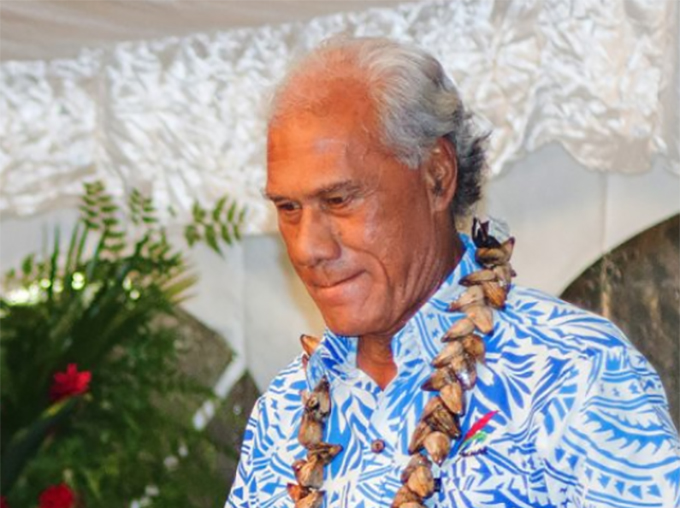
Newsletter: New Zealand Politics Daily – May 02 2018 – Today’s content

Newsletter: New Zealand Politics Daily – May 02 2018 – Today’s content Editor’s Note: Here below is a list of the main issues currently under discussion in New Zealand and links to media coverage. [caption id="attachment_297" align="aligncenter" width="640"] The Beehive and Parliament Buildings.[/caption] Below are the links to the items online. The full text of these items are contained in the PDF file (click to download). Government Henry Cooke (Stuff): Does the Government have any money for this budget? Yes Dominion Post Editorial: Your doctor will see you now … or maybe later Bryce Edwards (Newsroom): Labour’s great and dangerous expectations Guyon Espiner (RNZ): Caught in the mainstream Danyl Mclauchlan (Spinoff): Judith Collins is right: Jacinda Arden is an inveterate virtue-signaller Jenna Lynch (Newshub): Election promises shaky ahead of Govt’s first Budget Tracy Watkins (Stuff): Why Labour isn’t about to fall for the ‘spend more’ honey trap Barry Soper (Newstalk ZB): Peters the real power behind the throne Brad Olsen (Infometrics): Government set to dampen Budget expectations 1News: ‘Critical public services’ to see boost in Budget 2018, with promised surplus – Robertson Emma Hurley (Newshub): How much of the Government’s $8b health boost will be delivered in its first Budget? Emma Hurley (Newshub): Majority want big changes to the tax system, says Tax Working Group Jane Patterson (RNZ): Govt has freed up $700m in Budget – Minister Jason Walls (Interest): The scale of New Zealand’s infrastructure deficit is ‘massive’ RNZ: National rubbishes claims it neglected govt books Richard Harman (Politik): Speaker surprised at Curran decision Clarke Gayford David Fisher (Herald): False Clarke Gayford rumours: Police and PM Jacinda Ardern respond to widely circulated fake slurs Julia Llewellyn Smith (The Telegraph): Meet New Zealand’s ‘First Bloke’: the man who’ll become a stay-at-home dad when his PM partner gives birth Stuff: Jacinda Ardern was another man’s date the first time she met Clarke Gayford Newshub: Clarke Gayford shares how he met Prime Minister Jacinda Ardern GST online Thomas Coughlan (Newsroom): Up to half of sites may avoid ‘Amazon tax’ Emma Hatton and Katie Scotcher (RNZ): GST change: Retailers rejoice, consumers divided Paul Brislen (RNZ): Choice beats out GST for internet shoppers Jihee Junn (The Spinoff): What is the ‘Amazon tax’ and why does it matter? Lucy Bennet and Ryan Dunlop (Herald): Amazon tax: What it means Aimee Shaw (Herald): ‘Amazon tax’ not a magic bullet for retail sector: expert Aimee Shaw (Herald): Kiwis to pay GST on all online shopping from next year Anuja Nadkarni (Stuff): Amazon tax could be all the difference RNZ: Govt announces ‘Amazon tax’ to apply GST to online goods Tom Pullar-Strecker (Stuff): Amazon tax will be accepted as ‘fair play’, minister forecasts Tom Pullar-Strecker (Stuff): Amazon tax: What it means for online shopping Anna Bracewell-Worrall (Newshub): Explainer: How will GST on online purchases affect me? Jason Walls (Interest): The Revenue Minister has the go-ahead from the Tax Working Group to require overseas businesses to collect Lucy Bennett (Herald): Kiwi retailers pleased with GST on overseas online sellers BP petrol pricing and transport Hamish Rutherford (Stuff): Petrol industry antics shows the Auckland regional fuel tax could descend into farce Newshub: Jacinda Ardern having trouble trusting fuel companies after leaked  Susan Edmunds (Stuff): BP not alone in price ‘cross-subsidisation’ Amber-Leigh Woolf (Stuff): Planning needs to start now for driverless future, say experts Newshub: Auckland fuel tax ‘not as good as I want’ – Phil Goff Kelly Tantau (Stuff):Politicians unlock doors to New Zealand’s first underground train station Justice Ryan Boswell (1News): Inmates at numerous New Zealand prisons accuse jail staff of sexual abuse and serious assaults Ryan Dunlop (Herald): Corrections Department reviewing complaints process Hannah Bartlett (Nelson Mail): Nelson’s young crims with nowhere to go face prospect of hard time in police cells Catherine Hutton (RNZ): Report shows Family Court systems are failing Health Jo Moir (Stuff): More DHB chair turnover but Health Minister says it’s not political Gordon Campbell (Werewolf): On health promises, BP, and the White House correspondents furore Pete George:More from Minister of Health on GP fees promise 1News: ‘Middlemore was just the tip of the iceberg’ – Jacinda Ardern hits back at National after criticism of possible delay in cheaper GP visits Northcote by-election and electoral roll Anna Bracewell-Worrall (Newshub): New Zealand First not standing in Northcote by-election Isaac Davison (Herald): Winston Peters says NZ First wants no part in ‘needless’ $1m Northcote byelection Laura Walters (Stuff): NZ First will not stand a candidate in the Northcote by-election RNZ: Māori roll decreases in first month of option Environment, primary and extractive industries Bernard Hickey (Newsroom): Help the old bomb owners this time Shane Cowlishaw (Newsroom): Future of ‘three waters’ still unclear Walter Breustedt (Hawke’s Bay Today): Oil and gas ban a wakeup call Guy Trafford (Interest): Claims of importance, risks and priority ring hollow when ‘new’ biosecurity organisation gets unchanged funding with same staffing levels Herald: Canterbury farmer ‘wiped out’ third of rare NZ plant species RNZ: Warnings over NZ’s kerbside recycling Eva Corlett (RNZ): Flouting Waitākere ban could incur $200k fine International relations and trade Sam Sachdeva (Newsroom): Water, water everywhere: NZ’s maritime security threats Jeremy Rees (Newsroom): NZ a bus stop on China’s ‘Belt and Road’ Isaac Davison (Herald): United Arab Emirates minister has unlikely connection to NZ Catrin Owen (Stuff): Man charged for offending inside New Zealand Embassy continues to keep identity secret Newstalk ZB: Peters: ‘Premature’ to talk Peace Prize for President Housing and construction industry Anusha Bradley (RNZ): Homeless families displaced by art deco festival Eleanor Wenman (Stuff): No easy fix to New Zealand’s shortage in tradesmen and builders Eleanor Wenman (Stuff): NZ needs more than 50,000 construction workers by 2022 to keep up with demand Banking industry Pattrick Smellie (BusinessDesk): Warning to NZ banks: prove you’re clean Rob Stock (Stuff): Warning to NZ’s Aussie-owned banks: Prove we can trust you Tamsyn Parker (Herald): FMA to NZ banks: Show us you are not ripping off customers Drugs Shane Te Pou (Newsroom): Cannabis could cut opioid abuse off at the knees Russell Brown (Public Address): A handful of deeply precious days: a select committee submission Herald: P use is affecting children in every classroom in Northland: Principal Charlie Dreaver (RNZ): Dannevirke vs P: Battle hits the streets Local government Rachel Stewart (Herald): Why the ‘h’ do they bother? Jimmy Ellingham (Stuff): Livestreaming meetings and hosting petitions shouldn’t be so hard No Right Turn: In support of Māori wards Jane Matthews (Stuff): Māori ward debate addresses ignorance and inclusion Damian George (Stuff): 130 doctors agree Wellington’s poor cycling infrastructure is ‘killing’ people Nikki Mandow (Newsroom): Developers to meet $800m infrastructure bill Tim Brown (RNZ): Mayor to citizen: ‘Are you deaf or just stupid?’ Nicholas Boyack (Stuff): Hutt council to recoup $213,000 to manage popular Lower Hutt market Education RNZ: Ministry urges ‘bold step’ for Māori education Katie Fitzpatrick (Herald): Tomorrow’s Schools review by yesterday’s experts Adele Redmond (Stuff): Sticks and Stones: School bullying rates may reflect an intolerant culture – but cultures change Imogen Neale (Stuff): Construction company ordered to pay Education Ministry $13.4 million Chelsea Boyle (Herald): Construction company to pay millions for leaky school buildings Jessica Long (Stuff): Victoria University looking to change name to avoid overseas confusion Government transparency No Right Turn: A deceitful agency Aaron Leaman (Stuff): Auckland University partially refunds ‘unreasonable’ costs Michael Hayward (Stuff): EQC may release repair information to prospective home buyers under planned law changes Race and ethnicity  Stuff: Dancing With The Stars contestant Marama Fox on the skinny, white boy comment Dave Ward (Spinoff): A voiceover artist on being asked to deliberately mispronounce te reo Hamish McNeilly (Stuff): Listings withdrawn for white supremacist rallies in Dunedin and Christchurch Herald: White supremacist Dunedin rally advertised on EventFinda Other Zaryd Wilson (Wanganui Chronicle): Kelvin Davis to canvas ideas at Maori/Crown relations hui in Whanganui Aimee Shaw (Herald): Retailers’ and brands’ supply chain information should be publicly available: Tearfund Sophie Boot (BusinessDesk): Former Prime Minister Bill English appointed to ASX-listed Wesfarmers board Murray Brewer (The Spinoff): Invest in the regions to save Auckland from itself Karoline Tuckey (Stuff): Power and progress: Key leadership roles in Manawatū switching to women Tina Morrison (Herald): SkyCity convention centre faces further six-month delay Newsroom: Further delays for SkyCity convention centre Mānia Clarke (Maori TV): Delamere calls on govt to honour promise to skilled migrants ODT Editorial: Saving professional theatre Madeleine Chapman (The Spinoff):I feel for Deborah Hill Cone and Kate Hawkesby Herald: MPs labelled time-wasters over Prince Louis congratulations Emma Hurley (Newshub): Green co-leader sings Māori waiata for Royal baby Louis in Parliament]]>

Opposition PNG MP wins court phone reprieve for ‘at risk’ lives

]]>

EMTV News report on the National Information and Communications Technology Authority (NICTA) chief executive Charles Punaha claiming the agency would move against unregistered simcards with the deadline at midnight last night. Video: EMTV

Pacific Media Centre Newsdesk

Papua New Guinea’s controversial planned deactivation of 1.4 million unregistered simcards has been put on hold following concerns about it threatening lives of people in the Madang province, reports the Post-Courier.

The 11th hour reprieve though is for 14 days.

It was granted as an interim injunction by the National Court in Port Moresby yesterday after opposition Madang Open MP Bryan Kramer filed before Justice Oagile Bethuel Key Dingake.

Here MP Kramer explains the issues in a statement to the National Parliament and republished on EMTV deputy news editor Scott Waide’s blog My Land, Your Land:

Madang MP Bryan Kramer … “I have been given 14 days to commence and file formal proceedings and serve on NICTA, as well as the state.” Image: PNG Blogs

This morning [Monday] I moved an urgent application seeking a stay (stop order) against the National Information and Communications Technology Authority (NICTA) from deactivating some 1.4 million mobile users throughout the country who have yet to register their simcards. The application sought an interim stay and 14 days to commence formal proceedings.

-Partners-

After considering the arguments raised and the issue of short service on NICTA, the court granted by consent interim orders that NICTA is prevented from deactivating any unregistered simcards following the deadline on 30 April 2018. This ends today at midnight.

I have been given 14 days to commence and file formal proceedings and serve on NICTA, as well as the state.

11th hour application
The decision to file an application at the 11th hour before the deadline followed my discussion with Dr Jimmy Aipit on Saturday in Madang.

Dr Aipit has been a pediatrician for Madang General Hospital for the past 12 years. A pediatrician is a medical doctor who specialises in the development, care, and diseases of babies and children.

Dr Aipit raised concerns in relation to the 600 health officers he communicates with on a regular basis who provide life-saving medical advice for patients in the remote and rural parts of my province.

‘Grave concerns’
I also shared the same concerns as the majority of my constituents reside in remote and rural parts of my district. They contact me from time to time via mobile telephone to assist at times of emergencies.

Over the years I have I have been contacted directly to assist in maternal emergencies.

Following the discussion with Dr Aipit, I jumped on a plane the same day to fly to Port Moresby to file an urgent application to obtain a stay against NICTA.

My application was filed and heard yesterday (Sunday) exparte (without serving the other party). With the deadline on Monday, the administration judge on duty refused to hear the application and ordered I serve on NICTA and state and matter be adjourned to 10:30am this morning.

Today I explained to the court that I have grave concerns with the looming deadline and the impact of deactivating unregistered sims may result in loss of life and decreased well-being of my constituents in my district as well throughout the country.

Following the court’s decision to grant interim stay, 1.4 million people throughout PNG who have yet to register their simcards can be rest assured it won’t be deactivated – at least for the next 14 days and/or until the matter is determined by the court.

I am not challenging NICTA’s right to impose simcard registration, I am however challenging the manner in which it is imposing on 87 percent of our population who reside in remote and rural parts of our country and the effect it would have on their daily lives.

Bryan Kramer is an opposition Member of Parliament acting for the Madang electorate in Papua New Guinea.

Print Friendly, PDF & Email

Article by AsiaPacificReport.nz

]]>

Newsletter: New Zealand Politics Daily – May 01 2018 – Today’s content

Newsletter: New Zealand Politics Daily – May 01 2018 – Today’s content Editor’s Note: Here below is a list of the main issues currently under discussion in New Zealand and links to media coverage. [caption id="attachment_297" align="aligncenter" width="640"] The Beehive and Parliament Buildings.[/caption] Below are the links to the items online. The full text of these items are contained in the PDF file (click to download). Government Herald Editorial: Government has a chance to think bigger Anuja Nadkarni and Henry Cooke (Stuff): Grant Robertson promises a surplus and defends budget responsibility rules Richard Harman (Politik): Is this the fiscal hole? Stacey Kirk (Stuff): Govt’s broken promise – bad budgeting or priority fail? Anna Bracewell-Worrall (Newshub): Cheaper doctor visits: The Government’s first broken promise? 1News: Possible delay to cheaper GP visits down to ‘deficit’ in infrastructure and DHB ‘blowouts’ – PM The Standard: Does this Government have the money to deliver? David Farrar (Kiwiblog): Joyce was right -Labour can’t afford their promises Bryce Edwards (Herald):Political Roundup: How the Government shapes up after six months in power Audrey Young (Herald): Controversial waka-jumping bill an intrusion on MPs’ freedom of expression, say academics Shane Cowlishaw (Newsroom): Waka-jumping bill breaches Bill of Rights: academics Chris Bramwell (RNZ): Waka-jumping legislation ‘undemocratic’ say experts Edward Willis: Select Committee submission on the waka-jumping Bill Oliver Lewis (Stuff): Labour MP Ruth Dyson ‘error’ led to wrongful spending accusation Chris Trotter (Daily Blog): Shane Jones’ Critique Of Bureaucratic Obstructionism Is Well Made BP petrol pricing Hamish Rutherford (Stuff): A two-speed fuel market appears to see some areas pay for losses elsewhere Stuff: Read the BP pricing strategy email in full John Anthony (Stuff): BP’s cross-subsidising tactics do not breach Commerce Act, Commerce Commission says Isaac Davison (Herald): Revelations about BP petrol prices give more impetus for law changes, Jacinda Ardern says Rebecca Stevenson (Spinoff): Ten numbers that show we’re getting ripped off for petrol Mike Hosking (Newstalk ZB): Motorists have the power to drive down petrol prices Southland Times Editorial: A petrol leak that deserves to ignite Virginia Fallon (Stuff): Kāpiti residents feel ‘powerless’ to BP’s petrol pricing strategy RNZ: BP pricing tactics outrage Kāpiti locals: ‘They’re holding us to ransom’ Mitchell Alexander (Newshub): BP in defence mode over petrol price email Hamish Rutherford (Stuff): A two-speed fuel market appears to see some areas pay for losses elsewhere RNZ: BP pricing email ‘alarming’ – Energy Minister RNZ: PM joins criticism of BP pricing tactics Transport Barry Soper (Newstalk ZB): Govt are hypocritical over petrol tax Ken Shirley (Herald): Fuel tax poorly thought out solution to transport costs Adam Jacobson and Henry Cooke (Stuff): Auckland Council adopts 11.5 cent a litre regional fuel tax Simon Wilson (Herald): Aucklanders to have say on regional fuel tax of 11.5c a litre Newshub: Auckland Council votes overwhelmingly in favour of regional fuel tax Tim Murphy (Newsroom): Fuel tax but a decade of traffic jams Mike Lee (Herald): Trams to the airport is deluded folly Kristin Edge (Northern Advocate): Northland police watch for tradies not wearing seatbelts in road safety blitz Environment, primary and extractive industries Steve Deane (Newsroom): NZ’s killing season enters full swing RNZ: ‘It’s tragic’ – farmer destroys threatened native shrub Stuff: NZ’s total greenhouse gas emissions Matt Stewart (Stuff): Government launches new biosecurity intelligence unit Damien O’Connor (Stuff): Minister adds perspective to ‘hysteria’ over call declining Govt funding for mental health group Christina Persico (Stuff): National Party leader Simon Bridges says oil and gas decision will impact Taranaki culture Sam Hurley (Herald): Greenpeace head Russel Norman pleads guilty to obstructing oil survey ship Justice Carmen Parahi (Stuff): Police, politics and race: Long and anguished tale of constabulary’s relationship with Māori Carmen Parahi (Stuff): In the fledgling marae-based justice system, ‘offenders’ are instead called ‘participants’ Carmen Parahi (Stuff): Huri Dennis, accused by police of kidnapping, tells his side of the story Phil Taylor (Herald): Perjury prompts calls for curbs on prison witnesses Economy and business Herald: Prime Minister Jacinda Ardern on ‘Amazon’ tax: GST not new Audrey Young and Barry Soper (Herald): Government announces further tax for Kiwis buying low-value goods online Barry Soper and Rosie Gordon (Newstalk ZB): More tax to be added to online purchases RNZ: GST to be imposed on foreign online retailers – Ardern Tom Pullar-Strecker (Stuff): Government proposes ‘Amazon tax’ Eric Crampton (Offsetting Behaviour): GST at the border – hitting the big guys Graham Adams (Noted): Does New Zealand need a banking inquiry? Tom Pullar-Strecker (Stuff): Dip in business confidence points to choppy waters ahead Sophie Boot (BusinessDesk): Business confidence drops as firms tip profits to fall Donal Curtin: Focus on the worst Michael Reddell: A sadly diminished central bank Anuja Nadkarni (Stuff): Biggest truck shop fine so far, total fines reach nearly $1.6 million Tamsyn Parker (Herald): Commerce Commission whacks truck shop with its highest-ever fine International relations and trade Robert Ayson (Newsroom): Foreign policy challenge NZ must be wary of Liam Dann (Herald): NZ needs to avoid potholes in China’s Belt and Road Initiative Stephen Jacobi (Interest): Engaging with China’s BRI is critical to maintaining momentum in the New Zealand China relationship Curwen Ares Rolinson (Daily Blog): On A Potential Future For The Commonwealth Elections and Northcote by-election Bryce Edwards (Newsroom): 10 ways to improve our elections Eric Crampton: Electoral lists – a simple recommendation Eva Corlett (RNZ): Local issues loom large in test for new govt Laine Moger (Stuff): Labour’s Northcote candidate Shanan Halbert and National’s Dan Bidois both Kiwi battlers EQC and Canterbury rebuild Liz McDonald (Stuff): EQC’s clauses muzzle criticism and complaints Logan Church (RNZ): Dissent among Canterbury mayors over stadium funding Mike Yardley (Press): Pressure now on Christchurch City Council to come to funding party for stadium Housing Megan Gattey (Stuff): Our disposable, leaky homes: Kiwis ‘always try to build cheap’ Stuff: How many homes are there in New Zealand? Michael Reddell: LVR limits revisited David Hargreaves (Interest): The amount borrowed by first home buyers topped $900 mln last month Julie Iles (Stuff): House buyers and sellers locked in ‘stalemate’ as uncertainty over foreign buyer ban remains Education Newshub: Too many kids, too few teachers – the reality of early childcare RNZ: Project to look at education’s effects on Māori pre-schoolers Dan Satherley (Newshub): Scrapping charter schools will ‘end’ Jacinda Ardern – ACT leader David Seymour Herald: University of Auckland students rally against library closure, present petition to Vice-Chancellor Drugs 1News: Mixed signals as police prosecuting only 30 per cent of those in possession of cannabis Isaac Davison (Herald): MPs given lessons in using medical cannabis RNZ: Broken Bad: A country in the grip of meth Charlie Dreaver (RNZ):Schools grapple with rise in ‘P babies’ Māori land and Crown-Māori relations John Cousins (Bay of Plenty Times): Church to revisit wrongs inflicted on Tauranga Maori Deena Coster (Stuff): Treaty Minister Andrew Little gets history lesson during visit to Taranaki marae Ruby Nyika (Stuff): Crown, Maori relations hui in Rotorua well attended despite weather bomb Māori wards Aroha Awarau (Māori TV): Don Brash and Andrew Judd debate Māori equality Janine Rankin (Stuff): Rangitāne speak up in support of Māori wards Ripeka Timutimu (Māori TV): Fight for Māori wards like Nazi Germany – Hobson’s Pledge supporter Employment Richard Wagstaff (Herald): No business too small to treat people with dignity 1News: Employers push for bigger workplaces to keep 90-day trials for workers Other Katy Gosset (RNZ): Pike River re-entry: Experts meet on West Coast Richard MacManus (Newsroom): Why NZ needs a cyber security refresh Paul Thomas (Listener): Religion, homophobia and Israel Folau Kate Hawkesby: Sorry, but why are so sensitive to criticism now? David Farrar: The new Auckland DHB Chairs Martyn Bradbury (Daily Blog): Labour Party attack Kim Dotcom – major blunder Geoff Simmons (Dominion Post): These are the real issues Wellington needs to be debating Muriel Newman (NZCPR): The Pitfalls of Change Tom Hunt (Stuff): NZ International Comedy Festival Gala less ‘LOL’ and more ‘WTF?’ as racist gags flow Herald: Conservative lobby group Family First in the High Court fighting its deregistration as a charity Wayne Hope (Daily Blog): Karl Marx 200 years on Exclusive Interview]]>

PNG LNG – failed predictions and PNG’s resource curse

]]>

The Exxon-led PNG LNG project … supplying about 8 million tonnes of LNG a year to Japan, South Korea and China. Image: Jubilee Australia report

“On almost every measure of economic welfare, the PNG economy would have been better off without the PNG LNG project.”

Pacific Media Centre Newsdesk

Papua New Guinea’s massive PNG LNG project is one of “broken promises” that has largely failed the country, according to a major study released yesterday by Jubilee Australia.

Entitled Double or Nothing: The Broken Economic Promises of PNG LNG, this report, co-authored by Paul Flanagan and Dr Luke Fletcher, compares the projected economic benefits of the PNG LNG project with actual outcomes.

The new study uses PNG government data to examine the predictions of the 2008 project report commissioned by ExxonMobil and promoted by Oil Search.

This examination finds that the positive predictions for the PNG economy were largely incorrect.

Key findings:

  • Despite predictions of a doubling in the size of the economy, the outcome was a gain of only 10 percent and all of this focused on the largely foreign-owned resource sector itself;
  • Despite predictions of an 84 percent increase in household incomes, the outcome was a fall of 6 percent;
  • ●Despite predictions of a 42 percent increase in employment, the outcome was a fall of 27 percent;
  • ●Despite predictions of an 85 percent increase in government expenditure to support better education, health, law and order, and infrastructure, the outcome was a fall of 32 percent; and
  • ●Despite predictions of a 58 percent increase in imports, the outcome was a fall of 73 percent.

-Partners-

30-year span
PNG LNG is an Exxon-led project which supplies about 8 million tonnes of LNG a year to Japan, South Korea and China.

It is projected to run for 30 years. In 2009, Australia’s Export Credit Agency, Efic lent A$500 million to Exxon, OilSearch, Santos and the government of PNG.

Efic’s decision was based on advice from the Department of Foreign Affairs and Trade (DFAT) provided to the then-Minister for Trade, Simon Crean, on advice from DFAT. This is the largest loan ever made by Efic.

Paul Flanagan writes in PNG Economics:

Specifically, growth in the resource sector has matched the confident predictions even with the fall in oil prices in 2014.

However, all other parts of the PNG economy have not done as well as predicted.

This is a major “broken promises” gap. This is the basis for the title of the latest report – the PNG LNG project promised to double GDP, but the outcome of 10 percent is close to nothing (especially when the size of PNG’s GDP is facing a major downgrade in the latest NSO 2015 update).

Revenues to the budget are only one-third of expected levels, and after allowing for project costs, will continue having a net negative impact on the budget (so below nothing) until around 2024.

Economy gone backwards
Of even greater concern, the examination finds that the PNG economy, apart from the resource sector, has actually gone backwards relative to its underlying growth path.

The most likely explanation for this sad outcome is PNG has slipped again into poor policies associated with the resource curse. The temptations of the rosy PNG LNG promises were too strong for politicians despite warnings from PNG Treasury, BPNG and outside academics.

During the O’Neill/Dion government, PNG descended into very damaging economic policies of a bloated budget and PNG’s largest deficits ever, fixing the exchange rate at an over-valued level, making foolish investments in areas such as Oil Search and harming the independence of PNG’s economic institutions.

With the focus being so strongly on getting the PNG LNG project operational, there was a lack of policy emphasis on other parts of the economy.

This is the “resource curse” gap.

Third time
PNG needs to learn the lessons from this experience. This is the third time that PNG has suffered from the resource curse:

  • the first was with Bougainville Copper and the experience of the late 1980s;
  • the second was the Kutubu/Porgera expectations that crashed so badly in the mid-90s;
  • and the PNG LNG period is the third resource crisis.

The benefits of PNG’s resource wealth could in theory be tapped without damaging the rest of the economy.

But it would require very different choices by PNG’s politicians. PNG probably lacks the strong governance and institutions required to deal with the powerful resource sector lobby.

Even in Australia, the power of vested interests around the resource sector is blocking sensible options for sharing resource benefits more equitably and efficiently.

The Oil Search facility near Lake Kutubu in Hela province, Papua New Guinea’s Southern Highlands. Image: Damian Baker/Jubilee Australia
Print Friendly, PDF & Email

Article by AsiaPacificReport.nz

]]>

Greenpeace blasts palm oil industry deforestation in West Papua

]]>

One of the massive deforestation areas in the PT Megakarya Jaya Raya concession in Papua, Indonesia. Other images show a lunar-like devastation over huge areas. Image: Greenpeace International

Pacific Media Centre Newsdesk

A palm oil supplier to Mars, Nestlé, PepsiCo and Unilever is destroying rainforests in the Indonesian-ruled Papua region, a new investigation by Greenpeace International has revealed.

Satellite analysis suggests that around 4000ha of rainforest were cleared in PT Megakarya Jaya Raya concession between May 2015 and April 2017 – an area almost half the size of Paris.

The findings come as a delegation from the Indonesian government arrived in Europe last week to defend the palm oil industry, in response to moves by European Parliament to discourage the use of palm oil in biofuels on environmental grounds, Greenpeace International reports.

Luhut Panjaitan, the Coordinating Minister for Maritime Affairs of Indonesia, is visiting several European cities, including Brussels and Berlin.

“After destroying much of the rainforests of Sumatra and Kalimantan, the palm oil industry is now pushing into new frontiers like Papua, said Richard George, forests campaigner at Greenpeace UK.

“If the Indonesian government wants to defend this industry, the best thing it can do is to force it to clean up its act, not threaten to start a trade war.”

-Partners-

Photos and video taken in March and April 2018 show massive deforestation in PT MJR, a palm oil concession controlled by the Hayel Saeed Anam Group (HSA), including in an area zoned for protection by the Indonesian government in response to the devastating forest fires in 2015. Development is prohibited in these areas.

Supply chain
Although PT MJR is not yet producing palm oil, two other HSA subsidiary companies – Arma Group and Pacific Oils & Fats – supplied palm oil to Mars, Nestlé, PepsiCo and Unilever, according to supply chain information released by the brands earlier this year.

Each of these consumer companies has published a “no deforestation, no peat, no exploitation” policy that should prohibit sourcing from rainforest destroyers.

“Brands have been talking about cleaning up their palm oil for over a decade. Companies like Unilever and Nestlé claim to be industry leaders,” said George.

“So why are they still buying from forest destroyers like the HSA group? What are their customers supposed to think? What will it take to get them to act?”

This case also raises serious questions for the Roundtable on Sustainable Palm Oil (RSPO).

Many HSA Group palm oil companies are members of the RSPO, although PT MJR and the other HSA Group concessions in this district are not.

Members of the RSPO are not allowed to have unaffiliated palm oil divisions, and the development witnessed in PT MJR would also violate several of the RSPO’s Principles and Criteria.

Sourced from a Greenpeace International media release.

Print Friendly, PDF & Email

Article by AsiaPacificReport.nz

]]>

Bryce Edwards’ Political Roundup: Six months of new New Zealand government – the verdicts are in

Prime Minister of New Zealand, Jacinda Ardern.

Bryce Edwards’ Political Roundup: Six months of new New Zealand government – the verdicts are in

[caption id="attachment_13635" align="alignright" width="150"] Dr Bryce Edwards.[/caption] Is the new government transformational? Or just fighting fires? Who are the strongest performers, and who are the weak links? What are they doing right and wrong? These are the questions at the core of reviews from political commentators of the government’s performance over its first six months in power.  [caption id="attachment_15386" align="aligncenter" width="1600"] New Zealand Prime Minister, Jacinda Ardern, at the APEC leaders’ summit, November 2017 (Image courtesy of APEC.org).[/caption] For the most comprehensive review of the new government, see Newsroom’s Grading the Government, authored by a number of Newsroom journalists who break down the different areas of performance and hand out grades from B+ through to F. Generally, the government sits at around a “B” – with Health and Education scoring highest (B+). The exceptions are immigration (D), foreign affairs (C). In terms of immigration, Tim Murphy asks: “Is this the coalition’s most over-promised and under-delivered policy area?” He points out that “The annual net migration numbers remain close to those assailed in opposition as disastrous and uncontrolled. The supposed low-hanging fruit of low-value international education courses and their student work visas have largely remained in place”. Sam Sachdeva says the foreign affairs portfolio is “one of the Government’s weakest areas”, lacking coherence or obvious guiding principles. He points to the role of Winston Peters and his orientation to Russia. Political management gets a C+ and on Open government and transparency the government scores an F. In terms of open government, Shane Cowlishaw is scathing. Amongst other letdowns in this area, the “Official Information Act continues to be treated with disdain, with many journalists holding the opinion that their requests are taking longer, and returning poorer results, than under National who was not exactly known for its transparency.” Martin van Beynen offers up an intriguing perspective in Jacinda Ardern’s idea of government is revolutionary. To start with, the normally conservative journalist and commentator, claims he voted for the Greens: “The Greens have always struck me as more of a religion than a political party and that’s partly why I voted for them. I sometimes think they represent our only hope with their code of vegetarianism, cycling, organics, public transport, restorative justice, Māori empowerment, minimal packaging, international peace, anti-Americanism, diversity, public ownership, high taxation, interventionist government, severe income re-distribution and, of course, conservation. If Jesus was reborn in New Zealand he would walk straight into the Green Party.” Not only that, he appears genuinely excited about the promise of “a Government based on kindness”. He looks at both the possibilities and limitations of kindness as a guiding principle, and concludes: “kindness, like Christianity, might be one of those great ideas that just hasn’t been tried yet. It could be that Jacinda Ardern is exactly the person to lead the way – and what a trip it could be.” For another enthusiastic and interesting account of the new government, see Simon Wilson’s feature article: The ministry of ‘things will be different now’ – how are they doing? Wilson argues this government is heading in the direction of being a transformational one, and his column is a nice counterpoint to critics bemoaning the lack of radicalism and progress in the new administration. Wilson is full of praise for accomplishments so far, and points to factors inhibiting change that the government has had to contend with, including support partners pulling in different directions. And he emphasises that the new administration is having to work hard to introduce new directions that will actually take the public along with it, rather than just govern by decree with radical new directions that might easily be reversed in the future. He points to the oil and gas announcement as “a model of how to introduce radical change without giving those affected any good reason to panic”. And he credits the Greens as being behind the move, highlighting “the importance of the Green Party in setting the Government’s transformational agenda”. Other areas that are truly radical, according to Wilson, are in education (with the abolition of National Standards, and the potential major reform of the Tomorrow’s Schools model), transport (with the draft Government Policy Statement) and Grant Robertson’s adoption of Treasury’s Living Standards Framework. Even in the area of tax reform, Wilson sees reason to be optimistic about radical change coming. And, although he’s critical of the Budget Responsibility Rules, he says this issue “will not define how transformational this Government really is. The big projects that are still possible will do that.” He laments that the government has failed to make te reo Maori compulsory in schools, which would make New Zealand “culturally, the most resilient nation in the world”. And on wages and pay equity, Wilson is less optimistic about real change. Writing prior to van Beynen taking up the theme of kindness, Wilson concludes: “Is it possible to run an effective government powered by kindness? If Ardern and her colleagues can show us the answer is yes, what would that change? Almost everything?” Colin James is much less convinced that we are seeing a radical new government in action, suggesting the administration might instead be one of “transition”, especially in terms of shifting power to “the post-baby-boom generations” – see: Govt looks transitional at this stage but could yet be transformational. He argues “fixing shortfalls is not transformation – or even transition. Neither, so far, are the dozens – or scores, depending what you count – of reviews, working groups, strategies and so on. They open issues up rather than open up ‘bold” (another Ardern word) new vistas. For example, the education review reads more like adjustments to the 2010s than anticipation of the 2020s”. James does concede that incremental change can still add up to transformation. But, like other commentators, he points to factors holding back the new government’s reforming agenda: “First, substandard political management: ministers’ slips and skids (Clare Curran, Shane Jones, Eugenie Sage), and off-script support parties (Russia, Air New Zealand) plus a broken promise on fuel tax. Too much of this will, in time, leach public goodwill. Second: support parties’ travails. Polls put New Zealand First well below the 5% cutoff point. The Greens’ score is steady but Marama Davidson’s big win in the co-leader vote deepens their green-red schism and leaves James Shaw as minority co-leader.” Jo Moir evaluates the performance of government ministers in her article, Six months on the job for the Government – who is up and who is down? And the prize for the strongest performer doesn’t go to the prime minister, but to the Minister of Justice, Andrew Little, who gets a rating of 9/10. Other strong performers, with 8/10 ratings, are David Parker, Shane Jones, and Jacinda Ardern. The PM gets marked down on her failure to deliver on child poverty: “She really focused on it during the campaign and created the Child Poverty Reduction portfolio but that’s about where it stopped.” Meanwhile the Regional Development Minister is praised for his impact and colourfulness: “Shane Jones has been lapping up the headlines and has also had the job of going a bit rogue when necessary. If he was being measured on headlines and sound bytes Jones would be well in the lead.” At the other end of the spectrum Moir awards only 3/10 to “the invisible trio” of Nanaia Mahuta, Jenny Salesa, and Carmel Sepuloni, all of whom might have been expected to be performing strongly, but haven’t “really been seen or heard.” Labour’s deputy Kelvin Davis scores 2/10, as his “stints as acting prime minister haven’t gone too well and he hasn’t really stamped his mark on the Corrections portfolio”. And Clare Curran rates a dismal 1/10, as she is “struggling to bounce back” from her scandal and may not hold onto her ministerial position. Audrey Young also evaluates the ministers in her column, Jacinda Ardern has come through turbulent times but her cabinet has had mixed success. She points to the fact that the PM now knows that “she cannot rely on all ministers to handle difficulties in their portfolios well”, and says Clare Curran is now “a slow-moving target for the Opposition.” However, Young focuses mainly on ministers who are doing well, and helping Ardern make the government a success. She says Grant Robertson and Phil Twyford “are part of her informal kitchen cabinet along with Chris Hipkins, Megan Woods and Kelvin Davis. Andrew Little and David Parker are also highly trusted as ministers of sound judgment with difficult portfolios.” Winston Peters, too, may have raised some eyebrows as Minister for Foreign Affairs, “but in his duties as Ardern’s Deputy Prime Minister by and large he has been very good.” Also from Peters’ party, “Tracey Martin is New Zealand First’s best performing minister and showing why Ardern had the confidence to make her Children’s Minister”. Meanwhile, Shane Jones “is effectively No 2 in the party that put Labour in power. He behaves with impunity because he has impunity.” Young also points out that, “A couple of low-ranked ministers, Kris Faafoi outside cabinet, and Iain Lee-Galloway in cabinet, have really shone in their diverse portfolios.” For a more humorous evaluation that also makes serious points, see Jenna Lynch and Anna Bracewell-Worrall’s Six months in: The new Government’s report card. As with other commentaries, they point out problems in the first six months: the Labour Party youth camp, the vagueness about Russian issues, and the Clare Curran-RNZ scandal. This article adds to the consensus that Andrew Little is the surprise star of the new government, David Parker the rock behind the scenes, Kelvin Davis is missing in action, Winston Peters is a good deputy PM, and Shane Jones is now the front person for New Zealand First. Davis, in particular, gets a hard time, with these journalists pointing out that he had a lot to say about what was wrong with the status quo when he was in opposition, and he made plenty of promises, but is now not fronting up: “He’s yet to make any major – or minor – announcements.” They warn that Labour’s coalition partners are in danger of blending in too much with Labour. Peters, for example, doesn’t even talk about some of his party’s main policies: “We’ve heard almost no complaints from him on immigration and he hasn’t mentioned the Maori seats at all.” And James Shaw is “too well behaved” and therefore endangering the Green’s identity. But they regard the government as having made good progress on some core policies, such as fee-free education, the oil and gas issue, the fuel tax, and the families package to alleviate hardship. More progress is demanded from Duncan Garner in his review: Government’s six months in a leaky boat – captain overboard. Here’s his main point: “Jacinda Ardern’s stardust must turn to something useful and quickly. Voters are impatient. A slew of reviews only leads to paralysis by analysis. The Government’s hands are full but with not much to show for it. And I haven’t even touched on their populist promises to slash immigration and fix the deeply troubled mental health service. The stardust must turn to something more concrete – solutions, not slogans, trains, not talk and houses, not just hope.” Expectations are high, he says, with promises such as “$28b worth of roads and 100,000 homes in 10 years”, but failing to meet these expectations will hurt the Government. He identifies the weak links (“Kelvin Davis, Carmel Sepuloni, Clare Curran”) and praises Ardern for pulling “together the loose strands to make it all that more acceptable.” Garner sums up the first six months: “things have been a bit average, sometimes chaotic and muddled with a sideshow or two but with the very best of intentions and hugely lofty goals and ambitions, if not a little naive.” Finally, for how the cartoonists see the government’s achievements and problems so far, see my blog post, Cartoons on the first six months of the new government.]]>

Newsletter: New Zealand Politics Daily – April 30 2018 – Today’s content

Newsletter: New Zealand Politics Daily – April 30 2018 – Today’s content Editor’s Note: Here below is a list of the main issues currently under discussion in New Zealand and links to media coverage. [caption id="attachment_297" align="aligncenter" width="640"] The Beehive and Parliament Buildings.[/caption] Below are the links to the items online. The full text of these items are contained in the PDF file (click to download). Government Martin van Beynen (Stuff): Jacinda Ardern’s idea of government is revolutionary Audrey Young: Jacinda Ardern has come through turbulent times but her cabinet has had mixed success Jamie Smyth (Financial Times):Jacinda Ardern: ‘we should not expect women to be superwomen’ Henry Cooke (Stuff): National Portrait: Minister of Almost Everything David Parker Duncan Garner (Stuff): Government’s six months in a leaky boat – captain overboard Jo Moir (Stuff): A world with Winston Peters in charge David Farrar: Relax Winston won’t be in charge, Grant will be Stacey Kirk (Stuff): The three-legged Government that can’t quite sync Clare de Lore (Listener): What an ex-Labour Minister really thinks about Jacinda Ardern’s Government Lucy Bennett (Herald): National members blocked from getting Clare Curran to appear before committee over meeting with RNZ Carol Hirschfeld – report Richard Harman (Politik): Government Committee MPs save Curran Pete George: Labour, Green MPs block holding Curran to account Frances Mountier (The Spinoff): Why have Thompson & Clark been allowed to keep spying on us, in your name? The Standard: How many working groups did the last National Government create? Cherie Howie (Herald): No.10 for No.1: Present for baby among gifts for PM Jacinda Ardern during European tour Audrey Malone (Stuff): The Jacinda effect spikes earring sales Deborah Hill Cone (Herald): What was I thinking – attacking Clarke Gayford? Steve Braunias: The secret diary of … Clarke Gayford David Slack (Stuff): Dirty politics didn’t end, it just took a holiday Martyn Bradbury (Daily Blog): New Zealand’s new Alt-Right Twitter Trolls: Dirty Politics 2018 Polls Stephen Mills (Spinoff): New poll reveals the post-election political battleground 1News: Becoming a mum won’t have an effect on Jacinda Ardern’s performance as PM – 1 NEWS Colmar Brunton poll Newstalk ZB: Poll reveals public’s views on Ardern’s pregnancy Pete George: A pointless poll on pregnancy and politics Health Audrey Young (Herald): Health Minister David Clark says coalition funding pressures have delayed cheaper doctors’ visits for all Newshub: GP visits might not get cheaper soon after all Newstalk ZB: Government manufacturing a health-sector crisis – Michael Woodhouse 1News: Boost in dental funding on the cards, but ‘unlikely’ this term – ‘We have people struggling with third world health conditions’ 1News: Nurses ‘should be getting pay equity’, says Minister of Health, but it’s ‘further down’ Herald: Health minister Dr David Clark names the three new Auckland DHB chairs Stacey Kirk (Stuff): Government plants Crown Monitor in embattled Counties Manukau DHB RNZ: New chair of DHB says hospital buildings will be a ‘priority’ Mike Houlahan (ODT): DHB’s radiology failings cited in report Natalie Akoorie (Herald): Nigel Murray saga: $6500 bill for nursing expert to fly in from Canada Karoline Tuckey (Stuff): Mental health inquiry urged to work as fast as possible Felecia Indrawidjaja (Stuff): Electronic referrals set to be more reliable than paper versions at Waitemata DHB Jessica McAllen (RNZ): Focus needed on community based mental health services Danielle Client and Jane Matthews (Stuff): ‘Broken’ healthcare staff concerned about rise of bullying cases at DHBs Hamish McNeilly (Stuff): McStoush! Ronald McDonald House likened to beer and ciggy sponsorship Rob Stock (Stuff): Parents insuring their children’s health are nervous state won’t pay Tim Brown (RNZ): Funding uncertainty for Dunedin rehab service Emma Hatton (RNZ): Euthanasia bill ‘dangerous’ – Palliative care workers Housing and construction Newshub: First KiwiBuild homes are under construction Hannah Ross (Stuff):First 18 KiwiBuild houses under construction in south Auckland Herald: Phil Twyford announces KiwiBuild homes officially under construction RNZ: Kiwibuild: 30 new homes by end of the year John Minto (Daily Blog):Time for an Empty Homes Tax Catherine Harris (Stuff): Land – they’re not making any more of it Don Rowe (The Spinoff): ‘We’ve been under-building for a decade’: Registered Master Builders on the future of construction Chris Hutching (Stuff): Builders co-op cuts costs – but will consumers benefit? Phil Pennington (RNZ): Construction industry threatened by a ‘ticking timebomb’ Transport Hamish Rutherford (Stuff): BP asked to visit the Beehive after internal email outlines ‘alarming’ pricing plan Hamish Rutherford (Stuff): Behind the pricing: Internal email lifts veil on BP’s petrol prices Tamsyn Parker (Herald): ‘Very concerning’: National MP and AA call for greater transparency from petrol companies Eva Corlett (RNZ): Regional fuel tax: Decision expected today Simon Wilson (Herald): Fact-checking National on the Auckland fuel tax Dan Satherley (Newshub): Aucklanders don’t want fuel tax – Simon Bridges RNZ: National Party pledges to scrap regional fuel tax Isaac Davison (Herald): National Party leader Simon Bridges says he will repeal regional fuel tax if in Government Henry Cooke (Stuff): National would overturn regional fuel tax Dan Satherley (Newshub): ‘Fiscal hole’ caused by National ‘hand grenade’ – Phil Twyford Stacey Kirk (Stuff): National questions Auckland Council’s claims of ‘public support’ for fuel tax RNZ: Govt are repackaging National transport projects – MP Northern Advocate: Northland-based MPs should have fought for four-lane highway says advocate Adam Jacobson (Stuff): Government, Auckland Council revising controversial East-West Link plans Jodi Yeats (Stuff): One of Auckland’s most congested roads targeted in $28B transport plan – Lake Rd Benedict Collins (RNZ): National: petrol car levy will hurt the poor Greg Presland (The Standard): National’s fiscal ineptitude over Auckland transport RNZ: How should NZ regulate driverless vehicles? Emissions reduction debate Pattrick Smellie (Newsroom): Top 10 ways to reach net-zero carbon Rod Oram (Newsroom): So what happens if we fail? Joel Ineson (Stuff): National Party ‘resetting our approach to environmental issues’ – Bridges Andrew Gunn (Stuff):Simon Bridges blows hot air into climate change debate Charlie Dreaver (RNZ): Can food waste and poo power help NZ reach its low emission goal? Madison Reidy (Stuff): Emissions tax would result in higher dairy and fuel prices Finn Hogan (Newshub): Low-emission economy difficult but essential – report RNZ: Fuel-car levy could subsidise electric vehicles – govt Paul Little (Herald): Ban on oil and gas exploration has to happen Cameron Madgwick (ODT): No evidence a ban will lower emissions Environment Leith Huffadine (Stuff): Improving New Zealand, one piece of plastic at a time John Anthony (Stuff): Māori Fisheries Trust labels DOC-funded book ‘scaremongering’ Dominic Harris (Stuff): ECan accused of ‘putting profits before the community’ by anti-water bottling protesters Whena Owen (1News): Q+A: Why some ratepayers are falling foul of councils wastewater management Dominic Harris (Stuff): Councils facing $500m bill to meet stringent new recommendations on drinking water quality Esther Taunton (Stuff): Freshwater quality improving nationwide, report shows Jill Galloway (Stuff): Rangitīkei River quality improving Horizons tells dairy farmers RNZ: EPA to review insecticide thought to kill bees ODT Editorial: Lessons for Conservation Department Sean Hogan (1News): Campaign underway to resurrect controversial Hawke’s Bay walking track Marty Sharpe (Stuff): Oil exploration company says Greenpeace protest action cost it $150,000 Welfare Gordon Campbell (Werewolf): On the need for immediate action on WINZ Catriona MacLennan (Newsroom): A chance to reverse our humiliating welfare system Dan Satherley (Newshub): Welfare overhaul to get underway ‘in next three years’ – Carmel Sepuloni Mitch McCann (Newshub): Promised changes to New Zealand’s welfare system still years off – minister Newshub: Benefit sanctions causing child poverty – advocate RNZ: Rolling back benefit sanctions could take years – minister Pete George: Sepuloni interview another ‘wait and see’ Henry Cooke (Stuff): MSD spends $13k a year on hold music for StudyLink and WINZ Lauren Bartley (Re-imagining social work): Where has my radicalism gone? Inequality and poverty Pam Waugh (Newshub): Why are poverty rates shocking even as our economy grows? Herald Editorial: Poverty still disadvantaging too many Kiwi kids Laura Wiltshire (Stuff): More families needing the Sallies help RNZ: The ‘working poor’ driving up demand for food parcels – Sallies 1News: ‘Who’s running the world?’ – Period poverty a huge strain for NZ women that removing GST won’t solve, says doctor Employment Anna Bracewell-Worrall (Newshub): New Zealand workplaces ‘unnecessarily stressful’ – Minister Kirsty Johnston (Herald): Housing New Zealand worker’s suspected suicide after alleged bullying not notified to WorkSafe for six months Paul McBeth (BusinessDesk): Lees-Galloway signals broader health & safety targets Katie Bradford (1News): Maori far more likely to be injured at work, Government says Jane Patterson (RNZ): Govt flags changes to ‘high risk’ industries list Anuja Nadkarni and Catherine Harris (Stuff): Encouraging craziness: bosses putting culture and staff first Harrison Christian (Stuff): Strangers in a foreign land: African migrants snubbed by Kiwi employers Venetia Sherson (North & South): How not to retire: The older Kiwis who are holding onto their jobs Economy and business Liam Dann (Herald): Why the Government can’t relax debt rules to build more Liam Dann (Herald): Should the Government relax its debt target to build more? Brian Easton (Pundit): Squaring the Budget Circle Jason Walls (Interest): The weeks leading up to the Budget are usually a time for the Government to tease out new funding Shamubeel Eaqub (Stuff): Aussie’s bad banking culture calls for tough measures Hamish Fletcher and Tamsyn Parker (Herald): Shane Jones: Too soon to rule out banking probe Sam Stubbs (The Spinoff): Pull the other one. Of course NZ must launch an inquiry into banking Donal Curtin: The power of ideas Jenée Tibshraeny (The Spinoff): The taxpayer has spent $1.48 billion to bail out AMI. Does anyone care? Hannah McQueen (Stuff): Tax changes risk being a middle finger to the middle class RNZ: Consumer confidence lowest since 2016 Victoria University of Wellington: Minister needed for UN sustainability goals Girol Karacaoglu (Newsroom): Better lives, a better New Zealand Herald: New Zealand companies spend $2.56 billion on placing adverts Green Party Steve Braunias (Herald): The great political ping-pong tournament Henry Cooke (Stuff): Green staffer on ex-MP Kennedy Graham speaking at National event: ‘No wonder he sabotaged us and Metiria’ Stacey Kirk (Stuff): Greens forget own history in sanctimonious lash at former MP Newshub: Former Green MP speaks at National Party ‘BlueGreen’ event David Farrar: Greens spit venom at Kennedy Graham Pete George:A culture of Green zealotry and intolerance National Party Audrey Young and Lucy Bennett (Herald): National leader Simon Bridges prepares for big speech, visit to Taranaki and town-hall tour Richard Harman (Politik): Bridges to redefine National Anna Bracewell-Worrall (Newshub): National MP Matt King copies ACT press release, takes out all reference to ACT International relations and trade Damien Grant (Stuff): The Middle East should be no-go zone for Kiwi troops Stacey Kirk (Stuff): Where NZ’s stance on Russia differs and why it may not be bad Fran O’Sullivan (Herald): Digital sales open a door to Chinese consumers David Farrar: Is this NZ’s shadow Foreign Minister Martyn Bradbury (Daily Blog): China vs NZ Tom Peters (World socialist website): New Zealand prime minister strengthens military ties with France Media Colin Peacock (RNZ): Media freedom under the microscope Chris Trotter: Conversation In The Public Square Philip Matthews (Stuff): Broadsheets and blunders: In defence of getting it wrong Herald: TV politics: TVNZ reporter quits as new leader steps in Newshub: A bot that writes Mike Hosking opinion columns Joshua Drummond: A column by Mike Hosking, except it’s an AI predictive text bot Fiona Rae (Listener): Can David Seymour pull a Rodney Hide in Dancing with the Stars? Heather du Plessis-Allan (Herald): David Seymour is dancing for his party’s political survival Marcus Stickley (The Wireless): The founding editor of The Wireless says goodbye Stuff: You’re not going crazy – your local paper has shrunk in size Justice and police Shane Cowlishaw (Newsroom): Family Court reforms a failure: research Lizzie Marvelly (Herald): Mega-prison just a billion-dollar Band-Aid Jared Nicoll (Stuff): Behaving badly: Female prisoner numbers at Rimutaka nearly at same level as Arohata Prison Nicholas Boyack (Stuff): Prisoner-built house teaches prisoners worthwhile skills Herald: Editorial: Jailhouse informants – why the system needs reform Phil Taylor (Herald): The murky world of jailhouse snitches Meghan Lawrence (Herald): Inside a youth prison: Where NZ’s criminal teenagers end up Kelly Dennett (Stuff): Grieving mother lays IPCA complaint over WOF-less police car Stuff: When can police enter your home, and when can they breath test you? Teresa Cowie (RNZ): Insight: Imprisoned by meth Teresa Cowie (RNZ): More than half of inmates took meth before being imprisoned Māori wards Jono Galuszka (Stuff): Maori wards fight gets support from Manawatū’s top Anglican Stephanie Mitchell (Stuff): Former New Plymouth mayor takes on former National leader on Māori wards Sexuality, religious and cultural beliefs Hone Harawira (Daily Blog): Hell hath no fury like a Christian spurned Moana Jackson (E-Tangata): No one’s exercise of free speech should make another feel less free Gavin Ellis (Herald): Right to free speech comes with a cost Stuff: Injured Hurricanes halfback TJ Perenara helps collect money for LBGT+ groups Patrick Gower (Newshub): We need an openly gay All Black The Hits: Photos: New All Blacks jersey stretches to reveal a rainbow flag Joel Ineson (Stuff): Gay and inclusive rugby team a haven for marginalised players Dan Satherley (Newshub): 47 would-be marriage celebrants rejected because they refuse to carry out gay weddings Ruby Macandrew (Stuff): Flashback: Civil unions come into effect after a hard-fought battle by same-sex couples and their supporters Gender bias, harassment and violence Dana Johannsen (Stuff): New study reveals stark gender bias in sports coverage Laura Dooney (RNZ): ‘I was very upset and angry that I had been violated’ Alison Mau (Stuff): Cosby guilty verdict should mark a turning point in the #metoo revolution Hannah Ross (Stuff): Survey launched for legal professionals to speak up about sexual harassment Guy Williams (Stuff): Are we too cool with domestic violence in New Zealand? Ethnicity, culture and Maori development 1News:‘It’s not about being PC it’s just about being respectful’ – brands can suffer due to lack of basic pronunciation, says marketing lecturer John Boynton and Te Aniwa Hurihanganui (RNZ): Voice artist refuses to pronounce the ‘white’ way Nicole Lawton (Stuff): Taika Waititi lauds voice artist for refusing to pronounce Waimate ‘the white way’ Herald: Kiwi voice artist refuses to pronounce Maori words ‘the white way’ Julie Zhu (The Spinoff): It’s 2018 and a white comedian mimicked a Thai woman at the NZ Comedy Gala Dale Husband (E-Tangata): Simon Bridges: Our leaders should be culturally competent Ben Rosamond (Economic and social research Aotearoa): Nation destroying: Sovereignty and dispossession in Aotearoa New Zealand Ruwani Perera (Newshub): Learning Māori a cultural revolution for good Jason Renes (The Spinoff): A future made by Tūhoe hands Graham Cameron (The Spinoff): Are indigenous people united under the United Nations? Christchurch stadium Liz McDonald (Stuff):Seven years since the earthquakes, Christchurch’s stadium and sports centre are still not built ODT:Editorial – Housing people the priority Dominion Post: Editorial: First Christchurch, then how about a new arena for Wellington? David Williams (Newshub): Stadium spells danger for Labour Steven Cowan:A big white elephant in the making Regional development and Shane Jones John Armstrong (1News): Shane Jones needs to explain worth of political neutrality sacrifice if he wants to be taken seriously Lucy Bennett and Isaac Davison (Herald): Shane Jones burned by lack of progress on regional projects Zaryd Wilson (Wanganui Chronicle): Paul Goldsmith says Government sending mixed messages to regions Education Farah Hancock (Newsroom): Anew tomorrow for schools rich and poor Sarah Harris (Herald): Half of early childhood teachers experiencing harm, new ChildForum report finds Kendall Hutt (Stuff): National proposal to scrap school decile system back on the cards Simon Collins (Herald): Auckland schools ‘could do better’ for Esol students, says Education Review Office Belinda Buchanan (Stuff):‘The system was stealing my soul’ -why I left teaching to sell real estate Vaimoana Tapaleao (Herald): Charter school parents protest outside PM Jacinda Ardern’s electorate office Dan Satherley (Newshub): Pro-charter school protest at Jacinda Ardern’s office Jennifer Eder (Stuff): A different class: It’s learning, but not as we know it Jenny Suo (1News): Students protest closing of Auckland University’s Fine Arts library RNZ: Students and staff occupy University’s Fine Arts Library Herald: University of Auckland students to rally against library closures Stuart McCutcheon (Herald): Professors miss the mark on what hurting universities Immigration  Mike Williams (Hawkes Bay Today): Government must tread warily in immigration high-wire act Stuff: Most international students granted NZ visas are Chinese, statistics show Spy agencies Andrea Vance (1News): Think you have what it takes to spy for New Zealand? SIS looking for new recruits Newshub: New Zealand Security Intelligence Service recruiting new spies Laura Walters (Stuff): NZ lacks informed public debate on spying Other Barry Soper (Newstalk ZB): Clinton visit about money, not remorse Heather Chalmers (Stuff): MPI officials dispose of 7550 cows to stop spread of Mycoplasma bovis Mike O’Donnell (Stuff): More action needed on ‘bottom-feeder’ lenders Stuff: Below the beltway: The week in politics Patrick Gower (Newshub): Is the Kiwi blockchain company Centrality really worth $690 million? Mei Heron (1News): Animal activists call for end to shock collars used to train dogs The Standard: New Zealand Is all right, at the end Sarah Nealon (Stuff): Dame Anne Salmond fronts new historical series on Māori TV Chloe Winter (Stuff): Designer Karen Walker: Fashion requires ‘vigilant inspection of compliance’ Al Williams (Stuff): Ratepayer calls on the Ombudsman in an effort to reveal Waimate council’s land assets Grant Bradley (Herald): Too many tourists in Aotearoa? What Kiwis really think Josh Martin (Stuff): Sliders, Vomit Wagons and Tupperware: Insights of a freedom camping expert]]>

Auckland uni students protest over plan to close special libraries

]]>

University of Auckland students march to protest against the potential closure of specialist libraries. Image: Pacstudio via Instagram

Pacific Media Centre Newsdesk

University of Auckland students rallied today against a plan to close several of the university’s specialist libraries, reports RNZ National.

The university’s architecture and planning, music and dance, and fine arts libraries have all been earmarked for closure.

Under the proposal, the specialist libraries would merge with the general library.

READ MORE: Students and staff occupy university’s Fine Arts Library

Students and staff worried about losing study space and access to vital resources and expert staff occupied the Fine Arts Library over the weekend to protest against its closure.

Students said today they had not been consulted about the plans.

-Partners-

Losing study space
They were worried about losing study space and access to vital resources and expert staff, as well as losing a sense of community with other students.

Auckland University Students’ Association president Anna Cusack said they wanted the consultation process halted, so students could have a say.

Consultation on the proposed closures ended today, but only affected staff have been involved in that process.

The students also planned to present a petition with thousands of signatures to vice-chancellor Stuart McCutcheon.

This article has been republished as part of the content sharing agreement between Radio New Zealand and the AUT Pacific Media Centre.

Print Friendly, PDF & Email

Article by AsiaPacificReport.nz

]]>

Manus refugees ‘in the dark’ as healthcare provider pulls out

]]>

An SBS graphic screen shot from a Pacific detention centres timeline video.

By Nick Baker of SBS News

The Australian government has been slammed for a lack of transparency amid news that the healthcare provider for refugees on Manus Island will wrap up its work today.

The International Health and Medical Services (IHMS) has been providing healthcare for refugees on Manus for several years but their contract is due to expire today.

However, despite the end date, the government did not publicly indicate a new provider was confirmed until last Friday. Although details remained scant.

In a statement, the Department of Home Affairs said it had “engaged a new health services provider from 1 May 2018 (and) IHMS will work with the new health service provider during a transition period”.

“Individuals will continue to have access to appropriate primary health services,” it said.

A spokesperson from IHMS confirmed the April 30 end date but said “it will, however, maintain a core group of staff in Manus and Port Moresby to support the transition to a new health service provider”.

New provider
But neither the Department of Home Affairs or IHMS would say who the new provider would be, leaving open questions about the quality of the care.

-Partners-

Greens Senator Nick McKim said Australians were once again “in the dark” about the treatment of refugees on Manus.

McKim said getting information from the Department of Home Affairs was “like getting blood from a stone”.

“And of course that’s deliberate and part of the intent of establishing Australia’s offshore detention system in the first place – to drop a veil of secrecy over what’s happening in those places.”

He said although IHMS had a very checkered history, there was now a danger of gaps in health care over the coming months and beyond.

“Ultimately the risk is yet more people will come to harm … as a result of Peter Dutton’s negligence.”

McKim said the use of Manus and other offshore immigration detention facilities will go down as “one of the darkest chapters” in Australian history.

Harm ‘very rare’
“Because it’s very rare that in Australia’s history we’ve deliberately caused harm to innocent people and that’s exactly what Peter Dutton is doing.”

Refugee coordinator at Amnesty International Australia Graham Thom similarly expressed concerned around healthcare for those on Manus after today.

“Ever since the Australian government began shipping refugees out to detention centres on remote tropical islands, they have been trying to hide from the consequences of this cruel policy.”

“Withdrawing healthcare is Australia’s latest deplorable attempt to shift the responsibility for the suffering it has caused.”

“The health situation for refugees and asylum seekers in Papua New Guinea is already dire, but the end of the IHMS contract threatens to turn this into an all-out crisis.”

“The only way for Australia to ensure the health of the refugees and asylum seekers on Manus is to end offshore processing for good.”

SBS News coverage on the Pacific.

Print Friendly, PDF & Email

Article by AsiaPacificReport.nz

]]>