Page 1193

Fiji Times Four ‘relieved’ sedition newspaper freedom ordeal is over

]]>

Fiji Times publisher Hank Arts waves to supporters and the media after he and two senior officials of the newspaper and a letter writer were acquitted of sedition charges in the Suva High Court yesterday. With him is a Fiji Times director, Rajesh Patel (left). Image: Jovesa Naisua/Fji Times

By Geraldine Panapasa, editor-in-chief of Wansolwara

“Relief!”

That was the word from Fiji Times Ltd publisher Hank Arts after High Court judge Justice Thushara Rajasinghe acquitted him and the company Fiji Times Ltd, Fiji Times editor-in-chief Fred Wesley, Nai Lalakai editor Anare Ravula and letter-writer Josaia Waqabaca of sedition charges at the High Court in Suva yesterday.

Speaking to Wansolwara News immediately after the verdict, Arts said they were happy with the judgment and relieved the case was over.

READ MORE: Not guilty – newspaper acquitted of sedition

“We have always said we are not anti-government and our success today is a reinforcement and confirmation that we are a good newspaper. Our staff are incredible,” he said.

Today’s Fiji Times front page.

“Relief is the first comment I would make. We are so relieved and happy, but at the same time wonder how we had to go through all this—the human cost (of the case) is too high.”

-Partners-

When asked what the next step was for him considering that fact that he had missed his daughter’s wedding and his own anniversary as a result of the court case, Arts said light-heartedly: “I need a beer now.”

On a more serious note, Arts said The Fiji Times would focus on its strengths moving forward as this year was election year and next year would mark the company’s 150th anniversary.

According to Justice Rajasinghe, the prosecution failed to prove beyond reasonable doubt that the article in question was seditious.

In his judgment, Justice Rajasinghe said he did not find any reason to disagree with the unanimous not guilty opinion of the three assessors.

Justice Rajasinghe found the intention of Waqabaca’s article was to have national reconciliation and he said he did not find any evidence that Arts or Wesley saw the article or knew about it before it was printed.

Fiji Times Ltd was charged with one count of printing a seditious publication while Arts was charged with one count of publishing in the Nai Lalakai an article, which had content with a seditious intention to promote feelings of ill will and hostility between classes of the population, namely non-Muslims and Muslims.

Waqabaca was charged with one count of submitting for publication an article written by him with a seditious intention, while Ravula and Wesley were charged with one count each of having aided and abetted the publication of a letter in the Nai Lalakai newspaper on April 27, 2016, by failing to prevent its publication.

Wansolwara News is the online publication of the University of the South Pacific journalism programme and a partner of the Pacific Media Centre’s Asia Pacific Report.

Print Friendly, PDF & Email

Article by AsiaPacificReport.nz

]]>

Samoan opera singer sings praises for benefit of teenager hopefuls

]]>

Proud Samoan baritone Samson Setu … encouraging young students to choose opera. Image: Te Waha Nui

By Leilani Sitagata in Auckland

A baritone studying at Auckland University has been touring New Zealand singing the praises of opera to teenagers.

The fourth-year music student, Samson Setu, says he was “dragged” into opera by a teacher who loved the sound of his voice.

“When I sang in the school choir my teacher pulled me aside because she thought I sounded like a 30-year-old man,” he says.

He is one of the 2018 Dame Malvina Major emerging artists working with New Zealand Opera.

The programme includes an opera-in-schools tour, where he has been visiting schools in New Zealand to inspire students in pursuing a passion in the music industry.

The head of education at NZ Opera, Joanne Cole, says Opera in Schools is part of its wider education and outreach programme.

-Partners-

“It has been designed to break down the barriers that exist around opera and to bring new audiences to the genre.”

Setu says opera is not such a popular genre with youth-targeted stations as it’s not often on the radio so they don’t get the opportunity to hear it.

‘Looks elitist’
“From the outside it looks like an elitist art form and you don’t see many Pacific Islanders doing it.

“Sol3 Mio have made [opera] a bit more mainstream, they’ve opened the doors to this sort of music.”

He says the schools that are predominantly Pasifika have been extremely responsive to the tour so far.

Another University of Auckland music student, Denzel Panama, says opera is an amazing art form and sharing it with a young audience is special.

“I think a tour of this nature can only do good. It exposes so many young people to something that they might have never really experienced.”

The Opera in Schools programme is in its sixth year and travels to Wellington and Christchurch in July.

This article was first published on the AUT journalism studies website Te Waha Nui.

Print Friendly, PDF & Email

Article by AsiaPacificReport.nz

]]>

Fiji newspaper sedition trial – Fiji Times Four found not guilty

]]>

Not guilty … a Fiji Times celebration huddle outside the High Court in Suva today. Fiji Times editor-in-chief Fred Wesley is on the right. Image: The Fiji Times

Pacific Media Watch Newsdesk

The High Court in Suva has found the Fiji Times Ltd, its three senior executives and a letter writer not guilty of sedition, reports Timoci Vula in The Fiji Times.

High Court judge Justice Thushara Rajasinghe has found the Fiji Times Ltd, general manager Hank Arts, Fiji Times editor-in-chief Fred Wesley, Nai Lalakai editor Anare Ravula and letter writer Josefa Waqabaca not guilty and acquitted them accordingly in a jam-packed court room at Government Buildings in Suva today.

Vijay Narayan and Semi Turaga of Fijivillage report Justice Rajasinghe had ruled that the prosecution had failed to prove beyond reasonable doubt that the Nai Lalakai article was seditious.

The judge said he found the intention of Waqabaca’s article was to have national reconciliation.

Justice Rajasinghe said he did not find any evidence that Hank Arts saw the article or knew about it before it was printed.

The judge also said he did not find any evidence that Fred Wesley read or was aware of the article before it was printed, Fijivillage reports.

-Partners-

Justice Rajasinghe said he did not find any reason to disagree with the three assessors, reported Fijivillage.

All three assessors had earlier returned a not guilty opinion on all charges against Fiji Times Limited, publisher Hank Arts, contributor Josaia Waqabaca, editor-in-chief Fred Wesley and Nai Lalakai editor Anare Ravula.

All four had pleaded not guilty.

Print Friendly, PDF & Email

Article by AsiaPacificReport.nz

]]>

US looks at defence, foreign policy and impact of Chinese aid in Micronesia

]]>

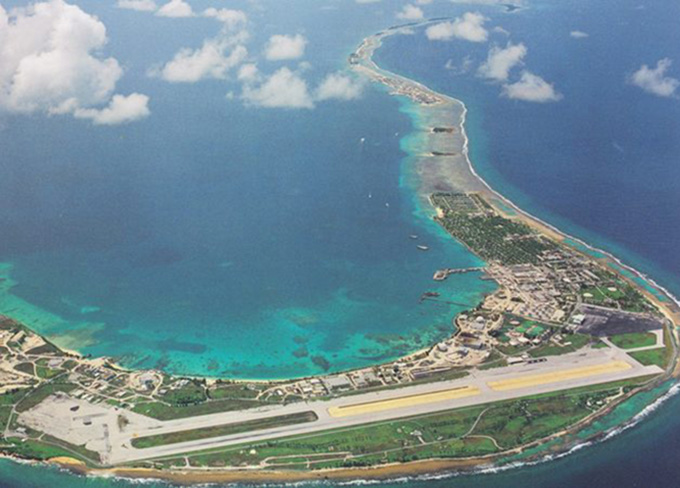
Reagan Test Site at Kwajalein Atoll … implications for American defence and foreign policy interests of China’s economic aid in island nations under review. Image: RNZ Pacific

RNZ Pacific

The US Defense Department is to report to the US Congress by December 1 on a range of security concerns in the northern Pacific island groups that are affiliated with the US.

The department is reviewing the strategic importance of the Compacts of Free Association for the United States as part of a broad study of security issues related to the freely associated states of Palau, Federated States of Micronesia and the Marshall Islands.

All three nations have long-term treaties with the US that give Washington control of defence and security in an area of the North Pacific the size of the continental US.

The study is also evaluating the implications for American defence and foreign policy interests of China’s economic aid in these island nations.

The Congress directed the Defense Department to address security, defence and foreign policy issues related to the Micronesia area.

Concern over the impact of China in Micronesia is an underlying issue of the study.

-Partners-

China maintains diplomatic ties with the FSM, while Palau and the Marshall Islands are aligned with Taiwan.

This report is published under a content sharing agreement with RNZ Pacific.

Print Friendly, PDF & Email

Article by AsiaPacificReport.nz

]]>

Tommy Suharto: Indonesians are ‘longing’ for return to Suharto rule

]]>

Talk to Al Jazeera in the Field programme features Tommy Suharto.

Pacific Media Centre Newsdesk

The Suharto political dynasty is being revived in Indonesia, reports Al Jazeera.

Twenty years after the fall of the country’s notorious former President Mohamed Suharto, his youngest son is leading a new political party into next year’s elections.

Hutomo Mandala Putra, or “Tommy Suharto”, as he is commonly known, has been touring several Indonesian regions, even travelling to Solo to receive a royal title in an attempt to gain the support of would-be voters.

Suharto and his newly-formed Party Berkarya (Work Party) are focusing on the widening gap between rich and poor in Indonesia.

“We have gone through 20 years of reforms, but the situation has not improved,” he said. “Our national debt has increased, and the living conditions of our people have not improved significant[ly].”

-Partners-

Party Berkarya’s aim, according to Suharto, will be to “develop a people’s economy that will be controlled by the people and benefit the people to improve people’s welfare”.

Suharto is not worried that his father’s legacy of corruption and brutality will taint his campaign; he said that Indonesians were “longing” for the return.

Legacy of corruption
The United Nations and Transparency International have alleged that Mohamed Suharto stole more state assets than any other world leader, amounting to billions of dollars, a claim his son has denied.

“These figures are not true,” he claimed. “They have said that my father owns billions of dollars in Europe in a Swiss bank … nobody has provided any evidence. It was never proven.”

In 2015, Indonesia’s Supreme Court ordered the Suharto family to repay more than $400 million embezzled from a scholarship foundation, but the money is yet to be returned.

According to Suharto, the court’s ruling is impractical and does not take into account the government closure of a bank where much of the money was invested.

“How can foundations give money back to the government if these foundations are using donors’ money, not only [money] from the government, and this money has already been given to those receiving scholarships?” he says.

“The money that they are looking for is the money which was invested in Bank Duta. The bank has been closed by the government … [and] has bigger obligations towards its customers, of course, the customers are being prioritised.”

Tommy Suharto himself has been convicted of corruption but went into hiding to avoid jail. In 2002, he was again sentenced for ordering the murder of the Supreme Court judge who handed down his previous sentence.

Released early
He was released after serving four years of his 15-year sentence.

“I have done my term and, according to the laws, I now have the same rights as anyone else. I have the right to vote and the right to be elected,” he says.
Deadly paradise

More than one million Indonesians died during Mohamed Suharto’s rule, while thousands of others were jailed without legal process.

He stepped down in 1998, after 32 years in power, following a series of riots.

One thousand Indonesians are estimated to have died during the riots, which destroyed shopping malls and homes in the capital, Jakarta.

At least 150 ethnic Chinese women were raped in the violence, which began after the Asian financial crisis caused the stock market to crash, and escalated when soldiers shot four students at a university.

Military and political leaders said Mohamed Suharto had lost his grip and abandoned him, forcing him to step down.

Print Friendly, PDF & Email

Article by AsiaPacificReport.nz

]]>

Hot off the press – Wansolwara marks USP’s 50th anniversary

]]>

Wansolwara supervising editor-in-chief Geraldine Panapasa, broadcast teaching assistant Eliki Drugunalevu and USP journalism programme co-ordinator Dr Shailendra Singh browse through the latest edition of Wansolwara alongside students Elizabeth Osifelo and Kritika Rukmani (right). Image: Koroi Tadulala/Wansolwara

By Elizabeth Osifelo in Suva

The first edition of the University of the South Pacific’s student journalist training newspaper Wansolwara for the year has hit the news stands and celebrates the institution’s half century of achievements as one of the most successful regional organisations with more than 63,000 alumni and 26 international accreditations.

The university has presented 64,000 qualifications over the past 50 years and more recently was seeking initial accreditation with the WASC Senior College and University Commission (WSCUC).

The 24-page special edition focused on USP’s 50th Anniversary and the “people power” behind the institution is one of two publications planned for the year and was printed as an insert in the Fiji Sun newspaper on Friday.

Wansolwara’s May edition hit the news stands today as an insert in the Fiji Sun. Image: Koroi Tadulala/Wansolwara News

Wansolwara supervising editor-in-chief Geraldine Panapasa said the publication was dedicated first and foremost to the people who had made USP what it has become today.

She said the first edition focused on academics, support staff and the people who, over time, had become a part of the USP family.

The second edition is expected to feature various graduates and their contribution to society.

-Partners-

Final-year journalism students worked closely with the editorial board on the production of the newspaper.

The editorial board comprises USP journalism programme co-ordinator Dr Shailendra Singh, broadcast teaching assistant Eliki Drugunalevu, Panapasa and student editor Drue Slatter.

The award-winning Wansolwara newspaper is the longest surviving student publication in the region with the largest circulation (more than 20,000) of any student newspaper in the Pacific and Australasia.

An e-copy of the publication can be found on www.wansolwaranews.com or on ISSUU.

Elizabeth Osifelo is a final-year journalism student at USP.

Print Friendly, PDF & Email

Article by AsiaPacificReport.nz

]]>

Indonesian military joint plan for greater role in counterterrorism

]]>

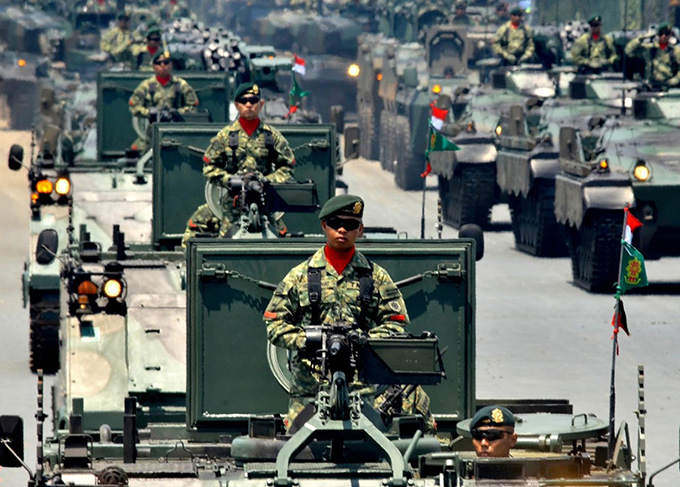
Members from the Indonesian military’s Armoured Division take part in a parade to mark the 72nd anniversary of the Indonesian military’s founding in Cilegon on October 5, 2017. Image: The Jakarta Post/Ricardo/AFP

By Marguerite Afra Sapiie and Nurul Fitri Ramadhani in Jakarta

Indonesia’s Presidential Chief of Staff Moeldoko has claimed that President Joko “Jokowi” Widodo had expressed his consent to bringing back to life the suspended military Joint Special Operations Command (Koopsusgab) tasked with countering terrorism.

The team, which included and will again include personnel of the Army’s Special Forces (Kopassus), the Navy’s Denjaka squad and the Air Force’s Bravo 90 special force, would be put on standby and be ready to be mobilised at any time when terror threats emerged, Moeldoko said.

“This joint force was well trained and prepared in terms of its capacity, and it could be deployed anywhere on the country’s soil as fast as possible […]. Its role would be to assist the National Police,” Moeldoko said.

READ MORE: Jokowi to issue perppu if House fails to revise terror law

His statement has followed a recent string of terrorist attacks that has thrust Indonesia into a state of paranoia.

The joint force was first established under Moeldoko when he served as the Indonesian Military (TNI) commander in 2015. The special command’s operations, however, were suspended under the leadership of Moeldoko’s successor, retired General Gatot Nurmantyo.

-Partners-

Further tasks of the special command would be discussed between TNI commander Air Chief Marshal Hadi Tjahjanto and National Police chief General Tito Karnavian, with the latter to have the final say on whether it needed the assistance of the TNI’s special team or not, Moeldoko said.

“This operation must be carried out for preventive purposes, so that the public can feel safe […]. We [the security apparatus] are ready to face any kind of situation, so people should put their trust in us and not worry,” he said.

Planned amendment
The revitalisation of the joint force did not require any new regulations, Moeldoko said, adding that the details about the command’s tasks would be adjusted with the planned amendment to the 2003 Terrorism Law.

The announcement came as the House of Representatives and the government began to clear up contentious articles that had caused deadlock in the deliberation of the Terrorism Law revision, including the legal definition of terrorism and the military’s level of involvement in counterterrorism operations.

A greater level of involvement has stirred debate among experts and human rights activists.

Seven ruling parties and the government had agreed on a definition of terrorism that included acts that had “political and ideological motives and threaten national security”, United Development Party (PPP) lawmaker Arsul Sani said.

More leeway
It is widely believed that such a definition would provide leeway for greater involvement of the TNI in counterterrorism efforts.

As the government and the lawmakers appear to be on the same page now, observers expect the bill to be passed into law in the near future.

Jokowi has recently said he would issue a regulation in lieu of law (Perppu) on the Terrorism Law if the House failed to conclude deliberations on the bill by June.

Members of a committee tasked with deliberating the bill said it was the leading opposition Gerindra Party and the Democratic Party, both political parties with strong military influence, that had demanded the inclusion of the contentious provisions.

“We support [the terrorism bill],” Gerindra chairman Prabowo Subianto said during his visit to the House.

Deliberation of the bill is believed to have been stalled mainly because of a tug-of-war between the TNI and the police, which led to division among political parties factions into pro-TNI and pro-police camps.

Print Friendly, PDF & Email

Article by AsiaPacificReport.nz

]]>

Tongan PM seeks royal audience after lawyer’s constitutional advice on law

]]>

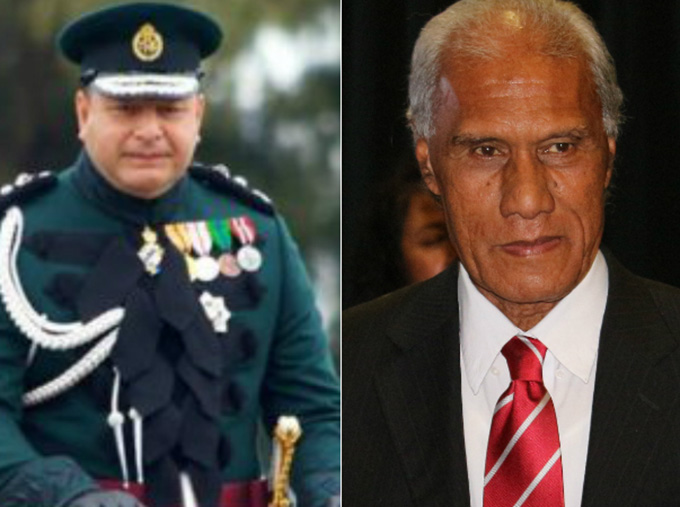
Tonga’s King Tupou VI and Prime Minister ‘Akilisi Pōhiva … vetoed laws issue. Image: Kaniva News

By Kalino Latu, editor of Kaniva News

The government of Prime Minister ‘Akilisi Pōhiva has planned an audience with the King of Tonga after a New Zealand legal expert advised that the king had no right to judge the merits of legislation passed by Parliament.

A government spokesperson said the plan was made after cabinet accepted the New Zealand lawyer Dr Rodney Harrison’s recommendations.

Pōhiva told Kaniva News in a recent interview that six Amendment Bills were submitted by the Tu’ivakanō government in 2014 and were passed by Parliament.

However, when submitted to King Tupou VI in Privy Council for his approval and signature he rejected the new laws.

These amendments included Acts of Constitution of Tonga (Amendment Bill) 2014, Judicial and Legal Service Commission 2014, Tonga Police (Amendement Bill) 2014, National Spatial Planning and Management (Amendment Bill) 2014, Magistrate Court Amendment Bill 2014 and Public Service Amendement Bill 2014.

Pōhiva said the Amendment Bills 2014 were submitted by the Tu’ivakanō government after the constitution was reviewed by a Commonwealth constitutional law expert, Peter Pursglove.

-Partners-

As Kaniva News reported, Pursglove said that Tonga’s 2010 constitution did not uphold democracy, the Privy Council lacked any democratic composition or accountability and the judiciary lacked accountability and transparency.

Amendment bills left
Pōhiva said when his government came to power in November 2014, the Tu’ivakanō government had left these amendement bills for them to complete working on them.

He said they pursued some of these bills, including some that concerned the assignment of the Attorney-General to the Privy Council, which Pursgrlove said was unconstitutional.

In a response to a request by the Prime Minister’s office for an opinion on the legality of the Royal Assent Order 2011, Dr Harrison said it appeared there was a misconception that the king had the “power to grant or refuse the Royal Assent conferred by Clause 56 of the Constitution”.

Dr Harrison recommended that the government try to get the king to alter his views on his powers by “reasoned persuasion”. Seeking a judicial ruling is also an option.

The government spokesperon said the Prime Minister wanted to talk to the king first as he wanted to make sure the constitution was correctly interpreted and followed through.

He said the Prime Minister believed the king would consider Dr Harrison’s advice favourably.

Vetoed by king
Minister of Justice Vuna Fa’otusia said many of the amendments to laws and the constitution passed by Parliament were vetoed by the king because of the Judicial Committee.

The Judicial Committee was comprised of some law lords and was chaired by Lord Dalgety of Scotland. The minister said if the committee did not agree with laws and amendments to the constitutions which were already passed by the Parliament the king would reject those laws.

Dr Harrison said the Law Lords played no specific constitutional role and they did not have any constitutional function or role as scrutineers of legislation or the legislative process.

Royal Assent 2011:
56 Power of Legislative Assembly

The King and the Legislative Assembly shall have power to enact laws, and the
representatives of the nobles and the representatives of the people shall sit as one
House. When the Legislative Assembly shall have agreed upon any Bill which has
been read and voted for by a majority three times it shall be presented to the King
for his sanction and after receiving his sanction and signature it shall become law
upon publication. Votes shall be given by raising the hand or by standing up in
division or by saying “Aye” or “No”

This article is republished by Asia Pacific Report with permission.

Print Friendly, PDF & Email

Article by AsiaPacificReport.nz

]]>

Gaza under siege – but Palestinians ‘will never give up’, says author

]]>

Author Dr Ramzy Baroud speaking at the Auckland protest today … reclaiming the Palestinian narrative. Image: Rahul Bhattarai/PMC

By Rahul Bhattarai in Auckland

Palestinian author and a journalist Dr Ramzy Baroud vowed today that Palestinians would never be defeated by the Israelis and they would never cease to fight for their freedom.

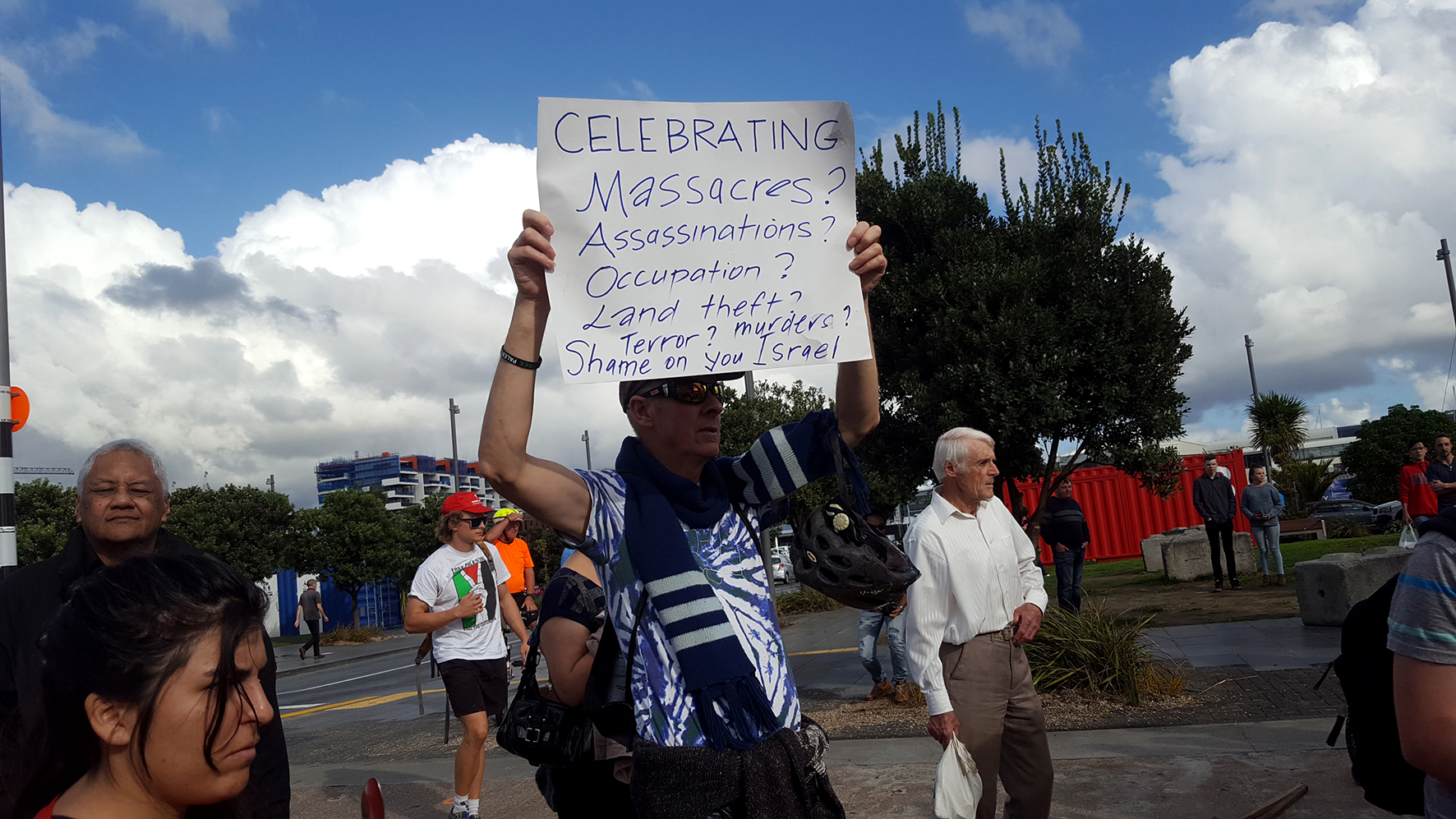
“Sisters, brothers, comrades and friends, Gaza is under siege, their people are dying in droves, their children are denied the most basic human rights,” he told a rally of about 400 people protesting in Auckland’s Aotea Square in support of Palestinian human and land rights.

In the last 10 years of blockade, thousands of Palestinians had been killed by a “deliberate Israeli campaign of starvation, dehumanisation and disempowerment”, the author said.

Dr Baroud, in New Zealand on a tour to promote his new book, The Last Earth: A Palestinian Story, also spoke about the Palestinian holocaust caused by the Israelis, which was seldom fairly reported by mainstream media.

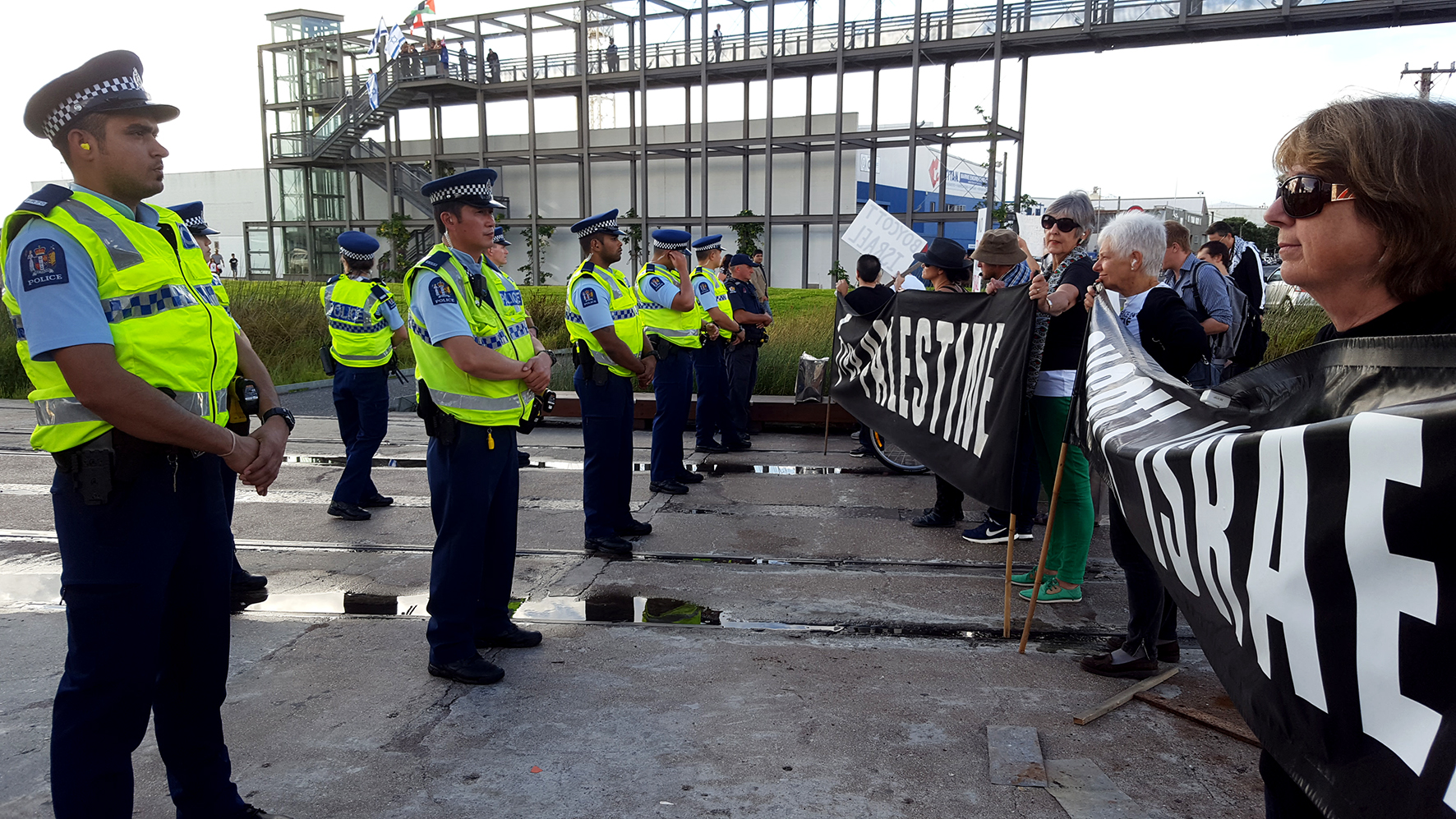
Protesters at the human rights for Palestine protest in Auckland today. Image: Rahul Bhattarai/PMC

The UN Human Rights Council yesterday voted to assign international war crimes investigators to probe last Monday’s killings of scores of Palestinians on the bloodiest day of protests in Gaza.

The resolution was supported by 29 countries, with only the US and Australia voting against. Fourteen countries abstained, including Britain and Germany.

-Partners-

Boycott sought
Middle Eastern Eye reported that 110 Palestinians had been killed in recent weeks in a report about the UN investigation.

Holding the protest in Auckland was an attempt to gain support from the NZ government, “to impose a boycott in their [Israeli] regime, on its economy, and on its political representation,” said Mike Treen, a spokesperson for Global Peace and Justice Auckland (GPJA).

Mike Treen speaking at the Auckland rally for Palestine today. Image: Rahul Bhattarai/PMC

The protesters then marched down Queen Street towards the US Consulate near Britomart chanting slogans such as, “From the river to the sea, Palestine will be free”, “Freedom for Palestine”, and “Long live Palestine”.

About 60 Palestinian men, women, and children were killed by Israeli Defence Force (IDF) troops during protests over the US moving its embassy to Jerusalem from Tel Aviv. Guatemala followed suit the next day.

May 14 marked the 70th year since the state of Israel was established.

That was a day of celebration for Israelis and Zionists but mourned by indigenous Palestinians as Al Nakba – “the catastrophe”, the day they lost their liberty.

A young Palestinian woman raises a fist in defiance at the Auckland rally. Image: Del Abcede/PMC

US embassy ‘wrongdoing’
In his speech, Dr Baroud spoke about the wrongdoings of the rightwing Israeli government and the Trump administration for moving the US embassy to Jerusalem.

Jerusalem is heavily disputed and highly controversial as it is regarded as sacred land by both the Jews and the Muslims.

Dr Baroud said the reason for global trip was to reclaim the Palestinian narrative, “an attempt at retelling Palestinian history from the viewpoint of Palestinian refugees”.

Since most mainstream media focused on the Israeli narrative rather than the “Palestinian facts”, he wanted to tell the story exactly as it was happening on the Gaza Strip.

Dr Baroud said many historians focused on Palestinian’s history through the “eyes of Israel, the Zionists and through the Western media”.

‘Central narrative’
This was the “central narrative” of this conflict between Zionists and Palestinians which needed to be re-taught, he said.

Dr Baroud also said that the long-term solution to resolve the conflict was to end Israeli colonisation of Palestine that had continued for decades.

“This system of apartheid, system of military occupation, has to end.”

According to UN resolutions, there were four key points that the Israeli government needed to follow – “the right of return of the Palestinian refugees, Palestinian freedom to travel, and an end to the apartheid system, and demolition of the apartheid wall.

“And the racist laws that have targeted Palestinians for over 50 years need to end.”

Dr Baroud said the occupation needed to come to an end in order for there to be a prospect of peaceful co-existence in the future.

The apartheid of colonisation had to be dismantled.

A Palestinian family at the Auckland solidarity rally today. Image: Del Abcede/PMC Palestinian children proudly hold up their flag in the rain at Auckland’s Aotea Square today. Image: Del Abcede/PMC
Print Friendly, PDF & Email

Article by AsiaPacificReport.nz

]]>

Jale Moala: Fiji’s longest day – George Speight and the march of madness

]]>

BRIEFING: By Jale Moala in Port Moresby

MAY 19, 2000: As editor of the Fiji Daily Post newspaper in Suva, I was expecting some big stories that day but nothing like what happened – today, 18 years ago. A march by radical indigenous Fijians had been planned and Parliament was sitting, with an Indo-Fijian Prime Minister leading the government benches.

My news editor and I made sure we had everyone in place, then went for breakfast.

Back in the newsroom I was told the march was getting violent and continuing on to Parliament, which got me worried. I quickly drove to pick up the children and, after seeing them home safely, returned to work, knowing for sure that I wasn’t going to be home for dinner.

Fiji had crashed into another coup, this time led by a man called George Speight and rogue soldiers from the Fiji Military Forces’ elite Counter Revolutionary Warfare Unit (CRWU).

There was an eerie calm in the newsroom, almost like the lull before a storm with people seeming to be expecting something bad to happen but pretending to be going about a normal day.

I quietly disappeared into the tearoom to make coffee. The sound of breaking glass brought me out and I said to myself, perhaps someone has broken something.

-Partners-

From my experience of past coups in Fiji I knew that there was always going to be violence no matter how much the coup perpetrators tried to paint over their actions using a noble brush.

Two sides
There were always two sides to the argument and one side was always going to get hurt, but even then I had not expected to see what I saw that day, with the situation deteriorating as quickly as I was seeing.

In a matter of minutes, maybe a short 30 minutes or less since I returned to the newsroom, our part of Suva had turned from nothing much to a seething, angry pit of senseless violence — all in the time it took to make a cup of coffee.

Hundreds of people, maybe a thousand even, I don’t know, filled the streets below our second-floor vantage point.

Shops were burning and men and women were smashing through glass windows and doors and looting every shop on the streets below.

A group of men led the way, breaking through doors and windows then moving on, allowing the throng behind to get in and take as they pleased in a free-for-all scramble for anything that could be carried away – TVs, shoes, clothes, stereo sets, food, anything.

There was cursing and shouting and the noise was deafening and frightening. The sound of breaking glass would haunt me for months after that.

Indo-Fijians had abandoned the city and fled for their lives, and many who had been unable to leave had gone into hiding in back rooms and anywhere, leaving their business at the mercy of this maddest march of madness; a few Indo-Fijians drove by still trying to get out, and some of them were forced to stop, dragged out of their car and assaulted.

I was really scared
I was scared, really scared, especially for the Indo-Fijian members of our staff. Our financial controller was Indo-Fijian, and a big man too, but when he came up to me in the newsroom and put out his hand, I knew he was afraid for his life and when I held his hand I felt him trembling.

Indo-Fijian members of the staff, especially women, like my young reporters, fresh out of university, had crawled under desks, crying, “I don’t want to die, I don’t want to die”.

Our newsroom was quickly turning into a sanctuary, too, with owners of shops and anyone nearby who had been slow to leave the city, seeking safety there. We called the police several times but no one came.

Our marketing manager, Lionel Heffernan, was a big man ­– strong — a farmer on his days off, and he walked up the stairs into the newsroom armed with a crowbar, presenting me with the first sign of a willingness to fight back.

We knew we had to do something, we had to protect our staff. We called all our indigenous Fijian staff members and briefed them and together we walked downstairs in silence.

Our offices were down a short alleyway and accessible only from the front, from the main street where the burning and looting were taking place.

Stood together in defiance
We closed the grill gate and everyone of us, men and women, stood together in defiance, completely blocking any access to our offices, and thereby providing as much protection as we could to those on the second floor.

Heffernan stood beside me, the crowbar clearly visible in his hand, saying words of encouragement.

There were men and women beside me with far more courage and strength than I could ever muster in several lifetimes and without them the outcome would have been very different. But the weak and the strong and the older and the young, we stood together that day, indigenous Fijians facing up to indigenous Fijians, until the sun started to go down and soldiers arrived to set up roadblocks and empty the streets.

Police Commissioner Isikia Savua and his officers finally turned up in a pointless show of useless force after the damage had been done and no one was about. Suva was already in ruins.

It was too dangerous after that to put out a newspaper, so we cancelled that night’s edition and, using only indigenous Fijian drivers, dropped everyone home, including those who had come off the street to seek safety.

As a journalist it is my job to report and not to judge but the events I witnessed that day affected me in ways that would swing me to one side and keep me there for a long time.

George Speight … jailed for life. Image: File

Terrorist act
That day was not political. It was a criminal and terrorist act and I decided that from then onwards our coverage of George Speight and the events that would follow would focus on terrorism, even though I knew that the course I was taking would bring me into a collision course with the terrorists themselves, some of whom I knew well, including Speight himself.

Finally darkness enveloped Suva and I got into the car and left. At home, my wife Maureen had used the beds to barricade the windows and put the children and everyone else to sleep on the floor in the hallway.

I walked in and hugged and kissed her then went down on my knees and kissed all our children and all the other children on the forehead.

Then I sat down and cried. A month later to the day, on June 19, 2000, I walked into The Southland Times newsroom in Invercargill, New Zealand, and signed on as a subeditor.

Jale Moala, one of Fiji’s most experienced and talented journalists, is currently night editor of The National daily newspaper in Port Moresby, Papua New Guinea. George Speight is currently serving a life sentence in prison for treason.

Print Friendly, PDF & Email

Article by AsiaPacificReport.nz

]]>

Justice Rajasinghe to deliver Fiji Times sedition trial verdict on Tuesday

]]>

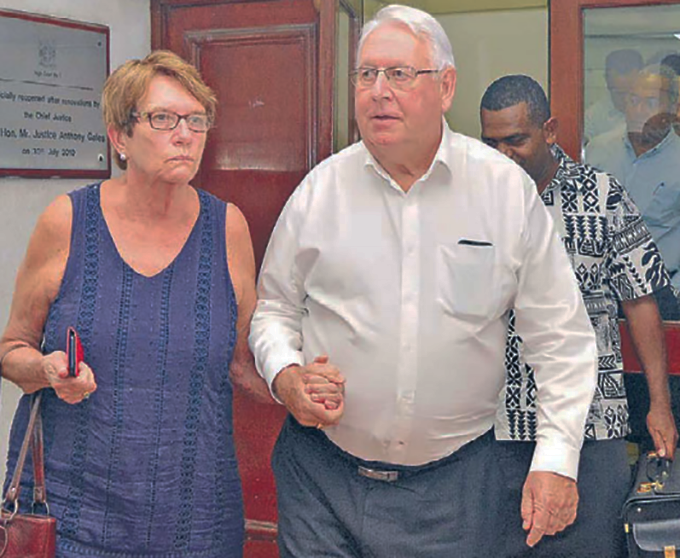
Holding on … The Fiji Times publisher Hank Arts and his wife leave the High Court in Suva yesterday. Image: Jovesa Naisua/Fiji Times

By Litia Cava in Suva

High Court judge Justice Thushara Rajasinghe is set to deliver his verdict on Tuesday after the three assessors returned with a unanimous not guilty opinion against three senior management and editorial staff of The Fiji Times daily newspaper, a letter writer and the Fiji Times Ltd yesterday.

After three weeks of trial, Justice Rajasinghe will decide on whether the alleged seditious article that was published in Fijian language Nai Lalakai newspaper on April 27, 2016, was seditious and if it had an intention to cause feelings of ill will and hostility between different classes of the Fijian population:

  • The Fiji Times editor-in-chief Fred Wesley together with Nai Lalakai editor Anare Ravula are each charged with one count each of aiding and abetting the publication of a seditious  article,
  • Fiji Times Ltd publisher Hank Arts is charged with one count of publishing a seditious article in Nai Lalakai;
  • Letter writer Josaia Waqabaca is charged with one count of submitting for publication an article written by him with a seditious intention, and
  • Fiji Times Ltd is charged with one count of printing a seditious publication.
  • All pleaded not guilty.

READ MORE: The Fiji 4 – the case that tests press freedoms

The four accused with their lawyers outside the High Court in Suva yesterday. Image: The Fiji Times

While summing up the case, Justice Rajasinghe reminded the assessors that their main task was to assess and evaluate the evidence that was provided by all witnesses and to determine its credibility, reliability and truthfulness.

Fiji Village reports that Justice Thushara Rajasinghe told the assessors to read the Nai Lalakai article from the minds of reasonable and fair minded iTaukei readers.

He told the assessors to take into consideration under what circumstances the article was published and to consider the reaction of the readers.

-Partners-

Fiji Village’s report on YouTube.

Justice Rajasinghe told the three that he did not find the opinion of Permanent Secretary for iTaukei Affairs, Naipote Katonitabua, and linguist Professor Paul Geraghty would be much help to the assessors. Dr Geraghty had said that he did not have much interaction with the iTaukei community for the last 10 to 15 years as he was mainly teaching, while Katonitabua had said that he used to talk to the iTaukei community at times.

The judge told the assessors to consider the truthfulness of the answers given in the caution interview.

Litia Cava is a Fiji Times journalist.

Print Friendly, PDF & Email

Article by AsiaPacificReport.nz

]]>

Fiji Times sedition trial assessors give unanimous ‘not guilty’ opinion

]]>

The Fiji Times editorial and management team with their lawyers await the trial assessors’ opinions on the High Court steps in Suva tonight. Pictured in front are letter writer Josaia Waqabaca, Fiji Times publisher Hank Arts, Fiji Times editor-in-chief Fred Wesley, and Nai Lalakai editor Anare Ravula. Image: Timoci Vula/Fiji Times

By Talebula Kate in Suva

The three assessors in The Fiji Times sedition trial tonight returned a unanimous not guilty opinion on all counts.

They found Fiji Times publisher Hank Arts not guilty for the charge of publishing a seditious article in Nai Lalakai, a letter to the editor on April 27, 2016.

They also found Nai Lalakai editor Anare Ravula and Fiji Times editor-in-chief Fred Wesley not guilty for having aided and abetted the publication of a seditious article.

Letter writer Josaia Waqabaca was also found not guilty for the charge of submitting for publication an article written by him with a seditious intention, while the Fiji Times Ltd which was charged for printing a seditious publication was also found not guilty by the assessors.

High Court judge Justice Thushara Rajasinghe will deliver his judgment next week on Tuesday.

Talebula Kate is a Fiji Times reporter.

Print Friendly, PDF & Email

Article by AsiaPacificReport.nz

]]>

Kilauea volcano ash rains down on Hawai’i with more blasts predicted

]]>

USGS geologist Michelle Coombs giving a status update about Hawai’i’s Kilauea volcano. Video: USGS

Pacific Media Centre Newsdesk

Scientists are predicting an eruption that shot ash nearly 9 kilometres into the sky could be the first of a series of powerful explosions to rock Hawai’i’s Kilauea volcano, reports SBS News.

Hawai’i’s Kilauea volcano has spewed ash nearly 9 kilometres into the air and scientists have warned this could be the first of a violent string of explosions in the crater.

“This has relieved pressure temporarily,” USGS geologist Michelle Coombs told a news conference in Hilo.

“We may have additional larger, powerful events.”

VIEW MORE: What the Mt Kilauea eruptions mean for climate change

-Partners-

Residents of the Big Island were warned to take shelter from the ash fallout as toxic gas levels spiked in a small southeast area where lava has burst from the ground since the eruption began two weeks ago, authorities said.

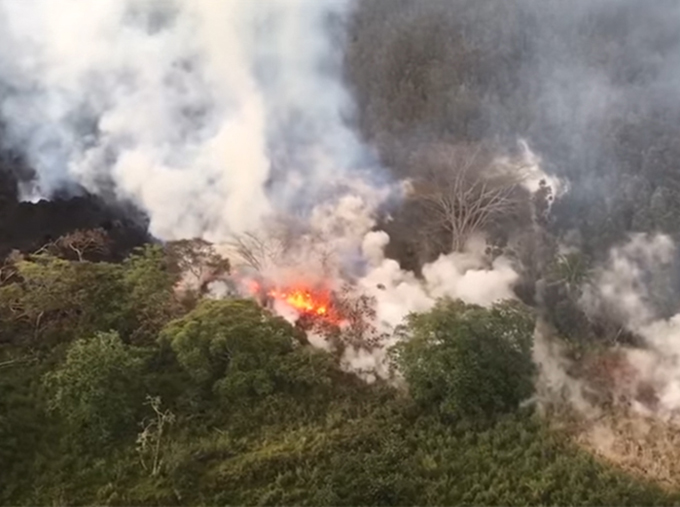
Kilaue volcano larva flow on the island of Hawai’i today. Image: USGS

The wind could carry Kilauea’s ash plume as far as Hilo, the Big Island’s largest city and a major tourism centre, the County of Hawaii Civil Defense warned in an alert.

“Protect yourself from ash fallout,” it said.

Kilauea is one of the most active volcanoes in the world and one of five on Hawai’i’s Big Island.

It started erupting on May 3, prompting some 2000 people to flee from their mountainside homes.

Geologists said the 4:15am explosion was likely to be the first in a series of steam-driven explosions last seen in 1924, rather than “the big one” that nervous residents had been fearing.

A spike in toxic sulphur dioxide gas closed schools around the village of Pahoa, 40 km east of the volcano, where fissures have destroyed 37 homes and other structures and forced about 2000 residents to evacuate, health officials said.

National guard troops were forced to put on gas masks at a nearby road intersection, according to a Reuters reporter.

USGS geologists and staff were evacuated from the Kilauea summit shortly before the blast and a webcam showed a grey plume of ash and chunks of magma known as pyroclasts that showered the volcano’s slopes.

Another massive rockfall at Halemaʻumaʻu crater is captured on camera from the Volcano Golf Course. Image: Jeff Judd/PBS
Print Friendly, PDF & Email

Article by AsiaPacificReport.nz

]]>

Newsletter: New Zealand Politics Daily – May 18 2018 – Today’s content

Newsletter: New Zealand Politics Daily – May 18 2018 – Today’s content Editor’s Note: Here below is a list of the main issues currently under discussion in New Zealand and links to media coverage. [caption id="attachment_297" align="aligncenter" width="640"] The Beehive and Parliament Buildings.[/caption] Below are the links to the items online. The full text of these items are contained in the PDF file (click to download). Budget Guyon Espiner (RNZ): Budget 2018: A ‘triumph of neoliberalism’ Tracy Watkins (Stuff): Labour unveils a National-lite Budget Bernard Hickey (Newsroom): Comment: The biggest missed opportunity in a generation Bernard Hickey (Newsroom): Budget 2018: Tighter than it looks Newshub: Budget 2018 doesn’t go far enough; Govt should drop rules – Bernard Hickey Rod Oram (Newsroom): Budget 2018 a patch-up job Matthew Hooton (Herald): Odd priorities in times of plenty Dene Mackenzie (ODT): Most gain, but minister too cautious Colin James (ODT): First Budget ‘hardly transformative’ Bryce Edwards (ODT): Budget doesn’t go quite far enough John Armstrong (1News): Budget went some way to meeting Labour’s unrealistic election promises Richard Harman (Politik): Applause for the Budget Gordon Campbell: On Budget 2018 Audrey Young (Herald): Not the sort of budget to get you dancing or raging against Audrey Young (Hearld): Jacinda Ardern was right about the Budget – not boring but not exciting Barry Soper (Newstalk ZB): Labour’s first Budget keeps on giving Barry Soper (Newstalk ZB): The Budget that didn’t tell us anything we didn’t already know Press Editorial: No alarms and few surprises in Robertson’s first Budget ODT Editorial: Budget sets tone for future Claire Trevett (Herald): Budget 2018: Mixed verdicts on Labour’s ‘no-pizzazz’ Budget Jane Patterson (RNZ): Budget 2018: Is Robertson saving his firepower? Liam Dann (Herald): Subtle vision requires bold sales job Brian Fallow (Herald): Budget scrum an even contest Jane Clifton (Stuff): The surprise has gone, but at least we got a new script Henry Cooke (Stuff): Budget 2018: Robertson brings in light-blue Budget with red, green, and black lamingtons Jenna Lynch (Newshub): The Greens got shafted Isaac Davison (Herald): Budget 2018: Greens defend share of wins after NZ First gets triple the cash Spinoff: Budget 2018: the great Spinoff hot-take fry-up 1News: Analysis – Budget 2018: 1 NEWS’ Jessica Mutch and Simon Dallow break it down – ‘A little bit flat’ Sam Sachdeva (Newsroom): Foodie flair, but bland Budget on Robertson’s big day Tova O’Brien: Labour delivers a ‘Good Start Budget’ Newshub: Budget 2018: ‘There’s so much more to do’ – Newshub’s politics team Herald: Three views on Budget 2018 – Dame Tariana Turia, Sue Bradford, Ben Thomas Duncan Garner (Newshub): Mr fix-it drowning in cash, so why the broken promises? Mark Sainsbury (Newshub): This Budget was designed to soothe the worriers Max Rashbrooke (Stuff): Budget shows a government that has found only half its mojo Donal Curtin: Surprises are over-rated Eric Crampton (Stuff): Budget: The good, the bad and the risky Joseph Cederwall (Scoop): Budget 2018 – Foundations for the distant future? David Farrar: Budget 2018 No Right Turn: A downpayment Budget  – Government and opposition view Tracy Watkins (Stuff): Budget 2018: Like all good things, transformation takes time – Jacinda Ardern Stuff: Budget 2018: Prime Minister Jacinda Ardern defends the 2018 Budget Stuff: Opposition leader Simon Bridges attacks Government’s 2018 Budget Sophie Bateman (Newshub): Prime Minister Jacinda Ardern rates her first Budget Emma Hurley (Newshub): Winston Peters’ bizarre rating, name for Budget 2018 1News: ‘I think he’s done a pretty damn good job’ – former Labour Minister Michael Cullen on Budget 2018 RNZ: Opposition heaps criticism on ‘epic fail’ Budget Isaac Davison (Herald): Budget 2018: Govt has ‘pulled anchor’ on economy – National Budget – Summaries Herald: Budget 2018’s greatest hits: Everything you need to know Grant Duncan, Christoph Schumacher, Martin Berka and Nicolette Sheridan (The Conversation): NZ budget 2018: gains for health, housing and education in fiscally conservative budget Craig McCulloch (RNZ): Budget 2018: Money for health, housing, schools Eleanor Ainge Roy (Guardian): New Zealand ‘people’s’ budget sees Ardern put billions more into health and education Stuff: Budget 2018 by the numbers: Who’s getting what Stacey Kirk (Stuff): Budget: Winners and losers of the Government’s first budget Chris Knox (Herald): Budget 2018: Winners and losers by the numbers Newshub: Budget 2018: The big winners and losers Claire Trevett (Herald): Grant Robertson’s Budget 2018: At a glance – what you need to know Budget – Revenue and expenditure Hamish Rutherford (Stuff): A booming tax take is clearing the way for Grant Robertson to hit the targets Jonathan Underhill (BusinessDesk): Budget 2018: Grant Robertson finds $24 billion extra spending Thomas Pippos (Herald): Budget 2018: The gift that keeps on giving – our economy Hamish Rutherford (Stuff): Budget 2018: Treasury beds in rising tax take, giving Robertson room to add billions in the future Tom Pullar-Strecker (Stuff): Budget 2018: Tax crackdown to raise $183 million over four years Patttick Smellie (BusinessDesk):Budget 2018: Rising wages to push people into higher tax bracket, yielding Govt $5.7b Terry Baucher (Interest): Crunching the tax news – going into the 2020 election is when we might see changes in tax thresholds RNZ: Budget 2018: The fiscal nitty-gritty Dan Satherley (Newshub): Government’s promises can’t be kept without raising taxes – Chris Trotter Budget – Health Thomas Coughlan (Newsroom): Budget 2018: Plugging the health gaps Stacey Kirk (Stuff): Budget 2018: Free and cheap doctors visits for vulnerable and children, but is the health funding enough? Jo Moir (Stuff): Health the big winner in Labour-NZ First Budget Chris Bramwell (RNZ): Budget 2018: Health spending more conservative than forecast Stuff: Budget 2018: What you need to know about the health boost Lucy Bennett (Herald): Budget 2018: DHBs get a big boost Emily Ford (Stuff): Budget 2018 brings hope for beleaguered Middlemore Hospital, DHB chairman says Emma Russell (Herald): Budget 2018: Doctors under the pump after cheaper access announcement Emma Hatton (RNZ): Cheaper GP visits will need publicity – medical centre Lucy Bennett (Herald): Budget 2018: Pharmac to buy all medicines for DHBs Te Aniwa Hurihanganui (RNZ): Budget 2018: ‘Kick in the guts’ for Whānau Ora Emma Russell (Herald): Funding boost into fixing hospitals: ‘only scratches the surface’ Damian George (Stuff): Health sector welcomes renewed Government investment following Budget announcement Herald: Govt rejects claim by National that its boost to health funding was larger Ben Uffindell (The Civilian): Budget 2018: Labour to pass increased cost of health onto Mark Richardson Budget – Education Simon Collins (Herald): Budget 2018: Relief for schools and preschools, but what’s happened to the promises? Simon Collins (Herald): Schools welcome operational funding boost but disappointed in lack of money for new teachers Karoline Tuckey and George Heagney (Stuff): Budget 2018: Teachers could walk, principal warns following lukewarm education slice Adele Redmond (Stuff): Teachers and unions disappointed by Budget education calls Jo Moir (Stuff): Budget 2018: Schools to get only a small rise in operational funding Herald: Budget 2018: Schools, early childhood centres get small increase John Gerritsen (RNZ): Budget 2018: Multi-million boost for special education Shane Cowlishaw (Newsroom): Budget 2018: Education a winner Lynn Grieveson (Newsroom): Budget 2018: Boost for learning support Herald: Budget 2018: Māori education and training in focus Budget – Children Tess Nichol (Herald): Budget 2018: Focus on child poverty with extra funding for new reduction units, Oranga Tamariki Tess Nichol (Herald): Budget 2018: Moves to end child poverty welcomed, but advocates say beneficiaries let down Tess Nichol (Herald): Budget 2018: Funding for vulnerable children receives mixed response Idealog: Budget 2018: As the goalposts shift towards wellbeing, here’s what the Government plans on doing to address child poverty Tess Nicol (Herald): Budget 2018: Relief for KidsCan as more funding comes through Budget – Housing Tess Nichol (Herald): Budget 2018: Good start but more needed to address housing crisis and child poverty, say Sallies and Union Jackson Thomas and Chris Harrowell (Auckland Now): Budget 2018: More homes but still not enough, Salvation Army says Mānia Clarke (Māori TV): State housing funding not enough David Slack (RNZ): Budget 2018: Betting the house on real economic change Pattrick Smellie (BusinessDesk): Budget 2018: Treasury halves forecast progress on KiwiBuild Jenée Tibshraeny (Interest): Government to borrow to build 5,000 new public houses over four years; Keeps cost projections for KiwiBuild the same Thomas Coughlan (Newsroom): Twyford borrows big to build Thomas Coughlan (Newsroom): Budget 2018: Twyford’s partial win Ben Leahy (Herald): Budget 2018: New housing funding praised, but industry figures urge Govt to act fast Anne Gibson (Herald): Budget 2018: KiwiBuild outlook disappoints but Twyford hits back Jackson Thomas (Stuff): Budget 2018: KiwiBuild will help steady Auckland housing market, experts say Henry Cooke (Stuff):Budget 2018: Government promises 6400 new state and social houses Isaac Davison (Herald): Budget 2018: 1600 more state houses to be built each year Anne Gibson (Herald): Budget 2018: 6400 new state homes, Judith Collins says ‘disappointing Budget – Law and order Isaac Davison (Herald): Budget 2018: Corrections gets boost to cope with fast-growing prison population Shane Cowlishaw (Newsroom): Budget 2018: Waikeria prison on hold Anna Leask and Sam Hurley (Herald): Budget 2018: Age for youth justice system increases to 17 to ease remand population Anna Leask (Herald): Budget 2018: $300m boost for police ‘commended’ by association Budget – Environment Henry Cooke (Stuff): Budget 2018: Largest boost to DoC since 2002 leaves Green Party smiling Jamie Morton (Herald): Environment: ‘greenest Budget ever’ says James Shaw Isaac Davison (Herald): Budget 2018: More money for predator control, biodiversity and green projects Budget – Immigration Lincoln Tan (Herald): Budget 2018: $34m to tighten screening of migrants coming to NZ Lincoln Tan (Herald): Budget 2018: Labour Inspectorate gets $8.8m boost for more inspectors Madison Reidy (Stuff): Immigration granted a $138m wish in Budget to end ‘outright slavery’ Budget – Defence Sam Sachdeva (Newsroom): Budget 2018: Defence wins, and loses Kurt Bayer (Herald): NZDF gets $360m funding boost, with extra $40m going to modernization Budget – Broadcasting Russell Brown (Public Address): Budget 2018: The broadcasting shambles Mark Jennings (Newsroom): RNZ’s big move muted by budget Tom Pullar-Strecker (Stuff): No payday yet for RNZ from Labour Budget Sam Sachdeva (Newsroom): Budget 2018: RNZ boost in limbo Damien Venuto (Herald): Budget 2018: Media allocation falls short of $38M promise, Curran says more to come Budget – Canterbury rebuild Kurt Bayer (Herald): Megan Woods announces Canterbury’s rebuild to get $300m “shot in the arm” Herald: Budget 2018: Christchurch gets money for insurance tribunal, public inquiry and anchor projects Stuff: More money for Canterbury earthquake recovery Budget – Regions Melissa Nightingale (Herald): Wellington mayor Justin Lester welcomes Budget 2018 Collette Devlin (Stuff): City Mayor says Budget 2018 will complement Wellington’s work for homeless John Milford (Stuff): Better luck next time for Wellington Danielle Clent (Stuff): Has Budget 2018 delivered for Aucklanders? Harrison Christianson (Stuff): Budget 2018: ‘Smoke and mirrors’ on Auckland inequality Auckland Now: Budget 2018: ‘No surprises’ for transport in Auckland Budget – Sport Stuff: Budget 2018: Government announce $100 million ‘support package’ for America’s Cup Bernard Orsman (Herald): $100m for America’s Cup in Budget Tom Pullar-Strecker (Stuff): NZ First gets tax change for race horse investors through the gates Budget – Research and development Jamie Morton (Herald): Budget: Few surprises in Govt’s science and tech spend BusinessDesk: Budget 2018: Productivity Commission to investigate impact of disruptive tech Paul McBeth (Herald): Budget 2018: Govt sets aside $1b for tax rebates for research and development Greg Thompson (Spinoff): Budget 18 is stuck in the present. We need investment in innovation for the future Budget – Other Tess Nichol (Herald): Budget 2018: Government is failing beneficiaries, advocates say Herald: Budget 2018: Disappointment that Budget didn’t deliver cheaper fruit and vegetables BusinessDesk: Budget 2018: New watchdogs for election spending promises, RMA, and EQC disputes Aimee Shaw (Herald): Budget 2018: Little on offer for small business Jamie Gray (Herald): Budget 2018: Spending on M.Bovis could be too low – Fed Farmers Guy Trafford (Interest): Budget 2018 was a boring-as-usual effort offering little new direction for the rural community Eleanor Ainge Roy (Guardian): New Zealand finance minister in pre-budget food fight after opting to eat cheese roll Russell Brown: Budget 2018: The final tick Employment Mike Treen: Wage and time theft endemic – and could get worse RNZ: Auckland Council underpaid 17,500 staff Madison Reidy (Stuff):‘Pay staff properly’ – minister’s message to retailers accused of not paying staff 1News: People on ‘very low wages’ not always aware of their employment rights, ‘taken advantage of’ by employers – union Andrew Bevin (BusinessDesk): Briscoe to reimburse staff for unpaid end-of-day cash-up Madison Reidy (Stuff):Cotton On launches company inquiry into unpaid work Aimee Shaw (Herald): Cotton On Group to review its paid work practices, as tide of complaints swells to 1,500 RNZ: Desperate staff working for free but ‘it’s not really consent’ Nikki Mandow (Newsroom): More battles loom after Smiths City ruling RNZ: Site pulls down controversial ads below minimum wage RNZ: Barring migrant workers from joining union ‘a mistake’ Greg Lloyd (Spinoff): Where is the outrage over contracts banning workers from joining a union? Stuff: North Island unemployment rate worse than the South Island Kyle MacDonald (Herald): Women and young people most stressed in work place International relations and trade Max Harris and Oliver Hailes (Spinoff): Parliament must ensure we don’t sign away values for trade Martyn Bradbury (Daily Blog): Guess who’s back? Back Again? The Saudi Sheep Bribe is back – tell a friend No Right Turn: The gift that keeps on giving RNZ: Cooks opposition questions Chinese presence ahead of election Personal finance Rob Stock (Stuff): KiwiSaver is an accidentally racist savings scheme RNZ: Clients told to question financial advisors on bonuses Government Shane Cowlishaw (Newsroom): Government: ‘Hold your horses’ on transparency RNZ: Parliament flies rainbow flag Megan Gattey (Stuff): New Zealand becomes the first country to fly intersex flag at Parliament Karl du Fresne: The bottom-feeders and mischief-makers who infest the fringes of politics Primary industries Gia Garrick (RNZ): Farm debt bill passes first reading Jill Galloway (Stuff): Government body to decide on treatment or eradication of Mycoplasma bovis in the next two weeks Immigration Graham Adams (Noted): When will Phil Goff get to the heart of Auckland’s immigration woes? Gill Bonnett (RNZ): Immigration NZ tries to catch foreign sex workers in the act Health Phil Pennington (RNZ): Row over water contamination in US has NZ implications Rachel Thomas (Stuff): Foreign doctors struggling to get jobs in New Zealand Rebecca Reider (Nelson Mail): No reason to delay medical cannabis Findlay Buchanan (Idealog): Calling on cannabis: Hikurangi Group on how it plans to use marijuana to grow Ruatōria from the ground up RNZ: Parents warned over new season of Netflix series Local government Simon Wilson (Herald): Grandstanding councillors aren’t helping anybody RNZ: Activist to keep house as rates revolt ends Nicole Lawton (Auckland Now): Auckland city sleeper pods in violation of by-laws is shut down RNZ: Napier council staff start leave bank for sick colleague Other Sam Sachdeva (Newsroom): Super Fund board attacks pay restrictions Emma Hatton (RNZ): Online shoppers warned over ‘buy now, pay later’ options Stuff: Ngāi Tahu board now more than 50pc women Karl du Fresne: If we start banning people of bad moral character, where do we stop? Chloe Winter (Stuff): The Warehouse Group ditches single-use plastic bags at checkouts by end of 2018 Richard Benge (Stuff): Arts in prisons a ‘vital’ social investment Derek Burrows (Timaru Herald): Why is fuel so expensive in Timaru?]]>

‘Cheated’ PNG landowners threaten to close five fish processing plants

]]>

Lae landowners have given the papua New Guinean government seven days to review existing agreements or they will close the disputed tuna fish canneries. Video: EMTV News

By Scott Waide in Lae

Landowning clans in the Papua New Guinean city of Lae are threatening to close down five fish processing plants if the government does not review the existing agreements that govern them.

The clans, which include the Ahi and the Busulum, say they have been cheated of development benefits.

Since the agreements were signed four years ago, they have received K5000 a year for the five portions of land they own.

The threat comes after three years of complicated wrangling with the government and the companies over landowner benefits.

If the landowners have it their way, Majestic Seafoods, Frabelle and three other fish processing factories will be forced to shut down next Tuesday.

-Partners-

Landowner company BUP Development is calling on the National Fisheries Authority (NFA) to review the existing agreements so that they receive more in terms of landowner benefits.

Bad deal
After four years, it has now become clear, landowners got a bad deal.

The landowners are paid a total of K5000 (NZ$2225) annually for the five land portions they leased to the companies. The deal was negotiated by the provincial administration at the start of the projects.

Apart from a K2 million (NZ$890,000) premium payment made several years ago, the landowners receive little else.

They are also not party to agreements between the state and the fish processing companies.

They also do not know what the terms of the state agreement are.

The landowner company since issued a 7-day notice to the government to come to Lae for negotiations.

They are demanding K20 million in compensation as well as a review of the memorandum of agreement they signed with the companies.

Scott Waide is EMTV’s Lae bureau chief and began his career with the television station in 1997 as a news and sports reporter and anchor. He has won several awards for his journalism. This article is republished with permission.

Print Friendly, PDF & Email

Article by AsiaPacificReport.nz

]]>

PNG cellphone users given new SIM card registration reprieve

]]>

Digicel staff members register customers at a temporary stand while others wait in Port Moresby. Image: Amanda H A Watson/Devpolicy Blog

By Amanda Watson

Papua New Guinea’s Communications Minister Sam Basil has decided to extend the deadline for mobile phone subscriber identity module (SIM) card registration by more than two months – to July 31.

This will give more time for citizens to register their mobile phones, thus ensuring that they are able to make phone calls, send and receive texts messages, and so on, after the new deadline is reached.

According to Loop PNG, Digicel, which has the bulk of the customers in the country, has registered more than 1.4 million subscribers. This leaves roughly 1.1 million subscribers on that network who are still to register.

READ MORE: Compulsory SIM card registration in Papua New Guinea

Digicel has been offering incentives to customers to register, such as free air time.

The other two telecommunication companies are also continuing to register their customers, and attempting to inform customers about the need to register through radio advertisements and other means.

-Partners-

Various countries have introduced mandatory SIM card registration.

In neighbouring Indonesia, the deadline was February 28, 2018, and then more than 100 million SIM cards were partially blocked, before a further deadline of April 30, 2018.

In that case, registration could be done online, through text messaging, at a call centre, or in person.

No identification database
However, in Papua New Guinea, people need to register in person as the country does not have an identification database.

Mobile phone users in PNG need to visit a store or an agent and have their photograph taken as part of the registration process.

According to The National daily newspaper, the devastating earthquake that hit several Papua New Guinean Highlands provinces in February, was one reason why the minister decided to further extend the registration deadline.

The initial deadline was on January 23, but this was extended to April 30.

Threatened deactivation of SIM cards on that day did not go ahead due to a court injunction, which is no longer in place.

The telecommunications regulator NICTA says its action is a necessary step in the process of registering mobile phone users in order to address harassment through anonymous text messages and phone calls, sharing of unwanted pornographic images, and other abuse of mobile phone services.

Dr Amanda H A Watson is a lecturer at the Development Policy Centre of the Crawford School of Public Policy, Australian National University (ANU), and a visiting lecturer in public policy at the University of Papua New Guinea (UPNG) as part of ANU’s partnership with UPNG. She is also an occasional contributor to Asia Pacific Report.

Print Friendly, PDF & Email

Article by AsiaPacificReport.nz

]]>
Tong Sang voted in as new French Polynesia assembly president

]]>

Territorial President Gaston Tong Sang … elected two months after being given a one-year suspended jail sentence for abusing public funds. Image: RNZ Pacific

French Polynesia’s Territorial Assembly has elected the ruling Tapura Huiraatira party’s Gaston Tong Sang as its new assembly president for a five-year term, reports RNZ Pacific.

He secured the support of the 38 Tapura members, who have two-thirds of all seats in the chamber.

His election comes two months after he was given a one-year suspended jail sentence and a fine of $US20,000 for abusing public funds.

The conviction related to his actions as president in the previous decade when he led the To Tatou Aia Party.

Gaston Tong Sang remains the mayor of Bora Bora.

The only other candidate in the election was the Tahoeraa Huiraatira’s Teura Iriti.

Iriti had been a member of the French Senate for several months until a French court annulled her election three years ago because a march by her party’s supporters to the polling station on election day was deemed to amount to undue pressure.

Print Friendly, PDF & Email

Article by AsiaPacificReport.nz

]]>

Tony Alexander’s Weekly Economic Analysis Overview 17 May 2018

]]>

Economic Analysis by Tony Alexander. [caption id="attachment_11363" align="alignleft" width="150"] Tony Alexander, BNZ chief economist.[/caption] In this week’s Overview we take a quick look at the Budget then examine data showing the types of jobs showing strongest growth in numbers in recent years. We then correlate population growth projections with recent construction surges to see if any regions might have got a bit ahead of themselves. We finish off with thoughts regarding the temporary worries about investors pulling back from housing offset against the relentless growth in the housing shortage. EDITOR’S NOTE: For the full analysis report including graphs and data, go to: www.TonyAlexander.co.nz Not A Pre-Election or Reformist Budget The new Finance Minister Grant Robertson released his first Budget today and it was fairly much as expected. The fiscal numbers look good with a string of reasonable surpluses causing the net debt to GDP ratio to slowly decline below the targeted 20% within four years. This leaves headroom for extra spending in future budgets as long as the economy stays strong. The economic projections look reasonable and it would take a shock scenario to seriously threaten the fiscal outlook. There is a noticeable dearth of solid key measures actually announced in the Budget. Instead there are numerous statements of how things will be different going forward, and hefty increases in funding for health, education, housing, and infrastructure. There will be a new research and development expenditure tax deduction but beyond that little of direct relevance to the business community. From a traditional restrictive economic and fiscal analysis point of view it was boring. The Budget’s focus however is largely on allocating higher spending aimed at catching up the many groups of people who have been left behind by the firm performance of the economy in recent years. There is nothing jumping out suggesting that announcements in the Budget will provide any impediment to the good growth outlook which we have. The challenge for the new government will be meeting the aspirations of the various sectors and pressure groups seeking and/or receiving more funding, and ensuring the extra money is well spent. This was not a pre-election Budget, but neither was it a budget of big change which reformist governments or those needing to inflict pain to get fiscal numbers under control typically implement straight after being elected. The government has inherited an economy in very good shape with fiscal numbers reflecting good management through and after the GFC and effects of the Christchurch earthquakes. The new government has not come to power promising an agenda of radical economic change, much as one might think they did going by the still unusually low level of business confidence. If change is what the government intends making then the Prime Minister and other senior people have already repeatedly made it clear that this lies not so much in the field of economic management as in the social and environmental arenas. Issues like housing affordability and availability (where they will fail), the environment, access to good healthcare, the regions and infrastructure dominate. For additional information on increased spending allocations and the small number of new measures such as expanded access to the Community Services Card simply look at commentaries already readily available before this Overview went to print. Managers Galore Between the March quarter of 2013 and the March quarter of this year total job numbers in New Zealand grew by 403,000 or 18.5%. The following table shows this growth for different job types. Most growth has been for people classified as Managers and Professionals. We can look at this another way. Growth in job numbers for Managers was 19.9% more than the 18.5% for all NZ and accounted for 36.1% of all 403,000 jobs growth. Professionals grew according to their 2013 share of all jobs. All other job types under-performed to similar degrees. This tells us that the only job type growing radically different from market share is for Managers. People physically making or moving things around accounted for about 19% of all jobs growth. The Managers category is extremely wide and in the words of the statisticians “Managers plan, organise, direct, control, coordinate and review the operations of government, commercial, agricultural, industrial, non-profit and other organisations, and departments. Indicative Skill Level: Most occupations in this major group have a level of skill commensurate with the qualifications and experience outlined below. Bachelor degree or higher qualification. At least five years of relevant experience may substitute for the formal qualification (ANZSCO Skill Level 1); or NZ Register Diploma, or at least three years of relevant experience…” This helps explain why the government is trying to encourage more people to go to the university – at the cost of not rapidly boosting spending in other areas like health and homelessness. Jobs increasingly require high skills and qualifications. This does not mean university is however necessary for everyone because there are significant shortages of people in the trades sector. And the interesting thing about working in a trade is that it provides an opportunity after a few years for someone to go out on their own with the own business. Housing Last week I said we’d include Statistics NZ subnational population projections. We can run an exercise comparing projected population growth rates (vertical axis) against growth in dwelling consents issued over the past three years. As a rule we would expect to see a scattering of dots starting in the bottom left hand corner of the graph following, rising to the top right hand side. We would expect regions with high projected population growth on the vertical axis to have high growth in consent issuance measured on the horizontal axis. This is what we see by and large. Auckland has 56% projected population growth and consents have risen by 61% in the past three years. West Coast has a 7.3% projected population decline and consents have fallen 27.4%. Canterbury we can ignore because of the earthquake impact. But Nelson shows as having 19.1% projected population growth but a 9.6% fall in consents. That suggests thoughts of a housing shortage delivering price support and perhaps reinforces our positive interpretation of Nelson listings and asking price data discussed here two weeks ago. But look at the other end of the spectrum. Bay of Plenty has seen an 87% jump in consents but population growth from 2013-43 of 26% is projected. Northland and Manawatu-Wanganui also stick out. Northland has projected population growth of 19.4% but consents have soared 73.3%. Manawatu-Wanganui has population growth projected at 7.1% but consents have jumped 56%. Marlborough perhaps has overcooked itself as well. This analysis cannot much guide us toward estimates of shortages or housing excess supplies. But it can deliver to us a suggestion as to which parts of the country over the past three years could have got ahead of underlying demand growth with their construction surge. And maybe the most relevant way that manifests itself is a recommendation to buyers looking at these areas to not be in a hurry. Just as there are developments falling over and no longer stacking up funding-wise and cost-wise in Auckland, some already completed developments in some regions may not attract the buyer demand which had been anticipated. Every Week A Bigger Shortage Back to Auckland, discussion continues regarding the impact of the new government’s planned ending of using losses to offset tax bills from other work (ring-fencing), legislation favouring tenants, banning foreign buyers and so on. There is a common view that these anti-investor changes will fundamentally change the economics of the housing market and improve affordability through containing prices over an extended period of time. Such a view however will almost certainly prove wrong in the face of the strong underlying dominant driving forces which we have long emphasised here and elsewhere. Population growth is strong in Auckland. Every week on average an extra 800 people boost the population and need to find homes. But growth in dwelling supply has not kept up with growth in demand and whatever one’s estimate of the dwelling shortage was in 2012 or any year since, it is now bigger. The shortage will continue to get bigger in the next few years, especially because rising construction costs and council compliance red tape and delays are pushing some builders out of the sector, and because resources are in short supply. Each week there is a bang, bang, bang noise from extra housing demand. But for now the noise is covered up by ears tuned only to worries and expectations about what investors will do. Eventually however we will see that the number of investors quitting their assets is much smaller than people seeking cheaper housing want. When that realisation kicks through people will hear the persistent weekly banging again from a growing queue of people looking for something to buy. Eventually we will get a new price response. If the focus on some unhappy investors goes long enough, as I suspect it will, we will see the Reserve Bank ease LVR rules a little bit more. Such easing has become marginally more probable as a result of last week’s more dovish than expected Monetary Policy Statement and comments from the new Governor. When will ears start hearing the banging from frustrated buyers and renters? There is no way of knowing but it could happen within 12 months. (It is interesting to sense the frustration already growing amongst government MPs and other agencies, the highlighting of the huge jump in the state house waiting list.) Trigger? Not a new interest rate cut, but perhaps revelation of KiwiBuild failure to boost construction as many hope. Perhaps collapse or closure of some builders unable to profitably manage an environment of deep regulation, bureaucracy, uncertain flows of materials and staff, and rising costs. Related to this growing queue is news this week that officials are looking at shared equity schemes by which banks or government agencies will take part ownership of a property to help young buyers into home ownership. That represents a rise in demand. That means higher prices. Where does this all end some years from now? Recognition that home ownership is an unrealistic expectation for many people until perhaps much longer in their working lives than currently desired. More legislation making long-term perhaps lifelong renting a more comfortable proposition for people. A government scheme covering landlords for damage done to rental properties by tenants or perhaps certain categories of tenants. More managed fund construction of and investment in housing perhaps with contracts to make units available to government agencies. And prices will go higher. Later. Eco101. For your guide, Treasury are forecasting that average NZ-wide house prices will rise by 2.8% in the year to June 2019 then 2% the following year, 3.4% in the year to June 2021, and 3.7% the year after that. If I Were A Borrower What Would I Do? Nothing new really apart from some strong retail spending data in the United States causing a decent jump in ten year US government bond yields above 3%. This might place some mild upward pressure on NZ bank fixed borrowing and therefore lending rates. If so this would be consistent with the view we have all been expressing for a long time regarding tightening US monetary policy slowly pushing NZ fixed interest rates higher.

The Weekly Overview is written by Tony Alexander, Chief Economist at the Bank of New Zealand. The views expressed are my own and do not purport to represent the views of the BNZ. This edition has been solely moderated by Tony Alexander. To receive the Weekly Overview each Thursday night please sign up at www.tonyalexander.co.nz
]]>

Newsletter: New Zealand Politics Daily – May 17 2018 – Today’s content

Newsletter: New Zealand Politics Daily – May 17 2018 – Today’s content Editor’s Note: Here below is a list of the main issues currently under discussion in New Zealand and links to media coverage. [caption id="attachment_297" align="aligncenter" width="640"] The Beehive and Parliament Buildings.[/caption] Below are the links to the items online. The full text of these items are contained in the PDF file (click to download). Budget Tracy Watkins (Stuff): Will Labour pull a rabbit out of the Budget hat? Thomas Coughlan (Newsroom): How not to budget Chris Bramwell (RNZ): What to expect from the 2018 Budget – our experts weigh in Herald Editorial: Budget should not simply boast additional spending Claire Trevett (Herald): A Budget of hand-me-down ties and slogans Laura Walters (Stuff): Budget: How the Budget came to be, and other fun facts Richard Harman (Politik): A defining Budget for Robertson and Labour Patrick O’Meara (RNZ): Budget 2018: Stronger budget surplus forecast Audrey Young (Herald): Budget 2018: The ‘blathering’ is almost over as Govt set to reveal spending plans Sue Bradford (Pundit): Budget 2018: Backing empathy with steel? Herald: Budget 2018: Sue Bradford, Tariana Turia and Ben Thomas share views on today’s Budget Brigitte Morten (RNZ): Budget day: Christmas for the beltway Mike Hosking (Newstalk ZB): Government’s tilt at a second term starts with today’s Budget Daniela Maoate-Cox (RNZ): The finance minister’s budget diary Henry Cooke (Stuff): What the Budget will bring to the housing sector: More state homes Mānia Clarke (Maori TV): Sallies say budget must include extensive state home build 1News: What the government has already promised in run-up to Budget 2018 Henry Cooke (Stuff):A look back at the ‘mini-Budget’ from December – which may steal the show from today’s one Laura Walters (Stuff): Jacinda Ardern says Budget will also help middle New Zealanders feeling the squeeze Anna Bracewell-Worrall (Newshub): Budget 2018: What we all desperately want to know Newshub: Will Thursday’s Budget be rife with broken promises? Stacey Kirk (Stuff): GPs pushing for targeted package to help access for poorest in Budget Simon Collins (Herald):Budget 2018: ‘Our outgoings are bigger than our income’ Ryan Dunlop (Herald): Budget 2018 wishes for middle class Auckland family Tess Nichol (Herald):Budget Day: High income family Jane Patterson (RNZ): Budget 2018: The future demands of Defence David Williams (Newsroom):Irrigation funding cut to spout millions Michael Hayward (Press): What might the Budget bring for Christchurch? Jason Walls (Interest): Opposition Finance Spokeswoman Amy Adams is ramping up attacks on the Government as Budget day draws closer, her latest target is tax Amy Adams (Stuff): Labour’s Budget is one of wasted opportunities Newstalk ZB: Budget 2018: Bridges ‘It’ll be a budget of broken promises’ 1News: Finger-wagging Simon Bridges and Jacinda Ardern clash over funding priorities ahead of new government’s first Budget Employment Madison Reidy and Oliver Lewis (Stuff): Union releases list of employers allegedly making staff work overtime for free Zac Fleming (RNZ): Sixteen retail chains accused of underpaying staff No Right Turn: Wage thieves Michael Morrah (Newshub): Labour hire firm employee resigns after migrant worker investigation Madison Reidy (Stuff):Immigration permit importation of 138 Chinese tradies Teuila Fuatai (Newsroom): Fly-in Chinese workers approved for Auckland hotel build RNZ: Chinese workers granted visas to build Auckland hotel Rebecca Stevenson (Spinoff): Breaking: we’re treating our minimum wage workers like crap Eric Crampton: Minimum wages and the margin Susan Edmunds (Stuff): Worker demand up but wage inflation still MIA Sophie Boot (BusinessDesk): New law could stop costly union v Affco battle Benedict Collins (RNZ): No toilet breaks puts the public at risk – air traffic controllers Inequality, poverty and welfare Eva Corlett (RNZ): Man told he must quit free night class or face benefit cut Henry Cooke (Stuff): Why the promised Winter Energy Payment is coming two months later this year Michael Daly and Leith Huffadine (Press): No new clothes, no haircuts, no fresh veg – the harsh reality of being a working poor mum Stuff: Watch: Warning of slowing growth for NZ’s largest city Treaty of Waitangi and Crown-Maori relations Herald: Treaty Negotiations Minister Andrew Little concerned by lack of accountability on Te Arawa River Iwi Trust spending RNZ: Minister extends deadline for iwi to contest settlement Graham Cameron (Spinoff): Our message to Andrew Little: stop before you breach the Treaty of Waitangi Shannon Haunui-Thompson (RNZ): Anger at a Treaty process which pits iwi against iwi Jo Moir (Stuff):No freshwater rights for Māori on our watch: NZ First MP Shane Jones Chris Hutching (Stuff):Iwi commercial property interests continue to grow Housing Pattrick Smellie (Stuff): Kiwibuild’s naysayers have it wrong on two counts Tom Furley (RNZ): Kiwibuild homes now unobtainable for many Gia Garrick (RNZ): Housing providers struggle to meet skyrocketing demand Colleen Hawkes (Stuff): Is it time to address the question of empty ‘ghost houses’? Colleen Hawkes (Stuff): Minister of Housing blames National for empty ‘ghost houses’ Mike Hosking (Newstalk ZB): Govt painted into a corner on home ownership Jessica Long and Tom Hunt (Dominion Post); Children are the Hutt Valley’s invisible homeless, council told Local government Craig McCulloch (RNZ): ‘It divides communities – and no one wins from that’ Lucy Bennett (Herald): Former New Plymouth mayor Andrew Judd appears at select committee to fight for Māori wards Steve Elers (Manawatū Standard): Walkout on Māori greeting betrays prejudice, and ignorance in New Zealand culture Jimmy Ellingham (Manawatū Standard): Secret briefings on rates must stop; public deserves to know Janine Rankin (Manawatū Standard): Living wage promoted for city council workers RNZ: Man who damaged native trees will serve prison time Jackson Thomas (Central Leader): Penny Bright to bite the bullet and meet with council Jackson Thomas (Auckland Now): Auckland activist Penny Bright fails in last-ditch attempt to stop the sale of her home RNZ: Penny Bright loses bid to delay house sale Herald: High Court rules sale of activist Penny Bright’s house to continue Primary industries Richard Harman (Politik): Labour, NZ First, the Greens and National agree on debt relief Dominion Post Editorial: Living with M. bovis might be less painful all round Lois Williams (RNZ): Council fails to recover $50,000 in ‘dirty dairy’ case Stuff: Sheep and beef farmers aim to be carbon neutral by 2050 Parliament David Chaston (Interest): We analyse the MPs exposure to trusts, mortgages, and KiwiSaver. Yes, there are party differences, but some are not as pronounced as you might expect Herald: Dame Annette King receives New Year Honours in all-female ceremony Newstalk ZB: Annette King made a Dame as New Zealand’s longest serving female MP Justice and police David Fisher (Herald): Big Read: Justice path and bulging prisons – will NZ listen to scientist or sceptic? David Fisher (Herald): McVicar: Soft path will fail Ged Cann (Stuff): In depth: Lack of respect to blame for rising seriousness of assaults on police Jenny Ling (Stuff): Prison reform conference held in Russell Super Fund investment and Adrian Orr Peter Dunne (Newsroom): Finally, a Super fund investing at home as Kirk intended Hamish Rutherford (Stuff): Adrian Orr details lengthy attempt by NZ Super to invest in Christchurch rebuild Hamish Rutherford (Stuff): National leader says Reserve Bank governor should avoid political debate Michael Reddell: Very unwise and quite inappropriate Media Sophie Boot (BusinessDesk): Stuff cuts 24 jobs as it closes community, rural titles Stuff: Stuff closes 15 community titles and sells another Duncan Greive (Spinoff): With $38m on the table, TVNZ suddenly remembers how to do public broadcasting Te Aniwa Hurihanganui (RNZ): Challenge to keep up with competition – Māori TV Talisa Kupenga (Māori TV): Māori Television appears before Māori Affairs Select Committee Evening Report: RNZ enters content partnership with Pacific Media Centre International relations and trade Nicholas Jones (Herald): Exclusive: More Saudi sheep saga costs likely as legal action threatens Isaac Davison (Herald): EU refuses to waive immunity for diplomat Eva Tvarozkova in $20k rental dispute Anna Bracewell-Worrall (Newshub): EU puts up road block in diplomat rental stoush Health Sarah Robson (RNZ): Seismic risk of Middlemore’s Galbraith discussed in closed meeting Virginia Fallon (Stuff): Kāpiti and Otago camp closures will affect ‘country’s most vulnerable children’ Deidre Mussen (Stuff): Keytruda can treat more cancers than just melanoma Education Mohamed Alansari (Newsroom): Modern classrooms won’t fix education Phil Pennington (RNZ): Ministry has multiple claims against troubled building company Jessica Long (Stuff): Karori Campus demolition compliance certificate issued Human Rights Commission RNZ: HRC report: ‘Deep divide’ between staff and managers David Farrar (Kiwiblog): The Human Rights Commission review Alison Mau (Stuff): After Human Rights Commission harassment scandal, how can victims trust the process? Other Nikki Mandow (Newsroom): Trust us, we’re banks Lucy Bennett (Herald): National claims Internal Affairs slashing frontline staff investigating child exploitation material Tom Hunt (Stuff): GCSB peels back the covers on an active intelligence officer Lucy Bennett (Herald): Asbestos found in Reserve Bank building in Wellington Stuff: Wellington’s Reserve Bank building evacuated following asbestos find Katie Scotcher (RNZ): Law firms commit to tackle gender inequality in senior positions]]>

Timor-Leste finally has a government. But what happens now?

]]>

By Guteriano Neves in Dili

After nearly a year of political deadlock resulting from a minority government, and a divisive political campaign, Timor-Leste is set to have a stable government after an early election, held last Saturday.

The forthcoming government will face an uneasy task in delivering on the promises made during the campaign.

The result of the election brought four parties to be represented in the Parliament. The Aliança de Mudança para o Progresso (AMP), led by resistance leader Xanana Gusmão, won an absolute majority in the latest polls, securing 34 seats out of 65 seats in the Parliament.

This will be sufficient to pass the programme and budget in the Parliament, both of which the previous minority government failed to do. Frente Revolucionáriu de Timor-Leste Independente (Fretilin) came in second, maintaining its 23 seats despite a significant increase in the number of votes.

The Democratic Party and Frenti Dezenvolvimentu Demokrátiku (FDD) – a new political force – secured five and three seats, respectively.

The result sets Timor-Leste up to end nearly a year of political impasse resulting from the previous minority government. The country can now expect have a stable government for five years to come.

-Partners-

Having a stable government is one thing, but delivering on political promises is another. The latter is not easy, given the context in Timor-Leste.

Strong opposition
At the macro political level, the government is expected to face strong opposition from the opposition bench in the National Parliament.

Outside of parliament, the government will face enormous pressure from the public to deliver the promises made during the campaign. This includes delivering good quality infrastructure, high quality public services — mainly education and health — and building an economy that can employ a significant number of the young population.

The last point is critical for Timor-Leste’s long-term peace and stability.

The biggest task is economic: striking a balance between current domestic consumption and long-term investment, in a context where the current government reserve is depleting.

In general, public and private consumption in Timor-Leste have been growing during the last 10 years, becoming the engine for non-oil economic growth. One could view the growing domestic consumption level as an increase in purchasing power and wellbeing.

However, this growth is primarily fueled by public spending, using petroleum revenue.

Increased consumption also incentivises the emergence of small private sector activities, primarily the wholesale and retailer industry in Dili. This sector provides a large proportion of jobs in the private sector, particularly in Dili, according to the Business Activities Survey.

Poverty line
Growing domestic consumption has also contributed to the reduction of the poverty level. Nonetheless, 41 percent of Timorese still live below the national poverty line, and many households still depend on the government’s cash transfer programmes.

Therefore, maintaining the current consumption level is important for short-term growth and maintaining the well-being of individual households.

Meanwhile, the public sector is the biggest contributor of investment in Timor-Leste.

Currently private sector investment is still less than 10 percent of the total non-oil GDP. Therefore, the government’s investment has been critical for economic growth during the last 10 years, and job creation in the construction sector.

In the last decade, the government focused its attention on physical infrastructure, primarily electricity and roads. There are political as well as economic reasons for this.

The public demand for infrastructure resonates throughout the country, and the existing infrastructure is deteriorating rapidly due to poor maintenance. The economic rationale is that public investment in infrastructure is necessary to enable an environment for the private sector to grow.

But Timor-Leste needs to give more attention to long-term investment in its people. Education and health services, particularly, serve this purpose.

Health, education challenges
In the last decade, as the government prioritised physical infrastructure, public investment in health and education has been relatively low by regional standards.

While there have been significant improvements in many indicators, the issues of malnutrition and education quality are still big challenges.

In education in particular, there is an immediate need to improve the basic supporting infrastructure. Teacher training is widely regarded as a critical issue, but it requires long-term approach.

The country will pay a high economic and social cost in the future if there is no significant improvement in these sectors.

Finally, the country also needs to work on its institutional framework to support long-term development. Various organisations, laws and regulations, and policy frameworks, both formally and informally guide the way actors behave by creating economic incentives.

The roles of different institutions are critical, including the parliament, judiciary, ombudsman office, and anti-corruption commission. The government also needs to strengthen internal control mechanisms to strengthen accountability and efficient use of existing resources.

Extra-parliamentary oversight mechanisms, such as investigative journalism, critical voices from NGOs and academics, and space for public participation, will contribute here.

Striking a balance
In order to strike this balance between short-term and long-term goals, the government needs to be realistic, pragmatic, and strategic in choosing instruments and setting targets. A significant proportion of domestic consumption is public consumption.

The government’s intervention could focus on unnecessary public consumption, where spending cuts can be made in order to improve efficiency in public spending.

As for physical infrastructure, it is necessary for the government to focus much of its attention on basic infrastructure, such as roads, water and sanitation, and the infrastructure to support public service delivery.

There is a need to revisit all investment projects, particularly big projects that do not have clear investment returns, which could become “white elephant” projects for the country in the future if the economy does not have sufficient capacity to operate and to maintain such assets in the long run.

In the last 10 years, thanks to petroleum revenues, the government was able to adopt a “frontloading fiscal policy” to boost domestic consumption and finance largescale public investment. Nonetheless, having disproportionate public spending creates loopholes for misappropriation of public resources, particularly when coupled with less efficient public administration.

Consequently, certain groups of people profit disproportionately from the contracts. Unnecessary spending discourages productive activities and inflates the prices of goods and services, thus affecting resource distribution within the economy. This adversely impacts the government’s intention to develop Timor-Leste’s non-oil economy.

Since petroleum revenues have declined steeply, there is a need to impose certain fiscal disciplinary measures to constrain the temptation posed by available cash in the Petroleum Fund.

Not appropriate
Budget cuts do not sound appropriate in a context where poverty is still significantly high, and public spending is the engine to keep the economy moving.

But without fiscal discipline, Timor-Leste would be more likely to repeat the same policy that has been ineffective in responding to the country’s needs.

The new government needs to be more pragmatic and realistic in deciding how much to spend, setting the sectoral priorities, and acknowledging the tradeoffs involved.

These tasks are not easy, but they are not impossible. It requires decision makers to be realistic in spending and setting targets, strategic in choosing their policy instruments, and courageous enough to bear the tradeoffs resulted from policy options.

Guteriano Neves is a Dili-based policy analyst. This article was first published by The Diplomat and is republished with permission.

Print Friendly, PDF & Email

Article by AsiaPacificReport.nz

]]>

‘New dawn’ for Malaysia, pledges freed Anwar Ibrahim after full pardon

]]>

Anwar Ibrahim’s royal pardon paves the way for a return to politics for the former opposition leader who was jailed three years ago for alleged sodomy. Video: Al Jazeera

Pacific Media Centre Newsdesk

Malaysia’s former Deputy Prime Minister Anwar Ibrahim has been released from prison after receiving a full pardon from the king yesterday, reports Al Jazeera.

Speaking at a news conference after being freed following the royal pardon, he thanked the Malaysian people for standing by “the principles of democracy and freedom”.

“Now there is a new dawn for Malaysia. I must thank the people of Malaysia. Malays, Chinese, Indians, Kadazans, Iban; the entire spectrum of our Malaysians, regardless of race and religion …

“They demand change and it is our duty now to ensure that this mandate given to Pakatan Harapan [political alliance] will honour this commitment,” the politician added.

READ MORE: Anwar Ibrahim’s dramatic rise and fall – and rise again

-Partners-

Anwar, who was initially scheduled to be released on Tuesday, walked out of the Cheras Rehabilitation Hospital, where he was temporarily confined after surgery, and later arrived at the residence of the king, Yang di-Pertuan Agong Sultan Muhammad V.

An image published by the Malaysian news agency Bernama showed Anwar, 70, greeting newly elected Prime Minister Mahathir Mohamad, his ally-turned-foe-turned-ally.

Another image showed the king welcoming Anwar and his wife, Wan Azizah Wan Ismail, the deputy prime minister-designate.

Earlier, Mahathir arrived at the royal palace for the royal pardons board meeting to discuss Anwar’s release.

Future role
The question for Malaysia now is how Anwar will get along with Mahathir and what role he will play in the new government.

Anwar’s party, PKR, holds 48 seats of the 113 seats won by the Pakatan Harapan alliance on Wednesday, and he is widely tipped to succeed Mahathir once he steps down from office.

In 2015, Anwar was jailed for five years after being accused of sodomy, a charge he described as a politically motivated attempt by then Prime Minister Najib Razak to end his career.

Sodomy is illegal in Muslim-majority Malaysia, where the offence carries a jail term of up to 20 years.

Under Malaysian law, unless he is pardoned by the king, Anwar would be disqualified for five years from running for office after his release.

Anwar was also imprisoned for six years after being overthrown as Mahathir’s deputy prime minister in 1998 on earlier charges of sodomising his former family driver and abusing his power.

He was freed in 2004 after Malaysia’s top court quashed that sodomy conviction.

Falling out
Anwar previously had a falling out with Mahathir after he criticised some of his policies.

But his party eventually formed an alliance with Mahathir to take on Najib’s United Malays National Organisation (UMNO) for the election on Wednesday.

In recent weeks, Mahathir acknowledged the suffering of Anwar and his family.

“I know how Anwar feels. It was during my administration that he was sent to [prison]. It is not easy for him to accept me and shake my hand,” The Malaysia Insight quoted Mahathir as saying.

“And it’s not just Anwar but his family as well who felt pressure when he was jailed. They suffered for 20 years.”

Print Friendly, PDF & Email

Article by AsiaPacificReport.nz

]]>

Duterte holding bilateral talks with PNG prime minister O’Neill

]]>

Papua New Guinean Prime Minister Peter O’Neill being welcomed on a state visit to the Philippines in Manila yesterday. Image: Loop PNG

By Rosalie Coz in Manila

President Rodrigo Duterte of the Philippines was due to hold bilateral talks later today with Papua New Guinean Prime Minister Peter O’Neill who arrived in Manila yesterday on a three-day state visit to the republic.

President Duterte is expected to host a state banquet for O’Neill after their scheduled talks, reports UNTV News.

Presidential Spokesperson Harry Roque said the visit was an important opportunity for the Philippines “to reaffirm and further strengthen the friendly and cooperative ties with Papua New Guinea”.

“With other similar histories and shared aspirations for greater peace, progress and prosperity for our peoples and region, the Philippines stands ready to work with Papua New Guinea for the mutual benefit and sustainable and inclusive growth of our nations,” he said.

Rice production expansion
Freddy Mou reports for Loop PNG that Prime Minister O’Neill said the Philippines was a world leader in rice cultivation, and the republic was interested in working with Papua New Guinea on expanding its local production.

O’Neill added that the engagement between Papua New Guinea and the Philippines went back to the 1800s when Filipino missionaries accompanied European Catholic priests to “live with our people”.

-Partners-

Papua New Guinea and the Philippines had had diplomatic relations for 43 years as nation states, and it was important that the two countries continued to strengthen their engagement.

There were now more than 35,000 Filipinos living in Papua New Guinea, making them the largest group of expatriates in the country.

Prime Minister O’Neill said many Filipinos provided services in sectors that included healthcare and education, as well as working in many businesses.

Papua New Guinea is this year’s host and chair of the Asia Pacific Economic Cooperation (APEC).

Print Friendly, PDF & Email

Article by AsiaPacificReport.nz

]]>

Former Unitech VC takes legal steps in ‘scary’ PNG education controversy

]]>

Former Unitech vice-chancellor Albert Schram (right) talks to a colleague on the institution’s Lae campus. Image: Johnny Blades/RNZ

The former vice-chancellor of Papua New Guinea’s Unitech will seek leave from the National Court to retrieve his original PhD certificate from Italy, reports RNZ Pacific.

Albert Schram was arrested earlier this month and charged with obtaining employment through false pretence.

Police allege he produced a fake PhD certificate at Unitech in 2012.

Dr Schram’s lawyer, Greg Manda, said his client had presented a certified copy but had lost his original certificate. He could only obtain another in person from the European University Institute in Florence.

‘Outrageous developments’

BRIEFING: Stephen Howes backgrounds the issue that has stunned educational circles in Papua New Guinea.

On Friday, Loop PNG reported that Dr Albert Schram, former Vice Chancellor of PNG Unitech, had been arrested earlier in the week in Port Moresby and charged with “false pretence”.

-Partners-

According to the news website, Dr Schram was “arrested over allegations he produced falsified and fraudulent documents relating to his PhD qualification, which he obtained on 24 November 1994 from the European University Institute”.

He has been released from jail on bail, his passport confiscated, unable to leave the country.

These developments are outrageous, damaging, and scary. There is absolutely no doubt that Schram has the PhD he says he has. The university’s own website has a detailed record of it, including the date of defence and the names of examiners. Moreover, the man has published a book from his thesis, with Cambridge University Press no less.

The PNG Secretary of Higher Education has intervened and vouched publicly for the authenticity of Schram’s doctorate.

In the face of all this, the claim of the police seems to be reduced to the allegation that Schram had earlier (presumably at the time of appointment, back in 2012) produced a “fraudulently manufactured PhD certificate.” But why would someone fake a certificate for a genuine PhD? It makes no sense. The entire thing is a beat up.

The Unitech Council has disassociated itself from the recent police action, and stated that the police are acting on a complaint by the “former Council,” the one that preceded Schram’s appointment.

Cleaning up corruption
Once appointed, Schram started cleaning up the corruption and mismanagement he found. Some members of that “former Council” responded by trying to dismiss him, including by making the same allegation of false pretence with which he is currently charged.

In the end they got him barred from the country in March 2013. Schram was in exile for over a year, until, after an inquiry, he was re-admitted and returned in triumph to Unitech in April 2014 (see accounts here and here).

The 2013 Sevua inquiry, set up to investigate Schram’s appointment, found evidence of massive prior corruption, and also found that the termination of Schram’s appointment was unlawful, and that the “fraudulent misrepresentation … allegations are unsubstantiated.”

Schram’s arrest, some five years later, is outrageous because it is so transparently unfounded, and against the rule of law. Given that the matter has already been investigated and dismissed, how did Schram’s enemies enlist the police, and get them to arrest him? The arrest sends a message that you had better be careful not to make powerful enemies in PNG or, even if you act entirely legally, you might be arrested on the flimsiest and most baseless of grounds.

The episode is damaging not only because of the chilling effect it will have on domestic critics and reformers, but also because it will scare away academics and other foreigners who might otherwise be attracted to work in PNG, and take on positions of responsibility.

It follows the ban on entering PNG imposed on prominent Australian academic and businessperson Ross Garnaut in 2013.

It is especially damaging in the year of APEC, when the whole world is watching PNG.

Quick operation
Finally the episode is scary because the operation was mounted so quickly. Clearly when Schram was vice-chancellor of Unitech, he was afforded some protection from the groundless claims of fraud now being levelled against him. But Schram is no longer VC. He is in the country on a tourist visa after visiting Australia en route to Italy, his home country, on Unitech-paid tickets. His passport was confiscated the day he landed, and his arrest followed a few days later.

I urge all who support the rule of law and good governance in PNG — including the Australian Department of Foreign Affairs and the Australian Federal Police — to speak out for Dr Albert Schram, and to urge the police to drop the scurrilous charges against him.

Note: Schram’s tenure at Unitech ended earlier this year after a falling out with the current Council. One of the disputed claims was that, according to the Council, Schram failed to provide his “verified credentials” to the University. According to Schram, he did.

In any case, this allegation is quite different from the current charge of “obtaining employment by false pretence.” More generally, the Council’s statement of disassociation is consistent with the broader view that Schram’s departure from Unitech in no way provides a basis for the arrest last week.

Dr Albert Schram was a visiting fellow at the Australian National University in December 2017, and in 2016 presented a lecture here.

Professor Stephen Howes is the director of the Development Policy Centre and a professor of Economics at the Crawford School, Australian National University. This article was first published on the ANU’s Devpolicy Blog.

Print Friendly, PDF & Email

Article by AsiaPacificReport.nz

]]>

RNZ enters content partnership with Pacific Media Centre

]]>

RNZ Pacific … “Our Pacific journalism has long been recognised for its quality”.

RNZ has announced a formal content sharing partnership with the Auckland-based Pacific Media Centre – Te Amokura. The arrangement will allow content from rnz.co.nz, The Wireless, and respective RNZ YouTube channels to be published by the Pacific Media Centre.

The Pacific Media Centre, founded in 2007, is part of the AUT School of Communication Studies and collaborates with other Asia-Pacific media centres to research and promote informed journalism and media in the Pacific region. The centre publishes Pacific Journalism Review, and current affairs websites, PMC Online, Pacific Media Watch and Asia Pacific Report.

RNZ head of news and digital Glen Scanlon said the Pacific Media Centre was a natural partner.

“Our Pacific journalism has long been recognised for its quality and we want this to be seen and shared as much as possible,” he said.

“In addition, the centre also helps nurture new talent and delivers unique story-telling. To also be able to share some of this is exciting.”

Director of the Pacific Media Centre Professor David Robie said: “We are delighted to enter this partnership with RNZ and formalise a long-standing cooperation. It is also a golden opportunity for some of our Asia-Pacific students to have greater profile for their work.”

RNZ Pacific team leader Moera Tuilaepa-Taylor welcomed the content sharing arrangement, noting that RNZ had been broadcasting to Pacific audiences since 1990 and was regarded as a strong independent voice with trusted relationships among Pacific neighbours.

-Partners-

“RNZ continues to serve people across the Pacific region, delivering essential day to day news and information and we are delighted to share this content with our colleagues at the Pacific Media Centre allowing each of us to reach new audiences.”

RNZ now has more than 20 collaborative partnerships with a wide range of New Zealand media organisations.

It is is understood that this is the first content sharing agreement of its kind between a major media organisation and a journalism school-based news and current affairs entity.

Print Friendly, PDF & Email

Article by AsiaPacificReport.nz

]]>

Newsletter: New Zealand Politics Daily – May 16 2018 – Today’s content

Newsletter: New Zealand Politics Daily – May 16 2018 – Today’s content Editor’s Note: Here below is a list of the main issues currently under discussion in New Zealand and links to media coverage. [caption id="attachment_297" align="aligncenter" width="640"] The Beehive and Parliament Buildings.[/caption]   Below are the links to the items online. The full text of these items are contained in the PDF file (click to download). Budget and tax Sarah Robson (RNZ): Budget could be cold comfort for poorest citizens Audrey Young (Herald): Finance Minister Grant Robertson says Budget belongs to one Govt, not one party Grant Duncan (The Conversation): NZ budget 2018: election promises and real-life tests Bryce Edwards (Newsroom): Don’t believe the Budget hype Brian Easton (Briefing Papers): Is the government Austerian? Amy Adams (Herald): Careless fiscal strategy will send nation into decline Laura Walters (Stuff): Budget 2018: $2m for NZ’s biggest longitudinal study about growing up in NZ Herald: Funding boost of $1.9 million propels longitudinal Growing Up in New Zealand study to next stage Tova O’Brien (Newshub): Govt considering breaking pledge to increase police numbers Chelsea Boyle (Herald): Law and order Budget preview: more front-line police expected 1News: Budget 2018 to ‘set out the steps’ for a transition to low-carbon economy Aimee Shaw (Herald): What the small-business sector wants to see from Labour-led Government’s first budget Anuja Nadkarni (Stuff): Business leaders expect Budget 2018 to have negative impact on economy: Survey Phil O’Reilly (Herald): An economic plan lets business community know what matters to the Government Jo Moir (Stuff): First pages of the Government’s Budget goes to print ahead of Budget Day Gordon Campbell: On regressive taxes, and Frightened Rabbit Thomas Coughlan (Newsroom): Addiction to cigarette taxes rising to $2.2b Eric Crampton (Offsetting Behaviour): Regressive excise Primary industries Rachel Stewart (Herald): Ministry’s cunning plan fails to stop M. bovis cattle disease Brian Rudman (Herald): Farmers should cope with bug on their own David Williams (Newsroom): Why NAIT failed – and what’s being done to fix it BusinessDesk: Is MPI ignoring M. bovis risks on Gypsy Day? Richard Harman (Politik): Labour supports NZ First debt relief proposal Jamie Gray (Herald): Cow disease Mycoplasma bovis a ‘risk on the radar’ for the economy Herald: Mycoplasma bovis outbreak could cost a ‘significant’ amount, Finance Minister Grant Robertson says Gerald Piddock (Stuff): Prime Minister Jacinda Ardern slams ‘shameful’ under investment in biosecurity Herald Editorial: Rapid spread of cattle disease a $60 million wake-up call Te Ahua Maitland and Gerald Piddock (Stuff): Officials in gun as Mycoplasma bovis arrives in Waikato Gerald Piddock (Stuff): Culling infected herds takes ‘huge mental toll’ on farmers Gerald Piddock (Stuff): Positive test for Mycoplasma bovis cattle disease a huge blow for farmer RNZ: M Bovis spread: MPI monitoring farms in Waikato Marty Sharpe (Stuff): Fine of $225,000 for dirty dairying will go unpaid because companies are broke RNZ: ‘Huge shift’ as farmers clean up their act Eric Frykberg (RNZ): New strain of rabbit calicivirus found in New Zealand Jane Clifton (Listener): David Parker is weirdly relaxed about the pain involved in rethinking dairy Housing Isaac Davison (Herlad): Government looking at shared equity scheme for first-home buyers Barry Soper (Newstalk ZB): Budget won’t do much for housing crisis Benedict Collins (RNZ): State housing waiting list ‘shockingly high’ Herald: New Zealand’s state house waiting list surges 26 per cent Henry Cooke (Stuff): Public housing waitlist skyrockets to 7890, the largest spike in four years Anna Bracewell-Worrall and Jenna Lynch (Newshub): Waitlist for state housing has doubled in past two years Tom Hunt (Dominion Post): 1000-plus Wellingtonians hunker down for winter on state house waiting list Kevin Atkinson (Herald): New ways of financing are needed to boost house building Employment Thomas Manch (Stuff): New Zealand’s ‘working poor’ and the push to understand how many are struggling Thomas Manch (Stuff): When the wages aren’t enough: Government commissions ‘working poor’ study Zac Fleming (RNZ): Two more retail chains caught underpaying staff Madison Reidy (Stuff): Cotton On, Harvey Norman staff work overtime for free – union Jonathan Mitchell (RNZ): Outrage at jobs below minimum wage: ‘They’re being exploited’ Human Rights Commission Harrison Christian (Stuff): Analysis: The road to the truth about the Human Rights Commission Sam Sachdeva (Newsroom): Changes likely at ‘toxic’ Human Rights Commission Laura Walters and Harrison Christian (Stuff): Human Rights Commission failed following sexual harassment claims – review RNZ: Sexual harassment at Commission, but ‘not endemic’ Herald: Sexual harrassment confirmed at Human Rights Commission, handling criticized Emma Hurley (Newshub): Human Rights Commission ‘failed’ in dealing with sexual harassment claims Retail surveillance and privacy Madison Reidy (Stuff): Prime minister expresses concern over facial recognition technology used by supermarkets Tom Pullar-Strecker (Stuff): Barriers to facial recognition technology are tumbling down Local government Sam Kilmister and Janine Rankin (Manawatu Standard): Manawatū Māori wards vote a resounding ‘no’ Simon Wilson (Herald): Auckland Council to save $117 million by selling seven buildings Grant Miller (Manawatu Standard): People should not feel hemmed in by council consultation Adrian Orr and Super Fund Hamish Rutherford (Stuff): Super Fund’s interest in Auckland rail proves nothing more than its desire to make money Hamish Rutherford (Stuff): Former earthquake recovery minister ‘incensed’ by Reserve Bank governor’s rebuild comments Health and state care of children Peter Adams (Newsroom): A good example of curbing booze-related harm Kirsty Johnston (Herald): ‘Disgusting’, ‘nonsense’, ‘appalling’ family carers’ policy slammed in new report Danielle Clent (Stuff): Government inquiry into historic abuse in state care won’t help all victims, law firm says Tom Kitchin (ODT): ‘Huge blow’ for Roxburgh as Stand confirms closure of children’s village Eleanor Wenman (Stuff): Call for more workers to join health and wellbeing sectors Kyle MacDonald (Spinoff): Chemo works, so we fund it properly. Why not do the same for counselling? Teuila Fuatai (Newsroom): Surgical mesh could contain dodgy Chinese plastic Treaty settlements Chris Bramwell (RNZ): Govt under pressure to resolve treaty overlap claims Talisa Kupenga (Māori TV): Labour only party to front at Tauranga Moana Treaty protest Raniera Harrison (Māori TV): Treaty claim status quo untenable – Ngāti Wai RNZ: Angry Kaumātua confronts Little: ‘You are taking us to war’ Māori TV: Tauranga Moana oppose Hauraki settlement Parliament Herald: Fashion designers gift clothing to PM Jacinda Ardern and Paula Bennett Jason Walls (Interest): Parliament’s register of pecuniary interests turns up everything from property ownership, tickets to Adele, income from work as a celebrity dancer & a strange alcohol drinking flask Henry Cooke (Stuff): Tickets, expensive pens, and an ‘alcohol drinking flask’ – All of the gifts MPs received last year David Farrar (Kiwiblog): 2018 register of MPs Interests Anna Bracewell-Worrall (Newshub): Newshub investigates: Which National MP made a ‘very sexist remark’ about Jacinda Ardern? Laine Moger (Stuff): Dope advocate, treaty-scrapper and anti-vaxxer among Northcote by-election candidates Justice and police Andy Fyers (Stuff): The impact in New Zealand of two decades of being ‘tough on crime’ Laura Walters (Stuff): Criminal justice system ‘not rehabilitating anyone’ – Green MP Tracey McIntosh (Auckland University): What would the world be like without prisons? Heather Roy: Policy the Prisoner of Corrections Martyn Bradbury (Daily Blog): Dear Andrew Little – how to sell the new mega-prison to NZ and save your progressive reputation No Right Turn: The police break the law Canterbury quakes RNZ: Southern Response settles over class action RNZ: EQC discovers 1000 more unresolved claims Foreign affairs and trade Claire Trevett (Herald): New Zealand to call in Israeli ambassador over Gaza deaths Jane Patterson (RNZ): NZ condemns Israel’s actions along Gaza border Claire Trevett (Herald): PM Jacinda Ardern: Gaza deaths show US Embassy move to Jerusalem hurt chance of peace Emma Hurley (Newshub): Jacinda Ardern condemns ‘devastating one-sided loss of life’ in Jerusalem Transport Newshub: Shane Jones launches another attack at Air NZ over domestic price increases Claire Trevett (Herald): Regions Minister Shane Jones takes jab at Air NZ again after price-hike news Grant Bradley (Herald): Air New Zealand fares going up by 5 per cent on domestic routes from Thursday Inequality and poverty Carmen Parahi and Simon Shepherd (Stuff and Newshub): A tale of two cities Carmen Parahi and Simon Shepherd (Stuff and Newshub): A tale of two cities – Part 2 Carmen Parahi and Simon Shepherd (Stuff and Newshub): A tale of two cities – Part 3 Environment Rebecca Macfie (Listener): NZ needs to plant more trees to combat climate change – but what kind and where? RNZ: Te Mata Peak row: Iwi treated ‘like dumb savages’ Nicki Harper (Hawke’s Bay Today): Craggy Range has taken ‘principled approach’ over track Muriel Newman (NZCPR): A Society of Equals Eloise Gibson (Newsroom): Three ways climate change might affect your health Education RNZ: Early childhood teachers working unpaid hours RNZ: First charter school signs up to state system Media Herald: TVNZ shifting political talk show Q+A to prime-time spot Stuff: ‘Serious technical issue’ prevents Prime News going to air Pacific Islands Super Rugby team Dominion Post Editorial: Finally, a rugby reset worth watching RNZ: Super team would breathe life into Pacific Island rugby Other Peter Lyon (ODT): Where oligopolies rule Brian Easton (Pundit): Heke Tangata, Māori in Markets and Cities Luke Harding (Guardian): Billionaire Christopher Chandler denies spy claims Jonathan Mitchell (RNZ): Special office to handle Afghan raid inquiry Jenna Lynch (Newshub): Government hunts for people to go down Pike River mine Tim Murphy (Newsroom): Law Society ends inquiry over judge criticism Stuff: No further action taken against Auckland lawyer who criticised judge Mark Jennings (Newsroom): Police called to Israel PM doco screening]]>

Journalists’ free alliance advocate calls on minister to use UN ‘leverage’

]]>

UNESCO professor of journalism Peter Greste …. posing for a photograph when he was an Al Jazeera journalist in Kibati village, near Goma in the eastern Democratic Republic of Congo on 7 August 2013. Image: IFEX media freedom

Pacific Media Watch Newsdesk

The Australian journalist and academic who spent more than a year in an Egyptian prison has welcomed Foreign Minister Julie Bishop’s recent boost for his media freedom cause but warned that Canberra should use its new United Nations human rights status to “gain leverage”.

Former Al Jazeera foreign correspondent Peter Greste, who was earlier this year appointed professor as the UNESCO chair in journalism and communication at the University of Queensland, last week launched a new independent body dedicated to campaigning for reporters whose “voices have been stifled” by authorities around the world.

His crusade for global press freedom received a boost from Foreign Minister Bishop when she made her first public statement on Myanmar’s jailing of two Reuters journalists, The Australian reports.

Bishop spoke for the first time about the journalists’ plight after being contacted by the newspaper following Greste’s call for the Australian government to muster all of its diplomatic might to influence its regional neighbours on the issue.

The Alliance for Journalists’ Freedom was established last week with a mission to advocate for press freedom in Australia and the Asia-Pacific region.

Greste, who launched the new initiative while being awarded the Australian Press Council’s 2018 Press Freedom Medal on Thursday, told The Australian that while Ms Bishop would be advocating behind the scenes for the Reuters journalists, it was “important that she makes it publicly clear where she stands on this issue”.

-Partners-

“If we want to be taken seriously as a country that defends human rights and the principles of a liberal democracy, then we need to make sure that we publicly restate those positions and make sure that those people, those governments who we’re close to, follow the same principles,” he said, urging the minister to leverage Australia’s new-found position as a member of the UN Human Rights Commission.

‘Taken seriously’
“If the Australian government wants to be taken seriously — I know it will do — it needs to make sure that it applies those principles with all of those governments that it has leverage with, and that includes the Myanmar government.”

Bishop said in a statement to The Australian that the Australian embassy in Yangon had “registered Australia’s concerns” about the jailed Reuters journalists with the Myanmar government and that her officials were “pursuing other avenues to draw attention to their plight”.

“We continue to emphasise to the Myanmar government that a free and functioning media is an essential part of a modern democracy,” Bishop said, adding that embassy officials had “attended all court hearings as observers, to underline our interest in the case”.

Greste welcomed the comments as a positive step forward in the fight for the reporters, who were arrested last year after investigating an alleged act of genocide against a group of Rohingya people, a persecuted minority in Myanmar’s north.

He said global press freedom was at its lowest point in 13 years and was “trending downwards”, warning that Myanmar’s transition to democracy was at stake.

“Freedom of speech must surely underpin any functioning democracy, any functioning state; having the press as an independent watchdog is absolutely vital,” he said.

Philippines focus
Greste has also singled out the Philippines as a focus for lobbying by the AJF, citing “deeply troubling attacks on the press” by President Rodrigo Duterte, who banned two reporters from the presidential palace in February and has previously been accused of ordering journalists to be killed.

He also threw his support behind an Amnesty International campaign for the release of more than 120 journalists jailed in Turkey as part of a ruthless government crackdown.

Locally, Greste renewed calls for journalists and their sources to be protected from government intrusion.

“I’ve said many times before I’m really concerned that what we’re doing is allowing our obsession with national security to undermine press freedom,” Greste said, warning that media freedom was being “chipped away” by legislation aimed at fighting terrorism.

He welcomed the federal government’s decision to revisit its proposed espionage legislation, urging legislators to “go back to first principles” of openness and transparency.

Print Friendly, PDF & Email

Article by AsiaPacificReport.nz

]]>

Vanuatu walks the talk – and becomes first country to ban plastic straws

]]>

Plastic straws … strategic workshop to plan how to implement Vanuatu’s plastic waste ban. Image: Greenpeace

By Jilda Shem in Port Vila

It’s a Pacific island nation that has beaten the global community across the finish line with Vanuatu officially becoming the first nation in the world to legally ban the use of plastic straws.

A law passed in February will see the end of single use plastic bags, polystyrene takeaway boxes and straws by July 1.

As the planet addresses the threat of a “plastic ocean”, Vanuatu is mobilising to ensure a plastic bag, straw and polystyrene takeaway box-free nation.

“The ban on these plastics is an opportunity for us to help protect our planet and our island paradise of Vanuatu. It is also an opportunity for us in Vanuatu to strengthen our sustainable cultural practices,” said the First Lady Estella Moses Tallis.

“The Mamas of Vanuatu can bring to the frontline the use of traditional baskets which are part of our culture. The more we use them, the more we encourage our cultural art of weaving, in turn strengthening the cultural heritage of Vanuatu.”

Each year at least 8 million tonnes of plastic makes its way into the ocean, with at least 51 trillion pieces of microplastics already in the sea with warnings that by 2050 there will be more plastic than fish.

-Partners-

For the Pacific island region, the ocean is the largest in the world making up 98 percent sea  and 2 percent land. A global report released in 2015 shows that the Pacific contribution to the world marine plastic debris is less than 1 percent for which 10 percent of which comes from Vanuatu.

Stakeholder workshop
All stakeholders in Vanuatu have come together for a two-day workshop today and tomorrow with the support of the Secretariat of the Pacific Regional Environment Programme (SPREP) to develop a national communications strategy. This will be implemented together, to help bring about a clean, healthy and sustainable Vanuatu free of plastic bags, straws and polystyrene takeaway boxes.

“I am so happy that we have come this far together, as a people and a nation to begin the walk to reduce plastic waste in our land and keep the ocean for our generations to come,” said Toney Tevi, head of the Maritime and Ocean Affairs Division of the Department of Foreign Affairs of Vanuatu.

The historical milestone reached by Vanuatu comes at a special time for the Pacific as SPREP celebrates 25 years of service to the Pacific island region this year.

Assistance from SPREP to Vanuatu will lead to the development of a communications strategy as well as strengthening of national policies and regulations to implement the legislation.

“We are all looking towards Vanuatu as a leader in this space, and are impressed by their commitment to protect our environment, ocean and people of Vanuatu and the Pacific,” said David Loubser, manager of the Pacific Ecosystem based Adaptation to Climate Change Project (PEBACC) in Vanuatu.

“SPREP are pleased to be able to provide this assistance to Vanuatu, and we look forward to the positive benefits that will come from these bans, benefits that will be reached not only by Vanuatu, but by the Pacific region as a whole.”

On February 1 three orders made under the Waste Management Act No 24 of 2014 address three issues – control of single use plastic bags, plastic straws and polystyrene takeaway boxes; littering; and the licensing of private waste operators.

Jilda Shem is the PEBACC communications officer for SPREP.

Print Friendly, PDF & Email

Article by AsiaPacificReport.nz

]]>

Paga Hill resettlement refugee mothers plead for help from Governor Parkop

]]>

NCD Governor Powes Parkop talks to the Paga Hill mothers and receives a bilum with a “hardships” video documenting what they have had to endure since they were resettled to Six Mile and Gerehu. Image: EMTV News

By Meleasie Goviro in Port Moresby

They said it was an emotional day for them, to celebrate Mother’s Day in iconic Paga Hill  in Papua New Guinea’s capital of Port Moresby – a place they once called home.

Mothers who were unfortunate to have been part of the eviction of settlers from Paga Hill, capitalised on Mother’s Day to appeal for help.

It was also a symbolic gesture for them. On Mother’s Day six years ago they were evicted along with their families, and resettled to Six Mile and Gerehu. Since then, they say they have been living there under harsh conditions.

On Mother’s Day morning, they staged a peaceful march during the Walk for Life along Paga Hill road to make a statement.

Staging the march was about getting the recognition they deserved as citizens with equal rights as any other to basic services.

Weeks beforehand they had decided to reach out to the NCD Governor Powes Parkop for assistance.

-Partners-

Parkop had no idea that they had planned to meet him at the end of the Walk for Life event. There, they handed him a bilum containing a documentary that sums up what they have and continue to endure since they were resettled to Six Mile and Gerehu.

Gerehu group
Bessie Maiga and her family were part of the group who resettled in Gerehu. She says it has been hard on her and her family, especially when it came to finding water and employment. She said:

“Now Mothers Day na ol larim ol mama sidaun, nogat ba mipla karim container wara go kam lo rot olsem ol camel.”

(Because its Mother’s Day today we celebrate. Every other day we carry large containers of water up and down the road like camels).

Bessie’s husband now lives in the city with relatives in order to keep a job that would sustain his family.

Her story is one many of them share. Some families are not as fortunate as others to have a steady income.

“Sampla papa sa wok, sampla nogat. Lo Paga ino olsem, ol man blo mipla na pikinini man sa go dive na mipla sa salim,” Bessie said

(Some of our husbands have jobs, other don’t. It wasn’t the same at Paga Hill when our husbands and sons would go diving for fish and we would sell it for money).

Going back to Paga Hill rekindled fonder memories of a time when life was simpler for them.

“It was home for us, and it is unforgettable” said Bessie’s daughter Serah

Their Mother’s Day march was a desperate cry for help from the government. They say they seek only to be given the decency of basic human rights and services they deserve as people of this nation.

Meleasie Goviro is an EMTV News reporter. This is article is republished by Asia Pacific Report with permission.

Print Friendly, PDF & Email

Article by AsiaPacificReport.nz

]]>

What is JAD? Indonesian terror group behind Surabaya church bombings

]]>

A Jakarta Post video collage of images from the bomb attack has been reported at Surabaya police headquarters on Sunday just hours after bomb attacks on three churches in the city earlier in the day.

Karina M. Tehusijarana and Moses Ompusunggu in Jakarta

Multiple deadly bombings in East Java and the brutal killing of six Indonesian police officers at the Mobile Brigade headquarters (Mako Brimob) in Depok, West Java, which took place within less than a week, have catapulted Jamaah Ansharud Daulah (JAD) into notoriety.

JAD, the largest Indonesian terror group pledging allegiance to the Islamic State (IS) group, has played a significant role in the terror attacks.

“[The attacks] are connected to JAD, which is the main supporter of ISIS in Indonesia and was founded by Aman Abdurrahman,” National Police chief General Tito Karnavian has confirmed.

A family of suicide bombers linked to JAD attacked three churches across Surabaya on Sunday morning, killing at least 12 people and injuring 41 others.

Two attempted bombings were reported at two other churches in the East Java capital.

-Partners-

Later the same day, another explosion was reported at a low-cost apartment in the neighboring city of Sidoarjo. The latest attack took place on Monday morning, when a bomb exploded at the Surabaya Police headquarters.

In total, 25 people, including 13 suicide bombers, were killed and dozens injured in the series of bombings in Surabaya, which resembled the pattern of attacks carried out by the Jamaah Islamiyah (JI) movement at dozens of churches across Indonesia at the start of the millennium.

JI is said to have renounced violent jihad, leaving pro-IS group JAD as the most lethal terror group in the archipelago.

But what is JAD? And how influential is its founder, Aman?

Aman Abdurrahman, the alleged mastermind of the January 14, 2016, suicide bombings and gun attacks on Jl. MH Thamrin, Central Jakarta, during a court hearing in South Jakarta District Court on February 15. Image: Nursita Sari/kompas.com

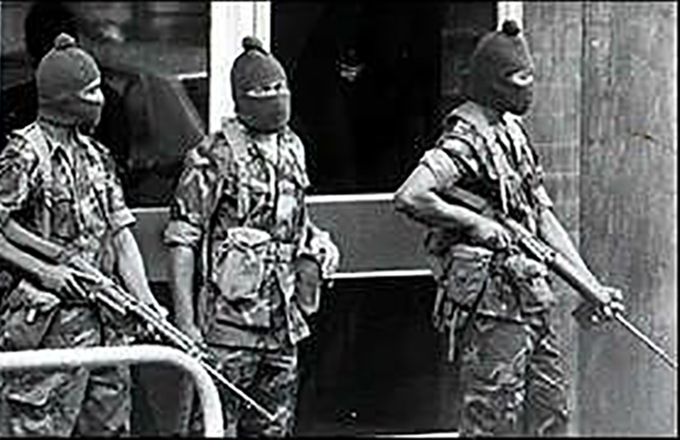
ISIS supporters
But what is JAD? And how influential is its founder, Aman?

The Jakarta-based Institute for Policy Analysis of Conflict (IPAC) calls JAD “the largest faction of ISIS supporters in Indonesia,” consisting of followers of pro-IS ideologue Aman and Jamaah Anshorul Tauhid (JAT) leader Abu Bakar Baasyir.

The term JAD, which means “Partisans of the [Islamic] State Group,” was previously a generic term referring to anyone who had sworn allegiance to IS leader Abu Bakr al-Baghdadi, but is now specifically used by a group that was formed in Malang in November 2015 and has chosen Aman as its ideological head.

Aman was sentenced to seven years in prison in 2004 after a failed terror plot in Depok, West Java, and was released for good behavior in 2008.

Soon after his release, Aman collaborated with Ba’asyir to form a joint terrorism training camp in Aceh in 2010 that united the different terrorist groups, leading to another prison sentence of nine years.

Despite being behind bars, Aman has been accused of involvement in several other terrorist attacks across Indonesia, including masterminding the deadly January 14, 2016, Thamrin attacks in Central Jakarta.

The firebrand cleric, who graduated from the Institute for Islamic and Arabic Studies (LIPIA), was also allegedly involved in the May 25, 2017, bombings in Kampung Melayu, East Jakarta, that killed three policemen.

Aman and his followers believe that all security forces of an ansharut thoghut (idolatrous state) should be considered kafir (non-believers), whose property can be seized and blood can be shed.

Syrian obligation
After the declaration of the Islamic State by al-Baghdadi at Mosul, Iraq in June 2014, Aman believed that the Hegira, or emigration to Syria, was the obligation of all ISIS supporters.

Shortly before the 2016 Thamrin attacks Aman issued a fatwa that was widely circulated among extremist groups:

“Emigrate to the Islamic State and if you cannot emigrate, then wage jihad with spirit wherever you are, and if you cannot wage war or you lack the courage to do so, then contribute your wealth to those who are willing to do so. And if you cannot contribute, then urge others to undertake jihad. And if you cannot do that, then what is the meaning of your loyalty oath [bai’at]?”

The terror inmates who rioted last Tuesday evening at the Mako Brimob detention center reportedly demanded to speak with Aman, who is being held at the facility, during initial negotiations with police officers, a demand that the police later met.

The police, Tito said, suspected that the Surabaya bombings were motivated by the police’s actions in arresting leaders of JAD.

“They reacted [to the arrests] by carrying out retaliatory attacks, such as that which occurred at Mako Brimob.”

The terrorists’ decision to launch the attacks in Surabaya, Tito said, may have been related to the recent conviction of the leader of JAD’s East Java chapter, Zaenal Anshari, for smuggling weapons to Indonesian militants in the southern Philippines.

Zaenal is the second-in-command in JAD after Aman.

Orchestrated attacks
The incidents in Depok and Surabaya were part of a number of recent terror attacks or attempted attacks allegedly orchestrated by JAD-linked militants.

Residents stand next to human body parts at a scene where two bombers launched an attack at Kampung Melayu bus terminal in East Jakarta on May 25, 2017. ADEK BERRY / AFPResidents stand next to human body parts at a scene where two bombers launched an attack at Kampung Melayu bus terminal in East Jakarta on May 25, 2017. ADEK BERRY / AFP (AFP/Adek Berry)

Since the Thamrin bombings in January 2016, counterterror officials have thwarted numerous attempted attacks by suspects affiliated with JAD in various regions across Indonesia.

In January 2017, the US State Department said it had designated JAD as a terrorist group, which in practice prohibits US citizens from being involved with it.

The deadly riot at Mako Brimob, which led to a 36-hour standoff between terror inmates and security forces, and the string of bombings in East Java, may have shown that the group has ramped up its capability to launch terror attacks.

Karina M. Tehusijarana and Moses Ompusunggu are reporters of The Jakarta Post.

Print Friendly, PDF & Email

Article by AsiaPacificReport.nz

]]>

Jale Moala: The Fiji coup that started it all

]]>

The 14 May 1987 Fiji military coup by Lieutenant-Colonel Sitiveni Rabuka … sparked off the legacy of the so-called “coup culture”. Image: File

FLASHBACK: By Jala Moala, a former editor of the Fiji Daily Post, recalls the day of Fiji’s coup.

It is the morning of 14 May 1987, just after 10am, and I am becoming upset that the phone isn’t working, when my neighbour calls out, “The news is on the radio, the army has taken over the government.

“They have cut the phone.”

I should be shocked but I am not because the climate has been politically unstable with a rising tide of indigenous Fijian extremism.

I change quickly and rush down the road for a taxi. The newspaper is at least half an hour away outside Suva, at the Fiji Sun where I work and also string as correspondent for New Zealand Press Association.

I must get the story out, but how?

The phone’s been “killed” but the Southern Cross cable has been left untouched connecting Fiji to NZ, Australia and USA.

-Partners-

Front page via telex
Using telex I get my story out in time to make the front page of the Evening Post in New Zealand. That story includes an interview with the taxi driver who took me to work.

That coup d’etat by Lieutenant-Colonel Sitiveni Rabuka spawned other coups and Fiji has never been the same again.

As for me, 13 years and two more coups later, I took my young family out of Fiji and settled in New Zealand.

A brief reflection by prominent Fiji journalist Jale Moala who worked for the original Fiji Sun at the time of the first coup by Rabuka, and was editor of the Fiji Daily Post at the time of the third coup in 2000.

Sto press: Rabuka on comeback trail
In Auckland, former Pacific Media Watch contributing editor Alistar Kata interviews Rabuka, who is trying to make a political comeback as leader of the main opposition party SODELPA, at Radio 531pi.

She comments:

Sitiveni Rabuka is a polarising figure, best known for instigating two military coups in Fiji in 1987.

And this picture looks like “we just signed an MOU for world peace”.

(He wanted to shake hands so I just went along with it).

Broadcaster Alistar Kata with coup leader Sitiveni Rabuka at Radio 531PI today. Image: Star Kata
Print Friendly, PDF & Email

Article by AsiaPacificReport.nz

]]>

Timor-Leste’s opposition alliance set for win after fractious election

]]>

Xanana Gusmao of the AMP (Allianca Mudanca ba Progresu) coalition delivering his speech during a last day campaign in Dili before the weekend’s election. Image: Valentino Dariell de Sousa/SBS-AFP

Pacific Media Centre Newsdesk

With more than 99 percent of votes counted in the poll, Timor-Leste’s opposition Alliance of Change for Progress (AMP) was leading at the weekend with 49.59 percent of the total votes and is set to break the country’s political deadlock.

The coalition squeaked across the line with an absolute majority, preliminary election results showed yesterday, after a fractious campaign marred by violence and mud-slinging, reports SBS-AFP News.

It was the second general election in less than a year for the half-island nation of 1.2 million that is struggling to boost its oil-dependent economy, after a months-long political impasse saw Parliament dissolved in January.

READ MORE: Timorese election resolves political stalemate

Provisional Timor-Leste general election results.
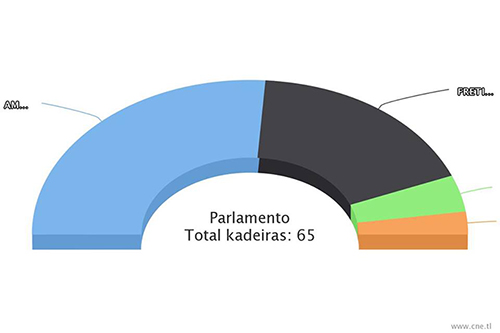
With 97 percent of votes from Saturday’s election counted, the three-party Parliamentary Majority Alliance (AMP) – led by independence hero Xanana Gusmao – had about 48 percent of the votes.

The result means the alliance – which includes the National Congress for Timorese Reconstruction (CNRT) led by Gusmao, the People’s Liberation Party (PLP) and the youth-based Khunto – has secured an overall majority of 34 seats in the 65-member legislature.

The provisional line-up in Timor-Leste’s Parliament with the AMP Coalition (blue) and Fretilin (black) commanding most of the seats in the new Parliament.


-Partners-

The former Portuguese colony won independence in 2002 after a brutal, 24-year occupation by neighbouring Indonesia followed by 2 1/2 years of UN stewardship.

Fretilin, which narrowly won last July’s poll, had about 36 percent, leaving it with 23 seats.

No reports of unrest
Despite a fractious campaign and fears of violence on election day, there were no reports of unrest.

Clashes broke out the previous weekend between Fretilin and opposition supporters, with more than a dozen people injured.

Parliament was dissolved and new elections called in January amid tensions between former Prime Minister Mari Alkatiri’s minority government and the opposition centred around Gusmao’s CNRT.

Dr Alkatiri’s Fretilin party-led government collapsed after its bid to introduce a policy programme and new budget were thwarted by a hostile opposition.

“This outcome should produce a return to political stability in Timor-Leste and may allow Xanana Gusmao time to again consider looking to a replacement leader from the next generation after a suitable amount of time has elapsed,” said Professor Damien Kingsbury, coordinator of the Australia Timor-Leste Election Observer Mission.

“In terms of economic policy, it will be business as usual, which raises questions about the longer term viability for Timor-Leste,” Dr Kingsbury added.

Big challenges ahead
The incoming government will face big challenges, especially as the clock is ticking fast on its disappearing oil and gas reserves.

Oil and gas pay for the bulk of government spending but oil revenues are in steep decline and the country has few other productive economic sectors.

About 60 percent of Timor Leste’s population is under 25, according to the World Bank, while some 40 percent of its people live in poverty.

Providing jobs for young people and reining in public spending – especially on large infrastructure projects – will be key tasks for the new government, commentators say.

Print Friendly, PDF & Email

Article by AsiaPacificReport.nz

]]>

NZ pro-Palestinian ‘justice’ protesters target Israel Day waterfront events

]]>

Police keep a “safe zone” between peaceful pro-Palestinian protesters and some angry pro-Zionist hecklers. Image: Rahul Bhattarai/PMC

By Rahul Bhattarai in Auckland

About 50 people gathered in Auckland’s Silo Park today to protest against the 70th year of Nakba – also known as the Palestinian “catastrophe”.

The protesters included a Palestinian whose father had been evicted by Israeli forces to make way for Jewish settlers and a prominent Pacific social justice advocate who had protested during the 1981 Springbok rugby tour of New Zealand.

Both protesters likened the policies of the Israeli state to the anti-apartheid policies of the former white South African regime.

But Israelis celebrate tomorrow – 14 May 1948 – as Independence Day for their state.

The Palestinian supporters marched peacefully from ANZ Event Centre by the waterfront to Silo Park beating steel washtubs and chanting slogans such as, “free free Palestine!” and “Israel is a racist nation!”

Placards declared “Israel is a racist state”, “Boycott Israel” and “Israel was built on a lie – the holohoax”.

-Partners-

Israeli supporters had organised their own events, which were attended by some National MPs and Rob Berg, head of the Zionist movement in New Zealand.

Police set up a “safe zone” to prevent protesters and Israel Day festival supporters clashing.

Peaceful protesters
The line of police mostly held back the peaceful protesters while there were few police to monitor the pro-Zionist hecklers.

Billy Hania, a Palestinian living in New Zealand, told Asia Pacific Report he was at the protest to oppose the celebration of the state of Israel.

“Israel is an apartheid establishment and was founded by evicting people from their home,” he said.

The victims included his own father who was evicted at the age of 12 at gunpoint in order to make room for Jewish settlers, he said.

Hania was at the protest to commemorate the Nakba which was a “catastrophe”. This was in 1948 when the people of Palestine had lost their homes and continued to be under Israeli occupation which is illegal under international law.

Will ‘Ilolahia, a founding member of Polynesian Panther Party, was also present in “support of the anti-Zionist policy in regard to Israel, and also the pro-Palestinian struggle”.

‘Ilolahia was in the Patu Squad during the anti-apartheid protests against the 1981 Springbok rugby tour of New Zealand and he was “self-exiled” to Tonga.

‘Follow Lorde’ plea
He said New Zealand should follow in the footsteps of Kiwi musician Lorde and “put it out there that Israel is actually like apartheid”.

He said: “Zionist Israel is set up as just like apartheid.”

‘Ilolahia added that the “struggles of the Palestinians are the same as the struggles we’ve had here in Aotearoa and the Pacific – us indigenous people have to stick together”.

Valerie Morse, organiser of the Auckland Peace Action, said the protesters were there “as a protest against the 70th anniversary of the founding of the state of Israel”.

She added: “We are here in support of the Palestinian people and their struggle for freedom and justice.”

Morse also said there had been seven decades of “ethnic cleansing” of Palestinian people – ever since the state of Israel had been founded.

Almost five million indigenous Palestinians live in refugee camps – waiting to return home – outside of their Palestine homeland.

Morse and other protesters were protesting over the displaced Palestinians as a part of an international campaign of Boycott, Divestment and Sanctions (BDS).

The BDS campaign has three main demands: to “ tear down the apartheid wall”,
enable the right of return for Palestinians living outside of their former homeland, and equal rights for Palestinians within Israel.

Print Friendly, PDF & Email

Article by AsiaPacificReport.nz

]]>

Gallery: Peaceful protest highlights ‘Nakba’ injustices in Palestine

]]>

Pacific Media Centre Newsdesk

About 50 people staged a “wall of noise” protest in Auckland’s port today in a bid to shut down the Israeli “festival of oppression” marking 70 years of illegal occupation of Palestinian land.

Protesting at the Silo Park over what Palestinians regard as the Nakba – “the catastophe” – when the state of Israel was established in 1948 through “ethnic cleansing” of an estimated 750,000 to one million indigenous Palestinians.

The Palestinians were forced to become refugees in a Jewish-majority state in Palestine and the day – 14 May 1948 – is regarded as Israel’s independence day.

“The Nakba isn’t just a crime of the past,” said Auckland Peace Action group spokesperson Valerie Morse, one of the organisers. “The repression is ongoing.”

The Pacific Media Centre’s Rahul Bhattarai and Del Abcede were at Silo Park to capture the protest in pictures.

1. Free Palestine march in Auckland. Image: Rahul Bhattarai/PMC

2. Getting ready for the march. Image: Del Abcede/PMC

3. Women in red – Auckland Peace Action’s Valerie Morse (left) and a protester from Argentina. Image: Rahul Bhattarai/PMC

4. Pacific human rights and independent media advocate Will ‘Ilolahia and media academic David Robie. Image: Rahul Bhattarai/PMC

5. Protesting against Zionist oppression for 70 years through the Israeli occupation of Palestine. Image: Del Abcede/PMC

6. Marching for Palestine. Image: Rahul Bhattarai/PMC

7. Marching for Palestine. Image: Rahul Bhattarai/PMC

8. Marching for Palestine. Image: Rahul Bhattarai/PMC

9. Protest placard against the Israeli massacres. Image: Del Abcede/PMC

10. Reaching the “safe zone” line. Image: Del Abcede/PMC

11. Protest for Palestine. Image: Rahul Bhattarai/PMC

12. Boycott Israel call as part of the international BDS movement. Image: Rahul Bhattarai/PMC

13. Zionist counter-protesters breach the “safe zone” under the oblivious eye of the police. Image: Rahul Bhattarai/PMC

14. Boycott Israel under watchful eye of the police. Image: Rahul Bhattarai/PMC

15. “No trade with Israel”. Image: Del Abcede/PMC

Print Friendly, PDF & Email

Article by AsiaPacificReport.nz

]]>

‘Sword of Damocles’ condemned after Philippines judges oust chief justice

]]>

Ousted … Philippines Chief Justice Maria Lourdes Sereno waves to supporters the day she returned to the Supreme Court on May 9, 2018, after two months on leave. Image: Maria Tan/Rappler

By Ralf Rivas in Manila

After the ousting of the Philippines’ Chief Justice Maria Lourdes Sereno, the six justices who voted against the quo warranto petition have claimed the decision has made the Office of the Solicitor-General more powerful.

The justices raised their concern in their separate dissenting opinions following the Supreme Court’s 8-6 unprecedented and historic vote in favour of the petition – a prerogative warrant – on Friday.

Associate Justice Mariano del Castillo wrote in his dissenting opinion that the decision of the majority had granted the Solicitor-General (SolGen) powers to “remake the composition” of the High Court, “causing the removal of its members”.

READ MORE: Quo warranto v elected impeachable allowed, says Supreme Court

“With the SolGen wielding a quo warranto sword of Damocles over the heads of these officers, the Filipino people cannot be assured that they will discharge their constitutional mandate and functions without fear or favor,” said Del Castillo.

Without such assurance, there can be no guarantee that the primordial interest of the sovereign people is promoted.”

-Partners-

Del Castillo called the SolGen’s move a form of “constitutional adventurism”.

The quo warranto petition to remove Sereno from office was on the basis of an alleged invalid appointment.

The decision is “immediately executory without need for further action,” SC spokesperson Theodore Te said during Friday’s press briefing.

‘Violated requirements’
Nine of the justices said she violated requirements on the Statement of Assets, Liabilities, and Net Worth (SALN). The same number of justices ruled that quo warranto was the proper remedy in the ouster of Sereno.

This is the first time that the Supreme Court has removed its own chief, in a petition widely slammed for violating Sereno’s constitutional right to an impeachment process.

Sereno is the second chief justice to be removed from office after Renato Corona was ousted in 2012. He was found guilty of betraying the public trust and committing culpable violation of the Constitution.

Associate Justice Mariano del Castillo’s sentiment was echoed by the dissenting opinions of Associate Justices Marvic Leonen and Benjamin Caguioa.

Lawmakers, including Senate Minority Leaders Franklin Drilon, a former justice secretary, shared the same concern.

The others who voted against the petition are Senior Associate Justice Antonio Carpio and Associate Justices Presbitero Velasco Jr, and Estela Perlas-Bernabe.

Quo warranto or impeachment?
The six dissenters all agreed that impeachment was the only way to unseat an impeachable officer like Sereno.

Del Castillo stressed that allowing the quo warranto proceeding “impairs the independence of constitutional offices”.

Bernabe wrote in her opinion that the OSG should have questioned the discretion of the Judicial and Bar Council (JBC) to include Sereno in the shortlist of chief justice applicants.

Bernabe pointed out that the OSG “voluntarily admitted that the JBC’s grave abuse of discretion is not at all an issue.”

In his dissenting opinion, Velasco relayed the same sentiment.

“There was no attempt to assail and contest much less nullify the JBC’s findings that the respondent possessed all qualifications, the JBC’s decision must stand,” Velasco said.

Yes to quo warranto but…
Velasco said that the “remedy of quo warranto is available to unseat, in the extreme, even an impeachable officer”.

However, he clarified that the one-year prescribed period for filing such a petition had lapsed. He said that Sereno’s nomination and appointment “has not been timely challenged, much less nullified,” and that “the findings and qualifications should be respected.”

Velasco insisted that the OSG had to file a petition for certiorari against the JBC before seeking Sereno’s removal from office.

Bernabe also said that impeachment was not the sole move of removing impeachable officials as it would be “clearly absurd for any of them to remain in office despite their failure to meet the minimum eligibility requirements”.

She said that there “should be a remedy to oust all our public officials, no matter how high-ranking they are, or how critical their functions may be,” but after clear “determination that they have not actually qualified for election or appointment”.

Bernabe stressed that the JBC’s rigorous process was lenient on the Statement of Assets, Liabilities, and Net Worth (SALN) requirement. In fact, none of the applicants were able to submit all SALNs up to 2012.

Despite voting for the retention of Sereno, Bernabe said she made no claim that Sereno “is or is not a person of integrity.”

“In fact, if there is one thing that is glaringly apparent from these proceedings, it is actually the lack of respondent’s candor and forthrightness in the submission of her SALNs. Integrity must be threshed out in the appropriate case for certiorari,” Bernabe said.

Print Friendly, PDF & Email

Article by AsiaPacificReport.nz

]]>

Timorese vote in fresh general election after tense campaign

]]>

By Michael Leach in Dili

After a tense month-long campaign and two rest days, East Timorese cast their votes today in the Timor-Leste’s latest parliamentary elections. With the campaign characterised by considerable bitterness between the major parties, much is at stake.

Despite narrowly prevailing at the election just nine months ago, the Fretilin-led minority government failed to gain parliamentary support for its programme and budget during 2017.

The president — also from Fretilin — dissolved parliament and called today’s poll.

READ MORE: Choices sharpen in Timor-Leste

The East Timorese electoral agencies, short of funds after last year’s election and the parliamentary impasse, have risen to the occasion extremely well.

And, in a remarkable testimony to Timor-Leste’s young population, the electoral roll has grown by 3.1 percent to 784,000 voters, with around 24,000 voters turning 17 in just over nine months since last July.

-Partners-

Last year’s campaign came in the wake of a national unity government involving informal power-sharing between Xanana Gusmão’s CNRT and Fretilin. But relations quickly soured after an election that Fretilin won narrowly with 23 seats to CNRT’s 22.

In the end, Fretilin was only able to attract the Democratic Party, with its seven seats, to its minority coalition government, giving prime minister Dr Mari Alkatiri 30 seats in the 65-seat Parliament.

Rejected programme
Within weeks, the remaining parties had formed the Parliamentary Majority Alliance (AMP) a coalition controlling 35 seats, and had voted down the government’s programme and budget.

Fretilin feels aggrieved that it did not receive parliamentary support after narrowly finishing ahead last year, despite an alternative coalition having been ruled out publicly by Xanana Gusmão in the immediate wake of the July election.

For its part, the AMP feels bitter about Fretilin’s parliamentary tactics last year, which delayed the second presentation of the government programme and prevented it from falling before the six-month mark, when the president could dissolve Parliament and call fresh elections.

AMP figures feel that their alliance should have been installed in government during the life of the Parliament. How these issues have influenced the voting public will be known tomorrow.

This year’s campaign has been marked by the resurgence of the “history wars,” the clash between the two wings of the East Timorese resistance during the Indonesian occupation.

The AMP has reunited Xanana Gusmão and his CNRT with former president Taur Matan Ruak’s Popular Liberation Party (PLP), which were at loggerheads during the 2017 election. Both were leaders of the armed resistance, Falintil.

The campaign has been frequently depicted as a contest between the armed front and members of the diplomatic front, who were outside the country during the occupation, including prime minister Alkatiri and key diplomatic figure Jose Ramos-Horta, who has thrown his weight behind the Fretilin campaign.

Hurt by attacks
Though he has not responded to them, Ramos-Horta has evidently been hurt by the attacks on his legacy, some of which have sought to diminish the contribution of those who struggled for independence in the international arena.

This division over resistance history has lent an unpleasant air to a campaign that has also been marked by exchanges of personal slurs between the major party leaders, including some outbursts of anti-Muslim sentiment directed at the Fretilin leader Dr Mari Alkatiri, and fractious personal debates on Facebook.

From the east of the country have come reports of rock attacks on AMP caravans in Viqueque, bringing back memories of the divisive 2007 election, which occurred in the wake of the 2006 political–military crisis.

The AMP parties have also complained of low-level attacks in Laga region of Baucau, were temperatures still run hot over the death of dissident veteran Mauk Moruk in 2014.

Yet the campaign has been remarkably peaceful on the whole, with colourful mass rallies of party supporters generally well behaved throughout most of the country.

The campaign has also been marred by a handful of accusations of favouritism and irregularities against the electoral agencies, prompting the head of the National Electoral Commission (CNE) to publicly defend the organisation in press conferences.

Several complaints originated on AMP’s Facebook page, including concerns over printing errors in the ballots, which were quickly identified and cancelled, and suspicions about meetings between CNE and political parties that turned out to be part of routine investigation of previous complaints.

Closely watched
The CNE has responded quickly and satisfactorily. With domestic and international observers closely watching the process and extremely professional electoral agencies, there is very little scope for manipulation.

The CNE and the Technical Secretariat of Electoral Administration have done an excellent job under trying circumstances with limited budgets.

While the parties have discussed differing visions for the future, especially during the series of TV debates, considerable energy has been diverted into personal and historical debates within the small political elite. The new AMP alliance brings together two parties that ran last year on fundamentally different development agendas, and it remains to be seen how the CNRT’s focus on major infrastructure spending can be reconciled with the PLP’s more grassroots focus on basic development spending on health education and agriculture.

How voters have received this new combination will be known tomorrow.

For their part, supporters of Fretilin and the Democratic Party (PD) have been on friendly terms throughout the campaign, suggesting the alliance seems to be holding, though this relationship could be easily revisited in the interparty negotiations that follow the election.

The AMP is a formidable coalition of parties that received 29.5 percent, 10.5 percent and 6.5 percent last year: a total of 46.5 per cent. It could also receive the support of the Democratic Development Front, or FDD, the coalition of the smaller parties most likely to exceed the 4 per cent threshold required to get seats. This is not certain, though, and there are at least some rumblings of dissent from one of the parties inside FDD. On the other side, Fretilin received 29.7 percent in 2017, and its PD partner in the minority government received 9.8 percent.

No polls have been taken to indicate the likely result tomorrow. As a baseline indication, if last year’s vote is notionally combined into the new party coalitions that have formed, the AMP would start with a nominal allocation of 33 seats — the minimum majority required.

Favourite on paper
In turn, Fretilin, PD and the FDD would receive 21, six and five seats respectively. If FDD cannot clear the 4 percent hurdle, these notional numbers rise to 36 for the AMP, 22 for Fretilin, and seven for PD.

The AMP therefore starts as favourite on paper, but the outcome tomorrow can easily change from the 2017 results., As a rough guide, Fretilin requires a swing of just under 4 per cent (if FDD does not take seats) rising to more like 6 per cent if the FDD gains seats and backs the AMP.

These are clearly challenging targets for Fretilin, though not impossible, especially in the former case. It may be that the smaller coalition becomes instrumental in the final result if things run close.

Some longer-term trends are striking. At a forum on the elections I conducted in Dili on Thursday, younger Timorese commented that though they are often reluctant to openly criticise their resistance-era leaders, young people are more interested in the development policies of the government and how they will help to create future jobs.

There was also a sense in last year’s election result that while resistance-era legitimacy remains important to political fortunes, it is starting to offer diminishing returns for East Timorese leaders as the median age of the voting public falls, and voters look for solutions to entrenched development problems.

The young people at the forum also felt that the direst warnings of potential trouble if one side or the other loses tomorrow have come from political insiders themselves, with most ordinary people confident that the national police can manage any post-election troubles.

Young voters also said Dili’s noisy and active social media has played a mixed role — allowing more opportunities for debate, on the one hand, and especially for women’s and young people’s voice to come through, but also distributing fake news and rumours, and not fully representing rural voices.

Potential sleeper trend
Another potential sleeper trend is the changing attitude of the Catholic Church to the major parties. The Church responded positively to the concordat with the Vatican orchestrated by the PM of the previous national unity government, Fretilin’s Rui Araujo.

Despite occasional slurs against Mari Alkatiri, most of the older political leadership from the 1970s does not identify strongly with the church, though younger Timorese broadly do.

As tomorrow’s poll approaches, both sides are supremely confident of victory in their public statements. Either way, it is likely that Timor-Leste will be in good hands, and the real issue as always will be how the unsuccessful parties accept the results.

After last year’s uncertain result, East Timorese will be hoping for a clear and decisive outcome.

Dr Michael Leach is Professor of Politics and International Relations at Swinburne University of Technology. This article was first published by Inside Story.

Print Friendly, PDF & Email

Article by AsiaPacificReport.nz

]]>

Tuilaepa accuses Pohiva of being ‘jello’ over Samoan press freedom

]]>

Tongan Prime Minister ‘Akilisi Pohiva … something “odd” with the world press freedom rankings. Image: Samoa Observer

By Joyetter Feagaimaali’i-Luamanu

Prime Minister Tuilaepa Sa’ilele Malielelgaoi has accused his Tongan counterpart ‘Akilisi Pohiva of being “jello” – jealous – of Samoa’s media freedom ranking.

Tuilaepa made the comment in response to Pohiva questioning Samoa’s ranking on the Reporters Without Borders’ World Press Freedom Index.

Samoa is ranked 22nd while Tonga is ranked 51st.

READ MORE: Fifth Pacific Media Summit

Speaking at the opening of the 5th Pacific Media Summit being held in Nuku’alofa, Tonga, Pohiva suggested that something was “odd” with the rankings.

“You have all heard by now how that Tonga dropped two places from 49 to 51 on the 2018 World Press Freedom index,” he said.

-Partners-

“You have also learned that the reason for the drop is because of my government’s unfair treatment of senior journalists in the Tonga Broadcasting Commission.

“I have no problems with that but let me assure you all that it is a work in progress.

‘Continuing to talk’
“We are continuing to talk with the management and staff members of the Tonga Broadcasting Commission about improving our relationship, and of course our position in the 2019 Press Freedom Index.”

This is when he turned his attention to Samoa.

“I must say that I am surprised by Samoa’s position on the Press Freedom Index where Samoa is 22nd,” he said.

“Oh congratulations! However, what I went on about is the ongoing battle between my Samoan counterpart and the Samoa Observer. I can’t believe that Samoa is 22nd and Tonga is 51st. This is unbelievable.”

Asked for a comment, Prime Minister Tuilaepa laughed.

“Our ranking is far superior than the United States of America, which is ranked 45th and this is good news for the media and everyone who is here in my office,” Tuilaepa said.

Freedom of journalists
“I am thankful that the government puts up with you people,” he said, laughing.

“I am talking about freedom of journalists in our country and that is why the Tongan Prime Minister is somewhat “jello” (jealous) given that their ranking is very low, yet Samoa’s ranking is quite significant.”

According to Prime Minister Tuilaepa, there is a difference in the governance of Samoa and Tonga, but he did not elaborate on this.

Joyetter Feagaimaali’i-Luamanu is a journalist working with the Samoa Observer.

Print Friendly, PDF & Email

Article by AsiaPacificReport.nz

]]>

Future of Panguna mine at stake in PNG, Melbourne court hearings

]]>

The abandoned Panguna mine site after Rio Tinto closed down the operation. Image: Business Advantage PNG/SMH

By Kevin McQuillan of Business Advantage PNG

Two court hearings next week – one in Port Moresby and the other in Melbourne – will help determine the future of the exploration licence for the Panguna copper mine in Bougainville.

The decision to refuse an extension of Bougainville Copper Limited’s exploration licence and to impose an indefinite moratorium over the Panguna resource, followed a statutory Warden’s meeting in December 2017.

There was “a narrow divide between those supporting the mine to be opened by Bougainville Copper Ltd (BCL) and those that oppose it”, according to Bougainville President John Momis.

BCL has successfully sought leave to apply for a judicial review of the decision to refuse its licence extension, citing legal and procedural concerns.

“While the moratorium has been gazetted, it has no impact on existing exploration licences or applications for extension, lodged prior to the moratorium,” said BCL Company Secretary, Mark Hitchcock.

“BCL remains the holder of the exploration licence (EL1) until the matter is ultimately determined,” he said.

-Partners-

BCL has held the licence since the mine closed in 1989. The company is now owned by the PNG national government (36.4 percent), the Autonomous Bougainville Government (36.4 percent), European shareholders (four percent) and 23.2 percent through the Australian Securities Exchange (ASX).

Rio Tinto gave away its stake in 2016.

Opposing BCL
Those opposing BCL’s involvement are led by Philip Miriori, who claims chairmanship of the Special Mining Lease Osikaiyang Landowners’ Association (SMLOLA).

He has thrown his support behind a bid by Perth-based junior miner, RTG Mining, to gain the exploration licence, setting up a joint venture company, Central Exploration, of which RTG owns 24 percent.

One of RTG’s major shareholders holds another 32 percent, and the SMLOLA retains 44 percent.

Miriori’s chairmanship of the SMLOLA remains in dispute. The 367 authorised customary heads of the 510 blocks of land within the special mining lease area of Panguna say they do not recognise Miriori as the Chairman of the SMLOLA and support the extension of BCL’s exploration licence.

On the same day as the Port Moresby hearing, on May 17, BCL will be in court in Melbourne, seeking disclosure about the relationship between RTG Mining and the SMLOLA.

Miriori and other supporters admit they are being paid by RTG, but Miriori has told the ABC that the payments are legitimate salaries, not inducements.

“That is always a normal part of anything, nothing is free,” he said.

Seeking disclosure
The action seeks disclosure from RTG Mining and Central Exploration about any compensation or benefits paid to the SMLOLA.

One analyst close to the proceedings says any disclosure could determine the possibility of “unlawful interference” with BCL’s exploration licence.

For his part, Momis says his government believes it would be “untenable under current circumstances” for any developer to develop the mine.

“BCL has an extensive database of historical data and project information from the mine operations prior to closure.”

“We have some problems with RTG right now,” Momis told RNZI.

“In fact, they are causing a lot of confusion and division in the community and we are not prepared to go ahead while this situation prevails.”

Exploration data
Should RTG Mining or any other company win the exploration licence, the next battle will be over the data about the location and extent of resources.

“BCL has an extensive database of historical data and project information from the mine operations prior to closure in 1990,” said Hitchcock. “This data remains the intellectual property of the company.”

Even if that data is not protected by intellectual property law but is only considered confidential information, it will still require cooperation from BCL to access, according to Alexandra George, senior lecturer at the University of New South Wales, who specialises in international intellectual property law.

She said it might be expensive and time-consuming to obtain.

She said that under Australian copyright law, ownership of a database is not straightforward. Whether or not RTG Mining could access the data may depend on the terms of the exploration licence, any special legislation, and on the terms of any contracts or licence agreements that have been entered into.

“If [the data] was not available, having to reinvent the wheel would add significant costs,” said George.

“Perhaps the safest way of assessing value is what the market is prepared to pay.”

Hitchcock said: “We estimate it would take any other company or entity at least two-to-three years to replicate the BCL database through exploration activities and would cost in excess of A$200 million (K400 million).”

Kevin McQuillan writes for Business Advantage PNG.

Print Friendly, PDF & Email

Article by AsiaPacificReport.nz

]]>

Newsletter: New Zealand Politics Daily – May 11 2018 – Today’s content

Newsletter: New Zealand Politics Daily – May 11 2018 – Today’s content Editor’s Note: Here below is a list of the main issues currently under discussion in New Zealand and links to media coverage. [caption id="attachment_297" align="aligncenter" width="640"] The Beehive and Parliament Buildings.[/caption] Below are the links to the items online. The full text of these items are contained in the PDF file (click to download). Employment Michael Morrah (Newshub): Immigration NZ to investigate illegal migrant contracts Michael Morrah (Newshub): Exclusive: Migrant construction workers languishing in crowded Auckland houses on illegal contracts Emma Hatton (RNZ): Questions over Filipino labour-hire contracts: ‘They’re scared’ Megan Gattey (Stuff): ‘If Immigration NZ did sign off on an illegal contract, that would be a serious matter’: Minister RNZ: Exploitation of kiwifruit workers is rife – union Brian Fallow (Herald): Looking for the job limit Donal Curtin: Unemployment strikes selectively (revisited) Tracy Neal (RNZ): Tasman seasonal labour shortest in years – growers Stuff: Waikato tractor driver clocked almost 200 hours in the two weeks before his death Willie Jackson (Daily Blog): A rockstar economy that plays for everyone, not just the rich Rose Hoare (Stuff): The last bastion of inequality: unpaid work Budget and tax Matthew Hooton (Herald): Budget must show cultural change Bernard Hickey and Shane Cowlishaw (Newsroom): More Robertson belt-tightening ahead of Budget RNZ: Govt announces $42b capital spending boost Jo Moir (Stuff): Finance Minister: first Budget will deliver $10b more than forecast over next five years Josie Pagani (Herald): Labour won’t have enough in the pie to satisfy all hungry kids Tom Pullar-Strecker (Stuff): CGT would make it harder to keep a roof over everyone’s head Anna Bracewell-Worrall (Newshub): Most Kiwis think the Government should increase taxes – poll Heath Moore (Herald): ‘Pay up or get arrested’: Kiwis hit by IRD scam International relations and trade Nicholas Jones (Herald): Saudi sheep saga: ‘model farm in desert’ still unfinished Herald Editorial: Big boost of Pacific aid has no clear purpose Jo Spratt (RNZ): Pacific aid boost must be spent well to be effective RNZ: NZ exporters cautious about dealing with Iran Herald: US Director of National Intelligence Dan Coats in New Zealand for meeting John Gibb (ODT): NZ should stand its ground over Iran issue: academic Reserve Bank Richard Harman (Politik): New Reserve Bank Governor Adrian Orr unbuttons Hamish Rutherford (Stuff): ‘O is for Orrsome’: New Reserve Bank governor gets high praise on his first outing Thomas Coughlan and Lynn Grieveson (Newsroom): Interest rates unchanged, but a very different governor Jason Walls (Interest): The new Governor’s approach to the central bank’s communication was on full display on Thursday, turning the heads of journalists, MPs and economists Nikki Mandow (BusinessDesk): Orr’s first OCR: a breath of fresh air Michael Reddell: Something of a mixed bag RNZ: Reserve Bank keeps cash rate at 1.75% Tamsyn Parker (Herald): Bank costs may drive mortgage rates higher, warns Reserve Bank Herald: New Zealand central bank governor says economy in sweet spot Graham Adams (Noted): Are New Zealand banks approving liar loans? Interest: Commerce Commission probes problems with ANZ loan calculator that undercharged interest to about 100,000 customers Rob Stock (Stuff): How banks’ whistleblower scheme should work Government Claire Trevett (Herald): Ministers’ expenses show Corrections Minister Kelvin Davis, Transport Minister Phil Twyford top spenders Tova O’Brien (Newshub): Winston Peters threatens fellow ministers ahead of stint as Prime Minister Peter Hughes (Herald):‘Faceless bureaucrats’ are hard working, public spirited people Northcote by-election and parliament Simon Wilson (Herald): Northcote Notebook: Coffee with National’s candidate Dan Bidois Henry Cooke (Stuff): Northcote by-election: Greens select Rebekah Jaung as candidate Moana Makapelu Lee (Māori TV): Māori voters opt for General Roll Yvette McCullough (Newstalk ZB): Peters says Maori roll not needed under MMP Laura Walters (Stuff): Political parties ramp up attack ads – smart politics or fake news? Health Phil Pennington (RNZ): Middlemore: Board was pressured to settle for $3m Sarah Robson (RNZ): Middlemore will prioritise maternity services if needed – Board Katie Doyle (RNZ): DHBs face large rise in infections from treatment Stuff: Men die quicker but women are sicker Phil Pennington (RNZ): Middlemore: Board was pressured to settle for $3m Hamish McNeilly (Stuff): Pill prices hard to swallow for prostate cancer survivors 1News: HPV vaccine could potentially eradicate cervical cancer, expert urges anti-vaxxers to ‘look at the science’ Natalie Akoorie (Herald): New Zealand Organisation for Rare Diseases facing closure without enough funding Stuff: New Zealand infants with high nicotine exposure twice as likely to have respiratory problems Lisa Davies (1News): Shocking impact of passive smoking on young children highlighted in New Zealand study 1News: The Kiwi dentist with a new approach to treating tooth decay in children Kyle MacDonald (Herald): What we’re forgetting about cannabis Madison Reidy (Stuff): Medicinal cannabis company’s $1m investment round crashes crowdfunding site Anusha Bradley (RNZ): NZ medicinal cannabis product hits $2m in crowdfunding Alex Braae (Spinoff): Greened out: Weed buyers crash crowdfund site Education Simon Collins (Herald): A $3.4 billion bill for Auckland schools over the next 10 years is tightening the squeeze on cash to meet other political promises in next week’s Budget Madison Reidy (Stuff): Filipino agency’s promises of NZ visas for students ‘sickening’, says migrant spokesman Simon Collins (Herald): Overseas students launch campaign against labour exploitation Vaimoana Tapaleao (Herald): Iwi gives $100,000 to children’s charity KidsCan Mikaela Collins (Herald): Whangārei’s Te Kāpehu Whetū applies to become designated character school Dan Satherley (Newshub): Jacinda Ardern labelled a ‘liar’ over charter school transition process John Moir (Herald): School meth lessons do not reduce drug harm Jennifer Eder (Stuff): Parents get behind teachers adapting to ‘modern learning environment’ classes Amy Paulussen (Spinoff): Penalising part-time teachers is a gender pay gap issue Karoline Tuckey (Stuff): Massey’s Albany campus student growth surpasses Manawatū numbers Housing and overseas investment Dan Satherley (Newshub): Govt hikes cost of one-bedroom KiwiBuild homes John Boynton (RNZ): Northland housing woes: ‘Every winter decimates our people’ Jenna Lynch (Newshub): Will KiwiBuild be another broken promise by the Government? Henry Cooke (Stuff): Judith Collins says the KiwiBuild goalposts have shifted David Hargreaves (Interest): Bad signs from the Government’s so-called Kiwibuild ‘buying off the plans’ scheme Cameron Bagrie (Herald): Comment: Big change coming to property market Steven Cowan: Phil will fix it! (No, he won’t) Susan Edmunds (Stuff): ‘Why should the landlord pick up the tab, time and time again?’ Charlie Mitchell (Stuff): Wealthy overseas landowners forced to sell in government crackdown Primary industries Simon Hartley (ODT): Dairy review’s scope irks environmentalists Craig McCulloch (RNZ): M Bovis has ‘turned neighbour against neighbour’ Gerard Hutching (Stuff): Farms under question with cow disease Mycoplasma bovis explode to exceed MPI estimates Isaac Davison (Herald): Numbers of farms under regulatory control for Mycoplasma bovis jumps from 130 to 290 1News: Mycoplasma bovis spread ‘has gone totally above all expectations’ in last week Anna Bracerwell-Worrall (Newshub): 22,000 cows culled, but Mycoplasma bovis worse than previously thought Environment Benedict Collins (RNZ): Former EPA chief scientist’s irrigation comments defied boss RNZ: 100% Pure a ‘marketing strategy … not an environmental standard’ Sophia Duckor-Jones (RNZ): Calls for Ministry to hand over kauri dieback response Simon Smith (Stuff): Call to sack MPI from leading the fight against kauri dieback Herald: Mitre 10 to remove single-use plastic bags from its stores Chloe Winter (Stuff): Mitre 10 announces date for plastic bag ban just days after Countdown Michael Daly (Stuff): Plastic bag found in Mariana Trench, deepest place on Earth 1News: Watch: Where did they go? NIWA’s confronting aerial video shows the shocking state of South Island glaciers Maja Burry (RNZ): New invasive weed spreads into Canterbury Auckland Wayne Mapp (Spinoff): Why we should be wary about jumping aboard the light rail bandwagon John Anthony (Stuff): Auckland Council selling Remuera Golf Course land to make way for housing Anuja Nadkarni (Stuff): ‘Circular economy’ could bring $8b in benefits to Auckland Auckland Now: Auckland activist Penny Bright says she has ‘incurable and inoperable’ cancer Media Mark Jennings (Newsroom): New life for a wavering industry John Drinnan (Noted): Media moves: RNZ and Māori Television look to form closer ties Mark Jennings (Newsroom): RNZ feels impact of music radio revival Māori wards Richard Mays (Manawatu Standard): Full house at Massey University for Māori wards forum Kate Frykberg (Stuff): Harmony and the case for Māori wards Adoption Nicholas Jones (Herald): Exclusive: Inquiry on forced adoption considered Nicholas Jones (Herald): Plea for adoption inquiry: ‘I tried to photograph her with my eyes’ Made in NZ and marketing Aimee Shaw (Herald): Revealed: Where your favourite NZ brands are really made Katie Doyle (RNZ): Made in NZ tag could be ‘lost forever’ by 2020 Jenny Keown (Spinoff): ‘Natural’, ‘sustainable’, ‘Made in New Zealand’: How greenwashing became big business Kate Dickie-Davis (Daily Blog): The devil is in the retail Transport Tom Pullar-Strecker (Stuff): Airline fuel surcharges tipped to make comeback Lucy Bennett (Herald): ‘Ignorant’ foreign tourists using drones put aircraft at risk Jenna Lynch (Newshub): Playtime over? Authority considering registration scheme for drone users Kim Dirks (Newsroom): NZ’s old cars a public health hazard Rebecca Stevenson (Spinoff): Ten numbers which show how addicted to our cars we still are Justice Melissa Nightingale (Herald): Daniel Clinton Fitzgerald granted leniency for kissing stranger despite three strikes law Barry Soper (Newstalk ZB): Not fair to blame three strikes law for overflowing prisons Natasha Jojoa Burling (Newstalk ZB): Law Professor: Trial for Rewa may be unfair David Fisher and Nicky Harper (Herald): How Garth McVicar’s quick-fire praise over police shooting led to a ‘mistake’ receipt and tax concerns over Sensible Sentencing’s trusts Treaty settlements and Crown-Maori relations Te Aniwa Hurihanganui (RNZ): Crown-Māori relations: Taking time to ‘get the job right’ Te Aniwa Hurihanganui (RNZ): Treaty overlap: Settlement could leave iwi high and dry Alexia Russell (Newsroom):Iwi’s Gulf Island rights to be tested Deena Coster (Stuff): Tide turning regarding Māori experiences of ageing: academic Tourism Grant Bradley (Herald): Rising costs for Kiwis at holiday hot spots a ‘concern’, says Tourism Minister Kelvin Davis Belinda McCammon (RNZ): Tourist levy details coming – minister Animal welfare 1News: Those testing on animals should have to care for them afterwards, advocates say 1News: Re-homing of lab tested animals might become mandatory to save them from being put down National Mike Bain (Stuff): Cambridge people swamp venue to hear National leader Simon Bridges Bryan Gould: What was he doing? Sexuality Bob Edlin (Kiwiblog): Guest Post: Measuring Rainbows 1News: ‘It’s a good thing’ – Auckland Anglican vicar welcomes vote for same-sex blessings Jane Matthews (Stuff): Anglican Church takes step towards blessing same-sex relationships RNZ: Pacific Anglican church says no to same-sex marriage Other Robin Martin (RNZ):‘They’ve lost their family home’ – Whanganui couple battle EQC Melissa Nightingale (Herald): Battle of the macrons for Wikipedia spelling of Paekākāriki Graeme Austin (Newsroom): A copyright exemption for parody and satire Herald: Hamilton Council reveals the eight naughty words removed from public feedback]]>