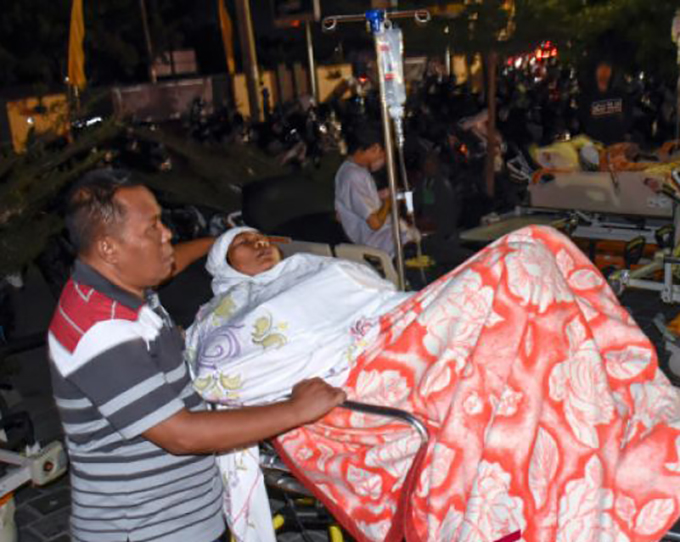
 Staff treat victims of a powerful magnitude 7 quake in the yard of Mataram City Hospital. Image: Ahmad Subaidi/Antara
Death toll in Indonesia’s Lombok quake rises to 37

Pacific Media Centre Newsdesk
The death toll in a powerful magnitude-7 earthquake which rocked Lombok and Sumbawa Islands in Indonesia’s West Nusa Tenggara province last night has risen to 37, Antara news agency reported early today.
The dead victims consisted of 28 in North Lombok district, three in West Lombok district, one in Central Lombok district, one in East Lombok district and four in Mataram city, said the Chief of the Emergency and Logistics Section at the West Nusa Tenggara Provincial Disaster Mitigation Agency Agung Pramudja in a written statement.
Antara said the quake, which rattled the two islands at 06.46 p.m. local time yesterday was centered 8.3 degrees southern latitude and 116.48 degrees eastern longitude at a depth of 15 kilometers.
The Meteorology, Climatology and Geophysics (BMKG) issued a tsunami early warning shortly after the quake and lifted it at 09.25 p.m. local time last night.

Article by AsiaPacificReport.nz
]]>Papuans protest over ‘Act of Free Choice’ in 13 cities in Indonesia

By Kustin Ayuwuragil and Ramadhan Rizki in Jakarta
Papuans have launched protest actions in 13 cities across Indonesia to demonstrate against the so-called “Act of Free Choice” that enabled Jakarta to take control of the Melanesian region.
The Papuan Student Alliance (AMP) and the Indonesian People’s Front for West Papua (FRI-WP) organised the rallies in cities, including Jakarta, Bandung and Ambon.
AMP spokesperson Surya Anta said that they were taking to the streets based on two principal issues related to West Papuan independence.
“[Papuans had] already declared their independence in 1961, deciding not to be part of the 1945 [declaration of Indonesian] independence [from the Dutch],” Surya told CNN Indonesia in front of the State Palace in Central Jakarta last Thursday marking the August 2 date.
Surya said that at the time, the people of West Papua already had a state symbol, flag and currency, although no administration had yet been established.
The second reason was that the people of West Papua wanted to separate from Indonesia because for years and years they had suffered “slow-motion genocide”.
This was in no way in accordance with the values enshrined in the state ideology of Pancasila in realising independence for all nations.
‘Oppression, slow-motion genocide’
“They suffer oppression, abuse, slow-motion genocide, rape, abductions, no freedom of expression and access to information, and many other things,” he said.
The problems facing the West Papuans also included the massive exploitation of natural resources, which according to Surya, is because of the PT Freeport Indonesian gold-and-copper mine problem.
Social inequality was also high compared with other parts of Indonesia.
Surya added that the West Papuan people wanted to separate from Indonesia because they did not feel Indonesian because of the numerous problems cited.
“Yes (they want to separate from Indonesia) because from the very beginning they did not feel Indonesian. Go ahead and check the [1948] Youth Pledge. Was West Papua mentioned there?,” he said.
Surya said that the infrastructure development which was being touted by President Joko “Jokowi” Widodo in Papua had not been enough to make the people feel Indonesian.
“Yeah, like the Dutch [colonial] period, we got schools, but did this then make us become Dutch citizens? No. We still felt convinced that our identity was different,” he said.
Widodo has become known as the Indonesian president which has most often visited Papua. His agenda has been varied but in his Nawa Cita [nine point priority programme], Widodo has prioritised the resolution of past human rights violations and the development of infrastructure in Papua.
‘Same old song’
Coordinating Minister for Security, Politics and Legal Affairs Menko Polhukam Wiranto referred to protests by Papuan pro-independence activists such as these as being a “separatist” action seeking to attract international attention.
“It’s a small separatist movement but by methods such as this [they] want to get world attention,” said Wiranto at his office in Jakarta.
The former commander of ABRI (Indonesian Armed Forces, now TNI) said that threats by Papuan pro-independence groups which had been widespread lately were just the “same old song” which had been played repeatedly for a long time.
As has been reported, the United Liberation Movement for West Papua (ULMWP) were holding actions in Jakarta and London to support a new referendum for the Papuan people.
At Thursday’s action in front of the State Palace the AMP and the FRI-WP expressed their support for West Papuan liberation from the NKRI or Unitary State of the Republic of Indonesia.
Responding to this, Wiranto suggested that people do not need to become upset or anxious about the frequent actions by such groups.
“This old song is the same as the one played in the past. We don’t need to get upset, we don’t need to get anxious, we will just fight it,” he said.
Wiranto also said that the government would not be influenced by the “separatist” threat from such groups.
He asserted that in principle the government still considered Papua would remain part of the NKRI forever and did not need to be disturbed by challenges by any party at all.
“It is clear that we have a principled and standing position which cannot be disrupted by challenges from movements such as this,” he said.
Soft diplomacy
Wiranto also insisted that the government had repeatedly made efforts to develop diplomatic relations with neighbouring countries in order to suppress “biased issues” related to development in Papua.
Wiranto claimed that heads of state in the Asia-Pacific region such as Micronesia, Nauru, and Australia were often invited to help in “suppressing” such groups.
“Soft diplomacy activities which we are carrying out in the South Pacific continue apace. They [the Papuan separatist groups] perhaps then feel angry about the soft diplomacy activities that we are conducting,” said Wiranto.
Wiranto claimed to have invited officials from these countries to see for themselves the current conditions and social developments in remote parts of Papua.
This is aimed at preventing countries in the Asia-Pacific region from “misunderstanding” the current social developments and situation in Papua.
“So we invite them to see the facts [on the ground]. As if we do not provide good education to our friends in Papua. This issue is being continually pushed, continually made an issue of, in Europe, the South Pacific, but you know yourself right, the reality is not like that,” he said.
Wiranto said that there were still potential threats from irresponsible parties which resulted in the emergence of separatist groups in Papua.
He was reluctant however to cite which parties he meant. Wiranto said only that these parties did not want Indonesia to be united and only wanted to take the profits from mining in Papua.
“Because there are still parties that do not want our country to be united, there are still parties which take the profits from mining activities”, he said.
Translated by James Balowski for the Indoleft News Service. The original title of the article was “Aksi Referendum Papua: Infrastruktur Jokowi Bukan Jawaban”.
Background:
In 1969, Pepera — Known as the “Act of Free Choice”, a referendum, was held to decide whether West Papua, a former Dutch colony annexed by Indonesia in 1963, would be become independent or join Indonesia. The UN sanction plebiscite, in which 1025 hand-picked tribal leaders allegedly expressed their desire for integration, has been widely dismissed as a sham.
Critics claim that that the selected voters were coerced, threatened and closely scrutinised by the military to unanimously vote for integration.
Although it is widely held that West Papua declared independence from Indonesia on December 1, 1961, this actually marks the date when the Morning Star (Bintang Kejora) flag was first raised alongside the Dutch flag in an officially sanctioned ceremony in Jayapura, then called Hollandia.
The first declaration of independence actually took place on July 1, 1971 at the Victoria Headquarters in Waris Village, Jayapura, when Oom Nicolas Jouwe and two Free Papua Organisation (OPM) commanders, Seth Jafeth Roemkorem and Jacob Hendrik Prai, raised the Morning Star flag and unilaterally proclaimed Papua Barat or West Papua as an independent democratic republic, complete with a National Liberation Army (TPN), a provisional constitution, government, senate and parliament.
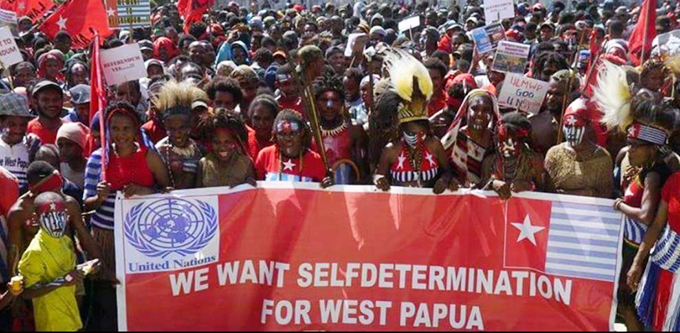 One of the rallies in West Papua. Source: Voice West Papua
Article by AsiaPacificReport.nz
]]>‘Blacklisted’ Australian researcher detained in Indonesian airport

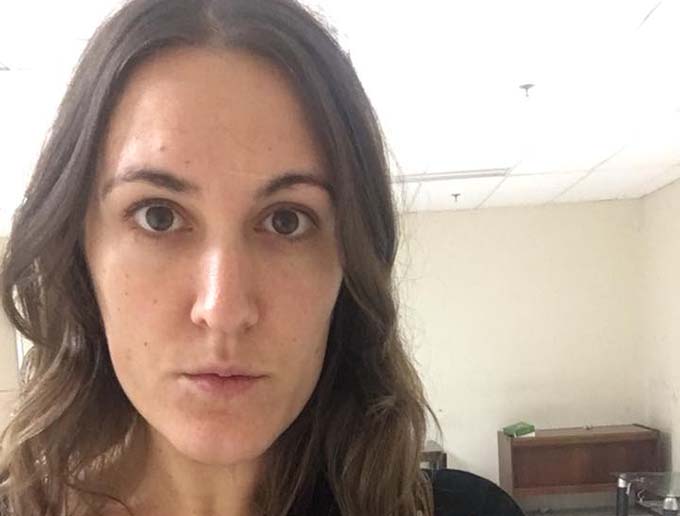 Researcher Belinda Lopez … detained by Indonesian authorities in Bali’s Denpasar airport. Image: Belinda Lopez/FB
Pacific Media Centre Newsdesk
An Australian-based doctoral media researcher says she has been “blacklisted” by Indonesian authorities and refused entry to the country while embarking on a holiday in Bali.
Belinda Lopez, based at Sydney’s Macquarie University and who has researched human rights and other issues in Indonesia, says she is being detained in a room at Denpasar’s Ngurah Rai International Airport and she will have been held for 24 hours before being deported on a flight at 10pm tonight.
A former journalist, she is doing a doctorate in Indonesian studies.
She was travelling to Bali, Jakarta and the Baliem cultural festival in Papua.
Lopez made a plea today for help from friends and colleagues which has been circulated by members of the Journalism Education and Research Association of Australia (JERAA).
READ MORE: Australian student barred from Indonesia
Two years ago when visiting West Papua she was refused renewal of her visa and told she was “suspected of being a journalist”, Lopez says.
Indonesia claims to have softened its policy on media entry to West Papua since President Joko Widodo took office in 2014.
However, media freedom and civil society advocates say there has been little change in practice.
On her Facebook page, Lopez says:
‘Blacklisted by Indonesia’
“This is not a joke: I’m blacklisted by the Indonesian government.
Saya termasuk dalam daftar tangkal Indonesia (terjemahan dibawah). Share!
“I’ve been refused entry to Bali and have been held in a room at Denpasar airport on a couch since midnight. I am told I can only board a flight at 10pm tonight, so that means I’ll be detained for nearly 24 hours before I’m deported.
“I explained I was on a holiday and that I was planning to visit friends in Bali and Java and go to the Baliem tourism festival in Papua.
“Immigration asked me if I was a journalist. Two staff members kept asking me if I had ‘done something wrong to Indonesia’.
“Nine years ago I worked for English language newspapers Jakarta Globe and The Jakarta Post as a subeditor. I have made podcasts for the ABC. And I am a PhD student of Indonesia.
“This was meant to be a holiday from university, officially on leave. My honeymoon. But the immigration staff member kept asking if I was a journalist and if I’d ‘done something bad to Indonesia’.
“Two years ago when I was in Papua, the immigration office wouldn’t renew my visa, wouldn’t explain why and then finally told me I was suspected of being a journalist so I had to leave. I was told it was an administrative matter (not a criminal one) and meant I couldn’t return to the territory for six months. I didn’t make a big deal about it because I wanted an ongoing relationship with Indonesia and I thought keeping respectfully quiet was the way to do that. It’s the first place I moved to as an adult, have visited so many times since, to learn the language and to visit people who have become some of my best friends in the world.
“So why am I now on the Indonesian government blacklist? For how long? For what reason? For going to Papua? This is devastating for me.”
Pacific Media Watch condemned the arbitrary Indonesian action against the researcher and appealed for a more humane treatment of visitors.
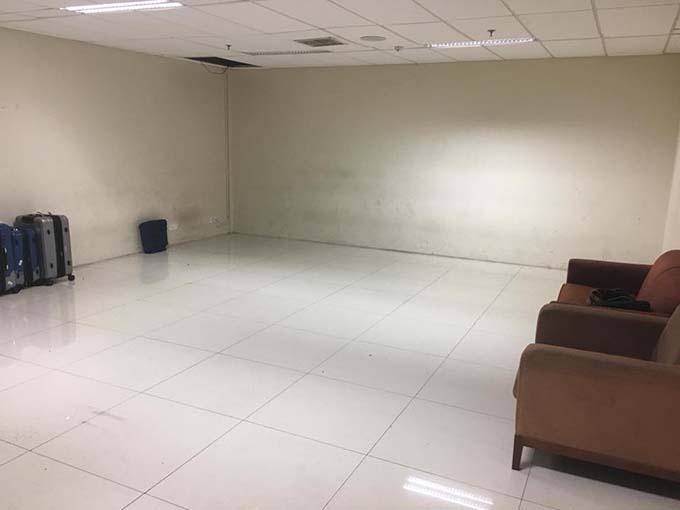 The room where Belinda Lopez is being detained at Bali’s Denpasar airport. Image: Belinda Lopez/FB
Article by AsiaPacificReport.nz
]]>Short-wave radio saves lives and foreign aid dollars, says McGarry

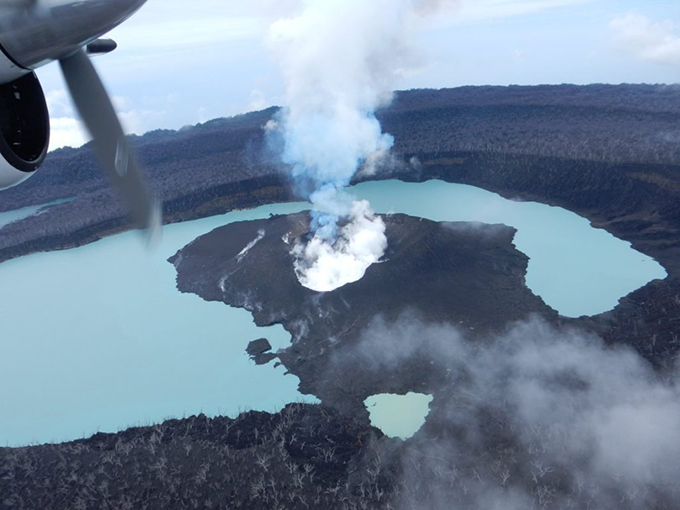 A recent photo of the current rumbling of Mt Lombenden volcano on Ambae Island, Vanuatu. Image: lechaudrondevulcain.com
Pacific Media Centre Newsdesk
Vanuatu has appealed to Australia to restore short-wave radio services to the Pacific region, after they were switched off by the ABC in 2017, reports Radio Australia.
Prime Minister Charlot Salwai said other forms of communication usually failed during natural disasters.
He added his voice on the final day yesterday for submissions to an Australian government review of broadcasting to the region, Linda Mottram reported on a segment of the PM programme.
LISTEN: Linda Mottram’s current affairs report on ABC PM
As if to make the point, his statement came as a major operation is underway to evacuate more than 8000 residents from the island of Ambae, which has been made uninhabitable by an erupting volcano.
Featured:
Nikita Taiwia, Vanuatu coordinator, Red Cross
Dan McGarry, media director, Vanuatu Daily Post newspaper
Article by AsiaPacificReport.nz
]]>Indonesian influence in the Pacific grows, brushing aside West Papua



/
RSS Feed
By Johnny Blades of RNZ Pacific in Wellington
Indonesia’s influence in the Pacific Islands is growing, but is shadowed by disquiet over its region of Papua, known widely as West Papua.
The West Papuan independence movement has significant traction in the region, where it continues to push for its self-determination aspirations to be addressed by the international community.
Considering Papua’s political status as non-negotiable, Indonesia has been busy strengthening ties with a number of countries in the three Pacific Islands regions of Melanesia, Polynesia and Micronesia.
READ MORE: Indonesia strengthens ties with Pacific ‘good friends’
Amid a flurry of diplomatic activity in recent months, Indonesian cabinet minister Wiranto attended independence anniversary celebrations on Nauru, and the president of the Federated States of Micronesia was given red carpet treatment in Jakarta.
Jakarta says this is about working together with Pacific island countries on mutual interests. Others say it’s principally about quelling support for West Papuan independence aims.
Some regional observers even suspect the hand of Jakarta was at play behind the change in the Solomon Islands government’s policy on West Papua since Rick Hou replaced Manasseh Sogavare as prime minister last December.
April’s visit by a Solomon Islands delegation to Indonesia’s Papua and West Papua provinces caused an upset among some elements of civil society in Honiara, but showed how extensive Jakarta’s diplomatic outreach has become.
Serious threat
The secretary of the United Liberation Movement for West Papua, Rex Rumakiek, said Australia’s angst about the rising influence of China in the Pacific missed a more serious regional threat.
“The Melanesian countries are not very much concerned about Chinese influence. They are concerned mostly about the Indonesians’ influence in Melanesia, because they’re very destructive, they go right down to village level.
“They bribe people and buy political parties to change the government and so on. It’s already happening. It’s much more serious than the Chinese influence,” Rumakiek said.
LISTEN: RNZ’s Dateline Pacific
A spokesperson from Indonesia’s Embassy in Canberra, Sade Bimantara, said Rumakiek’s accusation was unsubstantiated and false.
He said Indonesia had consistently engaged and worked with Pacific Island nations for many years while respecting each other’s domestic affairs and sovereignty.
“On the contrary, a handful of people claiming Papuan heritage and living overseas are the ones interfering in the domestic politics of Papua and West Papua provinces,” Bimantara said.
“They are not citizens and were never democratically elected into public offices in those provinces by the 2.7 million voters of Papua and West Papua. And yet, they claim to be the rightful heir to the provinces.”
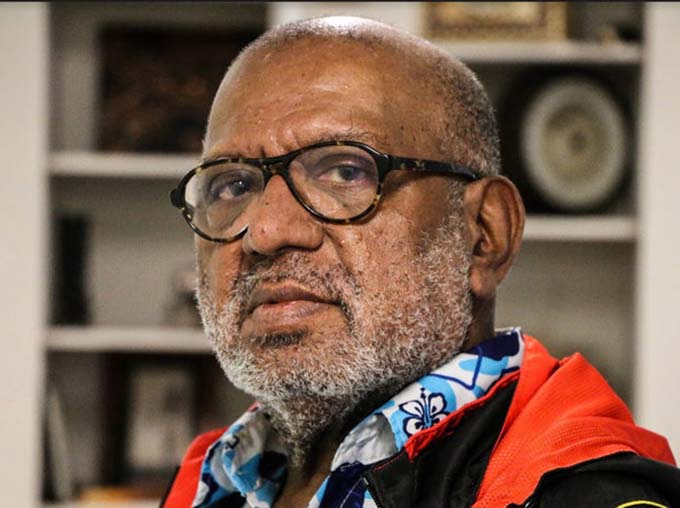 Franz Albert Joku … “Demographically, geographically, [Indonesia is] part of the Pacific. One third of the total area of the country, to the east, is inhabited by Melanesians and Polynesians.” Image: Koroi Hawkins/RNZ PacificIndonesia ‘part of Pacific’
According to Franzalbert Joku, who is a consultant for Jakarta on Papua issues, President Joko Widodo and his administration recognise that Indonesia is a part of the Pacific.
“Demographically, geographically, we are part of the Pacific. One third of the total area of the country, to the east, is inhabited by Melanesians and Polynesians,” he said.
Joku, a West Papuan who frequently represents Indonesia at meetings of the Melanesian Spearhead Group and the Pacific Islands Forum, said the country wanted to help small island countries with their development needs.
He cited Indonesian assistance in plans to build a convention centre in Tuvalu and a sports stadium in Kiribati as examples.
Indonesia is also offering help to Pacific Island countries with efforts to protect their all-important marine environment, although it is not the only larger country doing so.
Foreign governments sometimes take up the issue of human rights abuses in West Papua in their representations to Indonesia’s government.
But few human rights defenders would have been satisfed with wan assurances by Dutch Foreign Affairs minister Stef Blok that he discussed a recent damning Amnesty International report on the issue when in Jakarta last month.
Regional efforts obstructed
Some Pacific governments, notably Vanuatu, are concerned that Indonesia has obstructed efforts in regional forums to address West Papuan grievances.
A former Vanuatu prime minister and leader of the Vanua’aku Pati, Joe Natuman, said the move by some members of the Melanesian Spearhead Group to accept Indonesia into the regional organisation was problematic.
“Whoever had that wise idea is causing us problems,” he explained.
“You know, they said Indonesia comes into join [the MSG] to discuss issues of West Papua; Indonesia comes in and it doesn’t want to discuss West Papua. So I think we have to review the Indonesian membership of MSG.”
But Franz Albert Joku said it was not the responsibility of the MSG or Pacific Islands Forum to speak for Papuans. He said Papuans should be allowed to speak for themselves “by dealing with our own leaders in Jakarta and our own government.
“It’s not for offshore organisations like the Melanesian Spearhead Group and the Pacific Islands Forum to decide what should happen in Papua. Our position and especially our future is firmly within our grip.”
However, the United Liberation Movement for West Papua (ULMWP), which has observer status at the MSG, argues that West Papuans are not free to express themselves and their political aspirations in their homeland.
Thousands arrested
Indonesian police arrested thousands of Papuans in 2016 when they demonstrated in Papuan cities in support of the Liberation Movement.
Jakarta also remains sensitive to regional calls for West Papua’s political status, and the controversial process by which the former Dutch New Guinea, was incorporated into Indonesia in the 1960s, to be reviewed.
Last month while in Fiji, Papua New Guinea’s Prime Minister Peter O’Neill was reported to have encouraged regional countries to take the issue of West Papua to the United Nations Decolonisation Committee.
Following this, PNG’s Foreign Minister Rimbink Pato made a visit to Jakarta for talks with his Indonesian counterpart Retno Marsudi, reaffirming his country’s support for the status quo in the Papuan provinces.
“They are an integral part of the Republic of Indonesia,” he said.
“There has been some misreporting on this issue. Papua New Guinea’s position has not changed and there is no intention to ever change it.”
Natuman said he understood the sensitivity of the matter for PNG as West Papua’s neighbour.
“But I think they should be honest with themselves and discuss openly with the MSG and with Indonesia, and of course eventually we have to involve the United Nations,” he said.
United Nations mess
“This is a mess created by the United Nations, and the the United Nations have to come clean on this.”
The regional calls for international action on West Papua persist from the likes of New Zealand government MP Louisa Wall, who is among a small but vocal group of local MPs pushing for the issue of West Papuan self-determination to be heard at the UN.
“I believe in self-determination, I believe in indigenous rights. This is a right of the West Papuan indigenous peoples to re-litigate something that has been highlighted, actually was done in an unjust and unfair way,” Wall said.
Wall’s voice is still only part of a minority in New Zealand’s government whose formal position remains in support of Indonesian control of Papua.
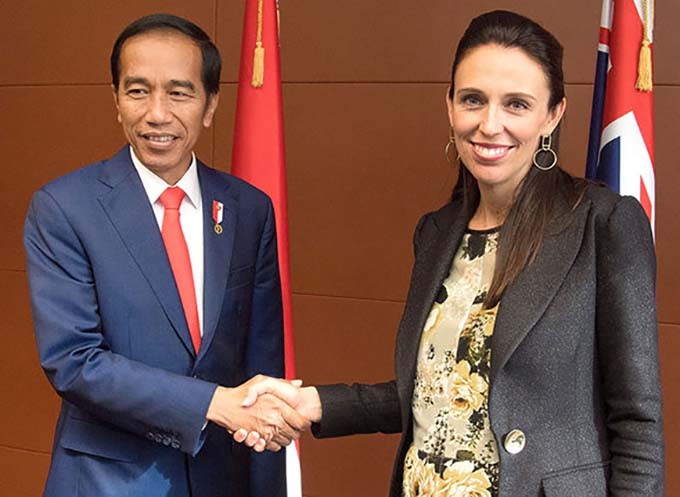 NZ Prime Minister Jacinda Ardern with President Joko Widodo … reaffirmed backing for Indonesia. Image: Marty Melville/Pool
New Zealand’s Prime Minister, Jacinda Ardern, reiterated this support to Indonesia’s president Joko Widodo during his state visit to Wellington earlier this year.
The issue of human rights abuses in Papua is a standing item on the agenda of the Pacific Islands Forum (PIF), whose leaders meet in Nauru next month.
Yesterday, the outgoing Forum chairman, Samoa’s Prime Minister Tuilaepa Sailele Malielegaoi, suggested some Pacific leaders sensationalised the alleged abuses by Indonesian military in Papua.
Speaking on national Radio 2AP, Tuilaepa, who has forged closer ties with Indonesia in the past year, conceded that various West Papuans wanted independence and sought to stop infringements of their human rights.
Tuilaepa said that where it concerned human rights issues, they should take up the matter through the United Nations Human Rights Commission.
The Pacific Media Centre has a content sharing partnership with RNZ Pacific.
Article by AsiaPacificReport.nz
]]>Rapa Nui activist calls for rigorous curb on ‘flouting’ of migration rules

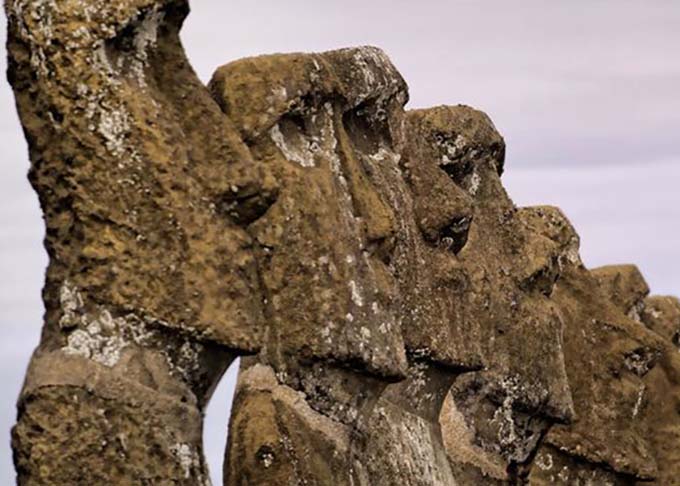 Ahu Akivi maois (statues) on the island of Rapa Nui. Image: RNZ Pacific/AFP
By RNZ Pacific
An indigenous activist on Chile’s Rapa Nui says new rules restricting internal migration to the island need to be rigorously enforced.
Non-Rapa Nui Chileans now need to have Rapa Nui spouses or children to migrate to the island without a work contract.
The activist, Santi Hitorangi, said the rule requiring a contract has previously been flouted.
READ MORE: Rapa Nui limiting visitor time to stop overcrowding
“The authorities are saying that once in action there’s going to be rigorous enforcement. So far we haven’t experienced that.
“What we have experienced is the ability of the Chilean authority in collusion with business people on the island, be it Rapa Nui or Chileans, they are keen to find creative ways to jump over those so called provisions.”
Santi Hitorangi said Chileans moving from the mainland had overwhelmed Rapa Nui’s infrastructure and warped its culture.
“The Chileans who come from the marginalised neighbourhoods of Chile and have brought crime, degenerating the culture. They are doing taxi tours and the problem with that is the information they give to those tourists. They are a warped perspective of who we are,” Hitorangi said.
Rapa Nui, also known as Easter Island, had become overcrowded during 130 years of colonial rule and its environment was suffering with the water no longer being safe to drink, the activist said.
“Many of the underground wells are polluted because as long as we have had Chile on the island the waste has been dug in pits, plastics, chemicals what have you all covered over with dirt,” he said.
The Pacific Media Centre has a content sharing partnership with RNZ Pacific.
Article by AsiaPacificReport.nz
]]>Tasered, beaten, handcuffed but Mike Treen says ‘I would do it all again’

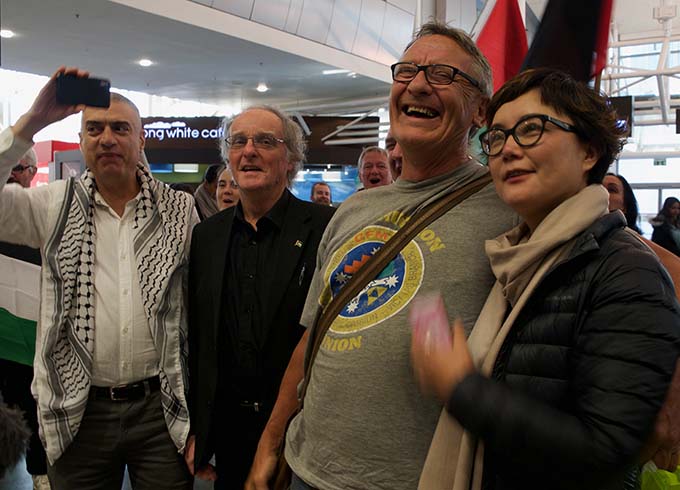 Unite Union leader Mike Treen (second from right), Kia Ora Gaza spokesperson Roger Fowler and Palestinian human rights supporters Billy Hania and Heidi Jia at Auckland International Airport today. Image: Rahul Bhattarai/PMC
By Rahul Bhattarai in Auckland
Unite Union national director Mike Treen arrived in Auckland today and told of his brutal experience at the hands of the Israeli military while trying to break Israel’s 11-year-long illegal Gaza blockade.
But he vowed he would do the whole voyage again “if it was useful” to the humanitarian cause – even after being badly mistreated by the the Israeli security forces.
The Israeli Navy “hijacked” Treen’s boat Al Awda (The Return) and seized all 22 people on board, just 40 miles nautical miles from Gaza.
READ MORE: Deported Freedom Flotilla activist on his way
“Israeli navy hijacked the ship by force, and multiple uses of tasers on me and other crew, for trying to peacefully resist,” he said.
His boat was hijacked by armed and masked Israeli soldiers in international waters.
“We weren’t forcefully trying to resist them,” Treen said. “We wanted to make clear that they had no right to take our boat. This was an unlawful act – we were in an international waters, we had the right to free passage.”
Threatened the captain
But the Israelis not only forced their way onto the boat, tasering and beating people, they also threatened to kill the captain, “simply threatened to execute him if he did not pilot the ship towards Israel,” Treen said.
Treen himself was tasered four times on his face and head area, was stomped on his foot, and left with bruises all over his body.
After the brutal treatment, he was taken to an Israeli prison and detained for five days.
During his detention, Treen was interrogated by Israeli officers and also by a New Zealand honorary consular official based in Israel, Gad Propper.
“The New Zealand consulate based in Israel in every minute acted as an agent of the Israeli state not of the New Zealand government,” Treen said.
He was not interviewed alone. The consul “interviewed me with police and security officials in the room and when he asked me about the taser mark on my face, he [Gad Propper] then immediately implied that it was somehow my fault”.
When Treen told the interviewers that his belongings, including his wallet had been stolen, Gad Propper had said “it was an exaggeration and they [Israeli soldiers] surely wouldn’t do that”.
Treen was deported back to Auckland emptyhanded with an empty wallet and with most of his money having been stolen.
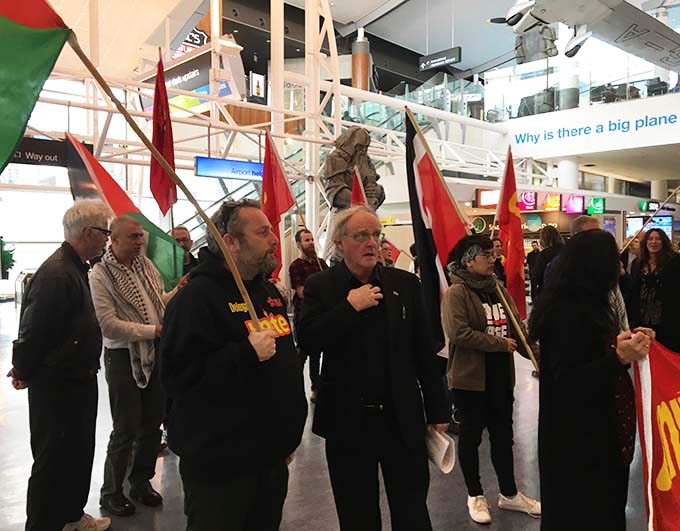 Free Palestine and Free Gaza supporters gathered at Auckland International Airport to welcome home union leader Mike Treen, deported by Israel for trying to breach the illegal Gaza blockade. Image: Rahul Bhattarai/PMC
Article by AsiaPacificReport.nz
]]>

 “Nine, which will have control of the new entity, has already announced A$50 million (32 million euros) in budget cuts, to the alarm of news staff at Fairfax’s publications.” Image: RSF


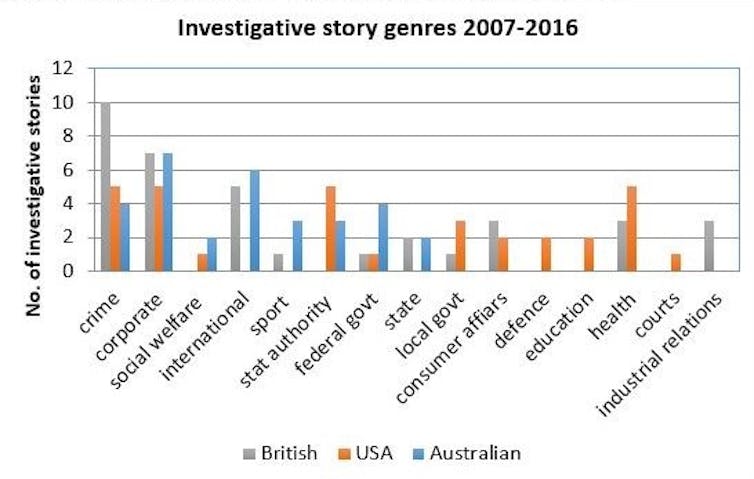 Investigative story targets in three countries: 2007-2016; n=100. Andrea Carson/Journalism Studies
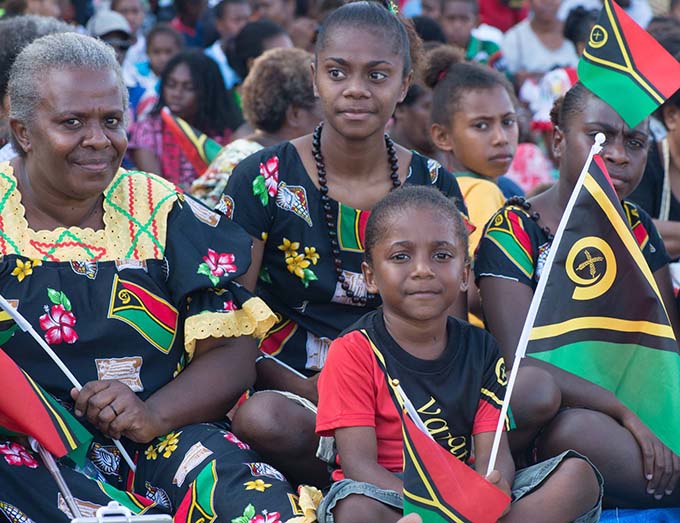
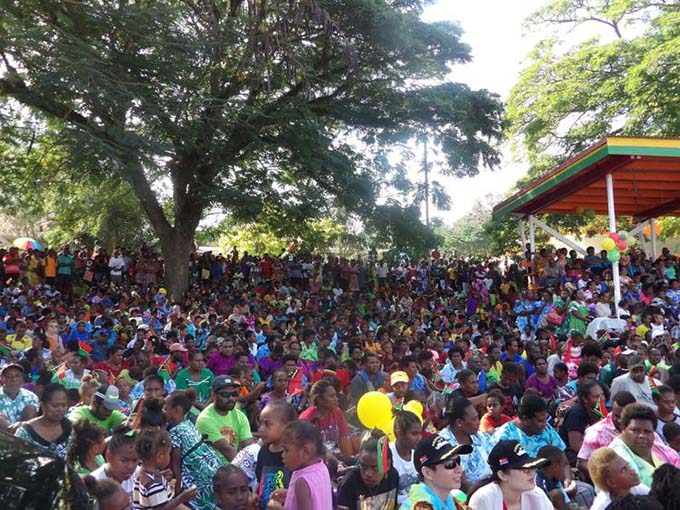 The crowd in Port Vila’s Independence Park yesterday. Image: Vanuatu Daily Post

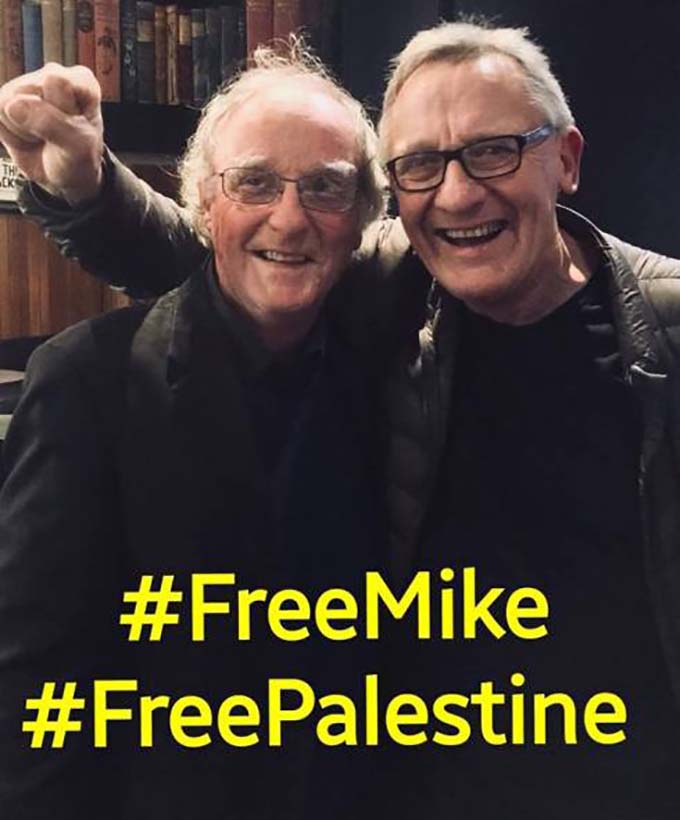
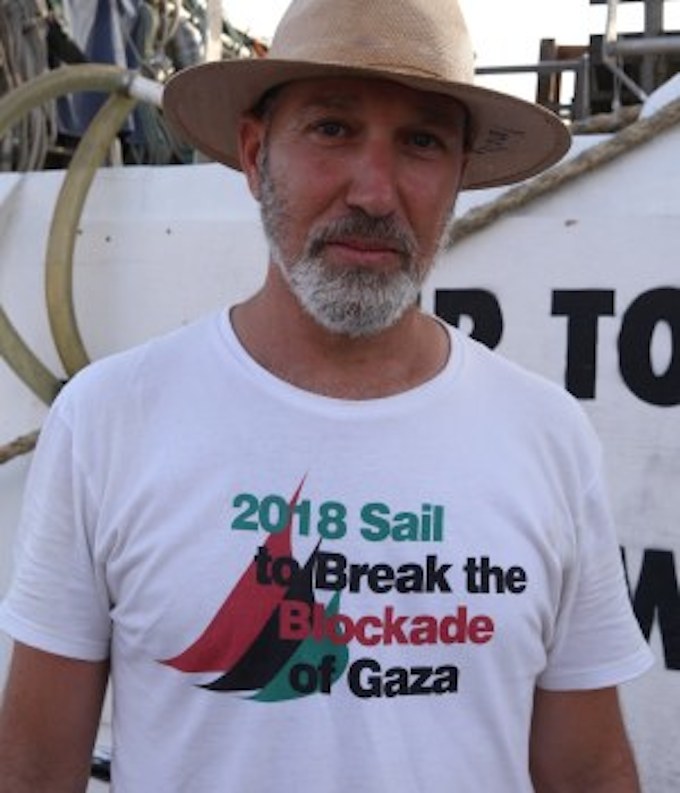
 Unite Union leader Mike Treen … attacked and detained, says union.


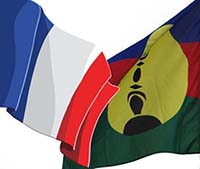 New Caledonia: What next? Part 3 of Lee Duffield’s series
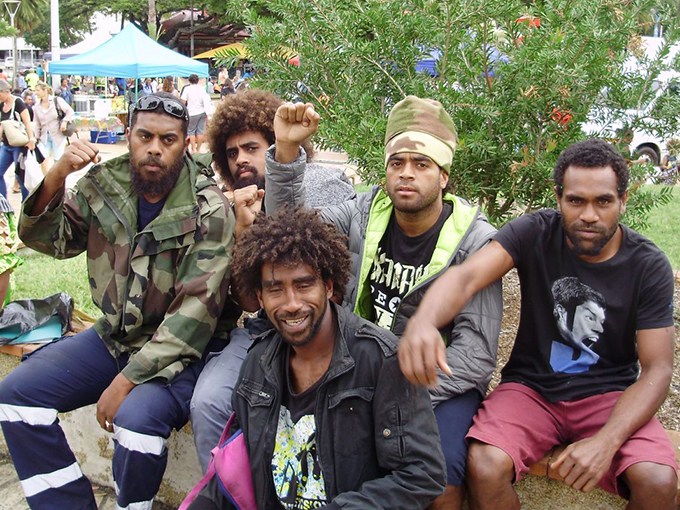 Five Kanak school leavers in Noumea’s main park, Place des Cocotiers – Kanaky Daita Weinane, Edouard Kate, Eta Roine, Noel Wazone and Siwene Wayaridge … all back independence. Image: Lee Duffield




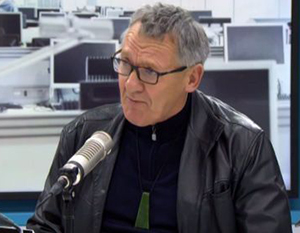
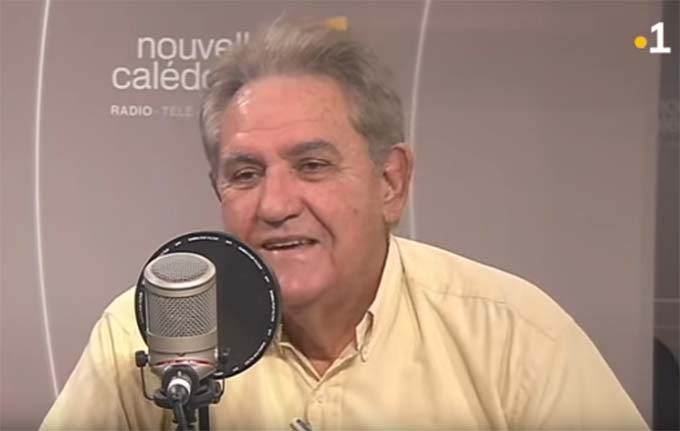 Historian Luc Steinmetz … France “did not want to provide loudspeakers to voices that would be too critical.” Image: France TV 1
 French lawyer Philippe Bernigaud representing indigenous Kanak groups negotiating over land rights. He has lived in Noumea for 17 years but cannot vote in the referendum. Image: Lee Duffield
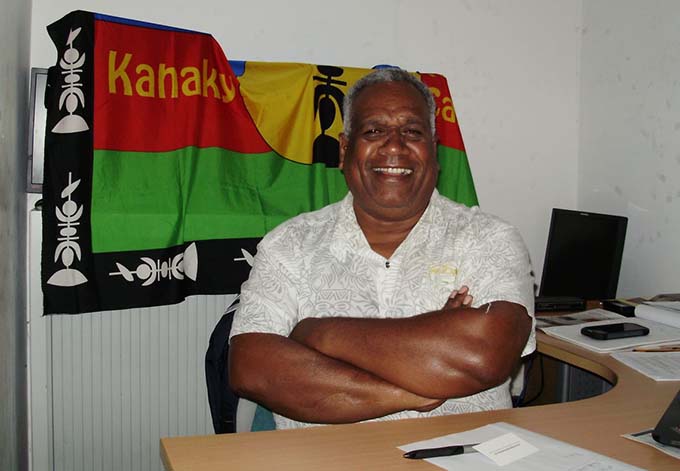 Kanak community leader and Radio Djiido coordinator Andre Qaeze Ihnim … sharing is key to the Melanesian way of life and is the main argument of the Kanak political organisation, the Kanak and Socialist National Liberation Front – FLNKS. Image: Lee Duffield

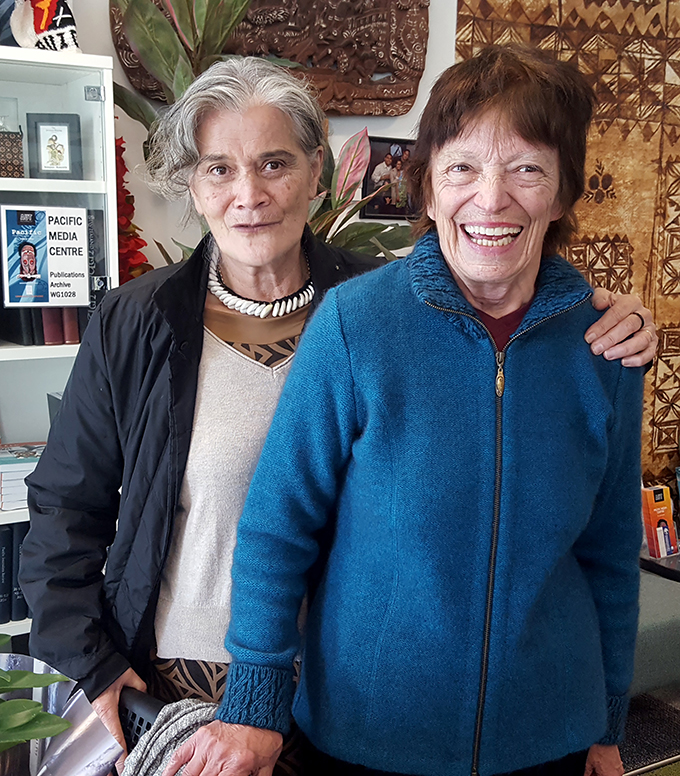
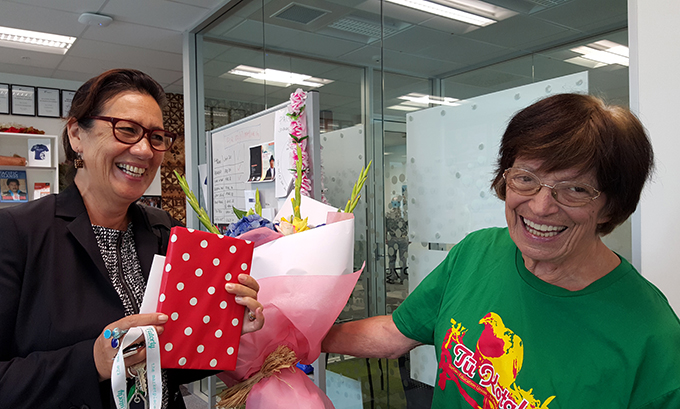
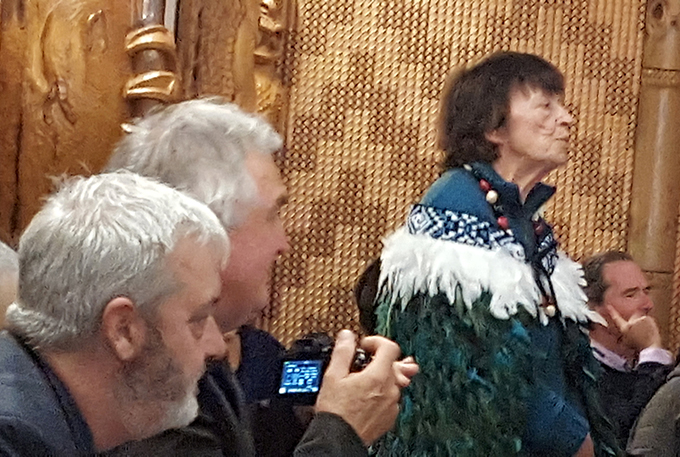 Tui O’Sullivan at her recent Auckland University of Technology farewell on Ngā Wai o Horotiu marae. Image: Del Abcede/PMC
 Tui O’Sullivan (right) with fellow foundation Pacific Media Centre advisory board member Isabella Rasch. Image: Del Abcede/PMC
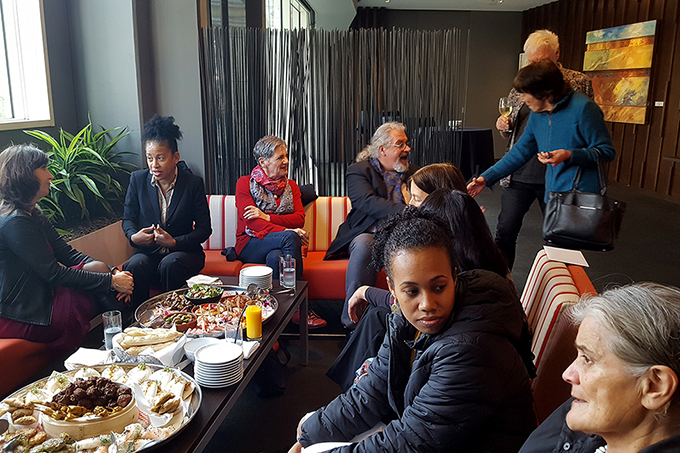 Students and staff at the Pacific Media Centre’s farewell for Tui O’Sullivan. Image: Del Abcede/PMC
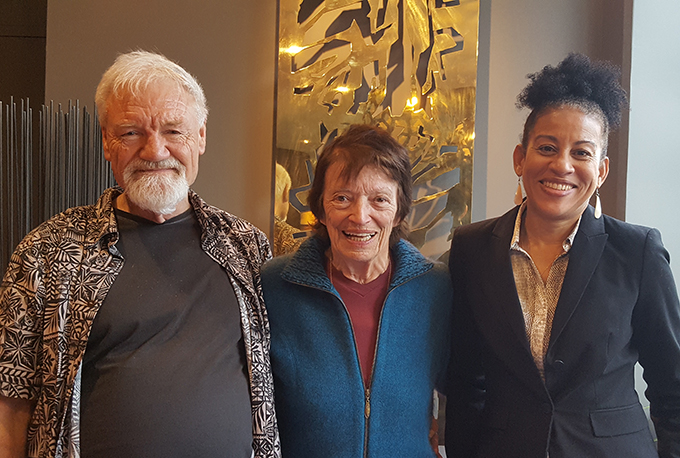 Tui O’Sullivan (centre) with Pacific Media Centre director Professor David Robie and advisory board chair Associate Professor Camille Nakhid. Image: Del Abcede/PMC

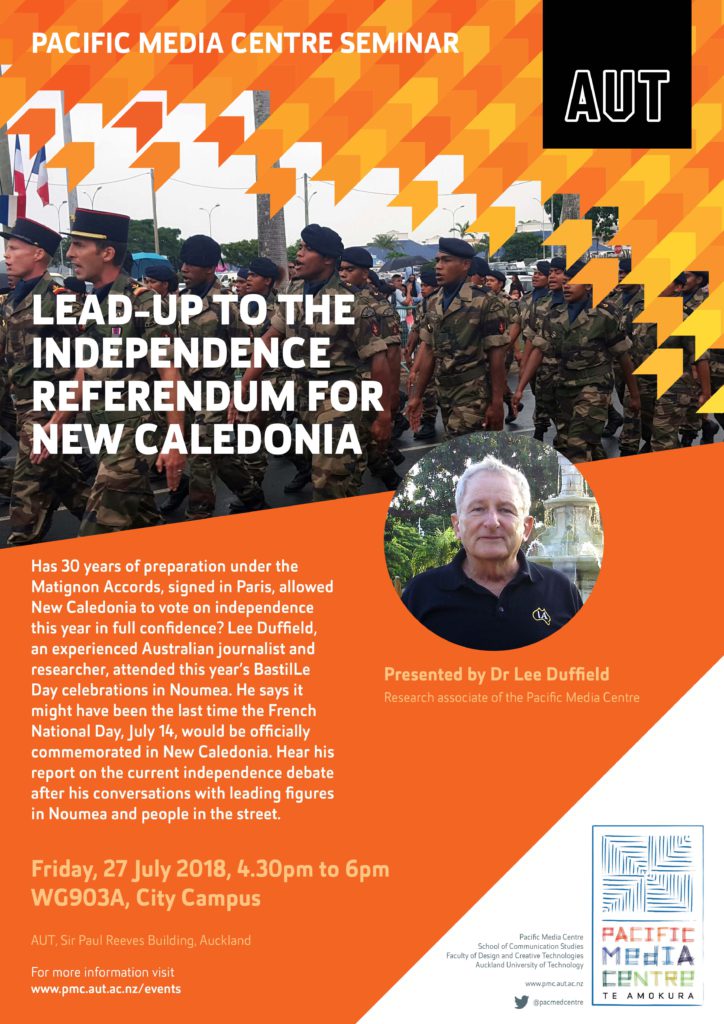 Dr Lee Duffield’s New Caledonia seminar to be hosted by the Pacific Media Centre at Auckland University of Technology today.
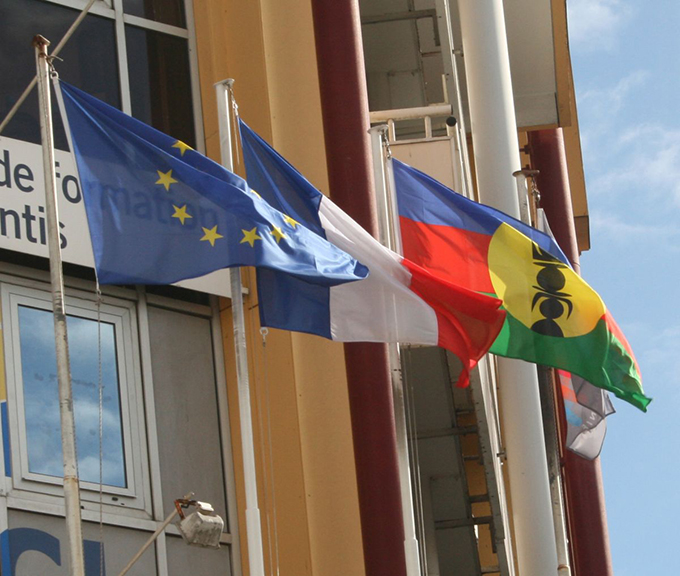 Three flags of Noumea – European Union, French tricolour and the independent Kanak ensign. Image: Lee Duffield





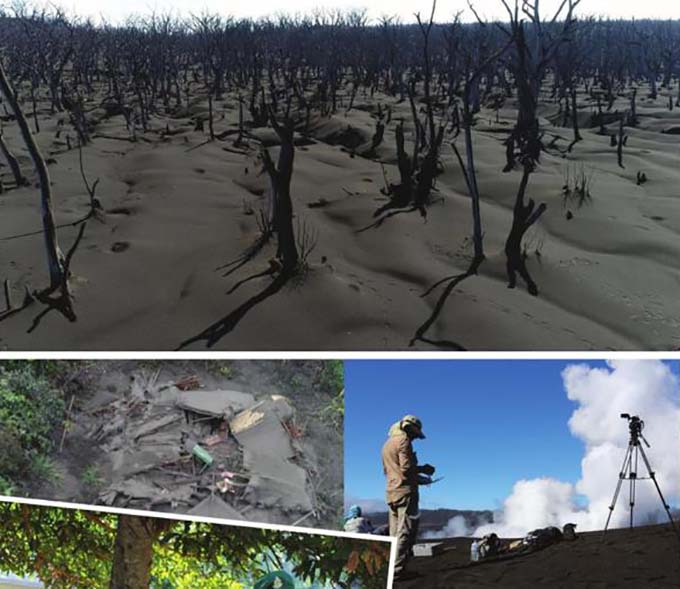
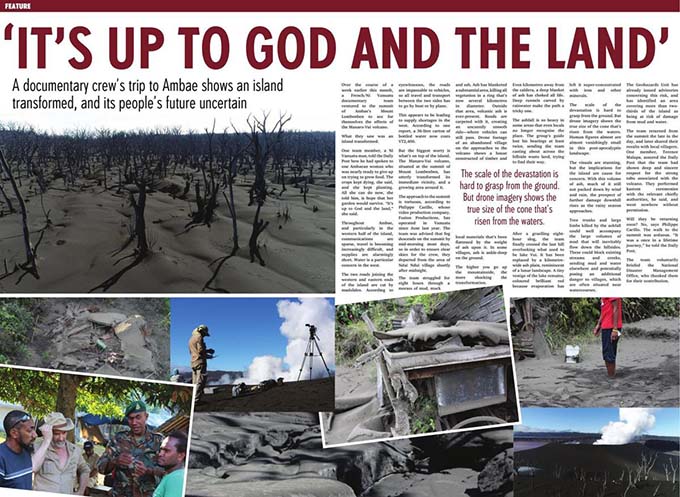 The Ambae volcano article as it appeared in the Vanuatu Daily Post at the weekend.

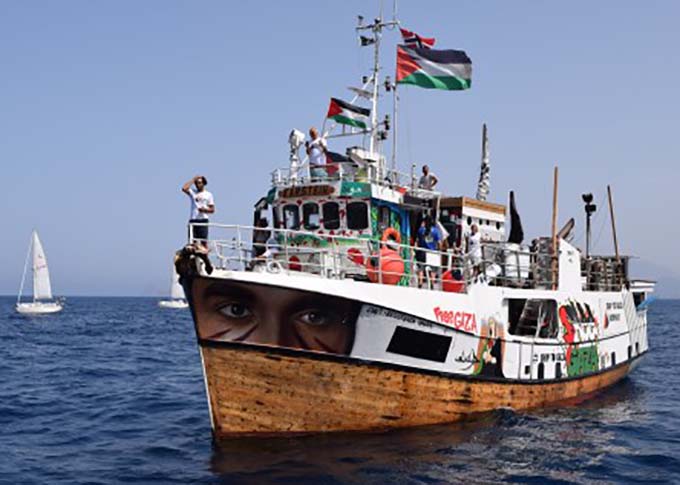
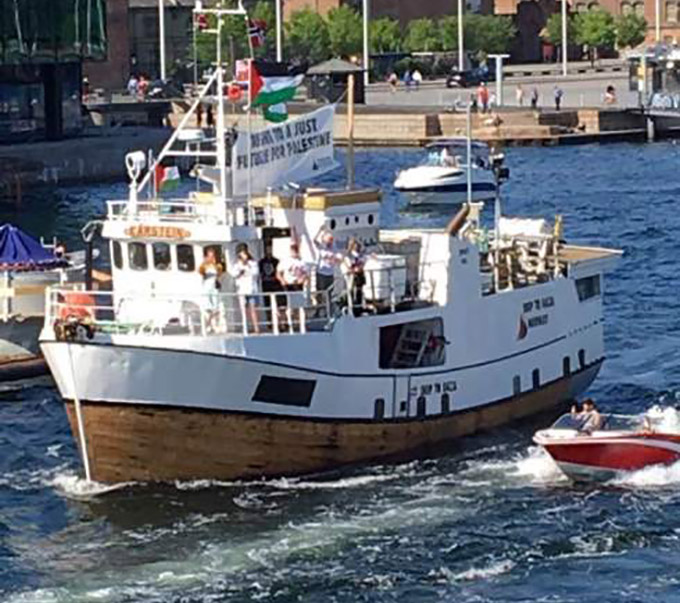 The Al Awda, one of the Gaza Freedom Flotilla’s four boats. Mike Treen is on board for the final leg of her voyage to Gaza. Image: Kia Ora Gaza
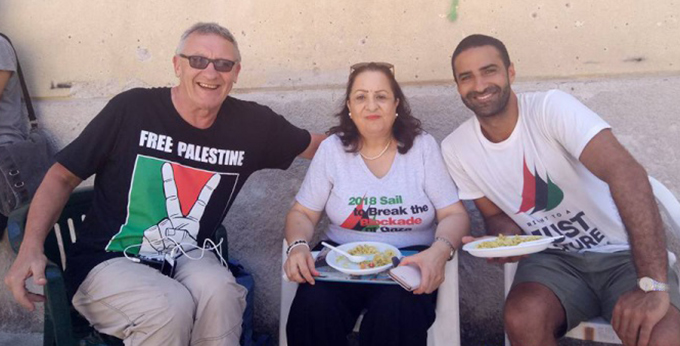 Mike Treen (left) and Youssef Sammour with the Palestinian Ambassador to Italy, Dr Mai Alkailla. Image: Kia Ora Gaza

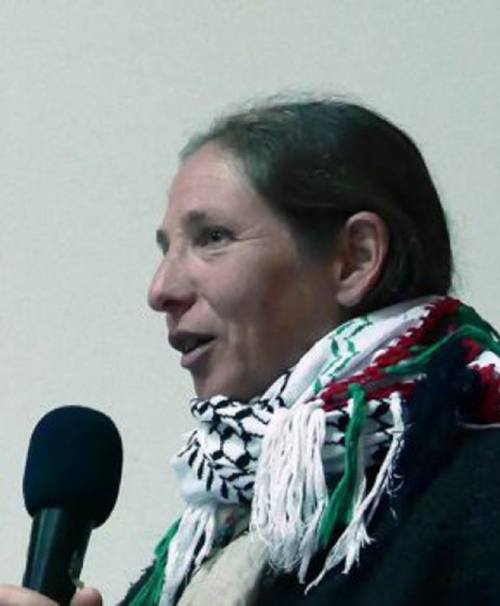 Canadian activist Ron Rousseau from Yukon … “as an Indigenous activist … we feel that it’s necessary to be defending Palestine.” Image: Scoop
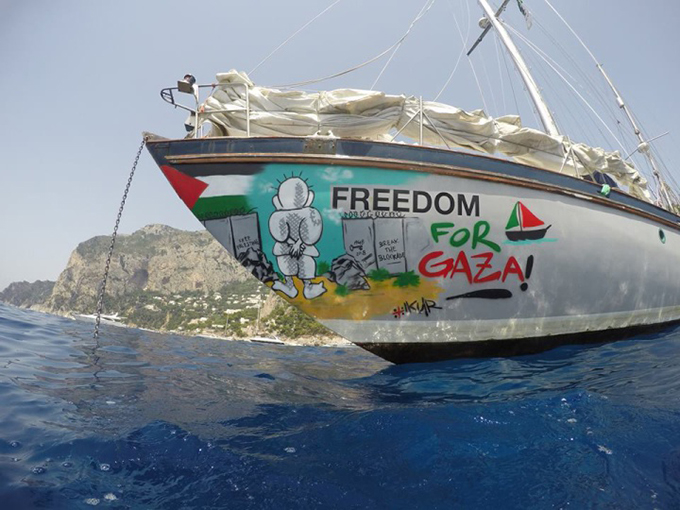 Youssef Sammour’s boat Freedom. Image: Lois Griffiths/Scoop

 A
A 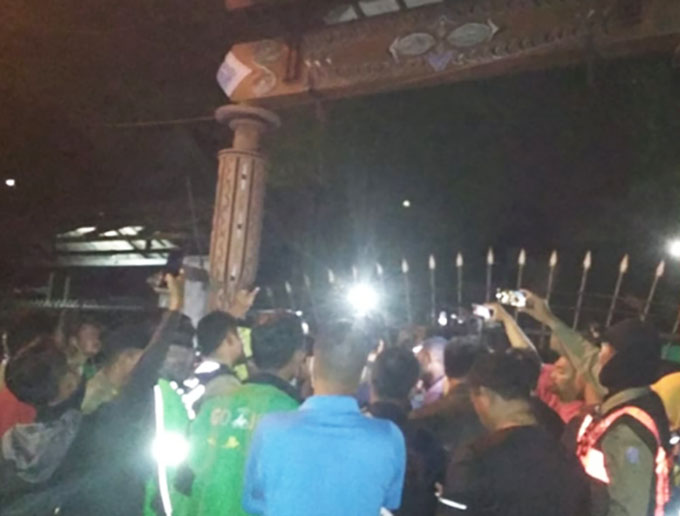 The scene at the Indonesian police raid on Papuan student quarters in Surabaya over the film Bloody Biak. Image: Suara.com