Page 1187

Malcolm Evans – Neo-Israel

]]>

Always happiest with a pencil in his hand, Malcolm Evans has been a professional cartoonist since the 60s and is one of the best in New Zealand. Approaching that milestone himself now, he tells everyone he’s twenty eight and often behaves like someone half that age. His cartoons are featured in The Daily Blog, Asia Pacific Report, Pacific Journalism Review and many publications.

Article by AsiaPacificReport.nz

]]>

Nuclear free and independent Pacific – how the zone began 33 years ago and what now?

Report by Dr David Robie – Café Pacific. –  

From Pacific Media Watch

RADIO 531pi Breakfast Talanoa host Ma’a Brian Sagala has talked about the Rarotonga Treaty with Café Pacific publisher David Robie.

It was hugely significant for the Pacific. It was sort of like a threshold for the Pacific really standing up to the big powers and predated New Zealand’s nuclear-free law.

It was a huge step forward. It was not only a declaration against France, which was detonating nuclear weapons at the time, but also against the US and Britain that had also conducted many nuclear tests in the Pacific.

The South Pacific Nuclear Free Pacific Zone Treaty 33 years ago ushered in a radical era for the Pacific, which predated NZ’s own nuclear-free law.

The Treaty of Rarotonga formalise the Pacific nuclear-free zone on 6 August 1985 and New Zealand’s own New Zealand Nuclear Free Zone, Disarmament and Arms Control Act followed two years later on 8 June 1987.

David also talks about the Rainbow Warrior’s humanitarian voyage to Rongelap to help the islanders move to another home across the Pacific Ocean. He is the author of the book Eyes of Fire about nuclear testing in the Pacific.


This article was first published on Café Pacific.]]>

Indonesian police arrest 49 in attack, vandalising of Papuan dormitory

]]>

The 49 arrested Papuan students in Surabaya police station after the protest. Image: Suara Papua

By Bastian Tebai in Surabaya

Indonesian police last night arrested 49 Papuan students who live at the Kamasan Papuan Dormitory in the East Java provincial capital of Surabaya and they are being held at the district police headquarters (Polrestabes).

There were two reasons for the arrests, according to information gathered by Suara Papua news service.

First, opposition by mass organisations (ormas) to planned peaceful demonstrations rejecting the 1962 New York Agreement which were held earlier this morning, in which the Papuan student dormitory was the gathering point for protesters.

Second, the residents of the dormitory refused to put up the national Indinesian flag in front of the dormitory as part of the August 17 national celebrations of Indonesian independence tomorrow because they said they “did not feel part of” the Indonesian state.

Local residents, the ormas and police ended up forcing the Papuan students to fly the red-and-white Indonesian flag.

Yesterday afternoon, Papuan students were involved in a clash with a combined group of police and ormas who vandalised and then demolished the front gate of the Papuan dormitory.

-Partners-

A number of ormas joined police in the incident, including the militant Patriot Garuda, the Pancasila Youth (Pemuda Pancasila) and the Bastions of the Unitary State of the Republic of Indonesia (Benteng NKRI) groups.

According to information gathered by the Surabaya Legal Aid Foundation (LBH), these “reactionary” groups earlier attacked the Papuan students who were refusing to put up the national flag.

Students defend themselves
The Papuan students living at the dormitory tried to defend themselves and, according to several media reports, one ormas member was injured by a sharp instrument.

Since then, the dormitory has been surrounded by police and “reactionary ormas”. Later in the evening, police arrived and tried to arrest several Papuan students resulting in an argument that continued until 11pm last night.

In the end, all of the Papuan students – 49 people – were taken away and held at the Surabaya district police office.

Papuan Student Alliance (AMP) secretary-general Albert Mungguar told Suara Papua the incident that occurred in Surabaya was the same as that which was carried out by the Indonesian military against the people of Papua.

“Nationalism is not something that can be forced. Nationalism is related to ideology, it is born out of the people’s consciousness.” Mungguar said.

“If today the Papuan people and Papuan students don’t want to fly the red-and-white flag, what should be done by the state and its citizens is to ask, why don’t Papuan students have a sense of Indonesian nationalism, not to pressure them, force them, like they were possessed by the Devil, enforcing their view though acts of violence.”

Unconditional release
Regarding the 49 Papuan students, who were still being held at the Surabaya district police office today, the AMP is demanding their unconditional release in the name of upholding human rights and the principles of democracy.

“We condemn the repressive actions by police, in this case the Surabaya Polrestabes and reactionary ormas. And we call for the immediate release of our 49 comrades who were arrested for no rational reason,” said Mungguar.

Earlier in the day, simulations actions were held in several cities in Java and Bali coordinated by the AMP rejecting the New York Agreement which was signed on August 15, 1962.

Pacific Media Centre notes:
Following the launch of the Trikora military operation which was aimed at harassing and forcing the Dutch out of Netherlands New Guinea in 1961-62 and under the threat that Indonesia would move from armed infiltrations to a large-scale military attack, US sponsored negotiations that led to the signing of the New York Agreement on August 15, 1962. Under this agreement, the Netherlands agreed to hand over administration of Western New Guinea to Indonesia pending a UN administered plebiscite.

Seven years later under the newly installed Suharto dictatorship, the treaty led to the so-called “Act of Free Choice” in 1969 in which 1025 hand-picked Papuans “voted” at gun-point for the territory remain part of Indonesia.

Bastian Tebai is a Suara Papua journalist.

Translated by James Balowski for the Indoleft News Service. The original title of the article was “Asrama Papua di Surabaya Dikepung, 49 Penghuni Diangkut ke Polrestabes“.

The wrecked entrance to the Kamasan Papuan Dormitory in Surabaya, Indonesia. Image: Suara Papua
Print Friendly, PDF & Email

Article by AsiaPacificReport.nz

]]>

NZ teacher ‘superheroes’ call for a better deal in first strike in 24 years

]]>

Multimedia story by Leilani Sitagata in Auckland

About 30,000 primary and intermediate school teachers and principals went on strike for the first time in almost a quarter century today.

A total of 1479 schools were closed – about threequarters of the number in New Zealand – with an impact on more than 400,000 children across the country.

Thousands of parents took the day off work to look after the children in the first teacher strike since 1994.

Many children too part in the protests with placards declaring “It’s time for more teachers so our kids get the education they deserve” and “Teachers are superheroes”.

The rallies sought attention from Prime Minister Jacinda Ardern’s government for better pay, conditions and incentives to attract new teachers.

Ardern said in a speech on the steps of Parliament that the teachers had gone on strike “too early” and more negotiations were needed.

-Partners-

Leilani Sitagata is a reporter on the Pacific Media Centre’s Pacific Media Watch freedom project.

Print Friendly, PDF & Email

Article by AsiaPacificReport.nz

]]>

Dan McGarry: Fighting for media freedom and truth in the Pacific

]]>

When the host country Nauru banned the pool broadcaster, ABC, from the Pacific Islands summit set for next month, it was condemned widely for an attack on freedom on the media. Lee Duffield recently paid a visit to Dan McGarry, media director of the Vanuatu Daily Post, who took a lead, declaring his outlet would no longer go.

The Vanuatu-based journalist who pulled the plug on the Nauru government for interfering with media freedom was having a typical full day at the office and elsewhere around Port Vila.

Time was being taken up by the major event for his newspaper’s market, of a Chinese goodwill ship in port giving out free health care to thousands of citizens and a revival of trouble over the earthquake on Ambae Island.

He had joined the Prime Minister, Charlot Salwai, on board the hospital ship, Peace Ark, together with a Chinese Rear-Admiral, Guan Bailin, recognising the visit as both a community happening and another part of China’s highly active influence-building.

On Ambae, where thousands have had to be evacuated since the earthquake and volcanic eruption a year ago, talk of a need for fresh evacuations was being matched with criticism of government relief efforts by the Opposition.

Day in the life
Dan McGarry characterised this as a day in the life of a Pacific Islands journalist, something like the experience of a country journalist in Australia, where the audience, contacts, critics and personal friends are the same people.

“Except that there are different cultures and you are reporting on national affairs.”

-Partners-

Life is tough enough for many people in the small island states – or “big ocean” states, as some like to say – with limited development and economic opportunity.

Add in the deeds of political leaders across the region partial to power without much responsibility, standing on their dignity, adverse to free circulation of information and life gets more difficult for all — especially the small number of media professionals trying to get out essential truths.

Pulling the plug
Awareness of getting out the truth on government interference promoted McGarry’s decision early in July to cancel his media outlet’s participation in the coming Pacific Islands Forum in Nauru.

The Nauru government had announced its ban on a media pool for the summit during 1-9 September, because the joint broadcaster for the group was the Australian ABC.

It said the broadcaster was biased against it; its coverage of a Nauru election had come to interference in domestic politics and it had given the island’s President some tough scrutiny – “harassment” – evidently over issues linked to the asylum seeker camps there.

The ban was condemned by several Australian and Pacific media groups, including the Media and Entertainment Arts Alliance (MEAA) and the Pacific Media Centre, the Canberra Press Gallery has had to consider a boycott on going, but News Corp broke ranks, citing its own dislike of the ABC.

Getting advice
In Port Vila, Dan McGarry was hearing advice from esteemed colleagues in his region that getting information was paramount, so never do a comprehensive boycott of an event.

McGarry’s response was defiant:

“That would apply with the Australian gallery together. But for outside media to take a position might have some additional effect. The Pacific Forum had been questionable to begin with. At the last Forum, in Samoa late last year, media access was severely restricted on any substantial stuff.

“Climate change was really the only issue, where the Pacific nations at the Paris Climate Change meeting had all wanted a standard of 1.5 degrees maximum warming, but this time failed to produce any consensus, not even a position statement.

“Considering media freedoms in the Pacific, it is not so bad here in Vanuatu. In other places, not so much. In Papua New Guinea they are compliant with government, a lot of information they are just not publishing, the Fiji Times is facing an existential threat and Nauru is a black hole.”

Thanks to the ABC
He also acknowledged the strategic role that has been played by the ABC and Radio Australia in preserving and getting out news.

“For following democratic norms, the ABC is one of our firm allies in the Pacific. Without such a strong relationship we would not have any kind of regional news to speak of. We have relied on them to get out stories that we cannot safely publish, as in the past with physical attacks on our own publisher.”

(Marc Neil-Jones who, after several incidents in 2009 with editor Royson Willie, was assaulted after publishing on scandals in the prisons system.)

“We could rely on them in a political crisis. It would help to have an ABC reporter in the room, and similarly they would not face political reprisals. We need them as they need us and I am on Australian radio on a fairly frequent basis.”

He said there was some hope the Nauru government might be getting prevailed upon to quietly change its position, by other governments.

“They might be able to bring them back; it would be in the ‘Pacific way’.”

Profile
Dan McGarry, from a family that had recently migrated to Canada from Ireland, arrived in Vanuatu in 2003 as a technology specialist with non-government organisations working on development.

As chief technologist with the Pacific Institute of Public Policy, he had worked on capacity building projects and civil society.

“It was assisting lawmakers in prioritising, visualising and making open processes, for budgets, fisheries or health care”, and three years ago, “with a reputation for neutrality”, was appointed media director of the Vanuatu Daily Post group.

With the practice of “ear to the ground” journalism, he lists developments in a range of fields where information builds up, not always ready for publication.

Comments
Some comments:

On competition for influence between China and the “West”:
• Australia was “back in the infrastructure game”, after stepping back from development aid commitments, following the report of a Chinese naval base for Vanuatu.

• On that, he’d published criticism of the late awakening in Australia over the military base story, with commentators there dismissing repeated denials — signs of general disinterest in South Pacific business:

“The average Australian’s conception of Pacific island nations is so limited it makes some of us wonder if they even want to understand. Our voices – and our reality – have been pointedly and repeatedly ignored in the media and in the corridors of power.”

• Australia’s main undertaking, a A$40 million road-building project for the Port Vila city area, had been close to a “high profile debacle”; set back by cyclone damage and other delays, it had lost some 20 pe cent of its nominal value through currency fluctuations, and he believed had been slowed by contractors lacking experience in developing countries.

• Australia had overcome competition to secure a telecommunications equipment upgrade for the country.

• China had been running an expansionary programme, “but they do not always get what they want.”

On corruption:
• All contracts and tenders came under scrutiny, but news sources tended to agree the overall level of corruption had declined.

“Sometimes when decisions are made that you cannot understand, you think that would be something that could explain it.”

• Even with the roads projects, there had to be “murmurings”, but no source had information leading to publication.

• China’s problem for this year would be with the large numbers of its citizens lining up to buy Vanuatu passports through a system of agencies. Mainly useful for evading travel restrictions placed on Chinese passports in several countries, these had been selling for sometimes $A155,000.

• He has made a graphic depicting exponential growth in the passports revenue trade pushing to more than $90 million a year, bringing massive impacts on the small economy if it develops.

On the independence referendum in New Caledonia:

• While the Melanesian countries including Vanuatu were supporting a “Yes” vote in the poll this November, the Kanak independence movement, the FLNKS, did not look to be pressing hard enough for fresh backing.

“There is a bit of national empathy with the three Melanesian independence movements that are active – Bougainville, West Papua and New Caledonia – but not a lot of advocacy here. My impression is there is some indifference among many in the New Caledonia movement, compared to the movement from West Papua, who see a need to be out there and see the media as allies.”

• He said New Caledonia was appearing in regular regional news, such as reports on police actions in demonstrations, and there were signs of some capital being moved out, as with a Vanuatu company obtaining $A5 million dollars from the French territory for financial restructuring.

On stable government and politics in Vanuatu:
• While the government had kept together and weathered no-confidence motions, in the country’s multi-party system it would have to work on taking that through to elections in 2020.

• Already one opposition group had been working systematically to build up a financial base for a strong election campaign. The Foreign Minister, Ralph Regenvanu, with his new Land and Justice Party, had made gains and would be considering it was his time. The incumbent Prime Minister, Charlot Salwai, was a quiet performer, but had so far managed to unite divided French speakers to build a political base.

Political journalist and academic Dr Lee Duffield is an editorial board member of Pacific Journalism Review and a research associate of the Pacific Media Centre. This article was first published by the Australian Independent and is republished by Asia Pacific Report with the permission of the author.

Print Friendly, PDF & Email

Article by AsiaPacificReport.nz

]]>

RSF calls on Nauru to allow banned ABC to cover Pacific Islands Forum

]]>

ABC ban … “The Nauruan government should not be allowed to dictate who fills the positions in an Australian media pool.” Image: David Robie/PMC

By Reporters Without Borders

Reporters Without Borders (RSF) has called on Nauru to rescind its decision to bar Australia’s public radio and TV broadcaster, ABC, from covering the Pacific Islands Forum that is being hosted there next month.

Journalists must be able to work with complete freedom, the Paris-based media freedom watchdog RSF said.

Nauru’s government has cited “harassment” and “lack of respect towards our president” as grounds for banning the ABC from covering this annual meeting of 18 South and North Pacific island nations, which usually receives a great deal of media coverage due on September 1-9.

READ MORE: Nauru media ban on ABC targets Australian detention centre gag

A three-member Australian press pool had been envisaged, with ABC providing the TV coverage, until the Nauruan authorities announced that no ABC representative would be allowed into the country because of the broadcaster’s “continued biased and false reporting about our country.”

“The grounds given by Nauru’s authorities are completely specious, so we urge them to rescind this decision and to provide ABC with press accreditation,” said Daniel Bastard, head of RSF’s Asia-Pacific desk.

-Partners-

“This island has become a news and information black hole because of the refugee processing centre it hosts for the Australian government. We also condemn the hypocritical silence from the Australian authorities, who have not lifted a finger to defend their public broadcaster.”

When asked about the ban on the ABC, Australian Prime Minister Malcolm Turnbull simply described it as “regrettable,” making it clear that his government was not going to try to persuade Nauru to allow journalists to work there freely

This small island nation is often described as a “Pacific gulag” or “Australia’s Guantanamo” because it allows Australia to operate a refugee detention centre there in exchange for millions of Australian dollars.

The UN has often criticised conditions in the camp.

Journalists are clearly unwelcome in Nauru. As RSF noted in its recent report on the obstacles to media coverage of refugee routes, Nauru charges 8000 euros for a visa application that is not refundable even when the visa is denied, which is usually the case.

And to further limit media attention, Nauru found another radical solution – blocking access to Facebook for three years.

Australia is ranked 19th out of 180 countries in RSF’s 2018 World Press Freedom Index.

The Pacific Media Centre’s Pacific Media Watch freedom project collaborates with Reporters Without Borders.

Print Friendly, PDF & Email

Article by AsiaPacificReport.nz

]]>

Ralph Regenvanu: Pacific regionalism, climate finance and women in politics

]]>

Tess Newton Cain talks to Ralph Regenvanu

During a recent trip to Port Vila, Tess Newton Cain caught up with Ralph Regenvanu, Minister for Foreign Affairs, International Cooperation and External Trade in the Vanuatu government.

Regenvanu describes himself as a Port Vila citizen. He has lived for most of his life in the capital of Vanuatu, other than for a period of time when he was studying in Australia (he holds an honours degree in anthropology and development studies from the Australian National University (ANU).

He spent more than a decade as director of the Vanuatu Cultural Centre, prior to a return to university in 2007, this time to study law at the University of the South Pacific. Then his political career took off:

Halfway through my degree, I stood for election, and I got in at the end of 2008 as an independent candidate. And myself and the others who were with me in the political journey set up the Graon mo Jastis Pati in 2010.

This is Minister Regenvanu’s third term in Parliament and he has held a number of portfolios since 2008. He took over as Minister for Foreign Affairs in December 2017.

So, what are Vanuatu’s foreign policy priorities and what would he like to see his ministry achieve during his tenure as its leader? Significantly, the minister points to internal matters as being more significant than external issues:

-Partners-

The biggest issues of this ministry are not so much external issues. The biggest issues of the Ministry of Foreign Affairs are the internal coordination of the government so that we can strategically approach our international relations and diplomacy. So, at the moment, it is quite difficult to effectively strategise about how Vanuatu places itself in the world, especially the most important thing for us on the horizon is the LDC graduation in 2020.

More opportunities
The minister explained that he thinks there are more opportunities for Vanuatu to work strategically bilaterally, regionally and globally. This is what will be required as the impacts of Least Developed Country (LDC) graduation take effect after 2020.

Therefore, he is focused on getting the internal infrastructure right between his ministry, the Prime Minister’s Office (which is responsible for aid coordination), the Ministry of Finance and Economic Management, and the Ministry of Agriculture, Livestock, Forestry, Fisheries and Biosecurity (which has carriage of the EDF11 program).

Politics in Vanuatu and voter behaviour tends to focus on the hyper-local issues so how can the work of the Foreign Minister and his Ministry be translated into messages that resonate with the urban voters of Port Vila, which is where Minister Regenvanu’s constituency sits?

…the best way to really make people appreciate our foreign relations is, of course, all the aid projects, right? And being able to show that they are well chosen, have high impact on the lives of people, that they’re conducted in a manner which is transparent, and they’re done efficiently. And that brings me back to what I originally said about being very strategic in how we organise ourselves internally to get projects, attract the right kind of projects and the right kind of conditions that we want.

The second aspect of foreign affairs that the minister believes resonates with voters is one that is essentially part of the DNA of Vanuatu:

There is, of course, the very popular issue in Vanuatu of West Papua, and that’s also something which governments need to take heed of, in terms of the very, very popular support for the independence of West Papua in Vanuatu, which is translated into one of our foreign affairs objectives.

A third, emerging, narrative is around the growing awareness of the impacts of climate change in Vanuatu. On that note, we discussed recent statements the minister had made regarding climate finance and, in particular, the issue of compensation for loss and damage.

Frustration over key issues
He expressed a certain amount of frustration with the actions (or lack thereof) of developed countries in relation to some key issues:

You’ve got to play the game that you yourself agreed to. So, when it comes to the Green Climate Fund, for example,… it’s a very poor effort by the developed countries who’ve said that they would contribute. Let alone, talking about loss and damage, which has absolutely no contributions, even though that was also an agreement made by all the countries…

I reminded the minister he had previously expressed to me a degree of scepticism about the value of regional organisations such as the Pacific Islands Forum and the Pacific Islands Development Forum (PIDF). What are his current views on this?

I think the Pacific Islands Forum is definitely useful, especially in terms of articulating common positions and being a conduit for development finance, accessing larger facilities and so on… I can’t say the same about the MSG [Melanesian Spearhead Group]. I think the MSG is… it’s disappointing, to say the least and there’s a question of its relevance.

The minister accepts that Vanuatu has a particular interest in the MSG, but says that ongoing support depends on management decisions made in the next little while. While the decision on the membership application of the United Liberation Movement for West Papua (ULMWP) is top of that list, there are other concerns around management of the organisation as well. As for the PIDF?

We’re currently not a member. And we’re just — I suppose we’re just watching it to see — we’re really more invested in the Forum at this stage.

Last, but not least, we turned to the issue of increased participation of women in political decision-making. This is an issue on which Minister Regenvanu has long been very vocal. Further to his contribution to getting temporary special measures included in municipal elections in Port Vila and Luganville, what is next in this space?

Gender political space
…the next step is going for political party legislation, which is what we’re working on now, to get a new bill through Parliament, which provides for the regulation of political parties. At the moment, we have nothing like that in Vanuatu. So, just a very simple law that says you have to register a political party according to certain criteria… And then in that legislation, I think, is room to create measures… by which women can get more representation.

Minister Regenvanu continues to be a prominent and influential member of the Vanuatu Parliament and government. We will be watching his political progress with interest.

Dr Tess Newton Cain is the principal of TNC Pacific Consulting and is a visiting fellow at the Development Policy Centre in the Crawford School of Public Policy at the ANU College of Asia and the Pacific at the Australian National University. She is a citizen of Vanuatu where she lived for almost 20 years and is now based in Brisbane.

Print Friendly, PDF & Email

Article by AsiaPacificReport.nz

]]>

Mission accomplished: Why ‘blockade buster’ boats to Gaza still succeed

]]>

ANALYSIS: By Ramzy Baroud, recently in New Zealand

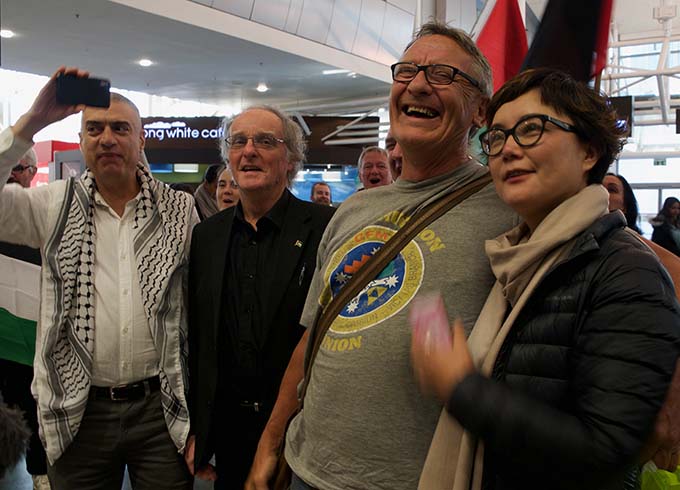
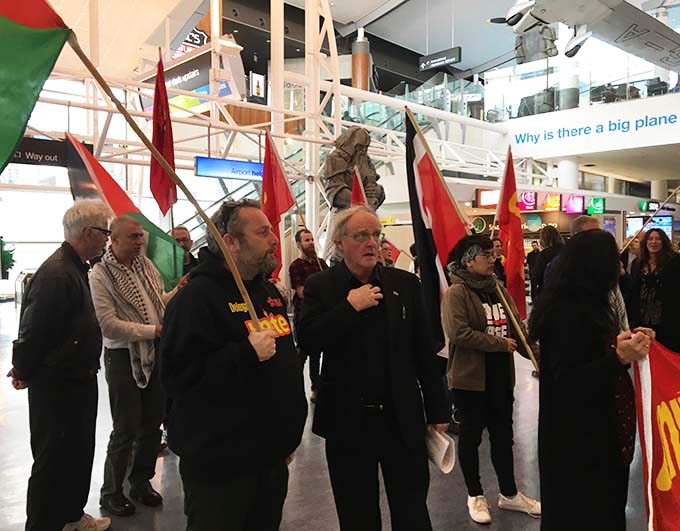
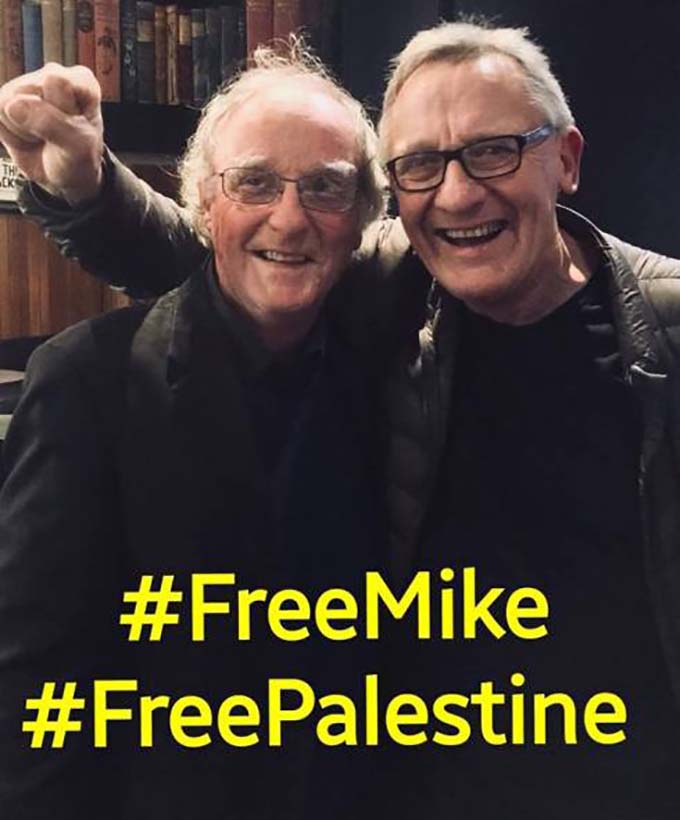
When Mike Treen, the national director of the Unite Union in New Zealand, arrived at the airport in Auckland earlier this month, a group of people were anxiously waiting for him at the terminal with Palestinian flags and flowers. They hugged him, chanted for Palestinian freedom and performed the customary indigenous haka dance.

For them, Mike, as all of those who set sail aboard the Freedom Flotilla to Gaza last July, were heroes.

But the truth is Mike Treen and his comrades were not the only heroes for braving the sea with the aim of breaking the hermetic Israeli military blockade on the impoverished and isolated Gaza Strip.

READ MORE: Freedom Flotilla activist: Israel soldiers beat us, stripped us, then robbed us

Without those who were present at the Auckland airport, upon Mike’s arrival on August 1, and without the thousands of supporters all across the world who have mobilised as a community – held numerous meetings, raised funds, created a powerful media discourse, and so on – Treen’s attempted trip to Gaza would not have been possible in the first place.

The first boats to successfully break the Gaza siege, in October 2008 were the Free Gaza and the Liberty. They carried 44 people from 17 countries. The activists wanted to push their countries to acknowledge the illegality of the Israeli blockade on Gaza and to, eventually, challenge the siege.

-Partners-

Their triumphant arrival in Gaza 10 years ago, marked a historic moment for the international solidarity movement, a moment, perhaps, unparalleled. Since then, Israel has launched several massive and deadly wars on Gaza.

The first war took place merely weeks after the arrival of the first boats, followed by another war in 2012 and, the deadliest of them all, in 2014. The siege grew tighter.

Also, since then, many attempts have been made at breaking the siege. Between 2008 and 2016, 31 boats have sailed to Gaza from many destinations, all intercepted, their cargo seized and their passengers mistreated.

The most tragic of these incidents was in May 2010 when the Israeli navy attacked the Mavi Marmara ship – which sailed alongside other boats – killing 10 activists and wounding many more.

Even then, the stream of solidarity boats continued to arrive, not only unhindered by the fear of Israeli retribution, but also stronger in their resolve. Palestinians consider the killed activists as “martyrs” to be added to their own growing list of martyrs.

However, none of the boats made it to Gaza; so why keep on trying?

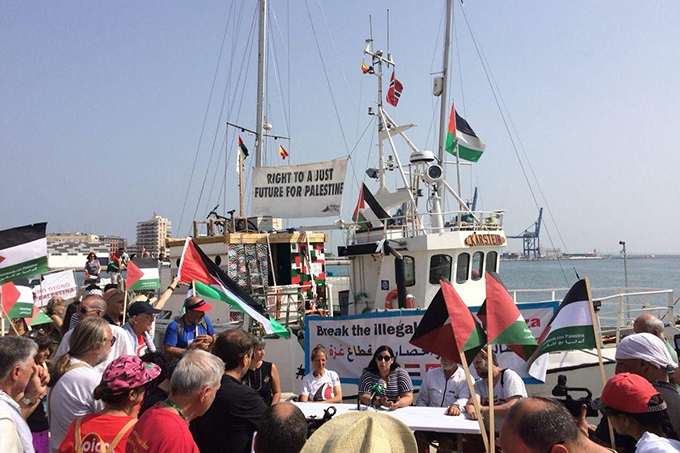
Crowds gather to meet the crew of the Freedom Flotilla ship as they prepare to leave for Gaza. Image: Middle East Monitor

Last May, I arrived in New Zealand as part of a book tour that took me to other countries as well. However, in New Zealand, a relatively small Pacific island nation with a population that does not exceed five million people, the solidarity with Palestine was exceptional.

I asked about the strong Palestine solidarity work in New Zealand, inquiring with the coordinator for Kia Ora Gaza, Roger Fowler, who, at the time, was busy with final preparations for the Freedom Flotilla.

In New Zealand, he said, “for many years support for the Palestinian struggle lingered, often perceived as being too distant, and falsely portrayed as being ‘too complicated’. But the global outrage at Israel’s murderous attack on the Mavi Marmara-led humanitarian flotilla to Gaza in 2010 was a major turning-point that changed all that.”

Fowler, himself, along with other New Zealand activists joined the Lifeline to Gaza convoy soon after the attack on the Mavi Marmara, reaching Gaza with three ambulances, packed with badly needed medicine, as the Israeli siege also deprived the Strip of hospital equipment and urgently needed medicine.

Coordinating all of this was not a simple task as it also needed to be streamlined with the global efforts for the convoy, which included the dispatching of 140 other ambulances and 300 activists arriving from 30 countries.

There were many moving scenes as Palestinians learned how far we had come from to offer solidarity – their Israel overlords had told the Palestinians for years that nobody cared about them, which is a big line.

Fowler told me.

I also spoke with Mike Treen upon his return from his Gaza sea journey. Treen is a seasoned activist, who works daily at defending the rights of workers from across the country. He sees his struggle for workers’ rights in New Zealand as part and parcel of his global solidarity outlook as well.

“In my role as part of the union movement in this country, I was also able to explain [to New Zealanders] that innocent working people [in Gaza] are the victims of this siege and that Israel has driven unemployment to over 50 per cent for working people – one of the highest rates in the world,” he told me.

Treen, just like Fowler, understands that the boat solidarity is not merely an issue of providing urgently needed supplies, but as a well-coordinated effort at exposing the evils of the Israeli blockade. He said:

“Unless Israel is directly bombing Gaza, the siege and its hideous human implications simply drop off the radar of public consciousness.”

And this is precisely the real mission of the Gaza flotillas: While Israel wants to normalise the Gaza siege as it is currently normalising its Occupation and Apartheid regimes, the solidarity movement has created a counter discourse that constantly foils Israeli plans.

In other words, whether the boats arrive on the Gaza coast or are hijacked by the Israeli navy, it makes little difference.

The power and effectiveness of this kind of solidarity goes even beyond Gaza and Palestine.

“Our involvement in international solidarity endeavours, such as the Freedom Flotillas has, in turn, sparked a resurgence in other important elements of building the strength of the world-wide movement for justice.”

Fowler told me, soon after Treen’s return to New Zealand.

Mike Treen also has his work cut out for him as he is now busy engaging the media and various communities in New Zealand, sharing his experiences on the boat, which led to his arrest, beating, tasering and deportation.

And like the horrific Apartheid regime in South Africa, the Israeli Apartheid will collapse, too, because Palestinians continue to resist and because millions of people, like Mike and Roger, are standing by their side.

Dr Ramzy Baroud is author of The Last Earth: A Palestinian Story and visited New Zealand in May.

#FreedomFlotilla

Print Friendly, PDF & Email

Article by AsiaPacificReport.nz

]]>

Graphic Fiji crash images highlight need for social media education

]]>

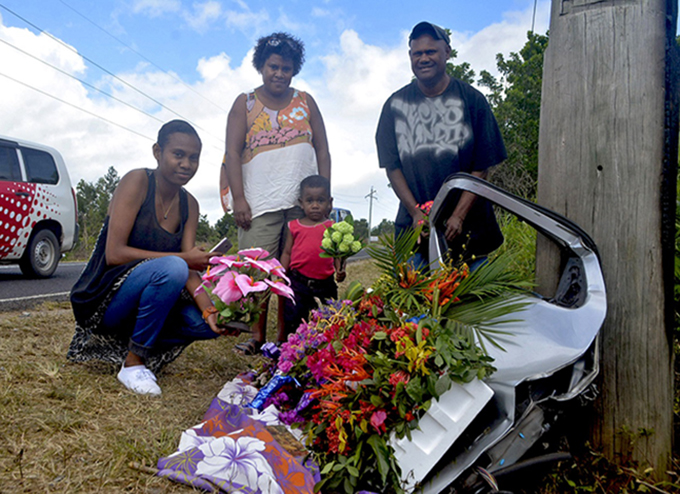
The Raiova family lay flowers at the accident site at Nabou, Nadroga, last week which has now claimed the lives of seven Fijians. They hoped to fulfil the wishes of their daughter, Paulini Raiova, 16, who had hoped all along to visit the site and pay respect after having witnessed on social media the wreckage caused by this tragic accident. Image: Reinal Chand/Fiji Times

By Leilani Sitagata in Auckland

A viral spread of photos and videos from last week’s fatal crash at Nabou has highlighted a need for education surrounding the use of social media in Fiji.

University of the South Pacific’s senior lecturer and coordinator of journalism Dr Shailendra Singh told Asia Pacific Report this was “not a first” for something to be spread across social media.

“It highlights a bigger problem and the lack of action to address it,” he said.

READ MORE: Family shocked at gruesome images

“There is need for a national education campaign on how to use social media in a responsible manner.”

The death toll from the tragic minivan crash now stands at seven and at least 25 people received medical treatment. Many social media postings carried gruesome close-ups of the dead victims.

-Partners-

Dr Singh said mainstream news outlets in Fiji did not use graphic images of the deceased because of ethical reasons.

“None of the mainstream news media carried such images because it’s against professional ethics.”

However, the public did not have the same obligations as the media when it came to what they posted on social media, said Dr Singh.

‘Not bound by rules’
“The public users of social media re not bound by any such rules or ethics.”

USP journalism student Anaseini Civavonovono said that in this digital era with the rapid evolution of technology there was an increased concern for their use.

“Smartphones allow people to stay connected always but the challenge is how (ethically) they use it.”

A big problem that comes with the connectedness of technology is the need to be first, said Civavonovono.

“The trend now is not only about geobragging, but how fast a user can update their post and being the first person to provide the update.”

Save the Children Fiji CEO Iris Low-Mackenzie said people should have more tact before sharing on social media.

“This is a sign that it’s time to evaluate our social media habits because some of the deceased are children, children who belong to families, who have friends and a whole network around them, and to be circulating these horrific videos is very inhumane and insensitive.”

Posts upsetting
Family member of one of the young men who survived the car crash Kasanita Bilitaki told Asia Pacific Report it was upsetting to see the many posts about the tragic event.

“I felt so disgusted by those who were posting graphic images and videos on social media, even before the families knew about the crash had the audacity to do that.”

“It was as if our morals as itaukei went quickly out the door for a few likes on social media.”
Bilitaki said she was thankful that her cousin Jacob Vunicagi was recovering in hospital, but said her family was saddened by the spread of explicit posts on Facebook.

“They were disappointed that people went through all that effort to post up graphic images about the other victims that died instantly.”

Harvard University student and intern for UNICEF Pacific Sruthi Palaniappan witnessed the accident and said although she was in shock, that did not stop her from trying to help.

‘Tried my best’
“I tried my best to help by assisting a woman out of a car, calling the ambulance, and providing water and a towel that I had.

“I remember feeling so helpless in the moment as no one around me was a trained medical professional and I wanted to do more to help but did not know how.”

Since the tragic event, Palaniappan said she was compelled to start a GoFundMe page to raise funds to support those affected.

“The lives of these families will never be the same.

“My heart goes out to the affected families, and I wish them all the strength.”

Leilani Sitagata is a reporter for the Pacific Media Centre’s Pacific Media Watch project.

Print Friendly, PDF & Email

Article by AsiaPacificReport.nz

]]>

Protests over ‘captive’ photojournalist, Confucius film featured on 95bfm

]]>

Pacific Media Watch Newsdesk

Radio 95bfm Jemima Huston is joined by AUT Pacific Media Centre director Professor David Robie and reporter Rahul Bhattarai about the centre’s Asia Pacific Report news stories and issues being covered.

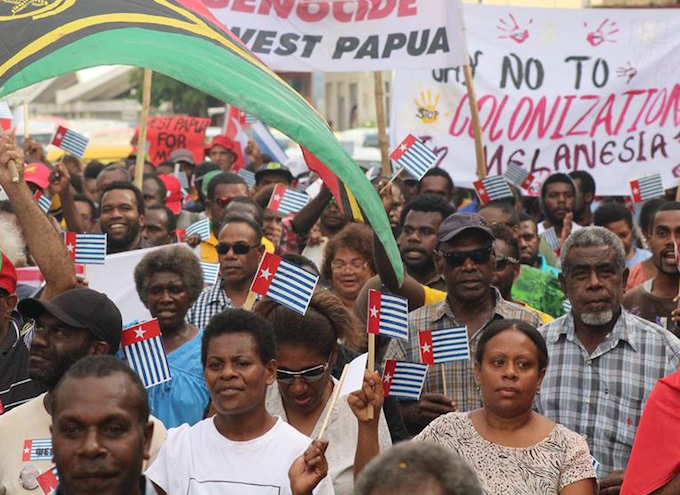
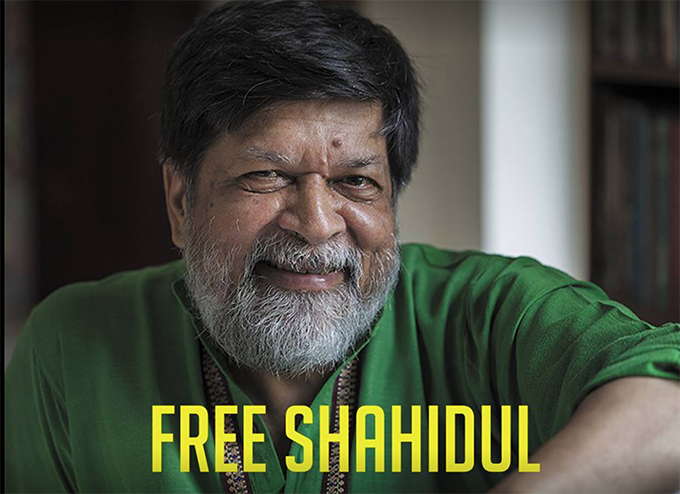
Topics include: the detention of a Bangladeshi photojournalist, in an ongoing protest in Bangladesh; the screening of the controversial movie In the Name of Confucius; ABC’s Asia Pacific shortwave radio cutbacks; and Vanuatu appointing a special envoy for West Papua.

LISTEN: Full PMC Southern Cross radio programme

Print Friendly, PDF & Email

Article by AsiaPacificReport.nz

]]>

Eight die in Papua plane crash – teenager boy lone survivor

]]>

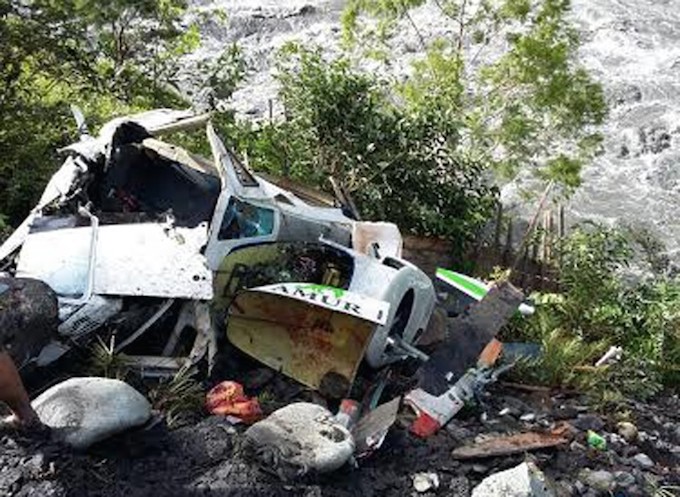
Wreckage of the plane that crashed near Paniai, Papua, close to the Papua New Guinea border on Saturday. Image: Jakarta Post

By Nethy Dharma Somba in Jayapura

A plane crashed in the mountainous Gunung Menuk area in Pegunungan Bintang regency of Indonesia’s Papua province on Saturday, killing eight people on board, including the pilot and co-pilot  – but a 12-year-old boy survived.

Rescuers who reached the aircraft at dawn said they found the boy alive among the wreckage.

The crash was near Oksibil close to the border with Papua New Guinea.

“The survivor, identified as J, 12, has been evacuated from the crash site and taken to a hospital in Oksibil district to receive treatment for his broken right hand,” Pegunungan Bintang police chief Adjunct Commander Michael Mumbunan said yesterday.

He said the victim’s bodies were also being transported to Oksibil.

The Swiss-built plane, operated by PT Martha Buana Abadi, was found on Sunday at 6.15 am local time, according to Jayapura Search and Rescue Agency spokesman Yadianto.

-Partners-

The plane departed from Tanah Merah airport in Boven Digul on Saturday at 1.42 pm and was scheduled to arrive at Oksibil airport at 2.20 pm.

“It took eight hours for search and rescue personnel to reach the crash site – comprising a two-hour drive and a six-hour trek through Kampung Okatem to Gunung Menuk,” Yadianto said.

In 2015, a Trigana Air twin turboprop plane crashed near Oksibil, killing all 54 on board.

Nethy Dharma Somba is a Jayapura-based reporter of the English-language Jakarta Post.

Print Friendly, PDF & Email

Article by AsiaPacificReport.nz

]]>

Nauru media ban on ABC targets Australian detention centre gag

]]>

There has been much wringing of hands over Nauru’s ban on the Australian Broadcasting Corporation for next month’s Pacific Islands Forum leaders’ summit. But, reports Sri Krishnamurthi of Asia Pacific Journalism, even more perplexing is Canberra’s relative silence.

The elephant in the room about the Australian Broadcasting Corporation ban that has people tip-toeing through the frangipani and whispering in hushed tones is the Canberra’s asylum seeker detention centre in the small Pacific state of Nauru.

Nauru is the host of the Pacific Islands Forum leaders’ summit on September 3-6 and the ban on the ABC has been widely condemned by media freedom groups, including the Pacific Media Centre.

The Nauru detention centre has become a significant part of Nauru’s economy since 2001, and in the wake of the strip mining of phosphate (guano) which left it bereft of resources and finances.

READ MORE: NZ Pacific journalists ‘appalled’ by Nauru ban on ABC at Forum

“Nauru’s Australian-managed detention camp is a disgrace, just as the one on Manus island was (now closed). It shows the profound hypocrisy of both Australian and Nauruan authorities,” says Daniel Bastard, head of the Asia-Pacific Desk for Reporters with Borders (RSF).

“Canberra outsources its absurd anti-immigration policy and washes its dirty hands in paying huge amounts of money to Yaren which, in exchange, accepts to carry on human rights violations.

-Partners-

“For sure, Nauruan authorities don’t want journalists to investigate this issue, to report on the living or surviving conditions of the refugees and to interview the numerous men, women and children arbitrarily detained in the camp,” he told Asia Pacific Report.

“And the Australian government doesn’t want this hypocrisy to be exposed either, since Canberra is responsible for this matter.”

No illusion
Veteran New Zealand journalist Michael Field, who has covered the Pacific for three decades, is under no illusion why Nauru has banned the ABC and imposed restrictions on the accredited media that will be covering the Forum.

“It is hardly surprising given the way Nauru has been turned into an Australian concentration camp – Nauru and Australian authorities are desperate to avoid an independent view of it all,” says Field.

“Australia has treated Nauru as a colony long after independence. But the current Nauru government is strongly opinionated and has a deep sense of its own point of view.”

Associate Professor Joseph Fernandez, a media law specialist and academic at Curtin University, Western Australia, and an RSF correspondent, believes Canberra should use its influence to get Nauru to back down on its ban.

“This kind of attitude from governments towards the media should be checked and it should be done convincingly. After all, Australia does provide financial aid to Nauru,” Dr Fernandez says.

“It should use this as a leverage to ensure such governments do not behave in an unacceptable way especially when Australian interests are at stake.

“The Australian public are entitled to not have a representative from their public broadcaster denied permission to cover the event only on the grounds that the host government is not happy with the broadcaster’s previous coverage.”

Not surprised
He is not surprised by Canberra treading warily around the issue.

“It is disappointing that the Australian government has not been more active in opposing this ban, but it isn’t surprising because our leaders tend to take a ‘softly, softly’ approach,” Dr Fernandez says.

He does think that Australian Prime Minister Malcolm Turnbull should be a bit more vocal on ABC’s banning from a free media point-of-view, than washing its hands of the affair and claiming Nauru has “sovereign” rights.

“Yes, of course. Even though Nauru may be right to say that it should have the final say about who it grants an entry visa to, in the present case the grounds for such refusal are very flimsy and an affront to the notion of a free press,” says Dr Fernandez.

The ABC more than any other media organisation in the Pacific has arguably covered Nauru better than the rest, and by doing so has got under the thin veneer of democracy of Baron Waqa’s presidency.

“The ABC has a history of investigation in Nauru. In 2015, it investigated a bribery scandal of President Waqa by an Australian phosphate dealer,” RSF’s Bastard says.

Michael Field says: “I guess it is simply because the ABC has covered Nauru more than other news outlets.”

‘Fearless reporting’
Dr Fernandez explains: “The ABC is well regarded for its fearless reporting, not just in Australia but also on other countries.

“The ABC coverage of Nauru has been quite critical in the past and this is not something countries with less established democracies are comfortable with.

“Those in power sometimes allow that power to go to their heads. If the Nauruan government has a complaint about specific ABC reporting it should use the proper channels to take these complaints forward.

“The ABC has one of the most elaborate complaints mechanisms in the country. That aside, if something is legally actionable they should take action through the courts. After all, governments and their leaders are better placed to seek redress through the courts.”

Bastard bluntly states that the Nauruan government is authoritarian in its outlook.

“Nauruan authorities don’t have a strong history of promoting freedom to inform, especially since 2013. What with the US$8000 fee to apply for a visa (waived for the Forum), with no guarantee of approval, the blocking of Facebook for almost three years, increasing cases of blatant censorship on domestic media in the recent years…

“There is nothing to gain in acting like this if you want to build a long-term democracy. But if the current government wants to remain in power…?”

To boycott or not?
The news media appears divided on the proposed boycott of the Forum, as threatened by the Australian Federal Parliamentary Press Gallery president David Crowe last month.

Bastard agrees with the boycott: “Yes, absolutely,” he says.

“Media and journalists have to show solidarity with their colleagues. If a government doesn’t want to abide by democratic rules in letting the press do its work freely, then the press as a whole doesn’t have to abide by authoritarian decisions.”

But, says Field: “Journalists should report the news – not boycott it…. And if there are handicaps in that reporting, then tell the readers. Not run off into the corner and have a cry.”

News Corp in Australia has already rejected the boycott, and while the New Zealand Press Gallery sympathises with its Australian counterparts it will not be boycotting the Forum.

We share the concerns expressed by our Australian counterparts in the Federal Parliamentary Press Gallery about the Nauru Government’s decision to ban the Australian Broadcasting Corporation from the Pacific Islands Forum,” says Stacey Kirk, chair of the NZ Parliamentary Press Gallery.

“There is no intention for the NZ Parliamentary Press Gallery to boycott the forum at this stage,” she told Asia Pacific Report.”

With only a matter of weeks to the Forum there is water to run under the bridge yet.

Sri Krishnamurthi is a journalist on the Postgraduate Diploma in Communication Studies (Digital Media) reporting on the Asia-Pacific Journalism course at AUT University.

Print Friendly, PDF & Email

Article by AsiaPacificReport.nz

]]>

Vanuatu names founding PM’s daughter Laura as Papua envoy

]]>

A Port Vila solidarity rally in support of West Papuan desire for self-determination. Image: The Vanuatu Independent

By the Vanuatu Independent

The Vanuatu government has appointed Laura Lini, daughter of founding prime minister Father Walter Lini, as special envoy for West Papua.

United Liberation Movement of West Papua (ULMWP) spokesperson Jacob Rumbiak welcomed the move, saying “we are pleased and impressed”.

He thanked Foreign Minister Ralph Regenvanu for the appointment “at this pivotal moment in our struggle”.

The appointment comes at a critical time when the Melanesian Spearhead Group and Pacific governments are divided over the West Papuan self-determination and independence issues. Laura Lini previously worked in the MSG secretariat in Port Vila.

“Melanesian sovereignty runs deep in the veins of all ni-Vanuatu, and especially in Laura’s family,” said Rumbiak.

“In the 1970s, both West Papua and Vanuatu were struggling for their independence.

-Partners-

“Vanuatu got there first and it was Laura’s father, as Prime Minister, who pledged not to abandon West Papua or the Kanaks of New Caledonia.

‘Promised solidarity’
“He acknowledged our kinship and he promised solidarity with our struggle. Now, with this appointment of his daughter to our cause, we are reaping the harvest of his sagacity.

Rumbiak accused Indonesia of causing “much suffering in Vanuatu” by trying to undermine this loyalty.

“We know that the [Indonesian] government has used millions of dollars, money so badly needed by its own impoverished citizens, to disrupt your political institutions, to tear families apart, to wreck the lives of good and capable people,” he said.

“But we know that your ancestors are from our homeland and that your chiefs would never abandon us; and that our faith and your faith in God’s preference for justice, peace, and love will, ultimately, prevail.

“There is now just one more river to cross before West Papua rejoins the international community of nations, and that is to be listed on the UN decolonisation agenda.

“Laura’s life will be busy and stressful, maybe, sometimes, overwhelming. But with her passion and dedication lending strength to the determination of all West Papuans to be free, we will succeed in getting the job done.

“Then we will return her to her family and her country with the gratitude of a proud and independent nation,” Rumbiak added.

The Vanuatu Independent is a weekly newspaper with an online edition.

Print Friendly, PDF & Email

Article by AsiaPacificReport.nz

]]>

PNG aims to ‘unlock potential’ by hosting APEC leaders summit

]]>

RNZ Live News video by Johnny Blades and Koroi Hawkins.

By Johnny Blades in Port Moresby

Papua New Guinea is preparing to host the APEC (Asia Pacific Economic Cooperation)  leaders summit in November.

Leaders of the world’s biggest powers will converge on the capital Port Moresby to discuss trade and investment.

It is billed by PNG’s government as the ultimate chance to unlock the resource-rich country’s economic potential.

Despite a struggling economy, and record debt levels, the government has gone on a borrowing spree to develop the city’s infrastructure in time for APEC on November 15-17.

Johnny Blades and Koroi Hawkins are in Papua New Guinea currently on assignment for RNZ Pacific. The Pacific Media Centre’s Asia Pacific Report has a content sharing agreement with RNZ.

Print Friendly, PDF & Email

Article by AsiaPacificReport.nz

]]>

Vanuatu seeks Forum support for West Papua, but kept off outcomes list

]]>

PNG Foreign Minister Rimbink Pato at yesterday’s Forum Foreign Ministers conference … Pacific still divided over West Papua issue. Image: Samoa Observer/Misiona Simo

By Alexander Rheeney in Apia

Vanuatu has asked Pacific Islands Forum member states to support its resolution to the United Nations General Assembly next year to grant West Papuans self-determination.

The plight of the indigenous population in Indonesia’s two restive provinces – Papua and West Papua – continues to be highlighted on the international stage by the Vanuatu government, despite the Melanesian Spearhead Group secretariat Director-General Amena Yauvoli declaring recently that the issue could not be raised at the Port Vila-based subregional grouping.

The issue of West Papua was put forward by Vanuatu as part of its agenda, which went before the Forum Officials Committee in its Pre-Forum Session in Apia, Samoa, this week.

According to the committee, Vanuatu had asked for the support of member states for the resolution to the UN General Assembly in 2019.

Listed under “other matters” of agenda 9(b), the committee stated that it: “Considered Vanuatu’s request for support from Members on a draft resolution to the UN General Assembly (‘Realisation of the right of the Papuan peoples self-determination in the former colony of the Netherlands New Guinea (West New Guinea)’).

“Recalling the Leaders’ current position regarding Papua (West Papua), the Committee noted Vanuatu’s intention to take the resolution forward at the UNGA in 2019.”

-Partners-

The outcomes from the two-day forum officials conference were put to the Forum Foreign Ministers conference in Apia yesterday, which then used it to determine the agenda for next month’s Pacific Islands Forum Leaders Summit in Nauru.

No reference to West Papua
There was no reference to West Papua in the outcomes document that was distributed to the media, following a press conference that was convened after the conference.

However, the joint statement released by the Forum Foreign Ministers conference late yesterday does make reference to the Biketawa Plus Declaration, wherein the foreign ministers meeting in Apia agreed to a draft recommendation to address “emerging security issues” which will be put to leaders in Nauru.

The region continues to be divided on the West Papua issue, with the Papua New Guinea Foreign Minister Rimbink Pato, last month reportedly assuring the Indonesian government in a meeting in Jakarta that PNG supports Indonesian control of West Papua.

Alexander Rheeney is co-editor of the Samoa Observer and was formerly editor-in-chief of the PNG Post-Courier.

Print Friendly, PDF & Email

Article by AsiaPacificReport.nz

]]>

Films about 1965 anti-communist stigma dominate Indonesian festival

]]>

The trailer for Eka Saputri’s film Melawan Arus. Video: Komunitas Kedung

By Joko Santoso in Purbalingga

A short film by a student whose family were victims of the 1965 anti-communist purge in Indonesia has won best fictional film at the 2018 Purbalingga Film Festival.

The film titled Against the Current (Melawan Arus) was directed by Eka Saputri and produced by the Kebumen 1 State Vocational School.

Facilitated by the Ministry of Education and Culture’s (Kemdikbud) Cinematography Development Centre (Pusbangfilm), the film tells the story of a man and wife defending their rights to their land despite being branded “decadents” of the banned Indonesian Communist Party (PKI).

Yono, the husband, has lost his spirit to defend the land which is being disputed with the authorities. He suggests to his wife Siti that they move.

Siti however who is strong in her convictions remains living in the house squatting on the land. The 10-minute film researches a land conflict in Urut Sewu, Kebumen.

-Partners-

According to one member of the fictional film jury, Teguh Trianton, Against the Current succeeds getting views to explore the psychological aspects of the issue.

“The film leaves viewers contemplating deeply and leaves behind questions the answers to which can be found outside of the film,” sauidTrianton.

“We hope that our film can inspire views through the courage of community farmers in Urut Sewu in defending their right to land,” said director Eka Saputri.

Best documentary
The best documentary category was won by Sum by director Firman Fajar Wiguna and produced by the Purbalingga 2 State Vocational School.

The 15-minute film tells the story of a woman named Suminah, a former Indonesian Peasants Union (BTI, affiliated with the PKI) activist.

After being jailed for 13 years, Sum lives in solitude. She continues to wait for things to take a turn for the better.

According to the documentary jury board’s notes, the film Sum was put together through selected esthetic pictures and a sequence of clear informational narratives.

“As an endeavor at visual communication, this film enriches the national historical language through a grass-roots perspective and the victims who were impacted upon by the excesses of political struggles at the national level,” explained one of the jury members, Adrian Jonathan Pasaribu.

The favorite fictional film category was won by the film Banner (Umbul-Umbul) directed by Atik Alvianti and produced by the Purwareja Banjarnegara Group Indonesian Farmers Association (HKTI) 2 Vocational School.

Viewers’ favourite
In the favorite documentary film category meanwhile, viewers sided with Unseen Legacy (Warisan Tak Kasat Mata), directed by Sekar Fazhari from the Bukateja Purbalingga State senior high school.

The Lintang Kemukus award for Banyumas Raya maestro of the arts and culture was awarded to R. Soetedja (1909-1960), a composer from Banyumas, and the Kamuajo Musical Group was awarded the Lintang Kemukus category of contemporary arts and culture.

Purbalingga regent Dyah Hayuning Pratiwi, SE, B. Econ who attended the highpoints of the FFP event, said that the Purbalingga regency government was committed to supporting cinematographic activities and the film festival in Purbalingga.

“Aside from being an arena for friendly gatherings, cinematographic activities are also an arena to improve respective regency’s reputations and prestige,” he said.

Translated by James Balowski for the Indoleft News Service. The original title of the article was Film Tragedi 65 Raih Penghargaan di FFP 2018.

The making of Melawan Arus – dialogue in Bahasa Indonesian.

Print Friendly, PDF & Email

Article by AsiaPacificReport.nz

]]>

Torokina – a cryptocurrency with a dream to ‘rescue’ Papua New Guinea

]]>

Cryptocurrencies are a controversial phenomenon that have risen from a technical experiment, with zero monetary value, to an industry with a combined market capitalisation of US$225 billion – after shedding more than $30 billion this week. Their future is uncertain, with analysts ranging from enthusiasts to sceptics, but James Halpin of Asia Pacific Journalism profiles a bold scheme for Papua New Guinea.

Cryptocurrencies give developing nations the ability to bring payment systems to people in remote locations, bypassing commercial banks. Torokina, a cryptocurrency in development out of Papua New Guinea, will do just that, says creator David Eri.

Eri, an employee at Oilsearch Limited, is in the process of securing funding to launch Torokina.

After attending the Kumul Game Changers incubator, which brought together startups from Papua New Guinea, Fiji, Tonga and Samoa, and learning how to start a start-up with little to no capital, Eri was selected out of that cohort.

Sponsored by Oilsearch Limited to attend Draper University through its Citizen Development Programme, which aims to give high-performing Papua New Guinean citizens pathways into leadership roles within the company, Eri was able to present Torokina to Silicon Valley entrepreneurs.

He says he received positive feedback.

“I got excellent feedback and have a ways to proceed so I have been working on my project since then,” he says.

-Partners-

Now back in Papua New Guinea, Eri faces the daunting challenge of getting his dream off the ground.

Kina weakness
One of the big issues Eri wants to solve is the weakness in the kina’s value overseas.

“When Papua New Guineans take K1000 overseas they usually get US$250 or A$350. Our kina loses 75 percent of its value as soon as it leaves our shores.”

One way to ensure the stability and attractiveness of Torokina is to take advantage of Papua New Guinean’s natural endowment and peg Torokina to the price of gold.

“One thing we are abundantly blessed with is our natural resources, particularly gold. PNG accounts for 0.7 percent of the world’s gold. Relatively minor but this adds up to US$2.1 billion extracted a year,” he says.

“The aim of Torokina was to combine our natural resources and combine it with current technology to create a gold backed cryptocurrency that performs on par with major currencies like the USD, AUD, JPY, GBP etc in trade and commerce.

“And by pegging the cryptocurrency with a valuable commodity hedges the volatility of the cryptomarket.”

A gold-backed cryptocurrency would work by x amount of the cyrptocurrency representing one unit of gold. If the cryptocurrency increases in price, then more currency is needed to buy the same amount of gold. If the cryptocurrency doesn’t increase in value, then it is unlikely to go below the price of gold.

Gold buying reserves
However, backing the cryptocurrency to gold does force Torokina into actually having to buy or have reserves to buy the gold, forcing purchasers to put their faith in Torokina’s ability to be able to survive a run on selling Torokina.

Gold-backed cryptocurrency has precedents though, and has been done before with the cryptocurrency E-gold emerging as the forerunner in 1995.

Remittances are a minor part of PNG’s GDP at just under US$3million, according to the World Bank. One reason for this is the 10 percent fee that the government takes from remittances.

Using blockchain technology, Torokina would be able to remove the fee barrier for Papua New Guinean nationals sending money back to PNG. This would also remove the remittance firm’s cut and increase income received by families in PNG, of which 75 percent live on subsistence.

Cryptocurrencies give criminals another avenue with which they can move money. However, because of the blockchain they are completely anonymous.

Eri recognises this negative view of a cryptocurrency in a developing country that is prone to money laundering.

Cryptocurrency dangers
A 2014 US Department of Homeland Security report outlined the dangers of cryptocurrencies.

“Cryptocurrencies offer cyber-criminals, corrupt officials, transnational criminal organisations, and foreign terrorist organisations the ability to conduct pseudonymous financial transactions outside of traditional banking channels.”

The report adds that cryptocurrency can be used for “laundering money, fraudulently investing, and buying prohibited goods and services on the Deep Web”.

Torokina’s way of solving this issue would be to have large scale buyers being forced into signing up onto a secure database. While this would limit large scale crime, small transactions would still go unnoticed.

Bank of PNG cautious
The Central Bank of Papua New Guinea is cautious about cryptocurrencies and recently released an advertisement to warn people of investing in them.

Authorised by the Governor, Loi M. Bakani, the advertisement states that cryptocurrencies do not hold any legal standing as they are not regulated by the bank.

The Central Bank has also been looking into blockchain as a technology platform. At a  conference in 2017 it was announced the central bank was setting up a PNG Digital Commerce and Cryptocurrency Association.

“This will allow PNG to join the global blockchain forum… there is no reason why PNG can’t be a leader for emerging markets,” Bakani said.

Currently 85 percent of Papua New Guineans live outside the conventional banking system, being able to access cryptocurrencies and blockchain technology would allow remote Papua New Guineans to catapult over having to deal with commercial banks.

Without having to pay fees for commercial banks, remote Papua New Guineans would be more willing to keep their savings as currency rather than as material items, building wealth.

Eri recognises these hurdles to solve before the launch of Torokina.

“It’s an idealistic dream but one I intend on seeing through,” he says.

“Whether it succeeds or fails will be dependent on factors I have looked at and hopefully took into careful consideration and mitigating the risks as best I can.”

James Halpin is a student journalist on the Postgraduate Diploma in Communication Studies (journalism) reporting on the Asia-Pacific Journalism course at AUT University.

Print Friendly, PDF & Email

Article by AsiaPacificReport.nz

]]>

New Caledonia independence ‘in their hearts’, but also a ‘scary’ future

]]>

Kanaks and long-time New Caledonian settlers get to vote on their future on November 4. But, as Michael Andrew of Asia Pacific Journalism points out, if Kanaks don’t get their wish for independence this time around, they have two more chances in 2020 and 2023 to vote for a new nation.

In Noumea, two main flags fly outside the Territorial Congress building of New Caledonia: the national Tricolore of France and the flag of the Kanak and Socialist National Liberation Front, or FLNKS.

With the long-awaited independence referendum set for just three months away – on November  4 – New Caledonia will have an opportunity to move into the future with the Kanak flag flying solo.

In keeping with the 1998 Noumea accord, the upcoming referendum is part of France’s promise to restore political power to the original, indigenous population – the Kanaks.  If the result is no for independence, there will be an opportunity to vote again in 2020 and 2023.

READ MORE: Decolonisation vote looms – what lies ahead?

If the result is yes, the French territory will become a new Pacific country.

According to local woman Delphine Afchain, however, the consequences of such an outcome are causing concern and doubt in some sections of the community.

-Partners-

“The people don’t know what will happen,” she says. “The politicians haven’t exposed to us what will happen if we get independence. It’s a bit blurry to us.”

Afchain lives in Kone, the provincial seat of the Northern Province of the main island, Grande Terre. Since the 1980s, the north, along with the Loyalty Islands has been administered with relative autonomy by the Kanaks, who elect representatives to the Territorial Congress.

Kanak pride, identity
Although Kanak pride and identity is widespread throughout the province, Afchain says many people have grown accustomed to the perks of French influence.

“Our young people are going to university in France to do studies. And they come back here to get jobs. That’s the normal way,” she says.

French education is one of several benefits granted Kanaks since the signing of the Noumea accord, and its predecessor, the Matignon accord, in 1988. Under those agreements – established to reduce historical unrest and division – Kanaks have been granted full French citizenship, special land rights, custom identity and access to healthcare and infrastructure in the wealthiest island state in the Pacific.

If the vote for independence succeeds, critics fear some of those  those benefits will be swept away.

Yet some Kanaks believe this is a necessary cost if it means they can have their own country. For these indépendantistes, too much has been sacrificed to falter so close to their goal.

Jaimie Waimo is a Kanak journalist who works for the territorial television channel Caledonia. He explains that although he doesn’t know exactly what will happen if independence is achieved, he will still vote “yes” to honour the historical struggles of his people.

“As a Kanak person, I have the duty to follow what has been fought for in the past,” he says through a translator. “My choice is there to mark the respect to the dead Kanaks who fought for it.”

Hienghene massacre
The grievous deaths of independence campaigners in the 1980s remain a powerful reminder of the true cost of the campaign; in 1984, 10 unarmed Kanak militants were slaughtered by a group of white and mixed-race settlers, or Caldoches, in a premeditated ambush known as the Hienghene massacre.

A few years later, 19 Kanaks were slaughtered on Ouvéa Island after an offensive by the French military to free captured gendarme hostages.

Political leaders have even been assassinated; Jean-Marie Tjibaou, then leader of FLNKS, and his deputy Yeiwene Yeiwene were gunned down in 1989 not long after negotiating the Matignon Accord.

Another Northern resident, Sylvie Brier, likens the conflict during that period to civil war. However, she says much of it was necessary to enact the changes that came with the Matignon and Noumea accords.

“Since the Matignon-Oudinot agreement, there has been the creation of a training plan with funds for improving skills of the Kanak community in many sectors – public administration, business management, and teaching,” says Brier.

Working for a Northern-based economic development organisation, she is neither pro nor anti-independence. She belongs to a third group who are in favour of independence but believe the move would be economically unwise at this time.

“I think we don’t have enough information about the days after the referendum.”

Crucial role
Economics plays a crucial role in the independence debate; New Caledonia is one of the five biggest producers of nickel in the world. Currently, five mines operate throughout the territory with the total output accounting for more than 80 percent of all export commodities and almost 10 percent of the GDP.

While pro-independence parties would like to use such wealth for the new country’s benefit, some Kanaks are wary about doing this without the technology, investment and expertise provided by France.

The loss of French financial support in general concerns all parties involved in the independence debate.

For fourth generation Caldoches Stephane Nea and Cheryl Young, this is the main reason they will be voting “no”. They say that although they don’t have much allegiance to France and are proud to be from New Caledonia, the ramifications of independence are too unpredictable.

“No one has told us how they will replace the money France gives every year,” they say through a translator.

“We are scared of the future.”

This uncertainty is reflected in the latest opinion polls. Conducted in late April through I-Scope, the results show a “no” vote is likely with 22.5 percent for independence against 59.7 percent opposed and 17.8 percent undecided.

Peace outcome
However, according to academic and journalist Dr Lee Duffield, a research associate of the Pacific Media Centre and who visited New Caledonia last month, this result will not silence many indépendantistes.

“If it’s no, it’s the peaceful outcome of continuity but it doesn’t solve the problem of the Kanak spiritual feeling,” he says.

“They haven’t got their own country. They can’t take an equal place in the Melanesian world as a free sovereign state.

“Also they’re very dissatisfied that they’re poorer than the French.”

With another referendum set for 2020 and many of these issues unlikely to be resolved by then, the quest for a sovereign country under one flag is certain to go on.

“They’ve got that burning fire,” says Dr Duffield.

“It’s in the hearts and in the passion.”

Michael Andrew is a student journalist on the Postgraduate Diploma in Communication Studies (Journalism) reporting on the Asia-Pacific Journalism course at AUT University.

Print Friendly, PDF & Email

Article by AsiaPacificReport.nz

]]>

Media freedom groups protest over detained Bangladeshi photojournalist

]]>

Alongside his social media coverage of the protests, Dr Shahidul Alam apparently angered the authorities and the ruling party after he gave a TV interview with Al Jazeera when criticised the government. Image: Global Voices

By Global Voices

Late on the night of August 5, 2018, award-winning Bangladeshi photographer and activist Dr Shahidul Alam was forcibly abducted from his house in Dhanmondi, Dhaka, by 20 men in plainclothes, sparking protests from media freedom and human rights groups.

Alam is the founder of both the Drik Picture Library and the Pathshala South Asian Media Institute and a vocal journalist on issues related to rule of law and the public interest.

It was soon confirmed that a team of the Detective Branch (DB) of police had detained Shahidul from his residence, with the intention of interrogating him over his Facebook posts about ongoing student protests in the capital, Dhaka.

READ MORE: RSF protests over shocking press freedom violations during Bangladeshi student protests

Secondary school students of different educational institutions in the Bangladesh capital have taken to the streets since July 29 demanding improved road safety and rule enforcement, after two of their classmates were killed due to reckless driving by public bus. The students are also demanding justice for the victims.

Excessive police force
Shahidul Alam has been covering the ongoing student protests in Bangladesh in his Facebook and Twitter accounts and discussing the protests on Facebook Live.

-Partners-

More than one hundred students were injured over the weekend as the police resorted to excessive force, including firing rubber bullets and tear gas at thousands of peaceful student protesters.

The protests took a violent turn on August 4 when rumours of student protesters being kidnapped, raped and killed began to spread online, but independent media sources at the Dhaka Tribune along with students themselves and a fact-checking Facebook group called Jaachai (fact-check) have denounced these messages as false and debunked doctored photographs.

Nevertheless, many students came out to the streets to protest the deaths. Several violent confrontations between protesters and police have ensued since.

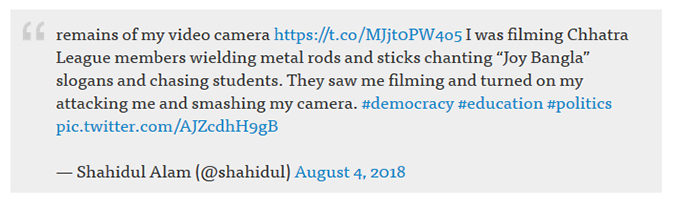
Mobs allegedly associated with Bangladesh’s ruling party have also attacked demonstrators and journalists who were covering the attacks.

Emergency medical teams say they have treated more than 100 protesters who have been injured.

In an attempt to curb rapidly-spreading rumors, mobile internet speed was brought down to a minimum level (2G) shutting down 3G and 3G broadcasts.

Angered authorities
Alongside his social media coverage of the protests, Alam apparently angered the authorities and the ruling party after he gave a TV interview on Sunday evening with Al Jazeera where he talked about the recent situation in Bangladesh and criticised the government.

Expat blogger Rumi Ahmed posted a transcript of the interview on Facebook. Here is an excerpt:

I think what we need to do is to look at what has been happening in the streets today. The police specifically asked for help from these armed goons to combat unarmed students demanding safe roads.

I mean how ridiculous is that? Today, I was in the streets, there were people with machetes in their hands chasing unarmed students. And the police are standing by watching it happen.

In some cases, they were actually helping them…

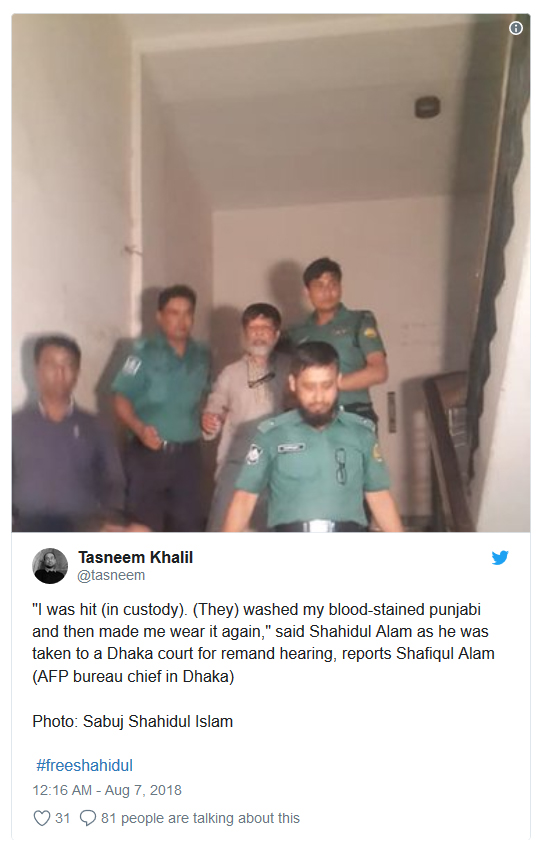
According to the latest reports, the police have received a seven-day remand to question Shahidul Alam in connection with an ICT Act case filed on August 6, 2018. He was taken to the court barefoot and barely able to walk.

He appears to have been beaten while in custody.

Exiled journalist Tasneem Khalil tweeted:

The police have not yet mentioned why he was detained but referred to the case which accuses him under section 57 of the ICT Act of “abusing” an electronic platform in order to spread “lies” among the population and with the intent to “invalidate and question” the government on the international stage, damage law and order, spread “fear and terror”.

The provisions of Section 57 of Bangladesh’s notoriously broad 2013 Information and Communication Technology Act of Bangladesh have been used to slap hundreds of lawsuits against journalists and online activists to curb the freedom of speech online over the past few years.

Blogger and activist Vaskar Abedin writes on Facebook:


Amnesty International has released a statement which read:


Asia Pacific Report republishes this article with permission under a Creative Commons licence.

Print Friendly, PDF & Email

Article by AsiaPacificReport.nz

]]>

Controversial ‘Confucius’ doco gets mixed response at NZ universities

]]>

In The Name Of Confucius trailer for the 52-minute documentary.

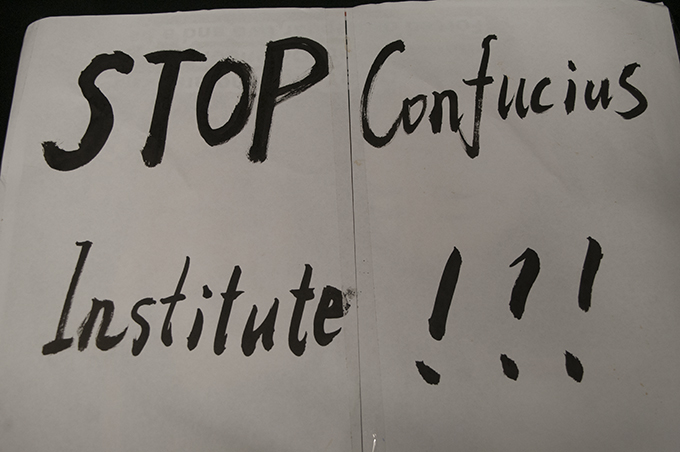
A Chinese government-sponsored cultural and education programme offers Mandarin lessons around the world. But a new film raises questions about a darker side of the Confucius Institutes, reports Rahul Bhattarai of Asia Pacific Journalism.

Chinese-born Canadian film director Doris Liu has had her visa to China denied but has never faced a direct threat or interference from the Beijing government over her controversial documentary In the Name of Confucius screened in Auckland last month.

Her visa to China has been rejected because of her investigative work, she told Asia Pacific Report.

Her documentary criticises Chinese policy and political influence through the multibillion dollar Chinese government-supported Confucius Institute programmes attached to 1600 universities and schools across the globe.

READ MORE: In The Name of Confucius

Three universities in New Zealand have ties with CI – University of Auckland (UOA), Auckland University of Technology (AUT) and Victoria University of Wellington.

-Partners-

AUT and Victoria University welcomed the screening of the documentary.

But the University of Auckland cancelled its public screening on the day of the event – just hours before the documentary was due to be screened.

“I had already been rejected for a Chinese visa to enter China because of my journalism before making this film,” film maker Liu said.

Recorded, threatened
However, she added that during her interviews in one of the Canadian institutes, the Confucius Institute director had video recorded her and threatened that she would report her back to Beijing.

“The director used her smartphone to film me conducting an interview with the school board representatives,” Liu said.

“She told me that she would report back to Hanban in Beijing about my media presence.”

Liu added that “the interview didn’t end happily as the school representatives stopped the interview and they all walked away.

“After that I couldn’t get access to any Canadian Confucius Institutes, except for a couple of telephone interviews.

“I could imagine that Hanban informed all its Chinese directors working at the Canadian Confucius Institute not to accept my interview requests.”

Suppressing teachings
While talking to Mack Smith of 95bFM, Dr Catherine Churchman of Victoria University said about the institute policy, “you have to teach Mandarin, you are not allowed teach Cantonese or Hokkien”, or any of the other Chinese languages and “you have to teach in the simplified Chinese characters set”.

Dr Churchman said the main reason the institutes did not allow the teaching of traditional Chinese was to “suppress people” from being able to read documents from Taiwan or Hong Kong, or many other overseas countries.

Until the 1980s, the Chinese diaspora, including in New Zealand, used traditional Chinese characters to publish their literature.

Liu said that many of the texts published in China, including the literature from the Chinese Communist Party and its foreign affairs, were only in traditional Chinese.

Suppressing the traditional Chinese was a form of “censorship that the Chinese Communist Party has over things written inside China”, she said.

“They [CI] have a lot of influence over the institute itself, they pay for half of it usually, and they pay quiet a lot of money,” she said.

Liu claimed that Victoria University received about “half a million” dollars in 2016.

Institute ‘controlled’
The Confucius Institute was controlled by Hanban, which was controlled by the Chinese Ministry of Education, she said.

While the ministry might not necessarily have had direct influence over the institute, it did provide rules about what was allowed to be taught in the institute.

A Chinese protest placard among several against the Confucius Institutes on display at the end of the Auckland film screening. Image: Rahul Bhattarai/PMC

After Auckland University cancelled the public film screening, an official statement by
Associate Professor Phillipa Malpas said: “The event was prematurely advertised as being open to the public before it had been approved and confirmed by my faculty.

“It was subsequently approved for screening to University of Auckland staff and students.”

AUT screened the documentary at a public event on July 26 with a packed auditorium, including an Asia Pacific Report journalist present.

However, Alison Sykora, head of communications in AUT, said the Chinese Vice-Consul-General spoke to the university before the screening of the movie. The Vice-Consul had been given an invitation but AUT had not yet received a reply.

Chinese soft power
The documentary shows how China has been using CI in order to influence foreign countries through soft-power initiatives.

Michel Juneau-Katsuya, former chief of the Asia Pacific Canadian Security Intelligence Service, says in the film: “CI were used to manipulate not only the academic world, where they were implanted, but to also emanate more influence outside of the campus as well.”

The documentary says that the CI is an “infiltration organisation” that was founded in 2004 by the Chinese government under the guise of teaching foreign students Chinese culture and language.

Institute teachers were also forced to sign a contract that they were not members of the banned and persecuted spiritual group Falun Gong.

Last November, the Chinese government pressured the Japanese government in an attempt to cancel an international conference due to the planned showing of the documentary, but in spite of the pressure the screening went ahead.

The film was shown in an international human rights conference in Tokyo, receiving a good response from the global audience.

In The Name of Confucius has been shown 57 times in 12 countries.

Film maker Doris Liu said that the movie had been well received, with review ratings of 8.7 out of 10 on Internet Movie Database (IMDb) and 4.8 out of 5 on Facebook.

Rahul Bhattarai is a student journalist on the Postgraduate Diploma in Communication Studies (Journalism) reporting on the Asia-Pacific Journalism course at AUT University.

Print Friendly, PDF & Email

Article by AsiaPacificReport.nz

]]>

‘Don’t play with fire’ warning in Samoa’s social media threat

]]>

Many Samoans are angry over a threat by the prime minister earlier this year to ban the social media platform Facebook amid growing pressure by politicians and officials across the Pacific against “fundamental freedoms”. Mike Mohr reports for Asia Pacific Journalism in the second of a two-part series on online media.

Samoan Prime Minister Tuilaepa Sa’ilele Maleilegaoi has warned  that the social media site Facebook may be banned, and has told users “not to play with fire”.

But the threat earlier this year has drawn mounting criticism from Samoans online.

Public opinion online is suggesting that the Samoan government is threatening people’s right to freedom of expression and their right to free speech.

The Samoa Alliance of Media Practitioner for Development (SAMPOD) opposes any possible ban.

“The right to free expression is fundamental to a democracy like Samoa,” says SAMPOD.

SAMPOD and others who are opposed to the possible ban have cited the UN’s Universal Declaration of Human Rights for the right of the people of Samoa to express their opinions without fear of repercussion from the government.

-Partners-

The Facebook threat – first made in March – is in retaliation to online criticism and scrutiny of the Samoan PM and cabinet ministers by members of the public.

Discontent with officials
Facebook and other social media platforms are being used by members of the public to voice their opinions and discontent with Samoan government officials.

“So, I advise them not to play with fire. I want them to know that no matter where you hide, you will be caught,” he told the Samoa Observer in an interview attacking “faceless writers” on blogs.

The Prime Minister has rejected the opinions and views of online commentators. He has added that these individuals are offending government leaders with their accusations.

“Because it’s all based on lies, those affected are government leaders” he told the Observer.

Although the issue about the threatened ban has been quiet in past weeks, after a recent visit to London for a Commonwealth cybersecurity conference, he renewed his attack on anonymous bloggers.

However, Samoa Observer editor Mata’afa Keni Lesa asked in an editorial why was Tuilaepa so worried and why was he making himself “look like the biggest bully” on a crusade.

The editor said Tuilaepa was “thrilled to finally have learnt that it’s not just Samoa struggling with the issue of faceless writers”.

The prime minister had found that all 53 countries of the Commonwealth had been affected by social media problems ranging from “character assassinations” to many unfounded allegations.

Family insults
The threatened ban on Facebook would be not only for criticism for political decisions, but also for comments regarding family, allegations of corruption and personal insults that are aimed at cabinet members.

“The government will do what it takes to settle this matter once and for all, even if it means banning Facebook,” he told the Observer.

Tuilaepa’s concern is with online social media sites that provide a platform for personal attacks and accusations that he believes are unfounded, misleading and untrue.

Prime Minister Tuilaepa has insisted that these posts and comments had absolutely no truth in them.

Accusation of corruption and unethical relationships are the main reasons for Tuilaepa’s belief that eventually Facebook, and other social media platforms, will be banned.

Government officials are not the only targets of online posts but also their family members.

Alleged sexual relationships between family members is one of the accusation that has provoked feelings of anger by those who are accused of such acts.

He continued by adding that if any of the accusations aimed at government officials were true, they would have been published in the Observer.

The threatened ban would include blogs and other popular social sites and apps.

The Facebook ban is being delayed, according to the Samoa Observer, but it is just a matter of time before Facebook and other online social media sites would be banned.

Blogger identities
The identities of some of the anonymous bloggers are known to the Prime Minister and police investigators, according to an article by Samoa Observer.

O Le Palemia is an anonymous blogger that has been singled out for inflammatory accusations levelled against Prime Minister Tuilaepa and other government officials.

The identity of the O Le Palemia has not yet been uncovered, or has not yet been released publicly.

Tuilaepa has warned that if its behaviour continued, he would be forced to release the names of those that he believes are responsible.

O Le Palemia last month published an attack on some Samoan media, accusing them of publishing “government propaganda”.  The blog named Newsline Samoa, Talamua Media and Samoa Planet.

Website Samoa Planet, founded by Lani Wendt Young and Tuiloma Sina Retzlaff, closed down last month.

There was hesitation in revealing the identities of the online bloggers because of fears of physical attacks by those who the accusations and comments are aimed at or by relatives and supporters.

Tuilaepa is sure that once the identities are revealed the bloggers lives would be in danger because of the severity of the online posts that had provoked anger in government officials.

The Prime Minister is adamant that when information about the identities of the anonymous bloggers is released to the public, violence would ensue in the form of reprisal attacks.

O Le Palemia was shut down in February for breaching Facebook’s community standards, reported RNZ Pacific, but apparently resumed publication.

Police investigation
Tuilaepa said in June police had filed charges against the people suspected of being behind the O Le Palemia blog but he did not name them.

In its statement against the threatened ban, SAMPOD said: “We urge the government to use existing mechanisms to address issues arising from the misuse of Facebook, but humbly caution against the banning of this essential medium of information for the people of Samoa.”

Online comments by fellow Samoans refer to government leaders as “Snowflakes” – a slang term referring to individuals that are “hypersensitive to criticism”, according Wikipedia and Merriam-Webster online.

Mike Maatulimanu Mohr is a student journalist on the Postgraduate Diploma in Communication Studies (Journalism) reporting on the Asia-Pacific Journalism course at AUT University.

Print Friendly, PDF & Email

Article by AsiaPacificReport.nz

]]>

PNG Facebook ban threat casts shadow over Pacific media freedom

]]>

Papua New Guinea threatened to temporarily ban Facebook earlier this year. With the APEC conference looming in November, the question remains whether this was an attack on freedom of speech. Jessica Marshall of Asia-Pacific Journalism reports in a two-part series on the Pacific internet.

In March, it was revealed that the data analytics firm Cambridge Analytica had harvested millions of Facebook profiles.

The breach, thought to be one of Facebook’s biggest, reportedly used the data to influence both the United States 2016 presidential election and the Brexit campaign in the United Kingdom.

In the aftermath, Facebook announced a commitment “to reducing the spread of false news on Facebook,” by removing false accounts and using independent third-party factcheckers to curb fake news on the site.

The effectiveness of this new policy remains to be seen.

The revelation of the Cambridge Analytica scandal lead to the Papua New Guinean government threat in May that it would ban the social network for a month in the country.

Communications Minister Sam Basil was reported by news media as saying the ban decision was an attempt to enforce the Cyber Crime Act 2016.

A horde of PNG “ban on Facebook” stories on Google, but stories on PNG’s subsequent back off in the proposal are hard to find. Image: PMC

“The Act has already been passed, so what I’m trying to do is to ensure the law is enforced accordingly… We cannot allow the abuse of Facebook to continue in the country.” Basil told the Post-Courier.

-Partners-

Difficult to track
According to The Guardian, Basil had raised concerns about the protection of the privacy of Papua New Guinea’s Facebook users. He had claimed that it was difficult to track those who had posted defamatory comments on Facebook using “ghost profiles”.

Basil later denied in the media that he had said he would ban Facebook, but the Post-Courier stood by its report which had sparked of the flurry of stories and speculation. So far no ban has actually taken place.

Papua New Guinea is not the only country to have banned the social media site. Facebook is already blocked in authoritarian countries like China, Iran and North Korea.

In March, Sri Lanka blocked the site along with Viber and WhatsApp for nine days, believing it to be the cause of hate speech and violence.

Facebook was also condemned for allowing hate speech to become prominent in Myanmar during the Rohingya crisis earlier in the year.

The platform, according to Reuters, was claimed to have played an important role in the spread of hate speech when Rohingya refugees were fleeing their homeland to Bangladesh.

Other countries have made attempts to combat trolling and fake news, New Zealand included.

In 2015, New Zealand made cyberbullying illegal in an attempt to curb teen suicide. The law, passed in tandem with an amendment to the Crimes Act 1961, was designed to ensure that cyberbullies would face up to two years’ imprisonment.

‘Fake news’ conviction
In April this year, the Malaysian courts convicted its first person under a new fake news law. The Danish citizen was charged after he posted a video claiming that police were not quick to act after receiving distress calls regarding the shooting of a Palestinian lecturer.

Questions regarding free speech have circulated since the Basil reportedly made the announcement.

Only 11 percent of the Papua New Guinean population have access to the internet. The site, for those with the ability to use it, has become a news source in a place where media freedom is increasingly threatened.

PNG “news” blogs have proliferated.

While Freedom House’s most recent report on press freedom says that the press in Papua New Guinea is free, the organisation is quick to note that this freedom has become worse over recent years.

Freedom of speech, information and the press are all guaranteed and inalienable rights in Papua New Guinean law due to Section 46 of the country’s constitution.

What has caused problems, however, for the press is political pressure and violence. Over the years, journalists have been “detained without charge, and their video footage was destroyed”.

Three female journalists were sexually assaulted in 2014, the report states.

Reporters Without Borders also reported police violence against journalists in 2016. It said in a media statement that one NBC journalist had been assaulted by three police officers until another officer intervened. Others had been attacked by a plainclothes officer.

Facebook as news source
In the era of fake news, social media plays a huge role in how the people get their news.
According to Pew Research, two-thirds of American adults got their news through social media in 2017.

A report by the ABC said “more Papua New Guineans have access to social media than ever”.

“Facebook is… being cited as an important hub for news, and the audience is larger than other news websites with 53 percent of weekly users reporting the use of online social media compared to the two main newspapers’ websites,” the report said.

Daniel Bastard, Asia-Pacific director of Reporters Without Borders, said that blocking Facebook “would deprive nearly a million internet users” from news and information.

“Instead of resorting to censorship, the Communications Minister should encourage online platforms to be more transparent and responsible about content regulation.”

There is still concern about the upcoming APEC (Asia-Pacific Economic Cooperation) meeting in Port Moresby in November and a possible Facebook ban’s impact.

Paul Barker, director of the Institute of National Affairs, told the Post-Courier “It would be a travesty if PNG sought to close down Facebook during the APEC month… as it would be both an attack on embracing technology, undermining the information era and mechanisms for accountability, but also damaging business and welfare.”

Jessica Marshall is an AUT student journalist on the postgraduate Asia Pacific Journalism course.

Print Friendly, PDF & Email

Article by AsiaPacificReport.nz

]]>

ABC’s shortwave cutback ‘weakens thin link’ for Pacific, says PMC

]]>

Australian broadcasting cutbacks “sorry loss to people and cultures” in the Pacific. Image: ABC Pacific Beat

By Leilani Sitagata of Pacific Media Watch

The Australian Broadcasting Corporation’s cutback in services to the Asia-Pacific region has “weakened the thin link” that many parts of the region have with the “outside world”, says the Pacific Media Centre.

In a public submission to the government review of broadcasting to the region, the PMC said that the situation had impelled Radio New Zealand to “stretch their resources to do more, to ‘make up’ for what has been removed”.

The ABC switched off shortwave services to the region in 2017.

READ MORE: China takes over Radio Australia frequencies

Calling for the ABC to restore services, the PMC said “Australian broadcasting from the South Pacific is a sorry loss to people and cultures – as we know them well from the accumulation of studies and from our own media production exercises at this centre”.

The PMC at Auckland University of Technology publishes the independent Asia Pacific Report, Pacific Media Watch freedom monitoring service, Pacific Journalism Review and other publications.

-Partners-

AUT’s radio major coordinator in the School of Communication Studies, Dr Matt Mollgaard, stresses the importance of broadcasting services from countries such as Australia and New Zealand to the South Pacific.

“[Broadcasters] help to strengthen local media outlets in the Islands, further enhancing democratic developments in the region,” Dr Mollgaard said in his PJR research paper cited by the PMC submission.

Media freedom
He said broadcasting services like RNZ Pacific and Radio Australia were prime examples of upholding media freedom and encouraging democratic life.

The PMC submission was prepared by director Professor David Robie and centre research associate and PJR editorial board member Dr Lee Duffield.

Restoration of Radio Australia services and other ABC services that may be made accessible in the South Pacific region, would be “highly positive”, said the submission.

“It would be most widely welcomed in the island countries, valued, and made good use of as in the past, with assuredly benefits to the originating media service and to Australian interests.”

The review is looking at the reach of Australia’s media in the Asia-Pacific region and if shortwave radio has become an outdated technology.

The submission period closed last Friday and the review of Australian broadcasting services is currently underway.

Public submissions have been overwhelmingly in favour of restoration of services.

‘Tok Pisin broadcasts’
In one public submission published by Asia Pacific Report, development worker Elizabeth Cox, who has 40 years of experience of living and working in Papua New Guinea, appealed for the return of a “revitalised Radio Australia”.

“Bring back Radio Australia. Ensure it reaches all rural areas,” she said.

“Provide Tok Pisin broadcasts. This is one of the best forms of aid you can give PNG.”

“A revitalised Radio Australia will give the PNG and other international audiences a chance to shape content and direction – it can be linked to social media and inform and lift the quality of much of the local political conversation,” she said.

“The new Radio Australia should be a global friend and ally, not a coloniser or converter. It should encourage debate, conversation and support critical, independent and objective opinion.”

The Vanuatu Daily Post submission calling for restoration of services said broadcast communications were an essential projection of soft power.

“The lack of access to the eyes and ears—and therefore the hearts and minds—of Pacific islanders works to the detriment of Australian interests,” the newspaper said.

“It also works against the interest of Pacific nations.”

Print Friendly, PDF & Email

Article by AsiaPacificReport.nz

]]>

Norwegian human rights activists call for action over Israeli ‘capture’ of ship

]]>

Norwegian citizen Jan Petter Hammervold, 74, makes a ship-recorded plea before being seized by Israeli forces. He was ship’s cook on board Al Awda (The Return), is a board member of Ship to Gaza Norway and author of the book Fiskerne I Gaza (Gaza Fishers), about the 2018 Freedom Flotilla. New Zealander Mike Treen was also on board and detained. Video: Gaza Freedom Flotilla Coalition

Pacific Media Centre Newsdesk

Norway has asked Israel to “explain” its unlawful capture of the Norwegian-flagged ship Al Awda that last month tried to breach the Gaza Strip’s 10-year maritime blockade.

The international Freedom Flotilla was in a bid to deliver medical supplies to Palestinians in the coastal enclave.

“We have asked the Israeli authorities to clarify the circumstances around the seizure of the vessel and the legal basis for the intervention,” said a Norwegian Foreign Ministry spokesman.

READ MORE: Israel’s attack on the Gaza Flotilla – looking back a year later 

“While this is certainly far more than the New Zealand government’s response (which appears to be nothing at all, since Kiwi Mike Treen was bashed and arrested in the same attack), the Freedom Flotilla’s Norwegian campaign is demanding their government takes a stand,” said the NZ humanitarian group Kia Ora Gaza.

The Freedom Flotilla boat Al Awda, hijacked by Israeli forces while carrying humanitarian and medical supplies to the besieged enclave of Gaza Strip. Image: Freedom Flotilla Coalition

-Partners-

The full statement from the Ship to Gaza Norway human rights group yesterday said:

When will Norway protest against hijacking and extensive violence against people on board?

On July 29, the Norwegian former fishing vessel Kårstein [renamed Al Awda] was hijacked in international waters, with extensive violence by Israeli navy soldiers.

“For more than a week, the Ministry of Foreign Affairs’ follow-up of the case has limited itself to asking Israeli authorities to ‘clarify the course of events’ and say why they ‘encroached on the vessel’.

“No indication of protest.

“Now Foreign Minister Ine Eriksen Søreide has continued this game. After talks with Prime Minister Benjamin Netanyahu she said that ‘we asked the Israeli authorities for an explanation of why the ship was captured, the course of events and the use of power’.

“Still no indication of protest.

“The Ministry of Foreign Affairs’ gathering of facts in the case limits itself to the embassy personnel’s talks with five Norwegian citizens in Israeli prison the day after the hijacking. After they were deported and able to speak freely, they have not been contacted by the MFA.

“There were people from 16 nations on board. Their version has not been obtained. The ship’s highly recognised doctor, who delivered a shocking report on Saturday, has not been contacted.

No legal basis for hijacking, violence
“However, in the talks with the five Norwegian citizens in prison, there were revealed more than enough [grounds] to justify a strong protest. The MFA knows that our action was non-violence based and that the ship had a load of desperately needed medical equipment.

“Independent of possible differences in view on international law, there is of course no legal basis for hijacking a ship in international waters by knocking out peaceful, non-violent people and using heavy violence against them.

“Nor is there any legal basis for stealing everything of valuables and clothing. From Mikkel Grüner, a member of Bergen City Council, the soldiers stole everything except for the ship’s Norwegian flag, which they had trampled on.

“The Foreign Minister obviously does not know that the soldiers have taken all the belongings of the people on board.

Lies and nonsense
Israel has always lied about how they use military power. Every time they say that the operation has been done without violence, but we have documented through video footage that it is a lie.

“This time, violence was worse than ever [since the Israeli commando attack that killed 10 civilians on the Mavi Marmara-led flotilla in 2010] and Israel’s ambassador continues with the same nonsense.

“What Israel does in this case is of course just a pale shadow of what they do to the Palestinians, including daily attacks on the fishermen in Gaza. A pleasant chat with those responsible for violence, terror and mass murder will lead to nothing except for the game to continue.

“Since governments do nothing that may stop this, people with conscience and knowledge must do something. That is why we sailed to Gaza.

“The result is international effects that show that it is ordinary people’s action, pressure and protest that can eventually produce results.”

Asia Pacific Report has a content sharing arrangement with Kia Ora Gaza.

The “captive” ship Al Awda in the southern Israeli port of Ashdod. Image: Times of Israel
Print Friendly, PDF & Email

Article by AsiaPacificReport.nz

]]>

PNG facelifts for APEC but neglects gender-based violence

]]>

The Papua New Guinean government has been working tirelessly to clean up its capital city in preparation for APEC, instead of attending to serious issues such as gender-based violence. Pauline Mago-King of Asia-Pacific Journalism reports on the challenge.

With just three months to go until the Asia Pacific Economic Cooperation (APEC) leaders summit in November, the Papua New Guinean government has been buckling down to preparations.

The capital of Port Moresby is going through a series of facelifts ranging from continual road upgrades to clean up campaigns.

While these infrastructure developments are needed, they cannot conceal the social issues currently plaguing Papua New Guineans.

One serious issue is the alarming rate at which violence, more specifically gender-based violence, continues to intensify in Papua New Guinea.

According to the World Health Organisation, two out of three PNG women have experienced violence from an intimate partner.

Where intimate partners are not the perpetrators of violence, Papua New Guinean women are vulnerable to violence particularly in their mobility within communities.

-Partners-

In October 2017, a woman was almost burned to death by a mob who had accused her of practising sorcery.

Rescued from mob
The woman who was later identified as “Elizabeth” from Eastern Highlands was rescued by police officers and taken to a hospital before the mob could do anything else to her.

Stories like that of Elizabeth reiterate that PNG women are more vulnerable than ever and violence is near impossible to escape.

The shows that violence permeates all levels of Papua New Guinean society and a wakeup call is needed for the government to act quickly.

Critics say the level of attention that is being devoted to the APEC leaders summit should also be applied to combatting gender-based violence.

PNG cannot reach development and prosperity until violence against women is dealt with, argued Australian journalist Jo Chandler in a 2014 analysis.

At present, the response to gender-based violence has centred on implementing a 2016 – 2025 National Gender-Based Violence strategy which was officially launched in 2017.

The strategy is intended to be a guide for the PNG government to facilitate the implementation of the legislation, policies and programmes needed to eliminate gender-based violence.

Family protection law
The government has also passed family protection legislation in 2014 to criminalise domestic violence and give more power to protection orders for survivors.

These achievements are a win for gender-based violence survivors as sectorial committees such as the Family and Sexual Violence Action Committee (FSVAC) will be more equipped to support them and their needs.

FSVAC national coordinator Marcia Kalinoe said the National Gender-Based Violence Strategy “consolidates the current work that is ongoing”.

“Fourteen years ago, there was not much sensitisation and gender mainstreaming and specialised services addressing the issue,” she said.

Kailonoe added that the various legislative changes and multisectoral response would be of great assistance to survivors for accessing support services.

Despite the PNG government’s current milestones and the support of partners such as the United Nations Development Programme (UNDP) and donors, PNG is ranked as 140 out of 146 countries in the Gender Inequality Index.

The journey to raise more awareness on gender-based violence has not been an easy feat due to “socially and culturally constructed norms”, as outlined by the UNDP.

Constant challenges
In Durrie Bouscaren’s interview with a UNDP-trained “human rights defender” Linda Tule in June, these social and cultural constructs of unequal power relations were highlighted.

Tule talked about how she had counselled three women a week in spite of operating out of her home and on a limited budget.

She even hosts these women if a safehouse has reached its full capacity.

This is the current scenario for survivors of gender-based violence in PNG.

People like Enid Barlong Kantha, who has worked in the gender-based violence field for more than 10 years, knows the ebbs and flows first-hand.

She says that “challenges remain a constant part of the battle” despite the country’s achievements.

“Even with political will, there is still a lack of resources; human resource, financial support and infrastructure. Where there are services, a lack of capacity hinders progress and continues to frustrate many.”

She adds that the lack of coordination among stakeholders and lack of statistics deter better cooperation and collaboration in the national response to gender-based violence.

Stepping into the future
Advocates recognise that ending gender-based violence in PNG, or anywhere else in the world, cannot be done overnight.

The journey will be long and change will be incremental.

Yet, there are corrective measures that can be taken particularly by the PNG government.

For one thing, more emphasis can be placed on decentralising services to not only the outer provinces but also areas that are rural, say advocates.

This compulsive need to upgrade Port Moresby for the world’s eyes has to stop as it is failing the majority of Papua New Guineans and exacerbating unequal gender and power relations.

There is only so much advocacy and awareness that can be funnelled into eliminating gender-based violence.

Services coupled with awareness, however, can eliminate some of the social and cultural constructs at play in PNG.

As Papua New Guinean journalist Scott Waide has said, “superstition thrives where service delivery is poor”.

Pauline Mago-King is a Papua New Guinean postgraduate student at Auckland University of Technology where she is pursuing a Masters in Communication Studies. As part of her studies, she is researching gender-based violence. She is on AUT’s Asia-Pacific Journalism Studies course.

Print Friendly, PDF & Email

Article by AsiaPacificReport.nz

]]>

NZ Pacific journalists ‘appalled’ by Nauru ban on ABC at Forum

]]>

The ABC has a reputation for vigorous reporting of Pacific issues, including human rights violations at the Australian-established Nauru detention centre for asylum seekers. Maxine Jacobs files on Nauru’s ABC ban for Asia-Pacific Report.

Nauru’s controversial ban on the Australian Broadcasting Corporation from attending the main annual Pacific political summit next month has appalled New Zealand journalists but they have stopped short of wanting to join a threatened boycott.

Host nation Nauru has restricted media access and banned the ABC from attending the 49th Pacific Islands Forum (PIF) Leaders Summit on September 3-6 due to alleged “biased and false reporting”.

Only seven accredited New Zealand journalists will be allowed to attend the summit.

READ MORE: Nauru’s ban on ABC splits commercial media

The chair of the NZ Parliamentary Press Gallery, Stacey Kirk, says she shares the concern of Australia’s Federal Parliamentary Press Gallery – which has threatened a boycott – and is appalled by Nauru’s efforts to control the media by banning and restricting the number of reporters.

NZ Press Gallery’s Stacey Kirk … “appalled by this attempt to control the media coverage”. Image: SK Twitter

Kirk told Asia Pacific Report “while infrastructure constraints play a role in the limited pooling numbers, we are appalled by this attempt to control the media coverage.

-Partners-

“To ban media based on unfavourable coverage is a clear violation of freedom of expression. This decision already follows restrictive reporting conditions, limiting the number of journalists who can attend this important regional summit.”

Shocked and furious
Claire Trevett, deputy political editor of the New Zealand Herald, says she is shocked and furious that only seven representatives from New Zealand would be allowed to attend and cover the summit.

She says that although there is limited accommodation in the island nation, the Nauruan authorities have the capacity to house more journalists then they intend to.

“Nauru has claimed the reason is limited space/accommodation there, but Niue – which is smaller – managed to host it without such strenuous limits in 2007, and Nauru itself has hosted it in the past without the limits.”

The Republic of Nauru said in this policy statement on its official website:

“No representative from the Australian Broadcasting Corporation will be granted a visa to enter Nauru under any circumstances, due to this organisation’s blatant interference on Nauru’s domestic politics… harassment and lack of respect towards our President in Australia, false and defamatory allegations against members of our Government, and continued biased and false reporting about our country.”

The government has also said that limited accommodation has forced restrictions on the number of other reporters from covering the event, adding that “there has been no other restrictions placed on media attendance for any other reason”.

Australia’s Federal Parliamentary Press Gallery president David Crowe issued a response to the ban, saying the decision was appalling and threatened a media boycott from all Australian media from the event.

If the ABC could not go, the media pool should not go.

‘Dangerous precedent’
Crowe says a pool group of journalists who cover federal parliament had been set up to report on the summit which met restrictions previously set out by Nauru, but picking and choosing which journalists could cover the forum was going too far.

“If the ban is not reversed, the media pool will be disbanded. If one cannot go, none will go. It sets a dangerous precedent. What other Australian media might be banned from a similar group by another government in the future?

“We stand for a free press, not a banned one.”

ABC has declared it “does not intend to vacate” its place in Australia’s pool of journalists’ reporting on the summit.

Nauru has defied criticism and stood by its ban on the ABC, reminding journalists it was a privilege to enter Nauru and the country had the right to refuse entry to anyone entering whom they believed may pose a threat to their security.

“It is arrogant, disrespectful and a further example of the sense of entitlement shown by this activist media organisation. The Australian media does not decide who enters Nauru,” the government said.

Nauru said any restrictions placed on journalists other than ABC were due to limited accommodation, that all footage would be provided for media unable to attend and at least one Australian television media outlet would be invited to cover the summit.

Controlling the narrative
Host of RNZ’s Dateline Pacific programme Don Wiseman says it is clear Nauru is trying to control the narrative.

Wiseman says the journalists who get to Nauru are likely be stopped from reporting on any activities outside of the summit due to the severe restrictions.

However, rather than a boycott, any reporting is better than none, he says.

“It’s a good moral decision, but the other part is that it’s better to be there and to report on all the various and nefarious things going on in Nauru if you can.

“Nauru is a small place. It doesn’t have much accommodation, but it has more than it used to have. They’ve just chosen not to because they’re anti-media.”

Wiseman says the Australian government has been unwilling to criticise Nauru’s treatment of journalists, saying it is “compromised” because of its heavily criticised detention camps on Nauru.

“If no one speaks out it will become a battle between the guys running the show and some journalists, and if the Australian government doesn’t speak out, which it hasn’t done, it’s essentially been supportive of what Nauru’s done in the way in which it’s treated journalists.

“The reality is the boycott will go ahead. A number of people have been told they have visas, but if there are restrictions I would imagine it will be a universal say no.”

The Australian Federal press gallery is yet to confirm a boycott, but commentators say it is unlikely the Nauru government will reverse its ban on the ABC.

Maxine Jacobs is a postgraduate student journalist on the Asia Pacific Journalism Studies course at AUT University.

The Nauruan ban on the ABC. Source: Nauru Govt
Print Friendly, PDF & Email

Article by AsiaPacificReport.nz

]]>

Tourists flee Lombok as Indonesian quake death toll hits 98

]]>

Rescuers are still struggling to get to parts of Lombok island to assess the full extent of the damage from the earthquake. Video: Al Jazeera

Pacific Media Centre Newsdesk

Tourists have been fleeing the Indonesian island of Lombok since yesterday after a magnitude-6.9 earthquake killed at least 98 people – a death toll expected to rise, reports Al Jazeera.

More than 200 people were seriously injured in Sunday’s shallow quake as rescue workers scrambled to reach survivors in remote areas.

National Disaster Mitigation Agency spokesman Sutopo Purwo Nugroho said the damage was “massive” in northern Lombok. In several districts, more than half of homes were destroyed or severely damaged.

READ MORE: What you need to know about the Lombok earthquake

Al Jazeera reports Nugroho saying the death toll will “definitely increase”, adding more than 20,000 people had been displaced.

-Partners-

Thousands of buildings collapsed, especially in the north, near the earthquake’s epicentre, and power and communications were down in some areas on the popular tourist island.

A tsunami alert was issued immediately after the quake struck, sending panicked people running to higher ground, but it was later rescinded, Al Jazeera reports.

“When it happened, we stood with residents in the middle of the street and watched houses collapse around us,” said Yustrianda Sirio, who was visiting the island.

‘Screamed hysterically’
“Many of us screamed hysterically.”

Some airlines have added extra flights to help tourists leave the island, while about 1200 foreign and domestic tourists were evacuated by boat from three Gili islands off Lombok’s northwest coast, said Nugroho.

Al Jazeera’s Step Vaessen, reporting from Tanjung in northern Lombok (see video), said: “The destruction here is unbelievable.

“After there was a tsunami alert yesterday, a lot of [tourists] panicked; they climbed into trees, they ran into the hills, a lot of people got injured there,” she said.

“There’s no arrangement, there’s no transport, there’s no food, there’s no water for them, so a lot of them are completely lost, they’re completely confused, still scared and the only thing they’re telling me is that they want to leave the country as soon as possible.”

The Indonesian military said it was sending a vessel with medical aid and supplies and would provide logistical support.

Print Friendly, PDF & Email

Article by AsiaPacificReport.nz

]]>

PMC Seminar: Okinawa’s media response to US military presence

Event date and time: 

Wednesday, September 19, 2018 – 16:30 18:00

OKINAWA MEDIA AND THE MILITARY
The US military presence in Okinawa has been at the center of Okinawa’s politics, its relations with the central government in Tokyo and the US-Japan relations since 1945. The US bases and facilities occupy 20 percent of the island of Okinawa, accounting for 71 percent of the total US military presence in Japan. This has contributed to a strong local pacific movement supported by Okinawa’s local media which have kept a critical coverage against the Japanese government and the US bases. Amid reoccurring incidents involving US military personnel, accidents and the most recent developments around the relocation of Futenma Base, there are complaints about oppression of freedom of expression, limited public access to information and mainland Japanese media’s bias towards Okinawa. The two local newspapers, Ryukyu Shimpo and The Okinawa Times, have made it their mission to address these issues that are rarely covered in mainstream Japanese media. Dr Evangelia Papoutsaki will talk about the strong anti-base editorial stance of the Okinawan newspapers while providing a wider historical and current context of their reporting.

Who:  Dr Evangelia Papoutsaki
Associate Professor
Communication Studies, Unitec Institute of Technology
Auckland, New Zealand

When: Wednesday, 19 September 2018, 4.30-6pm 

Where: WG703 , Sir Paul Reeves Building, Auckland University of Technology
City Campus 

Contact: Sylvia.Frain@aut.ac.nz

PMC Facebook event

Map

Report by Pacific Media Centre ]]>

Indonesian officials ruin Australian researcher’s honeymoon over Papua

]]>

Doctoral researcher Belinda Lopez …. interest in community storytelling. Image: FB

Pacific Media Watch Newsdesk

An Australian doctoral researcher whose honeymoon plans in Indonesia included a cultural festival in the insecure Papua region has been deported after Indonesian officials accused her of being a journalist, a news agency reports.

Belinda Lopez, a fluent Bahasa speaker, is back in Australia with a week left of her holiday but her plans ruined.

Her husband had already been barred from boarding the flight to Bali because his Dutch passport had less than six months validity. She was forced to fly alone.

READ MORE: Amnesty International report on West Papua

Lopez told the Jakarta correspondent of the US-based  Associated Press agency she had been detained on arrival in Bali on Friday and had been told she would be deported on a 10pm flight on Saturday.

She told of her ordeal at the weekend on social media, saying immigration officials wanted to know if she was a journalist and repeatedly asked her if she had “done something bad to Indonesia.”

Saturday’s Asia Pacific Report.

-Partners-

Almost a decade ago she was a subeditor for English-language newspapers in Jakarta and had produced podcasts for Australia’s state broadcaster ABC Radio National This Is About programme.

As a former journalist she was described on a website as having won awards as a producer for Radio Netherlands Worldwide in 2012 and 2013.

‘Emerging creators’
“As an educator and producer, she has worked with several not-for-profit organisations, encouraging emerging creators and local communities to tell their own stories,” the website said.

She is currently a PhD student at Sydney’s Macquarie University, researching the cultural experiences of migrants to Java, Indonesia’s most populous island.

Being deported is “devastating,” Lopez told AP.

“It’s the first place I moved to as an adult, have visited so many times since, to learn the language and to visit people who have become some of my best friends in the world,” she said in a WhatsApp message.

Her holiday plans included the Baliem festival in the Melanesian region of Papua that Indonesia strictly controls, including restricting foreign journalists, diplomats and aid workers from visiting.

A pro-independence insurgency has continued in the Melanesian region since it was annexed by Indonesia in the early 1960s.

Indonesia’s police and military are frequently accused of human rights abuses in Papua, reports AP.

Unlawful killings
A recent Amnesty International report documented 95 unlawful killings by security forces in Papua since 2008.

Lopez told AP she had been refused a visa renewal two years ago in Papua because officials suspected she was a journalist. At that time they said she could not re-enter Indonesia for six months, according to Lopez.

The head of the Immigration Office at Ngurah Rai airport in Bali, Amran Aris, said Indonesia’s military had added Lopez to a government blacklist as a “covert journalist”.

He said he couldn’t give other details because it was a state secret.

“We only carry out the duties as her name is listed on the government’s blacklist, so we have to refuse her entry,” said Aris.

The Pacific Media Centre’s director Professor David Robie described the treatment given Lopez as “shameful”.

He said it was high time Indonesian authorities dropped its “paranoid” and “secretive” policy and allowed an open door with journalists and researchers freely visiting the two provinces of Papua and West Papua.

Dr Robie is convenor of the Pacific Media Watch freedom project.

Print Friendly, PDF & Email

Article by AsiaPacificReport.nz

]]>

Dr Swee Ang: We can’t accept this – speak up against Israeli brutality

]]>

Dr Swee Ang’s “SOS” call broadcast from the Al Awda as the boat was being hijacked in international waters last week. (Poor quality audio – click on the “subtitles” icon). Video: Freedom Flotilla Coalition

Dr Swee Ang, doctor on board Al Awda, reports on the events from July 29 when Israeli navy commandos stormed the Freedom Flotilla boat Al Awda, hijacked and diverted it from its intended course to break the Gaza blockade, and forced her to go to Israel.

The last leg of the journey of Al Awda (The Return) was scheduled to reach Gaza on 29 July 2018. We were on target to reach Gaza that evening.

There were 22 people on board, including crew, with US$15,000 of antibiotics and bandages for Gaza.

At 12.31 pm we received a missed call from a number beginning with +81… Mikkel was steering the boat at that time. The phone rang again with the message that we were “trespassing into Israeli waters”.

Mikkel replied that we were in international waters and had right of innocent passage according to maritime laws. The accusation of trespassing was repeated again and again with Mikkel repeating the message that we were sailing in international waters.

This carried on for about half an hour, while Al Awda was 42 nautical miles from the coast of Gaza.

-Partners-

Prior to the beginning of this last leg, we had spent 2 days learning non-violent actions and had prepared ourselves in anticipation of Israeli invasion of our boat. Vulnerable individuals especially those with medical conditions were to sit at the rear of the top deck with their hands on the deck table.

The leader of this group was Gerd, a 75-year-old elite Norwegian athlete and she had the help of Lucia a Spanish nurse in her group.

Non-violent barrier
The people who were to provide non-violent barrier to the Israelis coming on deck and taking over the boat formed 3 rows – two rows of threes and the third row of 2 persons blocking the wheelhouse door to protect the wheelhouse for as long as possible.

There were runners between the wheelhouse and the rear of the deck. The leader of the boat, Zohar and I, were at the two ends of the toilets corridor where we looked out at the horizon and inform all of any sightings of armed boats. I laughed at Zohar and said we are the “Toilet Brigade”, but I think Zohar did not find it very funny.

It was probably bad taste under the circumstances. I also would be able to help as a runner and will have accessibility to all parts of the deck in view of being the doctor on board.

Soon we saw at least three large Israeli warships on the horizon with 5 or more speed boats (Zodiacs) zooming towards us. As the Zodiacs approached I saw that they carried soldiers with machine guns and there was on board the boats large machine guns mounted on a stand pointing at our boat.

From my lookout point the first Israeli soldier climbed on board to the cabin level and climbed up the boat ladder to the top deck. His face was masked with a white cloth and following him were many others, all masked. They were all armed with machine guns and small cameras on their chests.

They immediately made to the wheelhouse overcoming the first row by twisting the arms of the participants, lifting Sarah up and throwing her away. Joergen the chef was large to be manhandled so he was tasered before being lifted up.

They attacked the second row by picking on Emelia the Spanish nurse and removed her thus breaking the line. They then approach the door of the wheel house and tasered Charlie, the first mate, and [New Zealand’s Unite union leader] Mike Treen who were obstructing their entry to the wheel house.
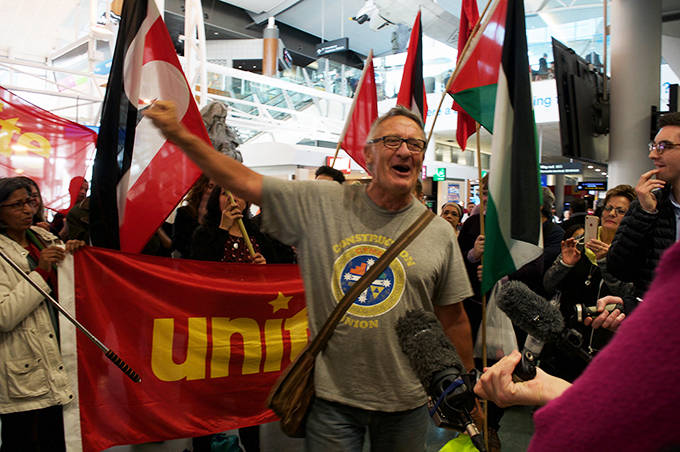
Unite union leader Mike Treen speaking to media at Auckland International Airport last week after being deported by Israel. Image: Rahul Bhattarai/PMC

Mike bleeding
Charlie was beaten up as well. Mike did not give way with being tasered in his lower limbs so he was tasered in his neck and face. Later on I saw bleeding on the left side of Mike’s face. He was semi-conscious when I examined him.

They broke into the wheelhouse by cutting the lock, forced the engine to be switched off and took down the Palestine flag before taking down the Norwegian flag and trampling on it.

They then cleared all people from the front half of the boat around the wheel house and moved them by force and coercion, throwing them to the rear of the deck. All were forced to sit on the floor at the back, except Gerd, Lucy and the vulnerable people who were seated around the table on wooden benches around her.

Israeli soldiers then formed a line sealing off people from the back and preventing them from coming to the front of the boat again.

As we entered the back of the deck we were all body searched and ordered to surrender our mobile phones or else they would take it by force. This part of search and confiscation was under the command of a woman soldier.

Apart from mobile phones – medicines and wallets were also removed. No one as of today (4 August 2018) got our mobile phones back.

I went to examine Mike and Charlie. Charlie had recovered consciousness and his wrists were tied together with plastic cable ties. Mike was bleeding from the side of his face, still not fully conscious. His hands were very tightly tied together with cable ties and the circulation to his fingers was cut off and his fingers and palm were beginning to swell.

At this stage the entire people seated on the floor shouted demanding that the cable ties be cut. It was about half an hour later before the ties were finally cut off from both of them.

Trampled flag
Around this time Charlie, the first mate, received the Norwegian flag. He was visibly upset telling all of us that the Norwegian flag had been trampled on. Charlie reacted more to the trampling of the Norwegian flag than to his own being beaten and tasered.

The soldiers then started asking for the captain of the boat. The boys then started to reply that they were all the captain. Eventually the Israelis figured out that Herman was the captain and demanded to take him to the wheelhouse. Herman asked for someone to come with him, and I offered to do so.

But as we approached the wheelhouse, I was pushed away and Herman forced into the wheelhouse on his own. Divina, the well known Swedish singer, had meanwhile broken free from the back and went to the front to look through the window of the wheel house.

She started to shout and cry, “Stop – stop they are beating Herman, they are hurting him.”

We could not see what Divina saw, but knew that it was something very disturbing. Later on, when Divina and I were sharing a prison cell, she told me they were throwing Herman against the wall of the wheel house and punching his chest. Divina was forcibly removed and her neck was twisted by the soldiers who took her back to the rear of the deck.

I was pushed back to the rear of the boat again. After a while the boat engine started. I was told later by Gerd who was able to hear Herman tell the story to the Norwegian Consul in prison that the Israelis wanted Herman to start the engine, and threatened to kill him if he would not do so.

But what they did not understand was that with this boat, once the engine stopped it can only be restarted manually in the engine room in the cabin level below.

Arne, the engineer, refused to restart the engine, so the Israelis brought Herman down and hit him in front of Arne making it clear that they will continue to hit Herman if Arne would not start the engine.

Engineer aged 70
Arne is 70 years old, and when he saw Herman’s face went ash colour, he gave in and started the engine manually. Gerd broke into tears when she was narrating this part of the story.

The Israelis then took charge of the boat and drove it to Ashdod.

Once the boat was on course, the Israeli soldiers brought Herman to the medical desk. I looked at Herman and saw that he was in great pain, silent but conscious, breathing spontaneously but shallow breathing.

The Israeli Army doctor was trying to persuade Herman to take some medicine for pain. Herman was refusing the medicine.

The Israeli doctor explained to me that what he was offering Herman was not army medicine but his personal medicine. He gave me the medicine from his hand so that I could check it. It was a small brown glass bottle and I figured that it was some kind of liquid morphine preparation probably the equivalent of oromorph or fentanyl.

I asked Herman to take it and the doctor asked him to take 12 drops after which Herman was carried off and slumped on a mattress at the back of the deck. He was watched over by people around him and fell asleep. From my station I saw he was breathing better.

With Herman settled I concentrated on Larry Commodore, the Native American leader and an environmental activist. He had been voted chief of his tribe twice. Larry has labile asthma and with the stress all around my fear was that he might get a nasty attack, and needed adrenaline injection.

Deep breathing
I was taking Larry through deep breathing exercises. However Larry was not heading for an asthmatic attack, but was engaging an Israeli who covered his face with a black cloth in conversation.

This man was obviously in charge.

I asked for the Israeli man with black mask his name and he called himself Field Marshal Ro…..Larry misheard him and jumped to conclusion that he called himself Field Marshal Rommel and shouted how can he an Israeli take a Nazi name.

“Field Marshal” objected and introduced himself as Field Marshal? Ronan. As I spelt out Ronan he quickly corrected me that his name is Ronen, and he, Field Marshal Ronen, was in charge.

The Israeli soldiers all wore body cameras and were filming us all the time. A box of sandwiches and pears were brought on deck for us. None of us took any of their food as we had decided we do not accept Israeli hypocrisy and charity.

Our chef Joergen had already prepared high calorie high protein delicious brownie with nuts and chocolate, wrapped up in tin foil to be consumed when captured, as we knew it was going to be a long day and night.

Joergen called it food for the journey. Unfortunately when I needed it most, the Israelis took away my food and threw it away. They just told me ”It is forbidden”. I had nothing to eat for 24 hours, refusing Israeli Army food and had no food of my own.

Total darkness
As we sailed towards Israel we could see the coast of Gaza in total darkness. There were 3 oil /gas rigs in the northern sea of Gaza. The brightly burning oil flames contrasted with the total darkness the owners of the fuel were forced to live in.

Just off the shore of Gaza are the largest deposit of natural gas ever discovered and the natural gas belonging to the Palestinians is already being siphoned off by Israel.

As we approached Israel, Zohar our boat leader suggested that we should start saying goodbye to each other. We were probably 2-3 hours from Ashdod. We thanked our boat leader, our captain, the crew, our dear chef, and encouraged each other that we will continue to do all we can to free Gaza and also bring justice to Palestine.

Herman, our captain, who managed to sit up now, gave a most moving talk and some of us were in tears.

We knew that in Ashdod there would be the Israeli media and film crews. We would not enter Ashdod as a people who had lost hope as we were taken captive. So we came off the boat chanting “Free Free Palestine” all the way as we came off.

Mike Treen, the union man, had by then recovered from his heavy tasering and led the chanting with his mega-voice and we filled the night sky of Israel with “Free Free Palestine” as we approached. We did this the whole way down the boat into Ashdod.

We came directly into a closed military zone in Ashdod. It was a sealed off area with many stations. It was specially prepared for the 22 of us. It began with a security x-ray area.

Money belt stolen
I did not realise they retained my money belt as I came out of the x-ray station. The next station was strip search, and it was when I was gathering up my belongings after being stripped when I realised my money belt was no longer with me.

I knew I had about a couple hundred euros and they were trying to steal it. I demanded its return and refused to leave the station until it was produced. I was shouting for the first time.

I was glad I did that as some other people were parted from their cash. The journalist from Al Jazeera, Abdul, had all his credit cards and US1800 taken from him, as well as his watch, satellite phone, his personal mobile, his ID. He thought his possessions were kept with his passport but when he was released for deportation he learnt bitterly that he only got his passport back.

All cash and valuables were never found. They simply vanished.

We were passed from station to station in this closed military zone, stripped searched several times, possessions taken away until in the end all we had was the clothes we were wearing with nothing else except a wrist band with a number on it. All shoe laces were removed as well.

Some of us were given receipts for items taken away, but I had no receipts for anything. We were photographed several times and saw two doctors. At this point I learnt that Larry was pushed down the gangway and injured his foot and sent off to Israeli hospital for check-up. His blood was on the floor.

I was cold and hungry, wearing only one teeshirt and pants by the time they were through with me. My food was taken away; water was taken away, all belongings including reading glasses taken away.

Toilet not allowed
My bladder was about to explode but I am not allowed to go to the toilet. In this state I was brought out to two vehicles – Black Maria painted gray. On the ground next to it were a great heap of ruqsacks and suit cases.

I found mine and was horrified that they had broken into my baggage and took almost everything from it – all clothes clean and dirty, my camera, my second mobile, my books, my Bible, all the medicines I brought for the participants and myself, my toiletries. The suitcase was partially broken.

My ruqsack was completely empty too. I got back two empty cases except for two dirty large man size teeshirts which obviously belonged to someone else. They also left my Freedom Flotilla teeshirt.

I figured out that they did not steal the Flotilla teeshirt as they thought no Israeli would want to wear that teeshirt in Israel. They had not met Zohar and Yonatan who were proudly wearing theirs.

That was a shock as I was not expecting the Israeli Army to be petty thieves as well. So what had become of the glorious Israeli Army of the Six Day War which the world so admired?

I was still not allowed to go to the toilet, but was pushed into the Maria van, joined by Lucia, the Spanish nurse, and after some wait taken to Givon Prison. I could feel myself shivering uncontrollably on the journey.

The first thing our guards did in Givon Prison was to order me to go to the toilet to relieve myself. It was interesting to see that they knew I needed to go desperately but had prevented me for hours to! By the time we were re-x-rayed and searched again it must have been about 5 – 6 am.

Rusty and dusty
Lucia and I were then put in a cell where Gerd, Divina, Sarah and Emelia were already asleep. There were three double decker bunk beds – all rusty and dusty.

Divina did not get the proper dose of her medicines; Lucia was refused her own medicine and given an Israeli substitute which she refused to take. Divina and Emelia went straight on to hunger strike.

The jailors were very hostile using simple things like refusal of toilet paper and constant slamming of the prison iron door, keeping the light of the cell permanently on, and forcing us to drink rusty water from the tap, screaming and shouting at us constantly to vent their anger at us.

The guards addressed me as “China” and treated me with utter contempt. On the morning of 30 July 2018, the British Vice-Consul visited me. Some kind person had called them about my whereabouts. That was a blessing as after that I was called “England” and there was a massive improvement in the way England was treated compared to the way China was treated.

It crossed my mind that “Palestine” would be trampled over, and probably killed.

At 6.30am, 31 July 2018, we heard Larry yelling from the men’s cell across the corridor that he needed a doctor. He was obviously in great pain and crying. We women responded by asking the wardens to allow me to go across to see Larry as I might be able to help.

We shouted “We have a doctor” and used our metal spoons to hit the iron cell gate get their attention. They lied and said their doctor would be over in an hour. We did not believe them and started again. The doctor actually turned up at 4 pm, about 10 hours later and Larry was sent straight to hospital.

Women punished
Meanwhile to punish the women for supporting Larry’s demand, they brought hand cuffs for Sarah and took Divina and me to another cell to separate us from the rest. We were told we were not going to be allowed out for our 30 minutes fresh air break and a drink of clean water in the yard. I heard Gerd saying “Big deal”.

Suddenly Divina was taken out with me to the courtyard and Divina given 4 cigarettes at which point she broke down and cried. Divina had worked long hours at the wheelhouse steering the boat. She had seen what happened to Herman.

The prison had refused to give her one of her medicines and given her only half the dose of the other. She was still on hunger strike to protest our kidnapping in international waters. It was heartbreaking to see Divina cry. One of the wardens, who called himself Michael, started talking to us about how he will have to protect his family against those who want to drive the Israelis out.

And how the Palestinians did not want to live in peace…and it was not Israel’s fault. But things suddenly changed with the arrival of an Israeli judge and we were all treated with some decency even though he only saw a few of us personally. His job was to tell us that a Tribunal will be convened the following day and each prisoner had been allocated a time to appear, and we must have our lawyer with us when we appear.

Divina by the end of the day became very giddy and very unwell so I persuaded her to come out of hunger strike, and also she agreed to sign a deportation order. Shortly after that possibly at 6 pm since we had no watches and mobile phones, we were told Lucia, Joergen, Herman, Arne, Abdul from Al Jazeera and I would be deported within 24 hours and we would be taken to be imprisoned in the deportation prison in Ramle near Ben Gurion airport immediately to wait there.

It was going to be the same Ramle Prison from which I was deported in 2014. I saw the same five strong old palm trees still standing up proud and tall. They are the only survivors of the Palestinian village destroyed in 1948.

When we arrived at Ramle prison Abdul found to his horror that he his money, his credit cards, his watch, his satellite phone, his own mobile phone, his ID card were all missing – he was entirely destitute.

We had a whip round and raised around 100 euros as a contribution towards his taxi fare from the airport to home. How can the Israeli Army be so corrupt and heartless to rob someone of everything?

Shocking behaviour
We, the six women on board al-Awda had learnt that they tried to completely humiliate and dehumanise us in every way possible. We were also shocked at the behaviour of the Israeli Army, especially petty theft and their treatment of international women prisoners. Men jailors regularly entered the women’s cell without giving us decent notice to put our clothes on.

They also tried to remind us of our vulnerability at every stage. We know they would have preferred to kill us but of course the publicity incurred in so doing might be unfavourable to the international image of Israel.

If we were Palestinians it would be much worse with physical assaults and probably loss of lives. The situation is therefore dire for the Palestinians.

As to international waters, it looks as though there is no such thing for the Israeli Navy. They can hijack and abduct boats and persons in international water and get away with it. They acted as though they own the Mediterranean Sea.

They can abduct any boat and kidnap any passengers, put them in prison and criminalise them.

We cannot accept this. We have to speak up, stand up against this lawlessness, oppression and brutality. We were completely unarmed.

Our only crime according to them is we are friends of the Palestinians and wanted to bring medical aid to them. We wanted to brave the military blockade to do this.

This is not a crime.

Palestinian toll
In the week we were sailing to Gaza, they had shot dead 7 Palestinians and wounded more than 90 with life bullets in Gaza. They had further shut down fuel and food to Gaza.

Two million Palestinians in Gaza live without clean water, with only 2-4 hours of electricity, in homes destroyed by Israeli bombs, in a prison blockaded by land, air and sea for 12 years.

The hospitals of Gaza since the 30 March had treated more than 9071 wounded persons, 4348 shot by machine guns from 100 Israeli snipers while they were mounting peaceful demonstrations inside the borders of Gaza on their own land.

Most of the gunshot wounds were to the lower limbs and with depleted treatment facilities the limbs will suffer amputation.

In this period more than 165 Palestinians had been shot dead by the same snipers, including medics and journalists, children and women.

The chronic military blockade of Gaza has depleted the hospitals of all surgical and medical supplies.

This massive attack on an unarmed Freedom Flotilla bringing friends and some medical relief is an attempt to crush all hope for Gaza. As I write, I learnt that our sister Flotilla boat, Freedom, has also been kidnapped by the Israeli Navy while in international waters.

But we will not stop, we must continue to be strong to bring hope and justice to the Palestinians and be prepared to pay the price, and to be worthy of the Palestinians. As long as I survive I will exist to resist. To do less will be a crime.

All crew and passengers on the Al Awda, including Kiwi human rights defender Mike Treen, have since been deported to their countries. Treen spoke last night at a packed public meeting in the Freemans Bay Community Centre. Those on board the second flotilla boat to be captured, the Freedom, are currently undergoing a similar process of being deported from an Israeli prison. Asia Pacific Report has shared information with the New Zealand humanitarian group Kia Ora Gaza.

Print Friendly, PDF & Email

Article by AsiaPacificReport.nz

]]>

Death toll in Indonesia’s Lombok quake rises to 37

]]>

Staff treat victims of a powerful magnitude 7 quake in the yard of Mataram City Hospital. Image: Ahmad Subaidi/Antara

Pacific Media Centre Newsdesk

The death toll in a powerful magnitude-7 earthquake which rocked Lombok and Sumbawa Islands in Indonesia’s West Nusa Tenggara province last night has risen to 37, Antara news agency reported early today.

The dead victims consisted of 28 in North Lombok district, three in West Lombok district, one in Central Lombok district, one in East Lombok district and four in Mataram city, said the Chief of the Emergency and Logistics Section at the West Nusa Tenggara Provincial Disaster Mitigation Agency Agung Pramudja in a written statement.

Antara said the quake, which rattled the two islands at 06.46 p.m. local time yesterday was centered 8.3 degrees southern latitude and 116.48 degrees eastern longitude at a depth of 15 kilometers.

The Meteorology, Climatology and Geophysics (BMKG) issued a tsunami early warning shortly after the quake and lifted it at 09.25 p.m. local time last night.

Print Friendly, PDF & Email

Article by AsiaPacificReport.nz

]]>
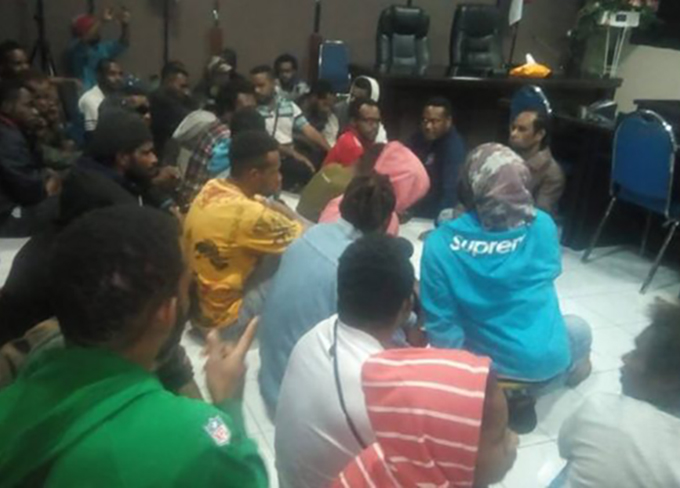
Papuans protest over ‘Act of Free Choice’ in 13 cities in Indonesia

]]>

By Kustin Ayuwuragil and Ramadhan Rizki in Jakarta

Papuans have launched protest actions in 13 cities across Indonesia to demonstrate against the so-called “Act of Free Choice” that enabled Jakarta to take control of the Melanesian region.

The Papuan Student Alliance (AMP) and the Indonesian People’s Front for West Papua (FRI-WP) organised the rallies in cities, including Jakarta, Bandung and Ambon.

AMP spokesperson Surya Anta said that they were taking to the streets based on two principal issues related to West Papuan independence.

“[Papuans had] already declared their independence in 1961, deciding not to be part of the 1945 [declaration of Indonesian] independence [from the Dutch],” Surya told CNN Indonesia in front of the State Palace in Central Jakarta last Thursday marking the August 2 date.

Surya said that at the time, the people of West Papua already had a state symbol, flag and currency, although no administration had yet been established.

The second reason was that the people of West Papua wanted to separate from Indonesia because for years and years they had suffered “slow-motion genocide”.

-Partners-

This was in no way in accordance with the values enshrined in the state ideology of Pancasila in realising independence for all nations.

‘Oppression, slow-motion genocide’
“They suffer oppression, abuse, slow-motion genocide, rape, abductions, no freedom of expression and access to information, and many other things,” he said.

The problems facing the West Papuans also included the massive exploitation of natural resources, which according to Surya, is because of the PT Freeport Indonesian gold-and-copper mine problem.

Social inequality was also high compared with other parts of Indonesia.

Surya added that the West Papuan people wanted to separate from Indonesia because they did not feel Indonesian because of the numerous problems cited.

“Yes (they want to separate from Indonesia) because from the very beginning they did not feel Indonesian. Go ahead and check the [1948] Youth Pledge. Was West Papua mentioned there?,” he said.

Surya said that the infrastructure development which was being touted by President Joko “Jokowi” Widodo in Papua had not been enough to make the people feel Indonesian.

“Yeah, like the Dutch [colonial] period, we got schools, but did this then make us become Dutch citizens? No. We still felt convinced that our identity was different,” he said.

Widodo has become known as the Indonesian president which has most often visited Papua. His agenda has been varied but in his Nawa Cita [nine point priority programme], Widodo has prioritised the resolution of past human rights violations and the development of infrastructure in Papua.

‘Same old song’
Coordinating Minister for Security, Politics and Legal Affairs Menko Polhukam Wiranto referred to protests by Papuan pro-independence activists such as these as being a “separatist” action seeking to attract international attention.

“It’s a small separatist movement but by methods such as this [they] want to get world attention,” said Wiranto at his office in Jakarta.

The former commander of ABRI (Indonesian Armed Forces, now TNI) said that threats by Papuan pro-independence groups which had been widespread lately were just the “same old song” which had been played repeatedly for a long time.

As has been reported, the United Liberation Movement for West Papua (ULMWP) were holding actions in Jakarta and London to support a new referendum for the Papuan people.

At Thursday’s action in front of the State Palace the AMP and the FRI-WP expressed their support for West Papuan liberation from the NKRI or Unitary State of the Republic of Indonesia.

Responding to this, Wiranto suggested that people do not need to become upset or anxious about the frequent actions by such groups.

“This old song is the same as the one played in the past. We don’t need to get upset, we don’t need to get anxious, we will just fight it,” he said.

Wiranto also said that the government would not be influenced by the “separatist” threat from such groups.

He asserted that in principle the government still considered Papua would remain part of the NKRI forever and did not need to be disturbed by challenges by any party at all.

“It is clear that we have a principled and standing position which cannot be disrupted by challenges from movements such as this,” he said.

Soft diplomacy
Wiranto also insisted that the government had repeatedly made efforts to develop diplomatic relations with neighbouring countries in order to suppress “biased issues” related to development in Papua.

Wiranto claimed that heads of state in the Asia-Pacific region such as Micronesia, Nauru, and Australia were often invited to help in “suppressing” such groups.

“Soft diplomacy activities which we are carrying out in the South Pacific continue apace. They [the Papuan separatist groups] perhaps then feel angry about the soft diplomacy activities that we are conducting,” said Wiranto.

Wiranto claimed to have invited officials from these countries to see for themselves the current conditions and social developments in remote parts of Papua.

This is aimed at preventing countries in the Asia-Pacific region from “misunderstanding” the current social developments and situation in Papua.

“So we invite them to see the facts [on the ground]. As if we do not provide good education to our friends in Papua. This issue is being continually pushed, continually made an issue of, in Europe, the South Pacific, but you know yourself right, the reality is not like that,” he said.

Wiranto said that there were still potential threats from irresponsible parties which resulted in the emergence of separatist groups in Papua.

He was reluctant however to cite which parties he meant. Wiranto said only that these parties did not want Indonesia to be united and only wanted to take the profits from mining in Papua.

“Because there are still parties that do not want our country to be united, there are still parties which take the profits from mining activities”, he said.

Translated by James Balowski for the Indoleft News Service. The original title of the article was “Aksi Referendum Papua: Infrastruktur Jokowi Bukan Jawaban”.

Background:
In 1969, Pepera — Known as the “Act of Free Choice”, a referendum, was held to decide whether West Papua, a former Dutch colony annexed by Indonesia in 1963, would be become independent or join Indonesia. The UN sanction plebiscite, in which 1025 hand-picked tribal leaders allegedly expressed their desire for integration, has been widely dismissed as a sham.

Critics claim that that the selected voters were coerced, threatened and closely scrutinised by the military to unanimously vote for integration.

Although it is widely held that West Papua declared independence from Indonesia on December 1, 1961, this actually marks the date when the Morning Star (Bintang Kejora) flag was first raised alongside the Dutch flag in an officially sanctioned ceremony in Jayapura, then called Hollandia.

The first declaration of independence actually took place on July 1, 1971 at the Victoria Headquarters in Waris Village, Jayapura, when Oom Nicolas Jouwe and two Free Papua Organisation (OPM) commanders, Seth Jafeth Roemkorem and Jacob Hendrik Prai, raised the Morning Star flag and unilaterally proclaimed Papua Barat or West Papua as an independent democratic republic, complete with a National Liberation Army (TPN), a provisional constitution, government, senate and parliament.

One of the rallies in West Papua. Source: Voice West Papua
Print Friendly, PDF & Email

Article by AsiaPacificReport.nz

]]>
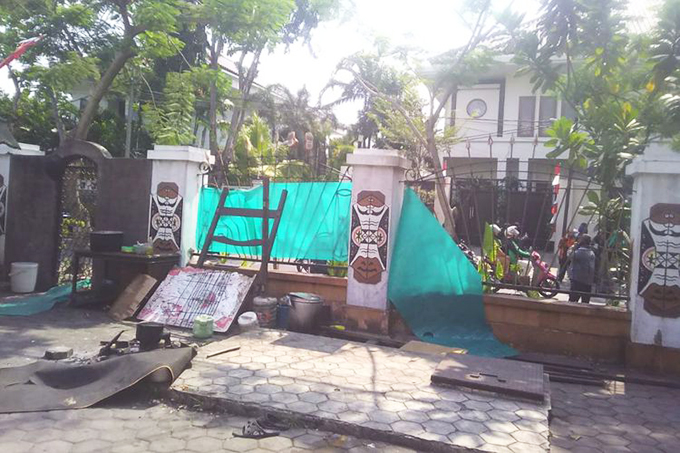
‘Blacklisted’ Australian researcher detained in Indonesian airport

]]>

Researcher Belinda Lopez … detained by Indonesian authorities in Bali’s Denpasar airport. Image: Belinda Lopez/FB

Pacific Media Centre Newsdesk

An Australian-based doctoral media researcher says she has been “blacklisted” by Indonesian authorities and refused entry to the country while embarking on a holiday in Bali.

Belinda Lopez, based at Sydney’s Macquarie University and who has researched human rights and other issues in Indonesia, says she is being detained in a room at Denpasar’s Ngurah Rai International Airport and she will have been held for 24 hours before being deported on a flight at 10pm tonight.

A former journalist, she is doing a doctorate in Indonesian studies.

She was travelling to Bali, Jakarta and the Baliem cultural festival in Papua.

Lopez made a plea today for help from friends and colleagues which has been circulated by members of the Journalism Education and Research Association of Australia (JERAA).

READ MORE: Australian student barred from Indonesia

-Partners-

Two years ago when visiting West Papua she was refused renewal of her visa and told she was “suspected of being a journalist”, Lopez says.

Indonesia claims to have softened its policy on media entry to West Papua since President Joko Widodo took office in 2014.

However, media freedom and civil society advocates say there has been little change in practice.

On her Facebook page, Lopez says:

‘Blacklisted by Indonesia’
“This is not a joke: I’m blacklisted by the Indonesian government.
Saya termasuk dalam daftar tangkal Indonesia (terjemahan dibawah). Share!

“I’ve been refused entry to Bali and have been held in a room at Denpasar airport on a couch since midnight. I am told I can only board a flight at 10pm tonight, so that means I’ll be detained for nearly 24 hours before I’m deported.

“I explained I was on a holiday and that I was planning to visit friends in Bali and Java and go to the Baliem tourism festival in Papua.

“Immigration asked me if I was a journalist. Two staff members kept asking me if I had ‘done something wrong to Indonesia’.

“Nine years ago I worked for English language newspapers Jakarta Globe and The Jakarta Post as a subeditor. I have made podcasts for the ABC. And I am a PhD student of Indonesia.

“This was meant to be a holiday from university, officially on leave. My honeymoon. But the immigration staff member kept asking if I was a journalist and if I’d ‘done something bad to Indonesia’.

“Two years ago when I was in Papua, the immigration office wouldn’t renew my visa, wouldn’t explain why and then finally told me I was suspected of being a journalist so I had to leave. I was told it was an administrative matter (not a criminal one) and meant I couldn’t return to the territory for six months. I didn’t make a big deal about it because I wanted an ongoing relationship with Indonesia and I thought keeping respectfully quiet was the way to do that. It’s the first place I moved to as an adult, have visited so many times since, to learn the language and to visit people who have become some of my best friends in the world.

“So why am I now on the Indonesian government blacklist? For how long? For what reason? For going to Papua? This is devastating for me.”

Pacific Media Watch condemned the arbitrary Indonesian action against the researcher and appealed for a more humane treatment of visitors.

The room where Belinda Lopez is being detained at Bali’s Denpasar airport. Image: Belinda Lopez/FB
Print Friendly, PDF & Email

Article by AsiaPacificReport.nz

]]>

Short-wave radio saves lives and foreign aid dollars, says McGarry

]]>

A recent photo of the current rumbling of Mt Lombenden volcano on Ambae Island, Vanuatu. Image: lechaudrondevulcain.com

Pacific Media Centre Newsdesk

Vanuatu has appealed to Australia to restore short-wave radio services to the Pacific region, after they were switched off by the ABC in 2017, reports Radio Australia.

Prime Minister Charlot Salwai said other forms of communication usually failed during natural disasters.

He added his voice on the final day yesterday for submissions to an Australian government review of broadcasting to the region, Linda Mottram reported on a segment of the PM programme.

LISTEN: Linda Mottram’s current affairs report on ABC PM

As if to make the point, his statement came as a major operation is underway to evacuate more than 8000 residents from the island of Ambae, which has been made uninhabitable by an erupting volcano.

Featured:
Nikita Taiwia, Vanuatu coordinator, Red Cross
Dan McGarry, media director, Vanuatu Daily Post newspaper

Print Friendly, PDF & Email

Article by AsiaPacificReport.nz

]]>

Indonesian influence in the Pacific grows, brushing aside West Papua

]]>
Evening Report
Evening Report
Indonesian influence in the Pacific grows, brushing aside West Papua
Loading
/

By Johnny Blades of RNZ Pacific in Wellington

Indonesia’s influence in the Pacific Islands is growing, but is shadowed by disquiet over its region of Papua, known widely as West Papua.

The West Papuan independence movement has significant traction in the region, where it continues to push for its self-determination aspirations to be addressed by the international community.

Considering Papua’s political status as non-negotiable, Indonesia has been busy strengthening ties with a number of countries in the three Pacific Islands regions of Melanesia, Polynesia and Micronesia.

READ MORE: Indonesia strengthens ties with Pacific ‘good friends’

Amid a flurry of diplomatic activity in recent months, Indonesian cabinet minister Wiranto attended independence anniversary celebrations on Nauru, and the president of the Federated States of Micronesia was given red carpet treatment in Jakarta.

Jakarta says this is about working together with Pacific island countries on mutual interests. Others say it’s principally about quelling support for West Papuan independence aims.

-Partners-

Some regional observers even suspect the hand of Jakarta was at play behind the change in the Solomon Islands government’s policy on West Papua since Rick Hou replaced Manasseh Sogavare as prime minister last December.

April’s visit by a Solomon Islands delegation to Indonesia’s Papua and West Papua provinces caused an upset among some elements of civil society in Honiara, but showed how extensive Jakarta’s diplomatic outreach has become.

Serious threat
The secretary of the United Liberation Movement for West Papua, Rex Rumakiek, said Australia’s angst about the rising influence of China in the Pacific missed a more serious regional threat.

“The Melanesian countries are not very much concerned about Chinese influence. They are concerned mostly about the Indonesians’ influence in Melanesia, because they’re very destructive, they go right down to village level.

“They bribe people and buy political parties to change the government and so on. It’s already happening. It’s much more serious than the Chinese influence,” Rumakiek said.

LISTEN: RNZ’s Dateline Pacific

A spokesperson from Indonesia’s Embassy in Canberra, Sade Bimantara, said Rumakiek’s accusation was unsubstantiated and false.

He said Indonesia had consistently engaged and worked with Pacific Island nations for many years while respecting each other’s domestic affairs and sovereignty.

“On the contrary, a handful of people claiming Papuan heritage and living overseas are the ones interfering in the domestic politics of Papua and West Papua provinces,” Bimantara said.

“They are not citizens and were never democratically elected into public offices in those provinces by the 2.7 million voters of Papua and West Papua. And yet, they claim to be the rightful heir to the provinces.”

Franz Albert Joku … “Demographically, geographically, [Indonesia is] part of the Pacific. One third of the total area of the country, to the east, is inhabited by Melanesians and Polynesians.” Image: Koroi Hawkins/RNZ PacificIndonesia ‘part of Pacific’
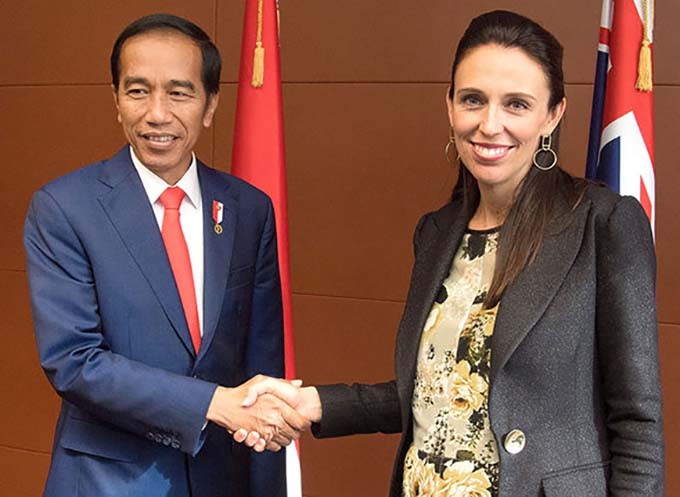
According to Franzalbert Joku, who is a consultant for Jakarta on Papua issues, President Joko Widodo and his administration recognise that Indonesia is a part of the Pacific.

“Demographically, geographically, we are part of the Pacific. One third of the total area of the country, to the east, is inhabited by Melanesians and Polynesians,” he said.

Joku, a West Papuan who frequently represents Indonesia at meetings of the Melanesian Spearhead Group and the Pacific Islands Forum, said the country wanted to help small island countries with their development needs.

He cited Indonesian assistance in plans to build a convention centre in Tuvalu and a sports stadium in Kiribati as examples.

Indonesia is also offering help to Pacific Island countries with efforts to protect their all-important marine environment, although it is not the only larger country doing so.

Foreign governments sometimes take up the issue of human rights abuses in West Papua in their representations to Indonesia’s government.

But few human rights defenders would have been satisfed with wan assurances by Dutch Foreign Affairs minister Stef Blok that he discussed a recent damning Amnesty International report on the issue when in Jakarta last month.

Regional efforts obstructed
Some Pacific governments, notably Vanuatu, are concerned that Indonesia has obstructed efforts in regional forums to address West Papuan grievances.

A former Vanuatu prime minister and leader of the Vanua’aku Pati, Joe Natuman, said the move by some members of the Melanesian Spearhead Group to accept Indonesia into the regional organisation was problematic.

“Whoever had that wise idea is causing us problems,” he explained.

“You know, they said Indonesia comes into join [the MSG] to discuss issues of West Papua; Indonesia comes in and it doesn’t want to discuss West Papua. So I think we have to review the Indonesian membership of MSG.”

But Franz Albert Joku said it was not the responsibility of the MSG or Pacific Islands Forum to speak for Papuans. He said Papuans should be allowed to speak for themselves “by dealing with our own leaders in Jakarta and our own government.

“It’s not for offshore organisations like the Melanesian Spearhead Group and the Pacific Islands Forum to decide what should happen in Papua. Our position and especially our future is firmly within our grip.”

However, the United Liberation Movement for West Papua (ULMWP), which has observer status at the MSG, argues that West Papuans are not free to express themselves and their political aspirations in their homeland.

Thousands arrested
Indonesian police arrested thousands of Papuans in 2016 when they demonstrated in Papuan cities in support of the Liberation Movement.

Jakarta also remains sensitive to regional calls for West Papua’s political status, and the controversial process by which the former Dutch New Guinea, was incorporated into Indonesia in the 1960s, to be reviewed.

Last month while in Fiji, Papua New Guinea’s Prime Minister Peter O’Neill was reported to have encouraged regional countries to take the issue of West Papua to the United Nations Decolonisation Committee.

Following this, PNG’s Foreign Minister Rimbink Pato made a visit to Jakarta for talks with his Indonesian counterpart Retno Marsudi, reaffirming his country’s support for the status quo in the Papuan provinces.

“They are an integral part of the Republic of Indonesia,” he said.

“There has been some misreporting on this issue. Papua New Guinea’s position has not changed and there is no intention to ever change it.”

Natuman said he understood the sensitivity of the matter for PNG as West Papua’s neighbour.

“But I think they should be honest with themselves and discuss openly with the MSG and with Indonesia, and of course eventually we have to involve the United Nations,” he said.

United Nations mess
“This is a mess created by the United Nations, and the the United Nations have to come clean on this.”

The regional calls for international action on West Papua persist from the likes of New Zealand government MP Louisa Wall, who is among a small but vocal group of local MPs pushing for the issue of West Papuan self-determination to be heard at the UN.

“I believe in self-determination, I believe in indigenous rights. This is a right of the West Papuan indigenous peoples to re-litigate something that has been highlighted, actually was done in an unjust and unfair way,” Wall said.

Wall’s voice is still only part of a minority in New Zealand’s government whose formal position remains in support of Indonesian control of Papua.

NZ Prime Minister Jacinda Ardern with President Joko Widodo … reaffirmed backing for Indonesia. Image: Marty Melville/Pool

New Zealand’s Prime Minister, Jacinda Ardern, reiterated this support to Indonesia’s president Joko Widodo during his state visit to Wellington earlier this year.

The issue of human rights abuses in Papua is a standing item on the agenda of the Pacific Islands Forum (PIF), whose leaders meet in Nauru next month.

Yesterday, the outgoing Forum chairman, Samoa’s Prime Minister Tuilaepa Sailele Malielegaoi, suggested some Pacific leaders sensationalised the alleged abuses by Indonesian military in Papua.

Speaking on national Radio 2AP, Tuilaepa, who has forged closer ties with Indonesia in the past year, conceded that various West Papuans wanted independence and sought to stop infringements of their human rights.

Tuilaepa said that where it concerned human rights issues, they should take up the matter through the United Nations Human Rights Commission.

The Pacific Media Centre has a content sharing partnership with RNZ Pacific.

Print Friendly, PDF & Email

Article by AsiaPacificReport.nz

]]>

Rapa Nui activist calls for rigorous curb on ‘flouting’ of migration rules

]]>

Ahu Akivi maois (statues) on the island of Rapa Nui. Image: RNZ Pacific/AFP

By RNZ Pacific

An indigenous activist on Chile’s Rapa Nui says new rules restricting internal migration to the island need to be rigorously enforced.

Non-Rapa Nui Chileans now need to have Rapa Nui spouses or children to migrate to the island without a work contract.

The activist, Santi Hitorangi, said the rule requiring a contract has previously been flouted.

READ MORE: Rapa Nui limiting visitor time to stop overcrowding

“The authorities are saying that once in action there’s going to be rigorous enforcement. So far we haven’t experienced that.

“What we have experienced is the ability of the Chilean authority in collusion with business people on the island, be it Rapa Nui or Chileans, they are keen to find creative ways to jump over those so called provisions.”

-Partners-

Santi Hitorangi said Chileans moving from the mainland had overwhelmed Rapa Nui’s infrastructure and warped its culture.

“The Chileans who come from the marginalised neighbourhoods of Chile and have brought crime, degenerating the culture. They are doing taxi tours and the problem with that is the information they give to those tourists. They are a warped perspective of who we are,” Hitorangi said.

Rapa Nui, also known as Easter Island, had become overcrowded during 130 years of colonial rule and its environment was suffering with the water no longer being safe to drink, the activist said.

“Many of the underground wells are polluted because as long as we have had Chile on the island the waste has been dug in pits, plastics, chemicals what have you all covered over with dirt,” he said.

The Pacific Media Centre has a content sharing partnership with RNZ Pacific.

Print Friendly, PDF & Email

Article by AsiaPacificReport.nz

]]>

Tasered, beaten, handcuffed but Mike Treen says ‘I would do it all again’

]]>

Unite Union leader Mike Treen (second from right), Kia Ora Gaza spokesperson Roger Fowler and Palestinian human rights supporters Billy Hania and Heidi Jia at Auckland International Airport today. Image: Rahul Bhattarai/PMC

By Rahul Bhattarai in Auckland

Unite Union national director Mike Treen arrived in Auckland today and told of his brutal experience at the hands of the Israeli military while trying to break Israel’s 11-year-long illegal Gaza blockade.

But he vowed he would do the whole voyage again “if it was useful” to the humanitarian cause – even after being badly mistreated by the the Israeli security forces.

The Israeli Navy “hijacked” Treen’s boat Al Awda (The Return) and seized all 22 people on board, just 40 miles nautical miles from Gaza.

READ MORE: Deported Freedom Flotilla activist on his way

“Israeli navy hijacked the ship by force, and multiple uses of tasers on me and other crew, for trying to peacefully resist,” he said.

His boat was hijacked by armed and masked Israeli soldiers in international waters.

-Partners-

“We weren’t forcefully trying to resist them,” Treen said. “We wanted to make clear that they had no right to take our boat. This was an unlawful act – we were in an international waters, we had the right to free passage.”

Threatened the captain
But the Israelis not only forced their way onto the boat, tasering and beating people, they also threatened to kill the captain, “simply threatened to execute him if he did not pilot the ship towards Israel,” Treen said.

Treen himself was tasered four times on his face and head area, was stomped on his foot, and left with bruises all over his body.

After the brutal treatment, he was taken to an Israeli prison and detained for five days.

During his detention, Treen was interrogated by Israeli officers and also by a New Zealand honorary consular official based in Israel, Gad Propper.

“The New Zealand consulate based in Israel in every minute acted as an agent of the Israeli state not of the New Zealand government,” Treen said.

He was not interviewed alone. The consul “interviewed me with police and security officials in the room and when he asked me about the taser mark on my face, he [Gad Propper] then immediately implied that it was somehow my fault”.

When Treen told the interviewers that his belongings, including his wallet had been stolen, Gad Propper had said “it was an exaggeration and they [Israeli soldiers] surely wouldn’t do that”.

Treen was deported back to Auckland emptyhanded with an empty wallet and with most of his money having been stolen.

Free Palestine and Free Gaza supporters gathered at Auckland International Airport to welcome home union leader Mike Treen, deported by Israel for trying to breach the illegal Gaza blockade. Image: Rahul Bhattarai/PMC
Print Friendly, PDF & Email

Article by AsiaPacificReport.nz

]]>

Deported Freedom Flotilla activist Mike Treen on way back to NZ

]]>

Detained and deported unionist Mike Treen (right) with Kia Ora Gaza’s Roger Fowler in a file photo. Image: Kia Ora Gaza

Pacific Media Centre Newsdesk

Unite union leader Mike Treen, seized and detained by Israeli security forces last weekend along with other human rights campaigners bound for Gaza on board the fishing boat Al Awda, is on his way to Auckland.

Although his laptop computer and cellphone had been confiscated by the authorities, Treen managed to text friends in Auckland from Hongkong airport after being deported by Israel.

Due back at Auckland Airport about midday today, he said in his brief message last night:

“Hi all – I have only a few minutes access right now. I have just arrived at Hong Kong Airport after deportation.

“They stole almost everything I had except my wallet – less most of the money. Now [I] have no phone, computer etc. I am using another deportee’s laptop.

“He was a journalist and treated a bit better. I arrive home on Cathay Pacific at 11.50am tomorrow.

-Partners-

“Roughed up a bit, tasred (sic) a few times, had my foot stomped on, but we gave them a bit of a message as well.

“See you soon. A few stories to tell.”

‘Brave challenge’
Kia Ora Gaza spokesman Roger Fowler said in a statement on the humanitarian organisation’s website that Treen was a highly respected human rights defender and the national director of the Unite union.

“Facilitated by Kia Ora Gaza and supported by his union, the CTU, and many hundreds of generous New Zealanders, Mike joined dozens of other prominent human rights activists from around the world on the 2018 international Freedom Flotilla, to bravely challenge Israel’s illegal and inhumane 11-year blockade of the two million Palestinians confined in the tiny Gaza Strip,” he said.

The leading boat, the Al Awda, had been “unlawfully hijacked” and boarded in international waters by armed and masked Israeli soldiers last Sunday.

“Mike and others were bashed, tasered, tightly handcuffed and roughly manhandled off the boat during this blatantly illegal act of piracy on the high seas,” Fowler said.

“All communications were cut, and the boat was forced off it’s course to a port in Israel, where the crew and passengers have been unlawfully detained and interrogated for several days, before being deported.”

Aid confiscated
The boat and cargo of essential medical supplies worth $15,000 destined for Gaza had been illegally seized.

All equipment and belongings have been confiscated.

“Most of Mike’s belongings have been stolen by his captors, including a sum of money,” Fowler said.

Fowler criticised Foreign Minister Winston Peters for failing to take a stand or make a public comment on this “outrageous attack on peaceful citizens” on a humanitarian mission in international waters.

Peters said in a letter to Kia Ora Gaza: “Decisions taken by this government on New Zealand support for particular initiatives and resolutions relating to Israel/Palestinian issues are considered carefully, with all necessary consultation having been carried out.

“In all cases, the government remains committed to supporting a two state solution to the Israeli-Palestinian conflict.”

He said New Zealanders were “advised against all travel to Gaza”.

The Pacific Media Centre has a content sharing arrangement with Kia Ora Gaza.

Print Friendly, PDF & Email

Article by AsiaPacificReport.nz

]]>

RSF condemns Nine-Fairfax merger as threat to media pluralism in Australia

]]>

There is concern about the editorial independence of The Age newspaper, one of the jewels of the Fairfax Media empire, now that it is to be run by Nine Entertainment. Image: William West /RSF/AFP

Pacific Media Watch Newsdesk

Reporters Without Borders (RSF) is extremely concerned about pluralism and respect for editorial independence in the new Australian media conglomerate created from last week’s merger between the Fairfax Media newspaper chain and Nine Entertainment, a national television network.

“Commercial synergy has endangered journalistic independence and media pluralism in what is, to say the least, an incongruous marriage,” the Paris-based RSF global media freedom watchdog said in a statement today.

“On the one hand, Fairfax has provided quality investigative journalism via a network of representative regional print publications throughout the country since 1831.

READ MORE: Nine-Fairfax merger warning for investigative journalism – and democracy

“Nine, which will have control of the new entity, has already announced A$50 million (32 million euros) in budget cuts, to the alarm of news staff at Fairfax’s publications.” Image: RSF

“On the other, Nine is primarily a sports and entertainment broadcaster and its management is regarded as much more concerned about profits and cost-cutting than journalistic ethics.”

Nine, which will have control of the new entity, has already announced A$50 million (32 million euros) in budget cuts, to the alarm of news staff at Fairfax’s publications.

-Partners-

They include The Age and The Sydney Morning Herald flagship newspapers, whose editorial freedom from political or economic interference was summed up in the slogan printed under each newspaper’s name: “Independent. Always.”

Takeover
The Fairfax brand will disappear in the new media group, in what is a clear sign that this “marriage of reason” is an outright takeover.

Aside from a loss of editorial independence, Fairfax’s journalists fear that newsrooms will be merged and many of the group’s rural and suburban publications will be closed. Although not very profitable, they have until now played a vital role in providing Australians with local news of a diverse nature.

Kept a close secret until announced on July 26  and valued at A$4 billion (2.5 billion euros), the merger still has to be approved by the Australian Competition and Consumer Commission (ACCC).

“The freedom and independence of Fairfax’s journalists is clearly in danger,” said Daniel Bastard, head of RSF’s Asia-Pacific desk.

“We therefore urge the ACCC to block this merger until the new entity managed by Nine has adopted the Fairfax Charter of Editorial Independence in writing, in its statutes.

“Fairfax’s takeover is the end of a journalistic institution in Australia. Quality journalism must not be reduced to a variable dependent on commercial and advertising imperatives.

“This takeover is all the more worrying for journalistic pluralism and democracy because the level of media ownership concentration in Australia is already one of the highest in the world.”

Media monsters
Like Australia’s other media and advertisement giant, Rupert Murdoch’s News Corp, the future entity controlled by Nine will include national and regional newspapers radio, stations, traditional TV channels and online ones, and a string of news websites.

This is now permitted in Australia after the decision by Prime Minister Malcolm Turnbull’s government a few months ago to repeal 30-year-old legislation restricting simultaneous ownership of both print and broadcast media.

Observers fear that the Fairfax takeover will open the way to even more ownership concentration.

Australia is ranked 19th out of 180 countries in RSF’s 2018 World Press Freedom Index. The chronic lack of journalistic pluralism is one of the reasons why it is not ranked any higher.

Print Friendly, PDF & Email

Article by AsiaPacificReport.nz

]]>