Page 1191

Opposition PNG MP wins court phone reprieve for ‘at risk’ lives

]]>

EMTV News report on the National Information and Communications Technology Authority (NICTA) chief executive Charles Punaha claiming the agency would move against unregistered simcards with the deadline at midnight last night. Video: EMTV

Pacific Media Centre Newsdesk

Papua New Guinea’s controversial planned deactivation of 1.4 million unregistered simcards has been put on hold following concerns about it threatening lives of people in the Madang province, reports the Post-Courier.

The 11th hour reprieve though is for 14 days.

It was granted as an interim injunction by the National Court in Port Moresby yesterday after opposition Madang Open MP Bryan Kramer filed before Justice Oagile Bethuel Key Dingake.

Here MP Kramer explains the issues in a statement to the National Parliament and republished on EMTV deputy news editor Scott Waide’s blog My Land, Your Land:

Madang MP Bryan Kramer … “I have been given 14 days to commence and file formal proceedings and serve on NICTA, as well as the state.” Image: PNG Blogs

This morning [Monday] I moved an urgent application seeking a stay (stop order) against the National Information and Communications Technology Authority (NICTA) from deactivating some 1.4 million mobile users throughout the country who have yet to register their simcards. The application sought an interim stay and 14 days to commence formal proceedings.

-Partners-

After considering the arguments raised and the issue of short service on NICTA, the court granted by consent interim orders that NICTA is prevented from deactivating any unregistered simcards following the deadline on 30 April 2018. This ends today at midnight.

I have been given 14 days to commence and file formal proceedings and serve on NICTA, as well as the state.

11th hour application
The decision to file an application at the 11th hour before the deadline followed my discussion with Dr Jimmy Aipit on Saturday in Madang.

Dr Aipit has been a pediatrician for Madang General Hospital for the past 12 years. A pediatrician is a medical doctor who specialises in the development, care, and diseases of babies and children.

Dr Aipit raised concerns in relation to the 600 health officers he communicates with on a regular basis who provide life-saving medical advice for patients in the remote and rural parts of my province.

‘Grave concerns’
I also shared the same concerns as the majority of my constituents reside in remote and rural parts of my district. They contact me from time to time via mobile telephone to assist at times of emergencies.

Over the years I have I have been contacted directly to assist in maternal emergencies.

Following the discussion with Dr Aipit, I jumped on a plane the same day to fly to Port Moresby to file an urgent application to obtain a stay against NICTA.

My application was filed and heard yesterday (Sunday) exparte (without serving the other party). With the deadline on Monday, the administration judge on duty refused to hear the application and ordered I serve on NICTA and state and matter be adjourned to 10:30am this morning.

Today I explained to the court that I have grave concerns with the looming deadline and the impact of deactivating unregistered sims may result in loss of life and decreased well-being of my constituents in my district as well throughout the country.

Following the court’s decision to grant interim stay, 1.4 million people throughout PNG who have yet to register their simcards can be rest assured it won’t be deactivated – at least for the next 14 days and/or until the matter is determined by the court.

I am not challenging NICTA’s right to impose simcard registration, I am however challenging the manner in which it is imposing on 87 percent of our population who reside in remote and rural parts of our country and the effect it would have on their daily lives.

Bryan Kramer is an opposition Member of Parliament acting for the Madang electorate in Papua New Guinea.

Print Friendly, PDF & Email

Article by AsiaPacificReport.nz

]]>
PNG LNG – failed predictions and PNG’s resource curse

]]>

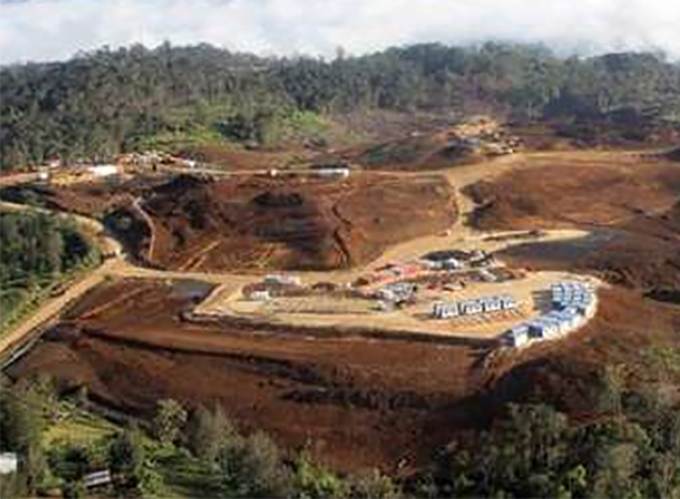
The Exxon-led PNG LNG project … supplying about 8 million tonnes of LNG a year to Japan, South Korea and China. Image: Jubilee Australia report

“On almost every measure of economic welfare, the PNG economy would have been better off without the PNG LNG project.”

Pacific Media Centre Newsdesk

Papua New Guinea’s massive PNG LNG project is one of “broken promises” that has largely failed the country, according to a major study released yesterday by Jubilee Australia.

Entitled Double or Nothing: The Broken Economic Promises of PNG LNG, this report, co-authored by Paul Flanagan and Dr Luke Fletcher, compares the projected economic benefits of the PNG LNG project with actual outcomes.

The new study uses PNG government data to examine the predictions of the 2008 project report commissioned by ExxonMobil and promoted by Oil Search.

This examination finds that the positive predictions for the PNG economy were largely incorrect.

Key findings:

  • Despite predictions of a doubling in the size of the economy, the outcome was a gain of only 10 percent and all of this focused on the largely foreign-owned resource sector itself;
  • Despite predictions of an 84 percent increase in household incomes, the outcome was a fall of 6 percent;
  • ●Despite predictions of a 42 percent increase in employment, the outcome was a fall of 27 percent;
  • ●Despite predictions of an 85 percent increase in government expenditure to support better education, health, law and order, and infrastructure, the outcome was a fall of 32 percent; and
  • ●Despite predictions of a 58 percent increase in imports, the outcome was a fall of 73 percent.

-Partners-

30-year span
PNG LNG is an Exxon-led project which supplies about 8 million tonnes of LNG a year to Japan, South Korea and China.

It is projected to run for 30 years. In 2009, Australia’s Export Credit Agency, Efic lent A$500 million to Exxon, OilSearch, Santos and the government of PNG.

Efic’s decision was based on advice from the Department of Foreign Affairs and Trade (DFAT) provided to the then-Minister for Trade, Simon Crean, on advice from DFAT. This is the largest loan ever made by Efic.

Paul Flanagan writes in PNG Economics:

Specifically, growth in the resource sector has matched the confident predictions even with the fall in oil prices in 2014.

However, all other parts of the PNG economy have not done as well as predicted.

This is a major “broken promises” gap. This is the basis for the title of the latest report – the PNG LNG project promised to double GDP, but the outcome of 10 percent is close to nothing (especially when the size of PNG’s GDP is facing a major downgrade in the latest NSO 2015 update).

Revenues to the budget are only one-third of expected levels, and after allowing for project costs, will continue having a net negative impact on the budget (so below nothing) until around 2024.

Economy gone backwards
Of even greater concern, the examination finds that the PNG economy, apart from the resource sector, has actually gone backwards relative to its underlying growth path.

The most likely explanation for this sad outcome is PNG has slipped again into poor policies associated with the resource curse. The temptations of the rosy PNG LNG promises were too strong for politicians despite warnings from PNG Treasury, BPNG and outside academics.

During the O’Neill/Dion government, PNG descended into very damaging economic policies of a bloated budget and PNG’s largest deficits ever, fixing the exchange rate at an over-valued level, making foolish investments in areas such as Oil Search and harming the independence of PNG’s economic institutions.

With the focus being so strongly on getting the PNG LNG project operational, there was a lack of policy emphasis on other parts of the economy.

This is the “resource curse” gap.

Third time
PNG needs to learn the lessons from this experience. This is the third time that PNG has suffered from the resource curse:

  • the first was with Bougainville Copper and the experience of the late 1980s;
  • the second was the Kutubu/Porgera expectations that crashed so badly in the mid-90s;
  • and the PNG LNG period is the third resource crisis.

The benefits of PNG’s resource wealth could in theory be tapped without damaging the rest of the economy.

But it would require very different choices by PNG’s politicians. PNG probably lacks the strong governance and institutions required to deal with the powerful resource sector lobby.

Even in Australia, the power of vested interests around the resource sector is blocking sensible options for sharing resource benefits more equitably and efficiently.

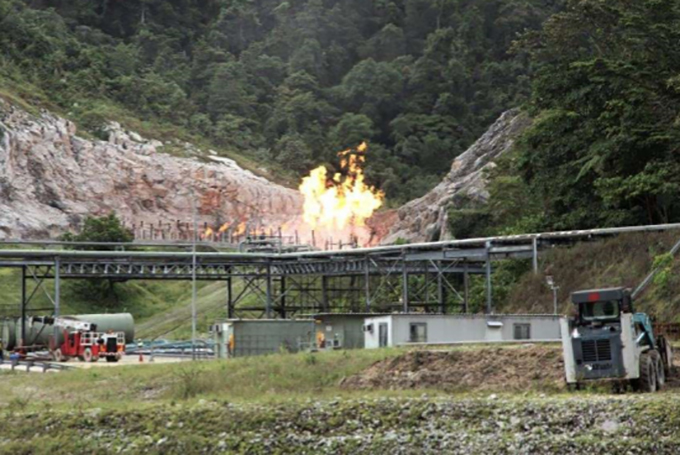
The Oil Search facility near Lake Kutubu in Hela province, Papua New Guinea’s Southern Highlands. Image: Damian Baker/Jubilee Australia
Print Friendly, PDF & Email

Article by AsiaPacificReport.nz

]]>

Greenpeace blasts palm oil industry deforestation in West Papua

]]>

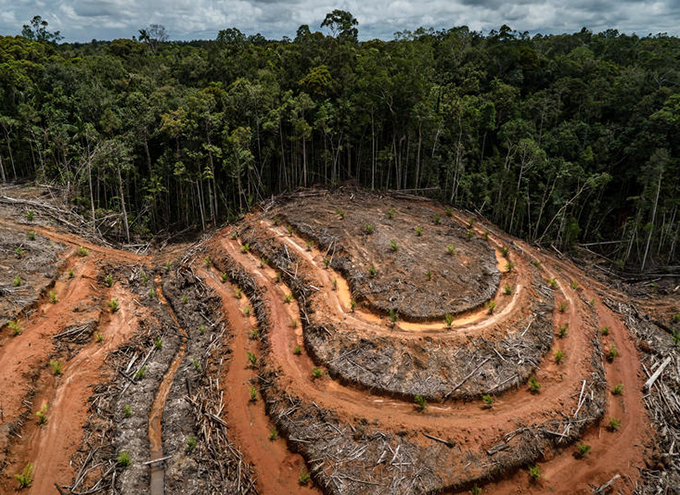
One of the massive deforestation areas in the PT Megakarya Jaya Raya concession in Papua, Indonesia. Other images show a lunar-like devastation over huge areas. Image: Greenpeace International

Pacific Media Centre Newsdesk

A palm oil supplier to Mars, Nestlé, PepsiCo and Unilever is destroying rainforests in the Indonesian-ruled Papua region, a new investigation by Greenpeace International has revealed.

Satellite analysis suggests that around 4000ha of rainforest were cleared in PT Megakarya Jaya Raya concession between May 2015 and April 2017 – an area almost half the size of Paris.

The findings come as a delegation from the Indonesian government arrived in Europe last week to defend the palm oil industry, in response to moves by European Parliament to discourage the use of palm oil in biofuels on environmental grounds, Greenpeace International reports.

Luhut Panjaitan, the Coordinating Minister for Maritime Affairs of Indonesia, is visiting several European cities, including Brussels and Berlin.

“After destroying much of the rainforests of Sumatra and Kalimantan, the palm oil industry is now pushing into new frontiers like Papua, said Richard George, forests campaigner at Greenpeace UK.

“If the Indonesian government wants to defend this industry, the best thing it can do is to force it to clean up its act, not threaten to start a trade war.”

-Partners-

Photos and video taken in March and April 2018 show massive deforestation in PT MJR, a palm oil concession controlled by the Hayel Saeed Anam Group (HSA), including in an area zoned for protection by the Indonesian government in response to the devastating forest fires in 2015. Development is prohibited in these areas.

Supply chain
Although PT MJR is not yet producing palm oil, two other HSA subsidiary companies – Arma Group and Pacific Oils & Fats – supplied palm oil to Mars, Nestlé, PepsiCo and Unilever, according to supply chain information released by the brands earlier this year.

Each of these consumer companies has published a “no deforestation, no peat, no exploitation” policy that should prohibit sourcing from rainforest destroyers.

“Brands have been talking about cleaning up their palm oil for over a decade. Companies like Unilever and Nestlé claim to be industry leaders,” said George.

“So why are they still buying from forest destroyers like the HSA group? What are their customers supposed to think? What will it take to get them to act?”

This case also raises serious questions for the Roundtable on Sustainable Palm Oil (RSPO).

Many HSA Group palm oil companies are members of the RSPO, although PT MJR and the other HSA Group concessions in this district are not.

Members of the RSPO are not allowed to have unaffiliated palm oil divisions, and the development witnessed in PT MJR would also violate several of the RSPO’s Principles and Criteria.

Sourced from a Greenpeace International media release.

Print Friendly, PDF & Email

Article by AsiaPacificReport.nz

]]>

Auckland uni students protest over plan to close special libraries

]]>

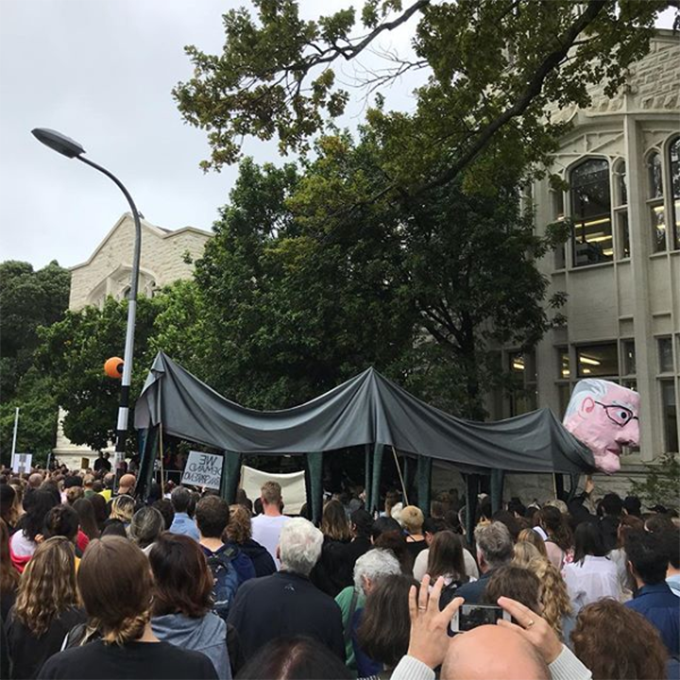
University of Auckland students march to protest against the potential closure of specialist libraries. Image: Pacstudio via Instagram

Pacific Media Centre Newsdesk

University of Auckland students rallied today against a plan to close several of the university’s specialist libraries, reports RNZ National.

The university’s architecture and planning, music and dance, and fine arts libraries have all been earmarked for closure.

Under the proposal, the specialist libraries would merge with the general library.

READ MORE: Students and staff occupy university’s Fine Arts Library

Students and staff worried about losing study space and access to vital resources and expert staff occupied the Fine Arts Library over the weekend to protest against its closure.

Students said today they had not been consulted about the plans.

-Partners-

Losing study space
They were worried about losing study space and access to vital resources and expert staff, as well as losing a sense of community with other students.

Auckland University Students’ Association president Anna Cusack said they wanted the consultation process halted, so students could have a say.

Consultation on the proposed closures ended today, but only affected staff have been involved in that process.

The students also planned to present a petition with thousands of signatures to vice-chancellor Stuart McCutcheon.

This article has been republished as part of the content sharing agreement between Radio New Zealand and the AUT Pacific Media Centre.

Print Friendly, PDF & Email

Article by AsiaPacificReport.nz

]]>

Manus refugees ‘in the dark’ as healthcare provider pulls out

]]>

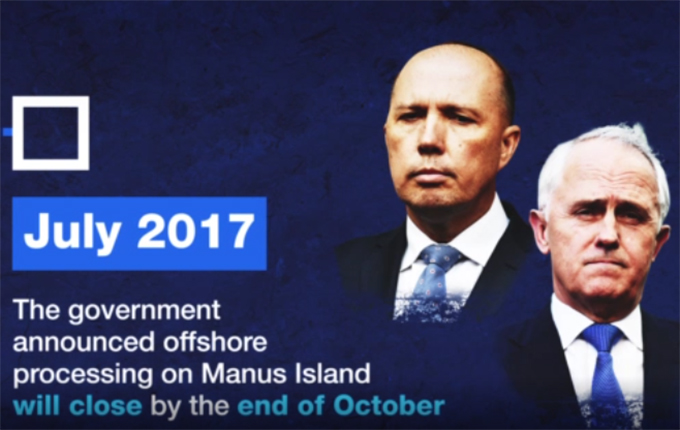
An SBS graphic screen shot from a Pacific detention centres timeline video.

By Nick Baker of SBS News

The Australian government has been slammed for a lack of transparency amid news that the healthcare provider for refugees on Manus Island will wrap up its work today.

The International Health and Medical Services (IHMS) has been providing healthcare for refugees on Manus for several years but their contract is due to expire today.

However, despite the end date, the government did not publicly indicate a new provider was confirmed until last Friday. Although details remained scant.

In a statement, the Department of Home Affairs said it had “engaged a new health services provider from 1 May 2018 (and) IHMS will work with the new health service provider during a transition period”.

“Individuals will continue to have access to appropriate primary health services,” it said.

A spokesperson from IHMS confirmed the April 30 end date but said “it will, however, maintain a core group of staff in Manus and Port Moresby to support the transition to a new health service provider”.

New provider
But neither the Department of Home Affairs or IHMS would say who the new provider would be, leaving open questions about the quality of the care.

-Partners-

Greens Senator Nick McKim said Australians were once again “in the dark” about the treatment of refugees on Manus.

McKim said getting information from the Department of Home Affairs was “like getting blood from a stone”.

“And of course that’s deliberate and part of the intent of establishing Australia’s offshore detention system in the first place – to drop a veil of secrecy over what’s happening in those places.”

He said although IHMS had a very checkered history, there was now a danger of gaps in health care over the coming months and beyond.

“Ultimately the risk is yet more people will come to harm … as a result of Peter Dutton’s negligence.”

McKim said the use of Manus and other offshore immigration detention facilities will go down as “one of the darkest chapters” in Australian history.

Harm ‘very rare’
“Because it’s very rare that in Australia’s history we’ve deliberately caused harm to innocent people and that’s exactly what Peter Dutton is doing.”

Refugee coordinator at Amnesty International Australia Graham Thom similarly expressed concerned around healthcare for those on Manus after today.

“Ever since the Australian government began shipping refugees out to detention centres on remote tropical islands, they have been trying to hide from the consequences of this cruel policy.”

“Withdrawing healthcare is Australia’s latest deplorable attempt to shift the responsibility for the suffering it has caused.”

“The health situation for refugees and asylum seekers in Papua New Guinea is already dire, but the end of the IHMS contract threatens to turn this into an all-out crisis.”

“The only way for Australia to ensure the health of the refugees and asylum seekers on Manus is to end offshore processing for good.”

SBS News coverage on the Pacific.

Print Friendly, PDF & Email

Article by AsiaPacificReport.nz

]]>

Pacific research strategies get airing on PMC’s Southern Cross radio

]]>

Pacific Media Centre journalist and digital media student with NZ Institute for Pacific Research operations manager Evelyn Masters at University of Auckland’s Radio 95bFM today. Image: David Robie/PMC

Pacific Media Watch Newsdesk

Operations manager of the NZ Institute for Pacific Research, Dr Evelyn Masters, presented an introduction to regional initiatives and a media outreach plan on air today.

Along with Sri Krishnamurthi, a journalist and digital media student from AUT’s Pacific Media Centre, and Professor David Robie, director of the PMC, Dr Masters talked to 95bFM’s The Wire presenter Reuben McLaren on the PMC’s weekly Southern Cross programme about opportunities ahead for the NZIPR .

Dr Robie gave a rundown on this week’s Pacific news with the RSF World Press Freedom Index and the accusations that Facebook have been censoring a West Papua photograph by a leading photojournalist, Ben Bohane, from Vanuatu.

Print Friendly, PDF & Email

Article by AsiaPacificReport.nz

]]>

Another Facebook photo ‘community filtering’ policy failure

]]>

The Facebook “censored” Ben Bohane image after a “facelift” by the Vanuatu Daily Post.

By Colin Peacock of RNZ Mediawatch

Facebook has been under fire for some time for distributing misinformation and fake news to a potential audience of around two billion users. Only now is it making a concerted effort to filter it out.

But Facebook has also faced criticism for the ways in which it has filtered the news in the past.

Back in September 2016, it censored a Pulitzer Prize-winning photograph of the Vietnam war.

LISTEN TO RNZ MEDIAWATCH

A Norwegian writer posted Nick Ut’s famous picture of severely burned nine year-old Vietnamese girl Kim Phuc fleeing a napalm attack in 1972.  It was part of an online discussion about photographs that had changed history.

Facebook quickly deleted his post and suspended his account, claiming he had violated Facebook’s content standards which prohibit most forms of nudity.

-Partners-

Norwegian newspaper Aftenposten then wrote about this on its own Facebook page – and that was summarily deleted by Facebook too.

Espen Egil Hansen and his front-page open letter to Facebook's Mark Zuckerberg.Espen Egil Hansen and his front-page open letter to Facebook’s Mark Zuckerberg. Image: RNZ Mediawatch
Norway’s Prime Minister posted the image on her own official Facebook account. Facebook deleted that as well.

An American technology company had censored a foreign head of state, and struck out a sovereign government’s communications.

Under the headline “Listen, Mark, this is serious” Aftenposten’s editor-in-chief called out Facebook boss Mark Zuckerberg on the newspaper’s front page and online.

Eventually Facebook took the photograph off its blacklist and said: “We’ll keep working to make Facebook an open platform for all ideas.”

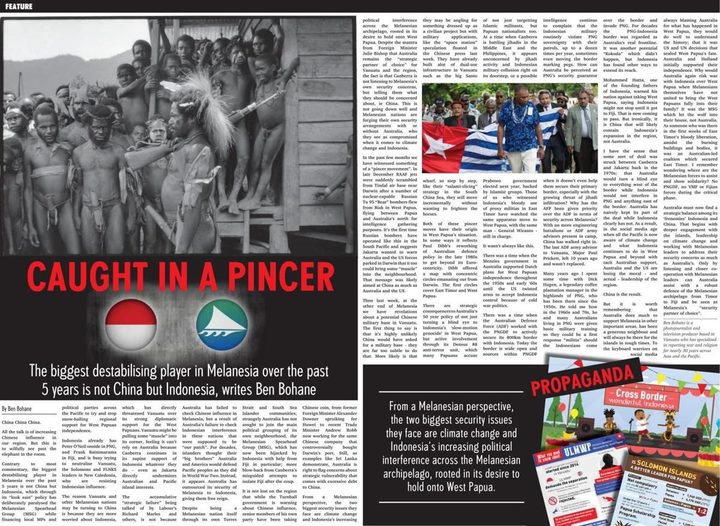
Last weekend the Vanuatu Daily Post newspaper published a two-page spread on the growing influence of Indonesia and China in the Melanesian region. It was written by journalist and photographer Ben Bohane who lives in Vanuatu’s capital Port Vila and runs picture agency Wakaphoto.

Ben Bohane's story in the Vanuatu Daily Post - and his photo which fell foul of Facebook's policy. Ben Bohane’s story in the Vanuatu Daily Post – and his photo which fell foul of Facebook’s policy. Image: Screenshot / VDP

Ben illustrated his story with one of his own pictures taken in 1995. It shows fighters from the Free Papua Movement (OPM) and several other men wearing traditional protective penis sheaths – called nambas.

The article was subsequently republished by  the Pacific Media Centre on its Pacific Media Watch freedom feed and on Asia Pacific Report – which also raised the West Papua political connection – at the Auckland University of Technology on Monday.

Facebook alerts on the newsfeeds of Ben Bohane, Vanuatu Daily Post, the Pacific Media Centre and its director Professor David Robie were all removed by Facebook, which said that the featured image had breached its “community standards” policy.

On Tuesday, Ben Bohane posted his picture featuring the men in the nambas again and was immediately notified that the content has been removed again. He was blocked from posting anything on Facebook for 24 hours.

Australian photojournalist Ben Bohane who is currently based in Port Vila, Vanuatu.Australian photojournalist Ben Bohane who recently took out Vanuatu citizenship. Image: Johnny Blades/RNZ

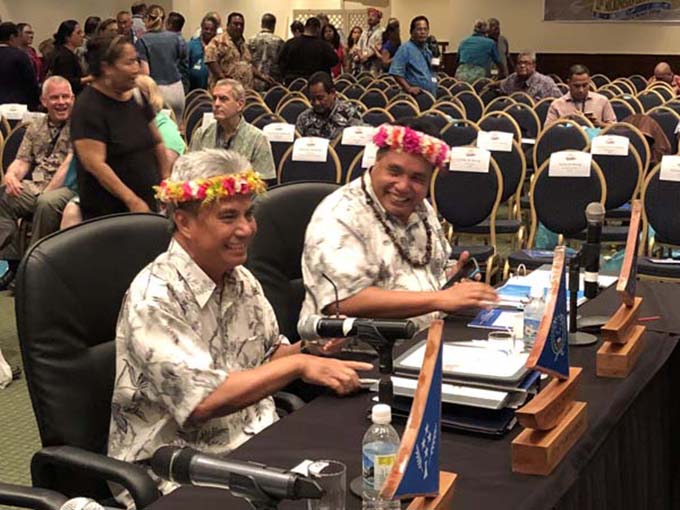
Australian photojournalist Ben Bohane who is currently based in Port Vila, Vanuatu. Photo: RNZI/Johnny Blades

“Memo to Facebook – this is how Papuans live! Your ‘Community Standards’ obviously don’t include Melanesian culture,” he wrote on his Facebook page.

Meanwhile, the Vanuatu Daily Post re-edited Ben Bohane’s story image online to avoid falling foul of Facebook’s policy.

The image is still there but a black box appears over the top where the nambas could once be seen, with these words in white:

THIS IMAGE was censored by FACEBOOK’s COMMUNITY STANDARDS

And off to the side:

Happy now, Facebook?

The problem is millions of Facebook’s users are unhappy with Facebook for episodes like this.

This article has been republished as part of the content sharing agreement between Radio New Zealand and the Pacific Media Centre.

Print Friendly, PDF & Email

Article by AsiaPacificReport.nz

]]>

‘We’re dying slowly’, says Palauan leader in response to telehealth talk

]]>

Chuuk Governor Johnson Elimo (right) shares a laugh with Pohnpei Governor Marcel Peterson at the 23rd Micronesian Islands Forum in Saipan this week. Image: Erwin Encinares/Saipan Tribune

By Erwin Encinares in Saipan

Palau President Tommy Remengesau says Pacific people of Micronesian descent are “dying slowly” because of dietary imbalances on the islands when commenting on a health presentation at the 23rd Micronesia Islands Forum this week.

“Dying a suicidal death that is self-inflicted,” he said.

“It’s sad, but the population around the world are dying because of hunger and poverty – but here in our part of the world we are dying of overeating and bad diet and a lot of this has to do with imported food.”

READ MORE: Micronesian states could work together on labour shortages

Commonwealth Healthcare Corporation chief executive officer Esther Muña identified in a presentation the leading causes of deaths in Micronesia – cancer, diabetes, heart disease, stroke and lung disease.

Remengesau said: “Analysing data, specifically in Palau, unemployed fishermen are in better health than those who are in the government and in the private sector who can afford to buy all these … foods.

-Partners-

“It is certainly a lifestyle.”

Muña called for the forum to pass a resolution that enhanced “telehealth” capabilities in the Pacific.

Telehealth-friendly priority
“Endorse in principle as a matter of regional priority, and to invest jurisdiction resources to enhance and expand telehealth/telemedicine capabilities and capacities appropriate to the needs of each jurisdiction; and support periodic assessments and evaluations of such efforts in terms of cost, sustainable financing, pass policy and legislation which creates a telehealth-friendly environment, and ensure relevant provider/partner coordination,” Muña said in her presentation.

“We are dying slowly.”

The vision and capabilities of enhanced telehealth and telemedicine as an ideal setup for Micronesia was the focus of the second day of the forum.

The forum’s Regional Health Committee touted the benefits of telehealth and telemedicine, citing the concept adopted in some Micronesian islands such as Pohnpei, Kosrae, and Guam.

The committee stressed that an enhanced telehealth and telemedicine capability was ideal for Micronesia, but some governmental policies interfered with telehealth capabilities, limiting its effects in other areas.

Telehealth is the process of using technological advancements in communication to deliver medical services.

Pohnpei Hospital, for example, coordinates with the Hokkaido Cancer Center in Japan for diagnostic information.

Digitised images are sent to the center for diagnosis. Guam Community Health Center, on the other hand, works with the Good Samaritan Hospital in Los Angeles.

Sustainability an issue
However, in an interview after her presentation, Muña said that telehealth issues were concerning.

“It’s not the technology; we already have fiber optic [cables],” she said. “The issue is that we are trying to know that there are layers of policies that are preventing providers from providing those telehealth services.”

According to Muña, sustainability was an issue with telehealth.

According to Muña’s presentation, in the Commonwealth of the Northern Mariana Islands (CNMI) alone, the body-mass index of youths since the year 2000 baseline had gone up in 2017.

Cancer and cardiovascular-related deaths have also risen in the 30-69 age groups, while lung-related deaths have gone down significantly.

Tobacco usage in both forms—chewing and smoking—have also reportedly decreased since the year 2000 baseline. Similar results have been noted for alcohol use among the youth.

Erwin Encinares is a reporter on the Saipan Tribune who has been covering the 23rd Micronesian island Forum.

Print Friendly, PDF & Email

Article by AsiaPacificReport.nz

]]>

PNG police plan public meeting to address Lae ‘land grabbing’

]]>

EMTV News’ Lucy Kopana reports on the Lae squatter settlements issue in Papua New Guinea. Image: EMTV News

By Lucy Kopana in Lae

Following a growing number of illegal settlements in Papua New Guinea’s second city of Lae, police have announced they will organise a stakeholders meeting next week to address the issue.

Many squatter settlements have been established on state land around the city and local residents have become concerned.

Lae police boss Commander Anthony Wagambie Jr said this would be treated as a law and order issue because the areas “become breeding grounds” for criminals.

He said many of the “perpetrators of petty crimes” live in these areas.

The port city of Lae is the capital of Morobe province and had a population of almost 150,000 at the 2011 census, but has expanded rapidly since.

-Partners-

Lucy Kopana is a reporter in the Lae bureau of EMTV News. This article is republished with permission.

Print Friendly, PDF & Email

Article by AsiaPacificReport.nz

]]>

Strongest climate solutions ‘developed together’, says PaCE-SD chief

]]>

Blessen Tom’s video interview with PaCE-SD director Professor Elisabeth Holland in Suva. Video: PMC

Pacific Media Centre Newsdesk

The University of the South Pacific’s environmental centre spearheading climate change research believes in working together for shared solutions.

Director Professor Elisabeth Holland says the Pacific Centre for the Environment and Sustainable Development (PaCE-SD) has a culture of quality and shared “ownership” of projects.

“Don’t assume you know what the answer is,” she says in her advice to climate change researchers.

“The strongest solutions are developed together.”

Dr Holland is a co-recipient of the 2007 Nobel Peace Prize for her contribution to the Intergovernmental Panel on Climate Change (IPCC).

-Partners-

She is an author of four of the five IPCC reports and has also served as a US, German and now a Fiji representative.

Print Friendly, PDF & Email

Article by AsiaPacificReport.nz

]]>

About the Pacific Media Centre

Author profile: 
Pacific Media Centre
Informed journalism and media research

Informed journalism and media research contributes to economic, political and social development and AUT University’s Pacific Media Centre – Te Amokura – seeks to stimulate research into contemporary Māori, Pasifika and ethnic diversity media and culture production. The PMC, founded in 2007, also collaborates with other Asia-Pacific media centres engaged in research and cultural production and develops cultural and research publications, building on the success of the peer-reviewed publication Pacific Journalism Review , media freedom project Pacific Media Watch and current affairs websites Pacific Scoop and Asia Pacific Report.

The PMC mission
The Pacific Media Centre’s mission as one of the five components of the Creative Industries Research Institute (CIRI) and in the School of Communication Studies is based on the belief that robust and informed journalism and media research contributes to economic, political and social development in the region. PMC goals include:    1. undertaking and stimulating research into contemporary Māori, Pacific, Asia-Pacific and ethnic diversity media and culture production
   2. raising Aotearoa/New Zealand research capability in the area of diversity media production
   3. presenting and publishing the findings of media research
   4. winning funding from government and industry partners that support research into media production
   5. developing collaborations and relationships with other Asia-Pacific centres of research excellence in media and cultural production
   6. developing social change and development communication editorial and publications capability, including Pacific Journalism Review, Pacific Media Centre Online and Asia Pacific Report.

Asia-Pacific Journalism courses PMC in the Human Rights Commission’s Te Ranga Tahi diversity project PMC collaborating partners

PMC on Communications Initiative Network

Research students

PMC as a Creative Commons case study

PMC Logo
The PMC logo’s linear design draws on the traditional tapa to represent awareness, respect, strength and the personality of the Pacific region and its people. The colour range in the typography connects tradition with the fast and modern world of media using red, green and blue – the RGB mode in any screen application. The use of different tones symbolises the variety and individuality of Pasifika media. The logo was designed by postgraduate student Patricia Burgetsmaier in AUT’s School of Art and Design.

Te Amokura
The red-tailed tropic bird, Phaethon rubricauda, is found throughout the Pacific, including the North Island of Aotearoa/New Zealand. There is a breeding colony in the Kermadec Islands and others found as far north as the Hawai’i Islands. It is a bird with white feathers, a red bill and two long thin red streamers. It has a black eye streak. Red-tailed tropic birds are remarkable seabirds displaying their two elongated central tail feathers during courtship flight displays at their breeding colonies. The centre’s te reo name Te Amokura symbolises the spread of messages throughout Te Moana-nui-a-Kiwa. The metaphorical name has been contributed by Dr John Moorfield, Professor of Māori Innovation and Development with AUT’s Te Ara Poutama.

2017 PMC brochure

PMC Annual Report 2017 – 10 Years

Informed journalism and media research contributes to economic, political and social development.

PMC’s Henry Yamo (right) interviews West Papuan social justice advocate Benny Wenda. Del Acede/PMC

Report by Pacific Media Centre ]]>

Fiji’s first climate change village forced to move from sea to ‘promised land’

]]>

Blessen Tom’s feature drone video of Vunidogoloa.

By Hele Ikimotu with visuals by Blessen Tom

Vunidogoloa was the first village in Fiji to be relocated – barely three years ago – due to sea level rise.

The village was in the Cakaudrove province and had backyard views of beautiful Natewa Bay on Vanua Levu Island.

The relaxing life for these villagers was however dampened by the impact of sea level rise.

Flooding was common for the villagers and so they needed to be relocated.

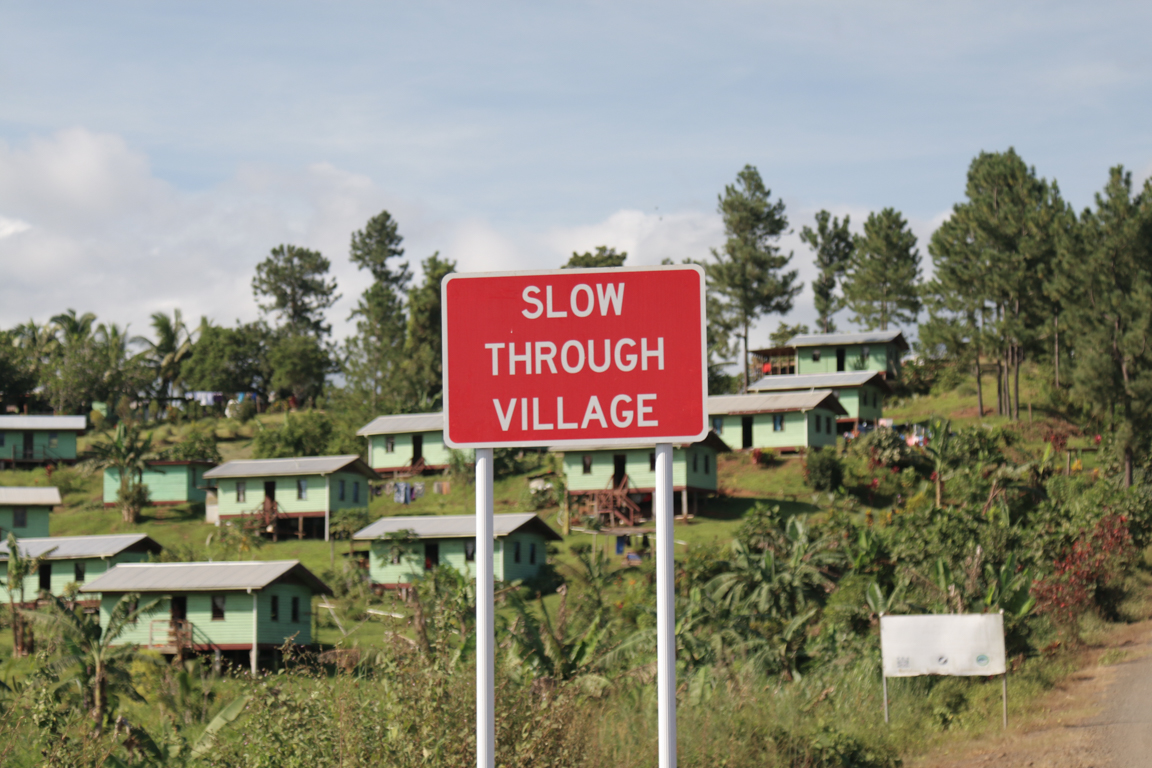
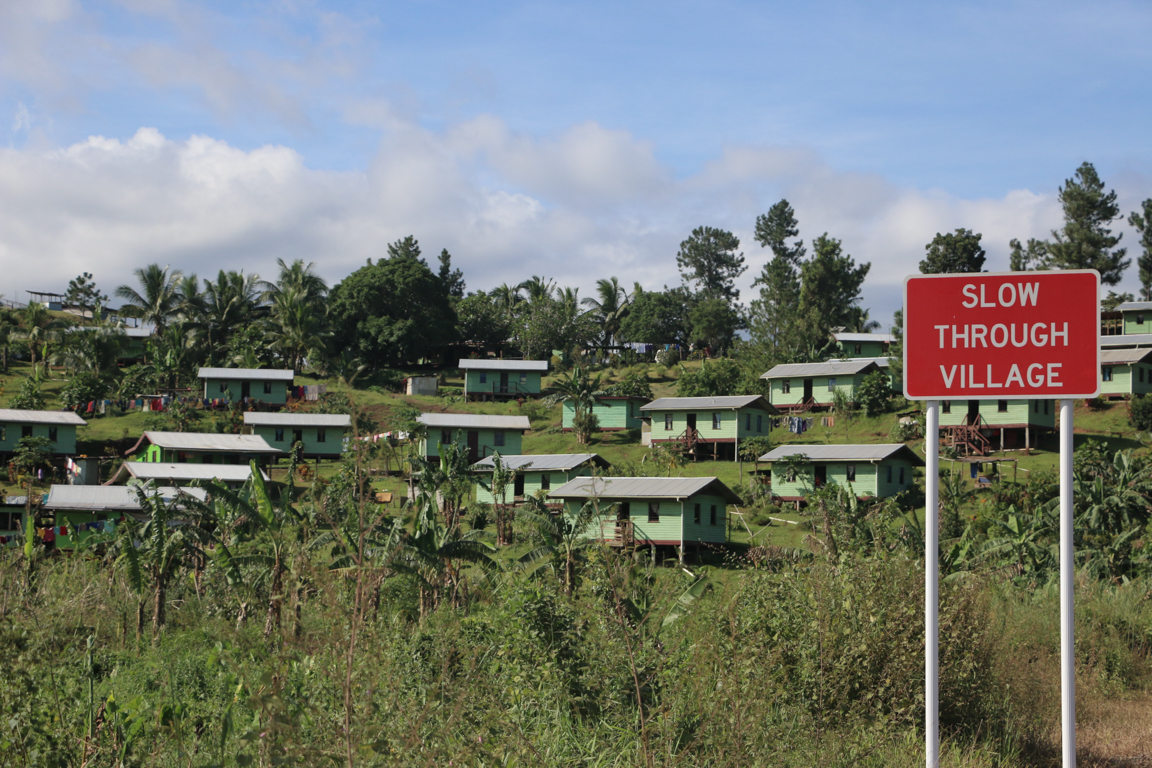
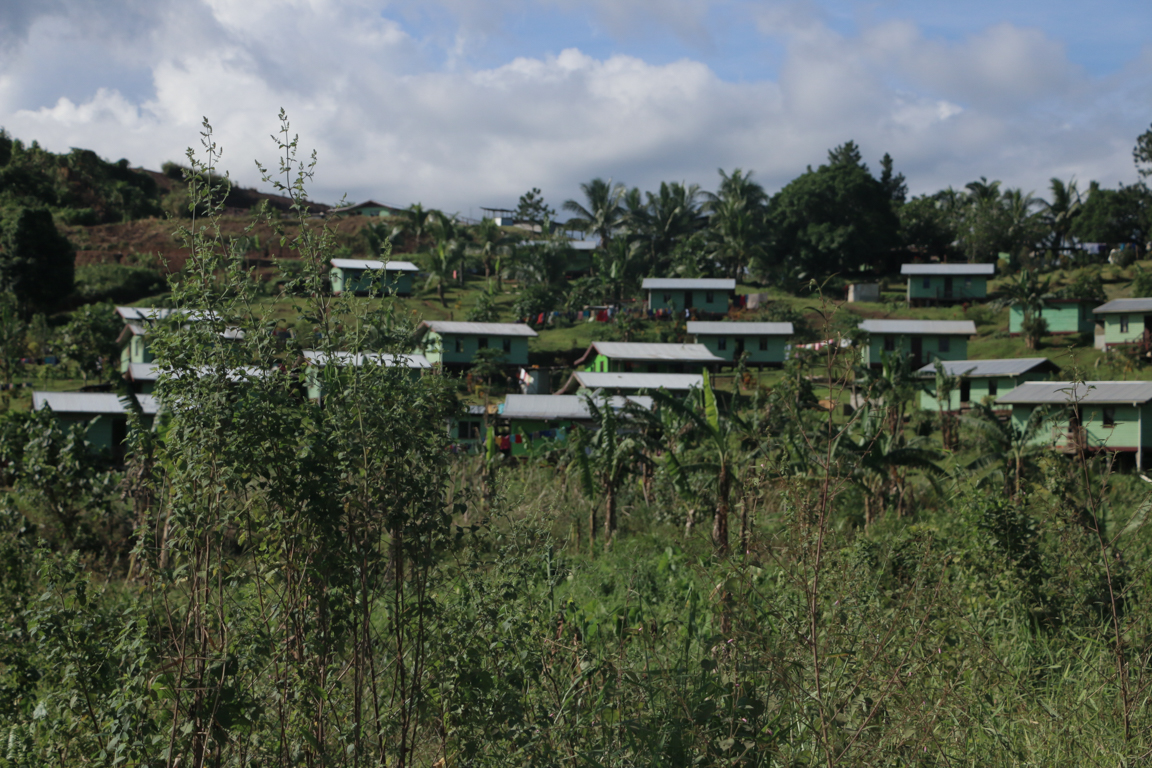
Their new village is 2 kilometres inland and was renamed by the villagers as Kenani (“Promised Land”).

-Partners-

The whole village of Vunidogoloa (pop. 130) moved to their new settlement in January 2014 and now have solar lighting.

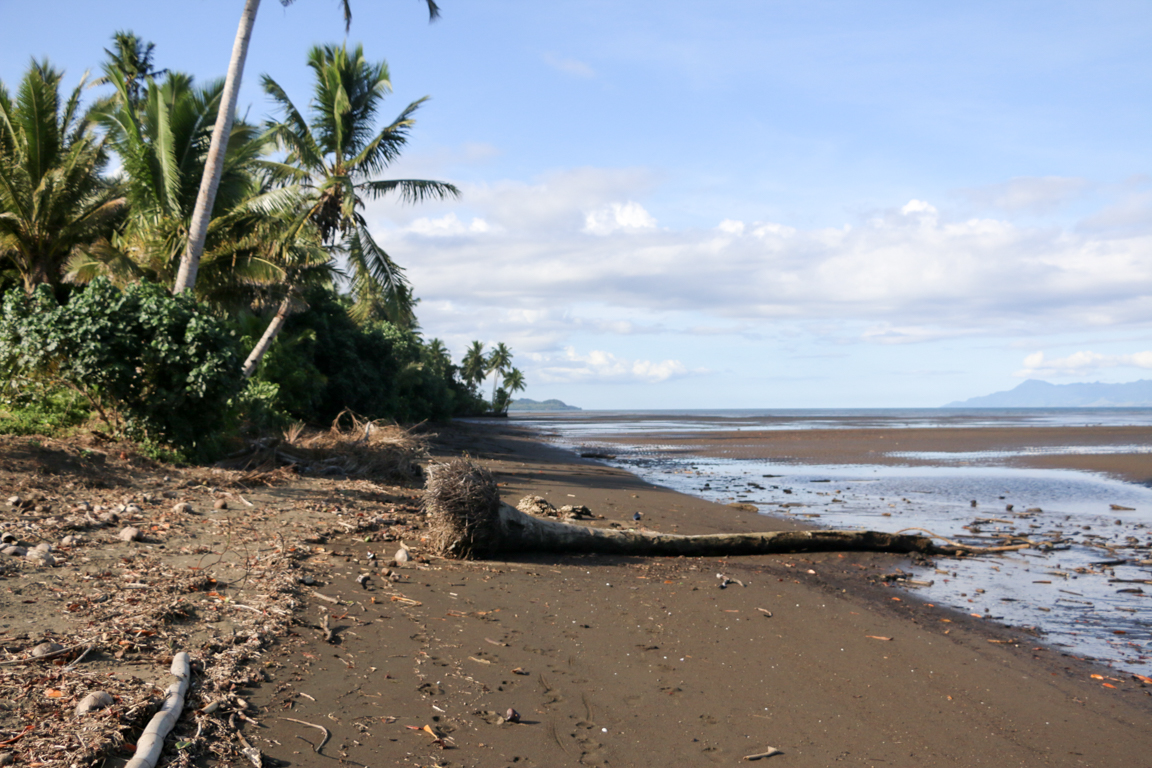
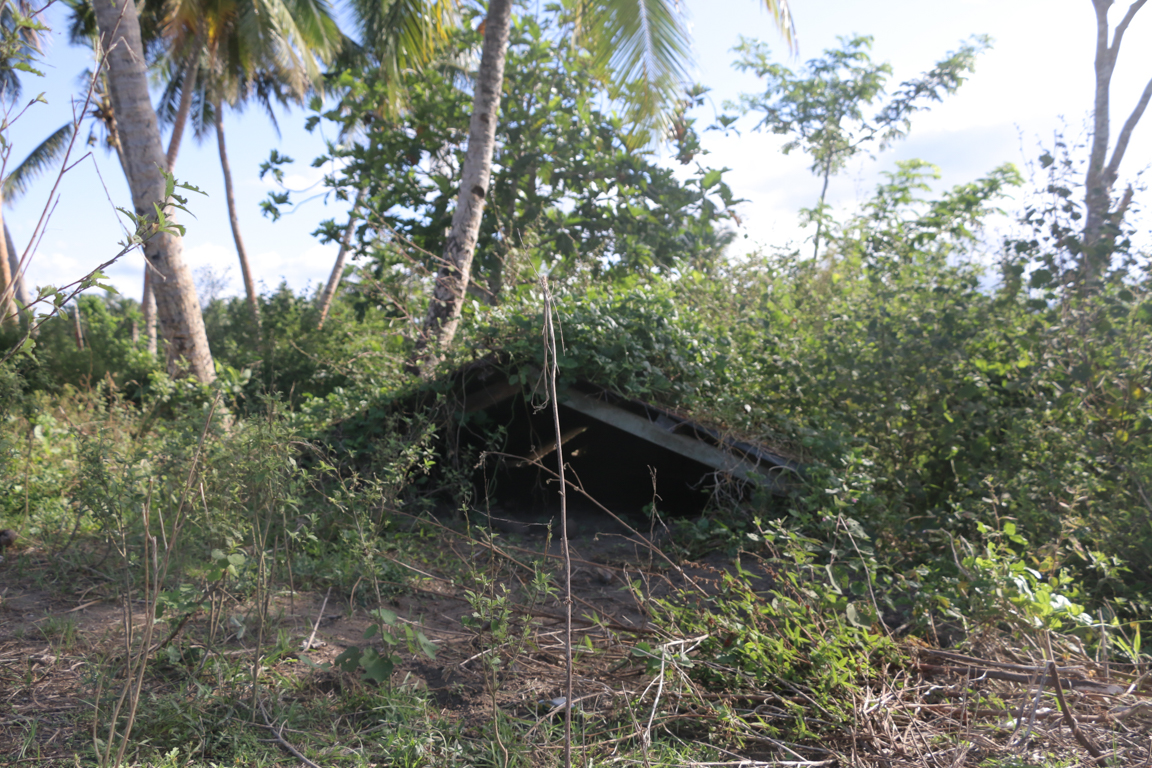
We stopped by the old “ghost” village to see where the villagers once lived and also took some photos of where they are now settled.

1. Vunidogoloa’s “front door” to Natewa Bay. Image: Blessen Tom/Bearing Witness

2. Vunidogoloa … now a ghost village. Image: Blessen Tom/Bearing Witness

3. Vunidogoloa … an abandoned home. Image: Blessen Tom/Bearing Witness

4. Vunidogoloa … overgrown. Image: Blessen Tom/Bearing Witness

5. “Slow” … the “promised land” village coming up. Image: Blessen Tom/Bearing Witness

6. Kenani … the new village. Image: Blessen Tom/Bearing Witness

7. Kenani Village. Image: Blessen Tom/Bearing Witness

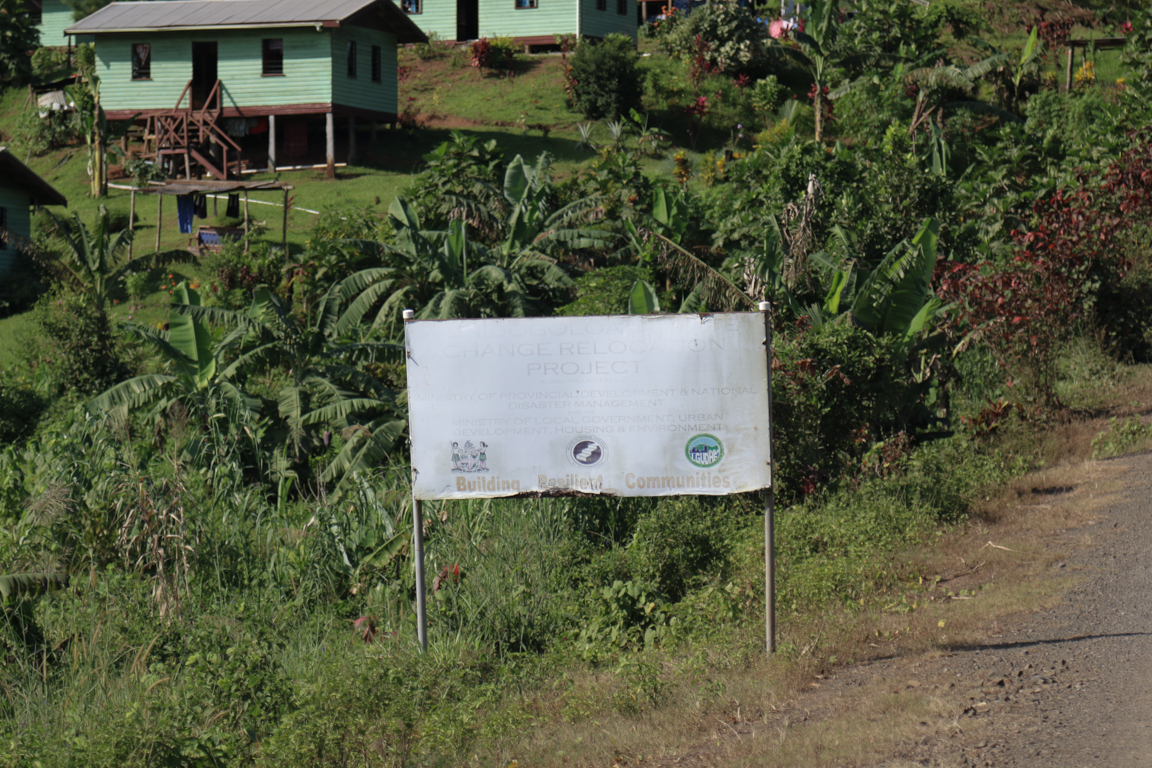
8. The aid project kudos board. Image: Blessen Tom/Bearing Witness

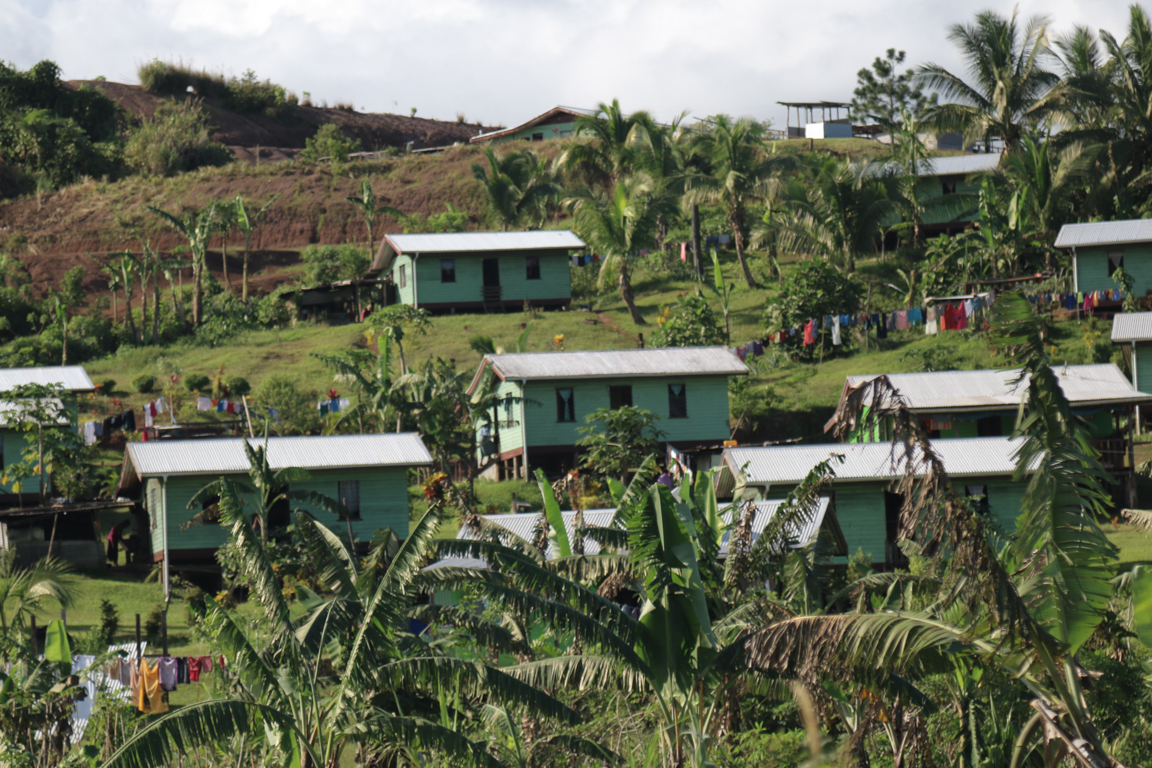
9. Hillside Kenani.

10. More Kenani houses. Image: Blessen Tom/Bearing Witness

Print Friendly, PDF & Email

Article by AsiaPacificReport.nz

]]>

Rabi landslide? Not a big problem, horseback and walking the answer

]]>

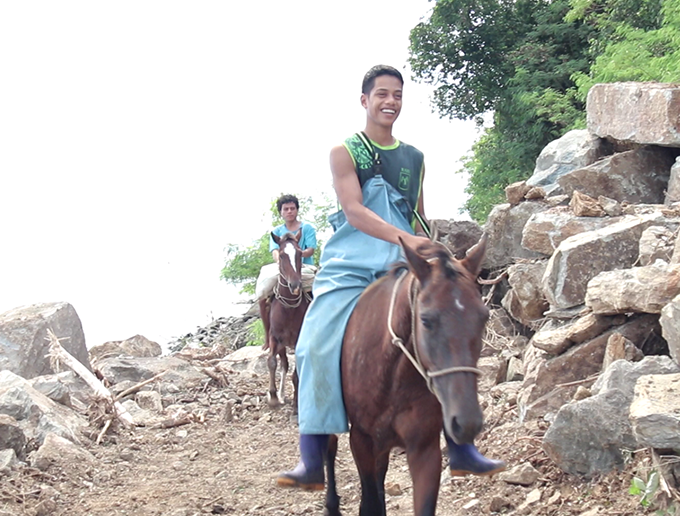
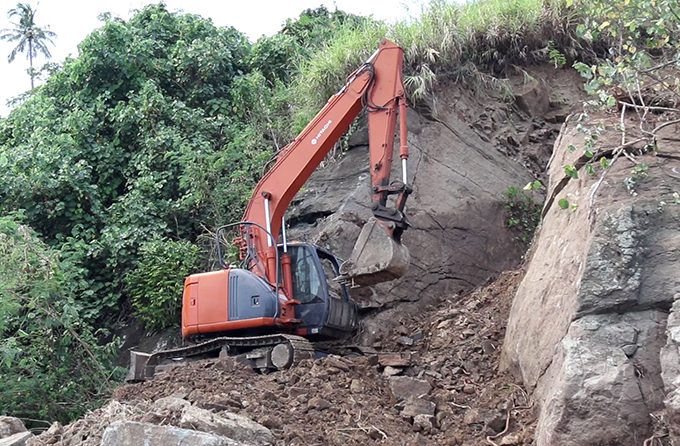
Riding on horseback is the main way to get around Rabi Island after the landslide blocked the road … or just walk. Image: Blessen Tom/Bearing Witness

By Hele Ikimotu on Rabi, Fiji

The rebuilding of a road on Fiji’s northern Rabi Island is currently in the works.

Fiji’s most recent natural disaster, Tropical Cyclone Keni, destroyed many parts of the country’s main towns.

One of Fiji’s outer islands, Rabi, was also affected by the cyclone.

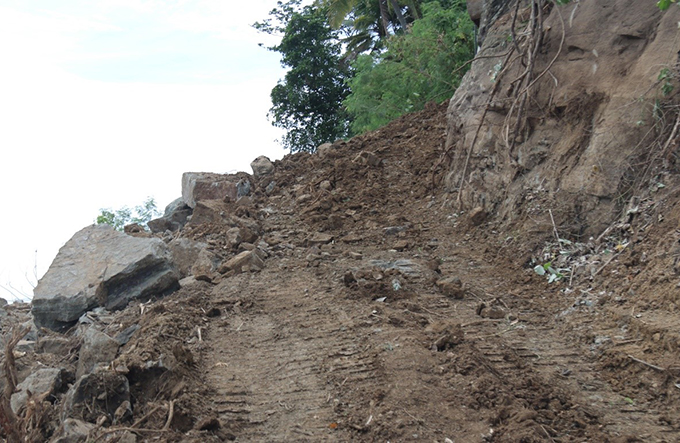
Although the cyclone did not pass through the 66 sq km island in the Vanua Levu group, heavy rain and wind caused the landslide, blocking a road which connects the main village of Tabwewa to the rest of the island.

The landslide has meant that it is unsafe for locals to use the road. They must either walk around the rubble – or ride a horse.

This is not the first time a landslide has happened in Rabi due to the impacts of harsh weather.

-Partners-

Janet Tawaketini, whose last time on Rabi was in 1995, is visiting the island and was shocked to see the remnants of a previous landslide, also in Tabwewa.

“That’s where my great grandparents’ graves were. Their grave and their bones are literally gone,” she said.

A building company from Savusavu has been sent over to Rabi to fix the most recent landslide.

Hele Ikimotu and Blessen Tom are in Fiji as part of the Pacific Media Centre’s Bearing Witness 2018 climate change project. They are collaborating with the University of the South Pacific.

The mudslide-blocked Rabi road under repair. Image: Blessen Tom/Bearing Witness A digger to the rescue on Rabi’s blocked road. Image: Blessen Tom/Bearing Witness
Print Friendly, PDF & Email

Article by AsiaPacificReport.nz

]]>

China’s media control threatens Asia-Pacific democracies, says RSF

]]>

Pacific Media Watch Newsdesk

The Chinese model of state-controlled news and information is being copied in other Asian countries, especially Vietnam and Cambodia, says the Paris-based Reporters Without Borders watchdog in its latest World Press Freedom Index.

North Asia’s democracies are struggling to establish themselves as alternative models.

Violence against journalists is increasingly worrying in Afghanistan, India, Pakistan and the Philippines.

READ MORE: RSF Index 2018 – Hatred of journalism threatens democracies

In the Pacific, both Tonga (51st) and Papua New Guinea (53rd) have dropped two places, and Samoa one place (22nd).

The biggest climbs were by Fiji (up 10 places to 57th), New Zealand (five places to 8th) -back into the top 10 globally – and Timor-Leste three places to 95th.  Solomon Islands was unranked while Australia remained on 19th (mainly due to the concentrated media ownership in that country). Other Oceania nations were not cited.

-Partners-

The Asia-Pacific region still has the world’s worst violator of the freedom to inform, with North Korea standing at 180th in the global ranking. The recent widespread adoption of smartphones in North Korea has unfortunately been accompanied by draconian control of communications and the national intranet.

The state news agency KCNA is the only authorised source of news for all of the country’s media. Just reading, viewing, or listening to a foreign media outlet can lead to a spell in a concentration camp.

More censorship and surveillance in China
Unchanged at 176th in the Index, Xi Jinping’s China is getting closer and closer to a contemporary version of totalitarianism. During President Xi’s first term, censorship and surveillance reached unprecedented levels due to the massive use of new technology. Foreign reporters are finding it harder to work and ordinary citizens can now be jailed just for sharing content on a social network or during a private chat on a messaging service.

More than 50 professional and non-professional journalists are currently detained in China, many of them the victims of mistreatment and a lack of medical care that poses a threat to their lives.

Liu Xiaobo, a Nobel peace laureate and recipient of RSF’s Press Freedom Prize, and the dissident blogger Yang Tongyan both died last year from cancers that were left untreated in detention.

Internationally, the Chinese government is trying to establish a “new world media order” under its influence, by exporting its oppressive methods, information censorship system and internet surveillance tools. Its unabashed desire to crush all pockets of public resistance unfortunately has imitators in Asia.

Under Chinese influence
This is particularly so with Vietnam, which at 175th is just one place above China in the index. Its traditional media are completely controlled, but citizen-journalists defend the freedom to inform with great courage, and the government’s response has been merciless.

Bloggers used to be sentenced to two years in prison, but now those who blog about banned subjects such as corruption or environmental disasters can expect a 15-year jail term.

Cambodia, another country that seems to be taking the dangerous Chinese road, has fallen 10 places in the Index to 142nd, one of the biggest falls in the region. Prime Minister Hun Sen’s regime launched a ruthless offensive against media freedom in 2017, shutting down more than 30 independent media outlets and jailing several journalists in a completely arbitrary manner.

His suppression of independent voices, his increased dominance of the mass media and his meticulous control of social media are a disturbing echo of the methods used in China, which has invested millions of euros in Cambodia’s pro-government media. The Chinese model’s influence is also felt by the media in Thailand (140th), Malaysia (145th) and Singapore (151st).

Hate speech
The other fall in the region that speaks volumes is Myanmar’s (down six places at 137th). In the past year, the government led by Aung San Suu Kyi has lost all credibility as regards its obligation to defend the role of the media in a functioning democracy. The worst violations took place after the start of the Rohingya crisis in August 2017.

The international community now knows that “elements of genocide” and “ethnic cleansing” occurred, to use the UN’s terms. But proper reporting on this tragedy from within Myanmar is still impossible because the military continue to deny access. Two Reuters reporters who tried to investigate are still in prison.

Myanmar’s coverage of the Rohingya crisis has been marked by the growth of hate messages on social networks, especially Facebook. Any journalist who does not fall in with the prevailing anti-Muslim discourse is subjected to violent verbal harassment by Buddhist extremists. This has done much to encourage self-censorship within the media.

Leaders hostile to press freedom
Hate speech is also an issue in the continent’s other giant, India, which has fallen another two places to 138th. Ever since Narendra Modi became prime minister in 2014, Hindu fundamentalists have been referring to journalists in extremely violent terms. Any investigative reporting that annoys the ruling party or any criticism of Hindutva, an ideology that blends Hindu nationalism with an almost fascistic rhetoric, elicits a torrent of online insults and calls for the death of the reporter or writer responsible, most of it coming from the prime minister’s troll army.

This unbridled verbal violence serves to support a leader who asserts himself as a strongman, a leader whose authority does not tolerate being undermined by reporters or editorialists.

As elsewhere in the world in 2017, this verbal violence has tragically led to physical violence. The newspaper editor Gauri Lankesh was gunned down outside her home in September 2017 after being the target of hate speech and death threats for criticising Hindu supremacy, the caste system and discrimination against women.

The physical violence against journalists is largely responsible for India’s low ranking. At least three journalists were murdered in connection with their work. More were killed in circumstances that were unclear, as is often the case in rural areas, where reporters are poorly paid. The situation in the Kashmir Valley, a news black hole, contributed to the poor ranking of a country whose long tradition of vibrant media could nonetheless enable it to rise again in the Index.

In the Philippines, down six places at 133rd, the dynamism of the media has also been checked by the emergence of a leader who wants to show he is all powerful. President Rodrigo Duterte lost no time in warning the “sons of whore journalists” that they would not be spared. There have been countless examples of Philippine government harassment of media that voice any kind of criticism of Duterte’s “war on drugs.”

Here again, verbal violence and physical violence are closely linked. With four journalists murdered in connection with their work in 2017, the Philippines is one of the continent’s deadliest countries.

Physical violence
The high level of violence to which reporters are exposed in Pakistan (139th) accounts for its failure to rise in the index. Subjected to death threats, abduction and torture, journalists are still threatened by both Islamic fundamentalists on the one hand and by the all-powerful intelligence services on the other.

Violence is even more worrying in neighbouring Afghanistan (118th), where 18 journalists and media workers were killed in 2017. It nonetheless rose two places in the Index, above all because of an improvement in the legal environment with the creation of coordinating committees for the safety of journalists and media.

These committees handled around 100 cases in the past year, with the result that in some cases sanctions were imposed on senior civilian and military officials.

Similarly, the efforts undertaken in Sri Lanka to combat physical attacks against media personnel and impunity for acts of violence against journalists account for its 10-place rise in the Index to 131st.

Structural problems
Despite an overall improvement in the media environment in Mongolia, pressure on the media during the presidential election accounts for its slight fall (down two places at 71st). Japan’s rise (up five places at 67th) reflects a relative easing in pressure on the media from Shinzo Abe’s nationalist government, although journalists are still constrained by the weight of tradition and business interests.

Hong Kong (70th) and Taiwan (42nd) each rose three places, resisting China’s growing influence in their different ways. South Korea (up 20 places at 43rd) rose more than any other country in the Asia-Pacific region. After a terrible decade, the new president, Moon Jae-in, has brought a breath of fresh air that helped resolve a conflict between journalists and management at the public broadcasting service.

Structural problems still need addressing, including decriminalising defamation and repealing a national security law that continues to threaten journalists.

Violence in Pacific
In the Pacific, Papua New Guinea is at 53rd place, losing two ranks. Papua New Guinea’s media are diverse and dynamic and enjoy a relatively free environment, but journalists are still subject to violence. There were several cases in 2017 of journalists being the targets of police violence. Some officials encourage media self-censorship by directly threatening journalists whose articles criticise them.

Tonga lost two ranks, pulling back to 51st place. Independent media outlets have increasingly assumed a watchdog role since the first democratic elections in 2010. However, some political leaders have not hesitated to sue media outlets, exposing them to the risk of heavy damages awards. Some journalists say they are forced to censor themselves because of the threat of being bankrupted.

Slipping back one place was Samoa who came in at 22nd on the index. Despite the liveliness of media groups such as Talamua Media and the Samoa Observer Group, and individual newspapers such as Iniini Samoa, this Pacific archipelago is at risk of losing its status as a regional press freedom model. The law criminalising defamation was repealed in 2013, raising hopes that were finally dashed in December 2017, when Parliament restored the law under pressure from Prime Minister Tuilaepa Sailele Malielegaoi.

While the Solomon Islands was not ranked, this country enjoys free speech and media freedom, which are guaranteed by article 12 of the constitution. But the defamation law continues to intimidate journalists and encourage a degree of self-censorship in the media, and Indonesian diplomatic pressure for an end to any form of support for West Papuan self-determination could pose a threat to the public debate.

Improvement in places
Timor-Leste rose three ranks to 95th in the Index. No journalists have been jailed in connection with their work in Timor Leste, a country with just 1.2 million inhabitants, since it won independence in 2002. Articles 40 and 41 of its constitution guarantee free speech and media freedom. But various forms of pressure are used to prevent journalists from working freely, including intimidatory legal proceedings, police violence and public denigration of media outlets by government officials or parliamentarians.

Fiji has moved up 10 places to 57th in 2018. The adoption of a new constitution in 2013 and the ensuing parliamentary elections in September 2014—the first since the 2006 coup d’état—had a positive impact on access to information. This could be seen in the public debate and pluralistic coverage during the election itself despite some problems in the run-up. The media are nonetheless still restricted by the draconian 2010 Media Industry Development Decree and the Media Industry Development Authority (MIDA) that it created.

Coverage of the 2018 parliamentary elections will be a decisive test for Fijian press freedom.

Australia and NZ
Near the top of the Index, Australia has not budged from 19th place, above all because media ownership continues to be highly concentrated. Simple legal safeguards would nonetheless have allowed it rise a few places.

This was the case in New Zealand, which is up five places at 8th. The authorities blocked a proposed merger between the country’s two biggest media groups, thereby ensuring continued media pluralism and independence with new guarantees. At the same time, investigative reporting should soon be strengthened by a law protecting whistleblowers. A good example to follow.

Published annually by RSF since 2002, the World Press Freedom Index measures the level of media freedom in 180 countries, including the level of pluralism, media independence, the environment and self-censorship, the legal framework, transparency, and the quality of the infrastructure that supports the production of news and information. It does not evaluate government policy. Pacific Media Watch of the Pacific Media Centre is an associate of RSF.

Print Friendly, PDF & Email

Article by AsiaPacificReport.nz

]]>

Facebook still censors West Papua photo – ‘nudity’ or politics?

]]>

The Facebook “censored” Ben Bohane image after a “facelift” by the Vanuatu Daily Post.

Pacific Media Watch Newsdesk

Facebook has censored a West Papuan image by a Vanuatu-based photojournalist for the second time in less than four days – this time “within one minute” after the photograph was posted.

Port Vila resident Ben Bohane has specialised in Melanesian, kastom (custom) and conflict photography for more than two decades. He runs the agency Wakaphotos and is the author of the book The Black Islands: Spirit and War in Melanesia.

Last weekend, a two-page feature spread authored by him about a perceived threat to the region’s stability because of Indonesian political influence in the Melanesian Spearhead Group was published by the Vanuatu Daily Post under the headline “Caught in a pincer”.

READ MORE: The Vanuatu Daily Post feature and photo that sparked the fuss

The article was subsequently republished in the Pacific Media Centre’s Asia Pacific Report on Monday under the headline “China? No, let’s face the elephant in the Pacific room”,

Facebook alerts on the Vanuatu Daily Post, Asia Pacific Report, Pacific Media Centre along with Ben Bohane and PMC director Professor David Robie’s newsfeeds were removed with blocks saying the featured image had “violated community standards”.

-Partners-

The Bohane image taken in 1995 showed an armed OPM (Free West Papua) guerilla and several other men wearing traditional nambas (protective sheaths).

The photo has previously appeared in The Black Islands and other outlets, and can be seen in a 2006 Bohane photoessay at Pacific Journalism Review.

Facebook ‘test’
Bohane today carried out a Facebook “test” by posting his OPM image again.

He told Pacific Media Watch that within one minute he was “notified that the content has been removed and I am now banned from posting anything on FB for 24 hours”.

Bohane wrote on his Facebook page:

“Facebook seems to be censoring West Papuan images of mine used in news stories, saying they don’t meet ‘Community Standards’ because of “nudity”.

“Either that or the Indonesian government is reporting the images to be removed because they don’t want Papuan resistance photos spread on the web.

“Memo to Facebook – this is how Papuans live! Your ‘Community Standards’ obviously don’t include Melanesian culture.

“I have sent FB messages to complain, as have some regional news media outlets, and am posting images here as a test to see if they will be removed again and the problem persists….”

THE ORIGINAL PHOTO BEFORE BEING CENSORED BY FACEBOOK: West Papua: An OPM guerrilla with cassowary headdress during an independence flag-raising ceremony in the Highlands, 1995. © Ben Bohane
Print Friendly, PDF & Email

Article by AsiaPacificReport.nz

]]>

Life on Fiji’s Rabi Island – simple, peaceful and full of smiles

]]>

Hele Ikimotu’s “peace in Rabi” video reflections. Video: Pacific Media Centre

By Hele Ikimotu on Rabi Island, Fiji

Our trip to Rabi was a long journey, first starting with a bus ride from Suva, driving straight onto a ferry in Natovi and arriving in Nabouwalu. That trip alone was about seven to eight hours.

From there, my uncle picked us up and let us borrow the car to head into Savusavu. After exploring the area for a bit, we then caught another bus which drove onto Princess Moana in Natuvu – the final stop before Rabi.

Arriving in Rabi for the first time was a monumental moment for me personally as I am from Rabi Island. My parents managed to make it and came with us. My mother’s last time in Rabi Island was in 1995.

The island’s inhabitants are the Banabans, who were forcibly relocated to Rabi in 1945 due to the destruction of their island from phosphate mining. The people kept the four villages of Banaba and brought them with them to Rabi – Buakonikai, Tabwewa, Tabiang and Uma.

When we arrived in the evening, we were picked up by my uncle, my mum’s brother, whom she hadn’t seen since her last time in Rabi. Immediately upon arrival, his family fed us – we went to sleep with happy stomachs.

-Partners-

As the morning sun greeted us and after a dip in the sea metres away from the house we were staying in, we began our journey in exploring Rabi.

There are three main modes of transport in Rabi: walking, horse riding and driving a car. Walking is the main – having your own car is a rarity on the island. You can call a “taxi” which comes in the form of a pickup truck. As you pass people walking, they wave and smile.

Fish for breakfast, lunch and dinner
We visited many of my relatives and they all welcomed us with food. We had fish for breakfast, fish for lunch and fish for dinner. It is a staple dish in Rabi.

In between the visits, we interviewed people about the effects of sea level rise on the island and also heard personal testimonies about the move from Banaba to Rabi. You will hear and see this soon.

The island of Rabi is beautiful. The more we explored the island, the more we fell in love with it. In one part of the island, you will find kids fishing. In another, men are clearing the weeds outside their church, a young girl in a hammock is rocking a baby to sleep and people are swimming in the clear waters.

Rabi is a welcoming island. The trip may be long but it is worth it. If one plans to go, it is best they know someone and organise accommodation beforehand as there are no hotels. The island isn’t a tourist destination, which makes it that more special. It is simply a homely environment.

Hele Ikimotu and Blessen Tom are in Fiji as part of the Pacific Media Centre’s Bearing Witness 2018 climate change project. They are collaborating with the University of the South Pacific.

Print Friendly, PDF & Email

Article by AsiaPacificReport.nz

]]>

Former Speaker sentenced to 15 years in prison in Indonesia’s e-ID graft case

]]>

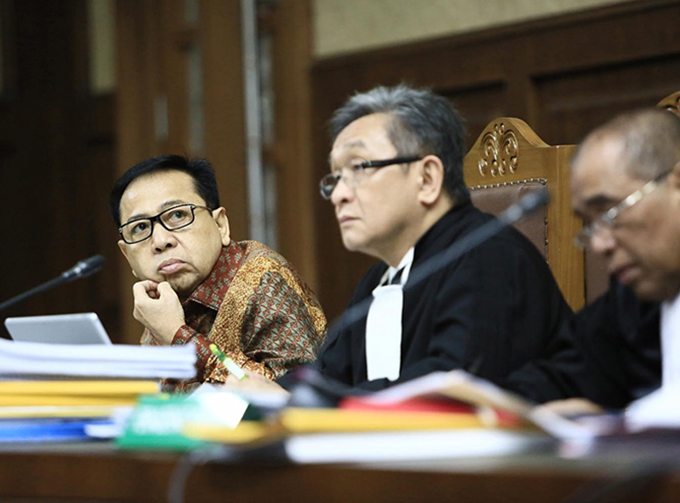
Former Speaker Setya Novanto (left) attending a hearing at the Jakarta Corruption Court. Image: Dhoni Setiawan/Jakarta Post

By Kharishar Kahfi in Jakarta

The Jakarta Corruption Court judges today sentenced former House of Representatives Speaker Setya Novanto to 15 years in prison after being found guilty of graft.

Reading out the court’s verdict, presiding judge Yanto said the former Golkar Party chairman had been declared guilty of rigging the Rp 5.9 trillion (US$424 million) e-ID project, which reportedly caused Rp 2.3 trillion in state losses.

The court also ordered him to pay Rp 500 million in fines and restitution amounting to the US$7.3 million he obtained in the case.

READ MORE: Is the e-ID mega-scandal the end for slick House Speaker Setya?

Both Setya and prosecutors said they would wait a week before announcing whether they would file an appeal.

Prosecutors had previously demanded a 16-year prison sentence and a Rp 1 billion fine for the defendant for his role in the case, which reportedly caused Rp 2.3 trillion in state losses.

-Partners-

The antigraft body also rejected Setya’s request for justice collaborator status, as the commission argued that Setya had not provided significant information related to the case.

Prosecutors indicted Setya in the case when he was still Golkar’s faction leader at the House.

Setya becomes the fourth defendant to be found guilty in the case after former Home Ministry senior officials Irman and Sugiharto as well as businessman Andi Agustinus or Andi Narogong.

Kharishar Kahfi is a Jakarta Post journalist.

Print Friendly, PDF & Email

Article by AsiaPacificReport.nz

]]>

Watchdog role of media highlighted in USP journalism talk

]]>

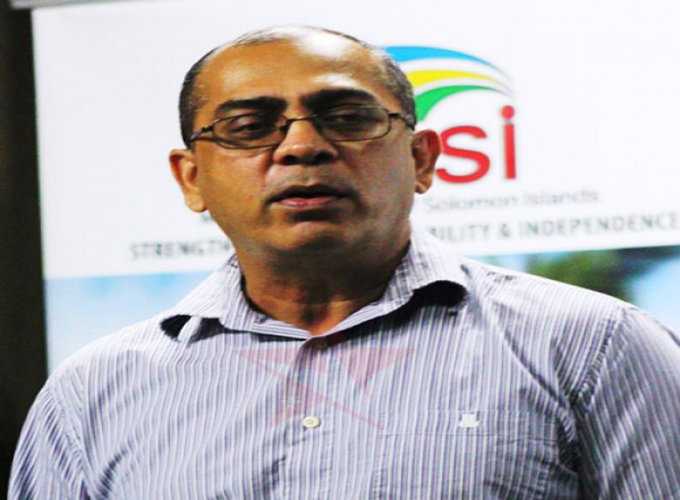
Dr Shailendra Singh … “news media is an important and a crucial pillar of democracy.” Image: Solomon Star

By Ronald Tito’ona in Honiara

Local journalists in the Solomon Islands have been again reminded of their watchdog role by keeping the government accountable in the fight against corruption.

Head of the University of South Pacific journalism strand Dr Shailendra Singh spoke to a group of journalists in a four-day anti-corruption reporting workshop in Honiara yesterday.

He said the role of a journalist was important in order to keep people informed and to keep the government accountable.

“The priority is scrutinising the government,” said the regional media specialist.

Dr Singh added that the private sector and civil society organisations were also prone to corruption.

Informing public
“People need to be informed to be able to analyse government’s performance, because we have elections every 4 to 5 years.

-Partners-

“And, people need to be fairly informed, to be able to make a right choice,” he said.

Dr Singh explained that if people were informed of the government’s conduct or policy, they could choose to either vote the government out or keep it in power.

“That is why it is so important that we, the media, scrutinise both the government conduct and policy on a regular basis.

“This is something we do constantly, but it is good to revisit and be reminded of our roles because we do this all the time, it can become a routine,” Dr Singh told the journalists.

Dr Singh said that this was how the news media performed its Fourth Estate role and upheld a country’s democratic system.

‘Very important role’
“So the news media is an important and a crucial pillar of democracy in any country. Without it, the government is no longer as accountable to the people.

“Without the news media, the government does not feel as accountable to the people. The government can act with impunity, and indulge in corruption more freely.”

Local journalists were also told to be vigilant and with a priority placed on reporting corruption.

“So do not underestimate your role. You will get a lot of criticism in the course of your work.

“People you question will criticise you, and they will also try to belittle you.

“So do not let them detract you, from this very important role,” said Dr Singh.

He reminded participants that they were representatives of the public, and without the media the public was handicapped in choices they made.

Ronald Tito’ona is a journalist on the Solomon Star.

Print Friendly, PDF & Email

Article by AsiaPacificReport.nz

]]>

The Ben Bohane photo that Facebook censored on an article about Indonesia

Report by Dr David Robie – Café Pacific.The original version of this photo, of West Papuan nambas (traditional penis gourds), which was published in the weekend edition of the family newspaper Vanuatu Daily Post and then by Asia Pacific Report, was deemed to have breached Facebook’s “community standards”. The photo was by award-winning photojournalist Ben Bohane, who lives in Vanuatu. BEN BOHANE: CHINA? NO, LET’S FACE THEThis article was first published on Café Pacific.]]>

Newsletter: New Zealand Politics Daily – April 24 2018 – Today’s content

Newsletter: New Zealand Politics Daily – April 24 2018 – Today’s content Editor’s Note: Here below is a list of the main issues currently under discussion in New Zealand and links to media coverage. [caption id="attachment_297" align="aligncenter" width="640"] The Beehive and Parliament Buildings.[/caption] Below are the links to the items online. The full text of these items are contained in the PDF file (click to download). Government Colin James (ODT): Govt looks transitional at this stage but could yet be transformational Bill Ralston (Listener): The Labour Party’s spin doctors are doing a cracking job Liam Hehir (Stuff): A Government for the cities and Opposition for the provinces? Isaac Davison (Herald): To stand or not? The Greens weigh up Northcote byelection Jason Walls (Interest): The country’s biggest bank is suggesting New Zealand’s ‘urgent’ need for infrastructure outweighs the Government’s ‘arbitrary [debt] target’ Anne Gibson (Herald): Shane Jones wants stronger infrastructure body Mitch Harris (Newshub): Careless criticism of the Govt has turned me into a ‘Jacinda Defender’ David Slack (RNZ): NZ represent: Ardern created ‘A Moment’ on the world stage 1News: ‘She’s got a lovely presence about her’ – Paula Bennett praises Jacinda Ardern’s skills of communication but says government lacks ‘ideas’ 1News:‘Of course it’s going to be of interest’ – Jacinda Ardern comfortable with all those questions about the baby Inequality and welfare Laura Walters (Stuff): Geneva human rights committee ‘shocked’ at NZ’s human rights report card Isaac Davison (Herald): UN ‘shocked’ by NZ’s record on housing, child poverty, incarceration Robert MacCulloch (Herald): New style of reform way out of growing inequality divide Anna Bracewell-Worrall (Newshub): Food grants: Number of New Zealanders getting help with basics continues rising RNZ: ‘We need culture change at the ministry’ – PM Jessie Chiang (RNZ): False tip-off led to benefit being cut with no warning Eva Corlett (RNZ): Woman told her benefit was cut because of Tinder dates RNZ: Quarter of NZers have no cash savings – survey Ian Hyslop (Newsroom): Social work bill ‘nonsense’ Environment, primary and extractive industries Zac Fleming (RNZ):DOC using Thompson + Clark to monitor anti-1080 activists Farah Hancock (Newsroom): Mapping New Zealand’s chemical romance Mike Dinsdale (Nothern Advocate): Minister irate at consent to extract kauri resin from Far North wetlands Timaru Herald Editorial: In considering a rebrand, Fish and Game must ensure its strong environmental voice remains No Right Turn: Climate change: What about coal? Christina Persico and Mike Watson (Stuff): Govt discuss end of oil and gas exploration with Taranaki business, local govt and stakeholders Mike Hosking (Newstalk ZB): Bad for business – Government’s gas, oil exploration ban a pig of an idea Sue Allen (Stuff): Ditching plastic bags – just do it already Emily Cooper (1News): Wellington bars and restaurants trial ban on plastic straws David Farrar (Kiwiblog):Ratepayer funded scaremongering Anzac Day, Land Wars, military Scott Hamilton (The Spinoff): The first, forgotten Anzacs, more than 50 years before Gallipoli Mandy Hager: Thoughts on Anzac Day and the inquiry into ‘Hit and Run’ John Sargeant (Stuff): Government should ignore authors’ claims about civilian deaths – it’s war Chris Trotter: Britain’s Interests Nowhere Near The Moral High Ground Dan Satherley (Newshub): Anzac spirit: Does Australia even care about NZ anymore? Marc Daalder (Newsroom): A Land Wars-shaped hole in the NZ psyche Tara Shaskey (Taranaki Daily News): Kaumātua disgusted at gallery’s efforts to show colonial painting, citing racism William Ray (Spinoff): Pākehā Māori: The American soldier who switched sides in the Taranaki Land Wars Housing Tex Edwards (The Spinoff):A three-step plan to truly affordable housing (no, we don’t need another review) Rachel Miller (Stuff): Keeping a roof over my kids’ heads is impossible John Boynton (RNZ): Māori housing issues raised with govt Greg Ninness (Interest): Government is considering intensive housing options in Panmure, Manukau and Henderson. Construction work not likely to start at Unitec site until next year David Hargreaves (Interest): The Government’s coming under pressure to make changes and exemptions in its legislation barring offshore buyers  Joel Ineson (Stuff): Tenants want action on damp Christchurch social housing units Israel Folau, religious and cultural beliefs Stuff: NZR releases a timely video about diversity, attacking discrimination Herald: Rugby: All Blacks and Black Ferns launch diversity campaign labelling ‘discrimination’ as enemy Newshub:Israel Folau a product of ‘fire and brimstone Christianity’ – Harawira Stuff: Hate speech law would be ‘step too far’, Bennett says Tom O’Connor (Waikato Times): Best stick to rugby, Israel Folau International relations and trade Gordon Campbell (Werewolf): On why France could become our closest ally in Europe Barry Soper (Herald): North Korea trade deal might not be as crazy as it seems RNZ: NZ says Pacific “reset” on track Isaac Davison (Herald): Winston Peters needs to end fixation with Russian trade deal, National says Madison Reidy (Stuff): Commonwealth FTA ‘too ambitious,’ exporters say Eric Frykberg (RNZ): Morocco’s charm offensive to protect phosphate sale to NZ Reserve Bank, economy and business Susan Edmund (Stuff): Australian advice scandals: Are we being ripped off, too? Michael Reddell: A garrulous Governor Education Iulia Leilua (Māori TV): Partnership schools face uncertain future Ilona Hanne (Herald): Parents furious as Taranaki school forced to reinstate suspended principal Health Lucy Bennett (Herald): Mayors seek assurances from Health Minister David Clark over rescue helicopter services Newshub: Nurses pay claim can ‘absolutely’ be resolved – Prime Minister Michael Daly (Stuff): DHB nurses and midwives receiving strike ballots – what’s the timeline from here? Melenie Parkes (Stuff): The Inside Word: Breaking shame and stigma Justice Jane Patterson (RNZ): Govt yet to pursue idea of separate Māori prison Stephanie Mitchell (Stuff): Documentary follows Taranaki youth offenders trying to turn their lives around Media Richard Harman (Politik): The RNZ saga: now the funding increase is doubtful Patrick Crewdson (Stuff): Stuff’s code of ethics underpins our journalism Kiwiblog: Matthew Hooton apology to Hon Steven Joyce Isaac Davison (Herald): Columnist Matthew Hooton apologises to former National MP Steven Joyce Henry Cooke (Stuff): Matthew Hooton apologises to Steven Joyce over critical column as part of settlement Anna Bracewell-Worrall (Newshub): Matthew Hooton issues apology to Steven Joyce Hill Cone column on Clarke Gayford Herald: Jacinda Ardern defends partner Clarke Gayford, says she won’t edit his social media accounts Greg Presland (Standard): Bottom feeding fish Herald: Hill Cone column criticising Clarke Gayford divides New Zealand Herald: Clarke Gayford compares columnist to ‘bottom-feeding fish’ following controversial article Danyl Mclauchlan (The Spinoff): Breaking news: Clarke Gayford reputation rocked by Herald allegations Herald: Column accusing Clarke Gayford of piggybacking off Jacinda Ardern’s success divides NZ Newshub: Clarke Gayford hits out at NZ Herald columnist Auckland Matt Lowrie (Herald): Light rail not really about airport Bernard Orsman (Herald): Shortage of playing fields in Auckland puts community sport at risk, says National’s Nikki Kaye Other Lincoln Tan (Herald): Deportation reprieve for migrant with three partners and their “many” children RNZ: Expectant Māori warned treaty settlements not a panacea Chris Morris (ODT): Calls for abuse inquiry to include faith-based Katy Gosset (RNZ): Tony Kokshoorn to step down as Grey’s mayor next year Maddison Northcott (Stuff): Long-serving Tony Kokshoorn to ‘pass the mayoral chains’ next year Pita Alexander (Stuff): Too many guns and far too many lawyers, but the US has parallels with NZ Piers Fuller (Stuff): Plans to reduce water takes could make farming ‘uneconomic’ Paul Mitchell (Stuff): ‘Send freedom campers to the regions,’ says government panelist Rachel Thomas (Stuff): Master Plumbers call for a ban on portable gas heaters in all homes The Wireless:An open letter to the Law Commission on abortion law reform Baz Macdonald (The Wireless): How the FBI has disrupted NZ’s sex work industry Sarah Paterson-Hamlin (Spinoff): A new ad starring a top NZ rugby player reveals a stark double standard]]>

Ben Bohane: China? No, let’s face the elephant in the Pacific room

]]>

BRIEFING: By Ben Bohane in Port Vila

China … China … China …

All the talk is of increasing Chinese influence in our region. But this is to wilfully see past the elephant in the room.

Contrary to most commentary, the biggest destabilising player in Melanesia over the past five years is not China but Indonesia, which through its “look east” policy has deliberately paralysed the Melanesian Spearhead Group (MSG) while financing local MPs and political parties across the Pacific to try and stop snowballing regional support for West Papuan independence.

Indonesia already has Peter O’Neil onside in PNG, and Voreqe Bainimarama in Fiji, and is busy trying to neutralise Vanuatu, the Solomons and FLNKS (Kanak Socialist National Liberation Front) leaders in New Caledonia, who are resisting Indonesian influence.

The reason Vanuatu and other Melanesian nations may be turning to China is because they are more worried about Indonesia, which has directly threatened Vanuatu over its strong diplomatic support for the West Papuans.

Vanuatu might be pulling some “muscle” into its corner, feeling it can’t rely on Australia because Canberra continues in its supine support of Indonesia whatever they do – even as Jakarta directly undermines Australian and Pacific island interests.

-Partners-

The accumulative “strategic failure” being talked of by Labour’s Richard Marles and others, is not because Australia has failed to check Chinese influence in Melanesia, but a result of Australia’s failure to check Indonesian interference in these nations that were supposed to be “our patch”.

For decades, islanders thought their “big brothers” Australia and America would defend Pacific peoples as they did in WWII. Instead, it appears Australia has outsourced its security of Melanesia to Indonesia, giving them free reign.

‘Melanesian nation’
Despite being a Melanesian nation itself through its own Torres Strait and South Sea Islander communities, strangely Australia has not sought to join the main political grouping of its own neighbourhood, the Melanesian Spearhead Group (MSG), which has now been hijacked by Indonesia with help from Fiji in particular; more blow-back from Canberra’s misguided attempts to isolate Fiji after the coup.

It is not lost on the region that while the Turnball government is warning about Chinese influence, senior members of his own party have been taking Chinese coin, from former Foreign Minister Alexander Downer spruiking for Huwei to recent Trade Minister Andrew Robb now working for the same Chinese company that controversially bought Darwin’s port.

Still, as examples like Sri Lanka demonstrate, Australia is right to flag concerns about strategic vulnerability that comes with excessive debt to China.

From a Melanesian perspective, the two biggest security issues they face are climate change and Indonesia’s increasing political interference across the Melanesian archipelago, rooted in its desire to hold onto West Papua.

Despite the mantra from Foreign Minister Julie Bishop that Australia remains the “strategic partner of choice” for Vanuatu and the region, the fact is that Canberra is not listening to Melanesia’s own security concerns, but telling them what they should be concerned about, ie China.

This is not going down well and Melanesian nations are forging their own security arrangements with or without Australia, who they see as compromised when it comes to climate change and Indonesia.

In the past few months we have witnessed something of a “pincer movement”. In late December, RAAF jets were suddenly scrambled from Tindal air base near Darwin after a number of nuclear-capable Russian Tu 95 “Bear” bombers flew from Biak in West Papua, flying between Papua and Australia’s north for intelligence gathering purposes.

Russian bombers
It’s the first time Russian bombers have operated like this in the South Pacific and suggests Jakarta wanted to warn Australia and the US forces parked in Darwin that it too could bring some “muscle” into the neighbourhood. That message was likely aimed at China as much as Australia and the US.

Then last week, at the other end of Melanesia we have revelations about a potential Chinese military base in Vanuatu. The first thing to say is that it’s highly unlikely China would have asked for a military base – they are far too subtle to do that.

More likely is that they may be angling for something dressed up as a civilian project but with military applications, like the “space station” speculation floated in the Chinese press last week.

They have already built a lot of dual-use infrastructure in Vanuatu such as the big Santo wharf, so step by step, like their “salami-slicing” strategy in the South China Sea, they will move incrementally without wanting to frighten the horses.

Both of these pincer moves have their origin in West Papua’s situation. In some ways it reflects Paul Dibb’s reworking of Australian defence policy in the late 1980s to get beyond its Euro-centricity. Dibb offered a map with concentric circles emanating out from Darwin. The first circles cover East Timor and West Papua.

There are strategic consequences to Australia’s 50-year policy of not just turning a blind eye to Indonesia’s “slow-motion genocide” in West Papua, but active involvement through its Densus 88 anti-terror unit, which many Papuans accuse of not just targetting Islamic militants, but Papuan nationalists too.

At a time when Canberra is battling jihadis in the Middle East and the Philippines, it appears unconcerned by jihadi activity and Indonesian military collusion right on its doorstep, or a possible Prabowo government elected next year, backed by Islamist groups.

Bloody proxy militias
Those of us who witnessed Indonesia’s bloody use of proxy militias in East Timor have watched the same apparatus move to West Papua, with the same man – General Wiranto – still in charge.

It wasn’t always like this.

There was a time when the Menzies government in Australia supported Dutch plans for West Papuan independence throughout the 1950s and early 1960s until the US twisted arms to accept Indonesian control because of Cold War politics.

There was a time when the Australian Defence Force (ADF) worked with the PNGDF to actively secure its 800km border with Indonesia. Today the border is wide open and sources within PNGDF intelligence continue to complain that the Indonesian military routinely violate PNG sovereignty with their patrols, up to a dozen times per year, sometimes even moving the border marking pegs.

How can Australia be perceived as PNG’s security guarantor when it doesn’t even help them secure their primary border, especially with the growing threat of jihadi infiltration?

Why has the AFP been given priority over the ADF in terms of security across Melanesia? With no more engineering battalions or ADF army advisors present in camp, China has walked right in. The last ADF army adviser to Vanuatu, Major Paul Prickett, left 10 years ago and wasn’t replaced.

Many years ago I spent some time with Dick Hagen, a legendary coffee plantation manager in the Highlands of PNG, who has been there since the 1950s. He told me how in the 1960s and 70s, he and many Australians living in PNG were given basic military training so they could be a first response “militia” should the Indonesians come over the border and invade PNG.

For decades the PNG-Indonesia border was regarded as Australia’s real frontline. It was another potential “Kokoda” which didn’t happen, but Indonesia has found other ways to extend its reach.

Mohammed Hatta, one of the founding fathers of Indonesia, warned his nation against taking West Papua, saying Indonesia might not stop until it got to Fiji. That is now coming to pass. But ironically, it is China that will likely contain Indonesia’s expansion in the region, not Australia.

Some sort of deal?
I have the sense that some sort of deal was struck between Canberra and Jakarta back in the 1970s; that Australia would turn a blind eye to everything west of the border while Indonesia would not interfere in PNG and anything east of the border.

Australia has naively kept its part of the deal while Indonesia clearly has not. As a result, in the social media age when all the Pacific is now aware of climate change and what Indonesia continues to do in West Papua and beyond with tacit Australian support, Australia and the US are losing the moral – and actual – leadership of the region.

China is the result.

But it is worth remembering that Australia does much to support Melanesia in other important areas, has been a generous neighbour and will always be there for the islands in tough times. To the keyboard warriors on social media always blaming Australia for what has happened in West Papua, they would do well to understand the history; that it was US and UN decisions that sealed West Papua’s fate.

Australia and Holland initially supported their independence. Why would Australia again risk war with Indonesia over West Papua when Melanesians themselves have not united to bring the West Papuans fully into their family?

It was the MSG which let the wolf into their house, not Australia. As someone who was there in the first weeks of East Timor’s bloody liberation, amidst the burning buildings and bodies, it was an Australian-led coalition which secured East Timor. I remember wondering where are the Melanesian forces to assist and show solidarity? No PNGDF, no VMF or Fijian forces during the critical phase.

Australia must now find a strategic balance among its “frenemies” Indonesia and China. That begins with deeper engagement with the islands, leadership on climate change and working with Melanesian leaders to address their security concerns as much as Australia’s.

Only by listening and closer co-operation with Melanesian leaders can Australia assist with a robust defence of the Melanesian archipelago from Timor to Fiji and be seen as Melanesia’s “security partner of choice”.

Ben Bohane is a photojournalist and television producer based in Vanuatu who has specialised in reporting war and religion for nearly 30 years across Asia and the Pacific. He has been a frequent contributor to the Pacific Media Centre over the years.

Print Friendly, PDF & Email

Article by AsiaPacificReport.nz

]]>

Chinese ‘baseless rumour’, Nauru ‘justice’ for refugees and Fiji diabetes

Report by Dr David Robie – Café Pacific.David Robie talks on 95bFM about current Pacific issues Reuben McLaren of 95bFM talks to Professor David Robie, director of the Pacific Media Centre at Auckland University of Technology, on the centre’s Southern Cross radio programme. David speaks about various upheavals around the Pacific, including the alleged Chinese military “base plans” for Vanuatu, Nauru abolishing its Appeal CourtThis article was first published on Café Pacific.]]>

Dr Paul Buchanan – On intelligence oversight, a broader perspective.

Paul Buchanan On intelligence oversight, a broader perspective. – 36th Parallel Assessments Introduction.

[caption id="attachment_1282" align="alignleft" width="150"] Dr Paul Buchanan, co-founder of 36th Parallel Assessments.[/caption] 36th Parallel Assessments’ Director Paul G. Buchanan has been named as a member of the New Zealand Inspector General of Intelligence and Security’s Reference Group, an external interest intermediation panel. The backdrop to his appointment is that historically the IGIS has been a hollow agency posing as an institutional check on the agencies it is statutorily charged to oversee. Historically dependent on the funding, space, communications and cooperation of the NZSIS and GCSB  and without powers of proactive compulsion under oath, the office was as much devoid of real authority as it was a reward to individuals for service in other fields. In response to series of scandals and illegal behavior on the part of the NZSIS and GCSB, in recent years the authority and independence of the IGIS have been strengthened. However, these remain some distance away from the type of robust oversight associated with liberal democracies, and the Reference Group was created with the intention of expanding the number of interlocutors the IGIS interacts with when confronting the challenges of the job. In democracies intelligence oversight mechanism vary. In some cases parliamentary or congressional committees exercise strong legal powers to compel intelligence agencies to proactively as well as retrospectively provide evidence or other material documenting their activities under penalties of law. these include institutional as well as individual sanctions, to include fines and jail terms, for those who do not comply. In other cases oversight arrangements are looser and less robust in terms of enforcement capability. Here, should they exist, oversight agencies are often located within the Executive branch and/or the intelligence agencies themselves, leading to a lack of independence and effectiveness when discharging the oversight function. That has been the case in New Zealand, where the IGIS remains as the sole oversight agency (the parliamentary select committee on intelligence and security having no real powers to impose demands on the intelligence community), and yet in spite of recent legislative reforms remains relatively weak when it comes to ensuring compliance by the agencies under its jurisdiction. It is against that backdrop that the Reference Group was created. In response to questions raised about the composition and purpose of the Reference Group, Dr. Buchanan has written an explanatory brief. It follows below.
Source: Image Wikimedia Commons. The announcement that the Inspector General of Intelligence and Security (IGIS), Cheryl Gwynn, has convened an external Reference Group to discuss issues of intelligence agency oversight (specifically, that of the NZSIS and GCSB, which are the agencies under her purview) has been met with applause and controversy. The applause stems from the fact the Group is a continuation of her efforts to strengthen the oversight mechanisms governing New Zealand’s two most important intelligence collection and analysis agencies. The controversy is due to some of the persons who have accepted invitations to participate in the Group. The Group is an unpaid, non-partisan collection of people with interest, expertise and/or background in matters broadly related to intelligence and security and their oversight. None are government employees, something that gives them freedom to speak frankly under the Chatham House rules established by the IGIS. The Group is a supplement to and not a rival of or substitute for the IGIS Advisory Panel, made up of two people with security clearances that have access to classified material and who can offer specific assistance on matters of operational concern. However, the Advisory Panel has had no members since October 2016. The idea behind the Reference Group, which is modelled on a Dutch intelligence oversight counterpart, is to think laterally or “outside of the box” on matters relevant to intelligence oversight. Bringing together people from different backgrounds and perspectives allows Group discussions to gravitate towards areas of common concern, thereby eliminating personal agendas or extreme positions. And because the Group is made up of outsiders, it does not run the risk of becoming slave to the groupthink of agency insiders. In contrast to the Advisory Panel, the Reference Group does not handle classified material nor discuss operational matters. Access to classified material or operational details is obviated by the fact that the Group’s focus is on the broad themes of accountability, transparency, organizational compliance and the balance between civil liberties (particularly the right to privacy) and the defense of national security as conducted by the lead intelligence agencies. These are matters of legality and propriety rather than operational conduct. And while similarly important, legality and propriety are not synonymous. Often what is legal is not proper and vice versa, and this is acutely the case when it comes to intelligence collection, analysis and usage. Since the IGIS does not oversea the NZDF and smaller intelligence “shops” such as those of the DPMC, Police, Immigration and Customs, the Group will only discuss issues relevant to oversight  of the NZSIS and GCSB. Who are the members of the Group and why the controversy? The plurality of members are four public interest lawyers, three of them academicians and one an advocate for refugees. Two members are journalists. One is the Issue Manager for Internet NZ, one is the head of the NZ Council for Civil Liberties, one is a former Russian diplomat now serving as the Director of the Massey University Centre for Defense and Strategic Studies (CDSS), one is an economist who chairs Transparency International New Zealand and one is a private sector geopolitical and strategic analysis consultant. Concern has been voiced about the presence of both journalists as well as the refugee advocate and the loyalties of the former Russian diplomat (although he has held positions at a US security institution as well as the NZDF-funded CDSS. The thrust of the contrary views about these and some of the other participants is that they are untrustworthy due to their personal backgrounds, professional affiliations and/or ideological orientations. An additional reason given for opposing some of the membership is that they have been strong critics of the SIS and GCSB and therefore should be disqualified a priori. Others believe that the Group is just a whitewashing, window-dressing or co-optation device designed to neuter previous critics by bringing them “into the tent” and subjecting them to “bureaucratic capture” (whereby the logic of the agencies being overseen eventually becomes the logic accepted by the overseers or Reference Group interlocutors). The best way to allay these concerns is to consider the IGIS Reference Group is as an external focus group akin to a Town Hall meeting convened by policy-makers. Communities are made of people of many persuasions and many viewpoints, and the best way to canvass their opinions on a broad range of subjects is to bring them together in a common forum where they can debate freely the merits of any particular issue.  In the case of the Reference Group the issue of intelligence agency oversight and, more specifically, matters of institutional and individual accountability (both horizontal and vertical, that is, vis a vis other government agencies such as the judiciary and parliament, on the one hand, and vis a vis the government and public on the other); transparency within the limits imposed by national security concerns; and the juggling of what is legal and what is proper, are all set against the backdrop of respect for civil liberties inherent in a liberal democracy. These are complex subjects not taken lightly by those involved, all of whom have track records of involvement in the field and who, given the terms of reference and charter of the Group, are acting out of a sense of civic duty rather than for pecuniary or personal gain. The IGIS does not need political or agency authorisation to construct such a Group, which has no statutory authority or bureaucratic presence. As a vehicle for interest intermediation on the subject of intelligence oversight, it serves as a sounding board not for the IGIS but for the people on it. In that light, the IGIS has called the Group’s discussion a “one-way street” where participants air their informed opinions about agenda items agreed to in advance and in which the IGIS serves as a discussion moderator and takes from it what she finds useful. Expected to meet two or three times a year over tea and coffee, the Group is not likely to tax the Treasury purse and could well deliver value for dollar in any event. Critics of this exercise and other forms of interest intermediation or external consultation betray their closet authoritarianism because such concertative vehicles are mainstays of policy-making in advanced liberal democracies. Be it the tripartite wage negotiation structures bringing representatives of the State, labour and capital together (even at the regional or local level), to consultative boards and other social partnership vehicles that connect stakeholders and decision-makers in distinct policy areas, the use of interest intermediation is an integral feature of modern democratic regimes (for an example of the breadth of issues addressed by intermediation vehicles, see Kate Nicholls, Mediating Policy: Greece, Ireland and Portugal before the Eurozone Crisis. London: Routledge, 2015.). To argue against them because of who is represented or because they are seen as inefficient talkfests that are a waste of taxpayer money is just a cloak for a desire to silence broad public input and dissenting views in the formulation of public policy. That may have been the case under the previous government but no longer is the case now. Critics of this exercise and other forms on interest intermediation or external consultation betray their closet authoritarianism because such concertative vehicles are mainstays of policy-making in advanced liberal democracies. Be it the tripartite wage negotiation structures bringing representatives of the State, labour and capital together (even at the regional or local level), to consultative boards and other social partnership vehicles that connect stakeholders and decision-makers in distinct policy areas, the use of interest intermediation is an integral feature of modern democratic regimes. To argue against them as inefficient talkfests that are a waste of taxpayer money is just a cloak for a desire to silence broad public input and dissenting views in the formulation of public policy. That may have been the case under the previous government but no longer is the case now. One of the thorniest problems in a democracy is the question of what system of checks and balances keeps the intelligence community proper as well as legal. As the most intrusive and sensitive of State activities, intelligence collection, analysis and usage must be free from reproach on a number of grounds—conflicts of interest, partisan bias, foreign control, illicit activity or criminal behaviour, etc.—and must be accountable and responsive to the public will. The broadening of consultation intermediators between the NZ intelligence community and the public is therefore a step in the right direction, and for that reason the Reference Group is a welcome contribution to the oversight authority of the IGIS. References: http://www.igis.govt.nz/media-releases/announcements/establishment-of-igis-reference-group/ http://www.igis.govt.nz/media-releases/announcements/reference-group/ Analysis syndicated by 36th Parallel Assessments -]]>

Newsletter: New Zealand Politics Daily – April 23 2018 – Today’s content

Newsletter: New Zealand Politics Daily – April 23 2018 – Today’s content Editor’s Note: Here below is a list of the main issues currently under discussion in New Zealand and links to media coverage. [caption id="attachment_297" align="aligncenter" width="640"] The Beehive and Parliament Buildings.[/caption] Below are the links to the items online. The full text of these items are contained in the PDF file (click to download). International relations and trade Kate Hawkesby (Herald): Assured, authentic Jacinda Ardern impresses overseas RNZ: Excitement over Commonwealth-wide free trade agreement Barry Soper (Newstalk ZB): Jacinda Ardern is the most unusual Prime Minister New Zealand has ever had Claire Trevett (Herald): Prime Minister Jacinda Ardern on her grand European tour Claire Trevett (Herald): Jacinda Ardern’s ‘satorial stir’ with korowai at Buckingham Palace Stuff: ‘She wore it so well’: praise flows for PM Jacinda Ardern’s Māori cloak 1News: ‘I felt privileged to wear it’- PM Jacinda Ardern thanks korowai’s owner after fantastic international reception at CHOGM Claire Trevett (Herald): Clarke Gayford in the minority with Chogm ‘spouses’ 1News:‘I’m pregnant not incapacitated’ – Jacinda Ardern says her pregnancy – and swollen feet – has not affected her job at Chogm Joy Reid (1News): ‘Front pack’ and swollen feet no impediment to Ardern impressing the world at CHOGM Stephen Jacobi (RNZ): PM’s London visit not just ‘pure nostalgia’ Pete George: Ardern wearing a korowai in London Steven Cowan: Friends together Herald: Young leaders Ardern and Trudeau the darlings of the European press at Chogm Stacey Kirk (Stuff): Shining through dark Russian clouds, PM makes impact on world stage Audrey Malone (Stuff): Photo taken of Queen 65 years ago given to her Claire Trevett (Herald) European Diaries: Travels with a pregnant Prime Minister Herald Editorial: Charles in charge as the Prince gets his chance Claire Trevett (Herald): PM Jacinda Ardern pleased Prince Charles to head Commonwealth Lucy Bennett (Herald): Helen Clark backs Prince Charles as Commonwealth head ODT: The benefits of a strong Commonwealth Stacey Kirk (Stuff): Winston Peters says Commonwealth countries open to multilateral trade deal Herald:NZ First leader Winston Peters raises prospect of North Korea trade deal – one day Stacey Kirk (Stuff): Winston Peters says a Russia trade deal is off the table – for now RNZ: Trade deal with Russia still future possibility – Peters Wang Zhijian (ODT): China’s pledge for further opening-up boosting global confidence Megan Gattey (Stuff): Jacinda Ardern and Winston Peters question former Russian spy’s poisoning claims Claire Trevett (Herald): Former Russian spy asked to prove claim he was poisoned in New Zealand powder attack Newshub: More than 60 diplomats have sought NZ immunity in past 20 years Isaac Davison and Barry Soper (Herald): Canadian court says diplomatic immunity can’t be used skip rent – in case with NZ parallels Isaac Davison (Herald): EU near-certain to waive immunity for diplomat owing $20,000 to landlord, expert says Sheree Trotter (Herald): Exploring the Kiwi connection as Israel turns 70 NZ’s response to Syria bombings Audrey Young (Herald): Needless nagging of Prime Minister Jacinda Ardern over US, UK and French air strikes against Syria Mark Dawson (Wanganui Chronicle): Editorial: Please be careful what you ‘accept’, Jacinda 1News: Winston Peters slams Russia’s support for Syria after alleged chemical weapons attack Government Simon Wilson (Herald): The ministry of ‘things will be different now’ – how are they doing? NZ Herald Editorial: Ardern Govt has business guessing Thomas Coughlan (Newsroom): Twyford bends budget rules Heather du Plessis-Allan (Herald):It’s fair to compare Jacinda Ardern to Donald Trump Greg Presland (The Standard): Jacinda Ardern is just like Donald Trump Eleanor Ainge Roy (The Guardian): Time 100 list: New Zealand PM Jacinda Ardern praised as ‘political prodigy’ Newshub: Mark Richardson sick of media’s Jacinda Ardern ‘sanctimony’ Duncan Garner (Stuff): We should look at our own states of emergency before pointing fingers overseas Jason Walls (Interest): The Labour, Greens & NZ First alliance has held up rather well… so far No Right Turn: Differentiation vs delivering No Right Turn: Proactive release of Ministerial briefings Chris Trotter (Daily Blog): No Enemies To Labour’s Left? Deborah Hill Cone (Herald): Why does Clarke Gayford bug me? Environment, primary and extractive industries John Roughan (Herald):If we are to lead the world on climate change, let’s hope it follows Richard Harman (Politik): Gas may run out early Rod Oram (Newsroom): Shedding light on the gas sector’s claims Anna Berka (Newsroom): What NZ should learn about renewable energy 1News: Energy Minister dispels talk of a halt to coal permits in NZ Isaac Davison (Herald): Minister confident of new gas discoveries as latest data shows reserves could last just 7 years Jo Moir (Stuff): ‘Incredulous’ for Energy Minister to say no work on coal ban been done – National MP Newshub: ‘No plans’ to ban oil, gas exploration altogether – Energy Minister Megan Woods Christina Persico (Stuff): Plans afoot for an economic life for Taranaki beyond oil and gas Stuff: Climate change puts more pressure on New Zealand’s ecosystems Dave Frame (Newsroom): Climate change a slow burn issue Newswire: Megan Woods to visit NZ’s biggest gas consumer ODT Editorial: Insights into the environment RNZ: Report unable to assess ‘overall extent of land contamination’ Glen Herud (Spinoff0: I founded Happy Cow Milk to make a difference in dairying. I failed. Israel Folau, religious and cultural beliefs Moana Maniapoto (E-Tangata): Losing my religion Farah Hancock (Newsroom): Islamophobia: the conversation killer Tova O’Brien (Newshub): Israel Folau’s gay comments aren’t hate speech – Jacinda Ardern Dan Satherley (Newshub): Israel Folau fallout: No need for stronger hate speech laws – Paula Bennett Tova O’Brien (Newshub): Bigotry can go to hell Steve Braunias (Herald): Secret Diary of Israel Folau Paul Thomas (Listener): Israel Folau has exposed the tricky politics of professional sport Nadine Higgins (Stuff): Hey, role models, time to earn your keep Kerre McIvor (Herald): Weigh your words, they can hurt Kris Shannon (Herald): Israel Folau drama may cause Raelene Castle legacy to crumble Alice Snedden (Stuff): Hate speech is hate speech, no debate Grant Shimmin (Stuff): It’s Israel Folau, and me, who need the forgiveness here Jeremy Dawson (Kiwiblog): Guest Post: In defence of Israel Folau (kind of) Whaleoil:In defence of Israel Folau Phil Gifford (Stuff): Blame Israel Folau, not Raelene Castle Justice and police Bess Manson and Rob Mitchell (Stuff): Roundabout that leads back to prison roster Matt Stewart (Stuff): Prisoners facing deportation could be costing New Zealand $259m Stuff: Former prisoner faces competition for compo award NZ Herald Editorial: Govt should adopt bill to get young offenders back to school Stuff Editorial: The right to rehabilitation Simon Collins (Herald): National Party push to get youth offenders back to school RNZ: Govt won’t release rapists despite UN recommendation Tim Brown (RNZ): Possible changes to bail laws ‘carries a risk’ – Christie’s mother Jo Lines-Mackenzie (Stuff): Otorohanga still hoping for Waikeria prison expansion Mike Hosking (Newstalk ZB): What is with Little’s fixation on bail? Dominion Post Editorial: New technology to catch criminals is welcome, but protections must stay up with the game Sam Sherwood (Stuff): Canterbury police fail to attend a fifth of dwelling burglaries within 48-hour target Reserve Bank, economy and business Hamish Rutherford (Stuff): New Reserve Bank boss: ‘Being a ginger, I tend to run towards the fire’ Liam Dann (Herald): New Reserve Bank Governor Adrian Orr ready for a financial literacy shake-up Cameron Bagrie (Stuff): Fiscal targets should never stand in the way of good policy 1News: New Reserve Bank head: No need for inquiry here like across the Tasman RNZ: Banking inquiry in Australia ‘wake-up call’ for NZ subsidiaries Tamsyn Parker (Herald): Australian banking scandal: New Zealand regulator in talks with financial firms 1News: Banking expert says investigation into Australian bank behaviour isn’t necessary this side of the Tasman Michael Reddell: A mis-step by the new Governor Brian Easton (Pundit): How Open an Economy? Rebecca Howard (BusinessDesk): NZ’s R&D tax incentive plan viewed as positive Terry Baucher (RNZ): Tackling money-laundering in NZ: More needs to be done Regional development Newswire: First trees planted in Govt’s One Billion plan Benedict Collins (RNZ): Officials failed to do background checks on energy scheme Lucy Bennett (Herald): MBIE says sorry to Shane Jones over lack of checks on businessman RNZ: National says internal review of Renew Energy fiasco ‘alarming’ Immigration and migration issues Shamubeel Eaqub (Stuff): Time for a mature conversation about immigration Julie Fry and Peter Wilson (Newsroom): Comment: A new way of seeing migration RNZ: Mark Middleton’s lawyer to seek compensation Isaac Davison (Herald): More foreign workers needed to hit 1 billion trees target, forestry giants say Lucy Bennett (Herald): Immigration backdown: Karla Cardno’s stepfather Mark Middleton will not be deported RNZ: Minister intervenes to stop Mark Middleton deportation Lincoln Tan (Herald): NZ sex workers lodge complaints over foreign prostitute website advertisements Education Alison Mau (Stuff): It’s time to unlock the potential of our special needs kids Nicholas Jones (Herald): Exclusive: Concern over wages of principal’s family members Liz Gordon (Daily Blog):Bees, guns and cults: recent happenings in education Heather Roy: Labour abolishes Partnership Schools despite good outcomes for vulnerable students Peter Gilderdale (The Spinoff): The university library row reveals a seismic shift in NZ’s middle class Martyn Bradbury (Daily Blog): Dear Students of Auckland University – here is how you get your libraries (and power) back Media Colin Peacock (RNZ): Bankrolling the big prizes for NZ journalism Geoff Lealand (Evening Report): Public broadcasting and an advocate’s ‘disaster readiness’ revival mission Diana Wichtel (Listener): Moa Please! Give Anika Moa a prime-time spot on TV right now The Spinoff: Duncan Garner launches blistering attack on Duncan Garner Spinoff: In TV outburst, Mark Richardson announces he is sick of Mark Richardson David Slack (Stuff): The shape of politics Housing Rob Stock (Stuff): Housing NZ complex shows Auckland’s ‘Nimby nightmare’ unitary plan in action Elton Rikihana Smallman and Ruby Nyika (Stuff): Housing for former Hamilton slum fast-tracked by Government Collette Devlin (Stuff): More Housing New Zealand redevelopments for Wellington Rob Stock (Stuff): Submissions on foreign home-buyer ban flood in from concerned residents Eric Crampton: Banning ‘foreign’ buyers Health RNZ: ‘Why train to be a nurse … if you’re being paid less than a caregiver’ Lucy Bennett (Herald): Middlemore Hospital sewage leak a ‘stain on the ground’ Emily Ford and Jarred Williamson (Stuff): Key leadership roles still to be filled at embattled south Auckland hospital Emily Heyward (Stuff): Grey Power pushes for elderly representation on district health boards Kirsty Johnston (Herald): Advice to Government over ‘discriminatory’ Funded Family Care policy to remain secret Elena McPhee (ODT):Disadvantaged paying for poverty with their teeth Herald: Expert: where NZ’s legal high clamp-down went wrong RNZ: Synthetic drug ban returning power to black market Social work Emanuel Stoakes (Herald):Bill poses threat to social workers RNZ: PSA critical of ‘short-sighted’ select committee report Kieran O’Donoghue (Re-Imagining social work): An opportunity missed? A failure to listen? And whose advice was privileged? Parliament Mitchell Alexander and Finn Hogan (Newshub): Ticked Off: New Zealand Protection Service Janet McLean (Newsroom): What a NZ republic might look like Racism debates Martin van Beynen (Stuff): We might be racist but racist as f…? Pani Favid (Herald): The psychology of modern racism Skara Bohny (Stuff): Cancellation of controversial talk ‘brutal censorship’ David Skipwith (Herald): League: Warriors sale rocked by claims of racism as tussle between Richard Fale, ARL turns ugly Treaty settlements and Maori land Patrick O’Meara (RNZ): Settle up – Are treaty deals benefiting all Māori? RNZ: Iwi could be sued for neglecting urban Māori Te Aniwa Hurihanganui (RNZ): Young Māori leaders advocate for land protection rights at the UN Carwyn Jones (RNZ): Crown’s Treaty settlement negotiations ‘not fair or reasonable’ Transport and road safety Newshub: The great road divide: Phil Twyford and Judith Collins go head-to-head Press Editorial: Christchurch should be the exception to the rule on fuel tax RNZ: Police left frustrated as road toll overtakes last year Local government RNZ: Regional council proposes adding ‘h’ to Manawatu-Wanganui Damien Grant (Stuff): Veteran rates protester a Penny for your thoughts Amanda Saxton (Stuff): Want to buy Penny Bright’s house? She says ‘forget it’ 1News: Activist Penny Bright declines Auckland Council proposal to extend outstanding rates Military and remembrance Simon Ewing-Jarvie: What do Veterans Want? Nicholas Haig (Briefing Papers): War remembrance: Acting out or working through? Herald: Time to delve into your family history: 26 million military records free to the public for Anzac Day commemorations Other Paul Buchanan: On intelligence oversight, a broader perspective 1News: ‘Things have got away on us’ – Salvation Army says poverty in New Zealand at its worst since the last recession Jo Moir (Stuff): What’s in a name? Pretty much everything when it come to politics 1News: Government plans to bail out Earthquake Commission as it runs out of money Jamie Morton (Herald): NZ needs Govt data-mining watchdog, experts say Bess Manson (Stuff): National Portrait: KidsCan founder Julie Chapman says NZ kids are worse off than ever Stuff: Below the beltway: The week in politics Jonathan Milne (Stuff): Building a nation on a myth – from Gallipoli to CHOGM Nicole Barratt (Herald): PM Jacinda Ardern’s former Pt Chevalier home sells for $1.32m Gordon Campbell (Scoop): On Thompson+ Clark, and Russia’s FIFA World Cup John Anthony (Stuff): NZ Facebook users to miss out on greater privacy protection: Reports Amber-Leigh Woolf (Stuff): Sexual abuse assaults roll in because of #MeToo: ‘staff are overloaded’ Craig Hoyle (Stuff): Auckland v the rest of NZ: It’s a classic big brother, little brother relationship Paul Little (Herald): Where would we be without science? Donna Chisholm (Listener): Are confidentiality agreements letting sexual harassers off the hook?]]>

Public broadcasting and an advocate’s ‘disaster readiness’ revival mission

]]>

TRIBUTE: By Geoff Lealand in Auckland

David Beatson, broadcaster, editor, journalist, public intellectual and media visionary, proposed a new, or renewed, role for New Zealand public broadcasting in anticipating and managing risk – such as natural disasters and technological crises, says an academic in his public tribute.

Speaking at an inaugural memorial lecture in Ponsonby today celebrating the life of Beatson, Associate Professor Geoff Lealand of Waikato University said that when he died last year New Zealand had “lost a champion for public media and he will continue to be missed”.

The inaugural lecture to a packed Leys Institute library hall was organised by the Better Public Media Trust and preceded a panel debate by Broadcasting and Communications Minister Clare Curran and Radio New Zealand chief executive Paul Thompson about the planned “evolution” of RNZ into RNZ+.

Dr Lealand’s full address:

Tena koto, tena kotu tena toku katoa

I do feel privileged in being asked to deliver this inaugural David Beatson lecture today, and in such auspicious company. It will be a short speech and I will try not to meander (even though my opening remarks may seem a little oblique).

Better Public Media … advocacy for a stronger independent media in New Zealand. Image: David Robie/PMC

-Partners-

Others have lauded David’s contributions to the intellectual life of New Zealand—and to public media in this country, in particular. My role really is to remind us of his legacy, and how we need to keep steadfast in our advocacy (even though things are looking a little rosier than this time last year).

My first encounter with David was in the mid-1980s when he was the editor of the New Zealand Listener, working out of the Bowen State Building in Wellington (in the days when it was a publication less obsessed with house prices and health scares). I was working in the same building, in the Audience Research Unit of BCNZ; my first job in NZ after returning from studies in the United States and a position at the British Film Institute.

My role was to do qualitative audience research (the kind of research which investigates the motivations and responses to media content). It was also my first illuminating experience with ratings; quantitative measurements which claim to record “presence in a room where a TV set is on”. This experience led to a deep and abiding disbelief in the efficacy of this way of describing audience behaviour.

But that is a topic for another day. The reason why I sought out David was because I had started writing a regular column for the Listener about audience research, mainly working with David’s deputy editor Helen Paske. I wandered down the halls of the building one day, to suggest to David that I could also write an occasional book review, starting with a piece on a monograph by Massey University sociologist Brennon Wood, applying Marxist theory to an analysis of television news.

I still remember the look of complete disbelief on David’s face at the sheer audacity of anyone coupling Karl Marx with the production of television. At this point I realised that our politics didn’t match, for I was more receptive to the idea that news production embodied processes of power, reinforcement of political norms, and implied assent from viewers.

But this did not inhibit friendly conversations when we met again, in the ensuing years. One thing I always liked about David was his willingness to listen to and acknowledge that academics had something useful to add to debates about the role of the media in NZ life (the same cannot be said of some of his contemporaries!).

Generosity and open-mindedness
I am not the only one to know of David’s generosity and open-mindedness. For example, Roger Horrocks, who worked closely with David when they were both on the NZ On Air Board, sent me the following candid comments;

David had a rich life-time experience of broadcasting, which stood in strong contrast to the politicians and politically appointed members of various boards who fiddled around with broadcasting without really knowing what they doing (there were both Labour and National examples). David had a deep understanding of that territory.

He was a man of integrity. In my experience, a person with principles who didn’t play games. Those were not qualities you could take for granted in the fields of politics or broadcasting administration.

He had known NZ broadcasting when it still had a public service spirit, and he remained wonderfully loyal to that. The history of the last 30 years has been the gradual victory of commercialism and populism over public service. David kept the faith, and it mattered so much to him that he never stopped trying—trying to hold back the tide. Whenever I met him in his last years, he would talk of new initiatives, new possibilities. He never stopped campaigning.

Roger declares David as a great defender of the idea of public service at its best. In his own words, he grew up in a world where the communicator’s basic task was defined simply: inform, educate and entertain, ie not to pontificate, declare viewpoint nor share personal prejudices or judgements.

Furthermore, David believed that the core values of the news media should be fairness and equitybecause it is in the common interest that public media delivers those important non-commercial values in ways that reflect the needs and interests of the diverse communities that must interact in our society.

Innovative thinker
He was also an innovative thinker. Even in the late months of his life, when he was wheelchair-bound, he was offering challenging and innovative ideas (his iMedia/Public Media Project) for ways of protecting and promoting public media spaces and voices, framed with an acute awareness that technology was bringing enormous changes in media production and delivery, and that things could never be the same again. But it was not a nostalgia for times past, but motivated by the need to preserve the best of media in the new environment, which in David’s words was eating the New Zealand mainstream media’s lunch…dinner…and breakfast.

The last time I heard a public presentation from David was the address he gave to the AGENDA 2020 seminar at Auckland University of Technology last year. He provided an overview of the challenges facing the media (both globally and locally), then revealed one of his new initiatives, new possibilities. He proposed a new (or renewed?) role for New Zealand broadcasting—television in particular—in anticipating and managing risk—most particularly, natural and technological crises, with their potential to disrupt life in both the short term and long term.

I think we have seen sufficient recent examples, both local and global, of the urgency for crisis management. David’s proposals to use very significant spare capacity for advertising-free, New Zealand ‘public goods’ local content, for periods of national or regional states of emergency, interaction, and local content neglected by mainstream broadcasters. I doubt that David had any time for a laissez-faire or a ‘she’ll be right’ attitude to all aspects of NZ life, and this also would have applied to the looming possibilities of disaster.

Coincidentally, I have friends in Helensville who were still waiting for reconnection of electricity a full week after the storms of two weeks ago. David would have pointed to this event as an example of risk realised (the lack of communication between Vector and customers was a recurrent complaint, together with suggestions of degraded infrastructure). This was an event of medium magnitude; we can longer dismiss the possibility of events of greater magnitude.

When David died, we lost a champion for public media and he will continue to be missed. Others will need to step up (and I think that BPM is one) to fill the space; space which too easily gets colonised by self-appointed, no-nothing commentators and simplistic thinkers (you know who I mean).

As Roger comments, many New Zealander’s alive today have grown up in a world of neoliberal thinking and lack any clear understanding of the principles of public service broadcasting. In remembering David, we need also to remember that concept and that tradition!

I roto i te mahara (In loving memory), David.

The inaugural David Beatson Memorial Lecture in Auckland, 22 April 2018, delivered by Associate Professor Geoff Lealand, research associate, Screen and Media Studies, University of Waikato.

Broadcasting Minister Clare Curran and RNZ chief executive Paul Thompson at the Ponsonby public broadcasting seminar in Ponsonby today. Image: David Robie/PMC
Print Friendly, PDF & Email

Article by AsiaPacificReport.nz

]]>

Fiji’s provident fund frees up $5.3m for natural disaster assistance

]]>

A spate of tropical cyclones has hit Fiji and other Pacific Islands in the past few months, causing widespread damage and flooding in low-lying areas. Image: Dept of Information/Wansolwara

By Wansolwara News staff

The Fiji National Provident Fund has released $5.33 million in flood assistance funds to 6351 members in the aftermath of two recently devastating cyclones that passed through the Fiji islands group.

Tropical Cyclone Josie and TC Keni brought torrential rain and strong winds, causing massive flooding in most parts of the Western Division and other low-lying areas around the country.

The FNPF had stepped in to offer affected members some relief through its natural disaster assistance initiative.

In a statement, FNPF chief executive officer Jaoji Koroi said inspection of the worst affected areas had been completed.

He said inspection teams distributed 13,646 forms so far.

“We’ve shifted our focus to the processing of applications because most of the areas that were identified have been covered by our inspection teams,” he said.

-Partners-

“The teams have been conducting follow up visits since Tuesday to members who had missed out during the initial inspection in their respective areas.

“We continue to receive queries from members and we’ve taken note of the genuine cases while at the same time advising those who were not affected that this assistance is not for them.”

Koroi said FNPF assistance would also be extended to Kadavu next week, adding two teams would be in Vunisea, which had been identified as the worst affected area on the island.

“We encourage affected members in Kadavu to ensure that they are ready with all their requirements and provide these to our teams when they are there,” Koroi said.

The fund has been liaising with the Divisional Commissioners during the natural disaster response phase and continues to work closely with them as it provides the relevant assistance to its members living in the affected areas.

“Members are reminded again that the fund is a retirement savings scheme and withdrawals ultimately reduces their savings,” Koroi said.

Fiji military clear debris and fallen trees at Vunisea Government Station, Kadavu. Image: Dept of Information/Wansolwara
Print Friendly, PDF & Email

Article by AsiaPacificReport.nz

]]>

Tony Alexander’s Weekly New Zealand Economic Overview 19 April 2018

Economic Analysis by Tony Alexander. This week I take a simple look at reasons why our economy’s growth rate and jobs growth have both been so strong the past four years, in spite of the big fall in dairy prices over 2013-14. Strong Growth For Four Years In the absence of any truly useful economic data releases this week I thought it might be useful to take a look at the past four or so years. In calendar year 2017 our economy was 14.7% bigger than in 2013. That means growth has averaged near 3.7% per annum. That is a strong performance from three points of view. First, it is well above average annual growth for the past 20 years of 2.8% per annum. Second it is well above rates of growth over recent years in countries against which we have traditionally compared ourselves such as Australia, the UK, USA, Japan, the EU and so on. Third, it is a much stronger performance than any of us were expecting to follow the 60% fall in international dairy prices between 2014 and 2015. And it is not just in the GDP figures that we see a strong period of growth. Job numbers have grown near 15% or 350,000, the government’s accounts have moved from deficit to surplus (how long before our new Finance Minister blows them away however?), and the current account deficit has shrunk. The decline in dairy sector income was very easily offset by a number of factors. One was a sharp recovery in the construction sector. The number of consents issued for the construction of new dwellings hit the lowest level since the 1960s (when the population was below 3 million) come 2011. That total of 13,500 is now dwarfed by consents in the year to February of just over 32,000. The volume of non-residential construction in 2017 was ahead almost 30% from 2013 levels. Plus, infrastructure spending has picked up. Employment in construction at the end of 2017 was ahead 42% from the end of 2013. (Manufacturing was unchanged, a result consistent with it’s long-term flat to downward trend..) Our economy has also received a strong boost from a surge in visitors coming to our shores. In the past five years visitor numbers have risen by 46%. In the previous five years ending in February 2013 they grew by only 4%. This boom has created plenty of extra jobs and created significant capacity issues in the accommodation sector in particular. And now that Immigration NZ are cracking down on migrants in the hospitality and retailing sectors employers are really struggling to find staff. Be mindful of these staffing issues the next time your stay at a hotel is not quite up to expectations. And be sure to book ahead else you could find yourself being billeted with company staff in the location you are visiting and imagine the mess that could create in this day and age. Our economic growth rate has also of course been pushed higher by a huge migration surge. Our population has grown about 8% over the past four years assisted by a net immigration inflow of about 263,000 since early-2014. There has also been assistance to growth from the large fall in oil prices from 2014 levels, and the Reserve Bank cutting it’s official cash rate 1.75% over 2015-16 after raising it 1% over 2014 then watching as inflation came in near 2% lower than they were expecting. Opps. That opps is important. Having twice raised interest rates post-GFC and had to quickly slash them the Reserve Bank will want to poke the whites of the eyes of threatening inflation before it will raise rates a third time. So is this strong pace of economic growth continuing? Over the December quarter GDP (gross domestic product) rose by 0.6% after rising 0.6% in the September quarter. So in the second half of last year growth was running at about a 2.5% annual pace. Growth has slowed down. Why? Weakness in agriculture and food processing by the looks of it which we can generally put down to the unpredictable impact of weather and such weakness is unlikely to persist. But we’ve also seen a surge in imports probably driven by strong growth in personal consumption and increased business investment. Imports count as a negative in the GDP accounts but to the extent that the goods coming in will go toward building the country’s economic base this will be good for future growth. In fact as we look ahead we see scope for some good growth in business investment because a key constraint now on the ability of businesses to grow is a shortage of labour – as we discussed last week. With labour unavailable businesses need to boost capital spending to raise capacity and boost productivity. But perhaps next week or the week after we will take a proper look at factors underpinning our expectation for continued good growth in the economy. Suffice to say, unless we get some major offshore disturbance, prospects for growth look strong. If I Were A Borrower What Would I Do? Competition between banks in the one and two year fixed terms remains intense. I would look to have a decent chunk of my mortgage at those terms and a tad fixed three years. Longer than that is too expensive for my taste and the fall in the annual inflation rate from 1.6% to 1.1%, and the core rate excluding energy and food to 0.9% from 1.1%, suggests our central bank remains a long, long way off raising the official cash rate.

The Weekly Overview is written by Tony Alexander, Chief Economist at the Bank of New Zealand. The views expressed are my own and do not purport to represent the views of the BNZ. This edition has been solely moderated by Tony Alexander. To receive the Weekly Overview each Thursday night please sign up at www.tonyalexander.co.nz
]]>

Newsletter: New Zealand Politics Daily – April 20 2018 – Today’s content

Newsletter: New Zealand Politics Daily – April 20 2018 – Today’s content Editor’s Note: Here below is a list of the main issues currently under discussion in New Zealand and links to media coverage. [caption id="attachment_297" align="aligncenter" width="640"] The Beehive and Parliament Buildings.[/caption] Below are the links to the items online. The full text of these items are contained in the PDF file (click to download). Environment, primary and extractive industries Richard Harman (Politik): Parker wants an end to lifestyle blocks Jamie Morton (Herald): Major report: What we’ve done to NZ’s landscape Ged Cann (Stuff): Urban expansion gobbling up some of New Zealand’s most versatile land Anna Bracewell-Worrall and Isobel Ewing (Newshub): Report warns NZ’s land use degrading the environment Chris Bramwell (RNZ): Urban sprawl eating up NZ’s productive land – report Eloise Gibson (Newsroom): Billion-dollar soils washing into rivers Farah Hancock (Newsroom): A future where food is off the menu Jamie Morton (Herald): NZ needs to do more before we get caught out by climate change Eric Frykberg (RNZ): New DoC protections for endangered fish only optional Brian Easton (RNZ): Oil exploration ban: Plumbing the depths Brian Fallow (Herald): Exploration ban a self righteous, pointless policy The Listener: Is the Govt’s ban on new oil and gas exploration brave or naive? RNZ: Irrigration industry tries to fix bad boy image at conference Jess Cartwright (1News): ‘We as farmers need to take some responsibility’ – industry reviewing irrigation methods after criticism Tom Pullar-Strecker (Stuff): Minister in no rush to decide on palm oil labelling or ban PKE Troy Baisden (Hawke’s Bay Today): Six ways to improve lakes and rivers Mike Hosking (Newstalk ZB): Carbon neutral laws are going to wreck the country Emma Hatton (RNZ): Company defends EPA decision in iron sands appeal Nina Hindmarsh (Stuff): Ngati Tama will ‘never stop fighting’ until springs is safeguarded Newsroom: Officials challenge Newsroom oyster report International relations and trade Claire Trevett (Herald): PM Jacinda Ardern one of the Commonwealth newbies, but no pushover Stacey Kirk (Stuff): Ardern takes her place among Commonwealth leaders at official opening by Queen Stacey Kirk (Stuff): Is the British Commonwealth still even relevant to New Zealand? Matthew Hooton (Herald): EU and UK deals big chance Herald Editorial: Macron and Merkel on side for a NZ trade deal Stanley Ng (Newsroom): NZ’s increasing Hong Kong-like problem Thomas Nash (Dominion Post):If the laws of war become a propaganda tool, humanity loses Claire Trevett (Herald): Prime Minister Jacinda Ardern meets the Queen in ‘warm’ exchange Claire Trevett (Herald): Prime Minister Jacinda Ardern meets the Queen – and will give a toast at Buckingham Palace banquet Stacey Kirk (Stuff): Prime Minister Jacinda Ardern meets the Queen, chosen for state banquet duty Stacey Kirk (Stuff): Duke and Duchess of Cornwall, Charles and Camilla, host Jacinda Ardern and Clarke Gayford Barry Soper (Newstalk ZB): The art of diplomacy Herald: 60 cases involving diplomats include serious offences Tom Hunt (Stuff): European Union asked to waive immunity for Wellington rental stoush Ben Irwin (Newshub): EU refusing to waive diplomatic immunity in rental stoush Justice and police Isaac Davison (Herald): Justice Minister Andrew Little hints at law changes as prison population climbs RNZ: Govt talks continue about mega prison Deena Coster (Stuff): Two prisoners held at New Plymouth remand centre for more than five months RNZ: Rapists’ rights breached in prison – HRC RNZ: Māori 11 times more likely to face prison – report RNZ: Fewer youth offenders, but more of them before courts RNZ: New Zealand’s National takes credit for Pacific crime drop Research and Development BusinessDesk: Govt wants tax incentive to boost woeful R&D spend Chris Hutching (Stuff): Businesses mull R&D tax breaks versus direct handouts Jason Walls (Interest): A tax expert is praising the Government’s move to introduce a 12.5% R&D tax credit, saying it’s a deliberate step to incentivising innovation Holly Ryan (Herald): R&D tax plan: ‘Devil is in the detail’, say experts Michael Reddell: R&D tax credits: more ill-considered corporate welfare Government Chris Trotter (Daily Blog): Letting In The Light Chris Trotter (Bowalley Road): “Clarkism” Still Driving The Labour Party. Herald: Prime Minister Jacinda Ardern makes Time magazine’s 100 most influential list Stuff: Jacinda Ardern named in Time Top 100 Interest: The Finance Minister won’t budge on changing the Government’s debt target, despite criticism its budget responsibility rules are a ‘fiscal straightjacket’ Herald: Government has 75 groups advising it, National says David Farrar (Kiwiblog): A bad look Cameron Slater (Whaleoil): Nice guy or not, he’s still the one responsible Chris Bramwell (RNZ): Former Green MPs criticise party’s deal with Nats National, elections and Northcote by-election John Armstrong (1News): Opinion: Northcote byelection to become a question of trust Thomas Coughlan (Newsroom): NZ vulnerable to dark digital campaign Michele Hewitson (Listener): Simon Bridges is on a mission to get people to know (and like) him Canterbury earthquakes RNZ: EQC accused of ignoring true extent of damage to Chch homes Dan Satherley (Newshub): ‘Wringing hands won’t fix anything’ – Gerry Brownlee rejects EQC cover-up Liz MacDonald (Press): New QEII Park name and cultural advice cost ratepayers over $18,000 Treaty settlements Te Aniwa Hurihanganui (RNZ): Minister rejects Waitangi report as wrong and insulting Herald: Chris Finlayson: Whakatohea report wrong Pike River Katie Bradford (1News): Video: Pike River Mine victims’ family members enter mine portal for the very first time, alongside Andrew Little RNZ: Minister enters Pike River drift: ‘An emotional journey‘ Michael Hayward (Stuff): Pike River families take ‘massive step forward’ by entering mine portal Jenna Lynch (Newshub): ‘Start of something huge’: Families re-enter Pike River with Andrew Little Health and disability Laura Walters (Stuff): Health Select committee criticised for handling of medicinal cannabis bill RNZ: Cannabis bill: Incriminating statements to be made public Isaac Davison (Herald): Careful what you say, submitters on medical cannabis law change told Cecile Meier (Stuff): Christchurch mental health service needs cash to keep going Aaron Leaman (Stuff): Waikato DHB staff say Nigel Murray’s indiscretions come at cost Jane Matthews (Stuff): Taranaki health workers take to the streets in pay protest Dubby Henry (Herald): Auckland nurses rally to demand better pay, conditions Mark Patterson (Southland Times): Time to confront health system neglect Chloe Winter (Stuff): Countdown’s ‘quiet shopping hour’ for autistic shoppers will be closely watched by other retailers Housing BusinessDesk: Foreign buyer ban ‘a matter of values’ George Block (ODT): City’s rental crisis deepens Susan Edmunds (Stuff): House sellers made $1.5 billion in three months Inequality and poverty Rob Stock (Stuff): ANZ report shows simple steps to increase Kiwi ‘financial wellbeing’ Tamsyn Parker (Herald): More than one-in-three Kiwis has poor financial health Teuila Fuatai and Mark Jennings (Newsroom): Banks blacklist mobile shopping trucks Catriona MacLennan (Newsroom): Eight ways to stop exploitative shopping trucks Media John Drinnan (Herald): From sport to celebs via Radio NZ Matt NIppert (Herald): ‘Raw and real’ NBR boss sure of repayment Anendra Singh (Herald):TVNZ did stuff up big time at games but don’t kid yourselves about Sky TV as savior Education Shane Cowlishaw (Newsroom): Million-dollar payout to international students Cherie Sivignon (Stuff): New MP Jamie Strange advocates classroom style goes ‘back to the future’ Elena McPhee (ODT): Sexual victims’ drop-in centre Israel Folau controversy David Cohen (RNZ): Folau comments: Keeping an eye on the wider picture Brendan McNeill (Herald): Christians should be able to express a scriptural view Dominion Post Editorial: Halfbacks’ voices are welcome in the Israel Folau debate ODT Editorial: Folau’s comments and changing times Kevin Norquay (Stuff): TJ Perenara and Brad Weber have exercised their power to change lives Herald: Hone Harawira backs Israel Folau’s right to speak RNZ: Sir Michael calls for ‘love and grace’ from Folau Stuff: Taika Waititi gives his take on Israel Folau anti-gay comments Greg Presland (Standard): The right to free speech Annemarie Quill (Bay of Pleny Times): Israel Folau comments could have dangerous consequences, says Christian LBGTI advocate Reserve Bank, economy and business Thomas Coughlan (Newsroom): Inflation and a pay rise just around the corner RNZ: Interview: Reserve Bank Governor Adrian Orr Hamish Rutherford (Stuff): New Reserve Bank governor Adrian Orr tells New Zealand’s banks: ‘we hear you’ Hamish Rutherford (Stuff): Reserve Bank governor’s mother orders him to work on his signature Michael Reddell: Full marks to the new Governor David Wilson and Patrick McVeigh (Northern Advocate): How do we solve New Zealand’s poor productivity? Frances Pitsilis (Herald):  Why the four-day week is good for business John Small: Regaining Trust Tax havens Tom Pullar-Strecker (Stuff): New measures coming to ensure NZ is only a place for ‘honest business’ RNZ: Daphne Project: Govt to avoid ‘undue haste’ closing tax loopholes Local government RNZ: Majority of Aucklanders favour regional fuel tax – survey Bernard Orsman (Herald): Days after suffering heart attack, Auckland Mayor Phil Goff is promoting a regional fuel tax of 11.5 cents Ryan Boswell (1News): Auckland activist Penny Bright may have ovarian cancer, asks for forced sale of house to be halted Tina Law (Press): Christchurch City Council wants new fuel tax law to be widened John Milford (Stuff): Councils set to get mandate to spend on ‘nice to haves’ Luisa Girao (Dominion Post): Wellington mayor loses first round of fight for Māori names for new city streets Freedom camping RNZ: Freedom camping working group formed Cherie Sivignon (Stuff): Central, local government representatives gather to discuss freedom camping woes Transport Herald: No question Northland highway needs work: Twyford Janika ter Ellen (Newshub): Government criticised over Northland four-lane highway decision Simon Wilson (Herald): The bikes of London town Damien Venuto (Herald): Shane Jones: Risk to Air New Zealand’s brand if regions alienated Alex Braae (Spinoff): Are public private partnerships the answer to our transport network woes? Other Graeme Peters (Herald): Give us the power to manage trees RNZ: Defence Force troops on way to Iraq to train local forces Emile Gray (Stuff): Racism is real, raw and working in Aotearoa Michelle Duff (Stuff): Why Taika Waititi’s racism comments have been heartening Herald: Law Society working group to look into harassment in the legal profession Darien Fenton (Daily Blog):  It’s going to ruin us Emily Heyward (Stuff): Smear campaign from fake emails rock presidential election at Grey Power NZ Spinoff: How to make a submission to the Law Commission about abortion law reform Julie Iles (Stuff): New Zealander of the year Kristine Bartlett launches the search for this year’s Women of Influence]]>

Vanuatu pressing ahead with Ambae volcano island evacuation plan

]]>

A file photo of the last Ambae evacuation in September 2017. Image: Vanuatu Daily Post

By Len Garae in Port Vila

Vanuatu is still pressing ahead with its plan to evacuate Ambae island for the second time in six months in the face of rumbling and ash-spewing from Mt Lombenden volcano.

A government delegation comprising the Director-General of the Ministry of Climate Change, Deputy Police Commissioner, Director National Disaster Management Office (NDMO), Director Department of Local Authorities (DLA), Acting Director Vanuatu Meteorology and Geology Department and other officials flew to Ambae yesterday.

They consulted with the Penama Provincial Council and witnessed firsthand the impact of the ash fall over the island from the volcano.

About 11,000 people live on the island.

The mission to Ambae has followed the Council of Minister’s declaration of a state of emergency for the island in preparation of an operations plan by the government.

Deliberations with the PENAMA Provincial Council resolved to adhere to the decision of the Council of Ministers under the special circumstances of the state of emergency and the operation plan developed by government shall guide the emergency operations on Ambae.

-Partners-

“This will entail the preparation and implementation of the on island relocation of affected communities to safe zones in phase one, preparation and implementation of off-island relocation to selected sites in phase two and finally phase three will look at permanent sites acquired and properly serviced for permanent settlement,” the Director-General said.

He also assured the victims that relief assistance would be provided to ensure water and food is distributed to the displaced.

‘Learning lessons’
Director-General Benjamin said: “Learning from the lessons of the previous relocation of the population, this time we are doing our level best to ensure evacuees are well looked after and that the whole operation runs as smooth as possible.

“We will not move to phase two until the off-island sites are assessed and resourced to cater for the displaced. The Council of Minister’s has spoken and we intend to deliver accordingly.”

RVS Tukoro has arrived on Ambae with assessment teams and relief items to support and progress phase one of the operations plan while the chiefs of Ambae, Maewo and Pentecost are expected to be mobilised in the next few days to finalise the off-island relocation sites before phase two is triggered.

The Malvatumauri Council of Chiefs has also been requested through the Ministry of Internal Affairs to consult with the Sanma support the efforts of the Government and all members gave assurances that they will consult with Tapumele Council of Chiefs this week to identify off-island sites on the island of Santo.

The Vanuatu Council of Churches was also formally approached earlier this week to stand with the government to assist.

Visits by the delegation to impacted areas in North Ambae clearly reflect the urgency to act. The NDMO, under the oversight of the National Disaster Committee will work towards completion of phase two of the Operations Plan by May 15.

A special taskforce led by the Office of the Prime Minister will then facilitate all necessary activities under phase three to permanently host the displaced.

Len Garae is a senior Vanuatu Daily Post journalist. This article is republished by Asia Pacific Report with permission.

A recent photo of the current rumbling of Mt Lombenden volcano on Ambae Island, Vanuatu. Image: lechaudrondevulcain.com
Print Friendly, PDF & Email

Article by AsiaPacificReport.nz

]]>

‘Great relief’ for rights advocates after Philippines ‘releases’ Australian nun

]]>

Sister “Pat” Fox … “her duty to protect anyone who was oppressed or poor.” Image: Rappler

By Jean Bell in Auckland

Detained Australian missionary Sister Patricia “Pat” Fox’s “release” by the Philippines Bureau of Immigration has been greeted with relief by human rights advocates

Peter Murphy, chair of the International Coalition for Human Rights in the Philippines (ICHRP), told Pacific Media Watch today it was a “great relief” that Sister Pat had been released by the Philippines Bureau of Immigration on Tuesday.

According to a media release by ICHRP, 71-year-old Fox is a member of the Catholic congregation Sisters of Our lady of Sion, an Australian citizen who holds a missionary visa to work in the Philippines, where she has worked since 1991.

She now works with the Union of Agricultural Workers (UMA) and Alliance for Genuine Agrarian Reform (PATRIA), and is a past national coordinator of Rural Missionaries of the Philippines.

Murphy said he read in Philippines news media that Sister Fox had been due to be imprisoned in Taguig in the city of Manila but authorities thought it would be too harsh for her.

“So they let her sleep on an office bench in the Bureau of Immigration and she had some company,” said Murphy.

-Partners-

Murphy said while the Bureau of Immigration had released Fox, it was holding her passport while continuing to investigate her.

“They say the reason for releasing her is that when the Bureau of Immigration officers met her, she wasn’t breaking any laws.”

‘Megalomaniac statement’
“They met her in her house so it was a sort of face saving statement.”

“They aren’t going to proceed with the political charges they started with I think because there was such a big outcry from Australia, church and human rights groups in the Philippines.”

“Yesterday evening [President Rodrigo] Duterte said it was he who [had] personally ordered her detention. He said he had the power to do this and decide who was a suitable foreigner to be in the country and who wasn’t, which is sort of a megalomaniac statement.”

Murphy said he believed the president did not have this power but “it shows the attitude and how vindictive he can be when he is as arrogant and authoritarian as he is”.

“After Sister Fox was arrested, Duterte announced that if the prosecutor for the International Criminal Court came to investigate him, they would also be deported.”

The week before, Murphy said another priest tried to enter on a similar mission to Fox and he was deported.

“It’s part of a significant escalation of attempts to shut down outsiders making comments.”

Duterte’s ‘terrorist list’
Murphy said that Duterte had an increasing number on his list of alleged terrorists, including the expert at the UN for indigenous peoples’ rights.

Filipino Victoria Tauli-Corpuz, Special Rapporteur on the Rights of Indigenous Peoples, visited Australia recently and made some damning statements about the treatment of indigenous peoples under Dutuerte, said Murphy.

“Duterte has put her name under the list of about 400 people who he is alleging are terrorists and should be arrested

“It’s another case of him trying to shut up an international voice that’s critical of him.”

Murphy believes Duterte’s actions are part of a plan to seize greater control over the Philippines.

“I think what’s going on behind that as a strategy is to separate out the international networks that are supportive of trade unions, farmers organisations women’s groups, fisher folk…all of these people’s organisations in the Philippines have their international connections so he’s trying to put a barrier between the two and so have a freer hand to engage in more repression,” said Murphy.

‘No national boundaries’
In response to Durterte’s comments that Fox should criticise her own government instead of the Philippines, Murphy doesn’t think Fox has held back from condemning the Australian government.

“I don’t think Fox has had any inhibitions about criticising the Australian government either.

“For Fox, I don’t think there’s any national boundaries to divide up whose rights you should defend and whose rights you shouldn’t,” said Murphy.

“Human rights are codified to some extent in the International Declaration of Human Rights in which the Philippines is a signatory

“President Duterte can’t say anyone else in the world outside of his borders is not entitled to comment on what’s happening to Human Rights in the Philippines.”

Rappler reports the Bureau of Immigration released Fox on Tuesday after keeping her in detention for almost a day. She was released because the bureau found she had a valid missionary visa and because she was not violating immigration laws.

Duterte personally responsible
President Rodrigo Duterte took “full responsibility” for the temporary detention of Australian missionary nun Sister Patricia Fox, admitting he had ordered the bureau to investigate her.

Duterte said he ordered only an investigation into Fox’s “disorderly conduct,” not her detention.

Fox is expected to undergo preliminary investigation to determine if she is to be deported.

According to Rappler, the bureau had said that Fox was accused of “engaging in political activities and anti-government demonstrations”.

Fox said she had been active in standing up for human rights issues because of her religious beliefs, not because of any political leanings.

“I haven’t joined political rallies in terms of party politics, but I have been active in human rights issues,” the nun said.

Print Friendly, PDF & Email

Article by AsiaPacificReport.nz

]]>

Newsletter: New Zealand Politics Daily – April 19 2018 – Today’s content

Newsletter: New Zealand Politics Daily – April 19 2018 – Today’s content Editor’s Note: Here below is a list of the main issues currently under discussion in New Zealand and links to media coverage. [caption id="attachment_297" align="aligncenter" width="640"] The Beehive and Parliament Buildings.[/caption] Below are the links to the items online. The full text of these items are contained in the PDF file (click to download). Russian hacking allegations, Intelligence reference group, Syria Gordon Campbell (Werewolf): On the GCSB’s security hang-up with Russia ODT: Intelligence panel a step too far Barry Brailey (Stuff): Russian hacking another reminder internet knows no borders Oliver Lineham (NZ Council Civil Liberties): The IGIS Reference Group: a toe inside the tent Claire Trevett (Herald): PM Jacinda Ardern: Five Eyes leaders agree on chemical weapons, but mum on further action Craig McCulloch (RNZ): Ardern in London: What was discussed at security meeting? RNZ: NZ ‘prevented harm being done’ by state-backed hacks – PM David Crowe and Henry Cooke (Sydney Morning Herald and Stuff): Jacinda Ardern to join Theresa May, Malcolm Turbull at security meeting amid growing concerns over Russian tactics Newshub: Ardern to meet with Five Eyes allies amid Russia tension Lucy Bennett (Herald): Jacinda Ardern to attend security meeting with five-eyes counterparts ahead of Chogm 1News: ‘New Zealand is not immune’ – PM comments on major fears Russian state-sponsored hackers have targeted NZ Don Franks (Redline): Why Labour is going along with Trump International relations and trade Stephen Jacobi (RNZ): PM’s Europe trip highlights delicate nature of trade agreement Hamish Rutherford (Stuff): Trade and travel go hand in hand – so why has no Government minister visited Beijing? Joy Reid (1News): Jacinda Ardern to tell Theresa May overnight NZ eager to start free trade talks with UK Claire Trevett (Herald):Busy London schedule for Prime Minister Jacinda Ardern who meets the Queen tonight Claire Trevett (Herald): London Mayor Sadiq Khan to New Zealanders: ‘London is open’ Stacey Kirk (Stuff): London Mayor Sadiq Khan says visa restrictions on Kiwis ‘worries him’ Stacey Kirk (Stuff): Prime Minister Jacinda Ardern talks security, trade with UK’s Theresa May Claire Trevett (Herald): PM Jacinda Ardern and Canada’s Justin Trudeau talk women’s rights in London Stacey Kirk (Stuff):Jacinda Ardern, Justin Trudeau and Sadiq Khan join forces for gender equality Laura Walters (Stuff): UK and NZ foreign ministers to work together in Pacific Tova O’Brien (Newshub): Russia the main topic at Jacinda Ardern, Angela Merkel’s ‘fun’ meeting Isaac Davison (Herald): MFAT wants immunity waived for diplomat who owes landlord $20,000 Isaac Davison (Herald): Landlord furious after MFAT seeks immunity for diplomatic tenant owing $20,000 Barry Soper (Newstalk ZB): Diplomats should face the consequences of their actions like everyone else Environment, primary and extractive industries Jamie Morton (Herald): Major report: What we’ve done to NZ’s landscape Tim Watkin (Pundit): Oil be alright. But has Labour learnt the wrong lesson from its past? Pattrick Smellie (Stuff): Labour-led government shows its green credentials Stephanie Mitchell (Taranaki Daily News): Labour’s win was like Donald Trump’s, says ACT Party Leader David Seymour Jacinda Ardern (Guardian): The Commonwealth can kickstart a global offensive on climate change Herald: Britain and NZ to host Pacific climate change talks Mike Hosking (Newstalk ZB): Carbon neutral laws are going to wreck the country Emma Hatton (RNZ): Company defends EPA decision in iron sands appeal Jo McKenzie-McLean (Stuff): Direct link between irrigation and polluted waterways ‘wrong’ says mayor Lois Williams (RNZ): Govt could take 400ha Northland peat dig to court RNZ: Seabed mining company begins High Court submission RNZ: Seabed mining consent challenged in court Nina HIndmarsh (Stuff): Te Waikoropupū Springs Water Conservation order begins in Takaka Earthquakes Press Editorial: Government must clear up on-solds issue to instill confidence in Christchurch houses Patrick Gower (Newshub): Government admits EQC’s botched repairs could see 140,000 homes re-checked RNZ: Statistics House collapse: New information withheld Health RNZ: More delays for people missed by cancer programme 1News: Bowel Cancer NZ estimates 15,000 people missed out of screening Patrick Gower (Newshub): Smoking killed my Mum – time to ban it Newshub: Anti-smoking campaigners throw support behind e-cigarettes Herald: District Health Board admin workers demand equal pay Michael Morrah (Newshub): Kiwis buying drugs on dark web warned – it’s not worth the risk Lucy Warhurst (Newshub): ‘It’s unbelievable’: Taupō fights to keep its rescue helicopter Andrew Marshall (Southland Times): Nurses working conditions worst in 32 years Government Susan St John (Daily Blog): The fiscal stranglehold Herald Editorial: Poll shows Labour needs to look after its partner Eun Kyung Kim (NBC): Pregnant and in power: Meet New Zealand Prime Minister Jacinda Ardern Isaac Davison (Herald): Acting Prime Minister Kelvin Davis: ‘People are excited ’til I walk into room’ Dene Mackenzie (ODT): Chamber not so chilly for Robertson this time around Heather Roy: Walking the Transparency Talk Cameron Slater (Whaleoil): Conflict of interest issues in PM’s office, again Matthew Whitehead (Standard): Pollwatch: Colmar Brunton, 16/4/18 Muriel Newman (NZCPR): A lurch to the left Housing Susan St John (Newsroom): Landlords, save your crocodile tears BusinessDesk/Herald: Row over foreign buyer ban continues as Govt bites back at IMF Nikki Mandow (BusinessDesk): IMF adds voice to dissent around foreign buyer ban Newshub: International Monetary Fund calls foreign buyer ban ‘discriminatory’ Matthew Brockett (Bloomberg): Ban on New Zealand Home Sales to Foreigners Is ‘Discriminatory’, Says IMF Eric Crampton (Spinoff): Why the ban on foreign homebuyers is so very dumb Catherine Harris (Stuff): House market’s ‘good times’ set to end soon: Westpac RNZ: Master Builders alone could build 1000 homes in 2018 Foreign trusts Nicky Hager (RNZ): Daphne Project: New Zealand still a haven for some? RNZ: What is the Daphne Project? Immigration Dominion Post: System failing Middleton again Sophie Duckor-Jones (RNZ): Woman’s Indian husband has visa declined four times Treaty settlments RNZ: Crown’s Treaty settlement negotiations ‘not fair or reasonable’ RNZ: Waitangi Tribunal criticises Crown for outside negotiations Justice and police Stuff: United Nations finds New Zealand has breached the rights of long-term prisoners Herald: Precedent-setting United Nations Human Rights Committee case finds indeterminate sentences to be unjust Laura Walters (Stuff): Māori and Pasifika youth crime rates drop less than Pākeha Laura Walters (Stuff): More prison beds needed short-term, that doesn’t necessarily mean a mega prison – Andrew Little John Tamihere (Herald): Reel in our failing justice system Melanie Reid and Farah Hancock (Newsroom): Family Court judges’ comments ‘ludicrous’ Phil Quin (Herald): New Government should end Dotcom extradition fiasco Tim Brown (RNZ): Police union calls for tighter firearms monitoring Tom Hunt (Stuff): Police eyeing up newer, smarter CCTV facial recognition technology Adam Jacobson (Stuff): Ministry of Justice awarded workplace domestic violence prevention tick Israel Folau controversy Stuff: MP and former Black Fern Louisa Wall: Israel Folau’s comments can kill Herald:Rugby: TJ Perenara slams Israel Folau’s ‘harmful’ comments Marc Hinton (Stuff): Brad Weber backed: Players Association says ‘good on him’ for speaking out Herald: Israel Folau’s views disgust me – Chiefs and All Blacks halfback Brad Weber 1News: Nigel Owens issues challenge to Israel Folau over homophobic comments – ‘Judge them on the content of their character’ Kim Baker Wilson (1News): Dear Israel Folau: I’ve already been to hell Herald: Breakfast star calls out ‘disgusting’ Israel Folau Jamie Wall (RNZ): Folau fallout: Rugby Australia can’t hide from hypocrisy Joel Kulasingham (Herald): The Holy Bubble: Israel Folau, social media and the rise of the outspoken athlete Economy and business RNZ: Economist Ann Pettifor: ‘The public are not stupid’ Anna Bracewell-Worrall (Newsroom): Economic slowdown looming as Government reshuffles projects – Infometrics Edward Willis: Select Committee submission on the Cartel Criminalisation Bill Media Tom Frewen (ODT): Curran’s turn to drop baton on TV funding 1News: Digital Media Minister Clare Curran unsure if her Facebook has been hacked Stuff: Eric Janssen named new editor for The Dominion Post and Stuff in Wellington Local government Newshub: Auckland Council admits parks in poorer areas not up to scratch Craig Hoyle and Debrin Foxcroft (Auckland Now): Auckland local board member claims ‘free speech’ to defend racist, sexist posts Newshub: Auckland local board member apologises after sexist comments Nikki Preston (Herald): Mayor Andrew King well aware of his requirements: CE Child welfare Sarah Harris (Herald): Chief executive Gráinne Moss talks about one year of Ministry for Children – Oranga Tamariki 1News: Manawatu mum raises thousands to send teachers to autism awareness course Transport Benedict Collins (RNZ): Police, transport officials disagree with Minister on drug testing ODT Editorial: Cycleways and safety madness RNZ: Whangarei mayor disappointed in decision to shelve highway Jonathan Underhill (BusinessDesk): Puhoi-to-Warkworth PPP roading contract a nil-margin deal for Fletcher Laura Dooney (RNZ): ‘We are prepared to fight for our existing terms and conditions’ 1News: NZ pilots demand ban on possession of lasers after latest strikes on planes in our skies Gender and sexual politics Cameron Smith (Herald): New Zealand leads the way on closing gender gap in top jobs Mandy Te (Stuff): Organisation creates online digital directory for New Zealand women Laura Walters (Stuff): Chief censor says New Zealand needs to do more to tackle porn problems George Fenwick (Herald): Woke as: Jokes and blokes in the era of #metoo Newshub: The difficulties of dating while transgender Other Herald: Mobile truck shops taking low-income families for a ride Anna Bracewell-Worrall (Newshub): Mobile shopping trucks ‘piranhas’ targeting the vulnerable Max Whitehead (Herald): Costs put employment justice out of reach of ordinary folk RNZ: Andrew Little to visit Pike River mine, update families Kurt Bayer (Herald): Top NZDF medical expert warns ‘lost generation’ of veterans unless mental health care addressed Te Aniwa Hurihanganui (RNZ): Name of local lager criticised: ‘You wouldn’t call a beer ‘Hitler” Katie Bruce (The Wireless): That’s all-white then Reweti Kohere (The Wireless): Karen Walker, RUBY and Trelise Cooper score low on fashion ethics 1News: Freedom camping’s chronic issues to be tackled by government working group Patrick Thomsen (The Coconet): Reflections from the Intersections Charlotte Graham-McLay (Vice):A Brief Guide to Riding Out the Apocalypse in New Zealand David Farrar: A summary of the Martin Jenkins report on charter schools]]>

USP students raise Pacific climate change awareness using cellphones

]]>

Bearing Witness talks to ePOP climate change video makers. Video: Pacific Media Centre

By Hele Ikimotu with visuals by Blessen Tom in Suva

Ten students from the University of the South Pacific have captured the effects of climate change on their smartphone devices.

The task was organised through an eParticipatory Observers Project (ePOP) workshop last month by members of the ePOP network based in France.

The ePOP project was established by RFI Planète Radio, along with the IRD (National French Research Institute for Sustainable Development). The project aims to raise awareness about climate change through videos produced by young people.

The workshop at USP was over four days, with the first part of the workshop developing the students’ filming and editing skills. The students then applied these skills to produce videos about communities affected by climate change.

USP journalism student Koroi Tadulala … passion for climate change reporting. Image: Blessen Tom/Bearing Witness
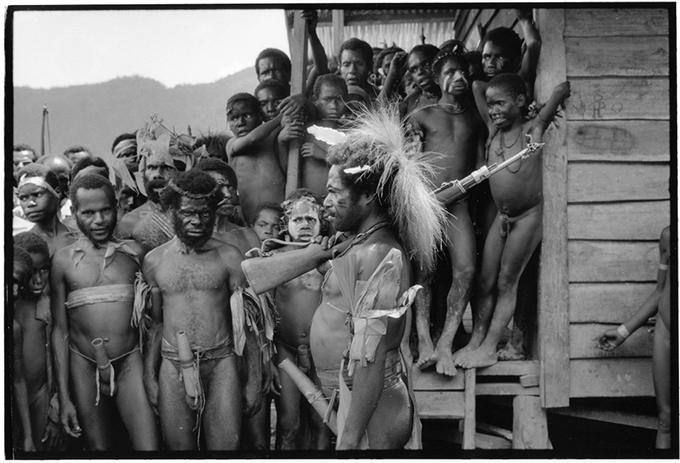
Bigger platform
Koroi Tadulala, a third year Fiji journalism student took part in the ePOP project both last year and this year.

-Partners-

“I joined ePOP because I’ve always been keen about climate change and the environment. I had been writing climate change stories since I started first year.

“Ever since then, I’ve been following up stories on climate change and then ePOP came around. I thought it would be a good opportunity for me to put my skills to use and address this issue on a bigger platform.”

The Fijian student bears a close connection to the effects of climate change as his own village is affected by sea level rise.

He said it made him want to be an activist in spreading “the word of climate change”.

“As part of the ePOP project, we go to the grassroots level and sit down with a lot of community members and ask them to share their stories with us,” he said.

Tadulala said it was a great opportunity to produce and share the stories to a wider audience.

‘Amazing’ response
“We brought out some of the stories that we didn’t really know about and now people are reacting to it. It’s amazing to see how people take it in.”

Tadulala created a video story on the effect of the 2016 Cyclone Winston on food security and a story on how the Fiji village of Nabudakra thinks they should strengthen their faith with God to reduce the impact of cyclones.

He said a project like ePOP catered to the digital era and encouraged young people to engage with issues around climate change.

“We create short videos from two to three minutes long so it enables them to go through the whole video without being bored.

“We decided to put this out on social media, especially because most of the people are using social media networks and it’s only smart to use that platform to put out the word of climate change.”

USP law student Mia Kami … need for youth engagement regarding climate change. Image: Blessen Tom/Bearing Witness

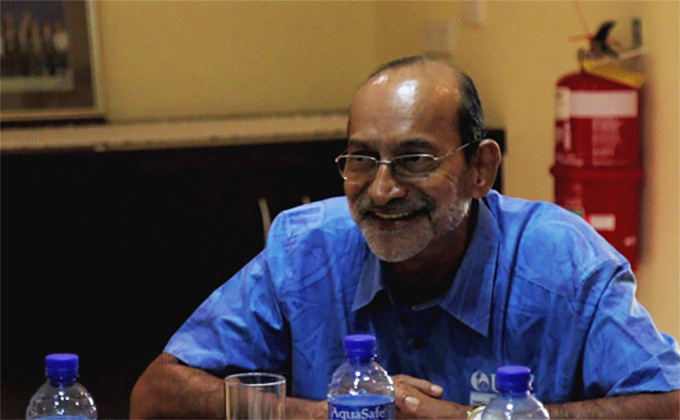
Filmmaking interest
Mia Kami, a law student at USP, also took part in the ePOP workshop out of an interest for filmmaking.

The student, of Tongan descent, said the ePOP team had shared that awareness of climate change issues faced by the Pacific was not as strong in Europe.

“Their [ePOP’s] goal was to spread awareness of climate change in Europe, so the videos that we did were based on climate change.

“I think because it was from a student in the Pacific, it would be a lot more heartfelt so people would understand it more from a Pacific point of view,” said Kami.

Kami and a few other students went to a fish market and interviewed vendors to get their perspective on how climate change affected fisheries.

She said she was surprised at what their idea of climate change was and how it affected them.

“The first lady we interviewed, her definition of climate change was that it’s bad weather.

Water pollution
“She believes that the bad weather is making the fishermen stop fishing, so they don’t fish and she doesn’t get to buy fish from them so she can sell. So that’s how she said that climate change affected her.”

Speaking of another vendor she interviewed, Kami said the vendor did not think overfishing was an issue and felt that it was water pollution.

“I feel like a lot of the media coverage that we do based on climate change, it doesn’t reach as far as their areas because a lot of the vendors are based in rural areas.

“I feel like the proper research on it doesn’t reach that grassroots level so I think if people took climate change into the more grassroots level, it would give them a totally different perspective.”

Kami enjoyed the ePOP project and the process of producing the video story. She said it was important for young people to make themselves aware of climate change.

“It’s our future. I think it’s important that we make an attempt to lessen the damage that we’re going to face in the future,” she said.

“What we can do now is so essential. If we know more about it, it makes so much of a difference. It all starts with ourselves.”

Hele Ikimotu and Blessen Tom are in Fiji as part of the Pacific Media Centre’s Bearing Witness 2018 climate change project. They are collaborating with the University of the South Pacific.

Print Friendly, PDF & Email

Article by AsiaPacificReport.nz

]]>

USP celebrates 50 years and leads research action on climate change

]]>

Bearing Witness crew Blessen Tom and Hele Ikimotu’s video story of USP’s ongoing 50th anniversary celebrations and climate change. Video: AUT Pacific Media Centre

By Hele Ikimotu with visuals by Blessen Tom in Suva

This year, the University of the South Pacific is celebrating 50 years since its opening in Fiji in  1968.

The university’s first campus was established in Suva, with a student count of 200 – it now accommodates over 30,000 students across the different campuses within the Pacific region.

USP has campuses in 12 different Pacific nations – Fiji, Cook Islands, Kiribati, Marshall Islands, Nauru, Niue, Samoa, Solomon Islands, Tokelau, Tonga, Tuvalu and Vanuatu.

Vice-Chancellor Professor Chandra said USP has made a positive contribution to the Pacific region, including contributions in human resources, policy change and research.

He described the university as being “owned by the Pacific and serves the Pacific”. Professor Chandra emphasised the need for these Pacific countries to work together in advocating for Pacific issues.

-Partners-

“As small countries, we need to work together. One is simply too small to be playing in the big world out there. We need to put all of our voices together. We need to co-operate, work together and integrate,” he said.

Professor Chandra also spoke highly of USP’s efforts in tackling the issue of climate change.

Leading stand
Over the years, the university has become one of the leading tertiary institutions to make a stand against the issue.

Vice-Chancellor Rajesh Chandra speaks to USP journalism students in a training media conference about the 50th anniversary of the regional Pacific university. Image: Blessen Tom/Bearing Witness
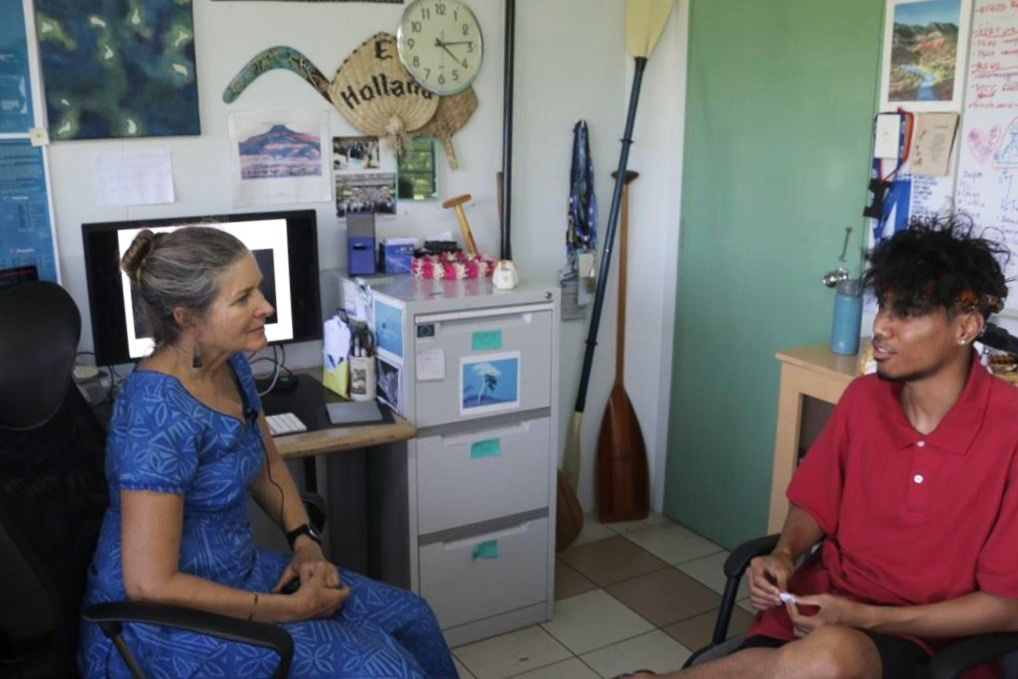
“The university has played this role of researching, advocating, supporting policies and disseminating knowledge around climate change,” said Professor Chandra.

The USP journalism school for example is consistently producing stories on climate change issues in their student newspaper Wansolwara. They have also partnered with AUT’s Pacific Media Centre to host two students every year for the Bearing Witness climate change journalism project.

This has seen significant stories about the effect climate change has had on communities in Fiji such as the award-winning multimedia story produced by Kendall Hutt and Julie Cleaver last year about Tukuraki village.

“I am also proud of the USP students. They have gone to the various COPs and have supported their own countries and have become senior advisers to their governments.

“I am quite proud and happy because the climate is central to the survival and prosperity of our country.”

The university’s 1999 strategic plan also saw the establishment of the Pacific Centre for Environment and Sustainable Development (PaCE-SD).

Raising awareness
The centre was opened to implement more research of the region’s environment and has continued to raise awareness about climate change and sustainable development in the Pacific.

PaCE-SD offers a postgraduate programme in climate change, with currently 200 students across the Pacific enrolled in the programme.

The centre also implements community projects around climate resilience in the Pacific and has been involved in major projects such as the Community Coastal Adaptation Project (C-CAP) and the Future Climate Leaders Programme (FCLP1).

Since the centre has been established, it has been recognised as a strong part of the university’s fight against climate change and environment research in the Pacific.

PaCE-SD director Professor Elisabeth Holland said it was important to be on the ground making a difference in the Pacific region and local communities.

Bearing Witness reporter Hele Ikimotu, speaks with Elisabeth Holland about the climate change work of PaCE-SD. Image: Blessen Tom/Bearing Witness
Deputy director of the centre Dr Morgan Wairiu echoed Professor Holland and said the focus of PaCE-SD was helping communities adapt to the changes in the environment because of climate change.

He said it was also important to provide students with the right skills to help them in their areas of research so they could come up with effective solutions to help communities affected by climate change.

PaCE-SD deputy director Dr Morgan Wairiu … providing the right mix of skills for students. Image: Blessen Tom/Bearing Witness


Community projects
Professor Holland said: “We run community development projects. We have a locally managed climate change adaptation network that extends to more than 100 communities in 15 countries across the Pacific.”

She said that by listening to how communities were affected by climate change, it had taught their team to listen better and develop a more participatory approach in decision making.

“We have the opportunity to learn from one another and if we’re learning from one another, we’re in a partnership to serve whatever problem is in front of us.”

Professor Holland encourages anyone who is interested in learning about climate change to keep an open mind and said: “Don’t assume you know what the answer is.

“The strongest solutions are those developed together. The fundamental values of participatory listening and respect help solve most of the challenges that come up.”

Hele Ikimotu and Blessen Tom are in Fiji as part of the Pacific Media Centre’s Bearing Witness 2018 climate change project. They are collaborating with the University of the South Pacific.

Print Friendly, PDF & Email

Article by AsiaPacificReport.nz

]]>

Solar panels the way to go for Pacific, says USP physics academic

]]>

The University of the South Pacific’s lower campus 45kw solar pv power system. Image: Hele Ikimotu/Bearing Witness

By Hele Ikimotu in Suva

Affordable energy enhances the livelihood of Pacific communities, says an associate professor in physics at the Fiji-based University of the South Pacific.

Dr Atul Raturi presented a seminar as part of the Pacific Centre for Environment and Sustainable Development (PaCE-SD) seminar series about the use of solar energy in supporting sustainable development in the Pacific.

The deputy director of the centre, Dr Morgan Wairiu, said these seminars were a great opportunity for students to interact with.

“We encourage our students and staff to attend these to exchange their ideas and knowledge.

“At the same time are bringing the visibility of the programme to outside communities about what we are doing here at the centre.”

Dr Raturi’s seminar focused on global sustainable development goal SDG7 (access to affordable and clean energy). He said SDG7 was a main driver for many of the other development goals.

Dr Atul Raturi presenting his seminar at the USP campus in Suva, Fiji … multiple challenges. Image: Hele Ikimotu/Bearing Witness
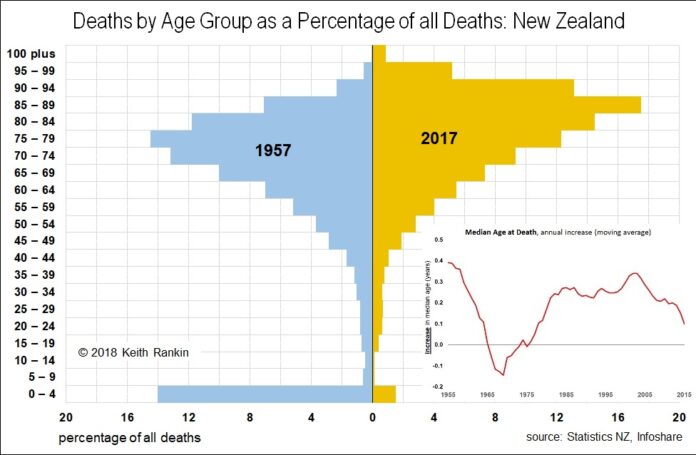
-Partners-

‘Trilemma’ challenge
He said Pacific Island countries face a”trilemma” – energy poverty, climate change impacts and extreme fossil fuel dependence.

As a result, communities are suffering from the effects such as having a lack of access to clean water.

Dr Raturi said renewable energy development can help tackle these three challenges.

He spoke of how solar PV was on the rise and some of the USP community solar projects as examples of sustainable development.

He said it was important to be having discussions with small communities to understand where their struggles were.

“The challenge of these projects is that we have a good heart and good intentions and we know what we want to do, but the community doesn’t want it because they have other priorities,” he said.

Creating an opportunity
Dr Raturi said listening to helps create an opportunity to collaborate with them on aiding their needs.

“We need to have a discussion with them and then together form a project. This is why a talanoa is very important.”

The USP community solar projects has seen success in several Fijian communities – one significant project regarding solar energy and water in Yanuca Island.

The community had no access to fresh water and through the project, a solar thermal desalination system was installed in March last year.

This system was described by Dr Raturi as “simple” as villagers just bring sea water and fill up a tank which is pumped using the solar energy, then producing fresh water.

“On a good sunny day, the system produces about 200 litres of drinking water,” he said.

The solar water pumping systems have also been installed for some Fijian schools – Batiri Lagi, Namau, Korotolutolu and Kubulau.

Shared message
Dr Raturi shared what one of the head mistresses at Namau School had said about the project:

“The supply of clean and safe water without any fuel costs is recognised by the community and the benefits will be felt by the future generations of children attending this school.”

He said it was important to recognise how solar energy could play a vital role in tackling climate stresses in the Pacific, achieving some of the sustainable development goals and also leading towards aspirations regarding the Paris agreement.

Hele Ikimotu and Blessen Tom are in Fiji as part of the Pacific Media Centre’s Bearing Witness 2018 climate change project. They are collaborating with the University of the South Pacific.

Print Friendly, PDF & Email

Article by AsiaPacificReport.nz

]]>

Keith Rankin’s Chart for this Month: Ages at Death, New Zealand 1957 and 2017

Chart for this Month: Ages at Death, New Zealand 1957 and 2017.

Analysis by Keith Rankin.

This month’s chart (a comparative histogram) shows the impact – of both an aging population and rising life expectancy – on ages at death. The percentages shown basically represent the probability that the next person to die in New Zealand will be in a given age bracket.
The biggest change over the last 60 years has been the reduced numbers of deaths of babies and very young children. While this reduction is the biggest single reason for increased life expectancy at birth, the number of deaths at this age in the 1950s also reflects the sheer numbers of children in New Zealand in that decade.
Birth numbers in New Zealand picked up after 1935, so all the age groups under 20 in 1957 show higher deaths in large part because of higher age-specific populations, especially higher numbers relative to the numbers of older adults. We might also note that there was, from a 1957 perspective, an unusually large cohort of people aged in their 70s.
We see that deaths of people in their 20s represented a similar proportion in 1957 to 2017, indicating that there is a problem today with that age group; a problem that may presage future adverse mortality.
Today, nearly one-third of registered deaths are of people in their 80s. More than half of deaths are of people over 80 years old, compared to 22 percent in 1957. The main reason so many people die in their 80s is that they didn’t die younger. It is not necessarily the case that people in their 80s are healthier today than they were in 1957. The numbers of deaths of people aged 45 to 70 remain high, reflecting that these age groups now represent a substantially greater portion of the total population.
The inset chart shows changes to the median age at death, from the mid-1950s to the mid-2010s, when the median age at death increased from about 70 to about 80. The inset makes it look as though most of the increase in life expectancy happened from 1980 to 2010. However, median age at death is very much a lagging indicator of the health of a population. It was only after 1980 that the ratio of older people to younger people in the population changed substantially.
The general impression is that health gains are tapering off. The median age at death has only increased annually by 0.1 years-of-age, this decade. That is entirely accountable by the aging of the 1940-75 baby boom generations.
We should not complacently assume that “we are all living longer”, as a number of commentators do to justify raising the age of entitlement to New Zealand Superannuation. Clearly many people still die at less than 70 years of age, and will continue to do so.
I am guessing that the age-at-death histogram for New Zealand will change very little over the next decade or so, despite a still-rising median age of the living population. Most of the reasons for higher life expectancy since the 1940s have already had their impact. The future contains more downside risk than upside.]]>

Pacific nuclear activist-poet tells stories through culture – and her latest poem

Pacific Media Centre
Sylvia C. Frain
Tuesday, April 17, 2018

Sylvia C. Frain reports from Hawai’i on the release of a poetry work focusing on the impact of nuclear activity in the Marshall Islands.

Nuclear activist, writer and poet Kathy Jetñil-Kijner from the Marshall Islands has launched her new poetry work which has a focus on nuclear weapons.

Her newest poem, “Anointed” can be seen as a short film by Dan Lin on YouTube.

At da Shop bookstore for the official launch of her poem, Jetñil-Kijner shared her writing process inspiration with the gathered audience. “I knew this poem could not be a broad nuclear weapons poem, but I needed to narrow the focus,”  says Jetñil-Kijner.

The project, which has an aim to personalise the ban of nuclear weapons, began during a talk-story session with photojournalist Lin three years ago in a café. Jetñil-Kijner told Lin that she wanted to perform a poem on the radioactive dome located on what remains of the Runit Island in the Enewetak Atoll Chain. Lin, who before this project worked as “only a photojournalist,”  agreed to document this collaborative “experiment”.  Lin spoke of how Jetñil-Kijner’s previous poems  had the “Kathy effect” which were filmed with only an iPhone and went viral across digital platforms. 

However, they agreed that this story deserved more in-depth documentation.  They partnered with the non-profit organisation,  Pacific Resources for Education and Learning (PREL) and with the Okeanos Foundation, specialising in sustainable sea transport. Travelling by Walap/Vaka Motu/Ocean Canoe for 11 days, Okeanos Marshall Islands ensured that zero carbon emissions were used and the experience served as a way to connect with the sea.

Runit Island
The radioactive dome on Runit Island is one of 14 islands in the Enewetak Atoll Chain, and the farthest atoll in the Ralik chain of the Marshall Islands. Enewetak and surrounding area has been studied scientifically after the 43 nuclear bomb explosions (out of the 67 total nuclear tests in the Marshall Islands) by the United States between 1948-1958.

Dubbed the “Cactus Crater”, Runit Island has limited economic possibilities. It is not a tourist destination nor has ability to export goods. No one will visit or purchase products from a radioactive location. This leaves the community dependent on funding from the United States. While many are grateful, they truly want to self-sustaining future. 

While conducting research for the poem, Jetñil-Kijner found that most of the literature is scientific and by journalists or researchers who do not include the voices of the local community or share the end results. Jetñil-Kijner wanted to create a poem focusing on the story of place beyond the association as a bombing site, and ask, “what is the island’s story?”

She learned from the elders that the island was considered the “pantry of the chiefs with lush vegetation, watermelons, and strong trees to build canoes”. As one of the remote atolls, the community consisted of navigators and canoe-builders with a thriving canoe culture.

Both Lin and Jetñil-Kijner said visiting the atolls was emotional and that approaching the dome felt like “visiting a sick relative you never met”.

The voyage included community discussions with elders and a writing workshop with the youth. Since the story of the dome is not usually a “happy one” the gatherings and workshops served as a method for the people to tell their stories not covered in the media or reported in US government documents.

Creating the poem with the community also required different protocols and Jetñil-Kijner thanked the community for generously sharing their knowledge and stories. She spoke to how the video connects the local community with a global audience across digital platforms. 

Digital technology and the future
Despite the remote location and distance as an outer island, there is limited wi-fi and the community has access to Facebook. These technological advances help with visualising these previous unfamiliar spaces, including using a drone to capture aerial shots of the dome and the rows of replanted but radioactive coconut trees. Supported by the Pacific Storytellers Cooperative, a digital platform for publishing Pacific voices, more young people are able to tell their stories online and foster relationships beyond the atoll.  

The newest generation is raising awareness through the incorporation of cultural knowledge combined with new media technologies to tell their stories. Empowered young leaders continue to unpack the layers of the nuclear legacy while highlighting their unique community and culture.

The Anointed poem and film serves as an educational resource to highlight the nuclear legacy and ongoing environmental issues in the Marshall Islands. This piece also promotes community justice and is a visual learning tool. Jetñil-Kijner and Lin encourage others to share Anointed and to join the call to action to ban nuclear weapons.

This work is licensed under a Creative Commons Attribution-NonCommercial 3

MORE INFORMATION

CULTURE: Sylvia C. Frain: On Saturday, nuclear activist, writer and poet Kathy Jetñil-Kijner from the Marshall Islands launched her new poetry work which has a focus on nuclear weapons. Her newest poem, “Anointed” can be seen as a short film by Dan Lin on YouTube.

https://www.kathyjetnilkijiner.com/
Nuclear activist and poet Kathy Jetñil-Kijner … exploring the “pantry of the chiefs with lush vegetation, watermelons, and strong trees to build canoes”. Image: Kathy Jetñil-Kijner

Report by Pacific Media Centre ]]>

Bryce Edwards’ Political Roundup: NZ’s fraught balancing act on Syria bombing

Bryce Edwards’ Political Roundup: NZ’s fraught balancing act on Syria bombing

[caption id="attachment_13635" align="alignright" width="150"] Dr Bryce Edwards.[/caption]

Should New Zealand be giving support to Trump’s military intervention in the Middle East? New Zealand politicians and commentators are very divided on what the best course of action is. So far, the Government has tried to take a middle path, being highly diplomatic in its response to the US-UK-France bombing of Syria, with Prime Minister Jacinda Ardern saying that she “accepts” what has happened.

This very deliberate use of the word “accepts” is designed to be ambiguous. It can be taken as support for the bombings. On the other hand, Ardern has also couched her “acceptance” of the attacks within broader statements about the need for a UN-mandated approach to the civil war in Syria. Her comments fall well short of other countries who have more clearly sided with Trump, Macron and May. Nonetheless, this middling approach has produced criticisms from both sides of politics. And as the conflict continues, these hard criticisms suggest that Ardern may be forced to “get off the fence”. The leftwing criticisms of Ardern’s approach Chris Trotter, writes in The Press today that “New Zealand’s prime minister has chosen to talk out of both sides of her mouth”, and risks running foul of Aesop’s famous dictum that “He who tries to please everybody, ends up pleasing nobody” – see: Prime Minister Jacinda Ardern has a bob each way on bombing Syria. Trotter’s strong preference would have been for Ardern to have taken a principled stand against what he sees as the West’s illegal and disastrous military intervention in a region that has already been badly destabilised by a century of imperialism. He outlines an alternative course of action New Zealand could have taken, which he argues would have been more effective and morally superior. He concludes that “An opportunity to assume moral leadership and demonstrate political courage has been heedlessly squandered.” Also critical of Ardern’s statement is former Green MP Keith Locke, who contrasts the stance to Helen Clark distancing herself from the US invasion of Iraq: “In some ways Ardern’s comments are a step back from the stance of the Clark Labour government in 2003, when the Bush administration didn’t wait for weapons inspectors to complete their work before it invaded Iraq. But at least Helen Clark didn’t support that invasion” – see: Ardern wrong to “accept” US-led air strikes on Syria. The Greens get it right. Locke also points out that other leftwing parties such as the British Labour Party are firmly opposed to the bombings. And in fact, “Ardern’s support for the bombing won’t meet much favour when she arrives in Britain shortly. Most parties (Labour, Liberal Democrats, Scottish Nationalists and the Greens) have come out against the air strikes.” Leftwing blogger Steven Cowan also argues Ardern is undermining New Zealand’s so-called independent foreign policy, and is simply making this country “a pawn in the grand game of imperialism” – see: Jacinda Ardern: Supporting American militarism. Cowan says Ardern’s careful wording in response to the air strikes amounts to support: “She couldn’t quite manage to say that she supported it – perhaps she thought that might offend some of her liberal supporters – but, semantics aside, that’s what she meant when he said that she accepted the ‘reasons’ for the military strike.” But another blogger on the left, Martyn Bradbury, completely disagrees with this, and argues Ardern was merely stating a fact: “Jacinda ‘accepts’ the US attacked Syria the same way we ‘accept’ the sun will come up tomorrow – there was an inevitability to Trump’s violence. That’s not collusion, that’s a diplomatic statement of reality” – see: Painting Jacinda out as a war criminal. Bradbury also quips, “I don’t see Jacinda’s diplomacy as grounds to put her in front of a UN war crimes tribunal, although if we did, Golriz [Ghahraman] would be a great lawyer for her.” But it’s not only the “far left” criticising the Government for being too soft on the western intervention in Syria. The Labour Party’s Greg Presland says: “New Zealand has not provided that ringing endorsement [desired by Trump] although has gone quite close in the language used” – see: The Government’s response to the Syrian crisis. He condemns the bombings, saying “the attack is unjustified. The United Nations and all of the related entities are there to ensure that these sorts of issues are dealt with in a civilised way.  The OPCW should have been allowed to inspect and report back.  Bombing the sites is tantamount to obstruction of justice.” And despite the Government’s ambiguous “acceptance” of the bombing raids, the Greens have come out in condemnation, with Golriz Ghahraman stating that “The airstrikes must be seen for what they are: a continuation of a policy that protects American and western interests and a breach of international law” – see: Bombing Syria will never bring peace. NZ must stand up against ad hoc violence. She claims the bombings will worsen the situation for Syrians, prolonging the conflict, and says “What New Zealand can do is never support any nation on the East/West divide who sponsors violence.” The rightwing criticisms of Ardern’s approach Many on the political right believe that Ardern should have shown much greater support for the US-led bombings. Some of this criticism focuses on Ardern’s appeal to use the UN to resolve the issue. Newstalk ZB’s Mike Hosking says the UN has been a failure, questioning “just how many kids people like Assad have to kill with gas and nerve agent and chlorine before they wake up and realise the United Nations is, has and won’t be doing anything to stop it” – see: Diplomacy is a failed strategy. The National Party, too, thinks the Prime Minister is being too soft. Leader Simon Bridges has said “I think it could be a bit stronger – these words do matter in foreign affairs”, and “if you look at what Australia’s said, Turnbull, actually Trudeau, one of our best mates, they’ve all said they support, they strongly support” – see Dan Satherley’s NZ should support US-led strikes on Syria, UN is useless – Simon Bridges. This report says that Bridges “stopped short of saying he’d offer to put Kiwi troops on the ground if the US requested it”, and he admitted: “I think the honest truth is I just don’t know.” According to the Herald, Bridges also wasn’t necessarily saying “that New Zealand should go where the US went”, saying, “We do have to have an independent foreign policy” – see: NZ should have been stronger on Syrian strikes, says Bridges. The same article cites Bridges’ suspicion that the Government’s approach is being influenced by diplomacy and trade ties with Russia: “You also feel the hand of Russia in all of this and we know that our Government’s had a pretty weird response on that.” Bridges’ statements about a stronger response also seem out of line with National’s foreign affairs spokesperson, Todd McClay, who backed up Ardern, saying “The government has made a strong statement and the National Party supports that” – see RNZ: National supports PM’s ‘strong statement’ on chemical warfare. For two newspaper editorials on the subject today, see the Herald’s Has West made its message clear on chemical weapons?, which says New Zealand should “unequivocally support” the bombings, and the Otago Daily Times, which outlines how New Zealand “has followed the line of countries like Brazil, Peru and Argentina, nations which have looked towards the United Nations Security Council to find a way to prevent the escalation of military conflict in Syria” – see: A red line against chemical warfare. Finally, Newshub political editor Tova O’Brien is also disappointed by Jacinda Ardern’s ambiguous position on Syria, and puts forward the case for and against supporting military intervention – see: PM’s position firmly on the fence isn’t good enough. Her conclusion? “None of this is particularly bad – it’s just so, so far from good.”

]]>