Page 994

Bolsonaro, COVID-19, and the Crisis of Brazilian Democracy

Source: Council on Hemispheric Affairs – Analysis-Reportage

By Marcia Cury

Brazilian President Jair Bolsonaro’s statements are at first shocking, leaving one wondering what he really means. But they are not surprising in the context of the paranoid rhetoric that has always characterized his administration. Since the start of the Coronavirus pandemic that is ravaging the world, for which the World Health Organization (WHO) has established preventive measures, the President of Brazil stands out for his public statements refusing to take any precautions. Contrary to all predictions of the consequences of infection, Bolsonaro insists on minimizing the risks posed by the virus and defies social distancing guidelines. He calls the disease a “fantasy” and “hysteria” whipped up by the media.[1]

Jair Bolsonaro’s remarks and inaction fit into his pattern of political practices. But in the middle of an unprecedented crisis, his behavior is sounding alarm bells about the  near term social and political fallout.

Bolsonaro the Science Denier

Jair Bolsonaro has never been the center of attention for implementing important projects during his long political career, but rather for his cavalier attitude towards dictatorship, racism, homophobia, and gender equality, which are sensitive subjects in such an unequal and violent society as that of Brazil. A denial of science guides most of his speeches on a wide variety of topics, and this has been no different during the pandemic. He first showed this irresponsible approach when he said on national TV that he opposed the preventive measures instituted by the governors and mayors. He criticized the social distancing guidelines by saying that unemployment might have a worse impact on society.[2] According to Bolsonaro, people should live their lives normally because it will only be possible to create “antibodies and a barrier” to the disease if some people get infected.[3] His public appearances, during which his followers  gather in the streets to greet him, have also been common and drawn the attention of the international press.

The ProSul hemispheric[4] meeting held by video conference on March 16, 2020, convened to discuss joint measures to confront the pandemic, was marked by the absence of the Brazilian president. At this important event, the country was represented by Foreign Minister Ernesto Araújo. In another display of his lack of commitment to mitigation efforts, Bolsonaro skipped the meeting of heads of the Judicial, Legislative, and Executive Branches of the Government of Brazil to establish common objectives for fighting the spread of the virus in the country. Instead, Luiz Henrique Mandetta, the Minister of Health, represented the Executive Branch.

In recent weeks Bolsonaro’s image has suffered as people begin to question his capacity to handle the crisis, including high-ranking public officials who have publicly expressed disagreement with his approach to containing the virus. The population is caught up in public confrontations between the Minister of Health, who defends social distancing policies, and the statements and practices of Jair Bolsonaro, who constantly questions the seriousness of the pandemic. This divergence of opinion has rattled the President’s legitimacy, even among military officers, who, for a time, backed the Minister of Health when the President threatened to fire him. The growing breach, however, came to head on Thursday April 16, when President Bolsonaro fired his minister, Luiz Henrique Mandetta.[5]

The conflicting messages emanating from the chief executive and his health minister  have led the population to pay less attention to mitigation measures and relax social distancing. Another controversy revolves around the President’s public advocacy for increasing production of hydroxychloroquine to treat COVID-19 patients. Bolsonaro has promoted this drug on radio and TV, although it is still the subject of research and debate among doctors and scientists as to whether it really is an effective treatment for the virus.[6]

Echoing Trump’s controversial strategy

It is striking that, just like U.S. President Donald Trump, Bolsonaro is using the pandemic to fuel his unrelenting ideological war. In the context of an unprecedented crisis, this is jeopardizing the economy and the country’s fragile democratic stability.

The Brazilian president continues to act as if this were a political campaign and all he needs to do is whip up his base. Now he is trapped by economic indicators that are no longer showing signs of strong growth. The pandemic can transform this precarious economic slowdown into a crisis.. Added to this is his constant preoccupation with remaining in power and his dream of reelection. Taking his usual stance of someone who has no concept of the responsibility inherent in his position, Bolsonaro reverts to anti-establishment discourse, a persecution complex, and extremist ideas to exacerbate the conflict, in a desperate attempt to hang onto the support of his base as well as his authority—both of which are increasingly fragile.

The show put on by Bolsonaro and his ideological promoters is a peculiar relaunching of an imaginary Cold War scenario in which the pandemic is supposedly just hysteria mounted by the opposition for political gain. For example, the president used primarily social media to spread fake news stories of shortages at a food distribution center in Minas Gerais, supposedly caused by the stay-at-home policy. The story was immediately refuted and Bolsonaro took down his posts.[7]

A war of words can be costly for the economy. His most recent attacks were aimed at China, the country’s top trading partner. The President’s son and federal lawmaker, Eduardo Bolsonaro (whom the President is thinking of appointing ambassador to the U.S.), and the Minister of Education, Abraham Weintraub, went on Twitter to blame China for spreading the virus, insinuating that the country is profiting financially from the pandemic. The last tweet, which the Minister has since deleted, prompted a reply from the Chinese embassy in Brazil. Ill will has been sown and people now fear a breakdown in trade relations between the two countries, to the inevitable detriment of Brazil.[8]

An irrational fear of “socialism” hamstrings government aid

Domestically, the conservative tone of Bonsonaro’s political agenda is in step with the various social sectors that make up his base. But now, the dystopian reign of the Bolsonaro family has found faith to be a useful tool. He recently called upon the population to fast in response to the pandemic, clearly a move meant to stir his faithful followers, including many Evangelicals. However, this pandemic affects all sectors of the country and will likely cost many lives. The most vulnerable people face uncertainty and have already lost income due to the crisis.[9] This is especially true in a country in which a sizable number of workers have informal jobs, without any social security protections.

The anti-government ideology so fiercely preached by the President and his team, despite the urgent hunger people are facing, has him refusing to believe the facts and figures in front of him. The President’s other son, Rio de Janeiro Council Member Carlos Bolsonaro, says that any state intervention would be a sign that the country is “moving toward socialism,” because with the economy paralyzed, people would be dependent on the State “even to eat.”[10] And Rubem Novaes, president of the country’s main public bank, Banco do Brasil, says we must resist state intervention because later it will be hard to dismantle “the welfare state.”[11] It was only after pressure from the public and the National Congress that Bolsonaro’s proposal to allow employers freedom to lay off workers and suspend labor contracts was rolled back. The Legislative Branch has ensured that families losing their incomes and livelihoods will receive some government compensation.

The government will pay them the equivalent of US$ 120, not the mere US$ 40 per month initially proposed by Paulo Guedes, the ultra-neoliberal Minister of Finance. The Provisional Measure now includes an up to 70% wage reduction for up to 90 days and the suspension of labor contracts for up to two months. These wage losses will be offset by an extension of unemployment insurance which already exists in the country to help workers who lose their jobs in the formal economy.

What is happening now in Brazil is a crisis that includes public health issues, a financial emergency, and political uncertainty. The public’s apprehension and dissatisfaction can now be heard in the pots-and-pans protests against Bolsonaro that make up the soundtrack of Brazilian nights. But just as part of society is beginning to make its dissatisfaction with the President heard, there is fear over what comes next as Bolsonaro becomes isolated. The blow to his legitimacy also threatens Brazilian democracy.

What we are currently witnessing, while not a complete reversal of civilian control over the armed forces as required for a democratic system, is at least a relativization of it. The Executive Branch, through the office of the Vice-President and eight of the 22 Cabinet Ministers, is full of people whose names are embellished with military titles. Their actions are imbued with nostalgia for the country’s dictatorial past. And a policy of military officers not engaging in politics is giving way to the politicization of the military, sometimes in direct confrontation with democratic institutions such as when General Augusto Heleno called the National Congress “blackmailers.”[12] In the case of the breach between the Minister of Health and the President, however, Bolsonaro has won the day, at least for now. During the pandemic crisis Bolsonaro will continue to be Bolsonaro. That is no surprise from a leader who got elected by taking conservative and authoritarian discourse to new heights, in an atmosphere of widespread “fake news.” But this is a precarious moment. It has been demonstrated that the scenario of a society in isolation, with people focused on protecting lives and fearing the impacts of a crisis, is primed for political manipulation. And the danger is even more real when it goes beyond the paranoia and irresponsible actions of a joking president, to include control by other institutional actors. In such a context one may imagine the possibility of the military co-governing. These are people who represent a recent authoritarian past, and who present themselves as the new salvation for a country “that has lost its way.” This situation demands that we remain vigilant, to ensure the survival of Brazil’s fragile democracy.

Márcia Cury is a Senior Research Fellow at COHA and historian who holds a Doctorate in Political Science. She is also a postdoctoral fellow in the post-graduate program in history at the UEFS in Brazil. She is the author of “El Protagonismo popular chileno: experiencias de clase y movimientos sociales en la construcción del socialismo (1964-1973).” Santiago: LOM Ediciones, 2018.


End notes

[1] “Em evento esvaziado nos EUA, Bolsonaro nega crise e diz que problemas na bolsa acontecem”,https://www1.folha.uol.com.br/mercado/2020/03/em-evento-esvaziado-nos-eua-bolsonaro-nega-crise-e-diz-que-problemas-na-bolsa-acontecem.shtml

[2] “Pronunciamento do Senhor Presidente da República, Jair Bolsonaro, em cadeia de rádio e televisão”, https://www.gov.br/planalto/pt-br/acompanhe-o-planalto/pronunciamentos/pronunciamento-em-cadeia-de-radio-e-televisao-do-senhor-presidente-da-republica-jair-bolsonaro

[3] “Exclusivo!, Jair Bolsonaro fala que ‘coronavírus’ é ‘histeria’ e conta que vai fazer festa de aniversário”, https://www.tupi.fm/brasil/exclusivo-jair-bolsonaro-fala-que-coronovirus-e-histeria-e-conta-que-vai-fazer-festa-de-aniversario/

[4] Prosul is a conservative forum that groups right-wing governments of the Americas

[5] AP News. April 16, 2020. https://apnews.com/26dc693cc9777da62e2b609e97ae57f8?utm_campaign=SocialFlow&utm_source=Twitter&utm_medium=AP

[6] “Pronunciamento do Senhor Presidente da República, Jair Bolsonaro, em cadeia de rádio e televisão”, https://www.gov.br/planalto/pt-br/acompanhe-o-planalto/pronunciamentos/pronunciamento-do-senhor-presidente-da-republica-jair-bolsonaro-em-cadeia-de-radio-e-televisao-4

[7] “Bolsonaro publica vídeo falso sobre desabastecimento e depois apaga”, https://www.agazeta.com.br/brasil/bolsonaro-publica-video-falso-sobre-desabastecimento-e-depois-apaga-0420

[8] “Eduardo Bolsonaro culpa China pelo coronavírus e Embaixada responde: ‘contraiu vírus mental’, https://www.cartacapital.com.br/carta-capital/eduardo-bolsonaro-culpa-china-pelo-coronavirus-e-embaixada-responde-contraiu-virus-mental/

https://twitter.com/BolsonaroSP/status/1240286560953815040 ; https://twitter.com/EmbaixadaChina/status/1247001670808154113

[9] “Efeitos econômicos negativos da crise do Corona vírus tendem a afetar mais a renda dos mais pobres”, https://ideas.repec.org/p/cdp/tecnot/tn003.html

[10] ”Partimos para o socialismo”, diz Carlos Bolsonaro sobre crise do coronavírus”, https://www.cartacapital.com.br/Politica/partimos-para-o-socialismo-diz-carlos-bolsonaro-sobre-crise-do-coronavirus/

https://twitter.com/carlosbolsonaro/status/1245323223459409920

[11] “Caiam na real: governadores e prefeitos oferecem esmolas com dinheiro alheio, diz Presidente do BB”, https://politica.estadao.com.br/noticias/geral,caiam-na-real-governadores-e-prefeitos-oferecem-esmolas-com-dinheiro-alheio-diz-presidente-do-bb,70003257728

[12] “General Heleno diz que Congresso faz chantagem para ficar com R$30 bi do orçamento”, https://www1.folha.uol.com.br/mercado/2020/02/general-heleno-diz-que-bolsonaro-e-alvo-de-parlamentarismo-branco-na-discussao-sobre-orcamento.shtml
https://twitter.com/gen_heleno/status/1230150789928230912?ref_src=twsrc%5Etfw%7Ctwcamp%5Etweetembed%7Ctwterm%5E1230150789928230912&ref_url=https%3A%2F%2Fwww1.folha.uol.com.br%2Fmercado%2F2020%2F02%2Fgeneral-heleno-diz-que-bolsonaro-e-alvo-de-parlamentarismo-branco-na-discussao-sobre-orcamento.shtml
Protecting lives and livelihoods: the data on why New Zealand should relax its coronavirus lockdown from Thursday

Source: The Conversation (Au and NZ) – By Martin Berka, Professor of Macroeconomics, Head of School of Economics and Finance, Massey University
New Zealand has the most stringent COVID-19 policy restrictions in the world, matched only by Israel and India, according to Oxford University’s coronavirus government response tracker.

The current level 4 restrictions have brought the number of cases down, and I am delighted the government acted quickly and strongly. But the newly announced level 3 conditions remain stringent, with ongoing border controls, limited domestic travel, and continued closures in many business sectors, including retail and hospitality.

On Monday, the government will announce whether New Zealand will remain in level 4 lockdown for longer, or move to level 3. The obvious trade-off lies between the loss of economic opportunities and the preservation of life.

Based on a combination of international and local data, I argue that New Zealand should go ahead and step back its restrictions from Thursday, because level 3 provides sufficient health outcomes without the worst economic impacts of level 4.


Read more: New Zealand’s coronavirus elimination strategy has united a nation. Can that unity outlast lockdown?


NZ’s world-leading COVID-19 death rate

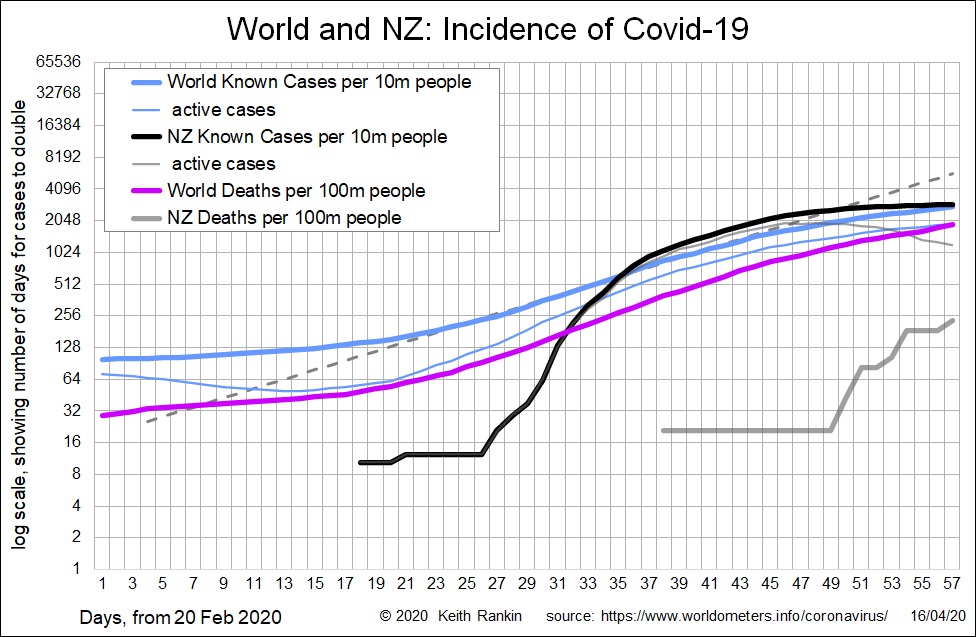
As the table below shows, New Zealand boasts the lowest mortality rate (0.1%, as of April 8) and ranks among the lowest on the number of confirmed cases per 100,000 people. New Zealand’s government can be proud of these health outcomes.

The Oxford tracker calculates a policy stringency index by combining 13 policy indicators, including school and workplace closures, travel bans, as well as fiscal policy measures.

The links between the stringency index, the number of confirmed cases and case mortality, are complex. In the case of New Zealand, good health outcomes are largely the result of stringent policy. In Italy, the reverse is the case as policy stringency followed rapidly deteriorating health outcomes.

From an economic point of view, the key difference is that while many countries required workplaces to shut down, New Zealand went further; its closures during level 4 have extended to every non-essential business, leaving only supermarkets and pharmacies open.


Read more: Five ways New Zealanders’ lives and liberties will be heavily controlled, even after lockdown eases


Scenarios of COVID-19 impacts

This week, the New Zealand Treasury released a report with five different scenarios of economic impacts from COVID-19.

In one of the worst case scenarios, in which New Zealand stays at level 4 lockdown for six months, followed by another six months of level 3 restrictions, treasury forecast an unemployment rate of around 26% and a drop in GDP by 37%. This would be unprecedented in New Zealand history (the worst real annual GDP growth rate since 1860 was -7.07% in 1932, and the highest unemployment since 1970 at 11% in 1991). This scenario is very unlikely to happen, given no one in the government has been talking about staying at level 4 for that long.

In the most positive scenario, New Zealand would end its current level 4 lockdown after one month, followed by another month of level 3 and ten months at levels 2 and 1. In this case, treasury estimates GDP would drop by around 5% and unemployment would peak at around 8%, but only because of the government’s NZ$12 billion rescue package. This may seem more palatable, but is still far worse than the recession that followed the 2008 global financial crisis, when New Zealand’s GDP declined by 2.2% and unemployment peaked at 6.9%.

The government’s unprecedented fiscal response will protect employment, but it offers limited protection from a drop in GDP. This is because the government is effectively paying workers to not work. This protects incomes, but because most aren’t actually allowed to work, GDP drops more than employment.


Read more: The psychology of lockdown suggests sticking to rules gets harder the longer it continues


Putting a value on lives lost

We rightfully feel repulsed by the notion of putting a price tag on life. But every government uses estimates of a “value of statistical life” in designing its health care policies and decisions about which life-saving drugs to fund.

There are hundreds of such estimates in the academic and policy literature. For example, the US Environmental Protection Agency uses a value estimate of around US$10 million per life, the Australian government indicates A$3.5 million, and the European Commission estimates €1-2 million.

If we assume value of statistical life of NZ$5 million (similar to the estimates in this report for the New Zealand Fire Service Commission), a back-of-the-envelope calculation suggests the policies in the tougher treasury scenario outlined above – of staying at level 4 lockdown for six months – would need to save at least 16,800 lives, statistically speaking, to have been worth it.

These unpalatable “trade-offs” are nevertheless what government officials consider when deciding when to open up the economy, aware that moving to level 3 will likely cost lives.

Additional costs of level 4 restrictions

Having the most stringent policy stance has resulted in an enviable decline in new confirmed coronavirus cases in New Zealand and prevented overloading the healthcare system.

But treasury estimates that if level 4 were to continue for a year, GDP would drop by 15% compared to level 3. In nominal terms, this means around NZ$45.5 billion per year.

The drop in GDP may seem surprising as the differences between the two levels is minor. At level 3, borders remain tightly controlled, people have to keep working from home if possible, and only companies that can implement physical distancing measures are allowed to resume production. Hospitality, retail, tourism and entertainment sectors remain largely closed, except for digital transactions. But these and other services comprise most of the GDP in advanced economies.

This cost also ignores long-term effects of unemployment. Young people will likely be on permanently worse-off earnings paths if we head into a multi-year recession. Poor people will be harder hit because they lack an economic “cushion”.

The clearest path forward from next week

I think a strong economic and humane case can be made to relax the rules to level 3 at the end of the current four-week level 4 lockdown, starting from next Thursday.

International epidemiological policy models of COVID-19 predict that countries will go through cycles of easing and tightening restrictions.

It is practically impossible to eliminate COVID-19 in the short term without major social upheaval caused by an economic depression. Level 4 is no longer an optimal policy because it ignores the livelihoods of almost the entire New Zealand population. Nobody is suggesting to open up the economy completely, but I argue that level 3 restrictions are strict enough to protect lives, while also helping people recover their livelihoods.

New Zealand’s level 3 rules are more stringent than Singapore, Hong Kong or South Korea, and could still cause an unprecedented recession. New Zealand shouldn’t return to level 4 unless there’s a threat of our health system being overrun.

ref. Protecting lives and livelihoods: the data on why New Zealand should relax its coronavirus lockdown from Thursday – https://theconversation.com/protecting-lives-and-livelihoods-the-data-on-why-new-zealand-should-relax-its-coronavirus-lockdown-from-thursday-136242

So you’re going to school online – here are 6 ways to make the most of it

Source: The Conversation (Au and NZ) – By Claire Brown, National Director, AVID Australia, Victoria University

Effective learning is a two-way process between the teacher and students, meaning both need to engage.

If a student simply sits and listens to new information without engaging or applying it, it’s called passive learning. Active learning is where students engage with new learning making connections to concepts they have learned previously.

According to one of the world’s leading university educators, Harvard University’s Professor Eric Mazur, “interactive learning triples students’ gains in knowledge”.

Here are six things students can do while studying online to ensure they are learning actively and and making gains.

1. Organise a learning space and dress for learning

Balancing a laptop on your knees on your bed, or with the television on in the background, is not the best way to study. Students learn best when their learning space minimises distractions.

A good learning space has a table and chair, good lighting, good air flow, is away from distractions like television and noise, has good connectivity for digital devices, and is organised with the usual things students have at school such as pens, paper, calculator and others study materials.

Learning online is like being at school in that you need to be physically and mentally prepared to learn. One study suggests what you wear can affect your attention to a task. So it might help not to be in your pyjamas even if your study space is in your bedroom.

2. Organise your learning time

Students with good time management skills tend to do better academically.

There is no easy answer to how long students should be studying at home each day. Students should plan a study timetable dividing their day into learning, revision and rest blocks.

“Zoom fatigue” has been identified as an emerging problem with online studying and meetings caused by the different ways our brains process information delivered online. One suggestion is an online session should be no longer than 45 minutes with a 15-minute break.


Read more: Trying to homeschool because of coronavirus? Here are 5 tips to help your child learn


Back-to-back sessions should be avoided and the time between sessions should be used to step away from the computer to rest your brain, body and eyes. It is important to stand up and move around every 30 minutes.

Students should work with teachers to revise their schedule each day and stick to what works for them.

3. Manage distractions

Because students will be studying in an different space, they may get distracted by what other people are doing. If you can, share your study timetable with others in the house, and ask for their help to keep focused.

When you’re in a learning block of time, turn off social media and close browser tabs you don’t need. If you’re using the Google Chrome browser, it has an extension called Stay Focusd. Students can use this to set the period of time to block potential distractions like notifications from Instagram, Snapchat and other applications.

If you are sharing a digital device with other family members, try to agree on a roster that fits with everyone’s timetables. Work out who needs the device at specific times and put that time on a master timetable that is shared by everyone.

4. Take notes

Our memories are not stable and we frequently overestimate how much we can remember. We forget at least 40% of new information within the first 24 hours of first reading or hearing it. That’s why it’s important to take notes.

Use different-colour markers to make connections between concepts. Shutterstock

Research is unclear about whether it is better to take notes digitally or by hand. Some researchers think it is a matter of preference.

The most important thing is to follow a good note-taking process. This involves:

  • writing an essential question that captures the key learning points of the topic

  • revising your notes. Use different colours and highlighters to make connections between chunks of information; add new ideas and write study questions in the margin. Compare notes with a study buddy to improve and learn from each other

  • writing a summary that links all the information together and answers the essential question you wrote down initially

  • revising your notes within 24 hours, seven days, and then each month until you are tested on that knowledge.


Read more: What’s the best, most effective way to take notes?


5. Adopt a growth mindset

In the 1990s, American psychologist Carol Dweck developed the theory of the growth mindset.

It grew out of studies in which primary school children were engaged in a task, and then praised either for their existing capacities, such as intelligence, or the effort they invested in the task.

The students who were praised for their effort were more likely to persist with finding a solution to the task. They were also more likely to seek feedback about how to improve. Those praised for their intelligence were less likely to persist with the more difficult tasks and to seek feedback on how their peers did on the task.


Read more: You can do it! A ‘growth mindset’ helps us learn


The growth mindset assumes capacities can be developed or “grown” through learning and effort. So if you don’t understand something straight away, working at it will help you get there.

If you are engaging in negative self-talk, change the words. For example, instead of saying, “This is too hard”, try saying, “What haven’t I tried yet to figure this out?”

6. Ask questions and collaborate

Ask teachers questions about anything that is unclear as soon as possible. Give teachers frequent feedback. Teachers appreciate suggestions that help improve student learning.

Set up online study groups. Learning is a social activity. We learn best by learning with others, and when learning is fun. Studying with friends helps clarify new concepts and language, and stay connected.

ref. So you’re going to school online – here are 6 ways to make the most of it – https://theconversation.com/so-youre-going-to-school-online-here-are-6-ways-to-make-the-most-of-it-135215

What might trigger a return to ‘normal’? Why our coronavirus exit strategy is … TBC

Source: The Conversation (Au and NZ) – By Katherine Gibney, NHMRC early career fellow, The Peter Doherty Institute for Infection and Immunity

The unprecedented restrictions Australians are living with are working, so far, to curb the rise in new COVID-19 cases.

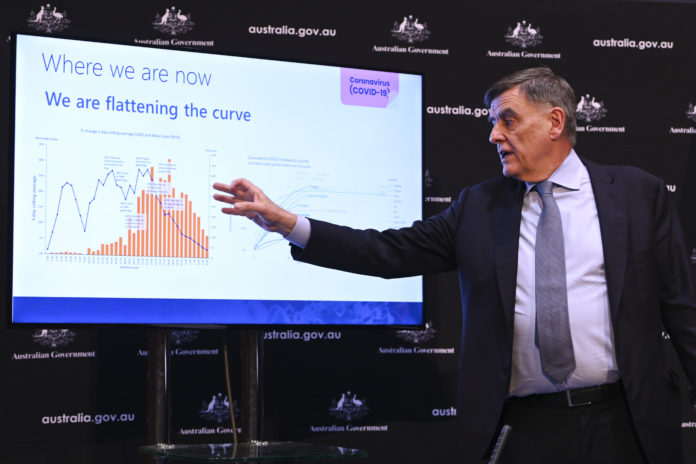
Nationally, on average around 50 new COVID-19 cases were reported each day in the week leading up to April 15, compared with a peak of 460 on March 28.

Fewer people are testing positive, and these cases are infecting fewer additional people, as we close international borders, work and study from home, keep 1.5m apart and limit unnecessary travel.

New modelling indicates ten people with the virus now infect only five others.

So many people are asking when physical distancing measures can be relaxed.


Read more: Latest coronavirus modelling suggests Australia on track, detecting most cases – but we must keep going


When can life go back to normal?

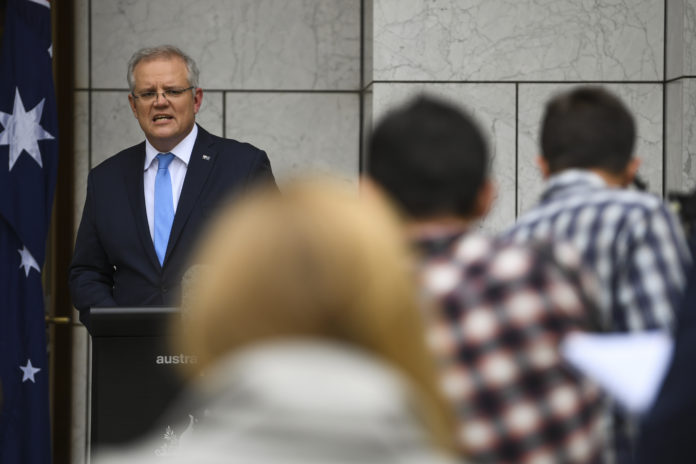
The simple answer is, life as normal cannot resume anytime soon. Prime Minister Scott Morrison has said current restrictions will be in place for at least the next four weeks.

COVID-19 remains highly infectious, and our population is still almost entirely susceptible to catching it.

Most people won’t have been exposed to the virus and won’t have built up immunity to it. And we’re unlikely to have a vaccine for at least the next 12–18 months.

This means we need to continue to modify the way we work, socialise and travel to minimise the chance of catching the virus.

What might trigger a return to ‘normal’?

When we know who’s immune

Serosurveys survey the population for antibodies in blood that protect against COVID-19. These can indicate the proportion of the population with natural immunity after COVID-19 infection.

These studies are underway internationally, including in the United States, and are planned for Australia.

Eventually they could inform who gets vaccinated and guide decisions around lifting restrictions. But these results are still likely to be some time away.


Read more: Here’s why the WHO says a coronavirus vaccine is 18 months away


Few new unexplained local cases for at least two weeks

The widespread physical distancing measures in place in Australia aim to prevent community transmission of COVID-19. This is distinct from border measures, which are designed to prevent the introduction of new cases from overseas.

As the restrictions on daily life have important health, social and economic ramifications beyond COVID-19, we will need to begin to roll them back before the Australian population is COVID-19 immune (and before we have results from serosurveys to confirm this).

These changes could begin when the number of locally acquired cases, particularly those transmitted in the community without a known source, is very low for a sustained period. This would need to be longer than the incubation period (the time from infection to symptoms showing), which for COVID-19 can be up to two weeks.

Now is an appropriate time to develop this “exit plan”, but we need to be cautious and responsive in doing so.

More testing, tracing and quarantine

First, we need an even stronger capacity to identify and isolate cases, and to trace and quarantine contacts.

As we’ve increased testing capacity in Australia, we’ve also expanded testing criteria. While initially restricted to returned travellers and contacts of a known case, some jurisdictions are now testing all people with COVID-19 symptoms – regardless of their travel or contact history – to determine the extent of community transmission.

Testing should continue to identify geographical areas or sub-populations with ongoing (or new) transmission, to pave the way for rapid and targeted public health responses.


Read more: More testing will give us a better picture of the coronavirus spread and its slowdown


Once a case is identified, a network of thousands of contact tracers work to to identify their contacts and provide advice around quarantine requirements.

Many countries have employed technological solutions such as contact tracing apps, and Australia is looking to follow suit. But such an app will be effective only if uptake is high.

Fewer than one-fifth of Singapore’s population had downloaded their TraceTogether contact tracing app by April 1, well short of their target.

When we know more about people with mild or no symptoms

Social distancing measures minimise the risk a person will transmit the virus to others when that person doesn’t know they’re infected. So before we consider relaxing them, we need to better understand the relative infectiousness of people with no or mild symptoms.

Studies currently underway are following families and close contacts of cases to see who develops typical COVID-19 symptoms, who is infected with mild or no symptoms, and who is not infected.

Likewise, understanding the role of children in transmitting infection is essential to support reopening schools, with appropriate social distancing in place. Research is similarly underway to attempt to answer this question.

Easing restrictions comes with risks. SOPA Images/AAP

We will likely see restrictions lifted in stages

While returning children to classrooms and opening businesses will be a priority, restrictions around international travel are likely to be in place for many months. Isolation of cases and quarantine of contacts are likely to be ongoing.

While Australia is developing its “exit plan”, other countries have revealed theirs. Iceland has announced physical distancing restrictions will be gradually lifted starting on May 4, including increasing the limit for gatherings from 20 to 50 people, and re-opening schools and universities.

Likewise, Norway is planning to re-open kindergartens, primary schools and certain businesses from April 20.


Read more: The coronavirus contact tracing app won’t log your location, but it will reveal who you hang out with


Even the best-laid plans might not eventuate. Physical distancing measures had been relaxed in Singapore, Japan and South Korea after flattening the curve, but were recently re-introduced following a surge in cases.

No-one knows how the coming months will play out, but this is a marathon, not a sprint. We’ll need to carefully manage the risks that come with easing restrictions. But Australia is well-placed to do this, having successfully navigated the COVID-19 journey so far.

ref. What might trigger a return to ‘normal’? Why our coronavirus exit strategy is … TBC – https://theconversation.com/what-might-trigger-a-return-to-normal-why-our-coronavirus-exit-strategy-is-tbc-136047

Protecting lives and livelihoods: the data on why New Zealand should relax its strict lockdown from Thursday

Source: The Conversation (Au and NZ) – By Martin Berka, Professor of Macroeconomics, Head of School of Economics and Finance, Massey University

New Zealand has the most stringent COVID-19 policy restrictions in the world, matched only by Israel and India, according to Oxford University’s coronavirus government response tracker.

The current level 4 restrictions have brought the number of cases down, and I am delighted the government acted quickly and strongly. But the newly announced level 3 conditions remain stringent, with ongoing border controls, limited domestic travel, and continued closures in many business sectors, including retail and hospitality.

On Monday, the government will announce whether New Zealand will remain in level 4 lockdown for longer, or move to level 3. The obvious trade-off lies between the loss of economic opportunities and the preservation of life.

Based on a combination of international and local data, I argue that New Zealand should go ahead and step back its restrictions from Thursday, because level 3 provides sufficient health outcomes without the worst economic impacts of level 4.


Read more: New Zealand’s coronavirus elimination strategy has united a nation. Can that unity outlast lockdown?


NZ’s world-leading COVID-19 death rate

As the table below shows, New Zealand boasts the lowest mortality rate (0.1%, as of April 8) and ranks among the lowest on the number of confirmed cases per 100,000 people. New Zealand’s government can be proud of these health outcomes.

The Oxford tracker calculates a policy stringency index by combining 13 policy indicators, including school and workplace closures, travel bans, as well as fiscal policy measures.

The links between the stringency index, the number of confirmed cases and case mortality, are complex. In the case of New Zealand, good health outcomes are largely the result of stringent policy. In Italy, the reverse is the case as policy stringency followed rapidly deteriorating health outcomes.

From an economic point of view, the key difference is that while many countries required workplaces to shut down, New Zealand went further; its closures during level 4 have extended to every non-essential business, leaving only supermarkets and pharmacies open.


Read more: Five ways New Zealanders’ lives and liberties will be heavily controlled, even after lockdown eases


Scenarios of COVID-19 impacts

This week, the New Zealand Treasury released a report with five different scenarios of economic impacts from COVID-19.

In one of the worst case scenarios, in which New Zealand stays at level 4 lockdown for six months, followed by another six months of level 3 restrictions, treasury forecast an unemployment rate of around 26% and a drop in GDP by 37%. This would be unprecedented in New Zealand history (the worst real annual GDP growth rate since 1860 was -7.07% in 1932, and the highest unemployment since 1970 at 11% in 1991). This scenario is very unlikely to happen, given no one in the government has been talking about staying at level 4 for that long.

In the most positive scenario, New Zealand would end its current level 4 lockdown after one month, followed by another month of level 3 and ten months at levels 2 and 1. In this case, treasury estimates GDP would drop by around 5% and unemployment would peak at around 8%, but only because of the government’s NZ$12 billion rescue package. This may seem more palatable, but is still far worse than the recession that followed the 2008 global financial crisis, when New Zealand’s GDP declined by 2.2% and unemployment peaked at 6.9%.

The government’s unprecedented fiscal response will protect employment, but it offers limited protection from a drop in GDP. This is because the government is effectively paying workers to not work. This protects incomes, but because most aren’t actually allowed to work, GDP drops more than employment.


Read more: The psychology of lockdown suggests sticking to rules gets harder the longer it continues


Putting a value on lives lost

We rightfully feel repulsed by the notion of putting a price tag on life. But every government uses estimates of a “value of statistical life” in designing its health care policies and decisions about which life-saving drugs to fund.

There are hundreds of such estimates in the academic and policy literature. For example, the US Environmental Protection Agency uses a value estimate of around US$10 million per life, the Australian government indicates A$3.5 million, and the European Commission estimates €1-2 million.

If we assume value of statistical life of NZ$5 million (similar to the estimates in this report for the New Zealand Fire Service Commission), a back-of-the-envelope calculation suggests the policies in the tougher treasury scenario outlined above – of staying at level 4 lockdown for six months – would need to save at least 16,800 lives, statistically speaking, to have been worth it.

These unpalatable “trade-offs” are nevertheless what government officials consider when deciding when to open up the economy, aware that moving to level 3 will likely cost lives.

Additional costs of level 4 restrictions

Having the most stringent policy stance has resulted in an enviable decline in new confirmed coronavirus cases in New Zealand and prevented overloading the healthcare system.

But Treasury estimates that if level 4 were to continue for a year, GDP would drop by 15% compared to level 3. In nominal terms, this means around NZ$45.5 billion per year.

The drop in GDP may seem surprising as the differences between the two levels is minor. At level 3, borders remain tightly controlled, people have to keep working from home if possible, and only companies that can implement physical distancing measures are allowed to resume production. Hospitality, retail, tourism and entertainment sectors remain largely closed, except for digital transactions. But these and other services comprise most of the GDP in advanced economies.

This cost also ignores long-term effects of unemployment. Young people will likely be on permanently worse-off earnings paths if we head into a multi-year recession. Poor people will be harder hit because they lack an economic “cushion”.

The clearest path forward from next week

I think a strong economic and humane case can be made to relax the rules to level 3 at the end of the current four-week level 4 lockdown, starting from next Thursday.

International epidemiological policy models of COVID-19 predict that countries will go through cycles of easing and tightening restrictions.

It is practically impossible to eliminate COVID-19 in the short term without major social upheaval caused by an economic depression. Level 4 is no longer an optimal policy because it ignores the livelihoods of almost the entire New Zealand population. Nobody is suggesting to open up the economy completely, but I argue that level 3 restrictions are strict enough to protect lives, while also helping people recover their livelihoods.

New Zealand’s level 3 rules are more stringent than Singapore, Hong Kong or South Korea, and could still cause an unprecedented recession. New Zealand shouldn’t return to level 4 unless there’s a threat of our health system being overrun.

ref. Protecting lives and livelihoods: the data on why New Zealand should relax its strict lockdown from Thursday – https://theconversation.com/protecting-lives-and-livelihoods-the-data-on-why-new-zealand-should-relax-its-strict-lockdown-from-thursday-136242

Protecting lives and livelihoods: the data on why New Zealand should relax its strict lockdown next week

Source: The Conversation (Au and NZ) – By Martin Berka, Professor of Macroeconomics, Head of School of Economics and Finance, Massey University

New Zealand has the most stringent COVID-19 policy restrictions in the world, matched only by Israel and India, according to Oxford University’s coronavirus government response tracker.

The current level 4 restrictions have brought the number of cases down, and I am delighted the government acted quickly and strongly. But the newly announced level 3 conditions remain stringent, with ongoing border controls, limited domestic travel, and continued closures in many business sectors, including retail and hospitality.

On Monday, the government will announce whether New Zealand will remain in level 4 lockdown for longer, or move to level 3. The obvious trade-off lies between the loss of economic opportunities and the preservation of life.

Based on a combination of international and local data, I argue that New Zealand should go ahead and step back its restrictions from Thursday, because level 3 provides sufficient health outcomes without the worst economic impacts of level 4.


Read more: New Zealand’s coronavirus elimination strategy has united a nation. Can that unity outlast lockdown?


NZ’s world-leading COVID-19 death rate

As the table below shows, New Zealand boasts the lowest mortality rate (0.1%, as of April 8) and ranks among the lowest on the number of confirmed cases per 100,000 people. New Zealand’s government can be proud of these health outcomes.

The Oxford tracker calculates a policy stringency index by combining 13 policy indicators, including school and workplace closures, travel bans, as well as fiscal policy measures.

The links between the stringency index, the number of confirmed cases and case mortality, are complex. In the case of New Zealand, good health outcomes are largely the result of stringent policy. In Italy, the reverse is the case as policy stringency followed rapidly deteriorating health outcomes.

From an economic point of view, the key difference is that while many countries required workplaces to shut down, New Zealand went further; its closures during level 4 have extended to every non-essential business, leaving only supermarkets and pharmacies open.


Read more: Five ways New Zealanders’ lives and liberties will be heavily controlled, even after lockdown eases


Scenarios of COVID-19 impacts

This week, the New Zealand Treasury released a report with five different scenarios of economic impacts from COVID-19.

In one of the worst case scenarios, in which New Zealand stays at level 4 lockdown for six months, followed by another six months of level 3 restrictions, treasury forecast an unemployment rate of around 26% and a drop in GDP by 37%. This would be unprecedented in New Zealand history (the worst real annual GDP growth rate since 1860 was -7.07% in 1932, and the highest unemployment since 1970 at 11% in 1991). This scenario is very unlikely to happen, given no one in the government has been talking about staying at level 4 for that long.

In the most positive scenario, New Zealand would end its current level 4 lockdown after one month, followed by another month of level 3 and ten months at levels 2 and 1. In this case, treasury estimates GDP would drop by around 5% and unemployment would peak at around 8%, but only because of the government’s NZ$12 billion rescue package. This may seem more palatable, but is still far worse than the recession that followed the 2008 global financial crisis, when New Zealand’s GDP declined by 2.2% and unemployment peaked at 6.9%.

The government’s unprecedented fiscal response will protect employment, but it offers limited protection from a drop in GDP. This is because the government is effectively paying workers to not work. This protects incomes, but because most aren’t actually allowed to work, GDP drops more than employment.


Read more: The psychology of lockdown suggests sticking to rules gets harder the longer it continues


Putting a value on lives lost

We rightfully feel repulsed by the notion of putting a price tag on life. But every government uses estimates of a “value of statistical life” in designing its health care policies and decisions about which life-saving drugs to fund.

There are hundreds of such estimates in the academic and policy literature. For example, the US Environmental Protection Agency uses a value estimate of around US$10 million per life, the Australian government indicates A$3.5 million, and the European Commission estimates €1-2 million.

If we assume value of statistical life of NZ$5 million (similar to the estimates in this report for the New Zealand Fire Service Commission), a back-of-the-envelope calculation suggests the policies in the tougher treasury scenario outlined above – of staying at level 4 lockdown for six months – would need to save at least 16,800 lives, statistically speaking, to have been worth it.

These unpalatable “trade-offs” are nevertheless what government officials consider when deciding when to open up the economy, aware that moving to level 3 will likely cost lives.

Additional costs of level 4 restrictions

Having the most stringent policy stance has resulted in an enviable decline in new confirmed coronavirus cases in New Zealand and prevented overloading the healthcare system.

But Treasury estimates that if level 4 were to continue for a year, GDP would drop by 15% compared to level 3. In nominal terms, this means around NZ$45.5 billion per year.

The drop in GDP may seem surprising as the differences between the two levels is minor. At level 3, borders remain tightly controlled, people have to keep working from home if possible, and only companies that can implement physical distancing measures are allowed to resume production. Hospitality, retail, tourism and entertainment sectors remain largely closed, except for digital transactions. But these and other services comprise most of the GDP in advanced economies.

This cost also ignores long-term effects of unemployment. Young people will likely be on permanently worse-off earnings paths if we head into a multi-year recession. Poor people will be harder hit because they lack an economic “cushion”.

The clearest path forward from next week

I think a strong economic and humane case can be made to relax the rules to level 3 at the end of the current four-week level 4 lockdown, starting from next Thursday.

International epidemiological policy models of COVID-19 predict that countries will go through cycles of easing and tightening restrictions.

It is practically impossible to eliminate COVID-19 in the short term without major social upheaval caused by an economic depression. Level 4 is no longer an optimal policy because it ignores the livelihoods of almost the entire New Zealand population. Nobody is suggesting to open up the economy completely, but I argue that level 3 restrictions are strict enough to protect lives, while also helping people recover their livelihoods.

New Zealand’s level 3 rules are more stringent than Singapore, Hong Kong or South Korea, and could still cause an unprecedented recession. New Zealand shouldn’t return to level 4 unless there’s a threat of our health system being overrun.

ref. Protecting lives and livelihoods: the data on why New Zealand should relax its strict lockdown next week – https://theconversation.com/protecting-lives-and-livelihoods-the-data-on-why-new-zealand-should-relax-its-strict-lockdown-next-week-136242

The new iPhone SE is the cheapest yet: smart move, or a premium tech brand losing its way?

Source: The Conversation (Au and NZ) – By Margarietha de Villiers Scheepers, Senior Lecturer Entrepreneurship and Innovation, University of the Sunshine Coast

At face value, Apple’s decision to launch the second-generation iPhone SE with a recession looming may not make sense. But there’s likely more to this move than meets the eye.

Targeted at price-conscious customers amid the COVID-19 pandemic, the release of the conspicuously lower-priced iPhone SE has raised eyebrows among fans and critics alike.

It’s not common for the company to go against its traditional upmarket brand image. Is this a desperate attempt to cope during crisis, or perhaps a strategy that’s been in the works longer than we realised?

The cheapest iPhone yet

Launching products, or even businesses, during an economic downturn isn’t new. In his book The Silver Lining, author and business consultant Scott Anthony argues “customer problems don’t fade in tough economic times; in fact previously hidden problems are highlighted and old problems intensify”.

Apple’s previously “hidden problems” include increasing competition and a relative decline in smartphone demand since 2018.

In less than a decade smartphones have become very expensive, with incremental product improvements that add little value from one generation to the next. So, when the previous iPhone SE was launched in 2016, its popularity in the mid-range market wasn’t surprising.


Read more: Apple’s iPhone 11 Pro wants to take your laptop’s job (and price tag)


Like its predecessor, the new SE is small. It’s identical in design to the iPhone 8. And although it’s the cheapest iPhone to date, it packs a range of advanced features that mirror the iPhone 11, including an A13 bionic chip.

The SE brand has raised curiosity, as the product range signals a deviation from Apple’s traditional high-end branding. The SE has left fans pondering the price tag of more expensive iPhones over a cheaper option with many of the same features.

Coping under duress

With already slowing sales and fierce competition, it makes sense for Apple to diversify its product portfolio. Analysis by research advisory firm Gartner showed a global 1.7% decline in smartphone sales in the second quarter of 2019.

Apple and Xiaomi were the only brands to achieve even meagre growth in the fourth quarter of 2019, whereas Huawei, OPPO and others experienced decline. A fierce battle between Samsung and Apple persists, with Samsung holding the most market share at 17.3%.

Such competitive pressures are compounded by the looming global coronavirus economic recession and a weak market outlook. Unemployment projections indicate consumers simply won’t have the disposable income they once did. And those in the market for a new smartphone will be more cautious with their spending.


Read more: How will the coronavirus recession compare with the worst in Australia’s history?


Preppy vs purposeful products

Some argue Apple’s lacklustre iPhone sales performance in a competitive market fulfils the “haunted empire” thesis – popularised by former Wall Street Journal reporter Yukari Iwatani Kane in her book of the same name – which suggests the giant lost its way after Steve Jobs’s death. But we think the answer is simpler.


Read more: Channelling Steve Jobs in Apple’s ‘Haunted Empire’


Apple, once a market leader, is now facing the “innovator’s dilemma” described by the late US academic Clayton Christensen. He explained how market leaders are disrupted by smaller, nimbler companies that start by offering cheaper, lower-quality products to low-end customers. These products serve their purpose and eventually these companies – such as OPPO, Xiaomi, and Huawei – improve their offerings to attract a more affluent market.

Apple probably realises it now needs to adapt its strategy to deal with competitive pressure and changing market conditions. It must diversify its product range to offer more value to consumers across the market spectrum.

The decision to launch the new iPhone SE is a much-needed break from tradition. It leaves customers in a winning position by providing more value at a lower price. This is evident in the removal of features such as Face ID and a large screen. The focus is instead on essential features such as a fast processing chip and high-quality camera.

While it may seem like the tech giant is turning its back on the upmarket brand image it once prided itself on, this shift may be favourable for Apple and help it win fans from a wider range of demographics.

Evolving in a tough market

Smartphone market penetration is already at more than 85% in several countries, and these countries are generally “richer”. This means the space left for smartphone sales is in emerging economies where people are more price-sensitive.

As high-end market demand continues to shrink, Apple’s future will likely be in software and services such as music, games, apps, Apple Pay and subscriptions. However, this market is also crowded. While services and software sometimes have higher profit margins, they won’t provide Apple the level of growth hardware originally did.

Extending, not ending, its brand

The first SE’s release in 2016 marked the beginning of Apple’s diversification from its upmarket smartphone strategy.

That said, the company’s iconic brand maintains a loyal following as it connects with customers emotionally, and provides an unmatched ecosystem of products and services. It continues to explore other market options, such as 5G supported smartphones (but progress with this is halted by the pandemic).

With a reported value of about US$140.5 billion, Apple’s brand is still among the world’s most valuable. And providing a lower-cost alternative to customers during a period of economic stress is likely to strengthen, rather than weaken its brand.

ref. The new iPhone SE is the cheapest yet: smart move, or a premium tech brand losing its way? – https://theconversation.com/the-new-iphone-se-is-the-cheapest-yet-smart-move-or-a-premium-tech-brand-losing-its-way-136507

Explainer: what does the Federal Court decision on the Tamil asylum-seeker family mean?

Source: The Conversation (Au and NZ) – By Mary Anne Kenny, Associate Professor, School of Law, Murdoch University

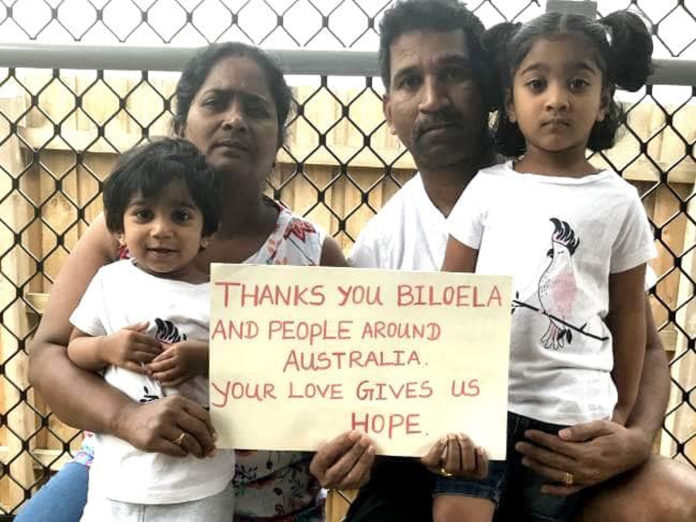
The Sri Lankan family that had been living in Biloela, Queensland, before being held in detention on Christmas Island has had a partial victory in the Federal Court, with a ruling that the youngest child was not granted “procedural fairness”.

This is not yet a decision about whether the family will be allowed back into the community, but leaves the way open for the family to continue its bid to stay in Australia.

What was the judgment?

The case involves a two-year-old girl, Tharunicaa, born in Australia to Sri Lankan Tamil parents. (The couple also has a four-year-old daughter, Kopika.) The family have been in immigration detention on Christmas Island since a dramatic injunction stopped their deportation back to Sri Lanka in August 2019.

The judgment made today by Justice Moshinsky found Tharunicaa was not given “procedural fairness” when her request for permission to apply for a protection visa was rejected.


Read more: How the Biloela Tamil family deportation case highlights the failures of our refugee system


Tharunicca’s parents and sister had previously had their claims for protection refused. Appeals to the courts about the fairness of the process in their cases were not successful.

Tharunicaa was born after her parents had made their visa application. Even though she was born in Australia, her parents’ arrival in Australia by boat as asylum seekers means the law designates her to be an “unauthorised maritime arrival”. Legally, this means she is not able to make an application for a protection visa unless the minister for immigration personally allows her to under section 46A of the Migration Act.

Lawyers for Tharunicca argued the minister should allow her to make that application and have her own claims for asylum considered as there were significant concerns she and her family would face persecution if returned to Sri Lanka.

In exercising the section 46A power, the judge stated, the minister has to consider whether to exercise his power to “lift the bar” to allow her to apply. The question in this case was whether he had to observe procedural fairness in carrying out that power.


Read more: View from The Hill: Morrison and Dutton block their ears and grit their teeth over Tamil family


Evidence provided by the Department of Home Affairs and lawyers for Tharunicaa was examined in detail.

The judge found the department had prepared a detailed 11-page brief on the family’s background and claims for protection, which was given directly to Immigration Minister David Coleman in May 2019. The brief provided the minister with several options for him to circle. However, this was not done.

The judge found the minister had made no clear final decision on that brief. However, even though no decision was made, the minister was clearly still considering whether to allow the child to make a visa application.

In August 2019, an officer in the Department of Home Affairs wrote to the lawyers that the request for ministerial intervention had been assessed and the request did not meet the guidelines required for a referral to the minister. The department then “finalised this request without referral”.

Justice Moshinky found the department had not afforded “procedural fairness” to the child, in that it had not allowed her lawyers the opportunity to provide any evidence or submissions on her behalf.

The judge has asked the lawyers for the government and the family to discuss and agree on what orders should be made to allow Tharunicaa’s request to be considered properly.

What does it mean for the family?

The decision means the case is ongoing. The injunction preventing the removal of the family will continue.

The judge has asked that the parties agree on orders within seven days. If they can’t agree on the orders, he has asked them to provide separate submissions to him within 14 days. He will make orders after that.

ref. Explainer: what does the Federal Court decision on the Tamil asylum-seeker family mean? – https://theconversation.com/explainer-what-does-the-federal-court-decision-on-the-tamil-asylum-seeker-family-mean-136504

How can we restore trust in media? Fewer biases and conflicts of interest, a new study shows

Source: The Conversation (Au and NZ) – By Caroline Fisher, Assistant Professor in Journalism, University of Canberra

The COVID-19 global pandemic has seen news consumption rise in Australia. Audiences for TV news are up and Australians are spending more time on news websites seeking reliable information about the virus and the social and economic consequences of our policy responses.

This makes trust in the media more imperative than ever.

Researchers at the Queensland University of Technology and the University of Canberra have undertaken a survey of 1,045 Australians to gauge levels of trust and mistrust in news and what influences it.


Read more: A matter of trust: coronavirus shows again why we value expertise when it comes to our health


The most trusted voices in news

We found people trust the news they personally consume more than the news in general, and that trust in news was higher than trust in business or government, although lower than trust in friends and educational institutions.

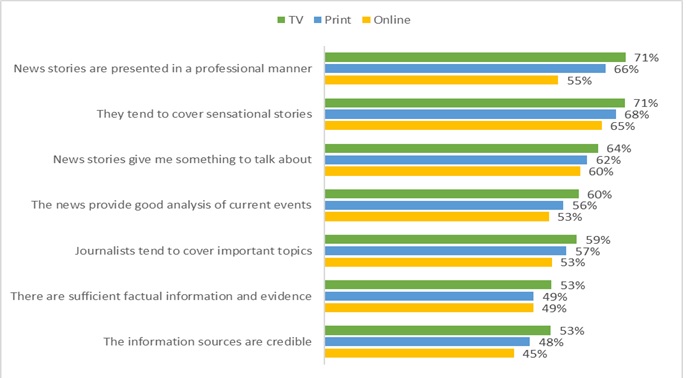
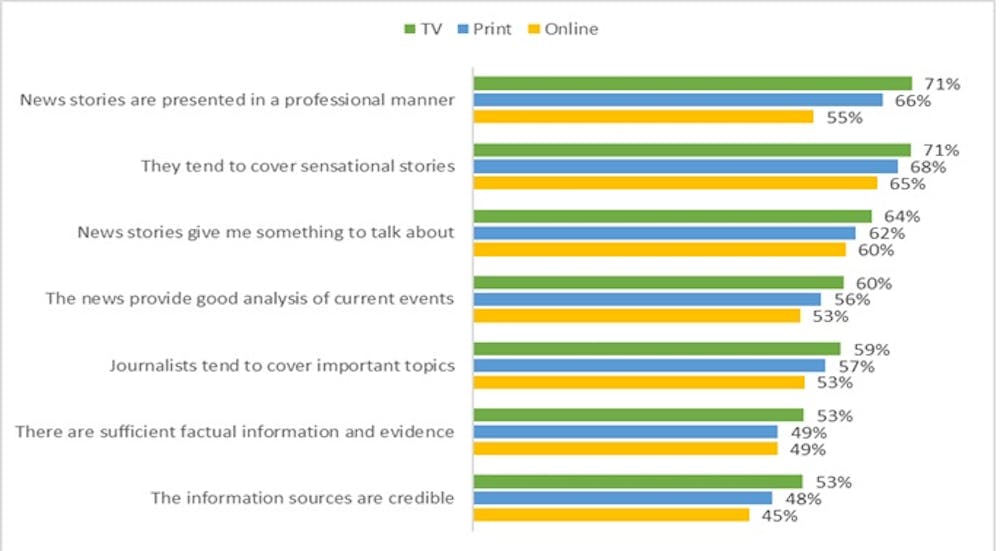
Our participants deemed television the most credible source of information that provides good analysis of current events. Online news sources (including online only and mainstream media) were not viewed to be as credible or professional as traditional offline media.


Performance by media platform. Flew, T., Dulleck, U., Park, S., Fisher, C. & Isler, O. (2020). Trust and Mistrust in Australian News Media. Brisbane: Digital Media Research Centre.

Some brands were more trusted than others. Trust in established news brands and public broadcasters was highest. Measured on a scale of 1-5 with 5 being the highest, ABC TV (3.92) and radio (3.90) ranked highest, followed by SBS TV (3.87).

Among commercial media, the most trusted news brand was The Australian Financial Review (3.74), followed by The Age (3.69) and The Australian (3.69). More recently established brands had lower levels of trust, with Guardian Australia (3.45) being the most trusted.

Declaring conflicts of interest is important

To find out why people do or don’t trust the news, we asked them to rank a range of possible influences.

Factors that promoted mistrust in news included a past history of inaccurate stories, opinionated journalists or presenters, a lack of transparency, sensationalism and excessive advocacy on behalf of particular points of view.

Factors that promoted trust included depth of coverage, the reputation of the news brand, the reputation of particular journalists or presenters, and openness to comments and feedback from audiences.


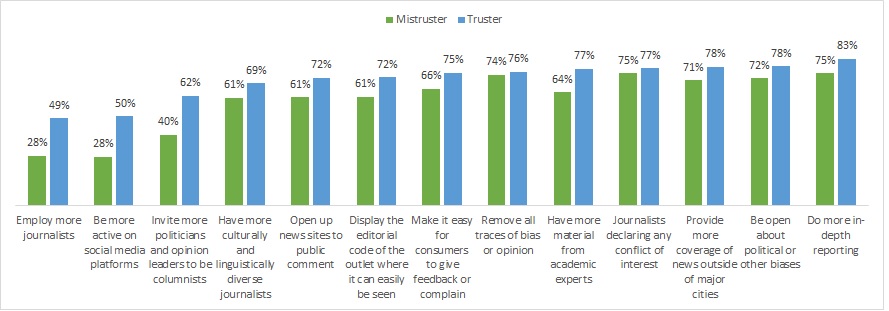
Ways to improve trust in news from the perspective of news trusters and mistrusters. Flew, T., Dulleck, U., Park, S., Fisher, C. & Isler, O. (2020). Trust and Mistrust in Australian News Media. Brisbane: Digital Media Research Centre

The single most significant measure that would restore trust in news brands was journalists declaring any conflicts of interest or biases with regards to particular stories. These measures were supported most by both trusters and mistrusters of news.

The negative impact of perceived bias and conflicts of interest appears consistently in studies about trust in news. News outlets need to take this seriously.


Read more: Accurate. Objective. Transparent. Australians identify what they want in trustworthy media


Hiring more journalists and social media are not the answers

Our research also reveals some interesting contradictions in how to improve trust in the media.

On the one hand, there was a clear desire for more in-depth reporting. However, most respondents simultaneously showed less support for media outlets employing more journalists. This suggests audiences want better-quality journalism, but not necessarily more of it.


Read more: On an average day, only 1% of Australian news stories quoted a young person. No wonder so few trust the media


In fact, employing more journalists and being more active on social media were deemed the least likely to increase public trust in media – two approaches that feature prominently in the business models of most news organisations.

As with institutional trust more generally, there is also a “trust divide” between educated elites and the wider population when it comes to the news media. Older people also have higher trust in news than younger people.

Trust in news is hard to restore

Importantly, our findings show that people who don’t trust the news are less supportive of ways to improve it. In contrast, people who do trust the news are more enthusiastic about options to boost it further.

In particular, mistrusters do not see employing more journalists or reporters using more social media as a way to boost trust. Doing either of those things would only increase the circulation of news they already mistrust.

This suggests it is harder to improve trust of those who are already sceptical and mistrustful of news. This is an important message for news outlets to take on board. Once lost, trust in news is harder to restore.

ref. How can we restore trust in media? Fewer biases and conflicts of interest, a new study shows – https://theconversation.com/how-can-we-restore-trust-in-media-fewer-biases-and-conflicts-of-interest-a-new-study-shows-135680

I travelled Australia looking for peacock spiders, and collected 7 new species (and named one after the starry night sky)

Source: The Conversation (Au and NZ) – By Joseph Schubert, Entomology/Arachnology Registration Officer, Museums Victoria

After I found my first peacock spider in the wild in 2016, I was hooked. Three years later, I was travelling across Australia on a month-long expedition to document and name new species of peacock spiders.

Peacock spiders are a unique group of tiny, colourful, dancing spiders native to Australia. They’re roughly between 2.5 and 6 millimetres, depending on the species. Adult male peacock spiders are usually colourful, while female and juvenile peacock spiders are usually dull brown or grey.


Read more: The spectacular peacock spider dance and its strange evolutionary roots


Like peacocks, the mature male peacock spiders display their vibrant colours in elegant courtship displays to impress females. They often elevate and wave their third pair of legs and lift their brilliantly coloured abdomens – like dancing.

Maratus laurenae. Male peacock spiders have brilliant colours on their abdomen to attract females. Author provided

Up until 2011, there were only seven known species of them. But since then, the rate of scientific discovery has skyrocketed with upwards of 80 species being discovered in the last decade.

Thanks to my trip across Australia and the help from citizen scientists, I’ve recently scientifically described and named seven more species from Western Australia, South Australia and Victoria. This brings the total number of peacock spider species known to science up to 86.

Spider hunting: a game of luck

Citizen scientists – other peacock spider enthusiasts – shared photographs and locations of potentially undocumented species with me. I pulled these together to create a list of places in Australia to visit.

I usually find spider hunting to be a relaxing pastime, but this trip was incredibly stressful (albeit amazing).

The thing about peacock spiders is they’re mainly active during spring, which is when they breed. Colourful adult males are difficult – if not impossible – to find at other times of year, as they usually die shortly after the mating season. This meant I had a very short window to find what I needed to, or I had to wait another year.

Classic.

Even when they’re active, they can be difficult to come across unless weather conditions are ideal. Not too cold. Not too rainy. Not too hot. Not too sunny. Not too shady. Not too windy. As you can imagine, it’s largely a game of luck.

The wild west

I arrived in Perth, picked up my hire car and bought a foam mattress that fitted in the back of my car – my bed for half of the trip. I stocked up on tinned food, bread and water, and I headed north in search of these tiny eight-legged gems.

My first destination: Jurien Bay. I spent the whole day under the hot sun searching for a peculiar, scientifically unknown species that Western Australian photographer Su RamMohan had sent me photographs of. I was in the exact spot it had been photographed, but I just couldn’t find it!

I travelled across Denmark, Western Australia. Author provided

The sun began to lower and I was using up precious time. I made what I now believe was the right decision and abandoned the Jurien Bay species for another time.

I spent days travelling between dramatic coastal landscapes, the rugged inland outback, and old, mysterious woodlands.

Kalbarri Gorge, Western Australia, where Maratus constellatus was found. Author provided

I hunted tirelessly with my eyes fixed on the ground searching for movement. In a massive change of luck from the beginning of my trip, it seemed conditions were (mostly) on my side.

With the much-appreciated help of some of my field companions from the University of Hamburg and volunteers from the public, a total of five new species were discovered and scientifically named from Western Australia.

The Little Desert

Two days after returning from Western Australia, I headed to the Little Desert National Park in Victoria on a Bush Blitz expedition, joined by several of my colleagues from Museums Victoria.

I’d thought the landscape’s harsh, dry conditions were unsuitable for peacock spiders, as most described species are known to live in temperate regions.

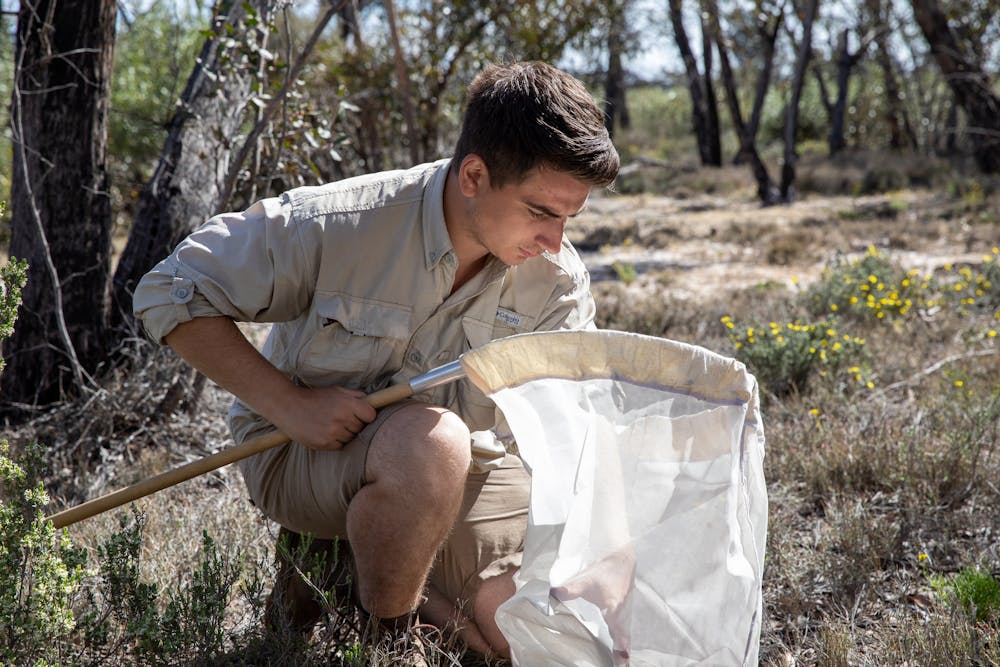
Capturing spiders in a bug net. Heath Warwick, Author provided

To my surprise, we found a massive diversity of them, including two species with a bigger range than we thought, and the discovery of another species unknown to science.

This is the first time two known species – Maratus robinsoni and Maratus vultus – had been found in Victoria. Previously, they had only been known to live in eastern New South Wales and southern Western Australia respectively.


Read more: Don’t like spiders? Here are 10 reasons to change your mind


Our findings suggest other known species may have much bigger geographic ranges than we previously thought, and may occur in a much larger variety of habitats.

And our discovery of the unknown species (Maratus inaquosus), along with another collected by another wildlife photographer Nick Volpe from South Australia (Maratus volpei) brought the tally of discoveries to seven.

What’s in a name?

Writing scientific descriptions, documenting, and naming species is a crucial part in conserving our wildlife.


Read more: Spiders are a treasure trove of scientific wonder


With global extinction rates at an unprecedented high, species conservation is more important than ever. But the only way we can know if we’re losing species is to show and understand they exist in the first place.


  • Maratus azureus: “Deep blue” in Latin, referring to the colour of the male.
Maratus azureus. Author provided
  • Maratus constellatus: “Starry” in Latin, referring to the markings on the male’s abdomen which look like a starry night sky.
Maratus constellatus. Author provided
  • Maratus inaquosus: “Dry” or “arid” in Latin, for the dry landscape in Little Desert National Park this species was found in.
Maratus inaquosus Author provided
  • Maratus laurenae: Named in honour of my partner, Lauren Marcianti, who has supported my research with enthusiasm over the past few years.
Maratus laurenae Author provided
  • Maratus noggerup: Named after the location where this species was found: Noggerup, Western Australia.
Maratus noggerup Author provided
  • Maratus suae: Named in honour of photographer Su RamMohan who discovered this species and provided useful information about their locations in Western Australia.
Maratus suae Author provided
  • Maratus volpei: Named in honour of photographer Nick Volpe who discovered and collected specimens of this species to be examined in my paper.
Maratus volpei Nick Volpe, Author provided

These names allow us to communicate important information about these animals to other scientists, as well as to build legislation around them in the case there are risks to their conservation status.

I plan on visiting some more remote parts of Australia in hopes of finding more new peacock spider species. I strongly suspect there’s more work to be done, and more peacock spiders to discover.

ref. I travelled Australia looking for peacock spiders, and collected 7 new species (and named one after the starry night sky) – https://theconversation.com/i-travelled-australia-looking-for-peacock-spiders-and-collected-7-new-species-and-named-one-after-the-starry-night-sky-135201

No water, no leadership: new Murray Darling Basin report reveals states’ climate gamble

Source: The Conversation (Au and NZ) – By Daniel Connell, Research Fellow, Crawford School of Public Policy, Australian National University

A report released today investigating how states share water in the Murray Darling Basin describes a fascinating contrast between state cultures – in particular, risk-averse South Australia and buccaneering New South Wales.

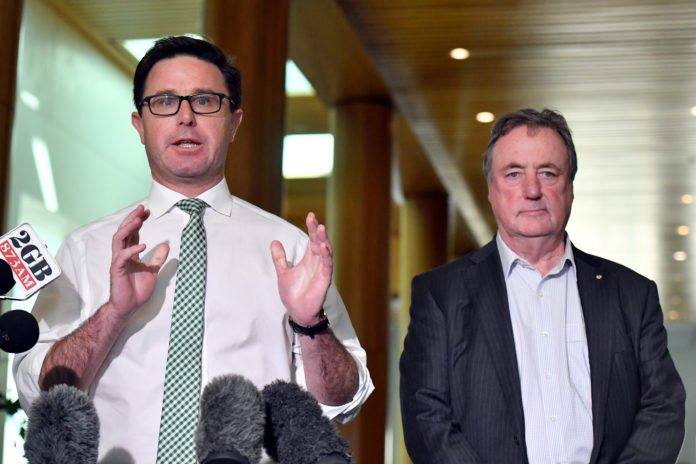
Perhaps surprising is the report’s sparse discussion of the Murray Darling Basin Plan, which has been the focus of irrigators’ anger and denunciation by National Party leaders: Deputy Prime Minister Michael McCormack and NSW Deputy Premier John Barilaro.

John Littleproud commissioned Mick Keelty to investigate the changing inflow of water in the Murray Darling Basin. AAP Image/Mick Tsikas

In general terms, the Murray Darling Basin Plan was originally intended to make water management in the Murray Darling Basin more environmentally sustainable. Its critics see it as a restraint on development, and complain it has taken water away from irrigators during a time of extreme drought.


Read more: While towns run dry, cotton extracts 5 Sydney Harbours’ worth of Murray Darling water a year. It’s time to reset the balance


In response to McCormack and Barliaro’s criticisms of the plan in late 2019, federal water minister (and senior National Party figure) David Littleproud commissioned Mick Keelty as Interim Inspector General of MDB Water Resources.

For the new report, Keelty investigated the changing distribution of “inflows” – water flowing into the River Murray in the southern states.

Climate change has brought the inflow to just a trickle. This dramatic reduction over the past 20 years is what Keelty has described as “the most telling finding”.


Read more: The Murray-Darling Basin scandal: economists have seen it coming for decades


He also investigated the reserve policies under which the three states choose – or don’t choose – to hold back water in Hume and Dartmouth Dams to manage future droughts.

Keelty says there’s little transparency or clarity about how much water states are allocated under the Murray Darling Basin Agreement (the arrangement for sharing water between the states which underpins the Basin Plan). This failure in communication and leadership across such a vital system must change.

Sharing water across three states

One major finding of Keelty’s inquiry is that the federal government has little power to change the MDB Agreement between the three states, which was first approved in 1914-15. Any amendment requires the approval of all three governments.

To increase the volume of water provided to NSW irrigators, South Australia and Victoria would need to agree to reduce the volumes supplied to their own entitlement holders. That will not happen.

Why has the agreement lasted so long?

Over the past century it has proved robust under a wide range of conditions. Its central principle is to share water with a proportion-of-available-flow formula, giving each state a percentage of whatever is available, no matter whether it’s a lot, or not much.

After receiving its share of the River Murray flows, each state is then free to manage its allocation as it wishes.


Read more: Is the Murray-Darling Basin Plan broken?


Historically, South Australia and Victoria have chosen to reserve or hold back a larger proportion of their shares each year in Hume and Dartmouth dams to use in future droughts, compared with New South Wales.

In part this difference derives from the long-term water needs of orchards and vines in South Australia and Victoria, in contrast to annual crops such as rice and cotton in New South Wales.

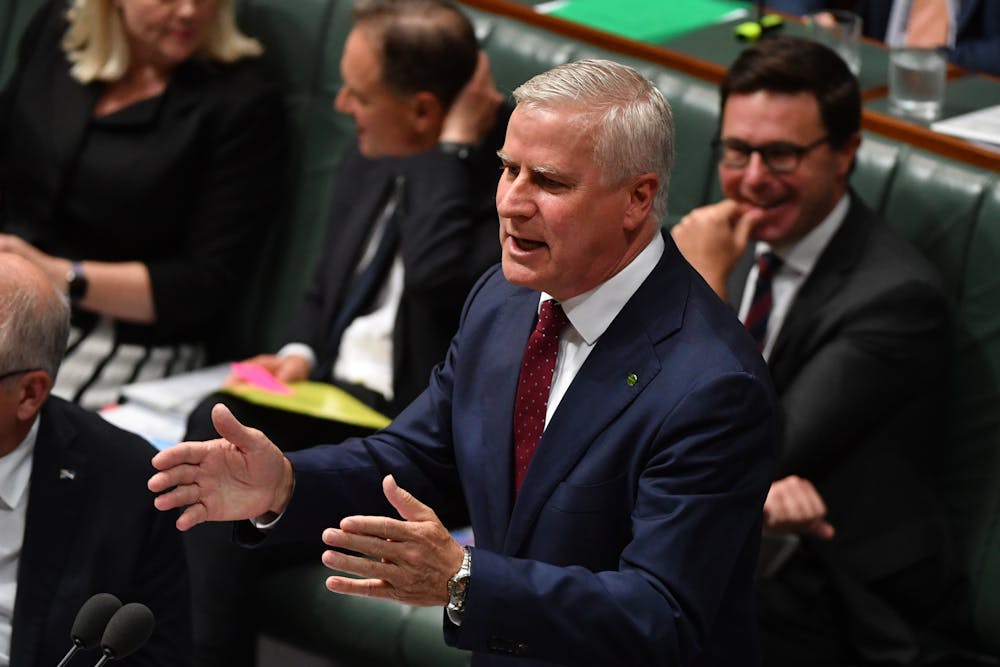
Deputy prime minister Michael McCormack has publicly condemned the MDB plan. Mick Tsikas/ AAP

As a result, South Australia and Victoria have a higher proportion of high security entitlements. That means they receive 100% most years. Only in extreme drought years is their allocation reduced.

NSW, on the other hand, has a higher proportion of low security general entitlements. In dry and normal years they receive a proportion of their entitlements. Only in wet years do they get the full 100%. (These differences in reliability are reflected in the cost of entitlements on the water market.)

Reliability of water supply

What’s more, each state makes its own decision about how its state allocation is shared between its entitlement holders (95% of water goes to irrigators the rest supplies towns and industry).

South Australia chooses to distribute a much smaller proportion to its entitlement holders than New South Wales. It also restricted the number of licences in the 1970s. That combination ensures a very high level of reliability in supply. Victoria took a similar approach.


Read more: 5 ways the government can clean up the Murray-Darling Basin Plan


But New South Wales did not restrict licences until the 1990s. It also recognised unused entitlements, so further reducing the frequency of years in which any individual would receive their full allocation of water.

When climate change is taken into account these differences between the three states result in their irrigators having significantly different risk profiles.

The climate change threat to the basin is very real

Despite climate denial in the National Party, the threat is very real in the MDB. The report describes a massive reduction in inflows over the past 20 years, approximately half compared with the previous century. One drought could be an aberration, but two begins to look like a pattern.

The report also suggests that in many cases irrigator expectations of what should be normal were formed during the wet period Australia experienced between the second world war and the 1990s.

Added to this have been business decisions by many irrigators to sell their entitlements and rely on the water market, a business model based on what now seems like unrealistic inflow expectations.


Read more: Don’t blame the Murray-Darling Basin Plan. It’s climate and economic change driving farmers out


In effect, successive New South Wales governments – a significant part of the state’s irrigation sector in the southern part of the state and the National Party – gambled against the climate and are now paying a high price.

In desperation, they’re focusing on alternative sources. This includes the water in Hume and Dartmouth held under the reserves policy of the two other states; environmental entitlements managed by the Commonwealth Environmental Water Holder; the very large volume of water lost to evaporation in the lower lakes in South Australia; and the possibility of savings resulting from changes to management of the system by the Murray-Darling Basin Authority.

NSW governments have gambled against climate change and are now paying a high price. AAP Image/Dean Lewins

Failure in leadership and communication

For reasons already outlined, the state reserves policy is not likely to change and use of the Commonwealth Environmental Water Holder environmental water entitlements would not be permitted under current legislation.

Management of the lower lakes is being reviewed through another investigation so is not discussed in the report. The report also states that management of the MDB Authority is subject to regular detailed assessment by state governments, and they have assessed its performance as satisfactory.


Read more: A referendum won’t save the Murray-Darling Basin


However the report was critical of the performance of all MDB governments with regard to leadership and communications suggesting that failures in those areas were largely responsible for the public concern which triggered its investigation.

ref. No water, no leadership: new Murray Darling Basin report reveals states’ climate gamble – https://theconversation.com/no-water-no-leadership-new-murray-darling-basin-report-reveals-states-climate-gamble-136514

Great time to try: pickling

Source: The Conversation (Au and NZ) – By Donna Lee Brien, Professor, Creative Industries, CQUniversity Australia

Being in isolation might be a great time to try something new. In this series, we get the basics on hobbies and activities to start while you’re spending more time at home.


Pickling foods in vinegar or fermenting them in brine is one of the oldest food preservation methods. The earliest archeological evidence comes from Ancient Mesopotania and the Tigris River Valley more than 4,000 years ago.

Pre-refrigeration, pickling allowed vegetables and fruits to be eaten long after they were in season, and meats such as salt pork to be carried on long journeys and into wars. Pickling soon spread around the world: pickles are mentioned by Aristotle, in the Bible and in Shakespeare’s plays. Cleopatra and Queen Elizabeth I were prominent proponents of their health properties.


Read more: How sauerkraut is leading a food revolution


The wide adoption of electrical refrigeration in the 20th century meant pickling was no longer necessary for preserving food, but by then pickles were appreciated for their taste, and so the method has lasted.

The 1893 edition of Mrs Beeton’s Every-day Cookery and Housekeeping Book has a number of inspiring and achievable recipes ranging from gherkins and herrings to nasturtiums as an alternative to capers.

Mrs Beeton also includes a warning against purchasing “inferior” commercially produced pickles, as copper sulphate was used to give a vivid, but unfortunately quite toxic, colour. Anxiety over food adulteration reached dizzying heights in the Victorian age, with dangerous and even poisonous substances added to foods to enhance colour and flavour, or eke out more expensive ingredients.

The Country Women’s Association Cookery Book from 1936 compiles “tried-and-true” members’ recipes, with a pickled beetroot recipe using a thin layer of melted fat to form an airtight seal on the cooled jar. Such vacuum sealing was essential for unrefrigerated storage.

In New Zealand, the 1968 edition of The Aunt Daisy Cookbook contains an entire chapter on pickles and chutney, including pickled figs, peaches and pears. One recipe suggests steeping blackberries in sugar overnight, boiling in vinegar, then spicing with ground ginger and allspice.

Reflecting Australians’ increasing interest in other cuisines, Margaret Fulton’s Encyclopedia of Food and Cookery (1983) used a number of Asian flavours, such as her curried aubergine pickle with fresh ginger and chilli. Fulton was also aware of how pickling can turn waste destined for the green bin or compost into a crunchy condiment, as in her recipe for pickled watermelon rind.


Read more: Vale Margaret Fulton: a role model for generations of Australian food writers


Easy recipes to try at home

Almost Instant Cucumber Pickle

“Quick” or “refrigerator” pickles provide an easy way into pickling. The below is barely a recipe, but it is both reliable and totally adjustable to taste.

  • 1 tablespoon vinegar (apple cider, white wine or rice)
  • 1 tablespoon cold water
  • 2 teaspoons sugar (white, raw or soft brown)
  • ¼ teaspoon salt
  • 1 cucumber, washed (peeled, or not, depending on variety)

Mix vinegar and water in a bowl, and stir in sugar and salt until dissolved.

Thinly slice in the cucumber. Stir gently.

An even more instant result is obtained by marinating the cucumber slices in some liquid from a jar of pickles.

Finely chopped dill, mint or chives can be added. More (or less) vinegar, water, sugar or salt can be used to taste.

This can be made during the day and refrigerated, covered, until dinner, or assembled while the rest of the meal is being prepared. Drained, these crunchy slices can be used on burgers and in sandwiches and salads, or just enjoyed on their own. They can be stored in the fridge for a few days, but become softer.

This is also a delicious way of pickling a thinly sliced red onion. When left for a couple of hours, it emerges from the solution not only soft and sweet, but a gorgeous pink.

Cauliflower Pickle

This recipe adapts elements from Aunt Daisy and Margaret Fulton. It requires some patience waiting for the flavours to develop, but not too long. Nervous about food hygiene, I keep this in the refrigerator.

  • 1 medium cauliflower, broken into florets
  • 1 onion, peeled and cut into 8 wedges (about a cup)
  • ⅓ cup salt
  • 5 cups vinegar (white)
  • ¾ cup sugar (white or raw) or ½ cup golden syrup
  • 1 teaspoon turmeric
  • 1½ tablespoons mustard seeds (or coriander seeds, or a mixture)
  • 2 red chillies, halved lengthwise
  • glass jars with plastic-plated lids (I reuse medium-sized, 450g pickle jars)

Put cauliflower and onion in a large non-reactive glass or stainless-steel bowl.

Sprinkle with salt, stir a few times and leave in a cool place for three hours.

Wash glass jars and their lids in hot, soapy water. Rinse and place in a warm oven, about 140°C to sterilise.

Drain vegetables.

Mix vinegar, sugar or syrup, turmeric, seeds and chilli, and bring to the boil.

Add vegetables and cook gently for about 5 minutes. This depends on the size of the florets. They need to be just cooked through, not mushy.

Using a slotted spoon or soup ladle, put vegetables (not liquid) into hot jars.

Bring spiced vinegar up to the boil again and pour into jars to cover the cauliflower and onion.

Seal the jars. Let cool and then store in refrigerator for at least a week.

This makes about three jars, depending on the size of the cauliflower, onion and jars.

ref. Great time to try: pickling – https://theconversation.com/great-time-to-try-pickling-135052

Virgin Australia gets a lifeline, but will it be enough?

Source: The Conversation (Au and NZ) – By Stephen Fankhauser, Deputy Chair, Aviation Department, Faculty of Science, Engineering & Technology, Swinburne University of Technology

With commercial airline fleets grounded due to lack of demand, the Australian government will pay the nation’s two biggest airlines, Qantas and Virgin Australia, $A165 million to ensure they keep flying critical metropolitan and regional routes over the next two months.

This measure comes on top of a A$198 million assistance package for regional airlines and the waiver of A$715 million in fees and charges for domestic airlines.


Read more: Government funding to Qantas and Virgin to ensure air services on key routes


It’s particularly important for the cash-strapped Virgin Australia. The company this week asked the Australian Stock Exchange to suspend trading of its shares after the federal government rebuffed its request for a $A1.4 billion loan.

Without a significant cash injection, industry experts say, the airline will collapse within six months. Prior to the government’s latest announcement there were reports it could go into administration within weeks.

Virgin Australia is 90% owned by five international companies – Etihad Airways, Singapore Airlines, China’s Nanshan Group and HNA, and Richard Branson’s Virgin Group. Facing their own difficulties, they have signalled they will not inject further capital.

This funding package gives the airline more time to find other investors. But its longer-term future remains up in the air.

Desperately seeking $1.4 billion

While the US government has agreed to provide US$50 billion in loans and grants to its ten biggest domestic airlines, with the option to take equity stakes, Treasurer Josh Frydenberg said this week the Australian government was “not in the business of owning an airline”.

Having two major airlines had served Australia well, he said, but “our approach has been sector-wide support”.

Complicating that type of support has been disagreement between Virgin Australia and Qantas.

Qantas chief Alan Joyce has argued for “survival of the fittest” and against assistance to “badly managed” businesses. His airline did not need government support, Joyce said this week. But if the government loaned Virgin Australia A$1.4 billion, he wanted A$4.2 billion.

To bail or not to bail

The federal government’s dilemma is whether it is better to bail out Virgin Australia or allow commercial forces to rule, as it has done in the past.

Its interest in sector-wide support reflects the fact the entire domestic aviation industry is hurting.

Freight and logistics, aircraft maintenance and repair, flight training and simulation, component manufacturing and research and design operations are all bundled together into a tightly bound sector.

All up, the industry’s five subsectors – domestic commercial aviation, international commercial aviation, general aviation, freight transport and aviation support infrastructure – have provided employment for about 90,000 Australians across 1,900 businesses. So it’s not just the 10,000 people employed by Virgin Australia the government needs to think about.

Systems shocks are nothing new

History is also a factor. The global aviation industry is no stranger to “system shocks”. These have included the Global Financial Crisis of 2008, the SARS outbreak in 2003, the World Trade Centre attacks in 2001, the Asian Financial Crisis in 1997 and the oil shocks of the 1970s.

Typically the sector has “bounced back” within a year.

The last big shakeup of the Australian airline industry was in 2001. Just days after the September 11 terrorist attacks, Ansett Airlines – flying since 1935 – went into administration.

Ansett supporters rally in Sydney on September 14 2001, calling on the federal government to bail out the airline. Dean Lewins/AAP

After Ansett’s collapse, Virgin Blue (established in 2000) saw explosive growth and former Ansett employees helped create regional operator Rex in 2002.

So from the rubble of failure new enterprises and forms of aviation business can grow, just as Virgin Australia has taken Ansett’s place as the nation’s second major domestic carrier.

Of course, the extent of the crisis is somewhat different this time.

With domestic travel restrictions likely in place for at least six months, and international flight restrictions set to continue even longer, the sector will be changed forever.


Read more: Once the pandemic is over, we will return to a very different airline industry


But history shows Australia can support two major airlines. We have extensive domestic aviation routes that will enable an early recovery compared with airlines in other parts of the world that rely on international routes.

ref. Virgin Australia gets a lifeline, but will it be enough? – https://theconversation.com/virgin-australia-gets-a-lifeline-but-will-it-be-enough-136399

Latest coronavirus modelling suggests Australia on track, detecting most cases – but we must keep going

Source: The Conversation (Au and NZ) – By Trent Yarwood, Infectious Diseases Physician, Senior Lecturer, James Cook University and, The University of Queensland

Late yesterday, epidemiologists from the Doherty Institute released what the Chief Medical Officer described as “nowcasting”: modelling that uses data from the previous 14 days to more accurately understand the present state of the COVID-19 epidemic.

In short, the findings are reassuring and suggest the inconvenience of social isolation is helping control the spread of SARS-CoV-2 in Australia.

It also indicates the spectre of “unidentified community transmission” is very unlikely indeed. This should be especially reassuring for healthcare workers, who may worry about coming into contact with COVID-positive patients presenting with a non-COVID problem.

What I don’t think it means, however, is that our outbreak control has been so effective that we should consider loosening the restrictions now.

Overseas methods, Australian data

The important thing to know is that this latest modelling uses Australian data.

One of the earlier criticisms of the Australian government’s response to COVID-19 was that the expert advice was kept behind closed doors.

When the modelling was made public, those determined to find fault (especially on Twitter) pivoted to “But it’s based on overseas data!”

That’s not a criticism that can be levelled at this latest Doherty Institute modelling, which borrows methods developed by the London School of Tropical Medicine and Hygiene but uses really recent Australian data to build some estimates.


Read more: This isn’t the first global pandemic, and it won’t be the last. Here’s what we’ve learned from 4 others throughout history


We are likely detecting most COVID-19 cases

First, the modelling suggests there’s probably not some huge secret cohort of COVID-19 cases out there that we are not picking up due to insufficient testing.

The researchers compared the reported case-fatality rates (the proportion of COVID-19 positive people who died) in Australian states with that from a large Chinese study (1.38%).

This is then used to infer the proportion of cases with symptoms which have been found by testing.

All states/territories have case detection rates above 80% – meaning that in each state, of all the people who have COVID-19 with symptoms, we are picking up about 80% or more.

If it wasn’t for the recent outbreaks in Tasmania, then all states would be above 90%. And in fact, the overall estimated case detection rate Australia-wide is 93%. Good news!

And as time goes on, the researchers are growing more certain about this conclusion (the technical term for this is the change in the “90% confidence interval” but in plain English that means the scientists are growing more confident these estimates are pretty accurate).

The change in the light blue shaded area means scientists are growing more confident that their estimates are accurate as more Australian data becomes available. Doherty Institute

An effective R below 1: meaning social distancing is working

What scientists call the effective R is the way the virus spreads in a world where social distancing measures are in place. It refers to the average number of people each COVID-19 positive person is infecting. If it is below one, then it means the social distancing measures are working well.

The next model in the new Doherty Institute paper looks at the effective R ₀ in the six states over time.

The effective R ₀ is under one in all states except Tasmania, but treat the Tasmanian data with caution: they have a small number of cases and a recent uptick, so that could be blowing out the average. Doherty Institute

In most states, the effective R has always been below one – indicating Australia has been effective at controlling spread since the beginning of the outbreak.

However, the numbers in Tasmania should be interpreted with caution. Their overall case numbers are small and they just had a big cluster, which affected their average disproportionately.

Crucially, the study team calculated the effective R based on cases identified as local transmission, rather than imported cases. That means, in real life, the effective R may be even better than this model estimates (because this estimate doesn’t account for border restrictions and quarantine of travellers).

In other words, this modelling is aiming to look at how effective our domestic control measures are. And the answer is: they’re working pretty well.

Too soon to relax social distancing rules

The social distancing measures take time to have an effect in stopping transmission.

It would also take time to become visible if we back off too early.

See-sawing our control measures would probably be far more disruptive than holding the course for just a little bit longer, and pose a risk of coronavirus rebound.

ref. Latest coronavirus modelling suggests Australia on track, detecting most cases – but we must keep going – https://theconversation.com/latest-coronavirus-modelling-suggests-australia-on-track-detecting-most-cases-but-we-must-keep-going-136518

‘I have never felt so frightened’: Australia’s coronavirus schools messaging must address teacher concerns

Source: The Conversation (Au and NZ) – By Claire Hooker, Senior Lecturer and Coordinator, Health and Medical Humanities, University of Sydney

Parents have heard confusing messages from federal and state governments around sending children to school. As students in Victoria started term two on Wednesday, the state government told parents to keep children at home if they can.

In some cases there have been reports of children being told they have to study at home even though parents want to send them to school as they find it hard to work otherwise.

But in a Facebook video this week Prime Minister Scott Morrison said the government wanted schools to open up for all students in three to four weeks.

And in a later press conference he maintained expert advice has consistently been that schools are a safe space for children.

[…] teachers are more at risk in the staff room than they are in the classroom when it comes to how the health advice plays out and the impact of this virus on children as opposed to teachers.

That means that we need to have proper arrangements in place for teachers and other staff in schools […] to protect their work environment, but […] that doesn’t lead to the same rules applying for students because they have a different level of risk.

While Morrison may be communicating the correct information, his message keeps being rejected by many Australian parents and teachers. This is because of mishandled communication that conveyed confusing and contradictory information, leaving teachers feeling unconsulted, scared and outraged.

Schools are safe, or are they?

There is good evidence for keeping schools open, including a recent rapid review of several studies on the topic, that indicated closing schools contributes very little to reducing the spread of the disease.


Read more: Other countries are shutting schools – why does the Australian government say it’s safe to keep them open?


And yet school closures have been among the most contentious and emotive issues in Australia’s COVID-19 strategies. This has resulted from significant failures in risk communication from the government, including many inconsistencies in messages about transmission risks.

For example, when the Prime Minister made a statement banning indoor gatherings greater than 100 people (including staff), he did not even mention schools except to say later that they would remain open.

This is despite the fact schools involve gatherings of greater than 100 people. And the design of many make implementing recommended social distancing measures impossible.


Read more: No, Australia is not putting teachers in the coronavirus firing line. Their risk is very low


Morrison’s statements also expressed concern about kids infecting grandparents, but not about kids infecting older teachers, some of whom are also grandparents. This caused outrage among many teachers.

President of the NSW Teacher’s Federation Angelo Gavrielatos who reportedly sought a response to such contradictions tweeted:

The response from the Commonwealth Deputy Chief Medical Officer was “Sorry. I can’t reconcile the contradictions”.

These inconsistencies left parents and teachers – especially those who face significant health issues themselves or in their immediate family – feeling both terrified and unvalued. Twitter account Stories From Teachers, contain heartfelt expressions of teachers’ fear. One said

I have never felt so frightened, disregarded and psychologically mangled in my whole entire life.

Any government plans to return students to school will require careful communication to be acceptable to many teachers and parents.

How governments should respond

People show decreased cognitive processing in high concern situations. This means we should expect many teachers will experience heightened perceptions of risk in their workplace. The best response is to tolerate any early over-reactions.

Effective communication requires emotional intelligence as well as compassion and empathy (practising non-judgment and avoiding sympathy).

Handbooks on risk communication, such as the WHO Guideline, emphasise communication is a two-way street. This means government and school leaders need to focus as much on what teachers and parents can or need to hear, as on what information they want to convey.

The basis for effective pandemic communication is trust. Trust is fundamental to achieving a coherent public response in an uncertain and unfolding situation. Without it, messages may be ignored or outright rejected.


Read more: A matter of trust: coronavirus shows again why we value expertise when it comes to our health


To rebuild trust, communication will need to begin with listening to the concerns of parents and teachers. All discussions about schools, such as the release of any new modelling, need to explicitly acknowledge the implications for these groups.

Showing respect for teachers and parents requires authorities to trust them by sharing information early, and being transparent and open about deliberation and decision making. Being explicit and honest about uncertainty is particularly important.

If the government doesn’t know the answer to questions such as “how many school-based transmissions have occurred in other countries?”, that needs to be stated clearly.

It’s getting better but we need action

In the prime minister’s video message, he thanked teachers, saying what they do each day “matters amazingly”. Showing value for teachers was a good start.

But his words will prove insincere if teachers don’t see them backed up with actions in the actual environments where they work.

Actions can communicate more strongly than words. Teachers will only feel their concerns have been heard if they see actions that mitigate and monitor risk.

Actions that can be considered include:

  • extensive additional testing for teachers and students

  • partial return to school to reduce crowding

  • giving staff extra sick leave without requiring medical certificates so they can remain at home if symptomatic

  • making it easier for teachers to work from home if they have demonstrated health needs.

Perceptions of risk decrease as people gain an increased sense of control. So school leadership can support staff to take actions that give them a greater sense of safety. These include staggering bell times or spending five minutes of lesson time with students cleaning desks and chairs.

Actions that show value for staff might include additional professional development days where teachers decide on their individual best use of the time.

Communicating value for teachers will be the key to successful communication around schools in the weeks to come.

ref. ‘I have never felt so frightened’: Australia’s coronavirus schools messaging must address teacher concerns – https://theconversation.com/i-have-never-felt-so-frightened-australias-coronavirus-schools-messaging-must-address-teacher-concerns-135934

Childhood, adolescence, pregnancy, menopause, 75+: how your diet should change with each stage of life

Source: The Conversation (Au and NZ) – By Sunanda Creagh, Head of Digital Storytelling

In today’s episode, Clare Collins, a Professor in Nutrition and Dietetics at the University of Newcastle, explains how our diets might need to change depending on what stage of life we’re in.

The Conversation’s Phoebe Roth started by asking: what should kids be eating and how much should parents worry about children eating vegetables?

An edited transcript is below.

New to podcasts?

Everything you need to know about how to listen to a podcast is here.

Additional audio credits

Kindergarten by Unkle Ho, from Elefant Traks.

Podcast episode recorded by Phoebe Roth and edited by Sophia Morris.

Lead image

Shutterstock

Edited transcript

Clare Collins: Parents worry so much about what children eat. But the rule of thumb is if they’re growing well, then you don’t need to worry. They are eating enough food.

And the way you know if they’re growing well is: if you take their baby book or you have a growth chart on your wall and you plot their height and weight regularly, you’ll be able to see if they’re following one of the lines on the growth chart. And that’s the best indicator.

The other thing that’s worth remembering is that a well child won’t starve themselves. But for children, their appetite is more variable than an adult. With us, we go, “Well, 12 o’clock, better eat lunch,” or “Oh, I’m awake, better have breakfast now because I’m going to be busy at work later.” But for children, they’re much more responsive to their internal cues.

And the younger the child, the more variable their appetite. So a typical thing is, a two or three year old might eat a massive breakfast and tomorrow they don’t eat any. At daycare, they might eat a huge lunch or none at all. And then the same thing happens at dinner. So if your child’s in daycare, you might want to look in the book or ask the staff, did they eat afternoon tea and lunch today? And that’ll give you a little bit of a guide as to whether you should be encouraging them to eat a little bit more dinner or just go, well, they had just had a massive afternoon tea, so they’re not really going to be hungry.

The other thing with children around the evening meal is that they often run out of steam by the end of the day. So having the evening meal as early as is practical. And for a young child, that may mean they’re having their dinner at five o’clock. And then what they eat at the family meal time is an optional extra. Because if you make them wait till 6 or 7pm, they’re over it and dinner becomes a nightmare.

The other thing that we know about kids, in terms of should we worry about them not eating vegetables, is we’ve actually done some research on this. And we found for kids around the age of three, the biggest predictor of their vegetable intake was not what mum had eaten in pregnancy. It was actually what the parents were eating now. So if you really want your children to eat heaps of veggies, it’s monkey-see-monkey-do, then that means we’ve got to look at how much we love our broccoli, mum and dad. And then that will make a big difference.

The other factor that comes into vegetable intake is genetics. And about 25% of people are what are called “super tasters”. That means they have got extra taste buds. And I wrote an article about this on The Conversation, actually. And so they taste things like the brassicas family – so Brussels sprouts, cauliflower – they taste it as more bitter than people who were either, not super tasters or, you know, have less taste buds. But more good news: even if you’re a super taster, if you don’t give up and you have repeated exposure, you even overcome that. So there’s no excuse for not liking your cauliflower.


Read more: How much food should my child be eating? And how can I get them to eat more healthily?


Phoebe Roth: That’s really interesting. I had no idea about a lot of that. So you started to touch on my next question, but I wonder if there are any other tips you’ve got. I was going to ask, what does the evidence say works for developing healthy eating habits during childhood or for kids if you’re worried perhaps they’re not eating as well as they should be.

Clare Collins: The key thing for developing healthy eating habits in childhood is not giving up and trying not to stress. So really accepting there is variability. Studies have been done on toddler intake and shown that over 24 hours they pretty much eat about the same total energy intake. But if you look meal to meal, hugely variable, like I mentioned.

The other key time when I think parents, you know, the food wars can start around 18 months and then people go, you know, “the terrible twos, they just never eat anything!” Well, if you want to avoid the food wars, then around 18 months, just step back a little bit and observe how much food is your child usually eating, because up until 18 months, babies have tripled their birth weight. So, you know, born around, say you’re around three kilos, well around six months you’ll be six kilos and around 18 months you’ll be nine kilos. Now, if in the next 18 months you tripled your birth weight again, what would that be? Nine, 18, 36 kilos. Around that. So around 18 months, depending on a child’s activity, they can actually go through a period of time where their energy needs are relatively less and you are going “No, last month they’d eat a whole punnet of blueberries!” and then you may start trying to force feed them. That’s where the beginnings of the food wars can start. So, trusting, like I said, that a well child will not starve themselves.

It can be different if the child has medical requirements and need for a therapeutic diet. That’s a whole separate kettle of fish and you’d be needing to talk to your GP, maybe be referred to a dietitian for specific problems or if there’s actual feeding problems, a speech pathologist.

So for the average child, it is about exposure, letting them feed themselves, not force feeding them and rewarding the behaviour that you want to see. So picture this: dinner time at the table. One child chasing those veggies around the plate with a fork and the other child eating up the foods that they’re really hungry for. If you focus on the child doing the “right thing” – you know, “I love the way, Jodi, you’re eating that broccoli and carrots,” rather than, “hey, Sammy, you’re going to sit there til every pea has disappeared off your plate” – well, then you’re reinforcing that vegetables are disgusting. So if you focus on the behaviours you want to see, then the other children start to recognise that, “oh, I only get attention if I’m doing the ‘right thing’. ” So reward the behaviour you want to see.

Most of the dinner is consumed in 20 minutes. So don’t make the meals drawn out. And for kids with a smaller appetite, having healthy snacks will make up for what’s not eaten within 20 minutes.


Read more: Five things parents can do to improve their children’s eating patterns


Phoebe Roth: Okay, great. And today we’re discussing, obviously, the Australian Dietary Guidelines and sort of adapting diet at each stage of life. And so I wanted to know at which of life’s different stages might our dietary needs change? We’ve now talked about kids, but what about, say, for pregnant women, women going through menopause and any others?

Clare Collins: Okay. For boys and girls, their dietary needs stay about the same until adolescence. And then that’s the first time the next alarm bells ring. Once girls start menstruating then their iron requirements are much, much greater. Boys, if they’re super active and they have a big increase in lean body mass – so it’s kind of like, you know, if you go from a little car to a big car, you need a lot more fuel – so for boys, all of a sudden they’re eating a lot more food. And meeting those nutritional requirements of adolescence is important because adolescence is also the time when teenagers typically experiment with different types of diets, you know, so they might be on a vegetarian diet or a vegan diet. So just keeping an eye on that. The key nutrients are iron – and you can get that from vegetarian foods and great articles on The Conversation about that, by the way.

And there’s also articles on The Conversation about adolescents and another typical issue that arises at adolescence, where parents are going “I wonder if this is a dietary problem” is diet and acne. And I’ve actually written on that for The Conversation.

And your nutrient needs for women change again during pregnancy and breastfeeding. The growing baby is a pretty good sponge. So it’s really the mum’s nutritional status that’s most at risk and the baby will be doing its best to grow with whatever fuel’s available. But to optimise the baby’s growth and development, you do want to have a nutritious dietary pattern. But you don’t need as much extra food and nutrients as you think. Basically, it’s equivalent to an extra tub of yoghurt and a salad sandwich to meet your extra requirements. But some diet-related problems do kick off in pregnancy like heartburn or developing constipation. And, you know, pregnant women and this happened to me as well, during pregnancy, go, hey, how come this is happening? Well, during pregnancy, there are hormonal changes to essentially slow down your transit time in your gut to give your body the best chance of getting any nutrients out of the food so to support the pregnancy.

And so eating healthily in pregnancy is really important, but you may need a boost in your dietary fibre intake. And one of the articles I’ve written for The Conversation is on how to manage constipation. And there’s a whole hierarchy of nutrition things you can do. And beyond that, then you really do need to mention it to your obstetrician or your GP in case you need some other type of like medicinal help. And then it’s got to make sure it’s something that’s safe for pregnancy. And you do need to talk to them about that.


Read more: Health Check: what to eat and avoid during pregnancy


Phoebe Roth: Sure. Are there any other life stages where you might need to think about changing your diet? What if, say, you develop a particular health condition?

Clare Collins: If you develop a particular health condition, then absolutely. The most common diet-related health conditions in Australia is type 2 diabetes. And some people are now being diagnosed with pre-diabetes, which is like an alarm bell and gives you a chance to change your dietary patterns and your lifestyle behaviours like physical activity so that you don’t go on to develop type 2 diabetes. And then the other one is heart disease. Both of those have dietary components.

So for type 2 diabetes, you’re likely to moderate the type and amount of carbohydrate. And for heart disease, there’s a whole range of bioactive foods that you can boost your intake of – whole grains, vegetables and fruit, reducing your saturated fat intake. And, you know, you can find articles about all of those things on The Conversation.

But if you read those and you go, oh, wow, it’s way more complex than I thought or I really would like some personalised advice, then ask your GP to refer you to an Accredited Practising Dietitian and get a personalised plan.

Phoebe Roth: Yeah, absolutely. And the other one is menopause. I know you’re writing an article for us coming up on menopause and whether there are specific things you need to keep in mind regarding your diet.

Clare Collins: Menopause is really unfair because one of my colleagues, Lauren Williams, who’s co-authoring the article and she’s from Griffith University up there on the Gold Coast, is her whole PhD research was on this topic and she studied the Australian Longitudinal Study of Women’s Health and followed the women as they transitioned through menopause. And the average weight gain is about two and a half kilos.

But even that is not the most unfair aspect of menopause. What she discovered is that there’s no discount, if you like, on gaining weight, if you lived a healthy lifestyle already, that all women are prone to weight gain during menopause. And it’s a combination of the hormonal changes amplified by life changes. And some of those life changes are that for most women, the physical work actually reduces at that time. You know, the house might be less people living in your house and you don’t have to do as much housework.

For many women, you have more disposable income. So you actually can go out a little bit more, spend more money on eating out. And the other thing is it’s a life stage where alcohol intake increases in women. You know, the perfect storm. You know, you had this lovely, healthy lifestyle and then you gained weight.

But what she also found, which is the important message, is that during that menopausal transition, women who changed something, they went, “Right. I’m going to beat this weight gain.” And they decided to eat more vegetables or develop new, healthier recipes or walk a lot more. They did not gain that average two point, 2.5-ish kilos.

As much as I really think that sucks that we gain weight during menopause, I’m really pleased to know that it’s not inevitable, but it’s kind of like, you know, it’s like having to do a spring clean on your life stage patterns, on your dietary patterns and on your physical activity. And you can get through menopause in a healthy weight and with a healthy lifestyle and be healthier. But we have to be on guard. So unfair.


Read more: Health Check: six tips for losing weight without fad diets


Phoebe Roth: So in the healthy eating side of things, would that just be sort of following the Australian Dietary Guidelines?

Clare Collins: Well, yes, but we need to make a little note of caution about the Dietary Guidelines. And that is not many people eat like the Australian Dietary Guidelines. In fact, the Australian Institute of Health and Welfare modelled what would happen if people did eat five serves of vegetables and two serves of fruit and had their whole grains and used reduced fat dairy and, you know, chose the leanest forms of protein.

They model that if everyone in Australia tomorrow started eating like the recommendations found in the Australian Dietary Guidelines, that heart disease rates would drop by 62% and that diabetes rates would drop by – type 2 diabetes rates, I should say – would drop by around 40%. That’s not going to happen. People aren’t going to do that. And we know that only 3 out of 100 Australians eat five serves of vegetables a day.

So, yes, definitely eat more like the Australian Guide to Healthy Eating and the Australian Dietary Guidelines, but a good place you can start is the Healthy Eating Quiz. This is a short quiz that takes less than 10 minutes to do. It’s free and it’s online. It rates your dietary patterns compared to recommendations in the Australian Dietary Guidelines. And that now links to a really fun website – we think it’s fun anyway because we invented it – called No Money, No Time. It’s got recipe recommendations to match with your Healthy Eating Quiz report.

We’ve set up some fun filters on there. So if you’ve only got a basic kitchen and you’ve got a microwave and just one pot, you can filter it for recipes matching your kitchen equipment. And we also added this other filter that allows you to say what your healthy lifestyle goals are. And we’ve catered for all ages on that. Some people told us their goal was to have glowing skin. And some people said, I want to do better in my sport. And some people have said I want to manage my weight. So you can further tailor the recipes for that. So No Money, No Time and the Healthy Eating Quiz. And that’s our way of trying to help Australians eat a little bit more healthy and feel better and have their health improve as well.


Read more: Got pre-diabetes? Here’s five things to eat or avoid to prevent type 2 diabetes


Phoebe Roth: I am already keen to jump on that straight after this and give it a try. Great. So the Dietary Guidelines, would you say they’re a really good resource and reference point, but possibly not a one size fits all approach?

Clare Collins: Absolutely. And there are some resources on the government websites called Eat for Health, and there are some resources on that. And they are designed for the predominantly healthy Australian population while recognising that overweight and obesity are relatively common and that people are commonly seeking extra advice for things like type 2 diabetes and heart disease. There’s certainly a good first place to stop. But as I mentioned, you may need extra specialised help if you have some of those common chronic diseases. And a good place to start to find out is with a health check up with your general practitioner who can do a heart health check and check your blood pressure. And you know, if you don’t have scales at home, they can do a check on your weight. But more important than that is checking on your blood to see what your cholesterol level is and whether your blood sugar levels are high, indicating you’re at a higher risk for type 2 diabetes.

Phoebe Roth: So what do people need to consider to ensure they’re following the right diet for their individual circumstances or for their stage of life?

Clare Collins: I think the key thing, when it comes to diet-related health or nutrition-related health is knowing what your risk factors are for these chronic conditions. And really to know those, you do need to check in with a health professional, with your general practitioner. You might be a lucky person who has the genes that mean you have wonderful blood sugar levels and you have wonderful cholesterol levels and your blood pressure’s great. Then that would essentially mean that you’re doing the right things for your genes and for your body. But a check-up with your GP is usually a chance to see, you know, what does need to be tweaked in my diet? One of the things about high blood pressure is that it’s really common, but there’s absolutely no signs or symptoms. So until you get it checked by your GP, you wouldn’t even know.

Phoebe Roth: What about for older people? What sort of things do they need to consider about diet?

Clare Collins: Once you start approaching 75 and above, then it’s interesting that your nutrition requirements and your dietary requirements start to shift a little bit. Once you get older, the focus moves to trying not to lose your muscle tissue. There’s a word for that malnutrition of older age and it’s called sarcopenia. And it’s really important. And so as you age to protect your body from sarcopenia, your protein requirements actually start to go up.

And people have this image of, “Oh, you know older people. They just need a cup of tea and a piece of toast.” Well, they actually don’t. They might need their coffee made on milk or they might need a nutritional supplement if their appetite’s really poor. And this is another time where you may need specialised nutrition advice. If there’s any underlying medical conditions or if the older people in your family are in a nursing home, you may need to talk to the nursing home staff about whether they’re meeting their nutritional requirements or not.

As you age physical activity and because your muscle mass decreases, your total energy intake reduces. And it’s a little bit like going from the big car down to the smaller car. You still need the same amounts of vitamins and minerals and things we call phytonutrients. You know, they’re not a vitamin or they’re not a mineral, but they help your body run better. You still need the same amount of them, but you need them in less energy. So there’s like less room for error. So the tea and toast isn’t adequate, you know, for grandma or granddad, for the older person. They’re having nutritious and nutrient dense foods.

So, you know, vegetable soup, so to put all the vegetables in, in the right texture that looks appealing is really important. The other thing as you get older is that your taste buds change. You can have less. Some of your taste buds start to decline. And so flavouring food more and to the way, you know, Nanna or Grandpa like it rather than the way you like it is really important. So it can be a life stage where for people, if they think, “Gee, food just doesn’t taste as good anymore, then trying out what herbs, spices and flavourings they like and using those to replace salt.

Because as you age you’re more prone to high blood pressure and you’re also more prone to developing diabetes. So nutrition remains important right through your life. And it’s a really important part of our social lives.

So I think, you know, if I had one final message, it’s: no matter what you do or how busy you are, still finding that time to cook, prepare and eat with other people is a really important way of preserving your own family’s food culture and looking after the nutrition-related health and the social well-being of everyone in your family.


Read more: The muscle-wasting condition ‘sarcopenia’ is now a recognised disease. But we can all protect ourselves


Phoebe Roth: And the last question I have, I wonder if – it goes into all ages, for anyone that’s trying to eat healthy and follow a healthy diet – where do superfoods fit in? I know that there may not be one answer to fit all, but I think that that’s kind of a question people grapple with it when the next fad is right in front of them. And you know, what do they do? Should they eat this? Should they go out and buy it?

Clare Collins: Fad diets are just so ongoing and regular that we often write articles for The Conversation about them. But you know, my thing about superfoods is that there are super foods, there’s heaps of them and they’re actually all in the supermarket.

And when you walk in the supermarket – this is one way supermarket design does try and help us eat healthy – you walk smack bang into the super food section and they’re right there. They don’t have packages. They don’t have labels. But it’s that wide variety of vegetables and fruit. And I think if there was one important thing to remember, when you go to the supermarket every week when you went to the supermarket or you enter a market, look at those vegetable and fruits and which one has not been in your trolley, you know, in the last couple of weeks? And invite them in. Some of the research that we’ve done shows that the variety of vegetables and fruit, but particularly the variety of vegetables, predicts your long term health care costs.

And we’ve shown that in a research study over 15 years on the Australian Longitudinal study on Women’s Health. And lots of the research we’ve been doing is showing that the variety of those foods that belong to the Australian Guide to Healthy Eating in the Australian Dietary Guidelines, that it’s actually those nutrient-rich foods that predict your nutrient intake and then decide whether you’re on a path for health or you’re not on a path for health. You’re on a path for poor health.

So going for variety in your whole grains, your vegetables, your fruits, your sources of protein, which includes meat, poultry, fish and then all the wonderful vegetarian sources and whole grains. Collectively, those things make up a healthy diet pattern. They make up you when you eat them. And then that determines whether you’re going to be healthy or less healthy.


Read more: Had pre-eclampsia in pregnancy? These 5 things will lower your risk of heart disease


Phoebe Roth: Is there anything else you want to talk about that we didn’t touch on?

Clare Collins: The only thing is I hope people don’t feel alone when it comes to nutrition. Go and have a look at No Money, No Time. Not only have we loaded that website up with lots of recipes, we’ve also loaded up with lots of information, hacks and myths. We’ve linked a lot of The Conversation articles to it. And then the other place to go for good information is go to The Conversation and type in nutrition in the search bar. And you’ll see lots of the articles that myself, my team and lots of other academics from other universities around Australia have written on food and nutrition.

Phoebe Roth: Thank you so much, Clare, for joining us on Trust Me, I’m An Expert today. It’s been great talking to you again.

Clare Collins: Thank you. It’s my absolute pleasure.

ref. Childhood, adolescence, pregnancy, menopause, 75+: how your diet should change with each stage of life – https://theconversation.com/childhood-adolescence-pregnancy-menopause-75-how-your-diet-should-change-with-each-stage-of-life-132099

More testing will give us a better picture of the coronavirus spread and its slowdown

Source: The Conversation (Au and NZ) – By Haydar Demirhan, Senior Lecturer in Analytics, RMIT University

Many states are now ramping up the number of tests by relaxing the criteria for who can get tested for COVID-19. This should give us a better idea of whether the spread is easing or getting worse.

We get regular updates about COVID-19 with lots of data, figures and graphs with some interpretations to see if we are flattening the curve on the number of new cases.

But most of these are based on using only the total or the daily number of confirmed new cases.


Read more: How much has Australia really flattened the curve of coronavirus? Until we keep better records, we don’t know


This does not provide enough information about whether the situation is improving, stabilising or getting worse. That is why we also need to consider the number of people tested daily for COVID-19.

For example, in percentage terms there is no actual difference between getting 20 positive cases out of 1,000 tests one day and 100 positive cases out of 5,000 tests the next. Both lead to the conclusion we have 2% reported infected people of those tested.

If we are only given the number of new cases, getting 100 in a day sounds a lot worse than getting 20. The 2% percentage figure here tells us things are pretty much the same over the two days.

Curves and trends

Take Victoria, if we look at the total number of confirmed cases we see it followed an exponential trend for a while – one that was increasingly rising – and then started to divert on April 3.


The Conversation, CC BY-ND

In the daily number of confirmed cases we see high jumps and large fluctuations going back and forth.


The Conversation, CC BY-ND

When the daily number of applied tests is considered, we can calculate the actual percentage of new cases each day. Now we have a way flatter curve (below) with different fluctuations.


The Conversation, CC BY-ND

The peak is now on March 24 when the number of tests is included. If we just look at the daily count, the highest number of confirmed cases was on March 27. When we look at the percentage, it shows a decrease rather than an increase with more than 2,300 tests.

From the daily new cases data it looks like there is a strongly decreasing trend in the number of confirmed cases between April 2 and 6.

But we do not see the same strong downward movement in the percentage data on the number of tests. Although both figures go down, then up slightly, the percentage trend downward is not as strong as the daily trend.

This is a good example of the discrepancy between the inferences from the raw and percentage data. When we consider the number of tested people, we get a different view on the progress of the pandemic.

More tests needed

In using the number of tests to get a more reliable picture of the situation, there is an important point to consider. That’s were the purple error bars in the graph (above) come in.

They show the margin of error where each percentage estimate swings for the daily number of applied tests, so the actual number could be higher or lower but within those purple bars.

When we have a larger number of applied tests, we get a reduced margin of error, and that gives us a clearer picture of what is happening.


Read more: Even in a pandemic, continue with routine health care and don’t ignore a medical emergency


Since the peak on March 24 is backed up by only 500 tests, it has the largest margin of error. The figure on March 28 is based on 8,900 tests with a very small amount of error.

To get a more reliable picture of the situation, the number of applied tests has to be expanded, which it is what is happening in some states. This should reduce the margin of error.

Out in the community

After getting some signals of flattening the curve in Victoria and Australia as well, do we see an exponential increase in just the community transmission?

Community transmission is where someone has caught the virus locally, not an infected traveller who’s returned from a cruise or overseas. At the moment they are the minority of cases and authorities would like it to stay that way to contain the spread of the virus.

Again, we need to consider the number of tests to answer this question clearly. The raw numbers of community transmission in Victoria looked like they were increasing exponentially.


The Conversation, CC BY-ND

But the numbers as a percentage of the number tested tell a different story. Although there is some increase in the rate of community transmissions recently, it still shows a way flatter behaviour far from the exponential curve.


The Conversation, CC BY-ND

That is why it is important to understand the impact of the number of tests on the figures displaying the progress of the pandemic. Understanding this relationship could reassure people about new numbers.

ref. More testing will give us a better picture of the coronavirus spread and its slowdown – https://theconversation.com/more-testing-will-give-us-a-better-picture-of-the-coronavirus-spread-and-its-slowdown-135698

Fiji imposes new lockdowns on Vanua Levu after virus cases rise to 17

By Wansolwara News

A 21-year-old man on Fiji’s Vanua Levu island has tested positive for the Covid-19 novel coronavirus, taking the total number of cases in the country to 17.

Prime Minister Voreqe Bainimarama said the man was a relative and travelling companion of case nine. He said they travelled together from India to Singapore and on to Fiji.

The latest positive test follows last week’s confirmed case of the nine-year-old granddaughter of case nine.

“Since his return to Fiji, this young man (case 17) has not shown a single symptom of the virus. You will recall our original case definition for virus testing required that patients display symptoms,” Bainimarama said.

“Upon returning to the country from overseas, this young man was in self-quarantine for two full weeks, up until April 5. Free of any symptoms throughout the virus’s known two-week incubation period, by all appearances, he was in the clear.

“But as experts have unveiled more about the insidious nature of this virus, and our understanding of the disease has evolved, the way we define and contain cases must evolve as well.”

– Partner –

The Prime Minister said the tracing teams would widen their testing to all close contacts of the confirmed cases from this week, regardless of whether they displayed symptoms.

Immediate isolation
He said this was how case 17 had been identified and immediately taken into isolation along with close contacts in separate isolation facilities.

“We are now extending the quarantine period to a full 28 days, both for anyone who is newly-quarantined and to those who currently are waiting out their initial 14-day period,” Bainimarama said.

“Our contact tracing stemming from this latest case has revealed the need for additional lockdowns on Vanua Levu. The Vunicagi Settlement between Nabowalu and Labasa will be locked down for the next 28 days.

“The settlement lies along a short stretch of vital highway which vehicles will still be allowed to traverse under 24/7 police monitoring, as no alternate routes into Labasa exist. However, no passengers will be allowed to disembark or embark: No one in and no one out.”

Lockdown of the Soasoa settlement would also be extended another 14 days, in line with the 28-day quarantine policy.

Given the continued risk of transmission on Vanua Levu, the Prime Minister said the ban on interisland travel by air and sea remained in effect.

Meanwhile, the 16 patients living with coronavirus are in stable condition.

The University of the South Pacific’s Wansolwara student journalism team are in partnership with AUT’s Pacific Media Centre.

Print Friendly, PDF & Email

Article by AsiaPacificReport.nz

Friday essay: when television hosts take their shows home they fuel nostalgia

Source: The Conversation (Au and NZ) – By Edith Jennifer Hill, PhD Candidate, Flinders University

Social media is currently filled with working from home content: from our friends, but also from celebrities.

As late night hosts shift to broadcasting from home, I am filled with nostalgia for a recent past: YouTube in its infancy, soon after its birth in 2005.

Back then, we saw glimpses of private lives filmed on laptop cameras in bedrooms. Now, it’s household names filming segments from home. Jimmy Fallon is being interrupted by his children. The Project is Zooming self-isolating celebrities. Ellen Degeneres hosts interviews from her couch.

In the early days of YouTube, the platform was smaller. There were intimate communities formed around specific topics and people: gaming, make up, pop culture. An opportunity for authentic participation and self-expression for everyone.

We are all feeling nostalgia for a pre-COVID-19 world. Nostalgia doesn’t only have to look back decades. It can occur for our recent past. And it can also be good for us.

Nostalgia provides us with a reminder of the good times, and the determination to stay inside and flatten the curve, so we can return to the activities for which we felt nostalgia for in the first place.

Perhaps a nostalgia for 2005 YouTube is a rarer type of longing, but I find myself reflecting on the time where every video filmed in a bedroom was a real bedroom, not a studio set.

The “full-time YouTuber”

When YouTube launched in 2005, it was a space for sharing and interacting with videos online.

In 2007, pre-roll ads began playing on videos, and by December we saw the introduction of the Partner Program, where YouTubers were able to make money from their videos. This began the advent of the “full-time YouTuber”. Brands began directly sponsoring YouTubers and we saw the beginning of people leaving their day jobs for full-time content creation.

As the platform became more commercialised, professional content made by established networks was promoted for monetary purposes and those original ideals became marginalised.

Early YouTubers were able to capitalise on the growth of the platform and build audiences of thousands, who in turn brought millions of views with the associated ad revenue. Zoe Sugg (Zoella, to her fans) began posting on her channel in 2009.

Today she has over 11 million subscribers, and her videos have been viewed over 1 billion times (with a further 855 million views on her second channel). She started as a young adult filming clothing hauls and make-up looks in her childhood bedroom. She now owns her own beauty and lifestyle brand, and is worth millions.

Live from their living room

With the social distancing and isolation requirements brought on by COVID-19, television talk shows begin to feel like early YouTube.

Jimmy Fallon is currently filming The Tonight Show “at home edition”.

The Tonight Show has always found its way on to YouTube, often to the trending page. Now, Fallon’s at-home aesthetic provides his audience layers of intimacy through personal disclosure. We now know what books he owns, that he has a coat rack by the back door (that gets left open by his kids). You can hear the piano playing through the walls. And we know his daughter lost her tooth last week because she adorably interrupted his filming to tell him so.

Whether or not we interpret this cynically – as a convenient construction of Fallon’s authenticity – it seems timely and highly relatable content right now. Millions of parents are juggling work and kids.

Georgiana Toma, a life narrative scholar, says authenticity is a vital characteristic for an online following.

Brand authenticity, she says, requires stylistic consistency, softening of commercial motives, and quality commitment. A successful way to achieve an authentic presence online is through self-disclosure.

The sense of intimacy that is created through the disclosure of personal information that the audience can relate to, can soften commercial motives. Whether it is child-rearing, product reviews, or quarantine experiences, this positively reinforces the authenticity and trustworthiness of the creator.

In the early days of YouTube, this would include divulging personal stories and sharing milestones, as well as personal struggles and turmoil. Zoella did this by openly talking about her social anxiety when it came to public appearances and large gatherings, as well as sharing career milestones like her wax figurine in Madame Tussauds.

A talk-show host is a more overtly constructed personality.

Previous viewers of Fallon “live from New York”, like David Letterman and Conan O’Brien before him, are aware of the script, the lights, and the set. But with celebrities now restricted to broadcasting from their homes, we see them forced off-script. There are interruptions, noises of families and lived-in homes. It has always been common to see a child running through the background of a YouTube video, or a cat bumping the camera as they walk across your keyboard. We are now seeing them for the first time with talk show hosts.

For many celebrities, the self-disclosure required to strengthen that interpersonal connection has come from sharing their own distancing or isolation narratives. Sharing their homes and difficulties with isolation resonates with an audience and signifies that we are all in this together (sans the mansion).

Intimate spaces

Last week on The Project, Australian singer Troye Sivan was interviewed in his childhood bedroom after a day self-isolating and refurbishing furniture with his dad.

While The Project is still filming in the studio, the set looks markedly different than it did a few weeks ago. The hosts sit far apart, correspondents call in for segments, and their crew provide the guests with applause rather than a live audience.

The image of Sivan sitting at home in a T-shirt suggested a relaxed, private and authentic self.

Longtime fans might view this as a return to his online roots. Sivan started his YouTube channel in October 2007, when he was 13. In these early videos, Sivan uploaded concerts he performed in and covers of songs performed at home. Now, Sivan has over 7 million subscribers and over 1 billion views on YouTube. He has achieved chart success, selling 1.3 million albums.

The Project interview re-constructs Sivan’s original authentic aesthetic, as he once again films from his childhood bedroom.

When we watch videos online, we often do so from the comfort of our private spaces: our homes, our bedrooms. So, when we watch talk shows filming their own homes, a sense of connection, of shared experience, comes naturally. Watching like this encourages us to feel like we are talking to a friend.

Being invited into someone’s home becomes a point of commonality and hospitality in times of isolation. Even considering the obvious economic disparities, we all have isolation in common.

Janice Peck, a professor in media studies, discusses the belief that communication can guide people out of dilemmas. This makes talk shows compatible with therapeutic discourse, with focus on confession and interactive participation.

YouTube also invites this, with presenters often ending their videos with the classic “let me know what you guys think in the comments below!”


Read more: Friday essay: YouTube apologies and reality TV revelations – the rise of the public confession


Now we don’t have in-person connections in our daily lives with those outside our households, this interactive participation online has risen in importance.

Going meta

In this nostalgic turn, celebrities are utilising traditional YouTube tropes in their content, through framing, background, and tone.

Jimmy Kimmel “live from his house” quizzes his children for a homespun version of the game show Who Wants to be a Millionaire?

The framing and background of this clip is strikingly similar to other creators online, like YouTube veteran Philip DeFrano. In these videos, Kimmel and DeFranco ask their children questions while sitting on high bar stools with on-the-table microphone stands. To the amusement of their children they ask, “Who is your favourite, Mummy or Daddy?”

On an episode of The Tonight Show: At Home Edition, Jimmy Fallon fulfils a classic YouTube trope: The Q&A video. For years, YouTubers have been answering their viewers questions in this format. After his monologue, the show cuts to a clip of Fallon walking with his wife for the segment “Ask the Fallons”. During the walk, he recounts the story of his proposal, as well as some personal anecdotes. Q&A videos have always been used as a way for the audience to connect and interact directly with YouTubers.

Relatable or die

On Full Frontal with Samantha Bee, the host interviews politician Katie Porter, joking about bad wifi connections on Zoom calls – an experience every single person working from home can relate to. While they discuss the current state of COVID-19 testing in America, their interview is scattered with personal anecdotes.

The exchanges elicit the feeling of watching your colleague on the morning Zoom call, dealing with wandering children and fielding offers of multiple sourdough starters.

But self-disclosure can backfire.

In a now deleted video, Ellen DeGeneres filmed the first at-home episode of her talk show in her beautifully decorated home, and compared self-isolation to jail.

Talking about a collective experience in a way few people can understand violates the collaborative partnership of early 2000s YouTube. It appears elitist and tone deaf because it fails to recognise more common experiences of isolation.

Changing channels?

Will YouTube return to “normal” once the global pandemic loosens its hold?

We will most likely see talk show hosts return to their studios, and a significant drop in “how to be productive working from home” videos. But this new trend of talk show hosts at home may stick around if it sees continues success throughout quarantine.

People who found fame early on YouTube by bringing us into their homes are now celebrities. Now traditional celebrities are bringing us home too. They are utilising features inherent to YouTube and creating more opportunities for connection.

We can view the self-disclosure of talk shows hosts filming from home as relatable and charming while we experience self-isolation, or cynically as a convenient construction.

Regardless of intention, we respond because of our ongoing desire for the self-disclosure of those we hold in regard.

ref. Friday essay: when television hosts take their shows home they fuel nostalgia – https://theconversation.com/friday-essay-when-television-hosts-take-their-shows-home-they-fuel-nostalgia-136240

Online sex parties and virtual reality porn: can sex in isolation be as fulfilling as real life?

Source: The Conversation (Au and NZ) – By Jennifer Power, Senior Research Fellow at the Australian Research Centre in Sex, Health and Society, La Trobe University

The public health response to COVID-19 has placed unprecedented limits on social contact. Many people may go without physical sexual intimacy for an extended (and indefinite) period.

Given human touch and connection are fundamental to humanity, this could have significant implications for the well-being of those who are single or apart from their sexual partners.

The media has reported people turning to digital technologies to find sexual pleasure and human contact during periods of social isolation.

But what does research tell us about the capacity for technologies to meet human needs for sex, touch and intimacy?

Making love alone

Solo sex is one solution to lack of sexual contact and well within current health guidelines. People are using technology to enhance this.

Reportedly, traffic to the pornography website Pornhub has increased exponentially during the COVID-19 crisis, and there has been a significant leap in sales of popular sex toys.

Meanwhile, erotic fiction has found a new fan base by drawing on themes of isolation and quarantine.

However, not everyone has the physical capacity to pleasure themselves and sex is also about intimacy, human connection and touch. Does the online environment allow for this?

Connecting with others

People have been seeking sex online for years.

COVID-19 is accelerating this trend, prompting increased use of dating apps for chatting, cyber-flirting and sexting.


Read more: The safest sex you’ll never have: how coronavirus is changing online dating


Real-life “hook ups” may be off the table for a while, but research shows that cyber-flirting and sexting can enhance sexual creativity and fantasy, help with sexual and relationship satisfaction in real life and, for some, increase body confidence and a sense of desirability.

COVID-19 has also meant people are getting more creative with their webcams. Sex party organisers have been hosting online parties which, for some, have been their first foray into sex online. People have found this experience to be surprisingly satisfying, replicating feelings of anticipation and excitement that are similar to real-life sex.

Similarly, research on cybersex – which may involve sex with avatars rather than webcams – has shown it can enhance people’s sex lives by enabling exploration of desires and fantasies they may not feel comfortable to pursue in real life.

Along with potential for enhanced sexual satisfaction, a recent study by the Kinsey Institute showed that people who use technology for sexting or webcamming gained a sense of emotional connection as well as sexual gratification from this contact.

This included people who accessed professional webcam sex services, as well as those sexting or ‘camming with a lover or person they met online.

What about touch?

Simulating human touch is more complex.

Teledildonic devices, which are internet-connected sex toys, enable people to control their partner’s vibrator using a mobile phone app.

COVID-19 appears to have generated an increase in demand for these devices, although research is limited on the extent to which they enhance people’s sense of connection or sexual satisfaction.


Read more: Coronavirus and sex: Dos and don’ts during social distancing


Technologies are also evolving toward immersive experiences in which tactile sensation is matched with visual stimuli to evoke a more realistic sense of touch.

For example, devices such as the “Vstroker” and the “Auto-Blow2” link to virtual reality (VR) porn. The actions in the VR film (for example, oral or penetrative sex) are timed with the device functions so the visuals match the physical sensation. Research has shown VR pornography can enhance feelings of presence and arousal.

Are there risks?

Online sex brings risks along with benefits, and many of these are well-documented. Sharing erotic images or videos carries the risk of unwanted exposure though non-consensual dissemination, such as “revenge pornography”.

In recent weeks, we have also heard about widespread “Zoom-bombing”, in which people hack into online meetings on the Zoom video-conferencing app. This is clearly a risk for those using video chat platforms for sex.


Read more: From stone dildos to sexbots: how technology is changing sex


This feeds into existing concerns about data hacking, consent and inappropriate monitoring of teledildonic users by the companies that make them. Two of these companies were recently sued for collecting intimate data on users, including body temperature and vibration frequency during device use.

As social distancing continues, there are also concerns of increased catfishing, the practice of luring people into fake online relationships for financial scams.

Is online intimacy the same as being together?

One question raised in studies of sex and intimacy is whether the online environment enables a sense of human connection akin to physical presence.

Being physically close to someone allows for intimate practices that involve touch and everyday acts of care. Some research suggests online communication creates a less authentic form of intimacy or encourages people to present false versions of themselves. Trust may also be difficult to build online due to complex or limited visual cues.

However, other studies show potential for the online world to facilitate, or even enhance, closeness as people are more inclined to share personal and vulnerable details about themselves through text than face-to-face.

The future of sex?

COVID-19 may be a turning point in the use of, and attitudes toward, technologically mediated sex and intimacy.

It is too soon to know how this will play out when social isolation measures are relaxed, but for now digital technology has never been so central to human sexual and intimate connection.

ref. Online sex parties and virtual reality porn: can sex in isolation be as fulfilling as real life? – https://theconversation.com/online-sex-parties-and-virtual-reality-porn-can-sex-in-isolation-be-as-fulfilling-as-real-life-134658

This isn’t the first global pandemic, and it won’t be the last. Here’s what we’ve learned from 4 others throughout history

Source: The Conversation (Au and NZ) – By David Griffin, Infectious Diseases Fellow, The Peter Doherty Institute for Infection and Immunity

The course of human history has been shaped by infectious diseases, and the current crisis certainly won’t be the last time.

However, we can capitalise on the knowledge gained from past experiences, and reflect on how we’re better off this time around.


Read more: Four of the most lethal infectious diseases of our time and how we’re overcoming them


1. The Plague, or ‘Black Death’ (14th Century)

While outbreaks of the plague (caused by the bacterium Yersinia pestis) still occur in several parts of the world, there are two that are particularly infamous.

The 200-year long Plague of Justinian began in 541 CE, wiping out millions in several waves across Europe, North Africa and the Middle East and crimping the expansionary aspirations of the Roman Empire (although some scholars argue that its impact has been overstated).

Then there’s the better known 14th century pandemic, which likely emerged from China and decimated populations in Asia, Europe and Northern Africa.

Perhaps one of the greatest public health legacies to have emerged from the 14th century plague pandemic is the concept of “quarantine”, from the Venetian term “quarantena” meaning forty days.

The 14th century Black Death pandemic is thought to have catalysed enormous societal, economic, artistic and cultural reforms in Medieval Europe. It illustrates how infectious disease pandemics can be major turning points in history, with lasting impacts.

For example, widespread death caused labour shortages across feudal society, and often led to higher wages, cheaper land, better living conditions and increased freedoms for the lower class.

Various authorities lost credibility, since they were seen to have failed to protect communities from the overwhelming devastation of plague. People began to openly question long held certainties around societal structure, traditions, and religious orthodoxy.

This prompted fundamental shifts in peoples’ interactions and experience with religion, philosophy, and politics. The Renaissance period, which encouraged humanism and learning, soon followed.

The Dance of Death, or Danse Macabre was a common artistic trope of the time of the Black Death. Public Domain/Wikimedia

The Black Death also had profound effects on art and literature, which took on more pessimistic and morbid themes. There were vivid depictions of violence and death in Biblical narratives, still seen in many Christian places of worship across Europe.

How COVID-19 will reshape our culture, and what unexpected influence it will have for generations to come is unknown. There are already clear economic changes arising from this outbreak, as some industries rise, others fall and some businesses seem likely to disappear forever.

COVID-19 may permanently normalise the use of virtual technologies for socialising, business, education, healthcare, religious worship and even government.

2. Spanish influenza (1918)

The 1918 “Spanish Flu” pandemic’s reputation as one of the deadliest in human history is due to a complex interplay between how the virus works, the immune response and the social context in which it spread.

It arose in a world left vulnerable by the preceding four years of World War I. Malnutrition and overcrowding were common.

Around 500 million people were infected – a third of the global population at the time – leading to 50-100 million deaths.

A unique characteristic of infection was its tendency to kill healthy adults between the ages of 20 and 40.

At the time, influenza infection was attributed to a bacterium (Haemophilus influenzae) rather than a virus. Antibiotics for secondary bacterial infections were still more than a decade away, and intensive care wards with mechanical ventilators were unheard of.

Clearly, our medical and scientific understanding of the ‘flu in 1918 made it difficult to combat. However, public health interventions, including quarantine, the use of face masks and bans on mass gatherings helped limit the spread in some areas, building on prior successes in controlling tuberculosis, cholera and other infectious diseases.

Australia imposed maritime quarantine, requiring all arriving ships to be cleared by Commonwealth Quarantine Officials before disembarkation. That likely delayed and reduced the Spanish flu impact on Australia, and had secondary effects on the other Pacific Islands.

The effect of maritime quarantine was most striking in Western and American Samoa, with the latter enforcing strict quarantine and experiencing no deaths. By contrast, 25% of Western Samoans died, after influenza was introduced by a ship from New Zealand.

In some cities, mass gatherings were banned, and schools, churches, theatres, dance and pool halls closed.

In the United States, cities that committed earlier, longer and more aggressively to social distancing interventions, not only saved lives, but also emerged economically stronger than those that didn’t.

Face masks and hand hygiene were popularised and sometimes enforced in cities.

In San Francisco, a Red Cross-led public education campaign was combined with mandatory mask-wearing outside the home.

This was tightly enforced in some jurisdictions by police officers issuing fines, and at times using weapons.

The Conversation, CC BY-ND

3. HIV/AIDS (20th century)

The first reported cases of HIV/AIDS in the Western world emerged in 1981.

Since then, around 75 million people have become infected with HIV, and about 32 million people have died.

Many readers may remember how baffling and frightening the HIV/AIDs pandemic was in the early days (and still is in many parts of the developing world).

We now understand that people living with HIV infection who are on treatment are far less likely to develop serious complications.

These treatments, known as antiretrovirals stop HIV from replicating. This can lead to an “undetectable viral load” in a person’s blood. Evidence shows that people with an undetectable viral load can’t pass the virus on to others during sex.

Condoms and PrEP (short for “pre-exposure prophylaxis,” where people take an oral antiretroviral pill once a day), can be used by people who don’t have HIV infection to reduce the risk of acquiring the virus.

The HIV pandemic taught us about the value of a well-designed public education campaign. FULLY HANDOKO/EPA/AAP

Unfortunately, there are currently no proven antivirals available for the prevention or treatment of COVID-19, though research is ongoing.

The HIV pandemic taught us about the value of a well-designed public health campaign, and the importance of contact tracing. Broad testing in appropriate people is fundamental to this, to understand the extent of infection in the community and allow appropriately targeted individual and population-level interventions.

It also demonstrated that words and stigma matter; people need to feel they can test safely and be supported, rather than ostracised. Stigmatising language can fuel misconceptions, discrimination and discourage testing.

4. Severe Acute Respiratory Syndrome (SARS) (2002-2003)

The current pandemic is the third coronavirus outbreak in the past two decades.

The first was in 2002, when SARS emerged from horseshoe bats in China and spread to at least 29 countries around the world, causing 8,098 cases and 774 deaths.

SARS was finally contained in July, 2003. SARS-CoV-2, however, appears much more easily spread than the original SARS coronavirus.

To some extent SARS was a practice run for COVID-19. Researchers focused on SARS and MERS (Middle Eastern Respiratory Syndrome, another coronavirus that remains a problem in selected regions), are providing important foundational research for potential vaccines against SARS-CoV-2.

SARS also emphasised the importance of communication in a pandemic. ALEX PLAVEVSKI/EPA/AAP

Knowledge gleaned from SARS may also lead to antiviral drugs to treat the current virus.

SARS also emphasised the importance of communication in a pandemic, and the need for frank, honest and timely information sharing.

Certainly, SARS was a catalyst for change in China; the government invested in enhanced surveillance systems, that facilitate the real time collection and communication of infectious diseases and syndromes from emergency departments back to a centralised government database.

This was coupled with the International Health Regulations, which requires the reporting of unusual and unexpected outbreaks of disease.

Advances in science, information technology and knowledge gained from SARS, allowed us to quickly isolate, sequence and share SARS-CoV-2 data globally. Likewise, important clinical information was distributed early to the medical community.

SARS demonstrated how quickly and comprehensively a virus could spread around the world in the era of air transportation, and the role of individual “superspreaders”.

SARS also underlined the importance of the inextricable link between human, animal and environmental health, known as “One Health”, that may facilitate the crossover of germs between species.

Finally, a crucial, but perhaps overlooked lesson from SARS is the need for sustained investment in vaccine and infectious disease treatment research.


Read more: Coronavirus is a wake-up call: our war with the environment is leading to pandemics


Few infectious disease researchers were surprised when another coronavirus pandemic broke out. A globalised world, with overcrowded, well connected people and cities, where humans and animals live in close proximity, provides fertile conditions for infectious diseases.

We must be ever prepared for the emergence of another pandemic, and learn the lessons of history to navigate the next threat.

ref. This isn’t the first global pandemic, and it won’t be the last. Here’s what we’ve learned from 4 others throughout history – https://theconversation.com/this-isnt-the-first-global-pandemic-and-it-wont-be-the-last-heres-what-weve-learned-from-4-others-throughout-history-136231

The smoke from autumn burn-offs could make coronavirus symptoms worse. It’s not worth the risk

Source: The Conversation (Au and NZ) – By Don Driscoll, Professor in Terrestrial Ecology, Deakin University

It’s hard to forget the thick smoke plumes blanketing Australia’s cities and towns during the black summer. But consecutive days of smoke haze can also come from planned burns to reduce fuel loads, and fires set after logging.

Expanding planned burning is often touted as a way to mitigate the risk of bushfires rising with climate change. But the autumn burn-off season is bad news for the COVID-19 pandemic, as smoke exposure can make us more vulnerable to respiratory illnesses.


Read more: Logging burns conceal industrial pollution in the name of ‘community safety’


In fact, doctors in the Yarra Valley, Victoria, are campaigning for better air quality monitors. They argue burn-offs are a serious health risk during this pandemic, particularly with asthma inhaler stocks in limited supply.

Yes, planned burns can be useful, but they offer limited protection from bushfires and, right now, they pose an immediate health risk. It’s a reasonable bet that planned burning will do us more harm than good in 2020.

The same can be said of other sources of smoke, including from logging regeneration burns, wood heaters, backyard burn-offs and burning fossil fuels.

How does smoke from bushfires hurt our lungs?

Smoke pollution from the black summer may have killed more than 400 people, and sent 4,000 people to the hospital.

Bushfire smoke includes fine particles – less than 2.5 micrometers in size (one micrometre is a ten-thousanth of a centimetre) – that can reach to the ends of our lungs and enter the bloodstream. They compromise our immune system, weakening our antiviral defences.

Smoke also has a toxic mix of metals and organic chemicals that include known carcinogens. Even short term exposure increases hospital admissions and ambulance call-outs in Australia for chronic obstructive pulmonary disease, asthma, cardiovascular attacks and other health effects.

Smoke covered parts of Sydney after a hazard reduction burn in May 2019, causing the the air quality index to plunge. AAP Image/Dean Lewins

It’s not just humans – health impacts from smoke extends to wildlife, with smoke reducing their ability to mount an immune response and increasing their stress.

The ecological effects of smoke can also compromise animal survival, including making it harder for them to forage.

Exacerbating COVID-19

Smoke exposure causes inflammation in the lungs, as does coronavirus infection. But it’s a not a simple equation; they likely act in a synergistic way with complex interactions.

Recent studies have linked worse outcomes of COVID-19 infections with long-term cigarette smoking and air pollution, both of which have similar chemical components to wood smoke.

Smoke over major cities led to a health crisis last summer. AAP Image/Erik Anderson

New research from the USA shows average air pollution with one extra microgram of fine particles per cubic metre is associated with a 15% higher death rate from COVID-19.

In other words, if COVID-19 has a base death rate of about 1 in 100, and fine particles in air pollution span from near one microgram/litre to higher than 12 in major urban centres, then the death rate could more than double to 2.65 per 100 infections.


Read more: Bushfire smoke is everywhere in our cities. Here’s exactly what you are inhaling


Research into other viral infections shows just two hours of exposure to smoke can make people more susceptible to respiratory infections. But what we’re uncertain about is if short term exposure to smoke would illicit the same dire consequences – dramatically higher death rates – as there appears to be with long-term exposure to air pollutants.

What’s more, men could be more at risk than women. Men find it harder to fight off the flu than women, and prior exposure to wood smoke can make flu symptoms worse in men.

Planned burning is under pressure

The amount and pattern of planned burning is under pressure to change. Some commentators are campaigning for increased planned burning, but others are asking for less, and the Victorian firefighter chief has said it’s no silver bullet.

While planned burns aim to reduce wildfire, it’s not yet clear whether this will ultimately alter the amount of smoke over communities.

On the one hand, planned burns could pump more smoke into the atmosphere than wildfires because larger areas need to be burned, smoke can build up and hang around for longer, and planned burns could produce more toxic smoke by burning wetter fuels.

On the other hand, planned burns have lower severity and are more patchy than wildfires, so burn less of the vegetation in a given area, potentially producing less smoke.


Read more: The burn legacy: why the science on hazard reduction is contested


What about protection? Planned burns can make firefighting easier for a few years after fire. But current rates of planned burning give little protection for houses when wildfires are driven by extreme weather.

Planned burns within a few hundred metres of houses can give protection but must occur frequently, such as less than every five years. We shouldn’t expect towns to endure local smoke pollution this often.

A matter of timing

In the context of COVID-19, the seasonal timing of fires is also important.

Flu risk is lowest in the summer months, and COVID-19 might peak in late winter. This means smoke from wildfires in summer may have less impact than smoke from planned burns in autumn and spring.


Read more: How does bushfire smoke affect our health? 6 things you need to know


The coming summer is unlikely to bring a repeat of last summer’s fires because so much forest is already burnt.

So, even if COVID-19 spills over into 2021, the compounding smoke risk from wildfires is likely to be lower than smoke from planned burns in autumn and spring.

Not worth it

All things considered, it’s not worth the health risk to conduct planned burns, logging regeneration burns or other burning this year while the pandemic continues to sweep through the country, particularly in areas close to towns such as the Yarra Valley.

Still, whether or not planned burns will change our total exposure to smoke from bushfires, the effects of climate change are definitely bringing more fire and with it more smoke.

This means we can expect to have to deal with interactions between virus risks and smoke risks more often in the future.

ref. The smoke from autumn burn-offs could make coronavirus symptoms worse. It’s not worth the risk – https://theconversation.com/the-smoke-from-autumn-burn-offs-could-make-coronavirus-symptoms-worse-its-not-worth-the-risk-136230

Australian universities could lose $19 billion in the next 3 years. Our economy will suffer with them

Source: The Conversation (Au and NZ) – By Peter Hurley, Policy Fellow, Mitchell Institute, Victoria University

The university sector faces cumulative losses of up to A$19 billion over the next three years due to lost international student revenue.

Modelling from the Mitchell Institute shows the next big hit will come mid-year when $2 billion in annual tuition fees is wiped from the sector as international students are unable to travel to Australia to start their courses for second semester.

Such losses are not just a university problem. ABS data show for every $1 lost in university tuition fees, there is another $1.15 lost in the broader economy due to international student spending.

This means the Australian economy could lose more than $40 billion by 2023 because of reduced numbers of higher education international students.

We estimate each six-monthly intake missed due to closed borders will deliver an annual economic blow comparable to when Australia’s auto manufacturing industry shut down (worth around $5 billion), or the loss of Australia’s $4.1 billion annual vegetable crop.

Our modelling shows there will be no quick return to pre-coronavirus normality either, or “snapback” as Prime Minister Scott Morrison described it.

Missed intakes disrupt the pipeline of international students – who usually study for two to three years – so lost revenue continues to impact budgets for several years.

Forecasts tell a disturbing story

We looked at university finance data and enrolment trends. We modelled two scenarios: one with a relatively quick recovery of international student enrolments beginning in 2021, and the other with an extended travel ban that meant no new international students until 2022.

Both scenarios were disastrous for the higher education sector.

The first showed the university sector losing about $10 billion, though international student revenue would largely return to normal by 2023.

But the second scenario, incorporating extended travel bans, had a longer-lasting effect. With the government announcing the borders are likely to remain closed for “quite some time to come” the worst-case scenario seems more likely.


CC BY-ND

Over the Easter weekend, the government announced a package that guarantees funding for the estimated enrolments of domestic students in 2020, despite whether the actual enrolments are fewer than estimated. The package includes about $100 million in waived regulatory fees and funding for an additional 20,000 short online courses in national priority areas such as nursing and IT.

This will fall well short of plugging the gap international students will leave behind.

Based on historical funding rates per student, the government would need to fund another 1.9 million short courses, and universities find the same number of students to enrol, to make up for the projected losses in international student revenue.

Financial position of universities

This modelling was part of the Mitchell Institute’s more in-depth investigation into higher education funding. Our analysis shows total university revenue from international students grew by 137% over the past decade. More than 40% of the sector’s annual student revenue now comes from international students.


International students delivered almost $9 billion in annual revenue to universities in 2018, accounting for around 58% of student revenue at two of Australia’s most prestigious universities, the University of Melbourne and the University of Sydney.

Despite the revenue windfall, growth has been uneven. Group of Eight universities experienced the biggest growth in international students, tripling their international student revenue over the past decade. For other universities, particularly smaller and regional universities, revenue grew at a much slower rate.

Even though some balance sheets are healthy, there is limited ability to weather a protracted downturn. University surpluses were only A$1.5 billion across the whole sector in 2018. The sudden and steep decline in international student enrolments is a significant economic challenge for universities.

The outlook for universities

Australia’s universities have relied on international students as a source of growth for a long time. While the amount the universities receive per domestic student has been virtually flat in real terms over the past decade, fees each international student pays have increased by over 50%.

With this revenue stream suddenly threatened, the education experience of domestic students will suffer. Universities will need to make deep cuts to staff and courses without further assistance.

This will come at a time when Australia will need its higher education sector as part of any COVID-19 recovery. It is likely demand from domestic students for university places will rise because of workers looking to re-skill and up-skill.

University enrolments from domestic students have increased during previous recessions and the federal education minister has encouraged those who are out of work to undertake study.

Also, one quarter of school leavers usually take a gap year to work or travel. With those plans looking unlikely, there may be an increase in school leavers wanting to study.

But despite the extra funding for 20,000 short courses, universities are unable to respond fully to any changes in demand. Caps introduced in 2017 still remain that effectively limit the number of places universities can offer.

Increasing capacity in the tertiary sector by removing the caps on university places would assist universities to deal with the coronavirus crisis.

Universities play an important role in our society, and they will bring future revenue into the economy when international student numbers eventually recover. Australia will need to make further decisions about how much we want to support our universities during this crisis.

ref. Australian universities could lose $19 billion in the next 3 years. Our economy will suffer with them – https://theconversation.com/australian-universities-could-lose-19-billion-in-the-next-3-years-our-economy-will-suffer-with-them-136251

Don’t panic: Australia has truly excellent food security

Source: The Conversation (Au and NZ) – By Steve Hatfield-Dodds, Executive Director, Australian Bureau of Agricultural and Resource Economics and Sciences (ABARES)

COVID-19 has taken Australia and the world by surprise. Coming after severe droughts in eastern Australia, concerns have been raised about Australian food security.

The concerns are understandable, but they are misplaced.

Despite temporary shortages of some food items in supermarkets caused by an unexpected surge in demand, Australia does not have a food security problem.

An Australian Bureau of Agricultural and Resource Economics and Sciences study released today outlines why Australia is one of the most food-secure countries in the world.

Supermarket shelves reflect a surge in demand

Uncertainties around the impacts of COVID-19 have triggered a rapid increase in purchasing by consumers seeking to stockpile a range of items, resulting in disruption to stocks of some basic food items.

This disruption is temporary and not an indication of food shortages.

Rather, it is a result of logistics taking time to adapt to an unexpected surge in purchasing.

We are highly food-secure

Food security refers to the physical availability of food, and to whether people have the resources and opportunity to get reliable economic access to it.

Australia ranks among the most food secure nations in the world, and is in the top 10 countries for food affordability and availability.

Australians are wealthy by global standards and can choose from diverse and high-quality foods from all over the world at affordable prices.

Most Australians can afford to purchase healthy food that meets their nutritional needs, and as a result, Australia has the world’s equal-lowest level of undernourishment.

We import only 11% of our food

Most food and beverages consumed in Australia are produced in Australia.

But not everything that Australians like to eat is produced here. So we import about 11% of the food and beverages we consume by value.

The imports are mainly processed products (including coffee beans, frozen vegetables, seafood products, and beverages), along with small amounts of out-of-season fresh food.


Imported products account for 11% of expenditure on food and beverages

Imports of processed and fresh (primary) food and beverages, as a share of total food and beverage consumption (including tobacco and alcohol) by value, three year average 2016-17 to 2018-19. Does not include takeaway and restaurant meals. ABS 5368.0, 5204.0

It is possible that disruptions to food imports from COVID-19 (or something else) could result in temporary shortages of some products, restricting consumer choice in the same way as cyclones have restricted access to Australian bananas.

It would be unlikely to have a material impact on food security – in terms of ensuring a sufficient supply of healthy and nutritious food, even if higher prices for or limited availability of specific products disappoints or inconveniences some consumers.

Australia produces more food than it consumes

Australia typically exports about 70% of agricultural production.

The level of exports varies across sectors. Some of our largest industries, such as beef and wheat, are heavily export-focused. Others, like horticulture, pork and poultry, sell most of their products in Australia, with an emphasis on supplying fresh produce.


Most Australian agricultural production is export oriented

Share of agricultural production exported by sector, 3 year average, 2015-16 to 2017-18. Source: ABARES 2020

Australia’s large exports, even in severe drought years, act as a shock absorber for domestic supply.

They allow domestic consumption to remain stable while exports vary, absorbing the ups and downs associated with Australia’s variable climate and seasonal conditions.


Domestic food consumption is stable, while agricultural exports vary

Domestic consumption and export estimates for wheat, beef, rice, fruit and nuts, 2006-07 to 2020-21. Fruit and nuts covers table grapes, apples, pears, oranges, mandarins, peaches, mangoes, bananas, almonds and macadamias. f = forecast. Source: ABARES 2020

The outlook for rain is good

After a hot and dry 2019 and widespread drought conditions in NSW and Queensland, above-average recent rains and positive forecasts provide the basis for the best start to Australia’s agricultural production season in years.

While current prospects for winter crops are good, more rain is required for these to be realised.

The Bureau is forecasting that grain production is likely to return to close to average levels, with a significant chance of higher production given the good start to the winter cropping season.


Wetter than average conditions are likely across agricultural areas from May to July 2020

Map shows chance of exceeding median rainfall for the period May to July 2020, showing above average rainfall is likely or very likely across all inland areas of Australia, including the wheat sheep zone. Source: BOM, April 9, 2020

For livestock producers, better seasonal conditions provide the opportunity to rebuild herds and flocks following a relatively long period of destocking.

Our access to food is secure

Australia is one of the most food-secure countries in the world, with ample supplies of safe, healthy food. The vast majority of it is produced here in Australia, and domestic production more than meets our needs, even in drought years.

While we import about 11% of our food and beverages, disruptions to these imports would not threaten the food security of most Australians.

The Bureau of Agricultural and Resource Economics and Sciences is forecasting a return to close to average levels of grain production, with a significant chance of higher production, given the good start to the winter cropping season.


Read more: Helping farmers in distress doesn’t help them be the best: the drought relief dilemma


The analysis released today explores related issues in more depth, including the contribution of irrigated agriculture to Australian food security, levels of global grain stocks, and the contributions of international trade and Australian exports to food security in other countries.

Australia’s agricultural producers do rely on global supply chains and imported inputs. Shortages or disruptions to these inputs have not yet been significant or widespread, but could reduce productivity and profitability.

While action is already in train to address key issues, it will be important for business and government to continue actively monitoring and managing these risks.

ref. Don’t panic: Australia has truly excellent food security – https://theconversation.com/dont-panic-australia-has-truly-excellent-food-security-136405

Vital Signs: APRA’s extraordinary gift to banks under pressure to pay dividends

Source: The Conversation (Au and NZ) – By Richard Holden, Professor of Economics, UNSW

Last week the Australian Prudential Regulation Authority (APRA) sent an extraordinary letter to Australia’s banks and insurers, essentially telling them to cut their dividend payments to shareholders in light of the coronavirus crisis.

It said it expected banks and insurers to “seriously consider deferring decisions on the appropriate level of dividends”.

APRA letter to financial institutions, April 7, 2020

Where a board was confident that it could approve a dividend on the basis of robust stress testing that had been discussed with APRA, it should “nevertheless be at a materially reduced level”.

Where dividends were paid those payments should be “offset to the extent possible through the use of dividend reinvestment plans and other capital management initiatives”.

With Australia’s big four banks potentially suffering big losses due to mortgage defaults among other things, their capital bases are at risk.

Equity research analysts at Macquarie outline a scenario under which bank losses

reach A$25-27 billion per bank, and their capacity to pay dividends (without raising equity) materially diminishes

Why did APRA do it?

The letter isn’t a “ban” on dividends, and APRA wasn’t telling the banks anything they don’t already know. So why did it bother?

The answer lies in the economics of how investors react to firms that don’t pay the dividends expected.

Seen through that lens, APRA was very clever indeed.

In a classic 1985 paper Merton Miller and Kevin Rock provided a theoretical answer to the puzzle of why paying dividends seems to signal good news to investors, and why cutting dividends seems to signal bad news, and cuts the share price.

In the Miller-Rock model, the managers of a firm have better information about its future prospects than outside investors.

To keep it simple, imagine there are two “types” of firms: good and bad.

Good firms have high future cashflows, bad ones have low ones.

Only the managers know which is which.


Read more: The last thing companies should be doing right now is paying dividends


Because both types of firm can earn something from investing in the business, it is in the interest of both (more so the good firm) to invest rather than pay out dividends.

Miller and Rock wondered whether what each type of firm did provided clues to investors about whether the managers thought it was good or bad.

Surprisingly, they found that usually good firms will pay high dividend and bad firms no dividends.

It is surprising because good firms are sacrificing more by paying dividends.


Read more: Australia’s appetite for dividends could cannibalise economic growth


Their logic was that the bad firms were the least able to afford good dividends and that good firms knew this and paid high dividends to signal they could afford to.

It has a striking implication with strong empirical support.

If a firm gets a temporary negative shock to its cashflow or investment prospects it won’t want to cut its dividend lest investors think it has turned “bad”.

It will borrow or even do short-term damage to its prospects in order to maintain investor confidence and hence a high stock price.

Get out of jail free

Notice that the signalling theory of dividends implies that the managers of firms would like to cut dividends in tough financial times, and probably should, but they worry about sending a bad signal to investors.

APRA’s letter is a get-out-of-jail card.

An announcement like APRA’s provides them with cover – an excuse.

And it does more. It is what economists refer to as a “coordination device”.

If the big four banks got together and agreed cut their dividends by the same amount, say in half (which would be illegal) investors would get no differential signal and no new information about which bank was “good” and which was “bad”.

APRA’s message opens up the possibility of all four coordinating without talking – merely by following advice.

As 2005 Nobel laureate Thomas Schelling put it in his book, The Strategy of Conflict,

people can often concert their intentions or expectations with others if each knows that the other is trying to do the same

And they’ve an interest in coordinating. If one bank falls over during this crisis and needs to be bailed out that’s bad for all of them. All of their stock prices will tank, it will be hard for them to raise the capital they need to fund their operations.

Australia’s banks compete, but they are “frenemies”, right now more friends than enemies.


Read more: Why bank shares are climbing despite the royal commission


We will have to wait and see if they pick up the get-out-of-jail card APRA has handed them and cut dividends together.

APRA could have taken a tougher stance. It could have banned dividends. But that would have sent a bad signal to domestic and international capital markets about the solvency of our banks.

I have been critical of some of APRA’s moves in recent years. But this one is brilliant. Let’s hope the banks can see a life raft when they’re offered one.

ref. Vital Signs: APRA’s extraordinary gift to banks under pressure to pay dividends – https://theconversation.com/vital-signs-apras-extraordinary-gift-to-banks-under-pressure-to-pay-dividends-136407

Grattan on Friday: Intergenerational fairness puts COVID-19 obligation on older people

Source: The Conversation (Au and NZ) – By Michelle Grattan, Professorial Fellow, University of Canberra

While Scott Morrison and most other politicians are trying to be their best selves during the coronavirus crisis, Malcolm Turnbull’s book is crashing in, chocker with reminders of how the Liberals behaved during their coups.

The book’s not out until Monday but details emerged on Thursday, including Turnbull’s juicy claim Morrison had “needed to be managed carefully and always counselled intensely about the need for confidentiality. … As Mathias [Cormann] said, ‘We have a Treasurer problem’ and the problem was one of trust.”

The book will entrench old enmities, and provide some character insights. But it won’t leave scratches on Morrison, so far has politics, and the community, moved on.

This week showed Australia continuing to make strong progress in containing COVID-19 – although the government refuses to embrace an “elimination” strategy, which the Prime Minister believes would be too costly to livelihoods.

Morrison’s attention is on the road out of the crisis – that is, unwinding the irksome but necessary restrictions we’re living under. In this he has a keen eye to the economic imperative.

This exit won’t be quick, although probably sooner than thought only a couple of weeks ago. It’s suggested we’re looking at a month before there’ll be a serious review.

As a precursor, we need greater testing and tracing capabilities (the latter with the help of a controversial new app that raises privacy issues) and enhanced ability to deal with local hotspot outbreaks.


Read more: View from The Hill: So you wanted to spend more time with the kids?


Morrison is sensitive to the restrictions trying people’s patience; equally, it would be folly to risk a second wave of infection by acting too early.

Morrison’s own patience was tried this week by that new and much-praised political creature, the national cabinet. He desperately wants more children back at school, not least as an economic lever, enabling more parents to return to work. In media appearances before Thursday’s meeting, he ran his arguments forcefully, and made a special video appealing to teachers.

But the states and territories are still going their various ways – while accommodating children who need to be on site – and there won’t be the large-scale quick return the PM would prefer.

Morrison hid his disappointment. The states had the responsibility for the (government) schools, he pointed out. What should parents do? Listen to their premiers, he said, avoiding clenched teeth.

One flag on the exit road is a proposed parliamentary week in May, way ahead of the scheduled August date. This will be a normal sitting, unlike the single-day sessions devoted to passing relief packages.

Beyond easing the first lot of restrictions, though, will be other rounds in the “exit” debate, and how they run will be important for the next election, due early 2022.

While the higher welfare payments expire later this year, and free child care also has a time limit, it is hard to see the pre-COVID-19 status quo restored in these areas without injustices and enormous political fights.

Then there’s the longer-term question: how and when does the country pay for the huge government spending – more than $200 billion allocated so far – needed to get through this disaster?

This debate will be about economics and politics, and it will put up in lights the issue of inter-generational fairness.

In its impact, COVID-19 targets the elderly; most (though not all) younger people have a mild illness.

This fact has affected the debate about how the pandemic has been handled – some argue the health of the old shouldn’t have received priority over the health of the economy. The age differential will also influence the discussion about the legacy debt Australia faces (on the upside, at a time when money has never been so cheap to borrow).

Bob Breunig, head of the Tax and Transfer Policy Institute at the Australian National University, points to multiple reasons why the young bear a heavy economic burden in this crisis.

Many are in casual jobs, and in sectors worst harmed, such as hospitality. Also, people beginning their careers during a downturn take longer to “catch up” financially with those who commenced in good times. And younger people will be the taxpayers of the future as the country deals with the debt.

Breunig advocates a sweeping agenda of tax reform, the bottom line of which would harmonise taxes on assets (and include the family home), and switch the tax mix towards indirect taxes, notably with a rise in the GST and the introduction of a broad-based land tax.


Read more: Eradicating the COVID-19 coronavirus is also the best economic strategy


The present system “taxes active people heavily, it doesn’t tax inactive people so heavily,” he says. The former are younger; the latter older. He argues his changes would provide economic stimulus, as well as being fairer to the young.

Breunig admits when it comes to tax “I’m a dreamer”, and won’t be expecting decision-makers to warm to his radical agenda (although there is interest in tax reform by some states).

Intergenerational fairness does play to the argument that an early start should be made to paying off the debt.

It can be put in terms of a social bargain. The lives of the present older generation are being protected – as they should be. The quid pro quo should be that that generation makes its contribution to dealing with the resulting debt.

But of course there would be vigorous push back to that proposition from some of those who’d be paying, and they have electoral clout.

The government is looking to growth as an elixer. Morrison said on Thursday: “On the other side of this virus and leading on the way out we are going to have to have economic policy measures that are going to have to be very pro-growth, that is going to enable businesses to employ people, that is going to enable businesses to invest and businesses to move forward”.

Easier said that done. Wasn’t the government committed to “pro-growth” policies before the crisis? Didn’t Morrison go to the last election promising growth? Yet growth, pre-virus, was disappointingly low.

Politically, the government will be in risky territory as it moves towards the next election, hemming in its capacity for tough policy choices.

In the bowels of the Liberal party they’re likely already speculating on how the government will be placed for a 2022 campaign.

Assuming Morrison continues to navigate COVID-19 skilfully, will he face a grateful electorate? Not if Labor’s experience after the global financial crisis is any guide.

The economy will be still struggling to get back on its feet. A lot of people, and notably young people, will be battling in an extremely difficult job market. Many will have had their education disrupted. There will be complaints about benefits that have been withdrawn or reduced.

Morrison says the budget, to be delivered in October, will have a plan to deal with debt and deficit. The big question will be, how far they’ll be kicked down the road.

ref. Grattan on Friday: Intergenerational fairness puts COVID-19 obligation on older people – https://theconversation.com/grattan-on-friday-intergenerational-fairness-puts-covid-19-obligation-on-older-people-136552

Government funding to Qantas and Virgin to ensure air services on key routes

Source: The Conversation (Au and NZ) – By Michelle Grattan, Professorial Fellow, University of Canberra

The government has announced up to $165 million to enable Qantas and Virgin Australia to service crucial metropolitan and regional routes over the next two months, with a review after that on whether more support is needed.

The network includes all state and territory capitals and large regional centres such as Albury, Alice Springs, Coffs Harbour, Dubbo, Kalgoorlie, Mildura, Port Lincoln, Rockhampton, Tamworth, Townsville and Wagga Wagga.

Deputy Prime Minister Michael McCormack, who is Transport Minister, said sustaining aviation “is critical to protecting livelihoods and saving lives”.

He said the latest assistance was in addition to more than $1 billion the government had already given in support to the industry.

“As Australians are asked to stay home unless absolutely necessary, we are ensuring secure and affordable access for passengers who need to travel, including our essential workers such as frontline medical personnel and defence personnel, as well as supporting the movement of essential freight such as critical medicine and personal protective equipment,” McCormack said.

“This investment will also help Australians returning from overseas, who find themselves in a different city after 14 days of mandatory quarantine, complete their journey home safely.”

The underwriting will ensure that where flights operate at a loss, the airline is not out of pocket.

Flights will incorporate social distancing, to which both airlines are committed.

An embattled Virgin has been appealing for a bail out or the government to take an equity stake. But the government’s position has been it will not step in for a single airline.

Asked on Thursday whether it would bail out Virgin, Scott Morrison said “we as a government appreciate the value of two competitive, viable airlines in the Australian economy …

“Any responses that the Commonwealth government is going to have will be done on a sector wide basis.

“I’m aware that there are many market-based options that are currently being pursued, and I would wish those discussions every success.”

ref. Government funding to Qantas and Virgin to ensure air services on key routes – https://theconversation.com/government-funding-to-qantas-and-virgin-to-ensure-air-services-on-key-routes-136554

Marape confirms five new cases of coronavirus – three near Papua

Pacific Media Centre

Papua New Guinea Prime Minister James Marape has confirmed that there are now five new cases of coronavirus in the country, three in the province bordering Papua, reports EMTV News.

This takes the total to seven people who have now been infected with the Covid-19 coronavirus.

Briefly, the seven people who have contracted the disease are all well, the Prime Minister said in a statement today.

“This includes the, first imported case, a male adult Australian mine employee who is now in Australia who [has] recovered. And the second local in the East New Britain province,” the statement said.

Details of the five new cases are as follows:

  • A 12-year-old male from Western Province.
  • A 30-year-old male from Western Province.
  • An adult female in Western Province whose age is unknown.
  • A 42-year-old female from National Capital District (NCD) – Port Moresby.
  • A 37-year-old male from East New Britain.

Western Province borders the Indonesian-ruled Melanesian province of Papua.

– Partner –

“All those cases were consistently positive after repeated tests,” the statement said.

“All of these people are well and under observation and in quarantine .

Patients under observation
“For the East New Britain cases, both patients are under observation and are being monitored by the East New Britain Provincial Health Authority.

“One thousand Universal Transport Medium (kits for transporting samples) and swabs for sample collection have reached Daru and 200 to Kiunga. Twenty-two cartons of assorted PPEs have been deployed to Western Province as of yesterday.

“The Rapid Response Teams are already on the ground in the Western Province and initiating the contact tracing.

“The recent case in the NCD is a member of the Joint Agency Task Force who was tested positive and since been isolated and quarantined. We have begun contact tracing as well.

“In the NCD, there are 500,000 PPEs available and 3100 UTMs. These are sufficient for the NCD.

“In the East New Britain province, 500 swabs and UTMs have been deployed with an additional 1000 on its way. 47 cartons of PPE has already been deployed to the province as well.

“For Western and East New Britain Provinces, we are emphasising on home quarantine. For this I must thank the community and their leaders for supporting the government in ensuring that this quarantine adhered to.

“As has been the norm in our previous cases we have locked down the Joint Agency Task Force National Operations Centre to carry out testing of all our staff as part of the standard operating procedures.

“To the people of PNG I urge you all to remain calm. Stop worrying and start seriously practising the health messages we have been advocating. If you faithfully observe these instructions you will protect yourself and your family and stop the spread of Covid-19.”

The prevention health messages include:

  1. Wash your hands
  2. Cover your mouth with our elbow when coughing
  3. Do not touch you mouth, nose and eyes
  4. Practise social distancing
  5. Don’t go to crowded places; and
  6. If you have no reason to move around, please stay home.
Print Friendly, PDF & Email

Article by AsiaPacificReport.nz

Even in a pandemic, continue with routine health care and don’t ignore a medical emergency

Source: The Conversation (Au and NZ) – By Serra Ivynian, Research Fellow, Faculty of Health, University of Technology Sydney, University of Technology Sydney

As we continue to navigate the coronavirus pandemic, many hospitals and health services are actually less busy than usual.

Fewer patients are presenting to emergency departments and primary care services in Australia and around the world.

They might be choosing to stay away for fear of catching coronavirus, or because they don’t want to put pressure on the health system at this time, or both.

But particularly if you’re someone with a chronic health condition, it’s essential you continue to seek medical care routinely, and especially in an emergency.

Delaying or avoiding necessary medical care could lead to preventable deaths.


Read more: How we’ll avoid Australia’s hospitals being crippled by coronavirus


Anxiety and fear

Delaying or avoiding medical care despite health problems is not a new concept. People often downplay the severity of their symptoms, believe they will resolve on their own or perceive they can manage themselves at home.

This reasoning is now compounded by fear of becoming infected with COVID-19 as well as overburdening the health-care system.

Hospitals remain well-equipped to care, particularly for time-critical events like heart attack and stroke. So in an emergency, don’t delay. Shutterstock

Some people living with chronic conditions such as heart failure, lung or kidney disease may be more concerned about contracting COVID-19. This is justified. People with chronic conditions tend to get sicker than the overall population if they catch coronavirus, and are more likely to die.

Concerns about overburdening the health-care system, which people already perceive to be stretched, has been a common reason for delayed care-seeking, even before the current pandemic.

But constant reports of overflowing hospitals and scarce resources during the coronavirus crisis may serve to validate this concern for people who are considering whether or not to seek medical care.


Read more: Why are older people more at risk of coronavirus?


While it’s too early to have definitive statistics, Australian estimates suggest attendance at hospitals and general practices could be down by as much as 50%.

Why it’s important to continue to seek care

People with chronic health conditions may need to seek medical care for a range of reasons. This could be routine care for a chronic disease such as chronic obstructive pulmonary disease (COPD), asthma, diabetes, cancer, bowel or heart disease.

They may need to seek unscheduled care if their condition flares up. For example, for a person with chronic heart failure, it would be important for them to seek timely health care if they were experiencing symptoms such as breathlessness, fatigue, or peripheral oedema (the accumulation of fluid causing swelling, usually in the lower limbs).


Read more: How to recognise a stroke and what you should know about their treatment


Importantly, if people delay seeking care for chronic illnesses, we may see an increase in preventable deaths.

For example, for people with heart disease, untreated symptoms could lead to long-term heart damage, need for intensive care, and death.

It’s also possible if a large number of people avoid seeking treatment now, hospitals will find themselves overwhelmed when the pandemic is over.

You can go out for medical care

While the global public health messaging urges people to stay home to save lives, it’s important to understand one of the key exemptions is medical treatment. And this doesn’t apply only to people with COVID-19 symptoms.

Regular GP or specialist appointments

People with chronic conditions may already be receiving advice from their health professionals about how regular appointments will be conducted.

To minimise risks to staff and patients, many health services are offering telehealth appointments (via phone or video conference). It’s best to contact your GP or specialist by phone prior to your appointment to see whether this service is available and appropriate.


Read more: What can you use a telehealth consult for and when should you physically visit your GP?


There will be times when a telephone or video-conference is not suitable, such as when your doctor needs to perform a physical examination, administer therapies including medications, or you need tests such as blood tests or x-rays.

If you do need to attend a clinic or hospital in person, you should be assured they’re taking additional precautions to prevent the spread of infection during this time.

If symptoms flare up or in an emergency

If your symptoms get worse, you should still contact your GP or specialist if this is your normal course. This is important even if you don’t think your symptoms are urgent.

And it remains critical that in life-threatening circumstances – like if you believe you’re having a heart attack or stroke – you seek medical attention immediately by calling triple zero (000).

These are medical emergencies and our hospitals are well-equipped to respond, even during COVID-19.

Hospitals have extra procedures in place to minimise the risk of coronavirus spread. Shutterstock

Some practical tips

The Heart Foundation offer the following advice for people living with chronic conditions during COVID-19:

  • keep looking after your health and stay connected with your doctor

  • get your annual flu vaccination

  • practise physical distancing and good hand hygiene

  • stay active and eat a healthy diet.

And most importantly: don’t ignore a medical emergency.


Read more: For older people and those with chronic health conditions, staying active at home is extra important – here’s how


ref. Even in a pandemic, continue with routine health care and don’t ignore a medical emergency – https://theconversation.com/even-in-a-pandemic-continue-with-routine-health-care-and-dont-ignore-a-medical-emergency-136246

Dry, wet, barking, hacking: a guide to coughs in the time of coronavirus

Source: The Conversation (Au and NZ) – By Maja Husaric, Lecturer, Victoria University

For centuries, doctors and care givers have listened to the different types of cough in search of clues to help diagnose underlying disease.

Coughs are a valuable diagnostic tool, but how do you know if you’ve got a relatively harmless cough, a coronavirus cough – or something else altogether?

An occasional cough is healthy, but one that persists for weeks, produces bloody mucus, causes changes in phlegm colour or comes with fever, dizziness or fatigue may be a sign you need to see a doctor.


Read more: Coronavirus: how long does it take to get sick? How infectious is it? Will you always have a fever? COVID-19 basics explained


Cough questions

If you’ve gone to see a doctor about a cough, he or she will want to know about:

  • how long has the cough lasted? Days, weeks, months?
  • when is the cough most intense? Night, morning, intermittently throughout the day?
  • how does the cough sound? Dry, wet, barking, hacking, loud, soft?
  • does the cough produce symptoms such as vomiting, dizziness, sleeplessness or something else?
  • how bad is your cough? Does it interfere with daily activities, is it debilitating, annoying, persistent, intermittent?

COVID-19 cough: dry, persistent and leaves you short of breath

The most prominent symptoms of COVID-19 are fever and fatigue, and you may feel like you have a cold or flu. Cough is present in about half of infected patients.

Considering that COVID-19 irritates lung tissue, the cough is dry and persistent. It is accompanied with shortness of breath and muscle pain.

As disease progresses, the lung tissue is filled with fluid and you may feel even more short of breath as your body struggles to get enough oxygen.

Wet and phlegmy or dry and hacking?

A wet cough brings up phlegm from the lower respiratory tract (the lungs and lower airways, as opposed to your nose and throat) into the mouth. The “wet” sound is caused by the fluid in the airways and can be accompanied with a wheezing sound when breathing in. The lower airways have more secretory glands than your throat, which is why lower respiratory tract infections cause a wet cough.

A dry cough doesn’t produce phlegm. It usually starts at the back of the throat and produces a barking or coarse sound. A dry cough does not clear your airways so sufferers often describe it as an unsatisfactory cough.

Shutterstock

Nose and throat infections cause irritation to those areas and produce a hacking dry cough with sore throat. These types of cough are often seen in flu or cold.

Sometimes a cough can start off dry but eventually turn wet.

For example, the lung infection pneumonia often begins with a dry cough that’s sometimes painful and can cause progressive shortness of breath. As infection progresses, the lung air sacs (alveoli) can fill up with inflammatory secretions such as lung tissue fluid and blood, and then the cough will become wet. At this stage, sputum becomes frothy and blood-tinged.

What about whooping cough?

Whooping cough is caused by bacterial infection that affects cells in the airways and causes irritation and secretion.

Symptoms include coughing fits that end in a loud, “breathing in” noise that often sounds like a long “whoop” and leaves you gasping for air. Mucus is often expelled.


Read more: Does JK Rowling’s breathing technique cure the coronavirus? No, it could help spread it


Prolonged, forceful coughing can damage your airways, or cause rib fractures or muscle tears – so it’s important to know when medical help is required.

So whatever your cough sounds like, keep an eye on it and see a doctor (either in person or via a telehealth appointment) if it doesn’t go away or gets worse.

ref. Dry, wet, barking, hacking: a guide to coughs in the time of coronavirus – https://theconversation.com/dry-wet-barking-hacking-a-guide-to-coughs-in-the-time-of-coronavirus-136048

Polluted, drained, and drying out: new warnings on New Zealand’s rivers and lakes

Source: The Conversation (Au and NZ) – By Troy Baisden, Professor and Chair in Lake and Freshwater Sciences, University of Waikato

The latest environmental report on New Zealand’s lakes and rivers reiterates bleak news about the state of freshwater ecosystems, and warns that climate change will exacerbate existing threats.

Almost all New Zealand rivers running through urban and farming areas (95-99%) carry pollution above water quality guidelines, while most of the nation’s wetlands (90%) have been drained, and many freshwater fish species (76%) are threatened or at risk.

The most significant pressures on freshwater ecosystems fit into four issues:

Ministry for the Environment/Stats NZ, CC BY-SA

Climate change gets more attention than in earlier assessments, reflecting the fact that glaciers are already shrinking and soils are drying out.


Read more: New Zealand’s urban freshwater is improving, but a major report reveals huge gaps in our knowledge


What whitebait tell us about freshwater fish under stress

The latest assessment is an update on a freshwater report in 2017 and the comprehensive Environment Aotearoa 2019. It reiterates issues we’ve seen before, but begins to implement recent recommendations by the Parliamentary Commissioner for the Environment (PCE) calling for a stronger link between data and environmental management.

Biological impacts are at the forefront of this latest assessment. It shows that a wide range of freshwater organisms are at risk. The statistics for freshwater fish are the most concerning, with three quarters of the 51 native species already either threatened or at risk of extinction.

The report uses a particular group of native fish (īnanga, or galaxids) to connect the multiple impacts humans have, across a range of habitats at different life stages.

Īnanga are better known as whitebait, a delicacy that is a mix of juveniles from six different species caught as they migrate from the sea to rivers.

Whitebait is considered a delicacy in New Zealand. Shutterstock

Īnanga of different ages and species live in different habitats, so they can be used to represent the issues facing a range of freshwater fish across ecosystems. The main stress factors include altered habitat, pollution and excess nutrients, water use for irrigation and climate change.

Climate change is expected to exacerbate existing stresses native organisms like īnanga face and protecting their habitat means understanding how much it will reduce water flows and create hotter and drier conditions.

Filling gaps in understanding

The use of organisms to assess environmental change, including climate change impacts, is an obvious but important step. It makes it possible to consider climate change in a way that meets the Environmental Reporting Act’s requirement to report on a “body of evidence”.

This latest report responds to the PCE’s concerns about gaps in our knowledge, which were raised in the Environment Aotearoa 2019 assessment. The new strategy for filling large holes in our knowledge has three priorities: knowing and monitoring what we have, what we may lose, and where or how we can make changes.


Read more: Six ways to improve water quality in New Zealand’s lakes and rivers


The report highlights that mātauranga Māori, the process of using indigenous knowledge about the environment, can fill some gaps in data or add insights. Other methods and models, such as nutrient budget scenarios, also deserve consideration.

There is some good news as well. Some pollution concerns may be minor or limited to very small areas. This includes several so-called emerging contaminants, such as fire retardants, which have been discovered in groundwater around airfields but are now banned or restricted.

The second piece of good news is that new ways of studying the environment can help fill major gaps. For example, lakes may be more stable indicators of freshwater health than rivers and streams, but only 4% (about 150) of New Zealand’s 3,820 larger lakes are regularly monitored by regional councils.

For almost 300 lakes, the report includes an index of the plants that live in them, and for more than 3000 there is now an established method of estimating lake water quality. Further information is becoming available, using updated estimations, satellite data for the last 20 years and sediment cores to reconstruct environmental conditions over the last few hundred years.

Unfortunately, the data from lakes confirms the general trend of freshwater decline, but at least the multiple forms of complementary information should help us to manage New Zealand’s freshwater ecosystems better.

ref. Polluted, drained, and drying out: new warnings on New Zealand’s rivers and lakes – https://theconversation.com/polluted-drained-and-drying-out-new-warnings-on-new-zealands-rivers-and-lakes-136486

Hackers can access your mobile and laptop cameras and record you – cover them up now

Source: The Conversation (Au and NZ) – By David Cook, Lecturer, Computer and Security Science,Edith Cowan University, Edith Cowan University

Whether you use Zoom, Skype or Microsoft Teams, the webcam on your home PC or laptop device has probably never been as active as it is during this pandemic.

Most of us have a camera built into our phone, tablet, laptop, or a desktop webcam we use for work, study or virtual socialising.

Unfortunately, this privilege can leave us vulnerable to an online attack known as camfecting. This is when hackers take control of your webcam remotely. They do this by disabling the “on” light which usually indicates the camera is active – so victims are none the wiser.


Read more: ‘Click for urgent coronavirus update’: how working from home may be exposing us to cybercrime


Many of our device cameras remain unsecured. In fact, research has suggested globally there are more than 15,000 web camera devices (including in homes and businesses) readily accessible to hackers, without even needing to be hacked.

Take a tip from Mark Zuckerberg

When your laptop is turned off its webcam can’t be activated. However, many of us keep our laptops in hibernation or sleep mode (which are different). In this case, the device can be woken by a cybercriminal, and the camera turned on. Even Mark Zuckerberg has admitted he covers his webcam and masks his microphone.

The number of recorded instances of image captured through unauthorised webcam access is relatively low. This is because most attacks happen without the user ever realising they’ve been compromised. Thus, these attacks go unaccounted for.

It’s important to consider why someone would choose to hack into your home device. It’s unlikely an attacker will capture images of you for personal blackmail, or their own creepy exploits. While these instances do eventuate, the majority of illicit webcam access is related to gathering information for financial gain.

Say cheese!

Cybercriminals frequently attempt tricking people into believing they’ve been caught by a webcam hack. Everyday there are thousands of spam emails sent in a bid to convince users they’ve been “caught” on camera. But why?

Shaming people for “inappropriate” webcam use in this way is a scam, one which generates considerable ransom success. Many victims pay up in fear of being publicly exposed.


Read more: Webcamming: the sex work revolution that no one is willing to talk about


Most genuine webcam hacks are targeted attacks to gather restricted information. They often involve tech-savvy corporate groups carrying out intelligence gathering and covert image capturing. Some hacks are acts of corporate espionage, while others are the business of government intelligence agencies.

There are two common acquisition techniques used in camfecting attacks. The first is known as an RAT (Remote Administration Tool) and the second takes place through false “remote tech support” offered by malicious people.

Genuine remote tech support usually comes from your retail service provider (such as Telstra or Optus). We trust our authorised tech support people, but you shouldn’t extend that trust to a “friend” you hardly know offering to use their own remote support software to “help you” with a problem.

An example of an RAT is a Trojan virus delivered through email. This gives hackers internal control of a device.

Total access

When a Trojan virus infects a device, it’s not just the webcam that is remotely accessed, it’s the whole computer. This means access to files, photos, banking and a range of data.

The ability to install a RAT has been around for several years. In 2015, a popular RAT could be purchased on the internet for just US $40. The malware (harmful software) can be deployed via an email, attachment, or flash drive.

Those wanting to learn how to use such tools need look no further than YouTube, which has many tutorials. It has never been easier for hackers.

Webcams are everywhere

Our homes are getting “smarter” each year. In 2018, the average Australian household reportedly had 17 connected devices.

Let’s say there’s one or two laptops, three or four mobile phones and tablets, a home security camera system and a smart TV with a built-in camera for facial recognition.

Add a remote video doorbell, a talking doll named My Friend Cayla, the drone helicopter you got for Christmas, and the robot toy that follows you around the house – and it’s possible your household has more than 20 IP accessible cameras.

To better understand your vulnerabilities you can try a product like Shodan. This search engine allows you to identify which of your devices can be seen by others through an internet connection.

Practise ‘cyberhygiene’ at home

Placing a piece of black tape over a camera is one simple low-tech solution for webcam hacking. Turning your laptop or desktop computer off when not in use is also a good idea. Don’t let a device’s hibernation, sleep or low power mode lure you into a false sense of safety.

At work you may have firewalls, antivirus, and intrusion detection systems provided by your company. Such protections are void for most of us when working from home. “Cyberhygiene” practices will help secure you from potential attacks.

Always use secure passwords, and avoid recycling old ones with added numbers such as “Richmond2019”, or “Manutd2020”. Also, make sure your antivirus and operating system software is regularly updated.


Read more: ‘Zoombombers’ want to troll your online meetings. Here’s how to stop them


Most of all, use common sense. Don’t share your password (including your home wifi password), don’t click suspicious links, and routinely clear your devices of unnecessary apps.

When it comes to using webcams, you may wonder if you’re ever completely safe. This is hard to know – but rest assured there are steps you can take to give yourself a better chance.

ref. Hackers can access your mobile and laptop cameras and record you – cover them up now – https://theconversation.com/hackers-can-access-your-mobile-and-laptop-cameras-and-record-you-cover-them-up-now-135933

How much has Australia really flattened the curve of coronavirus? Until we keep better records, we don’t know

Source: The Conversation (Au and NZ) – By Bryan Rodgers, Honorary Professor, School of Demography, Australian National University

Since March 29, we have congratulated ourselves for flattening the curve of the COVID-19 epidemic in Australia.

But if we ask more detailed questions, such as “which curves have flattened?”, “by how much?”, and “how was it done?”, the answers are not immediately obvious.

Data for addressing these questions are poor, and by identifying their limitations we can improve them and provide better tools for future decision making.


Read more: How to flatten the curve of coronavirus, a mathematician explains


Which curves have flattened?

The typical curve we are talking about is one that shows the number of new COVID-19 cases per day across the country. Flattening it means fewer new cases each day, so the number of current cases comes down, reducing demand on services.

We can debate exactly how flat we would like this curve, but everyone broadly agrees flattening is the way to go.

Australia’s curve is built from daily reports from each state and territory. New cases are logged to the date of the report, not the date of the test result or when the swab was taken, nor when symptoms appeared, and it certainly isn’t the date of infection.

It can be up to two weeks from infection to a case appearing in our curve, and this time lag is very important when considering if policies and community actions have desired effects.

Local versus imported cases

New Zealand data show the importance of separating out infections which happened overseas from “local” transmission. Its total curve shows a handful of cases per day in mid-March then rises steeply to a peak of over 70 cases per day in late March. By Easter Sunday, transmission had fallen 86% from the peak.

In the graph above, the medium blue line represents people who arrived recently in the country and most likely were infected overseas. The light blue line shows people who had not been out of the country, so they were infected in New Zealand. You can see the overseas infections peak six days before the high point for local transmission.

Border controls were tightened on March 19, which led to the drop in overseas transmissions. The later drop in the local transmission curve is due to two main things. Tighter quarantine of arrivals from overseas reduced the spread to the broader population, and the community lockdown following the declaration of a state of emergency on March 25 further reduced local transmission.

Different states treat data in different ways

It’s harder to see the big picture of what’s happening in Australia, because different states and territories report their figures in different ways. One way to approximate a national curve is to combine figures from New South Wales, Victoria, Tasmania and the ACT, which is about 70% of the country’s cases.

The Australian curves look similar to New Zealand’s but the drop in local cases is not as steep, falling to about half the peak by April 8.

How was this done? As in New Zealand, border control measures reduced the number of infected people coming into the country.

The “early signs of flattening the curve” at the end of March were largely due to the drop in cases from overseas, which had already fallen 25%. The peak and fall in local transmissions was due to quarantine of overseas arrivals, isolation of confirmed cases, social distancing and hygiene measures. These occurred later because of the two-week lag from action to effect.

Have Australia’s curves fallen further since the end of this chart, as New Zealand’s have done?

Local transmission data are vital

The Australian epidemic moved into a different phase at the start of April when local transmission overtook daily cases from overseas. Good data on local transmission are now more important than ever.

Their use could chart progress against targets and potentially compare infection rates across jurisdictions. This potential seems unlikely to be realised.

The ABC, the Guardian and covid19data.com.au have painstakingly collated state and territory information from a variety of formats. However, they cannot rectify inconsistencies in reporting across jurisdictions or the categories used to describe cases, which can prevent comparisons.

Inconsistencies cloud the picture

These inconsistencies and changes mean we cannot say with confidence how much Australia’s important local transmission curve has continued to move in the right direction since April 10.

For example, over the Easter weekend New South Wales reclassified between 71 and 76 previously reported cases from local transmission to a new combined grouping of overseas/interstate transmission. More changes to New South Wales categorisations were made over the following three days.

A best estimate of local transmission across the four jurisdictions is about 30 cases per day. Tasmania alone has reported over ten cases per day on average in recent days following the outbreak in the northwest of the state.

Although Australia’s border controls, rigorous testing and contact tracing, social distancing and hygiene have mitigated what would otherwise have become a national catastrophe, we can still improve our ability to track what’s going on.

Better records can help steer our future response

One way to resolve these inconsistencies would be to adopt a national unit record system like New Zealand’s. This would mean each record represents one case and includes information about date of report and possible source of infection. The record can be altered to reflect new information without affecting the total number or apparent timing of cases.

The two-week lag from infection to reporting presents challenges. Fencing off part of Tasmania where a lot of new infections have been reported is encircling a spot that was hot 10–14 days ago. More broadly, we are guiding our “scalable proportional response” using a chart that is necessarily out of date.

Our response is more like steering a container ship that takes two weeks to respond to the controls than tacking in a dinghy to meet the tide and the wind of the moment. So far, we have struggled to record where we have been and cannot pinpoint our present position or direction.

ref. How much has Australia really flattened the curve of coronavirus? Until we keep better records, we don’t know – https://theconversation.com/how-much-has-australia-really-flattened-the-curve-of-coronavirus-until-we-keep-better-records-we-dont-know-136252

Five ways New Zealanders’ lives and liberties will be heavily controlled, even after lockdown eases

Source: The Conversation (Au and NZ) – By Alexander Gillespie, Professor of Law, University of Waikato

Prime Minister Jacinda Ardern has announced details of the next stage of lockdown, but New Zealanders won’t know until Monday when the country moves out of strict level 4 conditions.

Once in level 3, people will have to remain within their household bubble, but can expand it to include close family or caregivers. Workers will have to continue working from home if they can, and only businesses that operate within social distancing measures will be allowed to reopen.

Ardern has described level 3 as a “waiting room”, with significant restrictions remaining in place.

We have to wait and see if what we have done has worked. After a while, if we don’t show further signs of illness, we can go back to life that is a bit more normal. If we deteriorate, then it’s back to lockdown at level 4.

Regardless of when the current lockdown rules change, New Zealand’s government and authorities will retain exceptional powers over people’s lives until the country is no longer in a state of emergency. These powers – from telling people to stay home to potentially making vaccinations or testing mandatory – can infringe on several rights and liberties.

The intrusions has been relatively limited so far, but since emergency powers could continue beyond the level 4 lockdown, it’s worth knowing how that affects your rights now.


Read more: As NZ goes into lockdown, authorities have new powers to make sure people obey the rules


Freedoms of assembly and movement

New Zealand’s state of emergency was extended on Tuesday this week for a further seven days. Beyond the level 4 lockdown, which will continue at least until next Thursday, the state of emergency can either continue nationwide (in seven-day blocks) or be broken into local emergencies if a national level is no longer justified.

The notice given under the Epidemic Preparedness Act, the lynchpin to much of the extraordinary powers the government currently has, has a tenure of three months. It too can be renewed.

The loss of the right to assembly and freedom of movement is what citizens are most concerned about.

The authorities’ ability to impose these restrictions to enable quarantines and to prevent the spread of infectious diseases dates back to laws introduced in 1842. The modern equivalents of these powers are found in the Health Act and the Civil Defence and Emergency Management Act – with the latter allowing orders to stop any activity that may contribute to an emergency.

Providing these restrictions remain both precautionary and in proportion to the risk, it is unlikely they will be challenged seriously. But they cannot become indefinite, nor imposed without justification.


Read more: The psychology of lockdown suggests sticking to rules gets harder the longer it continues


Freedom of speech and the right to a fair trial

The next liberty at risk during times of emergency is the freedom of speech and the associated freedom of the press. Unlike in many more authoritarian or populist countries, New Zealanders’ freedom of expression was not infringed in the emergency.

The government called out fake news but did not impose censorship in terms of what was reported or who could ask questions.

The right to justice is the oldest of all, dating back to the Magna Carta in 1215, which ensures that no citizen shall be denied, or delayed, justice.

The modern manifestation of this is the right to a fair trial. This is layered by the right to trial by jury, when the penalty for the offence includes imprisonment for two years or more.

The exception to this right, during a state of emergency, is that judges may modify the rules of court as they consider necessary in the interests of justice, and proceedings can be delayed. The judiciary used these rules in response to the pandemic challenge, dividing the work between priority matters (concern for the liberty or personal safety of the individual) and non-urgent matters, which were largely pushed to one side.

This sounds reasonable, but would be unacceptable if leaked information – suggesting prisoners are kept locked up past their release date because of the emergency – is confirmed.


Read more: New Zealand’s coronavirus elimination strategy has united a nation. Can that unity outlast lockdown?


Medical freedoms and the right to vote

The real challenge is that a safe move out of lockdown may require both mandatory medical testing and vaccination, once a vaccine becomes available. These powers are potentially in direct conflict with the right to refuse medical treatment, which is part of New Zealand’s Bill of Rights. This will be a very difficult debate.

The final freedom at risk in times of emergency is our right to vote. Unlike other countries where a state of emergency is used as an excuse to hold onto power, in New Zealand the elections remain pencilled in for September 19, and the electoral committee is drawing up contingency plans to make the process both safe and workable.


Read more: Trust in government is high in NZ, but will it last until the country’s elections later in the year?


An extension of New Zealand’s three-year parliamentary term is only possible if 75% of all MPs vote for it, and that is unlikely. This is especially so since there is no serious proposal for a war-time type of national unity government, in which power could be shared between the leading parties.

However, the government has not silenced its critics in parliament. It created the epidemic response committee, chaired by the leader of the opposition, to hold it to account on its COVID-19 response.

The fact that the government has given control, both in terms of leadership and balance of numbers, will be hard for decision makers, but very good for New Zealand democracy.

ref. Five ways New Zealanders’ lives and liberties will be heavily controlled, even after lockdown eases – https://theconversation.com/five-ways-new-zealanders-lives-and-liberties-will-be-heavily-controlled-even-after-lockdown-eases-136237

Slow living and the art of home maintenance: East Asian vloggers celebrate the domestic space

Source: The Conversation (Au and NZ) – By Crystal Abidin, Senior Research Fellow & ARC DECRA, Internet Studies, Curtin University, Curtin University

For many of us who are used to working regular hours in an office, home-based isolation and lockdown is a novel and even unnerving experience.

However, East Asian home vloggers (video bloggers) have been documenting their days of “hanging out at home as a lifestyle” and sharing the small joys of home.

Treasured moments in time at home. Crystal Abidin, Author provided (No reuse)

I have been researching how social media influencers in East Asia are sharing knowledge with different audiences by observing a group of Chinese, Japanese, and South Korean YouTubers. Their accounts show they are particularly good at chronicling the ebb and flow of daily life. They have lessons to teach those of us grappling with being “stuck at home”.

Soothing routines

I came to discover this online community while away from home for research. Peeking into the houses and homemaking routines of strangers in far away places brought me vicarious comfort.

Home vlogging focuses on performances and feelings of domesticity, privileging a slow and drawn-out pacing of everyday chores and mundane routines that are reframed to be hypnotically soothing.

Home vlogs frequently focus on natural light flowing into the home. Crystal Abidin

Home vlogs turn the mundane routines of everyday life into mini-occasions: drawing the curtains as the morning sunlight floods into a room, listening to the kettle boil to the sounds of bubbling effervescence, watching the laundry tumble through the round glass door of a washing machine. They prioritise highly aestheticised, calming, and mindful ways of spending quality time at home.

The videos follow the daily rhythms of chores and mundane practices, compartmentalised to foster a sense of achievement and to mark the passing of time.

Home maintenance is portrayed as a mindful and even enjoyable activity rather than a chore; hospitality is practised through sprucing up the home and preparing meals for family members; and the house is a locus for meaningful exchanges with other people, with objects, and within one’s self.

Staying at home creates more housework, says vlogger 해그린달 haegreendal. But it’s better to do it daily.

Many home vloggers are adults who don’t work a 9-to-5 office job, but those who do appear to maintain impeccable work-life balance. They include the likes of South Korean 슛뚜sueddu (a freelance illustrator and artist who works from home) and 해그린달 haegreendal (a stay-home mum who cares for her child and home exquisitely). Japanese 少ない物ですっきり暮らす lives in a traditional Japanese house and Mocha is a hobbyist baker who lives by the sea.

The kitchen can be a kingdom, minimal and chic.

Lessons at home

Despite their diverse backgrounds, each of these home vloggers shares an ethos about privileging the home as their primary place of activity, as opposed to venturing into the “outside world”.

They draw from past experience and introspection about working life to share personal stories about mindfulness (say reducing environmental waste), wellness (homemaking as therapy), recovery (opting to freelance or take a break from work due to overwork culture), and recuperation (improving mental and physical health).

East Asian home vloggers have extended their mindful routines to the current pandemic. cardsu까르슈 살림/YouTube

Crucially, these personal stories are still narrated through the vehicle of the home. As the scenes pan across different areas of a room or house, peacefully lingering or gently zooming into different corners to focus on household artefacts, thoroughly dusting an assortment of cutlery can become a lesson on the importance of diligence, whereas watching plants bloom and glisten in the sun can become a reminder that hope can be found even in the most difficult of situations.

East Asian home vlogs tend to pull away from the body as the focal point, departing from many Western YouTubers who favor talking head videos or hosting home tours. Instead, the narrative is driven by small light text that dots across the screen in captions, occasionally supplemented by light storytelling. Many home vlogs have become so popular that viewers from around the world contribute to subtitles.

A day as a gift, not a rush job.

Tacit labors

It takes great effort to romanticise the experience and construction of a home. For these East Asian home vloggers, the leisurely and light tonality of their videos obscures the reality of hard work, diverse skillsets, and middle-class consumption required to sustain a pipeline of high quality home vlogs, at times for well over a million subscribers.

These include conscientious housekeeping, periodic refurbishment of the home to keep viewers interested in fresh contents, and strategically embedding sponsorship into the narrative without disrupting the calm visual flow. They are exemplars of the “tacit labours” required by social media influencers, a collective practice of work that is understated and so thoroughly rehearsed that it appears as effortless and subconscious.

Screen shot from 해그린달 haegreendal’s home vlog during the COVID-19 health crisis. YouTube

A place of safety

East Asian citizens were among the first to experience COVID-19 from late-December. As such they provide a hopeful glimpse of everyday living adjusted to accommodate a global pandemic. They show a calming pace to grow into new lifestyle changes, and a gentle reminder to make the best of our situations.

Their seamless integration of COVID-19 mentions into their vlogs feels soothing, focused on personal coping strategies rather than on health advisories or rumours that have sent some platforms into panic around misinformation and demonetisation.

In the time of COVID-19, where many of us are involuntarily pulled back into our households for extended periods and made to convert our most intimate spaces into workplaces, these home vloggers provide a form of optimistic solace, a hopeful message. For those of us who might like to pursue a new relationship with our houses, perhaps they can be an inspirational template for how to approach “hanging out at home as a lifestyle”.

Cleaning the kitchen becomes a meditation.

ref. Slow living and the art of home maintenance: East Asian vloggers celebrate the domestic space – https://theconversation.com/slow-living-and-the-art-of-home-maintenance-east-asian-vloggers-celebrate-the-domestic-space-135555

Hospitals have stopped unnecessary elective surgeries – and shouldn’t restart them after the pandemic

Source: The Conversation (Au and NZ) – By Adam Elshaug, HCF Research Foundation Professorial Fellow, Professor in Health Policy and Co-Director, Menzies Centre for Health Policy, University of Sydney

Part of Australia’s response to the coronavirus pandemic was a severe reduction in elective surgery, and so private hospitals have stood almost empty for a month now.

People who might otherwise have had a procedure are experiencing “watchful waiting”, where their condition is monitored to assess how it develops rather than having a surgical procedure.

The big question is whether all those procedures which didn’t happen were even necessary. There has now been a steady stream of work which suggests many procedures don’t provide any benefits to patients at all – so called low- or no-value care.


Read more: Dodgy treatment: it’s not us, it’s the other lot, say the experts. So who do we believe?


Bringing about change in health policy is usually difficult (or slow, at best) because it’s like turning a big ship around. But in the past six weeks that ship has made a sudden about-turn.

Australia’s elective procedure system after the pandemic should be different from before the pandemic. We should dramatically reduce the number of low- or no-value procedures.

What is low- or no-value health care?

Low- or no-value health care mean the intervention provides no or very little benefit to patients, or where the risk of harm exceeds the likely benefit.

Reducing such “care” will improve both health outcomes for patients and the efficiency of the health system.

Research in New South Wales public hospitals showed up to 9,000 low-value operations were performed in just one year, and these consumed almost 30,000 hospital bed days that could have been used for high-value care.

One example of low-value care is spinal fusion surgery for low back pain. This is a procedure on the small bones in the spine, essentially welding them together. The alternative is pain management, physiotherapy and exercise.

Spinal fusion for low back pain is an example of low-value care. Shutterstock

The NSW analysis revealed up to 31% of all spinal fusions were inappropriate. But even this figure is likely an underestimate.


Read more: Needless treatments: spinal fusion surgery for lower back pain is costly and there’s little evidence it’ll work


Other examples include:

  • vertebroplasty for osteoporotic spinal fractures: surgery to fill a backbone (vertebrae) with cement

  • knee arthroscopy for osteoarthritis: inserting a tube to remove tissue

  • laparoscopic uterine nerve ablation for chronic pelvic pain: surgery to destroy a ligament that contains nerve fibres

  • removing healthy ovaries during a hysterectomy

  • hyperbaric oxygen therapy (breathing pure oxygen in a pressurised room) for a range of conditions including osteomyelitis (inflammation of the bone), cancer, and non-diabetic wounds and ulcers.

Low-value care can harm patients because of the risks inherent in any procedure. If a patient having a low-value procedure gets even one complication, the time they spend in hospital doubles, on average.

For some patients, the hospital stay can be much longer. For example, a low-value knee arthroscopy with no complications consumes one bed day. If a complication occurs, that length of stay increases to 11 days, on average.


Read more: Needless procedures: knee arthroscopy is one of the most common but least effective surgeries


For most low-value procedures, the most common complication is infection.

The situation is even worse in private hospitals, where a much greater proportion of elective procedures are low value.

Prioritise treatments that work

Most state health departments and private insurers now know the size of the low-value care problem and which hospitals are providing that “care”.

Due to the COVID-19 response, the tap for these procedures has been turned down for some and off for others. This is a risk for some patients, but others will benefit from not having the surgery. We must grasp the opportunity to learn from this enforced break.


Read more: The coronavirus ban on elective surgeries might show us many people can avoid going under the knife


One of the challenges for policymakers in the past in controlling low-value care has been difficulty in ratcheting down supply by reducing or redirecting a hospital’s surgical capacity and staff.

In many ways, the COVID-19 response has done this for them. After the pandemic, we can reassess and reorient to high-value care.

Some people will need catch-up surgeries after the pandemic, but some won’t. Shutterstock

This does not necessarily mean reducing capacity. Some people aren’t currently getting the care they need. When the tap comes back on, this unmet backlog of care must be performed.

But this needn’t detract from a focused effort to keep the low-value care from re-emerging. The last thing we need is for low-value care to take the place of high-value care that has been delayed because of the COVID-19 response.

So how do you do it?

Australia should take three immediate steps to ensure we don’t return to the bad old days of open slather.

First, states should start reporting the rates of low-value care, using established measures. This reporting should identify every relevant hospital – public and private – and it should be retrospective, showing rates for the past few years.


Read more: Australians are undergoing unnecessary surgery – here’s what we can do about it


Second, states should require all public hospitals to take steps to limit low-value care – and hospitals that don’t comply should be called to account.

States have the insights and data necessary to do this.

Hospital strategies might include requiring a second opinion from another specialist before a procedure identified as low-value care is scheduled for surgery, or a retrospective review of decisions to perform such surgery.

Hospitals could require second opinions before scheduling low-value procedures. Shutterstock

In the post-pandemic world, states should also consolidate elective surgery, so the number of centres performing elective procedures in metropolitan areas is reduced, with decision-making tools to highlight downsides of low-value care and the alternatives.

Third, private insurers know low-value care is provided in private hospitals, but currently have fewer levers at their disposal to reduce such care. The Commonwealth government should legislate to empower funds to address this issue. Given the Commonwealth government is providing financial support to the private hospitals during their downturn, perhaps a requirement should be that they work with the insurers and Medicare to police the re-emergence of low-value care.

It would be a dreadful shame to waste this unprecedented opportunity, and revert to the old status quo of low- and no-value care.

ref. Hospitals have stopped unnecessary elective surgeries – and shouldn’t restart them after the pandemic – https://theconversation.com/hospitals-have-stopped-unnecessary-elective-surgeries-and-shouldnt-restart-them-after-the-pandemic-136259

Unlocking Australia: What can benefit-cost analysis tell us?

Source: The Conversation (Au and NZ) – By John Quiggin, Professor, School of Economics, The University of Queensland

Lockdowns work. That’s the evidence from many different countries now, including Australia. To be more precise, lockdowns reduce the effective reproductive rate of the virus to the point where it is below 1, meaning that, on average, each infected person passes on the disease to less than one other person.

As long as this is sustained, the number of new cases will keep declining, as we have now seen. Potentially, as has been claimed to be the case in China, the number of cases will approach zero.

It now seems clear that the best strategy is (near) eradication, pushing the number of infections down to (or near) zero, and preventing any resurgence.

As has just been suggested by Health Minister Greg Hunt, it’s time to think about relaxing controls.

But when can we start, and which controls should be relaxed?

It’s benefits versus costs

These are questions which will need collaboration between epidemiologists, economists and other social scientists.

The problem is essentially one of benefit cost analysis: which measures can be relaxed at least cost in terms of increased reproduction rates relative to the benefits that relaxation will generate.

The epidemiologists have the expertise to answer the first question (as well as it can be answered with very limited evidence). Economists and social scientists have the expertise to answer the second.

The ideal case would come if we could confirm the virus had been wiped out completely in Australia (or in a particular state).


Read more: Eradicating the COVID-19 coronavirus is also the best economic strategy


Then, provided all new arrivals were subject to strict quarantine, we could drop all the restrictions except those that made sense for other reasons (encouraging/requiring hand washing is an obvious example).

But that’s unlikely to happen soon.

In the absence of comprehensive testing, even if counted new cases fall to zero, it’s hard to be sure that there aren’t any uncounted cases. And it will be some time before new cases reach zero.

So, we need to consider which restrictions we should lift, subject to the constraint that the reproduction rate is still below one, meaning that any undetected outbreaks will ultimately fizzle out. The first step is to identify the restrictions that impose the greatest cost for the least benefit in terms of reducing reproduction.

Which restrictions can go first?

The worst risks of spreading the disease come when large numbers of unrelated people are together in close proximity for a long time. Cruise ships represent an extreme case, where nearly everyone can get infected. Sporting matches and mass meetings are less extreme but still dangerous examples.

But at least on the anecdotal and intuitive evidence we have available, the most burdensome social restrictions are those that prevent gatherings involving modest numbers of family and close friends. Such gatherings post a much smaller risk than those of larger groups with more dispersed social networks.

Not only are the numbers small, but if other contacts are limited, any initial infection may be confined to a relatively small group.


Read more: Can I visit my boyfriend or my parents? Go fishing or bushwalking? Coronavirus rules in Western Australia


Given the big benefits from relaxing these restrictions and the low cost in terms of disease reproduction, these seem like obvious candidates for early easing.

Turning to economic activity, the costs of restricting an activity involving personal contact depend critically on the availability of remote-delivery substitutes.

Most obviously, office work of all kinds can be done remotely. Costs associated with lower efficiency and more goofing off are offset by the reduction in commuting costs. It’s entirely possible that the benefit to workers who place a high weight on commuting costs outweighs the cost to bosses who find supervision more difficult (and colleagues who enjoy social contact at work).


Read more: Remote work amid the coronavirus pandemic: 3 solutions


Conversely, as has been pointed out with a good deal of derision, there is no way of doing a haircut from 1.5 metres away. That wasn’t a good reason for excluding them from the lockdown (haircuts can easily be deferred after all) but it makes them a good candidate for subsequent relaxation.

The other key issue is that of option value.

If a decision can be easily reversed, at relatively low cost, it has an “option value” relative to a decision that is effectively irreversible. That’s why it made sense to lock down early, rather than waiting to see if the virus spread.

School closures provide an example where option values are relevant. If we reopen the schools it will be costly to close them again.


Read more: Australian schools are closing because of coronavirus, but should they be?


So, before reopening schools, we need to make sure that all the necessary facilities for handwashing and other health measures are in place, and that there is enough testing to detect infections before they spread.

One final point. Apart from lockdowns, the one thing that has been shown to work well is testing. The more people we can test, the faster we learn about possible outbreaks and more closely restrictions can be matched to the threat level.

ref. Unlocking Australia: What can benefit-cost analysis tell us? – https://theconversation.com/unlocking-australia-what-can-benefit-cost-analysis-tell-us-136233