Source: The Conversation (Au and NZ) – By Deborah Ascher Barnstone, Professor, Course Director Undergraduate Studies, School of Architecture, University of Technology Sydney
Two of the most pressing needs worldwide in the coronavirus pandemic are for more hospital beds and testing centres. No country in the world has enough hospital beds or intensive-care unit (ICU) beds for a pandemic. Even the best prepared, like Germany with 33.9 ICU beds per 100,000 citizens, does not have enough.
Most countries have locked down to buy time by flattening the infection curve so fewer patients will present to hospital at once. They hope to use the time to boost hospital capacity.
But the design challenge is significant. We need structures that can be quickly and easily assembled, are inexpensive and meet technical requirements. Architects have always worked on such challenges – the Living Shelter is one recent example.
Here in Australia a consortium is working to develop two designs, one for hospital intensive care units and one for COVID-19 testing centres, that can be used across the country and overseas. By using recycled shipping containers as the core structure, the price of the buildings will be less than a third of the cost of conventional designs.
In both building types, the container doubles as structure and packaging. This means the designs are self-contained and easy to distribute anywhere in the world. All the building parts, technical equipment, cabinets and other fit-out materials pack into the container.
The design of the testing centre is based on a shipping container, which doubles as the packaging for transport.Author provided
Douglas Abdiel, the director of charitable foundation P&G Purpose, and architect Robert Barnstone are working together on the design and delivery of these hospital units and testing centres.
Barnstone specialises in disaster relief architecture. He has developed designs for emergency housing for the International Red Cross and rapid deployment schools for countries afflicted by disaster. This experience gave Barnstone invaluable insights into the economics and potential construction systems for the hospital units and testing centres.
Any disaster relief architecture must consider several critical design aspects:
buildings need to be as cheap as possible so limited funds can be stretched to help as many people as possible
the structure should be lightweight and easy to assemble because professional builders might not be available for construction
the structure needs to be weatherproof and insulated for variable climates
medical functions require running water, electricity, air exchange to bring fresh air into the container, and air conditioning to control the temperature inside.
The mechanical services needed in a medical facility are highly specialised and expensive. This makes it particularly challenging to design. Ideally, the structure should be lasting, so money invested in relief efforts is not wasted.
Emergency structures should also be designed for easy packaging and shipping. Standard dimensions of shipping containers, freight costs and delivery logistics must be considered.
The two proposals for intensive care units and testing facilities use modified shipping containers as the supporting structure. You can see the full designs and specifications here.
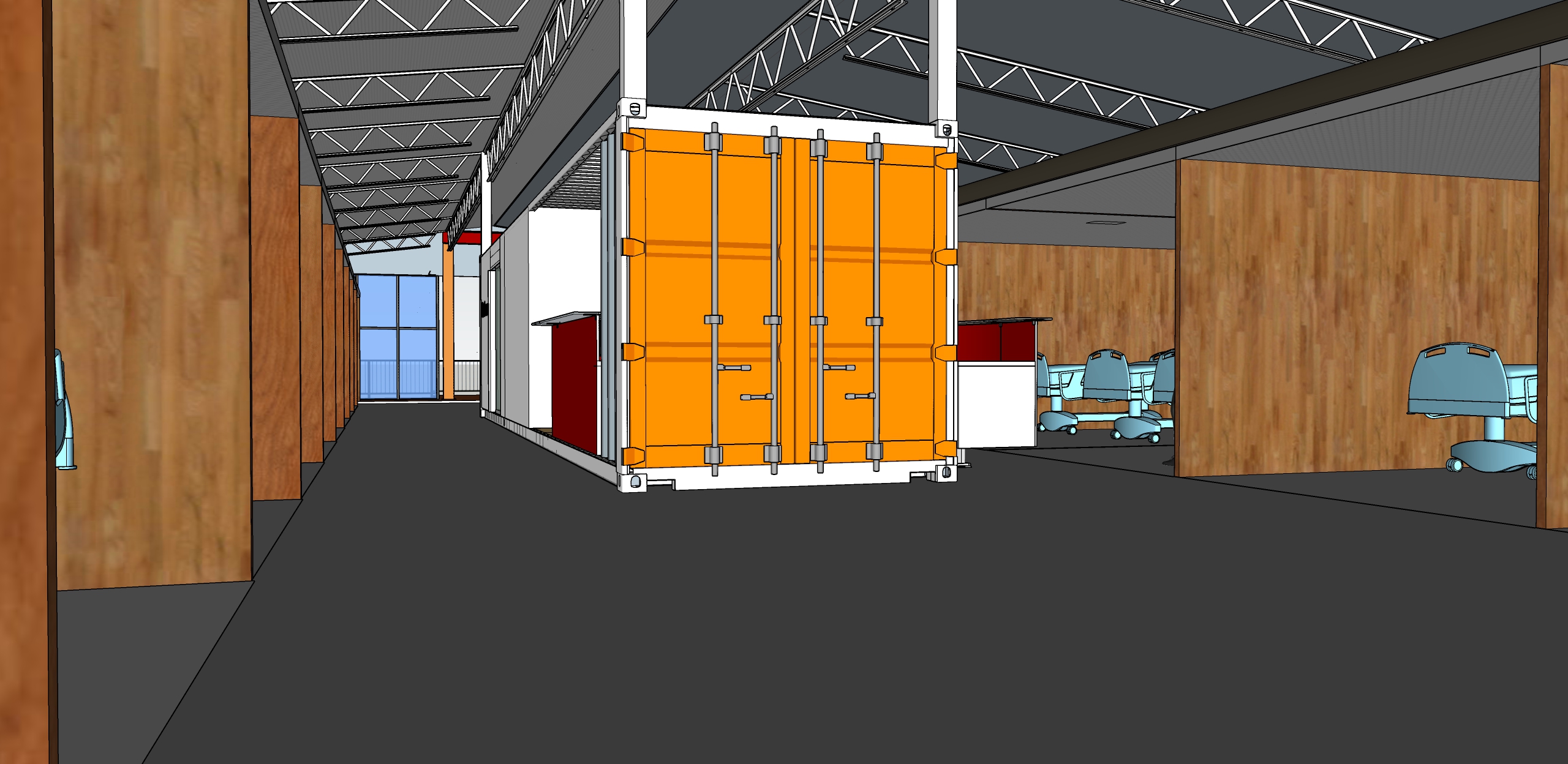
The hospital structure is simply a large shed that houses ICU bays. A nurses’ station is located in the centre.
The testing centre is a drive-by place to conduct COVID-19 tests and either process them when a fast test is available or store them for shipping to laboratories.
Used shipping containers are cheap and easy to find. They are made from a steel frame with corrugated steel panelling, which makes them very strong.
Both schemes use prefabricated panels for exterior and interior walls. Window units will be integrated into panels. These come in standard sizes that easily pop into place.
The two design approaches do have differences, however.
The front entry of the rapid deployment hospital annexe.
The hospital uses a full-length 12-metre container. The shipping container acts as the structural and spatial core of the hospital building.
When unpacked, the container sits in the middle of the hospital and supports long-span steel trusses and the roof. It houses office and storage space.
Inside the hospital annexe the container houses the nurses’ annexe and supports the building trusses and roof.
The prefabricated panels form both the outside walls and interior partitions. End walls are made of transparent glass to allow natural light into the interior.
Interior bays for patients are also prefabricated. These line the exterior walls, leaving space for hospital staff to circulate between the ICU bays and central container.
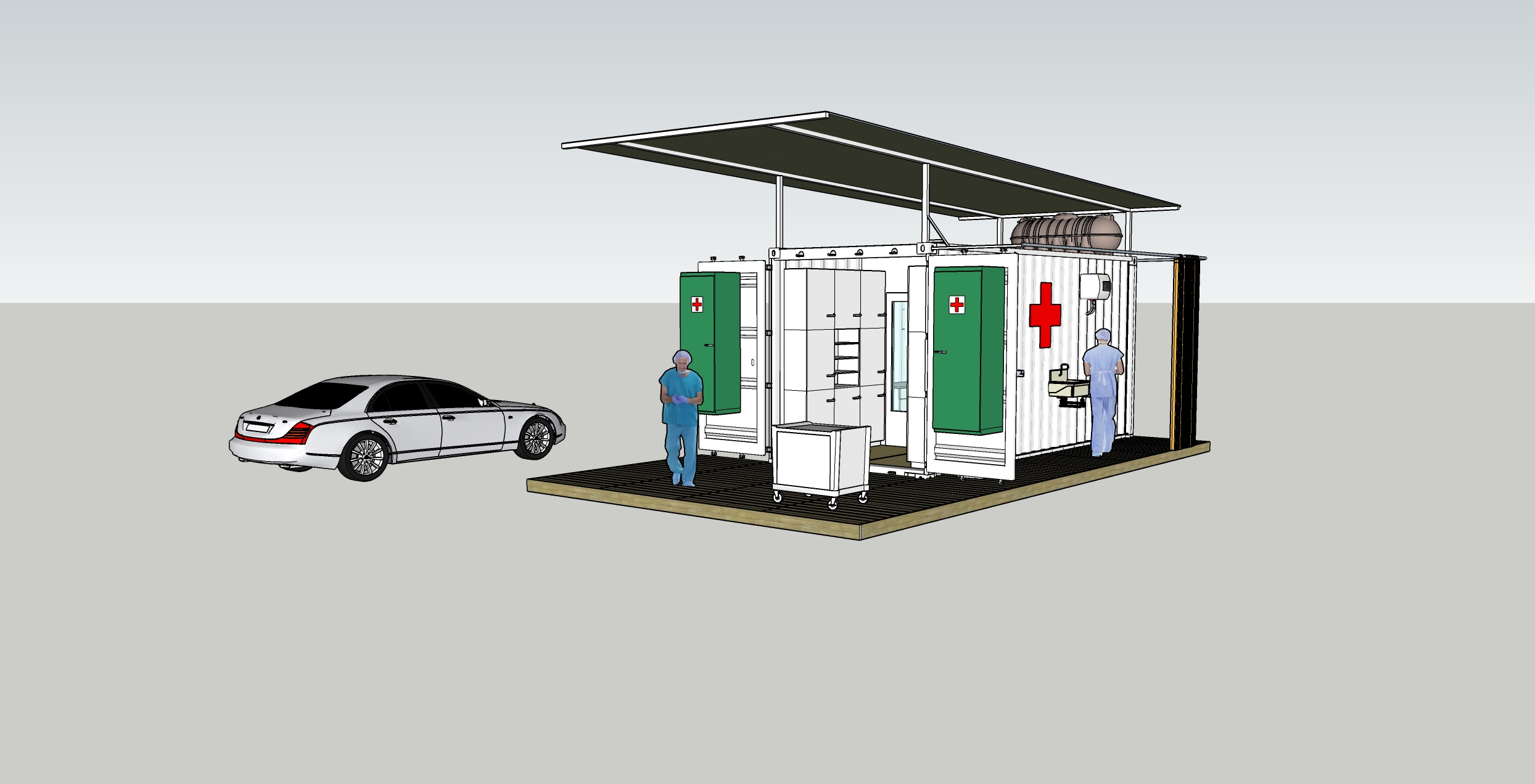
In contrast, the testing centre is a single-unit building made from a half-length six-metre container. A large overhanging canopy covers the roof and front deck to protect against sun and rain.
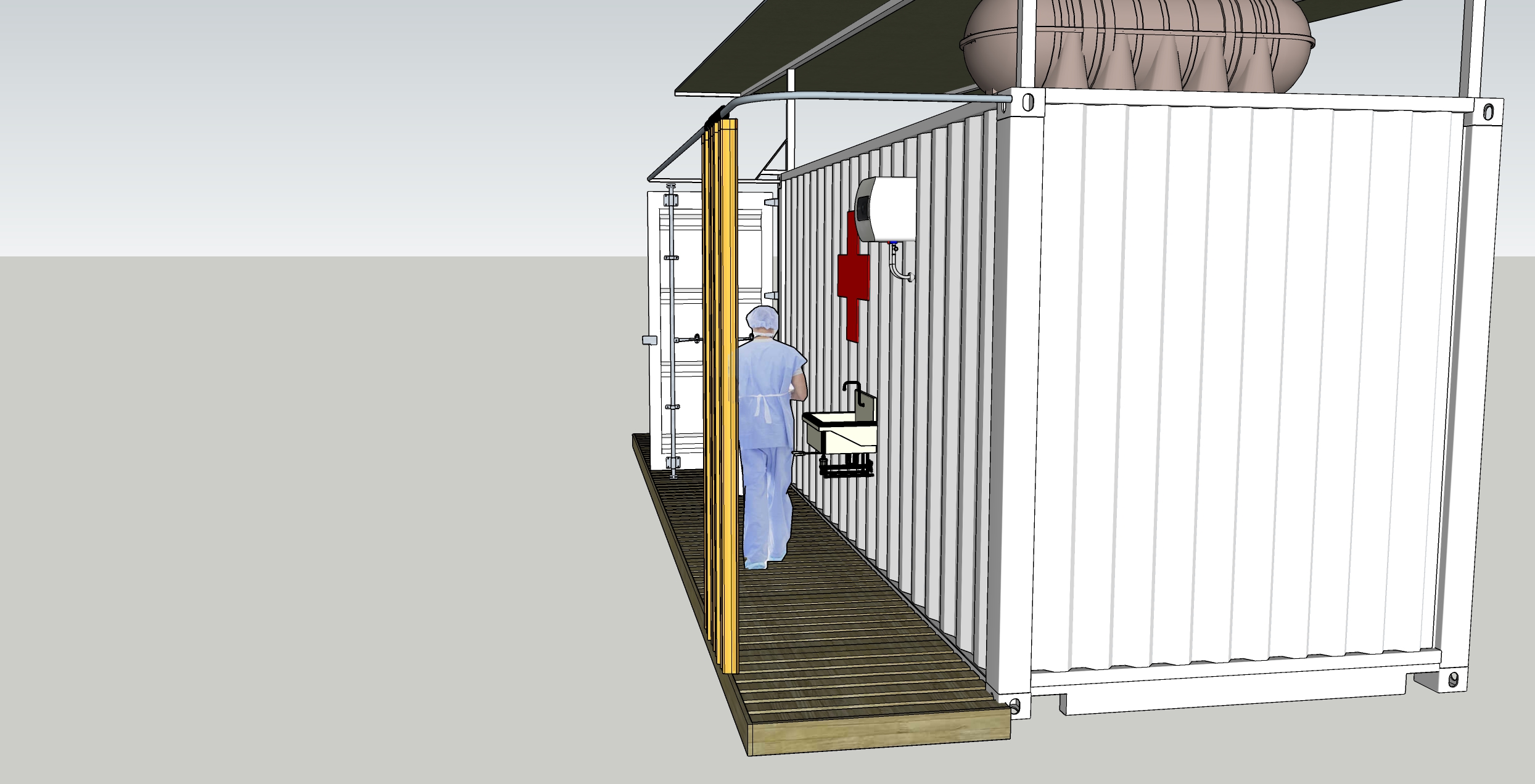
A water storage tank rests on the roof underneath the canopy. A generator sits on one side. There is a scrub sink and changing area outside, with a curtain that allows for privacy and a bin to dispose of protective equipment.
The exterior of the testing centre has a changing area and sink.
The container doors support storage cabinets for test kits on their inside wall. These doors can swing open so they are flush with the front facade. In this position, the cabinets face the front deck for easy access by nurses and doctors.
The front deck of the testing centre showing storage cabinets.
The interior has ample storage and office furniture.
The testing centre office.
Construction of the prototype test centre was due to begin on April 15. To date, the team has raised A$30,000 to support the effort but needs $20,000 more. At A$3,125 per square metre, compared with about A$10,000 per square metre for usual construction, these solutions are affordable and can be produced and delivered very quickly.
Source: The Conversation (Au and NZ) – By Bethaney Turner, Associate Professor, Centre for Creative and Cultural Research, University of Canberra
Recent COVID-19 induced panic buying has raised concerns about food security for many Australians.
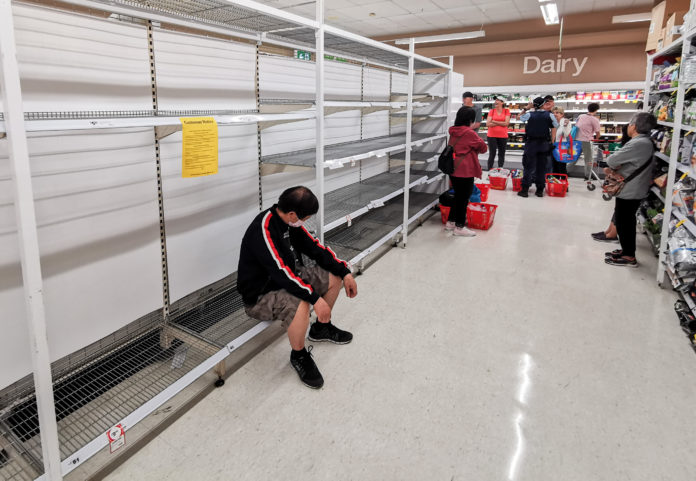
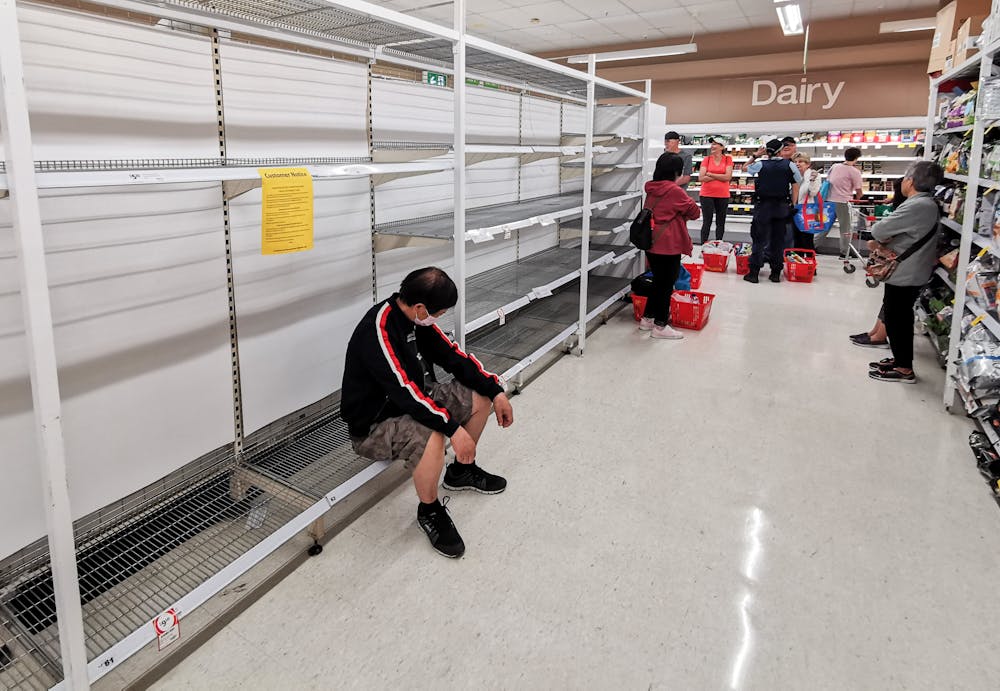
While there’s plenty of food available, many Australians have seen supermarkets stripped bare of essentials in recent weeks. For some it can be hard to find basic items like rice or canned foods.
This is especially true for many of our most vulnerable citizens, from the elderly to those in remote Indigenous communities. What’s more, rising job losses and higher food prices means many people will be out-priced, increasing the number of those experiencing food insecurity in coming months.
But scarcity and food system vulnerabilities are not new experiences. Wars, the great depression, the global financial crisis and natural disasters such as fires and floods have exposed the fallibilities of our food system.
In times of crisis and disaster “food preferences” are the first to go and “making do” – for those who can – becomes the name of the game.
And while right now there really is no reason to stock up on food supplies from supermarkets, the sight of empty shelves has led some Australians to look for alternative ways to feed themselves and their families. We can turn to past experiences to identify approaches, skills and resources.
Some Australians are looking for alternative ways to feed themselves and their families.James Gourley/AAP
In fact, doing so can help us prepare to respond to future instability in food access expected to be brought about through the impacts of climate change. Looking to the past can help build the knowledge and skills necessary to strengthen future household and community resilience.
Changing diets
Having enough food available doesn’t mean everyone will have equal access, nor does it mean all of us will be able to eat typical diets.
The United Nation’s Food and Agricultural Organisation defines food security as requiring “physical and economic” access for “all people at all times”. It not only requires access to “sufficient, safe and nutritious food”, but also access to foods that meet our “dietary requirements and food preferences”.
Recent low yields of drought-impacted crops such as rice means supplies were limited even prior to the shortages created by panic buying.
Canneries are halting production on some of their standard lines as they struggle to access ingredients to keep up with unprecedented demand.
And measures introduced to support vulnerable groups such as meal delivery and “Basics Boxes” are currently unable to cater to diverse tastes and needs.
It’s likely, for those of us without special dietary needs, our everyday food habits will have to change.
Grow your own
Many Australians have turned to home food growing during COVID-19, with edible plants in nurseries quickly selling out of stock.
Growing your own is the most typical historical response to unstable food access. Limited supply during World War I led governments to encourage home and community food production. “Dig for Victory” campaigns were rolled out in the US and Canada, extending to the UK and Australia in World War II.
This video from 1941 explains how to prepare an area for growing veg, and why not having space is no excuse.
The benefits of having more localised food systems are also regularly revealed during extreme weather events.
Food access in Australia heavily relies on supply chains powered by trucks travelling vast distances. When roads are blocked – such as in the recent bushfires and the 2011 Queensland floods – food access is threatened unless you or your neighbours are growing your own.
Food gardening typically requires time, the willingness to be attentive to plant needs, as well as outside space with adequate sun. Not everyone has the infrastructure, knowledge or inclination to do this.
Community gardens are a good option for those without the infrastructure, knowledge or inclination to garden at home.Penelope Beveridge/ AAP
People can turn to communal gardening instead, such as The Happiness Garden in Canberra. Community gardens have historically been great ways of up-skilling and learning with others, but social distancing measures makes this challenging. It’s also important to be wary of soil safety depending on previous uses of the land, particularly if you live in the inner city.
Still, there’s a wealth of information available online, so connecting with local gardening groups, swapping socially distant tips within your suburb, or setting up food-sharing points with neighbours are great options for now.
Urban foraging
Food foraging and hunting of feral animals have supplemented mainstream food supplies during past economic instability. Weeds such as dandelions and feral rabbits were regular additions to meals during the Great Depression.
For urban dwellers, hunting for wild rabbits is probably not a realistic option, but urban food foraging has experienced a resurgence. Recent rain means dandelions, purslane and nettles are rampant right now and, with the right preparation, they can be eaten in salads, soups and stir fries.
Expert guidance is also available online to help you avoid picking anything poisonous.
Edible weeds collected near the author’s home.Hugo Potter, Author provided
Start now to create good habits
Eliminating waste by being frugal and creative is key to making do in times of scarcity.
Knowing how best to store and preserve food (if you have limited fridge and freezer space consider bottling or fermentation); using whole foods (why peel carrots, potatoes and pumpkins?); and knowing substitution tricks (such as swapping eggs for sago), are important food skills in uncertain times.
This ability to adapt to uncertainty is critical to developing resilient communities.
As we look towards a future likely to be punctuated by more extreme weather events, environmental degradation and economic instability, we need robust national food security policy and local urban food systems planning that can meet the protracted challenges threatening our planetary health.
Right now is the perfect time for us to start experimenting with what we can do in our own homes and neighbourhoods to help secure our food futures.
Donald Trump’s sabre-rattling freeze on funding for the World Health Organisation at a time when many countries are pulling together for a global response to the coronavirus pandemic has surely earned him the epithet of the “world’s chief covidiot”.
The US President’s efforts at deflecting the blame for his country’s national public health crisis by pointing the finger at WHO and announcing that Washington would pull funding as the largest donor has shocked the world, triggering widespread condemnation from leaders and public health experts.
The impact of this shock decision is bound to be felt in the Pacific region with some countries and territories clinging precariously to their Covid-19-free status, while others – such as the US territory Guam, New Caledonia and French Polynesia – have already become hotspots.
American funding to WHO provided more than 15 percent of the international body’s 2018-19 budget of $4.4 billion.
While Richard Horton, the editor-in-chief of the Lancet medical journal, denounced Trump’s decision as “a crime against humanity” and an “appalling betrayal” of every scientist, health worker and citizen – and of global solidarity, the second largest WHO donor, Microsoft’s Bill Gates of the Gates Foundation, described the move “as dangerous as it sounds”.
“Once we have finally turned the page on this epidemic, there must be a time to look back fully to understand how such a disease emerged and spread its devastation so quickly across the globe, and how all those involved reacted to the crisis,” he said.
Three-month review Rather pointless right now when most countries are in crisis.
Trump ordered the blocking of funds pending a three-month review of WHO’s role in allegedly “severely mismanaging and covering up the spread of the coronavirus”.
The president claimed that the pandemic could have been contained “with very little death” if the UN agency had accurately assessed the situation in China, where the virus outbreak began in the city of Wuhan late last year. He accused of WHO of having put too much faith in Beijing.
However, the US president had in the early stages regularly downplayed the dangers of this virus that has killed more than 128,000 people and infected more than 2 million worldwide, according to figures from Johns Hopkins University.
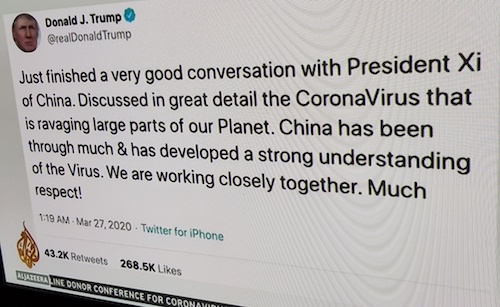
A President Trump tweet in praise of China. Image: Al Jazeera screenshot
He had declared it was all “under control” and as late as March 27 praised President Xi Jinping for China’s handling of the crisis. According to Politico, he tweeted or addressed rallies 15 times in praise of China.
Ironically, the Johns Hopkins University figures – regarded as the most reliable – have been criticised for obscuring the degree of impact in the US by breaking up US death toll figures into individual state tallies.
Warning signs for PNG The warning signs are there for countries such as Papua New Guinea which has already drawn alarm signals from Human Rights Watch, saying that a serious outbreak there would be “a catastrophe”. (Just two “cases” so far, one a foreign mineworker who was repatriated back to Australia and the other a woman in East New Britain who turned out to be a false alarm after a provincial lockdown).
“Even before the coronavirus pandemic, the fragile health system in Papua New Guinea was underfunded and overwhelmed, with high rates of malaria, tuberculosis, and diabetes among its population of more than eight million,” wrote an HRW associate director, Georgie Bright.
“Access to hospitals is extremely limited, with 80 percent of the population living outside urban centres. Prime Minister James Marape has acknowledged the country has only 500 doctors, less than 4000 nurses, and around 5000 beds in hospitals and health centres.
“The country reportedly has only 14 ventilators.”
However, Bright also acknowledged that hopefully there might be mitigating factors, such as large sections of its rural population living in remote mountainous villages in the highlands : “It could be that PNG will be spared the scale of the pandemic seen elsewhere such as Wuhan, a dense urban area with a mobile and older population.”
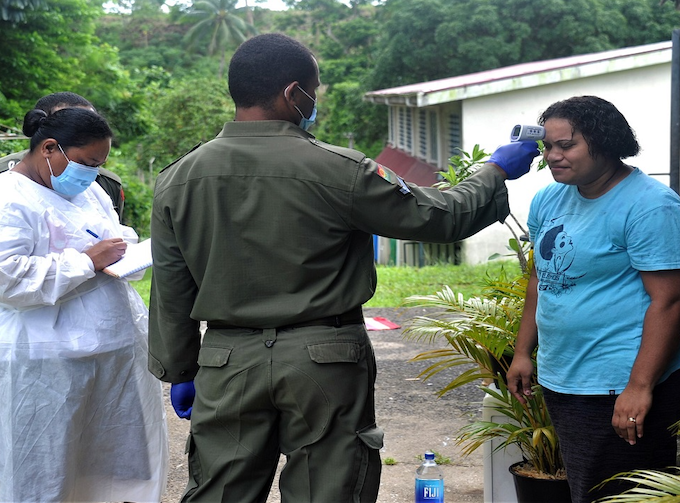
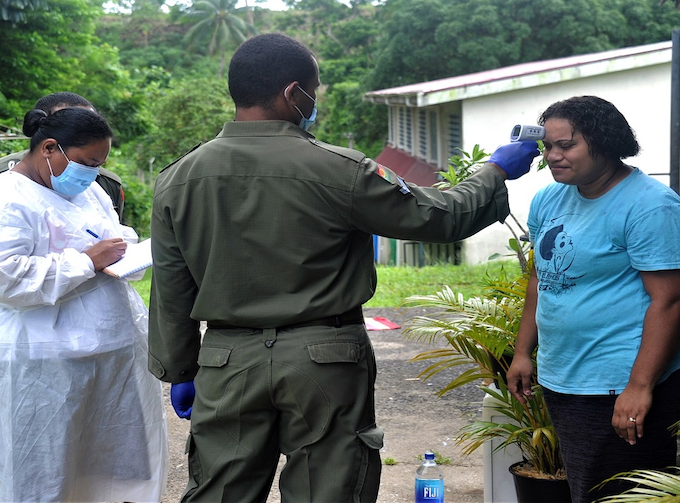
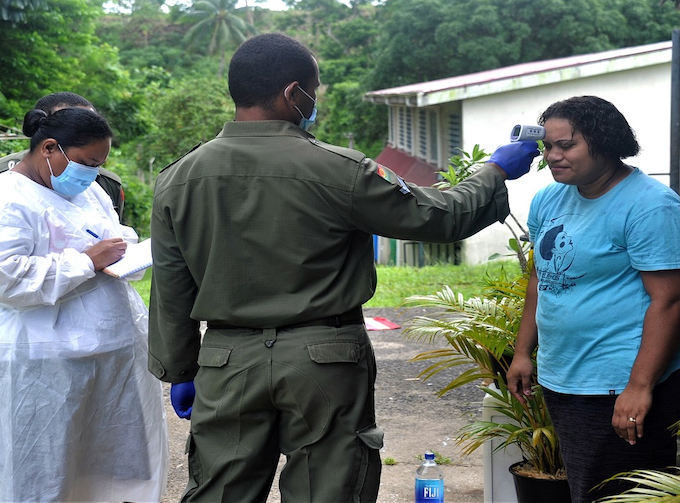
Fiji’s Ministry of Health says mobile fever clinics have been a success in identifying early symptoms and preventing the spread of Covid-19. Image: FBC/Fiji govt
Vanuatu (population almost 300,000) is another country with serious concerns of “disaster” with a possible outbreak, but Fiji (pop. About 900,000) – although it has 19 confirmed cases so far – seems to be holding its own with the success of its fever clinics that have tested more than 120,000 people in the capital of Suva so far.
Timor-Leste is also on the watch list with an eight cases so far and a furore over the sacking of the acting health minister.
Pushed into the background by the relentless sad statistics and doomsday stories around the globe are some other stories in the Pacific that normally struggle to get an airing in mainstream media.
Growing concern for West Papua Just over the porous 820 km jungle border from Papua New Guinea, are the two Melanesian provinces Papua and West Papua ruled under protest by Indonesia. Collectively known as West Papua, the region has become a growing public health concern as Indonesia appears headed for disaster.
The coronavirus pandemic is “exacerbating tensions” in West Papua and exposing the “shortcomings” of Jakarta government policy, laments a conflict watchdog group.
The Institute for Policy Analysis of Conflict (IPAC) says President Joko Widodo’s government needs to urgently appoint a senior official to “focus exclusively on Papua” province to ensure that immediate humanitarian needs and longer term issues are effectively addressed.
It has appealed for greater transparency and more support for the local Papuan administrations in coping with the spread of the virus.
“The virus arrived in Papua as tensions left over from deadly communal violence in August-September 2019 remained high, and pro-independence guerrillas from the Free Papua Organisation (Organisasi Papua Merdeka, OPM) were intensifying attacks in the central highlands.
“Papua’s major faultlines – indigenous vs migrant, central control vs local autonomy, independence movement vs the state – affected both how Papuans interpreted the pandemic and the central government’s response.”
The pandemic has also added new complications such as how many Papuans are “already portraying the virus as being brought in by non-Papuan migrants and the military”. As a result, “hostility and suspicion” are growing.
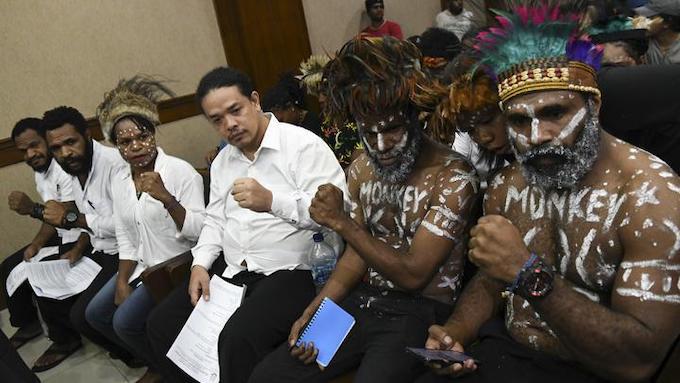
The Jakarta Six (from left): Issay Wenda, Charles Kossay, Arina Elopere, Surya Anta, Ambrosius Mulait and Dano Tabuni – pictured on December 19, 2019. Image: Tempo/Antara
‘Jakarta six’ episode Another episode happened in Jakarta this week that ought to have focused attention on the ongoing human rights struggle for Papuans yet was barely noticed in mainstream media in Australia and New Zealand.
A hearing about the trial of six Papuan activists – known as the “Jakarta Six” – will now be held online or long-distance amid the enforcement of large scale social restrictions to contain the coronavirus pandemic.
The accused – five men and a woman – are Paulus Suryanta Ginting, Charles Kossay, Ambrosius Mulait, Isay Wenda, Anes Tabuni and Arina Elopere. They were arrested by police for flying the Morning Star independence flag during a protest action demanding a referendum for Papua in front of the State Palace on August 28 last year.
The hearings into the alleged makar (treason, subversion, rebellion) case have been changed since the coronavirus pandemic has hit Indonesia, particularly in Jakarta.
The team of lawyers defending the six had earlier asked the panel of judges to postpone the hearing. However, the judges refused the request but changed the mechanism for the hearing so that the defendants can remain in jail for the trial.
An Auckland sign during New Zealand’s four-week lockdown. Image: Al Jazeera screenshot
NZ’s ‘long road back’ Back in New Zealand, the four-week national lockdown has been going encouragingly well, it is into its last week with the debate now moving on to the “long road back” for the economy by relaxing controls – a little – and the manner of how this would be achieved. A decision will be announced next Monday.
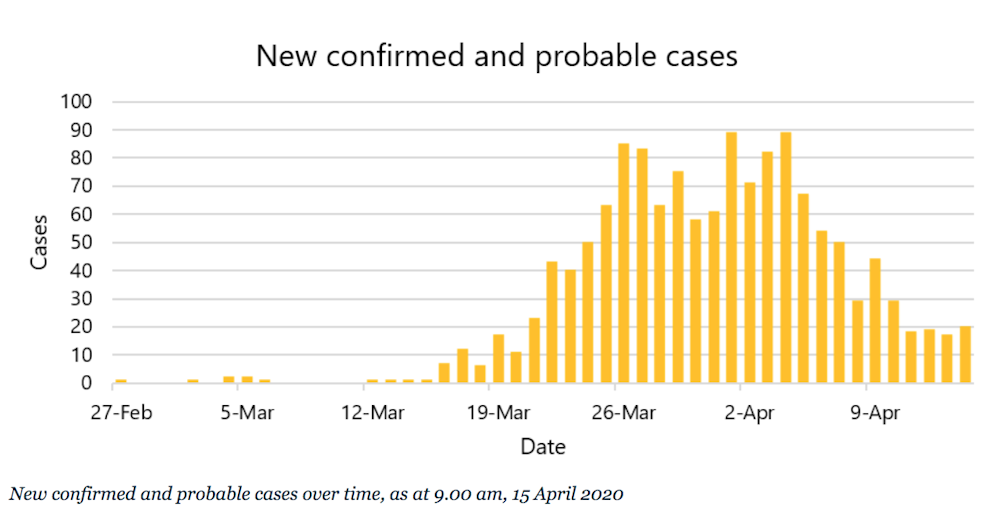
The Ministry of Health statistics show just nine deaths so far – mostly elderly rest home patients – with a fairly stable 1386 cases, just 20 new ones announces yesterday that are eclipsed by the rate of recoveries, now up to 728.
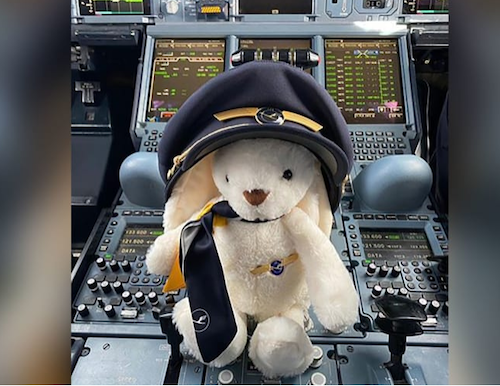
An Easter Bunny called Jacinda. Image: Lufthansa FB
The last of 18,000 stranded German and European visitors and tourists seeking repatriation have now returned to their countries. The final Lufthansa Airbus flight had a sole incoming passenger – an Easter Bunny named Jacinda in honour of Prime Minister Jacinda Ardern who has gained admiration for her courageous leadership, clear communication and kindness.
Not to mention the prime minister, her cabinet and civil service managers’ voluntary gesture of a six-month 20 percent pay cut in solidarity with the “struggle that many New Zealanders are facing”.
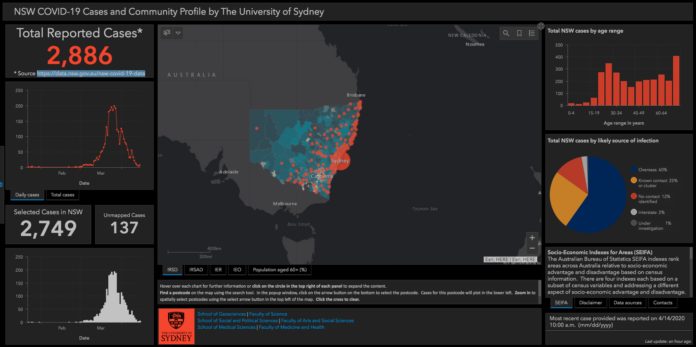
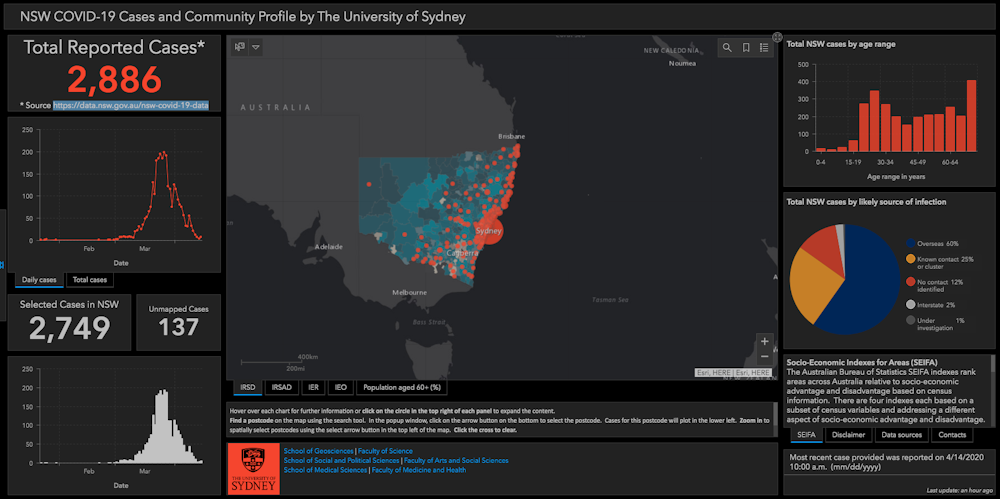
University of Sydney researchers have developed a new searchable database that allows people, for the first time, to compare how many COVID-19 cases there are in every NSW postcode with each suburb’s socioeconomic status and age profile.
The database, which draws on data from the Australian Bureau of Statistics and NSW Health, could help inform decisions about how and when social distancing measures are relaxed.
“We created this database to provide some further transparency to the public, who may be feeling anxious about seeing the number of cases rising and want a postcode breakdown so they can see exactly what’s happening in their area,” said the University of Sydney’s Associate Professor Adam Kamradt-Scott, who has research expertise on Australia’s pandemic preparedness.
“We also wanted to provide further evidence to support NSW Health making decisions and giving advice to government.”
The researchers are keen to collaborate with other jurisdictions to develop the database for other states and territories.The University of Sydney, Author provided
Dr Kamradt-Scott said overlaying the case numbers with data on which suburbs have the highest proportion of people over 60 was important, as this cohort is at greatest risk.
“But socioeconomic status is also important,” he said.
“We know from previous public health research that people with lower socioeconomic status can have poorer health outcomes: they may struggle to access care, diet and nutrition may be a factor, these areas tend to have higher levels of smokers. These factors can have an influence on the prognosis if they get infected with the SARS-COV-2 virus.”
“So, for example, if there appears to be a new cluster of cases where there’s a lower socioeconomic status combined with a higher proportion of people over 60, it could mean, for example, that NSW Health could prioritise services and testing to that community.”
Dr Kamradt-Scott said his team began with NSW because that data was most readily available but they were keen to collaborate with other jurisdictions to provide the same detailed breakdown for other states and territories.
NSW Premier Gladys Berejiklian this week said there would be increased testing in the Sydney suburbs of Penrith, Inner west, Liverpool, Randwick, Waverley, Woollahra, Blacktown, Cumberland, Westmead, Ryde, Manning and Lake Macquarie.
“We’re urging anybody in those high risk categories, anybody who specifically lives in those suburbs that were identified, if you have any symptoms, please come forward and get tested,” she said.
As Australians grapple with the sudden and challenging changes that COVID-19 has brought to their daily lives, the impact of the virus is being felt in extreme ways by vulnerable children and families.
New research led by myself and EY partner Mark Galvin suggests we have a unique opportunity to support at-risk children who require care in the months ahead.
COVID-19 will increase exposure to abuse and neglect
Government responses aimed at reducing coronavirus infection rates may inadvertently increase risk for vulnerable children and families.
As a result of the partial lockdown, for instance, domestic and family violence services in Australia are experiencing surges in demand.
At the same time, the inability of teachers, health workers and community members to easily monitor child wellbeing is likely to temporarily reduce reporting of child abuse.
Child protection systems around the world have observed dramatic decreases in child abuse reporting in the past month.
Instability for children in foster care
Beyond these immediate concerns, there are other implications for children in need of child protection support.
Our research based on COVID-19 infection rates and carer demographics suggests that 20% of existing foster carer households could become affected by the virus through carer infection alone. This could affect placements for some 8,500 children in foster and kinship care.
We know Aboriginal and Torres Strait Islander people are also more at risk of becoming infected. As Aboriginal children are 11 times more likely to be in the care of the state, their foster and kinship care placements could be disproportionately impacted by COVID-19 as a result.
Not all carers who contract the illness will be unable to provide ongoing care, but many children are likely to require support and alternative accommodations during this time.
And with foster carers already in critically short supply, child protection agencies may struggle to locate alternative options. Demand will increase further as more children enter care in the months ahead.
Suspensions of face-to-face biological family contact are also in place in Victoria and elsewhere, and can have significant implications on children’s relationships with their biological families.
Foster carers Anne and Luke (all names in the story are pseudoymns) are all too aware of the changing reality for 5-year-old Josh. Josh will be unable to meet with his biological parents in person or have sleepovers with his grandparents. The family will only be receiving virtual visits from support workers in the months ahead.
In our interviews with the family, Anne told us she is apprehensive.
Josh can be challenging at times, and not having any respite is going to create added stress in the house. Now the challenge of having us all cooped at home, and having to school Josh as well is going to be difficult.
Online services can be particularly difficult for vulnerable families to access and are a less-than-ideal substitute for maintaining relationships, which are necessary for returning children safely back to their families.
Can the foster care system respond?
However, there is some good news. Even if health concerns make finding foster carers more challenging during the crisis, an ensuing economic recession may not exacerbate the situation further.
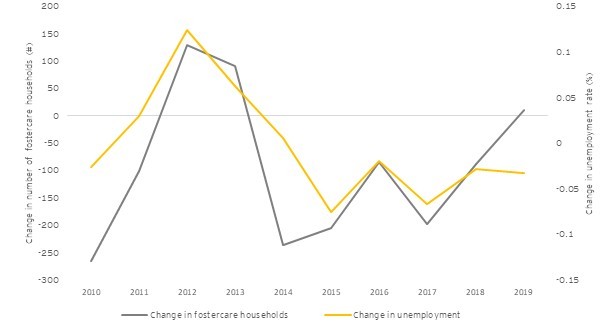
Recent history shows that as unemployment increases in Australia, so, too, does the number of people in our community who become foster carers.
Our analysis suggests this isn’t driven by foster care placement demand. Rather, more Australians are keen to support children in need when they have the time to do so.
Author provided
As a result, now is the time to intensify foster carer recruitment efforts, assessment and training.
How we can support children and families
There are several strategies that can be used to meet the needs of at-risk children during this time. These include:
Ensuring the community understands the importance of reporting any concerns they have about children’s safety during the lockdown.
Improving support for the sector as it transitions to remote service delivery. This includes enabling child protection services to use technologies like video streaming and apps to connect with at-risk children and families, keep children connected to their biological families and provide remote counselling services.
Monitoring foster households at risk of COVID-19 and supporting these carers, including through socially distanced caseworker visits.
Making data-informed decisions on the re-accommodation of children where necessary and for placing new children entering the system, and;
Increasing efforts to recruit, train and support new foster and kinship carers.
The evidence suggests we have a window of opportunity to act swiftly to support the well-being of Australia’s must vulnerable children.
Less than a month after restrictions first took effect, Australia appears to have contained the spread of COVID-19 more successfully than we could have possibly imagined.
But we’ve done so at unimaginable cost: large swathes of the economy have been shut down, leaving the livelihoods of millions of Australians on hold indefinitely. With new cases now on the decline, the conversation at today’s National Cabinet meeting will turn to what can reopen, and when.
But the economic costs of re-opening prematurely could be enormous.
The least costly economic strategy is eliminating COVID-19 from Australia altogether. Growing epidemiological evidence suggests it may be possible for us to eliminate coronavirus within the next two to three months.
Australia’s state and territory governments should explicitly declare that they want to eliminate the virus, and maintain harsh lockdown restrictions until new cases are down to zero or close to it.
And in the meantime we’ll accrue invaluable intelligence from other countries about how best to emerge from lockdowns, and plan accordingly.
There’s no doubt this strategy would have big short-term economic costs.
The Organisation for Economic Co-operation and Development estimates that severe shutdowns like our level-three restrictions wipe out almost a quarter of economic activity, costing Australia’s economy about 2% of annual GDP for each month they remain in place.
This means a three-month shutdown would shave six percentage points off Australia’s annual GDP.
But the Government’s unprecedented package of economic support means many firms and households are well-placed to weather a short but severe storm.
Short term pain, long term gain
There’s also enormous economic upside if we eliminate the virus and the economy can more or less return to normal.
Schools and offices could re-open, as could bars, cafes and restaurants. Import and export goods would flow freely. International students could still come to Australia with quarantine and testing, and being COVID-free would mean more would choose Australia over alternative destinations.
Not everything could return to normal. International tourism would take a hit, because tight border controls would be maintained until the pandemic subsides abroad. But international tourism accounts for just 2% of our gross domestic product. And domestic travel would boom.
And while the prospect of 90 days of stage-three restrictions is daunting, it poses fewer economic costs than the alternatives.
Health Minister Greg Hunt has rightly ruled out allowing the virus to spread through the community.
Even with a so-called herd immunity strategy, there is little chance that economic life would return to normal for at least 12 months. Spatial distancing would still be needed to ensure our hospitals were not overwhelmed, and fear of infection would prevent many people from going outside. Many businesses would remain closed.
Adopting a Goldilocks strategy – where we try to find just the right balance between allowing some economic activity while keeping infections low – would mean fewer die, but would still be bad for the economy.
While there is hope that widespread use of face masks and improvements in tracking and tracing of the disease might change this – there is no certainty.
Sophisticated contract tracing and surveillance were initially effective in helping countries like Singapore to largely stay open, but they too have since resorted to a lockdown to keep infections under control.
In practice, few sectors currently closed could be reopened in Australia under a Goldilocks strategy.
Modellers at the University of Sydney estimate that even a 20% reduction in spatial distancing compliance would push rates of transmission back above one (that is, where one infected person on average infects more than one other).
That suggests schools could probably re-open, but many workplaces and university classes may have to stay closed.
As would domestic air travel and much non-essential retail. The political lobbying over which industry should have the privilege to re-open first would also be intense.
And whatever is required to keep infection rates stable would need to remain in place until there was herd immunity or a vaccine – and that probably means for as long as 18 months, assuming either happens.
We’ve a choice of a long or a short shutdown
For 18 months of lighter restrictions to be better for the economy than shutting down for another 2-to-3 months to eliminate the virus, the economic costs of a lighter shutdown need to be six to nine times less damaging to the economy than a severe shutdown.
That would require an almost complete removal of spatial distancing, which isn’t on the table.
If there were extended shutdowns, millions of Australians would come out the other side with significant scarring; many would never work again.
Firms that can endure a three-month shutdown without going bust are unlikely to survive for 12 months without further government support. And the budgetary costs of that support would become much bigger for future generations if extended to 12 months or more.
Relaxing most restrictions without sparking a second round of contagion may be possible in time, but only after making enormous new investments in our ability to identify cases and isolate them quickly.
Economist Paul Romer argues for universal testing of Americans every two weeks; others call for a new digital surveillance state to enforce self-isolation. In each case the technological obstacles are large, and so we should start investing now. Extending the shut down would give us valuable time to prepare if we fail.
It’s commonly assumed that the public health and economic objectives of managing COVID-19 are in conflict. That’s wrong. Eliminating the virus from Australia is the best strategy for our health and for our economy.
Fiji’s Ministry of Health mobile fever clinic teams operating in the greater Suva area have screened 121,304 Fijians so far.
The ministry is aiming to screen 150,000 people by tomorrow.
The ministry said the mobile fever clinics had been a success in identifying early symptoms and preventing the spread of Covid-19.
One hundred and eighty personnel from the Ministry of Health, Fiji Police Force and Fiji Military are conducting house visits screening people along the Suva/Nausori corridor.
Meanwhile, 5958 Fijians have been screened at the 37 fever clinics located around the country.
The Ministry of Health is encouraging Fijians to assist them by attending fever clinics and presenting themselves early when showing symptoms such as dry cough, fever, sore throat and shortness of breath.
– Partner –
The Covid-19 Helpline also remains open, the toll-free 158 is available 24/7 for all Covid-19 queries.
Koroi Tadulala is a multimedia journalist working for FBC News.
Teachers say most students have lost the ability to focus, are less empathetic and spend less time on physical activity.
These are some of the results from our Growing Up Digital Australia study, in which we surveyed almost 2,000 teachers and school leaders across Australia.
We asked them how students from primary school to year 12 have changed in the last five years, and what might explain these changes.
Nearly four out of five teachers said they saw a decrease in students’ ability to focus on learning tasks, 80% saw a decline in students’ empathy and 60% observed students spending less time on physical activity.
These downward trends could be caused by many factors. But a good starting point is to look at the undeniably biggest change in children’s lives in the last decade – screen technology.
Growing up digital
Educational technologies have opened new opportunities for teaching and learning.
Teachers use technology to make complicated content more understandable, students learn how to communicate their knowledge across digital platforms like podcasts, and schools use technology to report students’ performance.
But a 24/7 connection to the internet comes with possible downsides too. Researchers and health experts around the world have expressed concerns about the possible consequences of heavy screen use on children.
The steady increase in depression, anxiety disorders and other mental health issues among young people has been well reported. And researchers have debated whether screens may be a possible reason for young people’s declining mental health.
It is hard to prove a direct causal link between worsening health outcomes and extended time spent on digital devices. But we can learn much about these complex relationships by exploring views and experiences of teachers, parents and young people themselves.
So, what do we know?
According to a recent poll by the Royal Children’s Hospital, 95% of high-school students, two-thirds of primary school children and one-third of preschoolers own a screen-based digital device.
In an earlier study we found 92% of Australian parents think smartphones and social media have reduced time children have for physical activity and outdoor play.
Most children in Australia own a digital device.Shutterstock
Four out of five parents said social media was a distraction in their child’s life, that impacted negatively on their well-being and family relations.
Another survey showed young people spend one-third of their time awake staring at screens.
In the Growing Up Digital in Australia study, 84% of teachers said digital technologies were a growing distraction in the learning environment.
One teacher told us:
The numbers of students with cognitive, social and behavioural difficulties has increased noticeably. Students appear to have more difficulty concentrating, making connections, learning with enthusiasm and increasing boredom in school.
Our data tells us more than 90% of teachers think the number of children with these kinds of challenges has increased over the last five years. Anxiety among students was also a common concern.
What parents can do
As most Australian children are studying from home this term, and perhaps next, parents will most likely make similar observations of their children – both positive and negative – as the teachers in our study.
Parents might see how fluently children use technologies to learn new concepts. They may also notice how hard or easy it is for their children to concentrate and stay away from the distracting parts of their digital devices.
If a child can’t get through all the tasks their teacher assigns them, it’s important for parents to know this doesn’t mean they are a poor learner or failing student.
Parents can try to understand how children feel about learning – what makes it interesting, what makes it boring and what makes it challenging. A student could be finding it difficult to get a task done due to distractions. The best help in that case is to support the child to stay away from the causes of distraction, which may be their smartphones.
Teachers should also, as much as possible, design learning activities with elements that don’t require any technology. For example, projects that include building, drawing or communicating with others at home can be easily done without devices.
Parents and teachers can work together to find smart ways to teach children safe and responsible use of media and digital technologies. Learning to regulate our own screen behaviours as adults and modelling this behaviour to our children can be a much more effective strategy than simply banning devices.
Studying from home can also be a good opportunity to help children learn to cook, play music or engage in other home-based activities we may wish we had time for but tend to void in our busy daily schedules.
Spending more time with children – with technology and without it – is now more important than ever.
Perhaps the best way to improve the quality of Australian education is to change how we do things. We should understand children are not who they used to be and better learning requires changing the ways both adults and children live with digital devices.
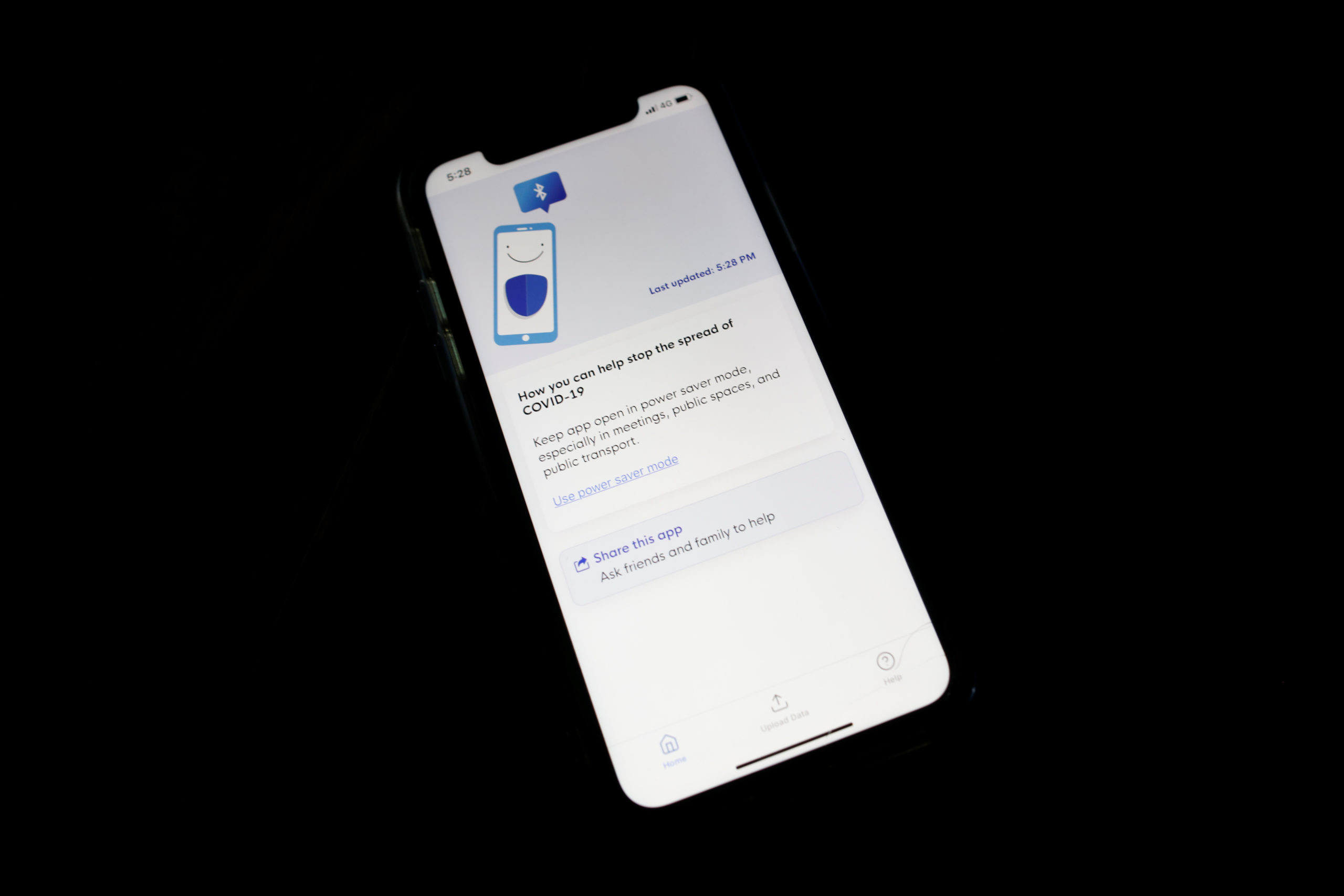
However, rather than collecting location data directly from mobile operators, the proposed TraceTogether app will use Bluetooth technology to sense whether users who have voluntarily opted-in have come within nine metres of one another.
Contact tracing apps generally store 14-21 days of interaction data between participating devices to help monitor the spread of a disease. The tracking is usually done by government agencies. This form of health surveillance could help the Australian government respond to the coronavirus crisis by proactively placing confirmed and suspected cases in quarantine.
The TraceTogether app has been available in Singapore since March 20, and its reception there may help shed light on how the new tech will fare in Australia.
Internationally, contact tracing is being explored as a key means of containing the spread of COVID-19. The World Health Organization (WHO) identifies three basic steps to any form of contact tracing: contact identification, contact listing, and follow-up.
Contact identification records the mobile phone number and a random anonymised user ID. Contact listing includes a record of users who have come into close contact with a confirmed case, and notifies them of next steps such as self-isolation. Finally, follow-up entails frequent communication with contacts to monitor the emergence of any symptoms and test accordingly to confirm.
The TraceTogether app has been presented as a tool to protect individuals, families and society at large through a community data-driven approach. Details on proximity and contact duration are shared between devices that have the app installed. An estimated 17% of Singapore’s population has done this.
In an effort to preserve privacy, the app’s developers claim it retains proximity and duration details for 21 days, after which the oldest day’s record is deleted and the latest day’s data is added.
TraceTogether supposedly doesn’t collect users’ location data – thereby mitigating concerns about location privacy usually linked to such apps. But proximity and duration information can reveal a great deal about a user’s relative distance, time and duration of contact. A bluetooth-based app may not know where you are on Earth’s surface, but it can accurately infer your location when bringing a variety of data together.
No perfect solution exists
The introduction of a contact tracing app in Australia will allow health authorities to alert community members who have been in contact with a confirmed case of COVID-19.
However, as downloading the app is voluntary, its effectiveness relies on an uptake from a certain percentage of Australians – specifically 40%, according to an ABC report.
But this proposed model overlooks several factors. First, it doesn’t account for accessibility by vulnerable individuals who may not own or be able to operate a smartphone, potentially including the elderly or those living with cognitive impairment. Also, it’s presently unclear whether privacy and security issues have been or will be integrated into the functional design of the system when used in Australia.
This contact tracing model is also not open source software, and as such is not subject to audit or oversight. As it has currently been deployed in Singapore, it also places a government authority in control of the transfer of valuable contact and connection details. The question is now how these systems will stack up against corporate implementations like that being proposed by Google and Apple.
Also, those who criticise contact tracing point out that the technology is “after the fact” when it is too late, rather than preventive in nature, although it might act to lower transmission rates. Some research has proposed a more preemptive approach, location intelligence, implemented by responsible artificial intelligence, to predict (and respond to) how an outbreak might play out.
Others argue that if we’re all self-isolating, there should be no need for unproven technology, and that attention may instead be focused on digital immunity certificates, allowing some people to roam while others do not.
And in the apps created to respond to particular situations, there’s always the question of: “who owns the data?”. A pandemic-tracing app would need to have a limited lifetime, even if the user forgets to uninstall the COVID-19 app after victory has been declared over the pandemic. It must not become the de facto operational scenario – this would have major societal ramifications.
It’s all about trust
In the end, it may simply come down to trust. Do Australians trust their data in the hands of the government? The answer might well be “no”, but do we have any other choice?
Or for that matter what about data in the hands of corporations? Time and time again, government and corporates have failed to conduct adequate impact assessments, have been in breach of their own laws, regulations, policies and principles, have systems at scale that have suffered from scope and function creep, and have used data retrospectively in ways that were never intended. But is this the time for technology in the public interest to proliferate through the adoption of emerging technologies?
No one fears “tech for good”. But we must not relax fundamental requirements of privacy, strategies for maintaining anonymity, the encryption of data, and preventing our information from landing in the wrong hands. We need to ask ourselves, can we do better and what provisions are in place to maintain our civil liberties while at the same time remaining secure and safe?
Pete Evans came under fire again last week for fobbing off a A$15,000 machine touted to treat multiple ailments, including coronavirus. The BioCharger NG, according to Evans’s website, is a “hybrid subtle energy revitalisation platform that works to optimise your health, wellness and athletic performance”.
He posted to his 231,000 Instagram followers the machine contains thousands of different “recipes” of light and sound, which can counteract viruses, including a couple of “recipes” against COVID-19. What are Evans’ credentials again, you ask? He’s a celebrity chef.
This promotional hoodwink is tapping into consumer fears and targeting the vulnerable and desperate.
Fear in society will always exist, and it is important for consumers to look at things from a logical and practical level. Brands are not here to promote solutions to the pandemic – this should be taken from official sources.
Shifting sales
Businesses have in the past shown their versatility and ingenuity in pivoting in innovative ways. There’s nothing wrong with trying to turn a disaster into an opportunity, as John D. Rockefeller once said. It all comes down to what opportunities exist and how you can take advantage of them.
Business models must constantly evolve, and many businesses have shifted their primary presence online to overcome current operational restrictions. But there is more to it than simply going online – it is also about understanding the new modified needs and wants of the market, and how you can provide to these needs while the opportunity exists.
Major brands such as Coca-Cola, Audi and McDonald’s have reinforced medical advice of social distancing through advertising. Guinness advertised unity and hope. Social responsibility in businesses has never been more important than it is now.
But as well as selling #stayhome messages, brands still need to sell their products – and some brands are doing well in the shift to home-based life.
Sales of loose-fitting loungewear, leggings and stretchy pants have been soaring, with companies like Myer advertising pyjamas as “Your home office dress code” – a knowing wink to consumers who will be doing away with the formal office wear for the time being.
As the office has shifted to the home, what we consider acceptable (or comfortable) workwear has shifted, too.Screenshot/Myers
Food delivery sales are also growing. Restaurants are selling consumers prepared food alongside make-it-yourself kits. Fast-food chains are advertising their cashless and contactless delivery ahead of advertising their food.
Red Rooster isn’t just selling chicken – it’s also selling safe delivery.Red Rooster/Screenshot
Selling panic
When does tapping into coronavirus fears become ethically challenged?
Bupa tried to promote its health insurance alongside advice on the importance of being prepared. But using the image of an empty shelf (and the contentious issue of toilet paper) during the pandemic is taking advantage of fear. Paralleling shortages in essential products to health insurance policies is merely creating unnecessary panic-buying among those who don’t or can’t afford private insurance.
Whether or not you have private health insurance during the pandemic is irrelevant as doctors, not insurers, determine treatment.
Tapping into panic to sell at a time when everyone feels vulnerable is unconscionable. Especially when the company sells items of need that aren’t part of their regular inventory. Fashion brands under the Mosaic parent company have crossed that line with marketing for hand sanitisers. Not only is this opportunistic profiteering, a pre-order doesn’t guarantee customers will receive the items any time soon.
Brands like Katies are selling hand sanitiser for ‘pre-order’ – but when will consumers get their deliveries?Screenshot/Katies
Online wine retailer Winetime.co.nz sneakily tried to pass off an advertisement that resembled the official New Zealand government’s public service announcement. The social media ad was accused of taking advantage of the COVID-19 branding to promote the retailer’s products.
Winetime.co.nz has been criticised for using advertising that looks like government health alerts.New Zealand Government/Winetimes
‘We live in a society’
Brands’ key responsibility here is to keep supplying what consumers want in a moral, conscientious and transparent manner. And as much as it is important for businesses to stay afloat, it is also critical for consumers to not succumb to unethical and false advertising.
As frozen meat brand Steak-umm said eloquently via its Twitter account, “we live in a society so please make informed decisions to the best of your ability and don’t let anecdotes dictate your worldview”.
Beware of advertising that taps into current fears and uncertainty. Scrutinise claims. If in doubt, discuss with family and friends.
The days of “what you see is what you get” have passed. It is now time for us to change the way we look at advertising.
Source: The Conversation (Au and NZ) – By David Smith, Senior Lecturer in American Politics and Foreign Policy, US Studies Centre, University of Sydney
In absolute numbers, the United States is suffering the world’s worst COVID-19 outbreak. How did this happen in a country with such vast resources?
How voters assign blame will be the key question of the 2020 presidential election. As president, Donald Trump is trying to deflect all blame from himself, while taking credit for anything that goes right.
It started by blaming the other side
Research from the past decade shows party identity is a major factor in how Americans assign blame for government failures. In the current partisan environment, many voters will simply blame the other side.
But the election will probably be decided at the margins, by people without strong party identities who usually pay little attention to politics.
Trump’s own failures in the pandemic are welldocumented. His overconfidence, disdain for expert opinion and obsession with stopping bad news from hitting the stock market all made the crisis worse.
Perhaps most damaging, Trump and his allies claimed early on the media and Democrats were deliberately exaggerating the virus to cripple the economy and his re-election chances. This politicisation of the virus had far-reaching effects on the behaviour of both citizens and elected officials.
Nearly every western democracy has had problems with people who haven’t taken COVID-19 seriously. But only in the United States did this become a principled political stance.
Then it became a ‘foreign’ problem
Trump is staking his re-election on a different narrative. He is now placing blame for the pandemic outside the United States, on the Chinese government and the World Health Organisation. He has announced he will halt US funding to the WHO, which he accuses of mishandling the crisis and helping China’s cover-ups.
The centrepiece of this narrative is Trump’s travel ban on China, which he claims the WHO “fought”. In Trump’s telling of the story, he made a brave and prophetic decision that aligned with his instincts on keeping Americans safe from foreign threats. In reality, the travel ban contributed to a dangerous atmosphere of complacency.
The Trump administration issued an entry ban on foreign nationals who had recently travelled in China on January 31, effective February 2. Trump faced almost no political opposition to this decision at the time, though the WHO did not recommend it.
Trump was not alone in making this decision. US airlines had already stopped carrying passengers to and from China. Many other countries, including Australia and Italy, announced travel bans for passengers from China at the same time.
Despite China’s complaints about the travel bans, the world was essentially following China’s lead after it shut down Hubei province, the epicentre of the outbreak on January 30.
Trump’s daily news briefings have become increasingly combative in recent days.Yuri Gripas / POOL / EPA
The virus was already spreading in the United States, and other travellers such as returning cruise ship passengers were seeding new clusters. But the US government’s response remained focused on China, even as Trump tried to calm markets by praising President Xi Jinping’s handling of the crisis.
Until the end of February, the CDC restricted coronavirus testing to people who had recently been to China or had come into contact with a known infected person. As a result, few Americans were tested in the first weeks of the crisis.
Australia, by contrast, had a similar travel ban, but tested far more people early on.
Well into March, Trump and his allies continued to brag that the travel ban had “contained” COVID-19, which they christened “the China virus”.
Lack of preparedness leads to crisis
After it became clear the US was facing a major crisis of its own, Trump repeatedly pointed to the travel ban as evidence of his early seriousness about COVID-19. Framing the virus as a foreign problem solved by keeping foreigners out suited Trump’s political purposes as he campaigned for re-election on tough border control. But it did nothing to help Americans as infection rates exploded.
Widespread framing of the virus as “foreign” continued even as it crushed American cities. Some Republican officials suggested the crisis would be limited to cosmopolitan cities in blue states.
Alabama Governor Kay Ivey refused to issue a stay-at-home order because, as she put it, “we are not California”. However, Alabama already had more infections per capita by late March than California.
South Dakota Governor Kristi Noem told reporters her state was “not New York City” shortly before one of the worst viral clusters in the country appeared in Sioux Falls.
Trump’s skill as a campaigner can’t be denied. But his initial polling boost from the crisis, smaller than that of otherleaders, is already wearing off.
Trump will continue to make confident predictions and tout miracle cures as the pandemic wears on. And if one of them works out, it will become another campaign centrepiece, showing how Trump beat the experts.
But too many of these gambles have already failed. The death and suffering are real, and they will make a grim backdrop for an election.
We’ve seen images of people “panic buying” alcohol since lockdown started in March. Now new data from the advocacy group Foundation for Alcohol Research and Education (FARE) shows people are not just stocking up for a rainy day. In households that have been buying extra alcohol, 70% are drinking more than usual too.
People tend to drink more during major disasters and crises. So it’s not surprising we’re seeing an increase in alcohol consumption during the coronavirus pandemic.
Most people drink for social reasons. It’s enjoyable, relaxing and a central part of Australian culture. But the FARE research found around one-third of those who purchased more alcohol were concerned about their own or someone else’s drinking.
So when do you need to worry that your drinking is becoming a problem?
The new draft guidelines, released earlier this year, say healthy adults should drink no more than ten drinks a week and no more than four in any one day.
If you have existing health problems alcohol affects you more, and if you are under 18 or pregnant, you shouldn’t drink at all.
If you stay within these guidelines, you significantly lower your risk of a range of health problems including at least seven cancers (liver, oral cavity, pharyngeal, laryngeal, oesophageal, colorectal, liver and breast cancer), diabetes, liver disease, brain impairment, mental health problems and obesity.
Staying within these guidelines is one way to reduce the risk of drinking becoming a problem.
Here’s what happens after you take your first sip of alcohol.
Signs your drinking may be problem
1. Not keeping up responsibilities
You’d be forgiven for not getting out of your pyjamas or putting on makeup everyday during lockdown. But if you find you’re not keeping up with major responsibilities at home, work, or school, it might be a sign your drinking is becoming a problem.
You might wake up with a hangover, for example, and can’t do your work or make the kids’ breakfast.
When alcohol starts to interrupt your daily living and functioning, it’s a sign you’re probably drinking too much.
2. Concern from others
If people close to you are starting to comment on how much you’re drinking or express concern you’re drinking too much, that can be one of the early signs you’re on a slippery slope.
Or if your relationships are becoming strained because of your drinking (for example, you’re getting into arguments with your partner more frequently), it might be time to look at how much you’re drinking.
Have family members commented on how much you’re drinking?Shutterstock
3. Drinking to cope
In the FARE survey, one in four people said they were drinking to cope with stress.
Meanwhile, more than half the people who took part in a survey for Hello Sunday Morning, an online support site for people wanting to change their drinking, said they were drinking more from boredom or loneliness.
People who drink in response to stress tend to drink larger amounts of alcohol. If this is you, think about healthier activities to relax and manage how you’re feeling.
Alcohol impacts on mental health and well-being. Although initially it creates a feeling of relaxation, it can increase anxiety and disrupt sleep.
If you have increased your drinking and your sleep is also disrupted it might be related. Alcohol affects quality of sleep that in turn lowers your ability to cope with stress.
5. Aggression and violence
If you find you’re becoming angry, aggressive or violent when you are drinking, it’s a problem. It may be best to stop drinking altogether.
Alcohol reduces inhibitions and also affects our ability to regulate our emotions. You may need to deal with underlying mental health issues.
6. Regular heavy drinking
Drinking alone is more common among people who are dependent on alcohol, but if you have a drink now and then on your own, it’s not in itself a sign you have a drinking problem.
But if you’re frequently drinking alone or frequently getting drunk when you are alone, the quantity and frequency may signal a problem. Daily drinking (alone or with others) is associated with dependence and other problems.
7. Building tolerance
If you’re finding the usual amount of alcohol doesn’t seem to have the same effect or you need to drink more to get the same effect, that’s a sign you have increased your tolerance to alcohol. It’s an early sign of dependence.
8. Unintended consequences
If you experience unintended consequences, it may indicate you’re not in full control of your drinking.
This might mean drinking more than you intended, getting drunk when you didn’t intend to, drinking so much you forget what happened (blacking out) or frequently waking up with a hangover.
If you’re trying to manage your drinking, Hello Sunday Morning offers a free online community of more than 100,000 like-minded people. You can connect and chat with others actively changing their alcohol consumption.
If you’d like to talk to someone about your drinking, call the National Alcohol and Other Drug Hotline on 1800 250 015. It’s a free call from anywhere in Australia.
You can also chat online with a counsellor at CounsellingOnline. Or talk to your GP about seeing a psychologist or counsellor.
Source: The Conversation (Au and NZ) – By Clive Phillips, Professor of Animal Welfare, Centre for Animal Welfare and Ethics, The University of Queensland
In a controversial move, China recently reopened its wet markets, which sell fresh meat, produce and live animals. A wet market in Wuhan may have been the source of the COVID-19 outbreak.
Prime Minister Scott Morrison has condemned the move, and the World Health Organization reportedly stated while wet markets don’t need to close down, they should be prohibited from selling illegal wildlife, such as pangolins and civet cats, for food, and food safety and hygiene regulations should be enforced.
The demand for meat and milk in China is growing rapidly. Nearly 1.5 billion people live in China, and each person eats, on average, about 2.5 times more meat than in the early 1990s.
Poorly treated animals are stressed, and stressed animals are more likely to harbour new diseases because their immune systems are compromised.
This means these wet markets, where there are stressed animals in close contact with humans, are the perfect breeding ground for new diseases.
China urgently needs to restructure its animal industries for global food safety. “Clean” meat” (meat grown from cells in a laboratory) offers hope – but more on that later.
Stressed animals can’t fight diseases well
The consumption of wildlife per se does not increase the risk of disease transmission. Freshly killed deer in the Scottish highlands can provide venison that’s less risky than intensively farmed chickens, which are routinely infected with human pathogens.
When wildlife are stressed, farmed in small cages and kept in close contact with humans during the entire rearing and slaughtering process, including in wet markets, the risk of disease transmission rises.
When a pathogen challenges a healthy immune system, the body responds with inflammation to fight it. But when an animal is stressed, the hormone cortisol is released.
This causes the normal inflammatory response to change into a more limited activation of white blood cells. And this allows new pathogens to survive and multiply.
Wildlife under pressure
As well as importing more meat, the Chinese government has rapidly changed production systems from “peasant-style” agriculture to intensive animal production systems. Recent urban expansion has also put more pressure on agricultural land.
Some weeks ago I visited a new dairy farm in China with more than 30,000 cows. I passed through a destroyed village where small farms kept just a few cows each. Cows in the new megafarms are permanently housed and produce twice as much milk as the cows on small farms, being fed a richer diet.
But they typically last only two or three lactations because of the stress, whereas small farmers’ cows might be kept for a decade.
Similarly, wildlife populations have been put under significant pressure. The human population density in China has grown to four times that of the United States and 50 times that of Australia, all similar-sized countries with significant wilderness areas. Indigenous forest in China has diminished to just 3% of its original area.
Domesticated animals have been bred to tolerate traditional farming systems without getting unduly stressed. Wildlife have not.
The response to wildlife farming
In 2017, the Chinese government issued a law tightening up trade in wildlife, but still allowed wildlife not under state protection and obtained by a person with a hunting license to be sold. Fines for vendors and purchasers were as little as twice the value of the wildlife.
With limited “wild life” available for consumption, entrepreneurial Chinese have turned to farming them in an industry reportedly worth billions and employing 6 million people.
Keeping wildlife in small cages – as is practised on wildlife farms – causes them immense stress, traditionally recognised as “capture myopathy”, which can be so severe that it kills them.
But in February this year the law tightened to include a ban on all consumption of terrestrial wildlife, but only if they lived naturally, rather than on farms.
However, nearly 20,000 of the wildlife farms have reportedly been closed down since the COVID-19 outbreak began.
Signs of change
There are signs of growing awareness in China towards stress in their animals.
My colleagues and I at the University of Queensland recently established a Sino-Australian Animal Welfare Centre, and our latest research has found a growing number of scientists studying animal welfare issues in China.
Lab-grown meat is a viable alternative to traditional meat sources in China.Shutterstock
What’s more, there’s a big opportunity to bring “clean meat” into the Chinese diet. Clean meat is grown synthetically from muscle cells, without the massive land and water resources required of traditional meat production in China, without the emissions of pollutants and, most importantly, without the risk of transmission of novel diseases.
In fact, plant-based meat substitutes are gaining favour in China as more sustainable and healthy products. A 2018 study found Chinese consumers’ intention to eat less meat had a positive emotional response.
Cultural studies suggest that in general, Chinese people have many of the right qualities for widescale adoption. They act in the collective interest, not for themselves, they are adaptable and entrepreneurial, and their society is driven by competition and success in the face of adversity.
Chinese scientists are already working on clean meat. In fact, the first cultured meat there, from pig muscle stem cells, was produced last year by scientists at Nanjing Agricultural University.
Clean meat is expected to comprise 35% of the global meat market in 2040. Perhaps it will be even faster in China to avoid more animal-borne diseases emerging.
Teachers say most students have lost the ability to focus, are less empathetic and spend less time on physical activity.
These are some of the results from our Growing Up Digital Australia study, in which we surveyed almost 2,000 teachers and school leaders across Australia.
We asked them how students from primary school to year 12 have changed in the last five years, and what might explain these changes.
Nearly four out of five teachers said they saw a decrease in students’ ability to focus on learning tasks, 80% saw a decline in students’ empathy and 60% observed students spending less time on physical activity.
These downward trends could be caused by many factors. But a good starting point is to look at the undeniably biggest change in children’s lives in the last decade – screen technology.
Growing up digital
Educational technologies have opened new opportunities for teaching and learning.
Teachers use technology to make complicated content more understandable, students learn how to communicate their knowledge across digital platforms like podcasts, and schools use technology to report students’ performance.
But a 24/7 connection to the internet comes with possible downsides too. Researchers and health experts around the world have expressed concerns about the possible consequences of heavy screen use on children.
The steady increase in depression, anxiety disorders and other mental health issues among young people has been well reported. And researchers have debated whether screens may be a possible reason for young people’s declining mental health.
It is hard to prove a direct causal link between worsening health outcomes and extended time spent on digital devices. But we can learn much about these complex relationships by exploring views and experiences of teachers, parents and young people themselves.
So, what do we know?
According to a recent poll by the Royal Children’s Hospital, 95% of high-school students, two-thirds of primary school children and one-third of preschoolers own a screen-based digital device.
In an earlier study we found 92% of Australian parents think smartphones and social media have reduced time children have for physical activity and outdoor play.
Most children in Australia own a digital device.Shutterstock
Four out of five parents said social media was a distraction in their child’s life, that impacted negatively on their well-being and family relations.
Another survey showed young people spend one-third of their time awake staring at screens.
In the Growing Up Digital in Australia study, 84% of teachers said digital technologies were a growing distraction in the learning environment.
One teacher told us:
The numbers of students with cognitive, social and behavioural difficulties has increased noticeably. Students appear to have more difficulty concentrating, making connections, learning with enthusiasm and increasing boredom in school.
Our data tells us more than 90% of teachers think the number of children with these kinds of challenges has increased over the last five years. Anxiety among students was also a common concern.
What parents can do
As most Australian children are studying from home this term, and perhaps next, parents will most likely make similar observations of their children – both positive and negative – as the teachers in our study.
Parents might see how fluently children use technologies to learn new concepts. They may also notice how hard or easy it is for their children to concentrate and stay away from the distracting parts of their digital devices.
If a child can’t get through all the tasks their teacher assigns them, it’s important for parents to know this doesn’t mean they are a poor learner or failing student.
Parents can try to understand how children feel about learning – what makes it interesting, what makes it boring and what makes it challenging. A student could be finding it difficult to get a task done due to distractions. The best help in that case is to support the child to stay away from the causes of distraction, which may be their smartphones.
Teachers should also, as much as possible, design learning activities with elements that don’t require any technology. For example, projects that include building, drawing or communicating with others at home can be easily done without devices.
Parents and teachers can work together to find smart ways to teach children safe and responsible use of media and digital technologies. Learning to regulate our own screen behaviours as adults and modelling this behaviour to our children can be a much more effective strategy than simply banning devices.
Studying from home can also be a good opportunity to help children learn to cook, play music or engage in other home-based activities we may wish we had time for but tend to void in our busy daily schedules.
Spending more time with children – with technology and without it – is now more important than ever.
Perhaps the best way to improve the quality of Australian education is to change how we do things. We should understand children are not who they used to be and better learning requires changing the ways both adults and children live with digital devices.
Source: The Conversation (Au and NZ) – By Kurt Iveson, Associate Professor of Urban Geography and Research Lead, Sydney Policy Lab, University of Sydney
Authorities have imposed significant restrictions on the size, purpose and location of gatherings in public space to slow the transmission of COVID-19. The massive impacts of these escalating restrictions over the past two months show us just how significant public spaces are for the life of our cities. A longer-term concern is the risk that living with these measures might normalise restrictions on, and surveillance of, our access to public space and one another.
Right now, public health is the priority. But access to public spaces was already significantly and unjustly restricted for many people before the coronavirus pandemic. Current restrictions could both intensify existing inequalities in access and reinforce trends towards “locking down” public space.
We must ensure these restrictions do not become permanent. And once the crisis is over, we also should act on existing inequitable restrictions.
Restrictions have inequitable impacts
Unless public health interventions are enacted with an awareness of their profoundly uneven consequences, we may well “flatten the curve” in ways that add to existing inequalities and injustices.
Research suggests restrictions on public space have greater impacts on people who have less access to private space. People without stable homes, and those with restricted access to domestic space, tend to live more of their lives in public. Public space restrictions have far greater consequences for these people.
We can see this relationship very clearly: the restrictions are paired with instructions to stay at home. This applies to everyone. But, while it’s inconvenient for some, it’s impossible for others.
Research also shows us restrictions on public gatherings and public space were a feature of everyday urban life for many people well before physical distancing came in.
Young people of colour who gather in small groups in public spaces frequently report being stopped, searched and moved on by police and security guards. People on low incomes were already excluded from commercial public spaces like cafes and shopping malls. People asking for spare change or leafleting passers-by were barred from quasi-public spaces that are subject to special restrictions. People who cannot climb stairs were unable to use basic public infrastructure, like train stations, that lacks lift or ramp access. The list goes on.
These pre-existing restrictions were the product of exclusion and injustice. We should not have tolerated this before the crisis and it demands our renewed attention after the crisis.
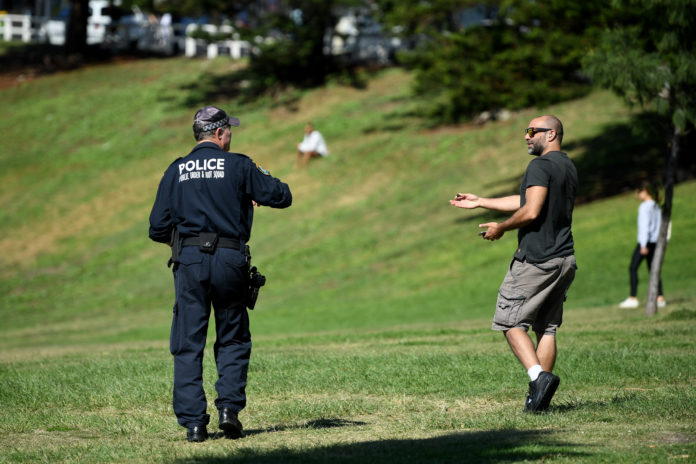
We also know authorities responsible for regulating public space, including police, tend to enforce rules and restrictions selectively. In New South Wales and Victoria, police chiefs have been explicit that police will use their discretion in enforcing current restrictions.
The problem is this use of discretion can be informed by stereotype and prejudice. For communities who already felt unfairly targeted by police, statements about the use of discretion will be far from reassuring.
The problems with discretionary policing that Australians are now encountering were already part of the daily experience of some targeted groups.Joel Carrett/AAP
We must guard against a common tendency for temporary measures to become more permanent. Some of the extraordinary powers given to police to break up gatherings and fine people who fail to observe restrictions have been time-limited. But having been used once for a particular problem, the risk is such powers might be enacted more often in future.
We have seen this happen with closures of public space for commercial events. Each closure is justified as being only temporary, but such closures have become increasingly common. The cumulative effect is a creeping commercialisation of public space.
Coronavirus-related restrictions are obvious to us because they have been imposed so rapidly. However, we should reflect on how other restrictions have become normalised precisely because they happened gradually, making them less visible and contested.
For example, over the past decade we have seen a creeping “gating” of a public spaces like parks and school ovals. Free access to those spaces has been greatly reduced when they are not in use for organised education or sports.
Interestingly, as urban authorities try to provide large populations with access to public spaces in which they can maintain recommended physical distance, some existing restrictions are being rethought. Cities are closing streets to cars to give pedestrians more space rather than having to crowd onto footpaths. It will be interesting to see if such measures persist once physical-distancing restrictions are lifted.
Let’s hope our experience of the inconvenience and frustration of restricted access to public space will translate into a more widely shared determination not only to end these restrictions when the health crisis is over, but also to act on the unjust exclusions and restrictions that were already a feature of urban life.
As with so many other aspects of our society, it is not enough simply to go back to how things were before. We must ensure our public spaces are not unjustly restricted when the next crisis comes along.
The thin veneer of a seemingly robust New Zealand media was ripped off like a plaster on a scab in front of Parliament’s Epidemic Response Committee today exposingitsfrailties.
The heads of all New Zealand’s media companies appeared via Zoom and all spoke of the desperate times ahead.
Stuff, NZME, Television New Zealand, MediaWorks, RNZ, Newsroom, TheSpinoff andBusinessdeskas well as iwi representationappearedbefore the Epidemic Response Committee, which is chaired by opposition National Party leader Simon Bridges.
National Party leader Simon Bridges … chair of Parliament’s Epidemic Response Committee. Image: screenshot PMC
What was unusual was that all reported that their audience and readership numbers were “skyrocketing” becausepeople needed factual news, whether it was digital readership, broadcast or television.
However,advertising revenue was at anadir and that is what was hurting the media owners.
– Partner –
Former New Zealand Herald editor and media commentator Dr Gavin Ellis in his opening submissionsaidadvertising revenue for media companies was estimated to drop between 50 and 75 percent, and there was concern that it would not return even after the Covid-19pandemic crisis was over.
“Magazine publishers are indispensable gurus of our unique culture and our habitat, they’ve got to be urgently granted as an essential business status,”he said.
Media environment plight “One media representative described the plight of the media environment as it needed an emergency triage and I think that’s right.
“The government really needs to adopt a three-stage process to deal with the media systems,” he said.
“The most immediate need is to help them recover some of that cashflow through diverting already committed government enterprise spend for example suspending regulatory and transmission costs for broadcasters, there is a large number of thingsthat can be done.
“In terms of magazines, just let them publish, post-lockdown government needs to fast-track media restructuring or buying media to find long termsolutions and really fast-tracking, sidestepping the Commerce Commissionand the process that exist even for distressed businesses,” he added.
He backed the proposed merger of Stuff and NZME to buy them some time.
“There is a number of ways the government can make these businesses more attractiveby changing the tax status,” Dr Ellis said.
“And finally stage three is the post Covid-19 reconstruction, it needs a total rethink redefining the media ecosystem and replacing outmoded ownership structures with a more sustainable model.”
More redundancies feared He addedthat he feared the redundancies at Bauer and NZME would not be theend of it.
“The elephant in the room is the social media companies, Google, Facebook, syphoning money off media companies,” he said.
“The bottom line is there will be contractions.
“I am fearful if the financial standing of the owners of MediaWorks and Stuff decline sufficiently they may be mindedto followBauer and simplyclose NewZealand operations,” he sounded a warning.
In response, the Minister forBroadcasting, Communications and Digital Media,KrisFaafoi,said “the government is developing ashort-and-long-termpackage for support to the media industry to deal with the challenges they identified.
“I’ll be able to hopefully announce those next week but the Prime Minister, Jacinda Ardern,said the first tranche of support for struggling media companies would be announced next week.
At the same time, she defended advertising on social media, saying that’s where New Zealanders were.
Nervous times
Stuff CEO Sinead Boucher … advertising has “dropped off a cliff”. Image: PMC screenshot
Next up at the Committee hearing was Sinead Boucher,the CEOof Stuff, who admitted the company, with the largest website, faced nervous times.
She said ongoing government support was necessary – either through NewZealandon Air or through other mechanisms – because advertising revenue has “dropped off a cliff”, more than halving in the weeks since March and looking “particularly dire” for April.
Like all those who appeared, she said the government should shift its advertising from social media giantslikeFacebook and Googleto New Zealand media companies, and also consider special tax breaks.
NZME managing editor Shayne Currie … again pressing to be allowed to purchase rival company Stuff. Image: screenshot PMC
Shayne Currie, managing editor of NZME, again pressed for being allowed to purchase Stuff, something which the Commerce Commission has rejected previously.
“We believe there is a sustainable model there and at the same time it will allow us to be equally strong,” Currie said.
“I like the moves thatjust have been announced in France – and France is the first major country which has moved in this direction – and I think Australia will follow very quickly.
“Last week, it was announced that France has orderedGoogle, andtargetingGoogle inthe first instance, they now need to start negotiating with mediacompanies to pay them for the content that appears on their search engines.
Moving ahead “That is a really significant move and I think the Australian Competition and Consumer Commission (ACCC) is certainly making similar recommendations along those lines.
“They are moving ahead this year and it can’t come soon enough in New Zealand,” he said.
As Kevin Kenrick, the TVNZ CEO, pointed out: “I will just reinforce every dollar the government spends on Google and Facebook is a dollar that is not spent supporting local media by New Zealand.”
Michael Anderson, who said several people at Mediaworks had been tested for Covid-19, said the difference between TV3 and TVNZ was that TV3 had debts that they had to pay back.
Meanwhile, in Australia the announcement of almost A$100 million in federal funding and support for regional newspapers and broadcasting during the coronavirus crisis is welcome but a long-term plan is needed to ensure the sector’s future, says the union for Australia’s media workers.
The Media, Entertainment & ArtsAlliance(MEAA)welcomes the belated support for regional media in the form of a $50 million Public Interest News Gathering programme and tax relief for commercial TV and radio.
This comes after the closure of more than a dozen publications around the country due to reduced advertising revenue due to the pandemic, the statement read.
MPs ‘understand what is at stake’ It prompted the Journalism Education Association of New Zealand (JEANZ) presidentGreg Treadwellto say: “The Australian government has moved to help the news media and I expect the NZ government to do the same.
“It was clear, I thought, during the media company representations to the pandemic committee today that MPs understood the importance of what was at stake. That was something of a relief, to be honest.
“Media bosses, too, seemed to understand their long-running struggle for financial security has just changed fundamentally in nature. In the background was some of the regular positioning we’ve seen from the various players over recent years – for example, Mediaworks’ resentment that a state-owned company, TVNZ, eats up much of the commercial advertising dollar.
RNZ’s CEO Paul Thompson … among the media presenters. Image: screenshot PMC
“But in the foreground was the urgent need to create enough security to enable the serious job of public communications to be done well. After all, these politicians will need the media with an electionlooming,” he added.
He said he thoughtthat the NZME-Stuff merger was probably “on again” because there was “little chance of both thriving now, if there ever was”.
The committee appeared “pretty keen” on the idea that there was “no possibility of a plurality of voices if there was not first economic sustainability in a market model”.
“In other words,actually existingdiversity is, in the end, treated as a nice-to-have,” Dr Treadwell said.
“I think one of the main messages today was that the market shouldn’t be killed off in an attempt to save it.
“The work done on developing new models like The Spinoff, Newsroom andBusinessDesk, should not be lost in the rescue.”
Appearing before the committee today were: media commentator Dr Gavin Ellis; CEO of Stuff Sinead Boucher; managing editor of NZME Shayne Currie, CEO of TVNZ Kevin Kenrick;CEO of Mediaworks Michael Anderson; RNZ CEOPaul Thompson CEO; co-editor of Newsroom Mark Jennings, managing editor of Spinoff Duncan Grieve;co-founder ofBusinessDeskPatrick Smellie;and Peter Lucas-Jones representing iwi broadcasters.
After weeks of devastating reports of local newspaper closures and regional broadcast stations turning off local news services, media supporters and observers were united in joy as the Australian government announced a coronavirus relief package for local journalism.
The four-part initiative has been designed to assist local newspapers and commercial free-to-air radio and television and subscription television, following calls for a lifeline from the industry and the communities they serve.
Although coronavirus might have hastened their financial woes, it’s clear that many of these news outlets have been in trouble for a while, with falling advertising and subscription revenue reductions.
Last year was described as “the worst advertising market since the global financial crisis for the television industry”.
Regional newspapers have been buoyed by local advertising, but even that has its limits.
Two components of the government’s COVID package, a $41m waiver on the tax imposed on radio and television services for spectrum use, and suspension of key parts of the commercial television Australian content rules, will save commercial broadcasters millions in 2020.
Both major industry organisations, Free TV and Commercial Radio Australia, cautiously welcomed the announcement, but sought more action from the government.
The third component, a $50 million Public Interest News Gathering program, will fund journalism for regional broadcasters and print services.
The most heartening line in the government’s press release was the acknowledgement by the minister that
the government recognises that public interest journalism is essential in informing and strengthening local communities.
ABC and SBS left out
In the absence of other government action, there remain two big losers from the COVID-19 announcement for journalism.
First, it excluded the trusted national public broadcasters, even though SBS must also be experiencing a reduction in advertising revenue.
Further, there was no indication the ABC would be given any reprieve from the combined budget cuts/freezes that will total almost $800 million by 2022.
In the midst of the COVID emergency, which has brought a record number of people to the broadcaster, the ABC is continuing to manage an annual budget reduction of over $100 million while delivering its range of services.
As has been widely acknowledged, it has also increased emergency broadcasting firstly for the devastating summer bushfires, and now for the coronavirus emergency, without any specific funds.
Local drama in jeopardy
Independent producers of Australian programs, including Australian drama, documentary and children’s drama, are also losers in the COVID announcement.
The decision to suspend commercial television Australian content rules for 2020 is couched in terms of production “disruption caused by the COVID-19 pandemic”.
However, there are long lead times for much drama and documentary production, and commercial free-to-air broadcasters are allowed to average drama content over three years.
This means a more nuanced and flexible approach to developing and commissioning projects could have helped broadcasters and kept the production sector alive.
In an already hard hit creative sector, TV producers look like losing at least a year of commercial commissions. That’s worth $250 million to the sector.
The government statement also implies the reduction in the Australian content rule may extend into 2021. If that happens, it’ll bring to an end Australian content policy settings that have been in place for almost 60 years.
Originally introduced by the Menzies government, the policy was put in place to ensure there was a strong Australian identity on local television.
Chilling notes in the details
Finally, the government has included as part of its announcement, a fast-tracked consultation process on “Harmonising Regulation to Support Australian Content”.
Media observers will be pleased the process has finally started, but all will be concerned about the timing.
It seems more than a little odd for some of the most significant reforms to the way Australian content is delivered via screens are included in an emergency funding announcement.
Buried on page 41 of the document, for example, is an option which would require the ABC and SBS to spend their funding to make up for commercial shortcomings in children’s programming.
Or to put it another way, if that option were accepted, the ABC and SBS would be told by the government of the day to do what the government wants, without any extra funding. That’s completely opposite to the idea of an independent public broadcaster. Perhaps it’s a case for the Inbestigators.
US President Donald Trump has announced the US is cutting its funding to the World Health Organisation (WHO) – a decision that will have major implications for the global health response to the coronavirus pandemic.
The US contributes more than US$400 million to the WHO per year, though it is already US$200 million in arrears. It is the organisation’s largest donor and gives about 10 times what China does per year.
Trump has accused the organisation of mishandling and covering up the initial spread of COVID-19 in China, and of generally failing to take a harsher stance toward China.
What will Trump’s decision to cut funding mean for the organisation?
The WHO was established in 1948 to serve as the directing and coordinating authority in international health. It was created with a mandate to improve the health of the world’s population, and defined health as
a state of complete physical, mental and social well-being, and not merely the absence of disease or infirmity.
While various civil society, industry and faith-based organisations can observe WHO meetings, only countries are allowed to become members. Every May, member states attend the World Health Assembly in Geneva to set the WHO’s policy direction, approve the budget and review the organisation’s work.
The WHO headquarters in Geneva.SALVATORE DI NOLFI/EPA
How is the WHO funded?
The WHO receives the majority of its funding from two primary sources. The first is membership dues from countries, which are described as “assessed contributions”.
Assessed contributions are calculated based on the gross domestic product and size of population, but they have not increased in real terms since the level of payments was frozen in the 1980s.
The second source of funding is voluntary contributions. These contributions, provided by governments, philanthropic organisations and private donations, are usually earmarked for specific projects or initiatives, meaning the WHO has less ability to reallocate them in the event of an emergency such as the COVID-19 pandemic.
Over more than 70 years of operations, a number of countries have failed to pay their membership dues on time.
At one point the former Soviet Union announced it was withdrawing from the WHO and refused to pay its membership fees for several years. When it then rejoined in 1955, it argued for a reduction in its back dues, which was approved.
As a result of nonpayment of assessed contributions, we have seen several instances where the WHO has been on the verge of bankruptcy. Fortunately, governments have usually acted responsibly and eventually paid back their fees.
Has there been political criticism of the WHO before?
Five years later, the organisation was accused of acting too late in declaring the West African Ebola outbreak a public health emergency.
Trump has criticised the WHO for not acting quickly enough in sending its experts to assess China’s efforts to contain COVID-19 and call out China’s lack of transparency over its handling of the initial stage of the crisis.
But these criticisms ignore China’s sovereignty. The WHO does not have the power to force member states to accept a team of WHO experts to conduct an assessment. The country must request WHO assistance.
Nor does the organisation have the power to force a country to share any information. It can only request.
Of course, Trump’s comments also ignore the fact the WHO did eventually send a team of experts to conduct an assessment in mid-February after finally obtaining Chinese approval. The results from this investigation provided important information about the virus and China’s efforts to halt its spread.
Does China have increasing influence over the WHO?
Understandably China has grown in power and economic influence since 2003, when then-Director General Gro Harlem Brundtland publicly criticised it for trying to hide the spread of the SARS virus.
But China is ultimately just one of the WHO’s 194 member states. And one of the great ironies of Trump’s criticism is that the organisation has been criticised by other member states for decades for being influenced too heavily by the United States.
If enacted, these funding cuts may cause the WHO to go bankrupt in the middle of a pandemic. That might mean the WHO has to fire staff, even as they are trying to help low- and middle-income countries save lives.
It will also mean the WHO is less able to coordinate international efforts around issues like vaccine research, procurement of personal protective equipment for health workers and providing technical assistance and experts to help countries fight the pandemic.
Trump has long been disdainful of multilateral organisations.Stefani Reynolds / POOL /EPA
More broadly, if the US extends these cuts for other global health initiatives coordinated by the WHO, it will likely cause people in low income countries to lose access to vital medicines and health services. Lives will be lost.
There will also be a cost to the United States’ long-term strategic interests.
For decades, the world has looked to the US to provide leadership on global health issues. Due to Trump’s attempt to shift blame from his administration’s failures to prepare the US for the arrival of COVID-19, he has now signalled the US is no longer prepared to provide that leadership role.
And one thing we do know is that if nature abhors a vacuum, politics abhors it even more.
People who use illicit drugs, whether they are dependent or use them occasionally, are potentially at increased risk of harm during the coronavirus pandemic.
The coronavirus is too new to know the exact interaction with illicit drugs. There has been no peer reviewed research yet, and we don’t know how many people who have contracted the virus also use drugs.
However, we can estimate some of the possible impacts from what we know generally about drugs, their effects on the body, and how people use them, including in times of increased stress.
Regardless of your views on illicit drugs, reducing the harms from drug use during the pandemic will improve the well-being of people who use them, and those close to them. Reducing harms will also help avoid additional pressure on the health system.
Around 2.5 million Australians (or 12.6% of people aged 14 or over) said they used an illicit drug in the previous 12 months. Cannabis was by far the most common, followed by cocaine and ecstasy.
People are more likely to take illicit drugs (and drink alcohol) during times of stress. So it’s not surprising that, with isolation, boredom and financial worries, some people might increase their use of illicit drugs.
People who use drugs in response to stress are more likely to become dependent on them. For people who are already dependent, stress is related to relapse to drug use after treatment.
It’s a complex relationship between the two, but illicit drugs may interact with current stress, unemployment and spending long periods together in lockdown to further increase the risk.
People who have a lung disease are also at more risk of overdose from some illicit drugs, such as heroin.
So if you contract COVID-19 and your lungs are affected, if you then use illicit drugs you potentially increase the risk of drug-related complications, such as overdose.
Chronic health problems
People with long-term drug problems are at greater risk of chronic diseases, such as heart disease.
Some drugs are commonly shared. For example, a cannabis joint or bong is sometimes shared between a group of people.
As COVID-19 is spread from person to person through small droplets from the nose or mouth, sharing drugs and equipment can increase the risk of contracting the virus.
Changes in supply, production, price
There are a number of possible impacts of coronavirus-related changes to supply, including changes to drug availability and price.
A near-total shutdown of our borders may reduce the availability of both imported drugs and the chemical precursors needed to make them locally.
As flights are cancelled, illicit drugs and the chemicals to make them locally may be harder to import.Shutterstock
We might expect a reduction in supply to lead to an increase in price, which then tends to reduce demand. So, some people who use illicit drugs occasionally may decide to reduce or stop their use when it gets too expensive, or they may switch to more readily available drugs made locally.
How to reducing your risk
If you are able to, it is safest to stop using drugs during the current pandemic. If you continue to use drugs there are a number of things you can do to reduce your risk of harm.
Stay as healthy as possible Eat well, drink plenty of water and get regular exercise. If you don’t feel well for any reason, see a doctor. The healthier you are the less likely you will get and have complications from COVID-19.
Wash your hands, packaging and equipment Wash your hands before and after handling drugs, the packaging it came in, money or anything that has come from outside your home. Use warm water and soap, and wash for at least 20 seconds.
Don’t share Don’t share joints, bongs, pipes or injecting equipment because you increase the risk of contracting COVID-19.
Have someone check in on you It’s never advisable to use drugs alone. So during distancing and isolation, make sure you have someone to check in on you (remotely).
Change route of administration If you normally inhale, smoke or vape your drugs, given the impact of coronavirus on lungs, consider an alternative way to use them if possible. Ingesting is safest.
Withdrawal If you use illicit drugs regularly, reduced supply may mean you experience some withdrawal symptoms. Most people with mild dependence can safely withdraw at home, but if you have been using frequently (for example, daily) for several months or more, you may need supervised withdrawal. Talk to your GP or a drug treatment service who can advise whether home withdrawal is possible. If you or someone you are with begins to hallucinate, seems disoriented or loses consciousness while undergoing withdrawal, call triple zero immediately.
If you’re worried about your own or someone else’s drug use, you can get help online or by phoning the National Alcohol and other Drug Hotline on 1800 250 015.
You may also be eligible to access one of the new temporary telehealth services. Talk to your GP to find out more.
Iceland serves as a benchmark for accuracy. Chart by Keith Rankin.
Analysis by Keith Rankin
Iceland serves as a benchmark for accuracy. Chart by Keith Rankin.
Today’s first chart looks at three Nordic countries: Iceland, Norway and Sweden. These give us a basis for analysis of underreporting of Covid19, in the main due to limited testing.
Yesterday, Norway was shown as a high incidence ‘recovering country’, even though it was less recovering than South Korea. Iceland, however, has had the worst incidence of Covid19 among the Nordic countries; though it has a low death rate. Iceland also happens to be a very small country with a very high testing rate. So, it’s a fair assumption that Iceland’s known incidence is close to its actual incidence of Covid19.
There is no obvious reason why the incidence of Covid19 should be greater in Iceland than in Norway. Yet the data shows Iceland’s incidence to be five times greater. This is likely to be the extent of the undercount of cases in Norway.
Known cases in Norway (which has flattened) are just a little higher than known cases in Sweden (which has not yet flattened). But deaths per capita in Sweden are four times higher than in Norway and Iceland. This suggests that Sweden’s undercount is much larger than Norway’s. Indeed it suggest that Sweden’s undercount is four times greater than Norway’s, which I have suggested is a fivefold undercount. That would make Sweden’s case undercount twentyfold.
This would mean that Sweden’s official count of 11,445 – multiplied by 20 – gives 229,000; over 2.2 percent of Sweden’s population. That would mean half a percent (five Swedes in 1,000) dying from Covid19, which feels about right.
Of course this is not the end of the matter in Sweden; it would seem likely that, eventually, ten percent of Swedes will contract Covid19; one million people. That is a likely final case incidence for a country for with a substantial amount of ‘natural’ physical isolation and a high normal degree of physical mobility.
A long weekend. Chart by Keith Rankin.
Today’s second chart looks further at Sweden. It shows daily known cases, and daily deaths. The yellow lines represent seven-day moving averages. While there is a hint that the long period of exponential growth may be slowing, the proviso is that Sweden – more than any other country I have seen – treats Covid19 largely as a Monday-Friday phenomenon. Deaths in particular are very few in weekends, and last weekend was longer than most.
Sweden has become known as the country most dismissive of the Covid19 threat, and with the fewest restrictions imposed on its people. (Even Brazil has more restrictions, albeit mandated at the state government rather than the federal government level.) Unlike Brazil, there seems to be widespread support for its ‘economy-first’ approach; an approach seemingly led by its ‘public health’ bureaucracy rather than its elected politicians.
Sweden will not experience the tragedy that has been Spain, thanks to voluntary measures informed by Italy and Spain. Sweden stands in marked contrast to Norway and Iceland, both themselves major victims of the new corona virus.
He might also be worried that publishing negative forecasts creates the risk of self-fulfilling prophecies. (It’s an important difference between economic and weather forecasting – predicting rain does not make rain more likely.)
But on Tuesday Treasurer Josh Frydenberg saw fit to release details of Treasury forecasts of a 10% rate of unemployment, which he said would have been 15% were it not for the JobKeeper allowance, so such concern can’t be universal.
The IMF expects real gross domestic product to shrink by 7.2% throughout 2020.
This is much larger than the falls in real GDP in the early 1980s drought-related recession (2.2% throughout 1982) or “the recession we had to have” (1% in 1991).
To find larger falls it is necessary to go back to the depressions of the 1890s and 1930s.
The Great Depression is one parallel
Australia’s 1890s depression was the result of a global slowdown, the bursting of a speculative property bubble (particularly in Melbourne), bank failures and the prolonged Federation Drought.
Australia’s 1930s Great Depression also followed some speculative excesses but was primarily a response to the global economic slump.
Both depressions predated the acceptance of Keynesian economics in which it was understood that the best way to deal with a decline in private spending was for governments to increase public spending.
Instead, back then, governments tried to get their budgets to balance by cutting their spending, making matters worse.
Those depressions occurred well before statistical agencies compiled national accounts.
But a survey of retrospective estimates I did with Robert Ewing suggested that during the Great Depression real GDP may have contracted by 10% to 20%.
The Asian Economic Crisis is another
A more recent parallel to the size of the current fall in Australia’s GDP is the experience of some of our neighbours in the 1997 Asian financial crisis. In 1998 it brought about huge falls in real GDP in Indonesia (13%), Thailand (8%), Malaysia (7%), Hong Kong (6%) and South Korea (5%).
The current contraction has been unusually rapid and it is hoped that the recovery will be too.
The IMF predicts Australia’s GDP will expand by 8.4% in 2021 after falling 7.2% in 2020. It believes we are in the worst of the recession now and the recovery will begin in the September quarter that starts in July.
In year-average terms that understate the size of swings the IMF expects real GDP to shrink 6.7% in 2020 compared with 2019 and then to grow 6.1% in 2021 compared to 2020.
It has revised down its forecast for global growth this year from an increase of 3% to a contraction of 3%. (By contrast, during the global financial crisis global GDP slipped by only 0.1%)
What it terms the “Great Lockdown” is the worst global economic scenario since the Great Depression.
Worse outcomes “possible, even likely”
The US economy should contract 5.9% this year before bouncing back 4.7% in 2021. China’s economy should barely grow in 2020 (1.2%) before bouncing back 9.2% in 2021.
Output and incomes in emerging economies are predicted to return to pre-pandemic levels in the second half of the year. The advanced economies generally won’t return to where they were until the end of 2021.
These are forecasts that might prove optimistic. Depending on conditions and programmes in place in each country, it is likely many business will not survive and many consumers will decide to remain cautious about their spending for some time.
much worse growth outcomes are possible and may be even likely – this would follow if the pandemic and containment measures last longer, emerging and developing economies are even more severely hit, tight financial conditions persist, or if widespread scarring effects emerge due to firm closures and extended unemployment.
Rarely has the trajectory of a downturn been harder to forecast.
Much will depend on the virus itself, on the way in which countries adjust their restrictions to deal with it, and on us. At the moment few of us are feeling good.
New Zealand Prime Minister Jacinda Ardern, government ministers and public service chief executives will take a 20 percent pay cut for the next six months.
She said it acknowledged New Zealanders who were on wage subsidies, taking pay cuts, or losing their jobs due to the Covid-19 coronavirus.
“We feel acutely the struggle that many New Zealanders are facing and so too do the people that I work with on a daily basis,” she said.
“I acknowledge my colleagues, both in the executive but also the colleagues we work with in the public service for the decision that was taken today.”
Bridges to take part National Party leader Simon Bridges had been told of the pay cut decision, and that he indicated he would take part, she said.
She said public service leaders felt acutely about the struggles many New Zealanders were facing.
“It also stands alongside many actions taken by many people – private sector, citizens – to tackle the health and economic challenges of Covid-19.”
“Neighbours looking out for one another, rent freezes and landlords who are supporting tenants. Things like the winter energy payment and benefits that are helping those who are on restricted incomes to keep warmer and well.
“New Zealanders who are staying home to save lives. The student army who are delivering groceries to over 65s, and Ministry of Health officials who are in charge of mandatory quarantine which I have received a message about their professionalism and exceptional work.
“So many examples of people showing what others meant to them and doing their bit in our effort to stamp out Covid-19 and show a little bit of kindness along the way.”
She said the economic package now totalled more than $23 billion, including the wage subsidy that had paid out over $9 billion to 1.5 million New Zealanders.
Ardern said the government was not considering pay cuts for essential workers, nor would New Zealanders consider that appropriate.
ACT Leader David Seymour called for the cut to be extended to all MPs, and had drafted legislation to allow that to happen.
“All members of Parliament should have the opportunity to show leadership and solidarity with workers and businesses.
“The pay cut announced today must apply to all MPs, but it’s constitutionally inappropriate for the Prime Minister to cut the pay of those holding the government accountable,” he said in a written statement.
State Services Commissioner Peter Hughes welcomed the cut, and said it was the right thing to do.
“I am proud of the way the public service workforce has mobilised to respond to one of the biggest challenges New Zealand has ever faced. Many are volunteering to do more than their normal duties and coming up with innovative ideas and solutions to get the job done,” he said.
The Commissioner and the Deputy State Services Commissioner, whose salaries are set by the Remuneration Authority, also committed to a 20 percent pay cut.
The 20 new cases are made up of six confirmed cases and 14 probable cases, bringing the total number of cases to 1386.
Director-General of Health Dr Ashley Bloomfield said there were now 16 significant clusters related to the coronavirus. The latest cluster is connected to an aged care facility in Auckland.
He said 13 people were in hospital, with three in ICU, two of which were in a critical condition in North Shore and Dunedin Hospitals.
“We now have 728 reported cases of people who have recovered from Covid-19 infection, that’s an increase of 100 from yesterday.”
Dr Bloomfield said he was aware of a death in Invercargill that had been reported to be connected to Covid-19, but he could not confirm if it was. The Ministry of Health was looking into it.
“We are seeking further information at the moment and until I have full information we are not in the position to confirm the cause of death of that man.
Possible community death Dr Bloomfield said if officials were confident the death was from Covid-19, then it will be the first death in the community rather than in hospital.
Dr Bloomfield said 115 Covid-19 cases in New Zealand were health care workers, but less than five people were confirmed to have been infected by a patient they were caring for.
Covid-19 daily update on 15 April, 2020. Graphic: RNZ
He said 2100 tests were processed yesterday, and there were currently 649 active cases.
This article is republished by the Pacific Media Centre under a partnership agreement with RNZ.
If you havesymptomsof the coronavirus, call the NZ Covid-19 Healthline on 0800 358 5453 (+64 9 358 5453 for international SIMs) or call your GP – don’t show up at a medical centre.
The Australian Federal Police (AFP) attracted global criticism for executing a raid on the Canberra home of journalist Annika Smethurst on June 4 2019.
The raid was prompted by an April 2018 report on a “top secret” memo leaked from within the Department of Defence. The memo revealed a proposal to grant the Australian Signals Directorate (ASD) unprecedented powers to secretly access Australians’ digital information without a warrant.
Now the High Court has ruled the warrant authorising the search of Smethurst’s property failed to meet the most basic legal requirements.
This decision reflects serious weaknesses in how warrants are issued and underscores the need for urgent reform.
The importance of warrants
You don’t need to watch many crime shows to appreciate that warrants are critical to law enforcement. Search and seizure powers are key to collecting the evidence needed to charge and prosecute offenders.
Warrants put limits on the scope of these powers. They require officers to apply to an independent authority for permission to make incursions into civil liberties, privacy and personal space.
Warrant laws aim to ensure these powers are justified and proportionate. They have been designed to strike a balance between law enforcement and liberties – albeit in a way that favours the public interest in the investigation and prosecution of crimes.
With these things in mind, a warrant must meet some basic criteria. It must identify the offence being investigated, the premises or person being searched, and the kinds of evidential material being searched for.
These requirements help ensure the person and the police understand what the investigation is about.
The problem with the Smethurst warrant
In the course of its investigation into the leaked ASD memo, the AFP applied to a magistrate for search and computer access warrants in relation to Smethurst.
Whilst Smethurst complied with the warrant and cooperated with the AFP, she soon launched a High Court challenge to the warrant on a number of grounds. These included a constitutional challenge to the government secrecy offence that the AFP was investigating.
The High Court did not resolve the constitutional point. Instead, all seven justices found the warrant was invalid for not meeting the basic requirements for a valid warrant. The court split on whether this finding entitled Smethurst to have the seized information either returned to her or destroyed (a narrow majority of the court held that it did not and simply declared the warrant invalid).
The warrant’s invalidity was based on two findings.
First, the warrant failed to adequately identify the offence being investigated. The description in the warrant was ambiguous, confusing and, as Justice Edelman put it,
lacked the clarity required to fulfil its basic purposes of adequately informing Ms Smethurst why the search was being conducted and providing the executing officer … reasonable guidance to decide which things came within the scope of the warrant.
But ambiguity was “the least of the problems”. The court held the warrant went further by misstating the offence being investigated. For example, the description focused on “the interest of the Commonwealth”, a phrase not used at all in section 79(3) of the constitution.
In short, not only was it was impossible for a member of the public to know from reading the warrant what the investigation was about or what kind of information was being sought, but it misstated and misled the reader about the relevant offence. It was, therefore, invalid.
Mistakes that shouldn’t be made
Any failure by the AFP or a magistrate to meet the basic requirements for a valid warrant is concerning. Providing an incorrect and misleading description of an offence is shocking, especially in the context of a sensitive investigation into government leaks and public-interest journalism.
The circumstances of this warrant were serious. It authorised an invasive search of a journalist’s home – from her mobile phone and computer, to her underwear drawer and cookbooks – furthering an investigation into an alleged breach of national security law.
Raids on journalists are a serious matter, particularly if prompted by investigative reporting that has a clear public interest and, despite the passage of years, no clear threat to national security. The raid on Smethurst, and the subsequent raid on the ABC, not only prompted constitutional challenges, but successive ministerial directions to the AFP. It also prompted two ongoing parliamentary inquiries into the state of press freedom in Australia.
In such a context, it is damning that the authorisation for the warrant was so carelessly drafted as to misstate the offence being investigated.
Elsewhere, there are processes and protections that guard against this kind of outcome.
Press freedom is enshrined in the US Constitution. A raid on American media would face a constitutional hurdle.
In the UK, police can only obtain “journalistic materials” in an investigation in a contested proceeding before a judge. Confidential journalistic materials simply cannot be accessed, except in terrorism investigations.
These kinds of protections recognise the importance of press freedom, and the need for journalists and their sources to be protected so important public-interest stories (like the ASD report) can continue to be told.
Since the raids on Smethurst and the ABC, calls have grown for the introduction of contested warrant proceedings before a judge when press freedom is at stake, as in the UK. If that system had existed in June 2019, the problems with Smethurst’s warrant would not have brought about the prolonged and expensive process of High Court litigation. They would have been identified and addressed in the initial application, providing Smethurst with an opportunity to raise any issues, and the AFP with a chance to address these problems at the outset.
Importantly, a suitably experienced judge would have borne the responsibility of weighing the public interests in press freedom and law enforcement to come to a balanced and considered decision.
The parliamentary inquiries into press freedom sparked by the AFP’s raids on Smethurst and the ABC are yet to report. The High Court’s decision reveals the inadequacy of existing warrant procedures and the costly, time-consuming process for both citizens and government involved in addressing these problems. We need not look far to find clear and workable alternatives.
It is easy to assume Australia has a free press. Our squawky newspapers are filled with stories about the failings of government, acid-tongued columnists routinely lash our politicians, and until May last year the police hardly ever raided newsrooms or journalists.
On Wednesday, the High Court appeared to uphold the principle of press freedom when it ruled that the warrant the Australian Federal Police used to search News Corp journalist Annika Smethurst’s home in 2019 was invalid.
You might recall that the police raided her home (and searched through her underwear drawer) looking for the source of a story Smethurst had published in The Daily Telegraph more than a year earlier. Her story revealed the government was considering expanding the powers of our international electronic eavesdropping agency, the Australian Signals Directorate, so it could turn its sophisticated bugs on Australian citizens.
(The very next day, the AFP searched the ABC’s Sydney headquarters looking for the sources of another story – the Afghan Files – about Australian Special Forces in Afghanistan.)
Smethurst’s story was important because it revealed details of a shift in policy that affected all Australians. Regardless of what you think about the rights or wrongs of such a change, it is hard to argue it shouldn’t have been part of an open public debate.
At the same time, nobody has ever suggested national security suffered as a result of the story. It was a fine example of a free press doing its job by uncovering government actions that we all ought to know about.
News Corp went to the High Court to argue that the police had written the warrant so badly that it failed to explain why they were conducting the search and what they were looking for. In a unanimous slap-down for the police, all seven judges on the bench agreed the warrant “lacked clarity” and ruled it invalid.
A victory for journalism? Not quite.
News Corp also asked the court to order the police to either return or destroy any evidence collected during the raid. In a decision split 4:3, the judges rejected the request. This effectively allowed the police to still use the evidence for any investigation and prosecution.
The reasoning is complex and highly technical, but its overall effect is to undermine the already paper-thin protections for press freedom in Australia.
This is not the fault of the court. It was doing its job adjudicating on narrow points of law and police procedure, but it does underscore the urgent need for robust reform of our legal code.
Australian journalists operate freely in spite of the law, rather than because of it. While the United States Constitution has its First Amendment and the UK has Article 10 of its Human Rights Act (to name just a few), the most we have is a hopelessly weak “implied freedom of political communication” that’s merely inferred in our constitution.
Without more explicit protections, we have seen a slew of national security laws undermining the ability of journalists to investigate government and keep their sources safe.
This matters because the ability of the press to act as a noisy (and nosy) watchdog is vital to the way our democracy works. Nobody is arguing for complete and unfettered protection for journalists. Much of the work of our security agencies, individuals’ private details and commercially sensitive information must be off-limits, but there are ways of striking a balance between those imperatives.
A host of organisations have already proposed a set of reforms. The Alliance for Journalists’ Freedom (which I represent) published a White Paper on Press Freedom in Australia three weeks before the raids. The AJF proposes:
protections for journalists’ sources
the chance for news organisations to contest warrants even before the police carry out their searches
an “exemption from prosecution”, so that when journalists are engaged in legitimate work, press freedom is assumed.
It would then be up to the police to show a judge why there is enough of a risk to national security to justify setting aside that principle and issuing a warrant.
It is impossible to reform every corner of our statute books, though, so we also need a Media Freedom Act that enshrines the principle of press freedom in our legal code. That way, every court up to and including the High Court has to take it into account in every case that threatens to undermine media freedom.
Together, those kinds of protections would give comfort to journalists and their sources: as long as they are not violating clear and strictly set-out rules on national security and privacy, and are otherwise acting in accordance with the law, they should not be subject to prosecution. It would also help the police avoid being accused of launching politically motivated inquiries.
Our press might look free and fearless, but without significant reforms that remains a dangerously fragile illusion.
The government has announced relief measures, including a $50 million program for regional journalism, to help media hit by the fallout from COVID-19 crisis.
Commercial television and radio broadcasters will be given a year’s waiver of spectrum tax, at a cost of $41 million.
There will also be an “emergency” suspension of content quotas in 2020, which could extend longer.
Announcing the measures, Communications Minister Paul Fletcher said the media were sharing the pain of the virus crisis and the government was responding with short term support.
The virus crisis has seen drastic cutbacks in regional media as advertising has collapsed.
This week Australian Community Media announced it would “temporarily cease some of our publications and temporarily close our printing sites in Canberra, Murray Bridge, Wodonga and Tamworth from April 20 until June 29.” The publications hit are non-dailies.
Last month, the Barrier Daily Truth, in Broken Hill, and the Sunraysia Daily, at Mildura, suspended printing. The ABC on Wednesday reported both “are inching towards resurrection, helped by enormous community support.”
Fletcher said the $50 million Public Interest News Gathering Program (PING) would support public interest journalism delivered by commercial TV, radio and newspaper businesses in the regions. It includes $13.4 million new money as well as repurposed funds from the government’s Regional and Small Publishers Jobs and Innovation Package.
Fletcher said the coronavirus had effectively halted production of Australian screen content, so free-to-air and subscription TV could not meet their Australian content requirements.
“As an emergency red tape reduction measure, I have suspended Australian drama, children’s and documentary content obligations on free-to-air and subscription television for 2020. A decision will be taken before the end of this year as to whether this suspension should continue in 2021,” he said.
“It remains critically important that we have Australian voices on Australian TV, so there will be no change to the requirement for broadcasters to meet an overall 55% Australian content obligation”.
Fletcher said the government meanwhile was speeding up work on the future extent of Australian content obligations on free-to-air television, and whether these should apply to streaming services.
“This work is critical to the future of the culturally and economically important Australian film and television production sector,” he said.
To guide discussions, Fletcher released an options paper from Screen Australia and the Australian Communications and Media Authority (ACMA). Consultation with stakeholders, including ministerial roundtables, will take place over the coming two months.
“Regulated free-to-air broadcasters are competing with unregulated digital platforms and video streaming services. It has been evident for some time – and the COVID-19 crisis has made it even more obvious – that this is not sustainable,” Fletcher said.
“These arrangements threaten the sustainability of television broadcasters – and in turn the sustainability of the film and television content production sector.
“That is why I want to seek industry feedback on the options put forward by ACMA and Screen Australia, and work with industry on a plan for the future, including how to best secure the market opportunity created by the explosion of streaming services”, he said.
The Media, Entertainment & Arts Alliance (MEAA) welcomed the government’s assistance for regional media and called on Australian Community Media to “press pause on plans to close publications”.
We’re all in this pandemic together. But we’re currently leaving it to a small proportion of the community to shoulder most of the economic pain.
It’s an approach that’s compounding social and intergenerational inequity.
To date the Australian government has committed A$320 billion to support households and businesses during the COVID-19 pandemic. The Commonwealth’s net debt had been projected to peak this year at $392 billion and then decline. Now that debt is set to almost double.
Paying the debt will likely take decades. The burden will fall mostly on younger generations, through higher taxes or reduced public services such as health care and education.
Younger workers are also bearing the brunt of the immediate economic effects. Industries with the biggest proportion of young workers have been hit hard. In arts and recreation services, a quarter of workers are under the age of 25. In retail it’s about a third. In accommodation and food services it’s almost half.
In the past, governments have imposed temporary levies after natural disasters to pay for recovery efforts.
But the peculiar dynamics of this crisis open the opportunity to introduce a temporary levy now. This would enable those with secure incomes to share the pain and reduce the double impost on the younger generation.
Levy time
A temporary income tax levy is not unprecedented.
In 2014 the federal government implemented the “temporary budget repair levy” to reduce the budget deficit (then A$37 billion). Gross national debt was about $320 billion. The levy increased the marginal tax rate on the top income bracket (more than $180,000 a year) from 45% to 47%. It collected about A$3 billion over three years.
Given the magnitude of the deficit we now face, a similar levy makes sense.
An example levy is illustrated in the table below (based on income tax data from 2016). A 1% levy is applied to annual income between A$18,200 and A$37,000, a 2% levy to income between A$37,000 and A$90,000, a 3% levy up to A$180,000, and a 4% levy to income of more than A$180,000.
For someone on a median full-time income of A$1,463 a week, this would mean paying an extra A$17 a week in income tax.
Over a six-month period such a levy would raise about A$6.5 billion.
Consumption block
The main argument against raising income taxes is that it reduces incentives to work and lowers consumers’ disposable income, which dampens economic activity (and ultimately government revenue).
This, and the politics of tax, means governments usually wouldn’t dream of raising taxes during an economic crisis, because that would further reduce consumer spending and compound the downturn.
But the COVID-19 economic crisis is unique. It is suppressing spending by those with secure incomes because people are staying home.
Analysis published by The Sydney Morning Herald and The Age shows consumer spending fell to 13% below normal in late March. One-off government stimulus payments totalling A$5 billion reversed the downward trend in the first week of April. However, the effect of the one-off stimulus payments is likely to be temporary as higher-income earners, who didn’t receive a stimulus payment, continued to reduce their spending.
If people are spending less because there are fewer opportunities to spend, this novel aspect of the crisis reduces the likelihood a temporary increase in the income tax levy would have any negative economic effect.
Positive effects
Right now the costs of the COVID-19 crisis are being disproportionately borne by a small proportion of the population – the 700,000 Australians who have lost their jobs and about the same number relying on the JobKeeper wage subsidy.
Many of those who have lost their jobs were already in low-paid and insecure jobs.
As previous research on the longer-term effects of natural disasters has found, these types of economic shocks widen inequalities, with most people never making up the income they lose. A levy would reduce this inequity.
An advantage of introducing a levy during the crisis is there is clear time-frame to end it. It could be tied to social distancing regulations, ending when spending patterns return to normal.
Alternatively, the government could set a specific date to review the levy. It has already done this for funding initiatives such as telehealth consults during the crisis.
Source: The Conversation (Au and NZ) – By Grant Duncan, Associate Professor for the School of People, Environment and Planning, Massey University
During a national emergency we discover how well, or poorly, a country is governed. But New Zealand’s success so far in working towards eliminating COVID-19 isn’t due just to leadership from the top. It’s been a collective success, involving most “ordinary” Kiwis and unity across political divides.
As New Zealand awaits a decision on easing its strict level 4 lockdown, it’s worth looking at what’s worked here so far, what hasn’t – and how much national unity might survive in the months ahead.
Unseen acts of public service
New Zealand Prime Minister Jacinda Ardern’s crisis leadership skills have attracted the most international attention. And understandably so – it took courage and leadership to heed scientific advice and go for elimination of the virus, which is not an option for many countries. Ardern has also shown a strong command of the issues, along with humane, firm and consistent messaging.
But Ardern has not been the only leader in New Zealand’s COVID-19 response. Instead, what’s been striking is how well the nation’s broader political system – the public service, health experts, the opposition, and the vast majority of New Zealand’s nearly 5 million people – have all played a role.
Senior officials, led by director-general of health Dr Ashley Bloomfield, have wielded significant emergency powers and performed impressively.
Ministers and public officials have worked well as a team when fronting up to journalists, and been willing to address difficult questions.
Behind each of those leaders, from the prime minister down, there has an army of often unseen public servants and health professionals working around the clock to support a nation-wide effort.
Of course, certain problems were not well anticipated. For example, the repatriation and quarantining of Kiwis returning home could have been better, while initially there was lax monitoring at the border and inconsistently applied policing guidelines.
Admittedly, no one could have fully prepared for this pandemic. But the government and the public sector will have lessons to learn for next time. Taiwan was better prepared than many nations for COVID-19 due to its past experience with SARS in 2003.
New Zealanders right across the country also deserve recognition for having cooperated for weeks with severe, if not dictatorial, restrictions on their liberties and customs, even affecting the ways we mourn.
For many Kiwis, there’s been painful loss of income, social isolation, and radical changes in sport and recreation. But we have each played a part in successfully breaking the chains of COVID-19 transmission.
The community has got in behind an elimination strategy that (so far) is working. The daily numbers of new reported cases peaked at 89 on April 5 and have declined since. The number of active cases (all reported cases minus recoveries) is declining. Health system overload has been averted.
New Zealand’s running tally of new and probably cases, as of 9am, April 15, 2020.NZ Ministry of Health
There have, of course, been rule-breakers, some of whom even Ardern has called “idiots”.
But, fearful of either infecting others or being infected, most people have been supportive of the government’s efforts. An international poll found 88% of New Zealanders surveyed “trust the government to make the right decision around the response to COVID-19” – significantly higher than in other countries including the UK, US, Canada and Japan.
On the big questions […] there’s no National or Labour, or Green or ACT or New Zealand First; just New Zealanders. – Opposition leader Simon Bridges’ speech to parliament about the declaration of a national state of emergency, March 25, 2020.
When rapid action was needed to pass emergency legislation in March this year, including a massive stimulus package, New Zealand’s parliament acted quickly, and with unusual unity across party lines.
Since then, while parliament has been adjourned, a special select committee chaired by National Party leader Simon Bridges, has been running public online hearings, with opposition members in the majority.
They have asked ministers and officials critical but constructive questions about the crisis response, holding the government and officials to account, as they should. Following a fractious exchange at the start, there has been relatively little political point-scoring.
Similarly, not long after the prime minister’s announcement that she, her ministers and public sector leaders would take a 20% pay cut for the next six months, the opposition leader said he’d be doing the same.
Returning to politics as usual beyond level 4 lockdown
I’d love to say the present politics of unity will last, but it would be naive to expect that.
Even today, the opposition leader moved to take the initiative from the government, pushing for more businesses to re-open sooner rather than later. Bridges’ call pre-empted finance minister Grant Robertson’s speech later in the day about opening more “safe” businesses.
The date for the next election is still set for 19 September. While Labour is riding high at the moment, this is likely to be temporary. After the Christchurch terrorist attack in March last year, Labour surged ahead of National in the polls, but soon fell back to second place.
By the time this immediate health crisis is over and the economic consequences start to bite, we are bound to go back to politics as usual. National could, for instance, attack the government over the economic fallout, and Labour would then have to defend its record.
And political fallout from national crises can really damage an incumbent government, if things go badly.
Stay in touch with The Conversation’s coverage from New Zealand experts by signing up for our weekly newsletter – delivered to you each Wednesday.
Source: The Conversation (Au and NZ) – By Emmanuel Stamatakis, Professor of Physical Activity, Lifestyle, and Population Health, University of Sydney
We’re told to keep a minimum of 1.5 metres apart from others to avoid the spread of COVID-19 via contact with virus-contaminated droplets.
So when news emerged last week of a study showing the potential for droplets to spread beyond 1.5m if a person is walking, jogging or cycling, it raised concerns.
But the study was published before it was peer-reviewed by experts to double-check the findings.
A cough on the move
The authors of the study say the 1.5m rule is based on people standing still. But when people are moving they found the droplets can travel much further and potentially infect anyone following behind.
Their computer modelling shows droplets released from breathing or a sneeze can travel up to 5m behind a person walking at 4km/h, and up to 10m behind a person jogging at 14.4km/h.
Source: Ansys Inc.
The authors say people are better off walking or running side by side, keeping that 1.5m distance apart, or when in one line allowing at least 4m to 5m apart for walking, 10m for running and slow biking and at least 20m for fast biking.
The study led runners, cyclists and others to question whether the advice could be trusted.
Is this credible research?
The study, by a team of engineers in Europe, is a preprint publication, which means it hasn’t been peer-reviewed by other scientists and journal editors to check the research methods and findings.
In other words, the quality of the simulation could be anything between flawed and reasonably realistic. Without peer review we cannot know.
The study is also based on a computer simulation, so it’s a hypothetical study not involving human participants.
Like any simulation it is based on a long chain of assumptions, such as assumptions relating to specific environmental conditions where jogging takes place. For example, it doesn’t take into account any impact from wind.
The study authors have tried to address these and other concerns in a series of Q&As. They say peer review could take more than a year for results to be published, so they were keen to get the advice out now for others to scrutinise:
The peer review publication will follow next. But we are not on the same time line when there is a pandemic storming the world. We thought that the priority was on people’s health.
What should you do?
There are no grounds for this unchecked simulation to change any current advice or attitude in the community.
It would be irresponsible to issue formal or informal lifestyle advice based on a computer simulation that has not been checked for even its theoretical scientific rigour.
Maintaining 5m to 20m distance when walking, running or cycling outdoors would make it almost impossible to exercise in some cities and would undoubtedly discourage some people from going out at all.
There is also the danger any such unfounded information to change people’s behaviour could become an expectation. That could generate conflict and friction between people who think others are not heeding the advice to stay safe.
Advising people to run alone is also unnecessary and should not deter people from meeting up with their exercise buddy, if that helps their motivation.
Who to trust?
Stick to official advice and do not rush to make any new lifestyle decisions.
Governments usually develop their advice in consultation with eminent scientists and clinicians.
When doing exercise in pairs, such as running, then stick to at least 1.5m from anyone, including walkers and fellow runners. If a runner or cyclist coughs or sneezes, they need to make sure they cover their mouth and go even further away from anyone else.
A consequence of current formal advice is that running or cycling on narrow and busy outdoor tracks and paths should best be avoided because of the close proximity and the risk of touching or coming too close to others.
Exercisers could use such tracks very early in the morning or at other less busy times.
Physical inactivity during the COVID-19 self-isolation is a serious threat to people’s mental and physical health. Maintaining or increasing physical activity is one of the most important coping mechanisms during the extraordinary conditions we are experiencing.
In the countries where outdoor exercise has not been banned – including Australia – safe cycling, running and walking are all great ways to meet or exceed the World Health Organisation recommendation of 150 minutes of moderate-intensity or 75 minutes of vigorous-intensity physical activity per week.
Being in isolation might be a great time to try something new. In this series, we get the basics on hobbies and activities to start while you’re spending more time at home.
What can take you somewhere untouched by the clanging outside world? What can help you synthesise your thoughts right now?
Drawing, and our fascination with it, can stimulate your imagination, mindfulness, focus and introspection. Drawing can allow you to enter the flow state: that is, the optimal experience of being so invested in an activity, time passes you by. Drawing can make you feel good.
An act of looking outward and inward simultaneously, drawing can capture thought and insight in a moment.
Since time immemorial, drawing has been a way for humans to process their world – even just a room – and the times they live in (hello COVID-19). It’s our first language.
Renowned artist David Hockney has called for everyone to find something to draw in lockdown: “Question everything and do not think about photography”. Here are your first lessons in learning to draw at home:
1. Stop worrying about mastery
He never finished any of the works he began because, so sublime was his idea of art, he saw faults even in the things that to others seemed miracles.
It’s an activity we can do together. If you remove the fear of the blank white page and the internal voice screaming, “But, I can’t draw!”
Dobell Drawing Judge: Drawing Basics with Ben and Livvy Quilty.
Sketch inhibition can be debilitating. But hey, no one has to even see it! Your drawing is yours, unless you post it. Even the most accomplished and beautiful drawings we see today started out with someone doing some rough sketches while they learnt what works.
2. Honour the importance of drawing
Drawing is ancient, yet remains a key 21st century skill, helping to improve visual reasoning, memory, idea generation, lateral thinking and inference. Spontaneous drawing – or doodling – may relieve feelings of stress.
Drawing can be incorporated into education in many ways, including visual mapping, reflective thinking, or presenting ideas. Drawing an effective tool in developing an aesthetic navigation of the world. Remote learning might be a way to explore and enhance visual communication skills.
Young children step through skill attainment naturally and predictably, from scribbling to shapes to realism and beyond, but this drive is generally discouraged as we grow older.
Perhaps our obsession with photography has stopped us drawing, as it did in its inception.
Now hardly a day passes that I do not make something. As practice makes perfect, I cannot but make progress; each drawing one makes, each study one paints, is a step forward.
You can’t become a good athlete without practice. Nor can I become a good drawer without the 10,000 hours of practice that Malcolm Gladwell notes as critical to performance in his book Outliers: The Story of Success.
Though Gladwell’s 10,000 figure has its critics, there is no doubt learning takes time and practice done without the pressure to make everything look photo-realistic.
4. Observe and allow infinite possibilities
Drawing is the perfect way to challenge yourself at a time where you only have objects and family members around you.
Observation is key. We often overlook the objects we see daily. The power of the familiar means even an old Luxo lamp can become the symbol of PIXAR – originally drawn with pastel on paper as an idea, then used for the opening sequence of Luxo Jr (1986).
There are things you haven’t discovered in your home – or that you could see anew from a different angle or viewpoint.
Source: The Conversation (Au and NZ) – By Alison Rahn, Senior Research Officer, School of Social Sciences & Translational Health Research Institute (THRI), Western Sydney University
Physically, older people are among those most vulnerable to the coronavirus.
For those isolated in residential aged care or in the community, they’re also arguably the most vulnerable socially.
Reports from European and American care homes, where large clusters of residents have been infected, provide sobering reminders of the need to take precautions.
But some of these precautions – particularly banning visitors – raise ethical questions.
None offer simple answers. In an industry that’s already under-resourced and under-staffed, aged care providers are facing the challenge of balancing residents’ health and well-being, workplace health and safety and public health risk.
The Australian government advises visits to residential aged care facilities for the purpose of care and support are still permitted.
Visitors must be aged over 16, submit to health screening, stay for only a short time and remain at least 1.5 metres apart. One visit per resident per day is allowed, of up to two people. But visitors are urged to stay away if they don’t absolutely need to be there.
Further restrictions apply in Tasmania – only visitors providing end-of-life support or essential health care are permitted.
But both not-for-profit and for-profit aged care providers are increasingly opting to go further than government advice and banning visitors altogether.
Many of these providers publicly state they will allow visits to their residents at the end of life while others have not communicated their policies on this.
Loneliness and social isolation have been linked to poorer health outcomes.Shutterstock
A workplace for some is a home for others
From the perspective of nurses and other clinicians, aged care facilities are workplaces and preventing infections is the priority.
This is not the case for residents. To them, the facility is their home, and in order to maintain their sense of self, residents need ongoing bridges with the outside world. This includes family, friends and community networks.
Providers must remember older adults living in aged care are approaching the end of their lives. A portion will not outlive the COVID-19 crisis, whether they acquire the virus or not.
Earlier in the pandemic’s trajectory, Chief Medical Officer Brendan Murphy said “you cannot completely deny access to an elderly person in a residential facility to their closest next of kin”.
A blanket ban on visitors certainly raises ethical concerns. There is a very real risk residents’ social and emotional needs will be overlooked.
For instance, in cases where one spouse lives in residential care and the other doesn’t, is it ethical to expect couples to go without seeing each other for up to six months?
Family as caregivers
While visits from family members can bring joy to people in aged care, often their role is more than this.
Many residents rely on daily care provided by spouses and/or adult children. This is especially true for those with dementia, those who need assistance with eating and those with mobility issues who require extra assistance with toileting.
The chair of the aged care royal commission recently indicated if family visits are to be banned, facilities must put measures in place to deal with the negative consequences.
This may mean deploying extra personnel to attend to residents’ supplementary care needs, and providing creative technological solutions to enable residents to stay in touch with their families and communities.
Some families have expressed concern that COVID-19 lockdowns may increase the risk of neglect and/or abuse in residential aged care.
In their absence, who will provide independent oversight of residents’ well-being? In cases of neglect or abuse, who will advocate for residents? What measures can be put in place to protect residents?
While the royal commission has been overshadowed lately, we must not forget it remains ongoing.
Involving residents and families
The most ethical approach is for providers to involve residents and their families in decision-making. The aged care quality standards – which enshrine consumer dignity and choice – don’t become redundant just because we’re in a pandemic.
It’s important for providers to ascertain what matters to residents. For many, their priority is likely to be quality of life, not length of life.
Residents must be offered solutions to stay connected with friends, family and communities.Shutterstock
During COVID-19, we need to find creative solutions that meet residents’ needs, without putting others at risk.
Some families have pulled their relatives out of aged care in desperation. But have residents been offered the option to move out and live with family in a well-planned way?
If facilities are able to re-organise internal spaces, especially where independent living units and residential care are co-located, have residents and family members been offered the option of living together on site, away from other residents?
There are no simple answers, but these may be examples of workable compromises.
Even before COVID-19, young Australians were doing it hard in the labour market.
Slower economic growth and the increasing employment of older Australians since the global financial crisis had been crowding them out.
In recent research Michael Coelli and I estimate that crowding out reduced the proportion of young Australians aged 15 to 24 years in employment by 4 to 5 percentage points since the global financial crisis.
As a result, more young people have become long-term unemployed or have had to gain full-time work through part-time work. And many of those who have found work have needed to spend extra time and resources (doing things such as unpaid internships) to get it.
Now, young Australians are going to be hardest hit by the COVID-19 recession.
Partly this is because the young are always hardest hit during economic downturns – needing to make the transition from education to work at a time when there are few new jobs on offer.
Young Australians are still reeling from the GFC
Look at what happened after the global financial crisis.
The chart below uses data from the Household, Income and Labour Dynamics in Australia survey to show changes in employment to population ratios over time compared to 2008, which was the start of the global financial crisis.
The proportion of the population aged 25 to 54 years in employment fell for several years before bouncing back.
But the decline in the proportion of young who were employed was much larger – almost double the size – and took longer to reverse.
Young Australians went into the global financial crisis doing increasingly better than older Australians and came out of it doing increasingly worse.
Change in employment-to-population ratio, by age group
This crisis brings brings with it extra reasons to believe young will be hard hit.
First, a sizable group of older workers are likely to delay retirement to rebuild their superannuation balances. This will make it even harder for young jobseekers to find jobs.
Second, the young account for a disproportionate share of workers in industries being most affected by COVID-19 shutdowns, such as hospitality and retail trade.
Third, the young are also a large proportion of casual employees who have been in their jobs for less than 12 months.
That means they will not be eligible for the JobKeeper payment, making them more likely to be laid off and less likely to be rehired than workers who are.
Worryingly, the disadvantaged young are likely to be the hardest hit of all.
To see this, we can again draw on experience from the financial crisis.
The chart below presents the same information on changes in the employment/population ratio as the chart above – this time for groups within the 20 to 24 age group.
Those with bachelor’s degrees were largely unaffected.
Those who were in full-time study at the time suffered a drop in employment, but recovered after a decade.
But those not in full-time study and who do not have a bachelor’s degree saw a massive fall in their likelihood of employment of 11 percentage points, which has only partly been reversed.
Change in employment-to-population ratio, 20 to 24 year olds
Why should we worry about the impact on the young?
We should worry about the impact on the young because it matters for equity today, but also for the long-term consequences.
We know that what happens to people at the start of their time in the labour market will affect what happens to them in the rest of their working lives.
Many international studies have shown that trying to move into employment during a major economic downturn cuts the probability of employment and future earnings for a decade or more.
Why this occurs is less well-established. Reasons suggested include being forced to take lower quality jobs, losing skills and losing psychological well being.
The best way to improve the outlook for young Australians is to get back to high rates of job creation as quickly as possible. It is what the government is trying to achieve by keeping jobs open through JobKeeper and other initiatives.
In the meantime, there is a pressing case for programs targeted at the young to improve their prospects of employment when the economy recovers.
Priority should be given to the low skilled and long-term unemployed.
Recommendations made by the Employment Services Expert Advisory Panel on enhanced services to assist job seekers with high barriers to employment would be a good place to start.
New graduates are in great danger
Something also needs to be done for the many young people who will graduate over the next 12 months.
To prevent them having a spell of unemployment, they could be encouraged to undertake further study – with a holiday from Higher Education Loans Scheme loans and free TAFE courses for 2021.
Allowing young people to build and maintain contact with the labour market through scaled-up and government-funded paid internship programs would be a further valuable step, although its implementation would need to be timed to match the economic recovery.
The “old story” of housing, crowding and health continues to be overlooked. A partnership between the University of Queensland and Anyinginyi Health Aboriginal Corporation, in the Northern Territory’s (NT) Tennant Creek and Barkly region, re-opens this story. A new report from our work togethe is titled in Warumungu language as Piliyi Papulu Purrukaj-ji – “Good Housing to Prevent Sickness”. It reveals the simplicity of the solution: new housing and budgets for repairs and maintenance can improve human health.
Rates of crowded households are much higher in remote communities (34%) than in urban areas (8%). Our research in the Barkly region, 500km north of Alice Springs, found up to 22 residents in some three-bedroom houses. In one crowded house, a kidney dialysis patient and seven family members had slept in the yard for over a year in order to access clinical care.
Many Indigenous Australians lease social housing because of barriers to individual land ownership in remote Australia. Repairs and maintenance are more expensive in remote areas and our research found waiting periods are long. One resident told us:
Houses [are] inspected two times a year by Department of Housing, but no repairs or maintenance. They inspect and write down faults but don’t fix. They say people will return, but it doesn’t happen.
Better ‘health hardware’ can prevent infections
The growing populations in communities are not matched by increased housing. Crowding is the inevitable result.
Crowded households place extra pressure on “health hardware”, the infrastructure that enables washing of bodies and clothing and other hygiene practices.
We interviewed residents who told us they lacked functioning bathrooms and washing machines and that toilets were blocked. One resident said:
Scabies has come up a lot this year because of lack of water. We’ve been running out of water in the tanks. There’s no electric pump … [so] we are bathing less …
[Also] sewerage is a problem at this house. It’s blocked … The toilet bubbles up and the water goes black and leaks out. We try to keep the kids away.
A lack of health hardware increases the transmission risk of preventable, hygiene-related infectious diseases like COVID-19. Anyinginyi clinicians report skin infections are more common than in urban areas, respiratory infections affect whole families in crowded houses, and they see daily cases of eye infections.
Data that we accessed from the clinic confirmed this situation. The highest infection diagnoses were skin infections (including boils, scabies and school sores), respiratory infections, and ear, nose and throat infections (especially middle ear infection).
These infections can have long-term consequences. Repeated skin sores and throat infections from Group A streptococcal bacteria can contribute to chronic life-threatening conditions such as kidney disease and rheumatic heart disease (RHD). Indigenous NT residents have among the highest rates of RHD in the world, and Indigenous children in Central Australia have the highest rates of post-infection kidney disease (APSGN).
Crowded and unrepaired housing persists, despite the National Indigenous Reform Agreement stating over ten years ago: “Children need to live in accommodation with adequate infrastructure conducive to good hygiene … and free of overcrowding.”
It is calculated about 5,500 new houses are required by 2028 to reduce the health impacts of crowding in remote communities. Earlier models still provide guidance for today’s efforts. For example, Whitlam-era efforts supported culturally appropriate housing design, while the ATSIC period of the 1990s introduced Indigenous-led housing management and culturally-specific adaptation of tenancy agreements.
Our report reasserts the call to action for both new housing and regular repairs and maintenance (with adequate budgets) of existing housing in remote communities. The lack of effective treatment or a vaccine for COVID-19 make hygiene and social distancing critical. Yet crowding and faulty home infrastructure make these measures difficult if not impossible.
Indigenous Australians living on remote country urgently need additional and functional housing. This may begin to provide the long-term gains described to us by an experienced Aboriginal health worker:
When … [decades ago] houses were built, I noticed immediately a drop in the scabies … You could see the mental change, could see the difference in families. Kids are healthier and happier. I’ve seen this repeated in other communities once housing was given – the change.
Trisha Narurla Frank contributed to the writing of this article, and other staff from Anyinginyi Health Aboriginal Corporation provided their input and consent for the sharing of these findings.
Amid the global spread of COVID-19 we are witnessing an increased focus on gathering food and supplies.
We’ve seen images of supermarket shelves emptied of basics such as toilet paper, pasta, and tinned foods. Messages to reassure people there would be continued supply of provisions has done little to ease public anxiety.
Panic buying and stockpiling are likely responses to heightened anxiety, fear and uncertainty about the future. COVID-19 poses an imminent threat.
Being able to exert some control over the situation by gathering goods to store for lockdown is one way individuals seek to manage anxiety and fear, and feel protected. But why do we seek out certain foods, and should we give in to cravings?
Gathering food supplies might bring feelings of security – but having large amounts on hand is a double-edged sword.Louis Hansel/Unsplash, CC BY
Retreating into our pantries
On the one hand, newly stocked and plentiful pantries, fridges and freezers reassure us that food is readily available and puts supplies within easy reach. At the same time, feelings such as loneliness, anxiety, depression, and stress may increase as we retreat and become housebound. So, we may be more vulnerable to what is referred to as “emotional eating” during this challenging time.
Reaching out for food to comfort oneself is an attempt to manage or alleviate negative emotions. A person’s tendency to emotionally eat can be measured using questionnaires such as the Emotional Eating Scale, which asks about eating in response to anxiety, depression and anger.
Eating sweet and fatty foods may improve mood temporarily by making us feel happier and more energetic while also satisfying our hunger. However, if comfort eating becomes a habit, it often comes with health costs, such as weight gain.
Research by Mantau and colleagues in 2018 found emotional eating is most likely to occur in response to stress and in individuals who are trying restrict their food intake (“restrained eaters”). These factors were more important in explaining people’s food choices than biological factors such as hunger.
Other studies have also shown that trying to suppress food urges can be futile and have the opposite effect to the desired outcome. For example, dieters have been found to experience strong cravings for the very foods they were trying to restrict.
Doing it tough
Employment insecurity, financial difficulty and hardship due to the COVID-19 pandemic are affecting the lives of many people. Pastresearch has shown that poverty is associated with psychological distress, including higher rates of depression and lower mental well-being. Again, people’s ways of coping with this distress could have further ramifications for their health.
Setting up healthy habits for this ‘new normal’ time might help maintain balance.Yonko Kilasi/Unsplash, CC BY
Research shows those in lower socioeconomic circumstances were more distressed, and more likely to turn to emotional eating as a way of coping. This emotional eating was, in turn, associated with increased body weight.
This suggests it is not distress or biological make-up but people’s ways of coping (using food) that may be critical in explaining why some people gain weight in response to stressful life events. People with a history of socioeconomic disadvantage may also find it harder to cope with emotional distress, perhaps due to factors such as lower social support. As a result, they may be more vulnerable to using food as a way of coping.
Toasty crusty goodness
Baking has become a strong theme on social media. The #BakeCorona hashtag has taken off and #QuarantineBaking has over 65,000 posts.
Research suggests there are likely benefits from engaging in cooking. The psychosocial benefits of baking have been shown to include boosts in socialisation, self-esteem, quality of life, and mood. Cooking with children may also promote healthy diets.
During this time of social isolation, it’s tempting to reach for food, but a healthy balance remains important.
Creating a “new routine” or “new normal” which includes a variety of activities – exercise, baking, music, reading, online activities, working or studying, relaxing, keeping in touch with friends and family – may help maintain a sense of well-being, and assist in managing meal times and food intake.
Weight management initiatives should encompass psychological factors such as mood and distress. Teaching people to develop positive coping strategies in these challenging times (problem solving, positive help seeking, relaxation techniques) may be particularly effective.
New Zealand’s general election is currently set for September 19. Under ordinary circumstances, campaigning for the election and two referenda that will take place alongside would be heating up by now, but the country is three quarters of the way through a comprehensive level 4 four-week lockdown.
The first question is whether the election should take place at all. Misgivings are beginning to emerge, including within the coalition government, but at the moment the answer is still a qualified yes.
Regardless of the precise date, New Zealand will be one of the first liberal parliamentary democracies to go to the polls since the outbreak of the COVID-19 pandemic – and it will be the most consequential election any of us have participated in.
Potential for a reverse snap election
Attempting to look five months out is a fool’s game at the best of times (which these are not), but elections are how we hold elected representatives to account.
Unless the numbers of ill, hospitalised or dead New Zealanders take a sharp turn for the worse, the election is likely to go ahead.
– Partner –
If the numbers do worsen and Prime Minister Jacinda Ardern opts to delay the election, there are several ways in which the date can be pushed back, but it would still likely have to be held this year.
New Zealand’s three-year parliamentary term is entrenched in the Electoral Act, under which the last possible election date is on December 5, unless 75 percent or more of all MPs vote to extend the term of the 52nd Parliament.
Whatever happens, it does not take much to imagine the logistical challenges that Covid-19 is posing for electoral agencies. Contingency planning for various scenarios is already underway, focused on identifying ways in which people can vote if they cannot get to a booth.
Postal voting is one option, but online voting on any significant scale is probably not, because of privacy risks and technical challenges.
Trust in government to make the right call Ardern’s calm, measured and reassuring leadership during the Covid-19 crisis has attracted plaudits at home and away – as it did a year ago following the Christchurch mosque attacks.
Unlike other Western countries, New Zealand has a goal to eliminate Covid-19, rather than containing it, and after almost three weeks in lockdown, the number of people who have recovered from the illness now exceeds the number of new cases each day.
According to a recent Colmar Brunton poll, 88 percent of New Zealanders trust their government to make the right decisions about Covid-19 (well above the G7 average of 59 percent), and 83 percent trust it to deal successfully with national problems.
Ardern has fronted the mainstream media more or less daily, her Facebook Live appearance in a hoodie on a sofa received more views than New Zealand has people, and her communication has been crisp, clear and consistent: Go hard and go early. Stay home and save lives. Be kind.
But this is now. Come September, when people’s memories of this phase of the crisis have dulled and they are looking for a path through the social and economic damage Covid-19 is wreaking, a different political calculus will apply.
The role of the state
Few may hold Ardern directly responsible for the wreckage, but she will be held to account for her administration’s response to the challenges that lie ahead.
At that point the contest becomes one of ideas. The pandemic has dragged some venerable old political issues to the surface, chief among them the relationship between state and economy.
In New Zealand, there is broad support for the speed, decisiveness and competence with which the government and its officials have acted. The language of “government failure” has largely vanished and the importance of public institutions has become clear to everyone.
So has the extent to which markets rely upon the state. Except for the truest of believers in market forces, the argument that governments should get out of the way and give the private sector free reign has become untenable. For the time being.
New political order
It may seem unlikely that swathes of voters will embrace a return to unfettered markets but it is equally improbable that many will be clamouring for a permanent highly centralised state.
Trust in government is back in fashion for the moment in New Zealand, but we simply cannot tell how widespread support for a more active state will be once the Covid-19 health crisis has waned and the country faces the economic impacts.
New Zealanders talk a good fight about egalitarianism but we are remarkably tolerant of income and wealth inequality, health disparities and homelessness. Those things and more are waiting for us on the other side of Covid-19, and while we may yet come out of this crucible with a new social contract, it will need to be fought for.
That is why the 2020 election in New Zealand matters so much. Constitutionally, New Zealanders will be choosing a House of Representatives.
Really, though, we will be choosing a future, because the next government will get to chart a course not just for the next parliamentary term but for a generation.
The government will not compensate universities for international student losses. But on Easter Sunday Education Minister Dan Tehan announced limited financial assistance for higher education, aimed primarily at domestic students.
Under the plan, the government will guarantee funding for universities at their current levels of enrolment for the rest of 2020 – meaning if enrolments drop, the funding won’t. It will also “slash” student fees for short, online courses in national priority areas such as nursing and IT.
Universities Australia says the package is a first step. This is true when it comes to the funding guarantee, but the premature policy on short courses is a wrong step.
Domestic student funding, in detail …
The university financial crisis was triggered by fewer-than-expected international students. But in some universities, weak domestic demand has exacerbated the problem.
Normally, universities lose money for enrolling fewer domestic students than they anticipated. Under the higher education funding legislation, total government payments for each year cannot exceed the number of students actually enrolled multiplied by the relevant discipline-based tuition subsidy. Usually, the fortnightly payments universities receive from the government are adjusted down if enrolments are lower than expected.
But under this plan, universities will receive their previously-expected 2020 funding amounts, probably based on levels announced in December 2019. This will require some legal changes the government will make during 2020.
Only a minority of universities are likely to be suffering from low domestic demand. But for these institutions this additional funding will be helpful.
HELP payments guaranteed, but have to be paid back
As the funding legislation gives the government significant discretion in debt recovery this policy does not need any legal change.
Short courses with new certificates
The most newsworthy part of the Easter Sunday announcement was that the government would fund additional short courses at discount fees. These are aimed at people seeking new skills for the post-COVID-19 economy. Tehan said:
This plan will help Australians who have lost their job or are looking to retrain to use their time studying nursing, teaching, counselling, allied health or other areas considered national priorities.
These short courses will be up to four subjects already taught as part of an existing qualification. They can start from May 1, 2020 and must be finished by December 1, 2020.
The existing qualification could be anything from a higher education diploma to a masters degree by coursework, but it is likely universities would focus on graduate certificates and graduate diplomas, which usually take full-time students between six months and a year.
Students can continue on to the full course if it is longer than four subjects, but they will not get discount fees for subsequent subjects.
Students who finish six months of study will receive what the education department calls a “higher education certificate” and the minister has sometimes called a “diploma certificate”.
Student contributions will be $1,250 for six months study in nursing, teaching, psychology, English, maths, foreign languages or agriculture. They will be $2,500 in allied and other health, IT, architecture and building, science engineering, medical science and environmental studies. In most cases, this is about half what students would normally be charged.
The government says these courses must be online and are only available to new students. There is a strong implication these courses will be restricted to workers displaced by the COVID-19 crisis.
Encouraging students to leave without a proper qualification goes against the legislation’s policy intent.
Higher education providers have another potential legal problem. The rules around admitting students require course applicants have no “known limitations” that would impede completion. A university marketing made-up certificates that encourage early departure from courses that would otherwise lead to legally-recognised qualifications strikes me as recruiting students with a potential “known limitation”.
Universities should check with the quality regulator before admitting students on this basis.
The government’s other legal problem is it has no power to cut student contributions. Under the funding legislation, universities set student contributions up to the statutory maximum. So for the cost of the short courses to be “slashed”, the government needs universities to charge less than usual.
Universities will receive the normal tuition subsidy for each student, so this may mean they can still make money from this program. Adding an additional student to an existing online course would usually cost them less than the total funding rate.
But agreeing to a lower student contribution sets a bad precedent, and undermines the program as a way of assisting financially-stricken universities.
Making matters worse, tuition subsidies for diploma certificate students would be offset against the 2020 funding guarantee amounts. Universities with fewer domestic students than expected in December 2019 should not participate in this program, and take the funding guarantee money instead.
There are existing short courses
The short course policy should be postponed. It isn’t going to make a big financial difference to universities. We should think more carefully about whether funding short courses is necessary or desirable, and we should not lightly sanction policies that go against the intent of existing law. If the scheme is worth pursuing, it can be properly legislated later in the year.
If people want to sit out the COVID-19 recession at their study desk they have many options. There are no limits on student numbers in FEE-HELP funded postgraduate courses. There is also already a large market for online short courses. Many of these have the added advantage of costing less than $1,250 or $2,500.
Desperate times call for desperate measures and so it is with journalism schools throughout the Pacific with each of them trying new and innovative methods in the age of Covid-19 coronavirus.
Faced with the global pandemic, they are following an overarching dictum, safety of students first and then looking at ways of teaching them – albeit remotely.
Without a doubt The Junction, a collaborative university student journalism publication covering Australia, NZ and the Pacific, is a highly creative and enterprising website – and it’s ahead of the game.
Covering Covid 19 and Cyclone Harold, the Wansolwara News team at the University of the South Pacific: Clockwise from top left: Wansolwara editor-in-chief Geraldine Panapasa, Josefa Babitu on Fiji’s Laucala campus and Harrison Selmen from Vanuatu working remotely. Image: Wansolwara
It cut its publishing teeth back in 2018 with the UniPoll Watch project covering the state elections in Victoria and then quickly took off with a national newsroom and live television presentation from Melbourne for the federal election last year.
The coverage was supported by the Judith Neilson Institute for Journalism and Ideas.
– Partner –
Some 24 universities, including Auckland University of Technology and Massey University, participate in producing The Junction and it has regularly published special collaborative team projects such as climate crisis – and now coronavirus.
As pioneering editor and founder Associate Professor Andrew Dodd, director of the University of Melbourne’s Centre for Advancing Journalism, says, “The Junction reflects the output of 24 universities”.
The website adds that The Junction “showcases the best university student journalism from Australia, [New Zealand] and the Pacific and allows universities to work together to produce impactful and creative reportage.”
It takes the students’ work to wider audiences and encourages those audiences to visit the publications of university journalism programmes.
Check the tabs “The best way to gauge what the universities are doing in Covid-19 coverage is to check their output under the Universities tab. You can click through and see what they’re filing,” says Dr Dodd.
Working on this story remotely from home with appropriate PPE … postgraduate journalist Sri Krishnamurthi. Image: PMC
“We’re coping well because we have a diffuse publishing approach. We empower our member universities to publish their best work.
“We set projects (of which coronavirus is one) and parameters and keep watch for quality, but we are unlike The Conversation because our members are experts at commissioning, editing, writing and publishing. So, we encourage them to do just that.
“It’s unlikely they’re coming into a newsroom. The kinds of stories they are working on can be seen by what’s being published.
“But it would be safe to say that many students have embraced the challenge of reporting on coronavirus. One of the parameters we set for that is that it’s done safely.”
Dr Alexandra Wake, journalism programme manager at the Royal Melbourne Institute of Technology (RMIT), says the current challenges are when innovation takes precedence. She is also president of JERAA.
“RMIT University transformed overnight from face-to-face teaching to a virtual teaching place. Some classes have required little change other than to the parameters of assessment, while others have needed to be re-imagined in light of new production techniques required in the COVID-19 era,” she says.
‘Operating remotely’ “Everything is now operating remotely, publications, radio and television programmes. All sorts of industry-based technologies are being used as well as normal teaching tools.
“My journalism teams are using a mixture of tools – including Teams, email, Canvas Collaborate Ultra, Skype, Slack, Trello.
“Some classes have become Covid-19 free zones, others are drilling down into life around the virus. It depends on the class and the learning outcomes.
“Looking after our student’s mental health is equally as important as their technical skills right now, and it’s important that for at least some of the week they aren’t being consumed by Covid-19.
“We’re finding huge engagement in our online classes, and requests for extra work to be done. We’ve happily obliged and suggested courses in coding, podcasts and books.”
A similar approach has been taken by Professor David Robie, director of AUT’s Pacific Media Centre, a postgraduate research and publication unit.
AUT’s Dr David Robie working in his home office … “biggest challenge for journalism schools.” Image: PMC
“I would describe this is as the biggest challenge to journalism schools in my experience since covering the George Speight rogue military coup in Fiji in 2000, when our students at the University of the South Pacific formed a courageous unit and covered the crisis through their newspaper Wansolwara and website Pacific Journalism Online for three months,” says Dr Robie, director of AUT’s Pacific Media Centre, a postgraduate research and publication unit.
‘Character building’ “It is times like these that are tremendous for character building. I always remember the headline on a Commonwealth media freedom magazine that, after interviewing our students, captured the quote, ‘All I needed was a coup to become a journalist’. In a sense, it was true because that bunch all went on to do great things as journalists.”
The PMC last month launched a special coronavirus reporting section on its Asia Pacific Report website with a two-person core and contributors from journalism schools around the region.
“This is an extraordinary pandemic challenge; it is devastating and requires extraordinary response and sacrifices from journalism schools just like most sections of our imperilled society.
“We have a tiny team, but we are flat out producing stories for our coverage through our students and throughout network of academics, journalists and student journalists across the Pacific.
“Apart from doing a series of lockdown wrap-ups each day, we focus stories on Pacific health, climate, social justice, economic, educational, media and political fallout stories as a result of the pandemic.
“At first, we did some Pacific wrap-ups every day, but as other media started doing this, such as RNZ Pacific and Barbara Dreaver’s [TVNZ] Pacific Update – which have far better resources and people at their disposal – we decided to focus on particular stories, either breaking ones that haven’t yet made a mark in New Zealand, or giving a more in-depth background angle.
AUT’s Asia Pacific Report … live reports from around the region. Image: PMC
“Some examples are how we covered the first Covid-19 case in Papua New Guinea (the infected person turned out to be Australian) and the “shoot to kill” order call by a PNG governor on the Indonesian border, which highlighted growing security and border tensions over the virus,” he says.
‘Post-pandemic world’ “It’s all fairly scary really. We also need to reflect on what a post-pandemic world might be shaped like – hopefully a break from the neoliberal economics of our time, so that we can develop a more just and humane world that is capable of constructively engaging with climate change and future health hazards.”
A Massey University news story at The Junction … “Stranded on the wrong side of the digital wall.” Image: Screenshot/PMC
Meanwhile, at Massey University Dr James Hollings, senior lecturer and journalism programme leader, says they have been well prepared.
“Massey was quite well prepared for the lockdown, as Australasia’s leading online or distance learning provider, we already had a lot of online learning – all our courses have an online equivalent for distance students. We had also anticipated the lockdown and set up things for our internal students,” he says.
“Massey University suspended teaching for four weeks. However, before then we had already set up a virtual newsroom for our postgrad students, using Slack as the main communications platform, with Zoom meetings for teaching classes,” Dr Hollings says.
“We are keeping on teaching using these, and they seem to be working. Our students are still required to meet their story quotas and are doing stories and getting them published on Stuff and elsewhere.
“Their spirits were down when they thought the lockdown would stop teaching and waste their year, but were hugely boosted once they realised we could make this virtual newsroom work.
“In fact, this is a really exciting opportunity to be reporting on – a once in a lifetime opportunity.
Zoom tutorials “For our undergraduate students, we have kept tutorials going by Zoom, and kept up online communication. Zoom attendance is poor, but that may be because they think teaching is suspended,” he says.
However, no such luck with first world problems in Fiji or the Philippines.
University of the South Pacific’s Wansolwara News … reporting twin challenges, Covid-19 and Cyclone Harold. Image: Screenshot/PMC
“Classes will be taught remotely while the nation-wide restrictions are in place. Internet connection in Fiji is not that fast, and quite expensive relative to the national income, especially for the students,” says Dr Shailendra Singh, journalism co-ordinator at the University of the South Pacific.
The school publishes the award-winning newspaper Wansolwara, that is distributed as a liftout in one of Fiji’s two daily newspapers, and the digital version Wansolwara News.
“We’re trying to work with the few students who are willing and able to volunteer, to provide some coverage, but it’s quite challenging because of cost and other logistical issues.
“In line with the restrictions in Fiji, and in order to safeguard students, we are not imposing on them.
“We are reluctant to expose them to any risks – safety equipment like masks, gloves, hand-sanitisers are both scarce and expensive in Fiji.
“Our coverage is focused on breaking news in Fiji and the region, telephone or email interviews, and media conferences/releases by government departments and other bodies. Given the circumstances, we have to put safety first, improvise, and curtail coverage,” he says.
Lockdown suspension In the Philippines, Dr Danilo Arao, associate professor at the Department of Journalism, College of Mass Communication, University of the Philippines (UP) says: “Online classes are suspended during the lockdown here in the Philippines. In fact, all academic activities are suspended.”
“In other schools, where online classes (e-learning methods) are ongoing, students keep in touch mainly through the internet, so it can be challenging for those who don’t have access to it.
“Unlike New Zealand, the Philippines has a relatively low internet penetration rate of only a little more than 50 percent.
Innovative communication in the Philippines … students at the University of Santo Tomas have invented a safe communication robot for health workers with patients. Story in the journalism newspaper Varsitarian. Image: The Varsitarian/UST
“Our net connection is one of the slowest in the world, and quite expensive too in relation to our low minimum wage,” he says.
“There is, however, some flexibility when it comes to deadlines and there are also cases where requirements are adjusted to ensure, for example, that students won’t have to go out of their houses to do data gathering and interviews.
The platforms vary depending on the university. Moodle is quite common as a “virtual classroom” of sorts.
Consultations and group meetings are done through popular platforms like Google Hangouts and Skype. Zoom is fast catching up as a go-to platform for webinars, and class meetings.
Social media uses “Social media like Facebook and Twitter are, on the other hand, used for announcements, particularly FB Messenger app to create group chats (GCs).
“It’s safe to say that we are very stressed given the uncertainty. What compounds our worries is the inefficiency of our government in handling the crisis.”
Philippines President Rodrigo Duterte … his recipe for lockdown-violators, “Shoot them dead”. Image: PMC
He spoke out against the government of the President.
“Filipino humour is at its best right now as we try to cope with the stress. But the widespread militancy is evident as hashtags like #OustDuterte and #ICantStandthePresident becoming trending topics, not just here but also worldwide.
“Every now and then, we call out not just Duterte but some government officials and Duterte supporters for their sense of privilege or outright incompetence, or both.”
Back at AUT and Canterbury, journalism schools have been gearing up for online teaching when the second semester resumes.
‘Similar work’ “Once we’re up and running, the journalism students will be doing similar work to what they would have but in different contexts,” says AUT’s head of department – journalism Dr Greg Treadwell. The department publishes Te Waha Nui.
Te Waha Nui … student journalism from AUT. Image: Screenshot/PMC
“We’re all having to learn new ways of doing journalism. But we’ll have all the usual courses in law and ethics, public-affairs reporting, visual journalism, investigative journalism and so on.
“Even the photojournalism class will be active, documenting their bubbles and the ways its members are coping with the Covid-19 crisis. We’ll still be able to teach the techniques of newsgathering and news production, but perhaps we’ll need to help students develop those storytelling techniques in original and different ways.
“For example, our Newsday, in which students would normally work in our AUT newsroom, will now take place in cyberspace, as so many newsrooms around the world are having to do. So, in fact it’s still helping students grasp the issues they will face in the industry.
“We’ll definitely be looking for stories on Covid-19 that sit within the kaupapa.” And Dr Tara Ross, senior lecturer in journalism at Canterbury University, confirms they also be going to online courses.
Cyclone Harold hammering The last word falls to Ben Bohane, a celebrated Australian photojournalist, author and TV producer who has covered Asia and the Pacific islands and done short course training in the region for the past 30 years.
Vanuatu-based photojournalist Ben Bohane … “Students need theory but also practice. Given the situation with Covid-19 and isolation, you may need a mix of online mentoring, assignments.” Image: QUT
At the time of contacting him, the inaugural $10,000 Sean Dorney Grant winner for Pacific Journalism in 2019 was hunkered down in Vanuatu as Cyclone Harold was hammering the Islands.
“One thing I have long admired about David’s [Robie] approach has been to marry both theory and practice, by having students run Wansolwara newspaper and Pacific Media Watch and other initiatives.
“Students need theory but also practice (practical/technical skills). Given the situation with Covid-19 and isolation, you may need a mix of online mentoring, assignments (e.g. make a diary at home, make a little film or podcast) and think about how they can contribute to information flow from their own home communities,” he says.
“I always press upon the idea of reading and self-educating to students. Just getting them inspired with the lives and work of the great correspondents is one way to get them motivated and thinking about stories they can do.
“They could also be researching stories about historical pandemics that have affected the Pacific such as smallpox in Samoa and many other places.”
A myriad of ways for journalism schools to be inspired and to keep future journalists interested and motivated in the time of Covid-19.
The second term of New Zealand’s school year starts today, but nobody is going to class.
Schools are in lockdown along with the rest of the country and more than 800,000 teachers and students are now starting two weeks of remote learning.
The curriculum leader for Year 7-8 at William Colenso College in Napier, Shyna Kesha, said she and other teachers were looking forward to getting back to teaching, even if it was via phone and internet.
“It will be great to see our kids again, I can’t actually wait, I can’t wait to see what they’ve been up to,” she said.
“Students need their teachers, but teachers need their students as well.”
– Partner –
Kesha said the focus would initially be on simply connecting with students.
“Making sure that they are emotionally okay, physically okay and just ensuring that they know that we are available to them,” she said.
“It’s really important to re-establish those relationships again, especially when our students are coming into a time when they don’t have a full understanding of what school might look like.”
Talking directly Year 13 student at the college, Layla Christianson, said she was not worried by the prospect of online learning, and was grateful video-conferencing programmes would let her talk directly with teachers about maths and physics concepts.
“I’m going to miss being able to have face-to-face contact with my teachers, but we have the Zoom lessons set up where you’re still getting to talk to them,” she said.
In Northland, Horahora School principal Pat Newman said his teachers would be asking children to do things with the rest of their family.
“I used to suggest a lot of baking, but flour’s a bit hard to get. Checking the flowers that are out, checking what insects, how many birds you can see. If we can have families really getting together now that’s the really important part that will last and will benefit society in future,” he said.
Most teachers would be working with classes they already knew, but a few would be starting new jobs.
Among them is Laura Brennan, who would meet her students at Onehunga High School in Auckland for the first time today.
“I’m going to be introducing myself by a video which I’ll be posting on Google classroom just explaining who I am and that I’m going to be their new teacher,” she said.
Google hangouts “We’re having Google hangouts and at that point I’ll with the other teacher be introducing myself to the class as well so I’ll be getting to know personalities through there and hopefully speaking to some of the students.”
The Education Ministry said it last week sent 23,664 hard-copy packs of education materials to children in Year 1-10 who attended decile 1-3 schools and it expected to send a further 40,000 this week.
It also sent yesterday laptop or chromebook computers to families that did not have one and expeted to send at least 5000 this week.
In addition, two educational television channels start broadcasting today.
English-language content will air on TVNZ channel 2+1, TVNZ on Demand, and Sky Channel 502, while Māori Television will broadcast content in the indigenous language te reo Māori.
The channels will run from 9am to 3pm on school days.
This article is republished by the Pacific Media Centre under a partnership agreement with RNZ.
If you havesymptomsof the coronavirus, call the NZ Covid-19 Healthline on 0800 358 5453 (+64 9 358 5453 for international SIMs) or call your GP – don’t show up at a medical centre.
As part of sweeping social-distancing measures, on March 24 Prime Minister Scott Morrison announced nail salons, tanning, waxing and most other beauty services would be closed – but hair salons could remain open with a 30-minute per client time restriction.
There was much criticism this limit was both unfeasible and highly gendered, and it was reversed. Salons can operate if they maintain one person per four square metres.
While many hairdressing businesses have voluntarily closed their doors, others remain open. The issue has become a flashpoint in Australia for debate about what is an “essential” service.
Touch and talk
My previous research on the emotional aspects of salon work has shown hairdressers and beauty workers act like makeshift counsellors for many clients.
The salon is not just about makeovers: it is a space of touch and talk. For some, the salon might be one of the only places they encounter regular verbal and physical contact. Increasingly, salon workers are being recognised as an important channel between members of the community and services such as family violence shelters.
In ordinary circumstances, hair and beauty services might be considered essential due to the social and community welfare aspects of the job. However, in the context of a pandemic the close proximity required for hairdressing is a problem.
Fearing for the well-being of those in the industry, the Australian Hairdressing Council has petitioned the government for hairdressers and barbers to be shut down. The initial mixed messages about rules for salons appear to have created confusion for salons and customers alike. This includes uncertainty about what subsidies are available for salons that have already closed voluntarily.
It is not yet clear why the government continues to deem hair services “essential”. Given the original 30-minute ruling, it is unlikely the decision is based on concern for the maintenance of the social work aspects of hairdressing.
The 67,000 people employed as hairdressers may be a more significant factor in the decision at a time when so many others have lost their jobs. Of course, the shutdown has already affected the 36,100 beauty therapists employed across Australia, but there may be an impression much beauty work (such as maintaining nails and body hair) can be done at home.
There may also be a gendered element to this: these beauty services are more frequented by women and therefore may be more culturally coded as “inessential” or frivolous.
It seems likely we would follow the lead of other countries that have already closed hair salons if further physical distancing measures are required.
Digital salons
In times of severe economic downturn, hair and beauty services remain popular.
Even during the Great Depression people continued to pay for salon visits, forgoing other essentials.
However, the length of time between salon visits appears to expand in times of downturn. Dubbed the “haircut index”, consumer confidence is thought to be signalled by more frequent trips. On the flip side, some argue consumers tend to buy more small luxury beauty items such as lipstick during recession (the so-called “lipstick index”).
Even in difficult economic periods, people still care about keeping up appearances.
In the context of COVID-19, however, social distancing complicates the situation for the beauty industry.
With many shopfronts closed already, businesses have shifted to online services, finding creative ways to maintain connections with existing clients.
Many salons have begun selling “lockdown” product packs online, producing short “home maintenance” videos, and some are even offering one-on-one live digital consultations.
Then there are some who are simply taking matters into their own hands.
Google Trends reveal an exponential increase in searches for “how to cut your own hair” since March 8. Buzzcuts are also gaining popularity as a no-fuss way to maintain short hair at home. People appear to be using the lack of salon guidance as an opportunity to get inventive with their appearance, or to try things at home they might be too scared to ask for from a professional.
Limited social contact and the availability of online filters mean people might feel they can get more creative with their style. #hairtutorials continues to trend on TikTok. #QuarantineHair is being used on Twitter to document some of the highs and lows people are having experimenting with their looks in lockdown.
Zoom beauty
While it may seem ludicrous to some that people still care about makeup and hair products during a public health crisis, there are multiple reasons why this may be the case. Though sociality is reduced, many entrenched beauty norms will persist. People may feel the need to keep up some sense of appearance while still seeing colleagues, clients and friends on screen.
There is also an important ritual element to maintaining one’s appearance. In Western culture, one’s outer presentation is seen as intimately connected to one’s sense of identity and well-being. Maintaining a daily routine, including skin care, putting on makeup and styling one’s hair, might give some people a sense they are looking after themselves – especially when other things around them are much harder to control.
At the very least, sharing mishaps and humorous experiences with self-styling in this digital beauty world offers people a new way to gain a sense of social connection.