Page 985

From coronavirus tests to open-source insulin and beyond, ‘biohackers’ are showing the power of DIY science

Source: The Conversation (Au and NZ) – By Andrew Lapworth, Lecturer in Cultural Geography, UNSW

In March, amateur scientists in Sydney announced they had created a COVID-19 test kit that is simpler, faster, and cheaper than existing tests. While the test has not yet been approved by regulators, if effective it could play a role in scaling up the world’s coronavirus testing capability.

The test’s creators, associated with a “community lab for citizen scientists” called Biofoundry, are part of a growing international movement of “biohackers” with roots stretching back 30 years or more. Biohacking, also known as DIY biology, takes cues from computer-hacking culture and uses the tools of biological science and biotechnology to carry out experiments and make tools outside any formal research institution.


Read more: Hacking the body: the scientific counter-culture of the DIYbio movement


Who’s afraid of biohacking?

But biohacking is under threat as governments, wary of potential risks, pass laws to restrict it. A more balanced approach is needed, for the benefit of science and society.

As biohacking has gained increased visibility, it has also attracted increased scrutiny. Media coverage has played up the risks of biohacking, whether from malice (“bioterror”) or by accident (“bioerror”).

Local and national governments have also sought to legislate against the practice.

In August 2019, politicians in California introduced a law that forbids the use of CRISPR gene-editing kits outside professional labs. Australia has some of the world’s most stringent regulations, with the Office of the Gene Technology Regulator monitoring the use of genetically modified organisms and risks to public health and safety.

Some authorities have gone so far as to arrest biohackers on suspicion of bioterrorism.

But such anxieties around biohacking are largely unfounded.

Ellen Jorgensen, co-founder of the Genspace community lab in New York, argues that such responses overestimate the abilities biohackers and underestimate their ethical standards. Research shows shows the great majority of biohackers (92%) work within community laboratories, many of which operate under the Ethical Code for Safe Amateur Bioscience drawn up by the community in 2011.


Read more: No, you can’t tap your hand to get on the train – where biohacktivists stand under the law


Connoisseurs of science

One way to think of biohackers is as what the Belgian philosopher Isabelle Stengers calls “connoisseurs of science”.

Somewhere between an expert and an amateur, a connoisseur is able to relate to scientific knowledge and practice in an informed way, but can also pose new questions that scientists are unable to.

Connoisseurs can hold scientists to account and challenge them when they skip over concerns. They highlight how science might be done better. Like other pursuits such as music or sport, science can benefit from a strong and vibrant culture of connoisseurs.

Biohackers are an important node in the relationship between science institutions and wider society. Stengers highlights how it is not enough for there to be a relationship between science and society. It is the nature and quality of this relationship that matters.

A two-way relationship

Traditional models of science communication assume a one-way relationship between science and society at large, with scientists transmitting knowledge to a public who passively receive it. Biohackers instead engage people as active participants in the production and transformation of scientific knowledge.

Biohacking labs like BioFoundry and Genspace encourage hands-on engagement with biotechnologies through classes and open workshops, as well as projects on local environmental pollution.

Biohackers are also making discoveries that advance our understanding of current scientific problems. From devising coronavirus tests to making science equipment out of everyday items and producing open-source insulin, biohackers are reshaping the sense of where scientific innovation happens.


Read more: DIY scientists should not trade creativity for funding


From law to ethics

While biohacking can produce great benefits, the risks can’t be neglected. The question is how best to address them.

While laws and regulations are necessary to prevent malicious or dangerous practice, their overuse can also push biohackers underground to tinker in the shadows. Bringing biohackers into the fold of existing institutions is another approach, although this could threaten the ability of biohackers to pose tough questions.

In addition to law, ethical guidelines and codes drawn up by the biohacking community themselves offer a productive way forward.

For Stengers, an “ethical” relationship is not based on the domination or capture of one group by another. It instead involves symbiotic modes of engagement in which practices flourish together and transform each other.

A balance between law and ethics is necessary. The 2011 code of ethics drawn up by biohackers in North America and Europe is a first step toward what a more open, transparent, and respectful culture of collaboration could look like.

In the US we have seen experiments with a more open and symbiotic relationship between the FBI and the biohacking community in recent years.

But this is just the beginning of a conversation that is in danger of stalling. There is much to lose if it does.

ref. From coronavirus tests to open-source insulin and beyond, ‘biohackers’ are showing the power of DIY science – https://theconversation.com/from-coronavirus-tests-to-open-source-insulin-and-beyond-biohackers-are-showing-the-power-of-diy-science-138019

Let’s “SnapBack” to better society with more secure jobs: Anthony Albanese

Source: The Conversation (Au and NZ) – By Michelle Grattan, Professorial Fellow, University of Canberra

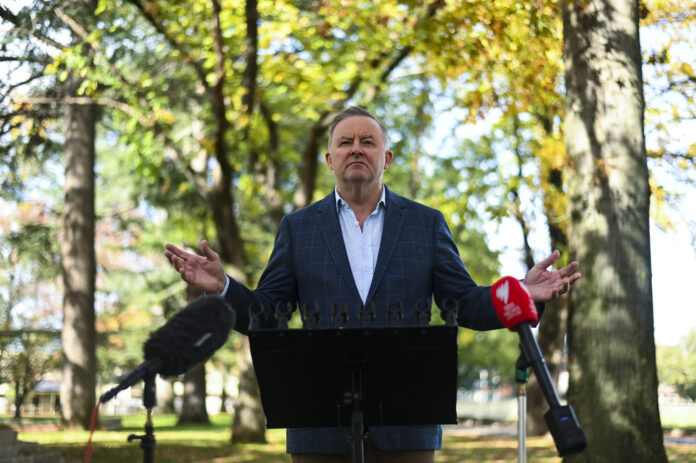
Anthony Albanese says Australia must use the pandemic experience to move to a more resilient society, creating more permanent jobs and revitalising high value manufacturing.

In his fifth “vision statement”, delivered against the background of the government foreshadowing an extensive post-crisis reform agenda, Albanese is giving a broad outline of Labor’s priorities for change.

The Monday speech, issued ahead of delivery, comes a day before parliament resumes for a three-day sitting expected to be more combative than the previous two one-day sittings. It also precedes Josh Frydenberg’s economic update on Tuesday – the day the treasurer was, pre-pandemic, due to deliver the budget, now delayed until October.


Read more: Grattan on Friday: The delicate art of political distancing during the pandemic


Referring to the government’s “SnapBack” terminology, Albanese says: “Let’s not SnapBack to insecure work, to jobseekers stuck in poverty, to scientists being ignored.”

“It’s no time for a ‘SnapBack’ to the Liberal agenda of cutting services, suppressing wages and undermining job security.

“This pandemic has shown that Labor’s values of fairness and security and our belief in the power of government to shape change to the advantage of working people are the right ones.

“A constrained fiscal position does mean difficult choices. But a reform agenda that doesn’t work for all Australians isn’t one we should pursue”.

Albanese says Labor has been constructive during the crisis, not allowing “the perfect to be the enemy of the good”; he contrasts its approach with the Coalition’s negativity against the Labor government during the global financial crisis.

While Australians have been getting through the crisis together, it has been tougher for some than others, including those who have lost jobs and businesses, he says.

“Sharing the sacrifice to get through the crisis together has to mean working to secure a recovery in which no one is left behind.

“We have to be clear in recognising that those with the least, have suffered the most through this crisis – something that must change.

“It’s critical that we are still saying , ‘we’re all in this together’, after the lockdown has come to an end,” Albanese says.

“We must move forward to having not just survived the pandemic, but having learned from it.

“To secure a more resilient society, given just how quickly things can change, through no fault of anyone.

“To better recognise the contributions of unsung heroes, like our cleaners, supermarket workers and delivery workers. To honour our health and aged care workers.

“To recognise that young people have done more than their share.

“Young people deserve better than an economy and society that consigns them to a lifetime of low wages, job insecurity, and unaffordable housing.

“We must ensure that what emerges is a society that no longer seems stacked against them, or denies them the opportunity and economic security of older generations”.

Albanese says this is a once-in-a-political lifetime event that “creates once-in-a-century opportunity to renew and revitalise the federation” and “a once-in-a-generation chance to shape our economy so it works for people and deepens the meaning of a fair go”.

“We must build more permanent jobs, an industrial relations system that promotes co-operation, productivity improvements and shared benefits,” he says.

“We must revitalise high value Australian manufacturing using our clean energy resources.”

He also urges nation building infrastructure including high speed rail and the local construction of trains; a decentralisation strategy including restoring public service jobs in agencies such as Centrelink that deliver services to regional areas; a conservation program to boost regional employment; and governments working with the private sector and superannuation funds to deliver investment in social and affordable housing.

“A housing construction package should include funding to make it easier for essential workers to find affordable rental accommodation closer to work.”

Albanese says that “too much of the risk in our economy has been shifted onto those with the least capacity to manage in tougher times.

“The broadest burden has been put on the narrowest shoulders.

“Our economy has become riskier, and we need to think through what that means for us all.

“We need to realise that a good society can’t thrive when the balance between risk and security falls out of step.”

Albanese says there needs to be an emphasis on growth, “because only inclusive economic growth can raise our living standards.

“We need to put more emphasis on secure employment – especially for the next generation of younger workers who nowadays have little idea of the meaning of reliable income or holiday pay”.

ref. Let’s “SnapBack” to better society with more secure jobs: Anthony Albanese – https://theconversation.com/lets-snapback-to-better-society-with-more-secure-jobs-anthony-albanese-138265

Australians want industry, and they’d like it green. Steel is the place to start

Source: The Conversation (Au and NZ) – By Tony Wood, Program Director, Energy, Grattan Institute

Australia has an historic opportunity to build a new, export-focused manufacturing sector based on renewable energy.

As a bonus, it could enable a less politically fraught conversation about climate change. Global action on climate change is in Australia’s national interest.

The changing climate is already reducing profits for Australian farmers. Tens of thousands of jobs depend on the again-bleached Great Barrier Reef.

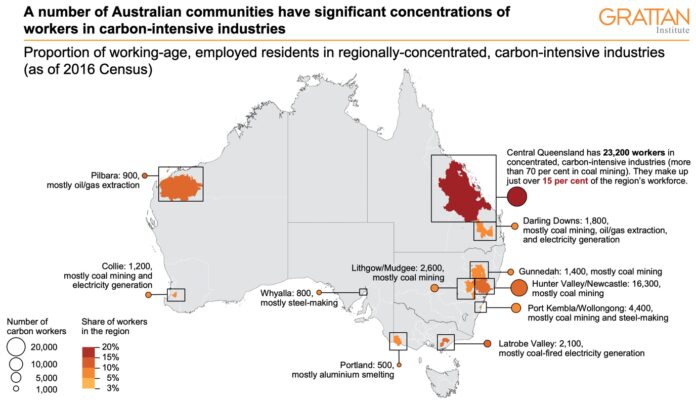
But for too long, political leaders have struggled to balance the national interest with the legitimate concerns of Australians who live and work in regions that host coal mining and other carbon-intensive industries – most notably central Queensland and the Hunter Valley in NSW.


Source: Grattan Institute (2020)’Start with steel: A practical plan to support carbon workers and Out emissions.

This climate conundrum has greatly complicated the national debate about climate change: neither commitments to a “just transition” to a low-emissions future, nor promises of coal exports in perpetuity, have proven convincing, leaving regional jobs in the lurch.

Australians want industry

In the 2019 federal election, voters in these carbon regions, perhaps fearing for their livelihoods, seemingly rejected Labor’s more ambitious climate policies.

But with 85% of our black coal exported each year, decisions made in Beijing and New Delhi matter more to these communities than decisions made in Canberra.

Australia needs a credible plan to replace carbon jobs as the world decarbonises, and ideally the new jobs will offer similar salaries, need similar skills, and be located in similar places.


Read more: How to transition from coal: 4 lessons for Australia from around the world


This is the key to cracking the climate conundrum: a plan based on sound economics that can offer hope to communities that currently depend on carbon-intensive activities.

A new Grattan Institute report, Start with steel, finds that manufacturing green steel for export is the largest job opportunity for these regions of Australia.

We can start with steel

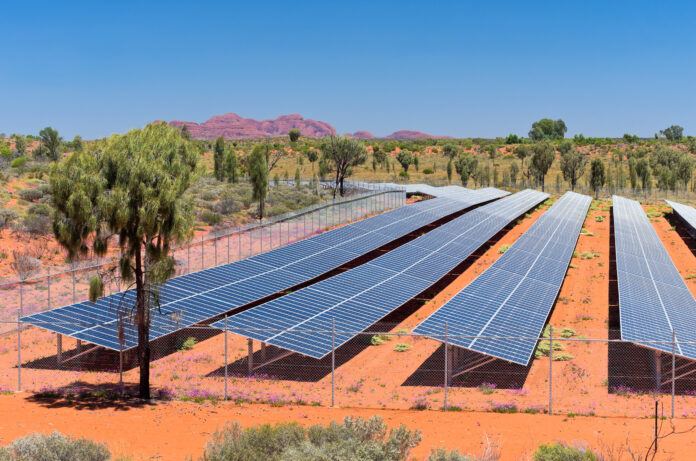
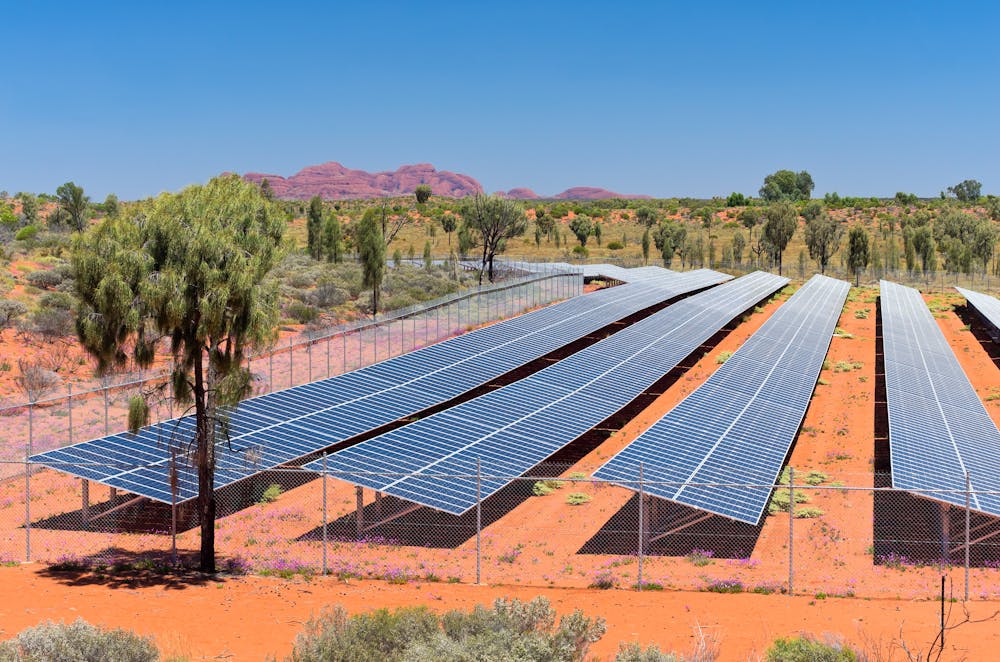
Green steel can be made by using renewable energy to produce hydrogen, and then using that hydrogen in place of metallurgical coal in the steelmaking process.

The byproduct is water, rather than carbon dioxide.

Winding back the 7% of global emissions that come from steel production will require creating demand for low-emissions steel.

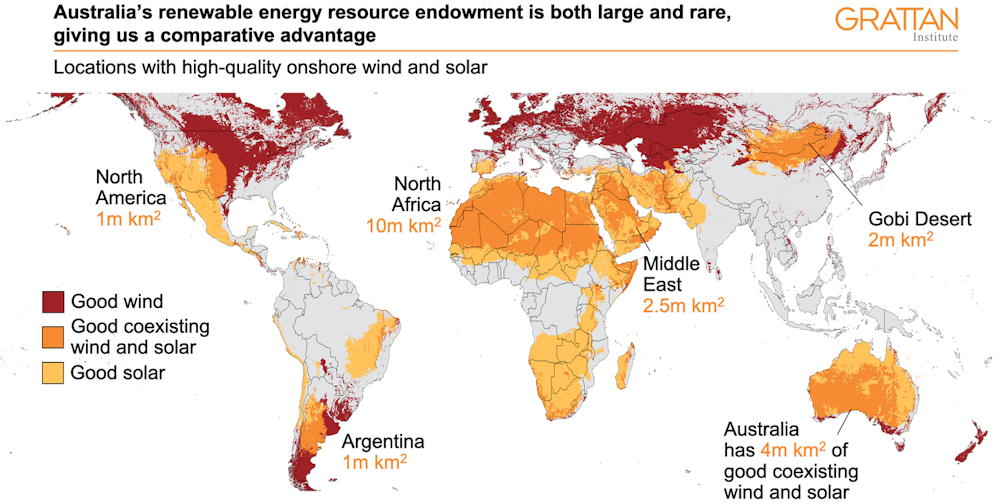
Australia has far better renewable resources than many of our major Asian trading partners, allowing us to make low-emissions hydrogen more cheaply, and therefore to make cheaper green steel.

And because hydrogen is expensive to transport, it makes sense to use it to make green steel here rather than exporting it to make green steel somewhere else.


Notes: Land higher than 3,000 metres is excluded because renewable energy resources are harder to use when they are in mountainous terrain. High-quality resources are defined to be areas with average wind power-density of at least 450 W/m2 and average daily solar photovoltaic potential of at least 4.5 kWh/kWp. North Africa includes the Horn of Africa. Sources: Grattan analysis of Global Wind Atlas (2020), Global Solar Atlas (2020) and U.S. Geological Survey and National Geospatial-Intelligence Agency (2010)

The Pilbara in Western Australia is the world’s largest iron ore province, which makes it look like the natural place to make green steel.

But it is difficult to attract workers to remote Western Australia. Making green steel for export would require large industrial workforces like those in central Queensland and the Hunter Valley.

Our calculations suggest that the availability of reasonably-priced labour on the east coast of Australia more than outweighs the cost of shipping iron ore from Western Australia to turn it into green steel there.


Read more: Enough ambition (and hydrogen) could get Australia to 200% renewable energy


If Australia captured just 7% of the global steel market, it could create 25,000 ongoing manufacturing jobs.

Seven per cent is much higher than the 0.3% of globally-traded steel that Australia produces today – but it is much less than our share of iron ore production, which is 38%.

Crucially, the opportunity does not rely on leaps of faith or endless subsidies – it is one of the few economically-credible ways to make the low-emissions steel the world will need if it gets serious about tackling climate change.

We should act quickly

There are also opportunities for Australia’s regions to manufacture biofuels for aviation and use renewable hydrogen to make ammonia.

The markets for these products are less certain, but if the world moves decisively to limit emissions, the projects that respond will deliver thousands of jobs.

Governments cannot single-handedly create these industries, and nor should they.

Instead, they should focus on bringing down the cost of the key intermediate product – hydrogen – by funding pre-commercial studies of geological structures suitable for storing hydrogen cheaply.

And they should invest in Australia’s low-emissions steel making capabilities by partly funding a flagship project that uses the direct reduction technology needed to use hydrogen to make steel.


Read more: For hydrogen to be truly ‘clean’ it must be made with renewables, not coal


The politics of climate change skewered a decade’s worth of prime ministers. And an inability to communicate the costs of action – and why they’re justified – contributed to a would-be prime minister losing an unlosable election.

Green steel offers Australia a reset button: a chance to get bipartisan cooperation to tackle a wicked problem that threatens our national interest.

We’ve heard plenty about the climate crisis. It’s time to talk about the opportunities.

ref. Australians want industry, and they’d like it green. Steel is the place to start – https://theconversation.com/australians-want-industry-and-theyd-like-it-green-steel-is-the-place-to-start-137999

The stepped approach out of lockdown is the only way forward, but how much we’ll allow the curve to rise is still an unknown

Source: The Conversation (Au and NZ) – By Tony Blakely, Professor of Epidemiology, University of Melbourne

The federal government has laid out a three-step guide for the states and territories for relaxing the physical distancing measures that have served Australia so well. We need to get back to school, work and play.

Australia is one of the lucky countries, blessed by being “girt by sea”, with a little bit more time to respond to the COVID-19 pandemic – and some good, strong early leadership (such as closing the border to China). We have used that time well, getting the case numbers down to not much more than New Zealand’s low rate, even though they faced a more severe lockdown. Some states, such as WA, may even have succeeded in eliminating community transmission.

Morrison’s language last week of expecting ongoing outbreaks suggests the goal is not to eliminate, but to suppress case numbers. This means accepting there will be grumbling transmission of the virus that pops up here and there as (hopefully) small outbreaks we can stamp out. But there is a risk of things getting out of control, with a second wave of infections possibly much greater than the first.


Read more: We may well be able to eliminate coronavirus, but we’ll probably never eradicate it. Here’s the difference


The best way forward in a suppression world

Think of it like a seesaw. On one side we have things we want back – the kids at school, going back to work, going to the pub, playing team sports. The problem is each one of these things will make it easier for the virus to circulate. If we went straight back to our old normal ways, it’s inevitable COVID-19 would take off as an epidemic that would swamp our health system – and cause substantial illness and death. We are not going to do that.

So we have to stack the other side of the seesaw with the counterbalancing of really good surveillance systems, testing, keeping our distance, and contact tracing (in which case, yes, the COVID-Safe App can help here).


Read more: COVIDSafe tracking app reviewed: the government delivers on data security, but other issues remain


With each of these things together, it will in theory allow us to get out and about without the epidemic taking off again.

But we do need to remember it is a theory the world has not tested before. We need to approach this cautiously, learn as we go, and generate the evidence in real time.

How do we do that? By relaxing measures in batches. Hit “release” on the first tranche, then monitor what happens very closely for three to four weeks. (And do not stuff it up by muddying the waters with more loosening ups before the three to four-week window has passed.)

If by three to four weeks, there has not been an unacceptable surge in cases, then release the next tranche and repeat the cycle. If and when the case load gets too high, we then have reached the tipping point for the seesaw – and we will need to stabilise or even tighten up again.

Thus the stepped proposal by the federal government looks like a good framework to follow.

The issue, though, is how far we can get before the seesaw looks like it is tipping. We may get a rude shock; we may not get much of our liberty back before we have to equilibrate, and even go back into lock-down if there is a strong surge in cases.

The fear that is often mentioned is that of a “second wave” of infections that could surpass the first. That will happen in the states and territories that have not eliminated the virus if we open up too rapidly – hence the need for a stepped approach that can be stopped at or before the tipping point that will lead to an unacceptable second wave.

What is an acceptable level of community transmission in Australia?

Understandably, no politician has been brave enough to state publicly how much of an increase in cases is acceptable. But we will find out once restrictions are relaxed and cases start to inevitably rise.

The “acceptable” number of cases we want to remain under might be as low at ten cases per day – a number that would see low levels of death and severe illness. Alternatively, and perhaps better, we may use the number of outbreaks – something like no more than one new outbreak per week in each state or territory.

An outbreak could be defined as one new case with no detectable infection source, through to dozens of infections from the same source (as per the current abattoir outbreak in Victoria).

Learning to live with the virus in this suppression world is likely to be hard work. Which gives reason to pause and ask “is elimination really off the table?” For the country as a whole, probably. The government (and society) has decided to trade off the risk of more infections for some of our freedoms back. Which is understandable.

Everything about COVID-19 is calculated risk-taking. While some states, such as WA, may have achieved elimination, most have not. So loosening up now will likely mean elimination is unachievable, and suppression our only path forward.

ref. The stepped approach out of lockdown is the only way forward, but how much we’ll allow the curve to rise is still an unknown – https://theconversation.com/the-stepped-approach-out-of-lockdown-is-the-only-way-forward-but-how-much-well-allow-the-curve-to-rise-is-still-an-unknown-138260

A-lop-bam-boom: Little Richard’s saucy style underpins today’s hits

Source: The Conversation (Au and NZ) – By Rebecca Sheehan, Lecturer in the Sociology of Gender and Program Director of Gender Studies, Macquarie University

Little Richard was washing dishes at a Greyhound bus station in Macon, Georgia when he wrote Tutti Frutti, Good Golly Miss Molly and Long Tall Sally. The singer, who died Saturday at 87, sent the songs as demos to Specialty Records.

Soon he was having lunch with talent scout Robert “Bumps” Blackwell at a New Orleans nightclub, leaping onto the piano and belting out:

Tutti Frutti, good booty

if it don’t fit, don’t force it

you can grease it, take it easy

tutti frutti, good booty.

Watching the flamboyant performer sing about the pleasures of anal sex, Blackwell knew he had a hit.

The recorded lyrics were toned down for the conservative 1950s, but Little Richard’s wild whoops and falsetto screeches infused the song with the saucy spirit of the original.

Long Tall Sally then Tutti Frutti from the film Don’t Knock The Rock.

Preaching as Princess Lavonne

Born Richard Wayne Penniman and nicknamed for his smallness as a child, Little Richard was one of 12 children. He developed his charismatic singing, piano and performance styles playing in black and Pentecostal churches.

He was thrown out of home at age 13 by his father who didn’t like his loudness, in music or dress – a clear rejection of his queerness. As a teenager Little Richard performed in minstrel shows across the American South as the drag queen Princess Lavonne.

He brought his charismatic style and drag persona into his showmanship as Little Richard, with a camp style that enabled him to call himself the “king and queen of the blues”.

Historian Marybeth Hamilton argues Little Richard came out “of a black gay world and a tradition of black drag performance that formed an integral part of the culture of rhythm and blues”. Even when young audiences didn’t understand his lyrics, he “made the drag queen’s sly ironies part of every white teenager’s soundtrack”.

He described his songs as ballads that covered a range of experiences. The term “molly” in Good Golly Miss Molly referred to a male sex worker. Long Tall Sally was about a drunk woman Richard used to see as a child. Lucille was about a female impersonator.

Lucille in 1957.

Threatening the status quo

Little Richard confronted audiences with his suggestive lyrics and sexually charged sound, his gender bending falsetto, high hair and makeup, and his blackness.

Journalist Jeff Greenfield recalled his parents’ horror when he picked up the 1957 debut record Here’s Little Richard.

On a yellow background, a tight shot of a Negro face bathed in sweat, the beads of perspiration clearly visible, mouth wide open in a rictus of sexual joy, hair flowing endlessly from the head.

In conservative, racially segregated, 1950s America, when interracial marriage was illegal, and homosexuality was a crime, Little Richard’s popularity embodied the perceived dangers of the new generation’s music. There was particular concern that young people would be influenced into alternative lifestyles including via mixing across lines of race and class at dance halls.

To counter the perceived threat he posed to conservative white America, Richard worked to present himself as so outré, so out there – dressing as the pope and the Queen at different performances – as to present no menace.

Little Richard’s 1957 debut album. Wikipedia/Speciality

After he had a religious epiphany during his Australian tour, he took a break from music, returning in the 1960s. This was the first of many times he quit rock ‘n’ roll for God.

Despite having once described himself as gay and “omnisexual”, in the final years of his life Richard called gay and trans identities “unnatural”, a position that hurt some of his queer fans.

Generations

Little Richard’s urgent, intense delivery, the drama of his falsetto, his exuberant costuming and moves, his howling wildness, influenced generations of musicians and figures including Muhammad Ali.

Artists who owe enormous debts to his influence include Tina Turner, Bob Dylan, The Beatles, Rolling Stones, Bob Dylan, Otis Reading, Jimi Hendrix, James Brown, Patti Smith, Led Zeppelin, Elton John, Prince and Bruce Springsteen. Following news of his death, artists from Bob Dylan to Paul McCartney to Janelle Monáe posted tributes on social media.

In 1991, as part of the campaign to get Little Richard recognised with a Grammy award, David Bowie said, “without him, I think myself and half of my contemporaries wouldn’t be playing music”.

For younger generations, his name might not be as recognisable as those of his peers like Elvis Presley. This is in part likely the result of Richard’s own ambivalent relationship with rock ’n’ roll. But it’s also the result of the combined impact of racism, homophobia, and respectability politics. For some (including himself) he was at various times, too queer, too black, too feminine, too close to the devil.

And yet his gift lay, through music, in transmuting this otherness into a transcendent, shared permission to be free.

As one 1970 reviewer described his stage performance, Little Richard was “mesmerizing because he hits the cosmic mainline, a source of radiant energy that has the power to dissolve the ghosts of identity”.

As Little Richard sang it: “A-wop-bop-a-loo-bop-a-lop-bam-boom”.

ref. A-lop-bam-boom: Little Richard’s saucy style underpins today’s hits – https://theconversation.com/a-lop-bam-boom-little-richards-saucy-style-underpins-todays-hits-138263

Former PNG Defence Force chief calls for inquiry after policeman killed

Pacific Media Watch

Former Papua New Guinea Defence Force commander Jerry Singirok has condemned the killing of a senior police officer allegedly by off-duty soldiers.

He used social media last night to distribute a message of condemnation of the killing of Senior Inspector Tovere with a photo of himself with two other former commanders, Peter Ilau and Ted Diro, reports the PNG Post-Courier.

“As the duly appointed secretary-general of PNG Flag Officers’ League, on behalf of the former commanders PNGDF, we condemn the killing of a senior police officer,” he said.

READ MORE: Controlling PNG’s borders the priority, says SOE controller

Former PNGDF commanders
Former PNG Defence Force commanders Peter Ilau (from left), Ted Diro and Jerry Singirok … call for an inquiry into “morale and discipline” of the military. Image: PNG Post-Courier/FB

“We call on the government of the day to step up the control of the PNGDF as we have noted a serious decline in morale and discipline.

“We call for an independent inquiry [into] the command and control of the PNGDF, including aspect [sic] of fair recruitment and management of public funds,” Singirok said.

– Partner –

“Failing that, we can never recover from the current quagmire.”

Papua New Guinea currently has at state of emergency in place with 18 positive cases of covid-19 reported but no deaths. However, authorities do not know if there is any community spread and the method of testing is being changed.

A report from Acting Assistant Commissioner of Police Anthony Wagambie Jr said he did not foresee any more trouble between the two disciplinary forces.

Sergeant identified
He said one Defence Force sergeant had been identified by military police.

”Others will be identified if any. The officer is on the run and will be brought in by MP [military police],” he said.

RNZ Pacific also reports that PNG police had reported calm although tension still remained.

Senior Inspector Tovere, the police commander for National Capital District (NCD) Zone Three, died after he was allegedly attacked by drunk off-duty military personnel on Friday at the ATS Settlement in the capital of Port Moresby, according to FM100 News.

Acting Deputy Police Commissioner Operations Donald Yamasombi told the radio station  Tovere had died at Port Moresby General Hospital.

According to Yamasombie, Tovere was responding to reports of the sale of alcohol by a black market at the settlement when he was attacked.

Yamasombi strongly called on all police personnel in Port Moresby to refrain from carrying out any retaliatory acts.

Police officer’s body escorted
Forty-six police vehicles with sirens and lights blazing left the National Fraud Squad office at Konedobu around 7pm last night escorting Tovere’s body in a funeral home van to 9 Mile where he remained overnight, Acting Metropolitan Commander Chris Tamari said.

Assistant Commissioner Wagambie Jr’s report said: “[The] situation from our end is now quiet. All units have been contained and back to normal duties.”

He recounted what happened yesterday morning: “Police units had congregated at 3 Mile Hospital after learning of the death of our senior officer.

“We told them to go to Boroko Station so they would be briefed and to remain calm. However some units broke away and went straight to ATW against our directives,” Wagambie said.

He said Superintendent Tamari and he followed them there and met Colonel Eddie Mirou and got the units to withdraw.

” There was a small confrontation before we had arrived. All units returned to Boroko where acting Metsupt and I talked to them.

”[We] explained to them that they must not enter any Army Barracks. PNGDF is working on it,” Wagambie said.

Print Friendly, PDF & Email

Article by AsiaPacificReport.nz
Rappler publisher Maria Ressa raps Duterte for ‘security’ violations

Evening Report
Evening Report
Rappler publisher Maria Ressa raps Duterte for ‘security’ violations
Loading
/

Pacific Media Watch

Rappler publisher and chief editor Maria Ressa was critical today of the Philippines administration under President Rodrigo Duterte for its focus on “security” rather than public health in the global covid-19 coronavirus pandemic.

Speaking on RNZ public radio’s Saturday Morning current affairs programme in a week in which the government closed the country’s top television and radio network, ABS-CBN, Ressa condemned the shooting of three citizens during the Manila lockdown so far.

Asked by presenter Kim Hill how the Philippine capital was faring under the pandemic restrictions, Ressa said the Philippines government was “still more focused on security rather than public health”.

LISTEN: Rappler publisher Maria Ressa talks to RNZ Saturday Morning’s Kim Hill

Rappler publisher Maria Ressa … fighting for democracy and media freedom. Image: RNZ

Acknowledging that levels of testing had increased in her homeland as in many other countries, she added, “It’s just that our president quite early on said, ‘shoot them dead’ if [dissenters] violate the quarantine. It is as crazy as that!”

Kim Hill: “And have there been any shot dead?”

– Partner –

“There have been three cases since President Duterte said that on April 1.

“A 63-year-old farmer was stopped at a checkpoint because he was not wearing a facemask … and shot dead …

‘Just like a blip’
“It is just like a blip. I wrote about it for Time magazine at the time…

“Just a week ago a former colonel in the military with PTSD was stopped at a checkpoint by police – who are dressed like the military and wearing fatigues … and they shot and killed him.

“And then just this Sunday … there was this Spanish man who the police tried to arrest in his own home and that is unconstitutional.”

Ressa added, “Again it is an abuse, an over-reliance on violence and arrests. We have had 30,000 arrests since lockdown at a time when the courts are not working.

“So how do these people post bail?”

READ MORE: We can’t let the virus infect democracy – Maria Ressa

Ressa’s work exposing government corruption and the misdeeds of the powerful has put her on a collision course with the ‘strongman’ government of President Duterte.

Lead investigative journalist
She spent nearly 20 years working as CNN’s lead investigative journalist in Southeast Asia before setting up the independent website Rappler in her homeland.

Now, in what critics describe as a politically motivated prosecution, she’s being accused of cyber-libel and tax evasion. The prominent human rights lawyer Amal Clooney is among her admirers, and is defending her at her trial

“This is my 34th year as a journalist and I would never have thought I would be arrested for doing my job. I was arrested twice in a five-week period, then I was detained once – experiences I wish I didn’t have, but it gave me a clear personal experience of the abuse of power.”

Ressa said they were politically motivated charges meant to stifle press freedom.

“Truth is critical in any democracy,” Ressa said.

“I became the cautionary tale for journalists.”

Print Friendly, PDF & Email

Article by AsiaPacificReport.nz

New information: Guaidó was the “commander in chief” of the failed mercenary operation against Venezuela

Source: Council on Hemispheric Affairs – Analysis-Reportage

Analysis by Patricio Zamorano
From Washington DC

New information divulged this week reveals that Juan Guaidó was designated as “commander and chief” of the mercenary operation that completely unraveled on the shores of Venezuela. The 41 page contract that formed the basis of the already known eight page General Services Agreement was published by the Washington Post[1] this week.

This more complete document confirms what the mercenary and head of SilverCorp, Inc., Jordan Goudreau, had already revealed to the media: the agreement was aimed at “planning and executing an operation to capture/detain/remove Nicolas Maduro (heretoafter “Primary Objective”) remove the current Regime and install the recognized Venezuelan President Juan Guaido.”

The document provides complete information about the money that would be invested (212 million dollars), and the payments and commissions that SilverCorp would receive from Guaidó’s team, which includes Juan José Rendón, Sergio Vergara and attorney Manuel Retureta.

The document also explains the promised retainer of 1.5 million dollars that Goudreau has been complaining about publicly since the failed operation last Sunday, May 3.

What has not been said: information about the operation was published two days before the attack

There is an important detail that the world press has not analysed. One AP article[2] which details the preparations for the attack was published Friday May 1, two days before the attempt to invade Venezuela was launched from Colombia. The article  provides particulars on the presence of three paramilitary groups (deserters from the Venezuelan armed forces and police) in Colombia and explains how this operation had been foiled and aborted. It clearly names Jordan Goudreau, including a profile on the mercenary and many other details about the planned attack. No Colombian nor US authority mobilized to neutralize the illegal paramilitary camps.

This document also appears to confirm that Goudreau, despite the exposure of the planned incursion by the press, still proceeded with the attack, irresponsibly putting at risk the lives of those involved. It also shows that neither US intelligence agencies, nor the Colombian police, nor even Guaidó’s team took action to stop the attack.

One can extrapolate two possible reasons for this. Allowing the operation to move forward, without directly committing to SilverCorp, would show the actual consequences of the operation (whether a success or failure). The operation could also expose the government of Maduro to world criticism if it produced fatalities on one side or the other. What is certain is that all of these scenarios, “whether above or under the table” in the words of Rendón on CNN, were discussed extensively with Guaidó and his advisors with the aim of illegally overthrowing Maduro. Rendón told CNN in Spanish that “they analysed all of the scenarios; alliances with other countries, their own actions, uprisings of people from within, of the soldiers that are there, the eventual use of actors that are outside, retired soldiers. All these scenarios were produced, as the president said well, we are analysing things above and below the table.”[3]

Guaidó was leader of the operations

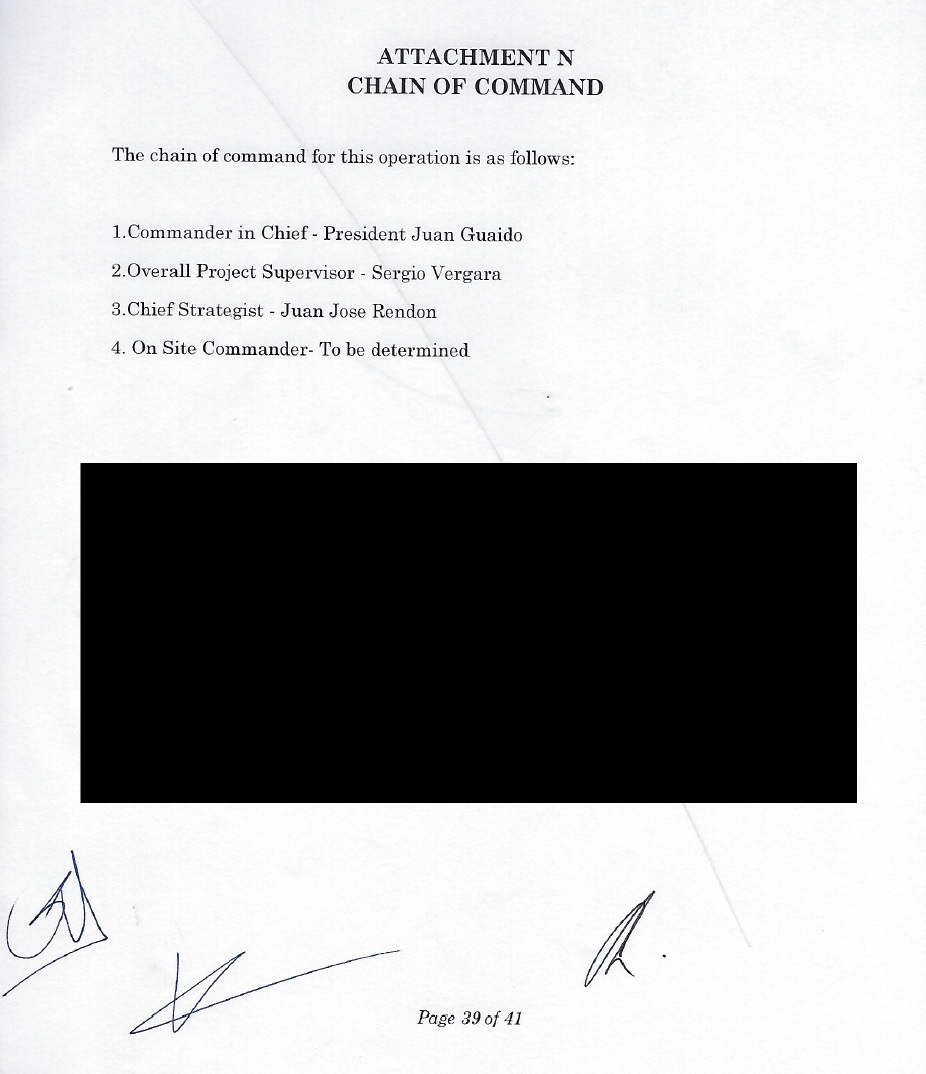
The most important theme of this story, which the Washington Post does not even mention in its article, is what is described on page 39 of the contract.

Under the title “ATTACHMENT N: CHAIN OF COMMAND,” the document includes the following:

  1. Commander in Chief – President Juan Guaidó
  2. Overall Project Supervisor – Sergio Vergara
  3. Chief Strategist: Juan Jose Rendon
  4. On Site Commander – To be determined

The page is signed by Guaidó’s advisors and there is a large black box that surely hides compromising information about SilverCorp.


Denial is followed by selective recognition

The evidence is very clear that Guaidó’s team has decided to change its strategy. The first reaction of Guaidó was to deny that he was involved in the disastrous operation[4] in the face of the cost of lives of eight mercenaries, former Venezuelan soldiers, and the capture of numerous paramilitaries, including two US former soldiers. Guaidó’s team  however,  publicly acknowledged this week their involvement, but they tried to discredit SilverCorp as if it had acted on its own. Nevertheless Rendón recognized that he had paid 50 thousand dollars to the mercenary company[5]  of Florida and that his signature on the document is legitimate.

The big question is what will be the response of the legal authorities in the US and Colombia. So far there has been no arrest, despite the fact that all of the details of the operation and the violations of law committed are clear and irrefutable.

In the coming days it will become evident whether the governments of Trump and Duque in Colombia opt for the strategy of impunity. This scandal without doubt weakens in an important way the illegal policy of sanctions and the dirty campaign supported by the hard-line Venezuelan opposition that has broken with the strategy of dialogue that other more moderate anti-Chavista sectors continue to advance in Caracas.

Translation made from the original Spanish by Fred Mills, academic and Co-Director of COHA


End notes

[1] “From a Miami condo to the Veenzuelan coast, how a plan to ‘capture’ Maduro went rogue”, https://www.washingtonpost.com/world/the_americas/from-a-miami-condo-to-the-venezuelan-coast-how-a-plan-to-capture-maduro-went-rogue/2020/05/06/046222bc-8e4a-11ea-9322-a29e75effc93_story.html

[2] “Ex-Green Beret led failed attempt to oust Venezuela’s Maduro”, https://apnews.com/79346b4e428676424c0e5669c80fc310

[3] “J.J. Rendón habla sobre la Operación Gedeón en Conclusiones de CNN en Español”, https://cnnespanol.cnn.com/2020/05/07/j-j-rendon-habla-sobre-la-operacion-gedeon-en-conclusiones-de-cnn-en-espanol/

[4] “Guaidó niega vínculos con intento de invasión en Venezuela”, https://www.chicagotribune.com/espanol/sns-es-coronavirus-guaido-niega-vinculo-intento-invasion-venezuela-20200505-uiditc4i6nbdda3nyx24n26zee-story.html

[5] “J.J. Rendón habla sobre la Operación Gedeón en Conclusiones de CNN en Español”, https://cnnespanol.cnn.com/2020/05/07/j-j-rendon-habla-sobre-la-operacion-gedeon-en-conclusiones-de-cnn-en-espanol/

The Reserve Bank thinks the recovery will look V-shaped. There are reasons to doubt it

Source: The Conversation (Au and NZ) – By Peter Martin, Visiting Fellow, Crawford School of Public Policy, Australian National University

The Reserve Bank’s long-awaited two-year forecasts for jobs, wages and growth are frightening, but I fear they are not frightening enough.

The bank looks two years ahead every three months. The last set of forecasts, released at the start of February, mentioned coronavirus mainly as a source of “uncertainty”.

That’s how much things have changed.

Back then economic growth was going to climb over time, consumers were going to start opening their wallets again (household spending had been incredibly weak) and unemployment was going to plunge below 5%.

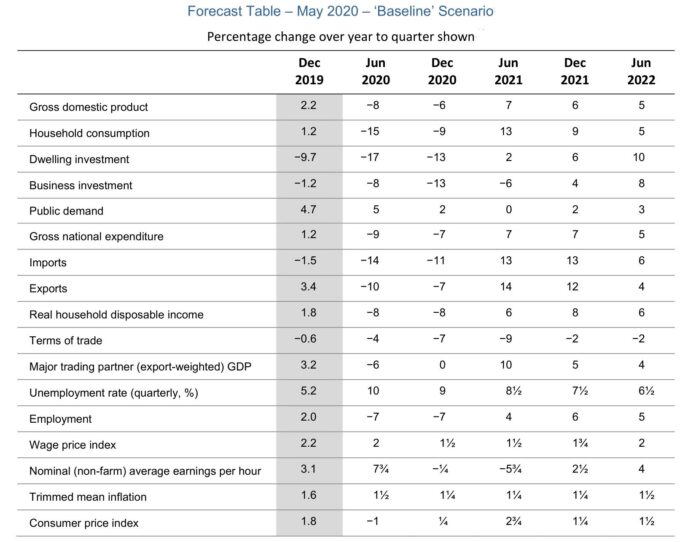
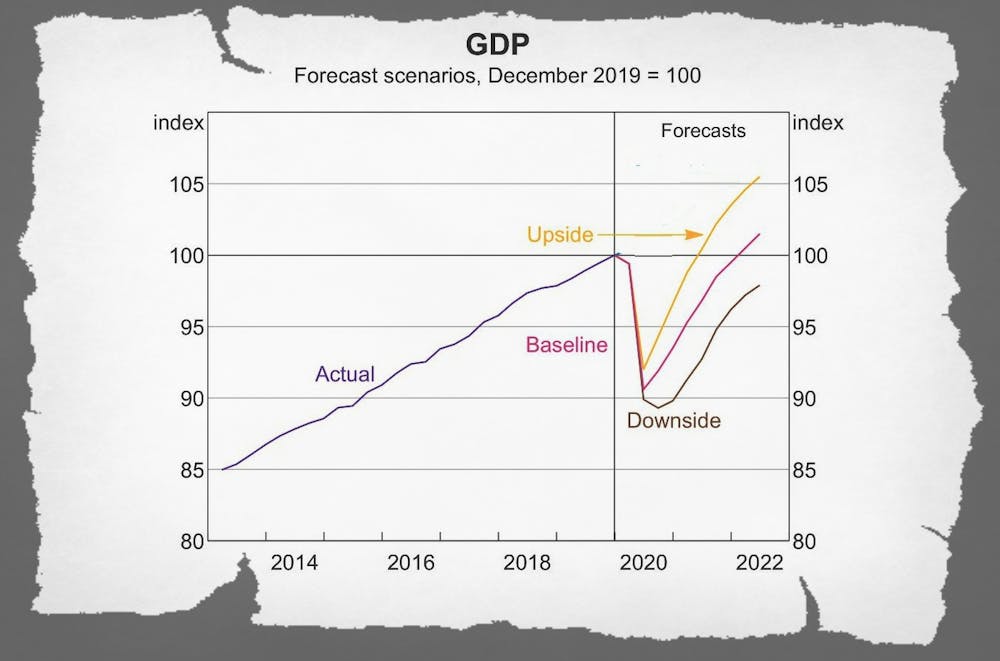
The forecasts released on Friday come in three sets – “baseline”, a quicker economic recovery, and a slower recovery.

Baseline”, the central set with which we will concern ourselves here, is both shocking, and disconcertingly encouraging.


Reserve Bank Statement on Monetary Policy, May 2020

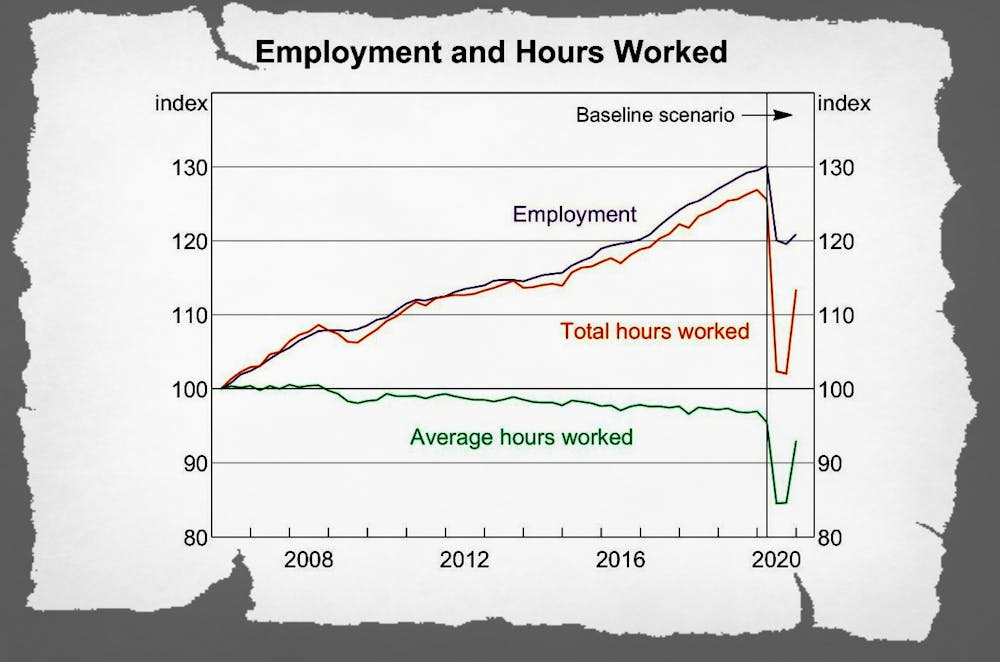
On employment, it predicts a drop of more than 7% in the first half of this year, most of it in the “June quarter”, the three months of April, May and June that we are in the middle of.

Thirteen million of us were employed in March, making a drop of 7%, a drop of 900,000. Put differently, one in every 13 of us will lose their jobs.

Herder to believe is that by December next year 6% of the workforce will have got hem back.

It sounds like what the prime minister referred to earlier in the crisis as a “snapback”, the economy snapping back to where it was.

Except that it’s not.

Reserve Bank Statement on Monetary Policy, May 2020

Six per cent of a small number is a lot less than 7% of a big number.

The bank’s forecasts have far fewer people in work all the way out to mid 2022 (the limit of the published forecasts) and doubless well beyond.

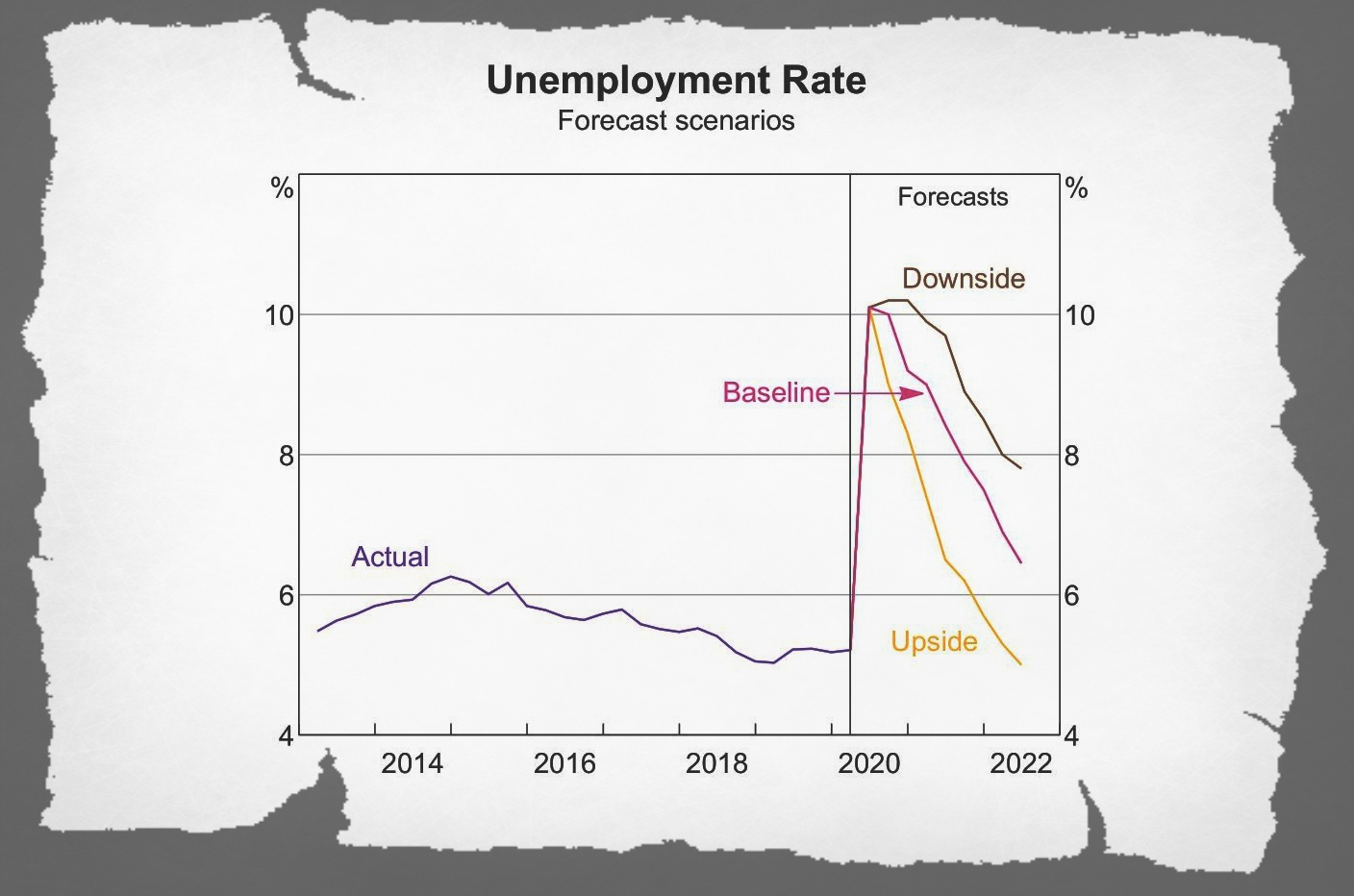
The unemployment rate would shoot up to 10% by June and take a long while to fall.

Reserve Bank Statement on Monetary Policy, May 2020

The baseline economic growth forecast is also drawn as a V.

After economic activity shrinks more than 8% in the June quarter, we are asked to believe it will bound back 7% in the year that follows.

But that will still leave us with much lower living standards than we would have had, missing the usual 2-3% per year increase.

Reserve Bank Statement on Monetary Policy, May 2020

The reason I fear the baseline forecasts aren’t frightening enough is that they are partly built on a return to form for household spending, which accounts for 65% of gross domestic product.

After diving 15% mainly in this quarter we are asked to believe it will climb back 13% in the year that follows.

Maybe. But here’s another theory. While we’ve been restricted in movement or without jobs we’ve become used to spending less (and used to flying less, and used to hanging onto our cars for longer and hanging on to the money we’ve got).


Read more: How will the coronavirus recession compare with the worst in Australia’s history?


My suspicion is that these behaviours can be learned, and we’ve been doing them long enough to learn them.

During the global financial crisis we tightened our belts and then kept them tight for years, saving far more than the offical forecasts expected, in part because we had been shocked and felt certain about the future.

A recovery that had been forecast to be V-shaped looked more like a flat-bottomed boat when graphed. It’s a picture I find more believable than a snapback.

We are unlikley to have been back where we would have been for a very long time.

ref. The Reserve Bank thinks the recovery will look V-shaped. There are reasons to doubt it – https://theconversation.com/the-reserve-bank-thinks-the-recovery-will-look-v-shaped-there-are-reasons-to-doubt-it-138213

Shut down Philippines TV network journalist tells of ‘the unthinkable’

Rappler justice reporter Lian Buan talks to ABS-CBN’s Mike Navallo who broke the report about the shutdown. Video: Rappler

Pacific Media Watch

For the first time since dictator Ferdinand Marcos declared Martial Law in the Philippines in 1972, ABS-CBN Channel 2 was this week forced to go off the air, reports Rappler.

– Partner –

ABS-CBN News has reported that Solicitor-General Jose Calida pressured the National Telecommunications Commission (NTC) to issue a cease and desist order, despite earlier promises by the NTC leaders that it would allow the network to provisionally air after its franchise expired on May 4.

Speaker Alan Peter Cayetano, who is being blamed for the shutdown, has given the same observation.

Rappler justice reporter Lian Buan talks to ABS-CBN’s Mike Navallo who broke the report, and who covers the justice beat, as the broadcast giant finds itself figuring in the Duterte administration’s legal actions against dissenters.

Baguio protest
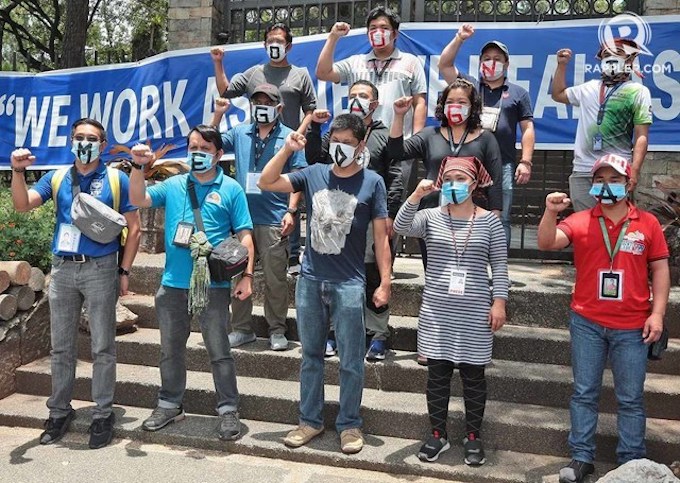
Members and officers of the Baguio Correspondents and Broadcasters Club and NUJP Baguio Benguet held a protest rally against the government closure of ABS-CBN in front of the Baguio City Hall. They used their facemasks to send the message of solidarity. Image: Mau Victa/Rappler
Print Friendly, PDF & Email

Article by AsiaPacificReport.nz

Solomon Islands students help out Fiji victims of TC Harold restore lives

By Ben Bilua of Wansolwara News

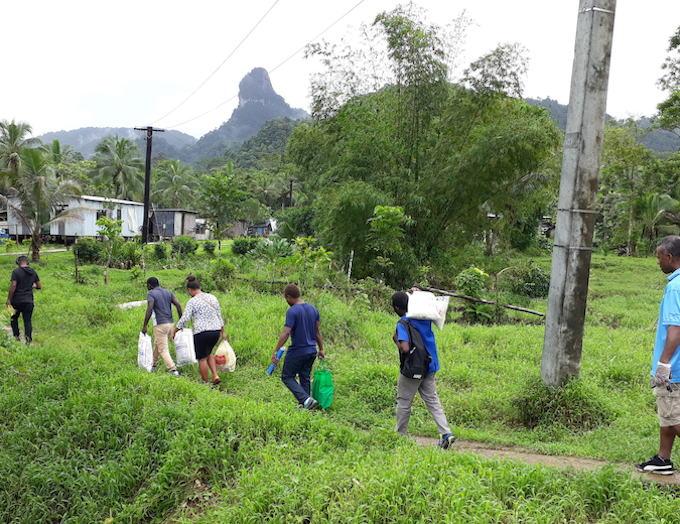
Solomon Islands students studying at universities in Fiji have braved the rain to donate food, clothing and cash to 18 families who were badly affected by last month’s Tropical Cyclone Harold.

Solomon Islands Students Association (SISA) president Peter Maclean and Solomon Islands Education Attaché to Fiji Francis Tavava led the relief distribution programme this week with the help of an officer from the Fiji National Disaster Management Office.

Tavava said Solomon Islands students were honoured to be given the opportunity to reach out to the victims of the cyclone that devastated parts of Fiji, Solomon Islands, Tonga and Vanuatu for almost two weeks.

READ MORE: Thousands of cyclone victims still in evacuation centre in Vanuatu

“We know that Fiji government has taken care of us over the past months, during the peak of covid-19 and TC Harold and we want to assist in a small way to give back to the people and government of Fiji for being good to us,” he said.

Tavava said the donation was made possible through the contributions from Solomon Islands students when the call was made after TC Harold.

– Partner –

NDMO Central branch district officer Vatia Vasuca said the government and operational centres had been working tirelessly to help TC Harold victims restore their lives and move forward.

He told the SISA disaster relief distribution team that the donation contributed well towards the government’s ongoing relief programme effort.

‘Assistance a bonus’
“Your assistance is a bonus to our ongoing effort and ambition to help the families get back on their lives and move forward,” he said.

Student leader Maclean said the damage caused by TC Harold was immense and the students were pleased to be able to visit affected families.

He said the visit was a memory students from the Solomon Islands would cherish.

“I must acknowledge the students who came up with the idea to raise funds and help our host government and its people who gave us an opportunity to come and study here,” he said.

“During each presentation it was mentioned to each affected families by the NMDO team leader that these were the humble donations from SISA. The term ‘Solomon Islands’ was consistently used and it was moving to see how respective families were so emotional to receive their necessities.

“This shows that the great value of kindness, respect and compassion of Melanesianhood is still in the hearts of our students,” Maclean said.

“My humble acknowledgement goes to all parents, families, people, leaders, mentors and communities back in Solomon Islands for positively nurturing these respective SISA students to be noble thinkers and actors.”

Ben Bilua is a final-year Solomon Islands journalism student at the University of the South Pacific’s Laucala campus in Suva, Fiji. He is also the online student editor of Wansolwara, USP Journalism’s student training newspaper and online publications.

Print Friendly, PDF & Email

Article by AsiaPacificReport.nz

A Listener flashback: The sacking of an editor

REVIEW: By Jeremy Rees

After 81 years of publication, The NZ Listener, one of the Bauer Media stable of publications, closed last month when the Germany-based publisher shut down its New Zealand operation. In this article, Jeremy Rees reflects on the report of a Commission of Inquiry that investigated a decision by the Board of the New Zealand Broadcasting Corporation on 25 July 1972 to terminate the editorship of Alexander MacLeod with three months’ pay, effective immediately. The Listener had only had three editors since its launch as a broadcasting guide in 1939. Its founder Oliver Duff and successor Monty Holcroft, the revered editor of 18 years, built it up as a magazine of culture, arts and current events on top of its monopoly of listings of radio and television programmes. Both men managed to establish a sturdy independence for the magazine which was still the official journal of the New Zealand Broadcasting Service, later to become the New Zealand Broadcasting Corporation.


Five years ago, when I left The New Zealand Herald after 15 years employment, I decided I would leave carrying my belongings packed in a brown cardboard box.

It is not quite as odd as it sounds now. One of the most common images after the Global Financial Crisis was employees leaving the office with their belongings packed in a distinctive box. You can search it now.

Enron? There are the employees leaving with cardboard boxes. Lehman Brothers? The same cardboard box. Freddie Mac and Fannie Mae? Same thing. Every time I looked at press agency photos of people leaving work, I looked for the cardboard box.

So, when I left the Herald for another job in 2015, I bought myself the cardboard box and packed up my few things. I said goodbye to colleagues, had a drink or two and then picked up the box, took it home and stored it in the attic.

Some years later, I found it. It didn’t look how I remembered. On the outside was written in felt pen, “Library, bin”. I had picked up the wrong one. Inside were dozens of unwanted and browning reports from the 1960 and 1970s. My box was long gone to the landfill. I had the reports even the Herald Library didn’t want.

– Partner –

During the Covid-19 lockdown, I climbed into the attic to toss it out. But, curious and with a bit of time to kill, I decided to pick one report to see if it was interesting. I picked out the 19772 Report of the Commission of Inquiry into the Dismissal of the Editor of the New Zealand Listener.

On 25 July 1972, the Board of the New Zealand Broadcasting Corporation decided to terminate the editorship of Alexander MacLeod, with three months’ pay, effective immediately. The Listener had only had three editors since its launch as a broadcasting guide in 1939. Its founder Oliver Duff and successor Monty Holcroft, the revered editor of 18 years, built it up as a magazine of culture, arts and current events on top of its monopoly of listings of radio and television programmes. Both men managed to establish a sturdy independence for the magazine which was still the official journal of the New Zealand Broadcasting Service, later to become the New Zealand Broadcasting Corporation.

So, the dismissal of the editor was a sizable event.

Straight away, news reports raised the possibility of political interference.

Turbulent year
The year 1972 was a turbulent one. It was the year of Nixon in China, anti-Vietnam War protests. In New Zealand, the Holyoake years were ending, the electorate tired of National after 12 years; there were protests about the impending 1973 Springbok tour. On all these issues, MacLeod was a liberal. His editorials would later be characterised as “idealistic liberalism”.

Some of his editorials worried the board. They thought they lacked “balance”.

By all accounts, MacLeod was a good journalist, but Te Ara Encyclopedia of New Zealand  describes him as “erratic”. He had been recruited from England to replace Holcroft and immediately increased The Listener’s foreign coverage. Witnesses praised his literary ability. He took his weekly editorial very seriously as a public figure.

At the same time, the board had been warned of some troubling dealings with staff. The Public Service Association forwarded staff complaints about him. There was a falling out with a “sub-editor in Auckland”. In another incident, MacLeod objected to the choice of the “Listener Appointments Committee” (one of three Listener committees cited in the report) of a new “Listener Secretary/Typiste”. He threatened to give her no work if she was hired. She didn’t stay long.

Into this volatile mix was thrown a magazine redesign. The “Listener Sales Committee” (another committee) wanted change to arrest circulation declines, maybe even a change of direction. It had discussed the possibility of running a little less culture and current events and a bit more entertainment and listings, like the BBC’s Radio Times. It proposed a “popular magazine of good quality and not subject to criticism over controversial editorials”. Did it really need an editorial? The board said it would consider it.

In early July, the NZBC Board formally asked its editor for his thoughts on the editorials. It invited him to the meeting of July 25 to discuss the matter.

The result was unexpected and fateful.

Oddly rambling missive
A week before the meeting, MacLeod sent the board a letter. Ostensibly setting out his views on editorials, it is an oddly rambling missive, setting out a series of complaints, among them that the Director-General of Broadcasting had not acted properly according to the Listener Staff Manual in a staff dispute.

MacLeod goes on to say that he does not wish to speak to the board about editorials; he only wants to be heard if the board decides to drop them. The later commission report pointed out it was not quite clear if he was coming to the July 25 meeting or not.

Certainly, the board thought he was. It was one of the first items of business. The board duly convened at 11 am, on the floor above The Listener editor’s office.

At 11.20 am, the board’s secretary rang MacLeod’s secretary and asked that he come up. The editor rang back to say he was busy. He said he had indicated he couldn’t come. At 11.35 am, the chairman asked the secretary to ring again. He got through and asked him to come up. MacLeod again said no. He had had no notice of the meeting, he had no wish to speak, he couldn’t leave his desk as The Listener was going to press in two hours. At 11.45 am, the editor wrote a note to the chairman. “I am short of staff and my presence here is absolutely required. No disrespect is intended, it is merely for professional reasons I cannot leave.” He went on to say that he had had his say in his letter and only needed to talk to the board if it “did certain things”.

At 12.55 pm the board wrote a note to the editor directing him to come at 2.30 pm. MacLeod did not see it at first; he had gone to a lunch meeting of the New Zealand Institute of International Affairs to hear the speaker. When he found it, he wrote another letter to the board upstairs. “I regret that for reasons I have already explained—namely that this is a press day and my chief sub-editor and chief reporter are both absent—it will not be possible to attend.”

(The chief Subeditor gave evidence to the commission that the editor had given him the rest of the day off and said he could handle the magazine himself.)

At 2.50 pm, the board secretary rang the editor and, in effect, told him to get up to the board now. The secretary said he told the editor to “drop everything” and “come right up”. In the language of the commission he was told that the direction to attend was “absolute and unqualified”. MacLeod replied, he couldn’t right now but he could come at 4 pm.

Telephoned their lawyers
At some point in all these to-ings and fro-ings, Mrs MacLeod came to the office for two hours and she and her husband telephoned their lawyers.

By mid-afternoon, the board had had enough.

At that point the board passed a motion: “the employment of Mr A J MacLeod, editor, New Zealand Listener, be terminated on three months’ notice.”

And it resolved he be relieved of his duties forthwith.

Into this fraught moment, dropped one last letter from MacLeod downstairs. He said his editorial duties should have passed by 4 pm: “This is to confirm my availability.”

Such a dramatic action was always going to make headlines and raise questions. A few weeks later, the National Government of “Gentleman Jack” Marshall ordered a Commission of Inquiry under Ernest Albert Lee, OBE, a retired Christchurch judge, perhaps best known for his work in getting the Totalisator Agency Board (TAB) established. He was to determine if the board had acted properly and if was there any political interference.

One by one, the board members gave evidence to the inquiry that they had lost confidence in MacLeod. In different ways, they felt he was challenging their authority and had to go. One felt that there would only be ‘chaos’ if officers could ignore the board.

Letters, notes respectful
MacLeod’s lawyers claimed the editor’s letters and notes to the board were at all times respectful. And anyway, they asked, why couldn’t the Director-General of Broadcasting, who was at the meeting, just walk downstairs and talk to MacLeod, rather than summoning him repeatedly?

Commissioner Lee found that the editor’s behaviour was “completely inexcusable”.

“He obviously had made up his mind…. he would go in his own time.”

Lee found that MacLeod had enough time to go to a lunch meeting, have his wife in the office for two hours, write notes to the board, ring his solicitor and give his chief sub half a day off, but couldn’t walk up the stairs to talk about editorials.

“It seems to me that it was not the editor’s privilege to decide if he would go or not.” And as for the board going down to see the editor, there was no reason at all for them to “go cap-in-hand” to an employee.

But was the board influenced by politics?

Commissioner Lee was attracted to the somewhat tortured argument that the board could not have been political because if it was it wouldn’t have done something as stupid as sacking a liberal editor just months before the 1972 General Election.

Political affiliations snapshot
Interestingly, he does provide a snapshot of the political affiliations of the NZBC Board.
First up its chair, Major-General Walter McKinnon, who had just retired as the NZ Military’s Chief of General Staff. He was also the father of the McKinnon siblings who have been prominent in politics, diplomacy and public life. Don McKinnon was the Deputy Prime Minister under Jim Bolger and a former Secretary-General of the Commonwealth.

Commissioner Lee finds that the chairman bent over backwards on July 25 to ask the editor to attend but as to politics, he had little interest. “He made a small annual payment to an electorate branch of the National Party but had never participated in any political activity.”

Another member, Mrs McNab, had been active for National for 20 years and was a Dominion Councillor. Melville Tronson had been a National Party member for “8 or 9” years and had once been asked to be a candidate but declined. B E Brill was a National Dominion Councillor and became the National MP for Kapiti as Barry Brill.

Set against that was James Collins who was non-political; his interest lay in sales marketing. The inquiry report drily points out that Collins had made just one reference to The Listener in his time on the board, when he had suggested it explore every avenue to get more radio ads. “That was the sole reference he ever made to The Listener.

Lastly, Reverend K Ihaka had once been asked to stand for Labour in Northern Māori but said no and pointed out that he dealt with all sorts of people from different parties.

So, was the decision to sack the editor political? Definitely not, concludes Commissioner Lee. His investigation finds the board felt it was dealing with a turbulent editor, who was challenging their authority by refusing to appear. He finds no direct evidence of interference.

But it’s hard not to escape MacLeod’s counter-argument in the commission report. The board may have acted with no political intent, but the editor believed his job was becoming politicised. MacLeod’s view seems to have been that great issues of war, racism and politics were being debated in the country and The New Zealand Listener had to be in the centre of them. The board said it never interfered in Listener editorials but it had also become concerned about “balance”.

Government ownership a problem
At least part of the problem seems to have stemmed from the government ownership of a magazine which dealt with current affairs. Throughout the commission, board members question how The Listener sat within the 1961 Broadcasting Act which demanded equitable, balanced reporting on radio and television. They were often exercised how their magazine could have opinionated editorials when radio and TV didn’t.

A year earlier, the “Listener Committee” (the third committee of The Listener mentioned to the inquiry) wrote a report to MacLeod saying The Listener had to maintain balance “along the same lines as the corporation is required by statute to follow in the its broadcast programmes”.

And just a month before the July board meeting, the Listener Committee had met (along with MacLeod) to discuss ways to make the paper more popular and to criticise “the controversial character of editorials”—it not being a broadcasting function to “express any particular point of view”. MacLeod said he remembered being told by a board member his editorials were “politically embarrassing” to the NZBC.

Board members told the inquiry they could recall conversations about some of MacLeod’s editorials. General McKinnnon remembered phoning MacLeod to offer information about the Vietnam War for which the editor he said was “grateful”. MacLeod, on the other hand, claimed McKinnon rang him after every anti-Vietnam War editorial, I “have no hesitation in saying…pressures were exerted”.

MacLeod remembered every discussion of an editorial; General McKinnon felt they were hardly discussed by the board all.

Things weren’t helped by a cover story on the impending Springbok tour showing some All Blacks with the headline, “No tour”. MacLeod said the Director-General of Broadcasting objected to it as “politically slanted journalism”.

Furthermore, MacLeod had angered the NZBC by suggesting in an editorial it had caved in to political pressure to “balance” a news report on losses in Vietnam. His editorial was thought disloyal to colleagues in the NZBC.

A sensitive time
All of this came at a sensitive time when the government was discussing whether to allow a second TV channel.

Perhaps, a different man may have handled all this differently. In his writings presented to the Commission of Inquiry, MacLeod comes across as a prickly and difficult cove. And the pressure seems to have crystallised in his mind around his editorial freedom. Commissioner Lee rather harshly calls it his “blind jealousy of his editorial role”.

So how independent could an editor be, especially the editor of a publicly funded magazine? The commission sort several views. One of its oddities is that MacLeod seemed to find his greatest support from experts outside the media, particularly a Victoria University business professor with the wonderful name of Stewart Wilfred Nivison Ransom. His argument appears to be that editors are likely to be single-minded, ambitious and aggressive, so harmonious relations with boards are unlikely. If there was conflict with the Broadcasting Act then maybe the act should be changed—or ignored.

At this point, Commissioner Lee grants Ransom his own exclamation mark of disapproval, the only one in the report!

Much more to his liking was the evidence of former New Zealand Herald editor, Orton Sutherland Hintz. He quotes him approvingly at length (although with a Christchurch judge’s knowledge of the media north of the Waimakariri he refers to Hintz’s paper as the “Auckland Herald”). Hintz argued that editorial independence was not absolute, that it is set by the direction of the proprietor or the board. And that editorials are not the view of the editor alone; they represent the view of the journal. In other words, the editor and an editorial are subject to the board’s policies.

If an editor received a directive from the board, they had three options; put it into effect, resign, or refuse and be dismissed. Hintz was firm; the board had the absolute right to keep an eye on the content of The Listener.

He did not believe the number of times the board sought to speak to MacLeod about his editorials was excessive.

The commissioner’s verdict
In the end, the Commission of Inquiry found completely in favour of the board.
Sitting on a box in my attic marked “Library. Bin”, I read the conclusions. They have the rhythm of a tumbril drumbeat.

Did the New Zealand Broadcasting Corporation act properly in dismissing Alexander Joseph MacLeod as editor? The answer, said Commissioner Lee, was Yes.

Was any political interference or influence brought to bear on the corporation in making its decision? The answer was No.

Was the corporation influenced by any political consideration? The answer again No.

The report was delivered to His Excellency Sir Edward Denis Blundell, Knight Grand Cross of the Most Distinguished Order of Saint Michael and Saint Gorge, Knight Commander of the most Excellent Order of the British Empire, Governor-General and Commander-in-Chief in and over New Zealand on the 13th day of October 1972. And that was largely that.

The country was in the midst of an election; six weeks later National’s long reign was ended by Norman Kirk’s Labour. Within a few months Kirk withdrew New Zealand troops from Vietnam, recognised China and ended the proposed 1973 Springbok tour.

Some 48 years later, reading a brown cardboard box of old reports, I haven’t been able to get one image out of my head. It’s like a film shot of a building with the outer wall removed to show the floors. On one floor, the Board of the New Zealand Broadcasting Corporation. One floor below, an editor, joined occasionally by his wife, putting The Listener to bed and steadfastly refusing to walk upstairs to defend editorials.

Jeremy Rees is a journalist of some 30 years experience. Currently an executive editor at Radio New Zealand, he has been a former editor of the Weekend Herald and editor of nzherald.co.nz This article has been published by the Pacific Media Centre’s Asia Pacific Report by arrangement with Pacific Journalism Review.

Print Friendly, PDF & Email

Article by AsiaPacificReport.nz

Australia starts to re-open, but the premiers have the whip hand on timing

Source: The Conversation (Au and NZ) – By Michelle Grattan, Professorial Fellow, University of Canberra

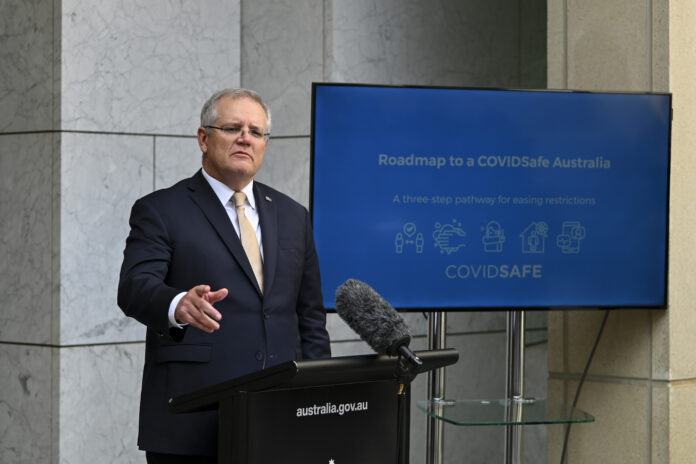
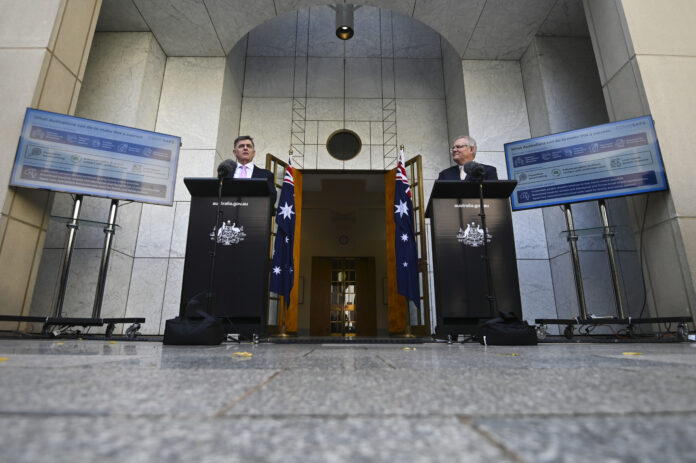
Scott Morrison has warned of a potentially rocky road as COVID restrictions are lifted to reopen the economy, saying the process must proceed even in the face of expected fresh outbreaks.

“This is a complex and very uncertain environment. But we cannot allow our fear of going backwards from stopping us from going forwards,” he said, unveiling a plan agreed by national cabinet, but to be implemented at different rates in different states and territories.

Morrison made it clear he would be opposed to reimposing restrictions once the unwinding was underway.

The aim is a “Covid-safe economy” in July. According to Treasury, 851,000 jobs would be restored in the months ahead.

The “road map” has three steps, laying down baselines for restarting activities.

In the first stage, rolled out any time from now, people can have up to five visitors to their house and gatherings of up to 10 will be allowed outside of the home.

Small restaurants and cafes can reopen, but only with up to 10 customers at a time.

Playgrounds can open, as well as libraries and community centres; outdoor bootcamps can restart and auctions will be permitted.

Local and regional travel for recreation will be allowed.

On the work front, the advice is “work from home if it works for you and your employer”, which Morrison described as “a difference in emphasis” compared with the stronger encouragement previously for people to work from home.

Under the relaxed rules, funerals can have up to 30 attendees outdoors and 20 indoors, and weddings 10 people in addition to the couple and the celebrant.

Step two will allow outside gatherings up to 20 people, and gatherings up to 20 in re-opened indoor gyms, beauty salons, cinemas, theatres and amusement parks, galleries and museums.

Cafes and restaurants will be able to seat up to 20 people at one time.

States and territories may allow larger numbers in some circumstances.

Some interstate recreational travel would be considered, depending on the jurisdiction.

The third stage sees gatherings up to 100 allowed and people returning to their workplaces. Food courts, cafes and restaurants will be able to operate with up to 100 people, as will saunas and bathhouses. All interstate travel will be permitted.

In this stage consideration will be given to opening bar areas. Strip clubs and brothels would remain closed.

There would be consideration in this stage of travel between Australia and New Zealand, Pacific Island travel and travel arrangements for international students.

Morrison said the pace of lifting restrictions “will totally be up to the states and territories. They’ll be responsible for setting their own timetable and communicating that to their citizens and residents in their own states and territories.”

He also said premiers and chief ministers “have asked me to stress there should be no expectation of step one starting on day one, unless they are indeed already there”.

Moving on these steps would take some preparation, he said.

Movement from one step to the next would depend on three criteria – that the medical evidence suggested further easing wouldn’t be an undue risk, widespread testing was identifying community transmission, and public health actions were able to trace cases and trap local outbreaks.

“Testing, tracing, trapping, as they were saying in the Northern Territory recently,” Morrison said.

National cabinet will review progress every three weeks.

Asked whether, when expected fresh outbreaks came, states, territories and Australians needed to hold their nerve and not snap back to tighter restrictions, Morrison replied without hesitation, “yes”.

But he also made it clear if there was a widespread outbreak the government would take the health advice.

Morrison said Australia’s health system and testing and tracing arrangements put it in a good position.

In this plan to lift restrictions, “we walk before we run. We know we need to be careful to preserve our gains”.

But “if we wish to reclaim the ground we lost, we cannot be too timid. There will be risks. There will be challenges. There will be outbreaks, there will be more cases, there will be setbacks,” he said.

“Not everything will go to plan. There will be inconsistencies. States will and must move at their own pace, and will cut and paste out of this plan to suit their local circumstances. There will undoubtedly be some human error. No-one is perfect. Everyone is doing their best.”

Victorian premier Daniel Andrews, who has been the most conservative of the premiers, said he would not make announcements until next week.

He also hinted he might open schools – which in Victoria are providing distance learning to all but a few students – earlier than the current arrangement. Victoria has angered the federal government with its hard line on schools. The national health advice has been that schools can be safely open and Morrison has pushed that issue.

NSW also will not act before next week, with premier Gladys Berejiklian noting the state had already moved to lift some restrictions.

The state breakdown of the Treasury forecast for the jobs restored in coming months is: NSW 280,000, Victoria 216,000, Queensland 174,000, South Australia 55,000, Western Australia 85,000, Tasmania 18,000, Northern Territory 9000, ACT 14,000.

ref. Australia starts to re-open, but the premiers have the whip hand on timing – https://theconversation.com/australia-starts-to-re-open-but-the-premiers-have-the-whip-hand-on-timing-138218

Keith Rankin’s Chart Analysis – Covid19: Long Tail and Long Head

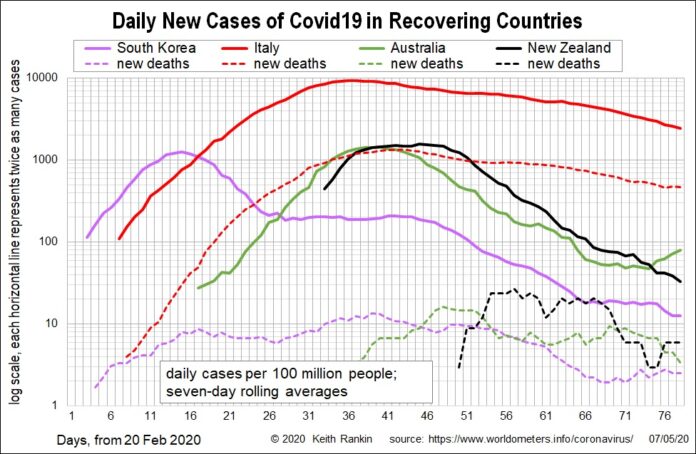
Australia's long tail. Chart by Keith Rankin.

Analysis by Keith Rankin.

This chart shows four recovering countries, including two of the first major outbreaks after China (South Korea and Italy), and the putative Australasian bubble.

The chart shows daily average new cases, using seven-day rolling averages. Thus Italy is approaching 2000 new cases a day per 100 million people. Because Italy has a population of 60 million, this translates to 1,200 new daily cases. This is still alarmingly high for a country which has had falling daily cases for 40 days.

South Korea started its exponential path four days before Italy, but turned the growth down after 12 days. Thus, its slow long tail has a much lower daily caseload than does Italy’s.

New Zealand and Australia both look much like South Korea. One concern, however, is a recent rise in cases in Australia; I understand it’s mainly a new cluster in Melbourne. (I also note that Australia’s Covid19 testing per person is now significantly lower than New Zealand’s, despite Australia initially leading the way. I detect some complacency across the Tasman.

I am not sure that New Zealand should open up to Australia first. Further, I am nervous about opening up the Queenstown ski-fields to Australians. My preference would be for New Zealand to first open up to the ‘clean’ Pacific countries, including Fiji which has had no new cases since 20 April (though excluding French Polynesia). (As a form of self-interested aid, New Zealand should extend its Covid19 testing regime to these countries.) Only after that should New Zealand consider offering to join with Australia to form an Oceanian bubble; that is, a conditional offer based on Australia proving that it is safe.

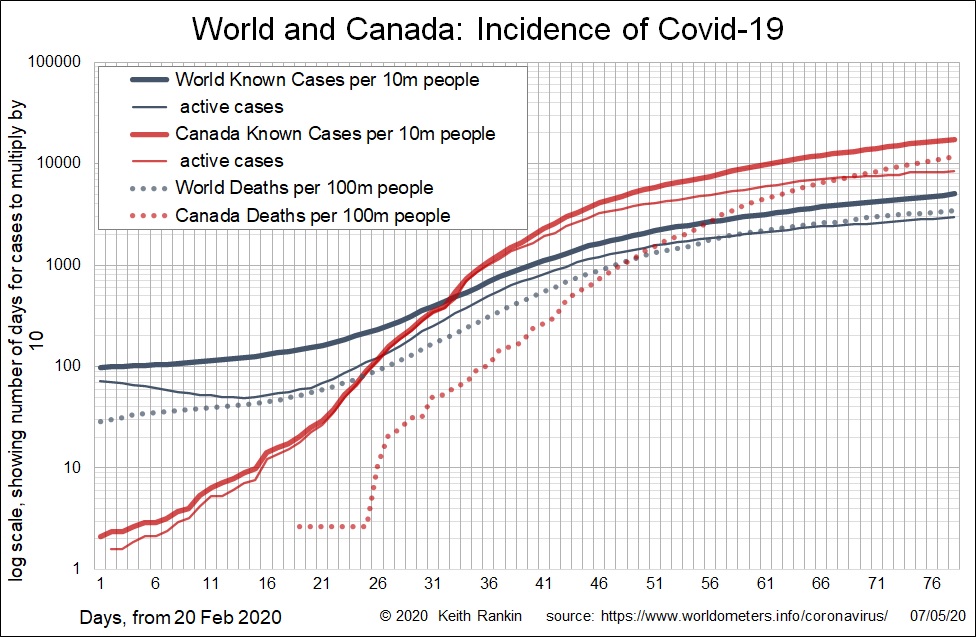
Canada’s long head. Chart by Keith Rankin.

The second chart suggests that the world as a whole has yet to reach its tail. The rate of exponential growth has not changed in the last four weeks. Canada is representative of this problem, with a much higher caseload and an exponential death rate of increase clearly higher than the world’s rate. (For Canada’s above average death rate, note that the red dotted line is higher than the indigo dotted line. And for Canada’s higher growth rate  of Covid19 deaths, we note that the red dotted line is steeper than its indigo counterpart.)

Canada is showing what might have happened in New Zealand, just as Italy shows what might have happened in South Korea. Canada serves as a counterfactual for Australia and New Zealand. Canada is the evidence that New Zealand’s Level 4 shutdown was needed.

South Korea gives New Zealand the evidence that a shift down to smart restrictions – using a Level 2 ‘hammer’ rather than a Level 4 ‘sledgehammer’ – can be effective from now, even if there are some new cases. South Korea was even able to hold a general election recently.

Canada is New Zealand’s rear-vision counterfactual. South Korea can be New Zealand’s fore-vision crystal ball, so long as New Zealand plays its policy cards right. South Korea is a month ahead. The most important difference though is that Korea is not moving into winter. I think New Zealand should keep its ski-season domestic, and keep close tabs on the après-ski. After all, much of the European Covid19 epidemic seems to have spread from the skifields of The Alps.

Surge in Māori virus testing but some NZ district health boards lagging

By Leigh-Marama McLachlan, Māori affairs correspondent of RNZ News

There has been a surge in the rate of Māori being tested for the covid-19 coronavirus pandemic, but several districts are still lagging behind.

The latest data from the Ministry of Health to April 30, shows Māori are being tested at a slightly higher rate than non-Māori on average.

But one third of district health boards still appear to be undertesting Māori.

READ MORE: Al Jazeera coronavirus live updates – Second wave feared as European, US lockdowns ease

Between 18 and 30 April, the Māori testing rate per 1000 people jumped from 16 to 24.

Academic Dr Rawiri Taonui has been tracking the numbers closely.

– Partner –

“There is definitely a marked increase – the Māori average is above the national average, just slightly and that is good to see,” he said.

“The key to it has been getting Māori health providers involved in the testing.”

Iwi providers bolstered efforts
On 24 April, the Ministry of Health told DHBs to ensure their testing was covering off Māori.

And in some places, iwi health providers quickly started bolstering their efforts to test Māori.

In Taranaki and Te Tairāwhiti, mobile clinics have ramped up in isolated places and even those without symptoms are being tested.

But Dr Taonui said not all DHBs are meeting the mark.

“Next week, we are moving, probably going to make a decision about moving to level 2 and about a third of the DHBs are still behind in their testing for Māori.

“They have got some work to do.”

The DHBs with Māori testing rates per 1000 below 20 include, Lakes, Whanganui, Midcentral, Bay of Plenty, Canterbury, South Canterbury and Nelson Marlborough.

Lowest testing rate
Nelson Marlborough DHB has the lowest testing rate for Māori at 15 per 1000 and it has one of the highest rates of Māori testing positive for covid-19.

But Chief Medical Officer Dr Nick Baker is defending its response.

“I don’t think those numbers do show underperformance, they really reflect the proportion of Māori in our community that have symptoms that allow us to test them,” he said.

Dr Baker said the DHB has been actively seeking out vulnerable communities, and running flu jabs and covid-19 testing at marae.

But he said the district had not been hit with any coughs or colds for weeks, which meant fewer people presenting with symptoms.

“This reflects the healthiness of our community, and I think our swabbing rate also reflects the health of our community, not a failure to seek people out.”

Midcentral DHB also has low Māori testing at 15 per 1000.

Only test symptomatic people
Both DHBs said for the most part when the data was taken, the Ministry of Health told them to only test symptomatic people.

Midcentral acting chief medical officer and chief executive Dr Jeff Brown said things are starting to change.

“We are, even in the last week, making more efforts as we move from chasing symptomatic cases and their contacts through to asymptomatic,” he said.

“So we are now planning this week, next week and the following to do more targeted testing of high exposure, high risk groups.”

Dr Brown said the district’s Māori testing rate was only slightly lower than its Pākehā rate which was 17 per 1000.

Ministry of Health deputy director-general Māori health John Whaanga said he was overall pleased with the rise in Māori test rates.

Māori now made up 16.3 percent of nationwide tests, slightly higher than the Māori population rate of New Zealand.

And while some DHBs were doing better than others, he said they have all had the same time to ramp up testing for Māori.

“The message we gave out to all DHBs was when we made the change in the case definition – that was the change that allowed us to change how we tested and certainly asymptomatic testing,” he said.

“I think there were certainly some DHBs that mobilised testing quicker than others.”

The DHBs with Māori testing rates above the national average include Waitematā, Auckland, Counties, Waikato, Te Tairāwhiti, Hutt Valley and Wairarapa.

Praise for Māori-led response
Dr Rawiri Taonui said he is glad that targeted testing is underway to make sure the virus is not spreading undetected, and he is heaping praise on Māori.

“The Māori Covid response has been magnificent – food parcels, care packages, looking after old people and getting the testing done,” he said.

“Checkpoints are proving themselves effective. Where there are checkpoints there are much lower rates of infection, and that has happened despite the Ministry of Health.”

Despite lower Māori testing numbers, Dr Jeff Brown said the response from the local Māori health network was great.

“We couldn’t forget the power of the networks and the social media networks that iwi are using,” he said.

“Right across from swabbing to medical support through to the psychosocial support – the rapidity with which iwi leaders stepped up and stepped up together has been absolutely impressive.”

John Whaanga is echoing the sentiment and said the response has been commendable.

“I want to take my hat off to the Māori health provider network and organisations and community based organisations, they mobilised quickly.

“They have done a fantastic job in terms of having to make that difference, and I’d like to think that the ministry in partnership with DHB stood alongside them to provide them with some funding or resources to enable them to do that.”

To date, 127 Māori people have contracted covid-19 in New Zealand, making up 9 percent of all cases.

Two new cases of covid-19 reported in NZ
Radio NZ reports that one of two new cases of covid-19 confirmed today is a nurse who has been caring for St Margaret’s cluster patients.

Director of Public Health Dr Caroline McElnay said the nurse is being cared for at North Shore Hospital.

The other case reported today was a probable case that has now been confirmed.

Today’s media briefing. Video: RNZ

There have been no further deaths.

There are three people in hospital – one in Auckland City, one in Middlemore and one in North Shore. None are in ICU.

There have now been a total of 1490 cases in this country, with 1347 people now recovered from covid-19 – 90 percent of all confirmed and probable cases.

Dr McElnay said 7812 tests were processed yesterday, with a total of 175,835 tests processed to date.

Yesterday Prime Minister Jacinda Ardern also outlined what alert level 2 will look like when the country moves a level down.
  • This article is republished by the Pacific Media Centre under a partnership agreement with RNZ.
  • If you have symptoms of the coronavirus, call the NZ Covid-19 Healthline on 0800 358 5453 (+64 9 358 5453 for international SIMs) or call your GP – don’t show up at a medical centre.
  • Follow RNZ’s coronavirus newsfeed
Print Friendly, PDF & Email

Article by AsiaPacificReport.nz

Could BCG, a 100-year-old vaccine for tuberculosis, protect against coronavirus?

Source: The Conversation (Au and NZ) – By Kylie Quinn, Vice-Chancellor’s Research Fellow, School of Health and Biomedical Sciences, RMIT University

This week, the Bill and Melinda Gates Foundation announced it will donate A$10 million to help fund an Australian trial testing whether a very old vaccine, BCG, can be used against a new threat, COVID-19.

So what is the BCG vaccine and what might its place be in the fight against coronavirus?

The ABCs of BCG

The BCG vaccine has been used for nearly a century to protect against tuberculosis, a bacterial disease that affects the lungs. Tuberculosis is caused by a bacterium called Mycobacterium tuberculosis.

BCG is short for Bacillus Calmette-Guérin, as it was created by Léon Charles Albert Calmette and Jean-Marie Camille Guérin in the early 1900s.

To make the vaccine, they used Mycobacterium bovis, a bacterium found in cows and closely related to Mycobacterium tuberculosis. They grew it on a nutrient-rich jelly in the lab for nearly 13 years. The bacterium adapted to this comfortable lifestyle by losing elements in its DNA it no longer needed, including elements that cause disease.

This process is called attenuation and it results in a live but weakened microbe that can be given to humans as a vaccine.


Read more: Coronavirus: could the pandemic be controlled using existing vaccines like MMR or BCG?


BCG is offered to infants in some parts of the world where there are still high rates of tuberculosis. It protects 86% of the time against some rarer forms of tuberculosis more common in children.

But it only protects about 50% of the time in adults.

Scientists and clinicians generally feel we need a better vaccine for tuberculosis. However, epidemiologists have noticed children who received BCG had significantly better overall health, with fewer respiratory infections and fewer deaths.

Immunologists suspect this is caused by a type of immune response called “trained immunity”.

Trained immunity is distinct from how we traditionally think of immunity, or “immune memory”, because it engages different types of immune cells.

Immune memory vs trained immunity

There are two main types of cells within our immune system: innate cells, which respond rapidly to microbes that cause disease, and adaptive cells, which initially respond quite slowly.

Adaptive cells include B cells, which make antibodies to block infection, and T cells, which can kill infected cells. Importantly, adaptive cells can remember particular microbes for years, or even decades, after we first encounter them.

This phenomenon is called “immune memory”.

When adaptive immune cells encounter the same microbe a second or subsequent time, they respond much more quickly, and the immune system can effectively clear an infection before it causes disease. Immune memory is why often we don’t get infected with a specific microbe, like chickenpox, more than once.

Most of our current vaccines exploit immune memory to protect us from infection.


Read more: Where are we at with developing a vaccine for coronavirus?


For decades, scientists believed innate cells lacked the ability to remember previous encounters with microbes. However, we’ve recently learnt some innate cells, such as monocytes, can be “trained” during an encounter with a microbe. Training can program innate cells to activate more quickly when they next encounter a microbe – any microbe.

Some live attenuated vaccines, such as BCG, can trigger trained immunity, which can enhance early control of other infections. This raises the tantalising possibility that BCG could train innate cells to improve early control of the SARS-CoV-2 virus, to reduce COVID-19 disease or even prevent infection.

And as a bonus, BCG could potentially protect us against other pathogens too.

The BCG vaccine targets trained immunity, whereas most other vaccines target immune memory. Kylie Quinn, Author provided

Could BCG protect against COVID-19?

We don’t know yet whether BCG will reduce the severity of COVID-19, but the vaccine has some interesting features.

First, BCG is a potent stimulator of the immune system. Currently, it’s used alongside other therapies to treat bladder cancer and melanoma, because it can stimulate immune cells to attack the tumour.

BCG also seems to benefit lung immunity. As we mentioned, children who have had the vaccine appear to get fewer respiratory infections.

There’s a study underway in Melbourne looking at whether BCG can reduce symptoms of asthma in children.

And finally, BCG has been shown to limit viral infection. In one study, human volunteers were given BCG or a placebo one month before being infected with a virus. Volunteers who received BCG had a modest reduction in the amount of virus produced during infection compared to those who received the placebo.


Read more: Explainer: what is TB and am I at risk of getting it in Australia?


However, BCG can cause side-effects to be mindful of. It usually causes a small raised blister on the skin at the vaccine site and it can cause painful swelling in the surrounding lymph nodes.

Importantly, because it’s a live bacterium, it can spread from the vaccine site and cause disease, called disseminated BCG, in people who are immunodeficient, like people with HIV. This means BCG can’t be given to everyone.

Current clinical trials

The ultimate test of BCG as a preventative measure for COVID-19 is to run randomised clinical trials, which are now underway.

Researchers across Australia and the Netherlands are preparing to give BCG to the people who have arguably the highest risk of COVID-19: frontline health-care workers.

These phase III trials will collect data on whether workers vaccinated with BCG have fewer or less severe COVID-19 infections.

If BCG is shown to be effective, we’ll face other challenges. For example, supply of the vaccine is currently limited. Further, there are many different strains of BCG and they might not all provide the same protection against COVID-19.

Protection would likely start to wane relatively quickly. When trained immunity was tracked in humans after BCG, it started waning from three to 12 months after vaccination.

Protection would also not be as strong as what we see with many traditional vaccines, such as the MMR vaccine which protects against measles 94.1% of the time.


Read more: Here’s why the WHO says a coronavirus vaccine is 18 months away


So BCG would be most helpful for people at high risk of exposure, but it wouldn’t replace a traditional vaccine based on immune memory.

These studies are important to give us options. We need a complete toolkit for control of COVID-19, consisting of anti-viral and anti-inflammatory drugs and vaccines. But an effective COVID-19 vaccine is likely still many months, even years, away.

By repurposing an old, well-characterised vaccine, we could bridge this gap and provide some protection to our health-care workers as they confront COVID-19.

ref. Could BCG, a 100-year-old vaccine for tuberculosis, protect against coronavirus? – https://theconversation.com/could-bcg-a-100-year-old-vaccine-for-tuberculosis-protect-against-coronavirus-138006

National parks are for native wildlife, not feral horses: federal court

Source: The Conversation (Au and NZ) – By Don Driscoll, Professor in Terrestrial Ecology, Deakin University

Today, the federal court ruled feral horses can be removed from the Victorian high country.

The case was brought by the Australian Brumby Alliance against the Victorian Government in 2018. Since then, the strategic management plan for feral horses has been shelved, allowing feral horse numbers to increase without control.

In the northern area of Kosciuszko National Park numbers jumped from an estimated 3,255 in 2014 to 15,687 in 2019, in the absence of any management.


Read more: Double trouble as feral horse numbers gallop past 25,000 in the Australian Alps


Expanding numbers of feral horses roaming the Australian Alps – which are listed as a national heritage site – threaten the alp’s ecosystems, soils and unique species. More feral horses is also an animal welfare issue, as horses face starvation during droughts and have been hit by cars in Kosciuszko.

Feral horses cause extensive damage to fragile ecosystems. Shutterstock

The ruling is a victory for national parks, which can once again be managed to protect native Australian ecosystems and species. But it stands in stark contrast to the NSW government’s controversial legal protection of feral horses.

Taken to court

The Victorian Government’s strategic action plan, released in 2017, was to remove all horses from the Bogong High Plains, where around 100 horses caused cumulative damage to sensitive alpine ecosystems.

The plan also aimed to trap horses in the eastern Victorian alps, but at a rate so low it was unlikely to make a dent in horse numbers.

Not satisfied with retaining thousands of horses in the eastern alps, in 2018, the Australian Brumby Alliance took out a court injunction to stop horse removal from the Bogong High Plains and prevent substantial reduction in horse numbers in the eastern alps.

High stakes

Twenty-five thousand feral horses in Australia’s alpine parks have damaged peat wetlands listed as threatened under federal and state legislation. Recovery will take decades to centuries.

Feral horses have also eliminated multiple populations of the native broad toothed rat and are a threat to other native species like the corroboree frog and mountain pygmy possum.

And habitat degradation and loss caused by feral horses is officially listed as a threatening process in Victoria and NSW.

Feral horse damage to a swampy area as they trample over important wetlands. Meg McKone, Author provided

If the court had ruled in favour of the Australian Brumby Alliance’s case, it would have locked in escalating threats to the environment, including threatening already endangered species such as the alpine she-oak skink.

It would also have given at least informal legitimacy to NSW legislation that protects feral horses in Kosciuszko National Park.


Read more: Passing the brumby bill is a backward step for environmental protection in Australia


And possibly most damaging, it could have emboldened claims by brumby groups that feral horses should take priority over conservation in other contentious horse hotspots, such as Barmah, Oxley Wild Rivers, Blue Mountains, Guy Fawkes and Barrington Tops National Parks.

Feral horses have eliminated broad toothed mouse populations in the Alps. Ken Green, Author provided

A matter of cultural heritage

The Australian Brumby Alliance argued removing horses from the alps would compromise its heritage value. They claimed feral horses are part of that heritage, including part of the mountain vistas, the pioneering heritage and myths and legends such as the Man from Snowy River.

The counterpoint from Parks Victoria was that it’s possible to remove horses from the alps while protecting the area’s cultural heritage.

It would be like taking cattle out of the high country, but nevertheless recognising pioneering exploits by preserving cattlemen’s huts.

These high plains will now be protected from feral horses. Don Driscoll, Author provided

So what did Judge O’Bryan make of this? In a nutshell, the Australian Brumby Alliance did not have a legal hoof to stand on.

He rejected the Australian Brumby Alliance’s argument the Bogong High Plains horse population was likely to be genetically different from other feral horse populations in a way relevant to the case, and rejected claims feral horses could be beneficial to alpine ecosystems.

Judge O’Bryan also rejected the contention that the brumbies are part of the National Heritage values of the Australian Alps and accepted the evidence that feral horses cause substantial environmental damage.

The ruling acknowledged Parks Victoria’s strategic plan to control feral horses was consistent with legal obligations under the Convention on Biological Diversity, the federal EPBC (Environment Protection and Biodiversity Conservation) Act and the state’s Flora and Fauna Guarantee Act.

National parks for nature

Laws and the management of protected areas that reduce their integrity are a global concern. A 2017 study found one-third of Australia’s protected areas had been downgraded, reduced in size or had protection removed to make way for tourism ventures and other developments, like Snowy 2.0 in Kosciuszko National Park.

Kosciusko has faced the brunt of recent downgrading, notably where the NSW government voted to legally protect feral horses in 2018.

This unilateral decision has caused substantial concern for Victoria and the ACT as they face ongoing risks of feral horse incursions from NSW into their own protected areas.

The Australian Brumby Alliance’s court case threatened similar downgrading for Victoria’s alpine parks. However, state, federal and international laws, that place obligations on Australian governments to conserve native species and ecosystems in protected areas, have helped restore sensible park management.

Protecting natural heritage

Toyay’s federal court ruling upholds the right of state agencies to carry out their legal obligations. And it meets the general expectations of Australian society that our national parks exist to conserve native Australian ecosystems and species, particularly as extinction rates in Australia continue at unprecedented rates.


Read more: Feral cat cull: why the 2 million target is on scientifically shaky ground


It also reflects the intent of nature conservation laws. National parks are for conserving our natural heritage, the product of millions of years of evolution on this continent.

Brumby advocates concerned about recent European heritage in Australia can protect horses outside of national parks, an approach pioneered successfully in South Australia.

ref. National parks are for native wildlife, not feral horses: federal court – https://theconversation.com/national-parks-are-for-native-wildlife-not-feral-horses-federal-court-138204

Was New Zealand’s coronavirus lockdown legal? One week might make all the difference

Source: The Conversation (Au and NZ) – By Kris Gledhill, Professor of Law, Auckland University of Technology

As New Zealand approaches the end of its strictest lockdown period, a debate has begun about whether it was legal in the first place. This is important because people are being prosecuted for breaching the lockdown. Naturally, lawyers are getting involved, so things are going to get technical.

Some lawyers tend to speak in hyperbolic terms about the “rule of law”. Invariably, they will go back to 1297, because the Magna Carta of that year – obtained as a concession by the landed gentry of England from the king – required that imprisonment be regulated by law. That provision of English law still applies in New Zealand. Its modern consequence is that public officials, whether the police or the director general of health, can only detain us if they act within statutory powers.

A more recent declaration of principle is found in section 22 of the New Zealand Bill of Rights Act 1990, which says, “Everyone has the right not to be arbitrarily arrested or detained.”

When judges interpret other laws, they must try to make sure that the Bill of Rights is met. So if a statute contains a power of detention, it will be construed that it does not allow arbitrary detention unless parliament has been clear that it does not mind arbitrariness.

At a broad-brush level, there are three main legal questions. Was there detention? If so, was there a law in place that allowed detention? And did the law allow arbitrary detention? Let’s look at those three key questions in turn – and why this debate could all come down to the week between March 26 and April 3, 2020.


Read more: We may well be able to eliminate coronavirus, but we’ll probably never eradicate it. Here’s the difference


Was lockdown a form of detention?

Detention is a step up from restrictions on freedom of movement (also protected by the New Zealand Bill of Rights Act). And an important question is when do we cross the legal threshold from restriction to detention? This is significant because of the protections in international human rights law, which the New Zealand Bill of Rights Act is designed to secure. At the international level, it is made clear that wrongful detention requires compensation.

A deserted Wellington street on April 4, the day after isolation and quarantine were mandated under the Health Act. www.shutterstock.com

Various courts and international human rights bodies have examined where to draw the line. In essence, they have decided that “detention” does not require being put under lock and key.

Rather, it turns on whether the restrictions are more intense than mere restrictions on freedom of movement. This includes house arrest accompanied by limited movements outside. This supports the view that anyone other than essential workers was “detained” at level 4 and possibly most people at level 3.


Read more: As NZ goes into lockdown, authorities have new powers to make sure people obey the rules


Was there a law allowing NZ to detain people in lockdown?

This question requires a legalistic review. The lockdown rested on directives from the director general of health (presumably drafted by government lawyers, who are the ones who should face any criticism should the lockdown prove to be open to legal challenge).

Under section 70 of the Health Act 1956, the director general can issue directives with various aims. One power is to close premises and prevent people congregating in public places. This was used at the outset of the lockdown, but the directive did not specify house arrest and it is difficult to see that this power would allow that.

If the courts agree that people were placed in detention, government lawyers may have an uphill struggle to show that the law used allowed this.

Another section 70 power of the director general is to require isolation and quarantine. This more obviously allows detention, but a directive under this power was not issued until April 3. It made the house arrest scenario clear.

Director General of Health Dr Ashley Bloomfield providing a COVID-19 update to media in Wellington.

But a separate question is whether the directive can cover all people or whether individual orders have to be made. Given that people can be infectious without symptoms, the public health basis for group detention is fairly strong. In addition, the Health Act powers can be contrasted to powers to quarantine under the Tuberculosis Act 1948, which required an individualised court order.

So, assuming detention, there are good arguments that it was not based in law until April 3. Even after that date there is the third question: was it arbitrary?


Read more: The psychology of lockdown suggests sticking to rules gets harder the longer it continues


Did NZ allow arbitrary detention in lockdown?

Many cases have discussed the meaning of arbitrariness, but the core idea is that detention must be the last step – namely, that other options are inadequate. This will depend on the evidence as to the state of knowledge about COVID-19 when the lockdown was imposed.

Importantly, the government has a duty to protect lives, and pandemic situations can be very dangerous, particularly for vulnerable people – as has been demonstrated in New Zealand, and more so in countries that took a lax approach.

Summarising this, first there are good arguments that most of New Zealand was in detention. The government seems to have a good prospect of showing that this was not arbitrary, given the risks of the disease spreading and causing death and misery.

But there is a clear problem with a failure to use the proper law from midnight on March 25, when level 4 lockdown began, until April 3.

This is not just an academic question. People were arrested, prosecuted and in some cases imprisoned for breaching the lockdown rules.

If the lockdown was not lawful until part-way through, people arrested in the week between March 26 and April 3 should not have been. And if, despite the strong arguments of the government, the lockdown was arbitrary, even arrests after April 3 will have been improper. Those people will have a pretty clear claim for unlawful detention and compensation, despite their selfish actions.

ref. Was New Zealand’s coronavirus lockdown legal? One week might make all the difference – https://theconversation.com/was-new-zealands-coronavirus-lockdown-legal-one-week-might-make-all-the-difference-138203

From hidden women to influencers and individuals – putting mothers in the frame

Source: The Conversation (Au and NZ) – By Cherine Fahd, Director Photography, School of Design, University of Technology Sydney

There are images of her everywhere, especially as Mother’s Day draws near.

As two photographers who happen to be mothers, we think critically about the way photography overly determines the image of “The Mother”.

One iconic example is Dorothea Lange’s Migrant Mother, taken in depression-era America. The central figure is framed by her two children who lean against her, while her arms perform the quintessentially nurturing pose – the maternal embrace of an infant.

Lange’s photograph reenacts the ultimate symbol of femininity: Madonna and child. But not all photographs of mothers are the same. From early snapshots to images on screen, how mothers appear in photographs speaks to our changing view of their role in the family and in society.


Read more: Psychology behind why your mom may be the mother of all heroes


The woman behind the child

The mother appears throughout the history of photography. Perhaps the first illustrated demonstration of a mother’s involvement in the form is a drawing by Theodore Maurisset. Detailed in this illustration is a mother who comically wrestles with her reluctant child to have his photographic portrait taken.

Detail from La Daguerreotypomanie (Daguerreotypomania) by Théodore Maurisset, Paris, France, 1839. J. Paul Getty Museum

The next time she appears, in the Victorian era, she is the “Hidden Mother” smothered under thick velvet fabric to hold her child still enough to be photographed clearly. She is furniture.

In Victorian era baby photographs, mothers are used to prop up their subjects. Wikimedia

In the most significant photographic treatise on photography, Camera Lucida, Roland Barthes continues the hidden theme.

Central to this intimate book is a picture of his mother as a six-year-old girl, which Barthes calls the Winter Garden photograph. While pivotal to the book, he never shows us the image, declaring her picture could only have meaning for him.

The Winter Garden photograph takes Barthes to a time before his mother was a mother. It allows him to recognise her autonomy and passage into the role of mother: “I studied the little girl and at last rediscovered my mother”.

He finds her not as a teenager, but as an innocent child.

Roland Barthes and his mother, around 1925.

Pure love

This notion of purity links us to the ideal image of moral good associated with Christianity’s immaculate mother.

We come into the world from the mother. First pictured in utero and then pushed, surgically removed or pulled out into the world and her arms – breast-fed, bottle-fed, skin-on-skin.

In a technological society, birth is a photographic event. From pregnancy through to delivery, a mother’s identity is mediated through conception – her status changes from woman to mother.

Mother and child in a photograph captioned: ‘Stel and Don when he was 3 months old’. Genealogical Society of Victoria/Flickr

As advertisers remind us, this archetype hinges on her visual representation performing everyday activities. The most ubiquitous images visualise her in the home: performing housework; displaying her culinary and baking flair.

Bonus noteworthy qualities include her glowing skin, soft femininity and healthy hair.

National Museum of Australia

Over time, the mother shifts and changes.

Here she is a 1950s housewife, there she is a modern soccer mum. She glows pregnant in the style of Demi Moore on the cover of Vanity Fair and later Beyonce and the yummy mummies of Instagram. Her values change, but her role remains prescribed by her relation to the child and the nuclear family.

If she doesn’t fit this mould, she transgresses from her role into the “other mother”. While monstrous mother, working mother, evil mother, angry mother, crack mother are archetypes presented in cinema and literature, there are few photographic examples that capture her departure from purity.

Mother provider in the kitchen, always. Horacio Villalobos/Wikimedia

Photography is limited in its capacity to represent such complexity without caption or heavy-handed parody.

In 2018, Alec Soth photographed mothers struggling with opioid addiction for the New York Times magazine. Soth’s images don’t moralise or glamorise. Without the accompanying captions, the women appear simply in relation to their children.


Read more: Forget flowers and chocolates for Mother’s Day: keep free childcare going instead


The possibilities

If she is not the prescribed archetypal mother, or the transgressive mother, what other photographic possibilities are there for her?

The popular Instagram account and book Mothers Before shows photographs of mothers before they became mothers, submitted and captioned from the perspective of their children.

While the images show mothers in their youth, the captions still describe each woman in terms of her value as caregiver.

Last week, Fiona Wolf won the Head On Photography Festival’s portrait category for The Gift, RHW 2020, which showed the “modern family story of a girl born by a warrior woman to two loving dads”.

Fiona Wolf’s The Gift, RHW 2020. Head On Festival

Fashion photographer Charlie Engman represents his mother in close collaboration with her. The work they do together sidesteps cliches.

In his book MOM, Engman provides us with an image of motherhood that sits outside of the usual tropes of family portrait photography and the nurturing matriarch. We get a glimpse of a woman who is a person in her own right and in charge of her image, regardless of her reproductive status.

Unlike Barthes’ mother, Engman’s mother has a name: Kathleen McCain Engman. She has sexuality, agency, and is far from the hidden mother. She is in a category of her own: amorphous, elusive and individual.

ref. From hidden women to influencers and individuals – putting mothers in the frame – https://theconversation.com/from-hidden-women-to-influencers-and-individuals-putting-mothers-in-the-frame-137702

Why are there so many drugs to kill bacteria, but so few to tackle viruses?

Source: The Conversation (Au and NZ) – By Christine Carson, Senior Research Fellow, School of Biomedical Sciences, University of Western Australia

As the end of the second world war neared, mass production of the newly developed antibiotic penicillin enabled life-saving treatment of bacterial infections in wounded soldiers. Since then, penicillin and many other antibiotics have successfully treated a wide variety of bacterial infections.

But antibiotics don’t work against viruses; antivirals do. Since the outbreak of the coronavirus pandemic, researchers and drug companies have struggled to find an antiviral that can treat SARS-CoV-2, the virus that causes COVID-19.


Read more: Is remdesivir a miracle drug to cure coronavirus? Don’t get your hopes up yet


Why are there so few antivirals? The answer boils down to biology, and specifically the fact viruses use our own cells to multiply. This makes it hard to kill viruses without killing our own cells in the process.

Remdesivir is one antiviral researchers are investigating to treat COVID-19, but it has shown mixed results in clinical trials. Ulrich Perrey/Pool/Reuters

Exploit our differences with bacteria

The differences between bacterial and human cells are what make antibiotics possible.

Bacteria are self-contained life forms that can live independently without a host organism. They are similar to our cells, but also have many features not found in humans.

For example, penicillin is effective because it interferes with the construction of the bacterial cell wall. Cell walls are made of a polymer called peptidoglycan. Human cells don’t have a cell wall or any peptidoglycan. So antibiotics that prevent bacteria from making peptidoglycan can inhibit bacteria without harming the human taking the medicine. This principle is known as selective toxicity.

Viruses use our own cells to replicate

Unlike bacteria, viruses cannot replicate independently outside a host cell. There is a debate over whether they are really living organisms at all.

To replicate, viruses enter a host cell and hijack its machinery. Once inside, some viruses lie dormant, some replicate slowly and leak from cells over a prolonged period, and others make so many copies that the host cell bursts and dies. The newly replicated virus particles then disperse and infect new host cells.

An antiviral treatment that intervenes in the viral “life” cycle during these events could be successful. The problem is that if it targets a replication process that is also important to the host cell, it is likely to be toxic to the human host as well.

Killing viruses is easy. Keeping host cells alive while you do it is the hard part.


Read more: In the fight against coronavirus, antivirals are as important as a vaccine. Here’s where the science is up to


Successful antivirals target and disrupt a process or structure unique to the virus, thereby preventing viral replication while minimising harm to the patient. The more dependent the virus is on the host cell, the fewer targets there are to hit with an antiviral. Unfortunately, most viruses offer few points of unique difference that can be targeted.

Another complication is that different viruses vary from each other much more than different bacteria do. Bacteria all have double-stranded DNA genomes and replicate independently by growing larger and then splitting into two, similar to human cells.

But there is extreme diversity between different viruses. Some have DNA genomes while others have RNA genomes, and some are single-stranded while others are double-stranded. This makes it practically impossible to create a broad spectrum antiviral drug that will work across different virus types.

Antiviral success stories

Nevertheless, points of difference between humans and viruses do exist, and their exploitation has led to some success. One example is influenza A, which is one form of the flu.

Influenza A tricks human cells so it can enter them. Once inside our cells, the virus needs to “undress”, removing its outer coat to release its RNA into the cell.

A viral protein called matrix-2 protein is key to this process, facilitating a series of events that releases the viral RNA from the virus particle. Once the viral RNA is released inside the host cell, it is transported to the cell nucleus to start viral replication.

But if a drug jams the matrix-2 protein, the viral RNA can’t exit the virus particle to get to the cell nucleus, where it needs to be to replicate. So, the infection stalls. Amantadine and rimantadine were early antiviral successes targeting the matrix-2 protein.

Zanamivir (Relenza) and oseltamivir (Tamiflu) are newer drugs that have also had success in treating patients infected with influenza A or B. They work by blocking a key viral enzyme, obstructing virus release from the cell, slowing the spread of infection within the body, and minimising the damage the infection causes.

Tamiflu is one antiviral drug that is successful in slowing the spread of influenza in humans. So far we don’t have an antiviral that works effectively in COVID-19 patients. Narong Sangnak/EPA

We need to find what makes SARS-CoV-2 unique

A COVID-19 vaccine may be difficult to create. So testing antivirals to find one that can effectively treat COVID-19 remains an important goal.

Much depends on knowing the intricacies of the SARS-CoV-2 virus and its interactions with human cells. If researchers can identify unique elements in how it survives and replicates, we can exploit these points of weakness and make an effective antiviral treatment.


Read more: Where are we at with developing a vaccine for coronavirus?


This article is supported by the Judith Neilson Institute for Journalism and Ideas.

ref. Why are there so many drugs to kill bacteria, but so few to tackle viruses? – https://theconversation.com/why-are-there-so-many-drugs-to-kill-bacteria-but-so-few-to-tackle-viruses-137480

We should simplify our industrial relations system, but not in the way big business wants

Source: The Conversation (Au and NZ) – By David Peetz, Professor of Employment Relations, Centre for Work, Organisation and Wellbeing, Griffith University

As Australia contemplates its post-COVID economy, industrial relations reform has been repackaged by some as the way to “kickstart” growth.

The Business Council of Australia (BCA) has called for our workplace relations system to be simplified and enterprise bargaining to be improved. The Australian Industry Group and the Australian Mines and Metal Association are also beating the drum for reform.

Reserve Bank governor Philip Lowe says we need to look at the system’s complexity, while this week former Productivity Commission chair Gary Banks singled out the virtue of industrial relations reform.

It’s true our IR needs to be simpler.

But to do this right, we must focus on making enterprise bargaining easier for workers.

What does “simplify” really mean?

When lobbyists for large corporations call for a “simpler” IR system, too often this means reducing the scope or value of the award safety net.

The number of modern awards has already been cut from more than 2000 in 2006, to just 121 today.

The Business Council’s chief executive Jennifer Westacott (centre) is calling for a simpler IR system. Joel Carrett/AAP

Awards now have similar rates of pay for similar types of work. For example, a qualified employee on a trade (C4) classification has pretty much the same minimum pay under any modern award, no matter their occupation.


Read more: Working from home: what are your employer’s responsibilities, and what are yours?


Three decades of “award restructuring”, “award modernisation” and “award simplification” have done that.

Now, “simplifying” has become code for the earlier one-size-fits-all approach to reducing or removing penalty rates, overtime pay, shift premiums, provisions on starting or finishing times, or the minimum pay rates themselves.

Doing so would “simplify” the making of profits. But it would also reduce the pay of many employees. There is little evidence that cutting minimum wages and conditions would boost employment.

Likewise, there is little evidence that minimum wage increases damage economic performance.

The need to address enterprise bargaining

What really needs simplifying in Australian IR is our enterprise bargaining system, which is remarkably complex.

This is not because the “better off overall test” means no worker can be made worse off by an agreement — something that irks some large corporations. It’s because the procedures tie worker representatives, in particular, in knots.

The enterprise bargaining provisions in the Fair Work Act occupy over 75 pages with 90 sections.

Rules governing strike action are very complex in Australia. Jeremy Piper/AAP

Those on industrial action, which can only legally be taken in negotiation of an enterprise agreement, occupy another 46 pages, not counting those relating to remedies and enforcement.

It makes bargaining a convoluted, tedious process, with many tripwires even for experienced parties.


Read more: Coronavirus redundancies are understandable, but there are alternatives


Enteprise bargaining provisions: too many, too complex

Australia’s enterprise bargaining provisions contain twice the number of pages of those in New Zealand’s Employment Relations Act, while the bar for prohibiting a strike is low.

It is one thing to say (as a minority of OECD countries do), that strikes should be preceded by a secret ballot. It is another, less defensible thing to provide 24 pages of detailed prescription on how those ballots must be undertaken.

Australia’s framework is much more complex than the comparable United Kingdom statute.

Even the Productivity Commission, which is no friend of unions, has questioned the “overly complex processes for secret ballots”.


Read more: Overworked and underpaid: the revival of strikes in New Zealand


The system also imposes complexities that are uncommon in other collective bargaining systems.

For example, unions are banned from engaging in pattern bargaining, though no comparable prohibitions are placed on employer behaviour.

Over time, these provisions have been seen as placing restrictions on workers’ rights to take industrial action.

It is an oddity that, while awards have been simplified, the process of collective bargaining has been made remarkably complex in Australia.

Why should simplification of one be linked to intensified complexity in the other?

What’s at stake

To bring the system more in line with international practice on collective bargaining and industrial action, many restrictions should be removed.

For example, instead of setting out minutely detailed prescriptions on balloting procedures, the legal requirements, should be “fairly straightforward” as in Canada.


Read more: COVID crisis has produced many negatives but some positives too, including confidence in governments: ANU study


This does not mean that every limitation should be abolished, but the level of detail in Australian legislation goes far beyond what could reasonably be expected in most other OECD countries.

The efficiency costs may be justified if those restrictions arise from equity considerations, to protect lower paid workers or the like. But these restrictions appear to exist simply to interfere in negotiations and tip the balance of power to one side or the other.

In this case, it’s at the expense of employees and their wages.

What happens now?

What the federal government will actually do is harder to predict.

The Coalition is well aware of the electoral dangers of IR reform. Jeremy Piper/AAP

The Coalition lost government in 2007 in part because of overreach with Work Choices.

It declined to implement major industrial relations reforms after that because of fears of the political consequences.

While it may be emboldened by the COVID-19 context, its interests are very different to those of the BCA’s members.

ref. We should simplify our industrial relations system, but not in the way big business wants – https://theconversation.com/we-should-simplify-our-industrial-relations-system-but-not-in-the-way-big-business-wants-137607

Alcohol can make coronavirus worse – so why was it treated as ‘essential’ in New Zealand’s lockdown?

Source: The Conversation (Au and NZ) – By Sally Casswell, Professor of public health policy, Massey University

New Zealand has won international praise for its strict lockdown conditions and public health response to COVID-19, but there’s one glaring blindspot.

Last month, the World Health Organization released a new factsheet on alcohol and COVID-19, warning that heavy alcohol consumption increases the risk of respiratory failure, one of the most severe complications of COVID-19.

Yet alcohol was sold as an essential item, along with food, during New Zealand’s level 4 lockdown, even though almost half of all alcohol in New Zealand is drunk in heavy and binge drinking sessions.

While this isn’t a simple health issue to address – and lockdown might not have been the time to do it – it is an issue we can’t ignore. Alcohol is a risk factor not just for COVID-19 but many other conditions, including cancer.


Read more: Coronavirus: it’s tempting to drink your worries away but there are healthier ways to manage stress and keep your drinking in check


The World Health Organization on alcohol and COVID-19

The World Health Organization’s comprehensive factsheet stresses that alcohol weakens the immune system and heavy drinking increases the risk of acute respiratory distress syndrome, which leads to widespread inflammation in the lungs.

This link between heavy alcohol consumption and respiratory disease is not well known, despite a systematic review, published in 2018, which concluded there is comprehensive evidence for it.

It is missing from the burgeoning research effort to quantify other COVID-19 risk factors such as smoking.

This global health blindspot is reminiscent of the lack of awareness of alcohol as a cause of cancer, even though the WHO’s International Agency for Research on Cancer stated in 2011 that alcohol is a class one carcinogen – meaning it’s a known cause of cancer.

Despite this, alcohol supply was an essential service during New Zealand’s lockdown. This raised concerns, but they focused largely on the increased risk of intimate partner violence and likely impact on families in stressful lockdown situations. Potential effects on drinkers, such as an increased risk of dependence, were also discussed – but not the health risks from heavy drinking specifically associated with COVID-19.


Read more: How the coronavirus is putting our relationship with alcohol to the test


Access to alcohol during lockdown

So why did the New Zealand government decide access to alcohol was essential during the lockdown? Given wine and beer are sold in supermarkets in New Zealand and supermarkets were selected to operate as essential businesses, it was unlikely wine and beer sales would be restricted – although some countries such as Thailand have banned alcohol sales.

The question for New Zealand then became one of access to spirits and ready-to-drink premixed alcohol beverages. These have never been sold in supermarkets, but the decision was complicated by the fact there are some geographical areas, known as Licensing Trusts, where alcohol is not sold in supermarkets but only through local bottle shops.

One option would have been to allow only beer and wine sales from Licencing Trust outlets to create a level playing field with supermarkets elsewhere, but the government chose not to do this. As a consequence, people travelled outside of their area to buy spirits.

The government then allowed online sales of alcohol, initially restricted to existing online-only alcohol businesses but then extended to other premises, provided they consulted with their local council authorities. This increased potential availability from about 250 online-only businesses to around 1,000 physical bottle shops. And social media were used to promote online sales.


Read more: How do we keep family violence perpetrators ‘in view’ during the COVID-19 lockdown?


Alcohol as an ordinary commodity

One element of the government’s decision to treat alcohol supply as an essential service will have been concern for business interests. A second may have been concern for heavy drinkers and the possibility of withdrawal symptoms if they could not access alcohol. The latter is questionable given ongoing beer and wine sales and the availability of addiction support services online.

A third element was undoubtedly a framing of alcohol as an “ordinary commodity”. But this is not how alcohol is consumed in New Zealand. Almost half is consumed as heavy and binge drinking (defined as eight or more cans of premixed alcoholic drinks for men, and six or more cans for women).

For heavy drinkers, premixed drinks are a source of cheap alcohol, and there is every reason to expect much of the spirits and premixed drinks ordered online during this current period of restricted access will be consumed in this way.

Heavy drinking contributes to several diseases that likely exacerbate the effects of COVID-19. The government’s decisions projected the idea of alcohol supply as an essential business, and it appeared to favour commercial interests over public health.

This approach has influenced New Zealand’s policy response for many decades, before the present government took office. Evidence-based recommendations made by the New Zealand Law Commission in 2010 and supported by subsequent inquiries have not been implemented, despite more than 800 deaths that can be attributed to alcohol and NZ$7.8 billion in costs each year.


Read more: Interactive body map: what really gives you cancer?


Going forward into a post-pandemic world, we should learn from the government’s science-based response to the threat of coronavirus to inform our response to persistent and ongoing harms from the marketing and over-supply of cheap alcohol.

ref. Alcohol can make coronavirus worse – so why was it treated as ‘essential’ in New Zealand’s lockdown? – https://theconversation.com/alcohol-can-make-coronavirus-worse-so-why-was-it-treated-as-essential-in-new-zealands-lockdown-137698

The US military has officially published three UFO videos. Why doesn’t anybody seem to care?

Source: The Conversation (Au and NZ) – By Adam Dodd, Tutor, The University of Queensland

On April 27, 2020, the US Department of Defense issued a public statement authorising the release of three “UFO” videos taken by US Navy pilots.

The footage appears to depict airborne, heat-emitting objects with no visible wings, fuselage or exhaust, performing aerodynamically in ways that no known aircraft can achieve. The DoD doesn’t use the terms “unidentified flying object” or “UFO” but does clearly state “the aerial phenomena observed in the videos remain characterized as ‘unidentified’.”

Thoughts about what UFOs are vary widely – from illusions to alien spacecraft. However, a workable, conservative definition is: “intelligently-controlled airborne objects not apparently made by humans”.

Only a small fraction of UFO reports collected globally over the past seven decades seem to describe such objects, but the Navy footage appears to fit the bill. Whether such objects are vehicles of alien invasion or not, their mere presence would seem to indicate a national security threat, which is partly what makes the Pentagon’s recent announcement so puzzling.

This is the first time the Pentagon has publicly confirmed the authenticity of UFO footage. It should have been a momentous announcement, but it seems to have barely moved the needle on the UFO controversy. Why?


Read more: Are we alone? The question is worthy of serious scientific study


The announcement is new, but the videos are not

The three grainy, monochrome infrared videos – one taken in November 2004, the other two in January 2015 – had already been leaked online, in 2007 and 2017, respectively. They also gained international attention after the New York Times published them as part of a December 2017 exposé on the Pentagon’s secret UFO research program, the so-called “Advanced Aerospace Threat Identification Program”.

The three videos released by the US Department of Defense show ‘unidentified aerial phenomena’.

That program was allegedly headed by Luis Elizondo, who claims to have been instrumental in the 2017 leaks, although his background has been credibly called into question. After resigning from the DoD, Elizondo immediately joined To the Stars Academy of Arts and Science, a UFO research collective founded by former Blink 182 frontman Tom DeLonge.

In September 2019, Joseph Gradisher, claiming the title of “spokesman for the deputy chief of naval operations for information warfare,” confirmed the authenticity of all three videos in an email to a well-known UFO blog called The Black Vault. This development was quickly reported by the Washington Post.

The UFO footage in question, then, has appeared less like a shot out of the blue, and more like an echo in the night. Its gradual, staggered confirmation by the DoD mirrors the entrance of the footage itself into the public consciousness.

Whether this happened by accident or design, we may never know. As the technoculture critic Richard Thieme has astutely observed, “the UFO world is a hall of mirrors. The UFO world on the internet is a simulation of a hall of mirrors.”

Not ordinary, but not entirely invented

Despite the maddening refractions of the UFO rabbit hole, we can be certain of one thing. The modern figure of the UFO maintains an uneasy residence on “the margins of the real”.

UFOs are clearly not ordinary objects, like rocks, chairs or smartphones. But neither are they utterly immaterial products of the cultural imagination, like werewolves, vampires or fairies.

If, as historian of science M. Norton Wise has argued, “to make something visible is to make it real, or to try to”, then the question of whether UFOs exist or not largely hinges on debates about representation and authenticity.

When it comes to phenomena that may not fit into our framework of what is real – phenomena like UFOs – what kind of representations of them will we regard as authentic?

More specifically, what would an authentic representation of a UFO look like? Who would have the authority to afford it that authenticity? And how would that authentication proceed?

What would ‘legitimate’ UFO footage look like?

In her widely influential 1977 polemic, On Photography, Susan Sontag observed “the images that have virtually unlimited authority in a modern society are mainly photographic images; and the scope of that authority stems from the properties peculiar to images taken by cameras”.

Within this paradigm, even the poorest photograph is always more “legitimate” than the most refined and accurate painting. The Navy UFO footage is presented as something more than a photograph, however. It is offered as professional data, collected by highly skilled practitioners.

Even if we fail to fully understand everything on the plane’s Advanced Targeting Forward-Looking Infrared (ATFLIR) display, or even how the video was made, it seems data-driven and authentic – an impression reiterated by the grainy, monochrome quality of the image itself.

As observers, we are led to believe that, despite the somewhat visually disappointing resolution, we are watching authentic footage. In a way, the visual disappointment helps to qualify the videos as candidates for legitimacy.

Even though few of us know what such a video “should” look like, we assume that, since UFO encounters are spontaneous and surprising, footage is likely to be somewhat less than satisfactory.

These expectations present a dilemma. If an image of a UFO is too clear it is likely to be read as obviously fake, but if it’s too blurry it could be anything.

A superficial reading of the Navy UFO footage would likely lead to the latter evaluation. But given the nature of the footage (it is infrared, not technically photographic, so establishes the heat signature of the objects depicted), and the institutional context (the Pentagon is not known for producing and distributing fake UFO videos), it’s hard to avoid concluding the footage shows genuine physical anomalies. If that’s the case, it would be worthy of serious scientific and military attention, both of which currently seem absent.


Read more: Why are people starting to believe in UFOs again?


‘A hell of a video’

UFOs can be difficult and uncomfortable to think about. As I have argued elsewhere, one symptom of that difficulty is that individuals and institutions maintain their own ignorance of the situation.

A persistent trope in Western UFO mythology is that every American president is briefed on the reality of the situation on taking office. The current president and commander-in-chief of the US Armed Forces, Donald Trump, commented on the recently released footage: “I just wonder if it’s real. That’s a hell of a video.”

It was a rare unifying statement from a notoriously divisive and antagonistic president, perhaps encapsulating the most likely public reaction to this latest instalment in the UFO mystery: just wonder.

ref. The US military has officially published three UFO videos. Why doesn’t anybody seem to care? – https://theconversation.com/the-us-military-has-officially-published-three-ufo-videos-why-doesnt-anybody-seem-to-care-137498

Forget flowers and chocolates for Mother’s Day: keep free childcare going instead

Source: The Conversation (Au and NZ) – By Leah Ruppanner, Associate Professor in Sociology and Co-Director of The Policy Lab, University of Melbourne

One of the surprise silver linings of the COVID-19 crisis is that childcare became free for all Australian families.

Australia has traditionally been viewed as a liberal welfare state where government policies are reserved for those in the greatest need and a “pick yourselves up by the bootstraps” mentality reigns.

Then COVID-19 hit and almost overnight, the economy ground to a halt. It’s hard to pick yourself up when your boots are nailed to the floor.


Read more: Why coronavirus may forever change the way we care within families


So, Australia got free childcare as part of the COVID-19 response – but only for a limited time. The fee waiver is only in place until the end of June, albeit with the possibility of an extension.

What do Australians think about this?

New survey data, collected by The Policy Lab at Melbourne University and Sydney University’s United States Studies Centre, shows many – though not all – Australians want childcare to remain free. And not have this historic advance undone in our post-COVID recovery.

Childcare pre-COVID: expensive and stressful

Until COVID-19, the Australian government offered means-tested support for childcare, as long as parents met a work or “activity” test.

But while some lower-income households were eligible for a subsidy worth up to 85% of their fees, families were still left with hefty bills.

A recent Mitchell Institute report found some parents are spending more on daycare fees than they would on private schooling, while there are continued media reports of mothers not taking extra days of work because they can’t afford the care.

Even though the federal government has been spending about $2 billion a quarter in childcare fee support, Australia does not rank highly in world terms.

According to the OECD, Australia places 17th in the world for education spending on three to five-year-olds, rates more similar to Latvia than New Zealand.


Among this, we also have repeated warnings that the amount of unpaid domestic work women do is unsustainable.

Mothers do almost twice as much housework as fathers, even when they are earning most of the family income.

And this comes at the expense of their time in employment, leisure and sleep.

So, women are suffering and the solutions offered are individually based: to reduce work, job share, drink green juices, meditate.

Childcare under COVID-19

In early April, the Morrison government announced childcare would become free for about one million families, at a cost of about $1.6 billion over three months.

The reasons behind this were complex.

As the pandemic hit, parents began to withdraw their children from care and panicked services warned they might have to close.

There was also a recognition that childcare needed to stay open as part of our pandemic response. There was a tacit recognition for the value of women’s work in this – women make up nearly 80% of health care and social assistance workers.

It took a global pandemic to see women’s work for what it is: economically valuable.

What Australians think about free childcare

To understand how COVID-19 was influencing the Australian public, we surveyed Australians last week on their family lives.

Using the YouGov online panel, which includes Australians from a range of backgrounds, we asked more than 1,000 Australians about their support for free childcare.


More than 50% of mothers (of children of all ages) who responded agreed with the statement “the federal government should provide free childcare for all citizens to make childcare affordable”. A quarter of mothers replied they were neutral, while 22% disagreed.

When it came to all parents (of children of all ages), just under half (49%) agreed childcare should be free, with 25% neutral and 25% disagreeing. The results were similar again for all respondents (both parents and non-parents), with 48% agreeing to free childcare, 24% neutral and 28% disagreeing.

Our data indicates that the majority of Australians (72%) are, at the very least, not hostile to offering free childcare to all families, regardless of whether they themselves have small children in the home.

This is an important shift, given Australia’s political rhetoric has focused on subsidised childcare for some but not all families.

Australians appear open to maintaining this benefit for all young families to ensure they can afford it. This provision will be essential to getting mothers back into employment as states reopen after lockdown.

The future of free childcare

So, what does this mean for the Australian government’s childcare provisions that are expected to end when the economy stabilises?

In simple terms: they shouldn’t.

The Morrison government announced childcare fees would temporarily be waived for parents in April. Mick Tsikas/ AAP

The Australian government has taken historic steps to provide free childcare to families, who were already under pressure.

For some families, free childcare has produced an economic boon, expanding their bank accounts. This money will be essential as society opens back up and consumer confidence is necessary to keep the economic engines powered.

For others, free childcare provisions will become increasingly important for keeping families out of poverty.

We know women’s employment has taken a harder hit during COVID-19 than men’s.

Keeping this policy intact is essential to helping women get back to work and getting Australia closer to its goal of reducing the gender workforce participation gap.


Read more: Permanently raising the Child Care Subsidy is an economic opportunity too good to miss


Importantly, it will allow women the space to re-skill as female dominated jobs, especially those in the retail, accommodation and food services, are slow to re-open or disappear altogether.

There is no doubt that free childcare is expensive.

But universal, free access should be a no-brainer for policy makers looking at the shape of our post-COVID society.

For the sake of equality, we can’t afford not to.

ref. Forget flowers and chocolates for Mother’s Day: keep free childcare going instead – https://theconversation.com/forget-flowers-and-chocolates-for-mothers-day-keep-free-childcare-going-instead-137992

Indonesia helping PNG citizen repatriations from West Papua

By Clifford Faiparik in Port Moresby

Repatriation of about 120 Papua New Guinea citizens from the Papua province of Indonesia to West Sepik under the Indonesian special covid-19 state of emergency (SOE) will start next week, says PNG’s Covid-19 SOE Controller David Manning.

Manning said the PNG citizens included prisoners serving various terms in Indonesian prisons – mostly in the West Papua region of two provinces –  for alleged drug-smuggling and illegal entry.

“The repatriation of 123 Papua New Guinea citizens from Jayapura will happen on either Wednesday or Thursday next week,” he said.

READ MORE: Al Jazeera coronavirus live updates – WHO warns 190,000 could die in Africa

“The first lot of 39 Papua New Guinea citizens will be received at the border by PNG authorities from Vanimo.

“This group comprises 24 prisoners from Abepura jail in Jayapura who were serving various terms for illegal entry and 15 stranded PNG citizens with expired visas.”

– Partner –

Manning said that generally the situation across the country was quiet.

“But our recent focus on security is the 760km border between PNG and Indonesia,” he said.

240 confirmed cases
“And in Papua, there are 240 confirmed cases [of covid-19].

“The death toll remains at six and recoveries at 48.

“While the daily cases curve is flattening at 2.45 percent, we are taking all precautions at the border areas to ensure that this does not spread over into PNG.

“We have a strong presence of security forces in the northern and southern border provinces (Western and West Sepik) as well as the Gulf province.”

Meanwhile, Jayapura-based PNG Consul-General Geoffrey Wiri said West Sepik administrator Conrad Tilau had advised him to send the PNG citizens in batches of 30 and 40 due to their limited quarantine capacity.

“As I understand it, they have allocated a vacant property in West Tower area in Vanimo for quarantine and then the PNG citizens will be released after 14 days,” he said.

Wiri is also concerned that the PNG-Indonesian border has been shut since January 29.

‘Good bilateral relations’
“I need a copy of Manning’s emergency orders for me to inform the Papua provincial government authorities to open the gate since they are also under lockdown condition. But they are willing to open the gates because of our good bilateral relations.”

He said only the 24 Papua New Guinea prisoners jailed at Abepura Prison for illegal entry were being released.

“But not the remaining 74 prisoners serving various terms for drug-smuggling,” Wiri said.

“I understand that negotiations between PNG and Indonesian government for the repatriation for these convicted drug smugglers has not begun yet.”

Wiri said 66 prisoners were in the Doyo Baru narcotic prison in Papua province while seven were in the Bolangi narcotic prison in Sulawesi Province and one in a prison in Manokwari, West Papua province.

Clifford Faiparik is a reporter for The National newspaper.

Print Friendly, PDF & Email

Article by AsiaPacificReport.nz

Woman living in Northern Ireland becomes Timor’s first covid-19 fatality

By Hortencio Sanchez in Dili

Foreign Minister Dionísio Babo Soares has confirmed that an expatriate Timorese woman living in Northern Ireland has become Timor-Leste’s first death from covid-19.

The minister said yesterday 58-year-old Luciana Viviana da Silva had died on Sunday night due to “complications from pneumonia”.

Ambassador Gil da Costa in the United Kingdom confirmed the Dili-born woman had been living in Dungannon, west of the provincial capital Belfast. Silva, better known as Anoy Soriano, was working for a nearby food manufacturer.

READ MORE: Al Jazeera coronavirus live updates – WHO warns 190,000 could die in Africa

Ambassador Costa has conveyed the country’s “profound condolences” to the woman’s family.

A death notice posted in the local media confirmed Silva was laid to rest in a private funeral on Tuesday, “in line with government guidelines” for victims of covid-19.

– Partner –

Her death is described as sudden and “deeply regretted” by family and friends.

“Your smile could brighten everyone’s day, no matter what they were going through, and everyday for the rest of our life. We will be missing you,” the notice read.

Northern Ireland has been disproportionately affected by the virus, with almost 4000 cases and 404 deaths in a population of just 1.8 million.

The United Kingdom, with 30,150 deaths, is the second-worst hit country after the United States.

Within Timor-Leste, 24 people are confirmed to have contracted the virus – however, all but three have since recovered, and there have been no reported deaths.

Read the original Tetum news story here: “Timoroan Na’in Ida Mate Iha Irlanda Norte Deskonfia Sofre COVID-19”.

Print Friendly, PDF & Email

Article by AsiaPacificReport.nz
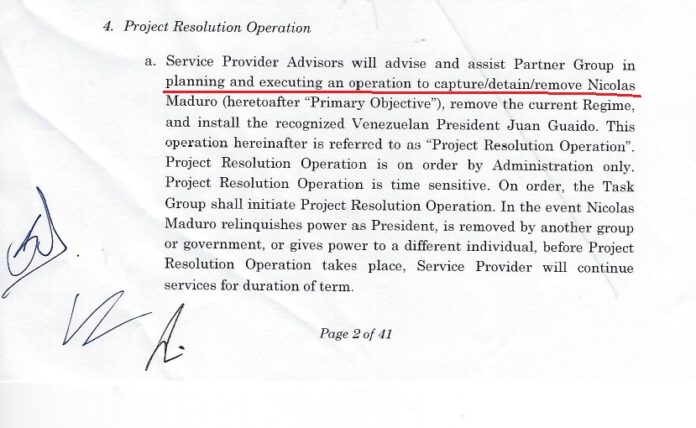
Overcrowded homes and a lack of water leave some Indonesians at risk of the coronavirus

Source: The Conversation (Au and NZ) – By Sharon Bessell, Professor of Public Policy, Crawford School of Public Policy, Australian National University

A lack of access to a household toilet and clean water are putting many people in parts of Indonesia at risk of infection from the coronavirus.

These findings come from a study we carried out in 2018 that examined multidimensional poverty in South Sulawesi, Indonesia. Here we draw on data from one district, where we surveyed 2,881 women and men over the age of 16 years.

The study used the Individual Deprivation Measure (IDM) to assess 15 dimensions of poverty including household access to a toilet and hand-washing facilities with adequate water and soap.


Read more: Can you get the COVID-19 coronavirus twice?


The results are relevant now, as responses to the pandemic include increased hygiene, particularly hand washing, and physical distancing or isolation.

Barriers to hand washing

One-quarter of people surveyed reported having no place in their house or yard to wash their hands. There was a clear urban-rural divide: just over 30% of people living in rural areas had no place in their home to wash their hands, compared to about 8% in urban areas.

Access to hand-washing facilities varied dramatically between regions. As might be expected, the more remote the region and the more difficult the access, the greater the level of deprivation.

The islands off the west coast of South Sulawesi, which are part of the Pangkajene and Islands Regency, are so remote they are often missed from household and poverty surveys. The IDM study found 59% of people living in the islands had no access to hand-washing facilities at home.

Having to go outside the home to wash hands has serious health implications as it shows people are unable to maintain the standards of hygiene necessary to protect themselves and their families. In the context of COVID-19 that may be deadly.

Access to soap is also challenging. Around 13% of people reported not being able to use soap to wash their hands. The percentage of people with sufficient water but unable to use soap was higher in urban areas (15.9%) than in rural areas (12.4%). People in rural areas were far more likely to lack both soap and water.

These findings show poverty prevents people from exercising levels of hygiene needed to stem the spread of coronavirus in both rural and urban areas – but the issues are different in each, and so must be the responses.

An open drain in Makassar city, Sulawesi. Sharon Bessell, Author provided

Barriers to physical isolation

The IDM survey asked about issues that prevent people from being able to isolate themselves.

A lack of access to private toilet facilities was a significant reason people had to go into public spaces. Almost one-quarter of respondents did not have access to private toilet facilities (in their own house or yard).

Lack of access to toilets was concentrated in rural areas where almost 29% of people reported no access, compared to less than 3% in urban areas. Almost 9% of respondents used only public toilets, with men (10.1%) more likely than women (6.9%) to rely on public toilets.

Almost 6% of people used toilets shared with other households. Women (7.2%) were more likely than men (3.9%) to use private shared toilets.


Read more: Too many left behind: the failing of COVID-19 prevention measures in informal settlements and slums


In these situations it is not possible for people to physically isolate. The most basic human functions require people to interact in spaces shared with others and in conditions of poor hygiene.

Our findings showed more than one-quarter of people surveyed needed to go out regularly to collect water for household use. This increased to one-third of people in rural areas and was just over 10% of people in urban areas.

People in rural areas were twice as likely as those in urban areas to report not always having water for domestic use, such as washing clothes and dishes. Almost 13% of respondents reported not having enough containers to carry or store enough water for more than one day.

Almost 19% of respondents said their home was too crowded to be able to live comfortably. This was more likely a problem in rural areas, but one in ten people in urban areas reported significant overcrowding in their homes.

This poses a very significant problem: even if people can remain in their homes, overcrowding means they must be in very close physical proximity to others.

The pandemic challenge

The pressures to go into public spaces for water or to access toilets, combined with overcrowding within homes, indicate the high risks faced by those who are poor. The option to physically isolate is not available.

The challenges facing Indonesia are enormous. With sufficient political will, planning and resources it is possible to ensure people have soap for hand washing, particularly in urban areas where access issues are less acute.


Read more: Sanitising the city: does spraying the streets work against coronavirus?


Providing people with access to hand-washing and toilet facilities in their homes is a massive infrastructure and social equity project, which cannot be achieved in the short term. Providing safe, public access points is now a matter of urgency, as is greater public awareness.

Despite these sobering findings, Indonesia is better placed than many countries. Poverty (measured by consumption expenditure) has been declining over time and fell below 10% of the population in 2019.

In some regions, such as sub-Saharan Africa and South Asia, poverty is far higher and the challenges will be far greater.


The authors would like to acknowledge the contributions and support of the members of the Australian National University-Individual Deprivation Measure Program team, particularly Janet Hunt, Mandy Yap, Masud Hasan, Helen Suich and Trang Pham.

ref. Overcrowded homes and a lack of water leave some Indonesians at risk of the coronavirus – https://theconversation.com/overcrowded-homes-and-a-lack-of-water-leave-some-indonesians-at-risk-of-the-coronavirus-136855

We may well be able to eliminate coronavirus, but we’ll probably never eradicate it. Here’s the difference

Source: The Conversation (Au and NZ) – By Adrian Esterman, Professor of Biostatistics, University of South Australia

Compared to many other countries around the world, Australia and New Zealand have done an exceptional job controlling COVID-19.

As of May 7, there were 794 active cases of COVID-19 in Australia. Only 62 were in hospital.

The situation in New Zealand is similar, with 136 active cases, only two of whom are in hospital.

If we continue on this path, could we eliminate COVID-19 from Australia and New Zealand?


Read more: Yes, we’re flattening the coronavirus curve but modelling needs to inform how we start easing restrictions


Control –> elimination –> eradication

In order to answer this question, we first to need to understand what elimination means in the context of disease, and how it differs from control and eradication.

Disease control is when we see a reduction in disease incidence and prevalence (new cases and current cases) as a result of public health measures. The reduction does not mean to zero cases, but rather to an acceptable level.

Unfortunately, there’s no consensus on what is acceptable. It can differ from disease to disease and from jurisdiction to jurisdiction.

As an example, there were only 81 cases of measles reported in Australia in 2017. Measles is considered under control in Australia.

Conversely, measles is not regarded as controlled in New Zealand, where there was an outbreak in 2019. From January 1, 2019, to February 21, 2020, New Zealand recorded 2,194 measles cases.

We’ve successfully flattened the curve. But what comes next? James Ross/AAP

For disease elimination, there must be zero new cases of the disease in a defined geographic area. There is no defined time period this needs to be sustained for – it usually depends on the incubation period of the disease (the time between being exposed to the virus and the onset of symptoms).

For example, the South Australian government is looking for 28 days of no new coronavirus cases (twice the incubation period of COVID-19) before they will consider it eliminated.

Even when a disease has been eliminated, we continue intervention measures such as border controls and surveillance testing to ensure it doesn’t come back.

For example, in Australia, we have successfully eliminated rubella (German measles). But we maintain an immunisation schedule and disease surveillance program.


Read more: New Zealand’s coronavirus elimination strategy has united a nation. Can that unity outlast lockdown?


Finally, disease eradication is when there is zero incidence worldwide of a disease following deliberate efforts to get rid of it. In this scenario, we no longer need intervention measures.

Only two infectious diseases have been declared eradicated by the World Health Organisation – smallpox in 1980 and rinderpest (a disease in cattle caused by the paramyxovirus) in 2011.

Polio is close to eradication with only 539 cases reported worldwide in 2019.

Guinea worm disease is also close with a total of just 19 human cases from January to June 2019 across two African countries.

What stage are we at with COVID-19?

In Australia and New Zealand we currently have COVID-19 under control.

Importantly, in Australia, the effective reproduction number (Reff) is close to zero. Estimates of Reff come from mathematical modelling, which has not been published for New Zealand, but the Reff is likely to be close to zero in New Zealand too.

The Reff is the average number of people each infected person infects. So a Reff of 2 means on average, each person with COVID-19 infects two others.

If the Reff is greater than 1 the epidemic continues; if the Reff is equal to 1 it becomes endemic (that is, it grumbles along on a permanent basis); and if the Reff is lower than 1, the epidemic dies out.

So we could be on the way to elimination.


Read more: What is sentinel surveillance and how might it help in the fight against coronavirus?


In both Australia and New Zealand we have found almost all of the imported cases, quarantined them, and undertaken contact tracing. Based on extensive community testing, there also appear to be very few community-acquired cases.

The next step in both countries will be sentinel surveillance, where random testing is carried out in selected groups. Hopefully in time these results will be able to show us COVID-19 has been eliminated.

The development of a vaccine can help control and eliminate a disease. Shutterstock

It’s unlikely COVID-19 will ever be eradicated

To be eradicated, a disease needs to be both preventable and treatable. At the moment, we neither have anything to prevent COVID-19 (such as a vaccine) nor any proven treatments (such as antivirals).

Even if a vaccine does become available, SARS-CoV-2 (the virus that causes COVID-19) easily mutates. So we would be in a situation like we are with influenza, where we need annual vaccinations targeting the circulating strains.

The other factor making COVID-19 very difficult if not impossible to eradicate is the fact many infected people have few or no symptoms, and people could still be infectious even with no symptoms. This makes case detection very difficult.

At least with smallpox, it was easy to see whether someone was infected, as their body was covered in pustules (fluid-containing swellings).

So while we may well be on the path to elimination in Australia and New Zealand, eradication is a different ball game.


Read more: Why a trans-Tasman travel bubble makes a lot of sense for Australia and New Zealand


ref. We may well be able to eliminate coronavirus, but we’ll probably never eradicate it. Here’s the difference – https://theconversation.com/we-may-well-be-able-to-eliminate-coronavirus-but-well-probably-never-eradicate-it-heres-the-difference-137991

Spruiking the stars: some home builders are misleading consumers about energy ratings

Source: The Conversation (Au and NZ) – By Georgia Warren-Myers, Senior Lecturer in Property, University of Melbourne

Australia’s competitive volume housing construction sector is busy spruiking various upgrades and packages to sell the appealing notions of lifestyle and luxury on a budget. Along with sparkling stone benchtops and alfresco dining areas, some builders use sustainability and energy-efficiency features to entice customers. However, our recent study found the ways some volume builders promote energy efficiency and sustainability could mislead consumers and breach the Australian Consumer Law.

Understanding the stars

Stars are a simple shorthand or “measuring tape” to help consumers to quickly and easily identify the energy efficiency of each home, and to compare one house to another. Under the Nationwide House Energy Rating Scheme (NatHERS) the best rating is ten stars. Six stars is the regulatory minimum required of most new homes in Australia.


Read more: Australia’s still building 4 in every 5 new houses to no more than the minimum energy standard


A NatHERS rating is the most common method of demonstrating compliance with energy-efficiency standards. The ten-star NatHERS scale differs from many other commonly used star rating schemes, such as Green Star, where five or six stars indicate best, not minimum, performance. This is where the potential for consumers to be misled begins.

NatHERS (on the left) uses a ten-star scale, on which six stars is the minimum standard for most new homes built in Australia. Other six-star energy rating systems, such as for home appliances (right), add to the potential for confusion about the use of NatHERS stars. NatHERS, Energy Rating/Commonwealth of Australia

Most new home buyers are not well versed in building design or energy efficiency regulations. They tend to rely on industry experts such as builders when making such decisions about their new home.

We wanted to find out how Australia’s volume home builders communicated to consumers about energy ratings. Were they meeting their obligations under the Australian Consumer Law?

What does the law say?

Section 18(1) of the Australian Consumer Law states:

A person must not, in trade or commerce, engage in conduct that is misleading or deceptive or is likely to mislead or deceive.

As the Australian Competition and Consumer Commission’s guide on green marketing points out, when making statements about green initiatives the overall impression to a typical audience is most important. It cautions businesses:

You should be careful that the overall impression you create about the goods or services you sell is not misleading. In other words, it is not enough for each representation to be technically or narrowly correct. It is just as important to look at the overall impression created in the minds of average consumers in the target audience.

What we found

Our study examined the websites of Australia’s largest volume home builders to see how they explained the energy efficiency of their homes to potential buyers. We found logos and language that could mislead consumers about the energy-efficiency performance of those homes.


Read more: Low-energy homes don’t just save money, they improve lives


No websites we examined actually used the official NatHERS logo. Instead, some builders had created their own version of a six-star logo. Each example we found showed a grouping of six stars only, suggesting a rating of six out of six was the best rating.

Buyers are likely to interpret these logos as meaning six stars is superior or excellent performance, rather than the minimum performance benchmark that applies to all new homes. One logo went further, claiming six-star “sustainability” – when a NatHERS rating only measures thermal energy efficiency.

Logos the study found show a grouping of six stars only, suggesting six is the best rating, claiming six-star ‘sustainability’ and even offering this minimum standard ‘at no extra cost’. Source: Observing energy rating stars through the Australian Consumer Law lens, Author provided

We also found statements on websites that inaccurately equated a six-star rating with a high energy performance. The website of one builder suggested six stars was a “superior” measure of service or quality. Another linked six stars with broader sustainability performance and commitment (not just thermal energy efficiency). One volume builder even described a six-star rating as an “award”!

In each case these statements could easily be misinterpreted as meaning the home was an exceptional product offering, rather than meeting the basic industry standard.

These volume home builder websites use logos and language that imply a high level of energy efficiency or a superior product offering, rather than simply indicating compliance with the minimum regulatory standard that applies to all new homes. As a result, home buyers are likely to be misled about the energy efficiency of these new homes.


Read more: Homes with higher energy ratings sell for more. Here’s how Australian owners could cash in


Effect matters, regardless of intent

Our research does not seek to suggest volume home builders have deliberately set out to mislead potential buyers. However, Section 18(1) is concerned with effect rather than intent. While builders may not intend to mislead buyers, this may be an outcome of current advertising practices.

Therefore, as we point out to both volume home builders and new home buyers, any information about house energy ratings needs to be clear and accurate. It should reinforce that six stars is the minimum standard that applies, not the best.

Energy-efficiency measures such as star ratings for new homes are an important part of efforts to reduce Australia’s energy demand and minimise contributions to climate change. Misleading statements about house energy ratings not only risk breaching the Australian Consumer Law, but also weaken community trust in star ratings and in the information the home-building industry provides. It’s time to review the spruiking.


Read more: Making every building count in meeting Australia’s emission targets


ref. Spruiking the stars: some home builders are misleading consumers about energy ratings – https://theconversation.com/spruiking-the-stars-some-home-builders-are-misleading-consumers-about-energy-ratings-136402

Past pandemics show how coronavirus budgets can drive faster economic recovery

Source: The Conversation (Au and NZ) – By Ilan Noy, Professor and Chair in the Economics of Disasters, Te Herenga Waka — Victoria University of Wellington

With New Zealand’s May 14 budget expected to chart the way out of the economic crisis, Finance Minister Grant Robertson should be looking to the past as well as the future. Finance ministers elsewhere are facing similar decisions, many even more constrained than New Zealand’s.

But the common claim that we live in “unprecedented times” is not entirely true. Social distancing and other dramatic interruptions to our lives are nothing new.

One clear precedent is the SARS epidemic that hit Singapore, China, Hong Kong, and Taiwan in 2003. Other more localised but catastrophic examples, such as the Haiti earthquake of 2010 or the 2004 Indian Ocean tsunami, are also instructive.

What is different is the scale of the current crisis. Economies everywhere are in freefall and unemployment is rising. Gross domestic product figures for the first quarter of 2020 show economic declines not seen since WWII. The second quarter is predicted to be even worse.

The challenge for governments is to manage both expectations and spending to drive recovery. Despite the fast-tracking of so-called “shovel-ready” construction projects, that does not necessarily mean infrastructural spending is a magic bullet.

An alphabet of possible recoveries

There are four plausible recovery trajectories. A V-shaped recovery suggests the affected economies will rebound rapidly after lockdown. A U-shaped recovery entails a similar return to normality but after a longer downturn.

The W describes a second hit to the economy, most likely from a second wave of infections (as happened in the second winter of the catastrophic 1918-1919 flu pandemic) but potentially also caused by misguided economic policies. Most worrisome here would be premature withdrawal of government spending support.

The worst case is L-shaped, in which the economy takes many years to come back.

Recovery from SARS was V-shaped in all the affected economies. While SARS spread to many fewer places and disappeared more quickly than our present nemesis, social distancing in the four affected countries was not dramatically different. Fear at the time was as palpable as it is now.


Read more: Coronavirus and Spanish flu: economic lessons to learn from the last truly global pandemic


Taiwan, Hong Kong and Singapore all experienced a dip in GDP growth in the first half of 2003. But by the third quarter their economies were growing fast again. Statistical analysis we did for the Asian Development Bank found the epidemic did not have any longer-term adverse effect on these three economies.

China is a much bigger country, but even when we looked at its two hardest-hit regions, Guangdong and Beijing, the picture was the same – a V. We could see this from economic data from the Chinese National Bureau of Statistics, and with satellite images of night-time light emitted by urban-industrial areas.

These data suggest there was some re-orienting of economic activity after the SARS epidemic (as observed in the diminished night-light) but very little long-lasting effect on aggregate incomes. The same rebound may be happening right now in Wuhan which emerged from lockdown in March this year.

CC BY-ND

SARS affected, drastically but briefly, only a few countries in East Asia (and Toronto, due to travel-borne infection). Each had the institutional capacity and financial resources to successfully mobilise recovery once the infection had been vanquished.

The data from recoveries after other types of disasters tell a similar story. Except for very poor and chaotically-governed places (such as Haiti), countries tend to recover quite rapidly. This is true for Indonesia and Sri Lanka, hardest hit by the 2004 Indian Ocean tsunami. Their recovery was fuelled by generous assistance from abroad and large mobilisations at home.


Read more: Coronavirus hasn’t killed globalisation – it proves why we need it


Targeted funding and managing fear to recover faster

Two main observations emerge in this rear-view mirror. The first is that the targeting of recovery funding is crucial. After previous shocks, when regions or cities failed to recover completely, it was usually because the recovery was under-resourced or funding was mis-targeted.

Unlike a natural disaster, the damage associated with COVID-19 is not to infrastructure. It is to employment in specific sectors such as tourism and culture. Policies should therefore target the maintenance of labour markets (even if it means sustaining them on life support) rather than spending on more infrastructure.


Read more: How a one-off tax on wealth could cover the economic cost of the coronavirus crisis


“Shovel-ready” projects were critical after the 2008 global financial crisis, when the disruption was largely to the construction/housing sector. A construction injection now will not provide work for most of people who have lost their jobs in restaurants, hotels, retail, or travel.

Spending on better and greener infrastructure, when the existing infrastructure is crumbling or dangerous, is good policy in and of itself. But it will not provide the necessary antidote to our current malaise.

Secondly, recovery depends crucially on expectations. In those cases where the shock significantly increased the fear of future shocks, recovery was slower. Households and businesses were more reluctant to buy and invest.

Without assurances that we have “solved” COVID-19 – with a vaccine or effective control – a full recovery is going to be impossible. The longer it takes, the more our recovery will be shaped like a drawn-out U rather than a V. As the Economist magazine recently put it, we will have a 90% economy.

Without a good public health response we might even risk a W, where a second wave of infection requires further harsh but necessary social distancing.

Without managing expectations about a COVID-free future, and without aggressive but well-targeted government action, the post-pandemic trajectory will look like an L. That will put a far greater burden on future generations than any debt governments might take on now to develop a vaccine or keep businesses afloat and people on payrolls.

ref. Past pandemics show how coronavirus budgets can drive faster economic recovery – https://theconversation.com/past-pandemics-show-how-coronavirus-budgets-can-drive-faster-economic-recovery-137775

The calculus of death shows the COVID lock-down is clearly worth the cost

Source: The Conversation (Au and NZ) – By Neil Bailey, Research Fellow at the Epworth Centre for Innovation in Mental Health, Monash University

Will the number of lives saved as a result of the COVID-19 restrictions be outweighed by the deaths from an economic recession?

This is a vital question to answer for governments responding to the current global tragedy.

Without numbers, there’s no obvious way of working out whether the economic impacts of the lock-down could be more harmful than the virus.

With health economics consultant Daniel West, I have attempted to estimate the numbers involved in Australia.

The estimates we have used for increased deaths from a lockdown-induced recession are at the high end of the likely scale. The estimates we have used for deaths from COVID19 if the lockdown ends are at the low end.

Our analysis suggests that continuing strict restrictions in order to eradicate COVID-19 is likely to lead to eight times fewer total deaths than an immediate return to life as normal.

Lives the lock-down could cost

The most obvious deaths likely to follow from a lock-down-induced recession are suicides.

Studies in 26 European countries over four decades suggest that increases in unemployment of more than 3% are associated with increases in suicides by 4.45%.

A similar relationship was found in Australia during the global financial crisis.

The projections for increases in unemployment if the lock-down continues are grim, some pointing to an unemployment rate of up to 15% which might not return to normal for up to a decade.


Read more: COVID lockdowns have human costs as well as benefits. It’s time to consider both


To account for the prospect that the coming recession will be more severe than most, we have used double the highest European estimate of the relationship between increased unemployment and suicide.

This estimate suggests that an increase in the unemployment rate to 15% followed by a gradual decline over ten years would produce a distressing 2,761 extra deaths due to suicide.

Loneliness takes lives too

Continued restrictions could also significantly increase loneliness, which, for those who are lonely, can increase deaths from all-causes by between 15% and 29%.

Research suggests that quarantine can increase the number of people showing psychological distress by about 20%, an estimate we have used as a proxy for the effect of loneliness, even though the lock-down restrictions are less severe than quarantine.

This points to an additional 4,015 deaths associated with loneliness from a lock-down of six months.


Read more: Is your mental health deteriorating during the coronavirus pandemic? Here’s what to look out for


Although it would be reasonable to assume that a recession would increase the number of deaths from other causes, studies show this isn’t the case. Research into “all-cause mortality” consistently shows declines in deaths during recessions, due in part to a reduced number of heart attacks.

The current lock-down might also increase deaths in specific ways, such as deaths from alcohol abuse.

On the other hand, if hospitals are overwhelmed by COVID-19 cases, deaths from non-COVID-19 injuries and illnesses will increase as people cannot access health care.

Because we have no data on these offsetting possibilities, we have assumed they are roughly matched in size.

It is also worth noting that although we assume lock-down restrictions will hurt our economy more severely, cities that implemented more severe restrictions during the 1918 Spanish flu had economies that bounced back faster after the pandemic.

Lives the lock-down might save

We have estimated the number of deaths from COVID-19, suicide and loneliness under three different scenarios

  • an immediate return to life as normal, while still quarantining suspected cases

  • an easing of restrictions that allows the virus to slowly spread in order to achieve so-called herd immunity

  • the maintenance of restrictions until the virus is contained, followed by extensive tracking and tracing aimed at eliminating the virus

Scenario 1. Return to normal

With no lock-down measures other than the quarantine of suspected cases, the government believes 68% of people would contract the virus. Our estimates suggest this would result in more than 287,000 deaths from COVID-19 as the health system could not cope with the volume.

We assume this would produce a recession lasting five years instead of ten, with 10% initial unemployment and an associated 753 extra deaths from suicide.

Scenario 2. Herd immunity

The government says that to achieve herd immunity, about 60% of people would need to eventually contract the virus. If it is done slowly, intensive care units will not be overwhelmed, keeping the death rate per infection low.

Our estimates suggest the strategy would lead to 141,000 deaths from COVID-19.

We assume this would result in a deep recession of ten years with 15% initial unemployment and an associated 4,015 deaths from loneliness and 2,761 deaths from suicide.

Scenario 3. Eradication

Under the eradication scenario, 11.6% of people would be expected to contract the virus, resulting in 27,000 deaths from COVID-19.

As with the herd immunity strategy, we have assumed a deep recession over ten years with 15% initial unemployment and an associated 4,015 deaths from loneliness and 2,761 from suicide.

Note that given Australia’s current success, it is very possible that with continued prudent restrictions, the number of deaths due to COVID19 will be well below 27,000.

The calculus of death

Regardless of the strategy, the estimated number of deaths from COVID-19 far exceeds the estimated number of deaths from suicide and loneliness.

Despite assuming that an immediate return to life as normal would prevent all further deaths from loneliness and 70% of deaths from the increased suicide rate associated with high unemployment, the life as normal scenario is predicted to result in by far the highest overall number of deaths: 288,000.

This is almost twice the number of deaths predicted for the herd immunity scenario (148,000) and more than eight times as many as eradication (34,000).

The Brain and Mind Centre at the University of Sydney has reported larger estimates for suicides from increased unemployment: an extra 750 to 1,500 suicides per year for five years. The top end of this range projects an extra 7,500 suicides, almost three times our estimate.

Even using this higher estimate, the number of lives that would be lost from COVID-19 without lock-down measures would dwarf the number of extra suicides.


Read more: Coronavirus is stressful. Here are some ways to cope with the anxiety


People are understandably concerned about what the lock-down will do to their jobs, businesses and investments. That damage extends beyond lives lost.

The lives that will be lost are important. The implementation of preventative measures will be vital to reduce the risk of suicide.

Yet our calculations clearly suggest that, when it comes to human lives, far fewer will be lost by continuing restrictions than would be lost by ending them now.


If this article has raised issues for you, or if you’re concerned about someone you know, call Lifeline on 13 11 14.

This article was produced in collaboration with Daniel West. An extended version can be found here.

ref. The calculus of death shows the COVID lock-down is clearly worth the cost – https://theconversation.com/the-calculus-of-death-shows-the-covid-lock-down-is-clearly-worth-the-cost-137716

Friday essay: coughs on film and the fine but deadly art of foreshadowing

Source: The Conversation (Au and NZ) – By Simon Weaving, Senior Lecturer, School of Creative Industries, University of Newcastle

Movie characters – like Greek heroes – are typically faster, stronger, braver and better looking than those of us in the audience who stare on in admiration. We watch as obstacles are overcome and goals achieved, attracted by the beauty and goodness in the cinematic story world.

But, should movie characters cough as they go about their extraordinary business, you can just about guarantee they will be dead before the end of the film. The screen cough, it seems, is fatal.

In the time of COVID-19, the screen cough takes on new significance. A low budget Canadian film made early this year is thought to be the first movie about coronavirus. It features a woman getting into a lift with others and the confrontations that ensue when she starts coughing.


Read more: Scary red or icky green? We can’t say what colour coronavirus is and dressing it up might feed fears


More than a tickle

From Marguerite Gauthier (played by Greta Garbo) in the 1936 movie Camille, to Boris Shcherbina (Stellan Skarsgard) in the HBO series Chernobyl (2019), coughing on screen has deadly significance.

In the dramatic opening moments of the first episode of The Crown (2016), there is only darkness and silence … until we hear the sound of a dreadful hacking cough. Fade in to reveal King George V (Jared Harris, who also coughed in Chernobyl) in his bathroom, looking concerned. He coughs some more. Terribly sorry, your Majesty, but you’ll be dead before the end of Episode 2.

Satine (Nicole Kidman) coughs in Moulin Rouge (2000)

Nicole Kidman, as Satine in Baz Luhrmann’s Moulin Rouge (2001) coughs on page 35 of the screenplay. Well, she has been singing and dancing vigorously in front of Christian (Ewen McGregor) in a steamy Parisian nightclub, so perhaps it’s just a question of fitness.

“Oh, these silly costumes” she says to those gathered around her, in an attempt to explain her breathlessness. But it’s neither the clothes nor the exertion: the screen cough means she is doomed to die 83 pages later, in her lover’s arms, afflicted like Garbo’s Marguerite with tuberculosis.


Read more: Great time to try: 5½ ways to make movie masterpieces at home


The sound of a cough opens Steven Soderbergh’s 2011 film Contagion, currently one of the world’s top streaming titles.

That cough belongs to Beth Emhoff (Gwyneth Paltrow) and, sure enough, she doesn’t make it very far into the movie. The virus that takes her to an early screen grave also infects Erin Mears (Kate Winslet) who coughs while on the phone to her boss (Laurence Fishbourne). His look is enough to confirm our fears and within a few scenes her lifeless form is being zipped into a body bag.

Erin Mears (Kate Winslet) coughs in Contagion (2011).

Many others have succumbed to the incurable screen cough of death, including even Yoda in Return of the Jedi (1983). To be fair, Yoda is 900 years old and knows he’s about to die. “Soon,” he splutters to Luke Skywalker, “I will rest. Yes, forever sleep” and promptly becomes one with the Force.

Selling it

The screen cough is a phenomenon so well known by screenwriters that it’s become the subject of parody. Mitchell & Webb played with the trope in a BBC sketch named The Man Who Has A Cough And It’s Just A Cough And He’s Fine in 2008.

Alec Baldwin went one step further on Saturday Night Live in 2009 with an actors studio-style breakdown on how to sell your impending death effectively, starting with the fateful cough. The sketch – First Coughs: Mastering the Art of Foreshadowing Your Character’s Death – starts with step one: say “it’s only a cold”. Sometime later, the actor should emphatically state, “I don’t need any damn doctors!”. The final step is complex but mightily effective: “cough into a handkerchief, notice that there’s blood on it, look around nervously, then quickly shove it back in your pocket and hurry on your way”.

When I see these send-ups, of course I laugh, but with a tinge of resentment: parody is both celebration and humiliation. I can’t help but think that I’ll never again be able to see the beautiful & dramatic subtlety of a well placed screen cough without a snigger.

The Man Who Has A Cough And It’s Just A Cough And He’s Fine (2008)

Smoke signals

The art of signalling a future event in narration is a literary device apparent in the earliest ancient stories. It comes in many forms, from prophesy, dreams and omens to portents and apprehensions.

In the 4000-year-old poetic work, Epic of Gilgamesh, dreams predict the hero’s victorious battle with a great bull as well as his friend’s tragic death. Early in Sophocles’s play Oedipus Rex, a blind prophet riddles the truth of the story to come. The Bible is full of prophecy, none more memorable than Jesus’s prediction in The Gospel of John that one of his disciples would betray him.

Driven by our need for certainty, we value knowing what may lie ahead. Facing open time, with all its possibilities, takes courage and – from budgets to prayers – we seek to gain a sense of control over our future. It’s unsurprising that we find pleasure in stories where foreshadowing signals what will happen, from storytellers who sneak the future into the present.

Gotta hanky Greta? Since Garbo in Camille (1936) the onscreen cough has been a bad omen. IMDB

The ability to manipulate the direction of time is fundamental to sophisticated narration. Merely explaining what happens next – the way time works in real life – is not enough when it comes to entertainment. There’s nothing more tedious than a story that proceeds along the lines of “this happens, then this, then this” and so on. Novelist E. M. Forster – who wrote A Room with a View, Howard’s End and A Passage to India – famously decreed that this kind of primitive narration causes listeners to fall asleep or rise up to kill the storyteller.

To avoid such a fate, skilled narrators use foreshadowing to create tension, build anticipation and hook the audience into a belief that there’s something of interest to follow. We instinctively know that everything in a story has been planned and the author has determined the destiny of each character, so we intuitively look for the signs and the structures that will take us towards closure, including moments of foreshadowing.

They can be subtle and poetic (a storm or a shooting star), psychological (a character worrying about something that has yet to be revealed) or concrete, like the appearance of a deadly weapon. But common to all these forms of foreshadowing is that we see them as the future pointing backwards. The grief to come has caused the present storm; bad news the anxiety; the body at the end of the film requires the gun at the start.

Alfred Hitchcock knew only too well the importance of being able to play with time. Imagine four people seated at a table having a conversation about football for five minutes, when suddenly a bomb goes off. That’s five minutes of boredom followed by a surprise. What’s in it for the audience, says Hitchcock, is only “ten seconds of shock”. But take the same scene and show the audience the bomb at the beginning, and the conversation about football becomes an exercise in suspense and high anxiety.

Orson Welles plays out this idea in the famous opening scene of Touch of Evil (1958), showing us a bomb set to go off in three minutes. It’s then hidden in the boot of a car that moves erratically through a busy crowd. We hold our breath wondering where the car will be when the time is up.

Opening Scene of Touch of Evil (1958)

The cough is a timebomb

The screen cough is also the ticking of a bomb, leaving both character and audience unsure when it will go off. One of the most dramatic screen coughs occurs in Three Billboards Outside Ebbing, Missouri (2017). It’s revealed early in the movie that police chief Willoughby (Woody Harrelson) has terminal pancreatic cancer, but it’s a brutal shock when he violently coughs blood over Mildred Hayes (Francis McDormand).

In a strangely poignant sequence, writer/director Martin McDonagh opts for Willoughby to take his own life rather than let the disease run its course: he knows what lies ahead after that dreadful coughing incident.

Storytellers have a delicate balancing act to maintain when it comes to foreshadowing. Too oblique or poetic and the audience struggles to see the connection between the signalling moment and the signalled event, or perhaps only recognises it retrospectively. Because the screen cough is linked to both a specific individual (the sufferer) and a specific outcome (death), it’s necessary to be subtle when using it as a narrative device.

Perhaps we are now beyond subtlety. The combination of our current hyper-vigilance of respiratory symptoms and the increasing awareness of the function of the screen cough, risks it becoming a dreadful cliche, a trope in need of a innovative makeover. Like the good guys wearing white hats in Westerns, and detectives smoking excessively in film noir, it may just be time to give the screen cough a breather.

ref. Friday essay: coughs on film and the fine but deadly art of foreshadowing – https://theconversation.com/friday-essay-coughs-on-film-and-the-fine-but-deadly-art-of-foreshadowing-135697

Grattan on Friday: The delicate art of political distancing during the pandemic

Source: The Conversation (Au and NZ) – By Michelle Grattan, Professorial Fellow, University of Canberra

Coincidentally, as the economy takes some early steps towards reopening, parliament will meet next week for what is being billed as a “normal” sitting – though that’s a relative term these days.

The two recent one-day meetings (March 23, April 8) were entirely devoted to passing COVID rescue measures; the tone was sombre, partisanship minimal. This will be a three-day sitting (Tuesday to Thursday); announcing it last month, Scott Morrison described it as a “trial week”, with the aim of “having the parliament meet again on a regular basis”.

Labor and many commentators argued parliament should have sat all through. After all, businesses were encouraged to keep operating where they could, so why not this business house of the nation?

But at least we have a compromise. In late March, it had been intended to have no sittings until August. It now seems likely there’ll be a week or two in June before the usual winter recess.

Next week will still be a socially-distanced parliament. Only 75-77 MPs will be permitted in the House of Representatives chamber at any one time, about half the full complement.

While there’ll be more House members in Canberra, a system of revolving “pairs” will see some members in the chamber while others are not. The Senate will be slimmed down as well.

There’ll also be socially-distanced party meetings (that could be automatic in the aggro ranks of the Nationals). In recent weeks the Coalition has been having “tele-townhalls” with its members hearing briefings from Morrison, Deputy Prime Minister Michael McCormack, Treasurer Josh Frydenberg and Health Minister Greg Hunt, and given an opportunity to ask questions.

For Labor, the tactical judgment to be made will be how much to politically distance from the government.

One Labor source predicts we’ll see a “transition” week. “People say politics will have to return at some point. But people are still in the ‘can it be co-operative’ phase,” he says.

It’s a fine line. In these times, the public want their politicians to work together, to avoid unseemly brawling. The high degree of bipartisanship over COVID measures has likely been a factor in the rise in trust in government reflected in surveys, the most recent from the Australian National University on Thursday.

Nevertheless, Labor can’t afford to just be head-nodders, even in relation to pandemic measures, such as the COVIDSafe app.

The main legislation of the week will be for the app, which the opposition supports while having questions.

The Senate committee inquiring into the government’s response to the pandemic this week heard evidence about the app’s technical issues.

The government is also refusing to give a target for downloads. After suggestions a 40% download was needed for effectiveness (though it was never clear what it was 40% of) the government now says there’s no “target”. Nevertheless, more information about the efficacy of various rates of downloads is needed.

The legislation for the app has been released, and contains strong privacy protections. But already there’s pressure from some employers to be able to force workers to download it.

That is prohibited, and the government must make it very clear that leaning on employees to do so will not be tolerated. Otherwise people will lose confidence in what has the promise of being a useful tool.

Parliamentary question times next week are expected to be somewhat more combative than during the one-day sittings, but not like the shouty pre-COVID days.

Against the background of the shambles on the conservative side this week with the carry-ons by the NSW state National John Barilaro and the Liberal Andrew Constance, Anthony Albanese must decide how to pitch Labor’s use of the House to prosecute the Eden-Monaro byelection – for which Speaker Tony Smith may announce a date next week.

The infighting on the other side provides tempting material but Labor might be wise to keep to on-the-ground issues, in particular the ins and outs of the bushfire recovery.

It can leave it to the media to highlight the shenanigans. Certainly eyes will be on the demeanour of the Nationals, to see whether Barilaro’s attack on McCormack has re-ignited tensions in the federal party.

The fire recovery issue is potent in Eden-Monaro. Agriculture Minister David Littleproud has flagged an announcement in the next few days (which the government says was in the pipeline before the byelection loomed). He will also make a statement to parliament.

The government’s legislative program, apart from the app, will comprise non-controversial “rats and mice” bills. Divisive matters like the “ensuring integrity” anti-union legislation won’t be there.

Apart from the privacy legislation and bushfires, the main item on the government’s agenda will be Frydenberg’s Tuesday economic report to parliament, including the effect of easing restrictions.

Ahead of this, Friday’s Reserve Bank quarterly forecasts on economic growth, unemployment, wages and other measures for the coming two years will present a grim picture.

Meanwhile Albanese will begin setting up a major debate with the government when he delivers his fifth “vision statement”, outlining ideas for the post-Covid world.

In his speech, delivered to caucus on Monday, he’ll make it clear this will be a world in which a Labor government could not fund the sort of generous spending to which it was committed at the last election.

COVID is giving Albanese the opportunity – the cover, if you like – to complete the pivot to the more fiscally conservative position that he began to spell out in the aftermath of last year’s defeat.

He is also planning to have the party come up with a broad suite of policy ideas by the October budget. The government wants to make that budget policy-heavy; Albanese is anxious to be able to pack a punch in his reply.

The public’s attention next week, however, is likely to be less on the doings in Canberra and more on what’s happening on the ground.

Friday’s national cabinet sets parameters and stages for lifting restrictions. But how the process unfolds will differ between states; those decisions will be variously greeted with jubilation, criticism and controversy as life cranks up again but not fast enough for some.

ref. Grattan on Friday: The delicate art of political distancing during the pandemic – https://theconversation.com/grattan-on-friday-the-delicate-art-of-political-distancing-during-the-pandemic-138127

Keith Rankin Analysis – Can our Grandchildren be our Creditors?

Keith Rankin.

Analysis by Keith Rankin.

“We are borrowing tens of billions of dollars from our children and grandchildren to get us through the Covid crisis…”. (James Shaw in interview on Radio New Zealand’s Nine to Noon, 23 April 2020)

Debtors and Creditors

Keith Rankin.

Literally, for me to be in debt to somebody means that the ‘somebody’ (the creditor, maybe my friend) has incurred a sacrifice so that I (the debtor) can access some want or need today that I am not otherwise entitled to. We accept that people will not normally make such sacrifices without compensation, and that such compensation is called ‘interest’.

A good example would be if both my friend and I wanted to buy a bicycle. He could afford a basic bicycle now, and I cannot. But I claim to have a more immediate need for a bicycle now. So he lends me enough money so that I can buy a basic bicycle now, and, over time, repay him with interest. As a result, a year later he gets to buy a better bicycle – one with bells and whistles – on account of the interest he receives from me. He makes a present sacrifice (a year without a bicycle), and gains a future reward (a bicycle with bells and whistles). I make a future sacrifice (no bells and whistles), and gain a present reward (a bicycle).

In this financial view of debt, my friend both saved (ie did not spend) and invested (gained a yield in return for a sacrifice). A finance professional would say that my friend had invested in me by buying my ‘bond’. An economist might tolerate that view of my friend as an ‘investor’ if I only wanted my bicycle for pleasure. But, if I needed my bicycle to run a courier business, then I would be the investor, not my friend. To a financial analyst, the words ‘saving’ and ‘investing’ are synonyms. To an economic analyst, ‘saving’ and ‘investing’ are antonyms; to an economist ‘investment’ is the process of purchasing goods and services (spending) that help someone to run a business. To a financial analyst, ‘investment’ is the process of purchasing a promise (which is saving, not spending).

This example shows how the language of finance is somewhat murky, and why so many people give up on trying to understand finance, and how they often extend that abstinence by giving up on economics too.

We may also note that, this bicycle example of a debt transaction explains why many people believe that it is impossible to have negative interest rates; this view is that interest is compensation for sacrifice. This is the prevailing view of financial analysis. (We may note that financial analysts extoll the magic of compounded interest; that by making repeated sacrifices ‘investors’ can accumulate rewards at an exponential growth rate. One catch is that investors must abstain from the enjoyment of their rewards. Another catch is something economists call ‘negative real interest rates’.)

Economists, on the other hand, understand my bicycle example as inter-temporal trade (trade between the present and the future) and that interest is the price that balances supply and demand for such trade. Thus, in economics, interest rates can be positive or negative. Further economists like to talk about ‘real interest rates’ (essentially the contracted interest rate minus the rate of inflation), and accept that, for much of history, real interest rates have been negative. (So much for the alchemy of compound interest!)

(As an aside, for much of the 2010s’ decade, Switzerland had both deflation – falling prices, eg annual inflation of minus one percent – and negative interest rates, eg minus half a percent. When those numbers applied, real interest rates were positive; minus half a percent minusminus one percent equals plus half a percent!)

Saving as Insurance

The reality is that finance is not really about savers making sacrifices. For example, most retirement savings are not spent by old people enjoying their bells and whistles in the last years of their lives. Rather, most private retirement savings ends up in the savers’ estates. In many cases it is their adult children who spend what their deceased parents did not; in perhaps more cases, the inherited money is left in the bank and forms part of the inheritors’ estates. (In matters of inheritance, who is the ‘inheritee’?)

By and large it is high-income people who save; people who do not have to make sacrifices and by and large do not make sacrifices. (Traditional misers – such as Dickens’ Scrooge – may appear to make sacrifices by living miserly lives; but those lives represent their choices. Others may stay in basic cabins when they go on holiday, despite the fact that they could easily afford much better accommodation; again, these frugal lifestyles represent preferences, not sacrifices.)

Most savers do not save for a ‘sunny day’; they are rich enough to not need to save for things they really want. The real reason that most people save is for a ‘rainy day’, as a precaution in case something goes wrong in the future. Their sacrifice is akin to an insurance premium; and it’s a very small sacrifice given that most savers do not live noticeably frugal lives.

What they do want is to be sure that they can withdraw some or all of their savings when it rains very hard. As such, they face a general problem that exists with all insurance. My insurance works when it rains on me, but not on other people. My family or myself gain a payout when my rainy day happens (it could be my death).

What happens when it rains on everybody at the same time? In Christchurch in 2011 the insurance industry could not cope. Further, even Christchurch people with mortgage-free houses and lots of money in the bank had to compete for the services of builders and plumbers and the like. The constraint on happiness was the shortage of essential workers and essential equipment; and an unsafe environment where many workers (including essential workers) were unable to ply their trades. There are times when money cannot buy happiness. The insurance industry’s solution is reinsurance; insurance companies ensuring themselves against large claims.

Neither conventional insurance nor lots of money in the bank can guarantee policyholders or savers security in times of war, pestilence or famine. These are cases when it doesn’t just rain on everyone in your city; rather, it rains on everyone everywhere. When the supply chains are broken, attempts by savers to spend their money result in inflation, maybe hyperinflation. A million dollars of savings is worthless when inflation reaches one billion percent.

Saving represents the creditor side of transactions for with the other parties are debtors. The debtors get extra happiness today; the creditors expect to get extra happiness in the future. A particularly important form of happiness is economic security. (When Cinderella married her prince and lived happily ever after, we may assume that she got three meals a day and a roof over her head; her marriage was like a pauper winning lotto; having a sense of economic security is a very important form of happiness.)

When supply chains are broken, government spending to resurrect and recreate supply chains, and to ensure everyone can access those supply chains, becomes all-important. Such government spending is necessarily debt-funded, except perhaps in a few countries where governments (such as Norway or Saudi Arabia) have large sovereign wealth funds. Governments are insurers of last resort; refer David Moss (2002), When All Else Fails.

James Shaw, co-leader of the New Zealand Green Party

What do we make of Shaw’s claim that we are borrowing from our grandchildren? Does it make sense? Will there be some future financial reckoning which might have an adverse impact on our children? If our grandchildren are debtors, will they have to make sacrifices to settle this debt? Or are they creditors who may become victim to a default? A literal interpretation of Shaw’s statement is that our grandchildren are creditors, not debtors. Creditors by definition gain their benefits in the future, having made sacrifices in the present.

Certainly, there is no shortage of economic commentators who suggest that in the future all this ‘borrowed money’ will have to be ‘paid back’. I think Shaw was making the point that we need to spend wisely, equipping our grandchildren so that they will be able to pay the money back rather than default on debt contracts signed by their grandparents. That makes them debtors, not creditors. Who will they pay the money back to?

They will owe the money to themselves. There need be no reckoning after all.

By ‘we’, Shaw means the New Zealand government. The New Zealand government clearly is the debtor, here, the government of course being a proxy for the New Zealand people.

It sounds as if Shaw really means the opposite of what he said, that our grandchildren will be debtors, in the sense that they will inherit government’s debts incurred by their grandparents. I think that Shaw was trying to say that our grandchildren may inherit a government debt to GDP ratio of (say) 100 percent, and that they will have to pay higher taxes in order to get that ratio down to the 20 percent of GDP that this somewhat austere government believes is appropriate.

Government Debt

Government debt comes in four categories; that is, there are four different possible classes of creditor. Some creditors are less benign than others.

In the first case a government borrows directly or indirectly from its Reserve Bank (aka ‘central bank’), creating what some commentators call ‘monetised debt’. The debtors are the economic citizens of New Zealand, who also happen to be the shareholders of the Reserve Bank. So long as the resultant spending is done to ease the problem of a broken supply chain, and to pay benefits to ensure that all the resident population can draw sustenance from that supply chain, then the putative sacrifice (inflation) becomes less likely, not more likely.

In the second case, a national government borrows from that nation’s private savers, either directly (as in the historic cases of war bonds) or indirectly through the commercial banks. Interest rates may be high, low, zero, or negative. In the latter three cases, there is a surfeit of private savings and the government is acting as borrower of last resort. Private savers like this arrangement, because it is an alternative to increased taxation. The government spends while private savers refrain from spending; the savers are not making a sacrifice because they would have been savers anyway. The advantage for the savers – the creditors – is that they can still access their savings when individual savers face individual crises; this they could not do had they paid tax to the government instead of lending to the government. (This is the Japanese solution, where Japanese lend to their own government at minimal interest rates; they do this in preference to paying higher taxes. The massive Japanese government debt to its own middle class has many economic benefits to all concerned, and few detriments. Japan is not constrained by this debt.)

The third case does not apply in New Zealand, but certainly does in the European Union. This in when the governments of some European Union states are in financial debt to middle class savers mainly resident in other European Union states. In a well-functioning Union, such debt would be comparable to Japan’s government debt. But in Europe the north-south schism is such that this has become a huge problem, albeit an artificial problem.

The fourth case is when sovereign governments are in financial debt to unambiguously foreign creditors. In these situations, creditors may to take it upon themselves to throw their weight around; in particular to make unreasonable and unsustainable demands on debtor governments.

Thus, the problem that can arise from government debt is principally a political one, that relates to the creditor-debtor relationship, and the inequalities that reflect an asymmetrical creditor-debtor relationship.

So, what do we make of James Shaw’s statement? Covid19 sacrifices have been made by all the world’s people, in terms of direct or indirect health outcomes, in terms of lost liberty and induced agoraphobia, in terms of public policy mistakes in many countries, in terms of compromised livelihoods, and in terms of lost benefits which were tied to persons’ now-precarious market incomes. The increased public debt is required to offset these sacrifices.

There is no obvious creditor sacrifice. Rather, for those people with the capacity and preference to be creditors (especially in the second case sense above), government as borrower in a time of few viable private debtors may enable interest to be paid at positive interest rates; so there is a clear creditor reward. As for most debt contracts, the outcome is win-win.

A Constructive Rhetoric around Debt

Debt need not be the bogey which it is often portrayed as. The principal return on coming government emergency outlays will of course be the resurrected and reimagined supply chains, and the incomes (including tax revenues) they generate. Our children and grandchildren will be foremost among those beneficiaries. We can credit them.

Instead of invoking the debt bogey, Mr. Shaw, you could say:
“We are investing tens of billions of dollars for the benefit of our children and grandchildren. May their lives be stable, equitable, and sustainable.”

Journalism educators call for action after new Duterte attack on free press

Pacific Media Watch

The Journalism Education and Research Association of Australia (JERAA) has called on the Australian government to make strong diplomatic representations to Philippine President Rodrigo Duterte to reinstate ABS-CBN’s television operating licence.

It has also urged Duterte to make an ongoing commitment to press freedom – particularly now at the height of the covid-19 coronavirus pandemic.

“This is an outrage. It is another example of Duterte’s continuing war on press freedom,” JERAA president Alex Wake said in a statement in response to the closure of the largest and most influential Philippine television and radio network.

READ MORE: Rappler challenges ‘media powers’ in democracy fight back

The Duterte administration ordered the closure of ABS-CBN this week after its operating licence lapsed on May 4. ABS-CBN is a private enterprise whose network reaches internationally, providing a service to Filipinos around the world.

This is the third media organisation that has been “interfered” with in the four years since Duterte was sworn in as President and stated: “Just because you’re a journalist, you’re not exempt from assassination, if you are a son of a bitch.”

– Partner –

Duterte’s actions are having a chilling effect on Philippine media freedom, encouraging self-censorship by reporters and media outlets fearful of government reprisals for critical reporting at a time when the media’s role in reporting the pandemic is vital, Dr Wake said in the statement.

Even before this closure, the Philippines had dropped two further places on the RSF World Press Freedom Index, now sitting at 136th (Australia is situated at number 26 by comparison).

Background:
President Duterte has labelled broadcaster ABS-CBN and the Philippine Daily Inquirer as “sons of whores”, and warned of repercussions over their criticism of him.

The Philippine Daily Inquirer had been one of the most vocal critics of the administration and its former owners, despite being one of the wealthy scions in the country, did not interfere in the editorial content.

The Duterte administration has also conducted a judicial harassment campaign against Rappler chief editor and publisher Maria Ressa and her online news outlet, one of the country’s most prominent independent news organisations.

Rappler angered Duterte with its criticism of him and by publishing a transcript of a call with Donald Trump, during which the US President praised Duterte’s murderous “drug war” and invited him to the White House, the JERAA statement said.

Ressa and her staff have received threats of death, sexual assault and more.

The persecution of Philippine journalists has been accompanied by online harassment campaigns waged by pro-Duterte troll armies, which also launched cyber-attacks on alternative news websites and the site of the National Union of Journalists of the Philippines.

Print Friendly, PDF & Email

Article by AsiaPacificReport.nz
How safe is COVIDSafe? What you should know about the app’s issues, and Bluetooth-related risks

Source: The Conversation (Au and NZ) – By James Jin Kang, Lecturer, Computig and Security, Edith Cowan University

The Australian government’s COVIDSafe app has been up and running for almost a fortnight, with more than five million downloads.

Unfortunately, since its release many users – particularly those with iPhones – have been in the dark about how well the app works.

Digital Transformation Agency head Randall Brugeaud has now admitted the app’s effectiveness on iPhones “deteriorates and the quality of the connection is not as good” when the phone is locked, and the app is running in the background.

There has also been confusion regarding where user data is sent, how it’s stored, and who can access it.

Conflicts with other apps

Using Bluetooth, COVIDSafe collects anonymous IDs from others who are also using the app, assuming you come into range with them (and their smartphone) for a period of at least 15 minutes.

Bluetooth must be kept on at all times (or at least turned on when leaving home). But this setting is specifically advised against by the Office of the Australian Information Commissioner.

It’s likely COVIDSafe isn’t the only app that uses Bluetooth on your phone. So once you’ve enabled Bluetooth, other apps may start using it and collecting information without your knowledge.

Bluetooth is also energy-intensive, and can quickly drain phone batteries, especially if more than one app is using it. For this reason, some may be reluctant to opt in.

There have also been reports of conflicts with specialised medical devices. Diabetes Australia has received reports of users encountering problems using Bluetooth-enabled glucose monitors at the same time as the COVIDSafe app.

If this happens, the current advice from Diabetes Australia is to uninstall COVIDSafe until a solution is found.

Bluetooth can still track your location

Many apps require a Bluetooth connection and can track your location without actually using GPS.

Bluetooth “beacons” are progressively being deployed in public spaces – with one example in Melbourne supporting visually impaired shoppers. Some apps can use these to log locations you have visited or passed through. They can then transfer this information to their servers, often for marketing purposes.

To avoid apps using Bluetooth without your knowledge, you should deny Bluetooth permission for all apps in your phone’s settings, and then grant permissions individually.

If privacy is a priority, you should also read the privacy policy of all apps you download, so you know how they collect and use your information.

Issues with iPhones

The iPhone operating system (iOS), depending on the version, doesn’t allow COVIDSafe to work properly in the background. The only solution is to leave the app running in the foreground. And if your iPhone is locked, COVIDSafe may not be recording all the necessary data.

You can change your settings to stop your iPhone going into sleep mode. But this again will drain your battery more rapidly.

Brugeaud said older models of iPhones would also be less capable of picking up Bluetooth signals via the app.

It’s expected these issues will be fixed following the integration of contact tracing technology developed by Google and Apple, which Brugeaud said would be done within the next few weeks.


Read more: The COVIDSafe bill doesn’t go far enough to protect our privacy. Here’s what needs to change


Vulnerabilities to data interception

If a user tests positive for COVID-19 and consents to their data being uploaded, the information is then held by the federal government on an Amazon Web Services server in Australia.

Data from the app is stored on a user’s device and transmitted in an encrypted form to the server. Although it’s technically possible to intercept such communications, the data would still be encrypted and therefore offer little value to an attacker.

The government has said the data won’t be moved offshore or made accessible to US law enforcement. But various entities, including Australia’s Law Council, have said the privacy implications remain murky.

That said, it’s reassuring the Amazon data centre (based in Sydney) has achieved a very high level of security as verified by the Australian Cyber Security Centre.

Can the federal government access the data?

The federal government has said the app’s data will only be made available to state and territory health officials. This has been confirmed in a determination under the Biosecurity Act and is due to be implemented in law.

Federal health minister Greg Hunt said:

Not even a court order during an investigation of an alleged crime would be allowed to be used [to access the data].

Although the determination and proposed legislation clearly define the who and how of access to COVIDSafe data, past history indicates the government may not be best placed to look after our data.

It seems the government has gone to great lengths to promote the security and privacy of COVIDSafe. However, the government commissioned the development of the app, so someone will have the means to obtain the information stored within the system – the “keys” to the vault.

If the government did covertly obtain access to the data, it’s unlikely we would find out.

And while contact information stored on user devices is deleted on a 21-day rolling basis, the Department of Health has said data sent to Amazon’s server will “be destroyed at the end of the pandemic”. It’s unclear how such a date would be determined.

Ultimately, it comes down to trust – something which seems to be in short supply.


Read more: The COVIDSafe app was just one contact tracing option. These alternatives guarantee more privacy


ref. How safe is COVIDSafe? What you should know about the app’s issues, and Bluetooth-related risks – https://theconversation.com/how-safe-is-covidsafe-what-you-should-know-about-the-apps-issues-and-bluetooth-related-risks-137894

How George Pell failed child sex abuse victims: the full findings of the royal commission report

Source: The Conversation (Au and NZ) – By Timothy W. Jones, Senior Lecturer in History, La Trobe University

Significant sections of the final report of the Royal Commission into Institutional Responses to Child Sexual Abuse were released today.

When the report of the world-leading, five-year investigation was presented to the governor-general in December 2017, large sections of three volumes were blacked out. They had been redacted so as not to prejudice a number of ongoing or forthcoming criminal proceedings, including the cases against Cardinal George Pell.

The three redacted volumes were the report of Case Study 28 (on church authorities in Ballarat), the report of Case Study 35 (on the Catholic Archdiocese of Melbourne) and Volume 16, Book 2 of the final report, which focused on the Catholic Church generally.

The majority of the redactions related to what Pell knew about accusations of clerical child sexual abuse against various clergy in Ballarat and Melbourne, and what he could and should have done at the time. They remained redacted while he was facing legal action in relation to child sexual abuse allegations against himself.


Read more: How George Pell won in the High Court on a legal technicality


Victorian police announced they were charging Pell with a series of offences in June 2017. Almost half the charges were dropped due to insufficient evidence, including after the death of one complainant, and another being ruled medically unfit to give evidence.

Pell was convicted in December 2018 of five counts of sexually abusing two boys in St. Patrick’s Cathedral in the 1990s. Additional charges relating to allegations of sexual misconduct in Ballarat were dropped.

Pell’s conviction was upheld on appeal to the Supreme Court of Victoria in June 2019, but overturned in a final appeal to the High Court last month.

In an interview with Sky News commentator Andrew Bolt after his acquittal, Pell said he would “be very surprised if there’s any bad findings against me at all” in the redacted material in the royal commission’s report.

This is not the case.

What Pell should have done in Ballarat

Pell was ordained a priest in 1966, and seven years later was appointed as episcopal vicar responsible for education in the diocese of Ballarat.


Read more: The jury may be out on the jury system after George Pell’s successful appeal


Of his time in Ballarat, Pell claimed to have been ignorant of the horrific abuses of the now notorious convicted child sex offender Gerald Ridsdale and Christian Brothers who were teaching in Ballarat schools.

Gerald Ridsdale giving evidence during the child sex abuse royal commission’s Ballarat inquiry. Royal Commission/PR handout image

But the royal commission found otherwise, saying they were

satisfied that by 1973 Cardinal Pell was not only conscious of child sexual abuse by clergy but that he also had considered measures of avoiding situations which might provoke gossip about it.

The commission also did not accept Pell’s evidence that Bishop Ronald Mulkearns lied to him and the other consultors about

the true reason for moving Ridsdale – namely, his sexual activity with children.

The commissioners accepted evidence that pupils at St Patrick’s College, Ballarat, told Pell that Christian Brother Edward Dowlan was touching boys there. They further accepted that Pell

said words to the effect of ‘Don’t be ridiculous’ and walked away.

Pell claimed to have no recollection of these events and did not accept that he had been told of Dowlan’s abuse in 1974.

Failure to report Father Searson

Pell was appointed auxiliary bishop of Melbourne in 1987. Two years later, he was handed a list of grievances and allegations about a priest, Peter Searson.

The complaints about Searson’s violent, threatening and sexually abusive behaviour are shocking. In his evidence before the commission, Pell accepted that

Father Searson should have been stood down or removed from the parish.

Yet, he simultaneously did not think that it was his place to investigate the allegations against Searson. According to the report,

Cardinal Pell’s evidence was that he could not recall recommending a particular course of action to the archbishop. He conceded that, in retrospect, he might have been ‘a bit more pushy’ with all of the parties involved.

The commissioners are scathing of Pell’s inaction in this case. They rejected that this view could only have come to him “in retrospect”. They wrote:

on the basis of what was known to Bishop Pell in 1989, it ought to have been obvious to him at the time. He should have advised the archbishop to remove Father Searson and he did not do so.

Pell was responsible for “the welfare of the children in the Catholic community of his region” and he failed to take action to secure their safety.

The commissioners describe this case as indicative of

a failure of the system in place to properly respond to complaints, including taking responsible action about those complaints.

Searson died in 2009 without being convicted. The church has paid nearly $300,000 in compensation to his victims.


Read more: Before coronavirus, China was falsely blamed for spreading smallpox. Racism played a role then, too


History no longer blacked out

The now-unredacted report is stark and methodical in documenting Pell’s knowledge of allegations of abuse, and his consistent and repeated failures to report and investigate that abuse. As priest, vicar, bishop and archbishop, he did not do his job to protect the children under his care.

None of the information revealed in the unredacted volumes released today is new. Neither does it transform our understanding of the individual and systemic failures of major institutions like the Catholic Church to respond appropriately to allegations of child sexual abuse.

But it may be some comfort to survivors that the detailed investigation of this horrific history is no longer blacked out, and the full details of the investigation have been made known.

ref. How George Pell failed child sex abuse victims: the full findings of the royal commission report – https://theconversation.com/how-george-pell-failed-child-sex-abuse-victims-the-full-findings-of-the-royal-commission-report-138102

Why it doesn’t make economic sense to ignore climate change in our recovery from the pandemic

Source: The Conversation (Au and NZ) – By Anna Skarbek, CEO at ClimateWorks Australia, Monash University

It will be tempting for some to overlook the climate change challenge in the rush to restart the economy after the pandemic.

Federal energy minister Angus Taylor has flagged he wants to develop Australia’s gas-fired power to help boost the economy. And conservative political strategist Sir Lynton Crosby recently argued business survival is more important than environment, social and governance matters.


Read more: The charts that show coronavirus pushing up to a quarter of the workforce out of work


In the United States, the Trump administration is reportedly contemplating a coronavirus rescue package tailored specifically to oil and natural gas producers, while the Chinese government is trying to stimulate its economy by allowing polluters to bypass environmental regulations.

But the pandemic is not a reason to weaken the commitments to net zero emissions. In fact, climate action is a vital protection against further global shocks, especially as governments plan their post-pandemic stimulus packages.

The economic shock from climate change

The devastation the virus has inflicted is a reminder of our vulnerability and the importance of prevention and mitigation.

It’s a point bolstered by fresh evidence about the scale of economic shock we might face if we fail to meet the targets of the Paris Agreement.

A major study published in Nature Communications last month put a dollar value on the cost of climate inaction. If we don’t prevent the planet warming, we can expect a bill of between US$150 trillion and US$792 trillion by 2100. That’s up to A$1,231 trillion in Australian dollars.


Read more: Vital Signs: climate-linked financial crises loom, but the fix isn’t up to central banks


The predicted “global shock” would be even more financially catastrophic than coronavirus.

The research, however, also points out some good news. The limitation of global warming to 1.5℃ would deliver a corresponding boost, with the global economy growing by US$616 trillion compared to inaction.

Big businesses on board

The economic cost of the shutdowns imposed to address the coronavirus pandemic have not been compared to the value of the lives saved.

Climate change action, on the other hand, has repeatedly been found to pass traditional cost-benefit tests. The solutions are known to already be available and effective if deployed in time.

What’s more, new research – with Nobel prize winner Joseph Stiglitz and leading climate economist Nicholas Stern at the helm – shows climate mitigation actions deliver maximum economic growth multiplier benefits from a stimulus perspective.

It found spending on new green energy projects generates twice as many jobs for every dollar invested, compared with equivalent allocations to fossil fuel projects.

Climate action, then, is vital for the economy. That’s why a remarkable list of business leaders have just added their names to a call for stimulus funds to be invested in what they call “the economy of the future”.

This includes chief executives, chairs and senior executives from major organisations including Rio Tinto, BP, Shell, Allianz and HSBC, together with the Energy Transitions Commission (a global group of companies and experts working towards low-carbon energy systems).
They’re urging for massive investments in renewable power systems, a boost for green buildings and green infrastructure, targeted support for innovative low-carbon activities and other similar measures.

In Europe, a coalition of chief executives, politicians and academics is calling for major investment in projects to make the European Union the “world’s first climate-neutral continent” by 2050.

They say the need for state intervention in the wake of the pandemic provides an unparalleled chance to build economies that are sustainable, resilient and dynamic.

Representatives of global companies have signed the “green recovery” platform. These include PepsiCo, Microsoft, Enel, E.ON, Volvo Group, L’Oréal, Danone, Ikea and more.

Technology is getting better

Boosting the economy with climate action is a message our recent research from ClimateWorks Australia reinforces. It shows how we can achieve the Paris targets with technologies already available.


Read more: It might sound ‘batshit insane’ but Australia could soon export sunshine to Asia via a 3,800km cable


But we can only do it if government, business and consumer decisions support the accelerated deployment of these technologies, and only if we roll out mature zero-emissions technology solutions more quickly across all sectors (not just electricity), and invest in development and commercialisation of emerging solutions in harder-to-abate sectors.

Across all sectors of the Australian economy, technology provides opportunities to decarbonise, and has rapidly improved.

For example, advances in lithium ion technology mean high-tech batteries cost only a fifth of what they did ten years ago. So it’s easier and cheaper to store electricity than ever before – even as renewables now offer a consistently cheaper source of generation than fossil fuels.

Lithium ion batteries have come a long way in a short time. Shutterstock

Innovations like that have changed the game. A new Australian Energy Market Operator study makes clear that, within five years, Australia can run a power grid in which 75% of electricity comes from wind and solar.

A clean stimulus package

Measures these pathways involve are ideally suited to a stimulus package. Governments could create jobs and spur industry, while modernising the economy for the challenges ahead.

How? By building charging infrastructure to support electric vehicles powered by renewables; encouraging investment in sustainable agriculture, fertiliser management and carbon forestry; deploying PV and battery systems across city buildings; or embracing any number of other “shovel ready” solutions.

Through this pandemic we’ve witnessed how people have learned new approaches and switched mindsets almost as quickly as the COVID-19 pandemic lockdowns and social distancing restrictions began.

Just as we’re remembering to wash our hands more than we used to, coming out of the pandemic, it will pay to be more attentive about remembering to choose the zero-emissions option at every step.


Read more: Here’s what the coronavirus pandemic can teach us about tackling climate change


We stand at a crossroads. If government stimulus packages around the world favour carbon-intensive practices and miss the moment to modernise and decarbonise, we will lock ourselves into a warming future.

If, however, we rise to the challenge, we can use the recovery from one crisis to simultaneously address another.

ref. Why it doesn’t make economic sense to ignore climate change in our recovery from the pandemic – https://theconversation.com/why-it-doesnt-make-economic-sense-to-ignore-climate-change-in-our-recovery-from-the-pandemic-137282

Before coronavirus, China was falsely blamed for spreading smallpox. Racism played a role then, too

Source: The Conversation (Au and NZ) – By Ari Larissa Heinrich, Professor of Chinese Literature and Media, Australian National University

Spitting. Name-calling. Physical assaults. The outbreak of COVID-19 has coincided with a dramatic escalation in racially motivated incidents towards people of Asian descent around the world.

US President Donald Trump has fuelled these attacks with his strident criticisms of China’s handling of the pandemic, unsubstantiated claims the virus originated in a lab in Wuhan and constant references to COVID-19 as “the Chinese virus”.

While this rhetoric has certainly been on the rise since the pandemic began, anti-Asian sentiment of this sort is nothing new. And it springs at least partly from deeply entrenched stereotypes about Chinese cultural practices, a topic I have researched extensively.


Read more: Masking power in the age of contagion: the two faces of China in the wake of coronavirus


Some of these stereotypes have historically characterised China as a place rife with sickness and Chinese people as inherently vulnerable to disease.

In fact, the country itself used to be referred to as the “Sick Man of Asia”, a derogatory phrase that gained momentum in the late 19th century following China’s losses in the Opium Wars. (The phrase was used both literally to describe poor health and figuratively to describe poor governance.)

But as is so often the case, these stereotypes derive from misconceptions and misinformation. And in this case, the source of misinformation can be traced with remarkable precision to the politically charged observations of western visitors to China dating back to the late 1700s.

Recognising how these stereotypes evolved can help us understand – and hopefully defuse – some of the anti-Chinese vitriol being espoused around COVID-19 today.

How rumours start: the case of smallpox

Unfortunately, scapegoats are common when epidemics break out. Take the plague, for example, which in medieval Europe was blamed on Jewish communities accused of spreading the disease by poisoning wells.

And for a long time, many Europeans and Americans believed China was the “cradle of smallpox”, an idea that circulated widely in numerous journals, travelogues and official reports from the early 1800s onwards.

In 1838, for instance, the travel writer Charles Toogood Downing wrote of smallpox,

this dreadful malady is supposed to have originated among the Chinese, and to have spread westward in a gradual manner among the natives of Western Asia, until it became as prevalent with the people of Europe, as among those of the Centre Kingdom.


Read more: Murky origins: why China will never welcome a global inquiry into the source of COVID-19


Downing got his information from a single, unreliable source: a late 18th century essay by the French Jesuit missionary, Pierre Martial Cibot.

Cibot composed the essay, “De la petite vérole” (“On Smallpox”), in Beijing in the late 1760s, but it didn’t reach Paris until around 1772. The essay begins with the punchy proclamation that smallpox had existed in China for three millennia, and claims to summarise what Cibot describes as

many very knowledgeable and very boring [Chinese] essays on the origin and the cause of smallpox.

Cibot was disdainful of Chinese medicine, as well, dismissing the “pathetic stupidity” and “lunacy and inconsistency” of traditional treatments.

Checking the facts

Yet, contrary to Cibot’s claims, the mechanisms put in place to respond to smallpox by the Manchu rulers of the Qing dynasty were actually very advanced.

As early as 1622, imperial Manchu bannermen had implemented a precursor to our modern-day coronavirus tracing apps, with squad leaders required to report anyone showing symptoms of smallpox.

Safety guidelines were established to prevent the spread of smallpox when offers of tribute were brought from visiting dignitaries and when arranging audiences with the emperor. Military officers who had acquired immunity to smallpox were chosen to deploy to regions where the disease was active.


Read more: This isn’t the first global pandemic, and it won’t be the last. Here’s what we’ve learned from 4 others throughout history


Both the Kangxi and Qianlong emperors were inoculated against smallpox, as were other members of the imperial retinue.

In fact, inoculation specialists held official government posts, and new specialists were actively recruited. In 1739, Qianlong even sponsored the compilation of a medical encyclopedia with detailed chapters on smallpox prophylaxis – the very same book on which Cibot later claimed to base much of his essay.

In all these ways, Chinese responses to smallpox were light years ahead of those in France during the same period.

Image from the Qing-era encyclopedia on different expressions of smallpox in children. The Afterlife of Images: Translating the Pathological Body Between China and the West; Author provided

Eighteenth-century fake news

Given China’s obvious achievements in dealing with smallpox, why then would Cibot portray the situation so harshly? As always, it comes down to cultural differences and politics.

When Cibot left for Beijing in 1758, inoculation had become the subject of heated debate between the French church and Enlightenment thinkers.

The debate centred on the fact that inoculation (as opposed to the practice of vaccination, which came later) involved deliberately infecting people with small amounts of the disease to stimulate an immune response. So while inoculation sometimes caused smallpox and death, often it successfully protected the patient from a more serious case.


Read more: Why the coronavirus has become a major test for the leadership of Xi Jinping and the Communist Party


Intellectuals like Voltaire favoured legalising inoculation in France, but the church interpreted it as interfering with divine will. The controversy ended abruptly in 1774 when Louis XVI witnessed Louis XV’s gruesome death from smallpox and had himself inoculated.

In Cibot’s day, China also occupied a powerful position with regard to trade and culture. Many Europeans viewed China not just as a desirable trading partner, but as a source of medical knowledge and even a model of government.

So in composing his essay, Cibot faced a serious dilemma: If he represented Chinese responses to the disease too sympathetically, he risked contradicting the church and lending ammunition to Enlightenment thinkers who wanted to study Chinese inoculation methods.

Cibot found a way out by arging the longtime presence of smallpox in China proved that inoculation had failed. According to Cibot, China was not a source of cures, but a source of disease – and not worth emulating.

Unfortunately, Cibot’s text went on to become one of the most-cited western sources on Chinese smallpox in the 19th and 20th centuries, appearing in numerous bibliographies. It also directly contributed to the creation of the stereotype that China was the “Sick Man of Asia”.

Portrait of Emperor Qianlong in court dress. Wikimedia Commons

The more things change…

More than 200 years later, the political tensions between China and the west over COVID-19 and the disinformation being spread online about the origins of the virus feel uncannily familiar.

The old French adage that “the more things change, the more they stay the same” seems, well, more true than ever.

Yet the old adage doesn’t teach us to be passive. If the story of smallpox reveals nothing else, it’s that rhetoric remains powerful across history, its afterlife having consequences for real people and real lives.

ref. Before coronavirus, China was falsely blamed for spreading smallpox. Racism played a role then, too – https://theconversation.com/before-coronavirus-china-was-falsely-blamed-for-spreading-smallpox-racism-played-a-role-then-too-137884