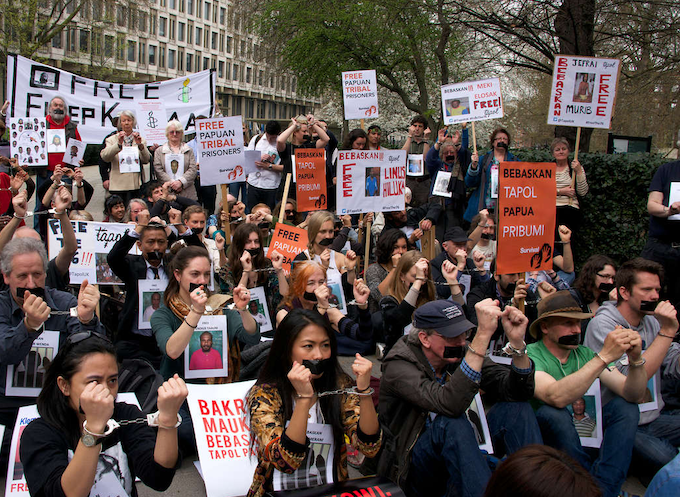
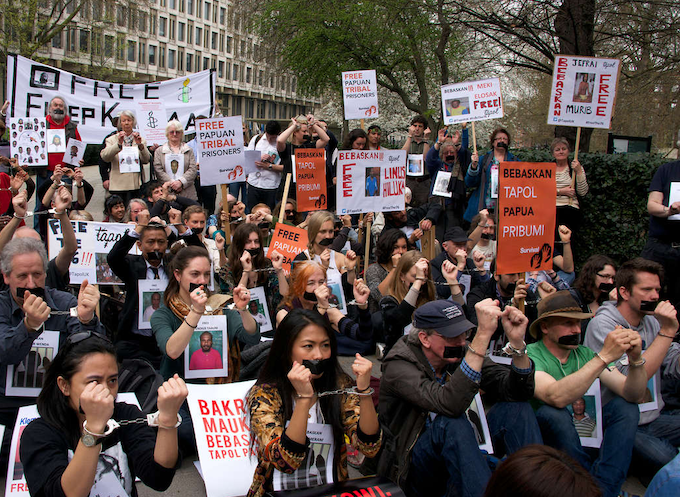
The Indonesian human rights advocacy group TAPOL has denounced the sentencing by the district court of Central Jakarta which found six political prisoners guilty of treason yesterday and demanded their immediate release.
Paulus Suryanta Ginting, Ambrosius Mulait, Ariana Elopere, Dano Tabuni, and Charles Kossay were sentenced to nine months imprisonment, whereas Isay Wenda was sentenced to eight months imprisonment.
The six were arrested over their participation in a peaceful protest outside the State Palace in Jakarta on 28 August 2019, during which they flew Morning Star flags and chanted “Free West Papua”.
The first of their trials commenced on 15 December 2019. The prosecutors were seeking one year and five months imprisonment for each, except Isay Wenda, for whom prosecutors sought 10 months.
Suryanta, popularly known as Surya Anta, is the first non-Papuan Indonesian to be detained on treason charges over the West Papua self-determination cause.
– Partner –
The sentences include jail time that they have already served, including eight months for Isay Wenda with a release on 2 May 2020. The other five will still have to spend another month behind bars.
“One month is too long to be serving prison time in this critical pandemic period, as it is anticipated that Indonesia will reach its Covid-19 peak in the coming months,” said TAPOL in a statement.
Other West Papuan political prisoners charged with treason arrested during the uprising are on trial: seven in Balikpapan, four in Manokwari, four in Sorong, and one in Jayapura.
Twenty three political prisoners detained in Fakfak and 11 others in Sorong who were arrested in the lead up to 1 December 2019 and charged with treason are still awaiting trial.
“We therefore reiterate the urgency of releasing all political prisoners currently detained in overcrowded prisons where it is impossible to practice physical distancing,” said TAPOL.
“To organise or participate in a protest and to wave flags are internationally protected activities as freedom of expression and assembly are guaranteed under international law”
Australia’s relationship with China is fractured. Arguably, this is the worst moment in Sino-Australian relations since Gough Whitlam normalised ties on his election in December 1972.
The Chinese saying “kill the chicken to frighten the monkey” would seem applicable in Beijing’s reaction to Australia’s push for an investigation into the operations of the World Health Organisation (WHO) – and, by implication, China’s responsibility for the coronavirus pandemic outbreak.
Other countries have made similar calls without drawing Beijing’s ire to the same extent.
In an interview with The Australian Financial Review, China’s ambassador, Cheng Jingye, lambasted Australian political leaders and warned of economic reprisals. This marks a new and jagged low in relations between the two countries.
By any standards, this was an extraordinary step by a Chinese official. Cheng would not have taken it without Beijing’s go-ahead.
He accused Australia of “teaming up” with anti-Chinese elements in Washington to “launch a kind of political campaign against China”.
In China’s criticism, Australia is the “chicken” and the US the “monkey” as a recipient of Chinese displeasure.
China’s singling out of Australia for harsh criticism and threats of economic reprisals is designed to convey a message to a potentially vulnerable US ally that costs will accrue to countries that, in Beijing’s view, disrespect Chinese sovereignty.
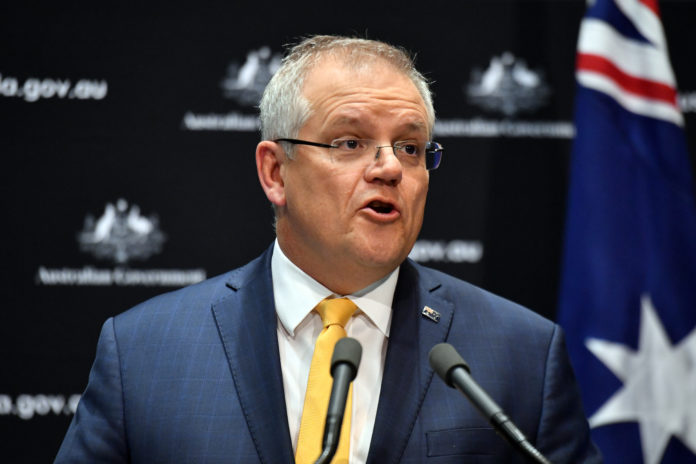
Prime Minister Scott Morrison’s lobbying for an inquiry into the WHO in phone calls with foreign leaders, including US President Donald Trump, will have struck the Chinese as more forward-leaning for the leader of a middle power than is necessary.
A less costly move, diplomatically, may have been for Morrison simply to have joined France’s Emmanuel Macron and Germany’s Angela Merkel in entirely legitimate calls for an inquiry.
The WHO is far from blameless. Its initial responses were clumsy. But little purpose would be served by diminishing the credibility of the organisation in the middle of a pandemic.
Once the global health emergency is brought under control – whenever that might be – stakeholders will have ample time to review their investments in the WHO.
In his attempts to shift blame for America’s disastrous initial responses to the pandemic, Trump has sought refuge in criticisms of China and the WHO. Washington’s decision to suspend payments to the organisation is both short-sighted and antagonistic towards global attempts to contain a pandemic whose ravages have far from run their course.
This is another example, if example was required, of America failing to exercise global leadership in a time of crisis.
In the nearly half century since the Whitlam government ended the diplomatic fudge that the Nationalists on Taiwan represented the whole of China, relations between Canberra and Beijing have proceeded relatively smoothly.
Beijing asserted America’s actions represented a containment threat. However, pushback then against Australia’s support for the US was relatively mild.
In 1996, it would’ve been unthinkable for the Chinese ambassador in Canberra to summon a journalist to receive the sort of pointed criticism – and threats – that have arisen over the WHO issue and China’s culpability for the pandemic.
Underlying China’s unhappiness with Australia and completely separate from the coronavirus argument is the Huawei issue.
Australia’s clumsy lobbying effort to persuade other members of the so-called “Five Eyes” security and intelligence collective to exclude the Chinese telecommunications giant from a build-out of their 5G networks remains a running sore.
The other “Five Eyes” members are Canada, the UK, US and New Zealand.
It is hard to exaggerate Beijing’s displeasure over an Australian anti-Huawei lobbying campaign. Indeed, the Huawei issue underlies much of China’s angst against Australia in this latest period.
Incidentally, no Australian prime minister has visited Beijing in an official capacity since Malcolm Turnbull’s visit in September 2016.
Morrison’s conspicuous bid to hold China to account over its role in the coronavirus outbreak will be viewed in Beijing as of a piece with the Huawei issue.
None of this is to suggest other than that China’s behaviour was unconscionable, first in concealing the coronavirus outbreak from the world and then persecuting those among its citizens who sought to publicise its deadliness.
Beijing’s early mismanagement of the coronavirus will not be forgotten, nor should it.
However, the question for a middle power like Australia – located in an Indo-Pacific in which China will become more dominant – is how best to manage the dragon in the room.
China’s bullying behaviour, its threatened resort to a form of economic blackmail and its attempts to drive a wedge between Canberra and Washington mark a vexed new frontier for Australian diplomacy.
Morrison and his advisers might reflect on how the world might look, as the prime minister puts, “on the other side” of the pandemic. We don’t know, but what we do know is that things will not be the same.
Whether China continues its rise, or slips, is an open question. However, whatever calculations might be made about the future, it has proved a mistake to bet against the Chinese since their opening to the outside world in 1978 following Mao’s death.
Morrison’s marketing of his phone call with Trump in which he, or his spokespeople, sought to portray a prime minister answering a call to arms against China was a mistake insofar as it enabled Beijing to pounce.
China needs little encouragement to drive a wedge between Canberra and Washington. These are opportunities a more sophisticated – and less eager – approach in Canberra would forestall. It is hard to escape the conclusion that Australia’s China policy is in the hands of amateurs, or ideologues, or both.
This brings us to the vulnerability issue alluded to crudely by Ambassador Cheng in his AFR interview. Chinese, he warned, might have second thoughts about consuming Australian products like wine and beef, or sending their kids to Australian universities, if relations remain strained. He said:
The Chinese public is frustrated, dismayed and disappointed with what Australia is doing now.
He did not provide evidence to support such a proposition.
But it is the case that Australia’s economic dependence on China is such that it affords the Chinese what Australian policymakers should recognise as an unacceptable level of leverage, even a stranglehold, in times of stress.
No other comparable country is as dependent on China. In 2019, China accounted for more than one-third of Australian merchandise exports and one-fifth of services trade.
Returning to the chicken and monkey metaphor, it would be wise for future Australian governments to work hard on giving the chicken a few more options – including steering clear of the Washington coop – to avoid ending up on a Chinese chopping block.
Source: The Conversation (Au and NZ) – By Aaron Corn, Professor, Elder Conservatorium of Music · Director, Centre for Aboriginal Studies in Music (CASM) · Director, National Centre for Aboriginal Language and Music Studies (NCALMS), Faculty of Arts, University of Adelaide
Recent weeks have been a blur of livestreams as politicians and chief medical officers have taken to Facebook and YouTube to announce Australia’s emergency measures to contain the COVID-19 pandemic.
But on Saturday evening, I eagerly logged onto Facebook, along with more than 50,000 others, to enjoy a livestream of an entirely different kind. It was the first in a series of four East Arnhem Live music concerts to be streamed weekly.
It not only offers a welcome respite from the social isolation many Australians are now feeling, but it is also an ingenious way for Arnhem Land’s prolific musicians to share their music with audiences around the world.
On location
The Northern Territory’s Arnhem Land is home to dozens of remote Indigenous communities, including the Yolŋu communities in the far northeast. While there are presently no known cases of COVID-19 in Arnhem Land, the region’s economic stability relies heavily on artists’ income, which is greatly supported by local tourism during the dry season and international touring to festivals all year round.
Streamed on Saturday, April 24 and still available online, the first East Arnhem Live concert featured singer Yirrŋa Yunupiŋu, the current frontman of rock band Yothu Yindi, with Arian Pearson on acoustic guitar. To showcase Arnhem Land’s natural beauty, the concert was filmed on location at Gälaru (East Woody Beach) against the sun setting over the Arafura Sea, and incorporated stunning aerial cinematography of Dhamitjinya (East Woody Island).
East Arnhem Live with Yirrŋa Yunupiŋu and Arian Pearson.Facebook
At a length of four songs over 14 minutes, it was a tantalisingly brief event that left me wanting more. It stirred deep nostalgia for my own experiences in Arnhem Land over the past 25 years and long collaborations with local musicians there.
Yirrŋa Yunupiŋu’s four-song set exemplified the very best of Yolŋu songwriting, building significantly on the heavy traditional influences of the style developed by Yothu Yindi around 1990. The influence of Manikay, the ancestral song tradition performed by Yolŋu communities in their public ceremonies, is ever-present in Yirrŋa’s own songs. This is evidenced by the bilma (paired sticks) he played throughout the concert.
With no more than a few hundred senior Yolŋu Manikay singers alive today, the present threat of COVID-19 brings into sharp relief the rarity and uniqueness of Manikay as a quintessentially Australian musical tradition. This is indeed a national treasure of global significance that deserves to be better supported and cherished in Australia and globally.
An anthem for our time
The concert’s opening song was Sweet Arnhem Land, a balladic ode to the region’s immense beauty that includes a direct quote from the Manikay repertoire of Yirrŋa’s clan, the Gumatj. This Manikay quotation references the great ancestral hunter, Ganbulapula, and its melody should be instantly recognisable to anyone who has attended the Garma Festival and experienced public ceremonial repertoire being performed there by the Gumatj clan.
The second song was a cover of Kind of Life, which was first released by Yothu Yindi on the 1991 Tribal Voice album. It was a fitting homage to earlier pioneers of popular music from Arnhem Land, such as Witiyana Marika and the late Mandawuy Yunupiŋu AC of Yothu Yindi, who were the first to gain global acclaim.
The third song, We Rise, is nothing short of an anthemic triumph. Its stirring sentiment of solidarity in the face of great change and adversity will readily resonate with many Australians at this challenging time.
Yirrŋa’s final song, Banumbirr (Morning Star), pays respect to his mother’s clan, the Rirratjiŋu. Once again, it includes a direct quote from traditional Manikay repertoire, which this time comes from the Rirratjiŋu clan’s iconic Morning Star song series.
With more than 53,000 views on Facebook since Saturday night, this first East Arnhem Live concert has been an outstanding success. While I greatly look forward to the day when I can fly to Arnhem Land again to see dear friends and hear music there in person, this concert series is a most welcome substitute that offers an unexpectedly intimate and poignant experience. And it shares the great beauty of Yolŋu song against the backdrop of the natural environment from which it sprung.
The Yolŋu people have long engaged with new technologies while retaining their own sense of autonomy. This latest innovation in streaming concerts via social media platforms is in keeping with their pre-colonial exchanges with visiting Asian seafarers.
It was this same longitudinal dialogue between tradition and innovation that made the music of bands like Yothu Yindi possible.
Musicians Yirrŋa Yunupiŋu and Arian Pearson are to be congratulated heartily for this first East Arnhem Live concert, as are the series’ presenters at ARDS Aboriginal Corporation and Yolŋu Radio, and sponsors at Rirratjiŋu Aboriginal Corporation and Developing East Arnhem.
The next three Saturday nights promise to be equally special with unmissable concerts by the Andrew Gurruwiwi Band on May 2 and Yirrmal Marika on May 9, and an unprecedented closing stream of traditional ceremony by the Rirratjiŋu clan on May 16.
The next three East Arnhem Live concerts will stream on the East Arnhem Land Facebook page at 6.30 pm ACST on Saturday, May 2, May 9 and May 16.
Charles Darwin University’s Gupapuyŋu App provides a Yolŋu language pronunciation guide that is free to download.
Debate about how Australia will emerge from the coronavirus pandemic is heating up. As part of the economic recovery, business groups have renewed calls to cut “green tape” – environmental regulation that new projects, such as new mines, must follow.
In response, federal environment minister Sussan Ley wants to introduce new legislation to cut green tape and speed up project approvals.
Minister Sussan Ley wants to change national environment laws before a review ends later this year.AAP Image/Bianca De Marchi
Cutting green tape is a long-held aim of the Morrison government, which claims excessive environmental regulation unfairly stifles businesses.
But this isn’t the case. In my 30 years of experience researching water pollution, “green tape” has not translated into effective environmental regulation of industry. In fact, I’m yet to see a coal mining operation that’s effectively regulated after approved through the NSW and federal environmental assessment processes.
Here are five examples that show how existing environmental regulations have done little to prevent pollution and toxic chemicals from entering the environment.
1. Closed mines pollute for decades
My research on water pollution from coal mines in the Sydney basin routinely reveals inadequate environmental regulation. I’ve repeatedly uncovered long-standing environmental issues the industry doesn’t seem to learn from, such as pollution continually leaching from active and closed mines.
As part of my PhD research in 2002/3, I studied Canyon Colliery – a coal mine deep in the Blue Mountains that closed in 1997. The mine constantly releases large volumes of toxic zinc and nickel contaminated water from the flooded underground workings into an otherwise pristine mountain stream.
This caused ecological damage in the Grose River, including a steep reduction in species and numbers of river invertebrates below the entry of the mine wastes into the river.
Contaminated drainage washing out of the closed canyon mine in Blue Mountains National Park.Ian Wright, Author provided
It’s now 23 years since the mining stopped, but the pollution continues – testimony of weak and ineffective environmental regulation. And it will probably last for centuries.
The Canyon Mine is just one of thousands of contaminated, derelict mining and industrial sites dotted around Australia lacking environmental controls.
But despite this legislation, many new and active mines that lead to environmental damage have been assessed and approved.
Research by my team at Western Sydney University has documented pollution from an active Blue Mountains coal mine, Clarence Colliery.
The mine caused severe metal contamination and ecological damage to the Wollangambe, a World Heritage River. Our research led to the NSW Environment Protection Authority (EPA) in 2017 imposing more effective restrictions on the release of toxic pollutants from the mine.
The author sampling water in the contaminated Wollangambe River.Author provided
Despite approvals from both the NSW and federal governments, it seemed no one had noticed the magnitude of pollution from poorly treated mine wastes until our research was conducted. This caused ecological degradation to more than 20 kilometres of the highly “protected” Wollangambe River.
The Conversation contacted Centennial Coal, which owns Clarence Colliery, for comment. They directed us to their statements in 2017, when the EPA finished a five-year review of Clarence’s Environmental Protection Licence (EPL). Then, the company said:
As a result of this review Clarence will operate under a new EPL which will include agreed reductions in metal concentration limits for all water discharged to the Wollangambe. Salinity targets will also be set at 100 EC (electrical conductivity).
Clarence will also be required to comply with a Pollution Reduction Programme (PRP), also issued by the EPA, which will result in Centennial formalising options to address all water quality issues and to meet specific water quality milestones.
3. Georges River
In 2010 I made a submission as part of the environmental assessment for an extension of BHP Billiton’s Bulli Seam coal mining operations (now owned by South 32).
This involved reading thousands of pages of consultant reports explaining how the expanded operation would attempt to avoid or minimise impacts to the environment.
The mine extension was approved. Despite the many “green tape” hurdles, the approved mine was allowed to discharge wastes which our research discovered contained pollutants that were hazardous to river life in the Georges River. These included salt, nickel, zinc, aluminium and arsenic polluting the upper Georges River.
The EPA has since worked with the coal miner to reduce pollution from the mine.
4. Coal mining under Sydney’s water supply
Many were stunned on March 16 this year, when the NSW government signed off on new coal mine “longwalls” directly under Woronora Reservoir, part of Sydney’s drinking water supply.
Longwall mining is the continuous mechanical removal of coal in underground mines that allows the roof of the mine to cave in after the coal is removed.
So what can they do to a river? Redbank Creek near Picton – 65 kilometres southwest of Sydney – provides a sad testimony.
Redbank Creek no longer flows normally, but has isolated pools of contaminated water.Ian Wright, Author provided
For nearly a decade, I documented damage where falling ground levels (subsidence) caused by longwalls led to extensive damage to the creek channel.
The land surface fell more than one meter. This caused cracking, warping and buckling of the creek channel. It now rarely holds water in many stretches. Isolated stagnant pools in the creek now accumulate saline and metal-contaminated water containing little aquatic life except for mosquitoes.
The mine responsible for this damage, Tahmoor Colliery, is seeking to extend its operations and the NSW government is currently considering the development.
This mine also disposes of about four to eight megalitres of poorly treated wastes each day to the Bargo River, a popular freshwater swimming river for south-western Sydney.
5. PFAS contamination
Despite the existence of “green tape”, unforeseen problems have left Australia with many contaminated sites that may never be fully cleaned up.
We’ve seen this in the dozens of locations across Australia where toxic PFAS chemicals have contaminated land, water, ecosystems and people.
These were previously regarded as safe chemical additives, for example in fire fighting foam, particularly at military bases.
Such contamination is very expensive to remediate and in February this year landholders near three defence bases reached a financial settlement for the PFAS damage to their property.
“Green tape” is an emotive word implying unnecessary and slow environmental regulation that delays major projects.
Given my own direct experience involved poorly regulated coal mines, I shudder to imagine the environmental degradation “fast-tracked” environmental regulation will lead to.
The Conversation also contacted SIMEC, which owns Tahmoor Colliery. A spokesperson said:
Mining in NSW is governed by stringent state and federal laws enforced by a number of government departments and regulators. SIMEC Mining acquired the Tahmoor Coking Coal Mine two years ago and takes its environmental, compliance and social responsibilities seriously.
Tahmoor Mine has been operating for well over 40 years. We acknowledge that historical mine activity did impact Redbank Creek and that this was self-reported to the regulator. Since then, SIMEC has worked closely with the NSW Department of Planning, Industry and Environment (DPIE) to enact a comprehensive plan to rehabilitate the creek. Recent rainfall has demonstrated the success of this work and we are confident that the rehabilitation works will restore the creek.
While our operations do produce water as part of the mining process, this is treated and monitored in accordance with our licence conditions. The quality of this water is mandated by our environment protection licence issued and monitored by the NSW Environmental Protection Authority (EPA). Typically, the water monitoring results are well below those limits allowed by the licence. To further improve water quality, SIMEC Mining has committed to the installation of a new water treatment plant.
Water management has been a key focus for SIMEC in the planning of the proposed Tahmoor South extension. We have commissioned extensive specialist assessments to understand any potential impact on ground and surface water. If our extension is approved, these water assets will be carefully monitored throughout the life of the mine to ensure that should any issue occur, it is detected early and resolved efficiently.
It is dangerous to predict how pandemics will pan out. In Covid19 by the Numbers, Anatole Kaletsky (writing for Project Syndicate on 10 March 2020) used what looked like advanced analysis to conclude that at most 750,000 outside of China would contract Covid19. (He admitted he was wide of the mark in a subsequent March article, Averting Economic Disaster Is the Easy Part.)
The latest data shows a world tally of over three million known cases, which means about thirty million actual cases, mostly in Europe and North America. (If the eventual number of actual cases is 78 million, that would be one percent of the world’s population. And if one percent of actual cases die, that would mean a final world tally of 100 Covid19 deaths per million (one per 10,000). Currently the official death tally is 27 per million, and is therefore probably about 40 per million given that many non-hospital deaths have not made the official statistics.
On Evening Report I have used charts – and accompanying conjecture – to make predictions and draw conclusions. On March 23 (and April 1),the day the ‘lockdown’ was announced, I predicted (optimistically, and based on by expectation that the restrictions would be effective) that the eventual case incidence in New Zealand would be “no more than” 25,000 and that deaths would finalise at about 100. (At the time people were projecting “tens of thousands” of deaths.) Later (April 9), too optimistically, I revised my prediction of deaths to ten. (The geometric mean of my two predictions – 100 and 10 – for New Zealand’s final death toll is 32 deaths; that is looking likely at present!)
One of the most common projective statements about Covid19 is that, eventually, it will hit developing (‘third-world’) countries hardest, because in these countries physical distancing is almost impossible and healthcare systems would be less able to cope than those of first-world countries. A variation of this expectation is – that in countries including Italy and New Zealand – the final toll could be worse in the poorer parts of those countries.
In New Zealand, that means Māori-Pacific tolls would be worst in the event that those groups do not receive greater levels of protection than might be deemed necessary for the country as a whole. Some Māori activists have justified community road blocks by noting that Māori death rates have substantially exceeded Pakeha death rates in previous epidemics; for example in the Black November Influenza of 1918. In those historical events, the reason for these higher death rates is that Māori and Pacific peoples had lower acquired immunity to these kinds of illness. The argument today is that, mainly for socio-economic reasons, these groups have lower actuarial life expectancies; meaning that a typical 65-year-old Māori faces a similar risk of death as a typical 75-year old Pakeha.
We might note that not only in the Black November Flu of 1918 did Māori die disproportionately, it also hit some Pakeha regions disproportionately, most notably Southland. Without aeroplanes, and with substantial quarantining, the 1918 virus spread very quickly throughout the country. Covid19 seems quite different.
Incidence and Spread of Covid-19 so far
On March 22 I identified Covid19 as a Jetsetter Disease, noting that tax shelters, financial centres, gambling centres, ski resorts, cruise ships and high-end tourist destinations were substantially overrepresented in early cases outside of ‘mainland’ China. (Many of these places are very small, so have fallen under the media radar.) While not as prominent as then, that pattern of Covid19 incidence continues to persist five weeks later. San Marino remains easily the worst affected country in the world, in both cases and deaths.
According to another AP article, Covid19 coronavirus, What went wrong in Italy?, “epidemiologists now say the virus had been circulating widely in Lombardy since early January”. Maybe it arrived in Milan via the World Economic Forum in Davos (21 to 24 January)? Maybe that’s where Greta Thunberg caught it?
After the Covid19 epidemics in Italy, Scandinavia and Spain, it spread through Switzerland, Germany and France, and then to Belgium and the Netherlands. (London and New York – big financial centres – also got it, and it spread from those centres through the United Kingdom and the United States.)
In Italy, it was widely predicted that Covid19 would spread en masse to Italy’s poorer south. It didn’t really happen. Covid19 spread from northern Italy to the rich north of the European Union; not nearly so much to the poorer south of Italy. The trains heading south from Milan transported much less viral load than the planes flying north.
When looking at the spread of Covid19 to northwest Europe, I noted that a comprehensive regional analysis of the European Union shows that – subsequent to the outbreaks in Italy and Spain – a corridor to the west of Germany, stretching from Switzerland to the Netherlands (and on to Brussels), has become Europe’s covid-central. Covid19 does not respect international borders within the European Union. Drawing a boundary around this worst-affected zone, gives an imaginary country that I have called Europia; a ‘country’ which is tantamount to the Federal Capital of the European Union. It suggests that European Union bureaucrats themselves have been one of the most important vectors in the spread of Covid19 in Europe.
The environments that seem to foster Covid19 are the ones that the top ten percent of ‘first-world’ people inhabit, at work and après-work. The cruise ship environment is already well documented. In the ski resorts, it will have been in the après-ski facilities in which the new coronavirus spread; people socialising in relatively crowded spaces with modern air-conditioning. Many of these people will have been managers, public servants and the like; people who work in medium-sized air-conditioned offices, and whose work tasks involve meetings and conferences in modern indoor facilities. And they will be people who have dined in restaurants; dining as part of work functions, and dining in restaurants après-work because they live time-poor lifestyles.
These virus-transmission spaces are substantially less prevalent in the poorer regions of ‘first-world’ and ‘third-world’ countries alike. These spaces are generally much less prevalent within ‘third-world’ developing countries.
As of 27 April 2020, Europe and North America together have had 78.1 percent of known cases of Covid19, and 87.8 percent of world deaths. The global figures are 393 known cases of Covid19 per million of the world’s population, and 27 deaths per million.
In this commentary, I finished with “I have some confidence that Asia and Africa will end up with much lower rates of infection than Europe. I am much less confident about Latin America”.
In an earlier commentary, I said that we should watch Turkey. Turkey was very late to announce its first case, and has had possibly the post rapid exponential rise in cases since then. Nevertheless, Turkey has subsequently tested more intensively than United Kingdom, France and Sweden; and Turkey’s cases and deaths are stabilising at much lower incidences than in Northern Europe. So my sense is that the other large developing countries will have experiences comparable with Turkey; or even less severe.
If we look at Africa, by far the most affected countries (by cases) are the French territories of Mayotte, Reunion and Djibouti. While those with the most aggregate deaths so far are the Mediterranean countries of Algeria and Egypt, and also South Africa. Of these, only Algeria – with its French proximity and connections – has a death rate higher than New Zealand. I believe that, if Africa was to become as affected as Europe, the damage would be well underway by now.
South Africa still has just a quarter of New Zealand’s incidence of Covid19. Maybe it will catch up with New Zealand, but will probably not exceed New Zealand’s incidence by very much.
Asia includes Turkey, Iran, Korea and China. It also includes the Arabian Peninsula which has had substantial new caseloads. Also Singapore and Japan have had renewed outbreaks. Turkey has had the most cases in Asia, followed by Iran and then China. Qatar has the highest known incidence in Asia (and tenth highest in the world), though has reported fewer deaths than New Zealand.
The places in Asia that have the most potential to add most to the world’s Covid19 deaths are in the Arabian Peninsula, and now better fit the ‘first-world’ rather than ‘third-world’ moniker.
While many Latin American countries are in North America, the North American Covid19 statistics are still overwhelmingly dominated by the United States and a yet-to-stabilise Canada.
By caseload, the worst affected in Latin America are, in sequence: Panama, Ecuador, Peru and Chile. These all have known caseloads above the world average. The rest, including Brazil, have below average caseloads. On deaths, it’s the same story, though Chile and Peru are below average. Mexico is well-down, below Chile though higher than Algeria, Africa’s worst.
Panama and Ecuador are easily the worst-affected countries in Latin America. Panama we easily recognise as a jetsetter tax haven, with lots of modern air-conditioned office spaces.
Ecuador has a huge outbreak in its coastal city of Guayaquil; its high altitude capital (Quito) is much less affected. The Guayaquil outbreak is probably random – much like a wedding cluster in New Zealand – and is in a hot and humid part of the world. While I have not been to Ecuador, I have been to Cusco and La Paz. These high-altitude tropical cities – which are also tourist cities – have congenial all-round climates, and require little heating or air-conditioning. Unlike Guayaquil. In Peru, Latin America’s third-most affected country, most cases are in Lima; there are also high instances in the steamy parts of that country; the north and the Amazon northeast. These places in Peru are the places where there are built environments that are the most modified relative to their outdoor environments.
It’s a similar story in Brazil. Worst affected are Brazil’s economic capital (São Paulo), and its Amazon capital (Manaus). Manaus is now a very modern city (surrounded by equatorial rainforest); like Panama City. If Covid19 was going to decimate Rio de Janeiro’s favelas, we should be seeing more of that by now. (Likewise Mumbai’s slums, in India; I just don’t see that happening.)
Conclusion
From all the evidence I have seen so far, Covid19 is very much a ‘first-world’ disaster, spread by relatively entitled people, and most prevalent in ‘first-world’ built environments.
This may be the most important lesson we can draw, when thinking about how the world’s socio-economy could and should develop in the future. The pandemic and unsustainability crises appear to be related, and should be addressed together. The prevalent and entitled life-styles (work styles and leisure styles) and life-assumptions of the first-world’s ten-percenters (the most privileged ten percent) need to change.
In eight years, US environmentalist and social media star Lauren Singer had never sent an item of rubbish to landfill. But last month, in an impassioned post to her 383,000 Instagram followers, she admitted the reality of COVID-19 has changed that.
I sacrificed my values and bought items in plastic. Lots of it, and plastic that I know isn’t recyclable in NYC (New York City) recycling or maybe even anywhere … why would I go against something that I have actively prioritised and promoted?
Singer wrote that as the seriousness of COVID-19 dawned, she stocked up on items she’d need if confined to her home for a long period – much of it packaged in plastic.
Her confession encapsulates how the pandemic has challenged those of us who are trying to reduce our waste. Many sustainability-conscious people may now find themselves with cupboards stocked with plastic bottles of hand sanitiser, disposable wipes and takeaway food containers.
So let’s look at why this is happening, and what to do about it.
The coronavirus crisis has pushed the global problem of plastic waste into the background.Ammar Awad/Reuters
Sustainability out the window
We research how consumers respond to change, such as why consumers largely resisted single-use plastic bag bans. Recently we’ve explored how the coronavirus has changed the use of plastic bags, containers and other disposable products.
Amid understandable concern over health and hygiene during the pandemic, the problem of disposable plastics has taken a back seat.
Restaurants and other food businesses can now only offer home delivery or takeaway options. Many won’t allow customers to bring their own containers, defaulting to disposables which generate plastic waste. This means many consumers can’t reduce their plastic waste, even if they wanted to.
Demand for products such as disposable wipes, cleaning agents, hand sanitiser, disposable gloves and masks is at a record high. Unfortunately, they’re also being thrown out in unprecedented volumes.
And the imperative to prevent the spread of coronavirus means tonnes of medical waste is being generated. For example, hospitals and aged care facilities have been advised to double-bag clinical waste from COVID-19 patients. While this is a necessary measure, it adds to the plastic waste problem.
Many cafes will not accept reusable cups during the health crisis.The Conversation
Cause for hope
Sustainability and recycling efforts are continuing. Soft plastics recycler Red Cycle is still operating. However many dropoff points for soft plastics, such as schools and council buildings, are closed, and some supermarkets have removed their dropoff bins.
Boomerang Alliance’s Plastic Free Places program has launched a guide for cafes and restaurants during COVID-19. It shows how to avoid single-use plastics, and what compostable packaging alternatives are available.
As the guide notes, “next year the coronavirus will hopefully be a thing of the past but plastic pollution won’t be. It’s important that we don’t increase plastic waste and litter in the meantime.”
Plastic bag use is surging during the pandemic.TASS/ Sipa USA
However, there is little evidence to show plastic bags are a safer option, and at least reusable cloth bags can be washed.
A relaxation on plastic bag bans – even if temporary – is likely to have long-term consequences for consumer behaviour. Research shows one of the biggest challenges in promoting sustainable behaviours is to break old habits and adopt new ones. Once people return to using plastic bags, the practice becomes normalised again.
In Europe, the plastic industry is using the threat of coronavirus contamination to push back against a ban on single-use plastics such as food containers and cutlery.
Such reframing of plastic as a “protective” health material can divert attention from its dangers to the environment. Prior research, as well as our preliminary findings, suggest these meanings matter when it comes to encouraging environmentally friendly behaviours.
Many people are using their time at home to clear out items they no longer need. However, most second-hand and charity shops are closed, so items that might have had a second life end up in landfill.
Similarly, many tool, book and toy libraries are closed, meaning some people will be buying items they might otherwise have borrowed.
Once consumers go back to using plastic bags, it will take time to break the habit again.Darren England/AAP
What to do
We can expect the environmental cause will return to the foreground when the COVID-19 crisis has passed. In the meantime, reuse what you have, and try to store rather than throw out items for donation or recycling.
Talk to takeaway food outlets about options for using your own containers, and refuse disposable cutlery or napkins with deliveries. Use the time to upskill your coffee-making at home rather than buying it in a takeaway cup. And look for grocery suppliers offering more sustainable delivery packaging, such as cardboard boxes or biodegradable bags.
Above all, be vigilant about ways environmental protections such as plastic bag bans might be undermined during the pandemic, and voice your concerns to politicians.
Amidst a global pandemic, some people are starting to dream big about infrastructure projects to help get Australia moving again. The decades-old dream of an Australian fast train is back in the headlines. But, as alluring as it sounds, the federal opposition’s idea for a bullet train from Melbourne to Brisbane is not a good use of a generation’s worth of infrastructure spending.
After the coronavirus crisis, there may be good reasons to fast-track infrastructure to create jobs and stimulate the economy. But it remains as important as ever that funding go only to worthy projects. A bullet train does not fit the bill.
Federal Labor claims the train would be an “economic game-changer” for the regions in its path. But a study into the train, commissioned by Labor itself in government in 2010, found no evidence for this.
Any regional development was too uncertain, the authors concluded, to be considered in their cost-benefit analysis. In fact, they found the project could damage towns along the route:
The history of the impact of transport improvement in Australian towns is that they concentrate activity in the larger centres and create commuter towns lacking in higher level services. Without concerted efforts to the contrary, this is also a likely outcome of the introduction of HSR [high-speed rail].
Of course, as advocates will be quick to point out, the study did conclude total benefits would outweigh costs by a considerable margin: $2.30 in benefit for every $1 of cost. But this rosy calculation was based on a series of assumptions that are either outdated or inappropriate. As our upcoming report on fast rail will explain in more detail, it’s unlikely the train’s benefits would exceed its costs if a rigorous independent assessment were carried out today.
The benefits are also narrowly concentrated. The biggest winners would be business travellers between Melbourne, Sydney and Brisbane. Wider benefits to society accounted for only 3% of the total, and the effect on economic growth was expected to be minimal.
That’s because the train would take a very long time to build. According to the study, the project would only be “shovel ready” 15 years after funding was committed. This makes it completely ineffective as a timely stimulus during a downturn.
Advocates also argue the train would reduce emissions by taking high-emitting planes out of the sky. But a net reduction won’t be achieved for many years – maybe decades – because constructing the line would create so many emissions.
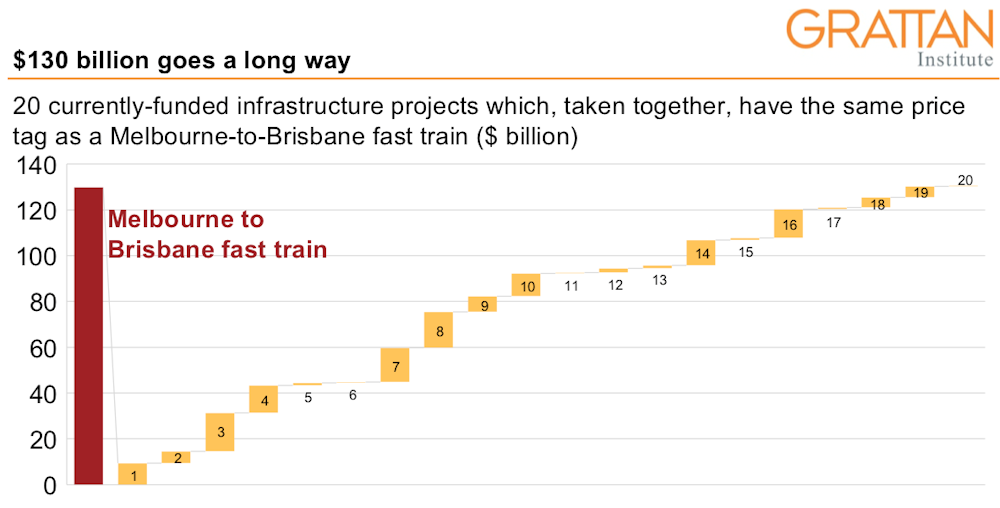
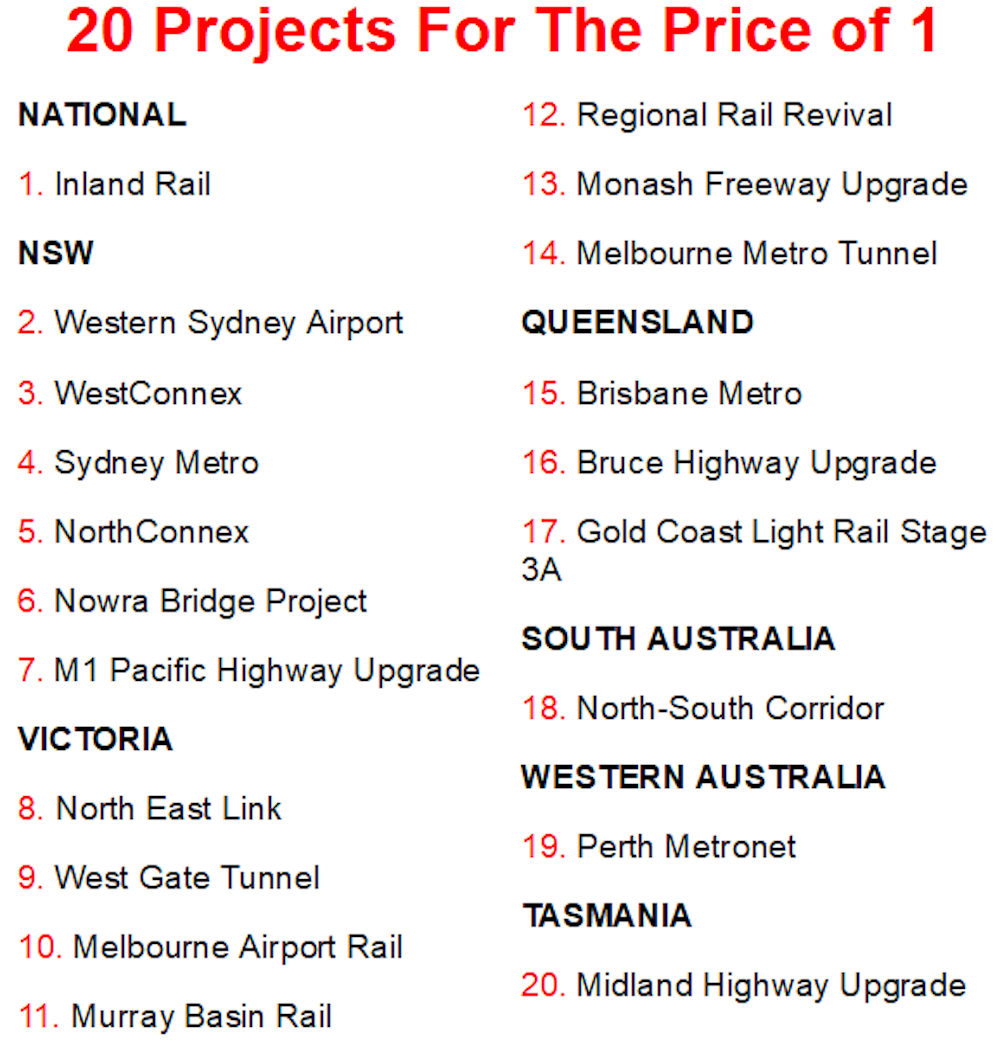
If built, this train would be the most expensive infrastructure project in Australian history. The study estimated the price tag at A$114 billion – A$130 billion in today’s dollars. As our chart shows, this is enough to pay for an entire generation’s worth of infrastructure.
Projects are not presented as an alternative to the train but provide a point of reference for the scale of spending required for the high-speed rail project. Projects in yellow have active government funding commitments. Figures indicate total project funding costs, including private contributions. Figure for the fast train is in 2019 dollars.Source: Based on most recent figures from Department of Infrastructure, Transport, Regional Development and Communications, Infrastructure Australia, NSW, Victorian and Queensland governments, Brisbane City Council, AECOM, ABS, Author provided
So what should be done?
It is true current low interest rates would make borrowing to pay for such a large project cheaper than ever before, and fast-tracking infrastructure may be justified to aid economic recovery. But that doesn’t give governments a blank cheque to spend on whatever they like. The crisis does not absolve government of its responsibility to scrutinise projects to decide whether they are worthwhile.
A good place to start is by identifying the problem you want to solve.
If regional development is the goal, other options are available to governments that are more likely to be effective than a bullet train. Infrastructure Victoria and Infrastructure NSW both identify better digital connectivity as a pressing need for regional and rural areas. The current strain on the national broadband network as many of us try to work from home is a good reminder of the link between connectivity and productivity.
If governments do want to focus on transport, “smaller picture” projects, though not as glamorous, tend to deliver more bang for buck, as previous Grattan work has argued.
Projects that can be fast-tracked to start construction soon are also more likely to support economic recovery. Infrastructure Australia’s priority list suggests a range of transport projects and initiatives that are much further developed, including improving the Sydney-Canberra rail link. And the priority list includes projects that benefit all states and territories, not just the big three on the east coast.
The coronavirus crisis has upended many of our assumptions about “normal operating procedure” for governments. But it doesn’t mean we throw the old rule book out the window. Governments should only spend public money on projects that have clear and tangible benefits to society – not on grand “nation-building” projects that are big on style but low on substance.
Over the past few weeks, there has been increasingawareness of the heightened risk of family violence during the COVID-19 pandemic.
However, there has been a silence around perpetrators – in terms of the justice system’s ability to hold them to account during the crisis and the wider family violence system’s need to keep them “in view”.
Both are critical to manage and monitor the heightened risk and danger to women and children during this period of uncertainty and isolation.
Keeping perpetrators ‘in view’
In 2016, a government advisory panel report on reducing violence against women recommended numerous steps to hold perpetrators to account and more support to change their behaviours.
Since then, all Australian states and territories have implemented family violence reforms to ensure numerous “check points” are embedded in their systems to keep perpetrators “in view” at all times.
Keeping perpetrators “in view” refers to the process of identifying, assessing, monitoring and managing their risk over time.
This notion of increased perpetrator visibility relies on coordination and information sharing between a range of men’s services, criminal justice agencies, family violence specialists and other support services, such as those dealing with mental health, alcohol and drugs.
But these responses have been significantly hampered by the COVID-19 restrictions, which limit the ability of victims to seek help and highlight the need for others to step in and report suspected abuse.
This raises the very real risk that new perpetrators will remain invisible for longer. Patterns of escalation among known perpetrators may also go “unchecked” unless they are monitored during this time of heightened risk.
Fewer men’s services during lockdown
One of the key ways known family violence perpetrators are held to account and kept in view is through men’s behaviour change programs (MBCPs).
These programs require men to attend weekly, group-based sessions, as well as engage in short or long-term case management programs.
An immediate impact of the coronavirus restrictions has been the suspension of some face-to-face men’s services and many MBCPs. While this has not stopped family violence interventions altogether, it does make known abusers less visible and may prevent them from getting the support they need.
Some men’s services are seeing a surge in demand for telephone services. Coinciding with the beginning of the lockdown last month, the Men’s Referral Service, a national telephone counselling service operated by No To Violence, has seen an alarming increase in calls from perpetrators of family violence.
This included a 94% increase in phone traffic and an average 20% increase in time spent with callers.
Despite the increased need, resources are still lacking. The federal government has announced a $1.1 billion boost in funding for mental health services, Medicare assistance and domestic violence support.
But this package does not specify additional funding to the Men’s Referral Service. Instead, the service makes do with funding from three states (Victoria, NSW and Tasmania).
In the absence of increased funding and availability of men’s services, proactive policing and random household checks of known, high-risk perpetrators will be critical during the lockdown.
Police resources have also been strained by the coronavirus crisis, but these spot checks should be seen as a priority. Victoria Police has recently committed to doing this.
Similarly, the Family Law Court has taken urgent action after reporting a 39% increase in applications relating to parenting orders over the past month.
Both the Family Law Court and Federal Circuit Court will fast-track cases in which there is an increased risk of family violence as a result of COVID-19 social restrictions. This may not guarantee long-term protection to women and children, but it brings perpetrators into view quicker when they are subject to urgent parenting orders during the crisis.
How the family violence system is innovating and adapting
Despite the current challenges, there has been a prompt response from the family violence service sector to the changing environment. For instance, some men’s intervention programs are adapting their strategies to reach known perpetrators who otherwise would be unsupported.
To replace MBCP group sessions, facilitators contact each man and conduct a 30-minute phone call to discuss topics usually covered in group, as well as other sources of stress (job loss, financial pressure, isolation at home).
A pilot MBCP for perpetrators with problematic alcohol or other drug use, developed by TaskForce Community Agency, has taken similar actions.
With a new, in-person group meeting unable to start at the moment, men who had been referred to the service are now receiving a combination of phone support and educational materials via group emails. This allows the agency to “check in” with known perpetrators and keep them “in view” until the next face-to-face group can start again.
There are likely many other examples of adapted and innovative practices in Australia, which has been a leading nation in family violence reform over the last five years.
It is essential the momentum of the work advanced nationally to keep perpetrators in view is not lost during the crisis.
There is no road map to achieve this. But it is clear we must prioritise and provide resources for the monitoring, assessment and management of family violence perpetrators during this time to keep women and children safe.
The National Sexual Assault, Family & Domestic Violence Counselling Line – 1800 RESPECT (1800 737 732) – is available 24 hours a day, seven days a week for any Australian who has experienced, or is at risk of, family and domestic violence and/or sexual assault.
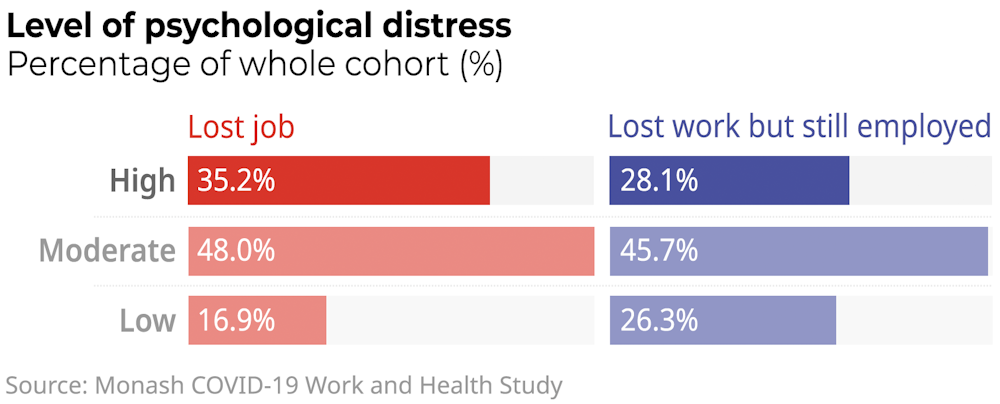
More than 31% of people who have lost work during COVID-19 are recording high levels of psychological distress — a rate four times more than employed Australian adults. Many lost work without notice and are facing high levels of financial stress.
These findings are part of our national study of people who have lost their jobs or have had their work hours reduced during the COVID-19 pandemic.
The negative impacts of prolonged unemployment on mental and physical health has been long recognised, and unemployment could emerge as the major public health crisis from COVID-19.
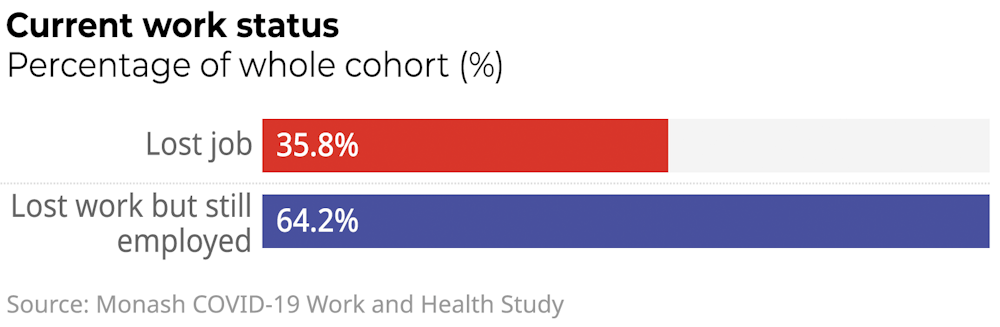
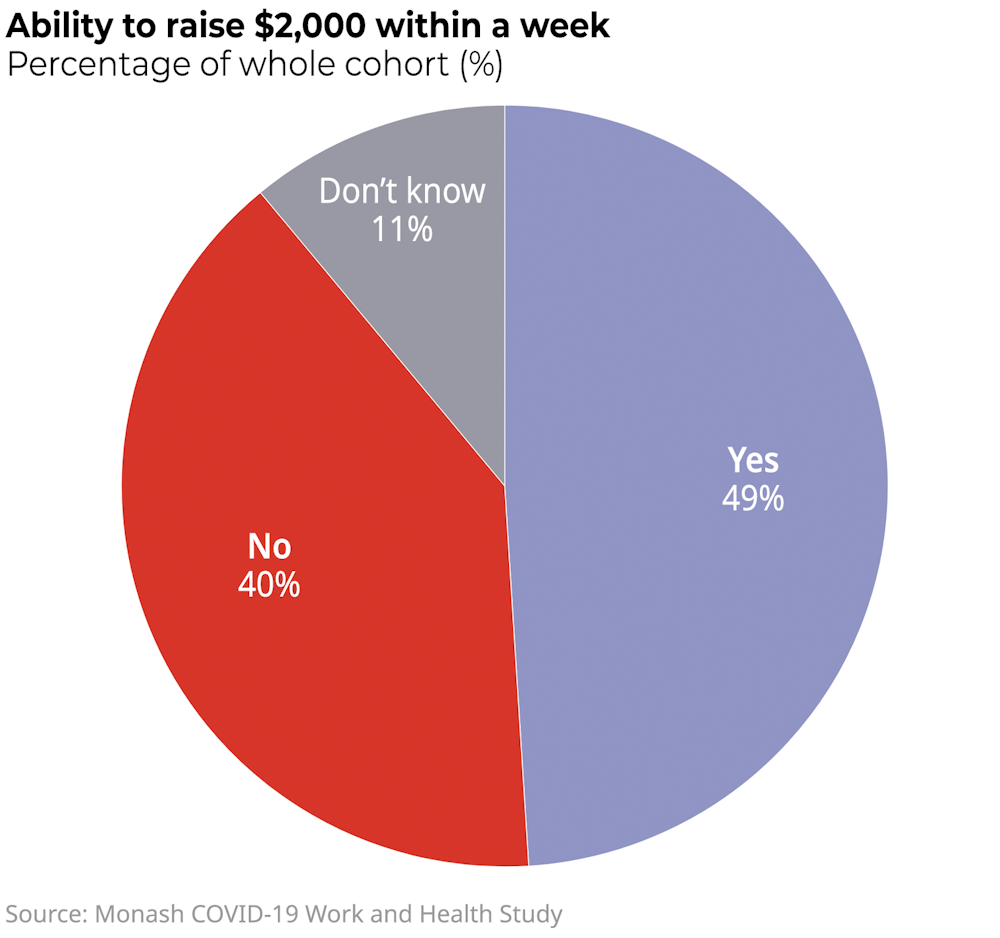
The early findings from 611 people enrolled in the study are outlined below. The charts show the acute impacts affecting people in the first few weeks after social distancing measures and travel restrictions were introduced and many businesses closed.
Job loss happened very quickly
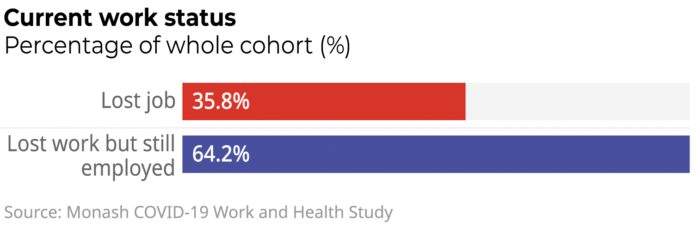
Almost 36% of our survey respondents lost their jobs, and about 64% are no longer working, though they remain employed.
Two-thirds of people in the study reported losing work, or losing their jobs, with zero or one day’s notice. About 90% lost work with less than one week’s notice.
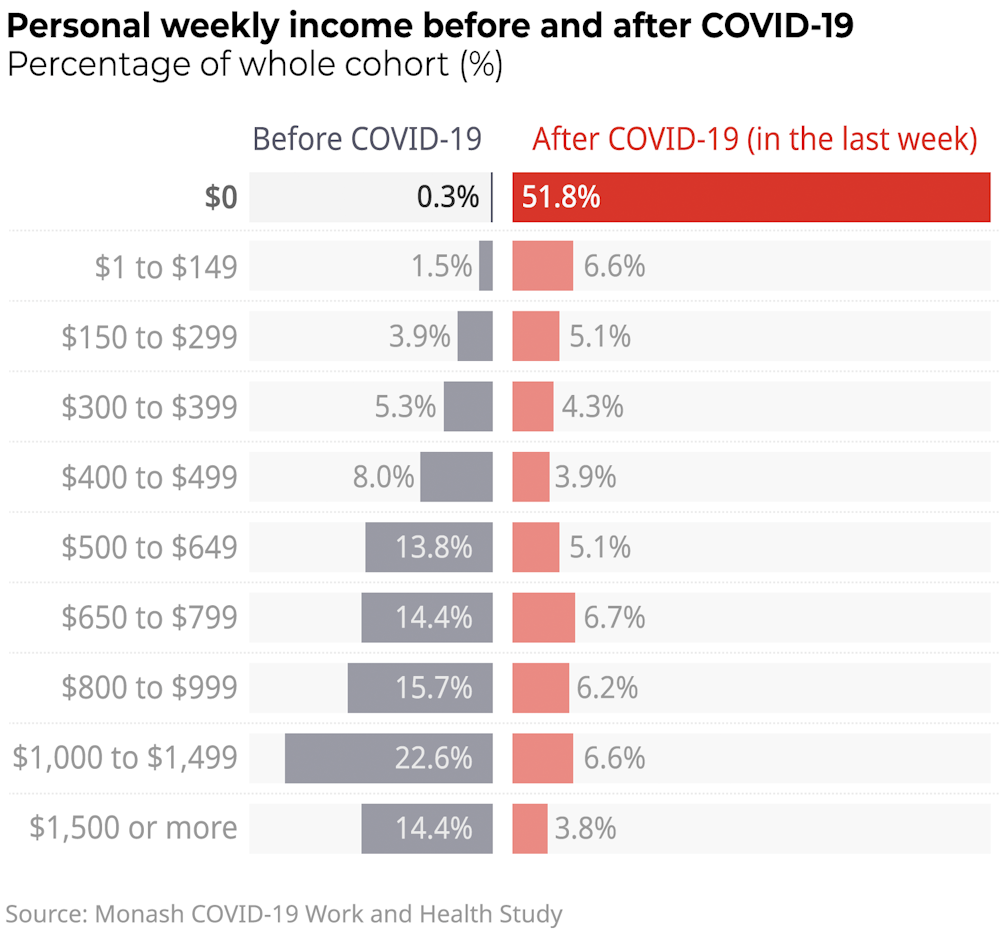
Before COVID-19 81% of people in the study reported an average weekly income of A$500 or more. The same people reported large drops in their income, with just under 29% reporting more than A$500 of income in the most recent week.
Most of the study data was collected after people lost jobs but before government stimulus payments such as JobSeeker, the coronavirus supplement and JobKeeper reached people’s bank accounts. Accordingly, almost 52% of people reported having no income in the most recent week.
People are under severe financial stress
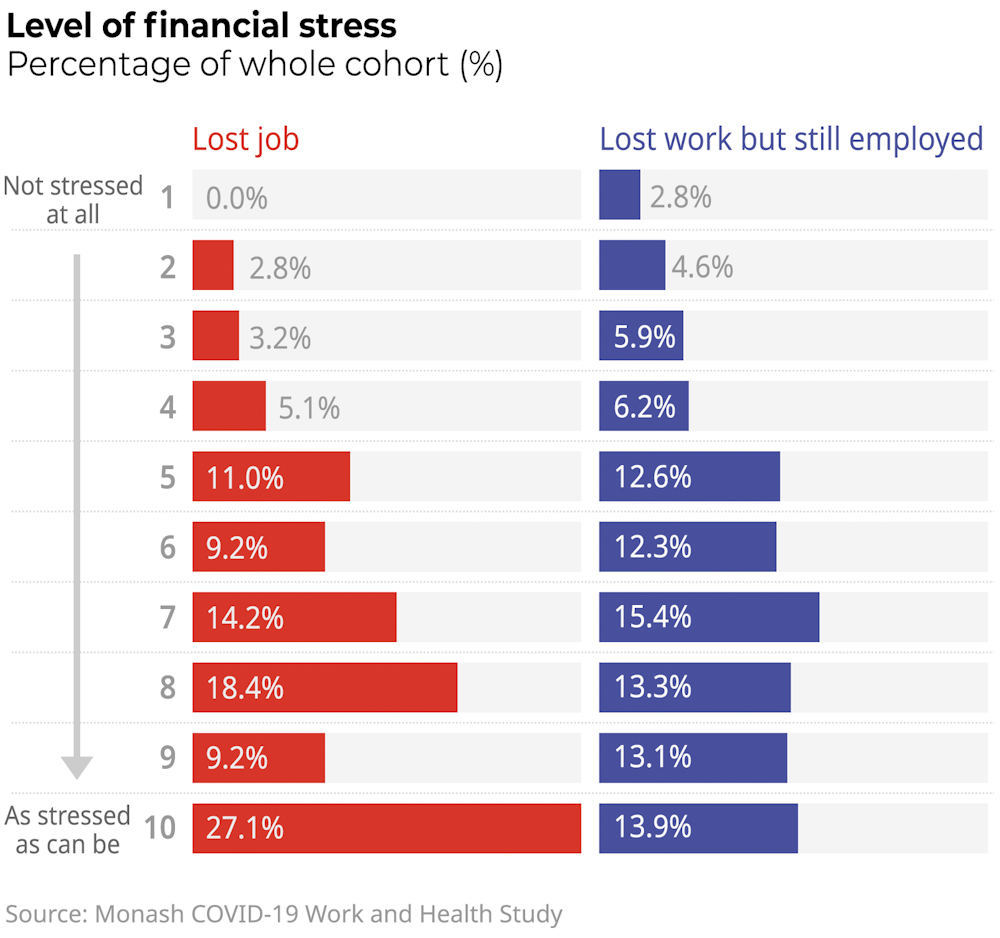
Not surprisingly given the situation outlined above, many people are already experiencing considerable financial stress. People who have lost their jobs reported significantly higher levels of financial stress than survey respondents who have lost work but have remained employed.
Rates of psychological distress are much higher in people losing work during COVID-19 than we typically see in working age Australians. More than 30% of people are recording high levels of distress, a rate almost four times that usually observed in employed Australian adults. Another third of study participants have moderate distress, again much higher than we normally observe.
About 66% of study participants had already applied for Centrelink payments, intended to apply or had registered their intent to apply. Once again, more people who have lost their jobs were in this category (77%) than those who had lost work but were still employed (59%).
As well as understanding people’s current financial and health status, the study asked people their thoughts about the future. About 71% said they were not confident of being back in paid work in one month’s time.
People were much more positive about their job prospects in three and six months, with almost 68% of people saying they were somewhat confident or very confident they would be back in paid work in six months’ time.
The high rates of psychological distress show that unemployment is much more than an economic problem. It is also a serious public health dilemma.
The study will track people’s engagement in work and their health over the rest of 2020 to understand who is most affected and how health and work change over time as restrictions ease, businesses reopen and the economy recovers.
If you have lost work or lost your job during COVID-19, and you are aged 18 or over, you can participate in the study by visiting www.covidstudy.net.
But even with new restrictions in place, the league should not resume until it can guarantee the safety of their players and employees.
The league also needs to ask serious questions about the social role of New South Wales’ biggest sport. Rugby’s return can signal a return to normalcy, but is the NRL sending the right message at the right time?
Many clubs are anxious about the short timeframe for restating play. They need enough time to resume operations, rehire personnel, stake out lodging and restart training. They also need time to put in place the proper health precautions.
Although the league claims its rules will be more “stringent than government restrictions”, it is unclear whether the biosecurity measures will be approved at the state or federal level. The league released a 47-page memorandum to clubs on Sunday evening, including additional measures such as:
increased player testing
playing in empty stadiums
a restricted schedule that limits travel
a mandatory COVID-19 training module
the social isolation of players inside their homes, except for essential business and travel
tough sanctions for rule violations.
The premiers of Victoria and Queensland have already voiced concerns about the NRL’s plans. While Prime Minister Scott Morrison and the federal government have no official position on the move, delegating responsibility for oversight of the NRL’s plans to the states, critics say the resumption of play sets a bad example at a time when Australia is on the cusp of eliminating domestic coronavirus transmissions.
Global health expert Adam Kamradt-Scott has said the restart date was “arbitrary” and warned
“if [the NRL] jump the gun and restart things too early we will confront the situation where we will see cases rise again and us having to go back into stronger restrictions.
NRL teams restarted training earlier this month in anticipation of the season recommencing.Scott Barbour/AAP
The league asked the government for a bailout and was denied. Despite having its largest-ever television contracts, the league had not invested in any collateral, such as a stadium or even the land under its own headquarters, and over the past few years, had spent down its rainy-day fund.
Having also not invested in pandemic insurance, it was looking at a certain financial catastrophe.
The league’s financial woes worsened after a fortnight of sparring with its biggest television partner, Nine, which led pundits to wonder whether the NRL might still have a television home when its current contract ends in 2022.
At the end of the week, the NRL seemed to reach an agreement with Nine. Their rapprochement comes with additional confidence of a forthcoming three-year extension of their television deal, but likely worth less than the last agreement.
By contrast, the NRL’s chief rival, the AFL, had put itself in a position to weather the virus for longer – a fact many rugby fans likely found galling. The AFL also cancelled play and stood down up to 80% of its staff, but it received loans from ANZ and NAB, thanks to the AFL’s ownership of the Docklands Stadium.
The recent departure of NRL Chief Executive Todd Greenberg and the resignation of Rugby Australia Chief Executive Raelene Castle further illustrate how difficult a time it can be for rugby administrators.
ARL chairman Peter V’landys said ‘there’s no reason not to resume’ the season.Dean Lewins/AAP
Can the NRL police itself?
Of course, there is danger with restarting too soon, as sporting clubs are particularly vulnerable to the spread of diseases.
Before the NBA season was shut down last month, a number of players tested positive for coronavirus, including four members of the Brooklyn Nets. Only one of the Nets was symptomatic, which raises the question: how long might the asymptomatic players continued to play had league officials not postponed the season?
Asymptomatic carriers could be the biggest problem for the NRL, too. A study in the British Medical Journal and a World Health Organisation report suggested that four-fifths of infected people may be asymptomatic.
As such, the NRL’s proposal to use apps to check temperatures and overall player health might miss those who are infected but not showing symptoms.
The NRL has also had significant issues with health technology in the past, such as when its “sideline injury surveillance” technology failed to properly assess head trauma to Matt Moylan after a shocking collision last year. Moylan played for another 10 minutes before being pulled off the field.
There is also growing scepticism about the NRL’s ability to police itself.
Peter V’landys, the chairman of the Australian Rugby League Commission, promises there will be sanctions for those who violate the biosecurity measures.
We’ve got no option, there must be a deterrent because one reckless act will bring down an entire competition and the livelihoods that come with that.
But has the league developed enough trust? It resisted calls for independent doctors to assess concussions for years and, since agreeing to the checks, has only done them inconsistently. It is not certain that league-affiliated doctors would be any more responsible in their approach to coronavirus.
Nor is it clear that fans will support these changes. How will supporters respond, for instance, if a star player is sanctioned for an unessential trip out of his home?
Another logistical question: does the league plan to keep players and other employees separate from their families for the whole season? In other sports, similar models have proven difficult. Teams on the Tour de France have traditionally tried to keep riders separate from their families, with mixed success.
It has been a month without rugby and the NRL’s decision to resume play promises an end to every sports fan’s purgatory. Even so, the league should strongly reconsider. A longer delay, or even a cancelled season, is better than risking the lives of players, league employees and other Australians if the coronavirus were to spread further.
As a dentist, my patients often ask whether they still need to floss even though they brush their teeth. The answer is – that depends.
A review of the research on this topic found flossing, combined with regular brushing, reduced the chance of bleeding gums. But the review could not provide evidence flossing prevented holes (tooth cavities) from forming.
This is likely because all of the included studies were conducted within one to three month periods. A few months is long enough to detect bleeding gums, but not for cavities to grow substantially.
So studies in the review looked at the effectiveness of flossing on preventing gum disease rather than cavities.
But at the very least, we know regular flossing protects our gum health, which in turn protects our teeth. So it’s definitely worth doing.
The advice may be different if you have certain dental conditions – but we’ll get to that later.
Why should I floss?
Cavities and gum disease are mainly caused by plaque that accumulates on our teeth and gums. Dental plaque is part of a complex ecosystem that includes 800 different types of bacteria found in our mouth.
Our plaque’s unique ecosystem is a like a major city, and brushing is like Godzilla destroying the infrastructure. But plaque bacteria can rebuild infrastructure fairly quickly, which is why we brush frequently.
Brushing, however, isn’t very effective at cleaning in between your teeth. And it’s the plaque that remains in these areas that leads to most cavities and gum disease. So that’s where flossing comes in – to clean between the teeth.
If plaque on our teeth and gums are left long enough, the mineral in our saliva hardens it to form a white chalky substance called calculus. The calculus acts as a home to many different types of bacteria that can advance gum disease.
Once formed, calculus is impossible to remove by brushing or flossing alone. It needs to be removed using special tools at the dentist.
Your dentist or dental hygienist can give you advice about the best way to clean between your teeth.Shutterstock
What’s the big deal about bleeding gums?
Similar to the way doctors measure health by checking your blood pressure, dentists and hygienists gently poke your gums to see if they bleed.
Bleeding gums often signal the presence of uncleaned plaque and/or calculus in the area. You may even notice bleeding after you brush your teeth or eat certain foods.
To a dental practitioner, bleeding gums indicate you’re at risk of developing advanced gum issues, called periodontal disease. This condition sees the foundations that hold your teeth in your jaw bone deteriorate, eventually causing your teeth to loosen and fall out.
Socially embarrassing by-products of advanced gum disease include:
loose teeth
a yellow/brown smile
large black gaps appearing between your teeth where the gums have shrunk away
bad breath.
So the act of flossing can serve to safeguard your smile.
Current evidence also suggests periodontal disease is associated with an increased risk of heart disease and diabetes, among other health issues.
This depends on your current situation. Just like you wouldn’t mop your rug or vacuum the shower recess, we have specific tools to suit every cleaning situation. Flossing (effectively) is great if:
you still have most of your teeth
your teeth are tightly jammed together
your gums haven’t receded to leave triangular gaps between your teeth.
While for a lot of us this may be the case, for some of us, simply flossing our teeth and gums will be ineffective. Particularly if you have:
gaps between your teeth that are too large for floss to clean
In these instances, we have to start thinking about interdental cleaning, or using other tools to clean between your teeth such as special Christmas tree-shaped brushes or sticks.
If you don’t think flossing is right for you, ask about interdental (between teeth) cleaning during your next visit to the dentist. Your dentist or hygienist will be able to recommend products and a cleaning routine to suit your needs.
Tips for good flossing
To floss effectively, keep in mind:
floss at least once a day
floss before brushing so it becomes part of your routine
cut 30-40cm of regular floss for each use
wrap most of it around the finger of one hand and 2-3cm around the finger of another
slowly move the floss towards the gums to ensure you clean both teeth.
Flossing can cause some bleeding, but this will resolve over time.
Flossing can take some time to master. But the more often you floss, the faster and better you’ll become. And what better time to practise than when you’re stuck at home during a pandemic?
After the horrors of the last bushfire season, climate action in Australia seemed to have new momentum. But then coronavirus struck. All of a sudden, the public was preoccupied by a different catastrophe.
But one positive has emerged from the devastation wrought by coronavirus: our ability to radically shift social and economic systems when needed. It shows real action on climate change is possible, and should encourage us to work towards that even as we stay at home.
But for those of us with time and resources to spare, there’s plenty to do now to support climate action. My research focuses on how people around the world use digital technologies to create change. So here are five ways to make a difference without necessarily leaving the house.
Mutual aid is about helping each other and realising that we all have something to offer. Participating can do more than help us get through the pandemic – it can also strengthen the community ties we need to cooperate on climate action.
Recently, Extinction Rebellion UK released the Alone Together resource pack, to help people meet the challenges of coronavirus through compassion, creativity and mutual aid.
For example, the federal Environment Protection and Biodiversity Conservation Act is currently under review, and public input is being sought. This legislation has not done a great job of protecting the environment since it was enacted 20 years ago, and the effects of climate change mean strong environment laws have never been more needed.
If you want to make a submission and need ideas, Friends of the Earth have outlined how the laws needs to change. Or just write about what matters to you when it comes to protecting the environment.
Now might be also a good time to check whether any of your money is invested in fossil fuels, and move it if it is: Market Forces will walk you through the process.
You could also give time or money to support organisations working for climate justice, such as Seed Mob or the Climate Justice Union.
3. Keep learning
The pandemic has highlighted problems with our political and economic systems. The crisis has affected everyone, but in different ways. Racial disparities put some groups at increased risk and there are claims that policing of the lockdown is harsher in some areas than others.
Also, people in low-paid work such as childcare and retail are at additional risk of exposure to the virus, while many in better-paid professions can work from home.
Learning from the disparities we see during this crisis can help us build a broader and more inclusive environmental movement. If you have time to read, consider books about Indigenous connection to land, such as Bruce Pascoe’s Dark Emu, Victor Steffensen’s Fire Country, and Robin Wall Kimmerer’s Braiding Sweetgrass.
There have been claims that policing of social distancing rules has not been conducted evenly.BIANCA DE MARCHI/AAP Image
4. Use time at home to reconsider your lifestyle
Making changes as individuals will not in itself solve climate change. The impact of driving less and skipping an international trip pales in comparison to the effect of, say, Adani’s proposed Carmichael coal mine.
But you can link the changes you make at home to broader structural change.
For example, if you’re using time at home to evaluate your water use, find out which industries near you use the most water – and whether there’s a fair distribution. How much are households paying compared to mines, for example, and do any restrictions that your household faces also apply to industries that use a lot of water?
If you’ve shifted to getting groceries delivered, learn more about how to support regenerative agriculture in your area. Can you buy fruit and vegetables from farms that are improving soil health, supporting biodiversity, and paying workers fairly?
The crisis will pass – and may leave us with more hope than before.Andy Rain/EPA
5. Reconnect with nature
Connection with nature can be soothing. It can also help to spark and sustain environmental action. Connecting to nature might mean growing your own food, paying attention to city plants and wildlife on your walk to the grocery store, or simply letting the breeze blow through your apartment.
Together while we’re apart
Finding ways to participate in climate action from home can connect us to our communities, and help us find meaning and agency during a difficult time.
One day this crisis will pass, and we might find we’ve laid the groundwork to come out of it stronger, and with more hope than before.
We have seen an unprecedented rise in the number of people working from home as directed by governments and employers around the world to help stop the spread of COVID-19.
If, as some expect, people are likely to work from home more often after the pandemic, what will this mean for infrastructure planning? Will cities still need all the multibillion-dollar road, public transport, telecommunications and energy projects, including some already in the pipeline?
Remote working was steadily on the rise well before COVID-19. But the pandemic suddenly escalated the trend into the “world’s largest work-from-home experiment”. Many people who have had to embrace remote working during the pandemic might not want to return to the office every day once restrictions are lifted.
They might have found some work tasks are actually easier to do at home. Or they (and their employers) might have discovered things that weren’t thought possible to do from home are possible. They might then question why they had to go into the workplace so often in the first place.
But what impact will this have on our cities? After all, many aspects of our cities were designed with commuting, not working from home, in mind.
From a telecommunications perspective, the huge increase in people working from home challenges the ways in which our existing networks were designed.
Data from Aussie Broadband show evening peak broadband use has increased 25% during the shutdown. Additional daytime increases are expected due to home schooling with term 2 starting.
Research by the then federal Department of Communications in 2018 estimated the average Australian household would need a maximum download speed of 49Mbps during peak-use times by 2026. If more people work from home after COVID-19, the size and times of peak use might need to be recalculated.
Another factor not modelled by the government research was the potential impact of an increase in uploads. This is a typical requirement for people working from home, as they now send large files via their suburban home networks, rather than their office networks in the city.
Recent research by Octopus Energy in the UK has found domestic energy use patterns have also changed since COVID-19. With more people working from home, domestic energy use in the middle of the day is noticeably higher. Some 30% of customers use an average of 1.5kWh more electricity between 9am and 5pm.
Conversely, data from the US show electricity use in city centres and industrial areas has declined over the same period.
Less commuting means less congestion
Closer to home, new data from HERE Technologies illustrate just how much traffic congestion has eased.
Thursday afternoons from 5-5.15pm are normally the worst time of the week for traffic congestion in Melbourne. Last week the city’s roads recorded the sort of free-flowing traffic usually seen at 9.30am on a Sunday. Just 1.8% of Melbourne’s major roads were congested, a fraction of the usual 19.8% at that time.
All of Australia’s major cities are experiencing similar reductions. Transurban has reported traffic is down 43% on the Melbourne airport toll road, 29% on its Sydney roads and 27% in Queensland.
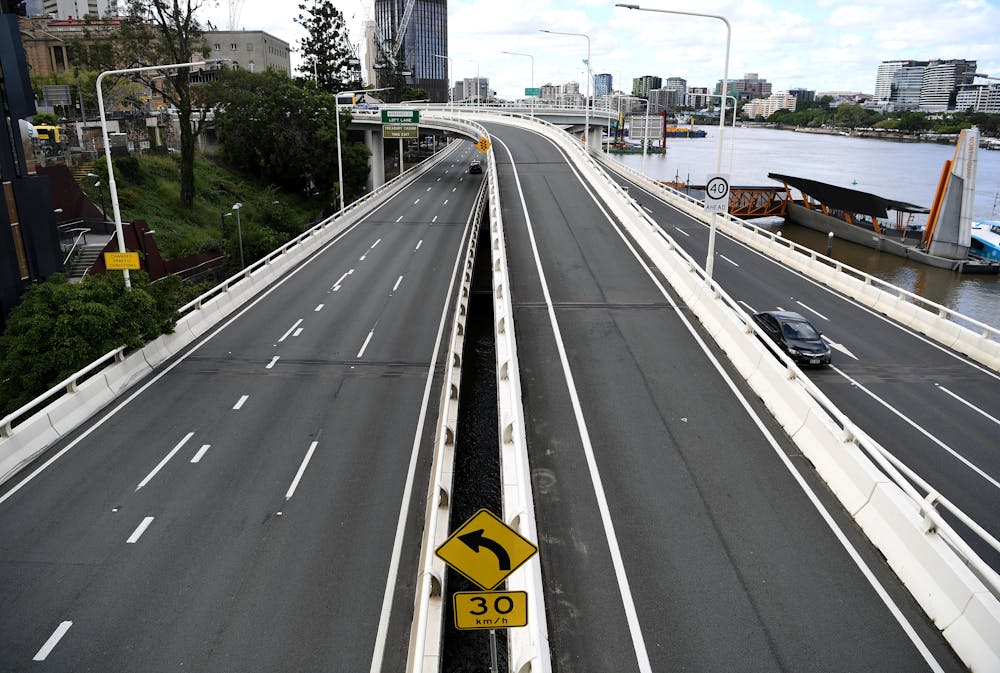
Morning peak-hour traffic has vanished in Brisbane and other Australian cities under the COVID-19 restrictions.Dan Peled/AAP
Passengers are also staying away from public transport in droves. For example, South Australian government statistics for Adelaide show passenger numbers have slumped by 69% for buses, by 74% for trains and by 77% for trams, compared with this time last year.
With these trends in mind, future investment in roads, public transport, energy and telecommunications will need to consider the likelihood of more people working from home.
Prior to COVID-19, Melbourne research found 64% of city workers regularly worked from home, but usually only one day a week, even though 50% of their work could be done anywhere. While the changes we are now seeing are a result of extreme circumstances, it is not inconceivable that, on average, everybody could continue to work from home one extra day per week after the pandemic. Even this would have significant implications for long-term urban planning.
The most recent Australian Census data show 9.2 million people typically commute to work each day. If people worked from home an average of one extra day per week, this would take 1.8 million commuters off the roads and public transport each day.
Many road and public transport projects will be based on forecasts of continuing increases in commuter numbers. If, instead, people work from home more often, this could call into question the need for those projects.
Areas outside city centres would also require more attention, as working from home creates a need for more evenly distributed networks of services for the likes of energy and telecommunications. Interestingly, such a trend could support long-term decentralisation plans, like those outlined in Melbourne’s Metropolitan Planning Strategy. And if such change encourages more people to live away from the big cities, it also could help to make housing more affordable.
Scott Morrison and Anthony Albanese could be set for a face-off at a by-election in the marginal NSW seat of Eden-Monaro.
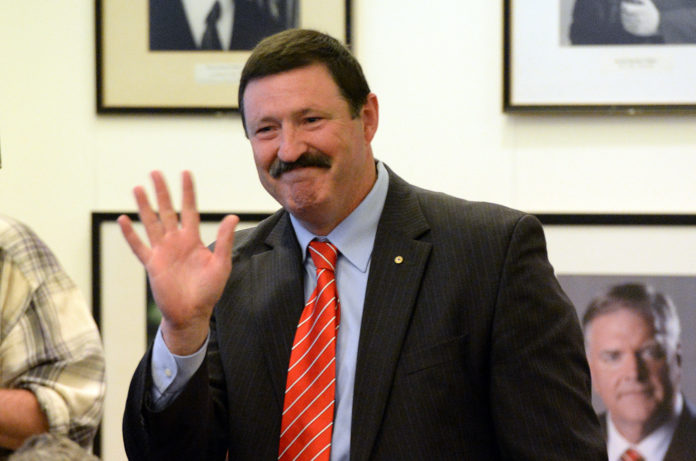
Labor MP Mike Kelly is expected to announce this week whether he will quit parliament. He has suffered continuing serious health problems.
Kelly, formerly a lawyer in the military who served in Iraq and on other overseas deployments, won the seat in 2007, lost it in 2013, and won it back in 2016. He is considered to have a strong personal vote.
Eden-Monaro is on a margin of about 1%. It has a large rural and coastal hinterland and contains the major town of Queanbeyan, which abuts Canberra. The seat has a high proportion of public servants.
Parts of the electorate were hit by the recent bush fires.
On the Coalition side, NSW deputy premier John Barilaro, the Nationals leader whose state seat is in the electorate, has left open the option of running, saying he is “not ruling anything out”.
If he won the seat, this would carry the risk of fresh instability in the federal Nationals. Deputy Prime Minister Michael McCormack could find himself under pressure from the ambitious Barilaro.
The Nationals polled only 7% in the seat at the last federal election but Barilaro is popular and has high recognition. He has good support in Queanbeyan.
Liberal senator Jim Molan, who lives in the electorate, might have a tilt at Liberal preselection.
He said he was keeping “all my options open”, although he also said, “I have important causes to continue to fight for as a Senator”. When he won Senate preselection for a casual vacancy, it was on the basis he would only serve the remainder of this term.
In a series of tweets, Molan predicted both the Liberals and the Nationals would run if there were a byelection.
Molan also noted, “We all know that by-elections are notoriously difficult to win, especially for governments. No incumbent government has won a seat from an opposition in the last 100 years.”
NSW transport minister Andrew Constance, a Liberal who holds the state seat of Bega and had a high profile during the bushfires, has also been mentioned as a possible contender for Liberal preselection.
Campaigning in a by-election this year would be constrained by the coronavirus, which will affect interactions even after most restrictions are rolled back.
His handling of the virus crisis has seen a big rise in Scott Morrison’s personal ratings, with this week’s Newspoll showing his approval at plus 40. Anthony Albanese is on plus 11. Morrison leads Albanese as better PM 56-28%.
But on the two-party vote the Coalition and Labor are on 50-50%, compared with the Coalition’s 51-49% in the previous poll.
A snapshot of how seriously the Australian economy is suffering from the coronavirus crisis will be given by treasurer Josh Frydenberg when parliament resumes on Tuesday May 12 for three days of sitting.
Frydenberg’s statement will come a day after the scheduled review of various restrictions, expected to see the nation starting to reopen a range of activities.
Frydenberg says the government will also provide an update on the economic and fiscal outlook in June, after the March quarter national accounts.
The virus crisis has meant the budget has been pushed back to October, with Morrison signalling last week he wants it to contain significant reform measures.
Last week Reserve Bank governor Philip Lowe said Australian output was likely to fall by 10% in the first half of 2020 and unemployment was likely to reach 10% by June.
On the health side, the government is delighted with the initial public response to its tracing app which had more than two million downloads by late Monday.
The Victorian government has announced a testing blitz to set the state up for the potential easing of restrictions. Up to 100,000 people across the state are to be tested over the next fortnight.
Premier Daniel Andrews and state health minister Jenny Mikakos said this would “help inform decisions about slowly lifting restrictions, ahead of the State of Emergency being reviewed on 11 May”.
About 1.13 million people had downloaded the federal government’s COVIDSafe app by 6am today, just 12 hours after its release last night, said Health Minister Greg Hunt. The government is hoping at least 40% of the population will make use of the app, designed to help reduce the spread of the coronavirus disease.
Previously dubbed TraceTogether – in line witha similar app rolled out in Singapore – the coronavirus contact tracing app has been an ongoing cause of contention among the public. Many people have voiced concerns of an erosion of privacy, and potential misuse of citizen data by the government.
But how does COVIDSafe work? And to what extent has the app addressed our privacy concerns?
The app’s landing page outlines its purpose: to help Australian health authorities trace and prevent COVID-19’s spread by contacting people who may have been in proximity (to a distance of about 1.5 metres) with a confirmed case, for 15 minutes or more.
The second screen explains how Bluetooth technology is used to record users’ contact with other app users. This screen says collected data is encrypted and can’t be accessed by other apps or users without a decryption mechanism. It also says the data is stored locally on users’ phones and isn’t sent to the government (remote server storage).
These screens that show up upon app installation explain the app’s functions and guide users through registration.COVIDSafe requires certain permissions to run.
In subsequent screens, the app links to its privacy policy, seeks user consent to retrieve registration details, and lets users register by entering their name, age range, postcode and mobile number.
This is followed by a declaration page where the user must give consent to enable Bluetooth, “location permissions” and “battery optimiser”.
In regards to enabling location permissions, it’s important to note this isn’t the same as turning on location services. Location permissions must be enabled for COVIDSafe to access Bluetooth on Android and Apple devices. And access to your phone’s battery optimiser is required keep the app running in the background.
Once the user is registered, a notification should confirm the app is up and running.
Users will have to manually grant some permissions.
Importantly, COVIDSafe doesn’t have an option for users to exit or “log-off”.
Currently, the only way to stop the app is to uninstall it, or turn off Bluetooth. The app’s reliance on prolonged Bluetooth usage also has users worried it might quickly drain their phone batteries.
Preliminary tests
Upon preliminary testing of the app, it seems the federal government has delivered on its promises surrounding data security.
Tests run for one hour showed the app didn’t transmit data to any external or remote server, and the only external communication made was a “handshake” to a remote server. This is simply a way of establishing a secure communication.
Additional tests should be carried out on this front.
This screenshot shows test results run via the Wireshark software to determine whether data from COVIDSafe was being transmitted to external servers.
Issues for iPhone users
According to reports, if COVIDSafe is being used on an iPhone in low-power mode, this may impact the app’s ability to track contacts.
Also, iPhone users must have the app open (in the foreground) for Bluetooth functionality to work. The federal government plans to fix this hitch “in a few weeks”, according to The Guardian.
This complication may be because Apple’s operating system generally doesn’t allow apps to run Bluetooth-related tasks, or perform Bluetooth-related events unless running in the foreground.
Source code
“Source code” is the term used to describe the set of instructions written during the development of a program. These instructions are understandable to other programmers.
In a privacy impact assessment response from the Department of Health, the federal government said it would make COVIDSafe’s source code publicly available, “subject to consultation with” the Australian Cyber Security Centre. It’s unclear exactly when or how much of the source code will be released.
Making the app’s source code publicly available, or making it “open source”, would allow experts to examine the code to evaluate security risks (and potentially help fix them). For example, experts could determine whether the app collects any personal user information without user consent. This would ensure COVIDSafe’s transparency and enable auditing of the app.
Releasing the source code isn’t only important for transparency, but also for understanding the app’s functionality.
Some COVIDSafe users reported the app wouldn’t accept their mobile number until they turned off wifi and used their mobile network (4G) instead. Until the app is made open source, it’s difficult to say exactly why this happens.
Overall, it seems COVIDSafe is a promising start to the national effort to ease lockdown restrictions, a luxury already afforded to some states including Queensland.
Questions have been raised around whether the app will later be made compulsory to download, to reach the 40% uptake target. But current growth in download numbers suggests such enforcement may not be necessary as more people rise up to their “civic duty”.
That said, only time will reveal the extent to which Australians embrace this new contact tracing technology.
About 1.13 million people had downloaded the federal government’s COVIDSafe app by 6am today, just 12 hours after it’s release last night, said Health Minister Greg Hunt. The government is hoping at least 40% of the population will make use of the app, designed to help reduce the spread of the coronavirus disease.
Previously dubbed TraceTogether – in line witha similar app rolled out in Singapore – the coronavirus contact tracing app has been an ongoing cause of contention among the public. Many people have voiced concerns of an erosion of privacy, and potential misuse of citizen data by the government.
But how does COVIDSafe work? And to what extent has the app addressed our privacy concerns?
The app’s landing page outlines its purpose: to help Australian health authorities trace and prevent COVID-19’s spread by contacting people who may have been in proximity (to a distance of about 1.5 metres) with a confirmed case, for 15 minutes or more.
The second screen explains how Bluetooth technology is used to record users’ contact with other app users. This screen says collected data is encrypted and can’t be accessed by other apps or users without a decryption mechanism. It also says the data is stored locally on users’ phones and isn’t sent to the government (remote server storage).
These screens that show up upon app installation explain the app’s functions and guide users through registration.COVIDSafe requires certain permissions to run.
In subsequent screens, the app links to its privacy policy, seeks user consent to retrieve registration details, and lets users register by entering their name, age range, postcode and mobile number.
This is followed by a declaration page where the user must give consent to enable Bluetooth, “location permissions” and “battery optimiser”.
In regards to enabling location permissions, it’s important to note this isn’t the same as turning on location services. Location permissions must be enabled for COVIDSafe to access Bluetooth on Android and Apple devices. And access to your phone’s battery optimiser is required keep the app running in the background.
Once the user is registered, a notification should confirm the app is up and running.
Users will have to manually grant some permissions.
Importantly, COVIDSafe doesn’t have an option for users to exit or “log-off”.
Currently, the only way to stop the app is to uninstall it, or turn off Bluetooth. The app’s reliance on prolonged Bluetooth usage also has users worried it might quickly drain their phone batteries.
Preliminary tests
Upon preliminary testing of the app, it seems the federal government has delivered on its promises surrounding data security.
Tests run for one hour showed the app didn’t transmit data to any external or remote server, and the only external communication made was a “handshake” to a remote server. This is simply a way of establishing a secure communication.
Additional tests should be carried out on this front.
This screenshot shows test results run via the Wireshark software to determine whether data from COVIDSafe was being transmitted to external servers.
Issues for iPhone users
According to reports, if COVIDsafe is being used on an iPhone in low-power mode, this may impact the app’s ability to track contacts.
Also, iPhone users must have the app open (in the foreground) for Bluetooth functionality to work. The federal government plans to fix this hitch “in a few weeks”, according to The Guardian.
This complication may be because Apple’s operating system generally doesn’t allow apps to run Bluetooth-related tasks, or perform Bluetooth-related events unless running in the foreground.
Source code
“Source code” is the term used to describe the set of instructions written during the development of a program that’s understandable to other programmers.
In a privacy impact assessment response from the Department of Health, the federal government said it would make COVIDSafe’s source code publicly available, “subject to consultation with” the Australian Cyber Security Centre. It’s unclear exactly when or how much of the source code will be released.
Making the app’s source code publicly available, or making it “open source”, would allow experts to examine the code to evaluate security risks (and potentially help fix them). For example, experts could determine whether the app collects any personal user information without consent. This would ensure COVIDSafe’s transparency and enable auditing of the app.
Releasing the source code isn’t only important for transparency, but also for understanding the app’s functionality. Some COVIDSafe users have reported the app wouldn’t accept their mobile number until they turned off wi-fi and used their mobile network (4G) instead. Until the app is made open source, it’s difficult to say exactly why this is.
Overall, it seems COVIDSafe is a promising start to the national effort to ease lockdown restrictions, a luxury already afforded to some states including Queensland.
Questions have been raised around whether the app will later be made compulsory to download to reach the 40% uptake target, but current growth in download numbers suggests such enforcement may not be necessary as more people rise up to their “civic duty”.
That said, only time will reveal the extent to which Australians embrace this new contact tracing technology.
Aboriginal and Torres Strait Islander readers are advised this article contains references to deceased people.
I am a child of the Anthropocene, born in 1953. I have lived in a period of history also known as the “Great Acceleration” as huge negative change unfolded.
While contemplating these changes, I have sensed, within humanity, a profound sense of emotional isolation. To help overcome the solitude, I have created the idea of sumbiotude, thinking and working in companionship with others, to reconnect to life.
Being alive in this particular era, I have had the privilege of living through the rapid transition from a focus on that which is “obvious to the senses” to our new ways of rendering the invisible, visible.
I also accept that reality is complex and independent of us and that new insights into nature can come via acts of scientific and conceptual discovery. However, I am always aware that I am walking in the footsteps of the late Big Bill Neidjie of Arnhem Land when in Gagudju Man he suggests:
We walk on earth,
We look after,
like rainbow sitting on top.
But something underneath,
under the ground.
We don’t know.
You don’t know.
At a time of massive biophysical change (heatwaves, wildfire, floods, pandemics), we need to expand our language to understand these changes and to be able to share the emotional upheavals they engender.
Massive changes to the environment call for the need to expand our language.David Gray/Reuters
I’ve created a “sumbiography” (from the Greek, sumbios, which means living together) to investigate the union of elements in nature and culture that have symbiotically cohered into a view about life – a philosophy of my own.
For others, undertaking a sumbiography has the potential to help them find their own particular view of their emotional connection – or the lack of it – to the Earth.
A sumbiography can reveal just what kind of emotional compass we have with respect to our personal relationship to this living planet.
A new vocabulary
As a philosopher, my response to the encounter with the open cut coal mines of the desolated Upper Hunter region of NSW was to rethink the emotions of attachment to and abandonment of a place that is loved, and to find the right way to express my feelings.
As there was nothing in the English language to help me, I decided to create my own concept – a neologism – to adequately describe the emotional distress at the loss of one’s endemic sense of place.
It took the combination of a lifetime of teaching, thinking and a creative effort shared with my wife, Jillian, before the concept of “solastalgia” entered the world in 2003.
Solastalgia, the distressing lived experience of negative environmental change, arose from understanding that the positive side of the lived experience of Earth emotions had to have negative equivalents. Solastalgia marked the beginning of my journey of mental-landscape discovery.
That such a concept did not already exist in the English language was, to me, a sign of just how deeply alienated from our home we – as an Earth-destroying, or “terraphthoric”, culture – had become.
Co-existence with non-human life
My mother played a huge part in my rediscovery and naming of different, more positive, psychoterratic emotions.
In her late seventies, she was struggling: the legacy of tuberculosis had left her breathless and she was having trouble both retaining her independence and continuing as a volunteer guide at Kings Park in Perth. I shopped for her and we ate together most nights.
After a year where I lived close by, she suffered a big, bloody and lonely fall. Following her hospitalisation and recovery, I took her to live with me in the village of Jarrahdale in the Perth Hills.
Our house and block, “Birdland”, had jarrah trees on it and ground orchids; it was visited by kangaroos, possums, quenda (southern brown bandicoot) and many different kinds of birds.
A kangaroo resting at Birdland.Glenn Albrecht, Author provided
My mother and I thrived there. She reconnected with her own endemic sense of place, and I thinking about the concepts and the associated words needed to account for that sense of reconnection and good Earth emotions.
If the mine-scape of the Upper Hunter and the homogeneity of the city of Perth represented the solastalgic Anthropocene to me, Jarrahdale had offered a lifeline to a different lifestyle and worldview – one where co-existence with non-human life went beyond companion and domesticated animals and a limited number of edible plants.
Adding richness to sumbiography
In loving each other as kin, my mother and I also shared a love of the endemic (endemophilia). This was made manifest in the moments when spider, donkey, enamel or bee orchids were found with almost the same excitement as very first encounters.
These five years with my mother added richness to my sumbiography.
As an adult, I could reunite with my past and feel, beyond solastalgia, positive emotional states residing in me that were also without the corresponding concepts, words and ideas in my language.
While based at Murdoch University, I began a systematic quest to negate solastalgia and all the other negative Earth emotions to add something new, something “terranascient” or Earth-creating that could join the dialectic of the psychoterratic.
Symbiosis
In 2011, I created the meme of the Symbiocene, which I defined as the next era in human and Earth history where reintegration of the Anthropos (humans) with the Sumbios (symbiotic life) was completed.
In 2013, aged 84, my mother died. Half her ashes were scattered carefully into the Kings Park bush around a huge old gnarly log from a long-dead jarrah tree.
Ground orchids abounded in this place, so too the red and green kangaroo paws. She deserved a presence in that park, as her spirit had graced it for more than 20 years. I imagine she became a copse of pink enamel orchids, glistening in the Perth spring sun.
If humans are kind to the Earth, some of her will also become a new jarrah tree, auburn hair all fiery in its wood grain.
‘Sumbiography’, ‘solastalgia’ and other emotions are discussed in the author’s book, Earth Emotions.Shutterstock
For the great bulk of human existence, symbiosis was typical of our relationship to the rest of nature, and I wanted to regain the property of what the Greeks called sumbiosis or “companionship”.
Living together
If I live to be 100 years of age, it is my hope that my life will come to exemplify a neologism that is sumbiotude, or the state of living together.
Sumbiotude is the exact opposite of solitude: instead of contemplating life in isolation, sumbiotude involves contemplation and completion of a lifespan with the loving companionship of humans and non-humans.
I will also be happy if my creative, conceptual work can help Generation Symbiocene – which includes my own children, my step-grandchildren and my five-year-old granddaughter – live in a world where positive Earth emotions prevail.
This is an edited extract republished with permission from GriffithReview68: Getting On (Text), ed Ashley Hay griffithreview.com
With governments around the world asking their citizens to avoid places, activities and gatherings to save lives, this just might be the largest ever international effort to self-regulate our actions against competing desires and impulses.
To achieve this, we must overcome our desire to enjoy the sun and sand, go shopping or to the pub, and even embrace family and friends.
Of course, it’s not so easy for young children, who must forego activities they previously enjoyed and may be confused by contradictions – like being able to see friends at, but not after, school.
But there are ways parents can help children learn to regulate their emotions and behaviours, and to practise these skills.
Self-regulation has always played an important role in our lives. It’s what underpins our ability to control our behaviours, emotions and interactions, while at the same time avoiding distractions and enticing alternatives.
With lower levels of self-regulation, our decisions and behaviours would more frequently be poorly conceived, unnecessarily risky or inappropriate to the situation – often with undesirable results.
Even in the early years of life, the ability to self-regulate is important. Pre-school-aged children who have better self-regulation are often better prepared for school and life.
and have better health, wealth and productivity as adults.
So many things have changed for children recently.Shutterstock
So, what can we do to support children’s self-regulation, especially during this pandemic, when their capacity for self-control already appears to be under strain?
Self-regulation requires at least three things: selecting a goal, problem-solving and working on motivation, and overcoming distraction and impulses.
1. Selecting a goal
Self-regulatory behaviour is goal-directed. That means children must first decide to behave in a particular way.
If a child is unaware of (or forgets) a family convention to wait for everyone to be seated before starting to eat, a child starting to eat before others may appear like a consequence of poor self-regulation. Yet the child never decided to pursue that goal in the first place.
We need to support children’s thinking and decision-making around goals, while acknowledging that plans can change and often need to be adjusted.
Adults can support children to be more goal-oriented by giving them opportunities to lead and make decisions, as well as encouraging them to devise simple plans, strategies and procedures to achieve goals.
This may be as simple as asking children to decide what they would like to play (building a cubby house), and plan where they would play it (bedroom), with whom (mum, dad, sibling), and what resources they will need (cardboard box, cushions).
2. Problem-solving and motivation
Even when a goal has been decided, the path to its achievement is often not immediate. Children will encounter numerous distractions and competing opportunities along the way. So they need effective problem-solving and motivation strategies.
To be an effective problem-solver, children must understand there is more than one way to achieve something. This requires creative and critical-thinking, flexibility and persistence.
As adults we can encourage these by:
engaging children in brainstorming activities, like finding an alternate ending to a familiar story, such as Peter Pan losing his shadow
using open-ended questioning and posing small problems – as in “How might we capture our shadow? What will we need?”
encouraging reflective thinking, such as “I wonder, why don’t we see shadows on the ground at night?”
Supporting young children to persist in the face of challenge means taking cues from your child, validating their efforts, reinforcing their solutions and encouraging creative alternatives.
3. Overcome distractions and impulses
Children need to be able to overcome distractions and impulses that are contrary to their goals.
As with most things, this self-regulatory capacity can benefit from practice. This can be achieved in simple, playful ways.
One game, played all around the world, is musical statues. Children dance while the music plays and freeze when the music stops.
Musical statues allows children to practise controlling their impulse to keep dancing.Shutterstock
What often happens in this game, though, is children who can’t or don’t freeze are either left to continue dancing or they are “out”. Those who perhaps could benefit most from the practise get the least opportunity to practise.
Instead, if a child doesn’t freeze in time, have them try the next round sitting on their bottom, removing their legs from the equation. As they succeed, they can return to standing.
Where children can already do this well, why not reverse things so you dance when the music is off and remain still while the music plays?
This gives children practice controlling impulses – in this case, to keep dancing when the rule requires them to stop – at an achievable level of challenge.
For parents, it gives them unique insight into children’s capacities to control their behaviours, and where they may require additional support.
Things like stress, tiredness, hunger, fear, sadness and loneliness can deplete children’s limited self-regulation resources. Parents should seek to minimise these factors before trying to extend children’s self-regulation further.
In the current climate, we can ensure children are operating at their self-regulatory best when we reduce unnecessary demands, ensure routines are not overloaded, are patient and realistic when setting responsibilities.
Lastly, whether we are aware of it or not, children often model themselves on the ways we act and respond. As adults, it’s important to reflect on our own behaviours too: do we give up when challenged, yell when frustrated, fight for resources, or preference others in need over our own wants?
How we respond to this “new normal” will set an example for our youngest generation – and they will undoubtedly learn from our responses.
There are very few silver linings that have developed from the current catastrophic health crisis, but the wider accessibility of world class performances is one positive outcome to have emerged in recent weeks.
Breaking Glass – a quadruple bill of single-act operas composed by four Australian women – is an example of these. Originally programmed for late March at Carriageworks, it instead premiered on Facebook Live on Saturday.
Breaking Glass is a collaboration between Sydney Conservatorium’s Composing Women professional development program and the Sydney Chamber Opera (SCO). While gender inequality is an issue across most art forms, the inequality in operatic programming is especially stark. Projects such as this are essential to bringing new perspectives and diverse artistic voices to audiences within an otherwise conservative art form.
SCO was the ideal partner for Composing Women in this project. Established in 2010 to present operas of the 20th and 21st century, SCO has shown a commitment to works by Australian composers, with previous productions including Mary Finsterer’s Biographica in 2017 and Elliott Gyger’s Oscar and Lucinda in 2019.
While the name suggests a reference to breaking through the glass ceiling in the opera world, the violent imagery of breaking glass is also fitting in the context of the contemporary themes of ecological disaster, inequality, mental illness, and dystopia explored in these four works.
Commute.Daniel Boud
Four works
Her Dark Marauder, composed by Georgia Scott with the libretto by Pierce Wilcox, is a reworking of concepts drawn from the works of Sylvia Plath. There was an almost expressionist aesthetic to both the staging and the music.
Opening with the three singers separated on the stage surrounded by haze, Scott’s use of insistent repeated-note instrumental motifs, tremolo strings and flutter tonguing immediately evoked a disturbing, oppressive atmosphere. The vocalists – Jane Sheldon, Simon Lobelson, and Jessica O’Donoghue in this work – showed exceptional range, with virtuosic execution of techniques such as vocal fry, portamenti and fricative sounds along with beautifully phrased melodic material.
Dark Marauder opened the Facebook premiere event.Daniel Boud
In Commute, composer Peggy Polias depicts a woman’s daily commute through the lens of ancient Greek mythology and Homer’s Odyssey, with two “suitors” representing mythical monsters. The staging of this work, which was directed by Clemence Williams, was particularly effective, with O’Donoghue hesitantly walking across stage while in front of menacing, oversized projections of hands, and later a single eye representing the cyclops.
This short 20-minute work has a satisfying five-part structure full of contrasting musical textures. From the pulsating white noise and fragmented plosive vocalisations from the two suitors (played by Lobelson and Mitchell Riley) in the opening Amen I through to the entreating modal melody from O’Donoghue in Episode II: The Eye, Polias employed a vast range of compositional techniques to great effect. Commute ended on a note of refreshing optimism, with the final Dawn section featuring interwoven pentatonic melodic lines against the visual effects of a sunrise.
Josephine Macken’s The Tent diverged the most from typical operatic conventions. The title refers to a short story of the same name by Margaret Atwood, which is used as a conceptual framework rather than narrative structure. This abstract, almost wordless work explores the idea of researchers feeding knowledge into an intelligent machine in the wake of an ecological disaster. Macken has created a desolate soundscape using howling winds, drones, microtonality, with the vocal text mostly comprising disjointed phonemes, sustained vowel sounds and fricatives.
Bree van Reyk’s The Invisible Bird draws a connection between invisible and forgotten women in history and extinct or endangered birds. Its minimalist libretto consists of names of vulnerable, endangered and extinct bird species. Despite the seriousness of its subject manner, there was humour and absurdity in the staging. With three performers dressed in formal wear, it opened with cabaret-like choreography complete with jazz hands accompanying birdcalls from both singers and instrumentalists.
The music was palindromic in structure, starting and ending with energetic polyphony. The middle section was particularly poignant, with Sheldon portraying a night parrot shedding its feathers while mournfully singing the names of extinct species.
The Invisible Bird.Daniel Boud
Virtuosity under pressure
Despite the difficult circumstances, all aspects of this production were outstanding.
The singers showed impressive virtuosity throughout, as did the instrumentalists in the small ensemble, which included some of Australia’s most experienced and committed new music practitioners.
Breaking Glass is a testament to the importance of professional development programs like Composing Women. It is vital new, ambitious artistic work has the opportunity to be presented. In this case, the result was spectacular. While the four operas were very different from each other, they were equally engaging, relevant and thought-provoking.
Getting this production ready to premiere in a different format in such a short time shows adaptability and hard work from all involved. Hopefully this is a sign that large scale, innovative art forms will be able to weather the current crisis, despite unprecedented challenges to the sector.
Breaking Glass can be viewed online. In lieu of ticket purchases, tax deductible donations can be made to SCO.
There are very few silver linings that have developed from the current catastrophic health crisis, but the wider accessibility of world class performances is one positive outcome to have emerged in recent weeks.
Breaking Glass – a quadruple bill of single-act operas composed by four Australian women – is an example of these. Originally programmed for late March at Carriageworks, it instead premiered on Facebook Live on Saturday.
Breaking Glass is a collaboration between Sydney Conservatorium’s Composing Women professional development program and the Sydney Chamber Opera (SCO). While gender inequality is an issue across most art forms, the inequality in operatic programming is especially stark. Projects such as this are essential to bringing new perspectives and diverse artistic voices to audiences within an otherwise conservative art form.
SCO was the ideal partner for Composing Women in this project. Established in 2010 to present operas of the 20th and 21st century, SCO has shown a commitment to works by Australian composers, with previous productions including Mary Finsterer’s Biographica in 2017 and Elliott Gyger’s Oscar and Lucinda in 2019.
While the name suggests a reference to breaking through the glass ceiling in the opera world, the violent imagery of breaking glass is also fitting in the context of the contemporary themes of ecological disaster, inequality, mental illness, and dystopia explored in these four works.
Commute.Daniel Boud
Four works
Her Dark Marauder, composed by Georgia Scott with the libretto by Pierce Wilcox, is a reworking of concepts drawn from the works of Sylvia Plath. There was an almost expressionist aesthetic to both the staging and the music.
Opening with the three singers separated on the stage surrounded by haze, Scott’s use of insistent repeated-note instrumental motifs, tremolo strings and flutter tonguing immediately evoked a disturbing, oppressive atmosphere. The vocalists – Jane Sheldon, Simon Lobelson, and Jessica O’Donoghue in this work – showed exceptional range, with virtuosic execution of techniques such as vocal fry, portamenti and fricative sounds along with beautifully phrased melodic material.
Dark Marauder opened the Facebook premiere event.Daniel Boud
In Commute, composer Peggy Polias depicts a woman’s daily commute through the lens of ancient Greek mythology and Homer’s Odyssey, with two “suitors” representing mythical monsters. The staging of this work, which was directed by Clemence Williams, was particularly effective, with O’Donoghue hesitantly walking across stage while in front of menacing, oversized projections of hands, and later a single eye representing the cyclops.
This short 20-minute work has a satisfying five-part structure full of contrasting musical textures. From the pulsating white noise and fragmented plosive vocalisations from the two suitors (played by Lobelson and Mitchell Riley) in the opening Amen I through to the entreating modal melody from O’Donoghue in Episode II: The Eye, Polias employed a vast range of compositional techniques to great effect. Commute ended on a note of refreshing optimism, with the final Dawn section featuring interwoven pentatonic melodic lines against the visual effects of a sunrise.
Josephine Macken’s The Tent diverged the most from typical operatic conventions. The title refers to a short story of the same name by Margaret Atwood, which is used as a conceptual framework rather than narrative structure. This abstract, almost wordless work explores the idea of researchers feeding knowledge into an intelligent machine in the wake of an ecological disaster. Macken has created a desolate soundscape using howling winds, drones, microtonality, with the vocal text mostly comprising disjointed phonemes, sustained vowel sounds and fricatives.
Bree van Reyk’s The Invisible Bird draws a connection between invisible and forgotten women in history and extinct or endangered birds. Its minimalist libretto consists of names of vulnerable, endangered and extinct bird species. Despite the seriousness of its subject manner, there was humour and absurdity in the staging. With three performers dressed in formal wear, it opened with cabaret-like choreography complete with jazz hands accompanying birdcalls from both singers and instrumentalists.
The music was palindromic in structure, starting and ending with energetic polyphony. The middle section was particularly poignant, with Sheldon portraying a night parrot shedding its feathers while mournfully singing the names of extinct species.
The Invisible Bird.Daniel Boud
Virtuosity under pressure
Despite the difficult circumstances, all aspects of this production were outstanding.
The singers showed impressive virtuosity throughout, as did the instrumentalists in the small ensemble, which included some of Australia’s most experienced and committed new music practitioners.
Breaking Glass is a testament to the importance of professional development programs like Composing Women. It is vital new, ambitious artistic work has the opportunity to be presented. In this case, the result was spectacular. While the four operas were very different from each other, they were equally engaging, relevant and thought-provoking.
Getting this production ready to premiere in a different format in such a short time shows adaptability and hard work from all involved. Hopefully this is a sign that large scale, innovative art forms will be able to weather the current crisis, despite unprecedented challenges to the sector.
Breaking Glass can be viewed online. In lieu of ticket purchases, tax deductible donations can be made to SCO.
This week’s Newspoll, conducted April 22-25 from a sample of 1,519, had a 50-50 tie between the major parties, a one-point gain for Labor since the last Newspoll, three weeks ago. Primary votes were 41% Coalition (down one), 36% Labor (up two), 12% Greens (down one) and 4% One Nation (down one). Figures are from The Poll Bludger.
Despite Labor’s voting intentions gain, Scott Morrison’s ratings jumped again, following a record 38-point gain in net approval last time. 68% (up seven) were satisfied with his performance and 28% (down seven) were dissatisfied. That’s a net approval of +40, up 14 points. Morrison’s net approval is the best for a PM since Kevin Rudd in October 2009.
Anthony Albanese also improved his ratings, with his net approval up two points to +11 after a nine-point gain last time. Morrison led as better PM by 56-28 (53-29 three weeks ago).
Ratings for the PM are correlated strongly with voting intentions, so having the PM’s net approval at +40 while voting intentions are tied is abnormal. Analyst Kevin Bonham tweeted this chart showing that this Newspoll is a major outlier.
The most likely explanation for the discrepancy between voting intentions and the PM’s ratings is that Labor and Greens voters approve of Morrison’s performance on the coronavirus crisis, but they distrust the Coalition in general.
Australia’s performance on coronavirus has been strong by international standards. I expect Morrison’s ratings to stay high if Australia continues to perform well, as long as the public thinks there is a crisis. Once the crisis is perceived to be over, Morrison’s ratings are likely to drop over normal partisan conflict.
South Korea is another country that has performed well on coronavirus. The left-wing Democratic party of the incumbent president was rewarded for this performance at April 15 parliamentary elections. They won 180 of the 300 seats (up 57 since 2016), to 103 for conservative parties (down 19).
In an additional Newspoll question, 54% said they would be prepared to install the government’s voluntary coronavirus tracking app, while 39% said they would not install it.
Trump’s ratings slide and Biden leads in key states
This section is an updated version of an article I wrote for The Poll Bludger, published on Friday.
In the FiveThirtyEight poll aggregate, Donald Trump’s ratings with all polls are 43.4% approve, 52.4% disapprove (net -9.0%). With polls of registered or likely voters, Trump’s ratings are 43.8% approve, 52.5% disapprove (net -8.7%). Since my article three weeks ago, Trump has lost five points on net approval, returning his ratings to about their early March levels, before the coronavirus crisis began.
As the US coronavirus death toll increases to over 50,000, there has been far more criticism of Trump’s early response, and this appears to have punctured the “rally round the flag” effect.
Furthermore, there has been a massive economic impact from the virus and related shutdowns: in the past five weeks, over 26 million filed for unemployment benefits. In the latest week, over 4.4 million filed. While this is a slowdown, it is far ahead of the previous record of 695,000 weekly jobless claims. The April jobs report, to be released in early May, will be grim.
The RealClearPolitics average of national polls gives Joe Biden a 5.9% lead over Trump, little changed from 6.1% three weeks ago. However, most of the polls in the average were taken in early April, when Trump’s ratings were better.
As we know from 2016, the US does not use the popular vote to elect presidents; instead, each state is allocated Electoral Votes (EVs). A state’s EVs are the sum of its House seats (population dependent) and senators (always two). There are 538 total EVs, so it takes 270 to win. With two minor exceptions, states award their EVs winner-takes-all.
In 2016, Trump won 306 EVs to Hillary Clinton’s 232, ignoring “faithless” electors, despite losing the popular vote by 2.1%. Trump won Florida, Pennsylvania, Wisconsin and Michigan by 1.2% or less.
The three most recent Florida polls give Biden an average two-point lead. In Michigan, he has an eight-point lead in the only April poll. In Pennsylvania, Biden averages a seven-point lead in two April polls. In Arizona, which has trended Democratic at recent elections, Biden leads Trump by 9% in an April poll.
Despite noisy protests in Michigan and other states advocating an end to social distancing, polls show the vast majority of Americans want social distancing to continue. In an AP-NORC poll, just 12% thought distancing measures went too far, 26% said they didn’t go far enough and 61% said they are about right.
To have a realistic chance of winning the next election, Trump needs the US economy to be perceived as improving by November. While his base is loyal, lower-educated voters in general want a good economy, and Trump needs their support to offset losses among higher educated voters owing to his behaviour.
Despite the continued economic and coronavirus woe, the Dow Jones has rebounded from a low below 18,600 on March 23 to be currently above 23,700. Stock traders anticipate a V-shaped recovery, which would assist Trump. But since March 31, there have been 25,000 to 39,000 new US coronavirus cases every day. I am sceptical that the US can reduce the caseload to a point where economic activity can safely resume anytime soon.
In the wake of COVID-19, we’re seeing intense international competition for urgently-needed supplies including personal protection equipment and ventilators. In Australia, this could extend to other critical imports such as pharmaceuticals and medicines. And when our manufacturing sector can’t fill unexpected breaks in supply chains, we all face risk.
However, Australians have lived through crises of comparable magnitude before. During and after the two world wars, scientific innovation played a crucial role in reform. It led to the creation of the Council for Scientific and Industrial Research (CSIR) and an array of subsequent discoveries.
Some may assume life will go back to normal once COVID-19 withdraws. But if the past is to be learnt from, Australia should prepare for a greatly different future – hopefully one in which science and innovation once more take centre stage.
It was WWI that heightened awareness of the role of science in defence and economic growth. In December 1915, Prime Minister William (Billy) Hughes announced he would set up a national laboratory “which would allow men of all branches of science to use their capabilities in application to industry”.
A CSIR council meeting in 1935, held at the McMaster Laboratory in Sydney.CSIRO Archives, CC BY
This led to the formation of the CSIR in 1926, and its rebirth as the CSIRO in 1949. In the years after WW1, the CSIR contributed greatly to improvements in primary production, including through animal nutrition, disease prevention, and the control of weeds and pests in crops. It also advanced primary product processing and overseas product transport.
In 1937, the CSIR’s mandate was expanded to include secondary industry research, including a national Aircraft and Engine Testing and Research Laboratory. This was motivated by the government’s concern to increase Australia’s manufacturing capabilities and reduce its dependence on technology imports.
War efforts in the spotlight
The CSIR’s research focus shifted in 1941 with the attack on Pearl Harbour. Australian war historian Boris Schedvin has written about the hectic scramble to increase the nation’s defence capacities and expand essential production following the attack, including expansion of the scientific workforce.
The John Curtin government was commissioned in October, 1941. Curtin appointed John Dedman as the Minister for War Organisation and Industry, as well as the minister in charge of the CSIR. Dedman’s department was concerned with producing military supplies and equipment, and other items to support society in wartime.
Dedman instructed the council to concentrate on “problems connected with the war effort”. The CSIR responded robustly. By 1942, the divisions of food preservation and transport, forest products, aeronautics, industrial chemistry, the national standards laboratory and the lubricants and bearings section were practically focused on war work full-time.
Scaling up production
The Division of Industrial Chemistry was the division most closely involved in actual production. It was formed in 1940 with Ian Wark as chief, who’d previously worked at the Electrolytic Zinc Company.
Wark was familiar with the chemical industry, and quickly devoted resources to developing processes (using Australian materials) to produce essential chemicals to the pilot plant stage. They were soon producing chemicals for drugs at the Fishermans Bend site, including the starting material for the synthesis of the anaesthetic drug novocaine (procaine).
The researchers developed a method to separate the drug ergot, which is now essential in gynaecology, from rye. They also contributed directly to the war effort by manufacturing the plasticiser used in the nose caps of bullets and shells.
This photo from the early 1940s shows a lab at Fishermans Bend where experts worked on methods to separate ergot from rye.Author provided, Author provided (No reuse)
CSIRO today
In response to the current pandemic, CSIRO at the Australian Centre for Disease Preparedness in Geelong, Victoria, is working with the international Coalition for Epidemic Preparedness to improve understanding of the SARS-CoV-2 virus. They are currently testing two vaccine candidates for efficacy, and evaluating the best way to administer the vaccine.
CSIRO’s directors Trevor Drew and Rob Grenfell share progress on COVID-19 vaccine testing being carried out at the Australian Centre for Disease Preparedness in Geelong.
Australian scientists have made monumental contributions on this front in the past. In the 1980s, CSIRO and its university collaborators began efforts that led to the creation of anti-flu drug Relenza, the first drug to successfully treat the flu. Relenza was then commercialised by Australian biotech company Biota, which licensed the drug to British pharmaceutical company GlaxoSmithKline.
The CSIRO also invented the Hendra virus vaccine for horses, launched in 2012.
Prior to that, Ian Frazer at the University of Queensland developed the human papillomavirus (HPV) vaccine which was launched in 2006.
COVID-19 is one of many viral diseases that need either a vaccine or a drug (or both). Others are hepatitis B, dengue fever, HIV and the viruses that cause the common cold. Now may be Australia’s chance to use our world class medical research and medicinal chemistry capabilities to become a dominant world supplier of anti-viral medications.
As was the case during WWI and WWII, this pandemic drives home the need to retain our capabilities at a time of supply chain disruption. While it’s impossible for a medium-sized economy like Australia’s to be entirely self-sufficient, it’s important we lean on our strengths to not only respond, but thrive during these complicated times.
In 2020, Australia has a much greater and broader research and production capacity than it did in 1940. And as we march through this pandemic, we can learn from the past and forge new paths to enhance our position as pioneers in sciencific innovation.
On April 16, Prime Minister Shinzo Abe was forced to declare a national state of emergency until at least May 6, covering all 47 prefectures. This extended an initial state of emergency declaration on April 7 for seven prefectures, including the cities of Tokyo, Osaka and Fukuoka.
Two medical groups have also warned that a “collapse in emergency medicine” has already happened as hospitals are being forced to turn away patients, presaging a possible collapse of the overall health care system.
How did Japan get to this point? The country had initially been held up as having one of the more effective responses to the coronavirus in the early days of the pandemic. Yet, its curve has not even started to flatten like those of its neighbours, South Korea, China, Taiwan and Hong Kong.
The relatively low rate of infections from January to March was credited by some to Japanese societal norms: bowing instead of handshakes and hugs, the use of masks in flu season and generally high standards of personal hygiene.
Japan has long had a reputation for conformity and adherence to rules, so a high level of compliance with public safety directions was expected.
However, overconfidence in these practices, and the ongoing lack of firm direction from Prime Minister Shinzo Abe’s government, may have lulled many Japanese into a false sense of security. This has been starkly demonstrated in recent weeks as crowds have flocked to parks to view the cherry blossoms, ignoring requests from local authorities to stay home.
Opinion polls now show at least half of Japanese disapprove of the government’s handling of the crisis and believe Abe’s national emergency declaration came too late.
Many Japanese believe Abe’s declaration of a state of emergency came to late.Naoki Ogura/Reuters
Erratic decision-making from the start
From the start of the pandemic, Abe’s government has been criticised for being too offhand in its response and erratic in its decision-making.
Japan’s first major misstep occurred in early February, when the Diamond Princess cruise ship was quarantined in Yokohama. At least 23 passengers were allowed to disembark and go home without being tested, and around 90 government employees returned directly to their Tokyo offices after visiting the stricken vessel.
More than 700 cases were eventually linked to the cruise ship, in total.
Weeks later, Abe then ordered schools to remain closed until the end of the spring break in April, a sudden decision that caught both teachers and parents by surprise, leaving them little time to plan and prepare.
Then came the lack of decisiveness on the Tokyo Olympics. Abe reluctantly announced in late March that the games would be postponed in 2020, but only after countries began to pull out and the government was accused of dragging its feet.
Abe’s government has also faced criticism over relatively low levels of testing. Over 112,000 tests have been conducted, at a rate of around 7,800 per day in April. But the government’s decision to restrict most tests to highly symptomatic patients means actual cases are likely being under-counted.
At a press conference in mid-April, Abe pledged to rectify shortages of personal protective equipment for medical workers and ramp up testing. As an interim measure, two cloth masks are being mailed to every household, an unpopular gesture widely lampooned on social media as “Abenomasks”.
Even when Abe has tried to send the right message, the tone has been off. This was perhaps best symbolised by the mocking reaction to his well-intentioned “stay home” Twitter post, which portrayed him drinking tea and patting his dog.
Critics said it showed just how out of touch he was with the lives of ordinary Japanese.
Tokyo’s governor outshines Abe
As cases began to spike in late March, Tokyo Governor Yuriko Koike held an emergency press conference to urge residents refrain from nonessential outings, such as visits to parks to view cherry blossoms.
Yuriko Koike has emerged as a trusted voice during the pandemic.Issei Kato/Reuters
But despite rising concerns from medical authorities, as late as March 31, Abe’s government still denied there was a need for a national state of emergency.
When the state of emergency was finally declared in mid-April, many feared it still wasn’t enough. Under the law, governors can requisition property and medical supplies to use to treat COVID-19 patients, but crucially, police have no enforcement powers to close businesses or restrict the movements of individuals. People and companies can only be asked to voluntarily comply.
The Japanese government could interpret two articles in the constitution to impose a stricter lockdown, as long as appropriate legislation is passed in the Diet, Japan’s parliament.
However, Abe has thus far avoided doing so. He seems to be bowing to pressure from the Keidanren, a major corporate lobby group and donor to his party, out of fear the economy could descend into an even deeper recession than the -5.2% reduction in economic growth projected by the IMF.
Crowds have flocked to view the cherry blossoms, despite messages to stay home.Kimimasa Mayama/EPA
Demands have been increasing from health authorities, prefectural governments and opposition parties for Abe to take more forceful action. Revealing his diminishing political authority, he is even being pressed by both senior figures and rank-and-file members within his own Liberal Democratic Party (LDP).
The LDP’s junior coalition partner, the Komeito party, also threatened to break from the ruling coalition. The move forced Abe to extend a planned income support scheme for low-income households into a universal payment of 100,000 yen (nearly A$1,500) to all citizens, as part of the government’s record 117 trillion yen (A$1.7 billion) emergency stimulus spending.
Abe’s third consecutive term as LDP president expires in September 2021, around the time national elections are due. Even if Japan recovers by then, his legacy as Japan’s longest-serving prime minister is now surely being tarnished.
First the drought, then bushfires and then flash floods: a chain of extreme events hit Australia hard in recent months. The coronavirus pandemic has only temporarily shifted our attention towards a new emergency, adding yet another risk.
We knew from the Intergovernmental Panel on Climate Change (IPCC) that the risk of extreme events was rising. What we perhaps didn’t realise was the high probability of different extreme events hitting one after the other in the same regions. Especially in the fringes of Australian cities, residents are facing new levels of environmental risk, especially from bushfires and floods.
But this cycle of devastation is not inevitable if we understand the connections between events and do something about them.
Measures to slow climate change are in the hands of policymakers. But, at the adaptation level, we can still do many things to reduce the impacts of extreme events on our cities.
We can start by increasing our capacity to see these phenomena as one problem to be tackled locally, rather than distinct problems to be addressed centrally. Solutions should be holistic, community-centred and focused on people’s practices and shared responsibilities.
Respond to emergency
We can draw lessons from humanitarian responses to large disasters, including both national and international cases. A recent review of disaster responses in urban areas found several factors are critical for more successful recovery.
One is to prioritise the needs of people themselves. This requires genuine, collaborative engagement. People who have been through a bushfire or flood are not “helpless victims”. They are survivors who need to be supported and listened to, not dictated to, in terms of what they may or may not need.
Another lesson is to link recovery efforts, rather than have individual agencies provide services separately. For instance, an organisation focusing on housing recovery needs to work closely with organisations that are providing water or sanitation. A coordinated approach is more efficient, less wearying on those needing help, and better reflects the interconnected reality of everyday life.
In the aid world this is known as an “area-based” approach. It prioritises efforts that are driven by people demand rather than by the supply available.
A third lesson is give people money, not goods. Money allows people to decide what they really need, rather than rely on the assumptions of others.
As the bushfires have shown, donations of secondhand goods and clothes often turn into piles of unwanted goods. Disposal then becomes a problem in its own right.
Planning approaches in outer urban areas should be realigned with our current understanding of bushfire and flood risk. This situation is challenging planners to engage with residents in new ways to ensure local needs are met, especially in relation to disaster resilience.
In areas of high bushfire risk, planning needs to connect equally with the full range of locals. Landscape and biodiversity experts, including Indigenous land managers, and emergency managers should work in association with planning processes that welcome input from residents. This approach is highly likely to reduce risks.
Planners have a vital job to create platforms that enable the interplay of ideas, local values and traditional knowledge. Authentic engagement can increase residents’ awareness of environmental hazards. It can also pave the way for specific actions by authorities to reduce risks, such as those undertaken by Country Fire Service community engagement units in South Australia.
Regenerating ecosystems by responding to flood risk can be crucial to increase urban and peri-urban resilience while reducing future drought and bushfire impacts.
Research on flood management suggests rainwater must be always seen as a resource, even in the case of extreme events. Sustainable water management through harvesting, retention and reuse can have long-term positive effects in regenerating micro-climates. It is at the base of any action aimed at comprehensively increasing resilience.
In this sense, approaches based on decentralised systems are more effective at countering the risks of drought, fire and flood locally. They consist of small-scale nature-based solutions able to absorb and retain water to reduce flooding. Distributed off-grid systems support water harvesting in rainy seasons and prevent fires during drought by maintaining soil moisture.
Better planning will prepare areas to cope better with the inevitable floods.Jonny Duncan/AAP
Decentralisation also creates opportunities for innovation in the management of urban ecosystems, with responsibility shared among many. Mobile technologies can help communities play an active role in minimising flood impacts at the small scale. Information platforms can also help raise awareness of the links between risks and actions and lead to practical solutions that are within everybody’s reach.
Tailor responses to people and ecosystems
Disrupted ecosystems can make the local impacts of drought, fire and flood worse, but can also play a role in global failures, such as the recent pandemic. It is urgent to define and implement mechanisms to reverse this trend.
Lessons from disaster responses point towards the need to tailor solutions to community needs and local environmental conditions. A few key strategies are emerging:
foster networks and coordinated approaches that operate across silos
support local and traditional landscape knowledge
use information platforms to help people work together to manage risks
manage water locally with the support of populations to prevent drought and bushfire.
Recent environmental crises are showing us the way to finally change direction. Safe cities and landscapes can be achieved only by regenerating urban ecosystems while responding to increasing environmental risks through integrated, people-centred actions.
Across the globe, the coronavirus pandemic has prompted countries and governments to become increasingly inward-looking. Australia is not immune to this. One of the effects of this situation has been that the “Pacific Step-up” appears to have dropped entirely off the political radar.
The step-up is – or was – the signature foreign policy of the Morrison government. Although it predates Scott Morrison becoming prime minister, under his leadership it had really come to the fore. We saw an increase in ministerial visits to the region, a ramping up of labour mobility opportunities for Pacific islanders, and the establishment of a A$2 billion infrastructure financing facility.
So, how does the Pacific Step-up need to evolve to help respond to the challenges posed by coronavirus?
It’s important to acknowledge that Australia and the island members of the “Pacific family” share more than just an ocean. They have many common challenges. Addressing them requires sharing resources. The coronavirus response presents an opportunity to move the Pacific Step-Up from something that is done “to” or “for” the Pacific to something that Australia does “with” the Pacific.
It is too easy for the Australian media (and indeed the Australian public) to perpetuate the trope that Pacific people are helpless – chronic victims who need to be rescued from whatever calamity has most recently befallen them. Now is the time for Australian policymakers to step up and demonstrate real respect for their Pacific counterparts.
On top of the increasingly devastating effects of climate change, Pacific island countries are now managing the twin challenges of a potential public health emergency and its severe economic ramifications.
When it comes to the former, the focus has been on prevention. Many countries took swift and significant steps to minimise the risk of the virus entering their communities. Borders have been closed, restrictions on movements enforced and health and medical systems enhanced.
Pacific island countries are also already feeling the economic impacts of the global shutdown. This is particularly evident in those countries that rely on tourism and remittances for revenue, livelihoods and employment.
Several countries have moved quickly and decisively to introduce economic support and stimulus packages to meet some of the most pressing needs of their populations. Maintaining these into the medium and longer term will be a challenge.
In Solomon Islands, Vanuatu, Fiji and Tonga, the impacts of the recent Tropical Cyclone Harold are presenting additional challenges. Reaching Category 5 strength, it caused more than 30 deaths and left large amounts of damage and destruction in its wake. Australia and other partners (particularly France and New Zealand) have provided assistance to government agencies in the region that are charged with responding to disasters of this type.
In the Pacific, and among many Australian commentators, it is widely acknowledged that the step-up is driven largely by geo-strategic anxiety about the growing influence of China in the Pacific islands region. Coronavirus has done little to dilute this angst. In some instances, it appears to have accentuated it. Certainly, China has made it abundantly clear it is ready, willing and able to be a friend in need for Pacific island countries.
A more sophisticated and nuanced Pacific Step-up that addresses the challenges posed by coronavirus provides Australia with an opportunity to demonstrate to Pacific counterparts its ability and willingness to offer something that is different and more valuable than is available elsewhere.
This can take one or more of several forms. First of all, Australia should continue to advocate to the global community the need to provide tailored financial support to Pacific island countries. This must include lobbying for meaningful debt relief to underpin economic recovery.
The IMF has already made some moves in this regard. Australia has also moved quickly in relation to its most recent loan to PNG. When the Pacific Islands Forum’s finance and economic ministers meet online in the near future, this will likely be on the agenda. Australia should look to have something concrete to put forward in support of this, including offers to lobby the G7 and G20.
Recently, New Zealand Foreign Minister Winston Peters raised the possibility of a New Zealand-Australia “bubble” based on low numbers of infections in both countries. He saw this as a basis for reopening the borders to allow for freer movement of people and goods.
Pacific island countries that have no COVID-19 cases – there are several – should look to be part of a “Pacific bubble” if this conversation goes forward. This would maintain Pacific islanders’ participation in labour mobility schemes.
Australia and New Zealand are also the key markets for Pacific tourism. The sooner tourists can be welcomed back to the resorts and beaches, the sooner island livelihoods can be restored.
The rhetoric of the Pacific Step-Up has been couched in terms such as “Pacific family”. We now need to know what this means for how Australia can and will support Pacific states and communities in the face of coronavirus.
The federal government’s Snowy 2.0 energy venture is controversial for many reasons, but one has largely escaped public attention. The project threatens to devastate aquatic life by introducing predators and polluting important rivers. It may even push one fish species to extinction.
The environmental impact statement for the taxpayer-funded project is almost 10,000 pages long. Yet it fails to resolve critical problems, and in one case seeks legal exemptions to enable Snowy 2.0 to wreak environmental damage.
The New South Wales government is soon expected to grant the project environmental approval. This process should be suspended, and independent experts should urgently review the project’s environmental credentials.
Energy Minister Angus Taylor, left, and Prime Minister Scott Morrison, at the Snowy Hydro scheme.Lukas Coch/aAAP
Native fish extinctions
Snowy Hydro Limited, a Commonwealth-owned corporation, is behind the Snowy 2.0 project in the Kosciuszko National Park in southern NSW. It involves building a giant tunnel to connect two water storages – the Tantangara and Talbingo reservoirs. By extension, the project will also connect the rivers and creeks connected to these reservoirs.
A small, critically endangered native fish, the stocky galaxias, lives in a creek upstream of Tantangara. This is the last known population of the species.
An invasive native fish, the climbing galaxias, lives in the Talbingo reservoir (it was introduced from coastal streams when the original Snowy project was built). Water pumped from Tantangara will likely transfer this fish to Talbingo.
From here, the climbing galaxias’ capacity to climb wet vertical surfaces would enable it to reach upstream creeks and compete for food with, and prey on, stocky galaxias – probably pushing it into extinction.
The stocky galaxias.Hugh Allan
Snowy Hydro has applied for an exemption under NSW biosecurity legislation to permit the transfer of the climbing galaxias and two other fish species: the alien, noxious redfin perch and eastern gambusia.
Redfin perch compete for food with other species and produce many offspring. They are voracious, carnivorous predators, known to prey on smaller fish.
Redfin perch also allow the establishment of a fatal fish disease – epizootic haematopoietic necrosis virus – or EHN. This disease kills the endangered native Macquarie perch, the population of which below Tantangara is one of very few remaining.
If Snowy 2.0 is granted approval, it is likely to spread these problematic species through the headwaters of the Murrumbidgee, Snowy and Murray rivers.
The climbing galaxias, which threatens the native stocky galaxias.Stella McQueen/Wikimedia
Acid and asbestos pollution
Four million tonnes of rock excavated to build Snowy 2.0 would be dumped into the two reservoirs. Snowy Hydro has not assessed the pollution risks this creates. The rock will contain potential acid-forming minerals and a form of asbestos, which threaten to pollute water storages and rivers downstream.
When the first stage of the Snowy Hydro project was built, comparable rocks were dumped in the Tooma River catchment. Research in 2006 suggested the dump was associated with eradication of almost all fish from the Tooma River downstream after rainfall.
The environmental impact statement either ignores, or pays inadequate attention to, these environmental problems.
For example, installing large-scale screens at water inlets would be the best way to prevent fish transfer from Talbingo Dam, but Snowy Hydro has dismissed it as too costly.
Snowy Hydro instead proposes a dubious second-rate measure: screens to filter pumped flows leaving Tantangara reservoir, and building a barrier in the stream below the stocky galaxias habitat.
The best and cheapest way to prevent damage from alien species is stopping the populations from establishing. Trying to control or eradicate pest species once they’re established is far more difficult and costly.
We believe the measures proposed by Snowy Hydro are impractical. It would be very difficult to maintain a screen fine and large enough to prevent fish eggs and larvae moving out of Tantangara reservoir and such screens would be totally ineffective at preventing the spread of EHN virus.
A six metre-high waterfall downstream of the stocky galaxias habitat currently protects the critically endangered species from other invasive species threats. But climbing galaxias have an extraordinary ability to ascend wet surfaces. They would easily climb the waterfall, and possibly the proposed creek barrier as well.
Such an engineered barrier has never been constructed in Australia. We are informed that in New Zealand, the barriers have not been fully effective and often require design adjustments.
Even if the barrier protected the stocky galaxias at this location, efforts to establish populations in other unprotected regional streams would be severely hampered by the spread of climbing galaxias.
Preventing redfin and EHN from entering the Murrumbidgee River downstream of Tantangara depends on the reservoir never spilling. The reservoir has spilled twice since construction in the 1960s, and would operate at much higher water levels when Snowy 2.0 was operating. Despite this, Snowy Hydro says it has “high confidence in being able to avoid spill”.
If dumped spoil pollutes the two reservoirs and Murrumbidgee and Tumut rivers, this would also have potentially profound ecological impacts. These have not been critically assessed, nor effective prevention methods identified.
The Tumut 3 scheme, part of the existing Snowy Hydro scheme.Snowy Hydro Ltd
Looking to the future
Snowy 2.0 will likely make one critically endangered species extinct and threaten an important remaining population of another, as well as pollute freshwater habitats. As others have noted, the project is also questionable on other environmental and economic grounds.
These potential failures underscore the need to immediately halt Snowy 2.0, and subject it to independent expert scrutiny.
In response to the issues raised in this article, a spokesperson for Snowy Hydro said:
“Snowy Hydro’s EIS, supported by numerous reports from independent scientific experts, extensively address potential water quality and fish transfer impacts and the risk mitigation measures to be put in place. As the EIS is currently being assessed by the NSW Government we have no further comment.”
COVID-19 has forced us into social distancing, isolation and quarantine. These conditions are likely fostering widespread anxiety and loneliness in our cities. However, they’ve also made the need for socially connected, vibrant public spaces obvious to all.
We offer four strategies for rebuilding social connectivity and emotional well-being in our cities, once restrictions are lifted.
Enforced distancing measures are probably changing not just our work, travel and family routines, but how we interact with others and how we feel about ourselves and our communities.
Loneliness is bad for your health and is likely on the rise. There is no guarantee the pandemic-driven shift towards more digital communication will compensate for the lost emotional closeness of in-person contact.
As loneliness becomes more common, it creates a change in what sociologists refer to as “emotional climates” – the collective feelings experienced and shared by most people within a given city or society. A “mass emotional event” like COVID-19 can dramatically alter the emotional climate. It’s so disruptive that it leads to a permanent change in everyday emotional states, expressions and social interactions.
COVID-19 has strong potential to make us not only lonelier, but more distrustful, fearful, anxious and angry. The emerging evidence of this includes: panic buying of goods; abuse and stigma of “risky” carers such as health workers; and potential increases in domestic violence and animal cruelty.
It has even been suggested we are collectively processing and moving through the stages of mass grief.
It’s important to remedy negative emotional climates with strategies to reconnect communities, allay fears and better prepare us for any future shutdowns. We can even aim to promote positive emotional climates and “kindness pandemics”.
4 ways to build better communities
COVID-19 is an opportunity to build on what we know and to learn from this situation. It’s possible to promote social and emotional well-being. We suggest four key approaches for building better communities that do this.
1) Design walkable, social, flexible public spaces
Recent work-from-home practices have reduced car traffic by up to 50% on arterial roads. However, they have also prompted cabin fever and a craving for exercise and social contact.
Cities and suburbs should be redesigned to support physical and social activity and mental health. We need a greater emphasis on cycle- and pedestrian-friendly spaces. There should also be renewed focus on building walkable town centres and neighbourhood high streets, rather than continuing with car-dependent suburban sprawl.
Recent examples of innovative and flexible use of space by business are inspiring. Whether cafes become corner stores, pubs sell takeaway cocktails, parks become gyms, or car parks become pop-up businesses, flexible use of space should become commonplace.
Video conferencing is flexible and can enable long-distance connection and “work from home” hubs. However, social media platforms, such as Facebook, Meetup, WhatsApp or art-based apps like Somebody, are useful for organising physical meetings too. These can can help with community volunteering, socialising, or simply sharing guerrilla-garden herbs for local cooking.
A better physical-digital interface could help new jobs flourish in “interactive” creative industries that virtually connect isolated individuals. New art spaces could be established, putting connective digital infrastructure, such as audio-visual platforms, within physical spaces to help face-to-face and virtual audiences interact.
COVID-19 has exposed the vast variability in the quality of Australian housing. Many homes lack the space to accommodate work, study, relaxation, exercise and socialising, or spaces where people can seek privacy and quiet. Housing also varies in its access to fresh air, light, temperature control and healthy green spaces.
Designing future homes with these needs and features in mind should be a priority.
4) Build with different needs and stigma in mind
The impacts of COVID-19 will not be felt equally. Post-COVID-19 cities should take this into account.
Recent positive public conversations on social media and within the arts community on previously stigmatised emotions like loneliness and anxiety will help keep these concerns on the public agenda.
The Australian government’s COVID-19 rescue package for the child-care sector provides a lifeline for centres and parents alike.
Child-care centres now have a guaranteed stream of income and support for wage costs, helping them to stay in business through the crisis. For working parents, there’s the relief child care will be available through the crisis and beyond. Better yet, the care is free.
Prime Minister Scott Morrison has emphasised this is a temporary measure, set to run for six months. But parents, having tasted life free of child-care costs, won’t resume paying without a fight.
There is also an economic case for the government to invest more in child care to help rebuild the economy after the health crisis is over.
Australian child-care costs are high
Out-of-pocket child-care costs in Australia have been relatively high by international standards.
The standing Commonwealth Child Care Subsidy is means-tested. Even for a family getting the maximum subsidy (85% of costs for households with income less than A$68,000) it costs about A$9,000 a year to have two children in full-time care. For a family where each parent earns A$80,000, the cost is about A$26,000 a year.
Full-time net child-care costs absorb about a quarter of household income for an average-earning couple with two young children in Australia. The OECD average is 11%. Almost half of Australian parents with children under five say they struggle with the cost.
Deterring workforce participation
The high cost of child care doesn’t just drain family incomes. It has a big impact on workforce participation, particularly for women.
Women are more likely to be a family’s “second earner”, reducing their paid work hours to accommodate caring responsibilities. For many, child-care costs interact with other elements of Australia’s tax and benefit system to make extra hours of paid work financially unattractive.
The chart below shows the “workforce disincentive rate” – the proportion of income from an extra day’s work lost through higher taxes, reduced family payments and child-care costs – for second earners. The disincentive rates are high across the board, but particularly punishing for second earners thinking of taking on a fourth or fifth day of paid work.
Modelling is based on two parents earning the same full-time salary, with two children requiring child care. The cost of child care is assumed to be $110 a day per child. It also assumes the family is renting and receiving rent assistance if applicable.Grattan Institute
For example, consider a household with two young children where both parents would earn A$60,000 a year if they worked full-time. Dad works full-time and mum three days a week.
If mum decided to take on an extra day, she would lose more than 90% of the income for that fourth day in child-care costs, tax and reduced family payments. For comparison, someone earning more than A$180,000 and paying the top marginal tax rate (shown by the black line in the graph) only loses about 47% of additional income.
That leaves mum working for about A$2 an hour on her fourth day; and for nothing on her fifth day.
Is it any wonder the “1.5 earner model” – where dad works full-time and mum part-time – has become the norm in Australia?
The following graph shows the cost of child care is the biggest contributor to these high workforce disincentive rates. Reducing that cost would do more than any other policy change to boost workforce participation for mothers of young children.
Modelling is based on two parents earning the same full-time salary, with two children requiring child care. Every day of work for the second earner results in exactly one day of approved childcare. The cost of child care is assumed to be $110 a day per child. It also assumes the family is renting and receiving rent assistance if applicable.Grattan Institute
But ‘free’ child care doesn’t come cheap
The Child Care Subsidy cost the federal government A$8 billion last financial year. Making child care free would almost triple that cost. In fact, it could be higher, since free child care would trigger a jump in demand, including by those not in the paid workforce.
There is an attractive simplicity to universal child care, and it would likely lead to a big economic payoff in workforce participation, at least over the medium term (5-10 years).
But scrapping means-testing completely would be a radical change to the system and potentially raise concerns about fairness. Under a universal scheme, all parents of young children would be able to access more than $25,000 in subsidies for each child. This would be true even for high-income parents who currently receive no Child Care Subsidy.
A cheaper and less radical alternative would be raising and simplifying the Child Care Subsidy to reduce the disincentives to work.
Our modelling suggests a subsidy of 95% of child-care costs for low-income families, tapering down slowly to zero as family income increases, would cost taxpayers an additional A$5 billion a year, compared with at least A$14 billion more for a universal scheme.
It would enable many women who want to increase their paid work to do so, support the post-crisis recovery and boost GDP by about $A11 billion a year in the medium term through higher workforce participation.
For policymakers seeking high-return government initiatives to boost the economy, this is an opportunity too good to miss.
In the midst of this global pandemic, a sourdough revolution has been born.
More time at home combined with supermarket shortages of essentials, has fostered the creativity of a whole new generation of home bakers.
If your Instagram feed is filled with everyone’s favourite new housemate, the sourdough starter, you may be wondering what is so special about these strange, bubbly jars of flour and water and the tasty bread they create.
A happy accident
Sourdough is a leavening (rising) method for baked products that dates back to at least ancient Egypt.
Historians believe that this technique was likely discovered by accident by a baker leaving dough unattended for much longer than usual. By sitting for longer, the wild yeast and bacteria living in the flour, water and air had sprung to life, transforming the dough into what would become the first form of leavened bread. It tasted better and lasted longer, so it stuck.
The sourdough process starts with a starter (sometimes called a “sponge”) – a simple mixture of flour and water. When left for a day or so, a vibrant community of wild yeast and bacteria start to bloom. These microscopic organisms work in harmony to transform the sugars and starches in the flour, producing the gas bubbles that help bread rise and natural acids that give sourdough its characteristic taste, aroma and texture.
With nothing more than flour and water you can create a bubbly new companion who will provide good bread vibes.Shutterstock
Up until fairly recently, the sourdough tradition (including the starter) was passed down through the generations and considered the norm for bread making. However, in the dawn of the industrial revolution, baker’s yeast (Saccharomyces cerevisiae) was discovered and began to be mass produced.
Baker’s yeast is now the preferred leavening agent for commercial bread making due to its aggressive nature, resulting in dough that rises quickly and bread that is ready in just a few hours. Sourdough, on the other hand, relies on much gentler yeast and bacteria, that ideally need a longer proving time to work their magic.
Extra starter can be used to make light and tasty pancakes.Shutterstock
Throughout the long rising process, the bacteria present in the starter (typically lactobacillus species) feed on carbohydrates in the dough, producing both lactic and acetic acids as biproducts. This acidity results in a bread with a lower glycaemic index (and a longer shelf life). This makes sourdough a great option for diabetics as it is digested more slowly, resulting in a lower and slower rise in blood sugar levels after eating. Because it is more slowly digested, sourdough bread will even keep you feeling fuller for longer.
No matter the source, each starter will contain its own unique community of yeast and bacteria. It will change over time depending on how you feed it. Wait, feed it? Yes, your starter is very much alive and like any pet, plant or housemate, needs to be tended to regularly to keep it flourishing.
Feeding your starter is simple and your feeding schedule will depend on how you plan on storing it: in the fridge for less frequent use or on the bench if you bake bread every day or second day. Try to find a storage and feeding regime that fits your lifestyle. This will prevent your starter becoming too “needy”.
Tip top baking pointers
It typically takes a week or so to create a starter with enough umph to make a reasonable loaf of bread. You will know it is ready to go when it can double in size in under eight hours after feeding.
There are many sourdough recipes online to help get you started, but here are some key tips for success.
Try a variety of recipes using a range of different flours (common ones include wheat, rye and spelt). You will eventually find something that best suits your taste buds!
Prove your dough overnight in the fridge. The result will be a more flavoursome loaf. Just remember to bring your dough to room temperature and ensure it has doubled in size before baking.
Though the process can seem complicated at first, the long rising process makes sourdough quite a forgiving artform. If it doesn’t work out first go, try something different next time. You could even consider joining an online sourdough class to perfect your skills.
So why not experiment with making your own sourdough starter this week – it may just become the most fun and rewarding housemate of them all!
Chief Medical Officer Brendan Murphy has predicted a more than 50% take up of the new “COVIDSafe” app, as the government mobilises a broad range of health professionals to convince people to download the tracing device.
The app, launched by Health Minister Greg Hunt on Sunday, will broaden and speed up the tracing of contacts a person testing positive for COVID-19 has had.
Fearing many people will shy away from the app because of privacy concerns, the government has surrounded it with what it describes as the “strongest ever” security provisions. Hunt has made a determination under the biosecurity legislation enshrining protections. There will also be legislation for the app when parliament meets in May.
Data must be held in Australia, and not used for any purpose other than tracing contacts of a COVID case.
Once a person who has downloaded the app has tested positive they must give permission before the data on it can be retrieved. Only state health officials will then be able to access the data.
There are prohibitions on coercing or requiring anyone to install or use the app, whether by positive obligation, or adverse consequences of refusing to do so.
For example, there is a prohibition on an employer refusing to enter into or continue a contract or arrangement on this basis, or a person refusing to allow someone to enter premises.
Experts disagree about the needed take up for the app to be effective. In Singapore the take up rate was only 20%.
The Australian government has spoken of a take up rate of 40%.
Murphy said on Sunday that a “good uptake, in my mind, would be well over half the people. And I reckon we’ll get it, because I think Australians will rise to the challenge, because they have risen to the challenge of distancing, they’ve risen to the challenge of testing.”
Hunt was flanked by health experts at his news conference, including the secretary for the Australian Nursing and Midwifery Federation, Annie Butler, and the president of the Australian Medical Association, Tony Bartone.
Backed by opinion testing about the most effective way to convince the public, Hunt is the ministerial face of the app, after earlier appearances by the Minister for Government Services, Stuart Robert, were counter-productive.
The app on Sunday was endorsed by more than a dozen health sector organisations.
Hunt said Australia had seen a “sustained and consolidated and now extended flattening of the curve”.
There had now been 6711 cases all up, with 83 deaths.
In the last seven days there had been 117 new cases; this compared with 297 in the previous seven days. “We have now had an average increase in case numbers of less than 1% for 15 consecutive days and an average increase in case numbers of less than half a percent for seven consecutive days,” Hunt said.
“All these things mean we are doing well as a nation, but we have not won yet.”
A poll from the Australia Institute, a progressive think tank, released at the weekend found 45% said they would use the app, 28% said they would not, and 27% said they didn’t know or weren’t sure. Men were more likely than women to say they would use it, and people aged 18-39 were more likely than those 60 and over.
Murphy made it clear the enhanced ability to trace fast was particularly important in relation to younger adults.
The government is arguing the app will be a factor in helping decisions on when and what restrictions can be eased.
Australian Banking Association CEO Anna Bligh said the banks’ CEOs would download the app “and, to protect staff and customers, encourage their staff to do the same”.
Opposition health spokesman Chris Bowen said the app could play a constructive role if handled correctly. The opposition would look at the legislation very constructively and was pleased the government had agreed to refer it to the Senate committee that is examining COVID-19 matters.
But the Law Council of Australia expressed some concerns. “Most important is the concern that the Determination instrument underpinning the legality of the app makes no provision for oversight and reporting on its use,” it said.
Meanwhile, as the debate continued about when children should return to schools, a NSW study by the National Centre for Immunisation Research and Surveillance (NCIRS) found very limited transmission in schools.
The study, commissioned by the state government and released Sunday, found:
In NSW from March to mid-April. 18 individuals (nine students and nine staff) from 15 schools were confirmed as having coronavirus; all had an opportunity to transmit the virus to others in their schools
735 students and 128 staff were close contacts of these 18 cases.
One primary school child and one high school child may have contracted the virus from the initial cases at their schools
No teacher or staff member contracted the virus from any of the initial school cases.
NCIRS is a research organisation that provides independent expert advice on all aspects of vaccine preventable diseases and social and other issues related to immunisation.
The situation on schools is a patchwork across the country. Scott Morrison has been strongly in favour of children being at school. In NSW they will reopen for all students from May 11 but only for a day a week.
But the Andrews government in Victoria is keeping schools closed for the bulk of children, relying on the advice of its own chief health officer Brett Sutton, who has taken a tougher line than his fellow medical officers. The Victorian opposition at the weekend called for schools to be open.
Federal education minister Dan Tehan said on Sky on Sunday the government’s hope was to see all schools teaching all children in the classroom by the end of May.
In mid March, cases of COVID-19 – the disease caused by SARS-CoV-2 – dramatically increased in Australia and the government responded with an effective public health strategy. People who could, shifted to working from home, social distancing measures were applied and Australians experienced life in isolation.
Somewhere in the mix, kids stopped attending school. While the federal government has consistently maintained it is safe for schools to remain open, other states like Victoria and NSW told parents to keep their children at home if they could.
We are now in a different phase of the pandemic in Australia. With cases dropping, NSW Premier Gladys Berejiklian has announced students would be making a staggered approach back to classrooms from the third week of the first term – initially for one day a week, then for more time on campus as the term progresses. Schools in Western Australia reopen on Wednesday April, 29.
On Friday, Prime Minister Scott Morrison said the same social distancing rules as in the community did not apply in the classroom. He said:
The 1.5m in classrooms and the four square metre rule is not a requirement of the expert medical advice for students in classrooms.
Closure of schools has meant kids not seeing their friends and a disruption to their usual education routine.
The federal and state governments who say it is safe for children to return to school are working off the latest evidence. Here are five reasons we know it’s safe.
1. Kids get infected with coronavirus at much lower rates than adults
This is the case in Australia and throughout the world. There are no clear explanations for this yet, but it is a consistent finding across the pandemic.
Although SARS-CoV-2 can cause COVID-19 in school-aged children, it rarely does and children with the disease have mild symptoms.
Fewer than 150 children below 15 years have been infected with SARS-COV-2 in Australia since the pandemic began. This is compared to the 6,695 confirmed cases of COVID-19 in Australia at 25 April, 2020.
2. Children rarely get severely ill from COVID-19
Data from around the world and Australia have confirmed children very rarely require hospitalisation, and generally only experience mild symptoms, when infected with SARS-CoV-2.
Many parents have worried their kids’ friends could be infected with the virus without showing symptoms. But this doesn’t seem to be the case. A study in Iceland showed children without symptoms were not detected to have COVID-19. No child below ten years of age without symptoms was found to be infected with SARS-CoV-2 in this study.
this tweet is saying the opposite of the piece?
3. Children don’t spread COVID-19 disease like adults
During the yearly flu season, children spread the flu to friends and grandparents alike. But COVID-19 behaves differently. In household clusters in China, Singapore, South Korea, Japan and Iran, fewer than 10% of children were the primary spreader – meaning the virus goes from adult to adult much more effectively than from children to other children, or even children to adults. The same has been found in new studies in The Netherlands.
We still don’t know why this is. It takes us all by surprise as kids with snotty noses are always blamed (and probably responsible) for driving the annual round of winter coughs and colds.
4. School children in Australia with COVID-19 haven’t spread it to others
Schools where cases have been diagnosed in Australia have not seen any evidence of secondary spread.
This means even with kids sitting right next to each other in the classroom, they are very unlikely to infect their friends.
5. There is no evidence closing schools will control transmission
Modelling shows only a small incremental public health benefit to closing schools in the case of usual respiratory viruses such as influenza. But COVID-19 is quite different to flu, so any of the benefits seen for influenza are likely to be even less in the case of COVID-19.
During the 2003 SARS outbreak, school transmission was not found to be a significant contributor to the outbreak and school closures did not influence the control of transmission.
Back to school doesn’t mean back to normal
Schools reopening does not mean a return to education as it was before. Other measures may also be put in place, like staggering lunch breaks, limiting face to face contact between staff and parents and regular hand-washing breaks.
Kids with a cold or other symptoms must stay home from school. And older teachers or those with underlying health conditions that put them at greater risk of complications if infected with SARS-CoV-2 will have altered responsibilities.
It is important parents and the public differentiate between schools reopening from all the other important strategies used to reduce transmission still in place. These include social distancing, travel restrictions, case isolation and quarantine, and banning of large gatherings.
But returning to schools is safe. Our leaders are advised on this issue by some of the best infectious diseases, public health and microbiology physicians in Australia, who have repeatedly said that schools can safely remain open.
Captain James Cook arrived in the Pacific 250 years ago, triggering British colonisation of the region. We’re asking researchers to reflect on what happened and how it shapes us today. We will be publishing more stories in this series in the coming week.
Aboriginal and Torres Strait Islander readers are advised this article contains images and names of deceased people.
In the early Sydney colony, newcomers commonly quizzed Indigenous locals about their memories of Captain Cook and the Endeavour.
They believed the arrival of a shipload of British men who stayed for a week was an incredibly memorable event; and assumed that details of it would have been preserved — even treasured — over time.
The accounts given are hardly ever a straightforward recounting of what Cook did. And they rarely tally with what is recorded in the voyage accounts.
Rather, they carry those common qualities of remembering: telescoping, conflating, rearranging time, stripping back detail, and upping symbolism and metaphor. Unpicking the threads of these memories is vital for historians wanting to find agreement on details and interpretations, and provenance of items that changed hands during early encounters.
Recollecting memories
Some oral accounts were written down – either at the time they were heard or later. Records reveal accounts extracted out of curiosity, to assist with commemorations, or simply to pass the time.
Efforts are underway to clarify the history and provenance of items like this bark shield, held by The British Museum.The British Museum, CC BY-NC-SA
One account comes from the early 1830s. Two priests stationed at St Mary’s Cathedral near Sydney’s Domain met an Aboriginal man from Botany Bay. They asked him “if he had any recollections of the landing of Captain Cook”? He was born too late to have witnessed it himself, but he shared a reasonably long story he had inherited from his father, the recollection of which one of the priests later published.
Similarly, in a recent prize-winning essay, historian Grace Karskens reconstructs a tantalising conversation between Aboriginal woman Nah Doongh and her settler friend Sarah Shand.
“Shand was intensely curious about Nah Doongh’s memory of her first contact with white people”, Karsken explains, but was frustratingly incapable of seeing she was implicated in the dispossession of Aboriginal people, including Nah Doongh.
Nah Doongh offered her a story about Cook, whom she presented as big and evil, violent and greedy, in a way that anticipates late 20th-century Aboriginal oral narratives.
Cook emerged as an erstwhile topic in cross-cultural conversations across colonial Sydney, but the substance of what was said and why was less dependent on the details of what Cook and his crew had done in 1770 than on the conditions, contexts and purposes of the chats.
As many have noted, discourses about Cook in Australia are neverending; but their contours and emphases change in relation to – and contribute to change in — broader Australian culture and politics.
Who is speaking?
Sometimes it is not the account given of Cook that is of primary interest, but the identity of the narrator.
Dharawal woman Biddy Giles lived around the Botany Bay area for much of the 19th century. An account she gave of Cook’s landing was written down after her death by a white settler.
He recalled she’d said: “They all run away; two fellows stand; Cook shot them in the legs; and they run away too!”.
Dharawal woman Biddy Giles (left) with Jim Brown, Joe Brown, Joey, and Jimmy Lowndes.State Library of NSW
This economical account is faithful to longer Endeavour voyage renditions. But researchers are more exercised by biographical information showing Giles was briefly married to a much older man, Cooman. Speculation swirls that Cooman’s grandfather, also called Cooman, was one of the two fellows shot.
When historian Heather Goodall in her book Rivers and Resilience returned to Giles’ life, she made it clear she thought historians who relied on documentary sources should not attempt such jumps.
Repatriation requests
Not all researchers have been so circumspect. In 2016, speculations about the identity of one of the two men shot contributed to formal requests to museums in Britain for the return of artefacts either known to have been collected at Botany Bay during the Endeavour voyage (four spears at the Museum of Archaeology and Anthropology, Cambridge) or believed to have been (a shield at the British Museum in London).
The repatriation claim repeated historian Keith Vincent Smith’s assertion one of the two men was Cooman.
When asked for advice on this repatriation request, I (Nugent) concluded there was no consensus about that assertion, noting it was unfortunate that:
historical claims which derive from inconclusive evidence, are based on questionable interpretative leaps, and are not presented in ways that recognise and respect the complexities of writing “early contact” history from fragmentary sources […] were being relied upon.
Other arguments would serve applications for return far better.
The request was unsuccessful, but the process was productive and generally positive. More work has taken place since, both further historical research and object analysis, and importantly, renewed and enriched relationship-building.
Building a material history
Retracing the speculative leaps made between the historical encounters, collected objects, and related written, oral and visual sources reinforces the urgent need for well-resourced, critically reflexive, and multimodal methods of interpretation. This is particularly true when the return of an object and the knowledge it embodies is strongly desired.
This year we will commence a new ARC-funded project, Mobilising Objects to draw together objects in international collections, images, written records, oral accounts, and contemporary expertise to generate a material history of early colonial Sydney.
The project aims to build knowledge about exceptional, but poorly-documented, Aboriginal objects from Sydney and the NSW coast (circa 1770-1920s) in British and European museums. We hope to build strong relations between Aboriginal communities and overseas museums and lay robust foundations for future projects seeking the return of Indigenous cultural heritage.
Gathering together records of oral accounts given by Aboriginal people about Cook and other seaborne interlopers, and grappling with the interpretive challenges they present, will be a vital aspect of this work.
Against a backdrop of many governments using tough controls under cover of fighting the covid-19 coronavirus pandemic to strengthen “creeping authoritarianism”, a global media freedom watchdog has signalled draconian virus reactions as a major threat.
The pandemic is “highlighting and amplifying the many crises”, already casting a shadow on press freedom, says the Paris-based Reporters Without Borders watchdog, which released its annual World Media Freedom Index this week.
While China and Iran have been singled out for strong criticism for suppressing details of the coronavirus outbreak early in the crisis, several countries traditionally strong on media freedom in the Asia-Pacific region have slipped down in the rankings – including Australia, New Zealand and Papua New Guinea.
In the case of New Zealand, which has usually been in the top 10 of media freedom nations, it has dropped two places to ninth, mostly because of shrinking media plurality.
Only Timor-Leste made gains in regional media freedom, with Fiji and Samoa barely holding the line.
According to RSF secretary-general Christophe Deloire, the pandemic has encouraged some regimes to “take advantage of the fact people are stunned and mobilisation has weakened to impose measures that would be impossible to adopt in normal times”.
RSF accused China and Iran – in 177th, three places from the bottom of the 180-nation list, and 173nd place respectively – of censoring major coronavirus outbreaks.
Few rankings changed dramatically from last year, with Scandinavian countries again doing really well. Norway was top for the fourth year in a row with Finland again in second place.
Rounding off the bottom nations, unsurprisingly, were Turkmenistan and North Korea.
RSF says China “maintains its system of information hyper-control, whose negative effects for the entire world have been seen during the coronavirus public health crisis”.
However, Europe has also not been immune with countries such as France (34th) – suffering violence against journalists in state crackdowns – and the United Kingdom (35th) also slipping.
Hungary (89th) has been criticised too over Prime Minister Viktor Orban’s widely condemned law on false information which was a “completely disproportionate and coercive measure”.
According to RSF, there is a “clear correlation” between suppression of media freedom in response to the coronavirus pandemic and a country’s ranking in the index.
The watchdog’s Asia-Pacific director, Daniel Bastard, says this year’s Index shows that press freedom is potentially in danger in any country. He adds that the region has shown the highest increase of violations (up 1.7 percent).
“The proof is Australia (26th), formerly cited as a regional model, which has fallen five places – above all because of federal police raids on a journalist’s home and the state TV broadcaster’s headquarters last year,” says Bastard.
“The precedent set by the raids poses a serious threat to investigative reporting and the confidentiality of journalists’ sources.
Constitution lacking guarantees
“It also drew Australians’ attention to the fact that their constitution is completely lacking in guarantees for the right to inform and to be informed.”
Bastard says the report shows that “business imperatives also threaten media independence” through encouraging an “extreme polarisation and search for sensationalism” – as with Tonga (down 5 at 50th), Papua New Guinea (down 8 at 46th), one place below the United States, and Taiwan (down 1 at 43rd).
“Even the regional model, New Zealand (9th), has fallen two places because media ownership continues to be highly concentrated,” says Bastard.
“It shows that regardless of where in the world you want to exercise the right to press freedom, you have to keep fighting for it.”
In the Philippines (136th), after a decade-long wait, leading members of the Ampatuan political clan were finally convicted in December 2019 of carrying out the biggest ever massacre of journalists, in which 32 journalists, many of them women, were killed on the island of Mindanao in 2009 and dumped in a mass burial site.
President Rodrigo Duterte’s government employs an army of trolls to attack media critics and has mounted a relentless campaign against some media companies.
A quick snapshot of selected Asia-Pacific nations in the Index report: Australia 26th (down 5 places) “In 2019, Australian journalists became more aware than ever of the fragility of press freedom in their country, whose constitutional law contains no press freedom guarantees and recognizes no more than an ‘implied freedom of political communication’. Federal police raids in June 2019 on the home of a Canberra-based political reporter and the headquarters of the state-owned Australian Broadcasting Corporation in Sydney were flagrant violations of the confidentiality of journalists’ sources and public interest journalism. ‘National security’, the grounds given for these raids, is used to intimidate investigative reporters. They also have to cope with a 2018 defamation law that is one of the harshest of its kind in a liberal democracy.”
Fiji 52nd (no change)
“Under Voreqe ‘Frank’ Bainimarama, who has proved impossible to remove as prime minister ever since a military coup in 2006, journalists who are overly critical of the government are often subjected to intimidation or even imprisonment. The media have to operate under the draconian 2010 Media Industry Development Decree, which was turned into a law in 2018, and under the regulator it created, the Media Industry Development Authority, over which the government has direct oversight. Those who violate this law’s vaguely worded provisions face up to two years in prison. The sedition laws … are also used to foster a climate of fear and self-censorship. Sedition charges put the lives of three journalists with The Fiji Times, the leading daily, on hold until they were finally acquitted in 2018. Many observers believe it was the price the newspaper paid for its independence.”
New Zealand 9th (down 2)
“The press is free in New Zealand but its independence and pluralism are often undermined by the profit imperative of media groups trying to cut costs to the detriment of good journalism. Concern was voiced about the editorial integrity at New Zealand’s leading news portal Stuff after its owner, Fairfax Media, was taken over by the Australian entertainment giant Nine Television Network in July 2018. Stuff was forced to close a third of the sites it hosted and major budget cuts were imposed on all the local media outlets it owns. The situation could have been even worse if the Commerce Commission had not blocked another proposed merger between Stuff and New Zealand Media and Entertainment (NZME), which owns the country’s leading daily, The New Zealand Herald.”
Papua New Guinea 46th (down 8) “Although the media enjoy a relatively benign legislative environment, their independence is clearly endangered. The last months of the government led by Peter O’Neill, a prime minister with dictatorial tendencies, were marked by many press freedom violations, including intimidation, direct threats, censorship, prosecutions and attempts to bribe journalists. The installation of an O’Neill rival, James Marape, as prime minister in May 2019 was seen as an encouraging development for the prospects of greater media independence vis-à-vis the executive.
“Journalists nonetheless continue to be dependent on the concerns of those who own their media. This is particularly the case at the two main dailies, The Post-Courier, owned by Australian media tycoon Rupert Murdoch’s News Corp, and The National, owned by the Malaysian logging multinational Rimbunan Hijau, which does not want its journalists to take too much interest in environmental issues.”
Samoa22nd (down 1) “Despite the liveliness of media groups such as Talamua Media and the Samoa Observer group, this Pacific archipelago is in the process of losing its status as a regional press freedom model. A law criminalising defamation was repealed in 2013, raising hopes that were dashed in December 2017, when Parliament restored the law under pressure from Prime Minister Tuilaepa Sailele Malielegaoi so that that he could attack journalists who dared to criticise members of his government. … In response to … repeated threats, the Samoa Alliance of Media Practitioners for Development (SAMPOD) urged the media to reaffirm the right of Samoans to pluralist, free and independent journalism as an essential condition for democracy.”
Timor-Leste 78th (up 6)
“No journalist has ever been jailed in connection with their work in East Timor since this country of just 1.2 million inhabitants won independence in 2002. Articles 40 and 41 of its constitution guarantee free speech and media freedom. But various forms of pressure are used to prevent journalists from working freely, including legal proceedings designed to intimidate, police violence and public denigration of media outlets by government officials or parliamentarians. The creation of a Press Council in 2015 was a step in the right direction, despite the reservations expressed by the media about the way its members are elected.
“However, the media law adopted in 2014, in defiance of the international community’s warnings, poses a permanent threat to journalists and encourages self-censorship. Relatively unrestricted coverage of government instability in 2019-20 nonetheless served to show the importance of the role that media pluralism can play in East Timor’s democracy.”
Tonga 50th (down 5) “Independent media outlets have increasingly assumed a watchdog role since the first democratic elections in 2010. However, politicians have not hesitated to sue media outlets, exposing them to the risk of heavy damages awards…. The re-election of [the late] Prime Minister Samuela ‘Akilisi Pōhiva’s party in November 2017 was accompanied by growing tension between the government and journalists. This was particularly so at the state radio and TV broadcaster, the Tonga Broadcasting Commission (TBC), where two senior editors were sidelined under pressure from the government. Pohiva Tu’i’onetoa, who became prime minister in October 2019, must put a stop to the pressure and meddling and ensure that journalists enjoy full editorial independence.”
Not all Pacific nations are surveyed by the Index. At least Vanuatu should be there and West Papua is “hidden” within the Indonesian (119th) statistics.
A final word on the status of Timor-Leste. The country has a dynamic young media industry with a group of dedicated and creative journalists and industry leaders. In many respects they are showing the way to their more established Pacific neighbours and this ought to be reflected with a higher ranking.
Perhaps next year if the media freedom improvements keep coming?
Ever since Australia’s two airline policy of regulated competition was abandoned in 1990 ushering in an era of deregulation, Australian governments have prioritised airline competition over stability and reliability of services.
Just how much airlines were operating on a wing and a prayer after the end of the policy was powerfully illustrated by the failure of Ansett in 2001.
Ansett had been Australia’s second major airline.
Its owner, Air New Zealand had been sucking out cash to cover its own losses.
Ansett dramatically collapsed in the face of the September 11 attacks and price-based competition from new entrant Virgin Blue.
Virgin Blue was founded in 2000 by the flamboyant British entrepreneur Richard Branson, floated on the Australian Securities Exchange in 2003 and rebranded Virgin Australia in 2011 after the original owners lost control.
It was put into voluntary administration on Tuesday after a decade of near-continuous losses, owing 10,000 creditors A$6.8 billion.
Chief Executive Paul Scurrah praised the board’s decision to quickly enter administration.
Our board made a very courageous decision last night to put the company into voluntary administration and do so quickly, with the intent of working with our administrator, Deloitte, to come through and be as strong as we possibly can on the other side of this crisis.
But his “courageous” board had long been chancing fate.
The company had always been dominated by a small number of overseas shareholders (often airlines) with little interest in building a well-capitalised profitable airline with cash buffers.
The initial share offer raised $371.7 million, of which the board promptly handed back to the airline’s previous owners $90.4 million.
Many of the board’s decisions seem to have been designed to benefit its dominant shareholders while minimising onshore profits and corporate tax.
Strategies to achieve this include the extensive use of outsourcing and leasing, which is tax effective and allows companies to operate without much capital outlay. But its success depends on positive, stable and predictable cash flows.
Virgin Australia’s major shareholders, Singapore Airlines and Etihad Airlines, and the two Chinese conglomerates Nanshan Group and HNA Group have historically had enormous access to capital.
Branson himself (now just a 10% shareholder through Virgin Group) is not short of money.
He is highly attuned to the politics of jobs and growth. The loss of air services and competition within aviation markets creates intense political pressure for governments to act.
So rather than contributing more capital, Virgin Australia’s major shareholders have used the the COVID-19 crisis to look for bail outs.
State governments in the past offered, and now are again offering hundreds of millions of dollars in incentives for Virgin to base its operations in their state.
Predictably Branson has joined the campaign chorus, acting more like a cheerleader than a shareholder.
He has offered to borrow against his private island located in the notorious tax haven the British Virgin Islands, although he hasn’t said how much of the money raised would go to Virgin Australia.
The inescapable reality is that if Branson and the board really cared for Virgin Australia’s employees, it would have long ago put pressure on the major shareholders to properly capitalise the business.
This week the international agencies Moody’s and Fitch, downgraded Virgin Australia’s credit ratings to “junk” and “D” – ratings that are usually regarded as warnings not to invest.
The administrators have said they have already received expressions of interest from 10 potential buyers.
Regular airline failures not only push costs onto employees and creditors, they undermine important Australian industries such as tourism and leave regional communities isolated.
The government and regulators should ensure that any successor that takes to the skies is fit for purpose and won’t crash in 10 or 20 years time as a result of the poor governance and risky financial engineering.
The line between “political point-scoring” and “speaking truth to power” can be a fine one. No one likes to see people opportunistically using a time of great tragedy and danger for their own political advantage.
That doesn’t mean we should become intolerant to questions about the actions of those in power, regardless of whether this is about the Police, Jacinda Ardern, the Ministry of Health, or any other authority. Scrutiny of those wielding incredible power and making huge decisions is vital.
A mood against questioning and challenge
There is a climate at the moment in which the public seem averse to negativity or criticisms of the way New Zealand has dealt with the Coronavirus crisis. Recent opinion polls show there is extraordinary faith in our government, alongside increased support for the police and other institutions of power. There have also been recorded rises in patriotism and nationalism.
Yesterday Colmar Brunton put out a new poll reporting that 62% “feel a greater sense of national pride than they did before the crisis”, and this was up from 47% at the start of the month – see Toby Manhire’sPublic backing for NZ Covid-19 response rises to 87% – new poll.
Similarly, the New Zealand Attitudes and Values Study reported this week that the most significant finding of its latest survey was an increase in patriotism, as well as “higher levels of institutional trust in science, government, police and health authorities” – see Ripu Bhatia’sKiwi patriotism, trust in institutions rise amid pandemic, major study finds. It reported University of Auckland psychology professor Chris Sibley saying that “when facing an external threat, humans tend to tighten bonds – including bonding on a national level – to repel the threat the virus poses.”
It’s in this context that the Leader of the Opposition, Simon Bridges, has twice been widely condemned for his questioning of the Government over their management of the pandemic. Back in March, when Finance Minister Grant Robertson unveiled his $12bn rescue package, Bridges gave a critical speech in Parliament. And this week he posted on Facebook his criticisms of the Government, such as their lack of work on contact tracing, which he argued had led to the Level 4 lockdown being extended unnecessarily. In contrast, he praised Australia as the model to emulate.
The latest Facebook post has been widely criticised, including by the Minister of Finance, Grant Robertson, who has told Bridges off for “politicising” the lockdown extension this week. And it has sparked a further round of rumours of a leadership coup in National.
Bridges out of sync with the public mood
Many commentators have pointed out how Bridges has been out of sync with the public mood. Most point out that Bridges’ criticisms had merit, but his tone was not sufficiently in sync with this mood of patriotism, fear of the virus, and positivity about New Zealand’s success in combating it.
RNZ political editor Jane Patterson discussed how “patriotism trumps politics” and Bridges is a victim of this: “Unfortunately for him, the current climate means many New Zealanders don’t want to hear direct criticism of the government as it offends that sense of patriotism” – see: A war footing from Ardern and misstep from Bridges.
She speaks about the “almost reverence” for the PM at the moment, and how although Bridges’ criticisms have been “valid”, “he misjudged the tone” with “his natural instinct to go on the attack”.
The NBR’s political editor is even more sympathetic to Bridges’ plight, saying the National leader “has raised legitimate questions about testing and contact tracing”, and “New Zealand is entering dangerous times, as people become increasingly intolerant of voices not in tune with the government” – see: Bridges over troubled water (paywalled).
According to Edwards, Bridges is doing what is required of him: “That is the opposition’s role: to criticise and challenge the government. That is not petty politics and is probably even more important in times of crisis.” And he’s wary of this message that we should all unite politically: “The government has run an effective public relations campaign on the pandemic based around the call to arms to ‘unite against Covid-19′. Uniting against Covid-19 should not mean, however, having to agree with everything the government does.”
Edwards also points out that, as well as Bridges basing his criticisms of decisions on the submissions of a number of “leading epidemiologists and other health professionals”, the unions for teachers and nurses were also critical of similar issues. And he says the media are under pressure not to be too critical: “Journalists are also routinely attacked for their questioning of the prime minister.”
Newstalk ZB’s Barry Soper also felt the reaction against Bridges’ criticisms were over the top: “Fact is, Bridges said what many of us have been saying; the Government was ill-prepared by not moving the country out of level 4 this week, which is surely stating nothing more than the bleeding obvious” – see: It’s absurd to suggest Simon Bridges’ lockdown criticism is politicking.
Soper says such questioning is still important: “It seems to be forgotten that he’s the Leader of the Opposition and as such is not only entitled but is expected to oppose what the Government is doing. To suggest that now is not the time for politicking when the fearful nation has been cowed and forced into submission is absurd. We still live in a democracy even though at times it might not seem like it. Even though Jacinda Ardern may have done a good job preaching from the pulpit every day, she’s not infallible.”
Stuff newspaper editorials also backed Bridges on the issues that he raised, and said the backlash was unfair: “Ardern rightly gets the benefit of our goodwill, co-operation and tolerance for mistakes. But anybody who responsibly suggests she and her team have got it wrong deserves a better hearing than to be shouted down on Facebook or national radio” – see: Bridges had a point on unpreparedness.
The editorial also acknowledges the difficult climate that now exists for challenges to authority: “Any criticism or bellyaching about a leader doing her best in dealing with a catastrophe is going to sound petty and ungrateful. When the leader is as exceptional as Prime Minister Jacinda Ardern, the criticism sounds even worse. Carping opposition politicians find themselves in an impossible position – compounded by the fact their motives are always under question.”
It’s a question of timing and tone, according to the Herald’s Claire Trevett, and she says Bridges got it wrong last month and this week: “Bridges’ strident response was at odds with public sentiment and he suffered as a result. It is rather surprising he does not seem to have learned his lesson. In both cases, Bridges raised points that were legitimate. He just raised them at the wrong time, and in the wrong way. People felt raw and uncertain, and needed reassurance. There was a hyper-sensitivity to anything that looked like political game playing” – see: Covid 19 was bad for Simon Bridges, he just made it worse (paywalled).
She points out that even National supporters are favourable at the moment to the PM: “People have a sense of fairness, and many believe Ardern is doing a pretty good job at a tough time. There is a feeling that this should be recognised, rather than being lambasted.”
Trevett suggests that, in future, criticisms will be more favourably received: “The time for Bridges to make his points will come. Seven weeks of a state of lockdown will take its toll.”
Similarly, writing on the Spinoff, rightwing commentator Ben Thomas argues that as we get closer to the election, and as we shift from a focus on the health crisis to the economic crisis, the public will be more primed for Bridges’ messages, but for the moment his criticisms are “serious tonal missteps” – see: One giant misstep: Simon Bridges’ flailing attack was too far, too soon. He says that such criticisms can be “received as some kind of sedition or even treason.”
Thomas outlines how out of sync Bridges was: “Self-congratulation is part of the New Zealand psyche and has been a salve for flagging spirits in lockdown, and Bridges suggesting Australia is doing better strikes a bum note.” What’s more, the messages were out of line with a country dealing with a crisis: “This may be a function of the public gearing up for a ‘war’ against an invisible enemy. If we’re all in this together, the public needs someone to fight, whether it’s the 10,000 suspected rule breakers dobbed in by their neighbours in two days, or the politician they never really liked anyway.”
Bridges simply hasn’t caught up with the fact that the landscape has changed, requiring less oppositional type politics according to Anna Rawhiti-Connell – see: Read the room, Simon. She says that, although Bridges had some fair points to make, “the threat of Covid-19 has made the nation extremely sensitive and tolerance thresholds for negativity, much lower. Matching time, place and messaging has become crucial.” She argues “Kiwis are traumatised and needing reassurance right now, so Simon Bridges needs to wait with his criticisms until the nation is ready”.
Armstrong was writing a month ago, when Bridges was first in trouble for criticising the Government’s response to the crisis. He argued it was wrong for people to accuse Bridges of “exploiting people’s misery for political gain” and the PM needs to be reminded that “it his right to ask the hard questions that need to be asked about the adequacy of New Zealand’s response to the crisis”. He says “calls for national unity ring hollow, however, when used to deflect criticism of some pretty obvious failings and flaws in the country’s strategy for confronting and countering the pandemic.”
The need for media questioning and challenge
Also writing early in the crisis, Andrea Vance warned that “now more than ever, decisions of this magnitude must be questioned and picked over and challenged”, and there was a danger that such questioning would be suppressed – see: Our panic makes us more inclined to conform: here’s why we need to push back.
Vance’s main point is worth quoting in full: “We treat outsiders and non-conformers harshly. That’s helpful if you are a government and a police force trying to get a society to adhere to the rules, even if it is to protect life and health. But that fear also makes us less questioning. We place more value on obedience and more trust in our political leaders. That’s what makes critical, free-thinkers so important at a time like this. It’s not the job of journalists or commentators to support or applaud politicians, or to be stenographers for official messages.”
There has now been more concentration on the role of the media in questioning the Government about the crisis. Stuff’s Thomas Coughlan has written on this, arguing “it’s time to start questioning whether our response really was as robust and effective as our low number of cases and fatalities would suggest. The angry and aggressive commentary directed at the media and the Opposition for raising questions about the response suggests New Zealand isn’t quite ready for such probing questions” – see: We need to learn to be critical of Ashley Bloomfield.
Just because an authority figure is a good communicator doesn’t mean they shouldn’t be strongly scrutinised. And this is also the message from Claire Trevett, writing a month ago: “Whenever somebody argues that there should be “unity” and no criticism from the media or the Opposition, it brings to mind the days after the Pike River Mine disaster. Then there was a similar approach to the mine management during the press conferences: that it was not the time for criticism or hard questions, but for support. Peter Whittall was the good guy. The ones asking hard questions in those press conferences were the Australian journalists. It transpired those journalists were right all along. Now a similar sentiment seems to exist over Covid-19″ – see: A rare defence of Simon Bridges’ Covid-19 criticisms (paywalled).
Trevett points out that it can also be difficult for Opposition politicians in these crises; was the same for Labour when National was in power: “As a general rule, voters do not like negative Neddies. It did not work out well for Labour when they took swipes at National over its decisions after the Christchurch earthquakes or the Global Financial Crisis. But they were right to challenge issues affecting New Zealand.”
Writing this week, RNZ’s Hayden Donnell also pick up on the Pike River Mine example: “It’s instructive to look at the case of Peter Whittall to see the dangers of sycophantic coverage. The former Pike River mine chief executive won plaudits for his clear, articulate communication in the aftermath of the disaster which killed 29 of his employees in November, 2010. Herald readers called for him to be named New Zealander of the Year, despite him being Australian. He sat next to prime minister John Key at the national memorial service for the Pike River victims. It later emerged that Whittall had overseen a negligently run, dangerous work environment in the leadup to the mine explosion” – see: Increasing media resistance to the deification of Ashley Bloomfield.
Journalists will continue to be criticised for the pressure and difficult questions they are asking of the Government. And today Herald political journalist Jason Walls provides his defence of “New Zealand’s most loathed essential workers: the Press Gallery journalists”, pushing back against the “tirade of complaints on social media about ‘idiotic questions’ and shouting matches between reporters” in the PM’s press conferences – see: Inside NZ’s favourite reality TV show – the 1pm press conference.
Finally, for a more general discussion of the accusation that opponents are taking advantage of a crisis for their own ends, see Monique Poirier’s Politicising a crisis, with the argument being that everyone tends to tribally blame those in opposing camps for the petty point-scoring.
The Australian National University (ANU) is facing a backlash from students over the proposed use of a digital platform to invigilate exams remotely. The university recently announced plans to use the Proctorio platform to ensure the legitimacy of exams conducted away from campus during the COVID-19 pandemic.
Students aren’t happy. A Facebook page and a Change.org petition with more than 3,700 signatures have gained significant media attention.
But the use of technology to solve COVID-19 related challenges has been widespread. So what’s different now?
What is Proctorio?
In essence, Proctorio is the digital equivalent of the invigilators walking up and down the aisles during student examinations. The software is already used by various institutions around the world, including Harvard University and other US universities. The University of Queensland has also announced plans to use a similar platform, ProctorU.
To use the Proctorio software, the student taking the exam has to install it on their computer and allow the program to access their camera and microphone.
A range of permissions are required by the Proctorio browser extension.Author provided
The software is a browser extension for Google Chrome. Along with camera access, Proctorio requires permission to:
access web page content to allow the extension to function correctly
capture the screen to facilitate screen recording
manage other extensions to monitor other tools being used in the browser
display notifications
modify clipboard data to prevent copy-and-paste capability
identify storage devices to allows the extension to “see” system resources and
change privacy settings to allow an external technical support function.
While the provider gives reassurance in each category (and there’s no evidence any of it’s untrue), it’s understandable some students are daunted by the extent of permissions requested.
The second part of the system is in the cloud. Data collected on a user’s computer is transmitted to the company’s servers to be analysed. This could include video and audio recordings, as well as images captured of a user’s screen.
In a statement to The Conversation, an ANU spokesperson said:
Data will be stored in a secure location in Australia. Only ANU staff who are trained in privacy and the use of Proctorio will have access to this data. These staff members are also responsible to the University’s privacy policy. Data will be deleted once exams are over and course results are finalised.
Facial detection (but not recognition)
Proctorio claims to use machine learning and facial detection to identify the likelihood a student is cheating. It’s important to distinguish facial detection from the more controversial technology of facial recognition.
By observing a student throughout the exam, Proctorio’s system may be able to detect if the student:
is looking at a second screen or reading from another source
is copying content
is being prompted by another person
has been replaced with someone else.
Concerns have been raised that the system will monitor keystrokes (typing), potentially compromising students’ personal information.
But an ANU spokeperson told The Conversation that “Proctorio does not monitor what keys are typed – just that keys have been typed”.
What are the issues being flagged?
Students may nevertheless feel Proctorio is “spying” on them. Any tool that overtly monitors a user’s behaviour, particularly when downloaded on a personal laptop, merits thorough examination.
all data is encrypted in transit and storage, and is only available to designated ANU staff. Proctorio has no access to the student data
students may have to show their room to the camera (presumably to verify they are alone)
the system doesn’t record keystrokes or mouse movements
camera, microphone and browser are used to monitor the user. However, the document does make reference to a rather nondescript “other means” of monitoring.
In a YouTube video statement, ANU’s Deputy Vice-Chancellor (Academic) Grady Venville reassured students the university’s IT security team had undertaken a thorough assessment of the software, and were “very satisfied” it met ANU’s “rigorous cybersecurity standards”.
ANU Deputy Vice-Chancellor (Academic) on the use of Proctorio.
This is perhaps not entirely reassuring, given the university’s own cyber advisory recognised its “recent security challenges”.
ANU, like any university, is entitled to implement assessment strategies it deems appropriate. Given the current situation, finding alternatives to traditional examinations is essential to adhere to social-distancing measures.
The university is somewhat vague with regards to the specific use of Proctorio. In its FAQ it states:
Course conveners will determine if your course requires the use of Proctorio for the assessment for your course.
ANU has confirmed to The Conversation that students have the option to defer the exam instead of using the software. Those without a suitable device can also use a university computer on campus, or enquire about alternative assessments with their convener. An ANU spokesperson also said course conveners “can use a range of other assessment methods” if appropriate.
Some students have asked to be notified before May 8 (the deadline to withdraw from units) if they will be forced to use Proctorio.
What’s next?
The legal situation is currently unclear. While ANU may be allowed to force the use of Proctorio for exams conducted on university-owned devices, mandating its use on privately owned devices is less certain.
If students do use Proctorio on their personal devices, they may want reassurance their device will be safe from surveillance when not being used for exams.
Also, while ANU offers the option to defer exams, students may feel pressure to unwillingly use the system simply to avoid a delayed graduation.
The coronavirus pandemic is keeping us at home due to widespread unemployment, school closures and social distancing. This has already led to concerns about an upsurge in domestic and family violence.
But women with a disability, particularly those with an intellectual disability, are at even greater risk of gender-based violence, affecting not only them but their families.
Intellectual disability affects a person’s cognitive functioning in many varied ways. For some people, the effect on their ability to learn may not be severe enough to meet a threshold for clinical diagnosis but the impact on everyday life can be profound.
Some people with intellectual disability do not identify with the label of intellectual disability or wish to be defined by it. If they become parents, trying to “fly below the radar” can mean they avoid seeking help.
Researchers say about 0.4% of Australian parents have an intellectual disability.
This equates to at least 17,000 parents who already face more challenges than other parents. The COVID-19 pandemic could make things worse – particularly for mothers who are often socially isolated and at risk of violence from a partner.
Victims of abuse
The control and coercion partners use on these mothers may not conform to typical patterns of domestic abuse. It may involve withholding medication or using their fear of judgment about their disability to control them, so the violence can go undetected.
Caroline (not her real name) was in special classes at school but did not receive any disability services. She was single and living alone in her mid-20s when she became pregnant. After she was hospitalised with post-natal depression, the child’s father got full custody.
Caroline was devastated and alone and the man preyed upon her vulnerability, forcing Caroline to trade visits with her child for sex. He warned her to keep her mouth shut or she would not see her child.
When Caroline became pregnant again, she was terrified she would lose this child, too. She confided in a friend and, with the help of her church community, she was able to bring her baby home. The sexual abuse, however, continued.
Caught in the courts
Parents with intellectual disability come to the attention of social services at high rates and usually due to factors related to poverty, disadvantage and social isolation.
For example, they make up almost 10% of all care matters in the New South Wales Children’s Court. Internationally, up to 60% of children are removed from a parent with intellectual disability. Parental neglect is the most common reason for child removal, which is the case for many families living in poverty.
What brings these parents to the notice of child protection officials is rarely the intellectual disability alone. It’s usually other compounding factors such a domestic violence, social isolation, limited resources, or adverse childhood experiences.
Once in the system, the parent’s disability tends to become the focus and concern. There is reliance on assessments that equate IQ with parenting capacity, despite the best evidence to the contrary. These parents can be seen as a risk to their child’s development but studies show they actually experience normal feelings of love and connection toward their parents.
Our research shows parents with intellectual disability feel they are made to jump through invisible hoops, with child protection workers failing to make their expectations clear.
One parent told us:
When they come to our home, we feel like we’re doing things that are wrong. We were so confused.
Pandemic reduces parent support
While the COVID-19 pandemic is affecting all Australian families, some services for vulnerable families have restricted their operations to minimise the spread of the virus. For example, some are offering video chats instead of home visits during the crisis.
The effects of self-isolation and physical distancing will compound existing problems for mothers with intellectual disability and their children who are at risk of failing to get the help they need.
These families are losing access to crucial educational and family supports at this critical time. They are also likely to be affected by changes to the provision of disability services during the COVID-19 crisis.
The National Disability Insurance Scheme (NDIS) now recognises parenting as a support need. But there are complex eligibility requirements that assess individual functioning and may miss or minimise the impact of, say, housing instability and lack of social support on parenting capacity.
The pandemic is creating challenges and placing constraints on the provision of community-based and in-home disability services. NDIS participants are being asked to evaluate what services they “can’t live without”.
As services pivot to target high-risk groups like those needing help with self-care, and primarily become focused on health-related needs, supports for mothers with intellectual disability are at risk of being reduced.
We need to protect those families where the primary caregiver is a mother with an intellectual disability. If we fail to do this we are likely to see a spike in the incidence of child removal – something that takes generations to heal.
The Australian National University (ANU) is facing a backlash from students over the proposed use of a digital platform to invigilate exams remotely. The university recently announced plans to use the Proctorio platform to ensure the legitimacy of exams conducted away from campus during the COVID-19 pandemic.
Students aren’t happy. A Facebook page and a Change.org petition with more than 3,700 signatures have gained significant media attention.
But the use of technology to solve COVID-19 related challenges has been widespread. So what’s different now?
What is Proctorio?
In essence, Proctorio is the digital equivalent of the invigilators walking up and down the aisles during student examinations. The software is already used by various institutions around the world, including Harvard University and other US universities. The University of Queensland has also announced plans to use a similar platform, ProctorU.
To use the Proctorio software, the student taking the exam has to install it on their computer and allow the program to access their camera and microphone.
A range of permissions are required by the Proctorio browser extension.Author provided
The software is a browser extension for Google Chrome. Along with camera access, Proctorio requires permission to:
access web page content to allow the extension to function correctly
capture the screen to facilitate screen recording
manage other extensions to monitor other tools being used in the browser
display notifications
modify clipboard data to prevent copy-and-paste capability
identify storage devices to allows the extension to “see” system resources and
change privacy settings to allow an external technical support function.
While the provider gives reassurance in each category (and there’s no evidence any of it’s untrue), it’s understandable some students are daunted by the extent of permissions requested.
The second part of the system is in the cloud. Data collected on a user’s computer is transmitted to the company’s servers to be analysed. This could include video and audio recordings, as well as images captured of a user’s screen.
In a statement to The Conversation, an ANU spokesperson said:
Data will be stored in a secure location in Australia. Only ANU staff who are trained in privacy and the use of Proctorio will have access to this data. These staff members are also responsible to the University’s privacy policy. Data will be deleted once exams are over and course results are finalised.
Facial detection (but not recognition)
Proctorio claims to use machine learning and facial detection to identify the likelihood a student is cheating. It’s important to distinguish facial detection from the more controversial technology of facial recognition.
By observing a student throughout the exam, Proctorio’s system may be able to detect if the student:
is looking at a second screen or reading from another source
is copying content
is being prompted by another person
has been replaced with someone else.
Concerns have been raised that the system will monitor keystrokes (typing), potentially compromising students’ personal information.
But an ANU spokeperson told The Conversation that “Proctorio does not monitor what keys are typed – just that keys have been typed”.
What are the issues being flagged?
Students may nevertheless feel Proctorio is “spying” on them. Any tool that overtly monitors a user’s behaviour, particularly when downloaded on a personal laptop, merits thorough examination.
all data is encrypted in transit and storage, and is only available to designated ANU staff. Proctorio has no access to the student data
students may have to show their room to the camera (presumably to verify they are alone)
the system doesn’t record keystrokes or mouse movements
camera, microphone and browser are used to monitor the user. However, the document does make reference to a rather nondescript “other means” of monitoring.
In a YouTube video statement, ANU’s Deputy Vice-Chancellor (Academic) Grady Venville reassured students the university’s IT security team had undertaken a thorough assessment of the software, and were “very satisfied” it met ANU’s “rigorous cybersecurity standards”.
ANU Deputy Vice-Chancellor (Academic) on the use of Proctorio.
This is perhaps not entirely reassuring, given the university’s own cyber advisory recognised its “recent security challenges”.
ANU, like any university, is entitled to implement assessment strategies it deems appropriate. Given the current situation, finding alternatives to traditional examinations is essential to adhere to social-distancing measures.
The university is somewhat vague with regards to the specific use of Proctorio. In its FAQ it states:
Course conveners will determine if your course requires the use of Proctorio for the assessment for your course.
ANU has confirmed to The Conversation that students have the option to defer the exam instead of using the software. Those without a suitable device can also use a university computer on campus, or enquire about alternative assessments with their convener. An ANU spokesperson also said course conveners “can use a range of other assessment methods” if appropriate.
Some students have asked to be notified before May 8 (the deadline to withdraw from units) if they will be forced to use Proctorio.
What’s next?
The legal situation is currently unclear. While ANU may be allowed to force the use of Proctorio for exams conducted on university-owned devices, mandating its use on privately owned devices is less certain.
If students do use Proctorio on their personal devices, they may want reassurance their device will be safe from surveillance when not being used for exams.
Also, while ANU offers the option to defer exams, students may feel pressure to unwillingly use the system simply to avoid a delayed graduation.
Source: The Conversation (Au and NZ) – By Fiona Stanley, Perinatal and pediatric epidemiologist; distinguished professorial fellow, Telethon Kids Institute
There seems to be a myth in Australia that Aboriginal and Torres Strait Islander people mostly live in remote communities. But the vast majority (79%) live in urban areas.
The federal government has rightly decided the best policy to protect Indigenous people from COVID-19 is to socially isolate remote communities.
Now the government needs to turn its attention to the risks Indigenous people face in urban and rural areas.
So far SARS-CoV-2, the coronavirus that causes COVID-19, has infected more than 6,600 Australians and killed 75 people. The elderly and those with underlying conditions are most at risk of severe illness and dying from the virus.
Chronic diseases such as respiratory diseases (including asthma), heart and circulatory diseases, high blood pressure, diabetes, kidney diseases and some cancers are more common in Indigenous people, and tend to occur at younger ages, than in non-Indigenous people.
These diseases, and the living conditions that contribute to them (such as poor nutrition, poor hygiene and lifestyle factors such as smoking), dramatically increase Indigenous people’s risk of being infected with coronavirus and for having more severe symptoms.
So Elders and those with chronic disease are vulnerable at any age.
We know from past pandemics, such as swine flu (H1N1), Indigenous Australians are more likely to become infected with respiratory viruses, and have more serious disease when they do.
So far, there have been 44 cases of coronavirus among Indigenous people, mostly in our major cities. We’re likely to see more in coming months.
This suggests the decision to close remote communities has been successful so far. But we also need to now focus on urban centres to prevent and manage further cases.
Current Australian government advice is for Aboriginal and Torres Strait Islander people 50 years and over with existing health conditions to self-isolate. General government health advice tells all Australians to maintain good hygiene and seek health care when needed.
But this advice is easier said than done for many urban Indigenous people.
So what unique family and cultural needs and circumstances so we need to consider to reduce their risk of coronavirus?
Large households
Many urban Indigenous households have large groups of people living together. So overcrowding and inadequate accommodation poses a risk to their health and well-being.
This is particularly the case when it comes to infectious diseases, which thrive when too many people live together with poor hygiene (when it’s difficult for personal cleanliness, to keep clean spaces, wash clothes and cook healthy meals) and when people sleep in close contact.
Crowded accommodation also means increased exposure to passive smoking and other shared risky lifestyles.
Households are also more likely to be intergenerational, with many children and young people living with older parents and grandparents. This potentially increases the chances of the coronavirus spreading among and between households, infecting vulnerable older members.
Immediate solutions to prevent infection are, with guidance from Aboriginal organisations, to house people in these situations in safe emergency accommodation. But it is also an opportunity to work with Aboriginal organisations in the longer term to improve access to better housing to improve general health and well-being.
Most Indigenous people live in our cities, not in remote Australia.Shutterstock
Poor health literacy
Indigenous Australians don’t always have access to good information about the coronavirus in formats that are easily understood and culturally appropriate.
The challenge is to get these distributed in urban centres urgently. These health messages should also be distributed in Aboriginal Medical Services waiting rooms and on Indigenous television and radio.
Poverty will limit some families’ ability to buy hand sanitiser, face masks, disinfectant and soap.
Although there are provisions for Indigenous Australians to receive free vaccines against the flu and pneumococcal disease to protect against lung disease, not all age groups are covered.
Scepticism of mainstream health services
Due to policies and racism that have marginalised Indigenous people, many do not use health and other services.
This is why Aboriginal Controlled Health Services are so important and successful in providing culturally sensitive and appropriate care.
However, there is concern these health services are not adequately funded or prepared to manage a coronavirus pandemic in urban centres.
They need more personal protective equipment (including masks). They also need more Aboriginal health workers, community nurses and others for testing and contact tracing.
Not everyone can afford to buy soap and hand sanitiser to limit the spread of the virus.Shutterstock
What do governments need to do?
Some regions’ responses have been better than others.
In Western Australia, the urban-based Aboriginal Community Controlled Health Services (ACCHS) are working with key state government departments to coordinate the COVID-19 response. This includes guidance about how best to prevent and manage cases.
It’s time for other governments to set up collaborative arrangements with ACCHS and other Aboriginal controlled service organisations in urban centres to better manage the COVID-19 pandemic.
This should include more staff to:
provide care
help people self-isolate
explain and embed the digital COVID-19 media messages about hand washing, use of sanitisers and social distancing
enable accommodation that is acceptable and safe, especially for Elders and homeless people.
These services should also provide free flu and pneumococcal vaccinations.
Getting Indigenous health experts to lead this defence is clearly the way to go. We must listen and respond to these leaders to implement effective strategies immediately. If ever there was an opportunity to demonstrate that giving Indigenous people a voice to manage their own futures is effective, it is this.
Our hope is that, after this pandemic, the value of Aboriginal control will be recognised as the best way to improve Aboriginal health and well-being.
This article was co-authored by Adrian Carson, Institute for Urban Indigenous Health; Donisha Duff, Institute for Urban Indigenous Health; Francine Eades, Derbarl Yerrigan Health Service; and Lesley Nelson, South West Aboriginal Medical Service.