Page 1015

Morrison government funds ‘pop up’ testing clinics and tele-consultations in $2.4 billion COVID-19 health package

Source: The Conversation (Au and NZ) – By Michelle Grattan, Professorial Fellow, University of Canberra

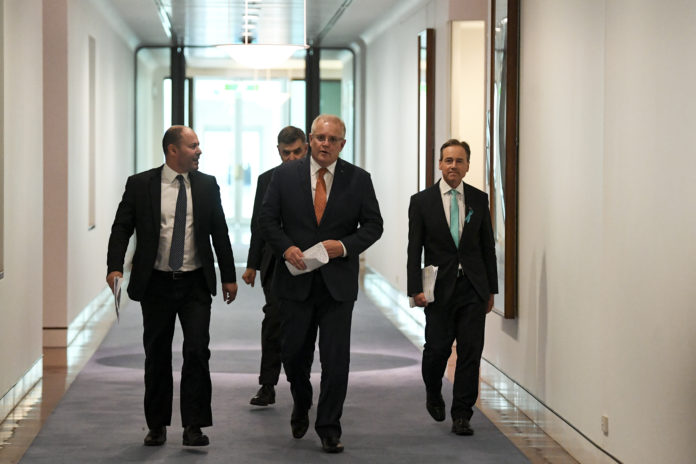
The government will unveil on Wednesday a package of coronavirus health measures, including a network of respiratory clinics, a new Medicare item for tele-consultations, and a communications campaign.

The package, which comes as the number of Australian cases reached 100, will cost A$2.4 billion, which includes $500 million announced last week to help states with their costs on a matching 50-50 basis.


Read more: Morrison government pledges funds to help states with health burden of COVID-19


The health measures precede the government’s multi-billion stimulus to address the hit the virus will deliver to the economy, which threatens to push Australia into recession.

Up to 100 “pop up” fever clinics will be established across the country, in a program costing $205 million.

These “one stop shops” will test people worried they may have the virus. They will supplement the work of GPs and state respiratory clinics.

As people become increasingly fearful about the virus, many are seeking tests, even though they fall outside the guidelines recommended for testing.

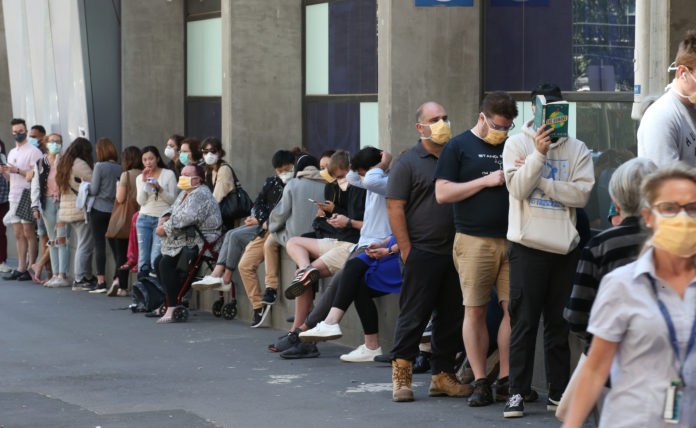
In Melbourne on Tuesday people queued outside the Royal Melbourne Hospital. In Perth there was a queue even before a new clinic opened at the Royal Perth Hospital’s Ainslie House, despite the clinic supposedly being for those at higher risk. In South Australia a “drive through” clinic has opened.

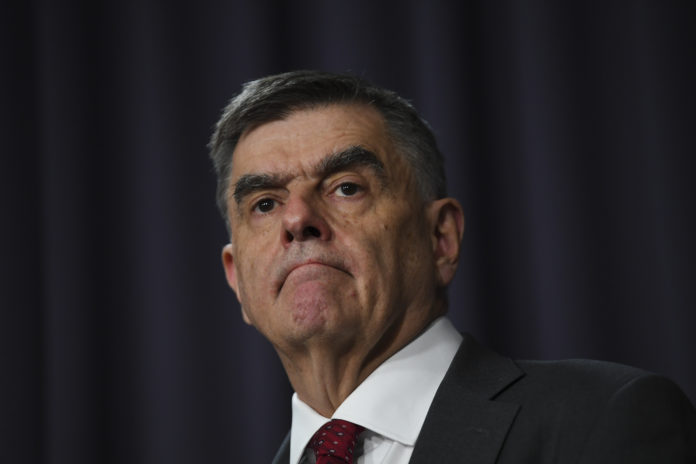
Commonwealth Chief Medical Officer Brendan Murphy said that in the last few days there had been a “significant surge” in the number of people requesting testing.


Read more: Politics with Michelle Grattan: Chief Medical Officer Brendan Murphy on COVID-19


Partly this had been sparked by some misinformation in the media suggesting everyone who had flu-like symptoms should be tested, he said. “We’re not saying that at the moment.”

Murphy said those who should be tested are returned travellers who develop acute respiratory symptoms or people who have been in contact with confirmed cases who develop acute respiratory symptoms.

The aim of the pop up clinics in the federal package is to deal with people with milder symptoms, taking the load off hospitals’ emergency departments and GPs, so that hospitals are only presented with the more serious cases.

Each clinic, staffed by doctors and nurses, would be able to see up to 75 patients a day over six months. They could operate as dedicated medical centres.

Health authorities and medical bodies will identify practices in regional, rural and urban areas. Some 31 Primary Health Networks will receive $300,000 to assist in identifying and setting up the “pop up” clinic sites and distributing protective equipment.

Up to an initial $150,000 will be given to help clinics start and offset losses from normal business.

The new Medicare item for telehealth will enable those who are isolated due to the virus to access medical services from home by audio or video. This will reduce risks of transmission from people going to doctors’ surgeries (and the inconvenience of consultations in car parks as doctors keep them out of surgeries).

The telehealth service, starting on Friday, will be bulk billed and available for medical, nursing and mental health medical staff to deliver services over the phone or through a video conference (including FaceTime, Skype, WhatsApp). The new item will cost $100 million and run for six months, when it will be reviewed.

The telehealth services will be available to

  • people isolating at home on medical advice

  • those aged over 70

  • Aboriginal and Torres Strait Islanders aged over 50

  • people with chronic health conditions or who have compromised immune systems

  • parents with new babies and pregnant women.

The telehealth arrangements will also mean health practitioners who are themselves in isolation will be able to continue to provide services, so long as they are fit enough to do so.


Read more: ‘Fever clinics’ are opening in Australia for people who think they’re infected with the coronavirus. Why?


The planned national communications campaign about COVID-19, including information on how to guard against the virus and what to do if you get it, will start within days and cost $30 million.

A wide range of platforms will be employed, and particular audiences targeted. It will use television, radio, print, digital, social media and displays on public transport and at shopping centres, as well as putting material in doctors waiting rooms. Market research and tracking will be used to refine the campaign.

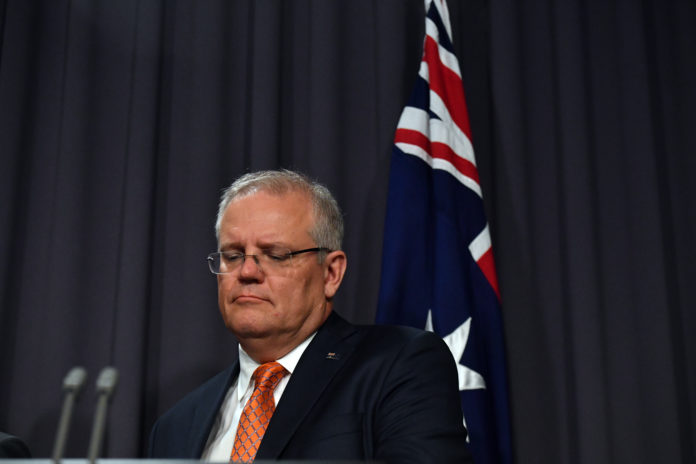
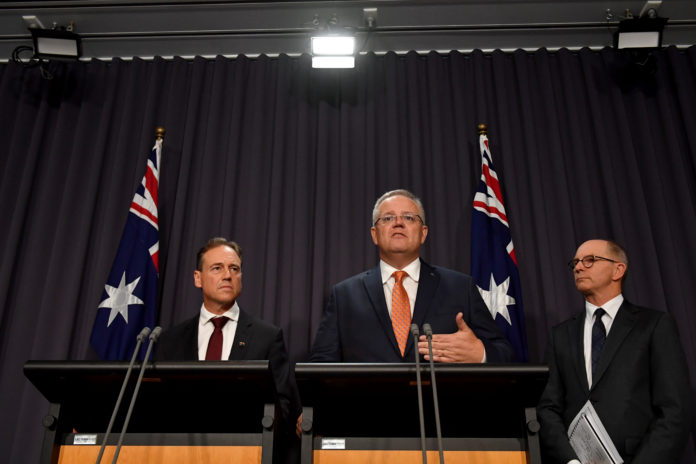
Scott Morrison said Australia is “as well prepared as any country in the world” to deal with the virus, and the health package “is about preventing and treating coronavirus in the coming weeks.”

ref. Morrison government funds ‘pop up’ testing clinics and tele-consultations in $2.4 billion COVID-19 health package – https://theconversation.com/morrison-government-funds-pop-up-testing-clinics-and-tele-consultations-in-2-4-billion-covid-19-health-package-133368
Politics with Michelle Grattan: Chief Medical Officer Brendan Murphy on COVID-19

Source: The Conversation (Au and NZ) – By Michelle Grattan, Professorial Fellow, University of Canberra

With 100 domestic cases as of March 10, federal and state governments and health authorities face daunting challenges posed by COVID-19 in coming weeks and months – securing a workforce of nurses and doctors to treat the sick, ensuring enough testing facilities to meet a rapidly growing demand, and stemming the spread of the virus, to the maximum extent possible.

As Chief Medical Officer for the federal government, Professor Brendan Murphy is confident about maintaining enough health staff, including in nursing homes.

“You can find a health workforce if you look hard enough, and if you can fund the surge. So I think we will find them.”

Murphy is also optimistic the present self-isolation period of 14 days can be shortened at some point, as the incubation period of virus is now thought to be “probably around five to seven days”.

When will the virus peak in Australia? Murphy says: “If we had widespread and more generalised community transmission, I would imagine that would be peaking around the middle of the year, in the middle of winter. … But that’s really our best guess of the modelling at the moment. And it’s very, very hard to predict.”

Murphy re-iterates that only people in certain categories need to be tested; in the last few days there has been a “significant surge” of people with flu-like symptoms but outside these categories who have been seeking testing, placing pressure on facilities.

With eyes on Italy’s lockdown, could a single region of Australia be locked down?

“It’s potentially possible, absolutely. If we had a city, a major city that had an outbreak of some thousands, and the rest of the country was pretty unaffected, we could very easily consider locking down a part of or a whole town or city.”

New to podcasts?

Podcasts are often best enjoyed using a podcast app. All iPhones come with the Apple Podcasts app already installed, or you may want to listen and subscribe on another app such as Pocket Casts (click here to listen to Politics with Michelle Grattan on Pocket Casts).

You can also hear it on Stitcher, Spotify or any of the apps below. Just pick a service from one of those listed below and click on the icon to find Politics with Michelle Grattan.

Additional audio

A List of Ways to Die, Lee Rosevere, from Free Music Archive.

ref. Politics with Michelle Grattan: Chief Medical Officer Brendan Murphy on COVID-19 – https://theconversation.com/politics-with-michelle-grattan-chief-medical-officer-brendan-murphy-on-covid-19-133362

The world’s best fire management system is in northern Australia, and it’s led by Indigenous land managers

Source: The Conversation (Au and NZ) – By Rohan Fisher, Information Technology for Development Researcher, Charles Darwin University

The tropical savannas of northern Australia are among the most fire-prone regions in the world. On average, they account for 70% of the area affected by fire each year in Australia.

But effective fire management over the past 20 years has reduced the annual average area burned – an area larger than Tasmania. The extent of this achievement is staggering, almost incomprehensible in a southern Australia context after the summer’s devastating bushfires.


Read more: I made bushfire maps from satellite data, and found a glaring gap in Australia’s preparedness


The success in northern Australia is the result of sustained and arduous on-ground work by a range of landowners and managers. Of greatest significance is the fire management from Indigenous community-based ranger groups, which has led to one of the most significant greenhouse gas emissions reduction practices in Australia.

As Willie Rioli, a Tiwi Islander and Indigenous Carbon Industry Network board member recently said:

Fire is a tool and it’s something people should see as part of the Australian landscape. By using fire at the right time of year, in the right places with the right people, we have a good chance to help country and climate.

Importantly, people need to listen to science – the success of our industry has been from a collaboration between our traditional knowledge and modern science and this cooperation has made our work the most innovative and successful in the world.

A tinder-dry season

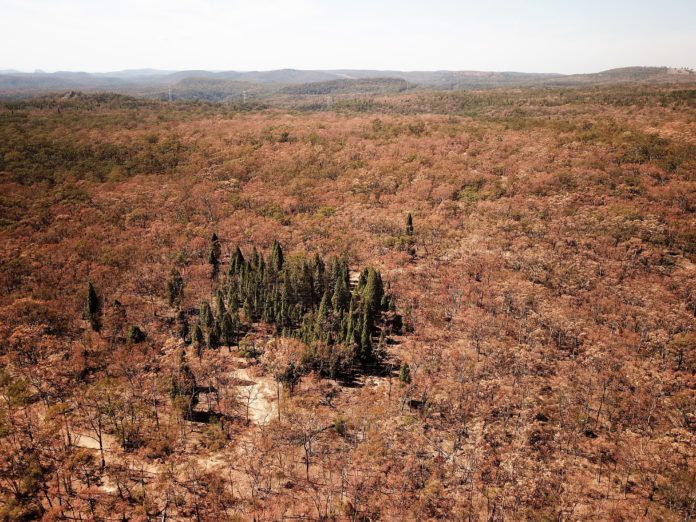
The 2019 fire season was especially challenging in the north (as it was in the south), following years of low rainfall across the Kimberly and Top-End. Northern Australia endured tinder-dry conditions, severe fire weather in the late dry season, and a very late onset of wet-season relief.

Despite these severe conditions, extensive fuel management and fire suppression activities over several years meant northern Australia didn’t see the scale of destruction experienced in the south.

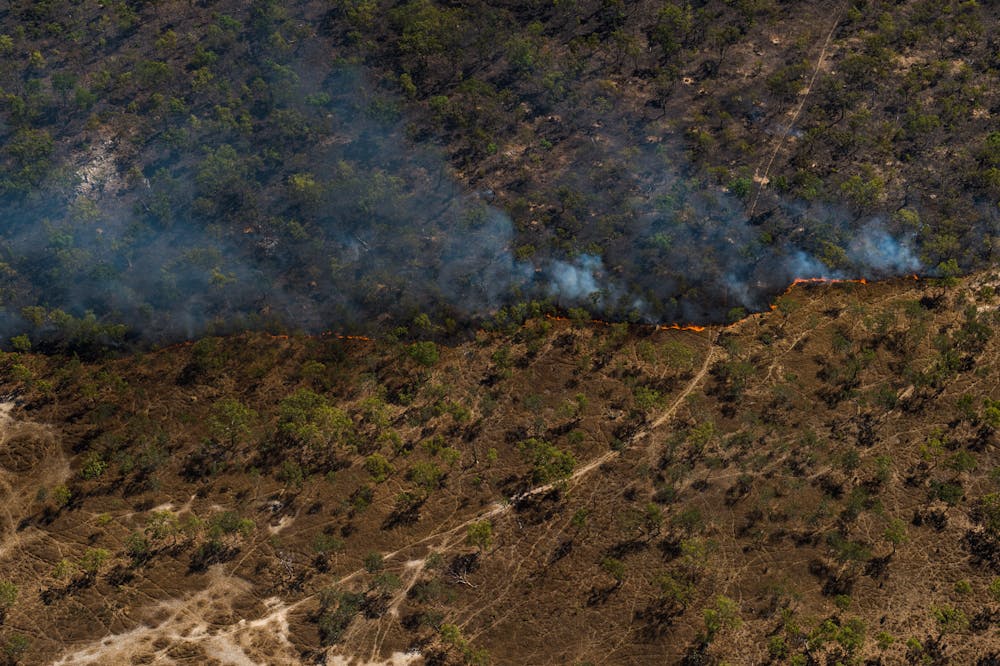
A comparison of two years with severe fire weather conditions. Extensive early dry season mitigation burns in 2019 reduced the the total fire-affected areas.

This is a huge success for biodiversity conservation under worsening, longer-term fire conditions induced by climate change. Indigenous land managers are even extending their knowledge of savanna burning to southern Africa.

Burn early in the dry season

The broad principles of northern Australia fire management are to burn early in the dry season when fires can be readily managed; and suppress, where possible, the ignition of uncontrolled fires – often from non-human sources such as lightning – in the late dry season.

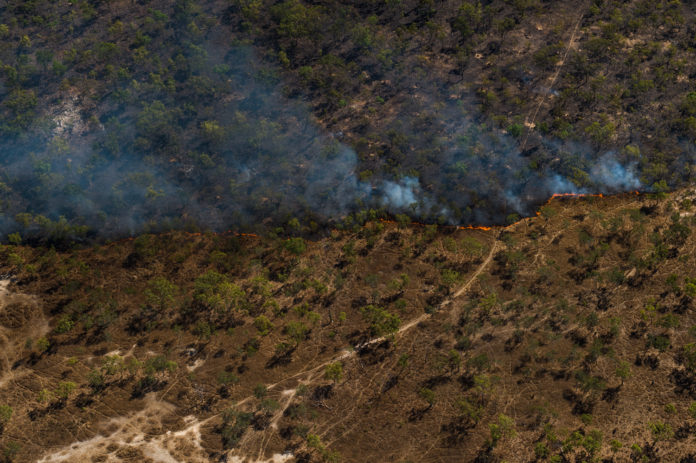
Traditional Indigenous fire management involves deploying “cool” (low intensity) and patchy burning early in the dry season to reduce grass fuel. This creates firebreaks in the landscape that help stop larger and far more severe fires late in the dry season.

Relatively safe ‘cool’ burns can create firebreaks. Author provided

Essentially, burning early in the dry season accords with tradition, while suppressing fires that ignite late in the dry season is a post-colonial practice.

Savannah burning is different to burn-offs in South East Australia, partly because grass fuel reduction burns are more effective – it’s rare to have high-intensity fires spreading from tree to tree. What’s more, these areas are sparsely populated, with less infrastructure, so there are fewer risks.


Read more: The burn legacy: why the science on hazard reduction is contested


Satellite monitoring over the last 15 years shows the scale of change. We can compare the average area burnt across the tropical savannas over seven years from 2000 (2000–2006) with the last seven years (2013–2019). Since 2013, active fire management has been much more extensive.

The comparison reveals a reduction of late dry season wildfires over an area of 115,000 square kilometres and of all fires by 88,000 square kilometres.

How fire has changed in northern Australia. Author provided

Combining traditional knowledge with western science

The primary goals of Indigenous savanna burning projects remain to support cultural reproduction, on-country living and “healthy country” outcomes.

Savanna burning is highly symbiotic with biodiversity conservation and landscape management, which is the core business of rangers.

Ensuring these gains are sustainable requires a significant amount of difficult on-ground work in remote and challenging circumstances. It involves not only Indigenous rangers, but also pastoralists, park rangers and private conservation groups. These emerging networks have helped build new savanna burning knowledge and innovative technologies.


Read more: Our land is burning, and western science does not have all the answers


While customary knowledge underpins much of this work, the vast spatial extent of today’s savanna burning requires helicopters, remote sensing and satellite mapping. In other words, traditional burning is reconfigured to combine with western scientific knowledge and new tools.

For Indigenous rangers, burning from helicopters using incendiaries is augmented by ground-based operations, including on-foot burns that support more nuanced cultural engagement with country.

On-ground burns are particularly important for protecting sacred sites, built infrastructure and areas of high conservation value such as groves of monsoonal forest.

Who pays for it?

A more active savanna burning regime over the last seven years has led to a reduction in greenhouse gas emissions of more than seven million tonnes of carbon dioxide equivalent.


Read more: Savanna burning: carbon pays for conservation in northern Australia


This is around 10% of the total emission reductions accredited by the Australian government through carbon credits units under Carbon Farming Initiative Act. Under the act, one Australian carbon credit unit is earned for each tonne of carbon dioxide equivalent that a project stores or avoids.

By selling these carbon credits units either to the government or on a private commercial market, land managers have created a A$20 million a year savanna burning industry.

How Indigenous Australians and others across Australia’s north are reducing emissions.

What can the rest of Australia learn?

Savanna fire management is not directly translatable to southern Australia, where the climate is more temperate, the vegetation is different and the landscape is more densely populated. Still, there are lessons to be learnt.

A big reason for the success of fire management in the north savannas is because of the collaboration with scientists and Indigenous land managers, built on respect for the sophistication of traditional knowledge.

This is augmented by broad networks of fire managers across the complex cross-cultural landscape of northern Australia. Climate change will increasingly impact fire management across Australia, but at least in the north there is a growing capacity to face the challenge.

ref. The world’s best fire management system is in northern Australia, and it’s led by Indigenous land managers – https://theconversation.com/the-worlds-best-fire-management-system-is-in-northern-australia-and-its-led-by-indigenous-land-managers-133071

Restricting underage access to porn and gambling sites: a good idea, but technically tricky

Source: The Conversation (Au and NZ) – By Paul Haskell-Dowland, Associate Dean (Computing and Security), Edith Cowan University

Australia should work towards adopting a mandatory age-verification system for gambling and pornography websites, according to a recommendation from the federal parliamentary cross-party committee on social and legal issues.

The recommendation follows the committee’s inquiry findings, released last month as a report titled Protecting the age of innocence. It identified high levels of concern, particularly among parents, about underage access to pornography and gambling sites.

The committee has asked Australia’s eSafety Commissioner and Digital Transformation Agency to work towards implementing the system.

But as the UK’s recently aborted effort shows, delivering on this idea will mean overcoming a host of technical and logistical hurdles, including identity fraud and the use of virtual private networks (VPNs) or anonymising browsers such as Tor.


Read more: Is that porn your child is watching online? How do you know?


Like most developed countries, Australia has long had laws that restrict underage access to adults-only products. Attempting to buy a bottle of beer will quickly prompt a request for proof of age.

But for as long as there have been rules, people have looked for ways to break them. Would-be underage drinkers can attempt to find a fake ID, a retailer willing to ignore the law, or simply an older friend or relative willing to buy some beer for them.

Just like alcohol, access to gambling and pornography have been age-restricted by law for some time. This used to be relatively easy to enforce, when the only way to access such items was through a retail store. But everything changed when these things became available on the internet.

Pornography and gambling represent significant proportions of web searches and traffic. According to one recent estimate, pornography accounts for up to 20% of internet activity.

According to the committee’s report, the average age of first exposure to pornography is now between 8 and 10 years:

It’s now not a matter of “if” a child will see pornography but “when”, and the when is getting younger and younger.

The report also warns that adolescents are increasingly exposed to gambling advertisements:

Adolescents today are increasingly exposed to gambling marketing… alongside increased accessibility and opportunities to gamble with the rise of internet and smart phone access.

In an era where age-limited content is available for free to anyone with a web browser, how do we enforce age restrictions?

Age verification legislation for online pornography has already been tried in the UK, when it introduced the Digital Economy Act 2017. But by 2019 the attempt was abandoned, citing technical and privacy concerns.

No easy task

It seems simple in principle but is fraught with difficulty in practice. Given the global scale of these industries, it is almost impossible for the government to even generate a list of applicable websites. Without a definitive list, it will be difficult to block access to sites that do not comply.

The situation is complicated further by the fact that many sites are hosted overseas, meaning they may have to provide different age-verification mechanisms for users in different jurisdictions.

Credit card verification has become the default solution, as there are global platforms to verify credit cards. But while it is possible to verify a card number, there are various ways to obtain such details.

A minor could potentially use a parent’s credit card, or even fraudulently obtain their own. Other ID options such as driving licences could potentially be used instead, but this may not be a popular option for legitimate users because of the risks of identity fraud or privacy breaches. This would also pose logistical challenges: imagine a US-hosted pornography site having to verify Australian driving licence details.

Workarounds already exist

Even if a technical solution is found, there are already established ways to evade the rules. Consumers are increasingly turning to VPNs to bypass regional restrictions on media content.

A VPN allows a user’s internet traffic to appear to originate from another location. Often referred to as “tunnelling”, it effectively fools systems or services into thinking you are in another part of the world, by swapping the users’ local IP (internet) address with another address. Some VPN providers now explicitly advertise their product as a solution to the regional restrictions of streaming companies like Netflix and Amazon.

It’s not hard to imagine that many consumers would turn to VPNs to dodge any verification procedures implemented here in Australia.

Consumers concerned about privacy are also likely to use the Tor browser.

Tor works in a similar way to a VPN. While it still hides the location of the user (potentially looking like they are in another country), Tor also ensures that traffic is bounced between multiple points on the internet to further obscure the user (and thus their age).


Read more: New laws are not necessarily the answer to counter the real threat pornography poses


The committee has acknowledged this but vowed to press on regardless, arguing:

While age verification is not a silver bullet, it can create a significant barrier to prevent young people — and particularly young children — from exposure to harmful online content. We must not let the perfect be the enemy of the good.

It is still early days, and there is much work for the eSafety Commissioner and the Digital Transformation Agency to do. It is also clear there is both government and public pressure to identify and implement solutions to safeguard children and vulnerable individuals. But unfortunately, human nature will inevitably render any developed solution as more full of holes than a block of Emmental.

It would be easy to say we shouldn’t bother, or that parents should take responsibility. The reality is that implementing any solution will protect at least some of the vulnerable population and will form part of a layered approach. With widespread support, targeted education and age-verification, there is, perhaps, the potential for success.

ref. Restricting underage access to porn and gambling sites: a good idea, but technically tricky – https://theconversation.com/restricting-underage-access-to-porn-and-gambling-sites-a-good-idea-but-technically-tricky-133153

To fix the family law system, we need to ask parents what really works

Source: The Conversation (Au and NZ) – By Rae Kaspiew, Senior Research Fellow, Australian Institute of Family Studies

As Family Court Chief Justice Will Alstergren said late last year, when people separate, it can be “a shocking time in their lives”. This is particularly so when parents face each other in court.

Australia’s family law system has been the subject of many inquiries and studies. Just last year, the government announced another one.

One of the most exhaustive studies was the Evaluation of the 2012 Family Violence Amendments, published in 2015 by the Australian Institute of Family Studies and funded by the Attorney-General’s Department.

Our research found that, although discussions about the system are often framed in terms of “who wins” out of mothers and fathers, the biggest challenge is actually parent and child safety.

What do parents think of the family law system?

Our research was part of the Evaluation of the 2012 Family Violence Amendments and included a number of studies, including a synthesis report, and an experiences of separated parents study.

The latter study was based on two surveys, taken before and after the 2012 amendments. In each survey, we interviewed about 6,000 separated parents.

We asked these parents how they sorted out their parenting arrangements after separating. We found most (about 70%) had worked out their parenting arrangements through informal discussions, with little or no reliance on the formal family law system. Another 10% let their arrangements “just happen”.


Read more: Separated parents and the family law system: what does the evidence say?


So, a large majority of separated parents sorted out their parenting arrangements informally. The great majority of these parents also said they were satisfied with the result.

The remaining fifth of parents reported using one of three formal family law pathways. In order of use, these were:

  • family dispute resolution (a form of mediation)

  • negotiation through lawyers

  • litigation in the courts

Of the formal pathways, family dispute resolution was the most widely used (by 10% of separating parents within 18 months of separation) because it is by far the least expensive and most accessible option.

Behind family dispute resolution came negotiation through lawyers (used by 6%) and then the courts (3%).

Do mothers and fathers have different views of the system?

It is in parents’ assessments of the formal pathways, particularly of the courts, where the differences between fathers’ and mothers’ views become apparent.

There were clear differences between fathers’ and mothers’ assessments of the courts from a child-focused perspective (meaning they felt the child’s needs were adequately considered). Three-quarters of mothers rated the courts positively on that count, compared to just 57% of fathers.


Read more: In the Family Court, children say they want the process explained and their views heard. It’s time we listened


From an adult-focused perspective (the process “worked” for the adult participant), the parents’ assessments of the courts were much closer, but satisfaction levels were lower, with only 52% of mothers and 49% of fathers satisfied.

These lower rates of satisfaction may be because a decision by a judge creates the perception one party has lost and the other won.

In contrast, family dispute resolution had significantly higher satisfaction levels, with 89% of mothers and 85% of fathers saying they were satisfied from a child-focused perspective, and 77% of mothers and 70% of fathers satisfied from an adult-focused perspective.

Are we doing enough to protect parents’ and children’s safety?

In many respects, our findings are reassuring. But our research reveals that for many of the people who rely on formal family law pathways, the system has significant problems.

We found the people who are the most reliant on the family law system are often the most affected by family violence, child safety concerns and other issues. In our interviews, 21% of parents who used family dispute resolution, 27% of parents who used lawyers and 38% of parents who used the courts reported a suite of complex issues, often including safety concerns and family violence.

And the complex nature of their needs, in particular their safety concerns, are not receiving enough attention.


Read more: First act of the family law review should be using research we already have


When asked whether the family law system protects children’s safety, as it is required to do, barely half of mothers (53%) and fathers (48%) agreed. Ratings were particularly low (less than 40%) among parents who had safety concerns either for themselves and their child, or for their child only.

These people typically use difficult, expensive formal pathways only because discussions, informal or mediated, are not an option. This is often because of family violence and safety concerns. And many of these people told us the system was not working for them.

Consistent with the conclusions of two recent family law inquiries (by a parliamentary committee and the Australian Law Reform Commission), these findings point to the need for the system to sharpen its focus on parent and child safety.

The discussion about family law reform ought not to be about winners and losers, but about how to protect the vulnerable parents and children who are forced to rely on it.

ref. To fix the family law system, we need to ask parents what really works – https://theconversation.com/to-fix-the-family-law-system-we-need-to-ask-parents-what-really-works-126508

Former Tongan PM guilty on false statement, perjury charges

By Philip Cass

Former Prime Minister Lord Tu’ivakano will be sentenced at the end of next month after being found guilty in the Supreme Court yesterday of three charges, including making a false statement for the purpose of obtaining a passport and perjury.

The offences in what was known as the Chinese passport scandal were committed in 2015, but he was not charged until 2018.

Local media reported that the jury retired at 4pm and were back in just over half an hour.

READ MORE: Former PM denies bribery, firearms, perjury charges over Chinese passport scandal

RNZ reported earlier that six charges of bribery and money laundering in relation to the issuance of Tongan passports to Chinese nationals had been dropped.

As Kaniva News reported last week, it was originally alleged that between 2013-2014, while serving as Minister for Foreign Affairs, he accepted money to issue Tongan passports to various Chinese nationals.

– Partner –

The amounts involved were said to range from TP$3000 (NZ$2052) to TP$199,408.94 (NZ$136,460).

These allegations were withdrawn and not heard.

Firearm charge
Crown Prosecutor Semisi Lutui told the court, the Attorney-General had advised against proceeding with the charges.

The presiding judge, Lord Chief Justice Whitten, will sentence Lord Tu’ivikano on charges of three counts of making a false statement for the purpose of obtaining a passport, perjury and possession of 212 pieces of ammunition without a licence.

Last week, the former Prime Minister pleaded guilty to possessing a .22 rifle without a licence.

The firearm and ammunition charges stemmed from a police search of his home  in Nuku’alofa on March 1, 2018.

Lord Tu’ivakano was  accused of making a false statement on the grounds that on July 17, 2015 he wrote a letter to the Immigration Division of the Ministry of Foreign Affairs, stating that Hua Guo and Xing Lui were naturalised as Tongans on October 29, 2014.

On the charge of perjury, it was alleged that on December 21, 2015, he made an oath in an affidavit, stating that these two were naturalised during his tenure as the Minister of Foreign Affairs of the Ministry and that naturalisation Tongan passports were then issued to them, knowing this statement was false.

He was further charged with making a false statement, in that on July 17, 2015 with the purpose of obtaining a passport for Hua Guo and Xing Liu, and with intent to deceive the Immigration Division of the Ministry of Foreign Affairs, the accused wrote a letter to the Immigration Division, stating that these two were naturalised as Tongans on October 29, 2014, and he had reasonable cause to believe that statement was misleading.

He was bailed on condition that he surrender his passport and not leave Tongatapu.

Lord Tu’ivakano is still a member of Parliament as a Noble’s Representative.

Philip Cass is associate editor of Pacific Journalism Review and a research associate of the Pacific Media Centre. This article is republished under a partnership agreement with Kaniva Tonga.

Print Friendly, PDF & Email

Article by AsiaPacificReport.nz

Indonesian indigenous land defenders jailed in fight with pulpwood giant

By Ayat S. Karokaro in Medan

Indonesian ­ activists have deplored the recent jailing of two indigenous community members in Sumatra in a land conflict involving an affiliate of pulp and paper giant Royal Golden Eagle.

The Simalungun District Court, in North Sumatra province, handed down nine-month sentences to Jonny Ambarita and Thomson Ambarita, who are elders from the Sihaporas community, for assaulting an employee of PT Toba Pulp Lestari (TPL), an RGE affiliate company.

The Sihaporas community and PT TPL have been embroiled in a dispute for decades over land to which both lay claim.

READ MORE: Will Asia Pulp and Paper default on its ‘zero-deforestation’ commitments?

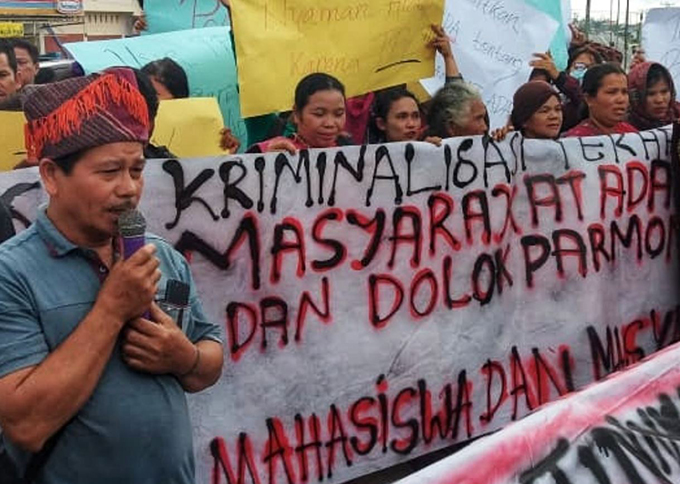
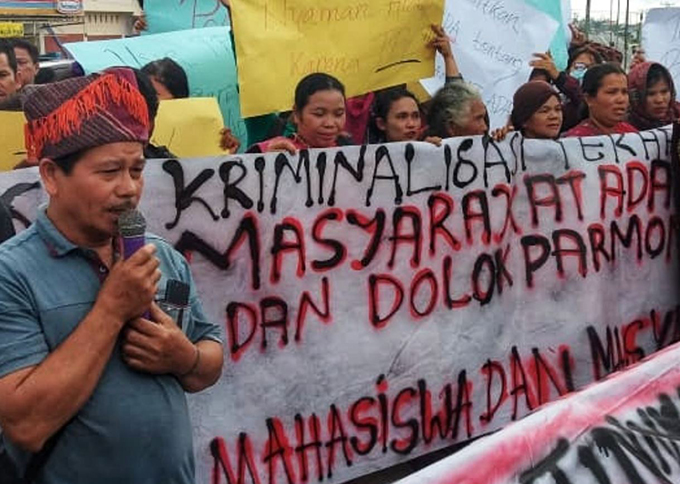
As in most such cases in Indonesia, the authorities have sided with corporate interests and pursued criminal charges against the community, said Agustin Simamora, head of the advocacy at the provincial chapter of the Indigenous Peoples Alliance of the Archipelago (AMAN).

“The judges ignored all the facts in this case. This [ruling] is very regrettable,” he said.

– Partner –

The sentences, handed down Feb. 13, cap a trial sparked by an incident last September in which the company, or people claiming to represent it, appeared to be the side escalating the legal wrangling into a violent conflict.

Scuffle broke out
On the morning of September 16, 2019, according to the community members, a group of men claiming to be PT TPL employees arrived in their village and demanded that they cease their farming activity and leave the area.

The farmers refused, and a scuffle broke out, during which the 3-year-old son of one of the community members was reportedly hit by one of the purported company representatives. The child passed out and had to be taken to a nearby public health center.

The following day, leaders of the Sihaporas community went to a nearby police station to file a report about the alleged assault on the child. But the officers refused to receive their complaint, telling them instead to file it at a different precinct office.

Officers from that larger precinct later issued a summons for Jonny and Thomson Ambarita to appear for questioning on September 24. Unknown to the community, PT TPL had filed its own report with the police, alleging that the farmers had assaulted one of its employees in the earlier skirmish.

When Jonny and Thomson showed up at the police station, they were promptly charged and arrested.

In the months since then, they have been indicted, tried, and convicted. But police have still not acted on the community’s report on the alleged attack on the child.

Sahat Hutagalung, the lawyer for Jonny and Thomson Ambarita, called the guilty verdict unfair.

Evidence ignored
Like other observers of the trial, he questioned why much of the evidence presented in court that corroborated the community’s account ­ including witness testimony and videos of the incident ­ was ignored.

“Unfortunately, it was overlooked by the judges,” Sahat said.

Hundreds of members of the Sihaporas community turned up at the courthouse to hear the verdict and demand that Jonny and Thomson be acquitted. Community members said the trial was a familiar ordeal for them: from 2002 to 2004, three other indigenous members were arrested after PT TPL complained they were farming in the disputed area.

Arisman Ambarita was jailed for three months in 2002, while Mangitua Ambarita and Parulian Ambarita were each sentenced in 2004 to two years in prison.

The Sihaporas community has since the early 1900s claimed ancestral rights to a large swath of forest in what is today North Tapanuli district in the province of North Sumatra, where it continues to practice subsistence farming.

In 1913, it loaned part of the land to the Dutch colonial authorities for a pine plantation. After Indonesia won independence from the Dutch, the new government claimed the pine forest, among other Dutch-run assets and properties at the time, as belonging to the Indonesian state.

In 1992, the government issued a pulpwood permit in the area to PT TPL, for a concession covering 185,000 hectares (457,000 acres). The Sihaporas community contends that 40,000 ha (98,800 acres) of that concession is part of its ancestral territory. PT TPL has already planted half of the disputed area with eucalyptus.

No responses
In its campaign to free Jonny and Thomson, the Sihaporas community took its case to Indonesia’s National Commission for Human Rights last October. Community elders also sent three letters to President Joko Widodo to demand state recognition of their ancestral lands and ask the government to revoke PT TPL’s permit.

There have been no responses to any of those initiatives.

Since 2013, when a landmark Constitutional Court ruling struck down the state’s claim to indigenous peoples’ forests, President Widodo has recognized the rights of 55 indigenous groups to forest areas spanning a combined 24,800 ha. AMAN, the indigenous rights advocacy group, says it has mapped out some 7.8 million ha of land it says belongs to 704 indigenous communities nationwide, including the Sihaporas community.

“When did land ownership certificates come about? Only after Indonesia came into being as a nation,” said Domu Ambarita, a historian for the Sihaporas community. “But indigenous peoples have existed and lived on their customary lands since before Indonesia was established.”

Domu said it was important to recognize the Sihaporas as the stewards of their land at a time when Indonesia is losing its forest at alarming rates to agriculture and other land-use changes.

“Our rituals exist alongside and protect nature,” he said. “If the ancestral forest is owned and seized by PT TPL, everything will be destroyed. We completely reject that.”

This story was first reported by Mongabay’s Indonesia team and republished by the Pacific Media Centre under a Creative Commons licence. Ayat S. Karokaro is a Mongabay contributor. Translated by Basten Gokkon.

Print Friendly, PDF & Email

Article by AsiaPacificReport.nz

The secret of TikTok’s success? Humans are wired to love imitating dance moves

Source: The Conversation (Au and NZ) – By Niall Edwards-FitzSimons, PhD Candidate in Ethnomusicology, University of Sydney

Since its launch in 2016, the online video sharing platform TikTok has grown at an astonishing rate. The app has been downloaded more than a billion times, and more than 700 million people around the world (most of them quite young) use it every day.

TikTok’s design brings together music, video, dance and viral challenges to create one of the most energetic nodes in the web of popular culture in 2020.

Part of the explanation for the platform’s meteoric rise may lie in the science of the mind – in particular, the science of what happens when we imitate another person’s movement. By making it easy to create, share and copy dance routines, TikTok may be taking advantage of the brain’s systems for building human connection.


Read more: Most adults have never heard of TikTok. That’s by design


What is TikTok?

Perhaps the first real demonstration of the power of TikTok was the rise of Lil Nas X’s country-rap hit Old Town Road.

Released in late 2018, the song received little attention until it spawned a dance routine that went viral on TikTok. The catchy tune became unavoidable in 2019, selling 10 million copies and spending a record-breaking 19 weeks at number one on the Billboard charts.

Now TikTok has become a vital component of the pop culture machine. The youth-oriented online videogame Fortnite recently ran a TikTok-based competition to create a new dance routine for player avatars. The New York Times publishes in-depth investigations of who really created popular routines. In Vietnam, a dance challenge demonstrating correct handwashing procedures is synced to the Ministry of Health’s pop song informing citizens about coronavirus precautions.

Content from TikTok is also establishing a feedback loop with more traditional channels. Pop star Doja Cat’s song Say So became popular in part due to a dance featuring the song by TikTok user @yodelinghayley. Doja Cat responded by releasing the song as a single complete with a video clip that included the dance and its creator.

What makes TikTok special?

As TikTok has pushed its way into the ranks of global social media giants, its rise has been accompanied by some anxiety in the West due to its origin in China and popularity among children and teenagers.

However, the app has largely avoided scrutiny by billing itself as a “creative platform” rather than a social media site. It is designed so its key features to users are playfulness and performativity.

Users can easily add music to the platform’s 15-second videos, which has meant that dance routines feature prominently on the site. Popularity on the app is often based on the inventiveness, skill, and entertainment value of the original dance routines created by users.

Every so often a dance routine becomes a viral hit, and other users of the platform post their own versions copying the original user. Imitation, and particularly the imitation of posture and movement, is an ancient behaviour at the heart of how humans learn from and connect with each other.

Why is imitation so powerful?

Scientists believe imitation functions through a system of “mirror neurons” which are thought to exist in the brains of all primates. As we watch another person perform an action, mirror neurons fire throughout the motor cortex to map that movement onto our own bodies. This happens whenever we see (or hear) human movement, whether it’s an acrobat, a yoga teacher, or a teenager dancing on TikTok. (Although the mirror neuron effect appears to be weaker when we watch video of a person moving rather than seeing it in the flesh, it is still present.)

In studies on unconscious imitation, researchers have found that strangers who subconsciously mirror one another’s body posture and gestures during their first meeting also report more mutual positive feelings. This “likability boost” also exists for people engaged in synchronous movement entrained to the same beat (in layman’s terms, dancing together), who report “liking each other better, remembering more about each other, [and] trusting each other more”.


Read more: Imitation and imagination: child’s play is central to human success


Activities involving synchronised movement can create powerful feelings of unity, and these practices are often the focus for feelings of group solidarity (think the Māori haka, a country line dance or a marching band, or indeed a marching army).

On TikTok, the mass grouping of people together in space is replaced by a more subtle form of togetherness through imitation and synchronised movement. These dancers are separated through time and space, but they create solidarity and positive feeling by moving together, mediated by the structure of the platform.

With the mass imitation of synchronised movement in the viral dance routines, TikTok and those seeking to exploit it are tapping into the deep-seated psychology of how we connect.

ref. The secret of TikTok’s success? Humans are wired to love imitating dance moves – https://theconversation.com/the-secret-of-tiktoks-success-humans-are-wired-to-love-imitating-dance-moves-133057

Duterte rejects Metro Manila coronavirus lockdown for now

By Sofia Tomacruz in Manila

President Rodrigo Duterte has rejected calls to place Metro Manila on lockdown after health officials recorded a spike in Covid-19 novel coronavirus cases.

In a late night press conference yesterday, Duterte said it was still “too early” to implement the sweeping restrictions that would limit people’s movements.

“We have not reached that kind of contamination,” Duterte said.

READ MORE: Threat of coronavirus pandemic now ‘very real’ – WHO

Duterte stressed the need to strike a “balance” in response measures to combat the coronavirus crisis as this could affect the transport of and access to necessities like rice and oil.

Duterte earlier declared a state of public health emergency due to concerns over the virus, which has infected at least 24 people in the Philippines.

– Partner –

Calls for a lockdown covering the National Capital Region echo China’s and Italy’s unprecedented decision to shutdown large parts of their territory in an effort to quell the spread of the virus.

China and Italy are among the countries with the highest number of confirmed cases and deaths due to COVID-19, the disease caused by the novel coronavirus.

Largest number
For one, China – ground zero for the coronavirus – has the largest number of cases with more than 80,000 infected so far.

Italy is likewise the country with the third largest number of cases as it recorded over 7400 who tested positive for the virus.

As of Monday night, the Philippines recorded 24 confirmed cases of the coronavirus. These include one death – a Chinese tourist who was the first fatality to be recorded outside China.

Worldwide, the death toll has exceeded 3800, while more than 109,000 people have been infected in more than 100 countries.

Print Friendly, PDF & Email

Article by AsiaPacificReport.nz

How to succeed in refugee review cases: new research reveals the factors that matter

Source: The Conversation (Au and NZ) – By Daniel Ghezelbash, Associate Professor, Macquarie University

Asylum seekers with legal representation are seven times more likely to succeed before the government tribunal tasked with reviewing refugee cases than those who represent themselves.

Where refugees come from and which individual member is reviewing their case on the Administrative Appeals Tribunal (AAT) may also significantly influence their odds of success.

These are some of the major findings from our research into the decision-making patterns of the overburdened AAT in refugee cases.

The data, obtained from a freedom of information request, cover 18,196 cases decided by the AAT between January 2015 and December 2019. Our research only looked at asylum seekers who arrived by plane and had access to a review by the AAT.

The analysis is part of larger project, run in collaboration with my research student, Keyvan Dorostkar, collating and studying quantitative data at all stages of Australia’s asylum process.

How the visa approval and review process works

For refugees and asylum seekers applying for protection visas in Australia, the process is lengthy and arduous.

The initial assessment of a protection visa application is carried out by the Department of Home Affairs. If this is denied, the options for review then depend on how they arrived in Australia.

Those who arrived by plane can seek review at the AAT, where they are given a fresh hearing assessing the merits of their claim for protection. Those who arrived by boat without authorisation can only access a much more limited form of review before the Immigration Assessment Authority (IAA).


Read more: Refugees without secure visas have poorer mental health – but the news isn’t all bad


If the asylum seeker’s claims fail at the IAA or AAT, they can then seek judicial review at the Federal Circuit Court, but only on the very narrow grounds of there having been some serious legal error.

Overall, we found asylum seekers received favourable outcomes before the AAT in just 13% of cases. This includes instances where a visa has been granted or the matter was sent back to the department for reconsideration.

In the remaining 87% of cases, the original decision to refuse a visa was affirmed by the AAT or the application was withdrawn.

Why legal representation matters

Our analysis of the data reveals much more about the factors that tend to lead to a successful or unsuccessful review.

One of the most striking findings relates to the potential influence of professional migration advice from a lawyer or migration agent.

We found that only 4% of unrepresented applicants were successful at the AAT. This figure rose to 28% when an asylum seeker had legal representation.


Read more: We don’t know how many asylum seekers are turned away at Australian airports


These statistics suggest the government’s decision to restrict public funding for free legal advice services may be severely disadvantaging applicants who cannot secure representation.

This is all the more concerning given our data show that just over half (52%) of all applicants do not have representation when they appear before the AAT.

Country of origin plays a huge role in success

There are also stark differences in the success rates of applicants from different countries.

Of the countries that had 20 or more applications during the period we studied, applicants from Libya (91%), Afghanistan (76%), Ethiopia (61%), stateless individuals (43%), Iraq (53%) and Iran (47%) were the most likely to succeed with their reviews.

While some variation is to be expected in these cases, the very high rates of decisions being overturned for certain countries raises concerns about the quality of the initial decisions being made on visas by the Department of Home Affairs.

Why is the department getting it wrong 90% of the time for Libyan applicants? Or more than 75% of the time for applicants from Afghanistan?


Read more: Sri Lankan asylum seekers are being deported from Australia despite fears of torture


At a time when the AAT is facing a record backlog of applications, it’s vital to understand why this is happening so that some of the pressure might be alleviated.

At the other end, the success rates for visa reviews for those from Ireland and Tonga were 0%, followed by Taiwan and South Korea (1%) and Malaysia (3%).

The Malaysian applicants are significant as they made up more than one-third of the entire caseload for the period (6,488 applications). The large numbers and low success rates among this group significantly skew the overall data. When the Malaysian applications are removed, the success rate for all asylum seekers increases from 13% to 19%.

A parliamentary inquiry found that people smugglers and illegal labour hire companies may be bringing workers into the country on travel visas and then applying for protection visas. This concern was raised particularly with respect to Malaysians.

However, there is no strong evidence that backs up claims around the systematic involvement of people smugglers and organised crime.

Regardless, the only incentive to put in an unmeritorious asylum claim is that it can buy you more time living and working in Australia.

If exploitation is a concern, the best way to ensure the integrity of the system is to reduce delays and invest more resources to boost the capacity for high-quality decision-making at both the department and AAT.

Which tribunal member hears the case also matters

In our research, we also found significant differences in the success rates for refugee visa reviews, depending which tribunal member hears the case.

We only examined members who had decided 50 or more cases to ensure the sample is large enough to be statistically relevant.

Two members did not find in favour of a single asylum seeker applicant, and another 16 had approval rates of less than 5%.

At the other end, one member decided in favour of the asylum seeker in 86% of cases, while another three members had approval rates over 40%.


Read more: There’s no airport border ‘crisis’, only management failure of the Home Affairs department


It is important to caution against drawing inferences as to the cause of this variation.

While this could be a result of the individual preferences or biases of tribunal members, it could also be explained by the way cases are allocated. Members generally have expertise in specific types of claims from specific countries, which influences the cases they are assigned.

In response to questions about this, the AAT said

to construct any meaningful comparison concerning the variation of outcomes across individual members, there should be more analysis of the nature of the reviews undertaken by those members sampled.

For instance, the country of origin of applicants and the nature of the claims made by those applicants are generally the most significant factors in determining the outcome of a review.

We will examine these factors in more detail in future research.

The AAT is under enormous pressure with its record backlog of cases and associated delays.

We believe making data on decision-making patterns publicly available for analysis can lead to better ideas for improving the efficiency and fairness of the process. And this would be in the interest of both refugees and the government.


Macquarie student Keyvan Dorostkar provided research assistance for this article.

ref. How to succeed in refugee review cases: new research reveals the factors that matter – https://theconversation.com/how-to-succeed-in-refugee-review-cases-new-research-reveals-the-factors-that-matter-131763

Sad about having a boy not a girl? Your distress might be real but ‘gender disappointment’ is no mental illness

Source: The Conversation (Au and NZ) – By Tereza Hendl, Research Associate, Ludwig Maximilian University of Munich

In an age of gender-reveal parties, baby bumps on Instagram, and hyper-gendered toys and clothing, learning about a baby’s sex is big news.

But having a boy rather than a girl, or vice versa, makes some people sad. Some label this “gender disappointment”.

Our research looked at what’s behind this sadness and whether gender disappointment is a mental illness, as some people say.

What’s ‘gender disappointment’?

In many societies, an ideal family is still a very gendered project. We see people wanting the son or daughter they’ve dreamed of or being congratulated for a “gender balanced family” with at least one boy and a girl.

Parents who do not achieve this ideal can feel they failed at something important. And some parents want to use IVF to choose their child’s sex.

Gender disappointment is often portrayed as a mental illness, similar to depression, in the media and on online forums, where prospective parents discuss their desire for, or experience with, sex selection.

Parents who have been interviewed about choosing the sex of their baby via IVF have also described gender disappointment as a mental illness.


Read more: Choosing children’s sex is an exercise in sexism


What’s behind this phenomenon?

Our research found no evidence gender disappointment is a mental illness.

Instead, we argue that at the heart of many testimonies is the belief only children of a certain sex can do certain things, or have particular traits. The problem with such “gender essentialism” is there’s no strong evidence for it.

Contemporary research challenges the idea there are two distinctly different male or female brains, personality types, behaviours or “natural inclinations” towards particular activities.

But there is mounting evidence of how society creates, fixates on and reinforces gender differences.


Read more: What’s the point of sex? It frames gender expression and identity – or does it?


Parents reporting gender disappointment also seem to confuse sex with gender.

Sex refers to the various biological and physiological bodily characteristics, whereas gender relates to the socially constructed characteristics and roles associated with individuals of a particular sex. And both sex and gender are less binary, more diverse traits than commonly thought.

When parents speak about gender disappointment, they say they’re sad about missing out on particular activities, relationships or experiences with their child, not physical attributes associated with sex.

Parents say they’re sad about missing out on particular activities, like playing soccer in the park. from www.shutterstock.com

Yet, there is no guarantee an individual child will identify with the gender assigned to them at birth or develop the desired attributes. There are also no reasons to believe the parent couldn’t have the desired experiences with any child.

Could parents be overreacting?

Some people might argue parents’ anguish is an overreaction, a disproportionate response to the news of their baby’s sex, a failure in some sort of psychological process.

But is there a process specifically concerned with adjusting to the sex of your child that is somehow faulty in people who speak about gender disappointment? Not likely.


Read more: Monday’s medical myth: you can control the sex of your baby


What seems more plausible is the distress parents experience is a form of depression or adjustment disorder, which a psychological examination could address.

But if there is no unique cause of the “disease” or unique treatment for parents’ distress, it is hard to see the point of classifying it as a unique mental illness.


Read more: We’re overdosing on medicine – it’s time to embrace life’s uncertainty


What can we do about it?

So, we’re back to the issue of how parents who speak out about gender disappointment tend to overestimate the role of biology and underestimate the role of society in the process of acquiring gender roles and attributes.

With society being so gendered and gender essentialism so widely shared, such a view among parents is hardly surprising.


Read more: It’s not just the toy aisles that teach children about gender stereotypes


If society gave up those beliefs, parents might also stop assuming their parenting experience will be vastly different based on their child’s sex. The associated disappointment should then also disappear.

But overcoming ingrained societal beliefs is a long-term struggle. In the meantime, what can we do to help parents in distress?

Counselling to dispel some of the beliefs underlying their suffering would be a good start. Should parents have depression, or think they might have, their GP can help. But someone doesn’t need to be labelled with a mental illness for their distress to be addressed.


If this article has raised issues for you, or if you’re concerned about someone you know, call Lifeline on 13 11 14.

ref. Sad about having a boy not a girl? Your distress might be real but ‘gender disappointment’ is no mental illness – https://theconversation.com/sad-about-having-a-boy-not-a-girl-your-distress-might-be-real-but-gender-disappointment-is-no-mental-illness-131300

A rare natural phenomenon brings severe drought to Australia. Climate change is making it more common

Source: The Conversation (Au and NZ) – By Nicky Wright, Research Fellow, Australian National University

Weather-wise, 2019 was a crazy way to end a decade. Fires spread through much of southeast Australia, fuelled by dry vegetation from the ongoing drought and fanned by hot, windy fire weather.

On the other side of the Indian Ocean, torrential rainfall and flooding devastated parts of eastern Africa. Communities there now face a locust plague and food shortages.

These intense events can partly be blamed on the extreme positive Indian Ocean Dipole, a climate phenomenon that unfolded in the second half of 2019.


Read more: Why drought-busting rain depends on the tropical oceans


The Indian Ocean Dipole refers to the difference in sea surface temperature on either side of the Indian Ocean, which alters rainfall patterns in Australia and other nations in the region. The dipole is a lesser-known relative of the Pacific Ocean’s El Niño.

Climate drivers, such as the Indian Ocean Dipole, are an entirely natural phenomenon, but climate change is modifying the behaviour of these climate modes.

In research published today in Nature, we reconstructed Indian Ocean Dipole variability over the last millennium. We found “extreme positive” Indian Ocean Dipole events like last year’s are historically very rare, but becoming more common due to human-caused climate change. This is big news for a planet already struggling to contain global warming.

So what does this new side-effect of climate change mean for the future?

The Indian Ocean brings drought and flooding rain

First, let’s explore what a “positive” and “negative” Indian Ocean Dipole means.

During a “positive” Indian Ocean Dipole event, waters in the eastern Indian Ocean become cooler than normal, while waters in the western Indian Ocean become warmer than normal.

Warmer water causes rising warm, moist air, bringing intense rainfall and flooding to east Africa. At the same time, atmospheric moisture is reduced over the cool waters of the eastern Indian Ocean. This turns off one of Australia’s important rainfall sources.


Read more: Dipole: the ‘Indian Niño’ that has brought devastating drought to East Africa


In fact, over the past century, positive Indian Ocean Dipoles have led to the worst droughts and bushfires in southeast Australia.

The Indian Ocean Dipole also has a negative phase, which is important to bring drought-breaking rain to Australia. But the positive phase is much stronger and has more intense climate impacts.

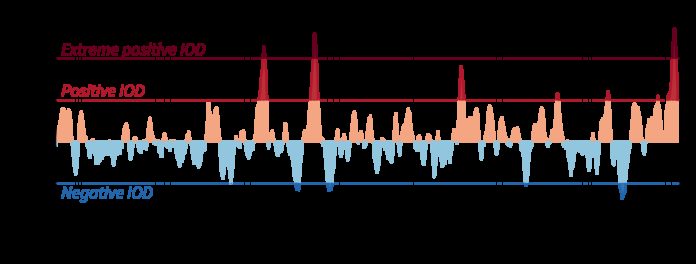
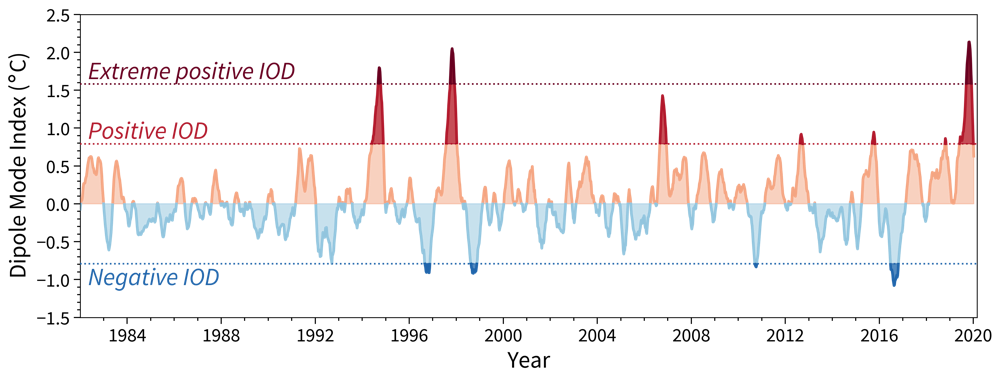
We’ve experienced extreme positive Indian Ocean Dipole events before. Reliable instrumental records of the phenomenon began in 1958, and since then a string of very strong positive Indian Ocean Dipoles have occurred in 1961, 1994, 1997 and now 2019.

The Dipole Mode Index is used to track variability of the Indian Ocean Dipole. Author provided

But this instrumental record is very short, and it’s tainted by the external influence of climate change.

This means it’s impossible to tell from instrumental records alone how extreme Indian Ocean Dipoles can be, and whether human-caused climate change is influencing the phenomenon.

Diving into the past with corals

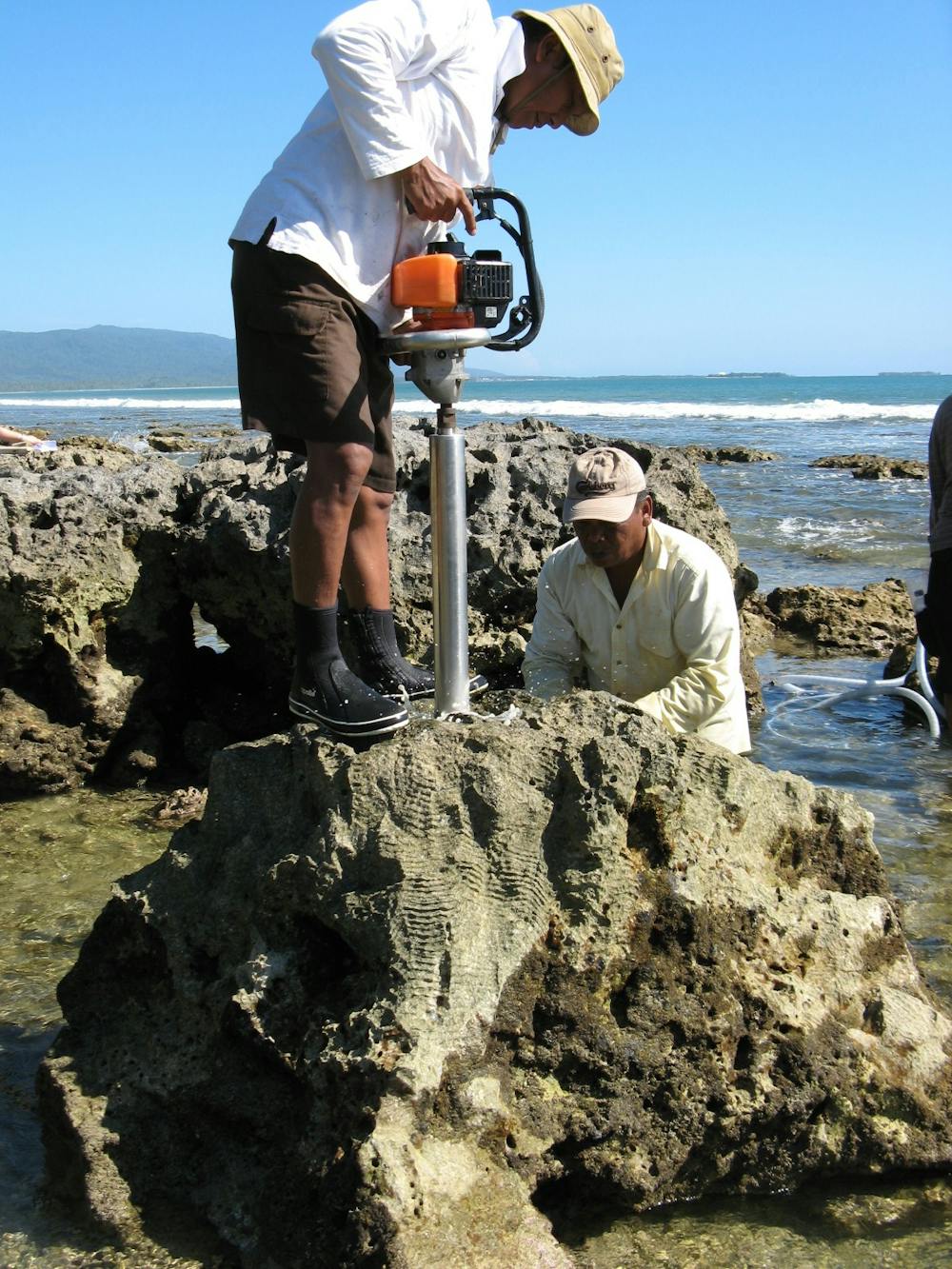
To uncover just how the Indian Ocean Dipole has changed, we looked back through the last millennium using natural records: “cores” taken from nine coral skeletons (one modern, eight fossilised).

These coral samples were collected just off of Sumatra, Indonesia, so they’re perfectly located for us to reconstruct the distinct ocean cooling that characterises positive Indian Ocean Dipole events.

Scientists drilling into corals to study past climate. Corals are like trees, and grow a band for every year they live. Jason Turl, Author provided

Corals grow a lot like trees. For every year they live they produce a growth band, and individual corals can live for more than 100 years. Measuring the oxygen in these growth bands gives us a detailed history of the water temperature the coral grew in, and the amount of rainfall over the reef.

In other words, the signature of extreme events like past positive Indian Ocean Dipoles is written in the coral skeleton.

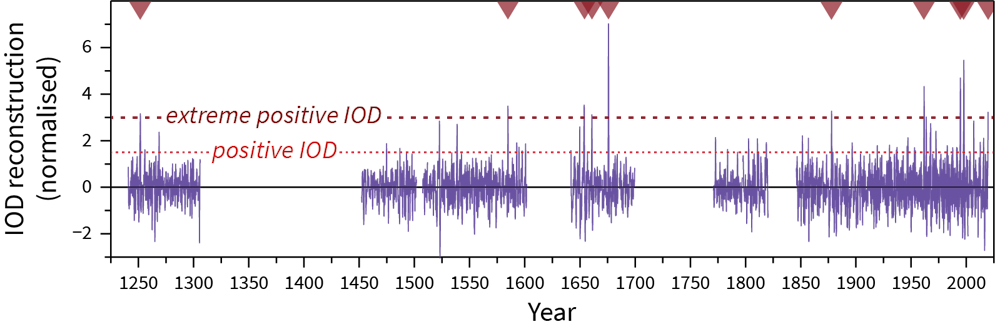
Altogether, our coral-based reconstruction of the Indian Ocean Dipole spans 500 years between 1240 and 2019. There are gaps in the timeline, but we have the best picture so far of how exactly the Indian Ocean Dipole has varied in the past.

How unusual was the 2019 Indian Ocean Dipole event?

Extreme events like the 2019 Indian Ocean Dipole have historically been very rare.

We found only ten extreme positive Indian Ocean Dipole events in the entire record. Four occurred in the past 60 years, but only six occurred in the remaining 440 years before then. This adds more weight to evidence that positive Indian Ocean Dipole events have been occurring more often in recent decades, and becoming more intense.


Read more: Is Australia’s current drought caused by climate change? It’s complicated


But another finding from the reconstruction surprised – and worried – us. Events like 2019 aren’t the worst of what the Indian Ocean Dipole can throw at us.

Of the extreme events we found in our reconstruction, one of them, in 1675, was much stronger than anything we’ve seen in observations from the last 60 years.

The 1675 event was around 30–40% stronger than what we saw in 1997 (around the same magnitude as 2019). Historical accounts from Asia show this event was disastrous, and the severe drought it caused led to crop failures, widespread famine and mortality, and incited war.

The wiggles that make up 500 years of reconstructed Indian Ocean Dipole variability. The red triangles show when extreme positive events occurred. Author provided

As far as we can tell, this event shows just how extreme Indian Ocean Dipole variability can be, even without any additional prompting from external forces like human-caused climate change.

Why should we care?

Indian Ocean Dipole variability will continue to episodically bring extreme climate conditions to our region.

Drilling through fossilised coral layers to look into the past. Nerilie Abram, Author provided

But previous studies, as well as ours, have shown human-caused climate change has shortened the gaps between these episodes, and this trend will continue. This is because climate change is causing the western side of the Indian Ocean to warm faster than in the east, making it easier for positive Indian Ocean Dipole events to establish.

In other words, drought-causing positive Indian Ocean Dipole events will become more frequent as our climate continues to warm.

In fact, climate model projections indicate extreme positive Indian Ocean Dipole events will occur three times more often this century than last, if high greenhouse gas emissions continue.


Read more: The world may lose half its sandy beaches by 2100. It’s not too late to save most of them


This means events like last year will almost certainly unfold again soon, and we’re upping the odds of even worse events that, through the fossil coral data, we now know are possible.

Knowing we haven’t yet seen the worst of the Indian Ocean Dipole is important in planning for future climate risks. Future extremes from the Indian Ocean will act on top of long-term warming, giving a double-whammy effect to their impacts in Australia, like the record-breaking heat and drought of 2019.

But perhaps most importantly, rapidly cutting greenhouse gas emissions will limit how often positive Indian Ocean Dipole events occur in future.

ref. A rare natural phenomenon brings severe drought to Australia. Climate change is making it more common – https://theconversation.com/a-rare-natural-phenomenon-brings-severe-drought-to-australia-climate-change-is-making-it-more-common-133058

You can do it! A ‘growth mindset’ helps us learn

Source: The Conversation (Au and NZ) – By John Munro, Professor, Faculty of Education and Arts, Australian Catholic University

One of the most influential phenomena in education over the last two decades has been that of the “growth mindset”. This refers to the beliefs a student has about various capacities such as their intelligence, their ability in areas such as maths, their personality and creative ability.

Proponents of the growth mindset believe these capacities can be developed or “grown” through learning and effort. The alternative perspective is the “fixed mindset”. This assumes these capacities are fixed and unable to be changed.

The theory of the growth versus fixed mindset was first proposed in 1998 by American psychologist Carol Dweck and paediatric surgeon Claudia Mueller. It grew out of studies they led, in which primary school children were engaged in a task, and then praised either for their existing capacities, such as intelligence, or the effort they invested in the task.

Researchers monitored how the students felt, thought and behaved in subsequent more difficult tasks.

The students who were praised for their effort were more likely to persist with finding a solution to the task. They were also more likely to seek feedback about how to improve. Those praised for their intelligence were less likely to persist with the more difficult tasks and to seek feedback on how their peers did on the task.

These findings led to the inference that a fixed mindset was less conducive to learning than a growth mindset. This notion has a lot of support in cognitive and behavioural science.

What’s the evidence?

Psychologists have been researching the notion of a mindset – a set of assumptions or methods people have, and how these influence motivations or behaviour – for over a century.

The growth mindset has its roots in Stanford University psychologist Alan Bandura’s 1970s social learning theory of a positive self-efficacy. This is a person’s belief in their ability to succeed in specific situations or to accomplish a task.


Read more: Protecting your kids from failure isn’t helpful. Here’s how to build their resilience


The growth mindset is also a re-branding of the 1980-90s study of achievement orientation. Here, people can adopt either a “mastery orientation” (with the goal of learning more) or a “performance orientation” (with the goal of showing what they know) to achieve an outcome.

The idea of the growth mindset is consistent with theories of brain plasiticity (the brain’s ability to change due to experience) and task-positive and task-negative brain network activity (brain networks that are activated during goal-orientated tasks).

Brain plasticity is the idea a brain can change itself due to experience. Shutterstock

The growth versus fixed mindset theory is supported by evidence too – both for its predictions of outcomes and its impact in interventions. Studies show students’ mindsets influence their maths and science outcomes, their academic ability and their ability to cope with exams.

People with growth mindsets are more likely to cope emotionally, while those who don’t view themselves as having the ability to learn and grow are more prone to psychological distress.

But the theory has not received universal support. A 2016 study showed academic achievements of university students were not associated with their growth mindset. This could, in part be due to the way it is understood.

People can show different mindsets at different times – a growth or fixed – towards a specific subject or task. According to Dweck

Everyone is actually a mixture of fixed and growth mindsets, and that mixture continually evolves with experience.

This suggests the fixed and growth mindsets distinction lies on on a continuum. It also suggests the mindset a person adopts at any one time is dynamic and depends on the context.

What about teaching a growth mindset?

The theory has been evaluated in a range of teaching programs. A 2018 analysis reviewed a number of studies that explored whether interventions that enhanced students’ growth mindsets affected their academic achievements. It found teaching a growth mindset had minimal influence on student outcomes.

But in some cases, teaching a growth mindset was effective for students from low socioeconomic backgrounds or those academically at risk.

A 2017 study found teaching a growth mindset had no effect on student outcomes. In fact, the study found students with a fixed mindset showed higher outcomes. Given the complexity of human understanding and learning processes, the negative findings are not surprising. Dweck and colleagues have noted that a school’s context and culture can be responsible for whether the gains made from a growth mindset intervention are sustained.


Read more: Growth mindset interventions yield impressive results


Studies show the mindsets of both teachers and parents influence students’ outcomes too. Secondary science students whose teachers had a growth mindset showed higher outcomes than those whose teachers who had a fixed mindset.

And a 2010 study showed the perceptions primary students had of their potential for improvement were associated with what their teachers’ thought of the children’s academic ability. In another study, children whose parents were taught to have a growth mindset about their children’s literacy skills, and to act accordingly, had improved outcomes.

It exists on a spectrum

Mindset theory seems to conflate two separate phenomena, both of which need to be considered in teaching: a person’s actual capacity such as intelligence, and how they think about it.

Students should be aware of what they know at any time and value it. They also need to know this may be insufficient, that it can be extended and how to do that. Educators and parents need to ensure their dialogue with their children does not imply the capacity is fixed. The focus of the talk should be on: what you will know more about in five minutes?

When I teach, in both schools and university, I encourage students at the end of a teaching session to identify what they know now that they didn’t know earlier. I ask them to explain how their knowledge has changed and the questions they can answer now.

In the early stages of a teaching session, I encourage them to infer questions they might expect to be able to answer having learnt the content. These types of activities encourage students to see their knowledge as dynamic and able to be enhanced.

ref. You can do it! A ‘growth mindset’ helps us learn – https://theconversation.com/you-can-do-it-a-growth-mindset-helps-us-learn-127710

We’re innovative when housing bushfire victims. Why not all the homeless?

Source: The Conversation (Au and NZ) – By Mark Maund, Research Affiliate, School of Architecture and Built Environment, University of Newcastle

With more than 3,500 homes destroyed by disastrous bushfires, the willingness of government and community to work together to find ways to house people has been heartwarming. Australians showed great concern for people who were unable to return home. Responses to help find housing while they rebuild their lives and homes, which might take years in some cases, have been fast and innovative.

But what about the many more people who were homeless before the bushfires? On the 2016 Census night, 116,427 were homeless. If the same government and community effort went into helping people who are homeless for reasons other than bushfires, some innovative solutions might be found.


Read more: Homelessness soars in our biggest cities, driven by rising inequality since 2001


The desire to help people who lost their homes to the fires was evident in the breadth of collaboration and range of housing options made available. These ranged from emergency accommodation and rental housing assistance to initiatives such as open homes, spare caravans and vacant holiday houses.

Planning can adapt rapidly in a crisis

Town planning processes, and changes to these processes, are generally slow. However, the acceptance of options outside “typical” planning practice to house bushfire-affected people was impressively fast.

The New South Wales government rapidly eased planning controls. These changes allowed people to stay in a caravan park or camping ground or install a movable dwelling, such as a caravan, on land for up to two years without requiring council approval.

Many councils made large public spaces – such as showgrounds – available as “primitive” camping grounds or emergency evacuation centres. The planning rule amendments gave councils flexibility to modify the usual conditions if necessary to house people who’d lost their homes.

These actions were not controversial or disputed by most because the urgent need to house displaced people was clear.

Government and community involvement in housing bushfire-affected people has been wide-ranging, led to innovative ideas and allowed for rapid changes to approval pathways and planning controls. This “helping people in a crisis” thinking has created an environment of seeking and accepting new housing options.


Read more: ‘I didn’t want to be homeless with a baby’: young women share their stories of homelessness


Room for innovation in housing the homeless

The number of dwellings available is only one aspect of homelessness. However, increasing affordable housing options would surely help a great many people. According to the Australian Bureau of Statistics, about 2.1 million adults were classified in 2010 as having been homeless at some time in their lives.

Of course, not all housing options for bushfire-affected people would suit or be relevant to Australians who are homeless. But we can certainly learn from the bushfire examples of innovation in planning to solve a crisis. This sort of thinking across government and community could have impacts on the supply of housing options and on overall rates and perceptions of homelessness.


Read more: Carelessly linking crime to being homeless adds to the harmful stigma


Previously proposed planning options to increase the supply of affordable housing include subsidies and planning bonuses for developments that include affordable housing, as well as mandated targets. However, to ensure success, planning approaches to housing need to be coupled with local community engagement.

Community plays a key role

Community involvement and acceptance are particularly important when we are talking about innovative housing options. Without community support such ideas would likely not be accepted and could lead to conflict.

The Planning Institute of Australia stresses the need for community consultation:

A surer bet would be affordable housing targets developed in consultation with the community … As well as boosting supply, housing targets backed by good design standards would improve the quality of our built environments and help alleviate the twin problems of diminished social capital and growing economic inequality.

Community involvement and local context have been identified as essential elements of successful innovation in planning. Canada provides one example of a successful community-led initiative to reduce homelessness through collaboration between community, agencies and government.

This article does not provide solutions; it highlights what can be achieved if we work together. Many people in need of housing have very limited means. They struggle to meet their housing needs by themselves, incrementally and often informally.

If governments, community members and academics work together to develop policies that match the realities of the crisis of homelessness, then significant innovation in planning is possible. If we accept homelessness and the overall need for affordable housing as a crisis, and are willing to adapt our collective thinking to solve urgent problems – as we have for bushfire-affected communities – then imagine what we could achieve.


Read more: 5,800 defence veterans homeless in Australia – that’s more than we thought


ref. We’re innovative when housing bushfire victims. Why not all the homeless? – https://theconversation.com/were-innovative-when-housing-bushfire-victims-why-not-all-the-homeless-132268

This is more than a health crisis: here’s a 10-point plan for avoiding recession

Source: The Conversation (Au and NZ) – By Raja Junankar, Honorary Professor, Industrial Relations Research Centre, UNSW

The world economy is teetering on a knife edge: the Chinese and Indian economies were slowing even before the COVID-19 Coronavirus, and as Australia was recovering from one of its worst bushfires.

Share markets around the world collapsed at the end of February and haven’t recovered. Business and consumer confidence has been shattered.

The national accounts for the December quarter tell us that business investment was falling throughout 2019, at a time when budget forecasts said it would climb.

Last week Treasury Secretary Steven Kennedy said the coronavirus would take “at least half a percentage point” off economic growth in the present March quarter, on top of a loss of the best part of 0.2% as a result of the bushfires.


Read more: Economic growth near an end as Treasury talks of prolonged coronavirus downturn


Given that the most recent growth figure (for the December quarter) was 0.5%, that’s likely to mean negative growth – less being produced and earned than the quarter before, which is literally a going backwards, a recession.

Global ratings agency Standard & Poor’s has identified Australia as one of six Asia-Pacific countries along with Japan and Korea that are about to “enter or flirt with recession”.

What is a recession?

In Australia a recession is usually defined as what happens when there are at least two quarters of negative economic growth in a row.

The United States does it differently. There, the National Bureau of Economic Research assembles a committee that makes a judgement about whether or not the US is in recession based on a number of cretiria including worsening incomes, worsening employment, worsening production and wholesale retail sales.

The usual Australian definition would suggest we haven’t had one for 29 years.

The American definition would suggest that given what happened to unemployment (and especially long-term unemployment) during the global financial crisis we probably had one then.

Once a recession starts, it can feed on itself with unemployment rising rapidly, which is why it’s important to stop it straight away.

How do we avoid one?

The traditional (Keynesian, and also post-Keynesian) economic prescription when an economy is facing a downturn or recession is to massively boost public investment, cut taxes for low income earners (who have a higher propensity to consume) and boost social security benefits.

It’s what Labor did during the global financial crisis, except that it delivered cheques to low and middle earners after taking advice that payments would be more effective than tax cuts, and less costly long-term.

Even though interest rates are at historic lows, the business sector is understandably scared of investing.


Read more: Support package gains shape as GDP turning point swamped


Uncertainty about government policies on energy and climate change, the US-China tariff war, and disrupted and uncertain supply chains because of the coronavirus have frozen its “animal spirits”.

The Coalition hopes to get around this by offering incentives for businesses to invest, on the theory the incentives will work where low interest rates have failed.

I’m not so sure. Here’s what I propose, which has the added benefit of fixing a number of problems that need to be fixed anyway.

A 10-point plan:

  • invest in low-cost housing for low-income and homeless families

  • invest in public sector aged care homes

  • invest in better medical facilities in remote areas for indigenous people

  • make an immediate cash payment of A$2,000 to everyone on Newstart and related allowances

  • make an immediate cash payment of A$2,000 to all volunteer firefighters who worked during the bushfire emergency

  • increase the minimum wage from $19.49 per hour to, say, $20.65 ($785 per week)

  • increase Newstart and linked allowances from $279.50 per week to at least $375, and index them to climb in line with wages afterwards

  • increase the wages of public sector auxiliary hospital staff, teachers in child-care centres and staff in aged care homes

The prime minister says his plan will be “scalable”. It’ll need to be. Australia is facing its most serious economic crisis for twelve years, if not three decades. The consequences of not acting quickly or strongly enough will last for a long time.

ref. This is more than a health crisis: here’s a 10-point plan for avoiding recession – https://theconversation.com/this-is-more-than-a-health-crisis-heres-a-10-point-plan-for-avoiding-recession-133073

Wild Butterfly film review: Claire Murray’s story gives a human face to trauma, drug use and blame culture

Source: The Conversation (Au and NZ) – By Nicole Lee, Professor at the National Drug Research Institute (Melbourne), Curtin University

Who deserves our compassion and medical care? Does a person who has used drugs deserve a liver transplant … and then a second? What if she’s 24 years old and a mother of small children? What if she had been prescribed the drugs initially for a mental health condition? What if she started showing mental-health symptoms after she was sexually assaulted and then mercilessly bullied? Would she be more deserving then?

These are some of the questions raised by Wild butterfly, the story of Claire Murray, who died in 2010 at just 24 years old after complications from a failed liver transplant. Her search for a second liver was the subject of scathing media coverage. “They had a poll on her life,” Claire’s mother says in the documentary. “[It asked] ‘Do you think she deserves to live or die?’”

The documentary also raises questions about how she was treated by some health professionals and the general public on social media, treatment that was underpinned by prejudice about people who use drugs and a lack of understanding about problematic use and relapse.

More broadly, it’s also a story of stigma and discrimination and a reminder of what can happen when the media mine trauma and drug use for clickbait.

Wild Butterfly is billed as a true crime documentary, but gives insights into the stigma faced by drug users and their families.

More to the story

Claire was subjected to trial by media, portrayed as an ungrateful “junkie” who wantonly wasted her first transplant opportunity. Reports from the time said Claire “admitted taking drugs after the first transplant” and was prevented from returning to the transplant waiting list by rules “that forbid persistent substance abusers from being eligible for donor organs”. In fact, the film tells us she had a rare clotting disorder that led to the rejection of her first liver.

The film describes how she was sexually assaulted at 12 years old while on a camp, and then subjected to unrelenting bullying and stalking, which led her down a path of drug use.

Exposure to trauma in childhood is linked to a range of psychological, social, developmental and medical problems right through to adulthood.

We now know neglect and abuse in childhood permanently rewires the developing brain. Emotional dysregulation is the primary feature among people who have experienced trauma, and many people turn to alcohol or other drugs to help regulate these negative, often unbearable, emotions.

A large percentage of people who have experienced physical, sexual or other abuse as children or adults use alcohol and other drugs to try to dampen the constant feelings of fear, anxiety and depression; and a large proportion of people in treatment for alcohol or other drug problems have a history of abuse.

We can never know someone’s circumstances or their motivations. Wild Butterfly is a sad reminder of how much additional damage can be done by people making assumptions and judging those who use drugs.

Blame culture

This film balances the sensitive and nuanced issues without doing further harm. It explains the issues of drug use and trauma, without laying blame on people who use drugs or their families – and it does it with humanity. In my view, this sense of empathy and humanity is too often absent from mainstream reporting on people who experience problems with alcohol and other drugs.

The public didn’t know that abuse and bullying played a role in Claire’s drug use. Wild Butterfly/FanForce

Wild Butterfly tells the story of Claire largely from her parents’ point of view. It was her dying wish to set the record straight. You can feel their pain and it’s heartbreaking. What if it was your child? What would you do to ensure they had a chance at recovery? The parents’ story also demonstrates that families of people with alcohol and other drug problems need support.

It’s the people who judge others on their drug use who really need to watch this film and, sadly, they probably won’t. The film is a reminder that there’s more to people and their circumstances than meets the eye.

There are opportunities for reflection on the part of the media, the health profession and the general community. There are media guidelines on reporting on drug and mental health issues available from AOD Media Watch and Mindframe.

We have come a long way in our understanding about other common mental-health disorders, like depression and anxiety, but we still have a long way to go when it comes to empathy and compassion for people who use alcohol and other drugs.

If you need information or support, contact the National Alcohol and Other Drug Hotline on 1800 250 015.

Wild Butterly is screening in cinemas nationally.

ref. Wild Butterfly film review: Claire Murray’s story gives a human face to trauma, drug use and blame culture – https://theconversation.com/wild-butterfly-film-review-claire-murrays-story-gives-a-human-face-to-trauma-drug-use-and-blame-culture-132596

Morrison tells big business to show ‘patriotism’ as COVID-19 threatens to hit harder than GFC

Source: The Conversation (Au and NZ) – By Michelle Grattan, Professorial Fellow, University of Canberra

Scott Morrison will urge big businesses to display “patriotism” as Australia grapples with the coronavirus crisis, which he warns could hit the economy harder than the global financial crisis.

Addressing a business audience in the run up to this week’s stimulus package, Morrison will say large companies have “a huge role to play”, telling them to hang onto staff, and support workers including casuals with paid leave when they need time off because of the virus. They should also pay small business suppliers ahead of time in coming months.

Describing the crisis as “one of those national interest moments”, in which we confront a “hydra-headed and rapidly evolving challenge”, Morrison will spell out seven principles underpinning the stimulus package.

Speculated to be worth about $10 billion, it will be directed particularly to keeping people in work and maintaining the cash flow of small and medium-sized businesses.

Measures canvassed include subsidising wages and training, an investment incentive, and support for the beleaguered tourist industry. Changing the deeming rate for the pension is being considered, which would help some retirees. Cabinet will discuss the package on Tuesday.

Attorney-General Christian Porter meets employer and union representatives on Tuesday to discuss workplace issues and measures. The ACTU is especially concerned about casuals without sick leave entitlements.

The government, already facing the prospect of a negative March quarter – with the virus and the bushfires taking an estimated 0.7% off growth – is desperate to avoid the economy going into recession. A recession is defined as two quarters of negative economic growth.


Read more: Morrison government pledges funds to help states with health burden of COVID-19


Westpac on Monday forecast that before taking into account the stimulus package the economy was likely to contract by 0.3% in the June quarter.

Meanwhile the Australian stock market plunged on Monday, driven by an oil price war between Russia and Saudi Arabia and the COVID-19 crisis.

The difficulty for the government is to get stimulus money spent quickly, without resorting to the “cash splash” approach it has previously criticised.

If more stimulus is needed there will be a second opportunity in the May budget. But this would be too late for the June quarter.

In his speech to the Australian Financial Review’s business summit, released ahead of Tuesday’s delivery, Morrison says the COVID-19 crisis is different from the GFC – “a biological contagion not a financial one” – and “in our response we must be careful to solve this problem, not the last one”, including avoiding mistakes made then, especially in terms of having “a clear fiscal exit strategy”.

But while COVID-19 is a global health crisis “it will also have very real and very significant economic impacts, potentially greater than the global financial crisis for Australia,” he says.

“The epicentre of this crisis is much closer to home.

“The GFC impacts were centred on the North Atlantic and back then China was in a position to cushion the blow.” In contrast, the first outbreak of COVID-19 was in China, where consumers stayed away from shops, many workers stayed away from work and manufacturing output fell sharply.


Read more: Grattan on Friday: Can Scott Morrison match Kevin Rudd in keeping Australia out of recession in a global crisis?


Morrison says the possible economic outcomes in Australia of the coronavirus crisis “will depend on the spread, severity and duration of the health crisis and its interaction with demand-side and supply-side effects.

“That means, to fix the problem, our health response must be our primary response”. The financial and economic effects would be worsened if the virus significantly hit the health of the Australian workforce – “something that we are working very hard to prevent”.

The government’s fiscal response aimed “to keep people in jobs, keep businesses in business and ensure we bounce back stronger on the other side.

“It’s about supporting community confidence, employment and business continuity. This means boosting domestic consumption, reducing cash flow pressures for vulnerable businesses, and supporting new investments to lift productivity”.

The seven principles on which Morrison says the package is based are

  • measures must be proportionate to the economic shock and the impact on the economy
  • they need to be timely and scalable – that is, able to be adjusted as needed
  • the response must be targeted to specific issues, support those most affected, and delivered where it will be most effectives
  • the response has to be aligned with monetary policy and other governments’ responses (Morrison points out the government is working closely with the Reserve Bank, which cut interest rates last week)
  • where possible, existing means of delivery should be used, rather than rushing out new programs as in the GFC
  • measures must be temporary and have an exit strategy – not “baked into the bottom-line for years … keeping the budget under water”
  • measures lifting productivity must be favoured, to promote stronger growth.
  • “By following these principles we will protect the structural integrity of the budget and maximise the impact of our measures to protect the livelihoods of Australians and our economy. … When the economy bounces back, our budget will also bounce back.”

    In his forthright message to big business, Morrison says: “We need your perseverance, planning and enterprise. We need your common sense, calm and commitment. And we need your patriotism.

    “We need you to support your workers, by keeping them employed. Hold onto your people, you will need them on the other side. Wherever possible, support them – whether full-time, part-time, or casual – including with paid leave if they need to take time off due to the virus.

    “We need you to support your small business suppliers by paying them promptly. Pay your suppliers not just in time, but ahead of time, especially now, ” he says.

    “If you are a large business, go back to the office today and pay your supplier invoices and commit to pay them even faster for the next six months.

    “That is what sticking together looks like.

    “How you support your customers, suppliers and employees during the next six months will say more about your company, your corporate values and the integrity of your brand than anything else you could possibly do otherwise.

    “We also need your investment, looking ahead to the opportunities on the other side. Take the opportunity to invest in the skills of your workforce or the capital projects that will provide the pathway for a new season of growth,” he says.

    “This is a Team Australia moment.”


    Read more: Economic growth near an end as Treasury talks of prolonged coronavirus downturn


    Morrison stresses both the strength of Australia’s health system, and the strength of its fiscal position, as it confronts the shock – although the earlier projected budget surplus for 2019-20 is generally considered to be unachievable.

ref. Morrison tells big business to show ‘patriotism’ as COVID-19 threatens to hit harder than GFC – https://theconversation.com/morrison-tells-big-business-to-show-patriotism-as-covid-19-threatens-to-hit-harder-than-gfc-133255

We asked astronomers: are we alone in the Universe? The answer was surprisingly consistent

Source: The Conversation (Au and NZ) – By Sunanda Creagh, Head of Digital Storytelling

Are we alone in the Universe? The expert opinion on that, it turns out, is surprisingly consistent.

“Is there other life in the Universe? I would say: probably,” Daniel Zucker, Associate Professor of astronomy at Macquarie University, tells astrophysics student and The Conversation’s editorial intern Antonio Tarquinio on today’s podcast episode.

“I think that we will discover life outside of Earth in my lifetime. If not that, then in your lifetime,” says his fellow Macquarie University colleague, Professor Orsola De Marco.

And Lee Spitler, a Senior Lecturer and astronomy researcher at the same institution, was similarly optimistic: “I think there’s a high likelihood that we are not alone in the Universe.”

The big question, however, is what that life might look like.


Read more: The Dish in Parkes is scanning the southern Milky Way, searching for alien signals


We’re also hearing from Danny C Price, project scientist for the Breakthrough Listen project scanning the southern skies for unusual patterns, on what the search for alien intelligence looks like in real life – and what it’s yielded so far.

The Parkes radio telescope is scanning the southern skies, searching for signals from intelligent alien life. AAP/MICK TSIKAS

Read more: ‘The size, the grandeur, the peacefulness of being in the dark’: what it’s like to study space at Siding Spring Observatory


New to podcasts?

Everything you need to know about how to listen to a podcast is here.

Additional audio credits

Kindergarten by Unkle Ho, from Elefant Traks.

Lucky Stars by Podington Bear, from Free Music Archive

Illumination by Kai Engel, from Free Music Archive

Podcast episode recorded and edited by Antonio Tarquinio.

Lead image

Shutterstock

ref. We asked astronomers: are we alone in the Universe? The answer was surprisingly consistent – https://theconversation.com/we-asked-astronomers-are-we-alone-in-the-universe-the-answer-was-surprisingly-consistent-132088
A toilet paper run is like a bank run – economic fixes similar

By Alfredo R. Paloyo of University of Wollongong

Panic buying knows no borders.

Shoppers in Australia, New Zealand, Japan, Hong Kong and the United States have caught toilet paper fever on the back of the Covid-19 coronavirus. Shop shelves are being emptied as quickly as they can be stocked.

This panic buying is the result of the fear of missing out. It’s a phenomenon of consumer behaviour similar to what happens when there is a run on banks.

READ MORE: Covid-19 coronavirus live latest updates

A bank run occurs when depositors of a bank withdraw cash because they believe it might collapse. What we’re seeing now is a toilet-paper run.

Coordination games
A bank holds only a fraction of its deposits as cash reserves. This practice is known as “fractional-reserve banking”. It lends out as much of its deposits as it can – subject to a banking regulator’s capital-adequacy requirements – making a profit from the interest it charges.

– Partner –

If every customer simultaneously decided to withdraw all of their deposits, the bank would crumble under the liability.

Why, then, do we not normally observe bank runs? Or toilet paper runs?

The answer comes from Nobel-winning economist John Nash (played by Russell Crowe in the 2001 movie A Beautiful Mind). Nash shared the Nobel prize in economics for his insights in game theory, notably the existence of what is now called a “Nash equilibrium” in “games”.

Both banking and the toilet-paper market can be thought of as a “coordination game”. There are two players – you and everyone else. There are two strategies – panic buy or act normally. Each strategy has an associated pay-off.

If everyone acts normally, we have an equilibrium: there will be toilet paper on the shop shelves, and people can relax and buy it as they need it.

But if others panic buy, the optimal strategy for you is to do the same, otherwise you’ll be left without toilet paper. Everyone is facing the same strategies and pay-offs, so others will panic buy if you do.

The result is another equilibrium – this one being where everyone panic buys.

Preventing coordination failure
So either no one panic buys (a successful coordination) or everyone does (a coordination failure).

The fear of everyone else panic buying has made some people panic buy as well. But those who are panic buying are not acting irrationally.

They’re not stupid! They are executing an optimal strategy because the fear has a basis in reality: many people have experienced going to supermarkets and finding empty shelves.

Obviously, though, only one of these equilibria is desirable. So what can we do to prevent coordination failure?

One solution is a market mechanism – allowing the price of toilet paper to increase to reduce demand. This is unlikely to happen, though, given the potential backlash associated with “price gouging”.

There are two other solutions.

The first is for the government to step in as guarantor.

In 2008, for example, the market crash engendered by the subprime mortgage crisis left multiple Australian banks vulnerable to depositor runs. In response, the Australian government announced a guarantee scheme for deposits.

Depositors, assured the government would cover their losses even if their bank collapsed, no longer had the fear of being caught out by not withdrawing their savings.

In the case of toilet paper, the government acting as guarantor might involve holding a strategic stockpile of toilet paper. But all things considered – from logistics to costs – this probably isn’t a very good idea.

The second solution is to ration the commodity – putting limits on the amount a customer can buy. Imperfect though these buying limits are, they are feasible, as shown by the restrictions put in place by Australia’s supermarkets.The Conversation

Dr Alfredo R. Paloyo is a senior lecturer in economics at the University of Wollongong. This article is republished from The Conversation under a Creative Commons licence. Read the original article.

Print Friendly, PDF & Email

Article by AsiaPacificReport.nz

The push to end violence against women in Asia-Pacific

Pacific Media Watch

Violence against women is at epidemic proportions in the Asia Pacific.

The region’s governments, if they are to find ways of preventing domestic violence and support its victims, need reliable data, but getting the numbers is a difficult undertaking.

Public health researchers Dr Henriette Jensen and Dr Kristin Diemer join The Jakarta Post’s “Ear to Asia” host Ali Moore to discuss the quest to understand the dimensions of violence against women, and programmes aimed at bringing about lasting change.

Yesterday was International Women’s Day.

A podcast from the Asia Institute of the University of Melbourne.

Produced and edited by profactual.com. Music by audionautix.com.

– Partner –

Print Friendly, PDF & Email

Article by AsiaPacificReport.nz

Keith Rankin Chart Analysis – Covid-19 Virus: the Reality a week into March 2020

Mainly under control in Asia, winter outbreaks in Europe. Chart by Keith Rankin.

Chart analysis by Keith Rankin

EDITOR’S NOTE: Click here for an updated chart and analysis dated March 11, 2020

This chart update shows different measures of the problem than did my chart posted three days ago.

Here we see the total number of recorded cases of Covid-19, per million of the worst affected countries’ populations, though it omits tiny San Marino, which is by far the worst of all. The left side of the chart shows the all cases, including resolved cases.

The right side of the chart shows the number of new cases; cases notified since March 1. Where a red (right-side) measure is similar to the blue (left-side) measure, it means that most of a country’s cases are recent.

For isolation purposes, the countries that pose the greatest risk are San Marino, Iceland, Italy, South Korea, Iran, Switzerland, Bahrain, Norway and Sweden. Other countries in western Europe also pose significant risks. At present, travellers from Iceland, Italy and Iran poses bigger risks to New Zealand than visitors from China ever did, even at the peak of the outbreak in China.

Of Asian countries, only South Korea continues to pose a substantial risk. China and Japan now pose very little risk.

It is important that New Zealand immediately recommences its full economic and educational relationship with China and Japan.

Australia has hundreds of programs to get women into science, but are they working? Time to find out

Source: The Conversation (Au and NZ) – By Lisa Harvey-Smith, Professor and Australian Government’s Women in STEM Ambassador, UNSW

Science, technology, engineering and mathematics, collectively known as STEM, are vitally important for keeping Australia competitive in a technology-driven world.

But despite STEM’s importance, we are not training enough people with skills in vital areas such as digital technologies and engineering to make the most of these business opportunities. In particular, there are extremely low numbers of women engaging in these fields.


Read more: Women in STEM need your support – and Australia needs women in STEM


The lack of women in essential STEM jobs exacerbates the national skills shortage and dampens Australia’s potential to lead the way in transforming our current industries and creating new ones. To compete on the world stage, we need a diverse and fully engaged workforce.

As the Australian government’s Women in STEM Ambassador, I work on a national level with all sectors to drive gender equity in STEM. My role is to catalyse systemic change that will make the STEM sector more inclusive, strong, diverse to support Australia’s economic growth and global competitiveness.

Are current efforts succeeding?

Organisations and individuals across the country have been trying to increase the participation of women and girls in STEM for years. The Australian Academy of Science has identified at least 331 separate initiatives across Australia designed to increase the participation of women and girls in STEM studies and careers. These include educational programs, work and industry experience, mentoring schemes, and many more.

We’re spending millions on initiatives, but are they having a positive impact?

The trouble is, we don’t know. That’s because most programs are not properly tested or evaluated.

Evaluation was one of the main recommendations of the Women in STEM Decadal Plan, released in April 2019. By using data and measuring outcomes, we can target our efforts and scale up programs that are effective and proven to work.


Read more: Gender diversity in science media still has a long way to go. Here’s a 5-step plan to move it along


To evaluate our actions effectively we need to engage scientific principles. We start by defining the outcomes we want. What does success look like, and how do we measure it? The key is to adopt a data-driven approach.

With that in mind, and to mark International Women’s Day, federal science minister Karen Andrews yesterday launched the Advancing Women in STEM 2020 Action Plan.

What’s the plan?

The new plan follows the priorities already outlined in the decadal plan, with a focus on the areas of data collection and analysis, evaluation, and changing institutional practices. It aims to ensure action on STEM gender equity is evidence-based and effectively targeted.

To help with this, my office is developing an evaluation framework to assist organisations in taking a more scientific approach to their STEM engagement programs. This will help the people who run programs designed to promote a more inclusive STEM environment.

We’ll pilot the evaluation guide with recipients of the federal government’s Women in STEM and Entrepreneurship grants program, before making it more widely available. This will help us learn which programs are making a difference and where we can upscale for even greater impact.

My office will also conduct an Australian peer-reviewed trial of anonymous assessment of research funding proposals. Removing names and gender pronouns from applications can work well to combat gender and cultural biases. NASA has tried a similar approach in allocating time using the Hubble Telescope, with successful results.

In NASA’s system, the names of reviewers and scientists were made known to each other only after the review was complete. For the first time in 18 years, proposals led by women had a slightly higher success rate than those led by men.

We are implementing this method in Australia in a structured scientific trial, removing names and pronouns from applications to use large Australian research facilities.

The trial will do two things. First, it will provide important data on the effectiveness of anonymised review and provide a strong evidence base for the STEM sector to take action on more equitable processes in future.

Second, if international experience is anything to go by, it will immediately reduce gendered and cultural biases that exist in such decision-making processes.

Measuring success

How will we know if all this work is making a difference?

To help answer that, the federal government has also launched a STEM Equity Monitor, an interactive portal that will collect and track data on a range of indicators including: girls’ attitudes to STEM in schools, engagement rates, qualifications and workforce participation, pay rates and working conditions.

It is free for anyone to use and will enable our community to measure progress towards a society that provides equal opportunity for people of all genders to learn, work and engage in STEM.

ref. Australia has hundreds of programs to get women into science, but are they working? Time to find out – https://theconversation.com/australia-has-hundreds-of-programs-to-get-women-into-science-but-are-they-working-time-to-find-out-133061

Young men on sexting: it’s normal, but complicated

Source: The Conversation (Au and NZ) – By Signe Ravn, Senior lecturer in Sociology, University of Melbourne

Concern about the popularity of “sexting” – the sending and receiving of sexually explicit text messages and photographs – among young people has been a frequent point of discussion in recent years.

The media and some academic studies often draw attention to issues of risk, danger, and the often-gendered negative outcomes of sexting.

These include concerns sexting can lead to sexual harassment, such as receiving unwanted “dick pics” and pressures for women, in particular, to send their own nude images.


Read more: Bringing pleasure into the discussion about sexting among teens


Another frequently mentioned concern is the potential legal implications of possessing or circulating such images electronically.

Such negative consequences are serious and need our attention. However, this focus is often at the expense of a more nuanced understanding of sexting and how it is part of young people’s lives.

Young men value respect in sexting

Our own sociological research, drawing on ten focus groups of undergraduate male students in Melbourne, provides some important insights into this.

Our study differs from previous studies on sexting in a couple of ways.

First, our sample of participants was slightly older (aged 18-22) than those in other studies. Furthermore, all our participants were men, which may seem somewhat unusual. But this group is very rarely heard in research on this topic and we need to understand how young men view sexting if we are to address the negative consequences mentioned above.

As in other studies, one of our most important findings is that sexting is a normalised part of young people’s romantic and sexual lives.


Read more: ‘Sexting’ teens: decriminalising young people’s sexual practices


Among our participants, who all had some experience with romantic relationships, sexting is a way of flirting and forming new relationships, as well as developing an ongoing relationship with an existing partner.

Sexting was also clearly distinct from harassment, which for our participants was characterised by one-way communication and the crossing of boundaries. In contrast, sexting was almost uniformly understood as reliant on consent and mutuality.

As one participant said,

It is transactional in the sense of, I’ll give you this much, and they’ll give you this much, but you give them X, and they give you X plus one, and then you’ll give them X plus two. […] I think that’s where the mutuality comes into it, you both are getting a thrill out of, ‘Oh, what are they going to do next?‘

And in another focus group, a participant described why consent is important:

Well yeah, because [then] you know where the other person stands. Otherwise, you could definitely say that it’s harassment. I would genuinely class it as sexual harassment.

These are positive findings and suggest notions of respect and mutual engagement are paramount to young people who engage in sexting.

Not wanting to be seen as a ‘creep’

There are several more complex points to unpack, though. Our participants repeatedly mentioned the importance of not “crossing the line” when sexting. This means not transgressing the boundaries of the other person and making sure the sexting is an “escalating, mutual thing”, as another participant said.

However, participants also described an element of self-interest in moderating one’s behaviour while sexting. The following quote from a focus group discussion illustrates some of these complexities (names are pseudonyms):

Moderator: But why would you stop? If you feel the other person is uncomfortable?

Matt: You don’t want to be seen as weird.

Tim: You don’t want to creep them out.

Liam: Well, given that you’re trying to get some sort of sexual connection with this person, you wouldn’t want to compromise your chances further, by having them think that you’re some massive creep.

Karl: Or compromise your chances with other people.

Liam: Yeah, true, because they could pass on that information.

So, while making sure to not “cross the line” is partly based on respect for the other person, it would also be detrimental to building a “sexual connection” with that person, or with others in the future.

Why asking for consent can ‘ruin the vibe’

Our research also highlighted the gendered differences and double standards at play in sexting, as depicted from the perspectives of the young men.

Pictures of young women’s bodies and body parts (breasts, vaginas) were seen as having more value, and being in higher demand, than men’s body parts. But women were also seen to be exposed to greater risks than men when engaging in sexting, including the risk of “slut shaming”.

This is in line with what international studies have found.

While our participants were often aware of these gendered differences in terms of how “sexts” from men and women are perceived, this was seen as a problem at societal level and not something they could change.

As a result, it did not mean that they stopped sexting. In that sense, sexting can be seen as involving greater risks for women than men.


Read more: Sexting: technology is changing what young people share online


Our participants were generally aware of the need, and benefits, of asking for consent before sending a sext. But they also described how this was difficult, because explicitly asking for consent would either “ruin the vibe” or reveal their lack of expertise in sexting.

Indeed, our participants described an almost mythological belief that every young person knows how to sext, which they felt was far from their own reality. Learning how to sext was “learning by doing”, on your own and without advice from others.

Similarly, establishing consent had to happen in subtle ways. As a result, they mentioned feeling insecure and often nervous about sexting “well”.

What young people need to know and educators need to assist with

Sexting is a normalised part of contemporary young lives. Because of this, learning the “skills” of appropriate and respectful sexting is something that should be part of the sex education curriculum in schools.

Rather than trying to tell students to simply abstain from sexting, we should support them to do it in respectful ways.

Translating the findings of this research into tangible strategies in sex education is an important task for educators. By assisting young people to “sext” in appropriate ways, for instance by identifying alternative ways of establishing consent and avoiding “victim-blaming”, we can take one step towards destigmatising the practice.

ref. Young men on sexting: it’s normal, but complicated – https://theconversation.com/young-men-on-sexting-its-normal-but-complicated-131759

‘Fever clinics’ are opening in Australia for people who think they’re infected with the coronavirus. Why?

Source: The Conversation (Au and NZ) – By Gerard Fitzgerald, Emeritus Professor, School of Public Health, Queensland University of Technology

The Western Australian health minister has announced “fever clinics” are to open this week for people who think they have coronavirus symptoms.

And in NSW, the chief health officer has advised hospitals set up “respiratory clinics” to deal with a potential spike in COVID-19 cases.

Other states are set to open their own versions, particularly if transmission of the virus from person to person becomes more established in the community.

So what are these clinics? And why are people being advised to use them rather than seeing their GP or going straight to the emergency department?


Read more: It’s now a matter of when, not if, for Australia. This is how we’re preparing for a jump in coronavirus cases


What are ‘fever clinics’?

Fever clinics are dedicated facilities to assess, test, treat and reassure people, and where necessary, to triage them through the healthcare system.

In the absence of substantial community transmission of the virus in Australia, it’s expected most people who’ll use these clinics will be:

  • people worried they’re sick but aren’t showing symptoms (the “worried well”)

  • people who think they may have been in contact with an infected person

  • people with other illnesses who want reassurance.

The idea is to divert people concerned they may be infected away from emergency departments and general practices.

Not only does this reduce demand for these traditional services, it potentially limits the spread of disease among vulnerable populations, such as the sick and elderly.


Read more: How do we detect if coronavirus is spreading in the community?


General practices have open waiting rooms and while they can ramp up their infection control measures, not all practices can do this effectively.

Similarly, emergency departments are not well structured to isolate large numbers of potentially infectious patients.

By contrast, fever clinics can assess and treat potentially large numbers of people with appropriate levels of infection control. They’re also staffed by people dedicated to this one task. So expertise is concentrated in one location.

Fever clinics are part of a broader emergency health response to the coronavirus. And different states give them different names. For instance, in NSW their official name is “pandemic assessment centres”.

Where are these clinics?

Fever clinics may be set up in new facilities or by repurposing existing ones, such as community health centres or dedicated general practices.

They need to be somewhere with good public access (and parking), preferably away from existing crowded major health facilities to avoid congestion.

They may be possible in heavily populated areas but less so in rural areas as they require enough patient numbers (to make them viable) and access to enough staff.

Existing healthcare staff will work in these new fever clinics, stretching regular services. Shutterstock

Staff – such as doctors, nurses and laboratory staff – will generally come from the existing health service, potentially leaving these services short. And staffing may be an issue in rural and remote areas that are already under-resourced.


Read more: Worried about your child getting coronavirus? Here’s what you need to know


People who attend these fever clinics, who require higher levels of care, will need to be referred to specific health facilities. So arrangements for referral and safe transfer are needed.

Fever clinics are also only part of a broader health system response and can never replace other sources of care.

Severely ill patients will still call for an ambulance and need to be in hospital. Many patients will choose to see their regular GP.

So the broader health system needs to be supported if we are to mount an effective health response against the coronavirus.


Read more: There’s no evidence the new coronavirus spreads through the air – but it’s still possible


Do fever clinics work?

There is surprisingly little published research about people’s experience with fever clinics. Few outbreaks have had enough patient numbers to justify setting them up.

During the swine flu pandemic of 2009, Australians were keen to use one clinic when it was located within an emergency department. More than 1,000 people with flu-like symptoms attended in one month.

However, it is difficult to find any evaluation of how well fever clinics work across health systems, either in improving health outcomes or reducing costs.

What’s the take-home message?

People have a right to be concerned, but not unduly alarmed, about the outbreak of COVID-19.

Recent data suggest the disease is highly infectious although 80% of people have a mild-to-moderate disease, 20% a severe/critical illness and 2-3% die.

People who are at greater risk are those who are older or have other illnesses.


Read more: Why hand-washing really is as important as doctors say


The best thing people can do is to take reasonable precautions: avoid crowded places, wash your hands regularly and avoid touching your eyes and mouth.

Fever clinics may well have a role in providing a single source of assessment, advice and treatment. However, we still need enhanced infection control procedures across the healthcare system and to access other sources of medical care.

ref. ‘Fever clinics’ are opening in Australia for people who think they’re infected with the coronavirus. Why? – https://theconversation.com/fever-clinics-are-opening-in-australia-for-people-who-think-theyre-infected-with-the-coronavirus-why-132599

Entire hillsides of trees turned brown this summer. Is it the start of ecosystem collapse?

Source: The Conversation (Au and NZ) – By Rachael Helene Nolan, Postdoctoral research fellow, Western Sydney University

The drought in eastern Australia was a significant driver of this season’s unprecedented bushfires. But it also caused another, less well known environmental calamity this summer: entire hillsides of trees turned from green to brown.

We’ve observed extensive canopy dieback from southeast Queensland down to Canberra. Reports of more dead and dying trees from other regions across Australia are flowing in through the citizen science project, the Dead Tree Detective.


Read more: Drought and climate change were the kindling, and now the east coast is ablaze


A few dead trees is not an unusual sight during a drought. But in some places, it is the first time in living memory so much canopy has died off.

Ecologists are now pondering the implications. There are warnings that some Australian tree species could disappear from large parts of their ranges as the climate changes. Could we be witnessing the start of ecosystem collapse?

Extensive canopy dieback in Kains Flat, NSW, January 2020. Matt Herbert

Why are canopies dying now?

Much of eastern Australia has been in drought since the start of 2017. While this drought is not yet as long as the Millennium Drought, it appears to be more intense. Many areas have received the lowest rainfall on record, including long periods of time with no rainfall. This has been coupled with above-average temperatures and extreme heatwaves.

The higher the temperature, the greater the moisture loss from leaves. This is usually good for a tree because it cools the canopy. But if there is not enough water in the soil, the increased water loss can push trees over a threshold, causing extensive leaf “scorching”, or browning. The extensive canopy dieback we have observed this summer suggests that the soil had finally become too dry for many trees.

Widespread rainfall deciciencies and higher temperatures across many parts of Australia. Bureau of Meteorology

Are the trees dead?

Brown or bare trees are not necessarily dead. Many eucalypts can lose all their leaves but resprout after rain.

Many parts of eastern Australia are now flushed with green after rain. In these areas, it will be important to assess the extent of tree recovery. If trees are not showing signs of recovery after significant rainfall, they’re unlikely to survive. In some cases carbohydrate reserves – which trees need to resprout new leaves – may be too depleted for trees to recover.

Snowgums in the New England area resprouting in March 2020, following heavy rain. The trees lost most of their canopy during drought in 2019. Trevor Stace, University of New England

The drought may also hinder post-fire recovery. Most eucalypt forests eventually recover from bushfires by resprouting new leaves. Some forests also recover when fire triggers seedlings to germinate.

But it’s likely that some forests now recovering from fire were already struggling with canopy dieback. So these two disturbances will test how resilient our forests are to back-to-back drought and bushfire.

Trees recovering from drought and/or fire may also enter the “dieback spiral”. The new flush of leaves following rain can make a particularly tasty meal for insects. Trees will then attempt to grow more foliage in response, but their ability to keep producing new leaves gradually declines as they deplete their carbohydrate reserves, and they can die.

Dieback spiral has led to extensive tree loss in the past, including in the New England area of NSW.

Should we be worried?

The capacity of eucalypts to resprout makes them naturally resilient to extended drought. There are some records of canopy dieback from severe droughts in the past, such as the Federation Drought. We assume (although we don’t know for sure) the forests recovered after these events. So they may bounce back after the current drought.

However, it’s hard not to be concerned. Climate change will bring increased drought, heatwaves and fires that could, over time, see extensive losses of trees across the landscape – as happened on the Monaro High Plain after the Millennium Drought.


Read more: Are more Aussie trees dying of drought? Scientists need your help spotting dead trees


Australian research in 2016 warned that due to climate change, the habitat of 90% of eucalypt species could decline and 16 species were expected to lose their home environments within 60 years.

Such a change would have huge consequences for how ecosystems function – reducing the capacity for ecosystem services such as carbon storage, altering catchment water resources and reducing habitat for native animals.

Some trees resprouted new leaves after losing their canopy. But in some cases these leaves are now dying, like on these scribbly gums in the NSW Pilliga in August 2019. Rachael Nolan

Where to from here?

Records of dead and dying trees on the Dead Tree Detective map. Dead Tree Detective

Landholders can help bush on their property recover after drought, by protecting germinating seedlings from livestock and collecting local seed for later revegetation. Trees that appear dead should not be cut down as they may recover, and even if dead can provide valuable animal habitat.

Most importantly, however, we need to monitor trees carefully to see where they’ve died, and where they are recovering. A citizen science project, the Dead Tree Detective, is helping map the extent of tree die-off across Australia.

People send in photos of dead and dying trees – to date, over 267 records have been uploaded. These records can be used to target where to monitor forests during drought, including on-ground assessments of tree health and quantifying the physiological responses of trees to drought stress.

There is no ongoing forest health monitoring program in Australia, so this dataset is invaluable in helping us determine exactly how vulnerable Australia’s forests are to the double whammy of severe drought and bushfires.

ref. Entire hillsides of trees turned brown this summer. Is it the start of ecosystem collapse? – https://theconversation.com/entire-hillsides-of-trees-turned-brown-this-summer-is-it-the-start-of-ecosystem-collapse-126107

A city-by-city guide to how water supplies fared in Australia’s summer of extremes

Source: The Conversation (Au and NZ) – By Ian Wright, Senior Lecturer in Environmental Science, Western Sydney University

Australia has just experienced a summer of environmental extremes. Water has played a key role. This includes prolonged drought, dry soil and bushland contributing to bushfires, and widespread shortages of water for agriculture and drinking supplies. Thankfully, rain extinguished many bushfires that had burned for weeks and months.

The late summer heavy rain fell in some, but not all, regions. Australia’s capital city water supplies have had different fortunes this summer. The Bureau of Meteorology “water dashboard” provides daily data.


Read more: After a summer of extremes, here’s what to expect this autumn


Cities where storages are low

Five capital city water supplies dropped over summer by between 2.2% and 11.4% of their storage capacity.

Hobart has proportionally dropped the most, by 11.4 percentage points, to 59.8%. This reflects relatively small storages and the city’s dry summer with only 65mm of rain. That’s less than half the historic average.

The Adelaide storages fell by 8.4 points to 43.5%. Adelaide had a typical dry summer with 66mm. That’s close to the historic average, as the city has a Mediterranean climate with hot and dry summers.

Adelaide’s water storages provided only 10% of the city’s water supply in 2018-19, with 83% drawn from the Murray River. The Commonwealth is providing nearly A$100 million for Adelaide’s desalination plant. This aims to allow upstream irrigators to grow fodder with the river water that was destined for Adelaide.


Read more: Cities turn to desalination for water security, but at what cost?


Perth has had another dry summer. Its catchment rivers have supplied only 44.1 gigalitres (GL) of water since April 2019. This is much lower than the long-term pre-1975 average of 413GL over the same time period.

Perth water storages fell by 5.7 percentage points this summer to 39.5%, the lowest of all capital city supplies.

Canberra lost 4.6% of its water supply. The end-of-summer level of 46.5% continues a rapid decline from 100% in October 2016.

Despite the falling reserves, Canberra’s Icon Water has not imposed water restrictions. It advises that the Cotter Dam was enlarged in 2013. Icon Water can also draw “top-up” water from the Murrumbidgee River.

Melbourne’s supplies fell 2.2 percentage points to 61.6%.

Cities where storages rose

Three capital cities recorded water storage increases this summer.

Darwin’s supply was close to full as recently as April 2018. Since then it has been on a downward trend. A modest 6.4% gain over this summer’s wet season took it to 60.3%.

Darwin appears to be having its second poor wet season in a row. The city had 675mm of rain (Darwin Airport) this summer. That’s about 67% of its historic summer average of just over 1,000mm.

Options canvassed for increasing Darwin water supply include using Manton Dam, which was built in the 1940s but is now used for recreation.

Brisbane’s southeast Queensland storages increased by 8.6 percentage points to 69.6%.

Sydney’s storages increased the most, by 35.7 points to 81.4%.

Sydney was distressed by its dwindling water supplies as summer approached. Storages were at 45.7% at the start of December. Level 2 water restrictions were imposed from December 10.

These were the toughest summer water restrictions for an Australian capital city. All use of hoses for gardens and washing cars was banned. Many Sydneysiders struggled to keep their gardens alive, lugging around buckets and watering cans. A catchcry across Sydney was “let your lawn die”.

On February 6 2020, heavy rains started falling in coastal southeastern Australia, including Sydney and its water catchments.


Read more: Heavy rains are great news for Sydney’s dams, but they come with a big caveat


The automatic weather station at Mount Boyce, near Blackheath on the edge of the Warragamba Dam catchment, recorded 415mm in four days. From February 6-27 Sydney’s water storages nearly doubled, from 41.7% to nearly 82%. This added more than 1 million megalitres (ML), equivalent to more than 1.5 years’ demand.

On February 6, parched catchments were adding 10ML a day to Warragamba Dam. A week later the catchment rivers had risen and many were in minor flood, adding 65,000ML a day on February 13.

At the end of summer Sydney Water announced it was dropping level 2 restrictions.

Drenching rain in late summer transformed the status of Sydney’s water supply. Peter Rae/AAP

Some parts missed out

The February rains were patchy, however. Many water-stressed parts of New South Wales were not so lucky.

Orange in the state’s Central West remained on level 5 water restrictions all summer. Orange Council pleaded with residents to curb water use to less than 160 litres per person per day. Residents responded by using even less, averaging 126 litres a day in February.

Nearby Bathurst declared “extreme” water restrictions from February 24. Its main storage, Chifley Dam, is just under 30% and also had a blue-green algae alert.

Chaffey Dam provides drinking water to the Tamworth area and sits at just 14.3%. Over summer it received over 800ML but has to balance this inflow with environmental releases. Tamworth remains on level 5 restrictions. If Chaffey Dam drops below 10% a daily target of 100 litres per person looms.

A cause for concern is that many large NSW irrigation dams across the Murray-Darling River system remain very low for the start of autumn. For example, Burrendong Dam near Dubbo was at 4.5% at the end of summer. This dam supplies water to the city via the Macquarie River.

The Macquarie River also supplies other settlements, irrigators and industry, such as the mines at Cobar.

Flooding rains in inland Queensland are returning healthy flows to dry inland rivers such as the Barwon and the Darling. On February 25, Bourke Shire Council announced happy news that “strong flows in the Darling River” allowed the lifting of water restrictions. Bourke residents had endured water restrictions for more than 550 days.

ref. A city-by-city guide to how water supplies fared in Australia’s summer of extremes – https://theconversation.com/a-city-by-city-guide-to-how-water-supplies-fared-in-australias-summer-of-extremes-132669

Next time, we’ve got to handle emergency donations better

Source: The Conversation (Au and NZ) – By Debbie Wills, Lecturer in Accounting, University of Tasmania

As Australia burned over summer, many of us gave generously, donating an extraordinary A$500 million by mid-January.

Charities had to scramble, as did organisations directing us to charities. For its new year’s eve fundraiser the ABC chose the Red Cross.

Weeks later, the New South Wales state MP for Bega, Andrew Constance, a local whose electorate was in the heart of the fires, attacked the Red Cross, and also the Salvation Army and St Vincent de Paul, arguing not all of the money was getting through:

The money is needed now, not sitting in a Red Cross bank account earning interest so they can map out their next three years and do their marketing.

The Red Cross responded, conceding it was using 10% of donations for administration but noting that it was handing out A$1 million every day.

The confusion and negativity continued, with comedian Celeste Barber seeking legal advice over the fate of A$50 million she raised for the NSW Rural Fire Service.


Read more: Celebrity concern about bushfires could do more harm than good. To help they need to put boots on the ground


It was too much for the fire service to spend quickly on running expenses and buying and maintaining equipment. And it was prevented by its trust deed from passing it on to other charities.

The fallout suggests we want to be sure our money is being used to help, but we’re not sure that it is.

What can charities and donors do?

My research into the role played by reputation in donations indicates that it is important for charities to define their role clearly.

This includes stating plainly how they are meeting the reporting and other requirements imposed on them by the Australian Charities and Not-for-profits Commission and educating the public about those requirements.

We need to do our research, think carefully before donating, and watch out for scammers.

It is important to be comfortable with each charity’s mission and objectives. They cannot act outside them without running the risk of being deregistered.

We can search for information on all charities using the commission’s charity search tool www.acnc.gov.au/charity, or for smaller sets of charities using charity ranking sites such as:

The Australian Charities and Not-for-profits Commission already does a lot, but given the power, there’s more it could do.

What can Australia’s regulator do?

It could require funds raised for emergencies to be kept in trust, and reported on in more detail at regular intervals through a running statement of distribution of funds.

It could require further standardised reporting, although this would be expensive and charities are already heavily criticised for the percentage of funds used for administration.

It could also set up a one-stop shop for disaster relief.

Brian May and Adam Lambert of Queen perform at the Fire Fight Australia relief concert in Sydney, Sunday February 16, 2020. Joel Carrett/AAP

The department of foreign affairs set up one for foreign disasters that was first used for the Bangladesh-Myanmar appeal in 2017, bringing together eight Australian charities to create a single website and a single phone number that could be used to direct calls to each individual charity.

There are understandable calls to do the same thing for domestic disasters.

Some charities might not welcome combined appeals, fearing they would reduce their own visibility and impose more hurdles. But the hurdles shouldn’t be impossible to leap. A global organisation has been set up to ensure best practice.


Read more: How to select a disaster relief charity


The Advance Global Australian Bushfire Appeal set up by five charities during the bushfires shows what can be done, as does February’s Fire Fight Australia concert.

A government-certified single point of contact, backed up with specific reporting requirements, could provide a level of certainty that the public feel more comfortable with in times of emergency in the future.

ref. Next time, we’ve got to handle emergency donations better – https://theconversation.com/next-time-weve-got-to-handle-emergency-donations-better-132273

All the world’s a stage – buskers can make it big in a connected world

Source: The Conversation (Au and NZ) – By Daniel Bacchieri, PhD Candidate, Sir Zelman Cowen School of Music, Monash University

Street musicians are the producers of sidewalk melodies, the authors of the soundtrack of our cities. There is a unique interrelation between buskers and fans that occurs only in the streets, with no security staff, no VIP seats, or entrance fee.

In the past two decades, the audience for street performers has grown from dozens to millions thanks to sharing on social media like Facebook, Twitter and TikTok, digital platforms such as YouTube and Soundcloud, and streaming services including Spotify.

Busking has long been a way for musicians to gain performance experience and garner a following. Now digital platforms are powerful tools that can transmit local artists to global audiences.

From the streets to the charts

Australian singer Tones and I became a phenomenon after being discovered on the streets of Byron Bay. Since releasing Dance Monkey in May 2019, she went from being an unknown busker to become one of the most streamed artists on Spotify, with over 1 billion streams globally.

What Is ‘Dance Monkey’ and How Did It Take Over the World?

Four years ago, another global success was forged on the streets of Australia. Multi-instrumentalist Tash Sultana used to busk on Bourke Street in Melbourne. Then the live bedroom recording of her singing Jungle scored more than 64 millions views on YouTube.

Tash Sultana – The Story So Far

Both acts share the same management company. Lemon Tree Music was founded in 2013 by two ex-buskers, Regan Lethbridge and David Morgan. Lethbridge told The Industry Observer that he hoped to tap into the drive shown by street performers to realise a vision of busking entrepreneurship:

We always respected buskers. […] We love the work ethic, the grind. They want it more. It’s the extra 1%. They have the drive to get out there on the street every day to earn some coins and sell some CDs.

Some of contemporary music’s biggest names were discovered on the streets: Ed Sheeran (performed in London underground stations), Justin Bieber used to busk in Stratford, Canada, and singer-songwriter Benjamin Clementine was discovered while singing at Paris metro stations.

Ed Sheeran busking in London, UK.

These success stories connect with pre-internet idols: Édith Piaf, B.B. King, Janis Joplin and Rod Stewart all played on the streets. According to the late Blues writer Paul Oliver,

there have been street musicians since streets were first built, and human beings began to sing, or to make and play the first musical instruments.

After 37 years performing as a busker in New York, singer Mike Yung got a couple of his performances shared on YouTube. In 2018, Yung recorded a song with Dutch DJ Martin Garrix and scored more than 27 million views online.

Dreamer, by Martin Garrix featuring Mike Yung.

Change for good

Some projects and platforms have sought to combine technology with busking for a cause.

Created in 2002, the Playing For Change project aims to record musicians in the streets with a mobile studio. Music producer Mark Johnson started by recording buskers all around the world singing lines from the song Stand By Me. The clip has now had more than 140 million views. Buskers from 125 countries took part, money was raised for music schools, and the concept became a global movement “to inspire and connect the world through music”.

The Busking Project is a platform where people can join as a busker or as a fan. Artists can be hired for events and earn cashless tips.

Similar payment tools and initiatives have been established in London, Austin (USA), Melbourne and São Paulo.

Benjamin Clementine performing in a Paris Metro Station.

A cluster of buskers

Based on online map tags, the global busking festival scene is estimated to include over 170 street music events. There is the nine-day Ferrara Buskers Festival in Italy, the Edinburgh Festival Fringe in Scotland, and Fête de La Musique in France. HONK! is an independent and non-commercial festival of activist street bands created in Somerville, Massachusetts, USA, and Buskers by the Lake (formerly Buskers by the Creek) on Australia’s Sunshine Coast lists Tones and I among its previous busking battle winners.

StreetMusicMap, a global research on street music. Curated by Daniel Bacchieri

In a world where everybody is filming, the streets are the backdrop to an international music video festival.

Curation projects like The Music Man, SoundsLikeVanSpirit and StreetMusicMap (featuring my research) identify busking hubs such as the subway systems and public squares in NYC, London and Paris and musicians performing along main streets like the Paulista Avenue in São Paulo (Brazil), Istiklal Street in Istanbul (Turkey) or Bourke Street in Melbourne, Australia.

Once mapped, we hope street music acts will illuminate narratives that go beyond sounds and beats. They will tell us about global culture and human connections.

ref. All the world’s a stage – buskers can make it big in a connected world – https://theconversation.com/all-the-worlds-a-stage-buskers-can-make-it-big-in-a-connected-world-131914

How corporations make money out of ‘feel-good’ feminism

ANALYSIS: By Catherine Rottenberg

A few days ago, I received a message from my son’s secondary school announcing that it would be celebrating International Women’s Day (IWD) on Friday. The message read:

“The school is selling Feminist jumpers to mark the event. Jumpers are on sale for 10 pounds ($13) – please ask your daughter or son to bring 10 pounds cash to the English office if she/he would like to wear one.”

A few hours later a friend called to tell me, tongue-in-cheek, that International Women’s Day t-shirts are passe and that sex toys are the new t-shirts, sending me a link to “IWD sex toys” currently on sale.

READ MORE: More International Women’s Day articles

The irony is that International Women’s Day began as an initiative of the Socialist Party of America to honour the 1908 garment workers’ strike in New York, which, at the time, was the biggest industrial action ever taken by women workers in the United States.

Hence, the dedication of a day to women began as a struggle against capitalist economic exploitation, where women demanded better working conditions and higher wages.

– Partner –

It is true that, over the course of the 20th century, International Women’s Day has undergone many transformations. In certain countries and contexts, it has served as a day simply to celebrate women and their accomplishments.

It has also been a catalyst to mobilise women around the world to rally for a variety of political causes: from working women’s rights through the right to vote and participate in politics to anti-war protests and, more recently, gender equality.

Problematic tokenism
There is, of course, always a certain problematic tokenism when setting aside one day during the year in which we either celebrate women and/or protest gender inequality.

But in the past few years, and particularly with the rise of Trumpism and the far-right across Europe, South America, India and many other places, International Women’s Day has taken on increased potency and significance.

Indeed, the demonstrations organised today, March 8, across the globe have become more militant and intersectional since 2016.

One has only to think of Spain, where last year millions walked out to protest against gender inequality and sexual discrimination, or the US, where the Feminism for the 99 percent movement called for a women’s strike.

The agendas of many of these protests go well beyond “equality”: They are demanding gender, racial, economic, and climate justice, understanding that these issues are inextricably linked.

And yet, as the message from my son’s school and the IWD sex toys reveal, alongside the more militant direction of International Women’s Day, there has also been another parallel development, namely, the increasing commodification of March 8 and its branding by corporations.

Solidarity by shopping, not struggle
Scholars call this brand activism, where corporations attempt to improve their reputation by using some popular and often progressive cause in their PR and advertising campaigns. The businesses and corporations thus give in order to get.

An example of this is the fashion e-tailer Net-a-Porter which has launched an exclusive limited-edition collection of IWD T-shirts in collaboration with six women designers. It is true that all of the profits go to a charity supporting women survivors of war, but activism and empowerment here is equated with buying an expensive t-shirt with words like “You Go Girl”.

Women, in other words, are encouraged to express their solidarity not through struggle or protest, but by shopping.

This corporate appropriation is clearly part of a wider cultural phenomenon – the rise of neoliberal feminism.

This kind of feminism encourages women to invest in themselves and their own aspirations, inciting them to build confidence and “lean in”. And while such feminism acknowledges the gendered wage gap and sexual harassment as signs of continued inequality, the solutions they posit, such as encouraging individual women to take responsibility for their own well-being, do not challenge the structural and economic undergirding of these phenomena.

Neoliberal feminism is palatable and marketable precisely because it is a non-threatening feminism. It doesn’t address the devastation wrought by neoliberal capitalism, neo-imperialism or systemic misogyny and sexism, so it is easy to embrace and it sells well on the marketplace.

Its message is the exact opposite of the one advanced by the women’s strikes at the beginning of the 20th century.

Feel-good feminism
Moreover, given the rise of this feel-good feminism, it is not hard to understand why suddenly everyone is eager to claim the “feminist” label: from movie stars like Emma Watson to Canadian Prime Minister Justin Trudeau.

Nor is it difficult to understand why this feminism makes good business today.

The popularity of feminism and its widespread embrace is not a bad thing per se. But it is crucial to understand what kind of feminism has become popular and why.

A watered down and defanged feminist message is neither going to uproot patriarchy, nor is it going to help us resolve the existential threats to life on earth.

We thus have two competing forces at work at the moment. On the one hand, we have a popular, commodity-driven feminism that serves as a handmaiden to neoliberalism.

On the other hand, we have a growing movement of mass feminist mobilisation that is demanding transformative social justice.

In the US, such mass mobilisation has been spearheaded by activists like Alicia Garza, who is one of the cofounders of Black Lives Matter and Linda Sarsour, who was cochair of the 2017 Women’s March, the 2017 Day Without a Woman, as well as the 2019 Women’s March.

Their feminism is a threatening one because it challenges the intersecting systems of oppression: from white supremacy through Islamophobia to misogyny and neoliberal capitalism. These women carry on the revolutionary spirit that sparked the first IWD over a century ago.

Which feminism “wins” in many ways depends on us. I, for one, have made my choice. Today, I will join the Global Women’s Strike and will bring my two sons along.

Dr Catherine Rottenberg is an associate professor of American Studies at the University of Nottingham. This article was first published by Al Jazeera English.

Print Friendly, PDF & Email

Article by AsiaPacificReport.nz

Sunday Samoan: Sex crimes, truth and pride in Samoa

By the Samoa Observer Editorial Board

Samoan Prime Minister Tuilaepa Dr Sa’ilele Malielegaoi’s insistence on telling the media how to do its job is unnecessary. Coming at a time when there are so many pressing issues he should be dealing with as the leader of this nation, we humbly suggest he should focus all his energy there.

The simple truth is that Tuilaepa has a job to do, and that is to run the country, and we, in the media, have ours. He should concentrate on his job and allow us in the media to do the same.

People who know and follow the political discourse in this country would understand that it is not unusual for Prime Minister Tuilaepa to get involved in all spheres of life in Samoa.

READ MORE: Media should play down sex crimes: PM

From sports, religion, villages, families to government affairs, he comes across as a one-man authority who perhaps feels it is his divine purpose to say whatever and expect people to swallow it without question.

On the pages of the Weekend Observer yesterday, a story with the headline “Media should play down sex crimes: P.M.” was a typical example. It immediately drew attention especially during a week when Samoa has hosted the 84th Extraordinary Session of the Committee on the Rights of the Child, where Tuilaepa himself had repeatedly called on the public to “break the culture of silence” about sex crimes and violence against women and children.

– Partner –

Away from the international audiences where he had been saying all the right things to keep them happy, when Tuilaepa fronted up to the local media, he was singing a different tune. He turned on the local media for reporting sexual crimes, saying they depict Samoa in a negative light.

“It doesn’t happen often but the problem is the media enjoys publicising these cases involving an elderly man doing filthy things to his daughter,” Tuilaepa said.

Reports read overseas
“The cases are probably nowhere near 10 in a year but it’s being reported week in and week out. These reports are being read by those overseas and it sounds like this is all that men in Samoa do from Monday to Sunday.”

Tuilaepa continued that when he sees reports being televised about sexual crimes he switches off his TV set.

But he didn’t stop there. ilaepaHe also criticised comments made by a student during the 84th Extraordinary Session of the Committee on the Rights of the Child that his peers were being beaten up on a regular basis.  He said the student’s comments sounded like something that was rehearsed.

“This is what the people in the media are doing and it includes those that are in the programme [CRC] who are badmouthing the country,” he said. While he did not name anyone in particular, he said such people have no pride in their country.

Well that’s tough, isn’t it? How does a person speaking their mind about what is happening to them come across as someone who has no pride in his/her country?

Besides, what about this nagging thing called the “truth”? When it comes to sexual crimes, the truth is staring at us unblinkingly everyday. Down at Mulinu’u at the halls of justice, judges of the courts have been telling us for years that sexual crimes against women and young girls have been rising dramatically.

What’s more, the details of these crimes have become more disturbing by the day since they involve the violation of the sanctity of the homes, where women, girls and young boys should be protected from harm.

Bigger threat a concern
If there is a bigger threat that we should be concerned about as a nation, it is an attack on the value of families, including sexual crimes. Charity begins at home and if our homes are dysfunctional as a result of these attacks, this will obviously have a flow on effect on the nation as a whole.

Which is why we should be talking about this stuff. It is why we should bring it out in the open and come together to find solutions so we could strategically deal with them.

Does that mean we have no pride in our country? Absolutely not.

If anything, it shows how much we care. And when it comes to the protection of our most vulnerable citizens, women and children, we should not let pride get in the way. We should swallow that silly pride and humble ourselves to do what needs to be done.

Who cares about what the world thinks? We say this knowing that these problems are not confined to Samoa. They are happening all over the world, in some places much, much worse.

What’s important is that we are being proactive and instead of trying to bury it under the mat, Prime Minister Tuilaepa and his government should take the lead to address them. How? By being transparent and accountable about it. That’s all it will take.

This is also why Tuilaepa’s suggestion that the media should turn a blind eye to the reporting of sex crimes is absurd. That stuff only happens in countries where censorship dictates what the media can and cannot do. As far as we are concerned, Samoa is a democracy, not a dictatorship.

Talk to JAWS
Perhaps Prime Minister Tuilaepa should spend some time with the president of the Journalists Association of [Western] Samoa (JAWS), Rudy Bartley and listen to what he has to say. In response to the Prime Minister’s comments about the work of the media, Bartley makes a lot more sense.

“Some issues may not be favorable to some but reporting on it highlights the need for such issues to be addressed by government and responsible authorities,” Bartley said.

“In exposing such issues, this opens up discussion and possible solutions to these problems. The people’s right to know is the driving force in finding solutions to many of the challenges that Samoa is facing. Exposing issues which may be unpopular is one way of making the government act in finding solutions.”

Precisely. We couldn’t agree more.

What this country should insist on is the truth.

Pride comes before the fall and if we look at all the problems Samoa is having to deal with today, they all point to a misguided sense of pride which masks the truth so that all appears well when things are really rotting beneath the surface.

What do you think?

Have a peaceful Sunday Samoa, God bless!

This editorial was published by the Sunday Samoan newspaper today.

Print Friendly, PDF & Email

Article by AsiaPacificReport.nz

5th NZ coronavirus case: Community spread ‘inevitable’, says professor

A public health professor says the World Health Organisation’s failure to declare Covid-19 a pandemic is giving New Zealanders a false sense of security.

It was confirmed today that there is a fifth case of coronavirus in New Zealand as 43 North Shore Hospital staff in Auckland went into self-isolation.

Director-General of Health Dr Ashley Bloomfield said the woman, in her 40s, was the partner of the third case confirmed in New Zealand.

READ MORE: Covid-19 coronavirus live updates

The family are believed to have caught the disease after a family member recently returned from Iran, where there is community spread of the disease.

She was already in self-isolation and did not require hospital-level care.

– Partner –

“This is fitting the pattern of existing spread … all five cases are following this pattern identified by the WHO [World Health Organisation] in its joint mission to China – that most human to human transmission is happening within families, in that close household setting,” Dr Bloomfield said.

All eight New Zealanders who had been on board an earlier cruise on the Grand Princess that is now anchored off the coast of San Francisco had now been spoken to.

One woman readmitted
Five were well and were outside the 14-day period of concern. One woman in her 70s who had been in hospital with a respiratory illness, had recovered and was then released in early March.

She has since been readmitted to hospital with a different condition and although she had recently tested negative for Covid-19 it was probable she had had coronavirus, Dr Bloomfield said.

As a result, 43 North Shore Hospital staff were being stood down as a precaution.

The fourth case is a New Zealand citizen in his 30s, the partner of the second case announced earlier this week, the Ministry of Health said.

On Thursday it was confirmed that an Auckland man was the third case of Covid-19 in this country.

He was now in isolation, along with six members of his family.

The Director-General of Health said the man contracted the virus from a family member who had been to Iran and returned more than a week ago.

China’s success
Dr Michael Baker, public health professor at the University of Otago, said that part of the reason for the WHO not calling it a pandemic was that China managed to halt the spread of the virus.

“This is the first time, I think, that any country has been able to stop a pandemic of respiratory infection in full flight,” he said on RNZ Morning Report.

“They obviously used absolutely draconian measures and it wouldn’t be acceptable in other places, and there was a lot of abuse of human rights in that process. But they’ve actually stopped it, or largely contained it. That’s really motivated the WHO to take this stance.”

Professor Baker said he disagrees with the stance and it would be better to say it was a pandemic situation.

This article is republished under the Pacific Media Centre’s content partnership with Radio New Zealand.

Article by AsiaPacificReport.nz

Global technology leader warns against ‘digital takeover’ of democracy

By Sri Krishnamurthi

Global technology and business leader Dr Anita Sands has warned against allowing digital technology to take over democracy on the eve of the first anniversary of the Christchurch mosque massacre last year.

Dr Sands, who hails from Ireland but is based in Silicon Valley, California, served or serves on the board of several software and cloud companies.

“Democracy depends on communication and deliberation, free press and countervailing forces to hold the powerful accountable,” she said in her keynote address “Digital Disruption and the New Democracy” this week organised by Project Connect at Auckland University of Technology.

READ MORE: Shoshana Zuboff on surveillance capitalism

“In a couple of weeks’ time we will commemorate the first anniversary of the Christchurch tragedy and a day of immeasurable sorrow when the world finally gained an appreciation for the very darkest implications of technology and how it can serve as a breeding ground for extremists and an outlet for their putrid beliefs,’’ she said.

On March 15 last year, a gunman attacked Al Noor Mosque in Riccarton and the Linwood Islamic Centre, killing 51 people. The first attack was streamed live on Facebook and other social media.

– Partner –

Australian white supremacist Brenton Tarrant faces 51 charges of murder, 40 of attempted murder and one under the Terrorism Suppression Act. The trial is due to begin in June.

“In the case of traditional media, we’ve put guardrails around what is appropriate in certain contexts – ratings on movies, warnings before clips are shown on television, censorship of inappropriate content but no such provision exists on the internet until the tragic events of Christchurch last year,” Dr Sands said.

Christchurch Call tackles terrorism
The “Christchurch Call” was the first attempt, after the mosque attack, to bring together countries and tech companies to end the ability to use social media to organise and promote terrorism and violent extremism.

World leaders from 48 countries and technology companies, including Facebook, Google, Twitter, YouTube and Microsoft, pledged to eliminate terrorist and violent extremist content online at the Paris summit.

“In one of the most vocal and effective calls for action by your prime minister, [Jacinda Ardern] challenged the international community and the technology industry to devise a 21 st century response to this atrocious event.

“As a result of the Christchurch Call, a broad coalition of countries and companies have come together and made meaningful progress on curtailing and reacting to extremist content and hate speech.

“They’ve agreed to standards and crisis protocols, they’ve committed to investing in technology to combat this evolving issue, as well as funding research into how terrorist groups actually behave and use technology,” she said.

“Terrorism and extremism are one corner where humanity unquestionably has to draw a line in the sand and fight back, and defending democracy is another,” said Dr Sands, who earned her PhD on atomic and molecular physics from Queens University, Belfast and has a masters degree in public policy and management from Carnegie and Mellon University, Pittsburgh, where she was a Fulbright scholar.

The onus was clearly on every person as an individual to be wary of the sound bites in online platforms, the former all-Ireland speaking champion said.

‘Playing our part’
“As individuals we also have to play our part in committing to critical thought and more vigilant around how and where we get the news,” Dr Sands said.

“Countries like New Zealand are better off than others that are already suffering the effects of an information environment that is so polluted that nobody knows what to believe anymore.

“New Zealand is fortunate that your mainstream media has not yet deteriorated to where in itself it is a polarising bubble. You still have a highly respected free press and public broadcaster which is as much a representation of your commitment to independent thought as a source of your news, and because of them a proper and civilised debate still exists here,” she said.

However, she warned: “Democracy in the digital age isn’t just a whole new playing field, it is a whole new game and we have to catch up quickly on how it is being played.

“Harvard professor Shoshana Zuboff has written extensively about this evolving paradigm which she calls surveillance capitalism and to the capitalists their most precious asset is our most precious asset —our attention, the currency of this new capitalism is our behaviour, every facet which is translated into data and then sold.

“We aren’t customers, we are merely the raw materials that are fed to the real customers, the advertisers.

“As individuals we freely share every facet of our lives without realising it, as we deposit more of attention, they withdraw more of our autonomy without realising we are a society in shackles,” she said before drawing on a witty analogy.

Customers as ‘users’
“It has always struck me as interesting that there are only two industries who refer to their customers as ‘users’ – drug dealers and software developers, and both are in the addiction game.

“In this age of surveillance capitalism, online platforms are in a race to capture our attention which means they have to get us addicted to using their technology.

“As the Netflix CEO once very famously said when he was asked ‘who do you compete with?’ he said, ‘we compete with sleep’.”

Be aware of what the public has to deal with in the digital age, Dr Sands said.

“They [tech companies] do that by unleashing these powerful algorithms that can predict with astonishing accuracy what will keep you there,” she said.

“We end up in what we call filter bubbles, seeing a newsfeed that is entirely unique to each one of us, designed to appeal to your most primal and powerful emotions.

“Humanity has created a puppet that now knows how to pull on the strings of its master.”

This timely warning comes as New Zealand heads to the polls on September 19.

Print Friendly, PDF & Email

Article by AsiaPacificReport.nz

Morrison government pledges funds to help states with health burden of COVID-19

Source: The Conversation (Au and NZ) – By Michelle Grattan, Professorial Fellow, University of Canberra

The Morrison government has announced a funding partnership with the states expected to see A$1 billion extra spent to deal with health costs around the coronavirus.

Scott Morrison said the Commonwealth would provide money on a matching 50-50 basis.

The federal government “will pay 50% of the additional costs incurred by state and territory health services as a result of the diagnosis and treatment of patients with COVID-19, those suspected of having the virus or activities to prevent the spread of it,” Morrison and Health Minister Greg Hunt said in a statement.

The support will be available for services provided in public hospitals, primary care, aged care, and community health care such as health services in child care.

The federal government is putting in an initial $100 million. While the estimate is that the likely cost to the Commonwealth will be around $500 million, there will be no cap and it could exceed that.

Morrison told a news conference: “It’s a demand-driven arrangement – the costs will be what the costs are.

“But we are estimating, based on the advice we have at the moment, that this could be as much as about a billion dollars, $500 million each. … I hope it’s not that much. It could be more”.

The 50-50 arrangement is a better deal than the states get from the Commonwealth for their hospitals, which sees 45% of the funding come from Canberra.

Details of the deal with the states will be tied down by the time the Council of Australian Governments meets on Friday, when the coronavirus situation will be at the centre of discussion.

By then the Morrison government is expected to have announced its fiscal package of billions of dollars aimed at protecting jobs and businesses hit by the crisis.

Global ratings agency Standard & Poor’s has predicted in a report on the implications of COVID-19 for the Asia-Pacific region that “Australia, Hong Kong, Japan, Korea, Singapore and Thailand will enter or flirt with recession”.

It says COVID-19 “could knock US$211 billion from Asia-Pacific incomes and slow GDP growth to 4.0% in 2020. Our new baseline for China is 4.8% with a downside scenario of 2.8% in 2020.”

Saying various regional countries will flirt with recession, S&P doesn’t use the standing recession definition of two quarters of negative growth.

Its definition is “at least two quarters of growth substantially below trend and sufficient to cause unemployment to rise, underlying inflation to fall, and policymakers to react with stimulus.”

S&P predicts a “hit” of one percentage point to Australian growth, “to leave growth in 2020 at 1.2%, well below trend which is closer to 2.5%”.

“The initial spillover from the coronavirus came from people flows which were already depressed from the bushfires,” it notes.

S&P expects the Reserve Bank – which cut interest rates this week – to cut again, to 0.25% “which leaves the Reserve Bank of Australia on the cusp of quantitative easing.

“We also expect moderate, targeted fiscal stimulus aimed at the most-harmed sectors.”

ref. Morrison government pledges funds to help states with health burden of COVID-19 – https://theconversation.com/morrison-government-pledges-funds-to-help-states-with-health-burden-of-covid-19-133164

Murdered journalists a ‘hurdle’ for Jakarta in concealing Timor invasion

NEWS REVIEW: Robert Baird

The Australian lawyer who helped uncover the Timor-Leste bugging scandal says Australia had direct, advanced knowledge of the threat that faced the murdered Balibo Five journalists, with a report describing the men as a “hurdle to be got over” in keeping clandestine activities secret.

Bernard Collaery has published what he describes as a “a survey of failed Australian policy” towards its much smaller neighbour. In Oil Under Troubled Water, he describes seven decades of “grim” history, including the Indonesian occupation years he pointedly labels “genocide”.

“I’ve not called it a holocaust, I wouldn’t use that term… [but] when there is a reckless starvation of people, it is close to, and [it] is genocide,” he told Tatoli.

The cover of Oil Under Troubled Water.

The release of the book comes as Collaery and the former Australian Special Intelligence Service (ASIS) officer known as Witness K face criminal prosecution for their role in exposing the bugging of Timor-Leste’s cabinet rooms during sensitive oil and gas treaty negotiations in 2004.

The claims about Australia’s high-level knowledge of the impending Balibo attack come in a report which Collaery uncovered in the UK National Archives, where he spent some time researching the book. It highlights the information-sharing between Australia and Indonesia’s intelligence agency, then known as Bakin, in the lead up to the December 1975 invasion.

In his report, Britain’s then-Ambassador to Indonesia, John Ford, writes “the only limitation on clandestine activity now appears to be of its exposure”.

– Partner –

“A particular hurdle to be got over is a plane load of Australian journalists and politicians who are due to visit Timor… to investigate allegations of Indonesian intervention,” Ford writes. “The information from the Australians is sensitive and should not be played back to them or repeated to other missions.”

For Collaery, who advised the East Timor resistance for more than 30 years and has represented the families of the murdered Balibo Five, this was a “shocking” candour.

The murdered newsmen (from left): Garry Cunningham, Brian Peters, Malcolm Rennie, Greg Shackleton and Tony Stewart. Journalist Roger East, far right, was killed trying to investigate the murders. Image: Tatoli/AAP

“[The Whitlam government] could hardly warn the Australians… that Indonesian special forces were a danger to them without conceding that they were aware that clandestine activities were happening inside Portuguese Timor,” he writes.

“So, rather than save lives, they saved the relationship with the Indonesian intelligence service, clearly.”

The report undermines the official version of events leading up to the Balibo attack. A 2002 Parliamentary report found another intelligence agency, the Defence Signals Directorate, did not have “intelligence material that could have alerted the government to the possibility of harm to the newsmen” and that “there was no holding back or suppression of data”.

‘We will not press you on the issue’: Kissinger
Collaery also quotes a US State Department transcript of a meeting between Secretary of State Henry Kissinger and Indonesian General Suharto on December 6, 1975 he said betrays a “profound breach” of the United Nations charter.

“We want your understanding if we deem it necessary to take rapid or drastic action [in Timor],” General Suharto said.

“We will understand and will not press you on the issue. We understand the problem you have and the intentions you have,” Secretary Kissinger replied.

The day after the conversation, Indonesia invaded Dili and began its 24-year occupation of Timor-Leste.

Collaery says the conversation is evidence Indonesia acted with “unprovoked aggression“.

“[And] it’s a breach of the code by the United States as an accessory to that series of war crimes,” he says. Australia, as “a more silent witness”, was also complicit, he adds.

‘It’s ruined my law practice… they would have known that’
The book carefully skirts around the criminal proceedings Collaery faces for legal reasons.

“It’s not a memoir,” he says. “That comes later”.

A well-known Canberra barrister, former ACT Attorney-General and diplomat, Collaery took the former ASIS agent Witness K on as a client in 2013. After learning of the bugging operation, Collaery had arranged for his client to give evidence at a confidential overseas hearing.

But after news of the bugging operation was reported in the Australian media, the country’s domestic spy agency, ASIO, raided the lawyer’s home, seizing documents and data. ASIO also raided the home of his client, and had his passport cancelled, preventing Witness K from attending the hearing.

In protest, Timor-Leste unilaterally withdrew from the 2004 CMATS Treaty and took the case to the International Criminal Court in The Hague, with Collaery representing them. The case was subsequently withdrawn, and the two countries resolved the dispute through mandatory conciliation in early 2018.

Months after the treaty was signed, Collaery and Witness K were charged under the Intelligence Services Act of 2001. The Act criminalises the unauthorised disclosure of certain information about ASIS, Australia’s foreign spy agency.

Collaery is frank about how the prolonged case has affected his life.

“It’s ruined my law practice… I live on borrowed money, I can’t practice as an advocate in court, I’ve had to let my staff go. That’s all predictable and [prosecutors] would have known that,” he says.

Serious legal risks
Celestino Gusmão from L’ao Hamutuk, a Dili-based human rights organisation, has extensively researched the long-running maritime border dispute. He says Timor-Leste has shown great support to Collaery and Witness K.

“Through their love, their solidarity with the Timorese people, they put the people of Timor ahead [of their own lives],” he says.

Gusmão says he appreciates the serious legal risks the pair ran in exposing the bugging operation.

“I think Bernard Collaery and Witness K [were] prepared for this, but [they] should not be used as a deterrent,” he says.

  • Bernard Collaery (2020). Oil Under Troubled Water, Melbourne University Press. This news review was first published in Tatoli, the Timor-Leste News Agency website.
Print Friendly, PDF & Email

Article by AsiaPacificReport.nz

More ‘sports rort’ questions for Morrison after Bridget McKenzie speaks out

Source: The Conversation (Au and NZ) – By Michelle Grattan, Professorial Fellow, University of Canberra

Scott Morrison is facing new questioning over the sports rorts affair, after former cabinet minister Bridget McKenzie issued a statement on Friday denying she had made last-minute changes to a list of grants.

Evidence to a Senate estimate committee from the Audit Office this week reinforced allegations the Prime Minister’s Office – which exchanged numerous emails with McKenzie’s office during the $100 million grants process – was more deeply involved than Morrison has admitted. He has sought to portray its role as just passing on representations.

McKenzie, then sports minister and the decision-maker for the program, signed off on a list of grants on April 4 2019, and she sent this to the Prime Minister’s Office on April 10.

But in an email from McKenzie’s office to Sport Australia early on April 11, the day the election was called, one project was taken off the list and one added. According to the Audit Office’s evidence, this change was at the request of the PMO. This email was sent minutes after the parliament was dissolved.

Several hours later, with the government in caretaker mode, one project was removed and nine added, in another email from McKenzie’s office to Sport Australia. The Audit evidence about these was that “none were evident as being at the request of the Prime Minister’s Office rather than the minister’s office”.

In her statement, McKenzie said she had “become aware” through the Senate estimates process this week “of changes made to a Ministerial decision brief that I signed in Canberra on 4 April 2019” for the final round of the program.

“The brief authorised approved projects for the third round – this included nine new and emerging projects which, it must be emphasised, had been identified and sent to Sport Australia in March for assessment in line with program guidelines.

“I did not make any changes or annotations to this brief or its attachments after 4 April 2019. My expectation was that the brief would be processed in a timely and appropriate manner,” she said.

“Nevertheless, changes were made and administrative errors occurred in processing the brief.

“I have always taken responsibility for my actions and decisions as a Minister, and this includes actions by my office.

“I was the Minister for Sport and therefore ultimately and entirely responsible for funding decisions that were signed off under my name, including and regrettably, any changes that were made unbeknown to me.”

When a reporter tried to ask Morrison about the McKenzie statement at his Friday news conference, which was about the coronavirus, he cut her off before she could get her words out. He finished the news conference without taking questions on general issues.

McKenzie is due to appear before the Senate committee that is examining the sports rorts affair.

The Audit Office found she had allocated grants on a politically skewed basis, but she and Morrison have always defended the substance of the decisions made.

She was forced to resign from cabinet on the more technical ground she did not declare her membership of sporting organisations that benefited from the scheme. It is well known she feels badly done by, because it was clear Morrison wanted her resignation to try to limit the political damage of the affair.

ref. More ‘sports rort’ questions for Morrison after Bridget McKenzie speaks out – https://theconversation.com/more-sports-rort-questions-for-morrison-after-bridget-mckenzie-speaks-out-133160

A toilet paper run is like a bank run. The economic fixes are about the same

Source: The Conversation (Au and NZ) – By Alfredo R. Paloyo, Senior Lecturer in Economics, University of Wollongong

Panic buying knows no borders.

Shoppers in Australia, Japan, Hong Kong and the United States have caught toilet paper fever on the back of the COVID-19 coronavirus. Shop shelves are being emptied as quickly as they can be stocked.


Read more: Why are people stockpiling toilet paper? We asked four experts


This panic buying is the result of the fear of missing out. It’s a phenomenon of consumer behaviour similar to what happens when there is a run on banks.

A bank run occurs when depositors of a bank withdraw cash because they believe it might collapse. What we’re seeing now is a toilet-paper run.

Coordination games

A bank holds only a fraction of its deposits as cash reserves. This practice is known as “fractional-reserve banking”. It lends out as much of its deposits as it can – subject to a banking regulator’s capital-adequacy requirements – making a profit from the interest it charges.

If every customer simultaneously decided to withdraw all of their deposits, the bank would crumble under the liability.

Why, then, do we not normally observe bank runs? Or toilet paper runs?

A Hong Kong pharmacy orders in extra toilet paper in early February, as people panic buy. Jerome Favre/EPA

The answer comes from Nobel-winning economist John Nash (played by Russell Crowe in the 2001 movie A Beautiful Mind). Nash shared the Nobel prize in economics for his insights in game theory, notably the existence of what is now called a “Nash equilibrium” in “games”.

Both banking and the toilet-paper market can be thought of as a “coordination game”. There are two players – you and everyone else. There are two strategies – panic buy or act normally. Each strategy has an associated pay-off.

If everyone acts normally, we have an equilibrium: there will be toilet paper on the shop shelves, and people can relax and buy it as they need it.

But if others panic buy, the optimal strategy for you is to do the same, otherwise you’ll be left without toilet paper. Everyone is facing the same strategies and pay-offs, so others will panic buy if you do.

The result is another equilibrium – this one being where everyone panic buys.

Preventing coordination failure

So either no one panic buys (a successful coordination) or everyone does (a coordination failure).

The fear of everyone else panic buying has made some people panic buy as well. But those who are panic buying are not acting irrationally. They’re not stupid! They are executing an optimal strategy because the fear has a basis in reality: many people have experienced going to supermarkets and finding empty shelves.


Read more: Stocking up to prepare for a crisis isn’t ‘panic buying’. It’s actually a pretty rational choice


Obviously, though, only one of these equilibria is desirable. So what can we do to prevent coordination failure?

One solution is a market mechanism – allowing the price of toilet paper to increase to reduce demand. This is unlikely to happen, though, given the potential backlash associated with “price gouging”.

There are two other solutions.

The first is for the government to step in as guarantor.

In 2008, for example, the market crash engendered by the subprime mortgage crisis left multiple Australian banks vulnerable to depositor runs. In response, the Australian government announced a guarantee scheme for deposits. Depositors, assured the government would cover their losses even if their bank collapsed, no longer had the fear of being caught out by not withdrawing their savings.

In the case of toilet paper, the government acting as guarantor might involve holding a strategic stockpile of toilet paper. But all things considered – from logistics to costs – this probably isn’t a very good idea.

The second solution is to ration the commodity – putting limits on the amount a customer can buy. Imperfect though these buying limits are, they are feasible, as shown by the restrictions put in place by Australia’s supermarkets.

ref. A toilet paper run is like a bank run. The economic fixes are about the same – https://theconversation.com/a-toilet-paper-run-is-like-a-bank-run-the-economic-fixes-are-about-the-same-133065

COVID-19 death toll estimated to reach 3,900 by next Friday, according to AI modelling

Source: The Conversation (Au and NZ) – By Belal Alsinglawi, PhD Candidate in Data Science and ICT Lecturer, Western Sydney University

The coronavirus disease COVID-19 has so far caused about 3,380 deaths, infected about 98,300 people, and is significantly impacting the economy in many countries.

We used predictive analytics, a branch of artificial intelligence (AI), to forecast how many confirmed COVID-19 cases and deaths can be expected in the near future.

Our method predicts that by March 13, the virus death toll will have climbed to 3,913, and confirmed cases will reach 116,250 worldwide, based on data available up to March 5.

Predicted (green) and confirmed (blue) cases of COVID-19 from February 23 to March 13, as per our simulation. (Note: scale is in tens of thousands. Author provided (No reuse)
Predicted (purple) and confirmed (red) deaths caused by COVID-19 from February 23 to March 13, as per our simulation. (Note: scale is in thousands, so these numbers are an order of magnitude smaller than those in the graph above. Author provided (No reuse)

To develop contingency plans and hopefully head off the worst effects of the coronavirus, governments need to be able to anticipate the future course of the outbreak.

This is where predictive analytics could prove invaluable. This method involves finding trends in past data, and using these insights to forecast future events. There’s currently too few Australian cases to generate such a forecast for the country.

Number crunching

Our model analysed existing trends to predict COVID-19 infections to an accuracy of 96%, and deaths to an accuracy of 99%, up to about one week in the future. To maintain this accuracy, we have to regularly update our data as the global rate of COVID-19’s spread increases or decreases.


Read more: How do we detect if coronavirus is spreading in the community?


Based on data available up to March 5, our model predicts that by March 31 the number of deaths worldwide will surpass 4,500 and confirmed cases will reach 150,000. However, since these projections surpass our short-term window of accuracy, they shouldn’t be considered as reliable as the figures above.

At the moment, our model is best suited for short-term forecasting. To make accurate long-term forecasts, we’ll need more historical data and a better understanding of the variables impacting COVID-19’s spread.

The more historical data we acquire, the more accurate and far-reaching our forecasts can be.

How we made our predictions

To create our simulations, we extracted coronavirus data dating back to January 22, from an online repository provided by the Johns Hopkins University Centre for Systems Science and Engineering.

This time-stamped data detailed the number and locations of confirmed cases of COVID-19, including people who recovered, and those who died.

Choosing an appropriate modelling technique was integral to the reliability of our results. We used time series forecasting, a method that predicts future values based on previously observed values. This type of forecasting has proven suitable to predict future outbreaks of a disease.

We ran our simulations via Prophet (a type of time series forecasting model), and input the data using the programming language Python.

Further insight vs compromised privacy

Combining predictions generated through AI with big data, and location-based services such as GPS tracking, can provide targeted insight on the movements of people diagnosed with COVID-19.


Read more: Why public health officials sound more worried about the coronavirus than the seasonal flu


This information would help governments implement effective contingency plans, and prevent the virus’s spread.

We saw this happen in China, where telecommunication providers used location tracking to alert the Chinese government of the movements of people in quarantine. However, such methods raise obvious privacy issues.

Honing in on smaller areas

In our analysis, we only considered worldwide data. If localised data becomes available, we could identify which countries, cities and even suburbs are more vulnerable to COVID-19 than others.

We already know different regions are likely to experience different growth rates of COVID-19. This is because the virus’ spread is influenced by many factors, including speed of diagnoses, government response, population density, quality of public healthcare and local climate.

As the COVID-19 outbreak expands, the world’s collective response will render our model susceptible to variation. But until the virus is controlled and more is learned about it, we believe forewarned is forearmed.


Read more: Coronavirus: How behaviour can help control the spread of COVID-19


ref. COVID-19 death toll estimated to reach 3,900 by next Friday, according to AI modelling – https://theconversation.com/covid-19-death-toll-estimated-to-reach-3-900-by-next-friday-according-to-ai-modelling-133052

Sexual harassment claims are costly and complex – can this be fixed?

Source: The Conversation (Au and NZ) – By Dominique Allen, Senior Lecturer in Law, Monash University

The #MeToo movement has reminded us that sexual harassment has not gone away. The legal tools we’re using are not working and may even be hiding the true extent of the problem.

Most sexual harassment complaints are resolved confidentially at the Australian Human Rights Commission (AHRC) or its local equivalents. Few go to court. This system has three fundamental problems.


Read more: Rape, sexual assault and sexual harassment: what’s the difference?


Confidential processes and settlements

Confidentiality is essential to get people to the negotiating table. Who can forget the media scrutiny actors Geoffrey Rush and Eryn Jean Norvill were subjected to?

Even for people who are not famous, the potential media interest in a sexual harassment claim is a strong reason to settle, as it is for employers who fear reputational damage. But it means the community isn’t aware that sexual harassment is still occurring or how it’s being addressed.

Employers usually insist on a confidentiality clause when they settle a claim. I recently interviewed 23 lawyers in Melbourne, asking them how common confidentiality clauses are in discrimination settlements.

A solicitor told me settlement agreements “almost always” include confidentiality. Another described the confidentiality clause as “not negotiable”. A barrister said: “No one I know has ever settled on non-confidential terms.”

The lawyers said employers use confidentiality clauses to avoid opening the “floodgates” to other victims. Employees seek confidentiality if they have left the workplace and worry about what their former employer might say about them.

At their most extreme, confidentiality clauses have a chilling effect on victims, who fear the repercussions of discussing any aspect of their claim. At the same time, they protect the perpetrator at their current workplace and anywhere they work in the future.

A complex, costly legal system

Making a legal claim is complex and costly. A woman who has been sexually harassed could use her local anti-discrimination law or the federal system. The federal system is costly because if she loses at court not only will she have to pay her own legal costs, she risks having to pay the other side’s costs too.

If she’s been discriminated against, unfairly dismissed or has a worker’s compensation claim, three more legal avenues are open to her. These vary in terms of costs, procedures, time restrictions and levels of formality, so they’re difficult to navigate without legal assistance.

It’s not surprising, then, that most people don’t use the formal legal system and those that do tend to settle.

Individual burden

There is no equivalent of the Australian Securities and Investments Commission (ASIC) or the Australian Competition and Consumer Commission (ACCC) that can prosecute employers or represent victims, so the person who has been sexually harassed bears a heavy burden. As one of the lawyers I interviewed put it, the victim has to do “all the heavy lifting”.

Respect@Work

This week, the AHRC released Respect@Work, a lengthy report on sexual harassment. It made 55 recommendations, many of which are designed to improve the legal framework. Will they resolve these weaknesses?

In terms of shedding light on the prevalence of sexual harassment, the recommendations include that the AHRC and its local equivalents should collect de-identified data about sexual harassment claims and settlement outcomes, share this data and prepare coordinated annual reports. This is significant because at the moment they only release numerical annual complaint data. They don’t publish anything about the nature of claims or settlements. Acknowledging that some parties want confidentiality, the AHRC will develop “best practice” principles, which might include preparing a model confidentiality clause and making some disclosures permissible.

Lawyers told me they negotiate damages payments in excess of what courts are likely to order. Because settlements are confidential, they have no impact on the courts’ understanding of the harm of sexual harassment, and victims and their lawyers don’t have a realistic starting point for negotiations. It is pleasing that the AHRC has recommended the government conduct research on damages awards and that this should inform judicial training.

Lawyers repeatedly told me the risk of costs is the main reason victims don’t use the federal system. The AHRC recommended a losing party should only have to pay the other side’s legal costs if their claim is vexatious, which is how the Fair Work system operates. The government should act to remove this barrier right away.

The recommendations to increase funding for community legal centres and bring consistency to federal and local sexual harassment legislation (including adding sexual harassment to the Fair Work Act) will reduce the cost and complexity of the system.


Read more: Geoffrey Rush’s victory in his defamation case could have a chilling effect on the #MeToo movement


But a problem remains – the burden still rests on the victim. The AHRC has proposed establishing a Workplace Sexual Harassment Council comprised of federal and local equality and workplace safety agencies. But this is a leadership and advisory body, not an enforcement agency.

The AHRC president is conducting an inquiry into reforming discrimination law. Changing the enforcement model and alleviating the burden on the victim must be considered as part of this broader project.

ref. Sexual harassment claims are costly and complex – can this be fixed? – https://theconversation.com/sexual-harassment-claims-are-costly-and-complex-can-this-be-fixed-133149

Maria Ressa named among Time’s most influential women of century

By Rappler in Manila

Rappler CEO Maria Ressa is among Time‘s “100 Women of the Year”, the news magazine has revealed ahead of International Women’s Day on Sunday.

Time‘s “100 Women of the Year,” a list of the most influential women of the past century, puts the spotlight on “influential women who were often overshadowed”.

“This includes women who occupied positions from which the men were often chosen, like world leaders Golda Meir and Corazon Aquino, but far more who found their influence through activism or culture,” the magazine said.

READ MORE: Time magazine’s ‘100 women of the year’ – and the century

Time covers for former Philippine President Cory Aquino (left) and Rappler’s Maria Ressa, “guardian of the truth”. Image: Rappler/Time

Time recognised Ressa as its Woman of the Year for 2018, noting her already impressive career in news before starting Rappler in 2012.

– Partner –

“But the news site turned into a global bellwether for free, accurate information at the vortex of two malign forces: one was the angry populism of an elected president with authoritarian inclinations, Rodrigo Duterte; the other was social media,” the magazine wrote in its article about Ressa.

Time said that, since naming her as a 2018 “Person of the Year,” Ressa “has continued to navigate the murk between social media and despotism, calling out her findings to the rest of us at the risk of her life”.

Other women from Southeast Asia who made it to the list include late Philippine president Corazon Aquino (1986) and Myanmar’s civilian leader Aung San Suu Kyi (1990).

Aquino was named Woman of the Year in 1986 after the democracy icon won the presidency and ended the nearly 21-year dictatorship of Ferdinand Marcos.

Former Time editor-in-chief Nancy Gibbs said of the project: “The women profiled here enlarged their world and explored new ones, broke free of convention and constraint, welcomed into community the lost and left behind.

“They were the different drummers, to whose beat a century marched without always even knowing it.”

“Women,” Gibbs writes, “were wielding soft power long before the concept was defined.”

For the complete list of Time’s “100 Women of the Year,” click here.

Republished from Rappler news website.

Print Friendly, PDF & Email

Article by AsiaPacificReport.nz