Page 1016

Young men on sexting: it’s normal, but complicated

Source: The Conversation (Au and NZ) – By Signe Ravn, Senior lecturer in Sociology, University of Melbourne

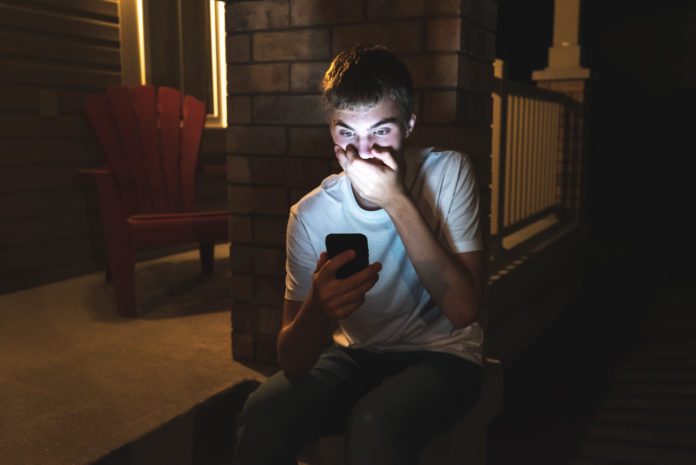
Concern about the popularity of “sexting” – the sending and receiving of sexually explicit text messages and photographs – among young people has been a frequent point of discussion in recent years.

The media and some academic studies often draw attention to issues of risk, danger, and the often-gendered negative outcomes of sexting.

These include concerns sexting can lead to sexual harassment, such as receiving unwanted “dick pics” and pressures for women, in particular, to send their own nude images.


Read more: Bringing pleasure into the discussion about sexting among teens


Another frequently mentioned concern is the potential legal implications of possessing or circulating such images electronically.

Such negative consequences are serious and need our attention. However, this focus is often at the expense of a more nuanced understanding of sexting and how it is part of young people’s lives.

Young men value respect in sexting

Our own sociological research, drawing on ten focus groups of undergraduate male students in Melbourne, provides some important insights into this.

Our study differs from previous studies on sexting in a couple of ways.

First, our sample of participants was slightly older (aged 18-22) than those in other studies. Furthermore, all our participants were men, which may seem somewhat unusual. But this group is very rarely heard in research on this topic and we need to understand how young men view sexting if we are to address the negative consequences mentioned above.

As in other studies, one of our most important findings is that sexting is a normalised part of young people’s romantic and sexual lives.


Read more: ‘Sexting’ teens: decriminalising young people’s sexual practices


Among our participants, who all had some experience with romantic relationships, sexting is a way of flirting and forming new relationships, as well as developing an ongoing relationship with an existing partner.

Sexting was also clearly distinct from harassment, which for our participants was characterised by one-way communication and the crossing of boundaries. In contrast, sexting was almost uniformly understood as reliant on consent and mutuality.

As one participant said,

It is transactional in the sense of, I’ll give you this much, and they’ll give you this much, but you give them X, and they give you X plus one, and then you’ll give them X plus two. […] I think that’s where the mutuality comes into it, you both are getting a thrill out of, ‘Oh, what are they going to do next?‘

And in another focus group, a participant described why consent is important:

Well yeah, because [then] you know where the other person stands. Otherwise, you could definitely say that it’s harassment. I would genuinely class it as sexual harassment.

These are positive findings and suggest notions of respect and mutual engagement are paramount to young people who engage in sexting.

Not wanting to be seen as a ‘creep’

There are several more complex points to unpack, though. Our participants repeatedly mentioned the importance of not “crossing the line” when sexting. This means not transgressing the boundaries of the other person and making sure the sexting is an “escalating, mutual thing”, as another participant said.

However, participants also described an element of self-interest in moderating one’s behaviour while sexting. The following quote from a focus group discussion illustrates some of these complexities (names are pseudonyms):

Moderator: But why would you stop? If you feel the other person is uncomfortable?

Matt: You don’t want to be seen as weird.

Tim: You don’t want to creep them out.

Liam: Well, given that you’re trying to get some sort of sexual connection with this person, you wouldn’t want to compromise your chances further, by having them think that you’re some massive creep.

Karl: Or compromise your chances with other people.

Liam: Yeah, true, because they could pass on that information.

So, while making sure to not “cross the line” is partly based on respect for the other person, it would also be detrimental to building a “sexual connection” with that person, or with others in the future.

Why asking for consent can ‘ruin the vibe’

Our research also highlighted the gendered differences and double standards at play in sexting, as depicted from the perspectives of the young men.

Pictures of young women’s bodies and body parts (breasts, vaginas) were seen as having more value, and being in higher demand, than men’s body parts. But women were also seen to be exposed to greater risks than men when engaging in sexting, including the risk of “slut shaming”.

This is in line with what international studies have found.

While our participants were often aware of these gendered differences in terms of how “sexts” from men and women are perceived, this was seen as a problem at societal level and not something they could change.

As a result, it did not mean that they stopped sexting. In that sense, sexting can be seen as involving greater risks for women than men.


Read more: Sexting: technology is changing what young people share online


Our participants were generally aware of the need, and benefits, of asking for consent before sending a sext. But they also described how this was difficult, because explicitly asking for consent would either “ruin the vibe” or reveal their lack of expertise in sexting.

Indeed, our participants described an almost mythological belief that every young person knows how to sext, which they felt was far from their own reality. Learning how to sext was “learning by doing”, on your own and without advice from others.

Similarly, establishing consent had to happen in subtle ways. As a result, they mentioned feeling insecure and often nervous about sexting “well”.

What young people need to know and educators need to assist with

Sexting is a normalised part of contemporary young lives. Because of this, learning the “skills” of appropriate and respectful sexting is something that should be part of the sex education curriculum in schools.

Rather than trying to tell students to simply abstain from sexting, we should support them to do it in respectful ways.

Translating the findings of this research into tangible strategies in sex education is an important task for educators. By assisting young people to “sext” in appropriate ways, for instance by identifying alternative ways of establishing consent and avoiding “victim-blaming”, we can take one step towards destigmatising the practice.

ref. Young men on sexting: it’s normal, but complicated – https://theconversation.com/young-men-on-sexting-its-normal-but-complicated-131759


‘Fever clinics’ are opening in Australia for people who think they’re infected with the coronavirus. Why?

Source: The Conversation (Au and NZ) – By Gerard Fitzgerald, Emeritus Professor, School of Public Health, Queensland University of Technology

The Western Australian health minister has announced “fever clinics” are to open this week for people who think they have coronavirus symptoms.

And in NSW, the chief health officer has advised hospitals set up “respiratory clinics” to deal with a potential spike in COVID-19 cases.

Other states are set to open their own versions, particularly if transmission of the virus from person to person becomes more established in the community.

So what are these clinics? And why are people being advised to use them rather than seeing their GP or going straight to the emergency department?


Read more: It’s now a matter of when, not if, for Australia. This is how we’re preparing for a jump in coronavirus cases


What are ‘fever clinics’?

Fever clinics are dedicated facilities to assess, test, treat and reassure people, and where necessary, to triage them through the healthcare system.

In the absence of substantial community transmission of the virus in Australia, it’s expected most people who’ll use these clinics will be:

  • people worried they’re sick but aren’t showing symptoms (the “worried well”)

  • people who think they may have been in contact with an infected person

  • people with other illnesses who want reassurance.

The idea is to divert people concerned they may be infected away from emergency departments and general practices.

Not only does this reduce demand for these traditional services, it potentially limits the spread of disease among vulnerable populations, such as the sick and elderly.


Read more: How do we detect if coronavirus is spreading in the community?


General practices have open waiting rooms and while they can ramp up their infection control measures, not all practices can do this effectively.

Similarly, emergency departments are not well structured to isolate large numbers of potentially infectious patients.

By contrast, fever clinics can assess and treat potentially large numbers of people with appropriate levels of infection control. They’re also staffed by people dedicated to this one task. So expertise is concentrated in one location.

Fever clinics are part of a broader emergency health response to the coronavirus. And different states give them different names. For instance, in NSW their official name is “pandemic assessment centres”.

Where are these clinics?

Fever clinics may be set up in new facilities or by repurposing existing ones, such as community health centres or dedicated general practices.

They need to be somewhere with good public access (and parking), preferably away from existing crowded major health facilities to avoid congestion.

They may be possible in heavily populated areas but less so in rural areas as they require enough patient numbers (to make them viable) and access to enough staff.

Existing healthcare staff will work in these new fever clinics, stretching regular services. Shutterstock

Staff – such as doctors, nurses and laboratory staff – will generally come from the existing health service, potentially leaving these services short. And staffing may be an issue in rural and remote areas that are already under-resourced.


Read more: Worried about your child getting coronavirus? Here’s what you need to know


People who attend these fever clinics, who require higher levels of care, will need to be referred to specific health facilities. So arrangements for referral and safe transfer are needed.

Fever clinics are also only part of a broader health system response and can never replace other sources of care.

Severely ill patients will still call for an ambulance and need to be in hospital. Many patients will choose to see their regular GP.

So the broader health system needs to be supported if we are to mount an effective health response against the coronavirus.


Read more: There’s no evidence the new coronavirus spreads through the air – but it’s still possible


Do fever clinics work?

There is surprisingly little published research about people’s experience with fever clinics. Few outbreaks have had enough patient numbers to justify setting them up.

During the swine flu pandemic of 2009, Australians were keen to use one clinic when it was located within an emergency department. More than 1,000 people with flu-like symptoms attended in one month.

However, it is difficult to find any evaluation of how well fever clinics work across health systems, either in improving health outcomes or reducing costs.

What’s the take-home message?

People have a right to be concerned, but not unduly alarmed, about the outbreak of COVID-19.

Recent data suggest the disease is highly infectious although 80% of people have a mild-to-moderate disease, 20% a severe/critical illness and 2-3% die.

People who are at greater risk are those who are older or have other illnesses.


Read more: Why hand-washing really is as important as doctors say


The best thing people can do is to take reasonable precautions: avoid crowded places, wash your hands regularly and avoid touching your eyes and mouth.

Fever clinics may well have a role in providing a single source of assessment, advice and treatment. However, we still need enhanced infection control procedures across the healthcare system and to access other sources of medical care.

ref. ‘Fever clinics’ are opening in Australia for people who think they’re infected with the coronavirus. Why? – https://theconversation.com/fever-clinics-are-opening-in-australia-for-people-who-think-theyre-infected-with-the-coronavirus-why-132599

Entire hillsides of trees turned brown this summer. Is it the start of ecosystem collapse?

Source: The Conversation (Au and NZ) – By Rachael Helene Nolan, Postdoctoral research fellow, Western Sydney University

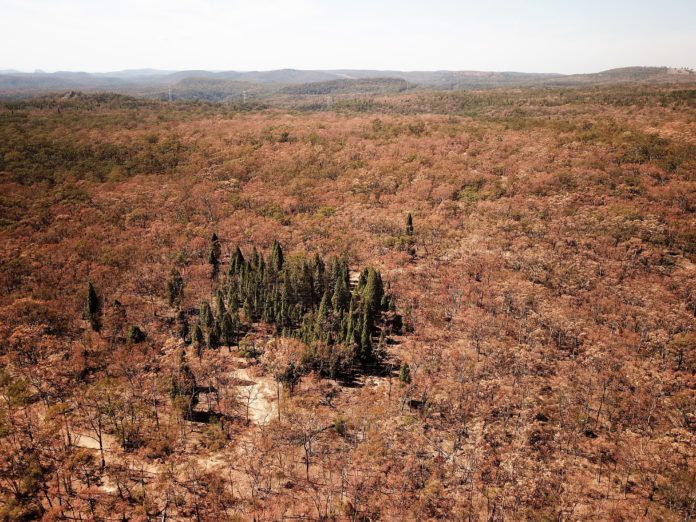
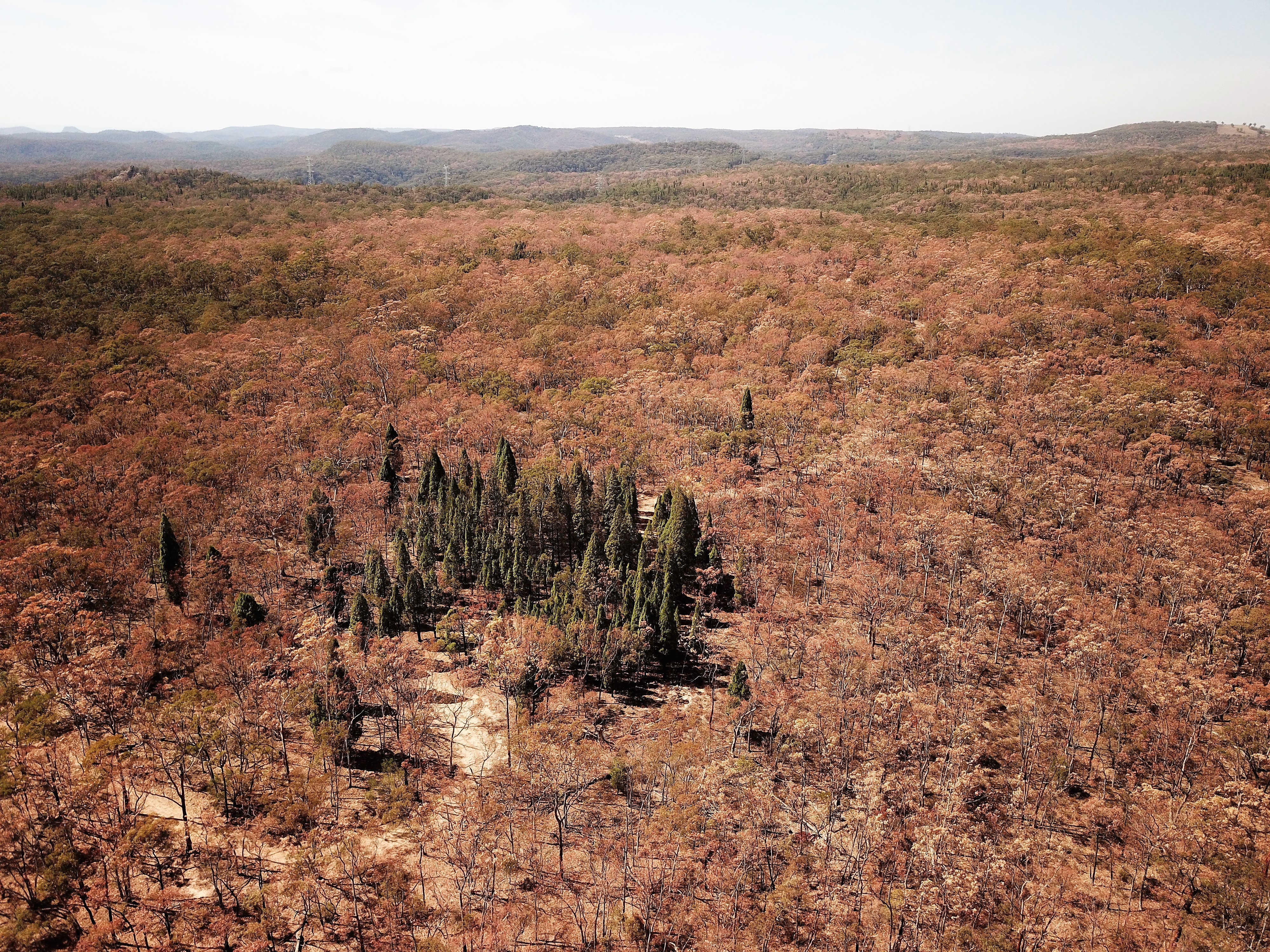
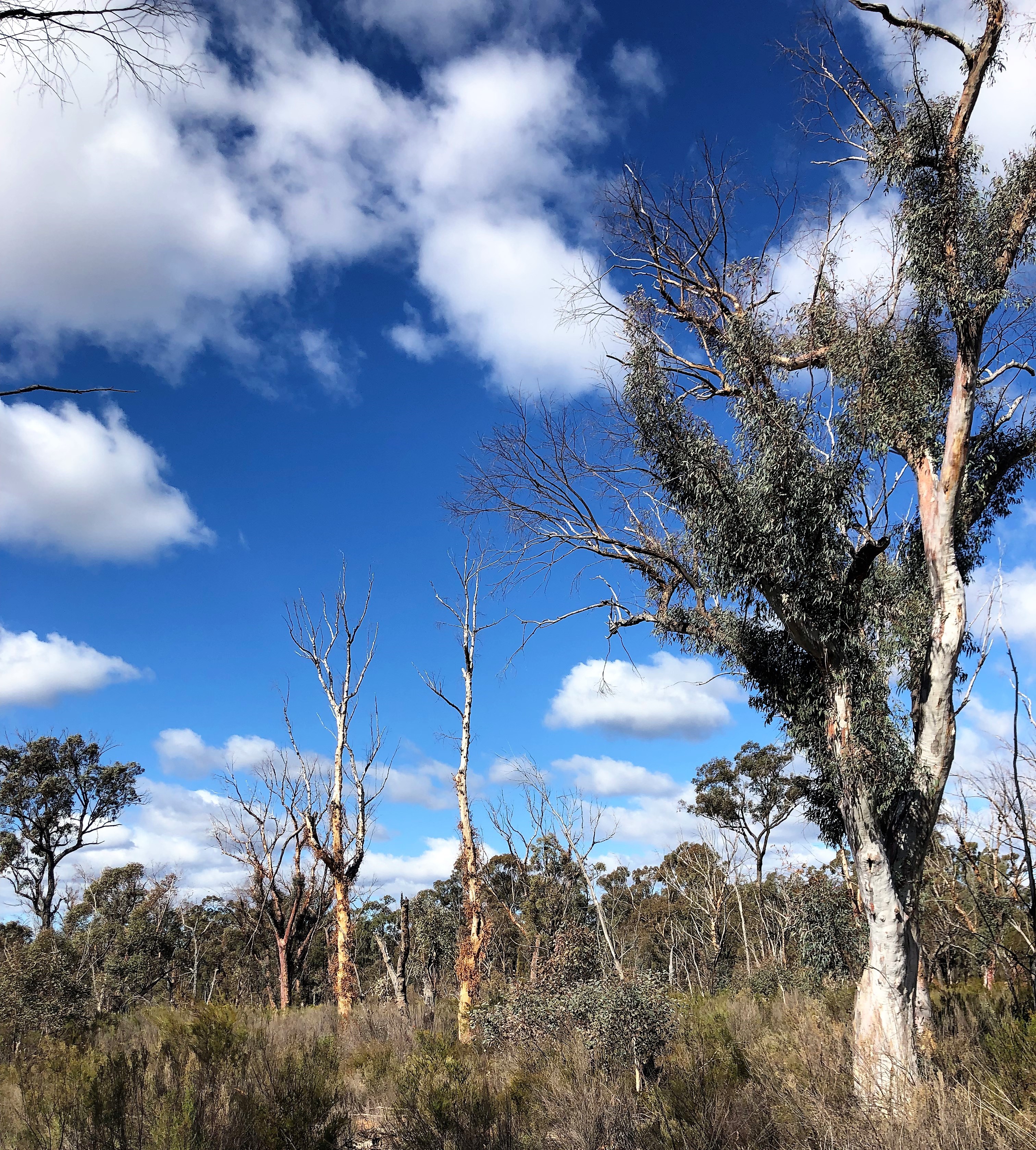
The drought in eastern Australia was a significant driver of this season’s unprecedented bushfires. But it also caused another, less well known environmental calamity this summer: entire hillsides of trees turned from green to brown.

We’ve observed extensive canopy dieback from southeast Queensland down to Canberra. Reports of more dead and dying trees from other regions across Australia are flowing in through the citizen science project, the Dead Tree Detective.


Read more: Drought and climate change were the kindling, and now the east coast is ablaze


A few dead trees is not an unusual sight during a drought. But in some places, it is the first time in living memory so much canopy has died off.

Ecologists are now pondering the implications. There are warnings that some Australian tree species could disappear from large parts of their ranges as the climate changes. Could we be witnessing the start of ecosystem collapse?

Extensive canopy dieback in Kains Flat, NSW, January 2020. Matt Herbert

Why are canopies dying now?

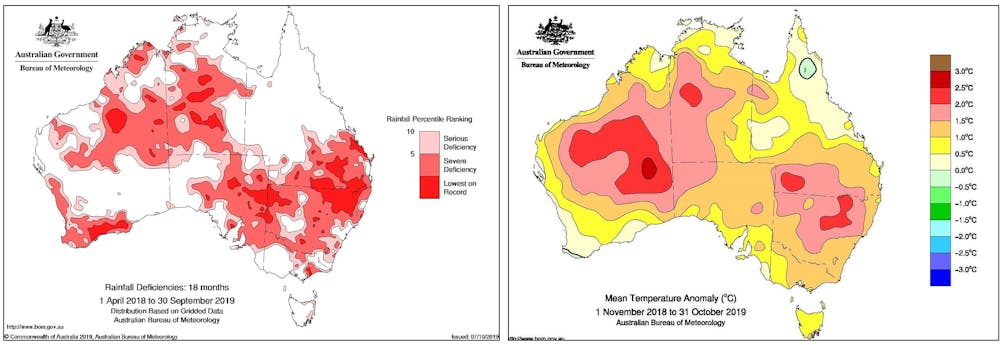
Much of eastern Australia has been in drought since the start of 2017. While this drought is not yet as long as the Millennium Drought, it appears to be more intense. Many areas have received the lowest rainfall on record, including long periods of time with no rainfall. This has been coupled with above-average temperatures and extreme heatwaves.

The higher the temperature, the greater the moisture loss from leaves. This is usually good for a tree because it cools the canopy. But if there is not enough water in the soil, the increased water loss can push trees over a threshold, causing extensive leaf “scorching”, or browning. The extensive canopy dieback we have observed this summer suggests that the soil had finally become too dry for many trees.

Widespread rainfall deciciencies and higher temperatures across many parts of Australia. Bureau of Meteorology

Are the trees dead?

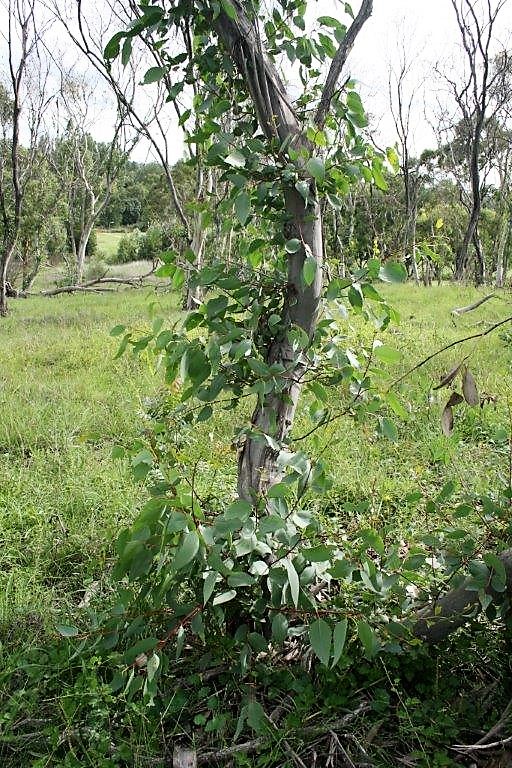
Brown or bare trees are not necessarily dead. Many eucalypts can lose all their leaves but resprout after rain.

Many parts of eastern Australia are now flushed with green after rain. In these areas, it will be important to assess the extent of tree recovery. If trees are not showing signs of recovery after significant rainfall, they’re unlikely to survive. In some cases carbohydrate reserves – which trees need to resprout new leaves – may be too depleted for trees to recover.

Snowgums in the New England area resprouting in March 2020, following heavy rain. The trees lost most of their canopy during drought in 2019. Trevor Stace, University of New England

The drought may also hinder post-fire recovery. Most eucalypt forests eventually recover from bushfires by resprouting new leaves. Some forests also recover when fire triggers seedlings to germinate.

But it’s likely that some forests now recovering from fire were already struggling with canopy dieback. So these two disturbances will test how resilient our forests are to back-to-back drought and bushfire.

Trees recovering from drought and/or fire may also enter the “dieback spiral”. The new flush of leaves following rain can make a particularly tasty meal for insects. Trees will then attempt to grow more foliage in response, but their ability to keep producing new leaves gradually declines as they deplete their carbohydrate reserves, and they can die.

Dieback spiral has led to extensive tree loss in the past, including in the New England area of NSW.

Should we be worried?

The capacity of eucalypts to resprout makes them naturally resilient to extended drought. There are some records of canopy dieback from severe droughts in the past, such as the Federation Drought. We assume (although we don’t know for sure) the forests recovered after these events. So they may bounce back after the current drought.

However, it’s hard not to be concerned. Climate change will bring increased drought, heatwaves and fires that could, over time, see extensive losses of trees across the landscape – as happened on the Monaro High Plain after the Millennium Drought.


Read more: Are more Aussie trees dying of drought? Scientists need your help spotting dead trees


Australian research in 2016 warned that due to climate change, the habitat of 90% of eucalypt species could decline and 16 species were expected to lose their home environments within 60 years.

Such a change would have huge consequences for how ecosystems function – reducing the capacity for ecosystem services such as carbon storage, altering catchment water resources and reducing habitat for native animals.

Some trees resprouted new leaves after losing their canopy. But in some cases these leaves are now dying, like on these scribbly gums in the NSW Pilliga in August 2019. Rachael Nolan

Where to from here?

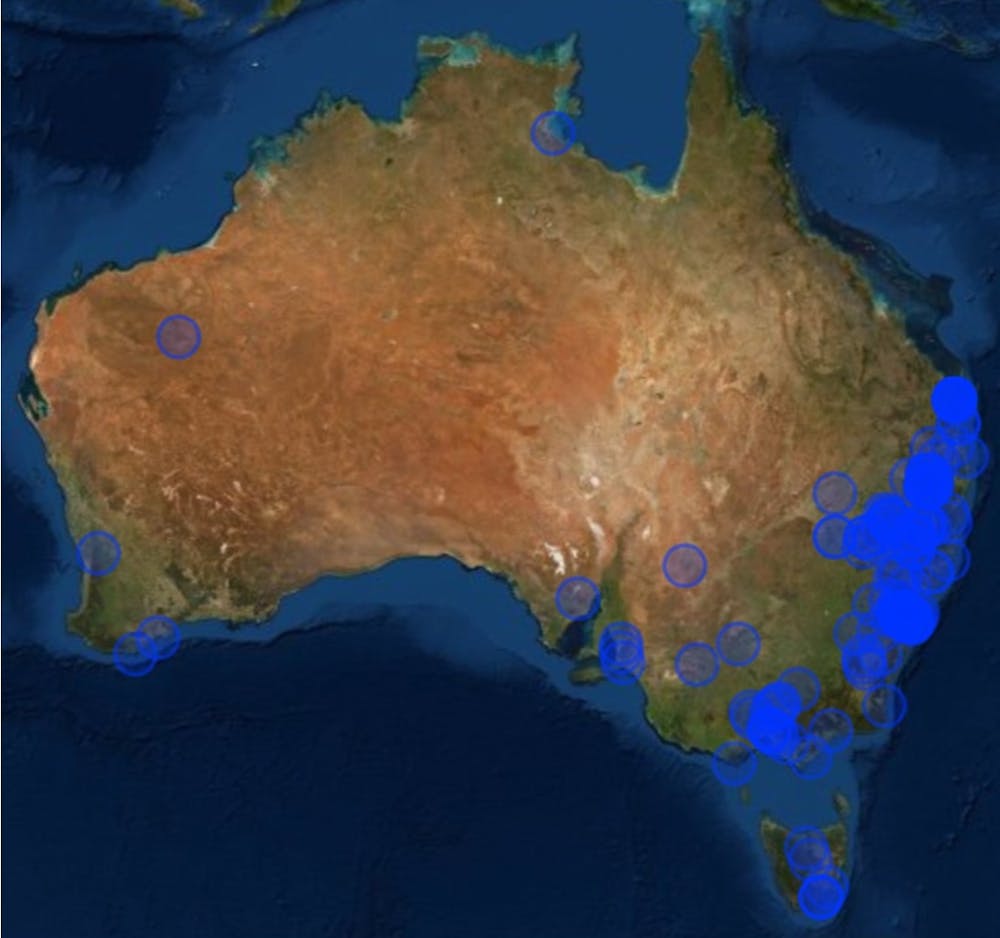
Records of dead and dying trees on the Dead Tree Detective map. Dead Tree Detective

Landholders can help bush on their property recover after drought, by protecting germinating seedlings from livestock and collecting local seed for later revegetation. Trees that appear dead should not be cut down as they may recover, and even if dead can provide valuable animal habitat.

Most importantly, however, we need to monitor trees carefully to see where they’ve died, and where they are recovering. A citizen science project, the Dead Tree Detective, is helping map the extent of tree die-off across Australia.

People send in photos of dead and dying trees – to date, over 267 records have been uploaded. These records can be used to target where to monitor forests during drought, including on-ground assessments of tree health and quantifying the physiological responses of trees to drought stress.

There is no ongoing forest health monitoring program in Australia, so this dataset is invaluable in helping us determine exactly how vulnerable Australia’s forests are to the double whammy of severe drought and bushfires.

ref. Entire hillsides of trees turned brown this summer. Is it the start of ecosystem collapse? – https://theconversation.com/entire-hillsides-of-trees-turned-brown-this-summer-is-it-the-start-of-ecosystem-collapse-126107

A city-by-city guide to how water supplies fared in Australia’s summer of extremes

Source: The Conversation (Au and NZ) – By Ian Wright, Senior Lecturer in Environmental Science, Western Sydney University

Australia has just experienced a summer of environmental extremes. Water has played a key role. This includes prolonged drought, dry soil and bushland contributing to bushfires, and widespread shortages of water for agriculture and drinking supplies. Thankfully, rain extinguished many bushfires that had burned for weeks and months.

The late summer heavy rain fell in some, but not all, regions. Australia’s capital city water supplies have had different fortunes this summer. The Bureau of Meteorology “water dashboard” provides daily data.


Read more: After a summer of extremes, here’s what to expect this autumn


Cities where storages are low

Five capital city water supplies dropped over summer by between 2.2% and 11.4% of their storage capacity.

Hobart has proportionally dropped the most, by 11.4 percentage points, to 59.8%. This reflects relatively small storages and the city’s dry summer with only 65mm of rain. That’s less than half the historic average.

The Adelaide storages fell by 8.4 points to 43.5%. Adelaide had a typical dry summer with 66mm. That’s close to the historic average, as the city has a Mediterranean climate with hot and dry summers.

Adelaide’s water storages provided only 10% of the city’s water supply in 2018-19, with 83% drawn from the Murray River. The Commonwealth is providing nearly A$100 million for Adelaide’s desalination plant. This aims to allow upstream irrigators to grow fodder with the river water that was destined for Adelaide.


Read more: Cities turn to desalination for water security, but at what cost?


Perth has had another dry summer. Its catchment rivers have supplied only 44.1 gigalitres (GL) of water since April 2019. This is much lower than the long-term pre-1975 average of 413GL over the same time period.

Perth water storages fell by 5.7 percentage points this summer to 39.5%, the lowest of all capital city supplies.

Canberra lost 4.6% of its water supply. The end-of-summer level of 46.5% continues a rapid decline from 100% in October 2016.

Despite the falling reserves, Canberra’s Icon Water has not imposed water restrictions. It advises that the Cotter Dam was enlarged in 2013. Icon Water can also draw “top-up” water from the Murrumbidgee River.

Melbourne’s supplies fell 2.2 percentage points to 61.6%.

Cities where storages rose

Three capital cities recorded water storage increases this summer.

Darwin’s supply was close to full as recently as April 2018. Since then it has been on a downward trend. A modest 6.4% gain over this summer’s wet season took it to 60.3%.

Darwin appears to be having its second poor wet season in a row. The city had 675mm of rain (Darwin Airport) this summer. That’s about 67% of its historic summer average of just over 1,000mm.

Options canvassed for increasing Darwin water supply include using Manton Dam, which was built in the 1940s but is now used for recreation.

Brisbane’s southeast Queensland storages increased by 8.6 percentage points to 69.6%.

Sydney’s storages increased the most, by 35.7 points to 81.4%.

Sydney was distressed by its dwindling water supplies as summer approached. Storages were at 45.7% at the start of December. Level 2 water restrictions were imposed from December 10.

These were the toughest summer water restrictions for an Australian capital city. All use of hoses for gardens and washing cars was banned. Many Sydneysiders struggled to keep their gardens alive, lugging around buckets and watering cans. A catchcry across Sydney was “let your lawn die”.

On February 6 2020, heavy rains started falling in coastal southeastern Australia, including Sydney and its water catchments.


Read more: Heavy rains are great news for Sydney’s dams, but they come with a big caveat


The automatic weather station at Mount Boyce, near Blackheath on the edge of the Warragamba Dam catchment, recorded 415mm in four days. From February 6-27 Sydney’s water storages nearly doubled, from 41.7% to nearly 82%. This added more than 1 million megalitres (ML), equivalent to more than 1.5 years’ demand.

On February 6, parched catchments were adding 10ML a day to Warragamba Dam. A week later the catchment rivers had risen and many were in minor flood, adding 65,000ML a day on February 13.

At the end of summer Sydney Water announced it was dropping level 2 restrictions.

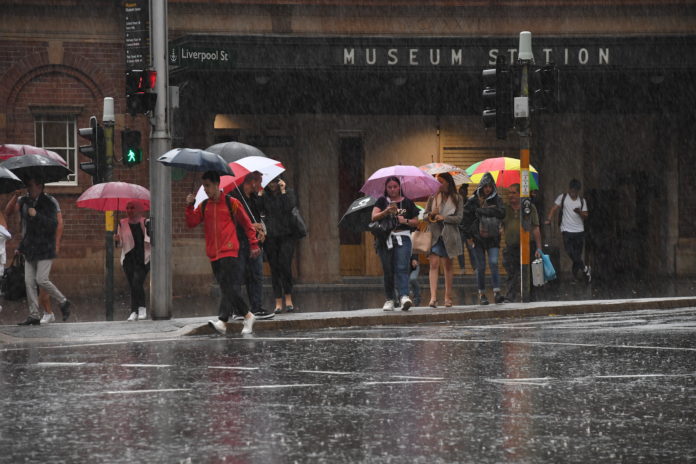
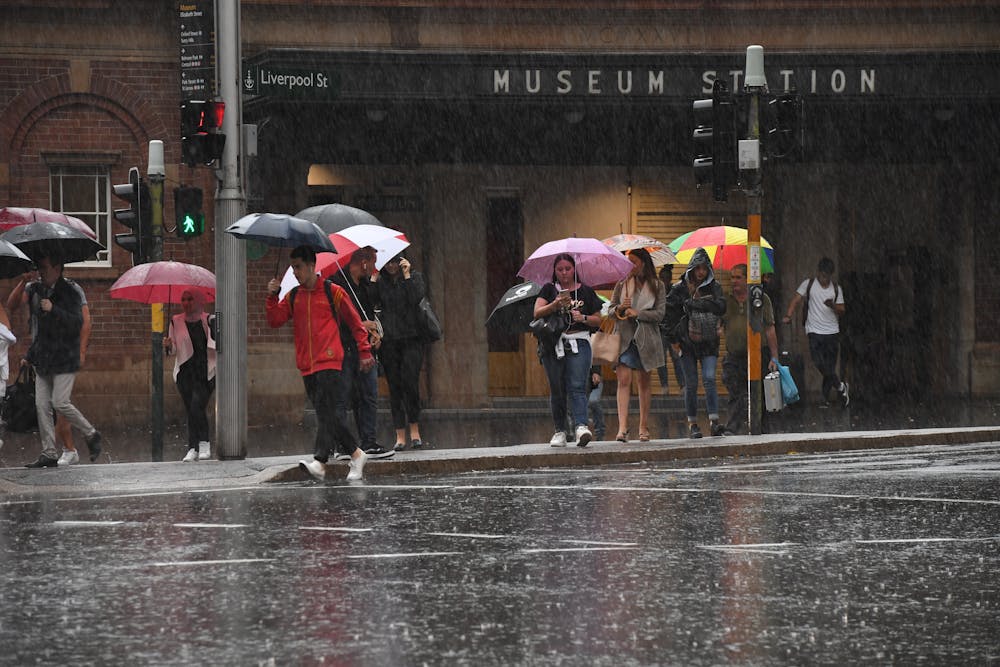
Drenching rain in late summer transformed the status of Sydney’s water supply. Peter Rae/AAP

Some parts missed out

The February rains were patchy, however. Many water-stressed parts of New South Wales were not so lucky.

Orange in the state’s Central West remained on level 5 water restrictions all summer. Orange Council pleaded with residents to curb water use to less than 160 litres per person per day. Residents responded by using even less, averaging 126 litres a day in February.

Nearby Bathurst declared “extreme” water restrictions from February 24. Its main storage, Chifley Dam, is just under 30% and also had a blue-green algae alert.

Chaffey Dam provides drinking water to the Tamworth area and sits at just 14.3%. Over summer it received over 800ML but has to balance this inflow with environmental releases. Tamworth remains on level 5 restrictions. If Chaffey Dam drops below 10% a daily target of 100 litres per person looms.

A cause for concern is that many large NSW irrigation dams across the Murray-Darling River system remain very low for the start of autumn. For example, Burrendong Dam near Dubbo was at 4.5% at the end of summer. This dam supplies water to the city via the Macquarie River.

The Macquarie River also supplies other settlements, irrigators and industry, such as the mines at Cobar.

Flooding rains in inland Queensland are returning healthy flows to dry inland rivers such as the Barwon and the Darling. On February 25, Bourke Shire Council announced happy news that “strong flows in the Darling River” allowed the lifting of water restrictions. Bourke residents had endured water restrictions for more than 550 days.

ref. A city-by-city guide to how water supplies fared in Australia’s summer of extremes – https://theconversation.com/a-city-by-city-guide-to-how-water-supplies-fared-in-australias-summer-of-extremes-132669

Next time, we’ve got to handle emergency donations better

Source: The Conversation (Au and NZ) – By Debbie Wills, Lecturer in Accounting, University of Tasmania

As Australia burned over summer, many of us gave generously, donating an extraordinary A$500 million by mid-January.

Charities had to scramble, as did organisations directing us to charities. For its new year’s eve fundraiser the ABC chose the Red Cross.

Weeks later, the New South Wales state MP for Bega, Andrew Constance, a local whose electorate was in the heart of the fires, attacked the Red Cross, and also the Salvation Army and St Vincent de Paul, arguing not all of the money was getting through:

The money is needed now, not sitting in a Red Cross bank account earning interest so they can map out their next three years and do their marketing.

The Red Cross responded, conceding it was using 10% of donations for administration but noting that it was handing out A$1 million every day.

The confusion and negativity continued, with comedian Celeste Barber seeking legal advice over the fate of A$50 million she raised for the NSW Rural Fire Service.


Read more: Celebrity concern about bushfires could do more harm than good. To help they need to put boots on the ground


It was too much for the fire service to spend quickly on running expenses and buying and maintaining equipment. And it was prevented by its trust deed from passing it on to other charities.

The fallout suggests we want to be sure our money is being used to help, but we’re not sure that it is.

What can charities and donors do?

My research into the role played by reputation in donations indicates that it is important for charities to define their role clearly.

This includes stating plainly how they are meeting the reporting and other requirements imposed on them by the Australian Charities and Not-for-profits Commission and educating the public about those requirements.

We need to do our research, think carefully before donating, and watch out for scammers.

It is important to be comfortable with each charity’s mission and objectives. They cannot act outside them without running the risk of being deregistered.

We can search for information on all charities using the commission’s charity search tool www.acnc.gov.au/charity, or for smaller sets of charities using charity ranking sites such as:

The Australian Charities and Not-for-profits Commission already does a lot, but given the power, there’s more it could do.

What can Australia’s regulator do?

It could require funds raised for emergencies to be kept in trust, and reported on in more detail at regular intervals through a running statement of distribution of funds.

It could require further standardised reporting, although this would be expensive and charities are already heavily criticised for the percentage of funds used for administration.

It could also set up a one-stop shop for disaster relief.

Brian May and Adam Lambert of Queen perform at the Fire Fight Australia relief concert in Sydney, Sunday February 16, 2020. Joel Carrett/AAP

The department of foreign affairs set up one for foreign disasters that was first used for the Bangladesh-Myanmar appeal in 2017, bringing together eight Australian charities to create a single website and a single phone number that could be used to direct calls to each individual charity.

There are understandable calls to do the same thing for domestic disasters.

Some charities might not welcome combined appeals, fearing they would reduce their own visibility and impose more hurdles. But the hurdles shouldn’t be impossible to leap. A global organisation has been set up to ensure best practice.


Read more: How to select a disaster relief charity


The Advance Global Australian Bushfire Appeal set up by five charities during the bushfires shows what can be done, as does February’s Fire Fight Australia concert.

A government-certified single point of contact, backed up with specific reporting requirements, could provide a level of certainty that the public feel more comfortable with in times of emergency in the future.

ref. Next time, we’ve got to handle emergency donations better – https://theconversation.com/next-time-weve-got-to-handle-emergency-donations-better-132273

All the world’s a stage – buskers can make it big in a connected world

Source: The Conversation (Au and NZ) – By Daniel Bacchieri, PhD Candidate, Sir Zelman Cowen School of Music, Monash University

Street musicians are the producers of sidewalk melodies, the authors of the soundtrack of our cities. There is a unique interrelation between buskers and fans that occurs only in the streets, with no security staff, no VIP seats, or entrance fee.

In the past two decades, the audience for street performers has grown from dozens to millions thanks to sharing on social media like Facebook, Twitter and TikTok, digital platforms such as YouTube and Soundcloud, and streaming services including Spotify.

Busking has long been a way for musicians to gain performance experience and garner a following. Now digital platforms are powerful tools that can transmit local artists to global audiences.

From the streets to the charts

Australian singer Tones and I became a phenomenon after being discovered on the streets of Byron Bay. Since releasing Dance Monkey in May 2019, she went from being an unknown busker to become one of the most streamed artists on Spotify, with over 1 billion streams globally.

What Is ‘Dance Monkey’ and How Did It Take Over the World?

Four years ago, another global success was forged on the streets of Australia. Multi-instrumentalist Tash Sultana used to busk on Bourke Street in Melbourne. Then the live bedroom recording of her singing Jungle scored more than 64 millions views on YouTube.

Tash Sultana – The Story So Far

Both acts share the same management company. Lemon Tree Music was founded in 2013 by two ex-buskers, Regan Lethbridge and David Morgan. Lethbridge told The Industry Observer that he hoped to tap into the drive shown by street performers to realise a vision of busking entrepreneurship:

We always respected buskers. […] We love the work ethic, the grind. They want it more. It’s the extra 1%. They have the drive to get out there on the street every day to earn some coins and sell some CDs.

Some of contemporary music’s biggest names were discovered on the streets: Ed Sheeran (performed in London underground stations), Justin Bieber used to busk in Stratford, Canada, and singer-songwriter Benjamin Clementine was discovered while singing at Paris metro stations.

Ed Sheeran busking in London, UK.

These success stories connect with pre-internet idols: Édith Piaf, B.B. King, Janis Joplin and Rod Stewart all played on the streets. According to the late Blues writer Paul Oliver,

there have been street musicians since streets were first built, and human beings began to sing, or to make and play the first musical instruments.

After 37 years performing as a busker in New York, singer Mike Yung got a couple of his performances shared on YouTube. In 2018, Yung recorded a song with Dutch DJ Martin Garrix and scored more than 27 million views online.

Dreamer, by Martin Garrix featuring Mike Yung.

Change for good

Some projects and platforms have sought to combine technology with busking for a cause.

Created in 2002, the Playing For Change project aims to record musicians in the streets with a mobile studio. Music producer Mark Johnson started by recording buskers all around the world singing lines from the song Stand By Me. The clip has now had more than 140 million views. Buskers from 125 countries took part, money was raised for music schools, and the concept became a global movement “to inspire and connect the world through music”.

The Busking Project is a platform where people can join as a busker or as a fan. Artists can be hired for events and earn cashless tips.

Similar payment tools and initiatives have been established in London, Austin (USA), Melbourne and São Paulo.

Benjamin Clementine performing in a Paris Metro Station.

A cluster of buskers

Based on online map tags, the global busking festival scene is estimated to include over 170 street music events. There is the nine-day Ferrara Buskers Festival in Italy, the Edinburgh Festival Fringe in Scotland, and Fête de La Musique in France. HONK! is an independent and non-commercial festival of activist street bands created in Somerville, Massachusetts, USA, and Buskers by the Lake (formerly Buskers by the Creek) on Australia’s Sunshine Coast lists Tones and I among its previous busking battle winners.

StreetMusicMap, a global research on street music. Curated by Daniel Bacchieri

In a world where everybody is filming, the streets are the backdrop to an international music video festival.

Curation projects like The Music Man, SoundsLikeVanSpirit and StreetMusicMap (featuring my research) identify busking hubs such as the subway systems and public squares in NYC, London and Paris and musicians performing along main streets like the Paulista Avenue in São Paulo (Brazil), Istiklal Street in Istanbul (Turkey) or Bourke Street in Melbourne, Australia.

Once mapped, we hope street music acts will illuminate narratives that go beyond sounds and beats. They will tell us about global culture and human connections.

ref. All the world’s a stage – buskers can make it big in a connected world – https://theconversation.com/all-the-worlds-a-stage-buskers-can-make-it-big-in-a-connected-world-131914

How corporations make money out of ‘feel-good’ feminism

ANALYSIS: By Catherine Rottenberg

A few days ago, I received a message from my son’s secondary school announcing that it would be celebrating International Women’s Day (IWD) on Friday. The message read:

“The school is selling Feminist jumpers to mark the event. Jumpers are on sale for 10 pounds ($13) – please ask your daughter or son to bring 10 pounds cash to the English office if she/he would like to wear one.”

A few hours later a friend called to tell me, tongue-in-cheek, that International Women’s Day t-shirts are passe and that sex toys are the new t-shirts, sending me a link to “IWD sex toys” currently on sale.

READ MORE: More International Women’s Day articles

The irony is that International Women’s Day began as an initiative of the Socialist Party of America to honour the 1908 garment workers’ strike in New York, which, at the time, was the biggest industrial action ever taken by women workers in the United States.

Hence, the dedication of a day to women began as a struggle against capitalist economic exploitation, where women demanded better working conditions and higher wages.

– Partner –

It is true that, over the course of the 20th century, International Women’s Day has undergone many transformations. In certain countries and contexts, it has served as a day simply to celebrate women and their accomplishments.

It has also been a catalyst to mobilise women around the world to rally for a variety of political causes: from working women’s rights through the right to vote and participate in politics to anti-war protests and, more recently, gender equality.

Problematic tokenism
There is, of course, always a certain problematic tokenism when setting aside one day during the year in which we either celebrate women and/or protest gender inequality.

But in the past few years, and particularly with the rise of Trumpism and the far-right across Europe, South America, India and many other places, International Women’s Day has taken on increased potency and significance.

Indeed, the demonstrations organised today, March 8, across the globe have become more militant and intersectional since 2016.

One has only to think of Spain, where last year millions walked out to protest against gender inequality and sexual discrimination, or the US, where the Feminism for the 99 percent movement called for a women’s strike.

The agendas of many of these protests go well beyond “equality”: They are demanding gender, racial, economic, and climate justice, understanding that these issues are inextricably linked.

And yet, as the message from my son’s school and the IWD sex toys reveal, alongside the more militant direction of International Women’s Day, there has also been another parallel development, namely, the increasing commodification of March 8 and its branding by corporations.

Solidarity by shopping, not struggle
Scholars call this brand activism, where corporations attempt to improve their reputation by using some popular and often progressive cause in their PR and advertising campaigns. The businesses and corporations thus give in order to get.

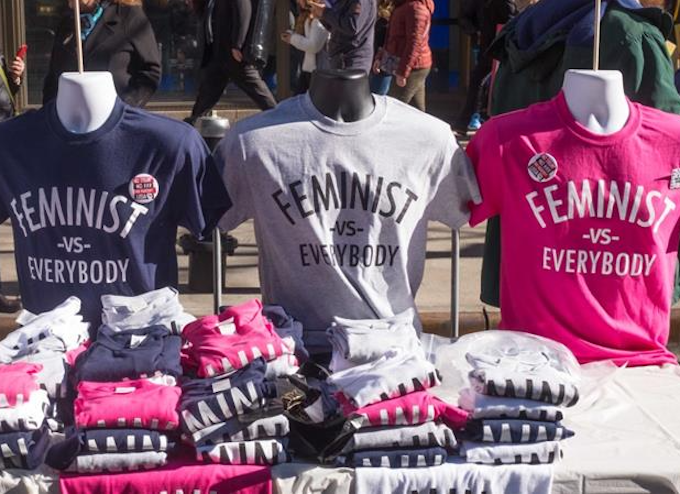
An example of this is the fashion e-tailer Net-a-Porter which has launched an exclusive limited-edition collection of IWD T-shirts in collaboration with six women designers. It is true that all of the profits go to a charity supporting women survivors of war, but activism and empowerment here is equated with buying an expensive t-shirt with words like “You Go Girl”.

Women, in other words, are encouraged to express their solidarity not through struggle or protest, but by shopping.

This corporate appropriation is clearly part of a wider cultural phenomenon – the rise of neoliberal feminism.

This kind of feminism encourages women to invest in themselves and their own aspirations, inciting them to build confidence and “lean in”. And while such feminism acknowledges the gendered wage gap and sexual harassment as signs of continued inequality, the solutions they posit, such as encouraging individual women to take responsibility for their own well-being, do not challenge the structural and economic undergirding of these phenomena.

Neoliberal feminism is palatable and marketable precisely because it is a non-threatening feminism. It doesn’t address the devastation wrought by neoliberal capitalism, neo-imperialism or systemic misogyny and sexism, so it is easy to embrace and it sells well on the marketplace.

Its message is the exact opposite of the one advanced by the women’s strikes at the beginning of the 20th century.

Feel-good feminism
Moreover, given the rise of this feel-good feminism, it is not hard to understand why suddenly everyone is eager to claim the “feminist” label: from movie stars like Emma Watson to Canadian Prime Minister Justin Trudeau.

Nor is it difficult to understand why this feminism makes good business today.

The popularity of feminism and its widespread embrace is not a bad thing per se. But it is crucial to understand what kind of feminism has become popular and why.

A watered down and defanged feminist message is neither going to uproot patriarchy, nor is it going to help us resolve the existential threats to life on earth.

We thus have two competing forces at work at the moment. On the one hand, we have a popular, commodity-driven feminism that serves as a handmaiden to neoliberalism.

On the other hand, we have a growing movement of mass feminist mobilisation that is demanding transformative social justice.

In the US, such mass mobilisation has been spearheaded by activists like Alicia Garza, who is one of the cofounders of Black Lives Matter and Linda Sarsour, who was cochair of the 2017 Women’s March, the 2017 Day Without a Woman, as well as the 2019 Women’s March.

Their feminism is a threatening one because it challenges the intersecting systems of oppression: from white supremacy through Islamophobia to misogyny and neoliberal capitalism. These women carry on the revolutionary spirit that sparked the first IWD over a century ago.

Which feminism “wins” in many ways depends on us. I, for one, have made my choice. Today, I will join the Global Women’s Strike and will bring my two sons along.

Dr Catherine Rottenberg is an associate professor of American Studies at the University of Nottingham. This article was first published by Al Jazeera English.

Print Friendly, PDF & Email

Article by AsiaPacificReport.nz

Sunday Samoan: Sex crimes, truth and pride in Samoa

By the Samoa Observer Editorial Board

Samoan Prime Minister Tuilaepa Dr Sa’ilele Malielegaoi’s insistence on telling the media how to do its job is unnecessary. Coming at a time when there are so many pressing issues he should be dealing with as the leader of this nation, we humbly suggest he should focus all his energy there.

The simple truth is that Tuilaepa has a job to do, and that is to run the country, and we, in the media, have ours. He should concentrate on his job and allow us in the media to do the same.

People who know and follow the political discourse in this country would understand that it is not unusual for Prime Minister Tuilaepa to get involved in all spheres of life in Samoa.

READ MORE: Media should play down sex crimes: PM

From sports, religion, villages, families to government affairs, he comes across as a one-man authority who perhaps feels it is his divine purpose to say whatever and expect people to swallow it without question.

On the pages of the Weekend Observer yesterday, a story with the headline “Media should play down sex crimes: P.M.” was a typical example. It immediately drew attention especially during a week when Samoa has hosted the 84th Extraordinary Session of the Committee on the Rights of the Child, where Tuilaepa himself had repeatedly called on the public to “break the culture of silence” about sex crimes and violence against women and children.

– Partner –

Away from the international audiences where he had been saying all the right things to keep them happy, when Tuilaepa fronted up to the local media, he was singing a different tune. He turned on the local media for reporting sexual crimes, saying they depict Samoa in a negative light.

“It doesn’t happen often but the problem is the media enjoys publicising these cases involving an elderly man doing filthy things to his daughter,” Tuilaepa said.

Reports read overseas
“The cases are probably nowhere near 10 in a year but it’s being reported week in and week out. These reports are being read by those overseas and it sounds like this is all that men in Samoa do from Monday to Sunday.”

Tuilaepa continued that when he sees reports being televised about sexual crimes he switches off his TV set.

But he didn’t stop there. ilaepaHe also criticised comments made by a student during the 84th Extraordinary Session of the Committee on the Rights of the Child that his peers were being beaten up on a regular basis.  He said the student’s comments sounded like something that was rehearsed.

“This is what the people in the media are doing and it includes those that are in the programme [CRC] who are badmouthing the country,” he said. While he did not name anyone in particular, he said such people have no pride in their country.

Well that’s tough, isn’t it? How does a person speaking their mind about what is happening to them come across as someone who has no pride in his/her country?

Besides, what about this nagging thing called the “truth”? When it comes to sexual crimes, the truth is staring at us unblinkingly everyday. Down at Mulinu’u at the halls of justice, judges of the courts have been telling us for years that sexual crimes against women and young girls have been rising dramatically.

What’s more, the details of these crimes have become more disturbing by the day since they involve the violation of the sanctity of the homes, where women, girls and young boys should be protected from harm.

Bigger threat a concern
If there is a bigger threat that we should be concerned about as a nation, it is an attack on the value of families, including sexual crimes. Charity begins at home and if our homes are dysfunctional as a result of these attacks, this will obviously have a flow on effect on the nation as a whole.

Which is why we should be talking about this stuff. It is why we should bring it out in the open and come together to find solutions so we could strategically deal with them.

Does that mean we have no pride in our country? Absolutely not.

If anything, it shows how much we care. And when it comes to the protection of our most vulnerable citizens, women and children, we should not let pride get in the way. We should swallow that silly pride and humble ourselves to do what needs to be done.

Who cares about what the world thinks? We say this knowing that these problems are not confined to Samoa. They are happening all over the world, in some places much, much worse.

What’s important is that we are being proactive and instead of trying to bury it under the mat, Prime Minister Tuilaepa and his government should take the lead to address them. How? By being transparent and accountable about it. That’s all it will take.

This is also why Tuilaepa’s suggestion that the media should turn a blind eye to the reporting of sex crimes is absurd. That stuff only happens in countries where censorship dictates what the media can and cannot do. As far as we are concerned, Samoa is a democracy, not a dictatorship.

Talk to JAWS
Perhaps Prime Minister Tuilaepa should spend some time with the president of the Journalists Association of [Western] Samoa (JAWS), Rudy Bartley and listen to what he has to say. In response to the Prime Minister’s comments about the work of the media, Bartley makes a lot more sense.

“Some issues may not be favorable to some but reporting on it highlights the need for such issues to be addressed by government and responsible authorities,” Bartley said.

“In exposing such issues, this opens up discussion and possible solutions to these problems. The people’s right to know is the driving force in finding solutions to many of the challenges that Samoa is facing. Exposing issues which may be unpopular is one way of making the government act in finding solutions.”

Precisely. We couldn’t agree more.

What this country should insist on is the truth.

Pride comes before the fall and if we look at all the problems Samoa is having to deal with today, they all point to a misguided sense of pride which masks the truth so that all appears well when things are really rotting beneath the surface.

What do you think?

Have a peaceful Sunday Samoa, God bless!

This editorial was published by the Sunday Samoan newspaper today.

Print Friendly, PDF & Email

Article by AsiaPacificReport.nz

5th NZ coronavirus case: Community spread ‘inevitable’, says professor

A public health professor says the World Health Organisation’s failure to declare Covid-19 a pandemic is giving New Zealanders a false sense of security.

It was confirmed today that there is a fifth case of coronavirus in New Zealand as 43 North Shore Hospital staff in Auckland went into self-isolation.

Director-General of Health Dr Ashley Bloomfield said the woman, in her 40s, was the partner of the third case confirmed in New Zealand.

READ MORE: Covid-19 coronavirus live updates

The family are believed to have caught the disease after a family member recently returned from Iran, where there is community spread of the disease.

She was already in self-isolation and did not require hospital-level care.

– Partner –

“This is fitting the pattern of existing spread … all five cases are following this pattern identified by the WHO [World Health Organisation] in its joint mission to China – that most human to human transmission is happening within families, in that close household setting,” Dr Bloomfield said.

All eight New Zealanders who had been on board an earlier cruise on the Grand Princess that is now anchored off the coast of San Francisco had now been spoken to.

One woman readmitted
Five were well and were outside the 14-day period of concern. One woman in her 70s who had been in hospital with a respiratory illness, had recovered and was then released in early March.

She has since been readmitted to hospital with a different condition and although she had recently tested negative for Covid-19 it was probable she had had coronavirus, Dr Bloomfield said.

As a result, 43 North Shore Hospital staff were being stood down as a precaution.

The fourth case is a New Zealand citizen in his 30s, the partner of the second case announced earlier this week, the Ministry of Health said.

On Thursday it was confirmed that an Auckland man was the third case of Covid-19 in this country.

He was now in isolation, along with six members of his family.

The Director-General of Health said the man contracted the virus from a family member who had been to Iran and returned more than a week ago.

China’s success
Dr Michael Baker, public health professor at the University of Otago, said that part of the reason for the WHO not calling it a pandemic was that China managed to halt the spread of the virus.

“This is the first time, I think, that any country has been able to stop a pandemic of respiratory infection in full flight,” he said on RNZ Morning Report.

“They obviously used absolutely draconian measures and it wouldn’t be acceptable in other places, and there was a lot of abuse of human rights in that process. But they’ve actually stopped it, or largely contained it. That’s really motivated the WHO to take this stance.”

Professor Baker said he disagrees with the stance and it would be better to say it was a pandemic situation.

This article is republished under the Pacific Media Centre’s content partnership with Radio New Zealand.

Article by AsiaPacificReport.nz

Global technology leader warns against ‘digital takeover’ of democracy

By Sri Krishnamurthi

Global technology and business leader Dr Anita Sands has warned against allowing digital technology to take over democracy on the eve of the first anniversary of the Christchurch mosque massacre last year.

Dr Sands, who hails from Ireland but is based in Silicon Valley, California, served or serves on the board of several software and cloud companies.

“Democracy depends on communication and deliberation, free press and countervailing forces to hold the powerful accountable,” she said in her keynote address “Digital Disruption and the New Democracy” this week organised by Project Connect at Auckland University of Technology.

READ MORE: Shoshana Zuboff on surveillance capitalism

“In a couple of weeks’ time we will commemorate the first anniversary of the Christchurch tragedy and a day of immeasurable sorrow when the world finally gained an appreciation for the very darkest implications of technology and how it can serve as a breeding ground for extremists and an outlet for their putrid beliefs,’’ she said.

On March 15 last year, a gunman attacked Al Noor Mosque in Riccarton and the Linwood Islamic Centre, killing 51 people. The first attack was streamed live on Facebook and other social media.

– Partner –

Australian white supremacist Brenton Tarrant faces 51 charges of murder, 40 of attempted murder and one under the Terrorism Suppression Act. The trial is due to begin in June.

“In the case of traditional media, we’ve put guardrails around what is appropriate in certain contexts – ratings on movies, warnings before clips are shown on television, censorship of inappropriate content but no such provision exists on the internet until the tragic events of Christchurch last year,” Dr Sands said.

Christchurch Call tackles terrorism
The “Christchurch Call” was the first attempt, after the mosque attack, to bring together countries and tech companies to end the ability to use social media to organise and promote terrorism and violent extremism.

World leaders from 48 countries and technology companies, including Facebook, Google, Twitter, YouTube and Microsoft, pledged to eliminate terrorist and violent extremist content online at the Paris summit.

“In one of the most vocal and effective calls for action by your prime minister, [Jacinda Ardern] challenged the international community and the technology industry to devise a 21 st century response to this atrocious event.

“As a result of the Christchurch Call, a broad coalition of countries and companies have come together and made meaningful progress on curtailing and reacting to extremist content and hate speech.

“They’ve agreed to standards and crisis protocols, they’ve committed to investing in technology to combat this evolving issue, as well as funding research into how terrorist groups actually behave and use technology,” she said.

“Terrorism and extremism are one corner where humanity unquestionably has to draw a line in the sand and fight back, and defending democracy is another,” said Dr Sands, who earned her PhD on atomic and molecular physics from Queens University, Belfast and has a masters degree in public policy and management from Carnegie and Mellon University, Pittsburgh, where she was a Fulbright scholar.

The onus was clearly on every person as an individual to be wary of the sound bites in online platforms, the former all-Ireland speaking champion said.

‘Playing our part’
“As individuals we also have to play our part in committing to critical thought and more vigilant around how and where we get the news,” Dr Sands said.

“Countries like New Zealand are better off than others that are already suffering the effects of an information environment that is so polluted that nobody knows what to believe anymore.

“New Zealand is fortunate that your mainstream media has not yet deteriorated to where in itself it is a polarising bubble. You still have a highly respected free press and public broadcaster which is as much a representation of your commitment to independent thought as a source of your news, and because of them a proper and civilised debate still exists here,” she said.

However, she warned: “Democracy in the digital age isn’t just a whole new playing field, it is a whole new game and we have to catch up quickly on how it is being played.

“Harvard professor Shoshana Zuboff has written extensively about this evolving paradigm which she calls surveillance capitalism and to the capitalists their most precious asset is our most precious asset —our attention, the currency of this new capitalism is our behaviour, every facet which is translated into data and then sold.

“We aren’t customers, we are merely the raw materials that are fed to the real customers, the advertisers.

“As individuals we freely share every facet of our lives without realising it, as we deposit more of attention, they withdraw more of our autonomy without realising we are a society in shackles,” she said before drawing on a witty analogy.

Customers as ‘users’
“It has always struck me as interesting that there are only two industries who refer to their customers as ‘users’ – drug dealers and software developers, and both are in the addiction game.

“In this age of surveillance capitalism, online platforms are in a race to capture our attention which means they have to get us addicted to using their technology.

“As the Netflix CEO once very famously said when he was asked ‘who do you compete with?’ he said, ‘we compete with sleep’.”

Be aware of what the public has to deal with in the digital age, Dr Sands said.

“They [tech companies] do that by unleashing these powerful algorithms that can predict with astonishing accuracy what will keep you there,” she said.

“We end up in what we call filter bubbles, seeing a newsfeed that is entirely unique to each one of us, designed to appeal to your most primal and powerful emotions.

“Humanity has created a puppet that now knows how to pull on the strings of its master.”

This timely warning comes as New Zealand heads to the polls on September 19.

Print Friendly, PDF & Email

Article by AsiaPacificReport.nz

Morrison government pledges funds to help states with health burden of COVID-19

Source: The Conversation (Au and NZ) – By Michelle Grattan, Professorial Fellow, University of Canberra

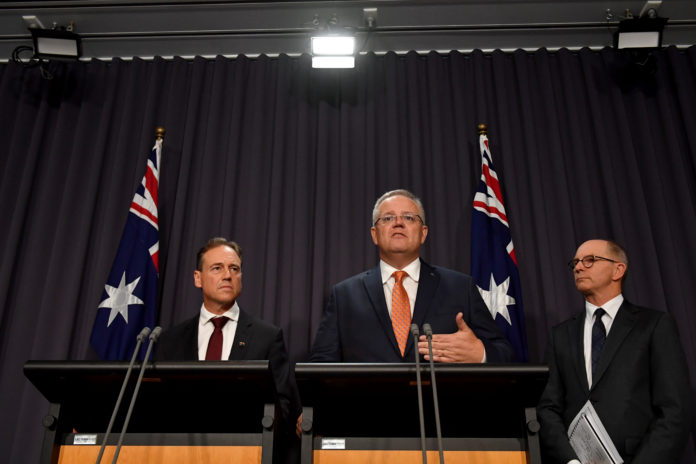
The Morrison government has announced a funding partnership with the states expected to see A$1 billion extra spent to deal with health costs around the coronavirus.

Scott Morrison said the Commonwealth would provide money on a matching 50-50 basis.

The federal government “will pay 50% of the additional costs incurred by state and territory health services as a result of the diagnosis and treatment of patients with COVID-19, those suspected of having the virus or activities to prevent the spread of it,” Morrison and Health Minister Greg Hunt said in a statement.

The support will be available for services provided in public hospitals, primary care, aged care, and community health care such as health services in child care.

The federal government is putting in an initial $100 million. While the estimate is that the likely cost to the Commonwealth will be around $500 million, there will be no cap and it could exceed that.

Morrison told a news conference: “It’s a demand-driven arrangement – the costs will be what the costs are.

“But we are estimating, based on the advice we have at the moment, that this could be as much as about a billion dollars, $500 million each. … I hope it’s not that much. It could be more”.

The 50-50 arrangement is a better deal than the states get from the Commonwealth for their hospitals, which sees 45% of the funding come from Canberra.

Details of the deal with the states will be tied down by the time the Council of Australian Governments meets on Friday, when the coronavirus situation will be at the centre of discussion.

By then the Morrison government is expected to have announced its fiscal package of billions of dollars aimed at protecting jobs and businesses hit by the crisis.

Global ratings agency Standard & Poor’s has predicted in a report on the implications of COVID-19 for the Asia-Pacific region that “Australia, Hong Kong, Japan, Korea, Singapore and Thailand will enter or flirt with recession”.

It says COVID-19 “could knock US$211 billion from Asia-Pacific incomes and slow GDP growth to 4.0% in 2020. Our new baseline for China is 4.8% with a downside scenario of 2.8% in 2020.”

Saying various regional countries will flirt with recession, S&P doesn’t use the standing recession definition of two quarters of negative growth.

Its definition is “at least two quarters of growth substantially below trend and sufficient to cause unemployment to rise, underlying inflation to fall, and policymakers to react with stimulus.”

S&P predicts a “hit” of one percentage point to Australian growth, “to leave growth in 2020 at 1.2%, well below trend which is closer to 2.5%”.

“The initial spillover from the coronavirus came from people flows which were already depressed from the bushfires,” it notes.

S&P expects the Reserve Bank – which cut interest rates this week – to cut again, to 0.25% “which leaves the Reserve Bank of Australia on the cusp of quantitative easing.

“We also expect moderate, targeted fiscal stimulus aimed at the most-harmed sectors.”

ref. Morrison government pledges funds to help states with health burden of COVID-19 – https://theconversation.com/morrison-government-pledges-funds-to-help-states-with-health-burden-of-covid-19-133164

Murdered journalists a ‘hurdle’ for Jakarta in concealing Timor invasion

NEWS REVIEW: Robert Baird

The Australian lawyer who helped uncover the Timor-Leste bugging scandal says Australia had direct, advanced knowledge of the threat that faced the murdered Balibo Five journalists, with a report describing the men as a “hurdle to be got over” in keeping clandestine activities secret.

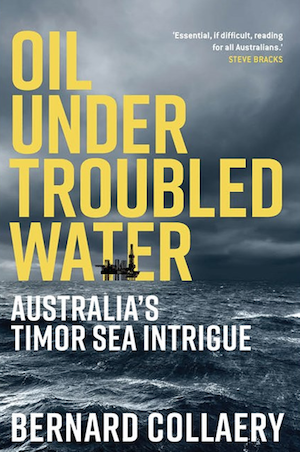
Bernard Collaery has published what he describes as a “a survey of failed Australian policy” towards its much smaller neighbour. In Oil Under Troubled Water, he describes seven decades of “grim” history, including the Indonesian occupation years he pointedly labels “genocide”.

“I’ve not called it a holocaust, I wouldn’t use that term… [but] when there is a reckless starvation of people, it is close to, and [it] is genocide,” he told Tatoli.

The cover of Oil Under Troubled Water.

The release of the book comes as Collaery and the former Australian Special Intelligence Service (ASIS) officer known as Witness K face criminal prosecution for their role in exposing the bugging of Timor-Leste’s cabinet rooms during sensitive oil and gas treaty negotiations in 2004.

The claims about Australia’s high-level knowledge of the impending Balibo attack come in a report which Collaery uncovered in the UK National Archives, where he spent some time researching the book. It highlights the information-sharing between Australia and Indonesia’s intelligence agency, then known as Bakin, in the lead up to the December 1975 invasion.

In his report, Britain’s then-Ambassador to Indonesia, John Ford, writes “the only limitation on clandestine activity now appears to be of its exposure”.

– Partner –

“A particular hurdle to be got over is a plane load of Australian journalists and politicians who are due to visit Timor… to investigate allegations of Indonesian intervention,” Ford writes. “The information from the Australians is sensitive and should not be played back to them or repeated to other missions.”

For Collaery, who advised the East Timor resistance for more than 30 years and has represented the families of the murdered Balibo Five, this was a “shocking” candour.

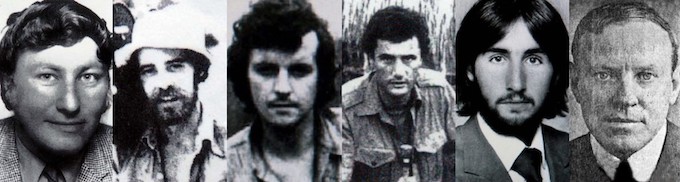
The murdered newsmen (from left): Garry Cunningham, Brian Peters, Malcolm Rennie, Greg Shackleton and Tony Stewart. Journalist Roger East, far right, was killed trying to investigate the murders. Image: Tatoli/AAP

“[The Whitlam government] could hardly warn the Australians… that Indonesian special forces were a danger to them without conceding that they were aware that clandestine activities were happening inside Portuguese Timor,” he writes.

“So, rather than save lives, they saved the relationship with the Indonesian intelligence service, clearly.”

The report undermines the official version of events leading up to the Balibo attack. A 2002 Parliamentary report found another intelligence agency, the Defence Signals Directorate, did not have “intelligence material that could have alerted the government to the possibility of harm to the newsmen” and that “there was no holding back or suppression of data”.

‘We will not press you on the issue’: Kissinger
Collaery also quotes a US State Department transcript of a meeting between Secretary of State Henry Kissinger and Indonesian General Suharto on December 6, 1975 he said betrays a “profound breach” of the United Nations charter.

“We want your understanding if we deem it necessary to take rapid or drastic action [in Timor],” General Suharto said.

“We will understand and will not press you on the issue. We understand the problem you have and the intentions you have,” Secretary Kissinger replied.

The day after the conversation, Indonesia invaded Dili and began its 24-year occupation of Timor-Leste.

Collaery says the conversation is evidence Indonesia acted with “unprovoked aggression“.

“[And] it’s a breach of the code by the United States as an accessory to that series of war crimes,” he says. Australia, as “a more silent witness”, was also complicit, he adds.

‘It’s ruined my law practice… they would have known that’
The book carefully skirts around the criminal proceedings Collaery faces for legal reasons.

“It’s not a memoir,” he says. “That comes later”.

A well-known Canberra barrister, former ACT Attorney-General and diplomat, Collaery took the former ASIS agent Witness K on as a client in 2013. After learning of the bugging operation, Collaery had arranged for his client to give evidence at a confidential overseas hearing.

But after news of the bugging operation was reported in the Australian media, the country’s domestic spy agency, ASIO, raided the lawyer’s home, seizing documents and data. ASIO also raided the home of his client, and had his passport cancelled, preventing Witness K from attending the hearing.

In protest, Timor-Leste unilaterally withdrew from the 2004 CMATS Treaty and took the case to the International Criminal Court in The Hague, with Collaery representing them. The case was subsequently withdrawn, and the two countries resolved the dispute through mandatory conciliation in early 2018.

Months after the treaty was signed, Collaery and Witness K were charged under the Intelligence Services Act of 2001. The Act criminalises the unauthorised disclosure of certain information about ASIS, Australia’s foreign spy agency.

Collaery is frank about how the prolonged case has affected his life.

“It’s ruined my law practice… I live on borrowed money, I can’t practice as an advocate in court, I’ve had to let my staff go. That’s all predictable and [prosecutors] would have known that,” he says.

Serious legal risks
Celestino Gusmão from L’ao Hamutuk, a Dili-based human rights organisation, has extensively researched the long-running maritime border dispute. He says Timor-Leste has shown great support to Collaery and Witness K.

“Through their love, their solidarity with the Timorese people, they put the people of Timor ahead [of their own lives],” he says.

Gusmão says he appreciates the serious legal risks the pair ran in exposing the bugging operation.

“I think Bernard Collaery and Witness K [were] prepared for this, but [they] should not be used as a deterrent,” he says.

  • Bernard Collaery (2020). Oil Under Troubled Water, Melbourne University Press. This news review was first published in Tatoli, the Timor-Leste News Agency website.
Print Friendly, PDF & Email

Article by AsiaPacificReport.nz

More ‘sports rort’ questions for Morrison after Bridget McKenzie speaks out

Source: The Conversation (Au and NZ) – By Michelle Grattan, Professorial Fellow, University of Canberra

Scott Morrison is facing new questioning over the sports rorts affair, after former cabinet minister Bridget McKenzie issued a statement on Friday denying she had made last-minute changes to a list of grants.

Evidence to a Senate estimate committee from the Audit Office this week reinforced allegations the Prime Minister’s Office – which exchanged numerous emails with McKenzie’s office during the $100 million grants process – was more deeply involved than Morrison has admitted. He has sought to portray its role as just passing on representations.

McKenzie, then sports minister and the decision-maker for the program, signed off on a list of grants on April 4 2019, and she sent this to the Prime Minister’s Office on April 10.

But in an email from McKenzie’s office to Sport Australia early on April 11, the day the election was called, one project was taken off the list and one added. According to the Audit Office’s evidence, this change was at the request of the PMO. This email was sent minutes after the parliament was dissolved.

Several hours later, with the government in caretaker mode, one project was removed and nine added, in another email from McKenzie’s office to Sport Australia. The Audit evidence about these was that “none were evident as being at the request of the Prime Minister’s Office rather than the minister’s office”.

In her statement, McKenzie said she had “become aware” through the Senate estimates process this week “of changes made to a Ministerial decision brief that I signed in Canberra on 4 April 2019” for the final round of the program.

“The brief authorised approved projects for the third round – this included nine new and emerging projects which, it must be emphasised, had been identified and sent to Sport Australia in March for assessment in line with program guidelines.

“I did not make any changes or annotations to this brief or its attachments after 4 April 2019. My expectation was that the brief would be processed in a timely and appropriate manner,” she said.

“Nevertheless, changes were made and administrative errors occurred in processing the brief.

“I have always taken responsibility for my actions and decisions as a Minister, and this includes actions by my office.

“I was the Minister for Sport and therefore ultimately and entirely responsible for funding decisions that were signed off under my name, including and regrettably, any changes that were made unbeknown to me.”

When a reporter tried to ask Morrison about the McKenzie statement at his Friday news conference, which was about the coronavirus, he cut her off before she could get her words out. He finished the news conference without taking questions on general issues.

McKenzie is due to appear before the Senate committee that is examining the sports rorts affair.

The Audit Office found she had allocated grants on a politically skewed basis, but she and Morrison have always defended the substance of the decisions made.

She was forced to resign from cabinet on the more technical ground she did not declare her membership of sporting organisations that benefited from the scheme. It is well known she feels badly done by, because it was clear Morrison wanted her resignation to try to limit the political damage of the affair.

ref. More ‘sports rort’ questions for Morrison after Bridget McKenzie speaks out – https://theconversation.com/more-sports-rort-questions-for-morrison-after-bridget-mckenzie-speaks-out-133160

A toilet paper run is like a bank run. The economic fixes are about the same

Source: The Conversation (Au and NZ) – By Alfredo R. Paloyo, Senior Lecturer in Economics, University of Wollongong

Panic buying knows no borders.

Shoppers in Australia, Japan, Hong Kong and the United States have caught toilet paper fever on the back of the COVID-19 coronavirus. Shop shelves are being emptied as quickly as they can be stocked.


Read more: Why are people stockpiling toilet paper? We asked four experts


This panic buying is the result of the fear of missing out. It’s a phenomenon of consumer behaviour similar to what happens when there is a run on banks.

A bank run occurs when depositors of a bank withdraw cash because they believe it might collapse. What we’re seeing now is a toilet-paper run.

Coordination games

A bank holds only a fraction of its deposits as cash reserves. This practice is known as “fractional-reserve banking”. It lends out as much of its deposits as it can – subject to a banking regulator’s capital-adequacy requirements – making a profit from the interest it charges.

If every customer simultaneously decided to withdraw all of their deposits, the bank would crumble under the liability.

Why, then, do we not normally observe bank runs? Or toilet paper runs?

A Hong Kong pharmacy orders in extra toilet paper in early February, as people panic buy. Jerome Favre/EPA

The answer comes from Nobel-winning economist John Nash (played by Russell Crowe in the 2001 movie A Beautiful Mind). Nash shared the Nobel prize in economics for his insights in game theory, notably the existence of what is now called a “Nash equilibrium” in “games”.

Both banking and the toilet-paper market can be thought of as a “coordination game”. There are two players – you and everyone else. There are two strategies – panic buy or act normally. Each strategy has an associated pay-off.

If everyone acts normally, we have an equilibrium: there will be toilet paper on the shop shelves, and people can relax and buy it as they need it.

But if others panic buy, the optimal strategy for you is to do the same, otherwise you’ll be left without toilet paper. Everyone is facing the same strategies and pay-offs, so others will panic buy if you do.

The result is another equilibrium – this one being where everyone panic buys.

Preventing coordination failure

So either no one panic buys (a successful coordination) or everyone does (a coordination failure).

The fear of everyone else panic buying has made some people panic buy as well. But those who are panic buying are not acting irrationally. They’re not stupid! They are executing an optimal strategy because the fear has a basis in reality: many people have experienced going to supermarkets and finding empty shelves.


Read more: Stocking up to prepare for a crisis isn’t ‘panic buying’. It’s actually a pretty rational choice


Obviously, though, only one of these equilibria is desirable. So what can we do to prevent coordination failure?

One solution is a market mechanism – allowing the price of toilet paper to increase to reduce demand. This is unlikely to happen, though, given the potential backlash associated with “price gouging”.

There are two other solutions.

The first is for the government to step in as guarantor.

In 2008, for example, the market crash engendered by the subprime mortgage crisis left multiple Australian banks vulnerable to depositor runs. In response, the Australian government announced a guarantee scheme for deposits. Depositors, assured the government would cover their losses even if their bank collapsed, no longer had the fear of being caught out by not withdrawing their savings.

In the case of toilet paper, the government acting as guarantor might involve holding a strategic stockpile of toilet paper. But all things considered – from logistics to costs – this probably isn’t a very good idea.

The second solution is to ration the commodity – putting limits on the amount a customer can buy. Imperfect though these buying limits are, they are feasible, as shown by the restrictions put in place by Australia’s supermarkets.

ref. A toilet paper run is like a bank run. The economic fixes are about the same – https://theconversation.com/a-toilet-paper-run-is-like-a-bank-run-the-economic-fixes-are-about-the-same-133065

COVID-19 death toll estimated to reach 3,900 by next Friday, according to AI modelling

Source: The Conversation (Au and NZ) – By Belal Alsinglawi, PhD Candidate in Data Science and ICT Lecturer, Western Sydney University

The coronavirus disease COVID-19 has so far caused about 3,380 deaths, infected about 98,300 people, and is significantly impacting the economy in many countries.

We used predictive analytics, a branch of artificial intelligence (AI), to forecast how many confirmed COVID-19 cases and deaths can be expected in the near future.

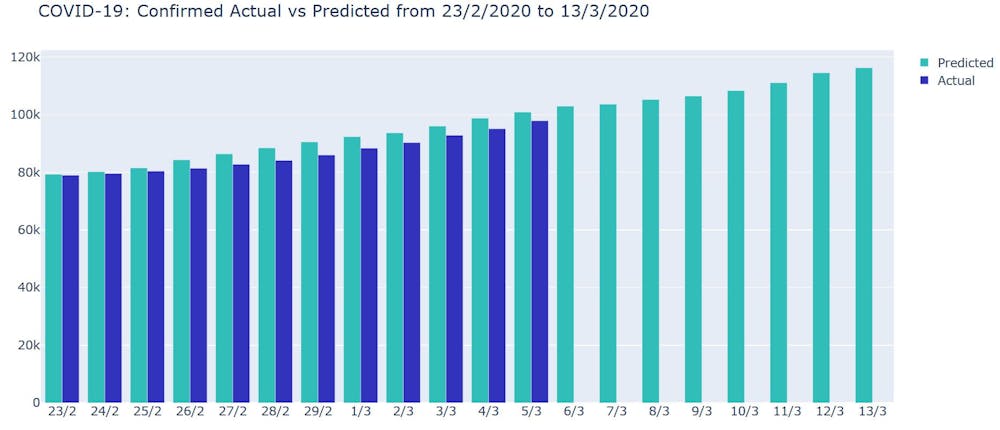
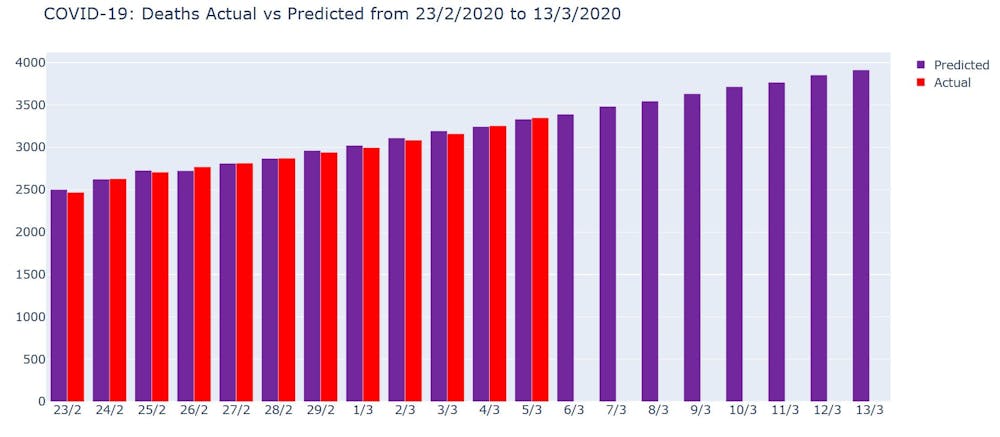
Our method predicts that by March 13, the virus death toll will have climbed to 3,913, and confirmed cases will reach 116,250 worldwide, based on data available up to March 5.

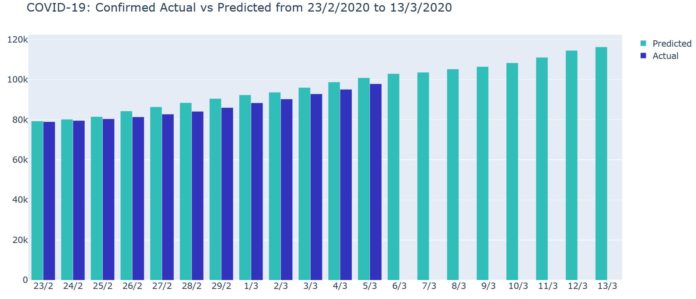
Predicted (green) and confirmed (blue) cases of COVID-19 from February 23 to March 13, as per our simulation. (Note: scale is in tens of thousands. Author provided (No reuse)
Predicted (purple) and confirmed (red) deaths caused by COVID-19 from February 23 to March 13, as per our simulation. (Note: scale is in thousands, so these numbers are an order of magnitude smaller than those in the graph above. Author provided (No reuse)

To develop contingency plans and hopefully head off the worst effects of the coronavirus, governments need to be able to anticipate the future course of the outbreak.

This is where predictive analytics could prove invaluable. This method involves finding trends in past data, and using these insights to forecast future events. There’s currently too few Australian cases to generate such a forecast for the country.

Number crunching

Our model analysed existing trends to predict COVID-19 infections to an accuracy of 96%, and deaths to an accuracy of 99%, up to about one week in the future. To maintain this accuracy, we have to regularly update our data as the global rate of COVID-19’s spread increases or decreases.


Read more: How do we detect if coronavirus is spreading in the community?


Based on data available up to March 5, our model predicts that by March 31 the number of deaths worldwide will surpass 4,500 and confirmed cases will reach 150,000. However, since these projections surpass our short-term window of accuracy, they shouldn’t be considered as reliable as the figures above.

At the moment, our model is best suited for short-term forecasting. To make accurate long-term forecasts, we’ll need more historical data and a better understanding of the variables impacting COVID-19’s spread.

The more historical data we acquire, the more accurate and far-reaching our forecasts can be.

How we made our predictions

To create our simulations, we extracted coronavirus data dating back to January 22, from an online repository provided by the Johns Hopkins University Centre for Systems Science and Engineering.

This time-stamped data detailed the number and locations of confirmed cases of COVID-19, including people who recovered, and those who died.

Choosing an appropriate modelling technique was integral to the reliability of our results. We used time series forecasting, a method that predicts future values based on previously observed values. This type of forecasting has proven suitable to predict future outbreaks of a disease.

We ran our simulations via Prophet (a type of time series forecasting model), and input the data using the programming language Python.

Further insight vs compromised privacy

Combining predictions generated through AI with big data, and location-based services such as GPS tracking, can provide targeted insight on the movements of people diagnosed with COVID-19.


Read more: Why public health officials sound more worried about the coronavirus than the seasonal flu


This information would help governments implement effective contingency plans, and prevent the virus’s spread.

We saw this happen in China, where telecommunication providers used location tracking to alert the Chinese government of the movements of people in quarantine. However, such methods raise obvious privacy issues.

Honing in on smaller areas

In our analysis, we only considered worldwide data. If localised data becomes available, we could identify which countries, cities and even suburbs are more vulnerable to COVID-19 than others.

We already know different regions are likely to experience different growth rates of COVID-19. This is because the virus’ spread is influenced by many factors, including speed of diagnoses, government response, population density, quality of public healthcare and local climate.

As the COVID-19 outbreak expands, the world’s collective response will render our model susceptible to variation. But until the virus is controlled and more is learned about it, we believe forewarned is forearmed.


Read more: Coronavirus: How behaviour can help control the spread of COVID-19


ref. COVID-19 death toll estimated to reach 3,900 by next Friday, according to AI modelling – https://theconversation.com/covid-19-death-toll-estimated-to-reach-3-900-by-next-friday-according-to-ai-modelling-133052

Sexual harassment claims are costly and complex – can this be fixed?

Source: The Conversation (Au and NZ) – By Dominique Allen, Senior Lecturer in Law, Monash University

The #MeToo movement has reminded us that sexual harassment has not gone away. The legal tools we’re using are not working and may even be hiding the true extent of the problem.

Most sexual harassment complaints are resolved confidentially at the Australian Human Rights Commission (AHRC) or its local equivalents. Few go to court. This system has three fundamental problems.


Read more: Rape, sexual assault and sexual harassment: what’s the difference?


Confidential processes and settlements

Confidentiality is essential to get people to the negotiating table. Who can forget the media scrutiny actors Geoffrey Rush and Eryn Jean Norvill were subjected to?

Even for people who are not famous, the potential media interest in a sexual harassment claim is a strong reason to settle, as it is for employers who fear reputational damage. But it means the community isn’t aware that sexual harassment is still occurring or how it’s being addressed.

Employers usually insist on a confidentiality clause when they settle a claim. I recently interviewed 23 lawyers in Melbourne, asking them how common confidentiality clauses are in discrimination settlements.

A solicitor told me settlement agreements “almost always” include confidentiality. Another described the confidentiality clause as “not negotiable”. A barrister said: “No one I know has ever settled on non-confidential terms.”

The lawyers said employers use confidentiality clauses to avoid opening the “floodgates” to other victims. Employees seek confidentiality if they have left the workplace and worry about what their former employer might say about them.

At their most extreme, confidentiality clauses have a chilling effect on victims, who fear the repercussions of discussing any aspect of their claim. At the same time, they protect the perpetrator at their current workplace and anywhere they work in the future.

A complex, costly legal system

Making a legal claim is complex and costly. A woman who has been sexually harassed could use her local anti-discrimination law or the federal system. The federal system is costly because if she loses at court not only will she have to pay her own legal costs, she risks having to pay the other side’s costs too.

If she’s been discriminated against, unfairly dismissed or has a worker’s compensation claim, three more legal avenues are open to her. These vary in terms of costs, procedures, time restrictions and levels of formality, so they’re difficult to navigate without legal assistance.

It’s not surprising, then, that most people don’t use the formal legal system and those that do tend to settle.

Individual burden

There is no equivalent of the Australian Securities and Investments Commission (ASIC) or the Australian Competition and Consumer Commission (ACCC) that can prosecute employers or represent victims, so the person who has been sexually harassed bears a heavy burden. As one of the lawyers I interviewed put it, the victim has to do “all the heavy lifting”.

Respect@Work

This week, the AHRC released Respect@Work, a lengthy report on sexual harassment. It made 55 recommendations, many of which are designed to improve the legal framework. Will they resolve these weaknesses?

In terms of shedding light on the prevalence of sexual harassment, the recommendations include that the AHRC and its local equivalents should collect de-identified data about sexual harassment claims and settlement outcomes, share this data and prepare coordinated annual reports. This is significant because at the moment they only release numerical annual complaint data. They don’t publish anything about the nature of claims or settlements. Acknowledging that some parties want confidentiality, the AHRC will develop “best practice” principles, which might include preparing a model confidentiality clause and making some disclosures permissible.

Lawyers told me they negotiate damages payments in excess of what courts are likely to order. Because settlements are confidential, they have no impact on the courts’ understanding of the harm of sexual harassment, and victims and their lawyers don’t have a realistic starting point for negotiations. It is pleasing that the AHRC has recommended the government conduct research on damages awards and that this should inform judicial training.

Lawyers repeatedly told me the risk of costs is the main reason victims don’t use the federal system. The AHRC recommended a losing party should only have to pay the other side’s legal costs if their claim is vexatious, which is how the Fair Work system operates. The government should act to remove this barrier right away.

The recommendations to increase funding for community legal centres and bring consistency to federal and local sexual harassment legislation (including adding sexual harassment to the Fair Work Act) will reduce the cost and complexity of the system.


Read more: Geoffrey Rush’s victory in his defamation case could have a chilling effect on the #MeToo movement


But a problem remains – the burden still rests on the victim. The AHRC has proposed establishing a Workplace Sexual Harassment Council comprised of federal and local equality and workplace safety agencies. But this is a leadership and advisory body, not an enforcement agency.

The AHRC president is conducting an inquiry into reforming discrimination law. Changing the enforcement model and alleviating the burden on the victim must be considered as part of this broader project.

ref. Sexual harassment claims are costly and complex – can this be fixed? – https://theconversation.com/sexual-harassment-claims-are-costly-and-complex-can-this-be-fixed-133149

Maria Ressa named among Time’s most influential women of century

By Rappler in Manila

Rappler CEO Maria Ressa is among Time‘s “100 Women of the Year”, the news magazine has revealed ahead of International Women’s Day on Sunday.

Time‘s “100 Women of the Year,” a list of the most influential women of the past century, puts the spotlight on “influential women who were often overshadowed”.

“This includes women who occupied positions from which the men were often chosen, like world leaders Golda Meir and Corazon Aquino, but far more who found their influence through activism or culture,” the magazine said.

READ MORE: Time magazine’s ‘100 women of the year’ – and the century

Time covers for former Philippine President Cory Aquino (left) and Rappler’s Maria Ressa, “guardian of the truth”. Image: Rappler/Time

Time recognised Ressa as its Woman of the Year for 2018, noting her already impressive career in news before starting Rappler in 2012.

– Partner –

“But the news site turned into a global bellwether for free, accurate information at the vortex of two malign forces: one was the angry populism of an elected president with authoritarian inclinations, Rodrigo Duterte; the other was social media,” the magazine wrote in its article about Ressa.

Time said that, since naming her as a 2018 “Person of the Year,” Ressa “has continued to navigate the murk between social media and despotism, calling out her findings to the rest of us at the risk of her life”.

Other women from Southeast Asia who made it to the list include late Philippine president Corazon Aquino (1986) and Myanmar’s civilian leader Aung San Suu Kyi (1990).

Aquino was named Woman of the Year in 1986 after the democracy icon won the presidency and ended the nearly 21-year dictatorship of Ferdinand Marcos.

Former Time editor-in-chief Nancy Gibbs said of the project: “The women profiled here enlarged their world and explored new ones, broke free of convention and constraint, welcomed into community the lost and left behind.

“They were the different drummers, to whose beat a century marched without always even knowing it.”

“Women,” Gibbs writes, “were wielding soft power long before the concept was defined.”

For the complete list of Time’s “100 Women of the Year,” click here.

Republished from Rappler news website.

Print Friendly, PDF & Email

Article by AsiaPacificReport.nz

Former Green Party co-leader Jeanette Fitzsimons ‘lived her convictions’

Former Green Party co-leader Jeanette Fitzsimons has died.

Her husband, Harry Parke, said the death was totally unexpected.

“Yesterday morning she was out on the farm doing stuff, she had a bit of a fall and finally ended up in Thames Hospital where she had a massive stroke and died at 9.45pm last night – very peacefully I might add,” he said.

READ MORE: What the Green Party has achieved in 18 years

“The day before, she was using a chainsaw – that’s the sort of person she is. She worked a lot harder than I ever did. I was totally in awe of her.

“Fortunately we both had very much the same convictions about what needed changing in the planet and we had a very close relationship.”

– Partner –

Fitzsimons became the co-leader of the Green Party of Aotearoa New Zealand in 1995, and when the party joined the Alliance led by Jim Anderton’s New Labour Party, she took on the deputy leadership role.

After the first MMP election in 1996, she entered Parliament as a list MP for the Alliance but it was not long before strains appeared in the grouping.

Left the Alliance
She felt herself left out of its decision-making and the Green Party itself was increasingly unhappy with the Alliance’s direction.

The agreement to send New Zealand troops to Afghanistan in the United States’-led so-called war on terror was a step too far for the Greens and they left the Alliance.

Fitzsimons won the Coromandel seat for the Greens in 1999, the country’s first elected Green MP and was disappointed when she lost it in the following election, although the party remained in Parliament due to its party vote.

She and her co-leader Rod Donald were strong influences in the change in public perception of the party as a group of sandal-wearing tree-huggers.

Parke said Fitzsimmons was “instrumental” in getting the Green Party up and running in the 1990s. More recently, her focus had been on climate change.

“She fought really hard to get people to accept you can’t keep growing the economy and stop climate change. It just seems people don’t want to hear that.”

Never raising her voice
Fitzsimons was known for never raising her voice in the House and never responding to barbs thrown around in Parliament.

“She strongly believed that never got you anywhere, that all it did was take the focus off the subject you were talking about and your energy needed to be totally on what you were trying to achieve. I think she held that up admirably,” Parke said.

“She never let her emotions get in the way of what needed to be said and what needed to be done.”

“She totally lived her convictions and there was no way that anyone could say she didn’t live up to what she was saying.”

Fitzsimons was made a Companion of the New Zealand Order of Merit in 2010.

This article is republished under the Pacific Media Centre’s content partnership with Radio New Zealand.

Article by AsiaPacificReport.nz

Ransomware attack on sheep farmers shows there’s no room for woolly thinking in cyber security

Source: The Conversation (Au and NZ) – By Roberto Musotto, Cyber Security Cooperative Research Centre Postdoctoral Fellow, Edith Cowan University

While many Australians were preoccupied with panic-buying toilet paper, sales of another commodity encountered a very different sort of crisis.

Wool sales were severely disrupted last week by a ransomware attack on IT company Talman Software, which processes more than 75% of sales in Australia and New Zealand.

A ransomware attack is a form of cyber-extortion, involving software that encrypts all of the files on a system. In this case, cyber-criminals then demanded A$8 million to unlock the files. Talman has refused to pay and has instead built a replacement version of the software.


Read more: Ransomware attacks on cities are rising – authorities must stop paying out


Wool sales were halted for several days and hastily rescheduled, with an estimated 70,000 bales held in limbo. The industry’s turnover in a typical week is up to A$80 million, but prices may now drop as the postponed sales cause a glut in the market.

A ransomware attack on such an important sector of Australia’s economy shows how vital it is for authorities to defend markets against cyber threats. It is a matter of when, not if, these attacks will happen. There is a ransomware attack on a business every 14 seconds and by 2021 it will be every 11 seconds.


Read more: What’s critical about critical infrastructure?


Diverse defences

How do we improve our resilience? One way is to avoid being too dependent on particular technologies. The wool industry already knew Talman Software’s dominant role represented a significant vulnerability.

Having a wider choice of software providers, not to mention an offline alternative, would have reduced or avoided the disruption.

Previous ransomware attacks on vital infrastructure, including last month’s attack against Toll Group, have shown the need for companies to keep their operations and IT systems separate.

We can define “operations” as the software and hardware that allow a company to keep its assets and processes working. IT systems, meanwhile, are the software and hardware that handles the company’s information and data.

Separating the two would make it harder for hackers to disrupt a company’s operations by invading its IT system. However, this would make it impossible to use IT systems to control operations remotely, which would bring its own pros and cons. Imagine a nuclear power plant – do you fit it with a remote shutdown option that could be crucial in an emergency but might also become a tempting target for hackers?


Read more: Is Australia’s electricity grid vulnerable to the kind of cyber attacks taking place between Russia and the US?


Governments need to help

This issue is bigger than simply a threat to companies’ profits. Although the latest attack targeted a commercial company, it damaged the economic welfare of farmers in two countries.

Fending off future attacks shouldn’t be a job just for companies seeking to safeguard their own profits – governments need to help too.


Read more: Hackers are now targeting councils and governments, threatening to leak citizen data


Governments should have a cyber-resilience unit that supports businesses in such emergencies. They should also provide support funds for victims, and national compulsory cyber insurance to guarantee the least disruption possible.

Governments need to defend public and economic infrastructure such as transport networks, power grids and important commercial markets.

ref. Ransomware attack on sheep farmers shows there’s no room for woolly thinking in cyber security – https://theconversation.com/ransomware-attack-on-sheep-farmers-shows-theres-no-room-for-woolly-thinking-in-cyber-security-132882

Denied full participation, Catholic women mobilise for change

Source: The Conversation (Au and NZ) – By Kathleen McPhillips, Senior Lecturer, School of Humanities and Social Science, University of Newcastle

Women still make up the majority of the Catholic workforce and Catholic congregations, but their participation in church life is in decline.

Indeed, each generation of Catholic women in Australia is less likely than the previous one to attend church and participate in parish life.

There are a number of reasons for this decline, one of which is a continued lack of action by church leadership in including women in agenda-setting and decision-making processes in church life.

Despite recommendations from the Child Abuse Royal Commission that church leaders undertake a review of their engagement of Catholic women and develop measures to increase women’s status and participation in the church, there has been little progress to date.

This is only likely to get worse after the Australian Catholic Bishops Conference (ACBC)‘s recent decision to disband its Office for the Participation of Women (OPW) and Council for Australian Catholic Women (CACW). These bodies were a focal point to boost the participation of women across Catholic parishes and dioceses in Australia.

A long-discussed problem in the church

The disbanding of the OPW and CACW signals a giant step backwards for the church, and contradicts the radical reforms the Australian bishops committed to almost 20 years ago aiming to

engage the wisdom, the talents and the experience of women for the enrichment of the church and of society.

Research commissioned by the ACBC, published in the report Woman and Man: One in Christ Jesus in 1999, examined the participation levels and experiences of women in the church. It clearly identified several barriers to improvement, including a failure to address gender equality, and the lack of women in official positions or visible female role models.


Read more: After Pell, the Catholic Church must undergo genuine reform


The report also revealed the majority of Australian Catholics felt a strong sense of pain and alienation resulting from the church’s stance on women.

Few of the original ACBC recommendations have been implemented and there is now no clear agenda for addressing the challenges raised by the report.

Women theologians not being consulted

Later this year, the Catholic Church in Australia will hold its Fifth Plenary Council, providing some hope to women their voices will finally be heard.

On the agenda are six national themes, which emerged from consultations with the Catholic community in Australia.

The bishops have committed to addressing “the inclusion of women in church leadership roles” and “draw on the gifts and talents” of women, but how this will happen is uncertain with no mandate or quota for women to attend as delegates.

A further disappointment is the continuing failure to recognise the expertise of Catholic women theologians.


Read more: The Catholic Church is headed for another sex abuse scandal as #NunsToo speak up


Next week, 70 theologians and ethicists from around the world will gather in Rome for a workshop that will examine questions around church abuse.

Australian theologians will be well-represented at the gathering, but there are no women among the four delegates, despite a plethora of highly-qualified women theologians in Australia.

Recently, the Global Church Project published two blogs highlighting the work of over 160 women theologians from Australia and New Zealand, many of whom have published extensively on clerical sexual abuse and spiritual trauma.

Global response

This isn’t just a problem in Australia. Globally, Catholic women continue to be sidelined from important gatherings and processes determining the future of Catholicism. As a consequence, many women are beginning to mobilise for change.

In Spain, for instance, women theologians have joined together to speak out about equality and dignity for women in the Church. And Indian nuns are risking persecution by going public with stories of sexual assaults by priests.

Catholic women’s groups from five continents have also formed the Catholic Women’s Council (CWC), which is calling for Catholic women worldwide to take part in global activism on International Women’s Day this year. The Australian organisation Women and the Australian Church (WATAC Inc.) is part of this movement.

Despite these actions, though, the current situation looks grim. With a lack of political will, the full participation of women in the life and mission of the church is a still a long way from being realised. And women are responding by moving out of the church or mobilising for change.

ref. Denied full participation, Catholic women mobilise for change – https://theconversation.com/denied-full-participation-catholic-women-mobilise-for-change-131557

Which aged care services near you weren’t up to scratch in 2019?

Source: The Conversation (Au and NZ) – By Lee-Fay Low, Associate Professor in Ageing and Health, University of Sydney

In July 2019, the government introduced new aged care standards to “raise the bar” in an aged care system where some nursing home residents have experienced care that is neglectful, depersonalised, uncaring, unsafe and of poor quality.

We took a close look at breaches of aged care standards from 2019 to see what effect the new aged care standards are having, and where aged care providers are falling short.

In the interactive map below you can see aged care providers that were non-compliant in 2019.


Map created by data visualisation company Small Multiples

What are aged care standards?

Aged care standards are the minimum standard of care the government expects nursing homes to provide.

They are supposed to ensure people in aged care have access to quality care including competent staff who listen, best-practice clinical care and nutritious and tasty food.

Nursing homes that don’t meet standards are given a notice of non-compliance. If the provider doesn’t fix the problems that made it non-compliant, then it will be sanctioned.

If assessors decide there is an immediate and severe risk to residents, nursing homes can also be immediately sanctioned. The nursing home provider must then bring the care up to standard before they can take new residents.


Read more: Nearly 2 out of 3 nursing homes are understaffed. These 10 charts explain why aged care is in crisis


The new aged care standards

From 2014 until the new standards were introduced in July 2019, the number of non-compliance notices and sanctions increased steadily as can be seen in the chart below.

This was likely due to a combination of increasing scrutiny of the quality of residential care as a result of the unsafe care revealed at Oakden in 2017, and the establishment of the aged care royal commission in October 2018. A 2018 policy change meant providers were no longer warned about upcoming accreditation visits.


Chart: Else Kennedy. CC BY-ND

The new standards, introduced in July 2019, focus on “personal dignity and choice”.

They were designed to support the provision of care based on what residents want, rather than penalising providers when they let residents do something that could be considered “risky”, such as allowing someone with mild dementia to walk to the shops, or having a pet in the nursing home.

The number of non-compliance notices and sanctions in the first six months of the new standards decreased. This is likely because assessors visited fewer nursing homes in this period, and may still be learning how to interpret the new standards.

Aged care providers and industry bodies have criticised the new standards for being subjective and vague. They do not measure objective resident outcomes like depression or number of infections.

For-profit companies had a higher rate of non-compliance in 2019


Chart: Else Kennedy. CC BY-SA

Some 6% of for-profit residential care facilities failed aged care standards in 2019, some of them multiple times. In comparison 5% of not-for-profit and 4% of government facilities failed standards.

The rate of non-compliance in for-profit facilities was 27% higher than not-for-profits, and 54% higher than government facilities.

This suggests for-profit providers in Australia are more likely to provide lower quality care. An international review has noted similar trends in other countries.

Profit margins are slim in aged care, and for-profit providers are under pressure to make profits by cutting costs. This could lead to a lower standard of care compared with not-for-profit or government providers.


Read more: Why is nursing home food so bad? Some spend just $6.08 per person a day – that’s lower than prison


Reasons for non-compliance in 2019

The most common reasons for non-compliance in 2019 were in the area of personal and clinical care and the area of governance.


Chart: Else Kennedy. CC BY-ND

An example of a nursing home breaching the personal and clinical care standard could be if the home’s practices mean it isn’t giving medication correctly, isn’t managing wounds properly, or isn’t providing dignified help for residents using the toilet.

Homes might also breach the personal and clinical care standards if they don’t have sufficiently skilled staff such as registered nurses to care for residents with complex health needs.

A nursing home might be non-compliant in governance when it doesn’t have the right systems in place to monitor and improve its clinical care, for example in the areas of infection control or restraints. It might also be non-compliant if residents and families don’t have enough of a say in how the facility is run.

The new standards were supposed to place an increased focus on dignity and choice, supporting the identity of a person, and increasing their say in the care they receive. This means catering for residents who want to have showers in the evening, stay up late, or make their own lunch. Previously there was much less emphasis on these aspects of aged care.

It is somewhat promising that more breaches of non-compliance in the “dignity and choice” standard have been picked up since the new standards came in. But given we know care is often poor in this area and there is an increased focus on this standard, we could have expected a more significant change.


Read more: How to check if your mum or dad’s nursing home is up to scratch


Based on the first six months of non-compliance and sanctions data for the new aged care standards, we cannot be confident the new standards are ensuring nursing homes provide higher quality care. We await more data.

Until then, aged care residents and their families should monitor the quality of care they receive, know their aged care rights, and complain if they think there is an issue.

If you or a family member are considering using an aged care provider, you can check whether the provider has breached standards via the My Aged Care non-compliance checker.

ref. Which aged care services near you weren’t up to scratch in 2019? – https://theconversation.com/which-aged-care-services-near-you-werent-up-to-scratch-in-2019-131449

Sure, save furry animals after the bushfires – but our river creatures are suffering too

Source: The Conversation (Au and NZ) – By Jamie Pittock, Professor, Fenner School of Environment & Society, Australian National University

The hellish summer of bushfires in southeast Australia triggered global concern for our iconic mammals. Donations flooded in from at home and around the world to help protect furry species.

But there’s a risk the government and public responses will not see the fish for the koalas.

Of the 113 priority fauna species identified by the federal government as worst impacted by bushfires, 61 (54%) are freshwater species that live in or around our inland rivers, such as fish, frogs, turtles and the iconic platypus.

These animals and ecosystems were already struggling due to prolonged drought and mismanagement of the Murray Darling Basin. Saving koalas and other mammals is of course important, but freshwater species should also be a priority for post-fire environmental programs.

People flocked to help the koala recovery effort after the fires. David Crosling/AAP

A picture of devastation

The government’s priority species list includes three turtle species, 17 frogs, 22 crayfish, 17 fish and the platypus. Rounding out the list is an alpine stonefly, although many other invertebrates are also likely to be affected (as well as other species that depend on moist, streamside forest habitats).

Excluding tropical savannah, the recent bushfires burnt more than 7.7 million hectares in Victoria, South Australia, New South Wales, Queensland and Western Australia. Rainforests and riparian (riverside) forests were extensively damaged along the Australian east coast and alps. These are normally moist environments, which are not adapted to fire.

Plant and animal species at the edge of waterways, in peat wetlands and in riverside forests are likely to have been burnt or killed by heat, such as crustaceans , lizards, and corroboree and mountain frogs in the alps and east coast rainforests.


Read more: Fire almost wiped out rare species in the Australian Alps. Feral horses are finishing the job


Burnt riverside forests no longer shade the water, making water temperatures hotter and leading to increased evaporation that may stress surviving wildlife. The loss of vegetation cover also leaves prey exposed to predators.

Following recent rain, water flowing into rivers has washed ash into streams. This clogs fish gills and brings nutrients that drive algal blooms. Sediment washed into waterways fills in the gaps between rocks and holes in river beds – places where many species shelter and breed. For instance, the River Murray catchment’s last population of Macquarie perch was impacted as rain washed ash and sediment into Mannus Creek in southern NSW.

Fires tend to burn forests in patches, sometimes leaving refuges for land-based animals. However fire damage to waterways flows downstream, systematically degrading the habitat of aquatic animals by leaving little clean water to hide in.

Bushfire silt clogging the usually pristine Tambo river in the Victorian high country in January. David Crosling/AAP

Long-term damage

The devastating impact of the fires in river environments may be long-lived.

When aquatic animals species are wiped out in particular rivers, they may not be able to recolonise from surviving populations in other unconnected rivers.

Some species will invariably now be closer to extinction. For example many key peat swamp habitats of the critically endangered northern corroboree frog have been burnt in the Bogong Peaks and Brindabella mountains of NSW and the ACT.


Read more: The sweet relief of rain after bushfires threatens disaster for our rivers


And after fires, fast-growing young eucalyptus forests transpire much more water than older burnt trees. This may reduce inflows into streams for a century.

The recent bushfires followed several years of extreme drought across much of Australia. In the Murray-Darling Basin, these challenges were compounded by poor water management that contributed to dried-up rivers and mass fish deaths.

Water-sharing rules in the basin determine how much water is allocated to agriculture and the environment. Current water-sharing plans do not explicitly include allocations to manage losses due to climate change, and as the plans will only be updated once a decade, it is questionable whether they will be adjusted to sustain flows needed to conserve threatened species.

Much corroboree frog habitat was destroyed during the fires. Melbourne Zoo

Here’s what to do

After the fires, government officials and scientists rescued a number of “insurance” populations of threatened aquatic animals such as turtle and fish species, and took them to captive breeding facilities, such as the stocky galaxias fish in the alps. We must ensure healthy habitat is available for these animals to re-establish viable populations when released.

In the short term, we must protect surviving and regenerating habitat. Government programs are off to a good start in promising to cull feral predators such as cats and foxes, as well as grazing animals such as pigs, deer and goats. The NSW and Victorian governments must also remove feral horses in the Australian Alps that are damaging the swamp habitats and streams.

Now so many infested riverside forests are accessible, it is a key time to control weed regrowth.


Read more: Last summer’s fish carnage sparked public outrage. Here’s what has happened since


In the medium term, we should expand programs to fence livestock out of waterways, install other watering points for these animals and revegetate stream banks.

Deep holes in rivers and streams with cool water are important refuges for aquatic animals, and ways to restore them should be investigated.

Impediments to fish migration, such as weirs, should be removed or fish “ladders” installed to aid fish movement. Aquatic species often won’t breed unless the water is the right temperature in the right season; to prevent the release of overly cold water from the bottom of dams, better water release structures should be installed.

Years of drought meant rivers and aquatic life were already vulnerable before the fires. Dean Lewins/AAP

An opportunity for change

Successive governments have been asleep at the tiller when it comes to threatened aquatic animals. Official recovery plans for many fire-affected species have not been adequately funded or implemented.

In the Murray-Darling Basin for example, a native fish strategy was shelved in 2013 after the NSW government reportedly pulled funding.

The impending release of a new fish strategy, and other post-fire recovery actions, are an opportunity for governments to right past wrongs and ensure our precious freshwater species thrive into the future.

ref. Sure, save furry animals after the bushfires – but our river creatures are suffering too – https://theconversation.com/sure-save-furry-animals-after-the-bushfires-but-our-river-creatures-are-suffering-too-133004

More money for private schools won’t make Australia’s education fairer, no matter how you split it

Source: The Conversation (Au and NZ) – By Jessica Gerrard, Senior lecturer, University of Melbourne

In recent days the federal government announced a new funding formula for non-government schools. Called the Direct Measure of Income, the formula will base the level of government funding on school parents’ incomes rather than the socioeconomic profile of where they live.

Education minister Dan Tehan said the changes will make the distribution of funding within the non-government sector “more accurate” and “equitable” and that funding will go to schools that need it most. Attached to this new measure is a significant boost in funds to non-government schools.

But while the funding formula may direct money to relatively more needy private schools, these extra federal resources aren’t addressing the inequalities of the education system as a whole.

How will the formula work?

At the moment federal government funding of non-government schools is calculated in relation to the socioeconomic profile of the suburbs where parents live. It uses census data to calculate what is known as the “SES score” of school families.

This means if a non-government school has a high proportion of families living in well-off areas, it is entitled to less government funding than a school with parents living in less advantaged areas.

The announced changes are based on recommendations of a review of the current funding model, conducted by the National School Resourcing Board. It recommended the government use a newly available measure of parents’ capacity to contribute financially to the school, which comes from combining census and income tax data.

The Direct Measure of Income formula will offer a more accurate picture of parents’ capacity to contribute. This is because it relies on parents’ actual income rather than the socioeconomic profile of the neighbourhood they live in.

The new formula requires an amendment to the Australian Education Act, a bill for which was introduced to parliament on February 26 and referred to a Senate committee with a report due in May.

What you need to know about this funding model

The new model is accompanied by a significant increase in government funds into the non-government sector. The education minister estimated there will be an additional A$1.3 billion in the current budget, and a $3.4 billion increase in funding over ten years.

The government is also directing $200 million to help schools transition to the new formula, and a further $1.2 billion through the Choice and Affordability Fund. The latter is to support “underperforming” and “educationally disadvantaged” non-government schools (among other target areas).

Calculating parents’ incomes requires a new combination of data. To calculate parental capacity to contribute the government will combine de-identified data from the Australian Tax Office and the census. This will be done through the Multi-Agency Data Integration Project (MADIP).

This kind of mapping has only recently become possible due to developments in data technology and cooperation between agencies. It marks a new kind of government policy making, driven by fine-grained personal data.

The new formula, based on how much parents can contribute to the school, reinforces the idea that schools are mainly about individual gain and contribution. It also suggests funding problems can be solved by more drilled-down data about children and their families.

What’s the problem with school funding in Australia?

The question of government funding for non-government schools is one of the most acrimonious public debates in Australia, and has been going for more than 100 years.

The 2010-2011 Gonski review of school funding was an attempt to end the school funding wars. But the report’s recommendations were never fully implemented.

The report described school funding in Australia as complex, confusing, opaque and inconsistent. Arguably, this is still the case, with successive federal governments generating their own methods to solve it.

Australia has one of the highest rates of private schooling in the world. We also have high rates of public funding of the private schooling sector – the majority of non-government schools would probably not survive long without it.

Our high levels of funding for private schools is now taken for granted. It is seen as an expression of parents’ rights over their children’s education.

The new funding model further entrenches the belief private schools are a national priority, to be funded by the federal government. The reforms don’t address the relative equity between government and non-government schools. This remains a burning question for Australian education.

ref. More money for private schools won’t make Australia’s education fairer, no matter how you split it – https://theconversation.com/more-money-for-private-schools-wont-make-australias-education-fairer-no-matter-how-you-split-it-132769

How ‘Earthships’ could make rebuilding safer in bushfire zones

Source: The Conversation (Au and NZ) – By Martin Freney, Lecturer in Industrial and Sustainable Design, University of South Australia

Recent disastrous bushfires have rebooted debate about how to (re)build in the Australian bush. Questions are being asked about building standards, whether a fire-proof home is possible, the value of fire bunkers when it’s too late to leave, and if we should even live in the bush any more.

I suggest homes and community buildings in bushfire-prone areas can be made much more fire-resistant, perhaps even fire-proof, by adopting earth-covered, off-grid structures – known as Earthships – as the new standard.


Read more: Before we rush to rebuild after fires, we need to think about where and how


Built for survival

Houses sheltered by earth have a higher chance of survival in a bushfire. This is because earth-based constructions are non-flammable (while topsoil can burn and smoulder, clayey, sandy and gravelly soil does not).

A typical Earthship design has double-glazed windows to the north to let in winter sun, while mounds of earth, pushed up to roof level, protect the south, east and west walls. Taking this a step further, an earth-covered house includes a layer of earth over the roof.

The north-facing double-glazed windows (an essential element of passive solar design) is the only part of the building that needs some other protection.

Bushfire building codes and standards already demand that windows have extra-thick, toughened glass to resist burning debris and intense heat. Double glazing (two layers of glass separated by a small air gap) offers extra protection. In very high-risk areas, bushfire shutters are a requirement.

Although not demanded by building codes, automated sprinklers could be used to spray water on the windows. But automated systems are problematic during a bushfire when power and water supplies are likely to fail.


Read more: No food, no fuel, no phones: bushfires showed we’re only ever one step from system collapse


Independent water supplies (big water tanks) and pumps (usually petrol or diesel) are often a condition of approval for new homes in fire-prone areas. However, these are difficult to automate because of choke, throttle, ignition and refuelling issues.

Examples around Australia

Enter the Earthship. Invented by American architect Michael Reynolds, thousands have been built all over the world, often by owner-builders.

Earthships, invented by Michael Reynolds, are now found all over the world.

Australian examples can be found in all states, including at Ironbank in South Australia, Kinglake in Victoria, East Augusta and Jurien Bay in Western Australia, and Narara and Marulan in New South Wales.

Earthships have an electric pump powered by solar panels and a battery for day-to-day water supply – and to fight fires. Sprinklers can then spray water on any vulnerable areas regardless of grid failures and without needing to deal with the flammable fuel that petrol and diesel pumps require.

The standard Earthship design has another feature that could save lives. Underground pipes called earth-tubes or cooling tubes bring fresh air into the building at a nice temperature (better than outside) due to the heat-exchanging effect of the earth around the pipes. When wet fabric is placed over the end of the pipes, these can filter out bushfire smoke.

Earth-covered homes are very air-tight, which combined with the earth-tubes helps keep out smoke and reduce asphyxiation risks.

Another defence mechanism is the “greenhouse”, a sunroom and corridor space on the sunny north side used for passive heating and cooling, treating wastewater and growing food. Yet another layer of double glazing isolates the greenhouse from the living spaces behind it. Adding indoor sprinklers (commonplace in commercial buildings) to the greenhouse could create a “wet buffer zone” and stop embers blowing into living areas where flammable furnishings are a hazard.

An iconic Earthship feature is the tyres used to form the exterior earth walls. While empty tyres are highly flammable, in this design they are not. The tyres are filled with compacted earth and protected by a layer of earth many metres thick (inside walls are rendered). There is already evidence of their fire-resistant nature.


Read more: Australian building codes don’t expect houses to be fire-proof – and that’s by design


Safer for the planet too

My PhD research focused on the energy efficiency and environmental footprint of the Earthship, comparing it to other construction systems and designs.

A look at the author’s Earthship Ironbark.

Earth is a low-cost, readily available material. It takes very little energy to dig it up, needs no processing and minimal (if any) transport. It is difficult to think of a more sustainable, inexpensive and non-flammable material.

I found off-grid homes minimise their eco-footprint by kicking three very dirty habits: the power, water and sewage grids. “Earthy” construction methods, such as Earthship, rammed earth, mudbrick and strawbale, also have much lower environmental impacts.

Earth-covered buildings are renowned for their energy efficiency. Earth insulates and has “thermal mass”, an architectural term for dense materials (e.g. concrete, brick, rammed earth, water). Thermal mass evens out temperature changes by absorbing heat when it is too hot inside and releasing heat when it is too cold inside. This means minimal heating and cooling bills.

There are a few “tricks” to getting council approval. Hire an experienced structural engineer and use a private certifier or surveyor for building rules consent as they are better equipped to certify compliance with the National Construction Code. The one aspect of the Earthship I couldn’t get approved was an indoor greywater garden and toilet-flushing system.


Read more: Sustainable cities? Australia’s building and planning rules stand in the way of getting there


Parts of the roof are earth-covered with fire-fighting sprinklers on the roof and windows. If I was building again I’d prioritise bushfire resilience by making it fully earth-covered with fire shutters, sprinklers and a safe room.

Further study is needed to scientifically validate my proposal here. However, we already have some evidence that Earthships, with a few minor design changes, might be the most sustainable, liveable, economical, fire-resistant buildings ever conceived of.

ref. How ‘Earthships’ could make rebuilding safer in bushfire zones – https://theconversation.com/how-earthships-could-make-rebuilding-safer-in-bushfire-zones-131291

Vital Signs: Australian and US rate cuts underline seriousness of the coronavirus crisis

Source: The Conversation (Au and NZ) – By Richard Holden, Professor of Economics, UNSW

This week the Reserve Bank of Australia did something everyone expected and the US Federal Reserve did something almost nobody expected. Both are revealing.

At its monthly meeting Australia’s central bank cut official interest rates by 25 basis points to a record low of 0.5%.

The Fed cut rates by 50 basis points – not at a regular meeting but “off cycle” – in response to the COVID-19 crisis, which looks likely to become a global pandemic.

The Reserve Bank of Australia’s announcement of its decision made it seem COVID-19 was the main, if not only, reason it was cutting rates.


Read more: One word repeated 9 times explains why the Reserve Bank cut: it’s ‘coronavirus’


In reality, the bank was always going to cut rates sooner rather than later. Australia’s economic growth remains sluggish on a per capita basis, wage growth is still hovering about 2%, unemployment is 5.3% and inflation has been below the 2-3% target band for Philip Lowe’s entire time as governor (since September 2016).

The US economy, by contrast, is doing better on all these measures. Unemployment is at its lowest rate in several decades. Wage growth is above 3.6% on an annual basis.

That makes the US rate cut far more revealing about the Fed’s view on the economic effects of COVID-19.

The Fed’s Open Market Committee is worried. US stock markets responded to the announcement by dropping about 3%, before recovering the next day.

One tool in the box

There is a narrative in Australian business circles, among certain commentators – and voiced by former treasurer Peter Costello – that the Reserve Bank’s interest rate cuts no longer do anything to spur investment and growth because rates are already so low.

Moreover, the argument goes, by cutting rates the central bank sends a negative message about the state of the Australian economy.

The hard truth is the economy is in bad shape.


Read more: Economic growth near an end as Treasury talks of prolonged coronavirus downturn


Interest-rate cuts alone won’t solve the problem. But it is the tool the Reserve Bank has at its disposal. There is also good reason, as I wrote late last year, to believe the normal transmission mechanisms of monetary policy are still working.

As almost every mainstream economist has said, prior to the COVID-19 outbreak the Australian economy needed significant fiscal stimulus rather than the balanced-budget fetishism of the current Coalition government (and, to be fair, also the current Labor opposition).

We are now going to see some targeted stimulus because of COVID-19, but that won’t address the Australian economy’s pre-existing problems.

Sending a message

Curiously enough, the critique of the Reserve Bank of Australia just mentioned applies quite well to the US Federal Reserve’s decision to cut rates dramatically – and do so off-cycle.

The Fed cut its rate range from 1.5%-1.75% to 1.0%-1.25%. Doing so used up a lot of its remaining monetary policy ammunition.

And the virus crisis is not just a demand-side problem where consumers aren’t spending. It’s also a supply-side problem where businesses are unable to produce what consumers might be willing to buy. No rate cut can repair global supply chains disrupted by mass factory closures in China.

What the Fed definitely did do is send a message that the virus crisis is going to be a really big deal. That helps create its own vicious cycle of beliefs on the demand side as consumers respond to the rate cut by increasing precautionary savings and cutting back on spending.

So the Fed used some of its limited ammunition in a way unlikely to be very effective, and has freaked out markets and consumers. Oops.

A time to borrow and spend

Coming back to Australia, it will be important to unpack both the Reserve Bank’s monetary response and the federal government’s fiscal response. How much is a response to COVID-19 and how much to the underlying weakness of the Australian economy?

The real fear is that too little will be done, especially with fiscal policy, to address that underlying economic weakness.

There is some hope, now the prospect of a budget surplus has essentially evaporated, the Coalition government will be free to do what it should have been doing all along – making long-term investments in the Australian economy.


Read more: Vital Signs: Australia’s nation-building opportunity held hostage by the deficit daleks


Let’s not forget the government can borrow for 10 years at 1% in nominal terms – a negative interest rate when adjusted for inflation. Debt markets will essentially pay us to borrow from them. That is a rare opportunity to make smart investments that will pay huge dividends in years to come.

ref. Vital Signs: Australian and US rate cuts underline seriousness of the coronavirus crisis – https://theconversation.com/vital-signs-australian-and-us-rate-cuts-underline-seriousness-of-the-coronavirus-crisis-132970

Friday essay: Truganini and the bloody backstory to Victoria’s first public execution

Source: The Conversation (Au and NZ) – By Cassandra Pybus, Adjunct Professor in History, University of Tasmania

Aboriginal and Torres Strait Islander readers are advised this article contains images and names of deceased people.

In 1839, George Augustus Robinson arrived in Melbourne as Chief Protector of Aborigines for the Port Phillip District, bringing with him a select group of Aboriginal guides from Tasmania, including a woman called Truganini. He could never have foreseen the dramatic and tragic consequence.

Sometime in August 1841, Truganini left Melbourne with her new husband Maulboyheener travelling toward Westernport, working for food and shelter at stations along the way.

On September 4, they were on James Horsfall’s Ballymarang station, where they were joined by their companions, Peevay, his wife Plorenernoopner, and Maytepueminer, wife of their friend Lacklay who had gone missing. All five were on a mission to find out what had happened to Lacklay, last heard of heading into Lower Westernport in May 1840.

On a mission

Allen & Unwin

Negotiating the mangroves at the top of Westernport was torturous. The Koo-Wee-Rup Swamp spread for miles to the north and east making it near impossible to find a way through. Truganini and her companions were obliged to make a wide detour around it to find higher ground, where they followed the course of the Lang Lang River to the coast, where massive tide fluctuations had created an extensive inter-tidal zone providing a rich harvest of scallops, mussels, oysters, abalone, limpets, marine worms, crabs and burrowing shrimp.

Despite the evidence of long-standing occupation in the exposed shell middens, the place was empty. When Samuel Anderson and Robert Massie first sailed from Launceston to the eastern shores of Westernport in 1835, they had found the Boonwurrung owners had been extinguished by the cumulative effect of encroachments from Van Diemen’s Land, endemic warfare with the Kurnai from Gippsland and attacks by sealers who “stole” women, all compounded by epidemic disease.

On September 15, Anderson and Massie became aware that Truganini, Maulboyheener, Peevay, Plorenernoopner and Maytepueminer had established camp on their pastoral lease on the Bass River. The two squatters knew members of the group very well from their time working for the Van Diemen’s Land Company, where Anderson had been a bookkeeper and Massie the engineer. If anyone in Lower Westernport knew what had happened to Lacklay, it would be these two squatters.

Westerport, then treacherous and uncharted. Engraving circa 1833 by Louis Auguste de Sainson. State Library of Victoria

While at Anderson and Massie’s station, the five almost certainly heard the same information they’d given to Assistant Protector William Thomas when he had come looking for Lacklay — known to him as Isaac — in the previous year: that he was last seen in the company of settler who lived at the end of Westernport Bay. Further inquiries by Thomas established the man in question was the skipper of a cutter that had sailed away from the far eastern tip of Westernport Bay. On board where a woman and her three children, plus Lacklay and an unnamed German man as the crew.

The night they sailed, a heavy squall had swept in from the Tasman Sea and the boat was presumed to have capsized, with everyone drowned, though no bodies or pieces of wreckage had been recovered. Thomas was not convinced, noting in the margin of his journal “the death of Isaac supposed”.

Thomas was right to have reservations about this narrative of death by drowning. The truth, only established 176 years later, was that the cutter did not capsize, but sailed all the way to the remote whaling port of Kororareka in New Zealand. At the time, there was no conceivable way that anyone in Port Phillip could have known the boat had managed to sail across the Tasman Sea.

Lacklay’s disappearance was left to speculation. A story that made much more sense than drowning was that he had been shot by a settler, a narrative everyone in Port Phillip was familiar with. Truganini and Maulboyheener had heard that version of the story too, and now were in Lower Westernport to investigate.

After a leisurely stay at Anderson and Massie’s run, the five moved off on September 29. They crossed the Powlett River and made camp close to the home of William Watson. He was the sole settler below the Bass River, having very recently arrived with his wife, daughter and son-in-law, Walter Ginman, in May 1841. Watson was employed by a consortium of investors to work the seam of coal that Anderson had discovered. He had sunk a shaft into the coal seam near the mouth of the Powlett River, where he built a rudimentary hut just above the high-water mark.

Watson welcomed Truganini and her friends, giving them tea and sugar and even lending them a kettle. On October 2, the fourth day of their visit, Watson and Ginman departed for the mine, and the five approached the hut and lingered in the yard until Mrs Watson came out to give them some more tea and sugar.

Some time later, the women began to scatter the bark from their shelters and pack up their belongings, while the men went to the hut to return the kettle.

Shots fired

Once the men gained entrance to the hut, the tone of their interactions suddenly shifted. The reasons why would only become clear much later.

Peevay went to look for Watson’s guns, while Maulboyheener took Mrs Watson and her daughter by the shoulders to propel them outside. There Truganini and Maytepueminer pulled them into the bush and pointed them in the direction of safety at Anderson and Massie’s station. Meanwhile, Peevay and Maulboyheener systematically stripped the hut of food staples, blankets, clothing, an axe, two guns and a supply of buckshot. After setting fire to the hut, the five loaded up their plunder and followed the river towards the coast.

Early that evening, Peevay and Maulboyheener lay concealed in the low coastal heath watching Watson and his son-in-law returning from the mine. When the two men came into range, they fired a volley of shots from several guns, hitting Ginman in the calf and slightly wounding Watson in the foot and elbow. Hobbling towards their hut, the two men saw their home was a smouldering ruin and their wives had vanished. It was well after dark when they reached Anderson and Massie’s station and found their wives unharmed. The next day, Massie supplied Watson with a brace of firearms and two of his workers for a search party.

Peevay and Maulboyheener must have known that Watson would come looking for them, and that he would likely shoot them on sight, yet they lingered at the Powlett River mouth for another four days.

Blood on the beach

Staying low, with the heath to provide cover, the five kept careful watch for Watson’s search party. From a high point on the sand dunes, they had an excellent view of the flat country to the north and east, the direction they knew danger would come from. They managed to avoid detection until the evening of October 5, when Watson caught a glimpse of Maulboyheener standing on a high dune. Several shots were fired, failing to wound Maulboyheener, although a bullet came close enough to make a neat hole in the coat he was wearing.

Alert to the danger from Watson’s party, Truganini’s group failed to notice six unarmed men approaching from the south, walking along the beach to Watson’s mine in the late afternoon on October 6. The six men had walked overland from the whaling station at Lady’s Bay, on Wilson’s Promontory, more than 50 miles away. Two of the whalers, known as Yankee and Cook, had set out to locate the miners while their companions entered the hut to rest. Minutes later, two shots rang out in quick succession.

Maulboyheener and Peevay had each fired, first one then the other, in such quick succession there was no time between to reload with powder and shot. Having seen the two men fall, Maulboyheener kept watch from the top of the dune while Peevay, Truganini, Plorenernoopner and Maytepueminer went down to the beach to check the fallen. Lying on the beach were two men they had never seen before: a shot had hit one in the head, killing him instantly, while the other had entered the second man’s side, leaving him grievously wounded and in agony.

The four returned with this terrible information to Maulboyheener, who pulled up a couple of strong tree roots and went alone to the beach to dispatch the wounded stranger with heavy blows to the back of his head. Watching from above, the three women cried in distress.

Truganini around 1866. C. A. Wooley/National Library of Australia

They were not the only ones watching. Having been woken by the gunshots, two more whalers, Robbins and Evans, stepped outside the hut to look about. They saw a party of four or five people, with what looked like two guns visible on a high dune some 200 yards away. The whalers could not distinguish whether these figures were male or female, but they observed some of the group going down to the beach, leaving a person with a gun watching from above. When they returned, the one who had been watching went down to the beach alone.

Believing they had seen a group of miners hunting birds or kangaroos, Robbins and Evans concluded there was no reason to be alarmed and went back inside to sleep. Waking about an hour later, Evans was disturbed to see his companions Yankee and Cook had not returned. This time he went to search for them. He was a few yards from the hut when Watson’s search party materialised, with their guns aimed right at him. Evans talked quickly and established that none of these men had fired the shots he’d heard earlier.

Alarmed, he enlisted Watson’s party to help search for Yankee and Cook and found their bodies on the beach, their blood staining the sand. Yankee was already cold, with a bullet wound behind his ear. Cook had a deep wound in his side and had been bludgeoned on the back of his head.

‘What could make you do it?’

It was another six weeks before the five were captured before dawn on November 20, in the coastal heath just south of the murder site. The search party was led by Land Commissioner Frederick Armand Powlett, after whom the river was named. It was comprised of 18 soldiers and policemen, reinforced by four settler volunteers with seven Kulin men as trackers.

Once caught, Truganini, Peevay and Maulboyheener were taken by Powlett to point out the exact place of the murders. On locating the spot, Truganini explained only one shot had been fatal and Maulboyheener had used sticks to beat the wounded man’s head.

“What could make you do it?” Powlett demanded. “We thought it was Watson,” Maulboyheener volunteered, and then fell silent.

Melbourne in 1841. Engraving by J. Carmichael. State Library of Victoria

Truganini and her companions arrived in Melbourne in chains on November 26. They were taken to the watchhouse, where committal proceedings commenced almost straightaway. Statements were taken from the whaler Evans, from Watson and his wife, from Powlett and members of the search party.

When the display of damning evidence concluded, Maulboyheener made a garbled attempt at a defence. Watson had tried to kill him, he explained, and when he saw the whalers he thought it was Watson and had fired his gun.

On December 2, Robinson and the Methodist minister Reverend Joseph Orton went to speak with the accused men. Peevay remained silent, but Maulboyheener gave an explanation for their otherwise inexplicable actions. Both Robinson and Orton separately recorded in their journals how Maulboyheener explained that James Horsfall of Ballymarang station had told them Watson had in fact killed their friend Lacklay. The men were sentenced and publicly hanged on January 20, 1842.

Edited extract from Truganini: journey through the apocalypse by Cassandra Pybus, published by Allen & Unwin.

ref. Friday essay: Truganini and the bloody backstory to Victoria’s first public execution – https://theconversation.com/friday-essay-truganini-and-the-bloody-backstory-to-victorias-first-public-execution-129548

Grattan on Friday: Can Scott Morrison match Kevin Rudd in keeping Australia out of recession in a global crisis?

Source: The Conversation (Au and NZ) – By Michelle Grattan, Professorial Fellow, University of Canberra

It’s the ultimate bubble news perhaps, but this week the Department of Parliamentary Services put out a circular saying work was underway to ensure Parliament House “is prepared to manage any potential issues relating to coronavirus”.

Most immediately, hand sanitisers have been put around the place and cleaners are concentrating on “disinfecting high traffic touch points, particularly in the public areas”.

Goodness knows what will happen in the event the virus hits Parliament House, especially if the politicians are there. We can report, however, that so far the national toilet paper panic hasn’t threatened the spare rolls in the parliamentary lavatories.


Read more: Why are people stockpiling toilet paper? We asked four experts


The circular was a small reminder of how fast the COVID-19 situation is moving.

In just a week, we’ve seen a dramatic escalation. The travel ban has been extended and widened; it now prohibits the arrival of foreigners from Iran (announced on Saturday) and South Korea (added on Thursday) as well as from China, and there is enhanced screening for those coming from Italy.

We’ve had the initial locally-transmitted cases emerge. The first nursing home has been hit. The government has flagged the possible use of drastic biosecurity powers. The Reserve Bank has cut interest rates, and an official number has been put on COVID-19’s likely impact on the economy.

Scott Morrison has received praise for his handling of the situation, which is being contrasted with his cack-handedness during the bushfires.

(Notably, without the crisis, Morrison would have been on the back foot this week. It overshadowed embarrassing revelations at Senate estimates about the role of the Prime Minister’s Office in the sports rorts affair, and the Chief of the Defence Force, Angus Campbell, saying he had expressed concern to Morrison over the use of defence material in the PM’s notorious bushfire advertisement.)

Often secretive and downright slippery, on the coronavirus the government has shared information, and provided regular updates. It has acted strictly on the medical advice. The border closures are slowing the importation of the virus, allowing maximum time for local arrangements to be put in place.

Early on, some questioned whether the government was over-reacting. And the caution hasn’t been without cost, with about 90,000 students still unable to reach universities here. In a measure of the deepening crisis, that issue, at the centre of attention only weeks ago, has receded from public view.


Read more: First locally-transmitted COVID-19 cases in Australia, as Attorney-General warns drastic legal powers could be used


Despite what it has done so far, the government’s real battle is just beginning. Containing the virus from spreading in the aged care sector, and from penetrating indigenous communities will be critical tests for federal and state authorities. And if we reach the stage that draconian powers are used, they could be very controversial.

Then there is the economy.

Appearing before a Senate committee hearing, Treasury estimated the virus would shave “at least” half a percentage point from growth in the March quarter. That’s on top of the bushfires taking off an estimated 0.2% across the December and March quarters, mostly the March one.

In one piece of positive news this week, the national accounts showed 2.2% annual growth and 0.5% in the December quarter. Worse numbers had been feared, which would have left the economy in a weaker position for the extremely difficult time ahead.

Lukas Coch/AAP

Still, the future looks very hairy.

The government faces the prospect of a negative March quarter, and the knowledge the virus will still be infecting growth in the June quarter.

Two negative quarters would be a technical recession, something the Rudd government avoided in the global financial crisis and the Morrison government is desperate to dodge in the coronavirus health crisis.

In some ways this crisis is more complex to deal with than the GFC. Aspects of the public panic are irrational and so very hard to calm. The effectiveness of the planned stimulus could be limited by the difficulty businesses will have sourcing supplies from China, where the problem started.

Even as he and his ministers grapple with their fiscal response, Morrison, a totally political animal, is always anxious to make a partisan point. The Coalition harks back to Labor’s spending too much in the GFC, and to flaws in programs.

Well, now the Coalition will be tested in circumstances different but also comparable to those faced by the Rudd government.

It needs to keep growth going, spending enough (not too much, not too little) and choosing the right measures.

And it must keep flexible. As Treasury secretary Steven Kennedy said at the Senate estimates hearing, “The government will need to be nimble. in how it watches how the shock unfolds”.

“Go early, go hard, go households”, then Treasury secretary Ken Henry told Labor in the GFC.

On the health side of the COVID-19 crisis, the government has followed the advice of Chief Medical Officer Brendan Murphy to go early and go hard. In terms of the economy, its concern about the budget has made it reluctant to get ahead of the game.

Faced with dire forecasts, it is now rapidly pulling together an economic response. But it is not, at this stage, intending to “go households” – that is, to have a cash splash (although a change in the deeming rate for the pension will help some retirees).

Next week, when it is expected to release its package, we will see how “hard” it will go to fireproof the economy.

Treasurer Josh Frydenberg has confirmed the measures will run into billions of dollars, and indicated they’ll include some form of investment allowance. The government’s mantra is the package will be “targeted”, “measured” (the word “modest” has been dropped), and “scalable” – that is, able to be ramped up if the outlook deteriorates further.

It will be centred on preserving cash flow and encouraging investment.


Read more: Support package gains shape as GDP turning point swamped


Morrison says the package will be aimed at “keeping people employed and supporting jobs. … keeping business in business, so those businesses can support those jobs and the incomes of Australians.

“It will have a focus on ensuring that we bounce back better on the other side of this,” he told parliament, “because there will be a strong recovery on the other side of the coronavirus”.

The big question is: just how bad will things get until “the other side” comes into view? That will be crucial not just for many Australia’s businesses and workers, but also for the Morrison government’s credentials as an economic manager.

ref. Grattan on Friday: Can Scott Morrison match Kevin Rudd in keeping Australia out of recession in a global crisis? – https://theconversation.com/grattan-on-friday-can-scott-morrison-match-kevin-rudd-in-keeping-australia-out-of-recession-in-a-global-crisis-133084

Keith Rankin’s Chart Analysis – Covid-19 Virus: the Reality in early March 2020

Mainly under control in Asia, winter outbreaks in Europe. Chart by Keith Rankin.

Chart analysis by Keith Rankin – The 2020 news cycle has become completely dominated by (probably unintentional, but certainly careless) fearmongering about ‘corona‑virus’. What is the reality in early March?

The chart looks at new cases in the 10 countries with the most cases, plus United Kingdom and Australia.

We see that the outbreak is essentially under control in China. While there are a few new cases, the percentage increase in China this month is practically zero. There is still plenty of ‘fuel’ in China; more than 99 percent of the people in Wuhan – ground zero – did not get Covid‑19. It is looking like 99 percent of Wuhan’s population will never get it.

There’s plenty of mischievous speculation about the future of the Olympic Games in Japan. While Japan has about 1,000 cases – mostly linked to the Diamond Princess cruise ship that was incubating the virus, with many of the rest in the cold north of Japan – the growth of new cases this month is less than 10 percent.

South Korea is clearly slowing down. Iran much less so. Both countries are cold in February.

The European outbreak is centred on northern Italy, again a cold place in February. Other larger countries in western Europe have had substantial Covid‑19 expansion this month. In addition, small cold Northern European countries are seeing a rapid growth of cases this week. Scandinavia is badly affected, though off our radar in New Zealand. Iceland has 26 cases; Norway 56.

The main cases in warm tropical or near‑tropical countries are in transport hubs such as Singapore, with local transmission being limited but not absent. Philippines – which had the first non‑Chinese corona‑virus death – has only had three cases in total. The affected countries are mainly rich countries, with lots of air‑conditioning. The experience of the Diamond Princess cruise ship suggests that air-conditioning may facilitate the virus spread.

While none of us can predict the future, it looks like a combination of effective identification and isolation, and the coming of summer in the northern hemisphere will end the global panic. New Zealand, however, may see an increase in cases in the South Island in June.

Indonesian coronavirus patients hit by lack of privacy legal safeguards

By Ardilla Syakriah, Rizki Fachriansyah and Muh. Ibnu Aqil in Jakarta

Indonesia’s first two confirmed Covid-19 coronavirus patients claim that media coverage and discussion on social media have taken a greater toll on them than the disease itself, saying that numerous breaches of privacy and the resulting stigma have left them “mentally drained”.

Some people went so far as to directly attack one of the patients, known as Case 1, through social media.

A message saying “You have been warned by the government to be vigilant of foreigners but you were stubborn” was sent to her over Instagram, a screenshot of which was shown to The Jakarta Post on Wednesday.

READ MORE: Indonesia to test more people for the Covid-19 virus

Earlier, personal details of the two patients comprising their initials, ages and home address popped up on WhatsApp groups and other social media from an unclear source not long after the news about the confirmed cases broke on Monday.

President Joko “Jokowi” Widodo announced that a 31-year-old woman (Case 1) and her 64-year-old mother (Case 2), both residents of Depok, West Java, had tested positive for Covid-19 after coming into contact with a Japanese woman who later tested positive in Malaysia.

– Partner –

The President’s announcement came as a surprise to the patients themselves.

“We had not been [officially told that we had tested positive],” Case 2 told kompas.com on Tuesday.

Patients’ house swarmed
Ever since the announcement, reporters have swarmed the patients’ house. In social media, photographs of the patients also spread like wildfire.

Some internet users questioned the younger patient’s profession, correlating it with how she might have contracted the virus.

Health Minister Terawan Agus Putranto said on Monday that Case 1 was a dance teacher and had danced with the Japanese citizen, whom he described as a close friend of the woman, in a club in Kemang, South Jakarta.

In a statement made on Wednesday, Case 1 shared how she might have contracted the virus and what she did afterward — which differed from the account released by the authorities.

Case 1 said she had started coughing and having a fever on Feb. 16 and decided to visit a private hospital along with her mother last Thursday. There, she was diagnosed with bronchopneumonia and her mother with typhus.

The following day, a friend in Malaysia called to let her know a Japanese woman who had tested positive for Covid-19 on Feb. 26 had visited the restaurant in Jakarta where she had been hosting on Feb. 15.

“For the sake of national security and health, I informed the doctor that I needed to be tested and that’s why I’ve been isolated since Sunday. I don’t even know nor am I acquainted with the Japanese citizen,” she said.

Japanese citizen a woman
She further emphasised the Japanese citizen was a woman, not a man who “rented” her like the gossip said. “I was just in a room with the Japanese woman without knowing who she was.”

“Please respect me and my family’s privacy, stop spreading our photos and fake news about us,” she said in a statement.

The breach of the patients’ personal data also affected their neighbours. Anis Hidayah of Migrant Care, one of the neighbours, said media coverage had disrupted their activities: some were not allowed by their employers to work and app-based motorcycle taxi drivers were adamant about not accepting orders from the housing complex.

“What I regret the most is it has framed people I know personally in unfavorable ways,” Hidayah said.

Institute for Policy Research and Advocacy researcher Wahyudi Djafar said the recent case of privacy breach was due to the absence of legislation on personal data protection and the lack of respect for privacy in society.

Unlike Singapore with its 2012 Data Protection Act, Indonesia has no specific law stipulating what makes data private, the rights of data owners, the duties of the data processors, or the mechanisms for processing such data.

“Even if some laws regulate about privacy, the material is limited and often contradictory because they don’t follow the same principle of personal data protection,” he said.

Data protection bill
He urged that a data protection bill be discussed, although he warned the public to keep an eye on the deliberations as there was potential for abuse of power in the current draft. The draft only imposes administrative sanctions on the government for possible wrongdoing.

Jokowi requested people respect the Covid-19 patients’ privacy following his announcement. He also asked that his ministers and the hospitals involved in treating the patients avoid disclosing the patients’ private information.

In a statement issued on Monday, the Alliance of Independent Journalists (AJI) called on members of the press to be more considerate in their reporting by speaking to the most credible sources on the issue, as opposed to publishing “sensationalised” pieces on the patients and their families.

Lawmaker Charles Honoris has urged the government to ensure the privacy of its citizens in relation to the spread of the coronavirus.

“Mass disclosure of Covid-19 patients’ private information should be taken seriously as a violation of citizens’ privacy,” he said.

He said the government must learn from Singapore and Japan in this regard, specifically about how the two countries had implemented a zero-tolerance privacy policy to protect the personal lives of its confirmed Covid-19 patients.

The writers are staff reporters of The Jakarta Post.

Print Friendly, PDF & Email

Article by AsiaPacificReport.nz

Politics with Michelle Grattan: Keith Pitt on the Murray-Darling Basin, the Northern Australia Infrastructure Facility, and Nuclear Power

Source: The Conversation (Au and NZ) – By Michelle Grattan, Professorial Fellow, University of Canberra

Appointed minister for resources, water, and northern Australia in the Nationals reshuffle, Keith Pitt was handed a diverse portfolio with some highly contested issues.

As water minister, he’ll soon have a report from Mick Keelty on the Murray-Darling Basin, which could spark more fighting between states, and the ACCC report into water trading, expected at the end of the year.

“We do need to ensure the trading is fair,” he says. “I’m as concerned as anybody else if people are playing the market to their own financial benefit rather than what the purpose of it is.”

“They’ll be caught. And they’ll be punished.”

One of his priorities will be putting his foot on the accelerator to have the Northern Australia Infrastructure Facility get its investment money out faster, after what’s been a slow start, with only some $2 billion of its $5 billion allocated.

“My view’s very straightforward. This is $2 billion worth of capital that can drive jobs and help drive the Australian economy. I want to get it out the door, into projects.”

Pitt’s pet project has long been nuclear energy as a means of clean power supply in Australia. Despite nuclear not being a policy of the government, he is hopeful community attitudes will change.

“I think there’s been some change over recent years… particularly in the younger generations. They’re certainly more concerned about other priorities…and they’re not as concerned about what’s happened in the past with the older type technology”.

New to podcasts?

Podcasts are often best enjoyed using a podcast app. All iPhones come with the Apple Podcasts app already installed, or you may want to listen and subscribe on another app such as Pocket Casts (click here to listen to Politics with Michelle Grattan on Pocket Casts).

You can also hear it on Stitcher, Spotify or any of the apps below. Just pick a service from one of those listed below and click on the icon to find Politics with Michelle Grattan.

Additional audio

A List of Ways to Die, Lee Rosevere, from Free Music Archive.

ref. Politics with Michelle Grattan: Keith Pitt on the Murray-Darling Basin, the Northern Australia Infrastructure Facility, and Nuclear Power – https://theconversation.com/politics-with-michelle-grattan-keith-pitt-on-the-murray-darling-basin-the-northern-australia-infrastructure-facility-and-nuclear-power-133067

NZ pledges $1m for WHO in coronavirus support to Pacific

Pacific Media Watch

New Zealand is providing NZ$1 million to the World Health Organisation (WHO) in Suva, Fiji, to support its Pacific Action Plan for Covid-19 coronavirus preparedness and response.

Foreign Affairs Minister Winston Peters has announced that New Zealand is partnering with countries in the Pacific to ensure they are prepared for, and able to respond to the global threat of the infectious disease.

“There are currently no confirmed cases of Covid-19 in the Pacific, but it is vital that New Zealand is working hard in partnership with our neighbours to ensure the region is safe and as prepared as can be,” Peters said.

READ MORE: NZ foreign minister delays Pacific mission

However, Fiji health authorities reported today that there were four people suspected of being infected by the virus were in isolation and Tonga also reported a suspected case.

New Zealand is jointly funding the WHO Pacific regional coronavirus response plan, in partnership with Australia, in response to requests for assistance from Pacific island countries.

– Partner –

The New Zealand government has also signed a contract with the Institute of Environmental Science and Research (ESR) for countries in the South Pacific to send samples of potential Covid-19 cases to ESR’s laboratory in New Zealand for testing, free of charge.

Supporting the realm countries has been another focus of New Zealand’s preparations related to coronavirus.

“In partnership with the WHO, New Zealand has deployed a team to Cook Islands to support Covid-19 preparedness, with further joint trips planned to Tokelau and Niue from next week,” Peters said.

Ministry of Foreign Affairs and Trade media release and RNZ News.

Print Friendly, PDF & Email

Article by AsiaPacificReport.nz

When there’s nowhere to escape, a bushfire-safe room could be your last resort

Source: The Conversation (Au and NZ) – By Sahani Hendawitharana, PhD Scholar, Queensland University of Technology

Recent bushfires mercilessly destroyed almost one-third of Kangaroo Island, razing many homes to the ground.

Seeing this destruction on a recent visit to Kangaroo Island made us rethink how we could improve people’s safety. We spoke to people affected by the fires and learnt most preferred to stay and protect their properties, rather than evacuate. Here are some of their responses:

I’ll only leave my house if I see danger ahead.


When the fires started to come towards us, my husband wanted to evacuate early, but I wanted to spend the night in my home. The fires were far away and they didn’t reach us anyway.


He had $10,000 worth of hay he wanted to protect from the fires. But even with the help of fire services, we couldn’t save them.

People should always evacuate early to ensure their safety. But when they do decide to stay or they’re told it’s too late to leave, having a plan B is extremely important. Fire crews may struggle to reach you in time if anything goes wrong.

This is why having the option of a bushfire-safe room could be the last trump in your hand to save your life.


Read more: How to prepare your home for a bushfire – and when to leave


Safe rooms are a purpose-built, last-resort option to shelter from a bushfire attack. They should be built with fire-resistant material such as stone and bricks, be situated in or near a person’s home, and be resistant to toxic gas and smoke. This is a difficult task, so we’re researching how to make bushfire-safe rooms as safe as possible.

A growing number of people are turning to bushfire bunkers but are they lifesavers or deathtraps? Video: The Project

Why might you need a bushfire-safe room?

Imagine if:

  • you have no clue of the fire direction or the speed

  • your access road to escape is on fire

  • you wanted to escape before the fire comes, but can’t

  • you planned to stay and defend, but that seems impossible

  • emergency services cannot reach you in time.

On Kangaroo Island, for instance, long straight roads are the sole way in and out of some remote and rural settings. Often there’s no mobile coverage, some parts of the island have no beach for people to escape to and emergency services may take a long time to arrive.

When fire is approaching, it’s common for people to flee to nearby brick buildings, such as schools, to seek shelter.


Read more: Building standards give us false hope. There’s no such thing as a fireproof house


But these buildings aren’t purpose-built for bushfire protection. And while they might be the safest option when there’s nowhere else to go, they are still risky. Smoke can penetrate, and burning embers can enter gaps in the building.

How safe are safe rooms?

Bushfire-safe rooms also have inherent risks. If they’re not constructed properly, they can be deadly.

Unlike other safe rooms used around the world (tornado shelters, war bunkers or bullet proof safe rooms), bushfire-safe rooms must be able to handle increased inside temperatures, carbon dioxide accumulation and smoke penetration, as well as withstand extremely high temperatures. They also need sufficient space for multiple people, and possibly space to store food supplies and valuables.

When the road to escape is surrounded by fire, where can you turn? AAP Image/David Mariuz

After Black Saturday, The Australian Building Codes Board released performance standards for the construction of private bushfire shelters. But these standards aren’t mandatory, and there’s room for improvement.

For example, the standards specify that an able-bodied person should stay in a private bushfire shelter for only one hour – the time it takes to withstand a fire front and any adjacent fires, and leaving a 10-minute safety margin before and after they hit.

But as bushfire severity and smoke conditions vary, people could, realistically, be stuck in there for a few hours.

This is why engineering safe rooms correctly and thoroughly is critical before the next bushfire disaster hits. This is where our research at Queensland University of Technology comes in.

Researching safety

We’re researching how to best construct bushfire-safe rooms from a structural engineering point of view, testing bushfire-resistant building materials, wall systems, and more. We’ll have results to share in six to eight months.

Interestingly, we’re also testing materials such as pumice (lightweight volcanic rock used in chimneys) and refractory blocks (ceramic material used to line kilns and furnaces), with promising results.

Safe rooms can be situated underground or above-ground at surface level, and we found both options have pros and cons. Above-ground structures would endure significant exposure to flames, while maintenance and accessibility for people with disabilities are problems for underground safe rooms.


Read more: Where to take refuge in your home during a bushfire


Still, Australia needs more scientific research beyond ours into the integrity of bushfire-safe rooms. We also need more behavioural studies to track how people respond to fires so we can better protect them with other survival options.

It’s high time people in bushfire-prone areas were given realistic ways to survive when evacuation is no longer an option.

ref. When there’s nowhere to escape, a bushfire-safe room could be your last resort – https://theconversation.com/when-theres-nowhere-to-escape-a-bushfire-safe-room-could-be-your-last-resort-132191

Save our screens: 3 things government must do now to keep Australian content alive

Source: The Conversation (Au and NZ) – By Anna Potter, Associate Professor and Deputy Head of School (Research) School of Creative Industries, University of the Sunshine Coast

Last week, free-to-air broadcaster Seven, embracing the spirit of a petulant teen, stomped its foot and announced it would no longer follow the rules regarding its Australian children’s content obligations. Nine has suggested it will soon follow suit. With the Australian government poised to release a local content policy options paper any day now, Seven’s belligerence looks like a preemptive strike.

Commercial broadcasters have claimed the sky is falling for years. Since the late 2000s, their audiences and advertising revenues have fragmented across new television platforms. Broadcasters claim requirements to air local content and children’s programming exacerbate their struggle.

Seven – and its broadcast rivals Nine and Ten – claim they are operating on a far from level playing field. And indeed the competitive landscape has changed. The networks point at Netflix, the US-based streaming service that Australians have embraced. Neither Netflix, Disney+, nor Australian provider Stan face any local content obligations. But streaming services use a different technology and are not protected from new market entrants the way broadcasters are. They also don’t compete for advertiser spending. In reality, the issues facing commercial networks aren’t likely to be relieved by adjustments to local and children’s quotas.

The emerging crisis – which may include the fire sale of a broadcast channel – results from repeated inaction by government to develop 21st century policy frameworks. Here are three ways we can encourage local production and break the policy inertia:

1. Think beyond quotas

Seven, Nine and Ten have been subject to minimum local content rules, including for children’s programs, since the 1960s. These have been a condition of receiving a broadcast license. The networks have lobbied determinedly against Australian quotas virtually since their introduction.

Quotas are not the only longstanding challenge. Australian broadcasters have been on notice for at least 15 years that digital distribution would disrupt the sector. But the challenges facing the networks, and Australian screen production more broadly, have been compounded by sustained regulatory inertia.

Multiple recent inquiries have yielded precisely zero action. The current situation cannot be solved with band-aid solutions. Delaying further risks doing more damage, particularly to the Australian screen production sector, which depends on local quotas to initiate production for programs in demand in international markets.

Hours-based quotas – the primary policy mechanism for broadcasters – are meaningless in the 21st century, where streaming services have libraries, not schedules.

Hours-based local content quotas are meaningless when streaming services have libraries not schedules. Mladen Zivkovic/Shutterstock

We live in a world that wasn’t even fully imagined when local content policies were put in place. Today’s television ecosystem is far more complicated. It includes those governed by the logics of public service (in the case of the public broadcaster ABC and SBS) and commercial aims, by linear and on-demand availability, and by government, advertiser, and subscriber-supported services. It has become an ecosystem of complementary services rather than direct competitors – and one that needs to be regulated fairly and equitably. But these underlying differences make a “level playing field” an unreasonable goal. Just as we wouldn’t expect common policies to govern plane and train transportation – policies are needed that acknowledge the differences among 21st century video services.

2. Learn from other countries

The new ecosystem may warrant new tools and approaches, but it doesn’t justify releasing broadcast license holders from their responsibility to Australians, including children. However, it may be time to create a different mechanism of support.

In the UK, the Young Audiences Content Fund was introduced in 2019 with nearly £60 million (A$116.5 million) in public funding. The fund provides 50% of the costs of programs made specifically for children and young people, with the rest to be sourced from broadcasters.

Germany requires streaming services to contribute 2.5% of their revenue to the country’s subsidy system to support German production. New Zealand’s peak funding body, New Zealand on Air, offered another experiment by launching the free children’s streaming service HEIHEI in 2019. HEIHEI provides locally-produced television to NZ children in a market dominated by US imports.


Read more: Crunching the numbers on streaming services’ local content: static growth, but more original productions


3. Revise the Incentives

Those profiting from the Australian market must play a role in solving the current policy challenge. Requiring all commercial television services operating in Australia, including streaming services, to contribute to a fund available to all producers is one equitable way of creating authentically Australian and enriching children’s programs.

Updating state-funded initiatives is also part of a sustainable solution. Australian television producers currently receive only half the rate of tax offset support that benefits Australian film producers. Bringing television support in line with film is necessary, but that expanded funding should come with new requirements appropriate for the new ecosystem.

Though the commercial networks decry the burden of local and children’s series, others are rewarded for their ambitious telling of Australian stories in the on-demand age. Last week, Netflix acquired global streaming rights to the new ABC drama Stateless. It also snapped up kids’ shows The Unlisted and The InBESTigators, suggesting the value of these Australian productions.

Bluey’s international success shows there is huge potential in Australian-produced content. Bluey/IMDB

Australian children’s shows have a global reputation for excellence, but are also expensive and require local network investment. Bluey, now up to 200 million views on iView, is streaming all over the world on Disney+. Series produced by Jonathan Schiff such as H20: Just Add Water and Mako Mermaids have been among government agency Screen Australia’s most profitable shows.

Although broadcaster threats grab headlines, they won’t help us find a sustainable future for Australian television production. The changes in the competitive landscape offer as much opportunity as challenge, but that opportunity cannot be realised as long as the government relies on 20th century tools.

ref. Save our screens: 3 things government must do now to keep Australian content alive – https://theconversation.com/save-our-screens-3-things-government-must-do-now-to-keep-australian-content-alive-132758

Economic growth near an end as Treasury talks of prolonged coronavirus downturn

Source: The Conversation (Au and NZ) – By Peter Martin, Visiting Fellow, Crawford School of Public Policy, Australian National University

Australia’s three-decade run of near continuous economic growth is set to end, with treasury warning of a hit to growth of “at least” 0.5% in the first quarter of this year, potentially followed by a “prolonged downturn”.

If it came to pass, treasury’s preliminary assessment would most likley mean economic growth vanished and went backwards for several quarters, producing what is commonly known as a “technical recession” – two quarters or more in which economic activity shrank.

Providing the assessment to a Senate estimates committee on Thursday morning, treasury secretary Steven Kennedy said the COVID-19 coronavirus would take “at least half a percentage point” from economic growth during the current March quarter and more beyond that.

In recent quarters economic growth has been about half a percentage point.


Quarterly GDP growth

Source: ABS 5206.0

Treasury’s preliminary estimate of a hit of at least half a per cent took into account only the direct impacts of the virus on tourism and education, and some exchange rate effects.

It did not take into account broader economic effects or the impact of the coronavirus on supply chains.

The half a percentage point hit to growth would come on top of a hit of 0.2% from the summer bushfires, most of which would be felt in the March quarter.


Read more: Support package gains shape as GDP turning point swamped


Dr Kennedy, a former nurse who retrained as an economist, stressed that the impact of the bushfires would extend well beyond the immediate hit to economic growth.

“Evidence from past episodes suggest bushfires can lead to long-lasting physical and mental health effects and destroy cultural heritage,” he said.

“Research by the University of Melbourne after the Black Saturday bushfires in 2009 found mental health problems continued for three to four years.”

The bushfires made clear the increased probability of such events in a world of climate change.

“The CSIRO predicts climate change will make bushfires more likely, as fire weather patterns worsen as a result of an increase in weather patterns with hot and dry winds and fuel becoming drier.”

Deeper, wider and longer lasting than SARS

As on Tuesday there had been 91,868 confirmed COVID-19 cases worldwide and 3,131 deaths, most in China. COVID-19 had spread to 77 countries.

When the virus first emerged in China in December, the treasury saw it through the lens of the 2002-04 Severe Acute Respiratory Syndrome (SARS) pandemic.

It was now clear COVID-19 would be different.

The impact of SARS took on a V shape, a relatively contained reduction in activity, mostly in Asia, followed by a quick bounce back.

The economic impact of COVID-19 is likely to be deeper, wider and longer when compared with SARS.

It will create more risk of a prolonged downturn, and fiscal support will be needed to accelerate the recovery of the economy, especially once the health and health management effects of COVID-19 begin to fade.

The first phase of the economic support package to be delivered next week would target assistance to the businesses and sectors most affected in order to keep people in jobs.

After that, support for aggregate demand (overall spending) would become more important.


Read more: The first economic modelling of coronavirus scenarios is grim for Australia, the world


“A very substantial part of the impact is actually confidence among consumers and the business sector because of the uncertainty,” Dr Kennedy said.

“Frankly, effective health management will be very important. The economy is actually quite solid. One of the key things will be to to explain to the community how well placed the economy is to manage such a short-term shock.”

The shock would last for some time but the economy would “recover on the other side”.

Keeping workers employed be very important.

ref. Economic growth near an end as Treasury talks of prolonged coronavirus downturn – https://theconversation.com/economic-growth-near-an-end-as-treasury-talks-of-prolonged-coronavirus-downturn-133053

No, pregnant women aren’t primed to ‘nest’. It’s a myth that sets women up for a lifetime of housework

Source: The Conversation (Au and NZ) – By Leah Ruppanner, Associate Professor in Sociology and Co-Director of The Policy Lab, University of Melbourne

The idea of women late in pregnancy “nesting”, preparing the home for the arrival of their newborn, is ingrained in popular culture and reinforced by health-care professionals.

We’ve been led to believe women have a biological urge to tidy, clean and prepare the home for their baby, just like mice, rabbits and pigs prepare their nests to provide a safe environment for their litters.

But a UK review of the evidence finds there’s no basis to the idea that women’s hormones drive them to nest. Instead, the researchers argue this is a myth that reinforces gender inequalities of who does housework.

The myth also sets women up for a lifetime of tidying, cleaning and sorting.


Read more: Monday’s medical myth: sex induces labour


The latest myth to be busted

This is the latest study to shatter our long-held expectation that women are biologically predisposed to do more care work.

First we were told women were better multi-taskers. But this was false. Then, we were told men can’t see mess. But that wasn’t true either. Now we are told women aren’t biologically disposed to nest.

So, what is happening here? It turns out all these myths about gender are just another way to get women to do the drudgery of housework.


Read more: Sorry, men, there’s no such thing as ‘dirt blindness’ – you just need to do more housework


The history of creating more work for women

This 1948 advertisement in the Australian Women’s Weekly promised women less drudgery and more leisure time. But that’s not what happened. Matthew Paul Argall/Flickr/Australian Women’s Weekly

This pattern is nothing new. The advent of the multi-burner stove meant cooking moved from single pot meals cooked over an open hearth to an elaborate range of multiple-course meals.

The result? More work for women.

The innovation of a washing machine, which allowed clothes to be washed mechanically, meant people expected clean underwear and socks every single day.

The result? More work for women.

Today, more women have a university education than ever before, surpassing men for the first time in history.

More women are in paid work and hold more prestigious jobs than ever before.

Yet they still shoulder the load when it comes to housework.

Why are we stuck in the past when so much has changed?

The challenge for women is that the gender revolution in housework that started in the 1970s has at best slowed and at worst stalled.

Men have increased their housework contributions and men and women today are more egalitarian, expecting to share domestic and economic chores more equally now than in the past.


Read more: How last night’s fight affects the way couples divide housework


But even though women have made major strides in the labour force, they still can’t get their partners to share most of the household chores.

The reason: housework is drudgery. But someone has to do it to ensure the household functions. So, it gets dumped to those who have less power, have less time or are socialised into doing it.

The solution is structural

A lack of child care, parental leave and flexible work available to men freely and without consequence means these gender divisions when it comes to housework are structural.

Housework is also about time. The way global markets are structured, plus rising inequality, means investing time in employment is more highly valued than investing time at home.

So we need policy supports – parental leave that allows fathers to step in equally to mothers, childcare costs that don’t drain the family savings or flexible work and part-time work that is not relegated to mothers – to allow people more time to manage the home when the demand spikes.


Read more: We can we reduce gender inequality in housework – here’s how


In countries without these supports, like the United States and Australia, we see mothers carrying a larger share of this burden.

In countries where these policies are more generous, we see men and women sharing the domestic and economic load more equally.

So, what do we do in the meantime as we are waiting for governments and employers to catch up to the modern family?

We name and shame these myths that trap and entangle women through the guise of biology.


Read more: It’s not just the toy aisles that teach children about gender stereotypes


ref. No, pregnant women aren’t primed to ‘nest’. It’s a myth that sets women up for a lifetime of housework – https://theconversation.com/no-pregnant-women-arent-primed-to-nest-its-a-myth-that-sets-women-up-for-a-lifetime-of-housework-132514

It’s now Biden v Sanders as Super Tuesday narrows the field for the Democratic nomination

Source: The Conversation (Au and NZ) – By David Smith, Senior Lecturer in American Politics and Foreign Policy, US Studies Centre, University of Sydney

Super Tuesday has continued Joe Biden’s recovery from the brink of disaster.

After a larger-than-expected win in South Carolina, Biden became the clear alternative to Bernie Sanders in the contest to be the Democratic Party’s nominee for the US presidency. Just before Super Tuesday, his moderate rivals, Pete Buttigieg and Amy Klobuchar, dropped out, giving him their endorsements. Just as in South Carolina, the African American vote in southern states proved critical for Biden. He now holds a narrow delegate lead over Sanders.

Sanders held his own on Super Tuesday, especially in California, where he stands to harvest more than 150 delegates. But his campaign will be disappointed that they couldn’t land a knockout blow, especially in Texas where Sanders led in polls but Biden won.


Read more: Biden easily wins Super Tuesday after strong comeback in past few days


It is now a two-person race, with an advantage to Biden. There have been a lot of crazy, chaotic stories over the past six months. The unlikely rise of South Bend Mayor Pete Buttigieg. The trials of Elizabeth Warren, widely admired but cursed by self-fulfilling prophecies about her electability. The jaw-droppingly expensive, and futile, campaign of Mike Bloomberg. The demoralising fiasco of the Iowa caucuses.

After all that, we’re back to the two men who seemed the most likely contenders before it all began.

So what can we learn from Super Tuesday in 2020?

The power of the black Southern vote

After his shockingly poor results in the Iowa and New Hampshire races, Biden warned that 99.9% of African American voters had not yet had a say in the primaries. This was Biden’s big gamble – that black voters in South Carolina would redeem him.

Biden boasts long-standing connections with African American leaders and the reflected glory of Barack Obama’s presidency when he served as vice president. But as early losses mounted, campaign money dried up and his poll lead shrank in South Carolina, his prospects looked increasingly shaky.

His saviour was the very senior and respected congressman James Clyburn, who gave Biden his endorsement days before the election. A huge 47% of South Carolina voters said Clyburn’s endorsement was important, and Biden won two-thirds of the black vote there.

African American voters powered Biden’s Super Tuesday victories in Virginia, North Carolina, Alabama and, crucially, in Texas. Overall, he won more than 60% of the black vote, which makes up a quarter or more of the Democratic Party electorate (and the majority in some southern states). It is widely believed in the Democratic Party that an energised black electorate is critical to beating Trump and winning house and senate races, and this will draw more support to Biden.

But is it important to remember that African Americans are not politically monolithic. These wins in the South reflect Biden’s strengths with older and more conservative voters. In California he won about a third of the black vote.

Don’t forget Latino voters

Bernie Sanders is winning in western states like California, Nevada and Colorado. This is partly because of the enthusiasm he has generated among working-class Latino voters, who are drawn to his economic message.

Latinos, who are about a third of the Democratic electorate in California, are younger than the rest of the population and will be increasingly important in future Democratic coalitions. Sanders won around half the Latino vote in California and 39% of it in Texas.


Read more: The US presidential primaries are arcane, complex and unrepresentative. So why do Americans still vote this way?


The great promise of Sanders is that he can reach young voters who would otherwise avoid politics. His electability against Trump hinges on large increases in youth turnout. So far, those increases haven’t transpired for him in the primaries. It may well be different in a general election, but we’ll never know if it doesn’t happen in the remaining primary races.

Money isn’t everything

Former New York Mayor Michael Bloomberg spent an incredible half-a-billion dollars (A$768 million) on his campaign in the Super Tuesday states, and has little to show for it. He has now exited the race, but his money will stay in. He is likely to play a Clive Palmer role, unable to buy office for himself, but willing to spend hugely to get a candidate and a president who will act in his interests.

Bloomberg, who wasn’t on the first three ballots, left his run too late. He got only two debates, the first of which was a disaster. He had no chance after Biden harnessed the moderate vote with his South Carolina win.

This will be a lesson for any future candidates tempted to wait out the early races. But it is a lesson Bloomberg should already have known. The mayor of New York before him, Rudy Giuliani, also gambled everything on the fourth race of the 2008 primaries. He spent US$59 million to get a single delegate in Florida.
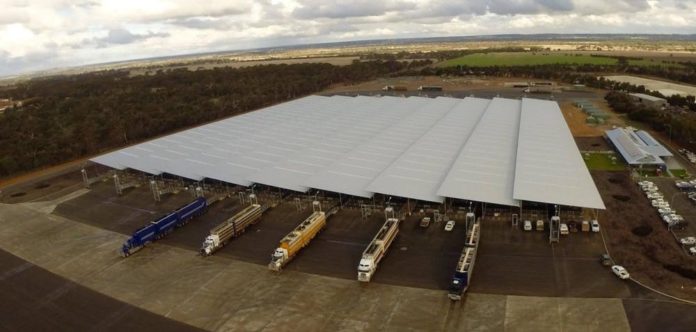
Whatever else he may have lost, Bloomberg has smashed the record for flushing money down the electoral toilet.

What now?

The race is now Biden’s to lose, but it is far from over. Biden has so far relied on the patronage of wealthy and powerful people. He is likely to enjoy more of that from Bloomberg, and may hope for the ultimate endorsement from Barack Obama (though it’s unclear that Obama will endorse anyone in the primaries).

But his campaign still has serious organisational weaknesses. While endorsing Biden, Clyburn took the unusual step of publicly pointing out that he lacks campaign infrastructure. Biden has been a less-than-inspirational speaker on the campaign trail. His single most powerful asset is a widespread belief that he can beat Trump.

Sanders has a genuine movement behind him, which the last two winners of the presidential election also had. His social-democratic agenda has changed the debate in the Democratic Party and the nation. Progressives have decisively chosen him over Elizabeth Warren. But Sanders has an uphill fight now that Democratic moderates have settled on a single champion.

ref. It’s now Biden v Sanders as Super Tuesday narrows the field for the Democratic nomination – https://theconversation.com/its-now-biden-v-sanders-as-super-tuesday-narrows-the-field-for-the-democratic-nomination-131201

Four Fiji suspected coronavirus cases in ‘strict isolation’

Four people have been isolated by Fiji health officials and are being monitored for a suspected Covid-19 coronavirus infection.

The Health Ministry in a statement said all four people were in strict isolation and were in a stable condition while they were awaiting test results.

The ministry said a 15-month old girl developed respiratory symptoms in Suva yesterday after arriving in Fiji from the US on Tuesday.

A 37-year-old Fijian woman returning from a trip to Italy was flagged with respiratory symptoms during a health screening at Nadi airport yesterday.

A three-year-old Fijian boy and his mother, a 26-year-old Fijian woman, developed respiratory symptoms today after returning from Bali and Singapore.

Contact tracing has started for all four patients, the ministry said.

– Partner –

The ministry said the case definition for suspected cases was being widened to include anyone with respiratory symptoms who had recently travelled to a country reported to have local transmission.

It added that this should not alarm the public, but be an indication of the high level of alert and stringent preventative measures the ministry was proactively taking in response to the global outbreak.

The Ministry of Health and Medical Services reiterated that there were currently no confirmed cases of Covid-19 in Fiji.

Praneeta Prakash is a multimedia journalist for the Fiji Broadcasting Corporation’s FBC News.

Article by AsiaPacificReport.nz

Third coronavirus case confirmed in NZ, says health chief

A third case of Covid-19 coronavirus has been confirmed in New Zealand.

Director-General of Health Dr Ashley Bloomfield told RNZ’s Morning Report that he got a report of a third positive test yesterday evening.

“We’re getting all the information together and we’ll update everybody at the same time at the update this afternoon,” Dr Bloomfield said.

He said the positive Covid-19 result was not of the partner of the Auckland woman who tested positive on Tuesday.

“The swab for the partner of the second case is being processed today, so the positive result we received last night is a different case.”

– Partner –

“I want to have all the information then let everybody know at the same time.”

Dr Bloomfield would not say which part of the country the person was in.

Awaiting results
An Auckland woman in her 30s was yesterday confirmed as being the second case of Covid-19 in New Zealand. Her partner is awaiting test results and the family, including two pupils from Westlake Boys and Westlake Girls high schools, are in isolation at home.

Dr Bloomfield said the partner’s tests for coronavirus will go into the batch processed from 10am daily and results will be available this afternoon.

The two children are not being tested because they’re not symptomatic.

“The evidence is very strong … that people don’t transmit the virus unless they’re symptomatic and neither of the children have symptoms.”

The first person to be confirmed in New Zealand as having Covid-19 tested positive last week and has been recovering in hospital in Auckland.

Public health professor Michael Baker said self-isolation as a form of quarantine greatly reduced the risk of transmission, but the virus could already be spreading in the community.

“The term used quite a bit is ‘silent transmission’ and that is because this is a mild illness for most people, maybe up to 80 percent and so they can have what looks like a common cold and can infect other people.”

Dr Bloomfield agreed there could be transmission in the community, but he did not believe the “genie is out of the bottle”.

“While it’s called silent transmission, that doesn’t mean people don’t have symptoms.

“We know from the biggest study done so far, the [World Health Organisation] nine-day mission in China, that it’s symptomatic people that transmit that virus.

“If you are unwell with symptoms then stay at home and take precautions.

“I think that’s a really key message here.”

Covid-19 was not as transmissible as the flu which spreads when people don’t have symptoms, he said.

This article is republished under the Pacific Media Centre’s content partnership with Radio New Zealand.

Article by AsiaPacificReport.nz