Page 1201

PMC to put spotlight on Asia-Pacific ‘journalism under duress’

]]>

The Pacific Media Centre at Auckland University of Technology is highlighting the threats to media freedom in the Asia-Pacific region in an event next week marking its 10th anniversary.

The Philippines is the country with the largest single massacre of journalists – 32 on the island of Mindanao in 2009, where a three-month urban siege against jihadists in Marawi City has recently ended with a toll on many newsrooms.

The deadly crackdown on drugs reportedly eased up last month when President Rodrigo Duterte ordered the police to leave action to the Philippine Drug Enforcement Agency (PDEA), saying the shift was to target “big fish”.

Human rights advocates had accused Duterte of waging a “war on the poor”, but Mangahas argues that there has been no real change in strategy.

New Zealand Prime Minister Jacinda Ardern said last week in Manila the deaths “require investigation”.

 Victor Mambor with Johnny BladesTabloid Jubi editor Victor Mambor with Johnny Blades. Image: RNZ Pacific

Tabloid Jubi editor Victor Mambor (at wheel) with Johnny Blades in West Papua. Image: RNZ Pacific

-Partners-

Johnny Blades, a senior journalist of RNZ International, will also speak about his challenging experiences in West Papua, especially during an “official” visit to the Indonesian-ruled Melanesian provinces in 2015.

Media freedom
The panel will be chaired by founding PMC director Professor David Robie, who has campaigned for many years on media freedom issues and was in Jakarta for the UNESCO World Press Freedom Day conference in May.

A former Pacific Affairs Minister, Laumanuvao Winnie Laban, who launched the PMC a decade ago this year, will also be attending.

Professor Berrin Yanıkkaya, head of the School of Communication Studies at AUT, will launch a graphic new media book, Conflict, Custom & Conscience: Photojournalism and the Pacific Media Centre 2007-2017, edited by Jim Marbrook, Del Abcede, Natalie Robertson and David Robie.

The new Pacific Media Centre photojournalism book.

She will also launch the latest edition of Pacific Journalism Review research journal.

A special video by Sasya Wreksono highlighting the PMC’s achievements over 10 years will be screened along with a photographic exhibition of the research centre’s evolution.

Seminar: “Journalism under duress in Asia-Pacific”
Thursday, November 30, 2017 5.30pm-8pm
WG126, School of Communication Studies, AUT
55 Wellesley St, Auckland
Refreshments will be provided
Admission free
RSVP by November 24 to:
communicate@aut.ac.nz

More information and invitation

The event on Facebook

Article by AsiaPacificReport.nz

]]>

NZ urgently needs to take more Rohingya refugees

]]>

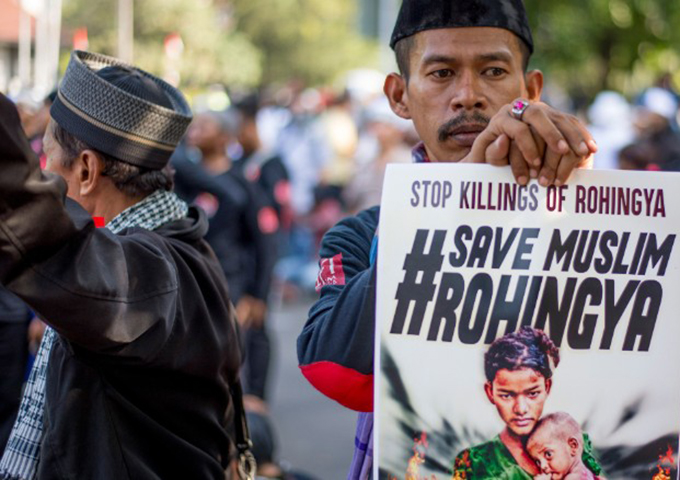
Protests against the Rohingya “genocide” have spread globally. With more than 1 million Ronhinga refugees in Bangladash, the authors argue that New Zealand needs to act now and take in more. Image: Clickittefaq

OPINION: By Sharon Harvey and Sorowar Chowdhury

The plight of the Rohingya people has hit the international headlines again. Following the August clashes in Rakhine State between Myanmar police and army and an armed opposition group, Myanmar has seen an accelerated exodus of Rohingya people into Bangladesh.

There are estimated to be about one million Rohingya in Bangladesh with between 500,000 to 700,000 left in Myanmar. Moreover, since the late 1970s, 350,000 Rohingya have fled to Pakistan, 200,000 to Saudi Arabia and 150,000 to Malaysia to escape persecution.

Others are in Thailand and countries of resettlement such as New Zealand and Australia.

The most recent situation is so tragic that a recent Times Higher Education article called for some of the world’s top universities to cease educational partnerships in Myanmar until human rights abuses, especially towards the Rohingya people have ceased.

Rohingya are Muslims living in Northern Rakhine State (formerly Arakan) in Myanmar (formerly Burma) who constitute an ethnic, linguistic and religious minority. They were stripped of citizenship in 1982 and, subsequently, have been the victims of severe discrimination and persecution.

For the last few years, there has been evidence of Rohingya risking their lives and fleeing Myanmar to neighbouring Bangladesh and other countries. In August this year, with the insurgence of the Arakan Rohingya Salvation Army, the Myanmar army began a “clearance operation”, characterised as “ethnic cleansing” by the United Nations, that lasted for several weeks.

-Partners-

Amnesty International published a report on October 18 claiming the Myanmar Army operation which involved “widespread and unlawful killing” including rape and other sexual violence and the burning of Rohingya villages, constituted “serious human rights violations” and “crimes against humanity”.

Tragic situation
The situation is tragic and needs urgent international attention.

The underlying problem for the Rohingya people is that Myanmar refuses to accept they are a recognisable ethnic minority and therefore citizens of Myanmar.

While scholars are divided over the Rohingya’s earliest settlement in Rakhine, the 2017 Advisory Commission on Rakhine State led by former United Nations (UN) Secretary-General Kofi Annan, maintained the Rohingya people are an integrated population of Muslims who have lived in Rakhine since at least the Kingdom of Mrauk U, the final Rakhine kingdom (1429-1775), and possibly 600 years earlier.

Others are 19th and 20th-century migrants from Bangladesh and West Bengal of India.

In any case, all Rohingya have been living in Rakhine state for at least several generations and many of them much, much longer. To put this into perspective, Rohingya have been living in Northern Rakhine in some cases perhaps before the Māori settlement of Aotearoa and at least as long as European settlement here.

Moreover, in light of the United Nation’s Universal Declaration of Human Rights conventions relating to statelessness (Article 3) and reduction of statelessness (Article 1), the Rohingya people are entitled to citizenship, their human rights should be upheld, and they are entitled to non-discrimination.

Above all, in no way ought they or anyone else be the victims of ethnic cleansing.

From the UNHCR’s perspective, there are three durable solutions for refugees: repatriation, local integration, and resettlement.

Since Bangladesh is already hosting close to a million Rohingya and is a low-middle income country, it may not be feasible to integrate all the new Rohingya who have fled Rakhine state since August.

Repatriation very slow
As for repatriation, Bangladesh and Myanmar recently agreed to form a joint working group by the end of November. However, with current documentation issues outstanding for the Rohingya, repatriation could take a very long time.

In the meantime, global leaders, including from the United States, European Union, and UN Security Council, have expressed extreme concern over the Rohingya situation. International pressure on Myanmar needs to be reinforced to expedite the repatriation.

Regarding resettlement, although Bangladesh did not ratify the 1951 Refugee Convention and 1967 Protocol, it started a third-country resettlement programme in 2006 and this continued until the Bangladeshi government suspended it in November 2010.

However UNHCR, being the global refugee-resettling facilitator, may approach Bangladesh and mediate with refugee-resettling countries to open a special quota for the Rohingya and extend the opportunity to resettle them in third countries.

Because New Zealand is a refugee resettling country and some Rohingya have been successfully resettled here, New Zealand needs to urgently create provision for a special intake of Rohingya refugees, as it has done recently for the Syrian refugees.

The new government has the opportunity to demonstrate its credibility to the world by extending compassion to a community in deep crisis and thereby upholding Labour’s election slogan “Let’s do this”.

Associate Professor Sharon Harvey is head of the school of language and culture at Auckland University of Technology. Sorowar Chowdhury, a PhD student from Bangladesh, is researching the resettlement of Rohingya in New Zealand. This article has been republished by Asia Pacific Report with the permission of the authors and was originally published by The New Zealand Herald.

Print Friendly, PDF & Email

Article by AsiaPacificReport.nz

]]>

PMC focuses on Asia-Pacific ‘journalism under duress’ for 10th birthday event

Monday, November 20, 2017

The Pacific Media Centre at Auckland University of Technology is highlighting the threats to media freedom in the Asia-Pacific region in an event next week marking its 10th anniversary. Following the International Day of Impunity for Crimes Against Journalists earlier this month, the PMC is hosting two guest speakers in a panel addressing the so-called “war on drugs” in the Philippines and the extrajudicial killings estimated by officials as more than 7000 while human rights agencies claim the figure is higher; and also human rights violations in West Papua. The event features Malou Mangahas, executive director of the Philippine Center for Investigative Journalism, speaking on journalist safety and the culture of impunity. The Philippines is the country with the largest single massacre of journalists – 34 on the island of Mindanao in 2009, where a three-month urban siege against jihadists in Marawi City has recently ended with a toll on many newsrooms. The deadly crackdown on drugs reportedly eased up last month when President Rodrigo Duterte ordered the police to leave action to the Philippine Drug Enforcement Agency (PDEA), saying the shift was to target “big fish”. Human rights advocates had accused Duterte of waging a “war on the poor”, but Mangahas argues that there has been no real change in strategy.

New Zealand Prime Minister Jacinda Ardern said last week in Manila the deaths “require investigation”. Johnny Blades, a senior journalist of RNZ International, will also speak about his challenging experiences in West Papua, especially during an “official” visit to the Indonesian-ruled Melanesian provinces in 2015. Media freedom
The panel will be chaired by founding PMC director Professor David Robie, who has campaigned for many years on media freedom issues and was in Jakarta for the UNESCO World Press Freedom Day conference in May. A former Pacific Affairs Minister, Laumanuvao Winnie Laban, who launched the PMC a decade ago this year, will also be among the attendees. Professor Berrin Yanıkkaya, head of the School of Communication Studies at AUT, will launch a graphic new media book, Conflict, Custom & Conscience: Photojournalism and the Pacific Media Centre 2007-2017, edited by Jim Marbrook, Del Abcede, Natalie Robertson and David Robie. She will also launch the latest edition of Pacific Journalism Review research journal. A special video by Sasya Wreksono highlighting the PMC’s achievements over 10 years will be screened along with a photographic exhibition of the research centre’s evolution. Seminar: “Journalism under duress in Asia-Pacific”
Thursday, November 30, 2017 5.30pm-8pm
WG126, School of Communication Studies, AUT
55 Wellesley St, Auckland
Refreshments will be provided
Admission free
RSVP by November 24 to: communicate@aut.ac.nz

More information

The event on Facebook

PCIJ’s executive director Malou Mangahas with Professor David Robie, director of the Pacific Media Centre, in Manila … Philippines impunity against journalists. Image: PCIJ

Report by Pacific Media Centre ]]>

Chris Trotter: Catastrophic loss of trust over Canberra’s Manus provocation

]]>

OPINION: By Chris Trotter

You have to go a long way to find anything remotely resembling Australia’s current treatment of New Zealand.

For a supposedly friendly government to deliberately inject inflammatory disinformation into the political bloodstream of its supposedly closest neighbour is an extraordinarily provocative act. Not quite an act of war, but the sort of intervention that can all-too-easily provoke a catastrophic loss of trust.

It’s the sort of thing that the Soviets and the Americans used to do to one another all the time during the Cold War. Except, of course, those two superpowers were ideological and geopolitical rivals of the first order. It takes a real effort to re-cast the relationship between New Zealand and Australia in similar terms. Nevertheless, it’s an effort we are now obliged to make.

So, what is it that Australia has done? Essentially, its national security apparatus (presumably at the instigation of their political leaders) has released, mostly through media surrogates, a number of related stories calculated to inflame the prejudices of a certain type of New Zealander.

Like Australia, New Zealand harbours a frighteningly large number of racists. Politically-speaking, such people are easily aroused and have few qualms about setting-off ugly, racially-charged, debates on talkback radio, in the letters columns of the daily newspapers and across social media. These individuals are trouble enough when all they have to fight with are their own stereotypes and prejudices. Arm them with the carefully assembled disinformation of “fake news” and they instantly become quite dangerous.

Planting stories
And yet, this is exactly what the Australian authorities have done. Planting stories in their own press (knowing they will be picked up almost immediately by our own) about at least four boatloads of illegal immigrants that have set out for New Zealand only to be intercepted and turned back by the ever-vigilant officers of the Royal Australian Navy and their Coast Guard comrades.

-Partners-

The purpose of this story (unsourced and lacking in detail, making it, almost certainly, fake news) was to paint New Zealand’s prime minister as an ill-informed and ungrateful diplomatic naïf: an inexperienced young idealist who doesn’t know which way is up when it comes to dealing with real-world problems.

This, alone, was an extraordinary intervention. To gauge how extraordinary, just turn it around. Imagine the reaction in Australia if some unnamed person in New Zealand’s national security apparatus leaked a memo to one of this country’s daily newspapers in which the negative diplomatic and economic consequences of being tainted by association with Australia’s flouting of international law is set forth in clinical detail. If the memo also contained a collection of highly critical assessments of Turnbull’s cabinet colleagues, allegedly passed-on by a number of unnamed western diplomats, then so much the better!

Canberra would not be impressed!

If the Australians had left it at just one intervention, then perhaps New Zealanders could simply have shrugged it off as yet another case of bad behaviour from the land of the under-arm bowlers. But when have the Aussies ever left it at “just one”?

Former guard’s ‘intervention’
The next intervention came in the form of “Ian” – formerly a guard (or so he said) at both the Nauru and Manus Island detention centres. For reasons it has yet to adequately explain, RNZ’s Checkpoint programme provided “Ian” with nearly ten, largely uninterrupted, minutes of air-time during which he poured-forth a stream of accusations and characterisations which, to put it mildly, painted the protesters occupying the decommissioned Manus Island facility in the most lurid and disquieting colours. The detainees were criminals, drug-dealers – paedophiles even! Not at all the sort of people New Zealanders would want in their country.

“Ian”, it turns out, is a “witness” well-known to the many Australian NGOs that have taken up the cause of the detainees on Manus and Nauru. They have noted the curious similarities between “Ian’s” supposedly personal observations and experiences, and the inflammatory talking-points constantly reiterated by Australia’s hard-line Immigration Minister, Peter Dutton. A cynic might describe the grim “testimony” of “Ian” and Dutton as mutually reinforcing.

No matter. New Zealand’s racist, Islamophobic and militantly anti-immigrant community had been supplied with yet another truckload of Australian-manufactured ammunition.

Enough? Not hardly! Only on Friday morning New Zealanders were fed the shocking “news” that the protesting Manus Island detainees are harbouring within their ranks an unspecified number of men guilty of having debauched and prostituted local girls as young as 10 and 13!

Too much? Over the top? Redolent of the very worst instances of the murderous racial-incitement for which the Deep South of the United States was so rightly infamous? It sure is! Which is why we must hope that the internet does not operate on Manus Island. Because, if the local inhabitants were to read on-line that the detainees were responsible for prostituting their daughters, what might they NOT do?

Disinformation campaign
One almost feels that the Australian spooks behind this extraordinary disinformation campaign would actually be delighted if the locals burned down the Manus Island detention centre with the protesting detainees inside it.

“This is what comes of 37-year-old Kiwi prime ministers meddling in matters they know nothing about!” That would be the consistent theme of the right-wing Australian media. It would not take long for the same line to be picked up here: first on social media, and then by more mainstream media outlets.

Right-wing outrage, mixed with a gleeful “we told you so!”, could not, however, be contained within the news media for very long. Inevitably, the more outré inhabitants of the Opposition’s back bench would take possession of the controversy, from there it would cascade down rapidly to Opposition politicians nearer the front.

Before her enemies could say: “It’s all your fault!”, Jacinda would find herself under withering political fire from both sides of the Tasman. Canberra would register her increasingly fragile government’s distress with grim satisfaction.

As the men and women responsible for organising “Operation Stardust” deleted its final folder, and fed the last incriminating document into the paper-shredder, one or two of them might even have voiced a judiciously muted “Mission Accomplished!”

This essay, by Chris Trotter, was originally posted on the Bowalley Road blog of Saturday, 18 November 2017, under the title: “Not quite an act of war: Analysing Australia’s push-back against Jacinda’s Manus Island outreach.  It is republished by Asia Pacific Report with the permission of the author.

Print Friendly, PDF & Email

Article by AsiaPacificReport.nz

]]>

Indonesian president recognises land rights of nine more indigenous groups

]]>

ANALYSIS: By Basten Gokkon in Jakarta

The Indonesian government has relinquished control over nine tracts of forest to the indigenous communities that have lived there for generations, President Joko “Jokowi” Widodo announced at a recent conference on land tenure in Jakarta.

The move follows the government’s recognition last December of nine other communities’ rights to their ancestral forests, in line with a 2013 decision by Indonesia’s highest court that removed indigenous peoples’ customary forests from under state control.

“The spirit of agrarian reform and community forestry program is how lands and forests, as part of natural resources in Indonesia, can be accessed by the people, and provide economic justice and welfare for the people,” the president said in a speech to open the conference on October 25.

The nine newly designated “customary forests,” or hutan adat in Indonesian, cover a combined 33.4 sq km, on the islands of Sumatra, Borneo and Sulawesi.

The move is consistent with Jokowi’s campaign pledge to give indigenous and other rural communities greater control over 127,000 square kilometers of land, which helped him earn the first-ever presidential endorsement of the Indigenous Peoples Alliance of the Archipelago (AMAN) ahead of the 2014 election.

Three years into his presidency, however, the programme is running behind schedule. The administration has rezoned just 10,800 sq km of community forests, of which 164 sq km are customary forests, according to data from the Presidential Staff Office. The latter figure includes the nine customary forests the administration recognized at the beginning of the year and the nine last month.

-Partners-

Dozens of other indigenous communities are hoping to secure rights to their ancestral lands, too. The day after Jokowi’s speech, three groups from Enrekang district in South Sulawesi province submitted their own proposals to the Ministry of Environment and Forestry. The proposed customary forests there would cover 4.04 square kilometers.

“The government hasn’t really been performing in making this promise happen,” AMAN researcher Arman Mohammad said.

Land mapped out
AMAN has mapped out 19,000 sq km of land, home to 607 indigenous communities, which it says must be rezoned as customary forests. These groups have already obtained the required documents from district and provincial governments for state recognition of their rights, Arman said.

The official recognition last month represented just a fraction of what AMAN had proposed, he said.

As the agrarian reform conference wrapped up, a senior official said the president would issue a decree by year’s end to help indigenous groups like that in Enrekang obtain control of their forests. Yanuar Nugroho, a deputy at the Presidential Staff Office, told reporters that the decree would lay out the framework for regulation, bureaucracy and accountability.

Details of the decree were not immediately available. However, Yanuar said at the time that one of the key points was to iron out overlapping authorities between related ministries.

For instance, he said, the environment ministry would concentrate on recognizing land rights inside forests, while the Ministry of Agrarian Affairs and Spatial Planning would oversee those outside forests. Currently, the matter is handled by those two ministries as well as the Ministry of Home Affairs and the Ministry of Villages, Underdeveloped Regions and Transmigration.

“The country is returning sovereignty to the people, and I believe this program for community forestry and agrarian reform is the spearhead,” Yanuar said.

Some observers welcomed the promise of a decree, saying it would help streamline the process for indigenous communities in obtaining state approval of their land rights.

Single agency
“There should be a single agency focusing on the land reform program so that the people don’t get confused,” said Dewi Kartika, general secretary of the Agrarian Reform Consortium, an NGO.

Arman called on the government to involve NGOs in drawing up the decree in order for it to be effective once implemented on the ground.

But even with a decree in place, the government may miss its target.

Environment and Forestry Minister Siti Nurbaya Bakar noted at the conference that the government would only realistically be able to approve a total 43,800 sq km, just over a third of the promised total, for community forestry schemes by 2019, when President Jokowi will stand for re-election.

To achieve even that pared-down goal, the minister called on local governments to accommodate indigenous groups, who depend on district chiefs and local legislatures to issue decrees that recognise them as indigenous.

“We must now push for getting more areas that will potentially be appointed as customary lands in order to reduce conflicts,” Siti said on the sidelines of the conference.

Observers say the Jokowi administration’s actions and policies in general have failed to resolve land conflicts, which have led to the wrongful eviction of indigenous communities from their homes over the years.

Agrarian conflicts
“The locations that the government has been targeting so far are not the ones with agrarian conflicts or where there are overlapping claims between local communities,” Dewi said.

She added that policies issued by the federal government often failed to be implemented at the local level.

“A clean and just bureaucracy is our top concern,” said Rukka Sombolinggi, AMAN’s general secretary. “We have trust in the president and the ministries, but not quite in [officials at] the regional levels.”

Others also highlighted land conflicts resulting from other government programs, including its flagship infrastructure development projects and issuance of plantation permits. Efforts at land reform have also been criticized for overlooking communities in coastal areas.

“The president must take groundbreaking actions so that land reform will truly happen, otherwise it’s just a fake agrarian reform,” Rukka said.

A list of the new customary forests (from the Presidential Staff Office):

Hutan Adat Tawang Panyai (Sekadau district, West Kalimantan province, 0.4 sq km)

Hutan Adat Marena (Sigi district, Central Sulawesi province, 7.6 sq km)

Hutan Adat Batu Kerbau (Bungo district, Jambi province, 3.2 sq km)

Hutan Adat Belukar Panjang (Bungo district, Jambi province, 3.3 sq km)

Hutan Adat Bukit Bujang (Bungo district, Jambi province, 2.2 sq km)

Hutan Adat Hemaq Beniung (West Kutai district, East Kalimantan province, 0.5 sq km)

Hutan Adat Baru Pelepat (Bungo district, Jambi province, 8.2 sq km)

Hutan Adat Bukit Pintu Koto (Merangin district, Jambi province, 2.8 sq km)

Hutan Adat Rimbo Penghulu Depati Gento Rajo (Merangin district, Jambi province, 5.3 sq km)

Print Friendly, PDF & Email

Article by AsiaPacificReport.nz

]]>

Strong leadership needed to drive COP Pacific climate goals, says Greenpeace

]]>

“Together, we must take action to protect our world” – Shalvi Shakshi’s inspirational climate story. Video: UNICEF

Pacific Media Centre Newsdesk

Greenpeace has called for climate leadership to emerge from the Pacific COP, saying leaders must listen to the need for urgency and transform their energy and land-use systems.

The Trump administration failed to stop the global climate talks from moving forward, despite its announcement to withdraw from the Paris Agreement.

But the world is still in urgent need of action, says Greenpeace.

Jens Mattias Clausen, head of Greenpeace’s political delegation in Bonn, Germany, said:

“Leaders must now go home and do the right thing, prove that they have listened to the voices of the Pacific, with all their hurt and hope, and understand the urgency of our time. Talk is not good enough and we still lack the action we need.

-Partners-

“We call on France, Germany, China and others to step up and display the leadership they claim to stake. Clinging to coal or nuclear power and parading as climate champions while failing to accelerate the clean energy transition is nothing but bad faith.”

Failed to deliver concrete support
This year’s COP placed heightened attention on climate impacts and the need for accountability, but failed to deliver the concrete support that a small island COP should have, Clausen said.

“We welcome the focus on enhanced ambition and the inclusion of pre-2020 climate action in the design of next year’s stocktake, the Talanoa Dialogue. This will form part of Fiji’s legacy and it is imperative that the dialogue will not just be a discussion but actually lead to countries ramping up their climate targets.

“Bonn still leaves a daunting task of concluding the Paris rulebook next year. Countries need to rediscover the political courage they had in Paris to complete the rulebook on time.”

A deal to break a deadlock in Bonn over the languishing pre-2020 climate action from developed countries and to anchor it in coming climate talks must now prove pivotal in forging additional ambition.

Country and region views:

The Pacific
“The Pacific has been dealing with the devastating impacts of climate change for years so time is a luxury we do not have. While leaders talk, we face the effects. It’s time for leaders to live up to their promises,” said Pacific Island representative activist Samu Kuridrani.

United States
“We have seen the true face of America here, exposing how Trump and his regressive fossil fuel agenda are outnumbered by those who proclaim with one voice, ‘America is still in’. It’s been abundantly clear here that despite Trump, climate action continues. World leaders must now categorically reject any proposed weakening of America’s commitments and hold the US administration to account if it reneges,” said Greenpeace USA climate campaigner Naomi Ages.

Germany
“This COP saw Germany drastically lose credibility and leadership on climate action. Chancellor Merkel’s disappointing speech failed to align Germany with a coalition of progressive nations stepping away from coal, raising doubts if Germany is committed to the ambition of the Paris agreement. Only by deciding on a coal phase out will the new government be able to reach its climate targets for 2020 and 2030,” said Greenpeace Germany executive director Sweelin Heuss.

China
“The Pacific COP has been a way-station in China’s aspiration to become a climate leader. The transformation from a developing country to a responsible global power takes time and courage, but climate leadership demands urgency. In 2018, eyes will increasingly turn to China to enhance the country’s climate ambition and help conclude the Paris rulebook,” said Greenpeace China climate policy adviser Li Shuo.

Southeast Asia
“The voices from the climate frontlines have spoken in the Pacific COP. But how much have those who are historically most accountable for climate change listened? Those least responsible for climate change are suffering the worst impacts and this great injustice must be addressed. Governments and corporations must urgently change their policies and practices to avert climate-related human rights harms,” said Greenpeace Southeast Asia executive director Yeb Saño.

Print Friendly, PDF & Email

Article by AsiaPacificReport.nz

]]>

Tiny Timbulsloko fights back in face of Indonesia’s ‘ecological disaster’

]]>

Drone views of the village of Timbulsloko showing the scale of coastal erosion and sinking flatlands in an area that once used to to be rice fields on the edge of the Central Java city of Semarang. Mangroves are being rapidly re-established. Drone footage source: CoREM. Video: David Robie’s Café Pacific

By David Robie in Semarang, Indonesia

A vast coastal area of the Indonesian city of Semarang, billed nine months ago by a national newspaper as “on the brink of ecological disaster”, is fighting back with a valiant survival strategy.

Thanks to a Dutch mangrove restoration programme and flexible bamboo-and-timber “eco” seawalls, some 70,000 people at risk in the city of nearly two million have some slim hope for the future.

An area that was mostly rice fields and villages on the edge of the old city barely two decades ago has now become “aquatic” zones as flooding high tides encroach on homes.

Onetime farmers have been forced to become fishermen.

Villagers living in Bedono, Sriwulan, Surodadi and Timbulsloko in Demak regency and urban communities in low-lying parts of the city are most at risk.

-Partners-

Residents have been forced to raise their houses or build protective seawalls or be forced to abandon their homes when their floors become awash.

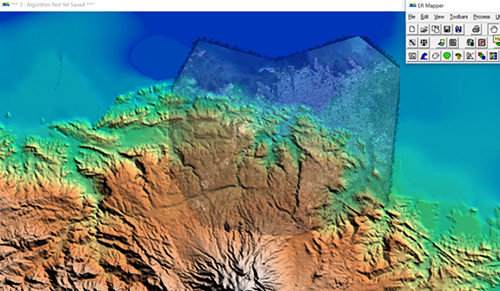
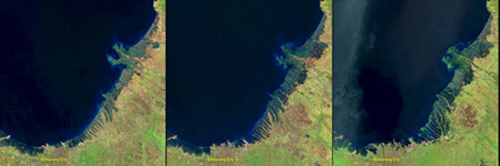
The lowland subsidence area in north Semarang leading to the volcanic Mt Urganan and Mt Muria/Medak.  Source: CoRem (UNDIP), 2017.

Environmental changes in Semarang have been blamed by scientists on anthropogenic and “natural” factors such as tidal and river flooding – known locally as rob, mangroves destruction since the 1990s, fast urban growth and extensive groundwater extraction.

Climate change
This has been compounded by climate change with frequent and extreme storms.

It has been a pattern familiar in many other low-lying coastal areas in Indonesia, such as the capital Jakarta and second-largest city Surabaya.

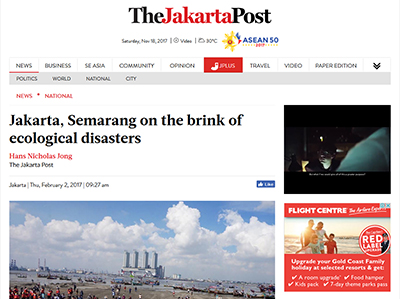
The Jakarta Post headline on 2 February 2017. Image: PMC

In February, The Jakarta Post reported that both Jakarta and Semarang faced environmental crises.

Citing Indonesian Institute of Science (LIPI) researcher Henny Warsilah, a graduate of Paris I-Sorbonne University in France, who measured the resilience of three coastal cities – Jakarta, Semarang and Surabaya – the Post noted only Surabaya had built sufficient environmental and social resilience to face natural disasters.

Jakarta and Semarang, Warsilah said, “were not doing very well”. Although Surabaya was faring much better with its urban policies.

The National Geographic Indonesia banner headline in October 2017. Image: PMC

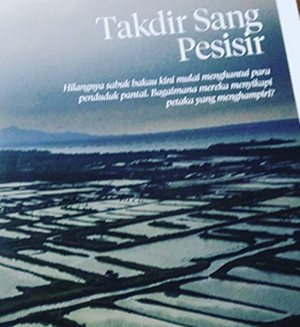
The fate of some five million people living in Indonesia’s at risk coastal areas – including Semarang — was also profiled in the Indonesian edition of National Geographic magazine last month under the banner headline “Takdir Sang Pesisis” – “The destiny of the coast”.

The introduction asked: “”The disappearance of the mangrove belt now haunts seaside residents. How can they respond to a disaster that is imminent?”

Ongoing reclamation
According to The Jakarta Post, Semarang “has ongoing reclamation projects in the northern part of the city, which threaten to submerge entire neighbourhoods in the next 20 years”.

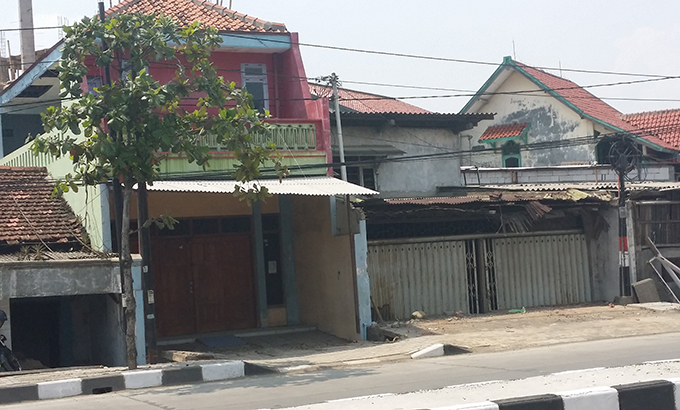
Urban erosion and land subsidence in Semarang city. Note the raised house second from left, the other sinking dwellings on either side have been abandoned to the tidal waters. Image: David Robie/PMC

“The more [the city] is expanded, the more land will subside because the region is a former volcanic eruption zone, and it is a swamp area,” says Warsilah.

“With the progression of the reclamation projects, the land is not strong enough to withstand the pressure.”

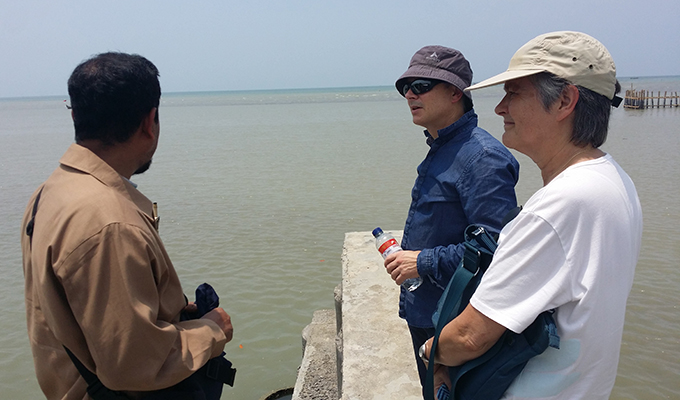
With a team of international geologists and researchers attached to Semarang’s Center for Disaster Mitigation and Coastal Rehabilitation Studies (CoREM) at Diponegoro University, I had the opportunity to visit Timbulsloko village earlier this month to see the growing “crisis” first hand.

City planners might see the only option as the residents being forced to leave for higher ground, but there appear to be no plans in place for this. In any case, local people defiantly say they want to stay and will adapt to the sinking conditions.

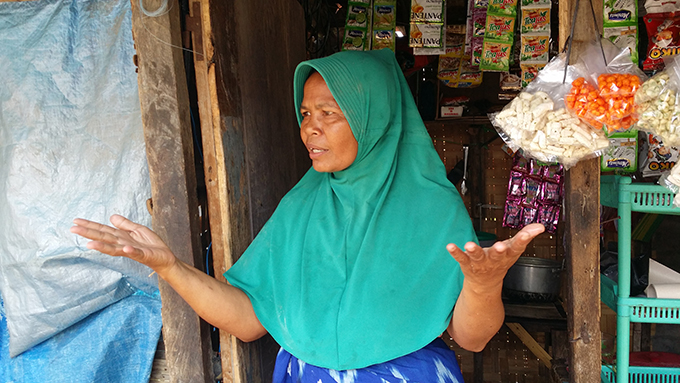
An unnamed local shopkeeper who has three generations of her family living in her Timbulsloko home and she doesn’t want to leave in spite of the sea encroaching in her house. Image: David Robie/PMC

One woman, a local shopkeeper, who has a three-generations household in the village with water encroaching into her home at most high tides, says she won’t leave with a broad smile.

I talked to her through an interpreter as she sat with her mother and youngest daughter on a roadside bamboo shelter.

“I have lived here for a long time, and I am very happy with the situation. My husband has his work here as a fisherman,” she said.


A local storekeeper with her mother and youngest daughter – three generations live in her Timbulsloko village home. Video: David Robie’s Café Pacific.

‘We don’t want to leave’
“We live with the flooding and we don’t want to leave.”

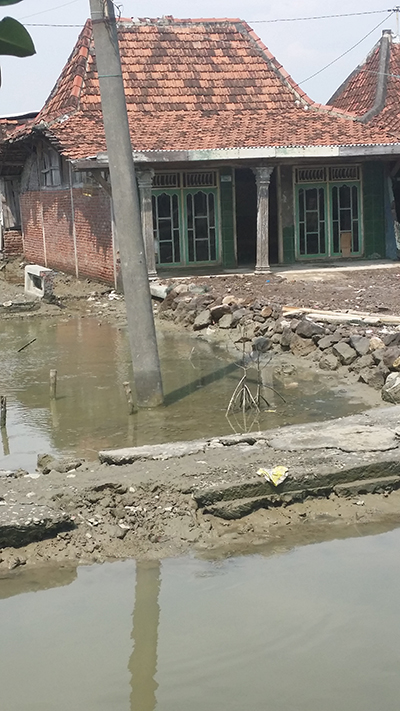
A raised house at low tide in Timbulsloko. Image: David Robie/PMC

She also said there was no clear viable alternative for the people of the village – there was no plan by the local authorities for relocation.

Later, she showed me inside her house and how far the water flooded across the floors. Electrical items, such as a television, had to be placed on raised furniture. The children slept on high beds, and the adults clambered onto cupboards to get some rest.

The village has a school, community centre, a mosque and a church – most of these with a sufficiently high foundation to be above the seawater.

However, the salination means that crops and vegetables cannot grow.

The community cemetery is also awash at high tide and there have been reports of eroded graves and sometimes floating bodies to the distress of families.


Timbulsloko’s village cemetery. Video: David Robie’s Café Pacific

We were warned “don’t touch anything with your hands” as the flooding also causes a health hazard.

Research projects
The situation has attracted a number of research projects in an effort to find solutions to some of the problems, the latest being part of the 2017 World Class Professor (WCP) programme funded by the Indonesian government.

Two of the six professors on the University of Gadjah Mada’s WCP programme, in partnership with Diponegoro University, are working with local researchers at CoREM.

WCP programme professors Dr David Menier (centre) and Dr Magaly Koch (right) talk to CoREM director Dr Muhammad Helmi on the Timbulsloko village wharf, near Semarang. Image: David Robie/PMC

They are geologists Dr Magaly Koch, from the Centre for Remote Sensing at Boston University, US, and Dr David Menier, associate professor HDR at Université de Bretage-Sud, France, who are partnered with Dr Muhammad Helmi, also a geologist and director of CoREM, and Dr Manoj Mathew. Both Dr Mathew and Dr Menier are of LGO Laboratoire Géosciences Océan.

The stages of flooding in the Semarang study area. Source: Ramkumar & Menier (2017)

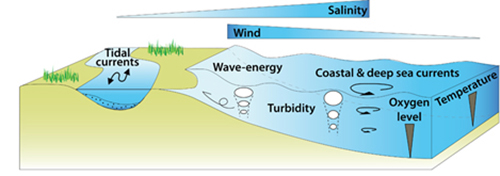
“At the regional scale, the rate of subsidence is related to the geological and geomorphological context. North Java is a coastal plain that is very flat, silty to muddy, influenced by offshore controlling factors (e.g., wave, longshore drifts, tidal currents, etc.) and monsoons, and surrounded by volcanoes,” explains Dr Menier.

Controlling factors along the Semarang coastline. Source: CoRem, (UNDIP)

“Locally, anthropogenic factors can play a serious role as well.”

He says that coastal plains are dynamic. However, human activities are fixed – “the first contradiction”.

“Humans want to control and continue their livelihood, and are reluctant to accept changes related to their own activities or natural factors.”

Dr Menier says the subsidence is due to many factors, but some key issues have never been studied.

On a long term scale, the active faults of the area need to be examined in a geodynamic context and also volcanic activity with Mt Urganan and Mt Muria/Medak.

“We need to have a better understanding of the age of the coastal plain in order to reconstruct the past, explain the present-day and predict the future,” he says.

“Colonisation in the 17th century-Dutch period probably led to destruction of ecosystems (mangrove) and fine sediment usually trapped by plants has been stopped.”

Dr Koch adds: “Subsidence rates and their spatial distribution along the coastal plain need to be studied in detail using InSAR techniques. Groundwater abstraction (using deep wells) is probably happening in the city of Semarang but not necessarily in Demak.”

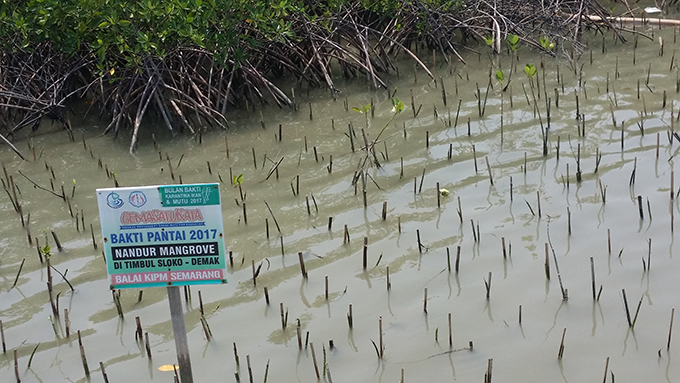
Expanding mangroves protection at Timbulsloko, Demak regency. Image: David Robie/PMC

Mangrove restoration
Mangrove restoration and mitigation has been used successfully to restore coastal resilience and ecosystems in Timbulsloko.

While noting that “high failure rates are typical” due to wrong special being planted and other factors, Dr Dolfi Debrot, of a Dutch project consortium, argues “given the right conditions, mangrove recovery actually works best without planting at all.”

The consortium involves Witteveen+Bos, Deltares, EcoShape, Wetlands International, Wageningen University and IMARES.

However, community planting is also a strategy deployed in the lowland villages.

Mangroves revitalise aquaculture ponds for crab and shrimp farming.

A “growing land” technique borrowed from the muddy Wadden Sea in the Netherlands has also been used successfully at Timbulsloko and other villages.

Semi-permeable dams are built from bamboo or wooden poles packed with branches to “dampen wave action”. In time, a build up of sediment settles and allows mangroves to grow naturally.

CoREM director Dr Muhammad Helmi … praises the contribution of flexible “eco” seawalls. Image: David Robie/PMC

“These eco-engineering seawalls are better than the concrete fixed barriers,” says Dr Helmi. “The permanent seawalls in turn become eroded at their base and eventually fall over.”

Dr David Robie is on the WCP programme with Universitas Gadjah Mada, Yogyakarta.

Print Friendly, PDF & Email

Article by AsiaPacificReport.nz

]]>

Women must be at centre of global climate solutions, says Fiji minister

]]>

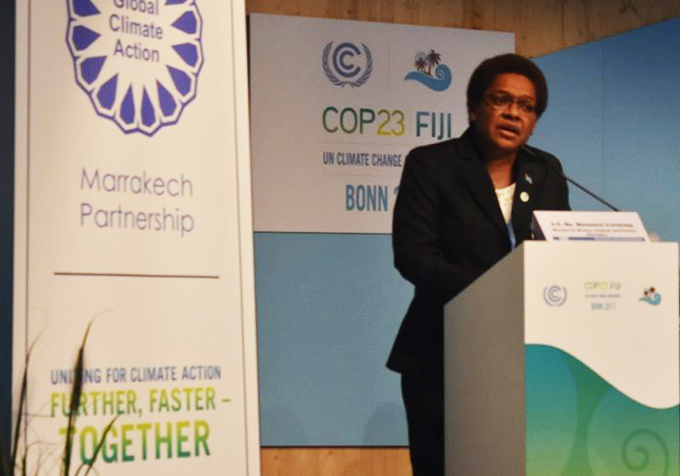
Minister Mereseini Vuniwaqa … “important to emphasise the traditional roles and functions women in the Pacific play”. Image: Mereoni Mili/Wansolwara

By Mereoni Mili in Bonn, Germany

It is important that women and girls remain in the centre of climate solutions.

These were the words of Fiji’s Minister of Women, Children and Poverty Alleviation Mereseini Vuniwaqa during the Gender Day event at COP23 in Bonn, Germany, this week.

She said it was important to have specific objectives for women in any economic or investment programme responding to climate change whether it involved mitigation, adaptation or resilience.

“If we understand the special place women have in our communities and act accordingly we would create strong programmes, have more effective responses, build better and resilient communities”, she said.

She added that climate change was harsh for women largely because women were over-represented among the world and were exposed to these dangers.

“Women typically are critical to keeping communities together, they care for the children, and they maintain traditions and give stability to villages”, she said

-Partners-

Vuniwaqa said talanoa dialogue on the topic of economic case for gender responsive climate action would highlight the compelling economic reasons why governments were seeking and investors were funding climate policy.

Highlighting gender
It would also highlight actions that had gender as a core element.

Vuniwaqa reminded delegates that they needed to put women and girls at the centre of all climate efforts in order to succeed.

The Fijian Presidency at COP23 has emphasised the importance of equitable involvement of women in sustainable development and the implementation of climate policy, including the Gender Action Plan.

The Gender Action Plan had been finalised to recognise the role of women in climate action.

Deputy Prime Minister of Samoa, Flame Mata’fa, said that full participation and mainstreaming of gender issues was important and it was a step the Samoa government had taken.

“It is important to emphasise the traditional roles and functions women in the Pacific play so that people come to a common understanding and objectives,” she said.

Mereoni Mili is a student journalist on Wansolwara newspaper at the University of the South Pacific. She won a scholarship to attend COP23.

Print Friendly, PDF & Email

Article by AsiaPacificReport.nz

]]>

Pōhiva rejects ‘secret agenda’ claims that he wanted to seize royal power

]]>

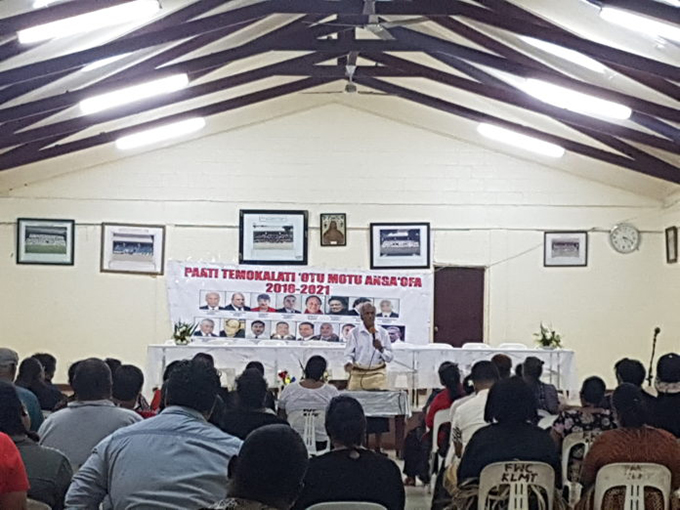
‘Akilisi Pōhiva speaking to hundreds of his constituents at a meeting in Kolomotu’a on Tuesday. Image: Kalino Lātū/Kaniva News

By Kalino Lātū, editor of Kaniva News

Tongan Prime Minister ‘Akilisi Pōhiva told his supporters that if he had really wanted to take away people’s land and the royal powers he would have made himself Minister of Defence and Minister of Land at the last election.

Pōhiva made the revelation on Tuesday night when he spoke in front of hundreds of his Tongatapu 1 constituents at the Uaiselē Hall at Sipu Road in Kolomotu’a before Thursday’s snap general election, which boosted the Democrats with a landslide win.

He was rejecting claims by his political opponents that he had a secret agenda to take away people’s rights to their land and give it to the nobles.

Kaniva News was unable to publish anything on his speech immediately because of Tonga’s electoral law which prohibited the publication of any material that could promote a candidate within 24 hours of Thursday’s election.

In his speech, the Prime Minister said he struggled in 2014 to choose a minister for the Ministry of Land and His Majesty’s Armed Forces.

Pōhiva, who was re-elected to Parliament in Thursday’s election, said he lay down at home at night and “thought deeply” about the problem.

-Partners-

‘Fragile’ future
He said he knew how “very fragile” the future of land and the defence services seemed in some people’s minds, especially the nobility and the royals while he – a man who had called for significant changes to the status quo in the past 30 years – was leading the country.

He finally made up his mind to appoint Lord Ma’afu from the nobility to the posts.

He thought the noble’s appointment could show the nation his ambition to bring about reforms that could bring more stability to Tonga.

He said politicians who campaigned against him during the snap election misled the people by telling them he was trying to unnecessarily remove the king’s power.

“That was not right,” Pōhiva said.

Protecting His Majesty
Pōhiva, whose critics accused him of wanting to “become king”, said he understood the way he wanted to protect the king put him and his government in a delicate situation.

The Prime Minister was referring to submissions from Cabinet to amend the constitution, including a proposal to reinstate the former Privy Council structure in which the king met with cabinet ministers in Privy Council.

The move was described by the Minister of Justice Vuna Fā’otusia as an attempt to make sure the king was directly informed first hand about government matters by the ministers because they were the ones who did government’s administration work.

Fā’otusia said the current structure was not secure because the Privy Council was filled with people who were not elected by the people and were not accountable to the public.

Pōhiva explained that amending the law would benefit the king and the people, but unfortunately his critics had twisted and demonised their intentions.

‘Dirty politics’
He described it as “dirty politics” and thanked his followers for helping defeat his rivals in the three decades he had been involved in Tongan politics.

Tuesday night’s meeting was repeatedly interrupted by applause and yells of support from the audience.

As Kaniva News reported on Friday, Pōhiva and his Democratic Party won 14 parliamentary seats which enabled them to form the next government without needing the help of the nobility or the independents.

It is understood Pōhiva and his cabinet were due to meet this weekend, although the line-up of the cabinet has not been announced yet.

Asia Pacific Report republishes Kaniva News stories with permission.

Print Friendly, PDF & Email

Article by AsiaPacificReport.nz

]]>

PMC’s David Robie chalks up many kms, experiences in WCP research programme

AUT’s Pacific Media Centre director Dr David Robie jetted into Yogyakarta earlier this month on a hectic Indonesian World Class Professor (WCP) programme that swept him across three cities and many hundreds of kilometres.

The two-week whirlwind research and publication collaboration had him giving public lectures and guest seminars, discussions with young emerging scholars, and talks with communication students considering a journalism career.

“The hospitality of our hosts, director Dr Hermin Indah Wahyuni and her Center of Southeast Asian Social Studies (CESASS) team was out of this world,” he says. “And the organisation and logistics for a complex itinerary were also exemplary.”

At one stage, the visit to Universitas Gadjah Mada, one of Indonesia’s largest universities with some 56,000 students, had seemed doubtful after Professor Robie suffered a serious accident at the end of July, breaking his right leg in multiple places and requiring surgery.

“But thanks to UGM’s patience and my rapid recovery, I was able to go to Yogyakarta at the end of October after PMC and AUT had earlier hosted 6 Indonesian researchers for two weeks,” he says.

He praised Dr Wahyuni for her vision, and Apriline Widani and colleagues for their organisational skills.

Dr Robie was accompanied by his wife, Del Abcede, who is a volunteer and publication designer at the PMC.

“It was a godsend for me to have Del there as well – hugely helpful, and she also contributed to a number of the workshops.”

Semarang highlight
One of the highlights was driving 130km across Central Java to the northern and historical city of Semarang, where climate change and a sinking coastline is threatening the lives of a third of the population of almost 2 million.

Two of the professors on the programme — scientists Dr Magaly Koch, from the Centre for Remote Sensing at Boston University, US, and Dr David Menier, associate professor HDR at Université de Bretage-Sud, France — are based at the partner Diponegoro University, and are developing a research programme in an effort to seek some solutions for the problems.

“This is a massive environmental problem and it was great to see the impact first hand in a field trip to Timbulsloko village on the outskirts of the city,” Dr Robie says.

“It was also interesting to see the use of a drone in this project.”

Dr Robie, Dr Wahyuni, Fitri Handayani and Andi Fitrah are collaborating on a joint research study into the media and the “social impact” of the Aceh tsunami, Semarang coastal flooding and Fiji tropical cyclones.

The WCP collaboration also included a visit to the city of Solo, where two of the last ancient sultanates continue today, alongside the sultanate of Yogyakarta, which is a special administrative region.

After arriving in Indonesia, Dr Robie and Abcede were welcomed at CESASS and delivered the first of the seminars, about research strategies for climate change and maritime disasters, to a lively audience.

Borobodur sunrise The following day involved a dawn hike to the top of the massive 9th century Buddhist temple Borobodur to see the sunrise and then visits to a spiritual retreat and weddings centre, and a Javanese museum in honour of the “first feminists” in traditional times.

A public seminar held jointly by Professor Robie and Pak Muhadi Sugiono in UGM’s huge library about ICAN, the Nobel Peace Prize and a world “without nuclear weapons”.

This proved popular and Del spoke about the role of the Women’s International League for Peace and Freedom (WILPF), funded in 1916 during the First World War and one of the original global peace advocacy groups.

Following the weekend-long field trip to Semarang, Dr Robie delivered a public address on academic publishing strategies and journal publishing jointly with the university’s publishing house.

Later, Dr Robie gave an inspirational talk to first year UGM communication studies journalists about being a journalist.

One of the final workshops involved talking to communication students and journalists about investigative journalism in the “post-truth era” in a session chaired by Associate Professor Budi Irawanto.

A local journalist and advocate for the Alliance of Independent Journalists (AJI), Bambang Muryanto, also offered some revealing experience on the state of journalism in Indonesia.

Although the two weeks finally came to an end, both CESASS are actively planning ongoing collaboration projects.

Research journals collaboration
Already, the PMC’s Pacific Journalism Review and UGM’s IKAT journal of Southeast Asian research have launched a joint collaboration on climate change and maritime disaster.

The other three professors involved in the WCP programme are Dr Thomas Hanitzsch, chair and professor of Communication Studies at the Ludwig-Maximilians-Universitat Munchen, Germany; Dr Judith Schlehe, professor of Social and Cultural Anthropology at the University of Freiburg, Germany; and Professor Hermann M. Fritz from Georgia Institute of Technology, Atlanta, US.

+ Indonesia’s WCP programme in New Zealand
+ Kendall Hutt profiles the UGM team’s ‘social impact’ research
+ David Robie’s analysis on Indonesian development and ‘green journalism’

Report by Pacific Media Centre ]]>

Renewed Papuan independence call amid alleged ‘hostage’ standoff

]]>

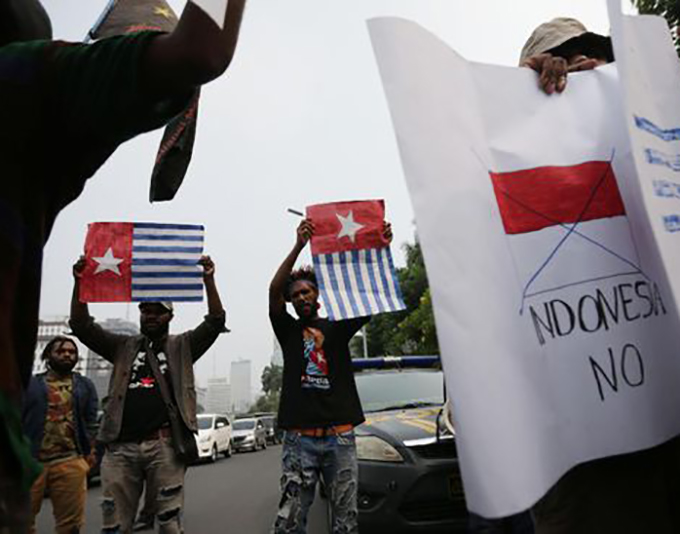
West Papuan protesters for independence in Jakarta this week. Image CNN Indonesia

By Lalu Rahadian in Jakarta

Conflicts in Papua province will not be resolved until the Indonesian government provides the Papuan people with an opportunity to determine their future through an international forum, says a leading advocate.

Indonesian People’s Front for West Papua (FRI-WP) spokesperson Surya Anta says that the root of the Papua problem is Indonesia.

According to Anta, the government must allow the Papuan people to determine their own future instead of continuing its “colonisation” there.

“West Papua is under Indonesian colonialism. If we go back historically, at the time of [Indonesia’s] proclamation [of independence on August 17, 1945], the territory of Papua was not part of Indonesia,” Surya said during a press conference at the Jakarta Legal Aid Foundation (LBH) this week.

Anta expressed this view in response to the reemergence of conflict in Tembagapura, Mimika regency, Papua.

The Indonesian police say that in these districts — using police terminology — the activities of an Armed Criminal Group (Kelompok Kriminal Bersenjata, KKB) have resulted in access to the villages of Banti and Kimbely being “disrupted”.

-Partners-

Papua police chief Inspector-General Boy Rafli Amar has responded to the activities of the KKB by issuing declaration Number B/MKMLT/01/XI/2017 dated November 12, 2017, calling on the KKB to surrender.

‘Disarm yourselves’ call
Amar has asked that all civilians who control, carry, own or use firearms illegally to disarm and surrender them to the authorities.

Amar also claimed that the KKB was holding hundreds of local people “hostage” in two villages in Tembagapura.

According to Anta, the police’s claims about the residents in the villages in Tembagapura are untrue, issuing a counter claim and saying no one had been taken hostage there.

“What we did immediately was communicate with civilian groups there. They confirmed that that no residents had been taken hostage,” he said.

In Anta’s view what has been done by the Free Papua Movement-National Liberation Army (TPN-OPM) in Tembagapura has a clear political basis — to wrest sovereignty from the Unitary State of the Republic of Indonesia (NKRI).

Nevertheless, said Anta, labelling the TPN-OPM an “armed criminal group” was an attempt to discredit them and labelling the group in Tembagapura KKB also obscured the roots of the problem in the “Land of Cenderawasih” (Bird of Paradise, West Papua).

“Their political basis is winning sovereignty for the West Papuan nation which is under the colonialism of the NKRI,” he said.

Anta also called on the government to immediately withdraw all security forces from Papua, close the PT Freeport gold-and-copper mine, release all political prisoners and open up access to journalists so that the problems in Papua could be clearly seen.

Infrastructure not the solution
The Papua Student Alliance (AMP), meanwhile, believes that the ambitious infrastructure development programme in the Land of Cenderawasih does not answer the basic problems of the people there.

According to the AMP and FRI-WP, the main problem in Papua is a political one.

Speaking in the same vein as Anta, AMP activist Frans Nawipa says that the frequent conflicts that take place in Papua can only be resolved if the government allows the Papuan people to leave Indonesia (NKRI).

“The root of the problem is [Papua’s] political status which was manipulated by Indonesia and the military in the 1960s. No matter how long the government pursues the development approach, it will not have the potential to answer to the problems in Papua,” said Nawipa.

Nawipa claims that no one in Papua has asked the government for this development.

Because of this therefore, the efforts by President Joko “Jokowi” Widodo to develop the country from Papua would not have any significant impact.

Surya Anta added that the construction of the Trans-Papua highway in the Land of the Cenderawasih would not be able to replace the lives that had been lost as a result of the “slaughter” by security forces.

“What is needed is political freedom, freedom from all types of colonialism, self-determination as a national entity”, said Anta.

Since Widodo became president in 2014, infrastructure development in Papua and the country’s borders has been one of his priorities.

Translated by James Balowski for the Indoleft News Service. The original title of the article on CNN Indonesia website was “Desakan Papua Merdeka Kembali Mengemuka”.

Print Friendly, PDF & Email

Article by AsiaPacificReport.nz

]]>

Migration expert calls for immediate climate action over displaced millions

]]>

Researchers in Bonn warn Pacific Islanders may be among the first to be forced to migrate due to climate change, as sea level rise threatens to make whole islands uninhabitable. Video: Democracy Now!

At least 23 million people were displaced by extreme weather as a result of climate change.

“If we act now in terms of climate change action, … it means we support for people to stay in their homes. … Let’s not make migration a last resort, a tragedy,” says Dina Ionesco, the head of migration, environment and climate change at the International Organisation for Migration.

Transcript
AMY GOODMAN: We are broadcasting live from the U.N. climate summit in Bonn.

NERMEEN SHAIKH: This year is known as the first “Islands COP,” with Fiji presiding over this year’s summit. The event itself is being held here in Bonn because of the logistical challenges of hosting thousands of people in Fiji at the start of the South Pacific cyclone season. Researchers here at Bonn are warning that Pacific Islanders may be among the first to be forced to migrate due to climate change, as sea level rise is threatening to make whole islands uninhabitable.

AMY GOODMAN: Well, we got a chance to speak with Pacific Islanders who rolled out a red carpet to greet German Chancellor Angela Merkel here at the COP23. The massive banner that went along the floor to the plenary read “Keep it in the ground.” Among those who rolled it out were Pacific warriors Joseph-Zane Sikulu of Tonga and Lusia Feagaiga, a delegate from Samoa. I asked them how climate change is affecting their islands.

LUSIA FEAGAIGA: With the sea levels rising, a lot of our lower-lying atoll countries are being affected. I mean, Marshall Islands is two meters above sea level; Tuvalu, probably three. And once king tides come in, it’s most likely that their villages will be flooded with saltwater because of the rising sea levels. Even in Samoa, places where families, their ancestral homes used to be on the shore, now have to be moved further inland because of the rising sea level. So, it’s affecting way of life. It’s affecting crops and indigenous root crops, because of saltwater intrusion, as well as fresh drinking supplies, as well.

-Partners-

AMY GOODMAN: But island nations are not the only places where climate change is threatening to force people from their homes. Last year, around the world, at least 23 million people were displaced by extreme weather.

For more, we’re joined by Dina Ionesco, the head of migration, environment and climate change at the International Organisation for Migration.

So you just heard people from Tonga and Samoa. What do they face? What is a climate change migrant or climate change refugee?

DINA IONESCO: Well, climate change migration means that the impacts of climate change affect so much the lives of people that they can’t stay in their homes. And very often also, climate change connects to other issues—poverty, for instance, or demographic issues or conflict. And it makes it even more difficult for people to remain. So, climate migration means that people have to move, but also sometimes choose to move, because their environment is degrading. And it can mean, as you said, sudden onset, big storms, floods. There, it’s easier to count who moved because of those causes. But it means also the slow onset, like desertification, sea level rise, land loss. So it’s very complex, many different issues. But the bottom line is that we maybe do not want these people to be forced to move because of climate change. So, this was why we are here.

Climate refugees
NERMEEN SHAIKH: Well, a few years ago, a man from the island of Kiribati sparked a global debate because he became the first person ever to seek asylum, for him and his family, as climate refugees. So could you tell us about his case and what’s happened with people seeking asylum for climate-related issues?

DINA IONESCO: So, we have to realise that the majority of people who move because of climate change, they move internally. They move within borders. So that means they are under the responsibility of their own states. They are not seeking a climate refugee status, because their own state has to take care of them and respect their human rights. There are some cases—we had the case for these small islands or for Haiti after the earthquake—where people move to across borders, maybe to Brazil or to the US or just across within the same island. And then there’s the question: What right do they have to move, to stay? And there, there are also possibilities to give them a humanitarian visa or a temporary protection that can allow them to stay. You can’t be a refugee for the moment. Maybe it will be, but we don’t know that. It’s very difficult to create a status as a refugee for climate change.

AMY GOODMAN: But what do you think it’s most important for the world to know right now about what the world is doing about climate migrants?

DINA IONESCO: I think one key thing to realize is that if we act now in terms of climate change action, if we take care of the Earth now, it means we support for people to stay in their homes, that they are not forced to migrate. So that’s one key message we have to say. Invest in climate action. It gives people a choice whether to go. They have the right to move if they want to move, but let’s not make migration a last resort, a tragedy, when it’s too late, when there’s nothing else.

AMY GOODMAN: Well, Dina Ionesco, we thank you so much.

Print Friendly, PDF & Email

Article by AsiaPacificReport.nz

]]>

Tongan Democrat landslide delivers numbers for Pohiva government

]]>

Prime Minister ‘Akilisi Pohiva … boosted by stronger Democratic vote than in 2014. Image: Kaniva News

By Philip Cass of Kaniva News

Tonga’s Democrats have won 14 seats today in the snap election in the only Pacific kingdom, giving them enough seats in Parliament to form the next government without needing the support of independents.

Kaniva News editor Kalino Latu, who is covering the elections from Tonga, reports that
supervisor of Elections Pita Vuki confirmed a moment ago that the Democrats had added
five more seats to their tally.

Vuki said the Democrats had won two seats in Ha’apai, two in Vava’u and one in Niua.

The Democrat Party had already won a landslide victory in Tongatapu in today’s elections.

The only seat they lost is Tongatapu 3, which was won by former Deputy Prime Minister
Siaosi Sovaleni who was re-elected as an independent.

The official results:
Tongatapu 1 – ‘Akilisi Pohiva

-Partners-

Tongatapu 2 – Semisi Lafu Sika

Tongatapu 3 – Siaosi Sovaleni (Independent MP)

Tongatapu 4 – Mateni Tapueluelu

Tongatapu 5 – Losaline Ma’asi

Tongatapu 6 – Poasi Tei

Tongatapu 7 – Sione Vuna Fa’otusia

Tongatapu 8 – Semisi Fakahau

Tongatapu 9 – Penisimani Fakahau

Tongatapu 10 – Pohvia Tu’i’onetoa

‘Eua 11 – Tevita Lavumaau (Independent)

Ha’apai 12 – Mo’ale Finau

Ha’apai 13 – Veivosa Taka

Vava’u 14 – Dr Saia Piukala

Vava’u 15 – Samiu Vaipulu (Independent)

Vava’u 16 – Akosita Lavulavu

Niua 17 – Vavatau Hui

Huge support for Pohiva
There has been huge personal support for Prime Minister ‘Akilisi Pohiva.

Pohiva won in spite of being challenged by 10 candidates.

A total of 86 candidates stood today, including 15 women, for 17 open seats.

About 146 police officers were assigned to polling stations.

As Kaniva News reported earlier today, all but two of the Noble’s Representatives in Tonga’s Parliament have been re-elected.

Lord Vaha’i took the third Tongatapu seat coin toss after winning a coin toss with Lord Vaea.

Massey University director of Pasifika Dr Malakai Koloamatangi told Radio New Zealand the
importance of the vote could not be overstated.

“The first election was okay, 2010, it was testing the waters and so forth. 2014 was to see whether the mechanisms and machinery was in place,” he said.

“But this election, I think more than the others, even before 2010, will be the real litmus.”

Media academic Dr Philip Cass is a Kaniva News adviser and research associate of the Pacific Media Centre.

Print Friendly, PDF & Email

Article by AsiaPacificReport.nz

]]>

Bryce Edwards’ Political Roundup: Time to act on refugee crisis

]]>

Bryce Edwards’ Political Roundup: Time to act on refugee crisis

[caption id="attachment_13635" align="alignright" width="150"] Dr Bryce Edwards.[/caption] The Prime Minister’s current strategy over the Manus Island refugees is probably not sustainable. Jacinda Ardern’s preferred tactic is to continue with “talking” at the moment. She’s done this by engaging with Australian Prime Minister Malcolm Turnbull, and speaking out publicly at the APEC summit in Vietnam about the crisis. Some think this has proved ineffective, and more action is now needed by the New Zealand government. Others argue that all the talk has actually been harmful, and it’s time for the Government to step back from damaging fights with New Zealand’s closest ally. So, what is the best course of action – move from talking to action, or pull back from irritating Australia? [caption id="attachment_15425" align="aligncenter" width="1200"] Manus Island regional processing facility.[/caption] Below are the arguments for the New Zealand government taking a stronger line. Tomorrow I’ll round up the case for New Zealand pulling back from a campaign that is raising the ire of the Australian government. The case for “less talk, more action” Peace activist Jessie Anne Dennis has put the case for stronger action by New Zealand, saying “Now it’s time to swap compassionate words for life-saving action. The situation for refugees on Manus Island is a humanitarian crisis. The New Zealand government’s response to this so far has been to recycle platitudes while doing as little as it can” – see: Words are cheap. Now Ardern must take real action to save the Manus Island refugees. Dennis argues for New Zealand to cut Australia out of the equation, and directly save the abandoned refugees: “We don’t need to ask Australia’s permission to help these people. Australia has all but abandoned these people after illegally detaining them for years in conditions amounting to torture. New Zealand can bring some sanity back to this situation by helping these people now. The new government likes to talk a lot about compassion and kindness. But what they have done in the last few days is repeat a cynical deal that John Key made with Julia Gillard in 2013.” Similarly, Damon Rusden says this should be Ardern’s “time to shine and walk the talk” – see: The politics of principle. A number of prominent Australians are now calling for New Zealand to take stronger action over the Manus Island refugee crisis. These individuals also want our government to intervene directly, bypassing Australia and working with Papua New Guinea and the United Nations – see the Herald’s Leading Aussies plea with PM Jacinda Ardern to save Manus refugees. Signatories to this open letter include “former ministers, heads of state departments, a former chief justice, professors, barristers, and refugee and surgeon Munjed Al Muderis”. Refugee advocates and politicians in Papua New Guinea are asking New Zealand to intervene. This is explained in depth, in Eleanor Ainge Roy’s Guardian newspaper article, Manus Island: New Zealand urged to bypass Australia to resolve refugee crisis. In this, a representative of the Refugee Council for New Zealand asserts that this country has a “humanitarian obligation” to go directly to PNG. The CEO of the Asylum Seekers Support Trust in Auckland is quoted saying, “We are a wealthy country, we can find that support if we really need to and this is a crisis, so it would be good to see New Zealand step in and show its humanitarian colours… I think the NZ government has made all the right noises. It is a very quick test of whether they are prepared to put their money where their mouth is. I have hope that they will do more.” Blogger No Right Turn has been particularly critical of the lack of progress on the Manus Island situation. Following Ardern’s first trip to Australia, he accused the PM of Rolling over for Australia. He was especially troubled by Ardern’s justification for not taking stronger action due to Malcolm Turnbull’s claim to be considering New Zealand’s offer to take 150 refugees while also dealing with Trump. The blogger pointed out the problem with this: “Australia isn’t ‘actively considering’ anything. Instead it is literally trying to starve refugees to death to force them to give up their claims. Donald Trump is not going to rescue Australia’s victims. So we have to. And if that means going around Australia and negotiating directly with PNG, then so be it – because people are going to die if we don’t. That’s what’s at stake here. A leader with a clear moral vision would see that. Instead, Ardern is giving us mealy-mouthed bullshit. So much for her and her government’s principles.” Following on from this, he blogged that there are no barriers to New Zealand going directly to PNG over the crisis: “The good news is that, in theory (and explicitly in PNG, because they Are Not Being Detained), the refugees are free to leave to any country which wishes to take them. We should call Australia on that. And if they don’t like us offering a new home to 150 people, then we should offer one to 500” – see: Bring them here. See his latest post, We need to do more than this. Can New Zealand take more refugees? Many are now calling for New Zealand to do more generally about refugees, especially given the international scale of the problem. Today, University of Otago political scientist Vicki Spencer writes in the ODT that New Zealand’s refugee policy is not necessarily more progressive than Australia’s: “our inaction contributes to the suffering of refugees, as do the governments they are fleeing from. So let’s not fool ourselves. The cruelty underpinning Australia’s detention policy is just as evident in New Zealand’s refugee quota. Both exacerbate the pain when we can do better” – see: NZ should take more refugees. Spencer points out that New Zealand’s refugee quota – even with announced extensions – compares very poorly to the number of refugees taken by countries like Australia: in New Zealand, the ratio of refugees is 0.02% of New Zealand’s population, and in Australia it’s 0.07%. And today, academics Sharon Harvey and Sorowar Chowdhury suggest we help those people being pushed out of Myanmar – see: NZ urgently needs to take more Rohingya refugees. Some of the arguments against accepting more refugees are dealt with by the head of Amnesty International New Zealand, Grant Bayldon – see: Seeking asylum is a legal right. Could somebody tell Mike Hosking? Will New Zealand intervene in Manus Island? New Zealand’s PM has said that it’s preferable to deal with Australia over the Manus Island refugees, rather than PNG. Vernon Small explains that “Australia had done the initial screening of the refugees”, and therefore Ardern says going direct to PNG would not “add any haste to the issue” – see: Jacinda Ardern steps up pressure on Malcolm Turnbull over refugee offer. Instead, the New Zealand government has decided to donate money to help deal with the situation in the meantime – see Vernon Small’s NZ to give $3m to help Manus Island refugees, PM claims progress on offer. Ardern has publicised her attempts to continue to pressure the Australian government. She has said that she has been seeking a “substantive” meeting with Malcolm Turnbull to follow up on New Zealand’s offer. And while in Asia, Ardern definitely had some sort of meeting in “passing”, but it’s still not clear how “substantive” this was, with journalists reporting that “Ardern has been given the brush-off” – see Audrey Young and Derek Cheng’s Ardern snubbed by Aussie PM over Manus Island talks. Some argue that by going down the path of having more talks and negotiations with Australia, New Zealand might actually get a worse deal. Patrick Gower has reported that by letting the US choose the refugees it wants to take, New Zealand will be left with the remainder: “New Zealand believes the United States will take ‘higher quality’ refugees off Manus first, leaving New Zealand with poorer quality. It’s believed that the need is urgent and should be done now” – see: Revealed: The Manus Island refugee deal that Ardern has offered Turnbull. Furthermore, New Zealand’s talks with Turnbull appear to have resulted in Ardern agreeing that any Manus Island refugees taken by New Zealand would be banned from being able to travel to Australia. Gower reports that “This has previously been resisted, with official concerns that it would create a small group of ‘second-class citizens’ in New Zealand that don’t enjoy free access to Australia.” Finally, to see what former refugees settled in New Zealand think about the current situation, see Abbas Nazari’s As a Tampa refugee, I have seen first-hand the impact when NZ takes moral leadership, and Aziz Al-Sa’afin’s Manus Island is all of our shame to bear.]]>

Lord Vaha’i wins in coin toss as Democrats lead early poll results

]]>

Caretaker Prime Minister ‘Akilisi Pohiva … early lead for him and the Democrats. Image: Kalino Lātū/Kaniva News

By Kalino Lātū, editor of Kaniva News

A coin toss was used to decide whether Lord Vaea or Lord Vaha’i today won the third seat of members of the nobility to Parliament in the kingdom of Tonga’s snap election.

Lord Vaha’i won the seat in provisional early results.

Meanwhile, Losaline Ma’asi of the Democratic Party was leading the Tongatapu 5 race by 971–908 votes against sitting MP Dr ‘Aisake Eke. The provisional results from ‘Atatā electorate have yet to be announced to give Tongatapu 5 outcome.

Dr Eke had secured the seat in the last two elections.

Other Democratic Party candidates were leading the race in their Tongatapu constituencies.

They were current Prime Minister ‘Akilisi Pohiva (Tt1), Semisi Lafu Sika (Tt2), Mateni Tapueluelu (Ttp4), Poasi Tei (Tt6), Vuna Fa’otusia (Tt7), Semisi Fakahau (Tt8), Penisimani Fifita (Ttp9) and Pohiva Tu’i’onetoa (Tt10)

-Partners-

Former Deputy Prime Minister Siaosi Sovaleni has been reelected by Tongatapu 3.

Seven nobles elected
The king’s 33 nobles have reelected seven nobles to Parliament, including the Speaker Lord Tu’ivakano and a minister in Prime Minister’s ‘Akilisi Pohiva’s government, Lord Ma’afu.

Vava’u, Niuas, Ha’apai and ‘Eua people provisional election results have yet to be announced.

More than 59,000 voters were registered for the election and there were 15 women candidates, the largest ever female cohort contesting the vote.

Noble’s Representatives 2017:
Tongatapu:
1. Lord Tu’ivakano 12 votes

2. Lord Ma’afu 11

3. Lord Vaha’i 7

Vava’u
1. Lord Tu’ilakepa 6 votes

2. Lord Tu’i’afitu 5

Ha’apai
1. Lord Tui’ha’angana 5 votes

2. Lord Fakafanua 3

‘Eua
1. Lord Nuku 10 votes

Ongo Niua
1. Lord Fusitu’a 3 votes

Print Friendly, PDF & Email

Article by AsiaPacificReport.nz

]]>

BNZ Weekly Economic Analysis by Tony Alexander – Thursday November 16th 2017

]]>

Economic Analysis by Tony Alexander – Thursday November 16th 2017

This week’s Overview merely traverses a few of the points discussed at functions around the country then notes that even if the Reserve Bank soon eases LVRs, this won’t spark a new upward leg in the house price cycle. Download document pdf 240kb On The Road I’ve had a busy week rising at all sorts of early hours in order to travel and deliver talks in Rotorua, Taupo, Auckland and Christchurch with more to come tomorrow. Often I don’t get time to have a decent casual chat with people at every function but can get a feel for what people are thinking about from the questions they ask during and at the end of a presentation. In that regard these are the sort of things people are seeking views on. What are the main risks? People generally buy into the scenario pitched by all of us economists that there is some good underpinning to growth in the NZ economy for the next few years. But they wonder what could go wrong. So do we. So do the likes of the IMF and OECD who post-GFC seem to devote more of their outlook summaries to noting things which could go wrong. For NZ the main risk is an offshore disturbance, most notably something involving the China Seas. Brexit? Not really relevant to our immediate economic outlook. European banks? Nope. Trump? No-one has the foggiest. What does the next 30 years hold? This type of question is unusual but we economists love them because no matter what actually happens in 30 years we will be well off doing something else. I like to point out the generally upward trend in NZ’s terms of trade which is supportive of the NZD drifting up, the repricing of the housing stock which may be largely completed but which will not unwind. Also I like to discuss the trend change upward in New Zealand’s net migration flows, plus the growing proportion of the population living and to live in our major cities, particularly Auckland with the hangers-on of Hamilton and Tauranga plus some bits and bobs in between. What can the government realistically do to get more people to live in the regions? No-one ever asks this in the cities, but it crops up in the smaller locations. There seems to be a view that somehow the government can strongly influence where people will live. They can’t – especially in NZ. We are a disloyal bunch who will leave the country at the drop of a hat if things are not going the way we like. Usually we go to Australia. The idea that we will up sticks in Auckland, Wellington or Christchurch and relocate to the regions is always embraced by folk in the regions but it is not a realistic expectation for more than a small number of people – who frankly may enjoy better lives than those of us who cannot break away from a focus on maximum wealth growth over extended years through owning big city property. Or more accurately, our FOMO drives us to stay in the cities because everyone has or has heard stories of people who sold up, shifted out, but now bemoan their inability to ever shift back to the city because they missed out on big house price rises. Only one person asked about the sharemarket but that is not unusual. We economists generally steer away from talking about it and of course have to be careful not to sound like we might be giving advice – which is a great excuse to say nothing at all. There does appear however to be some underlying concern about the future of the NZ market which has been spurred by the exit of Xero. But their move is consistent with the longterm trend for the NZ exchange – challenged listing numbers and more of a nursery function than true component of the global capital market. One general theme which has crept into questions at presentations in recent months has been around issues of social equity, homelessness, the health system etc. It’s like people generally accept that the economy is okay, but what about the other stuff? This tone of people’s thinking and concerns at the edges helps explain the comfort with the new government, the hopes people have for it, and the feeling that had Labour not ended up on top this time they certainly would have done in 2020. What is notable with regard to the questions is what is not asked. No-one seems truly interested in where the Kiwi dollar is going. Exporters seem comfortable with current levels. Housing The REINZ released their monthly housing numbers this week. Meh. As pointed out here many times in recent months, the NZ housing cycle has finished its exciting upward bit in Auckland and the rest of the country will join in over the coming year. Monthly data from a variety of sources will get people excited. But in the absence of either a drastic change in net migration flows, sharp sustained change in interest rates, radical shift in the relative strengths of the NZ and Australian labour markets, or sudden big change in Reserve Bank rules nothing truly interesting is likely to happen for some time. Having said that, the Reserve Bank will be making an announcement some time soon regarding their current view on LVRs. There is an increasing chance that they will ease up on the rules because they have been surprised at how quickly the housing market has pulled back. But before some people get excited and start thinking that if they cut the 40% investor deposit requirement to 30% that this will spark a new lift in house prices from an investor surge – think again. First, the RB do not want a new surge. All they ever search for is the sweetspot where their rules (or OCR) have the effectiveness they want. The 40% made effective from the third week of July last year hit that sweetspot at the time but perhaps a bit too much so now. So if and when they reduce the proportion it will simply be to find the new spot where things become stable. Second, banks have tightened up their lending rules this past year over and above what is required by the Reserve Bank. It is very unlikely in an environment of tightened credit availability that there will be an easing in those new rules to match any LVR easing and drive a new rash of lending to investors. Third, FOMO on the upside has gone for this cycle. People do not feel that they must buy any old piece of ex-hospital radioactive land to profit from soaring property prices. And reinforcing that, foreign buyers are to be banned at long last. That can’t help but inject a note of caution into investors generally. If I Were A Borrower What Would I Do? There have been some small reductions in two and three year fixed rates offered by some lenders this past week. Our three year rate has been cut from 5.09% to 4.99%. Our two year rate is 4.69%. Am I prepared to shift what I personally would do if borrowing anew currently away from even splits between 1, 2 and 3 years and a tad floating to more three year fixed? Only a little bit. There is still nothing truly jumping out which says to us that global or NZ inflation is lifting. Sure, wags growth in NZ is set to accelerate because of the planned increases in the minimum wage rate and extra tightening of the labour market to be caused by immigration restrictions, hiring of tree planters one day, and some young people of directionless nature x%#$ing a year away at varsity for free. But can one truly believe that the pre-GFC relationship between jobs growth and wages is reestablishing itself? Every assumption that this has been happening since 2009 has been wrong in every country. I’ll believe it when I see it. On top of that, even if wages growth lifts, businesses outside of sectors such as building materials, local and central government, power companies, petrol companies, and entertainment (including TV) will struggle to get price rises past us consumers. Any lift in the pace of wages growth will more likely generate a reassignment of labour within the economy (which is a polite way of saying some businesses close down) rather than a good old wage/price spiral. The Weekly Overview is written by Tony Alexander, Chief Economist at the Bank of New Zealand. The views expressed are my own and do not purport to represent the views of the BNZ. This edition has been solely moderated by Tony Alexander. To receive the Weekly Overview each Thursday night please sign up at www.tonyalexander.co.nz.
]]>

Critical Politics Newsletter: New Zealand Politics Daily – 16 November 2017 – Today’s content

Critical Politics Newsletter: New Zealand Politics Daily – 16 November 2017 – Today’s content

Editor’s Note: Here below is a list of the main issues currently under discussion in New Zealand and links to media coverage. [caption id="attachment_297" align="aligncenter" width="1600"] The Beehive and Parliament Buildings.[/caption] Below are the links to the items online. The full text of these items are contained in the PDF file (click to download). International relations and trade Audrey Young (Herald): Q & A with Jacinda Ardern: We have a role in taking a lead Pattrick Smellie (Stuff): A tale of two APECs and Ardern’s international debut Sam Sachdeva (Newsroom): Ardern adjusts to life at the top Barry Soper (Newstalk ZB): Jacinda Ardern keeping her feet firmly planted Bryan Gould (Herald): TPP critics need to understand what has been fixed ODT Editorial: Reinvigorating trade agreements Anna Bracewell-Worrall (Newshub): Winston Peters’ North Korean connection Jo Moir (Stuff): Winston Peters asked for Government cash to send kapa haka group to North Korea Herald: Former National MP asks Winston Peters to help a cultural group get to North Korea Max Towle (The Wireless): Could Winston Peters hold the key to persuading North Korea to dump its nukes? Mike Smith (Standard): The Yellow Peril? Bevan Chuang: Chinese Invasion – and World Domination Refugees Vicki Spencer (ODT): NZ should take more refugees Sharon Harvey and Sorowar Chowdhury (Herald): NZ urgently needs to take more Rohingya refugees The Wireless: Criminals, torture and the long wait on Manus Island RNZ: Manus Island refugees call for water Jane Patterson (RNZ): National Party questions PM on Manus progress Herald: Bill English to Prime Minister Ardern: Be cautious on Manus Island The Standard: Tampa, Ardern and positioning small countries No Right Turn: We need to do more than this 1News: New Zealand to spend $3 million on essential services for Manus Island and Nauru refugees Government Laura Walters (Stuff): Labour chief of staff Neale Jones takes up job with lobby firm Hawker Britton Jack Edward Effron (The Diplomat): Strange Bedfellows Down Under Laura Walters (Stuff): It’s easy to talk the talk in Opposition, why is it so hard to walk the walk in Government? Martyn Bradbury (Daily Blog): Compare new Government action and National’s reaction Claire Trevett (Herald): Finance Minister Grant Robertson backpedals on ‘ambitious’ Stuart Nash over GST Hamish Rutherford (Stuff): Economists see Government debt rising billions more than Labour’s plan RNZ: ‘It will be possible for us to meet our goals’ – Robertson 1News: New Minister for Women insists she’s liberated by her portfolio being dropped from Cabinet Parliament Amber-Leigh Woolf (Stuff): Labour MP Paul Eagle addresses adoption laws in emotional maiden speech Herald: Green MP pays emotional tribute to parents’ sacrifices Newshub: ‘My parents faced tanks for democracy’: The Greens’ new activist MPs Spinoff: How many times can a National MP say ‘socialism’ in one short parliamentary speech? (WATCH) United Future Alex Braae (Spinoff): Why did United Future die? Not enough Damian Lights Press Editorial: A political party’s future is history David Farrar (Kiwiblog): United Future winds up Paid Parental Leave Craig McCulloch (RNZ): Former Labour MP Sue Moroney backs National’s parental leave amendment Anna Bracewell-Worrall (Newshub): Author of Paid Parental Leave bill wants additional partner leave Herald: Labour supports paid parental leave for partners – but not yet Stacey Kirk (Stuff): Late attempt to squeeze leave flexibility for parents rebuffed by Government Gwynn Compton (Libertas Digital): Jacinda risks empty promises over denying shared parental leave Farming and environment 1News: Watch: Disturbing moment distressed cow chases after 4WD carrying off her calves in a cage Andrew Hoggard (Stuff): World summit shows importance of green credentials for dairy farmers Amanda Larsson (Stuff): Opinion: Blue whale habitat and seismic blasting do not mix Rowan Quinn and John Boynton (RNZ): Iwi calls for ban on Waitakere Ranges access Education Shane Cowlishaw (Newsroom): Education Minister faces formidable task John Gerritsen (RNZ): Teacher shortage: ‘I’ve had no applicants’ Health ODT Editorial: Suicide: A very personal issue Lois Williams (RNZ): Mayor pleads for suicidal young people to seek help Karen Brown (RNZ): Pharmac replenishes in-demand HPV vaccine Miri Schroeter and Paul Mitchell (Stuff):‘Don’t stop when you’re tired’ – health board encourages working through fatigue Nita Blake-Persen (RNZ): Delay over improved junior doctors’ rosters Te Aniwa Hurihanganui (RNZ): Breastfeeding ‘the first step’ in better health State care of children Mihingarangi Forbes (RNZ): Quiet tears on tattooed cheeks: State abuse survivors await apology and inquiry Te Aniwa Hurihanganui (RNZ): Call for state abuse survivors to shape inquiry Employment Eric Frykberg (RNZ): ‘That is not negotiations – that is a stick up’ Tamsyn Parker (Herald): Union slams ‘grotesque’ pay for bank bosses Greg Presland (The Standard): TVNZ pays Chief Executive a bonus after massive plunge in profits David Farrar (Kiwiblog): Mark Reason on sports pay Food Joel Maxwell (Dominion Post): New Food Safety Minister wades into food-stall bun fight, looks to ease bake sale costs Melanie Vivian (ODT): Palm oil production, management, labelling problematic Transport and roading RNZ: Wellington transport plan proposes new bridges, tunnels Bernard Orsman (Herald): Shane Jones says Northland rail a given from Government’s $1 billion development fund David Aitken (Herald): New Government needs to improve road links as well as rail Herald: Approval given for $1.8 billion road in Auckland Rebecca Howard (Listener): Government and big business are buying into electric cars Same-sex marriage Mike Hosking (Herald): Same-sex great result but what a shabby process Emma Hurley (Newshub): MP behind New Zealand’s marriage equality bill ‘incredibly proud of Australia’ Jessie Chiang (RNZ): Same-sex marriage vote ‘feels a bit hollow’ Other David Fisher (Herald): Medals off Mark for new defence minister – says he will ‘seek advice’ after questions raised Heather Roy (One Sock): Whale Rescuers, Fighting Machines or another way for Defence? RNZ: Whakatāne votes in favour of Māori wards Newshub: Whakatane votes for Māori wards Tom Pullar-Strecker (Stuff): Now we have a broadband motorway, it’s time to put the foot down RNZ: Ngāi Tahu announces $126.8m annual profit Alex Casey (Spinoff): ‘Mum’s the word’: The online influencers secretly paid to go on 1News Amanda Cropp (Stuff): Tourism Minister Kelvin Davis says tourism needs to better manage further growth David Williams (Newsroom): Labour will be judged on Christchurch’s red zone Edwards Gay (RNZ): Prison rapist sentenced as bunk review finds failures Harrison Christian (Stuff): Police kidnapping trial: Officers were using kaupapa Māori approach, court hears Joe Higham (Spinoff): Invisible violence: Do we need a hate crime law in New Zealand? Andrew Owen (Stuff): Gaming machine rules welcomed, but ‘need to go further’]]>

‘We need climate, nuclear justice,’ says Marshalls president and poet daughter

]]>

Gender Day at the UN Climate Change Conference. Democracy Now! talks to the president of the Marshall Islands, Hilda Heine, and her daughter, poet and climate change activist Kathy Jetnil-Kijiner.

This year’s UN climate summit is known as the first “Islands COP,” with Fiji presiding over the event, but hosting it in Bonn, Germany, because of the logistical challenges of hosting 25,000 people in Fiji at the start of the South Pacific cyclone season.

Today is also Gender Day here at the UN Climate Change Conference. Democracy Now! host Amy Goodman is joined by the first woman president of the Marshall Islands, Hilda Heine, and her daughter, poet and climate change activist Kathy Jetnil-Kijiner. Her new book is titled Iep Jaltok: Poems from a Marshallese Daughter.

Transcript:
AMY GOODMAN: This is Democracy Now!, democracynow.org. We are broadcasting live from the UN climate summit in Bonn, Germany.

We’re joined now by the first woman president of the Marshall Islands, Hilda Heine, and her daughter, poet and climate change activist Kathy Jetnil-Kijiner.

This is Kathy reading one of her poems at a UN climate change gathering in New York City in 2014, only days after the massive People’s Climate March, the largest climate march in history. Kathy’s poem is written as a letter to her child.

KATHY JETNIL-KIJINER:

-Partners-

dear matafele peinam,

don’t cry

mommy promises you

no one will come and devour you

no greedy whale of a company sharking through political seas
no backwater bullying of businesses with broken morals no blindfolded
bureaucracies gonna push
this mother ocean over
the edge

no one’s drowning, baby
no one’s moving
no one’s losing their homeland
no one’s becoming a climate change refugee

or should i say
no one else

to the carteret islanders of papua new guinea
and to the taro islanders of fiji
i take this moment
to apologize to you
we are drawing the line here

because we baby are going to fight
your mommy daddy
bubu jimma your country and your president too
we will all fight

AMY GOODMAN: That’s Kathy Jetnil-Kijiner, back in 2014. Well, less than two years later, her own mother, Hilda Heine, was elected president of the Marshall Islands, becoming the first female president of an independent Pacific nation.

And they’re all still fighting. Climate change and sea level rise poses a particularly devastating threat to low-lying island nations like the Marshall Islands, a chain of volcanic islands and coral atolls in the middle of the Pacific Ocean between Hawaii and the Philippines.

According to a report by the US Geological Survey, “many atoll islands will be flooded annually, salinising the limited freshwater resources and thus likely forcing inhabitants to abandon their islands in decades, not centuries, as previously thought” .

But climate change is not the first existential threat the Marshall Islands has faced. Between 1946 and 1958, the United States conducted more than 60 large-scale nuclear tests there. The largest, known as the Bravo shot, was a thousand times more powerful than the Hiroshima bomb and vaporized three small islands. The nuclear testing forced people from their homes and caused long-lasting health impacts, including women giving birth to “jellyfish babies”—tiny infants born with no bones.

In 2014, the Marshall Islands launched an unprecedented lawsuit against the United States and eight other countries at the International Court of Justice at The Hague, accusing them of failing to meet international commitments for nuclear disarmament. The lawsuit was rejected in 2016 after the court said it did not have jurisdiction over the case.

Well, for more on climate change and the long legacy of nuclear testing, we’re joined now by the president of the Marshall Islands herself, Hilda Heine, and her poet daughter, climate change activist Kathy Jetnil-Kijiner.

We welcome you both to Democracy Now! Madam President, your thoughts today at this first Islands COP, this first COP summit, the UN climate summit, that is sponsored by another South Pacific island, Fiji? The significance of this?

Important for survival
PRESIDENT HILDA HEINE: Well, it’s very significant for Pacific Island countries, you know, being our first one. So, it’s important for us to be here to let the world know that everyone has to do their part. We are wanting to be here to make sure that countries increase their ambition, so that the 1.5 degrees can be maintained. That’s the importance for our island country in order for us to survive. So it’s very important. This COP is very important for us.

AMY GOODMAN: And this is the first UN climate summit since President Trump announced that he’s pulling the United States out of the Paris climate accord. What does that mean to you?

PRESIDENT HILDA HEINE: Yeah, that’s why it’s all that more important for us to be here and to gather the support from other countries around the world. We were very disappointed when—of course, when President Trump pulled out the United States from the Paris Agreement. We see them as important leaders in the world and should be taking the leadership role in the climate fight. So when he decided to pull the US from the Paris Agreement, it was a very disappointing act for countries like the Marshall Islands.

AMY GOODMAN: What message do you have for President Trump today? We just played their first—and, it looks like, only—event that they’re holding here at the climate summit, where they were pushing coal, nuclear and gas.

PRESIDENT HILDA HEINE: Well, I think we’re all for coal to be kept underground. And we want to make sure that President Trump understands the importance of emission and what’s going on in terms of coal being promoted by his administration. We want to make sure that—oh, we want President Trump to acknowledge the science. There’s no longer debate about the issue of climate change. We need to make sure that, you know, we’re doing all we can to ensure the survivability of all the island countries, especially, and the rest of the world.

AMY GOODMAN: I wanted to ask you about this idea, which, sadly, isn’t an idea, but a reality, of what they call jellyfish babies. Can you talk about the legacy of nuclear testing in the South Pacific, in the Marshall Islands? Talk about—first of all, how many islands make up the Marshall Islands? I don’t think people realise the breadth and scope.

PRESIDENT HILDA HEINE: OK. Yeah, well, we have 33 islands in the Marshall Islands—atolls, actually, with many other smaller islands, about a thousand-some. But the communities, there are 33. We have 24 islands that are inhabited with actual communities in the Marshall Islands.

The legacy of the nuclear testing program brings back the whole issue of colonialism and how the U.S. has colonized the Marshall Islands. To this day, we’re still struggling with the legacy of the—you know, what we call jellyfish babies. We have people who—

‘Babies without bones’
AMY GOODMAN: This is babies without bones.

PRESIDENT HILDA HEINE: Babies without bones that were born by women who were—who lived in the islands that were contaminated. And we still have people who have not returned to their homelands after 50 years of being displaced from their homelands. We have islands that were vaporized by the nuclear testing programme. Of course, these islands belonged to people. And those can never be recovered. So we’re still seeking nuclear justice for the people of the Marshall Islands. This is one of the—the legacy of the U.S. presence in our country. And it seems like we’re repeating with the climate change issue coming on, also same force from outside being brought to influence or to impact the livelihood of Marshallese.

AMY GOODMAN: Your grandniece—Kathy, your niece, Kathy Jetnil-Kijiner—died at the age of eight of leukemia?

KATHY JETNIL-KIJINER: Oh, talking about Bianca.

PRESIDENT HILDA HEINE: Bianca, yes.

KATHY JETNIL-KIJINER: Bianca.

PRESIDENT HILDA HEINE: Yes, she died at age eight as a result of leukemia.

KATHY JETNIL-KIJINER: Yeah.

PRESIDENT HILDA HEINE: And many children like that also. It’s not a—this is one of the common—what do you call?

KATHY JETNIL-KIJINER: Sicknesses.

PRESIDENT HILDA HEINE: Sickness.

KATHY JETNIL-KIJINER: We have some of the highest rates of cancers—

PRESIDENT HILDA HEINE: Yeah.

KATHY JETNIL-KIJINER: —in the world. Yeah.

AMY GOODMAN: You suffer the highest rates of cancer in the world?

PRESIDENT HILDA HEINE: Yes.

KATHY JETNIL-KIJINER: Yeah, we have some of the highest in the world.

Nuclear health impact
PRESIDENT HILDA HEINE: So, this is one of the impacts. The health impact on the people of the Marshall Islands is, you know, beyond our budget to ensure that the people are healthy. Again, a legacy of the nuclear testing programme.

AMY GOODMAN: Now, The Hague—The Hague, the International Court of Justice, said it’s not within its jurisdiction to rule on this suit that you have against the Marshall Islands [sic], and they threw the case out. Are you still asking the United States for reparations? And what does it mean to you that at this COP, COP23, at this summit, the US is pushing nuclear power?

PRESIDENT HILDA HEINE: Well, it’s the same thing as pushing the use of coal, you know, in a world that has acknowledged that climate change is here. And yet, on the face of that, U.S. is here pushing for use of clean coal, if there is such a thing. And it’s the same thing with the nuclear justice. Here we are. We’re still struggling with that. And we don’t see the end of this journey for those people who are impacted by the nuclear testing programme of the United States. So we continue to seek justice. We go to the—we’ll be going to the United Nations. And we’re trying to also get advocates from around the country to help us with the nuclear justice that is required.

AMY GOODMAN: So, on this Gender Day, we’re here with a mother-daughter team. Madam President, you are the first woman president not only of the Marshall Islands, but of the Pacific Islands. And, Kathy Jetnil-Kijiner, you are her daughter and a longtime climate activist yourself, poet. You wrote a letter to your daughter. We just played a clip of it before, a poem to your daughter. What does it mean to you that your mother has been elected president? And what does it mean for the Marshall Islands?

KATHY JETNIL-KIJINER: Well, to be honest, I didn’t really expect it to happen at all. I mean, I never thought that I would see my mom as—you know, as a leader of a country and as a leader of our country—not because she’s not, you know, perfect for it, not because she’s not worthy, but just because, you know, so much of our society is extremely patriarchal, you know? And I think that’s also a result of colonisation. And I think, you know, seeing her become president tells me that there are actually changes being made and that there is actually hope for a lot of us women to continue to push and continue to take on leadership positions and make changes that we want to see in the world. And I think that’s really—you know, it gave me a lot of hope. And I was extremely proud, of course, yeah.

AMY GOODMAN: Your final comment? I know you’re heading off to yet another meeting. This is part of being president. Your final comment to women of the world, why you see, in particular, the effects of women and children—the effects of climate change, what you see are those effects?

PRESIDENT HILDA HEINE: Well, there is—in the Marshall Islands, we see the effects on women and their life, because they are the caretakers of the homes. So, if there is drought, they’re the ones that will have to go out and look for water for the family, look for food in order to cook the meals for the family. So their life is really upside down when there is these events from climate change. We see that firsthand with our droughts, with inundation of the waves coming over our islands and washing homes away. It’s the women leading the—leading the solutions, looking for solutions for families, like they always do. Climate change is another addition to the work that women continue to do to make their families survive.

Alternative Nobel Peace Prize
AMY GOODMAN: We’re going to end with the comments of a previous Marshall Islands political leader. I want to thank you so much for being with us. We’re going to turn to longtime Marshall Islands political leader, anti-nuclear activist Tony deBrum, the late leader. DeBrum was one of the world’s most prominent voices confronting climate change, spent decades organising against nuclear weapons, after having witnessed firsthand the US nuclear testing on his homeland. This is deBrum speaking in 2015 as he accepted the Right Livelihood Award, known as the “Alternative Nobel Peace Prize”:

TONY DEBRUM: Decades after the conclusion of devastating nuclear testing in the Marshall Islands, I might be branded by some as a radical for my impassioned conviction against the use, testing or possession of nuclear weapons. But this is not radical. It is only logical. … I have seen with my very own eyes such devastation and know, with conviction, that nuclear weapons must never again be visited upon humanity. … Between 1946 and 1958, the United States conducted 67 large-scale nuclear tests in the Marshall Islands. That is the equivalence of 1.6 Hiroshima shots every day for 12 years.

AMY GOODMAN: That was Tony deBrum, longtime Marshall Islands political leader, accepting the Right Livelihood Award a few years ago, the late leader. And I wanted to end with Kathy Jetnil-Kijiner talking about your NoDAPL solidarity. That’s the Dakota Access pipeline.

KATHY JETNIL-KIJINER: Yeah, I was really inspired by the work of the indigenous protesters in NoDAPL, just because they were fighting for their land and for clean water, in the same way that we are fighting for our islands in the Marshall Islands. And as someone who lives in the US at the moment, I wanted to show my support for the people of their land, and that’s why I wrote that poem for them last year. But for me, really, I think I am really inspired by the work of a lot of indigenous activists around the world, who are trying to fight for their home, for their culture and for their people.

AMY GOODMAN: Thanks so much. Again, our guests have been Kathy Jetnil-Kijiner, poet and climate activist, and the first woman president of the Marshall Islands, President Hilda Heine.

Republished on a Creative Commons licence.

Print Friendly, PDF & Email

Article by AsiaPacificReport.nz

]]>

Elections crucial, says Commonwealth observer chief ahead of Tongan poll

]]>

Tonga’s Elections Supervisor … final roll listing some 59,000 voters has been printed. Image: Kaniva Tonga

By Philip Cass

The general election tomorrow is crucial for the people of Tonga, says Commonwealth Secretary-General Patricia Scotland.

Baroness Scotland said the elections would strengthen the democratic process in Tonga.

A Commonwealth Observer Group is in Tonga to monitor the election.

The team was invited to observe the elections by the Tongan government.

The group is being led by former New Zealand Attorney-General Margaret Wilson.

Other members of the commonwealth team include Nauru’s Electoral Commissioner Joseph Cain, Fiji’s Supervisor of Elections Mohammed Saneem and a human rights lawyer from Swaziland, Lomcebo Dlamini.

-Partners-

The team will remain in country until November 20.

Forum, US observers
Observers from the Pacific Islands Forum Secretariat and the US Embassy in Suva will also be watching the election.

Meanwhile, the kingdom’s Supervisor of Elections, Pita Vuki, has told Radio New Zealand he hoped the election results would be announced on Thursday night.

Polling booths will open at 9am and close at 4pm.

Polling officials from ‘Eua, Tongatapu, Vava’u, Ha’apai and the Niua have been trained on what to do on election day and election materials have been sent to the outer islands.

Vuki said the final electoral roll, containing about 59,000 names, had been printed.

At the last election voter turnout was 79 percent.

Thursday’s elections were called after King Tupou VI dissolved Parliament in August and sacked pro-democracy Prime Minister ‘Akilisi Pohiva but kept him on as caretaker prime minister.

Print Friendly, PDF & Email

Article by AsiaPacificReport.nz

]]>

New PM Hou in Solomon Islands pledges to fight corruption

]]>

Prime Minister-elect Rick Hounipwela (left centre) with Acting Governor-General Ajilon Nasiu. Image: Lowen Sei/SIBC

Pacific Media Watch Newsdesk

Members of Parliament today elected Rick Houenipwela, MP for Small Malaita, as Prime Minister of Solomon Islands in a 33-16 vote – and he pledged to fight corruption.

John Moffat Fugui, MP for Central Honiara, was the opposing candidate, SIBC reports.

Speaking outside Parliament, Houenipwela said his priority as Prime Minister would be to maintain political stability, rectify the country’s fiscal situation and stamp out corruption.

“I stand here today as your newly elected Prime Minister,” he said with his new government flanking him. “This is an awesome responsibility which I take with sincere humility.

“I would like to thank you for your prayers and your support . . . and for the citizens for maintaining peace and order.

“The road ahead is challenging. I am fully aware of the enormity of the task before us.

-Partners-

“My good people, I can ensure you that our new administration will quickly put in place a strategy that entails a set of priorities deemed achievable in this short period.

Stabilisation a priority
“It is my government’s priority to stabilise our ailing fiscal situation. It is a priority to immediately address the cash-flow situation, to make sure there is fiscal discipline.”

He said his officials had already identified key areas of prioritisation in the short-term.

“Given the limited time frame we will concentrate on those infrastructure programs that are considered achievable in the period, projects that will resuscitate the government’s finances and the economy in general.”

Prime Minister-elect Hou also highlighted the reopening of closed health clinics and the submarine cable as key priorities. He also spent much of his speech addressing the public backlash over the anti-corruption bill.

“Corruption has caused inefficiencies in government operations (and) it has undermined public trust in government,” he said.

“It has robbed vital resources from our schools and hospitals. I can guarantee our administration will deliver this important legislation and we are committed its implementation before the end of the 10th Parliament.”

“In conclusion, I call on all Solomon Islanders to embrace peace and national unity. I call on all members of Parliament to work together in governing our beloved country. We can move the country forward if we put our differences aside and work towards the national interests.”

Experienced record
Houenipwela is a seven-year member of Parliament who has been governor of the Central Bank, minister of Finance and Treasury and chairman of the Public Accounts Committee.

Prior to entering Parliament, Houenipwela worked for the World Bank in the United States where he was a senior advisor to the executive director. He resigned from the World Bank to contest the election for the Small Malaita Constituency in August 2010.

Since then, Houenipwela has been a member of the Bills and Legislation Committee and a member of the Public Accounts Committee.

He was minister of Public Service from April 2011 to November 2011 and minister of Finance and Treasury from November 2011 to September 2014. He was re-elected to Parliament in November 2014.

Print Friendly, PDF & Email

Article by AsiaPacificReport.nz

]]>

Critical Politics Newsletter: New Zealand Politics Daily – 15 November 2017 – Today’s content

Critical Politics Newsletter: New Zealand Politics Daily – 15 November 2017 – Today’s content

Editor’s Note: Here below is a list of the main issues currently under discussion in New Zealand and links to media coverage. [caption id="attachment_297" align="aligncenter" width="1600"] The Beehive and Parliament Buildings.[/caption] Below are the links to the items online. The full text of these items are contained in the PDF file (click to download). International relations and trade 1News: Winston Peters may visit North Korea as a mediator for talks with the West – reports Patrick Gower (Newshub): NZ briefed on secret US action coming in Asia-Pacific Herald: Winston Peters meets with US Sec of State ahead of major US announcement Audrey Young (Herald): NZ-US mystery initiative provides intriguing end to East Asia Summit Vernon Small (Stuff): New Zealand part of mystery initiative at request from United States Richard Harman (Politik): NZ happy with CPTPP – ready to sign it Audrey Young (Herald): PM makes promising start on the big stage Sam Sachdeva (Newsroom): PM mixes poise with prose on world stage Wayne Mapp (Spinoff): On the world stage, Ardern is showing NZ just what kind of PM she is likely to be Patrick Gower (Newshub): Rodrigo Duterte to Jacinda Ardern: ‘You don’t have atomic bombs?’ Sam Sachdeva (Newsroom): Of Iran, fish, and nuclear bombs Barry Soper (Newstalk ZB): Ardern’s rough start with dishevelled Filipino president Rodrigo Duterte Audrey Young (Herald): Jacinda Ardern and Rodrigo Duterte chat about travel before the main event Audrey Young (Herald): Jacinda Ardern stands firm on human rights issues ahead of meeting Rodrigo Duterte Patrick Gower (Newshub): Jacinda Ardern ready for military request from Rodrigo Duterte RNZ: Drug-related killings ‘certainly require investigation’ – PM Anna Bracewell-Worrall (Newshub): Jacinda Ardern to tell Philippine President Rodrigo Duterte there have been too many killings Jo Moir (Stuff): Winston Peters will ‘get in line’ and support TPP – according to National David Farrar (Kiwiblog): CPTPP Gordon Campbell (Werewolf):Is This Guy the World’s Most Dangerous Thirtysomething? AUS-NZ relations and Manus Island Vernon Small (Stuff): NZ to give $3m to help Manus Island refugees, PM claims progress on offer Sam Sachdeva (Newsroom): Ardern hails Manus progress, offers $3m aid RNZ/Reuters: NZ to give $3m for Manus refugee aid Vernon Small (Stuff): Behind Apec niceties, Trans-Tasman tensions run high over refugees Audrey Young and Derek Cheng (Herald): Ardern snubbed by Aussie PM over Manus Island talks Patrick Gower (Newshub): Revealed: The Manus Island refugee deal that Ardern has offered Turnbull 1News: Australian Labor and Greens urge their PM to take up NZ’s refugee offer 1News: Jacinda Ardern gets UN backing in bid to take 150 refugees from Manus Island Tracey Barnett (Herald): NZ can show what compassion looks like RNZ: Manus Island refugees refute former guard’s claims RNZ: Don’t take them – warning from a former Manus Island guard Murray Horton (Evening Report): Root causes of ‘Pacific’ refugee crisis need to be sorted Jane Patterson (RNZ): PM denies NZ becoming a soft target for people smuggling Herald: New Zealand no easy target, says Kelvin Davis Derek Cheng (Herald): PM Jacinda Ardern takes aim on people smugglers: We will continue to play role in stopping them Sam Sachdeva (Newsroom): Ardern rebuffs talk of people smuggled to NZ Newshub: People smugglers looking to cash in on NZ’s stance – report Eleanor Ainge Roy (Guardian): Manus Island: New Zealand urged to bypass Australia to resolve refugee crisis 1News: Jacinda Ardern asked if she’s seen as a ‘soft touch’ with refugees 1News: ‘No food, no water, no medicine’ – Wellington protesters urged govt to intervene in Manus Island Peter Fitzsimons (Sydney Morning Herald): ‘Face the facts Australia – NZ is lapping us’ Matt Burrows (Newshub): Australia ‘lagging way behind’ New Zealand – Peter Fitzsimons Megan Gattey (Stuff): Why Kiwis have a reputation for being progressive China-NZ relations Derek Cheng (Herald): PM Jacinda Ardern brushes off call for SIS probe into China’s influence on NZ domestic affairs Newshub: China’s influence over New Zealand at ‘critical level’ – academic Michael Reddell (Croaking Cassandra): Anne-Marie Brady’s new paper Interest: Academic calls on new government to take a fresh look at NZ’s relationship with China & face up to some of the political differences and challenges 1News: Chinese Premier tells Jacinda Ardern he’d like to visit NZ soon as they talk free trade Melissa Davey (Guardian): Author vows book exposing Chinese influence will go ahead after publisher pulls out Paid Parental Leave Ewan Sargent (Stuff): Labour’s parental leave policy puts babies’ health first – midwives Newshub: National fails to change Government’s PPL Bill Jenna Lynch (Newshub): Labour says shared parental leave is ‘not that simple’ David Farrar (Kiwiblog): Labour blocking flexibility for paid parental leave Mike Hosking (Herald): Who the hell is this Government to tell us what’s good for our kids Craig McCulloch (RNZ): Labour pushes ahead on paid parental leave Stacey Kirk (Stuff): National sets the ‘nanny trap’, Labour walks right in over paid parental leave Jenna Lynch (Newshub): Opinion: Shared Paid Parental Leave a no brainer No Right Turn: “Daddy leave” and the parental leave bill Craig McCulloch (RNZ): Labour ‘dogmatic’ over paid parental leave – National Anna Bracewell-Worrall (Newshub): Confusion in Labour as National pushes for shared parental leave Claire Trevett (Herald): Labour set to reject National move for parental leave for both parents at same time Stacey Kirk (Stuff): Labour says ‘no’ to allowing both parents take paid parental leave at the same time 1News: ‘Back to the nanny state’ – Bid for both parents to take paid parental leave at same time to be blocked by government Government Peata Melbourne (Māori TV): Native Affairs – Prime Minister For a Day Dominion Post Editorial: Winston Peters is wrong to pursue this witch hunt Piers Fuller (Stuff): NZ First backroom stalwarts calling in a day Parliament Jane Clifton (Stuff): Opposition making a sport out of Question Time Herald: New National MP wants cross-party pragmatic solutions Herald: National MP Denise Lee’s tribute to her late son: ‘you are a gift’ Newshub: Maungakiekie MP Denise Lee’s emotional maiden speech United Future Derek Cheng (Herald): Peter Dunne: United Future’s decision to disband the right call given it is no longer in Parliament 1News: United Future’s demise ‘sad but understandable’ – Peter Dunne Interest: UnitedFuture, pointing out it was the party with the longest continuous role in New Zealand government for 100 years, says it’s disbanding Environment RNZ: Petition on mass irrigation presented to government Alexa Cook (RNZ): Farmers urged to act to reduce greenhouse gases Eric Frykberg (RNZ): Fonterra pledges to reduce greenhouse gases Marjorie Cook (Stuff): David Parker plans to reverse Nick Smith’s resource consent non-notification law Rachel Stewart (Herald): Climate of change for the Defence Force Sefton Darby (Spinoff): Do drilling and digging have a future, or are NZ’s mining days over forever? Simon Smith (Stuff): Māori call to ban access to large Auckland regional park to save the kauri Employment 1News: Government working on laws to fix gender pay gap 1 News: NZ women ‘working for free’ from today: Hilary Barry Peter Cullen (Stuff): Shake-up coming for bosses, staff and contractors, but devil will be in the detail Laura Dooney (RNZ): Full-day strike to shut down Wellington trains 1News: ‘Leave it alone’ – Strong warning from law professor as Labour government considers scrapping ‘Hobbit Law’ Phil Duncan (Redline): What the 90 days and Hobbit legislation ‘reforms’ tell us about Labour in power Justice and police Herald: Amy Adams: Extra payout to Teina Pora could open door to other claimants No Right Turn: Opening the floodgates Te Aniwa Hurihanganui (RNZ): Graduate urges lawyers to learn te reo Shane Cowlishaw (Newsroom): Stuart Nash: ‘It’s our turn’ Catherine Hutton (RNZ): Police didn’t follow ‘all the steps’ in pursuit Māori political representation and treaty  Te Aniwa Hurihanganui (RNZ): Prime Minister to meet with Federation of Māori Authorities Mihingarangi Forbes (RNZ): Govt to discuss stalled Ngāpuhi treaty process Housing Benedict Collins (RNZ): Govt, Reserve Bank clash over Kiwibuild numbers Tom Furley (RNZ): Foreign buyers set for rush to beat cutoff Liam Dann (Herald): Auckland house price falls worst since 2010 Health Jessie Chiang (RNZ): Elderly mental health service urgently needed – helpline Teuila Fuatai (Newsroom): The ‘brown veneer’ of Māori health research Darren Powell (Newsroom): Can children’s advertising ever be healthy? America’s Cup Todd Niall (RNZ): Who will cheerlead for Auckland? Bernard Orsman (Herald): Protest action on the cards over America’s Cup bases Suzanne McFadden (Newsroom): Plenty of fish hooks in Cup base options Media and broadcasting Chris Bramwell (RNZ): Govt will not sell TVNZ, but ‘explore all options’ Karl du Fresne (Manawatu Standard): State TV news is more about personality than the day’s events Sexuality Maxine Lewis (Newsroom): Same-sex marriage: a tale of two countries Max Towle (The Wireless): A hilarious complaint about the ‘If it’s not gay, it’s not gay’ video has been shot down Education Jo Moir (Stuff): National Standards will no longer exist but schools can still use them – Chris Hipkins Barbara Snook (Newsroom): The Northland school teaching with art Lois Williams (RNZ): Arts suffers under regional plan – Northtec head Child welfare Joel Ineson (Stuff): Government must not limit child abuse inquiry to state care, victim advocates and experts say 1News: ‘Ask us for that help’ – Ministry for Vulnerable Children moves to regain public trust and confidence Herald: National: Welfare changes would let absentee fathers off the hook Other Madison Reidy and Tom Pullar-Strecker (Stuff): Government will ‘absolutely’ ensure GST is paid on internet shopping purchases Hamish Rutherford (Stuff): Economists see Government debt rising billions more than Labour’s plan David Williams (Newsroom): Behind an Aussie billionaire’s Queenstown buys Eleanor Ainge Roy (Guardian): ‘Do you do a bingo night?’: the New Zealand chatbots designed to scam the scammers Chloe Winter (Stuff): Wicked Campers van depicting gun violence deemed ‘threatening’ by ASA]]>

Indonesia’s development dilemmas – a green info gap and budget pressure

]]>

Crucial to how Indonesia’s news outlets cover the environment – and its destruction – is the ownership and vested interests of the media landscape.  Video: Al Jazeera

ANALYSIS: By David Robie in Yogyakarta

In May, President Joko “Jokowi” Widodo of Indonesia raised eyebrows across the archipelago when he inspected the Trans-Papua highway while trail blazing with a motorbike.

Tempo magazine, Indonesia’s most authoritative news magazine, remarked that he did this while “wearing only a thick jacket without a bullet proof vest”. Mentioning this lack of a flack jacket was tacit acknowledgement of the uncertain situation given an exponential rise of pro-independence sentiment in Indonesia’s two most eastern-most provinces of Papua and West Papua.

But Jokowi’s unconventional style of launching infrastructure projects didn’t just end there. Earlier this month he cruised along in a four-wheel drive vehicle on the recently completed Becakayu toll road, which had been languishing uncompleted for 18 years until his presidency gave the project a hurry up.

Last month, while giving a speech at Diponegoro University’s 60th Dies Natalis in Semarang, Central Java, Jokowi declared that infrastructure development was vitally important for the future in Indonesia. He wanted the country to become more competitive than its neighbours, such as Malaysia and Singapore.

President Jokowi Widodo checking out progress on the Trans-Papua Highway in May. Image: Repub of Indonesia
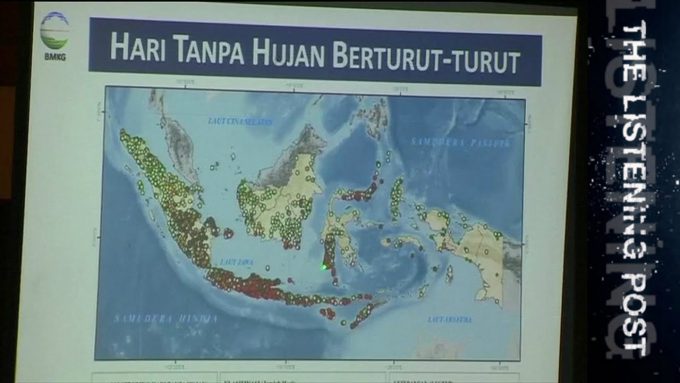
“Why is our infrastructure being built?,” he asked rhetorically about the rapid pace and emphasis that he and Vice-President Jusuf Kalla have given the strategy – a marked contrast with other presidencies.

-Partners-

“The answer is that we want our competiveness to be better than other countries. Our global competiveness must be improved,” he said. “This year is pretty good as we have soared from 41st to 36th among 137 countries.”

Tempo magazine: Infrastructure projects: Devil in the details.

The latest edition of Tempo magazine has devoted 38 pages to its cover story on infrastructure projects, headlining the fairly comprehensive report “Devil in the details”.

Few environmental reports
But absent from the range of quality articles was any serious report on the state of the environment in Indonesia — or environmental journalism, given that 2000 of the country’s 17,000 islands and 42 million households in a population of 261 million are at risk of “drowning” by 2050, according to a Listening Post report on Al Jazeera last month.

As Al Jazeera reported, “when you look at the [Indonesian] mainstream media, it is hard to find stories that go beyond catastrophes like forest fires or mudslides, examining who and what is behind them.”

A leading environmental journalism advocate has blamed lack of climate change and environmental reporting skills in Indonesian newsrooms for the lack of coverage.

“It is easier for journalists to cover sports or the economy, because they have scores and numbers,” Harry Surjadi, head of the Indonesian Society of Environmental Journalists, told Listening Post. “Those stories are much easier to write than environmental stories, where journalists have to understand biology, ecology, waste and chemistry.”

Nevertheless, Jokowi was praised by The Jakarta Post in a recent editorial for both his development policies and his concern for the poor of the country with his popularity  climbing.

“His overwhelming attention to the basic needs of the people has made him rather obsessive with the objective of keeping the prices of food and other basic necessities stable, thereby keeping inflation below 4 percent,” the Post noted.

However, in its special development edition, Tempo said in an editorial that the Widodo administration was “racing against time” after three years in government to complete its raft of planned infrastructure projects costing an estimated RP4,197 trillion (NZ$415 billion) between 2014 and 2019.

Many ambitious projects with an emphasis on developing the regions, especially eastern Indonesia — including Papua, are being worked on at the same time.

Projects’ sustainability
“All these activities spark public excitement, but also raise questions about the projects’ sustainability,” the magazine said.

“Jokowi’s choice to develop infrastructure is certainly not misplaced. Several studies show that infrastructure development in Indonesia was relatively backward in comparison with neighbours. Even worse: previous administrations spent more on fuel subsidies compared to physical construction,” Tempo commented.

In his Semarang speech, Jokowi said: “Why must we build? Because our country is an archipelago state, the marine foundation base is a must. Airport development was equally important as many islands could not be serviced by ship.

“So, on the remote islands of Natuna, Miangas, we are building an airport. This is just one example because we are building lots of small airports,” Jokowi added.

Tempo seemed to agree with this view by stating in its editorial: “In order to reach a healthy and growing economy, Indonesia needs new roads, bridges, power stations, airports and ports. This in turn requires massive funding.”

Some 42 percent of the required funding — the budget from the 2017 year has been almost tripled from RP177 trillion in Jokowi’s first year in office in 2014 to RP 4011 trillion this year — depends on allocations from the state budget, the magazine noted, plus money from state-owned businesses and private partnerships.

Tempo praised Jokowi for cutting back on energy subsidies, saying this was the right move to make – especially over fuel costs.

Sounding a warning
While also complimenting Jokowi on the boost for several jumbo projects that had stalled in recent years to ensure they get completed, Tempo also sounded a warning.

“Jokowi is racing against time. Infrastructure construction generally takes a while, and its economic benefits are only felt three to five years after construction begins: a time span which does not align with our five-year political cycle,” the magazine said.

“The government should avoid giving the impression that it is impatient to reap its rewards from the projects, especially once the cycle of political succession comes around. Good governance must not be abused for the sake of earning points for the next general elections [in 2019].”

Infrastructure development in Indonesia is a “matter of equality and justice” across the nation, says President Widodo. Image: Al Jazeera

Infrastructure highlights:

National: RP1,320 trillion (two programmes and 12 projects).

Bali and Nus Tenggara: RP11 trillion (15 projects, including the North Timor border crossing and supporting facilities).

Java Island: RP1,065 trillion (903 projects, including the 81km Serang-Panimbang toll road, MRT underground in Jakarta and public trains/railway).

Kalimantan: RP564 trillion (24 projects, including border crossings and facilities and the Serang-Balikpapan-Samarinda toll road).

Maluku and Papua: RP444 trillion (13 projects, including development of the Tangguh Train 3 LNG plant and the Palapa ring broadband).

Sulawesi: RP155 trillion (27 projects, including the Manado-Bitung toll road).

Sumatra: RP638 trillion (61 projects, including five sections of the Trans-Sumatra toll road).

The Jakarta MRT … among the infrastructure projects. Image: Repub of Indonesia
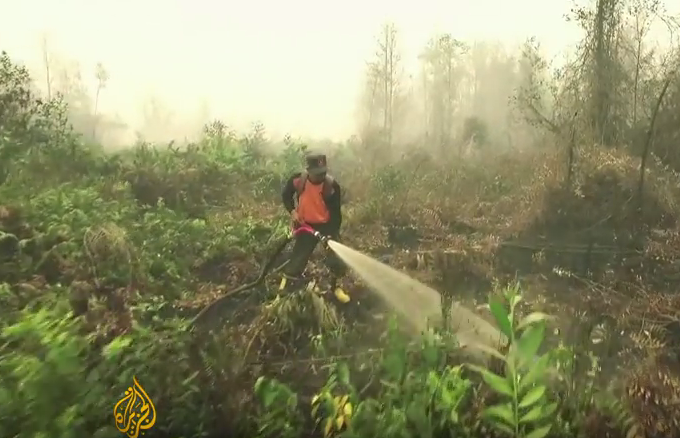
According to a breakdown chart published by Tempo, partnerships with private companies would provide more than half the projected budget – 57.5 percent, with SOEs providing 30 percent and the balance of 12.5 percent from the state budget.

In a four-page interview with the magazine, Jokowi said that after touring across the country, from Sabang to Merauke, “I saw for myself how grave the inequality was”, and he was convinced that an expanded infrastructure would help reduce the gap.

“This is a matter of equality and justice. Besides, our infrastructure development has lagged far behind our neighbours,” he said.

“Infrastructure is a foundation for tackling the problem of inequality. If we want it easy, we just have to allocate the budget for subsidies and increased social assistance, so purchasing power will increase and the public is happy.

“But do we want to continue this kind of strategy? I took the risk by not resorting to this kind of political move, and instead diverted resources to infrastructure development.”

Yet surprisingly nothing in this otherwise comprehensive report addressed climate change and environmental issues, a critical component of sustainable development in Indonesia.

Devastating forest fires in Indonesia in 2015 were caused by a massive burn-off for palm oil plantations. Image: Al Jazeera

Forest fire devastation
Al Jazeera’s Listening Post report stressed how in 2015 huge fires swept through Indonesia’s rainforests. About 2.6 million hectares of forest was set ablaze to make way for palm oil plantations.

“The fires produced – in just three weeks – more greenhouse gases than Germany does in an entire year,” Listening Post said.

“Forest fires have become an annual occurrence in Indonesia, and still, the country’s media seldom devote the column centimetres and airtime needed to explore the causes behind them.”

Merah Ismail, campaign manager for the mining advocacy network JATAM, was quoted as saying: “When [the media] do cover forest fires or the effects of mining, they leave out “subjects like ‘water poisoned due to toxic waste or air pollution’ because they don’t know enough about those subjects”.

While Jokowi had announced in September 2015 that Indonesia would cut the growth of greenhouse gas emissions by 29 percent by 2030, the nation’s news media have reported little on the progress, or lack of it, over this pledge — even with global debate on climate change at COP23 ongoing in Bonn this month.

With little media exposure or debate, the issue of the future of the rainforests has been framed as a tough choice – between the economy and the environment.

Print Friendly, PDF & Email

Article by AsiaPacificReport.nz

]]>

Murray Horton: Root causes of ‘Pacific’ refugee crisis need to be sorted

]]>

Papua New Guinea immigration officials last week started dismantling parts of a prison camp housing hundreds of defiant refugees as an evacuation deadline loomed yesterday. Video: Al Jazeera

OPINION: By Murray Horton of the Aotearoa Independence Movement

Prime Minister Jacinda Ardern is to be congratulated for trying to do the decent thing by, in her words, “offering to lend a hand” with regards to Australia’s appalling treatment of refugees detained, then abandoned, on Manus Island (not to forget the others detained on Nauru).

Australian PM Malcolm Turnbull tried to swat her away by saying that he has a deal with the US to take the Manus men – I think pigs will fly before Donald Trump honours what he calls “the worst deal ever”, made by Barack Obama.

Nor do I see why there is anything stopping Jacinda from dealing directly with Papua New Guinea. After all, the Manus Island men are being detained in its country and Australia has abandoned them. NZ and PNG are two independent countries, so what’s to stop the two governments sorting out this mess of Australia’s making?

And let’s give credit where credit’s due – the John Key National government made the same offer, namely to take some of the Manus men. It got the same response from Australia. That just goes to show that NZ Tories have got more humanity (in this case, at least) than their Aussie counterparts.

And, to his further credit, Key refused to countenance creating a new category of second class New Zealanders, ones with no rights to travel to Australia. Because that’s why pig-headed Turnbull and co won’t take up NZ’s bipartisan offer.

-Partners-

The excuse given is that the Manus men could then enter Australia through the New Zealand “back door” — i.e. via the free entry allowed to New Zealanders.

That is just so much crap. There is a precedent for New Zealand cleaning up Australia’s refugee mess, namely the Clark government taking in a swag of people from the Norwegian freighter Tampa, which was famously blocked by John Howard in 2001. Not only that, NZ did the decent thing and let their families join them.

‘Back door’ myth
Hands up if you’ve heard of any of those people going to Australia via the “New Zealand back door” and becoming “terrorists”. No, I thought not. Those Tampa refugees made their lives in New Zealand and have become an asset to this country.

Australia needs to hang its head in shame (this crime against humanity has been perpetrated by both Liberal and Labor governments). If you read, heard or saw a news report about civilians imprisoned without charge, trial or hope of release, who were then abandoned without food, water, power or toilets and in imminent fear of attack and/or death by hostile locals, your first reaction would probably be that this was the latest atrocity by ISIS.

And that’s how we need to judge this – Australia is enacting a policy of state terrorism. Its “Pacific Solution” is starting to resemble the Final Solution that Australia and New Zealand fought to defeat in World War Two.

I’ve experienced a little bit of this deprivation myself – no power, water or toilet for several days after the February 2011 Christchurch quake, and it was no fun in a First World society where we had the expectation that somebody would do something about it ASAP. How much worse it must feel then on a Third World island, with no such expectation.

But if our government is serious about “lending a hand”, then it needs to look much further than the (admittedly spectacular) symptoms like Manus Island, and do something about the causes of the global refugee crisis.

Why are these tens of millions of people (of whom only a few hundred are the victims of Australia’s unforgiveable cruelty) fleeing their home countries?

Plenty will be economic refugees, they simply want a better life for their children and themselves. That is a story as old as humanity. That is why several hundred thousand New Zealanders have moved to Australia, after all. It is the same reason why my Australian grandfather moved from Queensland to Wellington – to get a job.

Global poverty, wars
The cause is global poverty and inequality. That’s a very big problem, and tiny little New Zealand can only do so much about that. But we can do our share, and we can start from the recognition articulated by the most unlikely of sources – Winston Peters – that more and more people see capitalism as their foe and not their friend.

He was talking about New Zealanders, so multiply that by the billions of people living at the coalface of global capitalism and you start to get an idea of the scale of the problem. Capitalism is predicated on a few winners and an awful lot of losers.

Not unreasonably, tens of millions of these “losers” want to move to where they think they can join the “winners” (they are bound to be disillusioned by what they discover upon arrival, but that’s another story).

Hand in glove with global poverty as a cause of refugees is war. This is a direct and immediate cause of huge numbers of people fleeing for their lives. There is nothing unusual about people running away from a big disaster, whether man-made or natural – tens of thousands of Christchurch people fled the city in the hours after that February 2011 killer quake (and plenty of them have not come back).

This is an area where the new government can deal with the root cause of the global refugee crisis – get out of other people’s wars that we’re already involved in (such as Afghanistan and Iraq); stay out of the absolute tarpit that is Syria; don’t go haring off after Donald Trump if he goes to war in Korea.

More fundamentally, build on the good work done in the 1980s (which made NZ nuclear free and out of ANZUS) and get out of the Five Eyes spy network and break the remaining military ties that bind NZ to the US Empire. Build a truly non-aligned and independent foreign policy that prioritises peace over war.

There is a direct cause and effect between war and refugees. Our “traditional allies” are very good at creating the mess via war, then expressing indignant surprise when that very same mess comes back to bite them in the bum in the form of a human tide. Libya is a textbook case – NATO military powers, with US assistance, played a vital role in violently overthrowing the Gaddafi regime in 2011 (including being complicit in his being tortured to death).

Even Iraq’s Saddam Hussein got a show trial before his enemies killed him. Funnily enough, Libya has been a failed state ever since and Europe has been inundated with refugees arriving by sea – dead or alive – from Libya. I imagine Gaddafi is laughing in his grave.

‘Charity begins at home’
So, there is self-interest for New Zealand in staying out of other people’s wars and in working to end existing wars and preventing new ones. And for those who say “charity begins at home” – I agree.

We can help our immediate neighbours on tiny Pacific islands that are threatened by inundation due to climate change. These people did nothing to cause that problem but New Zealand certainly did and continues to do – we have an obligation to open our doors to these climate change refugees.

That is not a solution to the problem (at least this government recognises there is a problem and has pledged to do something about it) but it is an amelioration of the dire effects of that problem. Even if we took in all of those affected Pacific islanders, plus the prisoners from Manus and Nauru, it would all only add up to a few thousand people. We bring in more foreigners than that every year to milk them in shonky “education” courses and to supply New Zealand employers with cheap labour.

How about we change the emphasis from bringing people in to exploit and rip them off to bringing them to help them and, as the Tampa experience shows, helping ourselves in the process? Sounds like a win-win to me.

Murray Horton
Spokesperson
Aotearoa Independence Movement (AIM)

Print Friendly, PDF & Email

Article by AsiaPacificReport.nz

]]>

Bryce Edwards’ Political Roundup: The Government’s urgency in repealing the ‘Hobbit law’

Bryce Edwards’ Political Roundup: The Government’s urgency in repealing the ‘Hobbit law’

[caption id="attachment_13635" align="alignright" width="150"] Dr Bryce Edwards.[/caption] Like any sector in society, those who own and operate businesses have a vested interest in influencing governments to make rules that favour their operations. And not only is the power of business extraordinarily strong, many argue it has increased significantly in recent decades, alongside worsening economic inequality in most countries. This is a point made strongly by French economist Thomas Piketty in his best-selling and highly influential 2014 book, Capital in the Twenty-First Century. Piketty’s book is currently being made into a film by New Zealand documentary-maker Justin Pemberton – see Steven Zeitchik’s news report on this, Cannes: Thomas Piketty, movie star? The documentary is scheduled for international release next year. One of the stories being told to illustrate Piketty’s theories about the power of business is the infamous 2010 “Hobbit crisis”, and “Hobbit law” introduced by the National Government to appease Hollywood and Wellington filmmakers. Last week I gave an interview for the documentary about what happened, and explained how through manipulation, a powerful foreign company had obtained huge government payouts and a change to the law to help them make bigger profits. Why Labour wants to repeal the Hobbit law with urgency The Hobbit law – or “The Employment Relations (Film Production Work) Amendment Bill” – is also now back in the news here, because the new Labour-led government has promised to repeal National’s legislation in its first 100 days in office. In her background profile on what happened, Kylie Klein-Nixon says “How it came about is a convoluted tale which changes, as all good tales do, depending on who’s telling it – the filmmakers or the actors. But in a nutshell: the New Zealand actors union, NZ Equity, used the filming of The Hobbit – a high profile, multimillion dollar internationally funded production – to push for the right to bargain collectively, despite most actors being on individual contracts” – see: Hobbit law repeal: How did we get here? For a much more critical examination of why the Labour Party and the labour movement feel so strongly about repealing the legislation, it’s worth reading an article in the Hollywood Reporter: New Zealand Poised to Repeal Anti-Union ‘Hobbit Law’. The article is by Jonathan Handel, a Hollywood entertainment and technology lawyer who wrote a book in 2012 titled, The New Zealand Hobbit Crisis: How Warner Bros bent a government to its will and crushed an attempt to unionize The Hobbit. The book highlights how the 2010 industrial dispute is “an unusually dramatic example of corporate leverage exerted against a nation-state and its workers.” In Handel’s latest article, he explains how the film business was determined in 2010 to reduce the employment rights and conditions of film workers in New Zealand, and threatened to pull the production of The Hobbit out of the country if they didn’t get their way. They came to New Zealand to lobby the National Government for a law change, as well as for additional subsidies. Handel says: “It was a potent threat against a tiny island nation of then-around 4 million people, particularly in light of the tourist boom sparked by the earlier Lord of the Rings films and expected from the Hobbit prequels — and the law dovetailed with the Kiwi government’s pro-business tilt under the then-prime minister, former Merrill Lynch executive John Key.” The article celebrates the new coalition government prioritising the repeal of the Hobbit law. New Workplace Relations Minister, Iain Lees-Galloway is quoted explaining that the soon-to-be-repealed law “is a breach of International Labour Organization Convention 98 which New Zealand has ratified and must therefore adhere to”. And Equity New Zealand president Jennifer Ward-Lealand is reported saying “This is a law that is deeply unfair for workers, so it is wonderful to see our new Government make its repeal a priority”. The Labour Party and union movement were particularly incensed by the Hobbit crisis because it involved so much duplicity by the film business and the government of the day. This is explained very well by Brent Edwards who points to the fact that the whole crisis was manufactured in order to get the public on side: “That law was rushed through Parliament overnight as the government bowed to the demands of the powerful Hollywood studios. Even worse, the government told the public the Hobbit dispute was unresolved despite knowing that days earlier the actors’ union, Equity, had agreed to lift the international boycott on the film” – see: ‘Hobbit law’ change vindication for late union leader. Edwards explains that evidence was later released under the Official Information Act, which confirmed all this: “the papers showed the government initially had seen no need to change employment law relating to film and television workers. But Sir Peter and the Hollywood studios continued to pressure the government to do so. So late in October it bowed to those demands and changed the law in a day to make it absolutely clear actors and crew were independent contractors, not employees.” Gordon Campbell has also written expertly about the latest developments, bemoaning that “one of our leading digital industries of the 21st century continues to labour under 19th century work conditions” – see: On the TPP outcome, and the Hobbit law. Many on the political left are celebrating the government’s determination to dump the Hobbit law so quickly. On The Standard, Greg Presland declares: “I would like to jump up and down and dance on its grave and remember the victims and curse the villains. And I hope there is a sophisticated analysis by the main stream media of what happened and why repeal is important” – see: The repeal of the Hobbit law. His blog post then goes through in detail what happened. It might, however, seem a little odd that Labour is giving the repeal of the Hobbit law such a priority. After all it’s a law that affects very few people, and is hardly of immediate concern to voters. Martyn Bradbury explains: “This wasn’t going to make the list of things to do in the first 100 days but the symbolism of telling a multi-national corporation that we won’t write our laws for their benefit was too compelling for NZ First” – see: The Hobbit strikes back! Huge win for NZ Actors & workers. Industry and political right respond The National Party hasn’t made much effort to defend the Hobbit law in the wake of the announcement that it’s to be axed. National-aligned blogger David Farrar has blogged to say “This law change will drive productions out of New Zealand, and destroy jobs” – see: Smaug wins, Hobbits lose. Farrar also argues that the film industry is better suited for contract arrangements rather than employing workers, and the repeal of the law is a “huge win for the Australian union that tried to blackmail Peter Jackson with a global boycott.” According to the Herald, “National has previously criticised Labour’s vow to repeal it, saying that would deter major film companies from coming to New Zealand” – see: Film industry heavy-hitters meet as axe hangs over ‘Hobbit law’. The same article reports on the thoughts of Lord of the Rings film producer Barrie Osborne, who disputes that National’s law change led to exploitation: “It’s not like you have a big industrial company coming in taking advantage of the workers. I find in fact the wages here in the film industry are higher than they are in Australia which has a very unionised position.” Similarly, a 1News TV report emphasises that the billion-dollar New Zealand film industry is divided by the proposed repeal of the law – watch: Government reaffirms commitment to scrap ‘Hobbit Law’ which saw an end to collective negotiations for film industry workers. Back down by Labour? The Herald article also explains that since the Labour-led Government announced the urgent repeal of the Hobbit law, film business executives have been lobbying Lees-Galloway to do a U-turn. Film boss Barrie Osborne is quoted saying he had made progress with the Minister after initially being alarmed, saying it was “concerning when you read just the bold print” of Labour’s repeal. Osbourne explains: “We got in to see the minister in his first week in office. So that is encouraging that they are aware of the issues and what is at stake in the industry, and the infusion of dollars some of these big international pictures bring into New Zealand.” Recently Lees-Galloway has been promoting a somewhat different view of what the government is going to do: “What we are absolutely not going to do is repeal what currently exists and leave a vacuum … [the new framework] will recognise that contracting is the normal way of doing things in the film industry, and most importantly provide certainty to producers and people who plan to invest on making films in New Zealand.” And the newspaper reports that Lees-Galloway “told the Herald a repeal of the Hobbit law may not be needed”. On Thursday last week, the Government made it clear that a straight repeal was no longer happening. RNZ reported: “Today, workplace relations minister Iain Lees-Galloway announced he was working with a number of industry groups, including the Screen Industry Guild, to consider options for replacing the legislation. He said the film industry brought millions of dollars to New Zealand and a collaborative approach was being taken to ensure the laws affecting them were fair” – see: Working group formed for ‘Hobbit law’ replacement. According to John Drinnan, Lees-Galloway now says: “A lot of people have said they are really happy with the contracting arrangements. We are fine with that” – see: First ‘The Hobbit’, now for the sequel. And Drinnan cites other businesspeople from the film industry who have been lobbying the government to change their mind. The most definitive announcement that the promise of repeal within the first 100 days is gone is in Simon Smith’s article, Minister Iain Lees-Galloway says replacing Hobbit law will be ‘a joint solution’. This reports that “Lees-Galloway said it was more important to get new legislation right than to do it in 100 days, and that was what industry and unions wanted.” The minister is quoted explaining, “It would be pointless to stick to a manifesto commitment that didn’t actually get us the result that we were looking for.” Mike Hosking is using this Hobbit law repeal back-down as an example of how Labour is less reform-minded than might be expected: “The Hobbit law around the movie industry – they were repealing it. Whoops, no they’re not. Those in the industry have told them they’re nuts, and so to their credit, they’ve put the brakes on” – see: This government is specialising in window-dressing, not reform. Hosking then puts forward three explanations for Labour talking radical but acting moderate. Finally, Helen Kelly’s son, Dylan, now works in the film industry, and has just written about his mother on the anniversary of her death. He also talks about the Hobbit drama, which he says “led to Mum being described as ‘one of the most actively disliked women in the country’ at the time” – see: On a new government, kindness and the (unfinished) legacy of my mother, Helen Kelly. On the repeal of the Hobbit laws, he says, “for those who think this move will kill the film industry… It won’t. Most overseas film industries are heavily unionised. The next 25 Avatar sequels will be just fine”.]]>

NZ protesters lock gates of Australian High Commission in Manus protest

]]>

The squalor faced by Manus Island refugees in Papua New Guinea. TRT video

Pacific Media Centre Newsdesk

New Zealand activists have chained themselves to the gates of the Australian High Commission in Wellington while Prime Minister Jacinda Ardern has reaffirmed the country’s offer to take some of the refugees and asylum-seekers from Manus Island in Papua New Guinea.

News reports said the purpose of the Wellington protest was to prevent anyone inside from leaving, Peace Action Wellington spokeswoman Emma Cullen said.

About 20 protesters were reported outside the high commission yesterday afternoon, of whom three or four were chained to the gates.

The protesters hoped to stop high commission staff leaving last evening, to highlight the plight of the about Manus detainees whose basic services have been cut off by the authorities.

“We’re shutting them down for as long as we can … at least until the evening, to affect these people, and for these people to acknowledge and question what their government is doing,” Cullen said, according to Stuff.

-Partners-

In Manila for the APEC meeting, Prime Minister Ardern has been seeking a meeting with Australian counterpart Malcolm Turnbull to discuss further New Zealand’s offer to take 150 refugees from Manus.

Turnbull has suffered a disastrous popularity slump, according to The Australian newspaper.

The PNG Supreme Court has forced the closure of Ausytralia’s offshore detention centre for asylum seekers but many have refused to leave in spite of the power, water and food supplies being cut off.

Print Friendly, PDF & Email

Article by AsiaPacificReport.nz

]]>

Critical Politics Newsletter: New Zealand Politics Daily – 14 November 2017 – Today’s content

Critical Politics Newsletter: New Zealand Politics Daily – 14 November 2017 – Today’s content

Editor’s Note: Here below is a list of the main issues currently under discussion in New Zealand and links to media coverage. [caption id="attachment_297" align="aligncenter" width="1600"] The Beehive and Parliament Buildings.[/caption] Below are the links to the items online. The full text of these items are contained in the PDF file (click to download). Trade and international relations Audrey Young (Herald): Ardern overshadowed by Trudeau at East Asia Summit 1News: Jacinda Ardern having tricky talks with world leaders at East Asia summit Barry Soper (Newstalk ZB): Jacinda Ardern, the rock-star life and a lifestyle without parallel Barry Soper (Newstalk ZB): Jacinda Ardern navigates tantrums and hissy fits at Apec Richard Harman (Politik): Ardern and Peters at centre of TPP confusion Dan Satherley (Newshub): Kelvin Davis ‘wrong’ on TPP – Jane Kelsey Chris Trotter (Stuff): A very lucky escape in Trans-Pacific Partnership debates Hamish Rutherford (Stuff): Muted elation from business hides relief at CPTPP trade deal Sam Sachdeva (Newsroom): Ardern extends NZ invite to Trudeau Audrey Young (Herald): Jacinda Ardern meets with Canadian Prime Minister Justin Trudeau Vernon Small (Stuff): Jacinda Ardern invites Canada’s Prime Minister Justin Trudeau to visit Anna Bracewell-Worrall (Newshub): Justin Trudeau seeks guidance from Jacinda Ardern on ‘indigenous issues’ RNZ: Watch: Bill English on National’s support for TPP Newshub staff: Labour taking credit for National’s TPP agreement – Bill English Anna Bracewell-Worrall (Newshub): NZ First support for TPP not guaranteed Jane Patterson (RNZ): Greens oppose new TPP deal Stacey Kirk (Stuff): Greens won’t support new TPP legislation as changes ‘don’t go far enough’ Sam Sachdeva (Newsroom): Ardern in talks with NZ First over TPP Claire Trevett (Herald): Greens will not support revised TPP trade deal  Anna Bracewell-Worrall (Newshub): Greens will go against Labour in TPP vote Gordon Campbell (Werewolf): On the TPP outcome, and the Hobbit law No Right Turn: Saved by Canada Bryan Gould: Is the TPPA now fit for purpose Liam Hehir (Medium): Actually, the TPP is a good thing now Gwynn Compton (Libertas Digital): A good point about the international summit “silly shirt” photo tradition Newshub: What Jacinda Ardern thought of Donald Trump’s ‘short and fat’ tweet Patrick O’Meara (RNZ): PM to stress peace in Asia talks NZ-China relationship Audrey Young (Herald): Ardern invited to China by Premier Li Keqiang Newshub: Chinese Premier wants another NZ visit Matt Nippert (Herald): University of Canterbury professor calls for China’s local influence to be curbed David Williams (Newsroom): Govt urged to probe China’s influence 1News: Winston Peters raises ‘issue of corrupt individuals wanted in China’ living in NZ with Chinese counterpart Michael Reddell (Croaking Cassandra): “I’m always very careful what I say to either man” Martyn Bradbury (Daily Blog): Being economically occupied by China, politically owned by America and what EVERYONE is missing about how to defeat TPPA Manus Island refugee crisis Ella Prendergast (Newshub): Australia ‘criminal’ for refusing Manus Island refugees – Golriz Ghahraman Audrey Young (Herald): Jacinda Ardern sticks to her guns over Manus Island at East Asia summit Newshub: Jacinda Ardern says she’ll be ‘an irritant’ to Malcolm Turnbull on Manus Island Mike Hosking (Herald): Yapping at Australia over and over will only make our relationship worse Michael Daly (Stuff): PM’s Manus Island push a deflection from TPP – Bill English Aziz Al-Sa’afin (Newshub): Manus Island is all of our shame to bear Patrick Gower (Newshub): Jacinda Ardern’s offer a fatal mistake – Australian senator Pat Griffiths (AAP): Ardern’s offer to take refugees a ‘fatal mistake’ No Right Turn:Bring them here Stuff: Manus Island activists locked to gates of Australian high commission in Wellington David Farrar (Kiwiblog): The other side of Manus Island Winston Peters court action Edward Gay (RNZ): Peters targets journalistic privilege in court action RNZ: Peters’ superannuation leak court date set Herald: ‘Political hit job’: Winston Peters’ lawyers claim reporters were part of a ‘set-up’ Laura Walters (Stuff): Winston Peters’ legal attack on journalists could further erode NZ’s press freedom ODT Editorial: Coalition negotiations discredited Karl du Fresne: We want our money back Government Leith Huffadine (Stuff): If you’re old and rich, you’re more likely to hate the new Government Bevan Rapson (North and South): The coalition government’s generation game Peter Skilling (Impolitikal): Jacindamania 2017, hope and fear on the campaign trail Lynn Prentice (Standard): Measuring the honeymoon Bernard Hickey (Newsroom): Labour finds ‘unexpected budget challenges’ Shane Cowlishaw (Newsroom): The OIA is broken, can it be fixed? Alexander Bisley (Vice): Actually, the Far Right Are Not Taking Over New Zealand Action Station (Medium):Nine reasons to be stoked about this new government…and some of the areas we know we need to keep pushing for positive change Parliament Colin James (ODT): Grow up, petty Parliament! Tom O’Connor (Waikato Times): The Opposition needs to grow up Chris Trotter (Bowallley Road): Democratic Engineers, Or Neoliberal Mechanics? Ellen Read (Stuff): The Cabinet has its priorities wrong Gwynn Compton (Libertas Digital): The political week ahead – 13 November 2017 United Future Newshub: United Future leader may set up new party RNZ: United Future to disband Herald: Leaked email: United Future Party to disband after election struggle Michael Daly (Stuff): United Future calls it a day, fears drug reform will lose momentum Pete George (Your NZ): United Future disbanding Greg Presland (Standard): United has no future Environment David Farrar (Kiwiblog): Another win for the fishing industry over marine conservation Bill Hare (Spinoff): Our rating of NZ’s climate target? Not good enough. The heat is now on James Shaw RNZ: Vatican climate change meeting ‘big deal’ for Pacific Child welfare Herald: School bullying levels a disgrace – Human Rights Commission Herald: 30% of children’s needs not being met – Children’s Commissioner Southland Times Editorial: Doing more for our kids Sarah Robson (RNZ): Govt to scrap benefit cuts for mums who don’t name father Aaron Smale (Spinoff): Our stolen generation: a shameful legacy Farming Tess Nichol (Herald): Calves taken, cows made pregnant for milk: Animal welfare protest targets dairy industry Alexa Cook (RNZ): New agriculture minister takes tough stance on cattle disease Employment Craig McCulloch (RNZ): Nats to push for leave for both parents at once Teuila Fuatai (Newsroom): The future of unions Auckland Rod Oram (Newsroom): Twyford chases an illusory pot of gold Todd Niall (RNZ): AKL mayor on course to underspend predecessor America’s Cup RNZ: Goff calls for govt support to host America’s Cup RNZ: Five options for America’s Cup bases, costing up to $190m Todd Niall (RNZ): Auckland councillors consider America’s Cup options Education ODT Editorial: Some restraint of pupils is necessary Martin van Beynen (Stuff): Checkout operators are putting groceries on the table Lois Williams (RNZ): Regional development agency unhappy with Northtec cuts Earthquakes Herald: Prime Minister Jacinda Ardern marks quake milestone from Manila Hamish Rutherford (Stuff): The public safety threat hanging over Wellington, a year after the November 14 earthquake Other Simon Wilson (Spinoff): New radicals: the challenge for NZ politics in the time of Corbyn and Trump Dileepa Fonseka, Jackson Thomas, Peter Newport and Paul Mitchell (Stuff): New valuations reveal rich town-poor town divide; strapped families flee housing crisis Jo Moir (Stuff): Māori Party distances itself from Marama Fox’s ‘like a beaten wife’ comments Anne Gibson (Herald): Foreigners get green light for six land deals; three involve majority NZ-owned entities Mihingarangi Forbes (RNZ): Māori woman candidate targeted in billboard attack Stuff: Fairfax NZ appoints Mark Stevens editorial director John Minto (Daily Blog): Capitalism, tax and New Zealand Liam Hehir (Stuff): Western progressives continue to romanticise communism Rob Stock (Stuff): Payday loan interest caps on the way, says consumer affairs minister Kris Faafoi Herald: Jonathan Coleman says he’ll hold new health minister to account over suicide target Lizzie Marvelly (Herald): Forget Guy Fawkes – We’ve a date with our past Daniel Hutchinson and Robert Steven (Stuff): Iwi seeks to enforce Lake Taupō toll Stuff: What NZ Wars? Hamilton mayor apologises over Armistice Day reference]]>

Fiji, Philippines campaigners call for ‘real climate leadership’ at COP23

]]>

Democracy Now! talks to campaigners from the Philippines and Fiji.

As the second week of the UN climate conference has got underway in Bonn, Germany, Democracy Now!’s Amy Goodman speaks with two activists about the impact of climate change on their countries, and their goals for this year’s talks.

“It was devastating to see thousands of homes damaged, and about 40 people lose their lives in Cyclone Winston [last year],” says George Nacewa, a Fiji islander and a 350.org Pacific Climate Warrior.

“This is something we’ve never experienced before.”

Tetet Lauron, programmne manager for climate justice at IBON international and a former member of the Philippines delegation, says negotiators must increase their sense of urgency “to avoid runaway climate change”.

Transcript:
AMY GOODMAN: Well, we are talking with Tetet Lauron, who is with IBON International. And we are now joined, as well, by George Nacewa, who is a Fiji islander and a Pacific Climate Warrior. Let’s now pivot into the issue of climate.

We’ll stay with you Tetet. How does climate affect the Philippines? And what are you calling for here at the UN climate summit?

-Partners-

TETET LAURON: Well, the Philippines has always been poster child of the climate change. And as you said, especially during COPs, you know, one big typhoon hits our country, an earthquake strikes, affecting millions. So, at this COP, we’re hoping and calling on governments to be accountable: number one, to make good on the promises that they made two years ago in Paris, and, number two, because what they’ve put in as pledges in the Paris Agreement is not enough, because it’s still going to bring us anywhere between three to seven degrees warming. We’re calling on them, you know, to increase the level of ambition, know the urgency and really just try to do everything that they could to avoid runaway climate change.

AMY GOODMAN: We are also joined by George Nacewa, who is a Fiji islander. So, George, your country is actually hosting this summit. It’s called the “Island COP”. But it’s being held in Bonn because Fiji couldn’t deal with 25,000 people coming in all at once for this summit.

But talk about how climate affects Fiji. And place it for us geographically.

Devastating Cyclone Winston
GEORGE NACEWA: So, Fiji, impacts of climate change in the Pacific islands is such that we have sea level rise, saltwater intrusion, harsh weather patterns, flooding. But just last year, we had the worst cyclone, Cyclone Winston, a Category 5 cyclone, that hit Fiji. It was devastating to see thousands of homes damaged, and about 40 people lose their lives. And this is something that we’ve never experienced before.

AMY GOODMAN: And the significance of this being an Island COP? It’s your island nation that’s hosting this, Fiji?

GEORGE NACEWA: Yeah. I mean, this is to show the world what true leadership is all about, you know? And we have our leaders from the islands that are pushing that affirmative action is taken and that the Paris Agreement is put into play, you know? And that—yeah.

AMY GOODMAN: What does it mean to be a Pacific Climate Warrior?

GEORGE NACEWA: It means we bring our faith, our culture, our tradition into the mix of things, you know? And to show people who we are as human beings from the islands and that we are connected to the land and to the ocean and that this is important to us.

AMY GOODMAN: And the fact that President Trump is pulling the US out of the UN Paris climate accord, what does it mean to you?

GEORGE NACEWA: It’s frustrating to say. I’m angry, but, at the same time, I’m hopeful to see that our island leaders are taking the true leadership role that is needed.

US ‘pull out’ consequences
AMY GOODMAN: And, Tetet Lauron, the fact that Trump, yes, is in your country right now, in the Philippines; you’re here in Bonn for the island summit, this Island COP. What does it mean to you that the US is pulling out? Following Syria and, just before that, Nicaragua signing on to the Paris climate accord, that means the US is alone, if it in fact is pulled out of the accord.

Even with Trump’s efforts to pull it out, he actually can’t pull it out until 2020. I think it’s a day after the next election.

TETET LAURON: Well, the US has not—has never been a climate leader. So, you know, it doesn’t really matter much if they stay in or they stay out of the agreement. It’s because we haven’t seen real climate leadership.

There’s still the role of the US policy. And it’s not just about the environmental policy. It’s also about trade. It’s about finance. It’s about putting in place policies that extract more resources from countries like the Philippines and Fiji, and bringing in their corporations with destructive mining activities, you know, opening up our country and our people to even more damage and vulnerability.

AMY GOODMAN: And what does it mean to you when activists, George, from the United States, actually grassroots activists, governors, senators, mayors, nonprofits from all over, come as a kind of separate delegation from the Trump delegation? We have 15 seconds.

GEORGE NACEWA: I think it’s important because we don’t stand alone in this fight, you know? Even though we face the impacts of climate change back home, we know that we are in this fight with others around the world. And that’s very important, you know?

AMY GOODMAN: Well, I want to thank you both for being with us, and, of course, we’re going to continue to discuss this. Tetet Lauron, IBON International; George Nacewa, from Fiji, is a 350.org Pacific Climate Warrior.

Republished under a Creative Commons licence.

Print Friendly, PDF & Email

Article by AsiaPacificReport.nz

]]>

Activists from Puerto Rico to Pacific demand climate compo, no fossil fuels

]]>

Democracy Now!’s video on the Bonn protests demanding an end to fossil fuel extraction.

Thousands of people have taken to the streets in the German capital Bonn for a rally and march to demand an end to fossil fuel extraction. These are some of their voices.

CARLOTTA GROHMANN: Hi. My name is Carlotta Grohmann. I am from the Bonn Youth Movement. And we are here today because we think that climate change, that environmental pollution, is not just one cause. It’s not just the carbon emissions. It’s not just coal. It’s everything. It’s nuclear power. It’s the way that we are putting war all over the planet and destroying it. It’s the way that our economic system is working for the profit of few.

KATIA AVILÉS-VÁZQUEZ: My name is Katia Avilés-Vázquez. I came from Puerto Rico to be here in Bonn. Part of the reason I’m here is we, the Caribbean, just got hit with two major-force hurricanes, and we had unusually high activity of hurricanes, particularly part of the effects of increased temperature due to climate change. And while we’re living and struggling through the effects of climate change, the decisions that are causing it are being made here.

VIEW MORE: Watch the full Democracy Now! show which is broadcasting live from Bonn

And I’m hoping, by being here, we can kind of highlight the struggles that we’re going through, what climate change is doing in the now. This is not something to prepare for in the future. We’re living it, we’re suffering, we’re dying at this moment. We have lost power. We lost communications. We lost potable drinking water. And our economy is collapsing due to that.

So we need just—we need climate reparations. One of the things that we’re demanding, ending the Jones Act, ending the colonial rule and PROMESA. We want to be able to work, trade and heal with our Caribbean sister islands, like they have offered to help, but the US has told them no. And we want to make sure that we transition into renewables, not just rebuilding the Puerto Rico of old that replicates the oppression that led us to being in such vulnerable positions.

-Partners-

AMY GOODMAN: Just as we flew here from the United States, we saw whatever power was restored to San Juan. When we were in San Juan, there was some pockets of electricity, that, once again, San Juan has been plunged into darkness. That’s just in San Juan, which is the most—

KATIA AVILÉS-VÁZQUEZ: Electrifying.

AMY GOODMAN: —successful in returning electricity.

Correcting past oppression
KATIA AVILÉS-VÁZQUEZ: Correct. That’s actually been one of the most painful things about being here, is seeing that whatever little progress was made, we set up, a couple steps back. And it’s important to highlight that that was the one line that Whitefish fixed and that Whitefish got that contract because their owner or someone has stocks, that’s a Trump donor. So, again, it highlights the need to—for whatever transition we demand needs to be just, and it needs to correct past oppressions, and it needs to be towards renewable, not just fixing an old and decaying infrastructure.

The other thing that happened while we were here—just today it came out—that FEMA is going to relocate at least 3000 Puerto Ricans out of Puerto Rico, when we have so much housing that’s available and that’s apt to have humans. They’re moving our people out systematically. And now it’s—the gentrification that was already happening due to Law 2022 is now being officialised by the US government, and that’s just completely unacceptable.

MONICA ATKINS: My name is Monica Atkins, and I am here representing Cooperation Jackson in Mississippi, as well as the Climate Justice Alliance. And I’m here to stand in solidarity with the communities of color, indigenous people, whose land are being polluted, whose waters are being polluted and whose land is being taken over. So we’re just here standing in solidarity and showing support.

CHIEF NINAWA HUNI KUI: [translated] My name is Chief Ninawa. I am from Acre, Brazil, with the Huni Kui people. I came to bring a message from the forest to this climate conference. This message is of life, love, peace and hope. We believe that nature should not be commercialized for big capital. We came here to demand respect for human beings, for the water, for the forest and everything that depends on the forest.

MIRIAN CISNEROS: [translated] My name is Mirian Cisneros. I’m the president of Sarayaku and Kichwa people in the Ecuadorean Amazon. I’m here because the indigenous people around the world are affected by climate change. And we came with a proposal, the Living Forest proposal, to advance this call for the living forest, but also to join forces and gain solidarity from other people, other movements, so that we can unite and be in this fight together.

DARIO KOPPENBERGER: I’m Dario Koppenberger, and I’m from Wiesbaden in Germany. [translated] It’s become evident, from what we’ve seen at the world climate conference that is in progress here, that the climate targets that they had established are not sufficient. At the same time, it is clear that they are not truly willing to carry them out anyway. I believe that there is enough wealth in the world to be able to accommodate both our concerns for the environment as well as job security for workers. In other words, there need not be starvation or unemployment, because there is enough work in the world, and it is more a question of how to spread it around among all. We need the environment. We cannot exist without it. Therefore, the question is simple for me. It is that capitalism lies at the basis of our problems and that we critically need groundbreaking alternatives to it.

AMY GOODMAN: Voices from the streets of Bonn, Germany, here on Saturday.

Republished under a Creative Commons licence.

Print Friendly, PDF & Email

Article by AsiaPacificReport.nz

]]>

Candidates for Solomon Islands PM announced amid ‘political turbulence’

]]>

Candidates for Solomon Islands top job … Central Honiara MP Rick Houenipwela (left) and Small Malaita MP John Moffat Fugui. Image: Solomon Star News

Amid continued “political turbulence” in the Solomon Islands, candidates for the position of prime minister have been announced, the Solomon Islands Broadcasting Corporation reports.

MP for Central Honiara John Moffat Fugui will go head-to-head with Small Malaita MP Rick Houenipwela for the position on Wednesday morning.

Solomon Star News reports Fugui and Houenipwela were the only two candidates, nominated by the Honiara Hotel camp (opposition) and Heritage Park Hotel camp (caretaker government) respectively.

SIBC reports Houenipwela is considered the better candidate by the public.

In government for seven years, Houenipwela’s top priorities if elected are political and fiscal stability.

He told Solomon Star News these were the fundamental reasons the Democratic Alliance Party switched from the opposition to the caretaker government.

Houenipwela also told SIBC the DAP made the move in an effort to form a new coalition which would provide the nation with desperately needed political stability.

-Partners-

‘Never accepted’ money
“Political and fiscal stability underpin the general stability of any nation and these were the fundamental reasons for switching sides.

“We did not join the caretaker government in search of positions or in search of money. We were never offered any money because everyone in Parliament knows that when we were offered money, we never accepted them,” Houenipwela said.

Houenipwela’s DAP walked away from the opposition due to a lack of consultation over a proposed cabinet line-up, he said.

The DAP’s move comes amidst a three week period which has been marked by changed allegiances and moves to consolidate power.

Solomon Star News reports the Heritage Park Hotel camp is now comprised of the Kadere Party, People’s Alliance Party, People’s First Party and the DAP, bringing their numbers up from 23 to 30.

Houenipwela confirmed the caretaker government coalition partners consist of the two political parties that formerly made up the opposition and three political parties of the former Sogavare-led Democratic Coalition for Change Government (DCCG).

The opposition’s numbers have dwindled to 20 MPs, reports Solomon Fresh Beat Online.

Fugui announces policies
Opposition candidate for prime minister, Fugui, told SIBC the value leaders placed on their duty to the nation was more important than setting political and fiscal stability as priorities, as good governance and a stable economy result from leaders valuing their role.

Fugui’s policies included greater support of rural people and beefing up the country’s foreign reserves, SIBC reports.

The group which nominated Houenipwela included former Prime Minister Manasseh Sogavare, who was ousted last week following a 27 to 23 no-confidence vote, after initially refusing to resign.

During the nine hour debate in parliament, Sogavare defended his strong stance on West Papua, following criticism from Fugui, Solomon Star News reports.

Fugui said Sogavare should withdraw support of the Indonesian-ruled region and not waste the Solomon Islands time, as Papua New Guinea had not been advocating for West Papua.

Sogavare hit-back in his rebuttal and said the government’s position must be consistent with its position on New Caledonia’s independence, French Polynesia’s decolonisation agenda and Taiwan’s bid for United Nations membership.

He added the Solomon Islands must stand beside its Melanesian brothers and sisters, as they did not enjoy the same basic rights.

Sogavare survived a no-confidence motion in October 2006 despite deteriorating relations with Australia, but did not survive a vote of no-confidence in December 2007.

The election of Houenipwela or Fugui to the top post of prime minister takes place on Wednesday, November 15 at 9.30am.

Print Friendly, PDF & Email

Article by AsiaPacificReport.nz

]]>

Australia accused of ‘bullying’ Pacific neighbours out of climate compo

]]>

Greenpeace political message to COP23 on fossil fuels. Image: Greenpeace

Pacific Media Report Newsdesk

Australia has picked up a second Fossil of the Day award at COP23 in Bonn for seeking to twist, water down and delete references to finance from the loss and damage decision text, Greenpeace reports.

Loss and damage refers to impacts of climate change including slow onset events such as sea level rise, and extreme weather events, such as tropical cyclones, which may both result in loss of lands, livelihoods and in small island states, coastal areas.

“Australia has long lacked many things – sympathy, support, and solidarity among them – with its Pacific Island neighbors, but these bullying tactics are over the line, even for them,” the Climate Action Network, which presented the award on day six of COP23, said in a statement.

Australia’s reported hypocritical behaviour also appears to contradict the comments it made in its opening statement on behalf of the Umbrella Group of non-EU developed countries to current COP President, Fiji’s Prime Minister Voreqe Bainimarama.

“We are mindful that this is the first time a Small Island Developing State has held the presidency and we are committed to providing our full support for your successful presidency, including to bring the Pacific consciousness to this COP which we know to be an important aspect of your presidency,” Australia said in its opening statement to the COP plenary.

“Australia’s domestic policies, such as support for the fossil fuel industry through subsidies, is insult enough to the Pacific. Couple that with blocking financial mechanisms for the highly affected, and you do not have a recipe for friendship,” Greenpeace Australia Pacific head of Pacific Net Matisse Walkden-Brown said.

-Partners-

The Pacific Island Climate Action Network (PICAN) condemned Australia’s reported obstruction, saying the region is already experiencing loss and damage from climate change.

“Support is necessary and deserved from countries who have caused this problem. Developed countries’ fossil fuels is the Pacific’s loss and damage. The issue of Loss and Damage finance needs to be advanced not continuously pushed to the next session,” PICAN said.

Australia was awarded the Fossil of the Day along with Canada, the EU and the US.

Australia, through the Umbrella Group, also argued in 2015 that there be no reference to loss and damage in the Paris Agreement, reportedly driven by fear of being forced to pay compensation for climate damage caused by their emissions.

On day two of COP23 Australia received the Fossil of the Day for its support of the Adani Group’s plans to build the world’s largest export coal mine.

Activists from Greenpeace in Germany and Pacific Island representatives have sent a message to leaders meeting at the UN climate talks in Bonn, projecting an image of faces onto a coal power plant and calling for an urgent phase out of fossil fuels, Greenpeace reports.

The message “No future in fossil fuels” and #COP23 was projected onto the polluting Neurath coal power plant alongside faces from the Pacific Islands and around the world to put a spotlight on the impact the emissions from climate summit host nation Germany have on the Pacific.

Print Friendly, PDF & Email

Article by AsiaPacificReport.nz

]]>

Bryce Edwards’ Political Roundup: Labour’s remarkable CPTPP

Prime Minister of New Zealand, Jacinda Ardern.

Bryce Edwards’ Political Roundup: Labour’s remarkable CPTPP

[caption id="attachment_13635" align="alignright" width="150"] Dr Bryce Edwards.[/caption] Last year, Labour MPs were amongst the 72,000 who marched in the streets against the Trans-Pacific Partnership Agreement. Now in Government, Labour appears to have made major progress in ensuring the TPP should happen. Below are 20 of the most important items from recent days about the progress of the deal. [caption id="attachment_15386" align="aligncenter" width="1600"] New Zealand Prime Minister, Jacinda Ardern, at the APEC leaders’ summit, November 2017 (Image courtesy of APEC.org).[/caption] 1) The TPP is now the CPTPP! Vernon Small explains: “It might be near unpronounceable as the CPTPP (Comprehensive and Progressive Agreement for the Trans-Pacific Partnership), and loom on paper like an abbreviation of something from the former Soviet Union, but apparently the rebranding will help Trudeau sell it to his voters” – see: Jacinda Ardern passes Apec test. See also, Audrey Young’s TPP not dead but needs more work – PM. 2) Many former critics of the TPP are now happier with the agreement that seems to be emerging. Bryan Gould says “If the reports coming out of the negotiations are correct… the problems many had with the TPPA will have been substantially resolved” – see: Is the TPPA now fit for purpose? Gould gives credit to Ardern: “We will be able to judge how successful she has been when we see the full amended text. But the early reports are that substantial progress was made on these points of difficulty, and if that is so, it is entirely because she dug in her heels.” 3) The deal has been improved largely thanks to Canada, says blogger No Right Turn – see: Saved by Canada. He’s more positive about the deal than previously, but says, “Whether the deal is still worth it for New Zealand without US market access remains to be seen, but in the previous analysis the US bullshit was a significant cost, so it might be”. 4) The Labour-led government is winning the praise and support of business and the National Party for their progress on the trade deal – see Craig McCulloch’s Exporters welcome revamped TPP, critics have doubts. However, former Trade Minister Todd McClay is also quoted suggesting that the deal isn’t so different to National’s version: “We can give it a different name, but ultimately it substantially is the same”. 5) On RNZ’s Nine-to-Noon today, Matthew Hooton praised Ardern and Parker, pointing to the difficult ideological terrain for the Labour leadership: “I think that the Government has handled this well. They do have this fringe, including within their own party, which has got themselves into an absolute lather over this issue. And Jacinda Ardern, I think, has done enough to keep that extreme left, at least if not happy with what she has done, but at least not going to man the barricades” – listen here: Political commentators Mike Williams & Matthew Hooton. 6) How has David Parker managed to walk the tightrope of placating so many critics and fans of the TPP? For the best answer to this, see Sam Sachdeva’s interview with the Trade Minister: David Parker plots a new approach to trade. Partly, it seems that the Minister is much more determined to make gains that the political left might appreciate. Parker is also very sensitive to the need to be more transparent and communicative over the negotiations. 7) David Parker’s attempt to make trade deals more progressive is dealt with in Sam Sachdeva’s The fight for multilateral trade. According to this, “Parker said the CPTPP was good for New Zealand not just in terms of market access, but by providing enforcement mechanisms to hold countries to account if they didn’t meet labour and environmental standards.” 8) For details of the effort Jacinda Ardern and David Parker have been going to in order to keep their party onside with them over the negotiations, see Richard Harman’s Labour Party on side with new TPP – so far. Harman says that the issue of how Ardern now deals with getting an agreement supported by her colleagues “is going to be real test of Jacinda Ardern’s political management skills.” 9) The National Party has clearly indicated they will help Labour get any TPP legislation passed in Parliament. But Richard Harman argues that relying on National “would almost certainly damage Labour among its base who generally ardently oppose the TPP” – see: National tries to drive wedge into coalition. 10) A long-time observer and critic of free trade deals, Gordon Campbell seems relatively happy with progress made in the weekend – see: On the TPP outcome, and the Hobbit law. His main concern has been the Investor State Dispute Settlement (ISDS), and he says: “if we couldn’t remove ISDS measures entirely, what we could do was make it harder for foreign firms to access them. The Ardern/Parker aim in Vietnam has been to severely restrict the conditions under which foreign firms could trigger ISDS measures, and Parker took at least three different routes to that goal.” 11) How have the ISDS provisions changed? The improvements are outlined by Sam Sachdeva: “Ardern said they had been successful in narrowing the ISDS provisions in three areas: they no longer apply to investment screening (which will protect the Government’s restriction on foreign buyers from challenge), will not allow a company that takes up a contract with a government to sue through the ISDS, and changes to the way it applies to financial services” – see: New TPP text brings change, outstanding issues. See also, Vernon Small’s Renamed TPP ‘a damned sight better’, could be in place in a few months. 12) Jane Kelsey has been the leading opponent of the TPP, and she gave her strong verdict against the latest deal on TV3’s AM Show this morning. You can watch her interview with Duncan Garner, along with other interviews on the topic here: Greens will go against Labour in TPP vote. 13) For more of Kelsey’s analysis, see her Herald opinion piece, Signing TPPA-11 would break Labour’s word, and Leith Huffadine’s Why is the Trans Pacific Partnership Agreement back on the table? 14) Many leftwing bloggers aren’t convinced that the TPP has been modified enough. At The Standard, Lynn Prentice warns Labour: “The new government, if it is interested in proceeding with something like the TPPA, should at the very least stop hunting for momentum and concentrate on transparency and analysis. Because if you can’t convince me that this agreement is anything other than a scam, then you won’t be able to convince many on the ‘left’.” – see: TPP: A slight improvement but deservedly still a zombie. 15) It’s not clear if Jacinda Ardern has managed to fix the TPP or not, but writing before the weekend, Chris Trotter said that if she hasn’t done so, then for many people, “Jacinda” will have become “just another f***ing politician” – see: TPP: Fix It, Jacinda, Or Forget It. Trotter paints a picture of the new government selling out its core activists. 16) Laura O’Connell Rapira of ActionStation is far from convinced about what the new government is doing on trade. Writing last week, she suggested the public is being manipulated by Jacinda Ardern and Labour – see: Don’t fall for the government’s spin on the TPPA. She also points out that Labour had previously run a petition against the TPP, but when you go to the party’s website now, all you see is: “A big ol’ blank page”. 17) The Labour Party is out of sync with the labour movement over the new trade deal, with the Council of Trade Unions coming out to say the TPP is still “structurally biased towards the commercial sector and downplayed issues such as health, safety and human rights”. CTU secretary Sam Huggard says that unions would like to “be part of a conversation with government about what a better agenda for trade could look like for working people” – see RNZ’s TPP critics unmoved by new negotiation wins. 18) The Green Party has announced, unsurprisingly, that they will vote against the new deal. Trade spokesperson Golriz Ghahraman admits the new agreement is an improvement, but says the Government should have pushed harder for a better agreement – see Claire Trevett’s Greens will not support revised TPP trade deal. 19) How could Labour go from opposing the TPP to negotiating what appears to be its near-conclusion? According to Rob Hosking this can easily be explained by the fact that politicians often say one thing in opposition and then another in government, and he calls this “‘the Maharey Rule”. He explains: “Steve Maharey, newly appointed Social Development Minister under Helen Clark, excused one of that government’s changes of tack when challenged about the mismatch between his opposition rhetoric and his actions by breezily saying it was ‘just the sort of thing you say in opposition’. It was a burst of admirable frankness, and as such has been celebrated ever since” – see: Labour TPP stance harks back to Maharey. 20) Finally, for humour about the trade negotiations over the years, see my blog post, The history of NZ’s TPP negotiations via cartoons.]]>

Critical Politics Newsletter: New Zealand Politics Daily – 13 November 2017

Critical Politics Newsletter: New Zealand Politics Daily – 13 November 2017 – Today’s content

Editor’s Note: Here below is a list of the main issues currently under discussion in New Zealand and links to media coverage. [caption id="attachment_297" align="aligncenter" width="1600"] The Beehive and Parliament Buildings.[/caption] Below are the links to the items online. The full text of these items are contained in the PDF file (click to download). Trade and international relations Audrey Young (Herald): PM Jacinda Ardern’s diplomacy skills set to be tested in second summit in Manila Sam Sachdeva (Newsroom): The fight for multilateral trade Audrey Young (Herald): Trump’s war of words over Asia Pacific Newshub: What Donald Trump’s Asia-Pacific ‘dream’ means for NZ Audrey Young (Herald): Winston Peters talks Chinese fugitives with China’s foreign minister Sam Sachdeva (Newsroom): Peters backs corruption drive, avoids criticism during China meeting Vernon Small (Stuff): Jacinda Ardern passes Apec test Craig McCulloch (RNZ): Exporters welcome revamped TPP, critics have doubts RNZ: TPP critics unmoved by new negotiation wins 1News: Labour-led Government strongly defends controversial Trans-Pacific Partnership deal Richard Harman (Politik): Labour Party on side with new TPP – so far Ric Stevens (Press) Editorial: CPTPP a shadow of its former TPP self Herald Editorial: So near yet so far on TPP Jane Kelsey (Daily Blog): Labour largely endorses National’s TPPA, but it’s not all over. What now? Lynn Prentice (Standard): TPP: A slight improvement but deservedly still a zombie Newshub: Jacinda Ardern to talk tough at East Asia Summit Patrick O’Meara (RNZ): Rebranded TPP still on track to be concluded Vernon Small (Stuff): Renamed TPP ‘a damned sight better’, could be in place in a few months Audrey Young (Herald): Ardern’s Apec a mix of highly political and deeply personal Audrey Young (Herald): TPP not dead but needs more work – PM Vernon Small (Stuff): Trans-Pacific Partnership: 11 trade ministers reach deal to keep deal alive Patrick Gower (Newshub): Jacinda Ardern helps keep TPP alive Sam Sachdeva (Newsroom): New TPP text brings change, outstanding issues Sam Sachdeva (Newsroom): New name, hope for TPP after Canada returns to talks 1News: Jacinda Ardern says TPP Leith Huffadine (Stuff): Why is the Trans Pacific Partnerhip Agreement back on the table? RNZ: TPP deal revived once more, 20 provisions suspended Jonathan Milne (SST): Is it alive? Is it dead? The TPP has become the zombie trade deal Greg Presland (Standard): The TPP11 negotiations: ISDS provisions are gone – almost Martyn Bradbury (Daily Blog): Jacinda dodges a TPPA bullet – elites search for next economic trigger to sabotage new Government Steven Cowan (Against the current): Jane Kelsey: The TPP deal remains toxic Audrey Young (Herald): Jacinda Ardern snapped with Donald Trump at Apec as leaders don blue shirts Stuff: TPP nations ‘have made good progress’ on deal, no-show ‘a misunderstanding’ Herald: TPP deal has not sunk yet: Core elements of deal agreed, more work to be done Herald: ‘Life will go on without TPP’ David Parker says Audrey Young (Herald): ‘Silly shirts’ and Kiwi wine at Apec dinner Stuff: Jacinda Ardern, Justin Trudeau and Donald Trump together at Apec Newshub: Jacinda Ardern shakes Donald Trump’s hand Patrick Gower (Newshub): Winston Peters meets Vladimir Putin Branko Marcetic (Spinoff): The TPP v climate change: are they compatible? Alan Bollard (Asia Media Centre): Anti-globalisation, digital trade among challenges for APEC Sam Sachdeva (Newsroom): Final-stage stutter an ill omen for TPP Patrick O’Meara (RNZ): No one ever said trade deals were easy Fran O’Sullivan (Herald): No TPP glory for Trump Vernon Small (Stuff): Trans-Pacific Partnership talks collapse after Canada pulls out of trade deal Audrey Young (Herald): No deal: How the TPP talks collapsed Audrey Young (Herald): Trans-Pacific Partnership hitch: TPP talks ‘postponed’ after Canada no-show Audrey Young (Herald): The TPP done deal that turned out not to be Sam Sachdeva (Newsroom): TPP talks collapse at final hurdle Herald:TPP agreement ends in ‘misunderstanding’ Herald: Bill English: Govt should keep trying for TPP RNZ: Beef and Lamb confident TPP will get tick David Farrar (Kiwiblog): TPP11 looks to be a go Vernon Small (Stuff): PM Jacinda Ardern appears to be in fine form despite Apec’s frenetic pace Patrick Gower (Newshub): Ardern changes NZ tone on foreign stage Anna Bracewell-Worrall (Newshub): Jacinda Ardern: It’s my responsibility to lead on climate change Stuff: Prime Minister Jacinda Ardern’s surprise gift from Vietnam Patrick Gower (Newshub): Facebook boss’ feminist gift for Ardern Lisa Owen (BBC): Jacinda Ardern: New Zealand’s female PM takes on Apec Herald: Ardern breaks the Apec mould – young, liberal, gay-friendly Gerard Hutching (Stuff): New Zealand wins WTO appeal for profitable beef access in Indonesia RNZ: Indonesia to drop NZ import restrictions Curwen Ares Rolinson (Daily Blog): Why New Zealand Is REALLY Under Pressure Over Russian Trade From Atlanticists With An Agenda Parliament Claire Trevett (Herald): Mallard’s worst slip his wardrobe malfunction Stacey Kirk (Stuff): Lighter moments mask dark beginnings at Parliament’s mad tea party Southland Times Editorial: Mallard making decisions above his pray grade Matthew Whitehead (Standard): The House’s Man Stuff: Parliament prayer changes – no more Queen or Jesus Herald: Politicians look at dropping God from Parliament’s opening prayer Jo Moir (Stuff): The new government has failed to get the basics right Peter McKenzie (Newsroom): One big step for a female-friendly Parliament Heather du Plessis-Allan (Herald): Red faces all around for Labour Stuff: Below the Beltway: Who’s up and who’s down in politics this week? Philip Matthews (Stuff): Week in review: putting women and children first Martyn Bradbury (Daily Blog): How National destroy the new Government through Select Committees over the next 3 years David Farrar (Kiwiblog): Greenpeace says only lobbyists they like should be allowed swipe cards Herald: Top Wellington restaurant Logan Brown coming to Beehive in catering contract Child welfare Simon Collins (Herald): Reducing child poverty: How will Jacinda Ardern do it? Simon Collins (Herald): Labour will lift benefits to highest level in real terms for at least 37 years Herald Editorial: Poor children need more than money Herald: Welfare should be viewed through ‘child impact lens’ – Minister Brian Easton (Pundit): How to Have More Coherent and Directed Child Policy and Support Services RNZ: Govt should apologise to state care abuse victims – minister Government John Roughan (Herald): Why Jacinda Ardern won’t be fooling herself Derek Cheng (Herald): Gangs, disability and beating cancer shape new MP’s views Jo Moir (Stuff): Nanaia Mahuta: First Māori woman to be Māori development minister but ‘won’t be the last’ Muriel Newman (NZCPR): A Government of Controversy Duncan Garner (Stuff): New Government places pragmatism over principles – fair play Kerre McIvor (Herald): More time for parents, babies is good for everybody RNZ: Peters case ‘can be described as heavy handed’ Alister Browne (Stuff): Jacinda Ardern’s Mona Lisa makeover Gwynn Compton (Libertas Digital): The mysteriously silent Jacinda Ardern Twitter account Washington Post story on govt Michael Daly (Stuff): Washington Post contributor says in NZ ‘real power lies with the far right’ David Slack (Stuff): That’s not a tiki torch, it’s a tiki Greg Presland (Standard): Can Ben Mack please make his mind up Manus Island refugee crisis RNZ: Robertson: ‘we can help’ in Manus Vernon Small (Stuff): Jacinda Ardern steps up pressure on Malcolm Turnbull over refugee offer Sam Sachdeva (Newsroom): Anzac relations strained over Manus crisis RNZ: PM wants another meeting with Turnbull over Manus Herald: Prime Minister Jacinda Ardern lashes Australia over treatment of Manus Island refugees Jo Moir (Stuff): Gerry Brownlee warns PM to have a ‘degree of respect’ for Australia’s predicament Abbas Nazari (Spinoff): As a Tampa refugee, I have seen first-hand the impact when NZ takes moral leadership Anna Cody and Maria Nawaz (The Conversation): UN slams Australia’s human rights record Environment Herald: Delay in monitoring won’t see more dead dolphins – Minister RNZ: Delay in plan to fit cameras on fishing boats RNZ: Nitrates stored in rocks ‘nail in coffin’ for artificial fertilizers RNZ: Livestock to blame for 19% of global warming – study Laura Walters (Stuff): Ministers meet with Pope to discuss climate change in the Pacific Rob Stock (Stuff): Oil on the fire: How the oil and mining debate turned into a slagging match Employment Mike Treen (Daily Blog): Answering right-wing dogmas against increasing the minimum wage Brent Edwards (RNZ): ‘Hobbit law’ change vindication for late union leader Belinda McCammon (RNZ): Insight: NZ’s tourism workforce – imported or homegrown? Paddles Herald: One final tweet as Paddles, First Cat of New Zealand, becomes ‘stardust’ Herald Editorial: The First Cat of NZ will be missed Greens Stacey Kirk (Stuff): Greens announce contest to elect new co-leader in new year David Farrar (Kiwiblog): Who will be Greens female co-leader? 1News: Green MP Chloe Swarbrick nabs hefty education portfolio Media Colin Peacock (RNZ): Reconsidering the rights and wrongs of copying RNZ: Govt to look into TVNZ chief exec’s pay bump RNZ: Pay rise for TVNZ CEO called ‘unconscionable’ Matthew Theunissen (Herald): TVNZ boss gets big pay bump despite profit fall Stuff: TVNZ boss gets big bonus as broadcaster reveals its figures Phil Pennington (RNZ): Putting NZ TV online: When is a target not a target? Transport and road safety Tracy Neal (RNZ): Sweden model could reduce NZ road deaths – researcher RNZ: Three hundred police pursuits a month – review Felicity Reid (North Shore Times): Increases in both public transport trips and car ownership in Auckland Phillipa Yalden (Stuff): Government addresses concerns of transport industry Health Shane Cowlishaw (Newsroom): Clean air, but we can’t breathe David Fisher (Herald): Break The Silence: New Health Minister pledges change on youth suicide David Fisher (Herald): New Health Minister David Clark on youth suicide: We have a problem and we need to talk about it Natalie Akoorie (Herald): First concerns about Nigel Murray’s expenses raised 19 months before investigation Natalie Akoorie (Herald): Nigel Murray spent taxpayer money championing an American virtual health model Natalie Akoorie (Herald): State Services Commission launches high-level probe into former Waikato DHB chief’s expenses Stuff: State Services Commission to investigate ex-Waikato DHB boss Nigel Murray RNZ: Kids barely venturing from home – study John Boynton (RNZ): Data sovereignty: New global guidelines for indigenous health Cate Broughton (Stuff): Rotten teeth extractions reveal growth in child poverty, dentists say Mike Hosking (Herald): Macca’s doesn’t deserve the treatment it’s getting Priyanca Radhakrishnan mugged RNZ: Newly elected MP mugged in broad daylight Harrison Christian and Amanda Saxton (Stuff): Labour MP Priyanca Radhakrishnan mugged in broad daylight in Auckland Education Simon Collins (Herald): Mid-life adults join teens in rush for free tertiary education Martine Udahemuka (Spinoff): How the new education minister can treat school leaders fairly TOP Don Rowe (Spinoff): ‘Another day where it feels embarrassing to be associated with TOP’: the email which enraged Morgan Andrew Gunn (Stuff): Moggy mugger Gareth Morgan ponders TOP’s election failure Herald: Candidate resigns as ‘flippant and brutal’ email from TOP leader sent to more candidates David Farrar (Kiwiblog): Gareth bites candidate Nadine Higgins (Stuff): Gareth Morgan has a Twitter cat-astrophe Jane Bowron (Stuff): Putting the wind up Gareth Morgan after ill-timed Paddles the cat comments Steve Braunias (Herald): The secret diary of the PM and that guy from TOP Data collection and privacy No Right Turn: More good riddance Jan Logie (Green Blog): Hooray – a victory for privacy! Newswire: National warns Government not to scrap it’s data collection policy Other Jo Moir (Stuff): Marama Fox and Te Ururoa Flavell remain co-leaders of the Māori Party, for now Shamubeel Eaqub (Stuff): Last chance for redemption Johnny Moore (Stuff): Watch out, tax-dodging Queen, the revolution is coming Paul McBeth (Herald): SFO ends four-year Zespri investigation with no charges Rowan Simpson (Spinoff): The problem with the way government backs business in 2017]]>

Bryce Edwards’ Political Roundup: The story of the ‘far-right takeover of New Zealand’

Bryce Edwards’ Political Roundup: The story of the ‘far-right takeover of New Zealand’

[caption id="attachment_13635" align="alignright" width="150"] Dr Bryce Edwards.[/caption] Political analysts are still trying to work out what the new Labour-led government means for New Zealand. There are a variety of different views on the ideological nature of the new administration, especially because it involves three very interesting political parties, all of which have recently been in a state of flux.  [caption id="attachment_2959" align="aligncenter" width="637"] New Zealand Deputy Prime Minister and New Zealand First leader Winston Peters.[/caption] On Thursday, a highly controversial analysis of where this government is going was published, claiming that the new coalition government might appear to be progressive but is actually controlled by the far-right – by which the writer meant the New Zealand First party. The piece gained particular notoriety because it was published by the Washington Post – see: How the far right is poisoning New Zealand. Author Ben Mack writes: “while Ardern may be the public face, it’s the far right pulling the strings and continuing to hold the nation hostage. What’s happened in New Zealand isn’t just horrifying because of the long-term implications of hate-mongers controlling the country, but also because it represents a blueprint that the far right can follow to seize power elsewhere. Appealing to ethnically homogenous, overwhelmingly cisgender male voters with limited education and economic prospects who feel they’re being left behind in a changing world is nothing new for the far right. But what is new is its savvy at exploiting democracy by doubling down on these voters”. The article concludes by calling for Labour to dissolve the government: “it would be best for Ardern to end her unholy alliance with New Zealand First and the far right, even if it meant she might not return as prime minister. As long as the far right has power, bigotry and hate will continue to fester in Middle-earth.” For more on Mack’s view of Peters see the recent Herald column As an immigrant, I’m terrified of Winston Peters. The dismayed reaction in New Zealand After being painted as a far-right villain, New Zealand First leader Winston Peters hit back on TVNZ1’s Breakfast yesterday: “Can I just say, I’m writing to the Washington Post to suggest that someone’s escaped from a lunatic asylum about 2.30 in the morning and writing an article in the name of that person, because no sound, sane person could have written that malicious, totally false statement” – see: Winston Peters launches scathing attack on article that called NZ First a far-right party poisoning New Zealand. Prime Minister Jacinda Ardern was apparently more diplomatic, laughing off the report: “I’d suggest that the Washington Post probably hasn’t interviewed anyone from New Zealand First, or potentially even a voter, before making those assumptions”. On social media, the reaction has been ferocious, scorning the writer’s understanding of New Zealand, and asking what on earth the Washington Post was playing at publishing the piece. For example, @NZleftrightout said “I’ve never written anything longer than a tweet, but i now believe I could get insanely drunk & write for the @washingtonpost on NZ politics. #nzpol #thisisreallybad”. For more, see my blog post, Top tweets about the Washington Post article on NZ politics. Duncan Greive ridicules the article on The Spinoff: “New Zealand has been living a lie”, and “It would be easy to brush this off as scaremongering, or a shockingly ill-informed column which mischaracterises everything it touches on. This is exactly what the far right wants you to do” – see: The shocking truth: Washington Post reveals the ‘far right agenda’ of the new Labour-led government. And today David Slack also mocks the Washington Post piece – see: That’s not a tiki torch, it’s a tiki. Fact checking the “fake news”  There has been widespread astonishment that any newspaper, let alone the fabled Washington Post, would publish such a bizarre and inaccurate article. Media commentator John Drinnan blogged to say “the lack of fact checks raises questions about how much the paper that broke Watergate cares about its reputation” – see: Muddled facts on Middle Earth. Similarly, former Reserve Bank economist Michael Reddell, exclaimed, “how one of the world’s major media outlets, and serious newspapers, fell for this nonsense is a rather bigger puzzle. It might be the age of ‘fake news’, but generally serious newspapers are supposed to be guardians against it, not the purveyors of nonsense to the world” – see his blog post, The Washington Post falls for Ben Mack. Reddell is one of many bloggers who have valiantly attempted to “fact check” the Washington Post story. He focused in particular on Mack’s arguments that New Zealand First has pushed the new government to implement immigration cuts, and the ban on foreign house buyers: “New Zealand First didn’t get any of its immigration policies (such as they were) adopted at all. The new government says it is adopting the centre-left Labour Party’s policy. And that ban on foreign purchases, well it was supported – going into the election –  by all three parties in the government, including the rather left-wing Greens.” On New Zealand First’s orientation to race issues, Reddell correctly points out that “like them or not, New Zealand First gets a larger share of its votes from Maori than many other parties. In fact, Peters himself is Maori.” For other fact checking, see Michael Daly’s Washington Post contributor says in NZ ‘real power lies with the far right’, Pete George’s Out of whack Mack on the ‘far right’, and Emma Gorowski’s No, the Far Right is not holding power in New Zealand. RNZ’s Tim Watkin got the Washington Post to publish his own rebuttal to Mack’s piece – see his excellent response: No, New Zealand is not in the ‘poisonous grip’ of the far right. Here’s Watkin’s core point about New Zealand First: “no one with any political sense would call the party ‘far right.’ Indeed, many of its economic policies are quite interventionist and arguably its most surprising win in coalition talks was to get the minimum wage increased to $20 per hour by 2020. More importantly, it’s simply incorrect to say Peters and his party have ‘seized power’. The fact is that New Zealand First won very little in its coalition negotiations with the main parties.” He concludes: “So rest assured Post readers. New Zealand remains a liberal democracy. If we are stuck with those Middle earth analogies, let’s just say that the orcs remain far from the levers of power.” How could someone get it so wrong? So, who is the writer of the Washington Post article? Ben Mack is an American who moved to New Zealand a few years ago, and trained in journalism at the University of Canterbury. Mack’s university profile states, “Since graduating, Ben has gone on to a variety of other writing roles, including with Idealog Magazine, feminist blog Villainesse, and the New Zealand Herald”. Mack’s main role at the moment seems to be running Lizzie Marvelly’s Villainesse blog site, which describes itself as “No filter, no bullshit media for young women” and has written extensively on gender issues, including a personal account of gender identity in this New Zealand Herald column: Misgendering in New Zealand. Mack is quoted saying “I love journalism because of the importance of fighting for positive change, holding power to account, and empowering communities and marginalised people.” And this is the key to understanding where the journalist is coming from: socially liberal, politically passionate and wanting to change the world for the better. For a sense of Mack’s political worldview it’s also worth reading the recent Herald column, Jacinda Ardern won’t change a thing, in which they outline “the problems of misogyny, sexism, homophobia, transphobia, racism, xenophobia, bigotry, hatred and systematic oppression” in New Zealand. Martyn Bradbury blogs about Mack’s identity politics lens, joking that “In the radical fringe world of Twitter Identity Politics, binary gender and immigration controls are hate crimes, militant veganism is the only dietary option, polyamorous coupling is the only ethical sex and masculinity is a disease ranked somewhere between cancer and ebola” – see: What Duncan Greive misses and why Ben Mack is National’s best chance of winning 2020. This view of the world is one in which social conservatives are the biggest enemy of the oppressed and marginalised. Economic oppression is less of a focus than oppression on the basis of ethnicity, gender, and sexual orientation. Bradbury suggests that the leftwing programme of the new government is easily overlooked if the focus is on social conservativism: “For the Ben Mack’s of NZ, paid parental leave, free education and 100 000 more new houses are pitiful facades that hides the new Government’s true hatred of immigrants.” Coming from a similar perspective, one blog commenter at The Standard, says that Mack “provides us all a glimpse into the liberal identity politics mindset of the US culture wars. it is a pretty bleak, polarised and hysterical place replicated in kind from the right” – see: Can Ben Mack please make his mind up. In this sense, liberals who are horrified at Winston Peters having political power are akin to those in Labour who tried to have Willie Jackson ejected from their party because of his “toxic” views – see my column from earlier in the year: The liberal vs left divide over Willie Jackson. And a similar notion was advanced by the Greens a few months ago, when then co-leader Metiria Turei went on a campaign against what she called Winston Peters’ racism – see my column from the time: Green anxiety about being locked out of government. This discussion of racism led to a number of commentators pointing out how toxic they think Peters is. For example, see Hayden Donnell’s Revealed: Winston Peters has never had a racist approach to anything. Such a blog post could be even used as a defence of Ben Mack’s article. Similarly, other New Zealand politicians from across the political spectrum have been charged with having reactionary views. For an examination of this, see Tess McClure’s For the Record: What Have NZ Politicians Done For Race Relations? Finally, for a much more robust examination of the reality of the far right in this country, it’s well worth reading the recent investigative report by the Herald’s Kirsty Johnston – see: How NZ’s growing alt-right movement plans to influence the election.]]>