Page 1200

Journalism under duress in Asia-Pacific – an introduction

When the Pacific Media Centre was founded at AUT a decade ago in October 2007 — and launched by Laumanuvao Winnie Laban while she was Minister of Pacific Island Affairs – the region faced a turbulent era.

Fiji’s so-called “coup culture” had become entrenched by yet another coup in December 2006 by military commander Commodore Voreqe Bainimarama.

However, this time it was not an ethnocentric putsch, but allegedly a “coup to end all coups” and in support of a multiracial future.

A six-month state of emergency period followed with many human rights violations. These breaches continued for the next eight years until a general election in 2014 – and beyond.

There were also concerns in Papua New Guinea over human rights violations, including police brutality and killing of suspects in law enforcement.

Relations were strained at the time between Solomon Islands and Australia over the Moti affair.

This was about an Australian lawyer Julian Moti who had been appointed to the post of Attorney-General, culminating in an Australian police raid on the Solomon Islands prime minister’s office.

In 2007, corruption, gender violence and other human rights violations were rife.

Arbitrary killings
In the wider Asia-Pacific region, arbitrary, unlawful, and extrajudicial killings by elements of the security services and political killings, including of journalists, were already a major problem in the Philippines – but not anything like the scale of President Duterte era of today.

And in Timor-Leste, security forces carried out nine killings that year in 2007 – less than a third of the 29 the previous year – and there were human rights violations against journalists and other civilians.

These circumstances were fertile ground for the establishment of both the Pacific Media Centre here at AUT and its Pacific Media Watch media freedom project as one of the first research and publication initiatives established under the PMC umbrella.

The project was transferred to AUT’s PMC from the University of Papua New Guinea and University of Technology Sydney where it had been founded by ABC Four Corners investigative journalist Peter Cronau and me.

Billed as an independent, non-profit network reporting on media developments in and around New Zealand and the Asia-Pacific region, the initiatives and work were inspired by the Australian Centre for Independent Journalism (ACIJ) – which sadly closed in April this year after a quarter of a century of cutting edge investigative journalism.

Despite its limited resources, the Pacific Media Centre has contributed to greater diversity and more research and analysis of the region’s media over the past decade.

It has also worked closely with Reporters Sans Frontières in Paris, Freedom House in New York and other media freedom organisations.

As the credibility of neoliberalism and the quality of newspapers has eroded in Australia and New Zealand, universities and other non-profits are being increasingly seen as alternative backers for serious journalism.

Pacific Media Watch
Pacific Media Centre is regarded as an early example of such a venture, along with its early adopted project, Pacific Media Watch.

Another cornerstone of the Pacific Media Centre has been publication of Pacific Journalism Review, a Scopus-ranked international research journal that was launched originally at the University of Papua New Guinea and has now been published for 23 years.

At a conference at AUT in 2014 celebrating 20 years of publication, an academic analysis by Queensland University of Technology journalism coordinator Lee Duffield concluded that PJR “gives oxygen to campaigns that decry suppression of truth” and examines self-censorship by news media.

Pacific Media Watch has developed a strategy to challenge issues of ethics, media freedom, industry ownership, cross-cultural diversity and media plurality. It has been involved in reporting coups d’etat, civil conflict and media independence.

The service has been an important catalyst for journalists, media educators, citizen journalists and critical journalists collaborating in a broader trajectory of Pacific protest.

In 2015, PMW won the Faculty Dean’s award for a “critic and conscience of society” and it has won other awards.

Congratulations and thanks to the current PMW editor, Kendall Hutt, and all predecessors – Taberannang Korauaba, Josie Latu, Alex Perrottet, Daniel Drageset, Anna Majavu, Alistar Kata and TJ Aumua – for their contribution.

Spate of murders
In the Philippines, the extrajudicial killings crisis and the ongoing spate of murders of journalists has been an issue prominently reported on through the Pacific Media Watch project and the PMC’s news and current affairs website Asia Pacific Report.

Recently IFEX, the global media freedom exchange, summarised the current status of the trial of the accused in the Ampatuan massacre of 2009, in which 32 journalists were among the 58 people killed in a political ambush, by declaring: “Eight years, zero convictions.”

Threats to journalists in the Philippines since President Rodrigo Duterte came to power on 30 June 2016 have grown rapidly.

He unleashed his so-called “war on drugs” with an estimated death toll of more than 7000 to 9000 suspects, drug addicts and innocent people, so far – many of them children.

The recently ended three-month siege of Marawi City, also on Mindanao, has also been a tough time for journalists.

Malou Mangahas, executive director of the Philippine Center for Investigative Journalism (PCIJ), and her team are among those few brave Filipino journalists and media researchers trying to expose the truth in a chilling environment.

Malou is a veteran of Philippine journalism. As well as her role with the PCIJ, she is host of the weekly public affairs programme Investigative Documentaries on GMA NewsTV.

Political detainee
She was once a university campus journalist. She was the first woman president of the Student Council at a state university where she completed her thesis on a portable typewriter while on the run from dictator Ferdinand Marcos’ military goons.

Malou was arrested and became a political detainee in 1980, yet still managed to finish her journalism degree with honours.

A fellow of the Nieman Foundation for Journalism at Harvard University in 1998-99, Malou has worked as editor-in-chief of a national newspaper, radio programme host, executive producer of a TV debate programme.

She was also the first editor-in-chief of gmanews.tv online, while working as vice-president for research and content development of GMA news and public affairs.

Malou has conducted training on investigative reporting, data journalism, campaign finance, covering elections, and uncovering corruption for journalists in the Philippines and also in many places in Southeast Asia and Africa. This is her first visit to New Zealand.

I met Malou during a visit to the PCIJ in Manila on my sabbatical last year and I was subsequently at her presentation on the “war on drugs” at the UNESCO World Press Freedom Day 2017 conference in Jakarta, Indonesia.

West Papua
Closer to home in the Pacific, but equally ignored by most of the New Zealand media, is the ongoing human rights crisis in the two Indonesian-ruled Melanesian provinces of Papua and West Papua, which we generally group together as the region of West Papua.

It has been very difficult, even dangerous, for journalists to go to West Papua independently. Many have chosen to go there illegally as tourists and report under cover at great risk to themselves, and even greater risk to their sources.

Johnny Blades, a senior journalist of RNZ International, and his colleague Koroi Hawkins took advantage of incoming President Joko “Jokowi” Widodo’s celebrated “open door” policy to go there in October 2015.

They were the first New Zealand-based journalists in decades to visit there with a green light from the Jakarta bureaucracy.

Johnny is a presenter of Dateline Pacific and has written and reported extensively about the Pacific Islands, covering some of the most remote corners of this diverse region.

However, in recent years he has specialised in Melanesian affairs, a woefully under-reported part of the Pacific.

Today, December 1, is a very special day – it marks the first raising of the Morning Star, the flag of West Papuan self-determination in 1961. West Papuans have been seeking independence ever since.  

This work is licensed under a Creative Commons Attribution-NonCommercial 3

Report by Pacific Media Centre ]]>

Livestreaming: Journalism under duress in Asia-Pacific

]]>

The Pacific Media Centre at Auckland University of Technology is highlighting the threats to media freedom in the Asia-Pacific region in an event today marking its 10th anniversary.

Following the International Day of Impunity for Crimes Against Journalists earlier this month, the PMC is hosting two guest speakers in a panel addressing the so-called “war on drugs” in the Philippines and the extrajudicial killings estimated by officials at more than 7000 while human rights agencies claim a higher figure; and also human rights violations in West Papua.

The event features Malou Mangahas, executive director of the Philippine Center for Investigative Journalism, speaking on journalist safety and the culture of impunity.

The Philippines is the country with the largest single massacre of journalists – 34 on the island of Mindanao in 2009, where a three-month urban siege against jihadists in Marawi City has recently ended with a toll on many newsrooms.

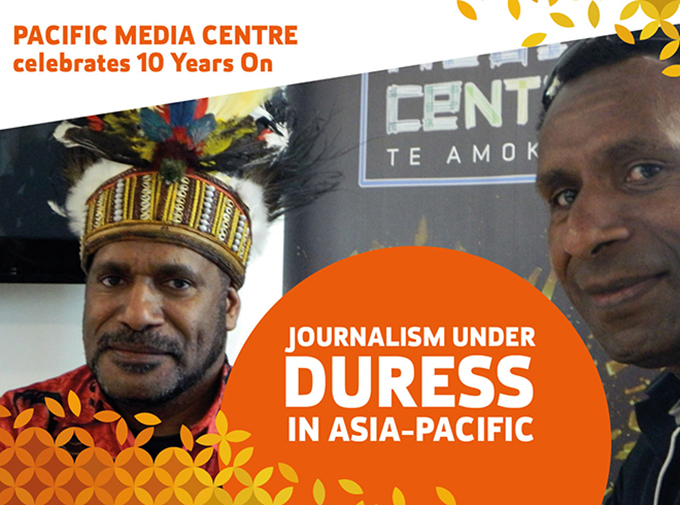
Johnny Blades, a senior journalist of RNZ International (pictured right in Jayapura with Tabloid Jubi editor Victor Mambor), will also speak about his challenging experiences in West Papua, especially during an “official” visit to the Indonesian-ruled Melanesian provinces in 2015.

Livestreaming starts at 6.30pm.

Print Friendly, PDF & Email

Article by AsiaPacificReport.nz

]]>

Media freedom under the spotlight in PMC 10th anniversary event

]]>

Pacific Media Centre … highlights threats to media freedom in anniversary. Image: PMC

Pacific Media Watch Newsdesk

Threats to media freedom in the Asia-Pacific region are under the spotlight at the Pacific Media Centre’s 10th anniversary event tomorrow.

Since 2007, the PMC has examined whether the region is at a tipping point in media freedom issues and has explored the future of journalism in the Asia-Pacific region.

Carrying news of coups, human rights abuses, disasters and climate change, the centre has been an important independent voice, says Professor Berrin Yanıkkaya, head of AUT’s School of Communication Studies.

“The Pacific Media Centre is a channel for the voiceless to have a voice, a platform for the unseen to be seen, and an arena for the ‘others’ to deliberate their ideas.”

Dr Yanıkkaya will launch an investigative photojournalism book, Conflict, Custom & Conscience: Photojournalism and the Pacific Media Centre 2007-2017, edited by Jim Marbrook, Del Abcede, Natalie Robertson and David Robie.

Marbrook, an award-winning documentary maker, says the PMC’s work is “hitting home”.

-Partners-

“We’ve seen the rise of a journalistic information service that serves the world, but significantly the Asia-Pacific region.”

Journalism under duress
With special guests Malou Mangahas, executive director of the Philippine Center for Investigative Journalism, and RNZ International senior journalist Johnny Blades, the PMC will also discuss the challenges to journalists reporting the Asia-Pacific region under the theme of “Journalism under duress in Asia-Pacific”.

“The Pacific Media Centre’s Pacific Media Watch project has developed a strategy to challenge issues of ethics, media freedom, industry ownership, cross-cultural diversity and media plurality – including in the Philippines,” says PMC founding director Professor David Robie.

“This has had quite an impact over the past decade.”

In the panel chaired by Dr Robie, Mangahas will speak about the culture of impunity in the Philippines and the widely condemned wave of extrajudicial killings by President Rodrigo Duterte’s government, which has claimed more than 7000 lives in the ongoing “war on drugs”.

Although the deadly crackdown reportedly eased last month when action was left to the Philippine Drug Enforcement Agency (PDEA), Mangahas argues there has been no real change in strategy.

Blades, among a handful of New Zealand journalists to visit West Papua, will talk about his ground-breaking assignment in 2015 to the Melanesian nation controversially ruled by Indonesia since the 1960s, where allegations of human rights abuses are rife.

“There’s been a lot of democratic change in Indonesia since the turn of the century but West Papuans are still routinely restricted from exercising their basic rights such as freedom of expression and assembly.

“Meanwhile, the catalogue of violent abuses and intimidation against Papuans grows,” says Blades.

The anniversary also includes the screening of a special video by Sasya Wreksono highlighting the PMC’s achievements over the past 10 years, along with a photographic exhibition.

MC is Tagata Pasifika’s Alistar Kata, a former Pacific Media Watch editor.

Seminar: “Journalism under duress in Asia-Pacific” 
Thursday, November 30, 2017 5.30pm-8pm
WG126, School of Communication Studies, AUT
55 Wellesley St, Auckland
Refreshments will be provided
Free admission

Print Friendly, PDF & Email

Article by AsiaPacificReport.nz

]]>

2 shot dead in Philippine human rights violations fact-finding mission

]]>

The Negros human rights violations fact-finding mission. Image: Karapatan

Pacific Media Watch Newsdesk

Three members of a Philippine fact-finding mission team have been shot by armed men in Negros Oriental, reports Karapatan.

The three were shot at 2.40pm yesterday at Barangay San Ramon, Bayawan, Negros Oriental.

Elisa Badayos of Karapatan Central Visayas and Elioterio Moises, a barangay tanod (community leader) and member of local peasant organisation Mantapi Ebwan Farmers Association, were pronounced dead on arrival at a hospital in Bayawan.

A 23-year-old female Kabataan party list member, who was also shot, remained in critical condition, said Karapatan (Alliance for the Advancement of People’s Rights).

The 30-member fact-fining mission team were in the area to investigate and verify reported human rights violations due to intensified military operations in the area.

“The attack on human rights defenders are becoming more rampant, more brutal, more fearless. The perpetrators know they will be dealt with impunity, as human rights have lost force and meaning especially under this regime,” said Karapatan secretary general Cristina Palabay.

-Partners-

“Fact-finding missions are a mechanism for human rights organisations to confirm reports of abuses, and this incident has only proven how fascism works to outrightly kill those who dare to question.”

Rights defenders ‘crippled’
Palabay added that “the space for human rights defenders is fast shrinking, as the Duterte regime is finding more and more ways to cripple defenders on the ground who voice out the real situation experienced by marginalised communities victimised by militarisation.”

She cited the Negros Oriental Provincial Ordinance No. 5, s.2008, known as “An Ordinance Regulating Outreach Activities Through Medical and Fact-Finding Missions in the Countryside of Negros Oriental and for Other Purposes,” wherein non-government organisations and other cause-based organisations are prohibited to conduct any humanitarian mission in Negros Oriental without seeking permission from the governor, municipal government and municipal police.

Violators are sanctioned with six months of imprisonment and a fine of P5000 on participants on the said mission.

The fact-finding team arrived in the mission area in San Ramon, Bayawan at 11am. They were blocked and harassed by elements of the mayor’s private goons, Katapayan said.

Armed men asked about their whereabouts and the purpose of the mission. They were eventually allowed to pass.

About 2.30pm, Bayados, another member of the FFM team, and a member of a Cebu youth organisation decided to go to the police station to file a report regarding the earlier harassment incident.

Armed men open fire
They were accompanied by Moises. While on their way to the police station, they were shot at by unnamed gunmen, suspected of being the same armed men who earlier blocked their entrance to the mission site.

The shooting led to the death of Moises and Badayos.

The 23-year-old KPL member is being taken to a hospital in Dumaguete after sustaining gunshot wounds on her shoulder.

Elisa Badayos is the wife of former union leader Jimmy Badayos.

“We condemn in the strongest terms this recent attack on human rights workers. Even as human rights workers conducting factfinding missions in Batangas, Negros, Mindanao and elsewhere are being subjected to attacks by state forces, we will never relent in struggling alongside with the Filipino people in contending against this murderous Duterte regime,” Palabay said.

Print Friendly, PDF & Email

Article by AsiaPacificReport.nz

]]>

No Philippine law tackles ‘Paradise Papers’ 200 offshore accounts

]]>

ANALYSIS: By Malou Mangahas and Karol Ilagan in Manila

What do some bankers and fund managers, a few senior government officials, a dozen top taxpayers, and a handful of companies located in the Philippines have in common?

They are among some 200 Filipinos, Philippine residents, and corporations that own or are linked to offshore accounts in tax havens across the world, according to the “Paradise Papers” cache of 13.4 million confidential electronic documents that had been leaked and exposed this month.

READ MORE: PCIJ’s Malou Mangahas to speak at Pacific Media Centre’s 10 years On event in Auckland

JOURNALISM UNDER DURESS IN ASIA-PACIFIC PANEL ON NOVEMBER 30

While having offshore accounts is not a wrongdoing per se, in some cases, these may be used to avoid or evade tax payments in their host countries, hide unexplained wealth, or move illicit and fraudulent financial flows across borders.

The latest expose by “Paradise Papers,” which has led to stories by media outfits such as the BBC and the UK newspaper The Guardian, covers offshore investments made by the law firm Appleby and corporate service providers Estera and Asiaciti Trust in 19 tax jurisdictions in the world.

About 120,000 people and companies are enrolled in “Paradise Papers,” including Philippine citizens, residents, and business entities.

-Partners-

Leaked papers
The “Paradise Papers” data files were leaked to the German newspaper Süddeutsche Zeitung, which shared these with the International Consortium of Investigative Journalists (ICIJ) based in Washington, DC, and its global reporting network of over 380 journalists from 100 news organisations, including PCIJ.

PCIJ reviewed the list with special attention to apparent transparency and accountability issues. PCIJ thus sent inquiry letters to about a dozen individuals who had served as senior state officials, donated to candidates for president, own or run major corporate entities, or are tied to contracts with government.

Not all the Philippine accounts are active as of the current year. Most accounts are listed to be operational still while some turned out to have been dissolved already, according to those PCIJ reached for comment.

PARADISE PAPERS: For the full list of persons and companies, check out ICIJ’s Paradise Papers database

This is the second round of PCIJ reporting on offshore accounts with ICIJ. In 2013, PCIJ wrote about the offshore ties of then re-electionist Ilocos Norte Gov. Maria Imelda “Imee” Marcos, then senator Manuel “Manny” B. Villar Jr., and then senatorial candidate Jose Victor ‘JV’ Ejercito. They all failed to disclose their interests offshore in their Statements of Assets, Liabilities, and Net Worth.

Five of those PCIJ sought for comment, as well as replies from the law and accountancy firms that had assisted them, invariably disowned or denied any wrongdoing had been committed in regard to their offshore accounts.

But Filipino and Philippine-based offshore account holders may have nothing to worry about for now. At present, the Philippines has neither law nor rules, nor any effective regulatory framework for monitoring or even recovering taxes possibly due from monies in these accounts.

Split opinion
Also, between former and current finance officials, there is a split opinion on what the Philippine government should do to regulate such accounts and to run after their owners.

Interviewed recently by PCIJ, former Internal Revenue Commissioner Kim Jacinto-Henares said that in her view, when someone or some entity opens an offshore account, that should raise concern at once among government officials.

In contrast, Finance Secretary Carlos G. Dominguez — who admits his connection to an offshore account himself until 2001 – told PCIJ that “there is nothing illegal per se about these accounts… and we are not about to declare them illegal”.

“Actually,” Henares said, “nobody can stop you from incorporating anywhere in the world.” But, she said, “the question is if that company has an asset that matches (its) net worth.”

She pointed out, “The important thing to ask is if the tax for that had been paid, and second, did it come from questionable deals. Kasi ‘yung galing sa masama rin, hindi mo rin binabayaran ‘yung buwis (Because if it came from something illegal, you wouldn’t pay the tax due).”

Why hide monies?

Henares continued: “Ibig sabihin, hindi mo siya maipasok mainly sa pangalan mo kasi hindi mo ma-explain saan nanggaling ‘yung income, saan galing ‘yung pera. ‘Yun lang naman ‘yung tinatanong d’yan, pero itself, wala namang problema (In other words, you couldn’t place it under your name because you won’t be able to explain where the income was sourced, where the money came from. That’s really the only question there, but itself, there’s no problem).”

It’s a question, according to her, of what would drive someone or some entity to open an offshore account. “Siyempre, medyo may tanong lang na ano bang objective mo (Of course, there’s a bit of a question there on what really your objective is),” Henares said. “Parang lahat ng tao feeling nila na kapag Pilipino ka, naiisahan mo ‘yung gobyerno mo. Bakit mo ginagawa ‘yan? (So everyone starts feeling like, if you’re a Filipino, you can easily put one over your government. Why do you do that?)”

‘No law, not illegal’
Dominguez takes the contrary view. Indeed, he said that there is no clear, cogent legal framework to regulate offshore accounts, but getting one “would require legislation by Congress.”

At the moment, he said, “we’re all focused on the tax reform bill until December.”

“But really,” Dominguez said, “there is nothing illegal per se about Filipinos or Philippine residents opening accounts overseas.” Still, he said that “when information like this comes out, then we look at it case by case.”

“In truth, there is nothing illegal about it,” Dominguez said. “It is legal, and we are not about to declare it illegal.” He then cited one instance when he was told that a friend of his staff had planned to open a dollar account in Hong Kong to buy bitcoins. Recalled Dominguez: “I told her, ‘Go ahead, that’s okay’.”

These comments by the Finance Secretary came on the fourth time that PCIJ had called him in the last month, to follow up on a request letter for an official opinion on offshore accounts from his department.

PCIJ mailed its letter to Dominguez last November 8, prompting a quick call from him; at the time, though, he was still in Vietnam for the Asia-Pacific Economic Cooperation Summit (APEC).

Working group promise
He promised then that he would organise a technical working group of his staff, as well as officials of the Bureau of Internal Revenue, and — if they would agree, he said — of the Bangko Sentral and the Anti-Money Laundering Council.

The ASEAN (Association of Southeast Asian Nations) Summit intervened and kept Dominguez busy for a week. He received PCIJ’s second and third calls during the week, however.

Last November 16, he said, “My staff will write you a letter. We discussed this yesterday. There is no law prohibiting anyone from opening offshore accounts. It’s allowed by law.” Offshore accounts “may be a tax leak for us,” Dominguez said, “but it is a small leak.”

He added that offshore accounts are a lesser problem than tax incentives that some companies and sectors have been enjoying for so long. “We have a list of tax incentives given, and you’d be surprised how big those amounts are,” Dominguez said. “Some have been receiving tax benefits for over 40 years.”

Tax leakage on account of incentives given to corporations is, in Dominguez’s view, “a more important issue than someone buying, registering a plane or cargo vessel — that is a one-off thing.”

In an offshore leaks database reported in 2013, Dominguez’s name had actually come up as an offshore account holder. The company listed in his name was called Radstock Corp.

Connection admitted
When PCIJ asked Dominguez about this, he promptly acknowledged his connection with Radstock.

“I saw that before,” he said. “I was involved with them a long time ago, 2001 ‘ata.” As he recalled it, his engagement as a director of Radstock was connected with a project of the Philippine National Construction Corporation.

Like Dominguez, many other finance experts say that offshore accounts are legal. They also note that these are rather common among multinational enterprises with global operations.

Yet when account holders turn to tax havens offshore to avoid or evade paying taxes, hide illicit wealth, and conduct illegitimate or abusive financial flows in secret, they cross over to forbidden territory in law.

Evade, avoid taxes
International companies, finance experts say, operate in tax havens to be able to transfer the taxable income to jurisdictions where tax rates are lower. Companies that make profits in the Philippines, for instance, can transfer these to other jurisdictions. This means that what should have been part of the tax base of the Philippines becomes instead part of that of another country.

Tax havens also use secrecy as a prime tool to hide identities. Individuals and entities can hold shares in offshore companies without being identified, unlike in the Philippines where incorporation and registration records are public.

Too, one can sell shares offshore without having to pay capital-gains tax.

Secrecy jurisdictions provide structures that enable people or entities to skirt or undermine laws of their home country or jurisdictions elsewhere. In the Philippines, the lack of a legal and regulatory regime over offshore accounts makes it difficult for government to run after tax evaders and money launderers.

According to the Tax Justice Network, between $21 trillion and $32 trillion of private financial wealth is located, untaxed or lightly taxed, in tax havens around the world. Illicit cross-border financial flows have also been pegged at $1 trillion to $1.6 trillion per year, a huge amount compared to the $142.6 billion in global foreign aid in 2016.

Founded in 2003, Tax Justice Network or TJN is a UK-based independent international network that conducts research, analysis, and advocacy on international tax, the international aspects of financial regulation, the impact of tax evasion, tax avoidance, tax “competition,” and tax havens. Not aligned with any political party, TJN has global and regional partners in Africa, Asia, Africa, Europe, Latin America, and North America.

TJN has a Financial Secrecy Index that ranks jurisdictions according to their secrecy and the scale of their offshore financial activities. The higher the rank, the more secretive financial activities are in the country.

The scoring is based on an assessment of 15 secrecy indicators that can be grouped around four broad dimensions of secrecy: knowledge of beneficial ownership, corporate transparency, efficiency of tax and financial regulation, and international standards and cooperation.

Of the 92 countries surveyed by TJN for its 2015 Index, Bermuda was ranked No. 34 and Isle of Man at No. 32. The Philippines was 46th. Switzerland, Hong Kong, and the United States are first, second, and third, respectively.

The Financial Secrecy Index reveals that the stereotypes of tax havens are misconceived. Said TJN: “The world’s most important providers of financial secrecy harbouring looted assets are mostly not small, palm-fringed islands as many suppose, but some of the world’s biggest and wealthiest.”

Wanted: Evidence
As of this posting, PCIJ has yet to receive a written reply from Dominguez himself, or even from the “technical working group” that he said he plans to convene to study the matter of offshore accounts.

He tossed PCIJ’s query letter to Finance Undersecretary Antonette C. Tionko, who recently replied to PCIJ. She said in part that they had “gone through the attached list which contains names of Filipinos and a few foreign corporations which appear to have Philippine ownership (although this is not clear considering that only the name of said corporations are provided).”

“Please note,” Tionko said in her letter dated November 22, “that under Philippine tax laws, income of Filipino citizens are subject to Philippine income tax regardless of where earned. On the other hand, only income of foreign corporations from Philippine sources is subject to Philippine income tax.

“Hence, if we assume that the listed corporations are all foreign corporations, evidence must be presented… that income is earned and not reported in the Philippines to constitute a violation of the Tax Code.”

She then asked for “further information” on the Filipinos on the Paradise Papers list. According to Tionko, information “such as purported types of investments, amounts of said investments, and the like will be relevant in determining whether or not there is a violation of Philippine laws.”

Global vs local firms
To Henares, meanwhile, big companies and top taxpayers who have offshore ties are not suspect. She is more concerned, she said, about those on the list who have no global business or reason to have offshore companies.

Asked Henares: “If you have no international corporation, then what are you doing there?”

Henares said that she welcomes having more information into offshore transactions primarily because without information and appropriate regulations, governments have no way of running after tax evaders who hide their wealth offshore.

The BIR, with Henares at the helm, had set to investigate Filipinos with offshore accounts following PCIJ’s 2013 report. But Henares said she could not recall updates on the planned investigation.

When contacted by PCIJ on the matter, BIR Assistant Commissioner Marissa Cabreros said that the Bureau cannot confirm or deny any information about it because its staff are bound by law to keep silent.

In any case, Henares said that the country’s strict bank secrecy law in a way already offers “a domestic haven” for people who may want to hide their cash assets. Tax havens offshore meanwhile offer options for people who may want to hide their ownership of properties.

“Let’s say,” she said, “without knowing how much they have in the bank, we already know they’re deficient by P1 million. What more if we have that bank figure? It would be much, much more ‘di ba? Then what more if we have the information about the international (accounts)? Then it could become much, much more din.”

Information exchange
The OECD Global Forum for Tax Transparency was specifically set up to address the risks to tax compliance posed by secrecy jurisdictions. Global Forum members, among them the Philippines, had agreed to implement transparency and exchange of information for tax purposes. This includes the Exchange of Information on Request (EOIR) and the Automatic Exchange of Financial Account Information (AEOI), which requires tax administrations to exchange taxpayers’ financial information.

Henares clarified, however, that the Philippines is involved only in the EOIR, which allows the BIR to exchange information only with a country that the Philippines has a tax treaty with.

The Philippines was reviewed as “largely compliant” in the first round of the EOIR review. But it currently has treaties with 41 countries only; it has no tax treaty with many of the popular tax havens.

The OECD and the Council of Europe also developed the Convention on Mutual Administrative Assistance in Tax Matters, which is said to be the “most comprehensive multilateral instrument available for all forms of tax co-operation to tackle tax evasion and avoidance.”

The convention not only provides for exchange of information, but also includes assistance in recovery, the service of documents, and facilitation of joint audits.

The Philippines signed onto the agreement in 2014 but has yet to ratify it.

The article was published by the Philippine Center for Investigative Journalism (PCIJ) and is republished here with permission.

Print Friendly, PDF & Email

Article by AsiaPacificReport.nz

]]>

42 years after Timor-Leste’s declared independence, a democracy plea

]]>

ETAN members at the time of the award of the Order of Timor-Leste, the country’s highest honour, in 2012: John M. Miller (second from right), and Charles Scheiner (right), with other special awardees Father Domingos Morato da Cunha (left) and Father Reinaldo Cardoso at the presidential ceremony. Image: ETAN

OPINION: Open letter by Charles Scheiner, Pamela Sexton and John M. Miller of ETAN

The people of the Democratic Republic of Timor-Leste will today celebrate the 42nd anniversary of their Declaration of Independence.

For the last 26 of those years, the US-based East Timor and Indonesia Action Network (ETAN) has supported their struggle for self-determination.

We stand in solidarity with all the people of Timor-Leste, and do not favour any political party or leader.

READ MORE IN TETUN: Timor-Leste selebra aniversáriu proklamasaun independénsia da-42; ETAN rekoñese no enkoraja ninia demokrasia ho dame

The Timorese people are currently facing a challenging time, as an opposition coalition in Parliament challenges the current government’s right to govern.

We encourage everyone to put the national interest above personal and partisan interests and to adhere to the Constitution, law, and democratic principles.

-Partners-

ETAN is confident in the strength of Timor-Leste’s democratic institutions and in its people’s commitment to stability, democracy and justice.

While politicians and commentators in Dili debate legal interpretations and jockey for power, the other 99 percent of the Timorese people are trying to live from day to day.

Public services
They depend on public services like education, health care and safety. Many still lack decent livelihoods and adequate food.

We encourage those in government, Parliament and political parties to design, improve, and carry out programmes to strengthen and diversify Timor-Leste’s economy, minimise poverty, decrease unemployment and malnutrition, reduce inequalities, and eliminate corruption.

Addressing these challenges will be the key to long-term stability for the country.

We also encourage every official, public servant and citizen to attend to people’s lives and families, without being distracted or paralysed by rumours, partisan maneuvering or anxiety about politics.

The President of the Republic will play a key role in resolving this political impasse, which we hope is over soon. We appreciate the calm way he is carrying out his duties under the Constitution, and we hope that he will continue to promote dialogue among political leaders, elected officials, civil society, ordinary citizens, and others to find the best solution for the entire nation.

We were encouraged by the President’s recent meeting with rural women leaders, and hope to see more women included fully in political discussions, including at the highest levels of political leadership.

Many people in Timor-Leste have traumatic memories of the brutal Indonesian occupation, as well as of the intra-Timorese conflicts of 2002 and 2006. However, people have learned from that history, as demonstrated by the largely peaceful last decade.

Moderation, restraint
We appreciate the moderation, restraint, and adherence to law currently exercised by nearly all citizens and by Timor-Leste’s police and military, and we expect that this will continue.

Although political rhetoric has sometimes been confrontational, it has not escalated to physical violence. We hope that the leaders and people of Timor-Leste continue to show their commitment to peaceful, democratic processes in a sovereign nation.

During the last 500 years, the small nation of Timor-Leste has often been oppressed, manipulated or exploited by international actors. We urge foreign powers to allow the Timorese people to work out their own problems without outside interference, even as we show our solidarity by encouraging Timor-Leste to follow a peaceful, fair and democratic path.

Yesterday, most people in the United States were celebrating Thanksgiving, a day to be grateful for the good people and things in our lives. We also recall the shameful history of European colonisation, especially the genocide of Native Americans.

ETAN also gives thanks for the sovereignty, democracy and peace that currently prevails in Timor-Leste, but we do not forget the shameful colonisation and occupation which foreign invaders, some supported by the United States government, inflicted on your people.

We recommit ourselves to improve democratic practices in the United States and to work for policies which secure human rights, end impunity, and achieve social and economic justice for both our peoples.

Timor-Leste has made more progress in 42 years than the United States has in 241, but both nations have a long way to go, and ETAN looks forward to the continuing journey

ETAN was in 2012 awarded the Order of Timor-Leste, the highest honour in the republic, for its “contribution to the liberation of the country”. Timor-Leste (East Timor) declared independence from Portugal on 28 November 1975, but was invaded by neighbouring Indonesia nine days later.

Print Friendly, PDF & Email

Article by AsiaPacificReport.nz

]]>

Journalism educators protest over ‘targeting’ of Boochani on Manus

]]>

Manus Island was the unique setting for this Sydney Film Festival documentary collaboration between Iranian-Kurdish journalist Behrouz Boochani and a Dutch filmmaker using footage shot on a mobile phone. Video: Sydfilmfest

Pacific Media Watch Newsdesk

The Journalism Education and Research Association of Australia (JERAA) has expressed its deep concern about reports that Behrouz Boochani, an Iranian-Kurdish journalist and regular contributor to Australian publications, was arrested on Manus Island early last Thursday.

He was released later in the day.

READ MORE: Médecins Sans Frontières denied access to refugees as thousands rally in Australia

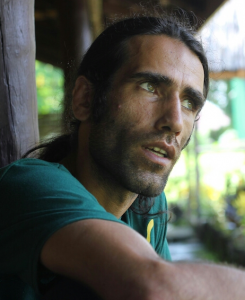
Behrouz Boochani … refugee journalist “targeted” by authorities on Manus Island. Image: Refugee Alternatives

The Media Entertainment and Arts Alliance (MEAA) chief executive, Paul Murphy, said Boochani appeared to have been deliberately targeted by Papua New Guinea (PNG) police in the crackdown on November 23 because he was well known as a journalist reporting from inside the detention centre.

“Behrouz has been one of the main sources of factual information about conditions inside the Manus Island detention centre for the past few years, and his reporting has been published in Australia and internationally,” Murphy said.

-Partners-

“His reporting in the finest traditions of journalism has been critical when the Australian and PNG governments have done everything they can to prevent media from having access to the asylum seekers on Manus Island.

“If, as the case appears to be, he has been targeted and arrested because of his profile and his role as a journalist in an attempt to silence him, this is an egregious attack on press freedom that cannot be let stand.”

Like MEAA, JERAA has called on the Australian and PNG governments to inform the public about his safety, and allow him to continue doing the journalistic work he has been for so many months.

Amnesty Award for journalism
Just three weeks ago, Boochani was awarded the Amnesty International Australian Media Award for his journalism from Manus Island.

JERAA president, Matthew Ricketson, was a guest speaker at the awards in Sydney, and testified to the loud applause that greeted the award as well as the heartfelt admiration of his colleague at Guardian Australia, Ben Doherty, who accepted the award in Boochani’s absence.

Professor Ricketson said: “Behrouz Boochani’s reporting has been brave and inspiring, not least because he has been pursuing it while at the same time he has been detained indefinitely.

“Governments for nearly two decades now have been fighting determinedly to hide from public view – and the possibility of public empathy – what has been happening inside offshore detention centres.

“Boochani’s reporting is a vital counterweight to this campaign”.

Earlier this year, MEAA, the journalists’ union, co-ordinated an open letter to Prime Minister Malcolm Turnbull, calling for him to be resettled in Australia. Dozens of high-profile journalists and writers co-signed the open letter.

Boochani’s work has been published in The Saturday Paper as well as Guardian Australia, while his film about life inside the Manus detention centre, Chauka, Please Tell Us the Time has been screened at the Sydney and London film festivals. He tweets at @BehrouzBoochani

Print Friendly, PDF & Email

Article by AsiaPacificReport.nz

]]>

Kiribati – a Pacific ‘drowning paradise’ fighting for its existence

]]>

DW Documentary reports on Kiribati’s struggle for survival with climate change. Video: DW

DOCUMENTARY: By Markus Henssler

Climate change and rising sea levels mean the island nation of Kiribati in the South Pacific is at risk of disappearing into the sea.

But the island’s inhabitants aren’t giving up. They are doing what they can to save their island from inundation.

Their survival story was featured this month at COP23 in Bonn, Germany.

UN estimates indicate that Kiribati could disappear in just 30 or 40 years.

This is because the average elevation is less than 2m above sea level.

-Partners-

And some of the knock-on effects of climate change have made the situation more difficult.

Kiribati can hardly be surpassed in terms of charm and natural beauty.

There are 33 atolls and one reef island – spread out over an area of 3.5 million sq km.

All have white, sandy beaches and blue lagoons.

Largest atoll nation
Kiribati is the world’s largest state that consists exclusively of atolls.

A local resident named Kaboua points to the empty, barren land around him and says, “There used to be a large village here with 70 families.”

But these days, this land is only accessible at low tide. At high tide, it’s all under water.

Kaboua says that sea levels are rising all the time, and swallowing up the land. This is why many people here build walls made of stone and driftwood, or sand or rubbish.

But these barriers won’t stand up to the increasing number of storm surges.

Others are trying to protect against coastal erosion by planting mangrove shrubs or small trees.

But another local resident, Vasiti Tebamare, remains optimistic. She works for KiriCAN, an environmental organisation.

She says: “The industrialised countries — the United States, China, and Europe — use fossil fuels for their own ends. But what about us?”

Kiribati’s government has even bought land on an island in Fiji, so it can evacuate its people in an emergency.

But Vasiti and most of the other residents don’t want to leave.

Print Friendly, PDF & Email

Article by AsiaPacificReport.nz

]]>

Sika honours Tongan heritage as police warn ahead of World League semifinal

]]>

Fifth Harmony singer Dinah Jane will sing the Tongan national anthem before kick-off in the World Rugby League semifinal with England today. Image: Kaniva News

By Kalino Latu, editor of Kaniva News

The president of the Mate Ma’a Tonga Rugby League Association has turned to Tongan tradition in announcing the attendance of King Tupou VI and international Tongan singer Dinah Jane at the Tonga-England semifinal at Auckland’s Mt Smart Stadium today.

Sēmisi Sika said his committee made the invitation to make sure the national team and Tongan supporters enjoyed the historic event to the full.

In Tongan he said: “We have plucked down the stars, moon and the sun for you so that you can calm down and become satisfied.

“Let’s focus on supporting our MMT in their battle and may we all put together our efforts so we can bring about a great game for the Conqueror of the Nation.”

[“Kuo tau paki’i mai e fetu’u , mahina mo e la’aa ke mou nonga aa mo fiemalie . Tau hanga taha ki hono poupou’i e tau fanau MMT i he feinga tau mo fakatauange ke tau ma’u ha fakame’ite fakaholo mamata ki he Hau o e fonua.”]

The poetic references were meant for the king, the queen and all invitees.

-Partners-

Fifth Harmony singer Dinah Jane will sing the Tongan national anthem before the kick-off of the Rugby League World Cup semifinal match.

Among other invitees were Prime Minister ‘Akilisi Pōhiva and other local VIPs, Sika said.

Tagata Pasifika
John Pulu of TVNZ’s flagship Pacific current affairs programme Tagata Pasifika has been invited to be master of ceremonies.

The invitation from the Tongan Rugby League committee was also extended by the chairman of the Rugby League World Cup 2017, Dr George Peponis Oam and the Rugby League World Cup CEO Andrew Hill.

No Pacific nation has ever made it to a World Cup final, but Tonga is hoping to become the first.

Tongan winger Konrad Hurrell said: “It was our first quarterfinal last week and this is our first semi-final as well – imagine if we make the final, it would be crazy.

“That would be good but we’ve got to knock out England as well to make the final.”

Australia crushed Fiji 54-6 yesterday in the first semifinal.

Police warning
Meanwhile, Auckland police have warned they will not tolerate disorderly behaviour following this weekend’s rugby league game.

Police will be out in force on the streets tonight in an effort to keep the public safe and prevent any disorderly incidents, Counties Manukau East Area Commander Inspector Wendy Spiller said.

Over the past few weeks, police have dealt with a number of disorderly incidents following Tongan league games on the streets of South Auckland, particularly around the Otahuhu Town Centre.

On two occasions police officers have been attacked while trying to manage and contain the disorder, Inspector Spiller said.

In one incident last weekend in Otahuhu, a female police officer from Counties Manukau was king-hit and knocked unconscious by a male who then disappeared into the crowd.

“Police will not tolerate this violent and cowardly behaviour,” Inspector Spiller said.

“Our hard-working staff come to work every day to keep our communities safe and the last thing they deserve is to be attacked or harmed.”

Inspector Spiller said the injured officer was yet to return to work, but was making a good recovery.

“Someone out there knows who is responsible,” she said.

“We will do everything we can to identify the offender and hold them to account.”

Anyone with information is urged to contact Counties Manukau Police on 09 261 1300 or Crimestoppers anonymously on 0800 555 111.

Flagpole attack
A second police officer who was struck in the face with a flagpole in a separate disorderly incident several weeks ago has only been able to perform light duties since returning to work.

Police have arrested a male in relation to that incident.

With a large number of people expected to take part in festivities over the weekend, Inspector Spiller said police would have additional staff on duty to monitor crowd behaviour and ensure the safety of the public.

Alcohol would be banned in and around the Otahuhu Town Centre and police would not tolerate violent or reckless behaviour.

“We want people to keep themselves safe,” Inspector Spiller said.

“People acting recklessly and putting themselves and others at harm by riding on vehicles or setting off fireworks in crowded areas will not be tolerated.

“It is important that excited fans do not block streets stopping traffic.”

Asia Pacific Report republishes Kaniva News items by arrangement.

Print Friendly, PDF & Email

Article by AsiaPacificReport.nz

]]>

Indonesian double standards over press freedom endanger safety of Papuan journalists

Street art posters in support of protecting journalists in a “free media” West Papua in Jakarta, Indonesia, during WPFD2017. Image: David Robie

Pacific Media Centre

Friday, November 24, 2017

Abstract

It was ironical that the most evocative demonstration of freedom of the press in Indonesia since the draconian Suharto era two decades ago was also given a global black mark for attempting to “gag” free discussion over violations on its own geopolitical doorstep. Indonesian hospitality was widely praised for the four-day efforts in hosting World Press Freedom Day 2017, yet both Jakarta and UNESCO officials were acutely embarrassed over events in the easternmost West Papuan region (Robie, 2017a). Four days before the WPFD event got under way on April 30, prominent Papuan journalist Victor Mambor, editor-in-chief of Tabloid Jubi and a former chairperson of the West Papuan chapter of the Aliansi Jurnalis Independen (Alliance of Independent Journalists) between 2010 and 2016, had warned in the New Internationalist that Indonesian double standards had imposed a silence over West Papua (Mambor & Payen, 2017). Even a Papuan protest outside the Jakarta Conference Centre venue on World Press Freedom Day itself was kept at the margins, ensuring most of the 1,500 journalists, media academics and communication policy makers from 90 countries were unaware of the shocking press and human rights violations that continue almost daily in the Melanesian provinces of Papua and West Papua (collectively known as “West Papua” in South Pacific nations).

DOI: 10.1080/01296612.2017.1379812

Report by Pacific Media Centre ]]>

Police brutally attack Papuan journalist in Timika, says human rights group

]]>

Journalist Saldi Hermanto … attacked for making social media criticisms of police conduct in Timika, Papua. Image: Tabloid Jubi

Pacific Media Watch Newsdesk

The Asian Human Rights Commission (AHRC) has condemned a brutal attack against journalist Saldi Hermanto in Timika, Papua, and called for a campaign of letter protests.

Hermanto was attacked by the police after he criticised on Facebook the police handling of security at an entertainment show he attended.

Although the Mimika police chief pledged to “properly settle” the case, the public and media should monitor and ensure that the case was not merely settled by the internal police mechanism, AHRC said in a statement.

“The perpetrators must be criminally prosecuted,” it said.

AHRC’s case narrative said that on Saturday, 11 November 2017, at 10:50 pm, journalist Saldi Hermanto and his child were enjoying an entertainment show in the night market of Timika Indah, Papua.

As the show was going on, suddenly there was chaos among the audience. Subsequently, Hermanto wrote on his Facebook wall criticising the police failure to secure the entertainment show and guarantee security for visitors.

-Partners-

Hermanto’s criticism angered the police officers, some of whom felt he had humiliated and offended the police institution.

Search for journalist
Some six to eight police officers of Mimika Police Office (Polres Mimika), then searched for Hermanto.

Finally, they found him in a small post where many journalists usually gather and send news to various media, located in front of the Mimika Traffic Police Unit of Mimika Police Office (Kantor Satuan Lalu Lintas Polres Mimika).

The police officers then brutally attacked Hermanto, they beat him repeatedly and brought him inside the integrated police post, the AHRC report said.

“The brutal attack caused serious injuries on Hermanto’s face and right rib, and Hermanto had difficulty breathing after the attack,” the report said.

On November 13, at 9 a.m. Timika journalists from the Association of Online Media (IWO) Timika and from the Association of Journalist Photo Indonesia (PFI) Timika organised a peaceful protest in front of the Mimika Police Office in Cendrawasih Street.

The protesters demanded that the chief of oolice of Mimika Police Office, Police Superintendent (AKBP) Viktor Dean Mackbon, “fairly and properly investigate” the brutal attack and violence against Saldi Hermanto, a journalist of Salam Papua and Okezone.

In responding to the protest, AKBP Dean Mackbon stated that nine of 13 police officers who had been examined, were detained for further investigation related to the attack.

Two investigations
In addition, AKBP Victor stated that the there would be two investigation processes, both internal and criminal prosecution. He also apologised to the journalists and promised to settle the case.

The AHRC notes that violence against journalists continues in Indonesia.

Another recent case occurred on 20 October 2017, when police brutally attacked Panji Bahari, a journalist of Banten Post in Banten province.

According to the Independence Journalist Alliance (AJI) Indonesia, in 2016 there were 78 cases of violence and attacks against journalists. This is a higher number compared to 2015, in which 40 cases of violence and attacks against journalists were recorded.

Print Friendly, PDF & Email

Article by AsiaPacificReport.nz

]]>

IFJ blasts ‘press freedom attack’ on Iranian-Kurdish journalist in PNG

]]>

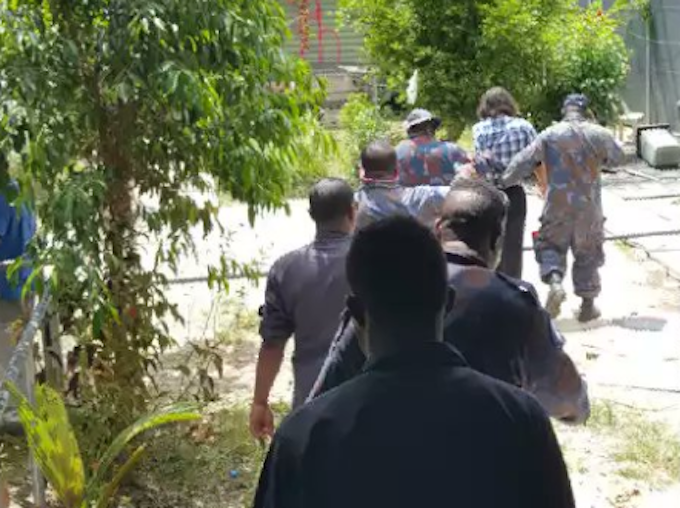
Two PNG police officers led away Behrouz Boochani in handcuffs on Manus Island earlier today. Image: Aziz58825713/Twitter

Pacific Media Watch Newsdesk

The International Federation of Journalists (IFJ) joins its affiliate Media, Entertainment and Arts Alliance (MEAA) in condemning the reported arrest of Iranian-Kurdish journalist Behrouz Boochani by Papua New Guinea police earlier today.

The IFJ and MEAA have deplored the arrest as a targeted attack on press freedom by Papua New Guinea’s police.

A police operation was launched on Manus Island with PNG police and immigration officers entering the former Australian detention centre.

The centre was closed three weeks ago, but refugees have refused to leave, due to concerns over their safety.

Large numbers of officers, including the paramilitary police mobile squad unit entered the grounds and told the refugees they had an hour to leave. They tried to confiscate mobile phones and reportedly damaged personal belongings.

Behrouz Boochani, an Iranian-Kurdish journalist, was arrested during the raid, with reports that officers were specifically looking for him.

-Partners-

Silencing a critic
He was led away in handcuffs by two police officers.

Boochani has been in the detention centre on Manus Island since August 2013.

Boochani has been a main source of factual information about the conditions inside Manus Island detention centre, with his reports been published in Australia and internationally.

Earlier this year he was shortlisted in the journalism category for the 2017 Index on Censorship’s Freedom of Expression Awards and just three weeks ago he was awarded the Amnesty International Australia Media Award for his journalism from Manus Island.

Earlier this year, MEAA and the IFJ launched a campaign with IFEX calling on the Australian government to resettle Boochani in Australia.

MEAA chief executive Paul Murphy said: “If, as the case appears to be, he has been targeted and arrested because of his profile and his role as a journalist in an attempt to silence him, this is an egregious attack on press freedom that cannot be let stand.

“We call on the Australian and PNG governments to release him from custody, assure his safety, and not to hinder him from continuing to perform his role as a journalist.”

The IFJ said: “The arrest of Behrouz Boochani, if it is because of his work as journalist, is a blatant attack of press freedom and an attempt to silence a critical voice. We join MEAA in calling for the Australian and PNG governments to release him for custody immediately, and guarantee his safety.

“Journalists should never be stopped from doing their work.”

Print Friendly, PDF & Email

Article by AsiaPacificReport.nz

]]>

Philippines under Duterte – acute impunity and fettered information

]]>

Eight years later, families of the 58 people massacred in Maguindanao – including 32 journalists – continue to wait for justice. Image: UCANews

ANALYSIS: By Malou Mangahas in Manila

Eight years ago on 23 November 2009, 32 journalists were among the 58 who were killed in what is now known as the Maguindanao Massacre, until then the worst and most tragic incident of media lives lost in a single day.

Multiple murder charges have been filed against more than 100 people for the incident but to this day, the presentation of defence witnesses has not finished, and about 80 other respondents remain at large.

Indeed, acute assaults on journalists and media freedom should not pass with impunity.

Today, as the nation marks the 8th anniversary of the Maguindanao massacre, this composite report of the Center for Media Freedom and Responsibility, the National Union of Journalists of the Philippines, and the Philippine Center for Investigative Journalism, illustrates why the press in the Philippines would do well to understand the severity of the challenges it faces under the Duterte administration — a situation of benign and acute impunity, and fettered flow of information.

While we remain a free community in law and theory, and blessed with a Constitution that enshrines protection, a tectonic shift has moved the ground and the foundation of the practice of journalism in the last 16 months.

The press in the Philippines has been described to be among the freest in Asia if not in the world, robust, almost rambunctious in its practice. But in the first 16 months of the Duterte administration, its status and practice have been diminished, shaken down by supporters and trolls of the President who would not tolerate critical coverage.

-Partners-

No less than the President has struck at the heart of the institution with threats of action against major news organisations. He has cursed journalists in public for raising testy questions about his health, catcalled a female reporter, and averred without serving proof that journalists are killed because they are corrupt.

Toxic mix
This toxic mix — over-reaching executive power, the threat of violence and public censure, and divided and fettered newsrooms — has left the flow of information unfree, convoluted, and constrained under the Duterte presidency.

To be sure, the administration has taken steps early in its rule to address the attacks and threats, and a string of unsolved murders of Filipino journalists from earlier years.

Duterte signed Administrative Order No. 1, Creating The Presidential Task Force On Violations Of The Right To Life, Liberty And Security Of The Members Of The Media (PTFoMS), on 11 October 2016. But the agency that is also called PTFoMS lacks resources and personnel to have genuine impact.

The cases of assaults on the media under the Duterte presidency turned bad in succeeding months, however. From May to October this year, the number of casualties among members of the press began to rise again.

In the first 16 months of the Duterte presidency:

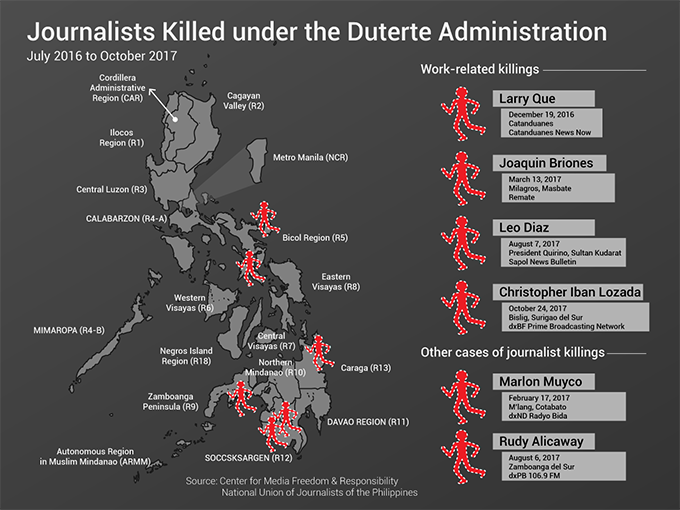
  • Six journalists have been killed, including the three that had been listed by the Task Force;
  • Eight have survived slay attempts and received death threats;
  • Three libel cases have been filed, even as a libel case filed in 2015 has led to the arrest of the accused. Other libel cases filed in previous years ended in an acquittal and two convictions; and
  • Six major cases of verbal and online threats from local officials or pro-Duterte bloggers have been reported.
Journalists killed under the Duterte administration in 2016. Image: PCIJ

These acute and direct attempts to harass and muzzle journalists and media freedom have unfolded alongside more benign but equally grave threats to the practice of journalism and the free flow of information in the Philippines today. For instance:

  • Access to information remains problematic for journalists and media agencies covering the war on drugs. Getting information, especially on sensitive and controversial cases, remains constrained;
  • Against their will, media personnel are sometimes compelled by police officers to sign on as witnesses in police anti-drug operations, supposedly as mandated by the law;
  • Newsroom protection for the safety of journalists covering the war on drugs remains lacking; and
  • Psychological trauma overwhelms media coverage teams assigned to the war on drugs on account of their repeated first-hand exposure to revolting images of the dead, the maimed, the enraged, as well as the tremendous grief of the family members of the victims.

Malou Mangahas is executive director of the Philippine Centre for Investigative Journalism(PCIJ). She will be in Auckland next week to address the Pacific Media Centre’s 10th Anniversary seminar on Thursday.

Print Friendly, PDF & Email

Article by AsiaPacificReport.nz

]]>

Bryce Edwards’ Political Roundup: Vital progress in dealing with the Pike River mine tragedy

]]>

Bryce Edwards’ Political Roundup: Vital progress in dealing with the Pike River mine tragedy

[caption id="attachment_13635" align="alignright" width="150"] Dr Bryce Edwards.[/caption] The Pike River mine disaster shook New Zealand politics and society. The circumstances that led to the preventable death of 29 men, and the denial of justice to their families, means it remains politically fraught. The government’s announcement of a new agency to deal with the unresolved issue is a big step forward and a strong statement about what this government hopes to stand for. Why action on Pike River is so important It might seem strange that seven years after the event, the Pike River mine disaster has re-emerged at the top of the political agenda. In another piece today I’ve tried to explain Why action on Pike River is so important to this government. I argue it’s become a litmus test for any progressive political party that wants to be considered pro-worker: “The death of 29 men at the Pike River mine in 2010 has become a symbol of what is wrong with politics and economic power in our society… What happened that day wasn’t some kind of natural disaster – it was a preventable accident caused by the unsafe business practices of the mine owner, which operated under extremely lax health and safety practices that previous National and Labour governments had implemented and subsequently failed to tighten up.” This was all verified by the release of the Pike River Royal Commission report back in 2012, which I described as “a compendium of political and corporate negligence.” For coverage of this at the time, see two political roundup columns, Pike River’s political implications, and Labour’s role in Pike River. Yet, even after the Commission’s report came out, there continued to be an unsatisfactory response from authorities. In fact, there’s never been any sort of proper justice for the families of the victims. As I outlined in another column earlier this year, New Zealand is very good at allowing The unaccountability of elites. But in the years since then there’s been a rising public pushback against elites and authorities, and “against capitalism”. This anti-Establishment mood means politicians – especially those of a leftwing or populist persuasion – are now more inclined to tap into this discontent. For more on this, see John Moore’s blog post, Pike River and the anti-Establishment zeitgeist. He argues “New Zealand politicians are very aware of how the Pike River mining disaster has taken on a symbolic value of representing the ugly face of ‘peak capitalism’, and of the general failures of ‘neo-liberalism’.” This is all pushing the Labour Party to the left. Although the NBR’s Rob Hosking takes a more cynical view: “The Pike River issue has become talismanic – it involves mining on the West Coast, and today’s inner-city, villa-living Labour politicians like to wax nostalgic over such symbols. In other words, it has become yet another part of Ms Ardern’s brand management approach to government” – see Hosking’s column, Pike River the latest piece of Ardern brand management (paywalled). Action over Pike River  On Monday, the coalition government announced the establishment of the new Pike River agency tasked with re-entering the mine. The agency will be set up in January, headed by a chief executive who will report to Andrew Little, the Minister Responsible for Pike River. It will receive funding of $23 million over three years. Yesterday’s New Zealand Herald editorial explains the new agency’s role: “The Cabinet has agreed to place the abandoned mine under the management of a new agency that will be given three objectives. The first, gather evidence about what may have caused the explosion. The second, give victims’ loved ones “closure and peace of mind”. Third, “if possible recover any human remains”.” – see: Involving Pike families a crucial move. Gordon Campbell says the new course of action is fitting: “This new effort is the least that can be done, given the role that successive National and Labour governments played (in legislative changes made in 1993) that fatally weakened the framework of health and safety protections available to New Zealand workers. Subsequently, the Pike River Royal Commission found those regulatory changes led directly to the disaster” – see: On the new Pike River agency. Campbell points to the lack of justice for the victims’ families. Even when it came to compensation “secured creditors like the BNZ got paid in full ($50 million) from the insurance proceeds, while the Pike River families received a comparative pittance”. And he argues National was negligent in the way it dealt with the families: “The Key/English administrations effectively excluded the families, discounted their experts, and strung the families along about the potential for re-entry, with no closure date in sight. By contrast, the new agency’s approach will be inclusive, all available expertise will be drawn upon and the families will be regularly advised of progress, with fixed dates for decision.” Campbell says it is ” somewhat ironic” that Andrew Little will lead the new agency “given that in the immediate aftermath of the disaster in 2010, Little – then head of the EPMU – had initially defended the mine’s health and safety record.” Little himself acknowledges the portfolio is very personal to him – see Claire Trevett’s profile: Andrew Little: The Renaissance Man. She reports “At the moment, the only thing that has made it on to the wall in his office is a piece of paper with photos of the 29 miners who died in the Pike River Mine disaster seven years ago.” She quotes his explanation: “That’s to remind me that that’s what I’m there for. They’re the guys who’ve lost their lives and they are what this is all about ultimately.” In the same article, Little also deals with the issue of Winston Peters’ promise to be the first to re-enter the mine: “in my view it is specialist work. I don’t detract from his enormous skills and talents and expertise in a lot of matters, however there is a level of danger attendant on this and I want the full risk assessment to happen.” How “new” is the Government’s approach? Some commentators and politicians are questioning how the new approach outlined by the Government is all that different from National’s. After all, the prime minister and Andrew Little are stressing that they can’t guarantee entry to the mine will happen, and that they will have to rely on experts to determine whether it is safe to do so. Tuesday’s Dominion Post editorial says: “in the end the result might prove to be the same: that the mine cannot be safely entered, and the families will again be left high and dry. In which case the grief and the outrage will go on… So how is that different from what the last lot of governing politicians said? Former National Prime Minister John Key said he would do everything possible to get the bodies out. Labour politicians promised to do something similar” – see: New rulers but the same old problem at Pike River. Similarly, see Barry Soper’s column, Every chance Pike River situation will remain same for years. And the National Party might be forgiven for feeling that the parties of the new Government dished out the criticism while in Opposition, but have now adopted a similar stance on re-entering the mine. National’s spokesperson for Workplace Safety and Pike River, Amy Adams, says: “It seems to me that there’s a considerable softening on the position they expressed repeatedly and quite emphatically during the campaign – that they already had clear advice that they could re-enter and that they would be absolutely doing so… Now it seems what they are saying is far more in line with what the previous government had consistently maintained which is that it absolutely wasn’t opposed to a manned re-entry but that it would have to be done in a way which was safe” – see Benedict Collins’ National accuses govt of back peddling on Pike pledge. National Party supporter Ele Ludemann suggests that perhaps the politicians were Mining personal grief for political ends: “Little will be criticised for his safety-first stance, but this time it’s the right one. The wrong one was making a promise that he and the other politicians, including his leader, Jacinda Ardern, should never have made. Those politicians were mining personal grief for political ends. It was despicable behaviour.” Another National-aligned blogger, David Farrar, questions whether the money might be put to better use by giving it to the families: “$23 million is a lot of money. I don’t begrudge it, if a re-entry can be done safely. But it does make me wonder whether the families would appreciate an offer of spending that $23 million on them directly, rather than a re-entry attempt that might not even be successful” – see: Would the families rather have $1 million each or re-entry? And the difficulty of the re-entry task is reiterated by the “geologist who warned of the dangers of Pike River three years before the tragic explosion”, who now “says it will be impossible for the new government agency to safely reach the guts of the drift” – see the Herald’s Geologist Murray Cave: Re-entry to guts of Pike River ‘impossible’. The big difference in the new government’s approach Ultimately, as the Dominion Post editorial points out, the big difference in the approach of the new government is the way it is involving the mine victims’ families: “Perhaps the main political difference right now is that Little is working alongside the families and involving them in the project.” Barry Soper goes further, suggesting “what it comes down to is whether the previous National Government was completely forthcoming with all of its information on Pike. The discovery of the 36 hours of footage of the mine’s drift this year suggests perhaps it wasn’t. That’s what cast doubt on the handling of the situation again seven years on”. And the Herald’s editorial also presses the importance of this inclusive approach: “It will not be enough to give them briefings in Greymouth as the previous Government did when it had progress (or lack of it) to report. The families will need to be treated almost like a board of directors for the agency, not with the power to tell it what to do but to be part of its discussions in deciding what to do.” The families themselves seem to be on board with this type of suggestion. Nicholas Jones reports “It was possible a family representative would be on a selection panel for the new Pike River Recovery Agency chief executive and other key staff such as the on-site manager” – see: Winston Peters confident of Pike River re-entry. Furthermore, “The families had also discussed making the decision process more transparent to the wider public, including the possibility of hearings, and releasing documents and materials.” Finally, political journalists at TV3’s Newshub have long championed the Pike River mine families and their campaign, and in September when a memorial was established at the mine, Lloyd Burr wrote passionately about the place and what had happened: “But there’s something in the air. It’s injustice. The memorial is a reminder of the injustices the families have had to endure. The injustice of the disaster, the injustice of way the attempted rescue was carried out, the injustice of the failed recovery efforts, and the injustice of failed re-entry bids. It’s a reminder of the injustice of Pike River bosses flouting laws, and escaping charges, and getting away scot free. To the families, it’s a reminder of the injustice of John Key’s broken promise, and his Government’s treatment of those who’ve given up everything to fight for answers” – see: Injustice in paradise at Pike River.]]>

Critical Politics Newsletter: New Zealand Politics Daily – 23 November 2017 – Today’s content

Critical Politics Newsletter: New Zealand Politics Daily – 23 November 2017 – Today’s content Below are the links to the items online. The full text of these items are contained in the PDF file (click to download). [caption id="attachment_297" align="aligncenter" width="1600"] The Beehive and Parliament Buildings.[/caption] Education Jessica Long (Stuff): Education Ministry turns down teachers’ call for immediate 5pc pay rise Peter Lyons (Herald): Treating education as football unfair and wasteful Toby Curtis (Herald): Charter schools worth preserving Simon Collins (Herald): NCEA Level 1 maths exam ‘not that hard’ John Gerritsen (RNZ): Girls outclass boys as NZ ranks top 10 for collaboration Nicholas Jones (Herald): Government reverses rule allowing kids to start school at 4 Mei Heron (RNZ): Fifth birthday school starts back on table 1News: Children won’t be able to start school until they’re five under planned changes by new Government Jo Moir (Stuff): Government to take away option for children to start school at four years old Jo Moir (Stuff): Politicians fight it out over children starting school eight weeks before they turn five Herald Editorial: No fees will mean fewer places for foreign students Anna Bracewell-Worrall (Newshub): Labour bars Australians from fees-free study Craig McCulloch (RNZ): Govt reveals costings for student allowances boost Laura Walters (Stuff): Student allowance and living cost rises come in at $200m a year Herald: Labour releases costings on university plans Jenna Lynch (Newshub): Increase to Student Allowance to cost $700m Jenna Lynch (Newshub): How much will the boost to student allowances cost? Newshub: Govt needs to front up with policy costs – Steven Joyce 1News: ‘There’s more to life than paying rent’ – $50 student allowance increase a relief, but not the ‘silver bullet’ Government Liam Fitzpatrick and Casey Quackenbush (Time): Jacinda Ardern, New Zealand’s 37-Year-Old Leader, Rolls Up Her Sleeves Anna Bracewell-Worrall (Newshub): Understanding New Zealand First through the power of poetry Laura Walters (Stuff): Former Labour chief of staff moves to left-wing lobby firm after four years Bryce Edwards (Newsroom): What’s happened to the Greens? Housing John Edens (RNZ): How can rates go up in a market slowdown? Laura Dooney (RNZ): Rates bill concern spreads to regions Hayden Donnell (Spinoff): Please pray for these Aucklanders whose homes are making too much money Tim Brown (RNZ): Landlord relieved after court rules against tenant Newshub: Farmers want Pukekohe housing growth stopped Migration and refugees 1News: Watch: Jacinda Ardern says Government’s immigration plan will serve Kiwi workers and students Liam Dann (Herald): Migration over the peak – tipped to fall further RNZ: High migration numbers curbed by departures Gill Bonnett (RNZ): Boosting labour inspectorate a priority – Minister Rosemary McLeod (Press): Treading warily in aftermath of Tampa RNZ: UN urges Australia to solve Manus Island crisis Economy and Forbes article Liam Dann (Herald): What Recession? Local economists pick good growth Herald: NZ ‘recession likely’, says Forbes contributor Chris Trotter (Daily Blog): Communist In All But Name! Is Jacinda About to Oversee the Second Peaceful Transition to Kiwi Socialism? Mike Hosking (Herald): Why Forbes is right and wrong about an NZ recession Michael Daly (Stuff): Steven Joyce sticks to $11.7 billion hole in Government budget Health John Campbell (RNZ): Murray spent 140k on travel at Canadian health authority Karen Brown (RNZ): Waikato DHB withholds draft audit report Karen Brown (RNZ): Second manager at Waikato DHB resigns Herald: Put sugar levels on the label, advocates tell Government Northern Advocate: Failure to listen delaying diagnosis of deadly illness, says GP Herald: Strawberries with hint of funds cream Environment Richard Harman (Politik): Greens and NZ First likely to have water fight Herald: Govt denies backtracking on planting 1 billion trees No Right Turn: Climate change: Fudging on trees RNZ: Toxic smelter waste must go – campaigner No Right Turn: Against the Te Kuha mine Adriana Weber (RNZ): Dairy strategy prioritises environment, animal welfare Martyn Bradbury (Daily Blog): Is it time to end big Dairy in New Zealand? Employment RNZ: Worker perks on offer as labour market tightens Mark Hathaway (1News): ‘We definitely need them’ – older employees important, but at higher risk of suffering workplace injuries Media Sam Hurley (Herald): ‘Insulting’ newspaper cartoons prompt legal debate over racial friction Michelle Duff (Stuff): Controversial Fairfax Media cartoons could have made racism against Māori worse, panel member says Bryan Gould: Why is Mike Hosking so hard to watch? Kylie Klein Nixon (Stuff): Tony Veitch announces his return to TV after bashing his girlfriend got him fired Madeleine Holden (Spinoff): Why is Sky bringing Tony Veitch back to our TVs? Joel MacManus (Critic): Sky ‘Not Concerned’ About Convicted Abusers On TV Auckland RNZ: Council luxury travel spend could go to Auditor-General RNZ: Business class trips for staff irks Auckland councilor Tim Murphy (Newsroom): Travelling mayor means business James Pasley (Stuff): Auckland producing more greenhouse gas emissions as a whole, but less per capita RNZ: Auckland Council could avoid fuel tax – National Party Tim Murphy (Newsroom): Wharf’s $10m ‘dolphin’ back to bite Goff 1News: ‘This is ocean sprawl’ – concerns over $10m extension to Queens Wharf so mega cruise ships can berth in Auckland harbor America’s Cup Simon Wilson (Spinoff): Why is Grant Dalton so unpatriotic? And other vital questions about the America’s Cup Todd Niall (RNZ): America’s Cup: Big decisions due today Mike Hosking (Herald): Don’t dare turn this into the America’s cock-up Joel Cayford (Herald): Team NZ’s option biased to private development Matthew Theunissen (Herald): ‘If we don’t extend into the harbour, we lose the Cup’ Ellen Read (Stuff): America’s Cup: Yacht race versus all other council spending Zimbabwe Dominion Post Editorial: Will Zimbabwe just trade one butcher for another? Barry Soper (Newstalk ZB): Robert Mugabe’s brutality understated Nicholas Jones (Herald): New Zealand looks forward to return of democracy in Zimbabwe 1News: Watch: ‘Pleasing to see change afoot’ – Jacinda Ardern welcomes ousting of Zimbabwe’s Robert Mugabe Christchurch David Williams (Newsroom): Bargain builds are over, government warned Press Editorial: An opportunity in set-back for Christchurch’s metro sports facility Offensive message and Hamilton Council  1News: Hamilton Councillor believes Mayor needs to have ‘honest conversations’ with elected members over inappropriate workplace incidents Herald: Hamilton city councillor Mark Bunting’s sexual joke leads to disciplinary hearing Libby Wilson and Phillipa Yalden (Stuff): Council’s cringe crew – lewd message the latest in string of embarrassing Hamilton City Council moments Andrew McRae (RNZ): Explicit joke reignites claims of sexism on council Melanie Bracewell (RNZ): A handy guide to sending ‘funny’ messages to women Destiny Church Anna Loren (Stuff): Destiny Church charities to be removed from Charities Register after failing to file annual returns Dubby Henry (Herald): Destiny charities to be stripped of tax-exempt status RNZ: Destiny Church charities deregistered Other Alexander Gillespie (Herald): We get good and bad grades on global rankings Gareth Vaughan (Interest): Six years after then Commerce Minister Simon Power detailed extensive problems with NZ shell companies, the problem persists Nicholas Jones (Herald): Winston Peters confident of Pike River re-entry John Moore (Liberation): Pike River and the anti-Establishment zeitgeist Edward Gay (RNZ): Crown seeks third murder trial for Malcolm Rewa Mikaela Collins (Northern Advocate): Ngapuhi express views to new Treaty Negotiations Minister Andrew Little Phil Pennington (RNZ): NZ fire officials using scare tactics – engineer Tamsyn Parker (Herald): Baby boomers buck ‘self indulgent’ beliefs Stuff: Jordan Williams might be victim of his own success in defamation case]]>

HRW condemns failure to end abusive ‘virginity tests’ in Indonesia

]]>

Women members of the Indonesian Air Force parade during celebrations marking the 70th anniversary of the Air Force at Halim Perdanakusuma airbase in Jakarta, last year. Image: Human Rights Watch/Reuters

Human Rights Watch

Indonesian President Joko “Jokowi” Widodo should order Indonesia’s police chief and armed forces commander to immediately ban so-called “virginity tests” of female applicants, says Human Rights Watch.

By ending the practice, the Indonesian government would be abiding by its international human rights obligations and honouring the goals of the International Day for the Elimination of Violence against Women on Saturday – November 25.

Senior military and police officers with knowledge of the “virginity testing” policy told Human Rights Watch that the security forces continue to impose these cruel and discriminatory “tests,” which are officially classified as “psychological” examinations, for “mental health and morality reasons.”

“The Indonesian government’s continuing tolerance for abusive ‘virginity tests’ by the security forces reflects an appalling lack of political will to protect the rights of Indonesian women,” said Nisha Varia, women’s rights advocacy director.

“These tests are degrading and discriminatory, and they harm women’s equal access to important job opportunities.”

Virginity testing is a form of gender-based violence and is a widely discredited practice.

-Partners-

In November 2014, the World Health Organisation issued guidelines that stated, “There is no place for virginity (or ‘two-finger’) testing; it has no scientific validity.”

Testing exposed
Human Rights Watch first exposed the use of “virginity tests” by Indonesian security forces in 2014, but since then the government has failed to take the necessary steps to prohibit the practice.

An Indonesian military doctor told Human Rights Watch that senior military personnel were well-aware of the arguments against “virginity tests,” but were unwilling to abolish them.

The doctor suggested that stopping the tests required the direct and explicit intervention of Indonesian Armed Forces commander General Gatot Nurmantyo to order an end to the practice.

“The military is a top-down organisation. We have to follow orders.”

Jokowi should declare an immediate prohibition of “virginity tests” by the military and police and create an independent monitoring mechanism to ensure that security forces comply.

The testing includes the invasive “two-finger test” to determine whether female applicants’ hymens are intact, findings that are scientifically baseless.

While Human Rights Watch found that applicants who were deemed to have “failed” were not necessarily penalised, all of the women with whom we spoke with described the test as painful, embarrassing, and traumatic.

‘Two-finger test’
Several Indonesian military and police officers told Human Rights Watch that both security forces have also sought to justify the “two-finger test” as means of determining if applicants are pregnant.

The “two-finger test” cannot determine pregnancy status, and employment discrimination based on pregnancy status is in any event a form of sex discrimination prohibited by Indonesia’s international legal obligations.

All branches of the Indonesian military – air force, army, and navy – have used “virginity tests” for decades and, in certain circumstances, also extended the requirement to the fiancées of military officers.

In May 2015, then-commander of Indonesia’s armed forces, General Moeldoko, responded to criticism of “virginity tests,” by saying to the media, “So what’s the problem? It’s a good thing, so why criticise it?”

Indonesian military spokesman Fuad Basya that same month asserted that “virginity tests” are a means of screening out inappropriate female recruits.

“If they are no longer virgins, if they are naughty, it means their mentality is not good,” Basya told The Guardian.

Current Indonesian Armed Forces chief Nurmantyo has taken no steps to ban the practice.

Abuses documented
Human Rights Watch has documented the use of abusive “virginity tests” by security forces in Egypt, India, and Afghanistan as well as in Indonesia and criticised calls for “virginity tests” for school girls in Indonesia.

“Virginity tests” have been recognised internationally as a violation of human rights, particularly the prohibition against “cruel, inhuman or degrading treatment” under article 7 of the International Covenant on Civil and Political Rights (ICCPR) and article 16 of the Convention against Torture, both of which Indonesia has ratified.

The United Nations Human Rights Committee, the international expert body that monitors compliance with the ICCPR, states in a General Comment that the aim of article 7 is “to protect both the dignity and the physical and mental integrity of the individual.”

Coerced virginity testing compromises the dignity of women and violates their physical and mental integrity.

The Convention on the Elimination of All Forms of Discrimination against Women and other human rights treaties prohibit discrimination against women.

Because men are not subjected to virginity testing, the practice constitutes discrimination against women as it has the effect or purpose of denying women on a basis of equality with men the ability to work as police officers.

“Indonesian women who seek to serve their country by joining the security forces shouldn’t have to subject themselves to an abusive and discriminatory ‘virginity test’ to do so,” Varia said.

“The Indonesian police and military cannot effectively protect all Indonesians, women and men, so long as a mindset of discrimination permeates their ranks.”

A Human Rights Watch special report.

Print Friendly, PDF & Email

Article by AsiaPacificReport.nz

]]>

‘Embalming’ hampers autopsy finding in death of PNG journalist

]]>

By Staycey Yalo in Port Moresby

The final autopsy report on Post-Courier journalist Rosalyn Albaniel Evara, handed to the Papua New Guinean Coroner’s Court last week, has an “undetermined death” finding.

PNG journalist Rosalyn Evara (left) on assignment. Image: EMTV News

Chief Pathologist Dr Seth Fose conducted the full autopsy and compiled the report, saying the cause of death was undetermined due to embalming, which had restricted the evidence at the time of autopsy, despite there being a reported history of domestic or physical violence.

While police investigations continue, Coroner Mekeo Gauli, said the journalist’s death earlier this month would not be taken lightly, as there was a huge public outcry for justice.

READ MORE: PNG prime minister O’Neill condemns violence against women, reports Pacific Media Watch

Evara died on 15 October 2017 at her company residence in the Port Moresby suburb of Boroko after she had complained of severe headaches.

The report of her death and the circumstances surrounding it received widespread calls for further investigations when her aunt, Mary Albaniel, revealed disturbing images of her bruised body during her funeral.

-Partners-

The pictures, according to Albaniel, were taken a day after her death, before the deceased’s body was taken to the funeral home.

The body then underwent embalming, the process of preserving the human flesh after death to delay decomposition.

Common sense
Medical practitioners say it is common sense that the autopsy must take place before the embalming.

This is the basis for Dr Fose’s medical opinion. He stated that based upon the autopsy of tissue microscopy analysis and police report to the coroner, a cause of death could be determined.

Adding that the contributing factor in limiting identification and interpretation of evidence of injuries, trauma, and natural disease was embalming artefacts and changes present at time of autopsy in spite of the history of domestic or physical assault.

However, as the funeral pictures revealed, the issue has not been taken lightly.

Coroner Gauli said that because of the keen public interest in this case, the matter will not be taken lightly.

He told EMTV that in a situation where nobody is charged, it would be up to him to call an inquest for all involved parties to come forward and give evidence before the National Court.

Public outcry
When the police concluded their investigations, the death would go before the coroner to give his decision.

Detective Chief Sergeant Ulagis Mantu of the police Homicide Division said investigations were still ongoing because of public outcry.

He said that while the coroner himself will give his opinion on the matter of the final report, he was calling on Rosalyn Evara’s family to come forward and give him their statements.

Staycey Yalois is an EMTV News journalist. Asia Pacific Report republishes EMTV News reports with permission.

Print Friendly, PDF & Email

Article by AsiaPacificReport.nz

]]>

Critical Politics Newsletter: New Zealand Politics Daily – 22 November 2017 – Today’s content

Critical Politics Newsletter: New Zealand Politics Daily – 22 November 2017 – Today’s content Below are the links to the items online. The full text of these items are contained in the PDF file (click to download). [caption id="attachment_297" align="aligncenter" width="1600"] The Beehive and Parliament Buildings.[/caption] Pike River Herald Editorial: Involving Pike families a crucial move Herald: Geologist Murray Cave: Re-entry to guts of Pike River ‘impossible’ Gordon Campbell (Werewolf): On the new Pike River agency, and the air strike wing David Farrar (Kiwiblog): Would the families rather have $1 million each or re-entry? 1News: National accuses government of winding down pre-election Pike River mine promise Benedict Collins (RNZ): National accuses govt of back peddling on Pike pledge Greg Presland (Standard): Labour accelerates action on Pike River re-entry Ardern-Trump encounter Barry Soper (Newstalk ZB): Jacinda Ardern needs to drop her guard a little Herald: Jacinda Ardern’s backstage gossip on President Trump big news across the globe David Farrar (Kiwiblog): Ardern’s gaffe goes global John Drinnan (ZagZigger): Jacinda Should Not Confide In Comics Martyn Bradbury (Daily Blog): In defence of Jack Tame: Why that interview best sums up threat to new Government Liam Hehir (Medium): The arrogance of Jack Tame knows no bounds Education Nicholas Jones (Herald): Australians to be blocked from free study Shane Cowlishaw (Newsroom): Tertiary sector in limbo over free fees Anna Bracewell (Newshub): What the new Government means for students Newshub: Rent increase will soak up most of allowance boost – students Anna Bracewell-Worrall (Newshub): Government boosts student allowances and loans by $50/week Laura Walters (Stuff): Tertiary students’ loans and allowances will be lifted from January 1, 2018 Herald: 130,000 tertiary students to get an extra $50 next year RNZ: Govt confirms $50 rise in allowances for tertiary students Newstalk ZB: National putting the boot into Labour’s student loan plans Pattrick Smellie (BusinessDesk): ‘Outdated’, ‘unfocused’ Lincoln Uni gets blueprint for change John Gerritsen (RNZ): Major course cuts ahead for Lincoln Uni Simon Collins (Herald): Minister orders report on ‘too hard’ maths exam Herald: Education minister to investigate ‘impossible’ maths exam Herald: Level 1 NCEA maths exam gets fail mark from teachers RNZ: NCEA maths exam ‘absolutely absurd’ – student Mike Hosking (Herald): There’s no doubt schools are forced to do parents’ jobs Housing and rates John Edens (RNZ): FOMO, messy markets, and the future Anusha Bradley (RNZ): Properties valuations may already be out of date Simon Wilson (Spinoff): A tale of property, rates and bullshit Brian Rudman (Herald): Gently weeping for my bungalow’s bill Robin Martin (RNZ): For Rent’ deemed too low-rent Erika Altmann (The Conversation): Foreign ownership of housing – how do Australia and New Zealand compare? Environment Rachel Stewart (Herald): Dairy industry spin makes me sick RNZ: Farmers ‘fed up’ with environmental commotion Doug Edmeades (Stuff): Time for New Zealand to rethink its water plans RNZ: West Coast mining project given green light Sam Strong (Stuff): Buller mayor hopes change of Government won’t stop planned open-cast coal mine Health 1News: ‘Shocking figures’ – Adults are helping make Kiwi children fat, says professor Marianne Quinn (ODT): Rage against the machine or hope for a new dawn? RNZ: Former MP warned health board over CEO Natalie Akoorie (Herald): Waikato health board director mysteriously resigns ODT Editorial: Stubbing out bad habits Newshub: Young New Zealand teens still drinking at ‘hazardous levels’ Immigration and refugees RNZ: Gerry Brownlee on Manus asylum seekers Greg Presland (Standard): National on the Manus Island crisis Matthew Phillips (Herald): Nothing prepared me for Australia’s refugee camp RNZ: Manus Island refugees health in peril, say advocates Gill Bonnett (RNZ): Strained immigration tribunal calls for support Andrew Whiteford (Infometrics): Will a cut in migration choke the provinces? Government Martyn Bradbury (Daily Blog): Labour poach Vernon Small & Alex Tarrant as Press Secretaries Wyatt Creech (Pundit): How goes the revolution? Too soon to say Brian Easton (Pundit): How far right is New Zealand? Stuff: Prime Minister Jacinda Ardern lets us in on a secret Spinoff: I ran the Paddles the Cat Twitter account Parliament 1News: Watch: ‘Feel pretty gross about it’ – Chloe Swarbrick says politicians overpaid in regards to the rest of society Ewan McQueen (Stuff): Using te reo to trash our spirtual heritage is an insult to Māori Zac Fleming (RNZ): Tamati Coffey uninvited from awards gala after winning election Local government Ryan Bridge (Newshub): Auckland Councillor fails to start debate over expensive international trips RNZ: Western BOP Council votes for Māori ward Danica MacLean (Northern Advocate): Whangarei woman gets 39 voting papers for Denby byelection America’s Cup Herald: America’s Cup and APEC will cost up to $277m Matthew Theunissen (Herald): Does the cost of America’s Cup tally up for Auckland? 1News: Hosting America’s Cup could bring $1 billion to NZ economy Christchurch David Williams (Newsroom): Woods: Brace for more budget blowouts RNZ: Further Christchurch Metro Centre delays frustrate sports fans RNZ: Metro Sports Facility blowout prompts drastic changes – Minister David Williams (Newsroom): Budget blowout for Christchurch anchor project Newshub: Government overhauls major Christchurch build plan Liz McDonald (Press): Christchurch’s long wait for its sports and swimming venue Justice Colin Williams (Stuff): Corrections lease deal in Upper Hutt may also lead to mock prison training centre Andrea Black (Let’s talk about tax): Moral and Fiscal Failure – the extended dance remix Animal welfare Deirdre Sims (Daily Blog): Mainland Poultry expose Herald: Lions Clubs told to give rodeo a wide swerve ODT: Cowboys mull defamation action Road Toll and Transport Dominion Post Editorial: There are no quick fixes for the rising slaughter on our roads Benedict Collins (RNZ): Transport Agency $100k salaries jump Stuff: Phil Twyford says 10 cent Auckland fuel tax will be in place by July RNZ: Auckland fuel tax to be in place by mid-2018 Herald: Protesters ‘kayak’ through Wellington city, call to save trolley buses Online abuse and sexism Eva Corlett (RNZ): Journalist on explicit message: ‘I’ve reached my limit’ RNZ: Hamilton City Councillor Mark Bunting apologises for inappropriate message to journalist Spinoff: ‘Open your mouth’: 20 examples of sexism in the workplace in New Zealand 1News: Appalling stats show one third of Kiwi women victim to online abuse, including death and rape threats Other Stacey Kirk (Stuff): External spy agency on a mission for gender diversity, equal pay Duncan Greive (Spinoff): Why does online shopping turn us all into rabid libertarians? John-Michael Swannix (Newshub): Government to review building code Martin Johnston (Herald): Mt Erebus Antarctic disaster families upset by national memorial delays Herald: How did imported butter become cheaper than NZ butter? RNZ: Colin Craig defamation case back in court Stuff: Appeal starts in Jordan Williams v Colin Craig defamation case Thomas Coughlan (Newsroom): NZ’s approach to sex work under fire Mani Dunlop (The Wireless): Apology after Customs seizes whale bone taonga]]>

PMC to put spotlight on Asia-Pacific ‘journalism under duress’

]]>

The Pacific Media Centre at Auckland University of Technology is highlighting the threats to media freedom in the Asia-Pacific region in an event next week marking its 10th anniversary.

The Philippines is the country with the largest single massacre of journalists – 32 on the island of Mindanao in 2009, where a three-month urban siege against jihadists in Marawi City has recently ended with a toll on many newsrooms.

The deadly crackdown on drugs reportedly eased up last month when President Rodrigo Duterte ordered the police to leave action to the Philippine Drug Enforcement Agency (PDEA), saying the shift was to target “big fish”.

Human rights advocates had accused Duterte of waging a “war on the poor”, but Mangahas argues that there has been no real change in strategy.

New Zealand Prime Minister Jacinda Ardern said last week in Manila the deaths “require investigation”.

 Victor Mambor with Johnny BladesTabloid Jubi editor Victor Mambor with Johnny Blades. Image: RNZ Pacific

Tabloid Jubi editor Victor Mambor (at wheel) with Johnny Blades in West Papua. Image: RNZ Pacific

-Partners-

Johnny Blades, a senior journalist of RNZ International, will also speak about his challenging experiences in West Papua, especially during an “official” visit to the Indonesian-ruled Melanesian provinces in 2015.

Media freedom
The panel will be chaired by founding PMC director Professor David Robie, who has campaigned for many years on media freedom issues and was in Jakarta for the UNESCO World Press Freedom Day conference in May.

A former Pacific Affairs Minister, Laumanuvao Winnie Laban, who launched the PMC a decade ago this year, will also be attending.

Professor Berrin Yanıkkaya, head of the School of Communication Studies at AUT, will launch a graphic new media book, Conflict, Custom & Conscience: Photojournalism and the Pacific Media Centre 2007-2017, edited by Jim Marbrook, Del Abcede, Natalie Robertson and David Robie.

The new Pacific Media Centre photojournalism book.

She will also launch the latest edition of Pacific Journalism Review research journal.

A special video by Sasya Wreksono highlighting the PMC’s achievements over 10 years will be screened along with a photographic exhibition of the research centre’s evolution.

Seminar: “Journalism under duress in Asia-Pacific”
Thursday, November 30, 2017 5.30pm-8pm
WG126, School of Communication Studies, AUT
55 Wellesley St, Auckland
Refreshments will be provided
Admission free
RSVP by November 24 to:
communicate@aut.ac.nz

More information and invitation

The event on Facebook

Article by AsiaPacificReport.nz

]]>

Bryce Edwards’ Political Roundup: Horse trading over waka jumping

]]>

Bryce Edwards’ Political Roundup: Horse trading over waka jumping

[caption id="attachment_13635" align="alignright" width="150"] Dr Bryce Edwards.[/caption] The Green Party was briefly in the headlines late last week when one of its internal strategy documents was accidentally emailed to the media. The document contained the suggestion that the party is considering voting in favour of party-hopping legislation that the Greens strongly oppose. It might seem like a minor, if embarrassing, hiccup. However, the issue raises questions about integrity, and in all likelihood the Greens are probably going to have to vote for the legislation anyhow. [caption id="attachment_15463" align="alignleft" width="188"] Waka Waitangi. Image: Wikimedia.[/caption] The Waka-jumping fiasco The Green Party has a long-standing problem with so-called “Waka-jumping” laws, that seek to expel from Parliament any MP who parts ways with their political party. They see such rules as anti-democratic and impacting negatively on politicians and political representation. The problem for the Greens right now, is they have joined a government based on an agreement negotiated between Labour and New Zealand First to implement such a law. The fiasco went public when a Green politician – presumably new MP Golriz Ghahraman – accidentally sent a strategy paper to parliamentary press gallery journalist Jo Moir, who then reported on it – see her scoop: Horse trading between Labour and Greens to get NZ First’s ‘Waka Jumping’ bill across the line. The gist of the story is that the Greens have been trying to decide whether to vote for the bill they disagree with and, if they do so, what policy they could get out of their coalition partners as a trade. Here’s the full introduction to Moir’s article: “An obtained email and caucus briefing note from Green MP Golriz Ghahraman reveals the party’s plans to try and get support for one of their own bills in exchange for their backing of the Government’s ‘Waka Jumping’ bill. Labour, NZ First and National have all decried a Green Party MP’s suggestion that horse trading could be used as a negotiating tactic to get a national ‘Parihaka Day’. The Green Party is considering opposing NZ First’s ‘Waka Jumping’ bill – a deal struck in coalition talks – unless Labour gives it a national ‘Parihaka Day’.” The Greens’ strategy document is explicit in recognising that “The Government won’t have the numbers to pass the legislation without us”, and that “Opposing the bill would cause political tensions given the inclusion of the bill in the Labour-NZ First coalition agreement and the apparent importance the Government is placing on it.” Greens under-fire for “selling out” The Greens’ paper acknowledges that whatever they decide, their spin-doctors are going to have to work hard to justify the decision: “We will need a strong communications plan to either explain a changed position, or to front foot any political tension or risk of being seen as an unstable part of Government, if opposition went public.” When the story broke, the Greens’ PR professionals ran the line that there was nothing unusual about what was going on. Here’s what a Green Party spokesperson said: “It’s not surprising that Labour Party and Green Party MPs are having these kinds of constructive conversations and working together; in fact, that’s what New Zealanders expect of government parties”, and “It’s commonplace for ministers and MPs to have these kind of conversations – that will continue”. Party leader James Shaw, was also on message, downplaying the horse-trading over the issue, saying “It doesn’t sound like a terribly big deal to me” – see the Herald’s Greens seeking concessions is ‘no big deal’ – Shaw. The Greens’ own strategy paper acknowledges that voting for the party-hopping bill would cause criticism: “Supporting the bill would be seen as changing and weakening a long standing and public Party position. It would risk criticism from our core supporters and commentators.” Rightwing political commentator, David Farrar was quick to oblige, saying: “Nice to know what price they put on electoral law. The proposed waka jumping bill is odious as it gives party leaders huge power, effectively to expel MPs from Parliament who challenge them. If the Greens are willing to support a waka jumping bill in return for Parihaka Day, what would it take for them to support extending the term of Parliament to five years – a statue of Hone Heke?” – see: Greens will sell out electoral law for a Parihaka Day! In contrast, blogger No Right Turn, was more relaxed about the bill and the horse-trading: “I don’t think this is worth dying in a ditch over. It sounds as if there’s been some additional limits on the ability of parties to throw out members, and if they sunset clause it for the end of the Parliamentary term, then it’s something that can be accepted in the name of getting along. And that said, the Greens should not let themselves be taken for granted, and its entirely right that they ask for something in exchange” – see: Horse Trading. The Greens’ government coalition partners were less forgiving. Winston Peters condemned the Greens’ pragmatism, saying “We don’t sell our principles, we don’t either half-way in or half-way out. If something is sound we’ll back it … but I think horse trading on matters of principle are thoroughly bad”. Similarly, Justice Minister Andrew Little, who is responsible for the waka-jumping legislation, described Greens’ idea as “cheap horse-trading”. On Friday morning, I went on TVNZ1’s Breakfast programme to analyse the situation. I argued that the leak of the strategy document was of great public interest, because it’s not often that the public gets to see how politicians operate and think behind the scenes – we are normally only privy to their polished speeches and parliamentary debating. Given all the political spin and carefully choreographed political communication, voters don’t often know how politicians really make decisions. That makes the leaked paper about how the Greens are thinking about one of the government’s core 100-day programme priorities fascinating and useful. Furthermore, I said that the core message of the Green’s strategy paper is the lack of integrity in how the party has been dealing with the problem of the coalition government introducing a piece of legislation they disagree with. It suggests that the Greens are willing to “sell out” their principles quite easily – see the four-minute interview on TVNZ1 Breakfast’s Facebook page: Is the honeymoon over for the new coalition? Can the Greens really vote against a founding policy of their own government? The leaked strategy document suggests the party is free to vote against their own government whenever they like: “our Confidence and Supply Agreement gives us the independence to choose to vote against it”. And this assertion is in line with other public statements by the party about their involvement in the coalition. James Shaw has even blogged about this, in an attempt to clarify the party’s role in the new government: “Put simply confidence and supply means we will vote for the Government’s budget and super important changes to NZ law, votes on the policy wins we achieved, and some technical ones – like the big set piece debate happening next week called the Address in Reply. We also agreed that Green Ministers will be bound by ‘collective responsibility’, in their portfolios and in areas where there has been full participation in policy development. Basically we won’t criticise Government policy that we had a part in making! In other areas, we may agree to disagree.” Shaw also says “We still have the room to retain our identity and disagree with the government when we differ. We can stay true to our values while also having the opportunity to make real change” – see: Confidence and Supply = ??? There are two questions about this: how often will the Greens be able to vote against their own government without causing instability? And, does the “agree to disagree” clause in their coalition agreement actually apply to the core policies adopted in establishing the new government? On the frequency with which the Greens can afford to vote against Labour and/or New Zealand First, Shaw himself says it will be very rare. According to Stacey Kirk, Shaw sees the “agree to disagree” clause as a “safety valve” and “he anticipates the valve would only be for extreme options” – see: Greens policy grab-bag: Where are they rousing for a shakeup? Kirk reports that, although such clauses have been commonly used in previous governments, “it might be exercised a bit differently to previous iterations. It’s the nuclear option if things got really bad.” And Shaw is quoted arguing that the Greens might in fact never vote against government legislation, because bills of such a contentious nature simply wouldn’t be introduced to Parliament without the Greens approval: “I also don’t think that they will, that they’ll get to that point. Because in this arrangement, you actually need all three parties to agree before legislation can even make it to the house.” There have also been suggestions that the fine print of the coalition agreement obliges the Greens to act in a way that allows the Labour-NZ First agreement to be implemented. This is best conveyed by Claire Trevett who explains that, while Greens believe they are free to pick and choose what they want to support, “Labour has a rather different view of that. For when the Green Party signed up with Labour, it promised to ‘act in good faith to allow [other] agreements to be complied with.’ It had effectively signed up to support everything in NZ First’s agreement, as indeed has NZ First to the Greens’ agreement” – see: Return of Jacinda Ardern a relief for Coalition Red. Trevett also suggests that the waka-jumping discord might be the first sign of ongoing problems for Labour: “This one will not necessarily ease with time for it involved the first of what is likely to be a number of policy conflicts between NZ First and the Green Party.” Finally, it’s worth clarifying whether the Green Party is actually part of the coalition government, given that its ministers are outside of Cabinet and the party only has a “Confidence and Supply” agreement with Labour. Because of this ambiguity, many commentators and politicians have been inclined to refer to the government as a Labour-NZ First government, or even a “minority government”. But this is nonsense according to Dean Knight, a constitutional law expert at Victoria University of Wellington. See his authoritative article, Clearing up some coalition confusion.]]>

NZ urgently needs to take more Rohingya refugees

]]>

Protests against the Rohingya “genocide” have spread globally. With more than 1 million Ronhinga refugees in Bangladash, the authors argue that New Zealand needs to act now and take in more. Image: Clickittefaq

OPINION: By Sharon Harvey and Sorowar Chowdhury

The plight of the Rohingya people has hit the international headlines again. Following the August clashes in Rakhine State between Myanmar police and army and an armed opposition group, Myanmar has seen an accelerated exodus of Rohingya people into Bangladesh.

There are estimated to be about one million Rohingya in Bangladesh with between 500,000 to 700,000 left in Myanmar. Moreover, since the late 1970s, 350,000 Rohingya have fled to Pakistan, 200,000 to Saudi Arabia and 150,000 to Malaysia to escape persecution.

Others are in Thailand and countries of resettlement such as New Zealand and Australia.

The most recent situation is so tragic that a recent Times Higher Education article called for some of the world’s top universities to cease educational partnerships in Myanmar until human rights abuses, especially towards the Rohingya people have ceased.

Rohingya are Muslims living in Northern Rakhine State (formerly Arakan) in Myanmar (formerly Burma) who constitute an ethnic, linguistic and religious minority. They were stripped of citizenship in 1982 and, subsequently, have been the victims of severe discrimination and persecution.

For the last few years, there has been evidence of Rohingya risking their lives and fleeing Myanmar to neighbouring Bangladesh and other countries. In August this year, with the insurgence of the Arakan Rohingya Salvation Army, the Myanmar army began a “clearance operation”, characterised as “ethnic cleansing” by the United Nations, that lasted for several weeks.

-Partners-

Amnesty International published a report on October 18 claiming the Myanmar Army operation which involved “widespread and unlawful killing” including rape and other sexual violence and the burning of Rohingya villages, constituted “serious human rights violations” and “crimes against humanity”.

Tragic situation
The situation is tragic and needs urgent international attention.

The underlying problem for the Rohingya people is that Myanmar refuses to accept they are a recognisable ethnic minority and therefore citizens of Myanmar.

While scholars are divided over the Rohingya’s earliest settlement in Rakhine, the 2017 Advisory Commission on Rakhine State led by former United Nations (UN) Secretary-General Kofi Annan, maintained the Rohingya people are an integrated population of Muslims who have lived in Rakhine since at least the Kingdom of Mrauk U, the final Rakhine kingdom (1429-1775), and possibly 600 years earlier.

Others are 19th and 20th-century migrants from Bangladesh and West Bengal of India.

In any case, all Rohingya have been living in Rakhine state for at least several generations and many of them much, much longer. To put this into perspective, Rohingya have been living in Northern Rakhine in some cases perhaps before the Māori settlement of Aotearoa and at least as long as European settlement here.

Moreover, in light of the United Nation’s Universal Declaration of Human Rights conventions relating to statelessness (Article 3) and reduction of statelessness (Article 1), the Rohingya people are entitled to citizenship, their human rights should be upheld, and they are entitled to non-discrimination.

Above all, in no way ought they or anyone else be the victims of ethnic cleansing.

From the UNHCR’s perspective, there are three durable solutions for refugees: repatriation, local integration, and resettlement.

Since Bangladesh is already hosting close to a million Rohingya and is a low-middle income country, it may not be feasible to integrate all the new Rohingya who have fled Rakhine state since August.

Repatriation very slow
As for repatriation, Bangladesh and Myanmar recently agreed to form a joint working group by the end of November. However, with current documentation issues outstanding for the Rohingya, repatriation could take a very long time.

In the meantime, global leaders, including from the United States, European Union, and UN Security Council, have expressed extreme concern over the Rohingya situation. International pressure on Myanmar needs to be reinforced to expedite the repatriation.

Regarding resettlement, although Bangladesh did not ratify the 1951 Refugee Convention and 1967 Protocol, it started a third-country resettlement programme in 2006 and this continued until the Bangladeshi government suspended it in November 2010.

However UNHCR, being the global refugee-resettling facilitator, may approach Bangladesh and mediate with refugee-resettling countries to open a special quota for the Rohingya and extend the opportunity to resettle them in third countries.

Because New Zealand is a refugee resettling country and some Rohingya have been successfully resettled here, New Zealand needs to urgently create provision for a special intake of Rohingya refugees, as it has done recently for the Syrian refugees.

The new government has the opportunity to demonstrate its credibility to the world by extending compassion to a community in deep crisis and thereby upholding Labour’s election slogan “Let’s do this”.

Associate Professor Sharon Harvey is head of the school of language and culture at Auckland University of Technology. Sorowar Chowdhury, a PhD student from Bangladesh, is researching the resettlement of Rohingya in New Zealand. This article has been republished by Asia Pacific Report with the permission of the authors and was originally published by The New Zealand Herald.

Print Friendly, PDF & Email

Article by AsiaPacificReport.nz

]]>

Critical Politics Newsletter: New Zealand Politics Daily – 21 November 2017 – Today’s content

Critical Politics Newsletter: New Zealand Politics Daily – 21 November 2017 – Today’s content Below are the links to the items online. The full text of these items are contained in the PDF file (click to download). [caption id="attachment_297" align="aligncenter" width="1600"] The Beehive and Parliament Buildings.Parliament[/caption] Manus Island and AUS-NZ relations John Armstrong (1News): Opinion: Manus Island differences show Aus-NZ ‘special relationship’ not so special anymore Dennis Grant (Stuff): Dark mutterings in Canberra over NZ’s refugee criticism Tracey Barnett (Stuff): Australia’s Manus media machine hits Kiwi shores RNZ: Manus refugees tell Australia to accept NZ offer Tony Wright (Newshub): Time for some humanity’: Helen Clark calls for action on Manus Island Ardern-Trump encounter Eleanor Ainge Roy (Guardian): ‘Not that orange’: New Zealand’s Jacinda Ardern regrets gossip about Donald Trump BBC: New Zealand PM Jacinda Ardern ‘regrets Trump story’ Claire Trevett (Herald): Mrs Trudeau, I presume? PM Jacinda Ardern clearly needs better work stories 1News: ‘I see what you’re doing there’ – Jacinda Ardern shuts down reporter over whether Trump mistook her for Trudeau’s wife Derek Cheng (Herald): Jacinda Ardern: Mistaken identity ‘nothing to do with Trudeau’ Stuff: He said she said: Jack Tame grills PM Jacinda Ardern on Trump story Kylie Klein Nixon (Stuff): Jack Tame v The Prime Minister: What the hell did I just watch? Rachel Smalley (Herald): Jacinda Ardern, not Jack Tame, at fault in Trump gaffe John Drinnan (ZagZigger): Jack And Jacinda Went Up The Hill … Pike River Dominion Post Editorial: New rulers but the same old problem at Pike River Barry Soper (Newstalk ZB): Every chance Pike River situation will remain same for years Newshub: Pike River re-entry a ‘dangerous task’ – Andrew Little Claire Trevett (Herald): PM Jacinda Ardern: Pike River re-entry the goal but not at any cost Laura Walters (Stuff): Pike River mine recovery should be completed by March, 2019 – PM RNZ: Pike River: Stand-alone agency to plan manned re-entry Derek Cheng (Herald): Cabinet approves establishment of Pike River Recovery Agency Anna Bracewell-Worrall and Emma Hurley (Newshub): Government to establish new Pike River agency 1News: Watch: ‘Everything within our power to try’ – Jacinda Ardern can’t guarantee bodies will be retrieved from Pike River mine RNZ: Little to present Pike River re-entry options Herald: Pike re-entry could be next year, and only if safe – Andrew Little Newshub: Government has wound back Pike River re-entry promise – National Trade John Minto (Daily Blog): Why would any self-respecting New Zealander oppose the TPPA when National was in government and then excuse Labour for signing up to it? Chris Trotter (Daily Blog): Building an “Active Democracy” through “Constructive Engagement”. Chris Trotter responds to John Minto. Damon Rusden (Daily Blog): The kinda-new TPPA: We should have cautious optimism Government Richard Harman (Politik): Government cracks down: foreign farm sales on hold Colin James (ODT): Has service to the public become servility to ministers? Bryce Edwards (Newsroom): Unfettered lobbyists under suspicion Julienne Molineaux (Briefing Papers): An unlikely political football Liam Hehir (Stuff): New Government makes the most of mythical first 100 days Liam Hehir (Medium): Well, they did warn me not to vote National No Right Turn: Unnatural partnerships Housing and rates Chris Trotter (Stuff): Is the talented Mr Twyford talented enough? Corazon Miller (Herald): Auckland becoming the city of million-dollar homes Alice Peacock (Herald): Auckland’s cheapest house a 1-bedroom shack at South Head, Auckland Council valuations reveal Eva Corlett (RNZ): Auckland homeowners frustrated at rates uncertainty Liam Dann (Herald): Rates warning as commercial values rocket in Auckland Herald: Ardern’s home rises more than her salary as leader of Opposition Susan Edmunds (Stuff): Houses ‘valued’ at less than they cost to build Don Rowe (Spinoff): What would you need to do to out-earn your Auckland property? Environment Jamie Gray (Herald): Fonterra launches charm offensive on water quality No Right Turn: Climate change: Eliminating coal Newshub: Cloud of plastic bags fly away from Dunedin landfill Tom O’Connor (Waikato Times): 1080 nonsense harmful and cruel Education Simon Collins (Herald): Child who didn’t get mumps injection told to stay home Vicki Carpenter (CPAG): A richer New Zealand Curriculum is possible without National Standards Mike Hosking (Herald): On industry, hand-wringing elites, and paying the bills Northern Advocate: Hapu member threatens rahui for entire Kaikohe Intermediate over classsroom’s name Simon Draper (Herald): We aren’t recognising Asian children’s potential Health RNZ: Waikato DHB chair: I’m not to blame for spending scandal 1News: Dental expert says dental care in NZ treated like ‘luxury’, calls for funding overhaul 1News: ‘The government does need to step up’ – Calls for age of free dental care to be raised Emile Donovan (RNZ): Older workers among highest ACC claimants – report Newshub: Tax hikes are stubbing out smoking – Turia Eric Crampton (Offsetting Behaviour): More drinking stats Media Colin Peacock (RNZ): Peters’ pursuit of Super story sources rings alarm bells Pattrick Smellie (BusinessDesk): NZME-Fairfax Media merger terms should be up for rethink – analyst Local government RNZ: Manawatū District Council votes in favour of Māori wards Newshub: Blowing ratepayer money on overseas trips ‘indefensible’ – Auckland councillor Sarah Harris (Herald): Auckland Council CEO Stephen Town rejects motion to scrap business-class travel No Right Turn: Restoring democracy to the RMA 1News: Worms and old tyres – Auckland Council building hailed as a world-leader in sustainability Simon Wilson (Spinoff): After the West Lynn debacle: a better way to plan Auckland’s suburbs Inequality Stuff: Poor families priced out of modern-day necessity – the internet Alex Penk and Danielle van Dalen (Spinoff): The too hard basket: Breaking the link between disability and poverty Press Editorial: Homeless deserve compassion and help – but not your spare cash Justice and police Newshub: Police took 3700 illegal DNA samples Teuila Fuatai (Newsroom): Judges highlight cultural context for offending David Garrett (Kiwiblog): Prison the only option for repeat violent offenders Other Phil Pennington (RNZ): Fast-tracking new fire rules will cost building industry ‘hugely’ James Morley (The Conversation): Why New Zealand can’t outsource employment policy to its central bank Brad Flahive (Stuff): Less than half of Kiwi kids trust adults and world leaders, survey says Laura Walters (Stuff): What’s happening with the road toll and how will the Government fix it? Bernard Orsman (Herald): Battle of America’s Cup bases down to three options Alastair Lynn (Newshub): Gun policy expert likens Kiwi gun laws to United States Newshub: One-third of Kiwi women experience abuse online Newshub: Domestic violence opponents want social media crackdown Rob Stock (Stuff): Online tool launches showing the bite fees take from KiwiSaver returns Tāmati Kruger (E-Tangata): We are not who we should be as Tūhoe people Jihee Junn (Spinoff): The battle over a chicken-alike label is a sign of the meat wars to come 1News: How much! Cost of butter continues to skyrocket, up 62 per cent in a year Mike Yardley (Press): Taxpayers getting royally screwed by Greens’ plan to repeal ‘excessive’ benefit sanctions Andrew Gorman-Murray (The Conversation): New Zealand experience shows same-sex marriage could provide huge economic boost for Australia]]>

PMC focuses on Asia-Pacific ‘journalism under duress’ for 10th birthday event

Pacific Media Centre
Monday, November 20, 2017

The Pacific Media Centre at Auckland University of Technology is highlighting the threats to media freedom in the Asia-Pacific region in an event next week marking its 10th anniversary. Following the International Day of Impunity for Crimes Against Journalists earlier this month, the PMC is hosting two guest speakers in a panel addressing the so-called “war on drugs” in the Philippines and the extrajudicial killings estimated by officials as more than 7000 while human rights agencies claim the figure is higher; and also human rights violations in West Papua. The event features Malou Mangahas, executive director of the Philippine Center for Investigative Journalism, speaking on journalist safety and the culture of impunity. The Philippines is the country with the largest single massacre of journalists – 34 on the island of Mindanao in 2009, where a three-month urban siege against jihadists in Marawi City has recently ended with a toll on many newsrooms. The deadly crackdown on drugs reportedly eased up last month when President Rodrigo Duterte ordered the police to leave action to the Philippine Drug Enforcement Agency (PDEA), saying the shift was to target “big fish”. Human rights advocates had accused Duterte of waging a “war on the poor”, but Mangahas argues that there has been no real change in strategy.

New Zealand Prime Minister Jacinda Ardern said last week in Manila the deaths “require investigation”. Johnny Blades, a senior journalist of RNZ International, will also speak about his challenging experiences in West Papua, especially during an “official” visit to the Indonesian-ruled Melanesian provinces in 2015. Media freedom
The panel will be chaired by founding PMC director Professor David Robie, who has campaigned for many years on media freedom issues and was in Jakarta for the UNESCO World Press Freedom Day conference in May. A former Pacific Affairs Minister, Laumanuvao Winnie Laban, who launched the PMC a decade ago this year, will also be among the attendees. Professor Berrin Yanıkkaya, head of the School of Communication Studies at AUT, will launch a graphic new media book, Conflict, Custom & Conscience: Photojournalism and the Pacific Media Centre 2007-2017, edited by Jim Marbrook, Del Abcede, Natalie Robertson and David Robie. She will also launch the latest edition of Pacific Journalism Review research journal. A special video by Sasya Wreksono highlighting the PMC’s achievements over 10 years will be screened along with a photographic exhibition of the research centre’s evolution. Seminar: “Journalism under duress in Asia-Pacific”
Thursday, November 30, 2017 5.30pm-8pm
WG126, School of Communication Studies, AUT
55 Wellesley St, Auckland
Refreshments will be provided
Admission free
RSVP by November 24 to: communicate@aut.ac.nz

More information

The event on Facebook

PCIJ’s executive director Malou Mangahas with Professor David Robie, director of the Pacific Media Centre, in Manila … Philippines impunity against journalists. Image: PCIJ

Report by Pacific Media Centre ]]>

Bryce Edwards’ Political Roundup: The rise of the hyper-partisan lobbyists in Wellington

]]>

Bryce Edwards’ Political Roundup: The rise of the hyper-partisan lobbyists in Wellington

[caption id="attachment_13635" align="alignright" width="150"] Dr Bryce Edwards.[/caption] Last month, Labour’s Neale Jones was part of the team carrying out coalition negotiations with NZ First and the Greens. On Friday, he finished work as Jacinda Ardern’s Chief of Staff. Today, he is a lobbyist – beginning work as the New Zealand director of Hawker Britton, an Australian political lobbying firm that’s just reopened its doors in Wellington. For the latest story on this, see Laura Walters’ Labour chief of staff Neale Jones takes up job with lobby firm Hawker Britton. While this swift transition from Labour insider to lobbyist may raise ethical questions, right now there is absolutely nothing illegal about it.  [caption id="attachment_15455" align="aligncenter" width="440"] Lobbying and influence.[/caption] Laws exist in many countries to restrict this behavior. An example is a rule against the “revolving door”, whereby officials and politicians go from being part of the government one day to a new lobbying job the next. Many countries require a mandatory “cooling off” period, which makes this behaviour slightly less compromising. Political lobbying is a growth industry in New Zealand. And lobbyists are going to be particularly busy over the next year. I’ve written about this today – see: Unfettered lobbyists under suspicion – saying “It’s a great time to be a lobbyist. Not only are lobbyists in more demand at the moment, they have more opportunities to find influence. They can thank Jacinda Ardern and Winston Peters for this. Because, whenever there’s a change of government, it’s a time of rapid reform.” And that means all sorts of vested interests are keen to employ lobbyists to try and achieve some influence over changes being made. But at the same time, I caution lobbyists that their days of unfettered operations might be limited, due to increased interest in their activities and influence. People see the professional lobby firms in particular as being ethically dubious. And when former politicians and political staffers switch from democratic politics one day to lobbying careers the next, this shows the profession in a very poor light. The new hyper-partisan lobbyists Hawker Britton is an especially interesting lobbying company because of its unique business model, in which it is overtly partisan. Normally professional lobbying firms attempt to work with whatever political party is in power, and hence try to be non-partisan. But Hawker Britton – which is primary based in Australia – has pioneered a new type of “hyper-partisan” influence-seeking that only concentrates on one side of the political divide. In Australia the firm typically employs staff and politicians from that country’s Labor Party, and its staff often go on to become Labor MPs. There is no great divide between between the lobbyists and the politicians, with the firm also providing strategic advice and donations to the party. And so it will be interesting to see to what extent that same model is used in New Zealand – see Laura Walters’ Australian left-wing lobby firm Hawker Britton hiring in New Zealand. The firm has operated in Wellington before, under the Helen Clark Labour Government, but departed when National gained power. Hawker Britton’s rightwing “sister company”, Barton Deakin, now run by former National ministerial staffer Jenna Raeburn, was tasked with lobbying the then National government. In Australia these “sister companies” refer clients to each other and operate in harmony. Raeburn set up the New Zealand division of Barton Deakin last year, which was covered by Sam Sachdeva at the time: “Raeburn spent more than five years working for the National Party, most recently as a ministerial staffer for Gerry Brownlee. Her turnaround from government to lobbying was swift – she was in Brownlee’s office one week, and at Barton Deakin the next” – see: Arrival of Australian political lobbying firm in NZ raises questions about oversight. For the best and most critical account of the history of the “hyper partisan” Barton Deakin and Hawker Britton, see Mike Seccombe’s Barton Deakin, the Coalition’s ‘evil twin’ lobby firm. Revolving doors and conflicts of interest Raeburn is not only an ex-ministerial staffer, but is also a National Party activist. For example, she managed her partner, Chris Bishop’s, election campaign in Hutt South. And she plays a strong role in party electioneering. When questioned about the potential conflicts of interest for the lobbyist and the politician, Sachdeva’s reported that Raeburn said she was aware of this, but didn’t believe it would be a problem: “We did talk about it: I don’t think it will reflect unfavourably on him, as long as we are sensible about it… We’ve both always worked in and around politics, and Wellington’s a very small place … you both understand there are things you can and can’t talk about at home.” Of course, Bishop is also a former lobbyist – for tobacco giant Phillip Morris – and also a former senior ministerial staffer, so the couple have plenty of experience with juggling these transitions to different roles. In addition, Raeburn has a role as a political commentator, appearing frequently in the media, and there have been questions about the appropriateness of this – see Colin Peacock’s Pundits with skin in the campaign game. The article explains the problem with so many lobbyists being used as political commentators: “viewers, listeners and readers are usually in the dark about the vested interests the lobbyists and PR consultants may have.” Lobbyists and Labour under scrutiny In terms of the possible conflicts of interest of former party staffers shifting over to lobbying, blogger No Right Turn once summed it up like this: “these people are leveraging relationships built in government service for private gain. That is not only ethically dubious; it degrades the reputation of Parliament, and raises the question of whether the advice they gave in their previous position was affected by their desire to gain outside employment (a question which also arises about members of the Parliamentary press gallery when they move to better-paid positions as political spindoctors). Granting them the special favour of free access to Parliament degrades it even further, and raises questions about what other favours they are getting from Ministers” – see: The revolving door. Similar questions about ethics, power, and conflicts of interests should of course now be raised about Jacinda Ardern’s former Chief of Staff now lobbying and assisting the Labour-led government. Jones’ counterparts in Australia, have come to be seen as running the “the privatised wing of the Labour Party”.  It’s easy to see how someone with insider knowledge about which coalition policies were contentious during negotiations only a few weeks ago could be of great benefit to a company wanting to stymie or promote a particular policy. And Labour will no doubt come under scrutiny as to whether it is succumbing to other lobbyists. In the recent past, Andrew Little got into trouble for dinning with pharmaceutical lobbyists – see Vernon Small’s column from last year: Labour may not like it, but private dinners with drug lobbyists is a valid news story. In the weekend, a story broke about the involvement of Medicines NZ in the recent election campaign – see Stacey Kirk and Laura Walters’ More than $150,0000 spent on mysterious ‘Election 2017 project’ by drug lobby group. Although little is known about the election activities of this lobby group, the article notes, “Prior to the election, Medicines NZ strongly supported a Labour Party policy to adopt an interim drugs fund.” Of course, with plenty of new government programmes and law changes, there will be a lot of work for lobbyists. And that means there will need to be increased media and public scrutiny of what is going on – especially when it comes to some of the bigger projects being developed like housing and regional development. In this regard, see Hamish Rutherford’s Regions begin to lobby minister for cash from new $1 billion a year provincial fund. Another lobbying group to watch out for is the US Chamber of Commerce, which surprisingly operates in New Zealand, and has a very close relationship with the government and, in particular, with the Ministry of Foreign Affairs and Trade. For more on this, see the recent investigative article by Branko Marcetic, The influence machine: how an American neoliberal lobby group operates in NZ. Finally, Stuff’s Laura Walters is doing some very good work on the power of lobbyists and other vested interests. This month she published a very good overview of the state of the industry, including its lack of regulation – see: Lobby groups have power but not on the same scale as US.]]>

Chris Trotter: Catastrophic loss of trust over Canberra’s Manus provocation

]]>

OPINION: By Chris Trotter

You have to go a long way to find anything remotely resembling Australia’s current treatment of New Zealand.

For a supposedly friendly government to deliberately inject inflammatory disinformation into the political bloodstream of its supposedly closest neighbour is an extraordinarily provocative act. Not quite an act of war, but the sort of intervention that can all-too-easily provoke a catastrophic loss of trust.

It’s the sort of thing that the Soviets and the Americans used to do to one another all the time during the Cold War. Except, of course, those two superpowers were ideological and geopolitical rivals of the first order. It takes a real effort to re-cast the relationship between New Zealand and Australia in similar terms. Nevertheless, it’s an effort we are now obliged to make.

So, what is it that Australia has done? Essentially, its national security apparatus (presumably at the instigation of their political leaders) has released, mostly through media surrogates, a number of related stories calculated to inflame the prejudices of a certain type of New Zealander.

Like Australia, New Zealand harbours a frighteningly large number of racists. Politically-speaking, such people are easily aroused and have few qualms about setting-off ugly, racially-charged, debates on talkback radio, in the letters columns of the daily newspapers and across social media. These individuals are trouble enough when all they have to fight with are their own stereotypes and prejudices. Arm them with the carefully assembled disinformation of “fake news” and they instantly become quite dangerous.

Planting stories
And yet, this is exactly what the Australian authorities have done. Planting stories in their own press (knowing they will be picked up almost immediately by our own) about at least four boatloads of illegal immigrants that have set out for New Zealand only to be intercepted and turned back by the ever-vigilant officers of the Royal Australian Navy and their Coast Guard comrades.

-Partners-

The purpose of this story (unsourced and lacking in detail, making it, almost certainly, fake news) was to paint New Zealand’s prime minister as an ill-informed and ungrateful diplomatic naïf: an inexperienced young idealist who doesn’t know which way is up when it comes to dealing with real-world problems.

This, alone, was an extraordinary intervention. To gauge how extraordinary, just turn it around. Imagine the reaction in Australia if some unnamed person in New Zealand’s national security apparatus leaked a memo to one of this country’s daily newspapers in which the negative diplomatic and economic consequences of being tainted by association with Australia’s flouting of international law is set forth in clinical detail. If the memo also contained a collection of highly critical assessments of Turnbull’s cabinet colleagues, allegedly passed-on by a number of unnamed western diplomats, then so much the better!

Canberra would not be impressed!

If the Australians had left it at just one intervention, then perhaps New Zealanders could simply have shrugged it off as yet another case of bad behaviour from the land of the under-arm bowlers. But when have the Aussies ever left it at “just one”?

Former guard’s ‘intervention’
The next intervention came in the form of “Ian” – formerly a guard (or so he said) at both the Nauru and Manus Island detention centres. For reasons it has yet to adequately explain, RNZ’s Checkpoint programme provided “Ian” with nearly ten, largely uninterrupted, minutes of air-time during which he poured-forth a stream of accusations and characterisations which, to put it mildly, painted the protesters occupying the decommissioned Manus Island facility in the most lurid and disquieting colours. The detainees were criminals, drug-dealers – paedophiles even! Not at all the sort of people New Zealanders would want in their country.

“Ian”, it turns out, is a “witness” well-known to the many Australian NGOs that have taken up the cause of the detainees on Manus and Nauru. They have noted the curious similarities between “Ian’s” supposedly personal observations and experiences, and the inflammatory talking-points constantly reiterated by Australia’s hard-line Immigration Minister, Peter Dutton. A cynic might describe the grim “testimony” of “Ian” and Dutton as mutually reinforcing.

No matter. New Zealand’s racist, Islamophobic and militantly anti-immigrant community had been supplied with yet another truckload of Australian-manufactured ammunition.

Enough? Not hardly! Only on Friday morning New Zealanders were fed the shocking “news” that the protesting Manus Island detainees are harbouring within their ranks an unspecified number of men guilty of having debauched and prostituted local girls as young as 10 and 13!

Too much? Over the top? Redolent of the very worst instances of the murderous racial-incitement for which the Deep South of the United States was so rightly infamous? It sure is! Which is why we must hope that the internet does not operate on Manus Island. Because, if the local inhabitants were to read on-line that the detainees were responsible for prostituting their daughters, what might they NOT do?

Disinformation campaign
One almost feels that the Australian spooks behind this extraordinary disinformation campaign would actually be delighted if the locals burned down the Manus Island detention centre with the protesting detainees inside it.

“This is what comes of 37-year-old Kiwi prime ministers meddling in matters they know nothing about!” That would be the consistent theme of the right-wing Australian media. It would not take long for the same line to be picked up here: first on social media, and then by more mainstream media outlets.

Right-wing outrage, mixed with a gleeful “we told you so!”, could not, however, be contained within the news media for very long. Inevitably, the more outré inhabitants of the Opposition’s back bench would take possession of the controversy, from there it would cascade down rapidly to Opposition politicians nearer the front.

Before her enemies could say: “It’s all your fault!”, Jacinda would find herself under withering political fire from both sides of the Tasman. Canberra would register her increasingly fragile government’s distress with grim satisfaction.

As the men and women responsible for organising “Operation Stardust” deleted its final folder, and fed the last incriminating document into the paper-shredder, one or two of them might even have voiced a judiciously muted “Mission Accomplished!”

This essay, by Chris Trotter, was originally posted on the Bowalley Road blog of Saturday, 18 November 2017, under the title: “Not quite an act of war: Analysing Australia’s push-back against Jacinda’s Manus Island outreach.  It is republished by Asia Pacific Report with the permission of the author.

Print Friendly, PDF & Email

Article by AsiaPacificReport.nz

]]>

Critical Politics Newsletter: New Zealand Politics Daily – 20 November 2017 – Today’s content

Critical Politics Newsletter: New Zealand Politics Daily – 20 November 2017 – Today’s content

Editor’s Note: Here below is a list of the main issues currently under discussion in New Zealand and links to media coverage. [caption id="attachment_297" align="aligncenter" width="1600"] The Beehive and Parliament Buildings.[/caption] Below are the links to the items online. The full text of these items are contained in the PDF file (click to download). Manus Island and refugees Richard Harman (Politik): Ardern’s risky new foreign policy RNZ: NZ, Aus officials have had ‘conversations’ over Manus Chris Trotter (Daily Blog): Not Quite An Act Of War: Analysing Australia’s Push-Back Against Jacinda’s Manus Island Outreach Fran O’Sullivan (Herald): Best mates don’t pick fights Heather du Plessis-Allan (Herald): Why Australia makes us look good 1News: Manus Island: ‘It’s as simple as doing the right thing’– PM Laura Walters (Stuff): Jacinda Ardern: It’s more important to do what’s right than what’s popular Herald: Ardern ‘not dissuaded’ on Manus stand, despite upsetting Australia RNZ: Immigration NZ backs vetting over Manus resettlement RNZ: Manus refugees reject allegations of criminal activities Martin van Beynen (Stuff): New Zealand’s dangerous moral high ground on Manus Island John Roughan (Herald): Manus Island: Kiwis are not busybodies Mei Heron (RNZ): NZ refugee offer stands, despite new allegations Benjamin Robinson-Drawbridge (RNZ): Australia accused of medical negligence on Manus Island Newshub: New Zealand refugee offer a future possibility – Malcolm Turnbull 1News: ‘It’s a possibility’ – Aussie PM changes harsh tune on NZ’s Manus Island refugee offer Anna Bracewell-Worrall (Newshub): A leak and a warning: Australia’s bloody diplomacy Herald: Australia says NZ offer over Manus Island refugees a ‘waste of money’ Jenna Lynch (Newshub): Activists occupy Jacinda Ardern’s office over Manus Island refugee crisis Corin Dann (1News): ‘There’s an enormous need’ – NZ following ‘diplomatic channels’ on Myanmar crisis Craig Hoyle (Stuff): Accused in the deaths of 353 asylum seekers, Maythem Radhi faces extradition   International relations Ella Prendergast (Newshub): NZ ready to step in over North Korea – Jacinda Ardern Megan Gattey (Stuff): Prime Minister Jacinda Ardern: North Korea is a ‘real threat’ Corin Dann (1News): Full video: Jacinda Ardern returns from first trip as PM having raised contentious issues Corin Dann (1News): ‘Yes I do take a different perspective’ – Jacinda Ardern on being a young leader on the international stage Newshub: New Zealand can do more on nuclear issue – Jacinda Ardern Robert Patman (Noted): How should New Zealand tackle rising tensions in Asia-Pacific and Europe? Laura Walters (Stuff): US Ambassador Scott Brown on representing the US, Donald Trump, and life in NZ Newshub: NZ Govt stepped in over Peru’s military jet flyover Eleanor Ainge Roy (Guardian): Jacinda Ardern retorts to Donald Trump: ‘No one marched when I was elected’ Don Franks (Redline): Marching for Jacinda  Andrew Gunn (Stuff): Jacinda Ardern’s war stories from APEC with Donald Trump and Winston Peters Newshub: Did Donald Trump really think Jacinda Ardern was Justin Trudeau’s wife? Herald: Did Trump mistake Jacinda for Justin Trudeau’s wife? Toby Manhire (Spinoff): ‘You’ve done well for yourself’: Did Trump mistake Jacinda Ardern for Trudeau’s wife? Newshub: Trump thought Jacinda Ardern was Justin Trudeau’s wife – Tom Sainsbury John Drinnan (ZagZigger): NZ “Asleep At Wheel” over Chinese Whispers Government Bernard Hickey (Newsroom): A report card on Labour’s first month Martyn Bradbury (Daily Blog): Genter, Little & Twyford follow Jacinda’s leadership – so why am I still nervous about new Government? Jo Moir (Stuff): Labour has a problem – the trainwreck of acting prime minister Kelvin Davis David Farrar (Kiwiblog): The Kelvin trainwreck Claire Trevett (Herald): Return of Jacinda Ardern a relief for Coalition Red Stacey Kirk (Stuff): Talk is cheap in Opposition – walking the walk can be costly Herald: Greens seeking concessions is ‘no big deal’ – Shaw Claire Trevett (Herald): Andrew Little: The Renaissance Man Chris Trotter (Bowalley Road): Settling In: How Was The Last Labour-Led Government Doing Two Months Out From Election Day? Herald: Raymond Huo says he was falsely accused of corruption & criminal record Parliament Stuff: Below the Beltway: Who’s up and who’s down in politics this week? Peter Wilson (Newswire): Parliament’s weird first week David Farrar (Kiwiblog): Select Committee memberships Health Stacey Kirk and Laura Walters (Stuff): More than $150,0000 spent on mysterious ‘Election 2017 project’ by drug lobby group RNZ: Nearly a third of adult NZers now considered obese Press Editorial: NZ smoking less, but getting fatter and sadder Warwick Brunton (ODT): Put people’s health above party politics Megan Gattey (Stuff): Rising depression and anxiety among Kiwi youths Ella Prendergast (Newshub): New Zealand’s suicide rates will rise – Mike King Kelly Dennett (Herald): Coroner criticises Ministry after teen let down by carers RNZ: Weedkiller chemicals linked to antibiotic resistance Herald Editorial: DHB boss must explain himself Natalie Akoorie (Herald): DHB boss spent half the year travelling on taxpayers RNZ: Nearly $150k spent on Waikato DHB investigation Herald: Former PM Helen Clark asks if dental care should be a basic right Cherie Howie (Herald): Youth smoking rates plummet – Ministry of Health figures RNZ: Huge drop in number of NZ teens smoking RNZ: Push for respite facilities to have trained doctors Herald: Pricing floor for alcohol would punish responsible drinkers – Govt Eric Frykberg (RNZ): False UV protection claims not good enough for sunbathers Lucy Swinnen (Stuff): Terminally ill Kiwis to have their say on euthanasia Graham Adams (Noted): Euthanasia referendum: Are opponents afraid of what the public might decide? Housing Jessica Mutch (1News): Watch: ‘We inherited a mess’ – Phil Twyford outlines how Labour-led govt will build 27 houses a day Laura Walters (Stuff): Housing Minister Phil Twyford doubles Labour’s pre-election promise of extra state houses Herald: Phil Twyford wants to double number of state homes Govt has promised to build 1News: Waiting list for state houses continues to grow, hitting 7300 Liam Dann (Herald): Good news, there’s a property slump! Shamubeel Eaqub (Stuff): The debt that banking owes the housing market Jonathan Milne (Stuff): House valuations are out this week and everyone’s a winner, right? Mike Hosking (Herald): Paying rates based on the value of our house is insane Interest: Auckland Council’s rating valuations have tended to rise the most in the cheaper parts of town, which will probably also face the heftiest rates increases Lydia Lewis (Newshub): Auckland’s housing problem puts pressure on rural towns Herald Editorial: Next move on housing hard call for Govt RNZ: Foreign buyer ban ‘not going to be the panacea’ RNZ: Twyford not worried about Chinese real estate promo Julie Iles (Stuff): Chinese website pushes NZ house sales ahead of Government crackdown Ged Cann (Stuff): Wellington could be heading for its worst rental crisis ever, property experts warn Dianna Vezich (Newshub): Auckland homeowners may have rates rise as property values skyrocket Todd Niall (RNZ): Revaluations set to rock Goff’s rates rhetoric Environment Rod Oram (Newsroom): Fonterra’s climate change fudge The Economist: Dairy farming is polluting New Zealand’s water RNZ: Economist blames cows for state of NZ’s rivers and lakes Nathan Ross (Newsroom): Climate migrants will need more than ‘dignity’ Newshub: NZ eyes climate refugee visa Herald: Shaw to UN conference: NZ now a leader in climate change Laura Walters (Stuff): New Zealand tells the world of its plan to join the fight against climate change RNZ: Greenpeace issues warning to seismic survey ship David Farrar (Kiwiblog): Greenpeace wants to increase global emissions Isobel Ewing (Newshub): Predator Free 2050 goal needs ‘reality check’ – Conservation Minister Paid Parental Leave Newshub: Jacinda Ardern ‘likes’ National’s shared parental leave policy Herald: Paid parental leave for fathers likely next year – Ardern Dominion Post Editorial: Labour should accept National’s parental leave idea Emile Donovan (RNZ): Calls for partner-specific paid parental leave Duncan Garner (Stuff): Pathetic, petty and poor form, Labour. Dads matter too Narelle Henson (Waikato Times): Opportunity missed to recognise value of fathers   Education Jonathon Howe (Stuff): School’s free education stance hinges on a political promise Jo Moir (Stuff): Previous government left $37.5m teacher shortage ‘funding hole’, education minister says John Gerritsen (RNZ): English schools fear loss of work visas for students Tom Pullar-Strecker (Stuff): International student industry ‘not a tap that can be easily turned on and off’ Child welfare Teuila Fuatai (Newsroom): Children’s Commissioner: NZ’s second chance for Māori RNZ: Former foster children demand Royal Commission of Inquiry Newshub: Al Jazeera reports on NZ’s ‘quiet genocide’ Inequality and poverty Brian Easton (Pundit): Reducing Child Poverty Ged Cann (Stuff): Growing demand for food parcels shows poverty is on the rise, Salvation Army says Dominic Harris (Press): Rise in working people relying on charities for food as living costs soar Tess Nichol (Herald): Christmas a financial burden for too many struggling Kiwis, Salvation Army says   Business and economy Bernard Hickey (Newsroom): Politically biased business confidence Bernard Hickey (Newsroom): A ‘goldilocks’ economy for 2018 Brian Fallow (Herald): Nothing radical, we’re the RBNZ Tom Pullar-Strecker (Stuff): Amazon tax a swamp for all Taroi Black (Māori TV): PM Jacinda Ardern says Labour wants to fulfill Māori economic aspirations Ngāpuhi treaty settlement Mihingarangi Forbes (RNZ): Ngāpuhi stand-off: Little changes could yield big results RNZ: Hundreds of Ngāpuhi turn out for hui with Little RNZ: Little hopeful of Ngāpuhi progress by Waitangi Day Farming Hannah Martin (Stuff): Whangarei poultry farm under investigation after animal activists expose ‘shocking’ treatment of hens Gemma Coombe (Newshub): Activists’ disturbing footage from chicken farm break-in Ryan Dunlop (Stuff): Further 1000 Mycoplasma Bovis cattle to be culled in South Canterbury Road toll Philippa Tolley (RNZ): Insight: Death on the Roads Laura Walters (Stuff): Government considers fixing local roads to tackle an escalating road toll Newshub: Road safety a priority for new government Adam Hollingworth (Newshub): Crisis meeting as road toll hits a grim milestone RNZ: Fatal crash means 2017 road toll now tops last year’s total Mitch McCann (Newshub): Road safety classes combat deadly road toll Pike River Newshub: Jacinda Ardern accepts Pike River re-entry danger Michael Daly (Stuff): Risk could scupper re-entering Pike River mine RNZ: Pike River families get keys to mine gate on 7th anniversary Laura Walters (Stuff): Minister hands Pike River families the key to the mine access road Herald: Pike River families to be given keys to mine gate Claire Trevett (Herald): Andrew Little: No ‘absolute guarantee’ of Pike River Mine re-entry Ele Ludemann (Homepaddock): Mining personal grief for political ends TOP Rob Mitchell (Stuff): Never mind Donald Trump – Gareth Morgan is NZ’s own ‘grumpy grandpa’ Newshub: The Opportunities Party to remain a ‘rowdy disruptor’ NZ Music Awards Tom Sainsbury (Spinoff): Cindy, Ella and me: Paula Bennett on her turn at the New Zealand Music Awards Hussein Moses (Wireless): Lorde and Jacinda Ardern gave us the defining moment of the NZ Music Awards Other Mei Heron (RNZ): America’s Cup bases short-listed to three Susan Edmunds (Stuff): ‘On $20 an hour, I’d be the happiest woman in the world’ Dan Satherley (Newshub): New Zealand ‘high-risk’ for almost every natural disaster possible RNZ: Revealed: Five Auckland high-rises found to have combustible cladding David Chaston (Interest): Can behavioural economics explain our change of direction? New Gallup data points to a possible reason; the proportion of the country ‘struggling’ has been on the rise Ian Telfer (RNZ): Flat-rate $2 bus fares a Queenstown ‘game-changer’ Herald Editorial: Malcolm Turnbull is failing to give Australians a sense of direction John Boynton (RNZ): Iwi backs water bottling industry for Murupara Leah Damm (RNZ): Shock, horror: Into Ōtāhuhu revelry with a toddler Tracy Neal (RNZ): Science funding too unpredictable – GNS head Ellen Read (Stuff): Whistleblowers are cool, we need more of them Paul Little (Herald): If you want a conversation, forget Twitter, try talking Herald: Helen Clark lands at Kiwi event in San Francisco]]>

Indonesian president recognises land rights of nine more indigenous groups

]]>

ANALYSIS: By Basten Gokkon in Jakarta

The Indonesian government has relinquished control over nine tracts of forest to the indigenous communities that have lived there for generations, President Joko “Jokowi” Widodo announced at a recent conference on land tenure in Jakarta.

The move follows the government’s recognition last December of nine other communities’ rights to their ancestral forests, in line with a 2013 decision by Indonesia’s highest court that removed indigenous peoples’ customary forests from under state control.

“The spirit of agrarian reform and community forestry program is how lands and forests, as part of natural resources in Indonesia, can be accessed by the people, and provide economic justice and welfare for the people,” the president said in a speech to open the conference on October 25.

The nine newly designated “customary forests,” or hutan adat in Indonesian, cover a combined 33.4 sq km, on the islands of Sumatra, Borneo and Sulawesi.

The move is consistent with Jokowi’s campaign pledge to give indigenous and other rural communities greater control over 127,000 square kilometers of land, which helped him earn the first-ever presidential endorsement of the Indigenous Peoples Alliance of the Archipelago (AMAN) ahead of the 2014 election.

Three years into his presidency, however, the programme is running behind schedule. The administration has rezoned just 10,800 sq km of community forests, of which 164 sq km are customary forests, according to data from the Presidential Staff Office. The latter figure includes the nine customary forests the administration recognized at the beginning of the year and the nine last month.

-Partners-

Dozens of other indigenous communities are hoping to secure rights to their ancestral lands, too. The day after Jokowi’s speech, three groups from Enrekang district in South Sulawesi province submitted their own proposals to the Ministry of Environment and Forestry. The proposed customary forests there would cover 4.04 square kilometers.

“The government hasn’t really been performing in making this promise happen,” AMAN researcher Arman Mohammad said.

Land mapped out
AMAN has mapped out 19,000 sq km of land, home to 607 indigenous communities, which it says must be rezoned as customary forests. These groups have already obtained the required documents from district and provincial governments for state recognition of their rights, Arman said.

The official recognition last month represented just a fraction of what AMAN had proposed, he said.

As the agrarian reform conference wrapped up, a senior official said the president would issue a decree by year’s end to help indigenous groups like that in Enrekang obtain control of their forests. Yanuar Nugroho, a deputy at the Presidential Staff Office, told reporters that the decree would lay out the framework for regulation, bureaucracy and accountability.

Details of the decree were not immediately available. However, Yanuar said at the time that one of the key points was to iron out overlapping authorities between related ministries.

For instance, he said, the environment ministry would concentrate on recognizing land rights inside forests, while the Ministry of Agrarian Affairs and Spatial Planning would oversee those outside forests. Currently, the matter is handled by those two ministries as well as the Ministry of Home Affairs and the Ministry of Villages, Underdeveloped Regions and Transmigration.

“The country is returning sovereignty to the people, and I believe this program for community forestry and agrarian reform is the spearhead,” Yanuar said.

Some observers welcomed the promise of a decree, saying it would help streamline the process for indigenous communities in obtaining state approval of their land rights.

Single agency
“There should be a single agency focusing on the land reform program so that the people don’t get confused,” said Dewi Kartika, general secretary of the Agrarian Reform Consortium, an NGO.

Arman called on the government to involve NGOs in drawing up the decree in order for it to be effective once implemented on the ground.

But even with a decree in place, the government may miss its target.

Environment and Forestry Minister Siti Nurbaya Bakar noted at the conference that the government would only realistically be able to approve a total 43,800 sq km, just over a third of the promised total, for community forestry schemes by 2019, when President Jokowi will stand for re-election.

To achieve even that pared-down goal, the minister called on local governments to accommodate indigenous groups, who depend on district chiefs and local legislatures to issue decrees that recognise them as indigenous.

“We must now push for getting more areas that will potentially be appointed as customary lands in order to reduce conflicts,” Siti said on the sidelines of the conference.

Observers say the Jokowi administration’s actions and policies in general have failed to resolve land conflicts, which have led to the wrongful eviction of indigenous communities from their homes over the years.

Agrarian conflicts
“The locations that the government has been targeting so far are not the ones with agrarian conflicts or where there are overlapping claims between local communities,” Dewi said.

She added that policies issued by the federal government often failed to be implemented at the local level.

“A clean and just bureaucracy is our top concern,” said Rukka Sombolinggi, AMAN’s general secretary. “We have trust in the president and the ministries, but not quite in [officials at] the regional levels.”

Others also highlighted land conflicts resulting from other government programs, including its flagship infrastructure development projects and issuance of plantation permits. Efforts at land reform have also been criticized for overlooking communities in coastal areas.

“The president must take groundbreaking actions so that land reform will truly happen, otherwise it’s just a fake agrarian reform,” Rukka said.

A list of the new customary forests (from the Presidential Staff Office):

Hutan Adat Tawang Panyai (Sekadau district, West Kalimantan province, 0.4 sq km)

Hutan Adat Marena (Sigi district, Central Sulawesi province, 7.6 sq km)

Hutan Adat Batu Kerbau (Bungo district, Jambi province, 3.2 sq km)

Hutan Adat Belukar Panjang (Bungo district, Jambi province, 3.3 sq km)

Hutan Adat Bukit Bujang (Bungo district, Jambi province, 2.2 sq km)

Hutan Adat Hemaq Beniung (West Kutai district, East Kalimantan province, 0.5 sq km)

Hutan Adat Baru Pelepat (Bungo district, Jambi province, 8.2 sq km)

Hutan Adat Bukit Pintu Koto (Merangin district, Jambi province, 2.8 sq km)

Hutan Adat Rimbo Penghulu Depati Gento Rajo (Merangin district, Jambi province, 5.3 sq km)

Print Friendly, PDF & Email

Article by AsiaPacificReport.nz

]]>

Strong leadership needed to drive COP Pacific climate goals, says Greenpeace

]]>

“Together, we must take action to protect our world” – Shalvi Shakshi’s inspirational climate story. Video: UNICEF

Pacific Media Centre Newsdesk

Greenpeace has called for climate leadership to emerge from the Pacific COP, saying leaders must listen to the need for urgency and transform their energy and land-use systems.

The Trump administration failed to stop the global climate talks from moving forward, despite its announcement to withdraw from the Paris Agreement.

But the world is still in urgent need of action, says Greenpeace.

Jens Mattias Clausen, head of Greenpeace’s political delegation in Bonn, Germany, said:

“Leaders must now go home and do the right thing, prove that they have listened to the voices of the Pacific, with all their hurt and hope, and understand the urgency of our time. Talk is not good enough and we still lack the action we need.

-Partners-

“We call on France, Germany, China and others to step up and display the leadership they claim to stake. Clinging to coal or nuclear power and parading as climate champions while failing to accelerate the clean energy transition is nothing but bad faith.”

Failed to deliver concrete support
This year’s COP placed heightened attention on climate impacts and the need for accountability, but failed to deliver the concrete support that a small island COP should have, Clausen said.

“We welcome the focus on enhanced ambition and the inclusion of pre-2020 climate action in the design of next year’s stocktake, the Talanoa Dialogue. This will form part of Fiji’s legacy and it is imperative that the dialogue will not just be a discussion but actually lead to countries ramping up their climate targets.

“Bonn still leaves a daunting task of concluding the Paris rulebook next year. Countries need to rediscover the political courage they had in Paris to complete the rulebook on time.”

A deal to break a deadlock in Bonn over the languishing pre-2020 climate action from developed countries and to anchor it in coming climate talks must now prove pivotal in forging additional ambition.

Country and region views:

The Pacific
“The Pacific has been dealing with the devastating impacts of climate change for years so time is a luxury we do not have. While leaders talk, we face the effects. It’s time for leaders to live up to their promises,” said Pacific Island representative activist Samu Kuridrani.

United States
“We have seen the true face of America here, exposing how Trump and his regressive fossil fuel agenda are outnumbered by those who proclaim with one voice, ‘America is still in’. It’s been abundantly clear here that despite Trump, climate action continues. World leaders must now categorically reject any proposed weakening of America’s commitments and hold the US administration to account if it reneges,” said Greenpeace USA climate campaigner Naomi Ages.

Germany
“This COP saw Germany drastically lose credibility and leadership on climate action. Chancellor Merkel’s disappointing speech failed to align Germany with a coalition of progressive nations stepping away from coal, raising doubts if Germany is committed to the ambition of the Paris agreement. Only by deciding on a coal phase out will the new government be able to reach its climate targets for 2020 and 2030,” said Greenpeace Germany executive director Sweelin Heuss.

China
“The Pacific COP has been a way-station in China’s aspiration to become a climate leader. The transformation from a developing country to a responsible global power takes time and courage, but climate leadership demands urgency. In 2018, eyes will increasingly turn to China to enhance the country’s climate ambition and help conclude the Paris rulebook,” said Greenpeace China climate policy adviser Li Shuo.

Southeast Asia
“The voices from the climate frontlines have spoken in the Pacific COP. But how much have those who are historically most accountable for climate change listened? Those least responsible for climate change are suffering the worst impacts and this great injustice must be addressed. Governments and corporations must urgently change their policies and practices to avert climate-related human rights harms,” said Greenpeace Southeast Asia executive director Yeb Saño.

Print Friendly, PDF & Email

Article by AsiaPacificReport.nz

]]>

Tiny Timbulsloko fights back in face of Indonesia’s ‘ecological disaster’

]]>

Drone views of the village of Timbulsloko showing the scale of coastal erosion and sinking flatlands in an area that once used to to be rice fields on the edge of the Central Java city of Semarang. Mangroves are being rapidly re-established. Drone footage source: CoREM. Video: David Robie’s Café Pacific

By David Robie in Semarang, Indonesia

A vast coastal area of the Indonesian city of Semarang, billed nine months ago by a national newspaper as “on the brink of ecological disaster”, is fighting back with a valiant survival strategy.

Thanks to a Dutch mangrove restoration programme and flexible bamboo-and-timber “eco” seawalls, some 70,000 people at risk in the city of nearly two million have some slim hope for the future.
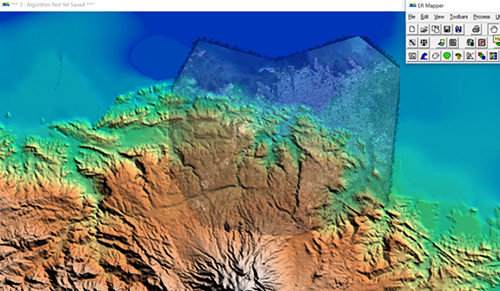
An area that was mostly rice fields and villages on the edge of the old city barely two decades ago has now become “aquatic” zones as flooding high tides encroach on homes.

Onetime farmers have been forced to become fishermen.

Villagers living in Bedono, Sriwulan, Surodadi and Timbulsloko in Demak regency and urban communities in low-lying parts of the city are most at risk.

-Partners-

Residents have been forced to raise their houses or build protective seawalls or be forced to abandon their homes when their floors become awash.

The lowland subsidence area in north Semarang leading to the volcanic Mt Urganan and Mt Muria/Medak.  Source: CoRem (UNDIP), 2017.
Environmental changes in Semarang have been blamed by scientists on anthropogenic and “natural” factors such as tidal and river flooding – known locally as rob, mangroves destruction since the 1990s, fast urban growth and extensive groundwater extraction.

Climate change
This has been compounded by climate change with frequent and extreme storms.

It has been a pattern familiar in many other low-lying coastal areas in Indonesia, such as the capital Jakarta and second-largest city Surabaya.

The Jakarta Post headline on 2 February 2017. Image: PMC
In February, The Jakarta Post reported that both Jakarta and Semarang faced environmental crises.

Citing Indonesian Institute of Science (LIPI) researcher Henny Warsilah, a graduate of Paris I-Sorbonne University in France, who measured the resilience of three coastal cities – Jakarta, Semarang and Surabaya – the Post noted only Surabaya had built sufficient environmental and social resilience to face natural disasters.

Jakarta and Semarang, Warsilah said, “were not doing very well”. Although Surabaya was faring much better with its urban policies.

The National Geographic Indonesia banner headline in October 2017. Image: PMC
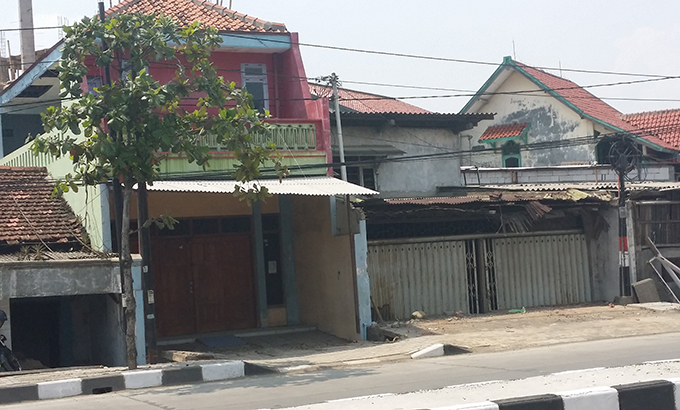
The fate of some five million people living in Indonesia’s at risk coastal areas – including Semarang — was also profiled in the Indonesian edition of National Geographic magazine last month under the banner headline “Takdir Sang Pesisis” – “The destiny of the coast”.

The introduction asked: “”The disappearance of the mangrove belt now haunts seaside residents. How can they respond to a disaster that is imminent?”

Ongoing reclamation
According to The Jakarta Post, Semarang “has ongoing reclamation projects in the northern part of the city, which threaten to submerge entire neighbourhoods in the next 20 years”.

Urban erosion and land subsidence in Semarang city. Note the raised house second from left, the other sinking dwellings on either side have been abandoned to the tidal waters. Image: David Robie/PMC
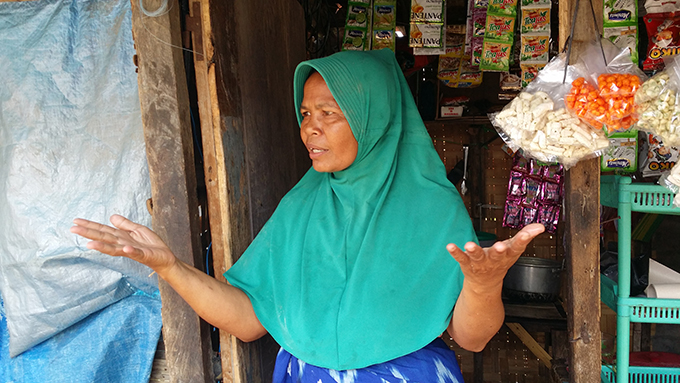
“The more [the city] is expanded, the more land will subside because the region is a former volcanic eruption zone, and it is a swamp area,” says Warsilah.

“With the progression of the reclamation projects, the land is not strong enough to withstand the pressure.”

With a team of international geologists and researchers attached to Semarang’s Center for Disaster Mitigation and Coastal Rehabilitation Studies (CoREM) at Diponegoro University, I had the opportunity to visit Timbulsloko village earlier this month to see the growing “crisis” first hand.

City planners might see the only option as the residents being forced to leave for higher ground, but there appear to be no plans in place for this. In any case, local people defiantly say they want to stay and will adapt to the sinking conditions.

An unnamed local shopkeeper who has three generations of her family living in her Timbulsloko home and she doesn’t want to leave in spite of the sea encroaching in her house. Image: David Robie/PMC
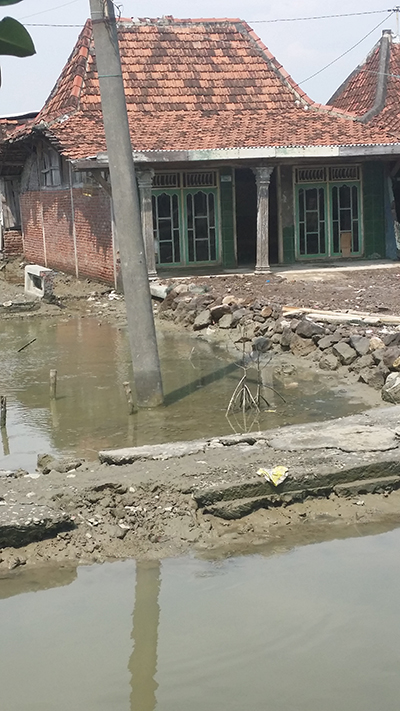
One woman, a local shopkeeper, who has a three-generations household in the village with water encroaching into her home at most high tides, says she won’t leave with a broad smile.

I talked to her through an interpreter as she sat with her mother and youngest daughter on a roadside bamboo shelter.

“I have lived here for a long time, and I am very happy with the situation. My husband has his work here as a fisherman,” she said.


A local storekeeper with her mother and youngest daughter – three generations live in her Timbulsloko village home. Video: David Robie’s Café Pacific.

‘We don’t want to leave’
“We live with the flooding and we don’t want to leave.”

A raised house at low tide in Timbulsloko. Image: David Robie/PMC
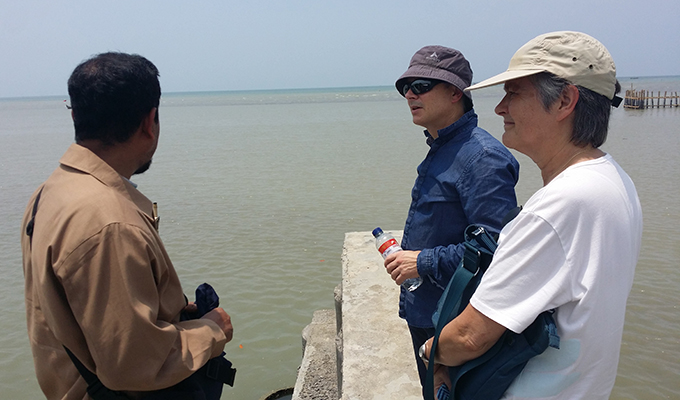
She also said there was no clear viable alternative for the people of the village – there was no plan by the local authorities for relocation.

Later, she showed me inside her house and how far the water flooded across the floors. Electrical items, such as a television, had to be placed on raised furniture. The children slept on high beds, and the adults clambered onto cupboards to get some rest.

The village has a school, community centre, a mosque and a church – most of these with a sufficiently high foundation to be above the seawater.

However, the salination means that crops and vegetables cannot grow.

The community cemetery is also awash at high tide and there have been reports of eroded graves and sometimes floating bodies to the distress of families.


Timbulsloko’s village cemetery. Video: David Robie’s Café Pacific

We were warned “don’t touch anything with your hands” as the flooding also causes a health hazard.

Research projects
The situation has attracted a number of research projects in an effort to find solutions to some of the problems, the latest being part of the 2017 World Class Professor (WCP) programme funded by the Indonesian government.

Two of the six professors on the University of Gadjah Mada’s WCP programme, in partnership with Diponegoro University, are working with local researchers at CoREM.

WCP programme professors Dr David Menier (centre) and Dr Magaly Koch (right) talk to CoREM director Dr Muhammad Helmi on the Timbulsloko village wharf, near Semarang. Image: David Robie/PMC
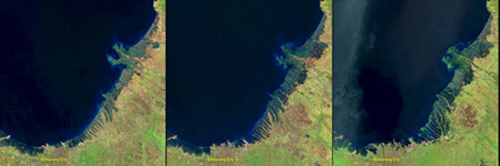
They are geologists Dr Magaly Koch, from the Centre for Remote Sensing at Boston University, US, and Dr David Menier, associate professor HDR at Université de Bretage-Sud, France, who are partnered with Dr Muhammad Helmi, also a geologist and director of CoREM, and Dr Manoj Mathew. Both Dr Mathew and Dr Menier are of LGO Laboratoire Géosciences Océan.

The stages of flooding in the Semarang study area. Source: Ramkumar & Menier (2017)
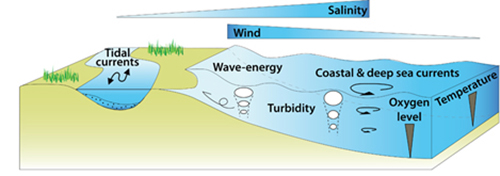
“At the regional scale, the rate of subsidence is related to the geological and geomorphological context. North Java is a coastal plain that is very flat, silty to muddy, influenced by offshore controlling factors (e.g., wave, longshore drifts, tidal currents, etc.) and monsoons, and surrounded by volcanoes,” explains Dr Menier.

Controlling factors along the Semarang coastline. Source: CoRem, (UNDIP)
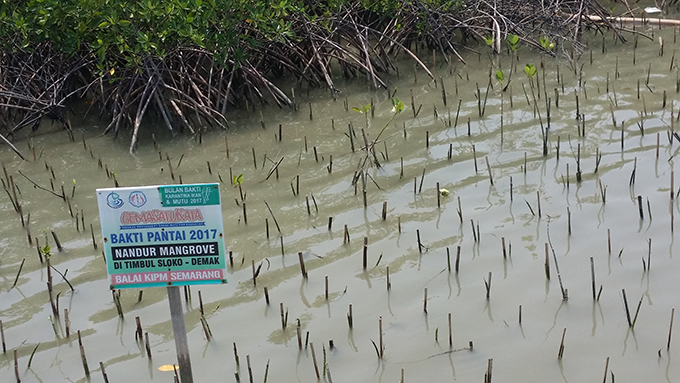
“Locally, anthropogenic factors can play a serious role as well.”

He says that coastal plains are dynamic. However, human activities are fixed – “the first contradiction”.

“Humans want to control and continue their livelihood, and are reluctant to accept changes related to their own activities or natural factors.”

Dr Menier says the subsidence is due to many factors, but some key issues have never been studied.

On a long term scale, the active faults of the area need to be examined in a geodynamic context and also volcanic activity with Mt Urganan and Mt Muria/Medak.

“We need to have a better understanding of the age of the coastal plain in order to reconstruct the past, explain the present-day and predict the future,” he says.

“Colonisation in the 17th century-Dutch period probably led to destruction of ecosystems (mangrove) and fine sediment usually trapped by plants has been stopped.”

Dr Koch adds: “Subsidence rates and their spatial distribution along the coastal plain need to be studied in detail using InSAR techniques. Groundwater abstraction (using deep wells) is probably happening in the city of Semarang but not necessarily in Demak.”

Expanding mangroves protection at Timbulsloko, Demak regency. Image: David Robie/PMC
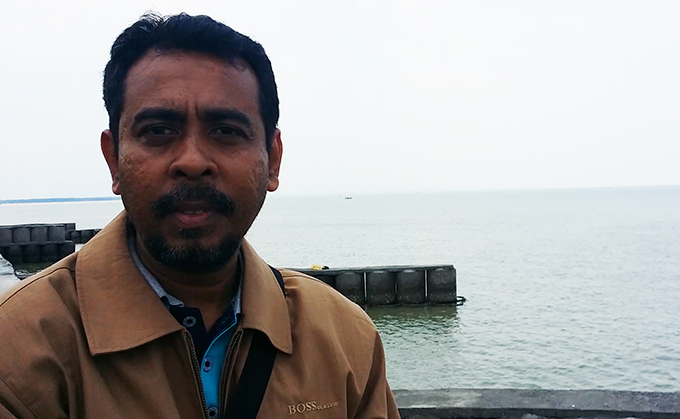
Mangrove restoration
Mangrove restoration and mitigation has been used successfully to restore coastal resilience and ecosystems in Timbulsloko.

While noting that “high failure rates are typical” due to wrong special being planted and other factors, Dr Dolfi Debrot, of a Dutch project consortium, argues “given the right conditions, mangrove recovery actually works best without planting at all.”

The consortium involves Witteveen+Bos, Deltares, EcoShape, Wetlands International, Wageningen University and IMARES.

However, community planting is also a strategy deployed in the lowland villages.

Mangroves revitalise aquaculture ponds for crab and shrimp farming.

A “growing land” technique borrowed from the muddy Wadden Sea in the Netherlands has also been used successfully at Timbulsloko and other villages.

Semi-permeable dams are built from bamboo or wooden poles packed with branches to “dampen wave action”. In time, a build up of sediment settles and allows mangroves to grow naturally.

CoREM director Dr Muhammad Helmi … praises the contribution of flexible “eco” seawalls. Image: David Robie/PMC


“These eco-engineering seawalls are better than the concrete fixed barriers,” says Dr Helmi. “The permanent seawalls in turn become eroded at their base and eventually fall over.”

Dr David Robie is on the WCP programme with Universitas Gadjah Mada, Yogyakarta.

Print Friendly, PDF & Email

Article by AsiaPacificReport.nz

]]>

Women must be at centre of global climate solutions, says Fiji minister

]]>

Minister Mereseini Vuniwaqa … “important to emphasise the traditional roles and functions women in the Pacific play”. Image: Mereoni Mili/Wansolwara

By Mereoni Mili in Bonn, Germany

It is important that women and girls remain in the centre of climate solutions.

These were the words of Fiji’s Minister of Women, Children and Poverty Alleviation Mereseini Vuniwaqa during the Gender Day event at COP23 in Bonn, Germany, this week.

She said it was important to have specific objectives for women in any economic or investment programme responding to climate change whether it involved mitigation, adaptation or resilience.

“If we understand the special place women have in our communities and act accordingly we would create strong programmes, have more effective responses, build better and resilient communities”, she said.

She added that climate change was harsh for women largely because women were over-represented among the world and were exposed to these dangers.

“Women typically are critical to keeping communities together, they care for the children, and they maintain traditions and give stability to villages”, she said

-Partners-

Vuniwaqa said talanoa dialogue on the topic of economic case for gender responsive climate action would highlight the compelling economic reasons why governments were seeking and investors were funding climate policy.

Highlighting gender
It would also highlight actions that had gender as a core element.

Vuniwaqa reminded delegates that they needed to put women and girls at the centre of all climate efforts in order to succeed.

The Fijian Presidency at COP23 has emphasised the importance of equitable involvement of women in sustainable development and the implementation of climate policy, including the Gender Action Plan.

The Gender Action Plan had been finalised to recognise the role of women in climate action.

Deputy Prime Minister of Samoa, Flame Mata’fa, said that full participation and mainstreaming of gender issues was important and it was a step the Samoa government had taken.

“It is important to emphasise the traditional roles and functions women in the Pacific play so that people come to a common understanding and objectives,” she said.

Mereoni Mili is a student journalist on Wansolwara newspaper at the University of the South Pacific. She won a scholarship to attend COP23.

Print Friendly, PDF & Email

Article by AsiaPacificReport.nz

]]>