Page 1157

Friday essay: turning up the level of civilisation

]]>

Source: The Conversation (Au and NZ) – By Julianne Schultz, Founding Editor of Griffith REVIEW; Professor, Griffith Centre for Social and Cultural Research, Griffith University

In October 2005 Stephen Colbert was just starting his eponymous show. It is somewhat chilling to realise that this was when he came up with the word truthiness: it seems so now.

It has taken a while to reach maturity and morphed into the even more menacing trumpiness. Truthiness captures the slippery world inhabited by those unencumbered by books, or facts, context or complexity – for those who just know with their heart rather than their heads – where things can just feel truthful.

Who would have thought that a little more than a decade later, the White House would be occupied by a man who makes the Colbert character seem almost reasonable. Quaintly charming. Trumpiness captures something even more sinister, statements that don’t even have to feel truthful, apparently ignorant rough-hewn words, weaponised for effect. Whatever comes out – alarmingly frequently words that sound as though they emanated from the crib sheet of a propaganda handbook.

In defining these words, Colbert provided a helpful predictor for a president who according to the Washington Post last week, had made 6,420 false or misleading comments in 649 days. That is industrial scale deception – small lies told over and over, medium sized lies that have become a new global lingua franca and big lies that take even his most ardent supporters by surprise and sometimes force a sort of retraction or denial – sort of, but only after they have already infiltrated the virtual world and got a life of their own.

This is not normal. It is not the way we have come to expect even a tainted public sphere, distorted by the commercialisation of public attention, to operate. The president’s mantra of fake news is, as he has admitted, a deliberate and determined effort to undermine confidence in what remains of a rigorous public sphere and professional journalism that takes itself seriously. In the unregulated, “more insidious” domain of the internet this is particularly dangerous.

Such industrial scale deception is at odds with the norms that characterise any flourishing civilisation. If truth is irrelevant to discourse, trust is not merely dented it is destroyed. Other norms of acceptable behaviour cannot be far away. What is happening now, goes well beyond spin or hollow speech. The New York Times correspondent Roger Cohen describes it as “corrosive, corrupting and contagious”.

In the shrunken global village this has dangerous implications everywhere, for public and personal behaviour. If the so called, “leader of the free world” can talk the way he does, without regard to fact or feeling, the level of civilisation is turned down everywhere he is heard.

What we are witnessing is behaviour contrary to the long-established moral core of a civilised society, arguably giving succour to evil, and deliberately destroying trust.

Democracy in retreat

So how did it come to this?

It is easy to feel that the world is going to hell in a handbasket – the news of catastrophe and disaster, the inflammatory US president, the distortion of social media, the global instability of superpower realignment, the palpable threat of climate change, the rise of authoritarian leaders – and that is for starters.

Freedom House, the Washington-based NGO, has been monitoring global freedom since 1941, when a very different US President articulated an expansive ethic that has since prevailed in “kin countries” and beyond. With the second world war in full, murderous, destructive fury, President Roosevelt declared that as human beings, all people were entitled to freedom of speech and expression, freedom to worship their god in their own way, freedom from want and freedom from fear. At the time it was ambitious rhetoric, demonstrably at odds with the wartime experience. But it provided guiding principles for a different future.

Last month in a very different context, Freedom House reported that around the world, political and civil rights sunk to their lowest level for a decade.

For the twelfth year in a row, democratic setbacks outnumbered gains. Democracy is in crisis. Values are under assault and in retreat in country after country. Young people are losing faith in politics. Trust has been eroded by commerce and the calcification of institutions. Millions of people are living without the rights we take for granted as a measure of civil, liberal, democratic society. Even nations that like to pride themselves on a deep democratic history are slipping on the scale, as trust in institutions is eroded and checks and balances slip out of equilibrium and technology remakes the way things are done.

This is most notable in the United States, which fell to 86 out of 100 on a scale measuring a wide range of political and individual rights and the rule of law, and the United Kingdom, which slipped to 94. Australia and NZ scored 98, with the virtuous Scandinavians topping with perfect scores.

This trend line is a matter of real concern, because it is contrary to the previous trajectory.

Until relatively recently, enhanced civil and political rights were what was expected, giving comfort to those of us who “hope the arc of history bends towards greater emancipation, equality and freedom”.

Taking a wider view of the state of the globe provides a slightly more reassuring message, that that arc may still be bending the right way. But the tension between individual rights and popular will is fertile territory for authoritarian leaders and their shadow puppets.

Survival is deep in our make up, means we dwell on the negative, alert to threats and dangers, ready to respond to fear. But as Stephen Pinker and Kishore Mahbubani loudly proclaim, the bigger picture is not as bad as we might be inclined to think with one ear cocked to the latest news bulletin and an eye on the real Donald Trump’s twitter feed.

The Human Development Index shows that as a species we are living longer and better. Life expectancy at birth worldwide is now 71 years, and 80 in the developed world; for most of human existence most people died around 30. Global extreme poverty has declined to 9.6% of the world’s population; still limiting the lives of too many, but 200 years ago, 90% lived in extreme poverty. In just the last 30 years, the proportion of the global population living with such deprivation has declined by 75%. Equally unappreciated is the fact that 90% of the world’s population under the age of 25 can read and write, including girls. For most of the history of Europe, no more than 15% of the people could read and write, mostly men.

So despite the truthiness feeling that things are going wrong, a lot is going right, for a lot of people, in a lot of countries. But this is a moment at risk of being squandered.

‘Reason sweeteened by values’

Which invites the question of what is at stake, how might the level of civilisation here be turned up, by whom, and to what end?

This was a question addressed by Robert Menzies when in 1959, as Prime Minister, he approved the formation of the Humanities Council, the precursor of the Australian Academy of Humanities. At the time, with the Cold War in full swing, and the memory of the hot war still smoking, Menzies declared the Humanities Council would provide,

Wisdom, a sense of proportion, sanity of judgement, a faith in the capacity of man to rise to higher mental and spiritual levels. We live dangerously in the world of ideas, just as we do in the world of international conflict. If we are to escape this modern barbarism, humane studies must come back into their own, not as the enemies of science, but as its guides and philosophic friends.

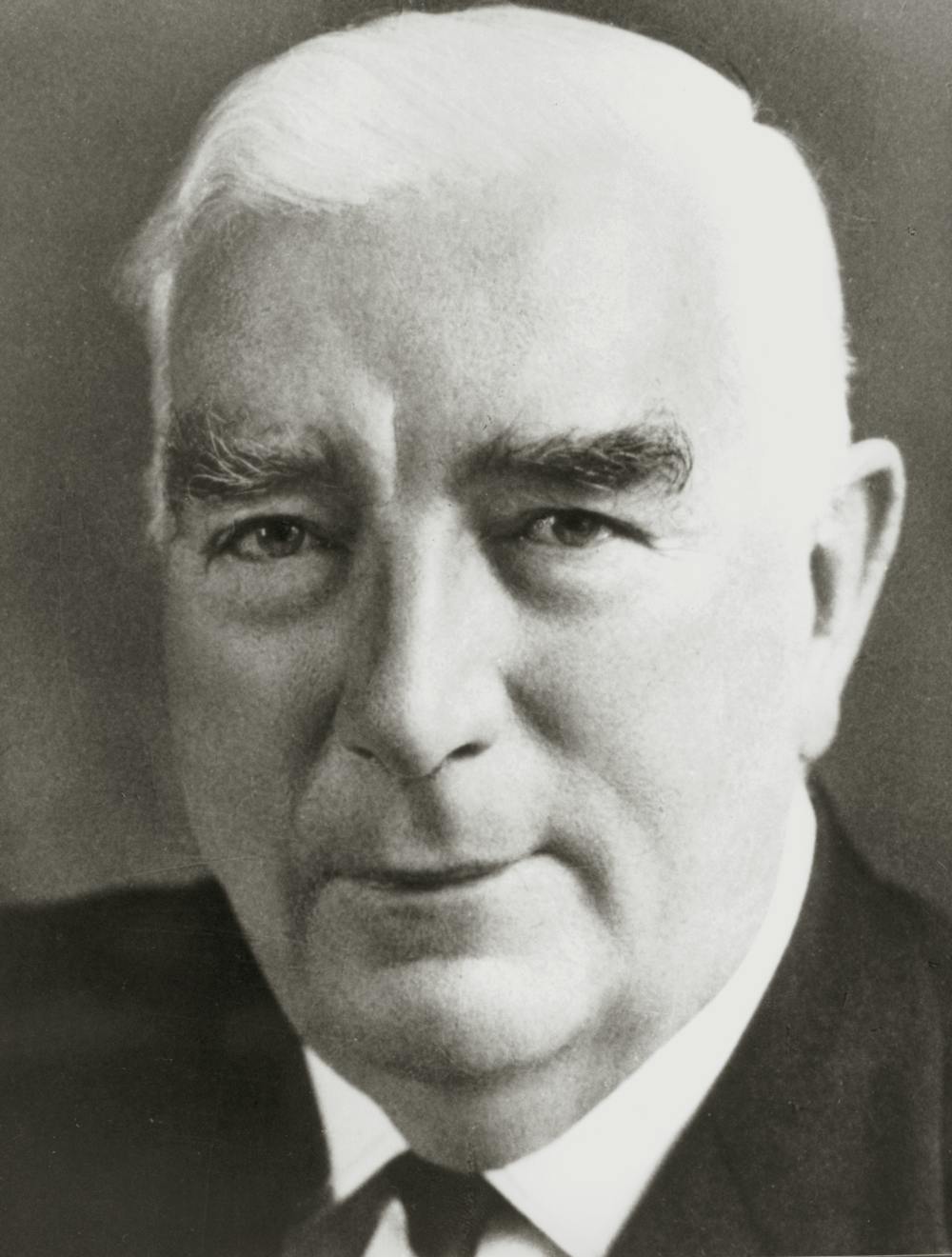
Robert Menzies: saw a key role for the ‘humane studies’. AAP

Now we are more often likely to hear prominent politicians pillorying the humanities as esoteric and truth-defying, and humanities scholars as ideologues in cahoots with self-aggrandizing scientists who are addressing the existential crisis of climate change for personal gain.

To attack the university system at precisely the moment when it reaches more people, when its impact on the social, cultural and economic wellbeing of the nation has never been higher, seems perverse. Based on medium-sized lies, madness even, from the zone of truthiness.

As the debate triggered by the Ramsay proposal has shown there is a lot at stake. For all the noise in the press, the very fact that there are lots of different ways of approaching the study of civilisations, has not been addressed except by snide, often ill-informed or defensive comments about “relativism”.

I am not a scholar of civilisations or a philosopher, but I am aware of some of the complexity of these debates. The need to define civilisation, and to allow the notion of civilisations, has preoccupied fine minds, and lead to different conclusions. Are there six civilisations, as Samuel Huntington suggested remained when he wrote his most famous essay The Clash of Civilisations? Or the 26, not including the civilisation of the first Australians, which Arnold Toynbee had identified a few decades earlier in his monumental work A Study of History.

Some maintain that civilisations are shaped by religion, others by culture, cities, language, ideology, identity or as a response by human beings to nature.

Civilisations flower and die. Some leave artefacts, buildings and monuments that endure. Others leave stories, philosophies, language, knowledge and ways of being that echo and resonate long after. Some just disappear, some suicide. Others grow and respond to interaction, adapting and changing as they go. And we now know, many leave a measurable trail in the polar ice, as the recent discovery of the traces of lead from Ancient Rome from 1100 BCE revealed.

As Kenneth Clark reputedly said after devoting his life to popularising the study of civilisation, “I don’t know what it is, but I recognise it when I see it.”

A full moon rises behind the Propylaia of the ancient Acropolis of Athens, Greece, November 2016. Civilisations flower and die. Andrea Bonetti/EPA

I like to think of it as a shorthand for the way human beings coexist with each other, the world they have created and the natural environment which makes it possible. While recognising the contestability of values, I like the positive humanity of Clive Bell’s notion of “reason sweetened by values” and RG Collingwood’s, “mental process toward ideal social relationships of civility”.

For me, civilisation is pluralist, contestable, open, polite, robust; buttressed by law, culture and institutions and maintained by sustainable economic conditions across time and place.

The need for a bill of rights

The barbarism of the second world war galvanised the creation of civilising mechanisms and institutions. They varied from country to country, with different impacts , but the intention was generally to expand rights and enhance democracy.

The Universal Declaration of Human Rights, which will turn 70 on the 10th of December, was the most singular global response: its 30 rights recognise and spell out “the inherent dignity and equal and inalienable rights of all members of the human family”. Its symbolic power exceeds its legal effect, as George Williams has written. It forms part of customary international law and is seen as binding on all nations. It been translated into 500 languages. Australia has ratified two of the most important subsequent conventions which grew under its umbrella to define political and civil; social, economic and cultural rights – so it is not without effect here.


Read more: Ten photos that changed how we see human rights


The Universal Declaration may well have faults and limits. Some regard it as “human rights imperialism” used by the West to run the world in ways that will protect and promote its interests. But when expansively applied, rather than as an embodiment of Western hegemony, it remains the best organising principle for civility that humanity has yet been devised. Ask women in Asia, India and the Middle East, democrats in Turkey, Hungary and Poland, activists in China or journalists in Russia.

“Without it”, as a Turkish-born scholar recently wrote, “we have few conceptual tools to oppose populism, nationalism, chauvinism and isolationism”.

Australians played an important role in the creation of the Declaration, but we have been tardy about its application. Ours is the only democratic nation which does not have a bill of rights – the only one. This is something that demands pause for thought. It is something we need to address if we are to foster an ethic for a distinctive, hybrid Australian civilisation.

An early morning view of Parliament House. Australia is the only democratic nation without a bill of rights. Lukas Coch/AAP

It is probably worth noting in passing that some of the most strident opponents of an Australian bill of rights are also amongst the most vociferous promoters of a narrowly defined agenda to study western civilisation. It is easy in this environment to forget that the demographics are with those of us who see the arc of history bending up. Surveys show most Australians would welcome a formalisation of rights.

Surely a clear statement of rights and responsibilities is central to any attempt to define a civilisation and the way we co-exist, respectfully, sustainably, creatively.

More than a pale shadow

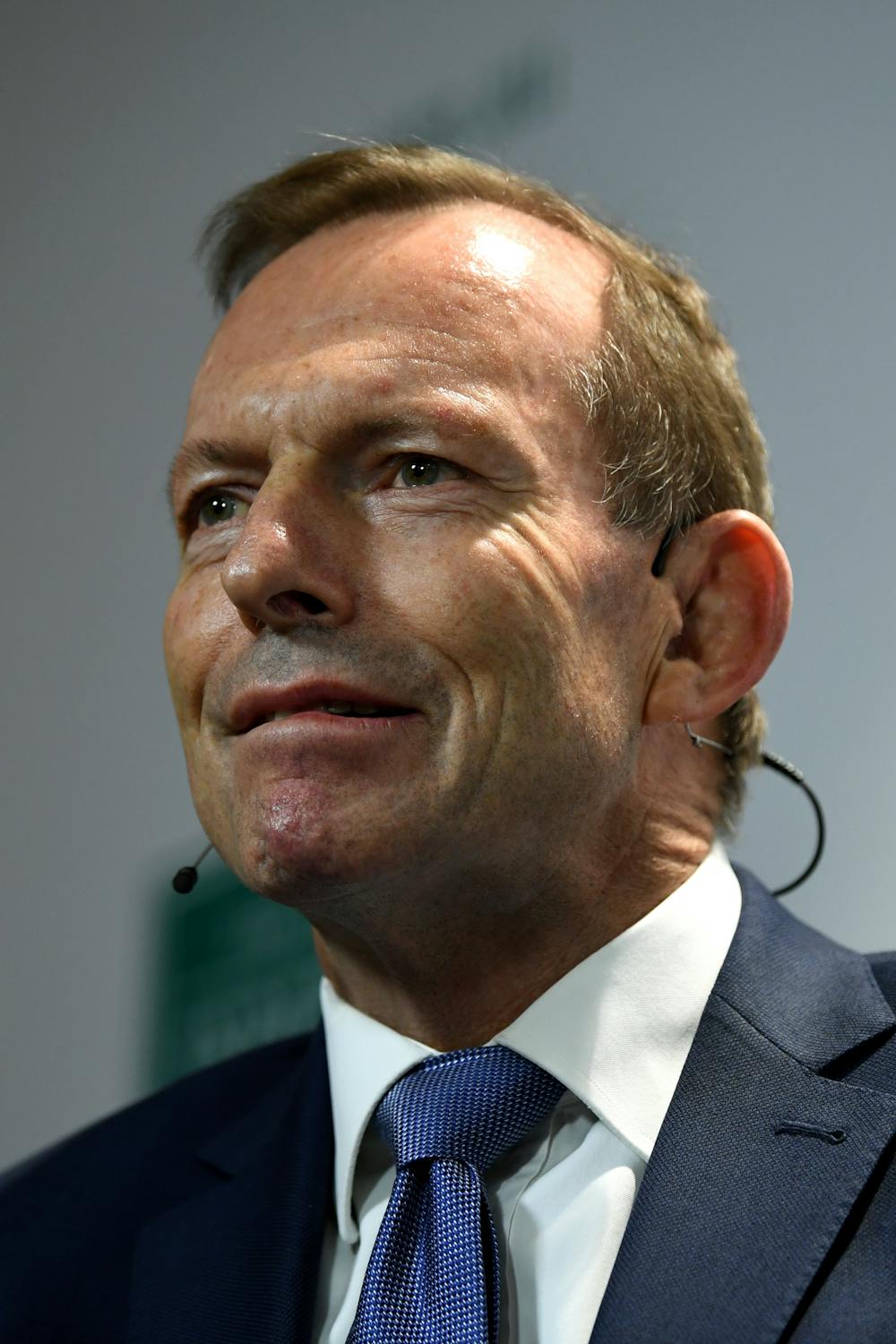
Tony Abbott: ‘a long march through our institutions’. Joel Carrett/AAP

“Person by person the world does change,” Tony Abbott wrote in his essay for Quadrant that marked the beginning of the end of the Ramsay program at ANU. In his final paragraph, the former prime minister suggested that the “hundred bright young Australians” who received the proposed scholarships “might change the world”, and begin “a much more invigorating long march through our institutions!”

That makes me a little nervous. It sounds a bit like a fifth column, though I doubt that the students would be willing fodder for such a scheme. I suspect that if they were to embark on such a long march, they, like me, would prefer an open, inclusive, contested, respectful, non-ideological journey, grounded in the unique nature of this place as home to the oldest living civilisations, a product of British colonialism, the creation of people from every continent and our own imagining.

This country has a lot going for it, but we seem stuck in neutral. We need to regain ambition. To foster a remarkable country, one which learns from the mistakes of past and displaces complacent caution to imagine and create a robust, inclusive, generous, rights-based democratic order that will work well in the very different world of the 21st century.

It won’t come from politicians. It will, if history is a guide, be something that is worked up on the ground, in our universities, in our institutions, in our justice system, in business, community groups and on social media. As it takes shape, the politicians will follow and carry it forward.

There is a lot at stake. Person by person, we can help to turn the level of civilisation up in this place, so that it becomes much more than a pale shadow of the worst of the rest of the world.

This article is an excerpt of the 49th Academy Lecture delivered by Professor Julianne Schultz AM FAHA as part of the Australian Academy of the Humanities Symposium, ‘Clash of Civilisations: Where are we now?’ held at the State Library of NSW on 15 November 2018. The full lecture will be published in the 2019 edition of the Academy’s journal, Humanities Australia.

ref. Friday essay: turning up the level of civilisation – http://theconversation.com/friday-essay-turning-up-the-level-of-civilisation-106857]]>

Grattan on Friday: Morrison government brings back memories of McMahon days

]]>

Source: The Conversation (Au and NZ) – By Michelle Grattan, Professorial Fellow, University of Canberra

As the Morrison government thrashes around trying to stave off defeat or just save the furniture, it reminds one historian of the ill-fated McMahon administration.

The run up to the Coalition’s 1972 ousting is detailed in a just-released life of Billy McMahon, titled Tiberius with a Telephone. McMahon, often rated at or near the bottom in rankings of modern Australian PMs, has been long overdue for a biography – now he has a 776-page tome.

Author Patrick Mullins, of the University of Canberra, says the “similarities between now and then are too conspicuous to ignore”. These include a history of leadership instability, party disunity, depleted Liberal finances, confused, reactive and inconsistent policy directions, a credible opposition and a feeling for change in the electorate.

Admittedly, as Mullins says, there are differences. Morrison has a benign economic environment, support in important sections of the media, and a much better image than the widely-ridiculed McMahon.

But the fundamental point is that those were desperate days for the Coalition and so are these. “McMahon was in survival mode,” says Mullins, and the same could be said of Morrison.

Mullins’ observation of the McMahon government – “For every achievement and move towards new policy there was another fight, another muddle, another problem that should never have been cause for concern” – resonates when assessing the present one.

A government on the ropes acts impulsively, looking to the moment, compromising sound policy-making and broader, longer-term interests.

So it has been with Morrison’s suggestion Australia would consider moving its embassy to Jerusalem, a proposal born out of political expediency that’s brought him grief this week.

The Indonesian displeasure was felt as soon as the announcement was made before the Wentworth byelection. Subsequently, things have just got worse.

The free trade agreement with Indonesia, which Australia originally hoped would be signed this week when Morrison was in Singapore for the start of the summit season, has become hostage to the embassy decision.

Earlier the government tried to fudge the signing delay by a faux nonchalance about timing. Nobody was fooled. Now in public and private comments, Indonesia has made its position clear in the past few days, to Morrison’s embarrassment.

Malaysian Prime Minister Mahathir Mohamad also piled on, saying he’d pointed out to Morrison that “adding to the cause for terrorism is not going to be helpful”.

Rather than having an easy ride on his international round, the embassy issue has put Morrison on the back foot.

There was no immediate way out. The government still has to declare what it will do. Morrison says a “process” is underway – presumably bureaucrats’ advice is being sought and examined, after they were initially bypassed. There’s to be a decision before Christmas.

This can’t end happily. Morrison is caught between, on the one hand, the right of the Liberal party and the Jewish lobby, and on the other, the strongly-held view of our biggest neighbour in particular.

And the angst has been all for nothing – Wentworth was lost.

The Jerusalem question isn’t the government’s only looming no-win decision. It has yet to provide a response to the religious freedom report, a time bomb left by Malcolm Turnbull, who set the inquiry up to placate the right.

In the meantime negotiations with Labor remain unfinished over legislation announced by Morrison (pre-Wentworth) to prevent discrimination against gay students.

The still-suppressed report has brought little but controversy for the government, and backfired on the right, even before we have a policy from it.

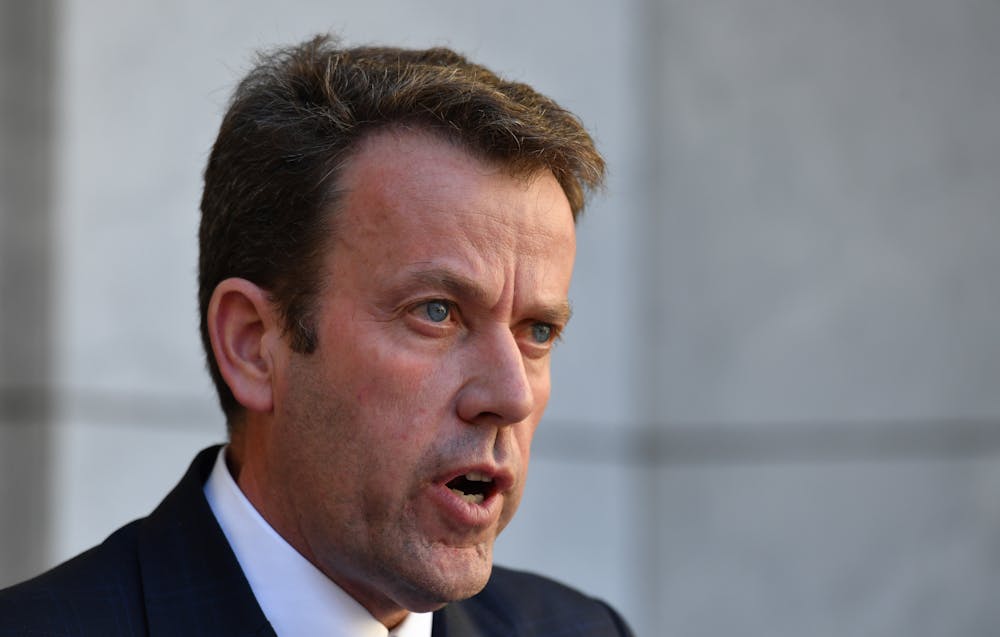
Yet this week we have a new inquiry that reflects ideology more than need, with Education Minister Dan Tehan’s announcement of a review of freedom of speech in universities.

The right has been agitated about the unwelcome receptions some conservative speakers have received from demonstrators on campuses.

Adding to the right’s broader anger with universities was the conservative Ramsay Centre’s failure to persuade the prestigious Australian National University to accept funding for a proposed course on western civilisation, which came with conditions the ANU felt would compromise its academic autonomy.

The freedom-of-speech inquiry seems little more than another manifestation of the culture wars, symptomatic of the anti-intellectual stance of some of the Liberal hardliners, who see tertiary institutions as seeding grounds for the left.

Tehan said the inquiry, undertaken by former chief justice Robert French, would “outline realistic and practical options that could be considered to better promote and protect freedom of expression and freedom of intellectual inquiry”.

It will “review existing material regarding free speech, including codes of conduct, enterprise agreements, policy statements and strategic plans”. French is to report in four months, so before a May election.

Catriona Jackson, chief executive of Universities Australia, says vice-chancellors “are questioning of the rationale for the review” – they “do not see there is an issue to address. Every day on university campuses across the country there is vigorous debate across a wide range of issues,” she says.

This inquiry could end up producing fresh pinch points for the government, like the freedom of religion one has. At the least, it seems an odd priority – the issue wouldn’t engage too many ordinary voters.

That’s in contrast to energy policy, undisputed core business for government and public. But this remains ad hoc and fraught, as the government goes about strong-arming companies on price and searching for opportunities to support new investment in so-called “fair dinkum” power.

The highly interventionist approach is problematic on two fronts: it is contrary to Liberal philosophy, and it’s unlikely to be effective.

The Grattan Institute’s Tony Wood says: “In the absence of a stable climate policy and good management of the electricity market we seem to be left with nothing more than threats, which are easy to make but hard to implement, and subsidies, which may be popular but make no sense from a policy perspective”.

A politically-inspired thought-bubble with serious fallout, an unnecessary bow to the right, a core policy that’s unfit for purpose. Taken together the embassy issue, the free speech review, and the energy shemozzle point to a survival strategy that’s not cutting it. Just as McMahon’s didn’t.

ref. Grattan on Friday: Morrison government brings back memories of McMahon days – http://theconversation.com/grattan-on-friday-morrison-government-brings-back-memories-of-mcmahon-days-107033]]>

Chinese president bound for PNG as controversy mounts over APEC 2018

]]>

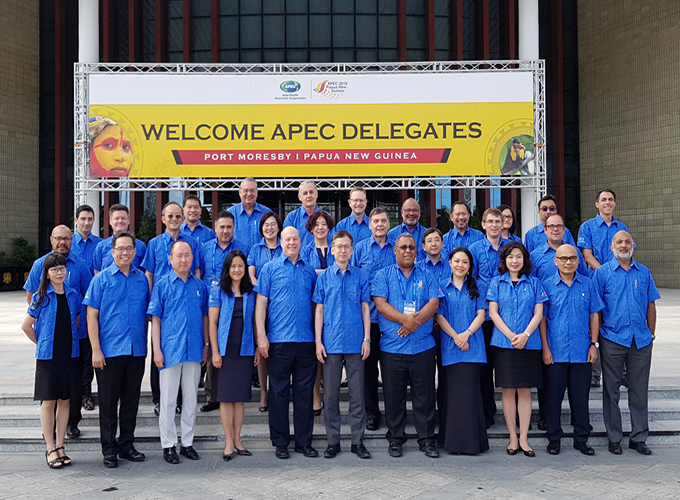
APEC officials prepare to welcome foreign delegates from 23 countries. Image: Apec.org

Pacific Media Centre Newsdesk

Chinese President Xi Jinping left Beijing today for state visits to Papua New Guinea, Brunei and the Philippines – and the Asia-Pacific Economic Cooperation (APEC) leaders summit in Port Moresby.

During Xi’s stay in Papua New Guinea, he will also meet with leaders from the Pacific  countries that have established diplomatic ties with China amid growing political rivalries over the region, reports Xinhua news agency.

Xi was invited to pay the visits by Governor-General of Papua New Guinea Bob Dadae and APEC host Prime Minister Peter O’Neill, Brunei’s Sultan Hassanal Bolkiah, and Philippine President Rodrigo Duterte.

He is arriving amid growing controvesy over the extravagant spending for APEC and allegations of corruption in a nation troubled by deep crises over education and health.

More than 200 Chinese media personals are already making tracks to be in PNG for the state Visit and the APEC summit.

Meanwhile, opposition Kavieng MP Ian Ling-Stuckey has severely criticised PNG’s 2019 Budget.

-Partners-

He said too much money had been spent on a Port Moresby-centred APEC, but now was the time to deliver the policies that could tap into all of the potential benefits of APEC and distribute them throughout the country.

The cost of the two-day APEC for PNG is reportedly more than 200 million kina (about NZ$90 million).

‘Opportunity squandered’
“This opportunity has been squandered. Instead, the 2019 Budget has dished up anti-APEC policies such as new taxes on trade and protectionist language,” Ling-Stuckey said.

“We have demonstrated that we are not being honest in our budget policy with misleading facts and hidden figures.

“This is a big-spending and fiscally irresponsible budget that abandons our new fiscal anchors. This is a disappointing day for the children of PNG, and the O’Neill/Abel government should be ashamed.

“The alternative government is a supporter of APEC. However, we have not been supportive of the expensive way that it has been implemented with numerous questions about contracts that should be referred to auditors.

“Unfortunately, items such as the Maseratis and Bentleys have unnecessarily damaged our international reputation.

As PNG prepared for its first APEC summit, it also expected to have 10,000 delegates to arrive for this meeting, reports EMTV News.

More then 1000 APEC officers are deployed in various parts of the city to ensure the safety of the visitors.

More than 100 foreign nationals arrived on Monday and the number was expected to increase rapidly over the next few days.

APEC Haus … Port Moresby’s custom-designed convention centre especially built for the Asia-Pacific economic leaders’ summit. Image: PNG Govt

Print Friendly, PDF & Email

Article by AsiaPacificReport.nz

]]>

Why early diagnosis of autism should lead to early intervention

]]>

Source: The Conversation (Au and NZ) – By Hannah Waddington, Lecturer in Educational Psychology, Victoria University of Wellington

Research suggests children can be reliably diagnosed with autism before the age of two. It also shows that many of the behavioural symptoms of autism are present before the age of one.

These behaviours include decreased interest in social interaction, delayed development of speech and intentional communication, a lack of age-appropriate sound development, and unusual visual fixations.

Preliminary results of a study in the Wellington region indicate most children are diagnosed when they are around three years old. However, there is arguably little point of providing early diagnosis if it does not lead to evidence-based early intervention.


Read more: New autism guidelines aim to improve diagnostics and access to services


Early start

The Early Start Denver Model (ESDM) is a promising therapy for very young children (between one and five years) with, or at risk for, autism. ESDM uses play and games to build positive relationships in which the children are encouraged to boost language, social and cognitive skills.

Where ESDM differs most from traditional intervention is that behavioural teaching techniques are embedded within this play. This includes providing clear cues for a behaviour, and rewarding that behaviour. Parents, therapists and teachers can use ESDM techniques within the children’s play and daily routines to help them reach developmentally appropriate milestones.

For example, a child who does not yet talk, may be learning to reach for preferred items. A child who has a lot of language may be learning to answer questions like “what is your name?”.

Initial research conducted in the United States, where the model was developed, suggests that ESDM is particularly effective when implemented for more than 15 hours a week by trained therapists in the home environment.

Improved cognition in early childhood

The model was adopted in Australia where the government funds autism specific early childhood centres. Research conducted in these centres indicates that children receiving ESDM intervention from trained therapists show greater improvements in understanding and cognitive skills than children who were not receiving treatment.


Read more: New autism guidelines aim to improve diagnostics and access to services


In New Zealand there is no government funding for such therapy. As a result, the cost of providing this intensive level of early intervention is beyond the budget of most families. There is also a lack of trained professionals with the technical expertise to implement such therapies.

For these reasons, we are working with the Autism Intervention Trust and Autism New Zealand to develop a New Zealand-specific low-intensity approach to delivering ESDM. The team is using the research of what is effective overseas and is applying it within a New Zealand context.

Mainstream schooling

New Zealand takes an inclusive approach to education. The main goal of the research programme therefore is for children with autism and their families to receive support earlier so that they can get a better start in their development and go on to mainstream schools.

One project involves training kindergarten teachers in ESDM. Inclusion of ESDM strategies in kindergartens is the biggest unknown because there is little teacher training in New Zealand around how to best support children with autism in mainstream settings.

A second project involves providing parent coaching and then adding on a small amount of one-on-one therapy. This will provide some preliminary evidence as to whether adding a minimal amount of one-on-one therapy is any more beneficial that just coaching parents.

Each project involves examining specific measures of communication, imitation (a key early learning skill children with autism typically struggle with) and social engagement with others.

Other countries with little government funding and support for children with autism and their families have taken a similar approach to providing ESDM therapy at a lower intensity. The research suggests that just a few hours of therapy can lead to positive outcomes.

ref. Why early diagnosis of autism should lead to early intervention – http://theconversation.com/why-early-diagnosis-of-autism-should-lead-to-early-intervention-106611]]>

Politics with Michelle Grattan: Derryn Hinch on a national ICAC and the Victorian election

]]>

Source: The Conversation (Au and NZ) – By Michelle Grattan, Professorial Fellow, University of Canberra

The Senate this week passed a motion calling for the government to establish a federal anti-corruption commission. The government is more likely to beef up existing institutions but Justice Party senator Derryn Hinch, who has been a strong advocate for a national ICAC, says “that would be wrong.” “We have to have an independent national body to look into us [politicians] and to public servants and to various agencies,” he told The Conversation.

Hinch – who is long odds in his battle to hold his seat at the election – is running candidates in the Victorian state election. He hopes to get “one or two” of his team elected to the upper house.

In Victoria he predicts a Labor win, although he doesn’t “think they deserve to.” Federally, he says “I would be one of the few people in this building who still thinks the Libs are in with a chance”.

ref. Politics with Michelle Grattan: Derryn Hinch on a national ICAC and the Victorian election – http://theconversation.com/politics-with-michelle-grattan-derryn-hinch-on-a-national-icac-and-the-victorian-election-107016]]>

There’s no need for the ‘Chicago principles’ in Australian universities to protect freedom of speech

]]>

Source: The Conversation (Au and NZ) – By Katharine Gelber, Professor of Politics and Public Policy, The University of Queensland

This week the government asked former High Court Chief Justice Robert French to head an inquiry into free speech on universities. Education minister Dan Tehan claimed it was because concerns had been raised about people shutting down the views of those they disagree with, and security costs for controversial speakers on campus.

Universities are accusing the minister of “jumping to the wrong conclusions”, based on misleading and selective media reports.

Justice French is being asked to review the “rules and regulations protecting freedom of speech on university campuses”. This will include codes of conduct, enterprise agreements, policy statements and strategic plans. This is despite the fact universities already protect freedom of speech and, relatedly, academic freedom.

The Minister suggested Australia could consider adopting an Australian version of the “Chicago statement”. So what is the Chicago statement, and would Australian universities benefit from adopting it?


Read more: Four fundamental principles for upholding freedom of speech on campus


The Chicago statement

In 2014, the President (equivalent to the Vice Chancellor of an Australian university) of the University of Chicago convened a committee, chaired by highly acclaimed free speech scholar Professor Geoffrey Stone, to draft a statement that would articulate the university’s commitment to “free, robust, and uninhibited debate and deliberation”.

The university took this step in response to free speech controversies on university campuses in the United States. Examples include disinviting controversial speakers, pressure on faculty to make public apologies for statements some considered offensive, demands for the removal of historic statues or monuments, and the existence of campus speech codes which prohibit students from engaging in hate speech on the ground of race, sexuality, or gender.

The Chicago statement recognises free speech on campus as an issue that goes to the core mission of the university as a place of learning. It defends free and open inquiry in all matters, and guarantees the broadest possible latitude to speak, write, listen, challenge, and learn.

Minister for Education Dan Tehan has ordered an inquiry into freedom of speech on campus. AAP/Mick Tsikas

Read more: The great irony in punishing universities for ‘failing’ to uphold freedom of speech


It also recognises that freedom of speech does not mean people can say whatever they want, wherever they want. It permits restrictions on speech that violates the law, is defamatory, threatens or harasses, invades privacy or confidentiality, or is incompatible with the functioning of a university.

The statement is a well-articulated and clear enunciation of three things:

1) the importance of freedom of speech to learning

2) the recognition that free speech must have limits

3) the articulation that any such limits must be carefully and narrowly circumscribed.

As of February 2018 the Chicago statement had been adopted by 34 other universities in the US. But this still leaves around 1,600 universities that have not signed up, possibly because their existing policies already support the same views.

Do Australian universities need it?

Shortly before Justice French was invited by the government to conduct a review into free speech in Australian universities, he gave a speech on the issue.

He recognised that even a detailed and prescriptive charter would not provide a framework in which difficult cases can be clearly and uncontroversially resolved. Nevertheless, he was open to the possibility of legislative intervention to impose “protective rules”.

However, if the Chicago principles were to form the basis for any such legislative intervention, they would be unlikely to be of benefit in resolving the issues with which the minister appears to be concerned.

This is for two reasons. First, Australian universities already protect free speech in accordance with principles very similar to those enunciated in the Chicago principles. All universities are required by Australian law to uphold “free intellectual inquiry in relation to learning, teaching and research”. Universities’ codes of conduct already uphold the right of students to engage in critical and open inquiry.

The second reason is that the Chicago principles recognise that free speech is not a reason for protecting unlawful conduct. Australia and the US have wildly different views on what constitutes unlawful speech-based conduct. Here, speech is able to be regulated to a far greater degree than in the US.

This means that all the current, valid, restrictions on speech that exist in Australia would be untouched by applying the Chicago principles. For example, Australia possesses comprehensive anti-vilification laws federally, in every state and in the ACT, which prohibit public hate speech. These would be unaffected.

Applying the principles here would also make no difference to other restrictions on speech in Australia, such as laws barring journalists from reporting in certain instances, which present far greater risks to free speech than anything that’s occurred on campus of late.

This inquiry is expensive and unnecessary. There is no good evidence we have a problem with free speech on our campuses. Justice French’s review will take four months. While we await the outcome, university staff will no doubt continue to uphold their existing commitments to robust and open debate in learning, teaching, research and engagement.

ref. There’s no need for the ‘Chicago principles’ in Australian universities to protect freedom of speech – http://theconversation.com/theres-no-need-for-the-chicago-principles-in-australian-universities-to-protect-freedom-of-speech-107001]]>

Marriage has changed dramatically throughout history, but gender inequalities remain

]]>

Source: The Conversation (Au and NZ) – By Michelle Brady, Senior Research Fellow in Sociology, The University of Queensland

One year ago, Australians were asked “Should the law be changed to allow same-sex couples to marry?”. The answer was a resounding “yes” – more than 60% of those who expressed a view backed marriage equality.

The anniversary of this historic moment offers an opportunity to reflect on how marriage as an institution has changed in Australia and other Western democratic countries over the last few hundred years, as well as the ways it remains stubbornly the same.

Many of those who argued for the “no” vote asserted that Australia should retain “the traditional definition of marriage”. But our research on the history of marriage and divorce shows that the tradition of marriage has actually changed a lot since the 18th century.

Although much progress has been made, gender inequality within relationships continues to be a problem, particularly if couples prefer to live together without getting married.

Women have gained more rights

Historically, marriage was the key way families passed on status, wealth and property from generation to generation.

The institution of marriage also came with strongly prescribed gender roles. Women’s sexuality, rights and access to financial resources were strictly controlled in marriages. Regardless of whether a family was poor or wealthy, women’s bodies and labour were regarded as the property of their husbands in the 18th and 19th century. Prior to the 20th century married women lost their identities and many of their individual rights.


Read more: If we’re serious about supporting working families, here are three policies we need to enact now


In the mid-20th century, however, many laws that explicitly discriminated against women were reformed in most Western democratic countries. Wives gained their own legal and economic status within marriage. The decline in the influence of religion also played a role in marriage laws becoming more “gender neutral”.

Though Western countries have removed laws that explicitly discriminate against women, gendered consequences remain.

For instance, society continues to promote different roles for men and women within the family following the birth of a child. Women take on much more of the housework and childcare duties. And married women, in particular, do more of the housework on average than women in cohabiting relationships with men.

But cohabiting couples have fewer legal rights

Today, the laws in most Western democratic countries recognise a diversity of family types. At the same time, couples in cohabiting relationships continue to have fewer rights, entitlements and obligations compared with married couples.


Read more: Explainer: what legal benefits do married couples have that de facto couples do not?


As a result, cohabiting women are overall more likely than married women to experience relationship dissolution, single parenthood and poverty.

For example, no country legally obliges cohabiting couples to financially support a partner staying home to look after children. Like married women, cohabiting women are more likely than their partners to take time out of the workforce to care for children. And the lack of legal protection makes women in cohabiting relationships economically vulnerable.

Another example is the difference in laws around financial settlement and the division of wealth after a relationship breaks down. In most countries, women in marriages who take on a home-maker role can seek to claim a share of their spouse’s property if their relationship dissolves. Women in cohabiting relationships, however, often have no similar rights or very limited rights.

Paternity is another issue for cohabiting couples. Many countries do not automatically assign paternity of children – and the assumption of shared custody of children – to cohabiting fathers.

Australia, however, is somewhat of an exception in offering more protections to cohabiting couples.

Here, couples who have cohabited for at least two years or have a child together are protected by the federal family law’s property division regulations. These laws take into account both partners’ non-financial contributions to a relationship (such as caring for children) and their future needs.

The court also has discretionary power after the breakdown of a relationship to give one partner a share of property held solely in their former partner’s name, such as a superannuation fund.

And fathers in de facto relationships do not have to take extra steps to establish paternity and shared custody of children. This makes it easier for fathers to obtain shared custody if a relationship breaks down and for mothers to seek child support.

These laws give Australian women in cohabiting relationships greater financial protections. However, there are limits to these protections. The laws do not apply to cohabiting relationships of less than two years, for example, unless the couple has a child together.

The appeal of marriage to same-sex couples

Research has found that because Australia offers such strong legal and social recognition of de facto relationships, LGBT activists initially focused their efforts on gaining de facto recognition of same-sex relationships, rather than marriage equality.

LGBT activists didn’t really start focusing on marriage until 2004, when the Australian government altered the Australian Marriage Act of 1961. By strictly defining marriage as “the union of a man and a woman to the exclusion of all others”, the government offended many in the LGBT community and helped spark the desire for change.


Read more: A year since the marriage equality vote, much has been gained – and there is still much to be done


The symbolic importance of marriage in the LGBT community also gradually increased, resulting in more LGBT attention on gaining marriage equality.

Today, the extent to which marriage appeals more to gay men or lesbians depends on a range of factors.

Lesbians have accounted for the majority of same-sex marriages in Australia so far. Jill Kindt (left) and Jo Grant were the first. Dan Peled/AAP

So far, lesbians have accounted for the majority of same-sex marriages in Australia. This may be because in the context of a limited social safety net compared to other countries, women may value the marginally better financial protections offered by marriage given they are more likely than gay men to have children. For all the debate about “the traditional definition of marriage”, our research finds that marriage has always been a constantly evolving and changing institution. Same sex marriage is just the latest change.

But more progress can be made. Even though we have finally addressed inequality for same-sex couples, and laws relating to marriage no longer explicitly discriminate against men or women, gender inequality within the institution of marriage continues to be a problem.

ref. Marriage has changed dramatically throughout history, but gender inequalities remain – http://theconversation.com/marriage-has-changed-dramatically-throughout-history-but-gender-inequalities-remain-106346]]>

Toilets of the future must be designed with people in mind, not technology

]]>

Source: The Conversation (Au and NZ) – By Dani J Barrington, Lecturer in Water, Sanitation and Health, University of Leeds

Most of you reading this article probably have a comfortable toilet that you use on a daily basis. As Steve Sugden wrote:

In more developed areas of the world we have forgotten the horrors of using a disgusting toilet and we now take for granted that toilets are comfortable, well lit, smell-free, private, pleasant places to defecate. They are places where we can “go in peace”.

There are two “golden rules” of our (overwhelmingly waterborne) sanitation systems that make them useful for improving human health:

  1. they immediately separate us from our waste

  2. they transport that waste away for treatment, stopping it from polluting the environment or making people sick.


Read more: Why queues for women’s toilets are longer than men’s


The flush toilet and waterborne sewerage system were developed to allow users to “flush and forget”. But around four and a half billion people don’t have access to a sanitation system that follows the golden rules. That’s because waterborne sewerage systems aren’t suitable everywhere.

These require large volumes of water for flushing, kilometres of underground pipes and treatment infrastructure, and the personnel to operate and maintain the system. Scientists and engineers around the world are developing alternative sanitation systems to address these challenges.

A promotional video for the Bill & Melinda Gates Foundation’s Water, Sanitation and Hygiene project.

New toilet tech

There are some amazing new toilet technologies that aren’t waterborne systems, but still follow the golden rules. Many of these new designs not only treat waste to make it safe, but also transform it into useful products like clean water, fertilisers, electricity and animal feed.

Many of them don’t require sewerage systems at all, and instead process the waste on-site (in the household or toilet block). This increases the resilience of the sanitation system. If floods (or other disasters) prevent the system from processing waste, the problem is likely to be contained within the household, rather than affecting an entire city.

Some systems transport waste via pipes to nearby community scale treatment plants, which allow people to reuse the nutrients and water in their waste.

Others involve the collection of waste from households or toilet blocks to be treated at a larger, off-site plant, which offers economies of scale.

Several of these “non-sewered sanitation” technologies were showcased at the Reinvented Toilet Expo in Beijing earlier this month.


Read more: Can you catch germs from a public toilet seat?


Different locations have different needs

There is no single technology that will work in every community.

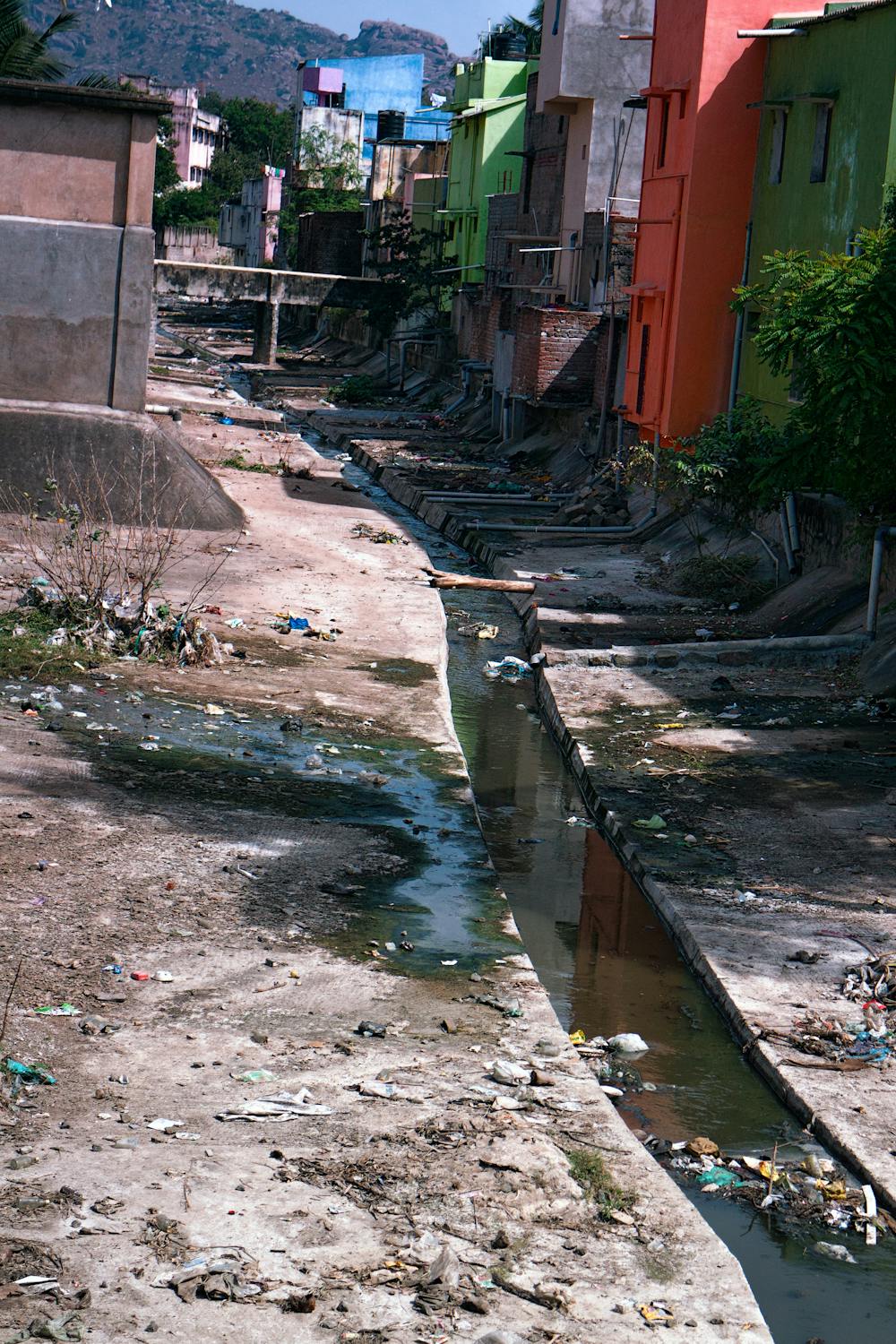
Open sewerage runs along the back of housing in some parts of South East Asia.

In water-scarce areas, people are aware of the wastefulness of flushing clean water down a toilet. In those locations, reusing water for flushing will be an important benefit.

In areas without reliable mains electricity, small-scale production of electricity from a sanitation system can be valuable for lighting, charging mobile phones or simply for running the treatment process.

Using nutrients from waste as fertiliser or animal feed will be unacceptable in some cultures, no matter how safe it is proved to be.

In every case, the time and expertise required to operate and maintain these systems must be considered. That means looking beyond the treatment process to the wider system, including government policies and businesses, as well as the availability of spare parts and local skilled personnel.

Local experts are essential

Clearly, technology is only part of the solution. But there is also a social science to sanitation engineering.

Many new sanitation technologies are being tested in the communities that are expected to be future customers. Researchers have been working with these potential users to identify what works, and more importantly, what doesn’t work with these technologies. The perspectives of both the toilet user and the operator of the sanitation system are taken into account.

Community members play a vital role and contribute to the design process. Nobody is going to use a toilet that they don’t like – as many festival-goers and campers will attest.


Read more: Why your tourist toilet habits are bad for locals – and the environment


Sanitation technology developers give themselves the best possible chance of success when they work with communities to understand their needs and to test early prototypes. Community members are experts in their local context. Sadly this knowledge often goes unrecognised, but it’s critical to designing systems that work sustainably.

There are too many examples of “failed aid” projects, where sanitation systems have been installed without consulting local people, and then abandoned by the community after the project team has departed.

Although there are many exciting treatment processes being proposed for collecting and treating human waste, it is important to recognise that technology is only part of the equation. When proposing sanitation systems, technology developers must remember that they are designing for real people, considering community members as co-designers with important contributions to make.

ref. Toilets of the future must be designed with people in mind, not technology – http://theconversation.com/toilets-of-the-future-must-be-designed-with-people-in-mind-not-technology-106610]]>

Fiji Elections Office begins final entry as provisional results stopped

]]>

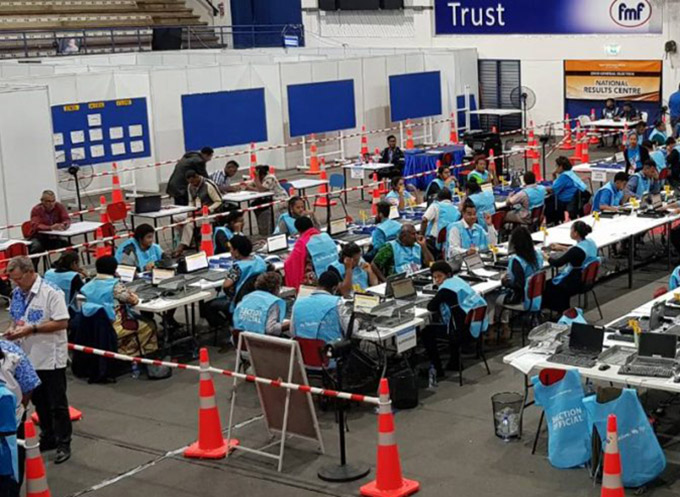
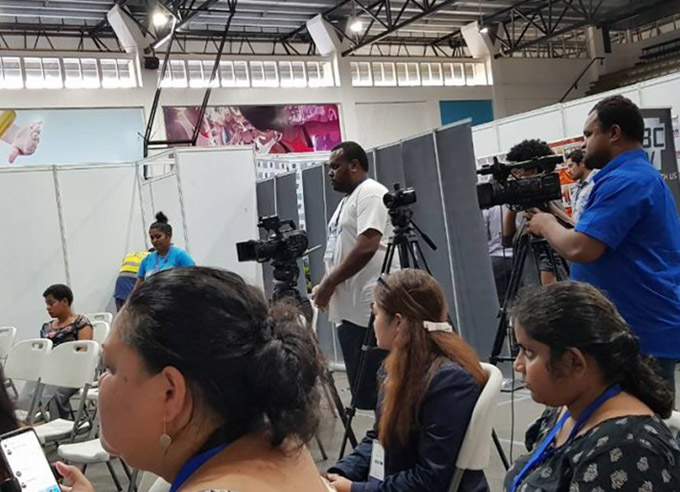
Fiji’s Supervisor of Elections Mohammed Saneem today shortly before announcing final provisional results at the stopping of counting. Image: FEO FB screenshot

By Sri Krishnamurthi in Suva

The Fiji Elections Office (FEO) has entered a new phase towards the results of the 2018 elections by stopping the release of progressive results this morning.

With the targeted 70 percent of the vote counted, the final data entry can now be input with the final results to be released once that has been completed, Supervisor of Elections Mohammed Saneem said.

“We have reached that benchmark, but this does not mean that counting has stopped, this does not mean that we will be counting again, this does not mean that the results will only be for 70 percent of the polling places,” said Saneem.

READ MORE: Fiji’s Banimarama maintains commanding provisional lead

“So, the provisional results that we have been announcing all night are actual results from those polling places and we are stopping that this morning, because we have received up to 70 percent of the results and voters are now able to understand the dynamic of the results of the election.”

Fiji’s Supervisor of Elections Mohammed Saneem announcing final provisional results at the close of counting today after 70 percent of the vote had been completed. Image: Sri Krishnamurthi FEO screenshot
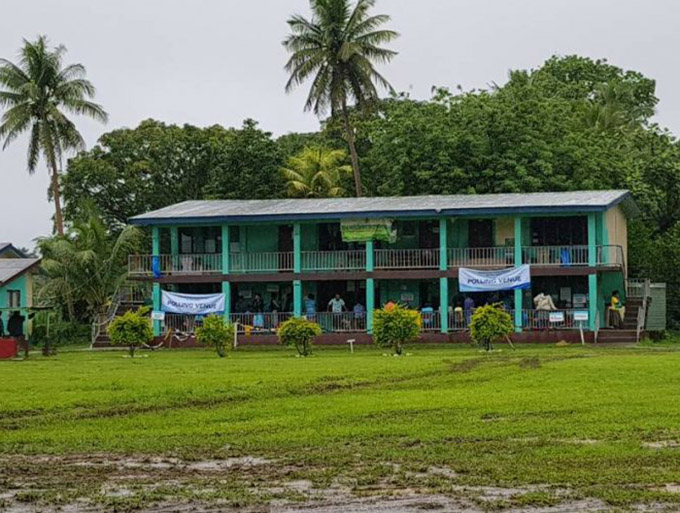
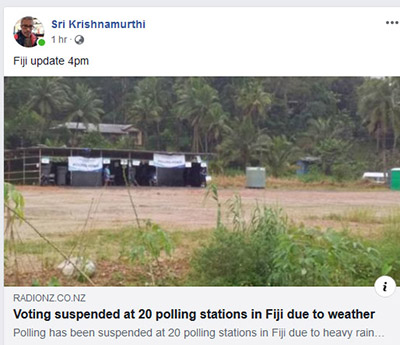
Saneem said votes had been counted at all polling venues where votes were cast yesterday, except at the 23 polling venues where polling had been adjourned because of inclement weather causing flooding.

-Partners-

The FEO were yet to receive the results from 224 polling stations while 1586 were counted by 7am this morning.

Saneem said there were valid reasons for not receiving phone calls with the results.

Materials packed
“The other thing is some presiding officers have directly packed their materials, so they did not call, that does not matter because we have reached our target of more than 70 percent for provisionals,” Saneem said.

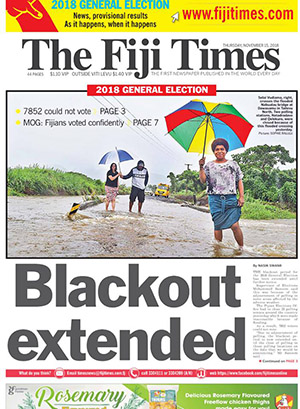
The Fiji Times front page today.
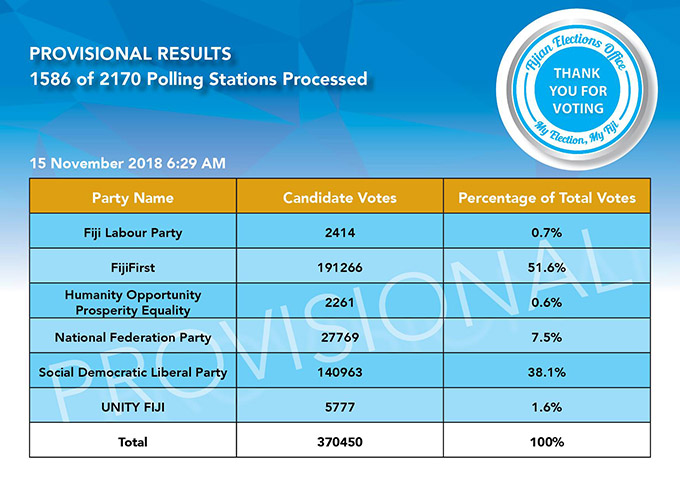
“The total voters that we have received in those polling stations is 370,450 and with that we have now roughly 61 percent turnout in the Central Division, 53 percent in the Eastern Division, 59 percent in the Northern Division and 60 percent in the Western Division,” he said.

“We still have to receive pre-poll counting data which is about 360 or so polling station that are yet to be counted in pre-poll and the 224 that are have not sent us the provisional data.”

The final results will be used to allocate seats for the new Parliament.

When the provisional results were stopped, FijiFirst had a majority of 191,266 (51.63%), SODELPA had 140,963 (38.05%) and National Federation Party 27,769 votes, with all seemingly winning seats in the new Parliament.

Other parties have not reached the threshold of 5 percent to win seats.

Sri Krishnamurthi is a journalist and Postgraduate Diploma in Communication Studies student at Auckland University of Technology. He is attached to the University of the South Pacific’s Journalism Programme, filing for USP’s Wansolwara News and the AUT Pacific Media Centre’s Asia Pacific Report.

Print Friendly, PDF & Email

Article by AsiaPacificReport.nz

]]>

Cambodians await crucial tribunal finding into 1970s brutal Khmer Rouge regime

]]>

Source: The Conversation (Au and NZ) – By Rachel Hughes, Senior Research Fellow, School of Geography, University of Melbourne

A day of judgement is fast approaching for two now-elderly central figures in the Khmer Rouge regime of the 1970s. But part of the judgement due on Friday, a legal finding on genocide, also has the potential to unsettle understandings of the past in current-day Cambodia.

Those in the tribunal dock are Nuon Chea, 92, a man known as Brother Number Two (second in command to Pol Pot, who died in 1998) and Khieu Samphan, 87, the former head of state. The pair, the last survivors of the top Khmer Rouge leadership, are already serving life jail terms after being convicted of crimes against humanity at the same tribunal in 2014.

Khmer Rouge rule, which aimed to turn Cambodia into a back-to-basics, agrarian state, resulted in the deaths of an estimated 1.7 to 2.2 million Cambodians through execution, starvation and disease.

The Khmer Rouge were ousted in 1979 by anti-Khmer Rouge Cambodian “Renakse” forces that were supported by Vietnam. However, their role as liberators was lost on many outside Cambodia, and the new socialist nation was ostracised by Western nations and regional groupings such as ASEAN.

Khieu Samphan, one of two central figures in the dock over atrocities committed during the Khmer Rouge regime. Nhet Sok Heng/EPA

Cambodians now await the latest findings.

Sovannarom, 50, works as an interpreter and taxi driver in Phnom Penh. He lost his brother during the Khmer Rouge regime and while he is in favour of the United Nations-supported Khmer Rouge Tribunal, he wishes more people other than the former senior leaders of the Khmer Rouge were being put on trial.

University-graduate Rotanak, 32, was born after the regime but has closely monitored the tribunal’s progress. She is confident it will satisfy many demands for justice, but worried that the expectations of victims who have participated in the current case, known as Case 002/02, may not be fully met.

On Friday, the Khmer Rouge Tribunal (KRT), officially known as the Extraordinary Chambers in the Courts of Cambodia (ECCC), will issue a summary of its judgement in the second trial against the two former senior Khmer Rouge leaders, who stand accused of genocide, crimes against humanity, and war crimes. Whether or not the specific charge of genocide is upheld, many Cambodians may be surprised or confused by this part of the judgement given the legal complexities. In short, genocide in international law is more narrowly defined than the popular understanding of the concept.

The current case includes charges covering acts at work sites, cooperatives and security centres, as well as internal purges and the regulation of marriage. But these are being prosecuted as crimes against humanity and war crimes, not as genocide. The only charges of genocide in the case relate to crimes against two ethnic minorities in Cambodia, the Cham (a Muslim minority) and ethnic Vietnamese.

A 2014 photograph of Nuon Chea, a man known as Brother Number Two. Nhet Sok Heng/EPA

Under international law, genocide occurs where there has been a “special intent […] to destroy, in whole or in part, a national, ethnical, racial, or religious group, as such”. For the most part, there were no national, ethnic, racial, or religious distinctions between the victims and the alleged perpetrators. Thus, the experiences of suffering of the wider Cambodian population do not formally meet the legal criteria for genocide.

But references to genocide appeared soon after 1979 in expert and mass media accounts of Khmer Rouge rule of Cambodia. Most famously in the English-speaking world, journalist John Pilger’s articles and documentaries drew explicit parallels between the crimes of Hitler in mid-century Europe and those of Pol Pot in 1970s Cambodia: a genocide in which infamous security centre S-21 was a “Cambodian Auschwitz”.

Within Cambodia, one of the early priorities of the government that replaced the Khmer Rouge regime was to convene a tribunal. Only months after Phnom Penh was liberated, the People’s Revolutionary Tribunal found Khmer Rouge leaders Pol Pot and Ieng Sary (tried in absentia) guilty of genocide. Ieng Sary was also charged in the same case as Nuon Chea and Khieu Samphan but died in 2013. The 1979 tribunal proceedings were broadcast in Cambodia, helping to entrench a popular understanding of Khmer Rouge rule as genocidal.

The legacy of this trial is contested. Some authors argue that it was the first attempt globally to bring the specific charge of genocide. International opinion, however, was stacked against the new Phnom Penh government. In the wake of the Vietnam War, Western nations and groupings publicly opposed Vietnam’s actions in Cambodia, seen as an invasion and occupation. In addition to these Cold War complexities, there are those who argue the trial simply failed to meet due process standards.

But there is more to the wider contestation than Cold War politics or due process concerns. John Quigley, a young American expert in international law, was invited to Cambodia to address the 1979 tribunal. His opinion was, and remains, that genocide against the broader population did occur.

The problem with most legal interpretations of the Genocide Convention, he argues, is a confusion of intent and motive, the view that an actor “must proceed out of hatred for the target group”. But “a person who kills members of a group from which he is not distinguished by religion, nationality, or ethnicity, with intent to destroy at least a part of that group, would seem to commit the act of genocide as defined by the Genocide Convention”, he writes.

In contrast, Marcel Lemonde, in his capacity as Co-Investigating Judge at the ECCC has explained in an interview published in 2014:

To establish that a genocide occurred, a group needs to have been identified […] and that group cannot be the quasi entirety of the population – otherwise the notion no longer makes sense.

How to judge what happened in Cambodia from 1975 to 1979 thus goes to the heart of how genocide is defined and understood.

The finding in relation to genocide this Friday is thus likely to provoke debate and confusion. If genocide is not found, the two minority groups in question, and especially the civil parties (participating victims in the case) among them, will be bitterly disappointed. Yet, if genocide is found to have been committed against them, the exclusivity of the finding is likely to jar with understandings held by the majority ethnic Khmer population.


Read more: A scholar’s journey to understand the needs of Pol Pot’s survivors


The confusion is compounded by further complexity in relation to the status of ethnic Vietnamese in contemporary Cambodia. Ethnic Vietnamese in Cambodia are among the most precarious groups in the country, and have recently had new state measures applied against them.

How might a genocide ruling that foregrounds the experience of this group affect their current political status? In an increasingly xenophobic political climate, a genocide finding that appears to grant special status has the potential to be politicised with the aim of provoking hostility.

If genocide is not found, these groups and many other Cambodians will be left wondering why the legal reckoning does not accord with long standing popular discourse.

While the trials were intended to bring legal clarity into the debate about the Khmer Rouge crimes, confusion around the genocide ruling is likely to affect the ongoing legacies of this significant tribunal.

And after the dismissal of the charges against another suspect, it seems more likely this Friday’s judgement hearing will be the last of the trial chamber.

ref. Cambodians await crucial tribunal finding into 1970s brutal Khmer Rouge regime – http://theconversation.com/cambodians-await-crucial-tribunal-finding-into-1970s-brutal-khmer-rouge-regime-106078]]>

Rainbow pride flag’s still flying, taking on new forms and meanings in our cities

]]>

Source: The Conversation (Au and NZ) – By Thomas Stoddard, PhD Candidate, School of Design, University of Technology Sydney

A year ago, on November 15, the Australian Bureau of Statistics announced the result of the postal survey on same-sex marriage equality, a resounding Yes with 61.6% of the vote. Leading up to the announcement, the LBGTQIA+ community endured agonised tension. They had to argue fiercely for the legitimacy of their relationships as well as their identities.

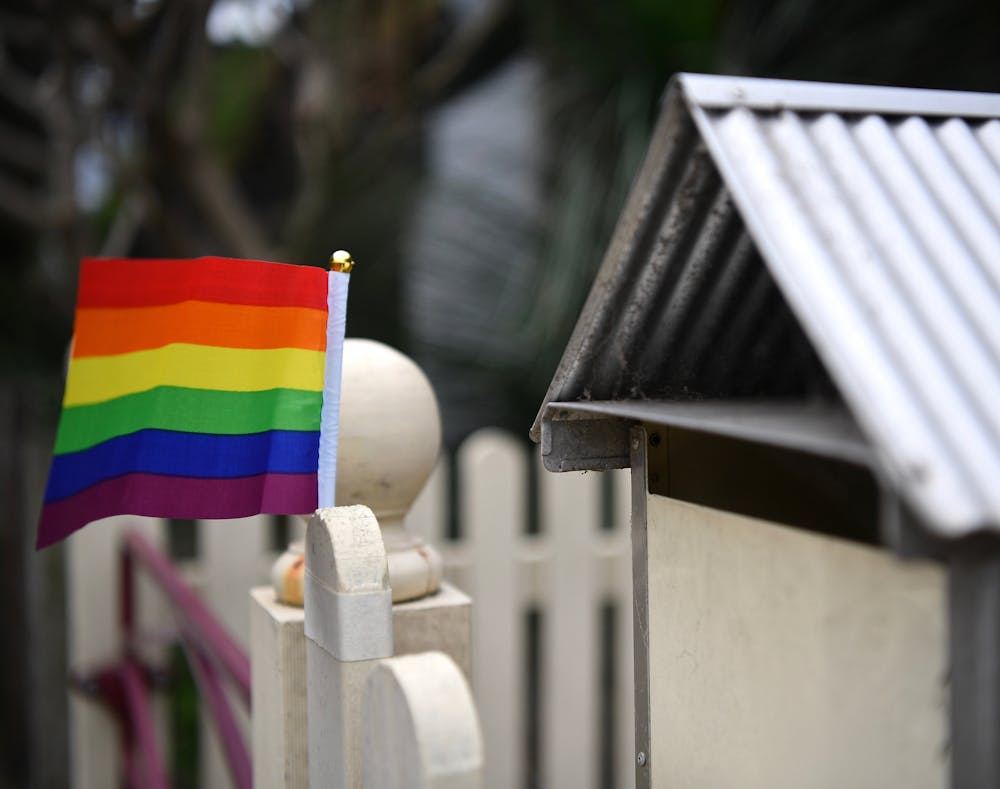
A rainbow flag on a front fence in Sydney’s inner west. Joel Carrett/AAP

During that debate a new visual landscape of signs and interventions became part of many urban environments. The rainbow pride flag began to appear at both public and private sites as a very visible sign of pride and affirmation.

In the past year the flag has clearly escaped the pole or the street bunting of pride festival times to become ever present. Post-plebiscite, we are reminded of the same-sex marriage vote, and that issues for queer people continue.


Read more: A year since the marriage equality vote, much has been gained – and there is still much to be done


Gilbert Baker originally designed the rainbow flag in 1979 for the San Francisco Pride Parade. Its purpose was to express the visibility and values of the gay and lesbian community. The flag’s colours represent healing, serenity, sex and nature.

Since then, the flag has undergone many remixes by different parts of the queer community to create further visibility for the diversity inherent in it.

Transgender woman and activist Monica Helms designed the transgender pride flag in 1999, retaining the stripe motif, but focusing on blue, pink and white to illustrate a spectrum of gender.

Monica Helms talks about designing the trans pride flag.

A more recent design is the pansexual pride flag, designed by a Tumblr user known as Jasper in 2010. First disseminated on the site, it has become the most widely seen specific flag of the community, reused across the internet.


Read more: Explainer: what does it mean to be ‘cisgender’?


What’s in a flag?

Cloth flags are significant cultural spatial markers. Affected by air, wind and light, static cloth is transformed in the slightest breeze, becoming alive and suggesting change as well as permanence.

The rainbow pride flag’s emphatic stripes activate a sense of colour and change, evoking new narratives and possibilities. The flag took on new cultural, social and political meaning as it moved from the air and onto homes and commercial premises.

Some flags, like one hung in the window of The Bank pub in Newtown, were emblazoned with YES in the centre. This left no questions about what the flag was supposed to represent – it was very specific about its contemporary political motivation.

An example of the flag leaving the fixed place of the pole is at 73 Liberty Street in Stanmore in Sydney’s inner west. Originally painted a shade of yellow beige, the house was transformed into a radiant spectrum of rainbow pride colours, with a black and white flag emblazoned with “Yes!” hung on the front. Visit it today and the colours remain as vibrant as ever.

73 Liberty Street in Stanmore. Tom Stoddard, Author provided

The boldness of the flag’s colours radically alters the experience of moving past the generally bland facades of inner-city Sydney. We are now confronted by an eye-catching spectrum, the aesthetic energy of colour and space.

Bold colour, often spurned and even banned in some heritage suburbs such as Paddington, takes on a new uplifting vision. At stake is visibility. LGBTQIA+ communities do not appear and disappear at moments of political debates, but continue to actualise and make visible pride in their existence.


Read more: Coming out at work is not a one-off event


A politicised existence necessitates this, as the fight for equality is ongoing. The painted house is a visible urban marker that the queer community is here to stay.

So what is the significance of these persistent visual markers? On the one hand, their visual presence indicates the importance of a political debate undertaken more than one year ago.

More subtly it marks a cultural shift, where expression, be it personal or as a collective, affirms a community. Design and activism in these forms can become expressions of civic values, as space and place become the mouthpiece for cultural and social sentiments and statements.

The flag leaves the pole: stickers around Marrickville, Sydney. Tom Stoddard, Author provided

That isn’t to say that the static flag does not possess power in its own right. Various activist-designers have transformed it into other forms that create direct dialogues with the public. The rainbow flag stripes become a framing device for statements and declarations that are intrinsically tied to the language of the debate.

Stickers have long been used as spatially flexible political objects, free from flagpoles or other prerequisite structures. From letterboxes to window frames, remixed versions of the flag take a message or sentiment to any place, public or private.

This rethinking of the hierarchy of designated spaces for communication is an exciting evolution for the form and intention of the rainbow pride flag. As it evolves from one icon into a variety of others, it populates the city with queer statements and traces.

Last year the pride flag was used as an effective rallying call to express outwardly, publicly and explicitly that same-sex relationships (marriage or otherwise) are as valid as any heterosexual relationship. It will be interesting to see where the pride flag takes the Australian queer community next and, in turn, where the community takes the flag.

ref. Rainbow pride flag’s still flying, taking on new forms and meanings in our cities – http://theconversation.com/rainbow-pride-flags-still-flying-taking-on-new-forms-and-meanings-in-our-cities-104930]]>

Fiji authorities caught out by social media trolls, poll fake news

]]>

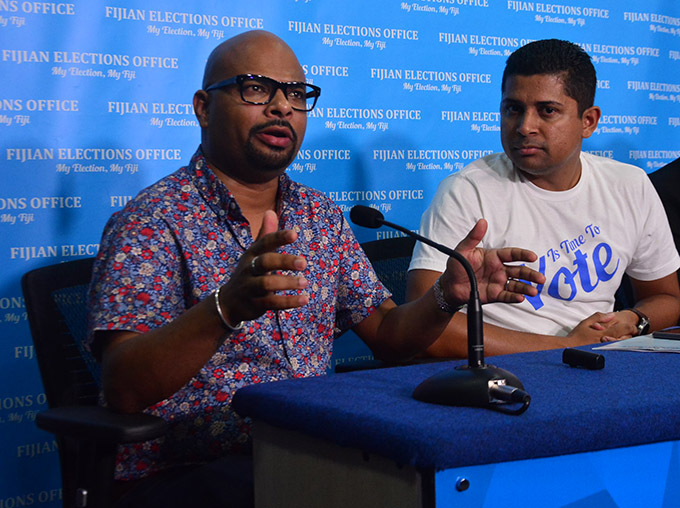
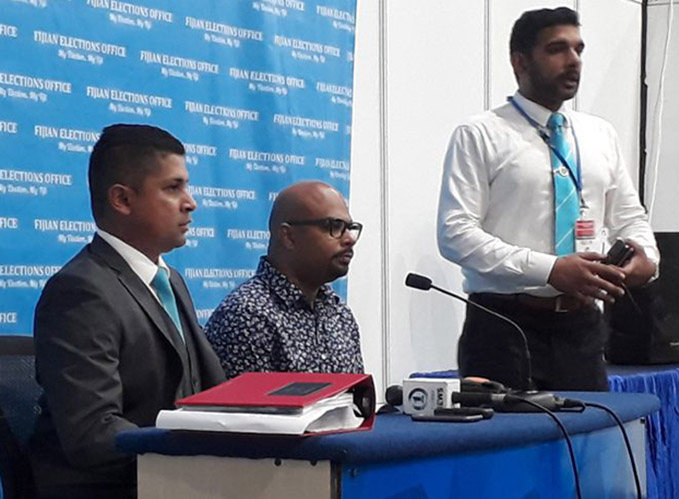
Fiji Media Industry Development Authority (MIDA) chair Ashwin Raj (left) and Supervisor of Elections Mohammed Saneem at a press conference in Suva. Image: Jonacani Lalakobau/Fiji Times

By Sri Krishnamurthi in Suva

Like a possum in headlights, the Fiji media authorities appear to have been caught out by social media trolls and fake news, admits Ashwin Raj, chairperson of the Media Industry Development Authority (MIDA).

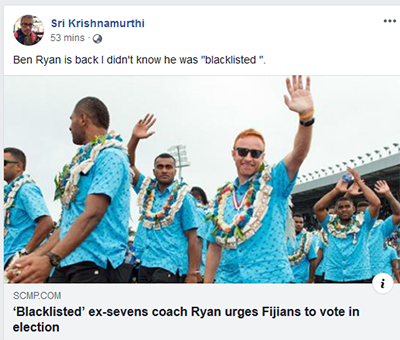
Fake news, a term made infamous by US president Donald Trump, has proved to be the bane of the elections in Fiji – and the authorities had not anticipated having to deal with ferocity of it.

“It is a completely new terrain, last elections (2014) we weren’t talking about fake news; social media is now saturated with this stuff,” said Raj.

READ MORE: Report fake page to Facebook plea from Fiji Times editor

“This is now a completely new phenomenon. Obviously we know who the culprits are, why they are doing it and what they are doing.”

The extension of the media blackout to allow for 23 venues and 7,852 voters to vote at a date yet to be announced meant people had to be vigilant not to be taken in by social media trolls or fake news.

-Partners-

“Wait for official authorised results that will come from the Fijian Elections Office (FEO), be very mindful that people will take to the social media and spread rumours about lawlessness and instil fear, so it very important that we go to the official sources,” said Raj.

“We’ve had members of various political parties who actually forwarded to us news items, which in their estimation constitutes fake news and has coloured a certain perception about the various political parties.

‘Everybody is concerned’
“We’ve also had concerns from the mainstream media that have been brought to our attention. One of the things that have come out of this is that everybody, despite their political differences, ideological disposition, political proclivities are actually concerned about the proliferation of fake news.

“What that has done in terms of the campaign, public knowledge and so on; if anything, this is why we must resort to the mainstream media as the veritable site of truth.

“This is why we need something like the 48-hour blackout period. This is why we need the mainstream media that is going to be the voice of reason, help the public delineate fact from fiction,” said the verbose Raj.

He said force of law would be brought to bear on those who indulged in the dark arts of social media.

“We are in the process of investigating, until we have concluded that process, I’m not going to make a series of statements in relation to that. We will be reporting it to the relevant agencies in due course,” he said.

“There is a whole bunch of stuff going on. There are elements in it that simply constitute criminal acts, when you threaten somebody with sexual assault because you disagree with their political views.

“When you threaten the life, safety and security of people that is simply a criminal act. Then there are other things that are basically fiction and the sort. That can be easily discredited if people produce facts.

Blackout period
“So, the transgressions vary.”

He reminded the people of the ongoing blackout period.

“We are still in the blackout period, the public needs to remember that 7,852 voters in 23 polling venues have yet to cast their votes it is imperative that people do not give any credence to fake news.

“This is where the role of media is very important is dispelling any fiction that might be out there, particular so when it comes to the results,” said Raj.

Nothing could have prepared them from the effects of a tyrant social media.

Sri Krishnamurthi is a journalist and Postgraduate Diploma in Communication Studies student at Auckland University of Technology. He is attached to the University of the South Pacific’s Journalism Programme, filing for USP’s Wansolwara News and the AUT Pacific Media Centre’s Asia Pacific Report.

Print Friendly, PDF & Email

Article by AsiaPacificReport.nz

]]>

Fiji’s Bainimarama maintains strong poll lead, 618 stations to be counted

]]>

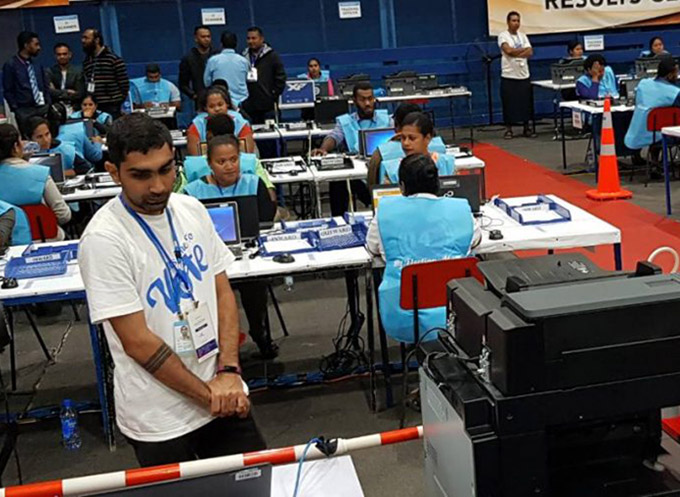
Fiji’s National Results Centre has been releasing provisional results from votes cast at 2170 polling venues. Image: Wansolwara

By Wansolwara Staff

Prime Minister Voreqe Bainimarama has maintained a strong lead early today in Fiji’s general election, polling 140,631 votes from 1552 of 2170 stations being counted at the National Results Centre in Suva.

Opposition SODELPA leader Sitiveni Rabuka has so far raked in 65,650 votes followed by Aiyaz Sayed-Khaiyum with 15,252 and Biman Prasad on 10,461 at 5.50am.

In a surprising twist, Lynda Tabuya has climbed a few votes up, sitting on 7197 votes so far followed by Alipate Nagata with 5270 and Ro Teimumu Kepa with 4699 votes.

Parveen Bala closes in with 4429 followed by Mosese Bulitavu with 4176, Atonio Lalabalavu with 3198, Niko Nawaikula with 3095, Viliame Gavoka on 2929 and Savenaca Narube with 2439.

The provisional results by candidates were released via the Fijian Elections Office FEO App, which is compatible with smartphones and can be downloaded from Google Play and Apple Store.

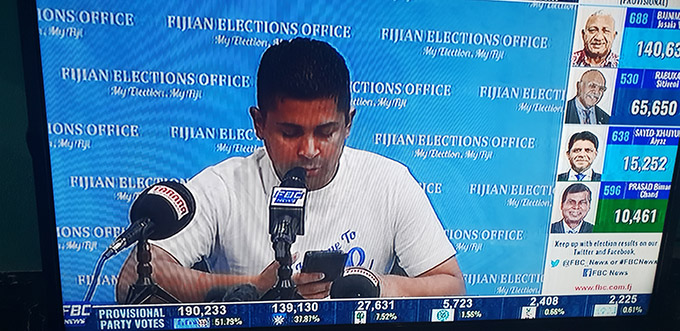
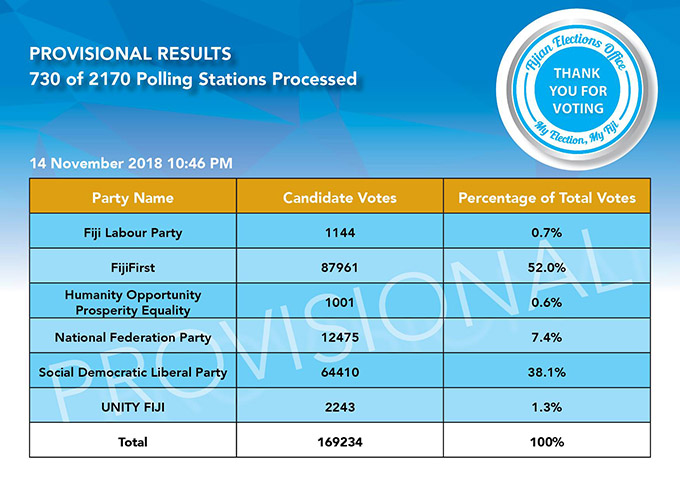
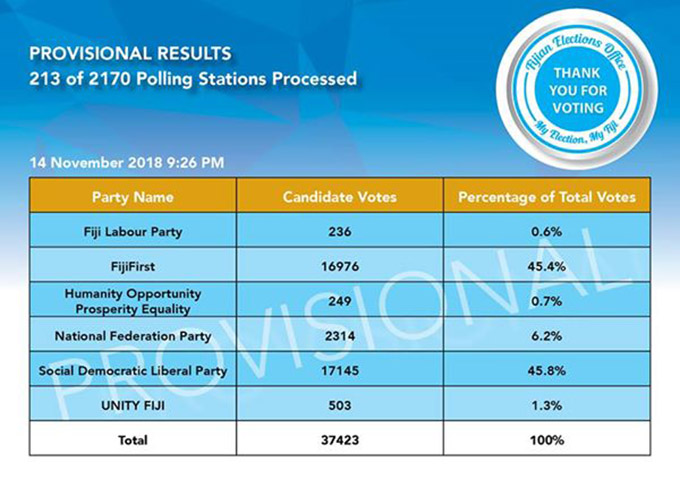
In terms of provisional results by party from the 1552 stations counted so far, FijiFirst Party is still in the lead with 190,233 votes (51.79 percent). Other results out of the FEO App as of 5.50am today include:

-Partners-

Social Democratic Liberal Party – 139,130 (40.19%)
National Federation Party – 27,631 (7.52%)
Unity Fiji – 5723 (1.56%)
Fiji Labour Party – 2408 (0.66%)
Humanity Opportunity Prosperity Equality – 2225 (0.61%)

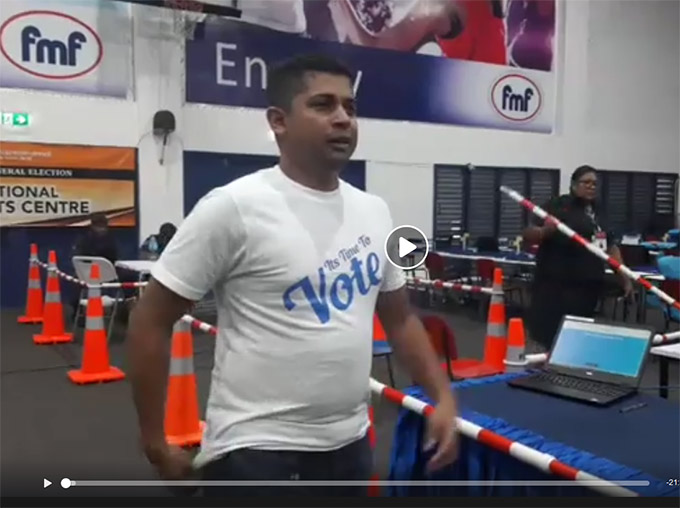
The announcement of provisional results will end at 7am but counting will continue until the final results are tallied and released from the National Results Centre at the FMF Gymnasium in Suva.

This article is republished under the content sharing arrangement of USP’s Wansolwara student journalism newspaper and AUT’s Pacific Media Centre.

Provisional progress results in the Fiji general election at 6.20am today. Source: FEO
Print Friendly, PDF & Email

Article by AsiaPacificReport.nz

]]>

A super-Earth found in our stellar back yard

]]>

Source: The Conversation (Au and NZ) – By Jonti Horner, Professor (Astrophysics), University of Southern Queensland

The potential discovery of a planet orbiting Barnard’s Star – the second closest stellar system to the Sun – was announced by researchers today in Nature.

This discovery pushes the bounds of what we can do with our best current astronomical instrumentation, so the authors are understandably cautious in claiming a “planet candidate”, rather than a confirmed discovery.

The new exoplanet (if it exists) is an icy world just over three times the mass of Earth, and has only been uncovered as a result of an exhaustive search by teams across the globe.

So what does this find mean, and why is it important?


Read more: Curious Kids: Are there living things on different galaxies?


Barnard’s Star – an ancient cosmic tearaway

Shining 16 times too faintly to see with the unaided eye, Barnard’s Star is an ancient red dwarf – significantly older than the Sun. Aside from the Alpha Centauri system, it is the closest star to the Solar system.

Barnard’s Star’s biggest claim to fame is the rate at which it is tearing across the night sky. It moves so rapidly against the background stars that it would cross the diameter of the full Moon in a little over 100 years.

Barnard’s Star is the fastest moving star in our night sky. Astronomer’s call such movement ‘proper motion’.

In the middle of the last century, astronomer Peter van de Kamp was convinced Barnard’s star was accompanied by two Jupiter-mass planets. Over several decades, starting in the late 1930s, he studied the star, taking myriad images, and observing it moving against the background stars.

Rather than moving in a straight line, his observations suggested Barnard’s Star was wobbling as it moved, rocking back and forth as though pulled by unseen companions. His data invoked the presence of two planets tugging the star around as it moved through space.

But despite their best efforts, astronomers elsewhere could find no evidence of van de Kamp’s worlds. Where his observations showed a wobbling star, theirs showed no such wobble – just a linear motion through space.

What was going on? van de Kamp’s observations were made using a large refracting telescope, and astronomers eventually realised that the telescope’s main objective lens had been cleaned and modified several times during the decades of his study. These changes caused the apparent position of the Barnard’s Star to shift back and forth relative to the bluer background stars.

The Jupiter-mass planets around Barnard’s star were no more.

Successive surveys ruled out ever smaller planets. Astronomers are now confident no planet larger than ten Earth masses exists in the system. Which brings us to our new find.

The new discovery

The new candidate planet, Barnard’s Star b, is thought to have a mass between those of Earth and Neptune in the Solar system. While no such planet exists in our backyard, the Kepler spacecraft revealed that such planets are common in the cosmos.

Barnard’s Star b orbits its host at a distance of 60 million kilometres. That might suggest a warm, temperate world – but Barnard’s Star is a dim object, far less luminous than the Sun. As a result, Barnard’s Star b lies beyond what is known as the ice line, so far from the star that water would freeze harder than rock. This means it must be a frigid world.

Artist’s impression of Barnard’s Star b under the orange-tinted light from its red dwarf host. IEEC/Science-Wave – Guillem Ramisa

But that icy orbit adds to our confidence that the planet could really be there. Planets form over millions of year in discs of material around young stars. Grains of dust (and ice) collide slowly, growing ever larger worlds. Eventually, the disc of gas and dust is blown away, leaving behind any planets it formed.

This predicts that planets will form most rapidly, and grow fastest, just beyond the ice line, where the presence of water ice will greatly increase the amount of solid material available to the growing world.

In other words, the most massive planet in a given system should form just beyond the ice line. That is true in the Solar system (Jupiter), and also seems true for Barnard’s Star – if the planet really exists.

Loacting Barnard’s Star candidate planet.

The future – a timely find

If Barnard’s Star b exists, its discovery could not have come at a more opportune time. As it orbits one of the Solar system’s closest neighbours, it presents a perfect target for future observations.

There are a few ways the planet’s existence could be verified. In the near future, the answer might come from the GAIA spacecraft, which has spent the past few years measuring the precise locations and distances of some two billion stars in the night sky.

Graphic representation of the relative distances to the nearest stars from the Sun. IEEC/Science-Wave – Guillem Ramisa

Every time GAIA observes Barnard’s Star, it measures its location with a precision far greater than any previous observatory could manage. If there is a planet orbiting the star, three times the mass of Earth, the same technique espoused by van de Kamp should reveal its presence.

In the coming decade, the next generation of astronomical observatory will revolutionise our ability to peer into the space close to the nearest stars, looking for the dim glow of their planets, reflecting the light of their host stars.


Read more: A Goblin could guide us to a mystery planet thought to exist in the Solar system


Because Barnard’s star is so close, the separation between the planet and star in the sky will be relatively large. If the planet is really there, we will likely get our first direct images confirming its existence within the next ten years.

Beyond that? Who knows. One thing we have learned through the exoplanet era is that, where one planet lurks, more are sure to follow. If the existence of Barnard’s Star b is confirmed, it may indicate there are other, smaller worlds orbiting this ancient star.

ref. A super-Earth found in our stellar back yard – http://theconversation.com/a-super-earth-found-in-our-stellar-back-yard-106862]]>

Micro-betting: a dangerous form of gambling luring in vulnerable Australians

]]>

Source: The Conversation (Au and NZ) – By Alex Russell, Senior Postdoctoral Fellow, CQUniversity Australia

Any sports fan is all too familiar with micro-bets, and the problems they cause. A micro-bet is when bookies offer odds that a particular ball in a cricket match will be a no-ball, for example, or a given serve in tennis will be a fault.

These bets on small events during live play have been linked to sporting corruption – those in the know make hefty profits in betting markets because a player agrees to bowl that no-ball or serve that fault at a pre-determined point in play.

Now, we have found evidence that more than a third of regular Australian sports gamblers are making micro-bets using offshore operators – and worse, this dangerous type of betting is very strongly linked to problem gambling.

Don’t be fooled into thinking micro-betting means small bets. The “micro” refers to a small event within play – but the sum wagered can be huge.

The findings come as legislators in various countries and regions, including the United States – where sports betting has been is illegal or restricted – are under pressure to make sports betting more accessible.


Read more: With sports betting on the rise, can we avoid a tsunami of gambling harm?


Micro-betting is technically legal for Australian licensed operators. But sporting bodies have not approved it, owing to the difficulty of policing the integrity of their sport given the notorious instances of corruption.

Despite calls for micro-betting to be outlawed completely, we found that Australians are using many offshore operators to engage in micro-betting – operators who are not supposed to offer services to Australian punters but do anyway.

In our most recent paper, in a sample of 1,813 regular sports bettors, we found 667 (36.8%) had bet on micro events in the past 12 months.

Of those, an alarming 78% were classified as problem gamblers.

Only 5% of those making micro-bets were non-problem gamblers, with the rest at some risk of developing gambling-related problems. And when we looked at only those who bet on micro events, those classified as problem gamblers were also likely to place a higher proportion of their bets on micro events. It’s important to note we recruited many regular (rather than occasional) sports bettors, leading to a higher representation of problem gamblers in the sample (46.8%). Nevertheless, the relationship between problem gambling and betting on micro events is striking.

Because micro-betting markets open and close fast, usually over just minutes, this betting needs to be impulsive, and those classified as problem gamblers tend to be impulsive. Also, this is yet another way to bet, and people classified as problem gamblers tend to gamble in many ways – sports, races, pokies – at venues, by telephone, and online.

A dangerous, impulsive form of betting

In Australia, sports betting in general is increasing each year. We cannot watch a sporting event without being bombarded with gambling advertising, and this advertising works.

Because sports betting is so common in Australia, many may be surprised to learn sports betting is not offered in some parts of the world, including many states of the US. However, legislators in many jurisdictions are legalising or decreasing restrictions on sports betting, and face questions about what should be allowed.


Read more: Advantage gambling, but corruption risk surely isn’t worth it for tennis


Micro-betting is the most extreme example of in-play or live betting, itself an evolution from the time sports betting was simply on which player or team would win the match – with bets on match outcomes placed hours or even days before the result is known.

Micro-bets reduce the gap between placing a bet and the outcome to minutes or even seconds – essentially allowing bettors to bet continuously. This is concerning, because continuous forms of betting are strongly associated with gambling-related problems – think pokies.

When the Australian government originally legislated Internet gambling, it allowed sports betting because it was not a continuous forms of gambling, and was therefore seen as relatively benign. However, live/in-play sports betting (including microbets) cannot be offered online by Australian-licensed operators. Instead, bettors must place a telephone call to the operator or bet in a venue.

In fact, betting on micro events is a particularly dangerous form of gambling because it is continuous, requires impulsive decisions (impairing the ability to reflect on recent gambling), and offers variety. All of these factors appeal to people at risk of problem gambling.

Calls to ban micro-betting

Two reviews of the gambling legislation recommended that betting on micro events should be specifically outlawed, even if bets are placed via telephone (or in-venue), because of the high risk of gambling-related harm. When the Interactive Gambling Act was amended in 2017, no such change was made, partly because it was difficult to legislate against betting on micro events without unintended restrictions on other forms of betting.

Betting on micro events has also been linked to spot fixing, where a player purposefully stages an event (for example, loses a particular point) so that others in-the-know can bet on it. This has been observed in many sports, and is a key reason that Australian sporting bodies don’t endorse betting on micro events. It is far easier to get a single player to lose a point, than it is for a player or team to lose an entire match.


Read more: Sporting codes’ deals with gambling companies force them into a Faustian bargain


So while micro-betting is not currently offered in Australia, Australian bettors can place micro-bets with overseas bookies, despite the federal government’s efforts to stop this. Given that betting on micro events is so clearly related to problem gambling, and corruption in sports, legislators worldwide should strongly consider whether this form of gambling should be offered as they shape the laws for their jurisdictions.

ref. Micro-betting: a dangerous form of gambling luring in vulnerable Australians – http://theconversation.com/micro-betting-a-dangerous-form-of-gambling-luring-in-vulnerable-australians-106249]]>

Despite new findings, the jury is still out on whether omega-3 supplements reduce heart attacks

]]>

Source: The Conversation (Au and NZ) – By Garry Jennings, Professor of Medicine, University of Sydney

A recent widely-reported study has reignited debate around whether omega-3 supplements reduce the risk of heart attack and stroke. The study showed a particular form of omega-3 oil lowered the risk of people with heart disease experiencing a major “end point” event by 25%. This end point is one or a combination of several serious issues such as fatal or non-fatal heart attack, stroke, angina (chest pain) and coronary surgery.

The REDUCE-IT trial included more than 8,000 participants and was presented at the American Heart Association Scientific Sessions in Chicago and published in the New England Journal of Medicine. It was the largest randomised controlled trial (where one group is given the intervention tested and another a placebo and the results are compared) performed to-date testing the benefits of omega-3 supplements for heart disease.


Read more: Randomised control trials: what makes them the gold standard in medical research?


But before you buy fish oil supplements from the local pharmacy, there are some things to be aware of. The drug tested, Vascepa, wasn’t a standard over-the-counter fish oil capsule. Vascepa is made from a highly refined component of fish oils (icosapent ethyl) and the participants received a very high dose (4 grams per day). This is far more omega-3 than most people take with fish oil capsules. Vascepa is available on prescription in the US but not everywhere, and not in Australia.

The study participants either had cardiovascular disease and were aged over 45, or were at high risk of cardiovascular disease and aged over 50. Those at risk had diabetes and at least one other risk factor. The results apply best to people with similar characteristics to the study group and cannot necessarily be generalised more broadly.

Nevertheless, it was a pretty good study performed by reputable investigators across 11 countries with convincing results. So, what does this mean for the see-saw of advice offered on whether to take or not to take fish oil supplements to prevent major heart issues?

Not everyone with heart disease would necessarily benefit from the supplements participants received in the trial. from shutterstock.com

A bit of history

In the early 2000s medical authorities were recommending fish oil supplementation for people who had experienced a cardiovascular event such as a heart attack or stroke.

At that time, two large randomised controlled trials reported that eicosapentaenoic acid supplements (which contained EPA and docosahexaenoic acid (DHA)) significantly reduced fatal heart disease. EPA and DHA are the major oils found in fish oil supplements and are called omega-3s.

In 2017 the American Heart Association was more circumspect, noting that the dramatic benefits seen earlier were less evident in subsequent trials. But supplements were still recommended for certain people with heart or vascular disease.

By early 2018, the tide seemed to have turned completely as a widely publicised study concluded there was little evidence for the benefit of fish oil supplements in preventing heart disease. The study was a systematic review, which combined the results of ten trials testing fish oil supplements (at a lower dose than the REDUCE-IT trial), involving 77,917 older adults at high risk of cardiovascular disease.


Read more: Health Check: fish oil, anyone?


So, what are we to believe? A well-conducted randomised controlled trial or a systematic review of all the evidence? An RCT is considered gold standard by guideline committees. A well-done systematic review or meta-analysis is also considered as providing powerful evidence.

So, what’s the verdict?

The trials in the systematic review varied widely in design, dose, patient population, end points and the validity of lumping them all together is questionable. Also, finding no evidence of benefit is not the same as finding no benefit, particularly in some people under certain conditions that may be lost in the overall analysis. Plus, the results are not just a reflection of the treatment under examination but also of the quality of the studies included.

REDUCE-IT was funded by the manufacturer. There is no other way it would have been done and if the results stand up it could save millions of lives, but some will question the veracity of the findings because of the funding source. So, all of this leaves certainty of whether supplements are good for heart health up in the air.

It’s still a fact that cold water fish are good for you. from shutterstock.com

Fortunately (and as far as we know) some “truths” remain. Eating fish is still good for you. The origin of the fish is important, not only to avoid contaminants but also because the omega-3 content and relative amounts of EPA and DHA varies. Cold water, oily fish such as salmon, sardines, mackerel, trout and tuna contain the most.

If you cannot eat fish, there are plant sources of omega-3s found in some nuts and vegetable oils such as canola, chia, flaxseed, and soy. These have not been studied as extensively as those of marine origin.


Read more: How Australians Die: cause #1 – heart diseases and stroke


Omega-3s including over the counter capsules have definite biological effects. They reduce triglycerides (the type of fat that contributes to hardening of the arteries) and the risk of blood clots, and are anti-inflammatory. These changes are mostly seen at higher doses.

The evidence will evolve further but, in the meantime, and based on a recent evidence review, the National Heart Foundation recommendations don’t advise health professionals to routinely recommend omega-3 supplements for heart health. It does advise health professionals consider the use of omega-3 supplements for those with high triglyceride levels and as an additional treatment for heart failure.

And lastly, everyone should include two to three serves of fish per week in their diet.

ref. Despite new findings, the jury is still out on whether omega-3 supplements reduce heart attacks – http://theconversation.com/despite-new-findings-the-jury-is-still-out-on-whether-omega-3-supplements-reduce-heart-attacks-106861]]>

‘Keep it in the ground’: what we can learn from anti-fossil fuel campaigns

]]>

Source: The Conversation (Au and NZ) – By Fergus Green, PhD Candidate in Political Theory, Department of Government, London School of Economics and Political Science

From the fossil fuel divestment movement to the Stop Adani campaign, in recent years we’ve seen a wave of climate activism that directly targets fossil fuels — both the infrastructure used to produce, transport and consume them, and the corporations that finance, own and operate that infrastructure.

What makes targeting fossil fuels so attractive for activists, and can we learn anything from them?


Read more: The fossil fuel divestment game is getting bigger, thanks to the smaller players


Failure to launch

Climate change became a topic of mainstream international concern in the early 1990s. For the first two decades of international climate cooperation, until the failed Copenhagen climate conference in 2009, the international environment movement embraced a more “technocratic” approach. Professionally-staffed environment groups made technical arguments aimed at persuading politicians and the public to adopt global climate treaties, national greenhouse gas emission reduction targets, and complex market-based policy mechanisms such as emissions trading schemes.


Read more: The too hard basket: a short history of Australia’s aborted climate policies


All of these things, if sufficiently stringent, would have been great if they were politically possible. But the groups advocating them were politically weak; they had few political resources. Consequently, in the competition to influence policy they were systematically outgunned by the fossil fuel industry.

Not only did the environment movement lack money and power over the economy, they lacked public support for their policy agenda. While public concern for climate change throughout this period was widespread, it was shallow. It was a political priority for few people, and fewer still were willing to take to the streets to demand strong, urgent action.

A protestor at the coal port in Newcastle. BREAK FREE NEWCASTLE

Why fossil fuels resonate

Compared with such ineffective climate activism, the present wave of anti-fossil fuel politics has an important advantage: it resonates better with ordinary people.

First, fossil fuels and associated infrastructure are readily understood by lay audiences. In contrast, concepts such as greenhouse gases, “2°C average warming”, and “350 ppm” are abstract, technical constructions not readily grasped by laypersons.


Read more: A matter of degrees: why 2C warming is officially unsafe


Second, whereas the harms caused by climate change are hard to understand and (perceived to be) remote from their cause in time and space, the production, transport and consumption of fossil fuels cause and are popularly associated with a range of other harms on top of climate change.

These include: local environmental, health and other socio-economic impacts, as well as corruption, repression, human rights abuses and other injustices along the supply chain. Most of these affect people living or working close to fossil fuel infrastructure such as mines, pipelines and coal-fired power stations.

Local communities faced health problems when the Hazelwood coal mine caught fire in 2014. COUNTRY FIRE AUTHORITY

Surveys about energy sources in the US and Australia, for example, support the claim that fossil fuels are unpopular. In China, local air pollution caused by fossil fuels is one of the biggest public concerns. And case studies from various countries indicate the potential for proposed fossil fuel infrastructure to generate strong local opposition, social conflict, and wider media attention.

Third, targeting fossil fuels helps to personalize the causes of climate change. One of the reasons climate change is not psychologically salient to most people is that it is typically perceived to be an unintentional side-effect of the everyday actions of billions of people. This makes it hard for us to attribute blame.


Read more: Unburnable carbon: why we need to leave fossil fuels in the ground


But the fossil fuel industry is disproportionately responsible for our dependence on emissions-intensive energy. Targeting the industry helps to concentrate moral pressure on these more culpable agents and stokes the indignation that fuels climate activism.

Among anti-fossil fuel campaigns, the fossil fuel divestment movement aims most directly and explicitly to delegitemise the fossil fuel industry. Studies show that the divestment movement has, in a very short time, had a revitalising effect on climate activism through the mobilisation of young people, and improved wider public discourse toward climate change action, among other beneficial effects.

Divestment protesters at UNSW in Sydney. DANNY CASEY

Targeting fossil fuels also has advantages when it comes to the other elements of successful social movement activism — resource accumulation, alliance-building, and sustaining participants’ enthusiasm over time.

A necessary part of climate politics

Targeting fossil fuels is not the only way to build more successful movements around climate action. Campaigns providing a more positive vision around renewable energy, for example, have also been successful in mobilising grassroots support, and are a crucial component in contemporary climate activism. And successful grassroots mobilisation is not everything: elite politics and international relations also greatly affect climate policy.

But building wide and deep social movements committed to urgent climate action is a necessary element of the political task before us. As the rising tide of anti-fossil fuel activism shows, if campaigners work with the grain of ordinary human motivation, drawing on what we know about the psychology and sociology of social movements, then they are in with a fighting political chance.

ref. ‘Keep it in the ground’: what we can learn from anti-fossil fuel campaigns – http://theconversation.com/keep-it-in-the-ground-what-we-can-learn-from-anti-fossil-fuel-campaigns-100005]]>

Australia needs to triple its social housing by 2036. This is the best way to do it

]]>

Source: The Conversation (Au and NZ) – By Julie Lawson, Honorary Associate Professor, Centre for Urban Research, RMIT University

Australia needs to triple its small stock of social housing over the next 20 years to cover both the existing backlog and newly emerging need.

That is the central finding of our new research report on the housing infrastructure needs of low-income earners, published by the Australian Housing and Urban Research Institute (AHURI). By our reckoning, 25 years of inadequate investment has left Australia facing a shortfall of 433,000 social housing dwellings. The current construction rate – little more than 3,000 dwellings a year – does not even keep pace with rising need, let alone make inroads into today’s backlog.

The report also shows that Australia needs to avoid overly complex private financing “innovations”. These have proven ineffective elsewhere and were recently abolished by the UK Treasury.

Our modelling of household need and procurement costs shows that direct public investment, coupled with more efficient financing through the National Housing Finance Investment Corporation, is the best way to tackle this policy challenge. Compared with subsidising the operating income of a commercially financed program, the lifetime cost of the first year of house building is A$1.6 billion less. That’s a 24% saving to the public purse.


Read more: Government guarantee opens investment highway to affordable housing


Lack of investment takes its toll

From 1945, state and territory governments, financially supported by Canberra, maintained public programs that built 8,000-14,000 dwellings a year for half a century.

From 1996, however, social housing largely slipped from the Australian government agenda. Dedicated ongoing funding to states and territories was at “starvation levels”. Public house building plunged to today’s residual output, except for a short-lived GFC-stimulus-funded recovery from 2008-11.


Read more: Australia needs to reboot affordable housing funding, not scrap it


How do we estimate the level of need?

Our analysis quantifies both Australia’s housing need “backlog” and the “newly emerging” need from population growth over the next 20 years. It conservatively calculates backlog need as comprising two elements.

First, it considers those who are homeless now. The 2016 census counted 116,000 homeless people across Australia. Recognising that some would choose not to live alone, we estimate that our homeless population implies a need for about 47,000 extra dwellings.


Read more: Homelessness: Australia’s shameful story of policy complacency and failure continues


Second, our analysis considers the group whose housing needs are not being met by the market. These households are on very low incomes (excluding student households), in private rental housing, and in rental stress – where rent is more than 30% of their earnings. If you are on a very low income, housing costs of this order mean going without other essentials.

Collectively, these components imply a current backlog of 433,000 social housing dwellings.

Newly emerging need will expand the shortfall to 727,000 dwellings by 2036. This factors in expected population growth and the current share of social housing. It assumes no improvement in private rental housing affordability.

How achievable is a building program of this scale?

Fixing this problem – both the backlog and newly emerging need – calls for a major program of social housing construction. This is needed to expand the national social housing stock to nearly three times its 2016 size by 2036.

Simply preventing the existing problem from getting worse calls for nearly 15,000 extra dwellings a year to be built. That’s a little over 290,000 homes over the next 20 years.

To eliminate the backlog as well would require an annual program averaging 36,000 units. This would need to begin gradually to build capacity and avoid inflating costs.

The required increase in social housing construction sounds huge, but it’s a rate Australia managed in the past and is lower than in many other countries. Joel Carrett/AAP

This would represent around a tenfold increase in current social housing construction rates. The output would be similar to the 14% public housing share of Australia’s total house building in the decade to 1955.

For comparison, housing providers with a social purpose today account for 20-31% of all house building in the UK, Finland, France and Austria, and much more in some Asian countries such as Singapore. England’s not-for-profit housing associations, for example, completed some 42,000 homes in 2017-18, out of 161,000 homes built in total.

What will this cost the government?

What would be the price tag for such a program? And what’s the best way for government to provide the necessary support?

To answer the first question, we identified both the social housing need, described above, and the land and construction costs across 88 regions of Australia. Different regions have different land costs and building forms, such as detached, medium and high-rise dwellings. Not surprisingly, the modelled unit procurement costs vary substantially, from A$146,000 in remote South Australia to A$614,000 in parts of Sydney. We then calculated the price tag across the country.

To work out the cost to government, and answer the second question, a couple of important assumptions are made.

The first is that social housing need should be met in (or near) the places where it arises. While skewing the building program towards less well-located places could accommodate the need more cheaply, it is in our view essential to avoid such a “ghettoisation” model.

Second, while tenants can help cover the costs through their rent, to be affordable that rent will service only a modest amount of debt. As the federal Treasurer’s own advisory committee acknowledges, therefore, the public purse must bear most of the development cost.

No amount of “innovative” procurement or financing will yield a government “free lunch” as the UK’s National Audit Office evaluation of private infrastructure financing experiments demonstrates.

The five investment scenarios

We examined five contrasting “investment pathways” for delivering a program that builds social housing on the required scale. The basic choice is between a capital grant model (subsidy paid up front) and a revenue subsidy model (annual payments underpin debt repayments and operating costs).

We calculate that the cost of the first year of the program would total A$5 billion under a capital grant approach. A private debt-financed approach, with government support through revenue subsidies, would cost A$6.6 billion. This is after discounting costs incurred in later years.

Thus, direct investment would save Australian governments 24% on average.

So while governments tend to favour “financial innovation” options that push costs into the future, capital grant funding is the rational investment pathway.

Providing enough housing for low-income earners is a growing policy challenge. With rising homelessness and housing stress in recent years, this research quantifies the scale of that challenge and identifies the most cost-effective investment pathway to its resolution.

ref. Australia needs to triple its social housing by 2036. This is the best way to do it – http://theconversation.com/australia-needs-to-triple-its-social-housing-by-2036-this-is-the-best-way-to-do-it-105960]]>

In defence of ASIC: there’s more to regulation than prosecution

]]>

Source: The Conversation (Au and NZ) – By Clinton Free, Professor, UNSW

An irony of the banking royal commission is that it may end up having its greatest impact on an entity that isn’t a bank.

The Australian Securities and Investments Commission and its shortcomings have become a major theme of the Commission.

Whereas the banks have already implemented a host of changes in anticipation of the Commissioner’s final report, the future of ASIC remains in flux.

It is mentioned in the Commission’s interim report more often than any of the banks, apart from the Commonwealth and the ANZ.

ASIC has also become something of a whipping boy in media accounts of misconduct, frequently getting more column inches than the institutions it regulates.

ASIC under the microscope

The irony is deepened by the fact that many of the cases examined by the Commission came to its attention as a result of ASIC’s work.

In his interim report the Commissioner advocates a prosecutorial approach to regulation, going as far as to say that all breaches should be prosecuted unless public interest shows otherwise.

The Commissioner seems committed to the need to reinvent the regulator as an adversarial, proactive force.

Throughout the Commission hearings, ASIC has been depicted as gentle and overly fond of negotiated settlements rather than wielding the stick.

This week a Federal Court judge took a critical stand about a negotiated settlement reached by ASIC with Westpac bank.

Justice Nye Perram threw out a A$35 million settlement between ASIC and Westpac over the bank’s alleged failure to properly assess whether borrowers could meet repayments.


Read more: Behind the judgement. Why the Federal Court tore up a $35m settlement between ASIC and Westpac over lending standards


He told the parties he could not approve the requested settlement because there was no contravention of the law shown in the proposed terms of settlement.

One of the consequences of Justice Perram’s action is that now ASIC may have to prove a contravention in relation to each and every loan where it says Westpac was in breach. Negotiated settlements avoid this extremely expensive and time-consuming use of ASIC’s resources.

Regulation by prosecution?

Before changes are implemented to sharpen ASIC’s teeth and commit more scarce public funds to expensive court proceedings, it’s worth reflecting on the realities of enforcement.

All regulators use a mix of negotiation and litigation. This includes the Australian Competition and Consumer Commission, which has been commended by the Commissioner.

In the financial year 2016-17, the ACCC initiated 24 new civil cases, instigated one criminal conviction, accepted 14 enforceable undertakings, and received payment for 11 infringement notices with a total value of A$115,200.

In the same period, ASIC initiated 112 new civil actions, drove 20 criminal convictions, accepted 16 enforceable undertakings, and issued 74 infringement notices with a total value of A$4.3 million.


Read more: Uncomfortable comparisons. Why Rod Sims broke the ACCC record


In the face of misconduct on display at the royal commission, talk of tackling the banks head-on is understandable.

The signs of a greater commitment to court proceedings are already apparent: the appointment of Melbourne-based lawyer Daniel Crennan as a new Commissioner responsible for enforcement, more staff, closer relations with the Director of Public Prosecutions, and tough talk.

Adversarial isn’t always best

ASIC is at a crossroads.

Greater reliance on the courts may well be characterised by delay, smaller compensation for customers, ballooning costs and, as a result, a shrinking budget for detection and investigation.

Even with the then Treasurer Scott Morisson’s A$70 million injection to boost enforcement, ASIC’s total budget pales in comparison to the deep pockets of the big four banks.

Getting onto the front foot needn’t always mean going to court.

Negotiated settlements like enforceable undertakings with more penetrating terms can be just as effective as going to court, as can stronger surveillance and investigation.


Read more: The problem with Australia’s banks is one of too much law and too little enforcement


In times with less frenzied scrutiny, enforcement outside courts wouldn’t be seen as a sign of weakness, but of judgement. ASIC ought to be judged on its results and left to exercise a mix of enforcement strategies under its independent powers.

Enforcement outside the court system does not mean capture or weakness. Lawyers at ten paces is not the only way to regulate the banks.

ref. In defence of ASIC: there’s more to regulation than prosecution – http://theconversation.com/in-defence-of-asic-theres-more-to-regulation-than-prosecution-106239]]>

How anti-Semitic stereotypes from a century ago echo today

]]>

Source: The Conversation (Au and NZ) – By Jonathan C. Kaplan, Doctoral candidate, University of Technology Sydney

A few weeks ago, my parents woke up to find a large, orange swastika daubed in paint on a wooden plank outside their house in Sydney. We have a mezuzah attached to our front doorpost, so the “dauber” knew we were a Jewish household. At the time, my parents were angry and sad more than frightened.

My family’s experience cannot compare with the hate that burst forth in Pittsburgh several weeks ago, when 11 congregants at the Tree of Life Synagogue were murdered simply because they were Jewish people attending prayer. But we are living in a period of increasing hatred directed at minorities of all kinds, and anti-Semitism is on the rise across the globe.

The Pittsburgh synagogue gunman, Robert Bowers, raged in online platforms that Jews were “invaders” trying to destabilise the United States. They were, he said, “an infestation” and “evil”. Bowers’ rants cast Jews in the role of dangerous revolutionaries out to destroy Western civilisation. This has long been a staple perspective of anti-Semitism.

In my research, I have been studying the anti-Semitic images that were commonplace in Vienna early last century. These stereotyped images served to vilify Jewish people, culminating in the removal of most of the Jews from Vienna in 1938.

I believe it is important that we reflect on these upsetting images to consider how the “mainstreaming” of anti-Semitic ideas and images in popular media can have terrible consequences.

Caricatures in the fin-de-siècle Viennese press

At the turn of the century, the Austrian capital was home to the third-largest Jewish population in Europe after Warsaw and Budapest. Accounting for almost 9% of Vienna’s population, Jews were a highly visible minority. They were also a constant source of conversation and fear within Vienna’s political and civic arenas.

Anti-Semitic caricatures and literary sketches in the Viennese press ran rife from the end of the 19th century until the German annexation of Austria in March 1938.

The cartoons presented a variety of messages that characterised Jews in a number of negative roles: as the binary opposite to Aryan morality and virtuousness, as money-grubbing parvenus, or as attempting to take over large parts of the city. What all these stereotypes had in common was their characterisation of Jewish people as an Other who did not belong within European society.

One caricature from the widely read Viennese biweekly satirical magazine Kikeriki, published in 1900, comments on the presence of Jews at elite social events.

Caricature from the satirical magazine Kikeriki. Author provided

It depicts Jewish men and women ridiculed for their supposed racial characteristics (a view strongly influenced by the popularity of eugenics and Social Darwinism during this period) and, by satirising the popular dance styles at elite city balls, implies that Jews dominated Viennese elite circles. The image’s caption makes no overt references to Jews, but the visual stereotypes would have made it very clear to the readers what this image was about.

A 1900 cartoon in Figaro. Author provided

Another cartoon from 1890 in Figaro (not to be confused with the popular French daily Le Figaro) depicts two men meeting on a crowded Viennese street. One of the men, a visitor, asks a local if he would be so kind as to point out the Judengasse [Jews’ Street]. The latter replies, “Perhaps you can tell me where is it not.”

The scene behind these two gentlemen is filled with characters drawn with common Jewish bodily stereotypes: large hooked noses, dark curly hair and thick lips.

Although at this time most Jews living in Vienna spoke German and were adherents to secular German culture, the figure of the Ostjude (Eastern Jew) was a typical feature of these cartoons. Anti-Semitic cartoonists, newspaper editors and politicians harnessed a fear connected to an increased Jewish migration from Austria’s eastern crownlands and the pogroms of the Russian Empire.

Despite the fact that Yiddish-speaking, Orthodox, traditionally attired Jews never accounted for the majority of Vienna’s Jewish population, cartoons often depicted them as descending en masse into an unsuspecting “German” city.

Cartoons often depicted Jewish people descending ‘en masse’ on a city. Author provided

Other cartoons bemoaning Vienna’s “Jewification” gave way to those speculating on the revenge that would be meted out to the Jews; not necessarily violence and murder, but other forms such as banishment from the city and its social and political arenas.

A revenge fantasy. Author provided

‘Jewification’ and revenge today

The effects of this tradition of anti-Semitic representation are clear. It took very little for average men and women to turn on their Jewish neighbours and colleagues after the German Anschluss in March 1938.

Many Viennese Jews were lucky to escape. Some, just under 2,000, found a haven in Australia. They have since, like many other refugees and migrants, contributed to the economic, cultural and political development of Australian culture in the post-WWII period.

Yet the themes of “Jewification” and revenge expressed in these cartoons are, sadly, still relevant today.

In his online rants, for instance, Bowers had condemned the Hebrew Immigrant Aid Society (HIAS) – a Jewish refugee advocacy and support group founded in New York in 1881 – for “bringing in invaders”.

The Hungarian-born Jewish billionaire philanthropist George Soros, meanwhile, has been the target of anti-Semitic demonisation. And in Charlottesville last year, hundreds of mostly young white men marched with torches chanting the Nazi slogan “Blood and Soil” and “Jews will not replace us”.

How we speak about and depict others in the media and social discourse perpetuates long-held stereotypes and ultimately emboldens hate-filled individuals. It is for this reason that we should look to the past – and learn from it.

ref. How anti-Semitic stereotypes from a century ago echo today – http://theconversation.com/how-anti-semitic-stereotypes-from-a-century-ago-echo-today-106451]]>

Bainimarama, FijiFirst take strong lead in provisional election count

]]>

Provisional counting in the Fiji general election are being released from the National Results Centre at the FMF Gymnasium in Suva. Image: Semi Malaki/Wansolwara

By Wansolwara Staff

Prime Minister Voreqe Bainimarama has taken a strong lead in the Fiji general election tonight at 10.40pm, raking in 55,203 votes from 651 of out 2170 stations counted so far.

This compared with opposition SODELPA leader Sitiveni Rabuka’s 25,659 votes and Aiyaz Sayed-Khaiyum’s 5849 votes.

The provisional results by candidates released via the Fijian Elections Office FEO App, which is compatible with smartphones and can be downloaded from Google Play and Apple Store, also showed 3647 votes for Biman Prasad, 2626 votes for Mosese Bulitavu and Lynda Tabuya with 2607 votes.

Ro Teimumu Kepa trailed by a few votes with 1970, Alipate Nagata with 2054, Atonio Lalabalavu with 1711 votes and Parveen Bala with 1779 votes.

In terms of provisional results by candidates from the 521 stations counted, FijiFirst Party leads the race with 75,158 votes (51.26 percent). Other results out of the FEO App as of 10.40pm include:

Social Democratic Liberal Party – 57,182 (30 percent)
National Federation Party – 10,439 (7.12 percent)
Unity Fiji – 1968 (1.34 percent)
Fiji Labour Party – 1022 (0.70 percent)
Humanity Opportunity Prosperity Equality – 848 (0.58 percent)

Sixth update of Provisional Results as at 14th November 2018 10.46pm
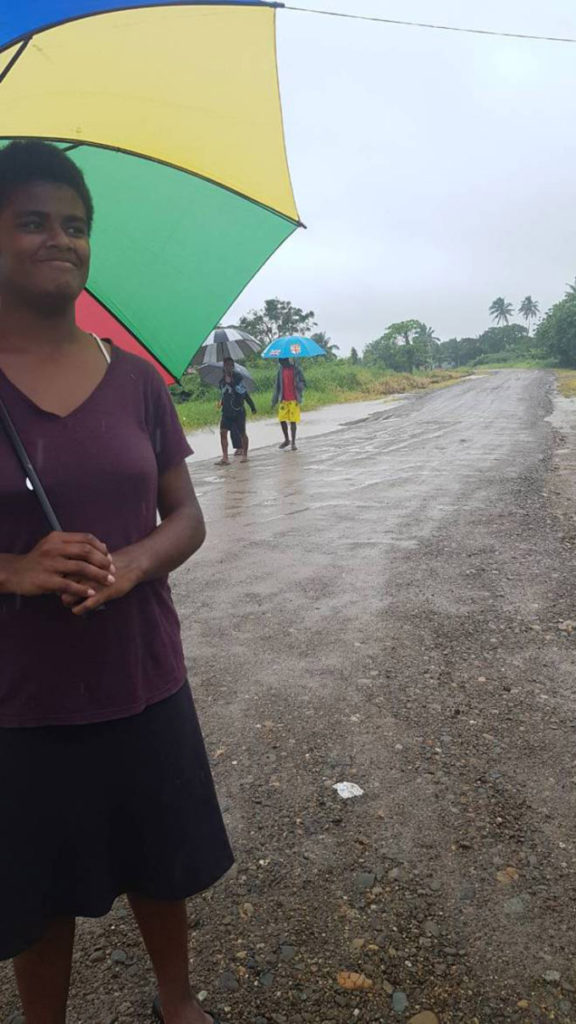
-Partners-

Blackout period
Speaking to local media tonight, Media Industry Development Authority chairman Ashwin Raj said the blackout period was still in effect as more than 7000 voters were yet to cast their votes after 23 polling venues had been closed because of bad weather.

“The blackout period gives voters that moment to reprieve so they are able to cast their vote without pressure.

“Both mainstream, social media and the civic space have been saturated with campaigns so what we need is that space to make up your mind about who you want to vote for,” Raj said.

“In essence, those 7852 (voters) have yet to cast their votes. We are still in the blackout period and what that essentially means is that we are going to be in the blackout period until the day of polling [for those voters from the 23 affected polling venues].

“We will wait for the Electoral Commission to announce when the polling day is going to be [for those 7852 voters].”

Young voters brave the cold weather to cast their vote in Wainibokasi today after public buses failed to turn up. These voters walked for more than an hour before a bus finally arrived. Image: Mereoni Mili/Wansolwara
Print Friendly, PDF & Email

Article by AsiaPacificReport.nz

]]>

Tight race in Fiji national election as early provisional results flow in

]]>

Election officials at the National Results Centre in Suva tonight. Image: Semi Malaki/Wansolwara

By Wansolwara Staff

The count is on in the Fiji general election and early indications tonight point to a close race between the opposition Social Democratic Liberal Party (SODELPA) and the ruling FijiFirst Party.

As the 2018 election came to a close 6pm today, all eyes were on the announcements being made from the National Results Centre at the FMF Gymnasium in Suva.

At 8.36pm, Supervisor of Elections Mohammed Saneem announced the first set of provisional results, which were also available for public viewing via the FEO App for smartphones.

Saneem said the FEO App could be downloaded from Google Play or Apple Store and accessed on smartphones.

The first set of provisional results were released from 11 out of 2170 stations counted and saw SODELPA’s Sitiveni Rabuka taking the lead with 236 votes followed by Atonio Lalabalavu with 155, Jone Seniloli with 144, Mitieli Bulanauca with 117 and Prime Minister Voreqe Bainimarama on 108.

Around 9pm, Deputy Supervisor of Elections Karyl Winter provided the second update on the provisional results for the 2018 General Election.

-Partners-

From the 39 stations counted, provisional results by parties were:

Social Democratic Liberal Party – 2275 (47.39%)
FijiFirst – 2204 (45.91%)
National Federation Party – 209 (4.35%)
Unity Fiji – 51 (1.06%)
Fiji Labour Party – 35 (0.73%)
Humanity Opportunity Prosperity Equality – 156 (0.70%)

At the third provisional update at 9.26pm with 213 of 2170 polling stations processed, SODELPA was still slightly in the lead on 45.8 percent followed by FijiFirst on 45.4 percent:

The third provisional results update in the Fiji general election. Source: FEO

The Fijian Elections Office will provide updates of provisional results every half hour until midnight, and every hour from then on until 7am tomorrow.

Print Friendly, PDF & Email

Article by AsiaPacificReport.nz

]]>

Fiji media blackout extended, fresh polling for closed venues

]]>

Local media representatives during a briefing at the Fiji Election Results Announcement Area, FMF Gymnasium, in Suva today. Picture: Mereoni Mili/Wansolwara

By Elizabeth Osifelo in Suva

The media blackout period in the Fiji general election today has been extended until the closure of polling in areas that were recently closed as a result of bad weather this afternoon.

During the 5pm media briefing at the Results Announcement Area, Fiji Military Forces (FMF) Gymnasium in Suva, Supervisor of Elections Mohammed Saneem said ballot papers cast at the now 28 affected areas that were closed late this afternoon would be cancelled and discarded.

“These ballot papers will not be counted. We will be taking fresh ballot papers to these areas, fresh voter lists and empty ballot boxes to conduct polling at these locations once again,” he said.

READ MORE: RNZ Pacific’s Fiji election live blog

“Due to the adjustment of polling, the blackout period has been extended until the close of polling in these polling stations – the date will be announced.

“There is no power in the law for an extension of voting time – 10 and a half hours of voting began at 7.30am. Voters that arrive at the polling venue before 6pm will be able to vote.”

Former Fiji rugby coach urges Fijians to vote in spite of the weather. Image: Sri Krishnamurthi FB/PMC

-Partners-

Meanwhile, Saneem also addressed concerns about public transport to voting venues. Voters in some areas waited long hours for public buses to arrive, others had to walk for at least an hour before a public bus arrived.

“We have arrangements with the bus companies that they will continue to run bus services in all centres around the country to ensure that voters are able to turn up to vote at their respective polling stations,” he said.

Flooded roads
“We have been advised that buses, of course will not go into flooded roads, but all other roads in the urban centers will remain operational.

“I would like to urge all Fijians who have not voted yet, to brave the weather and come out. We will not be able to extend the polling times, as it is written in law.

“But we still have time to urge our family members and friends to come out in large numbers and vote. The voting numbers at this point in time, need to increase as much as possible.”

The Fiji Bus Operators Association provided free bus services for voters in Samabula North, Narere, Nakasi, Davuilevu Housing and Makoi.

Elizabeth Osifelo of the Solomon Islands is a final-year student at the University of the South Pacific in Suva.This article is republished under the content sharing arrangement of USP’s Wansolwara student journalism newspaper and AUT’s Pacific Media Centre.

Print Friendly, PDF & Email

Article by AsiaPacificReport.nz

]]>

Death doulas can fill care gaps at the end of life

]]>

Source: The Conversation (Au and NZ) – By Deb Rawlings, Lecturer in Palliative Care, Flinders University

With continual advances in modern medicine, we’re enjoying longer lives. As the population ages, and particularly as many people are living longer with cancers and chronic diseases, end-of-life care is adapting and changing.

People who are approaching the end of their lives will usually spend some or most of their time at home, requiring care and support to do so. Family members might not always be available to provide this care. When they are, the process can be rewarding, but it can also be challenging and complex, often leading to a severe emotional burden for the carer.

Gaps in our health and social care systems are starting to be filled by death doulas. But beyond providing practical support, families are increasingly seeking the services of death doulas to help navigate the experience of dying. Those nearing the end of their lives, too, may bring in a death doula to ensure they can die the way they want to.

We urgently need a conversation about death doulas and new models of care at the end of life. We are continuing to build an evidence base through research with the death doula community and via consultation with the health services that interface with death doulas.


Read more: Planning for death must happen long before the last few days of life


Defining the death doula

We’ve seen a similar concept in midwifery, where birth doulas have long been providing social, emotional and practical support to help women through the process of childbirth. This has been shown to have positive outcomes for mothers and their babies.

Like birth doulas, death doulas’ roles and functions are non-medical; these can include advocating, supporting (spiritually and sometimes physically), guiding, and providing emotional support to the person and their family, mainly in the home.

We undertook a systematic review of the literature to find available evidence about the death doula role. We found little formal academic literature describing the role, their training, or contribution to individuals, families and the health system.

But what we do know is that each death doula enacts the role differently. They might spend time with the dying person, offering emotional and spiritual support, and sometimes providing physical care. They might support the family carers in the work they are doing. Some death doulas are only present in the last days of life, offering “vigiling” – sitting with the dying person so they are not alone.

Some doulas offer after-death rituals such as helping families prepare the body or keeping the deceased at home.

A death doula can provide additional support to family members acting as caregivers at the end of life. From shutterstock.com

Some death doulas are paid by families who engage their services. Families have often found their chosen doula online or through word-of-mouth. Other death doulas work voluntarily, in a similar way to a hospice volunteer. But, because there are no formal structures or registers, we don’t know how many death doulas there are.

In Australia and elsewhere, palliative care nurses, social workers and those from the funeral industry work as death doulas. This seems to be a natural progression, but it’s a grey area: they are providing care, but are not registered or supervised.

There is little formal assessment to guide patient and family choice or to inform end-of-life care provided by professionals.


Read more: Assisted dying is one thing, but governments must ensure palliative care is available to all who need it


How can doula care be formalised?

Providing care in homes can be informal. It may be provided by families, friends, or community groups. Care can also be formally negotiated and provided by health services, aged care providers or private agencies.

It’s necessary to understand the implications of the death doula role. For example, they could become part of formal care arrangements such as home care packages or via private health insurance funding.

We also need to look at how these new roles are authorised to represent the dying person, as they are neither a family member nor a qualified health professional. It’s also important that they are appropriately trained and insured (if providing paid services).


Sign up for the newsletter

Sign up to Thrive, a weekly dose of evidence to help you live well.


There are personal, social and cost advantages in enabling care in the home for a dying person. For families, being able to support the person in a familiar environment can be a powerful motivator to engage a death doula to fill the gaps in care provision.

For the health system, care in the home is seen as positive. It can avoid unnecessary hospital use and help spread the costs of caring.

For the dying person who may prefer to die at home, it is a way of achieving this. Importantly, death doulas can improve the dying person’s ability to control their own care.


Read more: What is palliative care? A patient’s journey through the system


The death doula role may well incorporate some of the direct care provided by families and help them to navigate the complex needs and planning required at the end of life. If so, death doulas could represent an important opportunity to improve dying outcomes.

We need to ensure our community is informed, health service provision crosses both hospitals and homes, and that those providing care – regardless of setting – have skills and knowledge appropriate to their role.

ref. Death doulas can fill care gaps at the end of life – http://theconversation.com/death-doulas-can-fill-care-gaps-at-the-end-of-life-105743]]>

A knowing, modern yet mythic production of one of Hitler’s favourite operas

]]>

Source: The Conversation (Au and NZ) – By Peter Tregear, Honorary Principal Fellow, University of Melbourne

Review, Die Meistersinger von Nürnberg, Melbourne.

Australian productions of Richard Wagner’s Die Meistersinger von Nürnberg (The Mastersingers of Nuremburg) are rare and for those of us attending the opening night of Opera Australia’s production in Melbourne, it is easy enough to see why.

Die Meistersinger is an extravagantly long, complex, and resource-intensive piece of theatre. But this, in turn, reflects the ambition of the composer to create works that would have an equally grandiose social and political impact on audiences.

For economic reasons alone, co-productions make particular sense, and here Opera Australia has collaborated with the Royal Opera House, Covent Garden, and the National Centre for the Performing Arts, Beijing, to mount a production conceived by the Royal Opera’s then house director, Kasper Holten, in 2017.

Holten’s work has typically divided critics, and this production is no exception. When it premiered in London, the Spectator’s Michael Tanner declared, “Nothing could prepare me for so deep an abyss of idiocy”. Others, however, have found Holton’s directorial interventions to be revelatory.

Such a stark division of opinion reflects the nature of so-called Regieoper, a style of production where a director feels licensed, if not obliged, to reinterpret the largely 19th century Western European operatic canon in order to reflect contemporary sensibilities and concerns.

In Holten’s hands (and brilliantly realised through Mia Stensgaard’s stunning set design, Anja Vang Kragh’s costumes, and Jesper Kongshaugh’s lighting design) Wagner’s 16th-century guild of mastersingers become a modern-day men’s club. The whole setting of Act II in changed from a village street scene to that club’s backstage area. Walther von Stolzing, the knight errant (and, eventual prize-winning singer), is dressed to look more like Meat Loaf than a Lancelot.

Stefan Vinke as Walther Von Stolzing in Die Meistersinger von Nürnberg: dressed to look more like Meatloaf than a Lancelot. Jeff Busby

Wagner’s works are, however, particularly ripe for such treatment because he was himself a pioneering modern dramatist. His operas foreshadow cinematic styles and techniques as well as the themes and interests of symbolist and psychoanalytical drama.

While Die Meistersinger stands apart from Wagner’s other works in being grounded more in historical, rather than mythical, materials (we find here, for instance, no goddesses with winged helmets, nor knights arriving on the backs of swans and the main character, the cobbler and poet Hans Sachs, is based on an actual historical figure), he still ultimately gives this material a mythic frame.

The setting of the opera, the city of Nuremburg, a town in the geographical heart of Teutonic Europe, serves as the embodiment of the spirit of the German people writ-large. The singing competition that lies at the heart of the opera’s plot thus acts as a means for Wagner to proselytize what he considers to be quintessentially German cultural qualities and virtues.

It was no surprise, then, that Die Meistersinger eventually became a favourite work of the opera-loving leader of the Third Reich. The work was performed, for instance, at Adolf Hitler’s formal inauguration in March 1933.

And the character of Sixtus Beckmesser (here brilliantly sung and acted by Warwick Fyfe), the one person in the opera who does not seem to be able to “get” what makes German art great, has more recently been interpreted as an evocation of anti-Semitic tropes. Certainly we know from his own writings that Wagner believed that Jews were a corrupting influence on “true” German culture.

Warwick Fyfe as Sixtus Beckmesser. Jeff Busby

As is so often the case, Wagner’s works (as opposed to Wagner the man), ultimately defy straightforward interpretations. Beckmesser’s role as a comic foil in the opera derives from his musical (and, by extension cultural) conservatism. Yet, despite his eventual public humiliation, by the end of the opera Hans Sachs seems ultimately to support his point of view, declaring that Germans should honour their masters. Even if Germany itself were to disappear as a political entity, he declares, “Still would remain/ Our sacred German Art”.

Gender politics

One of the benefits of Holten’s staging is that what we see and hear at this point, however, is no longer a simple, direct, appeal, but rather a knowing representation of one. Similarly, Holten is also interested in reminding us of the gendered aspect underpinning Wagner’s drama.

At the conclusion of the opera, in defiance not only of her father, and the men-folk of Nurenburg, but in defiance of the opera itself, Eva quite literally walks off stage. She refuses to play her otherwise pre-destined role as a wife and mother, or indeed as Walther von Stolzing’s ‘prize’.

Natalie Aroyan as Eva and Dominica Matthews as Magdalene in the Melbourne production. Jeff Busby

It’s a clever move. But here, too, it does not close the issue. What, then, do we make of Eva’s actions given that she also sincerely loves Walther? Does not her act of freedom come at the price of emotional honesty? Gender politics aside, is it not an uncomfortable truth (for both sexes) that loving another always involves always a degree of personal compromise?

I suspect Wagner himself, however, would not have been upset were we to contemplate such issues, given his own lifelong interest in the struggle we all face to reconcile the competing demands of social and personal integrity. And it is one sign that this, ultimately, is a successful production. It is also terrific to see the full stage of the State Theatre in use. So often Melbourne audiences for Opera Australia productions have had to put up with “cut down” stagings that were designed initially for the much smaller dimensions of the Joan Sutherland Theatre at the Sydney Opera House.

Natalie Aroyan as Eva and the Opera Australia ensemble. Jeff Busby

Conductor Pietari Inkinen, already well known to local audiences through his musical direction of Opera Australia’s two seasons of Wagner’s The Ring Cycle, directs Orchestra Victoria in an accomplished reading of Wagner’s complex score. As for the performances on stage, Warwick Fyfe’s outstanding musical and dramatic characterisation of Beckmesser alone makes a ticket worthwhile, other standout cast members are Nicholas Jones (playing Sachs’ apprentice David with youthful aplomb) and Natalie Aroyan as a radiantly sounding Eva.

Hans Sachs was sung beautifully by German bass-baritone Michael Kupfer-Radecky even if he didn’t quite have the vocal gravitas that both role and the venue really required. Vocal presence was certainly not an issue for Stefan Vinke as Walther von Stolzing, but he did not sound comfortable meeting the exceptional technical demands of the role.

The minor principals and chorus, however, all acquitted themselves admirably. Any quibbles aside, this is a great ensemble performance by Opera Australia and well worth a listen and look.

Die Meistersinger von Nürnberg is at the Arts Centre Melbourne, State Theatre, on Sat Nov 17, Mon 19 Nov and Thurs 22 Nov.

ref. A knowing, modern yet mythic production of one of Hitler’s favourite operas – http://theconversation.com/a-knowing-modern-yet-mythic-production-of-one-of-hitlers-favourite-operas-106932]]>

Bad weather forces Fiji to close 23 polling venues, 7852 voters affected

]]>

Fiji voters turning up in the rain to cast their votes at Nabitu District School in Tailevu on Viti Levu today. Image: Mereoni Mili/Wansolwara

By Wansolwara staff

A total of 7852 voters at more than 20 polling stations will cast their votes at a later date after the Electoral Commission – in consultation with the Fijian Elections Office – today closed 23 polling venues effective immediately as a result of bad weather.

In a statement, Supervisor of Elections Mohammed Saneem said the FEO received information from presiding officers hat there were some polling stations and venues no longer accessible for voters.

“The FEO tried to wait it out a little to see if the rain would stop and waters would recede but it appears that the waters are rising as I speak, and it has therefore become necessary for me as the Supervisor of Elections to consider adjourning polling at these locations,” he said.

He said the decision was made in accordance with Section 47(2) and consultation with the Electoral Commission under Section 47(3).

Saneem said polling at those locations would commence at a later date, which was feasible for polling.

This would be announced by the Electoral Commission in consultation with the FEO.

Earlier report – voting suspended in 20 Fiji polling venues. Image: Sri Krishnamurthi FB/PMC

-Partners-

The affected areas include Delakado FEO Shed, Natadradave FEO shed, Nasinu community hall, Turagabeci Primary School, Lodoni Primary School, Naivicula District School, Korotale Mandir hall, Raiwasa community hall, Namuaniwaqa Primary School, Mataso Primary School, Rewasasa community hall, Nausori Technical School, Visama Sanatan Dharam Primary School, Naqeledamu Village School, Nukutocia Village shed, Naisoqo Settlement FEO ground shed, Shantikettan Primary School, Naviniivisau community hall, Krishna Janaradhan School, Logani community hall, Matacaucau community hall, Nausori community hall and Gram Sangathan School.

“Any vote cast at the polling station will be cancelled and polling at the affected polling station will take place on the soonest feasible date to be determined and approved by the Electoral Commission,” Saneem said.

“From now until the close of polling, we may have a few more polling stations that will require adjournment because the accessibility levels are reducing and we will be convening media conferences to announce this.”

This article is republished under the content sharing arrangement between the Wansolwara student journalism newspaper of the University of the South Pacific and AUT’s Pacific Media Centre.

Print Friendly, PDF & Email

Article by AsiaPacificReport.nz

]]>

Explainer: Why Sri Lanka is sliding into political turmoil, and what could happen next

]]>

Source: The Conversation (Au and NZ) – By Michael Breen, McKenzie Postdoctoral Fellow, University of Melbourne

This week, Sri Lanka’s Supreme Court made a dramatic intervention in the country’s deepening political crisis, a move that may prevent it from sliding further into democratic dysfunction and possible political violence.

The three-judge panel overturned the unilateral action by Sri Lankan President Maithripala Sirisena to illegally dissolve the parliament last week. The ruling means that parliament could reconvene as soon as Wednesday (November 14).

Jubilant supporters of sacked Prime Minister Ranil Wickremesinghe celebrated the decision outside the heavily guarded Supreme Court building in the nation’s capital, Colombo. It is being seen as one of the most significant rulings in Sri Lanka’s history.

How Sri Lanka got to this point

The Supreme Court ruling is the latest twist in a tense political drama that has engulfed the nation since late October, when Sirisena sacked Wickremesinghe and installed civil war strongman Mahinda Rajapaksa in his place. He then called for a snap election on January 5 – an election now in considerable doubt.

Sirisena cited a conspiracy to have him assassinated as a key reason for his actions. But he had no constitutional basis for either the dissolution of parliament or the removal of a sitting prime minister.


Read more: Sri Lanka: as constitutional crisis triggers fears of ‘bloodbath’, concern mounts for minorities


The president’s move to dissolve parliament came just days before it was scheduled to reconvene and vote on which of the two men claiming to be prime minister should be actually recognised as holding the job.

Sirisena and Rajapaksa had tried but failed to induce enough MPs to switch sides. Dissolving parliament, however unconstitutional, became their only path to self-preservation.

So… who is the prime minister?

Sri Lanka has a long democratic tradition dating back to British colonial times. It has seen many ups and downs, including a brutal 25-year civil war that ended in 2009 and the rise of an authoritarian-style leader in Rajapaksa (who served as president from 2005 to 2015).

But never before have Sri Lanka’s constitution and its democratic principles been so undermined.

Supporters of Sri Lanka’s ousted prime minister march in Colombo. M.A. Pushpa Kumara/EPA

Since his sacking, Wickremesinghe has continued to claim he is the legitimate prime minister with the support of the majority of parliament.

But Rajapaksa has thus far appeared to have the confidence of the president and key state institutions.

Why was Wickremesinghe sacked?

The possible return of Rajapaksa had ignited deep concerns within Sri Lanka and abroad.

It was only three years ago that his own party split and aligned with the major opposition parties to propose Sirisena as a consensus presidential candidate.

Ironically, Sirisena’s election heralded a new “Yahapalana” coalition government, a term meaning “good governance”. But things did not go according to plan.


Read more: Rajapaksa defeat signals the end of a dynasty in Sri Lanka


Sirisena and Wickremesinghe were unable to work together and none of their key promises were met. Meanwhile, the economy went backwards.

The coalition seemed doomed when local elections in February were dominated by a new party, established by the Rajapaksa family.

The final straw was the alleged assassination plot against Sirisena, apparently involving neighbouring India. The plot was raised in Cabinet, but Sirisena was unhappy with the response and acted by sacking Wickremesinghe, claiming his life was in danger.

It was the policy differences between Sirisena and Wickremesinghe, however, that was really at the heart of the discontent. Sirisena declared that if Wickremesinghe returned, he would “not stay one hour longer”.

So what happens now?

Sirisena initially said he suspended parliament last week to allow his “new government” to appoint a Cabinet and present a budget.

Yet, it was allegedly done to provide enough time for the Rajapaksa camp to bribe MPs to his side. One MP claimed to have recorded Rajapaksa’s henchmen offering him US$2.8 million.

Meanwhile, crowds have taken to the streets in support of each side, while Wickremesinghe has remained holed up in the prime minister’s official residence, surrounded and protected by supporters and fellow parliamentarians. Two people have been killed.

History suggests that Rajapaksa would have succeeded in convincing enough of those who opposed him to switch sides. But this is no ordinary power struggle.

Why is Rajapaksa’s possible return so fraught?

Rajapaksa’s presidency was punctuated by his controversial response to the civil war and abhorrent end of the conflict, which saw tens of thousands of innocent people killed.

His rule was increasingly authoritarian, nepotistic and corrupt. At one point, his family controlled more than half of Sri Lanka’s budget, and he’d succeeded in amending the constitution to grant himself more powers and the prospect of a presidency for life.

Sri Lanka’s civil war strongman Mahinda Rajapaksa has been installed as prime minister by the nation’s president. M.A. Pushpa Kumara/EPA

And this is leaving aside the geopolitical implications of his presidency and possible return to government. Some commentators have portrayed the current crisis as a power struggle between India and China. And it is certainly true that India would prefer Wickremesinghe, and China, Rajapaksa.


Read more: War is over, but not Sri Lanka’s climate of violence and threats


During his time in office, Rajapaksa sought Chinese investment to build a major port in Sri Lanka, leaving the country in serious debt. Unable to pay back the Chinese loans, Sri Lanka was forced to hand over the port to China on a 99-year lease.

Given this history, it’s not surprising China was the first of only a few countries to recognise the Rajapaksa prime ministership.

But in the end, this is really about domestic politics. And whatever happens, a return to violence is a real possibility. The Supreme Court’s intervention has stopped Sri Lanka’s democracy going over the cliff for now. But it remains on the edge.

Rajapaksa’s strategy will be to delay a confidence vote in parliament for as long as possible, and to redouble efforts to convene a majority. But if he fails, he may be tempted to use force to get his way, and Sri Lanka’s democratic deficit will become a gaping chasm.

ref. Explainer: Why Sri Lanka is sliding into political turmoil, and what could happen next – http://theconversation.com/explainer-why-sri-lanka-is-sliding-into-political-turmoil-and-what-could-happen-next-106526]]>

Behind the judgement. Why the Federal Court tore up a $35m settlement between ASIC and Westpac over lending standards

]]>

Source: The Conversation (Au and NZ) – By Michael Adams, Professor of Corporate Law & Governance, School of Law, Western Sydney University

Very rarely does a judge tear up a multi million dollar penalty signed up to by both the regulator and the alleged perpetrator.

Yet that’s what Federal Court judge Nye Perram did on Tuesday, throwing out a $35 million settlement between Westpac and the the Australian Securities and Investments Commission over its alleged failure to properly assess whether borrowers could meet their repayments before signing them up to mortgages.

Agreed settlements are common

In commercial litigation, as in most litigation, there is an emphasis on trying to settle matters early before they are heard in court.

In criminal law matters the prosecutions encourage early guilty pleas in exchange for lower penalties.

The Australian Securities and Investments Commission (ASIC) has been increasingly resorting to early settlements as a means of achieving cheaper and quicker outcomes.

The quick win for ASIC, is an enforceable undertaking and a media release. The quick win for the other party is avoiding a drawn out court case and being able to get on with its business.

Courts usually rubber stamp them

Where the alleged breach of the law is serious, necessitating a large penalty, a judge has to formally approve the settlement, in a hearing until now regarded as something of a rubber stamping exercise.

As the Hayne Royal Commission into the Misconduct in Financial Services has pointed out, the downside of such quick settlements can be that the facts aren’t established in court and the law isn’t tested.

Where they are established and the law is tested, as Justice Yates did earlier this year in Australian Transaction Reports and Analysis Centre versus Commonwealth Bank of Australia very big penalties can be handed down – $700 million for more than 50,000 breaches of the Anti-Money Laundering and Counter Terrorism Financing Act.


Read more: Commonwealth Bank’s $700 million fine will end up punishing its customers


Along with it was landmark judgements that establish the scope of the law and tell firms what to avoid in the future.

This time the court said no

On Thursday Justice Perram, in the Federal Court sought the right to do the same.

He rejected the joint application for settlement between ASIC and Westpac Banking Corporation for a penalty of $35 million.

The problem, as he pointed out was that it was not clear from the agreed facts what actual contraventions of the National Consumer Credit Protection Act 2009 Westpac had been accused of.

He asked ASIC and the Westpac to re-draft the agreed settlement and return to court by 27 November 2018.

In order to establish the law and what happened

The case matters because the Financial Services Royal Commission has been examining the use of computer programs to determine the ability of borrowers to repay loans.

It is possible that many Westpac loans were approved to customers who would have been found to be unable to meet the repayments had their individual circumstances been examined, and it is possible that is in breach of the law.


Read more: Consumers need critical thinking to fend off banks’ bad behaviour


But without a clear judgement or a clear statement of facts for the court to examine, or a clear judgement from the court, it is impossible to tell.

That’s why Justice Perram said no, in order to estabish what the law requires and what Westpac did.

ref. Behind the judgement. Why the Federal Court tore up a $35m settlement between ASIC and Westpac over lending standards – http://theconversation.com/behind-the-judgement-why-the-federal-court-tore-up-a-35m-settlement-between-asic-and-westpac-over-lending-standards-106915]]>

Curious Kids: What is dew?

]]>

Source: The Conversation (Au and NZ) – By Dylan Korczynskyj, Associate Professor, University of Notre Dame Australia

Curious Kids is a series for children in which we ask experts to answer questions from kids. You might also like the podcast Imagine This, a co-production between ABC KIDS listen and The Conversation, based on Curious Kids.


I am wondering: is dew the same as rain? What is dew? Thank you – Leo, age 3.


Great questions, Leo!

I am a plant ecologist, and rain and dew are things I need to understand. Plant ecology is all about learning how plants are affected by the world around them (their environment) in the same way that you are affected by your environment.

For example, if you go outside you might consider putting a hat on so you don’t get burnt by the hot sun. Or you might put a coat on so you don’t get cold or wet. Plants are greatly affected by water, whether it comes from dew or rain. So are rain and dew the same?


Read more: Curious Kids: How do you know that we aren’t in virtual reality right now?


Dew can form on flowers, too. Flickr/Sarah, CC BY

Dew is the water droplets that we find in the morning on leaves and other things outside, and usually in spring or winter when the air is cold. It is similar to rain because it forms from condensing water vapour. I hear you asking, “…but what does condensing water vapour mean?”. I will try to explain.

Water can be a liquid (we drink liquid water), it can also be a solid (think of ice cubes), and it can be a gas, which we call water vapour. When water warms up enough it breaks into small, fast-moving parts, called molecules. It changes from being a liquid to a gas – water vapour – that floats about in the air.

Water can be solid (like ice), liquid (like the water we drink) or vapour (a gas, like steam). Shutterstock

Think about how the steam (which is water vapour) from your hot bath floats about your bathroom.

So, now you understand what water vapour is and how it is made, think about what will happen if the fast moving water vapour cools down: this will help you understand condensation.

As the vapour cools, it slows down. The small parts, the molecules, start to gather together, especially on cold things (like a cool leaf) or in cold areas (like high in the sky). Scientists would say the water condenses.

If enough water molecules gather together (like a little water molecule “meeting”) they form a droplet of liquid water.

This same process (condensation) occurs when the stream from your hot bath condenses on the cold bathroom mirror – have you ever drawn a face on it?

When steam from your bath cools down it can form droplets on your bathroom mirror – you can draw on it! Flickr/suzienewshoes, CC BY

Whether the droplets that form are dew or rain depends on where they formed.

Rain forms from water vapour condensing high in the sky as clouds. If enough water molecules gather together, it will get too heavy to stay in the sky and fall down on your head as rain.

Dew forms from water vapour that condenses on cold surfaces on the ground, like grass or a car on a cool morning (it usually gets a bit cooler early in the morning).

Here is some dew that formed on a car. M Fletcher, CC BY

All plants need water and so do we – it is very precious to all life! Most plants get their water from the soil, but this water originally fell as rain and then soaked into the soil.

Some plants and lichen (lichen are like plants) can absorb water from dew. It’s a little bit like they are “drinking” the dew.

I hope this helps.


Read more: Curious Kids: where do clouds come from and why do they have different shapes?


Hello, curious kids! Have you got a question you’d like an expert to answer? Ask an adult to send your question to curiouskids@theconversation.edu.au

CC BY-ND

Please tell us your name, age, and which city you live in. We won’t be able to answer every question but we will do our best.

ref. Curious Kids: What is dew? – http://theconversation.com/curious-kids-what-is-dew-103341]]>

Fijians urged to vote after ‘worrying’ turnout in stormy weather

]]>

Heavy rain and a flood alert remain in force today as Fiji citizens braved the wild and wet conditions to vote in the general election. Video: FBC News

By RNZ Pacific

More than 550,000 people were due to vote today in the election as wet and stormy weather hit Fiji.

“As at midday we are not doing very well in terms of turnout,” said the Elections Supervisor Mohammed Saneem.

He said some of the more worrying turnouts reported so far were in Lami in Suva and in the west of the main island where only six out of a total of 181 voters had turned out at one polling station.

“My advice to all voters is to come out and vote,” Saneem said.

The Fijian Elections Office also said it had received complaints from some areas that bus services were not operating.

-Partners-

“My mother is 85 years old. Our road is flooded. No transport available. Polling centre at Visama Sanatan Dharam Primary. She wants to vote but weather is not favourable. Any help?” one voter asked on the Fijian Elections Office Facebook page.

The office had managed to contact the companies and urged them to follow an agreement to provide transport to polling stations, Saneem said.

Tropical disturbance
Fiji has just entered the cyclone season and a tropical disturbance has formed to the northwest of the country.

Officials have also been urging people to take their umbrellas and brave the bad weather.

It is a public holiday in Fiji, which is going to the polls for just the second time in 12 years.

Fiji’s prime minister, Voreqe Bainimarama, said he would be disappointed if he did not win today’s election.

Bainimarama was speaking as he cast his vote at Vatuwaqa Primary School in the capital Suva.

“We’re hoping to win the majority so we can form the next government,” he told journalists.

Other political party leaders also cast their ballot at various polling stations this morning.

Sitiveni Rabuka was photographed standing in the rain in a queue with other voters at his polling station.

There are strict conditions around the media during the blackout period but journalists have been allowed to photograph all party leaders as they head to the ballot box.

Voters have a choice of 233 candidates, from six political parties, vying for 51 seats, and they have been urged to double check where they are due to vote or risk being turned away.

This article is republished under the Pacific Media Centre’s content partnership with Radio New Zealand.

Print Friendly, PDF & Email

Article by AsiaPacificReport.nz

]]>

3D concrete printing could free the world from boring buildings

]]>

Source: The Conversation (Au and NZ) – By Jay Sanjayan, Professor, Swinburne University of Technology

Construction is one of the largest industries in the world economy – worth A$10 trillion globally (equivalent to 13% of GDP).

But construction has suffered for decades from remarkably poor productivity compared to other sectors. While agriculture and manufacturing have increased productivity 10-15 times since the 1950s, construction remains stuck at the same level as 80 years ago.

That’s because construction remains largely manual, while manufacturing and other industries have made significant progress in the use of digital, sensing and automation technologies.

We and other research groups see 3D-printed concrete as a possible solution to these problems. The technique will likely also give architects the freedom to inject more creativity into their designs for new structures.


Read more: How to print a building: the science behind 3D printing in construction


Problems facing construction

Our modern civil infrastructure is almost entirely built with concrete. We use more than 20 billion tons of concrete per year. The only material we use more than that is water.

The construction industry is facing a number of serious problems, including low labour efficiency and high accident rates at construction sites. According to the Australian Bureau of Statistics, the construction industry has the highest rate of work-related injuries (59 per 1000 workers).

There are also difficulties in quality control at construction sites, high levels of waste and carbon emissions, cost blow-outs, and challenges in managing large worksites with a vanishing skilled workforce.

Disruptive technologies such as 3D concrete printing can offer solutions.

The author pictured with a 3D-printed concrete building design. Author provided

The benefits of 3D concrete printing

3D construction uses additive manufacturing techniques, which means objects are constructed by adding layers of material.

Conventional approaches to construction involve casting concrete into a mould (known as formwork). But additive construction combines digital technology and new insights from materials technology to allow free-form construction without the use of formwork.

Eliminating the cost of formwork is the major economic driver of 3D concrete printing. Built using materials such as timber, formwork accounts for about 60% of the total cost of concrete construction. It’s also a significant source of waste, given that it is discarded sooner or later. According to a 2011 study, the construction industry generates 80% of total worldwide waste.

Pouring concrete into formwork also limits the creativity of architects to build unique shapes, unless very high costs are paid for bespoke formwork. Free-form additive construction could enhance architectural expression. The cost of producing a structural component would not be tied to the shape, so construction could be freed from the rectangular designs that are so familiar in current building architecture.


Read more: Concrete jungle? We’ll have to do more than plant trees to bring wildlife back to our cities


What we could build

3D concrete printing is being explored for use in the construction of houses, bridges, buildings and even wind turbine towers.

Houses

This 3D-printed concrete house was built in 24 hours during a harsh Russian winter. It was the first such house to be built in a single location.

Bridges

An 8-metre 3D-printed concrete bridge for cyclists was unveiled in the Netherlands last year. The bridge, which was printed by Eindhoven University of Technology, has more than 800 layers and took three months to print.

Intricate structures

3D concrete printing has an advantage over conventional construction methods when it comes to building non-rectilinear shapes, such as curved shapes with intricate details.

Each block of this freestanding structure is printed using a special cement composite.

It’s still early days

This field of research is still in its infancy.

The biggest hurdle in the development of concrete 3D printing is the concrete itself. Conventional concrete in its current form is not suitable for 3D printing, so new and innovative alternatives need to be developed.

Researchers are exploring various types of concrete. The concrete for 3D printing must not set when it’s inside the printer, but it needs to set and strengthen as soon after it is extruded as possible. This kind of concrete is called “set-on-demand”.


Read more: We could 3D print buildings using robots and drones – here’s how


When it comes to actually printing the concrete, special printers are needed. Typically, the size of the printer needs to be larger than the component being printed. However, researchers are exploring printers or robots that can “climb” on parts of the concrete that are already set in order to print other sections.

A 3D concrete printer being used for concrete printing research. Misanthropic One/flickr, CC BY

International researchers and industry experts will gather at the First International Conference on 3D Construction Printing at Swinburne University of Technology in Melbourne from November 25-28.

ref. 3D concrete printing could free the world from boring buildings – http://theconversation.com/3d-concrete-printing-could-free-the-world-from-boring-buildings-106520]]>

There are many good ideas to tackle inequality – it’s time we acted on them

]]>

Source: The Conversation (Au and NZ) – By Marianna Brungs, Director, Sydney Peace Foundation, University of Sydney

This is the final article in the Reclaiming the Fair Go series, a collaboration between The Conversation, the Sydney Democracy Network and the Sydney Peace Foundation to mark the awarding of the 2018 Sydney Peace Prize to Nobel laureate and economics professor Joseph Stiglitz. These articles reflect on the crisis caused by economic inequality and how we can break the cycle of power and greed to enable all peoples and the planet to flourish. The Sydney Peace Prize will be presented on November 15 (tickets here).


Forida says that if she were paid a little more money, she could one day send her son to school. She could live happily; her family could live a better life.

Forida, 22, lives in Dhaka, Bangladesh, with her infant son and husband. They live in a dark compound built mostly of tin and wood with six other families and just one toilet. It floods and leaks when it rains, and beside the compound is a polluted pond that attracts mosquitoes.

Forida makes clothes bound for Australia as part of the global fashion industry. She earns about 35 cents (AUD) an hour.


Read more: To tackle inequality, we must start in the labour market


Forida’s story is not rare.

Oxfam did a comparison earlier this year of the salaries of top CEOs of large Australian retail clothing brands and the earnings of the women, like Forida, who work in their supplier factories.

Salary gap between CEOs and garment workers (click to enlarge). Sources: Annual reports for Wesfarmers, Premier Investments, Woolworths Holdings; Oxfam Australia (2017), What She Makes: Power and Poverty in the Fashion Industry., Author provided

We found that the workers’ wages have increased at a snail’s pace, while the CEOs’ pay has shot up by millions. Annual pay for the workers who make their clothes remains appallingly low.

As a case in point, one CEO in a top fashion company in Australia earns up to $2,500 an hour, including returns from shares and bonuses. A garment worker in Bangladesh like Forida should earn at least the legal minimum wage of A$0.39 an hour. At this rate, garment workers earning the minimum wage in Bangladesh would have to work more than 10,000 years to earn what a highly paid CEO in Australia makes in a year.

Even after her pay increases, the garments Forida makes will still earn her only about half of what’s needed to live a decent life. GMB Akash/Panos/OxfamAUS, Author provided

In December, a new minimum wage – just over 60 cents AUD an hour – will apply to garment workers in Bangladesh. But even with this improvement, the women in these factories will still only earn about half of what they need to live a decent life – enough money for adequate housing and food, health and education for their families.

There is perhaps no starker example of global inequality.

Wealthy men – for it is mostly men – are at the top of global supply chains in which a mostly female workforce toils to bring in ever more revenue. The Australian fashion industry alone was worth about A$27 billion in 2016.

So when our leaders flatly deny the notion that inequality is growing – that it is a real and serious problem that demands action – it is hard not to find this perspective jarring.

It’s certainly not the case for the many women and men at the bottom of Australian-owned global supply chains.

Inequality is on the rise in Australia, too

The evidence is strong that inequality is also on the rise in Australia. If you read some accounts of the recent Productivity Commission report on inequality, you’d be forgiven for thinking inequality isn’t a problem Australia needs to tackle.

But that media coverage hasn’t focused on some of the key trends found in the report, which offers a rather more balanced view, as Peter Whiteford has clearly pointed out.


Read more: Don’t believe what they say about inequality. Some of us are worse off


Australian wealth distribution in 2017 (click to enlarge). Source: Credit Suisse (2017), Global Wealth Report, Author provided

The commission’s report shows, for example, that inequality is a problem for people in lower-income brackets. It explores how generational inequality is entrenched in Australia – while many people move between income brackets over time, the richest and the poorest Australians don’t do this nearly as much. Poorer Australians are more likely to stay trapped in the bottom bracket while, at the top, wealth begets wealth.

And, as Gary Barrett and Stephen Whelan have shown in the first article in this series, income inequality remains a problem in Australia. So does wealth inequality. Today the wealthiest 1% of Australians own more than the poorest 70% combined.


Read more: The fair go is a fading dream, but don’t write it off


The ACOSS Poverty in Australia 2018 report includes data showing that one in eight adults and more than one in six children are living in poverty today.

At the same time, at the global level, organisations like the International Monetary Fund (IMF) have been having an entirely different discussion: they know inequality is continuing to increase. Instead of arguing the reality, they’ve invested in researching and discussing solutions. And, while its own loan program still requires some change to be better aligned with fighting inequality, over the past few years, the IMF and others have been calling on governments to act.

The IMF warns that the increase in excessive inequality in most countries in the last 30 years is detrimental to growth, but it is not inevitable.

Read more: How rising inequality is stalling economies by crippling demand


Inequality worsens poverty and marginalisation – especially for those who already have less power than others. What Oxfam has seen around the globe is that rising inequality disproportionately impacts women, people of colour, Indigenous people, people with disabilities and LGBTIQ communities – and others who already face challenges when it comes to access to power.

Forida is one of millions of women who are trapped in poverty. They fuel a global economy that lines others’ pockets while they are unable to escape hardship, no matter how hard or how long they work.

That Forida’s home lacks facilities like safe, internal running water and is built beside a polluted pond is linked to this global challenge of rising inequality. Governments in developing countries like Bangladesh are being starved of funds. Of course, these governments also need to make the right choices and invest in health, education and infrastructure – essential things their communities need.

Forida’s home lacks facilities like safe, internal running water. GMB Akash/Panos/OxfamAUS, Author provided

At the same time, the global estimate of the money ripped out of poor countries due to the tax-avoiding practices of wealthy firms sits at more than US$170 billion a year.

This huge amount should rightfully be used to invest in safe water and sound infrastructure for women like Forida in developing countries around the world. These women bear the burden of the lack of investment. Forida looks after her family when they are sick from water-borne diseases and only eats watery rice so her son may eat better when they run out of money at the end of each month.

We must challenge the policies and practices that are fuelling inequality, or women like Forida will continue to be left behind.

We know how to reduce inequality

Engage with the ideas to tackle inequality: there are many. And they are good. Organisations at the forefront of combating inequality, both in Australia and globally, have proposed a whole range of powerful solutions. It is time the government listens and engages.

In Australia, the campaign to raise the rate of Newstart, led by ACOSS, is gaining steam. It has the support of both former Prime Minister John Howard and the Business Council of Australia.

The Close the Gap campaign, which Oxfam helped to launch over 10 years ago, has taken stock in 2018 and produced a range of recommendations for the government to close the Indigenous health gap. And a thorough, national consultation process has culminated in the Uluru Statement from the Heart and the legitimate call for an Indigenous voice to parliament.

Unions, NGOs and Australians from all walks of life are concerned about flat-lining wages. They want to see cuts to penalty rates reversed – along with a raft of other changes to our industrial system to make it fairer. The union movement’s Change the Rules campaign makes these calls resoundingly clear.


Read more: Why are unions so unhappy? An economic explanation of the Change the Rules campaign


On a global level, Oxfam and civil society organisations have been calling on governments to act not only on rising inequality within their borders but also to help tackle it around the globe.

This means comprehensive action on business supply chains that skirt human rights – which includes paying poverty wages to women like Forida – through national action plans on business and human rights. It also means acting to ensure the tax affairs of large businesses are public – right across the globe – to help stop money being hidden in tax havens and ripped out of both Australia and the developing countries that need this revenue.

The ideas being put forward from across Australia are legitimate. They deserve greater attention. It is time for our dialogue to be about action, rather than arguing whether inequality is a problem at all.


This article was co-authored by Helen Szoke, chief executive of Oxfam Australia.

ref. There are many good ideas to tackle inequality – it’s time we acted on them – http://theconversation.com/there-are-many-good-ideas-to-tackle-inequality-its-time-we-acted-on-them-106700]]>

RSF condemns ‘tax evasion’ charge used to harass Philippine website

]]>

Rappler president and media freedom advocate Maria Ressa … now the target of a personal lawsuit by the Duterte government. Image: RSF/Joël Saget/AFP

Pacific Media Watch Newsdesk

Reporters Without Borders has condemned the tax evasion charges that the Philippine Department of Justice  is bringing against the independent news website Rappler and its president, journalist Maria Ressa.

It has called for an end to this blatant judicial harassment.

Rappler and Maria Ressa are to be accused of tax evasion and failure to file tax returns in 2015, according to the indictment announced by the DOJ on November 9 and due to be filed in court this week, RSF (Reprters Without Borders) said in a statement.

Free press in the Philippines. Image: RSF/Ted Aljibe /AFP

Ressa could be facing up to 10 years in prison under section 255 of the tax code.

This is the first time that Ressa is being personally prosecuted in the war that President Rodrigo Duterte’s administration has been waging against her and against the country’s leading independent news website.

The announcement came amid yet another sign of international recognition for Ressa in Paris during the weekend, when 12 heads of state and government undertook to take action in defence of “information and democracy” on the basis of the declaration drafted by an international panel created at RSF’s initiative, of which she is one of the 25 members.

-Partners-

“These crude ploys that the Philippine authorities are using against Rappler could be dismissed as bordering on the absurd if it were not for the serious threat they pose to this symbol of press freedom,” said Daniel Bastard, head of RSF’s Asia-Pacific desk.

“This harassment is clearly designed to bring down a media outlet that dares to provide investigative coverage of President Duterte’s policies.

‘Persecution unacceptable’
“The government regards its founder, Maria Ressa, as someone to be crushed because of her determined defence of the freedom to inform. This persecution is unacceptable and must stop.”

The DOJ bases the indictment on the Philippine Depositary Receipts (PDRs) that Rappler Holding Corporation, the company that owns the website, issued in 2015 in order to raise international funding.

The indictment claims that Rappler gained 162.4 million pesos [2.7 million euros] from the transaction, which it failed to declare in its tax return. In reality, the PDRs were just a fund-raising mechanism, with no transaction and no profit.

“The DOJ nonetheless claims an insane 844 percent shortfall in Rappler’s tax declaration and a tax liability of 108 million pesos (1.8 million euros),” said Bastard.

Repeated attacks
For more than a year, Rappler has been the target of repeated attacks designed to intimidate its journalists.

The Securities and Exchange Commission announced in January that it was revoking Rappler’s licence on the grounds that it had violated a ban on foreign ownership of media outlets, spuriously claiming that, by issuing PDRs to raise funds, it had sold some of its stock to foreign investors.

RSF immediately referred this unacceptable attack on media independence to the United Nations, UNESCO and the Association of Southeast Asian Nations (ASEAN).

In response to Rappler’s appeal against the summary revocation of its licence, a court ruled in July that the website should be allowed “reasonable time” to resolve any dispute about its financial structure.

The Rappler reporter assigned to covering the Malacañang presidential palace was meanwhile denied entry to the palace in February on Duterte’s personal orders.

And in March, the authorities announced that they were reviving a previously dismissed defamation action as well as preparing a tax evasion complaint.

The Philippines is ranked 133rd out of 180 countries in RSF’s 2018 World Press Freedom Index.

Print Friendly, PDF & Email

Article by AsiaPacificReport.nz

]]>

Heavy rain expected on Fiji polling day, public transport for voters

]]>

Fiji’s Supervisor of Elections Mohammed Saneem (left) and Media Industry Development Authority chairman Ashwin Raj (middle) during a press conference at the FMF Gymnasium in Suva yesterday. Image: Mereoni Mili/Wansolwara

By Mereoni Mili and Laiseana Nasiga in Suva

Get your umbrellas out on polling day for the Fiji general election as a heavy rain warning remains in force for the southern and eastern parts of Viti Levu. And according to the weather office, localised heavy falls may lead to flash flooding in low-lying areas.

During a press conference yesterday, Supervisor of Elections Mohammed Saneem also encouraged voters to prepare for the bad weather predicted on polling day.

To facilitate the travelling of voters to their polling stations, Saneem said public buses would operate during the special public holiday today.

He said arrangements had been made with the Fiji Bus Operators Association to allow public buses to operate today, following the public holiday timetable as well as providing extra trips tomorrow morning for the convenience of voters.

“Although standard public holiday conditions will apply, we are urging organisations to ensure that all staff (members) are given the opportunity to go and vote on election day,” he said.

Weather forecast
Meanwhile, the National Weather Forecasting Centre in Nadi says a trough of low pressure lies west of Fiji.

-Partners-

“Associated cloud and rain affects the group. Tropical Disturbance 02F lies to the east of Solomon Islands embedded within the trough and is expected to gradually move southeast and pass close to Fiji,” the weatherman said in a statement issued last night.

“Meanwhile, a moist easterly wind flow prevails over the group. Occasional rain, heavy at times with few thunderstorms over the southern and eastern parts of Viti Levu. Rain is expected to become heavy and frequent from tonight.

“Elsewhere, cloudy with occasional showers. Thunderstorms and heavy falls are expected especially in the afternoon or evening. Showers increasing to rain, becoming frequent and heavy from tonight.”

More than 600,000 Fijians have registered to vote in this year’s general election. As many as 67,829 people have voted via pre-poll while 568,943 are expected to vote today.

Mereoni Mili and Laiseana Nasiga are final-year journalism students at the University of the South Pacific. They are part of a 13-member team covering the 2018 general election in Fiji for the USP journalism student training newspaper and online publication Wansolwara in partnership with the AUT Pacific Media Centre’s Asia Pacific Report.
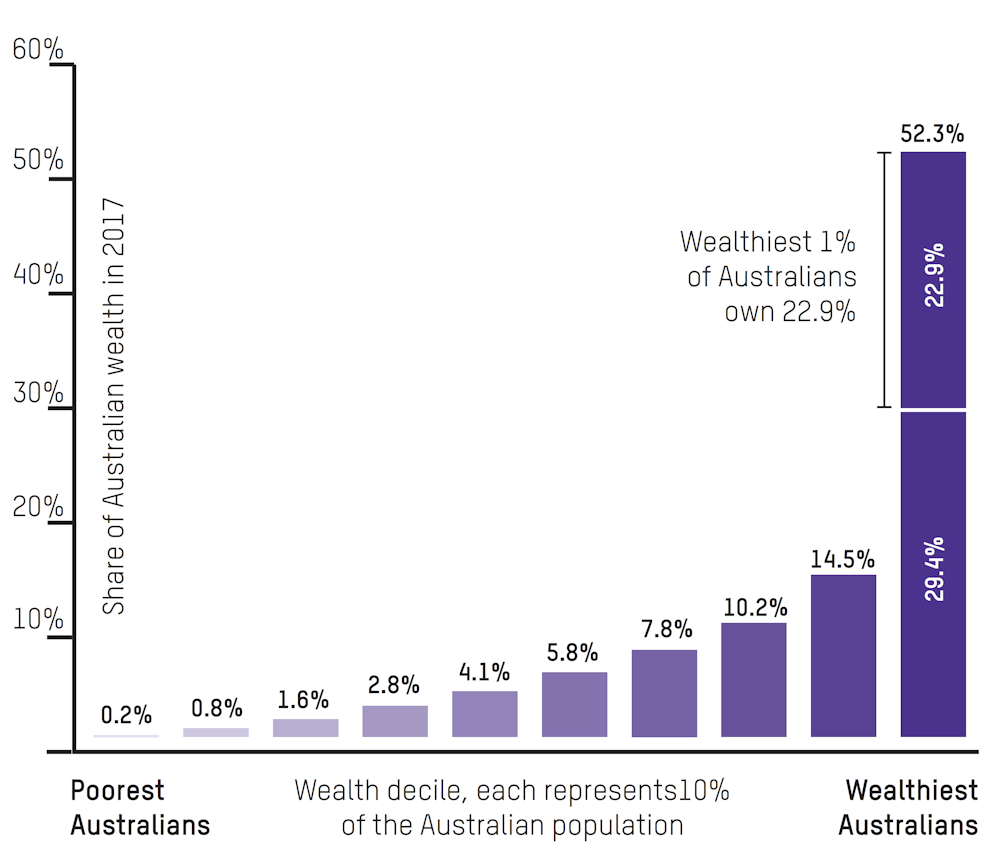
Print Friendly, PDF & Email

Article by AsiaPacificReport.nz

]]>

Newsletter: New Zealand Politics Daily – November 14 2018

Newsletter: New Zealand Politics Daily – November 14 2018 Editor’s Note: Here below is a list of the main issues currently under discussion in New Zealand and links to media coverage. [caption id="attachment_297" align="aligncenter" width="640"] The Beehive and Parliament Buildings.[/caption] Pike River Barry Soper (Newstalk ZB): Pike River saga a step towards giving families closure 1News: Anna Osborne tells John Campbell about eight-year fight for husband killed in Pike River disaster – ‘you don’t just leave your loved one behind’ RNZ: Pike River relatives on mine re-entry: It’s a ‘truly amazing day for our families Stacey Kirk and Jonathan Guildford (Stuff): Pike re-entry: ‘This is a victory for the families and the little people’ 1News: Pike River re-entry plans gives families ‘closure they’ve been waiting for’, Greymouth mayor says Jason Walls (Herald): ‘Absolutely amazing’ – Pike families express their relief at the decision to re-enter the mine Newshub: Duncan Garner praises Andrew Little’s ‘integrity’ over Pike River mine re-entry announcement Newshub: Andrew Little confirms ‘single entry’ Pike River re-entry plan RNZ: LIttle: ‘To the Pike River families, to New Zealand, we are returning’ 1News: Government confirms plan to re-enter Pike River Mine drift will proceed – ‘It is now our intention to get this job done’ Stacey Kirk (Stufff): ‘We’re going in’ – Government unveils decision to re-enter Pike River Mine Lucy Bennett (Herald): Pike River Mine re-entry to go ahead – first major task likely to begin in February 2019 Eleanor Ainge Roy (Guardian): Pike River mine disaster: bodies of 29 dead will be recovered Royal Commission into child abuse Gordon Campbell: On why the Royal Commission into child abuse needs to change its timeframe Chris Morris (ODT): Bishop considering public ‘full disclosure’ Dominion Post Editorial: It’s right to open doors on churches’ dark past Moana Makapelu Lee (Māori TV): Anglican church welcomes broader abuse inquiry Stuff: Appeal about court documents in cases of abuse in state care Maxine Jacobs (RNZ): State abuse inquiry: Hopes Māori addition will shed light on more cases 1News: Human rights lawyer sceptical about expansion of inquiry into child abuse in state care Tom Hunt (Stuff): Victims of child sexual abuse heartened by widening of Royal Commission Samantha Gee (Stuff): Move to expand Government abuse inquiry to include religious institutions welcomed Police Scott Palmer (Newshub): ‘Grossly misrepresented’ – Shane Jones in passionate defence of Wally Haumaha Jared Savage (Herald): ‘We were on trial’ – Two women who complained about Deputy Commissioner Wally Haumaha speak out Thomas Manch (Stuff): Wally Haumaha bullying complainants say Government report ‘lacks balance’ Martyn Bradbury (Daily Blog): The Nashy solid under Wally Haumaha high ball as report denies NZ media another #MeToo Villain Laura O’Connell Rapira and Kassie Hartendorp (RNZ): Police and Pride: We need to heal our relationships first Environment and conservation Derek Cheng (Herald): Former Green MP Sue Bradford says party is betraying its members and is Labour’s handmaiden Zane Small (Newshub): ‘Just another flip-flop’: Green MP Eugenie Sage under fire over foreign land sales Christine McKay (Hawkes Bay Today): At least five Pahiatua rural property owners, including farms, have been taking between 5 and 20 per cent of Pahiatua’s treated water supply without making any payment. Sam Kilmister (Manawatū Standard): Feilding to discharge most wastewater to land instead of Ōroua River Joanne Carroll (Stuff): Westland District Council charged with discharging sewage into river Southland Times Editorial: Awards are nice. Success is better. Samantha Gee (Stuff): First takahē eggs found in nest after birds moved to Kahurangi National Park Eleanor Ainge Roy (Guardian): Kiwis to be reintroduced to New Zealand capital for first time in a century Piers Fuller (Stuff): A Wairarapa dark sky reserve would be world’s largest Foreign affairs Audrey Young (Herald): Prime Minister Jacinda Ardern saddles up for big encounters at Singapore summit Audrey Young (Herald): Prime Minister Jacinda Ardern set to meet Aung San Suu Kyi as criticism mounts Jessica Mutch McKay (1News): Jacinda Ardern to sit with US Vice President Mike Pence at ASEAN gala dinner, to speak about high steel tarrifs Audrey Young (Herald): Six days without Neve: Jacinda Ardern riding solo to Singapore, Papua New Guinea Bevan Rapson (North & South): Forget the love trysts, our relationship with China is a much bigger affair Anna Bracewell-Worrall (Newshub): Emails reveal NZDF wanted to go harder on the threat of Chinese influence 1News: As Brexit looms, New Zealand opens first Irish embassy RNZ: Brexit vote prompts embassy opening in Ireland Karel Sroubek residency decision Collette Devlin (Stuff): Immigration minister not given Karel Sroubek’s full criminal history Matthew Whitehead (Standard): The dirty politics of beating up on Karel Sroubek Herald: Immigration lawyer casts doubt whether Immigration Minister can deport Karel Sroubek Collette Devlin (Stuff): Iain Lees-Galloway stalling on brief for opposition MP on Karel Sroubek case 1News: Acting Prime Minister defends Iain Lees-Galloway’s one-hour decision on Karel Sroubek RNZ: Checkpoint: Karel Sroubek’s mother Mila: ‘Give him one last chance’ Education Simon Collins (Herald): NCEA injustice: Huge gaps in reader-writer assistance Katie Scotcher (RNZ): NCEA exams unlikely to be fully digital by 2020 – NZQA RNZ: Nine to Noon: On-line exam glitch: “I panicked for 20 minutes” Adele Redmond (Stuff): Research project aims to determine what effect schools have on students’ success – if any at all Herald Editorial: One in five pupils now need help with learning disorders Simon Collins (Herald): Struggling to learn: ‘It’s like coming out of the fog, you can see each child clearly’ Josephine Franks (Stuff): English language requirements for foreign teachers overhauled Adele Redmond (Stuff): Christchurch’s Redcliffs School community watches old school’s ‘heartbreaking’ demolition Teachers’ pay dispute RNZ: Secondary teachers face tough vote over possible 2019 strikes Aaron Leaman (Stuff): More and bigger teacher strikes could be on the way Katarina Williams (Stuff): Secondary teachers to consider new deal, but their union says ‘reject’ 1News: Christchurch primary teachers next in line today as rolling nationwide strike continues Defence Nicky Hager (North & South): The NZ armed forces’ toxic culture of impunity and cover-ups revealed Kendall Hutt (Stuff): Legal firm criticises Defence Force’s methods of testing for fire-fighting-foam toxins Housing Jason Walls (Herald): Ministry of Education land sold to HNZ for hundreds of thousands of dollars under market value Greg Ninness (Interest): KiwiBuild homes are on the margins of affordability for first buyers but that could change significantly next year Barnaby Bennett (Public Address): What almost everyone is missing about KiwiBuild Steve Deane (Newsroom): Setting Tāmaki families on a pathway to housing independence RNZ: Church’s housing trust tackling homelessness Ben Leahy (Herald): Major banks ANZ, BNZ and Westpac unveil historic low rates in fight for customers Susan Edmunds (Stuff): Reserve Bank ‘expects easing of loan restrictions’ Infrastructure Thomas Coughlan (Newsroom): Twyford’s big infrastructure gamble Fran O’Sullivan (Herald): Building a framework for future funding Stuff: ‘Infrastructure tax’ for homeowners in new housing project north of Auckland BusinessDesk: New infrastructure funding model at Auckland subdivision RNZ: Owners of a new development north of Auckland to pay higher rates Anne Gibson (Herald): 500% fee hikes necessary for infrastructure demands: council defends rise EQC inquiry Liz McDonald (Stuff): EQC inquiry head Dame Silvia Cartwright says inquiry not about reputations Megan Sutherland (Newshub): Dame Silvia Cartwright to head inquiry into EQC’s earthquake claim handling Lucy Bennett (Herald): Minister Megan Woods announces terms of reference for inquiry into Earthquake Commission RNZ: EQC inquiry wants to hear from unhappy home owners Billion Trees Project Jo Moir (RNZ): Local iwi takes blame for $160k tree planting botch-up Lucy Warhurst (Newshub): Forestry blunder a ‘speed bump’ – Forestry Minister Shane Jones David Fisher (Herald): Tree seedlings worth $160,000 ‘mulched’ after forestry land found to be choked with scrub Jo Moir (RNZ): $160k worth of seedlings mulched in project botch-up Newshub: Hitting the trees: National slam Shane Jones over forestry bungle 1News: ‘Incompetence laid bare’ – National lambastes destruction of 400,000 pine tree seedlings Health John Campbell (1News): The Story: When the drugs don’t work 1News: Calls for meningococcal vaccine to be funded after six deaths from rare strain this year RNZ: Frontline paramedics taken off frontline to cover private events – union Oliver Lewis (Stuff): St John ambulance staff take strike action by refusing to attend events Zane Small (Newshub): St John ambulance workers to strike over pay, staff misuse 1News: Around 1000 ambulance workers to begin strikes today Cate Broughton (Stuff): ‘Extremely high demand’ caused three-hour wait for ambulance Emma Russell (Herald): Hundreds of premature babies to benefit from new West Auckland $6m rebuild unit Tracey Roxburgh (ODT): Company formed for joint-venture Queenstown hospital Jin Russell (Spinoff): 2018 is forcing doctors to be advocates as well as healers Thomas Manch (Stuff): Parliamentary tour for End of Life Choice bill comes to a close Government Branko Marcetic  (Spinoff): The curious political transformation of Shane Jones 1News: Kelvin Davis defends Shane Jones’ failure to disclose 61 meetings – ‘Hundreds of meetings over the course of a month’ Mike Hosking (Newstalk ZB): The Government’s optics stink, and will hurt them Michael Reddell: The Prime Minister: kindness, policy, and specific abuse Official Information Act Amanda Cropp (Stuff): Official Information Act users face being unmasked No Right Turn: Another reason to use a false name for OIA requests Electricity Bryan Leyland (Herald): Electricity suppliers are not letting lakes store enough water Bob Weir (Spinoff): Cheap spot price electricity is a double-edged sword Susan Edmunds (Stuff): Retailers should take responsibility for high power prices, former Genesis exec says Justice Richard Harman (Politik): Judge supports court strikers Eva Corlett (RNZ): More disruptions as court staff strikes ramp up despite warning Anneke Smith (RNZ): Ongoing court strikes could lead to miscarriage of justice – Chief Judge RNZ: Cases delayed as court staff refuse to handle sentencing papers Sam Hurley (Herald): Court staff refuse to sign legal documents as strike action ramps up, creating case logjam Tommy Livingston (Stuff): Court workers refuse to sign documents as industrial action continues between PSA and MoJ Michael Morrah (Newshub):‘A real affront’: Corrections apologises after lawyer told to give bio-data to visit prison client Sam Hurley (Herald): Would-be eighth three-strikes offender dodges hefty prison sentence after court botch-up Bullying Newshub: Stand Strong NZ: Stan Walker – ‘I’ve had experiences on both ends Newshub: Stand Strong NZ: ‘It really impacted me’ – Duncan Garner on bullying Parliament RNZ: The House: When MPs go with their gut: what is a conscience vote? Stuff: Nelson MP Nick Smith seeks constituents’ views in annual survey Marc Wilson (Listener): How politicians’ words influence other people’s actions Treaty of Waitangi John Boynton (RNZ): Overlapping claims probed at urgent Waitangi inquiry Samantha Motion (Bay of Plenty Times): Waitangi Tribunal will hear Ngāi Te Rangi grievance NZ Pacific Economy report Vaimoana Tapaleao (Herald): Report on Pasifika contribution shows need for more investment RNZ: NZ Treasury to work with Pasifika community to reduce barriers RNZ: New report shows economic contribution of Pasifika in NZ Local government Jimmy Ellingham (Manawatū Standard): Horowhenua council officials desperate to cast their actions in a positive light Matthew Littlewood (Stuff): Timaru District Council urged to be open and transparent in Alpine Energy sales proposal Auckland Todd Niall (Stuff): Forty per cent in Auckland’s poorer suburbs can’t afford basics, study finds Herald: Auckland Council responds to Mike Hosking on Auckland cycleways: Get out of your car Brian Rudman (Herald): PwC director can’t see wood for trees on views of volcanic cones Laine Moger (Stuff): Human waste the leading contaminant at Auckland beaches, DNA tests show Transport Katie Fitzgerald (Newshub): This year’s road toll approaches 2017’s record level Bernard Orsman (Herald): Auckland Transport board puts the brakes on lower speeds Amy Baker (Stuff): Auckland Transport okays unpopular parking charges near congested bus station RNZ: E-scooters en route to Wellington Jessie Chiang (RNZ): Electric moped ride-sharing arrives in Auckland Mei Heron (1News): Drones in record numbers caught near NZ airports this year – risking catastrophe Primary industries Toni Williams (ODT): Rural Support Trust member quits in protest Hamish Rutherford (Stuff): Fonterra shareholders opt for an empty chair over company endorsed director Tim Murphy (Newsroom): A global rip-off or an innocent abroad? Retirement 1News: Massive increase in KiwiSaver hardship withdrawals a ‘potential financial disaster in the years to come’ Rob Stock (Stuff): Health expectancy rises put pressure on to lift age of NZ Super from 65 Other Rachel Stewart (Herald): Feminist shooting straight from the hip Mathew McKay and Hayden Roberts (Newsroom): Tax Working Group faces complex CGT challenge RNZ: Water safety call ahead of regulation review Bill Ralston (Listener): Simon Bridges looks like a dead man walking Eric Crampton (Newsroom): Regulate cannabis like booze Anna Leask (Herald): Deadly synthetics: man lay dead in boarding house for 8 days after smoking toxic drugs, says Coroner Kirsty Lawrence (Stuff): Third death in a week linked to synthetic cannabis Richard Jackson (Briefing Papers): The Need to Diversify New Zealand’s War Narratives Michael Neilson (Herald): Māori academic calls for regional observance days to mark New Zealand Wars Te Kuru o te Marama Dewes (Māori TV): Taonga tell accurate history of Cook encounters Alice Angeloni (Stuff) Iwi descendant celebrates Abel Tasman in Netherlands Karl du Fresne (Listener): The history of NZ newspapers would shame the Facebook generation Susan Hornsby-Geluk (Stuff): Here’s how to avoid getting sacked if you speak up about work Toby Manhire (Spinoff): ‘I literally covered my wall in Post-it notes’: meet NZ’s new chief scientist ODT Editorial: Charity boxing must keep guard up Northern Advocate: $4.8M from PGF for Whangārei ship repair firm for new travel lift Liam Hehir (Stuff): Donald Trump takes wrestling-style communication to the presidency Cecile Meier (Stuff): Pregnant Kiwi dad-to-be getting ready to welcome first child around Christmas]]>

Taxonomy, the science of naming things, is under threat

]]>

Source: The Conversation (Au and NZ) – By Nic Rawlence, Lecturer in Ancient DNA, University of Otago

Museums are cathedrals of science, but they are under threat worldwide as part of a malaise of undervaluing museum collections and the field of taxonomy, the science of naming biodiversity.

The Museum of New Zealand Te Papa Tongarewa is the latest example. Te Papa confirmed a restructure in July, following leaked reports. Facing sustained backlash and disquiet in the science community, the museum announced an international review of its collections and has since scaled back its restructure plans.

But jobs remain on the line even though the review panel found the museum didn’t have enough staff to look after all of its collections.


Read more: From Joseph Banks to big data, herbaria bring centuries-old science into the digital age


Taxonomy a keystone of natural history

Taxonomy underpins everything from health to conservation, and biosecurity to the economy.

The international review shows Te Papa is doing a good job in most areas, but needs to improve on several aspects, including access to collections, cataloguing a backlog of specimens and digitisation.

Museum of New Zealand Te Papa Tongarewa, in Wellington. from Wikimedia Commons, CC BY-ND

These areas of concern were seriously exacerbated by the panel’s finding that Te Papa is understaffed.

The review panel was not asked to comment on the restructure. At that stage, the proposal was to cut 25 positions, 10 of which were in the collections team. This has now been scaled back to at least five jobs in the collections team.

Staff whose positions may be affected were told only a day before the review recommendations were made public.


Read more: Museum or not? The changing face of curated science, tech, art and culture


Museum collections more than sum of parts

Te Papa’s latest leaked restructure document remains a cause for concern. Curators are no longer in the firing line. However, the five natural history collections managers are gone, to be replaced by three assistant curators and two general technical positions. All of this would appear to fall at a lower pay scale.

I congratulate Te Papa on listening to internal and external feedback and increasing their curatorial expertise in neglected strengths, such as marine mammals and seaweeds. Ironically, in the case of marine mammals, this seems to rectify a mistake in making the previous marine mammal expert redundant in 2013.

A member of the international review panel, Tim White at the Yale Peabody Museum of Natural History, told the public broadcaster RNZ:

Te Papa could use more professional collections staff. If they are going to promote the use of their collections … then they need to think creatively about how they could get more staff.

Taking into account the recently published Decadal Plan for Taxonomy and Biosystematics and the 2015 Royal Society Te Apārangi report on National Taxonomic Collections in New Zealand, this is a good opportunity to increase collections staff rather than, at best, approximate the status quo.

It is my hope that the filling of positions in the proposed structure will not result in a loss of areas of taxonomic expertise. Many of Te Papa’s scientists are leaders in their fields, including in areas where Te Papa leads the way internationally. One should not boost the curatorial team at the expense of collections management.

The bigger picture

As an isolated archipelago with unique flora and fauna, New Zealand needs diverse taxonomic expertise to appropriately handle biosecurity and conservation crises. If Te Papa, or museums in general, shed their taxonomic expertise like an unwanted sloughed-off snake skin, it will be up to other institutions to pick up the slack. If not, our biodiversity will suffer.

The greyling is New Zealand’s only extinct freshwater fish. from Wikimedia Commons, CC BY-ND

There has already been a 10% decline in the taxonomic workforce in Australia in the past 25 years, with declines of around 22% in New Zealand over a similar time period. In both countries, a steadily increasing proportion (currently around a quarter) of taxonomists are unpaid or retired. Let’s not make it any worse.

Undervaluing museum collections and taxonomic expertise is not just limited to New Zealand. The scientific world does not want to see another museum disaster, like the preventable fire that destroyed Brazil’s National Museum.

Whether it is collections under threat or museum libraries being lost in the digital age, or even false assumptions resulting in the closure of a museum, if chief executives and museum boards listen to their scientists and the scientific community, hope remains.

ref. Taxonomy, the science of naming things, is under threat – http://theconversation.com/taxonomy-the-science-of-naming-things-is-under-threat-106691]]>

In his first major foreign policy test, Morrison needs to stick to the script

]]>

Source: The Conversation (Au and NZ) – By Susan Harris Rimmer, Australian Research Council Future Fellow, Griffith Law School, Griffith University

Attending a global leaders summit might look easy – all interesting shirts, family-style photos and unusual handshakes – but these occasions can prove extremely difficult for leaders who focus solely on domestic politics or brand new leaders with uncertain electoral prospects.

Prime Minister Scott Morrison is both.

Morrison faces a busy week of foreign policy tests in his first big moment on the global stage. He first travels to Singapore for the ASEAN and East Asia Summit, then hosts Japanese Prime Minister Shinzo Abe’s historic visit to Darwin before jetting off for the APEC Summit in Papua New Guinea on the weekend. This power week will be followed by the G20 Leaders Summit in Buenos Aires at the end of month.

This week, Morrison will have his first meetings with Chinese President Xi Jinping, US Vice President Mike Pence and Russian President Vladimir Putin, in addition to new (but not so new) Malaysian PM Mahathir Mohamad and Chinese Premier Li Keqiang.


Read more: With Bishop gone, Morrison and Payne face significant challenges on foreign policy


So what can we expect from Morrison’s debut summit season and in particular his meetings with Xi?

Pundits have been speculating whether Morrison might try to use the August leadership spill and appointment of new Foreign Minister Marise Payne as a way of pressing the reset button on relations with China.

Payne’s recent visit to Beijing was viewed by both parties as a success, so Morrison should have a more pleasant meeting with Xi than former Prime Minister Malcolm Turnbull might have.

Payne’s visit to China was the first by an Australian foreign minister since Julie Bishop’s trip in 2016. Thomas Peter/EPA

But Morrison’s first months in office show a leader who speaks without due care to the reactions of foreign governments – floating the idea of shifting the Australian embassy in Israel from Tel Aviv to Jerusalem is the most glaring example – and a leader with little political capital to spare.

He needs to stick to the script this week.

Danger signs

Morrison has already courted controversy on foreign policy in a short period of time. He skipped the UN General Assembly in September. He also missed the Pacific Islands Forum in Nauru, forcing Payne to reassure Pacific neighbours that he wasn’t “snubbing” them.

Morrison did go straight to Jakarta in his first overseas trip as leader to meet with President Joko Widodo and sign the Comprehensive Economic Partnership Agreement with Indonesia.

But he was then accused of playing “straight from Trump’s songbook” when he mused about moving Australia’s embassy in Israel to Jerusalem without consulting diplomats or generals beforehand. It was widely seen as a crude attempt to win the Jewish vote in the Wentworth by-election.

One downfall of Australian leaders is they can sometimes look parochial and small-town while on the big stage. For example, then-Prime Minister Tony Abbott made a cringeworthy speech to G20 leaders in Brisbane in 2014 about GP co-payments and stopping the boats. Opposition leader Bill Shorten described it as “weird and graceless”.

In his case, Morrison failed to realise the negative reception his embassy musings would receive in Indonesia. Now, his meetings with Widodo are likely to be frosty, with no plans to sign the free-trade agreement by the end of the year.

Morrison’s meetings with Xi, Putin and Modi

In his recent headland speech, Morrison seemed to adopt a Malcolm Turnbull-style line on taking a middle path with the US and China, noting that a confrontation between the two powers:

risks unimagined damage to economic growth and the global order. Damage where no-one benefits. Lose-lose.

Nevertheless, the speech was strong on values, many of which China does not share.

It is also not clear how Xi will view the recent Pacific push from Morrison, though he seemed to offer the possibility for partnership in the region.

Morrison’s meeting with Putin at the East Asia Summit will likewise be interesting to watch. This is Putin’s first time at the summit, but by no means his first rodeo. His presence is perhaps indicative of Russia’s intention to pivot more attention towards the Indo-Pacific region, taking advantage of Trump’s absence.


Read more: Russia is a rising military power in the Asia-Pacific, and Australia needs to take it seriously


In yet another foreign policy stumble, Abbott once famously vowed to “shirtfront” Putin over the downing of Malaysian Airlines flight MH17. Putin enjoys such displays of toxic masculinity; hopefully, Morrison can restrain himself.

Australia wants to enhance its partnership with India, so we should see Morrison make a beeline for Prime Minister Narendra Modi at the ASEAN meeting, hoping for one of Modi’s signature hugs.

Before meeting Modi, Morrison will hopefully have carefully read the India Economic Strategy to 2035, authored by the former high commissioner to India and head of DFAT, Peter Varghese.

Modi got a hug of his own from Abbott during his high-profile visit to Australia in 2014. Tracey Nearmy/AAP

Our Pacific family

Last week, Morrison made perhaps his most important foreign policy speech – a major strategic announcement on the Pacific. He said Australia would open five new embassies and launch an infrastructure bank in the region to the tune of A$2 billion, and declared the Pacific “our patch”:

This is our part of the world. This is where we have special responsibilities. We always have, we always will. We have their back, and they have ours. We are more than partners by choice. We are connected as members of a Pacific family.

The announcement came after he signed a deal for a joint naval base in Papua New Guinea. Both this and the infrastructure bank were seen as ways of countering Chinese influence in the Pacific, but Morrison did refrain from using any anti-China rhetoric.


Read more: For Pacific Island nations, rising sea levels are a bigger security concern than rising Chinese influence


This is noteworthy. Tess Newton Cain has pointed out that Australia often misses the right tone of respect and partnership in its announcements to the region.

But despite this new push for Pacific engagement, Australia is still seen as weak on climate policy – a hugely important issue to Pacific leaders. This could result in difficult conversations for Morrison at APEC, as PNG has invited many Pacific nations to attend for the first time.

Sit down, be humble

Even if Morrison puts his best foot forward to overcome his poor start on foreign policy, he will still have difficulty standing out in the crowd.

Even leaders require some political capital to stand out in those big rooms.

The churn in Australian prime ministers means that some foreign leaders may not consider it worth the time or energy to build a relationship of personal trust with Morrison if they view him more like a caretaker. Former Foreign Minister Julie Bishop had spent 10 years building up this diplomatic trust and stability in her various roles, but that was severed abruptly.

My advice to Morrison? Stay humble and listen. Read the briefs, listen to the diplomats and do everything Payne and DFAT Secretary Frances Adamson say to do, to the letter.

ref. In his first major foreign policy test, Morrison needs to stick to the script – http://theconversation.com/in-his-first-major-foreign-policy-test-morrison-needs-to-stick-to-the-script-106606]]>

The bitter lesson of the Californian fires

]]>

Source: The Conversation (Au and NZ) – By David Bowman, Professor, Pyrogeography and Fire Science, University of Tasmania

California is burning, again. Dozens of peoples have been killed and thousands of buildings destroyed in several fires, the most destructive in the state’s history.

The California fires are just the most recent in a series of major wildfires, including fires in Greece in July this year that killed 99 people, Portugal and Chile in 2017, and Australia.

Why do wildfires seem to be escalating? Despite president Donald Trump’s tweet that the California fires were caused by “gross mismanagement” of forests, the answer is more complex, nuanced, and alarming.

What caused the California fires?

The current California fires reflect a complex mix of climate, social, and ecological factors. Fuels across California are currently highly combustible due to a prolonged drought and associated low humidity and high air temperatures. Indeed, it is so dry fires burn freely through the night. Such extreme weather conditions have the fingerprints of climate change.


Read more: Wildfires in Mediterranean Europe will increase by 40% at 1.5°C warming, say scientists


Compounding the desiccated fuels are the seasonally predictable strong desert winds (the Diablo and Santa Ana) that help fires spread rapidly towards the coast.

Low density housing embedded in flammable vegetation has created an ideal fuel mix for these destructive fires. Having people scattered across the landscape ensures a steady source of ignitions, ranging from powerline faults to carelessness and arson, making fires a near certainty when dangerous weather conditions arise.

One of the fires burning in California. MIKE NELSON

Decades of wildfire suppression have created fuel loads that sustain intense fires. That these fuels are burning in late autumn is even more alarming. Under severe fire weather forest fires can engulf entire communities, with fires spreading from house to house, and human communities turning into a unique wildfire “fuel”. Suburbs can burn at the rate of one house per minute .

The standard response to wildfires is to fight them aggressively, using a military-style approach involving small armies of fire fighters combined with aircraft that spread fire retardant and saturate fire-fronts with water. Such approaches are extraordinarily costly. Annual spending on fire fighting has been steadily rising. In the US, annual fire-fighting costs now exceed several billion dollars, with individual fire campaigns costing ten to over a hundred million dollars.


Read more: Spiraling wildfire fighting costs are largely beyond the Forest Service’s control


Although industrial fire-fighting approaches currently enjoy political and social support, the strategy is economically unsustainable. And they are impotent in the face of climate change driven fire disasters such as those currently occurring in California.

A human disaster

Across the fire science community there is growing recognition this “total war” on fire approach has failed. The key to sustainable co-existence with flammable landscapes is instead managing fuels around settlements, and stopping wildfires from starting in the first place.

Spain and Portugal are good examples of why this is so important. In these Mediterranean lands, humans have sustainably co-existed with flammable landscapes for thousands of year. However, the near ubiquitous depopulation of rural lands following the second world war has led to the proliferation of flammable vegetation that had previously been held in check by intensive small-scale subsistence agriculture.

The Village of Rojas in Catalonia, Spain in 1946. Institut Cartogràfic i Geològic de Catalunya The same Spanish village in 2017. Large-scale rural depopulation has led to widespread abandonment of formerly agricultural land, massive fuel accumulation and subsequent historically unprecedented fires. Institut Cartogràfic i Geològic de Catalunya

With the loss of this traditional agriculture Mediterranean countries are now experiencing regular fire disasters (such as the 2018 Greek fires and the 2017 Portuguese and Spanish fires). These are equivalent to fires in more recently settled flammable landscapes in the Americas and Australia.

This seems to be the story in most flammable landscapes on earth: the removal of traditional landscape management by colonisation and globalisation has combined with climate change to turn these landscapes into tinderboxes.

But just as it is unrealistic for Australia to faithfully restore Indigenous fire management practices, expecting a return to historical practices in the Mediterranean is not realistic. There is little economic or social reason for people to return to traditional rural lifestyles, and the gravitational pull of the social and economic advantages in urban areas is too great to stem rural depopulation.

Living with fire

But we can adapt traditional practices to help us live with fire. In the Mediterranean, people are already experimenting with different ways to manage landscapes, such as managing forests for cork and bioenergy, combined with prescribed burning and grazing.

Cork harvesting, selective cutting of trees for bioenergy, understory clearing, and cattle grazing are used in Catalonia, Spain to manage fire hazard by creating a ‘green fire break’. David Bowman

This can create picturesque landscapes that are fire-resistant and easy to defend. Similarly, in Australia, the Victorian government has created parkland-like green fire breaks that were used for back burning operations to protect communities during 2009 Black Saturday wildfires.

A green fire break in mountain ash forest near Kinglake, Victoria. David Bowman

The Hobart City Council is planning to use similar fire breaks to protect its outer suburbs with dense bushland. Such management could be used on a larger scale to substantially reduce fire risk. The challenge for landscape fuel management is providing financial and regulatory incentives for citizens and local communities to reduce fuel.

Currently, no society is sustainably co-existing with wildfire. Globally, the situation will worsen under a rapidly-warming climate with ballooning firefighting costs, and huge loss of life and destruction of property. This is the bitter lesson of the Californian fires.

ref. The bitter lesson of the Californian fires – http://theconversation.com/the-bitter-lesson-of-the-californian-fires-106842]]>