Politics Newsletter: New Zealand Politics Daily – 21 December 2017 – Today’s content
Editor’s Note: Here below is a list of the main issues currently under discussion in New Zealand and links to media coverage.
[caption id="attachment_297" align="aligncenter" width="1600"] The Beehive and Parliament Buildings.[/caption]
Below are the links to the items online. The full text of these items are contained in the PDF file (click to download).
Year in review
Russell Brown (Public Address): Jacindamania: Word famous in New Zealand
Jane Clifton (Listener): Politician of the Year Awards 2017: And the winner is…
Laura McQuillan (RNZ): The top 12 political shockers of 2017
Lloyd Burr (Newshub): Newshub 2017 Politician of the Year – Jacinda Ardern
Barry Soper (Herald): Best and worst politician of the year
David Farrar (Kiwiblog): 2017 Kiwiblog Awards winners
Emma Espiner (Newsroom): Māori of the year awards
1News: Jacinda Ardern humorously reflects on her amazing year – ‘if you’re the deputy to Andrew Little, possibly run for the hills!’
Brent Edwards (RNZ): True MMP: Ardern as PM, English as deputy
Medicinal cannabis bill
Dominion Post: Editorial – Govt’s ‘halfway house’ of cannabis law
RNZ: Medicinal cannabis users disappointed at legislation
Nicholas Jones (Herald): Medicinal cannabis legislation introduced to ‘ease suffering’
Anna Bracewell-Worrall and Jenna Lynch (Newshub): Government rules terminally ill people allowed to smoke cannabis
Peter Dunne (RNZ): New law a half-baked cure
Stacey Kirk (Stuff): Government’s cannabis plans include legal defence for terminal patients who use
Russell Brown (Public Address): The new medical cannabis law is quite a bit more than nothing
RNZ: Campaigner wants more than ‘tinkering’ with medicinal cannabis law
1News: Double up on medicinal cannabis bills in parliament shows cracks in government – Bill English
Government
Herald: Editorial: New Government’s 100-day plan should not sacrifice quality for haste
Anna Bracewell-Worrall (Newshub): How the Government’s tracking on its 100-day plan
Andrea Vance (1News): Concerns about ‘cowboy cops’ as Labour floats idea of volunteer rural constabulary
Paul McBeth (BusinessDesk): Damien O’Connor to table holding bill on dairy restructuring to allow deeper review
Guardian: Jacinda Ardern takes part in New Zealand’s nationwide Secret Santa
Jim Childerstone (ODT): Govt on right track but must not move too fast
Steven Cowan (Against the current): As Labour backtracks, its supporters say nothing
Pete George (Your NZ): The tail wagging the dog and pup?
Jamie Morton (Herald): Forest and Bird accuses MPI of sitting on dieback documents
Parliament
Jo Moir (Stuff): Politicians adjourn with recollections of a campaign that nobody expected
Claire Trevett (Herald): Beware the Christmas tree and other cautionary tales
Herald: It’s a wrap – barbs fly as Parliament takes break
Charlie Gates (Stuff): Christ Church Cathedral restoration bill passes in Parliament
Herald: PM pays tribute to Andrew Little as Parliament rises
Education
Nicholas Jones (Herald): Rush to start free tertiary study comes with ‘gaming’ risk
Jo Moir (Stuff): Education Minister and predecessor go head-to-head over Government policy
Herald: Questions over ‘honesty system’ for tertiary fees-free students
Julie Iles (Stuff): Fewer students are taking out bigger loans
Nicholas Jones (Herald): Student loan debtor arrested at border, more warrants sought
Megan Gattey (Stuff): Old school reports: Education Minister Chris Hipkins v former minister Nikki Kaye
John Gerritsen (RNZ): Principal refuses to discuss expense allegations
Eva Corlett (RNZ): Ministry demands explainer over school spending
1News: ‘Why won’t she visit a partnership school?’ – Bill English suggests Jacinda Ardern is abandoning charter school students
Housing and foreign house buyer ban
Alastair Paulin (Stuff): Government’s move to end mass state house sell-off honours long-standing social contract
Henry Cooke (Stuff): Government announces end to state home selloff
Herald: Govt stops Canterbury state house sales
Benedict Collins (RNZ):Rush for foreign buyer law labelled a ‘sham’
Susan Edmunds (Stuff): Foreign buyer rule change may have unintended consequences
Megan Gattey (Stuff): Homeless in New Zealand: ‘They’re shy and they feel shame’
Mike Hosking and Maori Party mistake
Mike Hosking (Herald): The real reason I left Seven Sharp
Mike Hosking (Herald): ‘Pontificating’ Broadcasting Standards Authority humourless earnest clipboarders
RNZ: Mike Hosking apology for Maori Party comments ‘flippant’
Stuff: Mike Hosking hits back at BSA, calls them humourless time wasters
Tim Watkin (Pundit): Mike Hosking: You do the crime, you do the time
Marama Fox (The Spinoff): Dear Santa, I’m writing on behalf of Mike Hosking
Martyn Bradbury (Daily Blog): Why Mike Hosking is wrong and why I still don’t think he understands MMP
Tax working group
Laura Walters (Stuff): Government reveals who it’s asking to overhaul NZ’s tax system
Herald: Govt names 10 people from unions, business, academia, public and private sector for Tax Working Group
Newswire: Government’s tax working group announced: includes former Finance Minister, head of Air NZ insurance
Andrea Black (Let’s talk about tax): The last post
Health
Jessie Chiang (Stuff): ACC claimants losing millions under tax system – lawyer
Herald: Injured New Zealanders stung by huge tax bills after receiving ACC back-payments
Aaron Leaman (Stuff): Auditor-General to investigate Waikato DHB’s SmartHealth project
Natalie Akoorie (Herald): DHB app purchase under scrutiny
RNZ: Inquiry launched into DHB’s use of HealthTap app
Herald: Nigel Murray was head of Canadian health authority when 84 patients died from infection
Herald: Senior doctor at Dunedin Hospital leaves with $408,000 payout
Maori politics and issues
Chris Bramwell (RNZ): Crown ‘dishonoured its obligations’ – govt apology to iwi
Jo Moir (Stuff): Government Ministers’ attack on iwi leaders slammed by National
Dougal McNeill (International socialist organisation): There are no white people
Dave Witherow (NZCPR): Could You Say That Again Please – In English?
Lorde to play in Israel
Nadia Abu-Shanab and Justine Sachs (The Spinoff): Dear Lorde, here’s why we’re urging you not to play Israel
Herald: Pressure mounts on Lorde to cancel Tel Aviv concert
Martyn Bradbury (Daily Blog): Dear Lorde – don’t play Apartheid Israel
Stuff: Fans call Lorde to boycott Israel after she announces her show in Tel Aviv
Pike River Recovery Agency
Laura Walters (Stuff): Former army chief Major General Dave Gawn to head Pike River Recovery Agency
Herald: Major General Dave Gawn to head Pike River agency
Ellen Read (Stuff): Pike River families come first, Rob Fyfe says
Environment
Ged Cann (Stuff): Government calls for end of fossil fuel subsidies globally, but what are the plans to end them here?
Greg Presland (The Standard): The new government’s approach to climate change
Joanna Mossop (Newsroom): A rare chance to help our oceans
Jian Yang MP
Matt Nippert (Herald): Winston Peters calls for investigation into Yang saga on security vetting
Stuff: Jian Yang denies asking Ministers to overturn security clearance block
Jamie Smith (Financial Times): New Zealand urged to probe lobbying by China-born MP
Greyhound industry report
Nicholas Jones (Herald): ‘Disturbing’ greyhound death rate revealed: Industry under fire
Stuff: Greyhound report disturbing and deeply disappointing – Winston Peters
RNZ: Greyhound euthanasia numbers ‘unacceptably high‘
Other
Tim Watkin (Pundit): A snaking line of humanity that NZ can be proud of
Stuff: Cross appeal filed in National Party’s appeal against Eminem rip-off
1News: ‘All we need the men-folk to do is actually agree’ – NZ media commentator weighs in on Sir Ian McKellen’s sexual-misconduct comments
Keith Rankin (Evening Report): The Next Economic Correction
Keith Rankin (Daily Blog): Thinking about Capitalism
Matthew Theunissen (Herald): A third of NZ cyber attacks state-sponsored: GCSB
Tommy Livingston (Stuff): Destiny Church to fight Charities Commission in High Court
Stuff: Corrections might get off lightly in prisoner compensation cases
Mary-Rose Leversedge (Stuff): Of course we should offer euthanasia to those who want it
Chris Hutching (Stuff): Buyer found for Christchurch publishers of Trans Tasman newsletter
Gwyn Compton (Libertas digital): Andrew Little borrows from North Korea’s playbook
Herald: Big immigration drop likely in 2018
The Standard: Germany and New Zealand Redux
1News: ‘Get off the couch and do some real work’ – National MP accuses Shane Jones of laziness
David Slack (RNZ): 2017: The nature of people
Anuja Nadkarni (Stuff): $1 billion price tag put on shifting vehicle imports from Auckland port]]>
The Beehive and Parliament Buildings.[/caption]
Below are the links to the items online. The full text of these items are contained in the PDF file (click to download).
Year in review
Russell Brown (Public Address): Jacindamania: Word famous in New Zealand
Jane Clifton (Listener): Politician of the Year Awards 2017: And the winner is…
Laura McQuillan (RNZ): The top 12 political shockers of 2017
Lloyd Burr (Newshub): Newshub 2017 Politician of the Year – Jacinda Ardern
Barry Soper (Herald): Best and worst politician of the year
David Farrar (Kiwiblog): 2017 Kiwiblog Awards winners
Emma Espiner (Newsroom): Māori of the year awards
1News: Jacinda Ardern humorously reflects on her amazing year – ‘if you’re the deputy to Andrew Little, possibly run for the hills!’
Brent Edwards (RNZ): True MMP: Ardern as PM, English as deputy
Medicinal cannabis bill
Dominion Post: Editorial – Govt’s ‘halfway house’ of cannabis law
RNZ: Medicinal cannabis users disappointed at legislation
Nicholas Jones (Herald): Medicinal cannabis legislation introduced to ‘ease suffering’
Anna Bracewell-Worrall and Jenna Lynch (Newshub): Government rules terminally ill people allowed to smoke cannabis
Peter Dunne (RNZ): New law a half-baked cure
Stacey Kirk (Stuff): Government’s cannabis plans include legal defence for terminal patients who use
Russell Brown (Public Address): The new medical cannabis law is quite a bit more than nothing
RNZ: Campaigner wants more than ‘tinkering’ with medicinal cannabis law
1News: Double up on medicinal cannabis bills in parliament shows cracks in government – Bill English
Government
Herald: Editorial: New Government’s 100-day plan should not sacrifice quality for haste
Anna Bracewell-Worrall (Newshub): How the Government’s tracking on its 100-day plan
Andrea Vance (1News): Concerns about ‘cowboy cops’ as Labour floats idea of volunteer rural constabulary
Paul McBeth (BusinessDesk): Damien O’Connor to table holding bill on dairy restructuring to allow deeper review
Guardian: Jacinda Ardern takes part in New Zealand’s nationwide Secret Santa
Jim Childerstone (ODT): Govt on right track but must not move too fast
Steven Cowan (Against the current): As Labour backtracks, its supporters say nothing
Pete George (Your NZ): The tail wagging the dog and pup?
Jamie Morton (Herald): Forest and Bird accuses MPI of sitting on dieback documents
Parliament
Jo Moir (Stuff): Politicians adjourn with recollections of a campaign that nobody expected
Claire Trevett (Herald): Beware the Christmas tree and other cautionary tales
Herald: It’s a wrap – barbs fly as Parliament takes break
Charlie Gates (Stuff): Christ Church Cathedral restoration bill passes in Parliament
Herald: PM pays tribute to Andrew Little as Parliament rises
Education
Nicholas Jones (Herald): Rush to start free tertiary study comes with ‘gaming’ risk
Jo Moir (Stuff): Education Minister and predecessor go head-to-head over Government policy
Herald: Questions over ‘honesty system’ for tertiary fees-free students
Julie Iles (Stuff): Fewer students are taking out bigger loans
Nicholas Jones (Herald): Student loan debtor arrested at border, more warrants sought
Megan Gattey (Stuff): Old school reports: Education Minister Chris Hipkins v former minister Nikki Kaye
John Gerritsen (RNZ): Principal refuses to discuss expense allegations
Eva Corlett (RNZ): Ministry demands explainer over school spending
1News: ‘Why won’t she visit a partnership school?’ – Bill English suggests Jacinda Ardern is abandoning charter school students
Housing and foreign house buyer ban
Alastair Paulin (Stuff): Government’s move to end mass state house sell-off honours long-standing social contract
Henry Cooke (Stuff): Government announces end to state home selloff
Herald: Govt stops Canterbury state house sales
Benedict Collins (RNZ):Rush for foreign buyer law labelled a ‘sham’
Susan Edmunds (Stuff): Foreign buyer rule change may have unintended consequences
Megan Gattey (Stuff): Homeless in New Zealand: ‘They’re shy and they feel shame’
Mike Hosking and Maori Party mistake
Mike Hosking (Herald): The real reason I left Seven Sharp
Mike Hosking (Herald): ‘Pontificating’ Broadcasting Standards Authority humourless earnest clipboarders
RNZ: Mike Hosking apology for Maori Party comments ‘flippant’
Stuff: Mike Hosking hits back at BSA, calls them humourless time wasters
Tim Watkin (Pundit): Mike Hosking: You do the crime, you do the time
Marama Fox (The Spinoff): Dear Santa, I’m writing on behalf of Mike Hosking
Martyn Bradbury (Daily Blog): Why Mike Hosking is wrong and why I still don’t think he understands MMP
Tax working group
Laura Walters (Stuff): Government reveals who it’s asking to overhaul NZ’s tax system
Herald: Govt names 10 people from unions, business, academia, public and private sector for Tax Working Group
Newswire: Government’s tax working group announced: includes former Finance Minister, head of Air NZ insurance
Andrea Black (Let’s talk about tax): The last post
Health
Jessie Chiang (Stuff): ACC claimants losing millions under tax system – lawyer
Herald: Injured New Zealanders stung by huge tax bills after receiving ACC back-payments
Aaron Leaman (Stuff): Auditor-General to investigate Waikato DHB’s SmartHealth project
Natalie Akoorie (Herald): DHB app purchase under scrutiny
RNZ: Inquiry launched into DHB’s use of HealthTap app
Herald: Nigel Murray was head of Canadian health authority when 84 patients died from infection
Herald: Senior doctor at Dunedin Hospital leaves with $408,000 payout
Maori politics and issues
Chris Bramwell (RNZ): Crown ‘dishonoured its obligations’ – govt apology to iwi
Jo Moir (Stuff): Government Ministers’ attack on iwi leaders slammed by National
Dougal McNeill (International socialist organisation): There are no white people
Dave Witherow (NZCPR): Could You Say That Again Please – In English?
Lorde to play in Israel
Nadia Abu-Shanab and Justine Sachs (The Spinoff): Dear Lorde, here’s why we’re urging you not to play Israel
Herald: Pressure mounts on Lorde to cancel Tel Aviv concert
Martyn Bradbury (Daily Blog): Dear Lorde – don’t play Apartheid Israel
Stuff: Fans call Lorde to boycott Israel after she announces her show in Tel Aviv
Pike River Recovery Agency
Laura Walters (Stuff): Former army chief Major General Dave Gawn to head Pike River Recovery Agency
Herald: Major General Dave Gawn to head Pike River agency
Ellen Read (Stuff): Pike River families come first, Rob Fyfe says
Environment
Ged Cann (Stuff): Government calls for end of fossil fuel subsidies globally, but what are the plans to end them here?
Greg Presland (The Standard): The new government’s approach to climate change
Joanna Mossop (Newsroom): A rare chance to help our oceans
Jian Yang MP
Matt Nippert (Herald): Winston Peters calls for investigation into Yang saga on security vetting
Stuff: Jian Yang denies asking Ministers to overturn security clearance block
Jamie Smith (Financial Times): New Zealand urged to probe lobbying by China-born MP
Greyhound industry report
Nicholas Jones (Herald): ‘Disturbing’ greyhound death rate revealed: Industry under fire
Stuff: Greyhound report disturbing and deeply disappointing – Winston Peters
RNZ: Greyhound euthanasia numbers ‘unacceptably high‘
Other
Tim Watkin (Pundit): A snaking line of humanity that NZ can be proud of
Stuff: Cross appeal filed in National Party’s appeal against Eminem rip-off
1News: ‘All we need the men-folk to do is actually agree’ – NZ media commentator weighs in on Sir Ian McKellen’s sexual-misconduct comments
Keith Rankin (Evening Report): The Next Economic Correction
Keith Rankin (Daily Blog): Thinking about Capitalism
Matthew Theunissen (Herald): A third of NZ cyber attacks state-sponsored: GCSB
Tommy Livingston (Stuff): Destiny Church to fight Charities Commission in High Court
Stuff: Corrections might get off lightly in prisoner compensation cases
Mary-Rose Leversedge (Stuff): Of course we should offer euthanasia to those who want it
Chris Hutching (Stuff): Buyer found for Christchurch publishers of Trans Tasman newsletter
Gwyn Compton (Libertas digital): Andrew Little borrows from North Korea’s playbook
Herald: Big immigration drop likely in 2018
The Standard: Germany and New Zealand Redux
1News: ‘Get off the couch and do some real work’ – National MP accuses Shane Jones of laziness
David Slack (RNZ): 2017: The nature of people
Anuja Nadkarni (Stuff): $1 billion price tag put on shifting vehicle imports from Auckland port]]>
Two Timorese journalists named for Balibo Five-Roger East fellowships

 Augustus Dos Reis (left) and Pricilia Xavier … 2018 fellowship winners. Image: MEAA/APHEDA
Pacific Media Watch Newsdesk
Two journalists from Timor-Leste will benefit from the Balibo Five-Roger East Fellowship in 2018, an initiative of the Media, Entertainment and Arts Alliance and Union Aid Abroad-APHEDA.
They were chosen from four outstanding applications assessed by a selection panel in Australia, the MEAA says in a statement.
The next recipients of funding from the fellowship, which aims to nurture the development of journalism in East Timor are:
• Maria Pricilia Fonseca Xavier, a journalist and news broadcaster in Tétum and Portuguese at Timor-Leste Television (TVTL).
• Augusto Sarmento Dos Reis, senior sports journalist and online co-ordinator at the Timor Post daily newspaper and diariutimorpost.tl website.
The Balibo Five-Roger East Fellowship has been established to honour the memory of the six Australian journalists murdered in East Timor in 1975, and to improve the quality and skill of journalism in East Timor.
The applications were assessed by a panel of MEAA communications director Mark Phillips; Union Aid Abroad-APHEDA organiser trade union development and education for Timor-Leste and Indonesia, Samantha Bond; senior lecturer in journalism at Charles Sturt University, Bathurst, Jock Cheetham; and former television journalist and newsreader Mal Walden, who was a colleague of three of the Balibo Five.
Funding for projects
The successful applicants will be provided with funding to assist them with specific journalism projects in Timor. It is anticipated that each will also be offered the opportunity to travel to Australia in 2018 to spend some time observing and working in an Australian newsroom.
MEAA chief executive Paul Murphy said all the applications were again of a high quality and representative of the diversity of journalism in East Timor.
“We are well aware that is not easy to work as a journalist in Timor-Leste, and journalists face many hurdles, including a lack of resources and training, and attacks from the government on press freedom,” he said.
“But we are delighted that the successful applicants represent both print/online and broadcast media, and there is a balance between genders.
“Both Pricilia and Augusto are young journalists with impressive track records and a thirst to succeed in their chosen profession.”
Kate Lee, executive director of Union Aid Abroad-Apheda, said: “We are delighted to again be able to partner with the Media Entertainment and Arts Alliance to support the development of independent journalism in Timor Leste through the Balibo Five-Roger East Fellowship and look forward to seeing some great investigative work from Pricilia and Augusto in 2018”
Funding for the Balibo Five-Roger East Fellowship has come from MEAA, the Fairfax Media More Than Words workplace giving programme, and private donations.
40th anniversary
The fellowship was established on the 40th anniversary of the murders of the Balibo Five in 1975.
Last year, four journalists successfully applied for funding from the fellowship, while separately the fellowship assisted Timorese journalist Raimundos Oki to spend a week with Fairfax Media in Sydney in September.
The fellowship carries the names of six journalists who were murdered by Indonesian forces in East Timor in 1975.
Five young journalists working for Australia’s Seven and Nine networks – reporter Greg Shackleton, camera operator Gary Cunningham, sound recordist Tony Stewart (all from Seven), reporter Malcolm Rennie and camera operator Brian Peters (both from Nine) – were killed in the village of Balibo after witnessing an incursion by Indonesian soldiers on October 16, 1975. Their killers have never been brought to justice.
Freelance reporter Roger East, a stringer for the ABC and AAP who provided the first confirmed accounts of the killing of the Balibo Five, was executed by Indonesian troops on Dili Wharf on December 8. His body fell into the sea and was never recovered.
A media release from MEAA and APHEDA.

Article by AsiaPacificReport.nz
]]>Keith Rankin Analysis: The Next Economic Correction
The Next Economic Correction
By Keith Rankin.
[caption id="attachment_1450" align="alignright" width="150"] Keith Rankin.[/caption]
In September I published a chart showing that, over a century-and-a-half, economic growth has been lower in years ending with an ‘8’. It’s suggestive of a fundamental capitalist cycle that repeats around every 10 years. The 10-year cycle has a name, the Juglar Cycle.
In 2008 we had the global financial crisis. In 1998 it was the East Asian financial crisis. In late 1987 we had the global share market panic. The 1987/88 crisis hit New Zealand especially hard. The 1998 crisis was smaller than the others, but did have quite an impact on New Zealand. While the 2008 world crisis began early in New Zealand – finance companies started to fall in 2006 and the economy went into full recession at the beginning of 2008 – overall it affected New Zealand less than most developed economies.
While there will most likely be an ongoing Juglar Cycle, each event in the cycle will be different. I’m picking that the next corrective event will be somewhat muted at the global level, but may affect New Zealand more than many other developed economies. The developing economies will be hit more than the developed economies, most likely.
At the global level, there has not been the rapid growth of household financial deficits that preceded the global financial crisis. With respect to spending, there remains pronounced caution in Europe, North America and much of East Asia. Most importantly, interest rates in the developed world remain very accommodating (ie historically low). The global financial crisis was triggered largely by interest rate increases from 2005.
Much of the developed world’s unspent income has been advanced to the developing world and to countries like New Zealand which have offered high returns in real estate. The correction will be characterised by withdrawal from those speculative funds; profit-taking by risk-seeking savers who will park their funds for a year or two before embarking on further ‘investment’ ventures. Capital losses in some speculative markets will precipitate further asset sell-offs. Saver economies will experience rising exchange rates – especially the Euro – while countries like New Zealand can expect relatively weak currencies until their economies revive as a result of those weak currencies. Thus momentum in New Zealand will shift, through a sharp correction in real estate, in favour of traded goods and services.
The big danger that could turn a normal cyclical downturn into a major world crisis is deflation. Massive increases in the world money supply only just averted a deflation crisis earlier this decade. After the present peak of the global economic cycle (world inflation is probably peaking now), a drop-off in consumer spending means zero percent inflation if we are lucky, deflation otherwise.
One of the characteristics of the Great Depression of the 1930s was the debt-deflation spiral. As deflation takes hold, debts become bigger in real terms, as do savers’ hoards of uninvested money. Existing imbalances exacerbate, creating conditions that are even more prone to deflation. The good news is that a number of countries have already adopted negative interest rate policies, and these policies worked. Thus the reticence around cheap money that may have existed – and that definitely still exists in New Zealand – will be less than it might have been.
In a period of market recession, what is needed is negative real interest rates (meaning interest rates lower than the inflation rate); an incentive to bring forward spending (including government spending) and a disincentive to delay, defer or avoid spending. Savers’ hoards need to depreciate in terms of what they can buy, to dissuade spending deferral. Negative interest rates provide just such a penalty on unspent money. At times of deflation, deposit interest rates need to be even more negative than the inflation rate. It also means that penalties on cash hoarded outside of the banking system need to be greater than penalties (negative interest) on bank deposits.
The interest rate is the price of ‘inter-temporal trade’. This is trade across time; earning in one time‑period and spending in another. If, when interest rates are zero, more people want to defer spending than to bring spending forward, then interest rates at zero are too high, and should be allowed to fall. Negative interest rates encourage more people to spend in the present (by borrowing more, by saving less, or by withdrawing past savings) and fewer people to defer spending.
Through this market-price mechanism, an interest rate (a price) is eventually struck whereby spending deferred and spending brought forward will balance. That’s the ‘equilibrium’ rate of interest. The interest rates that we are used to, however, have been managed above the equilibrium rate (as an effective ‘price floor’); such disequilibrium encourages speculative borrowing (for capital gain) rather than investment or consumption borrowing (which is to buy, in the present, newly-produced goods and services).
The last time interest rates were at their equilibrium level was in the late 1970s. That precipitated the global neoliberal revolution, led by rich people who regarded interest as an entitlement (a ‘free lunch’) rather than as an equilibrating price. Monetarist policies were implemented; these were all about forcing interest rates up, in the guise of a democratically-mandated attack on inflation.
This decade, mortgagee sales will be kept to a minimum by banks offering distressed borrowers extended interest-only loans at low rates. Mortgagee sales consequent on rising interest rates were the main trigger for the 2008 global financial crisis. While a possible debt-deflation crisis will most likely be nipped in the bud this decade, it is most unlikely that policymakers and financial analysts will learn the lesson about interest rates that needs to be learned.
I expect there will be a general dip in financial asset prices (including real estate) this decade, followed by a resurgence of financial speculation in the first half of the 2020s. Poor people will continue to survive in the early 2020s through evermore debt. I also expect that there will be pressure, by the overpaid, on the monetary authorities to raise interest rates, significantly, in the mid-2020s.
My call is that the big global financial and economic crisis will begin in (or around) 2028, not 2018. Unless there’s a world war before that. The world economy this decade faces very similar tensions to those that existed prior to World War One.]]>
Keith Rankin.[/caption]
In September I published a chart showing that, over a century-and-a-half, economic growth has been lower in years ending with an ‘8’. It’s suggestive of a fundamental capitalist cycle that repeats around every 10 years. The 10-year cycle has a name, the Juglar Cycle.
In 2008 we had the global financial crisis. In 1998 it was the East Asian financial crisis. In late 1987 we had the global share market panic. The 1987/88 crisis hit New Zealand especially hard. The 1998 crisis was smaller than the others, but did have quite an impact on New Zealand. While the 2008 world crisis began early in New Zealand – finance companies started to fall in 2006 and the economy went into full recession at the beginning of 2008 – overall it affected New Zealand less than most developed economies.
While there will most likely be an ongoing Juglar Cycle, each event in the cycle will be different. I’m picking that the next corrective event will be somewhat muted at the global level, but may affect New Zealand more than many other developed economies. The developing economies will be hit more than the developed economies, most likely.
At the global level, there has not been the rapid growth of household financial deficits that preceded the global financial crisis. With respect to spending, there remains pronounced caution in Europe, North America and much of East Asia. Most importantly, interest rates in the developed world remain very accommodating (ie historically low). The global financial crisis was triggered largely by interest rate increases from 2005.
Much of the developed world’s unspent income has been advanced to the developing world and to countries like New Zealand which have offered high returns in real estate. The correction will be characterised by withdrawal from those speculative funds; profit-taking by risk-seeking savers who will park their funds for a year or two before embarking on further ‘investment’ ventures. Capital losses in some speculative markets will precipitate further asset sell-offs. Saver economies will experience rising exchange rates – especially the Euro – while countries like New Zealand can expect relatively weak currencies until their economies revive as a result of those weak currencies. Thus momentum in New Zealand will shift, through a sharp correction in real estate, in favour of traded goods and services.
The big danger that could turn a normal cyclical downturn into a major world crisis is deflation. Massive increases in the world money supply only just averted a deflation crisis earlier this decade. After the present peak of the global economic cycle (world inflation is probably peaking now), a drop-off in consumer spending means zero percent inflation if we are lucky, deflation otherwise.
One of the characteristics of the Great Depression of the 1930s was the debt-deflation spiral. As deflation takes hold, debts become bigger in real terms, as do savers’ hoards of uninvested money. Existing imbalances exacerbate, creating conditions that are even more prone to deflation. The good news is that a number of countries have already adopted negative interest rate policies, and these policies worked. Thus the reticence around cheap money that may have existed – and that definitely still exists in New Zealand – will be less than it might have been.
In a period of market recession, what is needed is negative real interest rates (meaning interest rates lower than the inflation rate); an incentive to bring forward spending (including government spending) and a disincentive to delay, defer or avoid spending. Savers’ hoards need to depreciate in terms of what they can buy, to dissuade spending deferral. Negative interest rates provide just such a penalty on unspent money. At times of deflation, deposit interest rates need to be even more negative than the inflation rate. It also means that penalties on cash hoarded outside of the banking system need to be greater than penalties (negative interest) on bank deposits.
The interest rate is the price of ‘inter-temporal trade’. This is trade across time; earning in one time‑period and spending in another. If, when interest rates are zero, more people want to defer spending than to bring spending forward, then interest rates at zero are too high, and should be allowed to fall. Negative interest rates encourage more people to spend in the present (by borrowing more, by saving less, or by withdrawing past savings) and fewer people to defer spending.
Through this market-price mechanism, an interest rate (a price) is eventually struck whereby spending deferred and spending brought forward will balance. That’s the ‘equilibrium’ rate of interest. The interest rates that we are used to, however, have been managed above the equilibrium rate (as an effective ‘price floor’); such disequilibrium encourages speculative borrowing (for capital gain) rather than investment or consumption borrowing (which is to buy, in the present, newly-produced goods and services).
The last time interest rates were at their equilibrium level was in the late 1970s. That precipitated the global neoliberal revolution, led by rich people who regarded interest as an entitlement (a ‘free lunch’) rather than as an equilibrating price. Monetarist policies were implemented; these were all about forcing interest rates up, in the guise of a democratically-mandated attack on inflation.
This decade, mortgagee sales will be kept to a minimum by banks offering distressed borrowers extended interest-only loans at low rates. Mortgagee sales consequent on rising interest rates were the main trigger for the 2008 global financial crisis. While a possible debt-deflation crisis will most likely be nipped in the bud this decade, it is most unlikely that policymakers and financial analysts will learn the lesson about interest rates that needs to be learned.
I expect there will be a general dip in financial asset prices (including real estate) this decade, followed by a resurgence of financial speculation in the first half of the 2020s. Poor people will continue to survive in the early 2020s through evermore debt. I also expect that there will be pressure, by the overpaid, on the monetary authorities to raise interest rates, significantly, in the mid-2020s.
My call is that the big global financial and economic crisis will begin in (or around) 2028, not 2018. Unless there’s a world war before that. The world economy this decade faces very similar tensions to those that existed prior to World War One.]]>
RSF media freedom round-up for 2017 – 65 journalists killed, 326 in prison

Al Jazeera’s Neave Barker reports from London. Video: Al Jazeera/RSF
Pacific Media Watch Newsdesk
Reporters Without Borders has documented the number of journalists killed or jailed this year.
It says Syria and Mexico are among the most dangerous places for reporters to work. Sixty percent of journalists killed are targeted because of their journalistic work.
The Paris-based Reporters Without Borders (RSF) has released its annual round-up of violence and abuses against journalists throughout the world.
A total of 65 journalists were killed in 2017, 326 are currently in prison, and 54 are held hostage.*
The 65 journalists who were killed were either fatally injured in the course of their work (for example, in an artillery bombardment) or were murdered because their reporting angered someone. The murdered reporters were the majority – 60 percent of the total figure.
Although these figures are alarming, 2017 has been the least deadly year for professional journalists (50 killed) in 14 years. Journalists are of course fleeing countries such as Syria, Yemen and Libya that have become too dangerous, but RSF has also observed a growing awareness of the need to protect journalists.
The UN has passed several resolutions on the safety of journalists since 2006 and many news organisations have adopted safety procedures.
Deaths of women double
The fall does not apply to deaths of women journalists, which have doubled. Ten have been killed in 2017, compared to five in 2016.
Most of these victims were experienced and combative investigative reporters. Despite threats, they continued to investigate and expose cases of corruption.
The victims include Daphne Caruana Galizia in Malta, Gauri Lankesh in India and Miroslava Breach Velducea in Mexico.
In another noteworthy trend in 2017, some countries that are not at war have become almost as dangerous for journalists as war zones: 46 percent of the deaths occurred in countries where no overt war is taking place, as against 30 percent in 2016.
There were almost as many deaths (11) in Mexico as in Syria, which was the deadliest country for journalists in 2017, with 12 killed.
“Investigative journalists working on major stories such as corruption and environmental scandals play a fundamental watchdog role and have become targets for those who are angered by their reporting,” RSF secretary-general Christophe Deloire said.
‘Alarming situation’
“This alarming situation underlines the need to provide journalists with more protection at a time when both the challenges of news reporting and the dangers are becoming increasingly internationalised.”
Like the death toll, the number of journalists in detention has also fallen. The total of 326 journalists in prison on December 1, 2017 was 6 percent fewer than on the same date in 2016.
Despite the overall downward trend, there is an unusually high number of detained journalists in certain countries, in particular Russia and Morocco, that did not previously number among the worst jailers of professional journalists.
Nonetheless, around half of the total number of imprisoned journalists are being held in just five countries. China and Turkey are still the world’s two biggest prisons for journalists.
Finally, 54 journalists are currently held by armed non-state groups such as Islamic State and the Houthis in Yemen.
Almost three quarters of these hostages come from the ranks of local journalists, who are usually paid little and often have to take enormous risks. The foreign journalists currently held hostage were all kidnapped in Syria but little is known about their present location.
* These figures include professional journalists, non-professional journalists and media workers.
Article by AsiaPacificReport.nz
]]>Politics Newsletter: New Zealand Politics Daily – 20 December 2017 – Today’s content
Politics Newsletter: New Zealand Politics Daily – 20 December 2017 – Today’s content
Editor’s Note: Here below is a list of the main issues currently under discussion in New Zealand and links to media coverage.
[caption id="attachment_297" align="aligncenter" width="1600"] The Beehive and Parliament Buildings.[/caption]
Below are the links to the items online. The full text of these items are contained in the PDF file (click to download).
Housing, KiwiBuild and foreign house buyer ban
Nicholas Jones (Herald):KiwiBuild to get underway – attacked as a ‘slogan’ by National
Henry Cooke (Stuff): First KiwiBuild homes ready in mid-2018, Phil Twyford hopes
1News: Watch: ‘She’s not building 100,000’ – Bill English accuses Jacinda Ardern of fudging election housing promise
Newswire:Government takes first steps in setting up KiwiBuild housing programme
Laura Walters (Stuff): Govt says $5k housing grant isn’t working, National says they’re just desperate for cash
Herald: Axe falls on Auckland relocation grant – despite helping 500 families
Laura Walters (Stuff): Government one step closer to banning foreign house buyers
Nicholas Jones (Herald):Overseas buyer ban rushed through amid fierce debate
Nicholas Jones (Herald); Twyford slams ‘moral panic’ on meth testing state houses
Herald: Property makes Kiwis wealth surge to $1.5 trillion over last decade: Statistics NZ
David Hargreaves (Interest): Statistics New Zealand says investment in houses made up nearly a third of all kiwis’ investment in the past year
Baz Macdonald and Lynn Grieveson (Newsroom): Twyford wants new meth testing standards
Jenna Lynch (Newshub): Quarter of Auckland state houses overcrowded
Media and thwarted Fairfax-NZME merger
Richard Harman (Politik): Political journalism in an unquiet time
Tim Murphy (Newsroom): The Endgame begins
Ellen Read and Tom Pullar-Strecker (Stuff): All you need to know about the Fairfax-NZME merger appeal
Paul McBeth (BusinessDesk): Loss of diversity in rejected media merger ‘virtually irreplaceable’
Damien Venuto (Herald): Merger failure clears path for potential sale of Fairfax assets
Donal Curtin (Economics New Zealand): Quick reaction to NZME/Fairfax
Herald: NZME and Fairfax merger appeal rejected by High Court
Tom Pullar-Strecker and Ellen Read (Stuff): Fairfax, NZME merger appeal dismissed
Stuff: BSA says Mike Hosking misled voters with comments on Māori Party
Glenn McConnell (Stuff): Seven Sharp taking on John Campbell would be a step back in time, producer says
Medicinal cannabis bill
Henry Cooke (Stuff): Medicinal marijuana bill will be introduced to Parliament today
Herald: Medicinal cannabis bill to be introduced tomorrow
Chris Bramwell (RNZ): Medicinal cannabis rules to be loosened by govt
Pete George (Your NZ): A watered down Medical Cannabis bill?
Year in review
Martyn Bradbury (Daily Blog): 10 biggest NZ political scandals and scams of 2017
Chris Trotter (Daily Blog): Long Live The Sun Queen!
Tim Murphy (Newsroom): Media person of the year
Jenna Lynch and Isobel Ewing (Newshub): New Zealand’s parliamentary playlist of 2017
Environment and climate change
Gordon Campbell (Scoop): On yesterday’s quest for zero net carbon emissions
David Farrar (Kiwiblog): Government all talk no walk no climate change
Mike Hosking (Herald): Climate change commission will achieve nothing
No Right Turn: Climate change: The slow boring of hard boards
Henry Cooke (Stuff): James Shaw’s two positions on fossil fuel extraction
Dominion Post: Editorial: Saving the planet with a bit of help from the public
Bernard Hickey (Newsroom): Ardern and Shaw hope for bi-partisan Carbon Act
Official Information Act
Sam Warburton (The Spinoff): Bluster, waste and delay: the new reality of a rotten OIA
Charlotte Graham (Scoop): I OIA’d every council in NZ and all I got was this headache
RNZ: Ministry for Primary Industries reprimanded over OIA
No Right Turn: OIA dieback infects MPI
Education
Jo Moir (Stuff): Iwi Chairs have questions for the Government over charter school closures
RNZ: Most teachers are using te reo Māori
RNZ: Weak parental support for national standards – survey
NZ Herald editorial: Schools’ discretionary grants still public funds
Briar Lipson (Stuff): Hipkins on right path but achieving an excellence mark for NCEA will need innovative thinking
Todd Barclay
Sam Sachdeva and David Williams (Newsroom): ‘Grounds to suspect’ Barclay made recording: Police
David Fisher (Herald): Todd Barclay refused to co-operate with police three times
Employment
Nicholas Jones (Herald): Unions jump gun on pay equity announcement: Health Minister David Clark
Mike Treen (Daily Blog): For a living wage plus restoring margins for skills and service
Waka jumping bill
RNZ: ‘Waka-jumping’ law plan dangerous – English
David Farrar (Kiwiblog): The terrible waka jumping bill
ODT: Editorial – Bill attacks democracy
National Party
Newshub: Judith Collins picks fight with Labour Party meme page on Twitter
Barry Soper (Herald): For National, this year has struck new lows
Cameron Slater (Whaleoil): The back of the envelope analysis of what National needs to do to win in 2020
Other
Matt Nippert (Herald): MP Yang lobbied ministers to overturn Security Intelligence Service block
Shane Cowlishaw (Newsroom): Willie Jackson: I wanted to destroy the Māori Party
Dominic Harris (Stuff): Police investigator in Japan to explain decision not to prosecute over CTV building collapse
Fran O’Sullivan (Herald): Online giants escape regulatory probe
Anna Bracewell-Worrall (Newshub): Resigned Opportunities Party candidates start ‘political action group’
Phil Pennington (RNZ): MBIE promises to cut back on consultants
Rebecca Howard (BusinessDesk): Finance Minister Robertson names expert panel for Reserve Bank Act review
Frances Cook (Herald): Former premier Helen Clark awarded Japan’s highest award for helping bring two nations closer together
Stacey Kirk (Stuff): Helen Clark decorated with top Japanese honours for diplomatic work
Fiona Rae (Listener): Kim Dotcom’s truly bizarre story retold in Caught in the Web
Newsroom: Peters still wants to sue over super leak
Tom Pullar-Strecker (Stuff): Search on for New Zealand chief technology officer
Graham Adams (Noted): Hollywood scandals, #MeToo and abuse in New Zealand state care
Katherine Granich (Noted): Women are carrying the burden of poverty this Christmas
Ellen Read (Stuff): Rob Fyfe to advise Govt on Pike River re-entry
Rob Stock (Stuff): NZ Super Fund won’t buy recreational cannabis shares
Nadine Higgins (Herald): It’s about time we stood up to Australia
LaQuisha St Redfern (Daily Blog): How Stats NZ Censors Non-binary Gender Identities
David Williams (Newsroom): Census faces paper form shortfall]]>
Tongan Parliament elects Pōhiva as PM for next four years

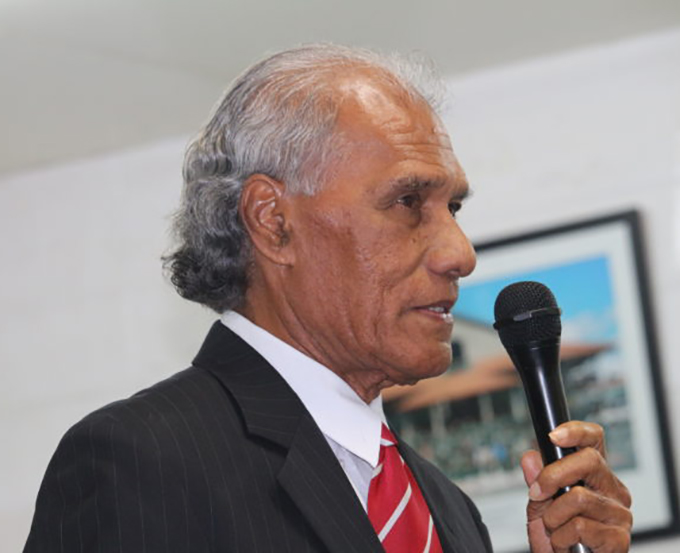 Reelected Prime Minister ‘Akilisi Pohiva … bringing “justice and good governance” to Tonga. Image: Kaniva News
By Kalino Latu, editor of Kaniva News
‘Akilisi Pōhiva, 76, has been elected by a majority of Members of Parliament to become Tonga’s Prime Minister for the next four years.
A total of 14 members out of the 26 Members of Parliament voted for Pōhiva, while 12
MPs voted for the rival candidate, Siaosi Sovaleni.
Lord Fakafanua has been elected as new Speaker of Parliament.
Pōhiva, who has led the PTOA or Democratic Party since its establishment in the last
decade, told the House before the election yesterday he was grateful to the people of
Tongatapu for electing him to Parliament from 1987 to 2010 when the old electoral system enabled the whole of the mainland to elect three candidates to the House.
He also thanked the constituents of Tongatapu 1 for voting him into Parliament since 2010
after the electoral system was changed to give Tongatapu 10 candidates to be elected to Parliament.
After it was announced about 6.30pm that he had been elected as Prime Minister, Pōhiva thanked the king and the people for putting their trust in him again.
In his speech in support of Pōhiva, Pōhiva Tu’i’onetoa, Tonga’s Minister of
Finance, said the results of the snap election showed that the majority of people trusted
Prime Minister Pōhiva and his ambition to have a government which supported good governance and justice.
He described the results in Tongan with a Biblical saying ( Luke 6:43-45) “a tree is known by its own fruits”.
Watching government
He said he supported Pōhiva to be Tonga’s next Prime Minister after his 30 years experience as Tonga’s former Auditor-General.
Tu’i’onetoa said one of his roles was to watch on government leaders to make sure they were accountable to their responsibility for people.
He then referred in his speech to some Tongan vocabularies such as “‘ikai toka’one” and “fōfō’anga” to describe previous government leaders, saying they could not beat Pōhiva when it comes to principles such as justice and good governance.
Another Party member, MP Mo’ale Fīnau, said he believed previous governments upheld
justice and good government, but they did not maintain a constant level of support.
Finau believed Pōhiva stood firm in his desire to bring justice and good
governance to Tonga more than any previous Tongan government leader.
Fīnau said that in 2010 and 2014 the Democratic Party failed in its attempt to elect its
17 candidates or the majority of PTOA to Parliament. However, in the snap election they had won a majority of seats for the first time.
MP ‘Akosita Lavulavu for the Party told the House that according to the snap
election results the majority of voters in the Vava’u islands, Tonga’s second largest island
group, wanted Pōhiva to become Tonga’s Prime Minister.
Help for Vava’u
She said God wanted Pōhiva to become Prime Minister and that was embodied in a majority of the voters who went to polls in the snap election.
She said he had promised her the government would help Vava’u in a special way in the next
four years.
Niua MP Vātau Hui said the nation had been praying for an answer to the snap election and
the results had been given that Pōhiva should lead the nation.
However, MP Sāmiu Kiuta Vaipulu, who nominated Sovaleni, said MPs needed to work
together to build the nation.
He said prices for consumer goods were high because of a levy imposed by the government.
Asia Pacific Report republishes Kaniva News articles with permission.
Article by AsiaPacificReport.nz
]]>Politics Newsletter: New Zealand Politics Daily – 19 December 2017 – Today’s content
Politics Newsletter: New Zealand Politics Daily – 19 December 2017 – Today’s content
Editor’s Note: Here below is a list of the main issues currently under discussion in New Zealand and links to media coverage.
[caption id="attachment_297" align="aligncenter" width="1600"] The Beehive and Parliament Buildings.[/caption]
Below are the links to the items online. The full text of these items are contained in the PDF file (click to download).
2017 in review
Liam Hehir (Stuff): Only one person truly in the hunt for politician of the year
Graham Adams (North & South): 2017: A year of hard truths
John Armstrong (1News): Politician of the Year
John Armstrong (1News): Plonker of the year, heroes and zeroes
John Armstrong (1News): On the wane, the comeback kids and the best put down
Anna Connell (Newsroom): Some of 2017’s best and worst
Kate Newton (RNZ): 2017: Are we there yet?
David Farrar (Kiwiblog): Scoring my 2017 predictions
1News: How to make slime, how to vote and fidget spinners – Kiwis’ weird and wonderful Google searches in 2017
Eugene Bingham and Paula Penfold (Stuff): The Demise and Rise of Andrew Little
Environment and climate change
Richard Harman (Politik): Todd Muller reverses climate change policy
Herald: Government starts down pathway to net zero emissions by 2050
Tom O’Connor (Stuff): Climate change cannot be denied
Anna Bracewell-Worrall (Newshub): Government plans to go carbon neutral by 2050
Stacey Kirk (Stuff): Government to consult before drafting ‘Zero Carbon Act’ to reduce emissions
Herald: Prime Minister announces formulation of Zero Carbon Act, climate change commission
No Right Turn: Climate change: Costs and benefits of ending oil
Steven Cowan (Against the current): Jacinda Ardern: Empty posturing on climate change
Dominion Post: Editorial: Morgan was right: moggies are a problem
Government
Tamsyn Parker (Herald): PM non-committal over Winston Peter’s KiwiSaver plan
Katie Bradford (1News): Jacinda Ardern ‘pleased’ to attend Waitangi as powhiri moved to keep protesters away from her
1News: Custom clothing featuring Jacinda Ardern’s face helps US artist ‘adjust to Trump’s presidency’
Chris Trotter (Daily Blog): Governing For The “Other Half” Of New Zealand
Martyn Bradbury (Daily Blog): Sweet Jesus – I agree with Heather du-Plessis Allan?!?
Gwyn Compton (Digital Libertas): Is Clare Curran the first Minister to breach the Cabinet Manual?
Drug law reform
Nicholas Jones (Herald): Bill to legalise medicinal cannabis introduced this week
Damien Grant (Stuff): Making drugs illegal won’t keep your child safe
1News: ‘Enough support in the House to pass’ – Jacinda Ardern confident ahead of Medicinal Cannabis Bill introduction
Employment and welfare
Lloyd Burr (Newshub): Government promises pay rise to Parliament’s cleaners and cooks
RNZ: Parliament’s cleaners to get living wage
Stuff: 13-hour clock for women the answer to fixing pay discrimination in New Zealand
Stuff: Women under-represented in retail leadership, pushing earnings down
Colin Peacock (RNZ): PR push to highlight the glass ceiling
Chris Trotter (Stuff): Christian roots of welfare state safety net frayed by free-market economics
Sue Allen (Stuff): Hype about tinned tomatoes has raised the debate on giving
Parliament and Waka jumping bill
Henry Cooke (Stuff): National: Waka jumping bill ‘an affront to democracy’
Herald: National says bill would gag MPs and make them loyal to leader, not voters
Nicholas Jones (Herald): National MP given summer homework – by Labour
CTV building collapse
Rebecca Macfie (Listener): CTV Building: Why no one is being prosecuted under current law for the collapse
Newswire: ‘I just instinctively think that it’s wrong’ – Justice Minister looks at introducing corporate manslaughter law
RNZ: Corporate manslaughter law possible next year – Little
Health
Stacey Kirk (Stuff): Government out of money for new hospital and building works – National
Newswire: Government short on hospital funding, says National
Aaron Leaman (Stuff): Health dollars sunk into stalled IT project
Economy and immigration
Liam Dann (Herald): Take that, bitcoin, New Zealand’s value blows you out of the water
Jamie Gray (Herald): Gap opens between consumer and business confidence
Tom Pullar-Strecker (Stuff): Facebook to book NZ advertising sales revenues here, not in Ireland
Keith Rankin (Daily Blog): Public Equity and Tax-Benefit Reform
Rob Stock (Stuff): Kiwi laws fail to keep up with the speed of digital disruption
Dene Mackenzie (ODT): Economic risk in reducing immigration
Oksana Opara (Briefing papers): Immigration reform spotlight: Fairness, economic development, and the Working Holiday Scheme
Education
Zizi Sparks (Stuff): Youth advisory group to influence education and minister
Tom Hunt (Stuff): Zone-tightening fears as mini population boom bears down on secondary schools
Adele Redmond (Stuff): More schools broke the rules in 2016 – auditor-general
Media
Colin James (ODT): Lifetime’s learning, insights peculiar privilege of journalism
Ben Robinson-Drawbridge (RNZ): Manus Island and media manipulation
Martyn Bradbury (Daily Blog): How Steven Joyce killed NZ music & how a new youth radio station could save it
Mark Jennings (Newsroom): Word Holocaust ‘dangerous and derogatory’: Google
Other
Simon Chapple (Herald): China is seeking an insidious influence in New Zealand
Henry Cooke (Stuff): Opportunities Party board ‘did not allow any internal criticism’
David Hay: Why I’m sticking with TOP
Newswire: Conservative Party to be re-named
Alice Snedden (Stuff): Weinstein affair is a modern Christmas miracle
Alice Snedden (Stuff): Don Brash and Bill Gallagher – keeping racism in the public eye
Pete George (Your NZ): A new era of post baby boomer politics
No Right Turn: Little on the SIS
David Farrar (Kiwiblog): A letter from a reader
Victoria University of Wellington (Newsroom): Meet the world’s first virtual politician
Laura Walters (Stuff): Australia backs down on plans to charge Kiwi students higher fees
Enzo Giordani (The Standard): Tory Translation Service]]>
Politics Newsletter: New Zealand Politics Daily – 18 December 2017 – Today’s content
Politics Newsletter: New Zealand Politics Daily – 18 December 2017 – Today’s content
Editor’s Note: Here below is a list of the main issues currently under discussion in New Zealand and links to media coverage.
[caption id="attachment_297" align="aligncenter" width="1600"] The Beehive and Parliament Buildings.[/caption]
Below are the links to the items online. The full text of these items are contained in the PDF file (click to download).
2017 in review
Audrey Young (Herald): My politician of the year
Tracy Watkins (Stuff): Top 20 New Zealand political moments of 2017
Barry Soper (Newstalk ZB): Past year in politics has been totally unpredictable
Stacey Kirk (Stuff): What does Santa have in his sack for our hardworking politicians?
Andrew Gunn (Stuff): ‘Joyce to the world’, ‘Away on a Manus’ and other Christmas carols for political junkies
Lizzie Marvelly (Herald): Winners and losers of 2017
Peter Dunne (Interest): Politician of the year
Spinoff: 2018 in politics: What will be the crucial issues?
Duncan Garner (Dominion Post): A year to trump so many others
Hannah Martin (Stuff): ‘Youthquake’ named 2017 word of the year by Oxford Dictionaries
Nadine Higgins (Stuff): Feminists just seeking sexual equality – who knew?
David Farrar (Kiwiblog): 2017 Kiwiblog Awards voting
David Farrar (Kiwiblog): Welfare fraudster should be NZer of the Year!
Pete Burdon (Media Training): Bill English my Media Communicator of the Year
Katie Parker (The Wireless): Best of the year: Who won 2017?
Spinoff: The world in 2017, in one sentence
Government
Shane Cowlishaw (Newsroom): Documents reveal insight into coalition talks
Claire Trevett (Herald): Information provided to political parties in coalition talks released
Derek Cheng (Herald): $15 billion: Official costing Greens given on total ban on new coal mines, oil drilling and fracking
Dave Clemens (Newsroom): Chasing a fuller OIA ‘menu’
Heather du-Plessis Allan (Herald): Labour has the shortest honeymoon ever
John Roughan (Herald): Polled voters back National’s economic legacy
Newsroom: National ministers return serve over Peters leak
Herald: Sunshine Coast beckons new PM Jacinda Ardern for 2018 holiday
National
Wayne Mapp (Spinoff): National’s best chance now? The eradication of NZ First
Branko Marcetic (Spinoff): The secret history of National party collusion with Australian politicians and strategists
Jogai Bhatt (Newshub): Life in opposition more relaxed – Gerry Brownlee
Parliament
NZ Herald editorial: Waka jumping law shouldn’t be necessary
Britt Mann (Stuff): Layers of meaning: Reading a world leader by their wardrobe
Benedict Collins (RNZ): Delayed lunch break brings out hangry MPs
Nicholas Jones (Herald): Tempers flare in Parliament as families’ package debate drags out
Laura Walters (Stuff): Long days and busy schedules start to get to MPs
CTV building collapse
RNZ: Corporate manslaughter law possible next year – Little
RNZ: CTV building: Little promises law changes
Dominic Harris (Press): CTV families demand law changes to stop people “getting away with murder”
1News: Families of CTV building collapse victims say Justice Minister Andrew Little ‘sympathetic’ to them at meeting
Annabelle Tukia (Newshub): Families of collapsed CTV building victims vow to keep fighting
Lisa Davies (1News): Families of CTV collapse victims emerge from ’emotional’ meeting with police vowing to ‘fight for justice’
Employment and welfare
Jamie Morton (Herald): NZ living wage needs urgent look, Massey University and AUT researchers say
Anthony Hubbard (Stuff): Seeds of hope or of despair?
Katarina Williams (Stuff): New benefit wait times out of step with government’s own standard
CPAG: The further fraying of the welfare safety net
Simon Collins (Herald): Hardship grants at record highs as welfare state ‘frays’
RNZ: NZ welfare safety net starting to unravel – report
Brian Easton (Pundit): Social Investment is Fashionable at the Moment
Martyn Bradbury (Daily Blog): Open letter to the Honourable Carmel Sepuloni – end the horror of the neoliberal welfare state
Health
Cate Broughton (Stuff): ACC: An unequal playing field?
Natalie Akoorie (Herald): Value for money questioned in $1.2m spending by health board bosses
Weekend Herald editorial: Expenses call into question a need for 20 DHBs
Herald: Lester Levy resigns as chairman of Auckland health boards
Tom Furley (RNZ): Binge drinking still a ‘significant burden’ on strained EDs
Dave Macpherson (Daily Blog): What’s the Red/Black/Green Government up to on mental health?
Dale Husband (E-Tangata): Debbie Sorensen: Whānau Ora is working for our communities
Euthanasia
Martin van Beynen (Stuff): A good death is hard to find but End of Life Choice Bill will help
Dominion Post Editorial: Parliament can’t keep dodging the issue of euthanasia
Martyn Bradbury (Daily Blog): The neoliberal seductiveness of euthanasia
Environment
RNZ: Mining permits to be taken case by case – Ardern
Charlie Mitchell and Simon Maude (Stuff): Government lacks ‘coordinated plan’ for climate change, withheld report shows
Jamie Morton (Herald): Climate change: NZ lacks co-ordinated plan
Anna Bracewell-Worrall (Newshub): Confusion reigns due to lack of leadership on climate change – Ministry for the Environment
Leith Huffadine (Stuff): What you need to know about the previously withheld climate report
Jim Salinger (Herald): Grim climate outlook demands action now
Cass Mason (Newsroom): New sea level rules prepare for the worst
Herald: Government to review ‘grossly substandard’ kauri dieback programme
Mini-budget and economy
Shamubeel Eaqub (Stuff): Mini-Budget carefully reshuffles the deck chairs
Jane Patterson (RNZ): The battle of the ‘Families Packages’
Frank Newman (Breaking Views): Mini-budget delivers on promises
RNZ: Families package passes in Parliament under urgency
Stuff: Jacinda Ardern, Grant Robertson make first Super Fund payment in nine years
Herald: Super Fund repayments restart with click of button
Rod Oram (Newsroom): Rogue US threat to Goldilocks economy
Hamish Rutherford (Stuff): NZ growth may have cooled in lead-up to election, new headwinds building
Jamie Gray (Herald): No early Xmas present expected for Grant Robertson, GDP growth expected to be tepid
Education
Simon Collins (Herald): Childcare workers speak out against ‘factory farming’ of children
RNZ: ERO to investigate special education in schools
Philip Matthews (Stuff): Free fees and changing degrees: The changing face of higher education
Media
Ben Robinson-Drawbridge (RNZ): Manus Island and media manipulation
1News: TVNZ and Maori TV in talks for single te reo newservice: ‘If you don’t move that way, you’re a dinosaur’
Kendall Hutt (Evening Report): Film industry sources criticise TVNZ ‘devaluing’ of Māori programmes
Jane Bowron (Stuff): Sharp choices ahead for TVNZ with Mike Hosking, Toni Street gone
John Drinnan (ZagZigger): What about a simulcast Mike for TVNZ Brekkie?
Brian Edwards: I Doff my Hat
Steve Braunias (Herald): Secret Diary of Mike Hosking
Calum Henderson (Spinoff): 100 possible host combinations for Seven Sharp in 2018
Jack van Beynen (Stuff): Susie Ferguson broadcast through pain as bad as childbirth
David Farrar (Kiwiblog): Press Council decision on complaint against Kiwiblog
Housing
Henry Cooke (Stuff): Housing New Zealand will not be restructured, breaking Labour election commitment
John Tookey (Dominion Post): Huge task ahead to build more houses
Herald: Treasury warns of unintended consequences on foreign buyer ban
RNZ: Wgtn City Council defends social housing clampdown
Defence
Tommy Livingston and Kirsty Lawrence (Stuff): Defence Force sex assault victims say ‘enough is enough’ after suffering for years
Tommy Livingston (Stuff): Hayley Young speaks out about sexual harassment and rape in NZ and UK navy
Kate Pereya Garcia (RNZ): Navy sex attack victim speaks out
Kate Pereyra Garcia (RNZ): ‘It’s really difficult to keep telling your story’
Foreign affairs and trade
Reuben Steff (Spinoff): Winston Peters is softening on China – and that’s not necessarily a good thing
Christian Novak (Incline): Warmer NZ trade relations with Russia? Probably nyet
1News: Watch: Inside Parliament: Diplomatic immunity controversy
Graham Cameron (Spinoff): Manus Island: why we can’t keep our noses out of it
Herald: PM’s father Ross Ardern will be the new Administrator for Tokelau, based in Auckland
RNZ: Ross Ardern to be NZ’s next administrator to Tokelau
Child welfare
Darrell Latham (Stuff): Ending child abuse and killings is a task for our whole country
Tim Watkin (Pundit): Moko: The first thing we need to do to save lives is...
Liz Beddoe (Newsroom): Tragic deaths must not mean surveillance
Jogai Bhatt (Newshub): Jacinda Ardern wants to ‘lift every child out of poverty’
Herald: Prime Minister Jacinda Ardern wants all NZ children out of poverty
Laura Walters (Stuff): Children’s Minister Tracey Martin says new measures will help all 155,000 kids in poverty
Net neutrality
Max Towle (The Wireless): What the end of net neutrality in the US means for NZ
Herald: Net neutrality repeal – what it means for NZ
Transport
Laura Walters (Stuff): Government announces road safety measures ahead of Christmas, speed limit changes to come
Benedict Collins (RNZ): Thumbs up for rural road initiative
RNZ: New funding to make risky rural roads safer
Dave Armstrong (Dominion Post): Kedgley was right – we were off our trolleys
Disability
Bess Manson (Stuff): Paula Tesoriero – fighting for equality
Ruby Nyika (Stuff): Bringing te reo to deaf Māori
MBIE
Matt Nippert (Herald): Super-Ministry’s super spending revealed
Matt Nippert and Chris Knox (Herald): Ministry in spotlight over high-earning contractors
Tom Pullar-Strecker (Stuff): Ministerial advisory group to bring ‘focus’ to closing digital divides
Other
David Williams (Newsroom): Concerns raised over census IT system
Tamsyn Parker (Herald): Kris Faafoi: Putting the consumer first
Madison Reidy (Stuff): New minister wants NZ to up ante against cyber-crime
Liz Gordon (Daily Blog): Time for new strategies for women’s equality
Emma Hatton (RNZ): Copyright law confirmed for an overhaul
Rob Stock (Stuff): Perils of $600m a year KiwiSaver first home withdrawals
Herald: Don’t make KiwiSaver compulsory: Brian Gaynor
Alexa Cook (RNZ): Incomplete farm records slow tracking of cattle disease spread
Jogai Bhatt (Newshub): Why Auckland Mayor Phil Goff wants $6b from the Govt
RNZ: Optimism grows over Ngāpuhi Treaty settlement
Laura Tupou (RNZ): Tauranga iwi commit to resolve Treaty issues
Jamie Morton (Herald): LGNZ: More cash needed to meet tourist influx
Simon Draper (Stuff): We need to talk about tourism
Liam Dann (Herald): Rob Campbell, the anarchist who conquered the corporate world
Cherie Howie (Herald): Kim Dotcom: Judge rejects seven of internet mogul’s arguments against extradition to US
Kurt Bayer (Herald): Sir John Key awarded with a Doctor of Commerce honorary degree
Hayley Stevenson (Stuff): Prime minister must overhaul Royal NZ Ballet board, says former chairman
Stuff: ‘English only’ sign for staff in Bay of Plenty supermarket
Thomas Manch (Stuff): Church of the Flying Spaghetti Monster breaks another milestone in New Zealand
Laura McQuillan (Spinoff): New Zanada: the strange, deeply-explored proposed merger of Canada and New Zealand]]>
Opinion: Towards Safe, Orderly and Regular Migration in Asia and the Pacific

Opinion: Towards Safe, Orderly and Regular Migration in Asia and the Pacific
By Dr. Shamshad Akhtar –
[caption id="attachment_15680" align="alignright" width="300"] Dr. Shamshad Akhtar.[/caption]
Under-Secretary-General of the United Nations and the Executive Secretary, United Nations Economic and Social Commission for Asia and the Pacific (ESCAP)
In 2017, Asia and the Pacific will be home to 62 million international migrants. That’s a population larger than the Republic of Korea’s. Even more people from our region – over 100 million – live outside their countries of birth. At the United Nations Economic and Social Commission for Asia and the Pacific (ESCAP) we see this as an opportunity. One we should seize to shape a better future for our region.
There are many reasons for which people migrate. Students do so looking for an education unavailable in their own county, to broaden their horizons and improve their prospects. Some migrants are refugees, fleeing violence and persecution. In our region, we have tragically seen hundreds of thousands of civilians, the clear majority Rohingya, flee their homes in Myanmar to seek safety in Bangladesh in what the UN Secretary General has rightly described as a refugee emergency: an unacceptable humanitarian and human rights nightmare that must be brought to end.
But most migrants move in search of jobs, higher wages and a better life for themselves and their families. Their remittances – $276 million dollars in Asia-Pacific in 2017 alone – provide welcome support to communities in their countries of origin. Put simply, remittances feed children, pay for education and healthcare and lift people out of poverty. But if migrants move for their own benefit, they also do in response to the needs of the countries to which they travel. By moving where the jobs are, migrants support innovation, productivity and growth.
Migrants’ contribution is all the more remarkable considering the challenges they face on arrival, after long, expensive and perilous journeys. Migrants are often poorly paid and have limited access to public services. They tend to work in low skill jobs in the informal sector. Debts taken out to pay illegal fees to secure employment mean they can have little choice but to accept dangerous physical labour. Female migrants are particularly vulnerable. Often employed as domestic workers, they can suffer exploitation and abuse. To compound matters, migrants are frequently turned into scapegoats, their contribution downplayed by inaccurate, prejudice fuelled narratives.
Addressing these challenges could help unleash migrants’ potential as a force for positive change. The economic dynamism of the Asia-Pacific region and its ageing population means migrants could play an even bigger role in our economies and societies, plugging labour and skill shortages. But for them to do so, clear policies are needed to protect migrants’ rights in the workplace, improve their access to essential services and make it easier for them to help families they have had to leave behind.
This was recognised by Member States of the United Nations in the wake of the European refugee crisis when a bold initiative was launched to negotiate a global compact for safe, orderly, and regular migration by 2018. At its heart lies a simple ambition: to protect migrants’ human rights. Grounded in existing laws and practices, and with full respect for Member States’ sovereignty, this compact should lay the foundations for international cooperation for the benefit of countries of origin, destination, and the migrants themselves.
To help shape this agenda, the United Nations Economic and Social Commission for Asia and the Pacific held a regional consultation in November. Governments, civil society and the private sector met to identify regional trends, share best practice and agree on priorities to feed into global negotiations. Several key priorities emerged: protecting migrants against exploitation by unscrupulous employers by facilitating legal migration; ensuring migrants can transfer money quickly, securely and at low cost; cracking down on human trafficking; and helping those who may be forced to move because of natural disasters exacerbated by climate change.
There was strong commitment on all sides to cooperate to drive this agenda forward. I hope International Migrants Day can help keep up the momentum, promote the positive contribution migrants make in our region and help achieve safe, orderly and regular migration across Asia and the Pacific.
Shamshad Akhtar is the Under-Secretary-General of the United Nations and the Executive Secretary, United Nations Economic and Social Commission for Asia and the Pacific (ESCAP)
]]>Yogyakarta airport developers warned not to ‘steal’ people’s land

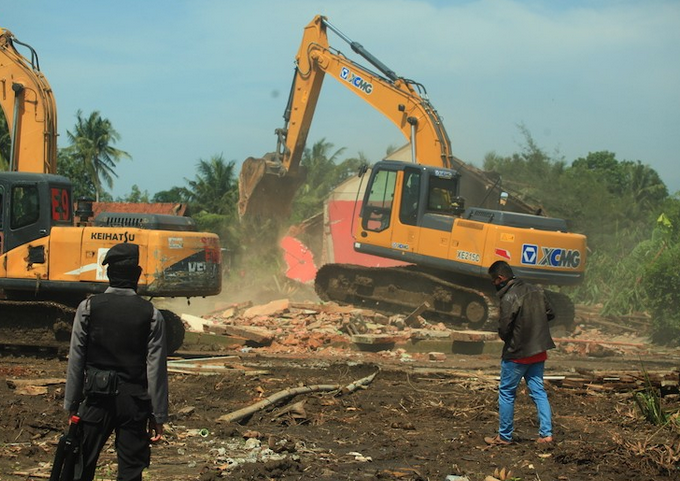 A police officer looks on as workers of state-owned airport operator PT Angkasa Pura I bulldoze a building in the vicinity of Glagah village to make room for the New Yogyakarta International Airport (NYIA) in Kulonprogro, Yogyakarta on Friday. Image: Bambang Muryanto/The Jakarta Post
By Bambang Muryanto in Yogyakarta
Indonesia’s National Commission for Human Rights (Komnas HAM) has demanded that state-owned airport operator PT Angkasa Pura I consider human rights aspects while working on the construction of a new airport in Kulonprogo, Yogyakarta.
The project should be free from human rights breaches, in particular when it comes to land ownership, the organisation said.
“Please, do not steal the citizen’s lands in the name of infrastructure development,” said Komnas HAM commissioner Choirul Anam.
READ MORE: Students reject new Yogyakarta airport, condemn forced evictions
Choirul added that he had received reports from local activists claiming that people of Glagah village were being forced by the company and police to give up their land.
Thirty of some 2700 families living on the disputed land reportedly insist on staying in their homes. Choirul suggested the company engage in dialogue with the people to find a solution.
“This is not only about land ownership; the eviction also threatens the people’s culture and social wellbeing,” he said, noting that violence could create even more problems.
Meanwhile, PT Angkasa Pura, through the manager of the New Yogyakarta International Airport (NYIA) construction project, Sudjiastono, claimed it had done everything in line with the law on land procurement for public utilities construction.
According to the regulation, he added, the company was allowed to forcibly evict people who refused to give up their land in return for compensation through the court.
“We’ve respected the people’s rights by giving them compensation, more than they deserve to get,” he said.
Bambang Muryanto is Yogyakarta correspondent of The Jakarta Post.
Article by AsiaPacificReport.nz
]]>Film industry sources criticise TVNZ ‘devaluing’ of Māori programmes

By Kendall Hutt in Auckland
Independent filmmakers fear a slow erosion of Māori and Pacific content at Television New Zealand has begun.
Their fears have emerged after the role of commissioner for Māori and Pacific programmes was removed from a full-time commissioning role in recent restructuring by TVNZ.
The move has left some within the film and television industry shocked and questioning whether it is ignorance or arrogance.
“Given that we are an increasing demographic, this seems like a mad racist move,” said Joanna Paul (Ngai te Rangi), an independent television producer who was one of the pioneers of the Māori Television Service.
“That TVNZ considers this a part-time job is arrogant and ignorant enough, but given there is more Māori and Pacific programming on air than ever before beggars belief,” Paul said.
She told Pacific Media Watch in August she had “nothing to lose” in bringing TVNZ’s moves to light and calling the public broadcaster to task.
“The only way to stop TVNZ and find some justice is to be open and be transparent to the media.”
Victim of restructure
The role was previously included in the factual entertainment, Māori, Pacific and children’s commissioner role, but recent developments have seen the position reduced from a 0.5 position to a 16-hour-a-week “commissioning consultant” role.
This is despite an internal document provided to Pacific Media Watch, dated June 16, 2017, which stated the role of the commissioner “is a part-time role, which is in line with our current output”.
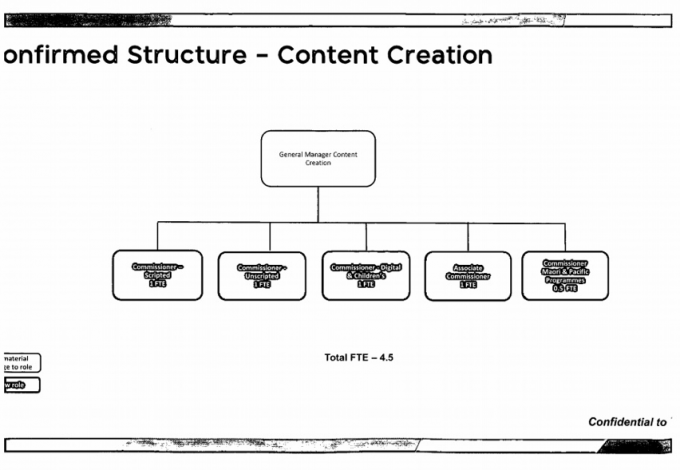 The commissioning structure, according to the 16 June 2017 document.
The commissioner for Māori and Pacific programmes is responsible for the commission of Māori and Pacific language programmes from the initial “sell” of the programme, right through to production, delivery and its fine-tuning throughout the shows tenure on air.
As the “most senior voice at TVNZ as a Māori”, the commissioner also provides guidance on tikanga Māori across TVNZ’s content team and output, former commissioner Kathryn Graham (Ngati Koroki Kahukura) said.
In the position for 13 years before her exit in July, Graham told Pacific Media Watch the commissioner was also responsible for developing and maintaining relationships with key stakeholders including NZ On Air, Te Māngai Pāho and Ngā Aho Whakaari, along with Māori and Pasifika communities.
 TVNZ’s flagship te reo Māori news programme Te Karere.
But one independent Māori producer who did not wish to be named said the way the new role was proposed had potential negative impacts for both Māori content and independent Māori producers.
“It limits the ability of the person in the 0.4 position to truly participate as an integral member of the content team as they will not be present full-time and therefore cannot be involved fully in broader commissioning decisions.
Independent producers affected
“For independent producers making Māori and Pacific content, not having a commissioner available to them full-time is a potential disadvantage as often decisions need to be made quickly, and feedback is required promptly.
“They will have to work around the part-time availability of their commissioner which may impact on their ability to be agile and nimble in their programme making,” they said.
The producer also expressed concern at the disestablishment of the Kaihautu role and Māori programmes department, which they described as a “scaling-down” of TVNZ’s commitment to Te Tiriti o Waitangi and true partnership, and the “de-prioritising” of Māori and Pacific content.
However, TVNZ spokesperson Georgie Hills said in a statement in response to Pacific Media Watch’s questions that TVNZ was not scaling back its commitment.
“The changes we’ve made to our content team this year do not change our commitment to continue providing New Zealand’s most watched Māori programming.
“Under our new structure, we have created a dedicated role with a singular focus. The new consultant position sits within our content team and specifically oversees TVNZ’s Māori and Pacific content,” Hills said.
Hills added the public broadcaster was proud of its Māori language content, responding to claims it was “scaling-down” its commitment to Te Tiriti.
TVNZ’s ‘scant concern’
“We’re proud of our dedicated Māori language content and we embrace the everyday use of te reo Māori in TVNZ’s broader local content offering.
“We typically air nine hours each week of dedicated Māori programming – 483,000 viewers tuned into at least one of these programmes a week during the financial year of 2017,” she said.
However, Pacific Media Watch’s industry sources claimed TVNZ had scant concern for their statutory obligations.
Under the Broadcasting Act 1989, New Zealand’s Broadcasting Commission is required to reflect and develop the country’s identity and culture, which includes the promotion of Māori language and culture.
“Our commitment to reflecting Māori perspectives is enshrined in legislation, such is the fundamental importance placed on the role we fulfill,” Hills responded to industry criticism.
Although the role is advertised as “commissioning consultant”, Hills added TVNZ was open to the time being 0.4 or 0.5 and that the title of the role was “immaterial in the big picture”.
“It will depend on the skills and capability the individual candidate brings to the role. We’re flexible. If our output increases, so will the role.”
‘Unrealistic job description’
But despite TVNZ’s assurances, some remain fearful the role will be disestablished.
“I predict they will scrap the role entirely using the reason they cannot find a suitable candidate,” Graham told Pacific Media Watch.
This was criticised by both Paul and Pacific Media Watch’s anonymous source, who said an “unrealistic job description” illustrated a lack of respect and priority for the role, placing “inherent limitations” on potential applicants.
“The commercially sensitive nature of the role makes it very difficult for anyone to juggle this with other production work, either for TVNZ or any other broadcaster.
“Creating a position which will likely struggle to attract the kind of candidates they are asking for does suggest a lack of respect and priority for the role,” one source said.
TVNZ first advertised the role on November 7, but it has been readvertised and the closing date has been extended from November 28, December 8 through to January 15, 2018.
“It’s a key role and it takes time to find the right candidate with the highly specialist skills we’re after. We’ve advertised, put the call out to our own network of contacts, the production community and have taken recommendations from within the industry,” Hills stated.
‘Conflict of interest’
Since Graham’s exit in July, the role has been overseen by the general manager of content creation, while Scotty Morrison (Ngati Whakaue) has been available to provide expert advice and guidance.
This is not the first time the general manager has overseen Māori and Pacific programming, one source told Pacific Media Watch.
A former TVNZ staffer who did not wish to be named said that for 15 years Māori and Pacific programmes had no commissioner at all and had successfully been overseen by the general manager.
“We count ourselves immensely fortunate to have somebody of Scotty’s skills to call on. His te reo and tikanga expertise have been invaluable to our content team,” Hills said.
However, Morrison and TVNZ have been criticised by Pacific Media Watch’s industry sources for a “conflict of interest”.
This is due to the fact that Morrison, along with his wife, fellow broadcaster Stacey Morrison, does consultancy work for shows with Māori content.
With the role of Māori and Pacific programmes commissioner hanging in the balance, Pacific Media Watch’s industry sources say TVNZ’s restructuring means a conduit for Māori and Pacific voices is being lost.
TVNZ ‘devaluing role’
“TVNZ is devaluing the role and putting it aside. It is symbolic of chipping away at Māori programming,” Pacific Media Watch’s independent Māori producer said.
“The lack of a commissioner is a another kind of door shutting. It’s a total disservice to Māori,” Graham reflected.
Ngā Aho Whakaari did not respond to several requests for comment.
The Directors and Editors Guild of NZ declined to comment.
Kendall Hutt is contributing editor of the Pacific Media Centre’s Pacific Media Watch freedom project.
Article by AsiaPacificReport.nz
]]>Gideon Levy: New Zealand, one state for two nations

ANALYSIS: By Gideon Levy in Auckland
Late-morning light bathed the landscape in bold colors. It’s early summer here, and the sun was already very strong, broiling. It’s also the season in which the pohutukawa trees burst into crimson blossoms along the roadside.
The view from the heights of this Auckland suburb of Orakei is breathtaking, like almost every place in the beautiful country of New Zealand: an azure bay, endless green meadows, homes, boats and of course sheep.
Only a few skyscrapers spoil the horizon, on the other side of the bay.
The sound of birdsong sliced through the silence. An Australian magpie was perched on a structure atop a hill, singing a song unlike any I’d ever heard in my life. The landscape was equally inimitable. The colours of the magpie, black and white, blended with the black and white of the structure, which serves as a marker for ships at sea.
Soon another magpie arrived, and the two began singing to each other, a serenade for two magpies, a hypnotic duet, before flying away.
Unavoidably, Israeli poet Nathan Zach’s “A Second Bird” leaped to mind: “A bird of such wondrous beauty I shall never see again / Until the day I die.”
Haaretz journalist Gideon Levy’s message for New Zealanders. Video: PalestineHumanRights
Father of social welfare
On the slope below, close to the waterline, is the tomb of New Zealand’s 23rd prime minister, Michael Joseph Savage, with a large stone obelisk rising over it. Savage, who served as the country’s first-ever Labour prime minister, from 1935 to 1940, is considered to be the father of its social-welfare policy.
He was laid to rest here in 1940, at Bastion Point on the coast, a gesture of esteem for someone who became a beloved figure to his nation. “The New Zealander of the century,” The New Zealand Herald called him.
But the hill above the grave site of the adored premier is fraught with a more recent, different and painful history. Forty years ago, hundreds of people barricaded themselves here for 506 days. They were Māori from the Ngahi Whatua tribe, and were joined by white human-rights activists who came to show solidarity with them in what was called an “occupation” but was actually a liberation.
It was an indigenous display of protest and independence, revolving around ownership of the land on which we were now standing, above Bastion Point. The so-called occupation lasted from January 5, 1977, until May 25, 1978, when the protesters were evicted, ending 17 months of a determined civilian, nonviolent struggle.
Some 230 people were arrested during the eviction, but no one was hurt. The event became a milestone in New Zealand history.
A television report broadcast here on that May day when the occupiers were evacuated carries the voices and the images. On film, the site looks more like Woodstock than like Umm al-Hiran, the Bedouin town in the Negev where a villager and an Israeli policeman were killed last January.
In the footage, hundreds of unarmed New Zealand police and soldiers are seen quietly removing the demonstrators, who had camped here for almost a year and a half in order to restore the land to its Māori owners. No blood is shed, no violence erupts; there’s only singing and weeping.
Model of nonviolence
The activists later claimed that the police had orders to open fire at them, but that didn’t happen: The officers were unarmed throughout the eviction. The reporter likened the convoy of police vehicles arriving at the site to a military convoy in World War II, no less, but to Israeli eyes, which have seen violent evictions in the Negev and in the territories, the Bastion Point incident is a model of nonviolence and civil resistance.
The only fatality was little Joanne, a 5-year-old Māori girl who died in a blaze caused by a heating stove that the protesters on the hill lit on a cold winter night in one of the makeshift structures they lived in – tents, trailers and huts.
Near the place where she died, on the lower slope of the hill, stands a memorial to Joanne Hawke – a Māori sculpture and a commemorative sign that tells her story.
The Negev Bedouin have reason to be envious of the Māori achievements and of the solidarity that some of the white European population, known as Pakeha in the Māori language, have demonstrated for them. In the end, the land in question was returned to its Māori owners, even though they are not permitted to build on it.
Bastion Point is now the greenest hill in the vicinity of Auckland, a nature reserve and a national heritage site for the country’s indigenous people. Atop the hill today is a small Māori village with well-kept homes in a uniform style, among them the house of the leader of that protest 40 years ago, Joseph Hawke, the uncle of Joanne. He was a two-term Labour member of Parliament, serving until 2002, and is now a homebody. His son, Parata Hawke, told us the story of the hilltop protest his father led. He was a boy then, and thought his dad was taking him on a picnic.
The younger Hawke, a social activist who has nine daughters, is a handsome man in his fifties, head shaved with only a ponytail in the back, adorned with a traditional wooden ornament. Barefoot and wearing shorts, Parata Hawke first speaks in the Māori language before switching to English. His family’s original surname was Haka, but his father anglicised it, like many other Māori.
The television in the guest room in his parents’ home, where he’s now staying, is tuned to Al Jazeera in English. He serves his guests homemade bread with butter. A magnificent Māori singer, named Paitangi, with a tattooed chin, will accompany him in her powerful voice, at a solidarity rally with the Palestinian people (where I was speaking).
Collection of Māori weapons
Parata Hawke is active in that movement and is well informed about events in the Middle East. He has a collection of ancient Māori wooden weapons, including a 300-year-old spear, which he forbids strangers to touch.
Roger Fowler, who was active in New Zealand’s large-scale movement against the Vietnam War in the 1960s, was present during the entire “occupation”. He married his Māori bride, Lyn Doherty, on the hill in the midst of the protest. In recent years he’s been a vigorous and determined activist for Palestinian rights.
Last weekend he took part in a demonstration of hundreds of people outside the American consulate in the city, against the decision to recognise Jerusalem as Israel’s capital. When the Israeli tennis player Shahar Pe’er took part in a tournament in Auckland some years ago, Fowler threw a tennis ball onto the court in an attempt to disrupt the match.
He also took part in a raucous demonstration against the apartheid regime in South Africa when that country’s rugby team played at Eden Park, Auckland’s largest rugby stadium, in 1981. It was the South African team’s last game in New Zealand before the regime changed. And speaking of rugby – every match here begins with the haka, the Māori war dance.
About 750,000 residents of New Zealand are Māori, 17 percent of the population. In most realms of life, the Arab citizens of Israel, whose proportion within the population is roughly the same, can only envy them. There are no Māori ghettos, Māori are well integrated into society, mixed marriages are a matter of routine, and at Auckland’s international airport visitors are greeted by typical Māori artwork and murals. There are also five Māori universities in New Zealand.
Nevertheless, Parata Hawke says that his people are still in the midst of a battle for their land, their heritage and their national honour. It’s a war of attrition, he says.
“They stole our land and killed our people,” he explains, “and until the occupation of the hill, no one even talked about it.” For the Palestinians, he suggests nonviolent resistance. “If we take another route, we’ll lose.”
Elections defeat
The Māori Party sustained a defeat in the last election, in September, not managing to get even one seat at the House of Representatives, the country’s legislature, which, like Israel’s, has 120 members; most Māori vote Labour. But Winston Peters, the deputy prime minister and foreign minister in the new centre-left Labour-Green-NZ First government, is the son of a Māori father and a mother of Scottish origin.
The road to having an Arab foreign minister in Israel is still very long.
The foreign minister of New Zealand’s “big sister”, Australia, is not an aboriginal. Julie Bishop is white, industrious and ambitious. She receives the guest from Israel warmly and courteously in her office in the Parliament building in Canberra. She even plies the stranger who has come to meet her with gifts: stuffed kangaroo and koala bear toys.
Our conversation takes place off the record, but her position on the Palestinian issue wouldn’t shame any Israeli right-wing leader. It’s easy to see why Prime Minister Benjamin Netanyahu felt so comfortable on his visit to Australia last February. Hard-right MK Bezalel Smotrich (Habayit Hayehudi) would feel equally at home here.
Australia’s Jewish lobby wields dramatic influence. Almost every new MP is invited on an “informational” trip to Israel, along with many journalists. And signs of the Israeli propaganda machine are hard to miss here.
Former Foreign Minister Bob Carr, who has changed his views since leaving office, also points to the large donations that Jewish activists make to the two big parties when explaining Australia’s one-sided approach.
Carr is one of the few politicians in Australia to have a balanced approach to Israel and the Palestinians, who is not a member of the Greens.
Coalition anomaly
Mark Coulton, deputy speaker of Australia’s House of Representatives, a member of the National Party that is part of the ruling centre-right coalition, is an anomaly here. He tells us that he returned a few months ago from a visit to the occupied territories – very different from what is seen on the Israeli information tours – and has since become one of the independent, exceptional voices in the House against the Israeli occupation.
Coulton, himself a farmer, was especially shocked by the attitude of the occupation authorities toward Palestinian agriculture. He won’t forget the farmers he met from the Qalqilyah area of the West Bank who can’t access their land because it’s on the wrong side of the security barrier, or the shortage of water they suffer – in contrast to the abundance of water in the Jewish settlements – and the butchered olive trees.
In Australia, in any event, the Israeli occupation can go on celebrating. Its only opponents, pretty much, are the Greens.
Beautiful Australia, with its beaches and its affable people, is occupied with other matters. A major furore erupted here recently when it emerged that some members of the House and the Senate hold dual citizenship, sometimes even without being aware of it. Now they have to resign.
On the margins of that storm there were also some who asked about the question of dual loyalty of Australia’s Jews, although that question did not come up for public debate. The Jewish establishment there can go on activating its effective, aggressive pro-Israel lobby without interruption. “Israel, right or wrong,” is its slogan, I’m told.
All of that is forgotten as though it’s air on Karekare Beach, about an hour’s drive from Auckland. The sand here is black with bits of glittering iron; the landscape is rocky and wild. This is where Jane Campion’s film The Piano, with its unforgettable landscapes, was filmed.
Now, in early summer, the beach is empty. Here, on the shores of the Tasman Sea, between Australia and New Zealand, opposite the cliff and the rocks, the waves and the black sand, almost everything is forgotten amid nature’s ravishing beauty.
Gideon Levy is a Haaretz columnist and a member of the newspaper’s editorial board. He joined Haaretz in 1982, and has won many awards. He recently visited Australia and New Zealand on a lecture tour.
Article by AsiaPacificReport.nz
]]>Duterte on nationwide martial law – up to ‘enemies of the state’

 Martial law … “all options on the table”, says President Rodrigo Duterte. Image: Malacañang file photo from Marawi City
By Pia Ranada in Manila
President Rodrigo Duterte says he will consider nationwide martial law if the New People’s Army steps up attacks.
When asked if he would expand martial law coverage nationwide, President Duterte said “all options are on the table”.
Speaking to reporters in Taguig City last week, the President said it would be the threat posed by the New People’s Army (NPA) more likely to push him to expand martial law’s geographic coverage.
READ MORE: Duterte thanks Congress for extending martial law in Mindanao
If the NPA – armed wing of the Communist Party of the Philippines (CPP) – intensifies its recruitment of new members and steps up attacks such as they are about to topple the government, Duterte said he would consider nationwide martial law.
“If the NPA say they are recruiting in mass numbers and they create trouble and they are armed and about to destroy government, the government will not wait until the dying days of its existence,” said Duterte.
Ultimately, he said, any decision for him to proclaim martial law across the country is “up to the enemies of the state”.
He stressed, however, that he would listen to the military and police.
“To what extent, what level of atrocities, attacks, it is not for me to say that. It is for the Armed Forces and the police,” said the President.
During the joint session where Congress debated Duterte’s request to extend martial law in Mindanao by one year, Senate Minority Leader Franklin Drilon warned that the President’s recommendation sounds like a “prelude” to nationwide martial law.
Some lawmakers insist there is no legal basis for martial law extension, saying there is no state of rebellion or invasion of Mindanao.
Duterte, however, said frequent ambushes by the NPA and attacks by terrorists prove there is a state of rebellion in Mindanao.
“Count how many died there. Count how many died today all over Mindanao. My police are ambushed everyday, also my military. There is actually rebellion in Mindanao, it’s ongoing,” he said.
Congress voted overwhelmingly in favour of the martial law extension until December 31, 2018.
Pia Ranmada is a journalist for Rappler, the independent Indonesian and Philippines multimedia social action website.
Article by AsiaPacificReport.nz
]]>20 years on, the disturbing case of journalist ‘JPK’ is still unsolved

By Walter Zweifel of RNZ Pacific
It’s 20 years today since French Polynesian journalist Jean-Pascal Couraud vanished.
“JPK”, as he was widely known, left no trace, no body has ever been found. There is conjecture and speculation – and there are denials. Murder charges have been laid and they have been dropped.
Police investigations have been running since 2004 but for the lawyers of those suspected of kidnapping JPK “it’s more likely that yeti exists than Jean-Paul Couraud was murdered.”
Today, members of his family are at his empty grave in Punaaiua, remembering a son, a father, a brother.
They remain convinced that in 1997 he was the target of foul play and killed for researching the affairs of the then strongman and president Gaston Flosse.
Until 2004, Couraud’s family was led to believe that he might have committed suicide.
However, amid the political upheaval of that year, a former spy of the now disbanded intelligence service of Flosse told a minister that the journalist had been drowned.
Hit like a bomb
When the claim by Vetea Guilloux was repeated in the Territorial Assembly in the middle of a no-confidence debate into the pro-independence Temaru government, it hit like a bomb.
According to Guillox, two employees of the GIP militia, Tino Mara and Tutu Manate, kidnapped Couraud, maltreated him and after tying breeze blocks onto his body, they dumped him into the depth of sea between Tahiti and Moorea
The GIP was an unarmed militia led by Rere Puputauki, who in turn reported to Gaston Flosse.
Another branch of the Flosse apparatus at the time was an intelligence unit run by a former French spy, whose tasks included keeping an eye on political rivals and Gaston Flosse’s mistresses.
Vetea Guilloux was in the intelligence unit, his father had a top job within the GIP.
In the feverish political climate in late 2004, Guilloux was immediately arrested, tried, sentenced and jailed for slander.
The Couraud family, however, lodged a formal murder complaint, triggering an investigation which is yet to be concluded.
Switched sides
Gaston Flosse, meanwhile, succeeded in getting a Temaru supporter to switch sides and oust his first pro-independence government.
Defying the assembly leadership, he arranged a presidential election to be returned to power and while giving a policy speech, he swore that he had never ordered anybody’s death.
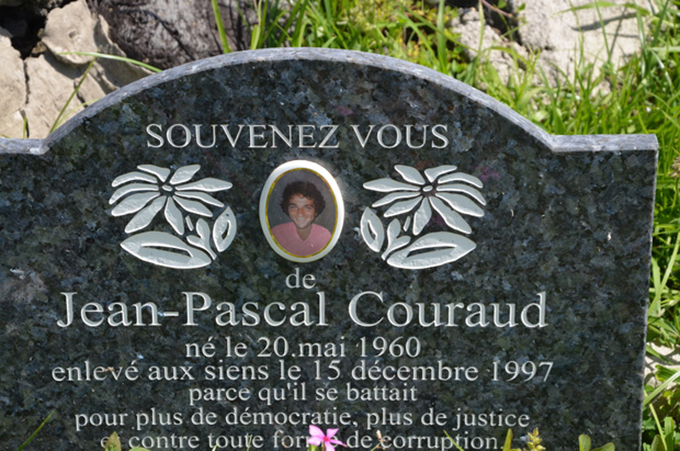 Investigative journalist Jean-Pascal Couraud … drowned by assassins? The headstone on his empty grave in Punaaiua, Tahiti, says: 20 May 1960-15 December 1997 – “he struggled for more democracy, more justice and against all forms of corruption.” Image: AFP/RNZ Pacific
Like many observers, the publisher of the Tahiti Pacifique monthly Alex du Prel noted Flosse’s surprising declaration.
“He said he never gave orders for anybody to kill and everybody believed him. But he didn’t say nobody ever was killed.”
The case had an echo even in France where national television networks dispatched reporters to Tahiti. Also, Le Monde paid close attention to the JPK affair.
Gaston Flosse claimed he had been defamed by France 3 and took unsuccessful court action against its chief executive and a reporter.
He also pursued Le Monde for linking him to the 1997 disappearance of Jean-Pascal Couraud.
Slow investigation
JPK’s brother, Philippe Couraud, noted that the investigations were slow.
“The problem we had was between 2004 and 2007, three years, and it was very difficult. At this time, I was sure that the Justice did not want to help us. I mean, not Justice but the men who were there. So that’s why at this time, everything was organised to stop the enquiries.
JPK’s mother told TV reporters at the time about her disappointment with the judicial machinery, suggesting there had been obstruction.
Alex du Prel confirmed that: “We had state attorneys who admitted themselves that they had been appointed to protect Mr Flosse, and they did that job quite well actually.”
As a former minister in the Chirac government, Gaston Flosse had enjoyed cordial ties with Paris for a couple of decades, not least because he was a staunch supporter of the French nuclear weapons testing regime.
Things changed in 2007 when Jacques Chirac was replaced as president by Nicolas Sarkozy.
Pent up corruption complaints started to find their way through the courts and now Gaston Flosse is ineligible to hold public office having also become the most sentenced politician in contemporary France.
Murder charges
In 2013, the JPK affair saw murder charges being brought against Tutu Manate and Tino Mara after investigators surreptitiously recorded their phone conversations.
A year later, the charges were dropped over an apparent technicality.
“The phone taps were illegal because they didn’t have the right signature and the right explanation when they were ordered, so that kind of robs the smoking gun”, said du Prel.
Rere Puputauki failed to challenge the murder charge in time.
What is left are kidnapping charges against the three GIP men.
As for a possible motive for a killing, Philippe Couraud said he believed his brother had documents that could have damaged Gaston Flosse and his associates in Paris.
JPK had a career at the local newspaper Les Nouvelles de Tahiti and became its editor but was forced to quit under pressure from Flosse.
He subsequently joined the opposition politician Boris Leontieff as an advisor and worked for him when he disappeared.
Sensitive information
His brother Philippe said JPK had sensitive information.
“We discovered a paper of 12 to 13 pages which was in possession of my brother, and in fact it was because he had this information that he was killed,” he said.
Du Prel said the papers pointed to money being channelled via Japan, possibly to an account held by Jacques Chirac.
“At the time, they were looking into financing over in Tahiti and they saw that part of the money had gone to Japan. So the local representative to the state attorney had asked Paris for help to define where the money would have gone in Japan and he got a message back saying stop, do not enquire in that direction, you’re getting close to the top of the state. That, I published at the time and nobody ever denied it.
French media reports however said Japanese authorities had found no record of any bank account alleged to have been held by Chirac.
This came despite a French secret service report in 1996 mentioning it.
Whatever the possible reason for JPK’s disappearance, Philippe Couraud remains convinced his brother was killed.
“We are absolutely certain that my brother has been assassinated, and everybody who can read the files has the same conclusion,” he said.
Twenty years later and after 13 years of investigations, the only person taken court has been Vetea Guilloux for claiming JPK had been killed.
No wonder, there is the French expression ‘justice á deux vitesse’ – two-speed justice.
Walter Zweifel is a senior journalist with RNZ Pacific and a specialist in French Polynesian affairs. This article had been republished with permission.
Article by AsiaPacificReport.nz
]]>Racist reporting still rife in Australian media, says new monitoring report

 New research shows Muslims are more negatively portrayed in the media than other groups. Image: Lukas Coch/AAP/The Conversation
By Dr Christina Ho in Sydney
Half of all race-related opinion pieces in the Australian mainstream media are likely to contravene industry codes of conduct on racism.
In research released this week, the Who Watches the Media report found that of 124 race-related opinion pieces published between January and July this year, 62 were potentially in breach of one or more industry codes of conduct, because of racist content.
Despite multiple industry codes of conduct stipulating fair race-related reporting, racist reporting is a weekly phenomenon in Australia’s mainstream media.
We define racism as unjust covert or overt behaviour towards a person or a group on the basis of their racial background. This might be perpetrated by a person, a group, an organisation, or a system.
The research, conducted by not-for-profit group All Together Now and the University of Technology Sydney, focused on opinion-based pieces in the eight Australian newspapers and current affairs programmes with the largest audiences, as determined by ratings agencies.
We found that negative race-related reports were most commonly published in News Corp publications. The Daily Telegraph, The Australian and Herald Sun were responsible for the most negative pieces in the press. A Current Affair was the most negative among the broadcast media.
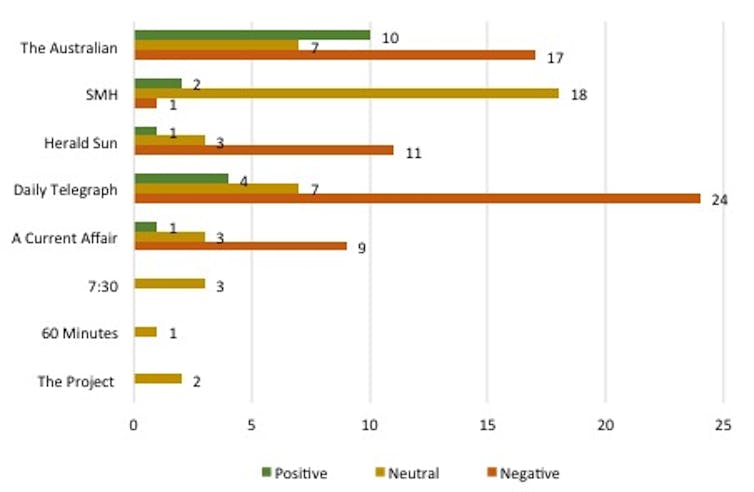 Chart 1: Number of race-related stories by outlet and type of reporting. Source: Author
Muslims were mentioned in more than half of the opinion pieces, and more than twice as many times as any other single group mentioned (see chart 2).
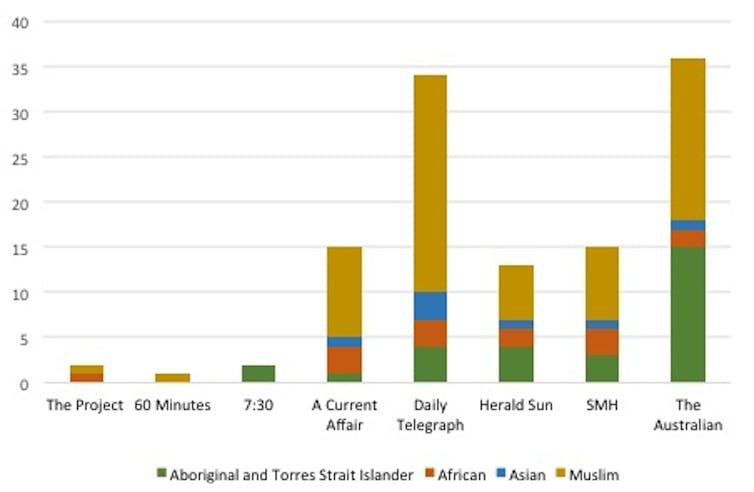 Chart 2: Number of race-related stories by outlet and ethnic minority group. Source: Author
Portrayed more negatively
Muslims were portrayed more negatively than the other minority groups, with 63 percent of reports about Muslims framed negatively. These pieces often conflated Muslims with terrorism. For example, reports used terrorist attacks in the UK to question accepting Muslim refugees and immigrants to Australia.
This was a recurring theme in race-based opinion pieces over the study period. In contrast, there were more positive than negative stories about Aboriginal Australians and Torres Strait Islanders.
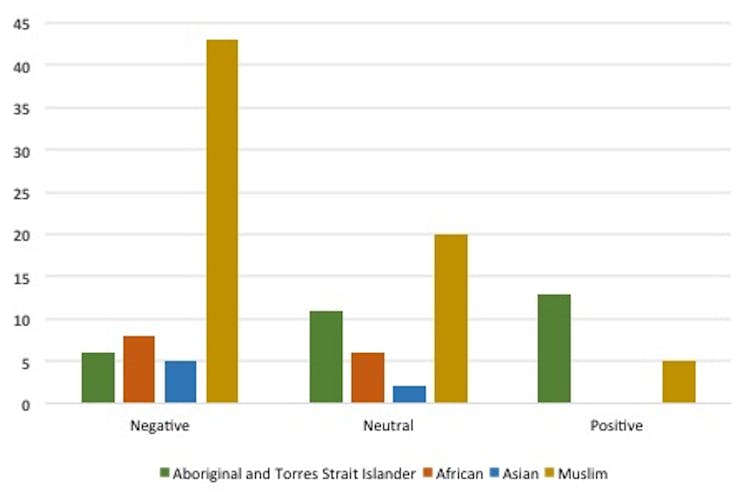 Chart 3: Number of stories by ethnic minority group and type of reporting. Source: Author
Negative commentary about minority groups has lasting impacts in the community. An op-ed in The New York Times recently highlighted the impact that racism in the media has on individuals. It explained:
…racism doesn’t have to be experienced in person to affect our health — taking it in the form of news coverage is likely to have similar effects.
The noted effects include elevated blood pressure, long after television scenes are over. Racism is literally making us sick.
Note also that given the lack of cultural diversity among opinion-makers, particularly on television, social commentators are largely talking about groups to which they do not belong. According to the 2016-20 PwC Media Outlook report, the average media employee is 27, Caucasian and male, which does not reflect the current population diversity of Australia.
This creates a strong argument for increasing the cultural diversity of all media agencies to help minimise the number of individuals or groups being negatively depicted in race-related reports.
Our research echoes the findings of the UN expert panel on racial discrimination, which reported last week that racist media debate was on the rise in Australia. The UN recommended the Australian media “put an end to racist hate speech” in print and online, and adopt a “code of good conduct” with provisions to ban racism.
Urgent recommendations
Our report makes urgent recommendations to strengthen media regulations in relation to race-based reporting, to support journalists to discuss race sensitively, and to continue media monitoring.
While media regulations enable audiences to make complaints about racism in the media, under some codes, audiences have only 30 days to do so. The research report recommends that this deadline be removed to allow audiences to make complaints about racist media content at any time.
It also calls for the definition of racism be broadened in the codes of conduct to include covert forms of racism. Covert racism includes subtle stereotyping, such as the repeated depiction of Muslim women with dark veils, implying secrecy and provoking suspicion.
News agencies need to do more to help journalists address race issues responsibly. They can do this by providing training, recruiting more journalists of colour, and ensuring that their editorial policies are racially aware.
The media are meant to hold up a mirror to society. When it comes to race-related reporting, we need a more accurate portrayal of the successes of Australian multiculturalism.
Dr Christina Ho is senior lecturer and discipline coordinator in Social and Political Sciences, University of Technology Sydney. Priscilla Brice and Deliana Iacoban from All Together Now, a not-for-profit group working to combat racism, also contributed to this article. Republished from The Conversation under a Creative Commons licence.
Article by AsiaPacificReport.nz
]]>


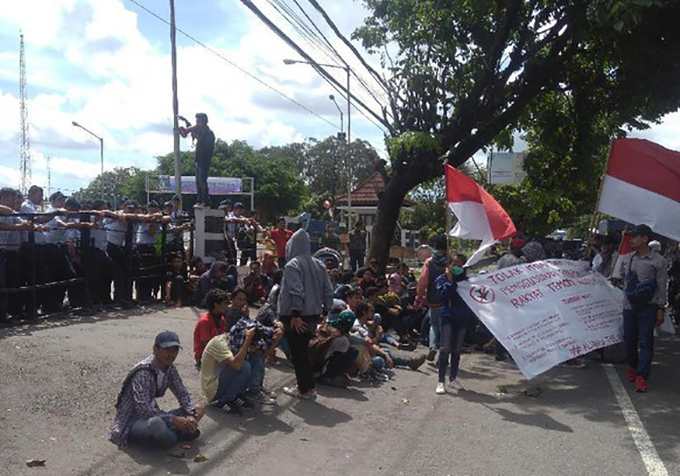


 Palestinian families at the weekend Auckland rally in support of the “Day of Rage” protests over the US move on Jerusalem. Image: David Robie/PMC
 The Palestinian solidarity march down Auckland’s Queen Street from Aotea Square to protest at the US Consulate on Saturday. Image: Roger Fowler/Kia Ora Gaza