Access to the National Disability Insurance Scheme (NDIS) for young children with disability is not equal across Australia. Where you live can hinder access to information about disability support, assistance to apply for it, and timely access to services.
Sadly, long-standing problems getting children into disability support were part of the reason the NDIS was introduced in the first place.
Your location can exacerbate inequity at three points: noticing your child needs support, proving they need support, and finding suitable support near you.
We interviewed families with a child who went through the NDIS process and the organisations that support them. Based on our research, we’ve collated some tips to ensure your child can access the NDIS if they need it.
Some disabilities, like physical disabilities, are visible; but many disabilities are not immediately obvious or don’t have a specific label.
Sometimes families and professionals won’t notice children need help until they get to primary school, when a teacher might suggest a child could benefit from support.
We found one common difficulty for families is wondering whether their child needs support, and what kind of support. Most families have minimal experience of disability, so this can be confusing and distressing.
Social activities like playgroup can be a good place to check in with other parents.Shutterstock
If you have any concerns, it’s a good idea to speak to health and early childhood intervention workers. Asking questions early means your child is more likely to get the support they need.
Even in regional and rural areas, most families will attend health services – whether general practitioners, community nurses or early childhood health centres. These are good places to ask if you think your child needs support.
You might also share ideas about how and where to get help with other parents and with educators at social activities like playgroup, the library, child care and preschool.
When you know your child needs support, you must prove they are eligible.
Support is available from different parts of government, which makes it confusing – health, education, early childhood intervention services, child care and now the NDIS. Most support is free, though some families will pay for additional support.
NDIS has two support streams relevant to children.
If your child is aged up to six, contact the NDIS Early Childhood Partner (ECP) in your area.
ECPs are early childhood organisations that have partnered with the NDIS to support young children accessing the scheme. They’re free and your child doesn’t need a diagnosis to seek support.
The ECP will talk to you about what your child might need and support you to get it. Depending on your child’s needs, they will help you obtain equipment, get support from health services and education providers, and apply to the NDIS.
If your child is aged seven or above, contact your NDIS Local Area Coordinator (LAC). These services are also free. If your child is eligible for the NDIS, the LAC will explain how to get a diagnosis to prove they have “permanent and significant disability”, and how to apply for an NDIS package.
Usually getting a diagnosis relies on the health system, which can delay access to the NDIS, depending on where you live.
3. Finding suitable support for your child
Once you’ve secured an NDIS package for your child, you can choose which organisations will provide the support. The ECP or LAC can help you navigate this. Other service providers, including health professionals, educators and NDIS support coordinators can help with this too.
Once in the NDIS, our research confirmed the availability of support and range of choices varies by where you live.
Some families live in places, like rural areas, where there are not many services available. In these cases they need to find creative ways of getting support, including paying community members or using tele- or fly-in services.
Often it takes time before you or someone else notices your child might need disability support.Province of British Columbia, CC BY-NC-ND
The system needs improvement
The current system relies on families or children’s services noticing the child might need support. But not all families know how to be assertive, have the capacity to ask for help or have free medical and social care in their local community.
Another difficulty is the NDIS is confusing for families, and even for support providers. First, it’s different for children aged 0-6 and older children. Second, it overlaps with education, health and other services. These factors mean families and service providers are often unsure which part of the NDIS or other services can help and how.
Every family’s experience of the NDIS is different. Some families in our research said they didn’t have enough information about the NDIS. Some families waited a long time before they could get NDIS services. Families with more education, money and information had a better experience.
Generally, families said the process worked best when their GP, early childhood educator or other service had expertise about disabilities and the NDIS, and could guide them.
The NDIS is still a relatively new system, so some difficulties are understandable. But the NDIS needs to work together with other parts of government and private services to ensure families know what supports children are entitled to and how to access them.
Any delays receiving an NDIS package or other support for a young child delays the benefit of early intervention and risks higher support needs in the long term.
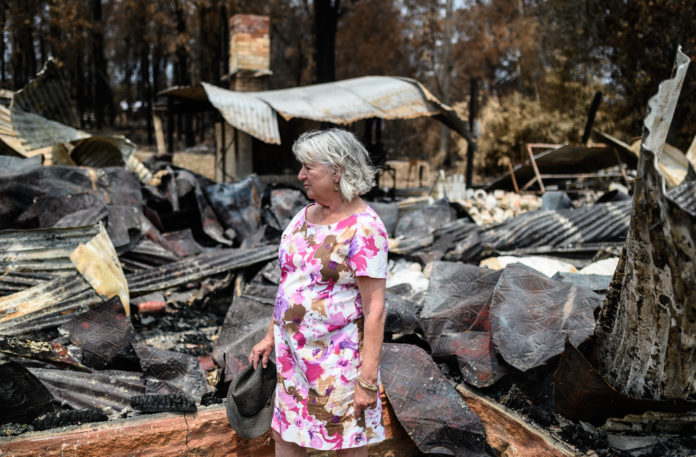
But it is heartening to remember that bushfire can be a boon to some plants and animals. We’re already seeing fresh green shoots as plants and trees resprout. Beetles and other insects are making short work of animal carcasses; they will soon be followed by the birds which feed on them.
Australia’s worsening fire regimes are challenging even these tolerant species. But let’s take a look at exactly how life is returning to our forests now, and what to expect in coming months.
Life is returning to fire-ravaged landscapes.Flickr, CC BY
The science of resprouting
Of course, bushfires kill innumerous trees – but many do survive. Most of us are familiar with the image of bright green sprouts shooting from the trunks and branches of trees such as eucalypts. But how do they revive so quickly?
The secret is a protected “bud bank” which lies behind thick bark, protected from the flames. These “epicormic” buds produce leaves, which enables the tree to photosynthesise – create sugar from the sun so the tree can survive.
Under normal conditions, hormones from shoots higher in the tree suppress these buds. But when the tree loses canopy leaves due to fire, drought or insect attack, the hormone levels drop, allowing the buds to sprout.
A green shoot sprouting from the trunk of a bushfire-ravaged tree.Darren England/AAP
Insect influx
This summer’s fires left in their wake a mass of decaying animal carcasses, logs and tree trunks. While such a loss can be devastating for many species – particularly those that were already vulnerable – many insects thrive in these conditions.
For example, flies lay eggs in the animal carcasses; when the maggots hatch, the rotting flesh provides an ample food source. This process helps break down the animal’s body – reducing bacteria, disease and bad smells. Flies are important decomposers and their increased numbers also provide food for birds, reptiles and other species.
Similarly, beetles such as the grey furrowed rosechafer, whose grubs feed on decaying logs and tree trunks, add nutrients to the soil when they defecate which helps plants grow again.
Insects also benefit from the mass of new leaves on trunks and branches. For example, native psyllids – an insect similar to aphids – feed on the sap from leaves and so thrive on the fresh growth.
Animal carcasses are a sad consequence of bushfire, but provide a boon to some insect species.Sean Davey/AAP
Then come the birds
Once insects start to move back into an area from forested areas nearby, the birds that eat them will follow.
An increase in psyllids encourages honeyeaters – such as bell miners and noisy miners – to return. These birds are considered pests.
A CSIRO study after bushfires in Victoria’s East Gippsland in 1983 found several native bird species – flame and scarlet robins, the buff-rumped thornbill and superb fairy-wren – increased quickly to levels greater than before fire. As shrubs in the understorey regrow, other species will move in, slowly increasing biodiversity.
Since the recent bushfire in woodland near Moonbi in New South Wales, numerous bird species have returned. On a visit over this past weekend, I observed currawongs landing in the canopy, saw fairy wrens darting in and out of foliage sprouting from the ground, and heard peep wrens in tufts of foliage on bark and high branches.
Honeyeaters moved between burnt and intact trees on the edge of the blackened forest and butterflies visited new plants flowering after recent rain.
The presence of the currawong, while a pest species, shows birdlife is returning to the bush.Flickr, CC BY
Weeds can help
Weeds usually benefit when fire opens up the tree canopy and lets in light. While this has a downside – preventing native plants from regenerating – weeds can also provide cover for native animal species.
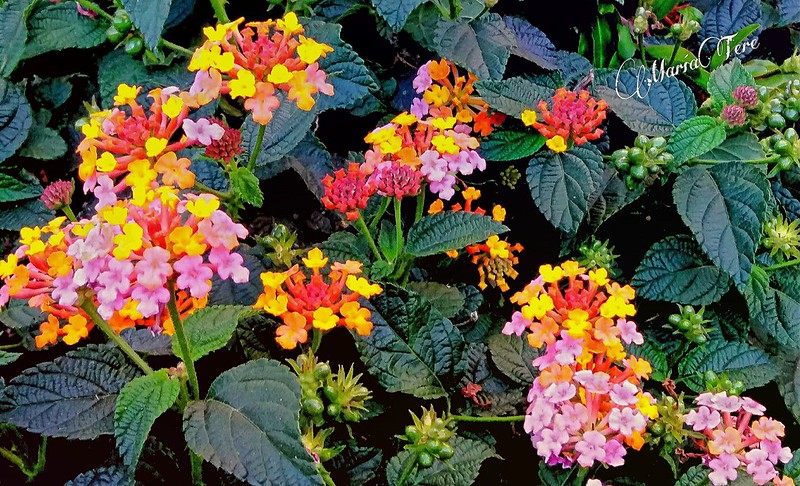
A study I co-authored in 2018 found highly invasive Lantana camara provided habitat for small mammals such as the brown rat in some forests. Mammal numbers in areas where lantana was present were greater than where it was absent.
Lantana often grows quickly after fire due to the increase in light and its ability to suppress other plant growth.
Lantana provides cover for animal species.Flickr, CC BY
Is there hope for threatened species?
Generalist species – those that thrive in a variety of environments – can adapt to burnt forest. But specialist species need particular features of an ecosystem to survive, and are far less resilient.
It requires large fires to create a specific habitat: big dead trees provide hollows for shelter and nesting, and insects feeding on burnt wood and carcasses provide a food source.
The Leadbeater’s possum needs tree hollows to survive.Australian National University/AAP
But for the Leadbeater’s possum to benefit from the fire regime, bushfires should be infrequent – perhaps every 75 years – allowing time for the forest to grow back. If fires are too frequent, larger trees will not have time to establish and hollows will not be created, causing the species’ numbers to decline.
Similarly in NSW, at least 50% and up to 80% of the habitat of threatened species such as the vulnerable rufous scrub-bird was burnt in the recent fires, an environmental department analysis found.
Looking ahead
Only time will tell whether biodiversity in these areas is forever damaged, or will return to its former state.
Large fires may benefit some native species but they also provide food and shelter for predatory species, such as feral cats and foxes. The newly open forest leaves many native mammals exposed, changing the foodweb, or feeding relationships, in an ecosystem.
This means we may see a change in the types of birds, reptiles and mammals found in forests after the fires. And if these areas don’t eventually return to their pre-fire state, these environments may be changed forever – and extinctions will be imminent.
The gothic developed as a European architectural phenomenon in 12th-century France, where awe-inspiring cathedrals reflected a world drenched in religious piety and superstition.
Its veneration was revisited in 18th-century English literature, when writers sought to inspire a comparable sense of wonder by setting scenes in ruined abbeys, haunted castles and spectacular natural landscapes.
Books like Horace Walpole’s Castle of Otranto (1764), Ann Radcliffe’s Mysteries of Udolpho (1794) and Mary Shelley’s Frankenstein (1818) appealed to a wide readership, but were dismissed as superficial sensationalism by the literary establishment.
The Australian gothic is unique from its northern counterparts. Instead of grand churches and castles, Australian writers dramatised remote towns, evoking a deep sense of malevolence operating beneath the veneer of ordinary life.
An Australian literary tradition
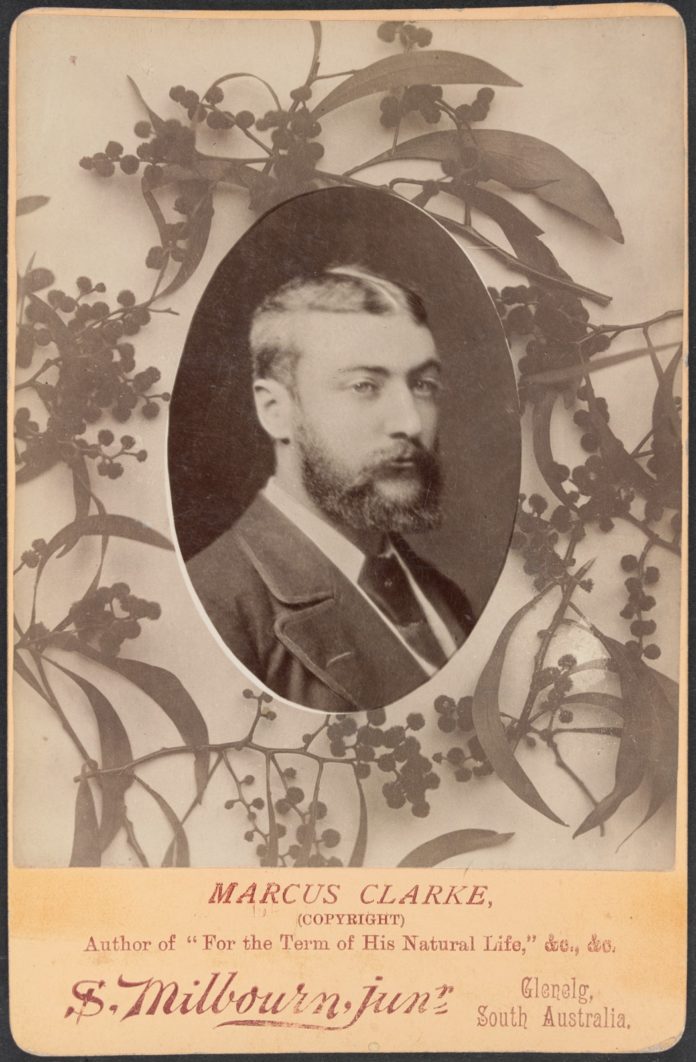
Marcus Clarke, author of For the Term of His Natural Life.State Library Victoria
One of the first writers to embrace the gothic sensibility down under was Marcus Clarke. His extraordinary For the Term of His Natural Life (1872) chronicled the terrible physical and psychological torment of protagonist Rufus Dawes, convicted of a crime he did not commit and exiled to Australia’s penal colonies.
Rufus’s aristocratic identity is concealed as a testament to his fortitude and heroism. The plot’s many twists and turns centre on his efforts to escape from penitentiaries.
He is propelled by an abiding love for a young damsel whom he tries unsuccessfully to protect from ruthless villain Maurice Frere — his jailer and his cousin.
The Australian landscape features prominently. The harsh penal colonies of Macquarie Harbour and Port Arthur test the boundaries of human valour, Clarke critiquing a brutal convict system that demoralised and dehumanised.
Tasmanian readers rejected Clarke’s bleak vision of their isle, but For the Term of His Natural Life paved the way for other writers to explore the dark shadows amid the bright Australian light.
1896 edition of The Chosen Vessel.Monash University Library
Barbara Baynton’s utterly devastating The Chosen Vessel (1896) reveals the depths of human malice. A mother is left alone to fend for herself and newborn baby while her husband works elsewhere. She is left vulnerable, and is raped and killed by a lone swagman.
In Baynton’s outback setting, male characters are not protagonists: they are antagonists who belittle and kill. Similar to Clarke’s hostile audience, readers were troubled by her grim vision.
The most celebrated Australian gothic novel is Joan Lindsay’s Picnic at Hanging Rock (1967), telling the story of the inexplicable disappearance of a group of schoolgirls and their mathematics teacher.
The first-edition cover of Picnic at Hanging Rock.Monash University Library
Adapted for the screen by Peter Weir in 1975, Picnic at Hanging Rock plays on the gothic’s romantic sensibility by featuring a number of beautiful young women – pure Botticelli angels – stalked by monsters.
One such monster is the Australian landscape. The film, driven by Russell Boyd’s astute cinematography, suggests it was the rock itself that devoured the schoolgirls and teacher Miss McCraw.
Long Weekend (1978), Shame (1988), Wolf Creek (2005) and Van Diemen’s Land (2009) followed in the wake of Weir’s masterpiece. Astonishing landscapes entrap, stymie agency and foster humanity’s worst traits.
Across these texts is the singularly Australian fear of being lost in the bush.
In her book White Vanishing, Elspeth Tilley argues this fear resonates with white guilt about the attempted genocide of countless Indigenous peoples. Indeed, the gothic genre was a colonial import along with this genocide.
From silver screen to your headphones
The Oz Gothic podcast series, out now through the ABC, adds to this long line of a uniquely Australian gothic style.
Produced by Camilla Hannan, Oz Gothic features six distinctive stories by Tony Birch, Maria Tumarkin, Julie Koh, Lachlan Philpott, Alicia Sometimes and Krissy Kneen. Each contributes to this Australian history of gothic storytelling.
The stories traverse the suburbs to rural towns. We hear the voices of women, Indigenous people, and multicultural Australians.
Ordinary life can have an edge of malice. Some of the stories evoke Baynton’s bleak vision of women’s assault and murder. Others channel influences from Hitchcock to Wake in Fright (1971).
Nothing is exaggerated. The writers capture the truth of humanity’s vulnerability and, in particular, women’s exposure to male violence. The writers invest welcome strains of empathy and compassion for the disenfranchised and dispossessed: they are still the victims of crime, but here empowered to tell their own stories.
Oz Gothic astonishes in its deft use of sound: high heels echo on loud surfaces; guns discharge from attempted suicides; magpies chortle in small communities; lawnmowers drone and chainsaws buzz in suburban streets.
This pared-back power returns the gothic to its medieval origins, where acoustic language dominated over printed and visual forms.
In the wake of a long history, this new series takes the Australian gothic into new territory.
The federal court’s rejection of the ABC case against the Australian Federal Police raid on its Sydney headquarters in June 2019 reveals two issues of great importance to freedom of the press in Australia:
the laws criminalising journalism are working exactly as the government intended, and
the legal protections for journalists’ confidential sources are seriously deficient.
The ABC challenged the validity of the search warrant under which the raid took place. By the time the raid was over, the police had downloaded 89 documents onto two USB sticks. They have been sealed pending the outcome of this case.
To obtain the warrant for the raid, the police applied to a local court registrar in Queanbeyan. It was issued for the purpose of investigating whether Oakes had unlawfully obtained military information under section 73A(2) of the Defence Act):
A person commits an offence if:
(a) the person obtains any plan, document, or information relating to any fort, battery, field work, fortification, or defence work, or air force aerodrome or establishment, or to any of the defences of the Commonwealth or any other naval, military or air force information; and
(b) that conduct is unlawful.
The warrant was also issued to investigate whether Oakes had dishonestly received stolen property from one of his sources, former Defence Department lawyer David McBride (contrary to section 132.1 of the Commonwealth Criminal Code).
McBride has outed himself as a source for the story and in separate proceedings has pleaded not guilty to five charges. His trial is to start on March 2.
Acting AFP Commissioner Neil Gaughan rejected claims last year the AFP was ‘trying to intimidate journalists’.Lukas Coch/AAP
ABC’s challenge to the warrant
In its case against the federal police, the ABC initially included a contention that section 73A(2) of the Defence Act is invalid because it violates the constitution’s implied right of free speech on matters of government and politics.
The ABC did not persevere with this aspect of its argument, demonstrating once again how limited and largely ineffectual that implied right is.
Ultimately, the ABC challenged the validity of the search warrant on five grounds:
Justice Wendy Abraham rejected all five of these grounds. In doing so, she drew attention to a huge gap in the protection afforded to journalists’ confidential sources under what are called “shield laws”.
They are set out in the Evidence Acts of the Commonwealth and all states except Queensland.
Basically, “shield laws” give journalists the right to ask the court to excuse them from revealing the identity of a confidential source on the ground that to do so would be a serious breach of professional ethics.
In deciding whether to grant this so-called privilege, the court must balance the public interest in the administration of justice against the public interest in the media’s being able to obtain information.
The court must also take into account the possible consequences for the source and the journalist of a forced disclosure.
Abraham has pointed out that while these shield laws apply in court proceedings, they do not apply to search warrants, except in Victoria.
This case fell under Commonwealth law, meaning the shield laws did not apply. As such, protecting the confidentiality of the ABC’s sources was not a relevant consideration.
The enormity of this deficiency in the law is immediately obvious. If the shield laws are to offer even the most rudimentary protection, they need to be extended beyond courtroom proceedings to include search warrants and other instruments of investigation.
ABC News Director Gaven Morris says the ruling should ‘send a chill down all of our citizens’ spines’.Bianca de Marchi/AAP
What happens next
It is very likely the documents seized from the ABC will contain clues that enable the police to identify the journalists’ sources.
While McBride has outed himself as a source in this case, Abraham’s judgement does not discount the possibility there may be others.
McBride’s future is already playing out in the courts. Whether Oakes and Clark follow him into the dock is now in the hands of the AFP and, ultimately, Attorney-General Christian Porter.
The AFP has said many times – with the endorsement of Prime Minister Scott Morrison and Home Affairs Minister Peter Dutton – that journalists are not above the law.
Meanwhile, we await the report of the press freedom inquiry conducted last year by the Parliamentary Joint Committee on Intelligence and Security and now three months overdue.
The inquiry was precipitated by public outrage over the AFP raids on the ABC and the home of a News Corp reporter, Annika Smethurst.
In its response to the Smethurst raid, News Corp has been more direct than the ABC. It has gone straight to the High Court, arguing that the raid itself – never mind the documentation behind it – was a violation of the implied right of free speech on matters of government and politics, a doctrine the High Court itself developed in 1997.
President Rodrigo Duterte takes legal action to shut down the biggest broadcaster in the Philippines in what is being described as the most severe attack on media freedom in the country. Video: Al Jazeera
More than 500 journalists have gathered to protest threats to the survival of the largest television network in the Philippines, ABS-CBN, amid ambiguous statements by politicians regarding the broadcasters’ franchise renewal.
The International Federation of Journalists (IFJ) and its affiliate, the National Union of Journalists Philippines (NUJP), condemns the blockade of the ABS-CBN franchise renewal and re-iterates the need for a review bill to pass through Congress.
At the Red Friday protest on Valentines Day in Quezon City, Metro Manila, more than 500 people gathered to fight the government attempt to close ABS-CBN.
The protest was organised by the NUJP, Altermidya Network, the Concerned Artists of the Philippines and Defend Jobs Philippines, as well as ABS-CBN employees and supporters.
– Partner –
The same day, House Speaker Alan Peter Cayetano questioned the urgency to hold congressional hearings to discuss CBS-ABN’s franchise renewal which is set to expire on March 30.
Answering journalists, Cayetano said: “If I want to grandstand, I will call for a hearing. But is it the right timing?
“Are we all in the right frame of mind or are we still hot-headed? This is not that urgent. Why? Because ABS-CBN can operate until March 2022.”
25-year franchise ABS-CBN secured its franchise for 25 years under Republic Act 7966, which came into effect on March 30, 1995. The company currently operates free TV Channel 2 and radio DZMM and employs 6730 regular employees, 900 non-regular workers, and more than 3325 other talent in its operations.
Senate President, Vicente Sotto, and House legislative franchise committee vice-chairperson, Isabela Representative Tonypet Albano, have previously reiterated that the broadcasting company can operate until 2022, when the 18th Congress ends, as long as there are a pending bills.
Despite these claims, Philippine’s President Rodrigo Duterte has stated he plans to reject the franchise renewal of ABS-CBN. On December 3, 2019, Duterte said that ABS-CBN would definitely be “out” in 2020.
ABS-CBN has faced an ongoing struggle for franchise renewal since Duterte’s election in May 2016. Two years later, in November 2018 Duterte publicly criticised ABS-CBN for not airing his campaign advertisements during the 2016 election, calling out ABS-CBN’s chairman emeritus Gabby Lopez a “thief”.
Efforts to shut the broadcasting company are being pursued by Solicitor-General Jose Calida who filed a petition against ABS-CBN on February 10, 2020. Calida accuses ABS-CBN of unlawfully exercising its franchise.
NUJP has an ongoing online petition urging authorities to respect press freedom and grant the franchise renewal. Access the petition here.
The IFJ said: “The ongoing efforts by the Duterte government and the Solicitor-General to block the ABS-CBN franchise renewal are a disgraceful attack on media in the Philippines with the intent to destabilise and threaten independent media reporting.
“Any review of broadcasting franchises should be conducted in an open and transparent manner with inputs from all parties and, particularly, the media itself. The IFJ stands in solidarity with its affiliate NUJP as well as press freedom advocates globally who strongly support the ABC-CBN franchise renewal.”
Al Jazeera’s Jamela Alindogan reports from the Red Friday protest to urge the government to renew the franchise of ABS-CBN. Image: PMC freeze frame
Papua New Guinea’s Minister for State Enterprises Sasindran Muthuvel has reassured the nation that Air Niugini is taking all necessary steps to protect the country against the spread of coronavirus, reports EMTV News.
“The airline has instituted a wide range of measures to minimise the risk to the nation, and is constantly monitoring international developments to make sure its precautions are up to date and effective,” he said yesterday.
“The Ministry of State Enterprises, Kumul Consolidated Holdings and Air Niugini are liaising with other departments and agencies in the Marape Government’s fight against coronavirus (the key agency is the National Department of Health).
“This is a whole-of-government exercise, and we are sparing no effort or expense to ensure the safety of Papua New Guineans.”
While the government was trying to protect the commercial interests of Air Niugini, public safety is the paramount consideration.
The stopping or limitating of some flights and compliance with other international action was all part of putting people first, he said.
– Partner –
“The Marape government, KCH and Air Niugini will not compromise public, passenger and employee safety,” minister Muthuvel said.
Air Niugini managing director Alan Milne said the airline is constantly in touch with other national agencies, and is continuously carrying out its own risk assessments to protect passengers and staff.
“If unacceptable risks are identified, we will immediately take the necessary action,” he said.
“We are also monitoring international requirements, which are often difficult and complex, and if necessary Air Niugini will modify its procedures accordingly to ensure compliance.
“Air Niugini will continue to be vigilant in the interest of public safety.”
Australia’s first people ate a wide variety of fruits, vegetables, nuts and other plant foods, many of which would have taken considerable time and knowledge to prepare, according to our analysis of charred plant remains from a site dating back to 65,000 years ago.
We already know the earliest Aboriginal Australians arrived at least 65,000 years ago, after voyaging across Island Southeast Asia into the prehistoric supercontinent of Sahul, covering modern mainland Australia, Tasmania and New Guinea.
But while the timing of this journey is becoming relatively clear, we know comparatively little about the people who made it, including their culture, technology, diet, and how they managed to thrive in these new landscapes.
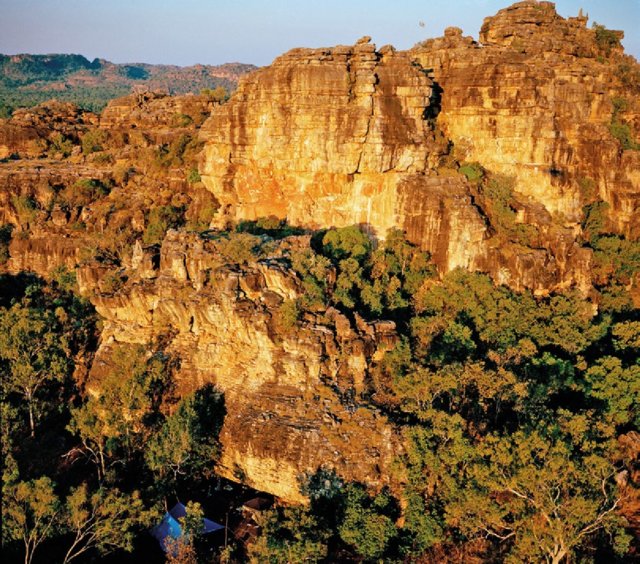
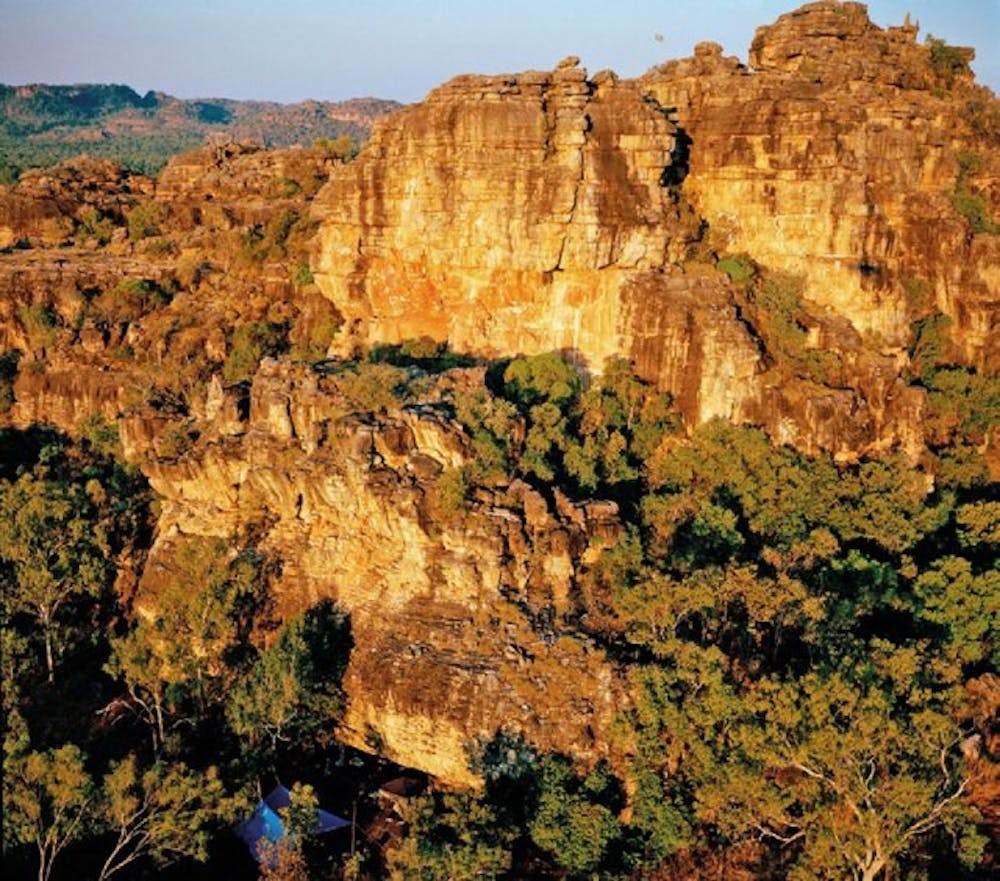
Our research, published today in Nature Communications, describes charred plant remains found at the archaeological site of Madjedbebe, a sandstone rock shelter on Mirarr country in western Arnhem Land. It provides the earliest evidence for plant foods consumed by humans outside of Africa and the Middle East and tells an important story about the diet of the earliest known Aboriginal people in Australia.
Madjedbebe.Matthew Abbott, Author provided
What is the evidence?
While animal bones do not survive in the earliest levels of Madjedbebe, remarkably, plant remains do survive as a result of charring in ancient cooking hearths.
We recovered these remains using a simple yet effective method. By immersing the samples in water, the light charcoal pieces float and separate easily from the heavier sandy sediment in which they are buried.
Among the charred plant remains are fruit pips, nutshells, peelings and fibrous parts from tubers, and fragments of palm stem. These are the discarded leftovers of meals cooked and shared at the rockshelter tens of thousands of years ago.
Electron microscope image of a peeling from an aquatic plant’s underground storage organ. Note the ‘eye’ similar to those found in potatoes.S. Anna Florin, Author provided
Today, the Madjedbebe rockshelter and the environments around it are just as culturally and economically significant to the Mirarr people as they were in the deep past. Our research is the result of a partnership with the Mirarr, bringing together Indigenous and scientific knowledge.
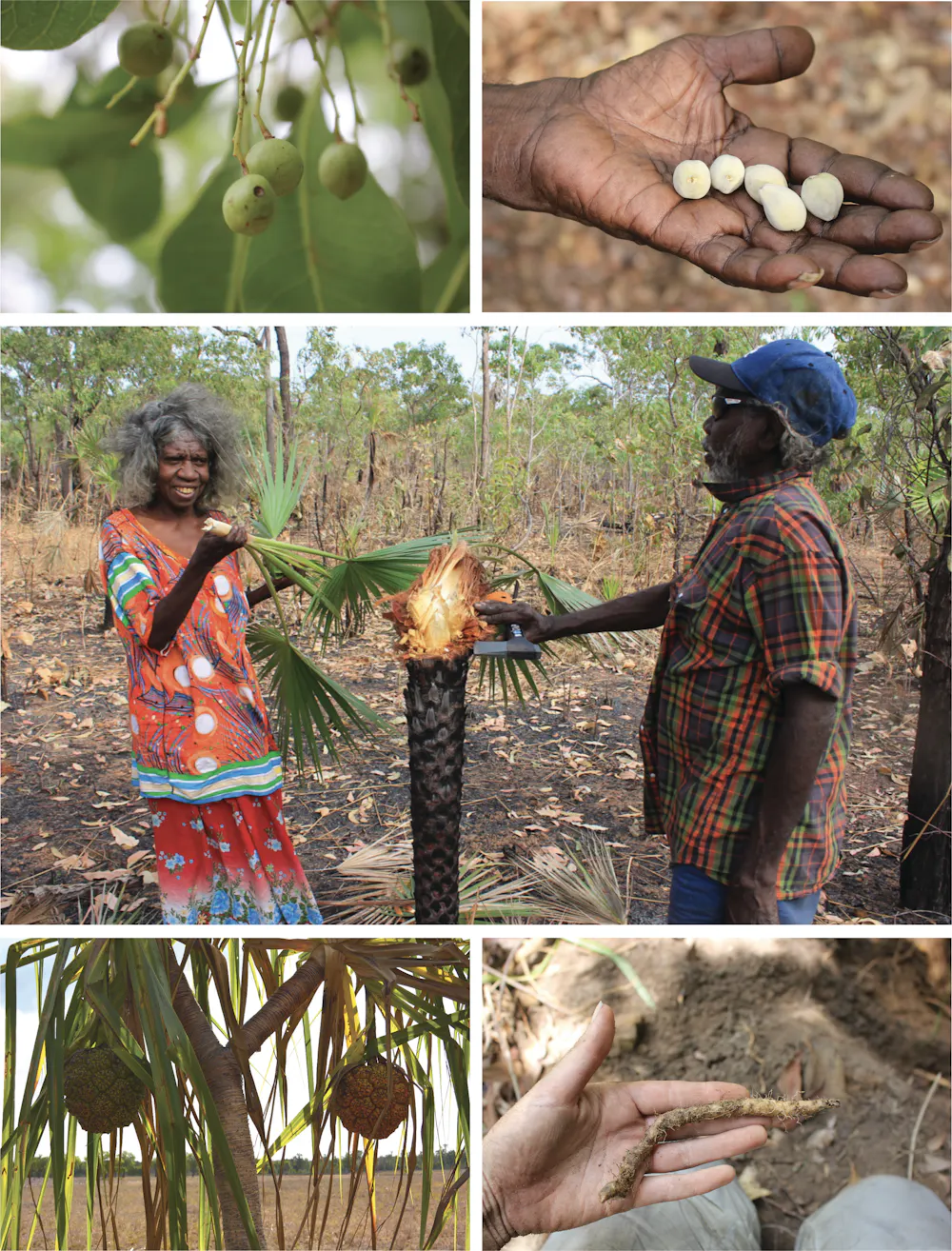
With the help of traditional owners and research colleagues, May Nango and Djaykuk Djandjomerr, we identified the modern-day plants that would have been eaten at Madjedbebe, and the cooking techniques needed to make them edible. Some foods, such as fruits, required minimal processing. But others, such as the man-kindjek or cheeky yam, needed to be cooked, leached and/or pounded before being eaten. Some of these preparation techniques can take up to several days.
We studied the charred plant remains under the microscope, identifying them by matching their features with the modern-day plant specimens. Using this technique we identified several fruits and nuts, including “plums” (Buchanania sp., Persoonia falcata, Terminalia sp.), and canarium (Canarium australianum) and pandanus nuts (Pandanus spiralis); three types of roots and tubers, including an aquatic-growing species; and two types of palm stem.
Microscopic structures preserved in the remains of a palm stem.S. Anna Florin, Author provided
What does this tell us about early Aboriginal lifestyles?
Several of these plant foods would have required processing. This included the peeling and cooking of roots, tubers and palm stems; the pounding of palm pith to separate its edible starch from less-digestible fibres; and the laborious extraction of pandanus kernels from their hard drupes. We could only accomplish the latter feat with the help of an electric power saw, although they were traditionally opened by pounding with a mortar and pestle.
Plant foods eaten at Madjedbebe included fruits and nuts, underground storage organs, pandanus kernels and palm. Top left: man-dudjmi or green plum; top right: man-mobban or billygoat plum; middle: May Nango and Djaykuk Djandjomerr removing the palm heart from a man-marrabbi or sand palm; bottom left: drupes of the man-belk or pandanus tree; bottom right: karrbarda or long yam.Elspeth Hayes/S. Anna Florin, Author provided
There is also evidence for the further processing of plants, including seed-grinding, left as microscopic traces on the grinding stones found in the same archaeological layer at the site. This represents the first evidence of seed-grinding outside Africa.
Along with other technology found at the site, such as the oldest known edge-ground axes in the world, it demonstrates the technological innovation of the first Australians. They were investing knowledge and labour into the acquisition of plant starches, fats and proteins, as well as into the production of the technologies required to procure and process them (axes and grinding stones).
These findings predate any other evidence for human diet in this region, including Island Southeast Asia and New Guinea.
It calls into question the theory that humans migrating through Southeast Asia fed themselves with as little effort as possible, moving quickly along coastal pathways eating shellfish and other easy-to-catch foods.
Contrary to this, the plant remains found at Madjedbebe suggest that the first Aboriginal people were skilled foragers, using a range of techniques to eat a diverse range of plant foods, some of which were time-consuming and labour-intensive to eat.
Their ability to adapt to this new Australian setting had little to do with a “least effort” way of life, and everything to do with behavioural flexibility and innovation, drawing on the skills and knowledge that allowed successful migration across Island Southeast Asia and into Sahul.
This required the first Australians to pass their knowledge of plants and cooking techniques down through the generations and apply them to new Australian plant species. Along with the innovation of new technology, this allowed them to get the most out of the Australian environment.
Source: The Conversation (Au and NZ) – By Nicholas Biddle, Associate Professor, ANU College of Arts and Social Sciences, Australian National University
Last month, the Australian National University contracted with the Social Research Centre (SRC) to survey more than 3,000 Australian adults about their experiences and attitudes related to the bushfires.
The study is the first of its kind to gauge how people were affected by the crisis and how it changed their views on a range of subjects, from climate change to the government response.
More than half of Australians felt anxiety
Our research shows the vast majority of Australians were touched in some way by the fires. We asked about eight different forms of impact, from lost property to disrupted holiday plans to difficulty breathing from the smoke.
About 14.4% of our respondents experienced direct exposure to the fires, either through their property damage or evacuations.
We can extrapolate further by looking at population estimates from the ABS and the number of visitors to areas impacted by the bushfires from the National Visitors Survey to estimate the total number of people directly affected at around 3 million.
And 77.8% of our respondents reported indirect exposure to the fires, such as having a friend or family member with damaged or threatened property, having travel or holiday plans disrupted, being exposed to the physical effects of smoke or feeling anxious or worried about the fires.
Breaking the data down by individual category, the severity of the public health challenges becomes more clear.
Nearly six in 10 respondents (57%) said they were physically affected by the smoke, while 53.6% said they felt anxious or worried about the fires.
Confidence in the government declined
The long-running Australian Election Study has shown that confidence in the federal government has declined substantially in the past few decades.
Crises have the potential to restore some of this trust if dealt with effectively and transparently. However, the government’s handling of the recent bushfire crisis seems to have had the opposite effect.
Confidence in the federal government declined by 10.9 percentage points from 38.2% in our survey in October 2019 to 27.3% by January 2020.
Confidence in other institutions, meanwhile, was quite stable over the four-month period, and higher than for the federal government. Rural fire-fighting services had the highest level of public trust in our survey at 92.5%.
We also found a significant decline in the percentage of people who said they would vote for the Coalition if an election was held that day. This dropped from 40.4% in October 2019 to just 34.8% in January 2020 – nearly even with those who said they would vote for Labor in January (33.4%).
Significant increase in concern over global warming
We also tracked significant changes in people’s attitudes towards the environment.
For instance, 49.7% of people reported the environment as one of the top two issues facing Australia in January 2020, compared to 41.5% of respondents in October 2019.
Another interesting finding: 10.2% reported fires, natural disasters or extreme weather as the most or second-most important issue facing Australians, up from nearly nonexistent in October 2019.
Our findings showed consistently higher concern among Australians when it comes to specific environmental issues. Comparing responses from our January 2020 survey and a 2008 ANUpoll, we saw two large increases in concern for loss of native vegetation, animal species or biodiversity (13 percentage points) and drought and drying (nine percentage points).
There was an even larger increase in the proportion of people who believe global warming or climate change will impact their lives.
Nearly three-quarters (72.3%) of respondents said global warming was a very serious or fairly serious threat, a substantial increase from the 56% who said so in 2008.
The majority of those living in capital cities said they felt global warming was a very serious problem (62%) or a threat (74.9%). Perhaps even more surprising, however, was the fact these views were shared by people in non-capital cities (52% said it was very serious, 65.5% said it was a threat).
Support for new coal mines has also declined sharply over the past eight months. In our January survey, 37% of respondents said the government should allow the opening of new coal mines, down from 45.3% in an ANU survey from June 2019.
While being exposed to the bushfires appears to have made people more aware of environmental issues, the drop in support for new coal mines does not appear to have been driven by the crisis itself. Rather, it appears to be consistent across the population, with the biggest decline occurring among those who voted for the Coalition in the 2019 federal election (57.5% supported new mines in January 2020, down from 71.8% in June 2019).
There is still much work to be done to fully understand people’s attitudes towards climate change and how this correlates with natural disasters like bushfires.
But the data in our survey provide opportunities for future research and new insights and will be made available through the Australian Data Archive. Future surveys could test for changes in people’s attitudes taking into account different variables and track how those attitudes change over time.
In his Closing the Gap speech to parliament last week, the prime minister injected some order and transparency back into the constitutional recognition process.
The PM anchored his government’s work on the co-design of a Voice to Government back to the 2018 parliamentary inquiry led by Senators Pat Dodson and Julian Leeser. By doing this, he recognised the trajectory of hard work undertaken by politicians and the public for nearly a decade.
The Dodson-Leeser report found that a Voice to Parliament (as opposed to government) was the only viable reform proposal following the Referendum Council’s deliberative process of 2016 and 2017. It recommended that:
following a process of co-design, the Australian government consider, in a deliberate and timely manner, legislative, executive and constitutional options to establish the Voice.
Symbolism is not enough
This is why so many people were utterly confounded when Ken Wyatt, the minister for Indigenous Australians, unilaterally decided there would be a referendum on Indigenous recognition with a symbolic proposal – likely a statement of recognition – that no one was advocating for.
Then, last month, the minister announced a firm deadline for a referendum on symbolism to be held in mid-2021. Confusion reigned.
The consistent rejection of symbolic recognition proposals is poorly understood. One of the challenges of this work has been the very word “recognition”, as adopted by the then prime minister, Julia Gillard, in 2010.
“Recognition” is a term commonly used in constitutional law and political science, and it has a technical meaning in the context of power relations.
Recognition can come in a weak form, such as symbolism. (It’s weak because it does not change the status quo.) Or it can be a strong form, such as designated parliamentary seats, a voice or even an autonomous region.
However, the dictionary meaning of recognition is “acknowledgement”. Until the Uluru Statement, in the absence of an agreed model of recognition, the public discussion on Indigenous recognition reverted to this meaning – acknowledgement.
However important symbols are to Aboriginal people, nine years of this work shows, incontrovertibly, that Aboriginal and Torres Strait Islander peoples do not seek more symbols. And certainly not in the constitution, which distributes power across the federation. They seek change that can make a concrete difference to their lives.
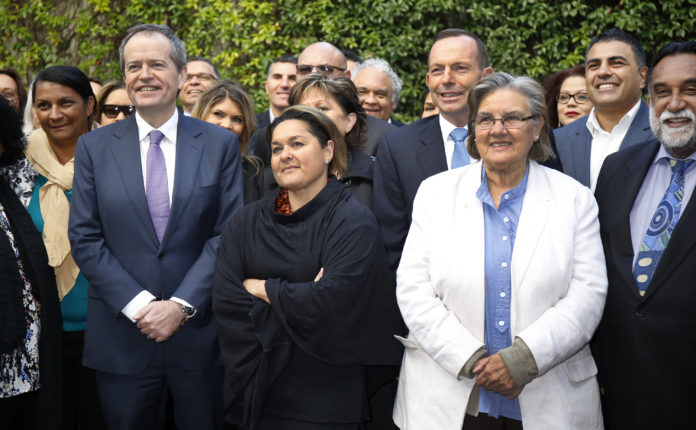
Indigenous leaders met Prime Minister Tony Abbott and Opposition Leader Bill Shorten to discuss constitutional recognition at Kirribilli in 2015.AAP/David Moir
The only viable option for constitutional reform
The critical moment when Indigenous leaders expressly disavowed symbolic recognition came in 2015.
Leaders from across Australia gathered to speak with the then prime minister, Tony Abbott, and the then opposition leader, Bill Shorten, at Kirribilli House to talk about the direction recognition was headed, with fears there were plans for more symbolism.
The 40 Indigenous leaders present adopted the Kirribilli Statement. It read:
[…] [A]ny reform must involve substantive changes to the Australian Constitution. It must lay the foundation for the fair treatment of Aboriginal and Torres Strait Islander peoples into the future.
A minimalist approach that provides recognition in the Constitution’s preamble, removes section 25 and moderates the race power section 51(xxvi) does not go far enough, and would not be acceptable to Aboriginal and Torres Strait Islander peoples.
During the Kirribilli meeting, we requested a new and ongoing dialogue between Aboriginal and Torres Strait Islander peoples and the government to negotiate the proposal to be put to referendum. They listened. The Referendum Council was set up.
The constitutional dialogues confirmed there was no appetite for symbolic gestures. After the final constitutional convention at Uluru, the Referendum Council recommended a referendum be held to provide in the constitution for a representative body that gives Aboriginal and Torres Strait Islander peoples a Voice to Parliament.
Dodson and Leeser’s report found the Voice was the only viable option for constitutional reform. The report recommended a co-design before deciding on the legal form.
It’s a critical point not readily understood that the Voice, which is a simple enabling provision in the constitution, is regarded as both substantive and symbolic recognition.
Mixed messages on recognition
Almost a decade of work has gone into this issue, including extensive consultation with Indigenous peoples and the wider Australian public, education programs and the design of constitutional proposals and referendum ballot papers. Australians from all walks of life, including politicians from across the political spectrum, have contributed to this body of work.
After Dodson and Leeser recommended co-design and then consideration of the legal form to follow in December 2018, the 2019 federal budget contained funding for this and a referendum. Leading into the 2019 election, the ALP committed to holding a referendum on the Voice to Parliament.
Following the election, however, matters became less clear.
Wyatt confused many because of his inconsistent public pronouncements. Unusually for an Indigenous affairs minister, he did not reply to a letter from key Aboriginal and Torres Strait Islander leaders from land councils, native title bodies and peak organisations seeking a meeting to clarify his thinking until he was prompted by the media many months later.
This year began with the minister stating once again that a constitutional Voice, a Makarrata Commission and truth-telling were off the table, disavowing entirely the past nine years of work and the Uluru Statement.
His co-design process talks of a “Voice to Government”, not a Voice to Parliament. The minister has also pre-empted the co-design by insisting the Voice to Government would use existing institutions and structures.
This is the complete opposite of the sentiment of the Uluru dialogues, which stated that no existing organisation or entity represents their Voice.
Wyatt’s decision to set a firm deadline of mid-2021 for a referendum on a proposal no one wants was bewildering.
His own party room said they had not been consulted on this. Setting hard timelines for negotiations creates unnecessary pressure for any government. It is notable a spokesperson for the minister quietly retracted that firm deadline the next day.
The one reform Australia has never tried
This week signifies a restoration of order to constitutional recognition. The prime minister and opposition leader both presented important speeches on Closing the Gap. Labor is consistently supportive of a constitutionally enshrined Voice.
Scott Morrison reverted to the two-pronged approach, which is co-design and then decide the legal form. Many mob chipped the prime minister this week for deploying the language of listening and empowerment when Commonwealth policies and initiatives, such as the Indigenous Advancement Strategy and Closing the Gap, demonstrate governments and bureaucrats do not listen to our voice and cannot deliver change. Even so, his important intervention was welcomed.
In the absence of a constitutionally entrenched Voice, there is no obligation on the state to listen. I have consistently argued as a constitutional lawyer, as others have, that structural reform is what is required for transformative change.
This is the one reform Australia has never tried. This is why the Uluru Statement invites all Australians to walk with us now for the structural change that many have been working hard on for almost a decade.
Heavily subsidised aged care services used to be seen as a right and entitlement for all older Australians. But as aged care demand grows and costs rise, it’s becoming increasingly clear the current system isn’t sustainable.
The family home has always been a central part of the debate over how much older Australians should contribute to their aged care services. But it has largely been protected from means tests.
It’s time for Australians who own their own home to contribute more to the cost of their aged care – and there are fair and equitable ways to go about this.
In 2017-18, the total cost was A$21.4 billion; the Australian government paid A$16.6 billion, or 77% of that total.
Older people pay less than 10% of the cost of home support and home care.
For residential care, they still only pay around a quarter of the cost (27%). Most of their payment is for meals, cleaning, laundry, and so on – things they would have done or paid for when living at home.
What aged care services are means tested?
There are different consumer contribution arrangements for the three main aged care programs: home support, home care packages and residential aged care homes.
Only one – residential care – takes into account the value of a person’s home.
Home support and home care packages don’t take into account the value of a person’s home.Shutterstock
The home is not counted in the assets test if a partner or dependent children live there, or (with conditions) a carer or close relative lives there.
Further, the value of the home used for the assets test is limited to only A$169,079.20. This may be the total value of the home for those living in poorer areas or rural communities. But it represents only a tenth of the value or less for wealthy home-owners, so it fails to take into account a large proportion of their wealth.
Why the current system isn’t working
The current system isn’t sustainable. The federal government’s budget outlook shows taxpayer expenditure on aged care services will grow rapidly from A$16.8 billion in 2017-18 to A$24 billion by 2022-23 and will continue growing thereafter.
Without change, these aged care subsidies will become an increasingly larger part of Australia’s total economy, growing from around 1% of GDP now to a projected 1.7% of GDP by 2054-55. As such, more of the economy’s production will be devoted to aged care at the expense of other goods and services.
COTA said consumer contributions should be more equitable and have regard to their total wealth, including their “real property” – read “the family home”.
Catholic Health Australia, in a submission to the federal government, similarly said it would publicly support including the full value of a person’s former home in the residential care assets test.
The value of the home used for the residential aged care assets test is limited to A$169,079.20.Shutterstock
So what should we do?
To overcome the current inequities and improve the sustainability of the system, we need to broaden the assessment of an older person’s capacity to pay, by taking greater account of their wealth.
The first step should be to raise the cap on the value of the home in the current residential care assets tests, potentially to the full value of the home.
An assets test could also be included for consumer contributions to home care packages.
A second issue is for an older person to draw more readily on their wealth to pay for goods and services, including aged care services, without having to sell their home during their lifetime.
One way forward is greater use of the Pension Loans Scheme, which enables older Australians to receive a voluntary non-taxable fortnightly loan from the government using their home as security.
Given the imperative for greater quality and safety in aged care, and the rising use and cost of these services, the government should publicly explore these options and open up the modelling to community debate. Budget sustainability and the equitable treatment of all older Australians demand nothing less.
As a parent, I find it so frustrating to take my children shopping, reusable bags in hand, only to be offered plastic toys at the checkout. It’s an incredibly confusing message to be sending kids. And it seems Coles is confused too.
Last year the company stated it wants to be “Australia’s most sustainable supermarket”. But with last week’s relaunch of “Stikeez” – yet another plastic collectables range off the back of their Little Shop promotion – Coles is showing dogged commitment to unsustainable marketing.
Stikeez are 24 plastic characters (plus four rare ones) in the shape of fruit and vegetables, aimed at encouraging kids to eat healthy food.
After petitions against previous plastic “mini” campaigns by Coles and Woolworths, Coles will make the Stikeez characters returnable in store for recycling.
But this misses the point. Coles is generating waste needlessly in the first place. Surely it’s time to move beyond plastic freebies as a way of boosting sales?
Coles sent almost 100,000 tonnes of waste to landfill in 2019.Shutterstock
But after their Little Shop collection provoked a consumer backlash, Coles took steps to reduce waste generated from their latest campaign. Stikeez wrapping contains partially recycled content, and Coles is providing in-store collection points where Stikeez can be returned and repurposed into shoe soles, in partnership with Save Our Soles.
Certainly this is preferable to throwing the items into the rubbish, but repurposing the plastic is not without environmental cost. Fuel is required to transport the waste and the process of repurposing plastic uses energy.
What’s more, asking shoppers to bring back their Stikeez puts the onus on consumers, rather than the company, to dispose of the items responsibly. And as we’ve seen by the low rates of recycling of soft plastics on a national level – recycling soft plastics is also offered in store – it’s far more convenient to throw items in the bin.
Coles haven’t publicised data about how many collectables they will produce.Alpha/Flickr, CC BY-NC
Coles is also missing the point of the consumer backlash. When a company already generates huge quantities of waste in its core business and says it wants to be Australia’s most sustainable supermarket, it cannot generate additional waste on plastic marketing.
Boosting the bottom line
Last year Coles’ Little Shop put many parents offside. But Coles earned around A$200 million in extra revenue as a result of the original promotion.
Coles reported an increase in the first quarter of 2019 in sales of 5% and gained a competitive advantage over rival Woolworths, which managed only 1.5% in the same period. Obviously the bump in sales was too hard for Coles to resist.
It’s difficult to get an accurate figure on what waste this latest Stikeez campaign will generate. Coles haven’t publicised data about how many collectables they will produce. And waste contractors to Coles haven’t revealed how many collectables ended up in landfill last year, though there have been reports of Little Shop items ending up on beaches in Bali.
Last year, Coles said 94% of Little Shop collectables were either kept or given to family or friends. But University of Tasmania marketing expert Louise Grimmer discredited this data, saying it was not based on any meaningful longitudinal research that would allow such claims.
Stikeez undermines Coles’ sustainability efforts
If organisations produce plastic for marketing purposes, it’s difficult to see how we can achieve plastic recycling rates of 70% by 2025. This target – set by federal and state governments and which Coles has signed on to meet – also stipulates the removal of “problematic and unnecessary” single use plastic packaging.
Coles’ Little Shop promotion faced petitions from people concerned about the plastic waste it generated.Shutterstock
Federal Assistant Minister for Waste, Trevor Evans, said finding a sustainable way to manage plastics was a major challenge and requires a coordinated effort. As a powerful household brand, Coles must unequivocally be part of this effort.
Coles’ environmental policy says it’s “committed to doing business in an environmentally responsible manner”. But plastic freebies fly in the face of this policy.
Better waste regulation
Voluntary initiatives for companies to reduce packaging and plastic waste, which Coles have signed on to, have not produced meaningful results.
Currently only one-third of all plastic packaging in Australia is recycled.
Overseas countries have moved away from voluntary frameworks to more structured and enforceable regulations to reduce plastic production and waste. In fact, Europe voted to ban single use plastics last year.
As long as Australia lags on waste regulation, organisations such as Coles will continue to contravene their own environmental policies.
The Conversation contacted Coles for comment. Its response is as follows:
Customers have told us that they use Stikeez as a fun tool to encourage kids to eat more types of fresh foods. The collectibles form part of the Coles Fresh 5 Challenge which encourages kids to eat all the Five Food Groups daily. We made changes to the Stikeez campaign this year to ensure it’s more environmentally sustainable.
Stikeez collectibles, including those customers have from last year, can now be recycled at all Coles supermarkets. We have partnered with Australian recycling group Save our Soles so that Stikeez can be recycled through the same process that is used to recycle footwear in Australia since 2010 to create useful products like anti-fatigue mats, gym matting, retail flooring and carpet underlay.
Australian governments look increasingly to mega-projects to solve urban and regional transport problems. These projects are city-shaping. They can transform how entire urban regions function.
The public has a clear stake in these projects, but unsolicited market-led proposals are subverting planning processes that are meant to protect the public interest.
Market-led proposals are unsolicited bids to government by private firms to provide public services or infrastructure. Policies governing market-led proposals were introduced in 2014 and 2015 by state governments across Australia to promote innovation in service delivery and value for money for taxpayers.
The increasing use of market-led proposals for transport mega-projects raises important questions. How are policies governing these managed, to what end, and for whose benefit?
In Melbourne, the tensions between toll road operator Transurban and the Victorian government over the West Gate Tunnel highlight a fundamental shortcoming of market-led proposals. Bluntly, these are not suited to the planning of transport mega-projects because governments can become “locked in” with questionable benefits. Lock-in has been defined as “the escalating commitment of decision-makers to an ineffective course of action”.
The case of the West Gate Tunnel
Transurban’s builders of the West Gate Tunnel, John Holland and CPB Contractors, laid off 137 workers last month in a dispute about liability for contaminated soil. This is bad press for the state government, which touted job creation and training as key project benefits.
Another explanation for what happened is “lock-in”. Evidence of lock-in on the West Gate Tunnel points to deeper systemic problems with market-led proposals for transport mega-projects in general.
How does lock-in happen?
Lock-in can occur when powerful corporations partner with governments in circumstances that enable them to exploit vulnerabilities in our public institutions. Some of these vulnerabilities include increasing reliance by governments on private finance, and the short period between elections compared to the time it takes to deliver bold public works programs.
Lock-in happens when the real decision to build a project is made well in advance of processes that are publicly declared to inform that decision. Once governments are locked in to a project, it can make alternatives appear increasingly unviable, if not unthinkable.
There is strong evidence to suggest this happened with the West Gate Tunnel. Significant concerns were raised early on that the project might not provide its claimed public benefits.
Revelations that Transurban acted in secretive and strategic ways to secure support for its West Gate Tunnel raise serious ethical questions. What does it mean to be a “good partner” to government? How should powerful private corporations obtain a “social licence” to operate?
These questions draw attention to problems inherent in Victoria’s opaque market-led proposal process. The government’s caution about the AirRail consortium’s unsolicited bid for Melbourne’s airport rail link points toward some of these dangers.
Government policies for assessing market-led proposals give powerful private firms like Transurban influence over strategic planning. This contrasts with the relatively limited influence granted to affected communities and stakeholder groups advocating for sustainable transport solutions.
Acceptance of Transurban’s bid allowed a multi-billion-dollar toll road to override plans that had been taken to an election. These plans were simpler and far less expensive. The plans had been developed with the local community to better manage freight traffic by upgrading access to existing freeways.
The West Gate Tunnel process involved expedited planning that bypassed broad-based community consultation. John Holland and CPB Contractors were selected in April 2017 “to get to work” on the project. That was five months before public hearings concluded in September. Over 500 submissions were received.
Because governments are ultimately responsible for their partnerships, the Victorian government should demonstrate stronger accountability and leadership. Victorians are still waiting for an integrated transport plan, as is required to be prepared under the 2010 Transport Integration Act. Instead of outsourcing transport problems to private firms, the government should develop a statewide, genuinely consultative, evidence-based plan.
An integrated transport plan would allow Victorians to see how future mega-projects, regardless of who proposes them, might serve everyone’s interests.
The jingle used to tell us we loved “football, meat pies, kangaroos and Holden cars”.
These days we love Japanese utes and small Toyotas, Hyundais and Mazdas more.
Monday’s announcement from General Motors, Holden’s US parent, that the brand brand will be “retired” and local design and engineering operations cease is doubtless based on strong financial reasoning, but poor brand management is also part of it.
The numbers didn’t stack up
Sales of Holden vehicles and a shift from large sedans to small and medium sized cars and sportscars and SUVs didn’t help.
At its peak, between 2002 and 2005, Holden sold more than 170,000 vehicles a year. By 2019 it sold less than 40,000; none of them made here.
Holden ad, 1970s.
In November, it sold just 2,668 cars, down from 5,125 the previous November.
Global competition from Japan, Korea and Thailand for brands like Kia and Hyundai, added to its woes.
Internationally, Holden was only present in two small markets, Australian and New Zealand, which between them don’t even account for 1% of global sales, and require steering columns on the right hand side of car. It has made Holdens hard to internationalise.
The blue countries drive on the left hand side of the road.Wikimedia
Monday’s press release blamed “highly fragmented right-hand-drive markets”, the cost of growing the brand, and the unlikelihood of achieving a decent return on the investment if it tried.
General Motors isn’t even going to bother to sell foreign-made sedans in Australia, although it will continue to sell speciality vehicles.
Yet its brand is ingrained in Australian history.
Holden defined a brand
Local logo, American designs.AAP
Brands are a combination of tangible and intangible elements. Among the tangible elements are visual design elements, like logos, colour, images and packaging, such as the Holden “Lion and Stone” and distinctive product features, such as the feel of the leather, the sound of a roaring V8 and the quality of the duco.
But that is only part of what makes a brand. Tangible elements can be easily copied and are a feature of nearly all products. The challenge is to develop and leverage intangible qualities.
These can include experiences (such as service) and feelings such as reputation, personality and values.
Nostalgia is a Holden value. It’s rich history, dating back to 1856, has helped define the brand.
Many of us who grew up in the 1970s remember family car trips to the beach in a Kingswood station wagon. In the 1980s, we watched Brock, Richards and Perkins win Bathurst. Movies like Puberty Blues made the Holden Sandman panel van every young man’s dream, and every parent’s worse nightmare.
Paul Mayall / Alamy
General Motors killed it
Being Australian was at the core of that identity.
General Motors took it away.
On October 20, 2017 it stopped production of all Australian-made vehicles and began importing Commodores from Germany.
Then in December last year it axed the Commodore, after 41 years.
It killed the value that was left in the brand.
We fell out of love with Holden because it fell out of love with us.
Both agreements are needed to help shore up the world trading system which has been without an effective enforcement system following the decision of the Trump administration to withdraw support from the World Trade Organisation.
In public, the major issue in the EU negotiations has been its determination to enforce so-called “geographical indications”, which limit the use of common names for products such as “champagne”, “feta” and “prosecco” to products made in those places, over and against our access to the wealthy EU market.
An agreement protecting the integrity of both French and Australian wine regions has been in place for more than 25 years. The EU wants to extend it to cheese, other foodstuffs and other beverages.
But it’s climate change that’s likely to be the biggest sticking point, with Australia appearing to drag its feet on its Paris commitments, and our catastrophic bushfires drawing the world’s attention to our government’s record.
The European Union is embracing climate action as a matter of policy, partly for environmental reasons and partly as an element of what it sees as economic sustainability.
In January, under the new leadership of Germany’s Ursula von der Leyen, the European Commission launched what it called the European Green Deal.
It aims to make Europe carbon-neutral by 2050, committing to a trillion-Euro public-private fund to transitions away from carbon. Crucially, it embeds climate action into trade policy.
We might face carbon border adjustments
The most intriguing, and complex, proposal is for a “carbon border adjustment” – a tax, levied on imports from countries without carbon pricing mechanisms.
The Commission also requires ratifying and effectively implementing the Paris Climate Accords as a precondition of trade agreements.
France has been especially bellicose on this point. In 2018, French President Emmanuel Macron pledged not to “sign commercial agreements” with nations that did not respect the Paris Agreement.
In November 2019 the French Foreign Minister insisted the Australia-Europe trade agreement include both ambitious climate targets and sanctions for failing meet them.
In November, Trade Minister Simon Birmingham fobbed off the French demands, insisting that Australia would meet its targets without difficulty, a statement that might have said more about government messaging to a domestic audience than the state of progress.
Also complicating the talks is the requirement that once negotiations are concluded, the deal still needs the approval of the European Parliament.
Europe wants enforceable commitments
Left and Greens members have raised concerns already that the deal could result in increased Australian beef and sheep meat production which would boost methane emissions and emissions due to land clearing and transport.
Optimists in Europe see the negotiations as a way to get Australia to lift its environmental game. In an earlier round of negotiations, it reportedly pushed Australia on its poor fuel quality, labelling this a “technical barrier to trade”.
Negotiations with Australia could turn into a test case for Europe’s climate strategy. Successfully holding Australia to account on its Paris commitments and turning it towards a sustainable economy would be a decisive statement for Europe’s ambitions to lead the world on the climate crisis.
Book covers compete with a barrage of information and images, so it’s no wonder many writers resort to shock tactics. It works. The Subtle Art of Not Giving a Fuck is testament to this, selling 2 million copies and translated into 25 languages. Without the “Fuck” this would very likely have been a different story.
In the English language, at least, fuck and other words on the more extreme end of profanity are the last frontier of using language to shock. In 2020, we find ourselves in a place of extremes so they come in quite handy.
But with so many fucks on book covers, where do writers go from here to express our fear, horror, rage and disgust?
Heard it all before
Eventually we become desensitised to the overuse of words. Shit, a taboo for older generations, is now so lacking as an obscenity it is written on the covers of notebooks and pencil cases available in stationery chain stores popular with schoolchildren, such as Typo.
According to a 2019 ABC study of 1,538 subjects, Australians are seeing and hearing more coarse language than they did five years ago, both in the media and in public.
“In line with this normalisation of coarse language, concerns relating to the use of coarse language in the media have diminished over time,” the study found. Of people studied, 38% were offended by coarse language on TV, radio or the internet in 2019, compared with 47% in 2011.
Go the Fuck to Sleep grabbed the attention of parents worldwide.
Tennis, one of the last bastions of politeness, does constant battle with players like Nick Kyrgios who rack up massive fines for dropping the F-bomb on the court.
Fines, like detention, seem to be on the train that has left the station when you consider reputable online booksellers currently carry almost a hundred books with fuck in the title. Most of these are self-help books, because we are, obviously, quite fucked and need help, and cookbooks, such as Yumi Stynes’ The Zero Fucks Cookbook. Kitchens seem to be a hotbed of fucks, a trend set some time ago by Gordon Ramsay.
Meaning and language are in a constant evolution and can act as a moral barometer. Expressing the fears and horrors of her times 200 years ago, author Mary Shelley created a “fiend”, formed through “unspeakable” horrors. Some initially derided the work as “disgusting”, but the extremes of her Frankenstein left an impact on literature and society of mythic proportions, without resorting to profanity or cheap tricks. She left the unspeakable to our imaginations, yet it broke boundaries and challenged our understanding of life and human nature.
Taboos and standards are forever in flux and younger generations always seek a boundary to break through. In our times of consumption and greed, we are eating our way through those boundaries at a great rate, along with as many of the Earth’s resources as we possibly can.
What now?
Several hundred book covers later, fuck is completely worn out.
Sure, there is still coarser language that will work for a few years until it also becomes a meme; until we wear it out as a book title or, perhaps, if we think too hard about what it means and how we might use it.
Language can only evolve creatively with a dynamic culture, deep education and critical practitioners of the literary arts, within and outside of the academy. Words are weapons; they are our way of making sense of life and without them we are unspeakable.
Language and how we use it really matters. It creates knowledge, culture and community. If we are to navigate our way through the future and avoid reaching a place of anarchy, we need a language for it.
Resorting to coarse language on book covers could be a symptom of society’s collective misery, but it could also be attributable to the starvation of the arts by government and a desperate need to grab readers’ attention. If literature loses the power to shock then it loses an important mode of engagement, according to postcritical theorist Rita Felski. It’s enough to make you want to swear and curse and scream. Unfortunately, as a word to save for extremes, we have really fucked up fuck.
Donna Mazza’s new novel has an f-word in the title but it’s Fauna.
By Joenner Paulo L. Enriquez and Ma. Alena O. Castillo in Manila
Thomasian Jesuit priests Fr Albert Alejo and Fr Flaviano Villanueva have posted P10,000 (NZ$310) bail each after a judge issued a warrant of arrest in connection with their sedition case.
“Nag-piyansa na kami Fr Flavie at sumama [na] rin si Fr Robert [Reyes] at mga abogado namin. Napirmahan [na] kahapon ang warrant of arrest,” Fr Alejo told The Varsitarian.
The pre-trial conference and arraignment of the case were set fo March 17, according to a court order that granted their temporary liberty.
The case stems from allegations by ex-convict Peter Advincula who tagged the priests, four bishops and political figures in an alleged “destablisation plot” against the Duterte administration involving the Ang Totoong Narcolist(The True Narcolist) video series, which linked the president and his family to the illegal drug trade.
The Department of Justice, however, dismissed the charges against Novaliches Bishop Emeritus Teodoro Bacani Jr., Cubao Bishop Honesto Ongtioco, Caloocan Bishop Pablo Virgilio David, Lingayen-Dagupan Archbishop Socrates Villegas, and 22 other individuals on February 10.
– Partner –
The Quezon City Metropolitan Trial Court Branch 138 on Thursday also ordered the arrest of former senator Antonio Trillanes IV, Peter Advincula, or “Bikoy,” and nine other individuals accused of plotting to destabilise the government.
Senior Assistant State Prosecutor Olivia Torrevillas on Thursday said the 11 individuals were charged with “conspiracy” to commit sedition, not “inciting” to sedition, since there was no clear act to cause an uprising.
Fr Alejo obtained his bachelor’s degree from the University of Santo Tomas in Manila. He was also a Varsitarian Filipino writer.
Joenner Paulo L. Enriquez and Ma. Alena O. Castillo are reporters for the student newspaper The Varsitarian. Republished under a Creative Commons licence.
The Beehive, Executive wing of the New Zealand Government.
Dr Bryce Edwards.
NZ First is facing the boot at this year’s election, especially as it’s now embroiled in an unfolding donations scandal, which comes on top of low poll ratings. But what effect will the scandal have on NZ First’s government coalition colleagues? And is Labour and the Greens’ hands-off stance appropriate, or are they ethically compromised?
Pressure is mounting on NZ First’s coalition partners – and especially Prime Minister Jacinda Ardern – to condemn the party over its political finance arrangements and orientation to media freedoms.
Critics argue some political actions are just too indefensible in a democracy, and by ignoring NZ First’s actions, Labour and the Greens are being hypocritical and allowing “dirty politics” and potential corruption to prosper. The counterargument is that Labour and the Greens have no responsibility for what their government partner does, and to admonish Deputy Prime Minister Winston Peters would simply jeopardise the coalition government’s stability.
Veteran political journalist John Armstrong has expressed his views in the strongest terms, saying Ardern must grow a backbone and remind Peters who’s the boss. In his must-read column, Armstrong argues that Ardern’s refusal to comment on her coalition partner’s behaviour is “a major cop-out” and it is, in fact, “incumbent on the Prime Minister to be seen to be doing something that demonstrates she is treating the current and still unfolding affair with the utmost seriousness.” He believes Ardern should stand Peters aside as deputy PM, but leave him outside of Cabinet in his role as foreign minister.
Would this cause instability? Armstrong points to Peters’ weak position, especially with National ruling out his party for future government: “He is hardly in a position to pull down the Government. That makes Ardern’s failure to talk tough appear even more pathetic.” And he argues that the “the verdict of the Electoral Commission” was so damning “any other minister finding themselves on the receiving end of such a judgement would have been stood down forthwith.”
Cooke goes through a variety of meaningful responses that Ardern could have made, which would have been useful for democracy and in the public interest. He points out that the recent publishing of photographs of journalists investigating the scandal, “clearly designed to intimidate journalists – is worth condemning, and you can bet that, if Ardern was in Opposition, she would manage it. Instead she’s not commenting”.
The Green Party, too, are criticised by Cooke: “Worse, this rot of silence has also infected the Green Party, which, as a confidence and supply partner, has plenty of legitimate room to criticise such tactics. You don’t need to tear the Government up or demand that Peters is fired – you can just say what the journalists’ union said on Friday, that Peters needs to explain himself and apologise. Instead the Greens just talk about how the law needs to be changed – which most people agree with, but isn’t the point. The topic at hand isn’t underhanded but lawful behaviour, it’s stuff that is potentially illegal – hence the police referral. The party should grow back its spine.”
Cooke does acknowledge that such criticisms of NZ First and Peters would take courage from Ardern: “He is not the kind of man to take a telling-off sitting down, and it would probably all get messier as Peters extracted some kind of utu for her daring to criticise him.”
National-aligned blogger David Farrar says the reason the Greens have been silent is “to protect their baubles of office” – see: The Government of kindness strikes again.
Here’s his main point: “Also worth noting the massive silence from the Greens. Let’s imagine the nightmare happened and NZ First had chosen to go with National, and all the revelations about secret donors, secret trusts, policies that benefit donors and finally the Deputy PM (or a proxy) having journalists tailed to expose their sources. The Greens would by at hysteria level 13 on a 0 – 10 scale. They would be calling it corrupt. Demanding resignations, court action. Calling for a general election. They’d be painting National as equally complicit and corrupt as NZ First for putting up with it.”
A similar point was made yesterday by Andrea Vance, who says Labour and the Greens used to be strong on these issues: “They now risk being accused of hypocrisy. Both parties were staunch critics of National’s ‘dirty politics’ tactics in 2014, but have remained quiet about Peters’ latest antics” – see: Snooping on journalists is an attempt to silence and shut them down.
Vance makes a plea for the governing parties to better protect the media freedoms involved in this controversy: “good journalism and a free press is an essential part of a functioning democracy. This attack on Shand and Espiner’s privacy is an attack on the public’s right to know about who is secretly funding their Government partner. Both Labour and the Greens must acknowledge that and condemn it, if we are to believe their exhortations New Zealand politics should be transparent and fair.”
Leftwing blogger No Right Turn points out it was “obviously unsustainable” for the Greens to continue their conspicuous silence, which was turning into an “example of how getting along with their government partners was eroding their values and their own reputation” – see: Finally.
However, No Right Turn disputes the PM’s argument for avoiding taking responsibility for what her Cabinet ministers do: “She’s the Prime Minister, and wholly responsible for the ethical standards of her Cabinet. Pretending otherwise is simply a coward’s way of saying that she’s perfectly fine with corruption and dirty politics when it’s done by her allies, or at least willing to look the other way. But while this denial of responsibility gives her formal deniability, the problem is that this stench is not going to go away, and some of it is going to stick to her. And if it costs her a second term, she will have only herself to blame).”
The Prime Minister has gone on various media this morning to answer questions about her silence over the NZ First scandal. For example, on RNZ’s Morning Report she again denied that Cabinet ministers are answerable to her in terms of following the law on political fundraising, or their ethical dealings with media – see RNZ’s PM Jacinda Ardern washes hands of NZ First Foundation photos saga.
Ardern responded to questions, saying: “These aren’t matters that I have any responsibility for. I’m the leader of the Labour Party, I had nothing to do with this and I’m not going to stand here and explain it or defend it because it’s not for me… I cannot run both a government and three political parties.”
According to this report, “Ardern wouldn’t directly comment” as to whether “Peters was upholding the highest ethical standards, as outlined in the Cabinet manual”. Although elsewhere she has argued the question isn’t relevant.
The fact that a party in the Labour-led Government is utilising Cameron Slater’s blogsite to publish the photos of journalists is going to be bad for Ardern’s re-election campaign according to Heather du Plessis-Allan, who says Labour had hoped to run as the party on the side of positivity and truth – see: Winston Peters’ flirtations with internet bringing trouble to him and Ardern (paywalled).
Here’s her argument: “Labour was clearly hoping to run a Goodie v Baddie campaign, where they pitch themselves as squeaky clean while accusing National of resorting to ‘dirty politics’. Well, that’s going to be hard to do, isn’t it, when Labour’s bedmate is the party most flagrantly and apparently unapologetically engaging in dirty politics in cahoots with one of the central figures of Nicky Hager’s Dirty Politics book.”
Finally, could this scandal actually have bigger ramifications for our political system and party system? Danyl Mclauchlan argues today that NZ First and the Greens used to be the main parties to rail against corruption and anti-democratic behaviour in politics, but they’ve both been silenced – see his must-read column: The donations mess reveals a vacuum in our political system. Who will fill it? He ponders who will pick up the role of holding the powerful to account.
After the intensely dry conditions of 2019, January and February have brought much-needed rain. Dams in many cities and towns were replenished and some farmers may be able to grow a crop for the first time in several seasons. So does this mean the drought has broken?
The answer is not straightforward. There is no single definition of drought, and the impact of rain varies enormously depending on where it falls.
The assessment of drought conditions involves not just rainfall, but other factors such as water supplies and soil moisture.
The Bureau of Meteorology reports on “meteorological drought” – that is, drought considered purely from the perspective of rainfall deficits. Totals in the lowest 10% of historical observations are considered a serious to severe rainfall deficiency. The bureau does not have responsibility for declaring drought, which is complex and reflects both demand and supply of water, as well as social and economic factors.
In the three years to January 2020 some 33% of Australia and 96% of New South Wales had serious or severe rainfall deficiencies. In the most-affected regions, rainfall over the past three years was around half the long-term average.
Based on rainfall so far in February, the areas suffering serious to severe deficiencies has only slightly improved (to around 30% of Australia and 90% of NSW).
In other words, while some areas have seen excellent rainfall, others have not – so the overall relief from meteorological drought so far this year is modest.
Floodwater at Tempe in Sydney. Sydney saw a remarkable 392mm fall over four days.AAP Image/Joel Carrett
The big dry
To understand the impact of the recent rain, we need to understand the extent of the drought gripping much of the continent.
Last year was Australia’s driest on record, intensifying one of the most severe droughts of the past century.
The dry conditions were intense and persistent. The Murray-Darling Basin experienced above-average rainfall in just five months from 2017 to 2019. The total three-year rainfall was a record low 917mm – that’s 548mm below average.
Dry conditions have also affected all east coast urban regions south of Townsville, including Brisbane, Sydney, Canberra and Melbourne.
Dry conditions in Australia were intense and persistent.Dave Hunt/AAP
Then the rains came
Rainfall associated with low pressure systems affected Victoria, northeast NSW and inland Queensland in January. Monsoon conditions, coupled with tropical cyclones Claudia and Damien, also marked the late onset of wet season rainfall for tropical areas.
The national rainfall for January was slightly above average (89mm), though NSW, South Australia and the Murray-Darling Basin again recorded below average rainfall overall.
The first half of February has seen good rain across South Australia and inland Western Australia, and heavy rainfall along the east coast (seaward of the Great Dividing Range).
Rainfall was heavy around Sydney, the Illawarra and northeast NSW/southeast Queensland. Several local rainfall records were broken, while Sydney saw a remarkable 392mm fall over four days – more than the city received in the second half of 2019.
But the rain did not fall evenly across the eastern states. Many places in southern and western NSW have received only patchy falls. For example, Broken Hill has received just 8mm since the start of the year. These areas will need more rain to ease drought conditions.
Drought is not just about rainfall but also about the water available in dams, in the soil and in our groundwater systems.
At the end of 2019, soil moisture reserves across large parts of the country were close to zero. In recent weeks, absolute soil moisture across Queensland, NSW, South Australia and Victoria has improved.
While the east coast is now generally very wet, conditions are more varied inland reflecting the patchy nature of summer storms.
Inland rain led to local flash-flooding and triggered high river flows in several areas. Previously dry stretches of the Condamine River in Queensland have flooded, and the Namoi and Castlereagh Rivers in NSW have had their first flows in many months.
A small volume of water will likely make it down the Darling, it will take more than a month. This is because losses to evaporation and seepage into the riverbed will be high.
But not enough rain has fallen in the right places to significantly impact dam levels in northern NSW, which have been critically low over the past year.
Collectively, storage volumes in major dams in the northern Murray Darling Basin have only increased by around 5%. The heaviest inland rain was downstream on the plains rather than on the western slopes of the Great Dividing Range, which feed the dams.
There have, however, been notable increases in dam levels along the east coast where the best rain fell. Since the start of February, water storage volumes have increased from 42% to 79% in the Greater Sydney region and from 56% to 67% in south east Queensland.
Some areas have seen heavy rainfall which has brought drought relief. But others will need more rain in coming months to ease drought conditions.
A natural climate driver, known as the Indian Ocean Dipole, fuelled very dry conditions in Australia in the second half of 2019. That event has now finished, and climate drivers are expected to remain “neutral” in the coming months. This means they are not expected to strongly influence our weather and climate.
Rainfall outlook for autumn 2020.Author provided
The autumn 2020 rainfall outlook shows a mixed picture. In the northern and inland western areas of the continent above-median rainfall is favoured.
Elsewhere, the probability of above-median rainfall is near or below 50%. This suggests drought relief may be slow and patchy overall.
When people think about Australian Rules Football injuries, they tend to think about head injuries and the long-term effects of concussion. Or they might think of the potentially lengthy recoveries after hamstring, shoulder or ankle injuries.
But our recently published research found another leading cause of injury serious enough to take players to the emergency department – injuries to the hand or wrist.
These cost one Victorian public health network between about A$250 (for a single emergency department consultation) and about A$5,300 (for surgery and rehabilitation) each time. And many of these injuries can be prevented or better managed.
Australian Rules Football or Aussie Rules involves a mix of physical endurance, high-speed running, frequent changes of direction, jumping, sudden and forceful collisions, aggressive tackling, as well as kicking and ball-handling skills.
How does Aussie Rules differ from other types of football?
The sport’s distinctive rules and physical demands exposes players to both unique and uncommon injuries compared to those sustained in other football codes, for instance in gridiron football played in the United States and Canada or Gaelic football played in Ireland.
Put simply, the 360-degree nature of the game (unlike rugby which is played mainly in straight lines up and down the pitch), can result in fingers, hands and wrists to be pulled, jarred, kicked and crushed.
Players’ hands and wrists can also be injured by other players, when falling on the grass pitch or when in contact with the hard leather ball.
This rise in participation at an amateur level is likely to have impacts on the number of injuries presenting to emergency departments.
We weren’t aware of Australian data looking at people with sports and exercise-related hand and wrist injuries who presented to the emergency department. So we decided to establish baseline data so that we could track patterns over time.
What we found
This x-ray shows a complex finger joint injury from a player who came to the emergency department after playing Aussie Rules.Author provided
Our study used diagnostic codes and billing records at one Victorian public health network. Over a year, we identified and tracked 692 people with a sport and exercise-related admission to the emergency department following a hand or wrist injury.
People playing amateur Aussie Rules were the largest group (20.2%) followed by cyclists (15.9%).
The most common injuries were finger dislocations, with or without fractures, to the proximal interphalangeal joint (the middle joint on the x-ray shown) of the little and ring fingers. Next came metacarpal fractures (in the bone below the knuckles).
The total cost of all sport and exercise-related injuries during the year for the health network was A$790,325, with Aussie Rules accounting for close to A$167,000 alone.
As Australia’s national injury database does not capture specific hand and wrist injury data, we cannot compare injury patterns from sports and exercise across states and territories.
But if our study was repeated in New South Wales, for example, where other football codes are more popular, we’d expect to see a different injury profile.
Nevertheless, our finding that Aussie Rules accounts for one in five sport and exercise-related hand and wrist injuries highlights the need for further action.
Preventing these injuries would be challenging for a number of reasons. These include the fast pace of the game, the number of players on the pitch, and the unpredictable bounces that come with using an oval shaped ball.
Yet several strategies might help reduce the frequency and impact of these injuries, as well as their health-care costs.
For example, when tackling, players need to avoid catching their fingers in another player’s clothing as it could lead to dislocation; players can avoid handballing with the thumb in the palm; and they can hold their fingers to the sky and their body behind their hands when marking where possible.
How to mark in Aussie Rules.
Clubs could ensure ground conditions are safe, for instance by providing padding on goal posts and avoiding playing on hard, concrete cricket pitches.
And, on the ground, we could ensure there are enough club trainers or health professionals experienced in diagnosing and managing these types of hand injuries. This would reduce the risk of misdiagnosis and exposure to further injury.
Both of us have treated injuries made worse by a well-meaning trainer who has, for example, treated a fracture as a dislocation, leading to further displacement of the bone fragments.
After a week-long controversy, New Zealand’s public broadcaster Radio New Zealand (RNZ) has withdrawn a proposal to axe its classical music station RNZ Concert.
But despite the sudden backtrack, RNZ Concert isn’t safe yet. Whatever the final outcome of RNZ’s rethink, it is clear the board and management placed little value on the significant role the station plays in New Zealand musical culture.
RNZ Concert now needs a compelling new strategic direction to create a redefined – rather than eviscerated – station that is central to a more diverse 21st-century artistic vision in New Zealand.
But this was merely the bleak endgame to a managed decline of RNZ Concert over the past 20 years. During this period, it lost its flagship studio (to make way for government buildings that never eventuated), and had to sell its grand pianos to stay afloat.
– Partner –
On a budget of only 7 percent of RNZ’s total annual expenditure, it nevertheless attracts almost 22 percent of its total audience — despite there being virtually no advertising of the station.
RNZ’s role in preserving culture No broadcaster has done as much to both record and promote New Zealand music as RNZ Concert. Many regard the station as a “cultural taonga” (treasure).
With a new mandate, and a revised strategic direction, it could be central to supporting a “broadening of horizons” currently underway in classical music. Orchestras and ensembles worldwide are finally beginning to understand the need to address systematic imbalances of generational, gender and cultural representation in their programmes to ensure their continued relevance.
In New Zealand, this is evidenced by the number of ambitious cross-cultural, cross-genre and cross-generational projects in recent years. In 2019, soul singer Teeks headlined a collaboration with the Auckland Philharmonia Orchestra in a series of songs arranged by Mahuia Bridgman-Cooper. This concert was recorded and broadcast by RNZ Concert.
Several Sistema-style groups are now training a new generation of Māori and Pasifika in orchestral playing skills, some of which have resulted in packed-out public performances alongside Orchestra Wellington. These are also recorded and broadcast by RNZ Concert.
My own composition Mātauranga (Rerenga), premiered by the New Zealand Symphony Orchestra in 2019, features traditional Māori musical instruments (taonga puoro). Once again, RNZ Concert recorded this, just one of a number of new works featuring these once-suppressed instruments that are being nurtured back to life by artists such as Richard Nunns, Horomona Horo, Ariana Tikao and Alistair Fraser.
At the heart of the arts RNZ Concert is uniquely positioned to lead a more representative arts experience in a way no other radio station in New Zealand is equipped to do. It is an active partner in a number of collaborative projects such as Resound, which is responsible for amassing a treasure trove of live concert videos of New Zealand music, hosted on YouTube and Vimeo.
It produces documentaries and interviews, presents educational programmes, and has recently expanded its coverage to include musical practices that defy the dominance of mainstream commercial pop – such as jazz, Māori music, experimentalism, sonic art and non-Western music. While these are currently only a small part of Concert’s programming, they could expand and flourish.
Having had a stay of execution, RNZ Concert now deserves a new kind of strategic leadership that can develop an innovative, exciting brand of musical diversity. It needs a new vision to set it at the heart of 21st-century music-making in Aotearoa.
Source: The Conversation (Au and NZ) – By Bénédicte Cenki-Tok, Associate professor at Montpellier University, EU H2020 MSCA visiting researcher, University of Sydney
As the world shifts away from fossil fuels, we will need to produce enormous numbers of wind turbines, solar panels, electric vehicles and batteries. Demand for the materials needed to build them will skyrocket.
This includes common industrial metals such as steel and copper, but also less familiar minerals such as the lithium used in rechargeable batteries and the rare earth elements used in the powerful magnets required by wind turbines and electric cars. Production of many of these critical minerals has grown enormously over the past decade with no sign of slowing down.
Australia is well placed to take advantage of this growth – some claim we are on the cusp of a rare earths boom – but unless we learn how to do it in a responsible manner, we will only create a new environmental crisis.
What are critical minerals?
“Critical minerals” are metals and non-metals that are essential for our economic future but whose supply may be uncertain. Their supply may be threatened by geopolitics, geological accessibility, legislation, economic rules or other factors.
One consequence of a massive transition to renewables will be a drastic increase not only in the consumption of raw materials (including concrete, steel, aluminium, copper and glass) but also in the diversity of materials used.
Three centuries ago, the technologies used by humanity required half a dozen metals. Today we use more than 50, spanning almost the entire periodic table. However, like fossil fuels, minerals are finite.
Can we ‘unlearn’ renewables to make them sustainable?
If we take a traditional approach to mining critical minerals, in a few decades they will run out – and we will face a new environmental crisis. At the same time, it is still unclear how we will secure supply of these minerals as demand surges.
This is further complicated by geopolitics. China is a major producer, accounting for more than 60% of rare earth elements, and significant amounts of tungsten, bismuth and germanium.
This makes other countries, including Australia, dependent on China, and also means the environmental pollution due to mining occurs in China.
The opportunity for Australia is to produce its own minerals, and to do so in a way that minimises environmental harm and is sustainable.
Where to mine?
Australia has well established resources in base metals (such as gold, iron, copper, zinc and lead) and presents an outstanding potential in critical minerals. Australia already produces almost half of lithium worldwide, for example.
Existing and potential sites for mining critical minerals.Geoscience Australia
In recent years, Geoscience Australia and several universities have focused research on determining which critical minerals are associated with specific base ores.
For example, the critical minerals gallium and indium are commonly found as by-products in deposits of lead and zinc.
To work out the best places to look for critical minerals, we will need to understand the geological processes that create concentrations of them in the Earth’s crust.
Critical minerals are mostly located in magmatic rocks, which originate from the Earth’s mantle, and metamorphic rocks, which have been transformed during the formation of mountains. Understanding these rocks is key to finding critical minerals and recovering them from the bulk ores.
Magmatic rocks such as carbonatite may contain rare earth elements.Bénédicte Cenki-Tok, Author provided
Fuelling the transition
For most western economies, rare earth elements are the most vital. These have electromagnetic properties that make them essential for permanent magnets, rechargeable batteries, catalytic converters, LCD screens and more. Australia shows a great potential in various deposit types across all states.
Cobalt and lithium are essential to ion batteries. Gallium is used in photodetectors and photovoltaics systems. Indium is used for its conductive properties in screens.
Critical minerals mining is seen now as an unprecedented economic opportunity for exploration, extraction and exportation.
Beyond the economic opportunity, this is also an environmental one. Australia has the chance to set an example to the world of how to make the supply of critical minerals sustainable. The question is: are we willing to?
Many of the techniques for creating sustainable minerals supply still need to be invented. We must invest in geosciences, create new tools for exploration, extraction, beneficiation and recovery, treat the leftover material from mining as a resource instead of waste, develop urban mining and find substitutes and effective recycling procedures.
In short, we must develop an integrated approach to the circular economy of critical minerals. One potential example to follow here is the European EURARE project initiated a decade ago to secure a future supply of rare earth elements.
More than ever, we need to bridge the gap between disciplines and create new synergies to make a sustainable future. It is essential to act now for a better planet.
Source: The Conversation (Au and NZ) – By Chris Salisbury, Research Associate, School of Political Science & International Studies, The University of Queensland
With cries of “Quexit!” still echoing faintly in our ears, Queenslanders head towards a state election in October.
For many, interest lies in whether federal Labor’s poor showing in Queensland at last year’s national election was a portent for the state Labor government. While there’s plenty at stake locally, recent National Party disunity and federal Coalition turmoil could also have a pronounced influence on Queensland’s election year.
Second term blues
Interestingly, latest polling figures put Annastacia Palaszczuk’s government and the Liberal National Party opposition neck and neck. After a turbulent last six months for Palaszczuk, questions are being raised about a lack of “cut-through” by LNP leader Deb Frecklington. Underlying it all is apparently growing voter indifference to both. Their leaderships will undergo a litmus test at a coming Gold Coast by-election on March 28.
Palaszczuk’s government has had to contend with a sluggish domestic economy and diminished state finances. This is on top of persistently high unemployment, which is most severe in the regions and for young people. Add recent natural disasters, tourism downturns, infrastructure project delays and contentious protest laws, and the outlook for the second-term government isn’t altogether rosy.
Compounding these troubles, Palaszczuk’s popularity has fallen, mainly due to transparency questions arising over Deputy Premier Jackie Trad’s property dealings and perceived conflicts of interest. The “integrity issue”, on which the premier campaigned coming to office, will provide fodder for the opposition and a critical media as the election nears.
Simultaneously, Frecklington has endured her own “summer to forget”, much like the prime minister. Missteps ranged from scandals involving Young LNP members, to the opposition leader’s clumsy attempts to belittle the premier over her attire. Most damaging was the sudden resignation of long-time Currumbin MP Jann Stuckey. Ahead of a March by-election, Stuckey has criticised her party’s “bullying” culture and overbearing party executive.
Like the prime minister, Queensland Opposition Leader Deb Frecklington has had a summer to forget.AAP/Jono Searle
Anything less than a convincing by-election result will heighten pressure on Frecklington’s leadership, with whispers emerging of a desire for change at the top. A messy leadership swap would again expose an uneasy relationship between the LNP’s constituent Nationals and Liberals, and repeat the party’s tendency to electorally self-implode.
Nationals’ unhelpful rumbles
Similar fractiousness is writ large in Canberra, with ongoing fallout from Barnaby Joyce’s failed attempt to take back the National Party leadership. Nationals MPs angered by leader Michael McCormack’s handling of the Bridget McKenzie scandal – including a number from Queensland – again want to more forcefully exert their party’s identity, separate from the Liberals.
While not all Queensland Nationals supported Joyce’s move, the resignations of Matt Canavan from the government front bench and now Llew O’Brien from the Nationals party room underscore the regional restlessness in their ranks. With speculation of a “breakaway” LNP faction splitting in the Nationals party room, “identity politics” could cause a rift within Queensland’s Liberal National Party. Scott Morrison’s “how good is Queensland?” election-night shout-out might come back to haunt him.
It’s easy to view this as another case of the LNP’s Queensland-centric focus disrupting the Coalition relationship. This episode bears the hallmarks of last year’s move by “rebel” Queensland Nationals to pressure party colleagues and Liberal partners on government support for new coal-fired power stations in their state.
Beyond the damage done to Coalition relations, this “coal posturing” could lead to a similar schism in state LNP ranks, with MPs and candidates campaigning in regional mining seats potentially at loggerheads with city-based colleagues over energy generation. Not for the first time, federal Coalition MPs might wonder at the wisdom of forming the merged LNP in Queensland over a decade ago.
How minors (and miners) play important roles
Amid Coalition MPs’ fragmented views on coal and climate change, Pauline Hanson has called for the Senate to “recognise the value of new coal-fired power stations” in Queensland. Characteristically, Hanson is playing the stirrer and opportunist nipping at, especially, the Nationals’ heels.
Her One Nation party, perennial bogeyman for the major parties but so often an election underachiever, holds a single seat in Queensland’s 93-member parliament. Expect further attempts to exploit frailties in both Labor’s and the LNP’s standings in regional and outer metropolitan electorates.
Katter’s Australian Party will also look to capitalise on regional disaffection with the major parties, although likely confined to a handful of northern seats. Still, if the party maintains or adds to its current three state MPs, it could stake a claim for regional Queensland in potential minority government negotiations.
In a similar vein, the Greens will look to take advantage of policy ambiguity in Labor’s “balancing act” around support for coal-mining projects and jobs in the regions. The ALP federal election review identified mixed messaging on these issues as a major campaign pitfall. The Greens will hope to add to their sole state MP at Labor’s expense in “anti-Adani” inner Brisbane.
Apathy towards both major parties, similar to that witnessed at the 2017 election, seems to pervade Queensland’s politics at the moment. “Status quo” may ultimately remain the order of the day.
However, last year’s federal election performance puts the state Labor government’s two-seat majority on shaky ground. Once again, a hung parliament can’t be ruled out.
Set your watches
Refreshingly, there’s no element of surprise to the timing of this year’s state election, with Queensland’s elections now fixed to the final Saturday in October. From this election, also, Queensland’s government will enjoy the “luxury” of a four-year term in which to implement its agenda.
With just over eight months until polling day and plenty at stake for competing parties, the contest is well and truly on, with implications for federal politics as well.
Source: The Conversation (Au and NZ) – By Susanne Becken, Professor of Sustainable Tourism and Director, Griffith Institute for Tourism, Griffith University
If you’re a traveller who cares about reducing your carbon footprint, are some airlines better to fly with than others?
Several of the world’s major airlines have announced plans to become “carbon neutral”, while others are trialling new aviation fuels. But are any of their climate initiatives making much difference?
Those were the questions we set out to answer a year ago, by analysing what the world’s largest 58 airlines – which fly 70% of the total available seat-kilometres – are doing to live up to their promises to cut their climate impact.
The good news? Some airlines are taking positive steps. The bad news? When you compare what’s being done against the continued growth in emissions, even the best airlines are not doing anywhere near enough.
Qantas has pledged to reach net zero carbon emissions by 2050.Lukas Coch/AAP
More efficient flights still drive up emissions
Our research found three-quarters of the world’s biggest airlines showed improvements in carbon efficiency – measured as carbon dioxide per available seat. But that’s not the same as cutting emissions overall.
One good example was the Spanish flag carrier Iberia, which reduced emissions per seat by about 6% in 2017, but increased absolute emissions by 7%.
For 2018, compared with 2017, the collective impact of all the climate measures being undertaken by the 58 biggest airlines amounted to an improvement of 1%. This falls short of the industry’s goal of achieving a 1.5% increase in efficiency. And the improvements were more than wiped out by the industry’s overall 5.2% annual increase in emissions.
This challenge is even clearer when you look slightly further back. Industry figures show global airlines produced 733 million tonnes of CO₂ emissions in 2014. Falling fares and more people around wanting to fly saw airline emissions rise 23% in just five years.
What are the airlines doing?
Airlines reported climate initiatives across 22 areas, with the most common involving fleet renewal, engine efficiency, weight reductions and flight path optimisation. Examples in our paper include:
Singapore Airlines modified the Trent 900 engines on their A380 aircraft, saving 26,326 tonnes of CO₂ (equivalent to 0.24% of the airline’s annual emissions);
KLM’s efforts to reduce weight on board led to a CO₂ reduction of 13,500 tonnes (0.05% of KLM’s emissions).
Etihad reports savings of 17,000 tonnes of CO₂ due to flight plan improvements (0.16% of its emissions).
Nineteen of the 58 large airlines I examined invest in alternative fuels. But the scale of their research and development programs, and use of alternative fuels, remains tiny.
As an example, for Earth Day 2018 Air Canada announced a 160-tonne emissions saving from blending 230,000 litres of “biojet” fuel into 22 domestic flights. How much fuel was that? Not even enough to fill the more than 300,000-litre capacity of just one A380 plane.
About half of the major airlines engage in carbon offsetting, but only 13 provide information on measurable impacts. Theses include Air New Zealand, with its FlyNeutral program to help restore native forest in New Zealand.
That lack of detail means the integrity of many offset schemes is questionable. And even if properly managed, offsets still avoid the fact that we can’t make deep carbon cuts if we keep flying at current rates.
Our research shows major airlines’ climate efforts are achieving nowhere near enough. To decrease aviation emissions, three major changes are urgently needed.
All airlines need to implement all measures across the 22 categories covered in our report to reap any possible gain in efficiency.
Far more research is needed to develop alternative aviation fuels that genuinely cut emissions. Given what we’ve seen so far, these are unlikely to be biofuels. E-fuels – liquid fuels derived from carbon dioxide and hydrogen – may provide such a solution, but there are challenges ahead, including high costs.
Governments can – and some European countries do – impose carbon taxes and then invest into lower carbon alternatives. They can also provide incentives to develop new fuels and alternative infrastructure, such as rail or electric planes for shorter trips.
How you can make a difference
Our research paper was released late last year, at a World Travel and Tourism Council event linked to the Madrid climate summit. Activist Greta Thunberg famously sailed around the world to be there, rather than flying.
Higher-income travellers from around the world have had a disproportionately large impact in driving up aviation emissions.
This means that all of us who are privileged enough to fly, for work or pleasure, have a role to play too, by:
Every year, the Australian Taxation Office releases a report that includes the highest earning occupations in Australia. These are mostly in the medical, legal and financial sectors.
This information is commonly used by school career advisers, together with other career development material, to help teenagers make career choices.
But the nature of work is changing rapidly under the fourth industrial revolution. This is driven by disruptive technologies such as automation, artificial intelligence, robotics, machine learning and digitalisation.
The change is expected to lead to the complete loss of some jobs (such as those in repetitive, production-line manufacturing), the need for significant re-skilling in other jobs (such as pilots and radiologists) and the creation of completely new ones (such as robot trainers and big data analysts).
So, what should career guidance counsellors be doing to ensure today’s children have the skills for jobs of the future, not of the past?
What teenagers want
A recent OECD survey showed teenagers’ career expectations were concentrated in ten so-called “20th century” careers. These include doctors, teachers, lawyers and business managers.
These choices have remained unchanged for almost two decades. For girls, they have become even more popular since 2000. This suggests a significant gap between teenagers’ career knowledge and choices, and the reality of the rapidly changing nature of work.
It’s estimated on average, 14% of jobs across OECD countries are prone to becoming automated and another third could face substantial changes in how they are performed. Nearly half of the jobs in OECD countries are at significant risk of being automated over the next ten to 15 years.
Careers related to how humans and machines or computers complement each other will provide new employment opportunities across different sectors. Commercial passenger airliner pilots, for instance, will steadily adjust to new supervisory roles due to autonomous flight.
While most of the top ten jobs (such as in the health care, law enforcement and education) in the OECD survey are at low risk of automation, other nominated jobs outside this list (such as those in production manufacturing, office support and sales) are at higher risk.
The report characterises “jobs with a future” as those having higher growth prospects with a low risk of automation. In addition to those above, these include jobs in technology such as software engineers, data analysts and supervisors of automated operations.
In the Australian part of the survey, about 35% of jobs selected by teenagers are at risk of automation. This suggests teenagers and career advisers in Australia aren’t fully aware of how the market is shifting and what the “jobs with a future” are.
This misalignment between educational and career aspirations is most pronounced among young people from disadvantaged backgrounds. Around 6% are more likely to select jobs more at risk of automation than their more advantaged counterparts.
Also, teenage Australian boys are more likely to select careers in science and engineering. Paradoxically, they are 8% more likely to select jobs at risk of automation than girls of their cohort who are more likely to choose health sector professions.
What should be done
The fourth industrial revolution is already having an impact on current jobs. Despite young people generally completing more years of formal education than their parents, many are struggling to find relevant and consistent employment.
Governments are increasingly worried about the mismatch between what societies and industries demand versus what education systems supply.
Jobs in production line manufacturing are likely to disappear in the next 15 years.Shutterstock
The OECD calls for a partnership between employers and school career advisers. Guidance that starts early, challenges stereotyping (based on gender and socioeconomic status), is well informed and delivered in the workplace in partnership with employers will be most effective. Successful career guidance results in better economic, education and social outcomes.
The Australian government developed a National Career Education Strategy in 2019, after working with the state and territory education, business and industry, and career education groups. This aims to support school students to make better informed future study and career choices.
While this is a good first step, we need better support for students from disadvantaged backgrounds, especially those in regional, rural and remote locations – as well as male students interested in participating in science, technology and engineering jobs.
The OECD study found countries like Austria and Germany, which had much lower concentration of 20th century careers, had high-quality vocational education and training (VET) programs available for people from a young age. This reinforces research findings and policy reviews that call for closer collaboration between the Australian VET sector and industry.
It also shows the importance of higher government investment in the sector in terms of training and developing skills relevant for disruptive technologies.
Exposing school students to relatively simple and low-cost career development activities, like attending job fairs, has been shown to significantly increase awareness of different occupations and reduce career concentration.
There isn’t a consensus among employers on how disruptive technologies will impact on their organisations. And they are wary of investing heavily in specific skills and training.
But they still have a pivotal role in preparing students with the skills to succeed in the future. The OECD study actively encourages employer engagement in education. Suggested activities include careers-insight talks, subject talks, enterprise competitions, mentoring, workplace visits, job shadowing and short work placements.
Source: The Conversation (Au and NZ) – By Hal Pawson, Professor of Housing Research and Policy, and Associate Director, City Futures Research Centre, UNSW
Despite two years of housing market cooling in Sydney and Melbourne, Australia stayed near the top of the global unaffordability league in 2019. And with prices rebounding in our two largest cities, that status is likely to be reinforced in 2020. Australia’s 30-year housing affordability decline has been among the worst in the developed world.
This problem is fundamentally structural – not cyclical – in nature. Yes, periodic turbulence affects prices and rents. And yes, market conditions vary greatly from place to place. Australia-wide, though, there is an underlying dynamic that – over the medium to long term – is driving housing affordability and rental stress in one general direction only: for the worse.
Certain key factors in Australian housing woes are, of course, far from unique. As we argue in our new book, neoliberal policy dominance and the financialisation of housing have damaged housing system performance in many other countries as well. Similarly, cheap debt has supercharged house prices globally, not just here. And ours is not the only comparable nation where coping with rapid population growth is part of the policy challenge.
But, as we show in our book, over the past 30 years across 18 OECD countries, our market has had the third-biggest fall in house price affordability – and the largest of any major OECD nation.
Even from a narrow “cost to government” perspective, the Australian government should treat current housing system trends as a serious budgetary concern because of impacts on future public spending.
As we argue in our book, housing policy needs to be much more broadly conceived. It’s about much more than “housing programs”. Indeed, housing outcomes in Australia over the past 25 years have been driven far more by policy on tax, finance and regulation – activities rarely controlled by any department with housing in its title – than by explicit spending on housing or subsidies.
Because housing is a system, any serious attempt to improve housing outcomes must recognise the need for system-wide analysis and transformation.
Micro-measures have been the preferred approach of most Australian governments over the past 25 years. But these often generate minimal net benefit or are even counterproductive.
A national housing strategy is long overdue. And only the Commonwealth can lead this. The Commonwealth and its agencies – not the states – control key instruments driving housing outcomes, especially tax and social security settings, as well as financial regulation.
As national governments recognised in the early 1990s and from 2007-10 – and indeed exemplified by the Turnbull government’s 2018 National Housing Finance and Investment Corporation – the constitutional designation of state and territory responsibility for housing and planning is no bar to this.
A key goal must be to discourage speculation in land and housing. This would include a phased restructure of tax settings that incentivise unproductive housing over investment. For example, most housing economists agree investor landlord tax concessions should be wound back and a broad-based land tax should gradually replace stamp duty on housing sales.
The strategy must also aim to increase diversity in the housing market. Expanding the scale of government and non-profit housing provider activity can boost the capacity to better house disadvantaged groups. It will also reduce vulnerability to damaging market volatility arising from the overwhelming reliance on for-profit developers building for individual buyers.
To repair the hollowing-out of housing policy-making capability within governments, the plan should include institutional reform and capacity-building. Both levels of government should have a dedicated cabinet-level housing minister to champion the housing cause across departments. We also need an enduring national agency like the US Department of Housing and Urban Development or the former UK Housing Corporation.
Our insistence on system-wide analysis and reform might seem utopian, especially given the current state of Australian politics. There are parallels here to the challenges of climate change: many might ask how much worse things have to get before active policy action becomes irresistible as a bipartisan commitment.
In the absence of immediate system-wide action on housing, we can also point to initial reforms that Australian governments could easily adopt with minimal direct budgetary impact.
State and territory governments could, for example, follow many comparable countries in adopting planning system rules that set minimum levels of affordable housing that must be built within market housing developments.
In the realm of tenants’ rights, other states could follow Victoria in rebalancing residential tenancy laws away from their typically in-built landlord advantage. “No grounds evictions” should be outlawed.
The Commonwealth could restore the pre-1996 rules of its longstanding National Housing Agreement with the states and territories which largely ringfenced federal funding to supply and improve social housing. All governments could commit to delivering a substantial proportion of affordable housing within residential developments on ex-government land. Many industry stakeholders advocate a 30% target.
We see scope for a phased approach: first-step measures could be implemented while building the political consensus needed for more far-reaching actions. To improve affordability and moderate the rising inequities within and between generations, Australia’s housing system must be fundamentally reformed. There is no responsible “business as usual” option.
Source: The Conversation (Au and NZ) – By Diane Kraal, Senior Lecturer, Business Law and Taxation Dept, Monash Business School, Monash University
So worried is the government about the meagre income it is getting from gas during the middle of Australia’s biggest gas export boom that it asked an independent advisor to chair a review and is getting the treasury to run the ruler over his recommendations.
Australia gets paid for gas mined from under its waters by the “petroleum resource rent tax” set up by the Hawke government in 1988.
But payments peaked at around A$2.5 billion in 2000-01. They are now less than half that, and much lower still as a share of the economy and as a share of gas exported.
The government’s December budget update predicts petroleum resource rent tax revenue of just $1.15 billion this financial year, revised down from the $1.4 billion expected in the May budget.
It has pencilled in only $1.15 billion for each of the next three years.
The weak performance of the petroleum resource rent tax is all the odder because it has been held up as the gold standard for resource taxation.
The 2009 Henry Tax Review wanted to apply the model to iron ore and other minerals, which the Rudd government attempted to, announcing a resource super profit tax in 2010.
The Gillard government cleaved it to what became the milder minerals resource rent tax, before it was abolished by the Abbott government in 2014.
The petroleum resource rent tax collects a share of the profit made from mining gas instead of charging a fixed royalty of the kind imposed by state governments for other minerals.
But the “profit” depends on the choice of the price at which the gas is “sold” from one part of the entity that mines it to another before it is processed and turned into liquid for export.
It’s not as good in practice
There is a regulated method to calculate the true “transfer price” for the purpose of determining the tax payable. If it produces too low a result (as it seems to have) too little profit will be recorded and too little tax will be charged.
The Turnbull government was concerned enough about what was being charged to set up a petroleum resource rent tax review headed by former treasury official Mike Callighan in 2016.
Callahan identified four reasons for dwindling reported profits at a time of record production: declining oil and gas prices, declining production from older projects, the massive expenses involved in setting up new mega projects, and transfers of spending between projects for accounting purposes.
He also recommended an examination of the transfer pricing formula.
In 2018 Treasurer Josh Frydenberg tightened some of the provisions and asked the treasury to lead a review of the formula that is due to report mid-year.
So large are the potential revenue gains that The Australian newspaper has reported that they could keep the budget in surplus.
We calculate the price of gas strangely
To determine the transfer price at which gas from Commonwealth waters is transferred from the part of the entity that extracts it to the rest of the entity, the Australian government uses a method used nowhere else in the world, and certainly not by Australian states in the calculation of their royalties on minerals.
It adopted the method on the recommendation of accounting firm Arthur Anderson in 1998, a few years before it was disgraced in the Enron scandal in the United States and stopped using that name.
The method averages two prices – the “net-back” price, which is used elsewhere, and a bespoke “cost-plus price” which is used nowhere else and purports to be a measure of the cost of mining the gas, but which oddly excludes both the cost of exploring for the gas and the cost of the gas itself.
The more commonly-used (and usually larger) net-back price is calculated by working backwards from the price at which the product is sold to the end-user, subtracting the costs involved in getting it to that point.
Modelling I have conducted for a article co-authored with Machiel Mulder and Peter Perey in the UNSW Law Journal finds that if the net-back price alone was used (as it is elsewhere) the big gas exporters would pay the government A$15.5 billion over the years between now and 2030, instead of the presently-expected $5.5 billion.
We shouldn’t value gas at zero
There is no obvious reason for the Australian government to value the gas itself at zero. The idea that its only value comes from the equipment, labour and technical know-how used to extract it wouldn’t be accepted in the United States or in any other place that charges for resources extracted and demands payment promptly upon extraction.
Fortunately, the government of Queensland continues with royalties for onshore gas and the government of Western Australia continues with royalties for North West Shelf gas.
If the treasury’s review of gas transfer pricing results in only fine-tuning the existing regulations it will miss the chance to get us a proper return on our resources. We own them and they are worth something.
Australians have a right to be paid what their resources are worth and to use that money to build government services or a budget surplus.
Listen to Dr Kraal discuss petroleum resource rent tax at Monash ‘Thought Capital’
It was an historic moment. Parasite is the first non-English-language movie to win a Best Picture Oscar, earning it an eminent place in the 100-year history of Korean film.
Bong has an abiding interest in social issues of Korean society. He began to attract attention with his first major feature film, Memories of Murder (2003), based on the true story of several unsolved murders in the 1980s that plagued a small Korean rural community.
His other masterpieces include monster film The Host (2006), drama Mother (2009), sci-fi Snowpiercer (2013) and the ecological drama Okja (2017).
The director is well-known for his topical depictions of social and environmental issues, including corruption, injustice and the class gap inherent in Korean society. Parasite is a culmination of Bong’s interests and style, blending suspenseful drama with black comedy.
Its success lies in this genre-bending approach, evident in a large number of contemporary Korean films.
Sudden shifts
Korean cinema, as we know it today, started in the late 1990s. Filmmakers began exploring new directions that often included sudden shifts in genre and tone.
Early examples are The Quiet Family (Kim Ji-woon, 1998), which fuses horror and comedy, and the megahit Shiri (Kang Jae-gyu, 1999), which combines Hollywood action blockbuster with Korean melodrama.
A string of trans-genre films followed, each of which uses the apparent forms of various genres for different purposes: My Sassy Girl (Kwak Jae-yong, 2001) is an off-beat romance which embeds parodies of samurai film, sci-fi and tragic love story; Welcome to Dongmakgol (Park Kwang-hyun, 2005) smashes together war film, rural idyll, comedy and heroic tragedy; and Bong’s own The Host.
In Parasite, Bong explores serious issues through a blend of tense drama with dark comedy.
Parasite involves a familiar contrast between two families who inhabit extreme social echelons – the poor Kim family and the rich Park family.
Bong’s interest in ideas is complemented by his penchant for metaphor. The gap between rich and poor is visually and metaphorically expressed in the contrast between the Kims’ semi-basement hovel and the Parks’ architect-built, luxurious house located high on a hillside. The house is so large its owners are unaware there is a bunker deep beneath it.
When the Kims’ father, Ki-taek, finds refuge in the bunker, Bong confirms this space as a metaphor for the gap between rich and poor and the lack of any prospect for the poor to move upward in society. Their best option is to be parasites upon the rich, imaged by the father creeping out of the bunker to steal food when he thinks the house is empty.
In the film’s final scene the son fantasises he has worked to become rich, but viewers are soon returned to the reality of the despair and empty futures of society’s underclass.
The appeal of the film to a global audience is its darkly comic exploration of the universal gap between the haves and have-nots.
An experienced and accomplished acting team also contributes to the success of the film. The highly regarded Song Kang-ho, in particular, has appeared in over 30 South Korean films, including three earlier films directed by Bong (Snowpiercer, The Host, and Memories of Murder). Song, regarded as an actor’s actor, is dedicated to the South Korean film industry, refusing work in television and commercials and declining invitations from Hollywood.
Films about society
The Korean film industry has been steadily increasing the number of films released each year, passing 1,000 in 2018, and socially aware drama is prominent and celebrated.
Burning (Lee Chang-dong, 2018), shortlisted for the 2019 Academy Awards for Best Foreign Language Film, shares with Parasite a concern with the problems of young adults who lead precarious lives in an unequal society where unemployment is high.
Other examples that address social and legal shortcomings are Train to Busan (Yeon Sang-ho, 2016), Silenced (Hwang Dong-hyuk, 2011), Socialphobia (Hong Seok-jae, 2015), The Wailing (Na Hong-jin, 2016), and Han Gong-ju (Lee Su-jin, 2013).
Korean films have been winning awards at international film festivals since Kang Dae-jin’s The Coachman (1961) was awarded the Silver Bear Jury Prize at the Berlin International Film Festival.
My Sassy Girl (2001) heralded the start of an international breakthrough for Korean cinema and was released in ten countries across Asia. Major films that gained screen time beyond Asia were A Tale of Two Sisters (Kim Ji-woon, 2003), the first Korean horror film to be screened in American theatres, and Park Chan-wook’s Oldboy after it won the Grand Prix at Cannes in 2004.
But the awarding of four Oscars to Parasite is a unique triumph for South Korea’s dynamic film industry. It can be expected to garner a large audience, inspiring viewers to watch many of the other excellent films produced in South Korea – and inspiring cinemas to make space to screen them.
An Australian family on the average wage typically spends close to A$6,000 out of pocket per year on child care, a new analysis from the Mitchell Institute shows. This is more than the average cost of sending a child to a private primary school.
Unlike the school sector, families don’t have the option to choose a low cost publicly delivered childcare service.
If quality early learning delivers public benefits for the country as well as private benefits for families, then there’s a strong case for Australian governments to carry a greater share of the cost.
Over the past ten years, families’ investment in early childhood services has grown even faster, by about 150%.
Governments contribute a far lower share for early learning than what they contribute to schools. A two-parent, one-child Australian family on an average income of A$85,000 will typically spend around A$6,000 a year on childcare fees, with the government contributing about the same amount.
If that child then goes to a public primary school, the government contributes close to A$12,000, with minimal costs imposed on the family. Even a private primary school would typically cost the family less than they spend on child care, thanks to almost A$10,000 per child in government funding.
The early years of life are the most critical period for brain development. Yet Australian governments are under-investing in early learning, preferring to spend millions remediating gaps once children reach the government-funded school system.
Investing in parental workforce participation
About half of the increase in Australia’s investment in early childhood services can be explained by the increase in children attending them. Since the early 1990s, the number of children in childcare has increased five-fold. Our analysis shows since 2008, participation in childcare has increased by around 80%.
Changing family structures have fuelled this rise in demand. In the 1980s, most two-parent families had only one adult in the paid workforce. Now, more than one in five Australian families with young children have both adults in full-time work.
It’s not feasible to say this is a private choice, and that the costs of childcare should therefore be borne by the family. For many Australian families, costs of living can only be met by both parents working, and accessing childcare as cheaply as possible.
The impact of childcare costs is greatest for Australia’s most vulnerable children and families. Low-income families are likely to spend a much bigger proportion of their discretionary income on childcare than high-income families – meaning less is leftover for other family essentials.
In Australia, most families have both parents in full time work.Shutterstock
The Australian government recognises that helping families balance work and family life is a worthwhile investment. The childcare subsidy is designed to make it easier for families to work, especially working parents on lower incomes.
More money to families also enables childcare providers to charge more. Education minister Dan Tehan has acknowledged the benefits of the 2018 change to the childcare subsidy on costs for families have been swallowed up by fee increases. This suggests Australia needs to invest in early learning more wisely.
Investing in children
A smarter investment in early childhood education and care focuses on the benefits for children’s learning. This kind of investment ensures all children gain access to quality early childhood services, regardless of what their parents can pay.
This investment logic is similar to schools: goverments pay, children learn, and the economy and society benefits. Parents can pay extra if they choose, but every child is guaranteed a quality education.
Few people would question this logic for schools, but the Australian government is still holding back from funding preschool long-term. This instability creates inefficiencies. Many preschool staff are on short-term contracts and families are unable to plan their investment in their child’s early learning.
A shift from private to public investment is possible even in early childhood systems more similar to Australia. In Canada, a major review of early childhood funding concluded free preschool from age 2.5 was the fairest solution, above all other options.
The review also found tax deductions (a solution proposed in Australia) favoured middle-income families, but left low-income families behind. This is because they wouldn’t earn enough for tax credits to cover the costs of quality education and care.
Whatever the solution, something has to change. As annual government investment in early childhood approaches $10 billion, and families still struggle under the burden of costs, the longstanding “barbecue stopper” of childcare costs needs to become an evidence-based debate about smarter investment.
Experts have warned that a slate of sweeping deregulation planned by the Indonesian government could prove disastrous for the environment and create even more conflicts over land and resources.
The administration of President Joko Widodo is preparing to submit to Parliament two bills containing more than 1200 proposed amendments to at least 80 existing laws.
The government says these provisions are all aimed at easing the investment climate in Indonesia in a bid to boost economic growth beyond the 5 percent pace it has been stuck at since 2014.
But the so-called omnibus bills threaten to dismantle already tenuous protections for the environment, while the process of drafting them has been opaque and rushed, according to Hariadi Kartodihardjo, a forestry researcher at the Bogor Institute of Agriculture (IPB).
“The process [to discuss] the substance [of the bills] is still long,” he said. “But it seems like the politicians want it to be fast. I hear the omnibus bills will be passed in May or June by Parliament.”
– Partner –
President Widodo’s ruling coalition controls three-quarters of seats in Parliament, making it likely that any bill introduced by the government will pass relatively unchanged. The government says it expects the bills to pass within 100 days of submitting them.
But rushing through so many deregulatory provisions in such a short time leaves virtually no room to consider them properly and still maintain some semblance of environmental regulation, according to Laode Muhammad Syarif, the executive director of the NGO Kemitraan Partnership.
“How do you make a law in 100 days? Impossible,” he said. “If officials at the government support that, where did they go to school?”
Hariadi said that when legislation is rushed, risks arise.
“And who will bear the risks? It’s actually investors themselves,” he said.
End of environmental assessments One of the most contentious points in the bills is the easing of requirements for businesses and developers to carry out an environmental impact analysis, known locally as an Amdal. Under current law, an Amdal is required to obtain an environmental permit from either the environment ministry or local authorities, depending on the scope of the project.
The environmental permit is itself a prerequisite to obtaining a business permit, which will then allow the project to go ahead.
The omnibus bills call for revising or revoking 39 existing articles on environmental permits, including articles in the 2009 law on environmental protection and the 1999 law on forestry.
In effect, environmental permits will no longer be a prerequisite for a business permit. And the environmental impact assessments that underlie them will only be required for projects deemed high risk, according to Bambang Hendroyono, Secretary-General of the Environment Ministry.
“Amdal is only [needed] if [the projects] are heavy and have a large impact on the environment,” he said. “[In that case], it will need public communication.”
He said environmental protections would remain robust despite this because companies were, as a principle, considerate of environmental conservation.
“So there’s nothing to be worried about because Amdal is a moral message,” he said. “In businesses, environmental principles have to be paid attention to.”
High risk criteria Another ministry official said the government was still discussing what kinds of projects would be designated as high risk and therefore still required to have an environmental impact assessment.
Even then, companies will still be able to obtain a business permit before carrying out the assessment, according to Mahfud MD, the coordinating minister for legal and security affairs. He said the safeguard to ensure their projects were environmentally sound would be an audit carried out after they had both secured the business permit and carried out the Amdal.
“If the permits are issued after the Amdal, it’s going to take a long time,” Mahfud told local media. “People will run out of money [before the permits are issued].”
Forestry researcher Hariadi said revoking the requirements for an impact assessment and an environmental permit, all for the sake of facilitating investment, would be disastrous for a country that is already prone to natural disasters.
He cited the floods and landslides at the start of the year that hit Jakarta and surrounding areas, killing at least 67 people and displacing more than 173,000.
Environmental activists have attributed the severity of the disaster to deforestation and environmental damage in upstream areas. These include residential and commercial developments built in flood plains and water catchment areas, in violation of zoning and environmental regulations.
Hariadi said things could get even worse if the omnibus bills discount environmental protections entirely, noting that many such protections were in place for good reason.
‘You can’t get rid of wheels’ “What about the articles that indeed prevent investment in certain sectors for environmental reasons?” he said. “The problem is you can’t throw these articles away.
“Let’s say you want to make a car. The car has to have wheels, but the wheels are expensive. If you get rid of the wheels, then you won’t have a car, right?”
Hariadi said the current high cost and long wait for an Amdal to be carried out and environmental permit issued was not because of onerous requirements for due diligence and scientific surveys, but rather because of the myriad opportunities for corruption in the process by bureaucrats.
He cited a study carried out by his university that identified at least 32 stages within the process that could either be abused by officials to solicit bribes or gamed by applicants to bypass regulations.
Henri Subagiyo, former executive director of the Indonesian Center for Environmental Law (ICEL), said another factor was the lack of environmental data, such as the carrying capacity of the country’s rivers.
Each time a company wants to set up a factory near a river, for example, it has to collect its own data from scratch to determine how much waste it can discharge safely into the river.
“Environment data can’t be made in an instant, it has to be measured over a long period of time,” Henri said. “But the problem is that these data are often not available because our government doesn’t have them.
“We never know how much waste we can discharge into rivers, and yet permits keep being issued.”
A gold mine tailing pond near Mandor in West Kalimantan, Indonesia. Image: Rhett A. Butler/Mongabay.
Not an investment roadblock Subagiyo also said environmental protections, including the requirement to carry out an Amdal, should not be seen as a roadblock to investment. Instead, it’s an integral part of safeguarding investors against future uncertainty, he said.
“Amdal isn’t merely an administrative document. It’s guidance for businesses to protect the environment,” Subagiyo said. “If it’s ignored, then there will be environmental risk for the businesses themselves. Amdal actually protects businesses from legal threats.”
He noted that similar requirements were in place in other Southeast Asian countries seen as friendlier to investors, indicating it was not the environmental regulations keeping them away from Indonesia.
Mas Achmad Santosa, a maritime expert from the Indonesia Ocean Justice Initiative, said Indonesia risked being an outlier among its peers in the Association of Southeast Asian Nations (ASEAN).
“Environmental impact assessments are practiced universally, especially in developed countries,” he said. “All 10 ASEAN countries require it and the trend is actually toward strengthening it, not weakening it.”
A map of Indonesia shows at-risk areas for landslides in red. Image: National Disaster Mitigation Agency/Mongabay
There are other worrying provisions in the bills being drafted, Hariadi said. One crucial amendment is the scrapping of criminal charges for businesspeople who commit environmental violations. The proposed maximum punishment will instead be a revocation of their business permits.
Conflicts over land, resources The bills also call for limiting public participation in the permit application process, as a means of speeding up their issuance. Hariadi said this would prevent the public from being properly informed about projects that affect them, and could trigger conflicts over land and other resources.
“In order to issue permits swiftly, all [public] participation will be stopped as long as [the projects] are in line with zoning regulations,” he said. “There will be [environmental and zoning] problems of such big magnitude, but public participation will be limited. Won’t that create conflicts? Instead of the quality of public participation being improved, it’s being ditched just like that.”
The Environment Ministry’s Bambang said the public would still have a chance to participate — but again only in the case of high-risk projects.
Another proposed amendment is to curtail the process by which an area is designated a forest area. This would be an important change, as forest areas are currently off-limits to oil palm plantations, one of the leading drivers of deforestation in Indonesia. As with the limiting of public participation, this change in designating forest areas also has the potential to spark land conflicts, Hariadi said.
The designation process currently requires the approval of indigenous and forest communities, but will bypass these largely marginalised groups if the government has its way. The subsequent mapping process will be carried out electronically, using satellite imagery to speed up the process, Bambang said.
Hariadi said this would only deepen the divide between the forest communities, on one hand, and the government and businesses eyeing their land, on the other, who would be more likely to have access to the technology for drafting the electronic maps.
Most of the existing conflicts over land in Indonesia center around disputed boundaries, and communities without access to electronic maps would be hugely disadvantaged in staking their claim to the land, Hariadi said.
“Just imagine them having to rely on the local government and the private sector, who have possession of the electronic maps,” he said. “An area has social and cultural functions, it’s not just a commodity on paper.”
Forest areas amendment Also related to forest areas is a proposed amendment to scrap a requirement for all regions to maintain a minimum 30 percent of their territory as forest area.
Muhammad Iqbal Damanik, a researcher with the environmental NGO Auriga Nusantara, said this would allow mining and plantation companies currently operating illegally inside forest areas to whitewash their crimes. The companies, under the proposed change, would be able to request that the forest status of the land be revised to non-forest area, thereby legalizing their operations, Iqbal said.
“So the perspective [of the omnibus bills] is exploitation,” he said. “There’s no conservation perspective.”
Anggalia Putri, a researcher at the NGO Madani, said the government should actually be pushing to increase the threshold above 30 percent, especially for regions like Papua in Indonesia’s east, which still has a lot of intact natural forest.
Maintaining minimum forest area in Papua of 30 percent would effectively greenlight a massive spate of deforestation, she said.
Despite the significance of the changes being proposed in the omnibus bills, the public still has not been able to see the drafts.
President Widodo in December ordered his officials to make the drafts available to the public for the sake of transparency. That still has not happened, prompting labour unions to stage protests against the bills amid speculation about sweeping cuts to worker welfare and job security regulations.
Ombudsman left out of loop The office of the national Ombudsman has also been left out of the loop; when it requested a meeting with the office of the chief economics minister to discuss the bills, it was rejected.
Ombudsman Ahmad Alamsyah Saragih said this was the first time his office had been denied a meeting by a government institution. Instead, the minister’s office told the Ombudsman to submit a written recommendation about the bills.
“How can we give a written recommendation if we’ve never received the drafts?” Alamsyah said. “We’ve also seen NGOs [ask for a meeting with the minister’s office] and receive the same response.”
Laode from Kemitraan Partnership, who until recently served as a commissioner with the national antigraft agency, the KPK, said the lack of transparency indicated the omnibus bills were ridden with problematic articles.
He likened them to the controversial anticorruption bill drafted by the government and passed by Parliament in similarly lightning fashion last year, with the KPK left out of the deliberations.
While the government insisted the bill would strengthen the agency’s fight against corruption, the reality is that, once passed, the law has severely curtailed the KPK’s ability to carry out investigations.
In the cases of both the anticorruption law and the omnibus bills, the deliberations have been carried out behind closed doors, civil society groups have been shut out, and the government has pushed for speedy passage. If the government has nothing to hide and the omnibus bills truly serve the greater good, then why the secrecy, Laode asked.
‘What’s being hidden?’ “What’s being hidden such that the drafts aren’t being shared [with the public]?” he said.
Hariadi also called on the government to be more transparent about the bills.
“Don’t limit participation,” he said. “Don’t let the bills become legal and yet illegitimate by failing to involve the public in the deliberations.”
He said public participation was important because neither the bills nor prevailing legislation adequately addressed the real problems hindering greater investment in Indonesia, including corruption and land conflicts.
“The roadblocks [for investors] are actually caused by abuse of authority,” Hariadi said.
“The government and lawmakers have to see the facts on the ground in order to solve the problems that the omnibus bills are supposed to solve. The problems on the ground are so many and they’re very complicated. They can’t just be simplified.”
If anything, he said, the bills are a potential minefield for investors, threatening to create more of the problems — environmental degradation and land conflicts, among others — that already deter investors from coming to Indonesia.
Bills ‘actually counterproductive’ Dzulfian Syafrian, an economist with the Institute for Development of Economics and Finance (INDEF), agreed that the bills “are actually counterproductive in attracting investors.”
He said loosening environmental protections would harm investors because environmental damage would lead to more problems.
“From the economic perspective [businesses and the government] are looking for short-term gain and profit,” Dzulfian said. “They don’t see sustainability as something important for the development of their businesses.”
The kinds of investment that would be encouraged by the bills are those in hydrocarbons, he added, which won’t serve Indonesia’s emissions reduction goals or its long-term plans for sustainable growth.
“With the relaxation of environmental regulations, these businesses will be happy,” Dzulfian said. “But investors who are pro-environment will have doubts.”
Banner image: Gold mining tailing pond near Mandor in West Kalimantan, Indonesia. Image by Rhett A. Butler/Mongabay.
This article is republished from Mongabay under a Creative Commons licence.
New Zealand Parliament Buildings, Wellington, New Zealand.
Dr Bryce Edwards.
Does money buy policy in New Zealand politics and government? Based on the ongoing political finance scandal involving New Zealand First, which comes hot on the heels of the Serious Fraud Office charging four people in relation to donations to the National Party, New Zealanders have every reason to doubt the integrity of the electoral process. It’s no wonder there are growing calls for reform of a broken political finance system.
The ongoing leaks about the donations received by NZ First, and what look like attempts to at least circumvent political finance laws, saw the Electoral Commission refer the matter to the Police, who have now passed the scandal onto the Serious Fraud Office for investigation. At question is the role of the NZ First Foundation, which Winston Peters argues is separate from the party, but which appears to have been used to collect the donations in a highly questionable way.
This has the potential to damage to the reputation of not just NZ First , but the Government as a whole, and could have a significant influence on the election year.
This article details some of the many donations made by those in the racing industry that were given to the party in a way that meant they weren’t made publicly available. And although the article stresses that the law may not have been broken by these donations, it links them to policy decisions by this government.
Here’s the key part: “In this government’s first Budget in May 2018, Peters announced $4.8 million would be spent over four years for tax deductions to be claimed for the costs of acquiring ‘high quality’ breeding horses. Then in the 2019 Budget the government repealed the betting levy. That meant that a 4 percent levy on betting profits – which previously netted the Crown about $14 million a year – would not be paid to the government, but would be redirected to the racing and sports sectors. Peters signed off on the move despite the opposition of Treasury”.
Of course, this doesn’t necessarily mean that racing industry donors bought these policy decisions. But the lack of transparency, and the apparent attempts made to hide the donations, are enough to raise suspicions about the democratic process. The article quotes Otago University’s Andrew Geddis about the importance of the public knowing who funds parties: “Unless we’re able to see who was putting money into the system, and then see who’s getting benefits out of the system – you simply aren’t able to draw those connections and ask, you know, is there a problem?”
Geddis is also quoted in another article by RNZ’s Espiner and Newton, saying information about donations is “very important for the public to know” in a democracy “where we’re entrusting political parties and their representatives with a great deal of public power” – see: Wealthy and powerful NZ First Foundation donors revealed.
This article also provides further details of how the mysterious NZ First Foundation raised more than $300,000 in the 2017-19 period in the form of donations of around $15,000 or just under. The $15,000 figure is the threshold for when donations have to be made public. Espiner and Newton point out that “in some cases, multiple such donations were made by related entities or individuals during a year”. The possibility exists that larger donations might have been broken into smaller donations to evade the law.
Winston Peters hit back, doing a Facebook Live Q+A on Wednesday night in which he argued that “donors to the New Zealand First Foundation are entitled to keep identities secret” if the sums involved are under the threshold – see Derek Cheng’s Winston Peters says donors are entitled to anonymity. Peters added that such donations are necessary “if we don’t have such a system of public fundraising, taxpayers would have to pay and we’re diametrically opposed to that”.
In terms of the Government’s racing industry reforms, Peters said: “no one is buying any policy here” because as Minister of Racing he had simply implemented an independent racing policy. And he’s been backed up by Prime Minister Jacinda Ardern, who says accusations on this are “not fair”. She has said: “Racing policy, decisions, bills, as with any decision we make, as a Government, goes through considerable scrutiny – no one policy is ever decided by one party, they go through all of us.”
National’s finance spokesperson Paul Goldsmith has called for some reassurance that money isn’t buying policy: “We have New Zealand First ministers making large decisions about large spending and all New Zealanders want to be assured about the integrity of the decision-making” – see Jo Moir’s Winston Peters on Foundation donations: ‘I did not receive any money’.
In this article, Shane Jones is reported as arguing that the controversy is just a witch hunt against the party, and denies racing or fisheries policy is for sale: “No, I think that’s really petty to talk to like that… I’ve been a recipient of Sealord’s and the Dalmatian leadership in terms of fisheries, and I resent any suggestion that decisions or statements I make about fisheries are driven because of donations.”
Some defence of the arrangements are also found in Barry Soper’s column yesterday – see: Winston Peters’ Trumpian moment. He relays Peters’ point about why he’s helping the racing industry: “he’s fought for the survival of the industry for the last 30 years, he told us. Significant changes to it last year came from a review of it by an overseas, independent advisor who said it needed urgent reform and would be irreparably damaged if it wasn’t carried out.”
Soper points out that other political parties also take donations from sectors that expect policy wins – for example, “the significant support of the trade union movement for Labour. And they don’t do that for nothing, neither does the racing industry for Winston Peters or big business for the National Party which gets the lion’s share of donations.” He concludes that party donations “should be seen for what they really are, paying for the sympathetic ear of a lawmaker.”
Jacinda Ardern has also defended NZ First’s connection to the racing industry on the basis that is “no secret to anyone in New Zealand that Winston Peters has a strong knowledge, understanding and long-standing connection to the racing industry”.
In response to this, National-aligned blogger David Farrar says: “Yes she is defending NZ First having massive secret donations from the racing industry and in return delivering huge financial windfalls to the racing industry with taxpayer money” – see: Has Jacinda read her own coalition agreement?
Farrar also makes the point that NZ First cared so strongly about their racing policies that they demanded them be installed as part of the coalition agreement: “Jacinda needs to read the Labour and NZ First Coalition agreement. It requires Labour to ‘Support New Zealand First’s Racing policy’. There is no other portfolio which has the agreement requiring the Government to support one party’s entire policy. This shows how massively important it was that NZ First could guarantee to its funders their policies would be implemented.”
Newsroom editor Bernard Hickey says the public should take these racing industry financial connections seriously: “Winston Peters is Racing Minister and has pushed through reforms to the NZ Racing Board and the industry that are expected to see the TAB sold off to Australian betting companies in a way that breeders and trainers want. He has also cut levies paid by the industry” – see: Winston Peters should stand down as Racing Minister.
He argues therefore that “Winston Peters should stand down as Racing Minister, at the very least, while those donations are being investigated by the Serious Fraud Office.” Furthermore, “the Government should put its Racing Industry Bill, which is in the select committee stage after its first reading in Parliament last month, on hold.”
Hickey is also interviewed on the whole connection between money and politics in another article, in which he says the lack of transparency that appears to exist in the current arrangements in political finance law means that “the scrum is screwed, if you like, by people who are wealthier than the rest of us and can ask for special favours, and have influence over a project larger than they would have if they were just another citizen who was voting in an election. One of the ways to protect yourself is to make sure everyone knows who’s donated what to whom” – see Alexia Russell’s New Zealand First in party donations furore.
Finally, for the best dissection of the NZ First leader’s eight-minute appearance on Facebook in which he promised to tell the “truth about the NZ First Foundation”, see Ben Thomas’ So many questions as Winston Peters goes live on Facebook.
Source: The Conversation (Au and NZ) – By Michael Norris, Associate Professor, Programme Director (Composition), Te Herenga Waka — Victoria University of Wellington
After a week-long controversy, New Zealand’s public broadcaster Radio New Zealand (RNZ) has withdrawn a proposal to axe its classical music station RNZ Concert.
But despite the sudden backtrack, RNZ Concert isn’t safe yet. Whatever the final outcome of RNZ’s rethink, it is clear the board and management placed little value on the significant role the station plays in New Zealand musical culture.
RNZ Concert now needs a compelling new strategic direction to create a redefined – rather than eviscerated – station that is central to a more diverse 21st-century artistic vision in New Zealand.
But this was merely the bleak endgame to a managed decline of RNZ Concert over the past 20 years. During this period, it lost its flagship studio (to make way for government buildings that never eventuated), and had to sell its grand pianos to stay afloat.
On a budget of only 7% of RNZ’s total annual expenditure, it nevertheless attracts almost 22% of its total audience — despite there being virtually no advertising of the station.
No broadcaster has done as much to both record and promote New Zealand music as RNZ Concert. Many regard the station as a “cultural taonga” (treasure).
With a new mandate, and a revised strategic direction, it could be central to supporting a “broadening of horizons” currently underway in classical music. Orchestras and ensembles worldwide are finally beginning to understand the need to address systematic imbalances of generational, gender and cultural representation in their programmes to ensure their continued relevance.
In New Zealand, this is evidenced by the number of ambitious cross-cultural, cross-genre and cross-generational projects in recent years. In 2019, soul singer Teeks headlined a collaboration with the Auckland Philharmonia Orchestra in a series of songs arranged by Mahuia Bridgman-Cooper. This concert was recorded and broadcast by RNZ Concert.
Several Sistema-style groups are now training a new generation of Māori and Pasifika in orchestral playing skills, some of which have resulted in packed-out public performances alongside Orchestra Wellington. These are also recorded and broadcast by RNZ Concert.
My own composition Mātauranga (Rerenga), premiered by the New Zealand Symphony Orchestra in 2019, features traditional Māori musical instruments (taonga puoro). Once again, RNZ Concert recorded this, just one of a number of new works featuring these once-suppressed instruments that are being nurtured back to life by artists such as Richard Nunns, Horomona Horo, Ariana Tikao and Alistair Fraser.
At the heart of the arts
RNZ Concert is uniquely positioned to lead a more representative arts experience in a way no other radio station in New Zealand is equipped to do. It is an active partner in a number of collaborative projects such as Resound, which is responsible for amassing a treasure trove of live concert videos of New Zealand music, hosted on YouTube and Vimeo.
It produces documentaries and interviews, presents educational programmes, and has recently expanded its coverage to include musical practices that defy the dominance of mainstream commercial pop – such as jazz, Māori music, experimentalism, sonic art and non-Western music. While these are currently only a small part of Concert’s programming, they could expand and flourish.
Having had a stay of execution, RNZ Concert now deserves a new kind of strategic leadership that can develop an innovative, exciting brand of musical diversity. It needs a new vision to set it at the heart of 21st-century music-making in Aotearoa.
The secretary of the Prime Minister’s department, Phil Gaetjens, has criticised “significant shortcomings” in Bridget McKenzie’s decision-making in the sports rorts affair, while outlining his argument that her allocation of grants was not politically biased.
Gaetjens has made his first public comments in a submission to the Senate inquiry set up to investigate the affair, which cost McKenzie her cabinet job and the deputy leadership of the Nationals.
The government has been under intense pressure to release his report, commissioned by Scott Morrison, which was used to determine McKenzie’s fate. Gaetjens, a one-time chief of staff to Morrison, exonerated her from any breach of ministerial standards on the substance of her decisions but found she had breached them by not disclosing membership of gun organisations.
While his report remains confidential Gaetjens has set out his findings in detail, which were at odds with the Audit Office conclusion the allocation of grants had a political bias.
At a bureaucratic level, the sports affair has become something of a head-to-head between the Auditor-General and the country’s most senior bureaucrat.
Gaetjens says in his submission his advice to Morrison was based on information from Sports Australia, McKenzie, and her staff.
He says there were “some significant shortcomings” in McKenzie’s decision-making role, as well as in the way Sport Australia administered the assessment process.
These included “the lack of transparency for applicants around the other factors being considered, and the disconnect between the assessment process run by Sport Australia and the assessment and decision-making process in the Minister’s Office”.
“This lack of transparency, coupled with the significant divergences between projects recommended by Sport Australia and those approved by the Minister have given rise to concerns about the funding decision-making,” he says.
“The discrepancy between the number of applications recommended by Sport Australia and the final list of approved applications clearly shows the Minister’s Office undertook a separate and non-transparent process in addition to the assessment by Sport Australia”.
Gaetjens says McKenzie informed him her approvals were designed to get “a fair spread of grants according to state, region, party, funding stream and sport, in addition to the criteria assessed by Sport Australia”.
He rejects the Audit claim McKenzie’s approach was based on the much talked about spreadsheet of November 2018 that was colour coded according to party, and says she told him she had never seen that spreadsheet.
“The ANAO Report … asserts that the Adviser’s spreadsheet is evidence that ‘the Minister’s Office had documented the approach that would be adopted to selecting successful applicants’ before funding decisions were made. However, there is persuasive data that backs up the conclusion that the Minister’s decisions to approve grants were not based on the Adviser’s spreadsheet,” Gaetjens writes.
The evidence included the significant length of time between the spreadsheet and the approvals. Also, 30% of the applications listed as successful on the adviser’s spreadsheet did not get funding approval .
“So, on the evidence available to me, there is a material divergence between actual outcomes of all funded projects and the approach identified in the Adviser’s spreadsheet. This does not accord with the ANAO Report”, which found funding reflected the political approach documented by McKenzie’s office.
Gaetjens says had McKenzie just followed Sport Australia’s initial list, 30 electorates would have got no grants. In the final wash up only five missed out (no applications had come from three of them).
“I did not find evidence that the separate funding approval process conducted in the Minister’s office was unduly influenced by reference to ‘marginal’ or ‘targeted’ electorates. Evidence provided to me indicated that the Adviser’s spreadsheet was developed by one member of staff in the Minister’s Office, using information provided by Sport Australia in September 2018, as a worksheet to support an increase in funding for the Program.
“Senator McKenzie advised me in response to a direct question that she had never seen the Adviser’s spreadsheet and that neither she nor her staff based their assessments on it.
“Her Chief of Staff also told the Department of the Prime Minster and Cabinet that the Adviser had categorically stated she had not shown the spreadsheet to the Minister.”
Rejecting the Audit Office conclusion of a bias to marginal and targeted seats, Gaetjens says “180 ‘marginal’ and ‘targeted’ projects were recommended by Sport Australia, and 229 were ultimately approved by the Minister, representing a 27 per cent increase. This is smaller than the percentage increase of projects recommended (325) to projects funded (451) in non-marginal or non-targeted seats which was 39 per cent.”
“The evidence I have reviewed does not support the suggestion that political considerations were the primary determining factor in the Minister’s decisions to approve the grants”. So he had concluded she did not breach the section of the ministerial standard requiring fairness, Gaetjens writes.
The secretary of the Prime Minister’s department, Phil Gaetjens, has criticised “significant shortcomings” in Bridget McKenzie’s decision-making in the sports rorts affair, while outlining his argument that her allocation of grants was not politically biased.
Gaetjens has made his first public comments in a submission to the Senate inquiry set up to investigate the affair, which cost McKenzie her cabinet job and the deputy leadership of the Nationals.
The government has been under intense pressure to release his report, commissioned by Scott Morrison, which was used to determine McKenzie’s fate. Gaetjens, a one-time chief of staff to Morrison, exonerated her from any breach of ministerial standards on the substance of her decisions but found she had breached them by not disclosing membership of gun organisations.
While his report remains confidential Gaetjens has set out his findings in detail, which were at odds with the Audit Office conclusion the allocation of grants had a political bias.
At a bureaucratic level, the sports affair has become something of a head-to-head between the Auditor-General and the country’s most senior bureaucrat.
Gaetjens says in his submission his advice to Morrison was based on information from Sports Australia, McKenzie, and her staff.
He says there were “some significant shortcomings” in McKenzie’s decision-making role, as well as in the way Sport Australia administered the assessment process.
These included “the lack of transparency for applicants around the other factors being considered, and the disconnect between the assessment process run by Sport Australia and the assessment and decision-making process in the Minister’s Office”.
“This lack of transparency, coupled with the significant divergences between projects recommended by Sport Australia and those approved by the Minister have given rise to concerns about the funding decision-making,” he says.
“The discrepancy between the number of applications recommended by Sport Australia and the final list of approved applications clearly shows the Minister’s Office undertook a separate and non-transparent process in addition to the assessment by Sport Australia”.
Gaetjens says McKenzie informed him her approvals were designed to get “a fair spread of grants according to state, region, party, funding stream and sport, in addition to the criteria assessed by Sport Australia”.
He rejects the Audit claim McKenzie’s approach was based on the much talked about spreadsheet of November 2018 that was colour coded according to party, and says she told him she had never seen that spreadsheet.
“The ANAO Report … asserts that the Adviser’s spreadsheet is evidence that ‘the Minister’s Office had documented the approach that would be adopted to selecting successful applicants’ before funding decisions were made. However, there is persuasive data that backs up the conclusion that the Minister’s decisions to approve grants were not based on the Adviser’s spreadsheet,” Gaetjens writes.
The evidence included the significant length of time between the spreadsheet and the approvals. Also, 30% of the applications listed as successful on the adviser’s spreadsheet did not get funding approval .
“So, on the evidence available to me, there is a material divergence between actual outcomes of all funded projects and the approach identified in the Adviser’s spreadsheet. This does not accord with the ANAO Report”, which found funding reflected the political approach documented by McKenzie’s office.
Gaetjens says had McKenzie just followed Sport Australia’s initial list, 30 electorates would have got no grants. In the final wash up only five missed out (no applications had come from three of them).
“I did not find evidence that the separate funding approval process conducted in the Minister’s office was unduly influenced by reference to ‘marginal’ or ‘targeted’ electorates. Evidence provided to me indicated that the Adviser’s spreadsheet was developed by one member of staff in the Minister’s Office, using information provided by Sport Australia in September 2018, as a worksheet to support an increase in funding for the Program.
“Senator McKenzie advised me in response to a direct question that she had never seen the Adviser’s spreadsheet and that neither she nor her staff based their assessments on it.
“Her Chief of Staff also told the Department of the Prime Minster and Cabinet that the Adviser had categorically stated she had not shown the spreadsheet to the Minister.”
Rejecting the Audit Office conclusion of a bias to marginal and targeted seats, Gaetjens says “180 ‘marginal’ and ‘targeted’ projects were recommended by Sport Australia, and 229 were ultimately approved by the Minister, representing a 27 per cent increase. This is smaller than the percentage increase of projects recommended (325) to projects funded (451) in non-marginal or non-targeted seats which was 39 per cent.”
“The evidence I have reviewed does not support the suggestion that political considerations were the primary determining factor in the Minister’s decisions to approve the grants”. So he had concluded she did not breach the section of the ministerial standard requiring fairness, Gaetjens writes.
A Philippines court has issued arrest warrants against former senator Antonio Trillanes IV and 10 other people for conspiracy to commit sedition, the court confirmed.
The branch clerk of Quezon City Metropolitan Trial Court (MeTC) Branch 138 confirmed today that the warrants had been issued by Judge Kristine Grace Suarez to all 11 charged in a case over the so-called Bikoy Ang Totoong Narcolist (The True Narcolist) videos.
The accused, including two priests, will be arraigned on Monday at 2 pm.
As many as three people have posted bail at P10,000 (about NZ$310) each, said the clerk. The clerk refused to disclose their identities but two of those who posted bail were priests Flaviano Villanueva and Albert Alejo.
A copy of the warrants were also not provided.
– Partner –
Besides Trillanes, the 10 others charged are:
Peter Joemel Advincula, alias Bikoy Fr Flaviano Villanueva Fr Albert Alejo Yoly Ong-Villanueva Boom Enriquez Jonnell Sanggalang JM Saracho Eduardo Acierto Vicente Romano A certain “Monique”
Last year, Advincula accused members of the opposition, as well as ranking figures in the Catholic Church and human rights lawyers, of conspiring to oust President Rodrigo Duterte through what he claimed was an operation code-named Project Sodoma, which involved producing and releasing the narcolist videos.
Robredo cleared On Monday, February 10, the Department of Justice filed charges against Trillanes and 10 others over the Bikoy videos but cleared Vice-President Leni Robredo, senators Leila de Lima and Risa Hontiveros, former senator Bam Aquino, former Magdalo representative Gary Alejano, and Otso Diretso candidates Erin Tañada, Chel Diokno, and Florin Hilbay.
All complaints against human rights lawyers, bishops, and members of the Integrated Bar of the Philippines were also dropped.
Trillanes, a fierce critic of Duterte, was first arrested under the Duterte administration on September 2018, when he was a sitting senator, for the charge of rebellion. This stemmed from Duterte’s Proclamation No. 572 which sought to revoke the amnesty granted to him in connection to the 2003 Oakwood mutiny and the 2007 Manila Peninsula siege.
The opposition and human rights groups slammed the September 2018 arrest as part of the Duterte government’s crackdown on vocal critics.
Michelle Grattan talks with Deputy Vice Chancellor Geoff Crisp about the week in politics, including further developments in the “sports rorts” affair, the future of Michael McCormack’s leadership of the Nationals, and the extension of the corona virus travel ban.
A study published today claims to have found a link between having had ten or more sexual partners and an increased risk of cancer. But it’s not as simple as that.
While having a sexually transmissible infection (STI) can increase the risk of certain types of cancer, using a person’s lifetime number of sexual partners as a marker of their likely sexual health history is one of several flaws in this research.
The evidence from this study isn’t strong enough to conclude that having had multiple sexual partners increases a person’s risk of cancer.
Misinterpreting these findings could lead to stigma around STIs and having multiple sexual partners.
The research, published in the journal BMJ Sexual & Reproductive Health, used data from 2,537 men and 3,185 women participating in the English Longitudinal Study of Ageing, a nationally representative study of adults aged 50+ in England.
The average age of participants was 64. Most were married or living with a partner, white, non-smokers, drank alcohol regularly, and were at least moderately active once a week or more.
Participants were asked to recall the number of people with whom they had ever had vaginal, oral or anal sex in their lifetime. The researchers grouped the responses into four categories shown in the table below.
The researchers then examined associations between lifetime number of sexual partners and self-reported health outcomes (self-rated health, limiting longstanding illness, cancer, heart disease and stroke).
The researchers controlled for a range of demographic factors (age, ethnicity, partnership status, and socioeconomic status) as well as health-related factors (smoking status, frequency of alcohol intake, physical activity, and depressive symptoms).
What the study found
Men with 2-4 partners and 10+ partners were more likely to have been diagnosed with cancer, compared to men with 0-1 partners. There was no difference between men with 0-1 partners and 5-9 partners.
Compared to women with 0-1 partners, women with 10+ partners were more likely to have been diagnosed with cancer.
Women with 5-9 partners and 10+ partners were also more likely to report a “limiting longstanding illness” than those with 0-1 partners.
The authors don’t specify what constitutes a limiting longstanding illness, but looking at the questions they asked participants, we can ascertain it’s a chronic condition that disrupts daily activities. It’s likely these ranged from mildly irritating to debilitating.
There was no association between number of sexual partners and self-rated general health, heart disease or stroke for either men or women.
Notably, while statistically significant, the effect size of all these associations was modest.
Misunderstanding these results could create stigma around STIs, which can deter people from sexual health check ups.Shutterstock
What does number of sexual partners have to do with cancer risk?
There is a reason for investigating whether a person’s lifetime number of sexual partners has anything to do with their cancer risk. If you’ve had a lot of sexual partners, it’s more likely you’ve been exposed to an STI. Having an STI can increase your risk of several types of cancer.
For example, human papillomavirus (HPV) is responsible for 30% of all cancers caused by infectious agents (bacteria, viruses or parasites), contributing to cervical cancer, penile cancer, and cancers of the mouth, throat and anus.
Viral hepatitis can be transmitted through sex, and having chronic hepatitis B or C increases the risk of liver cancer.
Untreated HIV increases the risk of cancers such as lymphomas, sarcomas and cervical cancer.
The authors of the study acknowledge the numerous limitations of the analysis and recommend further work be done to confirm their findings. We must interpret their results with this in mind.
Their use of lifetime number of sexual partners as a proxy measure for STI history is a key problem. While there is an association between having a higher number of partners and an increased risk of STIs, many other factors may be important in determining a person’s risk of being infected with an STI.
These include whether they’ve practised safe sex, what type of infection they might have encountered, and whether they’ve been vaccinated against, or treated for, particular infections.
Further, the analysis was based on cross-sectional data – a snapshot that doesn’t account for changes over time. Participants were asked to recall information from the past, rather than having measurements taken directly at different time points. It’s not possible to establish causation from a cross-sectional analysis.
Even if the association is confirmed in prospective, longitudinal studies, the findings may not apply to other groups of people.
Recent advances in vaccine development (such as the wide availability of the HPV vaccine), better STI prevention (such as the use of pre- and post-exposure prophylaxis – PreP and PEP – for HIV) and more effective therapy (for example, direct-acting antiviral agents to treat hepatitis C) will reduce the impact of STIs on cancer risk for those who can access them.
We now have a vaccine to prevent HPV, which in turn reduces the risk of cervical and other cancers.Shutterstock
People with higher numbers of sexual partners were more likely to smoke and drink frequently (increasing the risk of cancer), but also to do more vigorous physical activity (decreasing the risk of cancer).
For women, a higher number of sexual partners was associated with white ethnicity; for men, with a greater number of depressive symptoms. Although the researchers controlled for these factors, these points highlight some inconsistencies in the pattern of results.
The researchers also couldn’t explain why a greater number of sexual partners was associated with a higher likelihood of a limiting chronic condition for women, but not for men.
Ultimately, this study raises more questions than it answers. We need further research before we can use these results to inform policy or improve practice.
The paper concludes by saying enquiring about lifetime sexual partners could be helpful when screening for cancer risk. This is a very long stretch based on the evidence presented.
This approach could also be harmful. It could invade privacy and increase stigma about having multiple sexual partners or having an STI.
We know experiencing stigma can discourage people from attending sexual health screenings and other services.
It would be better to put limited health resources towards improving prevention, screening and treatments for STIs.
What’s in a name? A lot when it comes to disease outbreaks, according to the recent communication from the World Health Organisation (WHO) on the previously named coronavirus, now to be known as COVID-19.
While it has been noted that picking a name might not seem the most pressing problem in the middle of an outbreak, WHO chief Tedros Adhanom Ghebreyesus laid out the important considerations behind it in his announcement. Guidelines recommend avoiding “references to a specific geographical location, animal species or group of people,” he said, adding these measures aimed to prevent stigma.
The WHO renaming hopes to stymie racism and framing of COVID-19 as “the Chinese virus”, that has come with reports of discrimation.
Unfortunately, there has not been a WHO pronouncement about inappropriate terminology to deflect the media from attaching the word “deadly” to whatever new virus is in their sights!
The new name is intended to represent a viral persona and the WHO correctly points to past experiences showing disease names can “stigmatise entire regions and ethnic groups”. When we look at the history of disease naming we can see plenty of unintended consequences, stigmatising or otherwise.
In the 16th century “Pox” was a generic name for any frightening and unfamiliar health problem, particularly one that manifested with lesions on the human body. Pox (or “pocks” referring to the specific lesions) was a term often used interchangeably with “plague” as a population-terrifying word.
Both words came to carry a connotation of what or who the causes of the sickness might be. Less worthy people or “foreigners” were perennial favourites as the guilty parties in the case of the pox, while rats were usually added to the mix in the case of plague. Nobody was very concerned about stigmatising the rats.
Sexually transmitted disease syphilis was originally called The Great Pox and referred to as a “venereal” affliction (luckily, you can’t really stigmatise Venus). It was also named variously the French or Italian or English disease, depending on which of these newly designated states you were at war with or just wished to gratuitously insult.
Italian physician Girolamo Fracastorio (1484-1530) wrote a graphic poem about the disastrous physical effects of this disease on the young and beautiful. He named his “hero” Syphilis, thus providing another name for the contagion.
Hieronymus Fracastorius (Girolamo Fracastoro) shows the shepherd Syphilus and the hunter Ilceus a statue of Venus to warn them against the danger of infection.Wellcome Trust, CC BY
However, the use of the name “syphilis” for venereal disease was not common until the 19th century. By then it was no longer seen as a means to stigmatise attractive young men but rather as an acceptable name for a shameful social problem.
Those with long memories might acknowledge a year can be stigmatised by a disease just as easily as a geographic location. The year 1918 is associated with dread due to the outbreak of the Spanish Flu pandemic. Books have been published a century later with titles such as Pandemic 1918 and A Death Struck Year.
Microbe hunting
An interlude of enthusiastic microbe hunting in the early 20th century had the counter-intuitive result of young ambitious, university-trained bacteriologists enthusiastically competing to get their names attached to the “new” diseases.
Detected with then cutting-edge microscope equipment, tropical diseases were particularly popular, as distant but more exotic. African sleeping sickness, Yellow Fever, Buruli Ulcer, Chagas Disease, Dracunculiasis (Guinea Worm Disease), Schistosomiasis, Ebola, Yaws and others followed.
Meanwhile in New York the “disease” usually depicted as the archetypal example of stigmatising, was about to make its first media appearance.
The term GRID (gay-related immune deficiency) was used initially as a name to try to make sense of young gay men presenting at doctors’ surgeries or Emergency Rooms with collections of symptoms not usually seen in Western countries.
This name was changed to AIDS (acquired immune deficiency syndrome) when it was realised not just gay men were affected by compromised immune symptoms. Indeed, the Grim Reaper television commercials of the 1980s warned us that everyone from babies to the elderly was now at risk of this terrifying disease, but the stigmatising associated with GRID remained and the acronym AIDS did not protect the gay community from blame and rejection.
The WHO has developed guidelines to now be careful in their naming. Gone is the fear-mongering against pork products with swine flu, first seen in Mexico in 2009; or people from Middle East, treated with suspicion after the naming of Middle East respiratory syndrome in 2012.
Avian influenza was originally named fowl plague in 1878, and when H5N1, or “bird flu” created major new outbreaks in 2004 and 2005 millions of birds were slaughtered – including many with no risk of carrying the disease.
Naming by committee. The COVID-19 moniker is designed not to offend.EPA/Salvatore Di Nolfi
Fear is contagious
Fear needs a name and naming suggests a response, but not always is the response acceptable to everyone.
Examining the past shows avoiding stigmatisation was not of primary importance in dealing with large outbreaks of disease. Rather, the search for scapegoats took precedence.
Now, in effect, a greater fear (of the worse effects of stigmatisation) is being used to combat and correct a medicalised fear. Can misinformation be minimised by the best non-stigmatisation efforts of the WHO? Only history will tell.
The World Health Organisation said this week it may be 18 months before a vaccine against the coronavirus is publicly available.
Let’s explore why, even with global efforts, it might take this long.
China shared publicly the full RNA sequence of the virus – now known as SARS-CoV-2 rather than COVID-19, which refers to the disease itself – in the first half of January.
By late January, the virus was successfully grown outside China for the first time, by Melbourne’s Doherty Institute, a critically important step. For the first time, researchers in other countries had access to a live sample of the virus.
Using this sample, researchers at CSIRO’s high-containment facility (the Australian Animal Health Laboratory) in Geelong, could begin to understand the characteristics of the virus, another crucial step in the global effort towards developing a vaccine.
Vaccines have historically taken two to five years to develop. But with a global effort, and learning from past efforts to develop coronavirus vaccines, researchers could potentially develop a vaccine in a much shorter time.
No single institution has the capacity or facilities to develop a vaccine by itself. There are also more stages to the process than many people appreciate.
First, we must understand the virus’s characteristics and behaviour in the host (humans). To do this, we must first develop an animal model.
Next, we must demonstrate that potential vaccines are safe and can trigger the right parts of the body’s immunity, without causing damage. Then we can begin pre-clinical animal testing of potential vaccines, using the animal model.
First, we must understand the characteristics and behaviour of the virus in its host.Shutterstock
Vaccines that successfully pass pre-clinical testing can then be used by other institutions with the capacity to run human trials.
Where these will be conducted, and by whom, has yet to be decided. Generally, it is ideal to test such vaccines in the setting of the current outbreak.
Finally, if a vaccine is found to be safe and effective, it will need to pass the necessary regulatory approvals. And a cost-effective way of making the vaccine will also need to be in place before the final vaccine is ready for delivery.
Each of these steps in the vaccine development pipeline faces potential challenges.
Here are some of the challenges we face
The international Coalition for Epidemic Preparedness Innovations has engaged our team in those first two steps: determining the characteristics of the current virus, then pre-clinical testing of potential vaccines.
While Melbourne’s Doherty Institute and others have been instrumental in isolating the novel coronavirus, the next step for us is growing large amounts of it so our scientists have enough to work with. This involves culturing the virus in the lab (encouraging it to grow) under especially secure and sterile conditions.
The next challenge we face is developing and validating the right biological model for the virus. This will be an animal model that gives us clues to how the coronavirus might behave in humans.
Our previous work with SARS (severe acute respiratory syndrome) has given us a good foundation to build on.
SARS is another member of the coronavirus family that spread during 2002-03. Our scientists developed a biological model for SARS, using ferrets, in work to identify the original host of the virus: bats.
SARS and the new SARS-CoV-2 share about 80-90% of their genetic code. So our experience with SARS means we are optimistic our existing ferret model can be used as a starting point for work on the novel coronavirus.
We will also explore other biological models to provide more robust data and as a contingency.
What good will a vaccine be if the virus mutates?
There’s also the strong possibility that SARS-CoV-2 will continue to mutate.
Being an animal virus, it has already likely mutated as it adapted – first to another animal, and then jumping from an animal to humans.
Initially this was without transmission among people, but now it has taken the significant step of sustained human-to-human transmission.
As the virus continues to infect people, it is going through something of a stabilisation, which is part of the mutation process.
This mutation process may even vary in different parts of the world, for various reasons.
This includes population density, which influences the number of people infected and how many opportunities the virus has to mutate. Prior exposure to other coronaviruses may also influence the population’s susceptibility to infection, which may result in variant strains emerging, much like seasonal influenza.
Therefore, it’s crucial we continue to work with one of the latest versions of the virus to give a vaccine the greatest chance of being effective.
All this work needs to be done under stringent quality and safety conditions, to ensure it meets global legislative requirements, and to ensure staff and the wider community are safe.
Other challenges ahead
Another challenge is manufacturing proteins from the virus needed to develop potential vaccines. These proteins are specially designed to elicit an immune response when administered, allowing a person’s immune system to protect against future infection.
Fortunately, recent advances in understanding viral proteins, their structure and functions, has allowed this work to progress around the world at considerable speed.
Developing a vaccine is a huge task and not something that can happen overnight. But if things go to plan, it will be much faster than we’ve seen before.
So many lessons were learned during the SARS outbreak. And the knowledge the global scientific community gained from trying to develop a vaccine against SARS has given us a head-start on developing one for this virus.