Page 1023

Labor is right to talk about well-being, but it depends on where you live

Source: The Conversation (Au and NZ) – By Ida Kubiszewski, Associate professor, Crawford School of Public Policy, Australian National University

Labor’s treasury spokesman, Jim Chalmers, wants to follow New Zealand’s example and introduce a “wellbeing budget” alongside the traditional budget that stresses economic growth, when Labor is next in office.

New Zealand’s budget, introduced last year, targets mental health, child welfare, indigenous reconciliation, the environment, suicide, and homelessness, along side more traditional measures such as productivity and investment.

Iceland is drawing up its own plans and Scotland isn’t far behind.

The United Nations is also promoting the concept through Sustainable Development Goals, and the Organisation for Economic Co-operation and Development through a Better Life Index.

The international Wellbeing Economy Alliance has thousands of individual members, more than 100 institutional members, a handful of governmental members, and is quickly growing.

Why governments should prioritise well-being, Nicola Sturgeon, First Minister of Scotland, July 2019.

Life satisfaction can be measured

Life satisfaction isn’t to difficult to measure, and can be compared between countries, over time.

The Gallup Organisation regularly asks the same question in 150 countries covering 98% of the world’s population:

Imagine an 11-rung ladder where the bottom (0) represents the worst possible life for you and the top (10) represents the best possible life for you

On which step of the ladder do you feel you personally stand at the present time?

In a similar way, Australia’s Household, Income and Labour Dynamics Survey (HILDA) asks:

All things considered, how satisfied are you with your life?

Answer on a scale from 0 (totally dissatisfied) to 10 (totally satisfied)

But it varies from place to place

In Australia, the national average can be misleading. Our analysis of the HILDA data, published in the journal of Ecological Economics, finds significant differences between areas of Australia related to factors such as environment, employment, health, and social structures, amongst others.

The map below shows that, while the national average was 7.5, in some areas of Australia the regional average was as low as 3. In other regions, it was as high as 10.


Average life satisfaction by region 2001-2017, scale 0 to 10
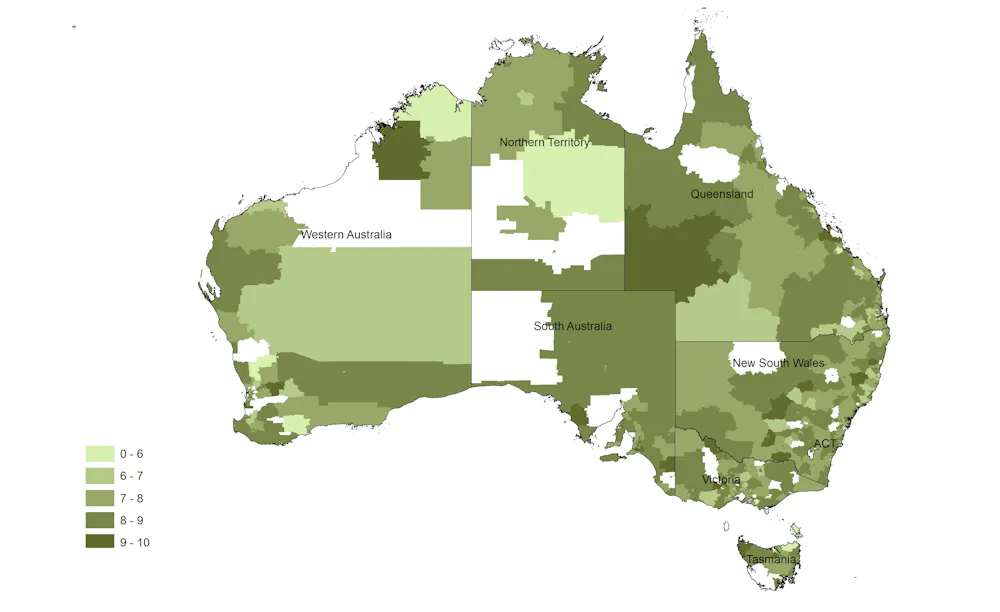
HILDA, Kubiszewski, Jarvis and Zakariyya, 2019

But even these averages hide people with extraordinarily low levels of life satisfaction.

On average, 3% of the Australians surveyed between 2001 and 2017 reported a score between 0 and 4, a range so low as to be considered “suffering” by Gallup.

Over the same period, around 10% reported a score between 5 and 6 (“struggling”) and 87% reported a score between 7 and 10 (“thriving”).

Acknowledging this diversity is critical to ensuring happy lives for all Australians.

And what helps varies by location

What matters to life satisfaction appears to also vary from place to place.

We found that what matters most in parts of South Australia, Victoria and New South Wales is the relationships people have with their children and partners. In a large part of Western Australia it is built infrastructure. In some other parts of Western Australia and the Northern Territory it is personal health.


What matters most for life satisfaction by location
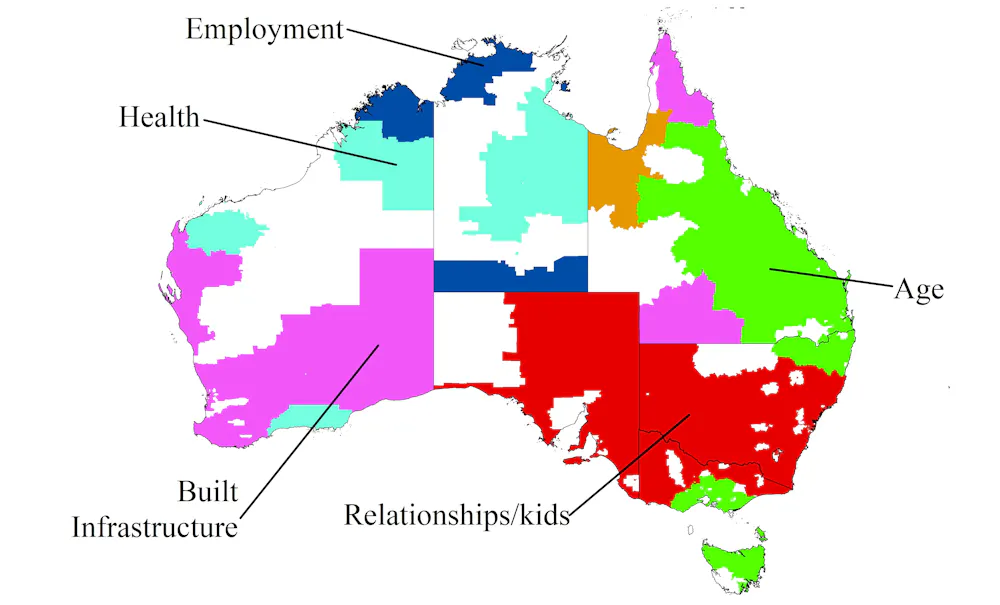
Average 2001-2007. HILDA, Kubiszewski, Jarvis and Zakariyya, 2019

It’s the same with what harms life satisfaction.

In South Australia, Victoria, New South Wales and even parts of Queensland, inequality in life satisfaction itself contributes most to decreasing of life satisfaction.

In the central Northern Territory it’s the harsh environment. In parts of Western Australia it’s simply being a male, or having children.


What most harms life satisfaction by location
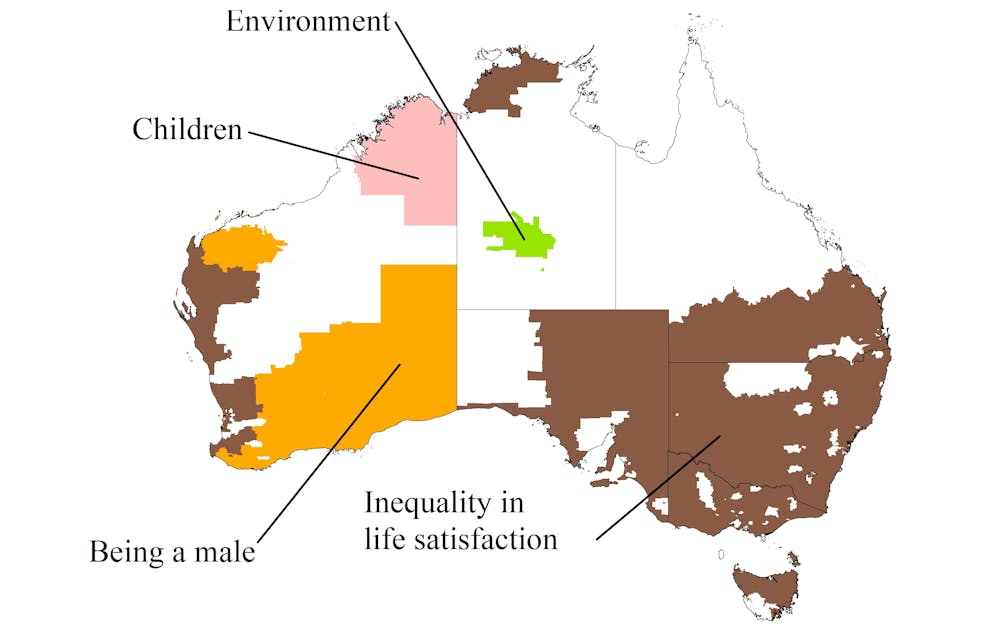
Average 2001-2007. HILDA, Kubiszewskia, Jarvis and Zakariyya, 2019

None of this means that all of these factors aren’t important to all of us to some extent.

What it does mean is that there are difference in how each of us prioritises what is more important. Some of us choose careers while others choose large families, some choose nightclubs and five-star restaurants while others choose remote beaches.


Read more: How do we measure well-being?


It means that while national programs can be useful, local and regional policies can be critical.

Formulating local policies is time-consuming and complex, and requires information, but it is worthwhile.

It might help to add another question or two to the census with answers recorded by location.

One might be: “All things considered, how satisfied are you with your life?”

ref. Labor is right to talk about well-being, but it depends on where you live – https://theconversation.com/labor-is-right-to-talk-about-well-being-but-it-depends-on-where-you-live-129704


Friday essay: scarlet ribbons – the huge history of big hair bows

Source: The Conversation (Au and NZ) – By Fiona Andreallo, Honorary research fellow, University of Sydney

A sea of oversized hair bows bobs through primary school gates each morning. It might be dismissed as a harmless children’s fad but big bows are back, driven by current fashions, tween influencers and celebrities.

Hair bows have a long history that includes the cushiony large posh bows of the 1980s, and more recently Lady Gaga’s hair bow made of hair. In the 1940s, teenage girls wore hair bows as signs of sexual availability.

Over the last century or so they’ve signified femininity, but historical sources indicate it wasn’t always that way.

For the boys

The hair bow was originally gender-specific to adult males in Europe throughout the 1700s when men adorned their hair with bows to show they were prosperous and extravagant.

Women also wore extravagant hairstyles, but these did not often feature hair bows; rather large ornaments and jewels were preferred.

After the French Revolution extravagance in dress and hairstyle was frowned upon and hair bows were rarely worn. By the 1800s it became common for male children to wear hair bows tying hair at the nape of the neck.

Women throughout the 19th century wore hair ornaments and hats, but the hair bow only really achieved widespread popularity in the 20th century before the second world war.

Jean-Baptiste-Siméon Chardin, The House of Cards, 1736-37. Wikimedia

Pretty but strong

The hair bow today most commonly projects ideas of innocence linked to children and a concept of femininity as linked to qualities of gentleness, softness and compliance.

Poster by J. Howard Miller (1918–2004) used by the War Production Coordinating Committee. Wikimedia

It may be precisely because the hair bow projects such ideals that it has also been employed as a means of empowerment for both female and male bodies.

During the war in 1942 the wartime propaganda We Can Do It poster – designed by Miller for Westinghouse Electric – appeared in the company factories to encourage women at work in the facilities.

The poster depicts an active female holding up her arm to show strength. She wears a red and white spotted scarf in her hair knotted at the top. The female body is presented as strong and able. The bow is minimal in size, and in this context also becomes functional – to keep the woman’s hair off her face – rather than simply decorative.

In the 1980s, singers Madonna and Boy George wore bows as symbols of feminine performance. Both pop icons wore the bow as a sign of celebration and transgression. The small fashion moment subtly exposed the social limitations of ideas of femininity.

Vivien Leigh’s hair bows in 1939’s Gone With the Wind played up her girlish immaturity. IMDB

Madonna wore the hair bow in a subversive manner, poking fun at social constraints projected onto the female body by being girlish and powerfully sexy at the same time.

Madonna in Desperately Seeking Susan. IMDB

The innocence of the girly bow, lollipops, white wedding dresses and religious iconography both in her name and the crucifixes she wore contrasted with the sexy and outgoing image she personally projected. Like the titles of her songs and albums – Material Girl, Immaculate Collection, Like a Virgin – the bow poked fun at how women are constrained by the stereotypes of innocence, virginity and femininity.

Meanwhile, Boy George, identifying as male, wore a hair bow during this period to perform femininity. In doing so, he highlighted the hair bow as something socially considered as limited to feminine presentation, but not necessarily limited to a female body.

Gaming gender

Today the hair bow is so intrinsically linked exclusively to femininity performed by a female body that we often see characters in games gendered simply by a hair bow.

In 1981, Ms Pac-Man was released in game form with a hair bow to distinguish her from the original male game protagonist.

Ms Pac-man has the same round body as her male counterpart but a big hair bow signals her gender. Shutterstock

Wendy O. Koopa of Super Mario fame relies mainly on a big pink polka dot hair bow (even though she has no hair), but gender is also indicated with a beaded necklace, large lips and long eyelashes. Super Mario character Birdo wears a large pink hair bow tied onto her head (like Wendy, the pink dinosaur does not have hair) and has been hailed as the first transgender game character to hit screens.

Nintendo game character Marmar is probably the most explicit use of the bow to indicate gender. She is a gold star with no other indicators except a big pink hair bow a third of the size of her body. We are familiar with bows as a way of marking femininity through characters such as Ub Iwerks and Walk Disney’s Minnie Mouse who debuted in 1928.

Hair bows have been used to differentiate between boys and girls in comics, icons and videogames. Wellcome Collection, CC BY

JoJo with the bow bow

Most recently American child pop star JoJo Siwa’s iconic oversized bow has been the point of great fan connection with many children under 11 years old wearing the oversized and often glamorous bows in public.

Siwa, originally known for her role in reality-TV series Dance Moms (2014), connects with her fans through YouTube and a number of songs with dance videos such as Kid in the Candy Store (2016) and Hold the Drama (2014).

Her Facebook account has more than 6.2 million followers made up of mothers and fans from Australia, UK, US and New Zealand. There are many images of children wearing the bow and often they are pictured with their mothers, suggesting a bond of mother-daughter through femininity.

The JoJo bows are reminiscent of the white Soviet Union bantiki bows, worn from the 1940s on to show national allegiance.

JoJo Siwa has grown up online but hasn’t grown out of her bows. AAP/Regi Varghese

At first glance, JoJo’s large bows might be dismissed as dance costume, dress-ups or linked to cheerleading. The practice of wearing them is evident in new Netflix documentary Cheer, which features college athletes competing in body-punishing routines in an effort to win the national championship. Despite being thrown high in the air and landing heavily, their stiff bows remain unmoved.

JoJo asserts the hair bow is more than a look. In an interview with the Children’s British Broadcasting Corporation, JoJo said:

A bow is more than just a hair accessory […] It is a sign, a symbol of power, confidence, and (this is not a word, but) believing-ness, like literally, it’s just a good thing.

The hair bow is more than a piece of ribbon. The bow for Siwa and her fans carries power, confidence, “believe-ingness” and goodness.

On the hardcore cheerleading Netflix documentary Cheer, the oversized bow is built to last. IMDB

Luxe for ladies

Bows have come back into fashion in the last few years: worn by the Duchess of Cambridge, Kate Middleton, and well-heeled celebrities like Nicole Kidman, Jessica Chastain and Margot Robbie.

The symbolism has been extended to high-end consumerism, with some bow-wearers repurposing the characteristic decorations on Chanel, Dior and Chloe shopping bags for their hair.

Though we’ve seen many man buns, the trend of hair bows for men has yet to return, and it may be some time before the bow transitions from necktie to men’s heads. If it does have a resurgence, we’ll know it’s nothing new.

ref. Friday essay: scarlet ribbons – the huge history of big hair bows – https://theconversation.com/friday-essay-scarlet-ribbons-the-huge-history-of-big-hair-bows-131389

Grattan on Friday: Government juggles health security and wealth security as China travel ban extended

Source: The Conversation (Au and NZ) – By Michelle Grattan, Professorial Fellow, University of Canberra

Seen as a political narrative, the Morrison government’s handling of the coronavirus (COVID-19) fits the patterns of its approaches on border security and anti-terrorism.

Stressing the central imperative is to “keep Australians safe”, it has taken the most risk-averse path.

With the exception of returning Australians and their immediate families, the border has been closed to people who’ve been recently in China. On Thursday the ban was extended until at least February 29, which would be a month’s shutdown.

The border-closure went beyond the World Health Organisation’s stand, which did not recommend any travel restrictions, although many other countries did impose them.

Those Australians from the government-organised flights from Wuhan and the cruise ship Diamond Princess were put into quarantine on Christmas Island and a centre near Darwin.

All through, the government has stressed it has acted on the advice of its medical experts.

Coincidentally, the political advice would probably have accorded with the medical. People are easily spooked; they want to feel protected to the maximum. And with only a handful of cases in Australia, that goal has been achieved.

The travel ban is now a week-to-week matter.

The problem for the government is that the timing of its lifting will inevitably have an element of arbitrariness.

The government has to be able to say it is based on medical advice. Even so, whenever the border is reopened, there’ll still be many new COVID-19 cases emerging in China.

But the longer the ban stays – in other words, the more cautious the government remains – the greater the cost to the Australian economy.


Read more: Australian unis may need to cut staff and research if government extends coronavirus travel ban


It sounds, and is, a crude proposition, but there is a trade off here between Australia’s health security and its economic wellbeing, and at some point the balance will have to swing in favour of the latter.

Scott Morrison said on Thursday the “first priority” was the health and welfare of Australians, but added, “We’re also very mindful though of the significant economic impacts of this virus, but that’s not restricted to Australia, that is happening globally”.

Morrison flagged the government was working on some arrangements to mitigate the effect on the university sector, which has seen about 100,000 students in limbo.

If the ban is kept on too long, deepening the economic harm, the government will pay the price later. There is already some questioning of whether the ban’s economic damage is greater than the risk posed by an open border.

There was a hint in the government’s statement extending the ban that its lifting might not be too far away. The health experts had advised “there are signs the spread of the coronavirus in Chinese provinces outside Hubei province is slowing. We will need to watch closely whether this positive trend continues as people return to work after the holidays,” it said.

The coronavirus has been a sharp reminder of how vulnerable Australia is, despite all its strengths. This vulnerability has been exposed on multiple fronts: specific industries and exports with considerable China-dependency, notably tertiary education and tourism; parts of the small business sector; the wider economy, and the budget.

The economic fallouts are direct and indirect. The impact of the virus on the Chinese economy will flow through to the international economy, adding to the headwinds Australia faces.


Read more: Coronavirus: the blow to the Chinese economy could be felt for years


COVID-19 is set to be more serious for our economy than the impact of the bushfires, and its implications are harder to assess.

No one can judge how long the disruption will last. It affects supply chains, with some Australian manufacturers finding their inputs hard to get because of factories closing in China. As well, with fewer air services available, it is more difficult to dispatch some products to China.

The virus’s economic impact will be at the centre of discussions at the G20 finance ministers meeting in Saudi Arabia which treasurer Josh Frydenberg attends this weekend.

On another front, COVID-19 has seen the latest manifestation of that strand running back through Australian history, which used to be called our fear of the “yellow peril”.

Leaving aside loss of business from absent Chinese tourists and students, there is no objective reason why customers should have deserted Chinese restaurants. Certainly there should be no backlash against Chinese people in Australia. But old prejudices are never far below the surface.

The Victorian government this week announced measures to show “solidarity” with the Chinese community, including lighting iconic buildings in red and gold, and roundtables to “bring Chinese community leaders together to share ideas on how to revitalise local businesses and boost trade”. The state government plans to lead a delegation of 100 Victorian businesses to China.

Coronavirus has complicated Australia’s already difficult relationship with Chinese authorities. The Chinese government has been very critical of the travel ban, calling it “extreme” and an “overreaction”.

While the federal government wouldn’t be too concerned about the criticism itself – the Chinese were unforgivably secretive about the virus initially – it potentially complicates a situation where there are more matters to be negotiated.

These include arrangements by tertiary institutions for online courses.

Phil Honeywood, CEO of the International Education Association of Australia and chair of the government’s Global Reputation Taskforce, which is advising on how best to assist the education sector post coronavirus, says the Chinese government will have to approve such online courses.

“Any offshore qualification has to be signed off by the Chinese ministry of education in order for the Chinese student, when they go home, to get the official certification from their own government that would help them in the job market,” he says.

“And this is a challenge in itself, at the best of times, with some courses. And now we have this conundrum of … will the ministry of education agree to compromise on what in the past has been fairly rigid rules around academic credit from online learning?”

COVID-19 will have a long-term impact on the thinking of universities, a number of which were already aware of the danger of the sector’s over-reliance on the Chinese market.

In economic terms, the government hopes COVID-19 will not go beyond a short sharp shock. It is a salutary reminder of how much Australia’s economic fortunes are tied to one country, but in practical terms the scope for reducing that dependence is very limited.

ref. Grattan on Friday: Government juggles health security and wealth security as China travel ban extended – https://theconversation.com/grattan-on-friday-government-juggles-health-security-and-wealth-security-as-china-travel-ban-extended-132202

Politics with Michelle Grattan: Phil Honeywood on the coronavirus challenge for universities

Source: The Conversation (Au and NZ) – By Michelle Grattan, Professorial Fellow, University of Canberra

The coronavirus is presenting a major threat to Australia’s education export industry, which is highly dependant upon the China market, and a huge challenge to the universities. Phil Honeywood, CEO of the International Education Association of Australia says:

“At the end of the day, China is the most heavily populated country in the world, it’s on our regional doorstep and it has an incredible appetite for having their children study offshore.”

ref. Politics with Michelle Grattan: Phil Honeywood on the coronavirus challenge for universities – https://theconversation.com/politics-with-michelle-grattan-phil-honeywood-on-the-coronavirus-challenge-for-universities-132196

Politics with Michelle Grattan: Phillip Honeywood on the corona virus challenge for universities.

Source: The Conversation (Au and NZ) – By Michelle Grattan, Professorial Fellow, University of Canberra

The corona virus is presenting a major threat to Australia’s education export industry, which is highly dependant upon the China market, and a huge challenge to the universities. Phillip Honeywood, CEO of the International Education Association of Australia says:

“At the end of the day, China is the most heavily populated country in the world, it’s on our regional doorstep and it has an incredible appetite for having their children study offshore.”

ref. Politics with Michelle Grattan: Phillip Honeywood on the corona virus challenge for universities. – https://theconversation.com/politics-with-michelle-grattan-phillip-honeywood-on-the-corona-virus-challenge-for-universities-132196

Yes, Australians on board the Diamond Princess need to go into quarantine again. It’s time to reset the clock

Source: The Conversation (Au and NZ) – By Stacey L Rowe, PhD candidate, Monash University

Today’s evacuation of about 180 passengers from the cruise ship Diamond Princess to serve another period of quarantine back in Australia has raised questions about the best way to control spread of the coronavirus.

The passengers had already spent 14 days quarantined on board the ship, which had been docked in Japan, and now face another 14 days at the Howard Springs quarantine facility close to Darwin.

Di Stephens, Northern Territory’s acting chief health officer, told the ABC today:

These people need to go into quarantine because we are not entirely convinced that the quarantine procedures on that ship were 100% effective.

By contrast, Japan’s health ministry is allowing hundreds of people to leave the ship without being subject to further quarantine.

So what’s behind Australia’s announcement to impose a second quarantine period? And what were conditions like on board to prompt this decision?

What’s quarantine?

Quarantines have been put in place around the world as part of the global public health response to COVID-19 – the disease caused by a new coronavirus, now named SARS-CoV-2.

The idea is to limit the spread of the virus within and between countries.

Formal measures designed to limit contact between infected (or potentially infected) people are called “social distancing”. And they have been used to control communicable diseases for at least 2,500 years.


Read more: Remote village to metropolis: how globalisation spreads infectious diseases


Today, the term quarantine refers to the separation or restriction of movement of people who are not ill but are believed to have been exposed to an infectious disease.

This differs to isolation, which is the term used for the separation or restriction of movement of people who are ill, thereby minimising onward transmission.

How long should quarantine last?

Quarantine periods are determined by certain characteristics of the infectious agent, most notably the incubation period. This is the period between being exposed to it and symptoms appearing.

For COVID-19, the average incubation period is thought to be around six days, and can range from two to 11 days.

While a preliminary report has suggested a longer incubation period of up to 24 days, this is considered unlikely.


Read more: How contagious is the Wuhan coronavirus and can you spread it before symptoms start?


People who have been in close contact with someone confirmed to have COVID-19 are considered to have been potentially exposed to the virus. As a precaution, these people are placed in quarantine, essentially to “sit out” their potential incubation period.

The quarantine period of 14 days currently being used in Australia and elsewhere for COVID-19 takes into account the maximum known incubation period for this disease, plus a few extra days as a reasonable precaution.

In quarantine, people will either develop the disease and have symptoms or they will remain well. In theory, if a person remains well after their period of quarantine, they are deemed uninfected and restrictions are lifted.

Another factor that influences how long someone needs to be quarantined is the infectious period. That’s the period during which the infection can be transmitted from one person to another.


Read more: There’s no evidence the new coronavirus spreads through the air – but it’s still possible


If the infectious period starts before the symptoms (from asymptomatic or minimally symptomatic individuals), the virus can be transmitted silently. This can substantially complicate disease prevention and control.

When a new virus emerges – as with SARS-CoV-2 – the infectious period is largely unknown. While the proportion of asymptomatic or minimally symptomatic COVID-19 cases is not clear, it is increasingly apparent people can be infected without having any symptoms. However, further evidence is needed to see if these people can infect others.

When is it best to extend the quarantine period?

Crucial to quarantine is ensuring that best possible infection control practices are put in place to prevent ongoing transmission.

It is also essential to assess real-time data about newly diagnosed cases, which tells us how effective quarantine measures have been.

In some circumstances, it may be necessary to extend a person’s period of quarantine, as in the case of the Australian citizens on board the cruise ship Diamond Princess.


Read more: Cruise ships can be floating petri dishes of gastro bugs. 6 ways to stay healthy at sea this summer


So, what happened on board the Diamond Princess?

Data from the World Health Organisation (WHO) give us clues to what’s behind Australia’s decision to impose a second period of quarantine.

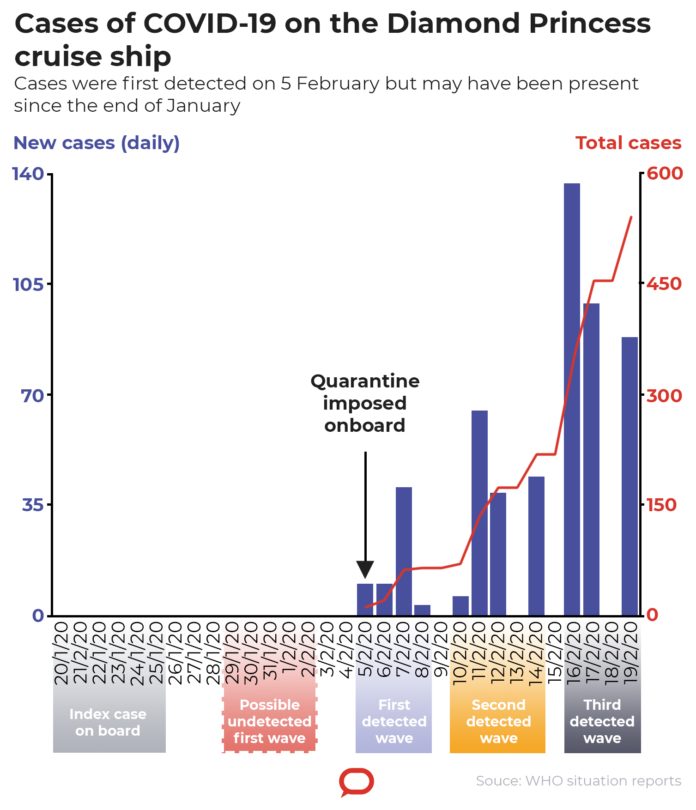
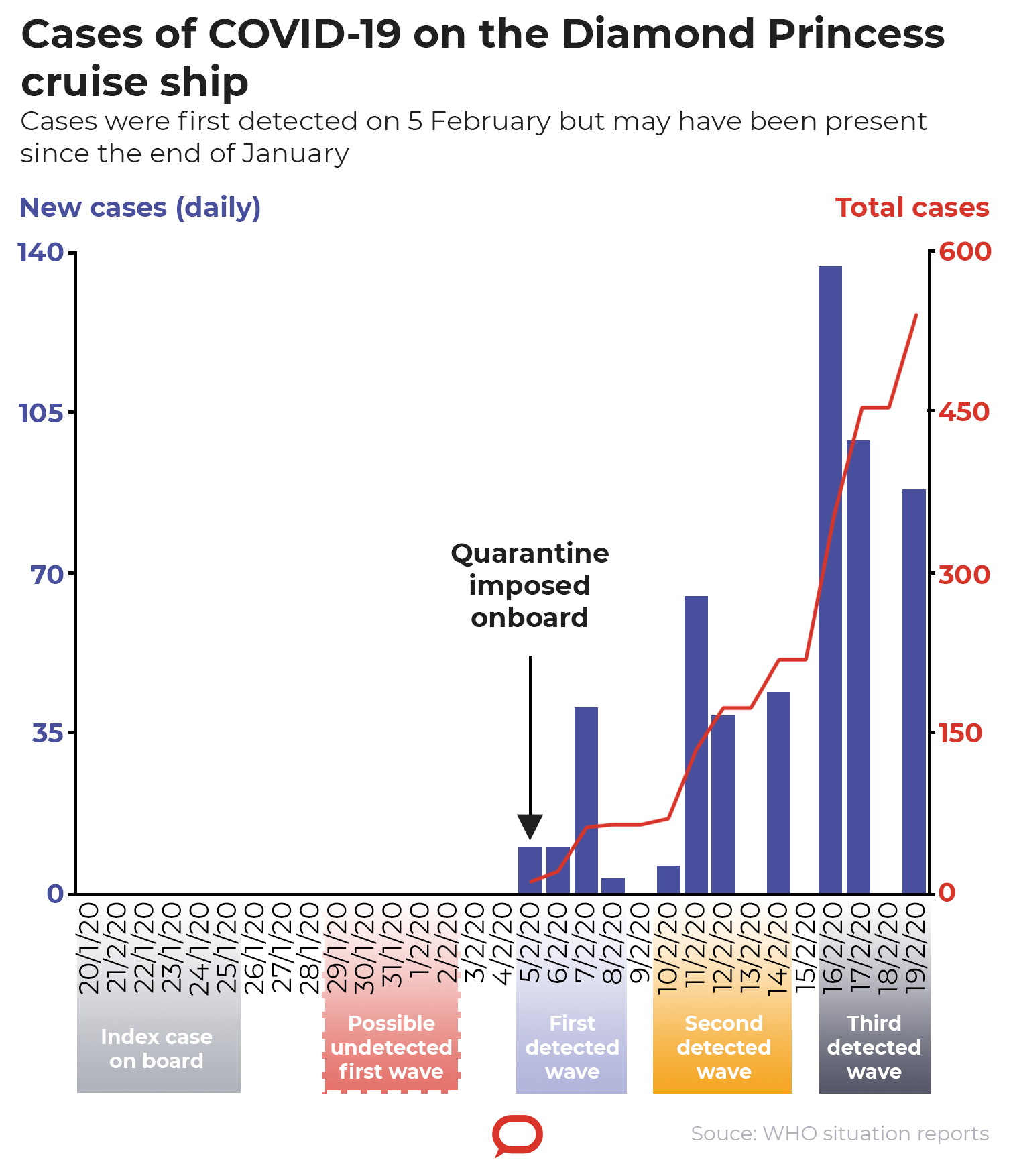
The graph below shows there may have been up to four possible waves of infections on board, including an initial undetected wave before quarantine measures were imposed.

The Conversation, CC BY-ND

These data demonstrate ongoing SARS-CoV-2 transmission between people on board during the quarantine period. It also indicates breaches in infection control on board may have contributed to ongoing waves of infections, which an expert highlights in the video below.

An expert raises concerns about infection control measures on the Diamond Princess cruise ship.

Evidence of ongoing transmission during the quarantine period supports the decision by several countries to evacuate their citizens from the Diamond Princess, including Australia, to “reset the clock” and to impose a further 14-day quarantine period.

This additional measure – while causing considerable and understandable frustration to those affected – is designed to limit transmission of COVID-19 within Australia.

The rights of individuals versus public good

Implementing public health measures, such as isolation and quarantine, requires decision-making that balances the rights of individuals and public good.

When appropriately designed and implemented, quarantine and isolation work. Even when quarantine is not absolutely adhered to, it can still be effective at reducing the likelihood of large-scale outbreaks.

With SARS (severe acute respiratory syndrome), these strategies were thought to have been an important part in controlling the epidemic, though they were resource and labour intensive.


Read more: Yes, there’s merit in quarantining people on Christmas Island to prevent the spread of coronavirus


ref. Yes, Australians on board the Diamond Princess need to go into quarantine again. It’s time to reset the clock – https://theconversation.com/yes-australians-on-board-the-diamond-princess-need-to-go-into-quarantine-again-its-time-to-reset-the-clock-131906

Criminal penalties for corporate wage theft are appealing, but won’t fix the problem on their own

Source: The Conversation (Au and NZ) – By Tess Hardy, Senior Lecturer in Law, University of Melbourne

Australian supermarket giant Coles and discount chain Target this week joined an ignominious list of large corporations caught up in “wage theft” scandals.

Coles confessed to underpaying salaried employees about A$20 million over the past six years. Target admitted to underpaying staff about A$9 million.

Other large companies guilty of underpaying employees include Bunnings, which underpaid its staff about A$4 million in superannuation entitlements, and Woolworths, which underpaid employees up to A$300 million over ten years.

These cases – along with a string of others involving small and medium enterprises – reinforce the need for reform.


Read more: Shocking yet not surprising: wage theft has become a culturally accepted part of business


Australian Attorney-General Christian Porter has said he will introduce legislation within weeks to criminalise the worst cases of worker exploitation and underpayment.

Heavier sanctions may be appropriate. But harsher civil or criminal penalties will not, on their own, lead to greater compliance.

Beyond penalties and punishment

Not surprisingly, Rob Scott, the chief executive of Wesfarmers (the parent company of both Target and Bunnings), is among those opposed to penalising companies for “inadvertent administrative errors”.

“I’m not sure more punitive penalties are necessarily going to change behaviour at all,” he said this week. “There have been some significant issues across payroll systems in the market, which in part reflects the incredible complexity of the systems that we’re dealing with.”


Read more: No, a ‘complex’ system is not to blame for corporate wage theft


Even if these underpayments were not deliberate, companies were – in the words of Fair Work Ombudsman Sandra Parker – “lax and lazy” about complying with their obligations. It is hard to believe a corporation like Wesfarmers – one of Australia’s ten biggest listed companies – does not have the resources to pay people correctly.

Nonetheless, Scott does raise a valid point. Changing the compliance culture in Australia will not be straightforward.

There is much research that suggests promoting, achieving and sustaining compliance with the law is about much more than just penalties, punishment and deterrence.

There is also limited evidence to support the idea that criminalising wage theft will alone act as a regulatory panacea. This is especially the case where underpayment is primarily committed by corporations rather than individuals.

Risk of detection

My colleague John Howe and I have researched employer non-compliance with the Fair Work Act in the hairdressing and restaurant industries. Our findings confirm conclusions drawn in previous studies relating to environmental violations, tax evasion and cartel conduct: it is the perceived risk of detection, not the severity of the sanction, that is most likely to enhance deterrence and encourage compliance.

If the perception of being caught is critical, then what counts are the resources available to the Fair Work Ombudsman to strategically intervene and to be seen to be doing so – that is, by widely publicising enforcement outcomes.

On these points the current system has at least two vulnerabilities. These will remain even if criminal penalties are introduced and civil penalties increased.

First, various federal government commitments to boost funding for the Fair Work Ombudsman have not resulted in any discernible increase in the number of Fair Work inspectors or other staff.

It is no coincidence that trade unions – the organisations that have historically supplemented government detection efforts – are struggling to keep up with demand in the sectors most prone to wage theft, such as horticulture and hospitality.


Read more: All these celebrity restaurant wage-theft scandals point to an industry norm


While Porter is promising the “most vigorous, robust and complete set of laws around wage underpayment that Australia’s ever seen”, there’s no sign the government will do anything that might enhance the role of the union in this space.

Contraventions are generally detected by the regulator through proactive inspections and individual complaints. But most complaints are settled confidentially. This may mean quicker redress for workers, but it has limited deterrent effect.

Effective reforms

The prospect of criminalising wage theft grabs headlines. But in making this change it is essential policy makers do not lose sight of the total reform agenda needed to make a real difference.

The Fair Work Ombudsman needs sufficient resourcing and enhanced enforcement tools and detection mechanisms. Dispute-resolution and court processes for workers seeking to recover pay need to be streamlined. Auditors that tick off company accounts and processes also need to be to held to account.

Finally, prosecutions and penalties need to occur and be public, so employers know transgressions of workplace law – inadvertent or not – do have consequences.

ref. Criminal penalties for corporate wage theft are appealing, but won’t fix the problem on their own – https://theconversation.com/criminal-penalties-for-corporate-wage-theft-are-appealing-but-wont-fix-the-problem-on-their-own-132021

How you can help – not harm – wild animals recovering from bushfires

Source: The Conversation (Au and NZ) – By Marissa Parrott, Reproductive Biologist, Wildlife Conservation & Science, Zoos Victoria, and Honorary Research Associate, BioSciences, University of Melbourne

Since July last year, bushfires have burned more than 7.7 million hectares of southeast Australia, putting many threatened species at increased risk of extinction.

Now that fires have been extinguished in some areas, surviving wildlife face other challenges, such as a lack of food, clean water and shelter, and more exposure to invasive predators.


Read more: These plants and animals are now flourishing as life creeps back after bushfires


Australians have helped raise millions of dollars to support Australia’s imperilled wildlife, such as to set up triage centres and evacuate threatened species like eastern bristlebirds and Macquarie perch.

But beyond the vital role of providing financial support, here are a few simple things individuals can do – and avoid – to help our native wildlife recover.

Giving koala water from a drink bottle can kill them. Sunrise on Seven/flickr, CC BY-NC-ND

Animals need fresh water, but not from a bottle

Photos of well-meaning people offering water from bottles to animals, especially thirsty koalas, often go viral online. But this is not a safe way to help koalas.

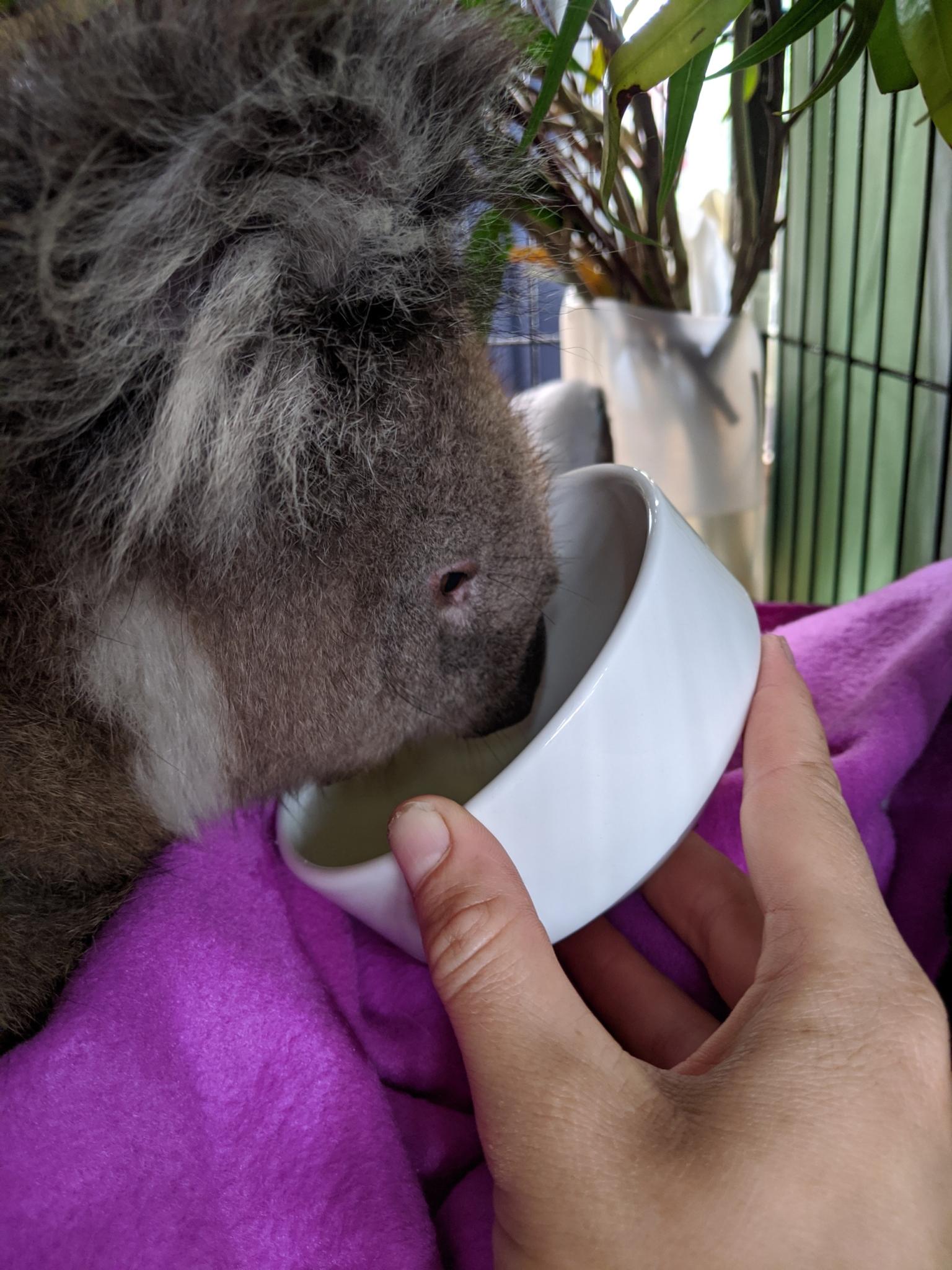
Animals must be allowed to drink water themselves, rather than us pouring water into their mouths. Animals, such as koalas, can’t drink quickly and poured water can fill their lungs, leading to potentially fatal aspiration pneumonia.

A koala at a bushfire wildlife triage centre. You can give koalas water to lap themselves from a dish, rather than pouring water into their mouths. Zoos Victoria, Author provided

Still, providing safe, fresh drinking water is one crucial and practical way we can help them as summer grinds on.

This is particularly important since recent storms have washed ash, sediment and chemicals from burnt infrastructure into waterways, contaminating many catchments.

Water should be stationed at ground level, in a shaded location safe from predators, and in trees for birds and tree-dwelling species like possums, gliders and koalas. Check out DIY guides for building drinking fountains, or “watering pods”, for wildlife.

Sticks and rocks should be placed in the water to allow small species, such as reptiles, to climb out if they fall in. Water must be checked and changed regularly to ensure hygiene and avoid the spread of disease. And pets must be kept away from these locations (especially cats).

Watering pod animals. Arid Recovery

What to do if you spot injured wildlife by the road

Authorities are searching the fire grounds for injured animals, and the public is reminded to avoid these areas until they’re confirmed as safe to enter.

But if you happen upon an injured survivor, what should you do?

First of all, call government agencies or trained wildlife rescuers, who can assist any injured wildlife.

Many animals may be in pain and frightened and some, including kangaroos, koalas and wombats, are potentially dangerous if approached. In urgent cases, such as when an animal is in obvious distress or has clear injuries, some animals can be carefully caught and wrapped in a towel, then placed in a well-ventilated, dark and secure box for quiet transport to wildlife veterinary hospitals for care.

Sadly, many animals are hit by cars during fires when they’re disoriented and panicked, and so it’s important to slow down in such areas.

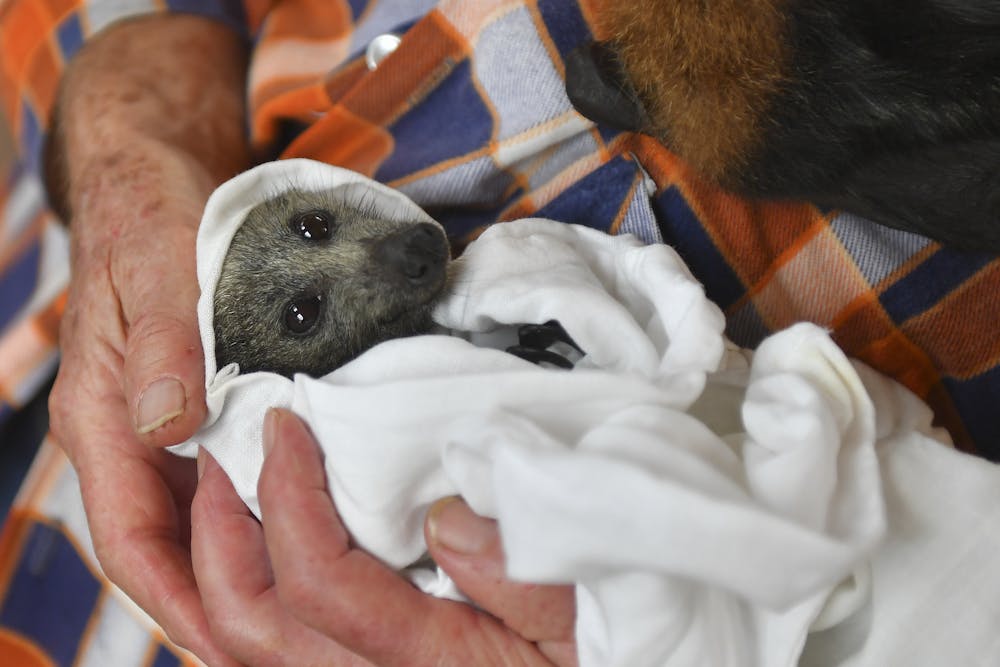
A rescued Grey-Headed Flying-Fox. If you see injured wildlife, particularly bats who may carry disease, it’s important to call authorities to assist. AAP Image/Steven Saphore

You can also check animals found by roads for injuries and surviving young in pouches, and call authorities to assist. But always be careful of traffic when attending to animals on roadsides, and help other drivers be aware of you by putting hazard lights on and wearing bright clothes.

Don’t feed native wildlife, especially not peanut butter mixes

With so much vegetation burned away, supplementary feeding has gained attention following fires in New South Wales, Victoria and South Australia.

But feeding wildlife without expert advice and legal approval can do more harm than good.

Feeding inappropriate foods like processed foods, over-feeding, providing unhygienic foods or food stations, and attracting predators to food stations, can all be fatal for native wildlife.


Read more: Fire almost wiped out rare species in the Australian Alps. Feral horses are finishing the job


Even some foods suggested online, such as bait balls (peanut butter mixes), can cause gastrointestinal issues for wildlife, potentially killing them. Similar issues can arise if wildlife are given some types of hay, vegetables, seeds, and fruits.

Supplementary feeding isn’t advised unless habitat and sources of food have been completely destroyed, and is only appropriate as a short-term emergency intervention until natural resources recover.

But leave it up to the experts and government agencies, which provide nutritionally suitable, specially developed and monitored food in extreme cases.

Somewhere to run and hide

In some cases, fire may mean native animals are more prone to predators killing and eating them. And, depending on the habitat, it may take months or even years for plants and animals’ homes to recover sufficiently to provide safety once again.

However, new approaches – such as building artificial shelters out of fencing wire and shade cloth – may help to buy species time, keeping small mammals, reptiles and other potential prey safe from hungry mouths. This could occur both on private and public land.

Artificial refuges to provide wildlife with shelter and protection from predators after fire. Tim Doherty (Deakin University)

Show wildlife the money

Caring for wildlife after fires, whether they’re injured or have lost their homes, is a marathon, not a sprint. And given the scale of these fires, our wild neighbours need our increased support.

Often, the most helpful thing people can do is raise and donate funds to organisations, including Zoos Victoria and the Ecological Society of Australia.


Read more: To save these threatened seahorses, we built them 5-star underwater hotels


Some wildife species, such as bristlebirds, corroboree frogs, and mountain pygmy-possums, are being pushed to the brink of extinction and may need long-term captive breeding and release programs, or investment in active management of wild populations (such as the newly constructed feral predator-free area for Kangaroo Island dunnarts).

We can all help to make a difference and protect our remarkable and unique wildlife that so desperately needs our help.

ref. How you can help – not harm – wild animals recovering from bushfires – https://theconversation.com/how-you-can-help-not-harm-wild-animals-recovering-from-bushfires-131385

Revealed: the protein ‘spike’ that lets the 2019-nCoV coronavirus pierce and invade human cells

Source: The Conversation (Au and NZ) – By Jianling Xie, Postdoctoral Scientist, South Australian Health & Medical Research Institute

Researchers in the United States have unveiled the structure of the “spike protein” of 2019-nCoV – the virus behind the current coronavirus disease outbreak.

Despite the fact that researchers have already pieced together the virus’s genetic sequence, the World Health Organisation has warned that a vaccine is still 18 months away.


Read more: Here’s why the WHO says a coronavirus vaccine is 18 months away


But knowing the structure of the virus’s spike protein gives us crucial information about exactly how the virus infects host cells. This could be a vital piece of the puzzle in making the hoped-for vaccine a reality.

What is a spike protein?

A viral spike protein is like a key that “unlocks the door” to gain access to the cells of a specific host – humans, in this case. To understand how to deal with 2019-nCoV, we first need to understand what this key looks like, and what “keyhole” it targets on human cells. This is exactly what the new paper, published overnight in Science, is all about.

The researchers, led by Jason McLellan of the University of Texas at Austin, defined the structure of 2019-nCoV’s spike protein using a technique called cryogenic electron microscopy, or “Cryo-EM”. This involves cooling the protein to below -150℃, so that it crystallises and then its structure can be determined with near-atomic resolution.

The newly discovered molecular structure of the 2019-nCoV spike protein, which the virus uses as a ‘key’ to gain access to human cells. Wrapp et al. 2019/Science

They also identified the “keyhole”, the host cell receptor: it is a human protein called angiotensin converting enzyme 2 (ACE2). This is the same human receptor protein targeted by the earlier SARS coronavirus.

But, disturbingly, the researchers found that 2019-nCoV binds to ACE2 with much higher affinity (10-20 times higher!) than SARS. In other words, 2019-nCoV’s “key” is a lot “stickier” than the SARS one. It’s like a SARS “key” covered in superglue. This means that once it’s in the lock, it’s far less likely to be shaken loose and is therefore presumably more effective at invading our cells.

So what about a vaccine?

The researchers reasoned that, given that both viruses attack the same protein on human cells, it would be worth seeing whether the already available antibodies against SARS-CoV would work against 2019-nCoV. Unfortunately, they didn’t work.

This means we still have to wait for a stronger solution to this problem. Perhaps this is a reflection of the ongoing “arms race” between humans and viruses. We have stronger weapons now, thanks to scientific advances, but our enemies are gaining strength too – now they are using superglue against us!


Read more: We’re in danger of drowning in a coronavirus ‘infodemic’. Here’s how we can cut through the noise


Globally, the competition is heating up to hunt for the best anti-2019-nCoV vaccine. But as the old Chinese proverb says, “distant water can’t put out a nearby fire”. The earliest clinical trials to test a suitable vaccine will not be available until several months or even a year after a candidate vaccine is identified, and the global coronavirus outbreak may well be controlled by then.

The discovery of the 2019-nCoV spike protein structure therefore represents both good news and bad. The good news is now we know what it looks like, it will be easier to find the most suitable weapon against the virus. The bad news is the enemy is much stronger than we thought, and our current ammunition depot doesn’t have anything efficient against it.

ref. Revealed: the protein ‘spike’ that lets the 2019-nCoV coronavirus pierce and invade human cells – https://theconversation.com/revealed-the-protein-spike-that-lets-the-2019-ncov-coronavirus-pierce-and-invade-human-cells-132183

Australian unis may need to cut staff and research if government extends coronavirus travel ban

Source: The Conversation (Au and NZ) – By John Daley, Chief Executive Officer, Grattan Institute

The Australian government will soon decide whether it will extend its ban on travellers from China for another week.

The Department of Home Affairs has already extended the original two week travel ban (that began on February 1) by one week.

Anyone who has left or transited mainland China within the previous 14 days (with some exceptions including Australians citizens) will be denied entry into Australia until February 22.

But with about 2,000 new cases of the coronavirus being confirmed every day, the ban could well be extended even further.

More than 100,000 international students are estimated to be stuck in China, unable to start their academic year in Australia.

With the substantial loss of revenue from these students, universities will likely need to make cuts to their staff and research budgets.

How the travel ban affects universiites

The number of international students studying at Australian universities has increased dramatically in the past two decades. International student contributions extend beyond fees. These students spend money on accommodation, food and other experiences while they are here.

In 2018, international students contributed A$32 billion to the Australian economy. One third of that – $11 billion – was from the 160,000 students from China who studied in Australia that year.


Some Australian universities are more exposed to the Chinese student market than others. The University of Sydney took in about A$750 million from international students in 2017 (the latest year the data were available).

We have calculated two-thirds of that – about $500 million – came from international students from China. That same year, the University of Sydney had an operating surplus of $200 million.

The figure below shows the ten Australian universities with the highest revenue from Chinese international students. All these universities had an operating surplus in 2017.

The current reserves of these ten universities reportedly range from $48 million to $3.9 billion.


These universities are in good financial position to weather the storm. But whether university revenues are cut by a few weeks, a semester, or longer, they will inevitably look at reducing costs.

With materially fewer students to teach, they will look to reduce classes and cut teaching staff. Around 23% of their full time employees are casuals without employment security.

Cutting the hours of these employees would be the easiest way for universities to mitigate the hit to the bottom line.

But cutting costs can’t fill the hole: the revenue from foreign students substantially exceeds the costs of teaching them.

Australian universities generated a surplus of about A$1.2 billion on international onshore students in 2013. International student revenues have almost doubled since then, so the surplus budgeted for 2020 before coronavirus hit would have been a lot higher.

This loss of revenue will also have flow on effects for research, 20% of which is funded by student fees.

The government should lift the funding cap

Universities are doing what they can to accommodate students still in China. Monash University has delayed its teaching semester by a week to March 9, and will conduct its first week entirely online.

The University of Sydney will start on February 24 as normal, but it will delay some postgraduate business courses that have high international student numbers.

Universities are also offering online-only alternatives to international students for first-semester subjects.

But delayed start dates will work only if the travel ban is lifted in the coming weeks. Online-only study deprives international students of the campus-and-country experience they have paid for, so that option may not prove attractive.

And the problem will be far larger if this cohort of Chinese international students don’t come at all, instead choosing to study at home or elsewhere abroad.

All of this comes at a bad time for Australia’s university sector. While the Department of Home Affairs is restricting its access to international students this academic year, the Department of Education is restricting its access to domestic students next year and beyond.

The Commonwealth government effectively ended the demand-driven funding system at the end of 2017. During the years the model was operational, universities could enrol unlimited numbers of bachelor-degree students into any discipline other than medicine and be paid for every one of them.

In 2017, the government put a freeze on domestic bachelor places for two years, with population-linked adjustments from 2020 for universities that met certain performance criteria.


Read more: Demand-driven funding for universities is frozen. What does this mean and should the policy be restored?


By the luck of a demographic slump, the number of people finishing year 12 in Australia has been flat, and so the freeze has been of little consequence so far.

But that will change in the coming years. More domestic students will be knocking on the doors of cash-strapped universities.

The freeze means universities desperately needing revenue will lose many school leavers who would otherwise have studied at university under the demand driven system.

The Commonwealth government can’t fix an international pandemic. But it can lift the cap on domestic students.

ref. Australian unis may need to cut staff and research if government extends coronavirus travel ban – https://theconversation.com/australian-unis-may-need-to-cut-staff-and-research-if-government-extends-coronavirus-travel-ban-132175

For Australia to be respected on human rights, it needs to look deeper into its own record

Source: The Conversation (Au and NZ) – By Jon Piccini, Lecturer, Australian Catholic University

Australia has just entered its final year of its membership on the UN Human Rights Council. This position was won on the strength of two key arguments:

  • Australia would be the first Pacific nation to sit on the body, founded in 2007

  • our long-standing commitments to civil and political rights made us a safe set of hands among a membership that includes several dictatorships.

This championing of Australia’s record, however, sits oddly beside our own well-publicised violations of human rights, most visibly on asylum seekers and Indigenous rights.

My new book, Human Rights in Twentieth Century Australia, probes this contradiction. One of the questions I grapple with is how a nation that crows of its achievements in certain areas of human rights can so flagrantly breach others.

One answer is that Australia has long used its British heritage of civil and political rights and higher average standard of living to discount more expansive social, economic and cultural rights, particularly when it comes to questions of race and citizenship.


Read more: With a seat on the UN Human Rights Council, Australia must fix its record on Indigenous rights


Australia’s patchy human rights history

It is often forgotten that Australian representatives joined those of seven other nations to draft the Universal Declaration of Human Rights, adopted by the UN General Assembly in 1948.

Attorney-General Herbert Vere Evatt headed the negotiating team. He argued for a strong document enforceable by an international court, which would defend traditional “negative” rights like freedom of expression, alongside “positive” ones such as the right to work.

Even at this high point of global consensus following the second world war, Australia’s double-handed approach to human rights was apparent. While Evatt likened the UDHR to Australia’s sentimental belief that everyone deserves a “fair go”, he guaranteed the White Australia Policy would not be threatened by such a document.

Herbert Vere Evatt (left) and Anthony Eden, the UK foreign secretary, at a UN meeting in 1945 in San Francisco. United Nations, Author provided

Using language that echoes Australia’s asylum policy today, he said

There is no relationship between the Declaration of Human Rights […] and the exercise by a country of its national right […] to determine the composition of its own people.

This argument for the primacy of so-called “domestic jurisdiction” was also extended to the rights of Indigenous peoples by Evatt and other Australian leaders at the time, meaning their rights were considered to be only of national concern.


Read more: Australia’s human rights debate has always been political


The Communist newspaper Tribune captured this in a cartoon depicting the worldly Evatt set against an enchained Indigenous man to whom rights had little meaning.

By positioning itself as a responsible “middle power” on human rights, while also insisting it be judged by a scorecard of its own choosing, a benchmark was set for future Australian governments.

Human rights have, henceforth, been understood very restrictively in Australia.

Challenges to Australia’s human rights policies

Despite such evasions, Indigenous people, refugees and other social movements have long used human rights discussions and debates to further social and political agendas.

Chinese wartime refugees, dubbed a “recalcitrant minority” by Immigration Minister Arthur Calwell, were threatened with deportation in 1949. They petitioned the newly formed Australian Human Rights Commission, protesting “in the name of humanity” for their protection “from the arbitrary and inhuman actions” of the minister.

Indigenous Australians also began petitioning the commission in the 1960s, challenging governmental obfuscations on human rights directly.


Read more: UN slams Australia’s human rights record


While Australia insisted the country’s Indigenous policy accorded with the UN’s language of equality, a 1970 petition by five Indigenous Australians – delivered in person to the UN offices in New York – declared nothing had changed.

Alleging the ongoing “literal, physical destruction of our people”, the petitioners demanded Australia be judged

in light of what it does […] rather than what it says.

Indigenous peoples have been petitioning the Human Rights Commission for greater recognition of their rights since the 1960s. Danny Casey/AAP

From collective to individual rights

Starting in the late 1970s, the focus of international human rights shifted. Protecting individuals from suffering and violence replaced the fight for collective economic and social rights that defined the era of decolonisation in the 1950s and ‘60s.

Groups like Amnesty International, which won the Nobel Peace Prize in 1977, made political prisoners and basic sufficiency the watchwords of rights activism.

Economic, social and cultural rights were thus downgraded in importance compared to civil and political ones. Such a focus imposed few obligations on Australia, already a constitutional democracy governed by the rule of law.

Gareth Evans, attorney-general under the Hawke government, said in 1978 the very idea of economic and social rights was:

beyond the scope of the topic ‘human rights’ as that term has meaning in this country.

Since the late 2000s, though, the ground has moved quickly. On one hand, Australia’s continued violation of Indigenous rights has garnered more international condemnation.

The failure to deliver on the promise of constitutional recognition – one of the “pillars” of Australia’s Human Rights Council bid – seems particularly egregious.

The Declaration on the Rights of Indigenous Peoples in 2007 has also created reporting and compliance mechanisms unavailable to earlier generations. Under this declaration, the UN has already condemned the so-called “Intervention” in the Northern Territory and the revelations of abuse at the Don Dale detention centre.


Read more: Constitutional recognition for Indigenous Australians must involve structural change, not mere symbolism


Western governments like Australia are also back in the crosshairs on economic rights.

Kumi Naidoo, Secretary-General of Amnesty International, acknowledged in December 2018 that Amnesty’s focus on political prisoners meant issues of poverty, inequality, housing, food and sanitation had largely disappeared from activists’ lexicon.

It’s now necessary to view human rights as a “package”, Naidoo said, including renewed focus on economic rights. And importantly, western and non-western nations can – and must – be judged on an equal footing.

Australia has already seen what this future looks like. The UN’s special rapporteur on extreme poverty, Phillip Alston, recently said in a widely publicised report the so-called “Robo Debt” and Cashless Welfare Card schemes were bringing forth a “digital welfare dystopia”.

Australia should expect more uncomfortable finger pointing in future. If we are to remain a human rights leader at home and abroad, the ranking of some rights as more important than others must come to an end.

ref. For Australia to be respected on human rights, it needs to look deeper into its own record – https://theconversation.com/for-australia-to-be-respected-on-human-rights-it-needs-to-look-deeper-into-its-own-record-129550

Philippine legal chief in Senate probe shot dead in front of daughter’s school

By Rambo Talabong in Manila

The top lawyer of the Philippine Bureau of Corrections (BuCor) who was a controversial witness in Senate hearings on the Good Conduct Time Allowance (GCTA) controversy has been shot dead.

According to the police report, lawyer Fredric Santos was gunned down yesterday afternoon by two unidentified suspects in front of his daughter’s school in Muntinlupa City, as he was about to pick her up.

Santos suffered gunshot wounds to the head and was declared dead on the spot by the Muntinlupa City rescue team, police said.

READ MORE: Timeline – The GCTA law and the controversy it has stirred

Santos was the legal division chief of the BuCor who was suspended by the Office of the Ombudsman and once detained by the Senate in September 2019 over controversies in the GCTA law’s implementation.

Santos’ office is not included in the process of screening for GCTA grants. But he was grilled by the Senate blue ribbon committee on his role in providing legal opinion on whether the BuCor chief needs the Justice Secretary’s approval to release inmates sentenced to reclusion perpetua.

– Partner –

At the Senate, Santos said he had told then-BuCor chief Nicanor Faeldon of the rule requiring the justice secretary’s approval for releases.

But when Faeldon denied this, Santos backtracked and said he could not recall whether it was just relayed to a staff member.

Rambo Talabong is a Rappler journalist. This report was written with a file by Lian Buan.

Print Friendly, PDF & Email

Article by AsiaPacificReport.nz

How vulnerable is Xi Jinping over coronavirus? In today’s China, there are few to hold him to account

Source: The Conversation (Au and NZ) – By Rowan Callick, Industry Fellow, Griffith University

Brand “People’s Republic of China” is wobbling, as if the massive picture of Mao Zedong in Tiananmen Square was swaying with an earthquake tremor. But it can only actually fall if pushed from inside.

The handling of the coronavirus epidemic is undoubtedly sapping confidence in the Communist party and its formerly all-conquering general secretary, Xi Jinping.

Any country or ruling party would struggle if faced with a similarly massive challenge – exacerbated by the great annual domestic migration for Lunar New Year.

But the party and its leader shoulder especially great ambitions of entering a “new era” created by Xi to “realise the Chinese Dream of national rejuvenation.”


Read more: Why the coronavirus has become a major test for the leadership of Xi Jinping and the Communist Party


National elders selected Xi as leader in 2012 to purge corruption and purify the party. He has replaced most senior officials, including in the People’s Liberation Army, with those who supported his rise through the provincial ranks in Fujian and Zhejiang.

Xi has restructured the party, personalised and centralised power. Leveraging the anti-corruption campaign, he has also built the central party’s vast surveillance and control powers.

Losing the ‘mandate of heaven’

The big question now is how this renovated party structure is holding up against the appalling coronavirus epidemic. Particularly as it compounds an economic slowdown already exacerbated by the trade-and-tech war with the US and Beijing’s struggles to subdue its troubled borderlands in Xinjiang and Hong Kong.

It would seem logical that since Xi claims all the glory for China’s economic rise and global influence, he would bear the responsibility for disasters, as well.

This would fit with the old imperial danger of losing the “mandate of heaven” – the notion that only a righteous ruler would retain the approval of the gods.

Medical staff at a makeshift hospital in Wuhan. Stringer/EPA

But there’s a long history in China of people blaming local officials for problems, while retaining a belief in the power of the emperor or general secretary to resolve them. Hundreds of thousands still annually petition the central party leadership about regional and personal wrongs.

Many are still assessing where to pin blame for the current crisis and are reluctant to accept what they are told officially. People are adroitly downloading and re-posting censored messages on social media, causing the “net police” constant whack-a-mole grief.


Read more: The coronavirus and Chinese social media: finger-pointing in the post-truth era


This is why the initial failings of the Wuhan authorities, which likely enabled the virus to spread rapidly, have aroused widespread anger in China. And why many rightly dubbed the whistleblowing doctor Li Wenliang, who died from the disease after being hauled in by police, a martyr.

In recent days, the central government has also blamed local authorities, replacing the party secretary in Hubei province. However, public anger and distrust of the authorities still burns.

Crises like the melamine-laced milk powder scandal that sickened more than 300,000 babies in 2008 and now coronavirus underline a basic reality: for all the vast sums spent on security in China, it remains fundamentally elusive for most people.

Alistair Nicholas, a Sydney-based business consultant with extensive China experience, told me his contacts in China have said

the poor initial handling of the crisis by the Chinese authorities has ‘left a bitter taste in the mouths of many Chinese.’ Trust with their own government has been broken and those who can will leave.

With hundreds of millions still staying largely at home, staring at smartphones, such sentiments seep out everywhere.

Reform remains unlikely

Xi will, of course, be aware it was in Wuchang, a district of Wuhan, where a rebellion began in 1911 that triggered the downfall of the Qing Dynasty.

Today, however, the extent of China’s online and offline controls almost rule out change – or even threat – coming from the “masses”.

They are not trusted to participate in their own governance. They are given no scope to organise. Since seizing power in 1949, the party has drawn a line under further revolutions.

In the last few days, two figures named Xu have challenged Xi, and suffered the consequences.

Xu Zhiyong, a civil rights activist and academic who called on Xi to resign over the virus response, has been arrested by security officials in Guangzhou.

And Xu Zhangrun, a famous law professor at Tsinghua University, has been placed under effective house arrest after posting a lengthy critique that said China’s political system

turns every natural disaster into an even greater man-made catastrophe.

There has also been sharp criticism of China’s response to the crisis overseas, but this, too, carries limited weight in Beijing.

Instead, China highlights and relishes the applause its governance receives, especially from agencies like the World Health Organisation. WHO Director-General Tedros Ghebreyesus recently thanked China for its “transparency” and heaped particular praise on Xi for his “detailed knowledge of the outbreak”.

There are, of course, questions about when Xi’s knowledge of the outbreak actually began.

But rather than claiming ignorance of the severity of the outbreak at the outset, Xi has decided to take a different course. He’s persisting with his customary claim of omniscience and blaming local officials, while insisting China’s “war” against the virus has been valiant, as attested by the WHO and other international voices.

Who is going to take credible issue with that?

In today’s China, it is not intellectuals or the general public, but the 90 million party members who will determine whether this epidemic demands substantial change.

And that will ultimately depend on the tiny circle of elite cadres surrounding Xi. Unless a convincing crack appears at the top, the crucial band of middle-ranking party managers will sit tight.

Tedros Adhanom Ghebreyesus has urged the international community to focus on fighting the epidemic, not questioning China’s actions. SALVATORE DI NOLFI/EPA

‘Not just a problem for China, but for the world’

The personalisation of the system, combined with Xi’s reluctance to groom a successor is, however, steadily raising party anxiety about the future.

Xi said recently,

the long-term sound fundamentals of our economy haven’t changed … The impact of the outbreak will only be short-term.

But the rippling effects of coronavirus threaten to derail Xi’s vision of “rejuvenation” – a Chinese century of power and affluence. Economists ponder whether China will now spring the “middle income trap” that has restrained the prosperity of other nations, risking a failure to “get rich before it grows old.”


Read more: Xi Jinping’s grip on power is absolute, but there are new threats to his ‘Chinese dream’


The almost certain postponement of next month’s National People’s Congress is a further mark of a government in crisis. Despite making good health sense, this move would create political risk by acknowledging that even pillar state events are now eluding Xi’s control.

Once eventually summoned, though, the NPC delegates will be expected to cheer to the red rafters Xi’s victory in the “People’s War” against coronavirus.

But what does it mean, asks Jude Blanchette, who holds the Freeman Chair in China Studies at the Centre for Strategic and International Studies, for Xi to dominate a party and government

that appear unable to confront, diagnose, and effectively overcome complex domestic and international challenges? That’s not just a problem for China, but for the world.

Or as the stood-down law professor Xu Zhangrun asks, can a regime that cannot treat its own people well, treat the world well?

ref. How vulnerable is Xi Jinping over coronavirus? In today’s China, there are few to hold him to account – https://theconversation.com/how-vulnerable-is-xi-jinping-over-coronavirus-in-todays-china-there-are-few-to-hold-him-to-account-131760

‘I will euthanise myself before I go into aged care’: how aged care is failing LGBTI+ people

Source: The Conversation (Au and NZ) – By Andrea Waling, Research fellow, La Trobe University

Older lesbian, gay, bisexual, transgender and intersex (LGBTI+) people fear discrimination, exclusion and isolation in Australia’s aged care services, we found in our research.

With an ageing cohort of LGBTI+ people needing to access, and currently using, Australia’s aged care services, we interviewed older gay men, lesbian women, and trans women about their perceptions of residential aged care.

We found these populations have unique needs, and providing safe and dignified aged care for them means accepting and understanding their experiences and histories. This includes the impacts of the criminalisation of homosexuality, the HIV/AIDS epidemic, the marriage equality debates, and more recently, debates about conversion therapy.

Our research shows we need new initiatives and reforms to support LGBTI+ people to age safely and with dignity.


Read more: Does Australia need a Queer History Month?


Fear

Many of the people we spoke to fear homophobia, biphobia, and transphobia from aged care residents and staff. Many feel they must, or are forced, to hide their sexual orientation or gender identity in order to receive appropriate care.

Cody*, a 65-year-old gay man, said:

I’ve heard stories about […] older people being discriminated against or not treated properly because they are gay.

Charlotte, a 64-year-old heterosexual trans woman, said she would rather end her life than go into aged care.

I will euthanise myself before I go into aged care.

Many older LGBTI+ people fear going into aged care. From shutterstock.com

Lack of support

Older LGBTI+ people may be at higher risk in aged care because they don’t have families of origin, such as children or young relatives, or partners who are legally recognised to advocate on their behalf.

As Mabel, a 60-year-old lesbian woman, said:

A lot of nursing homes where residents have been sexually abused, medicated beyond belief, financially abused by staff and family, and it’s only those people that have got a really strong family support or advocate that survive that.

Isolation

Others are concerned about losing connection to lesbian, gay or trans communities and people, and being isolated as a result.

Devon, a 69-year-old gay man, said:

I am just concerned about nursing homes and being isolated especially if you are alone as I probably will be […] Being in a nursing home and maybe there is not another gay person there, that does bother me. Not being able to speak to other gay people or mix with them.


Read more: Nursing homes for all: why aged care needs to reflect multicultural Australia


Unique needs

Trans people have additional concerns, including being able to access treatments, such as hormone replacement therapy, having their unique health needs understood, and being able to live as themselves.

Leah, a 60-year-old trans woman, said:

You have particular health issues with trans people, different for trans men and trans women […] how many would know that for trans women, you know, they are at risk for prostate cancer, even though being on hormones reduces that risk considerably, but it’s still a risk, it’s still there.

Janelle, a 67-year-old trans woman, said:

I have heard some horror stories about a number of people, of trans women who want to dress and live as trans women being told, “No, no, no, you are really a male. You have to wear this. You have to wear that” […] I would hate to be in that sort of situation.

LGBTI+ people in aged care may be concerned about losing connection to their community. Shutterstock.

Access to safe services

The concerns and perceptions of our interviewees appear to reflect the reality of being an LGBTI+ person in aged care. The Australian Law Reform Commission has recognised many LGBTI+ elders experience mistreatment and abuse in aged care.

Yet aged care facilities may not be equipped to handle the unique needs of older LGBTI+ people.

Both residential and home care services need to create environments that are not only knowledgeable about the barriers older LGBTI+ people experience in health-care settings, but are also welcoming and accepting of LGBTI+ people.

While the majority of older Australians prefer to stay in their own home as they age, some older LGBTI+ people are concerned care workers they invite into their homes may not be LGBTI+ friendly.

Rather than use aged care service providers, some older LGBTI+ people opt for alternative strategies such as moving house, seeking out LGBTI+ specific housing (co-operative housing specifically for LGBTI+ people), and renovating existing properties.


Read more: Don’t wait for a crisis – start planning your aged care now


We need LGBTI+ inclusivity and cultural safety training for aged care service providers and nursing and social work staff and students. Services that have undergone LGBTI+ training need to promote themselves to be more visible to the LGBTI+ community.

The aged care diversity framework was introduced to guide service providers to better support diverse groups such as older LGBTI+ people. Ensuring aged care services are fully inclusive, as outlined in these guidelines, could go a long way toward supporting the emotional and mental well-being of older LGBTI+ people.

*Names have been changed to protect the anonymity of our research participants.

ref. ‘I will euthanise myself before I go into aged care’: how aged care is failing LGBTI+ people – https://theconversation.com/i-will-euthanise-myself-before-i-go-into-aged-care-how-aged-care-is-failing-lgbti-people-131306

The burn legacy: why the science on hazard reduction is contested

Source: The Conversation (Au and NZ) – By Kevin Tolhurst, Hon. Assoc. Prof., Fire Ecology and Management, University of Melbourne

When it comes to reducing the extent of bushfires, scientists disagree on the best way to do it. Hazard-reduction burning (also known as “prescribed burning” or “controlled burning”) is controversial and, depending on the scientific paper, it’s shown to either be effective or not work at all.

Hazard reduction burning is the process of removing vegetation that would fuel a fire – the “hazard” – through burning, slashing or grazing. It’s one of the ways state governments try to prepare for looming bushfire seasons.


Read more: There’s no evidence ‘greenies’ block bushfire hazard reduction but here’s a controlled burn idea worth trying


The Climate Council published a fact sheet in January this year titled “Setting the record straight on hazard reduction”. It concluded that, while important, in future “no amount of hazard reduction will protect human lives, animals and properties from catastrophic fires”.

But this is at odds with empirical studies in Victoria and Western Australia, which found otherwise, after taking a wider view on the issue.

So why are there conflicting views?

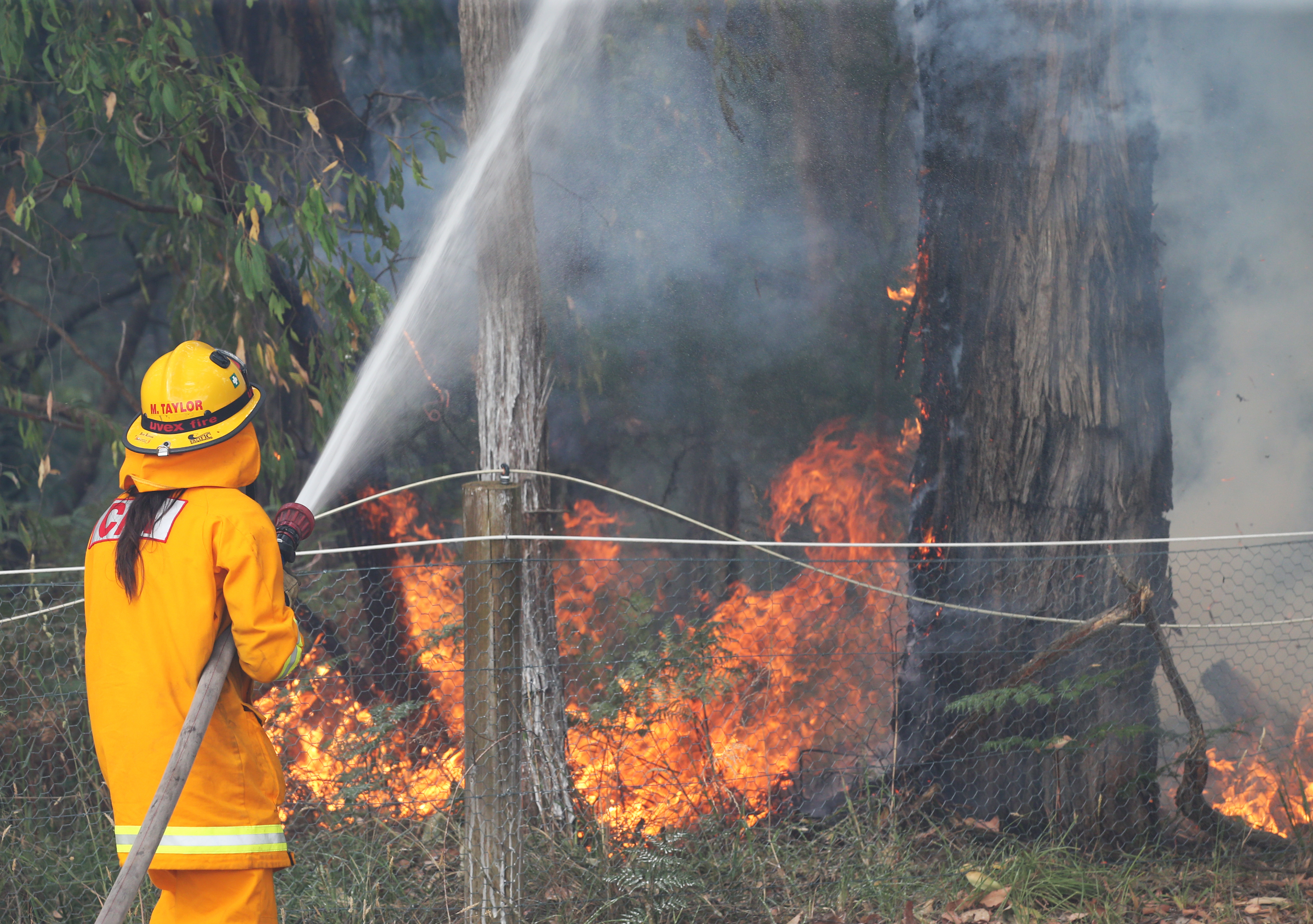
When conditions are safe, the CFA burns vegetation to remove fuel which in turn mitigates fire risk. Jason Edwards/PR Handout Image

Hazard reduction burns don’t help: a 2015 study

For its report, the Climate Council relied heavily on a 2015 study based on fire and weather records from southeastern Australia over a period of 34 years. This is a relatively short time when it comes to ecosystem cycles – the earth’s natural recycling process of resources like water and carbon.

The researchers of this study used a metric called “leverage” to evaluate the effect of hazard reduction burning on reducing the extent of wildfires. “Leverage” in this context refers to the ratio between the area burnt by wildfires and the area burnt by prescribed burning.

And they concluded hazard reduction burning has a statistically significant effect on the extent of wildfires, but only in forested areas with distinct annual drought periods.


Read more: A surprising answer to a hot question: controlled burns often fail to slow a bushfire


The leverage measure implies that prescribed burning only increases the total area burnt, and is therefore ineffective in reducing fire extent.

Like all scientific papers, the conclusions of the 2015 paper are drawn from several assumptions. And while the conclusions are valid for the researchers’ focus, several assumptions don’t work in a land management context. For instance, it’s assumed only the extent of the area burnt is important, rather than the severity.

But the recovery of the plants, animals, nutrients and habitat after low-intensity fire is much quicker than after high-intensity wildfire, according to a long-term Victorian study.

Several other assumptions were also made in the 2015 study, and it is such assumptions that lead to conflicting conclusions with others. While this study is valid within the context in which it was undertaken and includes useful analysis, the conclusions the Climate Council draws from it aren’t supported.

Australia’s disastrous summer has ignited a debate about the best way to prevent and control wildfires. David Crosling/AAP

Hazard reduction burns do help: a 2009 study

A 2009 study looking at 52 years of fire history in southwest Western Australia identified the benefits of hazard reduction burns. This includes it leading to fewer fires starting and a greater ability to suppress fires in prescribed burnt areas.

A big reason for the different findings is because, unlike the 2009 study, the 2015 study didn’t explicitly consider how past prescribed burns lower the severity of new high-intensity fires when they move in. This helps fire suppression efforts and helps reduce the spread of wildfires.

The 2009 study showed prescribed burning less than about 4% of a million hectares of forested landscape per year wasn’t enough to show trends in reducing wildfires.


Read more: There’s only one way to make bushfires less powerful: take out the stuff that burns


But in the 2015 study the Climate Council used, only included 2% of prescribed burning in the forested landscape of southeast Australia, so a conclusion that prescribed burning was ineffective could have been expected.

In other words, not enough of the landscape was prescribed burnt to have a measureable effect, so it cannot be concluded that prescribed burning is ineffective at reducing the impact of bushfires from this analysis.

The Climate Council should have taken a broader view of the available scientific studies before drawing its conclusions.

So should we use hazard reduction burns?

There are many dimensions to the debate about whether to use hazard reduction burns to mitigate and prepare for wildfires. And not all scientific studies will be equally relevant in addressing particular issues.


Read more: To fight the catastrophic fires of the future, we need to look beyond prescribed burning


So before we decide whether hazard reduction burning for land management is a good thing, we need to consider all of the variables. This includes increased ecosystem resilience, mitigation of wildfire number and extent, impact on human health, economic value, social impact, Traditional Owner culture, and more.

The Climate Council’s conclusions are drawn only from the consideration of reduced wildfire extent.

In debating the value or otherwise of prescribed burning, we need to use good scientific evidence, but our decisions must be based on the whole picture, not just a selective part of it.

ref. The burn legacy: why the science on hazard reduction is contested – https://theconversation.com/the-burn-legacy-why-the-science-on-hazard-reduction-is-contested-132083

People love the idea of 20-minute neighbourhoods. So why isn’t it top of the agenda?

Source: The Conversation (Au and NZ) – By John Stanley, Adjunct Professor, Institute of Transport and Logistics Studies, University of Sydney Business School, University of Sydney

We were heavily involved in the consultation program for Melbourne’s long-term land-use plan, Plan Melbourne. The idea that resonated most with many participants was shaping the city as a series of 20-minute neighbourhoods.

People generally loved the thought that most (not all) of the things needed for a good life could be within a 20-minute public transport trip, bike ride or walk from home. These are things such as shopping, business services, education, community facilities, recreational and sporting resources, and some jobs (but probably not brain surgery).

Creating a city of 20-minute neighbourhoods is a key policy direction of Plan Melbourne 2017-2050. As the plan states:

The 20-minute neighbourhood is all about ‘living locally’ – giving people the ability to meet most of their everyday needs within a 20-minute walk, cycle or local public transport trip of their home.

This planning idea has gained Melbourne recognition in international planning circles. For example, Singapore’s recent Land Transport Master Plan 2040 is based on shaping the city and its transport systems to achieve 20-minute towns within a 45-minute city. Officials who prepared the report have acknowledged to one of us Melbourne’s leadership with the concept.

The concept is not about travel by car. It is about active transport (walking, cycling) and the use of public transport. The goal is that this combination of modes would offer a reasonably sized catchment area in which people, jobs and services, including recreational opportunities and nature, are accessible.

State Government of Victoria, CC BY

Inner parts of Australia’s capital cities and parts of their middle suburbs already meet a 20-minute neighbourhood test. Very few of the outer suburbs would do so. However, new developments such as the City of Springfield in outer Brisbane are encouraging.

Key ingredients of 20-minute neighbourhoods

If outer suburbs, in particular, are to become 20-minute neighbourhoods, then two key requirements must be met.

First, local development densities need to be increased. This means ensuring minimum density levels of around 25-30 dwellings per hectare, which will better support local activity and services provision.

Consultations with council planners suggest new developments in Melbourne’s outer north, for example, are typically running at about 18 dwellings. The density of developments was about 12 just a decade ago.

Accompanying more dense residential development is the need to integrate a mix of uses within these neighbourhoods. This would bring more jobs and services close to where people live. They would also have a range of housing to support a mix of household types, income levels and age groups.

So we need not just density but also a mix of land uses within a neighbourhood. This is often known as density plus diversity.

Second, local public transport service levels need to be greatly improved. To achieve 20-minute neighbourhoods requires local weekday public transport services running every 20 minutes or better, from around 5am until 11pm (start of last run). That’s a minimum of 55 services per stop per day per direction.

The map below shows very few parts of outer Melbourne have services anywhere near this level.

Public transport service levels across Melbourne (dark green is best, dark red is worst). Source: PTV GTFS feed, Author provided

What would it cost to achieve?

Gross funding increases of about 50% for local public transport services (essentially buses) would be needed to meet this basic service standard for 20-minute neighbourhoods across Melbourne. Based on scaling up the cost of current bus services in Melbourne, we estimate the cost would be about A$250 million a year, or A$4 billion over the long term, in present values.

This is a modest amount compared to current capital commitments for rail. These total A$30-40 billion, depending on what share of the cost of level-crossing removals is attributed to rail. Development of the government’s proposed Suburban Rail Loop around the city will add an estimated A$50 billion. Annual payments for metropolitan train services add A$1.1 billion.

Trains now carry only twice as many passengers as buses do. So the suggestion that an extra A$4 billion or so be spent on bus services, in capitalised terms, is very modest compared to the commitments being made to rail. The amount includes an allowance for infrastructure works to improve operating speeds – such as bus lanes and B-lights, which give buses priority through intersections.

The tram network could make an equally strong argument for extra funding, relative to trains, given the relative passenger loads carried and small new capital program in place for trams (hundreds of millions rather than tens of billions).

Melbourne has recently had a massive jump in spending on capital projects, particularly transport projects. This investment is needed to tackle the backlog from years of neglect and cope with one of the fastest population growth rates of any similar-sized city in the developed world.

The 2019-20 state budget, for example, suggests capital spending will average A$13.9 billion a year over the four years to 2022-23. It was less than A$5 billion a year from 2005-06 to 2014-15.

It’s about more than walkability

In stark contrast, implementation of 20-minute neighbourhoods has been limited to three pilot studies, in Strathmore, South Croydon and Sunshine West. These studies appear to be focused heavily on developing walkable neighbourhoods, rather than on improving access by walking, cycling and public transport, which was the original intent of the idea.

Walkable neighbourhoods are an important part of 20-minute neighbourhoods, but only one part. Increased neighbourhood densities and more mixed-use development across local active transport and public transport catchments, together with better walking, cycling and local public transport opportunities, need far greater attention if 20-minute neighbourhoods are to be created in outer and middle suburbs.

We expect a much stronger focus at the neighbourhood level will deliver very high social, environmental and economic returns from small outlays. But, for this to be achieved, much greater urgency is needed.

ref. People love the idea of 20-minute neighbourhoods. So why isn’t it top of the agenda? – https://theconversation.com/people-love-the-idea-of-20-minute-neighbourhoods-so-why-isnt-it-top-of-the-agenda-131193

Life sentences – what creative writing by prisoners tells us about the inside

Source: The Conversation (Au and NZ) – By Dr Michael X. Savvas, Senior Lecturer in the Transition Office (PhD in Creative Writing), Flinders University

A recent project to encourage South Australian prisoners to write provides insights into how prisoners may benefit from written expression.

The project, Life Sentences, gave more than 70 contributors professional feedback, certificates of merit and publication in a booklet produced annually from 2017 to 2019.

The submissions revealed a surprising diversity of topics, considerable talent and self-awareness.

The back story

Life Sentences began as an offshoot of Art by Prisoners, a visual arts competition organised by Jeremy Ryder, who wanted to showcase art from prisoners across South Australia.

We wondered if prisoners may also want to express themselves through writing. Department for Correctional Services officers promoted Life Sentences and prisoners responded with interest. After the program, Life Sentences booklets were available to the public at the Art by Prisoners exhibitions.

Prisoners also provided cover designs for the project. Life Sentences, Author provided

Firsthand writing from and about prisons isn’t new. Prison literature has a rich tradition, with writers such as Jack London, O. Henry and Oscar Wilde writing about their experiences in jail. The nine years Dostoyevsky spent in Siberian imprisonment and exile gave him the focus and depth of understanding to become one of the greats.

Conversely, illiteracy in Australian prisons is prevalent. A recent government report found around one in three Australian prisoners had only completed Year 9 (or under) at secondary school. One aim of Life Sentences was to provide encouraging feedback for prisoners of varying literacy levels. Although not all of the writing submitted was grammatically perfect, feedback focused on what the prisoners did well in their writing. This was seen as a first step in getting prisoners to enjoy writing and begin the adventure of literacy.

Stories of pain and humour

What Life Sentences contributors wrote about was telling. Most entries directly related to what American criminologist Greshem Sykes called the “pains of imprisonment” in 1958. This wasn’t surprising, and it is hoped writing about such pains was healing for the writers. What was more surprising was the number of entries not directly about imprisonment.

Of 77 contributors over three years, 26 expressed pain, fear and depression from imprisonment (even suicidal thoughts), and often how much they missed their children or loved ones. The heartbreaking lines from a 26-year-old woman’s poem called Little Treasure illustrate this:

But I will never forget

His sweet little smile

My darling little boy

Is now their child.

Although male and female prisoners both expressed tender feelings towards their lost partners, the male writers would at times also express sexual longing for their loved ones or for imagined partners. In Prisoner’s Lament, a 61-year-old male wrote:

I can but lament the way my life went,

Before I ended up here,

Instead of a gun and a greed-driven bent,

I’d be armed with a babe and a beer.

Eight of the poems – both fictional and autobiographical pieces – describe prison life using humour. In Lean Cuisine, a man, 45, wrote of the food, gloryless food he got over the course of a week:

Friday’s no surprise with some sort of sloppy pasta

Nothing is as bad as that tomato disaster.

Saturday is early lockup: chicken wings and rice

Some blokes sprint for seconds, yelling ‘This shit’s so fucking nice!‘

Although some contributors wrote about their abusive childhoods, others wrote with nostalgia about their upbringings. A 51-year-old man’s poem, Edge of the World, tells of spending a day on a jetty with his father and siblings:

Like well-practised commandos

we inched along the side rail

dodging gut stains

jagged notches and salty scales.

One prisoner wrote a nostalgic poem about his childhood. Shutterstock

Eight entries philosophised about life, and two honoured religious deities. Two contributors wrote about their lives, with the goal of inspiring others to stay out of jail and lead happier, more productive lives.

Five entries pondered the personal meanings of art or writing. Other themes explored drugs and alcohol, futuristic societies, rock band membership, friendship, political statements (Fuck the System), dreams and the supernatural (The Love of a Lycan was a song about a werewolf). Three entries were hip hop raps.

Being recognised

The Western Australian literary journal Westerly included several of the 2017 entries in a special edition about South Australian writing.

Hidden talents emerged. A 22-year-old male rapper demonstrated advanced verbal skills in his Laggin Rap:

I want my chance to climb but I’m firmly underground

proud to get his lips clappin louder than a thunder cloud.

Man, Hip Hop’s beautiful — totally therapeutical —

better health benefits than pharmaceuticals.

Another contributor submitted two novels in 2017 and two more in the following competitions. Although already an accomplished writer, he incorporated the feedback he received in the first year. His manuscript was an exciting adventure set in 18th century France. The novel begins:

The battlefields were torn by heavy hooves and ran red with blood. Pieces of meat that used to be men lay tossed about and were scattered in windrows. Mud made it difficult to distinguish between uniforms, yet they found uniformity in a death that made a mockery of it all. It was not yet lunchtime.

The same author printed, bound and illustrated his own novels. He and other contributors also revealed a pattern by the third edition of Life Sentences: a growing awareness of their new identities as writers.

Life Sentences is giving prisoners a chance to write expressively. Shutterstock

What Prisoners Need

Australian prison libraries are often inadequate for supporting prisoners who seek to improve their literacy skills.

Knowing what prisoners like to write about could inform decisions about the types of books to stock in prisons to encourage reading and writing. Prisoners who wish to write motivational books could be exposed to notable authors in this genre, such as Tony Robbins and Dale Carnegie.

Education is a powerful way to prevent prisoners from reoffending once they leave jail.

To stay out of prison, ex-prisoners need to achieve what criminologists call “secondary desistance”, meaning both the prisoner and society see the prisoner as changed and occupying a law-abiding role in society. Writing might be one way to achieve this and open up new career paths. Writing may also allow prisoners and “civilians” to connect. As one Life Sentences writer put it:

Without seeing their individual faces, I recognise that I am part of the greater consciousness that makes up the brotherhood of writers across the world.

ref. Life sentences – what creative writing by prisoners tells us about the inside – https://theconversation.com/life-sentences-what-creative-writing-by-prisoners-tells-us-about-the-inside-130783

I made bushfire maps from satellite data, and found a glaring gap in Australia’s preparedness

Source: The Conversation (Au and NZ) – By Wallace Boone Law, PhD Candidate, University of Adelaide

On the night of January 9 2020, my wife and I secured our Kangaroo Island home and anxiously monitored the South Australian Country Fire Service (CFS) website for bushfire advice.

After many horrific weeks of bushfires, the winds had again shifted, and the fire front began a slow, nightmarish march eastward into the island’s central farmlands. Official warnings advised that the entire island was potentially under threat.

Landsat-8 false colour image of southwest Kangaroo Island, showing active bushfires on January 9, 2020. Landsat-8, Author provided

As my good neighbours and volunteer firefighters headed off to battle the flames elsewhere on the island, I desperately wanted to find a way to help. With no firefighting training, I felt I physically had little to offer. But I reasoned that my skills and training in remote sensing and spatial science could potentially turn satellite information into useful maps to track the fires, in more detail than those provided by the Country Fire Service and Geoscience Australia.


Read more: ‘This crisis has been unfolding for years’: 4 photos of Australia from space, before and after the bushfires


While I was ultimately successful, it wasn’t quite as straightforward as I thought. And what I learned about access to good-quality and up-to-date satellite bushfire information surprised me.

Free satellite imagery is abundant; useful information is not

In principle, there are many good sources of free satellite imagery. But selecting, sourcing, understanding and processing a multilayered satellite image into an accurate burnt area map takes technical know-how that is beyond the reach of the people who need it the most.

We are fortunate to live in a time where satellite images are constantly uploaded to the web, often within hours of acquisition. There are many reputable sources for this information, including NASA Worldview, USGS Earth Explorer, USGS LandLook Viewer, and the Sentinel EO Browser.

These websites are gateways to the world of “big satellite data”, and I quickly found myself on a steep learning curve to efficiently navigate them and find recent imagery.

Once downloaded, the next hurdle I faced was how to process a data-rich satellite image into a meaningful and accurate map of the bushfire area. I scoured the internet for “how to” blogs, academic articles, spatial algorithms, and processing codes; these too are the products of much intellectual investment by global scientists, openly and freely available.

As a spatial scientist, I naturally found all this fascinating. But as a resident of an island under assault from bushfires, I also found it frustratingly time-consuming. I crashed my computer testing algorithms. I maxed out my hard drive. I spent hours on possibilities that turned out to be dead ends.

True colour satellite imagery is often the most accessible and easily understood, but it often lacks sufficient detail to clearly identify burnt areas. In this Sentinel-2 true colour image, approximately 210,000 hectares are burnt, but bushfire-impacted areas are barely visible without advanced image processing. Sentinel-2, Author provided

Maps help to fight fires and recover from them

In the end, I produced burnt area maps from Sentinel and Landsat satellite images captured during the fires. I learned that this kind of information can indeed help firefighting and ecological recovery efforts, both during and after bushfires.

Initially I gave the maps to a group of farming friends who had been fighting fires around their properties for weeks. They told me the maps helped save time in assessing which areas had already burned, allowing them to focus on defending unburnt areas, and to make decisions on where to move livestock and install firebreaks.

The positive feedback inspired me to customise my processing techniques, so I could provide updates more quickly when new satellite images became available.

I embedded appropriate safety disclaimers into the maps and released them on Twitter and Spatial Points, a blog site managed my research group at the University of Adelaide.

Within hours, I received messages that the maps were being used for ecological recovery efforts. The maps successfully highlighted remaining patches of habitat where endangered and vulnerable species had found refuge. Several government agencies even contacted me for burnt area information, which I’m told was used to assess infrastructure damage and habitat loss.

Processed Sentinel-2 satellite image. Red areas suggest burnt vegetation. Variation in red hues are caused by dominant vegetation type and soils. Sentinel-2/W. Boone Law, Author provided

National knowledge gap

My experience shows there is a swag of free and regularly updated satellite imagery available, which when interpreted and presented appropriately can potentially be hugely helpful to firefighting and recovery efforts.

However, I am concerned that neither the general public nor decision-makers seem fully aware of the range of satellite information on offer. Nor is there a good understanding of the advanced technical skills needed to access and process imagery into useful map data.


Read more: Yes, the Australian bush is recovering from bushfires – but it may never be the same


This leads me to wonder whether I have stumbled upon a glaring knowledge gap in Australia’s bushfire preparedness.

How can we overcome this technological and information bottleneck? I don’t propose to have all the answers, but I do believe it would be sensible for governments, industry and research agencies to invest in the kind of capabilities that I developed while trying to protect my own local community.

As Australia faces a future of more frequent and extreme bushfires, there will doubtless be many people who would be glad of this kind of information when they need it most.

ref. I made bushfire maps from satellite data, and found a glaring gap in Australia’s preparedness – https://theconversation.com/i-made-bushfire-maps-from-satellite-data-and-found-a-glaring-gap-in-australias-preparedness-132087

Grooming: what parents should know and what schools should do if they suspect it

Source: The Conversation (Au and NZ) – By Larissa Christensen, Lecturer in Criminology & Justice | Co-leader of the Sexual Violence Research and Prevention Unit (SVRPU), University of the Sunshine Coast

This week’s ABC’s Four Corners exposed an elite Melbourne school for failing to adequately respond to the grooming of a student by a former athletics coach, who is now a convicted offender.

Several current and former staff, students and parents told Four Corners St Kevin’s College had a history of failing to adequately deal with complaints of inappropriate behaviour.

Those complaints involved an allegation of sexual harassment and concerns raised by staff members about potential grooming and inappropriate behaviour towards boys by two male teachers.

Findings from the Royal Commission into Institutional Responses to Child Sexual Abuse identified abuse has generally occurred in instances when:

  • leadership and governance had failed (such as not acting on suspicions or allegations of grooming or abuse)

  • there were inadequate or poorly implemented policies and procedures (resulting in ambiguity on what and when to report concerns)

  • there was insufficient training for staff to able to spot grooming and signs of sexual abuse at school.

So, what are schools required to do if they suspect grooming, or if suspicions are raised?

What is grooming?

Grooming is typically considered to be the deliberate action of an adult to befriend a child and establish an emotional connection with him or her. It often (but not always) precedes abuse.

The perpetrator uses grooming behaviours to build a child’s trust and create opportunities to perpetrate abuse.

Grooming encompasses a wide range of tactics, which can include giving the child extra attention or touching them in a non-sexual way, which, over time escalates into intimate behaviours.

Once abuse starts, grooming may be used to maintain, control and conceal the abusive behaviour.

Many perpetrators are now using e-grooming – grooming in an online environment – as another tactic to initiate abuse.


Read more: How the excuse of ‘pure fantasy’ works in online child sex abuse cases


What does grooming look like at school?

During the royal commission, survivors of school-based sexual abuse provided accounts of their experience. They said they had been singled out by the abuser with rewards, attention and favouritism.

While children of any age, gender or background can be victims of grooming, children who experience discrimination, isolation and racism are among those most targeted due to their social vulnerability.

The nature of school environments provides regular interactions between students and staff, as well as authority of staff over children. This can facilitate grooming and create opportunities for abuse. The term “institutional grooming” describes the perpetrator using a position of trust to gain access to a child and avoid detection.

Perpetrators of grooming can use online and offline methods to reach their victims. Shutterstock

The perpetrator may also groom significant others (such as parents, carers or teachers of the child) to build their trust and create further opportunities for abuse.

Children’s behaviour may be a signal they are being groomed. This could include a change in the child’s manner that is out of character. While not telltale signs, indicators can include:

  • appearing withdrawn or distressed
  • avoiding school staff or activities
  • secrecy about who they are spending time with (offline and online)
  • having new unexplained things (such as a mobile phone).

What can parents do if they suspect grooming?

When parents suspect grooming, they should direct their concerns to the school, no matter how trivial it may seem. Often, only after abuse is disclosed, a process of joining the dots uncovers a history of unreported concerns that, in isolation, did not appear to be serious, but together indicated harm.

Of course parents can report directly to police if they believe a crime has been committed. Reluctance to raise concerns is often linked to fear of being wrong.

Secrecy is a powerful tool used by perpetrators to groom children, perpetrate abuse and avoid detection. The best line of defence is open communication and dialogue with children about appropriate and inappropriate behaviours.


Read more: What parents need to know about the signs of child sexual abuse


This creates a safe environment for young people to initiate conversations about issues thare are worrying them. It can enable them to disclose or alert parents to concerning behaviour – whether they notice it in adults or children. Research shows young people most often disclose abuse first to a parent or peer.

Open dialogue between parents and schools is also essential. Parents should be informed of the school’s child protection policies and protocols. They have the right to ask the school what strategies they have in place to keep their children safe.

If parents have reported suspicions to the school but feel like they have not been heard, they are advised to raise their concerns with police.

What should schools do to protect children?

Teachers (like parents) should raise all concerns or disclosures to the school leadership, regardless of how trivial they appear or how respected the teacher involved is.

The Australian Human Rights Commission’s National Principles for Child Safe Organisations were developed in response to recommendations handed down during the royal commission. These principles – which have been endorsed by all governments – provide guidance on how schools can help ensure children’s safety.

Under the principles, schools leaders should develop child safety policies and procedures, ensure they are transparent and widely communicated (including with parents) and consistently enforced. This includes guidelines for reporting, responding to complaints and supporting students.

Some of these actions) include:

  • providing staff training to respond effectively to child safety issues
  • ensuring processes to respond to complaints are child-focused, aimed at protecting children as a priority
  • handling complaints seriously, and responding promptly and thoroughly to any concerns.

Schools must equip teachers with the knowledge and skills to identify concerns, talk to children about safety (including providing support and reassurance, and raise concerns with school leadership or other authorities where necessary.

Mandatory reporting laws typically require teachers (and other occupations) to report their concerns where it is suspected, on reasonable grounds, that a child has or is being abused. But these these laws, and threshold assessments, differ across jurisdictions.


Read more: The royal commission’s final report has landed – now to make sure there is an adequate redress scheme


All schools, however, should have child safety policies in place to guide their responses to concerns that don’t meet this threshold, but that still warrant monitoring or follow-up at a local level, as a form of early intervention.

School leaders must empower students, parents and teachers to raise concerns without fear of reprisals. Without strong leadership, grooming and other behaviours may go unreported, be ignored or dismissed.

Any failings of school leadership should be investigated and addressed by education boards or regulators.

ref. Grooming: what parents should know and what schools should do if they suspect it – https://theconversation.com/grooming-what-parents-should-know-and-what-schools-should-do-if-they-suspect-it-131993

Indigenous pain and protest written in the history of signatures

Source: The Conversation (Au and NZ) – By Trish Luker, Senior lecturer, University of Technology Sydney

Aboriginal and Torres Strait Islander readers are advised this article contains the names and voices of deceased people.

When was the last time you signed your name? Perhaps you are more familiar with the frustrations of trying to insert a digital image of your cursive signature into an inadequate space in a PDF document? You have probably used a Personal Identification Number, a digital fingerprint, your finger or a stylus on an electronic pad.

In European contexts, the signature is a performative act with a long history. In medieval times, rather than signing a name, people placed hands on a bible, uttered oaths, broke objects, signed the cross or exchanged a lock of hair. From these non-documentary forms, the signature developed as a form of validation to transform a written document into a legal action. It became standard practice in the 17th century – a compulsory addition to legal documents, even if the signatory was illiterate.

Legal history

Despite its significance, there has been little judicial guidance to defining the signature.

In Australia and the United Kingdom, courts have accepted different types of signatures, from seal imprints to rubber stamps, fingerprints, initials, a partial signature, words other than a name, a trade name, printed names as well as the traditional handwritten signature. More recently, signatures appearing on faxes, PDFs and on emails have all been accepted as valid.

Signatures are evidence of the will or intent of the person signing and provide insight into the history of legal documents.

In 2000, the Federal Court of Australia decided a thumbprint was a signature that proved a mother’s consent to the removal of her child. Peter Gunner and Lorna Cubillo, members of the Stolen Generations, sued the federal government seeking compensation for the harm they suffered as a result of being taken away from their families and sent to residential schools.

Taken from Utopia

Peter Gunner was seven years old in 1956 when he was taken from his home at Utopia, in the Northern Territory.

A significant, and notorious, piece of evidence in the case was a document titled Form of Consent by a Parent. This was a proforma document, phrased as a request that Gunner be taken away to St Mary’s Hostel and given a Western education.

On the bottom of the form there is a thumb or fingerprint and the name of Gunner’s mother, Topsy Kundrilba. On the basis of this evidence, the court concluded Gunner had been removed at his mother’s request.

Yirrkala Bark Petition, 1963.

Signatures appear on other legal documents involving Indigenous people in Australia, such as petitions where they are signs of political action.

The Yirrkala Bark Petitions were sent in August 1963 to both houses of federal parliament by the Yolngu people living in the area of Yirrkala, Arnhem Land. The petition followed the granting of mining leases without any consultation with the people of Yirrkala.

These petitions are cross-cultural documents written in both Yolngu Matha and English. They follow the Westminster form and are presented on painted bark boards depicting country. The petitions protested the excision of land from the reserve where the Yolngu people live, hunt and where their sacred sites are located. They are now on display in Parliament House.

Yirrkala Bark Petitions – considered Australia’s Magna Carta. Hear the voice of Dela Yunupiŋu reading the 1963 Yirrkala Bark Petitions in Yolngu. Dela is the daughter of Muŋgurrawuy Yunupiŋu, a senior Gumatj cultural leader who was one of the original signatories of the petition in 1963. You can view the petitions on the AIATSIS website https://aiatsis.gov.au/collections/collections-online/digitised-collections/yirrkala-bark-petitions-1963.

More than words

As bark paintings that frame paper with words and signatures, the Yirrkala Petitions demonstrate an innovative cross-cultural legal documentary form: they are symbols of Yolngu title deeds to country.

Because the then Minister for Aboriginal Affairs, Paul Hasluck, questioned the validity of the signatures, the Yolngu people followed up with another document, this time on paper, which contains the names and signatory marks of the leaders of every clan group represented.

On 26 May 2017, 250 Aboriginal and Torres Strait Islander people signed the Uluru Statement from the Heart, calling for a First Nations Voice in the Australian Constitution and a Makarrata Commission to supervise a process of agreement making and truth telling between government and Aboriginal and Torres Strait Islander peoples. The statement, written in the centre of a large canvas with paintings that tell the creation stories of the traditional owners of Uluru, the Anangu people, is surrounding by 250 signatures.

The 2017 Uluru Statement From the Heart features artwork and signatures. Wikimedia, CC BY

The guiding principles for the statement draw on a lengthy history of political campaigns represented in petitions, including the Yirrkala Bark Petitions and the Barunga Statement, presented by the Jawoyn community in Northern Territory to the then Prime Minister, Bob Hawke, in 1988. It is a unique legal document that makes a formal claim on the Australian people and our governing institutions. The statement affirms the sovereignty of the Aboriginal and Torres Strait Islander peoples and that sovereignty has never been ceded or extinguished, but it co-exists with the sovereignty of the Crown.

Such Indigenous declarations of sovereignty demonstrate the way signatures can be mobilised as a sign to transform written documents into legal actions. In this way, they seek to inaugurate a new form of legality.


Reading the signs was made by Impact Studios at the University of Technology, Sydney – a new audio production house combining academic research and audio storytelling. This podcast is available for download through the award winning History Lab podcast. It is the third episode in the four-part series, The Law’s Way of Knowing.

ref. Indigenous pain and protest written in the history of signatures – https://theconversation.com/indigenous-pain-and-protest-written-in-the-history-of-signatures-130458

Holden’s dead end shows government policy should have taken a different road

Source: The Conversation (Au and NZ) – By Roy Green, Emeritus Professor & UTS innovation adviser, University of Technology Sydney

The only surprise about the termination of the Holden brand in Australia was that it caused such surprise.

This was the final nail in an already empty coffin, given local assembly manufacturing ended more than two years ago.

In 2017, when Holden stopped making cars in Australia but committed to keeping the brand with local engineering and design facilities, I wondered how long it could last.

We now know.

There was in reality no commercial justification for a US-based global corporate to continue to invest in switching imported cars to right-hand drive for 3% of 1% of the world’s car market. Holden’s dominant local market share was well and truly a thing of the past, no matter what was being rebadged under its name.

The huge nostalgia for the loss of an iconic Australian brand is perfectly understandable. But the naiveté shown by successive governments in dealing with the owners of this brand is not. Particularly when this has meant accepting commitments supposedly made in good faith in return for billions of dollars of taxpayers’ money.

A parade of Holden cars of all ages marks the closing of Holden’s assembly plant in Elizabeth, Adelaide, on October 20 2017. Mark Brake/AAP

Let’s remind ourselves of the three factors that doomed Australian car assembly.

Tariff protection

The first factor was removing tariff protection. Domestic car manufacturing flourished behind high tariff walls for more than half a century, but like many other areas of manufacturing it was not keeping up with the rest of the world.

It was hoped removing tariffs in the 1980s and exposing the industry to international competition would transform it for the better.

Alongside tariff reform were “industry plans” to manage the transition, in particular focusing on export markets where economies of scale could be achieved. At the same time, workers were given training and financial support to move from companies that couldn’t survive this harsher environment to those that could.

Such success was patchy but, with substantial government subsidies and a number of manufacturers withdrawing from the local market, the Australian car industry continued to be viable. However, as the local makers introduced new models on a drip-feed of investment from their global parents, they lost market share to imports. This could not be offset by increased exports as the same global parents limited Australia’s role in overseas growth markets.


Read more: Vale Holden: how America’s General Motors sold us the Australian dream


Rise of the dollar

The second factor affecting domestic car manufacturing, and indeed Australian manufacturing more widely, was the rise in the value of the Australian dollar associated with the mining boom beginning in the early 2000s.

Local manufacturers found it more difficult, if not impossible, to compete with imports. By 2016 the number of jobs in manufacturing had fallen to less than 684,000, down from more than 903,000 in 2011 (and a peak of 1.35 million in the early 1970s). The “death of manufacturing” became a popular headline.

Some manufacturing has subsequently revived but not in the same form as in the past. Large mass-production facilities were increasingly superseded by small to medium manufacturers pursuing “smart specialisation” in global markets and value chains. This worldwide trend included many companies in Australia’s high-calibre auto-components sector, but less so the car-assembly industry.

Flawed business model

This brings us to the third and decisive factor in the decline of car manufacturing in Australia: a flawed business model.

An industry designed for success in a protected domestic market had to innovate and scale up radically in an intensely competitive global market once protection was removed. This simply didn’t happen.

Holden’s assembly line in Adelaide closed in October 2017. Holden/AAP

In retrospect, we can sympathise with governments not wishing to pull the plug on a major industry employing many thousands of workers. Not many countries can sustain an integrated car manufacturing industry. Most don’t even try.

Those that succeed do so because they can control their own destiny, including investing in future technologies, skills and market development. The only part of the Australian car industry that could control its own destiny was the auto components sector, which was world-competitive.


Read more: Why Australians fell out of love with Holdens


Which brings us to the inevitable counterfactual. What if, instead of directing public support to global car giants that had no intention of transforming local assembly, governments had focused on accelerating the growth of the auto components sector?

The problem in Australia has not been the use of public funds to support manufacturing, but rather to prioritise what might have worked in the past over what we know will be required in the future. Such as electric vehicles.

It is worth taking the opportunity to reflect on the fact this observation applies as much to other challenges – such as climate change – as it does to the car industry.

ref. Holden’s dead end shows government policy should have taken a different road – https://theconversation.com/holdens-dead-end-shows-government-policy-should-have-taken-a-different-road-132080

Yes, the Australian bush is recovering from bushfires – but it may never be the same

Source: The Conversation (Au and NZ) – By Grant Williamson, Research Fellow in Environmental Science, University of Tasmania

As bushfires in New South Wales are finally contained, attention is turning to nature’s recovery. Green shoots are sprouting and animals are returning. But we must accept that in some cases, the bush may never return to its former state.

We’ve all read the devastating figures of destruction this fire season. More than 11 million hectares of land burned across the country over a period of about six months. There is some evidence more than one billion animals perished.

We can take some heart in the regenerative power of the Australian bush. However, when we read of “recovery” in the media, we feel we must clarify what that might actually look like.

While Australia’s environment has evolved to adapt to fire, our research shows we can no longer assume it will recover completely.


Read more: Yes, native plants can flourish after bushfire. But there’s only so much hardship they can take


A fiery future

We are scientists and social science researchers who work in transdisciplinary climate change projects, liaising with park rangers, farmers, policymakers, emergency services and local government.

Our work involves scoping future challenges in land management and developing a range of plausible future climate scenarios for south-east Australia.

Our experience told us something like this catastrophic climatic event was possible, but as researchers we weren’t prepared to see such an inferno this summer.

Although fires are natural in Australia, they’re now occurring at an unprecedented frequency and intensity in areas that, historically, did not burn. This new regime does not allow the effective recovery of natural systems to their pre-fire state.

Alpine ash to ashes

Fires in alpine ash forests (Eucalyptus delegatensis) are a good example of this.

Along with some eucalyptus trees, Australian flowering grass trees (Xanthorrhoea) are pyrophytic plants – which means they are adapted to survive in fire-prone habitats. Natalie Maguire / Flickr, CC BY-SA

Unlike many eucalypt species which can re-sprout after fire, this species’ only means of recovery is through germination via a seed bank in the canopy, and rapid germination and growth of seedlings after fire.

Multiple fires in quick succession kill seedlings before they reach maturity, disrupting the tree’s reproductive cycle and leading to local extinction of the species in the landscape.

Alpine ash forests have endured repeated fires in recent years. In 2013, a blaze in Victoria burnt more than 31,000 hectares of the Alpine National Park.


Read more: Ash to ashes – what could the 2013 fires mean for the future of our forests?


Vast areas have been burnt again in this season’s fires in the same places. Research reveals climate change is increasing the frequency and intensity of fires in the Australian Alps.

This ecosystem will not recover. It will instead transition into a new, different ecosystem, and many species which evolved to live in the original habitat, such as the alpine ash, will no longer be supported. They will be replaced by other vegetation types, such as other eucalyptus woodland, shrubland or grassland.

No more refuge

To further illustrate this point, take the Tasmanian pencil pine Athrotaxis cupressoides.

This slow-growing conifer native to Tasmania can live for up to 1,000 years. They are found in Tasmania’s highlands and sub-alpine regions – historically a Tolkien-esque landscape of moss and emerald green cushion plants, studded with thousands of tiny mountain lakes, called tarns.

But large fires across Tasmania’s pencil pine habitat in recent years, including those in 2016, reduced hundreds of isolated pencil pine communities to blackened skeletons. The stands of trees that remain are struggling to survive in a drying and warming climate.

Pencil pines, widely found in Tasmania, are not fire-adapted and are killed by bushfires. David Bowman

All this is occurring in areas that historically did not experience fire, which allowed a suite of ancient, fire-sensitive species to persist.

As climate change worsens, the pencil pine will be restricted to even smaller areas. Higher temperatures and increased fuel loads increase the likelihood of destruction by fire. Areas where pencil pines have historically been protected will diminish in number and size.

Irreplaceable loss

In these cases and many others, animal species relying on these trees and their ecosystems are profoundly affected.

Well before the latest fires, Australia had an abysmal record on vertebrate extinctions. This summer’s fires have brought some animal species, including the Kangaroo Island dunnart, closer to extinction.


Read more: Australia’s bushfires could drive more than 700 animal species to extinction. Check the numbers for yourself


Future fire seasons will not be normal events, or even some kind of stable “new normal”, to which humans and nature will readily adapt. We’re seeing a trajectory of change in which our climate will shift faster than most living things can tolerate.

The Australian environment evolved with fire and in past conditions, could recover from fire. However climate change has altered the rules irrevocably.

We can no longer rest assured that nature will bounce back, and that knowledge should be a wake-up call for the world.

ref. Yes, the Australian bush is recovering from bushfires – but it may never be the same – https://theconversation.com/yes-the-australian-bush-is-recovering-from-bushfires-but-it-may-never-be-the-same-131390

Can new Snapchat features help troubled teens?

Source: The Conversation (Au and NZ) – By Matthew Fuller-Tyszkiewicz, Associate Professor, Psychology, Deakin University

Snapchat has announced a new feature called “Here For You” that promises to “provide proactive in-app support to Snapchatters who may be experiencing a mental health or emotional crisis”.

The popular youth-oriented app is the latest to join a wave of social media platforms setting out to monitor and improve the well-being of their users.

Details are scarce, but it appears the Snapchat feature will monitor searches for key terms related to anxiety, depression, stress, grief, suicidal thoughts, and bullying. When these are detected, it will return links to helpful resources which Snapchat says will come from local experts.

This could mean, for example, that when a Snapchat user in Melbourne searches for “eating disorder” in the app, they are directed to credible content from Eating Disorders Victoria or the National Butterfly Foundation.

It’s a welcome move from Snapchat, because existing evidence suggests that conversations about mental health (including help seeking) are common online and that searching for such content is associated with lower well-being. Will it work? This likely depends on whether users actually click on the resources, and whether the resources are credible and lead people to seek treatment.

How have other social media platforms approached the issue?

On Twitter, Facebook, TikTok, and Instagram, users can block or report material, and Facebook also provides resources for users to engage directly with other users about their posts. These platforms, along with Pinterest, also deploy artificial intelligence to identify and ban content that may be viewed as harmful.

Facebook and Pinterest have also introduced more proactive measures, attempting to provide resources to users they view as being at risk for mental health concerns.


Read more: Twitter’s plan to help young people not get too overwhelmed by bad news doesn’t go far enough


Perhaps prompted by a number of suicides broadcast via the platform, Facebook has launched a suicide prevention initiative, which uses AI capabilities to flag users who may be at risk of self-harm or suicide. Pinterest prompts users to undertake mood altering in-app activities based on their searches.

Details are often hidden from sight

The exact details of these social media features are often hidden from view, with press releases speaking only in vague terms. The science that may (or may not) motivate the design of the features is seldom mentioned.

There is also an absence of peer-reviewed literature evaluating how successfully these features achieve their stated goals. Such information is essential to know whether these changes are having any effect, or whether further measures are needed to keep social media users safe and well.

Potential benefits of these initiatives should also be weighed against privacy concerns. Privacy experts are concerned that information on Facebook is not covered by traditional data protection and security laws. What’s more, Facebook has not shared details of privacy protection protocols that are in place for the initiative.

We need to know more about social media and mental health

Even if software gets better at monitoring and restricting harmful content, there are plenty of other ways in which social media platforms may lead to emotional crisis. While some of these issues are well known (such as unfavourably comparing oneself to others), some are newer and users need a certain level of online literacy to become less vulnerable to them.

New users need support to avoid falling prey to traps for the unwary, such as catfishing, false accounts and impersonation, or being misled by inaccurate or dangerous health recommendations.

We still don’t know much about what kind of interventions are more effective than others, and for whom. We know that simplistic solutions, such as putting warning labels on digitally manipulated images or temporarily banning users who post offensive content, have not been found to be effective.

Blunt instruments like these may not be sufficiently sophisticated to respond to different levels of need and may only provide a short-term fix to long-term issues. We clearly need a more nuanced, multi-targeted approach.

A holistic approach may be the answer

Media literacy, anti-bullying, and resilience-building programs can reduce exposure to harmful content and equip people with the right skills to help them better manage their social media environment. This more holistic approach to social media-enabled intervention forms the focus of our team’s WIRED project.

One important factor in steering users towards appropriate care is to increase awareness of the importance and availability of health-care services. However, mental illnesses are complex, and having information alone is no guarantee that someone will seek treatment.


Read more: Does social media make us more or less lonely? Depends on how you use it


A host of barriers, both individual and systemic, can also prevent people from seeking help. These include the cost of treatment, lack of local treatment options, and the stigma attached to mental illness.

These barriers and complexities make it imperative that Snapchat and other platforms recommend the right resources. The decisions about these resources must be undergirded by a rigorous base of scientific evidence.

Most of all, Snapchat and its social media siblings must be transparent and accountable. If we can’t see exactly what they’re doing, we have no way to tell if it’s working.

ref. Can new Snapchat features help troubled teens? – https://theconversation.com/can-new-snapchat-features-help-troubled-teens-131992

Rappler co-founder questions ‘guns blazing’ legal attack on top network

Pacific Media Watch

The Philippines top state lawyer has filed a lawsuit against the country’s key television broadcaster with “guns blazing” but he ought to be devoting more effort on governance, says Rappler co-founder and managing editor Glenda M. Gloria.

Gloria, who has been announced as a keynote speaker for the Asian Congress for Media and Communication (ACMC) in Auckland later this year, made the criticism in her latest Beyond the Spin column.

Rappler and the top network ABS-CBN, which has 11,000 employees with their jobs on the line, have been under constant attack by President Rodrigo Duterte during his presidency.

READ MORE: ACMC Change, Adaptation and Innovation: Media, Communication and Culture conference

In an article entitled “Calida’s guns”, Gloria said Solicitor-General Jose Calida had filed a shock petition against the broadcaster before the Supreme Court, asking the justices to void the 25-year franchise of ABS-CBN which is due to expire on March 30.

“We should all look at this for what it simply is: a two-pronged attack to bring down ABS-CBN through judicial action and legislative fiat, whichever would come first,” she wrote.

– Partner –

Various bills for its renewal are pending and up for debate before the expiry date in the House of Representatives, which has the sole mandate to issue franchises.

Protests by supporters of the popular TV network and media freedom advocates and journalists have been widespread against the action by the Duterte government.

Noting that Calida was the fourth highest paid public official in the Philippines, Gloria wrote: “Now if only Calida’s efficiency, doggedness, and surgical precision were applied to governance – the kind that calms a nation in the face of the coronavirus, the type that acts upon evacuees’ woes after the Taal volcano eruption, or simply one that tries to end our traffic nightmare.”

‘Unprecedented backlog’
She also noted that Calida’s office had “an unprecedented one million cases in backlog” in 2017.

On Monday, Calida also sought a gag order against the network.

Gloria will be a keynote speaker at the ACMC “Change, adaption and innovation” conference hosted by Auckland University of Technology on November 26-28.

She took up journalism during the Marcos dictatorship years after graduating from the University of Santo Tomas in Manila.

“Revolutions and transitions have shaped her career and temperament as a journalist,” says the Rappler website. Rappler, one of the most innovative media companies, is also a champion of a free press and has often clashed with Duterte.

Gloria has worked for the Philippine Daily Inquirer, The Manila Times, the Philippine Center for Investigative Journalism and for international news agencies.

In the closing period of the administration of former President Joseph Estrada, she co-founded Newsbreak, which started as a newsweekly.

Conflict books
From 2008 to January 2011, she managed ANC, the ABS-CBN news channel, as its chief operating officer.

A Nieman journalism fellow at Harvard University in 2018, she is the author of Under the Crescent Moon: Rebellion in Mindanao (with Marites Dañguilan-Vitug), a groundbreaking book on the conflict in Mindanao that won the National Book Award.

In 2011, she wrote The Enemy Within: An Inside Story on Military Corruption, with Aries Rufo and Gemma Bagayaua-Mendoza.

Print Friendly, PDF & Email

Article by AsiaPacificReport.nz

Curious Kids: why don’t burns bleed?

Source: The Conversation (Au and NZ) – By Theresa Larkin, Lecturer Medical Sciences, University of Wollongong

Why don’t burns bleed? – from the year three and four students at Islington Public School in NSW


Hello year three and four students – thanks for your excellent question!

To understand burns, we need to understand some things about the skin. Did you know your skin is made up of three different layers?

You might have heard of burns being called first-degree, second-degree or third-degree burns.

This tells us how many layers of skin are affected and how deep the burn is.

First-degree burns

A first-degree burn affects just the outer layer of the skin, which is called the epidermis.

The epidermis protects the inside of our body, including our muscles, bones and organs.

It stops the sun’s harmful rays, sharp objects and water from getting through and damaging the inside of our body.


Read more: Curious Kids: how do wounds heal?


Could you imagine if we didn’t have a waterproof outer layer? You would fill with water and burst the next time you hopped in the bath!

When we have a first-degree burn, this affects just the outer layer of skin.

A first-degree burn, such as sunburn, is red, warm and painful to touch because the cells have been damaged.

Our skin protects us from the sun’s harmful rays, but don’t forget the sunscreen so you don’t get burnt! Shutterstock

So why doesn’t a first-degree burn bleed? Because there actually isn’t any blood travelling in the epidermis.

The blood vessels, which carry blood around our body, are in the next layer down.

This second layer is called the dermis.

Second-degree burns

A second-degree burn affects the outer two layers of the skin: that is the epidermis and the dermis.

The dermis has blood vessels that carry our blood around our body.

The ‘epidermis’ is the top layer of the skin. The ‘dermis’ is the second layer. Shutterstock

Now, you might think that because of the blood vessels in the dermis, a second-degree burn would bleed.

If you cut yourself into the dermis, say, with a deep paper cut, it might bleed.

The difference with a burn is the heat actually stops the blood from flowing.

A small bit of blood may ooze out at first, but it won’t actually bleed much.


Read more: I’ve always wondered: why do our veins look blue when our blood is red?


The dermis also has nerves that make us feel pain if they’re damaged.

A second-degree burn is the most painful burn because it damages the nerves of the skin.

Third degree burns

The third and deepest layer of our skin is called the hypodermis. This is mostly fat, but there are also blood vessels and nerves in this layer.

The veins that you can see on the back of people’s hands are in the hypodermis layer of the skin.

A third-degree burn affects all three layers of skin. This is very deep and will need medical treatment.


Read more: Curious Kids: why do we get bruises?


A third-degree burn doesn’t just damage cells like first-degree and second-degree burns, it actually kills them. The redness of sunburn, and even blisters, will gradually get better and return to normal. But dead cells cannot repair.

A third-degree burn also doesn’t bleed because it completely destroys the blood vessels and the heat stops the blood from flowing.

Even though a third-degree burn causes the most damage, it is actually not painful at that location because it has completely killed the nerves.

Think of a jacket

Our skin is like our own three-layered waterproof, padded jacket.

Your skin is like a jacket with three layers. Shutterstock

The outer layer (epidermis) is thin and protects against water.

The middle layer (dermis) is the material and threading holding the jacket together.

The deepest layer (hypodermis) is thick and padded to keep us warm just like our fat.


Hello, curious kids! Have you got a question you’d like an expert to answer? Ask an adult to send your question to curiouskids@theconversation.edu.au

ref. Curious Kids: why don’t burns bleed? – https://theconversation.com/curious-kids-why-dont-burns-bleed-130792

Bougainville proposing constitution amendments, rejects ‘process’ claim

By Meriba Tulo in Port Moresby

Over the past month, the Autonomous Bougainville Government has made known its intention to put forward several proposed amendments to the Bougainville House of Representatives.

These amendments include a provision to allow for a president to serve for more than two terms – which would see current President Chief John Momis allowed to contest this year’s ABG Elections.

Last week, the Ombudsman Commission released a statement calling on the ABG to strictly follow process and procedures when embarking on constitutional amendments.

The commission highlighted three proposals:

  • Amending Section 89 of Bougainville’s Constitution to allow for an extension of the president’s term to more than two terms;
  • An amendment to allow for the establishment of three seats for former combatants,
  • and a change of name from Autonomous Bougainville Government to Bougainville Constitutional Transitional Government.

Yesterday, Momis, issued the AGB statement in response to the Ombudsman Commission.

While acknowledging the media statement from the Ombudsman Commission, President Momis clarified the proposed amendments, including the membership of former combatants to the House of Representatives, and to section 89 of the Constitution in relation to the election of president.

– Partner –

The ABG president has denied claims that the ABG and House of Representatives are on a path not complying with the National Constitution.

President Momis called on the Ombudsman Commission to retract its statement.

Republished from EMTV News in partnership.

Print Friendly, PDF & Email

Article by AsiaPacificReport.nz

Young people dropping private health hurts insurers most, not public hospitals

Source: The Conversation (Au and NZ) – By Stephen Duckett, Director, Health Program, Grattan Institute

Young Australians are abandoning private health insurance in droves. And the overall decline in the percentage of the population with private coverage is continuing.

New data for the three months to the end of 2019, released yesterday by the private health insurance regulator, show that compared with the same time a year ago, 44,000 fewer young people (aged 25 to 34) have private health insurance.

The percentage of the population with some form of private hospital insurance is down 0.7 percentage points compared to the December quarter in 2018 and now stands at 44.0%.


The private health insurance industry is in a dire predicament, and people who remain in private health insurance also stand to lose out.

But the industry’s argument a youth exodus will put massive amounts of additional pressure on public hospitals doesn’t stack up. The industry’s self-serving claims are simply designed to bolster its case for yet more government handouts.


Read more: Youth discounts fail to keep young people in private health insurance


Why is the industry worried?

The proportion of the population with any form of private hospital insurance is now around 44%.

While the number of young people has fallen, there are 60,000 more people 70 and older than a year ago. The average age of a person with private health insurance continues to creep upwards.


Changes in the composition of the insured population affects different stakeholders – such as the insured, the insurers and the public hospital system – differently.

The more young people drop out, the more the “risk pool” of the insured population worsens, because young people use health care less than older people.

This causes the price of insurance to go up for everyone, which leads to still more young people dropping out. This creates a death spiral for the industry.

Insurers lose out because fewer people are paying insurance premiums.

And those who remain in private insurance lose out because they have to pay higher premiums.

Little impact on the public hospital system

A critical issue is what happens to demand on the public system as the proportion of people who are privately insured declines.

The people who are most likely to drop out are younger people and people who don’t expect to use hospitals much. So logically, this is not likely to have much impact on demand for public care.

Private health insurance is now differentiated into Gold, Silver, Bronze, and Basic products, with “+” designations on the last three of these. Typically debates about private health insurance only focus on the number of people insured not the level of cover they have.


Read more: Premiums up, rebates down, and a new tiered system – what the private health insurance changes mean


About 41% of those insured have coverage with “no exclusions”, the equivalent of Gold.

This means less than 20% of the total population has insurance coverage for all conditions. So many people with private health insurance already rely on the public system for those procedures not covered in their insurance package.

Maternity care, for example, is usually only covered at the Gold tier. Presumably, people with Silver, Bronze, or Basic products were always going to have their baby in a public hospital. So a reduction in the number of people with those products will have no impact on demand for maternity care in public hospitals.

Joint replacements, such as hips and knees, are also normally covered only in Gold products, so the same arguments apply.

People with lower levels of private health insurance already use the public system. Shutterstock

There has been extensive research trying to predict the impact of a decline in private insurance on public hospitals. Researchers have found consumers are relatively slow to respond to changes in the price of insurance. Private health insurance is therefore said to be “sticky”.

Once insured, people, especially older people, tend to stay insured, and respond to premium increases by downgrading their cover, either in terms of what they are covered for (dropping from Gold to Silver, for example), or taking on a higher excess they have to pay if they go to hospital. But a higher excess is unlikely to make them choose a public hospital.

The big changes in terms of dropping out are happening in the group which is new to private health insurance – the young – who have not established a history with insurance.

But young people use health care infrequently, meaning only a small number of hospital admissions would be expected to move from the private to the public system.

A slow death

Our own modelling at the Grattan Institute suggests the death spiral is real, but is slow. People over 70 will probably still be insured at much the same rate they are now over the next ten years, but people under 70 will drop out, with people under 55 dropping out more rapidly.

Young people receive a bad deal from private health insurance. The premium they pay – which is essentially the same as the premium everyone else pays under Australia’s system of “community rating” – is much greater than the costs of their expected use of health care.

The gap between what they pay and expected benefit is getting worse. That’s why they are leaving in droves.

But this decline is a bigger problem for the private insurers than it will be for the public health system.


Read more: How do you stop the youth exodus from private health insurance? Cut premiums for under-55s


ref. Young people dropping private health hurts insurers most, not public hospitals – https://theconversation.com/young-people-dropping-private-health-hurts-insurers-most-not-public-hospitals-132004

Here are 5 practical ways trees can help us survive climate change

Source: The Conversation (Au and NZ) – By Gregory Moore, Doctor of Botany, University of Melbourne

As the brutal reality of climate change dawned this summer, you may have asked yourself a hard question: am I well-prepared to live in a warmer world?

There are many ways we can ready ourselves for climate change. I’m an urban forestry scientist, and since the 1980s I’ve been preparing students to work with trees as the planet warms.

In Australia, trees and urban ecosystems must be at the heart of our climate change response.

Governments have a big role to play – but here are five actions everyday Australians can take as well.


Read more: Go native: why we need ‘wildlife allotments’ to bring species back to the ‘burbs


1. Plant trees to cool your home

At the current rate of warming, the number of days above 40℃ in cities including Melbourne and Brisbane, will double by 2050 – even if we manage to limit future temperature rises to 2℃.

Trees can help cool your home. Two medium-sized trees (8-10m tall) to the north or northwest of a house can lower the temperature inside by several degrees, saving you hundreds of dollars in power costs each year.

Trees can cool your home by several degrees. Shutterstock

Green roofs and walls can reduce urban temperatures, but are costly to install and maintain. Climbing plants, such as vines on a pergola, can provide great shade, too.

Trees also suck up carbon dioxide and extend the life of the paint on your external walls.

2. Keep your street trees alive

Climate change poses a real threat to many street trees. But it’s in everyone’s interests to keep trees on your nature strip alive.

Adequate tree canopy cover is the least costly, most sustainable way of cooling our cities. Trees cool the surrounding air when their leaves transpire and the water evaporates. Shade from trees can also triple the lifespan of bitumen, which can save governments millions each year in road resurfacing.

Tree roots also soak up water after storms, which will become more extreme in a warming climate. In fact, estimates suggest trees can hold up to 40% of the rainwater that hits them.

But tree canopy cover is declining in Australia. In Melbourne, for instance, it falls by 1-1.5% annually, mainly due to tree removals on private land.

Governments are removing trees from public and private land at the time we need them most. Shutterstock

This shows state laws fail to recognise the value of trees, and we’re losing them when we need them most.

Infrastructure works such as level crossing removals have removed trees in places such as the Gandolfo Gardens in Melbourne’s inner north, despite community and political opposition. Some of these trees were more than a century old.

So what can you do to help? Ask your local council if they keep a register of important trees of your suburb, and whether those trees are protected by local planning schemes. Depending on the council, you can even nominate a tree for protection and significant status.

But once a development has been approved, it’s usually too late to save even special trees.

3. Green our rural areas

Outside cities, we must preserve remnant vegetation and revegetate less productive agricultural land. This will provide shade and moderate increasingly strong winds, caused by climate change.

Planting along creeks can lower water temperatures, which keeps sensitive native fish healthy and reduces riverbank erosion.

Strategically planting windbreaks and preserving roadside vegetation are good ways to improve rural canopy cover. This can also increase farm production, reduce stock losses and prevent erosion.

To help, work with groups like Landcare and Greening Australia to vegetate roadsides and river banks.

4. Make plants part of your bushfire plan

Climate change is bringing earlier fire seasons and more intense, frequent fires. Fires will occur where they hadn’t in the past, such as suburban areas. We saw this in the Melbourne suburbs of Bundoora, Mill Park, Plenty and Greensborough in December last year.

It’s important to have a fire-smart garden. It might seem counter-intuitive to plant trees around the house to fortify your fire defences, but some plants actually help reduce the spread of fire – through their less flammable leaves and summer green foliage – and screen your house from embers.


Read more: Low flammability plants could help our homes survive bushfires


Depending on where you live, suitabek trees to plant include crepe myrtle, the hybrid flame tree, Persian ironwood, some fruit trees and even some native eucalypts.

Gardens play a role in mitigating fire risk to your home. Shutterstock

If you’re in a bushfire-prone area, landscape your garden by strategically planting trees, making sure their canopies don’t overhang the house. Also ensure shrubs do not grow under trees, as they might feed fire up into the canopy.

And in bad fire conditions, rake your garden to put distance between fuel and your home.


Read more: Keeping the city cool isn’t just about tree cover – it calls for a commons-based climate response


5. What if my trees fall during storms?

The fear of a whole tree falling over during storms, or shedding large limbs, is understandable. Human injury or death from trees is extremely rare, but tragedies do occur.

Make sure your trees are healthy, and their root systems are not disturbed when utility services such as plumbing, gas supplies and communication cables are installed.

Coping with a warming world

Urban trees are not just ornaments, but vital infrastructure. They make cities liveable and sustainable and they allow citizens to live healthier and longer lives.

For centuries these silent witnesses to urban development have been helping our environment. Urban ecosystems depend on a healthy urban forest for their survival, and so do we.

ref. Here are 5 practical ways trees can help us survive climate change – https://theconversation.com/here-are-5-practical-ways-trees-can-help-us-survive-climate-change-129753

Coronavirus is killing Australia’s lobster export market

Source: The Conversation (Au and NZ) – By Eva Plaganyi, Principal Research Scientist, CSIRO

Currents are strong around the Torres Strait Islands, lying between Australia’s northern-most tip and Papua New Guinea.

When the tidal conditions are right and the waters relatively still, though, up to 230 islanders – a sizeable percentage of the islands’ roughly 4,000 indigenous inhabitants – will board small boats and head out to the surrounding reefs. There they will dive down and search the underwater outcrops for lobsters, grabbing the crustaceans by hand.

It’s laborious work compared with lobster fishing in other parts of Australia, where fishers bait “pots”, then simply pull up the pots with lobsters inside. The tropical rock lobsters of the Torres Strait, however, are sensitive creatures and generally won’t crawl into a trap. By hand is the only sure way to catch them.

But, until a few weeks ago, it has been worth it.

A fisher can sell a live lobster from these waters for $65-95 a kilogram. That makes it worth holding them in water-filled crates and then flying them to wholesalers in Cairns. There they are processed and transported to domestic and international markets.

Tropical lobsters caught in Torres Strait. Eva Plaganyi-Lloyd, Author provided

The most lucrative market is China. Its appetite for live rock lobster makes up about half the value of Australia’s seafood exports (A$660 million of A$1.4 billion).

Now, though, lobster fishers are staying home. There hasn’t been a regular lobster shipment to China since January 26.

With the Wuhan coronavirus suspected to have originated from wild animals in the city’s Huanan Seafood Wholesale Market, Chinese authorities have temporarily banned all wild animal trade. Lobster and other wild-caught aquatic products are exempt from the ban, but demand has plummeted due to people staying home and avoiding both markets and restaurants.


Read more: Fear spreads easily. That’s what gives the Wuhan coronavirus economic impact


This collapse has come at a time that would normally be one of peak demand, and peak prices, due to Chinese New Year festivities. Our industry sources report prices for live lobsters are down 50% to 80%.

An advertisement for rock lobsters in the Queensland Asian Business Weekly on January 31 2020, shows drastically reduced prices, from A$258 a kilogram to A$148 a kilogram, for large lobsters. Author supplied, Author provided

It’s a huge blow to the economy of Torres Strait, along with the rest of Australia’s live seafood export industry.

Loss of livelihoods

Lobster fishing is among the highest-value economic activities in the strait. Indigenous islanders have limited alternatives to make money, given their geographical isolation.

As scientists fortunate to work closely with traditional owners in the Torres Strait over the past decade, we’re saddened to see this devastating impact on livelihoods.

Author Eva Plaganyi-Lloyd with a tropical rock lobster. Eva Plaganyi-Lloyd, Author provided

CSIRO researchers have worked in the strait for more than three decades to help local people sustain their traditional way of life and conserve the marine environment for future generations.

This is no easy feat, considering the resources are also shared with an Australian non-Islander sector and traditional owners from Papua New Guinea.

The region’s wild marine fisheries have been thriving thanks to good management and a strong sense of custodianship by the Islanders.

CSIRO scientists doing a survey of tropical lobster numbers. These annual surveys are used with fishery data to calculate the season quotas for the fishery. CSIRO, Author provided

New harvest strategies for fishing lobster and bêche-de-mer (sea cucumbers) were implemented in December 2019. These took years of research and consultation. This included augmenting scientific surveys with information from fishers to work out sustainable catches.

The new strategies followed a disastrous lobster-fishing year in 2018, when our scientific surveys suggested the lobster population was in trouble due to conditions created by extreme El Niño events. The fishery had to be closed two months early, with substantial economic impact. It was nonetheless an example of Torres Strait Islanders putting sustainability before short-term gain.

No offsets

Now they have the coronavirus to contend with.

The loss of income from those in the fishing business affects other small businesses and ripples throughout the local community.

Selling to the frozen seafood market is an option, but prices are much lower, and there’s a point at which the time, effort and cost of catching a tropical rock lobster make it uneconomical. Boat fuel, for one thing, is expensive. Sales of frozen seafood to China have also taken a dive.

For some Australian fisheries it’s possible taking fewer fish this season will mean a larger fish population next year. So next year’s catch quotas could be adjusted up without jeopardising the marine population. This could partially offset losses this year.

But that’s not an option for the Torres Strait lobster fishery. That’s because by the time a lobster is big enough to catch, usually in its third year of life, it is also ready to migrate, walking several hundred kilometres to the east of the fishery area. So catching fewer lobsters this year won’t mean they are around to catch next year. It is a unique fishery in this regard.

Planning sustainable exports

This impact of the coronavirus on Torres Strait Islanders shows how connected global trade now is.


Read more: High-tech shortages loom as coronavirus shutdowns hit manufacturers


What it also demonstrates is the importance of deliberate and distributed growth in export markets for them to be sustainable.

Heavy dependence on a single market carries a big risk. As things stand, we can expect demand for seafood in China will remain low for some time to come.

This is an opportune time to rethink sustainable export growth strategies.

ref. Coronavirus is killing Australia’s lobster export market – https://theconversation.com/coronavirus-is-killing-australias-lobster-export-market-131750

Vale Holden: how America’s General Motors sold us the Australian dream

Source: The Conversation (Au and NZ) – By Jack Fahey, PhD Candidate, Department of Archaeology and History, La Trobe University

General Motors has announced the Holden brand will be “retired” in 2021.

This week’s announcement has been a long time coming. The Holden brand has been in a state of terminal decline since General Motors ceased local manufacturing in October 2017. A once-dominant presence in the everyday life of Australians, Holden became simply one of many imported cars on offer for the Australian consumer.

In 1926, when General Motors set up an Australian subsidiary, management immediately attempted to integrate the firm into the Australian community, importing General Motors public relations practices to Australia.

Using this then novel form of corporate communication, General Motors management placed the firm at the forefront of the nation-building project. It produced pamphlets and took out newspaper advertisements heralding General Motors’ contribution to the local economy.

A 1929 pamphlet asked: “What does General Motors mean?”

It answered: “More wealth for Australia, more jobs for Australians”.

A Holden ad published in the Daily Mercury on June 22 1932, with General Motors’ slogan, ‘More wealth for Australia, more jobs for Australians’. National Library of Australia

An inherited identity

In 1931, General Motors acquired South Australian car body manufacturer Holden’s Motor Body Builders. The formation of General Motors-Holden allowed General Motors to inherit an Australian identity.


Read more: Why Australians fell out of love with Holdens


In the wake of the Great Depression, General Motors’ public relations focused on the firm’s contribution to full employment. The Holden brand was increasingly tied to its industrial workforce. This was a deliberate marketing development, directed towards the paradoxical goal of making General Motors a local institution.

Workers at Holden’s Motor Body Builders, King William Street, Adelaide, putting wooden frames together, c 1919-1928. State Library South Australia

In 1948, General Motors-Holden, in close collaboration with the Australian government, produced the first fully Australian-made car: the Holden 48-215, popularly known as the Holden FX.

Marketed as “Australia’s own”, the Holden was a resounding success for General Motors. The car entrenched local automotive manufacturing and solidified a powerful symbolic connection with the Holden brand and the stability of post-war Australian capitalism.

A Holden FX in an Australian paddock. State Library Victoria

It was in this context the Elizabeth manufacturing facilities opened in South Australia in 1954, forming the backbone of the community and providing a stable source of employment for years to come.

Production and sales of Holdens boomed in the 1950s, helped along by full employment for white men, high tariff protection, state-sponsored migration and amicable relations with trade unions.

Reshaping lives

By 1962, the one millionth Holden rolled off the assembly line, and Australian society had been transformed.

Norm Meninga with sons Mal and Geoffrey in front of the family car in Bundaberg, c. 1965-1970. State Library Queensland, CC BY-NC-SA

Expanding rates of car ownership fostered a unique link between the Holden and the emerging notion of the “Australian way of life”. This was a unique post-war construction, and one deeply related to the growth of manufacturing and a growing suburban landscape.

The new industrial economy reshaped the everyday lives of Australians, fostering booming home ownership and an ever-expanding market for consumer durables. This entrenched General Motors-Holden within the cultural imagination, enabling widespread acceptance of Holden as “Australia’s Own Car”.

Promotional pamphlet produced by General Motors-Holden, c. 1948. State Library South Australia

But this symbolism of Holden obscures a more complicated history, including large-scale industrial dispution, racial tensions on the assembly line and a long-term decline in the industrial workforce.

The dominant imagery of the Australian way of life was male-dominated. Women’s roles were restricted to housewives and mothers. This worked to render the role of women in the firm invisible. But women had worked at General Motors-Holden from its inception.

Women working at General Motors-Holden in 1942. State Library South Australia

Nostalgia for post-war stability ignores the instability faced by those who were excluded, and a growing dissatisfaction with the demands for social uniformity that accompanied the notion of an “Australian way of life”.

Yet the symbolism endured, perhaps best captured by Prime Minister Paul Keating in 1994 with the launch of the “Working Nation” white paper. Keating chose to launch the white paper at the Holden factory, arguing for Holden’s place at the forefront of Australian nation building.

Changing worlds

The Australia of today is very different from the one that embraced Holden as a symbol of national culture.

The Holden car was a powerful symbol for many post-war migrants, as a source of both employment and inclusion into the national myth.

But a once-great manufacturer is now a painful public memory, representing closures, lay-offs and long-term unemployment.


Read more: An end to Australia’s auto dream: why we loved Holden


With access to affordable housing and stable employment increasingly out of reach for a growing number of Australians, the place of the car in the Australian dream has shifted. But the Holden brand was always constructed to serve the interests of its parent company General Motors.

After ceasing Australian manufacturing, the Holden brand was disconnected from our national myths. The car of the last century is no more.

ref. Vale Holden: how America’s General Motors sold us the Australian dream – https://theconversation.com/vale-holden-how-americas-general-motors-sold-us-the-australian-dream-131915

‘You can have both higher super and higher wages’: Albanese

Source: The Conversation (Au and NZ) – By Michelle Grattan, Professorial Fellow, University of Canberra

An “unholy coalition” is attacking the planned increase in the superannuation guarantee, Opposition Leader Anthony Albanese says in his latest “vision statement”, pledging to resist any attempt to stop the legislated rise to 12% going ahead.

In a speech on older Australians – released ahead of Wednesday’s delivery in Brisbane – Albanese says critics “want to see super wound back or abolished. They say that the pension should be enough, or that it reduces wages.

“I absolutely reject this binary approach. With economic growth and productivity you can have both higher super and higher wages.”

The rise in the guarantee, at present 9.5%, would take it in increments to 12% by 2025. The increase has strong critics within government ranks (where some would favour making superannuation voluntary) and outside, among them the Grattan Institute. The government currently has an inquiry into retirement incomes running.

The Australian Council of Social Service has argued that “any increase in compulsory retirement saving above 10% of wages should be based on a careful assessment of the needs of low and middle-income workers before and after retirement”.

ACOSS also says the guarantee should not rise above 10% until tax breaks for super contributions are reformed to make them fair.

Interviewed on Sky on Tuesday, government senator Gerard Rennick, from Queensland, agreed there was a growing push among Liberals to stop the increase.

Albanese says the prescriptions of ACOSS and others play into the government’s hands.

Supporting the guarantee going to 12%, he says “having established the superannuation system we will not stand by and see it chipped away. We want to make it better”.

In his speech Albanese also says a Labor government would charge its proposed body Jobs and Skills Australia with strengthening the workforce for the aged care sector.

This is one of “the workforces of the future”, and needs proper pay and training, and to be able “to provide culturally and linguistically appropriate care”.

Albanese attacks the government’s plan to privatise aged care assessments. “The first interaction the elderly and their families have with the aged care system is through an aged care assessment or ACAT. It is the first step to getting a home care package or entering a residential aged care facility.

“Our aged care system is broken – and this government wants to make it worse by subjecting ACAT to the indifference of the market. There is a role for the market. But markets have no conscience.”

Albanese also endorses the concept of “intergenerational care”.

“The ABC program ‘Old People’s Home for 4 Year Olds’ made me laugh and made me cry – but it also made me imagine a future where intergenerational care is the answer to our aged care crisis.

“Imagine a future where we co-locate aged care facilities including day respites with kinders and preschools.

“Day respite for our elderly is a missing piece of the puzzle. For many families, they want mum or dad to stay at home or live with them, but they worry about the long days when they are at work.

“Imagine being able to drop your child and grandmother off to the same location.

“Imagine knowing their day would be enjoyable and safe, with activities led by well-paid staff.

“The benefits of intergenerational care are immense. It can help our elderly re-engage with the world, minimise their isolation and the effects of their health issues.”

Addressing the issue of older workers who have trouble getting jobs, Albanese says the answer for some is “to upgrade their skills, which underscores the urgency of rebuilding our TAFEs in particular and our VET system in general”.

But cultural change is also needed, he says, and employers must play their part.

“According to Deloitte Access Economics, a 3% increase in workforce participation by Australians aged over 55 would generate a $33 billion boost to the economy each year.

“Volunteering is great. But to build a stronger economy, we must harness the talents of everybody – and that includes older Australians who are sources of wisdom and experience for their employers and co-workers.”

ref. ‘You can have both higher super and higher wages’: Albanese – https://theconversation.com/you-can-have-both-higher-super-and-higher-wages-albanese-132013

Why the global battle over Huawei could prove more disruptive than Trump’s trade war with China

Source: The Conversation (Au and NZ) – By Tony Walker, Adjunct Professor, School of Communications, La Trobe University

China’s ambassador to Australia, Cheng Jingye, let the cat out of the bag this week when he lambasted Canberra over its decision to exclude Huawei from the build-out of Australia’s 5G network.

In uncharacteristically sharp diplomatic language, Cheng described Australia’s campaign against Huawei as “politically motivated” and “discriminatory”.

This is not the first time Chinese officials have voiced their country’s displeasure with the Australian government’s campaign against Huawei. But Cheng’s public intervention represents the most direct criticism of Australia in what is shaping as a defining issue in relations between China and the West.

A burgeoning technology war with China

It is now clear America and its allies are engaged in what has the makings of a full-blown technology war. The ultimate destination of this conflict is unclear, but its ramifications will scar international relationships for decades to come.

The rawness of this issue is likely to become more pronounced as China spreads its superfast 5G technology across the globe in competition with the more expensive Nokia and Ericsson systems. Huawei technology accounts for about 30% of the world’s mobile technology market, double the reach of its nearest rivals.


Read more: What’s at stake in Trump’s war on Huawei: control of the global computer-chip industry


America and its allies fear Huawei’s penetration – indeed dominance – of the market for 5G will give the Chinese company, and China itself, a “backdoor” into communications systems globally.

The battle over Huawei is merely the most visible manifestation of conflict between the US, the longtime leader in technology, and China, the emerging technology superpower. China’s advances in areas like artificial intelligence are already turning assumptions about American technological superiority upside down.

What is in peril is a global communications system in which various players find ways to integrate their technologies. A technology wrangle involving combatants in a fight for dominance in a data-hungry world is giving new meaning to the word “disruption”.

China’s displeasure with Australia’s role

Behind the scenes, China has made no secret of its angst over Australia’s role as what it perceives to be a stalking horse for Washington in a campaign against Huawei and, by extension, other Chinese technology companies.

A lobbying campaign conducted in 2018 by Andrew Shearer, then deputy head of the Office of National Intelligence, particularly incensed Beijing. He had sought to persuade the UK to exclude Huawei from its 5G build-out.

In 2018, Australia became the first country to bar Huawei from providing 5G technology. Shearer is now cabinet secretary and close to Prime Minister Scott Morrison.


Read more: Huawei is a test case for Australia in balancing the risks and rewards of Chinese tech


No Australian prime minister has visited Beijing since Malcolm Turnbull in 2016.

Cool relations between Canberra and Beijing can be attributed in great part to these behind-the-scenes lobbying activities against Huawei by a member of the so-called “Five Eyes” intelligence-sharing establishment (in partnership with the US, UK, Canada and New Zealand).

The UK’s decision, despite pressure from US President Donald Trump, to enable Huawei to help build non-core elements of its 5G network is causing a crisis of confidence among “Five Eyes” participants.

How to deal with China in a new era in which American technological dominance is eroding fast lies at the centre of this argument.

Fallout in Australia from internal “Five Eyes” wrangling over the Chinese company emerged in the past week or so. It was revealed Anthony Byrne, the deputy chair of the Australian Parliament’s intelligence committee, had upbraided visiting British Foreign Secretary Dominic Raab over the UK’s decision to allow Huawei to help build its 5G network.


Read more: Huawei and 5G: UK had little choice but say yes to Chinese – here’s why


That confrontation was leaked to the media and caused the cancellation of a visit to the UK by leaders of the intelligence committee. Committee chair Andrew Hastie and Byrne will now travel to Washington instead for consultations on the Huawei issue.

In some respects, these arguments among friends and allies might be regarded as a storm in a teacup since Australian parliamentary committees are relatively powerless.

However, it is not overstating the case to say differences among the “Five Eyes” on the Huawei issue pose a threat to a long-standing Western consensus about how to manage relations with China more generally.

Fighting words from the US

These cracks were visible at the just-concluded Munich security conference. US Secretary of State Mike Pompeo and Defence Secretary Mark Esper warned that alliances, including the future of NATO itself, were in jeopardy if European countries went ahead with using Huawei technology in their 5G networks.

In an unusually sharp and direct criticism of China, Esper described Huawei as the “China poster child for its nefarious industrial strategy”, one that is “fuelled by theft and coercion and the exploitation of free-market, private companies and universities”. He added:

Reliance on Chinese 5G vendors could render our partners’ critical systems vulnerable to disruption, manipulations and espionage.

The Chinese Communist Party is heading even faster and further in the wrong direction with more internal repression, more predatory behavior, more heavy-handedness and a more aggressive military posture. It is essential that the international community wake up to the challenge.

These are fighting words, but it is at least questionable whether Washington, with the assistance of allies like Australia, will prevail in its efforts to shut Huawei and other Chinese technology companies out of the biggest and most lucrative market of the 21st century – advanced technology.

If there was a consensus among the participants in Munich, it was that Western countries needed to tread warily in absorbing Chinese technology into their communications systems to the point where dependence on China would become irreversible.


Read more: How US-UK intelligence sharing works – and why Huawei 5G decision puts it at risk


A smattering of officials, including Fu Ying, former ambassador to Britain and Australia, represented Beijing at the conference. She posed a rhetorical question that will have resonated with some attendees:

Do you really think the democratic system is so fragile it could be threatened by this single high-tech company, Huawei?

US moves in court against Huawei

Meanwhile, Washington added fuel to an already heated “technology war” by charging Huawei and two of its subsidiaries with federal racketeering and conspiracy to steal trade secrets from US companies.

This represents a significant escalation in the US campaign against Huawei.

Washington is accusing Huawei of purloining trade secrets, including source codes and wireless technology, from six companies. These were were not named but are believed to include US technology giants Cisco and Motorola.

These “racketeering” charges are separate from extradition hearings in Canada involving Meng Wanzhou, Huawei’s chief financial officer and daughter of its founder.

Washington is seeking Meng’s extradition on charges of participating in a decade-long attempt by the company to steal state secrets, obstruct a criminal investigation and evade economic sanctions against Iran.

Whether it likes it or not, the Australian government finds itself attached to an American campaign against Huawei and, in turn, a slew of other Chinese companies.

Leaving aside a conventional trade war between the US and China over soybeans and consumer durables, a technology conflict will prove longer lasting and certainly more disruptive.

ref. Why the global battle over Huawei could prove more disruptive than Trump’s trade war with China – https://theconversation.com/why-the-global-battle-over-huawei-could-prove-more-disruptive-than-trumps-trade-war-with-china-131828

No need to give up on crowded cities – we can make density so much better

Source: The Conversation (Au and NZ) – By Thami Croeser, Research Officer, Centre for Urban Research, RMIT University

The idea that we should decentralise our population has come up many times in Australia. Recently, the National Farmers’ Federation president pushed the notion, calling for a shift to the regions. And the premise is this: city living is unpleasant. Roads are jammed, housing is expensive and it’s all so much nicer out in the country. We need to “spread out”.

We reject this conclusion. Regional centres certainly must play a role in accommodating our population growth, but for now it’ll be a modest role.

The more immediate need is to focus on improving conditions in our major cities. Our smaller towns matter, but we can’t neglect the urgent need to get better at doing the bigger ones right.


Read more: Australia’s dangerous fantasy: diverting population growth to the regions


Our cities are growing very rapidly. The fastest growth is in Melbourne, which added 119,400 residents in 2017-18. That’s nearly as many extra people as the entire population of Darwin in a single year. This rapid growth doesn’t need to mean more traffic, ugliness or stratospheric housing prices and rents – if we confront a difficult truth.

A dirty word in Australia

The truth is we’re just really ordinary at urban density. It’s so poorly executed in Australian cities that it has become a dirty word in local politics.

Urban density targets remain low in planning policies for many states. It’s often set at around 15 dwellings per hectare. In practice, even lower density is delivered.

Australians tend to think of density as living in high-rise tiny apartments. Drop the “d-word” at your local pub and see how the term “shoebox” or “vertical slum” quickly follows.

The irony is that the very thing that makes a getaway to central Paris or Barcelona so attractive is what many Australian city residents revile at home. The places we visit and admire are really quite dense.

Our estimates based on UN figures suggest Paris averages around 213 people per hectare and Barcelona 156. By contrast, Melbourne averages 38 people per hectare and Sydney around 50.

It’s higher-density living that makes their streets and public spaces buzz. But, importantly, this density is achieved through a combination of well-designed mid-rise apartments (roughly six storeys) close to shops, services and public transport. This gives residents the best of both worlds: cities that are liveable and likeable.

A Barcelona streetscape with bike racks: a picture of high-density liveability. Eric Fischer/Flickr, CC BY

Read more: This is what our cities need to do to be truly liveable for all


A failure of planning

Past failed experiments in density have made it difficult to replicate overseas examples locally. The great Australian dream of owning a quarter-acre block and the stigma around density persist with reason. In Melbourne, for example, rapid high-rise development in the last decade has delivered large numbers of very small apartments, in some cases of poor quality and lacking natural light and ventilation.

Very modest investment in public transport makes things worse, as new residents try to cram onto services that haven’t kept pace with growth. Car parking, however, is usually mandated. These planning rules mean the price of new apartments includes the expense of multiple floors of parking, and streetscapes are peppered with vehicle crossover ramps.

Without adequate public transport, roads fill with cars, stoking resident opposition to further infill development. The roads and parking these cars need occupy valuable space, which could be better used for trees and urban greening. Green space is often overlooked in the haste to accommodate rapid population growth, yet it’s essential for community health and well-being and for reducing urban heat island effects.


Read more: Higher-density cities need greening to stay healthy and liveable


Handling population growth doesn’t require us to move to Tamworth or Toowoomba, but it will require some really important changes in our urban development priorities. There has to be a much stronger focus on quality and aesthetics to win back public support for infill development. It’s also going to take commitment to lift density targets in key planning policies.

Plan Melbourne’s 2017 refresh, for instance, has moved to a goal of “over 20 dwellings per hectare”. It follows the recommendations of research in allowing higher densities in high-activity areas such as activity or town centres. However, it will take time to implement this change in existing and new areas across the city.

Reducing car-dominated spaces creates more people-friendly places, as shown here in Basel, Switzerland. Dylan Passmore/Flickr, CC BY-NC

Density must be complemented by suitable streetscapes and infrastructure. This will require a significant rethink of the role of the car in urban areas, greater investment in public transport, and a reallocation of large areas of streetscape space to greenery and pedestrians.

That’s a big ask, but it’s worth it, because density really doesn’t have to mean “dogbox”.


Read more: GOD save us: greenspace-oriented development could make higher density attractive


Dutch show change is possible

Take a (digital) walk around a woonerf neighbourhood in the Netherlands and you’ll notice on-street parking is scant, the speed limit is around 15km/h and plentiful road space is allocated to tree planting and garden beds. Kids play in the street under the watchful eye of long-term locals. You don’t notice the dense apartments around you because there are trees in the way and there’s a lot to see at ground level.

A woonerf (Dutch for ‘living area’) in Amsterdam. We estimate this area has a residential density of over 100 dwellings per hectare. Thami Croeser

Read more: Designing the compassionate city to overcome built-in biases and help us live better


Remarkably, it was only in the 1970s that the Dutch started to move away from car-oriented planning to deliver this kind of urban design, which puts people and place first. With courageous policy change, we could have this in Australia too.

Life on a Dutch woonerf.

ref. No need to give up on crowded cities – we can make density so much better – https://theconversation.com/no-need-to-give-up-on-crowded-cities-we-can-make-density-so-much-better-131304
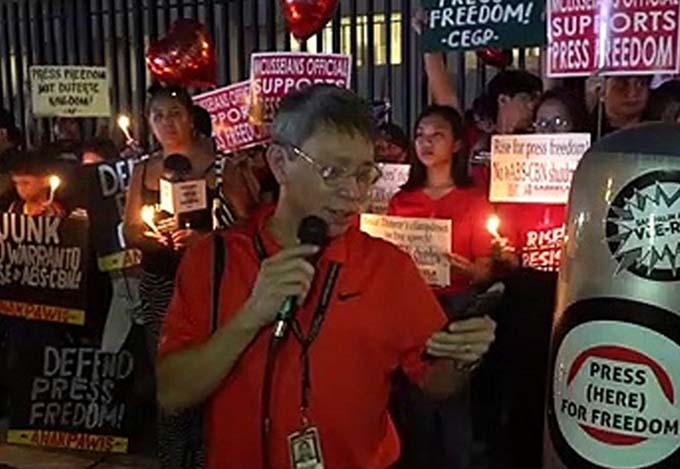
Philippine Solicitor-General seeks gag order against top TV channel

By Felipe F. Salvosa II in Manila

Solicitor-General Jose Calida asked the Supreme Court today to issue a gag order against ABS-CBN, claiming the Philippines’ largest television network was engaging in “propaganda” to sway the justices in the quo warranto case seeking to void its franchise.

Calida filed the “very urgent” motion a week after bringing ABS-CBN to the High Court, accusing the Lopez-led TV network of employing “highly abusive” practices and that its franchise should be forfeited.

The Solicitor-General cited a background video about the quo warranto case by senior reporter Christian Esguerra, and commentaries on the ABS-CBN News website.

READ MORE: Will media freedom survive in the Philippines?

Under the sub judice rule, courts restrict discussions on the merits of pending cases, to avoid prejudgment and influence on the court that could lead to a miscarriage of justice.

Violators may be liable for indirect contempt, based on the Rules of Court.

– Partner –

But there has to be “clear and present danger,” meaning “the evil consequence of the comment must be ‘extremely serious and the degree of imminence extremely high’ before an utterance can be punished,” Associate Justice Noel Tijam wrote in a 2018 decision on a gag order in the case of the quo warranto petition that led to the ousting of Chief Justice Maria Lourdes Sereno, which Calida also initiated.

“Freedom of speech should not be impaired through the exercise of the power of contempt of court unless there is no doubt that the utterances in question make a serious and imminent threat to the administration of justice. It must constitute an imminent, not merely a likely, threat,” Tijam’s decision stated.

Risk of contempt
Reacting to Calida’s gag order petition, Senator Panfilo Lacson said: “I hope the Supreme Court will not include the Senate or any of its committees in the gag order, if issued as petitioned by the Solicitor-General, in deference to the settled jurisprudence that tackled similar issues in the past.”

“What may be covered, though, are the resource persons who will be invited to shed light on this instant case involving the franchise of ABS-CBN as they are not exempt from the sub judice rule, which covers litigants and witnesses, members of the bar and the public in general,” he said in a statement.

“Thus, they may run the risk of being cited for contempt once they express their opinions that might pose a clear and present danger in the administration of justice by directly influencing the members of the Court in rendering their votes to resolve the pending petition for quo warranto,” Lacson said.

Senator Grace Poe, who was set to conduct an inquiry into the ABS-CBN franchise, said the hearing would push through “according to our constitutional mandate.”

“It is up to the Supreme Court to act on that motion under existing laws and jurisprudence where it recognised the jurisdiction of its co-equal branch,” she said in a statement.

Calida’s quo warranto petition has earned condemnation from media workers, academics and other stakeholders, many of them describing it as an attack on press freedom.

President Rodrigo Duterte had vowed to block the renewal of ABS-CBN’s franchise, which expires at the end of March 2020.

There are moves in the Senate and House of Representatives to give ABS-CBN a temporary licence to allow it to operate while lawmakers discuss the renewal of its franchise. Some 11,000 jobs are at stake.

The High Court gave ABS-CBN 10 days to comment on Calida’s petition.

Print Friendly, PDF & Email

Article by AsiaPacificReport.nz

Yes, the system needs to be better. But here’s how to ensure your child can access the NDIS if they need it

Source: The Conversation (Au and NZ) – By Karen R Fisher, Professor, Social Policy Research Centre, UNSW

Access to the National Disability Insurance Scheme (NDIS) for young children with disability is not equal across Australia. Where you live can hinder access to information about disability support, assistance to apply for it, and timely access to services.

Sadly, long-standing problems getting children into disability support were part of the reason the NDIS was introduced in the first place.

Your location can exacerbate inequity at three points: noticing your child needs support, proving they need support, and finding suitable support near you.

We interviewed families with a child who went through the NDIS process and the organisations that support them. Based on our research, we’ve collated some tips to ensure your child can access the NDIS if they need it.


Read more: Understanding the NDIS: will parents of newly diagnosed children with disability be left in the dark?


1. Noticing your child might need support

Some disabilities, like physical disabilities, are visible; but many disabilities are not immediately obvious or don’t have a specific label.

Sometimes families and professionals won’t notice children need help until they get to primary school, when a teacher might suggest a child could benefit from support.

We found one common difficulty for families is wondering whether their child needs support, and what kind of support. Most families have minimal experience of disability, so this can be confusing and distressing.

Social activities like playgroup can be a good place to check in with other parents. Shutterstock

If you have any concerns, it’s a good idea to speak to health and early childhood intervention workers. Asking questions early means your child is more likely to get the support they need.

Even in regional and rural areas, most families will attend health services – whether general practitioners, community nurses or early childhood health centres. These are good places to ask if you think your child needs support.

You might also share ideas about how and where to get help with other parents and with educators at social activities like playgroup, the library, child care and preschool.


Read more: How do I know if my child is developing normally?


2. Proving your child needs support

When you know your child needs support, you must prove they are eligible.

Support is available from different parts of government, which makes it confusing – health, education, early childhood intervention services, child care and now the NDIS. Most support is free, though some families will pay for additional support.

NDIS has two support streams relevant to children.

If your child is aged up to six, contact the NDIS Early Childhood Partner (ECP) in your area.

ECPs are early childhood organisations that have partnered with the NDIS to support young children accessing the scheme. They’re free and your child doesn’t need a diagnosis to seek support.

The ECP will talk to you about what your child might need and support you to get it. Depending on your child’s needs, they will help you obtain equipment, get support from health services and education providers, and apply to the NDIS.


Read more: NDIS failing to catch children with late-onset difficulties


If your child is aged seven or above, contact your NDIS Local Area Coordinator (LAC). These services are also free. If your child is eligible for the NDIS, the LAC will explain how to get a diagnosis to prove they have “permanent and significant disability”, and how to apply for an NDIS package.

Usually getting a diagnosis relies on the health system, which can delay access to the NDIS, depending on where you live.

3. Finding suitable support for your child

Once you’ve secured an NDIS package for your child, you can choose which organisations will provide the support. The ECP or LAC can help you navigate this. Other service providers, including health professionals, educators and NDIS support coordinators can help with this too.

Once in the NDIS, our research confirmed the availability of support and range of choices varies by where you live.

Some families live in places, like rural areas, where there are not many services available. In these cases they need to find creative ways of getting support, including paying community members or using tele- or fly-in services.

Often it takes time before you or someone else notices your child might need disability support. Province of British Columbia, CC BY-NC-ND

The system needs improvement

The current system relies on families or children’s services noticing the child might need support. But not all families know how to be assertive, have the capacity to ask for help or have free medical and social care in their local community.

Another difficulty is the NDIS is confusing for families, and even for support providers. First, it’s different for children aged 0-6 and older children. Second, it overlaps with education, health and other services. These factors mean families and service providers are often unsure which part of the NDIS or other services can help and how.

Every family’s experience of the NDIS is different. Some families in our research said they didn’t have enough information about the NDIS. Some families waited a long time before they could get NDIS services. Families with more education, money and information had a better experience.

Generally, families said the process worked best when their GP, early childhood educator or other service had expertise about disabilities and the NDIS, and could guide them.


Read more: Understanding the NDIS: many eligible people with disabilities are likely to miss out


The NDIS is still a relatively new system, so some difficulties are understandable. But the NDIS needs to work together with other parts of government and private services to ensure families know what supports children are entitled to and how to access them.

Any delays receiving an NDIS package or other support for a young child delays the benefit of early intervention and risks higher support needs in the long term.

ref. Yes, the system needs to be better. But here’s how to ensure your child can access the NDIS if they need it – https://theconversation.com/yes-the-system-needs-to-be-better-but-heres-how-to-ensure-your-child-can-access-the-ndis-if-they-need-it-131757

These plants and animals are now flourishing as life creeps back after bushfires

Source: The Conversation (Au and NZ) – By Kathryn Teare Ada Lambert, Adjunct Lecturer/ Ecologist, University of New England

As the east coast bushfire crisis finally abates, it’s easy to see nothing but loss: more than 11 million hectares of charcoal and ash, and more than a billion dead animals.

But it is heartening to remember that bushfire can be a boon to some plants and animals. We’re already seeing fresh green shoots as plants and trees resprout. Beetles and other insects are making short work of animal carcasses; they will soon be followed by the birds which feed on them.

Australia’s worsening fire regimes are challenging even these tolerant species. But let’s take a look at exactly how life is returning to our forests now, and what to expect in coming months.

Life is returning to fire-ravaged landscapes. Flickr, CC BY

The science of resprouting

Of course, bushfires kill innumerous trees – but many do survive. Most of us are familiar with the image of bright green sprouts shooting from the trunks and branches of trees such as eucalypts. But how do they revive so quickly?

The secret is a protected “bud bank” which lies behind thick bark, protected from the flames. These “epicormic” buds produce leaves, which enables the tree to photosynthesise – create sugar from the sun so the tree can survive.

Under normal conditions, hormones from shoots higher in the tree suppress these buds. But when the tree loses canopy leaves due to fire, drought or insect attack, the hormone levels drop, allowing the buds to sprout.

A green shoot sprouting from the trunk of a bushfire-ravaged tree. Darren England/AAP

Insect influx

This summer’s fires left in their wake a mass of decaying animal carcasses, logs and tree trunks. While such a loss can be devastating for many species – particularly those that were already vulnerable – many insects thrive in these conditions.

For example, flies lay eggs in the animal carcasses; when the maggots hatch, the rotting flesh provides an ample food source. This process helps break down the animal’s body – reducing bacteria, disease and bad smells. Flies are important decomposers and their increased numbers also provide food for birds, reptiles and other species.


Read more: Looks like an ANZAC biscuit, tastes like a protein bar: Bogong Bikkies help mountain pygmy-possums after fire


Similarly, beetles such as the grey furrowed rosechafer, whose grubs feed on decaying logs and tree trunks, add nutrients to the soil when they defecate which helps plants grow again.

Insects also benefit from the mass of new leaves on trunks and branches. For example, native psyllids – an insect similar to aphids – feed on the sap from leaves and so thrive on the fresh growth.

Animal carcasses are a sad consequence of bushfire, but provide a boon to some insect species. Sean Davey/AAP

Then come the birds

Once insects start to move back into an area from forested areas nearby, the birds that eat them will follow.

An increase in psyllids encourages honeyeaters – such as bell miners and noisy miners – to return. These birds are considered pests.

A CSIRO study after bushfires in Victoria’s East Gippsland in 1983 found several native bird species – flame and scarlet robins, the buff-rumped thornbill and superb fairy-wren – increased quickly to levels greater than before fire. As shrubs in the understorey regrow, other species will move in, slowly increasing biodiversity.


Read more: Not all weeds are villains. After a fire, some plants – even weeds – can be better than none


Since the recent bushfire in woodland near Moonbi in New South Wales, numerous bird species have returned. On a visit over this past weekend, I observed currawongs landing in the canopy, saw fairy wrens darting in and out of foliage sprouting from the ground, and heard peep wrens in tufts of foliage on bark and high branches.

Honeyeaters moved between burnt and intact trees on the edge of the blackened forest and butterflies visited new plants flowering after recent rain.

The presence of the currawong, while a pest species, shows birdlife is returning to the bush. Flickr, CC BY

Weeds can help

Weeds usually benefit when fire opens up the tree canopy and lets in light. While this has a downside – preventing native plants from regenerating – weeds can also provide cover for native animal species.

A study I co-authored in 2018 found highly invasive Lantana camara provided habitat for small mammals such as the brown rat in some forests. Mammal numbers in areas where lantana was present were greater than where it was absent.

Lantana often grows quickly after fire due to the increase in light and its ability to suppress other plant growth.

Lantana provides cover for animal species. Flickr, CC BY

Is there hope for threatened species?

Generalist species – those that thrive in a variety of environments – can adapt to burnt forest. But specialist species need particular features of an ecosystem to survive, and are far less resilient.

The critically endangered Leadbeater’s possum lives only in small pockets of forest in Victoria.

It requires large fires to create a specific habitat: big dead trees provide hollows for shelter and nesting, and insects feeding on burnt wood and carcasses provide a food source.

The Leadbeater’s possum needs tree hollows to survive. Australian National University/AAP

But for the Leadbeater’s possum to benefit from the fire regime, bushfires should be infrequent – perhaps every 75 years – allowing time for the forest to grow back. If fires are too frequent, larger trees will not have time to establish and hollows will not be created, causing the species’ numbers to decline.

Similarly in NSW, at least 50% and up to 80% of the habitat of threatened species such as the vulnerable rufous scrub-bird was burnt in the recent fires, an environmental department analysis found.

Looking ahead

Only time will tell whether biodiversity in these areas is forever damaged, or will return to its former state.

Large fires may benefit some native species but they also provide food and shelter for predatory species, such as feral cats and foxes. The newly open forest leaves many native mammals exposed, changing the foodweb, or feeding relationships, in an ecosystem.

This means we may see a change in the types of birds, reptiles and mammals found in forests after the fires. And if these areas don’t eventually return to their pre-fire state, these environments may be changed forever – and extinctions will be imminent.


Read more: Fire almost wiped out rare species in the Australian Alps. Feral horses are finishing the job


ref. These plants and animals are now flourishing as life creeps back after bushfires – https://theconversation.com/these-plants-and-animals-are-now-flourishing-as-life-creeps-back-after-bushfires-130293