Supermarkets like to portray themselves as having the health of the community at heart. And in the middle of a pandemic, we’re all grateful supermarkets are still open and, for the most part, the shelves are well stocked.
But our new report, published today, finds our supermarkets are overwhelmingly pushing junk foods on us rather than healthy foods.
They have more promotional displays and more special offers for the least healthy food options, and they tempt us to buy unhealthy products at checkouts.
Our research – what we did
For our report, we surveyed more than 100 Coles, Woolworths, Aldi and independent stores in Australia.
In each store, we measured the shelf space allocated to different foods and how they are promoted at checkouts and end-of-aisle displays. We also looked at discounts on healthy compared with unhealthy items.
We categorised the healthiness of food and drinks based on the Australian Dietary Guidelines, which classify foods as “five food groups” foods (healthy) and “discretionary” foods (unhealthy).
We analysed the findings by supermarket chain and by the level of disadvantage of the area in which each store was located.
Promotion of unhealthy food and drinks at checkouts
We found 90% of staff-assisted checkouts included displays of unhealthy food and drinks. These displays typically included chocolate, confectionery, soft drinks and energy drinks.
The food and drinks on special at checkouts was also 7.5 times more likely to be unhealthy than healthy.
These results show how checkout displays encourage impulse buys of unhealthy snacks. This is in stark contrast to displays near the entrance of most stores, where fresh fruit and vegetables feature prominently.
Unhealthy food is promoted all over the store
The displays at the end of aisles, particularly those in high-traffic areas nearest the front of the store, are where supermarkets put their biggest promotions.
Our survey found that of all end-of-aisle displays with food and drinks, 80% had at least one type of unhealthy item. In Coles, Woolworths and independent supermarkets, there was twice as much unhealthy food as healthy food on display.
Around two-thirds of all specials on food and drinks were for unhealthy items.
End-of-aisle displays are more likely to advertise unhealthy foods than healthy foods.Shutterstock
It matters where you shop
On the measures we looked at there was little difference between Coles and Woolworths.
But Aldi stores were quite different. They had fewer promotional displays and discounts overall. This means unhealthy food is not being pushed on Aldi shoppers in the same way it is at the other major chains.
Independent stores varied widely. On average, they were no better than Coles or Woolworths.
But the two healthiest stores in our study were both independent stores with abundant fresh food, and few promotional displays for unhealthy food and drinks. This tells us a healthier supermarket environment is possible.
We found supermarkets allocate more shelf space to unhealthy food and drinks (chips, chocolate, confectionery, sweet biscuits, soft drinks and energy drinks) compared with fresh and frozen fruit and vegetables.
Critically, this was more pronounced in stores located in more disadvantaged areas.
Supermarkets in lower socioeconomic areas were found to display a higher proportion of selected unhealthy food and drinks.Author provided
If supermarkets don’t take action to improve their practices, the government should be ready to step in to ensure the supermarket environment encourages the selection of healthier options.
Growing numbers of Australians are choosing to receive their hospital care at home, according to figures published today in the Medical Journal of Australia. In 2017-18, more than half a million days of publicly funded hospital care were delivered at patients’ homes rather than in hospital.
“Hospital in the home” is just what it sounds like – an acute care service that provides care in the home that would otherwise need to be received as an inpatient.
It provides an alternative to hospital admission, or an opportunity for earlier discharge than would otherwise be possible. The research found it is also associated with a lower likelihood of readmission within 28 days (2.3% vs 3.6%) and lower rates of patient deaths (0.3% vs 1.4%), compared with being an inpatient.
While federal government plans to boost hospital in the home have been hampered by COVID-19, home service models may be even more valuable in a post-pandemic world.
He told state and territory governments and private health insurers he wanted more care delivered in patients’ homes rather than hospitals, and pledged to make it easier for these services to qualify for funding.
Hunt said his aim was to offer more choice and better clinical outcomes for patients, as well as better efficiency for state and territory health departments and private health funds. He explicitly linked this plan to efforts to curb the spiralling increases in private health insurance premiums, which threaten that industry’s future.
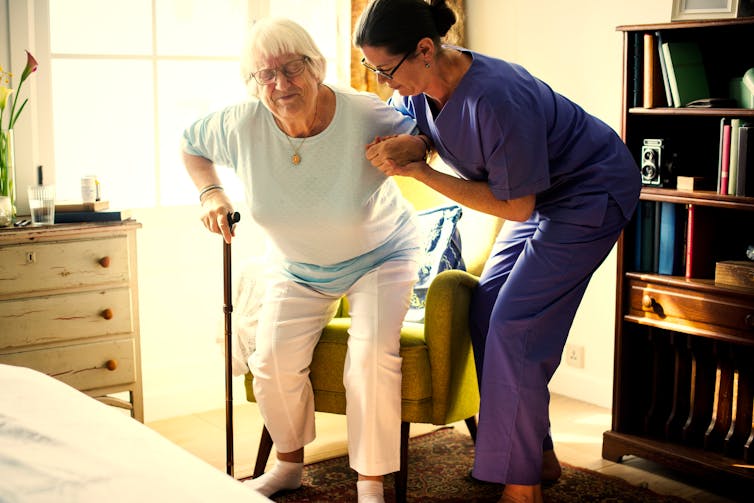
Hospital in the home was on the federal government’s agenda late last year.Shuttershock
The promised revolution has inevitably been stalled by the COVID-19 pandemic. But the new research provides a timely reminder of the importance and potential of hospital in the home.
How is hospital in the home delivered?
Hospital in the home is already a widespread practice in Australia. Nationwide, more than 595,000 days of hospital in the home care were delivered in 2017-18 for public patients, accounting for more than 5% of acute-care bed days.
Yet in the private sector, fewer than 1% of acute bed days were delivered at home.
In Victoria, hospital in the home services have been funded by the public health system since 1994, and have consistently been affirmed as being safe and appropriate for patients.
Victoria’s hospital in the home program delivered more than 242,000 patient bed days in 2017-18. Monash Health’s hospital in the home service provided care for some 14% of the whole health service’s overnight admissions in June 2019.
There is considerable variation between states and territories, and between individual health services, in how these services are delivered.
Generally, they are staffed by a multidisciplinary mix of nursing, medical and allied health staff. Patients admitted to the program remain under the care of their hospital doctor, and the hospital’s full resources are available to each patient should they need them.
Some of the main activities of hospital in the home include:
administration of intravenous antibiotics for short- and long-term infections
administration of anticoagulants to help prevent blood clots
post-surgical care
complex wound care and management
chemotherapy.
Western Health’s hospital in the home program provides support for people with chronic conditions like heart failure, chronic obstructive pulmonary disease and cancer. Monash Health provides a wide range of care throughout life, from premature babies to aged care.
Why is it a good thing?
For patients, the benefits include increased comfort, less noise, freedom of movement, more palatable food and, crucially, reduced exposure to hospital-acquired infections.
Treating patients in their homes can also improve responsiveness to cultural and socioeconomic needs, and provide support for carers.
Patients and carers alike appreciate the ability to choose an alternative to hospital admission and feel more in control when care is delivered in their own home.
Based on international evidence, it is less clear whether discharging patients early from hospital and treating them at home actually reduces costs. A 2012 meta-analysis suggested it does, but more recent Cochrane reviews concluded the cost benefits are “uncertain”.
Despite having pushed hospital in the home reforms onto the back burner, COVID-19 might paradoxically provide even greater impetus for this type of care model.
In the short term, home treatment can relieve pressure on the acute hospital system. One example is the Victorian government’s support for mental health care delivered to young people via hospital in the home during the pandemic.
Longer term, the rapid boost to telehealth and remote monitoring technology driven by COVID-19 will greatly benefit hospital in the home.
Better integrated and coordinated hospital in the home care can be achieved via an e-enabled care model, supporting self-management activities, remote symptom monitoring, patient reminders and decision support. It’s likely we’ll see far less resistance to these measures following the COVID-19 pandemic.
Patients’ and carers’ perceptions of home hospital care are also likely to have improved as a byproduct of COVID-19, as people avoid visiting hospitals in person if possible. These attitudes may last well beyond the pandemic.
While private health insurers are currently enjoying bumper profits as COVID-19 reduces the amount of member claims, the likely economic downturn in the wake of the pandemic may put insurers and private hospitals under great pressure as members cancel their policies due to unemployment or reduced income. Hospital in the home could prove a useful tool to drive down costs.
Hunt’s promised revolution will require big changes to the regulations that govern private health care, and to insurers’ willingness to demand change from private hospitals. But if we have learned anything from COVID-19, it’s that change can happen fast when it’s really needed.
The authors wish to acknowledge staff at Western Health (Micheal Perrone, Erin Webster, Aneta Lavcanski) and Monash Health (Jennine Harbrow, Helen Richards) for their contribution to this article.
Climate scientists use mathematical models to project the Earth’s future under a warming world, but a group of the latest models have included unexpectedly high values for a measure called “climate sensitivity”.
Climate sensitivity refers to the relationship between changes in carbon dioxide in the atmosphere and warming.
The high values are an unwelcome surprise. If they’re right, it means a hotter future than previously expected – warming of up to 7℃ for Australia by 2100 if emissions continue to rise unabated.
Our recent study analyses these climate models (named CMIP6), which were released at the end of last year, and what insights they give for Australia.
These models contain the latest improvements and innovations from some of the world’s leading climate modelling institutes, and will feed into the Intergovernmental Panel on Climate Change (IPCC) Sixth Assessment Report in 2021.
But the new climate sensitivity values raise the question of whether previous climate modelling has underestimated potential climate change and its effects, or whether the new models are overdoing things.
If the high estimate is right, this would require the world to make greater and more urgent emission cuts to meet any given warming target.
These higher climate sensitivity values point to the urgent need to cut our greenhouse gas emissions.Shutterstock
What is climate sensitivity?
Climate sensitivity is one of the most important factors for climate change, strongly influencing our planning for adaptation and mitigation of greenhouse gas emissions.
It’s a standardised measure of how much the climate responds when carbon dioxide concentrations in the atmosphere double. There are a few indices of climate sensitivity that the scientific community uses, and perhaps the most commonly used is “equilibrium climate sensitivity”.
We can estimate equilibrium climate sensitivity by raising carbon dioxide concentrations in models abruptly and then calculating the warming experienced after 150 years – when the atmosphere and ocean would return to a temperature balance.
In other words, giving the climate a “push” with more carbon emissions and waiting until it settles down into a new state.
The previous generation of models (CMIP5) had equilibrium climate sensitivity values between 2.1℃ to 4.7℃ global temperature change. The values for the latest models (CMIP6) are from 1.8℃ to 5.6℃.
This includes a cluster of models with sensitivity of 5℃ or more, a group of models within the previous range, and two models with very low values at around 2℃.
What this means for our future
Higher equilibrium climate sensitivity values mean a hotter future climate than previously expected, for any given scenario of future emissions.
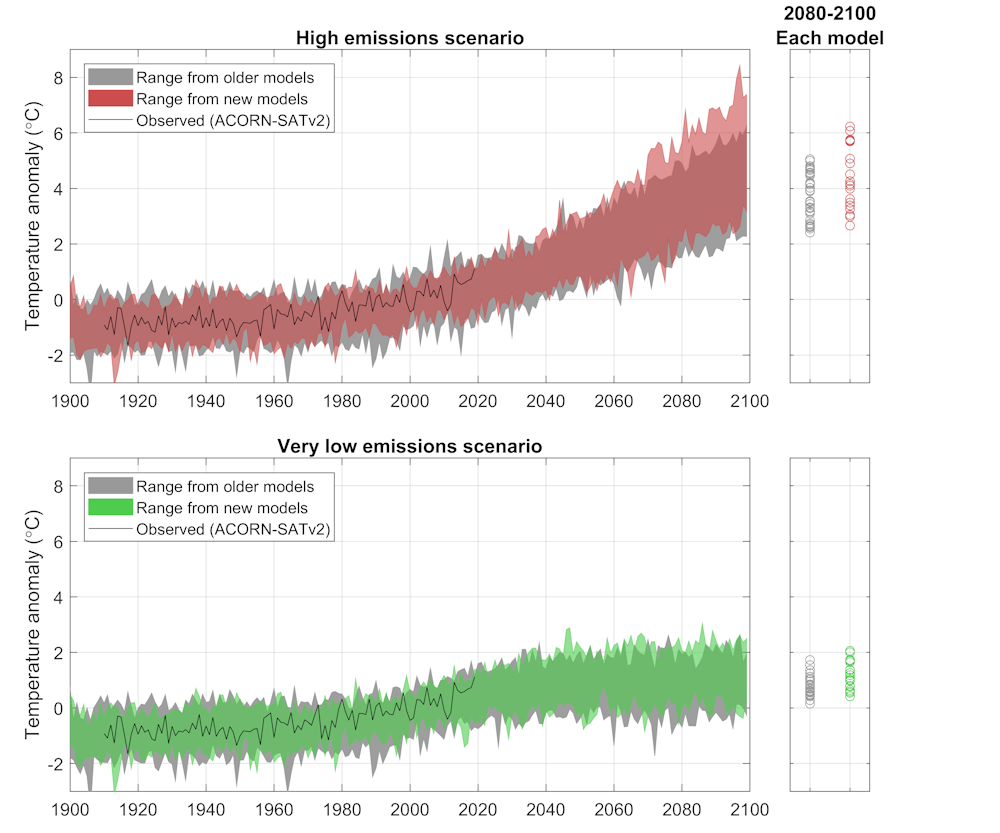
We’ll see Australian temperature increase in a low and high emissions scenario projections (temperature relative to 1995-2014, range of models shown as coloured bands, observations as a black line).Author provided
According to these new models, Australian warming could crack more than 7℃ by 2100 under a scenario where greenhouse gas emissions continue to increase through the century.
These higher temperature changes are not currently presented in the national climate projections, as they didn’t occur under the previous generation of models and emission scenarios.
So what does this mean in practice?
Higher climate sensitivity means increases to heat extremes. It would mean we’ll see greater flow-on changes to other climate features, such as extreme rainfall, sea level rise, extreme heatwaves and more, reducing our ability to adapt.
High equilibrium climate sensitivity would also mean we need to make bigger cuts to our greenhouse gas emissions for a given global warming target. The Paris Agreement aims to keep global warming well under 2℃ since pre-industrial times.
Should we be worried?
These are credible models, representing the new generation versions of top performing modelling systems, developed over decades at high-ranking research institutions globally. Their results cannot be rejected out of hand just because we don’t like the answer.
But – we shouldn’t jump on this piece of evidence, throw out all others and assume the results from a subset of new models is the final answer.
The weight and credibility of each piece of evidence must be carefully assessed by the research community, and by scientists putting together the upcoming IPCC assessment.
We’re only just starting to understand the reasons for the high sensitivity in these models, such as how clouds interact with particles in the air.
And there are other lines of evidence underpinning the IPCC estimate of equilibrium climate sensitivity.
These include the warming seen since the last ice age around 20,000 years ago; measurements of warming seen over recent decades from greenhouse gases already emitted; and understanding different climate feedbacks from field experiments and observed natural variability. These other lines of evidence may not support the new model results.
Essentially, the jury is still out on the exact value of equilibrium climate sensitivity, high values can’t be ruled out, and the results from the new models need to be taken seriously.
In any case, the new values are a worrying possibility that no one wants, but one we must still grapple with. As researchers in one study conclude: “what scares us is not that the models’ [equilibrium climate sensitivity] is wrong […] but that it might be right”.
Source: The Conversation (Au and NZ) – By Kurt Iveson, Associate Professor of Urban Geography and Research Lead, Sydney Policy Lab, University of Sydney
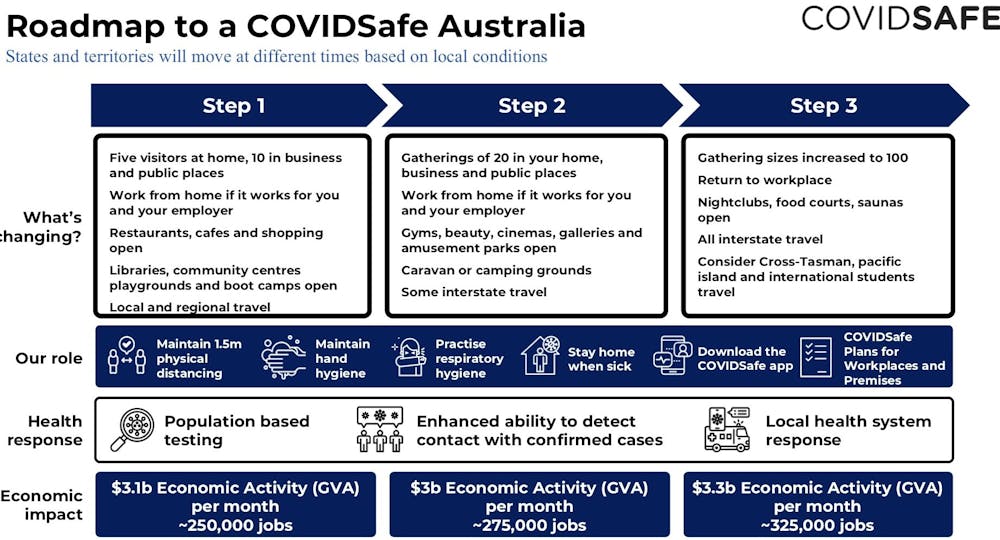
The Commonwealth government says if enough of us download its COVIDSafe app, restrictions on our movements and activities can be lifted more quickly and life can return to normal. As important as it is to contain the spread of coronavirus, no government decision about how to do that is beyond question. For those of us concerned about the social and political life of our increasingly “smart” cities, the thinking behind the COVIDSafe app and other “smart city” technology must be open to challenge.
The public focus has been on the app’s privacy implications, but other important issues warrant critical scrutiny too. Indeed, the app could help to entrench problematic forms of social and corporate power over our lives.
As research on the politics of smart technologies in our cities insists, while personal privacy is important, it’s not the only issue here. Apps like this have implications for the forms of social control that operate in dense urban environments – where use of a digital technology is technically “voluntary”, but ends up being required if people want access to urban spaces and infrastructures.
Some protections are being promised in the case of the COVIDSafe app. These include a prohibition on employers, government authorities and others requiring any individual to install the app. The law still might not stop this in practice. Some business groups have lobbied government to enable employers to require employees to use the app.
Even if this legal prohibition holds, Prime Minister Scott Morrison has been making thinly veiled threats about more people needing to download the app before he lifts restrictions. App uptake is being demanded in the name of a public interest (in this case, public health).
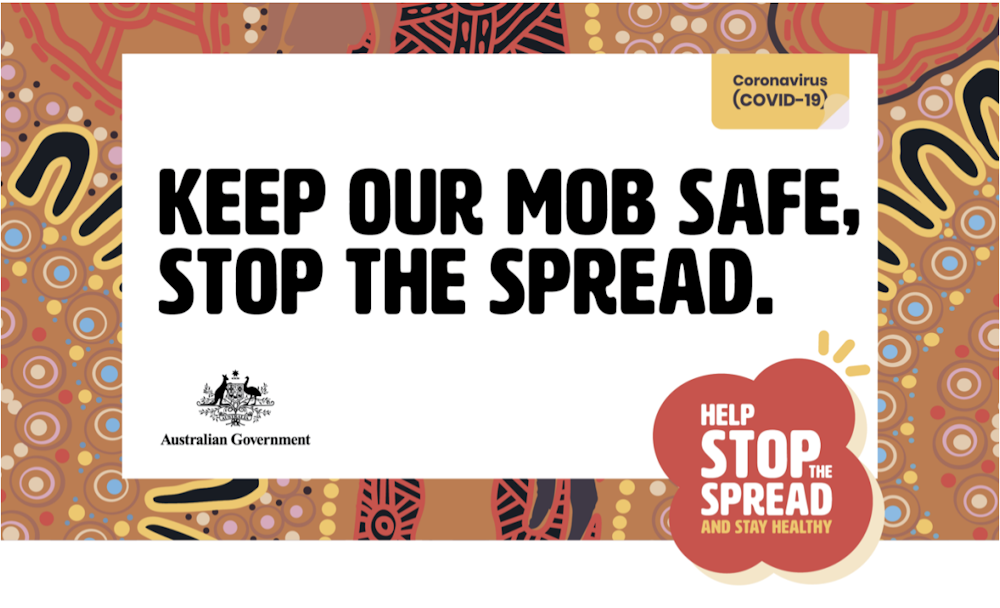
Australian government messaging is framing use of the COVIDSafe app, while voluntary, as being imperative in the public interest.Australian government/AAP
There’s also significant risk of mission creep here. What other “public interests” might be used to justify contract tracing based on this precedent? It’s easy to imagine government agencies and authorities desiring contact tracing in the service of a range of interests that could be discriminatory and oppressive – the policing of immigrants, welfare recipients and activists, for example.
Compared to other government and corporate apps, the COVIDSafe app now has relatively strong privacy protections. It keeps information about who you share space or associate with, but not where you go. It does this by storing encrypted data on the user’s phone about any other phones in range of a Bluetooth “handshake” that are also running the app.
Data will be automatically deleted after 21 days. Data will only be shared after a user has tested positive for COVID-19 and agreed to share the data. Only state health authorities may request and access data for contact tracing.
It may be that neither governments nor corporations can assume people will continue to uncritically accept “trade-offs” of public goods like personal privacy and autonomy for the convenience and benefits of digital technology.
It’s also important to ask who benefits from the mass uptake of this app.
A government agency developed the app, drawing in part on an open-source app made available by the Singapore government. But even when an app is “free” and no one profits from its sale, remember that smartphones and data are not free.
Data storage has been contracted out to Amazon Web Services. It was the only company asked to tender for this lucrative government contract. That has raised both security concerns and questions about why locally owned, security-accredited providers were not invited.
Given these concerns, will the COVIDSafe app even perform as promised? Here, the jury is still out.
Much discussion has focused on the minimum number of app users required for its coverage to be effective. But the app has other limitations too. It doesn’t yet work properly on iPhones, for a start.
Most importantly, the app treats treats Bluetooth handshakes as a proxy for spatial proximity of devices, it treats this spatial proximity as a proxy for contact between people, and it treats prolonged contact between people as a proxy for viral transmission. Each step in this chain is prone to significant failures and error.
Fortunately, then, the government is not proposing to replace contact tracing performed by human health professionals. Data from the app will be used to support that process.
It’s vital we expand the scope of public discussion about this app and others in our increasingly “smart” cities and societies. Otherwise, we risk embracing “smart” solutions that create new surveillance infrastructures that further concentrate state and corporate power at the expense of our autonomy and alternative solutions to pressing societal problems.
Australian economists overwhelmingly back social distancing measures that slow the spread of coronavirus over the alternative of easing restrictions and allowing the spread of the disease to pick up.
But a significant minority, 9 of the 47 leading economists polled in the first of a series of monthly surveys, say they would support an easing of restrictions even if it did allow the spread to accelerate.
The Economic Society of Australia-Conversation monthly poll will build on national polls conducted by the Economic Society, initially in conjunction with Monash University, since 2015.
The economists chosen to take part are Australia’s leaders in fields including microeconomics, macroeconomics, economic modelling and public policy. Among them are former and current government advisers and a former and current member of the Reserve Bank board.
Their responses are given weight by statements explaining their views published in full on The Conversation website and by a requirement that they rank the confidence they have in their responses on a scale of 1 to 10.
What matters is R
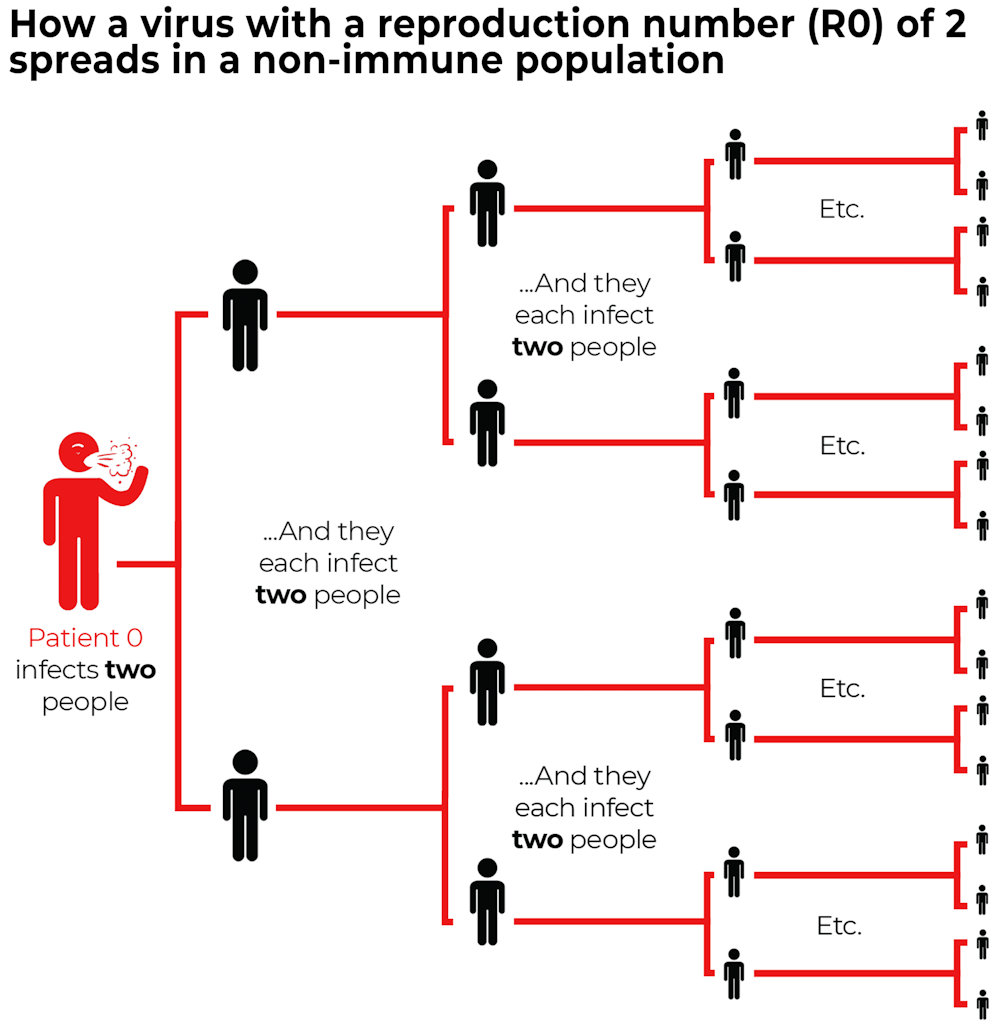
R, which is also referred to as R0, R₀, and Rt is the reproduction number of the virus. It a measure of the average number of other people that any person with it will directly infect.
An R of 2 means that on average each person with the virus will directly infect two other people in a process that will escalate increasingly quickly until after four sets of contacts 16 people have it, and after 20 sets of contacts more than one million people have it.
This snowballing effect is a property of any R above 1.
At an R below 1 the spread decelerates until very few people have it.
In the early days of the outbreaks, Australia’s value of R was well above 1.
The lockdowns and other restrictions have helped push it down to about 1.
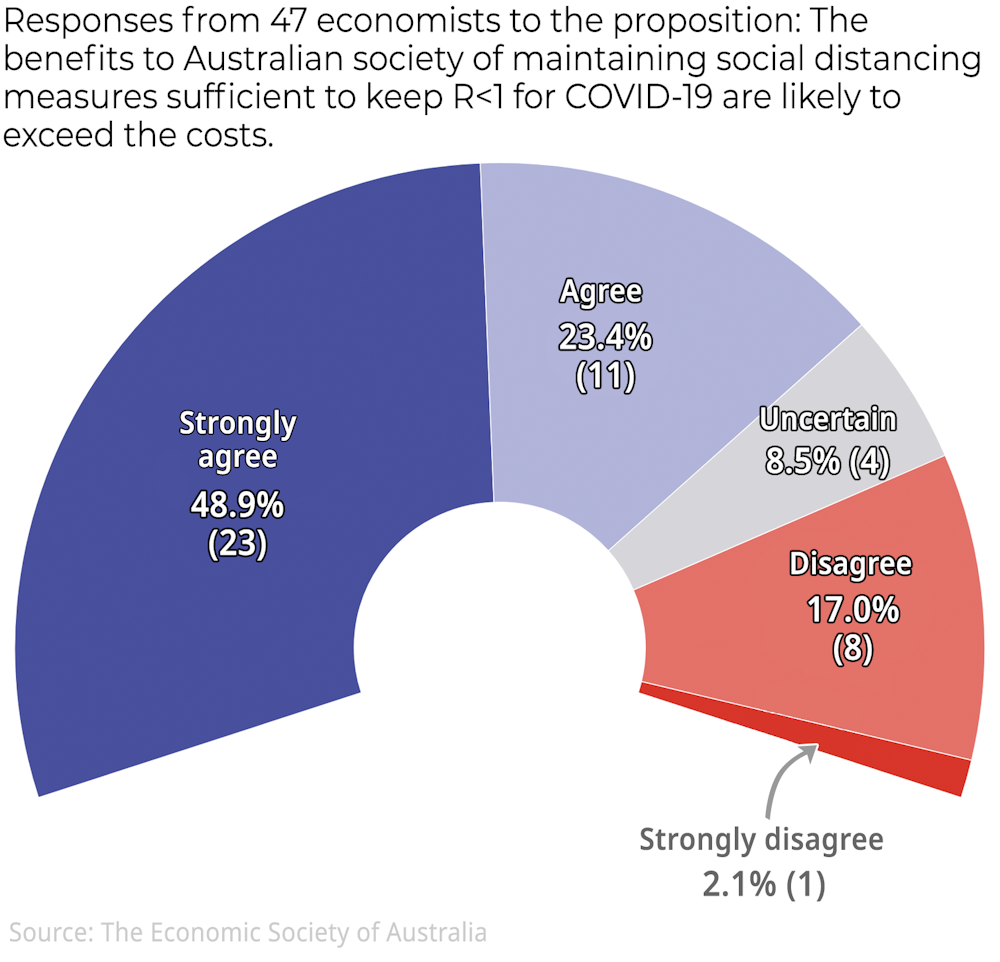
The 47 leading Australian economists selected by the Economic Society of Australia were asked whether they agreed, disagreed, or strongly agreed or strongly disagreed with this proposition:
The benefits to Australian society of maintaining social distancing measures sufficient to keep R less than 1 for COVID-19 are likely to exceed the costs.
The proposition suggests that in the present context it is likely to be worthwhile to continue to maintain the restrictions that are needed to push R below 1 and keep it there.
Almost three quarters of the economists surveyed – 34 out of 47 – backed the proposition, 23 of them “strongly”.
The arguments put for the worth of maintaining social distancing measures sufficient to keep R below 1 include avoiding “tens or hundreds of thousands of avoidable deaths” (John Quiggin) and allowing the economy to return to normal sooner than otherwise by escaping the need for “repeated lockdowns” that might be needed if the disease got out of control again (Ian Harper).
Chris Edmond uses the analogy of the Phillips Curve that is meant to show the the tradeoff between levels of inflation and unemployment.
Although it shows a tradeoff in the short term (more inflation results in lower unemployment) in the longer term it finds no such tradeoff. More inflation simply leads to higher prices with unemployment being no lower.
“In a similar way, there is no long-run trade off between public health and the health of the economy in responding to the COVID-19 crisis,” he says.
Lifting restrictions “risks the worst of all worlds, compromising our public health goals and at the same time not getting a proper economic recovery”.
She says a short and medium term failure to eliminate, or at least slow down, the spread of COVID-19 would entail significant longer-run political, economic and social costs.
Renee Fry-McKibbin points out that that even if the deaths from reopening economic activity turn out not to be high, we have no idea yet of the long term health consequences of exposing more people to COVID-19.
“Will people suffer from respiratory issues going forward requiring ongoing medical attention?” she asks. “We have incomplete information on the actual costs and benefits.”
Saul Eslake, who can see the worth of continued restrictions that keep R below 1, cautions that the longer they remain in place, the more the case for reopening will grow.
Yet the costs of restrictions are growing
Craig Emerson says keeping R below 1 should be merely a “guiding principle” rather than a binding constraint.
“The longer the restrictions are in place, the greater will be the likelihood of links being broken – leading to severe economic hardship, business failures, mortgage defaults, domestic violence, mental health problems, suicide and long-term unemployment, particularly for the young,” he says.
Gigi Foster says, in retrospect, the best thing for Australia to have done would have been to have never had an enforced lockdown, but to have encouraged people to continue to behave as normally as possible while taking precautions, as in Sweden, allowing young and healthy people to acquire immunity in order to protect more vulnerable people, in this and in future waves of the virus.
She suspects the costs of continued restrictions that keep R below 1 outweigh the benefits, including benefits measured in quality-adjusted life years saved.
Hugh Sibley says that by making progress towards eliminating the virus we have eliminated the option of acquiring the mass immunity that would make it easier to live with it.
“We have, in effect, dug ourselves into a hole,” he says. “And we are now congratulating ourselves how deep that hole is. Too few people are asking how we get out.”
Supporters more certain than opponents
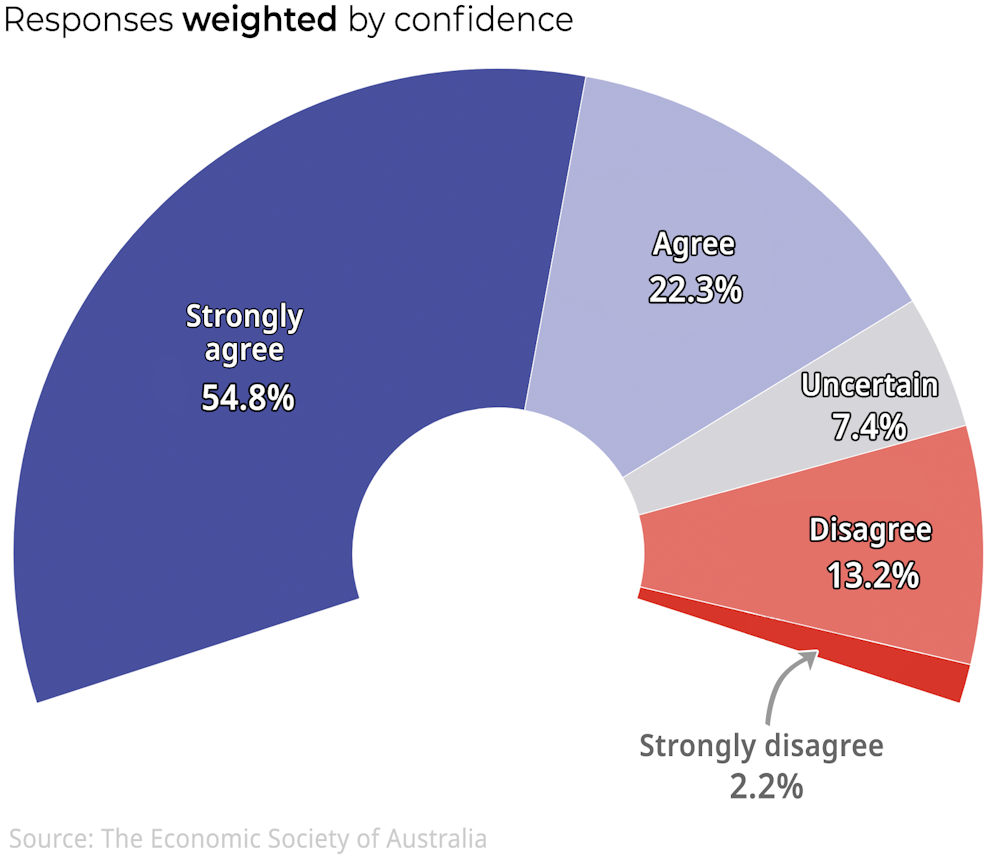
When responses to the survey are weighted by the confidence respondents have in them, opposition to restrictions weakens.
Unweighted for confidence, 19% of respondents oppose the proposition that restrictions that keep R below 1 are likely to be value for money.
Weighted for (lack of) confidence, opposition falls to 15.4%.
Unweighted for confidence, 72.3% support the proposition that restrictions that keep R below 1 are likely to be value for money.
Weighted for confidence, that support grows to 77.1%
The proportion strongly agreeing with the proposition grows from 48.9% to 54.8%
Put another way, when weighted for confidence, a clear majority of the economists surveyed strongly support the proposition that the benefits to society from maintaining social distancing measures sufficient to keep R less than 1 are likely to exceed the costs.
Australia Bureau of Statistics data has confirmed the massive economic hit from the COVID-19 pandemic, with total hours worked across the economy officially falling 9% between early March and early April 2020.
Our analysis, using data from the quarterly ANUpoll, suggests the self-employed have been hit harder, with average weekly hours dropping by almost a third between February and April 2020. More than eight out of 10 self-employed Australians say their profits have taken a significant hit.
Decline in hours worked for the self employed
The ANUpoll is an important economic and social barometer in Australia because it is a longitudinal survey – polling the same group of people multiple times throughout the year. This enables a more accurate snapshot of how individuals are being affected.
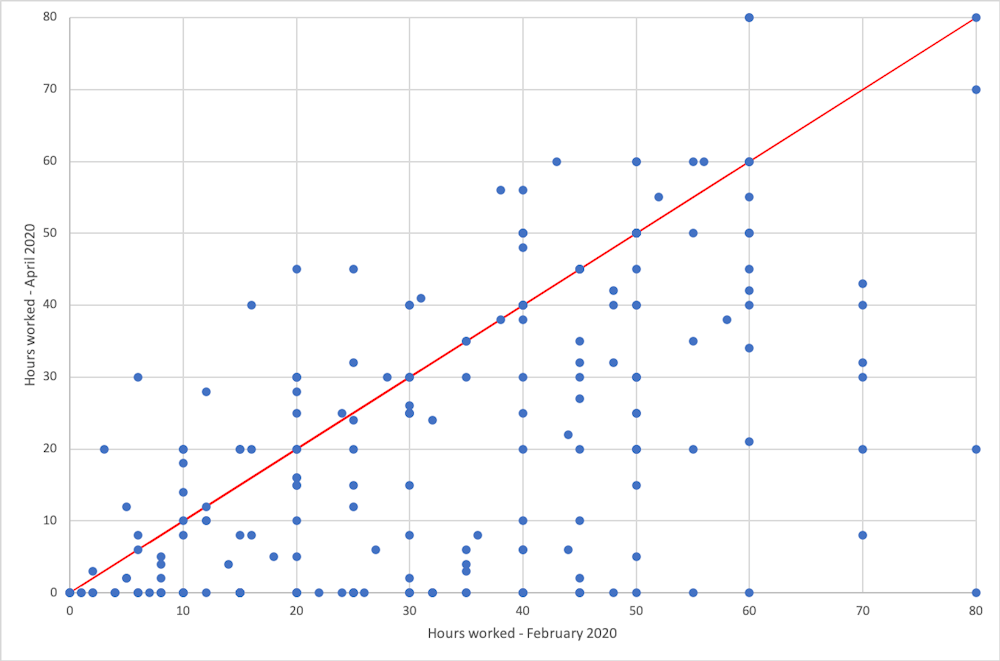
It shows the 32% drop in hours worked by the self-employed (from 35.2 to 23.8 hours) was about double that of all employees, whose hours declined by 16% (from 35.5 to 29.7 hours).
The following infographic illustrates the degree of decline for all the self-employed in the poll (about 240 people). The blue dots above the red line show those working more hours in April; those below the line show those working less. Note the number at or near zero.
Comparing weekly hours worked by the self-employed in February to April 2020.ANU Centre for Social Research and Methods, Author provided
Almost a third said their business would be unviable if financial trends continued for two months. If trends persisted for six months, 40% doubted they could survive.
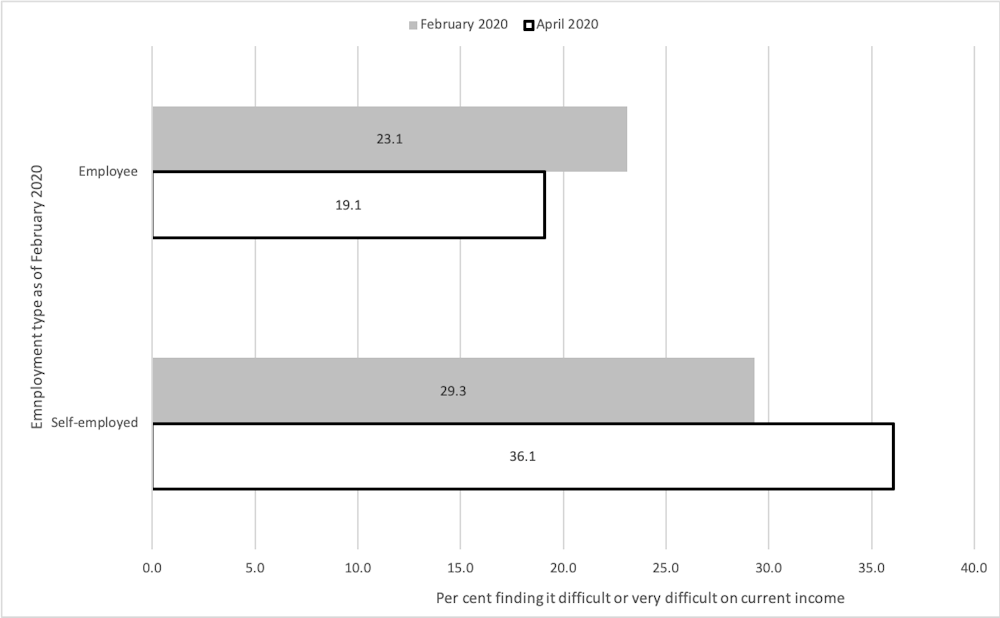
The proportion of self-employed saying they were finding it difficult or very difficult to survive on their current income increased from 29% to 36%.
Proportion of people finding it difficult or very difficult on their current income, by employment type.ANU Centre for Social Research and Methods
This contrasts with an aggregate improvement among employees, most likely due to higher payments for those on lower incomes, such as the A$750 given to social security recipients.
21% of self-employed respondents said they had accessed retirement savings or superannuation early, compared with 7% of employees.
Among those thinking their business was unviable, 69% reported feeling anxious and worried, compared with 59% of those thinking their business was viable. Life satisfaction was also lower (5.6 out 10 compared to 7.0).
What does this mean for the self-employed in 2020?
Current policies includes a large amount of targeted assistance for the self-employed. Without that assistance, the outcomes summarised above would be far worse.
As physical distancing restrictions are eased, it will be important to continue to monitor how the self-employed are faring to ensure the level of government support is sufficient and well-targeted.
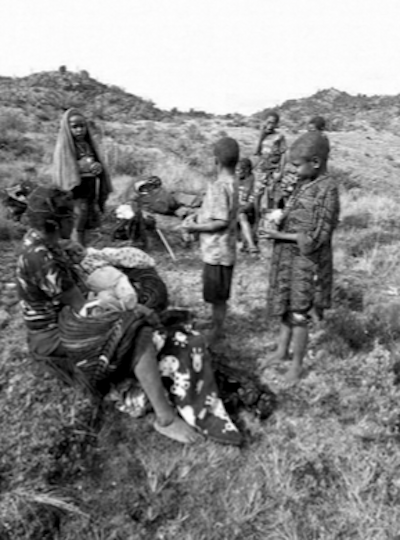
The 4300-km Trans-Papuan Highway costing some US$1.4 billion was supposed to bring “wealth, development and prosperity” to the isolated regions of West Papua.
At least, that’s how the planners and politicians envisaged the highway far away in their Jakarta offices.
President Joko “Jokowi” Widodo is so enthusiastic about the project as a cornerstone for his infrastructure strategies that he had publicity photographs taken of him on his Kawasaki trail motorbike on the highway.
In reality, writes Australian journalist John Martinkus in his new book The Road: Uprising in West Papua published today, the highway brings military occupation by Indonesian troops, exploitation by foreign companies, environmental destruction and colonisation by Indonesian transmigrants.
– Partner –
“The road would bring the death of their centuries-old way of life, previously undisturbed aside from the occasional Indonesian military incursion and the mostly welcome arrival of Christian missionaries.
“It was inevitable, really, that the plan by the Indonesian state to develop the isolated interior of the West Papua and Papua provinces would meet resistance.”
Nduga pro-independence stronghold The Nduga area in the rugged and isolated mountains north of Timika, near the giant Freeport copper and gold mine, has traditionally been a stronghold of pro-independence supporters.
For centuries the Dani and Nduga tribespeople had fought ritualistic battles against each other – and outsiders.
That is, until the Indonesians brought troops and military aircraft to the highlands that “did not play by these rules”.
On 1 December 2018, a ceremony marking the declaration of independence from the Dutch in 1961 by raising the Morning Star flag of a free Papua – as Papuans do every year – ended in bloodshed.
Usually the flag waving – illegal as far the Indonesian authorities are concerned – goes unnoticed. But the highway has now come to this remote village.
Indonesians took photos on their cellphones of the flag raising and this sparked the kidnapping of 19 road construction workers and a soldier (although pro-independence sources argue that many of the workers are in fact soldiers) and they were shot dead.
The Indonesian military have carried out reprisal raids In the 18 months since then forcing some 45,000 people to flee their villages and become internal refugees. Two thousand soldiers, helicopters and 650 commandos are involved in operations and protecting the highway.
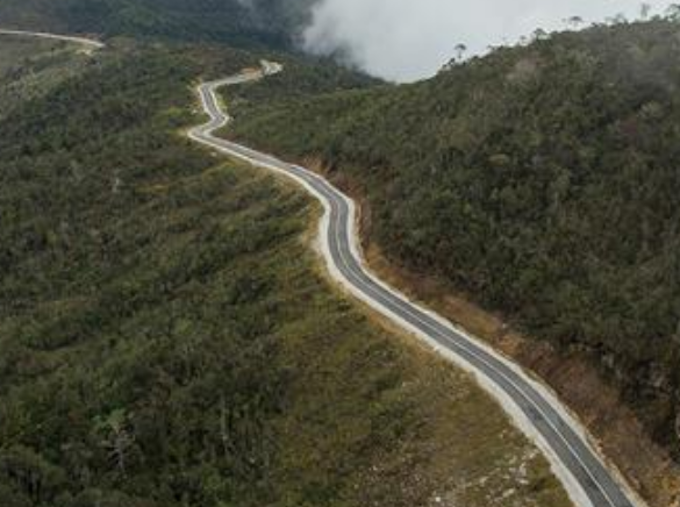
Part of the Trans-Papuan Highway … Two thousand soldiers, helicopters and 650 commandos are involved in operations and protecting the road. Image: Mongabay
‘Helicopters are are the worst’ “It is the helicopters that are the worst. They are used as platforms to shoot or drop white phosphorous grenades or bomblets that inflict horrible injuries on the populace,” writes Martinkus.
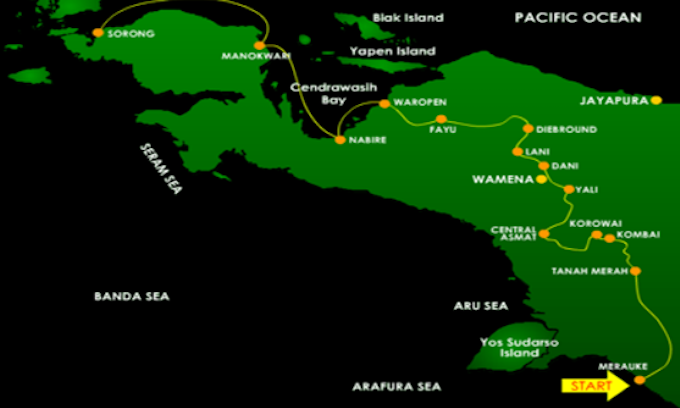
The Trans-Papua Highway would realise the boast of the founding Indonesian President Sukarno for a unified nation – “From Sabang to Merauke”, is what he would chant to cheering rallies.
Sabang is in Aceh in the west of the republic and Merauke is in the south-east corner of Papua, just 60 km from the Papua New Guinean border.
The Indonesian generals, not wanting anything to interfere with their highway exploitation plans, have vowed to “crush” the resistance. However, the contemporary Papuan rebels are better armed, better organised and more determined than the earlier rebellion that followed the United Nations mandated, but flawed, “Act of Free Choice” in 1969 when 1026 handpicked men and women voted under duress to become part of Indonesia.
Martinkus, a four-time Walkley Award-nominated investigative journalist specialising in Asia and the Middle East, has travelled to both ends of this highway. He reported in the early 2000s from West Papua until the invasion of Iraq and Afghanistan became his major beats.
His book A Dirty Little War exposed the hidden side to the Timor-Leste struggle for independence.
His book traverses the winding down of Dutch rule, early history of Indonesian colonialism in West Papua, the environmental and social devastation caused by the Grasberg mine, the petition to the United Nations, the Nduga crisis, the historic tabling of a 40 kg petition by the United Liberation Movement for West Papua calling for a referendum on independence, the so-called 2019 “monkey” uprising that began as a student clash in the Java city of Surabaya and led to rioting across Papua, and now the coronavirus outbreak.
A map of the Trans-Papuan Highway – “The Road”. Image: Tabloid Jubi
Tribute to journalists reporting Martinkus pays tribute to the handful of earlier journalists who have risked much to tell the story that Australian and New Zealand diplomats don’t want to hear and has been denied by Indonesian authorities.
“Eventually in the 1980s and the 90s, writers such George Monbiot ventured into the areas cleared out by the Indonesians [for palm oil plantations and timber]. Robin Osborne also produced a landmark account of that time,” he writes.
“Filmmaker Mark Worth, photojournalist Ben Bohane and ABC-then-SBS reporter Mark Davis continued to try to cover events in West Papua. Lindsay Murdoch of Fairfax provided excellent coverage of the massacre on the island of Biak, off the north coast of Papua.”
As in Timor-Leste, Martinkus recalls, the fall of the Suharto regime in May 1998 provided a “period of confusion among the military commanders on the ground”.
“They didn’t know if they could expel, arrest or kill journalists as they had in the past, and it created an environment where it was finally possible for reporters to get to previously inaccessible places and speak to people.
“The turmoil in Jakarta had created a kind of stasis among the military commanders in the far-flung provinces.”
Nevertheless, the Indonesian military watched and waited – and noted and recorded who the Papuan dissenters were. Who to arrest and kill when political conditions became more helpful.
The Papuan story and gatekeepers Why has it been so difficult to tell the Papuan story – to get past the media gatekeepers? There are several reasons, according to Martinkus.
Nduga families fleeing the conflict. Image: The Road
First, the daily oppression that West Papuan people face – and have faced for half a century – was of little interest to news editors.
“But it [is] that daily fear, and the casual violence and intimidation, that [is] the story,” says Martinkus.
“For Papuans it [has] become a way of life: constant intimidation and violence and extortion by the Indonesian military, punctuated by short, sharp moments of protest and resistance, followed by the inevitable crackdown.”
Martinkus recalls his experience of when reporting in East Timor, “in order to get a story run you had to have more than 10 dead; the daily grind of one shot there, one beating there, one arrest there, never made it into the press.
“I’ll never forget the cynical words delivered down the phone by one Australian editor after I had wanted a man – a boy, really – shot dead in front of my eyes as I cowered in a ditch to avoid Indonesian gunfire in East Timor.
“’So what are your plucky brown fellows up to today?’ he said. He didn’t run the story.”
‘Cosy relationship’ between Australia, Indonesia Another factor is the “cosy relationship” between Indonesia and Australia (and New Zealand) and Martinkus describes how this was tested in January 2006 when 43 Papuan asylum seekers beached in Cape York, Queensland. They had sailed for five days from the southern coast of Papua to escape Indonesian “genocide”.
While they were detained on the remote Christmas Island centre for refugees, they were all – except one – eventually granted with a temporary visa.
Another reason for the media silence, according to Martinkus, is the “lingering memory of the Balibo Five” – the Australian-based journalists, including a New Zealander, who met their fate in East Timor in 1975.
“They were killed in cold blood in the border town of Balibo as the Indonesians prepared to invade, and [a sixth executed] at the wharf in Dili on the first day of the invasion.
“The ruthlessness of those killings, the utter disregard of any international norms and the spineless and reprehensible cover up of the circumstances of their deaths by both the Indonesian and Australian governments had spooked the journalists and media organisations.
“If the Indonesians said you couldn’t go to an area, you didn’t go; the assumption was that they would kill you and no one would intervene.”
Martinkus says that “same attitude prevailed” when he began reporting in Indonesia in the mid-1990s.
‘Random killings, endless arrests’ The author is critical of the “centrist” President Widodo who was elected in a landslide in 2014 and for a second term last year on a promise of a more relaxed policy on access to West Papua.
“Six years later, the random killings, endless arrests and egregious torture continue.
“One recent video shows a Papuan man being bound the sliced with a large military knife as Indonesian troops stand around laughing.
“Another shows a Papuan man restrained in a cell as Indonesian soldiers throw in a snake and take pictures of his terror.”
Martinkus questions the cruel rationale for the need of Indonesian soldiers and police to “drip-feed appalling abuses” on social media.
“Is it some kind of warning to Papuans not to support independence, or just a symptom of the moral vacuum they enter once they are deployed to Papua?”
Martinkus believes that, in spite of the bravado and harsh treatments, Indonesians are “fundamentally scared of the Papuans”.
Although Indonesians have been in West Papua for more than 50 years, “West Papua and its people are still very foreign to them.” They have tried to create a society that is a “mirror image of their own in a land they occupied against the wishes of the local population”.
The attempt has failed, and the Papuans will never stop resisting until they are free.
Many people have revelled in a return to a simpler life in recent weeks. While lockdown restrictions are eased in many places around the world, people will return to a faster-paced, more cluttered lifestyle.
But does it have to be that way? Can we live a simpler life post-lockdown?
With a dramatic decrease in consumer activity, US philosophy professor Emrys Westacott believes this is a time to reflect on whether the type of society we had built was, in fact, the kind of society we want.
Dr Westacott, author of the 2016 book Wisdom of Frugality, said that while a more frugal lifestyle might not be the path for everyone, now was the time for many people to consider what they wanted in life.
For many, that will be a more simpler, frugal life.
– Partner –
The problem is, however, that our society is set up on a high level of economic activity, premised on the chains of buying and selling, and without it operating at a certain level of activity, it grinds to a halt, as seen in recent weeks.
The key was a more rational distribution of employment, Dr Westacott told RNZ Sunday Morning.
More comfortable life “If there was a more equitable distribution of wealth, which is perfectly achievable with, both through companies having more rational pay structures, and also through taxation, I think people could and actually would choose a pleasantly comfortable life where they might be able to work 25 or 35 hours a week instead of 45 or 50 hours a week.”
The Wisdom of Frugality.
That was provided there was a fair pension, decent public transport, housing and healthcare available.
Moving into life out of lockdown, people should reflect on what they want in life, what gives them pleasure and what matters, he said.
“But I would really hope we would take the opportunity to reflect more generally on what type of society we actually want.”
Neoliberalism – assuming market forces know best and produce best outcomes – had been the dominant philosophy in the last 40 years, Dr Westacott said.
“I think the pandemic spells the end of the neoliberal era and I think the idea that government should be small and inactive and everything should be left to market forces has seen its day.”
Few possessions People had few possessions until there was an explosion of prosperity in the 20th Century, and now people have garages, basements and houses full of stuff, and full themselves with too much food, Westacott said
He hoped the pandemic would be the start of a shift to a more consumer-free society.
Regardless, it will be “game changer”.
“I think it’s going to be one of the great historical events. In the United States I think it will compare to, not so much to 9/11, as to World War II and the Depression and the Civil War. I think it is a huge gamechanger, but I think there will be a long period of great difficulty.
“I am kind of optimistic but I think there is going to be a pretty tough period ahead.”
This article is republished by the Pacific Media Centre under a partnership agreement with RNZ.
If you havesymptomsof the coronavirus, call the NZ Covid-19 Healthline on 0800 358 5453 (+64 9 358 5453 for international SIMs) or call your GP – don’t show up at a medical centre.
You might not know his face, but Māori Television’s Heta Gardiner has been one of the most valuable and memorable contributors to the daily Covid-19 briefings. He explains what it has been like covering a pandemic in a still Pākehā-dominated press gallery.
The near-daily media briefings on Covid-19 often started out combative. Reporters will remonstrate with prime minister Jacinda Ardern and Dr Ashley Bloomfield about contact tracing. They’d barrack on behalf of business owners still unable to trade.
Then about halfway through, something jarring happens. The room will go a little quieter, and a man will ask questions on topics that haven’t been brought up before. Nearly always, they’re about issues affecting Māori.
Te Ao reporter Heta Gardiner’s questions have been a subplot within the daily briefings. They offer a glimpse of a media world with different incentives, priorities and cultural values. When the Alert Level 2 rules were announced on May 7, many reporters honed in on what would happen to bars and restaurants. Gardiner asked whether Māori would be able to practice hongi.
“There is concern within some Māori communities that life after covid will just continue to extend the gap between the rich and the poor. What will you be doing to make sure that does not happen?” he asked.
Licensed local anglers were angry at being told they couldn’t fish the river. “Who is in the right here?” he asked.
Gardiner’s delivery is part of what makes these questions so startling. His speaking style is clear and considered. He’s not antagonistic. It’s almost soothing to hear him. It can feel like he’s engaging in a separate, less highly charged conference.
Despite that, his questions always glean new information. Because he works for Māori TV, Gardiner doesn’t have the same constraints as his press gallery colleagues. He’s not charged with delivering to mass audiences, and isn’t as bound by the need to deliver succinct soundbites for broadcast.
Most importantly, he’s speaking from a Māori perspective. That’s unusual not just in the press gallery, but in journalism as a whole. Gardiner is one of two Māori journalists who regularly attended the briefings, along with TVNZ’s Maiki Sherman, recently appointed as the Press Gallery’s deputy chair.
Despite moves to increase diversity, most mainstream newsrooms are still deeply wedded to Pākehā ways of thinking and doing business.
Gardiner appreciated the attention his question received because it’s an opportunity to show how journalism could be done a little differently.
For a few minutes around 1.30pm, he had an equal billing with his mainstream colleagues in front of the thousands of people who tuned in to the daily briefings on YouTube or TVNZ. His questions weren’t always the hardest hitting. They didn’t always trip the politicians up.
But they showed the audience what the news would look like through a Māori lens.
Hayden Donnell: Listening to these daily briefings on Covid-19, your voice really stands out. I looked on social media, and it turns out I wasn’t alone in talking about your questions. I’m wondering what sort of feedback you’ve been getting lately?
Heta Gardiner: It has been largely positive, which has been great. I was a political reporter at the last election and being a Māori journalist during the last election, where it was quite the dogfight between Labour and the Māori Party, the feedback wasn’t as nice.
It’s the kind of job where you often get a lot of grief. So it’s nice when it comes to these briefings that I’ve been getting a lot of positive feedback and a lot of messages daily from often strangers, saying “look, I came across your questions and they’re really good, and we appreciate you giving that Māori perspective”.
One of the reasons your questions stand out is that you often draw out issues – as you say, you have a Māori perspective – that haven’t been highlighted as much by the other media present. So on May 7, for instance, you asked whether hongi would be OK to carry out going forward into alert level two. And that’s of course of great concern for Māori but it’s not really something that was as high on the radar for other media. Is that something you experience?
Yeah, absolutely. I’m very aware of the fact that the questions I have and the perspective I have are quite niche when you look at the wider press gallery. The press gallery has now in those stand-ups probably 17, maybe 18 people, and it’s myself that has the Māori perspective.
But it’s always been like that. Every time I’ve gone into that room it’s been one, maybe two [Māori]. It’s just been amplified in this situation because I’m the only one. I’m the only person from Māori media in that room. Which actually gives me quite a lot of freedom and it gives me a space that nobody else has.
How much of that is understandable? Your organisation, Te Ao, has this different focus. You have an entirely Māori remit and these mainstream organisations have a more national remit. How much of them not asking these questions that you’re asking is understandable to you and how much of it is disappointing?
It’s very understandable from the point that I’m aware that they are mainstream and they won’t be focusing on Māori or Pacific issues every day. That’s not my expectation of them nor do I think it should be anyone’s expectation of them. That’s not their job, that’s my job. Their job is mainstream stories.
In saying that though, I would encourage those media, those mainstream media outlets to always have a focus, always have a lens and an eye to the Māori issues. Like you say, I’ve got quite a lot of positive feedback. I’d like to sit here and say that’s because I’m the best and a fantastic journalist, but actually I think a big part of that is because I’m the only one and there is an appetite for Māori issues and Māori questions in that forum. So I would encourage the mainstream journalists, while understanding that they have a mainstream focus, that there is a huge appetite there and there is a lot of potential for Māori-angled stories, Māori issues, Māori questions in those press conferences.
Heta Gardiner interviewing National’s Simon Bridges … “Do we need more Māori in that press gallery? A hundred percent. I’m that lone voice.” Image: RNZ
Is that a place where you think more representation could help?
Representation? A hundred percent. Do we need more Māori in that press gallery? A hundred percent. I’m that lone voice. I’ve been that lone voice for that last seven weeks. I’m just that one guy. Do we need more? Absolutely. “Why don’t we have enough?” is the major question.
Is it just that we need mainstream reporters to focus on those Māori questions? Well, actually, I don’t think so. It’s my job to do this. I know it well and I know it intimately. Mainstream journalists will not be able to canvas Māori stories as well as the Māori journalists. I wouldn’t be able to cover a court story as well as a court journalist. So I’m not saying all these mainstream non-Māori journalists need to be getting into this space and tucking in. We need more Māori people in that press gallery and in journalism generally.
Māori people that know how to do Māori stories with Māori focuses, as opposed to encouraging non-Māori to do these stories. We don’t have enough. There’s myself, there’s [TVNZ reporter] Maiki Sherman that are in these conferences. That’s it, of the 40 to 50 journalists that are in the press gallery.
That’s not just the Press Gallery though. They’ve been targeted a lot because they’ve been doing these briefings and they’re the primary journalists on the covid-19 case. But you’re talking to a Pākehā guy in a segment on a show hosted by a Pākehā guy [RNZ’s Mediawatch], and that’s not an uncommon situation. Māori people are underrepresented across the sector, aren’t they?
A hundred percent. You’re right. This has just put a spotlight on the issue. That is the only thing. My colleagues at Māori television and at Te Karere, we have been these tiny voices within a far bigger scope in these press gallery press conferences for years, for 20 years. Before that there was no voice. So this is what’s been happening. The prime minister fronts the media at that [post-cabinet] podium on Monday every week and has done so for 30 or so years. There’s always one token Māori person or max two token Māori people in there, asking those Māori questions, and this has always been the case.
Why? Well, it’s a combination of reasons. But Māori aren’t just needed in the reporter space. Don’t think just because you don’t see enough Māori on a screen, that [if] you put more Māori on those mainstream screens, problem solved. We know in the media that the faces on camera don’t actually call the shots. We front it. We don’t call the shots. The producers call the shots. The bosses call the shots. So that’s a space; we are very much lacking having Māori in that space as well.
Couple of things to draw out: you mention the press gallery getting criticism. Some of the praise for your questions is just “thank god this guy raised this issue”, but some people as well have this way of using your questions as a cudgel to criticise the more mainstream journalists there. Are you comfortable with people doing that?
That’s often the praise I’m getting when people message me, right? They say, “compared to the other questions that I’m hearing, yours are very refreshing”. I will add though that the expectations on a mainstream journalist – you ask very different questions. For example, if you’re asking a question to clip out five minutes out of the prime minister’s press conference or you’re asking a question for a two-minute story for the news. You ask a different question and you ask it in a different way.
I see a lot of flack for my colleagues in the press gallery. I feel a bit sorry for them. I have to say these are real people and New Zealand is so tiny that if you chuck stuff like that on Facebook, there’s a reasonable chance that they’re going to see it. So I feel a bit sorry for my colleagues in that respect. Do I think that every question that’s been asked in those press conferences is right on the money and they’re perfect and they’re awesome? Well, no. In the hundreds and thousands of questions that I’ve asked in press conferences, I’m sure I’ve asked a bunch of duds too. So it’s not perfect and I’m not defending every question but these are people that are working hard.
Your questions often seem to come around the same point in the briefings: about halfway through or toward the end. I just wondered why you often wait so long to put your questions in?
A couple of reasons. One, I’m aware of the fact that there’s a main thread that probably 17 people of the 20 people in the room are going to be chasing. I allow that to lead the press conference and a lot of people have criticised that a lot of the questions are around the same thing. But I let the main thread play its course and then I just jump in after that.
I also like to canvas where the prime minister’s going and the way in which she answers questions. If other journalists ask Māori-pointed questions then I might come off the back of that. So I just sort of survey the canvas, really, and that’s why I’m toward the middle or the end.
Is the press conference setting itself pretty Pākehā in nature? I think of the fact that everyone kind of yells over each other and jockeys for attention. Would that sort of yelling over each other be as acceptable in a purely Māori setting or not?
That’s a great question because that is actually I think one of the reasons why Māori feel quite uncomfortable and intimidated in that environment. It is unnatural. It is still unnatural to me. I’m not as forward and aggressive in those settings. I need to get my questions in and I will press for them but I’m not comfortable yelling over other people. And that’s one of the reasons Māori don’t come into that setting. Because sometimes we have Māori come into that setting and they don’t like asking questions, and they don’t ask questions, because it’s not an environment that’s very comfortable for us.
Would it be run the same way if it was run in a Māori way, in a Māori construct with Māori practices? Absolutely not. But that is one of the reasons why Māori don’t often try to be political reporters. They see the combative nature of how things are run. I mean, that screaming over each other. I don’t think anybody particularly likes it but that’s the nature of the beast and no, Māori don’t feel comfortable with that at all.
Heta Gardiner … “I think there are a variety of reasons why Māori often don’t try for that political space.” Image: RNZ
That draws out not just a structural issue in journalism but in politics, where politics is run in a very Pākehā way, and these press conferences are an extension of that?
A hundred percent. Like I said, it’s not just that element that Māori feel uncomfortable with. I think there are a variety of reasons why Māori often don’t try for that political space. And that’s something of a challenge for our Māori broadcasters because we need our best people in parliament. Our strongest journalists.
I don’t think that is a difficult task in mainstream journalists. Because I think for the most part mainstream journalists strive to get into that press gallery. That is the pinnacle of journalism. That isn’t as much the case within Māoridom. Yes it’s about how the press gallery is run, well not the press gallery but how politics as a journalist is run, but it’s also the nature of politics. It turns Māori off very quickly.
Lastly, on a personal note, do you feel a little bit lonely as sometimes the only Māori person in the press gallery or asking questions from a Māori perspective in the gallery?
I wish there were a team of us, Hayden. I absolutely wish there were a team of us. Like I said earlier there are some fantastic journalists – Māori journalists – that if they were in there they would be asking excellent questions.
It’s not lonely and it’s not isolated but it is clear to me that I’m basically in a lane all of my own. Would I rather there were a lot of us? Yes. I feel sorry not for myself; I actually feel more sorry for our people at home, and the Māori people at home, that everything’s on me. I ask two, maybe three, questions a day. And that is our perspective. That is our four minutes in front of the prime minister.
How about if we had a team there of Māori journalists who ask Māori-specific questions that I wouldn’t have thought of, and that would be put in front of the prime minister and we’re holding them to account. So the reason I would really want a Māori team there from other news outlets is less so I would feel less lonely, but more for our people at home.
This article is republished by the Pacific Media Centre under a partnership agreement with RNZ.
If you havesymptomsof the coronavirus, call the NZ Covid-19 Healthline on 0800 358 5453 (+64 9 358 5453 for international SIMs) or call your GP – don’t show up at a medical centre.
Federal health minister Greg Hunt has unveiled a A$48.1 million COVID-19 mental health plan, featuring A$7.3 million for research and data collection, A$29.5 million for outreach to vulnerable people, and A$11.3 million for communication and other outreach programs.
This is on top of the A$1.1 billion Medicare package to tackle mental health and domestic violence, announced in March, which included funding for telehealth mental health services by GPs and mental health practitioners.
Is the funding needed?
Mental health experts have warned of a “second curve” of mental ill-health in the wake of the COVID-19 epidemic. This will result from widespread anxiety and depression, both about the disease itself and the knock-on social and economic effects of the lockdown.
Modelling has predicted that suicides could increase by 25-50% per year for up to five years, if urgent action is not taken.
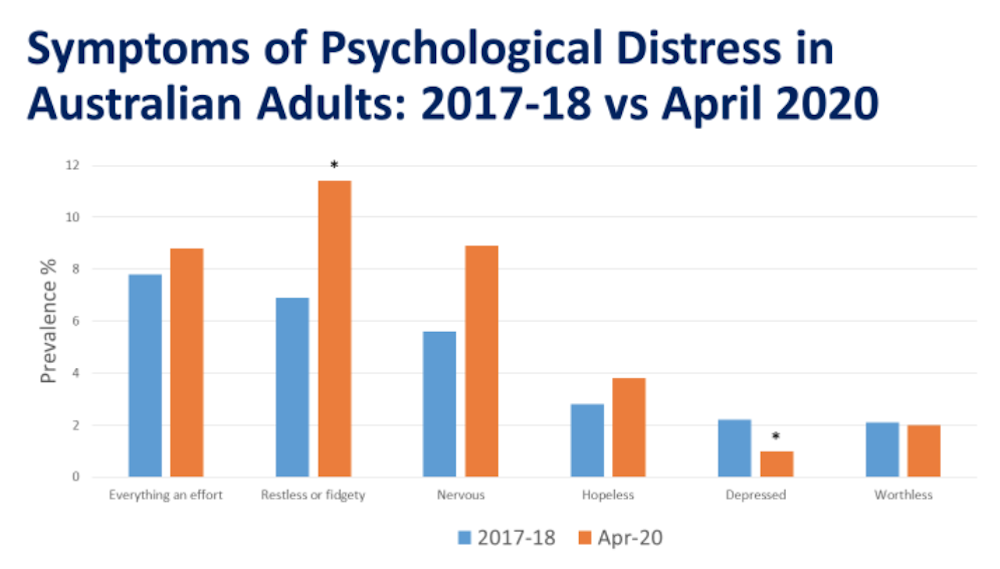
It is hard to rely on any prediction with confidence, given this situation is unprecedented. Recent research from the Australian Bureau of Statistics indicates that the mental health effects of the pandemic are not dramatic so far. The graph below shows data from a national survey of symptoms carried out in April 2020, compared with earlier national survey data collected in 2017-18.
Author provided
There has been a significant increase in feeling “restless or fidgety” and a trend towards more people feeling “nervous”. This probably reflects the confinement of the lockdown and anxiety about infection. Increases in anxiety are not necessarily a bad thing, as they motivate people to protect themselves against infection. Fortunately, the more serious symptoms of depression did not increase; in fact, there has been a signficant decrease in the number of people who report feeling “depressed”.
Yet it has long been recognised that suicides can decrease during times of war if there is a greater sense of purpose and social cohesion. Whether our national response to the COVID-19 pandemic will also produce these protective effects is unclear, but the potential is there and should be encouraged.
While the early effects on mental ill-health have not been dire, it is very early days, and the predicted adverse consequences of the pandemic and lockdown may yet be seen. Given the uncertainties, the government’s planned investment in gathering better data seems wise.
Will it make a difference?
The biggest slice of the government’s new and previous funding packages will go towards extra Medicare services. But although this seems an obvious response, past experience indicates it is unlikely to have a major impact.
What seems more likely to have a beneficial effect is the funding put into the JobKeeper and JobSeeker schemes. The evidence is clear that mental ill-health is associated with job loss and low income. These schemes are keeping people in employment and providing incomes, which means they are directly tackling key risk factors for mental ill-health.
If this preventive benefit is to be maintained, it will be necessary to extend these schemes beyond the planned six months. Now that would be a real investment in the nation’s mental health.
New Zealand Parliament Buildings, Wellington, New Zealand.
Analysis by Dr Bryce Edwards.
Political scientist, Dr Bryce Edwards.
How radical or transformative is Grant Robertson’s 2020 Budget? Opinions are divided over this week’s landmark economic package. Some are viewing the big spend as a return to traditional Labour – or even socialist – politics, while others see it as “business as usual”, albeit on a grander scale.
Seeing red
Leftwing political commentator Chris Trotter has declared that the Budget represents an historic turning point. He says the Labour Party has finally ditched Rogernomics properly, and Finance Minister Grant Robertson has led the party back to its socialist principles – see: The day Labour came home.
RNZ’s Tim Watkin stresses how lucky Robertson is to have been presented with an opportunity to spend “on a scale he could hardly have imagined at the start of the year”. He says Robertson has responded by spending up large in sectors that will “motivate his base and be popular with voters” – see: Robertson’s role – spend like a drunken sailor to keep economy afloat.
Here’s Watkin’s main point: “The spending promised in the rest of the $50b represents a more normal Labour Party budget, but on a grander scale. Apprenticeships, state housing and green projects stand out as the winners. Heck, millions of dollars will also be spent to send people in need to work out into the countryside to eradicate pests and pines. If that doesn’t create echoes of Mickey Savage and the sugarbag years, when a Labour government won the hearts of a grateful nation, I don’t know what does.”
In the Herald, Simon Wilson lists the various progressive merits of Thursday’s package, saying “transformation” has been “baked in” with this Budget, and it gets gets strong marks for “articulating a vision” – see: Finally, a Budget for a ‘green and pleasant land’ (paywalled).
Wilson believes important elements missing from the Budget – such as welfare and tax reform – may be coming for the election campaign. On the promised new state housing, he points out it’s “more than twice the number built by the Government in its first two years combined.” And he declares the new environmental job creation scheme “so splendid, I may have run around the garden jumping for joy.”
For another very positive leftwing account of the Budget, former Ardern spindoctor turned corporate lobbyist, Clint Smith, writes in praise of the Budget, saying it has delivered: “In times of crisis, voters want strong action to keep them safe and protect their livelihoods” – see: Sugar-hit vital but fix underlying ills too.
Pink prevails
Political commentator Morgan Godfery tweeted his surprise that the Budget was so conservative: “Despite the worst pandemic in more than a century, despite crushing economic losses and the potential for some kind of social disorder, the Labour-led government just delivered a budget not dissimilar to what Bill English might have delivered in the same circumstances”.
Others on the left have pointed to a lack of transformative change. Max Rashbrooke laments what is missing: “most striking is the absence of anything substantial on welfare: no increase to benefits, no system overhaul, no transformation of the life chances of the most vulnerable” – see: Robertson goes for repair, not rebuild.
In general, Rashbrooke explains that the Budget “concentrates on repairing the roof of the metaphorical house in which all New Zealanders live, responding to immediate needs, rather than rebuilding the foundations”. The problem is, “the country clearly faces problems that cannot be resolved with a few tweaks here and there”. He argues that supporters of the Government will want to see more than this short-term approach in the upcoming election.
Some critics on the left have been much more scathing. Blogger No Right Turn says that despite what has been promised the Budget “isn’t a reset” but “barely a mild change in direction”, and “if this is all Labour has to offer, they’re a failure as a government, and a failure as a party” – see: The timid budget.
As well as outlining everything he thinks is missing from the Budget, he explains why a more progressive programme should have been unveiled: “We’re in the middle of the biggest crisis in a century, which calls for new policies to both ride it out and pay for it. It’s a golden opportunity to change the direction of policy for a generation, to show how government can work for people.”
Similarly, on the radical left, Steven Cowan declares it A rotten budget, arguing that the “Budget talks of rebuilding the neoliberal economy ‘together’ but together means throwing billions of dollars at the corporate sector while the victims of the failed neoliberal economy are denied an increase in benefit levels and condemned to poverty and subsistence living”. He complains that Robertson has “chosen not to take the economy in a new direction and instead is attempting to shore up a failed economic model that has only benefited the few.”
Unionist Mike Treen says the status quo will be embedded by the Budget: “The government is telling us that it will more than double the national debt to around $200 billion over the next few years and all we will achieve is to keep things unchanged” – see: An extraordinarily underwhelming budget.
Robertson has proved to be “a safe pair of hands for big business”, according to Treen. Meanwhile: “There is simply no vision in this budget. There is no promise of a new, fairer, more egalitarian, more equal New Zealand where everyone pays their fair share. There is no commitment to rebuilding New Zealand in a manner that allows us to genuinely address climate change.”
It’s the failure to help those at the bottom, especially through welfare reform, that has Gordon Campbell declaring the Budget to be “indefensible” – see: On Budget 2020. He argues that “behind the chirpy talk of ‘recovery’ and ‘rebuilding’ there’s a strong Darwinian ‘survival of the fittest’ theme running right through much of Budget 2020.”
Economist Rod Oram draws parallels between the Budget and the post-earthquake rebuilding of Christchurch, in which “all we’ve done is create a pleasant replica of a mid-20th century city. Not an exhilarating example of a 21st century city, with all the amenities, technology and liveability that would offer” – see: If we are going to borrow, let’s buy the best (paywalled). He asks: “Why lavish billions on the ‘same old, same old’?”
Oram complains that the Government has been unable to rise to the occasion and address the need for bigger change. He says the Budget fails to live up to the name of “Rebuilding together” and should instead simply be called “Spending together”.
A number of journalists and commentators have also noted the lack of transformative elements in the Budget. One of the best is Henry Cooke’s column, Grant Robertson isn’t using this crisis to transform the country. He argues the Government had talked up transformational change, especially of the economy, and had an opportunity to do so in this Budget, but simply didn’t take it. They could have tried to deal with inequality, or even had some welfare reform, but chose not to.
Cooke says the Budget is mostly about retaining the status quo: “Most of its settings remain about the same. There are no changes to taxes. There are no changes to the welfare system. There are no big new entitlement programs – no free dental, no more years of fees-free, no burst of helicopter money. It’s a budget that is consequently hard to be really mad at, or massively happy with.”
Similarly, I argued in a column for RNZ that there’s nothing much for Labour’s opponents to hate, and so it’s a “politically-astute Budget” – see: A Budget with big numbers, but little vision. I argue that despite the huge increases in expenditure – mostly directed at business – this Budget is in line with the previous two Robertson budgets which have also been very cautious.
I also point out that as a sign of just how conservative the Budget is, it gives a bigger boost to Defence spending ($1.77bn, mostly for new Hercules military planes) than it does for trades training ($1.6bn).
Other political commentators agree the Budget is a middling one. Stuff political editor Luke Malpass says that not only is it “short on grand ambition” but “is unashamedly aimed at middle New Zealand” – see: Labour goes back to basics.
Rather than a “rebuilding” Budget, Malpass says “it is definitely a recovery budget. The apparatus of the state is not being reimagined, and any new progressive initiatives have been left on the budget cutting floor. It has been designed to keep enough cash flowing to keep the economy afloat while financing this quite conservative Government’s vision for the future”.
Business journalist Pattrick Smellie writes there is plenty in the Budget “to assist the private sector, but “Beneficiaries and pensioners see nothing more in this Budget, apart from some targeted programmes aimed at social dysfunction” – see: Is it enough? (paywalled).
Despite the big spending, it’s certainly not a radical budget according to Smellie: “There is very little in the way of the transformative vision that some may have hoped to see from the epochal disruption of a pandemic. Perhaps that is a good thing, but this is a big-spending Budget that is remarkably operational, almost managerial, in its decision-making.”
Former Cabinet Minister Peter Dunne is very positive about the Budget, but calls it “pedestrian”, and notes that Robertson has “resisted the urge to delve into Labour’s ideological back-pocket to fund his solutions” – see: An extraordinary but pedestrian Budget. He concludes that “the Budget is primarily a marking-time document, aimed first at getting through the coming election”.
As to why a more adventurous Budget didn’t eventuate, Dunne speculates that coalition and electoral politics prevented this: “This is, after all, a government of three parties facing an election in a few short months. Each therefore needs to be able claim some achievements in the budget as its own… With each party having its own audiences to appeal to, it makes the task of presenting an overall coherent Budget theme that much more difficult.”
Herald political editor Audrey Young has also emphasised that the Budget was hardly a radical one, saying that, although the “political messaging was based in nostalgic references to the role of the First Labour Government in responding to the Great Depression”, in reality “The Budget is one of least overtly political Budgets in recent years”, with Robertson even paying tribute to Bill English in his presentation of it – see: Robertson keeps fingers crossed as he gives himself options (paywalled). Young suggests it would be unrealistic to have expected a more detailed plan for the rebuild.
In another column, Young also stresses how orthodox Robertson’s Budget really is: “Most of it is unsurprising – jobs, training, infrastructure, housing, subsidies – and most of it could have occurred to varying degrees under a National Government in a bid to keep workers attached to work and businesses afloat. The alternative would be higher spending on social welfare benefits and a slower recovery. Spending big in an economic downturn is not in dispute. It is the orthodox thing to do” – see: Simon Bridges vs Jacinda Ardern over $20 billion blank cheque (paywalled).
Newstalk ZB’s Heather du Plessis-Allan also argues the Budget is mainly about extending the status quo rather than building something new, but she says this is a good thing: “there is no vision in this budget. It’s not a criticism. This budget does what it needs to do: it saves jobs, it retrains workers, it pumps money into health and infrastructure. It keeps the computer on, but it doesn’t ‘reset’ it” – see: The Budget is simply extending ideas.
Conservative commentator Liam Hehir embraces Robertson as a fellow “conservative” and potentially “the new Bill English” – see The great Spinoff hot-take roundtable. Here’s his general take on the Budget: “Grant Robertson’s job today was to make it clear he understands the need for prudence. For the most part, he hasn’t done too badly. There was no Keynesian tax relief. There was no UBI or fundamental break with the post Muldoon consensus, either. The temptation of helicopter money was largely avoided. That was never to be expected from a disciple of Clark and Cullen.”
Finally, rightwing commentator Matthew Hooton commends Robertson for not being too radical or attempting to be visionary. He celebrates that “Robertson is showing no signs of using Covid-19 as an excuse to radically depart from the post-1984 consensus, as many on his left want him to” – see: Grant Robertson conservative despite huge numbers (paywalled).
Overall, Hooton pronounces that Robertson is still very much in line with the neoliberal settings of the 1980s and 1990s, even in this Budget. Here’s his key point: “Robertson likes to invoke Peter Fraser and talk a big game about the ‘carnage of the 1980s and 1990s’ being based ‘on a tired set of ideas’. But more important are his regular tributes to Bill English and Michael Cullen for their fiscal prudence. As Minister of Finance, Robertson has done nothing to substantially reverse the basic economic framework put in place by Roger Douglas, Ruth Richardson and Bill Birch of an open and competitive economy; a low-rate, broad-based tax system; price stability through an independent monetary policy; fiscal responsibility and paying off debt; and a relatively flexible labour market.”
The US government’s call for an international inquiry into the origins of the COVID-19 pandemic has a clear political motive: to shift the blame for its own failure to respond effectively to the epidemic within its own borders.
This is unfortunate, because it is in everyone’s interest to work together, not to question China’s handling of the crisis but to discover the factors that cause new infections so we can avert future disasters.
We need to understand how SARS-CoV-2, the coronavirus that causes COVID-19, came into existence, and to look at how and when we might have been able to impede its progress.
This means examining the origins of the virus and the biological and environmental factors that allowed it to become so dangerous. To achieve this, an international, collaborative scientific investigation free from recriminations and narrow political agendas is needed.
What we know so far
Extensive scientific data have shown that SARS-CoV-2 was not deliberately engineered and there was no conspiracy to create an epidemic. It did not originate in or escape from a laboratory, in Wuhan or anywhere. The first human cases of COVID-19 did not come from the Wuhan wet market but from elsewhere in China, possibly outside Hubei province altogether.
In fact, the disease did not “originate” in a market at all, although an important spreading event linked to the Wuhan market did occur that brought it to the attention of Chinese public health authorities.
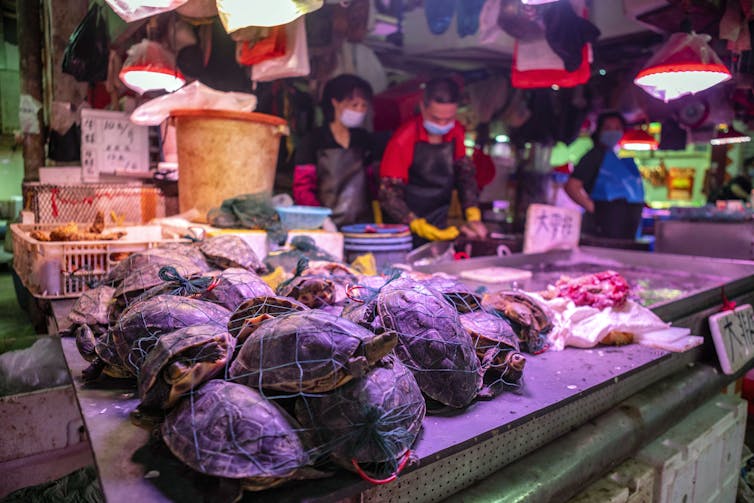
Wet markets, such as this one in Guangzhou, are breeding grounds for viruses. But that doesn’t mean Wuhan’s market is ground zero for COVID-19.Alex Plavevski/EPA/AAP Image
SARS-CoV-2 almost certainly descended from an animal virus that underwent a series of mutations that made it dangerous to humans. The path to humans probably involved intermediate animal hosts, although which animals remains uncertain.
So here is the most likely sequence of events: a coronavirus in a bat found its way into one or more other animal hosts, possibly including a pangolin or some kind of cat, somewhere in southern China. At that time, the virus could not infect or cause noticeable disease in humans, or else the animals infected had little contact with humans. Over an unknown period of time (possibly decades) the virus mutated in a way that made it highly dangerous and eventually, by chance, a human became infected, probably in about the second week of November 2019.
The new virus was quickly passed on to other people and found its way to Hubei province. On December 10, an infected individual visited the crowded market in Wuhan and was responsible for infecting 21 other people. Over the following two weeks, enough people became sick to alert doctors and public health officials, leading to an announcement on December 31 warning the world of the dangerous new disease. The market was closed the following day and vigorous efforts were made to identify and isolate contacts.
Three weeks later it was clear these measures could not contain the epidemic, and on January 23 Chinese authorities took the brave and unprecedented step of locking down the entire city. This controlled the spread of the virus in China, but it was too late to stop the spread internationally, because by that time the virus was already present in Taiwan, South Korea, Europe and the United States.
What we don’t know yet
What we now have to find out is what happened in the months or years leading up to November 2019 and whether, in retrospect, anything could have been done to prevent the disaster.
It is crucial we understand the evolution of this virus because, as with all human diseases that emerge from animals, it will have occurred as a result of both random biological events and responses to environmental pressures. The virus had to mutate, the original wild animal had to be exposed to other species, and the virus had to spread within that species and undergo further mutations. The animal had to come into close contact with a human who, at the right moment, has to contract the new infection.
Despite the low probability of each individual step, in recent decades a long list of viruses has negotiated this entire pathway, including HIV, SARS, MERS, Ebola, Nipah, Lassa, Zika, Hendra, various types of influenza, and now SARS-CoV-2. This suggests new factors are increasing the chances of exposure, adaptation, infection and spread.
It is likely these factors include population growth, agricultural expansion, the loss of natural wild animal habitat, the loss of traditional food sources, and changing relationships between animal species and between animals and humans. Deforestation and climate change further exacerbate this process, as does increased movement of human populations, through domestic and international travel. The international illegal wildlife trade, inappropriate use of drugs and insecticides, and reluctance of governments to work together make matters even worse.
Knowing exactly how these factors affect the genetics and evolution of viruses will help us find ways to thwart them. We could develop a coordinated early warning system to identify and track potentially dangerous pathogens, and monitor interactions between species that could transmit them. We could preserve native habitats and reduce the pressure on wild animals to enter human habitats in search of food. We could strategically cull animals that act as reservoirs for dangerous viruses.
We could precisely target infection control procedures such as health monitoring and quarantine. We could work together to develop diagnostic tests, new drugs and vaccines. We could develop globally coordinated rapid response plans for when new outbreaks arise.
This process will only work if undertaken with openness, trust, and an acknowledgement that it is in the entire world’s best interest. It will only work if we accept that viruses are not national problems or sovereign responsibilities, but global challenges.
COVID-19 should be a wake-up call that petty recriminations, ideological rivalries and short-sighted political ambitions must be set aside. The countries of the world must encourage China and the United States to raise their sights to the greater challenge and help conduct the investigation we need to avert future disaster.
It is urgent, because the next pandemic may already be incubating somewhere in the world at this very moment.
As Australia begins to relax its COVID-19 restrictions there is understandable debate about how quickly that should proceed, and whether lockdowns even made sense in Australia in the first place.
The sceptics arguing for more rapid relaxation of containment measures point to the economic costs of lockdowns and appeal to the cold calculus of cost-benefit analysis to conclude that the lives saved by lockdowns don’t justify the economic costs incurred to do so.
Their numbers don’t stack up.
To be able to weigh the value of a life against the economic costs of forgone output from lost jobs and business closures, requires placing a dollar value on one person’s life. This number is called the value of a statistical life.
In Australia, the Government generally uses a value of A$4.9 million. The United States uses a value of US$10 million.
What are the benefits of the shutdown? This is the value of lives saved plus any indirect economic or health benefits. Lives saved are those excess lives that would be lost if government relied on a strategy that allowed enough people to get infected to result in so-called herd immunity.
How many extra lives would be lost under this second strategy?
To answer this, we need assumptions about the virus.
The lives lost if we let it rip
The initial reproduction rate of the virus, R0, was thought to be about 2.5. This means that every 2 people infected were likely to infect another 5; producing an average infection rate per person of 2.5.
Herd immunity for COVID-19 is estimated to require roughly 60% of the population be infected before the curve begins to flatten and the peak infections fall.
This happens when the reproduction rate, R0, falls below one. Because of subsequent new infections, the total number infected over the course of the pandemic is closer to 90%.
Given a population of 25 million people and assuming a fatality rate of 1%, this would produce 225,000 deaths.
An assumption of a 1% fatality rate is low from the perspective of those making decisions at the onset of the pandemic, at a time when crucial and reliable data were missing.
Those lives are valued at $1.1 trillion
Converting those fatalities to dollars using the Australian value of a statistical life of A$4.9 million per life yields a cost of A$1.1 trillion.
In rough terms, that’s the amount we have gained by shutting down the economy, provided deaths do not skyrocket when lockdown measures are relaxed and borders re-open.
It is about three fifths of one year’s gross domestic product, which is about A$1.9 trillion.
What are the costs of the shutdown?
These are the direct economic costs from reduced economic activity plus the indirect social, medical, and economic costs, all measured in terms of national income.
A starting point is to take the lost income that occurs from the recession that has probably already begun.
What will the shutdown cost?
Let’s assume that the downturn results in a 10% drop in gross domestic product over 2020 and 2021 – about $180 billion – consistent with IMF forecasts of a fall in GDP of 6.7% in 2020 and a sharp rebound of 6.1% growth in 2021, and comparable to the Reserve Bank of Australia’s forecasts in the latest Statement on Monetary Policy.
Comparing this cost from shutting down – about $180 billion – to the benefit of $1,103 billion – makes the case for shutdown clear.
But this calculation grossly overestimates the costs of the shutdown.
The recession is a consequence of both the shutdown and the pandemic.
We need to attribute costs to each.
Most of the economic costs of the recession are likely to be due to the pandemic itself rather the shutdown.
Many costs would have been borne anyway
Even before the shutdown, economic activity was in decline.
Both in Australia and internationally air travel, restaurant bookings and a range of other activities had fallen sharply.
They were the result of a “private shutdown” that commenced before the mandated government shutdown.
Even in a country such as Sweden, where a shutdown has not been mandatory, there has been a more than 75% reduction in movement in central Stockholm and a more than 90% reduction in travel to some domestic holiday destinations.
To be generous, let’s assume the costs attributable to the government-mandated part of the shutdown are half of the total costs, making their cost A$90 billion.
In reality, they are likely to be less, one important study suggests much less.
It is hard to imagine a much bigger private shutdown not taking place had the government decided to simply let the disease rip until its spread was slowed by herd immunity.
Support is not a cost
It is also important to note that the government’s spending of A$214 billion to support the economy during the shutdown is a transfer of resources from one part of society to another rather than a cost.
It creates neither direct costs nor benefits for society as a whole, other than the economic distortions coming from raising the revenue to service the spending.
With long-term government bond rates near 1% (less than inflation), the total cost of distortions is likely to be tiny.
Of course, this discussion simplifies what are incredibly complex social, health and economic questions. There are clearly further costs, from both relaxing restrictions and keeping them in place.
Other costs are not that big
These costs are worthy of serious study and should rightly be part of a comprehensive public policy discussion. But looked at through the lens of a cost-benefit analysis these combined effects are likely to be small relative to the value of preventing mass death.
Among them are the incidence of mental health problems and domestic violence under lockdowns. They are important concerns that should be addressed by targeted and well-designed programs.
Weighing against that is evidence that economic crises are associated with declines in overall mortality rates.
While suicides rise, total mortality, including deaths from heart attacks and workplace and traffic accidents, falls.
In the specific case of this pandemic there is survey evidence based on respondents from 58 countries suggesting that strong government responses to the pandemic have been reducing worry and depression.
Also, we have to acknowledge that recessions and educational disruption have health and economic costs that are unequally spread.
The shutdown disproportionately impacts more-disadvantaged people including short-term casual workers, migrant workers, those with disabilities and the homeless.
The most-disadvantaged suffer, either way
This skewing will also be present in the herd immunity option. As New York City makes clear, a rapid spread of the disease also disproportionately impacts disadvantaged communities. One can only speculate about the disease burden should some of our remote indigenous communities get exposed.
To this we should add further achievements of the shutdown:
elimination of mental trauma and grief from losing our loved ones
avoiding the costs of possible longer-term implications of the disease, which we still know little about
avoiding a collapse in the capacity of the health system to deal with other emergencies through the sheer numbers of COVID-19 infected combined with staff shortages due to illness
Those advocating cost-benefit analysis of this kind have to apply the principle systematically. It is difficult to see how the total of these sorts of considerations on each side of the ledger could compare to the benefit of lives saved. They will be an order of magnitude, if not two, smaller.
$90 billion, versus $1.1 trillion
In the cold calculus of cost-benefit analysis, a highly pessimistic view of the economic costs of Australia’s shutdown comes to around $90 billion.
It is a small price to pay compared to the statistical value of lives the shutdown should save, around A$1.1 trillion.
The question we now face is how quickly to relax restrictions. Here, too, there are costs and benefits, and we need to be mindful of the economic cost of a second-wave outbreak, plus mortality costs of disease spread before effective treatments or vaccine become available.
And in all of this bean counting, we should remember that putting a price tag on human life is sometimes unavoidable – such as when a doctor with access to only one ventilator has to choose between two patients.
But we shouldn’t mistake necessity for desirability. We should seek to avoid needing to make such wrenching choices whenever possible.
Dr Jen Schaefer of the Royal Children’s Hospital Melbourne assisted with the preparation of this piece.
It is essential for the health of people worldwide that a yet-to-be-discovered vaccine for covid-19 coronavirus is widely available, says former New Zealand Prime Minister Helen Clark says.
Clark told RNZ Morning Report there is growing concern that instead of vaccine being available globally it will become the monopoly of a very few wealthy countries and companies.
She has added her name to a letter from more than 140 prominent world leaders to health ministers at the World Health Assembly which is due to meet next week.
News agencies have reported that France said yesterday that the world’s nations would have equal access to any novel coronavirus vaccine developed by pharmaceuticals giant Sanofi, a day after the company’s chief executive suggested that Americans would likely be the first in line.
– Partner –
“A vaccine against covid-19 should be a public good for the world,” French Prime Minister Edouard Philippe said, adding that “equal access of all” was “non-negotiable”.
He was speaking after CEO Paul Hudson told Bloomberg News: “The US government has the right to the largest preorder because it’s invested in taking the risk.”
Hudson apologised today, saying it was vital that any coronavirus vaccine reach all regions.
‘Operation Warp Speed’ Al Jazeera reports today that the United States government plans to stockpile hundreds of millions of doses of vaccines that are under development to combat the novel coronavirus with a goal of having one or more vaccines ready to deploy by the end of the year as part of “Operation Warp Speed”, according to administration officials.
“We think we’re going to have a vaccine in the pretty near future,” President Donald Trump told a news conference.
Former NZ Prime Minister Helen Clark … “The world’s leading virologists are telling us that without a vaccine we’ll never live normally again so there is such a compelling public health reason for getting this out to everyone everywhere.” Image: RNZ
Clark said the concept of a “people’s vaccine” is so that everyone everywhere will be able to access it free of charge.
“Why is this so important? Because the world’s leading virologists are telling us that without a vaccine we’ll never live normally again so there is such a compelling public health reason for getting this out to everyone everywhere.”
She wanted the profit principle for any vaccine eliminated and a wonderful precedent had been set by the inventor of the polio vaccine who said he never wanted a cent out of it.
A lot of countries were already funding development of the vaccines and with public money, such as the billions promised during an European Union virtual conference managed from Brussels recently, the intellectual property comes into the public domain, Clark said.
A global agreement was needed so that the health workforce and the vulnerable, including the elderly, would access the vaccine first.
“Ideally you would establish a mandatory patent pool under the leadership of WHO … governments of course can issue compulsory licences for the manufacture of drugs where there’s a compelling public health reason … there will need to be money mobilised from donors.
“…But basically this needs to be manufactured at scale so that it can be available at very low cost to everyone everywhere.”
She said there was a chance of achieving this because of a “nobody is safe till everyone is safe” attitude.
New Zealand had been very successful in containing the effects of Covid-19 but would now have to sit tight in its bubble until the rest of the world catches up.
This article is republished by the Pacific Media Centre under a partnership agreement with RNZ.
If you havesymptomsof the coronavirus, call the NZ Covid-19 Healthline on 0800 358 5453 (+64 9 358 5453 for international SIMs) or call your GP – don’t show up at a medical centre.
By Ardila Syakriah, Arya Dipa, Asip Hasani and Suherdjoko in Jakarta/Bandung/Blitar/Semarang
Indonesia’s most populous island of Java has become the country’s epicentre of the covid-19 coronavirus pandemic, prompting calls for heightened containment efforts, including by imposing large-scale social restrictions (PSBB) in the entire region.
All six provinces on the island, home to some 151 million people and covers just 7 percent of the archipelago’s area, have become red zones for covid-19 infections.
Leading the central government’s tally is Jakarta, with 5,554 cases and 449 deaths as of Wednesday. East Java follows with 1,772 cases and 163 deaths, West Java 1,556 cases and 98 deaths, Central Java 1,023 cases and 66 deaths, Banten 580 cases and 57 deaths and Yogyakarta 181 cases and seven deaths.
In total, the key island to Indonesia’s industrial and political scenes has seen 10,666 cases or some 69 percent of the country’s total number of cases and 81 percent of total fatalities at 1,028. Java’s 1,991 recovered patients, meanwhile, make up 60 percent of the 3,287 recoveries in the country.
However, even with the eyebrow-raising figures, only Jakarta and West Java have imposed PSBB measures so far. Other provinces have implemented the policy in part, namely Greater Surabaya and Greater Malang in East Java; Tangerang city, Tangerang regency and South Tangerang city in Banten; as well as Tegal city in Central Java.
– Partner –
President Joko “Jokowi” Widodo raised concerns about Java’s struggle to contain covid-19 during a Cabinet meeting on Tuesday to evaluate the PSBB measures. He urged the covid-19 national task force to ensure effective containment efforts in Java’s five provinces that are recording the highest number of cases.
“Especially within the next two weeks, our chances are probably until the Idul Fitri day. We must make the most of it,” Jokowi said while warning against easing restrictions too soon.
Lifting restrictions plan criticised Jokowi’s statement comes amid criticism over the government’s possible plan to gradually lift restrictions from June, as well as confusing exemptions on travel bans based on claims that some regions had seen a flattening of the curve of infections.
During a separate hearing with the House of Representatives on Tuesday, National Disaster Mitigation Agency (BNPB) chief secretary Harmensyah highlighted the need for all of Java to declare a PSBB status.
“We need to impose the PSBB policy throughout Java to suppress [transmission],” he said.
Experts believe PSBB measures have contributed to slowing down the transmission of covid-19, but measuring the policy’s efficacy would require timely data on new transmissions that relies largely on testing capacity, among other things.
The East Java administration has extended Greater Surabaya’s PSBB status until May 25. The administration discovered a recent spike in infection clusters to 72, mainly in Surabaya and among homebound travelers from Jakarta.
East Java Governor Khofifah Indar Parawansa said on Wednesday she would further consult with her team of epidemiologists on whether implementing PSBB measures across the province would prove to be necessary.
Meanwhile, Central Java Governor Ganjar Pranowo said on Tuesday that his administration was ready to implement PSBB if it was instructed by the central government. However, he also emphasised that it would have to first calculate the possible impacts.
Still tracing people The administration is still trying to trace 1,116 of some 1,500 people who attended an international tabligh (Islamic mass gathering) in South Sulawesi, after at least 16 Brebes residents tested positive upon returning.
Jakarta, which had implemented the PSBB since April 10, has extended its restrictions until May 22. Governor Anies Baswedan previously conceded that there were gatherings and people defying rules, including when hundreds flocked to McDonald’s Sarinah in Central Jakarta to be part of the restaurant’s final day of operating on Sunday.
The following day, the city administration issued a new decree regulating sanctions for PSBB violators, which range from community service to administrative fines.
In West Java, the administration declared it would implement PSBB measures from May 6 to 19, after initially only placing restrictions on Greater Bandung.
West Java Governor Ridwan Kamil claimed on Monday during an online discussion with ambassadors that the province’s effective viral reproduction number (Re) had declined from 1.28 points before the PSBB to 1.06 post-PSBB.
Ghina Ghaliya contributed to this Jakarta Post story.
Source: The Conversation (Au and NZ) – By Kath O’Brien, Lecturer – QUT – Faculty of Health (School Exercise & Nutrition Sciences), Queensland University of Technology
While they are mindful of the wider interests of all stakeholders in the game, they say reverting to a single referee has enormous implications for the pace of the game.
Not one but two refs
Under the two-referee system, a lead and an assist referee make decisions in partnership with their two touch judges.
A matchday referee coach and a senior review official in the centralised video bunker in Sydney provide further support.
During play the lead referee manages roughly 80% of the time, and the assist (or “pocket”) referee 20%. This system was introduced in 2009 to lessen the physical stress on referees and to try to eliminate the grapple and wrestling holds that happen in the ruck when players are tackled.
The two-referee system certainly ticked all the boxes to begin with, as it allowed NRL referees to physically manage around 282 rucks per game, 36 kicks in play and 38 restarts.
It provided immediate clarity and confidence at key times for both the lead and assist referee.
The game was played faster by having the pocket referee handle the ruck. This meant the lead referee didn’t have to continually glance or run back to control this space.
Furthermore, under the two-referee system, the game became more fluent as it allowed each player’s athleticism to entertain the fans.
Drop that second ref
So why does the NRL and Australian Rugby League Commission want to scrap the two-referee model? What evidence has been put forward to judge whether reverting to a one-referee system will work?
ARLC chairman Peter V’landys.AAP Image/Joel Carrett
ARL Commission chairman Peter V’landys says the overwhelming majority of fans in a 2019 survey wanted the competition to return to using one on-field referee to make the game more unpredictable and entertaining.
That’s hardly solid evidence to say the game would be better played with one referee rather than two.
The notion put forward by V’landys that two refs are a luxury is underscored by estimates that reverting to one referee could save the NRL about $3 million.
Not happy refs
But the Professional Rugby League Match Officials (PRLMO) say they were not consulted about replacing the two-referee system.
In defence of this system they also say the assist referee calls more than 80% of illegal tackles and play-the-ball infringements (a method for bringing the ball back into play after a tackle, in which the tackled player is allowed to stand up and heel the ball behind them to their team-mate).
Referee Ben Cummins during the 2019 NRL Grand Final.AAP Image/Dan Himbrechts
Furthermore, figures published by the NRL in 2018 show 38% of all play-the-balls in World Cup games, where a one-referee system operates, were classified as very slow and took more than four seconds to complete.
So what’s best for fans and those who love the game? How should the NRL settle the debate about whether the one- or two-referee system should be the way of the future?
We need a proper examination that includes the experiences of current and past NRL referees, combined with their physical and technical data, as authentic evidence for the NRL to decide whether a one-referee system will be any better than the two-referee model.
The NRL must be prepared to invest in this research to provide real-world insights into any benefits and limitations of both referee systems. That would allow any future developments to be based on fact.
Without a sound base of knowledge and a complete picture of what constitutes the work of NRL referees, I believe any attempts to select, develop and promote one system over the other will be limited at best and fundamentally flawed at worst.
Sweden had the world's highest Covid19 rate of reported deaths. Chart by Keith Rankin.
Analysis by Keith Rankin.
Sweden had the world’s highest Covid19 rate of reported deaths. Chart by Keith Rankin.
Today’s first summary chart looks at reported Covid19 cases and deaths over the seven days to 14 May. It is sorted into a Covid19 ‘deaths league’. Sweden now leads the world for acknowledged Covid19 deaths, closely followed by United Kingdom and Belgium. While Netherlands is showing well below Sweden and Belgium, Monday’s chart showed the large extent of the undercount of Covid19 deaths in Netherlands.
(Belgium continues to be the worst affected country in the world – excluding little San Marino – with three times the number of deaths per capita than the USA. Sweden has 33% more Covid19 deaths per capita than the USA. The regular news reports that the USA is the worst affected country from Covid19 are far from true.)
(This table omits a number of small mainly wealthy countries that have been excluded because of their small size: Bermuda [British], Andorra [Europe], Sint Maarten [Dutch], Mayotte [French], Channel Islands [British], Sao Tome and Principe [Portuguese-speaking Island nation off African coast].)
For deaths in the last week, Ecuador is fourth in the world, still well ahead of Brazil and Peru for Latin America; though Peru has many more new cases – per capita – than the other two. Mexico is now also making a significant showing.
While the chart is still dominated by the usual European suspects, there are relative newcomers from eastern Europe (Moldova, Bosnia and Herzegovina, Romania and Finland).
Also of great significance is the presence of an Arabian country – Kuwait – in the ‘deaths league’. Kuwait has so many new cases that it requires two columns.
Re Netherlands, I saw the following story on Al Jazeera this week: Hidden coronavirus tragedies: Dutch elderly advised against ICU. Netherlands is the country with the most ‘liberal’ euthanasia laws. It appears that, while elderly Dutch people have not really embraced euthanasia, government policy is to place subtle pressure on them: “In late March, the Dutch Federation for Medical Specialists advised medical professionals to be more selective in sending COVID-19 patients to the ICU”.
I have a sense that a variation of this ‘let the old die quietly’ approach is taking place in Sweden. Sweden is an overtly mercantilist country (as is Netherlands) that sees its economic purpose of life as “making money” (especially through exports), and where people ‘live to work’ rather than ‘work to live’. A nation with such underlying values places a lowish value on the lives of retired persons. I caught Paul Henry (on TV3) interviewing a senior public health official from Sweden. The Swedish official dismissed his country’s high death rate, claiming that the ratio of deaths to cases (what our Ashley Bloomfield calls the “positivity rate”) is unimportant because Sweden is not interested in knowing about “asymptomatic” cases of Covid19. It seems that Sweden’s strategy is to let the virus infect as many people as it can, treat the seriously ill, and not worry too much about elderly fatalities. At present, two in every thousand people in Stockholm have died from Covid19; not quite as bad as New York City, but certainly comparable.
One more country to note is Ireland, which has gone ‘under the radar’, but continues to have a serious problem. Being an island hasn’t helped Ireland very much.
Whoops! What is happening on the Arabian peninsula? Chart by Keith Rankin.
Qatar – home of Al Jazeera, and one of the last airlines to keep flying around the world – has more than double the new cases of the second country, Kuwait. Bahrain, UAE, Saudi Arabia and Oman also feature on this chart. While only Kuwait has significant numbers of deaths so far, it seems likely that death rates in the other Arabian countries will pick up later this month. (We should also note that we are currently in the middle of Ramadan, which may have something to do with what is happening in these countries.) Qatar and UAE resemble Singapore in a number of ways; Singapore is, like them, a leader in new cases. Hopefully the Arabian countries will prove as good as Singapore in averting high death rates. Certainly, the age profile of the cases in the Arabian countries will be much lower than in Europe and North America, so that will help to keep their death rates down.
(Note that two countries were omitted from the second chart, again for being too small. These were San Marino and Mayotte.)
An important country for New Zealand to watch is Chile, which is in many ways like New Zealand, has winter coming, and has had a major outbreak of new cases after easing restrictions.
We also note the presence of Russia, now ahead of USA in terms of cases per person. Another country to note is Gabon, the first continental African country to show up. Gabon is a comparatively wealthy French-speaking country. Also, we see the Maldives, a popular tourist country in the Indian Ocean; a country whose main industry is high-end tourism.
Ireland shows a remarkably similar pattern of deaths as the United States. Chart by Keith Rankin.
Among the Anglo-Celtic countries, United Kingdom clearly leads the Covid19 mortality data. I think it’s clear that, in London at least, the virus spread too widely to be contained before any containment measures were implemented. Ireland lags the UK, but leads Canada. It is looking like eventual death rates from Covid19 will be much the same in Ireland, Canada and the USA.
New Zealand and Australia continue to look good. It appears that Australia has contained its recent upturn in cases. Winter is the challenge now, for the southern hemisphere countries.
Source: The Conversation (Au and NZ) – By Jennifer MacLachlan, Epidemiologist, WHO Collaborating Centre for Viral Hepatitis, The Peter Doherty Institute for Infection and Immunity
Manyjurisdictions around the world are now testing people without symptoms as part of efforts to manage COVID-19. In Victoria, asymptomatic health-care workers have been part of the recent “testing blitz”.
We tend to take for granted that the results of medical tests are accurate – but no test is perfect and all carry a risk of harm of some kind. Although there has been a drive to increase testing, we must recognise this is also true for coronavirus.
Among the shortfalls of diagnostic testing is the possibility of false negatives (failing to detect a condition when it’s present) and false positives (detecting a condition when it’s absent).
It’s easy to see why false negatives can be a problem – we lose the benefits of early intervention.
But false positives can also cause harm, including unnecessary treatment. This is why positive screening tests are often followed up with a second, different test to confirm a diagnosis.
Examples include further imaging and possibly biopsy following a positive mammogram for breast cancer, or colonoscopy following positive screening for colon cancer.
False positives can occur for many reasons, including normal human and system errors (for example mislabelling, data entry errors or sample mishandling).
Sometimes false positive test results could be due to a cross-reaction with something else in the sample, such as a different virus.
Data entry errors can lead to false positives or false negatives.Shutterstock
For COVID-19, the only routinely available option to confirm a positive result is to retest using the same method. This can address the false positives generated through sample contamination or human error.
Even so, some authorities recommend isolation for any person who returns a positive test, regardless of subsequent results.
Testing more widely could mean more false positives
The proportion of false positives among all positive results depends not just on the characteristics of the test, but on how common the condition being tested for is among those being tested.
This is because even a highly specific test – one that generates hardly any false positives – may still generate more false positive results than there are actual cases of the condition in those being tested (true positives).
Let’s work through an example.
Say we have a very good test which is 99.9% specific – that is, only one in 1,000 tests give a false positive. And imagine we’re testing 20,000 people for condition X. Condition X has a very low prevalence – we estimate it affects 0.01%, or one in 10,000 people in the population.
At this level we could expect two people in our sample to have condition X, so we might get two true positive results. But we would also expect around 20 false positive results, given the error rate of our test.
So the proportion of people testing positive who actually have condition X would be only two out of 22, or 9.1%.
This is called the positive predictive value of a test. The lower the prevalence of a condition in the population, the lower the positive predictive value.
What about COVID-19?
In Australia, control measures have been very successful in reducing the number of people currently infected with COVID-19. We estimate the likelihood of a positive test to be very low right now (although of course this may change as restrictions ease).
The current reported number of active COVID-19 cases in Australia is about 600. And even if we’ve only diagnosed one in every ten people currently infected, this still represents less than 0.03% of the population.
While we’re still establishing the specificity of tests for SARS-CoV-2 (the coronavirus that causes COVID-19), early evidence suggests an estimate of 99% or greater is reasonable.
However, following the same calculations as in the example above, at a prevalence of 0.03%, even a test with 99.9% specificity would mean only 30% of people who test positive actually have the condition. This means more than two-thirds of positive results would actually be false positives if we were testing asymptomatic people with no increased risk.
This is why testing criteria are often applied. If testing is offered only to those with symptoms consistent with COVID-19, the condition is almost certainly more common in those being tested than in the general (asymptomatic) population, and therefore the rate of true positives is going to be higher.
But if we start testing more broadly, the likelihood of false positives becomes a greater concern.
Few new COVID-19 cases recorded from widespread testing is seeing restrictions beginning to ease in Australia.Michael Dodge/AAP
Why are false positives a problem?
Clearly we need tests to be as sensitive as possible – it’s easy to see why a false negative COVID-19 result could be a serious issue. But it’s important to recognise a false positive result can also cause significant problems for an individual and the community.
Consider, for example, the impact of asymptomatic health worker screening if a false positive test result leads to isolation of the person falsely diagnosed, and quarantining of their clinical co-workers identified (incorrectly) as close contacts of a case of COVID-19.
Further, a person who has had a false positive result may feel they are not at risk of future infection as they believe they are immune, leading to potential consequences for the individual and their contacts.
Even from an epidemiologicial perspective, a high proportion of false positives could distort our understanding of the spread of COVID-19 in the community.
Testing for COVID-19 in Australia is highly regulated and uses the best possible tests and highly qualified staff.
But asymptomatic screening when the prevalence of a condition is as low as that of COVID-19 in Australia currently must carefully weigh the benefits of such testing against the potential harms.
Source: The Conversation (Au and NZ) – By Simon J Dennis, Director of Complex Human Data Hub and Professor of Psychology, University of Melbourne
In late March, we posed a hypothetical scenario to a sample of Australians, asking if they would download a contact tracing app released by the federal government; 70% responded in favour.
But a more recent survey, following the release of COVIDSafe, revealed only 44% of respondents had downloaded it.
The Australian government’s COVIDSafe app aims to help reduce the spread of COVID-19 and let us all return to normal life. But this promise depends on how many Australians download and use the app. The minimum required uptake has been variously estimated at 40-60% of the population.
Our ongoing research, led by the Complex Human Data Hub of the University of Melbourne’s School of Psychological Sciences, surveyed the Australian public to understand their opinions and use of the COVIDSafe app, and other possible government tracking technologies.
Our research is helping us understand the conditions under which Australians will accept these technologies, and what’s holding them back.
Is there community support for COVIDSafe?
COVIDSafe uses Bluetooth to establish an anonymous contact registry of who a user has been close to, and for how long. If that user tests positive for COVID-19, they can voluntarily upload their contact registry to a central data store accessible only by state and territory health officials. Human contact tracers then alert those at risk and advise them on appropriate isolation measures.
Gaining broad community support for COVIDsafe requires the app’s perceived public health benefits to outweigh concerns of personal privacy, security and potential risk of harm.
As of May 7, from a sample of 536 survey participants, 44% reported having downloaded the COVIDSafe app. Promisingly, another 17% said they had not, but planned to.
We also asked all our respondents what technology they thought COVIDSafe used. Only 60% correctly responded with “Bluetooth”. Others responded with “location data” (19%), “mobile phone towers” (5%), or that they did not know (16%). This breakdown differed between people who had downloaded the app and those who had not, as shown below.
This graph shows participants’ responses in regards to which technology they believed COVIDSafe used.Author provided, Author provided (No reuse)
Why are people opting in?
For those who downloaded COVIDSafe, most reported doing so to monitor others’ health (28%), their own health (19%), and in the hope of returning to normal activities sooner (18%). The least motivating factor was “to help the economy” (14%).
Most people who had not downloaded the app said they were weighing the pros and cons (22%), had not had time (19%) or had technical issues (12%). A small number were waiting for legislation that stipulated how the data could be used (6%).
This may be good news for the government, as many of these reasons are relatively straightforward to address.
Whether those who download COVIDSafe are using it properly will largely determine its effectiveness.
Of those who had downloaded COVIDSafe, 90% said they had registered and kept Bluetooth switched on either at all times (77%) or when they left home (15%). Also, 58% said they had tried to share the app with others – helping to increase the rate of uptake.
Yet, there remains some doubt as to whether turning Bluetooth on is sufficient for the app to work productively on iPhones. According to app developers, COVIDSafe works best on iPhones when the app is open, on the front screen (foreground), and the phone is unlocked.
But since these iPhone-related issues can be fixed (albeit potentially with some level of difficulty), it would be worthwhile for the government to invest in this.
International comparisons
Before the release of COVIDSafe, our research also tracked social support for similar apps and tracking technologies in other countries, including the UK, US, Taiwan and Germany.
We asked respondents about two hypothetical scenarios of government tracking.
The first scenario was similar to Australia’s COVIDSafe app rollout. In it, people were asked to download a voluntary government tracking app allowing them to be contacted if they had been exposed to COVID-19. In this scenario, 70% of our respondents said they would download the app.
The second scenario was less voluntary, wherein all people with a mobile phone had their location tracked. Governments would use the data to trace contacts, locate people who were violating lockdown orders and enforce restrictions with fines and arrests, if necessary. Interestingly, in this scenario even more people (79%) said they would download the app. If people could opt out, 92% indicated they would support the policy.
Importantly, these scenarios were completely hypothetical at the time, which may account for the intention-behaviour gap. That is, the gap between people’s values and attitudes, and their actual actions.
So, while 70% of people in our first survey said they would download a hypothetical government app, a later survey showed only 44% had actually downloaded COVIDSafe after its release.
This graphs shows the proportion of participants who indicated they would download a voluntary government app (in green), and who found mandatory tracking through telecommunications companies acceptable (purple) in Taiwan, Australia, UK, Germany, and the US under various situations. ‘Sunset’ refers to a sunset clause, in which governments legislate promises to stop tracking and delete the associated data within six months. ‘Local data storage’ refers to when tracking data is stored on a user’s device, rather than a central repository. This data was collected prior to the announcement of the COVIDSafe app.
Australians showed high levels of support for both scenarios, particularly in comparison to other western democracies, such as the UK and the US.
An evolving situation
Prime Minister Scott Morrison has repeatedly linked COVIDSafe’s uptake to a potential easing of lockdown restrictions. But more recently, federal defence minister Marise Payne said the app’s uptake wouldn’t be a deciding factor for when restrictions were lifted.
When asked if the government should use the app’s uptake levels to decide when restrictions should be lifted, only 51% of our survey participants responded “yes”.
Overall, our data show Australians are generally accepting of the use of government tracking technologies to combat the COVID-19 emergency. However, only time will tell how this translates to real-world uptake of the COVIDSafe app.
Detailed results of the survey data from Australia, as well as the UK, US, Spain, Switzerland, Germany, and Taiwan, are continually being reported here.
Source: The Conversation (Au and NZ) – By Narelle Yeo, Senior Lecturer in Voice and Stagecraft, Sydney Conservatorium of Music, University of Sydney
On March 10 2020, Skagit Valley, Washington – a town with no known cases of COVID-19 – held a choir rehearsal. There was hand sanitiser at the door, no direct contact between choristers, no-one coughed or was ill.
Out of the 60 choristers in attendance, at least 53 became ill and two have died from COVID-19 complications.
On March 8, a 130-person choir performed at the Concertgebouw in the Netherlands. Four people associated with the choir died, and 102 fell sick.
German churches are reopening but regulating public singing after 59 out of 78 singers at a March rehearsal of the Berlin’s Protestant cathedral choir were infected with coronavirus.
Singers are highly attuned to the dangers of respiratory illness because of its impact on the voice, with inflammation and excess mucus impacting vocal quality. Despite this natural hyper-vigilance, choirs have been super-spreaders of coronavirus.
Ear, nose and throat specialist Dr Lucinda Halstead, speaking to America’s National Association of Teachers of Singing, has proposed a ban on choral singing until there is a vaccine and treatment with 95% efficacy in place. In her estimates, this is between 18-24 months away.
Singers inhale more air and exhale at greater air and moisture volume than speakers. Singing produces six times the amount of airborne droplet nuclei (aerosolised virus particles which can remain suspended in the air) compared with speech.
Live ensemble singing presents a higher health risk for coronavirus. Safe singing may require larger spaces and protocols than are possible in practice.
Dr William Schaffner, professor of infectious diseases at Vanderbilt University, advises avoiding singing in groups. He told Business Insider: “We don’t want people doing voice lessons, even standing eight-and-a-half feet apart.”
Online benefits
Choirs rehearsing online without specialised equipment may notice a 15-20 millisecond latency. Try to sing a song together with your friends on Zoom and you will experience this hilarious and frustrating problem.
But brilliant visual creations of multiple singers can hide this. The best choir videos are edited together to sync performances and give the appearance of ensemble singing.
A virtual choir can:
maintain an existing choir by recording and editing individual sung parts to combine voices and visuals into the appearance of ensemble singing
allow members to practise singing, as musical skills require repetitive practice
maintain community while social isolation is a real danger
As social restrictions ease, choirs will need to consider the conditions to return to safe rehearsals, following government advice for the general population.
Enhanced distancing measures for singers should be considered, including:
separation of singers – having members stand further apart and applying direction principles to minimise aerosol, droplet and touch transmission
using internal spaces with natural airflow (no air conditioning or re-circulation), or outside spaces with natural air circulation
limiting participants.
Choirs could find innovative locations to achieve these aims. Singing in an environment with natural resonance such as a beautiful outback chasm could create special experiences for choirs without losing quality or sacrificing health. Such imperfect live magic could supplement the online magic of virtual choirs.
Live choirs could also wait. Medical advice is to avoid singing in close proximity until further research has been done or the pandemic is controlled. While choristers need close proximity for part recognition, creating blend and a raft of well-being measures, these weigh heavily against health risks.
Source: The Conversation (Au and NZ) – By Fred Watson, Astronomer-at-Large, Department of Industry, Science, Energy and Resources, Australian Astronomical Observatory
In an international emergency like the present one, you might expect the science of the stars to be the last thing on people’s minds. The problems facing both individuals and governments are infinitely more pressing than events in the depths of space. People are suffering unprecedented hardships.
Yet throughout history, astronomy has shown extraordinary resilience in times of crisis and has kept public support. Today, that resilience will be needed as a major international project, the Square Kilometre Array (SKA), is on the brink of construction.
The SKA will be the world’s largest radio telescope, and Australia will play a leading role in building and operating it. How can this benefit a nation focused on containing a global pandemic?
History shows the science of the stars is no stranger to crisis. Indeed, modern astronomy was born in a time of deep conflict, when the northern provinces of the Netherlands were engaged in difficult negotiations with Spain after 40 years of war.
In 1608, the fledgling telescope came out of obscurity in the hands of Dutch spectacle-makers, and its possibilities for astronomy were recognised. When news of this optical novelty reached Galileo Galilei in Padua the following May, he set about improving it – and the rest is history.
By the turn of the twentieth century, astronomical infrastructure had become big business, but two World Wars caused major disruptions. New telescope proposals were put on hold as manufacturers turned their hands to gunsights, rangefinders, binoculars and other “optical munitions”.
During the Second World War, one British company actually buried the 1.5-tonne mirror for a new South African telescope in a field to avoid possible bomb damage. While delivery of the mirror was delayed until 1948, the telescope was a success, and is still at work today.
Similarly, in the United States, the 200-inch (5.1-metre) mirror for what was to be the world’s largest telescope at the time, at Mount Palomar, California, was cast in December 1934, but the instrument’s completion was delayed until 1949. Although it is no longer the largest in the world, the Palomar telescope remains among the most effective.
While hardly comparable to a world war, the present crisis constitutes an emergency of grave proportions, and it is important to put a project like the Square Kilometre Array (SKA) into perspective.
When completed, the telescope will provide radio astronomers with the largest and most advanced facility available to them. With an expected working lifetime of more than 50 years, it will explore the whole 13.8-billion year history of the Universe, yielding many exciting discoveries.
And spin-offs from the technologies under development have huge commercial potential, with tangible benefits for economic recovery.
One of the reasons governments fund research into the study of the Universe is that astronomy pushes technology to its limits – whether it be low-noise radio receivers, complex data management systems or sophisticated computer algorithms. Wifi, for example, had its origins in Australian radio astronomy a quarter of a century ago.
More immediately, the construction of the SKA offers significant opportunities for local companies. The low-frequency component of the telescope will be built at the Murchison Radioastronomy Observatory in Western Australia’s remote Wajarri Yamatji country, one of the most radio-quiet places on Earth.
The project has so far spent $330 million in funding from the Australian and WA governments establishing the observatory and building pathfinder instruments.
And on the wider horizon, “big science” facilities like the SKA require strong international partnerships, with collaboration among the project’s 14 member states representing a further positive outcome. Along with South Africa, where the mid-frequency component of the telescope will be located, Australia can expect its scientific standing to be further enhanced as one of the SKA host nations.
An inspiring science
Although technological spin-offs are an important outcome of astronomical research, it is pure curiosity that is the ultimate driver. We are an inquisitive species, and the quest to know is what motivates researchers.
But it also inspires the rest of us with the staggering beauty of the universe and the appeal of scientific understanding. For youngsters in particular, that can prepare them for the jobs of the future, shaping an agile knowledge economy for our nation.
If the lessons of history are anything to go by, the SKA will be unlocking the secrets of the universe long after COVID-19 has subsided into memory. And that will be something of which we can all be proud.
Michelle Grattan talks with Assistant Professor Caroline Fisher (remotely) about the week in politics, including the fine line the government is walking between generating economic confidence and the sobering prospect of recession, Thursday’s unemployment figures, and the risk of a second-wave coronavirus resurgence.
Michelle Grattan talks with Assistant Professor Caroline Fisher (remotely) about the week in politics, including the fine line the government is walking between generating economic confidence and the sobering prospect of recession, Thursday’s unemployment figures, and the risk of a second-wave coronavirus resurgence.
The National Tertiary Education Union this week struck an agreement with universities that no ongoing university staff member would be stood down involuntarily without pay. This deal is contingent on staff above a certain pay grade taking a cut of up to 15% of their salary.
It’s still uncertain how many universities will sign up to the deal – the Australian Catholic University has already rejected it.
Casual and contract academics are most vulnerable to imminent job losses. By mid-2018, an estimated 94,500 people were employed at Australian universities on a casual basis, primarily in teaching-only roles.
The number of precariously employed academics has been estimated at 70% of teaching staff in some universities. At the University of Wollongong, for instance, around 75% of staff are in insecure work – a figure that includes both teaching and administrative workers.
And yet in March, the university had failed to ensure wage support for casual staff needing to self-isolate for any reason.
In April, one-third of casuals at the University of NSW had reported they’d lost work. This reportedly cost them an average A$626 a week, and 42% were working unpaid hours.
Casual academics are not eligible for the government’s JobKeeper payments due to rules that require more than 12 months continuous employment with an organisation that has lost between 30-50% of its revenue – effectively ruling universities out. Casual academics are often on short-term contracts, such as a semester-by-semester basis.
Under the NTEU agreement, displaced casual and fixed-term contract staff will be prioritised for new work. This approach leaves many staff in a position of increased precarity. The likelihood of new work emerging over the next few months is low, given the downturn in international student enrolments and uncertainties around conducting fieldwork research given social distancing policies.
This highly skilled yet vulnerable group need greater support from our government.
A vulnerable workforce
Some estimates place revenue losses at Australian universities at around A$19 billion over the next three years due to the COVID-19 pandemic. The university sector estimates this puts more than 21,000 jobs at risk over coming months, and countless more in the future.
The loss of international students is potentially catastrophic for the sector. An estimated A$2 billion in fees could be lost mid-year as international students are unable to arrive in Australia to start semester two studies.
This week, Vice Chancellor of La Trobe University, John Dewar, said revenues could be A$150 milloon under budget this year and up to A$200 million next year.
If this year’s required savings were to be made solely from staff cuts, this would require 200-400 job losses, he said. The 2021 budget gap could equate to 600-800 jobs.
In April, La Trobe and RMIT university had let go of hundreds of casual “non-essential” staff. Western Sydney University warned staff in April it would cut casual workloads as it faced mounting financial shortfalls over the next three years.
Despite these realities, both tenured and untenured academic staff are being asked to do more in teaching and research to support the country in the face of this pandemic. They are doing this with fewer resources.
What can be done?
Even before the NTEU agreement, many universities responded with clear policies and support in response to COVID-19. For example, executive staff at some universities – such as La Trobe and the The University of Wollongong – took a 20% pay cut, and froze any non-essential travel.
Many universities, such as Deakin, are providing paid leave for staff with caring responsibilities and paid isolation leave for those exposed to coronavirus. And others, like ANU and ACU, have extended benefits to their casual and contract staff. These include honouring existing contracts, paying sessional tutors despite reductions in teaching hours and paying casual staff to attend online professional development.
All workers need transparency around expectations and pay. But this is particularly important for casual staff, whose immediate and long-term work prospects are under threat despite having often spent years in universities building expertise. Although casual academics are on temporary contracts, some have been working for universities longer than their colleagues on continuing contracts.
In the United States a statement of solidarity started by 70 prominent academics academics has so far received more than 2,000 signatures. The signatories have refused to work with any university that does not support its staff.
Some might argue such declarations are performative. But our research interviews with precariously employed academics highlight how support from ongoing academic staff is critical to their experiences in academia. This includes their mental health, job prospects and future career paths.
Casual staff members already experience isolation and anxiety. Missing out on benefits such as special leave provisions extended to tenured staff while working from home may exacerbate this.
Breaks in an academic career or a lack of visibility – which could result from working from home, not holding a current contract or a lack of recent publications – can irrevocably damage future job prospects for any academic.
Tenured academics and leaders can make an enormous difference to non-tenured staff by being proactive in maintaining networks, ensuring transparent communication, providing mentoring and offering paid opportunities to co-author research publications.
The government has pledged to support employees from many other industries impacted by COVID, through policies like JobKeeper. As our third largest national export, higher education is crucial for building new knowledge and preparing our future workforce.
While the NTEU framework offers a starting point, further government funding is required to provide appropriate security to those who work on casual or fixed-term contracts in higher education.
Recognition of their work and clarity about prospects and pay can make a massive difference to the lives and careers of our non-tenured colleagues.
The unprecedented halt of sporting competitions globally has been a painful experience for sport fans during the coronavirus shutdown. After all, in recent years, about every second Australian has regularly indulged in sport media content.
Some relief for those needing their sports fix could be coming soon, with the German Bundesliga resuming play this weekend in empty stadiums, and the NRL and AFL planning their returns.
But the shutdown is proving to be more painful for women’s sports, which haven’t received nearly as much attention or media coverage since the pandemic began.
In the absence of live sport, and in an effort to maintain engagement, media outlets have had to be proactive in producing content to replicate the emotion, connection and sense of community that live sport delivers.
The answer for many has been to replay vintage matches, tournaments and games, as well as bringing forward the release of sport documentaries like The Last Dance, about Michael Jordan’s Chicago Bulls.
Best-of sporting moments (minus women)
Traditionally, curated lists of “best matches” or “top 10 sporting moments” make for attractive, fun and useful content. But while these lists are filling the void caused by the pandemic, there is a downside: women’s sports are being sidelined.
On the first weekend after social distancing measures were enacted in March, a prominent article in the Sunday Age featured eight sport journalists (notably all men) providing more than 30 recommendations of their most memorable sporting movies, books and matches to revisit.
Only one recommendation was for women’s sport content – the baseball film A League of Their Own.
The double-page article also pointed readers to what they claimed was “excellent sports writing, films and documentaries to … satisfy any sporting appetite”, featuring 68 names, of which only two were women.
This wasn’t the only “best of” list to largely sideline women. Others were published by the Guardian and Telegraph in the UK; CBS Sports and USA Today in the US; and the German LAOLA1.
Why aren’t movies like the Battle of the Sexes, about Billie Jean King’s fight for equality for women’s tennis, or the gripping 1999 Women’s FIFA final penalty shootout between China and the US in front of a crowd of more than 90,000 making such lists? You have to go to smaller outlets to find them.
From a media analysis perspective, this disparity reveals two things:
men’s sporting stories and achievements still act as almost exclusive reference points in sport journalism
men’s sport remains fixed in the public perception (and reinforced by the media) to be representative of what sport “really” is.
This recent focus on male-dominated content is all the more surprising considering how quickly women’s sports have grown recently. More women than men now participate in sport and physical activity in Australia.
Yet, even before the pandemic, mainstream media coverage of women’s sport was far from being a level playing field.
Globally, UNESCO found in 2018 that only 4% of sport media content was dedicated to women’s sport. In Australia, we’ve gone backwards: just 7% of sport programming featured women in 2015, down from 11% a decade earlier.
In collaboration with the new women in sport collective, Siren Sport, we have been collecting our own data on the online coverage of women’s sport in mainstream Australian media outlets.
Prior to the shutdown, the numbers were already low. Analysing coverage on Sundays, Siren Sport found the peak came on International Women’s Day (March 8) when the women’s T20 World Cup final was played between Australia and India in front of a record-breaking crowd at the MCG. Nearly a third (31.5%) of media coverage that day was devoted to women’s sports.
Australia celebrating winning the women’s T20 World Cup final in March.Scott Barbour/AAP
The following Sunday, women’s sport coverage dropped back down to 11.6%.
In the past four weeks, this percentage has dropped even further, with just 7.7% of the online content across 20 Australian publications devoted to women’s sport.
Graph showing the downward trend for women’s sports content after the lockdown started.Author provided
Women’s leagues will struggle to restart, too
Last year, Victoria University’s Fiona McLachlan analysed the increasing interest, or what she called “booms”, in women’s sport in the Australian media over a century.
She observed that while we occasionally have “celebratory” moments related to women’s progress in sport, history tells us these narratives routinely fade, or “bust”.
While disheartening, our research supports the notion that women’s sport only occasionally pokes through the heavy layer of male sport coverage, such as when there are stellar performances by female athletes. As journalist Richard Hinds put it,
those weeks when a Karrie Webb major, Australian team netball triumph or some other stupendous international achievement caused a blip on the graph.
Our data suggest this is true even when there are no men’s sports for women’s sports to compete against.
Yes, the media does need to focus on questions around restarting the men’s NRL and AFL seasons, but why aren’t the same conversations being had about Suncorp Super Netball (which is also looking to restart in June) and the NRLW (uncertain to return at all)?
The budget was not this moment. It was about minimising the immediate crisis, with an eye to the forthcoming general election – not a pivot towards a low-emissions economy.
Under the circumstances, the budget’s short-term vision is not surprising. It is even morally necessary. Climate change is ultimately about people’s welfare too – which needs defending in the present as well as the future.
Quite rightly, a large chunk (NZ$5.6 billion) is earmarked for health. This is money not spent on climate action. But if people aren’t healthy and secure, less immediate challenges like climate change won’t get a look-in.
The same goes for the NZ$10.7 billion for economic support, building on NZ$12.1 billion already doled out as welfare subsidies, increased benefits, business tax relief and more. By necessity, the government is relying on available, if imperfect, spending levers.
Still, as time passes and the emphasis shifts from response to recovery to rebuild, long-term objectives like climate change should re-enter the picture. Back in December 2019 – before COVID-19 hit – a just transition to a low-emissions economy had been identified as one of the 2020 budget’s five priorities. For now, it has clearly taken a backseat, but New Zealand should return to it as part of the rebuild because of its economic promise.
A notable study led by Oxford University economist Cameron Hepburn argued climate-aligned fiscal recovery packages
could not only help shift the world closer to a net-zero emissions pathway, but could also offer the best economic returns for government spending.
Those returns are precisely what governments need to service the debt they’re incurring now.
Also, a net-zero emissions pathway avoids the costs of future shocks, whether that’s the looming volatility of oil or the hazards of climate change itself.
Aspects of the budget do respond to the twin crises of climate change and biodiversity loss. The stand-out is the NZ$1.1 billion for weed and pest control, biodiversity enhancement and regional restoration projects, including wetlands and waterways. These projects will sequester carbon – although the removal of wilding pines does the opposite.
Ecosystem restoration also supports climate adaptation by upgrading and expanding our “natural infrastructure” – forests, wetlands, rivers and lakes – to increase land resilience and improve water quality.
And these nature-based projects are arguably more “shovel-ready” than many “grey” infrastructure projects, given the low training requirements, minimal planning and outdoors work that meets social distancing norms. This investment – along with the NZ$1.6 billion boost for human capital through the trades and apprentices package – are this budget’s best expressions of the well-being approach, where the needs of the present and future are strongly aligned.
The NZ$56 million boost for the government’s insulation and heating programme is also welcome, if still insufficient in scale. This not only improves energy efficiency but also people’s health, and so reduces vulnerability to COVID-19. This is critical for addressing the health inequities the pandemic has exposed elsewhere.
But beyond this, climate-related initiatives get increasingly scrappy.
Tying up loose ends
New transport funding went entirely to rail, with more than NZ$1 billion in capital expenditure for renewing and upgrading existing networks. This is overshadowed by the NZ$6.8 billion New Zealand upgrade programme announced in January 2020, most of which went to roadworks.
A portion of this earlier spend is allocated to decarbonising the state sector, including schools and hospitals, through phasing out coal boilers and installing clean heating and lighting. Given that the health sector is estimated to contribute 3% to 8% of New Zealand’s carbon emissions, its decarbonisation is not trivial.
A question mark hangs over the NZ$20 billion that remains unallocated. It is likely held over for the “shovel-ready infrastructure” that featured prominently in the lead-up to the budget but not the budget itself. Here climate advocates should fight their corner for big-ticket projects, especially renewable energy generation. But it is sensible for New Zealand to not rush into large high-stakes investments in public transport, for instance, which could require a rethink in the COVID-19 era.
Government should also be encouraged to use its power of procurement. The budget offers the broad brushstrokes of government spending, but leaves room for finer, greener detail.
Why not demand all new construction conforms to a “wood first” policy to support a more sustainable forestry sector and avoid carbon-intensive steel and concrete? Why not insist that new roads have lanes for micro-mobility (scooters and bikes), charging stations for electric vehicles, or low-carbon asphalt?
Most voters will be grateful for this, wary of disruption upon disruption. It spells trouble for the dream of a quick climate fix – whether declarations of climate emergency, or piggybacking on crises like COVID-19. But climate action must carry on through the slow, patient work of persuading one another that it delivers a more secure, prosperous future.
Stay in touch with The Conversation’s coverage from New Zealand experts by signing up for our weekly NZ newsletter – delivered to you each Wednesday.
A High Court judge in Fiji has thrown out fines handed to 49 people who were caught breaching curfew or social gathering orders.
Justice Salesi Temo overruled the decisions of Magistrates Courts in Suva, Nausori, Tailevu, Vunidawa and Savusavu.
A night-time curfew and a ban on gatherings of more than a few people were imposed by the government in March, when the first case of covid-19 was found in Fiji.
Justice Temo yesterday ruled the fines meted were way too hefty, saying they were “cruel, degrading and disproportionate” for the offences committed.
Justice Temo also threw out the conviction of a 19-year-old girl who was convicted and fined F$500 for hugging her boyfriend at the Suva seawall, saying the publicity and guilty plea were punishment enough.
This article is republished by the Pacific Media Centre under a partnership agreement with RNZ.
If you havesymptomsof the coronavirus, call the NZ Covid-19 Healthline on 0800 358 5453 (+64 9 358 5453 for international SIMs) or call your GP – don’t show up at a medical centre.
Indonesia has recently indicated it is considering investigating the killings of hundreds of thousands of people in the 1965 “anti-communist” purge under authoritarian leader Suharto.
If the inquiry goes ahead, it would mark a shift in the government’s long-standing failure to address past atrocities. It is unclear if they will include other acts of brutality alleged to have been committed by the Indonesian regime in the troubled region of West Papua.
While the number of killings peaked in the 1970s, they are rising again due to renewed activism for independence in the territory. In September 2019, as many as 41 people were killed in clashes with security forces and Jihadi-inspired militia.
Clashes between security forces and the West Papua National Liberation Army have escalated since January, which human rights groups say have resulted in at least five deaths. At least two other civilians were killed in another incident.
The latest violence was sparked by racial attacks on Papuan university students in Java last year, which prompted thousands of Papuans to protest against the government. The protests brought renewed media attention to human rights violations in the region and Papuans’ decades-long fight for autonomy.
However, because the international media have been prohibited from entering West Papua, the broader conflict has received relatively little attention from the outside world. (This week’s feature by ABC’s Foreign Correspondent program in Australia was a rare exception.)
Late last year, we embarked on a project to map the violence that has occurred in West Papua under Indonesian occupation.
This was in part inspired by the massacre mapping project of Indigenous people in Australia by the Guardian and University of Newcastle, and the Public Interest Advocacy Centre’s mapping of violence in Sri Lanka.
Our aim was to bring renewed attention to the protracted crisis in West Papua. We hope that by showing the extent of state-sanctioned violence going back decades, we might encourage the kind of international scrutiny that eventually led to intervention in East Timor.
The map only documents some of the massacres that have taken place in West Papua since the 1970s, as conditions in the territory make it difficult to accurately record and verify deaths. The challenges include a lack of resources for record-keeping, internal displacement and frequently destroyed properties, and a fear of reporting deaths. Others have disappeared, and their bodies have never been found.
We also encountered a relative dearth of data from the 1990s to 2010s, in part due to few journalists reporting on incidents during this period.
many killings were committed while Papuans were peacefully protesting for independence from Indonesia
given the numbers of troops posted to West Papua and the types of weapons at their disposal, the government should have had full knowledge of the extent of devastation caused by attacks by security forces and militia groups. (Indonesian security forces are generally known for being out of the government’s control)
in the vast majority of killings, the perpetrators have never been held to account by the government.
The government claims the National Human Rights Commission (Komnas HAM) is conducting inquiries into some of the more recent incidents, although there are concerns the body doesn’t have sufficient powers and the government has previously been reluctant to accept findings of abuses.
Why has the world stayed silent?
Both Australia and New Zealand have been hesitant about intervening in human rights crises in the region, particularly when Indonesia is involved.
In 2006, Australia signed the Lombok Treaty, which assured Jakarta it would respect the sovereignty of the Indonesian state and not support “separatist movements”.
It was largely the diplomatic intervention at the international level by US President Bill Clinton, alongside the deployment of Australian Federal Police (AFP) working as unarmed civilian police for the UN mission in East Timor, that eventually secured the referendum.
Co-author Jaime Swift serving in East Timor in 2006.Author provided
Media coverage played a critical role in persuading the world to take action. In West Papua, the media have not had the same effect.
This is in part due to what the Indonesian security forces learned from East Timor on how to control the media. The Indonesian government has frequently cut internet services in West Papua, enacted a complete ban on foreign journalists and denied requests from the UN Human Rights Commission to investigate human rights violations.
Despite this, mobile phone videos of abuse continue to leak out.
In the absence of extensive media coverage, Papuan pro-democracy advocates and their supporters have been calling for a UN-sanctioned human rights investigation. There is also significant support from human rights defenders in Indonesia for such an inquiry.
As it now has a seat on the UN Human Rights Council, Indonesia should fully support such a move. However, the military retains considerable influence in the country, and holding commanders suspected of human rights abuses to account remains politically difficult.
In fact, President Joko Widodo last year appointed as his new defence minister Prabowo Subianto, who himself has been accused of human rights abuses.
Given these challenges, what will it take for the world to show enough moral courage to force change in West Papua?
The right way forward is clear. As a member of the UN Human Rights Council, Indonesia needs to put an end to the media ban in West Papuan, support an independent UN investigation and hold accountable those responsible within the government for violent acts.
If Indonesia does not take this course of action, then diplomatic pressure from the world will be required.
We are four months into a global virus outbreak, and public health awareness could well be at an all-time high. Which is why it is astonishing to discover that 92% of Australians don’t know the difference between a viral infection and a bacterial one.
The statistic comes from a survey carried out by CSIRO in March to inform our work on the OUTBREAK project – a multi-agency mission aimed at preventing outbreaks of antibiotic-resistant bacterial infections.
Our survey of 2,217 people highlights a disturbing lack of knowledge about germs and antibiotics. It reveals 13% of Australians wrongly believe COVID-19, a viral disease, can be treated with antibiotics, which target bacteria.
More than a third of respondents thought antibiotics would fix the ‘flu or a sore throat, while 15% assumed antibiotics were effective against chicken pox or diarrhoea.
While 25% of those surveyed had never heard of antibiotic resistance, 40% admitted having taken antibiotics that didn’t clear up an infection. And 14% had taken antibiotics as a precaution before travelling overseas, despite this being unnecessary and ineffective for warding off holiday ailments.
Fuelling the rise of superbugs
The results are deeply worrying, because people who do not understand how antibiotics work are more likely to misuse or overuse them. This in turn fuels the rise of drug-resistant bacteria (also known as “superbugs”) and life-threatening infections.
While COVID-19 has brought the economy to its knees, superbugs pose economic challenges too. Australian hospitals already spend more than A$11 million a year treating just two of the most threatening drug-resistant infections, ceftriaxone-resistant E. coli and methicillin-resistant MRSA.
Without effective antibiotics, thousands more people will die from sepsis and people will be sicker for longer, slashing the size of the workforce and productivity. By 2050, drug-resistant bacteria are forecast to cost the nation at least A$283 billion and kill more people than cancer.
One crucial way to stop this is to improve public understanding of the value of antibiotics. Antibiotics that lose their effectiveness are very difficult to replace, so they need to be treated with respect.
Almost all today’s antibiotics were developed decades ago and, of the 42 antibiotics under development worldwide, only five are considered truly new, and only one targets bacteria of greatest drug-resistance concern.
No time to waste
We don’t know the full impact of drug-resistant bacteria in Australia. With about 75% of emerging infectious diseases coming from animals, there is no time to waste in getting a better understanding of how superbugs are spreading between humans, the environment and animals. That’s where the OUTBREAK project comes in.
This network, led by the University of Technology Sydney, uses artificial intelligence to analyse an immense amount of human, animal and environmental data, creating a nationwide system that can predict antibiotic-resistant infections in real time. It maps and models responses and provides important information to doctors, councils, farmers, vets, water authorities, and other stakeholders.
OUTBREAK offers Australia a unique opportunity to get on the front foot against superbugs. It would save millions of lives and billions of dollars, and could even be scaled globally.
Alongside this high-tech response, we need Australians to get to know their germs, and stop taking antibiotics unnecessarily. Without antibiotics, we may find ourselves facing a host of new incurable diseases, even as the world grapples with COVID-19.
Much has been made of the COVID-19 lockdown cutting global carbon emissions. Energy use has fallen over recent months as the pandemic keeps millions of people confined to their homes, and businesses closed in many countries. Projections suggest global emissions could be around 5% lower in 2020 than last year.
What about Australia? Here we’ve seen sizeable reductions in electricity sector emissions, but mostly from the sustained expansion in solar and wind power rather than the lockdown.
That is good news. It means our electricity sector emissions will not bounce back once COVID-19 restrictions are lifted, as they might in other parts of the world.
But on the other hand, a prolonged recession could cloud the outlook for new investments in the power sector, including renewables.
What’s clear right now is this: COVID-19 restrictions matter far less to Australia’s power sector emissions this year than the shift away from coal and towards renewables.
A recession would dampen investment in new power projects, including renewables.AAP
Small fall in electricity demand
We examined Australia’s National Electricity Market (NEM) in the seven weeks from March 16 (when national restrictions came into force) to May 4 this year. We compared the results to the same period in 2019.
The NEM covers all states and territories except Western Australia and the Northern Territory.
Total electricity demand was 3% lower during the first seven weeks of the lockdown, compared with the same period in 2019. About 2% of this was due to an actual fall in electricity use. The rest was due to extra rooftop solar panels installed since May 2019 which lowered demand on the grid.
Some of the 2% reduction may be due to cooler weather this autumn, leading to lower air conditioning use.
So while COVID-19 restrictions have hammered the economy in recent weeks, they haven’t had a big effect on electricity use. Most industrial and business power use has continued uninterrupted. Most office buildings have not fully shut down, although many people are working from home and use more electricity there.
A hefty drop in emissions
Despite the modest fall in electricity demand in the first seven weeks of lockdown, emissions fell substantially – by 8.5%. Comparing the first quarter of 2020 and 2019, emissions fell by 7%.
This is primarily because more renewable energy is now supplying the grid. Output from solar farms increased by 55% and from wind parks by 19% compared with the first quarter of 2019, reflecting massive amounts of new installed capacity coming online. Output from hydroelectricity increased by 18%, likely reflecting higher rainfall.
More renewables supply combined with falling demand means less output from fossil fuel power plants. Coal plant output fell 9% compared to the same period in 2019, entirely due to lower output by black coal plants in New South Wales and Queensland. Gas fired power output fell by 8%.
Electricity prices plunge
Meanwhile, wholesale prices in the NEM have fallen dramatically. The average price was 60% lower in the seven weeks since March 16 compared with the same period in 2019. A marked reduction in prices was evident from November 2019.
Why? One reason is that prices for natural gas are much lower and hence gas-fired power stations can make lower bids for electricity. Gas prices fell through much of 2019, and dropped further in the first quarter of 2020, associated with the pandemic-induced economic downturn. Gas plants often set the prices for everyone in the market, so this has a big effect on the market overall.
Also, coal and hydropower plants lowered their bids in this more competitive environment.
The outlook for wholesale prices remains flat. Gas prices seem unlikely to rebound soon. More wind and solar power will come into the market and there is no underlying growth trend in electricity demand.
Relaxation of COVID-19 restrictions is unlikely to make a big difference. What may drive prices up once again is the next large coal plant closure. The last one to close was Victoria’s Hazelwood plant in 2017.
What does this mean for coal and renewables?
Low wholesale electricity prices are good for consumers – in particular industry, where the wholesale price is a bigger proportion of the total charges for electricity supply. On the flip side, they mean less money for power generators.
Across the National Electricity Market, revenue for generators was about A$160 million per week lower during the first seven weeks of lockdown compared to the same period in 2019.
This revenue fall makes coal plants less profitable, and makes life uncomfortable for plants with relatively high costs for fuel and maintenance. It’s likely to push older plants closer to closure.
Lower prices also make investment in new renewable power less attractive. In recent years, average wholesale prices were well above the typical lifetime average costs of producing electricity from newly built solar and wind parks. There is also uncertainty around how prices will be set in power markets in the future, and how congestion of power transmission lines will be managed.
Nevertheless, the longer term prospects for renewables in Australia remain very good. Solar and wind power are the cheapest of all new generation technologies producing power, and solar power is expected to become even cheaper. A new coal-fired power plant, if one was ever built, would have far higher costs per megawatt hour. Costs for a nuclear plant would be higher still.
A drop in revenue during COVID-19 is bad news for coal-fired power generators.Wikimedia
The way forward
The numbers show Australia does not need a painful recession to drive carbon emissions down. It needs sustained investment in new, clean technology.
The better the Australian economy recovers, the more private businesses will invest in new energy supply. But if the world falls into a deep and lasting recession, and the Australian economy with it, then the prospects for private investment in new power plants will suffer.
In that case, governments may be well advised to invest public funds in clean energy, more so than they have in the past.
More than 80% of young adults who did a short spell of post-school education or training (such as a certificate or diploma), or went directly into work, were in full-time work by the time they were 25. This was compared to 64% of those who studied at university first.
A report by the National Centre for Vocational Education Research (NCVER), School-to-work pathways, outlines the transitions young people aged 16-25 make between school and employment.
This is based on the 2006 cohort of the Longitudinal Surveys of Australian Youth (LSAY). The LSAY follows cohorts of young people from the age of 15 as they transition from school to further study and work, until they are 25.
The report shows most of the cohort of 3,186 young people – who completed every survey from 2007-2016 – followed a simple university to work pathway or early entry into work after school. The latter generally includes some vocational education and training (VET).
But the remaining 17% had varied and complex transitions including frequent switching between higher education and VET, episodes of part-time work and repeatedly disengaging from the labour market.
Another report examined more closely the group of people aged 15-24 who weren’t in any work, education or training for six months or more.
It found those who were persistently not employed, and not in any education or training (including school) as teenagers (aged 15-19) were three to five times more likely to be so at 20-24 than those who were studying or employed during their teenage years. These teenagers were also more likely to have poorer education outcomes when they were 20-24.
VET and university before work
The first report identifies five different pathways young people took on the way from school to further study or work. These were:
higher education and work
early entry to full-time work
mix of higher education and VET
mixed and repeatedly disengaged from work or education
mostly working part-time.
Of the study sample, 60% chose a university pathway. But the early entry to full-time work pathway was the quickest route to employment. Nearly every young adult (97%) who took this pathway (which usually involves some VET) were employed full or part-time by the age of 25.
Out of young people who took the first, higher education to work pathway, 92% were employed in full or part time work by 25.
We looked at outcomes at the age of 25, which means many young people were still catching up in terms of full-time employment. This includes those who took a university pathway and studied full-time for longer.
About 23% of the study sample had left school early and were in full-time work shortly after – most of them were doing a vocational education and training course. About 69% of young people in this group had VET qualifications as their highest qualification by 25.
About half of this group did apprenticeships and traineeships as an express pathway to work.
The top three occupation groups for those who took this pathway and were employed by 25 were: technicians and trades workers, clerical and administrative workers, and community and personal service workers including child- aged- and disability-carers.
The top three occupation groups for those employed by 25 who first went to university were: professionals, clerical and administrative workers and community and personal service workers.
The other pathways reveal a more complex tapestry with lots of switching between having work, training or education, or being neither in work, or training or education.
Most (82%) of those who did a mix of university and VET, as well as most (66%) who worked part-time, experienced 6 to 15 transitions between the ages of 15 and 25.
Most (70%) young people in the mixed and repeatedly disengaged pathway went through 11 or more transitions. These included a frequent change in employment status, an unstable employment record and long periods of unemployment.
Young people who were less academically inclined (having lower maths and reading scores) had a higher likelihood of following the early entry to full-time work pathway.
Taking vocational education and training subjects at school decreased the likelihood of following the university pathway and increased the likelihood of an early entry to full-time work pathway.
Young people from lower socio-economic backgrounds were also less likely to engage in the university pathway, and more likely to follow the early entry to full-time work pathway.
What about those who aren’t in work or study?
Not all pathways led to employment by age 25.
About 5% of young people were in the mixed and repeatedly disengaged pathway. They were mostly unemployed after school and experienced long or multiple periods of not being in any education, employment or training.
The second report looked specifically at young people who were not working or studying. It showed the main predictors for being persistently out of work and not in any education or training were: leaving school early, having a child (particularly for those under the age of 20) and coming from a disadvantaged background.
Conventional wisdom holds going to university after school leads to better outcomes in terms of a full-time job with a good salary. But this does not hold true for all young people.
For some, doing an apprenticeship or going into full-time work straight after school may be a more suitable option than finishing school.
Policies should better reflect young people’s choices by providing more opportunities to pursue vocational education and training pathways, such as by giving secondary school students better access to VET.
Vocational education and training can also be a viable alternative among young people vulnerable to being disengaged, such as early school leavers who cannot find work. For others, such as those who are not in the labour force due to parenting responsibilities, a variety of social supports may be required.
The analysis here presents a useful categorisation of transitions but, due to constraints with the data, the proportions can’t be applied generally to the youth population.
Nevertheless, the initial LSAY sample is representative of the Australian population and remains useful in providing insights on youth transition pathways.
However, this outpouring of support often occurs with limited understanding of the actual conditions of affected people and the support they need. In contrast to the costly implementation of reconstruction projects, very little attention is paid to project evaluation. Non-governmental organisations (NGOs) and other humanitarian agencies often focus on short-term outcomes.
In fieldwork in the Philippines in 2014 and 2019, we explored how and why residents have improved the houses first built in 2012 when they were relocated after Typhoon Washi hit the city of Cagayan de Oro. Over the years, these modifications have produced more habitable housing. They have also added colour to otherwise dull and uniform housing units.
The evolution of a Habitat for Humanity block house from completion in 2012 (top) to July 2014 (middle) to December 2019.S. Carrasco 2014, 2019, Author provided
Typhoon exposure of the Philippines and the path of Typhoon Washi through Cagayan de Oro (red dot).Carrasco et al. (2016), Author provided
The 2019 World Risk Index ranked the Philippines among the countries most at risk of disasters in Asia and the ninth in the world. Typhoons are by far the most frequent hazard. The poor and those who live in vulnerable areas are most at risk.
On December 16 and 17 2011, Typhoon Washi (locally known as Sendong) devastated most of Cagayan de Oro, a regional city in Northern Mindanao. Washi displaced more than 250,000 people, almost 40% of the city population. Around 85% of the affected households, mostly poor families, lived in informal settlements near or along the Cagayan River.
After the typhoon, the state-led rehabilitation plan focused on building 11,225 permanent houses. Humanitarian agencies built 86% of these for households in relocation sites.
The government mobilised resources and tapped multiple stakeholders to fast-track construction. In April 2012, four months after the disaster, the first families moved in to their new houses.
The new housing sites were 7 to 20 kilometres away from their original homes near the city centre. The former settlements were cleared and declared “no-build zones” to prevent relocated residents from returning.
Locations of Cagayan de Oro city and resettlement sites.Carrasco et al. (2017), Author provided
NGOs, volunteer groups and community-based organisations worked with local and national governments to build the new settlements and houses. Each organisation chose the housing type to be built, following minimum standards set by Philippine government agencies.
A row house built by the Filipino-Chinese Chamber of Commerce in 2012 (top), July 2014 (middle) and December 2019.S. Carrasco 2014, 2019, Author provided
Key considerations included access roads, communal facilities, sanitation, and water and power supply. In many cases however, communal taps or deep wells provided water, while electricity remained unavailable after years of occupation.
Another major concern is the limited floor area of housing units. Housing units of 21 square metres were provided for families of 12. In some units, temporary materials were used. The result was poor living conditions for resettled residents.
A row house built by NGO Gawad Kalinga and Shell after completion in 2012 (top), in July 2014 (middle) and in December 2019.S. Carrasco 2014, 2019, Author provided
Why residents renovate houses themselves
In our fieldwork, we saw how residents have progressively improved their houses by undertaking their own renovations. This work depended on their available resources and changing family needs and plans.
Livelihoods, for instance, emerge as a critical factor. Many residents have added an extra room or space to operate sari-sari stores (retail shops) and other home-based enterprises. The table below shows other overlapping reasons and motivations for housing modifications.
The impacts of the provided housing on the lives of residents affect later investments in housing construction by the residents themselves, or with support from humanitarian groups.
The lack of proper monitoring of the incremental housing modifications could compromise housing safety. Unreliable structural quality could leave some residents vulnerable to earthquakes or typhoons. Unregulated construction using makeshift materials also creates fire risks.
Our findings suggest these concerns should be at the centre of discussions on strategies that enable residents to incrementally expand their houses based on their needs and capacity at the time. Evaluation and supervision of incremental housing projects should be an integral aspect of humanitarian housing programs. These processes are as important as the project delivery itself.
Australia’s states and territories have begun relaxing the restrictions put in place to contain COVID-19.
From today, for instance, the most populous state, New South Wales, is allowing outdoor gatherings of ten people, the use of public pools and playground equipment, and home gatherings with up five visitors. Restaurants and cafes can also serve up to ten diners, so long as they follow the “four square metres rule” (meaning a premises will need a dining area of 40 square metres to seat ten patrons).
Many will welcome these developments. But they represent a difficult choice for governments.
Allowing the public greater freedoms will help boost both morale and economic activity. But it risks a second-wave outbreak of COVID-19 and a return to more stringent restrictions.
Easing off on social distancing rules while keeping COVID-19 under control with good but imperfect testing and contact tracing is a tough balancing act.
It’s made even tougher by the fact government rules do more than simply define what is permissible.
The rules also send a message to the public about the information authorities have, influencing personal perceptions and therefore behaviour, regardless of whether it is permitted.
Hearing the wrong story
So governments need to take into account not just the direct effect of rules but, crucially, the broader message absorbed by the public.
There’s a risk people will hear only part of the story, interpreting the easing of restrictions as a sign we’ve beaten the virus and are on our way back to normal.
This, in part, explains why New South Wales Premier Gladys Berejiklian urged continued vigilance when she announced relaxing of restrictions on May 10. “Just because we’re easing restrictions doesn’t mean the virus is less deadly or less of a threat,” she said. “All it means is we have done well to date.”
NSW Premier Gladys Berejiklian with the state’s chief medical officer, Kerry Chant, announcing the easing of restrictions on May 10 2020.Joel Carrett/AAP
An extra layer of complexity
Trying to ensure the public doesn’t misinterpret government messages makes decisions on when and how to ease restrictions particularly complex.
The key risk, of course, is that people infer from relaxed restrictions that the government now thinks risks are minimal and everyone can go back to life as it was in January 2020.
This signalling effect means governments need to be more cautious about relaxing restrictions.
On the other hand, the longer they seek to impose rules, particularly if other jurisdictions are easing restrictions, the more they risk losing their authority.
This conundrum can be seen in Australia’s second-most-populous state, Victoria. It has regularly imposed rules going further than those recommended by the federal government.
Dan Andrews, you would have seen all of the images of people out in Victoria over the weekend, clearly going beyond what was formally allowed in terms of social distancing. Have some Victorians, do you think, seen this federal three-step plan, observed that you’re going to take somewhat longer to deliver on some of the steps, and just taken matters into their own hands?
Victorian Premier Daniel Andrews addresses a press conference on May 11 2020.Daniel Pockett/AAP
It doesn’t help that the Victorian and federal governments differ despite both apparently acting on the advice of public health experts.
“Follow the medical advice” has been a powerful aphorism, but it is likely to weaken the further the response to COVID-19 moves from the “hammer” phase – using strict social distancing measures – to the “dance” phase – using more targeted measures such as contact tracing to contain the spread of the virus until there’s a vaccine.
Leading by example
One thing leaders can do to mitigate this problem is communicate to the public through their own behaviour.
Other countries have seen some some disturbingly mixed messages. Britain’s prime minister, Boris Johnson, for example, proudly talked about shaking hands with COVID-19 patients just weeks before he almost died from the virus. US President Donald Trump, among other things, has refused to wear a mask while Americans are being encouraged or required to.
Australia’s politicians have generally done better. A notable example was federal Health Minister Greg Hunt admonishing mining magnate Andrew Forrest to maintain proper social distance at a press conference last month. That was a powerful reminder, as has been the sight of the prime minister, the chief medical officer and cabinet members standing appropriate distances apart.
Prime Minister Scott Morrison addresses a Coalition joint party room meeting on May 12 2020.Lukas Coch/AAP
The ‘horror-case scenario’
Perhaps what governments fear most is a breakdown in public compliance with social distancing that leads to large enough second-wave outbreaks to warrant a return to the conditions that applied in April.
This would be a huge blow, both to the economy and the national psyche – which is what will drive business and consumer confidence. Household spending accounts for nearly 60% of GDP, so confidence is crucial to recovery.
That confidence will depend not only on what rules governments put in place but what messages they send to the Australian public in coming months.
Source: The Conversation (Au and NZ) – By Claire Smith, Professor of Archaeology, College of Humanities, Arts and Social Sciences, Flinders University
What does self-isolation mean when you live in one of Australia’s most remote Aboriginal communities? What does social distancing mean when the average household holds 12-15 people? How do you think through viral vulnerability when people in your community already die too young and too frequently?
These are just a few of the questions that might be asked of Aboriginal people living in remote parts of Australia as the COVID-19 pandemic swirls around them and other Aboriginal communities across the nation.
We work with the communities of Barunga, Beswick, Manyallaluk and Borroloola in the Northern Territory. We have worked with the same communities for up to 30 years. We have recorded many changes through time and come to learn something about life in remote communities from Aboriginal people. We have learnt from elders, mid and younger generations.
Our new research comes from regular phone conversations with community members about the impact of COVID-19. These phone calls bridge the remote and urban divide, as we discuss what is known about the virus and how long before things get back to normal. By sharing the experiences of Aboriginal families who live in remote NT communities, more voices will find a place in the national conversation.
Safe in the bush
Aboriginal people have talked about feeling safe out bush, about following the rules of lockdown. Locals like Garrwa/Waanyi woman and Borroloola resident Gloria Friday praise their communities for “abiding by the rules, not running around, keeping an eye out and being really careful”. They are fully aware of the threat COVID-19 poses to their old people and those who are sick.
At a time when travel to and from these communities is prohibited, contact with the outside world is important. Barunga Elder and Junggayi (custodian) Narritj, says:
Phone call. You on that side, us on this side. We need that, too. We want to know what is happening in other places. We want to know the truth about that virus. (April 30 2020)
For people living in Borroloola, the spread of information has been rapid. As Gloria Friday explains:
Everyone with TV knows what’s going on. And I listen to news all the time, I’ve got a little radio and I listen to the news about the virus and what’s going on in the world.
Official health messaging for Indigenous communities.Dept of Health
Vulnerable communities, new babies
Humans are vulnerable to disease for many reasons including age, gender, society, environment and ancestry. We know the COVID-19 risks are magnified for Aboriginal people in remote communities.
This is due to higher rates of other health issues, limited access to health care, greater reliance on outreach services and movement between communities.
The COVID-19 situation has brought specific health challenges to Aboriginal women in remote areas. For years it has been common for women to leave their communities to give birth in regional or major hospitals. This can bring sadness and a sense of dislocation from family, country and ceremony.
Because of COVID-19 lockdowns, women and their newborns are away longer from family and culture. They have to be quarantined before returning to country. An alternative approach is to restrict the mother’s movements when she is away from home. Bangirn, a young woman from Barunga who recently gave birth in Darwin, says:
I couldn’t go anywhere when in Darwin because I have recently had a baby. I wasn’t allowed to go out shopping to buy baby clothes or things for the baby. The doctors rushed me into Katherine hospital but I wasn’t allowed to go and buy baby things. My sister had to give me her daughter’s baby old clothes over the fence. Doctors gave me a paper saying that I didn’t go anywhere while in Darwin and Katherine. The paper shows that me and my partner could go back in the community. I couldn’t do food shopping while leaving Katherine or baby clothes. Barunga store hasn’t got anything for the baby. (May 5 2020)
It’s hard. Right now she’s got no warm clothes and this weather is cold. We’re keeping her warm with a big blanket. We’re safe but it’s hard, really hard. (May 11 2020)
We hope to understand these experiences and how they shape families, culture and connections into the future. This can help us to plan for any future pandemics and its impact on Indigenous communities.
The COVID-19 crisis adds to existing pressures on remote communities. Families already live with regular loss of life, frequent funerals and an overhanging grief that contributes to intergenerational trauma. Yet among these hardships communities also display incredible resilience. While COVID-19 poses a threat, this needs to be understood in relation to the hardships and the strengths of remote community life.
Little attention has been paid to the lived experience of social distancing across cultures. We need to understand how different peoples think about social distancing and isolation. For Graham and Gloria Friday, the best strategy for social distancing is “going out bush”, rather than staying in your house … because country is home.
If you out bush, you might find that bush medicine to fight it. Also out bush, you don’t have to worry about food in the shops, you can live off your land, fish, dugong, turtle, goanna, you can live off that. (April 9 2020)
Similarly in Barunga, one community member says their first response to being “locked up” was to go out bush and sit down on country. Anne Marie Lee, chair of the board of the Sunrise Health Service Aboriginal Corporation says:
More people are going out camping and fishing. People spend maybe a week out there. It’s a really good thing, eating that bush tucker again. People are looking more healthy. (May 11 2020)
Going bush can be an opportunity to learn new skills. Adam Macale, aged 15 from Manyallaluk, caught these fish.Rachael Kendino, Author provided (No reuse)
Going bush has had the added effect of strengthening families. As people hunt and fish, they are away from the worries of town. They are well fed and access to alcohol is limited. Young people learn traditional survival skills. The health and well-being effects of being out bush are part of long-standing and culturally defined preventative health-care strategies.
Some aspects of Aboriginal people’s experiences of lockdown are familiar to all Australians: the importance of socialising with extended family for mental and emotional well-being. Also, people seem to be more conscious of their health. Some community medical clinics report an influx of people getting flu vaccinations.
Yet another factor that shapes the COVID-19 experience for Aboriginal people in remote areas is the historical experience of being “locked up” on missions and in prison.
The NT has the highest imprisonment rate of any state or territory. Aboriginal and Torres Strait Islanders comprise 84% (1,477 prisoners) of the adult prisoner population. In 2018, the national average was 28%. Families in Borroloola have called for people to be returned home during the pandemic to ensure they are safe and away from the threat of virus infection in prison. The investment in family and making sure everyone is safe has been a driving focus for many in these communities.
Some good things, too
Perhaps unexpectedly, there have been some positives from the COVID-19 crisis.
One of the first actions was for states and territories to nominate designated biosecurity areas. Travel to these areas was restricted to essential workers. Returning community members have to go into quarantine. This shutdown was sudden but it made some community members feel reassured. Beswick Traditional Owner, Esther Bulumbara says:
Suddenly everything stopped. It was a great shock to the Northern Territory. We thought only that overseas mob would get that. But police said everything had to close. Government mob, shire. It was lucky it was quick. If they didn’t know about it, it would have gone through the Northern Territory. (April 24 2020)
The lockdown bolstered trust in government and Aboriginal organisations. Graham Friday is among those “talking with all those big mob government officials” as community in Borroloola are consulted about when and how things might open up again.
Designated biosecurity areas near Katherine, Northern Territory.NT Govt.
People feel safe because their exposure to COVID-19 has been controlled. Reflecting on the situation in Borroloola, Gloria Friday says:
It’s amazing cause the virus never hit the community yet or nothing, and it was good because everyone was abiding by the rules. And because they limited the grog sale to six can, six can a day, everything was quiet and there’s been no problems in the town, everyone’s just been go out fishing and hunting. It’s been good. (May 1 2020).
In some cases, COVID-19 has deepened relationships between Aboriginal people and the wider community. There has been unanticipated support. In the Katherine East region, large quantities of clothing were donated by Rockmans. Boxes of food were donated by Coles. Outback Stores issued food vouchers. Community members were surprised and pleased, reports Esther Bulumbara. She says:
Fiona from AIG donated all the boxes of clothes to Barunga and Beswick and Manyallaluk. It made people feel good. All the ladies they all came and got some clothes. Long sleeved shirts, woolly jumpers and coats. All new. And we got that Mob’s Choice in Bagala Store at Barunga now. Low prices, like at Woolies. (May 14 2020)
Rachael Kendino of Manyallaluk adds:
Every house at Manyallaluk got two boxes of food and a $50 voucher from Beswick store […] I like what the Roper Gulf Shire are doing. They pick up [people] every Thursday for shopping from Manyallaluk to Barunga store. Before we had to get taxi to go to Katherine to buy food […] Going in and return is $300 each way. She told me about online shopping, too. (May 8 2020)
Food vouchers from Beswick Community Store.Rachael Kendino
People are appreciative of the efforts made by local police to keep them safe and connected. The mail is taken 50 kilometres to the Central Arnhem Highway turn-off. It is handed over to police and taken to Maranboy police station, 10 kilometres from Barunga. A community representative comes to the police station to collect it. The letters are wiped down. Jessala McCale of Barunga reports:
Police officers must make sure that letters, mails are clean before handing it over the person who handles the mail. (May 5 2020)
Jawoyn Elder Jocelyn McCartney says:
The policeman are camping out there at the Barunga turnoff. Turn and turn. All day and all night. To make sure people don’t come out of community. People not allowed to come into our community because they might have that virus. (May 12 2020)
Getting the right information
Elsewhere in the world it has been noted “living without broadband has gone from a mild inconvenience to a near impossibility”. For remote communities, the problem can be how to get information on a global pandemic without internet.
Crisis communication must be tailored to different needs and in many forms. While Indigenous youth are savvy with social media, many older people watch television or listen to the radio to get information. Our community contacts spoke about President Trump and laboratories in Wuhan. Like all of us, Aboriginal people judge leaders and feel sadness for those who have died. As one community member made clear:
He’s a real mongrel that Trump, he just sits there while those bodies all pile up. (May 1 2020)
Aboriginal people in remote communities are well aware of what is happening across the world. The sense this problem is big and concerns all of us is not lost on them. Another community member from Borroloola reveals:
I’ve got family all round – Doomadgee, Normanton, Mt Isa, Townsville, Borroloola – and we really worry for all of them. We all worry about each other and ring each other all the time. All of them, everybody is quarantined all over the world, from Burketown, Mt Isa, Mornington Island, Italy, even America … the lot. (May 1 2020)
White man’s disease
Remote communities are not all the same. While many challenges are shared, each community has its own history and culture which shapes the present. Our preliminary research suggests COVID-19 messages are understood slightly differently across communities.
In some communities, reports from Italy and Spain seem very distant and of little relevance. In others, Aboriginal people of all ages watch television and trawl social media, sad for the “poor Italians” and “bodies piling up in the United States”.
Some talk about COVID-19 as a “white man’s disease”. Others, such as Graham Friday and members of his family (Gloria Friday and Adrianne Friday), see it as “everybody’s problem and everybody’s responsibility”.
One shared factor has been the pressure of acute food shortages in community stores. In the early days, some people responded by breaking quarantine restrictions to access local towns via back roads and dirt tracks. This placed their community at increased risk. The community and police responded in tandem. A Barunga community member says:
A couple of young boys tried to go into town. The policeman came and warned them. They going to get a fine. I told that boy ‘You got to stop that. No more. I can’t pay that fine for you’. (April 24 2020)
Police also set out clear social distancing expectation in Borroloola, as Gloria Friday explains:
Well the police only went and said they didn’t want to see no gambling, like ten people only in one place. But in the community they’re bored, they got nothing to do. Policeman went and told them once, and I think everybody listened. (May 1 2020).
A bullet dodged
At this time, Aboriginal people in the NT seem to have dodged a bullet. This is because swift and culturally appropriate action was taken by governments, Aboriginal organisations and communities themselves. The Northern Land Council and the Central Land Council, in particular, provided outstanding coordinated leadership in the fight against COVID-19.
There is a lesson for Australia’s efforts to Close the Gap: trusted Aboriginal leadership is essential to successful outcomes for Aboriginal communities.
COVID-19 is the first global pandemic caused by a coronavirus. It may not be the last. This crisis presents a unique opportunity to learn what success looks like in Aboriginal remote community health.
The United Nations has called for all member states to include the specific needs and priorities of Indigenous peoples in COVID-19 response planning. Population-based approaches are logical scientific steps to prevent the spread of a virus. However, they need to be compatible with the everyday cultural lifeways of remote Aboriginal communities.
The COVID-19 pandemic is a watershed moment. Old and enduring problems can be reassessed. The current crisis can be mined for fresh, action-oriented perspectives of Aboriginal people’s needs in preventative health care. This time of calamitous infection and threat of illness is not foreign to remote Aboriginal communities and culture bearers. Many have lived through previous flu epidemics and live with the scourge of chronic conditions.
While COVID-19 is presented as a health and an economic problem, it is also a social and a cultural challenge. Our research calls for attention to understanding Aboriginal people’s knowledge of the pandemic and their vulnerability and strengths at this time. Remote communities are full of intellectuals and people coming to terms with a challenge we all face. Yet they are making sense of this global crisis in their own local and culturally nuanced ways.
While we have focused on remote communities, all Aboriginal and Torres Strait Islander communities are at risk.
Community wisdom and cultural strengths are powerful starting points for effective and empowering health promotion. We need to identify local innovations and community solutions for dealing with COVID-19, and harness their drivers and logic. We need to develop culturally-driven, community-specific tools and strategies that can help protect Aboriginal communities from pandemics and provide lasting benefits.
Just a year ago, Scott Morrison was on the cusp of achieving what most had believed impossible. His ability as a campaigner, aided by the failure of his opponent to connect with the Australian public and Labor’s over-heavy policy bag, brought him the unexpected May 18 election victory.
Now he is riding another wave of success. But it’s thanks to the strangest and scariest of circumstances.
Morning Consult polling published in the May 9 issue of The Economist shows Morrison, with an approval rating of 64%, heading a selection of world leaders. Behind him are Trudeau (Canada), Merkel (Germany), Johnson (UK), Modi (India), Macron (France), AMLO (Mexico), Trump (US), Abe (Japan) and Bolsonaro (Brazil).
It’s a hell of a way to become top of the political pops.
Without the pandemic, Morrison would likely be going into the second year of this parliamentary term in a very sub-optimal position.
Voters would remember the past year more for his shocker performance during the bushfires, the “sports rorts” scandal and the controversy around minister Angus Taylor than for positive achievements.
In dealing with the COVID crisis, Morrison has succeeded (so far) because of his extreme pragmatism (the government’s huge spend defies its ideology), a willingness to listen, and his ability to learn from mistakes.
He heeded the health experts – though he balanced their advice with his own economic orientation (hence his rejection of the aim of eliminating the virus). In crafting the relief package he heeded Treasury advice.
Having been frustrated by the lack of federal government powers during the fires, and aware that, similarly, in the COVID crisis power overwhelmingly would rest with the states, he established the national cabinet to maximise Canberra’s clout.
He became a devotee of consensus politics, even when that meant embracing disagreement.
He’s used his communications skills to the maximum, and worked hard at switching from arrogance to empathy.
Every news conference, of which there are many (watched live by quite a few of the public) begin with a carefully crafted homily, which often has the feel of a sermon.
These are designed to connect, exhort and set a tone. (“This is a tough day for Australia, a very tough day. Almost 600,000 jobs have been lost,” he began his Thursday press conference about the horrifying figures that will be followed by even worse numbers.)
But extremely difficult as it has been, managing the “hot” stage of this crisis is likely easier than navigating the journey out which, at least for the foreseeable future, will have the virus lurking as activity steps up. As Boris Johnson said, charting his government’s way ahead, “it is coming down the mountain that is often more dangerous”. (He was echoing a similar line from Jacinda Ardern.)
If we think of the parliamentary cycle, where will Morrison be in May 2021, when (at most) the election will be 12 months away?
The unemployment queue will be shortening but still long. Many businesses, especially small ones, will have disappeared. There’ll have been stoushes about the government’s winding back its JobSeeker and JobKeeper programs, and the free child care it is currently providing. Perhaps it will have been forced to modify those wind-backs in some respects.
Treasurer Josh Frydenberg’s budget of October this year will have contained a massive deficit for 2020-21 (Deloitte estimates it at more than $131 billion), after an even bigger outcome for 2019-20. The government will be headed to a 2021 budget with a deficit, on Deloitte’s forecast, of more than $51 billion for 2021-22.
By May 2021, the government will be having a stab at reforms, the nature and extent of which are, at this point, unclear, probably even to it. Indeed, it needs to start managing expectations; while every parrot (to adopt a Keatingism) might be squawking about reform, there are no silver bullets.
Regardless, some or much of whatever the government does will be contested, by the opposition and by some stakeholders.
If proposals involve political losers, there’ll be blow back. On the other hand, there may also be disappointment from some, especially in business, that the reform agenda hasn’t gone far enough, and concern it doesn’t have sufficient heft to adequately stimulate growth.
To implement reforms, many of which lie in the remit of the states, the co-operation of the premiers will be needed. But political differences are likely to constrain this, even if the national cabinet were to be kept going in some form.
A wild card is whether the trade dispute with China gets worse in coming months. This is of course about a lot more than trade. It will be a serious economic problem if China is determined to punish Australia. Strong exports are being relied on to help us get through the crisis.
Anthony Albanese this week delivered Labor’s broad principles for Australia’s economic recovery. His main message was that we must not just “return to as we were”. Issues such as the excessive casualisation of jobs and jobseekers stuck in poverty had to be addressed, he said.
In short, Albanese is arguing the lessons of the pandemic feed into Labor’s advocacy of a fairer, better society. It was familiar if worthy territory, but with little evidence of any transformational ideas from the opposition.
The impending by-election in the Labor-held seat of Eden-Monaro will provide an early test of whether Morrison’s good performance over the virus translates into electoral reward. Albanese, however, has more at stake in this byelection than Morrison.
A loss would be a major knock to him personally and to morale in Labor, which has inevitably struggled on the sidelines during the crisis. It would reduce his authority with his colleagues, and sharpen his critics.
Assuming the ALP holds Eden-Monaro, Albanese in the coming two years has to do what Bill Shorten could not: that is, persuade people they can see him as prime minister. Given all the advantages of incumbency, and Morrison’s salesmanship skills, that’s harder than it might sound.
On the other hand, the unprecedented circumstances could as easily assist Labor as help the government.
As an election pitch, Morrison may be able to say, “look how well we handled the health crisis, supported so many people through the recession/depression, spurred economic recovery, and are now repairing the budget”.
But Labor may be able to counter, “Look how many people are still on the scrap heap, especially the young, in an economy where growth is still struggling, too much work is insecure, and some industries – such as tourism – can’t get out of the doldrums”.
Whether voters remember the disasters missed or mitigated, and believe the Coalition is the best manager in bad times, or they are preoccupied with the country’s continuing pain and blame the government for it, could determine the result of the election due early 2022.
In diplomacy, as in life, if you find yourself in a hole it is better to stop digging.
Prime Minister Scott Morrison has excavated a diplomatic cavity for himself and his country as a consequence of an unwise intervention in the debate about China’s responsibility for a coronavirus pandemic.
After a phone call with US President Donald Trump on April 22, during which the two leaders discussed China’s responsibility for the contagion, Morrison took it upon himself to push forward with an Australian coordinating role for an independent international inquiry into the origins of the pandemic.
Morrison wrote to world leaders offering Australia as a coordinator for an investigation of how the contagion came about. This would include examining the role of the China-sympathetic World Health Organisation in managing its spread.
Why Morrison decided to pursue such an intervention immediately after a call to the White House remains a mystery. In the annals of Australian diplomacy, this may well go down as one of the more questionable forays into international diplomacy.
One would have to go back to Robert Menzies’s vainglorious efforts on behalf of Australia’s imperial masters to mediate the Suez Crisis in 1956 to find an apt parallel.
Tracing the source
More than half a century later, another Australian prime minister has fumbled his way into a contentious international dispute. The issue is to what extent China should be held responsible for its mismanagement of the early stages of the pandemic.
This is an open question, which an independent international panel should investigate. China should not be let off the hook.
But the question remains: what possessed Morrison to project Australia into a lead role in holding China to account? Why did he find it necessary to leave an impression that Canberra was doing Washington’s bidding in doing so?
When Menzies made his inept foray into the Suez crisis, Australia had virtually nothing to lose commercially by intervening beyond concerns about a canal lifeline between the Red Sea and the Mediterranean.
But Canberra has much at stake in this latest diplomatic imbroglio. Unwisely, it has enabled Beijing go after an American ally vulnerable to economic blackmail due to Australia’s dependence on China trade.
All this calls into question the quality of Morrison’s China advice. In Canberra, it is an open secret that the moderating influences of the Department of Foreign and Trade have been sidelined.
Ragged China policymaking has enabled a ragtag group of anti-China government backbenchers, led by Liberal Andrew Hastie, a former SAS commander, to run riot. It was Hastie who, implicitly, likened China to Nazi Germany.
Lack of authority in the China-policy space is attributable partly to an unsteady approach by Morrison, and partly to a void in which the authority of Foreign Minister Marise Payne is barely visible.
No reasonable observer pretends that dealing with a surging and ruthless power in our region is anything but complex. This complexity requires a level of subtlety and firmness that has been absent from Australian policy-making towards China since the Malcolm Turnbull era.
In his legitimate championing of foreign interference legislation, Turnbull found himself in thrall to a hyperactive national security establishment and its hawkish anti-China posture.
As a consequence, he overreached in his declaration on three separate occasions Australia would “stand up” against foreign interference. This was a barely disguised – and highly provocative – reference to China.
No Australian prime minister has visited China since 2016.
In one of the more significant interventions in a vexed China debate, the influence of a security establishment was called out at the weekend by Dennis Richardson, a former director of the Australian Security Intelligence Organisation and head of both the Defence Department and DFAT, as well as a former ambassador to Washington.
Giving voice to widespread concerns about the pervasive influence of such an establishment inside and outside the bureaucracy, Richardson said:
If you’re going to shut the gate in respect of China, well, that’s fine provided we are prepared to accept that puts at risk more than $100 billion of exports that will impact on living standards of Australians. This is the problem when you try to wrap the totality of government under the umbrella of national security.
Trade as political weapon
Australia depends on China for one-third of its merchandise and services exports.
In the wake of Morrison’s diplomatic intervention, it did not take long for Beijing to exact crude penalties on an Australian government that had overreached.
China’s anti-dumping action against barley exporters has put in jeopardy trade worth about A$600 million a year. Its resort to technicalities to exclude meat shipments from four abattoirs has unnerved an entire industry.
Agricultural exporters are bracing themselves for further action. Australia’s lucrative dairy trade is vulnerable. Wine shipments are at risk. Wool sales might also be jeopardised.
China will have a long list of potential targets.
This includes thermal coal shipments. These were subjected last year to delays in coal carriers offloading cargo in the northern port of Dalian. Thermal coal from Indonesia and Russia was given preference.
At the time, it was assumed China was inflicting pain on the thermal coal industry in retaliation for Australia’s lobbying of its Five Eyes partners to exclude the Chinese telecommunications giant, Huawei, from a build-out of their 5G networks.
It is hard to exaggerate Beijing’s irritation over the Huawei intervention.
So what should the Morrison government do here that would be constructive diplomacy?
First, government officials need to get beyond a mindset that simplistically references Chinese bullying, as if this is a sufficient response to threats to Australia’s economic well-being.
The pressing question remains: how does Australia deal with a regional behemoth that seeks to bend a global rules-based order in its favour?
This is the reality we have to live with.
Morrison could do worse in the present situation than reset a clear policy towards China that defines Australia’s own interests in its own region.
He should restate words he used in an Asialink speech early in his tenure. He said:
[…] the government is fully aware of the complexity that is involved in our region and the challenges we face in the future […] And we are careful as a government to ensure that we don’t seek to make them any more complex than they need to be.
Morrison should have listened to his own advice.
He might consider writing personally to China’s President Xi Jinping along these lines. He needs to ignore those in his immediate circle and on a cacophonous backbench who would argue relations with China are a zero-sum game.
They are not. There needs to be give and take. This is not yielding to Chinese bullying. This is common sense.
Common sense should put a dampener on a belief that, at the wave of a wand, “supply chains” linking Australia and China can be remodelled. This sort of naïve view loses sight of the fact that, for as long as it is possible to foresee, bulk commodities will form the staple of the trading relationship.
Given this, Morrison would be advised to cease acting like a global traffic cop in efforts to hold China to account for the coronavirus pandemic.
What Australia should be doing – and should have done in the first place – is support international efforts to bring about an inquiry. It will have early opportunity next week when the World Health Assembly considers a European Commission resolution along those lines.
Morrison needs to pay less attention to a China-obsessed national security establishment and give more credence to advisers who actually know something about China. Most importantly, he should stop digging.
A $50 billion rescue fund sits at the centre of 2020’s “once in a generation Budget” as the country braces for the economic carnage promised by the covid-19 coronavirus pandemic.
The plan lays out the first $15.9 billion of investment including an extension of the wage subsidy scheme to the hardest hit businesses, free trades training, and a state house building programme.
Almost $14 billion has already been allocated to previously-announced initiatives, leaving about $20 billion unspent.
The hefty price tag promises to blow out debt to 53.6 percent of Gross Domestic Product (GDP) by 2023 and will leave the country in deficit for years to come.
Finance Minister Grant Robertson said the pandemic was a “one-in-100-year event” which demanded record spending.
– Partner –
“It is a once in a generation Budget. It is bold because the task we face is monumental,” he said.
And Treasury’s forecasts show just how tough that task could be, with unemployment predicted to more than double, surging to a peak 9.8 percent by September this year.
“This is the rainy day we have been preparing for – now we must weather the global storm,” Robertson said.
Support for business The 12-week wage subsidy scheme – set to expire in June – will be extended by another eight weeks for the worst-hit businesses.
From June 10, firms which can prove their revenue has halved over the previous 30 days compared to the year before will be eligible.
The payment remains at $585 per fulltime worker and will be paid to employers in a lump sum.
Up to $3.2bn has been set aside for the extension.
A $150m short-term loan scheme will also be rolled out to incentivise businesses to continue research and development programmes which might otherwise be shut down.
NZ Trade and Enterprise is set for a $216m boost to increase the number of exporters it can support.
The Budget acknowledges covid-19’s particular toll on the tourism sector with no end in sight for the country’s border closure.
An injection of $400 million will fund a domestic tourism campaign and support businesses to plan their next steps.
A separate $1.1 billion package has been set up with the aim of creating almost 11,000 jobs in the environment sector from pest control to wetland restoration.
Housing and infrastructure The government has committed to rolling out a home building programme to build 8000 new state houses over the next four to five years.
Kāinga Ora will borrow an estimated $5 billion to pay for the bulk of the houses and the Budget sets aside another $570 million in rent support.
The homes will include about 6000 public houses and 2000 transitional homes.
The Budget also commits an additional $3 billion to fund “shovel-ready” infrastructure projects, on top of the $12 billion spend-up announced earlier this year.
Ministers have already received nearly 2000 applications for funding and will soon decide which projects to push ahead with after receiving advice from officials.
Investment in rail has also been bumped up $1.2 billion to reach $4.6 billion.
Training and eduction Trades training for critical courses – such as building, construction and agriculture – will be made free for all ages over the next two years to help retrain people who have lost their jobs.
About $1.6 billion has been set aside for the entire Trades and Apprenticeships Training Package which will also help workplaces retain their trainees.
Out of the fund, $276 million will go towards setting up Workforce Development Councils and Skills Leadership Groups to monitor the job market around the country and plan for recovery.
Welfare The Budget is notably absent of “helicopter cash” initiatives or further significant increases in welfare payments.
In March, the government boosted most benefits by $25 a week. Today’s budget also increases the rates of foster care allowance and orphan’s benefit by the same amount.
Almost $80 million has been committed to social services, of which $32 million will go towards foodbanks and other community food services.
A $36 million fund has also been established to support community groups which support Māori, Pacific, refugee and migrant communities.
Tertiary students will also be able to apply for support from a $20 million hardship fund to help them get through the next few months.
The “Warmer Kiwi Homes” scheme has also been expanded to cover 90 percent of the costs of insulation or heating retrofit for low-income households.
The $56 million investment is expected to cover an extra 9000 houses.
The government is also spending $220 million over two years to grow its current school lunch scheme from 8000 students to about 200,000 by the middle of next year.
New Zealand’s budget brings a significant funding injection for health and disability services, amounting to around a 9% increase. It is the most substantial increase for the health sector in some time, and in this regard, aligns with the government’s 2019 well-being budget.
Overall, the budget provides an additional NZ$4.3 billion over the next four years. Most of that new investment is a welcome NZ$3.92 billion for the country’s 20 district health boards, many of which have been in perpetual deficit and haven’t received enough funding to cater for the demand on regional hospitals and community health care.
In this sense, the budget provides a long overdue catch up for the health sector, and it patches up the backlog COVID-19 created for elective medical procedures.
But unfortunately it misses the opportunity to make bigger, more systemic changes. The COVID-19 pandemic has shown the current regional approach to health care isn’t good enough to deal with a nationwide threat. So a more visionary budget would have overhauled the health system by supplementing district health boards with a central, nationwide focus.
Each district health board is a local health system responsible for planning and funding services within a geographic area, including public hospitals, disability support services, public health and primary care.
The NZ$3.92 billion boost for district health boards is intended to “improve financial sustainability and clinical performance” as well as provide for population ageing and growth, wage increases and inflation.
NZ$282.5 million over the next three years is to provide around 153,000 elective and planned surgeries, radiology scans and specialist appointments that have been delayed by the COVID-19 lockdown. It will also cater for people on waiting lists – a perpetual problem.
NZ$125 million over four years is for other COVID-19 related cost increases – presumably personal protective equipment and additional testing, treatment and contact-tracing. And there’s an additional almost NZ$850 million for disability support to relieve growing pressure on the sector and improve access to services such as home-based care.
Some of the finer detail is yet to be worked out. Firstly, the finance and health ministers said district health boards will be held to account for their performance with the new spending. This means those with deficits will be expected to improve their financial standing. This implies they will be under close government monitoring.
Clinical services will similarly be expected to show improvements in the number of procedures and patients coming through. In this regard, the budget provides more funds for more of the same. Hopefully this will bring improvements for the thousands of patients who languish on waiting lists or miss out on treatment because their condition has not yet deteriorated enough to be treated in the public sector.
A Covid 19 testing station at Greymouth Base Hospital during New Zealand’s strict level 4 lockdown in April 2020.Lakeview Images/Shutterstock
COVID-19 and what still needs to be fixed
The COVID-19 pandemic has highlighted shortcomings in New Zealand’s health system, some of which are yet to be addressed.
Initially, medical staff in each region worked to different protocols for COVID-19 contact tracing and testing, and it was difficult to combine the data in a central database. While this has now been fixed as part of the country’s pandemic response, the budget doesn’t tackle any of these deeper issues.
The budget could have been an opportunity to forge ahead with much needed health system changes. I’ve suggested elsewhere that district health boards should be abolished and replaced by 20 hospital managers (preferably qualified health professionals) who work as a team. They would run regional hospitals, but be accountable to the Ministry of Health.
Their job should be working collaboratively and strategically, taking a national approach on any issues, including identifying and disseminating best practice across the sector. At the moment, there is no way of achieving this as the district health boards largely work in silos.
Funds should be allocated through a local alliance between primary care practitioners, hospital managers and other providers. This would increase capacity to fund innovations in care, such as investment in virtual consultation technology, which GPs have had to use during the COVID-19 lockdown. The budget was quiet on funding to allow GPs to work in more flexible ways – but the pandemic has highlighted considerable cracks and needs here.
Any such changes should be guided by two initiatives, at relatively low cost. First, investment in “operational excellence”, which research shows leads to higher overall performance. For health, this means better financial performance, quality of care and patient outcomes.
At the moment we continue to invest in a sector that undervalues management development. For this reason, we can expect future budgets to replicate the “catch up, patch up” approach.
Second, we need a national clinical leadership initiative. As with the first point, we have long undervalued the potential for our health professionals to provide leadership.
Studies show that medical services and hospitals led by physicians perform better. There have been failed attempts in New Zealand to develop a leadership initiative, but it is time to revisit this and train medical professionals to be excellent, both as clinicians and managers.
Stay in touch with The Conversation’s coverage from New Zealand experts by signing up for our weekly NZ newsletter – delivered to you each Wednesday.