This article is part of the “Who would win?” series, where wildlife experts dream up hypothetical battles between predators (all in the name of science).
If you’re anything like us, you may have wondered if an octopus and a seabird would ever end up in a fight. Well they do, and it’s a YouTube wormhole that can prove quite addictive.
I mean, how do these elusive aliens of the sea — more closely related to snails than fish, birds or humans — bring down our familiar feathered friends? Let’s take a closer look.
Why would they end up in tussle?
Contrary to popular belief, octopus don’t actually seek out birds to kill them, but there are some that may be in a bad mood and the bird is in the wrong place at the wrong time.
All octopus are carnivores and like to eat things such as shellfish, crabs and fish (and, yes, even each other), but never birds. The vast majority of the time, a fight between an octopus and a bird may break out because the bird is trying to get some dinner and the octopus and is just trying to live for another day.
We know seabirds eat octopus, but they aren’t a huge part of their diet — more like a snack.
Ocean-going seabirds such as shags, petrels, penguins and albatross eat octopus more often than birds such as seagulls. But in general, seabirds prefer fish or other cephalopods like squid.
An octopus vs seagull.
Octopus are just too tricky to eat. Most live on the seafloor, rather than float in the water. They have no bones, just a tiny vestigial shell, which enables them to hide in the tiniest crevices and cracks (unlike squid which have a backbone-like structure called a pen).
Even though octopuses are good at hiding and camouflaging, sometimes the seabirds find them and then things get interesting.
Meet the opponents
Let’s get ready to rumble! In the red corner we have the octopus with eight muscular, hyper-flexible arms. But these aren’t any normal arms, they’re each equipped with their own “brains” and hundreds of grasping suckers that can independently sense light and taste by touch.
In the blue corner we have the bird with killer vision and two sharp claws that can catch prey with incredible speed and precision. You may be noting that the bird has a sharp beak to add to its armoury — but so does the octopus.
You wouldn’t want to be bitten by the octopus, though, because it has venom. The venom probably wouldn’t be enough to kill you (unless it’s a blue ringed octopus) but man, that would hurt. One big detail is that octopus can only breath underwater and cannot leap into the air — gravity makes life hard when you have no bones.
While it’s true seabirds can only breathe air, they are masters of both land and sea. Penguins are fast and agile swimmers, and wing-propelled diving birds can plunge deep beneath the surface of the water (five metres in the case of albatrosses and 10-20m in the case of petrels). They can also hold their breath for minutes at a time. But not forever.
How might a fight play out?
The bird sees the octopus from the surface and thinks it can snag it for a snack. It dives down and, as soon as it hits the water, the octopus comes out swinging, arms whipping and pulling the bird closer with every recoil.
Hundreds of suckers grasp and hold with dexterity and strength (did you know one sucker of a giant Pacific octopus can hold up to 16 kilograms? And there’s 250 of them per arm!).
The giant Pacific octopus is the largest octopus species in the world, and can weigh over 100 kg.Shutterstock
The bird is pecking and clawing at the arms, but there’s too many of them. And if an octopus loses an arm or two in a battle, they don’t mind too much, they can always regenerate them.
The bird is trying to fly or swim away and the octopus is trying to keep it under…
So, who would win?
Depending of the size of both animals the fight could go either way. A bird could encounter anything from the giant Pacific octopus (weighing in at over 100 kg) to the featherweight pygmy octopus (weighing in at less than one gram).
A small octopus makes for a quick and easy snack.Shutterstock
If the octopus is small, then the bird gets a quick and easy snack. But when the octopus is larger or the same size of the bird, that’s when fights ensue (often on YouTube).
The remains of small octopus are not uncommon in the stomach of seabirds, but larger octopus remains have also been found.
At the smaller end, paper nautilus (an unusual type of octopus with an external shell) have been found in the stomachs of little penguins. At the larger end, the Maori octopus — which grows up to a hefty 12 kg and claims the weight record for the Southern Hemisphere — has been found in the stomachs of the southern royal albatross.
An octopus vs sea lion.
So at the end of the day, the outcome depends on the size, stamina and species of both animals.
A lot of the time, the bird wins as it is designed to dive and hunt marine animals, but as YouTube shows, sometimes the octopus gets away with it.
Issues that matter to families on a daily basis, such as childcare, parental leave and flexible working arrangements, are often referred to as “women’s issues”. This focuses policy interventions solely on mothers, limiting the solutions that are possible and concealing how these issues affect dads.
As part of an ongoing research project we analysed the parental leave policies of 36 Australian public universities. We have found a number of contradictions in the way parental leave is allocated to mothers and fathers. By requiring them to nominate themselves as primary and secondary carers, the effect of this system is to perpetuate the gap between genders.
The provisions for mothers aren’t perfect, but they do offer a meaningful amount of well-paid leave for women to bond with and care for their children. Although many universities avoid using the term maternity leave, we found it has simply been replaced with “primary carer”. The terms “primary and secondary carers” appear less gendered but are effectively proxy categorisations for the traditional mother as caregiver and father as breadwinner.
These terms create a divide between mothers and fathers, ranking them in an unhelpful way. It starts families on an unequal course that pigeonholes both parents. We suggest the terms should be dropped in favour of equal parental leave policies in name and in action.
In March, the Australia Institute reported the gender pay gap is a staggering 31.2%. This gap between the average earnings of men and women is higher than the often reported 13.4%, because it includes part-time employees in the calculation. Excluding part-time working women is a glaring omission, which conceals the full story of the gap between what men and women earn.
The rates of women employed part-time are high in Australia compared to the OECD average. Australian mothers bear the brunt of domestic tasks and often work part-time so they have time for pick-ups, drop-offs and extracurricular activities. This penalises women financially, leaving them with lower earnings, less superannuation and limited career progression.
We know parenthood is a substantial contributor to the gender pay gap — it’s known as the motherhood penalty.
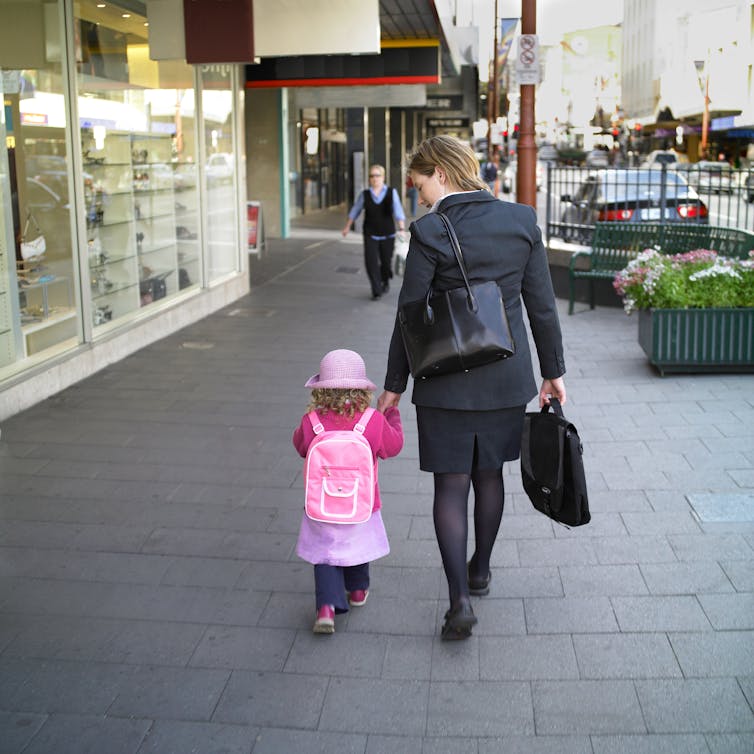
More often than not it’s women who must find time to drop off and pick up children from childcare and school.Shutterstock
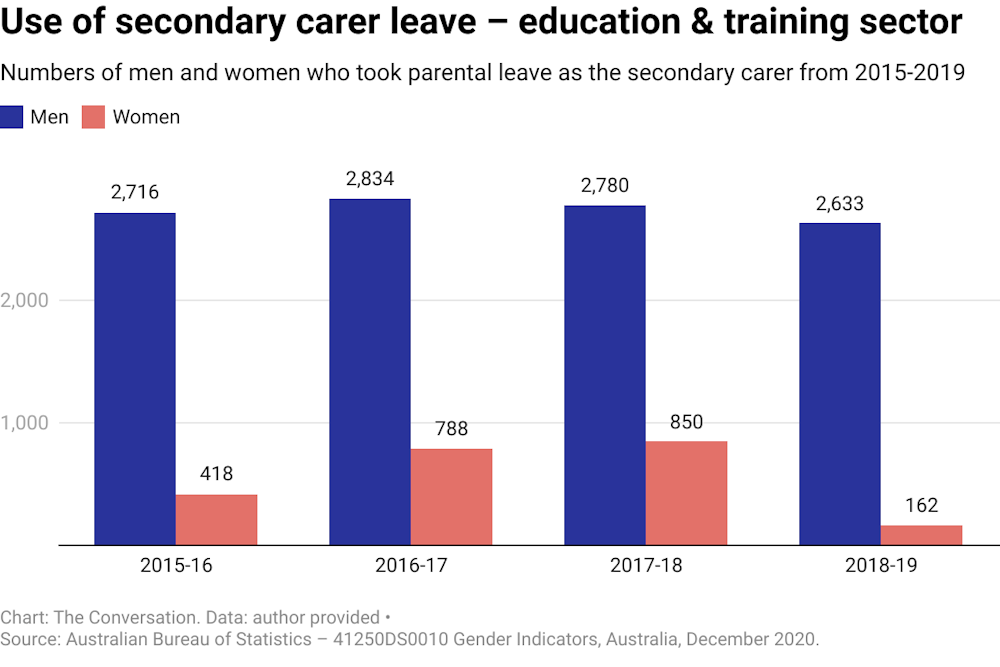
With a gender pay gap of over 30%, it makes sense that most families opt to keep the higher-paid dad in full-time employment. At present, ABS statistics show women take 93.5% of primary parental leave and men take 96.1% of secondary parental leave. But that means dads lose out on time with their kids.
If we are going to do something about gender inequality, we need to do something about parental inequality.
Caring is undervalued in Australia. Our government parental leave scheme is one of the least generous among OECD countries. The policy also perpetuates parental inequality.
The Australian government offers 18 weeks of paid leave to the primary caregiver and two weeks to the secondary caregiver paid at the minimum wage. The 18 weeks for Australian primary carers is equivalent to 7.7 weeks average earnings. The two weeks for secondary carers – overwhelmingly dads – is equivalent to half a week of average earnings.
One month of parental leave reserved for Australian dads paid at a meaningful rate can help to establish a more equal share of family tasks from the beginning. Best practice is 80% of earnings, with a cap. The result will be happier families overall.
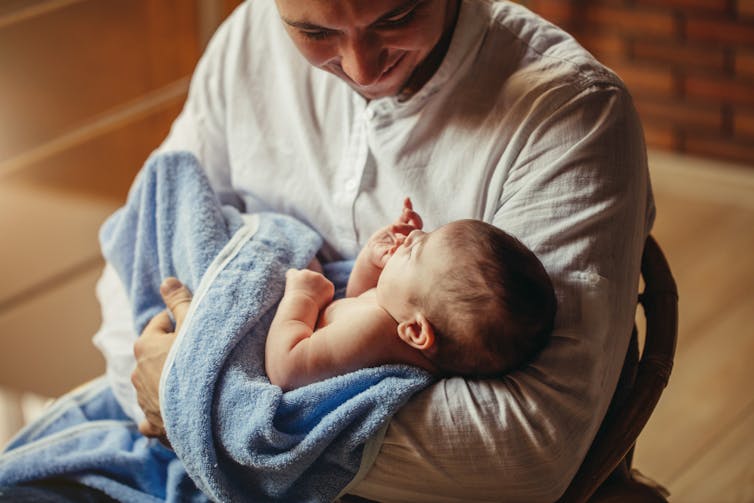
Families and society would benefit from dads being given a meaningful amount of paid leave to bond with and care for their children.Shutterstock
There is a fatherhood penalty too
Our research indicates universities’ default assumption is that women are the primary caregiver and dads are not active parents. For dads, they typically have to prove they are the primary caregiver by offering verification that the mum is employed full-time. No such proof is required of mums.
At some universities, even with proof, dads are entitled to less leave as primary carers than mums, or no paid leave at all. Worse still, even when the dad’s partner works for another organisation, some universities deduct the leave the partner has taken from the dad’s entitlement. This doesn’t apply to mums with a partner who works for another organisation.
We often talk about the motherhood penalty, but maybe it is time to tackle the fatherhood penalty?
Some universities have been publicly acknowledged for their progressive, generous, flexible and inclusive parental leave policies for new dads. To qualify among Australia’s top 20 parental leave employers, these universities must provide at least 12 weeks’ paid leave for primary carers and two weeks for secondary carers. They must also offer flexible work practices and primary carer’s leave for at least a year after the child’s birth.
However, the devil is in the detail, which sets a low bar. It allows universities to tick the “generous parental leave policy” box, without offering families real choices about how parents spend their time.
If universities fail to offer meaningful, easy-to-access parental leave to dads, they will fail to take it up. This indirectly strengthens the academic career model that values an employee with an unbroken commitment to work.
If we want to close the gender pay gap, we need to take steps towards parental equality and eradicate the terms primary and secondary caregivers. Some businesses in the private sector have done this, making parental leave policies gender-neutral, more flexible and easier for dads to access.
Our findings suggest universities are not the progressive institutions many of us expect them to be. Instead, they reinforce traditional, conservative values that block parental equality. Universities, other employers and the Australian government need to value both mums and dads and offer equitable parental leave policies in the true sense of the term.
“Among all species, it is perhaps only humans who create habitats that are not fit to live in.” – Stephen Marshall
It’s a damning statement but one that can be reasonably argued to be true. We don’t have the best track record in creating lasting and sustainable habitats, especially if one considers cities built in the past century.
The next 50 years will demand a new model of urban development. For a more sustainable future in a world of climate change, 21st-century cities must be based on models of adaptation that learn from natural systems. We now have the digital modelling technology to design such cities, rather than the fixed urban form that now dominates our world.
We are witnessing firsthand the destructive impact of an urban model that dates back to the early 1900s. The automobile was seen as the future of city planning. The city itself was designed like a machine: finite, predictable, perfect and, of course, shiny!
The “ideal” or “utopian” city, put forward as a visionary model for the 20th century, changed the course of city planning. It abandoned the traditional urban fabric of the previous five millennia for a modern urban order in which the car took centre stage. Car manufacturers even invested in 20th-century city design in the continuous pursuit of Utopia.
One of the most influential architects and urban planners of the 20th century, Le Corbusier, did not shy away from the role the automobile would play in city design. He even pursued sponsorship from companies like Citroen, Michelin and Peugeot to realise his vision. “The motor must save the great city,” he wrote.
The vision for this city followed similar patterns: separated pedestrians and vehicles, sprawling low-rise suburbs and scattered open spaces of inordinate sizes – sound familiar?
Most important to this model was the concept of repetition. If it works in Chicago, it will work in Chandigarh.
As the “utopian” urban movement dominated, “Utopia” turned out to be not necessarily a good thing. As early as the 1960s this had become clear through the works of critics like Jane Jacobs and Christopher Alexander. As Jacobs wrote:
Le Corbusier’s dream city was like a wonderful mechanical toy. But as to how the city works, it tells nothing but lies.
Cities throughout the world, across a range of scales and locales, exemplify this. Brasilia (Brasil), Detroit (USA), Milton Keynes (England), Norilsk (Russia) – the list goes on – were designed as modernist visions of a single, finite solution. However, this vision quickly unravelled. Overpopulation, climate change, diminishing resources, rampant commercialisation and demographic change have destabilised the urban fabric of modernist cities.
This unfortunately did not deter the continued planning and construction of this “universal city”. All too often the urban pattern was repeated blocks distributed across a grid with little adjustment to the local ecology or environment. Factor in a rapidly changing climate and exponential population growth and mobility, and these cities no longer seem utopian.
Cities unable to adapt
The problem with a city detached from its context – one that is generic, repetitive and built around vehicle traffic – is that it resists adaptation. After all, it was not designed to adapt – it is “visionary”, a fixed solution to an ever-changing problem.
Unfortunately for us, the problem has been changing at an alarming rate. The original “solution” is becoming ever more problematic.
The paradox is that repetitive urban form seems to be the quickest solution for the rapid growth of urban populations globally, unfortunately with dire impacts. Cities are a leading source of carbon emissions that have made them increasingly vulnerable to climatic events, with rising sea levels threatening coastal cities around the world. In some cases, failed cities lie completely abandoned – such as in Spain or China.
However, some cities – examples include Shibam in Yemen, Fes el Bali in Morocco or the Hutongs in Beijing – have evolved over many centuries as they adapted to changes in their environment and climate. These cities survived in the face of changing conditions. They were built on a model of continuous change.
Unfortunately, changing the built forms and spatial patterns of a city is a slow process. The evolving cities described above managed this by being able to change at a rate that matched changes in local climatic conditions. Today, the pace of global climate change makes it almost impossible for mature cities to adapt.
We need a more sustainable model of urban development.
Technological advances in computation and data analysis allow us to create digital simulations of the evolution of cities over centuries. It is now possible to understand the inherent complexity of these systems. We can then replicate the conditions that result in an adaptive city as a whole.
These computational models draw on concepts from the natural world. They learn from how species adapt to their environment and how evolution enables adaptation. The result is urban models based on variation instead of repetition.
Research in this field by the likes of Michael Weinstock, Mike Batty and many others has increased over the past decade. This work builds on the criticisms made by Jacobs and Alexander in the 1960s, but is now supported by advanced technologies and digital simulations.
The stresses on future cities demand an approach that enables them to adjust to rapid change. Up to now, we have designed a city that is geared towards permanent configurations. It’s the opposite of what is required in a world going through radical changes across multiple frontiers.
Australia’s COVID recession hurt women more than men, and not only in job numbers.
With schools and childcare centres closed, many women who remained in paid work had no choice but to take on more unpaid work, effectively working double shifts.
Yet much of the government’s budget response involved high-viz vests and hard hats.
These gender differences would have been apparent to the government if it had run its policy ideas through a “gender lens” – a process that used to be built into the government’s budget decision-making.
Promises of A$1.7 billion in childcare relief in Tuesday’s budget aim to lift women’s workforce involvement, but bigger steps beyond the perfunctory Women’s Economic Security Statement are needed to bring a gender lens to policy design.
With aggregate female and male employment numbers recovering, men are showing stronger keenness to return to the office, while more women are likely to continue working from home.
This can bring benefits for the women who opt for this, but also risks re-entrenching women’s traditional role as caregivers and squeezing them out of the career opportunities that the research on unconscious bias tells us tend to advantage those who are visible in the office.
Analysing these dynamics through a gender lens is not about pitting women against men.
It’s about appreciating the ways in which men and women tend to walk different life paths, navigate towards different industries and occupations and take different roles within households and society.
It can show up the ways in which men experience greater hardship than women.
During the crisis, the Melbourne Institute found that the group that suffered the largest surge in mental health distress was working fathers with young children.
A possible reason? Men are less accustomed to juggling work and home life. The risk of a toddler zoom-bombing your video call and detonating your professional reputation, seems to provoke more anxiety among men than women. It’s an example of gender differences in workplace culture and expectations.
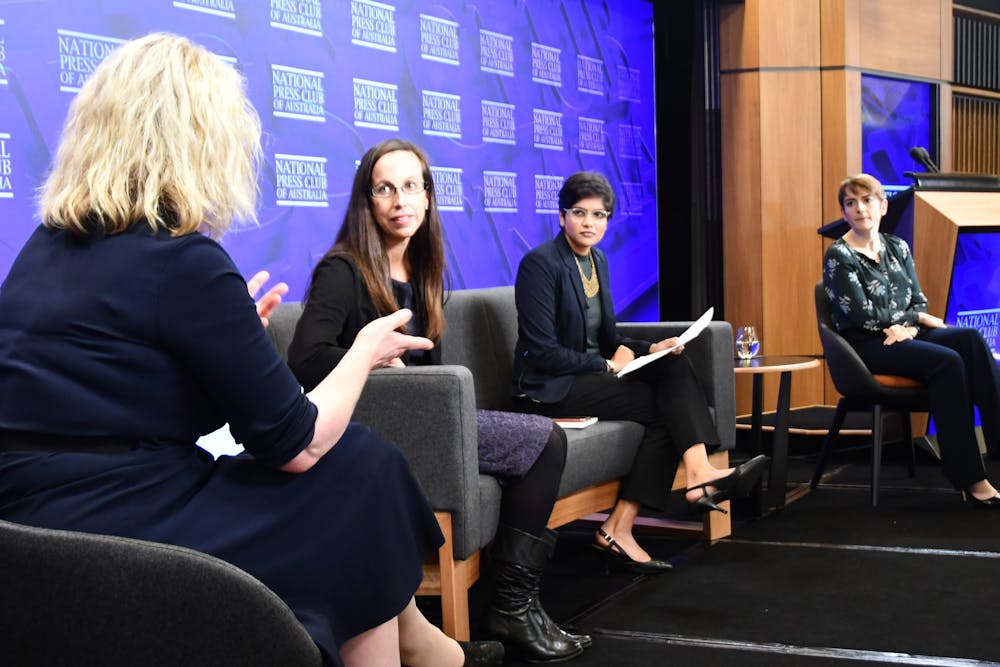
Leonora Risse, Gabriela D’Souza and Sarah Hunter discuss the budget with Laura Tingle at a Women in Economics forum on Tuesday.Lyn Mills/NPC
Most government policy decisions are presented as if they are gender-neutral.
When he was treasurer, Scott Morrison claimed that the tax system “doesn’t look at what your gender is any more than it looks at whether you’re left handed or right handed, or you barrack for the Sharks or you barrack for the Tigers”.
As prime minister, when asked whether last year’s budget left women behind, Morrison pointed to the ways that women were just like men.
“Women run small businesses, women pay tax, women hire other Australians in their businesses,” he said. “Women want to drive on safe roads. Women want to go to university.”
Programs are rarely gender-neutral
But ignoring the ways men and women participate differently is precisely what can lead policies unintentionally advantaging one gender over the other.
The tapering of family and other tax benefits when added to childcare costs means second earners can find it financially unviable to work more than three days per week.
‘Pink tape’ is red tape that holds back women.
A gender lens would tell us that it is overwhelmingly women who find themselves in this situation, facing effective marginal tax rates of around 90% on these extra days’ earnings.
It’s an example of “pink tape” that holds back female employment, in the same way that red tape holds back businesses.
A gender lens would tell us that expanding the public provision of childcare and early learning, aged care, disability care, mental health services and community care would not only create more jobs in female-dominated sectors, but also free up unpaid carers – predominantly women – to contribute to the paid workforce.
Boosting the careforce could pay for itself
The measured size of Australia’s paid economy — gross domestic product — would be at least 1.6% bigger in ten years’ time with such investment.
Economic modelling commissioned by the National Foundation for Australian Women found that investment along these lines, including investment that lifted the wages of workers in caring industries, would largely pay for itself via the tax revenue that flowed back to the government’s budget.
The barrier to accepting such ideas is that governments usually only examine recurrent costs and ignore the future recurrent benefits.
Gender lensing can break down barriers against men.
Our parental leave system is built around the idea that one parent takes most of the leave.
Increasing paid parental leave for dads, and making it non-transferable on a “use it or lose it” basis, would legitimise men as carers.
Is it better for men to be the breadwinners and for women to look after the home and children? When asked in the Melbourne Institute’s Household, Income and Labour Dynamics survey, only 20% of men and 16% of women thought it was.
Efforts to economically empower women will have limited success in a society that is grappling with the concept of women being empowered.
New research by Australian National University economists finds that when a woman’s earnings begin to exceed those of her male partner, the incidence of domestic violence and emotional abuse rises.
Any policy aimed at improving women’s economic security and safety has to go hand-in-hand with policies that empower men to embrace healthy masculinities and step beyond their traditional roles.
There’s more to it than economics
Many of our breakthroughs in equality have occurred during times of economic necessity. The Commonwealth bar on the employment of married women was removed at a time of labour shortages in teaching and nursing.
Right now it’s easy to argue that boosting women’s involvement in the workforce will help fuel the economic recovery, but the case for gender equity shouldn’t need to depend on that.
When so much depends on gender, applying a gender lens to policies is the responsible thing for governments to do. It’s worthya in its own right.
Source: The Conversation (Au and NZ) – By Hugh Breakey, President, Australian Association for Professional & Applied Ethics. Senior Research Fellow, Moral philosophy, Institute for Ethics, Governance & Law, Law Futures Centre., Griffith University
Love can seem a primal force, an intoxicating mix of desire, care, ecstasy and jealousy hard-wired into our hearts. The polar opposite of philosophy’s measured rationality and theoretical speculations.
Yet if you take any topic in the world, and keeping asking deep questions of it, you will ultimately wind up doing philosophy. Love is no different.
Indeed, many famous philosophers— Kant, Aristotle, De Bouvier — wrote about love and how it fitted into their larger theories of human reason, excellence and freedom.
Unsurprisingly, their historically-situated views tended to mirror the culturally valued types of love in their time. The Greeks eulogised the love of friendship. Scholars in the middle ages ruminated on the love of God. With the Renaissance, romantic love moved centre stage.
Today, philosophers continue to interrogate love and draw practical lessons about how we can approach it in our own lives.
Philosophers continue to interrogate the nature of love.Véronique Harter George, CC BY-NC-SA
Think of the ways in which we distinguish love from other similar qualities. We can easily imagine someone saying: “It’s not love — they’re just friends.” Or “It’s not love —it’s just infatuation.”
Ideally, an account of love would distinguish it from (on the one hand) liking, friendship, respect, admiration and care, and (on the other) lust, infatuation and obsession. Love seems deeper than and different from these.
Perhaps we also need to consider whether we use the word love in different ways. When we speak of loving books, or a band, or our pets, are we using the same concept as when we speak of love of people?
Józef Simmler’s portrait of Diotima of Mantinea. Her ideas and doctrine of Eros as reported by Socrates are the origin of the concept of Platonic love.Wikimedia Commons
Even focusing on love of people, we may want to distinguish between types of love — such as the passion shared by two honeymooners, compared to the committed companionship of an elderly married couple. Some might mark the distinction by saying the honeymooners are “in love”, while the elderly couple “love one another”.
Early philosophers, including Plato, Aristotle and St Augustine, developed intriguing concepts here, distinguishing eros (passionate desire) from philia (friendship) and agape (universal brotherly love).
Yet other philosophers, such as Susan Wolf, point out that, despite distinctions in their early stages, different types of love tend to grow more similar over time. Perhaps this suggests there is an underlying, shared essence of love.
The essence of love
Imagine you asked yourself what love is really, ultimately about. What would your answer be?
Would you say love is an emotion? Love can seem a perfect example of an emotion. However, compared to emotions like anger or sadness, love’s mental states are strangely changeable. Love can make us daydream and swoon — but equally it can drive us to jealousy, loss, confusion, aspiration, ambition and more. Love is not one feeling, but the fount of many.
Perhaps you might instead focus on love as desire — either to improve the beloved’s life, or (in the case of romantic love) to be with them emotionally and physically. (Of course, the desire to be with the beloved often overlaps with the desire to do what is best for them. But tragedy is not far away when these two desires pull in different directions.)
Or you might wonder if love is a profound type of recognition — the ability to really see into another person’s normally hidden depths, and to realise how profound and important they are.
These are all good answers. Different philosophers defend each of these approaches, finding insight in each. One of the nice things about philosophy is that there may be no single correct answer to these questions. Some people might even hold that love is inherently ineffable — incapable of rational definition.
A puzzle
One important part of any account of love will include the way we value the beloved. But this presents an intriguing puzzle. We feel like we love another person on the basis of their lovable properties. We love them for their kindness, charm, beauty, intelligence, depth, sense of humour, or their eyes or smile. And we feel like we want to be loved by others on the basis of our own virtues.
Loving someone means we resist ‘trading up’.shutterstock
While this seems reasonable, a moment’s reflection shows it can’t be right. If we really loved someone purely on the basis of their desirable properties, then we should rationally “trade up” any time someone came along who was even more beautiful and intelligent. But that’s not how love works. We love the whole person, not just their particular qualities, which might come and go.
But equally, it can’t be that we love someone just “because”, on the basis of no reasons whatsoever. That seems unsatisfying, and doesn’t mesh with the fact there clearly are things about our beloved that we cherish and that anchor our attraction. Equally, if our beloved starts treating us badly, we can respond to that — perhaps ultimately by withdrawing our love. We aren’t simply condemned to go on loving the person even when we have no reasons to do so.
Love as a verb, love as a history
Another dimension of love is the fact that love is not a simple state of existence, but occurs over and through time. After all, love is not only a noun, it’s also a verb.
Loving is an intention and an action that has consequences, and like other actions, it’s one that we can be responsible for and accountable for. Even though we can fall in love, it remains something that we can make choices about — we can work to remain in love, and we can strive to free ourselves from it.
For this reason, some philosophers, such as Raja Halwani, have stressed that love is ultimately about commitment.
Love occurs over time.shutterstock
It is when we start to own our feelings for another person, and become responsible for them, that love occurs. When we are merely gripped by them, or overthrown by them, it is just obsession or infatuation. From there it is up to us to commit, and this is where genuine love — love as a verb — emerges.
There is another way love occurs over and through time. The love between two people arises from a historical process in their lives. As romance books remind us, love often presents as a story, with events occurring between two people that change and challenge them as they come together and (all going well) seek to create a new union — a “we”.
(Of course, for romantic love, chemistry matters too. There is no guarantee that two people will “fit” merely because they both have wonderful virtues and compatible values.)
In other words, to say that a person is in love is not purely a statement about emotion or value. It is also telling us something about their history. They have lived and grown through their experiences with the beloved, and this has led to their deep attachment. This is at once one of the glorious parts of love, empowering intimate shared experiences, even as it is a way that drives the process of love forward.
One of the reasons we love him rather than someone else, is because we have had special intimate experiences with him, grown with him, shared memories with him, created a life with him.
The ethics of love
Is love ethically justifiable?
In many ways, love can seem like a moral danger. Love is often “blind” — it can beguile us into seeing the world wrongly. Love also stops us valuing others impartially — which can seem like the exact opposite of what ethics requires of us.
Edward Burne-Jones, Love Among the Ruins:Wikimedia Commons
Also, love has a complex relationship with autonomy: the capacity to direct and control our lives, and a central part of being a free and responsible human being.
Love can threaten autonomy. When we invest emotionally in another person, plan our lives around them, and start to feel their gains and losses as our own, we relinquish the amount of control we have over both big and small life decisions.
Still there is another side to love, which sees it as ethically critical. After all, love extends us beyond ourselves, giving us an attachment to others that pushes us out of self-interested and self-absorbed ways.
The way we value our beloved can even parallel moral respect. We value and desire the person in and for themselves, similar to the way morality requires us to respect others for their own sake.
Finally, as far back as Socrates and Plato was the idea that love uplifts us morally by letting us see value and beauty in the world. By giving us reasons to live and get out of bed in the morning, love makes us aware the world houses wonderful, inspiring things, worthy of our care and protection.
Lessons
These philosophical ideas about love suggest some practical lessons.
First, love is complex and ambiguous — if thoughtful philosophers can’t agree on its qualities, different people may understand it in different ways.
This depth of disagreement matters. It means someone might truthfully say, “I love you”, but they might mean something completely different from what we imagine. They might be speaking of desire and passion, where we think of commitment and togetherness.
Secondly, love involves vulnerability — and therefore risk. All the features of love noted above — desire, value, commitment, care — create vulnerabilities. Love makes us open ourselves up for another person, showing intimate parts of ourselves, and hoping the support and care we feel for them will be reciprocated.
Ferdinand Bol, Portrait of Wigbold Slicher and Elisabeth Spiegel as Paris handing Venus the Apple, 1656.Wikimedia Commons
It is a difficult thing to pour so much concern, admiration and desire onto someone, investing our time and precious experiences into them, even defining ourselves in terms of them and feeling their pains as our own, if they do not meet us halfway.
Unfortunately, we often respond to being vulnerable by taking control. In some ways, this is healthy. It can prompt us to make sensible decisions about managing our lives. We can decide that a relationship is toxic or not good for us, and work to improve matters or to leave.
But there is a dark side to this desire for control. We may respond to our emotional vulnerability by trying to control parts of our beloved’s life. This can be harmful to them, and to the relationship. For this reason, care and respect are vital in relationships of love.
Thirdly, if we want to love, we must learn to love a changing person. As we saw above, there is a sense in which we love both the person themselves, and also their lovable qualities.
This gives rise to a practical challenge in maintaining love. We are challenged to continue finding lovable attributes in our partner, and creating new experiences with them, even as they change and grow.
And at the same time, we are challenged to keep nurturing our own lovable properties and virtues, to ensure our partner has continuing reason to remain in love with us.
Ultimately, love may be too wonderfully multifarious and dynamic to be pinned down by a definition or philosophical theory. But we can still benefit from thinking deeply about love’s nature and the challenges and promises it presents.
It became clear this week repatriation flights for Australians stranded in India would have to resume ASAP after May 15, whatever the COVID situation in that country.
By going too far in its effort to stop individuals using a third-country “loophole” to get home, the Australian government made it impossible to keep shut the direct flight pipeline.
Cabinet’s national security committee on Thursday approved the resumption as the government finalised arrangements with the Northern Territory, site of the Howard Springs quarantine facility where the arrivals will go.
The government will give its reasons as to why arrivals from India have become more manageable (although the number will be modest). Notably, it will say the “pause” has provided time to reduce COVID overload in quarantine. By May 14 positive cases at Howard Springs are expected to number between 0 and 5, down from 55 on April 26.
A key reason, however, that won’t be included is that Scott Morrison needs to escape the branding of his government as a moral pariah.
The attack the prime minister has come under is justified, but its strength and breadth are still surprising.
The government would have anticipated criticism from the political left, human rights groups and the like. However, it’s those on the right of the spectrum who have been among the most ferocious, including commentators such as News Corp’s Andrew Bolt and Chris Kenny.
Morrison judged the “quiet Australians” were behind his action. Indeed, one Liberal MP says “80% of the public think the prime minister is a star”. After all, those premiers who closed their borders were heroes to their voters.
But objectively, circumstances are very different when we’re talking about the national border and excluded citizens who are in what amounts to a health war zone.
Even assuming the “quiet Australians” were with Morrison, he could not ignore the near-universal condemnation from a usually divided political class, and he would be disturbed by the sharp reaction from many in the local Australian-Indian community. Most voters will have long forgotten this issue by election time, but those Australians of Indian heritage – to whom Morrison has made a pitch via Facebook – will have longer memories.
It has been impossible to get details from the government about the Australians in India, beyond the basic numbers.
We do know from Australian High Commissioner Barry O’Farrell that the “vulnerable” among the 9,000 registered Australian citizens and permanent residents have increased from 650, the figure given last week, to 900.
We don’t know who the “vulnerable” are and the nature of their vulnerabilities. How many are ill or frail, how many are in financial strife, or homeless? O’Farrell has said they haven’t been asked if they have COVID-19. The Foreign Affairs Department is not answering questions about them.
After last week’s cancellation of all flights from India until May 15, the real trouble for the government came when it went a step further – by invoking the Biosecurity Act and pointing to the act’s penalties to prevent people coming via a third country.
The formal announcement was in a statement issued by Health Minister Greg Hunt, which hit inboxes in the early hours of Saturday morning.
In subsequent days, Morrison tried to row back on the question of penalties. He indicated no one would be sent to prison, and declared it was the media, rather than he or Hunt, that had highlighted jail. The fact the penalty was spelled out in Hunt’s media release was “simply a statement of what the Biosecurity Act does”, Morrison said.
But the government could have left the penalties out of the statement – and made it clear, to those who asked, that it was not on a punitive mission.
For a government so obsessive about controlling its messaging, it is very poor at injecting some subtlety into it.
Indeed, it let its ban appear even worse than it is.
That late-night statement said no one could arrive in Australia who had been in India in the preceding 14 days – meaning there is actually still an indirect long, slow way home (which would land someone here after May 15 if they had left India as soon as the ban came into effect).
Thus former Test cricketer Michael Slater – who has lambasted Morrison on Twitter – is in the Maldives serving out this period. Most of the Australian cricketers have followed him, after their tour was suspended.
On the other hand, most people caught in India don’t have the resources of elite cricketers and their accompanying entourage, and so the option of 14 days in another country is a theoretical one only.
One interesting issue in the use of section 477 of the Biosecurity Act is how the political and the medical elements interacted.
As Kelly noted in his advice to the government, this would be “the first time that such a determination has been used to prevent Australian citizens and permanent residents entering Australia”.
Kelly told the ABC “we were requested to provide advice” on the use of the act, indicating the initiative came from the government.
“There is a particular section under the act which requires that the minister, before he makes a decision, is provided with advice in relation to several matters,” Kelly said.
These include that a ministerial decision must be proportionate, no more restrictive than required, and in place only as long as needed.
Kelly gave the necessary ticks.
But in his written advice Kelly went out of his way to spell out bluntly what could be the bad outcomes of the decision, while arguing they could be mitigated. He covered his back.
“I wish to note the potential consequences for Australian citizens and permanent residents as a result of this pause on flights and entry into Australia,” he wrote.
“These include the risk of serious illness without access to health care, the potential for Australians to be stranded in a transit country and, in a worst-case scenario, deaths.”
Kelly is due to appear before the Senate’s COVID committee late Friday; he can expect to be pushed on the circumstances surrounding his advice.
Apart from the political pressure, one reason the government is anxious to have a plan in place for some, albeit limited, repatriation from India is that the legal challenge against the government’s action is in court early next week.
Regardless of the legal action’s prospects, by outlining its intentions the government will defuse the case’s impact.
And given the agitation among crossbenchers and even some in his own ranks, Morrison also wants to cool this issue, which has flamed out of control, before the start of budget week.
Rising tensions between Australia and China have raised the question of where New Zealand would stand if things escalate further.
Close trans-Tasman friend and ally Australia is taking a more aggressive stance against China – with South China Sea and Taiwan potential flashpoints.
And recent statements from its defence minister about a possible conflict with China have caused some alarm – a prospect that could put New Zealand under real pressure – to pick a side.
New Zealand Minister of Foreign Affairs Nanaia Mahuta said she could not comment on “prospective thinking about what may or may not happen”, adding New Zealand “values” the important relationship with Australia.
It did “make for an uncomfortable situation” to have Australia and China at loggerheads and “where you see your neighbours being treated in such a punitive way”, she said.
Australia was in a different position to New Zealand and “obviously see things in a certain way, because they have neighbours and are in a part of the region where they feel several things more acutely and we will remain closely connected in the way that we share our view of what’s happening in our region”, Mahuta said.
‘Nimble, respectful and consistent’ If it came down to taking sides – what would New Zealand do?
“New Zealand is very aware that we are a small country in the Pacific,” Mahuta said.
“And we are also aware that the nature of our relationships, both bilateral and multilateral, require us to be nimble, respectful, consistent and predictable in the way that we treat our nearest neighbours, but also those who we have bilateral relationships with, no matter whether they are big or small relationships.”
Leading defence analyst Dr Paul Buchanan said storm clouds were gathering and armed conflict was now a “distinct possibility”.
“Maybe not directly between the Australians and the Chinese, unless there’s a miscalculation involving a Australian warship, doing freedom of navigation exercises in the South China Sea,” Dr Buchanan said.
“But more than likely, as part of a dispute that gets out of control and Australia, as part of a coalition of countries, probably led by the United States, that is duty bound to respond, so for example, Taiwan.”
If such a conflict erupted, that would leave New Zealand “between a rock and hard place” because it would be asked to join that coalition, Dr Buchanan said.
That would require some “hard decisions … that have been in the making for well over a decade when we decided to throw most of our trade ships into the Chinese market”.
“Now we’re in on the horns of a dilemma and a bit of a quandary should our security partners ask us to join them in the common defence of a country suffering from Chinese aggression,” he said.
This article is republished under a community partnership agreement with RNZ.
PODCAST: Buchanan and Manning on Microlateralism - Is This How New Zealand Becomes Relevant on the World Stage?
/
RSS Feed
Share
Link
Embed
A View from Afar: In this week’s podcast Selwyn Manning and Paul Buchanan debate: How recently New Zealand Government confirmed its intention to be defined as an independent Pacific Island state, where its foreign policy should be considered against the collective values that its peoples share, and its diplomacy (if you consider human rights issues) will now be expressed multilaterally with likeminded countries.
But how does this work in practice?
Many see multilateral bodies like the United Nations being controlled by large global powers such as China and the United States of America. That this reality renders the UN’s security council as toothless, cumbersome, and slow to act in times of crisis.
Basically, this form of multilateralism seems designed to create a stalemate between great powers that assert their respective competing agendas. The affect; small countries lose their voice and influence.
So how do small powers like New Zealand express themselves on the world stage?
How do small countries shape reform of global bodies, so that they can work as forces of good in a world where geopolitics is divided between polarised blocs?
Is microlateralism (a global collective of likeminded states) the answer?
Is New Zealand about to stride out on the world-stage to assert this new form of multilateral collective bargaining?
WE INVITE YOU TO PARTICIPATE WHILE WE ARE LIVE WITH COMMENTS AND QUESTIONS IN THE RECORDING OF THIS PODCAST:
You can comment on this debate by clicking on one of these social media channels and interacting in the social media’s comment area. Here are the links:
To help Australia adapt to climate change and manage the disasters that come with it, the federal government this week pledged A$600 million towards establishing the National Recovery and Resilience Agency, and $210 million for the Australian Climate Service initiative.
The sizeable investments make sense, as Australia’s threat landscape has changed. Climate change, drought, land clearing, urban growth and other activities have significantly increased the chances of natural hazards and disasters Australia-wide. All of which are costly to recover from.
The new organisations could deliver revolutionary benefits to Australia by better aligning policy and practice in a more agile way that matches the complex set of threats we face.
There are, however, issues that warrant attention. It’s not yet clear how the government plans to bring together Australia’s best experts — including policy thinkers, emergency managers, researchers and practitioners — to address the complex, evolving threats. Currently, it seems the role of universities has not been adequately defined.
Australia’s recent disasters
The 2019-20 bushfire season was arguably the most extreme in living memory. It started earlier than what might normally have been expected and made history for its severity and widespread damage to life, property and the environment.
Bushfires weren’t the only natural hazard Australia dealt with during this period. Insurance claims from hailstorms, flooding and bushfire damage for the 2019-20 period exceeded $5.19 billion.
The March floods in western Sydney peaked at a staggering 12.9 metres.Shutterstock
Then came the severe flooding across New South Wales in March, which peaked at 12.9 metres. As of March 23, policyholders had lodged up to 11,700 insurance claims associated with these storms.
While these recent disasters were unprecedented in their scale and impact, we can expect disasters in the future to worsen due to climate change, from longer heatwaves to intensifying cyclones and a range of cascading and cumulative impacts on society.
This is why the federal government’s announcement this week is extremely important.
So what will these initiatives do?
The new organisations are in response to recommendations from the recent bushfire royal commission, and as part of next week’s federal budget.
The National Recovery and Resilience Agency will be led by former Northern Territory chief minister Shane Stone, and brings together the responsibilities of the national agencies in charge of flood and bushfire recovery.
Its job is to oversee $600 million that will go towards new programs for disaster preparation and mitigation. It’ll focus on minimising disruptive impacts on communities and assist in making them ready to face future disasters. It will also administer the $2 billion National Bushfire Recovery Fund on an ongoing basis.
A key enabler of this is the National Climate Resilience and Adaptation Strategy, which is currently getting updated after its first release in 2015. The new strategy will be released later this year, and should be vital in underpinning the direction of the new agency.
The government must ensure the strategy provides guidance that matches the goals of the new agency – in particular that of building resilience. It’s important to recognise that while disaster response is generally similar across the board, the effects of disasters vary depending on the community, urban and physical features, as well as socioeconomic levels and access to services.
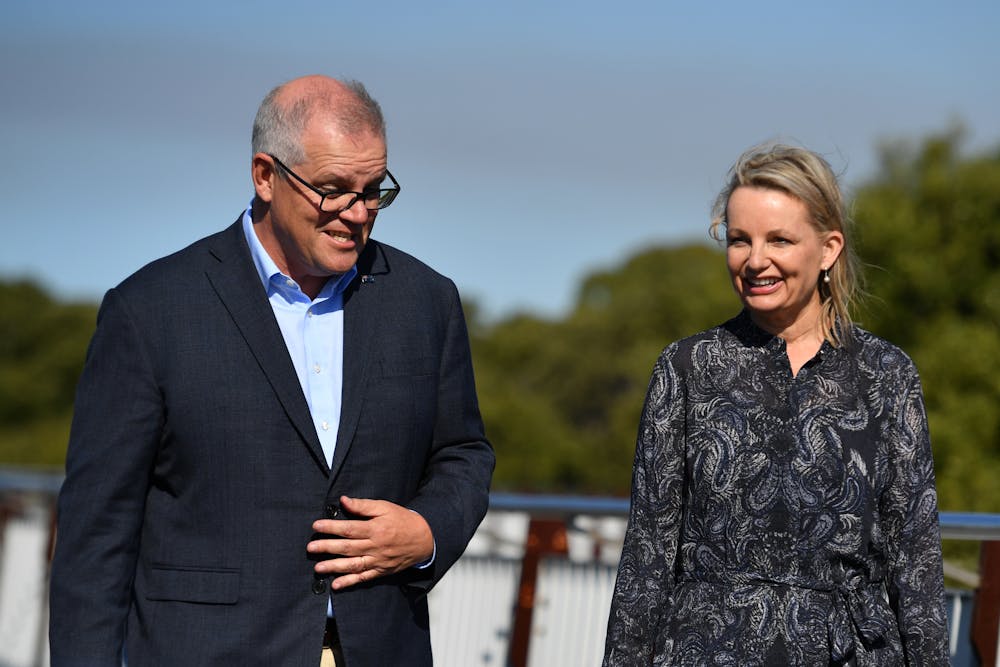
Environment minister Sussan Ley says the Climate Service initiative will underpin Australia’s future adaptation strategies.AAP Image/Mick Tsikas
And the Australian Climate Service initiative will, according to Environment Minister Sussan Ley:
help provide an environmental road map in our planning for infrastructure, housing and basic services like power, telecommunications, and water [and in] anticipating and adapting to the impacts of [a] changing climate.
Together, the benefits of both new organisations have the potential to be revolutionary.
They — along with a new national research centre focused on hazard resilience and disaster risk reduction (announced in July last year) — may be the largest realignments in disaster management policy and practice for a generation.
But how they’re implemented and coordinated will, ultimately, determine this.
There’s more to do
A potential issue with the Australian Climate Service Initiative that might limit its effectiveness is its emphasis on the roles of the Bureau of Meteorology, CSIRO, the Australian Bureau of Statistics and Geoscience Australia.
This collaboration means the initiative has access to huge amounts of data, information resources, and links to the National Environmental Science Program and Great Barrier Reef Restoration and Adaptation initiatives.
But we shouldn’t forget many Australian universities have considerable relevant expertise at their disposal, too. Not including the network of expertise and experience of universities means we may be shooting ourselves in the foot.
What’s more, the National Recovery and Resilience Agency intends to provide accredited training for people working in disaster recovery. The deep training and development expertise of universities is a perfect fit for this goal.
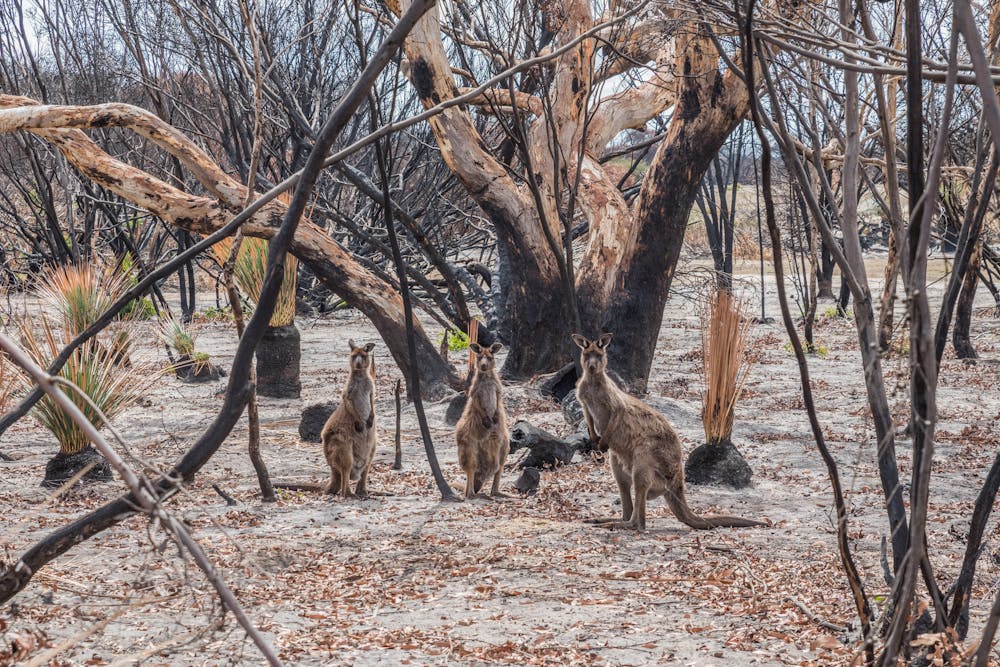
Australia will face more disasters due to the changing climate.AAP Image/Supplied by RSPCA SA
To really embed the benefits, we need to break down historical silos between national, state and local agencies. On-the-ground efforts for disaster risk reduction, emergency management and response, and the broad social aspects of recovery are largely state and local government responsibilities.
Crisis response planning and action is a team-based sport, so getting the federal, state and local governments — and the private sector — involved will help streamline the application of the new disaster policies and protocols embodied in the announced changes across the continent.
We saw this type of team-based effort at a national level when the emergency national cabinet was established to oversee collaborative decision-making in response to the COVID-19 pandemic. It’s joined-up thinking that enables rapid and more complete decision- making.
In short, we need better collaboration. How we can work together and utilise all our capabilities and capacities are questions that need to be at the forefront of national thinking.
This story is part of a series The Conversation is running on the nexus between disaster, disadvantage and resilience. You can read the rest of the stories here.
Waterspouts are extraordinary, impressive weather events. Observers describe them as looking like “the start of an alien invasion” and post their snaps across social media.
But what are these enigmatic offshore twisters, and what causes them to form?
What is a waterspout?
A waterspout is a spinning column of air that sucks up water (usually from the ocean) to make a twisting funnel of water and cloud connecting the sea and the sky.
They are spectacular but short lived, usually lasting no more than five minutes (but occasionally up to ten minutes). Winds inside the waterspout can be faster than 100 kilometres per hour, and they can do great damage to boats at sea.
If they drift ashore, waterspouts can create even more havoc: the Lennox Head tornado in 2010 destroyed a dozen homes in northern NSW.
Waterspouts are in some ways like the tornadoes that form over land. But where tornadoes are associated with huge supercell thunderstorms, waterspouts can form during smaller storms or even just showers or the presence of the right kind of clouds.
Waterspouts can form when winds blowing in two different directions run into each other. Along the line where the two winds meet (called a “convergence line” or “shear line”), there is a lot of rotating air near the surface.
The collision of the two winds makes air move upwards because it has nowhere else to go. This rising air carries water vapour high into the sky where it creates rain showers, storms and cumulus clouds.
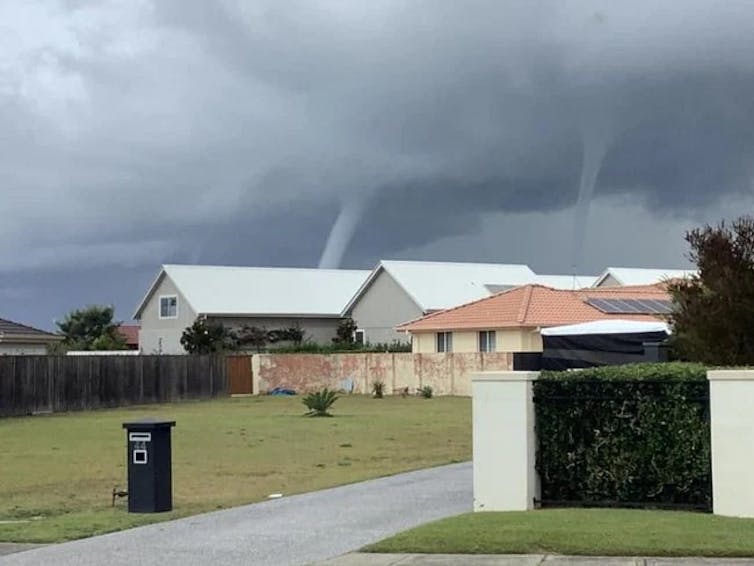
Waterspouts off the coast at Harrington in NSW.Sue McDonald, Author provided
As the air rises, it can tilt some of the horizontal spinning air near the surface into the vertical direction. When this vertical spin concentrates at a particular point it starts sucking up water — and you have yourself a waterspout.
Because waterspouts form on the line where two winds meet, you sometimes see a line of waterspouts in a row where the spinning low-level air is sucked upwards at a few different points.
When and where are waterspouts most common?
In Australia, waterspouts are most common along the NSW and Queensland coast.
Most mornings, cooler nighttime air blowing off the land meets warmer air sitting out to sea. Usually this results in a line of clouds sitting offshore where the two air masses meet.
Under the right conditions — most often in autumn and winter, when the land gets colder but the sea stays relatively warm — the collision becomes more dramatic and waterspouts appear.
Can we forecast waterspouts?
Waterspouts look very big and impressive to the casual viewer, but to a meteorologist looking at the world’s weather patterns they are quite small. This makes them very hard to forecast with any level of confidence.
We know the kind of weather conditions that can lead to waterspouts, so if we see those conditions forming we might know there is a chance we’ll see some. But the small scale and short life of waterspouts mean forecasting the location or timing is almost impossible.
The COVID-19 crisis has thrust a largely unseen part of Australia’s population firmly into the national spotlight.
These are the Australians who live and work abroad — our diaspora.
For more than a year, we have been hearing harrowing stories of Australians unable to get home. Most recently, there is the distress of those in India, currently banned from even trying to return.
But despite increasing awareness of this group, there is still much we don’t know about our diaspora. The bottom line is, we don’t have precise or up-to-date information about Australians overseas.
This lack of knowledge and understanding highlights the need for a national diaspora policy that truly reflects contemporary, multicultural Australia.
What do we know about Australians overseas?
Australia’s diaspora is estimated to include around one million people, but this would be significantly higher if former residents, such as international students, were included.
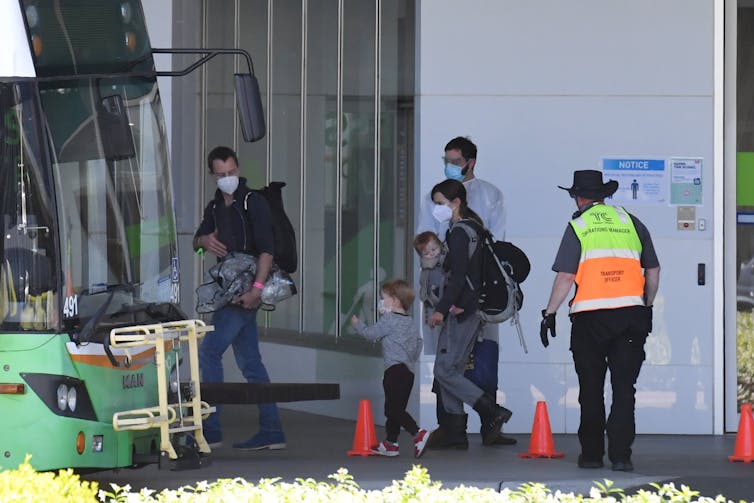
COVID-19 has seen more than 400,000 Australians return home, but more than 30,000 are still registered as wanting to come back.Mick Tsikas/AAP
Large-scale studies in 2003 and 2006 told us Australians overseas tend to be highly educated and highly valued by employers. Many also retain links with family and friends in Australia. They continue to identify as Australian and intend to eventually come back.
The who’s who — people at the pinnacle of their careers in significant international positions
Gold collar workers — highly-skilled, well-paid Australians developing their careers on the international stage
Other professionals — including nurses or teachers
Return migrants — first or second generation Australians, going to their family’s original country for family or professional reasons
Rite of passage travellers — young Australians living or working overseas.
Organisations such as Advance (which is supported by federal government funding) work to connect Australians overseas with each other and Australia. The focus here is on high-profile or very successful expats and how we can leverage their skills and networks to Australia’s advantage.
Traditionally, the majority of departures from Australia have been to Europe, the United States and New Zealand. This has lead to a narrative that doesn’t necessarily reflect the make-up of Australia’s population living overseas and Australia’s multicultural story.
We know from immigration and short-term travel data (those away for less than a year) that Asia, and in particular countries such as India, China, Indonesia, Thailand and Japan, are increasingly important for Australians.
Long-term departure data present a similar picture. Our analysis of Australian Bureau of Statistics data shows India saw a 54% increase as a destination for Australian residents between 2007-08 and 2016-17.
So, the idea that Australia’s diaspora is largely made up of young Aussies backpacking in Europe, or hyper-successful entrepreneurs in Silicon Valley is an outdated one. There is every indication today’s diaspora is complex, and largely made up of everyday Australians doing everyday things.
Yet, we don’t have comprehensive or up-to-date data on where Australians are overseas, what they are doing and whether they are planning to come back.
Why don’t we have a clearer picture?
At a broader level, Australia’s national focus has been on our immigrants, for whom detailed data are recorded and available from the Department of Home Affairs and Bureau of Statistics.
Emigrants have long been an understudied element of Australia’s migration story.
Australia does not have a dedicated policy to keep track of and make use of its citizens living overseas.Tony McDonough/AAP
One of the reasons for our limited and outdated information on our diaspora is the voluntary nature of registration with the Department of Foreign Affairs’ SmartTraveller program.
In 2017, Australia also stopped collecting information on intended destination and reasons for travel on outgoing passenger cards. This was to improve the “traveller experience” and streamline the border clearance process.
Meanwhile, despite recommendations from Senate committees in 2005 and 2013, Australia has not set up a dedicated diaspora policy and monitoring unit within government.
Why do we need a diaspora policy?
At a basic level, a diaspora policy would provide a formal commitment to strengthen links and maintain connections with Australians abroad.
Aside from taking advantage of the knowledge and skills of Australians overseas (which can influence bilateral trade, business and investment opportunities), a diaspora policy should also foster engagement by attending to the welfare of Australians overseas.
COVID-19 has shown us how important it is to understand where Australians are and their circumstances in a time of crisis.
This lack of information makes it difficult to plan and help people quickly. A holistic, consistent and ongoing dataset would tell governments where the pressure points are in times of crisis — where are most of our citizens? How old are they? How vulnerable might they be?
How can we do it better?
A commitment to deeper engagement with our diaspora is fundamental. In addition to a diaspora policy, a relatively easy way to get a better grip on Australians overseas would be to improve how Australians interact with SmartTraveller, so it becomes second nature for travellers to register and update their movements when overseas.
Another alternative is to link in with other countries’ censuses at the turn of each decade and use data from destination countries. However, this means we are relying on other countries’ data collection, not our own. We could also look at regular large scale “census-like” surveys of Australians living overseas.
Getting a better grip on Australians overseas will have huge benefits in terms of planning, our economy and national identity. Bringing our diaspora back into our national population and migration story will help us understand its true character, nature and value.
Importantly, it will also move beyond the narrative of Australians overseas as either a “burden” or an “asset”.
Source: The Conversation (Au and NZ) – By Nicholas Wood, Associate Professor, Discipline of Childhood and Adolescent Health, University of Sydney
Investigations are under way to determine whether the deaths of two people in New South Wales who developed blood clots are linked to the AstraZeneca vaccine.
We’ve also heard today that 11 Australians have so far developed blood clots (thrombosis with thrombocytopenia syndrome) linked with the vaccine.
But what are these investigations? And who decides whether events like these are actually linked to COVID-19 vaccines, or something else?
There is a lot of interest in the safety of COVID-19 vaccines. So the public and health-care workers are “highly tuned in” to reporting suspected side-effects.
Anyone can report these to Australia’s drug regulator, the Therapeutic Goods Administration (TGA). Alternatively, people who have been vaccinated can do so when prompted with a survey via the AusVaxSafety system.
This is a good thing as it means we are likely to pick up any serious or unusual events. Every report is valuable and contributes to our safety monitoring. However, just because an event happened after a vaccine does not mean the vaccine caused it.
A serious event could be caused by an underlying medical condition, a medication the person was taking at the time, or some other factor unrelated to the vaccine.
For example, before COVID-19 and vaccines against it, dozens of people across Australia developed blood clots, in their legs, lungs, brain and other parts of the body, every day, often without warning or clear cause.
When a person has a suspected vaccine side-effect it is usually reported to the state or territory health department; some reports go directly to the TGA.
Most reactions reported after vaccination are mild to moderate. AusVaxSafety surveys in more than 365,000 people in Australia confirm what we saw in vaccine trials. Up to two-thirds of people experience symptoms such as fever, muscle aches, joint pains and headache within the first one or two days after vaccination, which go away without treatment. This is the immune system responding to the vaccine.
What if it’s serious?
If the person dies or had a serious event needing hospitalisation within the days to weeks after vaccination — like the clotting cases you will have heard about, or there was an unusual unexpected event — there are further investigations.
Health department and TGA staff gather as much information as possible about the person, including their medical history, risk factors, any medications they are on, details and timing of the vaccine, hospitalisation records, any laboratory test results and whether they have recovered or have any ongoing issues. This will involve liaising with the person’s GP, specialists and the hospital.
Many states and territories then convene an expert panel of doctors to discuss a serious case. These panels often include the treating doctor, discuss the case in detail and may advise extra tests that may help them understand the event.
A full clinical dossier is then provided to the TGA, which then further reviews the case and decides whether a group of independent expert advisors, known as a “vaccine safety investigation group” or VSIG, is needed to review the case in detail and assess if the vaccine caused it.
The VSIG often includes independent medical experts in vaccine safety, infectious diseases, haematology, public health and vaccine confidence, other medical specialists, and a consumer representative.
An independent panel of advisers meet to review the case in detail and to report to the TGA.from www.shutterstock.com
The group reviews the clinical details of the event. It then uses an internationally accepted method to rate the level of certainty of a link between the serious event and the vaccine.
First, the group determines if there is enough clinical information to come to a decision, and if not, will request further information from the state/territory health department and may need to reconvene when that information is available.
The group then determines if the case is classified as:
caused by the immunisation process (such as errors in vaccine technique) or the vaccine itself (the official terminology is “consistent causal association to immunisation”)
uncertain if the vaccine or immunisation process caused the event (“indeterminate”)
a coincidence (“inconsistent causal association to immunisation”). This could when because an underlying condition or something other than vaccine was the cause.
The TGA then publishes the results of this independent assessment on its website. This is accompanied by a summary of the case(s) and extra clinical advice for doctors. The TGA also feeds the results back to the state/territory health department and treating doctor.
This information will also be included in weekly updates published on the TGA website and is reviewed by other key advisory groups, including the Australian Technical Advisory Group on Immunisation and the government, who monitor the progress of immunisation programs, including for COVID-19.
Here’s the context
While such serious vaccine-related events grab the headlines, it’s important to remember they are rare. Most side-effects are mild-to-moderate and short-lived. On the other hand, the benefits of COVID-19 vaccination in ending the pandemic are enormous.
When concerning events occur after vaccination, it’s important to know Australia has strong systems to properly investigate them, look at any possible link and communicate the results to the public.
The Alliance of Independent Journalists (AJI) is calling in a pledge made by President Joko “Jokowi” Widodo in 2015 over press freedom in Papua that has never been fulfilled over the past five years.
AJI trade union advocacy division head Erick Tanjung said that at the beginning of Widodo’s first term in office he pledged to allow foreign and domestic journalists to freely report in Papua.
“But the fact is that to this day this promise has never been fulfilled by President Jokowi,” he said during an event on World Press Freedom Day launching an AJI report titled The Press Freedom Situation in Indonesia in 2021.
“So we have consistently called on the president to open access to foreign journalists to report in Papua, including domestic journalists and journalists from Papua.”
Based on AJI’s records, between 2012 and 2015 there were at least 77 cases where journalists were prevented from carrying out their work in the Land of the Bird of Paradise, as Papua is known.
In addition to this, AJI also recorded 74 cases of journalists having to obtain prior permission to report in Papua and 56 cases of permits being refused.
Meanwhile, out of the scores of applications for permits to report in Papua, only 18 permits were issued.
Six deportation cases “There were six cases of deportations,” said Tanjung.
In addition to the issue of access, freedom of information in Papua also faces obstacles due to the high level of violence against journalists in Papua.
Tanjung said that there were at least 114 cases of violence against journalists in Papua over the last 20 years or between 2000 and 2021.
“Based on data we gathered through the AJI Papua subdivision, the number of cases of violence against journalists and the media in Papua over the last 20 years or between 2000 and 2021 was 141 cases of violence,” said Tanjung.
Thirty-six out of these 114 cases were against journalists from Papua while 40 were against non-Papuan journalists.
Finally, there were 38 cases of intimidation against media companies and the media in general.
When he visited Wapeko Village in the Kurik subdistrict of Merauke regency, Papua, on Sunday, 10 May 2015, President Widodo said that foreign journalists from any country were allowed to arrive and report in all parts of Indonesia, including Papua and West Papua provinces.
Two provinces closed Up until then, the two provinces were closed to foreign journalist on the grounds that conflicts and violence in Indonesia’s two eastern-most provinces was still frequent, such as actions by armed groups wanting to separate from the Unitary State of the Republic of Indonesia (NKRI).
“Starting today, foreign journalists are allowed to and are free to come to Papua, just the same (as they can come and report) in other parts of the country,” said Widodo.
According to Widodo at the time, the situation in Papua and West Papua provinces was different than in the past.
“We have to think positive and trust each other on all issues”, said the President when asked what would happen if foreign journalists began reporting more on armed groups in the highlands.
Widodo asserted that the decision must be implemented.
“This decision must be implemented. Enough, don’t ask negative questions about this issue any more,” said Widodo.
Fiji’s Lautoka Hospital is now closed to members of the public after a new positive case announced last night was that of a patient who was admitted for a surgical procedure at the hospital.
Health Secretary Dr James Fong said all medical services would now be re-routed to a network of back-up hospitals in Nadi, Ba, Sigatoka, as well as the Punja and Kamikamica health centres in Lautoka.
“We’ve activated the entire government machinery to ensure these critical services remain accessible to our people,” Dr Fong said.
The Fiji Times reports that a 53-year-old patient at Lautoka Hospital had died – the third death from covid-19 in Fiji.
As announced before, he said the borders of the containment areas were open to those travelling for medical emergencies.
“Given we expect more cases, and more severe cases, sections within the Lautoka Hospital are being converted into intensive care units which will house additional beds and ventilators,” he added.
Staff accommodated in hospital Dr Fong said the staff of Lautoka Hospital would be accommodated and work within the hospital while contact tracing continued.
“Remember, our staffing capacity was already stretched due to quarantine of the close contacts of our two doctors,” he said.
“Those who are working will operate on high-alert, fully-equipped in the proper personal protective equipment.
“They will be screened regularly and tested often.
Patient 125 dead: #COVID19Fiji A 53yo man has succumbed to #COVID19 in Lautoka. Originally admitted for surgery, the patient is also the suspected origin of 2 infections at Lautoka Hosp. The hospital w over 400 staff & patients has been closed in by military&police. #FijiNews
“We are going to provide them with any and all support that they need. Food, supplies, bedding, whatever they require, we will provide.”
Earlier last night, Dr Fong said some staff who had left the hospital had been called back in, and Republic of Fiji Military Forces (RFMF) personnel and police officers had ring-fenced the entire hospital. They would strictly manage who was allowed onto the premises.
“More than 400 patients, doctors, nurses, and other staff have been sequestered and will be effectively quarantined within the hospital until we can determine who else may or may not have had contact with this patient,” Dr Fong said.
Last week, writer Sherry Zhang was at the opening night of Auckland Theatre Company’s production of Single Asian Female. She’s waited to see it since 2019 and now, having finally seen it on New Zealand shores, she reflects on the play and what it means to her.
I’ve been waiting for a while to see this show. I first heard about Single Asian Female in 2019 from a Sydney friend who told me I had to see it. “I’ll fly over from Auckland then,” I joked, but more than half-serious.
So in 2021, when Kat Tsz Hung, who plays Chinese matriarch Pearl Wong, stared defiantly at me on a giant yellow post in Auckland Theatre Company’s Waterfront Theatre, I was beyond chuffed.
I’ve waited so long because it’s about time.
Single Asian Female premiered in Sydney years ago and only reached New Zealand shores in 2021.
To be produced at ATC is as mainstream as you can get with theatre in New Zealand. It’s validating to have an Asian-centric story, directed and written, right at the Viaduct. I’ve been to a few ATC shows now, and the audience is generally a sea of white hair on white people.
There’s been incredible mahi buzzing from Proudly Asian Theatre for the past few years, championing the community needs and interests. From producing works, supporting emerging artists, and calling out the lack of diversity in Aotearoa’s performance spaces for Asian creatives.
Working with PAT on this project is smart for ATC, it provides them with some street cred for an institution that has otherwise been slow on the diversity and inclusion front.
Just a few years ago, ATC was still pumping out predominantly all-white casts and all-white production teams. (The two actors of colour had fleeting, almost silent roles).
Sacrifice of our parents Single Asian Female is a thank you to the sacrifice our parents endure to bring up children in an Australasian space. As the character Pearl says, “food is the great equaliser, our stomachs are the same”.
Our parents run restaurants or takeaways so we can have a chance at a better life. They cook because they can, and it pays.
A scene familiar to me: older siblings running the tables while you sit in the corner finishing maths homework. Or being pulled in to do shift work even if you have prior commitments, because who else is going to run the family business?
Playwright Michelle Law isn’t afraid to pick apart the “tiger mum”, parenting trope. Pearl has so much love for her daughters Zoe (Xana Tang) and Mei (Bridget Wong). She’s funny, supportive and would do anything to protect her children. But she’s also snappy, harsh and overbearing.
Playwright Michelle Law … not afraid to pick apart the “tiger mum”, parenting trope. Image: Asia Media Centre
It tapped into a fair amount of mother issues I’m still carrying. My friends and I all walked out of the theatre slightly dazed, because “I’m pretty sure line for line, that’s something my Mum has said”.
I was pretty good at holding back the tears, until the final scenes when Zoe shares the songs Pearl would sing to calm her down when she has panic attacks. I sobbed a bit in the dark until the red lanterns and glitzy dance lights came on again for the karaoke finale spectacular.
I see how Asian mothers talk about their duty to their children. This martyrdom of suffering, of keeping up a strong face, often translates into coldness. Pearl’s chants of “I am strong,” is both inspiring and heart-wrenching.
Gorgeous one-liners The transition from the play’s original setting on the Gold Coast to Mt Maunganui provides some gorgeous one-liners about Winston Peters and L&P. But there are some awkward translations, with jokes about Penny Wong, openly queer Australian MP, not sitting as smoothly.
It felt like a missed opportunity to flesh out queerness in Chinese culture.
I understood the joke was in Pearl’s unexpected openness regarding sexuality (and her complete horror of Zoe’s unexpected pregnancy). But to use queerness as the punchline felt like a slap in the face as someone who’s continuing to unpack the trauma of being queer in a conservative Chinese family.
Other moments that stung include the racist comments Mei endures from her Pākeha high school friends. The internalised racism and identity unravelling is a particular point of growing up Kiwi-Asian.
But it frustrated me when on opening night, non-Asian audience members laughed at these comments. “Oi, it’s literally just our reality,” I wanted to shout.
At first, I struggled to place how old Mei was. But through her growth, I found her characterisation to be realistically matched with the sophistication 17-year-old teenage girls deserve.
Xana Tang’s performance as Zoe was particularly charming, while Kat Tsz Hung was flamboyant and unapologetic as Pearl. To see Asian women taking up space, loud and demanding attention is a necessary breakdown of the small, quiet and obedient stereotypes enforced upon us.
Director Cassandre Tse expertly moves us from moments of immense heartache and grief to fits of laughter. A balance and lightness needed to transport us through a two and a half hour play that holds rather heavy traumatic themes.
We’ve been waiting to hear our mothers, sisters and ourselves speak for so long, and now I just want even more.
Single Asian Female. By Michelle Law. ASB Waterfront Theatre, Auckland. 27 April– 15 May 2021. This review is republished from the Asia Media Centre under a Creative Commons licence.
Critically discussing art in the contemporary era is like walking across a minefield blindfold while juggling bowling balls and lugging an anvil. So, so many ways to go wrong. Too low-brow and you’re populist. Too hip and you’re elitist. Cleave to the moderate middle and you lose everything that makes art special (when it is special).
Premiering last night, Art Works, hosted by Radio National long-time art show’s host Namila Benson, is ABC TV’s next best attempt to get the formula right. Previous approaches to arts programming include the marathon-like Sunday Arts and the metro-speedy The Mix.
I remember Sunday Arts for its talking head format and endless footage of ballet rehearsals. The Mix had a coffee shop setting and a whizz-bang feel to its cutting that made it unwise to watch on an empty stomach. Both programs freighted deeper messages about art: in the first case, that it is serious and skilled; in the second that it is risky and cutting-edge.
Art Works is a refreshing alternative. Judging by one episode alone it, well, works. What makes the program genuinely innovative is the art actually in it.
Making introductions
Art Works’ format is straightforward. Over 30 minutes, Benson introduces three artists: actor (and potter, it turns out) Jack Charles, photographer Atong Atem and sculptor Ramesh Nithiyendran. These longer segments are intercut with short grabs of stand-up comedians from the Melbourne Comedy Festival talking about gigs that flopped and whether comedy is an art (answer: yes). There is also the odd fun fact: did you know Brian Eno composed the Microsoft Windows 95 start-up sound … on a Mac?
I say Benson “introduces” these artists because what she doesn’t do is engage them in a long, philosophical debate where the critic’s acumen is on display. Most of the program is the artists talking and, wouldn’t you know it, they are articulate, thoughtful and precise about their art.
Benson herself is a warm and enthusiastic but not overshadowing personality. For someone with purple-black hair, enormous earrings and blue lips and fingernails, she does a good job of blending into the background when she needs to. She has a key skill for a program like this: she can listen.
Art Works aims to be a “new show reframing the way we think about art”. In this episdode at least, it’s the artists doing the reframing. And that feels absolutely right for this moment in time, when artists of all stripes and kinds have been politically forgotten, unless they happen to moonlight wearing a hard hat.
Actor Jack Charles, a former pottery teacher, sits at the pottery wheel with host Namila Benson in the first episode.Bianca De Marchi/AAP
The emphasis of the program is on process: artists at work.
Jack Charles was a pottery teacher before becoming an actor, and Benson joins him while he sits at his wheel. Atong Atem is interviewed in her studio, setting up a shoot for Benson, now wearing earrings the size of unstrung tennis rackets. Ramesh Nithiyendran more or less interviews himself, showing his parti-coloured sculptures and paintings.
Sometimes the artists talk about their inspirations and intentions; sometimes about how they create their art; sometimes about their lives and the communities to which they belong.
Diversity is a given. The art scene today just is diverse, and there is no contradiction in Benson saying she will bring viewers “the best of the art world” and the fact there isn’t a national gallery curator or symphony orchestra conductor in sight.
On the other hand, these artists aren’t provocateurs of the sawing-cows-in-half or banana-on-the-wall kind either. As they make perfectly plain, they aren’t against traditional forms. They want to use them for their own creative purposes.
Each of these artists’ work is truly original and engaging. Constructing a program in which we get a taste of that, however briefly, is a step on from the two other common modes of art talk: artist adulation and critical evisceration.
For me, watching art programs is too often like seeing someone I knew well while alive laid out on a mortuary slab. I think, “Why talk about art? Why not just go and experience it?”
But my complaints evaporate when artists speak for themselves about what they do and why. In the particularities and complexities of their lives and professions, you get a whiff of what makes art a truly amazing thing in the world, its capacity to offer us what Bertolt Brecht called “complex seeing”.
Art Works has a lively feel to its aesthetic, but not a jump-cutty one. It crosses the art talk minefield adeptly, limbs intact. The proof is that when the episode ended, I immediately called up my 17-year-old art student son and told him to watch it.
Art Works host Namila Benson.ABC TV
Arts Works airs Wednesdays on ABC TV Plus and iView.
If you’ve heard COVID-19 virus fragments have been detected in sewage in your area, you might be wondering: does that mean someone in my suburb has COVID-19? What should I do?
Firstly, the most important thing to do is follow your state health department’s advice.
Fragments of the virus that causes COVID-19 were found in the Allambie Heights sewage network in Sydney, via samples taken on April 22 and April 26. Fragments were also detected in the Marrickville sewage network (via a sample taken May 3).
According to NSW Health, people in those areas should monitor for symptoms and “if you have even the mildest of symptoms (even if it appears to be a cold), get tested and self-isolate immediately.”
Viral fragments were also recently detected in Melbourne sewage.
But when it comes to wastewater monitoring for COVID-19, there’s a lot of probability involved. It doesn’t necessarily mean someone in your suburb definitely has COVID.
Remember, it is possible for testing to produce a false positive. The test itself can produce a wrong result and detect virus fragments when in fact there were none.
Or, it could be detecting virus fragments from a person who was infected in the past and was in hotel quarantine but is now out in the community and no longer infectious. They may just be shedding virus fragments, even though they no longer pose a risk.
It could be someone who passed through
There’s also another way to think about it: it’s possible a person from a completely different area came through your suburb, stopped at a cafe or at someone’s house, used the toilet and excreted fragments of the virus into the catchment. Then they went back home to their own suburb.
If virus fragments are showing up in just one or two samples, there is no way to know for sure if it’s a local resident who excreted it or if it was someone passing through.
If it happens on a daily basis via samples taken over many days, however, then it is more likely to be a local person.
A negative result could be wrong, too
Wastewater testing isn’t perfect. Just because COVID fragments have not shown up in samples from your suburb, it does not mean for sure your suburb is entirely COVID-free, either.
In fact, negatives are more likely than false positives. It’s possible the infectious rate in that area is so low it falls below the limit of the detection method.
The sampling method, in most cases, is not continuous so there’s always a chance a flush of a sample by an infected person was not detected because there was no sampling taking place at that moment. It’s all about probability.
Fragments, not whole virus
Usually, when a positive result is recorded it means fragments of virus have been detected. A viable, active virus is not excreted, to a large extent, in faecal material. When it is, it has a very short life span. Usually what is detected is RNA fragments characteristic of the SARS-COV-2 virus. The risk of catching COVID from sewage is relatively low. The main risk is from from sharing a surface or being in a confined space with an infected person.
Be ultra careful about sharing surfaces, physical distancing, wearing a mask, washing hands and using hand sanitiser.Shutterstock
Be alert but not alarmed
A lot of people think that if virus was detected in a certain sewage network then it must mean someone in that community has COVID. That is possible; but it may also turn out not to be the case.
If COVID virus fragments were detected in the wastewater in my area, I would be alert for symptoms and I would also take necessary precautions. I’d be ultra careful about sharing surfaces, physical distancing, wearing a mask and using hand sanitiser.
It may be nothing but, at the same time, I would just follow the health advice.
As I have argued in previous articles on The Conversation, sewage testing is no magic bullet in our fight against COVID-19, but it can offer helpful clues.
New Zealand Parliament Buildings, Wellington, New Zealand.
Editor’s Note: Here below is a list of the main issues currently under discussion in New Zealand and links to media coverage. Click here to subscribe to Bryce Edwards’ Political Roundup and New Zealand Politics Daily.
Iron deficiency is a common nutritional disorder worldwide, and pre-menopausal women are most at risk of being diagnosed with it.
New Zealand’s most recent nutritional survey (from 2008/09) shows 12% of women may suffer from iron deficiency. But more recent research in New Zealand suggests up to 55% of women of a similar age but of various ethnicities (Caucasian, Middle Eastern and South Asian) present with depleted iron levels.
This higher incidence of iron deficiency in women is often explained as a result of blood loss during menstruation. But my research, which analyses the iron status of athletic and active women, suggests female physiology has evolved to counter iron loss through complex interactions between female reproductive hormones and the hormone that influences iron regulation.
The research shows variations in iron status during a woman’s monthly cycle, and based on this, we would recommend doctors note what phase of the menstrual cycle a women is in when conducting iron-screening blood tests. In addition, before interpreting test results, they should ask women if they have a natural menstrual cycle, not influenced by any hormonal contraceptives (pill or IUD).
Iron in the body
Iron is fundamental for optimal health and well-being. It is an essential part of haemoglobin, the pigment in red blood cells, and transports oxygen throughout the body.
Even though iron is important for healthy and normal functioning, we can’t make the mineral and rely on recycling it within the body and getting enough from food. Dietary sources of iron include whole grain cereals, legumes, fish, poultry and meat.
The body controls and regulates iron well. Daily iron losses are only 1-2mg. Research suggests women will lose an additional 1mg of iron each day of their menses, which may bring the total iron loss to 3-5mg during the time of menstrual blood loss (which may last 1-5 days). This can be exaggerated in women who experience heavy or extended menstrual bleeding.
The primary iron regulatory hormone is hepcidin. It works on the only known iron export channels in the body — found in the small intestine (iron absorption from foods), on the surface of white blood cells (iron recycling in the body) and in liver cells (iron release from its reservoir in the liver).
Higher levels of hepcidin lead to a degradation of the iron export channels, effectively stopping the movement of iron from the gut and the release from its storage sites. This also limits the body’s ability to recycle iron from dead red blood cells, either for the production of new red blood cells or to store it in the liver.
Female physiology and iron status
To date only two researchinvestigations have sought to clarify the changes in iron status and hepcidin across the menstrual cycle in pre-menopausal women.
My research shows a dramatic fall in hepcidin (and some other iron-related factors) during menstruation (days 1-5 of the monthly cycle). Hepcidin remains depressed for the few days following the period and then gradually starts rising at ovulation (at about day 14).
Research using isolated cells and studies with women undergoing in-vitro fertilisation show that oestrogen tends to suppress hepcidin activity, while progesterone stimulates it. This explains the low levels of hepcidin in the follicular phase (days 1-14 of the menstrual cycle) and the rebound in the luteal phase (days 15-28).
These results suggest that in response to the blood loss that accelerates iron loss, female physiology is primed for maximising iron absorption in the first half of the menstrual cycle by reducing the activity of hepcidin. This could be a physiological counter mechanism to menstrual blood loss.
It is worth noting that a few studies have also shown that serum iron, transferrin and haemoglobin — all markers used to measure a person’s iron status — fluctuate throughout the menstrual cycle. In one study, 23% of women were classified as iron deficient during menstruation, but this dropped to 8% in the luteal phase.
Transferrin saturation is a measure of the percentage of iron being transported and used in the body. During the luteal phase, when iron levels may rebound, some women may reach transferrin saturation levels of 45%. This typically indicates excess iron or haemochromatosis, a genetic disorder that results in excessive absorption and storage of iron and can be toxic for vital organs.
Some may say research into iron deficiency is well established and we have covered our bases on how to detect and treat this micro-nutrient deficiency. But 18-55% of pre-menopausal women in New Zealand have sub-optimal iron levels.
Researchers have explored many lifestyle factors that affect a person’s iron balance, including dietary preferences, meat intake and exercise. But we have yet to fully consider female physiology and how the menstrual cycle influences the intricacies of iron deficiency diagnosis and effective treatment.
At a time when many call for female-centred research to identify specific health outcomes and treatments, it might be time to reopen the box on iron deficiency.
Africa is often referred to as the cradle of humankind – the birthplace of our species, Homo sapiens. There is evidence of the development of early symbolic behaviours such as pigment use and perforated shell ornaments in Africa, but so far most of what we know about the development of complex social behaviours such as burial and mourning has come from Eurasia.
However, the remains of a child buried almost 80,000 years ago under an overhang at Panga ya Saidi cave in Kenya is providing important new details.
Working with a team of researchers from Kenya, Germany, Spain, France, Australia, Canada, South Africa, the United Kingdom and the United States, we studied the burial. Our results, published in Nature today, reveal valuable insights into human cultural evolution, including how Middle Stone Age populations interacted with the dead.
A child called ‘Mtoto’
Around 78,000 years ago, a small child of 2.5 to 3 years of age was carefully placed on their right side in a shallow pit in a cave near Kenya’s coast. Their legs were raised to their chest in a flexed position, and their body wrapped in a special cloth, perhaps an animal skin.
The child’s head was placed gently on some kind of perishable support – a pillow in readiness for the long sleep. As a final act, the child was deliberately covered over with dirt from the cave floor and left for thousands of years, slowly becoming buried under another 3 metres of soil.
Our team later nicknamed this person “Mtoto”, meaning “child” in Kenya’s Swahili language.
An artist’s impression of Mtoto’s burial.Fernando Fueyo, Author provided
Unearthing Africa’s oldest burial
Panga ya Saidi is roughly 15 kilometres from the Kenyan coast. Our team first visited in 2010 as part of an archaeological project on the origins of East Africa’s Indian Ocean trade.
When we first entered the cave with our colleagues from the National Museums of Kenya, we knew the site was special. The limestone walls towered some 20-30 metres above us, creating a cool microclimate for forest plants to thrive and humans and animals to take shelter. The cave is sacred to the Mijikenda people who occupy the area today.
With permission from the local community to conduct our research, we embarked on what has become a decade-long process of discovery at the cave. We quickly realised the site held far greater significance for understanding human evolution than we originally thought.
Our excavations uncovered a deep series of occupation layers bearing thousands of stone tools and animal remains, as well as shell beads and ochre fragments. These finds revealed more than 78,000 years of early human cultural, technological and symbolic activities.
But our most exciting find came in our third field season in 2013, when the shallow pit containing Mtoto’s burial was exposed some 3 metres below the cave floor.
The remains were so fragile, our team had to cover them in plaster and remove them intact with the block of sediment in which they were buried. The block was sent first to the National Museum in Nairobi, then to our collaborator Maria Martinón-Torres at the National Research Center on Human Evolution (CENIEH) in Spain, who is a leading expert in hominin palaeobiology.
A virtual reconstruction of Mtoto’s remains at the site (left) and of the child’s original position at the moment of finding (right).Jorge González / Elena Santos, Author provided
Martinón-Torres and her team spent months painstakingly excavating and documenting the remains in her laboratory, revealing not only that the remains belonged to a modern human (Homo sapiens), but a small child.
Mtoto’s preservation was remarkable. The skull and face bones, including the jawbone, were still articulated. Based on the shapes of the teeth, Martinón-Torres was able to determine that the child was just 2.5–3 years of age.
Microscopic analysis of the bones and surrounding soil confirmed that the body was rapidly covered after burial and that decomposition took place in the pit. In other words, Mtoto was intentionally buried shortly after death.
Furthermore, the position of Mtoto’s flexed body, found lying on the right side with knees drawn toward the chest, suggests it was a tightly shrouded burial with deliberate preparation. The position of the head and the way it had collapsed in the pit suggested a pillow of some kind may have been used, indicating the community may have undertaken some form of funerary rite.
Our next big question was the age of the burial. The bones were too old for radiocarbon dating, which only works well on organic remains from the past 40,000 years or so.
We turned instead to a method called luminescence dating, which measures when quartz grains in the sediment were last exposed to light (that is, when they were buried). The luminescence dates securely placed Mtoto’s burial at 78,000 years ago, making it the oldest known human burial in Africa.
Implications for human cultural evolution
The Panga ya Saidi burial is a major breakthrough for understanding how early populations in Africa treated their dead, allowing us to start situating these behaviours alongside what we know about how culture developed in other regions.
Child and juvenile burials are not uncommon in the Eurasian record, and now we have definitive evidence for not just intentional burial at 78,000 years ago in Africa, but the burial of a young child. This suggests a kind of special treatment of the young, with complex emotions of mourning linked to complex social behaviours.
Interestingly, the burial was not accompanied by any grave goods or personal ornaments, as have been found with early burials elsewhere in Africa and Eurasia.
Patrick Faulkner with the shell of a land snail like the one found at the burial site.Louise Cooper / University of Sydney, Author provided
In fact, the earliest symbolic ornaments at Panga ya Saidi, in the form of cone snail shell beads, only appear some 10,000 years after Mtoto’s burial. Associated with the burial, though, is a fragment of Giant African land snail shell that bears evidence of incisions from a pointed instrument or tool. While we cannot interpret this evidence symbolically, it does show some form of human modification.
The burial is also significant because of its association with stone tools belonging to the Middle Stone Age tradition, which has been linked to more than one hominin species, including both modern and archaic Homo sapiens. At Panga ya Saidi, we can definitively state that modern Homo sapiens manufactured these stone tools, providing some clarification on the nature of early technology and tool use.
We can also derive new information about the anatomical evolution of our species. A comparison of Mtoto’s teeth with a representative sample of Neanderthal teeth as well as those from recent and fossil Homo sapiens showed that, although they were clearly modern human, they also have some primitive features.
This supports recent archaeological and genetic research suggesting our species didn’t evolve from a single population in one region of Africa. Rather, modern human populations living in different parts of Africa looked different to one another and followed different evolutionary trajectories.
It may be a familiar statistic, but it is still shocking and unacceptable. In Australia, almost every week a woman dies at the hands of her partner or ex-partner.
In a much-anticipated three-part documentary, See What You Made Me Do, investigative journalist Jess Hill exposes the glaring questions our nation must address if we are to keep women safe.
Why does he do it? And how can we stop it?
For the first time, Hill’s documentary explores the complexity of family violence in visceral detail, from understanding how coercive control works, to the failure of policing and courts, and families’ gut-wrenching stories of how daughters, grandchildren, mothers or friends were murdered by their partner.
But this is not just about making TV content, it’s about making change. So, where do we need to focus our efforts and resources?
A national crisis
As Hill says, domestic and family violence is a “national crisis”.
According to the Australian Bureau of Statistics, one in six women, and one in 17 men, have experienced physical or sexual violence from a current or former cohabiting partner since the age of 15.
The federal government has a long-term plan to address the gender inequalities that set up the conditions for violence. When women are not equal to men — when our attitudes and behaviours assert male dominance over women — it enables some men to abuse and it prevents women from seeking help.
Australian governments increasingly recognise the need to do more to protect women and children, from improving police responses, to providing crisis accommodation, resourcing support workers and better connecting women with support services. Yet many women are left waiting, with victim support and housing services critically underfunded to meet the demand. Clearly this needs to change.
But there is another area that remains woefully underdeveloped in Australia.
We need to urgently change how we work with men
Many state and territory policy responses talk about holding men accountable for their use of violence. This is primarily through intensified policing and court responses and there is indeed evidence these can help reduce reported domestic violence.
But we still know surprisingly little about men’s pathways into perpetration, and how we might work therapeutically, socially and culturally to intervene earlier.
For the most part in Australia, the professional response for perpetrators is a men’s behaviour change program. Yet many such programs have long waiting lists, are typically short-term (usually 20 weeks), and are often ordered by a court when a man’s violence is so severe as to reach the attention of the criminal law.
Nationally our interventions with men have largely relied on a patchwork of funding and various pilot programs. Some pilots show promise, like projects providing tailored responses to the needs of a diversity of men, or providing perpetrator accommodation with behaviour change support, or programs that intervene early with fathers at risk of using violence in the home.
In Victoria, a pilot intensive case management model that integrates a family violence social worker with police family violence specialists has been shown to reduce recidivism. The pilot has now been extended to include a social worker focused specifically on working with male perpetrators.
Each of these pilots are promising and, if properly resourced and evaluated, will help improve our knowledge of working better with men who use violence. But there is a lot more we can be doing.
Lessons from overseas
Australia is well behind other countries in terms of coordinated responses to work more holistically with perpetrators and address their use of abuse over the longer term.
In Scotland the “Caledonian system” is an integrated model that, along with a women’s and a children’s program, engages men for a minimum of two years. It includes six months of individual assessment (including engagement and motivation sessions), a 22-week group work phase, and post-group case management and support.
Journalist Jess Hill hosts the documentary based on her book of the same name.SBS
The two-year time frame is more realistic for achieving personal change over time and may provide some protective factors when families are engaged in family court or when a man repartners in a new relationship. This system was developed in 2004 and following an evaluation in 2016 is now offered in 19 councils, covering 75% of the Scottish population.
With Australia currently undertaking development of its next national plan to reduce violence against women, now is the time to draw on the Scottish experience and advance our policy approaches for perpetrator interventions.
Australia needs a national network of coordinated perpetrator interventions that engage men intensively, over time, and in a timely manner.
Protection, prevention and intervention
For decades, our national response to domestic and family violence has been to try to protect women at the point of crisis. And while we must continue to support and train police, as well as properly resource crisis accommodation and support services for women and children escaping violence, we know we need to act sooner in the pathways of violence if we are to save lives. Indeed, our national policy recognises that prevention is also key to a long-term future Australia without violence against women.
See What You Made Me Do makes for confronting viewing — it is a problem that involves people all around us in the community. As Hill tells us, there are three million Australian adults and children who are victims of domestic abuse.
Yet we need to do more than acknowledge the scale and reach of domestic violence. The critical message is we must take immediate and innovative action to address it. This is going to take a shift in our approach to domestic violence — one that draws on international best practice and develops a national approach that supports men to change, while holding them to account.
See What You Made Me Do premiered on May 5 on SBS, NITV and SBS On Demand.
If this article has raised issues for you, or if you’re concerned about someone you know, call 1800RESPECT on 1800 737 732. In immediate danger, call 000.
The Australian Defence Force has faced a reckoning in the past few months. First came the shocking Brereton report exposing alleged war crimes committed in Afghanistan.
Then, in recent weeks, other critical issues have surfaced requiring urgent attention, from the royal commission investigating veteran suicides to a vigorous debate over the very function of the ADF itself in today’s society.
As we prepare to withdraw our forces from the Afghan conflict without any consensus on the war’s outcomes, the ADF is potentially at a crossroads.
Not only are questions being raised about its culture, there appears to be a struggle underway about its identity and purpose, as well.
How the ADF has changed
A century ago, war correspondent and historian Charles Bean gave form to the idea that:
Anzac stood, and still stands, for reckless valour in a good cause, for enterprise, resourcefulness, fidelity, comradeship, and endurance that will never own defeat.
It has been a useful myth, and one that Australian soldiers continue to draw on in terms of their self-awareness and self-identity. It has also promoted civilian understanding of the potential sacrifice that lies at the heart of the ADF’s service ethos.
But it has clear limitations in the modern context of war fighting, among them:
no awareness of the highly technical realities of modern warfare
little recognition of women, whose technical and counterintelligence capabilities are of equal or greater importance than men in some specific military roles
an emphasis on the mythic bonds of (primarily Anglo-Celtic) mateship forged through combat, turning men into marble statues devoid of human frailty.
An opportunity to rethink core values
The Brereton report has provided an opportunity for the ADF to rethink its core values and what it stands for. And it must keep in mind that in the age of social media, it is hard to hide — or forgive — a shadowy side of any institution which holds public trust.
Chief of Defence General Angus Campbell showed in his pained response to Brereton that our military is no different to any other institution in this regard. It needs social trust — including the trust of those young people who are the only source of its future human capital.
Campbell offered an apology for ‘any wrongdoing by Australian soldiers’ in Afghanistan.Mick Tsikas/AAP
This doesn’t mean the military needs to be more “woke”, to borrow a phrase from Liberal backbencher and former soldier Phillip Thompson. It means corporate, political and educational leaders ignore changing social expectations at their peril.
Behaviour once able to be brushed under the carpet or brushed off as a joke is now a potential “career killer”, as social trust (and economic capital) flows away from institutions and their leaders who are deemed to be out of step with social mores.
Young Australians may still come out for ANZAC Day marches, but they are equally — if not more — passionate about the “Black Lives Matter” movement and the struggle for gender equality. And they’ll judge the military by how responsive it is to these and other social issues.
As Assistant Defence Minister Andrew Hastie reminded us last month, the military’s core task is using lethal violence in the national interest. Hastie’s emphasis on the application of lethal violence should not be discounted: it represents the sharp end of military capability.
‘Lethal violence’ does remain a core mission of the military, but it must also be used ethically.Australian Department of Defence/PR Handout
In the end, though, the ADF’s greatest asset is its people. For the best and brightest to be attracted to military service, the application of “lethal violence” must also be lawful and the ethical case for using such violence well understood.
The public also sees the role of the ADF as going beyond war fighting. Here, recent contributions made by defence personnel in the pandemic, alongside bushfire and flood recoveries, have promoted productive layers of community engagement.
As the ADF has drawn on the wide skill set offered by part-time, reserve personnel — supported by defence logistics and command structure — civilians have seen the military working on the ground as engineers, doctors, nurses and in other professions ranging from arborists to veterinarians.
The ADF’s bushfire response shows how to build trust in communities.Department of Defence/AAP
Why reviews can bring lasting change
Successive reviews of military culture make clear the challenges. To ensure its capability, the ADF needs to stay focused, relevant and off the front pages of the papers by addressing poor cultural practice.
It seems reasonable to assume the ADF – perhaps our most valued national “brand” – has the capacity to take the lead in good cultural practice. It did so in owning and then building on the recommendations of the Broderick reviews into the treatment of women in the military.
While far from uniformly popular among service personnel, this put the ADF ahead of society at a time when it threatened to fall badly behind.
Elizabeth Broderick led a thorough review of sexual harassment and assault in the military nearly a decade ago.Paul Miller/AAP
Indeed, one of the unresolved questions from the Broderick reviews – the extent to which the Australian Defence Force Academy reflected university culture in terms of its treatment of women – fostered a conversation that led, indirectly, to the Australian Human Rights Commission’s “Change the Course” report on sexual harassment on campus.
Vice chancellors and generals alike now find themselves accountable for ensuring a respectful culture for women across the country.
There is no reason why defence cannot lead future discussions on good practice in all its facets, from war fighting to leadership training.
The Brereton report showed the ADF is willing to subject itself to public scrutiny, and to be judged by the standards it demands of our men and women in uniform. With proper sensitivity towards the effects on our service personnel, we need an honest, open discussion, leading to honest conclusions, about our military conduct in Afghanistan.
We must also examine what we need to do better to train, support and supervise our troops.
The goodwill of the nation depends on it
For the ADF to focus on its primary mission of war fighting, it needs strong morale among its troops. For that, it needs the goodwill of the nation.
Any misalignment of defence values with societal expectations could lead to an eventual dead end – in promoting, recruiting and maintaining a cultural identity without parallel in Australian society.
Some years ago, when addressing a group of ADFA recruits, I was challenged by an officer cadet who claimed the Broderick review team risked turning the Army into the “boy scouts”.
His inference, I assume, was that by addressing a toxic culture in which women were at times objectified and mistreated, we ran the risk of destroying a culture of masculine aggression and fraternity needed in combat.
My response was, above all, that Australia needed its defence forces to maintain their war-fighting capability. To do that, the country needed a great deal of trust, and clarity, around what is required — morally and culturally – of those who are tasked with carrying out lawful violence in our name.
In an age in which individualism is so highly promoted and prized, clarity of expectation and role within the ADF is more important than ever.
Source: The Conversation (Au and NZ) – By John Gilroy, ARC Research Fellow in Indigenous Health, Disability and Community Development, University of Sydney
The National Disability Insurance Scheme (NDIS) is one of the greatest human services reform in Australia’s history, and holds great promise in improving the lives of hundreds of thousands of people with disability.
But the federal government’s proposed “independent assessments” aren’t the way forward for Aboriginal and Torres Straight Islander people with a disability.
I’m a Koori bloke from the Yuin Nation who lives with disability and has a research career spanning nearly 20 years. The biggest problem I have with the proposed framework is that it’s disrespectful and discriminatory towards Aboriginal and Torres Strait Islander people.
Rather than designing another layer of bureaucracy, I recommend the National Disability Insurance Agency (NDIA) invests more resources into building and up-skilling the current NDIS planning workforce and the Aboriginal community-controlled services sector.
Aboriginal and Torres Strait Islander people with disability have a right to use health specialists with whom they have an established relationship. As such, the government should invest more resources into the health workforce to build consistency in the NDIS planning process.
Currently, people seeking access to the NDIS are required to work with their health professionals to see if they’re eligible. After this, they work with the NDIS, or an NDIA-funded agency partner, to design a funded package.
The federal government’s proposed independent assessments would see a government-approved health professional unknown to the person with disability visit to determine their eligibility for the NDIS and the amount of funding they would receive. The meetings would take as long as three hours, or longer if there’s a disagreement between the assessor and the applicant’s family.
New NDIS minister Linda Reynolds put on hold the reforms in April amid widespread backlash, although this week she promised “some form” of independent assessments will go ahead.
The NDIA justification for the independent assessments is:
To decide whether a person is eligible for the NDIS and the kinds of supports they receive, we need to have consistent and reliable evidence that captures detail of their functional capacity, and the environment in which they live.
Critics say the reforms are a cost-cutting exercise in response to the cost blow-out of the NDIS, and warn the changes will make it harder for people to access the scheme.
The model is discriminatory
The proposed independent assessment model is discriminatory to Aboriginal and Torres Strait Islander people.
The model would further disadvantage Aboriginal and Torres Strait Islander people living in remote and rural areas, who rely on visiting professionals and e-health service models. It already takes months or even years to get into the NDIS and complete the planning process. The proposed model adds another hurdle and will likely extend the time frame for NDIS assessments for Aboriginal and Torres Strait Islander families.
The first independent assessment pilot program was conducted in 2018, and only 1% of 513 people involved were Aboriginal and Torres Strait Islander people. And during the second pilot, before it was paused in March 2020 due to the COVID-19 pandemic, only 4% of the 99 people involved were Aboriginal and Torres Strait Islander people. This participation rate is inadequate.
None of the eight NDIA-funded organisations delivering the independent assessments are Aboriginal community-controlled. Adding salt to the wound, the NDIA says these agencies:
[…] understand and have experience of the disability population in their local area, including Aboriginal and Torres Strait Islander and Culturally and Linguistically Diverse (CALD) groups and communities.
Many Aboriginal and Torres Strait Islander people would prefer to work with health professionals they already have a relationship with, rather than government-approved workers they’ve never met.Shutterstock
Simply giving professionals training in cultural competence or cultural safety isn’t enough to establish a culturally safe NDIS environment.
It’s unknown if there’s a requirement for the independent assessment agencies to have Aboriginal workers or Aboriginal allied-health assistants.
Most of the suite of independent assessment tools haven’t been rigorously tested or evaluated for their application with Aboriginal and Torres Strait Islander families. Assessment tools should be evaluated with Aboriginal and Torres Strait Islander families to ensure they’re applicable for cultural and social norms before they are endorsed by governments.
The NDIA says some of these tools are linked to the World Health Organization’s International Classification of Functioning, Disability and Health, which is a framework for classifying disability and functioning. My research shows the framework hasn’t been evaluated with Aboriginal and Torres Strait Islander communities during its development, except one small study in the Northern Territory.
In my professional view, the framework needs to be “Indigenised” to ensure NDIS assessment models are respectful for Aboriginal and Torres Strait Islander people.
A trusting relationship with a health professional is key
Aboriginal and Torres Strait Islander people currently represent nearly 7% of all NDIS package holders. According to Australian Bureau of Statistics data from 2015, the rate of disability in the Aboriginal and Torres Strait Islander population is nearly twice that of the non-Indigenous population.
My research found Aboriginal and Torres Strait Islander people often have a high level of distrust of government systems due to a history of racism and child removal, meaning many don’t engage with disability services. However, generally, Aboriginal and Torres Strait Islander people engage with disability service providers if they have an established relationship with a worker in that organisation.
In some cases, Aboriginal and Torres Strait Islander people prefer Aboriginal and Torres Strait Islander workers over non-Indigenous workers. GP Debra Blackmore, who works for the Victorian Aboriginal Health Service, explained this perfectly in a submission to a parliamentary inquiry into the independent assessments, stressing:
[…] the importance of long-term therapeutic relationships in building trust, understanding nuances of communication, creating culturally safe spaces and ensuring patients feel safe and confident enough to appropriately express their needs and concerns.
The proposed independent assessments are the antithesis of Aboriginal and Torres Strait Islander cultural models of health and disability. The proposed model is purely based on the medical model of disability and it excludes Aboriginal and Torres Strait Islander cultural nuances of the social experiences of disability. What’s more, the independent assessment meetings could trigger post-traumatic stress disorder symptoms linked to a history of disablism, racism, stolen generations, and personal anxiety.
The NSW transport minister said this week that rolling out a distance-based tax on electric car owners (as the state treasurer flagged) would make them the “laughing stock of the world”.
Instead, he proposed incentives to boost the uptake of electric vehicles — such as cheaper car parking and special access to transit lanes.
It comes after the Victorian government this week committed to reducing greenhouse emissions by 45-50% by 2030, and to reaching net zero emissions by 2050. This covers all sectors, including electricity. The government has already legislated to ensure half Victoria’s energy is drawn from renewables by 2030.
Other states are also setting targets closely aligned with the Paris Agreement commitment of limiting warming to 1.5℃.
Their efforts lie in contrast to the federal government, which has promoted low-emissions technology advances but didn’t make any new, meaningful emissions reduction commitments at US President Joe Biden’s climate leaders summit last month.
The ambitious new commitments of state governments go some way to filling the void left by the lack of a national climate policy. So let’s look at how they can best coordinate their efforts to deliver a more efficient, lower-cost outcome — and a national approach to reducing emissions.
What are the states doing?
All states have committed to net zero emissions by 2050, have (or have already achieved) renewables targets of 50% or above by 2030, and are rapidly developing innovative hydrogen projects.
The Victorian government has committed to halving emissions by 2030.AAP Image/Luis Ascui
The electricity sector remains the biggest focus of state governments.
South Australia and Tasmania are targeting renewables for more than 100% of their electricity consumption. They plan to export this energy to neighbouring states via new interconnection (transmission lines).
The Victorian government is just about to launch its second auction using “contracts for difference” (CFDs) to buy energy from new renewable energy projects. The ACT Government has already used CFDs to buy 100% renewables.
The Queensland government has taken a different approach altogether. It has created a new company, CleanCo, to help meet its 50% renewable energy target by 2030.
But the most ambitious policy of all the states is the NSW Energy Roadmap. It’s aiming to develop new zones that will create 12 gigawatts of renewable energy by 2030. This is the equivalent capacity (not output) of around six Liddell power stations.
The NSW government is currently consulting on how this policy will be developed, but early indications suggest a modified version of CFDs will be used.
A case of Back to the Future
In many ways, the current situation feels a bit like déjà vu. Back in 2005, the states were making commitments to reduce emissions and increasing investment in renewable energy. There was a view the Commonwealth was not doing enough to reduce emissions and they needed to fill the void.
They even formed their own taskforce, which developed a model for the states to introduce their own nationally consistent emissions trading scheme — a tool for putting a price and limit on emissions.
The proposal and individual state policies were largely shelved when both the Howard government and the Rudd opposition took emissions trading and clean energy targets to the 2007 election.
Today, experts largely agree emissions trading is the most effective way to reduce emissions. But in Australia it remains a politically sensitive issue which neither major party will commit to.
To date, the states have not announced any new plans for a coordinated national approach to emissions reductions. But as their respective plans and commitments gather pace, a state-led national policy makes perfect sense – and it could be achieved without the need to reach agreement with the federal government.
South Australia and Tasmania are targeting renewables for more than 100% of their electricity consumption.Shutterstock
Can the states finish what they started?
Back in 2005, the states recognised the best way to deliver national emissions reductions at the lowest cost was to start with the cheapest and easiest actions. By linking their objectives, the cheapest measures would be pursued first, no matter which state the project was located in.
So, is it worth reviving this approach? And how could it be done given the political aversion to emissions trading?
In our view, one of the forgotten pieces of the puzzle is the most successful emissions reduction policy Australia has deployed to date: the Renewable Energy Target (RET). The RET, established by the Howard government and expanded by the Rudd government, has produced more emissions reductions than most other similar policies combined.
The RET concept is simple. Energy retailers must buy a set percentage (currently 20%) of their energy from renewable generators. This is achieved by new renewable projects selling certificates (called large-scale generation certificates, or LGCs) for each unit of production to retailers. This results in new investment in wind, solar, and other green technologies.
It’s a better outcome than governments picking the winning projects. The more retailers and new generators build, the more prices fall (as they have recently), resulting in cost savings for consumers.
How could the states work together?
The Clean Energy Regulator runs the RET and ensures compliance. It has a world-class reputation and oversees the federal government’s emissions reduction fund — where the government purchases the lowest cost abatement.
The regulator also issues large-scale generation certificates (LGCs), maintaining a register of its creation. Rather than every state running its own new policy, states could utilise this framework by purchasing and voluntarily surrendering the lowest-cost LGCs from new projects.
This would be a great alternative to the government picking winners and entering into CFDs (“contracts for difference”) that reduce competition and expose them to growing budget liabilities.
Most importantly, this would link all of the policies together and allow direct integration with the federal government’s emissions reduction fund.
The leadership of the states is in stark contrast to the federal government, which has failed to set any new climate targets.AAP Image/Lukas Coch
This would mean that, for the first time, we would have an integrated nationally consistent approach to emissions reductions across the economy.
By adopting this framework, the states and Commonwealth would all achieve their own objectives without needing to agree on anything new, and avoid the fraught political disagreements that have dogged climate policy for two decades.
People learn a second language for many reasons, including work, to better understand the world, an interest in the culture of the language itself, and love.
Learning a language has many benefits. For children, it can improve literacy, maths and science skills. It can enhance social skills and empathy, and give them an appreciation of cultural diversity. Evidence also suggests learning a language can safeguard against cognitive decline in older age.
People in Australia speak more than 300 languages. Learning one of these can enrich participation in our multicultural country.
The federal government pointed to the importance of languages in preparing job-ready graduates by including the subject in the university fee cuts announced in 2020. Yet, this perspective is not consistently reflected in the way languages are taught in schools across Australia’s states.
Languages have the lowest year 12 enrolments of all subject areas. Only 10% of year 12 students were enrolled in languages in 2019, compared to 30% in health and physical education, and nearly 50% in the sciences.
Learning languages has a different kind of status across different states. This can be partly be seen in the amount of time each state dedicates to language learning at school.
How fast can you learn a language?
The amount of time needed to learn a language depends on several factors, including a student’s baseline level of knowledge and the kind of language they’re learning.
But the University of Cambridge suggests learning a language for a total of 180-200 hours to be able to interact simply, and a total of 1,000-1,200 hours for fluent, precise expression.
The Australian Curriculum and Reporting Authority (ACARA) recommends language learning for around:
350 hours from foundation to year 6
160 hours for years 7 and 8
a further 160 hours across years 9 and 10
and 200-240 hours across years 11 and 12.
Overall, this is a minimum of 870 hours from the beginning until the end of school.
While students in some states do spend around this amount of time learning languages, others spend far less.
Evidence suggests learning a language can protect against cognitive decline in older age.Shutterstock
For instance, in Victoria, schools must offer languages from foundation to year 10, with a recommended 150 minutes per week each year. This totals at least 1,203 hours by the end of year 12.
The amount of time students actually spend learning a language in Victoria varies between schools. Data shows 79-98% of students across years 7 to 12 receive 180 minutes or more of language learning per week.
But in South Australia, there’s far less requirement for language learning. Schools are required to teach languages for 80 minutes per week from foundation to year 7, and 128 minutes per week in year 8. There is no requirement beyond year 8, meaning the total amount mandated is 474 hours.
This is similar in Western Australia, where languages are required to be taught for 120 minutes per week for students in years 3 to 8 (a total of 444 hours). Every student in WA learns a language in years 3 to 6, with a policy to extend this to year 9 by 2023.
Teaching also differs
There are also differences in the expertise required of language teachers across states and territories.
Victorian language teachers, for example, must have majored in the language they teach. Or they must apply for a Statement of Equivalence to verify their linguistic competence is up to the same standard.
A non-specialist teacher might manage beginner French, but going beyond that can prove challenging. This may explain the sharp drop in student enrolments beyond year 7 in Tasmania, as shown in the 2019 Tasmania Department of Education Corporate Survey (data that’s not currently publicly available).
Anecdotal evidence also suggests a lack of skilled teachers has led some schools to cut language programs.
Shortage of specialist teachers may also help explain why states such as SA and WA don’t mandate language provision beyond year 8.
Students in Victorian schools have a choice of 19 languages, including Auslan. In Tasmania, the options are much more limited.Shutterstock
In Victoria, mainstream secondary schools offer 19 languages (including Hindi, Indonesia and Auslan). Meanwhile, only five languages are available for students to learn up until year 12 in Tasmania — Chinese, French, German, Italian and Japanese.
What we need to do
In August 2019, the federal government promised to develop a national strategy for languages “to support language teaching and learning in Australia”. But what the strategy will mean in practice is elusive.
To ensure better language education across Australia, states must adequately resource their language education policy and outline a clear plan for how it should be implemented.
Some states are further ahead with this than others. For instance, through 2019 and 2020, Queensland rolled out a series of strategies for language provision in schools. These suggested schools will be required to align with ACARA recommended hours. But the strategy document doesn’t explicitly state how many hours of learning should be provided for languages.
A good language policy might consider how much time is to be dedicated to languages, how that time should be distributed, and what criteria should be applied in recruiting language teachers. Development of the policy should also consider what steps will be needed to make policy a practical reality.
Involving stakeholders — such as schools, universities, parents and students — in developing language education policy is central to ensure it’s successfully implemented.
States must carefully consider the professional knowledge required for effective teaching of languages. This should inform recruitment and prompt provision of professional development opportunities to equip teachers with strong knowledge of language and pedagogy.
Collaboration between schools, local universities, professional associations and state government plays a key role.
States also need to have a clear definition of language programs. This is so there is a clear understanding and aligned expectations among government, schools and parents.
This stone marked the boundary between Belgium and France. By moving it 2.29 metres, he expanded Belgium’s territory.
We must assume he had driven around it before — the stone was placed on this site in 1819, as part of the proceedings that established the Franco-Belgian border in 1820 after Napoleon’s defeat.
For the farmer, it stood in the way of his tractor. For the governments of France and Belgium, it was an active international border.
This story suggests a fragility to borders that contradicts their apparent solidity in an atlas or on Google Maps. Human history is, however, full of arguments about where the edges of property lie.
‘Beating the bounds’
Nations establish their borders through treaties. Rivers are sometimes relied on to set boundaries, but even here tensions rise when there are disputes about interpretation. Is the boundary on the river banks, the deepest part of the river, or the very centre of the flow?
The fact these measurements can even be calculated is remarkable. Expecting high levels of accuracy in a map is a recent development.
The first attempts at consistent accuracy were in 19th century military maps, such as Britain’s Ordnance Survey.
Later development saw the topographical charts used by bushwalkers and mountain climbers. But only with the arrival of digital mapping did it became normal to pin-point our location on a map in everyday situations.
An early Ordnance Survey sheet, showing the County of Kent and part of the County of Essex. William Mudge, 1801.David Rumsey Historical Map Collection: 8534002
The precise location of boundaries was usually part of local knowledge, kept and maintained by members of the community. For centuries a practice known as “beating the bounds” was followed in parts of Great Britain, Hungary, Germany and the United States.
Members of the parish or community would walk around the edge of their lands every few years, perhaps singing or performing specific actions to help the route stick in the participants’ minds. By including new generations each time, the knowledge was passed through the community and remained active.
Kemp’s property in the Tasmanian Midlands, showing the original boundary line of trees as in the incorrect location.Tasmanian Archives: AF396/1/264
Beating the bounds was a tradition of spatial knowledge that carried weight — it was accepted as evidence in cases of disputed boundaries. It was also part of a larger tradition maintaining borders through physical symbolism, whether for good or bad.
Britain has a long history of using enclosure (the fencing or hedging of land) as a means to excluding the poor from accessing common resources. In contrast, in colonial Australia, the first fences were built to protect essential garden crops from scavenging livestock.
Sometimes the importance of the border was demonstrated with an elaborate marker. The Franco-Belgian stone was carved with a date and compass points, representing not only a boundary but also the end of Napoleon’s destructive wars.
Likewise, the boundary markers of Sydney from the same period included the name of the Governor, Richard Bourke.
Manipulation … and incompetence
Formality was not always required. At a local level in the Australian colonies, boundaries were often marked by painting, slashing or burning a mark into a tree. These were easy to ignore, and frustrated landholders placed public notices in the newspapers cautioning against trespassing. People constantly took timber from private properties, or grazed their livestock without hesitation wherever was convenient to them.
Notice cautioning against trespass, with the surveyor’s description of the property included to help readers identify the property. 25 December 1819.Hobart Town Gazette/Trove
Landholders included descriptions of their properties — detailing landmarks and neighbouring properties — in their notices, so there could be no doubt about which land was taken.
But these descriptions formed a circular argument: the potential trespasser needed to know who held each property in order to establish whose property they were about to enter. How effective they were at actually preventing trespass remains unclear.
Rivers were an obvious boundary marker, although European settlers quickly learned how to manipulate them to suit their own needs. By quietly blocking a section of river with trees and other rubbish, they could divert its route to suit their own wishes. By the time the surveyor came to verify or reassess boundaries, the landholder had been using their stolen acres for several years.
Throughout the 19th century, Australian survey departments devoted huge resources to undoing the confusion created by manipulation and incompetence in earlier years.
Markers of time
When the Belgian farmer this week got fed up with going around the stone and decided to move it, he was participating in a time-honoured tradition of manipulating impermanent boundary markers. But if he was able to move it, then who is to say it had not been moved before?
Historic boundary markers like this one have a habit of being in technically the wrong place, even if they are in precisely the right place to commemorate a moment in time.
Perhaps that is where their true significance sits.
More than $500 million of a $1.2 billion digital economy strategy in Tuesday’s budget will be spent on overhauling the federal government’s myGov and My Health Record sites.
The initiatives, to be announced by Scott Morrison on Thursday, include $200.1 million for myGov, which is the main portal for people to access government services on line.
Changes will make it easier for people to find services, from childcare providers to disaster support, as well as to manage payments and claims.
The government says the time saved by the enhancements will generate benefits across the economy worth an estimated $3.6 billion over a decade.
The package will put $301.8 million into what the government describes as the “next wave” of My Health Record, expanding the system, which has 23 million registered users. My Health Record contains summaries of people’s health information. It is managed by the Australian Digital Health Agency.
Some of this spending will assist the vaccination rollout, such as giving people alerts when vaccinations are due. There will be funds to help the move of aged care into a digital system that can link in with My Health Record to make safer and more efficient transitions between aged care and hospitals and other health facilities.
In other initiatives, $124.1 million will be provided to build Australia’s capability in Artificial Intelligence. This will include a National Artificial Intelligence Centre, to promote the adoption by business of AI technologies, supported by a network of AI and digital capability centres.
More than $100 million will go to boosting digital skills including a pilot program for work-based digital cadetships.
Business will benefit from investment incentives. There will be a digital games tax offset of 30% to help Australia obtain more of the $250 billion annual global video game development market.
The Interactive Games and Entertainment Association says Australia could generate a $1 billion games industry within a decade. In 2018-19, the Australian games sector earned $144 million.
Changes to the way businesses can claim depreciation on intangible assets such as intellectual property and in-house software, and help for small businesses to build digital capacity are also in the measures.
The government will invest $111.3 million to support the Consumer Data Right (CDR) rollout. The CDR helps consumers to compare and switch between products and services. This sharpens price and service competition between providers.
The $1.2 billion in spending on the digital strategy package is over six years.
Morrison said: “We need to keep our foot on the digital accelerator to secure our economic recovery from COVID-19”.
Treasurer Josh Frydenberg said: “Greater digital adoption will improve our competitiveness and lift our productivity – driving job creation and higher wages”.
In a pre-budget speech on Thursday opposition leader Anthony Albanese will distance himself from the big spending Labor proposed at the last election.
He will say money was tight when he was growing up and his mother taught him “the value of a dollar”.
“That’s why, when it comes to thinking about government spending, I am cautious”.
Indonesia is unleashing a massive military crackdown in West Papua with the use of “demon troops” and spurning human rights, warns a Papuan leader.
Benny Wenda, interim president of the United Liberation Movement of West Papua (ULMWP), said in a statement today that cutting off the internet was a repeat of the “Papuan spring” uprising of August-September 2019 when the Indonesian military concealed bloodshed and massacres.
He claimed the situation was shaping up as the “biggest military operation since the late 1970s”.
“I issue this urgent warning [to] the world – huge Indonesian military operations, some of the largest in years, are imminent in West Papua,” Wenda said.
“The internet is being cut off, hundreds more troops are being deployed, and we are receiving reports that West Papuan civilians are fleeing from their villages in Intan Jaya, Puncak Jaya, and Nduga regencies.”
Indonesian President Joko Widodo ordered a “crackdown” in West Papua following the killing of an Indonesian intelligence officer, Brigadier General I Gusti Putu Danny Karya Nugraha, in clashes last week.
The People’s Consultative Assembly (MPR) Speaker, Bambang Soesatyo, has said that they will “discuss human rights matters later” after eliminating the Papuan resistance movement.
Internet shutdown cover The internet shutdown provided cover for the military operations.
Exiled West Papuan leader Benny Wenda on a visit to New Zealand in 2013. Image: Del Abcede
“The Jala Mangkara Detachment (Denjaka), elite troops of the Indonesian Navy, are being deployed. I myself witnessed the consequences of these military operations when I was a child, seeing my village bombed and my family killed,” Wenda said.
“I had to flee and live in the bush for six years. It makes my heart cry that this is about to happen to so many more of my people.”
“Those in West Papua who take up arms are not terrorists. They are not connected to a religious ideology or international funding networks,” said Wenda.
“They are just defending their land against an illegal occupier. They have little knowledge of the outside world, they are fighting barefoot to defend their people against a modern military.
Indonesian soldiers patrol a Papuan village. Image: ULMWP
Only ‘state terrorism’ “There is only one actor – the Indonesian state that has been killing pastors and high school children for political purposes, who has driven over 400 women and children to their death in the bush.
“The new military operations are already striking fear into West Papuans across the country. This is state terrorism.”
Wenda said the killing of the Indonesian intelligence general was the justification that Indonesia needed to carry out these operations.
“How can the killing of a leading official in an occupying army justify killing civilians and attacking villages? The Indonesian military often carries out attacks and blames it on West Papuans in order to justify its operations.
“They never provide any evidence of who carried out the killing.”
More than 500,000 Papuans had already been killed, claimed Wenda, who warned that the number was going to rise even further – “a genocide is in motion”.
“This is my cry to the world, to the UN, to the Pacific Islands Forum, to Melanesian leaders, to the Organisation of African, Caribbean and Pacific States (ACP), and to the UK, Australian, New Zealand, Dutch and US governments,” said Wenda.
“We are about to witness another massacre in West Papua. You have the power to intervene and help us find a peaceful solution to the crisis.”
The Indonesian troop build-up in the capital Jayapura during March 2021. Image: RNZ
The decision by Samoa’s head of state to call a second election will be challenged in the courts, as the country’s month-long political stalemate descends into legal quagmire.
Tuimalealiifano Vaaletoa Sualauvi II on Tuesday announced he would revoke the results of the general election held on April 9, and Samoans would return to the polls on May 21.
“I am assured that as head of state, I am able to call fresh elections where after a general election there is no clear majority to call a government and where it is clear that it is in the public interest to do so,” he told a media conference.
The Human Rights Protection Party (HRPP), which has ruled Samoa for 39 years, and the FAST party, which was founded only last year, have been in a deadlock since April’s election, with 26 seats each.
Tuimalealiifano said the only way he saw fit to end the deadlock was to declare a second election, a move endorsed by the HRPP leader, caretaker prime minister Tuilaepa Sa’ilele Malielegaoi.
But the leader of FAST, Tuilaepa’s former deputy Fiame Naomi Mataafa, rejected the decision, accusing the caretaker prime minister of meddling in the electoral process.
Samoan Head of State Tuimalealiifano Va’aletoa Sualauvi II … “in the public interest” to call a fresh election. Image: Samoa govt
On Wednesday, Fiame confirmed to RNZ Pacific that the Head of State’s decision would be challenged in the courts.
“I wasn’t sure on what legal basis he was making this call to hold general elections,” she said.
“We will be challenging this in court and our lawyers are working on that.”
The FAST party insists that the Head of State acted too soon in calling the second election, as all avenues to resolve the stalemate had not yet been exhausted.
Parliament had not even sat, for one.
Extra seat for women Also, she said the stalemate could have been resolved this week, with the Supreme Court due to hear a challenge by the FAST party against the electoral commissioner’s decision to add an extra seat for women, which created the 26-26 tie.
The constitution provides that 10 percent of Parliament’s seats be reserved for women, but it also specifies that as five seats. This is the crux of the argument — the election saw five women elected, or 9.8 percent.
The Supreme Court sat today to hear the challenge, but the Attorney-General, Savalenoa Mareva Betham-Annandale, asked that the case be thrown out, arguing there was no point in proceeding in the wake of the election declaration.
The case was adjourned until Friday.
This article is republished under a community partnership agreement with RNZ.
Information as a public good is a powerful theme for this year’s World Press Freedom Day and serves as a reminder to Pacific Island governments that the public have a right to information that affects their lives, says a Fiji-based media educator.
Associate Professor Shailendra Singh, coordinator of the regional journalism programme at the University of the South Pacific’s Laucala campus, said that as the people’s representatives, governments were sworn to uphold this right to information.
In his World Press Freedom Day message, Dr Singh said Pacific news media played a crucial role in facilitating public access to information.
Besides acting as a conduit for information, he said the media had the additional job of protecting the public’s right to information, further underscoring their pivotal role.
“It goes without saying that this year’s WPFD theme is not just a reminder for governments, but also for journalists and media organisations about their sacred duty to uphold the public right to information, which is a contested, rather than a guaranteed right,” he said.
“Indeed, trends indicate that some Pacific governments are more inclined to attempt to limit the public’s access to information, for one reason or another.
“For journalists, the challenge is to produce accurate, balanced and relevant information to be delivered in timely fashion to as wide an audience as possible. It requires a high level of professionalism to be doing this job diligently on a daily basis.”
Implement greater access In recognition that information is a public good, Dr Singh said governments could implement greater and easier access to information through the Access to Information Act and Whistleblower Protection Legislation.
“However, regional governments seem more inclined towards legislation that hinders the free flow of information and access to it,” he said.
“For example, the Vanuatu government’s implementation of criminal defamation legislation this week could arguably be seen as an impingement on the public’s right to information.
Fijian Media Association general secretary Stanley Simpson’s press freedom message to FMA members and tribute to the covid-19 coverage. Image: APR screenshot
“Besides Vanuatu’s national media, the regional media such as Radio Australia were in the forefront of generating debate and discussion on the issue.
“This is the media fighting government attempts to deny the public the right to a public good – information – by limiting freedom of expression through punitive legislation.”
Before Vanuatu passed criminal libel laws that impact on media freedom and the people’s right to express their opinions, Dr Singh said Samoa had re-introduced its Criminal Libel Act in 2017, and Fiji effected the punitive Media Industry Development Decree in 2010.
“Such legislation weakens democracy and decreases the public’s access to information due to a chilling impact on free speech. As part of upholding the public’s right to information, media are duty bound to challenge such laws by, among other things, writing articles to generate debate and discussion on the topic, with the aim of reforming some of these laws to better serve the people,” he said.
Hurdles still faced Dr Singh said this year’s WPFD underscored the fact that while information was a public good, the full access to this good still faced many hurdles that needed to be overcome.
Meanwhile, the Fijian Media Association paid tribute to its members for their courageous and committed reporting on the coronavirus covid-19 pandemic, which had played a key role in keeping Fijians safe from the virus.
General secretary Stanley Simpson urged journalists to keep learning and developing from the experiences gained and to keep improving their work in disseminating information.
“Work with authorities but keep them accountable and honest, scrutinise the decisions of our leaders and ensure they meet the highest standards, and to ensure that all voices are heard including those that are marginalised,” Simpson said.
“We thank you for the sacrifices you have made, the long hours endured, for taking the flak and criticisms in your stride, for asking the questions that needed to be asked, and for the creativity to disseminate information through various platforms to the Fijian public.
“To our journalists, you have earned this day – World Press Freedom Day.”
Simpson also thanked stakeholders for working with the media and urged them to keep staying true to the ideals and principles of media freedom.
Essential role of journalists United Nations Educational, Scientific and Cultural Organisation director-general Audrey Azoulay said the theme of this year’s WPFD underlined the indisputable importance of verified and reliable information.
“It calls attention to the essential role of free and professional journalists in producing and disseminating this information, by tackling misinformation and other harmful content,” she said.
World Press Freedom Day is celebrated on May 3. It has its origins in a UNESCO conference in Windhoek in 1991.
The event ended with the adoption of the landmark Windhoek Declaration for the Development of a Free, Independent and Pluralistic Press.
According to UNESCO, after 30 years, the historic connection made between the freedom to seek, impart and receive information and the public good remains as relevant as it was at the time of its signing.
Asia Pacific Report collaborates with Wansolwara, the USP journalism newspaper and website. Geraldine Panapasa is the editor-in-chief of Wansolwara and an assistant lecturer at USP.
What do business and union leaders believe should be in a budget that is designed in part to pitch to women?
Jennifer Westacott, CEO of the Business Council of Australia, says as well as spending on childcare – which we already know about – the budget should improve women’s access to superannuation.
“Women have been very, very disadvantaged in that superannuation system – they are retiring with very small savings.”
“The superannuation and the childcare go hand in hand because we know that the reason many women don’t have adequate super is because they’ve taken big stints out of work and they haven’t built that savings nest egg. So those two things should be seen in tandem.”
Michele O’Neil, president of the ACTU, says for women the budget “needs to include commitments to addressing insecure work and low wages [and] to make sure that the support for early childhood education and care delivers free and universal childcare. Because this is what will matter in terms of women’s participation at work. We have a relatively low rate of women’s participation.”
“If we just increased women to the same level of participation for those key years of 25-45 as men, we’d see a $70 billion increase in GDP and a $30 billion increase in household incomes.”
Source: The Conversation (Au and NZ) – By Shreya Mcleod, PhD candidate in sport-related concussion, School of Medicine and Public Health, University of Newcastle
News emerged last week that AFLW player Jacinda Barclay, who died last year at age 29 following a short period of mental illness, had abnormalities in her brain tissue.
Barclay was the first Australian contact sportswoman to have her brain donated to the Australian Sports Brain Bank, a medical laboratory that investigates changes in complex nerve structures after death, in order to understand brain conditions sustained by sportspeople.
Similar to findings seen in some male athletes internationally, the researchers found changes in Barclay’s white matter.
White matter has to do with neural connectivity in the brain. As white matter degrades, as is often seen in ageing and in diseases such as Alzheimer’s, neural connectivity diminishes, contributing to cognitive decline.
However, we don’t understand enough about this process in the brain — particularly in sportswomen.
Women’s sport is becoming more popular
Over the past decade, Australia’s elite women’s sports have experienced unprecedented growth. More than 550,000 Australian women (aged 14 and over) now play a form of football, be it soccer, Australian rules, rugby league or rugby union.
This increase in participation in contact and collision sports has seen a concurrent rise in injuries such as concussions. Concussion is a transient injury to the brain, caused by a jolt to the head or body.
Although specialised brain imaging can detect microscopic changes in the connections between brain regions, concussion is hard to detect on routine brain scans. Diagnosis typically relies on people reporting symptoms such as dizziness, confusion, unsteadiness, nausea and headaches after a collision.
Recognising when someone has suffered a concussion, removing them from the field and carefully assessing recovery are all crucial steps before they return to play.
Female athletes are more likely to sustain a concussion than their male counterparts.
Like males, women report a range of symptoms after a concussion, such as headaches, mental fatigue, concentration difficulties and mood swings.
Although symptoms can last longer in some people, recovery from a concussion normally takes seven to ten days for adults. Research on length of recovery is mixed but overall supports that women take longer to recover than men.
Women also perform worse on neurocognitive testing post-injury, which measures things like decision-making ability and processing.
Concussion is typically considered a functional neurological disturbance rather than a structural injury.Shutterstock
These gender-based differences may be due to a combination of factors.
Women tend to be more aware of their symptoms and are more likely to report them, so this may account for some degree of the gap. However, under-reporting still exists.
Female athletes also generally have shorter and narrower necks, and lower head mass (their heads are smaller and less dense). These factors are associated with lower neck strength. Neck strength is a protective factor against concussion, so women may be more susceptible for this reason.
Further, female brains metabolise glucose (sugar) and oxygen faster than male brains. If a head injury temporarily disrupts blood supply to the brain, it could have a greater effect on the faster nutrient-burning female brain.
Meanwhile, sex hormones such as progesterone that vary across a women’s menstrual cycle could also affect outcomes after a concussion. Concussions sustained during the follicular phase (after menstruation, before ovulation) are less likely to lead to symptoms a month later, whereas injuries in the luteal phase (after ovulation, before menstruation) result in poorer outcomes.
Although we don’t fully understand why, concussion outcomes appear to be worse when progesterone levels are high. However, these effects may be negated when women take the contraceptive pill.
Despite these differences, women are an understudied population when it comes to concussion, resulting in a lack of gender-specific treatment guidelines.
Repeated concussions and long-term risk: a complex area
In the context of long-term brain injury and sport, we’ve perhaps most often heard about a condition called chronic traumatic encephalopathy (CTE).
Male former AFL players Danny Frawley and Shane Tuck were both diagnosed with CTE when their brains were examined after their deaths.
CTE is described as a delayed-onset and progressive neurodegenerative disease, with symptoms appearing in midlife or decades after exposure to head traumas. It’s believed these changes lead to an abnormal buildup of a protein called “tau”, which can damage brain cells.
Women tend to take longer to recover from a concussion than men.Shutterstock
But CTE is not the only way in which changes to the brain might present over time. To date, no sportswoman has been diagnosed with CTE (including Barclay).
An article in The Guardian reported Barclay “did not have a substantial clinical history of concussion and her brain did not show evidence of her having sustained a concussion in the weeks before she died”.
Brain bank research can detect white or grey matter changes but may not be able to ascertain which of several possible factors (for example, concussions, substance use, undiagnosed mental illness, ageing) led to the development of brain pathology in a given case.
Brain changes seen in some deceased athletes have also been found in people with a variety of neurological and psychiatric disorders, but with no known history of head trauma or participation in risky activities such as contact sports or military combat.
So there’s a lot we don’t know, and more research we need to do, including involving people outside professional sport.
Increased focus on women is important
Women have higher rates of Alzheimer’s disease than men. Although a history of head trauma is a potential risk factor for developing dementia and other neurodegenerative diseases like Parkinson’s, studies have not yet examined the interaction between sport-related concussions and neurodegenerative diseases in women.
We need studies in women to assess the interaction between exposure to single or repeated head impacts and the potential changes in brain and behaviour across the lifespan.
These studies need to use precise tests of attention, response speed and other cognitive abilities, and include indices of genetic risk factors, mental health, and menstrual cycle function pre- and post-injury.
Barclay’s groundbreaking donation to the Australian Sports Brain Bank is an important step towards gender equity in concussion research.
But to further advance our understanding, brain donors should participate in long-term studies during their lives that consider multiple causal or protective factors.
Source: The Conversation (Au and NZ) – By Shreya Mcleod, PhD candidate in sport-related concussion, School of Medicine and Public Health, University of Newcastle
News emerged last week that AFLW player Jacinda Barclay, who died last year at age 29 following a short period of mental illness, had abnormalities in her brain tissue.
Barclay was the first Australian contact sportswoman to have her brain donated to the Australian Sports Brain Bank, a medical laboratory that investigates changes in complex nerve structures after death, in order to understand brain conditions sustained by sportspeople.
Similar to findings seen in some male athletes internationally, the researchers found changes in Barclay’s white matter.
White matter has to do with neural connectivity in the brain. As white matter degrades, as is often seen in ageing and in diseases such as Alzheimer’s, neural connectivity diminishes, contributing to cognitive decline.
However, we don’t understand enough about this process in the brain — particularly in sportswomen.
Women’s sport is becoming more popular
Over the past decade, Australia’s elite women’s sports have experienced unprecedented growth. More than 550,000 Australian women (aged 14 and over) now play a form of football, be it soccer, Australian rules, rugby league or rugby union.
This increase in participation in contact and collision sports has seen a concurrent rise in injuries such as concussions. Concussion is a transient injury to the brain, caused by a jolt to the head or body.
Although specialised brain imaging can detect microscopic changes in the connections between brain regions, concussion is hard to detect on routine brain scans. Diagnosis typically relies on people reporting symptoms such as dizziness, confusion, unsteadiness, nausea and headaches after a collision.
Recognising when someone has suffered a concussion, removing them from the field and carefully assessing recovery are all crucial steps before they return to play.
Female athletes are more likely to sustain a concussion than their male counterparts.
Like males, women report a range of symptoms after a concussion, such as headaches, mental fatigue, concentration difficulties and mood swings.
Although symptoms can last longer in some people, recovery from a concussion normally takes seven to ten days for adults. Research on length of recovery is mixed but overall supports that women take longer to recover than men.
Women also perform worse on neurocognitive testing post-injury, which measures things like decision-making ability and processing.
Concussion is typically considered a functional neurological disturbance rather than a structural injury.Shutterstock
These gender-based differences may be due to a combination of factors.
Women tend to be more aware of their symptoms and are more likely to report them, so this may account for some degree of the gap. However, under-reporting still exists.
Female athletes also generally have shorter and narrower necks, and lower head mass (their heads are smaller and less dense). These factors are associated with lower neck strength. Neck strength is a protective factor against concussion, so women may be more susceptible for this reason.
Further, female brains metabolise glucose (sugar) and oxygen faster than male brains. If a head injury temporarily disrupts blood supply to the brain, it could have a greater effect on the faster nutrient-burning female brain.
Meanwhile, sex hormones such as progesterone that vary across a women’s menstrual cycle could also affect outcomes after a concussion. Concussions sustained during the follicular phase (after menstruation, before ovulation) are less likely to lead to symptoms a month later, whereas injuries in the luteal phase (after ovulation, before menstruation) result in poorer outcomes.
Although we don’t fully understand why, concussion outcomes appear to be worse when progesterone levels are high. However, these effects may be negated when women take the contraceptive pill.
Despite these differences, women are an understudied population when it comes to concussion, resulting in a lack of gender-specific treatment guidelines.
Repeated concussions and long-term risk: a complex area
In the context of long-term brain injury and sport, we’ve perhaps most often heard about a condition called chronic traumatic encephalopathy (CTE).
Male former AFL players Danny Frawley and Shane Tuck were both diagnosed with CTE when their brains were examined after their deaths.
CTE is described as a delayed-onset and progressive neurodegenerative disease, with symptoms appearing in midlife or decades after exposure to head traumas. It’s believed these changes lead to an abnormal buildup of a protein called “tau”, which can damage brain cells.
Women tend to take longer to recover from a concussion than men.Shutterstock
But CTE is not the only way in which changes to the brain might present over time. To date, no sportswoman has been diagnosed with CTE (including Barclay).
An article in The Guardian reported Barclay “did not have a substantial clinical history of concussion and her brain did not show evidence of her having sustained a concussion in the weeks before she died”.
Brain bank research can detect white or grey matter changes but may not be able to ascertain which of several possible factors (for example, concussions, substance use, undiagnosed mental illness, ageing) led to the development of brain pathology in a given case.
Brain changes seen in some deceased athletes have also been found in people with a variety of neurological and psychiatric disorders, but with no known history of head trauma or participation in risky activities such as contact sports or military combat.
So there’s a lot we don’t know, and more research we need to do, including involving people outside professional sport.
Increased focus on women is important
Women have higher rates of Alzheimer’s disease than men. Although a history of head trauma is a potential risk factor for developing dementia and other neurodegenerative diseases like Parkinson’s, studies have not yet examined the interaction between sport-related concussions and neurodegenerative diseases in women.
We need studies in women to assess the interaction between exposure to single or repeated head impacts and the potential changes in brain and behaviour across the lifespan.
These studies need to use precise tests of attention, response speed and other cognitive abilities, and include indices of genetic risk factors, mental health, and menstrual cycle function pre- and post-injury.
Barclay’s groundbreaking donation to the Australian Sports Brain Bank is an important step towards gender equity in concussion research.
But to further advance our understanding, brain donors should participate in long-term studies during their lives that consider multiple causal or protective factors.
Some buy sporting memorabilia for love. Others for money.
The world record for most money paid for a sports-related item goes to the original Olympic manifesto written in 1892 by International Olympic Committee founder Pierre de Coubertin. It changed hands in 2019 for US$8.8 million. In second place is the New York Yankees jersey worn by legendary American baseball player Babe Ruth, sold in 2012 for USA$4.4 million.
As in all markets for collectibles, scarcity equals value.
Which is why sport organisations, memorabilia sellers and collectors are getting excited about non-fungible tokens – or NFTs – a blockchain-enabled technology that proves unique ownership of digital content.
NFTs open up a huge new market to sell limited-edition images, videos and artwork. They also enable the original licensees – be it sports organisations or individual athletes – to share in resale profits.
Beeple’s collage ‘Everydays: The First 5000 Days’ sold at Christie’s for US$69 million.Christie’s/AP
NFTs are already sweeping the art market. In March, auction house Christie’s sold an NFT of a work by American digital artist Mike Winkelmann, known as Beeple, for US$69 million. Auction house Sotheby’s last month sold a single pixel for $US1.36 million.
Could we see similar NFT values in the sports collectibles market? Quite possibly.
Though tangible items such as uniforms, balls and bats will likely continue to be prized collectibles, collectors are already paying big bucks for digital versions of old favourites such as trading cards.
Leading the game is the US National Basketball Association, which began selling limited-edition “Top Shots” – digitally packaged and NFT-authenticated video highlight clips – in October 2020. Like traditional trading cards, these are sold in “packs”. Some videos are common, others rare. One such rare “moment” – in reality about half a moment – of basketball superstar LeBron James dunking reportedly changed hands in April for US$387,000.
Who knows what someone might pay for that moment in decades to come?
It might be millions more. Or much much less. Because this market, for all its early promises of rich rewards, is not without its downsides, with potential for significant environmental and social costs.
What are non-fungible tokens (NFTs)?
Something is fungible when it has a standardised and interchangeable value. It is replaceable by something else just like it. Cash is the obvious example. Non-fungible essentially means something unique, non-replaceable.
So NFTs are essentially digital certificates, secured with blockchain technology, that authenticate an item’s provenance – that it is a limited edition or one of kind – and enable it to be bought and sold as such.
An NFT provides scarcity of digital content that can be relatively easily copied – a photo of Indian cricket great Sachin Tendulkar making a world-record score, for example, or a video of tennis No. 1 Ash Barty winning at Wimbledon.
Sports trading cards for sale in a department store in California.TonelsonProductions/Shutterstock
The potential riches are evident from the NBA’s Top Shot sales, which accounted for US$500 million in transactions in the first three months of the year. This was a third of the total US$1.5 billion in NFT transactions, according to DappRadar, which tracks blockchain markets.
Last month San Francisco-based NBA team the Golden State Warriors was the first US professional sports team to issue its own NFT collection, which includes limited-edition digital versions of championship rings and ticket stubs.
Individual athletes are also selling their own branded items in NFT form. NFL quarterback Patrick Mahomes, for example, is selling signed digital artwork. Champion skateboarder Mariah Duran and paralympian Scout Bassett are among a group of elite women athletes who will release NFTs this month. Expect to see many more selling NFTs in the wake of the Toyko Olympics.
There are also risks
But there are some big downsides.
The first is environmental – because of the energy used in blockchain verification processes.
Of course, making and transporting physical goods has a range of environmental impacts, but by one calculation the carbon footprint of selling an NFT artwork is almost 100 times that of selling and transporting a print version. In February, French digital artist Joanie Lemercier cancelled the sale of six works, and urged others to do the same, after calculating those sales would use the same amount of electricity in ten seconds as his studio used in two years.
Eliminating this downside of NFTs will depend on more efficient technology and more renewable energy.
The second is social – of people only seeing NFTs as a way to make money.
As in any market where prices are rising rapidly, there is the danger of a speculative bubble. Here, the risk is that buyers spend big on virtual items that may end up being virtually worthless when the bubble bursts.
Last year also saw large and continuing market growth in traditional sport collectibles such as trading cards, along with retail investment in cryptocurrencies and stock markets more generally. So, while the value attached to NFTs may prove to be enduring, it is possible some part of the early interest in sport NFTs is driven by “irrational exuberance” and patterns of people spending more time and money online due to the COVID pandemic.
There are likely to be many more sport organisations and athletes peddling their digital wares in the near future. It is though, difficult to predict whether sales will continue this trajectory, how and when this trend might “normalise”, or if NFTs indeed represent a speculative bubble.
Particularly for fans playing in this market, care should be taken to not let emotions trump prudence and good judgment.
Any social movement needs inspiration. It needs people who can imagine a different future and, more than that, make that future graspable.
Kate Jennings did that for the Australian women’s movement — with her incandescent anger, her sharp tongue and her courage, ready and able to speak straight into the face of power. Her death, in New York aged 72, offers a moment to reflect on the role of writers and literature as forces of social transformation.
many women are beginning to feel the necessity to speak for themselves, for their sisters.
i feel that necessity now.
When Jennings lined up for her turn to speak at a Vietnam moratorium rally on the lawns of Sydney University in 1970, she was a half-drop-out from Sydney’s English Department, living in Glebe.
With the group of determined women libbers at her back, she perhaps wasn’t clear what her speech would do — that it would effectively inaugurate second-wave feminism in Australia and help it become a movement with its own momentum. A new chapter for the world’s longest revolution. But she did know that the time had come.
When the speech appeared as a performative poem in her 2010 retrospective collection Trouble: Evolution of a Radical, she recalled that the group had conceived it as deliberately incendiary.
Black Inc
“Call the speech what you like — agitprop, political theatre, over the top, in your face — but we were genuinely angry, famously fed up. I wrote the speech at a boil: we were getting nowhere asking the men in the movement to listen to us.”
Written from within the mix of galvanising struggles then being fought around the world, the speech tore shreds off those for whom women’s issues were secondary or trivial. She compared the number of Australian men who’d died in Vietnam with the number of women who’d died from illegal abortions.
It was a shocking thing to do then: a similar comparison, now, of the victims of domestic violence to the number of Australian soldiers lost to recent conflicts or suicide, would be met with outrage too. The speech was hardline, uncompromising, militant.
okay i’ve stopped trying to understand my oppressor
i know who my enemy is
i will tell you what i feel, as an individual, as a woman
i feel that there can be no love between men and women
And that passion came from poetry. It wasn’t the theorists or social commentators who inspired the radical feminism powering the speech, she recalled, but the eloquence of visionaries.
In 2010, she listed Robin Morgan, Ti-Grace Atkinson, Valerie Solanas’s SCUM (Society for Cutting Up Men) Manifesto as her touchstones. This was writing that was “unafraid to be emotional, luminous with rage,” she recalled. “Manifestos and poems that jumped off the page. I loved it.”
Mother I’m Rooted
Jennings’ other extraordinary contribution to the transformational feminism of the 1970s is one of its most revelatory — the huge, collaborative women’s poetry collection called Mother I’m Rooted, published in 1975.
Its confronting title is a distillation of the protest and exhaustion she saw in the poems. With Alison Lyssa, another poet and activist, she planned an anthology as inclusive as possible and advertised for poems — “trying to reach the women Out There”. Within two months they had over 500 replies.
The final volume lists 152 poets, including established ones, unknowns with new feminist pseudonyms, seasoned activists from the old left and many names that would go on to make their marks. It has experimental, Greek-Australian writers contesting the definition of poetry and forthright, white, working-class women writing about the washing — though no First Nations poetry.
It is a beautiful social document now, broken up by lambent photographs of ordinary women together. And its call for women’s control over not just what counted as poetry but over the publishing process itself was hugely influential, arguably changing the literary landscape in Australia forever.
Fierce honesty
Across her writing life, Jennings produced essays, novels, short stories and journalism, as well as poetry, all written with a fierce honesty and wit, refusing what she saw as cant and sentiment.
After she moved to New York in 1979, she continued to write about and for Australia, but often with an outsider’s cynicism. Women Falling Down in the Street, a collection of short stories from 1990, won a Queensland Premier’s Literary Prize and perhaps typified her interest in revisionary engagement with her part in Australia’s cultural life.
The novel Snake, from 1994, explored with concision and power her country childhood on a farm outside Griffith in NSW, and found an international readership.
In 2002, after her husband’s death from Alzheimer’s disease, she published Moral Hazard, a short but perfectly voiced novel about a writer making a living on Wall Street to support a dying partner. One of the few Australian novels to confront the operations of capital directly, even pre-empting the 2008 global collapse, it won a number of prizes, including the ALS Gold Medal.
The legacy she leaves is complex and multi-voiced, marked often by a reassessment of her younger self by the older Jennings and, perhaps, by a certain distrust of any shared story she couldn’t control.
But that legacy has been transformative and extraordinary, by any measure.
New South Wales Deputy Premier John Barilaro is reportedly threatening legal action against YouTuber and political satirist Jordan Shanks, better known as friendlyjordies, over allegedly defamatory and “racist” comments. Shanks’s parodying of Barilaro has included imitating him with a strong Italian accent.
In 2019, Shanks received a similar legal threat from then-politician Clive Palmer after labelling him a “dense humpty dumpty”, among other profanities. Shanks’s video responding to Palmer’s lawsuit has been viewed more than one million times, with a likes-to-dislikes ratio indicating overwhelming support from viewers.
The latest threat against Shanks reminds us of the key role parody and satirisation now play in the nation’s political discourse. This type of humour provides a way to discuss issues in a way traditional media outlets can’t risk doing. Perhaps this is because parody, by its very nature, is expected to be cheeky (and even offensive).
Add to this contemporary Western society’s desire for freedom of speech — coupled with our increasing connectedness afforded by the internet — and one could argue it has never been easier to create and consume political satire.
But where does the value of this content lie? And is there evidence to suggest it can influence people’s personal politics?
Necessary provocation?
Effective political satire will often cause outrage. Anger may be directed at the satirist or the issue being discussed; in either case, a strong emotional response indicates the audience is tuned in.
But regardless of anyone’s personal views on him, one could argue Shanks’s brashness and crudity, combined with scathing wit, are what make him relatable to Australians. As former Curtin University academic Rebecca Higgie explains in her research, Australians’ unique sense of larrikinism popularises this particular brand of political discourse.
Shanks joined YouTube in 2013 and his videos have since amassed more than 127 million views.Screenshot/Youtube
Prior to the pandemic, a major study of the 2019 federal election found trust in government was at its lowest since the 1970s. In such a landscape, where there is widespread concern regarding how democracy is performing, it becomes easier to understand why some people may trust satirists over politicians and/or mainstream media.
The former, at least, are more willing to put their brand on the line and embrace vitriol from the public.
At last count, Shanks had more than 480,000 subscribers on YouTube. As a crude comparison, the Australian government’s official channel had just over 600, while SBS Australia had about 42,000. (The ABC and SkyNews both had many more.)
Sick of old formats
Research published in March confirmed that “user-generated parodies”, such as those made by Shanks, are far better received by audiences than parodies produced through mainstream or commercial media outlets.
This is in keeping with the general trend towards the fracturing of legacy media institutions, as well as increasing calls for media diversity — manifested in ex-Prime Minister Kevin Rudd’s bid for a royal commission into News Corp’s ideological domination of Australia’s media landscape.
Myriad studies and surveys carried out in a marketing context have also found user-generated content, as opposed to “professional” or “traditional” content, is more likely to resonate, be trusted, be remembered and influence consumers.
This is particularly illuminating in light of the federal government’s recent problematic “consent” videos, attempting to teach sexual consent by using tacos and milkshakes as metaphors for sex. The videos were heavily criticised by the media and public.
How social media changed the game
According to research, the explosion of social media has unsurprisingly generated an increase in political parodies. And these have certainly become difficult to ignore for anyone engaged in Australia’s broader political conversation.
Apart from friendlyjordies, major satirists leading on this front include the fake news publication The Betoota Advocate, satirical comedy group The Chaser and YouTube channel The Juice Media, which gave us “Honest Government Ads”.
That said, there’s still contention as to whether political parodies can “change people’s minds” on political issues. One 2006 study found the political comedy of The Daily Show With Jon Stewart led to audiences having a more negative view of the politicians being parodied, as well as a more cynical view of the overall US electoral system.
Similarly, researchers from Paris’s Sorbonne Business School claim funny YouTube videos had a real stake in negatively impacting Donald Trump’s “Build a Wall” policy.
The YouTube video “Do You Wanna Build a Wall? Donald Trump (Frozen Parody)” received more than 37 million views and 467,000 interactions, while a similar Peppa Pig-themed parody was viewed more than 49 million times.
Then again, there is research that suggests otherwise. In one study focusing on US television presenter Stephen Colbert’s brand of political satire, researchers analysed how the show was received by both liberal and conservative audiences. They found
[…] there was no significant difference between the groups in thinking Colbert was funny, but conservatives were more likely to report that Colbert only pretends to be joking.
This suggests while viewers from all ends of the political spectrum can “enjoy” Colbert’s political satire, conservatives didn’t necessarily receive the satirical jokes as satire. That is, they didn’t always sense Colbert was being sarcastic.
The researchers suggest this may be because of Colbert’s deadpan delivery style, which could leave ambiguity for some viewers. According to them, conservative viewers found a way to make Colbert’s liberal humour agreeable to their own ideology. They liked the show, but not for the same reason as liberal viewers.
Healthy democracy
Sometimes parody can help all of us see the lighter side of things. For example, the Twitter account “Aus Gov Just Googled” probably gives most people a laugh, except maybe members of the actual government. A recent tweet mocking the government’s misguided sexual consent videos could be enjoyed by both ends of the political spectrum:
It remains to be seen how Barilaro’s legal threats against Shanks will play out. But Australia has a legacy of political satire that connects to our sense of larrikinism and our egalitarian brand of “taking the piss”. Shanks is an example of how, in the age of the internet, anyone can extend and champion this legacy.
And while some online parodies might be absolute shockers — especially if you’re on the receiving end — they remain a sign of a healthy democracy.
The success of Australia’s COVID-19 vaccine rollout will depend on everyone’s willingness to receive it. But experts have warned vaccine misinformation online puts Australia’s communities at risk, and some more than others.
Often, misinformation and undue scepticism are spread on social media. In March, the ABC reported on WeChat posts spreading the false claim the Pfizer vaccine can integrate with people’s DNA to transform them into “genetically modified humans”.
Studies have shown that people who rely on social platforms such as YouTube for their information are significantly less willing to be vaccinated. Adding to that, research conducted by a Griffith University team found reports about the AstraZeneca and Johnson & Johnson vaccines’ (very rare) link to blood clots had led to a drop in vaccine acceptance rates.
In such a rapidly shifting information landscape, we have to make sure those most at risk from COVID-19 are empowered to get vaccinated early.
My colleagues and I surveyed 215 residents in Victoria to find out how vulnerable groups accessed emergency-related news. Survey participants (all of which used social media) included elderly residents, geographically or socially isolated people, and people from lower socioeconomic backgrounds.
We found 73% of respondents accessed emergency-related news on social media, the second preference after television. Facebook was the platform of choice and was used “often” by 70% of respondents. On average, social media was used more frequently by younger people and women.
61% of respondents said they would not trust messages on social media, except when posted by official sources.Shutterstock
The information landscape during a pandemic can be compared to that during a large bushfire: there are high-levels of uncertainty and risk, coupled with large volumes of information. In both scenarios individuals rely on affiliated and geographical groups for important notices, such as community and postcode groups on Facebook.
Of the people we surveyed, 40% percent believed information encountered on social media could be more accurate than official sources. And the vast majority (88%) said they expected to use social media as a news source in the future. Also, more than half reported getting their information through family or friends (65%), who said they themselves found it on social media.
Sourcing emergency information from social media can complicate our understanding of difficult issues. There are huge volumes of content, the quality is often poor and it can be difficult — particularly for vulnerable groups — to separate fact from fiction.
Filling knowledge gaps
Experts explain how the purveyors of misinformation exploit our willingness to share content without thinking. Even if even a small percentage of what we share is inaccurate, it creates a feedback loop that exacerbates the problem of a high information load coupled with poor information quality.
Adding to this, we know a person’s individual biases and worldview can also make them more vulnerable to misinformation.
It’s common for individuals to seek information on complex issues from sources that sit within their worldview.Shutterstock
Of those we surveyed, 61% felt they had very specific information needs during emergencies based on factors such as age, location and personal circumstances. When there’s a gap between a person’s information needs and information provided by the government, they must fill this gap with other sources.
The good news is there are several ways all of us can help curb vaccine misinformation on social media and, consequently, in our communities.
How to help
For a start, the federal governemnt’s Department of Health has a useful site addressesing common concerns around vaccine development and efficacy. It even responds to conspiracy questions such as: “Can COVID-19 vaccines connect me to the internet?”.
Trusted sites should always be referred to in discussions about vaccines. There are also online guides to help individuals refine their own ability to spot misinformation.
Our research found 87% of respondents thought it was important for official emergency response organisations to use social media. So perhaps it would be beneficial for these groups to increase their visibility on these platforms.
Beyond this, the younger and more tech-savvy among us can help those who are older, or culturally or linguistically diverse. If you know someone who gets their vaccine information from Facebook or a similar platform, redirect them to a more reputable source such as a government website, government-approved social media page or trusted news outlet.
Social media groups have a role to play, too. Group administrators and active members should ensure official health information is shared on pages, as they are often a “go to” source of information for the public. And where misinformation does sneak in, it must always be challenged or reported.
Foxes, like other animals, use scent to communicate and survive. They urinate to leave their mark, depositing a complex mix of chemicals to send messages to other foxes. Research by myself and colleagues has uncovered new information about these scents that could help control fox numbers.
Urine scent marking behaviour has long been known in foxes, but there has not been a recent study of the chemical composition of fox urine.
We found foxes produce a set of chemicals unknown in other animals. Some of these chemicals are also found in flowers or skunk sprays. One is so potent, a tiny leak was enough to force the evacuation of a building we were working in.
The results suggest a highly evolved language of chemical communication underlying foxes’ social structure and behaviour. Our research could help improve these methods and protect vulnerable native wildlife from one of Australia’s worst feral pests.
Foxes are one of Australia’s worst feral pests.Shutterstock
The fox problem
The European red fox was introduced into Australia in the 1870s for recreational hunting, and within 20 years had expanded to pest proportions. The animals are now found in all states and territories except Tasmania.
Foxes hunt and kill native wildlife and have helped drive several species of small mammals and birds to extinction. They also kill livestock, spread weeds and can threaten the health of humans and pets by transmitting disease.
Current fox control methods mainly depend on lethal baits, which can also kill other animals, and trapping and shooting which alone cannot reduce the large fox populations now present.
Knowledge of the chemistry of fox society could help develop new, better methods of population control.
Foxes are a big killer of native wildlife.Shutterstock
Making sense of smell
Mammals, including humans and foxes, smell airborne substances when molecules enter the nose and bind to receptors in the lining of the nasal cavity. The receptors send a signal to the brain’s olfactory cortex, leading to the sensation of smell.
Foxes have an acute sense of smell. They rely on scents to communicate with each other, find food, avoid predators and locate breeding partners. This ability is beneficial for animals active at night when visibility is low, and enables them to avoid dangerous encounters.
Messages can also be deposited as scent marks to be “read” after the marker has departed. This is useful for claiming and defending territory.
Foxes have two glands from which they emit scents. These comprise:
a patch on the tail known as the “violet gland” because of its floral odour
a pair of sacs either side of the anus.
Fox scents are also present in the animal’s urine.
We analysed the urine of 15 free-ranging wild foxes living in farmlands and bush in Victoria. Foxes there are routinely culled as feral pests, and the urine was collected by bladder puncture soon after death.
Among our key findings were a group of 16 sulfur-containing chemicals which, taken together, are unique to foxes. Some are also found in skunk defensive sprays.
Fox scents are mostly very potent, and have been described as unpleasant and “musty”. They are also persistent – if you get fox scent on your skin it’s very hard to wash off.
One incident demonstrates the smelliness of these chemicals. We’d purchased two drops of a compound to compare against our own samples. Unfortunately, the container leaked and the resulting bad odour, while not dangerous, led to our university building being evacuated.
In contrast, another group of chemicals in fox scents are normally found in flowers. These were present in fox urine but more abundant in the tail gland. They are derivatives of carotenoids, the red and yellow pigments in fruits and flowers.
Foxes eat a lot of plants. The presence of plant-derived scents may signal good nutrition, and research suggests dietary carotenoids are particularly important for the general health of mammals.
Foxes use scent markers to help find a mate.Shutterstock
Chemical communicators
The chemistry of fox scents is rich and unique. This suggests foxes have evolved a complex language of chemical communication.
Just as modern drug therapies are based on knowledge of the human body’s internal chemical signalling, an understanding of chemical communication between foxes could lead to novel methods of fox management.
For example, scents signifying a dominant fox could be used to deter subordinate foxes. Conversely, scents that attract foxes could be used to overcome bait shyness.
This could be combined with the non-lethal baiting agent cabergoline, which inhibits the fertility of vixens. And mating could be disrupted if mate choice is found to be determined by chemical signals.
Such new methods may lead to longer-term and more effective control of fox numbers, bringing huge benefits to agriculture and biodiversity in Australia.
The author would like to acknowledge advice on this article from Dr Duncan Sutherland of Phillip Island Nature Parks, Victoria, and the generous assistance of Victorian fox hunting groups which helped collect urine samples.
A View from Afar (@ midday, Thursdays NZST): In this week’s podcast Selwyn Manning and Paul Buchanan debate:
Recently New Zealand Government confirmed its intention to be defined as an independent Pacific Island state, where its foreign policy should be considered against the collective values that its peoples share, and its diplomacy (if you consider human rights issues) will now be expressed multilaterally with likeminded countries.
But how does this work in practice?
Many see multilateral bodies like the United Nations being controlled by large global powers such as China and the United States of America. That this reality renders the UN’s security council as toothless, cumbersome, and slow to act in times of crisis.
Basically, this form of multilateralism seems designed to create a stalemate between great powers that assert their respective competing agendas. The affect; small countries lose their voice and influence.
So how do small powers like New Zealand express themselves on the world stage?
How do small countries shape reform of global bodies, so that they can work as forces of good in a world where geopolitics is divided between polarised blocs?
Is microlateralism (a global collective of likeminded states) the answer?
Is New Zealand about to stride out on the world-stage to assert this new form of multilateral collective bargaining?
WE INVITE YOU TO PARTICIPATE WHILE WE ARE LIVE WITH COMMENTS AND QUESTIONS IN THE RECORDING OF THIS PODCAST:
You can comment on this debate by clicking on one of these social media channels and interacting in the social media’s comment area. Here are the links:
Source: Council on Hemispheric Affairs – Analysis-Reportage
By COHA Editorial Board From Washington DC
The Council on Hemispheric Affairs (COHA) denounces the systematic violations of human rights perpetrated by the security forces of the government of Colombia. The government of President Iván Duque has deployed special units of the police and military to brutally repress broad based demonstrations that began on April 28, 2021 against a neoliberal tax reform package that proposed to rescue Colombia’s IMF credit rating on the backs of the working class. Now that Duque has withdrawn the proposed reform package, protests continue over numerous other topics, including the violations of the peace accords, and urgent labor, health, environmental, and education funding issues.
On May 3, the governmental Defender of Human Rights Office of Colombia registered 19 deaths in various cities and it is investigating 140 cases that include deaths, disappearances, and police abuse. On May 4, Spokesperson for the UN High Commissioner for Human Rights, Marta Hurtado, declared: “We are deeply alarmed at developments in the city of Cali in Colombia overnight, where police opened fire on demonstrators protesting against tax reforms, reportedly killing and injuring a number of people.” It appears that even human rights observers face great risks in conducting their investigations. Juliette de Rivero, representative of the High Commission of Human Rights in Colombia tweeted that in Cali, “some members of the [UN] commission received threats and aggressions, such as gunshots by the police, though no one was hit.”
The presence of nine US military bases inside Colombia and the deployment of Navy warships and aircraft in the Caribbean sends an ominous message to the peoples of South America that Washington will take the side of violators of human rights in the hemisphere while claiming to champion democracy and freedom. On April 6, just weeks prior to the brutal repression perpetrated by Colombian security forces, U.S. Secretary of State Antony Blinken tweeted: “Important discussion yesterday with Colombian President @IvanDuque. Our partnership continues to support peace and prosperity in Colombia through cooperation on security, rural development, counternarcotics, and human rights.” On May 4, the Deputy Spokesperson of the Department of State, Jalina Porter, issued a statement declaring that “the United States is deeply saddened by the loss of life during protests in Colombia in recent days” and that “we recognize the Government of Colombia’s commitment to investigate reports of police excesses and address any violations of human rights.” Numerous human rights organizations of the Americas do not have much confidence in this “commitment” given the horrific human rights record of Colombia in recent years.
The real basis of this US-Colombia “partnership” is that the Colombian conservative forces, including supporters of former President Alvaro Uribe, have been faithful allies in Washington’s efforts to impose U.S. hegemony in the region and use their country to stage regime change operations against non-compliant nations, and in particular, against Venezuela.
The repression we are witnessing is nothing new for Colombia, as COHA has recently reported. In August 2020, the United Nations System in Colombia and United Nations Verification Mission in Colombia issued a joint statement “expressing concern at the occurrence of massacres and the continuous killings of human rights defenders, social leaders and former FARC-EP fighters.” The massacres and displacement of Colombians has continued into 2021 without abatement, all under the watchful “partnership” of Duque’s benefactors in Washington.
COHA therefore calls on the Joe Biden Administration to cut all military assistance to Bogotá, dismantle its enormous military presence inside Colombia, and set a new course of diplomacy in the region based on sovereign equality and mutual respect among nations.