Netflix’s Sexy Beasts, out today, promises to move past superficial dating by having contestants meet while wearing heavy make-up and prosthetics to disguise their physical attributes.
First up is Emma, the demon, a six-foot tall model from New York. When asked about her expectations of dating and her ideal partner, Emma explains “it is just all in the chemistry” and “sexual attraction is definitely a must.”
Throughout the series, contestants speak of physical attributes they want to see in a romantic partner: mandrill Bennett hopes to find someone with “big boobs”; beaver James explains it is “ass first, personality second”; and the pixie Amber connects with her date over his big bicep muscles.
Masks aren’t enough to disguise build, height, and complexion — or the fact all of the contestants are conventionally attractive. Although we are shown the pairs connecting in disguise, the lead up to the unmasking proves expectations of meeting someone physically attractive still remains.
In a modern-day Perfect Match, Sexy Beasts asks if people can fall in love “solely” based on personality.
But how do we really fall in love?
The biology of love can be measured …
Signs of physical attraction can be measured in the brain as biological responses to an appealing visual stimuli. Brain imaging has shown a number of areas actively light up when we see someone we consider attractive. These activated areas are consistent regardless of an individual’s gender identity and sexual preference.
Specific areas of our brains light up when we see someone attractive. Netflix
Physical attractiveness is not just based on facial qualities. We judge physical attractiveness based on waist-to-hip ratio and breast size (for female bodies in particular); waist-to-chest radio (for male bodies in particular); and skin tone.
According to evolutionary psychology, heterosexual males tend to look for a partner who signifies youth and fertility. Heterosexual females tend to look for a partner with a strong immune system and who can provide support for the young.
The “neurobiology of love theory” posits love is an emotion that has evolved to encourage beneficial biological behaviours such as sex, reproduction and survival of individuals and their species.
The general thesis here is love is a learned conditioned response.
… but it’s not all biology
This explanation for how we understand love is limited.
Social and developmental researchers specialising in relationships (such as myself) believe individuals will evaluate potential romantic partners based on a trade-off of three different desirable characteristics: physical attractiveness, yes, but also kindness and wealth.
You can’t just be hot. You must also be kind. Netflix
In relationships, “kindness” can also be described as warmth and trustworthiness, having a partner who is understanding and supportive. “Wealth” relates to both status and resource, having a partner who is successful in their profession. Globally, kindness has been rated as the most important criteria, followed by physical attractiveness and then wealth.
It is highly improbable one individual will be able to perfectly meet all these standards. Therefore, expectations are often modified to justify partner selection.
Failing to adjust expectations, some individuals will continually change partners to try and find someone who can fit all of their expectations.
My research has shown “falling short” or “not living up” to partners’ expectations is a recipe for relationship sabotage.
Sexy Beasts tries to take “physical attractiveness” out of the equation, forcing contestants to rely instead on their judgements of “what is important” to establish and maintain a long lasting relationship. But we can’t modify our expectations simply by completely removing one factor from consideration.
How to build a relationship
Watching Sexy Beasts as a relationship expert, I was not convinced contestants in this show connected based on personality alone. The show removes some elements of judging physical attractiveness, but it doesn’t give the space for the individuals to judge kindness and wealth.
Social context is an important factor when deciding which partner characteristics are important. As with all reality dating shows, these contestants are motivated not by love, but by winning a competition — even if that means going against what is important to them in a partner and a relationship.
True love requires compatibility, but also work. Netflix
The owl, Gabi, is a veterinary student from West Virginia who talks about her love for dogs — but she is matched to a potential partner who is allergic to dogs. The dolphin Nina is looking for a “cowboy” — but does not chose the contestant who matches that description.
The panda Kariselle, an outgoing and “nerdy” party motivator from New Jersey, is looking for a husband. But, on the show, she rejects the bull, Josh, who is “dating to marry” and looking for an outgoing partner with the same “nerdy” interests as him.
To promote connection without physical attraction we should look at other qualities. Warmth, expressivity, openness, and a good sense of humour are common factors conducive to long-term relationships. Although individuals might be able to meet and start a relationship disguised as “sexy beasts”, long-term commitment requires a connection based on personal insight and understanding of what we need in a partner.
Hours of work have gone into the creation of each of these “sexy beasts”. But it is nothing compared to the work it takes to make a relationship last.
Raquel Peel does not work for, consult, own shares in or receive funding from any company or organisation that would benefit from this article, and has disclosed no relevant affiliations beyond their academic appointment.
New Zealand’s cyber security agency believes China has been behind numerous hack attacks spanning years.
The government joined Western allies and Japan in calling out Beijing for so-called state-sponsored hacks, including a major incursion in February when Microsoft email servers were targeted.
The US has charged four Chinese nationals — three security officials and one contract hacker — with targeting dozens of companies and government agencies in the United States and overseas under the cover of a tech company.
“What we do is when we see malicious cyber activity on New Zealand networks, that may be through our own capabilities that we have to help protect New Zealand networks or it may be something that’s reported to us, we look at the malware that’s used,” Government Communications Security Bureau Director-General Andrew Hampton told RNZ Checkpoint.
“We look at how the actor behaves. We look at who they might be targeting and what they do if they get onto a network.
“That allows us to build a bit of a picture of who the actor is. We then compare that with information that we receive, often from our intelligence partners who are also observing such activity.
“That allows us to make an assessment, and it’s always a probability assessment about who the actor is.
The APT 40 group “In this case, because of the amount of information we’ve been able to access both from our own capabilities and from our partners, we’ve got a reasonably high level of confidence that the actor who we’ve seen undertaking this campaign over a number of years, and in particular, who was responsible for the Microsoft Exchange compromise, was the APT 40 group — Advanced Persistent Threat Group 40 — which has been identified as associated with the Chinese Ministry of State Security.
The RNZ National live stream. Video: Checkpoint
“The actors here are state sponsored actors rather than what we would normally define as a criminal group. What we’re seeing here is a state sponsored actor likely to be motivated by a desire to steal information.”
Hampton said there was a blurring of lines between what a state agency does, and what a criminal group does.
“Some of the technical capabilities that previously only state organisations had, have now got into the hands of criminal groups.
“Also what we’ve seen in a range of countries is individuals who may work part-time in a government intelligence agency, and then may work part-time in a criminal enterprise. Or they may have previously worked in a state intelligence agency and are now out by themselves but still have links links back to the state.
“We don’t know the full detail of the nature of the relationship, but what we do know is the Ministry of State Security in China, for example, is a very large organisation with many thousands of of employees.
“So they are big organisations with people on their payroll but they also would have connections with other individuals and organisations.
Information shared with criminals “Something else worth noting with regard to this most recent compromise involving the Microsoft Exchange, what we saw there is once the Ministry of State Security actors had identified the vulnerability and exploited it, they then shared that information with a range of other actors, including criminal groups, so they too could exploit it.
“This is obviously a real concern to see this type of behaviour occurring,” Hampton said.
All evidence showed the cyber attacks were all originating from mainland China, Hampton told Checkpoint.
He said such attacks would be aimed at stealing data or possibly positioning themselves on a system to be able to access information in the future.
“A common tactic we see, unfortunately, is there may be a vulnerability in a system,” Hampton said.
“It could be a generic vulnerability across all users of that particular system, and a malicious actor may become aware of that vulnerability, so they would use that to get onto the network.
“That doesn’t mean they will then start exfiltrating data from day one or something like that. They may just want to to sit there in the event that at some point in the future they may want to start doing that.
Malicious actors “This exploitation of known vulnerabilities is a real concern. This is why all organisations need to keep their security patches up to date, because what can happen is you can have malicious actors use technology to scan whole countries to see who hasn’t updated their patches.
“They then use that vulnerability to get on the network and they may not do anything with it for some time. Or they might produce a list of all the organisations, say, in New Zealand who haven’t updated their patches.
“Then they make a decision – okay these are the four to five we want to further exploit.”
This article is republished under a community partnership agreement with RNZ.
The West Papuan Council of Churches (WPCC) has condemned the Indonesian government’s Special Autonomy (Otsus) law ratified by the Jakarta parliament last week, describing it as racist and warning that Papuans could “become extinct”.
The WPCC was speaking in an online forum organised by the International Coalition for Papua (ICP) last Wednesday — the day before the draft bill was ratified.
It appealed to the Pacific and international community to stop the Indonesian government’s racism toward the West Papuans which was being perpetuated by the Otsus Law, widely condemned by Papuans.
The forum included representatives of the World Council of Churches (WCC), the Pacific Islands Association of Non-Governmental Organisations (PIANGO), the United Evangelical Mission (UEM), the West Papua Project, the Franciscans International, and the Pacific Conference of Churches (PCC).
The Evangelical Church in Indonesia (GIDI) president Dorman Wandikbo said the Otsus Law had become an enabler for gross human rights violations in West Papua in the past 20 years, such as the Biak, Abepura, Paniai and Wamena massacres.
“Therefore, the Papuan people reject the continuation of the Otsus Law,” he said.
Wandikbo cited the result of a study conducted by the Indonesian Institute of Science (LIPI), which said the root of the problems in Papua was racism, which had caused Papuans to suffer culturally, politically, and economically despite being given a special autonomy.
Appeal for international help He asked for the international community’s help in underlining the rejection of continuation of the Otsus Law.
Wandikbo also said that the covid-19 pandemic must not be used as an excuse to obstruct the United Nations special envoy on human rights from entering West Papua.
“This is an emergency situation. We, the Papuan people, will be extinct in 20 or 30 years if something is not done,” he said.
“God put us here in the land of Papua not to be killed, enslaved, nor called monkeys.”
Human rights lawyer Veronica Koman said international organisations such as the UN High Commissioner for Refugees (UNHCR), the International Organisation for Migration (IOM), and the International Committee of the Red Cross (ICRC) were effectively banned from entering the region.
Alliance of West Papuan Baptist Churches president Reverend Socratez Yoman … “the Papuan people are left out.” Image: APR File
Reverend Socratez Yoman of the WPCC, who is also the head of the Aliance of West Papua Baptist Churches, said that Indonesian lawmakers had been debating the Special Autonomy Law while ignoring the law itself, which required the Papuan People’s Assembly (MRP) and the Papuan Legislation Council (DPRP) to be included in the evaluation and amendment of the law.
“In fact, the MRP and DPRP are not included in the deliberation process. Only Jakarta ha[d] to agree, the Papuan people are left out,” Reverend Yoman said.
Division into more provinces Reverend Yoman also said that under the upcoming Otsus Law, the Indonesian government planned to divide the region — currently two provinces, Papua and West Papua — into more provinces despite the low population in Papua.
“Who is this [plan] really for? It will only result in more military basis, more migrants coming from the other provinces in Indonesia, and we will be a minority in our own land and eventually be extinct,” he said.
In the online forum, Sister Rode Wanimbo of the WPCC also gave updates on the situation in West Papua, as she had just returned from Puncak regency’s capital of Ilaga last Tuesday.
“There are 11 civilians who have been shot dead in Ilaga from April to July this year. There are also nine churches destroyed and bombed by the Indonesian military from the air,” she said.
Wanimbo said that there were currently 4862 displaced people accommodated in six districts in Puncak, not including the displaced people from Paluga village and Tegelobak village.
“They don’t build a tent, the community let the displaced people stay in their homes. No health services for these displaced people,” he said.
Food aid limited “They got food aid from the local government once, but mostly it was from the church, parliament members, and the people,” he said.
Responding to the WPCC updates on the latest conditions in West Papua, WCC director of International Affairs Peter Prove said that the WCC had held a bilateral meeting in Geneva with the Indonesian government and other diplomats in a hope to bring the Papuan issue to light.
They were especially trying to address the internally displaced people in West Papua and pushing for humanitarian actors to be allowed to enter the region.
“I have also talked to the UN Special Adviser that West Papua has a high risk for genocide,” he said.
I wasn’t invited to the inaugural Vanuatu media awards a couple of weeks ago. Nor was I asked to participate.
Instead, I spent the weekend preparing the final draft of the Media Association of Vanuatu’s Code of Ethics and Practice. I am proud to say it was adopted by the MAV executive last Friday.
If I had been there, and if I had been asked to say something, this is what I would have said (seriously: when did I ever wait for someone to ask me for my opinion?): Journalism isn’t just a profession; it’s a public service. It consists of sharing, broadcasting or publishing information in the public interest.
That’s the first paragraph in the new preamble of an updated Media Code of Ethics and Practice.
This code is integral to our work. It guides us from day to day. It tells us what we must do, what we should do, and what we should aspire to. It will help us serve the community better.
By describing how we should report the news, it helps us to decide what is news, and what’s not.
I agreed to help with this final draft because I know how important it is to think carefully about these things. Agonising over each word of this code has been an invaluable process for me. It’s taught me new things. It’s reinforced others. And it’s led me to do the one thing required of every reporter:
Challenge assumptions Challenge every single assumption.
Reporting starts with asking questions. Who? What? When? Where? Why?
Socrates, one of humanity’s most famous inquiring minds, reportedly said, “The unexamined life is not worth living.”
The professional journey of every reporter begins with that phrase.
The Media Association of Vanuatu awards 2021. Image: MAV
In that spirit of examination, I want to take a moment to consider where we are as a media community, where we’ve come from, and where we need to go.
Vanuatu’s media can congratulate themselves for a number of things:
Our populace has a more nuanced and subtle understanding of the law and governance than many others. We joke about bush lawyers, but our interest in the law — and respect for it — is a product of how we in the media portray it.
We are bound to defend and protect the truth. The truth is the seed we sow. And from that seed, we reap a better democracY.
— Dan McGarry
Understanding politics The same is true of our understanding of politics and Parliamentary procedure. Vanuatu follows Parliament the way some nations follow football. Our society is more engaged with the process of government than a great many others. The media plays a role in that, and we should be proud of it.
The status of women has advanced by leaps and bounds, both in media industry, and in society at large. Of course, the lioness’ share of the work has been done by two generations of fearless women who have campaigned tirelessly, selflessly to improve their lot.
But we have been there to mark their progress, to celebrate their wins, and to shine a light on the countless obstacles that still impede their progress.
The number of prosecutions and convictions for spousal abuse, sexual violence and other gender-based crimes is rising. These crimes are still happening far too often, but we can fairly say that the new, tougher sentences being handed out are a result of an awareness that we helped raise.
Our nation’s environmental awareness has been assisted greatly by the media. Again, we aren’t the ones saving the planet, but we are celebrating the people who do.
By giving space to the wisdom of kastom and the knowledge of science, we can exercise our right and our duty to protect this land.
The list of our achievements is long. I’m grateful that we finally found time to recognise and celebrate them. We have much to be proud of, and we should take this moment to applaud ourselves for a job well done.
About our failures Now… let’s talk about our failures.
The Code of Ethics requires that we be frank, honest and fair. It also instructs us not to leave out any uncomfortable facts just because they don’t fit the narrative. But we cannot ignore the fact that we could do much, much more, and we could do far, far better.
Fear still dominates and diminishes us. Don’t pretend it’s not there. And don’t you dare tell me it hasn’t made you back off a story. Every single press conferences reeks of faltering confidence.
We’re all guilty of it. Every single one of us. Back in 2015, I made sure my ABC colleague Liam Fox was in the room when Marcellino Pipite announced that he had exercised his power as Acting Head of State and pardoned himself and his cronies.
I made sure he was there because I knew he would ask the one question that mattered: “Aren’t you just trying to save your own skin?”
I’m grateful to Liam for stepping up. But now I wish I’d been the one who had the courage to ask.
We have to find a way past our fear, and we can only do that together. If we all enter the room ready to ask hard questions, it’s easier for each one of us to quit wishing we could and just do it.
Stand up for each other We have to learn to stand up for each other. Ten years ago, media pioneer Marc Neil-Jones was savagely assaulted by a minister of state.
That bullying act of injustice upset me deeply. It’s also what inspired me to take Marc’s place when his health forced him to step aside.
But what upset me even more was the failure of the media community to say one thing, and say it clearly: Violence against the media is never OK.
Never.
The only way we can be sure that those days of violent intimidation are past is if we hold that line, and condemn any act of coercion or violence loudly and in one voice.
To this day, I’m ashamed that we didn’t do at least that much for Marc.
Where is Marc’s lifetime achievement award? How much longer are we going to ignore his bravery, his leadership? Is his courage and determination going to be forgotten?
Not by me, it won’t.
Standing up to threats I know how hard it is to stand up to disapproval, verbal abuse, threats of violence, abusive language, rumours, lies and prejudice. I know how hard it is to stand up to my own peers, to take it on the chin when I find out I’m wrong, and to refuse to bend when I know I’m right.
I’ve learned this lesson: They can take your job. They can take your livelihood. They can stab you in the back. They can grind you down. They can attack your dignity, they can shake your confidence.
But they can’t change the truth. Because it’s not my truth, or yours, or theirs.
You can find another place to work. You can find other ways to ply your trade. You can bear up under pressure, even when nobody else believes you can. You can learn to carry on.
You can do all of that, if you’re faithful to the truth. The truth is what we serve, not the director, the producer, the editor.
The truth is our republic. We have a duty to defend it. All of it. Not just the bits that please us. All of it. All the time. Even when it costs us. Especially when it costs us.
We are bound to defend and protect the truth. The truth is the seed we sow. And from that seed, we reap a better democracy.
Holding power to account Democracy unchallenged isn’t democracy. The people can’t rule if they can’t ask questions. This principle underpins the media’s role in keeping democracy healthy, and rebuilding it when it’s under threat. The role of the media is to hold power to account.
In Vanuatu, this basic idea needs to be better understood by the government and the governed alike. We can do this by helping journalists better understand their role, and helping them get what they need to fulfil that role more effectively.
The revised Media Code of Ethics and Practice is a milestone on that road. But it’s meaningless if we don’t stand by it.
To my media colleagues, I say: Forget your jealousies, your rivalries. Reject pride, collusion and corruption wherever you see it, even in yourself. Especially in yourself.
Stand with MAV. Uphold this code, and we will stand together with the truth. Because the truth is our republic.
Dan McGarry is former media director (pending an appeal) of the Vanuatu Daily Post / Buzz FM and independent journalist and he held that position since 2015 until the government blocked his work permit in 2019. HisVillage Explaineris a semi-regular newsletter containing analysis and insight focusing on under-reported aspects of Pacific societies, politics and economics.
Fiji has recorded 784 cases of covid-19 in the last 24 hours to 8am on Monday.
That compares to 1043 cases in the previous 24-hour period. Among these were the first five cases recorded in the country’s eastern division, three from Ovalau and two from Gau.
The Health Ministry also confirmed 15 deaths last night, taking the toll to 113 – 111 of them from the latest outbreak that started in April.
Seven patients had died at home, and all but two of the 15 victims had received one dose of the AstraZeneca vaccine.
Health Secretary Dr James Fong said 17 other deaths were under investigation to determine their cause.
He said 48 people who tested positive to covid-19 since March 2020 had died, but their deaths were caused by pre-existing medical conditions and not the virus.
“There have been seven deaths of covid-positive patients in the last 24 hours.
Non-covid deaths “However, their deaths have been classified as non-covid related by their doctors who have determined that these deaths were caused by serious pre-existing medical conditions and not covid-19.
“There have been 125 new recoveries reported since the last update, which means that there are now 14,247 active cases in Fiji.
“There have been 18,298 cases since March 20202 with 18,228 from this April outbreak. We have recorded 3890 recoveries.”
A Fiji police cordon around a covid containment area. Image: Fiji govt
A 65-year-old woman from Laucala Beach presented to Suva’s Colonial War Memorial Hospital’s Emergency Department in severe respiratory distress on 18 July. She died seven days after admission.
A 77-year-old man from Valelevu, Nasinu, died at home on 18 July.
A 47-year-old man from Lami near Suva also died at home on 12 July.
A 67-year-old woman from Nasinu died at home on 17 July. Her family had reported that she was unwell with Covid-19 symptoms for one week prior to her death.
A 51-year-old man from Colo-i-Suva died at home on 17 July.
A 40-year-old man from Lami presented to the FEMAT field hospital in respiratory distress. He died six days after admission on 17 July.
A 72-year-old man from Nabua near Suva presented to a medical facility in severe respiratory distress. He was retrieved by a medical team to the CWM Hospital on 18 July. He died one day later in hospital.
A 65-year-old man from Suva died at home on 18 July.
An 81-year-old woman from Samabula in Suva presented to the CWM Hospital in severe respiratory distress on 18 July. She died in hospital on the same day.
A 63-year-old man from Delainavesi near Suva died at home on 17 July.
A 79-year-old woman from Cunningham near Suva also died at home on 17 July.
A 73-year-old woman from Suva presented to the FEMAT field hospital in severe respiratory distress on 18 July but died one day later.
An 83-year-old man from Nasese presented to the field hospital in severe respiratory distress on 17 July. He died four days after admission.
A 65-year-old man from Suva presented to the CWM Hospital in severe respiratory distress on 18 July.
A 50-year-old woman from Dakuibeqa presented to the CWM Hospital in severe respiratory distress on 16 July and died on the same day.
Facemasks in Suva’s fish market. Image: RNZ/AFP
Screening, testing ramped up A total of 1246 individuals were screened and 611 swabbed at stationary screening clinics in the last 24 hours, Dr Fong said.
This brings to 323,960 individuals screened and 56,019 swabbed to date.
“Our mobile screening teams screened a total of 2,536 individuals and swabbed 273 in the last 24 hours,” he said.
“This brings our cumulative total to 719,501 individuals screened and 62,029 swabbed by our mobile teams to date.
“A total of 229,237 samples have been tested since this outbreak started in April 2021, with 272,098 tested since testing began in March 2020.”
Dr Fong said 3871 tests had been reported as of July 17.
He said the national seven-day daily test average was 3875 tests per day or 4.4 tests per 1000 population.
“The national 7-day average daily test positivity is 26 percent and continues on an upward trend.”
The World Health Organisation (WHO) test positivity threshold is five percent.
67 percent of population have one dose Dr Fong said that as of the July 17, 393,095 adults in Fiji had received their first dose of the vaccine and 78,624 got both jabs.
“This means that 67 percent of the target population have received at least one dose and 13.4 percent are now fully vaccinated.
“Fijians can check the ministry’s vaccine dashboard to find real-time data on first-dose and second-dose numbers at the national, divisional, and sub-divisional levels.
“The 7-day average of new cases per day is 988 cases per day or 1116 cases per million population per day.”
With the high numbers of new daily cases, Dr Fong the ministry is seeing increasing cases of severe disease and deaths in the country.
A Fiji covid-19 ‘protection” banner. Image: Fiji govt/FB
This article is republished under a community partnership agreement with RNZ.
A New Zealand explorer who trekked in West Papua before Indonesian rule says he is saddened to see what colonisation has done to the region’s indigenous people.
Philip Temple, who is also a renowned author, was part of a small group who made the first recorded ascent of the Carstensz Pyramid in West Papua in 1962 before Dutch colonial rule ended.
“The Dutch had already given [West Papua] its own flag and all that sort of thing. And in fact when we made the first ascent of the Carstenz Pyramid, that was the flag we took to the top,” he said.
“It was a West Papuan flag that made it to the top, not an Indonesian flag.”
Temple said it was sad to see ongoing human rights violations against West Papuans, and their marginalisation in their own homeland due to transmigration of settlers from other, heavily populated parts of Indonesia.
A member of the Dani tribe hangs on to Philip Temple for balance as he embarks on the first Yehlimeh trek. Image: Heinrich Harrer/RNZ
He also cited the violence and displacement suffered by the indigenous people of Papua’s highlands due to ongoing conflict between Indonesian security forces and pro-independence fighters.
This was the remote interior region where Temple explored six decades ago. Today it is also a resource-rich region where the one of the world’s largest gold mines, Grasberg, operated by US company Freeport McMoran, has been in operation since Indonesian administration began, producing major revenue for the state while devastating the environment.
Papua example of modern colonisation What has happened to the territory, according to Temple, is another example of modern colonisation.
“There’s quite a thing going on in New Zealand at the moment about the effects of colonisation, and yet not that far away in the geopolitical sphere, it’s happening right now,” he said.
“What is really distressing for me is that the Dani people, who I got to know pretty well, they’ve been completely taken over by Indonesian settlers, especially in the Grand Valley, the Baliem, and they’re now treated as kind of curiosities by Indonesian visitors and so on.
“It’s the same kind of thing that happened to Māori at the end of the 19th century.”
Temple said that the New Zealand government’s reluctance to upset Indonesia by pushing for a resolution of the conflict in West Papua is at odds with its obligations to support the rights of indigenous Pacific peoples.
He said there was a lot that New Zealand could do, including raising the issue at the United Nations level, and also review defence ties it has with Indonesia, as well as military exports to Indonesia.
Descending to Mangaleme in the Toli Valley in Papua. Image: Philip Temple/RNZ
NZ ‘closely monitors’ West Papua A spokesperson from New Zealand’s Ministry of Foreign Affairs and Trade said it continued to closely monitor developments in Papua.
“For example, earlier this year the New Zealand Ambassador met virtually with local government and civil society leaders in Papua,” he said.
“We support the PIF (Pacific Islands Forum) Leaders’ call for the Office of the UN High Commissioner for Human Rights to be permitted to visit Papua, in a manner that is safe and consistent with covid-19 restrictions.
“New Zealand recognises Papua as part of Indonesia’s sovereign territory. We encourage Indonesia to continue with its efforts to deliver on the goals and principles underpinning special autonomy for the benefit of all Papuans, including its recognition of the rights of indigenous peoples in Papua.
“New Zealand continues to encourage Indonesia to promote and protect the human rights of all its citizens. We take appropriate opportunities to raise concerns with the Indonesian government.”
Temple has written dozens of books, including The Last True Explorer: Into Darkest New Guinea, published by Godwit in 2002, which details his exporations of unmapped swathes of central New Guinea Highlands.
This article is republished under a community partnership agreement with RNZ.
As many as 714,066 Papuans and 112 organisations which are part of the Papuan People’s Petition (PRP) have rejected last week’s enactment into law of revisions to Law Number 21/2001 on Papua Special Autonomy (Otsus), reports CNN Indonesia.
They believe that special autonomy is not the answer to resolving the problems in the land of Papua.
“There’s no such thing as Otsus in the Papuan people’s dictionary. The Papuan people are asking for the right to self-determination,” said Rawarap from the group West Papua Youth and Student National Solidarity (Sonamapa) during a PRP event broadcast on the Suara Papua TV YouTube channel on Friday, July 16.
Rawarap believes that special autonomy is a product conceived out of an illicit affair between the political elite in Papua and Jakarta. According to Rawarap, the policy has not accommodated the Papuan people at all.
“Otsus is like an illegitimate child conceived during a sex party between the Papua elite and the Jakarta elite. We explicitly reject Otsus because Otsus is an illicit product. It’s the result of an illicit affair,” he added.
Rawarap said that the decision by the House of Representatives (DPR) to ratify the revisions into law would not in any way make Papuans feel proud.
More than 20 years of the implementation of special autonomy has failed to bring prosperity to the Papuan people.
‘Still many mama-mama‘ “The fact also is that many have already explained that over the 20 years Otsus has been in force in the land of Papua, there are still many mama-mama [traditional Papuan women traders] who sell on the side of the road,” he said.
“Still using cardboard, sacks as mats, sitting on the road selling areca.
“The fact also is that there are still many Papuan children who drop out of school and cannot continue their studies at tertiary institutions because education is expensive, yet there is money from Otsus.
“But, the fact is that many Papuan children drop out of study or do not continue school, and the unemployment rate is high — what is there to be proud of with Otsus?,” he asked.
Rawarap then touched on the findings of the National Statistics Agency (BPS) which says that the Human Development Index for Papua and West Papua provinces are the lowest in the country despite Otsus being in place for two decades.
“Sonamapa — along with the 112 organisations involved in the Papua People’s Petition reject Otsus — explicitly states that we reject Otsus Chapter II resulting out of secret revisions [to the Otsus Law] by the [DPR’s] special committee,” he said.
PRP spokesperson Sam Awom said that group rejected all forms of compromise with any deliberations on special autonomy which failecd to involve ordinary Papuan people.
‘Return mandate to the people’ “He also asked policy makers to return a mandate to the Papuan people to determine their own future,” he said.
“We demand the immediate return to the Papuan people [of the right] to choose and determine their own future on whether they accept Otsus or independence as a country”, said Awom, reading out a statement.
Awom declared that they would hold a national strike if the demands of the Papuan people were not followed up.
“If the petition [against Otsus] is not followed up, then we will hold a national, peaceful civil strike throughout the territory of West Papua,” he said.
Coordinating Minister for Security, Politics and Legal Affairs Mahfud MD has stated that the government will prioritise dialogue with “separatists” seeking self-determination and independence in Papua and use law enforcement against alleged armed criminal groups (KKB).
“On the Papua issue the government will use an approach prioritising prosperity which is comprehensive and covers all aspects,” he said.
“In confronting separatism, the government will prioritise dialogue.”
Several thousand people in French Polynesia have joined a march demanding France own up to the damage caused by its nuclear weapons tests.
The rally yesterday was organised by nuclear veterans group and the pro-independence opposition to mark the day in 1974 when fallout from the Centaur atmospheric nuclear test covered all of French Polynesia.
The protest under the banner Mā’ohi Lives Matter came a week before French President Emmanuel Macron is due for his delayed first official visit to the territory.
A pro-independence parliamentarian, Moetai Brotherson, said that over the years the French tests had contributed to the death of thousands of people yet France refused to apologise for that.
The pro-independence leader Oscar Temaru said France had denied the reality for decades, adding that he fought against France’s lies which he likened to terrorism.
In 2018, Temaru’s Tavini Huiraatira Party and the dominant Māohi Protestant Church alleged that the weapons testing amounted to a crime against humanity and referred all living French presidents to the International Criminal Court in The Hague.
The Mā’ohi Lives Matter protest banner. Image: FB Tavini Huiraatira
This article is republished under a community partnership agreement with RNZ.
As well as her interviews with politicians and experts, Politics with Michelle Grattan now includes “Word from The Hill”, where she discusses the news with members of The Conversations’s politics team.
In this episode, politics + society editor Amanda Dunn and Michelle talk about where we never expected to be in mid 2021 – 13 million people locked down in three states.
They also canvass the “car park rorts” in which marginal electorates were brazenly targeted in a $389 million car park construction program for the 2019 election, and if such misconduct will ever be stemmed.
Additional audio
Gaena, Blue Dot Sessions, from Free Music Archive.
Michelle Grattan does not work for, consult, own shares in or receive funding from any company or organisation that would benefit from this article, and has disclosed no relevant affiliations beyond their academic appointment.
A concerning feature of Delta is the number of children and adolescents becoming infected. Earlier in the pandemic, Australians were able to feel reassured that transmission in schools was negligible. But Delta is already proving different, with some evidence of transmission among school children, teachers and their households emerging in Australia.
Australia’s drug regulator, the Therapeutic Goods Administration (TGA), may soon approve the Pfizer and Moderna COVID vaccines for adolescents aged 12-15.
If the vaccines are approved for this age group, how might we undertake mass vaccination of adolescents in Australia? And who will be involved in decisions about consent?
The National Immunisation Program is funded by the federal government, which means vaccines listed in the schedule are provided for free.
Vaccines are given in high schools by nurse immunisers. If a dose is missed at school, adolescents are eligible to “catch-up” via their GP (meaning the vaccine is still free).
It makes good sense to include COVID vaccines as part of the tried and trusted school-based immunisation program.
Who gives consent?
Because these immunisations are given through schools, adolescent vaccination in Australia is a partnership between health and education departments.
Written parental or guardian consent is required prior to the administration of vaccines.
This differs to what’s done through health settings, such as general practice, where adolescent “competency to consent” is an important consideration.
“Competency to consent” refers to the capacity of someone under 18 to consent to or refuse medical treatment. It signifies the minor has reached sufficient intelligence and understanding to fully understand the proposed treatment. The seriousness of the treatment is taken into consideration and capacity is assessed by individual health professionals. If deemed competent, then there’s no legal requirement for parental or guardian consent. Although, parental consent in addition to adolescent consent is encouraged as best practice.
Currently, adolescents need written parental or guardian consent to get vaccinated through high school immunisation programs. Shutterstock
2 approaches to adolescent COVID vaccination
First, we must improve adolescents’ understanding of vaccination to support their involvement in decision-making. In our own research about HPV vaccination, we found information designed specifically for adolescents is important. Adolescents otherwise have limited understanding of the vaccines they receive, or the diseases they prevent.
Even if consent from a parent or guardian is required as it is in the school-based program, promoting vaccine literacy among adolescents is appropriate and ethical. Understanding the purpose and process of vaccination increases vaccine confidence and reduces fear and anxiety.
Second, we need to acknowledge adolescents’ legal right to consent where they are competent to do so. This is pertinent where parental consent isn’t obtained, often due to a simple failure to return a consent form in time.
Where this happens, a GP can obtain informed consent in the usual way for medical treatment.
However, the requirement to access a GP practice presents other barriers for mature minors (those under 18 years who are competent to consent), which may impede vaccine uptake.
The national imperative is to achieve as high coverage of COVID vaccination as possible across the population. To achieve this and reduce the impact of the pandemic on young people’s health, we must work with young people.
What do young people think?
The National Health and Medical Research Council (NHMRC) has established a network of researchers who champion adolescent health, called the Wellbeing Health & Youth Centre.
This network has created the WH&Y Commission, which includes the voices of young people. Its goal is to ensure adolescent health research and policymaking are guided by young people themselves.
We asked three young WH&Y Commissioners what they thought about the issue of COVID vaccines and adolescents.
Here’s what they had to say
Young people should be given unbiased, accurate information about the benefits and risks associated with COVID vaccines.
Young people understand that because it’s a new vaccine, there will inevitably be scepticism. They’re aware family members may be hesitant or hold opposing views, which could deny young people their right to be fully informed. They want transparent instruction and information to be a huge priority for governments.
Young people deemed competent should be afforded their legal right to consent to a COVID vaccine. This would acknowledge the autonomy of, and trust placed in, young people to make their own medical decisions. There should be appropriate structures in place to protect young people’s privacy in their decision-making process. This is important to avoid stigmatisation based on their choice.
Australian Common Law reflects the understanding that over the second decade of life, young people gain autonomy over their lives and are capable of making decisions about their own health care. For the majority, this will involve conversations with, and support from, parents and guardians.
From early adolescence, scientific information about COVID vaccine benefits and risks should be provided in a way young people understand.
Ideally, adolescents should also be granted the legal and ethical right to make their own decisions, as would ordinarily happen for medical interventions of low risk. — WH&Y Commissioners Anhaar Kareem, Jenon Castro and Aish Naidu.
This article was co-authored with WH&Y Commissioners Anhaar Kareem, Jenon Castro and Aish Naidu.
Melissa Kang is an Associate Investigator on the Wellbeing Health & Youth (WH&Y) NHMRC Centre for Research Excellence. She has previously provided paid consultant advice on GP education for engaging adolescents to Pfizer.
Cristyn Davies is a researcher on the Wellbeing Health & Youth (WH&Y) NHMRC Centre of Research Excellence.
She holds current research funding from IMCRC (Innovation Manufacturing Collaborative Research Centre).
Rachel Skinner is Deputy Director of Wellbeing, Health & Youth (WH&Y) NHMRC Centre for Research Excellence. She is NSW Ministry of Health’s Senior Clinical Advisor in Youth Health and Wellbeing. She has received competitive grant funding from the following organisations: Australian Research Council, National Health and Medical Research Council, NSW Health Office of Health and Medical Research and IMCRC (Innovation Manufacturing Collaborative Research Centre). She has received honoraria for educational presentations on HPV vaccination from Seqirus and Merck.
The federal government has declared its “independent assessments” plan for the National Disability Insurance Scheme “dead”. But it has another plan to save money: get people with disabilities off welfare and into jobs.
It is committing A$3.5 million to building a “dedicated job platform connecting people with disability with employers”. It hopes 100,000 job seekers and 45,000 businesses will be on it within 18 months.
There are similar technological fixes in the pipe for the broader Jobactive employment services program. A new “digital services” model for job seekers is due to be rolled out from July 2022.
But technology is unlikely to achieve much without addressing the fundamental flaw in the government’s approach to helping those with disabilities or other disadvantages find jobs.
The problem with the system is that it premised on competition, not collaboration.
This model of employment services, delivered by outsourced providers, seems to have mostly benefited the providers.
The Jobactive and Disability Employment Services (DES) programs work roughly the same way. To receive income support payments, job seekers must sign up with an employment services provider.
DES providers are paid regular service fees and outcome fees when a client has a job for four, 13, 26 and 52 weeks. Ongoing support fees are paid for clients who need further assistance maintaining their employment.
Jobactive providers are paid when clients have been in a job for four, 13 and 26 weeks, at three different rates according to a client’s “job readiness”.
Those most ready (stream A) are meant to get some assistance such as putting together a resume. The least ready (stream C) are meant to get help with the issues preventing them gaining or keeping a job.
This system was introduced in the late 1990s by the Howard government, which shut down the old Commonwealth Employment Service. Competition was meant to improve the efficiency and effectiveness of employment services. Since then, however, the evidence it has largely failed has accumulated.
In 2019 a Senate inquiry reported widespread perceptions the main outcomes were “generating income and employment within service providers”.
Job seekers have described their experience of service providers “going through the motions”. Those who have worked for providers have described a system that has turned unemployment into a profitable business.
Gaming the system seems to be all too common, with the most disadvantaged (stream C job seekers) being “parked” while service providers focus on the “cream” from stream A and B seekers, which pay less but are much easier to place.
Providers making more
In 2020 Boston Consulting Group came to similar conclusions after reviewing the Disability Employment Services program. Its report was made public in May due to a Freedom of Information application by The Guardian.
Despite “reforms” in 2018 to make the system even more competitive, the review says, “significant concerns remain regarding the program’s efficacy and efficiency”.
The review canvasses problems including mixed service quality, inflexibility, low innovation, excessive complexity and ineffective market mechanisms. “Market competition has increased, yet market mechanisms have not driven observable improvements in outcomes for participants,” it states.
What had improved were payments to providers — by an average of 38% for each 26-week employment outcome (from $27,800 to $38,400).
Close to a third (28%) of the providers had more than doubled their revenue. The number of job seekers being employed for 26 weeks, however, increased less than 8% (from about 7,595 a quarter to 8,171).
According to data published this month by Michael West Media, since 2015 the federal government has paid the following to the five biggest DES and Jobactive employment service providers: $1.21 billion to Max Solutions; $667 million to APM/Serendipity; $606 million to Sarina Russo Job Access; $257 million to Neato Employment Services; and $221 million to Sureway Employment and Training.
Building a better system
I have seen through my own professional and academic practice — as a professor of construction management — how dysfunctional, fragmented and damaging this system is. I have also seen how some in the construction industry have stepped up to fill gaps in a system which fails them as much as the disadvantaged job seekers it is meant to help.
Construction is Australia’s fourth-biggest employer. About 1.15 million people, 9% of the total workforce, work in the sector. It is the largest employer of young people, the largest provider of apprenticeships.
With the federal government having committed A$225 billion to infrastructure projects over the next four years, it is estimated the sector will employ an extra 300,000 workers nationally by 2024.
So there are huge opportunities for industry to provide more jobs for those with disabilities and other disadvantages.
Investing in collaboration
But this requires more than employment service providers just “going through the motions”. It needs a system of real engagement.
Most employers in the industry are small to medium-sized businesses. They worry about their margins and are averse to employing anyone they perceive as being a safety risk or less productive. Few have the knowledge and inclination to take risks on disadvantaged job seekers through the DES and Jobactive programs.
This is true generally. Just 4% of employers use the system to fill vacancies, according to federal government data.
One approach is to emulate an initiative by construction company Multiplex, which since 2010 has been developing “connectivity centres” to increase employment opportunities for those from disadvantaged backgrounds.
The aim of this initiative is to support both job seekers and employers by reconnecting employment service providers and support services (such as in mental health, domestic violence and housing) forced apart by the current system.
As a result job seekers get more customised, targeted and relevant training that actually matches what employers want.
The key point is that collaboration is more effective than competition.
The current system does not provide the support both job seekers and employers need. Technology will not fix its flaws. Indeed, it may further depersonalise a system which already too often treats people like commodities.
Martin Loosemore receives funding from The Australian Research Council.
On Monday, a senate hearing produced yet more damning evidence about the “car park rorts” affair.
The Australian National Audit Office told a parliamentary committee a list of the top 20 marginal electorates guided the distribution of a $389 million car park construction fund during the 2019 election campaign.
Sitting Coalition MPs were invited to nominate projects for funding. In some cases, money was allocated to electorates when a project had not yet been identified. An adviser from the Prime Minister’s Office was involved in the funding allocation — the same adviser involved in the “sports rorts” incident.
Earlier this month, the Audit Office released a scathing report, finding 77% of the commuter car park sites selected were in Coalition electorates, rather than in areas of real need with congestion issues. None of the 47 project sites selected for funding commitment were proposed by the infrastructure department.
So, why do these rorts keep happening? What mechanisms are in place to try and stop them? And what further protections do we need?
Why do rorts keep happening?
Pork-barrelling involves the channelling of public funds to government electorates for political purposes, rather than proper allocation according to merit.
We have been inundated with pork-barrelling scandals in recent years. This includes the “sports rorts” scandal that led to Bridget McKenzie’s resignation from cabinet last year, and NSW Premier Gladys Berejiklian’s biased distribution of the Stronger Communities fund.
The Audit Office has delivered a damning assessment of the Coalition’s car park fund. Mick Tsikas/AAP
Australia has a single member electorate parliamentary system, which makes it more susceptible to pork-barrelling than multi-member electorates like Norway or Spain. The belief is that politicians who “bring home the bacon” for their constituents are electorally rewarded for doing so.
This means there are incentives for the central cabinet to strategically apportion benefits to marginal electorates to increase prospects of electoral success. There is also an incentive to bias the apportionment of funds towards the party in power.
In short, rorts scandals keep happening because governments believe that channelling money to marginal and government electorates will win them elections.
What are the accountability arrangements for grants?
At the federal level, we have sophisticated financial management legislation that provides a framework for grant rules. The Commonwealth grant rules provide a detailed set of guidelines that ministers and government officials must follow on grant application and selection processes.
However, there are significant loopholes in the rules. For example, the “car park rorts” scandal is not covered by these rules because it involves money being channelled through the states.
Also, there are no sanctions for breaching the rules. So ministers and government officials can break the rules without any repercussions.
Who keeps an eye on the grants?
The auditor-general is the main actor who investigates federal grants administration. The auditor-general has significant coercive powers, and is independent of government. Although the auditor-general lacks the power to change governmental practices, the publicity of their reports may encourage government agencies to respond in a positive and productive way.
In Australia, parliaments have a strong constitutional role as overseers of the activities of government.
Australian National Audit Office executive director Brian Boyd appeared before a senate committee on Monday. Lukas Coch/AAP
Parliamentary committees have become the main form of scrutiny of government in recent years. They are set up to investigate specific matters of policy or to evaluate the performance of government.
Parliamentary committees are normally tasked with making inquiries into matters by taking submissions, hearing evidence and reporting their findings to parliament. They have been highly effective identifying and investigating issues relating to government rorts.
Where to now?
To fix the system, we need to reform the rules about grants allocation and close the loopholes. We also need to impose punishment for breaching the rules.
It is imperative our grants administration system be reformed to ensure that taxpayer funds are protected from governmental abuse. If the ministerial discretion available in grants processes is improperly used, this can give rise to political favouritism and corruption.
Ministers, as our elected representatives, are the custodians of public trust. As part of a well-functioning democracy, it is important there is probity, transparency and accountability in the use of public funds.
Yee-Fui Ng does not work for, consult, own shares in or receive funding from any company or organization that would benefit from this article, and has disclosed no relevant affiliations beyond their academic appointment.
The biggest unstated message from the intergenerational report released during the lull between lockdowns is that we will need more tax.
Not now. At the moment it’s a matter of throwing everything we’ve got at getting on top of the COVID outbreaks and worrying about how to (and the extent to which we will need to) pay for it later.
But when the economy is healthy again, taxes are going to have to rise, big time.
That the intergenerational report doesn’t say so explicitly might be because the government is sticking with its arbitrary and implausible guarantee that tax collections will never climb above 23.9% of GDP, which is the average between the introduction of the goods and services tax and the global financial crisis.
Or it might be because what’s needed sits oddly with legislated high-end tax cuts likely to cost $17 billion per year from 2024-25.
Among the drivers of increased government spending identified by the report is spending on health, at present 4.6% of gross domestic product, and on the report’s projections set to climb to 6.2% over the next 40 years.
We’ll want better health
To fund that alone the government will need to collect 6% more tax in 2061 than had spending on health stayed where it was as a proportion of GDP.
Perhaps surprisingly, most of the extra spending on health won’t be a direct result of the population ageing. It’ll be because health technologies are getting better and becoming much, much more expensive (à la the COVID vaccines). And because incomes are rising.
Rising incomes, the report explains, are the largest driver of government spending on health internationally.
That’s because for some things, including the provision of hospitals, private spending can’t cut it, no matter how well off you are.
Australia’s richest man needed hospitals as much as anyone. AP
After billionaire Kerry Packer suffered a massive heart attack while playing polo in 1990, he was rushed to Sydney’s Liverpool Hospital.
When the ANU election survey began in 1990, 54% of Australians surveyed regarded health as “extremely important” in determining their vote. It’s now 70%. In 1990 11% regarded health as “not very important”. It’s now just 2%.
The intergenerational report has spending on aged care climbing from 1.2% to 2.1% of GDP, which by itself means the tax take will have to be 4% higher than otherwise, but it was prepared ahead of the government’s final response to the aged care royal commission.
The interim response had 14 (mostly expensive) recommendations subject to “further consideration”.
The National Disability Insurance Scheme already accounts for one in 20 tax dollars collected and is set to overtake Medicare.
The report says the government’s response to the royal commission into disability care presently underway is likely to place “additional pressure” on costs.
We’ll need to spend more than projected
None of this extra spending is bad if it delivers value for money, and it’s what the public wants. But it is hard to reconcile with official projections in the report showing government spending climbing only 2.5% per year in real terms over the next 40 years, compared to 3.4% per year in the past 40.
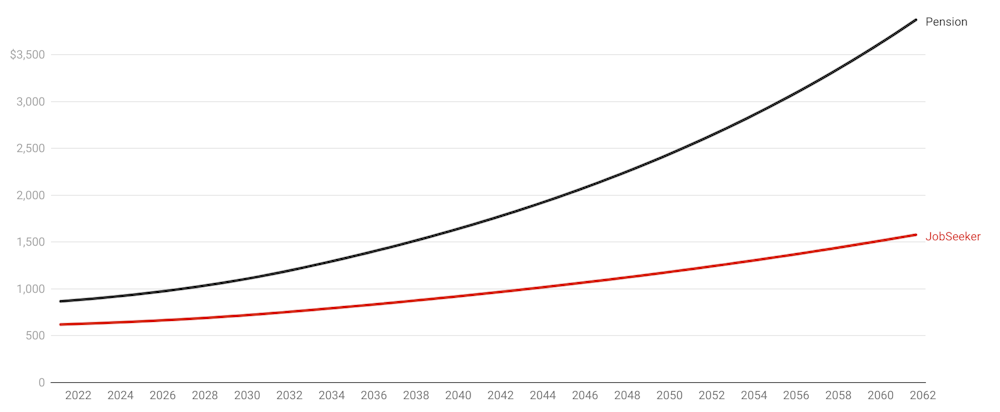
The report gets there in part by an outrageous sleight of hand. It says JobSeeker and other payments will become tiny as a proportion of GDP because they will only climb with inflation (which is typically low) rather than wage growth or GDP growth (which is typically higher, and lines up with how the pension grows).
A moment’s reflection would show that if that actually happened for 40 years — which is what the treasury’s report assumes — JobSeeker would fall from 70% of the single age pension to a hard-to-justify 40%.
JobSeeker and age pension as projected in intergenerational report
Payment for a single person, dollars per fortnight. JobSeeker indexed to IGR inflation projections, pension indexed to IGR wage projections.
We know it won’t happen because it hasn’t happened.
JobSeeker was boosted this year after only 20 years rather than 40 in order to make sure that sort of thing wouldn’t happen.
And we know there’s nothing to stop an intergenerational report using more realistic assumptions.
The 2015 report, released at a time when the Abbott government planned to adjust the pension in line with the more miserly JobSeeker formula, relaxed the assumption after 13 years because if it left it in place the pension would slide untenably below community expectations.
We’ll easily be able to afford more tax
There’s nothing wrong with paying more tax if it’s for things we want, like better health care, better aged care, better disability care and benefits we can live on.
The intergenerational report has government spending climbing by four percentage points of GDP between now and 2061. But it also has real GDP per person almost doubling, climbing 80%.
Even if that’s an overestimate and GDP per person grows by, say, 50%, and the need for tax grows by more than four points, we’ll easily be able to afford the extra tax, and we’ll want what that tax will buy. Expectations climb with income.
The present government will be long gone by the time the tax to GDP ratio reaches its “cap” of 23.9% of GDP (which the report expects in 2035).
Mathias Cormann has moved to the OECD where average tax rates are high. Ian Langsdon/EPA
The finance minister who came up with the cap, Mathias Cormann, is now head of the Organisation for Economic Co-operation and Development, in which the average tax take is 34% of GDP.
An obvious place to look for the tax is high-income senior citizens, at present enjoying tax-free super, refundable franking credits and special tax offsets. Grattan Institute calculations suggest an older household earning $100,000 pays less than half the tax of a working-age household on the same amount.
Like less well-off seniors, they are highly likely to use the services tax provides.
To say we’ll need more tax is not to say the government needs to fund all of its spending with tax.
It is projecting budget deficits for the next 40 years. Budgets have been in deficit for all but a few of the past 100 years.
But it will need to cover much of it with tax to keep the economy in check. If we want what tax provides, we’ll be prepared to pay it.
Peter Martin does not work for, consult, own shares in or receive funding from any company or organisation that would benefit from this article, and has disclosed no relevant affiliations beyond their academic appointment.
In 2019, when astronomers captured the first image of a black hole’s shadow — a bright orange doughnut-shaped halo created by the black hole’s intense gravity bending light around it — it was rightly hailed as a breakthrough.
Now, I have joined the Event Horizon Telescope team in following up on their earlier achievement, by creating a new image showing jets of plasma being ejected from the core of a different supermassive black hole, at the centre of the galaxy Centaurus A.
Centaurus A’s black hole is about 120 times less massive than that of M87, the galaxy where the black hole halo was spotted (and which also has its own set of plasma jets). So no black hole shadow was expected or seen in Centaurus A’s case.
But the results, published in Nature Astronomy, nevertheless provide another fascinating insight into the huge black holes that lurk at the centre of many galaxies.
Centaurus A is so-named because it is the brightest (hence “A”) object in the constellation Centaurus, in the southern skies. Centaurus A appears as one of the largest radio galaxies in our skies, because of its relative closeness, at 15 million light years from Earth.
In the visible light spectrum, this galaxy is characterised by a dark “dust lane” that blocks our view of its centre. But radio waves are unaffected by this material, so radioastronomers can study its centre in detail.
Centaurus A, like other “active” galaxies, has a supermassive black hole at its centre, which is fed by material falling in towards it. Much of that material ends up falling into, or orbiting around, the black hole. But some of it – through a process not yet understood – is shot out in a pair of diametrically opposed “jets”.
These plasma jets are one of the most mysterious and energetic features of galaxies. They travel at speeds close to the speed of light, and so the effects of Einstein’s theory of relativity become important.
One prediction is that the jet travelling towards us will appear brighter, while the opposing jet, travelling away from us, will appear fainter.
In fact, detailed studies of most active galaxies only reveal a one-sided jet, with the counter-jet too faint to observe.
Centaurus A is one of the few examples for which both the jet and counter-jet have previously been seen. Observations with a network of telescopes, including CSIRO’s 64-metre Parkes telescope and Australia Telescope Compact Array, had provided the most detailed images before now.
Our team used an international network of seven telescopes spanning North and South America and Antarctica. (Australia sadly doesn’t have the high-altitude observation sites necessary to make this kind of observation.)
The telescopes imaged the black hole’s jets in 16 times more detail than previous images. This revealed two things: first, and slightly surprisingly, nothing is seen in the vicinity of the black hole itself; and second, and even more intriguingly, only the outer edges of the jets seem to emit radiation.
While this “edge-brightening” has been seen for several other nearby active galaxies, this is the first time it has been seen in Centaurus A, and seen so clearly.
Left: the previous best image of the Centaurus A black hole’s plasma jets; middle: the new image; right: the larger plasma jets from M87’s black hole. Nature Astronomy
The edge of the jet may be brightened by the interaction of the jet plasma with the gas and dust in the galaxy. The narrowness of the jets also hints that strong magnetic fields may be coiled around the jet, and these may also lead to brighter edges and create an invisible “spine” to the jet.
The overall geometry and properties of the jet bear a striking resemblance to those of the jet in M87, as well as to jets launched by smaller black holes (tens of solar masses rather than millions or billions) in our own galaxy, the Milky Way. This supports the idea that the same processes happen in both supermassive black holes and their lighter counterparts, suggesting supermassive black holes are simply a scaled-up version of smaller ones, without requiring any new (or additional) physical mechanisms to be invoked.
As to why we saw nothing in the vicinity of the supermassive black hole itself, it is possible our line of sight is blocked by dense matter falling towards the black hole. We might be able to see more by increasing our observing frequency into the terahertz range, but that is a huge technical challenge.
COVID restrictions resulted in our 2020 observing campaign being abandoned, however the Event Horizon Telescope array was back in operation for a campaign in April this year, with further observations of M87 and Centaurus A on its list of targets.
Another source that has already been observed is the supermassive black hole at the centre of the Milky Way. Much closer than those of Centaurus A (15 million light years) or M87 (55 million light years), it is “only” 25,000 light years away, but it is also much less massive — roughly five million times the mass of our Sun.
While we believe this black hole has been active in the distant past, recent observations have not revealed any bright jets emerging from the centre of our galaxy, suggesting it is not currently as active, but could potentially become active again in the future. It will be interesting to see what our forthcoming observations reveal.
Phil Edwards does not work for, consult, own shares in or receive funding from any company or organisation that would benefit from this article, and has disclosed no relevant affiliations beyond their academic appointment.
Source: The Conversation (Au and NZ) – By Rose Butler, DECRA Senior Research Fellow, Alfred Deakin Institute for Citizenship and Globalisation, Deakin University
Mick Tsikas/AAP
People from different class backgrounds often fall in love in books and on screen — think Sally Rooney’s Normal People, Melina Marchetta’s Looking For Alibrandi, or Arundhati Roy’s The God of Small Things. But this is not just a fictional trope, it happens in real life, too.
Australia is historically thought of as an egalitarian society, which means discussions and representations of class, privilege and inequality are commonly hidden or coded in other language.
Our research brings it out into the open, through a study of people who partner with someone from a different class.
What happens when people from different class backgrounds fall in love?
In 2020, we undertook eleven interviews with members of six cross-class couples. For these couples, love across class is an everyday reality and the differences are sometimes subtle, sometimes striking.
These people’s ages ranged from their early 20s to early 60s.
Seven were from a white background, one person identified as Jewish European, one as Vietnamese-Australian, one as Eurasian and one as coming from a mixed-race background. Five couples were heterosexual and one was same-sex.
What is class?
In Australia, people from different class backgrounds may have grown up within very different family, social and schooling contexts. Class influences where we live, study and work, our health and well-being and many other aspects of life.
Falling in love with someone from a different class is the basis for many great novels — and real life complications. Aijaz Rhi/AP/AAP
Scholars argue class is also a cultural experience. Through our upbringing, we accumulate a set of dispositions and sensibilities — a way of being in the world — which feels comfortable and “natural” to us. While we may acquire new habits and skills later in life, these acquired dispositions may lack the comfortable feel associated with those learned in childhood.
Studying the role of class in our personal relationships also requires paying attention to how class is shaped by race, migration, gender, and sexuality.
So, we asked about people’s childhoods, the origin of their relationship and how class shapes everyday life. We covered: approaches to money, attitudes to work, decisions about where to live and home ownership, the use of free time, food preferences, holidays, social life, and parenting.
The bubble bursting
At the start of their relationships, many of our interviewees were not aware they had partnered across class. We heard stories of realisation.
For Stephanie, it was “probably knowing the schools” which led her to realise she was from a different class background to her partner, Harry. Harry is white and grew up in a “quite working class” coal-mining region. He attended a “disadvantaged” rural public school where “we didn’t have any, like, goalposts on our footy field … we had to use our schoolbags”.
Stephanie, who is also white, is from a wealthy urban background. She attended a prestigious school in Adelaide and described living in “this bubble of, like, private school world”. She described that bubble “bursting”.
Others developed a deeper understanding of their partner’s class backgrounds after meeting their family.
This was the case for Madeline on visiting David’s family. Previously, “I only knew him as a university student,” she explained, “and all of our conversations [were] about degrees, about our careers”. Madeline is Eurasian and from a wealthy background — she grew up speaking multiple languages in Asia and accessed an elite education in Europe. David, who is white, “grew up sort of in and out of housing commission” in coastal NSW.
Rewards
As these relationships solidified, class-based differences became a complex and rewarding aspect of the relationship. Interviewees valued different things about partnering across class.
Madeline spoke of the conversations she and David had around privilege and poverty. She told us it was “a pretty awesome thing, if you can talk about these difficult topics with your partner”.
Some couples only realise they are from different classes once they meet each other’s families. Robert McGrath/AAP
Phuong felt “it was sort of good to say out loud” these experiences, “and think about privilege and how much it shapes you. And your kids ultimately”. Phuong is from a working-class, Vietnamese-Australian background and shares her Melbourne life with Tabby, who is white and from an affluent middle-class background.
As well as being interesting, other couples found class difference to be a healthy challenge and a source of humour and playful fun.
Tabby concluded a number of funny stories by reflecting that class difference had consistently “been very present […] in discussions about our relationship and, but usually in quite a light-hearted way”.
Ambivalence and conflict
However, class-based differences could cause tension within these relationships. In Harry’s view, Stephanie
will never truly understand what it’s like to be broke. Or on the verge of broke. And I kind of live with it all the time.
He sees this as a “great conflict in our marriage” and “an unsolvable riddle”.
Others spoke of an ambivalence around their class identity, which did not reflect mainstream narratives of upward class mobility as a desired goal.
Billy, who is white and from an upper middle-class background, and what he saw as “old money”, told us that his partner Adele “does feel sad” about their world in inner-city Sydney. Adele is from a “mixed-race” background and a tight-knit, working-class family in Wollongong. Billy and Adele are now part of the “well-educated middle” or “bourgeoise academics”, she joked. There was regret that their children might not get to experience the working-class culture of Adele’s childhood.
What about you?
Our research shows class and class differences play a powerful role in our intimate lives, but this can be difficult to articulate. Public depictions of class difference commonly involve derision, mockery and comedy, rather than inter-class negotiation and understanding.
Our research captures experiences of couples already engaged in the daily, messy, complex and enriching work of negotiating class difference in their personal lives. Their insights can deepen our comprehension of what class is and means to people in Australia today. And for our interviewees, reflecting on the role of class in their intimate lives sometimes proved cathartic or illuminating.
This research is ongoing. We would love to hear from a wide range of people willing to discuss their experiences of love across class. If you would like to participate, you can get in touch here.
Rose Butler receives funding from the Australian Research Council.
Eve Vincent no recibe salario, ni ejerce labores de consultoría, ni posee acciones, ni recibe financiación de ninguna compañía u organización que pueda obtener beneficio de este artículo, y ha declarado carecer de vínculos relevantes más allá del cargo académico citado.
Today’s multi-country condemnation of cyber-attacks by Chinese state-sponsored agencies was a sign of increasing frustration at recent behaviour. But it also masks the real problem — international law isn’t strong or coherent enough to deal with this growing threat.
The coordinated announcement by several countries, including the US, UK, Australia and New Zealand, echoes the most recent threat assessment from the US intelligence community: cyber threats from nation states and their surrogates will remain acute for the foreseeable future.
Joining the chorus against China may be diplomatically risky for New Zealand and others, and China has already described the claims as “groundless and irresponsible”. But there is no doubt the problem is real.
The latest report from New Zealand’s Government Communications Security Bureau (GCSB) recorded 353 cyber security incidents in the 12 months to the middle of 2020, compared with 339 incidents in the previous year.
Given the focus is on potentially high-impact events targeting organisations of national significance, this is likely only a small proportion of the total. But the GCSB estimated state-sponsored attacks accounted for up to 30% of incidents recorded in 2019-20.
Since that report, more serious incidents have occurred, including attacks on the stock-exchange and Waikato hospital. The attacks are becoming more sophisticated and inflicting greater damage.
Globally, there are warnings that a major cyberattack could be as deadly as a weapon of mass destruction. The need to de-escalate is urgent.
Global solutions missing
New Zealand would be relatively well-prepared to cope with domestic incidents using criminal, privacy and even harmful digital communications laws. But most cybercrime originates overseas, and global solutions don’t really exist.
In theory, the attacks can be divided into two types — those by criminals and those by foreign governments. In reality, the line between the two is blurred.
Dealing with foreign criminals is slightly easier than combating attacks by other governments, and Prime Minister Jacinda Ardern has recognised the need for a global effort to fight this kind of cybercrime.
Unfortunately, some of the countries most often suspected of allowing international cybercrime to be committed from within their borders have not signed, meaning they are not bound by its obligations.
Malicious state-sponsored cyber activity involving espionage, ransoms or breaches of privacy might qualify as unfriendly and in bad faith, but they are not acts of war.
However, cyberattacks directed by other governments could amount to acts of war if they cause death, serious injury or significant damage to the targeted state. Cyberattacks that meddle in foreign elections may, depending on their impact, dangerously undermine peace.
And yet, despite these extreme risks, there is no international convention governing state-based cyberattacks in the ways the Geneva Conventions cover the rules of warfare or arms control conventions limit weapons of mass destruction.
Drawing a red line on cybercrime: US President Joe Biden meets Russian President Vladimir Putin in Geneva in June. GettyImages
Risks of retaliation
The latest condemnation of Chinese-linked cyberattacks notwithstanding, the problem is not going away.
At their recent meeting in Geneva, US President Joe Biden told his Russian counterpart, Vladimir Putin, the US would retaliate against any attacks on its critical infrastructure. A new US agency aimed at countering ransomware attacks would respond in “unseen and seen ways”, according to the administration.
Such responses would be legal under international law if there were no alternative means of resolution or reparation, and could be argued to be necessary and proportionate.
Also, the response can be unilateral or collective, meaning the US might call on its friends and allies to help. New Zealand has said it is open to the proposition that victim states can, in limited circumstances, request assistance from other states to apply proportionate countermeasures against someone acting in breach of international law.
Things are moving fast and none of it is very reassuring. In an interconnected world facing a growing threat from cyberattacks, we appear to be drifting away from order, stability and safety and towards the darkness of increasing lawlessness.
The coordinated condemnation of China by New Zealand and others has considerably upped the ante. All parties should now be seeking a rules-based international solution or the risk will only grow.
Alexander Gillespie does not work for, consult, own shares in or receive funding from any company or organisation that would benefit from this article, and has disclosed no relevant affiliations beyond their academic appointment.
Recent disasters such as the Black Summer bushfires and the Juukan Gorge destruction highlighted the need to put Indigenous people at the centre of decision-making about Australia’s natural places. But what’s the right way to combine traditional ancient wisdom with modern environmental management?
A project off Western Australia’s northwest coast offers a potential way forward. For the first time in the state’s history, Indigenous knowledge has been central to the design of a marine park.
The protected area will span 660,000 hectares northeast of Broome, taking in the stunning Buccaneer Archipelago and Dampier Peninsula. The area comprises thousands of small islands fringed by coral reefs and seagrass beds. The waters support a rich abundance of species such as corals, fish, turtles and dugongs, as well as humpback whales which give birth in the region.
Often, Indigenous input is sought only in the consultation phase of park planning, once maps have been drawn up. But in this case, Traditional Owners co-designed three marine parks with the state government and will jointly manage them. Traditional ecological and cultural wisdom has been embraced and valued, enhancing Western scientific knowledge of a fragile stretch of Australia’s coast.
Traditional owners have been caring for country for thousands of years. Nick Thake
Caring for Sea Country
The marine park co-design is a collaboration between WA’s Department of Biodiversity, Conservation and Attractions and Bardi Jawi, Mayala and Dambeemangarddee Traditional Owners. It will comprise three adjoining protected areas, each jointly managed by a Traditional Owner group.
The Buccaneer Archipelago region has the state’s highest concentration of Traditional Owner communities living adjacent to an existing or proposed marine park.
Local Indigenous people refer to these areas as “Sea Country”. They depend on the waters for food and to carry out traditional practices, and have cared for them sustainably for thousands of years.
Industry, fishing and tourism are putting pressure on the region’s environment. In particular, the recent sealing of Cape Leveque Road improved access to the Dampier Peninsula and will result in massive increases in tourism and boating.
Adding to this, marine heatwaves and other climate-related changes pose a serious threat to corals, macroalgae and seagrass.
A new sealed road to Cape Leveque will add to pressures on the marine area. Shutterstock
Genuine two-way partnerships
Combining traditional Indigenous knowledge with a Western approach requires methods that are both culturally appropriate and scientifically robust.
In 2018, Bardi Jawi rangers and staff from the Australian Institute of Marine Science carried out “participatory mapping” to design a mornitoring program for corals and fish. The rangers and marine park planners went on to use this method when designing the marine park.
Participatory mapping starts with Traditional Owners and marine park planners documenting the traditional owners’ ecological knowledge, cultural values and aspirations. From this, maps are developed then built on via on-Country observations.
This process allows scientists to record and understand traditional knowledge of an environment in a way that is also useful for Western conservation and management planning.
Participatory mapping involves traditional owners and marine park planners. Nick Thake
The co-design approach was built on genuine partnerships, mutual respect and two-way learning. The partnerships developed over several years through other joint projects by scientists and Bardi Jawi rangers.
The department listened to and implemented this strong Indigenous voice in the development of the marine parks’ draft plans.
According to the Traditional Owners themselves, the sea is fundamental to the spiritual, social and physical existence. Their diet relies heavily on food from the sea such as fish, turtles, dugongs, crabs and oysters. Under Indigenous laws, traditional owners are required to protect significant features in the sea and for some groups, resources such as pearl shell has traditionally been collected and used for ceremony and trade.
A WA government document outlines how the proposed marine parks contain “special purpose zones” to protect traditional culture and heritage. They allow for seasonal camping areas and places where Traditional Owners can collect customary food and other resources. They will also protect culturally significant features such as cultural sites reefs, seagrass beds and mangrove communities.
The document also says the proposal protects places with “intangible” value related to traditional law, ceremony and stories.
These zones are in addition to sanctuary zones protecting areas of critical habitat, and general use zones where sustainable activities are allowed.
Science informs the activities allowed in each zone. Shutterstock
Scientific rigour
Protected areas in marine parks must be sized, spaced and positioned to allow “population connectivity” – the dispersal of eggs, larvae, juveniles and adults through the area.
My involvement in the marine park design included participating in a study which led to recommendations for how best to achieve this connectivity.
The study was part of a bigger program to improve and integrate ecological and social science knowledge in this region. This information was incorporated into two-way learning and planning, which fed into the proposed marine park.
Proven on-ground success
Key to the success of the new marine parks will be the practical capacity of Traditional Owners and Rangers. Indigenous sea ranger groups in the region have already shown they can work with both traditional governance and knowledge structures and non-Indigenous Australian organisations.
What’s more, the Bardi Jawi,Dambeemangarddee and Mayala people have their own healthy country plans. These plans clearly document how they have looked after country for millennia and want to continue this in future.
The Bardi Jawi and Dambeemanagrdee people have also established an Indigenous Protected Area which they’ve successfully cared for since 2013.
Healthy Country, healthy people
Some recreational fishers believe the proposed exclusions are unreasonable. But there is growing evidence fish populations benefit from sanctuary networks. And many local fishers recognise the increasing threats to the region and welcome Traditional Owners playing a larger management role.
It’s hoped the final marine parks plan will find the right balance between the needs of Traditional Owners, commercial and recreational fishing, pearling and other uses.
By involving traditional custodians from the start, there’s every chance we will realise the ancient Indigenous idea that healthy Country means healthy people – and that will benefit everyone.
The author would like to acknowledge the Bardi Jawi, Mayala and Dambeemangarddee Traditional Owners and their continuing culture, knowledge, beliefs and spiritual connection to Country. The author recognises they are Australia’s first scientists.
Jim Underwood works for the Australian Institute of Marine Science. He received funding from Western Australian Institute of Marine Science.
Source: The Conversation (Au and NZ) – By Behnam Akhavan, Senior Lecturer, ARC DECRA Fellow, School of Biomedical Engineering and School of Physics, University of Sydney
Have you ever imagined your smart phone or tablet without a touch screen? This could soon be the case if we run out of indium, one of the rarest minerals on Earth.
Indium is used in many high-tech devices such as touch screens, smart phones, solar panels and smart windows, in the form of indium tin oxide. This compound is optically transparent and electrically conductive — the two crucial features required for touch screens to work.
But there’s a problem: we have no guaranteed long-term supply of indium. It is naturally found only in tiny traces, and is therefore impractical to mine directly. Almost all of the world’s indium comes as a byproduct of zinc mining.
Fortunately, we have a potential solution: my colleagues and I have developed a new way to make optically transparent and electrically conductive coatings without indium.
A worsening problem
Because the world’s indium supply is tied to zinc mining, its availability and price will depend on the demand for zinc.
Possible declines in zinc demand — already evident in the car manufacturing industry — along with the ever-increasing usage of smart phones and touch panels — are set to exacerbate the potential shortage of indium in the future.
One option is to try and recycle indium. But recovering it from used devices is expensive because of the tiny amounts involved.
When a crucial material is in short supply, we should look for alternatives. And that’s exactly what my colleagues and I have found.
How does it work?
Our new coating, details of which are published in the journal Solar Energy Materials and Solar Cells, involves plasma technology.
Plasma is like a soup of charged particles in which electrons have been ripped away from their atoms, and is often described as the fourth state of matter, after solid, liquid and gas. It might sound like an exotic substance, but in fact it comprises more than 99% of the visible objects in the universe. Our Sun, like most stars, is essentially a giant ball of glowing plasma.
Closer to home, fluorescent lightbulbs and neon signs also contain plasma. Our new touchscreen films don’t contain plasma, but their manufacture uses plasma as a way to create new materials that would otherwise be impossible to make.
The new material is created using a process called plasma sputtering. Behnam Akhavan
Our coating is made of an ultra-thin layer of silver, sandwiched between two layers of tungsten oxide. This structure is less than 100 nanometres thick — roughly one-thousandth of the width of a human hair.
These ultra-thin sandwich layers are created and coated onto glass using a process called “plasma sputtering”. This involves subjecting a mixture of argon and oxygen gases to a strong electric field, until this mixture transforms into the plasma state. The plasma is used to bombard a tungsten solid target, detaching atoms from it and depositing them as a super-thin layer onto the glass surface.
We then repeat this process using silver, and then a final third time tungsten oxide embedded with silver nanoparticles. The entire process takes only a few minutes, produces minimal waste, is cheaper than using indium, and can be used for any glass surface such as a phone screen or window.
The finished result is a sandwich of tungsten oxide and silver, coated onto glass. Behnam Akhavan, Author provided
The finished plasma coating also has another intriguing feature: it is electrochromic, meaning it can become more or less opaque, or change colour, if an electrical voltage is applied.
This means it could be used to create super-thin “printable displays” that can become dimmer or brighter, or change colour as desired. They would be flexible and use little power, meaning they could be used for a range of purposes including smart labels or smart windows.
The material’s opacity can be changed by varying the voltage. Behnam Akhavan, Author provided
Smart windows coated with our new films could be used to block the flow of light and thus heat as required. Our plasma film can be applied to any glass surface, which can then be set to adjust its transparency depending on the weather outside. Unlike existing “photochromic” spectacle lenses, which respond to ambient light levels, our material responds to electrical signals, meaning it can be manipulated at will.
Our new indium-free technology holds great potential to manufacture the next-generation touch-screen devices such as smart phones or electronic papers, as well as smart windows and solar cells for environmental sustainability. This technology is ready to be scaled up for creating coatings on commercial glass, and we are now doing further research and development to adapt them for future wearable electronic devices.
Razvan Martin of Romania was stripped of his bronze medal after testing positive for drugs eight years after the 2012 London Olympics.Hassan Ammar/AP
Another Olympics is upon us, inexorable even in the face of COVID. With it comes the inevitable, salacious speculation around doping scandals.
There have been doping scandals at every Olympics in my lifetime and a few before, reaching back to the middle of the 20th century. Now, because of the lag between new drugs coming into sport and the development of reliable drug tests, there’s a 10-year retrospective testing window. This leaves the question of exactly who wins what an open question for a decade.
With the testing window used for the 2012 London Olympics now closed (it used to be eight years), we only now have a final account of both medals and doping at those games.
According to Olympics historian Bill Mallon, more than 140 athletes were banned or disqualified, including 42 medallists (13 of which were gold). Nearly half were caught using retrospective testing.
Because doping has become so much a part of the Olympics, one wonders whether the inevitable doping scandals in Tokyo will be as earth-shattering as they once were, or whether the public will merely shrug.
How many positive tests come back every year
The anti-doping industry has become a lot better at what it does since the establishment of the World Anti-Doping Agency (WADA) in 2000 and the introduction of the World Anti-Doping Code (WADC) in 2001. Revisions to the WADC came into force in 2009, 2015 and 2021.
WADA has invested US$83 million (A$112 million) in developing more advanced drug-testing capabilities since 2001, and US$3.6 million (A$4.8 million) on doping prevention research since 2005.
With the Tokyo Games expected to cost an official US$15.4 billion (A$20.8 billion) to stage (with audits suggesting the true figure is at least US$25 billion or A$33.8 billion), however, the amount of money WADA has spent on research since 2001 seems modest.
Despite this investment, the rate of positive tests has remained fairly stable.
The most recent figures released by WADA in 2019 showed the proportion of “adverse analytical findings” (the technical term for positive drug tests) relative to the total number of tests conducted wobbling between 0.97% (2019) and 1.32% (2016).
Athletes and their support teams know the drug-testing game well. They can use the lag between a new performance-enhancing drug being developed, that drug being prohibited and a reliable test being developed to their advantage. It’s just one factor coaches and other support personnel take into account when managing how their athletes use different drugs.
Unless there is a complete game-changer in anti-doping efforts — like a fundamental shift in drug-testing technology — we can reasonably expect an Olympic year to result in the same level of “adverse analytical findings” as any other year.
That means athletes will most likely be caught doping in Tokyo. Just how many — or how long it will take — remains to be seen. With the retrospective testing window, the final medal and doping tallies will only be known in the second half of 2031.
How sport has become more punitive
While drug testing has become more sophisticated, most of the changes to the World Anti-Doping Code since 2001 have actually been to bolster penalties for acts indirectly related to the taking of performance-enhancing drugs (what are known as “non-analytical” rule violations).
There are only two anti-doping violations in the code directly related to drugs being found in an athlete’s body.
By comparison, there are now nine others that deal with indirect violations. These include not being where you said you would be three times for out-of-competition drug tests, associating with someone under sanction for violating an anti-doping rule, and discouraging someone from reporting potential violations to authorities.
In many cases, these types of violations have seen athletes and support personnel vilified and stigmatised as “drug cheats” despite no direct evidence they have ever used a prohibited substance or method.
Last year, for instance, the US sprinter Christian Coleman was given a two-year ban after missing three out-of-competition drug tests in a year. The Court of Arbitration for Sport reduced the ban to 18 months, noting it believed Coleman did not dope and did not avoid being tested. Nonetheless, he will still miss the Tokyo Olympics as a “drug cheat”.
All of these rules have made life much harder for athletes, but their impact appears to be fairly minimal in reducing interest in performance-enhancing drugs.
According to the most recent report by WADA (which gives data only up to 2018), only 283 athletes were sanctioned for “non-analytical” rule violations that year, compared to 2,771 athletes for violations directly related to ingesting drugs.
Learning to live with doping?
The obvious question is whether we just have to live with a certain amount of doping in sport. Given the last time an Olympics was without a doping controversy was the middle of the 20th century, it would seem so.
Russia’s Tatyana Lebedeva was stripped of her two silver medals from the 2008 Beijing Olympics ten years later. David J. Phillip/AP
That does not mean we should stop protecting the integrity of sport. Rather, it is a recognition that anti-doping is just one part of this effort.
As an international leader in anti-doping measures, Australia established Sport Integrity Australia last year to replace the standalone Australian Sports Anti-Doping Authority. This move explicitly recognises that doping is part of a much bigger picture that includes match fixing and abuse of athletes.
The greater scandal is perhaps that so little money is invested in anti-doping and sport integrity. Sport Integrity Australia is budgeted to cost Australian taxpayers A$27.4 million (US$20.2 million) in 2020-21, compared to the eye-watering amount of money that goes through Australian sport and recreation every year (A$19.7 billion or US$14.5 billion for 2019).
So, it remains to be seen exactly how much attention the inevitable doping scandals at the Tokyo Games will attract. My main worry is doping scandals have become business-as-usual, one-day dramas in the sporting spectacle that is the Olympics, and little else. As such, I suspect every positive COVID test will generate far more interest than a positive drug test in Tokyo.
Jason Mazanov has received funding from the Australian Anti-Doping Research Programme and the World Anti-Doping Agency Social Science Research Grants programme in the past. Jason also reviews anti-doping social science research grant applications for a number of international agencies.
Source: The Conversation (Au and NZ) – By Catherine Ordway, Assistant Professor Sport Management and Sport Integrity Lead, University of Canberra
Shelby Houlihan blames a pork burrito for her positive drug test that cost her a chance to compete in Tokyo.Charlie Neibergall/AP
It’s been a tough year for doping control officers trying to access athletes before the COVID-disrupted Tokyo Olympics. Testing numbers dropped dramatically due to COVID restrictions, although the testing organisations claim to be operating at normal levels now.
Thrown into this mix are a number of suspected doping cases arising from increasingly sophisticated laboratory analysis methods that are detecting lower and lower levels of prohibited substances.
Rather than being evidence an athlete intentionally used a performance-enhancing substance to cheat, however, these results are more likely to be the result of contaminated foods, supplements or medicines.
Even more concerning is the evidence presented this week by German journalist Hajo Seppelt and the ARD documentary team in Doping Top Secret: GUILTY, which showed how athletes can potentially be sabotaged through casual contact.
All of this begs the question whether anti-doping bodies could achieve a better balance using an “ethics of care” approach, which seeks to support “clean” athletes rather than automatically assuming guilt.
One suggestion we advocate is referring extremely low-level positive cases, which likely result from contamination, to an independent body. This body could then determine whether there had been an attempt to cheat, rather than placing the onus on athletes to prove their innocence.
‘Eating pork can lead to a false positive’
Last month, Shelby Houlihan, the American record holder in both the 1,500 and 5,000 metre track events, announced on Instagram that the Court of Arbitration (CAS) had upheld a four-year suspension for testing positive for the anabolic steroid nandrolone.
The court rejected her assertion that the positive test in December could have been caused by eating a pork burrito hours before providing her urine sample. The finding denied her a chance to qualify for the Tokyo Games.
In February, Kenyan long distance runner James Kibet was also banned by the Athletics Integrity Unit for four years after testing positive for nandrolone and anabolic steroids. He claimed he had ingested pork fat from a Kenyan farmer who admitted feeding his animals supplements.
In contrast, the American long jumper, Jarrion Lawson, had his four-year ban for ingesting the banned anabolic steroid trenbolone overturned last March when he argued his positive test was probably caused by eating tainted beef at a restaurant.
Similarly, the Badminton World Federation doping hearing panel accepted it was highly likely that contaminated meat in Thailand was the cause of Ratchanok Intanon’s positive drug test in 2019.
While it is important to take the facts of each case on their merits, the application of the rules and athlete punishments in these circumstances can appear to be frustratingly inconsistent.
Although farming with steroids and hormones is illegal in most countries, the World Anti-Doping Agency (WADA) has been warning athletes about the risk of contaminated meat, especially from China and Mexico, for more than a decade.
A 2015 WADA study also highlighted the risks of steroids found in pork.
At the same time, WADA laboratories are increasingly detecting minuscule traces of prohibited substances. What a laboratory cannot tell from a sample is whether a positive result is from inadvertent contamination (from meat, for example) or is evidence of the tail end of a sophisticated micro-dosing regimen designed to cheat the system.
Much like a police alcohol breathalyser, athletes returning a “positive” test begin from a position of strict liability. The burden falls to them to prove the source of the prohibited substance.
Even when the amount of the substance could have had no performance benefit, athletes must salvage their reputation and careers through a proverbial “hunt for the needle in the haystack” to determine the origin of the contamination.
This can be extremely challenging for athletes to prove. As the case of Australian swimmer Shayna Jack demonstrates, the appeals processes, media hype and social media trolling take their toll. Jack warned anti-doping authorities that “one day someone’s not going to get through it”.
New reforms don’t fix all the problems
Cases like these raise questions about the effectiveness of current anti-doping policies.
Recognising the challenge, the latest WADA Code still leaves the burden on the athlete to prove their innocence, but allows for the standard four-year ban to be reduced to a reprimand.
WADA has raised the reporting threshold used by laboratories to determine a potential breach of the WADA Code. This would presumably reduce the number of cases from non-intentional contamination from meats or medicines.
From the start of June, WADA also requires laboratories to conduct additional investigations for positive tests resulting from a limited range of prohibited substances. What is not clear is whether all laboratories have the capacity to conduct these investigations, hence our call for an independent investigative body to assist.
However, former WADA Director-General David Howman says these changes do not go far enough. He supports forensic testing methods, such as hair and saliva testing, being used in anti-doping cases. (These might also provide additional evidence of long-term drug use instead of contamination.)
There are numerous heartbreaking examples of athletes who do not have the financial means, access to independent legal advice or sophisticated scientific knowledge to prove their innocence. Most are still suspended after a positive test, leaving them vulnerable to media speculation as they fight their corner.
A new ‘ethics of care’ approach
While the first rule of cheating is deny, deny, deny, the vast majority of athletes are not cheats. Nonetheless, they can easily and inadvertently be tripped up by the rigidity of the anti-doping rules.
It is not by accident that many of the athletes who have fallen foul of the system also come from the most disadvantaged countries.
Rather than starting from a position of “guilt”, is it time for an athlete-centric, “ethics of care” approach?
Cases of extremely low levels of prohibited substances could be referred to an independent third party for investigation, rather than putting that financial burden and inevitable stress onto the athlete.
International sports federations already fund arms-length testing programs through bodies such as the International Testing Agency (ITA). If all low-level positive cases were automatically referred to an independent review body, the focus could be on determining whether actual cheating took place — not a mere breach of the rules and arbitrary thresholds.
Would this give greater comfort to the arm-chair sport viewer AND restore athletes’ trust in the anti-doping system? Quite possibly.
Athletes are not the enemy. It is timely to recognise the central role of the athlete within the anti-doping system.
The authors do not work for, consult, own shares in or receive funding from any company or organisation that would benefit from this article, and have disclosed no relevant affiliations beyond their academic appointment.
With most COVID-19 restrictions now lifted in England, the world is watching to see what this so-called “freedom day” will bring.
Some scepticism is warranted, given Britain’s approach throughout the pandemic has hardly been a success. By July 19, there had been 128,985 deaths from COVID-19, and the death rate per million of population was just under 1,900.
True, there are countries with worse rates, including Hungary, Italy and the Czech Republic in Europe. But countries that have taken a different approach have vastly better figures: for example, 35.8 deaths per million of population in Australia, and 5.39 in New Zealand.
No doubt Boris Johnson’s government took its emphatic 2019 election victory and relatively successful vaccination program as a mandate for opening up.
But the current situation doesn’t support such optimism. Infection rates are now the worst in Europe and the death rate is climbing. By contrast, Australia has much lower death and infection rates but state authorities have responded with lockdowns.
Furthermore, many scientists have condemned the opening-up policy. The authors of the John Snow Memorandum stress the risks to the 17 million people in the UK who have not been vaccinated, and state:
[This approach] provides fertile ground for the emergence of vaccine-resistant variants. This would place all at risk, including those already vaccinated, within the UK and globally.
Taking the UK to court
Is it enough to hope Boris de Pfeffel Johnson will not just dismiss these concerns as piffle? Perhaps there is an alternative — taking the UK to court. Specifically, to the international courts that deal with matters of human rights.
For countries in the Council of Europe, this would be the European Court of Human Rights. Globally, there is the option of the Human Rights Committee of the United Nations.
How would this work? A court claim requires what lawyers call a “cause of action” — in this case, a breach of human rights, including the right to life and the right not to be subject to inhuman and degrading treatment.
In the main international human rights treaty, the International Covenant on Civil and Political Rights (ICCPR), article 6 requires that the right to life, which belongs to everyone, must be protected. Article 2 of the European Convention on Human Rights (ECHR) says the same.
In 2019, the UN Human Rights Committee noted this right to life amounts to an “entitlement […] to be free from acts and omissions that are intended or may be expected to cause their unnatural or premature death”.
It also noted the obligation on states to take steps to counter life-threatening diseases.
A duty to protect
European Court of Human Rights case law establishes that the duty to protect life includes a requirement on states to take reasonable steps if they know (or ought to know) there is a real and immediate risk to life.
This has usually involved the criminal actions of dangerous people, but there is no reason it should not cover government policy that rests on an acceptance that people will die.
After all, the entire human rights framework was put in place to limit states from breaching rights.
This duty to protect applies not just to deaths. Both the ICCPR and the ECHR have absolute prohibitions on inhuman and degrading treatment. For many people, the severity of COVID-19, including the consequences of long COVID, meet this standard.
If government policy can mitigate such consequences, human rights standards mandate that it should.
In short, this is not just a matter of the right to health. Because the UK will likely allow the virus to spread from its shores, the rest of the world is at risk and therefore has an interest here. So can other countries take action?
A political calculation
Human rights conventions are treaties — promises by states to each other as to how they will act. Article 33 of the ECHR is very clear: states can ask the European Court of Human Rights to adjudicate whether another state is breaching rights. There are many instances of this happening.
Importantly, the court can issue “interim measures” under its procedural rules to preserve the status quo while it hears a case.
The UN Human Rights Committee may also consider state-to-state complaints under article 41 of the ICCPR if a state has agreed to this — and the UK has made the relevant declaration.
Of course, any decision by a state to take another to court is political. But this pandemic is not just a health issue, it is also a matter of life and death. Protecting life should be a political priority precisely because it is such a fundamental right.
Politicians willing to stand up for human rights should use the tools that exist to achieve that aim.
Kris Gledhill does not work for, consult, own shares in or receive funding from any company or organisation that would benefit from this article, and has disclosed no relevant affiliations beyond their academic appointment.
New South Wales reported 98 new COVID-19 cases in the past 24 hours. Twenty of those were infectious while in the community, a number which needs to get close to zero before the lockdown can end.
To reduce the spread of COVID-19 across Sydney, NSW premier Gladys Berejiklian tightened restrictions in Liverpool, Fairfield, and Canterbury-Bankstown over the weekend. On top of existing stay-at-home orders, residents are now unable to leave these local government areas for work unless they’re deemed “authorised” workers.
Sydney’s Southwest is home to many multicultural communities, which have had to respond quickly to many rounds of restrictions. But while Berejiklian says health authorities are working to tailor and disseminate basic public health messaging for migrant communities, this may not be enough.
Our research shows it’s also important to expand this information to counter myths and misinformation about COVID-19 so people in migrant communities have a clear sense of the risks of infection.
We undertook a series of surveys of just under 15,000 people to assess the differences in knowledge, attitudes and perceptions of COVID-19 among sub-Saharan Africans. This includes a mix of different nationalities, tribes and cultures, including those living in developed countries such as Australia.
We also asked about their compliance with COVID-19 public health control measures such as social distancing, using face masks and hand sanitisers.
We found high levels of beliefs in COVID-19 myths among those from sub-Saharan African countries. While rates were lower among the 143 Africans we surveyed in the diaspora, including Australia, 7.5% of these participants believed in at least one of the following myths:
drinking hot water flushes down the virus
COVID-19 has a minimal effect on people from an African background
COVID-19 was deliberately designed to reduce the world’s population
the ability to hold your breath for ten seconds means you’re COVID-19 negative.
Reassuringly, our research also found a significant association between knowledge of COVID-19 and being worried about contracting the virus, and positive behaviours such as wearing face masks, and using sanitisers.
In other words, the more our respondents knew about COVID-19, the more likely they were to protect themselves and others from the virus.
How do African communities get their information?
Because people’s perception of risk informs how they respond to a threat such as COVID-19, it’s important to understand their sources of information, attitudes, perceived risk of contracting the disease, and compliance with public health control measures.
Many of our survey participants got their information about COVID-19 from formal government and public health authority channels.
But some used social media, which routinely spread myths and misinformation about COVID-19 via video clips. These were commonly shared among communities in Africa and those in the diaspora.
Social media misinformation tended to focus on the origins of COVID-19, the dangers of COVID-19 vaccinations, and conspiracy theories claiming COVID-19 aims to reduce populations of African peoples.
Some respondents in Africa and Australia didn’t believe COVID-19 existed and mistrusted officials. This resulted in an inaccurate perception of their risk of infection, making them more likely to ignore public health messaging and disregard public health measures.
Health authorities need to form strong, mutually trusting bonds with African-Australian and other multicultural communities. Ideally this would be ongoing, not just during a pandemic.
This foundation of trust allows authorities to convincingly communicate health directives such as mask-wearing, testing, vaccinations, and stay-at-home orders.
People are more likely to want to protect themselves and others from COVID-19 if they’re aware of the risks of contracting the virus. Christina @ wocintechchat.com
It’s promising to see health authorities in Western Sydney liaising with community leaders to disseminate basic health information.
But any new messaging campaign now needs to go beyond the generic and favour more nuanced messages that dispel misinformation among African and other multicultural communities in Western Sydney.
Storytelling mediums, including drama, dance and theatre, have been shown to be an effective and efficient means of communicating more nuanced health messages to African and other multicultural audiences.
Creative storytelling techniques can create memorable messages that help audiences identify with the characters and situations presented, and emotionally engage with messages.
These messages motivate people to change their beliefs and behaviours, and can be disseminated using the mass media and social media, in relevant languages, as well as shared among communities.
Importantly, creative storytelling techniques can enhance feelings of community and family cohesion, and lessen the feelings of isolation and social exclusion that migrants often feel, especially during a pandemic.
Levi Osuagwu is affiliated with African Vision Research Institute, Discipline of Optometry, University of KwaZulu-Natal, Westville Campus, Durban, 3629, South Africa
Kingsley Emwinyore Agho and Richard Oloruntoba do not work for, consult, own shares in or receive funding from any company or organization that would benefit from this article, and have disclosed no relevant affiliations beyond their academic appointment.
Source: The Conversation (Au and NZ) – By Christopher J. O’Bryan, Postdoctoral Research Fellow, School of Earth and Environmental Sciences, The University of Queensland
A big reason they’re so harmful is because they uproot soil at vast scales, like tractors ploughing a field. Our new research, published today, is the first to calculate the global extent of this and its implications for carbon emissions.
Our findings were staggering. We discovered the cumulative area of soil uprooted by wild pigs is likely the same area as Taiwan. This releases 4.9 million tonnes of carbon dioxide each year — the same as one million cars. The majority of these emissions occur in Oceania.
A huge portion of Earth’s carbon is stored in soil, so releasing even a small fraction of this into the atmosphere can have a huge impact on climate change.
The problem with pigs
Wild pigs (Sus scrofa) are native throughout much of Europe and Asia, but today they live on every continent except Antarctica, making them one of the most widespread invasive mammals on the planet. An estimated three million wild pigs live in Australia alone.
Wild pigs are one of the most widespread invasive animals on Earth. Shutterstock
It’s estimated that wild pigs destroy more than A$100 million (US$74 million) worth of crops and pasture each year in Australia, and more than US$270 million (A$366 million) in just 12 states in the USA.
Wild pigs have also been found to directly threaten 672 vertebrate and plant species across 54 different countries. This includes imperilled Australian ground frogs, tree frogs and multiple orchid species, as pigs destroy their habitats and prey on them.
Their geographic range is expected to expand in the coming decades, suggesting their threats to food security and biodiversity will likely worsen. But here, let’s focus on their contribution to global emissions.
Their carbon hoofprint
Previous research has highlighted the potential contribution of wild pigs to greenhouse gas emissions, but only at local scales.
One such study was conducted for three years in hardwood forests of Switzerland. The researchers found wild pigs caused soil carbon emissions to increase by around 23% per year.
Similarly, a study in the Jigong Mountains National Nature Reserve in China found soil emissions increased by more than 70% per year in places disturbed by wild pigs.
Wild pigs turn over 36,214 to 123,517 square kilometres of soil each year. Shutterstock
To find out what the impact was on a global scale, we ran 10,000 simulations of wild pig population sizes in their non-native distribution, including in the Americas, Oceania, Africa and parts of Southeast Asia.
For each simulation, we determined the amount of soil they would disturb using another model from a different study. Lastly, we used local case studies to calculate the minimum and maximum amount of wild pig-driven carbon emissions.
And we estimate the soil wild pigs uproot worldwide each year is likely between 36,214 and 123,517 square kilometres — or between the sizes of Taiwan and England.
Most of this soil damage and associated emissions occur in Oceania due to the large distribution of wild pigs there, and the amount of carbon stored in the soil in this region.
So how exactly does disturbing soil release emissions?
Wild pigs use their tough snouts to excavate soil in search of plant parts such as roots, fungi and invertebrates. This “ploughing” behaviour commonly disturbs soil at a depth of about five to 15 centimetres, which is roughly the same depth as crop tilling by farmers.
Wild pigs uproot soil in search of food, such as invertebrates and plant roots. University of Kentucky, Department of Forestry and Natural Resources, Forestry Extension.
Because wild pigs are highly social and often feed in large groups, they can completely destroy a small paddock in a short period. This makes them a formidable foe to the organic carbon stored in soil.
In general, soil organic carbon is the balance between organic matter input into the soil (such as fungi, animal waste, root growth and leaf litter) versus outputs (such as decomposition, respiration and erosion). This balance is an indicator of soil health.
When soils are disturbed, whether from ploughing a field or from an animal burrowing or uprooting, carbon is released into the atmosphere as a greenhouse gas.
This is because digging up soil exposes it to oxygen, and oxygen promotes the rapid growth of microbes. These newly invigorated microbes, in turn, break down the organic matter containing carbon.
Wild pigs have a rapid breeding rate, which makes controlling populations difficult. Shutterstock
Tough and cunning
Wild pig control is incredibly difficult and costly due to their cunning behaviour, rapid breeding rate, and overall tough nature.
For example, wild pigs have been known to avoid traps if they had been previously caught, and they are skilled at changing their behaviour to avoid hunters.
In Australia, management efforts include coordinated hunting events to slow the spread of wild pig populations. Other techniques include setting traps and installing fences to prevent wild pig expansion, or aerial control programs.
Some of these control methods can also cause substantial carbon emissions, such as using helicopters for aerial control and other vehicles for hunting. Still, the long-term benefits of wild pig reduction may far outweigh these costs.
Working towards reduced global emissions is no simple feat, and our study is another tool in the toolbox for assessing the threats of this widespread invasive species.
Christopher O’Bryan receives funding from the Invasive Animals Cooperative Research Centre in Australia and the Australian Research Council (ARC).
Eve McDonald-Madden receives funding from Australian Research Council.
Matthew H. Holden receives funding from the Australian Research Council (ARC).
Nicholas R Patton receives funding from the Australian Research Council (ARC), and the Australia’s Nuclear Science and Technology Organisation (ANSTO).
Jim Hone does not work for, consult, own shares in or receive funding from any company or organization that would benefit from this article, and has disclosed no relevant affiliations beyond their academic appointment.
This is the first article in a series providing school students with evidence-based advice for choosing subjects in their senior years.
From about August each year, young people in year 10 go through a round of interviews to close in on their subject selections for years 11 and 12.
They’re given a portfolio full of reading materials. They may also attend vibrant careers markets to get helpful information. The principal and heads of the year give presentations, and occasionally a VIP guest speaker will arrive.
Somewhere at this point, my sobbing daughter had cried: “I’m growing up too quickly!” She’d been told a complex story about ATARs, prerequisites and options for her career path, all with the solemn authority about the importance of making wise decisions.
Studies have shown students experience anxiety around choosing subjects that relate to their desired career path. Nothing as serious as this will have happened in most children’s lives before now.
What if they don’t know what they want to do? Or worse, what if they make a mistake in their subject choices?
The good news is, there is not much need to worry. Choices you make now about your subjects don’t need to have a severe impact on your future.
There are some myths about senior schooling all kids and parents need to know. Here are six of them.
Myth 1: you need an ATAR to go to university
There are several pathways to university — an ATAR is only one of them.
The federal education department reports there are significant intakes for courses that don’t require an ATAR. A 2020 report says the share of university offers for applicants with no ATAR or who were non-year 12 applicants was 60.5% in 2020. This was up from 60.1% in 2019.
Some courses, like engineering, normally require an ATAR of somewhere around the mid 80s. But you could also get in through having done a VET certificate or diploma. RMIT, for instance, offers up to two years of credit to transfer from TAFE into an undergraduate degree.
There are many alternative pathways described by most institutions on their websites. Curtin University has a helpful journey finder for students without a competitive ATAR.
There are several pathways into university. Shutterstock
A year 12 student, expecting not to gain an ATAR, who is not studying English or doesn’t expect to gain a 50 scaled rank for English, has at least three pathways into Curtin — sitting the Special Tertiary Admissions Test, doing a course at Curtin College, and using a portfolio for assessment.
Curtin also has a UniReady Enabling Program. This is a short course of 17 weeks. Completing the course means you will fulfil Curtin’s minimum admission criteria of a 70 ATAR. Many universities have similar types of preparatory pathways.
Myth 2: your senior subjects majorly influence your career
With all the disruption we’re experiencing, technical and social, we actually don’t have any idea what types of careers will be available in the future. Industry advice bodies, like the National Skills Commission, recommend students choose subjects that suit their interest and skill set, rather than to prepare for a specific future career.
Reports show today’s 15-year-olds will likely change employers 17 times and have five different careers through their working life. Many of their career may have very little, if any, connection to the senior subjects they took at school.
A 2018 report by industry body Deloitte Access Economics showed 72% of employers “demanded” communication skills when hiring and that transferable skills, such as as teamwork, communication, problem-solving, innovation and emotional judgement, “have become widely acknowledged as important in driving business success”.
The ability to work in a team will be an important skills for future employers. Shutterstock
This can include subjects like music, dance, debating and theatre will teach the exact skills employers value the most.
Myth 3: you should do ‘hard’ subjects to get a high ATAR
All subjects are hard if you lack interest or ability. Students are unlikely to do well if they are unhappy and unmotivated.
Research shows being motivated will improve how well you do in something. But academic performance is better associated with internal motivation (such as liking something) than external (like the drive for an ATAR).
So, if a student only values a subject for what it might get them, like a high ATAR, they’ll do better than if there was no purpose at all. But they won’t do as well as if they are internally motivated by it.
Myth 4: your ATAR will stand as the measure of your ability into the future
The ATAR is simply a profile of achievement on a limited number of tasks over a defined period. A person at the end of school, aged 17 or 18, hasn’t reached the end of their development.
Studies show there is an interaction between gains in knowledge and expertise, and losses in the speed of cognitive processing as we age (meaning we learn less as we get older, to some extent).
You will keep learning from experience. Shutterstock
But these losses are offset by an older person’s access to a rich base of experience which can inform their understanding of things and their actions. Also the older a person is, the better developed their self-regulation and motivation.
Year 12 can be demanding and stressful, but it doesn’t have to be. The most common source of distress in the senior years comes from anxiety, specifically test anxiety, and the pressures that come from selecting subjects for reasons not driven by interest and ability.
These years should not be devoted to self-flagellation for a high ATAR.
Students with a range of subjects types will have variety in their day and week. They are likely to have the best experience in their senior years.
Variety in your day can help you enjoy your senior years. Shutterstock
Research suggests a balanced life underscores success and general achievement, and setting the tone is vital during these formative years.
Myth 6: taking a VET subject in year 11 or 12 will affect your ATAR
Taking a VET subject reduces the opportunity to take another ATAR subject. It could be argued this puts greater pressure on achievement in the remaining ATAR subjects. But taking a VET subject also reduces the ATAR subjects on your dance card, so they may well be easier to manage.
Including a VET subject is also likely to provide a balanced education in senior years, which may actually improve a student’s chances for a high ATAR.
So here’s what you should think about when making your subject choices:
what do you like?
what comes easily to you?
will the selection give you variety in your day?
in which subjects will you have the most fun?
Other articles in this series on senior-subject selection will explore individual subjects.
Nan Bahr does not work for, consult, own shares in or receive funding from any company or organization that would benefit from this article, and has disclosed no relevant affiliations beyond their academic appointment.
Source: Council on Hemispheric Affairs – Analysis-Reportage
By Richard Kohn, Ph.D. From Columbia, MD
Recently, there have been reports in the news media that Nicaragua is destroying its rain forests and allowing beef ranchers to convert them to pastures in the country’s vast nature reserves. A network of supposed human rights and environmental groups are calling for an increase in the intensity of sanctions against Nicaragua, ending beef imports from Nicaragua, and ending international carbon trading credits that support reforestation programs there.
Contrary to this misleading narrative, the nature reserves in Nicaragua are not being deforested, and the Nicaraguan government has been promoting more sustainable beef production and reforestation. Economic sanctions could jeopardize these efforts.
My personal experience refutes misleading news
I am a professor of animal science at the University of Maryland specializing in evaluating environmental impacts of animal production systems–especially for beef and dairy. I am very familiar with Nicaragua since I lived there from 1987 to 1988 working with ranchers as an extensionist. I have visited since then, most recently in January of 2020 when I attended a study delegation that examined agroecology as practiced in Nicaragua. On this last trip, I started a dialogue with counterparts in my field through the Asociación de Trabajadores del Campo (Rural Workers Association) to lay the groundwork for a University of Maryland study abroad course in Nicaragua in agriculture and environmental studies. After seeing the statements in the U.S. media about Nicaraguan beef production that were inconsistent with my first-hand knowledge of the country, I decided to investigate the issue.
Nicaragua is a member of the Central American Free Trade Agreement (CAFTA), which has enabled it to benefit from higher prices for grass-fed beef. In an apparent violation of the agreement, in 2018 the U.S. applied sanctions on Nicaragua that interrupted free trade. These sanctions prevent Nicaragua from obtaining loans from international lending authorities and freeze the foreign assets of many individual Nicaraguans.[1] Now there is a bill called the RENACER Act in front of both houses of Congress[2] which would impose harsh economic sanctions on the country aimed at returning it to extreme poverty in order to help an opposition candidate win this year’s election in Nicaragua. And if that fails, win support for the possibility of a planned coup attempt thereafter.[3]
Beef production and the environment
The U.S. news media often exaggerate the environmental impact of beef production. For example, articles online and in the popular press attribute as much as 60% of greenhouse gas emissions to consumption of meat. According to the U.S. Environmental Protection Agency, the actual contribution is estimated to be about 2% of total U.S. greenhouse gas emissions.[4] Fossil fuel production and use is responsible for 90%. A little more greenhouse gas is emitted from production of imported beef, but it doesn’t appreciably affect the total.
The mainstream news media often misinform about beef production to an even greater extent when that beef production occurs in a country the U.S. government has selected for regime change. The percentage of domestic greenhouse gas emissions coming from beef production is higher for Nicaragua than that for the U.S. because Nicaragua has much lower total greenhouse gas emissions from other sources, including fossil fuels. The total greenhouse gas production per capita in the U.S. excluding land use change (mostly from fossil fuels) is eight times higher than for Nicaragua.[5]
Often, reported greenhouse gas emissions from beef production include land-use changes for expanded beef production. Although the estimates published in the mainstream media are often too high, there can be some increase in greenhouse gas emissions from land use change. When land is converted from forest to pasture, less carbon is stored in the forest canopy, and therefore the carbon is presumed to be added to the atmosphere. The deforestation that occurs in developing countries occurs for many reasons besides the need for cattle grazing. Furthermore, when forests are converted to row crops for food production, even less carbon is stored in crop cover and soil compared with either cattle grazing or forestry. The U.S. converted much of its forest to agricultural land decades ago, so currently there isn’t much land use change associated with conversion of forests to agriculture in this country. In developing countries however, ongoing land use change accounts for a significant percentage of estimated greenhouse gas emissions.
International climate agreements such as the Paris Accords charge each country with decreasing greenhouse gas emissions by a similar percentage irrespective of what industries they have, what products they import or export, or whether they already have low greenhouse gas emissions. Countries that already have low greenhouse gas emissions could have a more difficult time cutting the few emissions they have; reforestation is one option. Reforestation decreases estimates of global greenhouse gas emissions no matter where the reforestation occurs, but developing countries face greater pressure to protect and replant their forests since they can’t decrease greenhouse gas emissions as easily as wealthy countries by using less fossil fuel because they already use very little.
A little summary on U.S. intervention in Nicaragua
For many years, Nicaragua exported beef as well as coffee and bananas, and the U.S. government supported international agribusinesses and the wealthy landowners in that country. The U.S. Marines invaded Nicaragua in 1909 to protect U.S. investments. A Nicaraguan revolutionary, Augusto Sandino, fought a guerilla campaign that ousted the U.S. Marines in 1933. The U.S. then negotiated the installation of one of the world’s most notorious dictators, Anastasio Somoza, whose family ruled Nicaragua until 1979. A guerrilla army calling itself the Frente Sandinista de Liberación Nacional (Sandinista National Liberation Front, or FSLN), or Sandinistas, deposed the Somoza dynasty after 45 years of dictatorship. The Sandinistas established democratic elections and converted themselves from guerrilla army to political party. Many wealthy landowners fled the country and the new government redistributed abandoned properties to peasant farmers.[6]
Then the U.S. organized the so-called Contras–right wing rebel groups, including former Somoza National Guard fighters in Honduras– who crossed over the border at night and attacked the symbols of the Sandinista revolution: healthcare clinics, schools, and of course, small farms. Most of the fighting was in rural areas. This, together with a harsh economic embargo and the mining of Nicaragua’s harbors by the CIA, soon had the country mired in more poverty and hardship. A U.S.-backed Presidential candidate won elections in 1990 even though most people polled supported the Sandinistas but were tired of war. Three successive neo-liberal governments ruled Nicaragua over the next 16 years. Facing continued poverty, the population re-elected Daniel Ortega from the FSLN Party as President in 2006, and he has repeatedly won re-election thereafter. Since the Sandinistas returned to office, poverty and extreme poverty decreased to half of previous levels; literacy and healthcare have improved; and many indigenous people have been given title to collectively own land in eastern Nicaragua.[7]
The previous U.S.-backed governments in Nicaragua re-directed the economy toward servicing the interests of the United States: large private farms were engaged exclusively in export agriculture while most landless peasants went hungry. Since 2007 the Sandinistas have diversified agriculture to meet the needs of their own population. Although the Sandinistas support a variety of food production practices, and the country has become more than 90% food self-sufficient,[8] the export of crops like beef and coffee is still important to Nicaragua’s economy. Increasing sanctions by stopping export of beef to the US would be yet another blow to the country’s efforts to improve the standard of living of its people.
Improved cattle management in Nicaragua
Cattle do contribute to greenhouse gas emissions, but proper management can mitigate this. Good cattle feeding and waste management practices can decrease methane and nitrous oxide emissions, and cropping and grazing practices can either deplete or accumulate carbon stores in soils and crops. In many parts of Nicaragua, grass-fed beef ranching and milk production are practiced sustainably, and several beef and dairy producers’ organizations have recently signed an agreement to promote more sustainable practices.[9] Managing cattle for faster rates of growth is one way to decrease emissions of the greenhouse gases methane and nitrous oxide. U.S. beef production is highly efficient in this regard, but there is a lot of opportunity in Nicaragua to improve pastures’ ability to support faster growth by using more digestible plants.
Another sustainable practice is to have continuous pastures with trees that constantly build and trap organic matter in soils. This is particularly helpful since much of Nicaraguan land is too hilly or receives too little rainfall to be suitable for annual row crops; torrential rains routinely come at the end of the dry season, washing away soils on any hilly fields that lack groundcover. When forests on steep slopes are destroyed and carelessly converted to agriculture without consideration of the long-term potential for erosion, soil carbon can be depleted and soon the tired soils also produce less vegetation. The carbon lost is added to the air. Here, mitigation by including trees in pastures is important. Although forests capture more carbon than pastures, trees in pastures grow faster and trap more carbon per tree. In 2020, I showed a picture to a Nicaraguan farmer of a beautiful pasture with trees interspersed within it and framed by rustic fence posts. He said it was nice, but they should have used trees in place of the fence posts, as is now the norm. He was right and there definitely have been campaigns to improve grazing practices and plant more trees.
A final point to bear in mind is that the beef industry brings significant revenue to the country—money that is currently used for poverty alleviation programs and reforestation—but has a small impact on U.S. industry. The 700 million U.S. dollars Nicaragua exports annually in beef and dairy accounts for 25% of the nation’s foreign exchange, but only 5% of the U.S.’ imports (after Canada, Australia, New Zealand, and Mexico.)[10]
Nicaragua and its programs to replant trees
The Nicaraguan government has been using carbon trading programs to incentivize tree planting and improve pastures with more nutritious plants. These practices decrease the greenhouse gas impact of beef ranching in Nicaragua.
The World Bank published the tree coverage maps in Figure 1.7 Much of the deforestation had already occurred before the Sandinistas returned to power, as one can see from thinning of the forests in the northeast between 2000 and 2005 during the end of the neoliberal governments, and further thinning in the region between 2010 and 2014. This territory is controlled by indigenous communities and they have developed some of it for domestic use in crops and livestock, but the large natural reserves remain. The 2014 map shows recovering tree coverage once trees were planted throughout the country since the Sandinistas returned to power in 2007.
Figure 1. Changes in tree coverage in Nicaragua from 2000 to 2014 (World Bank, 2015).7
False news that doesn’t recognize Nicaragua’s success
The mainstream news media and websites claiming to represent environmental organizations have been calling to defund Nicaragua. They accuse the Sandinistas of contributing to climate change by destroying forests to convert land to pastures to export beef. For example, last October, PBS Newshour ran a story called “Conflict Beef”, claiming that indigenous people were being run off their land and killed to make room for more cattle ranching.[11] They claimed the disputes were driven by the sudden increase in demand for beef in the U.S. because of lower domestic beef production due to the pandemic. The implication was that the U.S. should stop importing beef from Nicaragua for humanitarian reasons. It should be noted that according to the U.S. Department of Agriculture, there were no increases in beef imports to the U.S. from Nicaragua during the pandemic.[12] Furthermore, the large nature reserves in Nicaragua have not been deforested, and although there have been illegal land grabs in some remote areas, the government has been attempting to prevent them.
Some groups have called for the World Bank to stop funding Nicaragua’s reforestation programs. For example, the anti-Sandinista environmental organization COCIBOLCA, which is led by the celebrity Bianca Jagger, opposes World Bank funding of reforestation programs in Nicaragua.[13] The Nicaraguan anti-Sandinista newspaper La Prensa reported[14] that funding for the program to continue reforestation in Nicaragua has already been canceled according to sources from the World Bank. However, reports in La Prensa are often inaccurate, and information directly from the World Bank has indicated a high level of satisfaction with the Nicaraguan government’s administration of its programs. [15]
Whether or not international funding for reforestation has already been cut, pressure from the vast media network against Nicaragua will be used to continue pushing for more sanctions and more interference with its economy.
U.S. sanctions have the potential to create a large impact on Nicaragua’s forests. It is the small military and police force that are charged with protecting land resources and indigenous people who live in remote forested areas, and US sanctions directly target those entities. The latest round of sanctions before the U.S. Congress will completely embargo supplies to the military and police from imported goods from the U.S., for example. Other U.S. sanctions block international funding for programs in Nicaragua which may include reforestation programs. Because the U.S. sanctions are broad and vague and the enforcement is arbitrary and severe, there is a real risk of over-enforcement in which investors avoid Nicaragua all together. The economic damage done by the sanctions will force the Nicaraguan government to choose between feeding the population and preserving the forests, as it will likely no longer be able to do both.
Campaign to benefit U.S. political allies in Nicaragua
The carbon footprint of the average Nicaraguan is miniscule compared to that of the average U.S. citizen. The Sandinista-led government has been planting trees and improving environmental efficiency of beef production while the previous U.S.-backed administrations saw the overharvesting of forests to increase beef exports.
The result of current and proposed U.S. sanctions on Nicaragua will be to plunge the country back into poverty, increase hunger, and prevent Nicaragua from decreasing its greenhouse gas emissions. The objective is to blame all of these problems on the Sandinistas in order to favor candidates that will better serve the interests of U.S. corporations. Those interests include the deregulated cheap exploitation of Nicaragua’s labor, land, and other natural resources.
Therefore, sanctions on Nicaragua are likely to increase greenhouse gas emissions whether or not they cause the replacement of the Nicaraguan government.
Richard Kohn is a professor of Animal Science at the University of Maryland. His research interests include evaluating the environmental impacts of animal production systems.
[Main photo: Pasture in Estelí Department, Nicaragua. The long dry season and low water table limit the amount of row crops that can be grown. Stockpiled pastures like this keep the ground covered to prevent erosion. Photo credit: R. Kohn, 2020]
[13] López, L. B. 2019. Dictadura de Nicaragua da por hecho que echó mano a los 55 millones de dólares de los fondos verdes del Banco Mundial. La Prensa, Nov. 14, 2019. https://www.laprensa.com.ni/2019/11/14/nacionales/2610668-dictadura-de-nicaragua-fondos-verdes-del-banco-mundial.
Source: The Conversation (Au and NZ) – By Adrian Beaumont, Honorary Associate, School of Mathematics and Statistics, The University of Melbourne
AAP/Darren England
This week’s Newspoll, conducted July 14-17 from a sample of 1,506, gave Labor a 53-47 lead, a two-point gain for Labor since the previous Newspoll three weeks ago. This is the biggest Labor Newspoll lead for this parliamentary term.
Primary votes were 39% Coalition (down two), 39% Labor (up two), 10% Greens (down one) and 3% One Nation (steady). Figures are from The Poll Bludger.
51% (down four) were satisfied with Scott Morrison’s performance, while 45% (up four) were dissatisfied, for a net approval of +6, down eight points. This is Morrison’s worst net approval since the COVID pandemic began.
Anthony Albanese’s net approval was down three points to -8. Morrison retained a 51-33 lead over Albanese as better PM (53-33 previously).
There are two COVID questions in this Newspoll that were repeated three weeks ago, and again in April; these show large drops for Morrison. Almost all of the previous Newspoll was taken before the Sydney lockdown was announced. Morrison had a 52-45 good rating on handling of COVID (61-36 in late June, 70-27 in April).
The vaccination rollout had a 57-40 dissatisfied rating (50-46 satisfied in late June, 53-43 satisfied in April). In late June, 36% thought there would have been no difference in handling COVID had Labor been in government, while 27% thought Labor would have handled it worse and 25% better.
During 2020, there was no choice other than lockdown to prevent COVID spreading, and so people tolerated the 2020 lockdowns. But people are now far more frustrated with the current Sydney and Melbourne lockdowns as Australia is far behind comparable countries in its vaccination rollout.
But will the economy save the Coalition?
While the Coalition is doing badly now, the next election is not required until May 2022. By then, it is very likely Australia’s vaccination percentage will be high enough that lockdowns will no longer be needed to suppress COVID outbreaks.
The economy gives the Coalition good reason to be optimistic about the next election. In June, the unemployment rate dropped 0.2% to 4.9%, the lowest it has been for ten years.
The employment population ratio – the percentage of the eligible population that is employed – increased 0.1% to 63.0%, the highest it has been for at least the last decade. Data from the ABS.
While there will be economic damage from the long Sydney lockdown, we now know that once lockdowns end, the economy should rebound quickly. And people will be eager to forget the dreadful days of lockdowns.
This UK poll graph shows the Conservatives moving from a near-tie with Labour to a high single digit lead from late 2020, as UK vaccinations massively reduced COVID deaths from their horrific levels in January.
Morrison’s ratings tank in Essential poll
In last fortnight’s Essential poll, taken a week into the Sydney lockdown, Morrison’s approval was down six since June to 51% and his disapproval up four to 40%, for a net approval of +11, down ten points. That’s Morrison’s lowest net approval in this poll since the pandemic began. Albanese’s net approval was up three to +6, and Morrison led as better PM by 46-28 (48-28 in June).
The federal government had a 44-30 good rating on response to COVID, down from 53-24 in early June and 58-18 in late May, before the Victorian and NSW lockdowns.
The good rating for the NSW government was down 12 points since early June to 57%, with Queensland also down four to 61%. But Victoria was up two to 50% and WA up 11 to 86%; that good rating for the WA state government compares with just a 42% good rating for the federal government in WA.
16% said they’d never get vaccinated (up three since June), and a further 33% said they’d get vaccinated, but not as soon as possible (down three). 36% said they’d be willing to get the Pfizer vaccine, but not AstraZeneca (up nine).
51% of NSW respondents thought their state government moved at about the right speed in enforcing lockdown restrictions, 39% thought it too slow and 10% too quick.
Quarterly Newspoll aggregate data
Newspoll released aggregate data for its polls conducted from April to June on July 12. The overall result was a 51-49 Labor lead, with a 50-50 tie in NSW, a 53-47 Labor lead in Victoria, but a 53-47 Coalition lead in Queensland. Reflecting the education shift that I discussed in May, the Coalition led by 52-48 among those with no tertiary education, with Labor ahead with TAFE/technical and university-educated.
The Poll Bludger had further analysis of the changes in state and demographic results, both since the January to March quarterly, and since the 2019 election.
Vic state redistribution, Tas Labor leadership and a Qld state byelection
Draft boundaries for the Victorian lower house were announced on June 30. Three additional seats were created in Melbourne’s northern, western and southeastern fringes, at the expense of three in the middle-eastern and southeastern Melbourne suburbs. These boundaries will apply for the 2022 state election.
According to The Poll Bludger, the 2018 election results on these new boundaries would be Labor 57 of the 88 seats (up two), Coalition 26 (down one), Greens two (down one) and independents three. Labor had a big win in 2018, but had 52-54% after preferences in two June polls, implying a 3-5% swing to the Coalition from the 2018 election.
David O’Byrne was elected Tasmanian Labor leader on June 15. But he was forced to resign less than three weeks later owing to sexual harassment allegations. Rebecca White, who led Labor to defeats in 2018 and 2021, was returned to the leadership on July 7.
A byelection will occur in the Labor-held Queensland state seat of Stretton on Saturday. This byelection was caused by the death of the sitting MP. Labor won it by a 64.8-35.2 margin at the 2020 state election.
UK Labour holds Batley and Spen at byelection
I wrote for The Poll Bludger that UK Labour narrowly held Batley and Spen at a July 1 byelection that was expected to be a Conservative gain. Also covered: French regional elections and polling ahead of the presidential election in April 2022; and the Democratic mayoral primary in New York City, which used preferential voting for the first time.
Adrian Beaumont does not work for, consult, own shares in or receive funding from any company or organisation that would benefit from this article, and has disclosed no relevant affiliations beyond their academic appointment.
New South Wales recently announced it would trial different start and finish times for various year levels in primary schools.
The reported aims include reducing traffic congestion and providing more flexibility to certain families, including shift workers.
In Queensland, principals already have the option to stagger the start of their school days. It could be as simple as starting some classes at 9:30am and finishing at 3:30pm.
But how would it all work? And do we have evidence it will make a positive difference?
Teenagers need more sleep
Let’s first talk about sleep, which young people don’t get enough of.
Australia’s sleep guidelines recommend children aged five to 13 get nine to 11 hours of uninterruped sleep each night. 14 to 17 year olds should aim for eight to ten hours, but are only getting an average 6.5 to seven hours on a school night.
The average teenager likes to stay up later and wake later, so the sleepiness hormone, melatonin, is released at a later time and delays the body clock. This then means young people feel sleepier later on in the day, and sleep in later in the mornings.
This is one important reason school start times, particularly for older students, should be delayed.
Young people aren’t getting enough sleep. Shutterstock
A 2016 study found not getting enough sleep contributed to several cognitive and behavioural problems in students that had a negative impact on their academic performance and functioning. The study supported delayed school start times to improve sleep.
What do we know about staggered school times?
I taught in a school that used a split shift timetable. Year 10–12 students started at 7:30am and finished at 2:15pm. Years 7–9 students started at 9am and finished at 3:30pm.
There isn’t much research in this area. But in 2007, I supervised a doctoral study investigating timetable reform with split shifts in Queensland schools.
The research examined existing practices in schools that had various nontraditional school hours. It focused on one of the state’s largest secondary schools near Brisbane.
Here year 10-12 students started at 7:30am and finished at 1pm while students in years 7-9 started at 10:30am and finished at 4pm. This split the school day into two distinct shifts. A primary aim was to maximise students’ use of school facilities and staff expertise.
The researcher interviewed, and ran focus groups with, a range of stakeholders including teachers, parents and students. The main question was about how effective and efficient staff, students and parents found the reform structure of a split-shift timetable.
These were the benefits
Ultimately, the community perceived schools with staggered hours were working well to meet local needs.
The study identified a number of other benefits for students, parents, teachers, schools and communities.
For students, there was
less overcrowding and congestion in and near the school, and on public transport
increased access to staff assistance, resources and specialist facilities
better access for junior high school students to resources and facilities usually prioritised for senior high school students.
And in some cases, students found it easier to get part-time jobs and access work sites for vocational education and training.
Having different groups of students start school at different times could reduce congestion on the roads. Shutterstock
For staff, the split shifts created better blocks of teaching time. However, it’s important staff be allocated to one shift on a teaching day — not, say, starting with year 12 at 7:30am and finishing with year 7 at 4pm (unless by mutual agreement in specific cases).
For parents and the community, benefits included
better access to school buses and less congestion for school drop off and pick up
better access to specialist teachers
increased access to students for appointments (in the community)
reduced need for new buildings
less need for specialist school teaching spaces (which are unused for more than two-thirds of the year).
There are, of course, many kinks still to work out if NSW were to do this on a system-wide level.
For instance, parents are worried a change to the school schedule may disrupt their already curated schedules that take in the needs of school, extra-curricular activities, commuting and work. Parents with children at different schools are worried one will change its hours but the other won’t. Or a later finish will make it harder to get kids to swimming lessons and soccer training.
That’s why the education department needs to work with local communities. As NSW Treasurer Dominic Perrottet has said the project
[…] will allow us to establish a range of alternative make-ups of the school day that work.
Schools in 46 states in the United Sates have been running various forms of staggered school start times, in ways that seem to work for the community. One school superintendent from Minnesota, Dr Kenneth Dragseth said “starting school later was the most significant and beneficial decision I made in all my years as an educator”.
A research base will soon emerge for NSW state schools on what works and doesn’t work with regards to school start and finish times. This may then change over time as the model adapts to emerging needs or identified problems.
Ken Purnell does not work for, consult, own shares in or receive funding from any company or organisation that would benefit from this article, and has disclosed no relevant affiliations beyond their academic appointment.
In January, an unnamed incarcerated Aboriginal woman on remand at the Alexander Maconochie Centre in the ACT was the victim of an alleged strip search undertaken by four guards in full riot gear in full view of male detainees. The woman is a survivor of previous sexual assault and also has a serious heart condition.
It is clear the justice system is failing to address the discrimination of Aboriginal women. At almost every stage of the criminal process, there are countless issues with police relations with Aboriginal women, including
Ultimately, the system as it stands is operating in a culturally unsafe way.
Unnecessary strip-searches bring calls for inquiry
For any woman who is detained in prison, strip searches are a traumatic and confronting experience. Yet, in Australia, Aboriginal women detainees are strip searched at alarmingly higher rates than non-Indigenous women detainees.
According to the Melbourne-based Human Rights Legal Centre (HRLC), 208 strip searches were conducted on women detainees at AMC from October 2020 to April 2021. Of those, 121 were Aboriginal women, or 58%, despite the fact Aboriginal women made up just 44% of the prison’s population.is this edit here ok?
On January 22, Julie Tongs, CEO of Winnunga Nimmityjah Aboriginal Health Service, wrote a letter to the ACT corrective services minister, Mick Gentleman, expressing her concerns with how strip searches are conducted on Aboriginal women.
Ms Tongs demanded an inquiry into the allegations of strip searches of Aboriginal women detainees done by male officers or with males present. Her suggestion, based on years of experience working with incarcerated Aboriginal women, is for strip searches to be eliminated or at the very least, be used as a last resort.
Strip searches are only appropriate if there are fears the detainee might self-harm or pose a risk to staff or other inmates. In the letter, Ms Tongs also questions whether the potential existence of contraband is reasonable grounds at all for carrying out a strip search.
Despite the Corrections Management Act 2007 (ACT) requiring officers to provide a reason for each strip search they conduct, information released to the Human Rights Legal Centre revealed 49 strip searches during the six-month period at AMC appear to have been done without a reason.
Reform is needed beyond truth-telling catchphrases
One of the many recommendations in the [Royal Commission into Aboriginal Deaths in Custody 1991] report was that police violence, rough treatment, and verbal abuse of Aboriginal persons, including women and young people, should cease immediately.
Despite countless reports, further royal commissions and inquiries revealing issues in the criminal justice system with its treatment of Aboriginal people, we are yet to see the necessary structural reform required to change things for the better.
One of the issues identified in Aboriginal and Torres Strait Islander Social Justice Commissioner June Oscar’s recent Wiyi Yani U Thangani (Women’s Voices) report is the exclusion of Aboriginal women from participating in decision making on necessary law and policy reform.
The report shows how such a dialogue can help guide the structural reforms needed. However, by maintaining the exclusion of Aboriginal women and the further marginalisation of Aboriginal people sentenced to lengthy terms of imprisonment, the system remains the same.
Potential strategies for structural reform are also outlined in reports such as the deaths in custody royal commission and the Australian Law Reform Commission’s 2018 Pathways to Justice report, but they continue to fall by the wayside. All while the rates of Aboriginal women being incarcerated continue to climb.
Over-representation of Aboriginal women in prisons
Research findings from the Keeping Women Out of Prison Coalition show that almost a third of women prisoners in Australia are Indigenous, despite making up less than 3% of the population.
Further, two-thirds of imprisoned Aboriginal women are mothers, and most suffered from mental health issues, disability and experiences of trauma and abuse. Those factors of trauma and disadvantage can be drivers for Aboriginal women ending up in Australia’s criminal justice system in the first place.
In its current state, the criminal justice system is inadequately addressing the needs of Aboriginal women. This is particularly so for those who are on remand and unable to access necessary services while they are detained.
The Keeping Women Out of Prison Coalition confirms this and found there are also difficulties with providing services such as therapeutic sessions for women detained in prison.
The silence and complacency of ministers who could advocate for prison reform shows how power imbalances unfavourable to Aboriginal women are maintained. This is precisely how the government kicks the can on truth-telling processes without ever affording Aboriginal people substantive rights through structural reform.
Where to from here?
There needs to be urgent, systematic and structural reform of Australia’s criminal justice system. Reform of this kind must focus on addressing the entrenched, systematic racism and gender bias experienced by its fastest-growing population – Aboriginal women.
The system must stop punishing Aboriginal women and further entrenching their disadvantage, and instead promote healing, support and rehabilitation.
To do so, the voices of Aboriginal people and in particular, women, must be heard. It is only once this type of dialogue is created that necessary reform can take place.
Aboriginal women need to be protected, empowered and supported — not silenced.
Dr Dani Larkin does not work for, consult, own shares in or receive funding from any company or organisation that would benefit from this article, and has disclosed no relevant affiliations beyond their academic appointment.
The two key objectives of museums — exhibition and preservation — are often in conflict.
Exhibiting an object and exposing it to elements like lighting, fluctuating temperature, humidity and variable air quality can cause damage and degradation.
The very decision to exhibit an item may mean its future is compromised.
In fact, the majority of objects in museum collections are in storage. This is only partly to do with resources and display space. It is largely due to conservation requirements.
I am a researcher at the University of Technology Sydney and a lighting designer at Steensen Varming. With other researchers and designers, I am exploring how museums can improve displays for visitors while also addressing preservation with new advances in lighting technology and applications.
These technological advances need to be put into practice for the sake of viewers today and well into the future.
Lighting the way
The first public museums of the 19th and the early 20th century used daylight to illuminate the collections. But, as our understanding of conservation advanced, the degrading effects of ultraviolet and visible light became a concern.
As electric lighting became increasingly available — and economically viable — museums and galleries were fitted with incandescent light bulbs and fluorescent discharge tubes (commonly referred to as “fluoros”), and daylight was increasingly excluded.
International guidelines — which balanced the needs of viewers and conservation — were developed with these technologies in mind. As all forms of light can cause damage to exhibition materials by fading pigments and affecting structural integrity, lighting must be used delicately and sparsely to protect vulnerable displays.
But this century has seen major advances in light-emitting diodes, or LED lighting. White LEDs greatly improved the quality of LED lighting, which is also recognised for economic and environmental benefits.
LEDs have very different attributes to traditional counterparts: their light spectrum is different, they render colours differently, they offer a greater degree of control and have a lower potential for damage.
But even as museums increasingly adopt LEDs, they are still using the old guidelines. A new approach to museum lighting standards is well overdue.
Modernising standards
With LED lighting, we believe the strict exposure limits under the old guidelines can be more specifically tailored.
This means more artefacts can be displayed for longer while incurring less damage.
A key part of our proposed framework is considering the “significance” of objects as a key factor when deciding how much light exposure is adequate.
The question of significance is a complex one in its own right, but helps make more informed decisions for display conditions: how important an object is to display, for how long it can be on display, and how much compromise is acceptable.
Our new proposed standards include suggestions on:
expanding the classification of the light-sensitivity of museum objects from the four categories to eight
introducing a three-tier significance scale to consider the importance and relevance of objects, not just the materials they are made of, and
a flexible framework, allowing museum professionals to adjust the duration of exposure versus light levels without compromising objects.
This will not solve all the complex questions around light, conservation and visitor experience, but it will serve as an essential adjustment.
By introducing more specificity and flexibility into lighting guidelines, we hope we can offer freedom to curators, designers and conservators, while also giving museum visitors a better experience.
Lighting technology is developing by the day. With smart controls and sensors, museums will increasingly be able to add thematic, theatrical or dynamic lighting overlays to display objects at their best — perhaps even personalised lighting profiles for each visitor.
We now need to adopt the right guidelines for this to happen.
Emrah Baki Ulas is a Senior Lecturer at University of Technology Sydney and an Associate at Steensen Varming. He has designed lighting projects internationally for museums and galleries.
Antibiotics treat infections caused by bacteria. But they can also destroy the good bacteria in your gut. For some people, this results in an upset stomach and diarrhoea.
One UK review of the research looked at changes in gut bacteria after antibiotics commonly prescribed for respiratory and urinary tract infections found that after treatment, the numbers and diversity in bacteria types rapidly declines.
It also found some types of “bad” microorganisms increased while some “good” ones decreased.
For most people, once antibiotic treatment was stopped, the gut bacteria recover to some degree. But other studies suggest some antibiotics can have long-lasting effects on the balance of microorganisms.
It’s important to use antibiotics only when needed, and definitely not for viral infections, because antibiotics can’t kill viruses such as the common cold or COVID-19.
So what should you eat after a course of antibiotics? You might have heard of probiotics and prebiotics, but what are they, and what evidence is there to show they’re beneficial?
Probioitcs contain ‘good gut bacteria’
Probiotics are foods, typically yoghurts and yoghurt drinks, that contain “good gut bacteria”: live microorganisms that can recolonise the gut or improve your gut health.
To be called a probiotic, they must be able to resist stomach acid and digestive processes, and then be able adhere to the gut walls and grow, while not causing any issues for the gut wall. They must also be tested for safety and efficacy in controlled trials.
To be called a probiotic, the dose of microorganisms needs to be sufficient to help restore the “good” bacteria, by elbowing out the “bad bacteria”.
Most yoghurts contain “good bacteria” but not all can survive the acidity of the stomach acid or the bacteria won’t grow in the bowel, so there is no probiotic benefit.
For probiotics to exert these beneficial effects, they not only have to make it to the large bowel, but once there they need the right fuel to help them grow well. That’s where prebiotics come into play – but more on them shortly.
What does the science say about probiotics?
Probiotics are widely promoted as being good for your overall health. The science on that has been mixed, but it does suggest people who are likely to get diarrhoea after antibiotics may benefit from consuming them.
One review of the evidence found probiotics may be useful for those at high risk of antibiotic-associated diarrhoea, such as the elderly and people in hospital.
Most yoghurts contain good bacteria but can’t survive the acidity of the stomach. Shutterstock
The review found side effects were common when taking antibiotics and include taste disturbances, nausea, abdominal cramping, soft stools, fever and flatulence.
But people taking probiotics reported fewer side effects, suggesting they may be helpful in countering some of the side effects.
Prebiotic foods contain complex carbohydrates that can’t be digested and dietary fibres that resist digestive processes in the stomach and small intestine.
They pass undigested into the large bowel where they are fermented by the healthy “good” bacteria.
To be called a prebiotic, they need to undergo the processes above, and be shown in clinical trials to selectively improve the microorganism composition in the gut.
Not all dietary fibres are prebiotic. Common ones include complex carbohydrates called fructo-oligosaccharides, inulin and resistant starch.
You can find foods at the supermarket with added prebiotics, but non-digestible carbohydrates occur naturally in many everyday foods, including:
Prebiotics can be found in a range of foods, including legumes. Shutterstock
Additional sources of resistant starch include under-ripe bananas, cooked and cooled rice, cornflour, cooked and cooled potatoes.
For babies, breast milk is naturally rich in oligosaccharides.
So who should have them?
Prebiotic foods are good for everyone, contain a range of nutrients and help promote a healthy bacterial gut environment.
The benefits of probiotics for a range of health conditions are unclear – they’re likely to be small, and depend on what is being taken and the underlying health issues.
But people at high risk of diarrhoea after antibiotics may benefit from consuming probiotic – as well as prebiotic – foods daily.
There is also emerging evidence that combining specific probiotics and prebiotics can increase the beneficial effects of both. Both the pro- and prebiotics could be added to the one food, termed a “synbiotic”, or they could be from separate sources but eaten together.
When it comes to antibiotics, the bottom line is only take them when prescribed for bacterial infections. Take them according to instructions from the manufacturer, your pharmacist and your doctor.
Clare Collins is affiliated with the Priority Research Centre for Physical Activity and Nutrition, the University of Newcastle, NSW. She has received research grants from NHMRC, ARC, MRFF, Hunter Medical Research Institute, Diabetes Australia, Heart Foundation, Bill and Melinda Gates Foundation, nib foundation, Rijk Zwaan Australia, WA Dept. Health, Meat and Livestock Australia, and Greater Charitable Foundation. She has consulted to SHINE Australia, Novo Nordisk, Quality Bakers, the Sax Institute and the ABC. She was a team member conducting systematic reviews to inform the Australian Dietary Guidelines update and the Heart Foundation evidence reviews on meat and dietary patterns.
A fan at the All Blacks v Fiji test match in New Zealand, July 17.GettyImages
The current serious outbreak of the COVID-19 Delta variant in Fiji is pushing already stretched health and community resources to the brink.
With tourism stalled and the state seemingly unable to resolve the unravelling crisis, there has been a sense of deepening distress in the Pacific nation.
Instead, it has placed its faith and the fate of its population of 900,000 in the vaccination programme, a policy that has seen it accused of putting commercial interests ahead of the health of ordinary citizens.
Some village chiefs have been so dismayed at government inaction they have instituted their own 14-day mandatory lockdowns.
Our research has found that same independent approach has seen Fijians reinvent the age-old tradition of solesolevaki — working together for a common cause — for the digital age. As Seattle-based Fijian Taniela Tokailagi explains, social media has enabled support networks to reach beyond the usual geographic or professional borders:
Solesolevaki in the digital era […] is about how deeply we are connected, regardless of where we are in the world.
Dashed hopes
While these initiatives are positive, the fact they are necessary has been a blow to Fijians who had been optimistic after a year of being COVID-19 free since the first case was recorded on March 19, 2020.
In particular, the outbreak dashed hopes of a tourism bubble with Australia (now also battling new outbreaks) and New Zealand. Instead of attracting tourists, Fiji has been welcoming Australian and New Zealand doctors, sent to aid with the crisis.
Financial aid from New Zealand and Australia has helped the government and non-government organisations provide support. But while some residents have received food rations and FJD$50 loss-of-livelihood payments, many have had to fend for themselves.
The government has also introduced COVID-19 budget to support Fiji’s unemployed, designed to carry the economy through until the planned border opening over Christmas this year.
The news has caused mixed feelings given Fiji’s 96% debt to GDP ratio, rumours of financial and economic collapse, and the ever increasing hardships faced by Fiji’s poorest.
A police officer guards a checkpoint in Fiji’s capital, Suva. GettyImages
Home and away
Meanwhile, life has to go on. As our research focusing on how Pacific peoples have responded to the pandemic shows, there is a clear trend towards self-help and digital innovation.
Within Fiji, young creatives — including performers, fashion designers and musicians — have used Twitter and other social media to fundraise for community groups providing humanitarian assistance.
For example, bands formerly employed at tourist resorts have used Twitter Spaces to hold virtual concerts. These #TeamFiji “space jams” mainly draw listeners from Fiji, but also expats as far away as the US and even Mongolia.
Such events can raise between FJD$1,000 and $3,000, with funds directed to households in need, including single parents, widows and vulnerable sex workers.
The initiative quickly expanded beyond supporting the struggling artists themselves, as organiser Epeli Tuibeqa explained:
So far we’ve hosted over 26 artists and collected over $40,000 […] There’s a page on Facebook called “Families Helping Families Fiji” that we liaise with as well, and after some of the gigs we just contact them and they send us the number of a family and we send them money for their needs.
Facebook groups with cultural and provincial allegiances, such as the Bua Urban Youth and Hakwa Gang, raise funds directly, with the latter providing food parcels to 50 households in the Sigatoka area, targeting elderly residents.
Every platform works
These community-focused efforts extend to members of the global Fijian diaspora. For example, Fijian rugby player Peceli Yato, who played against the All Blacks on Saturday, recently supplied food for over 80 families in his home village.
Another initiative, #FijiBackToSchoolAid, raised US$18,000 for Fijian NGO, Foundation for the Education of Needy Children. This helped hundreds of children with school supplies at a time when their parents are struggling to provide the basic necessities.
Even virtual gamers have become involved. Dan Qalilawa first began live-streaming his games as an alternative income source for his household, but realised he could use his platform for pandemic relief.
Having recently raised more than FJD$7,000 to assist non-profit organisations such as Operation Grace, he extols the potential of using technology to make a difference:
While people may think that gaming is a waste of time, it has allowed me to make money to support strangers. Virtual spaces are opportunities for people to be creative and use social connections to get things done for our people — it has been very fulfilling to create change, albeit from the digital realm.
The rise of online platforms as centres for community support is slightly ironic, given the role social media played in creating recent pyramid scheme scandals in Fiji.
But it seems clear this will underpin much of Fiji’s community fundraising in future. Pacific peoples in general are harnessing social media and other digital tools to reinvigorate old traditions of adaptivity, innovation and solidarity to support people in need.
Traditional reciprocal relationships fit well with modern online giving. The tips and donations from live-streamed band sessions continue to flow in, reflecting the resilient and communal nature of Fijian culture.
In the words of Epeli Tuibeqa: “The pandemic will not stop us!”
Regina Scheyvens receives funding from Royal Society Te Apārangi – James Cook Fellowship.
Apisalome Movono, Lorena de la Torre Parra, and Sophie Auckram do not work for, consult, own shares in or receive funding from any company or organisation that would benefit from this article, and have disclosed no relevant affiliations beyond their academic appointment.
Unlike many other species of amphibians, the cane toad is thriving. It was introduced to Australia (and other places, such as Hawaii) to get rid of pest insects in sugar cane plantations. It had no effect on the pest insects, but soon after its introduction in 1935 it began to spread over large parts of the country.
And it didn’t come alone. Cane toads brought with them a parasite from their native range in South America, the lungworm nematode Rhabdias pseudosphaerocephala.
This invasion provides an ideal model to study the evolutionary “arms race” by which hosts and parasites adjust to each other, as we showed in a recent study.
How parasites can drive evolution
Parasites are the stuff of nightmares (just think of the creature in the movie Alien). Most people don’t think about parasites too much, and one reason is that over the past two centuries we humans managed to rid ourselves of most parasites that used to pester us.
Nonetheless, parasites are an essential part of most ecosystems and important drivers of evolution. But for most kinds of parasites, we don’t really know fundamental facts such as how they find their hosts in the first place and conversely, how hosts protect themselves from getting infected.
The host and its parasites are locked in an “arms race” of adaptations and counter‐adaptations. Hosts evolve to detect and reject parasites; parasites evolve to deceive the host’s detection and suppression systems; then hosts evolve to defeat those new tricks, and so on.
This is why host–parasite interactions can be powerful drivers of evolution. Selection should favour hosts that can either reduce their chances of getting infected, which is called resistance, or limit the harm caused by a given parasite infection, which is called tolerance.
Cane toads vs lungworms
How does that arms race play out during a biological invasion, when both the host and the parasite are subject to powerful new evolutionary forces?
Using cane toads and their lungworm parasites, our new paper shows that the skin secretions of the cane toad host play a surprisingly important role.
The secretions that coat an amphibian consists of two parts: substances produced by the amphibian itself plus skin microbiome, mostly bacteria. These secretions contain many antimicrobial properties, which might help to fight off pathogens (such as chytrid fungus, the cause of so many amphibian declines).
At the same time, parasites try to overcome those barriers. Lungworm larvae (which develop in the faeces of an infected toad and then wait for a new toad to pass by) might use the smell of skin secretions as a cue to find their host in the first place.
We reasoned that the infective larvae of lungworms might even use the toad’s skin secretions to cloak themselves from the amphibians’ immune system when trying to make their way to the lungs (which is where they need to settle, mature, and reproduce).
The cane toads’ current distribution in Australia (a), a cane toad used for our experiments (b) and a lungworm parasite located in a toads’ lung (c). Mayer, Shine & Brown
How the role of skin secretions changes
If hosts and parasites are constantly adapting to each other, we expect to see different strategies in different places for infection avoidance (in hosts) and host detection (in parasites). These differences might arise very quickly, such as during a biological invasion.
To test this idea, we experimentally infected cane toads from different regions in Australia with lungworm parasites from different regions. Additionally, we reduced skin secretions in some of the toads to test how their presence or absence affected the infection success of the parasite.
A male cane toad in Northern Australia. Martin Mayer, Author provided
We found that the role of skin secretions differed markedly between geographic regions.
In the toads’ core range (their main habitat) in tropical Queensland, toad skin secretions functioned as a cue for the parasite to find their host. But not only that, they also helped the parasites to infect the toads, meaning that more parasites managed to reach the toads’ lungs when skin secretions were intact. So it seems that these lungworms indeed cloak themselves from the host’s immune system.
But this was not the case at the toads’ invasion front (where toads are spreading into new territory) in Western Australia. Here, the skin secretions of cane toads appear to act as a defence against lungworms, reducing rather than enhancing their infection success.
Thus, although cane toads have been spreading through Australia for only 85 years, we see major divergences in the roles that their skin secretions play in host–parasite biology.
The state of the arms race
These geographical divergences fit well with the idea that cane toads in the core range have low resistance to parasite infection, because parasites are ubiquitous due to the nice warm and wet conditions year round.
Conversely, at the invasion‐front, where conditions are harsh and dry for most of the year, increased host resistance might be favoured – especially if parasite infection reduces the dispersal ability of a fast-moving invasion-front toad.
Thus, the cane toads on the invasion-front appear to be ahead in the arms race: they have adapted to the new conditions, while the lungworms are still catching up.
Rick Shine receives funding from the Australian Research Council. There is no conflict of interest.
Martin Mayer does not work for, consult, own shares in or receive funding from any company or organization that would benefit from this article, and has disclosed no relevant affiliations beyond their academic appointment.
Mask mandates are in place in Victoria and New South Wales as these states continue to see COVID cases in the community. And public health experts have argued face masks will continue to be an important measure in our fight against the virus for some time to come.
However, masks won’t always be compulsory, particularly outside outbreak situations. In most Australian states and territories at present, masks are not mandatory but are recommended in certain settings, such as where physical distancing is difficult.
But moving forward — as more people get vaccinated and outbreaks hopefully become fewer and smaller — is mask use likely to stick?
Leaving it up to the public
In recent weeks, we’ve seen announcements from the United Kingdom and Singapore that they’re shifting their approach to COVID-19 restrictions, moving to a new way of “living with the virus”.
In the UK, along with the reopening of all businesses, and lifting of attendance caps at events, social distancing and mask wearing will become matters of personal responsibility.
Select authorities may still require people to wear masks in certain settings, such as in hospitals or on public transport. For example, masks will remain compulsory on London’s public transport network.
But from July 19, the national legal requirement to wear a face covering in shops, on public transport and in other enclosed spaces will end.
Masks effectively reduce the spread of COVID-19 and other respiratory viruses. Shutterstock
In Singapore and the UK, the governments have noted the community’s behaviour will be part of the solution.
Authorities hope that even without mandates, people will continue to wear masks in high-risk situations, such as crowded and enclosed spaces.
Will discretionary mask use work?
While we know mandates increase mask use substantially, the decision to wear a mask is influenced by many factors beyond whether or not there are penalties in place for non-compliance. A person’s age, level of income, where they live and cultural norms can all play a role.
A review on mask use to prevent respiratory infections, conducted before COVID-19, found people are more likely to wear a mask when they feel at increased risk of infection, or when they think the outcome of getting sick is severe.
Wearing a mask is also motivated by a shared sense of responsibility and by perceived social norms (those unwritten rules or beliefs we consider acceptable in our community). We often take cues from people we’re close to, especially in uncertain times.
Our research found perceived pressure from different avenues including employers, mass media, government and family can all play a role in increasing mask use.
It’s difficult to know whether as countries move away from mandates, and leave it up to individuals, we’re likely to see ongoing mask use in the community.
But it’s worth looking to the Asian experience. Some Asian countries have a longer history of wearing masks, both for protection against pollution and for protection against infection, especially since SARS in 2003.
In Hong Kong after the outbreak, the proportion of people who reported wearing a mask when experiencing flu-like symptoms declined sharply from 74% in June 2003 to 39% in September 2003. But self-reported health-related behaviours, including mask use, were still much greater in the period after SARS compared to before it.
Researchers tracking these trends noted that in the face of SARS, people in Hong Kong came to accept mask use as part of their “civic responsibility”.
One study looking at photographs of settings such as grocery stores and markets in six different countries in early 2020 mapped huge variations in mask use. This ranged from a high of 97% in Phnom Penh, Cambodia (in Asia) through to 4% in Kinshasa, in the Democratic Republic of Congo.
In some of these countries the level of mask use may have been influenced by government recommendations or mandates in place at the time.
There is an element of doubt as to whether masks will continue to be used in countries with more individualist cultures such as the US and Australia (“I often do my own thing”), as opposed to collectivist cultures like those found more often in Asia (“My happiness depends very much on the happiness of those around me”).
Vaccination status could also affect mask use in the community. People who are vaccinated against COVID-19 — as a high proportion are in countries like the UK and Singapore — may be less inclined to wear a mask, compared to those who are unvaccinated.
The new normal?
If we’re trying to shift the social norm around masks, and encourage their ongoing use (without mandates), it’s important we evolve our messaging. This includes relevant reminders around times when masks would be most beneficial, such as:
encouraging people to put a mask on straight away if they’re out in public and start to feel unwell
encouraging mask use in higher-risk locations such as on public transport and especially when visiting people in aged care and hospitals.
Continuing to frame the use of masks as a social behaviour is critical. We don’t send our kids to school with peanut butter sandwiches in case there’s someone with an allergy. Likewise, wearing a mask is a simple action we can take to protect those who may be vulnerable.
Holly Seale is an investigator on a study funded by NHMRC and has previously received funding for investigator driven research from NSW Ministry of Health, as well as from Sanofi Pasteur and Seqirus. She is the Deputy Chair of the Collaboration on Social Science and Immunisation.
Abrar Ahmad Chughtai had testing of filtration of masks by 3M for his PhD. 3M products were not used in his research. He also has worked with Paftec on research in respirators (no funding was involved).
C Raina MacIntyre receives funding from NHMRC and Medical Research Futures Fund. She has consulted for mask manufacturers Detmold, Atmos and Ascend in the past 12 months.
Australia’s higher education workforce has literally been decimated during the COVID-19 pandemic. Mass forced redundancies and non-renewal of casual contracts were highly stressful. And now some disciplines and academics who committed their lives to teaching feel publicly invalidated as unnecessary in the reconstruction of the sector to produce what the government deems to be “job-ready graduates”.
Our recent review finds academics in Australia and New Zealand were suffering high levels of occupational stress well before COVID-19. Recent upheavals only added to existing problems. This is likely to jeopardise recruitment and retention of staff even in the very areas, such as health, teaching and medicine, where the government expects high future demand.
Our research team members are now turning their attention to the impacts of anonymous student feedback on academics’ well-being. Preliminary findings suggest it’s having extreme impacts on the mental health of some of the workforce that remains, especially early career academics. We are also investigating their perceptions of the impacts of this feedback on teaching quality and academic standards.
What are the main sources of stress?
The review of university teaching staff over the past 20 years found five key factors contributed to stress and distress:
the role transition from professional to academic practice in applied disciplines — for example, a shift-working nurse moving from a hospital setting to teaching in a university
role differences for academics compared to other university staff such as administrative and IT staff as most academics have to work after hours and on weekends to manage their workload and meet performance indicators for research and teaching (including student feedback scores)
Academics are facing tighter managerial control and greater surveillance. Every facet of their role is subject to oversight and regulation.
The great changes in technology have contributed to this situation. While technology may enable and enhance the educational experience online, it’s also increasingly used to monitor and manage performance.
Universities that have embraced performance management, reduced the professional autonomy of teaching staff and demanded increased productivity have the lowest rates of job satisfaction. Australian academics’ satisfaction with their jobs and their institutions’ management is very low compared to other countries.
Ultimately, overworking and micro-managing teaching staff may lead to burnout and reduced enthusiasm for teaching. Additionally, an overemphasis on student retention and happiness may contribute to an erosion of academic standards.
This means many academics must struggle to balance keeping students happy, ensuring they succeed, while trying to maintain professional and academic standards. Many must also find the time to produce “quality” research outputs in an increasingly competitive environment.
So far, several hundred academics have completed our research team’s voluntary survey. The majority report receiving comments that were distressing, offensive or disrespectful. Even though these student comments are personally hurtful, many report that such comments are not redacted before being distributed, sometimes widely, within the university.
Universities appear to neglect the impacts of this feedback on academic well-being and reputation. One respondent wrote:
“I have watched colleagues go through a post-traumatic stress disorder (PTSD) of sorts when evaluation swings around. They have a physiological response: sweaty palms and rapid heart rate.”
It remains to be seen how extensive this experience is and how the problem can be managed so an experienced, qualified and enthusiastic workforce is maintained.
If you are an Australian health academic who would like to be involved in this research on the influence of anonymous narrative student feedback, please consider completing this ten-minute survey.
The authors do not work for, consult, own shares in or receive funding from any company or organization that would benefit from this article, and have disclosed no relevant affiliations beyond their academic appointment.
Source: The Conversation (Au and NZ) – By Emma Felton, Honorary Senior Research Fellow, Creative Industries Faculty, Queensland University of Technology
In this series we pay tribute to the art we wish could visit — and hope to see once travel restrictions are lifted.
As winter digs in across the country, I’ve been thinking of summer days in Europe. How pleasant to be back in sunny, southern France among the vineyards and hum of crickets, rather than trapped on our large island continent with little prospect of a return to Europe anytime soon.
One of the highlights of my visit to that region in the summer of 2017 was the surprising Château La Coste, an art and architecture park in the heart of Provence, about 15 kilometres north of the university town of Aix-en-Provence.
Surprising, partly because the 600-acre enterprise was established by one individual with no public subsidies, and an Irishman at that. Also surprising because we’d been staying with local friends for several weeks before discovering the park’s existence nearby while idly googling. Château La Coste’s most delightful surprises still awaited us.
Paddy’s place
Paddy McKillen, a publicity-shy hotelier and investor, bought the land and developed the park in 2011.
Among his site-specific acquisitions are 34 works of art, large scale sculptures, small buildings and pavilions from renown artists and architects such as Frank Gehry, Jean Nouvel and Tadao Ando.
“We looked at many, many places,” McKillen told GQ. “And then, one morning, I drove into Château La Coste. I didn’t even drive 20 metres — I decided to buy it right there, because it had a magical feel.”
A drone’s eye view of Château La Coste’s sculpture walk.
Besides the art and architecture trail, the lure of La Coste is also its biodynamic vineyard, with adjacent cafe and fine dining restaurant. The winery is designed by Jean Nouvel, consisting of two striking metallic cylinders, and provides a suitably refined final stop after the leisurely two-hour trail through the park.
The vineyards spread out before us to the Luberon Hills, flanked by olive groves and lines of Judas trees.
We make our entrance through the sleek Tadao Ando designed building, which houses a small gallery and bookshop, and the cafe and restaurant.
Its V-shape appears to sit in a bed of water from certain angles and its low slung, concrete walls blend artfully with the grey-green hues of the landscape.
Perched in the water surrounding the building is Louise Bourgeois’s giant, menacing Crouching Spider (2007), poised to strike fear into any passing arachnophobe.
Nearby, Hiroshi Sugimoto’s Mathematical Model Surface of Revolution (2010), a gleaming cone base sculpture ascends to the heavens, thinning to needle point towards the tip. For a bit of colourful whimsy, Alexander Calder’s Small Crinkly (1976) completes the trio of water-based sculptures.
Louise Bourgeois Crouching Spider. The Easton Foundation ADAGP Paris. Author provided, Author provided
Wandering from the building out through the vineyards towards the hills, the art trail meanders across grassland and rocky terrain and occasionally under the canopy of large forest trees. Tom Shannon’s Drop (2009) seems to hover like a silver spaceship above the vines.
It is here we find the remarkable Oak Room by British sculptor Andy Goldsworthy. The visitor descends into a small, cave-like structure, whose entire curved walls and ceiling are constructed from plaited tree branches, creating a comforting and peaceful ambience. The woody odour is appealing too, reminiscent of a vineyard’s barrel room.
By contrast, out in the sunlight the multi-coloured Multiplied Resistence Screened (2010) by Liam Gillick, invites interactivity and play by moving colourful panels of barred walls and creating different shapes and spaces.
Irish-American artist Sean Scully, who made his reputation as an abstract painter, departs here with two sculptural pieces. His Wall of Light Cubed (2007), a composite wall of pink and grey geometric volcanic stone blocks, is faced across an olive grove by his Boxes Full of Air (2015), a monument of stacked rectangular frames made in corten (rusted) steel.
Tadao Ando Art Centre. Château La Coste/Photo: Andrew Pattman
It’s a joyful experience to wander through the landscape in the waning days of summer, “discovering” works of art as they seemingly appear at random throughout the estate. But of course, their placement is not random. Owner McKillen doesn’t like the phrase “sculpture park” but notes there is a “science to where the pieces are located”.
There are so many notable works, created by so many renown artists, it is difficult to single any out. Tracey Emin, Tunga, Sophie Calle, Guggi, Richard Serra, Tom Shannon, Jenny Holzer and Paul Matisse (yes, grandson of Henri) to name a few. Even former REM singer Michael Stipe is represented (Fox, 2008).
Two structures stand out.
One is the tiny chapel designed by Tadao Ando, whose elegant interior invites contemplation and feels somehow connected to the natural world outside with its rough sandstone walls and glass portico. A large red cross made of glass beads (Jean-Michel Othoniel 2008) dominates the courtyard behind the chapel.
And of course, Frank Gehry’s Music Pavilion provides a focal point of the estate, with its striking deconstructed roof and off kilter angles that is Gehry’s signature.
Frank O. Gehry’s Pavillon de Musique. Château La Coste/Photograph: Andrew Pattman
Château La Coste is one of the earliest examples of what’s now known as “oenotourism”, a growth industry where wineries in or close to tourist areas also house and exhibit contemporary art. The exhibitions are usually temporary but La Coste is an exception.
Most acquisitions will be added to their permanent collection over the next few years, reportedly including an installation by artist Olafur Eliasson. Architect Richard Rogers just completed a cantilevered pavilion jutting out from the hillside. The property has 28 villa suites for a longer stay. Another reason to get on a plane as soon as travel restrictions are lifted.
Emma Felton does not work for, consult, own shares in or receive funding from any company or organization that would benefit from this article, and has disclosed no relevant affiliations beyond their academic appointment.
Over the past 50 years, France has continued to deny the tragedies of nuclear testing in French Occupied Polynesia by propagating the theory of “clean nuclear tests”. Image: Youngsolwara Pacific
Moana activists, campaigners, scholars, researchers and Green MPs gathered today in a show of solidarity for Tahiti’s Ma’ohi Lives Matter rally at Auckland University of Technology and vowed to work towards independence for the French-occupied Pacific territory.
A live feed from the Tahitian capital of Pape’ete was screened and simultaneous events happened across the Pacific, such as in Fiji.
Many of the Auckland participants were stalwarts from the early days of the Nuclear-Free and Independent Pacific (NFIP) movement from the 1970s and 1980s and declared their support for pro-independence Tahitian leader Oscar Temaru.
Moruroa e Tatou leader Hiro Tefaarere speaking from Pape’ete on a live feed alongside Auckland rally organiser Ena Manuireva, a research scholar from Tahiti. Image: David Robie/APR
Many speakers protested that Tahitians were still awaiting compensation for the legacy of health problems and the devastation of Moruroa and Fangataufa atolls during 30 years of testing and 193 nuclear blasts, both atmospheric and underground.
The speakers said it was appalling that serious attempts for compensation and a state apology had not happened in the two decades since the tests ended in 1996.
However, reports from Paris at the weekend hinted that the French Polynesian President had indicated that France had for the first time conceded it should compensate Tahiti’s social security agency CPS for the medical costs caused by the tests.
The agency had repeatedly said that since 1995 it had paid out US$800 million to treat a total of 10,000 people suffering from cancer as the result of radiation from the tests.
Dancers at the Mā’ohi Lives Matter rally in Pape’ete, Tahiti, today. Video: David Robie/APR
French PM’s letter Tahiti’s territorial President Édouard Fritch said he received a letter from French Prime Minister Jean Castex, in which he admitted that the demand for a re-imbursement of the outlays was legitimate.
Hilda Halkyard-Harawira, a former leader of the NFIP movement, asked the forum what could be done by people from Aotearoa New Zealand to give support for Ma’ohi Nui (Tahiti) now.
Ena Manuireva, one of the rally organisers and a doctoral researcher into the nuclear tests at AUT, gave an explanation of the current situation and made suggestions for action.
He said it was important to demonstrate solidarity around the Pacific region and to show Paris that there were wider reactions.
Another organiser, Tony Fala, also gave suggestions of how to support the kaupapa of Temaru and the Tahitian activists.
Participants honoured the passing of two great Moana wāhine leaders who had died recently recently passed away — Polynesian Panther Miriama Rauhihi-Ness and Hawai’ian academic Dr Haunani-Kay Trask, both fellow NFIP activists of Halkyard-Harawira.
“We wish to acknowledge all tangata whenua and Kānaka Maoli who are present here today,” said Fala.
Tahitian pro-independence leader and former territorial President Oscar Temaru at the Mā’ohi Lives Matter rally in Pape’ete today. Image: David Robie/APR
Deep-sea mining Greenpeace campaigner James Hita, coordinator of the project against deep-sea mining, also spoke of the environmental challenge facing the region after a recent move by the Nauru government to activate “fast-tracking”.
Environmental journalist, author and academic Dr David Robie denounced the “decades of lies, bluster and cover-ups” by French authorities, saying recent allegations published by the book Toxique and investigative website The Moruroa Files were a “game changer” forcing action from Paris.
Green MPs Teanu Tuiono and Golriz Ghahraman were also among the speakers, and the rally’s MC was Samoan minister and community activist Reverend Mua Strickson-Pua.
The rally participants acknowledged the connection between indigenous struggles in Mā’ohi Nui, Aotearoa, Australia, Hawai’i, Kanaky New Caledonia, Micronesia, Papua New Guinea, Rapa Nui, Solomons, Vanuatu, West Papua, and the rest of Moana.
They also spoke out in support of the Māori struggles on Aotea Island, Ihumatāo (Auckland), Putiki (Waiheke Island), and Shelly Bay (Wellington).
Green MP Teanau Tuiono (left) with organiser Ena Manuireva at the Mā’ohi Lives Matter solidarity rally at AUT today. Image: David Robie/APR
Support for Scott Morrison and the government have slumped in Newspoll, in a major backlash against the botched vaccine rollout.
Labor has surged to a two-party lead of 53-47%, compared with 51-49% in the previous poll in late June.
The Australian reports the latest result is the worse for the Coalition this term, and if replicated at an election would deliver the government a clear loss.
Satisfaction with Morrison’s handling of the pandemic – which now sees lockdowns in the nation’s two largest states – plunged nine points in the last three weeks to 52%.
As the brought-forward Pfizer supplies start to arrive, confidence in the government’s management of the rollout is negative for the first time, with only 40% believing it being handled satisfactorily.
Morrison’s net approval in Newspoll – plus 6 – is at its lowest since the bushfire crisis, with an eight point overall shift. Anthony Albanese’s position worsened a little – he is on net minus 8. Despite a small drop, Morrison retains a solid lead over Albanese as better PM – 51-33%
Both Labor and the Coalition are polling 39% on primary votes – a two point fall for the Coalition and an equal rise for Labor.
The poll saw an 18 point drop in satisfaction with the handling of COVID since April.
Satisfaction with the government’s handling of the rollout was 53% in April and 50% in late June – in this poll 40% are satisfied with the handling and 57% are not.
Sky News at the weekend reported Morrison had urged NSW premier Gladys Berejiklian to strengthen the Sydney lockdown. She did so soon after.
The prime ministerial intervention was likely superfluous because it was already clear harsher measures were needed. But it was notable on a couple of grounds.
In the past Morrison strongly leaned to lockdown scepticism, praising Berejiklian as a woman after his own heart and pointing to the NSW gold standard of limiting restrictions.
The much more infectious Delta variant has forced a change in the positions of both leaders.
Also, the Morrison intervention looked like the prime minister playing himself into the sharp end of the current COVID action, which is concentrated at the state level.
As both the NSW and Victorian governments struggle with serious outbreaks and the detail of their lockdowns, Morrison must be frustrated with his lack of direct power – apart from repeatedly restocking the ATM.
That’s of course leaving aside the vaccine rollout, a federal responsibility, the mishandling of which Newspoll shows is dramatically burning the PM’s voter support.
Late last week, Morrison finally spoke with Pfizer chairman and CEO Albert Bouria. This call, federal sources say, had been scheduled some while ago. It is not clear whether that was before or after the PM heard of Kevin Rudd’s contact with Bouria.
The federal government insists the Pfizer bring-forward was entirely due to its efforts and nothing to do with Rudd. Even so, it was a bad look to be talking direct to Bouria so late in the piece, and after Rudd. It had all the appearance of catch up.
As things stand, Berejiklian, Victorian Premier Daniel Andrews and Morrison are simultaneously under a great deal of heat.
In dealing with COVID, as Berejiklian will attest, you can go from hero to villain very rapidly; hailed in May as “the woman who saved Australia”, she’s pilloried in July for stuffing things up.
Morrison is suffering the same shift in public judgement. And things are not likely to change in the near future – despite the brought-forward {fizer supplies, there will be shortages for some time yet.
Of the two premiers fighting outbreaks, Berejiklian is under the greater pressure. She and Andrews took different approaches: Andrews locking down immediately and Berejiklian starting with a soft lockdown that had to be toughened (then going further on shutting construction than Andrews ever has).
Even if the five-day Victorian lockdown has to be extended, the situation there appears more manageable than in NSW. On Sunday, Victoria reported 16 locally acquired new cases, while in NSW there were 105.
Berejiklian is under siege simultaneously for not acting fast and strongly enough, and for abandoning her basic less restrictive approach.
The concentration of the NSW infection in south west Sydney has also complicated the situation, because (as Victoria knows) a heavily multicultural area needs particularly good communications and sensitive handling.
This new COVID crisis has seen another round of inter-governmental bickering.
Victoria seethes with retrospective resentment about how Coalition figures (federal and NSW) blamed it last year over its second wave that resulted in hundreds of deaths, mostly aged care residents.
Melbourne then and Sydney currently both had their crises triggered by lapses in quarantine arrangements. NSW is in a much better position to cope than Victoria was – but now the virus is more virulent, and there’s little confidence the Sydney lockdown won’t extend into August.
Last week the Andrews government labelled Morrison the “prime minister of NSW”, declaring that state had been treated more generously than Victoria had been in its earlier lockdown this year. Treasurer Josh Frydenberg accused Andrews of “whingeing”. Andrews had a dig at NSW.
Andrews is always a tough operator – probably why he and Morrison have a grudging mutual respect. Last week Andrews made it clear he expected Victorian workers to get the latest full federal financial help, even though, if the lockdown were only five days, they’d fall short of fully meeting the federal conditions. Morrison complied.
The latest lockdowns come as polling just released by the Australia Institute, a progressive think tank, shows people’s faith in state governments’ handling of COVID at an all-time high.
The Australia Institute has been regularly polling the question “which level of government do you think is doing a better job of handling the COVID-19 crisis?”. Respondents were asked to choose between their state or territory, the federal government, both equally, or say they didn’t know.
The Australia Institute
In August last year, 31% chose their state/territory, 25% the federal government, and 32% rated the performances of both levels of government equally.
By April, 39% nominated their state or territory; 18% the federal government; 28% both.
Early this month (just as the NSW lockdown was starting) 42% rated their state or territory as the government doing better, 16% the federal government, and 24% both equally.
In NSW in July, 39% said the state government was doing the better job, 13% nominated the federal government; and 28% put both equally. The Victorian figures were 34%, 25% and 21%.
The Australia Institute interprets the response to COVID representing “a potential realignment of state-federal relations”.
Certainly the second year of the pandemic, like the first, is seeing the states showing little deference to the federal government when they perceive their core interests are at stake. They determine the lockdowns and, now JobKeeper has gone, NSW and Victoria have shown they are willing to play hardball to extract the best financial support for their citizens. And the Morrison government knows it will pay a political price if it is seen as a skinflint.
Michelle Grattan does not work for, consult, own shares in or receive funding from any company or organisation that would benefit from this article, and has disclosed no relevant affiliations beyond their academic appointment.
Susana Lei’ataua has been appointed news editor of RNZ Pacific.
She will join RNZ Pacific officially in August and brings a wealth of experience, having worked both in New Zealand and overseas.
Of Samoan and Palagi descent, Lei’ataua is no stranger to the RNZ Pacific family. She was first employed by RNZ as a journalist and newsreader from 1986 to 1991.
During this time she also worked for RNZ Pacific, in its first incarnation as Radio New Zealand International, which was launched in 1990.
Among her many achievements, Lei’ataua was awarded a Fulbright New Zealand Senior Scholar Award in 2007. This allowed her to take up a position as artist-in-residence at New York University’s Asian/Pacific/American Institute, becoming the first artist of Pacific Island descent to do so.
Susana’s role at NYU involved many collaborations with New York based organisations, including the Pacific Island missions to the United Nations. These missions helped initiate the global response to climate change, by successfully proposing climate change become a UN Security Council agenda item in 2008.
A talented and experienced newsreader and presenter, most recently Lei’ataua has been working for RNZ National’s Checkpoint team, and also with Karen Hay on the Lately programme.
Lei’ataua is very enthusiastic about taking on this new role.
“I’m delighted to be joining RNZ Pacific and this great team — the timing couldn’t be better,” she said.
Her appointment as news editor will benefit RNZ Pacific and further increase its capabilities:
RNZ Pacific manager Moera Tuilaepa-Taylor said: “This is a great appointment. I’m very excited about the skills Susana brings to our team as well as her deep commitment to telling the important stories of our Pacific communities.”
This article is republished under a community partnership agreement with RNZ.
Fiji has recorded a daily record 1405 new cases of covid-19 in the 24 hours to 8am on Friday.
That compares to 1220 cases and 10 deaths in the previous 24-hour period.
The government also confirmed six more deaths last night, taking the death toll to 80 – 78 of these from the latest outbreak that began in April.
Health Secretary Dr James Fong said all six patients were unvaccinated.
“A 58-year old man from Tacirua presented to a medical facility on Wednesday with severe covid symptoms including shortness of breath. His condition worsened at the health centre and he died on the same day.
“An 82-year-old man from Waila presented to a health facility in severe respiratory distress. He was retrieved by a medical team to the Colonial War Memorial Hospital.”
Dr Fong said the man’s condition worsened at the CWM Hospital and he died two days after admission on July 12.
Unwell with symptoms His family reported that he had been unwell with symptoms that included fever, and cough, Dr Fong said.
“The third covid-19 death to report is a 34-year-old man from Koronivia also presented to a health facility in severe respiratory distress on July 12. His condition worsened at the centre and he died on the same day.
“A 68-year-old man from Valelevu presented to the CWM Hospital with covid symptoms on July 14. His condition worsened in the hospital and he died on the same day he was admitted.
“The fifth death is a 76-year-old woman from Narere who presented to a healthcare facility with severe covid symptoms including shortness of breath. She was retrieved by a medical team to CWM Hospital on July 12 where her condition worsened and she died on the same day.
“A 92-year-old man from Ba was retrieved by a medical team from an isolation facility and transferred to Lautoka Hospital. His condition worsened in hospital and he died four days after being admitted on July 15.”
Dr Fong said three other people, who tested positive to the virus, had died but their deaths have been classified as due to serious pre-existing medical conditions and not caused by covid-19.
Sixty six percent of the target population in Fiji have received at least one dose and 12.9 percent are now fully vaccinated nationwide. Image: Fiji govt/RNZ
More than 11,000 positive people in isolation Six other deaths are under investigation, he said.
“We also recorded 34 ovid-19 positive patients who died from the serious medical conditions that they had before they contracted the virus; these are not classified as Covid-19 deaths.
“There have been 470 new recoveries reported since the last update, which means that there are now 11,959 active cases. There have been 15,221 cases during the outbreak that started in April 2021.
“We have recorded a total of 15,291 cases in Fiji since the first case was reported in March 2020, with 3,218 recoveries.”
Dr Fong said a total of 10,356 individuals were screened and 1893 swabbed at stationary screening clinics in the last 24 hours, bringing the cumulative total to 312,572 individuals screened and 52,386 swabbed to date.
“Our mobile screening teams screened a total of 4,197 individuals and swabbed 435 in the last 24 hours. This brings our cumulative total to 712,328 individuals screened and 60,855 swabbed by our mobile teams to date.”
Dr Fong said a total of 216,869 samples have been tested since this outbreak started in April 2021, with 259,734 tested since testing began in March 2020.
“3678 tests have been reported for July 14. Testing number data for one lab is pending for July 13-14. Based on available testing numbers, the national 7-day daily test average is 3943 tests per day or 4.5 tests per 1000 population.
“These numbers are expected to increase once all lab testing number data is received. The national 7-day average daily test positivity is 19.2 percent and continues on an upward trend.”
The World Health Organisation’s test positivity threshold is five percent.
As of the 15 July, 384,480 adults in Fiji have received their first dose of the vaccine and 75,448 have received their second doses, Dr Fong said.
“This means that 66 percent of the target population have received at least one dose and 12.9 percent are now fully vaccinated nation-wide.
“Fijians can check the Ministry’s vaccine dashboard to find real-time data on first-dose and second-dose numbers at the national, divisional and sub-divisional levels.
“The 7-day average of new cases per day is 824 cases per day or 932 cases per million population per day. Average daily case numbers are increasing, together with cases of severe disease and deaths.”
This article is republished under a community partnership agreement with RNZ.
This piece is part of a new series in collaboration with the ABC’s Saturday Extra program. Each week, the show will have a “who am I” quiz for listeners about influential figures who helped shape the 20th century, and we will publish profiles for each one. You can read the other pieces in the series here.
Golda Meir was the fourth prime minister of Israel and the first woman to hold that position. She was hugely influential in the building of a Jewish and Zionist Israel, and a significant – and also controversial – figure in world politics.
Born Golda Mabovitch in Kiev, Ukraine, in 1898, Meir grew up in the United States and died in Jerusalem in 1978. This was a common Jewish migration pattern in that era, as people escaped the persecutions of the Pale of Settlement – the areas of the Russian empire in which Jews were allowed to settle – for a new life in the West.
Having served as Israeli ambassador to the Soviet Union, minister of foreign affairs, minister of labour and minister of internal affairs, Meir became prime minister in 1969. She held this role until 1974, resigning after the end of the 1973 Arab-Israeli War.
The outside world saw her as the nice, gentle, pleasant and fragile Jewish grandmother.
But Meir was also, he wrote:
[…] a ruthless political animal, possessing an iron will and self-discipline […] She detested criticism and refused to acknowledge errors.
In her late teens, Meir joined the Labor Zionist movement in the United States. After finishing school she travelled the country selling their message.
At 20, she was a speaker at the first American Jewish Congress in Philadelphia in 1918. Here, the impact of the Balfour Declaration, in which in 1917 the British government had declared support for the establishment of a national home for the Jewish people, was discussed.
Meir committed fully to the Zionist idea that Jewish life outside of Israel was incomplete and inadequate. It was this ideological position that led her to move to Israel, to live on a kibbutz. When she became foreign minister in 1956, she changed her married name, Meyerson, to the Hebraicised version, Meir.
In 1928, Meir became secretary of the Women’s Labor Council of the Histadrut, an Israeli trade union. This was her entry point into the political elite. She would go on to travel to Britain and the United States for the Women’s Labor Council, building support and raising money to create Jewish settlements in Palestine, before taking up a series of other senior roles within the pre-state political establishment.
Meir was one of the signatories of Israel’s Declaration of Independence. After the creation of the State of Israel in 1948, she continued to play a formative role in shaping Israel’s domestic and foreign policy.
Meir shakes hand with Moshe Sharett, Israel’s second prime minister, after signing the Israeli Declaration of Independence in 1948. AAP/EPA/ Shershel Frank-Israeli
In her work within Israel, Meir – and the overwhelmingly Ashkenazi governments and leadership she was part of – was hostile to Jews who were Mizrahi and Sephardic.
In response, these Jews formed a political organisation to protest the racial and economic injustice and persecution they faced. They took the name “Black Panthers”, partly as homage to the Black Panthers in the United States.
Here are many obstacles for people like me: they don’t have the opportunity to rise [socio-economically].
After the meeting, Meir famously told the press the Black Panthers were “not nice” people.
Her thoughts on Palestinians
Meir is often referred to as Israel’s “Iron Lady”, and she is perhaps best known for her attempts to project responsibility for Israeli violence onto Palestinians. She is regularly quoted as having said:
We can forgive the Arabs for killing our children. We cannot forgive them for forcing us to kill their children
and
We will only have peace with the Arabs when they love their children more than they hate us.
While there has been some debate as to whether or not she said these exact words, they accurately reflect her political position of antipathy towards Palestinian people.
She saw Palestinians simply as an enemy to be defeated. In these quotes, she makes a claim it was the Palestinians’ sense of themselves that was the roadblock to peace – rather than the Israeli-perpetrated Nakba and its continuing wars, injustices and effects.
In an article published in Foreign Affairs in 1973, Meir rehearsed common settler-colonial false claims of an empty land – or terra nullius, to use language familiar to Australians. She said:
Israel has brought to fruition the labor of Jewish pioneers who, since the turn of the century, gave their lives to transform a barren and denuded land into fertile fields, flourishing settlements and new patterns of society.
These “young settlers”, she continued, had come to a land that was “rich only in historic memories and religious associations”. In this piece, Palestinian – as well as Middle Eastern Jewish – histories were erased; their lives and communities had no place in Meir’s Israel.
Meir was part of a political project of building a Jewish and Zionist Israel. As the first woman prime minister she was remarkable, but her legacy for both Israel and the world is more complex when we remember what she was part of building, and at whose expense she pursued her political and ideological ambitions.
Jordana Silverstein does not work for, consult, own shares in or receive funding from any company or organisation that would benefit from this article, and has disclosed no relevant affiliations beyond their academic appointment.



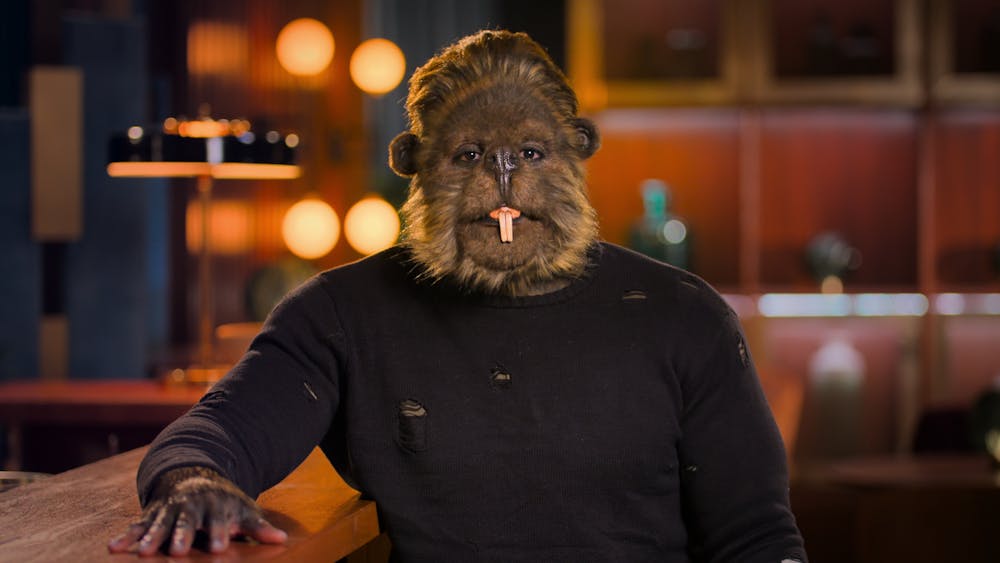

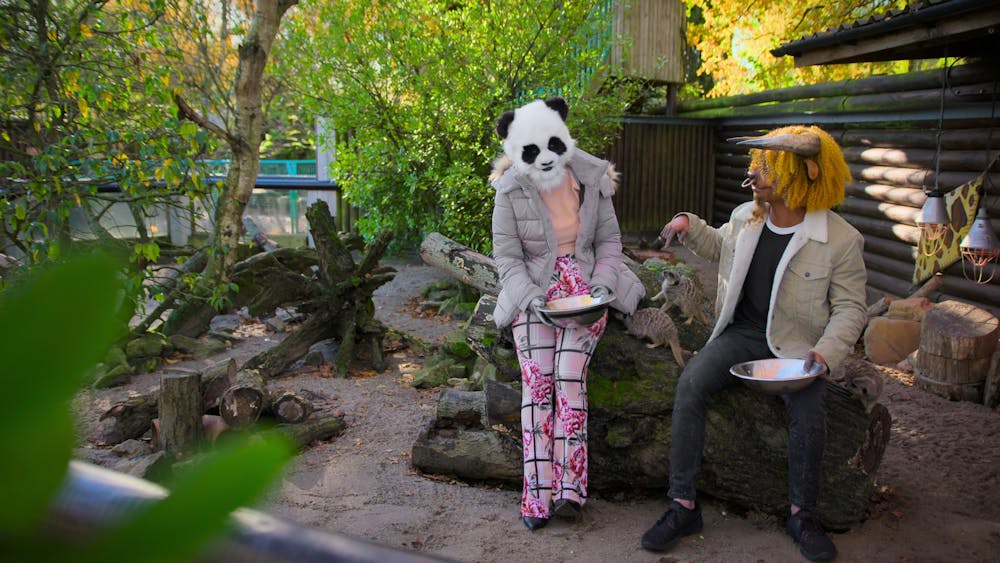


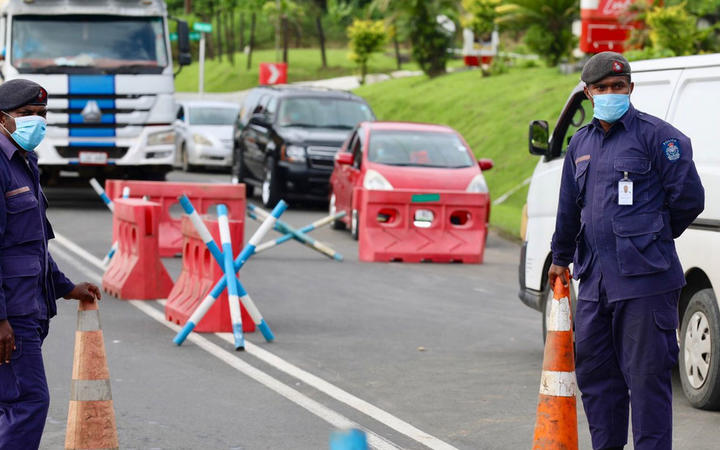
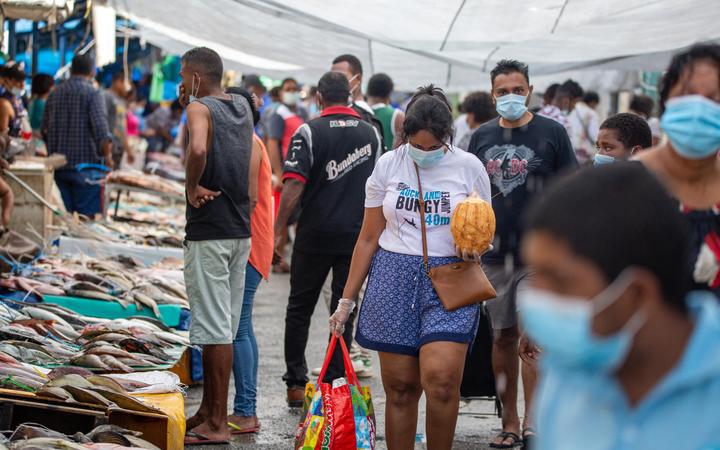

.png?1626669115)