Page 1156

RSF condemns Chinese exclusion of journalists at APEC side events

]]>
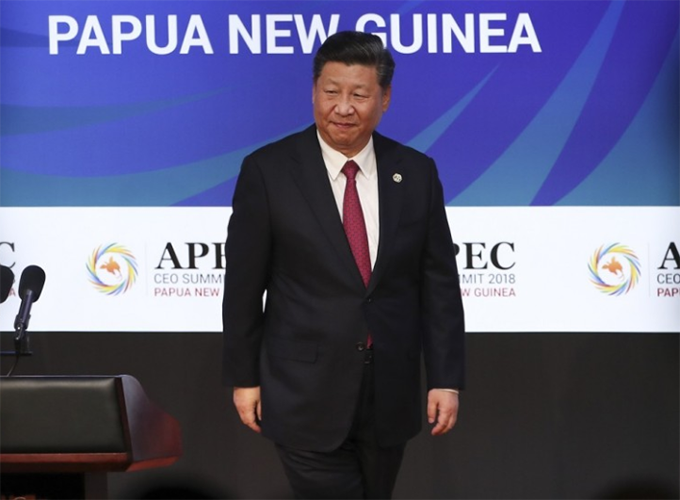
Chinese President Xi Jinping in Port Moresby … accused over “new media control strategy” in South Pacific. Image: SCMP

Pacific Media Watch Newsdesk

Reporters Without Borders (RSF) has condemned the discrimination practised by the Chinese delegation against local and international media at the summit of the Asia-Pacific Economic Cooperation (APEC) held last weekend in Papua New Guinea and attended by President Xi Jinping.

During the APEC leaders summit, held from November 17-18 in Port Moresby, several accredited media – including the Australian public broadcasting TV channel ABC and the local EMTV News channel and National daily newspaper – were prevented from covering three events organised by the Chinese delegation and involving Chinese President Xi Jinping.

The events included a dinner with President Xi’s counterparts from eight Pacific Island States, reports RSF.

READ MORE: Nothing to see here … Chinese state media has little to say over APEC summit drama

Chinese journalists were apparently the only ones allowed to cover these events.

“The delegation, which did not see fit to explain the reasons for this discrimination, cynically invited excluded journalists to use the recordings broadcast by the Chinese media as the source of information for their articles,” RSF said.

-Partners-

Cédric Alviani, director of RSF’s East Asia office, said: “It is intolerable that a foreign delegation in an international event would claim the right to choose which journalists can be admitted or not to cover the proceedings.”

He added that this incident was “a new example of the media control strategy established by Beijing, which is no longer limited to the Chinese territory and tends to spread internationally”.

China is one of the world’s worst jailers of journalists, holding more than 60 professional and non-professional journalists behind bars.

In the 2018 World Press Freedom Index published by RSF, the country stagnates at 176 out of 180. In the RSF Index, President Xi is described as a “predator” against press freedom.

In Auckland, the Pacific Media Centre’s Pacific Media Watch freedom project also condemned the “assault on Papua New Guinea’s freedoms of speech, expression and access to information” in a country that has a constitutionally guaranteed free media.

President Xi Jinping’s “predator” against media freedom file with RSF. Source: RSF

Print Friendly, PDF & Email

Article by AsiaPacificReport.nz

With China-US tensions on the rise, does Australia need a new defence strategy?

]]>

Source: The Conversation (Au and NZ) – By Greg Raymond, Research fellow, Australian National University

There is no evidence that China has ever contemplated using its nuclear weapons to coerce another state. Instead, China has maintained a “no first use policy” on nuclear weapons. Surprising as it may sound to many, China wants to build an image of itself as a responsible power.

But the fact remains that China could threaten to use those weapons to force the Australian government into, say, ceasing its patrols of the South China Sea, regardless of the much-debated US “nuclear umbrella” in East Asia.

This is the reality that Australian defence planners have lived with for some 50 years. Australian defence force planning has long accepted the premise that our self-reliance needs to be viewed within an alliance context. As recently as 2009, the government plainly conceded that the Australian Defence Force was not expected to deal with a situation:

…where we were under threat from a major power whose military capabilities were simply beyond our capacity to resist.

In such a situation, we don’t expect to be alone.

This point is important to bear in mind when we consider recent discussions of a “Plan B” to strengthen Australia’s defence posture.


Read more: Australia and China push the ‘reset’ button on an important relationship


Commentators have suggested recently that Australia’s strategic risk is increasing and the A$195 billion defence spending plan announced in the 2016 Defence White Paper is now insufficient.

Australian taxpayers would certainly be interested to know why a plan that doubles our submarine fleet, significantly expands our navy and adds 100 of the most advanced and expensive combat aircraft ever invented would now be seen as insufficient.

The answer lies in the shifting strategic landscape in the Asia-Pacific region, which has led to greater concerns about China’s long-term intentions and rising tensions between China and the US. So what exactly has changed?

China’s recent activities in the region

Since the last Defence White Paper in 2016, Australian defence observers have been alarmed by four things:

  • China’s rejection of the Permanent Court of Arbitration’s ruling that deemed its nine-dash line claim in the South China Sea illegal

  • China’s conversion of its South China Sea artificial islands into military bases, which was largely complete by the end of 2016, despite a pledge President Xi Jinping gave then-President Barack Obama that China had “no intention to militarise” the islands

  • reports in April of this year that China was establishing partnerships with Pacific nations like Vanuatu for potential future military bases and other arrangements

  • the election of Donald Trump as US president and the uncertainty this has brought to the region due to his disparaging of traditional alliances and disdain for multilateral institutions

These events have occurred against a backdrop of China’s rapidly expanding global footprint. This includes the establishment of its first overseas military base in Djibouti on the Horn of Africa, and its growing access to regional ports such as the controversial Hambantota port in Sri Lanka, which the Sri Lankan government ceded to Beijing on a 99-year lease.

President Xi Jinping has rapidly expanded China’s presence in the Pacific region in recent years. Mick Tsikas/AAP

These regional shifts have also come amid growing illiberalism in China, evidence of increasing Chinese intelligence and influence operations in Australia (especially the Dastyari affair) and bullying behaviour from Chinese officials in their meetings with Australian politicians.

In addition, Trump appears to mark a significant break with the strategic priorities of previous US administrations. He’s threatened to walk away from America’s support for the traditional allies and global trade institutions that have characterised US foreign policy since the Second World War. This has put unprecedented distance between the United States and Australia, which as a middle power needs healthy global institutions.


Read more: Australia’s naval upgrade may not be enough to keep pace in a fast-changing region


But on China, it’s different. The Trump administration and importantly, the US security apparatus, share Australia’s darkening view of China to the point we may now be seeing a new Cold War developing in the region.

Case in point: the recent announcement of US participation in the development of a joint naval base with Australia on Papua New Guinea’s Manus Island. This is clear evidence of the US’s new willingness to compete with China and a signal the US wants to dispel the uncertainty left in the region in the wake of Obama’s problematic “pivot” to Asia.

Assessing the risks for Australia

In assessing whether Australia needs a steep increase in its defence spending, there are two questions we must ask: Firstly, what regional developments could the 2016 Defence White Paper not have anticipated? And of these, which equate to risks that increased defence spending can obviate?

Our defence planners have been well aware since at least 2009 of China’s gradually modernising defence forces and steadily growing navy. China’s moves toward a blue-water fleet, including new carriers and cruisers, were also well understood in 2016.

While the artificial islands in the South China Sea were still being built, their eventual militarisation was also anticipated by Australian defence leaders, despite China’s protestations to the contrary.

But even knowing all of this, Australia’s defence planners essentially decided in the 2016 White Paper to continue with the “Force 2030” force structure they envisaged in 2009. There have been some additions like shore-based anti-ship missiles, but our plan has largely been focused on enablers – that is, the capability to make the force operate with greater certainty, precision and coordination. Importantly, this White Paper did not envisage Australia fighting China on its own.


Read more: The risks of a new Cold War between the US and China are real: here’s why


Of the strategic developments involving China since 2016 – from the revelations of its influence operations to its new-found interest in the Pacific – the question defence planners should now be asking is whether any undermine the fundamental judgements of the 2016 White Paper. Do they point to a need to radically change Australia’s defence posture?

Combating China’s illicit influence in Australia is being dealt with through our stronger foreign influence laws. Offsetting China’s influence in the Pacific will be best undertaken through Australia’s aid and diplomatic programs.

This leaves the big question of the role of the US in the Asia-Pacific region – the most critical of defence planning factors. Will Australia be left on its own in the foreseeable future?

And here we must observe that despite Trump’s anti-alliance rhetoric, the American force posture in the Western Pacific actually remains unchanged. There have been no base closures and no force draw-downs as of yet from the bases encircling China in Guam, Japan and South Korea, though Trump has threatened this.

Mike Pence signaled a harder US stance towards China in a speech last month, saying: ‘We will not stand down.’ Fazry Ismail/EPA

Moreover, the hardening US view against China means a likely strengthening of its Asia-Pacific posture under the new National Security Statement, the cardinal US security policy document.

In fact, the US is now expanding its presence in the region with the announcement of the new joint naval base on Manus Island. The US also recently put its nuclear deterrence guarantee to Australia in writing for the first time in history. And the American Marine build-up in Darwin continues.

Although China’s military advances are making the task of possibly defeating its navy more challenging, the fact remains that it will be a long time before it’s able to start a war with the US confident of victory. The US also seems unwilling to leave China to dominate Asia.

In these circumstances, would China use its forces against other countries in the region, like Australia, without the US getting involved? In my view it could not.

Therefore, while every responsible government should continue to assess defence planning and ensure appropriate levels of readiness, the case for a sharply increased defence spending plan is not at this point compelling.

ref. With China-US tensions on the rise, does Australia need a new defence strategy? – http://theconversation.com/with-china-us-tensions-on-the-rise-does-australia-need-a-new-defence-strategy-106515

It’s hard to think about, but frail older women in nursing homes get sexually abused too

]]>

Source: The Conversation (Au and NZ) – By Joseph Ibrahim, Professor, Health Law and Ageing Research Unit, Department of Forensic Medicine, Monash University

We don’t often think of older women being victims of sexual assault, but such assaults occur in many settings and circumstances, including in nursing homes. Our research, published this week in the journal Legal Medicine, analysed 28 forensic medical examinations of female nursing home residents who had allegedly been victims of sexual assault in Victoria over a 15-year period.

The cases were examined by Clinical Forensic Medicine – a division of the Victorian Institute of Forensic Medicine – between January 1, 2000 and December 31, 2015.

The majority of the alleged victims had some form of cognitive or physical impairment. All 14 perpetrators who were reported were male, half of whom were staff and half other residents. The majority of case reports didn’t indicate whether the alleged victim had received treatment for the assault.

The most frequent alleged sexual contact was vaginal contact or penetration. Injuries weren’t reported for every case. Where present, they consisted of bruising, skin tears, redness and swelling.

The physical examination was often limited because of the cognitive status (in 38%) of the individuals, physical issues (in 31%), lack of cooperation (23%), and poor examination conditions (23%). Data on alleged victims’ behaviour was commonly missing.

These information gaps highlight the difficulty of examination which is essential to a detailed investigation. A better understanding of the context and setting of the assault, which is usually available when younger women are victims, is essential to inform prevention efforts.


Read more: Sexual assaults in psych wards show urgent need for reform


Eliminating sexual assault in nursing homes is a major challenge which starts with acknowledging it exists and recognising the scale of this abuse.

Much higher than we think

Sexual assault is considered the most hidden, as well as least acknowledged and reported, form of elder abuse. This makes it difficult to accurately estimate its prevalence.

Prior to 2007, it was estimated there were around 20,000 unreported cases of elder abuse, neglect and exploitation in Victoria. Between 2009-10 and 2014-2015 the published number of sexual assaults among older people rose from around 280 to 430 reports nationally (information about each jurisdiction was not available).

Reliance on carers makes nursing home residents especially vulnerable to sex abuse. from shutterstock.com

In 2015–2016 The Australian Department of Health was notified of 396 reports of alleged or suspected unlawful sexual contact of residents in nursing homes in Australia.

Based on these statistics, we expected Victoria would have 80-120 sexual assaults of residents reported in nursing homes per year (equating to approximately 1,200 assaults during the study period). The 28 cases reported to the forensic investigation team over a 15 year period suggests under-recognition and under-reporting.

Nursing home residents are particularly vulnerable to sexual assault due to their dependency on caregivers, health problems, and the co-housing of residents, sometimes with potentially dangerous older individuals with sexual assault backgrounds.


Read more: Violence between residents in nursing homes can lead to death and demands our attention


Negative stereotypes such as that older people aren’t sexual beings, their greater dependency on others, potential divided loyalty to staff members or residents are unique barriers to reporting, detecting, and preventing sexual assault in nursing homes. Despite severe health consequences, efforts to prevent and address elder abuse remain inadequate.

In the majority of cases we examined, signs of general or genital injury were not found. Further, post-assault victim responses, such as agitation, distress and confusion may mirror symptoms of cognitive impairment. This can create difficulties for nursing home staff in distinguishing between the usual behaviour or a response to trauma, such as sexual assault.

Also, nursing home victims of sexual assault tend to be ignored by staff who often don’t believe the accusations. Although we could not determine who or what prompted reporting, what is known is that sexual assaults are unlikely to have a witness, though witnesses appear to be crucial to ensure successful prosecution.

Sexual assault, in any setting or age group, is one of the most difficult crimes to prosecute due to the required elements of intent and lack of consent. But this is made all the more complicated when it comes to nursing home residents.

Awareness is crucial

Staff must be aware of the existence of sexual assault in nursing homes. It is their duty as care providers to report alleged or suspected sexual assault in a timely manner. More education, training and research is needed to address the knowledge gaps around incidence, levels of reporting, nature of investigations, responses required to better assist the victim, and the interventions needed to prevent sexual assault.


Read more: How our residential aged-care system doesn’t care about older people’s emotional needs


Without a clear understanding of the alleged victim and incident characteristics, we will struggle to combat sexual assaults in nursing homes. There is an urgent need to better use the existing data held by the the Department of Health to understand the full extent of sexual assault in nursing homes. The Royal Commission is an opportunity to consider the development of tailored policies, staff training and legislation.

ref. It’s hard to think about, but frail older women in nursing homes get sexually abused too – http://theconversation.com/its-hard-to-think-about-but-frail-older-women-in-nursing-homes-get-sexually-abused-too-107013

Asians out! Not in this suburb. Not in this apartment

]]>

Source: The Conversation (Au and NZ) – By Alanna Kamp, Postdoctoral Research Fellow in Australian Cultural Geography, Western Sydney University

This is the fourth article in our series, Australian Cities in the Asian Century. These articles draw on newly published research, in a special issue of Geographical Research, into how Australian cities are being influenced by the rise of China and associated flows of people, ideas and capital between China and Australia.


When it comes to access to housing in Australia, the playing field is far from even.

Our recent research has found that “race” matters. Many Australians experience racism and discrimination based on their cultural background.

This is particularly the case for Asian Australians. They experience much higher rates of racism across a variety of everyday settings, but particularly when renting or buying a house.


Read more: A white face can be a big help in a discriminatory housing market


Asian Australians’ experiences of racism

An online national survey of 6,001 Australians measured the extent and variation of racist attitudes and experiences. We examined the impacts of where Australians are born and what language they speak at home on their experiences of racism.

Our research revealed that if you were born overseas, or if your parents were born overseas and you speak a language other than English at home, you are likely to have many more experiences of racism than other Australians. Racism is experienced in a variety of settings –workplaces, educational institutions, shopping centres, public spaces and online.

Survey participants born in Asia were twice as likely as other Australians to experience everyday racism. In fact, 84% of these Asian Australians experienced racism.

For those born in Australia to parents who were both born in an Asian country, rates of racism were just as high (86%).

If you speak an Asian language at home, your experiences of racism are also likely to be high. Speakers of South Asian and East Asian languages experience racism at alarming rates – 85% and 88% respectively. Those who speak Southwest/Central Asian and Southeast Asian languages experience rates of discrimination (79% and 78% respectively) similar to those for all participants of a non-English-speaking background (77%).

Anti-Asian housing discrimination

Published findings for New South Wales and Queensland in the 1990s revealed that 6.4% of Australians reported having experienced ethnic-based discrimination when renting or buying a house. Our recent national study has found this proportion has increased dramatically. In recent years, 24% of Australians have experienced housing discrimination.

Almost six in ten Asia-born Australians reported having experienced housing discrimination. James Ross/AAP

As with the broader pattern of everyday racism, Asian Australians are feeling the brunt of housing discrimination. Almost six in ten (59%) Asia-born participants in our study experienced racism in accessing housing. This compares to only 19% of non-Asian-born participants.

Asia-born respondents were also more likely to report frequent experiences of housing discrimination. Some 13% reported these experiences occurred “often” or “very often”. This is more than three times the average exposure of non-Asian-born Australians.

In particular, participants born in Northeast and South/Central Asia are more frequently exposed to racism in housing. And 15% and 16% respectively reported housing discrimination occurred “often” or “very often”. This compares to only 9% of those born in Southeast Asia.

The survey also found that if you have two Asia-born parents you are highly likely to experience such racism (44%). Similarly, if you speak a language other than English at home (especially an Asian language), you are more likely to experience housing discrimination (45%).

South Asian language speakers (e.g. Hindi, Tamil, Sinhalese) experience housing discrimination at a much higher rate of 63%. The rate for East Asian language speakers (e.g. Chinese, Japanese, Korean) is 55%. Only 19% of English-only speakers had the same experiences.

Why is this happening?

These findings suggest that the owning and occupying of space by Asian Australians is seen as a threat to Anglo-Australian hegemony. Alternatively, or perhaps relatedly, many real estate agents and owners assume Asians are somehow suspect, or will be a lesser quality tenant or owner. This would be an echo of colonial racist thinking in which Asians were seen as biologically inferior and a potential source of racial impurity.

The repression of Chinatowns and more recent moral panics about Indo-Chinese settlement areas in Sydney and Melbourne – such as Cabramatta and Richmond – point to these stereotypes of vice, uncleanliness and chaos. Perhaps this 20th-century troubling of the white spatial order is continuing today.

Sinophobia in Australia is also emerging in debates about housing investment, donations to political parties, university campus politics, the purchase of agricultural land for mining, as well as general concerns about Chinese government influence, geopolitics and human rights issues in China. Public debate is appropriate, but emerging hysteria and sensationalism are shifting into animosity towards people with Chinese heritage in Australia.

Authorities need to act

Exclusion from an important urban resource like housing can generate profound levels of substantive inequality. This in turn is associated with health issues and poorer access to other elements of life chances like employment, transport and education. It can also generate society-wide issues like segregation and intergenerational inequality.

Australia has laws against racist discrimination in access to goods and services like housing. Our findings, among others, indicate that housing discrimination is more acute for some groups than others, particularly Asian Australians. So where is the coordinated response to this clear injustice?


You can find other articles in the series here.

ref. Asians out! Not in this suburb. Not in this apartment – http://theconversation.com/asians-out-not-in-this-suburb-not-in-this-apartment-103919

A decade after the invention of the smartphone, we’re about to find out how we use our time

]]>

Source: The Conversation (Au and NZ) – By Lyn Craig, Professor of Sociology and Social Policy, University of Melbourne

Much has changed since 2006 about the way we use our time.

Back then we didn’t have iPhones, iPads, Tinder, Snapchat, Facebook, WhatsApp, Instagram, or machines that could play us streamed music, check our heart rates and guide us to our destinations as we walked. We didn’t have Uber, Airtasker or Airbnb. We hadn’t had a global financial crisis.

Back in 2006 we used our time only slightly differently to the way we did fifteen years earlier. We know this because the Bureau of Statistics ran a time use survey that year, giving diaries to 3,900 households who recorded what they were doing in five minute blocks.


Read more: How the smartphone affected an entire generation of kids


The answers varied little from those obtained from the surveys in 1997 and 1992.

Men spent an average of 43 minutes per day on housework, up from 37 minutes in 1992. Women spent two hours 11 minutes, down from two hours 27 minutes.

When it came to childcare, women did twice as much as men, but also more of the “inflexible” activities, such as bathing, putting to bed and transport to and from school. Men were more likely to do the flexible kind: things such as playing, taking children to sports activities, and reading them books.


Read more: Equal distribution of housework? Not any time soon


Men and women spent about 20 minutes more per day consuming “audio/visual media” than they did in 1992 (in 2006 the term referred to radio and television and compact discs and TV programs. Streaming scarcely existed).

Both genders spent more of the weekends shopping than they used to, and less time socialising. And they slept more than they did 15 years earlier.

Things will have changed more

Time use surveys are conducted by statistical agencies in more than 35 countries worldwide. Australia’s was one of the first.

In the aftermath of the global financial crisis the survey scheduled for 2013 was cancelled for financial reasons and further surveys were postponed until the Bureau found the funds.

Since 2006 Australia’s population has grown nearly 20%, the digital revolution has transformed the way we communicate and work, the “gig economy” has offered work opportunities not previously available, but secure jobs are harder to get and globalisation has intensified.


Read more: Phubbing (phone snubbing) happens more in the bedroom than when socialising with friends


A major financial crisis has shaken confidence and wiped out substantial savings. Home prices have more than doubled. The share of the population aged over 65 years is on the way to doubling.

We now have paid parental leave scheme. People are spending longer in education, and more young women are tertiary-educated than young men.

What has it all meant for how we spend our time? Thanks to the Bureau, and the way in which it has been funded, we haven’t been able to find out.

Soon, we’ll know

We are about to be given that chance.

This week the Minister for Women Kelly O’Dwyer announced A$10.4 million of fresh funding for a reborn time use survey in 2020-21 in order to help the government “design policies to fit the way people actually live their lives”.

Labor had already promised to reintroduce the survey in 2020 and 2027 at a cost of A$15.2 million.

It means we will finally begin to find out what is going on.

Are Australians spending more time alone? How are changing workplace conditions including flexibility, non-standard hours and split shifts affecting how much time we spend with our children and our friends?

We expect to find that younger people and the less-educated are bearing the brunt of workplace changes. We expect to find that while women are far more likely to be in the paid workforce, they still do the bulk of the work at home. We expect to find that grandparents are shouldering more of the childcare load.

But we won’t know, and won’t have confidence to act on these changes, until we see the data.

Counting time spent doing unpaid work and determining its financial value will also allow us to meet our international obligations under Human Rights treaties and the United Nations Sustainable Development Goal for Gender Equity.

In 2006 our unpaid work was worth 40% of gross domestic product.

The right design will be critical

The reintroduced survey will need to be redesigned for the digital age. The government says it will be an eDiary rather than a pencil and paper diary.

But it will be important to ensure the questions don’t much change. That way we will get a good measure of how our behaviour has changed since 2006.

With the spread of time use surveys around the world since Australia’s pioneering work in the years leading up to 2006, it will be possible to follow what has become international best practice and harmonise our definitions with those of other countries.

Knowing what we do will once again tell us much that is useful about who we are, how we have changed and how we compare.

ref. A decade after the invention of the smartphone, we’re about to find out how we use our time – http://theconversation.com/a-decade-after-the-invention-of-the-smartphone-were-about-to-find-out-how-we-use-our-time-107195

Why Australian retailers should respect the past and rename their ‘Black Friday’ sales

]]>

Source: The Conversation (Au and NZ) – By Daniel May, PhD Candidate, Australian National University

Australians familiar with “Black Friday” sales might associate them with images of Americans clambering over each other to battle for iPhones and TVs. Yet this term – used here by companies such as Amazon, Kogan, Bonds, and The Good Guys to promote their sales – is inappropriate for Australia given its association with devastating bushfires.

Traditionally the Friday after the Thanksgiving holiday, “Black Friday” is known in the United States as a commercial bonanza where shoppers can gain large discounts. The term, it seems, was invented in the 1960s by Philadelphian police to wryly describe the traffic chaos caused by hordes of post-Thanksgiving shoppers. It became widespread from the 1980s onwards.

Australians shopping online have taken advantage of US-based Black Friday sales for years. But since the 2017 launch here of American retail giant Amazon, other local brands have followed its lead in advertising Black Friday sales. They are doing so this week, with “Black Friday” this year falling on November 23.

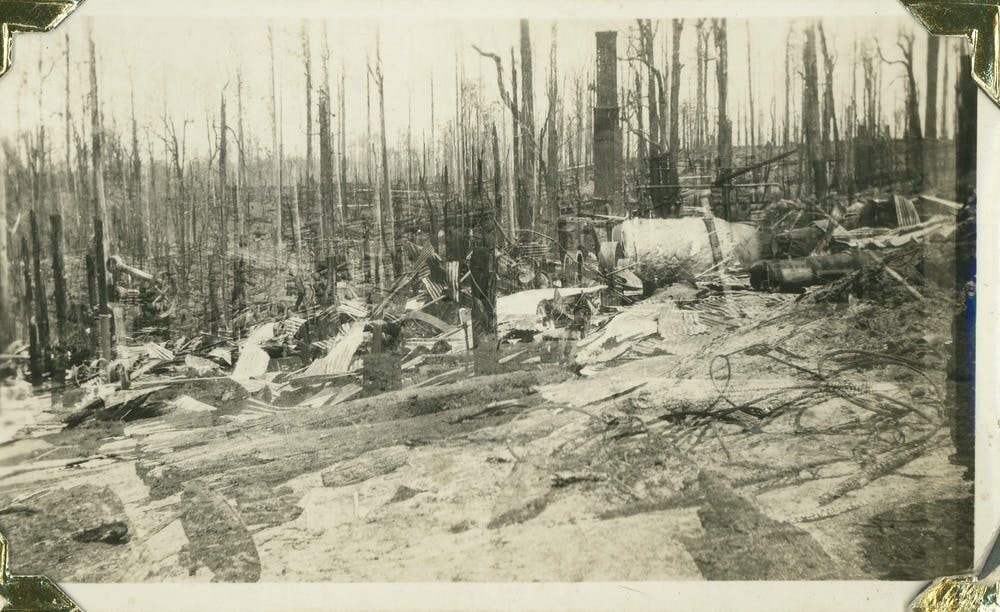
But in Australia, the term Black Friday has a very different history. The 1939 Black Friday bushfires in Victoria were Australia’s worst environmental disaster at the time. Seventy one people were killed and over 1,000 houses were destroyed on January 13, 1939, by fires driven by extreme winds and severe drought.

In the wake of the bushfires, the Victorian government created a Royal Commission led by Judge Leonard Stretton, which collected over 2,500 pages of testimony.

At just 34 pages long and rich with beautiful language, for many years it was required reading for Victorian school students, helping Australians to understand the calamity. Indeed, in 2003, then Victorian Premier Steve Bracks took the report home for his weekend reading, seeking a frame of reference to explain his state’s 2002-3 bushfire season.

Sims, P. (1939). Burnt Country between Ada River & Fitzpatrick’s, near VHC No. 2. [picture]. H90.114/45. State Library Victoria. State Library Victoria.

In a particularly apt passage, Judge Stretton lamented the lack of environmental knowledge of the victims. These words chill my spine every time I read them:

Men who had lived their lives in the bush went their ways in the shadow of dread expectancy. But though they felt the imminence of danger they could not tell that it was to be far greater than they could imagine. They had not lived long enough. The experience of the past could not guide them to an understanding of what might, and did, happen.

Despite Stretton’s eloquence and the policy changes that followed 1939, Australia has continued to experience bushfire disasters. The 2009 Black Saturday bushfires in particular affected many of the same areas and were described by environmental historian Tom Griffiths as “a recurrent nightmare … 1939 all over again”.

Many of the victims of Black Saturday had no personal memory of 1939, and had not taken steps to prepare for bushfires, by building the shelter bunkers or dugouts that were once common in these regions. The eucalyptus regnans mountain ash ecosystems and “fire flume” climate dynamics of this region mean that it will blaze again.

Sims, P. (1939). No. 1. Ada [timber Mill, Powelltown, Vic.] [picture]. H90.114/46. State Library of Victoria

I’m not suggesting here that Australian businesses should avoid competing in a global shopping bonanza – but I would like to constructively suggest an alternative name for their sales.

As with many so-called “historical traditions” that actually have a very recent origin, the “Black Friday” name was itself largely a construction of the media. While Philadelphia police coined the term, it was spread by local journalists and eventually adopted by national television stations.

Given this, and the fact that many of these sales increasingly run for longer than 24 hours, it does not seem too radical to suggest an alternative Australian name.

My own suggestions are “Big Friday” (the name originally preferred by Philadelphians), “Friday Frenzy” or even the “Holey Dollar Holiday”. I would be interested to hear ideas from others.

More than simply changing the name of a sale, this is an opportunity for us to reflect upon the slow Americanisation of Australian culture. It also raises questions about how we as a society can best commemorate and remember past disasters so as to avoid future ones.

Next year will be the 80th anniversary of Black Friday and the 10th anniversary of Black Saturday. Memories and local histories can guide us to prepare for future disasters, but the rhythms of fire ecology can run longer than human generations.

With more Australians building houses in bushfire-prone areas and climate change predicted to modify the climatic drivers of fire, Australians need to learn to live with fire. This can even involve re-learning about fire. This process must include studying environmental histories – and protecting the legacies of past disasters.

ref. Why Australian retailers should respect the past and rename their ‘Black Friday’ sales – http://theconversation.com/why-australian-retailers-should-respect-the-past-and-rename-their-black-friday-sales-107015

It looks like an anchovy fillet but this ancient creature helps us understand how DNA works

]]>

Source: The Conversation (Au and NZ) – By Ozren Bogdanovic, Lab Head-Developmental Epigenomics and Senior Research Fellow, Garvan Institute

Today a large international consortium of researchers published a complex but important study looking at how DNA works in animals. The research focused on a marine organism, a creature called amphioxus (also known as “the lancelet”), to explore some of the steps that took place as animals evolved from invertebrates (animals without a backbone) to more complex back-boned vertebrates, including us humans.

Ozren Bogdanovic is one of the lead authors of the study.


What is this animal, and why do you work with it?

The creature is called Mediterranean amphioxus, or amphy for short (the scientific name is Branchiostoma lanceolatum). Amphy normally lives buried in the sand in the Mediterranean, in the Black Sea and along coastal beaches of the European Atlantic.

Amphioxus looks like a vertebrate (an animal with a backbone, like humans and other mammals) but lacks the specialisations of animals like us, such as a complex brain and limbs. It shares with vertebrates a basic body plan, and has some comparable organs and structures in its body.

So amphy is used in research as an example of one of the simplest animals with a backbone that has some features in common with more complex lifeforms.

Because it “sits in the middle” between invertebrates and vertebrates, it can tell us about some of the steps and developments that took place as animals became more complex over millions of years of evolution.

More simple examples of invertebrates include insects, worms and jellyfish.


Read more: Guide to the classics: Darwin’s On the Origin of Species


What does your new paper tell us about how DNA is used in the body?

For this work we sequenced the amphy genome (all of its DNA) and generated data required to study its genes.

This study gives us an overview of layers and control mechanisms that work around genes, and how these play a role in building more complex animals.

We found that some genes that perform only very general functions in amphy are used in a much more specialised way in vertebrates, particularly in the brain.

As individual animals, both we humans and amphy have two copies of each gene in each cell – one from each of our parents. But in humans, each of those genes further exists in two versions (they are duplicated), whereas in amphy each only exists in one version.

So it seems that the existence of two versions of each gene in vertebrates is linked with the ability to create specialised tissues and functions in our bodies.


Read more: Ancient fish evolved in shallow seas – the very places humans threaten today


Not anchovy fillets! UniProt

What does the research help us learn about how DNA is controlled?

One of the most exciting aspects of this new paper is that – for the first time – it shows us that for some of its genes, amphy uses a similar method to vertebrates to control whether genes are active or not.

This system is called DNA methylation. Small molecules called methyl groups sit on top of a particular part of the DNA and act like signposts that tell genes to switch off.

In more simple animals, such as invertebrates like worms and insects, methylation has been observed at very low levels. Amphy also has low DNA methylation levels in general.

But in this study we found focused sites of dense DNA methylation in the amphy DNA. In these regions, the methylation carries out functions similar to the functions in vertebrates – that is, it participates in gene regulation. This has not been observed before in invertebrates.

For amphy to use DNA methylation to control activities of some of its genes tells us that the regulatory function of DNA methylation might have evolved millions of years earlier than we initially thought.

This new finding may help us understand more about how DNA regulation works, and how it goes wrong in disease.

ref. It looks like an anchovy fillet but this ancient creature helps us understand how DNA works – http://theconversation.com/it-looks-like-an-anchovy-fillet-but-this-ancient-creature-helps-us-understand-how-dna-works-107353

Geopolitics Analysis: A bridge too far – Dr Paul Buchanan

]]>

Headline: A bridge too far. – 36th Parallel Assessments by Dr Paul G. Buchanan

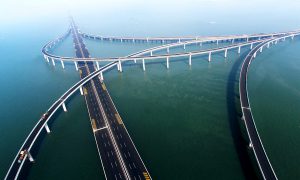
Jiaozhou Bay/Qingdao-Haiwan Bridge, China. Photo: Feel the Planet (feel-planet.com).

Dr Paul Buchanan, founder of 36th Parallel Assessments.

The Labour-led government in New Zealand has settled on a new mantra when it comes to addressing the US-China rivalry. It claims that New Zealand is ideally situated to become a bridge between the two great powers and an honest broker when it comes to their interaction with the Southwest Pacific. This follows the long-held multi-party consensus that New Zealand’s foreign policy is independent and autonomous, and based on respect for international norms and multinational institutions.

The problem is that the new foreign policy line is a misleading illusion. It ignores historical precedent, the transitional nature of the current international context, the character and strategic objectives of the US and the PRC and the fact that New Zealand is neither independent or autonomous in its foreign affairs.

The historical precedent is that in times of conflict between great powers, small states find it hard to remain neutral and certainly do not serve as bridges between them. The dilemma is exemplified by the island of Melos during the Peloponnesian Wars, when Melos expressed neutrality between warring Athens and Sparta. Although Sparta accepted its position Athens did not and Melos was subjugated by the Athenians.

In stable world times small states may exercise disproportionate influence in global affairs because the geopolitical status quo is set and systemic changes are incremental and occur within the normative framework and around the margins of the system as given. When international systems are unstable and in transition, small states are relegated to the sidelines while great powers hash out the contours of the emerging world order—often via conflict. Such is the case now, which has seen the unipolar system dominated by the US that followed the bi-polar Cold War now being replaced by an emerging multi-polar system aggregating new and resurgent powers, some of which are hostile to the West.

In this transitional moment the US is in relative decline and has turned inward under a Trump administration that is polarizing at home and abroad. It is still a formidable economic and military power but it is showing signs of internal weakness and external exhaustion that have made it more reactive and defensive in its approach to global affairs. China is a rising great power with global ambition and long-term strategic plans, particularly when it comes to power projection in the Western Pacific Rim. It sees itself as the new regional power in Asia, replacing the US, and has extended its influence world-wide.That includes involvement in the domestic politics and economic matters of Pacific Island states, including Australia and New Zealand.

China’s rise and the US decline are most likely to first meet in the Western Pacific. When they do, the consequences will be far reaching. Already the US has started a trade war with the Chinese while reinforcing its armed presence in the region at a time when China cannot (as of yet) militarily challenge it. China has responded by deepening its dollar and debt diplomacy in Polynesia and Melanesia as part of the Belt and Road initiative, now paralleled by an increased naval and air presence extending from the South and East China Seas into the blue water shipping lanes of the Pacific.

There lies the rub. New Zealand is neither independent or autonomous when it confronts this emerging strategic landscape. Instead, it has dichotomized its foreign policy. On the security front, it is militarily tied to the US via the Wellington and Washington Declarations of 2010 and 2012. It is a founding member and integral component of the Anglophone 5 Eyes signal intelligence gathering network led by the US. It is deeply embedded in broader Western security networks, whose primary focus of concern, beyond terrorism, is the hostile activities of China and Russia against liberal democracies and their interests.

On trade, New Zealand has an addict-like dependency on agricultural commodity and primary good exports, particularly milk solids. Its largest trading partner and importer of those goods is China. Unlike Australia, which can leverage its export of strategic minerals that China needs for its continued economic growth and industrial ambitions under the China 2025 program, New Zealand’s exports are elastic, substitutable by those of competitors and inconsequential to China’s broader strategic planning. This makes New Zealand extremely vulnerable to Chinese economic retaliation for any perceived slight, something that the Chinese have been clear to point out when it comes to subjects such as the South China island-building dispute or Western concerns about the true nature of Chinese developmental aid to Pacific Island Forum countries.

As a general rule issue linkage is the best approach to trade and security: trading partners make for good security partners because their interests are complementary (security protects trade and trade brings with it the material prosperity upon which security is built). Absent that, separating and running trade and security relations in parallel is practicable because the former do not interfere with the latter and vice versa. But when trade and security relations are counterpoised, that is, when a country trades preferentially with one antagonist while maintaining security ties with another, then the makings of a foreign policy conundrum are made. This is exactly the situation New Zealand finds itself in, or what can be called a self-made “Melian dilemma.”

Under such circumstances it is delusional to think that New Zealand can serve as a bridge between the US and China, or as an honest broker when it comes to great power projection in the Southwest Pacific. Instead, it is diplomatically caught between a rock and a hard place even though in practice it leans more West than East.

The latter is an important point. Although a Pacific island nation, New Zealand is, by virtue of its colonial and post-colonial history, a citizen of the West. The blending of Maori and Pacifika culture gave special flavor to the Kiwi social mix but it never strayed from its Western orientation during its modern history. That, however, began to change with the separation of trade from security relations as of the 1980s (where New Zealand began to seek out non-Western trade partners after its loss of preferred trade status with UK markets), followed by increasingly large waves of non-European immigration during the next three decades. Kiwi culture has begun to change significantly in recent years and so with it its international orientation. Western perspectives now compete with Asian and Middle Eastern orientations in the cultural milieu, something that has crept into foreign policy debates and planning. The question is whether the new cultural mix will eventuate in a turn away from Western values and towards those of Eurasia.

The government’s spin may just be short term diplomatic nicety posing as a cover for its dichotomous foreign policy strategy. Given its soft-peddling of the extent of Chinese influence operations in the country, it appears reluctant to confront the PRC on any contentious issue because it wants to keep trade and diplomatic lines open. Likewise, its silence on Trump’s regressions on climate change, Trans-Pacific trade and support for international institutions may signal that the New Zealand government is waiting for his departure before publicly engaging the US on matters of difference. Both approaches may be prudent but are certainly not examples of bridging or brokering.

While New Zealand audiences may like it, China and the US are not fooled by the bridge and broker rhetoric. They know that should push come to shove New Zealand will have to make a choice. One involves losing trade revenues, the other involves losing security guarantees. One involves backing a traditional ally, the other breaking with tradition in order to align with a rising power. Neither choice will be pleasant and it behooves foreign policy planners to be doing cost/benefits analysis on each because the moment of decision may be closer than expected.

Analysis syndicated by 36th Parallel Assessments

Where has the joy of writing gone and how do we get it back for our children?

]]>

Source: The Conversation (Au and NZ) – By Edwin Creely, Lecturer in literacy and English education, Monash University

NAPLAN results indicate a decline in students’ ability to write. Outcomes in literacy, including writing, affect student achievement across multiple subject areas (including maths and science).


Read more: NAPLAN writing tests hinder creativity, so what could we use in their place?


There is a clear link between students being engaged with writing and the quality of literacy outcomes. Students’ willingness to write can be promoted by making writing more enjoyable and meaningful to young people, with authentic connections to their lives.

The power of expressive writing

Research in English and literacy education consistently shows when teachers are given the scope to tap into students’ interests, they can produce work of high quality. To increase students’ enjoyment of writing, more time could be given to creative forms of writing such as poetry, song lyrics, short scripts, personal memoirs and comic pieces, and combinations of different types of texts with visual materials in multimodal and digital composition.

It’s important for children’s literacy for them to fall in love with writing. www.shutterstock.com

We now have a rich body of research and toolkits that support teachers in writing instruction. Building on good writing instruction, it’s also important for writing to be an activity done for intrinsic purposes such as pleasure. The Australian Association for the Teaching of English asserts the importance of this goal.

Writing is more than work for achieving an outcome. It’s identity work. In the enjoyment of writing, student writers can find themselves and discover the power of language. Powerful literacy skills can be gained in this discovery, with lifelong implications.

Tackling the decline in writing for pleasure in schools

Despite the link between writing for enjoyment and positive literacy results, there is accumulating evidence that writing instruction in schools is becoming limited. The current focus on forms of writing tested in standardised formats, such as tests like NAPLAN and PIRLS, puts pressure on teachers and schools to narrow writing instruction. Typically, this would mean a focus on producing essays, persuasive pieces, reports, recounts, descriptive writing and procedural texts.


Read more: Decluttering the NSW curriculum: why reducing the number of subjects isn’t the answer


In NSW, Geoff Masters, the CEO of the Australian Council for Educational Research (ACER), is overseeing a comprehensive review of that state’s curriculum. He has already noted teachers and school leaders are bound by an inflexible curriculum. This includes approaches to writing and literacy that focus too heavily on prescribed functional texts. Other research by ACER suggests the need for more openness and innovation in teaching writing.

Teachers are committed to improving their students’ writing, given the emphasis in class on assessment of writing by NAPLAN and other international tests. But they also need to feel they can allow more time for unstructured or personal writing that promotes creative writing identities for students.

A focus on testing can stifle pleasure in writing. www.shutterstock.com

For example, teaching multimodal composition (where two or more modes such as written language, spoken language, visual or audio are combined) and writing designed for performance alongside mandated forms of writing (such as persuasive, narrative or instructional writing) would allow students to develop important skills in writing that reflect the emerging digital world and a range of necessary literacy competencies.

The key to promoting the effective writing skills needed by students is to be found in making writing engaging, meaningful and pleasurable. Every opportunity should be taken to open up the possibilities of writing for students so they want to do it and see its relevance to their lives.

There also needs to be a shift in the current policy and assessment emphasis on specific outcomes to one which empowers teachers to promote writing to learn and writing for enjoyment.

Encouraging writing for enjoyment

What can teachers and parents do at home and at school to foster an enjoyment of writing?

Teachers can promote enjoyable writing with meaningful writing environments. www.shutterstock.com

At home

Parents can encourage children to write for pleasure, not just for school work. For example, having a personal diary or journal, and in it writing about life, what interests them, or for imagining, storytelling and wondering.


Read more: Why the teaching of creative writing matters


At school

Teachers can open up writing for pleasure in their classrooms, either as a core activity or as an extension after other work is completed. There can be a special class time to share or perform creative and personal writing and for other students to comment about it. Teachers can also write alongside students to model good writing behaviours.

Schools can promote writing clubs where students can write together, share their writing and even self-publish it in online forums and blogs.

ref. Where has the joy of writing gone and how do we get it back for our children? – http://theconversation.com/where-has-the-joy-of-writing-gone-and-how-do-we-get-it-back-for-our-children-101900

Colonial Australia was surprisingly concerned about Aboriginal deaths in custody

]]>

Source: The Conversation (Au and NZ) – By Kristyn Harman, Senior Lecturer in History; Graduate Research Coordinator, School of Humanities; Course Coordinator, Diploma of History, University of Tasmania

When the Royal Commission into Aboriginal Deaths in Custody’s report was tabled in 1991, it was not the first official inquiry into this tragic phenomenon. The disproportionately high rate of mortality among Aboriginal convicts in colonial New South Wales had triggered an earlier investigation in 1850.

The problem is, of course, still with us. This year a Guardian investigation found 147 Indigenous people have died in custody over the past ten years, and 407 since the end of the Royal Commission.


Read more: Deaths in custody: 25 years after the royal commission, we’ve gone backwards


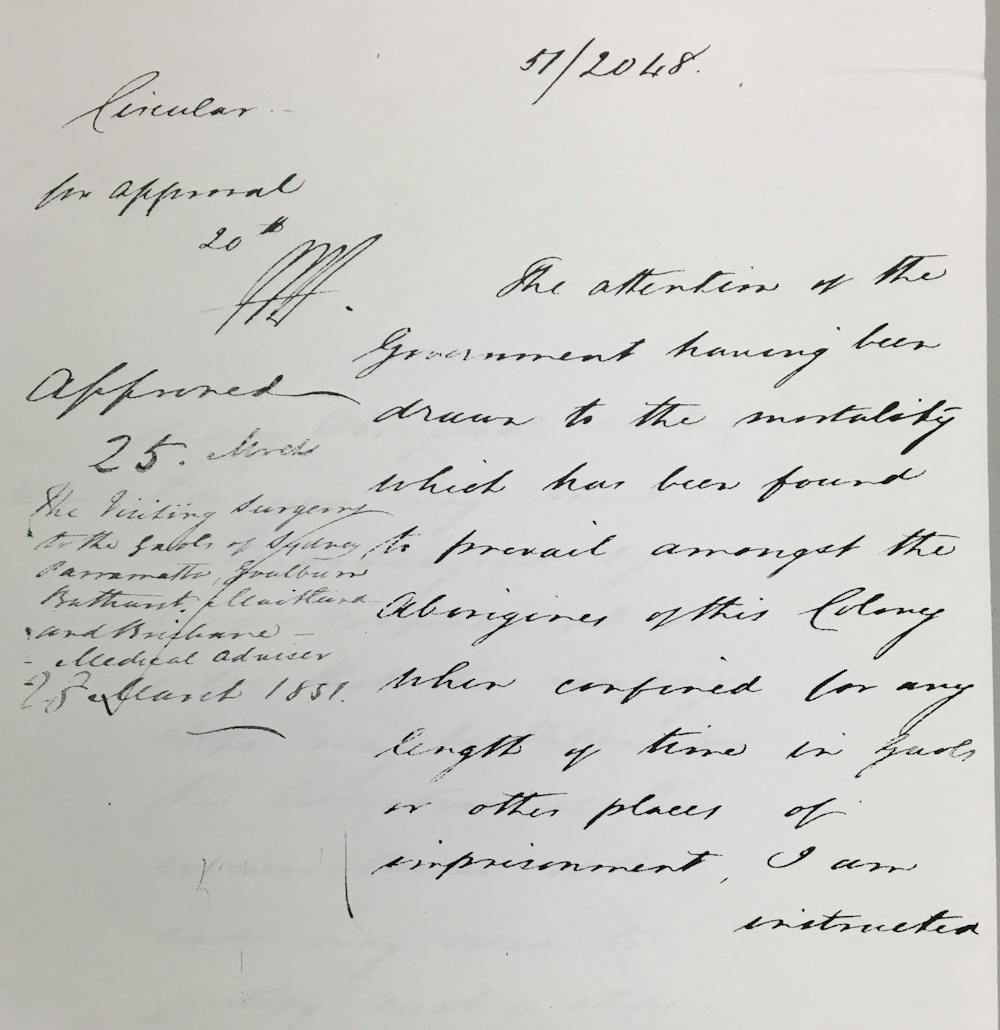
In my research into the transportation of Aboriginal convicts in the 19th century, I uncovered a government circular, a formal letter, written in 1851. It set out detailed instructions about watching and reporting on the health of Aboriginal prisoners. It recommended that if an Aboriginal prisoner’s life was in danger, he might be released from gaol.

A portrait of Musquito, who was hanged in Hobart in 1925. National Library of Australia

When Aboriginal convict Jemmy died in custody in 1850 soon after being transported to Cockatoo Island in Sydney, the Native Police Office wrote to let the colonial secretary Edwards Deas Thomson know. Thomson reacted by asking for a report of the number of Aboriginal convicts who had died on the island over the past five years.

It revealed that of the 19 Aboriginal men transported there between 1845 and 1850, 12 (63%) had died there or in Sydney’s general hospital.

Jemmy, along with at least 60 other Aboriginal men from NSW (which at the time included Queensland and Victoria), was transported following his involvement in Australia’s 19th century frontier wars. Some of these Aboriginal convicts were sent to Norfolk Island and Van Diemen’s Land.

Others languished on Goat Island, Sydney, and, later, Cockatoo Island. The most high profile Aboriginal captive was Musquito who was banished from NSW to Norfolk Island in 1805 and later hanged in Hobart in 1825.


Read more: Soldiers, thieves, Māori warriors: the NZ convicts sent to Australia


Why the deaths?

Most Aboriginal convicts simply did not survive for very long in captivity. In their first year of incarceration, Aboriginal convicts died at ten times the rate of male convicts shipped to Van Diemen’s Land from Britain. Speculation about this at the time mostly hinged around the idea that they died from pining for country.

Other contributing causes included untreated injuries following violent arrests and crowded, unsanitary living conditions, which led to chest infections. Aboriginal poor health in custody was exacerbated by colonial diets and hard labour.

The disturbing trend of high death rates amongst Aboriginal prisoners is evident in archival records from the early decades of the 19th century. Yet until the 1840s Aboriginal convicts were spread out across a range of different probation and penal stations.

When Thomson heard how many Aboriginal convicts were dying in custody at Cokatoo Island, he set up a board of enquiry to consider alternatives to confining them there. This board comprised the medical adviser to the government Dr Patrick Hill, the surgeon at Cockatoo Island Dr O’Brien, and the island’s visiting justice, H. H. S. Browne.

The response

The most significant outcome of the inquiry was a remarkable document that went beyond the 339 recommendations of the Royal Commission almost 150 years later. An official circular instructed surgeons visiting colonial gaols to report to justices any cases involving Aboriginal prisoners whose lives could be endangered by longer confinement.

The upshot of this was that, providing it was not considered contrary to the public interest, the suffering prisoner might be released from custody. With the restoration of his freedom, it was hoped he would return to full health.

A detail from the circular that was sent around gaols. NSW State Archives and Records

While this initiative arose out of the convict system, the instructions were circulated more widely and applied to Aboriginal prisoners generally.

The gaol at Bathurst, a town north west of Sydney, was among the institutions to which the circular was sent in March 1851. In the early 1850s, Godfrey Charles Mundy visited Bathurst Gaol as part of a tour of NSW with his cousin, Governor Charles FitzRoy.

Mundy wrote about a man known as “Fish-hook”, who had been locked up for cattle stealing and showed signs of reduced mental function. Returning a month later, Mundy noted a marked deterioration in Fish-hook’s mental and physical wellbeing.

FitzRoy ordered Fish-hook’s immediate release. When Mundy saw Fish-hook a third time, after the Aboriginal man had become a colonial servant, he wrote how the former prisoner’s mental health had been perfectly restored.

Despite the transformative outcome for Fish-hook, it seems unlikely many Aboriginal prisoners were freed. To the contrary, some were considered too sick to be released, as it would almost certainly lead to their death.

The 1851 Circular and the 1991 Royal Commission into Aboriginal Deaths in Custody shared a common concern, to reduce the mortality rate of Aboriginal prisoners. The 19th century solution was to initiate, where possible, their early release. By the end of the 20th century, the Royal Commission’s focus was on strategies to lower Aboriginal incarceration rates. However, 27 years later, many of its recommendations are yet to be implemented.

ref. Colonial Australia was surprisingly concerned about Aboriginal deaths in custody – http://theconversation.com/colonial-australia-was-surprisingly-concerned-about-aboriginal-deaths-in-custody-107268

If there’s one thing Pacific nations don’t need, it’s yet another infrastructure investment bank

]]>

Source: The Conversation (Au and NZ) – By Susan Engel, Senior Lecturer, Politics and International Studies, University of Wollongong

If Scott Morrison was looking for a way to prove Australia is a good neighbour to Pacific nations, he could hardly have chosen a worse option.

Looking for a policy to combat both China and his domestic Opposition, the Australian prime minister last week announced a plan involving billions of dollars for Pacific nations.

Billions of dollars in loans, that is.

He promised A$2 billion for an Australian Infrastructure Financing Facility for the Pacific to invest in projects focusing on the telecommunications, energy, transport and water sector. And another A$1 billion to Efic, Australia’s government-backed Export Finance and Insurance Corporation, for concessional credit to Pacific projects.

The plan is driven in part by a desire to combat China’s economic diplomacy in the Pacific. There is concern that island nations will end up indebted to Chinese creditors.

So why would Morrison want to offer Pacific Island nations even more debt?

Chinese cheques

The AIFFP has rightly been called a response to Chinese development finance in the Pacific. This is mostly from the Chinese Development Bank, not the Asian Infrastructure Investment Bank (AIIB), which China initiated in 2013. Fiji, Samoa and Vanuatu are the only Pacific island nations that have so far joined the AIIB, and they have not received any loans. However, the Cook Islands, Papua New Guinea and Tonga have expressed an intent to join.


Read more: Soft power goes hard: China’s economic interest in the Pacific comes with strings attached


As with many initiatives, the devil is in the detail of the Australian response.

Morrison has already indicated there will be no increase in Australia’s already stingy aid budget. Given his criticism of multilateral organisations as “useless”, it seems likely the AIFFP’s A$2 billion will come from diverting contributions that would have gone to United Nations agencies or other programs for low-income countries not in the Pacific.

While a greater focus on the Pacific is welcome given the region’s needs, it should not come at the expense of other countries with equally pressing challenges. Further, the shift from grants to loans is not welcome news.

Apart from an interest-free loan to Indonesia following the 2004 Indian Ocean tsunami that killed about 170,000 Indonesians, Australian aid has long been fully grant-based. That has been one of its key strengths.

It has left debt-based development financing to the multilateral development banks it helps fund, in particular the World Bank, the Asian Development Bank and the new AIIB.

Debt concerns

The World Bank and International Monetary Fund’s joint Development Committee warned about debt concerns for developing nations last month. Debt vulnerabilities risked “reversing the benefits of earlier debt relief initiatives”, it said in a communique from the annual meetings of its parent organisations held in Bali last month.

At the meetings, it was clear the IMF was more concerned about debt than the World Bank. Indeed the World Bank and its affiliates were successful in gaining a very large capital increase – US$13 billion in paid-in capital from member states, with the aim that it increase lending to US$100 billion a year by 2030.

The World Bank also had a large capital increase after the 2008 Global Financial Crisis, as did other development banks. These increases were not just in response to the crisis but also underpinned by concerns about competition from China and other emerging powers.


Read more: For Pacific Island nations, rising sea levels are a bigger security concern than rising Chinese influence


With the AIIB and the New Development Bank (established by Brazil, Russia, India, China and South Africa in 2015), there are now about 27 multilateral development banks.

Further, many countries have development finance institutions like Australia’s planned AIFFP, and export-import banks like Australia’s Efic. On top of that, private finance is at record highs.

The case for more debt-based development financing is just not there.

Pacific situation

Of 13 Pacific island countries, six are already considered at high risk of debt distress. In a couple of cases is that due to Chinese finance. In other cases the multilateral development banks are the biggest creditors. Four other countries are at moderate risk of debt distress.


Adding to those debts is not a wise or decent thing for Australia to do. Even the government’s former minister for international development and the Pacific, Concetta Fierravanti-Wells, has warned about debt.

Most Pacific island communities have limited potential to develop along standard capitalist lines. Debt-based development requires projects with substantial economic rates of return and strong cash flows, which is difficult in small island states. Large hard infrastructure projects are risky, as Australia has learned in Vanuatu, and need to be climate change proofed.


Read more: For Pacific Island nations, rising sea levels are a bigger security concern than rising Chinese influence


The AIFFP reflects a new global mantra focused on replacing aid with lending money for infrastructure. It is not responding any demand from the Pacific. Core parts of the Sustainable Development Goals like health, education and climate sustainability are being ignored. It remains to be seen if anyone in the region embraces it.

ref. If there’s one thing Pacific nations don’t need, it’s yet another infrastructure investment bank – http://theconversation.com/if-theres-one-thing-pacific-nations-dont-need-its-yet-another-infrastructure-investment-bank-107198

Fresh urgency in mapping out ethics of brain organoid research

]]>

Source: The Conversation (Au and NZ) – By Julian Koplin, Resarch Fellow in Biomedical Ethics, Melbourne Law School and Murdoch Children’s Research Institute, University of Melbourne

Scientists have become increasingly adept at creating brain organoids – which are essentially miniature human brains grown in the laboratory from stem cells.

Although brain organoid research might seem outlandish, it serves an important moral purpose. Among other benefits, it promises to help us understand early brain development and neurodevelopmental disorders such as microcephaly, autism and schizophrenia.

But brain organoid research also raises serious ethical questions. The main concern is that brain organoids could one day attain consciousness – an issue that has just been brought to the fore by a new scientific breakthrough.

Researchers from the University of California, San Diego, recently published the creation of brain organoids that spontaneously produce brain waves resembling those found in premature infants. Although this electrical activity does not necessarily mean these organoids are conscious, it does show that we need to think through the ethics sooner rather than later.


Read more: Take it from me: neuroscience is advancing, but we’re a long way off head transplants


Regulatory gaps

Stem cell research is already subject to careful regulation. However, existing regulatory frameworks have not yet caught up with the unique set of ethical concerns associated with brain organoids.

Guidelines like the National Health and Medical Research Council’s National Statement on Ethical Conduct in Human Research protect the interests of those who donate human biological material to research (and also address a host of other issues). But they do not consider whether brain organoids themselves could acquire morally relevant interests.

This gap has not gone unnoticed. A growing number of commentators argue that brain organoid research should face restrictions beyond those that apply to stem cell research more generally. Unfortunately, little progress has been made on identifying what form these restrictions should take.

Consciousness and moral status

We first need to consider the moral significance of consciousness. Consciousness clearly does matter morally. This is the main reason why we should be more careful about how we treat humans, elephants, or rabbits than about how we treat rocks. Humans, elephants and rabbits are conscious beings. Rocks are not.

But not all conscious beings have equal moral status.

The highest level of moral status is reserved for “persons”. Personhood is generally thought to require complex cognitive capacities such as autonomy, moral agency, or sophisticated forms of self-awareness.

Normal human adults are persons. Some non-human animals – like chimpanzees – might also fit the bill.

Conscious brain organoids would almost certainly lack the relevant capacities. However, as conscious beings, their interests still matter. As the first animal liberationist, Jeremy Bentham, put it in the 18th century:

The question is not, ‘Can they reason?’ nor, ‘Can they talk?’ but ‘Can they suffer?’

Here, then, is an important threshold. We should restrict the kinds of research that can be conducted with conscious (but not non-conscious) brain organoids. We should ensure the interests of conscious brain organoids are taken into account. For example, we should require that researchers both show why the research cannot be conducted using non-conscious organoids, and that they actively minimise their pain and suffering.

We also need some means of screening for consciousness. One option is to restrict research with brain organoids that resemble the brains of fetuses beyond 20 weeks’ gestational age – the earliest estimate for when consciousness develops in human beings.

Another option is to directly measure brain processes associated with consciousness. We should resolve uncertainty by erring on the side of consciousness; it would typically be less bad to treat a non-conscious brain organoid as if it is conscious than to make the opposite mistake.

Moral status beyond consciousness

One category of research raises additional moral concerns: research in which organoids can interact with the outside environment.

Researchers are beginning to connect brain organoids to robotic bodies and implant brain organoids into the brains of nonhuman animals. It is not far fetched to think such beings could develop a richer mental life than organoids that are confined to cell culture.


Read more: What’s the benefit in making human-animal hybrids?


We should screen such beings for unexpected cognitive capacities, try to understand what constitutes a good life for these beings – and treat them accordingly. We should not assume they are some kind of “biological machine”.

We should also consider their degree of moral status. If these organoids develop sophisticated cognitive capacities beyond mere consciousness – if, for example, they display forms of self-awareness – we might want to attach extra weight to their interests, or even rule out harmful experimentation altogether.

Let’s overestimate moral status

We might not know whether particular brain organoids possess particular cognitive capacities. In such cases, we risk perpetrating serious moral wrongs if we under-estimate their mental sophistication. Accordingly, we should err on the side of over-estimating rather than under-estimating moral status.

This is just a rough outline of one possible regulatory framework. There is room for further conversation on how we should treat organoids that possess consciousness, self-awareness, or other cognitive capacities.

However, with the prospect of conscious brain organoids looming on the horizon, we need to begin having this conversation now.

Science is creating new living matter. With power comes responsibility and what matters is an ethical question, not a scientific one.

ref. Fresh urgency in mapping out ethics of brain organoid research – http://theconversation.com/fresh-urgency-in-mapping-out-ethics-of-brain-organoid-research-107186

An urgent rethink is needed on the idealised image of the ANZAC digger

]]>

Source: The Conversation (Au and NZ) – By Effie Karageorgos, Academic Tutor, History and Academic Skills, University of Melbourne

The 100th anniversary of the truce that ended the first world war has been marked. More than $1 billion is being spent on remembering the dead. Now is the time to become more honest – respectfully – about the way our military engagements, past and present, are depicted in memorials and on important days.

Lives depend on telling it how it really is, both on the battlefield and at home. Present and past military personnel of all genders feel they have to live up to the image of the rugged, male digger who shrugs off traumatic events. This archetype is unattainable – and the mental health consequences can be tragic.

Are military personnel past and present at risk of the tragic consequences of mental health issues being forgotten as the war dead are remembered? Monash

Suicide and self-harm among Australian soldiers and veterans have become endemic in recent decades. Between 2001 and 2015, 325 currently serving and discharged military personnel took their own lives, with another 84 in 2017 alone. The National Mental Health Commission has found that one of the most common barriers to seeking help among soldiers and veterans with mental health issues is societal stigma, which can lead to self-harm and suicide.

Active combat is also not a triggering factor for suicide, confirming that its causes can appear away from the front lines, even on the home front.


Read more: Reliving the pain of war: military deployment and PTSD


The Australian Defence Force (ADF) is taking bold steps towards addressing service-related mental illness and suicide, most recently through the Defence Mental Health and Wellbeing Strategy 2018-2023, that aims to ensure all military personnel are “Fit to Fight, Fit to Work, Fit for Life”.

However, their attempts to combat alarming suicide rates – as male veterans are up to twice as likely to take their own lives as civilian men and female veterans 2.5 times – lack potency when faced with Australian war commemoration that continues to emphasise outdated views of both gender and psychiatry. Reliance on early 20th century ideals to define the Australian soldier perpetuates the stigmatisation of mental illness. And this in turn contributes to high suicide rates among military personnel.

Former prime minister Paul Keating flanked by the current PM Scott Morrison and opposition leader Bill Shorten at the Australian War Memorial on Nov 11, marking 100 years since the truce that ended world war one. Mick Tsikas/AAP

Australia has largely defined itself through its military involvement since the first world war, particularly in the last 20 years. During the conflict’s centenary, Australia spent $552 million on commemoration efforts, five times that spent by the United Kingdom, and an alarming 92 times that of Germany. This included $100 million spent on the John Monash Centre in Villers-Brettoneux, France, to commemorate the men killed in the war.

In early November, the federal government announced that the Australian War Memorial would receive $498 million to fund renovations, including a significant increase in commemoration space. The continued federal spending on remembering the dead over sustaining living military personnel has prompted veterans’ groups to call for funding that prioritises struggling ex-servicemen and women.

The Australian nation was in its teens when the first world war broke out, and political authorities were eager to cement its reputation. In the absence of the long military traditions of European nations – and in an environment where black history was rendered largely invisible – Australian political authorities identified the conflict and the men who fought it as the epitome of national virility and masculinity. This was combined with late 19th century rural “bush” manhood to create the legend of the Australian soldier.

Since the first world war, this partly mythic figure has served as a cultural model for soldiers to emulate. Its importance is reiterated during national commemorations such as Anzac Day and Remembrance Day.

Dr Brendan Nelson, a medical doctor, and director of Canberra’s Australian War Memorial, with Prince Charles, pictured on November 11, 2015. Dean Lewins/AAP

However, this mono-cultural and mono-gendered ideal does not represent 21st century Australia, nor its military. From 1992, the ADF began to move towards inclusion by allowing female and lesbian, gay and bisexual military personnel into the regular armed forces. In 2005, transgender members were also permitted to join.

Despite these significant changes, outdated social and political representations continue to compel military personnel of all genders to embody the white, male soldier of the first world war.

The vast numbers who were diagnosed with shellshock or other psychiatric conditions during the war are also marginalised by this ideal. Mental illness was traditionally feminised in the British Empire, meaning that the essentially masculine Anzac soldier could not conceivably suffer from a psychiatric condition.

Today’s representations of first world war soldiers continue to perpetuate these beliefs, including Peter Jackson’s recent film They Shall Not Grow Old . Despite aiming to represent the British soldier experience, the film failed to mention the shellshock that affected 80,000 British men during the war. Within Australia, shellshocked ex-servicemen struggled to live up to the Anzac legend.

Peter Jackson’s film “They shall not grow old” failed to mention the horrors of shellshock.

The continued emphasis on the cultural figure of the first world war Anzac today places pressure on soldiers and veterans to continue fulfilling these unrealistic expectations, which can prevent them from seeking help for psychological wounds, or worse.

ADF policies that stress inclusion and appropriate mental health treatment aim to address the impact of societal changes. Although the first world war laid the foundations for continuing perceptions of the Australian soldier, it does not represent today’s diversity within the armed forces.


Read more: Mindfulness therapy alleviates soldiers’ PTSD, but only in the short term


The soldier archetype must be politically redefined. Mental illness within the armed forces should be publicly acknowledged as “normal” – as it has occurred as long as combat has existed, among soldiers of all ages, ranks and genders.

With the first world war centenary over, Australia must now move into a more progressive era of war commemoration that can effectively support its military personnel.


  • If this article raises any concerns for you, please contact Lifeline on 13 11 14 or BeyondBlue on 1300 22 4636.

ref. An urgent rethink is needed on the idealised image of the ANZAC digger – http://theconversation.com/an-urgent-rethink-is-needed-on-the-idealised-image-of-the-anzac-digger-107003

Curious Kids: How do moths eat our clothes?

]]>

Source: The Conversation (Au and NZ) – By Andreas Zwick, Molecular Systematist, CSIRO

Curious Kids is a series for children, where we ask experts to answer questions from kids. All questions are welcome: find out how to enter at the bottom. You might also like the podcast Imagine This, a co-production between ABC KIDS listen and The Conversation, based on Curious Kids.

How do moths eat our clothes? – Albie, age 5.

Hi Albie, thank you for your question. Like you, I am very interested in moths, which is why I work at the Australian National Insect Collection at Australia’s national science agency, CSIRO.

Maybe you asked this question because you have seen holes in your clothes and noticed buff-coloured moths (about the size of a large grain of rice) flitting around nearby. But they’re not the real culprit.

Rather, it is the larva (the caterpillar of the clothes moth) that is nibbling holes in your clothes. In fact, the moth doesn’t even eat at all.

This is the larva of the case-bearing clothes moth Tinea pellionella. Flickr/Patrick Clement, CC BY

The caterpillar has special jaws – what scientists call “mandibles” – and uses them to chew holes in clothes, blankets and carpets made from natural fibres like wool, felt, silk and fur.

There are several species of clothes moths. For some of them, the caterpillar lives in and carries around a case that it made from fibres and faeces (its poo).


Read more: Curious Kids: Is there anything hotter than the Sun?


So why do the larvae eat our clothes?

Clothes moths belong to a family called “Tineidae” or “fungus moths”, most of which feed as caterpillars on fungi, lichens and detritus – dead, organic material.

Their caterpillars seem to prefer dark places and feed on fungi, rotting wood, feathers and even bat poo in Australia. Fungi occur especially in moist areas, and clothes moths seem to do particularly well in unwashed clothes that hold some moisture and might have some fungal growth (mouldy bits).

Nesting materials like feathers and hairs both contain a fibrous protein called keratin. In the wild, the larvae would be feeding on those things, but when they’re in your house they can find the same protein in many types of clothes.

Many clothes moths occur naturally in Europe and Asia, but have travelled with humans in their clothes to all continents, including Australia. In Australia, we have a great diversity of this ancient family of moths, with about 190 named species. But there remain many more to be discovered and described by scientists.

So how do you get rid of these moths?

Well, both the moth and their caterpillars prefer dark, damp places. So if you see them near your clothes, it’s a sign that it’s time to wash all your clothes and air them out in the sun.

And I hope there are no holes in your favourite clothes!


Read more: Curious Kids: Why is a magpie’s poo black and white?


Hello, curious kids! Have you got a question you’d like an expert to answer? Ask an adult to send your question to us. They can:

* Email your question to curiouskids@theconversation.edu.au
* Tell us on Twitter

CC BY-ND

Please tell us your name, age and which city you live in. You can send an audio recording of your question too, if you want. Send as many questions as you like! We won’t be able to answer every question but we will do our best.

ref. Curious Kids: How do moths eat our clothes? – http://theconversation.com/curious-kids-how-do-moths-eat-our-clothes-105978

‘Business as usual’ vows Parkop after storming of PNG Parliament, rioting

]]>

The National Parliament of Papua New Guinea came under attack yesterday as angry police and corrections officers stormed into Parliament Haus and destroyed the main entrance.  Video: EMTV News

Pacific Media Watch Newsdesk

National District Governor Powes Parkop has pledged that it will be business as usual today in the Papua New Guinean capital of Port Moresby as normalcy has been restored in the city after yesterday’s rioting, looting and an assault on Parliament.

Parkop declared this after meeting members of the Security Force, together with National Parliament Speaker Job Pomat, Minister for Finance James Marape, Minister for Police Jelta Wong, and other ministers yesterday afternoon at Sir John Guise Stadium in Waigani, reports Loop PNG.

Security forces protested over the lack of payment of security allowances for the Asia Pacific Economic Cooperation (APEC) leaders summit last week by storming Parliament Haus in Waigani and causing damage.

READ MORE: Army ‘not involved’ in storming of PNG Parliament

Port Moresby looting captured by Camara Geita on Twitter yesterday. Image: PMC screenshot

This triggered off rioting in parts of the city and looting in shops.

-Partners-

“Government has agreed to settle the allowances as soon as possible and we all agreed to return to duties to restore calm and normalcy to the city with immediate effect!”

Parkop said the issue of allowances for officers providing security during the APEC meeting is being resolved by the national government and relevant agencies.

He said that K10 million (NZ4.4 million) was released yesterday and was being processed to be disbursed as soon as possible.


A live feed fof shooting, looting and rioting in Port Moresby yesterday. Video: Camara Geita/Twitter

‘Purely administrative’
“This is a matter that is purely administrative.

“Schools should return to normal, shops should open and offices and business should operate as normal instantly. There is no cause for concern or worry.

“I call on everyone not to rely on rumours and fake news to cause an alarm and incite fear unnecessarily.

“The event was regrettable but it’s under control and there is no reason to be fearful anymore.”

Yesterday, business houses, schools and shops closed early due to the looting that occurred at different parts of the city, reports EMTV News.

This followed the rampage at the Parliament by frustrated Joint Security Task Force members over the non-payment of their APEC allowance.


The APEC pay dispute and why the PNG police protested. Video: EMTV News

Print Friendly, PDF & Email

Article by AsiaPacificReport.nz

A/B testing: how offline businesses are learning from Google to improve profits

]]>

Source: The Conversation (Au and NZ) – By Mark Sanderson, Professor of Information Retrieval, RMIT University

The market testing that helped give us the Google search we know today is being emulated by industries from hospitality to manufacturing to help better focus their products and services and meet customer needs. So what did Google do?

If you travel back through internet time via the Internet Archive, you can see what Google looked like soon after it first launched, more than 20 years ago.

An early version of Google. Internet Archive

While the logo is familiar, the look and feel of the website used to be quite different to what it is now. How did Google evolve into the faster-to-load, nicer-to-see, easier-to-read, pages and apps that we use today?

A senior Google employee told me that the search engine kept ahead of the competition via a process of rigorous prototype testing. At the time we spoke, prototypes were tested “offline” by measuring the reactions of hired test subjects to particular features and designs. But soon testing moved “online” and we all became the subjects of A/B tests.


Read more: Why OKCupid sending users on bad dates was a good idea


What is A/B testing?

An A/B test is when a company gives a user access to one of two versions of a website or app:

A) the current version

B) the prototype.

The way users interact with the product is measured during testing. Subtle differences in these interactions can illustrate which version is more effective, according to particular criteria. If the prototype is proven superior, it replaces the existing version as the default product.

Google engineers ran their first A/B test in 2000 to determine the optimum number of search results that should be shown per page.

What A/B testing looks like.

Statistics decide, not managers

Websites and apps have become a constellation of comparisons that collectively evolve systems to an improved state. Every change to an interface or alteration to an algorithm is A/B tested.

Web companies run an astonishing number of tests. In a talk, Microsoft stated that the Bing search engine runs over 1,000 a month. So many, in fact, that every time we access an internet site or app, we are likely unwitting subjects of an A/B test. We are rarely aware of the tests because the variations are often subtle.

Companies are able to run so many tests that they have moved to a process known as hill climbing: taking small steps, getting gradually better. This approach has been so successful that it drives the way many companies innovate today.

Teams are charged with the goal of increasing the user measures. If a small tweak tanks, it’s dropped. If it triumphs, it’s launched. The decisions are made by statistics, not managers.


Read more: Data surveillance is all around us, and it’s going to change our behaviour


Indeed, advocates of A/B testing stress the importance of ignoring the views of managers, which they call HiPPOs – the Highest Paid Person’s Opinions. This acronym was coined by Greg Linden, an early Amazon employee. Linden suggested that, just as supermarkets put magazines and snacks by the checkout queue, Amazon should adopt the same approach with its online shopping carts.

He recalls that a “senior vice president was dead set against” the idea, fearing it would discourage people from checking out.

Linden ignored the HiPPO and ran an A/B test. The results showed that Amazon would make more money and not lose customers, so Linden’s idea was launched. A/B tests have proved to be more accurate, faster and less biased than any HiPPO.

A/B testing can’t solve everything

The complicated part of A/B testing is figuring out how to measure users in a way that will yield the insights you need. Tests need to be carefully designed, and continually reviewed.

Do it wrong and you could end up with success in the short-term, but failure in the long run. A news site that promotes celebrity tidbits might get the immediate gratification of clicks, but lose loyal readers over time.

There are also limits to what A/B testing can observe. The testing relies on measuring user input, mouse clicks, typing, spoken commands, or taps on a mobile screen. Spotify recently asked if someone has a playlist on in the background and they aren’t interacting with their phone, how can Spotify measure if the user is satisfied? No one currently has an answer.


Read more: Google hits 20 but will struggle to become a trillion dollar company like Apple


Taking A/B testing offline

Despite these risks and limitations, the success of A/B testing pervades all companies with an internet presence. And now this testing is being trialled in the physical world.

A couple of years ago, I met with a company that prints and sends utility bills to customers. They A/B tested different formats of the bill, learning which formats improved the rates of customers paying on time.

Restaurants and bars are reportedly using data from sensors to learn which restaurant layout encourages the most sales. For example, if an intimate seating arrangement in the back of a bar attracts people to stay longer, customers in that space are likely to spend more on drinks.

A/B testing could even extend to manufacturing. Slightly different versions of a product could be made on flexible production lines. Production could then be altered if one version of the product was found to sell better than another.

It’s not always a smooth ride, but the power of A/B testing is here to stay.

ref. A/B testing: how offline businesses are learning from Google to improve profits – http://theconversation.com/a-b-testing-how-offline-businesses-are-learning-from-google-to-improve-profits-106843

The Greens set to be tested on a number of fronts in the Victorian election

]]>

Source: The Conversation (Au and NZ) – By Narelle Miragliotta, Senior Lecturer in Australian Politics, Monash University

Critical times lie ahead for the Greens in Victoria and across the federation more generally.

In recent years, the Greens have managed to achieve what most minor parties and independents have failed to do: cut a swathe through a political system that is not particularly welcoming to new entrants. The Greens have defied the odds, cultivating a modest but committed base of support and managing to elect representatives to every Australian parliament except in the Northern Territory.

Yet in spite of their achievements over the last three decades, an underlying fragility permeates the Greens’ electoral prospects. And the Victorian state election on November 24 throws into sharp relief the precariousness that confronts the party.

Victoria has arguably emerged as one of the Greens’ electoral strongholds. Since 1999, the Greens’ statewide share of the lower house primary vote has increased from 1.2% to 11.5% in 2014.

At the 2014 state election, the party seized the electorate of Melbourne from Labor and, in what was deemed a shock outcome, won the Liberal-held seat of Prahran. These two wins were in addition to gaining five upper house seats. The Greens later won the inner metropolitan lower house seat of Northcote in a 2017 byelection.


Read more: Victoria election: the scandals, sloganeering and key issues to watch


That the Greens have several seats to defend is an enviable position for the party going into this election. But it also presents a challenge. Securing the re-election of all eight incumbents, let alone expanding their parliamentary representation, is a critical test of the party’s ability to shed its minor party status.

The Greens have opportunities to gain new lower house seats at this election. In the seat of Brunswick, the ALP incumbent, Jane Garrett, fearing a “green-slide”, chose to retreat to the comparative safety of the number one spot on Labor’s Eastern Victorian upper house ticket. Garrett’s instincts might prove correct, especially with reports that the Liberals have issued an open ticket in that seat.

Richmond is also an active prospect for the Greens because the Liberals are not fielding an official candidate. The Liberals claim this decision is entirely principled; they do not wish to be implicated in the re-election of the ALP incumbent, Richard Wynne, because of his involvement in the so-called “red shirts scandal”. But it is impossible to ignore the fact that Richmond is Labor’s third-most-marginal electorate and the seat of a presiding minister.

But what the Liberals give, they also have the power to take away. Their decision to field candidates in Northcote and Melbourne, where Labor is competitive, puts both seats in contention.

This is especially true of Northcote, which the Greens won in a byelection with relatively low turnout (79% compared to 91.67% at the 2014 election) and no Liberal candidate to channel second preferences to the Labor candidate. This time, the Liberals are issuing an open ticket. Under these conditions, Liberals voters are likely to be more inclined to preference the Labor candidate ahead of the Greens.

Nor will Prahran be an easy seat for the Greens to retain. It is among the 16 “target seats” that have been the focus of Liberal campaign efforts for the past nine months. The Greens incumbent, Sam Hibbins, holds the seat by the barest of margins (0.37%). Hibbins was elected from third position with the assistance of preferences from minor parties and the ALP in 2014.

The upper house also presents uncertainty for the Greens. The party was keen to negotiate a preference deal with Labor because it secured all but one upper house vacancies with a full quota in 2014. However, Labor ignored its overtures, focusing its energies on ill-fated preference negotiations with the Liberals. In this election, the group ticket votes lodged by Labor place the Greens behind right-tending parties in several regions.

When combined with the size of the field and the likely strengthening of Labor’s primary vote, several analysts warn that the Greens might be in peril in some regions.

Aggravating matters further is that the Greens have been caught off guard having to defend the party against Labor’s claims that it has “a toxic cultural problem” in relation to women. Nor are the Greens able to invoke asylum-seeker policy to turn concerned inner metropolitan voters away from Labor given that it is a federal matter.

Labor is also campaigning on several issues that have potential to crowd out the Greens’ policy messaging. In addition to announcing a fairly progressive energy policy, a pledge to expand the rail network and to build cycle lanes, Labor has indicated it will establish a taskforce to consider a proposal for the Great Forest National Park, an initiative it had rejected prior to the 2014 state election.

None of this is to say that Labor will easily gazump the Greens. The government’s policy pledges are likely to be perceived as either too contingent or modest to satisfy the more committed green/progressive supporter. But Labor’s election pledges might prove enough to slow down the Greens’ advance in key inner metro seats, while the micro-parties and their intricate preference deals might well frustrate Green hopes in several upper house regions.

ref. The Greens set to be tested on a number of fronts in the Victorian election – http://theconversation.com/the-greens-set-to-be-tested-on-a-number-of-fronts-in-the-victorian-election-105857

If you’re feeding with formula, here’s what you can do to promote your baby’s healthy growth

]]>

Source: The Conversation (Au and NZ) – By Rachel Laws, Senior Lecturer in Public Health Nutrition, School of Exercise and Nutrition Sciences, Institute for Physical Activity and Nutrition, Deakin University

While breastfeeding is the recommended approach to infant feeding, some mothers may not be able to breastfeed. Others may find themselves moving on from breastfeeding to infant formula.


Read more: Breastfeeding is not ‘easy’ – stop telling new mothers that it is


If a baby isn’t breastfed, or is partially breastfed, commercial infant formula should be the only other food given until around six months, and should be continued alongside solid foods until 12 months. Some 80% of parents in Australia introduce formula within the first year of life.

Formula feeding, however, may increase the risk of being overweight or obese during childhood. The exact reason for this is unclear.

To address this, we undertook a review of studies linking infant formula feeding practices with unhealthy weight gain. The evidence tells us there are a number of things parents using formula can do to promote optimal growth for their baby. These centre around choice of formula and feeding methods.

Choose a formula with the lowest amount of protein

There are many infant formulas on the market to choose from. But for healthy full-term babies, there is little evidence to say that one formula is better than another. The only recommendation we can provide is around protein levels.

A large randomised controlled trial in Europe found that a higher protein content of infant formula is associated with higher weight in the first two years of a child’s life. Based on this research, the Australian Infant Feeding Guidelines recommend choosing a formula with a lower amount of protein.

Breastmilk contains about 1-1.1g of protein per 100ml. Infant formulas available in Australia have a protein content within the range of 1.3-2g per 100ml, so choosing a formula at the lower end of this range is preferable.

It’s best to choose an infant formula with less protein. Shutterstock

Infant formulas (known as step 1, stage 1 or from birth) typically have lower amounts of protein than follow-on formulas (step 2 or stage 2). So if you’re using formula, it’s best to stick with infant formula. This is the only type of formula babies need until they’re 12 months old. No studies have shown any advantages in using follow-on formulas.

At 12 months (but not before) babies can have full cream cow’s milk. Most healthy toddlers do not need formula or toddler milk from this point.


Read more: Don’t stress about the shortage, toddlers don’t need formula


Follow preparation instructions carefully

It’s important that instructions on the tin are followed to make up the formula so it isn’t under or over concentrated. To ensure formula is prepared correctly, remember to:

  • use the right scoop (the one that came with the tin)
  • use level, lightly packed scoops (not over or under filling it or packing it in tightly)
  • add water first and then the powder.

It’s also important not to add anything else to the bottle.

Follow the baby, not the clock

All babies, whether breast or formula fed, should be fed “on demand”. That is, when they show signs of hunger (being awake and alert, mouth opening, sucking hand or fist) rather than by the clock. Crying can also be a late sign of hunger; but babies cry for many reasons, so this is not always a cue to feed.

Responding to signs of fullness (such as turning away and closing the mouth) is another important part of responsive feeding. For bottle-fed babies, it’s important parents attend to these cues to avoid pressuring their baby to finish the bottle. This may override a baby’s innate ability to self-regulate their intake and may even impact later eating behaviours.

At six months of age, parents should introduce a sippy cup with the aim of phasing out bottles by 12 months. Shutterstock

To be attuned to these cues, it’s important to hold your baby when feeding them. This may seem obvious, but parents can be tempted to let older babies feed themselves, or put them in their cot with a bottle to go to sleep. This is not recommended as it can be a choking hazard, lead to tooth decay, ear infections, unhealthy weight gain and disturbed sleep.

Babies will vary in how often they want to feed in response to factors including hunger, thirst, and hot weather. This is normal. The information on the formula tin about how much and how often to feed is a guide only. Parents shouldn’t worry if their baby does not drink as much or as often as suggested – as long as they’re producing plenty of wet nappies, and are growing and developing normally.

If parents do have concerns, they should discuss these with a GP or maternal and child health nurse. The Australian Infant Feeding Guidelines also have a helpful table of formula requirements by age and weight.

Phase out bottles by 12 months of age

Finally, it’s best to phase out bottles by the time a child is a year old. Prolonged use of bottles into the toddler years is associated with a higher risk of later overweight and obesity, along with other problems including tooth decay, ear infections, iron deficiency and speech difficulties.

It’s recommended parents introduce a “sippy” or training cup at six months and aim to phase out bottles by 12 months of age.

If you would like to learn more about feeding your baby across the first year of life , join Deakin University’s free Infant Nutrition online course, starting again on November 19 and running until January 14.

ref. If you’re feeding with formula, here’s what you can do to promote your baby’s healthy growth – http://theconversation.com/if-youre-feeding-with-formula-heres-what-you-can-do-to-promote-your-babys-healthy-growth-106165

Getting clean drinking water into remote Indigenous communities means overcoming city thinking

]]>

Source: The Conversation (Au and NZ) – By Nina Lansbury Hall, Lecturer, Environmental Health Unit, School of Public Health, The University of Queensland

Many people in Australia do not have access to safe drinking water. It’s particularly difficult in Indigenous communities because they are small, remote and challenged by additional issues to secure essential power and water services. To make sure everyone has access to safe drinking water, we’ll have to get smarter about the way we treat it.

Drinking water contamination can come from naturally occurring chemicals, such arsenic, cadmium, nitrates, uranium and barium. It can also come from microbes from sewage and animal wastes.


Read more: Better boil ya billy: when Australian water goes bad


There are also chemicals in farming areas from pesticides, and from mining areas, and also in defence areas that have leached fire-fighting foam into the groundwater (“PFAS” chemicals).

In our research and conversations with residents and water operators in remote Indigenous communities, we have been told that their water is not safe to drink, and that they have no reasonable or practical alternatives and no help.

Hearing from the locals

One Indigenous custodian from Katherine, NT, told us that the levels of PFAS from fire-extinguisher foam were high in their soil and water. Worried locals stopped picking berries or fishing from the river. Despite their protests for action, they said they felt ignored.

Their fears were based on the 2017 testing of water bores around Katherine’s RAAF base with raised PFAS levels. Defence provided bottled water to 50 homes.

Over in the Kimberley, WA, an traditional owner said,

our water is contaminated with nitrates … They say the level is … too high for babies under three months and pregnant women … now the whole community (150 people) cart water from this one tap for drinking and cooking. … We feel fear and we don’t know how much damage is being done to us.

Data reflects the scope and seriousness of the problem. For example, a WA Auditor-General’s report in 2015 found that many communities had unsafe levels of the chemical contaminants nitrates and uranium in the two-year reporting period.


Read more: We asked five experts: do I have to drink eight glasses of water per day?


In Borroloola, NT, situated neat a zinc mine, the community were told by the mining company that the ground (bore) water on the McArthur River was contaminated with lead and manganese. Community representatives told us,

[We were told] we should not drink it, and then they said it was safe and that the high lead had come from our pipes and not the mine … a monitoring group said that our fish are toxic with lead from the mine, so we stopped fishing and started worrying … We can’t live with this contamination anymore. We need the water to be clean.

The McArthur River Mining Pty Ltd’s own Environmental Impact Statement reflects that values “exceed” the trigger value for further investigation in sulfate, zinc and lead. Recent statements in the media from the company indicate the levels are safe.

Safe water for all

Treating drinking water can be different and difficult in remote locations compared to cities.

There are different types of drinking water treatments depending on the type of water (freshwater vs saltwater), the cleanliness of the water (lots of sediment vs dissolved chemicals), and the cost of the treatment (remote communities often only use basic chlorine treatment as they are too small to justify the investment for reverse osmosis). Then there are extreme weather events, such as cyclones and flooding, and the “people factor”, including the skills of the water plant operators.

Only now are government agencies and water utilities starting to realise that there are no “one size fits all” or simple technological fixes for treating water in remote areas. Instead, they are beginning to seek water treatment technology specifically designed for these regions. Sometimes the simplest technologies are going to be longest-serving as they can be fixed, will not be damaged in cyclones, and can be operated by one person.

For example, Queensland Health ran a successful pilot project in the outer Torres Strait Islands to reduce microbial contamination of water. They focused on the “people factor” by building the skills of local staff. They addressed the “governance facto” by ensuring that all relevant government agencies collaborated. And they addressed the “technology factor” by upgrading the technology for water disinfection.

Chemicals in water can also be removed with simple technologies that are locally-appropriate. For instance, Indigenous teenager and Science Teachers’ Association WA’s Young Scientist of the Year Uriah Daisybell, from the Christian Aboriginal Parent-directed School in Coolgardie, WA invented a water treatment system by burning shells and combining with magnets to create a charcoal filter. Testing of the filtered water found that heavy metals were reduced to safe levels.


Read more: Why does some tap water taste weird?


Australia is a vast country, with naturally-occurring chemicals in water and high risk of man-made contamination. Innovation and attention is required to achieve the United Nations’ Resolution to provide safe, clean, accessible and affordable drinking water and sanitation for all – especially in our remote communities.


We are bringing together a Safe Water Summit this month in Brisbane, with representatives from Indigenous and farming communities.

ref. Getting clean drinking water into remote Indigenous communities means overcoming city thinking – http://theconversation.com/getting-clean-drinking-water-into-remote-indigenous-communities-means-overcoming-city-thinking-106701

How much will voters pay for an early Christmas? Eight charts that explain Victoria’s transport election

]]>

Source: The Conversation (Au and NZ) – By Marion Terrill, Transport Program Director, Grattan Institute

The most magical time of the year is upon Victorians: election season. The (taxpayer-funded) gifts promised by the major parties far exceed anything Santa could bring. And the multi-billion-dollar toys on everybody’s wish list? Trains, tracks and roads.

There’s nothing unusual about politicians promising big-ticket items to curry favour with voters, but this election the size of these commitments is astronomical: more than A$170 billion worth of projects are on the table.


Read more: Infrastructure splurge ignores smarter ways to keep growing cities moving


Grattan Institute has crunched the numbers, investigating the major parties’ transport infrastructure pledges worth more than A$50 million. Although cost is a cause for concern, the recent trend towards first conducting business cases is encouraging.

How did we get here?

Population growth has been a big topic in the lead-up to Saturday’s state election. Politicians often cite it as the cause of ever-worsening congestion, despite evidence that Australia’s cities are actually coping quite well.


Read more: Our fast-growing cities and their people are proving to be remarkably adaptable


It’s often assumed that a city’s transport infrastructure needs to grow at the same rate as population. This misconception allows politicians to promise popular mega-projects in the name of busting congestion.

Labor has the most extensive and expensive suite of projects, at a cost totalling A$95 billion. More than half of that is just one project: a A$50 billion suburban rail loop that rings around Melbourne’s middle suburbs and connects most train lines.

The Coalition’s commitments total $65 billion. The difference in the major party totals is mainly due to the smaller scale of the Coalition’s flagship rail project: a A$19 billion promise to deliver “European-style high-speed rail” to Victoria’s regional cities and towns.

The biggest Victorian Coalition promise is high-speed rail to regional cities and towns, at a cost of A$19 billion. James Ross/AAP The Greens’ promise with the biggest price tag is the A$23 billion Melbourne Metro 2 project (click map to enlarge). The Greens Victoria

The Greens have so far committed to projects worth at least A$72 billion. The largest is Melbourne Metro 2 at an estimated A$23 billion.

These promises mean that every party wants the credit, if elected, for being the government that built the largest transport infrastructure project in our nation’s history. The current title holder, WestConnex in Sydney, totals only A$16.8 billion.

Critics might point out that Labor and The Greens have committed only to business cases for the suburban rail loop and Melbourne Metro 2 respectively. But since two-thirds of infrastructure projects announced with a price tag end up being built, voters are right to treat these promises as commitments to the entire project. Unfortunately, there is no election material with the nuanced message: “We support a business case for this project, which we will have rigorously assessed by an independent body, and if the project’s costs outweigh the benefits, we’ll scrap it.”

No matter who wins on Saturday, the full cost of the promised infrastructure won’t be felt immediately. Many of these projects are slated to run over years or decades and will have an impact on several budgets. Voters have the job of deciding not just where they want their money spent, but their children’s money too.

Total spend isn’t the only difference

The major parties don’t tend to agree on much, especially around election time. The value of their unilateral pledges exceeds the value of projects with multi-party support.

The largest promised project to have clear support from all three parties is the airport rail link, estimated at A$13 billion. (The Greens support this project but will not be announcing it as a policy until the business case is complete.)


Read more: Melbourne Airport is going to be as busy as Heathrow, so why the argument about one train line?


Parties differ in both what they promise and where they want to build it, and the patterns are fairly predictable.

Public transport (particularly heavy rail) is the winner this election, but it’s clear that parties tend to choose projects that fit with their ideology. The Coalition has promised the most for roads. The Greens have focused almost exclusively on public transport.

The Coalition’s projects are skewed towards benefiting regional Victorians. Labor and the Greens have announced projects that focus mainly on Melbourne.

These patterns may be influenced by where the parties’ respective voting bases tend to cluster, but also by the demands of different parts of the state. For instance, congestion may be a less salient issue in the regions, so voters there may prefer health or education investment rather than big-ticket transport infrastructure.

Is all this spending wise?

There is often a mismatch between the total cost of a project and how much a party pledges in an election campaign. The discrepancy is due to three factors:

  • only a business case is promised
  • the state government is expected to bear only part of the cost
  • the party has not made the funding arrangement clear.

An interesting phenomenon this election is the practice of pledging a business case only. At first glance, this appears misleading – voters might be enticed by the prospect of a mega-project, yet the party has to fork out only about 1% of the total cost if it wins.

Ideally, parties would have independently evaluated business cases ready before committing to projects, so voters could rest assured that any promised project is a smart one. This is important because projects announced prematurely tend to have the largest cost overruns. And without doing due diligence, there’s not enough evidence that the initiative will deliver enough benefits to justify its price; voters won’t know whether it’s a good use of taxpayer funds until it’s built and they’re stuck with it.


Read more: Spectacular cost blowouts show need to keep governments honest on transport


So promising a business case is still better than committing to a project without one – or, worse still, committing to a project that clearly does not stack up.

Both Labor and the Coalition are guilty here. Labor has committed to rail duplication between Waurn Ponds and South Geelong, despite Infrastructure Australia – the nation’s independent advisory body – warning that “the costs of the project outweigh its benefits”. And the Coalition has promised to revive the massive East West Link, despite the Victorian Auditor-General’s criticism of the original project: “… the EWL business case did not provide a sound basis for the government’s decision to commit to the investment”.

Of the infrastructure promised this election, only the North East Link has a business case that Infrastructure Australia has assessed and approved.

But this is a state election and Infrastructure Australia is required to assess only projects of national significance for which more than A$100 million in federal funding is sought. Fortunately, since 2015 Victoria has had its own independent advisory body: Infrastructure Victoria. It set out recommendations for the state in its 30-Year Infrastructure Strategy.

The cost of a suburban rail loop is the main reason most of Labor’s promised spending isn’t in line with Infrastructure Victoria recommendations (click map to enlarge). Victorian government/AAP

The Greens’ platform is most closely tied to these recommendations, both by number of projects and total size. While the Coalition has made the most pledges that do not align with Infrastructure Victoria’s strategy, Labor’s set of non-aligned projects is worth far more, owing mostly to the suburban rail loop.

The huge infrastructure promises this election may excite some voters, but for parties to pledge “visionary” projects outside of what Infrastructure Victoria has recommended smacks of hubris. By building their own glitzy mega-projects without doing due diligence, politicians risk choosing badly and failing to solve the underlying problems voters care about. Worse, the state has a finite budget, so worthwhile projects will have to be relegated to the bottom drawer to make way for the attention-grabbing goliaths.

Going into the polls, Victorians should have one thing on their transport infrastructure wish lists: projects with rigorous and independently assessed business cases. Anything less than that is like buying your kids shoddily manufactured, untested toys. And that may well end in tears once they’re unwrapped.


A note on sources and assumptions: Election commitments were sourced from official party media releases and websites. Only infrastructure promises worth more than A$50 million were considered. Given Labor is in government, only Labor promises pertaining to a “re-elected Andrews government” were included. Judgment had to be exercised to avoid double counting when existing promises were subsumed into later ones. Similarly, care was taken not to double-count projects announced as part of a larger program, such as individual level-crossing removals. Where a party released a range of cost estimates, the largest value was taken.

ref. How much will voters pay for an early Christmas? Eight charts that explain Victoria’s transport election – http://theconversation.com/how-much-will-voters-pay-for-an-early-christmas-eight-charts-that-explain-victorias-transport-election-106782


Fresh thinking: the carbon tax that would leave households better off

]]>

Source: The Conversation (Au and NZ) – By Richard Holden, Professor of Economics and PLuS Alliance Fellow, UNSW

Today, as part of the UNSW Grand Challenge on Inequality, we release a study entitled A Climate Dividend for Australians that offers a practical solution to the twin problems of climate change and energy affordability.

It’s a serious, market-based approach to address climate change through a carbon tax, but it would also leave around three-quarters of Australians financially better off.

It is based on a carbon dividend plan formulated by the Washington-based Climate Leadership Council, which includes luminaries such as Larry Summers, George Schultz and James Baker. It is similar to a plan proposed by the US (and Australian) Citizens’ Climate Lobby.

How it would work

Carbon emissions would be taxed at A$50 per ton, with the proceeds returned to ordinary Australians as carbon dividends.

The dividends would be significant — a tax-free payment of about A$1,300 per adult.

The average household would be A$585 a year better off after taking account of price increases that would flow through from producers.


Read more: Trying to measure the savings from the carbon tax is a mug’s game


If those households also cut their energy consumption as a result of the tax they would be even better off.

And the payment would be progressive, meaning the lowest-earning households would get the most. The lowest earning quarter would be A$1,305 a year better off.

Untaxed exports, fewer regulations

For energy and other producers making things to sell to Australians, the tax would do what all so-called Pigouvian taxes do — make them pay for the damage they do to others.

But Australian exporters to countries without such schemes would have their payments rebated.

Imports from countries without such schemes would be charged “fees” based on carbon content.


Read more: Emissions policy is under attack from all sides. We’ve been here before, and it rarely ends well


This means Australian companies subjected to the tax wouldn’t be disadvantaged by imports from countries without it, and nor would importers from countries with such a tax.

The plan would permit the rollback of other restrictions on carbon emissions and expensive subsidies.

Our estimates suggest the rollbacks have the potential to save the Commonwealth A$2.5 billion per year.

It’s working overseas

Our plan is novel in the Australian context, but similar to one in the Canadian province of British Columbia which has a carbon tax that escalates until it reaches C$50 per ton, with proceeds returned to citizens via a dividends.


Read more: Taxpayers will back a carbon tax if they get a cheque in the mail


Alaska also pays long-term dividends from common-property resources. The proceeds from its oil reserves have been distributed to citizens since 1982, totalling up to US$2,000 per person.

It could be phased in

We would be open to a gradual approach. One option we canvass in the report is beginning with a A$20 per metric ton tax and increasing it by A$5 a year until it reaches A$50 after six years.

The dividends would grow with the tax rate, but the bulk of households would immediately be better off in net terms and much better off over time.

And it would be simple

Our plan doesn’t create loopholes or incentives to get handouts from the government, as have previous plans that directed proceeds to polluters.

It will not satisfy climate-change deniers, but then no plan for action on climate change would do that — other than perhaps the governmment’s direct action policy, which provides a costly taxpayer-funded boondoggle to selected winners.


Read more: The too hard basket: a short history of Australia’s aborted climate policies


But for those who understand that climate change is real, our plan balances the important benefits we gain from economic development and associated carbon emissions against the social cost of those emissions.

It does it in a way that provides compensation to all Australians, but on an equal basis, making the lowest-income Australians substantially better off.

It is the sort of policy that politicians who believe in both the realities of climate change as well as the power and benefits of markets ought to support.

ref. Fresh thinking: the carbon tax that would leave households better off – http://theconversation.com/fresh-thinking-the-carbon-tax-that-would-leave-households-better-off-107177

Why we should worry about Victoria’s China memorandum of understanding

]]>

Source: The Conversation (Au and NZ) – By Peter Lloyd, Professor of Economics, University of Melbourne

Victoria’s Labor government stole a march on the rest of the country last month becoming the first (and only) state government to sign a memorandum of understanding with China under China’s Belt and Road Initiative.

Belt and Road is China’s ambitious plan to lend money to improve infrastructure and other links between it and about 70 other nations that together make up more than 60% of world’s population.


Read more: The Belt and Road Initiative: China’s vision for globalisation, Beijing-style


The Australian government has refused to sign at the federal level where it could have used Belt and Road money to help develop the north. It did this in part because of concerns about China’s strategic intentions. Labor says it is more open to signing.

There’s not much in it

When it signed it in October, Victoria’s Labor government refused to release the text, but it has since done so under pressure ahead of Saturday’s state election.


The memorandum Victoria’s government has made public. Government of Victoria


At first glance, there isn’t much in it, apart from a series of motherhood statements espousing cooperation:

The parties will work together within the Belt and Road Initiative, with the aim of promoting connectivity of policy, infrastructure, trade, finance and people, so as to seek new opportunities in cooperation and inject new momentum to achieve common development to strive to develop an open global economy, jointly combat global challenges and promote the building of a common future.

Also, the agreement makes clear it is not legally binding.

There are risks nonetheless

But the memorandum itself is the equivalent of hanging out a sign saying Chinese infrastructure investment is welcome.

On signing it, Premier Dan Andrews boasted that in four years he had “more than tripled Victoria’s share of Chinese investment in Australia, and nearly doubled our exports to China”. He sees Victoria as leading the development of closer links between the Australian and Chinese economies.

One risk is that Victoria will get projects that don’t pass cost-benefit analysis, a concern overseas.

Another is excessive debt accumulation by Victoria, also a concern overseas where it has led to strategic assets falling into Chinese hands.


Read more: Will an ambitious Chinese-built rail line through the Himalayas lead to a debt trap for Nepal?


In August the current Prime Minister of Malaysia, Mohathir Mohamed cancelled a US$27 billion East Coast Rail Link project and two other pipeline projects that his predecessor had signed as part of the Belt and Road Initiative.

He did so partly on the grounds that the awarding of these projects was linked to corruption in the previous administration and partly on the grounds that they would lead Malaysia to become excessively indebted to China.

He went further, speaking of “a new version of colonialism”.

And they mightn’t be our workers

Another concern is the large scale use of imported Chinese labour.

When read alongside an earlier memorandum of understanding signed as part of the China Australia Free Trade Agreement over the use of Chinese labour on infrastructure projects funded by Chinese partners, it would appear to allow the employment of an unlimited number of Chinese workers.


Read more: Patching the flaws around ChAFTA’s labour provisions


This memorandum signed between the Commonwealth government and China as part of the free trade agreement is lax. It includes no requirement for labour market testing.

Because of the difference in wage rates paid to Chinese and Australian infrastructure workers that would remain even after the imposition of the minimum wages required by the memorandum, the Chinese partner would have a strong incentive to employ Chinese workers.


Read more: FactCheck: could foreign workers be paid less under the China-Australia FTA?


It could mean that although Australia would get the infrastructure, it would miss out on employing Australians to build it.

ref. Why we should worry about Victoria’s China memorandum of understanding – http://theconversation.com/why-we-should-worry-about-victorias-china-memorandum-of-understanding-107135

Why adult video stars rely on camming

]]>

Source: The Conversation (Au and NZ) – By Sophie Pezzutto, PhD Candidate in Anthropology, Australian National University

With pirated and amateur pornography widely available online, porn no longer provides a steady income for many working in the adult industry. During my research interviewing transgender porn stars in Las Vegas, the overwhelming majority of those interviewed said that now, more than ever, they rely on a variety of other income streams beyond the traditional porno shoot with a studio.

Being a porn star today typically involves a range of sex work, from selling self-produced clips, to offering phone sex services, being an escort, taking care of “sugar daddies” (i.e. rich, usually older men), or “camming” on the internet. Previously regarded as not worth the time for many porn stars, using a webcam from the comfort of one’s home to broadcast oneself masturbating or having sex has emerged as a popular choice.

Indeed, while just 15 years ago, pre-recorded porn such as DVDs, pay sites, and clips generated twice as much revenue worldwide as camming, today that ratio has been reversed. In 2018, the camming industry is estimated to generate US$2 billion in annual revenue worldwide, according to Stephen Yagielowicz, a spokesperson for XBIZ, the adult industry’s leading business publication.

The daily life of a cam performer

“Camming” can be likened to an online strip show where the cam performer uses the webcam on their computer to put on a show for anyone in their chat room. The performer usually sets tipping goals and the more people tip by pledging tokens, the more happens on screen.

Typically, it involves numerous sex toys and ultimately orgasm, but many of the shows get very creative. They can feature anything from fortune wheels and costumes, to “couple shows” with partners and guest appearances from other cam performers.

During the show, viewers get to chat with the cam performer, often requesting sexual acts and sometimes simply asking them questions about their life. There are no fixed rules on length and format of a cam show, but it usually takes anywhere from one to four hours. Many of my informants in Las Vegas cam anywhere between two to six hours a day, multiple times a week.

Cam performers usually run sessions in intervals, timing them to coincide with office hours in big cities on the east coast such as New York and Chicago: one cam show in the morning just before offices open, one during lunch break, and one just before people head home to their families.

While not all cam models shoot studio porn, many porn performers are increasingly camming. Established trans porn stars can make anywhere around US $100 – $200 an hour through camming: “As porn performers we are able to leverage our already existing fan base”, one of my main informants explained to me. For last year’s Christmas special her chat room peaked at 30,000 viewers – the average size of a Mets baseball game.

The changing structure of porn

Porn performers in the industry are generally contracted and paid on a shoot by shoot basis. Trans women in porn generally make anywhere between US$800-1,200 for a sex scene that involves penetration (which is slightly higher than the average cisgender performer, but lower than the highest paid cisgender stars). The number of shoots however, fluctuate a lot. A performer can get booked up to six times a month (in some instances even more), but other months they might not get booked at all.


Read more: Explainer: what does it mean to be ‘cisgender’?


“After they’ve shot you a bunch of times, there usually is a month or two where you don’t get any shoots”, one research participant told me. As a consequence, performers may go several months without a single shoot, which makes budgeting extremely difficult.

In addition to this income insecurity, there are numerous expenses not covered by the companies hiring the performers, such as wardrobe, STI testing, transportation, and accommodation costs. “Factoring in all my expenses and the money I lose from not camming, porn does not really make me money”, said one of my informants. “I see porn mainly as a marketing tool for myself.”

Camming is booming and here to stay

Camming has proven itself more resilient to piracy than studio pornography primarily due to the personal nature of cam shows. “For many viewers it is a unique opportunity to interact with their favourite porn star on a regular basis,” one participant remarked. “That’s something they don’t get from regular porn”.

As a consequence the camming industry has boomed and income from it can make up most of even a well-known porn star’s earnings. Work is not only more consistent, but also much safer: “If I focus on making my money with solo shows then I don’t even have to worry anymore about HIV scares in the industry,” one of my participants pointed out after a recent incident.

At the same time however, camming can be very tough work. One informant told me: “some days I end up crying because people either don’t tip you for hours at a time or tip you just to say nasty things”. Further, cam companies, which host web cam performers, take incredibly high commissions of anywhere between 50 – 70% on every dollar earned by the cam performer.

These draw-backs notwithstanding, camming is set to grow with more and more porn stars relying on it to provide a regular income. Given the various risks of much other sex work, this might not necessarily be a bad thing.

ref. Why adult video stars rely on camming – http://theconversation.com/why-adult-video-stars-rely-on-camming-104758

Victoria votes: your guide to the 2018 election health promises

]]>

Source: The Conversation (Au and NZ) – By Vijaya Sundararajan, Professor and Head of Department, Public Health, La Trobe University

With health care spending accounting for 30% of the Victorian budget, or A$20 billion, health is a major policy area for the Victorian election on Saturday.

While the Commonwealth pays for general practice, private specialists, pharmaceutical benefits and aged care, the states are responsible for running hospitals, community health services and ambulance services. They also want to keep Victorians healthy and out of hospital.

This election campaign, Labor has committed $4.3 billion to health; the Coalition has promised $1.3 billion, and the Greens have pledged $1.35 billion. Much of the difference comes down to infrastructure spending.


Read more: Waiting for better care: why Australia’s hospitals and health care is failing


Labor

Labor’s health policy emphasises its commitment to a public health system. A re-elected Labor government would build a new hospital in the western Melbourne suburb of Footscray ($1.5 billion) and spend $1.2 billion on capital improvements to other hospitals in outer suburban Melbourne and regional areas.

Labor’s hospital package also includes $675 million for ten new or upgraded community hospitals. These health services would provide day surgeries, diagnostic imaging and specialist outpatients, in addition to admitted and urgent care.

The remainder of nearly A$1 billion goes to a range of other promises, including:

The boost in hospital funding is likely to enhance care in the hospital catchment areas and ease the pressure on surrounding hospitals. Improved nurse-to-patient ratios will likely improve the safety and quality of care in the state’s emergency departments and hospital wards.


Read more: Why do we wait so long in hospital emergency departments and for elective surgery?


Is it necessary to commit $3.3 billion to hospitals, presumably on top of current levels of funding?

Much of this goes to capital improvements. Without such investments now, the existing hospital capacity in and around Melbourne will not be able to keep up. But it’s unclear where the money will come from to run these extra hospitals and hospital expansions. It’s hoped that operating costs will not then be taken from existing hospitals.

Coalition

The Coalition’s funding commitments are spread across the key sectors of health including:

There is evidence for much of the Coalition’s commitments. In particular, palliative care has been shown in trials to not only improve quality of life, but also, in some cancers, survival.


Read more: Assisted dying is one thing, but governments must ensure palliative care is available to all who need it


Improving access to community care for disadvantaged groups and in rural and regional areas has the potential to improve the management of chronic disease, such as asthma and diabetes, leading to better health in the long term.

Greens

The Greens’ platform is anchored in a social determinants of health and a population health approach that conceives of health more explicitly as an outcome of broader social and economic conditions.


Read more: Want to improve the nation’s health? Start by reducing inequalities and improving living conditions


The Victorian Greens party’s main priorities are:

The Greens’ funding for free ambulance services would ensure nobody misses out on timely care for traumatic injuries and heart attacks because they don’t have ambulance cover. A similar program operates in Queensland.

The Greens have a well-developed policy, conceiving of health and well-being broadly. The package includes substantial commitments to mental health, community health care and dental health.

But there is no extra funding for hospitals beyond the current budget.

Ambulance services would stand to benefit $668 million if the Greens were elected. AAP/Julian Smith

Comparing the three parties

The biggest difference in the health funding commitments between the three parties is Labor’s focus on hospital infrastructure funding (which accounts for 78% of its health promises). It’s not clear whether the Coalition and the Greens oppose the bulk of Labor’s hospital commitments or are simply silent.

Although this level of funding to hospitals may seem like an inordinate amount, it’s important to consider the role of modern hospitals. They have become the providers of not only admitted care, but emergency care (including GP-type visits), specialist care in outpatient clinics, chronic disease management and palliative care.

When this hospital infrastructure funding is taken out of consideration, the three parties are hard to distinguish. Labor is promising $960 million, Coalition is pledging $816 million and the Greens have committed $1.3 billion to a range of community, mental health, ambulance, chronic disease and prevention services.


Read more: If we’re to have another inquiry into mental health, it should look at why the others have been ignored


The most evident gaps are Labor’s lack of funding for prevention and innovation, and the Greens’ lack of extra hospital capital funding.

A change to the Coalition would likely mean less hospital funding, particularly for a new Footscray hospital, but significant funding for community palliative care services and hospital in the home.

A more comprehensive list of the three parties’ election health promises is available on the Victorian Healthcare Association’s Election Alert.

ref. Victoria votes: your guide to the 2018 election health promises – http://theconversation.com/victoria-votes-your-guide-to-the-2018-election-health-promises-106698

Hundreds of protesting PNG police move in on Parliament over pay

]]>
PNG security forces protesting in Waigani over unpaid APEC security allowances. Image: Loop PNG

By RNZ Pacific

Hundreds of Papua New Guinea police have descended on Parliament Haus in the Port Moresby suburb of Waigani demanding payments they say they are owed for providing security at last weekend’s APEC leaders summit.

RNZ Pacific’s correspondent in PNG, Melvin Levongo, said multiple police vehicles with armed police were involved.

He said police were demanding to speak with Prime Minister Peter O’Neill and APEC Minister Justin Tkatchencko about the extra allowances they were owed.

READ MORE: Reporters attacked as security forces move into Parliament Haus

Levongo said a policeman told him they were very angry at the government.

“You guys have got money to purchase Maserati cars but we are asking for our allowance, so that’s the situation currently at the moment,” he said.

-Partners-

Levongo said traffic had been halted in and around Parliament Haus, and that there was no military involvement in the protest.

Photographs are circulating on social media showing damage at Parliament Haus, including broken glass windows and doors for which PNG police are said to be responsible.

Opposition Madang MP Bryan Kramer’s Facebook page shows hallways and lobbies that have been trashed and an image of startled shadow ministers whose meeting was interrupted.

This article is republished under the Pacific Media Centre’s content partnership with Radio New Zealand.

PNG security forces on guard at Parliament Haus in Waigani today. Image: Brian Kramer FB Opposition Madang MP Bryan Kramer speaking in a live Facebook feed about today’s protest at Parliament Haus. Image: Bryan Kramer FB


Print Friendly, PDF & Email

Article by AsiaPacificReport.nz

Former PM Sir Mekere blasts ‘lavish staging’ and ‘ridicule’ of APEC

]]>

NZ Foreign Minister Winston Peters announces a K22 million (NZ$10 million) aid project to help polio vaccination for Papua New Guineans at the St John Ambulance Operations Centre in Port Moresby. Video: EMTV News

Pacific Media Centre Newsdesk

A former prime minister has accused Papua New Guinea’s current leader Peter O’Neill of exposing the country to “international ridicule and criticism” over the lavish staging of APEC and failure of the meeting to make the customary Leaders’ Declaration for the first time in its history.

Sir Mekere Morauta, MP for Moresby North West in the nation’s capital, today declared in a statement: “APEC has revealed to the world the corruption, waste and mismanagement within the O’Neill government, and their devastating effects on the nation and citizens.”

He said the leaders summit had shone an international spotlight on O’Neill’s “crude and cynical attempts to play one nation against another”.

READ MORE: PNG security forces strike at Parliament for unpaid APEC allowances

Sir Mekere also accused the prime minister and lacking an ability to understand the nuances of international relations and the dramatic geopolitical changes happening in the region.

NZ Foreign Minister Winston Peters at St John Ambulance Operations Centre in Port Moresby yesterday. Image: EMTV News


-Partners-

“What should have been a moment for PNG to shine on the international stage instead descended into chaos, including embarrassing diplomatic incidents, international media allegations of financial and procedural impropriety and organisational disarray,” Sir Mekere said.

“Papua New Guinea’s international standing has been diminished.”

The former PM said the issue for Papua New Guinea was not a failure of the international APEC organisation, the countries involved, or of PNG’s professional diplomats – it was an issue of failed leadership.

Quality of life
Sir Mekere said PNG should not have hosted APEC in the first place.

The K3 billion “lavished” on the event should have been spent on improving the quality of life of ordinary Papua New Guineans.

“Instead we have preventable diseases such as polio, leprosy, TB and malaria surging and people dying – 21 children are now known to have contracted polio,” Sir Mekere said.

“Many schools are closing across the nation. Public servants are not being paid properly and other entitlements such as superannuation payments are being withheld.

“Essential infrastructure outside Port Moresby is crumbling into the dust, and government systems and processes are failing by the day.”

However, Prime Minister O’Neill said he had made history in inviting Pacific Island leaders to take part in the APEC leaders summit, reports the PNG Post-Courier.

“I know Australia, New Zealand and PNG are active members of APEC, but there are also countries within the Pacific region that have their own story to tell,” O’Neill said.

Reception dinner
He said this when he led the Pacific leaders to a reception dinner hosted by Australian Prime Minister Scott Morrison at the Australian High Commission residence last night.

Pacific leaders who attended included Samoa Prime Minister Tuilaepa Sailele Malielegaoi, Vanuatu Prime Minister Charlot Salwai and the Prime Ministers of the Cook Islands, Solomon Islands and Tonga.

“I would like to thank the Pacific leaders for joining us here at the margins of the APEC meeting.

“Again [the reason] to bring the Pacific Island leaders’ to APEC is that we don’t want to be forgotten out of the APEC community,” O’Neill said.

Print Friendly, PDF & Email

Article by AsiaPacificReport.nz

Poll wrap: Labor’s worst polls since Turnbull; chaos likely in Victorian upper house

]]>

Source: The Conversation (Au and NZ) – By Adrian Beaumont, Honorary Associate, School of Mathematics and Statistics, University of Melbourne

This week’s Fairfax Ipsos poll, conducted November 14-17 from a sample of 1,200, gave Labor just a 52-48 lead, a three-point gain for the Coalition since October. Primary votes were 37% Coalition (up two), 34% Labor (down one), 13% Greens (down two) and 5% One Nation (steady). As usual, the Greens are too high in Ipsos and Labor too low.

This poll is the Coalition’s best result from any pollster since Malcolm Turnbull was ousted. Last week, Newspoll gave Labor a 55-45 lead, and it is unlikely Labor lost three points in a week. Ipsos is the most volatile Australian pollster. However, Essential (see below) confirms Ipsos by also shifting to a 52-48 lead for Labor.

Respondent allocated preferences in Ipsos were 53-47 to Labor, one point better for Labor than the previous election method. Under Turnbull, Labor usually performed worse on respondent preferences, but the three Ipsos polls under Scott Morrison have Labor tied or ahead of the previous election method using respondent preferences. A stronger flow to Labor from the Greens and non-One Nation Others could be compensating for weaker flows from One Nation.

48% approved of Morrison (down two), and 36% disapproved (up three), for a net approval of +12. Last week’s Newspoll gave Morrison a -8 net approval; although Ipsos gives incumbent PMs much better ratings than Newspoll, the difference is very large this time. Bill Shorten’s net approval was up one point to -7. Morrison led Shorten by 47-35 as better PM (48-35 in October).

46% thought Muslim immigration should be reduced, 35% remain the same and 14% increased. In October, a question about all immigration found 45% wanted it reduced, 29% wanted it to stay the same, and 23% increased.

47% thought the government’s main priority on energy policy should be reducing household bills, 39% reducing carbon emissions and 13% reducing the risk of power blackouts. Labor will attempt to convince people that clean energy can be consistent with cheap energy.

I think the shift to the Coalition is more likely due to last week’s economic data than the Bourke Street attack. On November 14, the ABS reported September quarter wage growth data; according to The Guardian’s Greg Jericho, wages are growing more than inflation for the first time since 2013. On November 15, the ABS reported that 33,000 jobs were added in October, with the unemployment rate stable at 5.0%.

On November 14, Westpac reported that consumer sentiment increased 2.8% from October to 104.3 in November. If people feel good about their personal economic situation, it is more likely they will feel good about the government.

Essential: 52-48 to Labor

This week’s Essential poll, conducted November 15-18 from a sample of 1,027, gave Labor a 52-48 lead, a two-point gain for the Coalition since last fortnight. Primary votes were 37% Coalition (up one), 35% Labor (down four), 11% Greens (up one) and 7% One Nation (up one).

44% said their vote was very firm and unlikely to change, including 50% of Labor voters and 46% of Coalition voters.

By 35-28, voters thought the Liberal government and its ministers were poor, but they also thought the Labor opposition and its shadow ministers poor by 33-28. By 36-35, voters thought the Labor team would do a better job of governing than the Liberal team.

On a range of issues, more people thought the government was not doing enough than doing enough, particularly on the ageing population (67-17), transitioning to renewable energy (64-14) and affordable housing (64-16).

In additional questions from last week’s Newspoll, voters thought Shorten and Labor had the best approach to improve housing affordability by 45-35 over Morrison and the Coalition. By 47-33, voters were in favour of reducing negative gearing tax concessions (54-28 in April 2017).

Micro parties likely to win several seats in Victorian upper house

The Victorian election will be held on November 24. There have been no statewide media-commissioned polls since a late October Newspoll (54-46 to Labor). A ReachTEL poll for a left-wing organisation, conducted November 13 from a sample of 1,530, gave Labor a 56-44 lead, which would be a four-point gain for Labor since an early October ReachTEL poll for The Age.

I would like to see a media poll before concluding that the Victorian election will be a blowout win for Labor, but Labor is likely to win.

The Victorian upper house has eight five-member electorates. A quota is one-sixth of the vote, or 16.7%. During the last term, Labor never proposed any reforms to the upper house group voting system. As a result, there are many micro parties who are swapping preferences with each other so that one of them has a good chance of election.


Read more: Victorian ReachTEL poll: 51-49 to Labor, and time running out for upper house reform


According to analyst Kevin Bonham’s simulations of upper house results, seven micro party representatives could be elected. While the particular micro party that wins could change, the overall numbers probably won’t unless the major parties and Greens do much better than expected, or there is a much higher rate of below-the-line voting.

The Greens in particular appear likely to lose seats that they would win with a sensible system. Labor may well have shot themselves in the foot by sticking with group ticket voting; with a sensible system, Labor and the Greens would probably win an overall upper house majority. Conservative micro party members are likely to stall progressive legislation.

It is easy to vote below-the-line in Victoria, as only five numbers are required for a formal vote, though voters can continue numbering beyond “5”. I recommend that voters number at least five boxes below-the-line, rather than voting above-the-line, where parties control their voters’ preferences. If enough people vote below-the-line, the micro parties’ preference harvesting could be thwarted.

UK’s Brexit debacle could lead to Labour landslide; Greens surge in Germany

Last week, UK PM Theresa May did a deal with the European Union regarding Brexit, but Brexit Secretary Dominic Raab and other ministers resigned in protest. It is likely that the UK House of Commons will reject the deal, owing to opposition from both the hard right and the left. A “no deal” Brexit is likely to greatly damage the UK economy, and could lead to a Labour landslide.

In March 2018, the German Social Democrats re-entered a grand coalition with the conservative Union parties – the same right/left coalition that governed Germany in three of the last four terms. Both the Union parties and Social Democrats have lost support, but it has gone much more to the Greens than the far-right AfD.

You can read more about Brexit and the German Greens’ surge on my personal website.

ref. Poll wrap: Labor’s worst polls since Turnbull; chaos likely in Victorian upper house – http://theconversation.com/poll-wrap-labors-worst-polls-since-turnbull-chaos-likely-in-victorian-upper-house-107176

We still live here: public housing tenants fight for their place in the city

]]>

Source: The Conversation (Au and NZ) – By Pratichi Chatterjee, PhD Student, Urban Geography, University of Sydney

After years of strong housing market growth, Sydney’s property market is slowing. Despite this, housing stress remains a reality for many Sydneysiders, with rents remaining largely untouched.

Public housing is a lifeline for those who can’t afford to rent in the private market, but the numbers of households in this position means many must wait years for a place.

Median rents for apartments in Sydney fell only 0.9% in the September quarter, to $545 a week. This means a household needs to earn about $94,000 a year to avoid housing stress. About half of the households in Sydney earn less than this.

Adding to these cost pressures, tenancy laws are strongly weighted in favour of landlords. This gives tenants little security of tenure and exposes them to frequent upheaval, inadequate conditions and rental hikes.


Read more: An open letter on rental housing reform


But public housing tenants are also facing upheaval and uncertainty in inner-city areas such as Waterloo and Redfern, as a result of redevelopments that they feel are aimed at pushing their communities out of the city.

What is happening to public housing?

The lack of public housing investment in New South Wales and the costs of private rental mean over 50,000 people are on the state waiting list. In inner-city areas, they face a wait of five to ten years for public housing.

Through the Communities Plus program and the Social and Affordable Housing Fund, the NSW government plans to build 27,000 more social and affordable homes. But this figure is somewhat misleading. In the last three years, the government has sold off half as much public housing as it has built. And the figure of 27,000 looks more like 9,900 when you consider that this includes around 17,000 dwellings that will be demolished and rebuilt.

Several of the housing estates that remain will undergo massive redevelopment. One of these projects involves Sydney’s largest inner-city public housing estates, in Waterloo. The redevelopment will transform it into a mixed estate of 70% private housing and 30% social housing, going from just over 2,000 dwellings to potentially more than 7,000.

Residents fear being pushed out

The Waterloo redevelopment will produce a mixed estate of 30% social housing and 70% private. Carol Tang, Author provided

Since the redevelopment was announced in 2015, we have been working with the residents of Waterloo to understand their experience of the redevelopment. Many residents feel the project is a ploy to “move the poor people out of the city”, as one of them put it.

While the government has promised everyone the right to return, there is still a huge amount of uncertainty. And this is justified given that, like many large infrastructure projects conceived during Sydney’s boom time, the Waterloo project will be subject to many changes and delays.

Residents of the Matavai and Turanga towers installed coloured lights in their windows to make a statement: ‘We live here’. Nic Walker, Author provided

The residents of Waterloo, however, will not go quietly. “People are trying to speak up,” says Maryanne Laumua, a Waterloo tenant and key team member of the WeLiveHere2017 project.

One of the ways that residents are speaking up is by making their presence known on Sydney’s skyline. In September 2017, residents in the tallest of Waterloo’s towers, Matavai and Turanga, installed coloured lights in their apartment windows to make a statement: “We live here”. The residents’ efforts are chronicled in a new ABC documentary, There Goes Our Neighbourhood.


Read more: We Live Here: how do residents feel about public housing redevelopment?


A long history of displacement

A history of displacement through colonialism, redevelopment and evictions has shaped Waterloo and neighbouring Redfern. The Gadigal people were violently dispossessed of their country after European invasion. Throughout the last century, “slum clearance” displaced many working-class households.

The demolition of The Block in Redfern removed many Aboriginal families from their homes. The redevelopment in neighbouring Waterloo comes at a time when approval has been given to redevelop The Block. The Redfern development includes construction of student housing that seems to have priority over affordable Indigenous housing.

These areas also have a long history of organising against displacement. Waterloo residents joined with the unions as part of the 1970s Green Bans campaigns to limit the destruction of working-class housing in the suburb. Jenny Munro and other Aboriginal leaders have campaigned tirelessly for the rights of their community, which includes a years-long tent embassy protest on the site of The Block.

The redevelopment of Waterloo’s public housing estate will hardly make a dent in easing housing pressure in Sydney. And as Waterloo resident Karyn Brown puts it:

To solve the city’s housing crisis, they are picking on public housing tenants, those on the second rung of the housing ladder.

Waterloo tenants resisting the redevelopment are concerned that it’s a form of state-led gentrification. They see the notion of “social mix” — the idea that introducing private owners and tenants can “fix” disadvantaged communities — as a smokescreen for the class upgrading of their neighbourhood. Indeed, there is little empirical evidence to support the notion that social mix can solve a community’s problems.


Read more: Social mix in housing? One size doesn’t fit all, as new projects show


Rather than a project intended to alleviate their disadvantage, many tenants feel that “social mix” is both classist and racist. As Lorna Munro and Joel Sherwood-Spring put it, the dilution of the existing community including the Aboriginal population is simply a continuation of the colonial project.

The residents of Waterloo’s public housing might be far from the city’s wealthiest residents, but they’ve got fighting spirit and community pride in spades. As There Goes Our Neighbourhood shows, this community is diverse, creative and determined to fight for their right to remain in the city.


There Goes Our Neighbourhood airs on ABC on Tuesday, November 20, at 9.20pm.


Read more: Class divide defies social mixing and keeps public housing stigma alive


ref. We still live here: public housing tenants fight for their place in the city – http://theconversation.com/we-still-live-here-public-housing-tenants-fight-for-their-place-in-the-city-107188

Fiji women have confidence that their gender in politics will hear their voices

]]>
SODELPA’s Lynda Tabuya … “breath of fresh air” in Fiji politics. Image: Wikimedia Commons

By Koroi Tadulala in Suva

The role of women in every segment of society is vital and this is slowly been reflected through more women contesting political spaces in Fiji.

This year recorded the highest number of women contesting the country’s general election compared to previous elections – and also the highest number elected.

The new 51-seat Parliament includes 10 women, five in government and five in the opposition.

READ MORE: 2018 Fiji elections – the ‘fake news’ catchphrase of this ballot but beware

The highest polling woman, SODELPA’s Lynda Tabuya – a talented lawyer and former beauty queen described by media as a “breath of fresh air”, being the fifth highest of the successful MPs.

Speaker of Parliament Dr Jiko Luveni says this the success of women is “wonderful news” and she is expected to continue as Speaker.

-Partners-

A total of 56 women from all 6 political parties contested this year hoping to represent women and their issues in political debate.

Amelia Qalituraga, 40, of Banaras Lautoka, is delighted that more women stood for election despite politics being a male-dominated field in this country.

Grassroots support
While casting her vote last Wednesday, she expressed hope that women in Parliament would be able to help out women at grassroots level, especially over the minimum wage rate.

“Working as a cleaner at the rate of $2.70 an hour hasn’t been any easy for me and my family,” she says.

“Na veika ga keimami kerea jiko vei ira na marama era na curu I Palimedi me ra rogoci keimami kei na neimami gagadre,” she added. (The only thing we want from women representatives is to listen to our needs and voices.)

With the rise in sexual assault and rape cases victimising women, Qalituraga hopes that women in Parliament will be able to make a change.

“Na levu ni sexual assault kei na rape sa yaco tu ni kua, au sa vavinavinaka saraga ni na rawa ni rogoci na neimami gagadre.” (With the rise in sexual assault and rape cases against women, I believe that women in political spaces will be able to listen to our concerns now).

Krishneel Vikash Chand, a 21-year-old student at the University of Fiji, says “only a woman will be able to understand the needs of other women and their issues”.

“I think it’s good to have more women in politics because it gives women more empowerment,” he adds.

Better represented
Chand says the idea of women being part of the decision making process would allow women to be better represented and ensure their voices are heard.

Despite the positive response from most people about women competing in political spaces,  some prefer men to address their issues rather than women.

Madhuri Nair … supports idea of empowerment for women but prefers men to address women’s issues. Image: Wansolwara

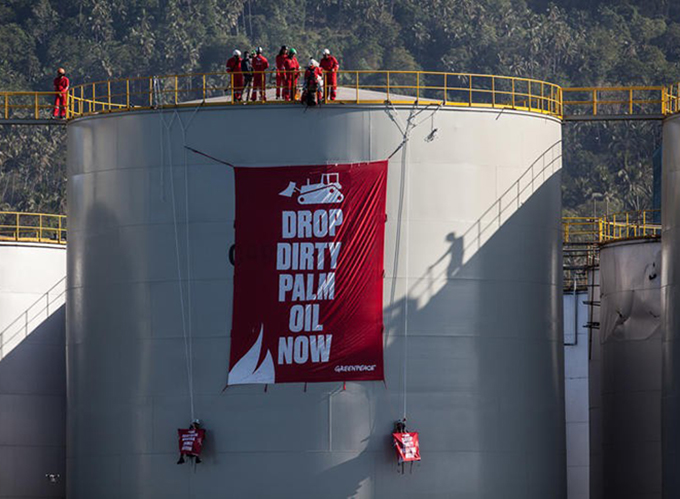
Madhuri Nair, of Field 40, Lautoka, likes the idea of women empowerment but prefers men to address women’s issues.

“I think it’s good that more women are participating in political spaces, however, I want men to solve women’s issues because sometimes women don’t think nicely.”

Despite the mixed responses from people around Lautoka, it is clear women at the grassroots level want their voices heard and issues to be addressed.

  • Premila Kumar, Selai Adimaitoga, Veena Bhatnagar, Mereseini Vuniwaqa and Rosy Akbar are included in the 27-member FijiFirst-led government while Social Democratic Liberal Party members Lynda Tabuya, Ro Teimumu Kepa, Salote Radrodro, Adi Litia Qionibaravi and National Federation Party member Lenora Qereqeretabua are included in the 24-member opposition.

Koroi Tadulala is a final-year student journalist at the University of the South Pacific. This article is republished under the content sharing arrangement between USP’s Wansolwara student journalism newspaper and AUT’s Pacific Media Centre.

Print Friendly, PDF & Email

Article by AsiaPacificReport.nz

Bainimarama wins again in Fiji, helped by muzzling the media, unions and the church

]]>

Source: The Conversation (Au and NZ) – By Dominic O’Sullivan, Associate Professor of Political Science, Charles Sturt University

Former coup leader Josaia Voreqe “Frank” Bainimarama has won re-election in Fiji. But he did so in a country where press freedom is severely limited, and authoritarian rule is used to curb dissent – even from the once highly influential Methodist church.

The election, held on November 14, saw fairly weak voter turnout – though its conduct was fair according to an international observer mission co-chaired by Jane Prentice, a federal Government MP from Queensland.

A more complicated story lies behind the Multinational Observer Group’s preliminary view that the election is “on track to reflect the will of the… voters”.


Read more: Two past coup leaders face off in Fiji election as Australia sharpens its focus on Pacific


Bainimarama seized power in a coup in 2006 before holding an election in 2014. He invited the group to observe to satisfy the international community of Fiji’s return to democratic stability. His Fiji First party will form government after winning 50.02% of the vote.

The Social Democratic Liberal party (SODELPA), led by Sitiveni Rabuka, another former Prime Minister and coup leader, won 39.85% of the vote. The National Federation Party will take the remaining three seats in the 51 member parliament.

Rabuka once characterised democracy as a “foreign flower unsuited to Fijian soil”. The key point here, as I have argued, is that restrictions on free speech means that there is no way of testing popular Fijian opinion.

Former prime minister and coup leader Sitiveni Rabuka, who lost the latest election, in a 2006 file photo. Dean Lewins/AAP

The Multinational Observer Group described the election as only a “step” towards democracy. Four of the opposition parties say the provisional results don’t match what their scrutineers observed. SODELPA argues that the complicated voter registration process meant that 30,000 citizens were turned away from polling stations. They were allegedly told that they were not properly registered. In a strong democracy, the claim would at least be possible to verify.


Read more: Fiji coup leader gets the democratic approval he wanted


Poor weather, which saw voting suspended and rescheduled at 23 polling stations, undoubtedly played a part, but voter turnout of between 53% and 61% across polling stations is a sign of democracy not working to its potential. The Fijian media is unlikely to analyse voter turnout, nor any aspect of the election’s conduct.

The Fiji Times’ limited and shallow coverage of the election campaign reflects its turbulent relationship with the Media Industry Development Decree and other laws and practices that restrict impartial political journalism.

The Fiji Times no longer leaves blank spaces where banned stories would have been published. However, the newspaper and its editor have been found guilty of contempt of court for publishing an article critical of the judiciary and, while ultimately acquitted, the newspaper was charged with sedition in 2018.


Read more: Fiji’s media still struggling to regain ‘free and fair’ space


The requirement for journalistic “quality, balance, (and) fair judgement” and penalties for non-compliance are set out in an act of parliament. The act is selectively enforced. The Fiji Sun is polemical and partisan. SODELPAs “false propaganda” is the newspaper’s “analysis”’ of the 10 percentage point drop in support for Fiji First from the 2014 to the 2018 election.

Under normal circumstances, the unprecedented number of government initiatives rolled out across the country in the last four years should have been enough to carry Fiji First to a bigger victory.

There can be no independent scrutiny of the Fiji Sun’s claim that the “abnormal” circumstances of the 2018 campaign included SODELPAs “strong pro-indigenous campaign (being) riddled with lies”.

It is true that the Fijian economy has grown at an annual average of 3.6% over the past five years. It is also true that investment in education, health and transport infrastructure have improved people’s standards of living.

Yet, there are no conventions of caretaker government to moderate the use of incumbency for political gain. The Multinational Observer Group has indicated it is likely to recommend “against government ministers and senior officials conduct(ing) a range of high profile activities, such as concluding commercial contracts, opening buildings and dispensing government grants and funds during the campaign.”

Restrictions on freedom of association have been used against trade unions which object to Bainimarama’s authoritarian style. They have been used against the Methodist Church which preaches a strong indigenous nationalism and has been a key influence in previous election campaigns.

Former Australian foreign minister Julie Bishop, posing with Australian defence force personnel, during a visit to Fiji in 2013. Rashida Yosufzai/AAP

Bainimarama’s Fiji First’s indigenous policy is based on multiracial equality as a path to the disruption of aristocratic self-interest. It is the only party to have significant multiracial diversity in its parliamentary membership.

SODELPA makes the case for custom and tradition in public life. For a formal political role for the Great Council of Chiefs and a comprehensive review of the 2013 Constitution.

It may have been a free vote. But the conditions for an informed vote – scrutiny and robust debate – were not present. Bainimarama had military support; significant under a constitution that gives the military overarching authority for the “well-being” of Fiji and all its citizens. This perhaps helps explain the argument that: “one reason for the return of elections is that Bainimarama is confident of winning them”.

Bainimarama’s position is secure. Fiji’s political stability is assured – but only for the moment. Democratic institutions are not strong. One cannot be sure that they enjoy durable public support. Fijian politics beyond Bainimarama is uncertain, unpredictable and insecure.

ref. Bainimarama wins again in Fiji, helped by muzzling the media, unions and the church – http://theconversation.com/bainimarama-wins-again-in-fiji-helped-by-muzzling-the-media-unions-and-the-church-107192

Indonesia matters to us, and always has. Why the relationship will survive Morrison’s Jerusalem thought bubble

]]>

Source: The Conversation (Au and NZ) – By Tim Harcourt, J.W. Nevile Fellow in Economics, UNSW

All hell broke loose during the Wentworth by-election when Prime Minister Scott Morrison suddenly announced that he was thinking of moving of Australia’s embassy in Israel from Tel Aviv to Jerusalem.

The main objections came, not on merits of the idea itself, but on whether it would upset Indonesia, the nation with whom Australia had just completed a landmark, but unsigned, free trade agreement and the nation with the world’s largest Muslim population.

The agreement is now unlikely to be signed for quite some time. In a face to face meeting with Indonesian President Joko Widodo last week that was intended to clear the way, Morrison was instead pressed about the Middle East.


Read more: How will Australia’s plan to move its embassy to Jerusalem affect relations with Indonesia?


But how important is the Indonesian trade relationship really? And would it be folly to sacrifice it on the altar of Middle East politics?

Why the relationship matters

Australia and Indonesia have been entwined for a long time.

What is now Indonesia is almost certainly the Australian continent’s oldest trading partner.

Indigenous Australians fished and traded sea cucumber and other goods with their Makassan counterparts from at least the least the early 1700’s. Makassar is in the south-west corner of the Indonesian province of Sulawesi.


Read more: What Indonesia expects from Australia’s new Prime Minister Scott Morrison


Australia provided critical support as what was then known as the Dutch East Indies fought for independence from the Dutch after the end of the second world war.

The Australian government provided medical supplies. Australian waterside workers refused to load Dutch ships.

Australia has helped in times of need

These close ties continued 50 years later during the late 1990s Asian financial crisis when the Reserve Bank of Australia clashed with the International Monetary Fund and Clinton administration, who wanted to impose tough conditions on Indonesia in return for bailing it out.

Australia’s Treasurer Peter Costello took the advice of Reserve Bank Deputy Governor Stephen Grenville, who had been a diplomat in Jakarta, and stared down the IMF and the United States.

As a result the Indonesian economy fared much better, recovered more quickly and avoided much of damage endured by other developing economies that had done as the IMF wanted.


Read more: Australian universities to benefit in Australia-Indonesia free trade deal


Two decades on, Indonesia is one of Australia’s top 15 trade partners, worth A$16.5 billion in two-way trade, and one of the biggest markets for Australian education.

There’s room for growth

In many ways, Indonesia is underdone as a partner for Australia.

It houses abound 262 million people but only around 250 Australian companies of any size, compared to more than 3,000 in China.

Among the companies that do have a big presence are the ANZ, Leightons, the Commonwealth Bank, Orica and Bluescope.


Read more: Indonesia’s knowledge sector is catching up, but a large gap persists


Its attractions are a massive and growing urban middle class and its need for infrastructure given the logistical challenges of connecting a huge population living across over 17,000 islands.

The relationship will survive Jerusalem

A free trade agreement is important to both sides, whatever political rhetoric President Widodo might need to employ to hold off his fundamentalist opponents.

Morrison told Widodo he would decide on the location of Australia’s Israel embassy by Christmas. The trade deal is likely to be signed soon after.

ref. Indonesia matters to us, and always has. Why the relationship will survive Morrison’s Jerusalem thought bubble – http://theconversation.com/indonesia-matters-to-us-and-always-has-why-the-relationship-will-survive-morrisons-jerusalem-thought-bubble-107145

Elephants and economics: how to ensure we value wildlife properly

]]>

Source: The Conversation (Au and NZ) – By Michael Vardon, Associate Professor at the Fenner School, Australian National University

Ensuring the economic health of nations is one of the biggest tasks expected of governments. The elephant in the room has long been the health of the environment, on which the health of the economy (and everything else) ultimately depends.

Most countries still rely on gross domestic product as the lead measure of their economic health. But this does not account for the loss of environmental condition. There is a growing recognition of the environmental damage that human activity causes, our dependence on a functioning environment, and the need for new approaches to measure and manage the world.

We hope this new idea can be advanced internationally at the two-week meeting of the Convention on Biological Diversity, which began this week in Sharm El-Sheikh, Egypt.


Read more: Why we need environmental accounts alongside national accounts


Integrating the environment into national accounts has long been suggested as a way to improve information and has been tried in several countries.

In Botswana, where elephants are included in the nation’s environmental accounts, spending on wildlife conservation is now seen as an investment, rather than a cost. This example shows how integrating environmental assets into economic data can help provide a new policy framing for conservation. But worldwide, this type of “expanded accounting” has had limited impact on policy decisions so far.

On target

The Convention on Biological Diversity includes what are known as the Aichi Targets. Target 2 states:

By 2020, at the latest, biodiversity values have been integrated into national and local development and poverty reduction strategies and planning processes and are being incorporated into national accounting, as appropriate, and reporting systems. (emphasis added)

This provides a clear starting point for conservationists and economists to work together. So far, little has been done on the valuation of biodiversity, and the work that has been done so far has not progressed very far on the question of how to integrate environmental and economic values into national accounting.

On one hand, putting monetary values on biodiversity has been decried as the commodification of nature. But we argue that without using appropriately defined monetary values, the environment will always be vulnerable to economic forces. If Aichi Target 2 is to be met by 2020, we clearly need an agreed concept of biodiversity value, and a shared approach to recognising it.


Read more: It pays to invest in biodiversity


Crucially, as well as calculating the environment’s contribution to the economy, we also need to assess the requirements for maintaining and enhancing biodiversity. To return to the example of Botswana’s elephants, this means recognising that elephants need land and water (Botswana’s wildlife consumes 10% of all its water, with elephants accounting for most use). As tourism-related industries generated roughly US$2 billion in 2013 (Botswana’s second-largest sector by revenue, with mining the first), the allocation of water and land to wildlife is clearly a prudent investment decision.

This approach can also reveal the impacts and trade-offs resulting from different land uses on environmental values. In Victoria’s Central Highlands, for example, the cessation of native logging would reduce revenue from timber production, but would also help support a range of rare and endangered species, including Leadbeater’s Possum. It would also benefit a range of other industries like agriculture, as well as the people in cities like Melbourne.


Read more: Logging must stop in Melbourne’s biggest water supply catchment


Keeping the books up to date

Like any accounting system, these estimates of the economic value of the environment would need to be updated, ideally annually, if they are to remain relevant in underpinning governments’ decisions. This would also entail regular data collection on the species and ecosystems themselves.

Unfortunately, however, consistent long-term nationwide monitoring of biodiversity at the species or ecosystem level is rarely done. And while remote-sensing offers some promise for landscape-scale monitoring of major ecosystem types (such as tropical savannahs, temperate forests, wetlands), there is generally no substitute for boots on the ground.

This month’s summit in Egypt offers an opportunity for countries to reaffirm their recognition of the benefits that biodiversity provides to people and the economy. It also provides a chance to go further, to agree that integrated accounting will help us understand and appreciate the trade-offs between the environment and economy.

Recognising and accounting for the elephant in the room would be a great achievement – not to mention a sound investment in the future.


The authors would like to acknowledge the contribution of Heather Keith to this article.

ref. Elephants and economics: how to ensure we value wildlife properly – http://theconversation.com/elephants-and-economics-how-to-ensure-we-value-wildlife-properly-107184

Six activists detained for staging palm oil shipboard rally, says Greenpeace

]]>
Greenpeace activists unfurl a banner reading “Drop Dirty Palm Oil Now” at a Wilmar International palm oil refinery in Bitung, North Sulawesi, in September. Image: Jurnasyanto Sukarno/Greenpeace Indonesia

By Ivany Atina Arbi in Jakarta

Six Greenpeace activists have reportedly been detained by the captain of the tanker Stolt Tenacity for staging a rally against global forests destruction, particularly in Indonesia, the world’s largest producer of palm oil, and in Papua New Guinea.

The ship was transporting crude palm oil, owned by the world’s biggest palm oil trader Wilmar International, from a refinery in Dumai in Riau to Europe.

According to a statement released by Greenpeace Indonesia at the weekend, six Greenpeace activists from Indonesia, Germany, Britain, France, Canada and the United States staged the peaceful rally in the Cadiz Bay near Spain.

READ AND WATCH MORE: Greenpeace protesters detained after boarding palm oil tanker off Spain + video

They managed to unfurl banners that read “Save Our Rainforest” and “Drop Dirty Palm Oil” on board the tanker before being detained by its captain.

“We have informed the tanker’s captain through VHF marine radio channels about the peaceful and antiviolence action […] and asked him to free the activists and let them continue the peaceful rally,” said Greenpeace campaigner Hannah Martin.

-Partners-

She added that Wilmar was the main supplier of palm oil to food giant Mondelez. Based on Greenpeace’s recent investigation, palm oil suppliers to Mondelez had allegedly destroyed roughly 70,000 hectares of forests across Southeast Asia in the past two years. Mondelez is the producer of Oreo cookies, among others.

Greenpeace, therefore, urged Mondelez to stop its trading with Wilmar until the later managed to produce palm oil without destroying forests.

Sustainability criteria
Mondelez has dismissed such allegations, saying the company had been prioritising suppliers that meet sustainability criteria that allow retailers and customers to trace their products back to the mill.

“We’re asking our direct suppliers to call on their upstream suppliers to map and monitor the plantations where oil palm is grown, so we can drive further traceability. We’re also excluding 12 companies from our supply chain as a result of breaches,” the company said in a statement last week, refusing to reveal the 12 companies.

Wilmar had earlier urged Greenpeace to take “collaborative action” with the company if it wanted to improve the palm oil industry.

In its statement concerning Greenpeace’s similar rally in September in Wilmar’s refinery in Bitung, North Sulawesi, Wilmar said the protest was a criminal act of trespassing and vandalism as well as a safety risk to the activists as well as Wilmar staff.

“No organisation is above the law and we urge Greenpeace to adopt a collaborative mindset and work with the palm oil industry to take genuine and positive action.”

Wilmar also disputed Greenpeace’s claims about the companies it sourced palm oil from.

“It must be clarified that, out of the 25 companies listed, Wilmar is buying from 13 supplier groups, not 18 as alleged in the report,” the company said, adding that 11 of the 13 companies have been put on Wilmar’s grievance list.

“Greenpeace’s allegation that Wilmar is failing at monitoring our supply chain is based on a willful lack of understanding of our work on the ground.”

Ivany Atina Arbi is a Jakarta Post journalist.

Print Friendly, PDF & Email

Article by AsiaPacificReport.nz

Cool for cats: that spiny tongue does more than keep a cat well groomed

]]>

Source: The Conversation (Au and NZ) – By Susan Hazel, Senior Lecturer, School of Animal and Veterinary Science, University of Adelaide

Have you ever been licked by a cat? If so you’ll know the feline tongue feels more like sandpaper than satin.

A cat’s tongue is covered in hundreds of sharp, scoop-shaped spines made of keratin that spring into action during grooming. Until now we haven’t really known why their tongues are so rough.

But new research, published today in Proceedings of the National Academy of Sciences, shows they play a role in helping a cat keep cool.

Cat grooming

Domestic cats spend up to a quarter of their waking time grooming their fur coat to help remove pesky fleas and loose hairs. If they didn’t groom, then any excess debris could tangle fur, causing painful tugging of the skin, and even lead to infection.


Read more: Senate inquiry calls for tougher rules on pet food in Australia


But the new study reports something else that happens when a cat uses its tongue for grooming.

The scientists used CT scans of cat tongues to work out the structure of the spines, known as papillae. The spines are about 2mm long and have a U-shaped cavity at their tip (more on why later). The researchers also measured the hardness of the papillae, and found it is similar to that of human fingernails.

This is the surface of a cat’s tongue. Rigid, hollow papillae near the tongue tip are shown on the right, while soft, conical papillae near the throat are shown to the left. Alexis Noel

It got more interesting when the scientists used high-speed videography to work out what happens to the spines when a cat is grooming. Only the spines at the end of the tongue contact the fur during grooming. These are larger and not as closely packed as the spines nearer the bottom of the tongue.

A slice of a cat tongue, displaying papillae embedded in tissue. Image courtesy of Taren Carter (photographer).

As a cat grooms, there are four steps. First the tongue is extended out of the mouth. Then the muscles in the tongue expand the surface, and the spines rotate to become perpendicular to the tongue.

In the final two steps the tongue sweeps through the fur and is taken back into the mouth with a U-shaped curl.

This is a black cat grooming its fur, displaying the papillae on the tongue.

Using some fake fur and a force plate, the scientists calculated that with the amount of compression of the tongue on the fur, the spines can actually contact the skin of the cat.

This is where it gets even more interesting – and also a bit icky, as we need to think about cat saliva.

The saliva action

The U-shaped cavity in the tip of the spines, which we mentioned earlier, acts as a wick in the mouth to take up saliva. This is the same action as when you put the tip of a tissue in water and the water creeps up the tissue.

Because scientists like to work out the detail, they calculated that these cavities would take up around 4μL (microlitres) of saliva across 290 spines. (It would take around 1,200 times this amount of saliva to fill a 5ml metric teaspoon.)

This 4μl is only around 5% of the total saliva on the surface of the cat’s tongue. Not much, but it has a really important function as it can deposit saliva right down to a cat’s skin.

The scientists used the estimate that cats spend around a quarter of their time awake grooming (about 2.4 hours a day) and lick about once per second.

This means cats can lose around a quarter of the total heat they need to lose per day through the tiny bit of saliva in their tongue spines. (We lose heat through liquid by sweating when we’re hot.)

Cool for cats

Many (not all) cats live in hot climates, so this would be really important for their survival. The researchers looked at the tongues of several species of cat, including domestic cat, bobcat, cougar, snow leopard, tiger and lion.

Most cats groom themselves very effectively, helped by enzymes (special chemicals) in their saliva that dissolve blood and other debris.

By working out how far the spines penetrate cat fur, and measuring the length of fur in different breeds, the scientists also worked out the only cats that can’t groom themselves effectively are domestic Persians, which are typically long-haired.


Read more: Chocolate Labradors die earlier than yellow or black, and have more disease


This means if you own a Persian you need to take the time to brush them, or else matts form and can damage their skin and lead to infections. But here’s where the scientists made another breakthrough.

A new brush

In the final part of this research, the scientists used the knowledge they gained about the spiny form of a cat’s tongue, and used 3D printing to develop a better grooming brush to use on cats.

The prototype grooming tool allows easy removal of hair after grooming.

The scientists say the biology-inspired brush should help remove allergens from cat fur, and help with the application of any cleaning lotions and medications on cats’ skin.

The brush design may also help inspire news ways to clean other complex hairy surfaces.

So next time you watch a cat grooming, take a moment to marvel at just how much awesome science is involved in the evolutionary design of its tongue.

ref. Cool for cats: that spiny tongue does more than keep a cat well groomed – http://theconversation.com/cool-for-cats-that-spiny-tongue-does-more-than-keep-a-cat-well-groomed-107007

The gender qualification gap: women ‘over-invest’ in workplace capabilities

]]>

Source: The Conversation (Au and NZ) – By Leonora Risse, Vice-Chancellor’s Postdoctoral Research Fellow, RMIT University

It took a Nobel Prize before Canadian physicist Donna Strickland got promoted to a full professorship. As anecdotal evidence that women have to prove themselves even more than men to earn a job promotion, her story is hard to beat.

Looking deeper, it’s more complex than outright sexism. Strickland herself dismissed suggestions her career had ever been stymied by being treated differently to her male colleagues. Her explanation for why her intellect and achievements had not been recognised by promotion to full professor? “I never applied.”

That she had to add a Nobel Prize to her CV before she considered applying for her promotion is likely to resonate among women. Many sense they need to do more than their male counterparts to prove their worth in the workplace.


Read more: And then there were three: finally, another woman awarded a Nobel Prize in Physics


But is there any statistical evidence that women need higher credentials than men to be promoted and recognised in their own profession?

Much research focuses on the gender gap in absolute outcomes. This doesn’t help with this specific question. We need a way to compare men and women on the same rung of the career ladder.

To do this, I have borrowed a methodology from productivity and efficiency analysis called stochastic frontier analysis. My findings: women have the equivalent of up to one-and-a-half year’s extra education, and nearly a full year’s extra workforce experience, than what is required for their job.

Measuring over-investment

The first thing is to measure the overall capabilities of each worker. This is captured by their qualifications, years of experience, cognitive ability, language proficiency, health and traits that are shown to enhance productivity such as conscientiousness.

Next, each worker’s bundle of capabilities are benchmarked against workers at a similar rung on the career ladder. This position is captured by their workplace seniority, earnings and other entitlements (such as paid parental leave and flexible work arrangements).

It is then possible to identify those workers who possess a higher bundle of capabilities than the minimum required to reach their current position on the career ladder.

The Household, Income and Labour Dynamics in Australia (HILDA) survey provides a broad sample of about 5,000 workers to study.

Comparing everyone else to the “most economical” performers – those who have achieved their position with the lowest capabilities to their name – I found men over-invest by up to 4%, while women over-invest by up to 11%.

These percentages, generated by stochastic frontier methodology, provide a more sophisticated picture than simple averages.

If we imagine the distribution curve for “capability over-investment”, it’s not neatly symmetrical. It’s a lop-sided bell curve. At one end are the “most economical” performers. Most other workers are clustered towards this end. At the other end of the curve – the “tail” – are workers who exceed the minimal requirements the most.

The numbers indicate the distance between these most over-qualified workers and the “most economical” performers, who reached their position with the bare minimum credentials.

Uncovering implicit biases

This technique allows us to test what factors are driving women’s greater accumulation of credentials. Tellingly, this over-investment isn’t directly connected to children and care responsibilities. Nor is it due to women’s lower confidence, a hypothesis that I tested by including a variable called “achievement motivation”.

Existing evidence steers us towards implicit biases woven throughout workplace dynamics that may create higher hurdles for women to clear along the career ladder.


Read more: Playing nice at work could cost you success


For instance, analysis using Australian Census data finds women earn less from their university degrees, even when comparing men and women within the same high-earning discipline such as law, economics, dentistry and medicine. Survey data also reveals that women, when they do ask for a promotion, do not receive the same outcomes as men.

Internalising higher hurdles

These findings, and Strickland’s story, are consistent with women tuning into – and possibly internalising – the need to jump higher hurdles. It explains why women hold back from applying for a job until they are certain of fulfilling the criteria – a behaviour much less apparent among men.

Organisations need to more rigorously scrutinise whether their systems for assessing the merits of their male and female applicants are truly fair and equitable. Failing to recognise each person’s capability isn’t just a loss for the individual. All of society potentially loses out.

Take the case of Carol Greider. On the same day that American molecular biologist was jointly awarded the 2009 Nobel Prize in Physiology or Medicine, the National Institutes of Health (NIH) rejected her application for funding to pursue her research on cancer cells that won her the Nobel Prize. The NIH grants committee deemed her work “not worthy of discussion”.

If we are to fully benefit from society’s entire pool of knowledge and talent, that’s the sort of blindness we need to correct.

ref. The gender qualification gap: women ‘over-invest’ in workplace capabilities – http://theconversation.com/the-gender-qualification-gap-women-over-invest-in-workplace-capabilities-105385

Your riding position can give you an advantage in a road cycling sprint

]]>

Source: The Conversation (Au and NZ) – By Paul Franciscus Johannes Merkes, PhD candidate, Edith Cowan University

Many professional road cycling events are hundreds of kilometres long, but the final placings are often decided by what happens in the last few seconds of any race stage.

New research shows that a rider can gain up to an extra 5kph advantage in those final sprint seconds, and it all depends on how they position themselves on their bicycle.

That can be enough to make the difference between winning or losing a race.

Race to the finish

If you’ve ever watched a professional road cycling event, either live or on television, you know they can go on for several days or even weeks.


Read more: 3D concrete printing could free the world from boring buildings


But more than half of the stages during the Santos Tour Down Under and the Tour de France, as well as some of the recent World Championships, were won in either a head-to-head, small group, or mass sprint finish.

The average speed during professional road cycling sprints is 63.9kph (53.7-69.1kph) sustained for between 9 and 17 seconds for men, and 53.8kph (41.6-64kph) for 10-30 seconds for women.

During the sprint, men produce peak power outputs between 13.9 and 20.0 Watts per kilogram (989-1,443 Watts), and women 10.8-16.2 Watts per kilogram (716-1,088 Watts).

But peak power output is not the only important factor to win the sprint, with tactics playing a significant role.

Our new research, published this month in the International Journal of Sports Physiology and Performance, shows that adopting a forward standing position during a sprint could give riders a speed boost of up to 5kph.

The three tested sprinting positions from left to right: seated, standing, and forward standing. International Journal of Sports Physiology and Performance, Author provided

The drag on a cyclist

Cycling speed is affected by several factors, including power output, aerodynamic drag (CdA), road characteristics, and environmental variables.

During the sprint, roughly 95% of the total resistive forces working against the rider is caused by aerodynamic resistance. Therefore, it is important to reduce aerodynamic drag in road cycling, particularly during the sprint which is the fastest activity on the bicycle (with the exclusion of some downhill riding during a race).

Given that the outcomes of road cycling sprints are often decided by very small margins – in one race stage down to just 0.0003 seconds – the aerodynamics are meaningful to overall sprint performances.

Studies on flow dynamics in cycling have shown that lowering the head and torso significantly reduces wind resistance.

That is why several cyclists have, over the past few years, begun to adopt a forward standing cycling sprint position.

This novel sprint position has already shown to be successful at the highest level of professional cycling, in events such as the Giro d’Italia and Vuelta a España and in Australia’s biggest road cycling race, the Santos Tour Down Under (see video, below).

Santos Tour Down Under 2016 stage 6 victory in the forward standing position.

Body position to the test

To better understand why this forward standing position may give riders an advantage, we compared it with the more traditional seated and standing sprint positions.

During the study, participants rode 250 metres in two directions at 25kph, 32kph and 40kph and in each of the three positions, resulting in a total of 18 efforts per participant.

During these efforts we measured cycling velocity, power output, road gradient, wind velocity and direction, temperature, humidity, and barometric pressure.

We then used these variables, together with the weight of the cyclist and bicycle, and constants for rolling resistance and the efficiency of the drive system, in a mathematical model to calculate the aerodynamic drag.

This model has previously been shown to give valid measurements compared with a wind tunnel.

The results are in

We found the forward standing cycling sprint position resulted in a 23-26% reduction in aerodynamic drag compared with a seated and standing position, respectively.

This decrease in drag could potentially result in an important increase in cycling sprint velocity of 3.9-4.9kph.


Read more: Skill vs luck: who really deserves the rewards from success?


Throughout the average duration of a typical road cycling sprint (about 14 seconds) this would result in a gain of 15-19 metres, which is why it could mean the difference between winning and losing a race.

How ECU is helping the world’s best cyclists improving their sprint performance.

While this novel position was more aerodynamic, it is plausible that changes in body position may influence a rider’s movement kinetics, and therefore increasing or decreasing power output. This is currently under investigation in this PhD project.

But cyclists who want to improve their sprint performance might want to start practising the forward standing position. It takes time to learn how to sprint in that position but you could gain those aerodynamic benefits, and potentially win more races.

ref. Your riding position can give you an advantage in a road cycling sprint – http://theconversation.com/your-riding-position-can-give-you-an-advantage-in-a-road-cycling-sprint-106539

As tensions ratchet up between China and the US, Australia risks being caught in the crossfire

]]>

Source: The Conversation (Au and NZ) – By Tony Walker, Adjunct Professor, School of Communications, La Trobe University

Port Moresby may not be Yalta, nor, it might be said, is it Potsdam. But for a moment at the weekend the steamy out-of-the-way Papua New Guinea capital found itself at the intersection of great power combustibility.

When this latest chapter in America’s relationship with China is written, the Asia-Pacific Economic Cooperation (APEC) forum in Port Moresby in November 2018 may well come to be regarded as a moment when Washington exposed its determination to reassert itself in the region.

The failure of APEC leaders for the first time in the organisation’s history since 1993 to agree on a final communique, due to a standoff on trade between the United States and China, points to more trouble ahead.


Read more: After APEC, US-China tensions leave ‘cooperation’ in the cold


Unless frictions on trade and other issues are eased over the coming months, Washington and Beijing will have embarked on a course that threatens to destabilise the whole region.

These are significant moments in the evolution of a fractious relationship between an established and a rising power.

The US has long wrestled with a workable approach to an ascendant China. It has oscillated between a hedging strategy, elements of containment, and a process of engagement.

None of these approaches has gelled.

Now, it appears to be moving towards a policy of strategic competition and economic confrontation. This is a combustible formula.

Competing worldviews were on show in Port Moresby as leaders of the two countries put aside diplomatic niceties.

US Vice President Mike Pence’s declaration that the US would not “change course” in its trade dispute with China until that country “changes its ways” could hardly have been more provocative.

China’s leader, Xi Jinping, took a swipe at the US when he said countries that embraced protectionism were “doomed to failure”.

Failure to secure American and Chinese signatures to a leaders’ communique arose from differences over the need to reform the World Trade Organisation.

China dug its heels in on language that might have posed challenges to the role of state-owned enterprises, and also on the question of differential treatment of developed and developing countries.

China has long benefited under WTO rules from being regarded as a developing country.

Both Pence and Australian Prime Minister Scott Morrison warned loans to Pacific countries were being used as a “debt trap” to assert Chinese influence. Xi strongly rejected these assertions.

Whatever the upshot of these skirmishes, America’s posture in the Asia-Pacific has shifted to one in which it seems to be spoiling for a fight. Canberra should be wary.

The Barack Obama pivot to the Asia-Pacific ended up lacking substance and has been superseded by a combative Trump administration. Its approach has less to do with engagement than with confronting China’s regional ambitions.

The pressure point for regional competition lies in the South China Sea, where China is developing base facilities on disputed features. That strategic competition now extends to the southwest Pacific.

Pence’s announcement that the US would partner Australia and Papua New Guinea in the development of a naval base on Manus Island overlooking the Bismarck Sea is, arguably, the most significant American security initiative in the Asia-Pacific since the end of the Vietnam War. Pence said:

We will work with these nations to protect sovereignty and maritime rights of the Pacific Islands as well.

Thus, Beijing was put on notice that America would adopt a more forward-leaning posture in the Asia-Pacific. Where this leads is hard to predict, but what is certain is that trade and other tensions will have a security overlay.

American bases on the Korean Peninsula and in the Japanese archipelago will now stretch into the southwest Pacific. The Manus base will overlook maritime routes on Australia’s northern approaches.

From an Australian strategic perspective, this is a hugely significant development, and one that will test Canberra’s ability to balance its security relationship with the US and its commercial partnership with China.

Beijing will correctly view the Manus facility as a joint endeavour to neutralise China’s thrust into the southwest Pacific, where it has been cultivating micro-states as part of attempts to spread its power and influence across the region.

Belatedly, Canberra is responding to this Chinese assertiveness in its backyard by ramping up its diplomatic engagement, expanding its aid programs, and now partnering Papua New Guinea and the US in the development of a joint naval facility.

In the period ahead, Australian diplomacy towards China will need to be more nimble and subtle than it has been in the recent past.

Beijing will be watching.

Morrison was not understating the case when he said US involvement in the Lombrun base on Manus would elevate Australia’s relations with its ANZUS alliance partnership to a “new level”.

How this “new level” plays out will depend on careful management of relations with China by whatever government is in power.

A joint naval facility will inevitably make it more difficult to avoid being caught in an American slipstream in any confrontation with China.

Finally, in the lead-up to what is shaping as one of more important encounters between world leaders in years – the meeting between Xi Jinping and Donald Trump at the G20 in Buenos Aires this month – Australian policymakers would be advised to read Pence’s October 4 address to the Hudson Institute in Washington.


Read more: Australia and China push the ‘reset’ button on an important relationship


Assuming Pence’s speech represents an administration view, this should be regarded as a deeply antagonistic statement verging on a declaration of hostilities.

Pence accused China of: seeking to influence America’s mid-term congressional elections; engaging in cyber attacks against American institutions; stealing American property rights; and adopting ruinous trade practices:

When it comes to Beijing’s malign influence and interference in American politics and policy, we will continue to expose it, no matter the form it takes.

We will work with leaders at every level of society to defend our national interest and most cherished goals.

Some viewed the Pence speech as the forerunner of a new cold war. That probably overstates the case, but it is also true that relations between Washington and Beijing have taken a turn for the worse.

Watch this space.

ref. As tensions ratchet up between China and the US, Australia risks being caught in the crossfire – http://theconversation.com/as-tensions-ratchet-up-between-china-and-the-us-australia-risks-being-caught-in-the-crossfire-107178