Page 1027

Car accidents, drownings, violence: hotter temperatures will mean more deaths from injury

Source: The Conversation (Au and NZ) – By Liz Hanna, Honorary Senior Fellow, Australian National University

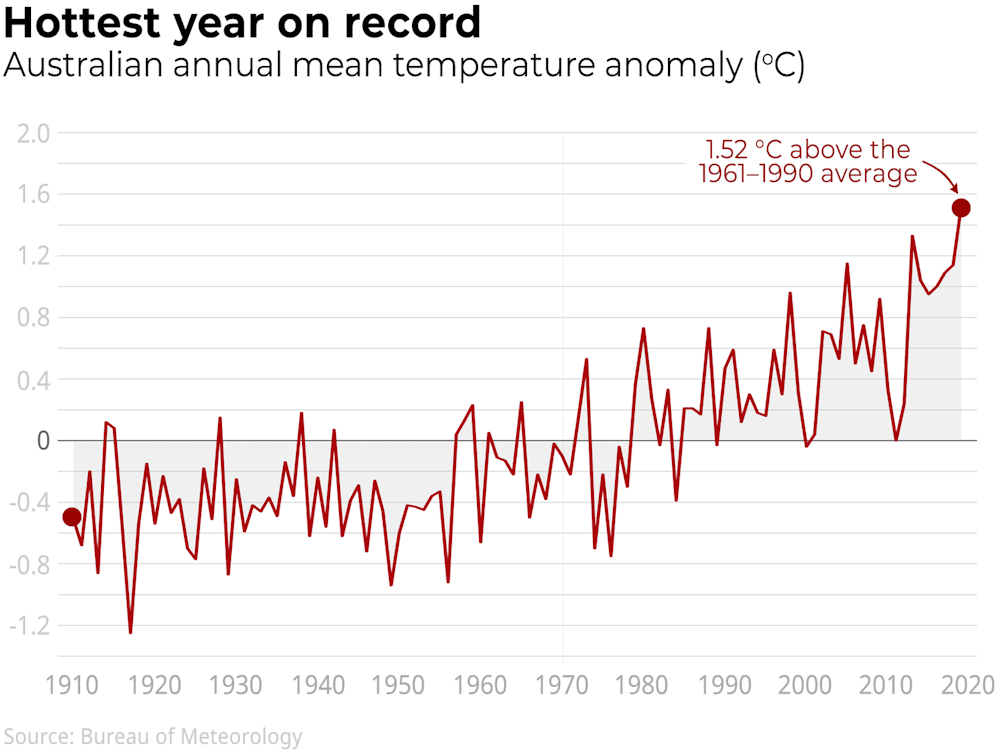
What we suspected is now official: 2019 was Australia’s hottest year on record. The country’s average maximum temperature last year (30.69℃) was a scorching 2.09℃ hotter than the 1961-1990 average.

For the whole planet, 2019 is expected to come in second (behind 2016) making the last five years the hottest on record since 1880.

As we brace for increasingly hot summers, we are mindful extreme heat can pose significant health risks for vulnerable groups. But the effects of heat on the incidence of accidents and injury are less clear.

In research published today in Nature Medicine, researchers in the United States looked at the impact warmer temperatures will have on deaths from injury. They found if average temperatures warmed by 1.5℃, we could expect to see 1,600 more deaths each year across the US.

Given Australia is ahead of the global temperature curve, we could see an even greater number of deaths from injury per capita as a result of rising temperatures.


Read more: Hot and bothered: heat affects all of us, but older people face the highest health risks


What the study did and found

The researchers analysed death and temperature data collected from 1980 to 2017 across mainland United States (so their results excluded the states of Alaska and Hawaii).

They looked at records from more than five million injury deaths from this 38-year period. They also identified temperature anomalies by county and by month, to understand how these deaths could relate to spikes in the weather.

Using a method called Bayesian Spatio-temporal modelling, the authors combined this information to estimate the rates at which injury deaths would rise with a 1.5℃ temperature increase.

Hotter temperatures have been associated with spikes in domestic and other violence. From shutterstock.com

They categorised injury deaths as either unintentional (transport, falls and drownings) or intentional (assaults and suicides), and stratified results further by gender and age group.

They found deaths from drownings would increase by as much as 13.7% in men aged 15-24 years, whereas assaults and suicides would increase by less than 3% across all groups. Transport deaths would rise by 2% for men aged 25-34 years and 0.5% for women in the same age group.

Overall, these increased risks would account for 1,601 additional deaths per year from injury across the US, an annual rise of 0.75% in overall deaths from injury in the population. They indicate 84% of these deaths would occur in males.

Although the primary focus was on 1.5℃ warming, the researchers also looked at a rise of 2℃. The found this would result in 2,135 additional deaths from injury (a 1% increase).

Why do deaths from injury increase in hot weather?

Higher temperatures are associated with irritability, and increases in conflict and interpersonal violence.

Research has shown each degree celsius increase in annual temperatures is linked to nearly a 6% average increase in homicides. Another study showed domestic violence rates increased by 40% when the daily maximum temperature exceeded 34℃.


Read more: How rising temperatures affect our health


Hyperthermia (abnormally high body temperature) can also lead to symptoms such as loss of concentration and fatigue. These factors can trigger incidents such as car accidents and faults operating mechanical equipment. So we can expect injuries to increase as we face more hot days.

A South Australian study of workers’ compensation claims found for every degree above 14℃, occupational injuries requiring more than three days off work increased modestly (0.2%).

Increases in drowning might occur due the higher proportions of people seeking relief in the water on hot days.
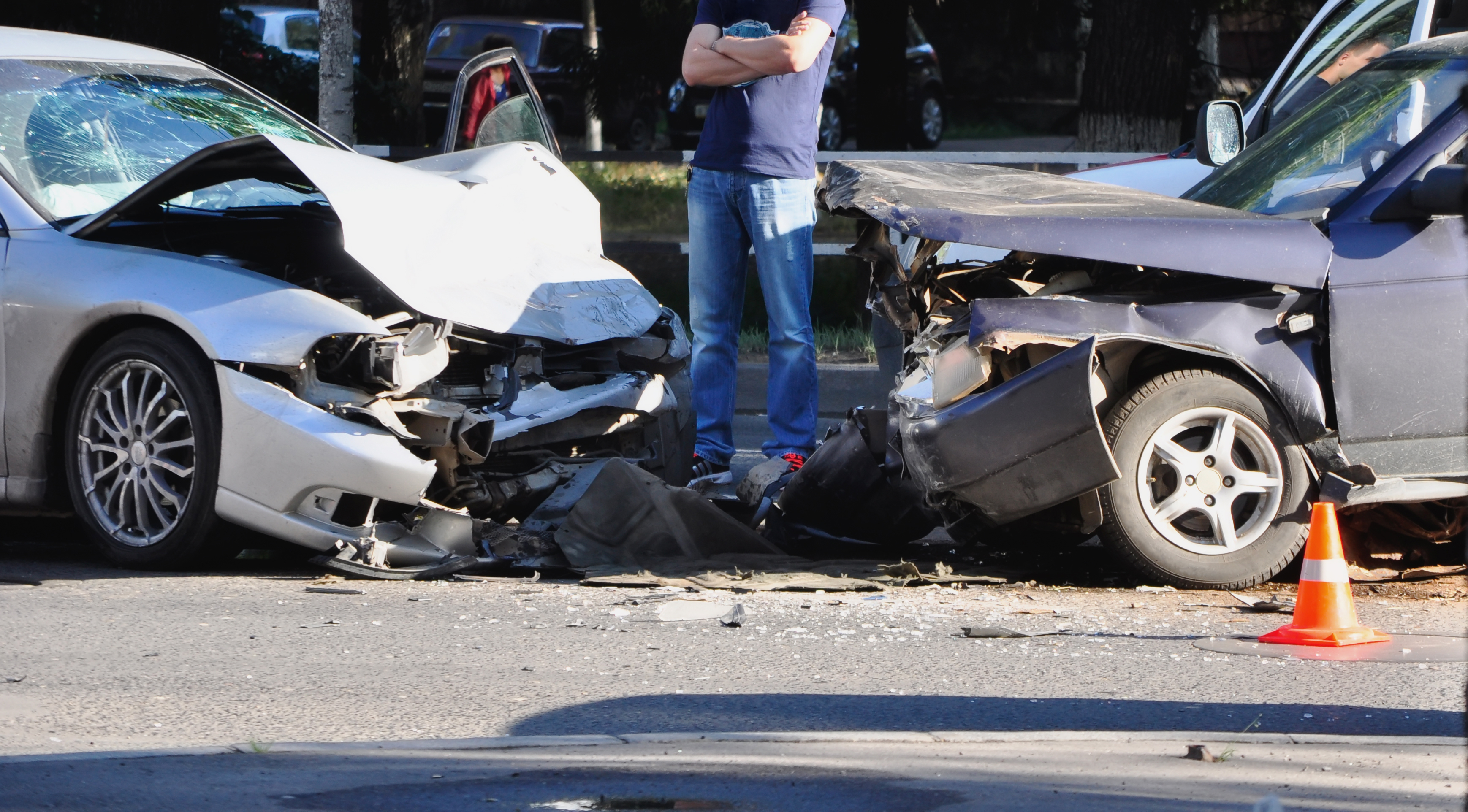
Being too hot can lead to a loss of concentration or fatigue, which can increase the risk of accidents. From shutterstock.com

Importantly, climate change is heightening anxiety in rural communities, and more broadly throughout the population.

In Australia, heat is commonly associated with drought. Long droughts are known to be linked to spikes in suicide rates, especially among rural males.

We also know suicide rates rise in affected communities following bushfires, in the face of grief and trauma.


Read more: The rise of ‘eco-anxiety’: climate change affects our mental health, too


The reason for the gender disparity was not tested, but likely relates to the higher prevalence of risk-taking behaviour among males.

So what does this mean for Australia?

With global temperatures on course for a 3-5°C rise this century, limiting warming to 1.5℃ is optimistic. The effects are likely to be even greater than what is forecasted in this study.

This study assessed excess injury deaths with a level of warming Australia witnessed in 2019 alone.

Rising heat is possibly Australia’s number one threat from climate change. It leads to the catastrophic bushfires we’re seeing this summer, and pushes us beyond the temperatures our bodies can withstand.

When looking at deaths caused by heat, we need to look beyond those caused by heat-induced illness, and separate the many caused by injury.


Read more: How can we avoid future ‘epidemics’ of heat deaths?


We must strengthen the nation’s climate change and human health research to provide specific details on when, where and how we can best ameliorate heat harm.

We need to ramp up our prevention efforts in this space. All Australians should be made aware of the dangers of a hotter world through a federally funded public education strategy, akin to the successful “Life. Be in it” campaign, which successfully promoted the importance of being active.

Most urgently, we must focus on prevention through climate change mitigation, which will be the best and most far-reaching prevention strategy we can deliver.

ref. Car accidents, drownings, violence: hotter temperatures will mean more deaths from injury – http://theconversation.com/car-accidents-drownings-violence-hotter-temperatures-will-mean-more-deaths-from-injury-129628
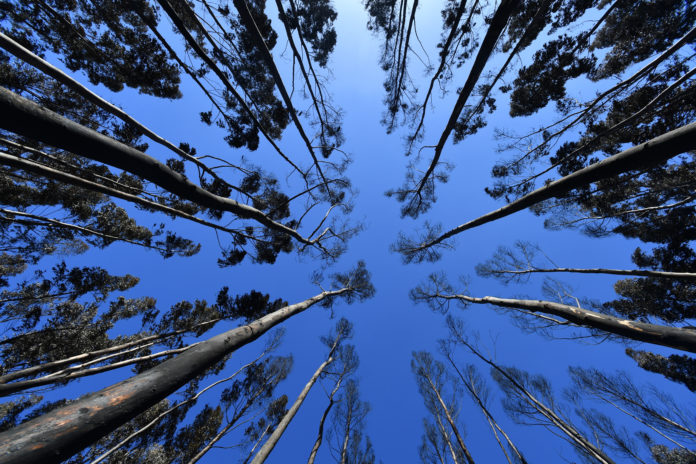
Some say we’ve seen bushfires worse than this before. But they’re ignoring a few key facts

Source: The Conversation (Au and NZ) – By Joelle Gergis, Senior Lecturer in Climate Science, Australian National University

Every time a weather extreme occurs, some people quickly jump in to say we’ve been through it all before: that worse events have happened in the past, or it’s just part of natural climate variability.

The recent bushfire crisis is a case in point. Writing in The Australian recently, columnist Gerard Henderson said:

In Victoria, there were further huge fires in 1983 and 2009. But until now, there was no suggestion that the state’s future would be one of continuing apocalypse.

Of course, Australia has a long history of bushfires. But several factors make eastern Australia’s recent crisis different to infamous bushfires in the past.

First is the enormous geographic spread of this season’s fires, and second, the absence of El Niño conditions typically associated with previous severe fires.

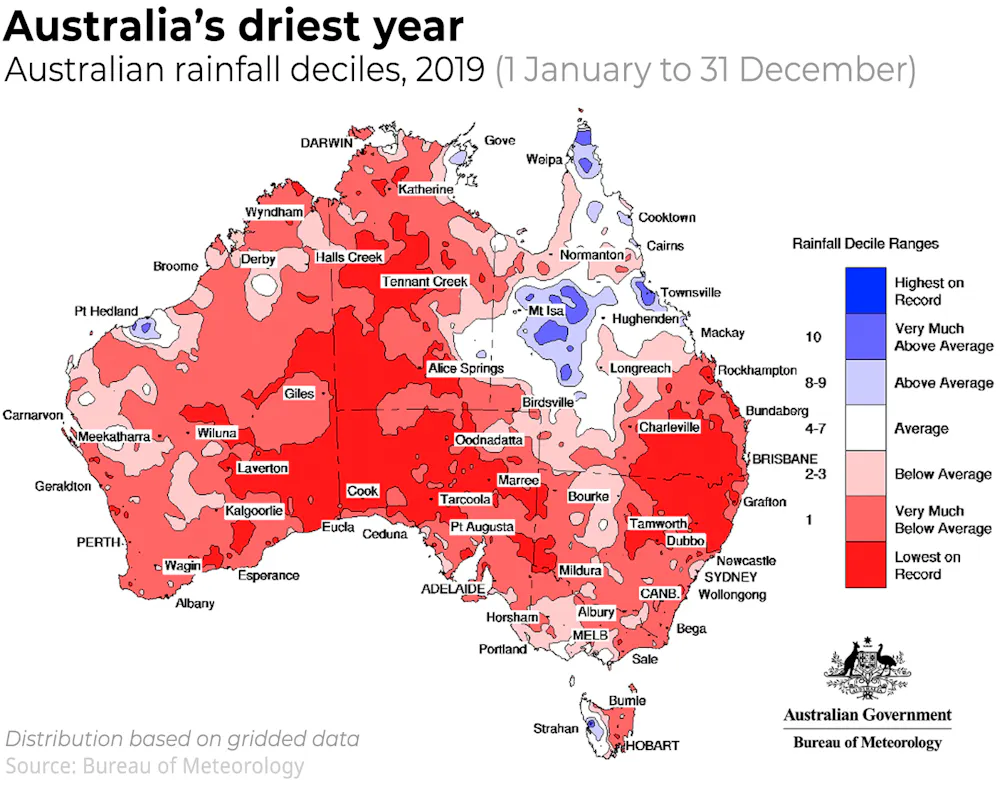
Thirdly and most important, these fires were preceded by the hottest and driest conditions in Australian history.

Hot, dry conditions preceded this fire season. David Mariuz/AAP

Understanding Australia’s climate

As Australia’s climate has warmed since the 1970s, fire weather conditions have become more extreme, and the length of the fire season has increased across large parts of the nation.

Human-induced warming has been evident in Australian temperatures since 1950. This has contributed to a clear long-term trend toward more dangerous fire weather conditions in many areas.


Read more: Weather bureau says hottest, driest year on record led to extreme bushfire season


As the planet continues to warm, natural climate variability in the Pacific, Indian and Southern oceans will continue to drive variations in Australian climate.

These natural climate drivers are complex. But taking the time to understand them, and how they interact with human climate influences, is critically important.

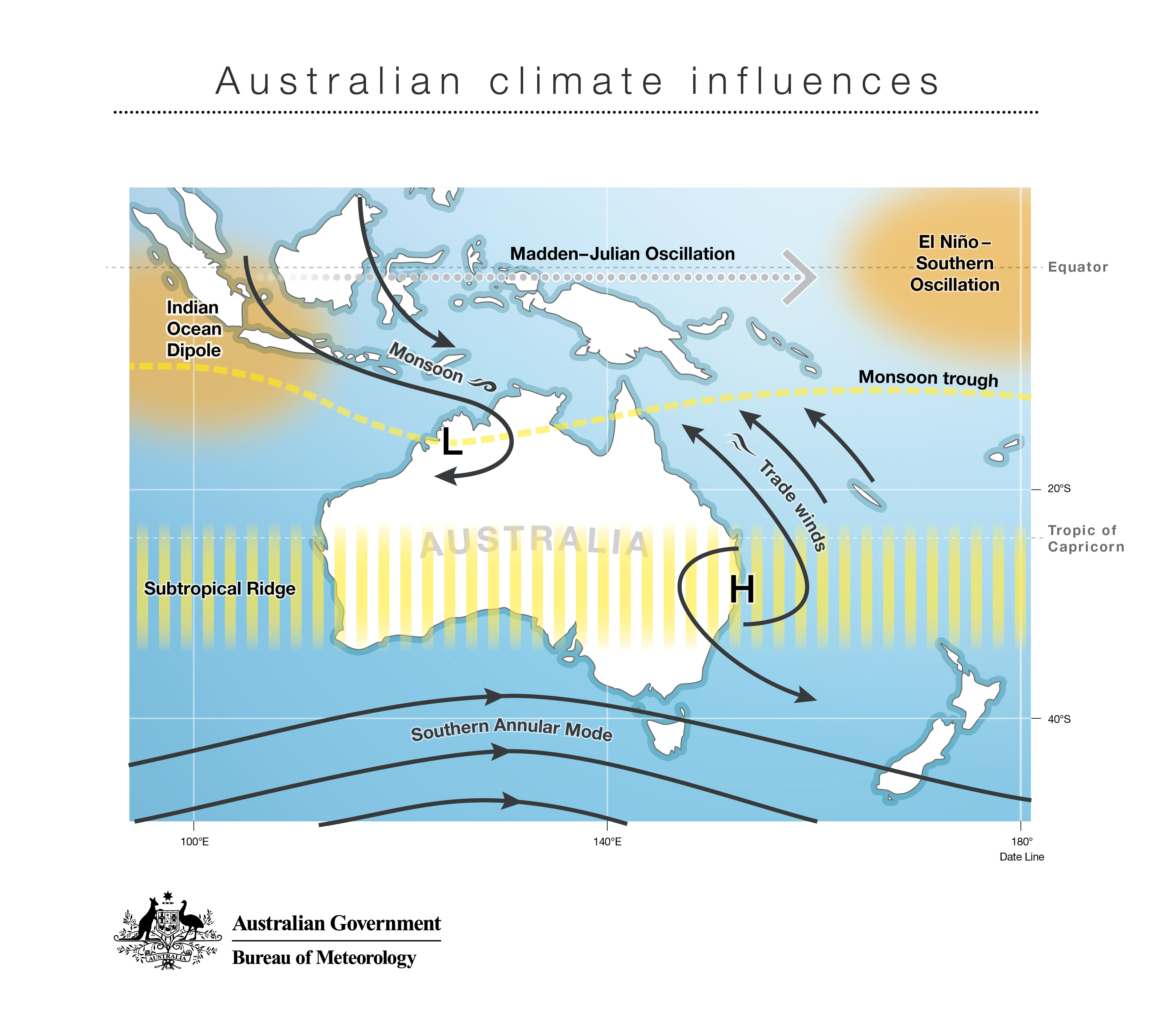
Natural climate variability refers to processes such as El Niño and its opposite, La Niña in the Pacific Ocean. Together these are known as the El Niño–Southern Oscillation, or ENSO. Other such processes include phases of the Indian Ocean Dipole (IOD) in the Indian Ocean and fluctuations in the Southern Annular Mode (SAM) across the Southern Ocean.

Australia’s natural climate influences. Bureau of Meteorology

Right now, ENSO is not active, and a very strong positive IOD event – the strongest since 1997 – has just ended. Positive IOD events typically result in below average winter–spring rainfall over southern and central Australia, and are often associated with more severe bushfire conditions.

There has also been a marked warming of the atmosphere over Antarctica, known as sudden stratospheric warming. This has led to a weakening of the polar vortex, resulting in more negative conditions in the Southern Annular Mode – essentially the north–south movement of the westerly wind belt that loops around Antarctica.

New Australian research has found weakening and warming of the stratospheric polar vortex over Antarctica significantly increases the chances of hot and dry extremes, including more severe fire weather conditions across subtropical eastern Australia than is normal for spring-early summer.


Read more: The air above Antarctica is suddenly getting warmer – here’s what it means for Australia


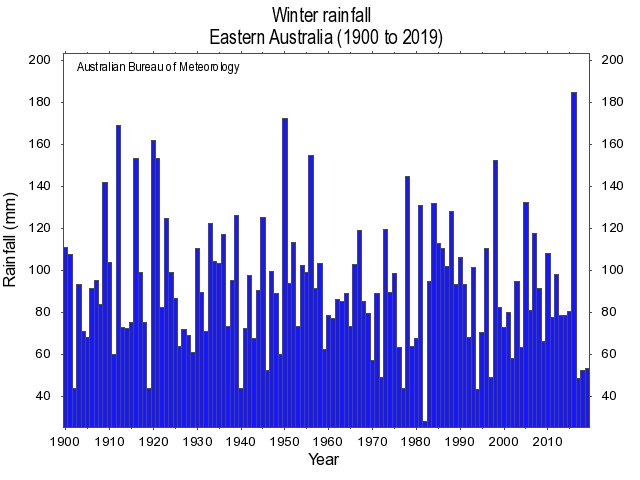
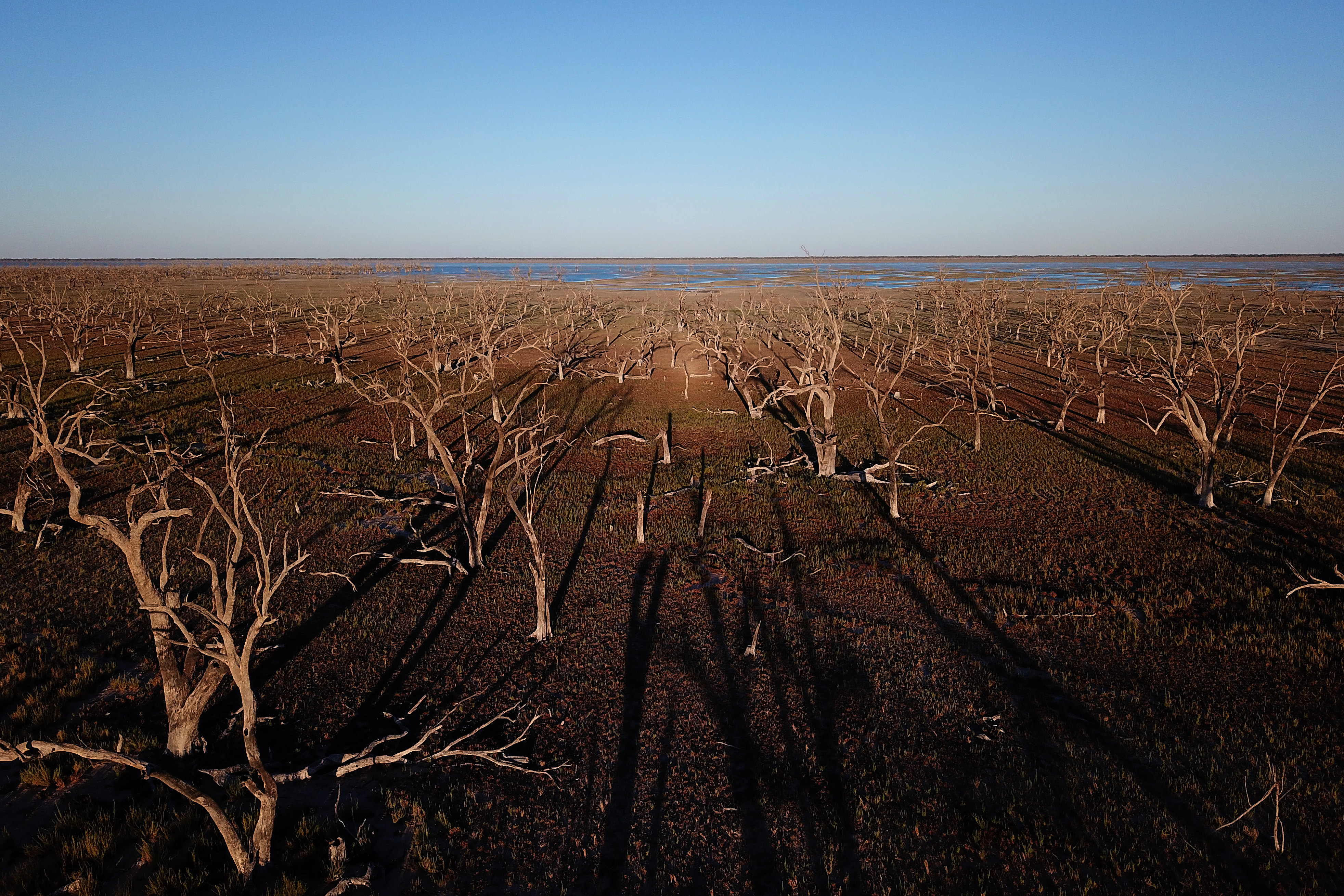
This combination of unusual natural variability in the Indian and Southern Oceans, the unprecedented lack of winter rains in 2017, 2018 and 2019, and Australia’s hottest summer on record, have contributed to the extreme drought currently affecting 100% of New South Wales and 67.4% of Queensland.
These factors have combined to bake the landscape dry, even transforming usually wet sub-tropical rainforests into available fuel for this season’s catastrophic bushfire conditions.

Winter rainfall in eastern Australia, 1900–2019. Bureau of Meteorology

How climate influenced past Australian bushfires

Historically, the most severe Australian bushfire seasons and droughts occurred when the Indian Ocean Dipole combined with El Niño to reinforce dry conditions. Both these climate drivers influence Australian rainfall and soil moisture, with the driest conditions over the southeast, but more broadly across most of the country (with the notable exception of coastal NSW).

As Australia’s climate continues to warm, a range of scientific sources suggest some established relationships between the historical drivers of Australian climate and their impact on rainfall and temperature may be breaking down.


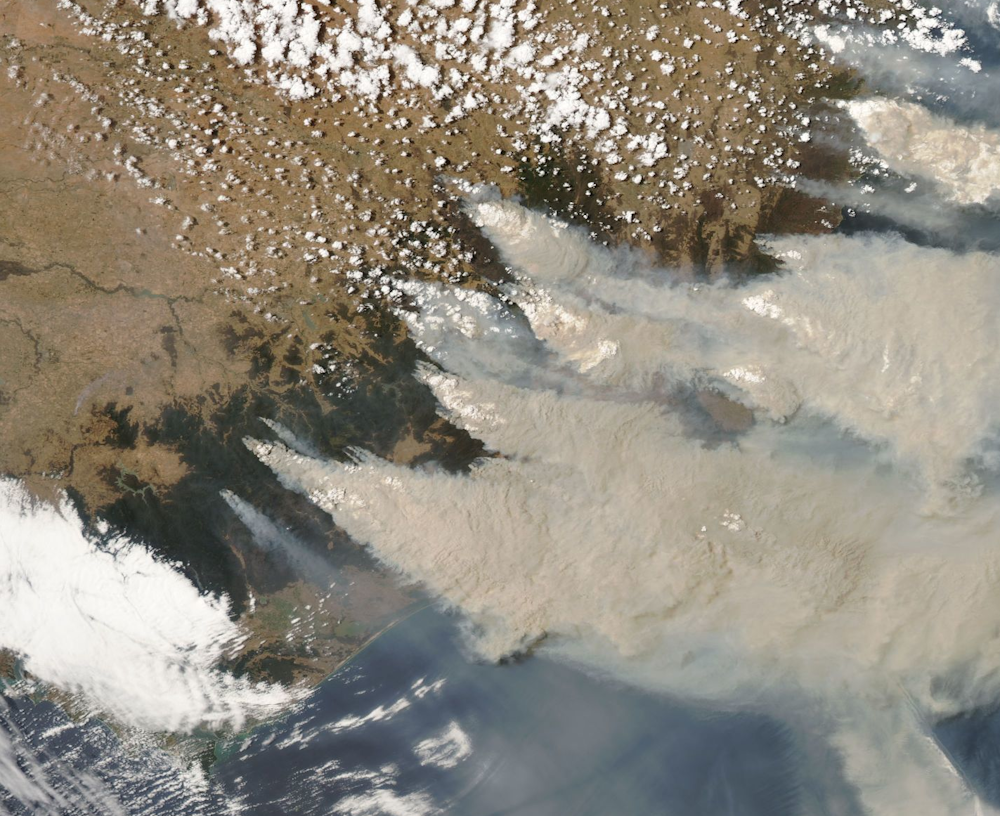
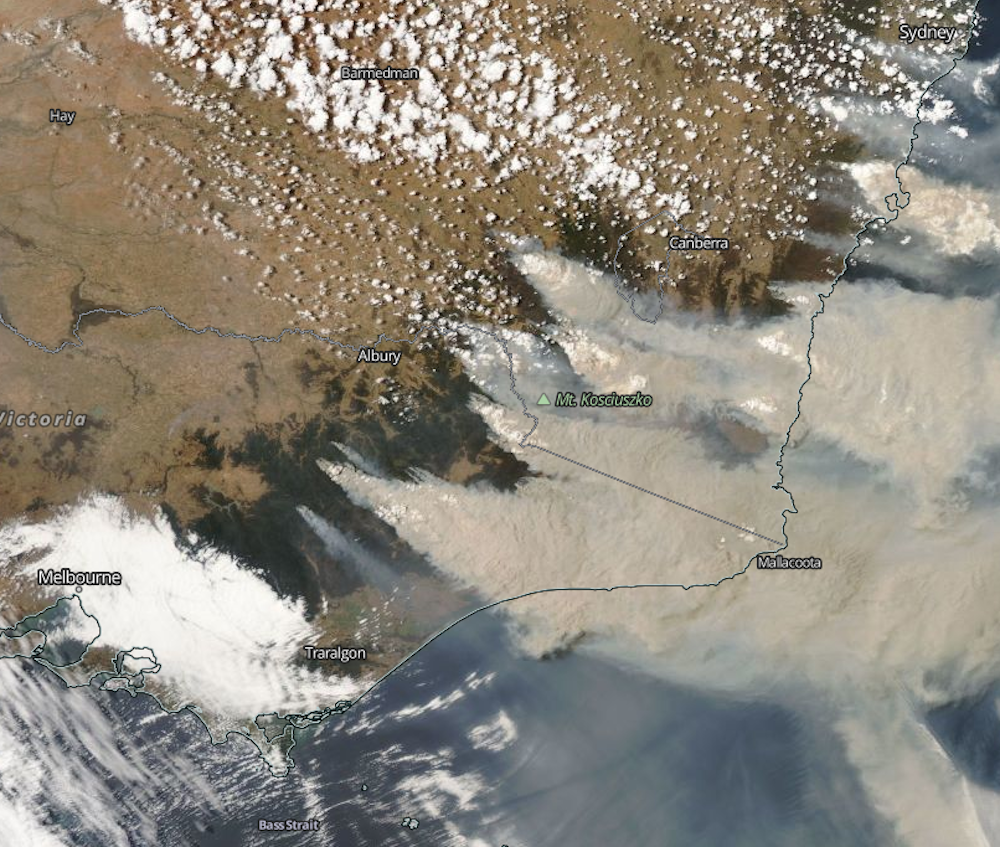
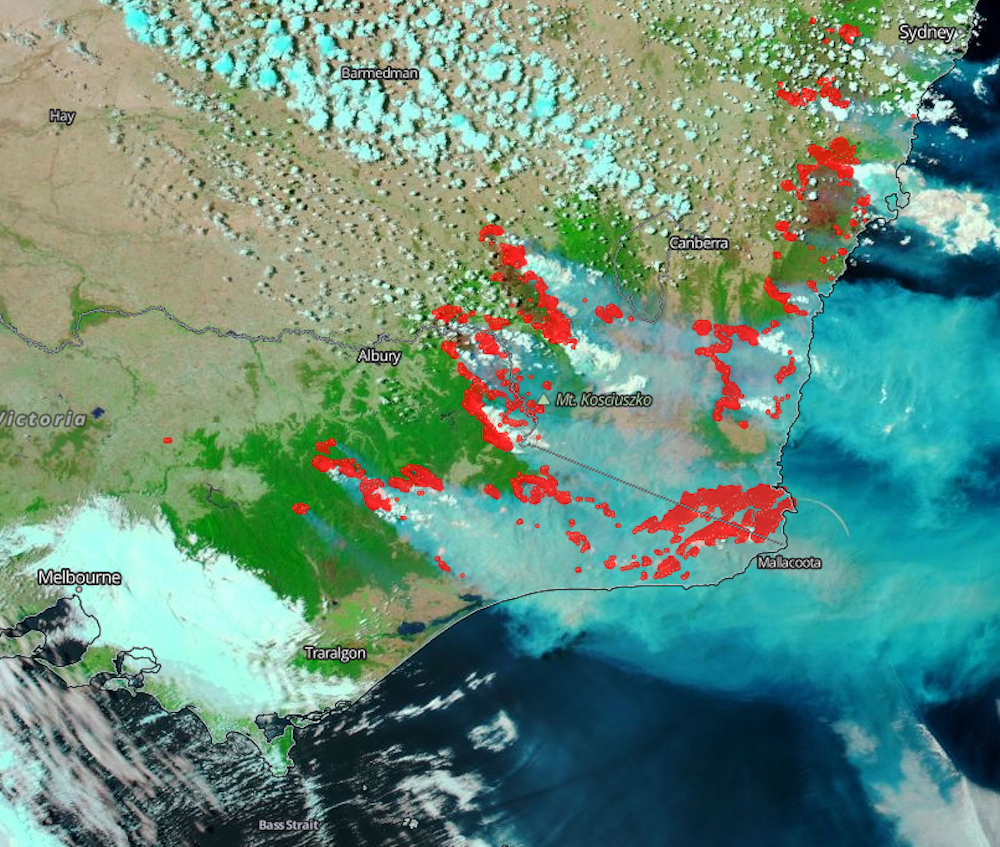
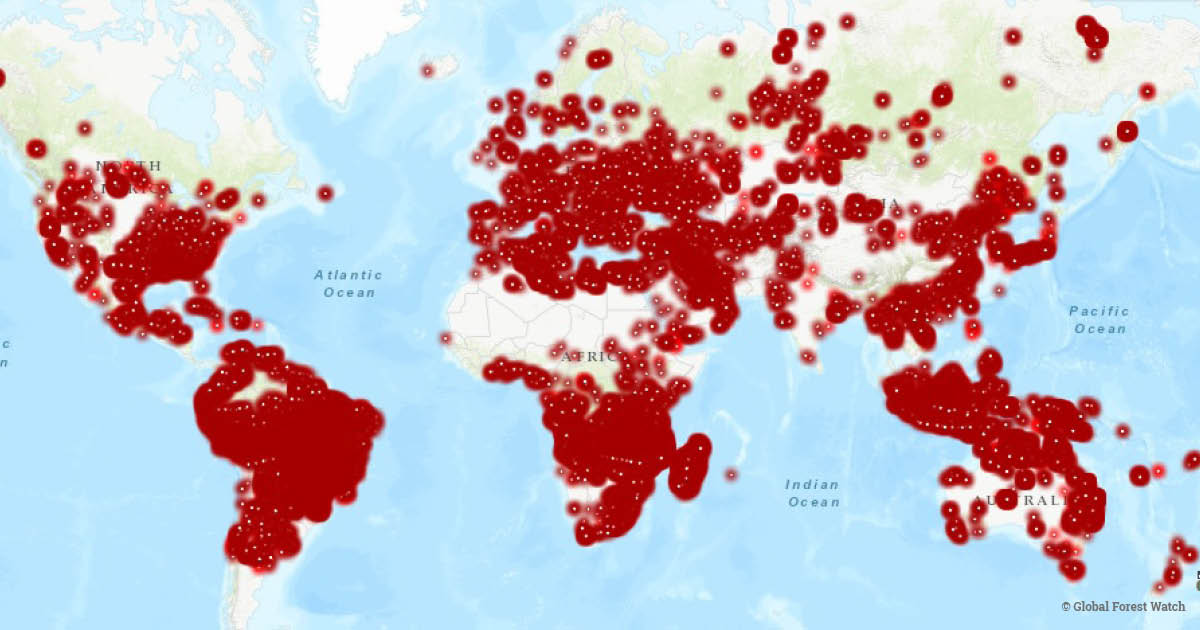
Read more: ‘This crisis has been unfolding for years’: 4 photos of Australia from space, before and after the bushfires


For example, Australia’s hottest years on record were historically associated with El Niño events, in line with global temperature trends. However, global warming means even traditionally cooler La Niña years are now warmer than many El Niño years of the past. This suggests natural variability may be increasingly swamped by human influences on the climate.

Following Australia’s hottest summer on record, and a record-breaking year of heat and drought, the 2019–2020 bushfire season started as early as winter 2019.

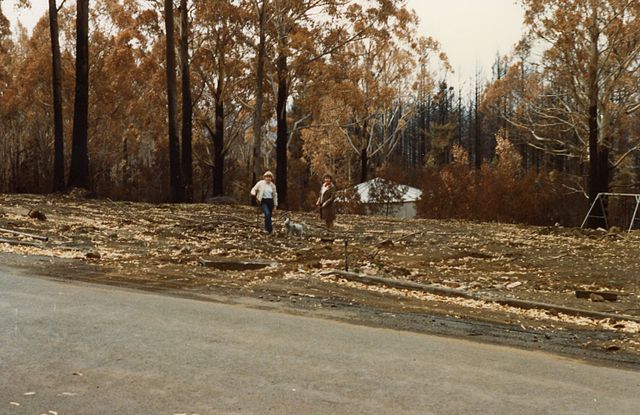
Mount Macedon in Victoria, after the Ash Wednesday bushfires in 1983. Wikimedia

In September, barely a week into spring, catastrophic bushfires wrought havoc in many areas of southern Queensland and northern NSW.

Even the usually moss-covered rainforests of the World Heritage-listed Gondwana Rainforests of Australia burned.

Similarly in Tasmania, the 2016 fires destroyed large areas of ancient Gondwanan forest, triggering a cascade of changes through the entire ecosystem.

Strikingly, the current catastrophic bushfires are occurring in the absence of El Niño conditions typically associated with severe bushfires in the past.

The notorious Ash Wednesday fires that devastated parts of south-eastern Australia in February 1983 occurred during one of the most intense El Niño events on record. Some 75 people were killed across the country’s south-east, and more than 2,000 homes were lost.

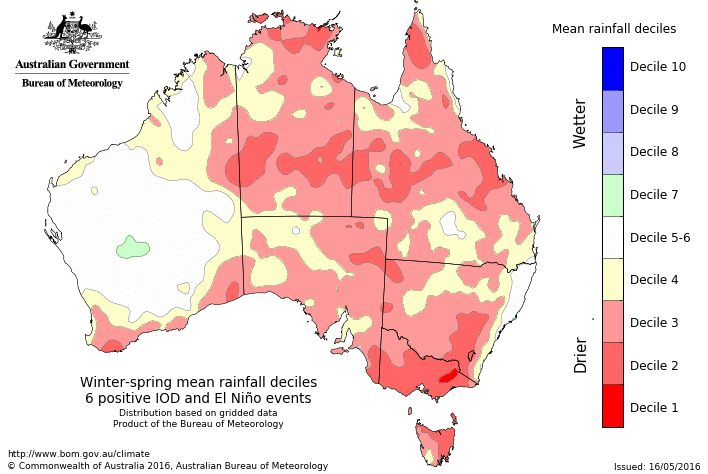
Ash Wednesday was also preceded by a positive Indian Ocean Dipole event. Together with the El Niño, this created a “double whammy” of drought conditions which provided the climatic backdrop for the fires.

Average rainfall deciles for total winter-spring rainfall for six positive IOD events that have occurred with El Niño event since 1960. Bureau of Meteorology

Similarly, the 1994 Sydney fires were also influenced by a combination of El Niño and positive IOD conditions.

However the current drought is affecting areas such as coastal NSW which have not historically been influenced by positive IOD and El Niño events. This suggests other drivers are at play.

Rainfall deficits experienced from 1 July 2018 until 31 December 2019. Bureau of Meteorology
Perhaps most alarmingly, this summer’s bushfire crisis also differs from the past is the spread and extent of landscape burned. More so than during Victoria’s Ash Wednesday or Black Saturday, this season’s fires have burned large swathes of the country. In some cases, fires merged to form unprecedented “mega fires”. It is sobering to consider what might happen to the Australian landscape the next time an El Niño hits.

Of course it will take time before researchers can pinpoint the full extent to which climate change influenced the current drought and associated bushfires.

But it is already clear to experts that natural variability and human influences on the climate system are now interacting to generate extremes that may have no parallel in Australian history.

Firefighters recover after battling blazes at Kangaroo Island on 10 January 2019. David Mariuz/AAP

What this means for bushfire danger

As with land and sea temperatures, Australia has seen rising trends in fire danger indices in recent decades.

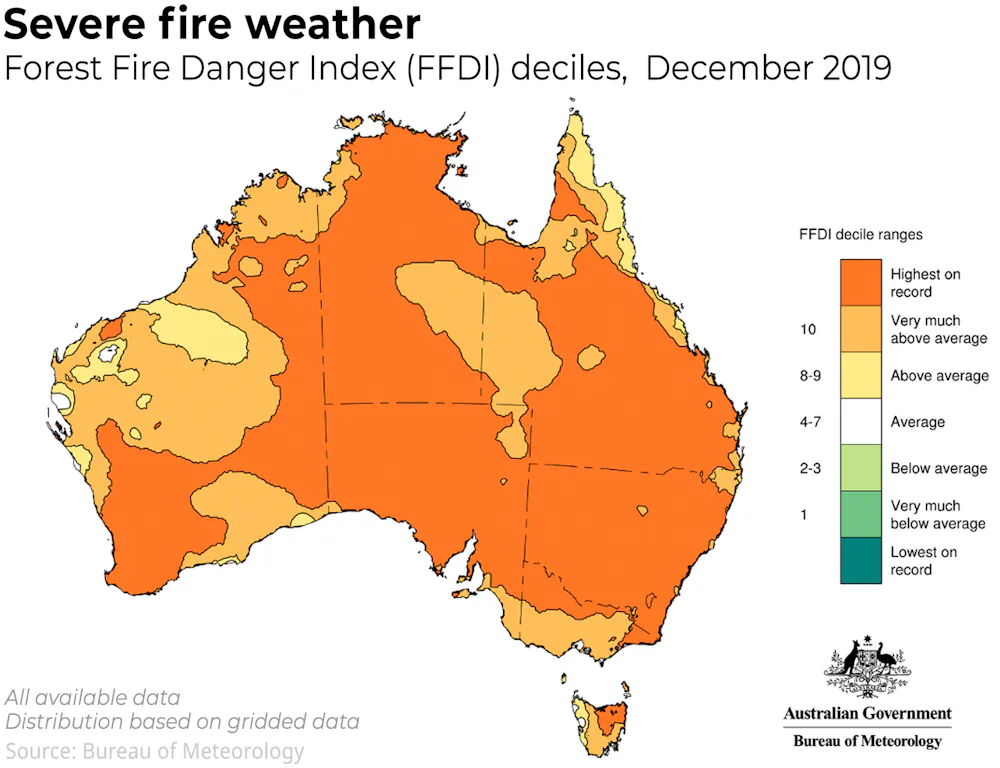
In particular, the annual accumulated Forest Fire Danger Index (FFDI) – which takes into account drought, recent rain, air temperature, relative humidity and wind speed – has increased in eastern and southern Australia.


Read more: Bushfires, bots and arson claims: Australia flung in the global disinformation spotlight


The bushfire season has become longer and more intense. In fact, the extraordinary conditions experienced during Victoria’s Black Saturday fires in February 2009 later prompted the creation of a new “catastrophic” fire rating, represented by a FFDI of 100 or greater.

On September 6 last year – less than a week out from winter – severe bushfires burned across Queensland and NSW. In most affected areas, daily FFDI values that day (pictured in the bottom right of the graphic below) were higher than anything observed so early in the season since records began in 1950. Astoundingly, a FDDI of 174 was recorded at Murrurundi Gap in the Hunter region of NSW.

Comparison of historical bushfires using the Forest Fire Danger Index for February 16, 1983 (Ash Wednesday, top left), January 6, 1994 (Sydney fires, top right), February 7, 2009 (Black Saturday, bottom left), and September 6, 2019 (bottom right). Dr Andrew Dowdy, Bureau of Meteorology

Rewriting history

In the past, Australia only had to contend with natural climate variability. Now, our entire weather and climate systems are being altered and amplified by human activity. Climate change is making extreme events even more severe, resulting in unprecedented conditions that are rewriting our nation’s history.

The CSIRO’s most recent climate projections reconfirmed their projections released in 2015 which clearly showed Australia faces more dangerous fire weather conditions in future.

It will take time to understand the exact contribution of each climatic factor in the bushfire season of 2019–2020. However one thing is certain: unless there are global reductions in greenhouse gas emissions, temperatures will continue to rise, increasing the risk that catastrophic bushfire conditions become Australia’s “new normal”.

ref. Some say we’ve seen bushfires worse than this before. But they’re ignoring a few key facts – http://theconversation.com/some-say-weve-seen-bushfires-worse-than-this-before-but-theyre-ignoring-a-few-key-facts-129391

Australian building codes don’t expect houses to be fire-proof – and that’s by design

Source: The Conversation (Au and NZ) – By Raymond William Loveridge, Adjunct Professor – School of Built Environment, University of Technology Sydney

More than 2,000 homes have been destroyed in Australia since the start of the bushfire season. More will certainly be destroyed before the season ends in March.

Could these houses have been built to better withstand fire?


Read more: ‘This crisis has been unfolding for years’: 4 photos of Australia from space, before and after the bushfires


Quite probably. But that doesn’t necessarily mean Australia’s building regulations need reforming to ensure homes are made more fireproof.

Appropriate building codes are about weighing costs and benefits. Only analysing the reasons buildings were destroyed will tell us if more needs to be done.

Performances standards

Not all buildings are created equal. Newer buildings will generally be more fire-proof than older ones, due to building regulations having been improved over time.

In particular, national building requirements for residences in bushfire-prone areas were improved after the 2009 “Black Saturday” bushfires in Victoria, in which 173 people died and more 2,000 homes were destroyed.

A house in Flowerdale, Victoria, destroyed in the 2009 bushfires. About 80% of houses in the small town were lost, along with 10 lives. Raoul Wegat/AAP

Buildings are regulated by states and territories but governments have recognised the value of nationally consistent building codes through the National Construction Code. This code, among other things, sets minimum standards for the design and construction of new buildings on bushfire-prone land. (What land is deemed “bushfire prone” is defined by state and territory legislation.)

The National Construction Code is “performance-based”. It doesn’t specify how a building must be built, but how a building must perform. This means innovative designs, materials and construction methods can be readily approved.

A residential building on bushfire-prone land, the code states, must be designed and constructed to “reduce the risk” of ignition from a bushfire, appropriate to the risk from bushfire flames, burning embers, radiant heat and intensity of the bushfire attack.

The risk to which a building is expected to be exposed depends on the individual site and conditions such as vegetation type and density, and slope of land. Properties are assessed and given a “Bushfire Attack Level” (BAL) rating by inspectors.

There are six BAL levels that classify the severity of potential exposure to bushfire. The highest – BAL FZ – is for buildings exposed to an extreme risk, such as a house surrounded by trees that could produce direct contact from flames.

Lower BAL levels take into account risks from burning debris, ember attack and radiant heat. The lowest deems the risk insufficient to warrant any specific construction requirements.

Construction details for each BAL cover building elements such as floors, walls, roofs, doors, windows, vents, roof drainage systems, verandahs, and water and gas supply pipes. For example, fire-resistant timber may be required for floor framing, or windows may be required to use toughened glass.

Balancing competing interests

Are the requirements of the National Construction Code good enough?

If the aim is to minimise the number of buildings damaged or destroyed in extreme fire events, the answer is no.

But that’s not the aim. Like most government regulation, the code requirements are about balancing competing interests.

All building regulations are subject to cost-benefit analysis. They must demonstrate a “net cost benefit” to the community – that the cost of compliance will be less than the benefit delivered to the general community.

It’s a cold calculation about the risk and potential cost of homes being destroyed in bushfires versus the more certain costs involved in requiring all homes to be built to more stringent building codes.

Government policy treats potential property loss as a matter for owners to address through property insurance. There’s no reason to expect this to change any time soon.

Learning from experience

If the cost of building destruction in bushfires turned out to be greater than the cost of more stringent building requirements, there would be a strong rationale to improve the regulations. This is why post-fire analysis is so important.

A prime example is the royal commission into the causes and costs of the Black Saturday fires.

The commission’s final report made a number of recommendations for changes to the National Construction Code. These included new provisions to:

  • make protection from ember attack a performance requirement
  • address the design and construction of private (underground) bushfire emergency shelters
  • include design and construction requirements for non-residential buildings, such as schools and aged-care centres, in bushfire-prone areas.

All governments agreed to the first two recommendations, which were promptly implemented in the National Construction Code (in 2010).

The recommendation about non-residential building was not implemented at the time because governments considered that planning laws would not allow these types of buildings to be built in a bushfire-prone area.

However, the 2019-2020 business plan of the Australian Building Codes Board (which administers the National Construction Code, includes a “bushfire provisions for non-residential buildings” project, so it is reasonable to expect changes to the code in future.


Read more: Bushfires won’t change climate policy overnight. But Morrison can shift the Coalition without losing face


This season’s fires may also provide impetus for other changes to the construction code. One key factor that will be worthy of research is the age of the buildings destroyed.

Depending on how many homes lost were built after 2010, it might be argued that changes made after the 2009 Victorian fire have been insufficient to keep up with evolving conditions.

ref. Australian building codes don’t expect houses to be fire-proof – and that’s by design – http://theconversation.com/australian-building-codes-dont-expect-houses-to-be-fire-proof-and-thats-by-design-129540

Tell Me Why review: Archie Roach’s pain is the pain of all of us

Source: The Conversation (Au and NZ) – By Aileen Marwung Walsh, ARC Laureate Research Scholarship, Rediscovering Deep Human History, Australian National University

Aboriginal and Torres Strait Islander readers are advised this article contains images and names of deceased people.

Review: Tell Me Why: The Story of My Life and My Music, by Archie Roach (Simon & Schuster)

Singer songwriter Archie Roach’s new autobiography Tell Me Why, is a grim portrayal of his life of suffering at the hands of 20th century white Australia.

The Australian government eugenics programs against Aboriginal people led to the removal of many thousands of Aboriginal children from their families: the stolen generations. Archie was one of them.

Archie’s many successes in the music industry did not begin until he stopped drinking. Archie sang Took the Children Away at the 1988 Survival Day event in Sydney. Though historian Peter Read had been working on the family tracing and reunion service Link-Up since 1981, it was Archie’s song that brought home the tragedy of the stolen generations for all of us.

Archie sings from the heart about what he knows and what he and his family have experienced. Given how much pain is visible, we can only imagine the rest. Archie’s first album was Charcoal Lane and in 1991 he won the ARIA award for Best New Artist and Best Indigenous Release.

He was born in 1956 at Mooroopna near Shepparton. Aboriginal people had moved there as a direct result of the Cummerangunja Walk Off on 6 February 1939, when around 200 people left a mission in southern New South Wales to protest poor conditions and government control.

However, Archie’s family was from the south and so they moved to Framlingham mission. He and his sisters were stolen from there when he was just four. They were placed in separate foster homes, some very bad, until Archie was placed more permanently with the Cox family. A Scottish family with, it seems, good hearts, they fostered Archie and another Aboriginal boy Noel.

Life was relatively good for Archie. But, when one of his birth sisters wrote to tell him that their mother had died, he and his foster parents discovered the government had lied to them. The Cox family had been told Archie’s family had perished in a fire.

Searching

Archie’s choices after this became limited by his inability to trust non-Aboriginal people as well as his deep desire to reconnect with his real family, to learn who he really was. He left the safety and security of his foster parents’ home when he was only 15, never to see them again, and began searching.

Soon, Archie was in Sydney. It was here he met one of the ugliest characters of his life story, Albert, an alcoholic living on the streets. To Albert, the young and impressionable Archie, was prey and a potential drinking buddy. Archie had never had alcohol before he met Albert but he writes that Albert turned him into an alcoholic while he was still only 16.

Archie had been raised by a good white family. For many people from the stolen generations, the notion of being good then becomes synonymous with being white. The Christian teachings in the missions are also about being good. For many Aboriginal people being good then mistakenly becomes antithetical to being Aboriginal.

For many of the stolen generations and later generations who grew up without proper Aboriginal culture, the white trash culture of street living begins to seem the Aboriginal way. While drinking in the streets and pubs of inner Sydney and Melbourne, Archie did find the rest of his family.

Most of Archie’s story is about drinking, the depth and the dangers, the epilepsy, and a drunken suicide attempt. For fellow Aboriginal people of the same era, the extent of this drinking and its effects are not new. Archie writes about the consistent choice to drink and his difficulty stopping.

He doesn’t explicitly write how his choice to keep drinking was a cop-out, but drinkers don’t have to be responsible for anything or anyone. Perhaps this is why Archie writes so little about his children. He didn’t choose his children — for a long time he chose booze.

Ruby Hunter is at the heart of Archie’s life story.

Ruby and Archie met when they were teenagers, they drank together and got sober together. Ruby was the strength behind Archie. She gave birth alone and raised the boys alone until Archie stopped drinking. But although Ruby (who died in 2010, aged 54) is there in Archie’s story, she is also strongly absent in Archie’s memoir. One senses the pain in the absence.

Archie would work for a while but then he would choose the booze again. He loved Ruby, but chose the booze again and again. Archie hasn’t tried to romanticise the drinking culture he was a part of in the book, but perhaps he has in his music. Charcoal Lane, the name of his first album, came from one of the places he used to drink. Can regret be romantic?

‘White trash’ culture

I recognise the choices Archie and so many others like him made as we grew up in cities or country towns without strong Aboriginal laws that could tell us how to behave right; while at the same time rejecting white colonial laws as a form of resistance.

It is an empty space, that in-between place, with the added difficulty of acceptance by white trash – the white alcoholics. The term “white trash” explains the ugliness of the colonisation of the Americas and Australia.

Although perceived as classist, researchers argue it’s more about forms of behaviour determined by a lack of knowledge of how to make good choices. Or how to be a good person – to take responsibility for one’s choices, as his experience with the principles of Alcoholics Anonymous later taught Archie.

Song lyrics begin each chapter of Tell Me Why and Took the Children Away, Archie’s first, award-winning song begins his autobiography. In many ways, it is his redemption song.

Archie visited the Framlingham mission, from where he was stolen, while he was drinking; but it was not until he stopped drinking that his Uncle Banjo told him what it was like for them, Archie’s parents, the generation left behind with the silence from the absent children.

This enabled Archie to stop thinking so much about his own pain, and more about the pain of others.

ref. Tell Me Why review: Archie Roach’s pain is the pain of all of us – http://theconversation.com/tell-me-why-review-archie-roachs-pain-is-the-pain-of-all-of-us-127723

Babies and toddlers might not know there’s a fire but disasters still take their toll

Source: The Conversation (Au and NZ) – By Karleen Gribble, Adjunct Associate Professor, School of Nursing and Midwifery, Western Sydney University

Thousands of families with babies and toddlers have been affected by Australia’s bushfire disaster. This includes children whose homes have been under direct threat or impacted by severe smoke pollution, or where their parents volunteer or work as fire fighters.

Babies and toddlers may not be aware of the danger the fires pose to them or their families. But they find changes in their environment distressing and may notice the stress of their caregivers.

Routine and predictability makes young children feel safe. Evacuating, travelling long distances, noisy evacuation centres and staying in crowded or temporary accommodation disrupts this predictability.


Read more: Bushfires can make kids scared and anxious: here are 5 steps to help them cope


Kids communicate with behaviour, not just words

Babies and toddlers can’t easily communicate they’re unsettled with words so they show it in their behaviour. This might include:

Babies might want extra attention during a disaster. Lopolo/Shutterstock

When parents are stressed, they find it more difficult to notice their baby’s or toddler’s behavioural communications.

In the acute phase of an emergency, it may not be possible to respond to a baby or toddler. Very young children can find this extremely stressful.


Read more: After the firestorm: the health implications of returning to a bushfire zone


How to help your child cope

If your baby or toddler is showing signs of distress, provide them with responsive care. This involves watching and noticing their behavioural cues, including body movements and sounds, and responding to this communication in a nurturing way.

The behavioural changes you see in your child provide you with information about what they need.

A baby or toddler who doesn’t want to go to anyone but their mother is communicating that, right now, mum represents safety and only mum will do.

A child who is waking at night is saying, “I’m scared. I need you near to reassure me when I wake.”

A child who is demanding or withdrawn is indicating they need more attention, not less.

Parents can respond to their child’s behavioural cues about what they need. Hananeko_Studio/Shutterstock

Try not to worry too much about feeding issues. Allow babies and toddlers to eat when they indicate hunger. Offer food frequently but don’t try force your toddler to eat.

Keeping your baby or toddler physically close will help you to notice their cues and provide responsive care. Baby slings can help parents do this while they get on with other things.

Consider delaying any changes that you were considering before the fires, such as starting solid foods, introducing a bottle, giving up the dummy, starting childcare or moving the child out of your bedroom. When things have settled down again, your baby or toddler should once again be able to manage these changes.

If you feel you’re struggling to provide responsive care to your baby or toddler, ask your family or friends for extra help or contact your child health nurse or doctor.

Breastfeeding mothers – stress won’t reduce your supply

Changes in babies’ feeding and sleeping behaviour during emergencies can be particularly concerning to breastfeeding mothers who worry the stress will affect their milk supply.

Research tells us stress has no impact on milk production. But it can slow the release of milk, making babies fussy at the breast.


Read more: Evacuating with a baby? Here’s what to put in your emergency kit


If this happens, keep offering breastfeeds. While feeding, focus on your baby and think about how much you love them. This will release hormones that make the milk flow and help you and your baby to feel more relaxed.

We all need to support parents through this disaster

Helping babies and toddlers to recover from an emergency shouldn’t just be left to parents. Those around families with babies and toddlers can help by cleaning or cooking, allowing parents to prioritise caring for their children and other pressing tasks.

The impact of an emergency can persist for some time. If you feel you’re still affected by the disaster, your baby or toddler might feel that too. Give them and yourself time. Babies and toddlers usually recover well after emergencies. Your love and responsive care is the key.

ref. Babies and toddlers might not know there’s a fire but disasters still take their toll – http://theconversation.com/babies-and-toddlers-might-not-know-theres-a-fire-but-disasters-still-take-their-toll-129699

The sweet relief of rain after bushfires threatens disaster for our rivers

Source: The Conversation (Au and NZ) – By Paul McInerney, Research scientist, CSIRO

When heavy rainfall eventually extinguishes the flames ravaging south-east Australia, another ecological threat will arise. Sediment, ash and debris washing into our waterways, particularly in the Murray-Darling Basin, may decimate aquatic life.

We’ve seen this before. Following 2003 bushfires in Victoria’s alpine region, water filled with sediment and debris (known as sediment slugs) flowed into rivers and lakes, heavily reducing fish populations. We’ll likely see it again after this season’s bushfire emergency.


Read more: The bushfires are horrendous, but expect cyclones, floods and heatwaves too


Large areas of northeast Victoria have been burnt. While this region accounts only for 2% of Murray-Darling Basin’s entire land area, water flowing in from northeast Victorian streams (also known as in-flow) contributes 38% of overall in-flows into the Murray-Darling Basin.

Fire debris flowing into Murray-Darling Basin will exacerbate the risk of fish and other aquatic life dying en masse in a repeat of the shocking fish kills of last summer.

What will flow into waterways?

Generally, bushfire ash comprises organic carbon and inorganic elements such as nitrogen, phosphorous and metals such as copper, mercury and zinc.

Sediment rushing into waterways can also contain large amounts of soil, since fire has consumed the vegetation that once bound the soil together and prevented erosion.

And carcinogenic chemicals – found in soil and ash in higher amounts following bushfires – can contaminate streams and reservoirs over the first year after the fire.

A 2014 post-fire flood in a Californian stream.

How they harm aquatic life

Immediately following the bushfires, we expect to see an increase in streamflow when it rains, because burnt soil repels, not absorbs, water.

When vast amounts of carbon are present in a waterway, such as when carbon-loaded sediments and debris wash in, bacteria rapidly consumes the water’s oxygen. The remaining oxygen levels can fall below what most invertebrates and fish can tolerate.

These high sediment loads can also suffocate aquatic animals with a fine layer of silt which coats their gills and other breathing structures.

Habitats are also at risk. When sediment is suspended in the river and light can’t penetrate, suitable fish habitat is diminished. The murkier water also means there’s less opportunity for aquatic plants and algae to photosynthesise (turn sunshine to energy).


Read more: How wildfire smoke affects pets and other animals


What’s more, many of Australia’s waterbugs, the keystone of river food webs, need pools with litter and debris for cover. They rely on slime on the surface of rocks and snags that contain algae, fungi and bacteria for food.

But heavy rain following fire can lead to pools and the spaces between cobbles to fill with silt, causing the waterbugs to starve and lose their homes.

This is bad news for fish too. Any bug-eating fish that manage to avoid dying from a lack of oxygen can be faced with an immediate food shortage.

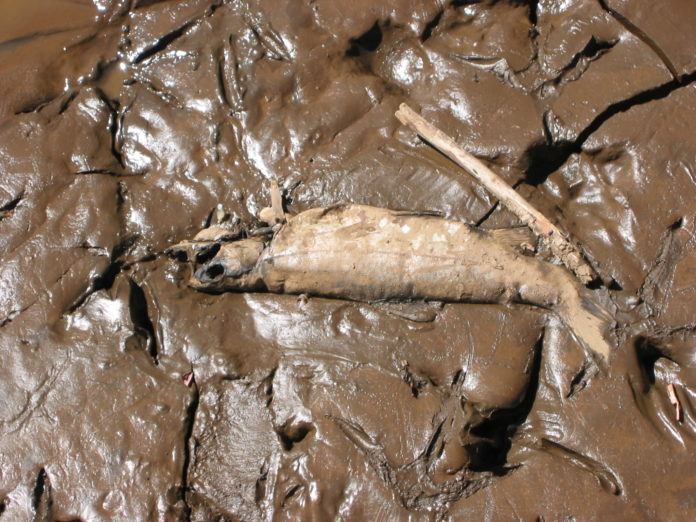
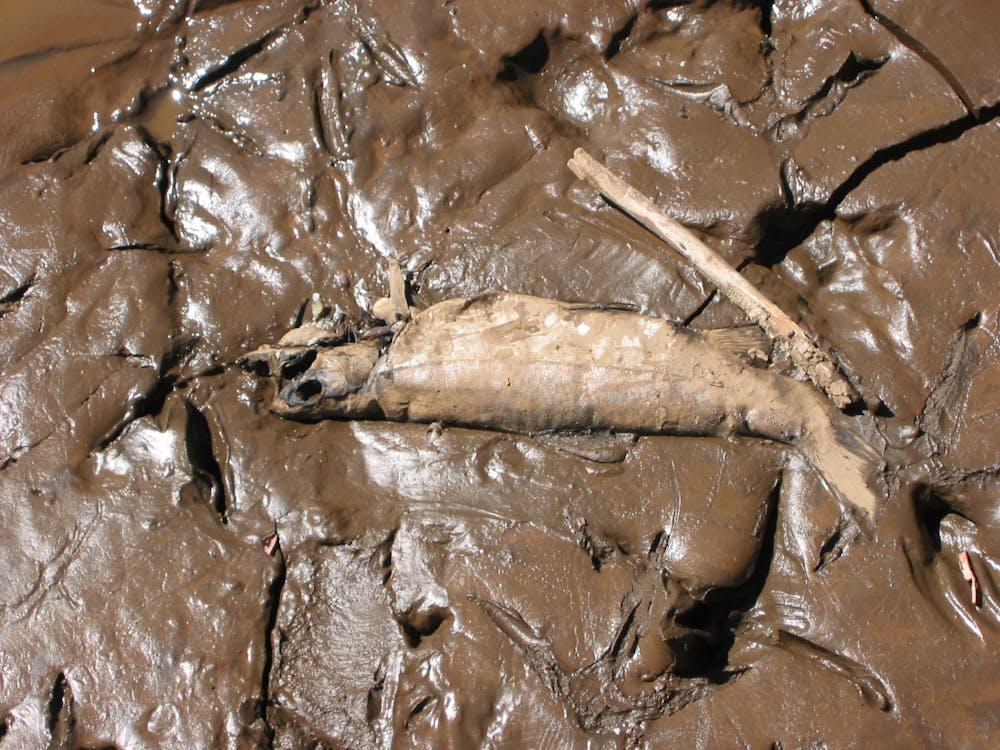
Many fish were killed in Ovens River after the 2003 bushfires from sediment slugs. Arthur Rylah Institute, Author provided

We saw this in 2003 after the sediment slug penetrated the Ovens River in the north east Murray catchment. Researchers observed dead fish, stressed fish gulping at the water surface and freshwater crayfish walking out of the stream.

Long-term damage

Bushfires can increase the amount of nutrients in streams 100 fold. The effects can persist for several years before nutrient levels return to pre-fire conditions.

More nutrients in the water might sound like a good thing, but when there’s too much (especially nitrogen and phosphorous), coupled with warm temperatures, they can lead to excessive growth of blue-green algae. This algae can be toxic to both people and animals and often closes down recreational waters.


Read more: Strength from perpetual grief: how Aboriginal people experience the bushfire crisis


Large parts of the upper Murray River catchment above Lake Hume has burnt, risking increases to nutrient loads within the lake and causing blue-green algae blooms which may flow downstream. This can impact communities from Albury all the way to the mouth of the Murray River in South Australia.

Some aquatic species are already teetering on the edge of their preferred temperature as stream temperatures rise from climate change. In places where bushfires have burnt all the way to the stream edge, decimating vegetation that provided shade, there’ll be less resistance to temperature changes, and fewer cold places for aquatic life to hide.

Cooler hide-outs are particularly important for popular angling species such as trout, which are highly sensitive to increased water temperature.

Ash blanketing the forest floor can end up in waterways when it rains. Tarmo Raadik

But while we can expect an increase in stream flow from water-repellent burnt soil, we know from previous bushfires that, in the long-term, stream flow will drop.

This is because in the upper catchments, regenerating younger forests use more water than the older forests they replace from evapotranspiration (when plants release water vapour into the surrounding atmosphere, and evaporation from the surrounding land surface).

It’s particularly troubling for the Murray-Darling Basin, where large areas are already enduring ongoing drought. Bushfires may exacerbate existing dry conditions.

So what can we do?

We need to act as soon as possible. Understandably, priorities lie in removing the immediate and ongoing bushfire threat. But following that, we must improve sediment and erosion control to prevent debris being washed into water bodies in fire-affected areas.


Read more: In fact, there’s plenty we can do to make future fires less likely


One of the first things we can do is to restore areas used for bushfire control lines and minimise the movement of soil along access tracks used for bushfire suppression. This can be acheived using sediment barriers and other ersiosion control measures in high risk areas.

Longer-term, we can re-establish vegetation along waterways to help buffer temperature extremes and sediment loads entering streams.

It’s also important to introduce strategic water quality monitoring programs that incorporate real-time sensing technology, providing an early warning system for poor water quality. This can help guide the management of our rivers and reservoirs in the years to come.

While our current focus is on putting the fires out, as it should be, it’s important to start thinking about the future and how to protect our waterways. Because inevitably, it will rain again.

ref. The sweet relief of rain after bushfires threatens disaster for our rivers – http://theconversation.com/the-sweet-relief-of-rain-after-bushfires-threatens-disaster-for-our-rivers-129449

Morrison’s approval ratings crash over bushfires in first 2020 Newspoll; Sanders has narrow Iowa lead

Source: The Conversation (Au and NZ) – By Adrian Beaumont, Honorary Associate, School of Mathematics and Statistics, University of Melbourne

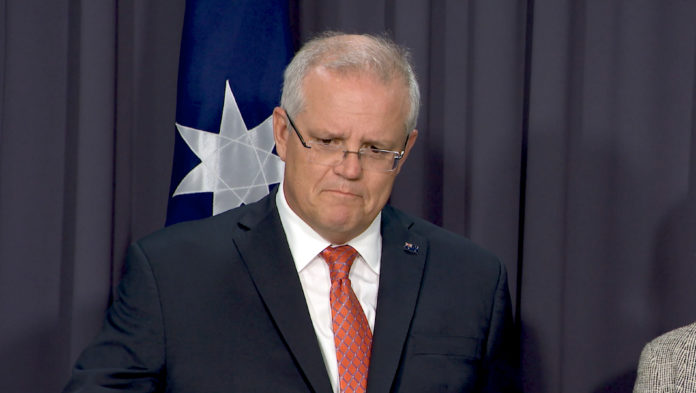
In the first Newspoll of the new year, Prime Minister Scott Morrison’s ratings have tanked as a result of his handling of the bushfire crisis.

The Newspoll, conducted January 8-11 from a sample of 1,500 people, gave Labor a 51-49 lead on a two-party preferred basis, a three point gain for Labor since the last Newspoll in early December.

Primary votes were 40% Coalition (down two points), 36% Labor (up three), 12% Greens (up one) and 4% One Nation (down one).

Morrison also suffered a drop in his job performance rating, with 37% saying they were satisfied, down eight points from early December, and 59% saying they were dissatisfied, up 11 points.

His net approval was -22, down 19 points since December. Labor leader Anthony Albanese’s net approval, meanwhile, improved ten points to +9.

Albanese also led Morrison 43-39 as preferred PM, a reversal of Morrison’s 48-34 lead in December. Apart from Morrison’s first Newspoll as PM following the ousting of Malcolm Turnbull in August 2018, this is the first time an opposition leader has led the incumbent PM on this measure since Tony Abbott was in office.

The bushfire crisis almost certainly explains the crash in Morrison’s ratings, but will this be sustained? As memories of a key event fade, people tend to move back to their previous positions.

US Democratic primary polls: Sanders has narrow Iowa lead

As the US Democratic primaries and caucuses are about to begin, here are the latest polls from the US.

Three weeks before the February 3 Iowa caucus, the highly regarded Selzer Iowa poll, conducted for CNN and the Des Moines Register, has shown Bernie Sanders with a slight lead in the state.

Sanders was at 20% in the poll (up five points from November), Elizabeth Warren 17% (up one), Pete Buttigieg 16% (down nine), Joe Biden 15% (steady), Amy Klobuchar 6% (steady) and Andrew Yang 5% (up two).

No other candidate had more than 3%. The poll was conducted January 2-8 from 701 likely caucus attendees.


Read more: Buttigieg surges to clear lead in Iowa poll, as Democrats win four of five US state elections


The last Selzer Iowa poll had Buttigieg ahead at 25%, but he is down to third place in the new poll. After the last poll, there was much media attention on the former South Bend, Indiana, mayor, but he failed to catch on nationally. This failure has probably contributed to loss of enthusiasm in Iowa.

There are four early state primary contests: Iowa, New Hampshire (February 11), Nevada (February 22) and South Carolina (February 29). Fifteen states and territories then vote on March 3, otherwise known as Super Tuesday, when 36% of the total delegates will be awarded. This date could be decisive to determining who will be the nominee.

As I have written previously, the two states at the top of the calendar, Iowa and New Hampshire, are largely comprised of white voters. As such, they do not represent the diversity of the Democratic electorate.

Biden is doing far better with black voters, who made up 61% of the South Carolina Democratic primary electorate in 2016.

A recent poll of black voters nationally gave a Biden a huge lead with 48%, with Sanders on 20% and nobody else in double digits.

Sanders and Warren, the two most left-wing candidates, are leading in the latest Iowa poll. One explanation is that Iowa is a caucus, not a primary. Caucuses are conducted by the parties and are time-consuming affairs that require voters to attend meetings where supporters make their case for candidates.


Read more: US Democratic presidential primaries: Biden leading, followed by Sanders, Warren, Harris; and will Trump be beaten?


Primaries, meanwhile, are managed by the state’s electoral authority and operate like normal elections. As a result, caucuses have far lower turnout rates than primaries, and are more likely to be influenced by party activists.

In the 2016 Democratic presidential primary, Sanders performed far better than Hillary Clinton in caucus states, while Clinton performed better in most primary states.

The bad news for Sanders and Warren is that Democrats strongly encouraged states to use primaries this year. After Iowa and Nevada (February 22), only one state uses a true caucus, while four others have a party-run primary.

According to New York Times analyst Nate Cohn, 14% of pledged delegates were awarded by caucuses in 2016; this year only 3% will be. Left-wing candidates are most likely to be hurt by this change.

National Democratic polls and polls of other early states

The most recent RealClearPolitics national Democratic poll average has Biden leading with 29.3%, with Sanders at 20.3%, Warren 14.8%, Buttigieg 7.5%, Michael Bloomberg 5.8% and Yang 3.5%.

In New Hampshire, the RCP polling average has Sanders leading with 21.5%, followed by Biden at 18.8%, Buttigieg 18.3% and Warren 14.8%.

In Nevada, the only poll conducted in January has Biden at 23%, Sanders 17% and Warren and Tom Steyer both at 12%. And in South Carolina, the only January poll conducted had Biden in the lead at 36%, with Steyer in a surprise second at 15%.

The last Democratic presidential debate before voting begins will be held on Tuesday night at Drake University in Iowa. Six candidates have qualified. There will be three more debates in February.

US jobs still good, but wage growth down

In December, the US economy added 145,000 jobs. While this is down from 256,000 in November, it is still a good performance.

However, hourly wages grew only by three cents in December, and the annual hourly wage growth increased by just 2.9% – the first time it has been below 3% since July 2018.

We do not yet have the inflation report for December, but inflation increased 0.7% in October and November. Higher inflation undermines wage growth.

The US uses two surveys for its jobs reports. The number of jobs gained and wage growth are based on an establishment survey, while other statistics are based on a household survey. In December, the household survey was steady for the three most important indicators: unemployment at 3.5%, labour participation rate at 63.2% and employment population ratio at 61.0%.

The strong jobs reports and the fact the Dow Jones surged to near 29,000 are good news for President Donald Trump. The economy represents Trump’s best chance of re-election in November.

Trump’s ratings and head-to-head polls

With all polls, the FiveThirtyEight aggregate has Trump’s ratings at 41.8% approve, 53.5% disapprove, for a net approval of -11.7%. With polls of likely or registered voters, Trump’s ratings are 42.9% approve, 53.0% disapprove (net -10.1%).

In mid-December, Trump’s ratings rose to their highest since the very early days of his presidency. His ratings have since fallen by two to three net points since then, perhaps owing to the conflict with Iran.

In the most recent national head-to-head election polls, Biden led Trump by 4.5% in the RealClearPolitics average, Sanders led Trump by 2.6%, Trump led Warren by 0.2% and Trump led Buttigieg by 1.2%.

These polls were taken in early to mid-December, when Trump’s ratings were at their peak.

ref. Morrison’s approval ratings crash over bushfires in first 2020 Newspoll; Sanders has narrow Iowa lead – http://theconversation.com/morrisons-approval-ratings-crash-over-bushfires-in-first-2020-newspoll-sanders-has-narrow-iowa-lead-129774

Even for an air pollution historian like me, these past weeks have been a shock

Source: The Conversation (Au and NZ) – By Nancy Cushing, Associate professor, University of Newcastle

Smoke from this season’s bushfires has turned the sun red, the moon orange and the sky an insipid grey. It has obscured iconic views tourists flock to see. Far more than an aesthetic problem, it has forced business shutdowns, triggered health problems and kept children indoors for weeks.

City dwellers in southeast Australia have been forced to take a crash course in the finer points of air pollution. We’ve learned about the dangers of inhaling tiny PM2.5 particles (those 2.5 microns or fewer in diameter). We’ve learned that only a close-fitting P2 mask will do much to protect us.

Still, we wear disposable paper masks and hold handkerchiefs to our faces, hoping any amount of filtering is helpful.

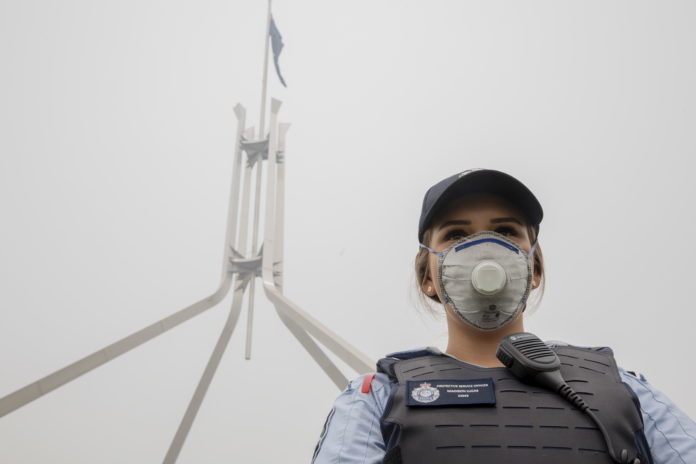
A police officer wears a mask while on duty at Parliament House in Canberra. NARENDRA SHRESTHA/AAP

Even for an historian of air pollution like me, this situation is a shock. It is not the first time Australia’s major cities have been shrouded in bushfire smoke. But the terrible air quality is unmatched in terms of severity, duration and extent.

Historically, air pollution from smoke was considered outside human control and not subject to regulation. But these bushfires are clearly linked to global warming, for which government, corporations and individuals are responsible. It’s time to rethink the way we protect air quality.

The history of smoke

In recent weeks, apps such as AirVisual have confirmed what we city dwellers can already see and smell: since the fires on the north coast of NSW began in late October, our air quality has plummeted.

The New South Wales government’s Air Quality Index data has shown that since late October, days when the index was higher than 100 – signalling exposure is unhealthy – have outnumbered clear days in Sydney, Newcastle and the Illawarra.

Smoke emissions from the Australian bushfires from 1 December 2019 to 4 January 2020.

Index readings above 2,550 have been recorded in Sydney, while the Monash monitoring site in Canberra reached a choking 5,185 at 8pm on New Year’s Day.

Bushfire smoke has affected the cities of NSW and the Australian Capital Territory in the past. In late January 1926, when Canberra was just emerging as a city, a thick haze of smoke sat over the site. Fires came within metres of Yarralumla, the residence which, the following year, would become home to the Governor-General.

In several years in the mid 1930s, bushfires burning to the north of Sydney left the city air thick with smoke. In October 1936, bushfire smoke forced a motor liner arriving from Hong Kong to warily enter the harbour sounding its siren, because it was invisible to signallers on South Head.

A New Zealand pilot, flying into Sydney from Longreach the following month, had to fly blind in “great clouds of dense smoke” covering much of NSW. In 1939, Canberra was covered by what visiting writer HG Wells described as a “streaming smoke curtain”.


Read more: How wildfire smoke affects pets and other animals


In the summer of 1944, Sydney was again enveloped in a smoke haze, this time from fires in the Blue Mountains and (later Royal) National Park in November. Photographs published at the time show the Sydney Harbour Bridge barely visible through dust and smoke at midday. The ongoing fires were blamed for an increase in diseases of the ears, nose and throat, and for cases of influenza and pneumonia, leading to a shortage of hospital beds.

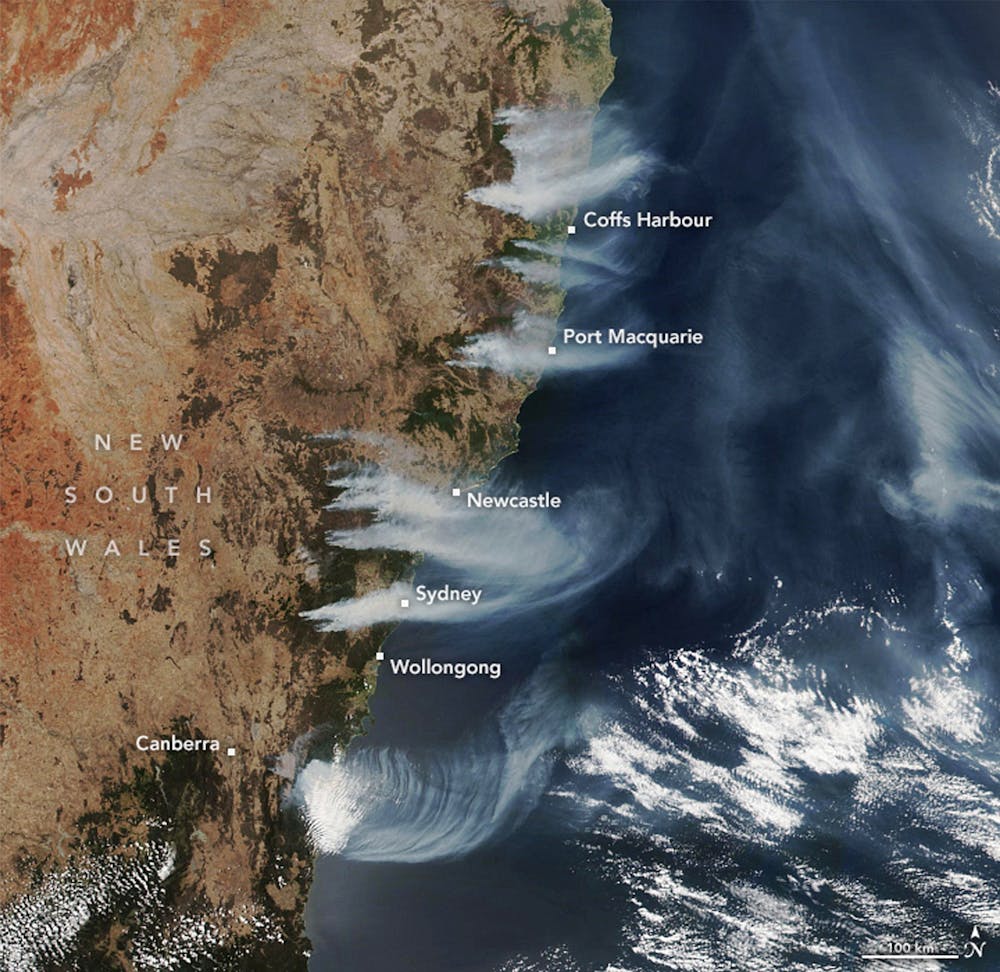
A satellite image showing fires burning on Australia’s east coast. NASA EARTH OBSERVATORY

In November 1951, all of NSW was said to be blacked out by bushfire smoke. In Sydney on the worst days, records show all four of the city’s airfields were closed because of “smoke-fog”.

A hazy legal framework

In each of these episodes, bushfire smoke disrupted transport, commerce, health and the enjoyment of the urban environment. But even as other forms of air pollution began to be regulated, smoke from bushfires escaped legislative attention.

What was understood as air pollution were the unwanted byproducts of industrial processes, whereas bushfire smoke was viewed as natural.


Read more: Pregnant women should take extra care to minimise their exposure to bushfire smoke


In NSW in 1866, an act based on British legislation restricted smoke from mills, distilleries and gas works. Further limitations on smoke production in built-up areas were included in later acts governing public health (1902), motor traffic (1909) and local government (1919).

After World War II Newcastle, the site of the country’s largest concentration of coal-burning heavy industry, began to pay closer attention to managing air quality. This pioneering work was given added urgency after 4,000 people died in heavy London smog in 1952.

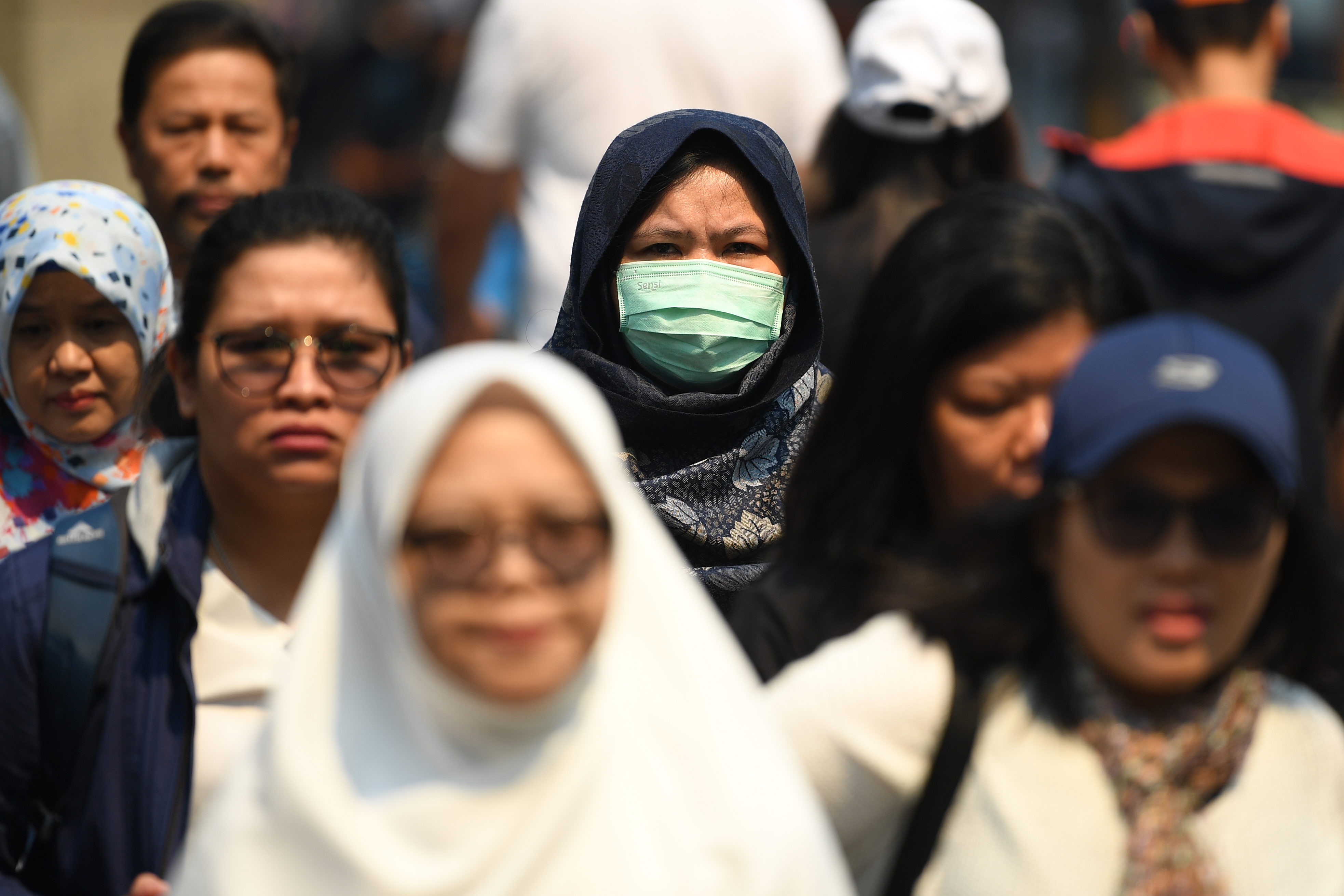
A woman seen wearing a face mask as smoke haze from bushfires blankets Sydney. JOEL CARRETT/AAP

In 1958, a NSW parliamentary committee delivered a report into smoke abatement. It did not mention recent issues with bushfire smoke, and also dismissed the impact of domestically produced smoke. The subsequent 1961 Clean Air Act focused on air pollution from industry, transport and power generation.

Air pollution legislation continued to evolve in following decades, targeting motor vehicle emissions in the 1970s, backyard burning of waste in the 1980s, and wood fires used to heat homes in the 1990s.

These measures have been successful. A 2006 study found that between 1998 and 2003, on the limited occasions when standards for PM10 in six Australian cities were exceeded, the main sources were not industry or transport, but dust storms and bushfires (with the exception of Launceston, where heating fires were the main contributor).

A young man jumps from a rock in Sydney during smoke haze. Steven Saphore/AAP

Looking ahead

Today, bushfire smoke is excluded from air quality regulations, despite its obvious role in pollution. It is still considered natural, and beyond human control.

However the link between the current fires and human-caused climate change, long predicted by climate scientists, suggests this exemption is no longer valid.


Read more: Our buildings aren’t made to keep out bushfire smoke. Here’s what you can do


As the Australian National University’s Tom Griffiths has written, the current fires in some ways repeat patterns of the past. But “the smoke is worse, more widespread and more enduring”.

When Australia begins the recovery from these fires, our business-as-usual approach requires a rethink. Measures to protect air quality should be a major part of this.

It is time that corporations, governments and societies which contribute to global heating be held to account for more frequent, intense and widespread bushfires, and the smoke which billows from them.

ref. Even for an air pollution historian like me, these past weeks have been a shock – http://theconversation.com/even-for-an-air-pollution-historian-like-me-these-past-weeks-have-been-a-shock-129141

Bushfires won’t change climate policy overnight. But Morrison can shift the Coalition without losing face

Source: The Conversation (Au and NZ) – By Chris Wallace, ARC DECRA Fellow, Australian National University

The hope of many people enduring this summer’s firestorms is that better climate policy will arise phoenix-like from the ashes.

It is expressed loudly, fervently, sometimes abusively by people directly affected and those feeling solidarity with them.

It is also expressed secretly, whispered to like-minded confidants, by others who are part of or allied with the Liberal-National (LNP) coalition government of Prime Minister Scott Morrison.

On Sunday, Morrison indicated that he would take a proposal to establish a royal commission into the bushfires to his Cabinet.

But when it comes to climate policy, there are three possible scenarios in the aftermath of the crisis: everything magically changes for the better, everything stays the same or something different happens.

What these three scenarios look like

Everything magically changes for the better would look like this: Morrison announces the crisis has transformed his previous token admission of a link between bushfires and climate change into a revelation of the reality of global warming, with consequential policy change.

As logical and desirable as this seems, it is unlikely, not least because of Morrison’s character and personal beliefs.

Everything stays the same has a powerful impetus behind it. Morrison does not want policy change any more than his likely successor in the event of leadership change, Peter Dutton.


Read more: Key challenges for the re-elected Coalition government: our experts respond


Government-friendly journalists and commentators at News Corp and 2GB show no sign of changing tack either, so even if the government wanted to shift its policy, the media environment makes it difficult to do so. The forces of inertia are powerful.

Then there is the slim hope that something different happens. This scenario relies on all three of Australia’s main political groupings – the LNP, Labor and the Greens – realising they each face their own distinct climate policy challenge and rising to it.

As Australian burns, its politicians squabble over who’s to blame and how to prevent future disasters. David Mariuz/AAP

Avoiding the appearance of a backflip

Opinion polls are not done over the summer holiday period, meaning the LNP has yet to see the impact of the bushfires on their public standing.

When polling resumes, Liberal and National MPs will understand the impact, and they won’t like it. Morrison and others will likely urge party members to hold their course since the next election is years away and a dozen other issues could distract attention from climate policy between now and then.

This tactic can prevail for some time but is not strategically sustainable: firestorms like those in the summer of 2020 will not be the last.


Read more: Grattan on Friday: When the firies call him out on climate change, Scott Morrison should listen


The emerging LNP argument that inadequate hazard reduction burns are to blame for the current crisis is risible. The Australian who has emerged with the most credibility from the bushfires – NSW Rural Fire Service Commissioner Shane Fitzsimmons – rejects it out of hand.

The LNP’s challenge, then, is to realise its current position won’t hold strategically and to transition to better policy ahead of that becoming obvious, managing the optics to avoid the appearance of a backflip.

The challenge for Labor and the Greens

Labor is benefiting from leader Anthony Albanese’s call for “an adult conversation” in Australia about climate policy. He is astutely citing British Tories like the late Margaret Thatcher and current Prime Minister Boris Johnson, who long ago accepted and acted upon the climate science the Morrison government viscerally rejects.

Labor’s homework now is to reconcile the views and interests of members and supporters prioritising climate policy over mining jobs, and vice versa.

This can and must be done if Labor is to build a coalition of support big enough to win office and then enact the climate and other policies the current firestorms make so urgent.


Read more: It’s the 10-year anniversary of our climate policy abyss. But don’t blame the Greens


The Greens, meanwhile, need to have an internal conversation about whether they want to continue making perfect policy the enemy of the good – leaving Australia with no emissions trading system (ETS) at all, for example, because they would not vote for one that did not meet their every demand – or join in efforts to begin on the path to better policy.

Central to that conversation must be a realisation their current strategy isn’t working – the LNP keeps returning to power.

Greens leader Richard Di Natale has said the bushfires should be a David Crosling/AAP

A possible way forward

There is an obvious point the LNP, Labor and Greens might momentarily agree upon to move policy forward. It is the ETS proposed by Liberal Prime Minister John Howard in 2007.

Howard saw climate change coming. In late 2006, he established a prime ministerial task group on emissions trading chaired by the secretary of his Department of Prime Minister and Cabinet, Peter Shergold.

The Shergold Report, released in May 2007, said “emissions trading should be preferred to a carbon tax” and among the various kinds possible, a national “cap and trade” ETS was best.

In an address to the Liberal Party Federal Council in October 2007, Howard promised to establish a national ETS starting no later than 2012.

This will be a world-class emissions trading system more comprehensive, more rigorously grounded in economics and with better governance than anything in Europe.

Implementing an emissions trading scheme and setting a long-term goal for reducing emissions will be the most momentous economic decisions Australia will take in the next decade.

This emissions trading system must be built to last. It needs to last not five or 10 years, it needs to last the whole of the 21st century if Australia is to meet our global responsibilities and further build our economic prosperity.

Howard positioned the LNP as the party Australians could trust to implement an ETS in a way that gives “firms and families” the ability to “plan for the future with confidence”.

His authorship – and his framing of his ETS as an act of economic responsibility –provides a fig leaf Morrison can now use to move the LNP to a credible, sustainable and politically viable climate policy position.

“Something different” has to start somewhere. If Morrison can deploy the cunning he showed winning the 2019 election by drawing on Howard’s deep well of credibility within the LNP to implement the plan himself and then inviting – daring – Labor and the Greens to back him, it would be a signal political achievement.

And if Morrison doesn’t want to, Labor, the Greens, independent MPs and conscientious LNP MPs should vote together to turn Howard’s ETS into law right away. With political will, “something different” can start now.

ref. Bushfires won’t change climate policy overnight. But Morrison can shift the Coalition without losing face – http://theconversation.com/bushfires-wont-change-climate-policy-overnight-but-morrison-can-shift-the-coalition-without-losing-face-129354

Thinking of menopausal hormone therapy? Here’s what you can expect from your GP

Source: The Conversation (Au and NZ) – By Rhonda Garad, Senior Lecturer and Research Fellow in Knowledge Translation, Monash University

We have seen increasingly dramatic headlines over the years on the risks of menopausal hormone therapy (MHT), also known as hormone replacement therapy.

An alarming study in 2002, which found an apparent increased risk of breast cancer in women who took MHT, prompted the first of these headlines.

But newer evidence has been reassuring. It’s also a reminder that when considering your options, any risk associated with taking MHT needs to be balanced with the benefits.

This balance is the main thing your GP will consider when discussing whether MHT is right for you.


Read more: Making sense of menopausal hormone therapy means understanding the benefits as well as the risks


Remind me, what’s all this about breast cancer?

In 2002, the Women’s Health Initiative study found women who took MHT had a 26% increased risk of breast cancer. This finding, which was later disputed, led to a 55% drop in MHT use in the next three years.

A reanalysis of the data showed a lower risk of breast cancer in some women.

And in 2016, a statement from the world’s leading menopause specialists said the benefits of MHT are more likely to outweigh the risks if women with symptoms start taking it before they turn 60 or within ten years after menopause.


Read more: What causes breast cancer in women? What we know, don’t know and suspect


Then a study published in The Lancet in recent months suggested the risks might be greater than once thought.

However, this study combined the results of previous ones, including observational studies, which have limitations. Observational studies show associations between one factor and another, rather than one causes the other. So factors other than MHT might be at play in increasing a woman’s risk of breast cancer. As a result, these studies tend to overestimate the risks.

Other risks linked with MHT include thromboembolism (a type of blood clot). And in older women, there’s an increased risk of stroke.

Menopausal symptoms, like hot flushes, can be severe and last for years. from www.shutterstock.com

So, if you are one of approximately one-third of women aged 40-65 suffering moderate to severe menopausal symptoms, what do you need to know?

What type of symptoms are we talking about?

Most women experience menopause (the date of her last period) at around 45-55 years of age. Some women’s periods stop before then, either spontaneously or due to some medical treatment, with varying symptoms and health risks.

However, menopausal symptoms may start before periods stop, and last on average seven to ten years. For a minority of women, symptoms can last for longer.

Physical symptoms include hot flushes, night sweats and vaginal dryness, with severe symptoms profoundly reducing women’s quality of life.

What are the benefits of MHT?

MHT is available in different forms such as a tablet, skin patch, gel, and vaginal pessary or cream. These have advantages and disadvantages.

For example, some act on the whole body such as tablets, gels, and patches while others such as vaginal creams and pessaries act on the local area only. Those that act locally have no increased risk of breast cancer or thromboembolism.


Read more: Don’t count on freezing ovarian tissue to delay menopause or stop your biological clock


MHT is an effective treatment for hot flushes, night sweats and vaginal dryness. Other treatments, such as bioidentical or natural hormones, have safety concerns. Others, such as phytoestrogens and many other herbal preparations, don’t work.

MHT also helps prevent osteoporosis, and may help prevent colon cancer, type 2 diabetes and coronary heart disease.

Different risks and benefits for each woman

The balance of risks versus benefits of MHT varies from woman to woman, depending on a number of factors. Here are some hypothetical examples.

1. Gina is a healthy 52 year old with menopausal symptoms, a family history of breast cancer (her mother was diagnosed at 65), and low bone density

If Gina’s menopausal symptoms are troubling her, then MHT is a reasonable option. Not only is it the most effective treatment for her symptoms, it has the added benefit for bone health. Gina will need a comprehensive assessment to decide the best type of MHT.

Breast cancer is the most feared risk of MHT. The risk depends on the type of MHT and how long it’s used. But that risk declines after Gina stops using it.

The Lancet paper showed that for women with a family history of breast cancer like Gina, MHT use does not further increase her breast cancer risk. But it also showed that longer use of MHT is associated with a slower decline in risk after stopping using it.

2. Sarah has menopausal symptoms, has had both ovaries removed and a hysterectomy, is obese and drinks moderately

Sarah’s going through what’s called a “surgical menopause” and has the physical symptoms that go with it, including hot flushes.

Her obesity and moderate drinking already increases her risk of breast cancer. The Lancet paper showed that the use of oestrogen only-MHT (the type of MHT she’d take because of her hysterectomy) does not further add to this risk.

However, her obesity is associated with an increased risk of blood clots. As the risk of blood clots increases if she takes oestrogen in tablet form, MHT as a skin patch or gel would be the best choice.

Losing weight may also improve Sarah’s hot flushes.

3. Sam went through menopause before she turned 45

One in 10 women experience menopause before the age of 45, like Sam.

This puts her at a 30% lower risk of breast cancer compared with women who experience menopause later in life.

However, early menopause is associated with a greater risk of premature death, including from heart disease as well as substantially greater risk of osteoporosis and fragility fracture in later life.

So her GP will likely advise her to take MHT until the average age of menopause. This restores her breast cancer, heart, and mortality risk to approximately what it would have been if she had not gone through an early menopause. It also reduces her risk of bone thinning (osteoporosis).

4. Lee is 65, has vaginal dryness but no more hot flushes

Vaginal symptoms, including discomfort from vaginal dryness, are common in postmenopausal women like Lee. And vaginal oestrogen preparations as a pessary are an effective and safe option.

Vaginal oestrogen acts locally so does not improve bone health and does not increase blood clots or breast cancer risk.

So how best to act on this?

The decision about whether to use MHT, which form, or to consider an alternative to MHT to manage your symptoms can be a complex one.

So, it’s important to form a partnership with your doctor who can guide you to make an informed decision. You may need several discussions over a period of time to fully consider what is right for you.

ref. Thinking of menopausal hormone therapy? Here’s what you can expect from your GP – http://theconversation.com/thinking-of-menopausal-hormone-therapy-heres-what-you-can-expect-from-your-gp-124174

What employers need to know: the legal risk of asking staff to work in smokey air

Source: The Conversation (Au and NZ) – By Elizabeth Shi, Lecturer, Graduate School of Business and Law, RMIT University

Amid thick bushfire smoke in cities including Canberra and Melbourne, employers need to consider their legal obligations.

Some have directed their workers not to turn up in order to avoid to occupational health and safety risks. Among them is the Commonwealth department of home affairs which last week asked most of its staff to stay away from its Canberra headquarters for 48 hours.

Other employers want to know where they stand.


Each state and territory has its own occupational health and safety laws.
However most line up with the so-called Model Act, a federal act of parliament intended to harmonise state laws.

Under section 17 it imposes on employers a duty to, so far as is reasonably practicable, ensure health and safety by eliminating or minimising risks.

This employer’s duty applies not only to its employees, but also to other types of workers including independent contractors.

Meaning of ‘reasonably practical”

Under the section 18 of the Model Act, “reasonably practicable” means

that which is, or was at a particular time, reasonably able to be done in relation to ensuring health and safety, taking into account and weighing up all relevant matters

By themselves, these words aren’t much of a guide, so the Act includes examples of “relevant matters”, among them:

  • the likelihood of a hazard or risk occurring

  • the degree of harm that might result

  • what the employer knows or ought reasonably know about the hazard or risk, and ways of eliminating or minimising hazard or risk

  • the availability and suitability of ways to eliminate or reduce hazard or risk

  • the cost associated with available ways of eliminating or minimising the risk, including whether the cost is grossly disproportionate to the risk

Meaning of ‘likelihood’

Employers should make themselves aware of the risk of an air quality hazard.
This can be achieved by checking the most up to date air quality index in the location on an environment protection authority website:

NSW

Victoria

Queensland

South Australia

Western Australia

Tasmania

Northern Territory

Australian Capital Territory

Workers who work outdoors are more likely to be subject to harmful effects of bushfire smoke than indoor workers.

They are more likely to experience irritation to their airways, nose and eyes.

They might also experience low visibility which might make their work more dangerous.

The machines they operate could also be impacted by the smoke and dust in a way which would make operating them more dangerous.

Special measures should be taken to protect workers who work outdoors, such as providing them with face masks or rescheduling their work.

Smoke emissions from the Australian bushfires from 1 December 2019 to 4 January 2020.

Meaning of ‘degree of harm’

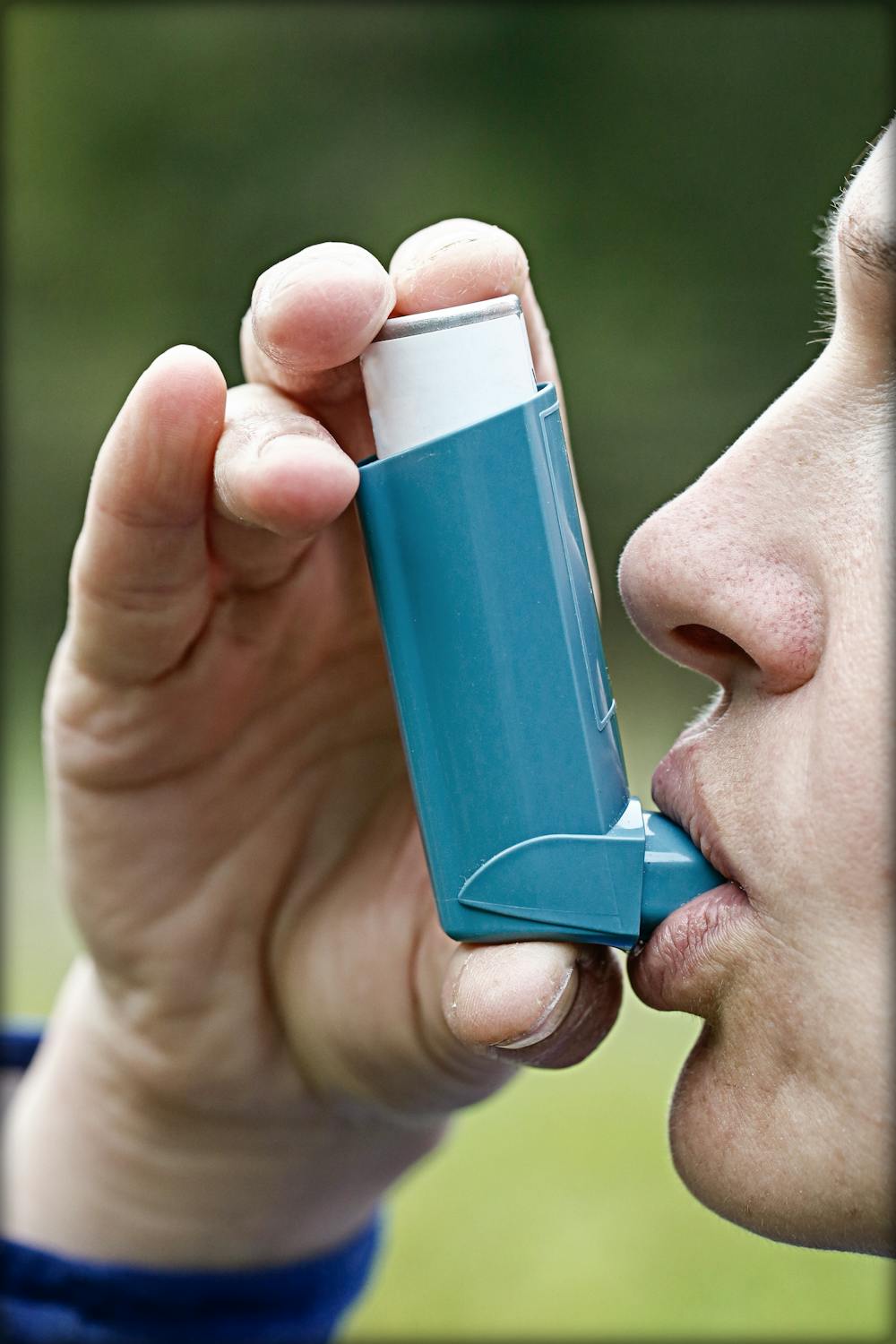
Asthma suffers might be at greater risk.

It is certainly arguable the likelihood of harm for indoor workers is much lower, especially if the air quality in their workplace is the same or even better than the air quality in their homes.

Employers should have up-to-date information about the health of their workers, especially those workers who have pre-existing conditions that might predispose them to harm from smoke.

Among these would be workers who have asthma or other respiratory disorders.

Special steps should be taken to protect them, taking into account their pre-existing conditions.

Meaning of ‘reasonably ought to know’

Employers should be checking up-to-date information on an environment protection authority website and on the website of Safe Work Australia which is the Commonwealth regulator for occupational health and safety laws.

It’s very likely law enforcers will presume the information on these websites constitute information the employer ought to have known in determining the appropriate action to take.

For example, it would be difficult for an employer to argue they didn’t know P2 rated face masks should be provided to workers when the Safe Work Australia website specifically mentions them as an appropriate way of eliminating or reducing air quality hazards.

Meaning of ‘availability of ways to reduce risk’

Safe Work Australia directs employers to have in place measures to manage the risks to health and safety of working outdoors when air quality is reduced, including:

  • working indoors (where possible)

  • rescheduling outdoor work until conditions improve

  • ensuring buildings and equipment are functioning correctly and have not been affected by dust or debris

  • cleaning dust and debris off outdoor surfaces

  • providing personal protective equipment such as eye protection and correctly fitted P2-rated face masks.

Meaning of ‘cost of minimising hazard’

The cost of elimination or minimising hazard will be higher for some measures than others.

For example, it might cost more to direct workers to stay home than to provide face masks.


Read more: Our buildings aren’t made to keep out bushfire smoke. Here’s what you can do


These costs need to be weighed up against the likelihood and degree of potential harm.

If the likelihood and degree of harm is high, it’s unlikely law enforcers will be particularly sympathetic to arguments about cost.

ref. What employers need to know: the legal risk of asking staff to work in smokey air – http://theconversation.com/what-employers-need-to-know-the-legal-risk-of-asking-staff-to-work-in-smokey-air-129432

A life of long weekends is alluring, but the shorter working day may be more practical

Source: The Conversation (Au and NZ) – By Anthony Veal, Adjunct Professor, Business School, University of Technology Sydney

When Microsoft gave its 2,300 employees in Japan five Fridays off in a row, it found productivity jumped 40%.

When financial services company Perpetual Guardian in New Zealand trialled eight Fridays off in a row, its 240 staff reported feeling more committed, stimulated and empowered.


Perpetual Guardian trial outcomes, as measured by researchers from the University of Auckland and Auckland University of Technology. 4dayweek.com, CC BY-SA

Read more: Working four-day weeks for five days’ pay? Research shows it pays off


Around the world there’s renewed interest in reducing the standard working week. But a question arises. Is instituting the four-day week, while retaining the eight-hour workday, the best way to reduce working hours?

Arguably, retaining the five-day week but cutting the working day to seven or six hours is a better way to go.

Shorter days, then weeks

History highlights some of the differences between the two options.

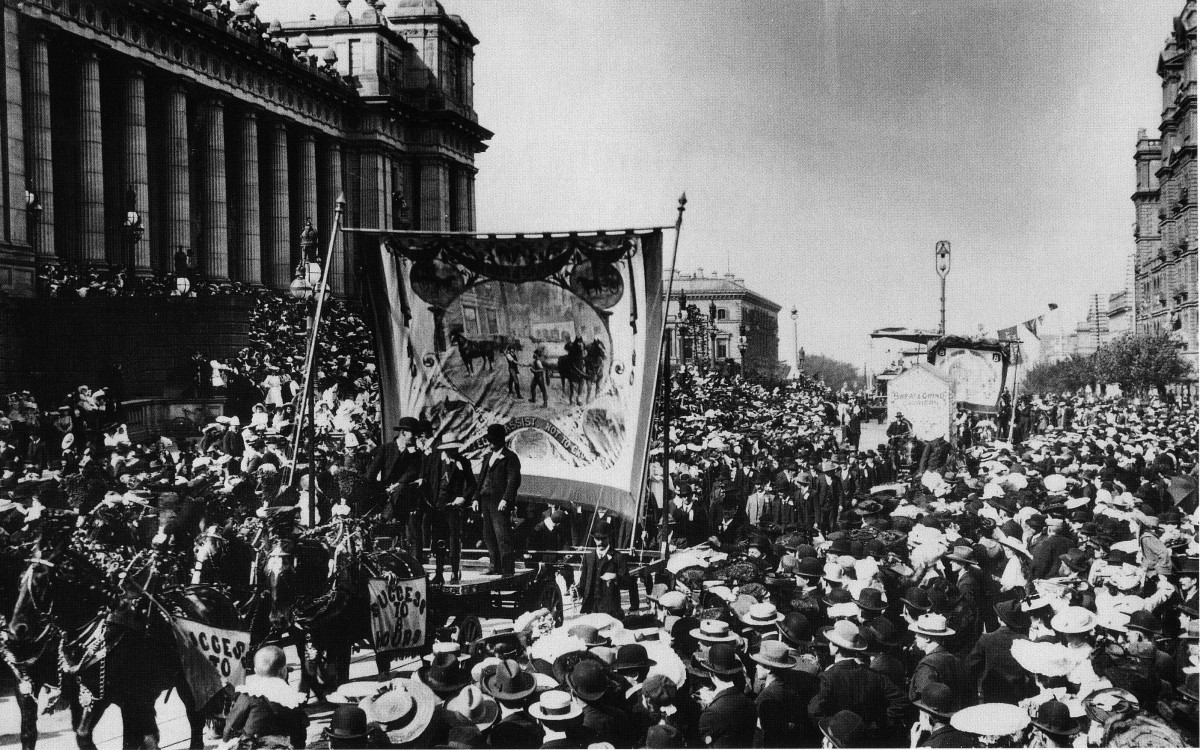
At the height of the Industrial Revolution, in the 1850s, a 12-hour working day and a six-day working week – 72 hours in total – was common.

Mass campaigns, vigorously opposed by business owners, emerged to reduce the length of the working day, initially from 12 hours to ten, then to eight.

Building workers in Victoria, Australia, were among the first in the world to secure an eight-hour day, in 1856. For most workers in most countries, though, it did not become standard until the first decades of the 20th century.

Workers commemorate achieving an eight-hour workday in Melbourne, Australia, circa 1900, The eight-hour day was widespread in Victoria by 1860 and was commemorated with the gazetting in 1879 of a public holiday known as Labour Day. www.wikimedia.org

The campaign for shorter working days was based largely on worker fatigue and health and safety concerns. But it was also argued that working men needed time to read and study, and would be better husbands, fathers and citizens.

Reducing the length of the working week from six days came later in the 20th century.

First it was reduced to five-and-a-half days, then to five, resulting in the creation of “the weekend”. This occurred in most of the industrialised world from the 1940s to 1960s. In Australia the 40-hour five-day working week became the law of the land in 1948. These changes occurred despite two world wars and the Great Depression.

Stalled campaign

In the 1970s, campaigns for reduced working hours ground to a halt in most industrialised countries.

As more women have joined the paid workforce, however, the total workload (paid and unpaid) for the average family increased. This led to concerns about “time squeeze” and overwork.

The issue has re-emerged over the past decade or so from a range of interests, including feminism and environmentalism.


Read more: It’s time to put the 15-hour work week back on the agenda


Back on the agenda

A key concern is still worker fatigue, both mental and physical. This is not just from paid work but also from the growing demands of family and social life in the 21st century. It arises on a daily, weekly, annual and lifetime basis.

We seek to recover from daily fatigue during sleep and daily leisure. Some residual fatigue nevertheless accumulates over the week, which we recover from over the weekend. Over longer periods we recover during public holidays (long weekends) and annual holidays and even, over a lifetime, during retirement.

So would we be better off working fewer hours a day or having a longer weekend?

Arguably it is the pressure to fit family and personal commitments into the few hours between getting home and bedtime that is the main source of today’s time-squeeze, particularly for families. This suggests the priority should be the shorter working day rather than the four-day week.


Read more: The ethics of the 4 day work week. It’s not just about the hours


Sociologist Cynthia Negrey is among those who suggest reducing the length of the workday, especially to mesh with children’s school days, as part of the feminist enterprise to alleviate the “sense of daily time famine” she writes about in her 2012 book, Work Time: Conflict, Control, and Change.

Historical cautions

It’s worth bearing in mind the historical fall in the working week from 72 to 40 hours was achieved at a rate of only about 3.5 hours a decade. The biggest single step – from six to five-and-half days – was a reduction of 8% in working hours. Moving to a six-hour day or a four-day week would involve a reduction of about 20% in one step. It therefore seems practical to campaign for this in a number of stages.

We should also treat with caution results of one-off, short-term, single-company experiments with the four-day week. These typically occur in organisations with leadership and work cultures willing and able to experiment with the concept. Employees are likely to see themselves as “special” and may be conscious of the need to make the experiment work. Painless economy-wide application cannot be taken for granted.

ref. A life of long weekends is alluring, but the shorter working day may be more practical – http://theconversation.com/a-life-of-long-weekends-is-alluring-but-the-shorter-working-day-may-be-more-practical-127817

Why did the NGV put Keith Haring back in the closet?

Source: The Conversation (Au and NZ) – By Marcus O’Donnell, Associate Professor, Pro Vice-Chancellor, Teaching and Learning, Deakin University

There’s a strange absence at the heart of the National Gallery of Victoria’s summer blockbuster: Keith Haring, Jean-Michel Basquiat: Crossing Lines, and it’s not just the ghosts of these two vibrant artists who died tragically young. It’s the ghost of Haring’s sexuality, which although an abiding theme of his work seems to have been deliberately excised.

Keith Haring shot to fame when he started to fill blank, black-papered, ad spaces in the New York underground with his chalk line drawings. He completed over 5,000 of these over a five-year period in the early 1980s.

One of the fascinating pieces in the NGV’s sprawling tribute to Haring and his friend Basquiat, is a short video of Haring at work in the subway.

The speed at which this elfin figure darts around, completing each image in an astonishing single gesture, tells us something about the way Haring put his body into his art. As one critic put it: “He danced his drawings, perceiving the act as a performance and a shamanistic tribal ritual of everyday life.”

Installation view of Keith Haring | Jean-Michel Basquiat: Crossing Lines at NGV International, 1 December 2019 – 11 April 2020. © Estate of Jean-Michel Basquiat. Licensed by Artestar, New York © Keith Haring Foundation Photo: Tom Ross

This shamanistic energy was directly linked to Haring’s sense of himself as a gay man. He told his biographer the flow of his drawings was connected to his sense of sexuality and this sexual/artistic flow was about establishing a “universal connection”.

“Sexual energy may be the single strongest impulse I feel – more than art,” he wrote in his journals.

Yet the words “sexuality” or “gay” don’t appear anywhere in the wall notes for this show. There is one passing reference to his homosexuality: describing a house where one of the works was created, the wall card notes that Haring lived there with his boyfriend Jean Dubose and others.


Read more: ‘Nothing quite prepares you for the impact of this exhibition’: Haring Basquiat at the NGV


But the dance around Haring’s sexuality is even more troubling when we contrast the public notes accompanying the show with the exhibition catalogue. The blurb on the catalogue says both artists “employed signs, symbols and words to explore ideas around race, sexuality, spirituality and other aspects of contemporary life”.

Keith Haring American 1958–90 Untitled 1982 vinyl paint and vinyl ink on vinyl tarpaulin 213.4 x 213.4 cm. Private collection. © Keith Haring Foundation

The introductory wall note in the gallery tells a similar story but omits the reference to sexuality: “Haring and Basquiat were humanists. Indifference was not their style. Each artist’s work speaks of struggles against exploitation, consumer society, repression, racism and genocide.” Why this difference in emphasis?

In the audio tour highlighting how the glittery sheen of Haring and Basquiat’s celebrity often obscured the true significance of their work, Jenny Holzer, an artistic contemporary, comments:

At times it seemed the fluff took over. Which was unfortunate, because the important political and cultural content, the societal references that were in both men’s work, were neglected in the party and money frenzy. You’d have to be dim to miss the gay pride and liberation message in Keith’s work, and that Jean-Michel was a race man, but people didn’t always talk about that.

While the NGV show attends to the theme of race it neglects the theme of gay pride in Haring’s work, seeming to commit the very mistake Holzer warns against.

It is puzzling that none of Haring’s many sexually explicit and gay-themed works have been included in this show: a particularly odd choice when Haring’s groundbreaking gay and HIV themed work would have played well into the exhibtion’s overarching narrative of political involvement. Was this a misguided attempt to make it more “family friendly”? (Many of the images are accompanied by “For kids” wall panels.)

Keith Haring American 1958–90, Untitled 1985, acrylic on canvas 228.6 x 599.4 cm. Private Collection © Keith Haring Foundation

Writing in Vanity Fair in 1997, art critic and former editor of Warhol’s Interview magazine, Ingrid Sischy warned staff at New York’s Whitney gallery not to fall into this trap as they prepared one of the first large Haring retrospectives. It’s sad I am writing this article with a similar message over 20 years later.

“[Haring’s] work … came after a long period of puritanism in art, and his images of the body, sex, and homosexuality were part of the taboo-busting that was as intrinsic to this period as the Reagan rightwingers,” Sischy writes.

The NGV exhibition celebrates both Basquiat and Haring’s connection to Andy Warhol and the lineage and influence is obvious. But Sischy notes that in one respect Haring “went beyond his idol”. Shes continues:

Because of the tenor of the times, Haring’s queer sexuality was much more out-front than Warhol’s enigmatic image, behavior, and sensibility … Haring’s open homosexuality cost him with critics who just couldn’t go there and who didn’t see sex as art, politics, a language all its own for a generation absorbed in exploring it.

Tseng Kwong Chi: Grace Jones, Keith Haring and Andy Warhol at. Paradise Garage, New York, 1983. Photograph: Tseng Kwong Chi © Muna Tseng Dance Project

His response to HIV

What is perhaps most shocking about the NGV show is the complete absence of images representing Haring’s response to HIV. The epidemic is mentioned as one of his political concerns but not depicted except abstractly in the extraordinary late apocalyptic piece Walking in the Rain.

Haring’s Ignorance = Fear Silence = Death was an iconic artistic intervention of the early AIDS epidemic and his widely distributed safe sex images were used in education campaigns that arguably saved lives. Haring set up the Keith Haring Foundation to help continue this HIV education work after his death.

In an interview with Rolling Stone published six months before he died, where he spoke about the importance of his HIV education work, Haring also spoke openly about being HIV positive and facing the end of his “story”.

When asked by the interviewer whether he thought all gay men should be open about their homosexuality he replied that people should be “normal about it”.

In summing up Haring’s distinctiveness historian Michael Murphy writes: “Haring unashamedly and unselfconsciously dared to express homosexual sex as SEX not subtext, oblique references or innuendo.”

For Haring sex and sexuality were a normal part of life and that is why it proliferates as a theme throughout his work from his earliest art school paintings to his extraordinary mural for the NYC LGBTI Centre, completed in the last year of his life to celebrate the 20th anniversary of Stonewall.

Basquiat and Haring at an opening reception for Julian Schnabel at the Whitney Museum of American Art, New York, 1987. © George Hirose

To reduce Basquiat to a black artist or Haring to a gay artist would be a simplistic misreading, ignoring the wonderful complexity of their work.

But if this exhibition had failed to recognise the importance to Basquiat’s work of his experience of being a young, black man, in the same way it has ignored Haring’s gayness, it would have been condemned.

By ignoring Haring’s sexuality the exhibition also misses a central narrative of the crossing lines in the parallel journeys of these two artistic pioneers. They each found a powerful vernacular language for their sense of identity and sense of difference. This is what makes them so relevant and so powerful today.

ref. Why did the NGV put Keith Haring back in the closet? – http://theconversation.com/why-did-the-ngv-put-keith-haring-back-in-the-closet-129443

Bushfires, bots and arson claims: Australia flung in the global disinformation spotlight

Source: The Conversation (Au and NZ) – By Timothy Graham, Senior lecturer, Queensland University of Technology

In the first week of 2020, hashtag #ArsonEmergency became the focal point of a new online narrative surrounding the bushfire crisis.

The message: the cause is arson, not climate change.

Police and bushfire services (and some journalists) have contradicted this claim.

We studied about 300 Twitter accounts driving the #ArsonEmergency hashtag to identify inauthentic behaviour. We found many accounts using #ArsonEmergency were behaving “suspiciously”, compared to those using #AustraliaFire and #BushfireAustralia.

Accounts peddling #ArsonEmergency carried out activity similar to what we’ve witnessed in past disinformation campaigns, such as the coordinated behaviour of Russian trolls during the 2016 US presidential election.

Bots, trolls and trollbots

The most effective disinformation campaigns use bot and troll accounts to infiltrate genuine political discussion, and shift it towards a different “master narrative”.

Bots and trolls have been a thorn in the side of fruitful political debate since Twitter’s early days. They mimic genuine opinions, akin to what a concerned citizen might display, with a goal of persuading others and gaining attention.

Bots are usually automated (acting without constant human oversight) and perform simple functions, such as retweeting or repeatedly pushing one type of content.

Troll accounts are controlled by humans. They try to stir controversy, hinder healthy debate and simulate fake grassroots movements. They aim to persuade, deceive and cause conflict.

We’ve observed both troll and bot accounts spouting disinformation regarding the bushfires on Twitter. We were able to distinguish these accounts as being inauthentic for two reasons.

First, we used sophisticated software tools including tweetbotornot, Botometer, and Bot Sentinel.

There are various definitions for the word “bot” or “troll”. Bot Sentinel says:

Propaganda bots are pieces of code that utilize Twitter API to automatically follow, tweet, or retweet other accounts bolstering a political agenda. Propaganda bots are designed to be polarizing and often promote content intended to be deceptive… Trollbot is a classification we created to describe human controlled accounts who exhibit troll-like behavior.

Some of these accounts frequently retweet known propaganda and fake news accounts, and they engage in repetitive bot-like activity. Other trollbot accounts target and harass specific Twitter accounts as part of a coordinated harassment campaign. Ideology, political affiliation, religious beliefs, and geographic location are not factors when determining the classification of a Twitter account.

These machine learning tools compared the behaviour of known bots and trolls with the accounts tweeting the hashtags #ArsonEmergency, #AustraliaFire, and #BushfireAustralia. From this, they provided a “score” for each account suggesting how likely it was to be a bot or troll account.

We also manually analysed the Twitter activity of suspicious accounts and the characteristics of their profiles, to validate the origins of #ArsonEmergency, as well as the potential motivations of the accounts spreading the hashtag.

Who to blame?

Unfortunately, we don’t know who is behind these accounts, as we can only access trace data such as tweet text and basic account information.

This graph shows how many times #ArsonEmergency was tweeted between December 31 last year and January 8 this year:

On the vertical axis is the number of tweets over time which featured #ArsonEmergency. On January 7, there were 4726 tweets. Author provided

Previous bot and troll campaigns have been thought to be the work of foreign interference, such as Russian trolls, or PR firms hired to distract and manipulate voters.

The New York Times has also reported on perceptions that media magnate Rupert Murdoch is influencing Australia’s bushfire debate.


Read more: Weather bureau says hottest, driest year on record led to extreme bushfire season


Weeding-out inauthentic behaviour

In late November, some Twitter accounts began using #ArsonEmergency to counter evidence that climate change is linked to the severity of the bushfire crisis.

Below is one of the earliest examples of an attempt to replace #ClimateEmergency with #ArsonEmergency. The accounts tried to get #ArsonEmergency trending to drown out dialogue acknowledging the link between climate change and bushfires.

We suspect the origins of the #ArsonEmergency debacle can be traced back to a few accounts. Author provided

The hashtag was only tweeted a few times in 2019, but gained traction this year in a sustained effort by about 300 accounts.

A much larger portion of bot and troll-like accounts pushed #ArsonEmergency, than they did #AustraliaFire and #BushfireAustralia.

The narrative was then adopted by genuine accounts who furthered its spread.

On multiple occasions, we noticed suspicious accounts countering expert opinions while using the #ArsonEmergency hashtag.

The inauthentic accounts engaged with genuine users in an effort to persuade them. author provided

Bad publicity

Since media coverage has shone light on the disinformation campaign, #ArsonEmergency has gained even more prominence, but in a different light.

Some journalists are acknowledging the role of disinformation bushfire crisis – and countering narrative the Australia has an arson emergency. However, the campaign does indicate Australia has a climate denial problem.

What’s clear to me is that Australia has been propelled into the global disinformation battlefield.


Read more: Watching our politicians fumble through the bushfire crisis, I’m overwhelmed by déjà vu


Keep your eyes peeled

It’s difficult to debunk disinformation, as it often contains a grain of truth. In many cases, it leverages people’s previously held beliefs and biases.

Humans are particularly vulnerable to disinformation in times of emergency, or when addressing contentious issues like climate change.

Online users, especially journalists, need to stay on their toes.

The accounts we come across on social media may not represent genuine citizens and their concerns. A trending hashtag may be trying to mislead the public.

Right now, it’s more important than ever for us to prioritise factual news from reliable sources – and identify and combat disinformation. The Earth’s future could depend on it.

ref. Bushfires, bots and arson claims: Australia flung in the global disinformation spotlight – http://theconversation.com/bushfires-bots-and-arson-claims-australia-flung-in-the-global-disinformation-spotlight-129556

What investigators should be looking for in the Iran plane crash: an expert explains

Source: The Conversation (Au and NZ) – By Geoffrey Dell, Associate Professor/Discipline Leader Accident Investigation and Forensics, CQUniversity Australia

While there is much speculation about the cause of the Ukrainian airliner that crashed after take-off from Tehran’s airport this week, killing all 176 people on board, there is presently very little factual information to go on.

Western intelligence has indicated a surface-to-air missile likely hit the plane in what may have been an “unintentional” act – an assertion Iran quickly dismissed.

As with any other crash, the world aviation community needs to know what caused this one in the interest of ongoing flight safety.

Political tensions between Iran and the US may make the investigation more challenging, but they should not prevent a thorough systematic analysis from occurring and the cause of the crash to ultimately be established.


Read more: Iran and US step back from all-out war, giving Trump a win (for now)


Who will have access to the black boxes?

The flight recorders hold the key to establishing what actually happened and why. And here’s where the political tensions are most problematic – Iran initially said it would not hand over the black boxes to the manufacturer of the aircraft, Boeing, or the US.

But new reports say Iran has now invited the US National Transportation Safety Board and Boeing to take part in the investigation.

Families and friends of the victims of the crashed Ukraine airliner light candles at Kiev’s airport. SERGEY DOLZHENKO/EPA

Under the International Civil Aviation Organisation Annex 13 convention, the US has the right to appoint an adviser to the investigation, as does the aircraft manufacturer. The convention presumes a level of cooperation between all parties involved in crash investigations, which could prove difficult in this case. But that doesn’t necessarily mean a proper investigation won’t or can’t be conducted.

Responsibility for the investigation sits with the Iranians, but under the UN Civil Aviation Conventions, they can request assistance from any other country, if they don’t have the capacity to conduct it themselves.

There are many other countries with the necessary expertise to assist, including recovering flight data from recorders with very significant damage. France, Canada, UK, the Netherlands, Germany and Australia could all help, for example.

Other countries can only step in, however, if invited by Iran or if Iran chooses not to conduct the investigation.

What’s most important is that whoever leads the investigation must have access to all the information – the wreckage itself, flight data, radar data, maintenance records, crew data, flight plans, load sheets, and passenger and cargo manifests. Otherwise, the wrong conclusions can be reached.

Why is a field investigation important?

There also needs to be a parallel field investigation analysing the wreckage.

First, investigators should be ensuring they have accounted for all the wreckage. If some parts separated from the aircraft in-flight, they may be found some distance from the main wreckage site and may hold key clues that could lead to a better understanding of the cause of the crash.

As such, the terrain under the flight path needs to be surveyed carefully to locate all items from the aircraft.

Clearly, it will also be important to examine the wreckage of the engines for any evidence of pre-crash damage.


Read more: Here’s how airplane crash investigations work, according to an aviation safety expert


For example, if a fire had been burning inside the engine cowling, there may be evidence of scorching. Analysis of the internal engine components should also make clear whether the engines were still delivering power when the plane made impact with the ground or if there was a pre-crash structural or component failure.

Investigators should also look at the wing and fuselage surfaces next to the engines for any pre-impact damage. If an engine failure occurred, there may be evidence of impact damage from engine components after they burst out of the armoured casing.

This was the case with the fatal Air France Concorde crash in 2000, as well as the uncontained engine failure that nearly caused Qantas flight QF32 to crash en route from Singapore to Sydney in 2010.

Can evidence show if a missile hit the plane?

Analysing the aircraft engines, wing and fuselage surfaces may also provide evidence if the aircraft was struck by a missile.

This was the case with Malaysia Airlines flight MH17, which was shot down over Ukraine in 2014, killing all 298 people aboard. There was clear evidence of the aircraft structures being penetrated from outside the plane by high-speed particles.

Similar forensic analysis can be conducted on the remnants of the Boeing 737 in Iran, even if a high degree of fragmentation occurred in the crash. This should reveal the truth if a missile was responsible.


Read more: MH17 charges: who the suspects are, what they’re charged with, and what happens next


Would Boeing’s exclusion hurt the investigation?

Of course, it would be usual for the aircraft manufacturer to be involved. After all, it knows more about the technologies involved in building and operating the aircraft than anyone else.

That said, there are many global agencies that also know a lot about the engineering and operation of the B737-800 plane, such as the airworthiness authorities in other countries, who could be called upon to participate.

No doubt, Ukraine will be heavily involved, as will Canada, due to the number of Canadians who lost their lives in the crash. So, if Boeing was excluded from the investigation, it might be a set-back, but not a show-stopper.

Boeing is, however, responsible for assuring the ongoing safety standards for the global B737 fleet, so whether it is directly involved in the investigation or not, it is imperative the reasons for the crash are shared with global aviation agencies, the manufacturer and all other airlines.

It is worth reflecting in these sad occasions that the purpose of a crash investigation is to prevent future incidents. Unless the actual cause of this crash is understood, any possible problems in the global flight safety system may go unrectified, making the risk of future crashes higher than it otherwise would be.

The impact of the crash on the families of the victims is also immense and immeasurable. This is another reason why a proper, thorough and systematic investigation is so important. It ensures those who have tragically lost their lives, and their families and friends, will not have suffered in vain.

ref. What investigators should be looking for in the Iran plane crash: an expert explains – http://theconversation.com/what-investigators-should-be-looking-for-in-the-iran-plane-crash-an-expert-explains-129689

Strength from perpetual grief: how Aboriginal people experience the bushfire crisis

Source: The Conversation (Au and NZ) – By Bhiamie Williamson, Research Associate & PhD Candidate, Australian National University

How do you support people forever attached to a landscape after an inferno tears through their homelands: decimating native food sources, burning through ancient scarred trees and destroying ancestral and totemic plants and animals?

The fact is, the experience of Aboriginal peoples in the fire crisis engulfing much of Australia is vastly different to non-Indigenous peoples.

Colonial legacies of eradication, dispossession, assimilation and racism continue to impact the lived realities of Aboriginal peoples. Added to this is the widespread exclusion of our peoples from accessing and managing traditional homelands. These factors compound the trauma of these unprecedented fires.

It’s important to recognise that not only do we grieve for our communities, but for our non-human relations. AAP Image/Dean Lewins

As Australia picks up the pieces from these fires, it’s more important than ever to understand the unique grief Aboriginal peoples experience. Only through this understanding can effective strategies be put in place to support our communities to recover.

Perpetual grief

Aboriginal peoples live with a sense of perpetual grief. It stems from the as-yet-unresolved matter of the invasion and subsequent colonisation of our homelands.

While there are many instances of colonial trauma inflicted upon Aboriginal peoples – including the removal of children and the suppression of culture, ceremony and language – dispossession of Country remains paramount. Dispossessing people of their lands is a hallmark of colonisation.

Australian laws have changed to partially return Aboriginal peoples’ lands and waters, and Aboriginal people have made their best efforts to advocate for more effective management of Country. But despite this, the majority of our peoples have been consigned to the margins in managing our homelands.

Aboriginal people have watched on and been ignored as homelands have been mismanaged and neglected.

Oliver Costello is chief executive of Firesticks Alliance, an Indigenous-led network that aims to re-invigorate cultural burning. As he puts it:

Since colonisation, many Indigenous people have been removed from their land, and their cultural fire management practices have been constrained by authorities, informed by Western views of fire and land management.

In this way, settler-colonialism is not historical, but a lived experience. And the growing reality of climate change adds to these anxieties.

It’s also important to recognise that our people grieve not only for our communities, but for our non-human relations. Aboriginal peoples’ cultural identity comes from the land.


Read more: Our land is burning, and western science does not have all the answers


As such, Aboriginal cultural lives and livelihoods continue to be tied to the land, including landscape features such as waterholes, valleys and mountains, as well as native animals and plants.

The decimation caused by the fires deeply impacts the existence of Aboriginal peoples and in the most severe hit areas, threatens Aboriginal groups as distinct cultural beings attached to the land. As The Guardian’s Indigenous affairs editor Lorena Allam recently wrote:

Like you, I’ve watched in anguish and horror as fire lays waste to precious Yuin land, taking everything with it – lives, homes, animals, trees – but for First Nations people it is also burning up our memories, our sacred places, all the things which make us who we are.

For Aboriginal people then, who live with the trauma of dispossession and neglect and now, the trauma of catastrophic fire, our grief is immeasurably different to that of non-Indigenous people.

Bushfire recovery must consider culture

As we come to terms with the fires’ devastation, Australia must turn its gaze to recovery. The field of community recovery offers valuable insights into how groups of people can come together and move forward after disasters.


Read more: New research turns Tasmanian Aboriginal history on its head. The results will help care for the land


But an examination of research and commentary in this area reveals how poorly non-Indigenous Australia (and indeed, the international field of community recovery) understands the needs of Aboriginal people.

The definition of “community” is not explicitly addressed, and thus is taken as a single socio-cultural group of people.

But research in Australia and overseas has demonstrated that for Aboriginal people, healing from trauma – whether historical or contemporary – is a cultural and spiritual process and inherently tied to land.

Bushfires have raged across Australia, and the recovery process must not leave out Aboriginal Australians. Dean Lewins/AAP

The culture-neutral standpoint in community recovery research as yet does not acknowledge these differences. Without considering the historical, political and cultural contexts that continue to define the lives of Aboriginal peoples, responses to the crisis may be inadequate and inappropriate.

Resilience in the face of ongoing trauma

The long-term effects of colonisation has meant Aboriginal communities are (for better or worse) accustomed to living with catastrophic changes to their societies and lands, adjusting and adapting to keep functioning.

Experts consider these resilience traits as integral for communities to survive and recover from natural disasters.

In this way, the resilience of Aboriginal communities fashioned through centuries of colonisation, coupled with adequate support, means Aboriginal communities in fire-affected areas are well placed to not only recover, but to do so quickly.


Read more: Australia can expect far more fire catastrophes. A proper disaster plan is worth paying for


This is a salient lesson for agencies and other non-government organisations entrusted to lead the disaster recovery process.

The community characteristics that enable effective and timely community recovery, such as close social links and shared histories, already exist in the Aboriginal communities affected.

Moving forward

The agency in charge of leading the recovery in bushfire-affected areas must begin respectfully and appropriately. And they must be equipped with the basic knowledge of our peoples’ different circumstances.

It’s important to note this isn’t “special treatment”. Instead, it recognises that policy and practice must be fit-for-purpose and, at the very least, not do further harm.

If agencies and non-government organisations responsible for leading the recovery from these fires aren’t well-prepared, they risk inflicting new trauma on Aboriginal communities.

The National Disability Insurance Agency offers an example of how to engage with Aboriginal people in culturally sensitive ways. This includes thinking about Country, culture and community, and working with each community’s values and customs to establish respectful, trusting relationships.


Read more: How should leaders respond to disasters? Be visible, offer real comfort – and don’t force handshakes


The new bushfire recovery agency must use a similar strategy. This would acknowledge both the historical experiences of Aboriginal peoples and our inherent strengths as communities that have not only survived, but remain connected to our homelands.

In this way, perhaps the bushfire crisis might have some positive longer-term outcomes, opening new doors to collaboration with Aboriginal people, drawing on our strengths and values and prioritising our unique interests.

ref. Strength from perpetual grief: how Aboriginal people experience the bushfire crisis – http://theconversation.com/strength-from-perpetual-grief-how-aboriginal-people-experience-the-bushfire-crisis-129448

6 things to ask yourself before you share a bushfire map on social media

Source: The Conversation (Au and NZ) – By Juan Pablo Guerschman, Senior Research Scientist, CSIRO

In recent days, many worrying bushfire maps have been circulating online, some appearing to suggest all of Australia is burning.

You might have seen this example, decried by some as misleading, prompting this Instagram post by its creator:

As he explained, the image isn’t a NASA photo. What a satellite actually “sees” is quite different.

I’ll explain how we use data collected by satellites to estimate how much of an area is burning, or has already been burnt, and what this information should look like once it’s mapped.


Read more: A crisis of underinsurance threatens to scar rural Australia permanently


Reflective images

When astronauts look out their window in space, this is what they see:

It’s similar to what you might see from an aeroplane window, but higher and covering a wider area.

As you read this, many unmanned satellites are orbiting and photographing Earth. These images are used to monitor fires in real-time. They fall into two categories: reflective and thermal.

Reflective images capture information in the visible range of the electromagnetic spectrum (in other words, what we can see). But they also capture information in wavelengths we can’t see, such as infrared wavelengths.

If we use only the visible wavelengths, we can render the image similar to what we might see with the naked eye from a satellite. We call these “true colour” images.

This is a true colour image of south-east Australia, taken on January 4th 2020 from the MODIS instrument on the Aqua satellite. Fire smoke is grey, clouds are white, forests are dark green, brown areas are dryland agricultural areas, and the ocean is blue. NASA Worldview / https://go.nasa.gov/307pDDX

Note that the image doesn’t have political boundaries, as these aren’t physical features. To make satellite imagery useful for navigation, we overlay the map with location points.

The same image shown as true colour, with the relevant geographical features overlaid. NASA Worldview / https://go.nasa.gov/2TafEMH

From this, we can predict where the fires are by looking at the smoke. However, the fires themselves are not directly visible.

‘False colour’ images

Shortwave infrared bands are less sensitive to smoke and more sensitive to fire, which means they can tell us where fire is present.

Converting these wavelengths into visible colours produces what we call “false colour” images. For instance:

The same image, this time shown as false colour. Now, the fire smoke is partially transparent grey while the clouds aren’t. Red shows the active fires and brown shows where bushfires have recently burnt. NASA Worldview / https://go.nasa.gov/2NhzRfN

In this shortwave infrared image, we start to “see” under the smoke, and can identify active fires. We can also learn more about the areas that are already burnt.

Thermal and hotspots

As their name suggests, thermal images measure how hot or cold everything in the frame is. Active fires are detected as “hotspots” and mapped as points on the surface.

While reflective imagery is only useful when obtained by a satellite during daytime, thermal hotspots can be measured at night – doubling our capacity to observe active fires.

The same image shown as false color, with hotspots overlaid in red. NASA Worldview / https://go.nasa.gov/2rZNIj9

This information can be used to create maps showing the aggregation of hotspots over several days, weeks or months.

Geoscience Australia’s Digital Earth hotspots service shows hotspots across the continent in the last 72 hours. It’s worth reading the “about” section to learn the limitations or potential for error in the map.


Read more: Spread the word: the value of local information in disaster response


When hotspots, which show “hot” pixels, are shown as extremely big icons, or are collected over long periods, the results can be deceiving. They can indicate a much larger area to be under fire than what is really burning.

For example, it would be wrong to believe all the areas in red in the map below are burning or have already burnt. It’s also unclear over what period of time the hotspots were aggregated.

The ‘world map of fire hotspots’ from the Environmental Investigation Agency. Environmental Investigation Agency / https://eia-international.org/news/watching-the-world-burn-fires-threaten-the-worlds-tropical-forests-and-millions-of-people/

Get smart

Considering all of the above, there are some key questions you can ask to gauge the authenticity of a bushfire map. These are:

• Where does this map come from, and who produced it?
• is this a single satellite image, or one using hotspots overlaid on a map? • what are the colours representing? • do I know when this was taken? • if this map depicts hotspots, over what period of time were they collected? A day, a whole year? • is the size of the hotspots representative of the area that is actually burning?

So, the next time you see a bushfire map, think twice before pressing the share button.

ref. 6 things to ask yourself before you share a bushfire map on social media – http://theconversation.com/6-things-to-ask-yourself-before-you-share-a-bushfire-map-on-social-media-129557

We know bushfire smoke affects our health, but the long-term consequences are hazy

Source: The Conversation (Au and NZ) – By Brian Oliver, Research Leader in Respiratory cellular and molecular biology at the Woolcock Institute of Medical Research and Professor, Faculty of Science, University of Technology Sydney

In previous years, Australians might have been exposed to bushfire smoke for a few days, or even a week. But this bushfire season is extreme in every respect. Smoke haze has now regularly featured in Australian weather reports for several weeks, stretching across months in some areas.

What we considered to be short-term exposure we must now call medium-term exposure.

Given this is a new phenomenon, we don’t know for sure what prolonged exposure to bushfire smoke could mean for future health. But here’s what air pollution and health data can tell us about the sorts of harms we might be looking at.


Read more: Climate change set to increase air pollution deaths by hundreds of thousands by 2100


Short-term effects

We know poor air quality is having immediate effects, from irritated eyes and throats, to more serious incidents requiring hospital admission – particularly for people with existing respiratory and heart conditions.

After the smoke haze hit Melbourne on Monday, Ambulance Victoria recorded a 51% increase in calls for breathing difficulties.

This aligns with Australian and international research on the acute effects of exposure to bushfire smoke.

But the long-term effects aren’t so clear.

Long-term effects: what we know

When considering the long-term health consequences of air pollution, we draw on data from heavily polluted regions, typically in Africa, or Asia, where people are exposed to high levels of airborne pollution for years.

It’s no surprise long-term exposure to air pollution negatively affects health over their lifetime. It’s associated with an increased risk of several cancers, and chronic health conditions like respiratory and heart disease.

The World Health Organisation estimates ambient air pollution contributes to 4.2 million premature deaths globally per year.

A recent study in China reported long-term exposure to a high concentration of ultrafine particles called PM2.5 (which we find in bushfire smoke) is linked to an increased risk of stroke.


Read more: How does poor air quality from bushfire smoke affect our health?


We also know the dose of exposure is important. So the worse the pollution, the greater the the health effects.

It’s likely some of these long-term effects will occur in Australia if prolonged bushfires become an annual event.

Experimental studies

Observational studies, like the Chinese one mentioned above, demonstrate the long-term health effects of long-term exposure to air pollution. But we don’t really have any studies like this following populations which have experienced short- or medium-term exposure.

To explore the health risks of more limited exposure, we can look to experimental data from cell and animal models.

These studies follow the models for days (short-term) or weeks (medium-term). They show exposure to any type of airborne pollution – from traffic, bushfires, wood or coal smoke – is detrimental for health.

The results show increased inflammation in the body, and depending on the model, increased incidence of respiratory or heart disease.

What about bushfire smoke?

We don’t have a lot of experimental data on the effects of bushfire smoke specifically, apart from a few studies on cells in the lab.

In my lab we’ve found the short-term in-vitro effects of bushfire smoke are comparable to the smoke from cigarettes. This does not however mean the long-term heath effects would be the same.


Read more: Pregnant women should take extra care to minimise their exposure to bushfire smoke


If we think about what’s burning during a bushfire – grass, leaves, twigs, bushes and trees – it’s also reasonable to draw on experimental data from wood smoke.

Wood smoke contains at least 200 different chemicals; some of them possible carcinogens.

In one small study, ten volunteers were exposed to wood smoke for four 15 minute periods over two hours. Afterwards, participants experienced increased neutophis, a type of agressive white blood cell, in both their lungs and circulation. The concentration of particulate matter in the wood smoke was lower than the levels we’ve seen in Sydney.

Different parts of the world will experience different types of air pollution. From shutterstock.com

These short term studies show bushfire smoke is toxic, and it’s this toxicity which is likely to cause long-term effects.

One review found lifelong exposure to wood smoke, for example from indoor heaters, is associated with a 20% increased risk of developing lung cancer. Though it’s important to remember this is long-term exposure; the risks associated with medium-term exposure are not yet known.

How can we apply these findings?

Taking data from one type of airborne pollution and applying it to different pollutants – for example comparing the smoke from only one type of wood to bushfire pollution – is complex. The chemical make up is likely to differ between pollutants, so we need to be cautious extrapolating results.

We also need to be wary about how we translate results from cell and animal studies to humans. Different people are likely to respond to bushfire smoke differently. Our genetic make up is important here.

And with variable factors like at what age the exposure starts, how long it lasts, and other factors we’re exposed to during our lives (which don’t exist in a petri dish), it’s difficult to ascertain how many people will be at risk, and who in particular.

Looking past the haze

The human body actually has a remarkable capacity to cope with air pollution. It appears our genes help protect us from some of the toxic effects of smoke inhalation.

But this doesn’t mean we’re immune to the effect of bushfire smoke; just that we can tolerate a certain amount.

So would a once in a lifetime medium-term exposure have a chronic effect? At the moment there’s no way of answering this.


Read more: How rising temperatures affect our health


But if, as many people fear, this medium term exposure becomes a regular event, it could cross into the long-term exposure we see in some countries, where people are exposed to poor air quality for most of the year. In this scenario, there’s clear evidence we’ll be at higher risk of disease and premature death.

For now, we desperately need studies to help us understand the effects of medium-term exposure to bushfire smoke.

ref. We know bushfire smoke affects our health, but the long-term consequences are hazy – http://theconversation.com/we-know-bushfire-smoke-affects-our-health-but-the-long-term-consequences-are-hazy-129451

Watching Australia’s politicians fumble through the bushfire crisis, I’m overwhelmed by déjà vu

Source: The Conversation (Au and NZ) – By Marc Hudson, Researcher on sociomaterial transformations, social movements, Keele University

As someone who has studied Australian climate policy and politics closely, this summer’s bushfire crisis have been both heartbreaking and bewildering. The grave warnings politicians ignored for so long have now come to pass.

The fires may be without precedent, but these dark weeks have also brought an overwhelming sense of déjà vu. It’s hard to believe, but the Morrison government’s fumbling response to the fires and the broader climate crisis is in many ways history repeating.

From the disastrous optics of Prime Minister Scott Morrison’s trip to Hawaii to blaming conservationists for the fires, our politicians keep making the same blunders and rolling out the same failed strategies.

Prime Minister Scott Morrison was savaged by critics for refusing to meet former fire chiefs. AAP

Here are five recurring themes in Australian politics when it comes to climate change and bushfires:

1. Blaming ‘greenies’

As the fire season ramped up in November last year, New South Wales Nationals leader John Barilaro accused the Greens of preventing governments from conducting hazard reduction burning, implying the party should shoulder blame for the fires.

“We’ve got to do better and I know that we don’t do enough hazard reduction […] because of the ideological position from the Greens,” he said.


Read more: How should leaders respond to disasters? Be visible, offer real comfort – and don’t force handshakes


Such sentiment, which has been thoroughly debunked, regularly surfaces when bushfires rage.

Following the 2003 Canberra fires and 2009 Victorian fires, the forest industry said conservationists were preventing state governments from conducting hazard reduction burns.

After Victoria’s fires, former West Australian MP Wilson Tuckey also blamed the Greens, and parties seeking their preferences, for preventing controlled burns and causing the crisis.

Wrongly blaming green groups for preventing controlled burns is a recurring political theme. Jason Edwards/AAP

2. Stoking a city versus country divide

In November last year, Nationals leader Michael McCormack sneered that those who made the link between climate change and bushfires were “raving inner-city lunatics” and “woke capital-city greenies”.

McCormack continues a long tradition of those opposed to strong climate action claiming only inner-city dwellers care about the issue.


Read more: Weather bureau says hottest, driest year on record led to extreme bushfire season


It began in the late 1980s, when the the “greenhouse effect” first became a public issue. Some politicians derided it as just another greenies scare campaign, including frontbencher in the Hawke Labor government, Peter Walsh.

Walsh, contemptuous of the Greens movement, continued to rail against climate action after leaving politics. He reportedly described the science around global warming as “highly speculative” and as late as 2008 claimed action on climate “would land us in Middle Ages.”.

Nationals leader Michael McCormack, pictured in Question Time, has ridiculed those making a link between climate change and bushfires. Lukas Coch/AAP

3. Experts ignored by politicians

Since April last year, former fire chiefs have implored the Morrison government to act on climate change and better prepare the nation for extreme fire seasons ahead. The government would not meet the experts to hear the advice, let alone implement it.

Successive governments have form when it comes to ignoring experts on climate matters. In September 1994 the CSIRO’s then top climate scientist, Graeme Pearman, briefed the Labor government’s cabinet about the likely impacts of climate change, as a debate over whether to institute a carbon tax heated up. Despite the warning, no tax was implemented.

Pearman retired a decade later under the Coalition government, reportedly having been asked by his superiors to resign for expressing views on climate change at odds with government policy.

A group of esteemed former fire chiefs were denied a hearing with the Morrison government. Mick Tsikas/AAP

4. Leaders not fronting up

Morrison’s decision to take a family holiday in Hawaii as the bushfire crisis grew lost him serious political skin.

Some argue, rightly, that symbolism is less important than substance, and so Morrison’s trip is itself irrelevant. But symbolism creates or destroys both morale, and the possibility of stronger political action.

In 1992 newly minted Labor prime minister Paul Keating sent environment minister Ros Kelly to the Rio Earth Summit, prompting one journalist to observe he was “preoccupied with winning the upcoming election (and) said he wasn’t going all the way to Rio to give a six-minute speech”.

It made Australia the only OECD nation not represented by its head of state, and sent the message that Australia was not taking a serious approach to the discussions.

A cartoon by The Conversation’s Wes Mountain depicting the reaction of Nationals leader Michael McCormack (left) and Treasurer Josh Frydenberg (right) to Scott Morrison’s Hawaii trip. Wes Mountain/The Conversation

5. ‘Jobs, jobs, jobs’ mantra

The Bureau of Meteorology this week confirmed this season’s horror bushfire crisis is linked to climate change. Planetary warming is clearly a threat to the nation’s economic well-being.

However Australian governments have routinely created a false dichotomy between environmental protection and jobs. Most recently, we’ve seen it in the Coalition government’s support for the Adani coal mine in central Queensland, and its repeated mantra of “jobs jobs jobs”.

The strategy has been used before. After the Franklin Dam fight in 1983, concern over environmental issues entered the political mainstream. But as former Labor science minister Barry Jones said later, that changed in 1991 when economic recession hit.

“Jobs, jobs, jobs became the priority and in some quarters there was a cynical reaction suggesting that environmental issues were luxuries which characterised affluent times […] This is a criminally short-sighted view,” he said.

Franklin Dam protesters in southwest Tasmania in 1982. The debate thrust environmental concern onto the political agenda. Sadly, it was short-lived. NATIONAL ARCHIVES OF AUSTRALIA

What to do?

Only sustained citizen pressure will prevent a repeat of the past 30 years of political failures on climate change. The public must stay informed and demand better from our elected representatives.

Politicians can, when pressed, make better decisions. In April last year, the New Zealand government banned offshore oil and gas exploration after years of public pressure. And the following month, the UK Parliament declared a climate emergency after months of protests by activist group Extinction Rebellion.

It’s often said those who fail to learn from history are doomed to repeat it. But the world must act radically in the next decade to avoid catastrophic global warming. We cannot afford another 30 years of the same old mistakes.


Read more: A season in hell: bushfires push at least 20 threatened species closer to extinction


ref. Watching our politicians fumble through the bushfire crisis, I’m overwhelmed by déjà vu – http://theconversation.com/watching-our-politicians-fumble-through-the-bushfire-crisis-im-overwhelmed-by-deja-vu-129338

High hurdle rates are holding back businesses, but perhaps they should be

Source: The Conversation (Au and NZ) – By Salvatore Ferraro, PhD candidate, RMIT University

Calls by the head of the Australian Competition and Consumer Commission Rod Sims for Australian businesses to cut the hurdle rates of return they expect on new investments should be taken with a grain of salt.

A hurdle rate is the minimum annual return that an investor or firm demands in order to allow a new project to go ahead.

For years, interest rates have been falling, cutting the cost of borrowing, but the hurdle rates of return demanded from that borrowing have remained little changed.

Sims told the Australian Financial Review this month that the rates of return demanded should be lower because interest rates were lower.

ACCC Chairman Rod Sims. JOEL CARRETT/AAP

“We don’t want to lose investment that we should otherwise get because of hurdle rates that are too high,” he said.

“And we don’t want overseas companies coming in and buying our assets because they’ve got more realistic hurdle rates”.

It is straight from the Reserve Bank’s playbook.

Both the present Reserve Bank governor Phillip Lowe and his predecessor Glenn Stevens have said the same thing.

“We hear reports that a hurdle rate of return of 13-14% has been hard-wired into the corporate culture in some companies,” Lowe said in October.

Yet, “at low interest rates, many investments that didn’t make sense at higher interest rates should now make sense”.

This is especially so for investments with long-term payoffs, because future returns no longer need to be discounted as highly. This means that low interest rates give us the opportunity to lengthen our horizons and think about projects with really long-term payoffs.

Lowe and Sims are right to observe that some hurdle rates remain surprisingly high.

What if the reluctance to invest is rational?

Investment in mining and manufacturing projects is way below earlier peaks notwithstanding record low interest rates, even though investment in other industries is close to its historical high.

Which suggests something else could be in play, and not only here. Some overseas hurdle rates are as high as 12% to 15%.

A dampened appetite for risk is one explanation, thanks to a rise in global economic policy uncertainty. Another is challenging business conditions, especially in Australia’s two largest sectors; banking and resources.

Consensus estimates of future profits have been downgraded.

Profit forecasts have been downgraded

Among the ASX 200, which are the 200 most valuable companies traded on the Australian Securities Exchange, the consensus forecast for annual returns has slid to its lowest point in three years. Among the major banks consensus estimates have slid to their lowest level in two decades.

This largely reflects the lift in minimum capital requirements imposed by the Australian Prudential Regulation Authority, higher compliance costs associated with the implementation of the banking royal commission recommendations and the divestment of high returning wealth management businesses whose activities are no longer tenable for banks in the wake of the royal commission.

Demands from shareholders have been upgraded

In contrast, the expected profitability of mining companies has improved. But they are increasingly disciplined about how they use their capital, focused instead on generating free cash flow.

They are conscious of catering to greater demand from their shareholders for dividends and share buybacks.

Those shareholders remember well the destructive growth strategies pursued at the peak of the China boom a decade ago.

Most are happy that the dividend payout ratio for the sector has climbed well above long term norms to 60%, meaning that six dollars out of every ten dollars of profit is paid out to shareholders rather than invested back in the business.


Read more: We asked 13 economists how to fix things. All back the RBA governor over the treasurer


Against this backdrop, the competition watchdog and the Reserve Bank bemoaning what they consider to be stubbornly high hurdle rates will do little to precipitate a recovery in investment.

The Reserve Bank would achieve more by making an unambiguous commitment to do whatever it takes to achieve its inflation target, which it has undershot for the past five years.

It would boost expectations for wages growth, which remains close to record lows, boost consumer spending, and make investment more worthwhile.

ref. High hurdle rates are holding back businesses, but perhaps they should be – http://theconversation.com/high-hurdle-rates-are-holding-back-businesses-but-perhaps-they-should-be-129435

The League of Nations was formed 100 years ago today. Meet the Australian women who lobbied to join it

Source: The Conversation (Au and NZ) – By Yves Rees, David Myers Research Fellow, La Trobe University

Today marks the 100th anniversary of the establishment of the League of Nations — the intergovernmental organisation, headquartered in Geneva, that emerged from the ashes of the first world war.

Although the League was branded a failure due to its inability to prevent the second world war, recent scholarship has stressed that its legacies continued long after 1939. As the template for modern global governance, and direct precursor to the United Nations, the League profoundly shaped the world we live in today.

For Australia, the League’s establishment marked the beginning of our independence on the global stage. Thanks to the lobbying of Prime Minister Billy Hughes, Australia was granted the right to participate as an autonomous member nation. For the first time, our young nation would step out from Britain’s shadow and speak for itself in international affairs.

But who would speak for Australia?

A century ago, Australia was renowned as an international leader in women’s rights. The Commonwealth Franchise Act (1902) made us the world’s first nation to grant white women the right to vote and stand for parliament. The League was also on board with equality of the sexes. Article 7 of the League Covenant stipulated that all positions were “open equally to men and women.”


Read more: Birth of a nation: how Australia empowering women taught the world a lesson


Australian ‘substitute’ League delegate Marguerite Dale in 1922. Wikimedia Commons

Yet despite Australia’s reputation as a feminist trailblazer, our 1920 and 1921 delegations to the annual League of Nations General Assembly were male-only affairs.

Australian women’s organisations were determined to get women included. From early 1921, the National Council of Women lobbied Prime Minister Billy Hughes to follow the example of Norway and Sweden and send a female delegate to Geneva. The President of the International Council of Women, Lady Aberdeen, also lent her support.

Hughes was loath to heed these calls but he did make a partial concession: the 1922 Australian League delegation would include a woman as “substitute” or “alternative” delegate, to represent the nation “on all questions relating to women and children.”

The individual chosen was Sydney feminist and playwright Marguerite Dale, who travelled to Geneva alongside three men.


Read more: Hidden women of history: Flos Greig, Australia’s first female lawyer and early innovator


Female substitute delegates

From 1922 until 1939, every Australian League delegation included a female substitute (the League formally disbanded in 1946, but no General Assemblies were held during the war). Local women’s organisations made nominations. The federal government made the final selection.

The women chosen tended to be prominent feminists and social reformers, such as Bessie Rischbieth (1935), founding president of the Australian Federation of Women Voters; pioneering woman doctor and National Council of Women leader Roberta Jull (1929); and Melbourne Argus journalist Stella May Allan, known as “Vesta” (1924).

A 1938 portrait of Bessie Rischbieth. National Library of Australia

These women were real-life versions of Edith Campbell Berry, the protagonist of Frank Moorhouse’s celebrated trilogy of novels Grand Days (1993), Dark Palace (2001) and Cold Light (2011), which depict an Australian woman’s diplomatic exploits in interwar Geneva.

Australia’s female delegates stayed at the Hotel de la Paix, overlooking Lake Geneva, and were swept up in a hectic schedule of meetings and social events. Expected to confine their activities to “women’s issues”, they were typically appointed to the fifth committee, concerned with humanitarian affairs.

Before an audience of international diplomats and global media, they spoke on issues such as the traffic in women and children and the welfare of adolescents.

One individual who deviated from “women’s issues” was 1927 substitute delegate Alice Moss, who became the first woman appointed to the League’s finance committee.


Read more: Bringing Edith home: Frank Moorhouse’s Cold Light


Also notably outspoken was Ethel Osborne, who in 1932 put forward a motion to the political committee to increase women’s involvement as delegates and secretariat officials.

Roberta Jull. Wikimedia Commons

After returning home, Australia’s female substitutes worked to mobilise public opinion in support of the League. At women’s groups and town halls nationwide, they delivered passionate entreaties about its importance. “If we were to allow it go out of existence, we would be stepping right back into the middle ages,” insisted 1936 substitute delegate Edith Waterworth.

Meanwhile, the campaign for a full woman delegate continued unsuccessfully. Indeed, for the life of the League, only men would represent Australia as full delegates.

Yet Australia was still one of the few countries to consistently include women in its League delegations.

There were only six women out of 177 total delegates at the 1922 General Assembly, a figure which climbed to 14 in 1930. As late as 1936, when 50 countries sent delegations to the League Assembly, there were still only a mere 12 women included.

Women at the table

The tide finally turned in 1943, when Australia began to recruit women into the diplomatic service. That year, Julia Drake-Brockman, Diana Hodgkinson and Bronnie Taylor were appointed the nation’s first female diplomatic cadets. In 1946, Drake-Brockman was named third secretary to the Australian delegation to the brand-new United Nations in New York.

At the UN, Drake-Brockman worked alongside feminist Jessie Street, who was instrumental in enshrining the principle of gender equality in the UN Charter.

Jessie Street. NSW Parliamentary Register – Jessie Street National Women’s Library

In the UN era, Australian women’s diplomatic work would continue to be dogged by sexism — Drake-Brockman’s 1946 marriage prematurely ended her promising career – but they were permitted to represent the nation on ostensibly equal standing with men.

Yet it would take until 1974 for Australia to appoint its first female ambassador, and until 1997 to have a female Head of Mission to the UN.

And, importantly, aside from rare exceptions — such as Aboriginal activist Joyce Clague, who participated in a 1966 UNESCO conference — Australia’s Indigenous women and women of colour were not given opportunity to represent the nation on the global stage.

Only in 2018, when Julie-Ann Guivarra was appointed ambassador to Spain, was an Indigenous Australian finally included at the highest levels of international diplomacy.

ref. The League of Nations was formed 100 years ago today. Meet the Australian women who lobbied to join it – http://theconversation.com/the-league-of-nations-was-formed-100-years-ago-today-meet-the-australian-women-who-lobbied-to-join-it-129185

Prince Harry’s decision to ‘step back’ from the monarchy is a gift to republicans

Source: The Conversation (Au and NZ) – By Benjamin T. Jones, Lecturer in History, CQUniversity Australia

Bill Shorten promised a plebiscite on Australia becoming a republic if he won the 2019 federal election. That did not happen but it is interesting to imagine what the result of such a vote would have been.

On the one hand, membership of the chief lobby group, the Australian Republic Movement, has been growing steadily since 2015. For monarchists, however, the popularity of the Princes William and Harry and their young families has been seen as crucial to maintaining the royal link.

This is why the decision of Harry and his wife Meghan Markle to “step back” from their position as senior royals and split their time between North America and Britain is significant.

A large part of the couple’s appeal is that they appear relatable when compared to the Queen or Prince Charles. It certainly is relatable for a couple in their 30s with a young family to want to move from home and be financially independent. The catch for monarchists is that much of the couple’s popularity comes from their rejecting traditional royal roles.

Harry’s public image has been carefully stage managed by Buckingham Palace. With his father, brother, nephews and niece all ahead of him, it is unlikely he will ever assume the throne. Nevertheless, he remains one of the most recognisable royals and is key to how the public, in Britain and Australia, sees the royal family.

As a younger man, Harry had a reputation for wild parties and was notoriously spotted wearing a Nazi uniform. His career in the military and his advocacy for wounded soldiers, however, have endeared him to many. His marriage to a popular actor was a further coup for the royal marketing team.

The Queen is the longest serving British sovereign, having reigned for 67 years. There has long been concern that her son, and next in line to the throne, Charles, does not share her popularity. Monarchists fear that his reign could spark republican movements around the Commonwealth and even in Britain.

Britain’s Queen Elizabeth II recording her annual Christmas broadcast in Windsor Castle, on 24 December 2019. There is no photo of Harry on her desk. EPA/Steve Parsons/Press Association

The disturbing details of Prince Andrew’s relationship with sex offender Jeffrey Epstein have further eroded the reputation of the royal family. As a result, the roles of William and Harry as the public faces of the monarchy are seen as crucial. It is regularly rumoured the Queen may even bypass Charles to give the crown to William.

In this context, the decision of Harry and Meghan to step back and the perception that they, particularly Meghan, have been poorly treated by the royal family is a gift to republicans.

Australia and the monarchy

Australia’s relationship with the monarchy is complex. In the colonial era of the 19th century and the dominion era, until the middle of the 20th, the royals were seen as the epitome of Britishness. Crucially, Australians overwhelmingly also saw themselves as British.

The most spectacular example of a royal stepping back from their duties during this period was when Edward VIII abdicated in 1936. His decision to pursue a relationship with divorced, American, socialite Wallis Simpson caused a constitutional crisis. Australian prime minister Joseph Lyons concurred with other commonwealth leaders that she would not be accepted as queen so the king must abdicate.

Despite the scandal, it was never seriously proposed then that Australia should cut its ties with the British monarchy. This is a key contextual difference to today’s situation.

Harry and Meghan’s decision comes at a time when Australians are talking very seriously about becoming a republic, although recent polling has provided mixed results. A February 2018 poll by Research Now found 52% supported a republic with 25% unsure and just 22% supporting the monarchy.

A Newspoll in November 2018, just after a royal tour by Harry and Meghan, found only 40% supported a republic with 48% against. This was the first time since 1999 that a poll found more people opposed the change.

Britain’s Prince Harry, the Duke of Sussex and his wife Meghan, the Duchess of Sussex, at the Invictus Games in Sydney in 2018. Dan Himbrechts/AAP

In 2019, it was even reportedly proposed that Harry might be made the governor-general of Australia. This move would have potentially boosted royal support but was ultimately dismissed.

A Dynata poll in June 2019 then found that support for a republic among under 25-year-olds had grown to 57%, with 50% of those 25-34 supporting a change.

With the future of the monarchy uncertain, Buckingham Palace appears disappointed with Harry and Meghan. An official statement noted “these are complicated issues that will take time to work through”. Reading between the lines, it’s likely the decision – reportedly made without consulting the Queen or Prince Charles – hurt.

The monarchy has transformed itself over the last century. Issues like divorce and marrying an American (both forbidden for Edward VIII) have been gradually, perhaps grudgingly, accepted. Its chameleon-like nature has let it survive from the age of empires to the age of democracy.

In principle, the issue of a republic (in Australia or Britain) is separate from the personalities of the royal family. Regardless, if Harry and Meghan are seen as separated from the monarchy, or worse yet, victims of it, its long term survival is threatened.

ref. Prince Harry’s decision to ‘step back’ from the monarchy is a gift to republicans – http://theconversation.com/prince-harrys-decision-to-step-back-from-the-monarchy-is-a-gift-to-republicans-129624

As fires rage, we must use social media for long-term change, not just short-term fundraising

Source: The Conversation (Au and NZ) – By Emma Hutchison, Associate Professor and ARC DECRA Fellow, The University of Queensland

With 26 fatalities, half a billion animals impacted and 10.7 million hectares of land burnt, Australia faces a record-breaking bushfire season.

Yet, amid the despondency, moving stories have emerged of phenomenal fundraising conducted through social media.

At the forefront is Australian comedian Celeste Barber, whose Facebook fundraiser has raised more than AUD$45 million – the largest amount in the platform’s history.

Presenting shocking visuals, sites such as Instagram, Twitter and Facebook have been monumental in communicating the severity of the fires.

But at a time when experts predict worsening climate conditions and longer fire seasons, short bursts of compassion and donations aren’t enough.

For truly effective action against current and future fires, we need to use social media to implement lasting transformations, to our attitudes, and our ability to address climate change.

Thousands of homes have been destroyed in a calamity that has the whole world’s attention. GLENN HUNT/AAP

Get out of your echo-chamber

Links between social media and public engagement are complex. Their combination can be helpful, as we’re witnessing, but doesn’t necessarily help solve problems requiring long-term attention.


Read more: Climate change is bringing a new world of bushfires


Online spaces can cultivate polarising, and sometimes harmful, debate.

Past research indicates the presence of online echo chambers, and users’ tendency to seek interaction with others holding the same beliefs as them.

If you’re stuck in an echo chamber, Harvard Law School lecturer Erica Ariel Fox suggests breaking the mould by going out of your way to understand diverse opinions.

Before gearing up to disagree with others, she recommends acknowledging the contradictions and biases you yourself hold, and embracing the opposing sides of yourself.

In tough times, many start to assign blame – often with political or personal agendas.

In the crisis engulfing Australia, we’ve seen this with repeated accusations from conservatives claiming the Greens party have made fire hazard reduction more difficult.

In such conversations, larger injustices and the underlying political challenges are often forgotten. The structural conditions underpinning the crisis remain unchallenged.

Slow and steady

We need to rethink our approach to dealing with climate change, and its harmful effects.

First, we should acknowledge there is no quick way to resolve the issue, despite the immediacy of the threats it poses.

Political change is slow, and needs steady growth. This is particularly true for climate politics, an issue which challenges the social and economic structures we rely on.

Our values and aspirations must also change, and be reflected in our online conversations. Our dialogue should shift from blame to a culture of appreciation, and growing concern for the impact of climate degradation.

Users should continue to explore and learn online, but need to do so in an informed way.

Reading Facebook and Twitter content is fine, but this must be complemented with reliable news sources. Follow authorised user accounts providing fact-based articles and guidance.

Before you join an online debate, it’s important you can back your claims. This helps prevent the spread of misinformation online, which is unfortunately rampant.

A 2018 Reuters Institute report found people’s interaction (sharing, commenting and reacting) with false news from a small number of Facebook outlets “generated more or as many interactions as established news brands”.

Also, avoid regressive discussions with dead-ends. Social media algorithms dictate that the posts you engage with set the tone for future posts targeted at you, and more engagement with posts will make them more visible to other users too. Spend your time and effort wisely.

And lastly, the internet has made it easier than ever to contact political leaders, whether it’s tweeting at your prime minister, or reaching out to the relevant minister on Facebook.


Read more: Listen to your people Scott Morrison: the bushfires demand a climate policy reboot


Tangible change-making

History has proven meaningful social and political progress requires sustained public awareness and engagement.

Australian comedian Celeste Barber started fundraising with a goal of $30,000. Celeste Barber/Facebook

Consider Australia’s recent legislation on marriage equality, or the historical transformation of women’s rights.

These issues affect people constantly, but fixing them required debate over long periods.

We should draw on the awareness raised over the past weeks, and not let dialogue about the heightened threat of bushfires fizzle out.

We must not return to our practices of do-nothingism as soon as the immediate disaster subsides.

Although bushfire fundraisers have collected millions, a European Social Survey of 44,387 respondents from 23 countries found that – while most participants were worried about climate change – less than one-third were willing to pay higher taxes on fossil fuels.

If we want climate action, we must expect more from our governments but also from ourselves.

Social media should be used to consistently pressure government to take principled stances on key issues, not short-sighted policies geared towards the next election.

Opening the public’s eyes

There’s no denying social media has successfully driven home the extent of devastation caused by the fires.

A clip from Fire and Rescue NSW, viewed 7.8 million times on Twitter alone, gives audiences a view of what it’s like fighting on the frontlines.

Images of burnt, suffering animals and destroyed homes, resorts, farms and forests have signalled the horror of what has passed and what may come.

Social media can be a formidable source of inspiration and action. It’s expected to become even more pervasive in our lives, and this is why it must be used carefully.

While showings of solidarity are incredibly helpful, what happens in the coming weeks and months, after the fires pass, is what will matter most.

ref. As fires rage, we must use social media for long-term change, not just short-term fundraising – http://theconversation.com/as-fires-rage-we-must-use-social-media-for-long-term-change-not-just-short-term-fundraising-129446

Iran and US step back from all-out war, giving Trump a win (for now)

Source: The Conversation (Au and NZ) – By Ian Parmeter, Research Scholar, Centre for Arab and Islamic Studies, Australian National University

US President Donald Trump’s statement overnight confirming the US would not take further military action in response to Iran’s missile strikes on American bases in Iraq eases regional tensions for now.

In hitting back at the US over last week’s assassination of General Qassem Soleimani, the leader of Iran’s elite Quds Force in the Islamic Revolutionary Guards Corps (IRGC), Iran was clearly pulling its punches.

The missiles it fired at US bases near Baghdad and in northern Iraq produced no US casualties and appear to have done little damage to the bases. Media reports quoting Western intelligence sources claim that some of the missiles were aimed deliberately short of the target. It’s clear the Iranian regime did not want to give Trump an excuse for retaliation.


Read more: Iran vows revenge for Soleimani’s killing, but here’s why it won’t seek direct confrontation with the US


Moreover, the regime has described its missile attacks as a “proportionate” response to Soleimani’s killing – which it obviously was not. It also said its response was “concluded”, implying it would not launch further strikes against the US.

In addition, according to several media reports, Iranian officials have claimed to their domestic audience the strikes killed more than 80 US military personnel, but the US is hiding the real toll. Such statements are aimed at quelling popular pressure for a more robust response.

Supreme Leader Ayatollah Ali Khamenei reportedly called Iran’s missile attacks against the US a ‘slap in the face’. IRAN’S SUPREME LEADER OFFICE HANDOUT/EPA

Fortunately for the region, Trump’s overnight statement indicates he is prepared to leave matters at that. In addition, there is no evidence yet the crash of a Ukrainian airliner shortly after take-off from Tehran’s airport is linked to the missile strikes (though investigations are continuing).

That means that, for now, the risk of escalating tit-for-tat strikes or something closer to all out war between the US and Iran has receded. Most in the region will now breathe easier. This is especially true for Iraq, which could have been drawn into a broader conflict as there are still about 5,000 US troops stationed there.

But many questions remain unresolved, any of which could heighten the risk of renewed military conflict between the two sides.

Can Iran pressure Iraq to expel American troops?

A first friction point is whether US troops will remain in Iraq much longer.

Last week, the Iraqi parliament ordered the expulsion of all foreign forces (which include Australian military trainers) from Iraq. Iraqi Prime Minister Adel Abdul Mahdi has said he will implement the parliament’s demand – which the parliament itself has no power to enforce.

Abdul Mahdi is also under enormous pressure from Iran to expel US forces. The Iranian regime would clearly see their removal as additional payback to the US for the Soleimani assassination.

But Abdul Mahdi, a moderate, is known to fear a possible resurgence of the Islamic State in Iraq. The group’s rise there in 2014 was the reason the Iraqi government invited US forces to return after they had left in 2011. Iraqi forces by themselves would probably not be able to contain IS.

Moreover, the US has given Iraq US$5.8 billion in military aid since 2014.


Read more: What next for Iran’s proxy network after killing of Qassem Soleimani


A further problem from Abdel Mahdi is that Trump has threatened sanctions on Iraq if it expels US forces. He has implied that such sanctions would also include repayment of aid moneys.

While US troops remain in Iraq, there is the constant prospect of lethal attacks on them by a range of Iraqi militias loyal to Iran, such as Kata’ib Hezbollah, the militia that started the latest US-Iranian confrontation by killing a US contractor in late December.

Another militia strike that resulted in a US death would almost certainly spur a Trump military response against Iran – which Iran would, in turn, likely react to.

It remains unclear whether Iraq’s leader will follow through on parliament’s order to expel foreign troops. Ali Haider/EPA

What happens with the nuclear deal now?

The second friction point is Iran’s statement following the Soleimani killing that it is no longer bound by the restrictions of the nuclear deal Iran signed with the five permanent members of the UN Security Council and Germany in 2015.

This agreement, from which Trump withdrew in 2018, put restrictions on Iran’s uranium enrichment and stockpile levels with the aim of preventing the country from developing a nuclear weapon.

Iran said earlier this week it would no longer remain bound by the deal’s restrictions, meaning it would, if it chose, exceed the enrichment and stockpiling limitations. At the same time, however, it said it would remain within the deal and continue to allow inspections by the International Atomic Energy Agency (IAEA).

This playing with words appears to have been aimed at keeping the Europeans (Britain, France and Germany) from re-imposing UN sanctions on Iran if it formally left the agreement.


Read more: Iran’s cultural heritage reflects the grandeur and beauty of the golden age of the Persian empire


Significantly, in his overnight statement, Trump emphasised that Iran would never be allowed to develop a nuclear weapon. The strong implication was that if Iran is discovered to be enriching uranium to weapons grade, the US will take action to stop this.

Such action would probably be military, though the US has worked with Israel in the past on cyber-technology to stymie Iran’s enrichment centrifuges.

That raises the question of how effective continuing IAEA oversight of Iran’s nuclear program will be. Before the nuclear deal was agreed, Iran was adept at putting obstacles in the way of IAEA inspectors – though it does not appear to have done so since the agreement entered into force.

Neither side wanting further conflict

For all the fragility of the current situation, there are two reasons to hope that calm will prevail for at least the next few weeks.

The first is that Iran’s options are limited. The relatively minor missile attacks on Wednesday indicate Iran does want to take on the US in direct conflict. Iran knows it would suffer.

The second is that Trump appears happy to declare victory and leave matters roughly as they stand.

He can boast to his now fiercely re-energised base that his action in eliminating Soleimani has made Americans safer. He also won’t want to get into a major Middle East conflict in an election year. Indeed, the opposite. He will almost certainly try to remove US troops from Iraq this year – but on his terms, not Iran’s.

So far, this is a win for Trump.

ref. Iran and US step back from all-out war, giving Trump a win (for now) – http://theconversation.com/iran-and-us-step-back-from-all-out-war-giving-trump-a-win-for-now-129615

The war on abandoned trolleys can be won. Here’s how

Source: The Conversation (Au and NZ) – By Johan Barthélemy, Research Fellow, SMART Infrastructure Facility, University of Wollongong

As more commercial precincts develop, we see more shopping trolleys abandoned far away from the shops they belong to. Programs are in place to tackle this issue but haven’t solved the problem. We need a more sophisticated multi-pronged approach, including smart use of technology, to limit the number of abandoned trolleys and their impact.

Many councils have declared war on abandoned trolleys. A recent clean-up operation by four Western Sydney councils collected 550 trolleys in a day, Local Government NSW reported.


Read more: To end share-bike dumping, focus on how to change people’s behaviour


These wayward trolleys are not only making the streets and public spaces untidy, but also have negative social and environmental impacts. Trolleys left on the street or kerbside create safety risks for motorists, cyclists and pedestrians. Dumped trolleys can clog rivers, drains, creeks and culverts, which can contribute to flash flooding during extreme weather events.

Shopping trolleys are often dumped in waterways. pixabay

Recovering trolleys is time-consuming and sometimes risky depending on the location. Collection often involves a significant cost to councils and commercial businesses.

A range of existing solutions

Due to its complexity this is not a “one size fits all” type of problem. A good starting point is the adoption of tougher policies and regulations by state and local governments.

Coin-operated locking creates an incentive to return trolleys, although retailers are wary of causing customers any inconvenience. anystock/Shutterstock

These policies typically target the trolley owners, the retailers, making them accountable for their property and forcing them to be part of the solution. As a result, some supermarkets have encouraged customers to return trolleys after use by introducing coin-operated trolley locks or by offering rewards for returning lost trolleys.

Recent campaigns have also promoted responsible use of trolleys, with the message that abandoning a trolley is an act of littering or illegal dumping, which is subject to fines. This echoes policies already in place for share bikes and scooters.

However, Local Government NSW (LGNSW) President Linda Scott recently said:

Councils are virtually powerless because they can only fine customers who are caught abandoning trolleys in public places, which is impractical and almost impossible to enforce.

The NSW government is now considering giving councils stronger powers. This could include the power to fine retailers that fail to collect abandoned or impounded trolleys.

Involving the local community

To reduce the number of abandoned trolleys in an area, we first need to know where they are. Involving the local community is a good way to get that information. Councils and retailers can create dedicated channels to report lost trolleys via phone numbers, social media and smartphone applications.

A good example of a community engagement tool is Trolley Tracker. It’s a platform that includes online forms, a phone number and an app to report abandoned trolleys. This information goes to councils, retailers and collection contractors. Trolley Tracker has received reports of almost 3 million abandoned trolleys since its inception.

A stray trolley next to the river in Maroochydore, Queensland. onlyjane/Shutterstock

Research into understanding why trolleys are not returned would also allow councils and commercial businesses to create data-driven solutions.

Smart tracking solutions

Smart devices can be fitted to trolleys to ensure they do not leave the shopping precinct. These devices use geofencing, a location-based service that triggers an action or an alert when the device leaves a defined geographical area. The location of the device can be determined via GPS, WiFi, or any other wireless technology.

Geofencing follows the trolley in real time, making recovery easier. The device will send an alert when the trolley leaves its defined area.

These devices can also trigger a wheel-locking mechanism that activates automatically to stop trolleys being taken from the shopping precinct. This system has been implemented, for instance, in Ipswich and Cairns, Queensland.

Ipswich City Council fines retailers that fail to install wheel locks. “Today abandoned trolleys are a rare sight in Ipswich,” says the LGNSW, which is pushing for the system to be adopted in NSW.

An example of an automatic wheel-locking system.

Using artificial intelligence

Over the past decade, computer vision and artificial intelligence (AI) algorithms have progressed very rapidly. AI can now be trained to detect specific objects such as trolleys in images and video.


Read more: AI can help in crime prevention, but we still need a human in charge


This trained algorithm could be deployed in the existing CCTV infrastructure of the council or the shopping centre. This would speed up the detection and collection of abandoned trolleys. While this approach has the benefit of using existing CCTV networks, the footage is limited to the field of view of the fixed cameras.

This limitation could be overcome by having councils collaborate with their garbage trucks. Indeed, these trucks are packed with cameras monitoring their surroundings at all times. As the trucks regularly patrol the whole road network, it is an easy fix to embed the AI in these trucks for monitoring and locating abandoned trolleys.

Through a mix of complementary solutions including policies, community engagement, smart tracking technologies and AI, it is possible to reduce the number of abandoned trolleys.

ref. The war on abandoned trolleys can be won. Here’s how – http://theconversation.com/the-war-on-abandoned-trolleys-can-be-won-heres-how-127718

Winning at social media is probably simpler than you think

Source: The Conversation (Au and NZ) – By Matteo Farina, Adjunct Lecturer, Flinders University

The world is starting to see the gradual decline of Facebook, with 15 million US users dropping off between 2017 and last year.

Nonetheless, Facebook remains the largest social network in the world. As of late last year, almost 60% of Australians had a Facebook account, half of whom logged-on daily.

And while most of us intuitively understand what others find interesting, there’s a growing body of research on online engagement and the characteristics of viral content.

For my research, I studied more than 1,200 posts from 266 Facebook users – everyday people aged 21-40 – to identify the common denominator among “successful” Facebook posts.

Successful posts tended to prompt further action from readers. Shutterstock

Share if you agree

For the study, I decided to create a distinction between “likes” and comments. I treated likes as a simpler form of acknowledgement, and comments as a more active mode of engagement – they require time, effort and a deeper understanding of the content.


Read more: #travelgram: live tourist snaps have turned solo adventures into social occasions


I found posts which performed relatively well in terms of engagement (more than five comments), could be characterised by certain linguistic features.

Successful posts tended to prompt further action from readers, or used humour to engage.

Conversations on Facebook feeds generally start by “tellings”, meaning posts which contain narratives. For example, what a friend is doing, a video, or a selfie.

Among the content I studied, the more popular posts requested a response of some kind, usually through questions, or requests such as “click on this funny link”.

Simply adding “what do you think of this?” at the end of a post was likely to increase engagement – and this was true for posts with varying subject matters.

I also found posts that were simple to understand performed better, as opposed to those which were vague or confusing – sometimes referred to as vaguebooking, like this example:

Laughter is the best medicine

Humour also increased engagement.

Research has shown conversations driven by jokes encourage involvement and inclusion.

I observed this too, with funny posts securing more responses. Similarly, posts that were not overtly funny were more likely to do well if they received funny comments.

Ongoing conversations also stimulate further engagement. Successful Facebook users didn’t just post content, they also responded to comments on their posts.

The take home message?

Although the success of Facebook content also relies on privacy settings, the number of friends a user has, how active the user is and how popular they are outside Facebook, strategically designed posts can give any user a quick upper hand.

And it’s likely you can use the same principles on other platforms such as Twitter or Instagram.


Read more: Before you hit ‘share’ on that cute animal photo, consider the harm it can cause


ref. Winning at social media is probably simpler than you think – http://theconversation.com/winning-at-social-media-is-probably-simpler-than-you-think-128704

How should leaders respond to disasters? Be visible, offer real comfort – and don’t force handshakes

Source: The Conversation (Au and NZ) – By Rosemary Williamson, Senior Lecturer, School of Humanities, Arts and Social Sciences, University of New England

Prime Minister Scott Morrison has been harshly criticised for being on holiday in Hawaii as the catastrophic bushfires were burning Australia.

Since his return, he has visited stricken communities – most recently, on Kangaroo Island yesterday. He has acknowledged the emotional toll on victims and promised practical support.

But the criticism continues. Every detail of the prime minister’s performance is being scrutinised via the 24/7 news cycle and social media. There is plenty of scope for perceived missteps, and little tolerance of them.

Disaster of any kind throws qualities of leadership – or the perceived lack thereof – under the spotlight. By what criteria, then, do we evaluate a leader’s performance at such times? What do we look for?

Criticised for being out of touch, Scott Morrison made a visit to Kangaroo Island to tour the fire damage and meet with locals. David Mariuz/AAP

How Jacinda Ardern got it right

These are questions that have guided my research on how prime ministers have historically connected with Australians during times of peril.

During crises, people expect two things, broadly speaking. One is practical information, advice and support to minimise the risk faced by those directly impacted. The other is “humanistic communication” – or, the ability to offer comfort.

Last March, New Zealand Prime Minister Jacinda Ardern showed both of these qualities in her decisive response to the massacre of 51 people at two mosques in Christchurch.


Read more: Politicians need to listen up before they speak up – and listen in the right places


She immediately provided detailed information and promised aid and tighter gun control measures. And she unambiguously aligned all New Zealanders with the Muslim community by what she said – “They are us” – and by standing with community leaders and comforting those in distress.

Importantly, Ardern also wore a headscarf when meeting the families of victims. This was seen as a strong and culturally sensitive statement of solidarity and support – a mark of good political leadership.

Women across New Zealand wore headscarfs in solidarity with the victims of the attacks after Ardern’s gesture. SNPA Pool/EPA

Being on the ground to see themselves

Australian leaders have long shown strength in times of need, but the way they do so has changed over time. Today, there’s much more emphasis on being visible.

Following the Black Sunday bushfires in Victoria in 1926, for example, The Age printed a speech by Prime Minister Stanley Bruce in which he promised federal government aid and praised the heroism and altruism of Australians.

When the Black Friday fires devastated the state 13 years later, The Age quoted an “appalled” Prime Minister Joseph Lyons, who promised aid and expressed his “heartfelt sympathy” to victims.

But nothing was said in the newspapers back then about either prime minister interacting directly with victims.


Read more: Scott Morrison’s biggest failure in the bushfire crisis: an inability to deliver collective action


A leader wouldn’t get away with that these days. Since televisions became ubiquitous in people’s homes, it’s become necessary for leaders to be on the ground following a disaster, surveying damage and consoling victims.

Prime Minister Harry Holt, a savvy user of the media in the early years of television, travelled to Tasmania in the aftermath of the Black Tuesday fires in 1967. Holt said he had to go to see for himself, to better understand people’s experience and needs. A detailed study of the 1967 bushfire response notes that Holt’s visit, while short, “caught the imagination” of journalists, who reported his reaction to the devastation in vivid detail.

This is what we now expect. Visits to disaster sites have become rituals vital to crisis management and a fixture of disaster reporting.

Listening to victims

For a prime minister, such visits are also a chance to express those inherent qualities of “Australianness” that guarantee a full recovery. Everything that is said and done matters, which is why small details are heavily scrutinised.

People do not expect to be held at arm’s length on these occasions. Expressions of empathy are often reinforced by physical contact, even hugs.

Prime Minister Kevin Rudd demonstrated this following fires in Victoria in 2009, as did John Howard in the wake of the fires that swept through Canberra in 2003. They shook hands, patted backs and embraced survivors and emergency service workers.

John Howard comforting a fire victim in a Canberra suburb in 2003. Pool/AAP

Others have got it completely wrong. Among his many missteps in his response to Hurricane Katrina, President George W. Bush delayed returning to Washington from his vacation by two whole days. An image of him surveying the damage from Air Force One then backfired – a decision Bush later called a “huge mistake”.

When Hurricane Harvey devastated Texas in 2017, President Donald Trump was likewise criticised for paying too little attention to victims when he toured the site. And after the Grenfell Tower fire in London, UK Prime Minister Theresa May admitted that not meeting residents on her first visit was a mistake.

Misjudging what type of response is welcome from a leader also risks being seen as symptomatic of poor leadership, of being out of touch with the people. As we saw recently with Morrison, not everybody appreciates a handshake.

Stilettos and camouflage jackets

Even what a leader wears may be important. First Lady Melania Trump, for instance, was widely mocked for wearing stiletto heels to tour the Harvey devastation.

And when Prime Minister Julia Gillard went to Queensland in early 2011 following extensive flooding and held a press conference with Premier Anna Bligh, some commentators focused on the differences in their attire. Gillard, with her tidy suit, was criticised for not striking the right note. Bligh’s more casual appearance, meanwhile, had the look of someone more in touch with the suffering of the people.

Earlier this year, Morrison was also faulted for wearing a military camouflage jacket when touring a north Queensland flood zone, with some saying he was “hamming it up” for the cameras.

Morrison visiting flood victims in Townsville last February. Dave Acree/AAP

Authenticity matters more than anything

The reactions to Morrison’s handling of the bushfires shows how important these qualities are in our presidents and prime ministers and how they will continue to influence perceptions of leadership in times of crisis.

Just as every leader is different, every disaster also requires a distinct approach. Each demands quick and sensitive judgements about what’s appropriate for the occasion. Reaction to any perceived errors of judgement will be swift and will spread quickly.

Above all, we look for authenticity in these moments, rather than obviously scripted photo opportunities. And in times of crisis, we’re more attuned to those out-of-touch moments when authenticity seems to be lacking.

ref. How should leaders respond to disasters? Be visible, offer real comfort – and don’t force handshakes – http://theconversation.com/how-should-leaders-respond-to-disasters-be-visible-offer-real-comfort-and-dont-force-handshakes-129444

Pregnant women should take extra care to minimise their exposure to bushfire smoke

Source: The Conversation (Au and NZ) – By Sarah Robertson, Professor and Director, Robinson Research Institute, University of Adelaide

Smoke haze from Australia’s catastrophic bushfires is continuing to affect many parts of the country.

Although there’s no safe level of air pollution, the health hazards tend to be greatest for vulnerable groups. Alongside people with pre-existing conditions, smoke exposure presents unique risks for pregnant women.

Research shows prolonged exposure to bushfire smoke increases the risk of pregnancy complications including high blood pressure, gestational diabetes, low birth weight and premature birth (before 37 weeks).

These conditions can have short-term and lifelong effects on a baby’s health, with increased risk of conditions including cerebral palsy and visual or hearing impairment. Even babies born only a few weeks early can experience learning difficulties and behavioural problems, and have an elevated risk of heart disease in later life.

So it’s especially important pregnant women protect themselves from exposure to bushfire smoke.


Read more: How does poor air quality from bushfire smoke affect our health?


Why are pregnant women at higher risk?

Pregnant women breathe at an increased rate, and their hearts need to work harder than those of non-pregnant people to transport oxygen to the fetus. This makes them particularly vulnerable to the effects of air pollution, including bushfire smoke.

We often measure poor air quality by the presence of ultra-fine particles called PM2.5 (small particles of less than 2.5 micrometres in size). These particles are concerning because they can penetrate into our lungs, and into blood and tissue to cause inflammation throughout the body.

Importantly in pregnant women, environmental pollutants can cause inflammatory damage to the placenta’s blood supply. This can interfere with the placenta’s development and function, which can in turn compromise the growth of the fetus.

What the evidence says

Many studies have linked poor air quality, particularly high PM2.5 levels, to poor pregnancy outcomes. Data from 183 countries showed in 2010, an estimated 2.7 million premature births, 18% of the total, were associated with PM2.5 pollution.

A 2019 study of more than 500,000 pregnant women from Colorado looked at the effect of bushfire smoke on pregnancy outcomes. The authors analysed data on air quality, fire incidence and pregnancy and birth records from 2007-2015, during which time Colorado was regularly affected by smoke from fires burning in California and the Pacific Northwest.

The study found PM2.5 due to bushfire smoke was linked to spikes in premature birth, especially in women exposed during the second trimester.

Smoke haze has this week hit Melbourne. Michael Dodge/AAP

In women exposed to smoke during the first trimester, birth weight was lower than average. Further, exposure during any trimester increased the chance of gestational diabetes and high blood pressure.

The effects were detectable even with low exposure to smoke and small increases in PM2.5. For every 1 microgram/m³ increase in average daily exposure to PM2.5 during the second trimester of pregnancy, the risk of premature birth increased by 13%.

To put this into context, in Canberra in the first week of January, PM2.5 levels averaged more than 200 micrograms/m³, compared with the typical background concentration of 5 micrograms/m³. EPA Victoria classifies PM2.5 levels above 25 micrograms/m³ as unsafe for vulnerable people.


Read more: Evacuating with a baby? Here’s what to put in your emergency kit


In another large study, a 24% increase in premature birth was seen after 10 micrograms/m³ increase in PM2.5.

As well as PM2.5, bushfire smoke contains larger PM10 particles, nitric oxides, carbon monoxide and other gases and toxic chemicals. These all have potential to impair lung and heart function in the mother, activate inflammation, and directly affect fetal and placental development.

Smoke threatens fertility, too

Air quality is also a factor for couples attempting to conceive or dealing with infertility.

Population studies suggest air pollution compromises human fertility by reducing ovarian reserve (the number of eggs in the ovary) and affecting sperm number and movement.

Direct exposure to fire, burns and fire retardant chemicals can also negatively impact fertility.


Read more: How to monitor the bushfires raging across Australia


Precautions to take if you’re pregnant

The best strategy is to reduce smoke exposure as much as possible. Recommendations from NSW Health include staying inside on high-risk days, sealing the house to prevent smoke infiltration and using air conditioning to keep cool.

Avoid creating smoke by cigarette smoking, burning candles, or frying and grilling. Use PM2 (N95) masks and air-filtering devices if possible, and avoid exposure to ash, which contains particulate material you can inhale.

Studies have shown when women are exposed to bushfire smoke during pregnancy, the rates of premature birth increase. From shutterstock.com

Pregnant women in a fire region should carefully follow emergency services’ direction. It’s better to evacuate early, with an emergency supply kit containing clothes, medications, water and food you don’t need to cook.

Make sure your medication and prenatal vitamins are accessible, continue to take them, and stay well hydrated. Inform authorities and shelters you are pregnant and need to maintain your antenatal care.

Be aware of the signs of premature labour including abdominal cramps or contractions, a heavy vaginal discharge, loss of fluid or vaginal bleeding, pelvic pressure and low backache. Seek help if you think you may be going into labour.

Given what we know about the consequences of poor air quality on pregnancy outcomes, it’s critical pregnant women are given top priority when it comes to bushfire relief and health care support.


Read more: From face masks to air purifiers: what actually works to protect us from bushfire smoke?


ref. Pregnant women should take extra care to minimise their exposure to bushfire smoke – http://theconversation.com/pregnant-women-should-take-extra-care-to-minimise-their-exposure-to-bushfire-smoke-129349

Weather bureau says hottest, driest year on record led to extreme bushfire season

Source: The Conversation (Au and NZ) – By David Jones, Climate Scientist, Australian Bureau of Meteorology

The Bureau of Meteorology’s annual climate statement released today confirms 2019 was the nation’s warmest and driest year on record. It’s the first time since overlapping records began that Australia experienced both its lowest rainfall and highest temperatures in the same year.

The national rainfall total was 37mm, or 11.7%, below the 314.5 mm recorded in the previous driest year in 1902. The national average temperature was nearly 0.2°C above the previous warmest year in 2013.

Globally, 2019 is likely to be the second-warmest year, with global temperatures about 0.8 °C above the 1961–1990 average. It has been the warmest year without the influence of El Niño.

Across the year, Australia experienced many extreme events including flooding in Queensland and large hail in New South Wales. However, due to prolonged heat and drought, the year began and ended with fires burning across the Australian landscape.


Read more: ‘This crisis has been unfolding for years’: 4 photos of Australia from space, before and after the bushfires


Part of Menindee Lakes on the Darling River, which is under pressure from low water flow as a result of the prolonged drought. Dean Lewins/AAP

The effect of the long dry

Bushfire activity for the 2018–19 season began in late November 2018, when fires burned along a 600km stretch of the central Queensland coast. Widespread fires later followed across Victoria and Tasmania throughout the summer.

Persistent drought and record temperatures were a major driver of the fire activity, and the context for 2019 lies in the past three years of drought.

The dry conditions steadily worsened over 2019, resulting in Australia’s driest year on record, with area-average rainfall of just 277.6mm (the 1961–1990 average is 465.2 mm).


Almost the entire continent experienced rainfall in the lowest 10th percentile over the year.

Record low rainfall affected the central and southern inland regions of the continent and the north-eastern Murray–Darling Basin straddling the NSW and Queensland border. Many weather stations over central parts of Australia received less than 30mm of rainfall for the year.

Every capital city recorded below average annual rainfall. For the first time, national rainfall was below average in every month.


Record heat dominates the nation

2019 was Australia’s warmest year on record, with the annual mean temperature 1.52°C above the 1961–1990 average, surpassing the previous record of 1.33°C above average in 2013.

January, February, March, April, July, October, November, and December were all amongst the ten warmest on record for Australian mean temperature for their respective months, with January and December exceeding their previous records by 0.98°C and 1.08°C respectively.

Maximum temperatures recorded an even larger departure from average of +2.09°C for the year. This is the first time the nation has seen an anomaly of more than 2 °C, and about half a degree warmer than the previous record in 2013.


The year brought the nation’s six hottest days on record peaking at 41.9°C (December 18), the hottest week 40.5 °C (week ending December 24), hottest month 38.6 °C (December 2019), and hottest season 36.9 °C (summer 2018–19).

The highest temperature for the year was 49.9 °C at Nullarbor (a new national December record) on December 19 and the coldest temperature was –12.0°C at Perisher Valley on June 20.

Keith West in southeast South Australia recorded a maximum 49.2°C on December 20, while Dover in far southern Tasmania saw 40.1°C on March 2, the furthest south such high temperatures have been observed in Australia.

Accumulating fire danger over 2019

The combination of prolonged record heat and drought led to record fire weather over large areas throughout the year, with destructive bushfires affecting all states, and multiple states at once in the final week of the year.

Many fires were difficult to contain in regions where drought has been severe, such as northern NSW and southeast Queensland, or where below average rainfall has been persistent, such as southeast Australia.

The Forest Fire Danger Index, a measure of fire weather severity, accumulated over the month of December was the highest on record for that month, and the highest for any month when averaged over the whole of Australia.


Record-high daily index values for December were recorded at the very end of December around Adelaide and the Yorke Peninsula in South Australia, East Gippsland in Victoria and the Monaro in NSW. These regions which experienced significant fire activity.

Don’t forget the floods

Amidst the dry, 2019 also included significant flooding across Queensland and the eastern Top End.

Heavy rain fell from January into early February, with damaging floods around Townsville and parts of the western Peninsula and Gulf Country.

Tropical cyclone Trevor brought further heavy rainfall in April in the eastern Northern Territory and Queensland. Floodwaters eventually reached Lake Eyre/Kati Thanda which, amidst severe local rainfall deficiencies in South Australia, experienced its most significant filling since 2010–11.

There was a notable absence of rainfall on Australia’s snow fields during winter and spring which meant less snow melt. Snow cover was generous, particularly at higher elevations.

A Townsville resident removes damaged items from a house after the Townsville floods in early 2019. Dan Peled/AAP

What role did climate change play in 2019?

The climate each year reflects random variations in weather, slowly evolving natural climate drivers such as El Niño , and long-term trends through the influence of climate change.

A strong and long-lived positive Indian Ocean Dipole – another natural climate driver – affected Australia from May until the end of the year, and played a major role in suppressing rainfall and raising temperatures for much of the year.

Spring brought an unusual breakdown of the southern polar vortex which allowed westerly winds to affect mainland Australia. This reduced rainfall, raising temperature and contributing to the increased fire risk.

Climate change continues to cause long-term changes to Australia’s climate. Conditions in 2019 were consistent with trends of declining rainfall in parts of the south, worsening fire seasons and rising temperatures.


Read more: Australia can expect far more fire catastrophes. A proper disaster plan is worth paying for


ref. Weather bureau says hottest, driest year on record led to extreme bushfire season – http://theconversation.com/weather-bureau-says-hottest-driest-year-on-record-led-to-extreme-bushfire-season-129447

Our buildings aren’t made to keep out bushfire smoke. Here’s what you can do

Source: The Conversation (Au and NZ) – By Geoff Hanmer, Adjunct Lecturer in Architecture, UNSW

In early December 2019, a Sheffield Shield cricket match between NSW and Queensland was played in bushfire smoke so thick that the ball was at times invisible to the spectators.

Since then, the rest of us have become far more aware of the hazards of bushfire smoke, and authorities have become more active in reminding us how dangerous it can be, especially during exercise. A standard piece of advice is to “spend more time indoors”.

But does it work?

Up until this year, with bushfire smoke lasting only a few days, it was good advice, especially for buildings that rely on recirculated and filtered mechanical ventilation complying with Australian Standard 1668 Part 2.

These buildings include shopping malls, cinemas, hospitals, larger offices and some of the buildings in some universities.

It’s fine in cinemas, for a while…

Unfortunately, if smoke is particularly thick or goes on for more than a few days, these systems get overwhelmed, which is why smoke detectors in many commercial and institutional buildings have been setting off fire alarms and why the National Gallery of Australia in Canberra was closed on Sunday and Monday.

Most houses or apartments are designed to be “naturally ventilated” under the National Construction Code, which means every habitable room has an openable window or a vent.

Closing the windows, vents and doors will reduce the “air change rate”, which is the number of times an hour the air in the room is replaced by outside air.

Less fine in homes

Regrettably, unless there is no wind, CSIRO research suggests most Australian houses are quite leaky by international standards, mainly because of leaky windows and doors.

Wall ventilator. Source: GIYGreenItYourself

Houses and apartments built before 1970 are the worst. Many have fixed ventilators just below the ceiling level, a hangover from regulations designed to ensure gas lighting did not cause asphyxiation.

These ventilators are now unnecessary and can be safely blocked off.

In normal times some leakage is not a bad thing, as it offers protection against internal air pollution from volatile organic compounds in furniture and building materials and cooking, smoking and heating.

But these are not normal times.

The length and severity of bushfire smoke appears to be unprecedented.

With bushfire smoke persisting for days or weeks, the standard advice to be “indoors” is less effective. While houses and apartments might be useful for keeping smoke out for a few days or so, they become less effective over time, depending on how leaky they are.

Take care

Before embarking on a campaign to seal leaks with draft stripping and duct tape, please ensure your that your range hood is vented directly to outside (preferably with an automatic flap) that if you smoke you do it outside, and that your furniture and fabrics are low in volatile organic compounds, which arechemicals that release vapor at room temperature.

If your house is sealed up, do not use a gas cooker without an externally vented range hood or use an unflued gas heater at any time.

Ensure your vacuum cleaner has a HEPA (high-efficiency particulate air) filter.

Remember duct tape or masking tape is likely to be very difficult to remove if you leave it on for more than a few days and may damage painted surfaces.

Air conditioners aren’t much help

Even if your house is well sealed, it’s likely the air in it will become similar in quality to the air outside over a period of several days. While the air change rate in your house might be low, it will not be zero.

A recirculating air conditioner, such as a split system, will make you cooler but most domestic air conditioning filters are not capable of removing the very small particles in bushfire smoke – the ones that most make it dangerous.

Evaporative air conditioners or window mounted air conditioners that draw air in from outside will actually make indoor conditions worse.

Some recirculating air purifier systems will remove bushfire smoke, but they can be expensive to buy and run.

Air purifiers can help, but they’re expensive

To be effective against bushfire smoke, the air purifier needs to be fitted with a HEPA filter.

The performance of many purifiers is less than stellar, but a CHOICE survey published just before Christmas is a useful starting point.

CHOICE is preparing a bigger test of more models which it will publish in March 2020.

It brought forward the test of six of them because of the fires.


Read more: From face masks to air purifiers: what actually works to protect us from bushfire smoke?


All six remove bushfire smoke particles with various degrees of efficiency, but their coverage area is limited. The Blueair 205 performed the best.

For people in an at-risk group, the use of an air purifier in a sealed-up house or apartment should help.

The only certain solution for someone suffering from smoke or concerned about its long-term impacts is to go to a building that has a recirculating HEPA filtered air conditioning system or move to a location where the air quality is better.

ref. Our buildings aren’t made to keep out bushfire smoke. Here’s what you can do – http://theconversation.com/our-buildings-arent-made-to-keep-out-bushfire-smoke-heres-what-you-can-do-129367

True History of the Kelly Gang review: an unheroic portrait of a violent, unhinged, colonial punk

Source: The Conversation (Au and NZ) – By Stephen Gaunson, Senior Lecturer, RMIT University

Justin Kurzel’s latest film, True History of the Kelly Gang, marks the tenth screen version of the 1878-1880 Ned Kelly outbreak. It began in 1906 with Charles Tait’s The Story of the Kelly Gang.

Unlike other screen versions, the story of this Ned Kelly is not hagiographic, or romantic. He does not die a social martyr, in a battle of good against bad. He does not end a figure worthy of sorrow and mourning.

Earlier Kelly films were sympathetic to the character: hero worshiping Ned as the great egalitarian hero of the Australian bush. Kurzel’s film, based on the novel by Peter Carey, reads like a response to this framing.


Read more: The case for Ned Kelly’s Jerilderie Letter


As with The Snowtown Murders (2011), Kurzel considers how historical criminals are sentimentalised in a way contemporary murderers are not. In his latest film, he crafts a terrifying dystopia, forcing this same lens we place on the Snowtown killers onto Ned Kelly.

On an infertile, amoral Australian wasteland, Ned (played with vigour and vulnerability by both Orlando Schwerdt as a boy and George MacKay as an adult) speaks in a tough, ocker accent – not the customary Irish brogue.

He is not hirsute. No bushranger beard, nor facial hair whatsoever. He is not political. His stance against authority does not come from a wider benevolence to right the wrongs of authority. He is not a Robin Hood social bandit, robbing the rich to feed the poor.

Any romantic or gentlemanly tendencies are given little oxygen.

Ned is a damaged and unhinged violent, colonial, punk anarchist, with an anti-authoritarian ethos, ready to unleash his wrath against those who cross his path or bring threat to his family, especially his mother Ellen.

Essie Davis, as Ma, finds new depth in the role. Stan

Essie Davis gives Ned’s Ma a wonderful depth and pathos in an often limiting and redundant role. Screenwriter Shaun Grant illuminates her in a way that has been lacking for this crucial character in previous screen depictions.

What is true?

The film opens with a sentence declaring, “Nothing you’re about to see is true”. The word “true” remains on the screen as the other letters fade, replaced by the film’s title. Any sense of “truth” here is to be considered as a mythical interpretation.

Kurzel removes any suggestion Ned led a hero’s life or died a champion of his people.

Here, there are no scenes of Ned robbing banks to fund the poor and impoverished: Kurzel suggests the money was used to line the gang’s own pockets.

In this telling of the Kelly Gang, Ned Kelly is given clear choice and accountability. Stan

There is no reference to the burning of the town’s mortgage bonds during the Jerilderie bank heist. There is no court case and blatant cover ups during the trial. There is no Judge Redmond Barry, deliciously played by Frank Thing in the 1970 film, openly baying for Ned’s blood, declaring his contempt to the jury.

Unlike other films – in particular, Gregor Jordan’s Ned Kelly (2003) – this one gives Kelly a clear choice and accountability in the decisions he makes.

Stringybark Creek

The most debated aspect of Ned’s outlawry is the Stringybark Creek massacre, where the Kelly Gang shot dead three police officers who were sent to track and ambush the brothers for the attempted murder of Constable Fitzpatrick.

Often this Stringybark moment is depicted as a “fair fight”, where the ambushed gang has no choice but to return fire. The sequence is remembered, often sympathetically, as an unfortunate but unavoidable moment.

In the 2003 film, Ned (Heath Ledger), crying over the shot and choking Sergeant Kennedy, retorts “Why didn’t you surrender? I wouldn’t have shot ya”. His final assassination bullet becomes an empathetic mercy killing.

In Kurzel’s film, Ned has the choice to circumnavigate the police party. His gang beg him to do so. Ignoring them he attacks, shooting to kill. Standing amongst the dead police officers, Ned severs Sergeant Kennedy’s ear as a souvenir (as opposed to looting his watch in the 2003 film), then howls to the sky.

The animalistic aspect of Ned punctuates the film; he often dances and howls following his moments of bloody combat.

The violence is fierce and shocking with the camera never shying from the spectacle. But in creating such a gloomy miasma, Kurzel offers a truer history to the sanitised and apologetic ways Ned is often lionized as Australia’s great bandit of social justice.

A quiet death

Captured during his last stand at Glenrowan and sentenced to death, Ned sits isolated in a barren and hollow Melbourne Gaol.

Kurzel places the brutality and despair of Kelly’s story at the centre. Stan

The spectacle of the hundreds of sympathisers outside the gaol gates is not shown or suggested to even exist. The pressmen who were permitted inside to witness and report the death are also unseen.

Save one visit from his incarcerated mother, Ned’s death is solitary and abandoned. There is no one to mourn or show him sympathy.

Kurzel’s Kelly is no sympathetic bandit. Nor is he worthy of compassion or forgiveness. Creating such a hopeless situation presents a deeper understanding of what drove Ned Kelly to his depths of sheer brutality and despair.

For that, Kurzel creates the most complex and complicated Kelly ever put on screen.

True History of the Kelly Gang is in cinemas for a limited release from January 9, and on Stan from January 26.

ref. True History of the Kelly Gang review: an unheroic portrait of a violent, unhinged, colonial punk – http://theconversation.com/true-history-of-the-kelly-gang-review-an-unheroic-portrait-of-a-violent-unhinged-colonial-punk-128463

A season in hell: bushfires push at least 20 threatened species closer to extinction

Source: The Conversation (Au and NZ) – By John Woinarski, Professor (conservation biology), Charles Darwin University

Images of desperate, singed koalas in blackened landscapes have come to symbolise the damage to nature this bushfire season. Such imagery has catalysed global concern, but the toll on biodiversity is much more pervasive.

Until the fires stop burning, we won’t know the full extent of the environmental damage. But these fires have significantly increased the extinction risk for many threatened species.

We estimate most of the range and population of between 20 and 100 threatened species will have been burnt. Such species include the long-footed potoroo, Kangaroo Island’s glossy black-cockatoo and the Spring midge orchid.

A dead koala after bushfires swept through on Kangaroo Island on January 7. DAVID MARIUZ

The fires are exceptional: way beyond normal in their extent, severity and timing. The human and property losses have been enormous. But nature has also suffered profoundly. We must urgently staunch and recover from the environmental losses, and do what it takes to avoid future catastrophes.

The fire and its aftermath

The glossy black cockatoo, extinct on mainland Australia. David Cook/Flickr

One estimate last month put the the number of birds, mammals (other than bats) and reptiles affected by fire in New South Wales alone at 480 million. The toll has risen since.

Most will have been killed by the fires themselves, or due to a lack of food and shelter in the aftermath.

Some animals survive the immediate fire, perhaps by hiding under rocks or in burrows. But the ferocity and speed of these fires mean most will have perished.

One might think birds and other fast-moving animals can easily escape fires. But smoke and strong winds can badly disorient them, and mass bird deaths in severe bushfires are common.

We saw this in the current fire crisis, when dead birds including rainbow lorikeets and yellow-tailed black-cockatoos washed up on the beach at Mallacoota in Victoria.

The charred remains of Flinders Chase National Park after bushfires swept through Kangaroo Island. DAVID MARIUZ

Damage lasts decades

Fire impacts are deeply felt in the longer-term. Many habitat features needed by wildlife, such as tree and log hollows, nectar-bearing shrubs and a deep ground layer of fallen leaves, may not develop for decades.

Populations of plant and animal species found only in relatively small areas, which substantially overlap fire-affected areas, will be worst hit. Given the fires are continuing, the precise extent of this problem is still unknown.


Read more: Animal response to a bushfire is astounding. These are the tricks they use to survive


We estimate most of the range and population of between 20 and 100 threatened species will have been burnt. The continued existence of such species was already tenuous. Their chances of survival are now much lower again.

For example, the long-footed potoroo exists in a very small range mostly in the forests of Victoria’s East Gippsland. It’s likely intense fires have burnt most of these areas.

The Kangaroo Island dunnart. Jody Gates

On South Australia’s Kangaroo Island, one-third of which burned, there are serious concerns for the Kangaroo Island dunnart, an endangered small marsupial, and the endangered glossy black-cockatoo, whose last refuge was on the island. Both species have lost much of their habitat.

Many threatened plants are also affected: in NSW, fires around Batemans Bay have burnt some of the few sites known for the threatened Spring midge orchid.

This time, it’s different

Fire has long been a feature of Australian environments, and many species and vegetation types have adapted to fire. But the current fires are in many cases beyond the limits of such adaptation.

The fires are also burning environments that typically go unburnt for centuries, including at least the perimeter of World Heritage rainforests of the Lamington Plateau in south-eastern Queensland. In these environments, recovery – if at all – will be painfully slow.

Feral cats flock to fire grounds where prey are exposed. Mark Marathon

Many Australian animal species, particularly threatened birds, favour long-unburnt vegetation because these provide more complex vegetation structure and hollows. Such habitat is fast disappearing.

The shortening intervals between fires are also pushing some ecosystems beyond their limits of resilience. Some iconic Alpine Ash forests of Kosciuszko have experienced four fires in 20 or 30 years.


Read more: ‘This crisis has been unfolding for years’: 4 photos of Australia from space, before and after the bushfires


This has reduced a grand wet forest ecosystem, rich in wildlife, to a dry scrub far more flammable than the original forest. Such ecosystem collapse is all but impossible to reverse.

Fires also compound the impacts of other threats. Feral cats and foxes hunt more effectively in burnt landscapes and will inexorably pick off wildlife that may have survived the fire.

What does this mean for conservation?

In a matter of weeks, the fires have subverted decades of dedicated conservation efforts for many threatened species. As one example, most of the 48,000 hectares of forest reserves in East Gippsland established last year in response to the rapid decline of greater gliders has been burnt. This has further endangered the species and makes the remaining unburnt areas ever more critical.

Beyond counting the wildlife casualties, responses are needed to help environmental recovery. Priorities may differ among species and regions, but here is a general list:

Care and rehabilitation of animals injured in a bushfire is key. AAP
  • quickly protect unburnt refuge patches in otherwise burnt landscapes

  • increase control efforts for pest animals and weeds that would magnify the impacts of these fires on wildlife

  • strategically establish captive breeding populations of some threatened animals and collect seeds of threatened plants

  • provide nest boxes and in special circumstances plant vegetation providing critical food resources

  • care for and rehabilitate injured wildlife and establish monitoring programs to chart a hoped-for recovery.

Some of these actions may be mere pinpricks in the extent of loss. But any useful action will make a small difference, and perhaps help alleviate the community’s profound sense of dismay at the damage wrought by these fires.

Governments, conservation groups and landholders must all play a role. Recovery actions should be thoughtfully coordinated, and form part of the broader social and economic post-fire recovery program.


Read more: In fact, there’s plenty we can do to make future fires less likely


Critically, we must also reduce the likelihood of similar catastrophes in future. Some have blamed the fires on national parks and a lack of hazard reduction burning. Skilful and fine-scale application of preventative burning does have merit. But such measures would not have stopped these fires, and the number of days suitable for such burning is diminishing.

Increasingly severe drought and extreme heat, associated with global warming, are the immediate causes of these wildfires and their ferocity. To prevent this fire-ravaged summer becoming the new normal, we must take drastic measures to tackle climate change.

ref. A season in hell: bushfires push at least 20 threatened species closer to extinction – http://theconversation.com/a-season-in-hell-bushfires-push-at-least-20-threatened-species-closer-to-extinction-129533

How to care for and recover personal items after bushfire

Source: The Conversation (Au and NZ) – By Vanessa Kowalski, Painting Conservator, Grimwade Conservation Services, University of Melbourne

The devastation wrought by the Australian bushfires has been immense and, as the fires continue to burn, the final loss won’t be known for many months. While the impact on the environment, human and animal life is overwhelming, for many individuals the loss of personal items such as photographs, documents, artwork and personal treasures is significant.

Heirlooms and artworks are often cherished for the people, events and experiences they represent rather than their monetary value or cultural importance. They can be integral to understanding our personal history, culture and identity.

While damage to them can be heartbreaking, even a badly damaged family treasure may hold immeasurable personal significance.

For those threatened by bushfire, planning for the preservation of your treasured items can start now. Planning resources are available online. For those who have been affected by fire damage, you may still be able to salvage items.

There are three main factors to consider when thinking about the impact of bushfires on your personal treasures – smoke, heat, and water.

The most obvious damage from smoke is soiling. Shutterstock

The most obvious damage from smoke is soiling. Soot, ash and other particulate matter are usually dark and greasy. When deposited on the surface of an object, colour and detail are obscured. Damage from high heat exposure can result in blistering, melting, warping, charring and partial or complete loss.

If water has been used to put out the fire, water related damage can be an issue. Water can cause shrinkage, distortion, discolouration, mould and partial or complete loss of original material.

The possible damage to your items will depend on the material types. Here are some tips for handling them.

Paintings

Paintings can be affected by all three factors.

• If an artwork is framed, it is recommended that you leave the frame in place. Exposure to high heat can soften the paint layer, which may cause it to stick to the frame. A specialist should remove the work from the frame.

• The particulate nature of smoke means that it can cause abrasion as the soot is wiped away. Get advice before undertaking any cleaning. Do not use water.

• Assess the surface for loose material (lifting paint, blistering). Take care when handling to ensure no loss of fragile material. Retain any loose elements in a Ziplock bag. These can be reattached later.

Paper documents, prints and photographs

Though potentially affected by all three factors, water damage can be the most severe for these items, with the risk of mould.

• Allow wet items to slowly air dry, indoors if possible. Increase indoor airflow with fans, open windows, air conditioners, and dehumidifiers. Do not use hair dryers, ovens, irons.

• Photo albums can stick together. Do not try to open them. Ask a conservator for advice.

• Dry paper documents and photos can be cleaned of soot with a vacuum and dry sponge.

Dry photos can be cleaned of soot with a vacuum and dry sponge. shutterstock

Textiles (i.e. sporting memorabilia)

Textiles can be affected by all three factors.

• Handle with care, as they may be fragile.

• Low powered vacuum removal of soot may be possible if fabric is not weak (shedding).

Glass, metal and ceramic objects

These items can be affected by high temperatures and smoke. Heat can distort shape (melting) or alter surface finishes (i.e. glaze on pottery). Such damage is usually irreversible. Smoke damage can leave a darkened layer of soot on the surface.

• Care is need when removing soot to ensure abrasion of the surface doesn’t occur.

• Heat can make these objects brittle. Care is needed when handling.

• Use gloves when handling. Skin oils can damage the surface.

What else can you do

You may not be able to save everything, so focus on prioritising what is most important to you. Personal safety is the highest priority when entering damaged buildings. Wear protective clothing, footwear, goggles, gloves and masks to protect from hazardous material and possible mould spores.

Items may be more fragile than they look, so consider using something rigid to support them when lifting and transporting such as a piece of tray, pieces of cardboard, box, a plastic container or lid.

Retain any items that are recognisable, it may be possible to restore them.

The national conservation body, the Australian Institute for the Conservation of Cultural Materials, provides a number of useful fire recovery resources.

Details for accredited conservators can also be found through the AICCM website. A conservator will be able to provide advice on how to best approach the recovery and ongoing preservation of your heirlooms and artworks.

ref. How to care for and recover personal items after bushfire – http://theconversation.com/how-to-care-for-and-recover-personal-items-after-bushfire-129356

Batteries made with sulfur could be cheaper, greener and hold more energy

Source: The Conversation (Au and NZ) – By Mahdokht Shaibani, Research Fellow, Mechanical & Aerospace Engineering, Monash University

Lithium-ion batteries have changed the world. Without the ability to store meaningful amounts of energy in a rechargeable, portable format we would have no smartphones or other personal electronic devices. The pioneers of the technology were awarded the 2019 Nobel Prize for chemistry.

But as society moves away from fossil fuels, we will need more radical new technologies for storing energy to support renewable electricity generation, electric vehicles and other needs.


Read more: Charged up: the history and development of batteries


One such technology could be lithium-sulfur batteries: they store considerably more energy than their lithium-ion cousins – in theory as much as six times the energy for a given weight. What’s more, they can be made from cheap materials that are readily available around the world.

Until now, lithium-sulfur batteries have been impractical. Their chemistry allows them to store so much energy that the battery physically breaks apart under the stress.

However, my colleagues and I have engineered a new design for these batteries which allows them to be charged and discharged hundreds of times without breaking down. We hope to have a commercial product ready in the next 2–4 years.

What’s so good about sulfur?

Lithium-ion batteries require minerals such as rare earths, nickel and cobalt to produce their positive electrodes. Supply of these metals is limited, prices are rising, and their mining often has great social and environmental costs.

Industry insiders have even predicted serious shortages of these key materials in the near future, possibly as early as 2022.

In contrast, sulfur is relatively common and cheap. Sulfur is the 16th most abundant element on Earth, and miners produce around 70 million tonnes of it each year. This makes it an ideal ingredient for batteries if we want them to be widely used.

What’s more, lithium-sulfur batteries rely on a different kind of chemical reaction which means their ability to store energy (known as “specific capacity”) is much greater than that of lithium-ion batteries.

The prototype lithium-sulfur battery shows the technology works, but a commercial product is still years away. Mahdokht Shaibani, Author provided

Great capacity brings great stress

A person faced with a demanding job may feel stress if the demands exceed their ability to cope, resulting in a drop in productivity or performance. In much the same way, a battery electrode asked to store a lot of energy may be subjected to increased stress.

In a lithium-sulfur battery, energy is stored when positively charged lithium ions are absorbed by an electrode made of sulfur particles in a carbon matrix held together with a polymer binder. The high storage capacity means that the electrode swells up to almost double its size when fully charged.

The cycle of swelling and shrinking as the battery charges and discharges leads to a progressive loss of cohesion of particles and permanent distortion of the carbon matrix and the polymer binder.

The carbon matrix is a vital component of the battery that delivers electrons to the insulating sulfur, and the polymer glues the sulfur and carbon together. When they are distorted, the paths for electrons to move across the electrode (effectively the electrical wiring) are destroyed and the battery’s performance decays very quickly.

Giving particles some space to breathe

A CT scan of one of the sulfur electrodes shows the open structure that allows particles to expand as they charge. Mahdokht Shaibani, Author provided

The conventional way of producing batteries creates a continuous dense network of binder across the bulk of the electrode, which doesn’t leave much free space for movement.

The conventional method works for lithium-ion batteries, but for sulfur we have had to develop a new technique.

To make sure our batteries would be easy and cheap to manufacture, we used the same material as a binder but processed it a little differently. The result is a web-like network of binder that holds particles together but also leaves plenty of space for material to expand.

These expansion-tolerant electrodes can efficiently accommodate cycling stresses, allowing the sulfur particles to live up to their full energy storage capacity.


Read more: A guide to deconstructing the battery hype cycle


When will we see working sulfur batteries?

My colleagues Mainak Majumder and Matthew Hill have long histories of translating lab-scale discoveries to practical industry applications, and our multidisciplinary team contains expertise from materials synthesis and functionalization, to design and prototyping, to device implementation in power grids and electric vehicles.

The other key ingredient in these batteries is of course lithium. Given that Australia is a leading global producer, we think it is a natural fit to make the batteries herea.

We hope to have a commercial product ready in the next 2–4 years. We are working with industry partners to scale up the breakthrough, and looking toward developing a manufacturing line for commercial-level production.

ref. Batteries made with sulfur could be cheaper, greener and hold more energy – http://theconversation.com/batteries-made-with-sulfur-could-be-cheaper-greener-and-hold-more-energy-129135

Scott Morrison’s biggest failure in the bushfire crisis: an inability to deliver collective action

Source: The Conversation (Au and NZ) – By James Walter, Professor of Political Science, Monash University

With the mega-fires consuming enormous tracts of country Australia, we are witnessing not only a national disaster, but also a failure of national leadership.

In a federal system, much responsibility for local services, and local emergencies, devolves to the states. But fires observe no boundaries.

It is a situation that was foreseen by experienced fire chiefs last April. Indeed, fire chiefs had made a case for more federal resources two years ago. But their calls for national leadership and national coordination were ignored.

Now that what they feared has come to pass, Prime Minister Scott Morrison and his team have handled matters poorly. They have been laggards in their response, reactive rather than proactive, more preoccupied with image management and partisan messaging than the job at hand. They have also responded inappropriately to criticism.

As a result, commentators have weighed in on Morrison’s lack of political authority, judgement and feel for public opinion – and whether the “miracle man” of the 2019 election can regain his footing.

How Morrison compares to other leaders

We can gain a surer sense of how this might play out by asking: how should effective national leadership operate in times like these?

Consider other examples of how leaders have reacted to similar situations. New Zealand Prime Minister Jacinda Adern’s ability to act immediately, reach out compassionately and connect inclusively in response to last year’s Christchurch massacre provides one measure against which Morrison fails to measure up.

Jacinda Ardern’s response to the Christchurch shootings has been memorialised very differently in New Zealand. James Ross/AAP

Former PM John Howard’s brave pursuit of gun control, and willingness to face down opposition within his own ranks, after the Port Arthur massacre is another.

Morrison, confronted by distressed representatives of the small towns and regions who delivered his slim election victory, could not summon the humility to listen to their concerns. He walked away from questions from victims in Cobargo, and the outrage of these no longer “quiet Australians” attracted national and international attention.

Morrison’s reiteration of carbon reduction policies that are manifestly inadequate and his unwillingness to deal with the climate change realities presented to him by fire chiefs – but disputed by some Coalition colleagues – have also shown a lack fortitude.


Read more: Listen to your people Scott Morrison: the bushfires demand a climate policy reboot


A failure of collective action

More significant, though, is Morrison’s inability to facilitate collective action.

A national crisis in a federal state demands strong and decisive leadership. But it also requires collective action. This means a willingness to seek and listen to the best sources of advice and an ability to generate bipartisan consensus to confront an unusual challenge. It also means the capacity to orchestrate different levels of government, a variety of agencies, relevant NGOs, relevant branches of the public service, and in this case, the Australian Defence Force.

We know the Coalition, and Morrison himself, have been advised about the likelihood of worsening bushfires – and their inextricable link with global heating – for a considerable time.


Read more: Mr Morrison, I lost my home to bushfire. Your thoughts and prayers are not enough


Climate change could not be avoided in discussion of the ill-fated National Energy Guarantee. The risk factors of intensifying natural hazards, such as bushfires, cyclones and flooding, and the need for climate adaptation were front and centre in the Home Affairs Department’s National Disaster Risk Reduction Framework in 2018.

It beggars belief that Morrison’s departmental secretary until last August, Martin Parkinson, would not have given him an unvarnished evaluation of policy directions, given his lament for a decade of climate change inaction shortly after leaving office.

And, as noted, fire experts called for more federal resources two years ago and warned of what was to come last April.

Yet Morrison, far from the strong leader, has been too timorous to take the tough decisions needed, including confronting rancorous dissenters in his own ranks when the “miracle” win had given him the authority to do so.

Partisan attacks instead of real leadership

The failings are compounded by the tendency of the Coalition government to treat even issues related to national emergencies as “political”, when what matters on the ground is survival.

This is the antithesis of what is needed to promote collective action. Morrison has struggled throughout the crisis to put the national interest above party interests. Too often, image management has prevailed over action – until the more resolute state leaders, Gladys Berejiklian and Daniel Andrews, showed him up.


Read more: There’s no evidence ‘greenies’ block bushfire hazard reduction but here’s a controlled burn idea worth trying


Critics have been devalued as greenies who are said to have impeded necessary hazard reduction strategies. Fire authorities have debunked this canard, suggesting it to be a deflection from the real issue of the government’s failure to consult and its lack of preparedness.

It follows, then, that using the PM’s office to issue a social media post on the military mobilisation authorised by Morrison, with a Liberal Party header, was bound to be seen as a political act. The conventional route for such information has been via the national broadcaster, the ABC, to whom most turn for emergency alerts. But the ABC is seen as suspect by this government.

From the start of the crisis, the Morrison government disregarded the conventional means for crisis management: adequate consultation with state agencies, the expected channels for disseminating information, and drawing people together effectively to work jointly on what is a collective action problem.

Only at the end, after the significance of so many missteps had dawned, did Morrison open the cheque book for measures that might have been initiated well before the fire season.

One might hope the belated launch of a National Bushfire Recovery Agency will prove a learning experience, illuminating when troublesome colleagues within the Coalition should be firmly managed and partisanship must be put aside in the interests of collective action.

This was never a problem Morrison could expect to manage alone.

ref. Scott Morrison’s biggest failure in the bushfire crisis: an inability to deliver collective action – http://theconversation.com/scott-morrisons-biggest-failure-in-the-bushfire-crisis-an-inability-to-deliver-collective-action-129437

Cruise ships can be floating petri dishes of gastro bugs. 6 ways to stay healthy at sea this summer

Source: The Conversation (Au and NZ) – By Leesa Bruggink, Senior Scientist, Enteric Viruses Laboratory, Victorian Infectious Diseases Reference Laboratory

A cruise can be the perfect summer holiday. But cruise ships, with hundreds, even thousands of people in close quarters, can also be a hotbed of germs.

In particular, cruises are somewhat notorious for outbreaks of gastro. One study, which looked at close to 2,000 cruises docking in Sydney, found 5% of ships reported they’d had a gastro outbreak on board.

If you’re about to head off on a cruise, there’s no need to panic. There are some precautions you can take to give yourself the best chance of a happy, gastro-free holiday.

What causes gastro?

Viruses are the leading cause of acute gastroenteritis in Australia. Norovirus is the main culprit, causing an estimated 2.2 million cases of gastro each year.

Norovirus is usually transmitted from person-to-person via the faecal-oral route, where virus particles found in the stool of one person end up being swallowed by another person.

Extremely large numbers of virus particles are shed in faeces and vomit, yet a person only needs to ingest a very small number of virus particles to catch the infection.


Read more: Health Check: how long are you contagious with gastro?


Norovirus is hardy and can resist acid conditions (like those in the gut) and moderate temperatures (at which we wash clothes or reheat food, for example). Further, many chemicals used in cleaning products and hand sanitisers don’t effectively remove norovirus.

The main symptoms of gastro caused by norovirus are diarrhoea and vomiting. Symptoms normally only last for a short period (two to three days), and will stop on their own. The main risk is dehydration, which is of most concern for young children and the elderly.

Norovirus is the number one viral cause of gastro in Australia. From shutterstock.com

Norovirus on cruise ships

Generally, a cruise ship will declare a “gastro outbreak” once 2-3% of passengers or crew are ill with gastro symptoms. So on a ship of 2,000 passengers, 40-60 people would need to be unwell before an outbreak is declared.

An Australian study found 5% of cruise ships that arrived in Sydney between 2007 and 2016 reported gastro outbreaks (98 out of 1967). Of the outbreaks with a known cause, 93% were from norovirus.

Reports pop up in the news from time to time when there’s a significant outbreak, like when the Sea Princess recorded 200 cases of gastro caused by norovirus in 2018.


Read more: Viruses aren’t all nasty – some can actually protect our health


How does it spread?

You can be infectious with norovirus before symptoms appear and even after they resolve, so a person might unknowingly bring norovirus onto a cruise with them.

On a cruise ship, norovirus is mainly spread directly from person to person. This is not surprising as many activities on a cruise involve mixing with other passengers in a reasonably closed space.

While a handshake is a normal greeting, it’s a fairly unsanitary practice. A recent study suggested a “fist-bump” should be promoted on cruises, while a modified version dubbed the “cruise-tap” (where only two knuckles are touched) could be even better.

If you do catch gastro on a cruise, you’ll probably be asked to stay in your room so as not to give it to other passengers. From shutterstock.com

The other way norovirus typically spreads is from touching contaminated surfaces. A person with norovirus may not wash their hands properly (or at all) after going to the toilet, leaving many invisible norovirus particles on their hands.

When this person touches surfaces (for example hand rails, buttons in the lift, or utensils at the buffet) they leave behind norovirus particles. Other people can then touch these surfaces and transfer the particles to their own hands. Then, if they put their hands to their mouth, they can give themselves the virus.


Read more: Health Check: should I use antibacterial hand sanitisers?


It’s rare to inhale norovirus particles from the air, but it can occur, usually if someone with the virus vomits nearby.

While norovirus can be found in food, cruise ships have strict food handling practices to prevent the spread of illnesses such as norovirus. Though this doesn’t mean it’s unheard of.

How to avoid catching norovirus

It’s impossible to completely eliminate the risk of catching norovirus, but there are some things you can do to minimise your risk:

  • wash your hands well and frequently, especially before eating
  • don’t rely on hand sanitisers (hand washing is always better)
  • don’t share food, drinks or eating utensils
  • don’t touch food with your hands
  • reduce unnecessary contact with communal surfaces
  • leave the area if someone vomits.

Read more: Prepare for a healthy holiday with this A-to-E guide


If you do get gastro symptoms on a cruise, it’s important you tell the medical personnel as soon as possible and follow their instructions.

You may be asked to stay in your cabin for a short period so as not to infect other passengers; just as you would wish another infected passenger not to spread the virus to you and your family.

The sooner the crew can identify a gastro case, the sooner they can start extra clean-up procedures and take further precautions to prevent an outbreak. Also, if you tell medical personnel, they may be able to provide medication and organise appropriate food to be delivered to your room.

Above all, to minimise the risk of gastro spoiling your cruise, wash your hands thoroughly and often.

ref. Cruise ships can be floating petri dishes of gastro bugs. 6 ways to stay healthy at sea this summer – http://theconversation.com/cruise-ships-can-be-floating-petri-dishes-of-gastro-bugs-6-ways-to-stay-healthy-at-sea-this-summer-126351

Animal response to a bushfire is astounding. These are the tricks they use to survive

Source: The Conversation (Au and NZ) – By Dale Nimmo, Associate professor/ARC DECRA fellow, Charles Sturt University

Have you ever wondered how our native wildlife manage to stay alive when an inferno is ripping through their homes, and afterwards when there is little to eat and nowhere to hide? The answer is adaptation and old-fashioned ingenuity.

Australia’s bushfire season is far from over, and the cost to wildlife has been epic. A sobering estimate has put the number of animals killed across eastern Australia at 480 million – and that’s a conservative figure.

But let’s look at some uplifting facts: how animals survive, and what challenges they overcome in the days and weeks after a fire.

This possum decided to flee a bushfire in the NSW Hunter region in 2018, but many other animals stay put. AAP/Darren Pateman

Sensing fire

In 2018, a staff member at Audubon Zoo in the United States accidentally burned pastry, and noticed something peculiar. In nearby enclosures ten sleepy lizards, or Tiliqua rugosa, began pacing and rapidly flicking their tongues. But sleepy lizards in rooms unaffected by smoke remained burrowed and calm.

It was obvious the lizards sensed the smoke from the burnt pastry, probably through olfaction, or sense of smell (which is enhanced by tongue flicking). So the lizards were responding as they would to a bushfire.

In Australia, experiments have shown smoke also awakens Gould’s long-eared bats and fat-tailed dunnarts, enabling their escape from fire.


Read more: Bushfires have reshaped life on Earth before. They could do it again


Animals also recognise the distinct sounds of fire. Reed frogs flee towards cover and eastern-red bats wake from torpor when played the crackling sounds of fire.

Other species detect fire for different reasons. Fire beetles from the genus Melanophila depend on fire for reproduction, as their larvae develop in the wood of burned trees. They can detect fire chemicals at very low concentrations, as well as infrared radiation from fires.

The beetles can detect very distant fires; one study suggests individuals of some species identify a fire from 130km away.

Stay or go?

Once an animal becomes aware of an approaching fire, it’s decision time: stay or go?

It’s common to see large animals fleeing a fire, such as the kangaroos filmed hopping from a fire front in Monaro in New South Wales a few days ago. Kangaroos and wallabies make haste to dams and creek lines, sometimes even doubling back through a fire front to find safety in areas already burned.

Other animals prefer to stay put, seeking refuge in burrows or under rocks. Smaller animals will happily crash a wombat burrow if it means surviving a fire. Burrows buffer animals from the heat of fires, depending on their depth and nearby fuel loads.

From here, animals can repopulate the charred landscape as it recovers. For example, evidence suggests populations of the agile antechnius (a small carnivorous marsupial) and the bush rat recovered primarily from within the footprint of Victoria’s Black Saturday fires.

Avoiding fire is only half the battle

The hours, days, and weeks after fire bring a new set of challenges. Food resources will often be scarce, and in the barren landscape some animals, such as lizards and smaller mammals, are more visible to hungry predators.

Birds of prey arrive quickly at fires. Several species in northern Australia have been observed intentionally spreading fires by transporting burning sticks in their talons or beaks.


Read more: Making sense of Australia’s bushfire crisis means asking hard questions – and listening to the answers


One US study published in 2017 recorded a seven-fold increase in raptor activity during fire. They begin hunting as the fires burn, and hang around for weeks or months to capitalise on vulnerable prey.

Feral cats can travel kilometres in search of vulnerable prey in a burnt-out landscape. HUGH MCGREGOR

In Australia, introduced predators can also be drawn to fires. Feral cats have been observed travelling up to 12.5km from their home ranges towards recently burned savanna ecosystems, potentially drawn by distant smoke plumes promising new prey.

A 2016 study found a native rodent was 21 times more likely to die in areas exposed to intense fire compared to unburned areas, mostly due to predation by feral cats. Red foxes have an affinity for burned areas too.

So should a little critter hunker down, or begin the hazardous search for a new home?

Staying put

Perhaps because of the risks of moving through an exposed landscape, several Australian mammals have learnt to minimise movement following fire. This might allow some mammal populations to recover from within a fire footprint.

Native mammals have been found hiding in beds of ash after fires.


Read more: Koalas are the face of Australian tourism. What now after the fires?


Short-beaked echidnas seek refuge and, when finding it, lower their body temperature and limit activity, so reducing the amount of food they need for energy. Despite their spiny defences, echidnas have been found more often in the stomachs of foxes following fire, so staying put in a little refuge is a good move.

Small marsupials such as brown and yellow-footed antechinus also use torpor to suppress their energy use and therefore the need to seek food.

Some animals can flee a fireground, while others use bush-smarts to stay put. Jeremy Piper/AAP

Running the gauntlet

Not all wildlife have adapted to stay put after a fire, and moving in search of a safe haven might be the best option.

Animals might take short, information-gathering missions from their refuges into the fireground before embarking on a risky trek. They may, for example, spot a large, unburned tree that would make good habitat, and so move towards it. Without such cues to orient their movement, animals spend more time travelling, wasting precious energy reserves and increasing the risk of becoming predator food.

A dead bird at a Victorian property on January 4, 2019. The ecological toll of the bushfires is immense. James Ross/AAP

Survival is not assured

Australia’s animals have a long, impressive history of co-existing with fire. However, a recent study I led with 27 colleagues considered how relatively recent threats make things much harder for animals in fire-prone landscapes.

Some native species are not accustomed to dealing with red foxes and feral cats, and so might overlook cues that indicate their presence, and make the bad decision to move through a burned landscape when they should stay put.


Read more: Listen to your people Scott Morrison: the bushfires demand a climate policy reboot


When fires burn habitat in agricultural or urban landscapes, animals might encounter not just predators but vehicles, livestock and harmful chemicals.

And as this bushfire season has made brutally clear, climate change is increasing the scale and intensity of bushfires. This reduces the number of small refuges such as fallen logs, increases the distance animals must cover to find new habitat and leaves fewer cues to direct them to safer places.

We still have a lot to learn about how Australia’s wildlife detect and respond to fire. Filling in the knowledge gaps might lead to new ways of helping wildlife adapt to our rapidly changing world.

ref. Animal response to a bushfire is astounding. These are the tricks they use to survive – http://theconversation.com/animal-response-to-a-bushfire-is-astounding-these-are-the-tricks-they-use-to-survive-129327

In fact, there’s plenty we can do to make future fires less likely

Source: The Conversation (Au and NZ) – By Peter Martin, Visiting Fellow, Crawford School of Public Policy, Australian National University

One of the dominant ideas buzzing around the internet is that there’s little we can do to escape the prospect of more frequent and worse bushfires – ever.

That’s because there’s little we can do to slow or reverse the change in the climate.

Australia accounts for just 1.3% of global emissions. That’s much more than you would expect on the basis of our share of world’s population, which is 0.33%. But even if we stopped greenhouse gas emissions as soon as we could and started sucking carbon back in (as would be possible with reafforestation) it’d make little difference to total global emissions, which is what matters – or so the argument goes.

But this argument ignores the huge out-of-proportion power we have to influence other countries.

There’s no better indicator of that than in Ross Garnaut’s new book Super-power: Australia’s low-carbon opportunity.


Read more: The bushfires are horrendous, but expect cyclones, floods and heatwaves too


We’re more important than we think

The cover of ‘Super-power’ by Ross Garnaut. Supplied

Garnaut conducted two climate change reviews for Australian governments, the first in 2008 for the state and Commonwealth governments, and the second in 2011 for the Gillard government.

In the second, he produced two projections of China’s emissions, based on what was known at the time.

One was “business as usual”, which showed continued very rapid increases. The other took into account China’s commitments at the just-completed 2010 United Nations Cancun climate change conference.

China’s annual emissions matter more than those of any other country – they account for 27% of the global total, which is a relatively new phenomenon.

The bulk of the industrial carbon dioxide already in the atmosphere was put there by the United States and the Soviet Union, who have been big emitters for much longer.

Egged on by the US Obama administration and by governments including Australia’s under Julia Gillard, China agreed at Cancun to slow its growth in emissions, and at the Paris talks in 2015 hardened this into a commitment to stabilise them by 2030.

The extraordinary graph

Garnaut’s 2011 projections showed growth moderating as a result of China’s commitment, which was at the time a cause for optimism.

When he returned to the numbers in 2019 to prepare his book, he was stunned. Egged on by the example of countries including the US and Australia, China had done far, far better than either “business as usual” or its Cancun commitments. Instead of continuing to grow rapidly, or less rapidly as China had said they would, they had almost stopped growing.

The graph, produced on page 29 of Garnaut’s book, is the most striking I have seen.


Since 2011, China’s emissions have been close to spirit-level flat. They climbed again only from 2017 when, under Trump in the US and various Coalition prime ministers in Australia, the moral pressure eased.

From the start of this century until 2011, China’s consumption of coal for electricity climbed at double-digit rates each year. From 2013 to 2016 (more than) every single bit of China’s extra electricity production came from non-emitting sources such as hydro, nuclear, wind and sun.

There are many potential explanations for the abrupt change. Pressure from nations including the US and Australia is only one.

What happened once could happen again

And there are many potential explanations for China’s return to form after Trump backslid on the Paris Agreement and Australia started quibbling about definitions. An easing of overseas pressure is only one.

But, however brief, the extraordinary pause gives us cause for hope.

Australia can matter, in part because it is hugely respected in international forums for its technical expertise in accounting for carbon emissions, and in part because of its special role as one of the world’s leading energy exporters.

Garnaut’s book is about something else – an enormous and lucrative opportunity for Australia to produce and export embedded energy sourced from wind and the sun at a cost and scale other nations won’t be able to match.


Read more: Australia could fall apart under climate change. But there’s a way to avoid it


Some of it can be used to convert water into hydrogen. That can be used to turn what would otherwise be an intermittent power supply into a continuous one. That enables around-the-clock production of the green steel, aluminium, and other zero-emission products Japan, Korea, the European Union and the United Kingdom are going to be demanding.

It’s a vision backed by Australia’s chief scientist.

It wouldn’t have been possible before. It has been made possible now by the extraordinary fall in the cost of solar and wind generation, and by something just as important – much lower global interest rates. Solar and wind generators cost money upfront but cost very little to operate. Interest rates are the cost of the money upfront.

At least three consortia are drawing up plans.

There’s not much to lose

There’s much that needs to be done, including establishing the right electricity transmission links. But Garnaut believes it can all be done within the government’s present emissions policy, helping it achieve its emission reduction targets along the way.

What’s relevant here is that moving to ultra-low emissions would do more. It could give us the kind of outsized international influence we are capable of. It could help us make an difference.

ref. In fact, there’s plenty we can do to make future fires less likely – http://theconversation.com/in-fact-theres-plenty-we-can-do-to-make-future-fires-less-likely-129341

Board games are booming. Here’s why (and some holiday boredom busters)

Source: The Conversation (Au and NZ) – By Melissa Rogerson, Lecturer, School of Computing & Information Systems/Interaction Design Lab, University of Melbourne

Board games are booming. Article after article describes a “golden age” or “renaissance” of boardgaming.

In Germany, the home of modern boardgaming, the industry has grown by over 40% in the past five years; the four-day SPIEL trade fair this year saw 1,500 new board and card game releases, with 209,000 attendees from around the world.

What is it about board games that attracts people, and what emerging trends can we see in the latest releases?

Board games are booming with young adults. Shutterstock

Social, challenging, real

Four main elements make board games enjoyable for families and dedicated hobbyists alike.

Firstly, board games are social; they are played with other people. Together, players select a game, learn and interpret the rules, and experience the game. Even a mediocre game can be fun and memorable when you play it with the right group of people.

Secondly, boardgames provide an intellectual challenge, or an opportunity for strategic thinking. Understanding rules, finding an optimal placement for a piece, making a move that surprises your opponent – all of these are enormously satisfying. In many modern boardgames, luck becomes something that you mitigate rather than something that arbitrarily determines a winner.

Thirdly, board games are material – they are made of things; they have weight, substance, and even beauty.

Hobbyists speak of the tactile joy and sensual delight of moving physical game pieces, and of their appreciation for the detailed art on a game box or board. Some go to great lengths to protect their games from damage, even “sleeving” individual cards in plastic to protect them from greasy fingers, spills or wear.

Collectable Monopoly sets and other vintage games can fetch hundreds of thousands of dollars at auction.

Finally – and this helps to explain the enormous volume of new releases each year – board games provide variety. Beyond “the cult of the new” lurks a desire to have the right game for the right situation – whatever combination of gamers and strategic depth that might require.

The game’s theme matters, but so do the mechanisms of its play, as well as the game’s expected duration. Like authors, game designers such as Pandemic creator Matt Leacock attract a following of fans who enjoy the style of games that they produce.

The author with just a few favourite games. Image: Shannon Morris, Author provided (No reuse)

‘Escape room’ experiences

To meet the demand for variety, designers look for new elements to offer in their games. “Legacy” style games – where players customise the game as they play it, writing on the board, and discarding rules or game components – create a one-off, individualised variant of a core game. They also invite a group to play together over several play sessions, modifying “their” game throughout the experience.

That can feel confronting to those of us who grew up protecting our games from “damage”.

If writing on game pieces is confronting, the Exit game series, by German couple Inka and Markus Brand is even more so.

These small, inexpensive games aim to replicate the experience of an “escape room” experience by providing the players with a series of puzzles to solve together, as a cooperative activity. To solve the puzzles, however, players must literally destroy the game – cutting up cards, tearing objects, folding and gluing and writing on them.

Board games are not fading away in the digital world. They are booming.

There’s a lot to be said for these low cost single-play games, which build communication and teamwork skills and – like real-world escape rooms – provide an opportunity for friends and families to work together to solve a common problem.

For those who would like to be able to retrace their steps, or to pass a game on to friends, the Unlock! game series takes a different look at the escape room genre by using an integrated app to provide clues and answers.

This ensures that the game itself is replayable, even if the players do not wish to revisit the same story.

Like Exit games, the Unlock! series offers creative opportunities to combine different objects as part of solving the puzzles, but adds occasional multimedia elements and uses the various properties of a smartphone as problem-solving tools.

Real boards, digital play

For people who enjoy solving puzzles, there are many other new games that combine digital technologies with the components and feel of a board game.

Chronicles of Crime puts players in the role of police detectives, who must travel to different locations to interview suspects, consult experts, and conduct searches.

Similarly, Detective sets players to solve a series of crimes. In this game, however, it is not enough to simply learn who committed a crime, it also must be proven by the chain of collected (and registered) evidence registered by players on a custom website.

These games reflect the broader development of a small group of games that use digital tools to add new features to board games.

One Night Ultimate Superheroes uses an app to run the game, taking on an administrative role that would otherwise have to be performed by a player.

The Lord of the Rings: Journeys in Middle-Earth uses an app to speed setup, set game maps, resolve rules and track the players’ progress, streamlining and simplifying play.

Beasts of Balance – a simple, dexterity-based stacking game – uses an app to create a story world which brings the tabletop animal figures to life and encourages players to stack different figures to continue its narrative.

These digital tools add variety to the range of boardgames that are available. More than simple battery-enabled games like Operation, they provide new ways to interact with the game material and mechanisms while still supporting the sociability, intellectual challenge and tangibility so enjoyed by players.

Physical board games aren’t going anywhere, but apps add exciting new possibilities to this play space.

The Conversation
The Conversation

ref. Board games are booming. Here’s why (and some holiday boredom busters) – http://theconversation.com/board-games-are-booming-heres-why-and-some-holiday-boredom-busters-128770

How to donate to Australian bushfire relief: give money, watch for scams and think long term

Source: The Conversation (Au and NZ) – By Krystian Seibert, Industry Fellow, Centre for Social Impact, Swinburne University of Technology

The devastation of the Australian bushfires has generated an outpouring of generosity amongst Australians.

We have been giving directly to charities such as the Red Cross, the Salvation Army and others working on the ground to support survivors. Many of us have contributed to appeals such as Celeste Barber’s, which, at the time of writing, has raised A$42 million for the NSW Rural Fire Service.

At the time of writing, celebrity Celeste Barber had raised $42 million. Facebook

Wealthy Australians, like the Packer, Gandel and Minogue families, have also made large commitments, as have many businesses.

The fact that so many of us have been reaching into our pockets during this difficult time is not surprising. Australia is the fourth most generous nation in the world, according to the most recent edition of the World Giving Index and emergency relief is a common cause to which we give.

But it’s worth thinking carefully about how to give, to ensure you’re not wasting your contribution or inadvertently making things worse.

The head of the NSW Rural Fire Service, Shane Fitzsimmons, has pledged to spend the tens of millions of dollars donated to his organisation ‘where it was intended’. The Rural Fire Services is mostly funded by the NSW Government. AAP/BIANCA DE MARCHI

Watch out for scammers

One thing to be mindful of during times like these, is that unfortunately some people may seek to prey on the generosity of others. The Australian Competition and Consumer Commission has issued a warning about fundraising scams associated with the bushfires.

If you aren’t sure about an organisation that you’ve been approached by, you can always check whether they’re a registered charity using the Australian Charities and Not-for-profits Commission’s online register.

It lists all charities registered in Australia, and details their operations, finance and governance.

Money usually trumps everything else

Generally, it’s best to give money. The organisations you give it to can then decide how to use it best.

We may be tempted to give goods like blankets or clothes, but organisations often get overwhelmed by donations of goods.

The idea of donating while also clearing out unused items at home may seem tempting but many organisations don’t have the resources to sort through donations. Often, the goods donated just aren’t fit for use.

Research by the federal and South Australian governments examined this problem, saying of the 2009 Victorian bushfires:

The Victorian Bushfires resulted in the donation of in excess of 40,000 pallets of goods from across Australia that took up more than 50,000 square metres of storage space. The costs for managing these donations i.e. three central warehouses, five regional distribution points, approximately 35 paid staff, material handling equipment and transport costs to distribute the material aid, has amounted to over 8 million dollars.

In addition, volunteer numbers reached 1,500 during the first three months provided through over 40 store fronts. Resources in the fire affected areas immediately after the event were severely stretched as a result of material aid arriving without warning and without adequate resources to sort, store, handle and distribute.

The report highlighted how this is a consistent problem during disasters, leading to the development of the National Guidelines for Managing Donated Goods. These guidelines reinforce the point that donating money is the preferred way to help out during a disaster.

If specific requests are made for certain goods, however, then you can respond by donating accordingly. The charity Givit acts as a broker that facilitates the donations of goods that meet the needs of charities and those they are seeking to help.

Always make sure that what you donate is of reasonable quality. It’s important not to use donation appeals an excuse to clean out items that probably should go in the rubbish or recycling bin.

Donations after the bushfires are also important

We’re facing a long and hot summer, with the prospect of ongoing bushfires. At some stage, they will subside and with them the appeals for donations will also end.

But it’s important to remember that even once the immediate crisis has passed, rebuilding after a disaster takes a long time and requires considerable resources.

Governments play an important part but there is also a role for philanthropy both large and small. For example, the Foundation for Rural and Regional Renewal has a Disaster Resilience and Recovery Fund which makes grants to local not-for-profit groups for community-led projects that address the most pressing needs that emerge 12-18 months after a disaster.

A relief centre in Bairnsdale, East Gippsland, Victoria. Emergency relief is a popular cause to which Australians donate but it’s important to think long term, too. AAP/JAMES ROSS

The bigger picture

Supporting the immediate response and rebuilding efforts is vital, but it’s also important to consider how as a nation we collectively address the factors which are increasing bushfire risk.

Climate change is increasing the risk that we will see more frequent and intense bushfires.

Charities provide vital support to those in need during times of crisis. But they also have an important advocacy role putting pressure on governments and businesses to change policies and practices.


Read more: Explainer: what are the limits to charities advancing political causes?


There are many environmental charities doing exactly this, to push Australia toward a more comprehensive response to climate change.

So it’s also worth thinking about how your donation can help support the policy change needed to address climate change and to mitigate the risks associated with it – including more bushfires.

ref. How to donate to Australian bushfire relief: give money, watch for scams and think long term – http://theconversation.com/how-to-donate-to-australian-bushfire-relief-give-money-watch-for-scams-and-think-long-term-129445