Source: The Conversation (Au and NZ) – By Maria O’Sullivan, Senior Lecturer, Faculty of Law, and Deputy Director, Castan Centre for Human Rights Law, Monash University
When Australians pay their income tax, they assume the money is going to areas of the community that need it, rather than being used by the government to shore up votes for the next election.
This is why the findings of the Australian National Audit Office into the awarding of community sporting grants by cabinet minister Bridget McKenzie are serious. Not merely for the grant funding process, but also for trust in our system of government.
What did the report find?
The Community Sport Infrastructure Grant Program was established in 2018 to ensure more Australians have access to quality sporting facilities, encouraging greater community participation in sport and physical activity.
The Audit Office was asked to examine this grant program to assess whether the award of funding “was informed by an appropriate assessment process and sound advice”. The focus was therefore on whether proper procedures were followed.
The report was extremely critical of the way in which the A$100 million in sporting grants were awarded by Minister McKenzie ahead of last year’s election campaign.
It found successful applications were “not those that had been assessed as the most meritorious” and that there was “distributional bias” in the way projects were approved. The problem is many of the grants were awarded to bodies within marginal seats or seats the Coalition wanted to win.
This is a serious matter because it represents a politicisation of a grant system which is supposed to be undertaken on merit.
What does this mean for the government?
The fact the Audit Office has made this finding is important. But what happens now and what will the consequences be? Will there be an investigation? If so, by whom?
Importantly, the Audit Office is an independent body. In the absence of a federal integrity commission, it has a significant role to play in ensuring government funds are spent for proper purposes. A central part of the role of the Audit Office is to uncover and report on fraud and corruption in government decisions. But it does not have coercive powers and its report does not have any direct legal effect on Senator McKenzie.
If there is to be a further investigation of this matter, it’s likely to be taken up by a parliamentary forum such as Senate Estimates. What is more significant are the consequences of the Audit report.
Legal consequences
The first point to understand is that the direct legal consequences of the Audit Office finding are minimal. The report made four recommendations for future reform of the sporting grant procedure. While the Audit Office is very well-regarded by decision makers and commands respect, it is not a court. Therefore its recommendations are not binding and can be ignored by government.
What is more significant are the legal implications of the Audit report.
Here the problem is the Audit Office found the minister did not have legal authority to approve the grants in the first place. This is because the legal power to approve the sporting grants is actually given to Sport Australia (under the Australian Sports Commission Act 1989).
That legislation says the minister can give written directions to Sport Australia in relation to the exercise of its powers. But Senator McKenzie actually made the decisions on the grants (rather than merely give written directions to Sport Australia).
This is, however, somewhat of a theoretical argument as it is unlikely anyone will be able to bring this matter to court to invalidate the grant decisions made. Given community sporting groups who were disadvantaged by the improper grant process are community groups in need of funding, it’s unlikely they will be in a position to bring an expensive legal action.
Political consequences
It’s therefore likely the consequences of this report will be political rather than legal.
Here the political convention of “ministerial responsibility” should, ideally, come into play. This gives effect to the broader principle that the Australian people give authority and power to elected politicians and those politicians must be accountable for their actions.
This means McKenzie could be asked to resign. However, the Senator has indicated she will not resign, saying “no rules were broken” and she was given discretionary powers “for a purpose” in the program’s guidelines.
And this is one of the problems with ministerial responsibility today: it largely depends on whether the relevant party feel it’s politically necessary to pressure the relevant minister to stand down.
The current strength of this principle in modern Australia has been questioned, with many saying it’s no longer effective. For instance, journalist Tony Wright wrote in 2019:
Ministerial responsibility in Canberra appears to have all but decayed to no responsibility.
So, there may be no political consequences in this matter at all.
Implications for Australian democracy
The Audit Office of Australia is a respected, independent institution and its findings this week should have consequences.
Trust in government, which should be central to a healthy democracy, is at an historical low in Australia. Governments need to make decisions which are transparent and fair. A government that bends the rules is a danger to the rule of law and to democracy.
Source: The Conversation (Au and NZ) – By David Rowe, Emeritus Professor of Cultural Research, Institute for Culture and Society, Western Sydney University
It is the year of the Tokyo Olympics, and the International Olympic Committee was quickly out of the blocks with new guidelines regarding athlete protests.
The IOC is worried the biggest stories of the Games will be political gestures rather than sport performances, and so have introduced specific guidelines to prevent “any political messaging, including signs or armbands” and “gestures of a political nature, like a hand gesture or kneeling” during play, opening and closing ceremonies, medal ceremonies, and at the Olympic village.
The IOC has historically shown greater anxiety around the commercial arrangements of athletes, protecting its sponsors. But the rise of the activist athlete now looms as the more immediate threat to the IOC’s image and bank account.
Most Olympians are not household names. But they can become so by taking advantage of the rare moments when the world’s cameras and microphones are within easy reach. No wonder the IOC’s (mostly) elected Athletes’ Commission is keen to ensure athletes do not give in to the “desire to drive change” and “use the platform of an appearance at the Olympic Games to make [their] point”.
The problem for the IOC is that submitting to this temptation is burnt into Olympic iconography.
The Olympic movement has always claimed to be a unifying force – but bringing the athletes of the world together inevitably means they bring along their politics, too.
1906: Irish independence
Peter O’Connor competing at the 1906 Olympic games.Irish National Archive
One of the first documented protests at the modern Olympics was Irish athlete Peter O’Connor’s rejection of having to compete under the Union Jack in Athens. After winning the silver medal in the long jump, O’Connor was expected to stand under the British flag at the medal ceremony.
Instead, O’Connor climbed the flag pole and waved the Irish flag.
1964–1988: The ban on apartheid-era South Africa
In the face of multiple threatened boycotts by nations and athletes opposed to South Africa’s refusal to allow black athletes to compete at the Olympics, the country was banished from Olympic sport for over two decades.
It is widely believed that such sporting bans helped weaken apartheid before its official abandonment in 1991.
1968: Black power
Raised fists for black power on the podium after the 200m race.Wikimedia
One of most famous Olympic images is of the raised arm, black power demonstration on the podium at the Mexico Olympics by African-American sprinters Tommie Smith and John Carlos.
They were silently supported by Australian runner Peter Norman, who was wearing an Olympic Project for Human Rights badge.
Smith and Carlos were sent home and Norman was ostracised by International and Australian Olympic authorities. He received a posthumous apology in the federal parliament.
1980 and 1984: Cold War boycotts
The cover of American magazine Newsweek in January, 1980.
Seven Olympics have been boycotted, but the most prominent were the tit-for-tat boycotts of the Moscow and Los Angeles games by Eastern and Western blocs after the 1979 Soviet invasion of Afghanistan.
Ironically, these boycotts were driven by nation-states, not protest groups.
2008: pro-Tibet demonstrations
Pro-Tibet protesters as the Olympic torch was carried through Paris.Ian Langsdon/EPA
The lead up to the Beijing Olympics was marked by protests against China’s treatment of Tibet as the Olympic torch relay proceeded across continents towards the host city. This was a public relations disaster at a time when China was trying to present a more liberal face to the world.
2014: LGBTQI colours
When Vladimir Putin’s Russia was trying to improve its image via the Sochi Winter Olympics, it only drew attention to its homophobic laws and treatment of LGBTQI people. Suddenly, rainbow colours began appearing on the bodies and clothes of Olympians.
North Korean leader Kim Jong-un meeting with Thomas Bach, president of the International Olympic Committee.EPA/KCNA
IOC President Thomas Bach, a strong critic of athlete protests at Olympic venues, was more than happy to play a very political game over North Korean involvement in the PyeonChang (South Korea) Winter Olympics, meeting Leader Kim Jong Un and lobbying the UN to lift sanctions against sports equipment in North Korea.
2020: Towards Tokyo
The Athletes’ Commission has expressed concern other athletes will be the main victims of those who protest alongside them.
Despite the threat of disciplinary action for protesting at the venue – including being stripped of a medal – some committed activist athletes may be willing to pay the price for taking the knee, painting their finger nails in politically meaningful colours or, like Australian swimmer Mack Horton last July, refusing to share the podium with a competitor who has been previously banned for doping.
According to the guidelines, expressing political views – which are differentiated from “protests and demonstrations” – can only take place at media conferences, team meetings and on traditional and social media. Freedom of political speech is still permitted, but not where it is closest to the action and attracting maximum attention.
At the Tokyo Olympics, climate change, racism, homophobia, refugees and other urgent political issues will weigh heavily on the consciences of athletes.
Their decisions to accept or invert political protocol will have a major bearing on how this latest chapter of the Olympic story will be told around the globe.
Will this be the silent athlete Olympics, or one where human rights voices are raised on the podium?
The argument is this: gay sex alone can’t produce children, and for traits to evolve, they have to be passed onto children, who get some form of competitive advantage from them.
From this perspective, some argue homosexuality should not have evolved.
In a paper published yesterday by myself and Duke University professor Brian Hare, we propose human sexuality (including homosexuality) evolved as an outcome of the evolution of increased sociability in humans.
We argue many of the evolutionary forces that shaped human sexuality were social, rather than based on reproductive ability.
This is our “sociosexual hypothesis” for the evolution of gay sex and attraction.
Sex for bonding
For humans, and many other animals, sex is not just about reproduction.
Bonobos and chimpanzees share about 99.6% of their DNA with humans.shutterstock
We shouldn’t limit our thinking about the evolution of sex to its reproductive functions. We must also consider its social functions.
Based on the social behaviour of primates (and other social mammals), we argue our species’ recent cognitive and behavioural evolution was driven by natural selection favouring traits that allowed better social integration. This is called prosociality.
Early humans that could quickly and easily access the benefits of group living had a strong selective advantage. We believe this led to the evolution of a whole range of traits including reduced aggression, increased communication, understanding, social play and affiliation.
Species such as the bonobo, that evolved for high prosociality, evolved to use sexual behaviour in many social contexts. This results in an increase of sex in general, greater diversity in the contexts of sex, and an increase in gay sex.
We believe something similar happened in recent human evolution. Gay sex and attraction may have evolved because individuals with a degree of same-sex attraction benefited from greater social mobility, integration and stronger same-sex social bonds.
However, our argument addresses the early evolution of human sexuality, not how relatively recent phenomena like religion and religion-based legal structures have responded to sexual minorities.
Our hypothesis predicts that bisexuality and people who identify as “mostly straight” should be more common than people who identify as exclusively gay, and this is the case.
We quite randomly inherit half our genes from each parent. Each person’s genetic makeup is unique, so it would be highly unlikely to find two people with exactly the same set of genes influencing their sexuality.
Thus, variation is expected, and individuals fall along a spectrum ranging from a majority who are straight, to a minority who identify as gay.
Our hypothesis for the evolution of homosexuality would predict this kind of variation in human sexuality, and can help explain why it is generally stable across cultures.
We believe sexuality is a highly complex trait, interwoven with sociality. Attraction, sexual behaviour, social bonds and desire all contribute to its complexity.
Asking the right questions
Height is another feature influenced by hundreds of genes, many of which interact with our external environments in complex ways.
We see a continuous variation in human height – some very tall and very short people exist.
We might draw on nutritional ecology to explore the evolution of human height, but would not feel the need to introduce special evolutionary arguments to explain the existence of tall or short people.
No special explanation is necessary. They are simply exhibiting natural, genetically influenced variations in height.
Similarly, we think asking how gay sex and attraction evolved is the wrong question.
A more useful question to ask is: how did human sexuality evolve in all its forms?
In doing do, we acknowledge homosexuality does not present a paradox needing a special explanation. It is simply a result of our species’ recent sociosexual evolution.
Source: The Conversation (Au and NZ) – By Cassandra Cross, Senior Research Fellow, Faculty of Law, Cybersecurity Cooperative Research Centre, Queensland University of Technology
There’s been an overwhelming outpouring of love and support around the world for those impacted by the bushfires, from social-media donation drives to music concerts to authors auctioning off their books.
Sadly, but unsurprisingly, we’ve also seen a number of scams directed at those who want to help, as well as victims of the fires.
In recent days, the ACCC set up a hotline dedicated to the reporting of scams associated with the bushfire crisis. The agency notes some 86 scams have been reported since the fires started in September – and counting.
While it’s difficult to believe offenders would seek to profit from other people’s generosity and heartache, this is entirely to be expected.
In 2018, Australians lost over A$489.7 million to fraud. While a large part of this was through investment and romance fraud schemes ($146.5 million), Australians were also cheated out of A$210,000 in charity frauds. This increased to over A$400,000 in 2019.
The key element to fraud is lying for financial gain. Offenders will use whatever means possible to manipulate and deceive people into giving them money. This can involve obtaining money directly from a person, or by convincing victims to provide personal information to get cash through identity theft.
In charity frauds, offenders sometimes use the legitimate name of an organisation or individual to secure donations from victims, or they might use the pretext of a natural disaster or other negative event to obtain cash.
Harnessing the goodwill of strangers
Fraudsters use natural disasters in a variety of ways. They take advantage of our sense of sympathy and desire to help victims struggling through terrible events unfolding before our eyes. They also convey a sense of urgency aimed at convincing people to immediately part with their cash.
Importantly, offenders also exploit the fact people are highly motivated during times of disaster to donate money they ordinarily would not consider giving.
Social media enables offenders to readily advertise their fraudulent schemes. With online fraud, it is often difficult for victims to authenticate email accounts, websites, individuals or organisations soliciting money. Offenders often create fake documentation to support their schemes, as well.
Social media can also be used by fraudsters in disinformation campaigns. As these posts are shared across platforms such as Facebook and Twitter, offenders can generate traction for their “charity” pitch before it is identified as fraud. By this stage, it can be too late.
Victims vulnerable in disaster recovery, too
It’s important to note the risk of fraud is not limited to the time of the actual disaster, or the immediate aftermath.
Many of those who have experienced loss or damage in the bushfires, for instance, face a long road to recovery and could be susceptible to scams at any time.
Research indicates negative life events can make a person more vulnerable to fraud. Those affected by the bushfires may find themselves the victims of fraudulent investment opportunities, romantic relationships and other schemes claiming to help them get their lives back on track.
For example, offenders may offer to assist with the negotiation of mortgage repayments with banks, obviously for a fee (large or small).
Protecting ourselves against fraud
There are steps people can take to protect themselves from scams as the bushfire crisis is unfolding – and into the future.
In the short term, it’s important to think about how we donate financially to those in need. There are many appeals that have been set up by registered charities and organisations (such as the Red Cross, the CFA, and the RFS). These are the safest ways to send money. Remember requests through social media channels and other platforms may not be genuine.
Importantly, the internet is not the only way offenders operate. Fraudsters still use the telephone and even face-to-face communication to collect money.
Only call organisations you have researched to donate money and always ask for identification from those door-knocking for donations. If in doubt, don’t feel pressured to say yes and simply hang up or walk away.
In the longer term, we also need to be aware fraudsters take advantage of people when they are isolated, so it’s important to rally around family members, friends and others who are facing significant losses and feeling alone.
We need to better understand how fraud works and acknowledge anyone can be targeted. We also need to be able to talk about our vulnerabilities more openly in our homes and communities.
Fraud is an ongoing challenge globally. The current Australian bushfire crisis is simply the latest way for fraudsters to target our generosity and cause additional grief.
Source: The Conversation (Au and NZ) – By Erin Smith, Associate Professor in Disaster and Emergency Response, School of Medical and Health Sciences, Edith Cowan University
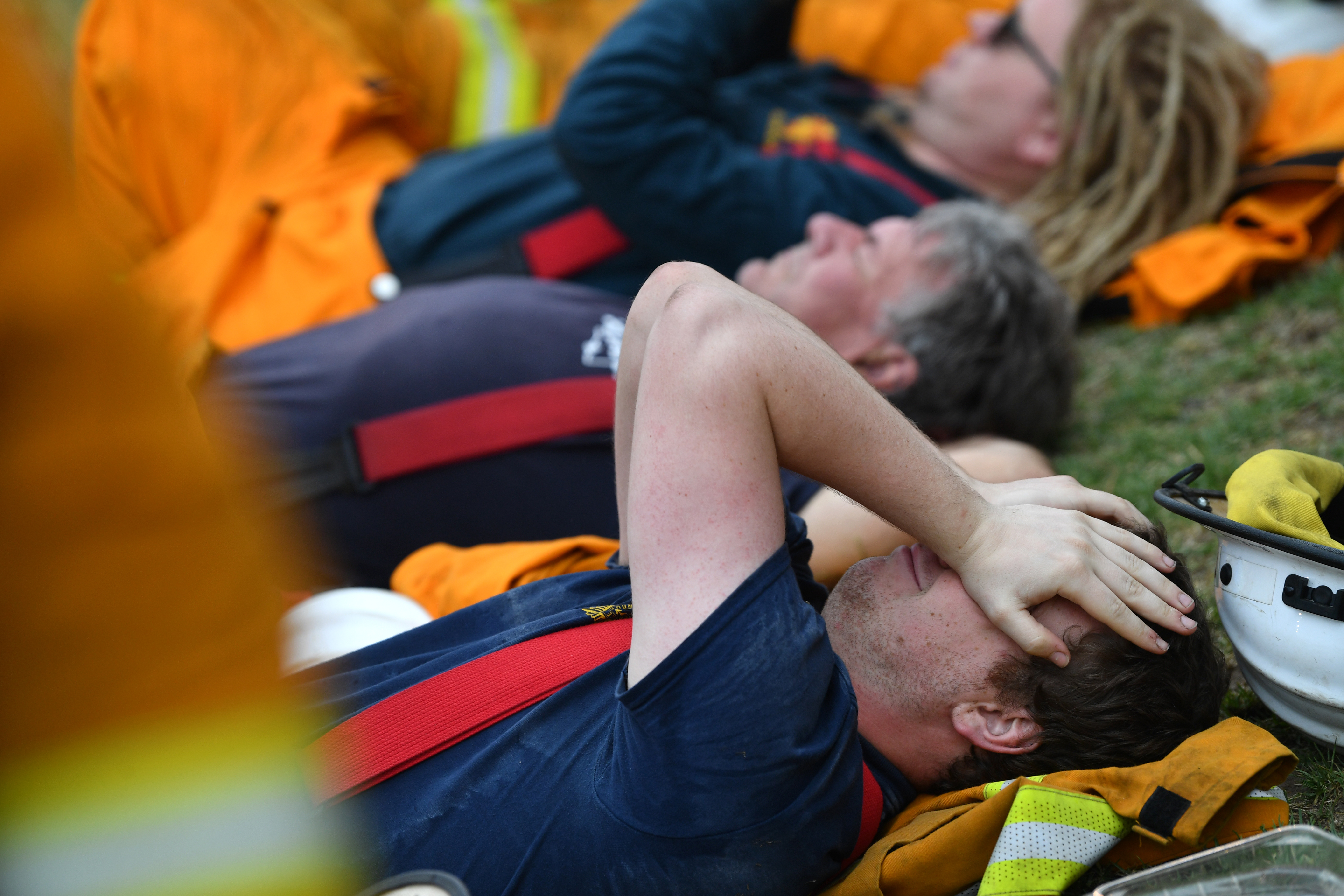
Many firefighters will by now be exhausted, having been on the front line of Australia’s bushfire crisis for weeks or months.
This bushfire season has been unrelenting, and the hottest months of summer may still lie ahead.
In part, the toll is physical. The flames are high, they are intense, and they move fast. It’s hard to breathe because the air is so hot.
At the same time, first responders have witnessed widespread devastation. To land and livelihoods, to people and animals. Meanwhile, grief for the death of fellow firefighters feels raw, and the risk to their own lives very real.
We’re right to be concerned about firefighters’ mental health.
Emergency responders already have poorer mental health
Every 4.3 weeks, a firefighter, paramedic or police officer dies by suicide – and that’s when it’s “business as usual”.
Research shows our first responders are more likely to be diagnosed with a mental health condition than the overall Australian population. They are more than twice as likely to think about suicide, and three times as likely to have a suicide plan.
This paints a grim picture of the well-being of a population who dedicate their professional lives to helping others.
It’s likely responding to a disaster on the scale of the current bushfires could increase the risk of mental illness for some.
If firefighters are not coping, they may develop psychological disorders including post-traumatic stress disorder (PTSD), anxiety, depression, and substance abuse.
PTSD
PTSD develops when a person isn’t able to recover after experiencing a traumatic event.
Some firefighters may develop symptoms while they’re still fighting the fires. They may feel on edge, but push down their fears to get on with the job. However, it’s more likely symptoms will only appear weeks, months, even years down the track.
PTSD is associated with significant impairment in day-to-day functioning socially and at work. For firefighters and others with PTSD, typical symptoms or behaviours will include:
reliving the traumatic event. People with PTSD describe vivid images and terrifying nightmares of their experience
avoiding reminders of what happened. They may become emotionally numb and isolate themselves to avoid any triggers
being constantly tense and jumpy, always looking out for signs of danger.
Exhaustion is likely compounding the mental strain on firefighters.David Mariuz/AAP
Volunteers in regional communities are particularly susceptible to trauma. They have often joined fire brigades to help protect their own communities, and then face trying to save their own homes or those of neighbours and friends.
We also need to be mindful of retired firefighters for whom these current bushfires will have triggered painful and disturbing memories. They may not currently be on the front lines, but they only need to turn on the television, open the newspaper, or look at social media to be taken straight back to Black Saturday or whatever particular event is distressing for them.
The increased prevalence of mental health issues among emergency responders suggests many existing emergency service well-being programs are failing those who need them the most.
In Australia, these programs are largely based on a what’s called a “resilience model” that focuses on people “reaching out” and seeking help when they need it.
First responders may be unlikely to take this initiative in the middle of a mental health crisis, when it’s often a struggle even to pick up the phone to a loved one, friend or colleague.
Some firefighters might not reach out for help when they need it.Jacob Carracher, Author provided
Instead, we need an approach to well-being that removes the onus on the individual. We need to shift our thinking from a model that requires the individual to “reach out”, to a model that also values others “reaching in” to identify those who may be struggling.
Ambulance Victoria’s Peer Support Dog Program, which allows staff to bring in accredited dogs to create social interactions and conversations, is a good example of how “reaching in” helps with first responder well-being. This kind of approach empowers people through social connections and the appreciation they are also supporting others.
While employers need to do more in to facilitate “reach in” programs, anyone can create informal support networks. Whether friendship groups, community groups, sporting groups, or something else, the underlying thread should be a committment to each other’s well-being.
As we continue to contend with this crisis, ensuring firefighters feel supported can make a difference to their well-being. If you see a responder in the street, say thank you. If you see one in a cafe, shout them a cuppa. If you have kids, get them to write a letter or draw a picture and drop it off to the local emergency services station.
We can’t eliminate the risk firefighters will suffer with mental health problems after what they’ve been through, but these little acts of kindness can make a difference.
If this article has raised issues for you, or if you’re concerned about someone you know, call Lifeline on 13 11 14.
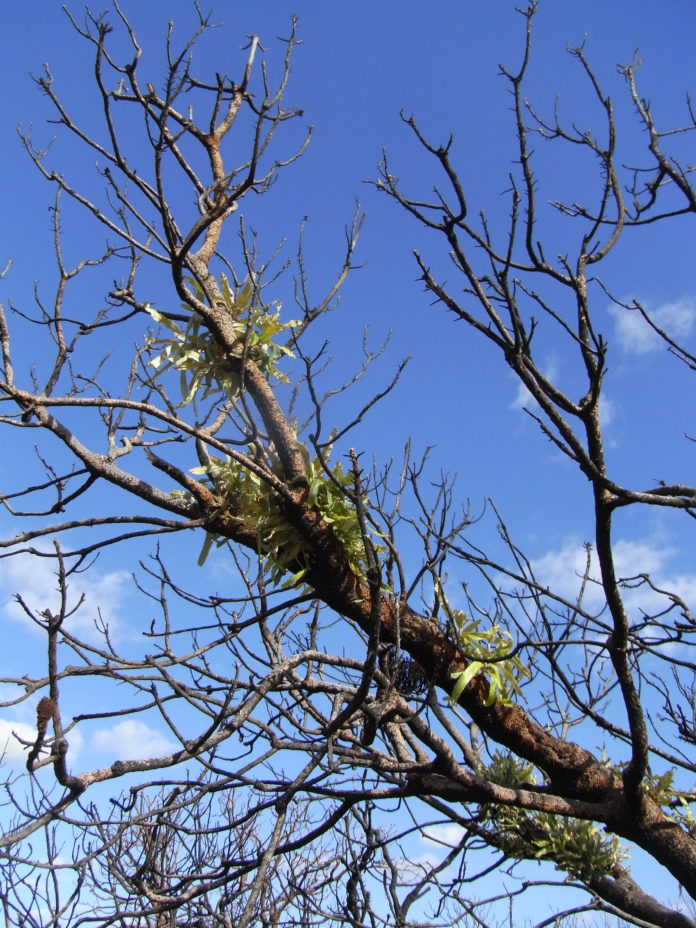
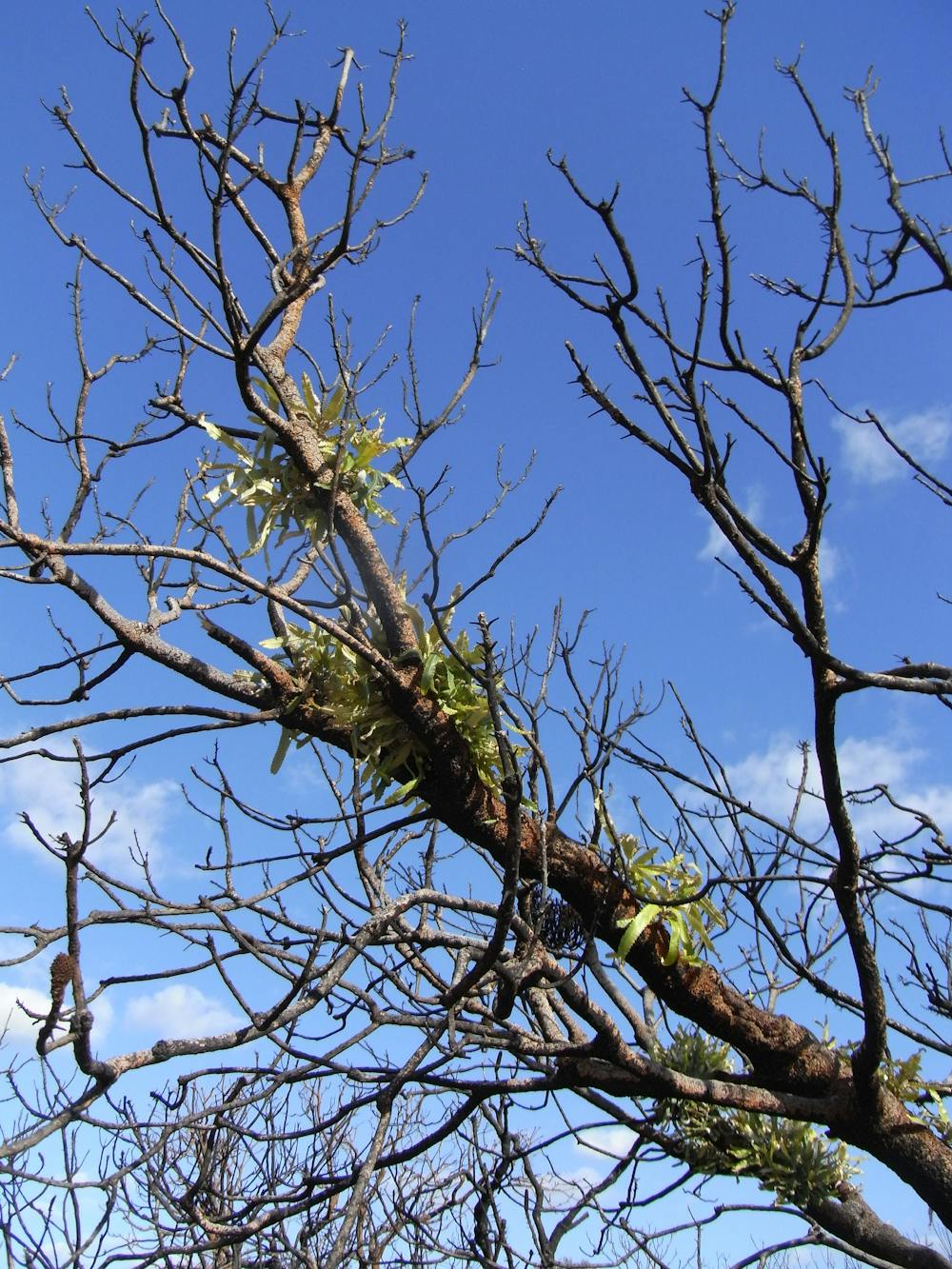
In a fire-blackened landscape, signs of life are everywhere. A riot of red and green leaves erupt from an otherwise dead-looking tree trunk, and the beginnings of wildflowers and grasses peek from the crunchy charcoal below.
Much Australian flora has evolved to cope with fire, recovering by re-sprouting or setting seed. However, some plants are sensitive to fire, especially when fires are frequent or intense, and these species need our help to recover.
After announcing a A$50 million wildlife and habitat recovery package, the Morrison government recently met with Australia’s leading wildlife experts to steer recovery efforts.
Encouraging native flora to bounce back from these unprecedented fires requires targeted funding and actions to conserve and restore plants and ecological communities, including seed banking.
How do plants naturally recover from fire?
Many plants from fire-prone ecosystems have evolved strategies to survive, and even thrive, with fire. Some resprout after fire, with green shoots bursting from blackened stems. For others, fire stimulates flowering.
Some species are able to resprout from blackened stems following a fire.Lucy Commander, Author provided
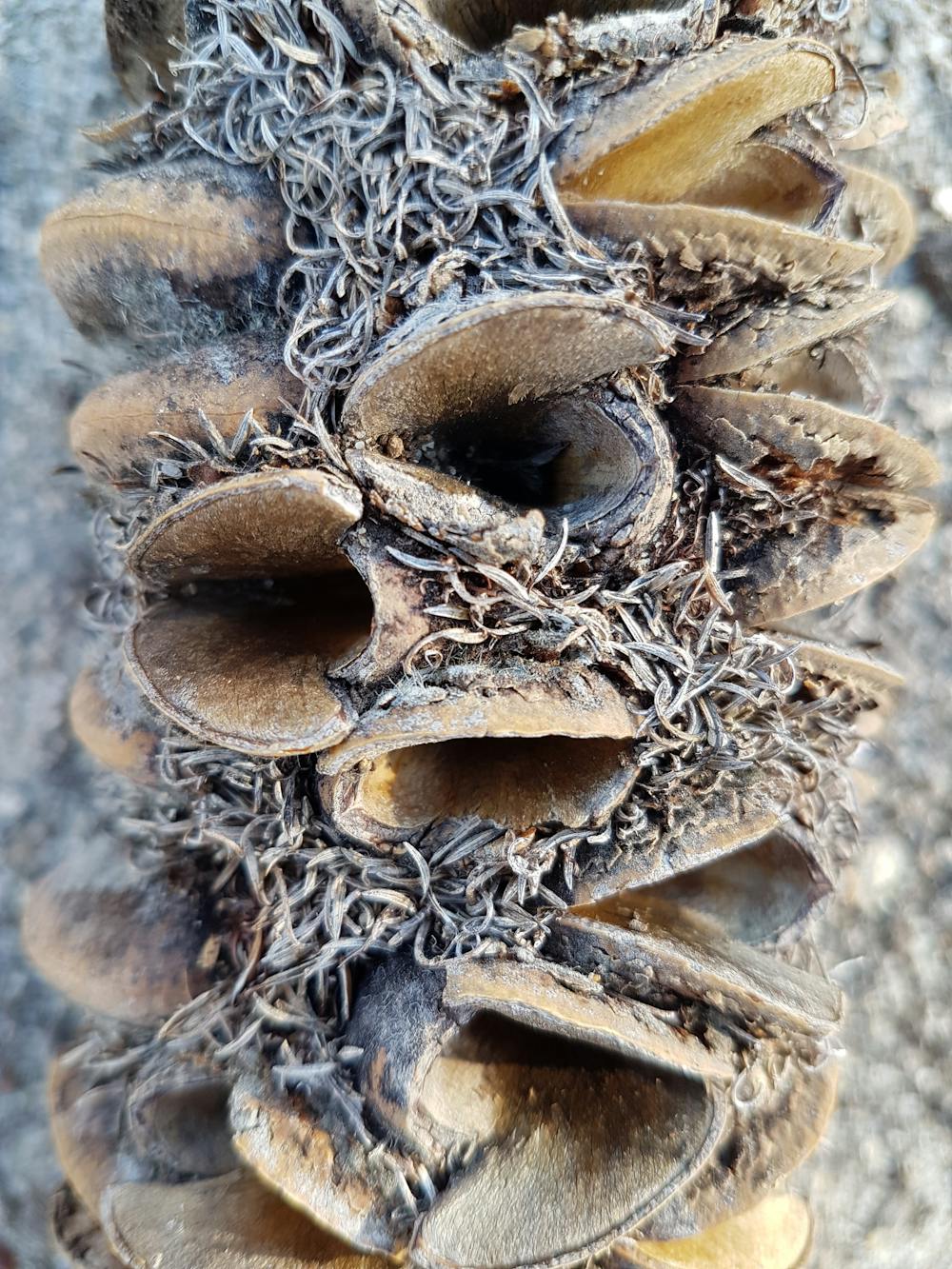
Seeds may wait in woody fruits stored on the plant. The fruits’ hard capsules shield the seeds from the fire, but the heat opens the capsules, releasing seeds into the soil below.
We can capitalise on this natural recovery by not disturbing the soil where the seeds are scattered, not clearing “dead” plants which may resprout and provide shelter for remaining wildlife, including perches for birds who may bring in seeds.
We should also stop vegetation clearing, especially unburnt vegetation home to threatened species and communities.
Some species, like this Banksia, have woody fruits that protect the seeds, then open after fire to release them.Lucy Commander, Author provided
When do we need to intervene?
While Australian plants and ecosystems have evolved to embrace bushfires, there’s only so much drought and fire they can take.
Many plants and ecosystems, including alpine and rainforest species, are not resilient to fire, especially if drought persists or they have been burnt too frequently. Too frequent fires deplete the seed bank and put recovery at risk.
Fires which are intense and severe will outright kill other plants, or the plants will be very slow to recover – taking years or decades to reach maturity again. We need comprehensive monitoring to detect which species are not returning, with systematic field surveys starting immediately, and continuing after the first rains to identify which species emerge from the soil.
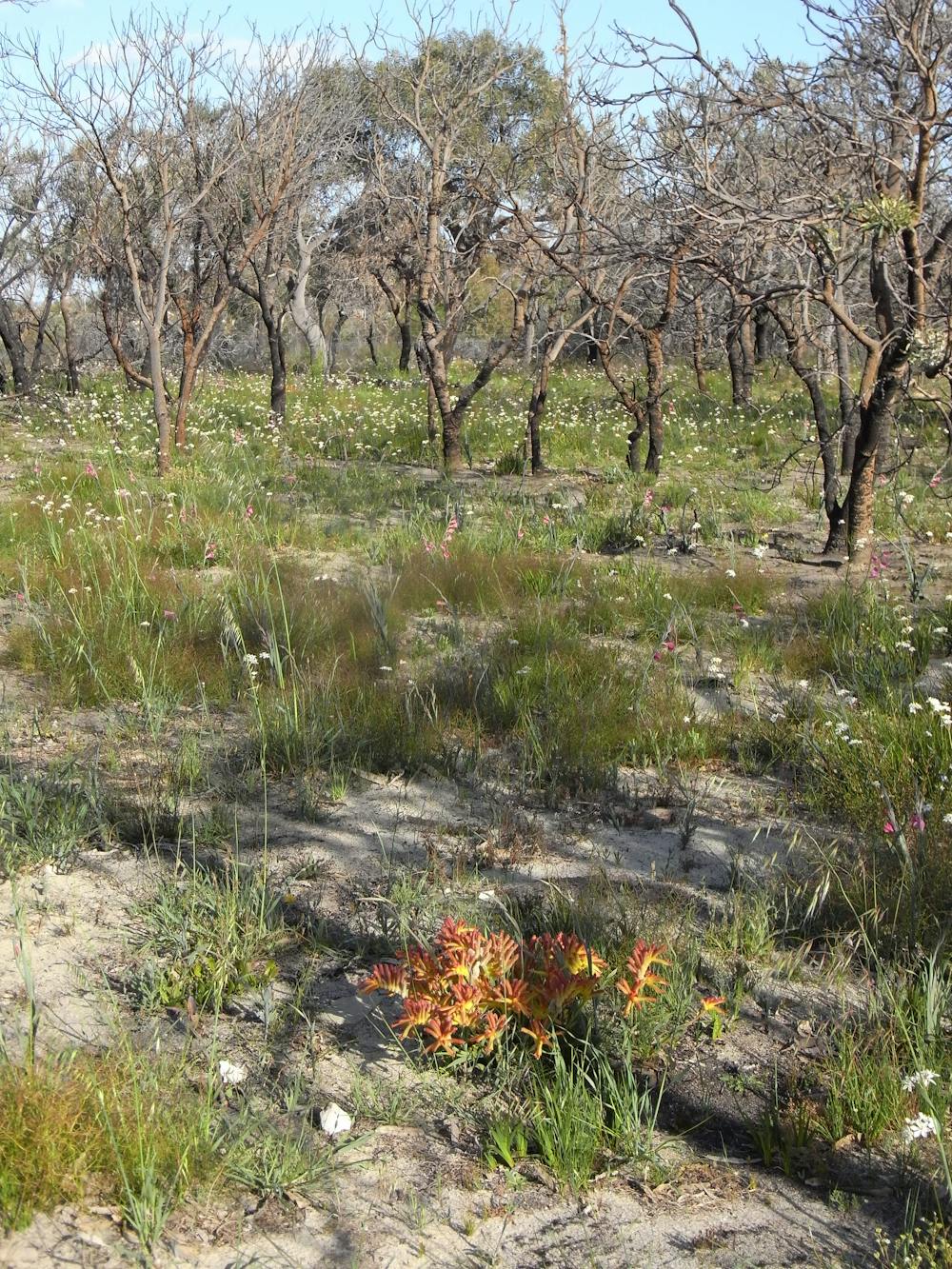
Some ecosystems are adapted to fire, with trees resprouting and seeds germinating from the soil seed bank. Even so, fencing and weed control may be required.Lucy Commander, Author provided
Invasive plants such as blackberry or veldt grass can also impede recovery after a fire by out-competing the natives. Feral herbivores – such as rabbits, goats and horses – can overgraze the native regrowth. So controlling the weeds and feral grazers with, for instance, temporary fencing and tree guards, is a priority post-fire.
And when ecosystems aren’t able to repair themselves, it’s up to us to intervene. For instance, land managers, supported by volunteer community groups, could sow seeds or plant seedlings in fire-affected areas. This act of restoring ecosystems can be an important healing process for those affected by the fires.
This means unburnt areas are at risk of over-collection from commercial and volunteer seed collectors. Stopping this from happening is possible, however. The agencies giving out permits for seed collection must record where seeds are being sourced and how much is collected. This ensures areas aren’t stripped of seeds, rendering them less resilient.
And what should we do if we lose a population of a threatened plant species? Establishing a new population or replacing a lost one using translocation is one option. Similar to capture-and-release or zoo breeding programs for reintroduction of threatened animals, translocation refers to deliberately moving plants or seeds to a new location.
How can we better prepare for next time?
With potentially more unprecedented bushfire seasons in our future, it’s important land managers are prepared.
They need data on the distribution of species and the fire frequency, severity and season they can tolerate. A nationwide database could identify which species and ecosystems are most at risk, and could be incorporated into fire and restoration planning – including seed collecting – to ensure plant material is available if species fail to recover.
Botanic gardens have a special role to play as many already have conservation seed banks of threatened species, and their living collections provide additional genetic material. Across Australia there is already a network of seed banks collaborating through the Australian Seed Bank Partnership that collect, store and undertake research to better support plant conservation.
A restoration seed bank in Utah, USA. These banks hold huge amounts of seeds, but the Australian equivalents operate on a smaller scale.Lucy Commander
However, restoration seed banks operate on a much larger scale than botanic gardens, and it’s important both approaches are conducted collaboratively. We need more ongoing investment in seed banks, particularly for threatened species and ecosystems least likely to recover from repeat fires like rainforests. Investment in skilled staff to run them is also critical, as well as national guidelines for seed use and training programs for staff and volunteers.
The recent bushfires will push many plant species to their limits. If we want to keep these species around – and the animals depend on them for food and habitat – we need to monitor their recovery and intervene where necessary.
We are being asked to do work experience this year, in a field we might like to work in. We are being asked to think about choosing electives that are directing us towards our career choices.
I have no idea what I want to do! I haven’t yet found anything I am particularly good at. I feel like I am being left behind. That others are making choices about their lives that I am not prepared for yet. Is this normal?
Lachlan, year 10
Key points
Many young people feel this way – it is normal!
locking yourself into one career path too early can be risky
it’s important to be flexible and learn transferable skills
ask lots of questions from people around you.
Hi Lachlan, many young people feel undecided about their career pathway. One study found around one in five teenagers were uncertain about a clear career goal.
The questions you ask are about more than just which subjects to choose in the last years of school. They point towards the bigger decision about what sort of person you want to become. And that is a big decision to make all at once.
Careers advisors, teachers and parents often talk about career choice as a matter of logical decision-making and planning, but it also involves feelings, imagination and knowledge about yourself and the world.
These are constantly evolving so it isn’t surprising you feel confused.
It’s important to be flexible
You say some of your friends already have clear ideas about their futures. But being too rigid can be just as risky as not having a decision. If you set your career sights too narrow, or too early, on just one type of career you might not have a back-up plan.
What happens if it doesn’t work out? Does that mean you will feel like a failure before you even start? You might miss out on possibilities that don’t fit that narrow vision but that might suit you perfectly.
Watch Tim Minchin explain to students at his old university why “You don’t have to have a dream.”
Some research suggests today’s graduates will average five separate careers and around 17 different employers in their working life. This means an important skill these days is the ability to adapt.
The careers you have in the future might be quite different from each other, drawing on new skills and interests developed over time. Changes might happen because a workplace closes, or a new career becomes possible, or you want to move or develop a new interest.
So while having a good idea about you want to do will give you a goal to work towards, it is important to be flexible too. Think of plans as provisional. Be ready to adjust your thinking and recalibrate them as you get more experience.
Develop short-term, medium and long-term goals. You’ll find great resources to help with this at Headspace.
Learning your interests takes time
You say you don’t know what you’re good at yet. That’s OK too. Learning to recognise your skills, interests and values takes time. Talking to other people can help including friends, family, people you know through sport or other communities you are part of.
School subjects don’t test some of the important skills for a successful working life, such as the ability to get along with different people or flexible thinking, so you may not know you have them yet.
It is helpful to think about clusters of jobs that draw on similar sets of skills. Particular skills (such as attention to detail) or interests (such as working outdoors or caring for others) can translate from one area into another.
Work experience in customer service or retail sales will develop your skills in communicating with other people, being organised and understanding record-keeping. These are building blocks for success in many other careers.
Learning skills in one context that you can carry to a different one means you are adaptable – one of most important qualities for success. The more you can learn on the job, no matter which job it is, the better off you will be.
Watch Eddie Woo explaining why “the advice to follow your passion is a terrible idea…”
There are many pathways
Many young people may choose to pursue a career they already know. Perhaps a friend or family member already does this sort of work. That’s a great start but it can also be limiting.
Many careers have changed in recent years. Some are disappearing while new careers are always on the horizon, so going with something a parent does may not be suitable anymore. Some of the fastest growing career areas include the personal care (such as aged care), health and technology sectors.
Take every opportunity your school offers to explore the world of work. There might be industry tasters, VET immersion days, career expos or fairs, presentations, mentoring programs, workplace and university visits, or school-university partnership programs.
When it comes to subject selection, you might decide to combine vocational training with mainstream academic subjects that will help you work towards a university course.
There are also pathway courses and alternative entry programs into univesities if you don’t quite get into what you want. There is no decision now that will lock you in to only one possibility for your future. Do stay at school though as that will set you up well for whatever comes in the future. Keep your options open.
My Future has fantastic resources including quizzes that will help learn more about what might suit you. You can also match up school subjects with career pathways.
Work experience is a good way to develop skills
The work experience you do at school need not match exactly what you will end up doing in the future, but it gives a great taste of full-time work.
Most young people find it is the most useful career related activity they do at school because it is hands on and puts them in direct contact with employers.
Try for something that draws on some of your current interests and skills, but remember this is an opportunity to try things out. A good report from an employer about your willingness to learn might be really helpful in lots of ways, including helping you get part-time work so you can continue to increase your experiences and responsibilities.
I Need to Know is our series for teens in search of reliable, confidential advice about life’s tricky questions. Here are some questions we’ve already answered.
There has already been a fair number of jobs lost to automation over recent decades – from factory workers to bank tellers.
In the coming decade we might see radically larger numbers of jobs lost to automation, thanks to advances in machine learning and other technologies.
Two areas are transport and retail.
In transport, tech company TuSimple has for months been testing autonomous trucks for UPS (the world’s largest delivery company). The trucks, hauling freight between Phoenix and Tucson, Arizona, still have a human behind the wheel for safety, but it’s only a matter of time before they become redundant.
In supermarkets, meanwhile, the shift from checkout operators to self-service will be soon be followed by eliminating the checkout system – and attendants – entirely.
I have no doubt in the next 10 years, customers will be able to take the product off the shelf, put it in their basket, walk out and have it all paid for.
Given the concentration of the Australian grocery industry – with Coles, Woolworths, Aldi and IGA having about 80% market share – this could happen in a lot of outlets in a short space of time.
The technology for this already exists. Amazon has been trialling its “no-checkout” Amazon Go technology at more than 20 Amazon-owned convenience stores in major US cities. Customers can walk into an Amazon Go store, “swipe in” with the app on their phone, pick up what they want and then simply walk out.
How it works exactly only Amazon knows, but it seems to involve sensors that identify what you’ve picked and artificial intelligence calculating what you’re likely to pick up based on previous purchases. Those who have used it say it works remarkably well.
The argument against worrying about automation is that it’s always easier to identify the jobs likely to be lost than the new ones that will emerge.
There’s some truth to this. Who knew in 1995, for example, that “social media manager” would be a job 20 years later?
It’s also true the invention of the printing press and the mechanical plough destroyed jobs. But they also created more, as have many other innovations over the past 200 years.
But there are two reasons to be concerned – reasons I explore in a forthcoming book with co-author Rosalind Dixon.
The first is that this time really looks to be different in terms of scale. It has been estimated up to 14% of jobs in OECD countries are highly subject to automation, and a further 32% could face significant changes to how they are carried out.
The second is the jobs created by automation might not be suited to the people who lose their jobs. The cashier replaced by an automated checkout is unlikely to be qualified to work on the artificial intelligence technology that created it.
This has been true in the past to a degree, but a factory labourer who lost their job could at least move into the services sector. They were not be paid as well – a very real issue – but at least they could find another job without signficant reskilling.
You know, Joey, a job is about a lot more than a pay cheque. It’s about dignity, it’s about respect. It’s about your place in the community.
That means the proper response to automation has to be serious retraining to give people the skills to get a new job.
If that is not enough, it may mean the government providing jobs.
This kind of jobs guarantee is being talked about by mainstream economists and centrist politicians for the first time since the 1930s, when it formed a key part of the US government’s New Deal response to the Great Depression through the Works Progress Administration.
If the automation of the 2020s turns out to be a “robocalypse” of self-driving cars, automated baristas and AI-driven professional services, it might indeed be needed.
Be prepared
As US baseball great Yogi Bera said: “It’s hard to make predictions, especially about the future.” But we’ve seen enough evidence of an automation revolution driven by machine learning and big data to know we need to be prepared.
That means thinking now about a range of policies to provide people with work but not give up on the power of markets.
Estimates of the economic damage caused by the bushfires are rolling in, some of them big and some unprecedented, as is the scale of the fires themselves.
These types of estimates will be refined and used to make – or break – the case for programs to limit the impact of similar disasters in the future. Some will be used to make a case for – or against – action on climate change.
But it’s important they not be done using the conventional measure of gross domestic product (GDP).
GDP measures everything produced in any given period.
It is a good enough measure of material welfare when used to measure the impact of a tourist event or a new mine or factory or something like the national broadband network, but it can be misleading – sometimes grossly misleading – when used to measure the economic impact of a catastrophe or natural disaster.
That’s because it measures the positives brought about the recovery from disasters but leaves out some of the negatives caused by the destruction.
For example:
building a new house has a positive impact on GDP, even if the old house was burnt down
a military evacuation has a positive impact on GDP, even though the circumstances that make it necessary are life-threatening and traumatic
bushfires stimulate GDP by creating more demand for health services, even as the victims suffer from smoke inhalation, burns or post-traumatic stress disorder.
It is possible to get at the full story
Economic modelling pioneered in Australia, and used to estimate the impact of terrorism and epidemics makes it possible to prepare measures of welfare that take account of the costs of disasters.
Among the immediate costs in the first months after a bushfire disaster would be:
the direct cost of fire-fighting
the cost of temporarily relocating residents
health costs, such as treatment of burns and respiratory illnesses
loss of work days associated with firefighting, injuries, illnesses, displacement and loss of life
a downgrading of consumer confidence
destruction of assets including homes, farms, businesses and natural resources and the associated disruption of economic activity including tourism, agriculture and housing
the cost of replacing or rebuilding these assets
Longer term impacts would derive from:
health problems such as post-traumatic stress disorder leading to negative impacts on quality of life and labour supply
long term damage to ecosystems, including contamination of water, and extinction or severe loss of animal species including those necessary to agricultural production, such as bees
reputational damage leading to possible permanent downgrading of tourism activity in affected regions and in Australia more broadly
potential ongoing reluctance to invest in Australia
potential increases in cost of living in bushfire prone regions due to increases in insurance costs.
It involves going beyond GDP
The longer term impacts of disasters on a nation’s GDP are clearly negative, deriving from a decline in productive capacity (labour, capital and natural resources) which unambiguously detracts from economic welfare.
In the immediate aftermath, expenditure on reconstruction of homes and other assets can add to GDP, but the funding of these activities (whether direct or through insurance) adds to debt and can drag on household consumption, either immediately or in the future. A related measure, Gross National Income (GNI) takes this into account and is generally a better measure of economic welfare.
Bushfire-induced health expenditure stimulates both GDP and GNI but detracts from welfare.
Suffering from post-traumatic stress disorder, for example, can hardly be considered an improvement in standard of living.
To offset this inappropriate “good news”, it is possible to construct an index of leisure-adjusted GNI which takes into account the downgraded quality of leisure time.
As a starting point for such estimates, the prime minister’s department sets the statistical value of a year of life free of injury, disease and disability at A$182,000 (2014 dollars).
And it depends on where you are
Aggregated measures like GDP, GNI and leisure-adjusted GNI do not show the distribution of economic impact.
An event that strips a small amount from the incomes of everybody is different from one that decimates just a few regions, yet looks the same in a nationwide measure, so it is important that any economic analysis also looks at regional impacts.
The work is yet to be done, but it is safe to say that the conventional link between GDP and economic welfare (“more is better”) breaks down when assessing tragedies, particularly ones with profound regional impacts.
When campaigning to be US president Bobby Kennedy (John F Kennedy’s brother) said that GDP measures “everything… except that which makes life worthwhile”.
It’d be wise to bear that in mind when considering the policy response to the bushfires.
In this series, we look at under-acknowledged women through the ages.
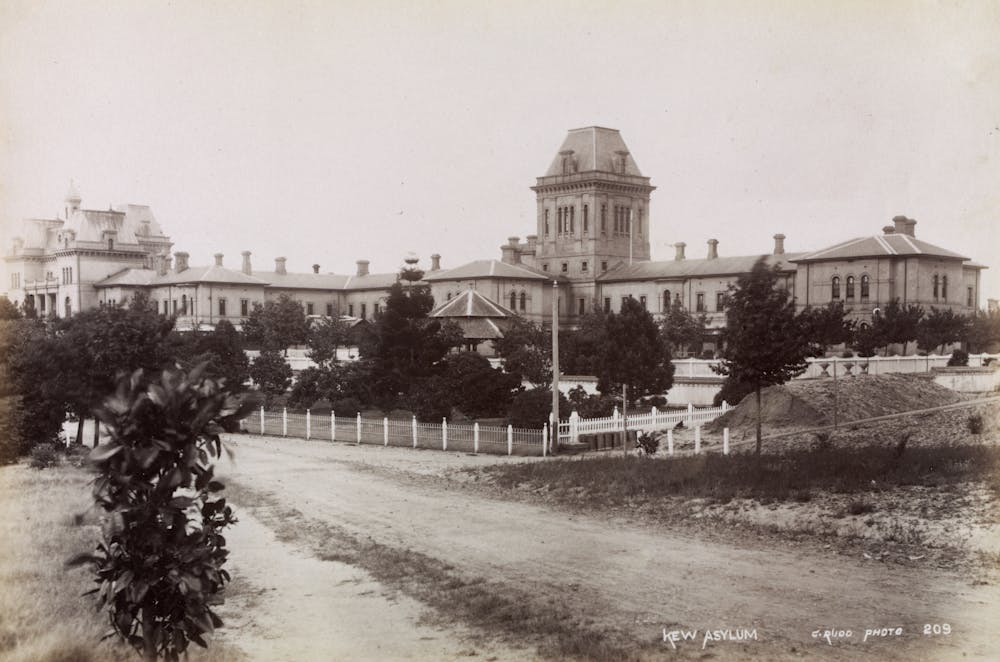
In 1886, a year before American journalist Nellie Bly feigned insanity to enter an asylum in New York and became a household name, Catherine Hay Thomson arrived at the entrance of Kew Asylum in Melbourne on “a hot grey morning with a lowering sky”.
Hay Thomson’s two-part article, The Female Side of Kew Asylum for The Argus newspaper revealed the conditions women endured in Melbourne’s public institutions.
Her articles were controversial, engaging, empathetic, and most likely the first known by an Australian female undercover journalist.
A ‘female vagabond’
Hay Thomson was accused of being a spy by Kew Asylum’s supervising doctor. The Bulletin called her “the female vagabond”, a reference to Melbourne’s famed undercover reporter of a decade earlier, Julian Thomas. But she was not after notoriety.
Unlike Bly and her ambitious contemporaries who turned to “stunt journalism” to escape the boredom of the women’s pages – one of the few avenues open to women newspaper writers – Hay Thomson was initially a teacher and ran schools with her mother in Melbourne and Ballarat.
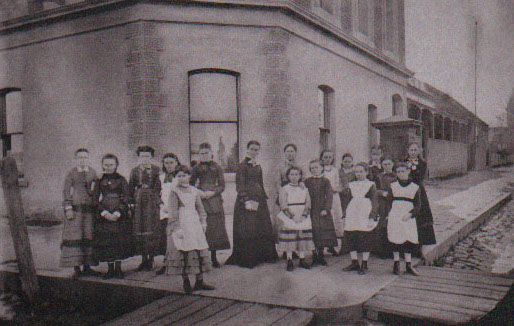
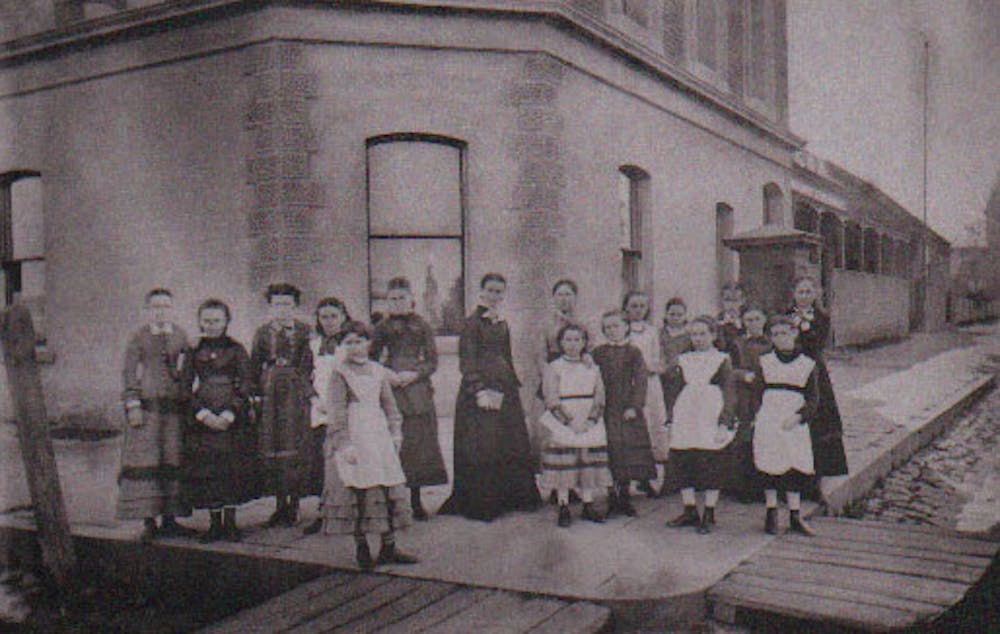
Hay Thomson, standing centre with her mother and pupils at their Ballarat school, was a teacher before she became a journalist.Ballarat Grammar Archives/Museum Victoria
In 1876, she became one of the first female students to sit for the matriculation exam at Melbourne University, though women weren’t allowed to study at the university until 1880.
Going undercover
Hay Thomson’s series for The Argus began in March 1886 with a piece entitled The Inner Life of the Melbourne Hospital. She secured work as an assistant nurse at Melbourne Hospital (now The Royal Melbourne Hospital) which was under scrutiny for high running costs and an abnormally high patient death rate.
Doctors at Melbourne Hospital in the mid 1880s did not wash their hands between patients, wrote Catherine Hay Thomson.State Library of Victoria
Her articles increased the pressure. She observed that the assistant nurses were untrained, worked largely as cleaners for poor pay in unsanitary conditions, slept in overcrowded dormitories and survived on the same food as the patients, which she described in stomach-turning detail.
The hospital linen was dirty, she reported, dinner tins and jugs were washed in the patients’ bathroom where poultices were also made, doctors did not wash their hands between patients.
Writing about a young woman caring for her dying friend, a 21-year-old impoverished single mother, Hay Thomson observed them “clinging together through all fortunes” and added that “no man can say that friendship between women is an impossibility”.
The Argus editorial called for the setting up of a “ladies’ committee” to oversee the cooking and cleaning. Formal nursing training was introduced in Victoria three years later.
Kew Asylum
Hay Thomson’s next series, about women’s treatment in the Kew Asylum, was published in March and April 1886.
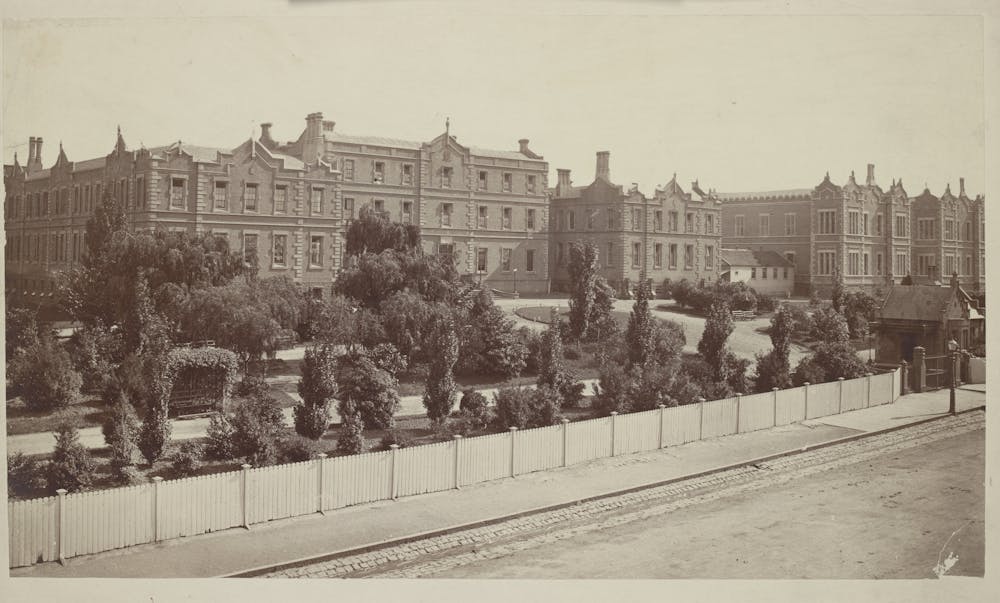
While working in the asylum for a fortnight, Hay Thomson witnessed overcrowding, understaffing, a lack of training, and a need for woman physicians. Most of all, the reporter saw that many in the asylum suffered from institutionalisation rather than illness.
She described “the girl with the lovely hair” who endured chronic ear pain and was believed to be delusional. The writer countered “her pain is most probably real”.
Observing another patient, Hay Thomson wrote:
She requires to be guarded – saved from herself; but at the same time, she requires treatment … I have no hesitation in saying that the kind of treatment she needs is unattainable in Kew Asylum.
The day before the first asylum article was published, Hay Thomson gave evidence to the final sitting of Victoria’s Royal Commission on Asylums for the Insane and Inebriate, pre-empting what was to come in The Argus. Among the Commission’s final recommendations was that a new governing board should supervise appointments and training and appoint “lady physicians” for the female wards.
Suffer the little children
In May 1886, An Infant Asylum written “by a Visitor” was published. The institution was a place where mothers – unwed and impoverished – could reside until their babies were weaned and later adopted out.
Hay Thomson reserved her harshest criticism for the absent fathers:
These women … have to bear the burden unaided, all the weight of shame, remorse, and toil, [while] the other partner in the sin goes scot free.
For another article, Among the Blind: Victorian Asylum and School, she worked as an assistant needlewoman and called for talented music students at the school to be allowed to sit exams.
In A Penitent’s Life in the Magdalen Asylum, Hay Thomson supported nuns’ efforts to help women at the Abbotsford Convent, most of whom were not residents because they were “fallen”, she explained, but for reasons including alcoholism, old age and destitution.
Throughout, she continued writing, becoming Table Talk magazine’s music and social critic.
In 1899 she became editor of The Sun: An Australian Journal for the Home and Society, which she bought with Evelyn Gough. Hay Thomson also gave a series of lectures titled Women in Politics.
A Melbourne hotel maintains that Hay Thomson’s private residence was secretly on the fourth floor of Collins Street’s Rialto building around this time.
Home and back
After selling The Sun, Hay Thomson returned to her birth city, Glasgow, Scotland, and to a precarious freelance career for English magazines such as Cassell’s.
Despite her own declining fortunes, she brought attention to writer and friend Grace Jennings Carmichael’s three young sons, who had been stranded in a Northampton poorhouse for six years following their mother’s death from pneumonia. After Hay Thomson’s article in The Argus, the Victorian government granted them free passage home.
Hay Thomson eschewed the conformity of marriage but tied the knot back in Melbourne in 1918, aged 72. The wedding at the Women Writer’s Club to Thomas Floyd Legge, culminated “a romance of forty years ago”. Mrs Legge, as she became, died in Cheltenham in 1928, only nine years later.
The Rappler video feed on the Ampatuan convictions last month.
For decades, the feared Ampatuan clan held sway in the impoverished province of Maguindanao in Mindanao in the southern Philippines. Through a ruthless private army and a reported “propensity for beheadings”, the clan cultivated a culture of impunity. Now, however, reports David Robie, a courageous judge has challenged the horror by jailing the masterminds of the 2009 Ampatuan massacre for life.
SPECIAL REPORT:By David Robie in Manila
The families of the 58 victims – 32 of them journalists or media workers – had waited for 10 years for justice in the Philippines.
After so long, what is another couple of hours?
The Ampatuan massacre in Maguindanao on 22 November 2009 was the world’s worst single attack on journalists and the worst elections-related violence in a country notorious for electoral mayhem.
With the judge almost two hours late in arriving at the fortified special courtroom in Camp Bagong Diwa, a police barracks with a jail annex in Manila’s satellite Taguig City, fears were expressed for her safety.
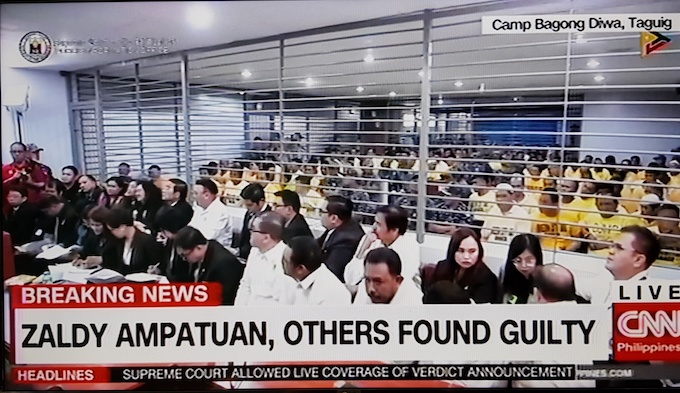
The 101 accused (although three were missing and cited for possible contempt of court) for the heinous crime, dressed in yellow jail tees, were housed in in a barred cage sandwiched between lawyers and some 200 heavily armed police guards and waiting.
The lawyers for both prosecution and defence were waiting.
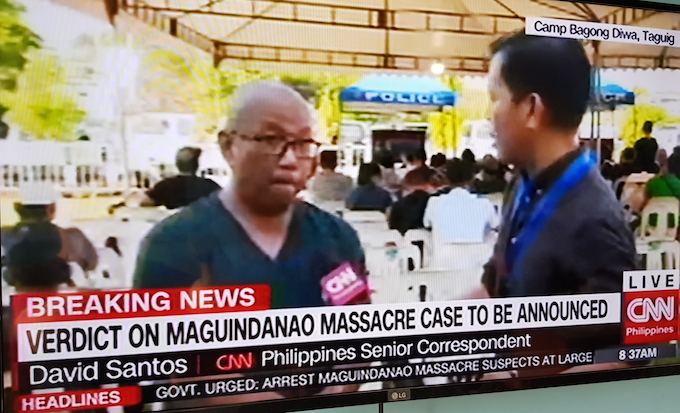
The CNN Philippines live newsfeed on the Ampatuan judgment.
Live television The public, glued to their television sets or live streaming from CNN and the state-run People’s Television, were waiting.
In the end, the historic judgment took only 52 minutes.
Many of the victims’ families burst into spontaneous applause for the jailing of the ringleaders; others wept for joy with the convictions. While other families of some of the accused were relieved with the acquittals.
Judge Joycelyn Solis-Reyes of the Quezon Trial Court Branch 221 announced to the court that she could deliver the shortened verdict rather than the full 761-page judgement or “it could take all day”.
In fact, broadcaster Peter Musngi reckoned it would have taken “43 uninterrupted days” to read the full judgement. Both prosecution and defence lawyers agreed to the short reading with the full judgment being made available online – read it here on Rappler.
Guilty verdicts for the masterminds of the 2009 Ampatuan massacre. CNN Philippines screenshot/David Robie
Judge Solis-Reyes sentenced the 28 principal accused – including three brothers of the powerful Ampatuan warlord clan from Mindanao – to life in prison without parole and ordered them to pay a total of more than 155 million pesos (almost NZ$5 million) in changes to the heirs of 57 victims killed in the massacre.
The judge reduced the “official” death toll from 58 to 57 because the body of photojournalist Reynaldo Momay was never found. This means that the Momay family was not granted compensation even though it was commonly known that he was with the journalists who were killed and never been seen since. There was also dental evidence linking him found at the multiple murder scene.
Appealing sentences Some of those jailed announced last week that they are appealing against their sentences, and the prosecution is also appealing over the acquittals and the judge’s Momay finding.
While it has been a long wait for justice for the victims, it had also been a long wait for the judge herself. Judge Solis-Reyes had shelved her own plans for career advancement so that she could see the notorious case through to judgment.
She was forced to brave death threats and political pressure over the case. At least three witnesses were killed during the course of the trial.
The judge had earlier admitted in interviews that she had wanted to pursue a career in broadcast media and had studied journalism at the Lyceum of the Philippines.
Describing the atmosphere in the courtroom with 400 people packed in to hear the verdict of the century” on December 19, Tempo columnist Jullie Y. Daza wrote that the judge “deserves the nation’s gratitude for her dedication and deportment”.
“All I can say is,” she added, “you’re priceless, Your Honour.”
Judge Solis-Reyes broke down her summary into 1. Those guilty beyond reasonable doubt; 2. Accessories; 3. Those released on the basis of reasonable doubt; 4. Those facing arrest warrants.
FLASHBACK: Then ARMM governor Zaldy Ampatuan (left) and his brother Andal Ampatuan Jr. (face covered), when the latter was turned over to Secretary Jesus Dureza at the compound of the provincial capital in Shariff Aguak, Maguindanao, on 26 November 2009. Image: Mindanews
Police officers acquitted Forty-three people, including leaders of the Ampatuan clan, were convicted of mass murder or being accessories, and 58 other accused – many of them police officers – were acquitted in the infamous case.
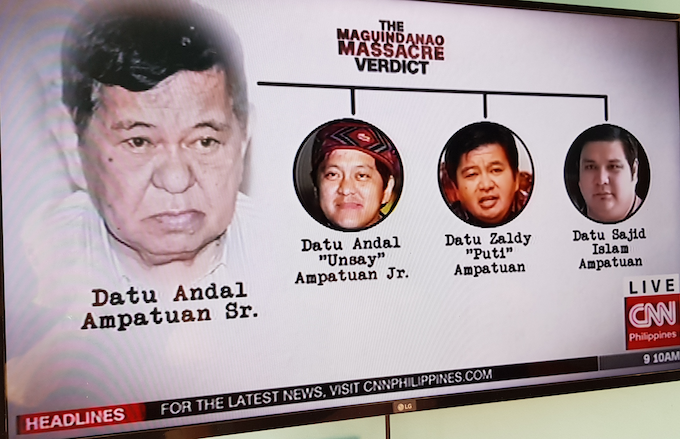
Sentenced to reclusion perpetua, or up to 40 years in prison without parole – effectively life – on 57 counts of murder were prominent clan members Datu Andal “Unsay” Ampatuan Jr; his brothers, former Autonomous Region in Muslim Mindanao (ARMM) governor Datu Zaldy “Puti” Ampatuan Sr, and Anwar Ampatuan Sr, former mayor of Shariff Aguak town.
The Ampatuan power matrix. Image: CNN Philippines freeze frame
Another brother was acquitted. Two other prominent members of the clan – nephews Anwar Ampatuan Jr and Anwar Sajid Ampatuan – and 23 others were also found guilty of the multiple murders.
Fifteen other accused – almost all of them policemen – were convicted as accessories to murder and sentenced to between six and 10 years in prison.
The Ampatuan accused in the courtroom cage. CNN Philippines screenshot/David Robie
It took 10 years, 424 trial days, to hear the testimonies of 357 witnesses against 197 who were originally charged.
During the long-running trial, six accused were acquitted and the clan patriarch, Andal Ampatuan Sr, also accused, died in prison from a sudden heart attack in 2015, aged 74.
One of his daughters, Rebecca, told the Philippine Center for Investigative Journalism (PCIJ) that her father had six wives and 40 children. The PCIJ closely followed the case for a decade with a series of special reports in The Maguinado Chronicles.
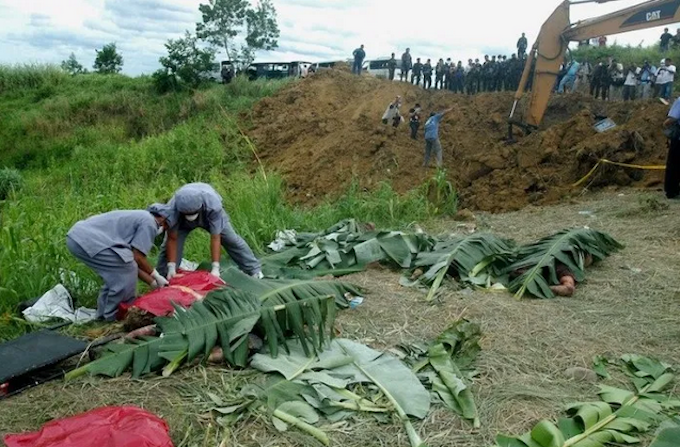
The killings in 2009 sent shockwaves around the world because of the brazenness of the attack. The victims, including 20 women, were kidnapped and clubbed before they were executed, mutilated and buried in shallow graves.
FLASHBACK: Bodies of the Ampatuan massacre victims being exhumed from the freshly dug mass graves in November 2009. Image: Mindanews
Mass graves The backhoe digger, using a government machine, who excavated and filled the mass graves, was among the convicted accessories.
The ambushed electoral convoy had been taking the registration papers to enable challenger Esmael “Toto” Mangudadatu to contest the governorship of Maguindanao in defiance of threats by the Ampatuans. He was not with the convoy, but his wife, Genalyn, was shot 17 times: “They shot her on her breasts, her private parts. Such unimaginable cruelty.”
Congressman Esmael “Toto” Mangudadatu … his wife was killed in the Ampatuan massacre. Image: CNN Philippines screenshot/David Robie
He subsequently won the election in a landslide in 2010 and has since been elected to the Philippine national Congress.
The mass murders were widely condemned around the world by governments, global media freedom organisations and human rights groups. The US ambassador at the time, Kristie Kenney, described the killings as “barbaric” and then UN Secretary-General Ban Ki-moon condemned the brutal political violence in the southern Philippines.
The Malacañang presidential palace welcomed the convictions last month, saying the rule of law had prevailed in closing one of the darkest chapters of Philippine history.
“The Maguindanao massacre marks a dark chapter in recent Philippine history that represents merciless disregard for the sacredness of human life, as well as the violent suppression of press freedom,” said presidential spokesman Salvador Panelo, who ironically was once one of the lawyers for the Ampatuans.
“This savage affront to human rights should never have duplication in this country’s history.”
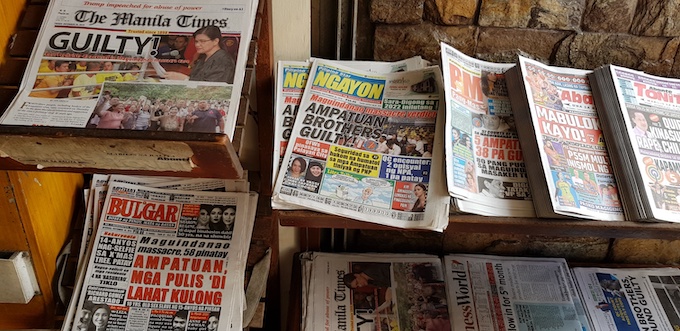
Philippine press responses to the Ampatuan guilty verdicts. Image: David Robie/PMC
Editorial opinions cautious However, most editorial opinion in the nation’s media and human rights groups greeted the “historic” judgment with caution.
“Justice at last, but …” summed up the headline on a Philippine Star editorial, warning “a victory has been achieved, but the pursuit of justice is far from over”. Said the Star:
“Amid the rejoicing are the disappointments and concerns about what might happen next. With 56 defendants cleared, including two members of the Ampatuan clan, there are valid concerns raised by the victims’ families that violence remains a serious threat in the clan’s turf.
“Most of the guns believed owned by the Ampatuans and their private army remain unaccounted for. The claim is believed to continue enjoying control over substantial funds and other assets.
“Harassment of witnesses, victims’ relatives and prosecution lawyers are possible. At least three witnesses were killed in the course of the trial.
“There are 80 suspects still to be brought to justice, and an appeals process that could take another decade to complete. There is the equally complicated task of going after the assets of the Ampatuan clan.
“There are other criminal cases – about 200 of them – still being pursued, including complaints for corruption and obstruction of justice, as well as cases related to the murders and disappearances of witnesses.”
‘Terrible crime’ The Philippine Daily Inquirer noted in an editorial that this daily newspaper – along with other media – had “faithfully reported on the terrible crime that thrust the Philippines squarely on the map for the single deadliest attack on journalists in the world.
“In bearing witness, we strived mightily to ‘piece together the bloody shards of the crime’, and to find the words to ‘approximate the horror’.
But the Inquirer added that there were significant lessons to be learned – and acted upon – in spite of the hope stirred by Judge Solis-Reyes’ guilty verdicts, such as the “endless delay” caused by defence motions that reflected the “dismaying state of the judicial system”.
“And journalists and media workers remain in peril in the fast-shrinking democratic space.”
Philippine Star columnist Ana Marie Pamintuan described the Ampatuan clan as “Monsters Inc.” and was candid in a wide-ranging article about the challenges ahead after the judgment.
One challenge is to “catch the 80 suspects who remain at large and bring them to justice”. Another is the expected “spirited fight for their acquittal” on appeal for those who were convicted.
“Let’s hope the road to final judgment won’t take another 10 years,” warned Pamintuan.
Another huge challenge is the legal fight to have the Ampatuans’ massive wealth forfeited by the state, and payment of civil damages to the victims’ families.
Property freeze orders Freeze orders have been issues by the courts on bank accounts, real estate property and other identified assets of the Ampatuan clan.
“Prosecutors believe, however, that substantial amounts of cash have been stashed away by the clan the old fashioned way – not in banks where there is a paper trail, but perhaps in boxes, chests or baul [a Tagalog word meaning a traditional clothes trunk], buried somewhere or concealed within walls the way South American narcos do with their mountains of dirty money,” says Pamintuan.
“In one of the poorest regions in the country, the Ampatuans thrived, driving around in convoys of luxury vehicles with their private armies, living it up in fortified mansions. How do local executives in third-class municipalities and impoverished provinces, with their modest salaries, manage to accumulate that kind of wealth?”
The last challenge – and probably the toughest – is how to “eliminate the environment that creates monsters and breeds impunity”?
Etta Rosales, former chair of the Philippine Commission on Human Rights, described the Mindanao environment as like the “wild, wild west”, warning it remained “compromised injustice” until the private armies and political dynasties were rooted out.
While the Ampatuan massacre remains the worst example of this environment, there are many other regions of the Philippines where the local population are ruled by patronage and fear.
The implications for press freedom in the Philippines have not been lost on students and tertiary journalism schools.
‘Already afraid’ Writing on Rappler, Diwa Donato, a political science graduate from Saint Louis University, Baguio City, who has dedicated 13 years of her life to campus journalism as an advocate for youth empowerment, press freedom and democracy, says she will never forget the day of the massacre. She was aged 10 at the time – and she was “already afraid to continue my dream of pursuing journalism”.
“The Philippines remains one of the deadliest countries for journalists in Southeast Asia,” she says.
“The fight of professional journalism will always be the fight of campus journalism. We celebrate the Ampatuan massacre verdict, hope for justice, and continue to address the struggles of press freedom.
“For now, democracy and press freedom have won. But we do not fight to win, we fight to be free. There is more to be done.”
NUJP chair Nonoy Espina talks to CNN Philippines in a live interview. Image: CNN Philippines screenshot/David Robie
National Union of Journalists of the Philippines (NUJP) chair Nonoy Espina also fears for the future.
“The culture of impunity for crimes against journalists means that massacres like the one in Ampatuan can happen again,” he says. “Without justice, the bloodshed will continue.”
The NUJP played a key role in independent investigations and keeping a watch on government, also sponsoring family members of slain journalists to get to Manila for the trial.
Ruthless warlords The Ampatuans were the warlords of Maguindanao and the Autonomous Region of Muslim Mindanao (ARMM).
“Even Andal Ampatuan Jr’s ruthlessness and sociopathic violence served a purpose,” admits Pamintuan. “Cops and soldiers who were assigned to the ARMM talk of the Islamic separatists being terrified of incurring the ire of Andal Jr because of his reported propensity to decapitate and mutilate anyone who crossed him.”
“There are other political warlords still out there – running their own fiefdoms like gangsters, naming streets and villages and government projects after their family members, freely using public money for private purposes and controlling every aspect of the local criminal justice system.”
Yes, a victory, but the fight to end impunity in the Philippines has just begun.
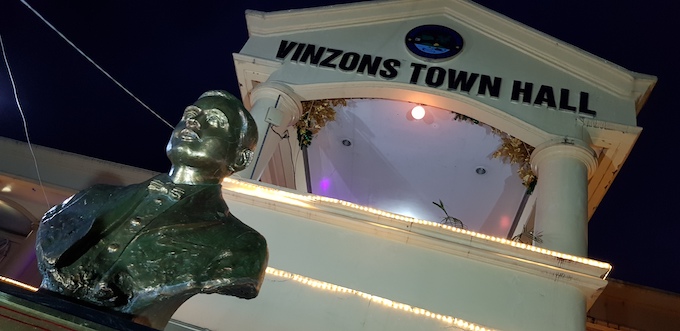
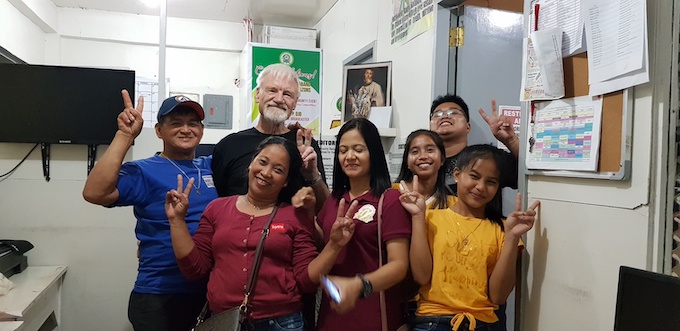
Professor David Robie, director of the Pacific Media Centre, was recently in Vinzons, Camarines Norte, Philippines, on a research sabbatical.
News came from Moscow overnight that the Russian government had resigned, followed by the announcement that the current prime minister Dmitry Medvedev would be replaced by the head of the tax office, Mikhail Mishustin.
Why has the government resigned, and what does it mean for the future?
Prior to the government’s resignation, President Vladimir Putin announced a series of proposed changes to the constitution to be placed before the people in a future referendum. In announcing the government’s resignation, Medvedev hinted that their resignation was to facilitate the progression of the proposed constitutional reforms.
Among others, Putin proposed that in the constitution:
international law should apply in Russia only if it does not contradict the constitution or restrict peoples’ rights and freedoms. This, he said, was a question of sovereignty
leading political figures should not have foreign citizenship or the right to live permanently in another state. As well as these qualifications, the president must have lived in Russia for the last 25 years
the president should not be able to hold the presidency for two consecutive terms (although Putin said he doesn’t think this is a matter of principle)
the prime minister and all ministers should be appointed by the State Duma (parliament) instead of the president, who would have no right to reject those appointments
the role of the State Council (an advisory body) should be expanded and strengthened
the independence of judges should be enshrined and protected.
The most important of these proposed changes (along with that of judicial independence) is that of moving the power to form the government from the president into the legislature.
If this was done and a truly accountable form of government was established, it would be a major advance on how the system has worked up until now.
But in the same speech, Putin argued that Russia needed to remain a presidential, not a parliamentary, republic. These two positions seem at odds with one another and a potential recipe for constitutional confusion.
Putin has previously found his way around the rule that a president can only serve two terms. And he’s unlikely to step away entirely when his current term ends.AAP/Alexey Nikolsky
Why has Putin suggested this change?
One reason may be dissatisfaction with the government’s performance. The implication from Putin’s speech, and from many other comments, is that both the governance of Russia and the current government have been deficient.
Governance is seen by Putin to be hampered by the lack of a direct constitutional line between president and ministers, and this would be resolved by making the prime minister the key person in the policy sphere rather than the president.
This would be facilitated by removing the president’s power to choose the identity of the prime minister and some ministers. The government’s resignation could be seen as a response to the dissatisfaction with its performance.
But also relevant is power politics. Putin is due to step down as president in 2024. Thoughts are already turning to the question of the succession, in particular, will Putin go, and if so, who will replace him?
The current Constitution forbids Putin from standing for another presidential term in 2024. The last time he faced this question in 2008, Putin stepped down as president and became prime minister. The potential beefing up of the prime ministership under these proposals might make this strategy again attractive.
But in 2024 Putin will be 73, and it is not clear that he would really want to be involved in the sort of day-to-day policy discussions a prime minister must involve himself in. He has already been showing some irritation with the policy process.
However beefing up and reshaping the State Council could provide a slot into which a post-presidential Putin could move, giving him some continuing oversight powers while not making him drown in policy details and paper.
This is surmise. But what is undoubtedly true is that this is only the first public move in what is likely to be a prolonged process of succession and power transfer in Russia.
In the 1980s, a global race was underway: to find a more efficient way of converting energy from the sun into electricity.
Some 30 years ago, our research team at the University of New South Wales (UNSW) came up with a breakthrough, called the PERC silicon solar cell. The cells have become the most widely deployed electricity generation technology in terms of capacity added globally each year – comfortably exceeding wind, coal, gas, hydro and others.
PERC stands for Passivated Emitter and Rear Cell. By the end of this year, PERC technology will be mitigating about 1% of global greenhouse gas emissions by displacing coal burning. Assuming that its rapid growth continues, it should be reducing greenhouse gas emissions by 5% by the mid-2020s and possibly much more in later years.
The terrible bushfires in Australia this summer, enhanced by the hottest and driest year on record in 2019, underline the need for urgent reductions in greenhouse gas emissions. By far the most effective way is driving coal out of electricity systems through very rapid deployment of solar and wind.
Soon, our Aussie invention will be generating half the world’s solar power. It is a pertinent reminder of Australia’s capacity for finding transformative technical solutions to address climate change. But we need the right government support.
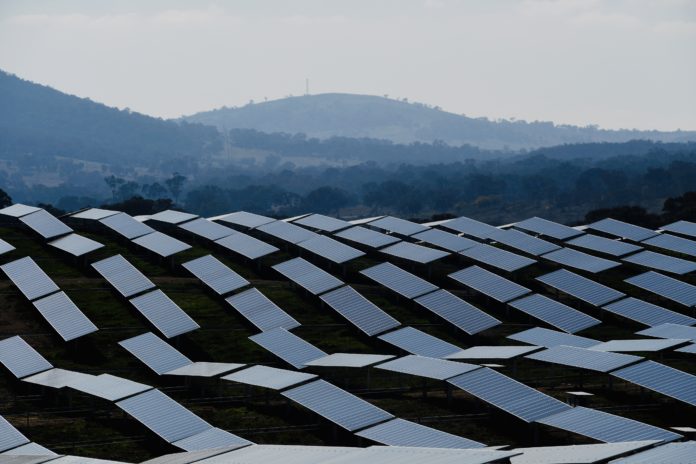
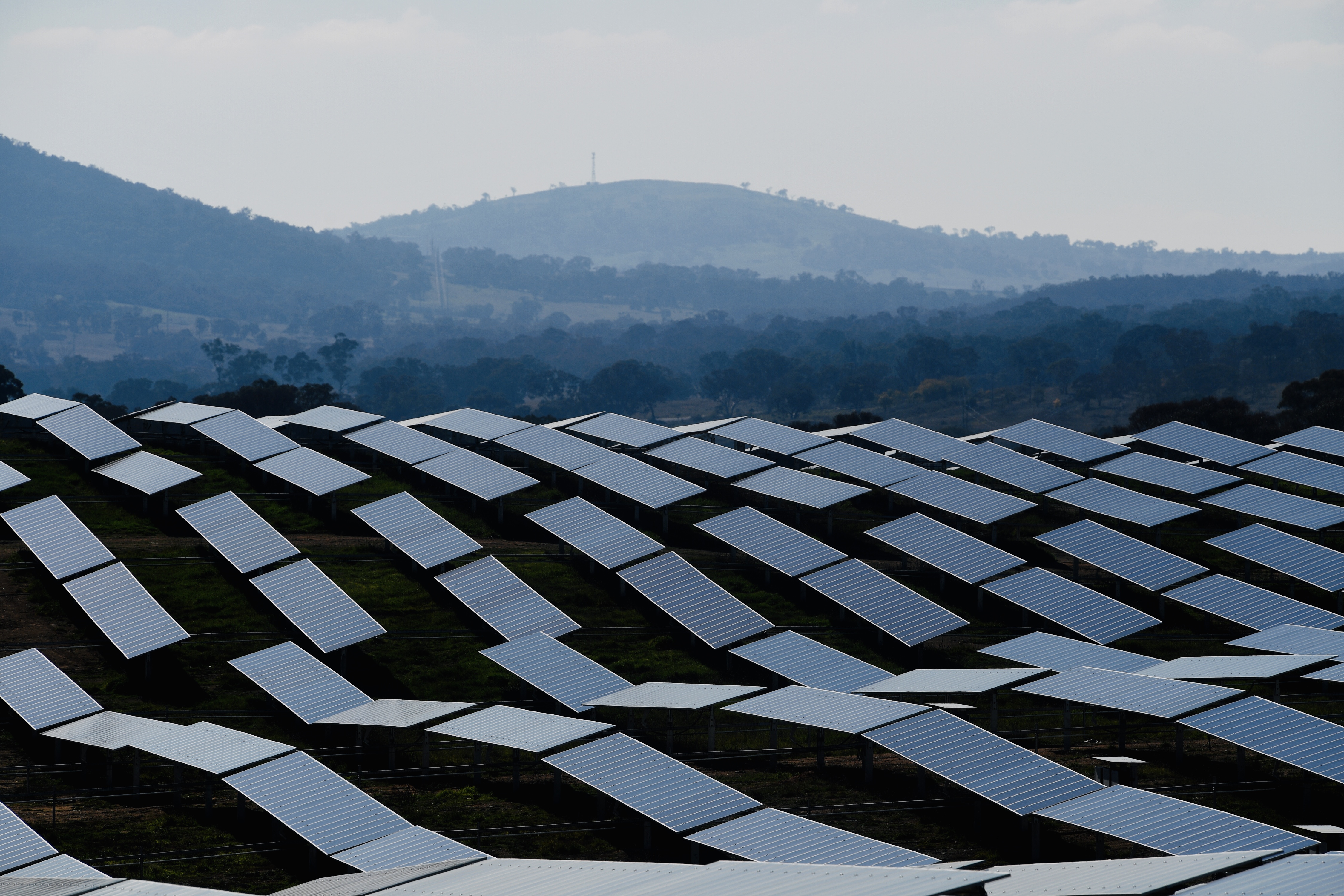
A solar farm near Canberra.Lukas Coch/AAP
An Aussie invention
Solar cells convert sunlight directly into electricity without moving parts. More efficient solar cells generally produce cheaper electricity because fewer solar cells, glass covers, transport, land and support structures are needed for a given solar power output.
By the early 1980s, the best laboratory cells around the world had reached 17% efficiency. This means that 17% of the sunlight was converted to electricity, and the rest (83%) of the solar energy was lost (as heat).
During the 1980s, our research team at UNSW led by Martin Green and myself created a series of world-record-efficient silicon solar cells. We reported 18% efficiency in 1984, 19% efficiency also in 1984, and the important milestone of 20% efficiency in 1986.
In 1989 our group reported a new solar cell design called “PERC”, with a record efficiency of 22-23%.
This new, more efficient cell was better than the old ones because we eliminated some defects in the silicon crystal surface, which led to lower electronic losses. The PERC design also enabled us to capture the sunlight more effectively.
In the 1990s, further improvements to laboratory PERC cells were made at UNSW, leading to cells in the 24-25% efficiency range. The global silicon solar cell efficiency record remained at UNSW until recently.
There was a 25-year gap between development of the PERC cell and its rapid commercial adoption, which began in 2013. During this time, many people worked to adapt the PERC design to commercial production.
PERC cells are more efficient than previous commercial cells. Strong incentives for more efficient cells have recently arisen due to the continually falling share of cell costs as a proportion of total solar power system costs (including transport, land and mounting systems).
The big benefits of solar
Currently, solar power constitutes more than 40% of net new electricity generation capacity additions, with fossil, nuclear, wind, hydro and other renewables making up the balance.
Solar is growing faster than the other electricity generation technologies. Over time, as fossil-fuelled power stations are retired, solar (and wind) will dominate electricity production, with consequent large reductions in greenhouse gas emissions.
Solar power has experienced sustained rapid exponential growth over decades, while other generation technologies are currently experiencing static, falling or negligible sales.https://www.irena.org/publications/2019/Mar/Renewable-Capacity-Statistics-2019
This year, enough PERC solar modules will be sold to generate 60-70 gigawatts of power. According to projections, PERC will reach three quarters of annual solar module sales in the mid-2020s, enough to match the generation capacity additions from all other technologies combined.
About A$50 billion worth of PERC modules have been sold to date. This is expected to reach several hundred billion Australian dollars later this decade.
Just imagine
Australian emissions (excluding those from bushfires) are falling because we are installing solar and wind four times faster per capita than the EU, US, Japan and China.
Our position as a global leader in renewables installation is uncertain because the Renewable Energy Target, which was achieved in 2019, has not been extended.
With supportive policy, such as facilitating more transmission to bring solar and wind power to the cities, Australia could greatly increase the speed at which wind and solar are deployed, yielding rapid and deep cuts at about zero-net cost.
Such policy would entail stronger and sustained government support for renewables deployment, and research and development of new technologies.
Renewables must replace polluting coal-fired power if the world is to tackle climate change.SASCHA STEINBACH/EPA
Looking ahead
Solar energy is vast, ubiquitous and indefinitely sustainable. Simple calculations show that less than 1% of the world’s land area would be required to provide all of the world’s energy from solar power – much of it on building roofs, in deserts and floating on water bodies.
Solar systems use only very common materials (we could never run out), have minimal need for mining (about 1% of that needed for equivalent fossil or nuclear fuels), have minimal security and military risks (we will never go to war over solar access), cannot have significant accidents (unlike nuclear), and have minimal environmental impact over unlimited time scales.
Australia is making major contributions to mitigating climate change both through rapid deployment of wind and solar and technology development such as our PERC cells. But with better government support, much more can be done – quickly and at low cost.
Review: Black Drop Effect, directed by Felix Cross for Sydney Festival
Aboriginal and Torres Strait Islander readers are advised this article contains names of deceased people.
Nardi Simpson’s debut play Black Drop Effect is the “immersive” experience the Sydney Festival program promises. Sitting in the stalls, as the sky darkened behind the outdoor stage, I was immersed in the present moment, in January 2020, and in the past too.
Simpson’s funny, tender and provocative dialogue infuses her narrative with layers of history – of place and ancestral knowledge, of encounter at Kamay (Botany Bay) 250 years ago, and of colonial commemorations and performances.
Her characters turn a fraught Aboriginal dance performance on 26 January into a chance to listen and share knowledge. And ultimately, the dance group has a few lessons to teach about who can control culture, how history can be memorialised, and by whom.
In the accompanying program, Simpson (also a composer, singer-songwriter and performer) suggests this work is “one verse in an ongoing song”. Black Drop Effect, and the rich array of Indigenous productions in this Sydney Festival, build on Aboriginal and Torres Strait Islander performances at commemorative events throughout Australia’s history.
Reenactment and protest
The production was prompted by festival director Wesley Enoch’s call to Aboriginal and Torres Strait Islander artists to be ready for 2020. Some smart programming from Enoch launches a conversation that will heat up as the 29 April anniversary of Cook’s landing approaches.
The last time a Cook anniversary was commemorated on a large scale was 1970. At those events, Aboriginal actors led by Noongar performer Ken Colbung (Nundjan Djiridjarkan) performed the kind of reenactment Black Drop Effect dramatises in front of 20,000 Sydneysiders.
Queen Elizabeth II arrived by sea, just as Cook had done, approaching the shore on the royal barge. As she neared, distant clap stick beats were heard, accompanying the official commentary and reminding viewers Aboriginal people were still there, as they had been when that other boat approached 200 years earlier.
The site of Cook’s landing has seen commemorations and protests.Jenny Evans/AAP
Across the Bay at (Guriwal) La Perouse, Aboriginal protesters threw wreaths into the water to commemorate the invasion. They were joined in protests across the nation.
At Sydney Airport the Queen was greeted with Aboriginal people in funeral dress. Elsewhere there was a torchlight procession to Canberra’s Parliament House, a costumed silent vigil in Brisbane, a March through Melbourne, a mourning demonstration in South Australia and a funerary procession in Perth.
Taking poetic licence with history, new British immigrants bearing the surname Cook or Cooks were recruited in the 1970 commemorations. On 30 April, 1970 the Tamworth Leader reported that “Too many Cooks” arrived in Sydney on a flight landing at Mascot airport, close to Cook’s landing spot.
In 2019, Prime Minister Scott Morrison announced a replica of Cook’s ship Endeavour would circumnavigate Australia (even though the original Endeavour never made such a journey).
Anniversaries of the First Fleet’s landing in 1788 have also been repeatedly commemorated. In 1938 (150 years) Ngiyampaa and Paakantji residents of Menindee Aboriginal Reserve were brought down to Sydney under duress to perform a reenactment. Many of their own family members joined the group staging a Day of Mourning protest through Sydney streets nearby.
In 1963 (175 years) a Pageant of Nationhood was performed for the Queen featuring non-Indigenous dancers in black face in Burragorang Dreamtime, the brainchild of choreographer Beth Dean and composer John Antill.
Talking back to Cook
Black Drop Effect holds in tension these complex histories of Aboriginal responses to commemoration, making space for protest, reclamation of culture and cross-cultural negotiations. It is a productive response to our times that brings together a cohesive creative team.
Lucy Simpson’s evocative visual designs, with video by Mic Gruchy and lighting by Karen Norris, bring to life themes in the narrative. Swirling stingray and cockatoo projections and watery backgrounds move across a screen, waft through the trees and onto the sand under the actors’ feet. Matt Doyle’s vital choreography is underpinned by James Henry’s sound design, combining song fragments with electro beats and clap stick rhythms in extended time signatures.
Director Felix Cross creatively navigates the challenges of Bankstown Arts Centre’s courtyard and its proximity to the train line. The impressive cast never forget where their performances are happening, intermittently turning their gaze trainwards. The passing trains play a role in the drama, pausing the action or comically highlighting Anthony Hunt’s Cook portrayal and blustering refusal to let place disrupt his monologue.
A strong cast anchors this eloquent debut work with performances that are both comic and poignant.Christopher Woe/Sydney Festival
Experienced performers and newcomers alike shine bright in this strong cast. William McPherson (Binno), Marlene Cummins (Beenie), Jane Phegan (Pip), Googoorewon Knox (Max), Isaiah Kennedy (Brayden), and Ken Weldon (Charley Boy) deliver comedy and poignancy in quick succession, with Knox’s expert singing arriving as a late surprise.
The language of the Gweagal warriors who confronted Cook’s party with “Warra warra wai” also makes a powerful appearance — translated in Simpson’s script as “Go away!”
Black Drop Effect challenges, but it also brings people in, inviting us to listen, feel and rethink what it means for Indigenous Australians to remember Cook’s visit after 250 years. Enoch’s Sydney Festival gives us plenty to think about as 26 January and 29 April 2020 approach.
In the past week, the Australian football players union has been pressuring the A-League to make a major change in the sport – shifting to a winter competition, instead of its current spot in the brutal summer.
Both the A-League and W-League seasons currently run from October-April. One of the main reasons for the summer schedule was to avoid head-to-head competition with the much bigger Australian Football League (AFL) and National Rugby League (NRL), which both play in the winter.
But there’s a growing feeling in the sport that a move to the winter months would be beneficial for football, particularly as our summers grow hotter and bushfires worsen.
Last weekend, A-League officials considered cancelling the match between Sydney FC and Newcastle United due to the air quality in NSW before shifting course at the last minute. However, the W-League match scheduled before it was postponed.
According to former Socceroo John Aloisi, the way the schedule is currently set up widens the gap between amateur and professional football. This separation limits the development pathways for players, coaches and administrators.
It also situates the Australian national competition outside the Asian football schedule, which is also in the Southern Hemisphere winter.
If we want to move forward as a code we need to go, ‘Alright, Asia is played this time of the year, we have to play with them.’
Moving to the winter could have a huge impact on the women’s game, too. It would give the W-League a major opportunity to grow its fan base since no other Australian women’s sport is played at that time of year, other than netball.
Crowds are not coming now anyway, so why not try something new. We need to find our place in the busy Australian sporting landscape.
Hotter temperatures lead to patchier play
Other players have also thrown their support behind the idea, arguing the Australian summer heat and constant need for water breaks impacts the quality of football. The FFA heat policy mandates a 90-second drink break in each half when the wet bulb globe temperature (WBGT) is between 26 and 27.9 degrees Celsius, or the ambient temperature is over 31 degrees.
A match can be delayed or postponed when the WBGT reaches 28 degrees.
Former Socceroos star Jason Culina said he loses up to four kilograms after games played in the heat and it can take days to recover. He says the fields in the summer months are also “rock hard”, leading to increased injuries.
My career was almost ended by a serious knee injury in 2011 that was caused by wear and tear. … the hard conditions in Australia might have accelerated the deterioration.
The heat may also be a contributing factor to fans staying away from A-League matches. Statistics show that since 2015, crowd attendance at A-League matches has continually declined.
A-League attendance figures (2015-2019)Austadiums
Where will they play in winter?
So, how feasible would a switch actually be? Could this be the “shake-up” many have called for in the A-League?
One of the biggest problems is where A-League games would be played if the main stadiums are busy hosting AFL, NRL and Super Rugby matches.
Part of the A-League season currently overlaps with those leagues in March and April. This already poses problems for footballers, due to the damage caused to fields by scrums and studs.
Sydney FC, for example, has scheduled games at several suburban grounds while the Sydney Football Stadium is being rebuilt. However, last February the team had to move a match from Brookvale Oval after the playing surface was considered not up to “A-League standard”.
Add to that Melbourne Victory player Terry Antonis’ knee injury that was largely attributed to the poor condition of the Sydney Cricket Ground after a Super Rugby match.
In NSW, the Berejiklian government has controversially committed A$2 billion to stadium redevelopment, but most of the money is going toward its main stadiums in Olympic Park and Moore Park.
This has resulted in ongoing criticism from those who believe the money could have been dispersed more evenly to upgrade smaller stadiums. The benefits of investing in smaller stadiums include enhancing the match atmosphere and creating a more family-friendly environment. They are overwhelmingly favoured by fans and football clubs alike
The A-league’s current position in the sporting calendar is already not drawing huge television audiences. The season opener between the Wanderers and Mariners in October attracted just 47,000 viewers on the ABC in the five major capital cities – down from 93,000 a year earlier.
While research shows Australians have multiple loyalties when it comes to sport, the A-League has long struggled to build a strong emotional connection with its fans – hence the poor television viewership and match attendance figures.
A recent study by True North Research highlighted how important the emotional connection is between fans and clubs.
In light of this, a move to winter could pose a serious risk to football’s future. Multiple online fan surveys have shown that if it was a choice between the NRL, AFL or A-League, A-League would not be the winner.
Perhaps instead of a shift to a different season, the A-League should focus on better developing and marketing its summer matches. As it stands now, the league decided not to do any marketing for the 2019-20 season until after the NRL and AFL Finals were over.
If the A-League’s administrators won’t promote the league before the season even starting, what hope does football have against a field of giants?
Why does reading in the back seat make you feel sick? – Jane, aged 10, from Coburg North, Australia.
Hi Jane, your question about why reading in the back seat makes you feel sick is a very good one. The answer has to do with our eyes, our ears and our brain.
Reading in the back seat can make you feel sick because your eyes and ears are having an argument that your brain is trying to settle!
Your inner ear contains cells that have hairs sticking out the top. Scientists call these “hair cells”.
Some of these hair cells help us to hear. When sound hits those hair cells, the hairs move and the cells send signals to the brain. Our brains use those signals to hear.
Other hair cells help us to keep our balance. When the car we’re sitting in moves, that movement makes the hairs on those hair cells move too, and they send different signals to the brain. Our brain uses those different signals to tell we’re moving.
Why doesn’t the brain like this?
Some people’s brains don’t like it when their eyes say they’re still but their ears say they’re moving.
When eyes and ears argue like this, the brain can think that something dangerous might be about to happen.
If this happens, the brain can get the body ready to fight or run away (scientists call this the “fight or flight” response).
The conflict between our eyes and ears make the brain think something dangerous might happen.wavebreakmedia/Shutterstock
One of the things the brain can do is take blood away from the stomach to give to the muscles.
Giving blood to the muscles can help us to fight or run away. But taking blood away from the stomach can make us feel sick.
What can you do about it?
If reading in the back seat makes you feel sick, you might need to settle the argument between your eyes and your ears.
One way to do this is to stop reading and to look out the car window. This could help your eyes to tell your brain that you’re moving as you see the world whizz by, and your ears to tell your brain that you are moving as you feel the car moving.
But this suggestion won’t work for everyone. Some people will still feel sick when they ride in a car, even if they aren’t reading.
This is because while our eyes and our ears help us to balance, so do our skin and our muscles. This creates many opportunities for arguments that our brain has to settle!
Hello, curious kids! Have you got a question you’d like an expert to answer? Ask an adult to send your question to curiouskids@theconversation.edu.au
For John Sarkissian, operations scientist at the CSIRO Parkes radio telescope, astronomy has been his life’s passion – starting from the age of six.
“When I was six years old, I watched Neil Armstrong and Buzz Aldrin walk on the Moon,” he says of the radio telescope made famous in the film The Dish.
“In fact, on the cover of my year nine mathematics textbook was a painting of the Parkes radio telescope. I remember sitting in the class staring at the painting and daydreaming working there one day. And so here I am now, 40 some years later.”
Today, on Trust Me I’m An Expert, editorial intern Antonio Tarquinio speaks to Sarkissian about the research underway at one of Australia’s most famous astronomical research facilities including:
the role Parkes is playing right now in the search for extra-terrestrial intelligence
how the telescope detects extremely weak signals coming from the most distant parts of the Universe
why even a light breeze can imperil the dish unless it’s in the right position
how the explosion of phones, wi-fi and radio frequency interference is affecting research in the once-deserted Parkes location.
And Sarkissian’s own take on whether Parkes will help find alien life?
“Well, as of today, the only place we know of the entire Universe that there is definitely life is right here on Earth,” he says.
“And what does that say? It says that we should appreciate our place in the Universe a little more.”
Podcasts are often best enjoyed using a podcast app. All iPhones come with the Apple Podcasts app already installed, or you may want to listen and subscribe on another app such as Pocket Casts (click here to listen to Trust Me, I’m An Expert on Pocket Casts).
You can also hear us on Stitcher, Spotify or any of the apps below. Just pick a service from one of those listed below and click on the icon to find Trust Me, I’m An Expert.
This question has endured across cultures and civilisations. It has given rise to a plethora of religions and spiritual paths over thousands of years, and more recently, some highly amusing apps.
But this question now prompts a different response, as technology slowly brings us closer to accurately predicting the answer.
Predicting the lifespan of people, or their “Personal Life Expectancy” (PLE) would greatly alter our lives.
On one hand, it may have benefits for policy making, and help optimise an individual’s health, or the services they receive.
But the potential misuse of this information by the government or private sector poses major risks to our rights and privacy.
Although generating an accurate life expectancy is currently difficult, due to the complexity of factors underpinning lifespan, emerging technologies could make this a reality in the future.
How do you calculate life expectancy?
Predicting life expectancy is not a new concept. Experts do this at a population level by classifying people into groups, often based on region or ethnicity.
Also, tools such as deep learning and artificial intelligence can be used to consider complex variables, such as biomedical data, to predict someone’s biological age.
Biological age refers to how “old” their body is, rather than when they were born. A 30-year-old who smokes heavily may have a biological age closer to 40.
The use of devices such as fitness trackers will become crucial in predicting personal life expectancy in the future.Shutterstock
With machine learning and artificial intelligence, it’s becoming feasible to analyse larger quantities of data. The use of deep learning and cognitive computing, such as with IBM Watson, helps doctors make more accurate diagnoses than using human judgement alone.
This, coupled with predictive analytics and increasing computational power, means we may soon have systems, or even apps, that can calculate life expectancy.
There’s an app for that
Much like existing tools that predict cancer survival rates, in the coming years we may see apps attempting to analyse data to predict life expectancy.
However, they will not be able to provide a “death date”, or even a year of death.
Human behaviour and activities are so unpredictable, it’s almost impossible to measure, classify and predict lifespan. A personal life expectancy, even a carefully calculated one, would only provide a “natural life expectancy” based on generic data optimised with personal data.
The key to accuracy would be the quality and quantity of data available. Much of this would be taken directly from the user, including gender, age, weight, height and ethnicity.
Access to real-time sensor data through fitness trackers and smart watches could also monitor activity levels, heart rate and blood pressure. This could then be coupled with lifestyle information such as occupation, socioeconomic status, exercise, diet and family medical history.
All of the above could be used to classify an individual into a generic group to calculate life expectancy. This result would then be refined over time through the analysis of personal data, updating a user’s life expectancy and letting them monitor it.
This figure shows how an individual’s life expectancy might change between two points in time (F and H) following a lifestyle improvement, such as weight loss.
Two sides of a coin
Life expectancy predictions have the potential to be beneficial to individuals, health service providers and governments.
For instance, they would make people more aware of their general health, and its improvement or deterioration over time. This may motivate them to make healthier lifestyle choices.
They could also be used by insurance companies to provide individualised services, such as how some car insurance companies use black-box technology to reduce premiums for more cautious drivers.
Governments may be able to use predictions to more efficiently allocate limited resources, such as social welfare assistance and health care funding, to individuals and areas of greater need.
That said, there’s a likely downside.
People may become distressed if their life expectancy is unexpectedly low, or at the thought of having one at all. This raises concerns about how such predictions could impact those who experience or are at risk of mental health problems.
Also, pharmaceutical companies could coordinate targeted medical campaigns based on people’s life expectancy. And governments could choose to tax individuals differently, or restrict services for certain people.
The solution would require input from specialists including demographers, health scientists, data scientists, IT specialists, programmers, medical professionals and statisticians.
While the collection of enough data will be challenging, we can likely expect to see advances in this area in the coming years.
If so, issues related to data compliance, as well and collaboration with government and state agencies will need to be carefully managed. Any system predicting life expectancy would handle highly sensitive data, raising ethical and privacy concerns.
It would also attract cybercriminals, and various other security threats.
Moving forward, the words of Jurassic Park’s Dr Ian Malcolm spring to mind:
Your scientists were so preoccupied with whether or not they could, they didn’t stop to think if they should.
As our country battles the most extensive fires of our lifetime, there are increasing calls for a royal commission into the states and territories’ preparedness and the federal government’s response to the disaster.
A royal commission has coercive powers beyond a government inquiry, and the need for one implies there are facts and evidence that would otherwise be “hidden” to an inquiry or review.
Research I’ve recently conducted with other fire experts has concluded there have been 57 formal public inquiries, reviews and royal commissions related to bushfires and fire management since 1939, most of which are listed here. I have given expert evidence to at least seven of them, including the 2009 Victorian Bushfires Royal Commission.
That is more than one inquiry every two years in the past 80 years. Do we need yet another?
Many of the recommendations of the subsequent 56 inquiries have not been fully implemented either, so it raises serious questions about whether another royal commission will offer anything new or compelling.
Royal commissions are also expensive and time-consuming. The 2009 Victorian Bushfires Royal Commission had a budget of A$40 million and ran for about 18 months.
This cost did not include the very considerable time and resources committed by various government agencies, companies and individuals who prepared and presented evidence to the commission. When these costs are taken into account, I estimate the total cost of the commission to Victoria would have been much more.
This begs the question as to how money spent on a federal royal commission could be better used to deal with bushfire management across the country.
A comprehensive fire management plan already exists
This policy statement was signed off by all COAG (Council of Australian Governments) members by early 2012 and published in 2014. As yet, there has been little action on implementing this policy.
The policy had a stated vision that
fire regimes are effectively managed to maintain and enhance the protection of human life and property, and the health, biodiversity, tourism, recreation and production benefits derived from Australia’s forests and rangelands.
Central to this vision is
the role fire plays in maintaining and enhancing biodiversity. Sustainable long-term solutions are needed to address the causes of increased bushfire risk.
To achieve the intent of this policy, 14 national goals were identified.
The first was to maintain appropriate fire regimes with the right combination of size, intensity, frequency and seasonality to properly sustain the ecosystems in Australia’s forests and rangelands.
Another goal was to promote Indigenous Australians’ knowledge of fire management. This recognised the benefits of widespread, low-intensity, patchy fires across the landscape that are sustainable and create landscapes resilient to climate extremes.
And a third goal was to create employment, workforce education and training in bushfire management. This recognised the importance of fire management as an integrated part of our lives.
These goals – along with the 11 others in the statement – still need to be developed into measurable outputs and outcomes, but they set a comprehensive and sustainable fire management strategy for the country.
This policy statement goes much further than just considering how to respond to a bushfire emergency, which seems to be the focus of the call for a new royal commission by Prime Minister Scott Morrison.
Morrison said Sunday he would take a proposal to establish a new royal commission into the bushfire disaster to Cabinet.David Mariuz/AAP
A better way forward
Over the past 20 years or so, the tertiary education for land managers, such as professional foresters and rangers, has been reduced to the level of generic “environmental science”. This has largely been due to the politicisation of public land management.
Bushfire science is complex and fire management even more complex, so we need to have highly trained and qualified people managing our parks and forests. Instead, we typically have groups of individual specialists trying to collaborate without the strong leadership and direction such a task requires.
We do not expect a physicist or chemist to build a bridge, even though they could provide great detail about the forces acting on it and the metallurgy of the structure. Instead, we employ engineers. Likewise, we should not expect botanists, zoologists, ecologists or environmental scientists to manage the natural landscape. That, however, is what is happening now.
What’s needed is a better national bushfire management strategy, not a commission into the response to the crisis.STATE GOVERNMENT OF VICTORIA
The responsibility for land and fire management rests with each state and territory government. However, with support from the federal government and coordination through COAG, we should be able to develop an efficient and effective fire and land management program across Australia.
In his 1939 royal commission report, Judge Stretton observed of the Victorian Forests Commission chairman of the time, A.V. Galbraith,
if his Commission were placed beyond the reach of the sort of political authority to which he and his Department has for some time past been subjected, he would be of greater value to the State.
His meaning is clear: good fire and land management needs to be done with long-term perspective, not a short-term political focus.
Stretton also observed the need to have public support, because
without their approval and goodwill, there can be no real plan.
Our changing climate has put more pressure on our natural ecosystems and the weaknesses in our land and fire management are being ruthlessly exposed.
Rather than using time and resources on inquiry No. 58, we should instead commit to fully implement the recommendations of all the previous inquiries, reviews and royal commissions we have already held. Another royal commission will only reiterate what we have known for decades.
Most children in Australia are going back to school in just over a week. Children experience a mix of emotions when it comes to going to school.
Easing back after the holidays can range from feeling really excited and eager to concern, fear or anxiety. Getting butterflies or general worry about going back to school is common.
Among the biggest worries of preschool children are feeling left out, being teased or saying goodbye to their caregiver at drop off. Concerns of school-aged children are about exams (27%), not wanting to return to school (13%), and problems with teachers (14%). Some feel lonely and isolated.
The main concerns for teens are coping with stress (44.7%), school or study problems (34.3%) and mental health (33.2%).
Not thinking about school until it is time to go back is one way to enjoy the last week of holidays. But for some, this can make going back to school more difficult.
Supporting parents, children and young people with back-to-school challenges can help reduce negative school experiences using the below steps.
1. Set up a back-to-school routine
Create structure about going back with a school routine. Be guided by your knowledge and history of what best supports your child during times of change and transition.
Having consistent bed and wake-up times helps too. The National Sleep Foundation suggest starting two weeks before the first day of school to set sleep routine habits. But a week beforehand will help get your kid on their way.
What do your kids need your help with and what can they do on their own?from shutterstock.com
In some way, parents go back to school with their children. Consider adjusting your own schedule to make the transition smoother. If you can’t in the mornings, arrange the evenings so you can give as much time as your child needs, especially during the first week.
2. Talk about going back to school
Most children deal with some level of stress or anxiety about school. They have insight into their school experiences, so find out what worries them by asking directly.
You can offer support by normalising experiences of worry and nerves. Reassure your child the feelings they have are common and they will likely overcome them once they have settled in. Worries and courage can exist together.
Depending on your child’s age, you can also try the following to help:
early years/pre-school – write a social story about going to daycare or school and the routine ahead
primary years – set up a peer-buddy system where a peer or older child meets yours at the school gate or, if neighbours, kids can go into school together
secondary years – establish healthy routines as a family. Support each other around technology use, sleep and schoolwork.
3. Help create a sense of school belonging
A sense of belonging at school can affect academic success and student well-being. Parents can facilitate positive attitudes about school by setting an encouraging tone when talking about it.
Also show an interest in school life and work, and be available to support your child both academically and socially.
Take interest in your child’s schoolwork.from shutterstock.com
More than half of the parents in one survey said homework and schoolwork were the greatest drivers of stress in their children. When parents are more engaged in their child’s schoolwork, they are better able to support them through it.
is more clingy than usual or tries escape from the classroom
appears restless and flighty or cries
shows an increased desire to avoid activities through negotiations and deal-making
tries to get out of going to school
retreats to thumb sucking, baby language or increased attachment to favourite soft toys (for younger students).
If these behaviours persist for about half a term, talk to your classroom teacher or school well-being coordinator about what is happening. Together work on a strategy of support. There may be something more going on than usual school nerves, like bullying.
Encourage questions children and teens may have about the next term. What will be the same? What will be different?
Often schools provide transition information. If the school hasn’t, it might be worth contacting them to see if they can share any resources.
Most importantly, let your child know nothing is off limits to talk about. Set up times to chat throughout the school term – it can help with back-to-school nerves.
The reasons for choosing to go tiny range from reducing debt, inability to afford a conventional home, the search for sustainability, a life crisis, or even preparing for an uncertain future in the face of climate change by going off-grid. Or perhaps a combination of these.
An important first step is to decide what type of tiny house you want. To many, the phrase “tiny house” brings to mind an archetypal tiny house on wheels, a miniature cottage on a trailer, often made of wood, with a pitched roof and dormer windows.
Indeed, most tiny housers prefer some degree of mobility, whether a ready-made or DIY tiny house, converted caravan or bus/van. A survey by the Australian Tiny House Association found most (78% of 109 respondents) lived in tiny houses on wheels, but a small but growing proportion live in converted caravans, vans or buses.
Tiny houses can be established or on wheels.from www.shutterstock.com
First you need to evaluate your motives, which may differ according to your situation or stage of life. The most important question here is, how often do you want to move?
Do you want to be ultra-mobile, and live like a digital nomad, perhaps in a “stealth van” in the city, changing parking spaces every night? Or do you want to travel around Australia like a “grey nomad”, staying in caravan parks or roadside camps for a week or so before moving on?
Alternatively, do you want to be more settled, perhaps moving occasionally, to be closer to work, medical facilities or schools for children? (Yes, some tiny housers have children). Or do you want to travel between the houses of adult children or do petsitting, staying from weeks to months?
Many off-the-shelf caravans are extremely well designed and are accepted everywhere, at caravan parks or roadside parking areas. On the other hand, a tiny house on wheels is less mobile, and not suited to frequent moving (they are also extremely heavy, not aerodynamic and large tow vehicles are costly).
They’re also less accepted in caravan parks, and most local councils consider them caravans, with restricted periods of occupancy and often onerous conditions. Vans and buses are the most flexible (in the “stealth van” or vanlife movement, people live rent-free by parking, mostly illegally, often in industrial estates, and using public or work/gym bathrooms).
They are, however, extremely small and while it may seem glamorous to live in a van like celebrity rock climber Alex Honnold, the reality may not be practical.
Cost will likely be the next factor to consider. Ready-built tiny houses range from around A$50,000 – $120,000; DIY are cheaper, especially if self-built, with some costing under $2,000. The higher end, architect-designed ones are more expensive.
Converted caravans can be affordable, even under $10,000, but prices vary markedly, with some ultra-luxurious five-wheelers costing more than a typical suburban house (>$600,000).
Converting old buses and vans is much cheaper, with the cost of the vehicle tending to be under $20,000. Of note, unless you are living under the radar or free camping, you are going to have to factor in the ongoing cost of renting someone’s backyard or caravan park space.
How sustainable is your choice?
Sustainability is a more nuanced aspect of tiny house living; living small means less energy needed for heating and less room for superfluous stuff, encouraging or enforcing a minimalist lifestyle.
Most tiny houses on wheels are off-grid to some extent, relying on solar power, rainwater and composting toilets. They are often built entirely out of sustainable or reclaimed materials.
On the other hand, most caravans and vans are not particularly sustainable — they’re often built out of mass-produced material and may produce outgassing from carpets and paints. Vans and busses are generally no more or less sustainable than any similar vehicle.
What kind of life do you want?
Tiny houses, whatever the type, are just that: tiny. Space is at a premium and living tiny requires reducing stuff, such as clothes, sporting and hobby equipment. Tiny houses on wheels, where parked more permanently, allow for decks and even sheds, but caravans and vans are self contained, unless in a permanent caravan park.
If you are used to living in a very large space, it may take time to adapt to the practicalities of tiny living; people often complain about cooking smells and composting toilets.
Despite the popularity of tiny houses however, very few people actually live in them. Nonetheless, the vast majority of people who live or have lived tiny, view their experience positively, and feel it has greatly enriched their lives, and helped them re-evaluate their life choices, especially consumerism even after moving to more conventional dwellings.
Typically, a crisis only leads to substantial policy changes if there is also a broader understanding about the need to act, and the shape of the change needed.
The economic theories of John Maynard Keynes provided the basis for policies that ensured full employment during and after World War II.
The monetarist theories of Milton Friedman provided the means to limit inflation in the 1970s and 1980s.
A library of pre-existing publications on national security directed policy in the wake of 9/11.
Theory is needed as well
Crisis and economic theory were essential to some of the big reforms under the Hawke and Keating governments, including a new approach to Australian retirement incomes.
Superannuation had been a patchwork of individual employer arrangements since before federation.
The stagflation crisis of simultaneous unemployment and inflation in the 1970s created the conditions for a new approach. Inflation rose to 15%, unemployment to 6%. It led to government-union Accords and deferred wage increases that were the basis for Australia’s universal employee superannuation scheme.
Many see the 1986 Chernobyl disaster as a turning point in ending the cold war and dismantling the Soviet Union. Mikhail Gorbachev acted decisively in the midst of a disaster that created a groundswell of support for change bringing in an system (capitalism) which had deep theoretical underpinnings.
Not every crisis leads to change
US President Obama hugs Mark Barden, whose seven year old son Daniel was shot and killed in the Sandy Hook Elementary School attack in 2012.MICHAEL REYNOLDS/EPA
For decades, gun control has been contentious in the United States, where gun-related homicides are ten times the rates elsewhere. 26 people, including 20 children aged 6 and 7, in a gun massacre at Sandy Hook Elementary School in 2012.
President Obama was personally committed to, and moved fast after the crisis to call for, tighter gun control. But change was stymied by powerful stakeholders.
By contrast, John Howard was successful in moving quickly after the 1996 Port Arthur massacre to tighten gun controls.
The Australian gun lobby lacked the political sophistication of America’s National Rifle Association, and Australia’s political system has fewer veto points than in the US.
The attack on Pearl Harbour in 1941 brought World War II to America, mobilising huge levels of public support for American involvement. Within days, Roosevelt had declared war on Japan.
The nation might not be ready
There are high levels of public support for action climate change in Australia, but can we say it is the same as “war fever”?
Australia’s emissions policy has been stuck for a long time. Australia was recently ranked as having the worst climate policy in the world, and some of the worst outcomes.
Australia’s annual emissions are not expected to change much between 2020 and 2030 – which doesn’t give Australia much chance of getting to near zero emissions by 2050, which is generally regarded as what’s needed to avoid runaway climate change.
Many in public policy have spent years developing credible policy responses to climate change. But Australia has repealed or failed to implement five versions of climate policy since 2007.
There are reasons to believe the summer bushfire crisis won’t be any different.
No-one has accused the Prime Minister of moving too fast or too far in responding to the fires. In his interview with ABC at the weekend, he did not commit to tightening, or even reviewing, Australia’s carbon emissions targets in light of the fires.
Powerful stakeholders continue to deny the need for significant policy change: last month the federal resources minister, Matt Canavan, referred to the “bogeyman of climate change” as a distraction from “shortcomings in managing our land.”
Fake news on social media and in some sections of the mainstream media about an arson emergency has blunted the chance of a broad-based popular groundswell.
There’s hope, but not much
The proposed royal commission might be a means to find a way forward on climate change. But by the time it reports, the fires will be out, and the moment of crisis will have passed.
For now, the fires smoulder on. It’s not too late for the federal government to seize the opportunity for substantial change. State governments may well use the aftermath of the fires to coordinate their responses to climate change – possibly without the Commonwealth. For the moment, they are understandably preoccupied with responding to an ongoing emergency.
There is a real possibility that Australia will have to wait for another crisis – with different leadership, and more public consensus – before there is significant change on emissions policy.
The bushfire smoke that chokes 10 million people in Sydney, Melbourne, Canberra, and elsewhere will no doubt contribute to changing attitudes, and it might even shift the media’s coverage of climate change, but there’s no guarantee that it will be the policy turning point we need.
The announcement by BlackRock, the world’s largest fund manager, that it will dump more than half a billion dollars in thermal coal shares from all of its actively managed portfolios, might not seem like big news.
Announcements of this kind have come out steadily over the past couple of years.
Virtually all the major Australian and European banks and insurers, and many other global institutions, have already announced such policies.
According to the Unfriend Coal Campaign, insurance companies have stopped covering roughly US$8.9 trillion of coal investments – more than one-third (37%) of the coal industry’s global assets, and stopped offering reinsurance to 46% of them.
Blackrock matters because it is big
The announcement matters, in part because of Blackrock’s sheer size.
It is the world’s largest investor, with a total of $US7 trillion in funds under its control. Its announcement it will “put climate change at the center of its investment strategy” raises questions about the soundness of smaller financial institutions that remain committed to coal and to a carbon-based economy.
Blackrock is also important because its primary business is index funds, that are meant to replicate entire markets.
So far these funds are not affected by the divestment policy. BlackRock’s iShares United States S&P 500 Index fund, for instance, has nearly US$23 billion in assets, including as much as US$1 billion in energy investments.
But the contradiction between the company’s new activist stance and the passive replication of an energy-heavy index such as Australia’s is obvious. The pressure to find a solution will grow.
In time, the entire share market will be affected
One solution might be for large mining companies such as BHP to dump their coal assets in order to remain part of both Blackrock’s actively managed (stock picking) and passively managed (all stocks) portfolios.
Another might be the development of index funds from which firms reliant on fossil fuels are excluded. It is even possible that the compilers of stock market indexes will themselves exclude these firms.
The announcement has big implications for the Australian government.
Blackrock chief executive Laurence Fink noted that climate change has become the top issue raised by clients. He said it would soon affect all all investments – everything from municipal bonds to mortgages for homes.
Once investors start assessing government bonds in terms of climate change, Australia’s government will be in serious trouble.
Australia’s AAA rating will be at risk
The bushfire catastrophe and the government’s inadequate response have shown the world Australia is both among the countries most exposed to climate catastrophe and one of the worst in terms of contributions to solutions.
Once bond investors follow the lead of Blackrock and other financial institutions, divestment of Australian government bonds will follow.
This process has already started, with the decision of Sweden’s central bank to unload its holdings of Australian government bonds.
Taken in isolation, Sweden’s move had virtually no effect on Australia’s bond prices and yields. But the most striking feature of the divestment movement so far is the speed with which it has grown from symbolic gestures to a severe constraint on funding for the firms it touches.
The effects might be felt before large-scale divestment takes place. Ratings agencies such as Moody’s and Standard and Poors are supposed to anticipate risks to bondholders before they materialise.
It’ll make inaction expensive
Once there is a serious threat of large-scale divestment in Australian bonds, the agencies will be obliged to take this into account in setting Ausralia’s credit rating. The much-prized AAA rating is likely to be an early casualty.
That would mean higher interest rates for Australian government bonds which would flow through the entire economy, including the home mortgage rates mentioned in the Blackrock statement.
The government’s case for doing nothing about climate change (other than cashing in on past efforts) has been premised on the “economy-wrecking” costs of serious action.
But as investments associated with coal are increasingly seen as toxic, we run an increasing risk that inaction will cause greater damage.
Human beings have a surprisingly long relationship with the concept of swimwear. After all, the first heated swimming pool is believed to have been built by Gaius Maecenas of Rome in the 1st century BC.
Before the early 1800s, it was relatively common to swim either nude or simply in your underwear. When communal swimming baths became more popular and prevalent in the mid-19th century, decorum demanded men and women cover their modesty with garments made specially for the purpose. Women covered up with cotton or wool bathing dresses, drawers, and sometimes even stockings.
A women’s swimsuit from the 1870s.The Metropolitan Museum of Art
While seeming ungainly today, these impractical garments must have been liberating for women used to corsets and long, hampering skirts worn over multiple petticoats. By their very nature these “swimming suits” also threatened entrenched ideas around feminine activity (or lack thereof), perhaps suggesting women who swam energetically could no longer be considered “the weaker sex”.
Nonetheless, modesty presided above all else during this period, and it wasn’t until women began to swim competitively that change began.
A scandalous arrest
Water, particularly the beach, has been described by fashion scholars Harold Koda and Richard Martin as the “great proscenium of twentieth-century dress” – a statement that encourages us to rethink the importance of swimwear in our everyday dress and lifestyles.
In 1907, Australian swimmer Annette Kellerman was arrested on Revere Beach, Massachusetts, for wearing a one-piece bathing suit in public. This garment was a sporting necessity, and fellow athletes successfully championed a skirtless, sleeveless one-piece for the 1912 Olympics.
Annette Kellerman demonstrating her diving skills at Adelaide’s Glenelg baths, 1905.State Library of South Australia
Kellerman’s incredible figure was admired as much as her actions were berated, and she was known to strip down to her bathing costume in all-female public lectures, proving a healthy lifestyle (rather than a corset) was to thank for her silhouette.
“If more girls would swim and dance and care for athletics”, she commented in 1910, “instead of rushing into matrimony as the only joy in the world, there’d be fewer divorces”.
The new one-piece contributed hugely to what has been described as the “erotic theatre” of the pool edge: swimwear is an item of both form and function, and so the pool or sea is an acceptable space to bare all.
Itsy Bitsy Teenie Weenie
The introduction of elastic yarn in the 1930s created a fabric that clung to the body and enabled risqué designs.
The influence of the Hollywood starlet, lying immaculate (and dry) by a sparkling pool sowed the seed swimwear need have nothing to do with exercise. It could instead suggest leisure and luxury: the embodiment of a society now used to annual holidays.
The 1940s introduced what we now recognise as the bikini, and the 50s saw iconic portrayals of swimsuits worn by the likes of Esther Williams and Marilyn Monroe.
Soon, swimwear’s eroticism was being used by some to promote ideals of gender equality and acceptance.
In 1964, Austrian-American designer Rudi Gernreich introduced his notorious “Monokini”, a bathing suit featuring two skinny straps just grazing the breasts.
Gernreich hoped the suit would challenge existing prudishness and shame around the nude female body. His plan backfired. From its birth, the press described the monokini as controversial – and, although it sold well, it never became conventional swimwear.
The 1970s and 80s welcomed fashionable suits and bikinis with less internal structuring, fitting the silhouette of the decade. Fashionable first and practical second, they could still withstand a certain amount of sun, sand and chlorine.
A protest symbol
Swimming, fashion, and baring all are not mutually exclusive.
“Rashies” or “rash guards” (so-called because they protect the wearer from rashes and sunburn), are long-sleeved waterproof shirts that first originated as surfwear. In countries like Australia with prominent beach culture and harsh weather the garment has grown in popularity.
In 2004, Australian designer Aheda Zanetti, inspired by the increasing presence of Muslim women in Australian sports (especially swimming), created the “burkini”. Acting as a kind of lightweight wetsuit, the garment covers the entire body and comes in a variety of styles and colours.
The burkini in action.Aheda Zanettii
The style came under intense scrutiny in 2016 when several French municipalities banned the burkini in line with the country’s secular laws (it had banned the wearing of a burqa and niqab three years earlier).
It doesn’t seem to matter whether women’s swimsuits bare-all or cover-all: those wearing them will still be judged. But much as the shift from bulky dresses to lean one-pieces opened up new opportunities for women in the water, this latest suit also makes the beach lifestyle more accessible, with wearers remaining both cool and UV-protected.
With our “house on fire”, as Thunberg eloquently put it, we may be seeing more swimsuit innovation heading our way as a matter of necessity.
Review: Lady Tabouli, directed by Dino Dimitriadis, National Theatre of Parramatta for Sydney Festival
In Australia in 2020, it’s hard to think homosexuality is still viewed as a sin and a lifestyle choice, but it is. With marriage equality and visibility and activism of the LGBTQI community, especially in inner city Sydney where I live, some claim homosexuality is no longer taboo.
But being part of the Lebanese community, I also know this is far from reality.
Lady Tabouli is a powerful dramatic comedy, written by James Elazzi, confronting the taboo of male homosexuality in the Lebanese Maronite community in Australia.
After breaking off his engagement, Danny (Antony Makhlouf) comes out to his family against the backdrop of a momentous family event – the christening of Danny’s 8-month-old nephew.
A story of tradition
The pressure cooker of the christening exposes desires familiar to migrant families. Danny’s sister Josephine (Nisrine Amine) and his mother Dana (Deborah Galanos) care only for the family’s reputation, keeping busy with beauty regimes, food preparation and housework. They are desperate to appear respectable and devout.
In traditional Lebanese families, boys are revered as kings carrying forth the family name. When Danny comes out, his family want only to deny it.
They suggest it’s just a phase, an illness, a disease, a sin – and a choice he can reverse.
I recall travelling to Lebanon in 1999 and having a conversation with my devout Christian cousin about the fantastic gay bars I had been to in Beirut. She quickly denied my story saying “there are no gay bars in Beirut.”
“We don’t have gays in Lebanon,” she said. Uncomfortably, I laughed. If there were no gays in Lebanon, then who had I been partying with for the last three months?
Denial of homosexuality is also common in the Australian Lebanese community. Homosexuality is difficult to accept in light of traditional family values and religious conservatism. If it does exist it is hidden as a shameful family secret.
Lady Tabouli captures too-familiar family tensions.Robert Catto/National Theatre of Parramatta
“We weren’t brought up like this!” Danny’s sister shouts.
“I will never accept this choice!” his mother screams.
His uncle declares: “Dana will never accept her son is a fucking poofter.”
As Lady Tabouli makes explicit: the worst that can happen to a mother is finding out her son is a poofter.
The heart of the family
When reading the press blurb, I thought: here is another cliche story about growing up Lebanese in Australia. Initially, the performance tracked along predictable lines, with in-jokes that Lebanese Australians laughed knowingly at.
Set in the heart of the family home – the kitchen – Jonathan Hindmarsh’s design clutters the stage with all the accoutrements of Lebanese-Maronite family life: the olive oil pourer, the water jug brik, a statue of the Virgin Mary.
Director Dino Dimitriadis captures the intricacies of this family life. While the mother blesses the house with incense and holy water, the adult kids eat tabouli for breakfast. Everyone yells over each other, and the routine yallah is proclaimed at the end of each statement.
As the play progresses, nuanced details emerge. Social codes and familial obligation begin to erupt. The performance of gender, sexuality and devotion to God have rules and each member of the family (and the Arabic audience) knows implicitly what they are.
And still, Danny feels the need to be authentic and reveal his sexuality. It is a story that will be familiar to many. Lady Tabouli has received support from the Arabic queer community, visualising the suffering queer Arabs experience in what are otherwise the most loving of families.
Lady Tabouli ‘made me laugh to see myself and my family mirrored in the gestures and anecdotes, but it also made me angry’.Robert Catto/National Theatre of Parramatta
There is a universal story here which reaches beyond the Lebanese community to talk to all experiences of the personal, intimate, and familial.
Lebanese families pride themselves on loyalty and togetherness. Our overt expressions of affection and love characterise us as a community with strong familial attachment. With so much love, it is difficult to imagine rejection. It is this paradox Danny and his family contend with. The pain that comes with not being accepted for who you are by the people you love the most and who love you the most.
Lady Tabouli is hard. It made me laugh to see myself and my family mirrored in the gestures and anecdotes, but it also made me angry.
This is a play about suffocating expectations. About the ways we love each other. But also the ways we expect each other to play by the rules. The rules are unwritten but are known. They are the rules of God, of the church, of the village, the community and the gossips.
But brave Danny doesn’t care. Or rather: he cares too much for himself and future generations.
We know secrets can be dangerous and hiding sexuality leads to increased rates of depression, anxiety and suicide. In Lady Tabouli, the problem is not Danny and his coming out. The problem is the family, the community and their denial and inability to accept and understand their son’s sexuality is in fact not his death – but his becoming.
Operating out of a modest three-roomed rooftop suite overlooking the local marketplace in the rice-producing Bicol township of Vinzons, a tiny Filipino community radio startup is quietly making its mark.
Radyo Katabang 107.7FM only began broadcasting two years ago out of a studio lined with egg-container acoustic buffers in the Camarines Norte community in the central Philippines island of Luzon.
But it has already picked up a national community radio award for its programming.
The Vinzons town hero Wenceslau Vinzons … executed by the Japanese military as a resistance leader in 1942. Image: David Robie/PMC
Vinzons was famously renamed from Indan in 1959 in honour of a local wartime resistance hero who fought against the Japanese Imperial Army before being captured and executed.
– Partner –
At the time of the Japanese invasion, Wenceslao Q. Vinzons, was governor of the province after being the youngest member the 1935 Constitutional Convention.
The town is proud of its most famous son who was regarded as a visionary leader and respected for his “advocacy for clean government and moral leadership” until his death in 1942.
Radyo Katabang’s core team of 11 are mostly volunteers but their dedication and pride in the station and community was amply demonstrated at their recent end-of-year Christmas party that I attended as a guest.
Scenes above and below at the Radyo Katabang staff Christmas party in 2019. Image: David Robie/PMCImage: Radyo Katabang
Three community stations Only three community radio stations like this exist in Bicol and Radyo Katabang is all Vinzons has for news and information – there is no local newspaper for the widely spread community of 44,000, which includes the offshore Calaguas Islands, and rarely do copies of the national daily press circulate this far from the provincial capital Daet, an 8km tricycle or jeepney ride away.
National television stations hardly ever run stories about Vinzons.
But the Radyo Katabang crew are under no illusions about the vital importance of their local station for education, disaster risk reduction strategies and combating malnutrition – many coastal barangays (villages) are remote and can only be reached through mangrove-fringed waterways or the open sea.
Merle Fontanilla, chair of the Community Radio Council, praises the support of the Vinzons Municipal Council for launching and continuing to back the radio station – part of the national Nutriskwela network – to tackle the nutrition and other community welfare issues.
She says Radyo Katabang is about “community empowerment” and is an “outstanding source of information about health, nutrition and development” since 2017.
“Our station discusses the lives of the local people as reflected in the reduction of malnutrition and boosting health through community broadcasting.”
Radyo Katabang’s Merle Fontanilla (right) and Fely Espiritu talk to the Pacific Media Centre’s David Robie about community broadcasting in the Philippines. Image: Mary Ann Almacin/Radyo Katabang
The station’s editorial policy is declared on the studio wall, guided by the principles of “balance, integrity and accuracy” with the belief that they can fill the gaps left by mainstream media shortcomings.
Independent alternative “Nutriskwela shall be a reliable, independent alternative to mainstream media,” begins the policy pledge. “It provides balance to listeners, by focusing on underreported communities and stories not heard in commercial radio and highlighting positive and developmental stories, particularly correct nutrition behaviour and good practices in nutrition programme management.”
On diversity, the radio station declares:
“Nutriskwela shall seek out a multitude of perspectives and diverse voices, particularly from underrepresented communities and identities.
“Nutriskwela shall focus content on local issues and grassroots activities. It shall promote an analysis of the news that will lead to dialogues and understanding among individuals of different communities across the Philippines.”
Fifty one radio stations belong to the Nutriskwela community network, which states on its website that the programme was launched by the National Nutrition Council in 2008 with the help of the Tambuli Foundation as a “long-term and cost-efficient strategy to address the problem of hunger and malnutrition” throughout the Philippines by using radio – “the most available form of mass media”.
At the end of its first year of broadcasting in 2018, Vinzons was “marooned” by a savage typhoon – Usman (the Philippines averages about 21 typhoons a year in different parts of the country) that killed 156 people. It was vital to communicate to remote parts of community isolated by flooded ricefields and no electricity for three days.
Emergency generator However, without power Radyo Katabang was forced off the air. Last year, the municipality responded by funding a 10kw emergency power generator for 250,000 pesos (NZ$7500).
This was a critical investment for the radio station’s important disaster risk management role. Radyo Katabang also maintains a rooftop garden to follow through on its nutrition advice to the community.
As a community station, Radyo Katabang carries no advertising or political news and it relies on municipality funding and donations to keep it afloat.
Community broadcasting in the Philippines faces a difficult mediascape compared with several other Asia-Pacific countries, according to speakers at the fourth AMARC regional conference for Community Radio in Yogyakarta, Indonesia, in November 2018.
This was attended by more than 200 broadcasters, networks and civil society organisations, including the World Association for Christian Communication (WACC) partner AlterMidya – People’s Alternative Media Network, which has more than 30 member organisations in the Philippines.
“Unlike corporate media newscasts, the stories which appear in our newscast, ALAB Alternatibong Balita [Alternative News], are deeply rooted in the daily struggles of communities of workers, farmers, indigenous peoples, migrants, urban poor, women and youth,” writes Ilang-Ilang Quijano in a WACC Global commentary.
Storytelling in diversity “The ALAB newscast and public affairs shows are broadcast to member community radio stations and programmes throughout the Philippines.”
Storytelling in newscasts that span diverse communities in several islands, and in local languages “is invaluable”.
Among radio stations in this network are Radyo Sagada, broadcasting in the mountainous Cordillera region and run by mostly indigenous women, and Radyo Lumad 1575AM, a community station run by the Higaonons in central Mindanao.
Back in Vinzons, Radyo Katabang’s programmes director Fely Espiritu is optimistic about the empowerment future of her Nutriskwela community station in making an impact on public health.
And the meaning of Radyo Katabang? It is a Bicolano word meaning “ally or helper”.
Professor David Robie, director of the Pacific Media Centre, was recently in Vinzons, Camarines Norte, Philippines, on his research sabbatical.
Pacific Media Centre’s David Robie with Vinxons Community Radio Council chair Merle Fontanilla (centre, programmes director Fely Espiritu (right) and other staff in the Radyo Katabang studio. Image: Mary Ann Almacin/RK
When Formula 1 announced late last year that the sport would be carbon neutral by 2030, the organisation’s chief technical officer spoke of the transition to a lower carbon world:
F1 could play a huge role in this transition. It has continually proven its ability to advance technology readiness levels from experimental to production and must do so again. It also has the profile to engage the public in these technologies. The difference this time is that it doesn’t have an option. Failure to reduce CO₂ emissions will leave the sport as a pariah with no place in modern society.
F1 has promised a move to “credible offsets and breakthrough CO₂ sequestration programs”. When asked what that would entail, a spokesman for F1 told The Conversation:
We will be looking at tree planting, which is a highly effective biological way of capturing carbon from the atmosphere. We will also be working with our incredible scientists and engineers in the sport to develop breakthrough carbon sequestration innovations that are applicable not just to F1 but to the wider world. This could include technology around carbon sinkholes and materials that extract carbon from the atmosphere […]
We will ensure we have ultra-efficient logistics and travel and 100% renewably powered offices, facilities and factories, improve the sustainability of race events, targeting 100% reused, recycled or composted waste by 2025 and move to 100% Second Generation Advanced Sustainable Fuels in F1 cars by 2030.
We should welcome any effort to address climate change. But promises to “look at” tree-planting and develop innovations speak to a persistent lack of clear detail in the how, what and where.
Much of the fuel-efficient technology developed for F1 is passed down into everyday car production, contributing to cleaner vehicles that can run for longer on less. With over a billion cars on the road globally, that’s a really positive contribution.
Even supermarkets have benefited, reducing their refrigeration energy costs through tech originally developed for F1 cars. Sensor and data tools initially designed for F1 cars are also transforming public transport systems.
But despite goals to “move to F1 cars running on 100% advanced sustainable fuel” the fact remains that the F1 is committed to the internal combustion engine, a major contributor to emissions.
Formula 1 is likely feeling pressure from Formula E, which uses electric cars.JENS BUETTNER/EPA/AAP
Readers can see a pie-chart showing the breakdown of emissions sources for F1 here. You may be surprised to learn that the biggest contributor to F1’s carbon footprint is not the cars themselves.
“Power unit emissions” – meaning “all emissions associated with the fuel usage of the power units across all ten teams, at all 21 Grands Prix, and at pre-, mid- or post-season testing” comes to just 0.7% of its annual emissions.
Excluding power emissions, just 7.3% of its emissions are attributable to the operations of events (including broadcasting, support races, circuit energy use, generator use, and operation of a hospitality package known as Paddock Club).
Achieving net zero emission within an international Grand Prix structure that will host a record 22 races in 2020 and involve at least ten teams is a significant challenge.
The F1 says it will move to “ultra-efficient logistics and travel and 100% renewably powered offices, facilities and factories”.
And then there’s the promised move to “credible offsets and breakthrough CO₂ sequestration programs”.
Critics of this approach suggest that offsets – such as tree planting – are little more than a band aid since they fail to create real change.
There is growing awareness among fans, sponsors and athletes about the carbon footprint of their sport.JULIAN SMITH/AAP
Sport and climate action
There is growing awareness among fans, sponsors and athletes about the carbon footprint of their sport. Lewis Hamilton, six-time F1 world champion champion, received both applause and criticism when he announced plans to personally become carbon neutral by the end of 2019.
As younger fans shift to the Formula E format which promotes electric vehicles, and revenue falls, F1 must be feeling the pressure to keep up.
It’s good F1 is contributing to a broader conversation about ways international sporting competitions can seek to reduce the negative environmental impact they have. It is likely the move will also result in technology that will have a positive effect outside the sport.
However, fans, sponsors, journalists and other F1 observers must demand greater detail on how the sport plans to achieve its ambitious goal by 2030.
As we continue to contend with smoke haze in various parts of the country, many Australians may find themselves with watery, burning, irritated or red eyes.
Data from countries with consistently poor air quality suggest there could also be a risk of longer term effects to our eyes, particularly with prolonged exposure to bushfire smoke.
Although P2/N95 masks can protect us from inhaling harmful particles, unfortunately they can’t protect our eyes.
But there are certain things you can do to minimise irritation and the risk of any longer term effects.
The eye’s surface is continuously exposed to the environment, except when our eyes are shut when we sleep.
Bushfire smoke contains dust, fumes (such as carbon monoxide and nitrogen oxides), and tiny particles called PM10 and PM2.5.
When the smoke comes into contact with our eyes, the fumes and small particles dissolve into our tears and coat the eye’s surface. In some people, this can trigger inflammation, and therefore irritation.
The presence of a marker called matrix metalloproteinase-9, or MMP-9, indicates the eye is inflamed.
During periods of poor air quality from bushfires in the United States, MMP-9 was present in the eyes of more people than it ordinarily would be.
Longer term risks
We know very little about how pollution from bushfire smoke might affect our eyes over the longer term, or what damage repeated or chronic exposure might do.
But we do know people who live in areas with high levels of air pollution, such as China, are three to four times more likely to develop dry eye.
Dry eye is a condition where a person doesn’t have enough tears or they are of such poor quality they don’t lubricate and nourish the eye. We need high quality tears to maintain the health of the front surface of the eye and provide clear vision.
For people who already have dry eyes – often older people – poor air quality may increase the damage. The smoke and pollution may cause intense stinging and a feeling of grittiness to the point they can barely open their eyes.
Avoid rubbing your eyes, as this could make the irritation worse.From shutterstock.com
While dry eye is a result of damage to the surface of the eyes, it’s also possible pollutants entering the blood stream after we breathe them in could affect the blood supply to the eye. This in turn could damage the fine vessels within the eye itself.
Research has suggested high levels of air pollution in Taiwan may increase the risk of age-related macular degeneration, which could be an example of this.
We need more research into the long-term effects on our eyes of prolonged poor air quality, particularly from bushfire smoke. But what we do know suggests it’s possible bushfire smoke could be causing subtle damage to the eyes, even in people without any symptoms.
What can you do to protect your eyes from the smoke?
the best option is to avoid going outside when air quality is at is worst, where possible
wearing sunglasses or glasses when outside if you need them might stop some of the dust carried in the wind from contacting the eye’s surface (but it won’t stop the tiny particles getting in)
avoid wearing contact lenses if possible.
Some tips if your eyes are irritated
flush your eyes as often as you can, with over-the-counter lubricant eye drops if you have some on hand. If not, use sterile saline solution or clean bottled water
if your eyes are itchy, flush them and then place a cool face washer over your closed lids
don’t rub your eyes, as this could make the irritation worse.
If your eyes are red and sore and these steps don’t help, it’s best to see an eye care professional.
Source: The Conversation (Au and NZ) – By Christine Jenkins, Professor, Respiratory Medicine, UNSW Sydney and Uni of Sydney; Head, Respiratory Group, The George Institute for Global Health, University of Sydney
As bushfire smoke continues to pollute the air of large parts of Australia’s eastern states, some people have experienced throat irritation, coughing and breathing difficulties.
Health authorities have also warned more severe symptoms such as chest tightness and wheezing may emerge in people who have underlying asthma and in people who haven’t yet been diagnosed.
Wheezing is a high-pitched whistling sound when you breathe, caused by muscle spasm or inflammation in narrowed airways.
Respiratory symptoms can occur in otherwise healthy people in response to bushfire air pollution. This is due to large and small particulates in fire smoke irritating the the thin lining of the respiratory tract, called the mucous membrane.
These particles tend to cause increased secretions, inflammation and irritation of the eyes nose and throat, even in people who have no history of lung disease.
Why it’s important to know your asthma profile
Asthma is an inflammatory disease which causes narrowing of the airways. Symptoms and flare-ups or attacks can occur after exposure to a wide range of triggers.
If the airway inflammation isn’t treated, it can progress to more significant and permanent airway narrowing that results in persistent breathlessness and loss of lung function.
If you have asthma, it’s most important to know the severity, how to control it, and how to identify and promptly treat an attack.
What might signal undiagnosed asthma?
People with asthma can experience severe attacks or flare-ups when exposed to bushfire smoke, or persistent respiratory symptoms that don’t settle promptly after their smoke exposure ends.
Symptoms that suggest the possibility of asthma include chest tightness and wheezing in response to exposure to irritants such as smoke, dusts, aerosol sprays and fumes, or in response to allergic triggers such as pollens, cat and dog fur, house dust, and mouldy atmospheres.
Asthma can also manifest as a cough.
Many people with asthma have a history of hayfever, often provoked by pollens, house dust, cat and dog fur, and moulds.
Some people with asthma may experience symptoms predominantly when they exercise. In such cases, chest tightness and wheezing typically occurs while exercising but often intensifies over a few minutes after stopping.
What to do if you’re unsure
If you experience symptoms of asthma from the bushfire smoke, see your GP.
To assess whether you have asthma, your doctor will undertake a breathing assessment called called a spirometry test. This requires you to blow into a mouthpiece to assess how much air you can blow out and how quickly you can expel the air.
Here’s how a spirometry test works. National Asthma Council Australia
The doctor will also determine whether there is airway narrowing which improves after taking a bronchodilator – a reliever medication such as Ventolin.
It’s not OK to just take asthma medicines, gain some benefit and conclude you have the condition. Many respiratory symptoms can easily be mistaken for asthma, particularly when they occur in association with viral respiratory infection.
How is asthma treated?
Many people believe their asthma is being treated if they use their blue reliever inhaler as needed.
But relievers don’t address the underlying airway inflammation, even though they relieve the symptoms. They should never be used as a daily medication for asthma.
Asthma treatment requires an anti-inflammatory medication, usually an inhaled corticosteroid taken regularly. These medications control the underlying inflammatory process and prevent symptoms and attacks.
Anti-inflammatory treatments are effective in maintaining asthma control day by day so that even with smoke and air pollution exposure, symptoms and attacks are less likely to occur.
People with asthma should have a written action plan which identifies symptoms that typically occur during asthma flare-ups and enables patients to increase their medications appropriately.
Finally, because asthma is a chronic inflammatory condition it requires monitoring and regular review. In these reviews, your doctor will check your lung function and ensure you’re taking the right medication and that your action plan is up to date.
“He [God] does not play dice”, quipped Albert Einstein, but for mortals chance is part of life. We cannot experience, measure and predict with absolute certainty. We may win a prize in a Christmas raffle. There’s also a small but real chance of being struck by lightning.
Statistics enables understanding of numerical data, including probabilities. But it is also a subject worthy of university degrees and entire careers. Statistics can be complex, and it can be ignored and misunderstood.
But a simple dice can provide a gateway to basic statistics. And not just your chance of rolling two sixes. A dice can tell you about opinion polls, risk, wages and even starlight.
Roll a dice
You’re probably familiar with a six-sided dice – a cube with sides numbered from one to six. The chance of rolling each number is one in six, or 16.67%. Conversely, the chance of not rolling a six is five in six, or 83.33%. In other words, you could roll a six but more often you won’t. Easy? Perhaps not.
Back in 2016, American statistician Nate Silver, famed for his election forecasts, gave Donald Trump a 28.6% chance of victory. Obviously his prediction strongly favoured Hillary Clinton, but didn’t rule out Trump. In fact, the odds of a Trump win were better than the odds of rolling a six.
If you had to lay money on rolling a six, you would perhaps bet against it but not be unduly surprised if you lost. And yet many people believe Trump’s victory proved Nate Silver “wrong”.
Our appreciation of odds can also be distorted when risk is involved. So-called “lukewarmers” acknowledge climate change is real, but consistently favour the minority of projections that result in least warming and smallest costs. Hoping for the best is understandable, but should you bet serious money on rolling a six? Again, no.
Simple statistics can confound. We can be handed the numbers, but gut feeling may distort our appreciation of them. We don’t see the dice in our hand.
If we roll a dice many times over, we know we aren’t going to roll a six every time.
The average value of a dice is 3.5 (21 spots divided by 6 sides). This value is also the “midpoint”; we would expect half the rolls to be below it, and half the rolls to be above it.
While the average and midpoint are often similar, they don’t have to be. Get a marker pen and replace the number 6 with 12. Now the average value of rolls with this dice is 4.5.
But what about the midpoint for our vandalised dice? It hasn’t budged from 3.5 – half the rolls are below 3.5 and half are above it. These differences turn up elsewhere, and they can absolutely matter.
Lets look at the weekly earnings of full-time Australian employees. In 2018 the midpoint was A$1,500, while the average was A$1,730. Ten per cent of employees earned A$925 or less, whereas 10% earned A$2,771 or more. You can boost the earnings of some employees and move the average, while the earnings for most employees and the midpoint remain unchanged.
So is an average actually useful? Absolutely, but it doesn’t give a full picture. Average earnings may grow, but not everyone may share that growth.
What are the earnings of typical Australians? Before answering that question, you may want to know about averages and midpoints.Will/flickr
Noise and light
With a good six-sided dice I can determine the average and midpoint trivially with a calculator. But what if I wasn’t absolutely sure the dice was fair? How many rolls would it take to check?
I can try to measure the average by rolling the dice many times and seeing how it compares with the expected value of 3.5. I rolled a dice 24 times and initially measured an average value of 3.79. I then repeated the experiment and got averages of 3.62, 3.13, 3.59, 3.75, and 3.25.
In this instance I had a perfectly good dice, but my measurements of the average are noisy. When I roll a dice 24 times, I don’t get four of each number every time. Sometimes I roll a few more sixes, other times a few less. It is just the nature of chance.
This type of noise can turn up in all sorts of places. For example, when I observe distant galaxies there may be a 1% chance of detecting a light particle in a given millisecond. If I take a series of ten-second exposures, I may detect 110 light particles in the first exposure, then 92 in the next, then 108, and then 112.
The arrival of photons from distant galaxies exhibits random fluctuations.NASA, ESA, S. Beckwith (STScI), HUDF Team
These fluctuations are not the result of defects in my equipment or interference from our atmosphere – this noise is inherent to measuring light from stars and galaxies. Such noise is inherent to many scientific endeavours. Indeed, noise not behaving as expected (or being absent) is a great way of detecting research fraud.
Political opinion polls should also show noise. If two political parties each have 50% of the vote, and we poll 1,800 people, there is a 40% chance we will measure one of the parties as having 51% (or more) of the vote. In other words, polls of 1,800 people should randomly fluctuate by roughly 1%.
In the runup to the 2019 Australian federal election, these random fluctuations did not happen. Election analyst Kevin Bonham and Nobel Laureate Brian Schmidt both noticed that opinion polls were not showing the expected noise. Instead, their results were strangely close to each other – a phenomenon called “herding”.
Somehow, the polling was being tweaked to remove fluctuations that are intrinsic to the data, and this can introduce very serious errors. In the end the opinion polls predicted a Labor victory, but it was the Coalition that won .
Unfortunately, Australian media and politics has a reputation for being poll-obsessed. A half-percent shift in polls is interpreted as meaningful rather than just meaningless noise.
If such noise is being interpreted as the result of performance or policy, how Australia is governed may be compromised by statistical naivety. We may crave absolute certainty, but sometimes things really do just hinge on chance.
Opinion polls sometimes suspiciously herd together, which is counter to good statistics.Rockin’Rita/flickr
This summer’s bushfire apocalypse has caused many Australians to express their fury at a federal government they feel is either in denial about the impact of climate change or failing to address it sufficiently.
When you consider the full impact of the bushfires, it is no wonder there are now calls for a class action lawsuit to hold our government accountable for these failures and its inaction on climate change.
I’ve brought several class action suits against the government on issues such as asylum seekers and breaches of privacy. Though climate change class actions might be possible elsewhere in the world, here in Australia, there are many obstacles to success.
Legal precedent for climate change suit
Many environmental activists have been emboldened by a significant legal victory by the Dutch environmental group, Urgenda Foundation. For seven years, the Urgenda Foundation has been fighting the Dutch government to force it to reduce Holland’s greenhouse gas emissions by 25% from 1990 levels by the end of 2020.
In December, the Dutch Supreme Court upheld the finding of the Hague Court of Appeals that the government is obligated by the European Convention on the Protection of Human Rights to take
suitable measures if a real and immediate risk to people’s lives or welfare exists and the state is aware of that risk.
The ruling further stated
the obligation to take suitable measures also applies when it comes to environmental hazards that threaten large groups or the population as a whole, even if the hazards will only materialise over the long term.
The case marked the first time a government has been required by the courts to take action against climate change.
Urgenda’s success has led to similar legal strategies in a host of countries, including Canada, France, Germany, India, New Zealand, the UK and the US. Australia, however, is missing from the list.
The reason is that a climate change class action is unlikely to succeed here because we do not have the equivalent of the European Convention on Human Rights incorporated into our legal system.
Without a bill of rights or other laws that mandate precautionary measures to mitigate climate change, it is unimaginable that an Australian judge would make a ruling requiring our government to take measures to reduce carbon emissions.
Class action suits against companies
Nevertheless, our courts still have a role to play in cases related to natural disasters, particularly when the cause of damages is clearly identifiable.
There have been successful class action suits against businesses that were found to be responsible for igniting bushfires.
For instance, survivors of the devastating 2009 Black Saturday fires in Victoria received a payout of A$500 million from the power company SP AusNet after the courts ruled the fires were caused by poorly maintained powerlines. It was the largest settlement in Australian legal history.
In the current bushfire crisis, however, there is no faulty powerline to point to as the cause of the destruction. And when it comes to suing the government for failing to take steps to prevent a bushfire, things get much trickier.
The 2009 Black Saturday fires killed 173 people and burned 450,000 hectares of land.Andrew Brownbill/AAP
What is required to sue the state
For starters, it is doubtful the federal government would ever be held responsible for the current crisis because the states and territories are responsible under Australian law for bushfire fighting and land management.
Our courts are also reluctant to impose a duty or liability on any government regarding its policy-making functions – including how to prepare for a fire season. The courts have likewise been reluctant to mandate how a government allocates resources and how they make day-to-day fire management decisions.
As a result, claimants in bushfire cases have had to argue the government owed them a common law duty of care. And this can only be determined through a complex evaluation of the relationship between the person who is harmed and the state.
When our courts have considered claims arising from bushfires in the past, they have tended to put limits on the ability of individuals to take action against the state.
For example, when the Mount Stromlo Observatory was destroyed in the 2003 Canberra bushfires, one of the affected parties, Electro Optic Systems Pty Ltd, sued the state of NSW.
The case alleged the state’s Rural Fire Service and National Parks and Wildlife Service owed a duty of care to the plaintiffs and that its fire-fighting strategy was flawed. As a result, the state should be held responsible for any losses.
Because the direct cause of the fire was a lightning strike, the ACT Court of Appeal found the state did not owe a duty of care to property owners to prevent harm caused by the spread of the bushfire.
Prime Minister John Howard visits the bushfire-damaged Mount Stromlo Observatory in 2003.David Foote/AAP
Why legal action is important, even if it fails
One final question remains: are our courts really the best place to address political inaction on climate change?
Court proceedings are slow and expensive. They will take years to reach finality, as the Urgenda case shows. And the climate crisis requires urgent action both locally and internationally.
But despite the fact a successful class action along the lines of Urgenda is doubtful in Australia, there are some who may go forward with a case.
Many advocates believe that arguing for a reduction of CO₂ emissions in court would provide a compelling, fact-based case they could use to demand change from the government. And this process might give those who are concerned about our planet some hope in dark times.
You’re scrolling through your phone and transfixed by yet more images of streets reduced to burnt debris, injured wildlife, and maps showing the scale of the fires continuing to burn. On the television in the background, a woman who has lost her home breaks down, while news of another life lost flashes across the screen.
You can’t bear to watch anymore, but at the same time, you can’t tear yourself away. Sound familiar?
We’ve now been confronted with these tragic images and stories for months. Even if you haven’t been directly affected by the bushfires, it’s completely normal to feel sad, helpless, and even anxious.
Beyond despairing about the devastation so many Australians are facing, some of these emotions are likely to be symptoms of “eco-anxiety”.
Research on previous bushfire disasters shows people directly affected are more likely to suffer mental health consequences than those who have not been directly affected.
After Black Saturday, about one in five people living in highly affected communities experienced persistent post-traumatic stress disorder (PTSD), depression or psychological distress.
Recognising this as a critical issue, the Australian government has announced funding to deliver mental health support to affected people and communities.
If you feel anxious about the future of the planet, you might have eco-anxiety.AAP/State Government of Victoria
But living in an unaffected area doesn’t mean you’re immune. In addition to contending with rolling images and stories of devastation, we’ve seen flow-on effects of the bushfires reach far beyond affected areas.
For example, schools and workplaces have been closed, people have been forced to cancel their summer holidays, and sports matches and community events have been called off. This disruption to normal activities can result in uncertainty and distress, particularly for children and young people.
What is eco-anxiety?
Distress around the current fires may be compounded by – and intertwined with – a pervasive sense of fear and anxiety in relation to climate change-related events.
The American Psychological Association defines eco-anxiety as “a chronic fear of environmental doom”.
While concern and anxiety around climate change are normal, eco-anxiety describes a state of being overwhelmed by the sheer scale, complexity and seriousness of the problems we’re facing. It can be accompanied by guilt for personal contributions to the problem.
The Australian bushfires may have signalled a “tipping point” for many people who held a passive attitude towards climate change, and even many who have held a more active view of climate denialism. In the face of current circumstances, the crisis of climate change now becomes almost impossible to ignore.
While eco-anxiety is not a diagnosable mental disorder, it can have significant impacts on a person’s well-being.
Whether you think you’re suffering from eco-anxiety or more general stress and depression about the bushfires, here are some things you can do.
We’re pretty resilient, but support helps
We’re now living with the environmental consequences of a changing climate, and this requires people to adapt. Fortunately, most of us are innately resilient and are able to overcome stress and losses and to live with uncertainty.
We can enhance this resilience by connecting with friends and family and positively engaging in our communities. Making healthy choices around things like diet, exercise and sleep can also help.
Further, supporting those who are vulnerable has benefits for both the person giving and receiving assistance. For example, parents have a critical role in listening to their children’s concerns and providing appropriate guidance.
Seeking to reduce your own carbon footprint can help alleviate feelings of guilt and helplessness – in addition to the positive difference these small actions make to the environment.
This might include walking, cycling and taking public transport to get around, and making sustainability a factor in day-to-day decisions like what you buy and what you eat.
Seeking support from friends and family can help.From shutterstock.com
Joining one of the many groups advocating for the environment also provides a voice for people concerned about the changing climate.
Finally, there are many ways you can provide assistance to bushfire relief efforts. The generosity shown by Australians and others internationally has provided a sense of hope at a time when many are facing enormous hardship.
Seeking professional help
Some people, particularly those living with unrelated psychological distress, will find it harder to adapt to increased stress. Where their emotional resources are already depleted, it becomes more difficult to accommodate change.
Although we don’t yet have research on this, it’s likely people with pre-existing mental health problems will be more vulnerable to eco-anxiety.
If this is you, it’s worthwhile seeking professional help if you feel your mental health is deteriorating at this time.
Whether or not you have a pre-existing mental health disorder, if you’re feeling depressed or anxious to a degree it’s affecting your work, education or social functioning, you should seek advice from a health professional.
As bushfire smoke blankets large parts of Australia, it’s time to examine what this complex chemical mixture is made of, to better understand what it’s doing to both our bodies and the planet.
I research the chemical processes that create pollutants in flames, and what happens when they are released into the air we breathe.
Bushfires are not the only source of smoke we are exposed to in our everyday lives. We breathe smoke from cigarettes, wood-fired heaters, coal-fired power stations and vehicles.
But smoke stemming from the bushfires is accumulating over cities in concentrations rarely seen before in Australia, badly affecting cities including Sydney, Melbourne and Canberra. This poses risks to public health and the environment. Read on to find out exactly what you’re breathing in.
A smoke-filled Canberra street on January 5 this year.Lukas Coch/AAP
It’s largely water
First, there is a lot of water in bushfire smoke. When fire rips through a forest it burns off the water held in the trees, sending rolling clouds of steam up into the atmosphere.
Water might seem harmless, but it actually enables bushfires to form their own weather. Water vapour condenses on smoke particles and forms huge pyrocumulonimbus clouds. We saw these storms in the current fire crisis. They can complicate firefighting efforts by producing wind and lightning strikes but unfortunately rarely bring rain.
A man wears a face mask to protect himself from bushfire smoke in Melbourne on Tuesday this week.AAP/Erik Anderson
The climate effect
Smoke also contains gases, most notably carbon monoxide (CO) and carbon dioxide (CO₂). Carbon dioxide is the end-product of combustion and is the most significant contributor to man-made global warming.
Forests sequester massive amounts of carbon as wood and other organic matter and much of this is released back into the atmosphere as carbon dioxide when burned.
Within about a year, these molecules could be anywhere in Earth’s atmosphere. CO₂ is so long-lived that many of these same molecules will remain circling the globe for hundreds of years.
This bushfire season, more than 10 million hectares of land has already burned. Estimates based on satellite data put the subsequent CO₂ release at 400 million tonnes. This is close to Australia’s total annual greenhouse gas emissions of around 500 million tonnes of CO₂ equivalent.
Our planet’s climate emergency is already making Australia hotter and drier, with more frequent extreme weather events. The ensuing fires are in turn releasing carbon back into the atmosphere, forming a dangerous positive feedback loop.
A satellite image showing burned land and thick smoke over Kangaroo Island on January 9.NASA Earth Observatory
The poisonous sibling
Whereas CO₂ presents a long-term threat to us all, its poisonous sibling carbon monoxide (CO) is a more immediate concern to those directly exposed to smoke. Carbon monoxide forms when combustion is interrupted on its way to make carbon dioxide.
At the high concentrations found in smoke, carbon monoxide can be deadly. It binds strongly to our haemoglobin – the molecule in red blood cells that carries oxygen around the body. At around 100 parts per million in air it can starve the human body of oxygen, asphyxiating its victims.
Carbon monoxide poisoning through smoke inhalation is a direct concern to firefighters and those sheltering from flames. Those fighting bushfires often work long shifts, sometimes over several weeks, with face masks that offer limited protection.
In addition to these two gases, smoke contains trace levels of many other pollutants such as sulfur dioxide (SO₂) and nitrogen dioxide (NO₂). In a bushfire, these are produced through the burning of sulfur and nitrogen in plants.
(These gases are also produced through burning fossil fuels. Over eons, ancient trees fossilise into oil and coal but retain some sulfur and nitrogen).
Both SO₂ and NO₂ irritate our respiratory system. Atmospheric SO₂ is also problematic because over time it gets converted in air into sulfuric acid, forming acid rain. NO₂, on the other hand, breaks down in sunlight causing harmful ground-level ozone to form.
We are still learning about other dangerous trace gases in smoke. For instance, in the last decade we have come to realise that highly toxic isocyanic acid from smoke can be present in urban air at concentrations approaching those which are known to impact our health. Unfortunately, little research is available for Australian conditions.
Don’t forget the tiny particles
The final component of smoke we need to consider are the solid particles, or particulate matter (PM). This is both soot that builds up during combustion, and ash that breaks down from the remnants of burnt fuel.
What we see following a bushfire are mostly the larger particles, which reduce visibility and settle on cars and buildings. But the most dangerous component to our health are microscopic particles around one millionth of a metre in size.
These particles can penetrate deep into our lungs and make their way into our bloodstream, potentially impacting almost every bodily system.
Moreover, because of their size they are more likely to stay aloft in air and be transported away from their source.
Particles smaller than 2.5 micrometres, known as PM2.5, settled on Canberra in recent weeks – a problem so severe on some days the city could lay claim to having the most polluted air in the world.
Tourists take selfies against a smoke-filled Sydney Harbour this month.STEVEN SAPHORE/AAP
Be prepared
Bushfire smoke is a complex chemical mixture that can affect humans in many ways. As fires become increasingly common across our continent, we must become more familiar with what we are breathing in.
Australia’s unique vulnerability to climate change, as has been evident this bushfire season, means we should also lead the world in reducing greenhouse gas emissions.
At the same time, Australians need to adapt. This means equipping our buildings with sensors and purifiers to respond to air pollution and educating the public on how to stay safe during an air quality emergency. It’s clear we must prepare for many smoke-filled summers to come.
If you’ve been following the bushfire crisis on social media and elsewhere, you may have seen reports of benevolent wombats herding other animals to shelter into their fire-proof burrows.
These stories went quickly viral – probably reflecting the appetite for good news after the horrors of the bushfire crisis. However the accounts are not entirely accurate.
Wombats do not heroically round up helpless animals during a bushfire and lead them to safety. But wombats do help other animals in a different way – even if it’s not their intention.
Accidental heroes
Wombats can emerge as accidental heroes during a bushfire, by providing a safe refuge underground for other wildlife.
Wombat warrens – networks of interconnecting burrows – are large and complex, and considerably shielded from the above-ground environment. Small mammals are known to use wombat burrows to survive an inferno.
What’s more, temperatures deep within burrows are very stable compared to surface temperatures, with daily temperature fluctuations of less than 1℃, compared to 24℃ on the surface.
This thermal buffering would help a great deal during intense fires, and you can understand why other species would want access to these safe havens.
The wombat sharehouse
By placing camera traps outside 34 wombat burrows, a 2015 study showed a surprising variety of animals using southern hairy-nosed wombat burrows. Researchers observed ten other species, six of which used them on multiple occasions.
The intruders ranged from rock wallabies and bettongs to skinks and birds. Little penguins were recorded using burrows 27 times, while the black-footed rock wallaby was observed using wombat burrows more often than wombats – nearly 2,000 visits in eight weeks! They were even observed using the burrows to specifically avoid birds of prey.
It’s also important to recognise wombats don’t have “a burrow”. Rather, they have multiple burrows within their home range. In fact, a 2012 study tracked one wombat to 14 different burrows.
While wombats are often regarded as quite sedentary, another study found the average home range size of common wombats is 172 hectares.
They spend a few nights sleeping in one burrow, before moving onto another.
Since each wombat has multiple burrows, many can be vacant within a home range, and abandoned burrows are common in some areas. A 2007 study showed that even among “active” burrows (those with signs of recent use), only one in three are actually occupied by a wombat at any given time.
Australian black-footed rock wallabies often use wombat burrows as makeshift lodges.Ken Griffiths/Shutterstock
This means, at times, other species may not need to share burrows with wombats at all. It’s vacant real estate.
So how might a wombat react to an uninvited guest? This is difficult to know, and likely depends on who’s visiting. Wombats prefer not to share burrows with other wombats, although burrow sharing can be common when wombat populations are very high in one place.
In her book Wombats, Barbara Triggs recalls a fox being chased from a burrow by an angry wombat. Meanwhile, the crushed skulls of foxes and dogs in wombat burrows suggest not all intruders are welcome.
That a suite of species use wombat burrows suggests wombats may not notice or care about squatters – so long as they don’t pose a threat. But more research is needed on the fascinating interactions that take place in wombat burrows, particularly during fire.
The battle is not over
While empirical studies are needed, the available evidence suggests wombats may well provide an important refuge for other wildlife during fire.
In any case, it’s important to recognise that surviving fire is only half the battle.
Wombats and their house guests face a medley of challenges post-fire – not least avoiding predators in a barren landscape and eking out a living in a landscape with scarce food.
Public anxiety about the capacity of digital-age children and young adults to read anything longer than a screen grab has come to feel like moral panic. But there is plenty of evidence to suggest we must take such unease seriously.
In 2016, the US National Endowment for the Arts reported the proportion of American adults who read at least one novel in 2015 had dropped to 43.1% from 56.9% in 1982.
In 2018, a US academic reported that in 1980, 60% of 18-year-old school students read a book, newspaper or magazine every day that wasn’t assigned for school. By 2016, the number had plummeted to 16%.
Those same 12th graders reported spending “six hours a day texting, on social media and online”.
American literacy expert and neuroscientist Maryanne Wolf describes the threat screen reading poses to our capacity for “the slower cognitive processes such as critical thinking, personal reflection, imagination, and empathy that are all part of deep reading”.
Will the mix of continuously stimulating distractions of children’s attention and immediate access to multiple sources of information give young readers less incentive either to build their own storehouses of knowledge or to think critically for themselves?
But rather than taking up defensive positions on either side of the digital-analogue reading divide, Wolf encourages us to embrace both. As parents and teachers we can help our children develop a bi-literate reading brain. There are several ways we can do this.
Reading pathways
Reading is a learned skill that requires the development of particular neural networks. And different reading platforms encourage the development of different aspects of those networks.
Screen-reading children, immersed from toddlerhood in the pleasures and instant gratification of skimming, clicking and linking, develop cognitive skills that make them adept power browsers, good at the useful ability to scan for information and analyse data.
But Wolf suggests this kind of reading “can short-circuit the development of the slower, more cognitively demanding comprehension processes that go into the formation of deep reading and deep thinking.”
Unless the cognitive skills required for deep reading are similarly developed and nurtured, new generations of readers – distracted by the ready availability of digital information – may not learn to venture beyond the shallows of the reading experience.
We can help children gain a love of reading on paper from an early age.from shutterstock.com
Along with others concerned with early childhood education Wolf advises encouraging paper literacy from infancy. She doesn’t recommend forbidding devices. Instead we should regularly turn them off and make the time and space to read books on paper with children.
We can model our own reading practices by setting aside our own smart phones to lose ourselves in a book.
But how can secondary and tertiary teachers help inexperienced readers? The problem is likely to be aliteracy, meaning students can read but they choose not to because they don’t see it to be important for learning. And because they haven’t read much, it’s hard work. The problem can seem intractable. But it can be done.
Turn off the phone and read
My first venture into helping tertiary students read better was a 2011-2013 cross-university government-funded project that set out to foster what we termed “reading resilience”. We found if students were persuaded to prioritise reading as they did a test or an essay, they would invest the time to get into the zone that is the other world of the text.
We complemented complex texts with a guide that encouraged students to think critically as they read and to keep going when the language seemed impenetrable, the narrative incomprehensible (or dull) and the length endless. Or when the siren call of the smart phone became irresistible.
They experimented with switching off their devices for blocks of two hours while they simply read. And they did read.
Students prioritised this difficult work because we rewarded pre-class reading with marks. Some classes uploaded one-page, carefully argued responses; others answered complex feedback-rich quizzes.
Can you ignore your phone for two hours and keep reading?from shutterstock.com
I surveyed a large first-year introduction to literary studies at the University of Queensland in 2013 before testing a version of the same “reading resilience” course in 2014. The rise in reading rates was exponential.
The number of students who completed all ten primary texts (including the poem Beowulf and Toni Morrison’s Beloved) more than tripled, and the number who completed the ten accompanying secondary texts (selected chapters from an introduction to literary theory and criticism) went up by more than six times.
Reported student satisfaction for this course from 2008 to 2012 had ranged between 64% and 75%. Once reading resilience was introduced, many complained about the reading load yet the level of overall satisfaction jumped to 86%.
We can all do it
It’s not just readers raised in a digital-age who have difficulty with long-form text. Have you have lost the skill of deep reading? Are you finding it increasingly difficult to stay with, say, a literary novel? You are not alone.
Wolf, who despite having two degrees in literature, confesses to the shocking discovery that recently she found herself struggling to stick with a beloved Herman Hesse novel.
We too can switch off our devices and set aside a space and time to revitalise the neural pathways that once made us immersive readers.
As Wolf argues, the skills of “deep reading” that involve “slower, more time-consuming cognitive processes […] are vital for contemplative life”. Deep readers are likely to be more thoughtful members of the community at a time when good citizenship may never have been more important.
“Fake news”, the chief executive of Lufthansa has called it. But his counterpart at Air France calls it the airline industry’s “biggest challenge”. So does the president of Emirates: “It’s got to be dealt with.”
What they’re talking about is “flight shame” – the guilt caused by the environmental impacts of air travel. Specifically, the carbon emissions.
It’s the reason teen climate-change activist Greta Thunberg refused to fly to New York to address the United Nations Climate Action Summit in September, taking a 14-day sea voyage instead.
A publicity photo of Greta Thunberg on her way to New York aboard the yacht Malizia II in August 2019. The phrase ‘skolstrejk för klimatet’ means school strike for climate.EPA
In Thunberg’s native Sweden, flight shame (“flygskam”) has really taken off, motivating people to not take off. Last year 23% of Swedes reduced their air travel to shrink their carbon footprint, according to a WWF survey. Swedish airport operator Swedavia reported passenger numbers at its ten airports in October were down 5% on the previous year.
The potency of this guilt is what put Lufthansa’s head, Carsten Spohr, on the defensive at an aviation industry conference in Berlin in November.
“Airlines should not have to be seen as a symbol of climate change. That’s just fake news,” he declared. “Our industry contributes 2.8% of global CO₂ emissions. As I’ve asked before, how about the other 97.2%? Are they contributing to global society with as much good as we do? Are they reducing emissions as much as we do?”
Does he have a point? Let’s consider the evidence.
It is also true airlines are making efforts to reduce the amount of carbon they emit per passenger per kilometre. Australia’s aviation industry, for example, has reduced its “emissions intensity” by 1.4% a year since 2013.
However, the ICCT estimates growth in passenger numbers, and therefore total flights, means total carbon emissions from commercial aviation have ballooned by 32% in five years, way faster than UN predictions. On that trajectory, the sector’s total emissions could triple by 2050.
Alternatives to fossil fuels
A revolution in aircraft design could mitigate that trajectory. The International Air Transport Association suggests the advent of hybrid electric aircraft propulsion (similar to how a hybrid car works, taking off and landing using electric power) by about 2030-35 could reduce fossil fuel consumption by up to 40%. Fully electric propulsion after that could eliminate fossil fuels completely.
Even with the advent of electric airliners by mid-century, the huge cost and long lifespan of commercial jets means it could still take decades to wean fleets off fossil fuels.
A shorter-term solution might be replacing fossil fuels with “sustainable aviation fuels” such as biofuels made from plant matter. But in 2018 just 15 million litres of aviation biofuel were produced – less than 0.1% of total aviation fuel consumption. The problem is it costs significantly more than standard kerosene-based aviation fuel. Greater use depends on the price coming down, or the price of fossil fuels going up.
Research into biofuels made from algae and other plant matter could prove a viable alternative to fossil fuels. Right now, though, cost is a major hurdle to uptake.www.shutterstock.com
Pricing carbon
This brings us to the role of economics in decarbonising aviation.
An economist will tell you, for most goods the simplest way to reduce its consumption is to increase its price, or reduce the price of alternatives. This is the basis of all market-based solutions to reduce carbon emissions.
One way is to impose a tax on carbon, the same way taxes are levied on alcohol and tobacco, to deter consumption as well as to raise revenue to pay the costs use imposes on society.
The key problem with this approach is a government must guess at the price needed to achieve the desired reduction in demand. How the tax revenue is spent is also crucial to public acceptance.
Greater outcome certainty is the reason many economists champion an emissions trading scheme (also known as “cap and trade”). Whereas a tax seeks to reduce carbon emissions by raising the price of emission, a trading scheme sets a limit on emissions and leaves it to the market to work out the price that achieves it.
One advantage economists see in emissions trading is that it creates both disincentive and incentives. Emitters don’t pay a penalty to the government. They effectively pay other companies to achieve reductions on their behalf through the trade of “carbon credits”.
The European Union already has an emissions trading scheme that covers flights within the European Economic Area, but it has been criticised for limiting incentives for companies to reduce emissions because they can cheaply buy credits, such as from overseas projects such as tree-planting schemes.
Stockholm Arlanda Airport: Swedish data suggests voluntary action motivated by shame is unlikely to lead to any significant reduction in demand for international air travel.www.shutterstock.com
This led to the paradox of scheme delivering a reported 100 million tonnes of “reductions/offsets” from Europe’s aviation sector between 2012 and 2018 even while the sector’s emissions increased.
What seems clear is that guilt and voluntary action to reduce carbon emissions has its limits. This is suggested by the data from Sweden, the heartland of flight shame.
Behind the 5% reduction in passenger numbers reported by Swedavia is a major difference between domestic passengers (down 10%) and international passengers (down just 2%). That might have something to do with the limited travel alternatives when crossing an ocean.
For most of us to consider emulating Greta Thunberg by taking a sailboat instead, the price of a flight would have to be very high indeed.
Artists are again finding themselves at the receiving end of criticism over funding.
A mural on the wall of a fire station funded through the Western Australia Percent for Art scheme has met with a hostile reaction in the light of the bushfire crisis.
In WA all new public buildings costing $2 million or more must spend 1% of the building costs on public art projects – a bipartisan initiative since 1989.
Public art plays an important role in connecting communities, humanising the environment and giving a community a unique identity, but WA Shadow Minister for Emergency Services Steve Thomas told the ABC “I think it is time for this policy to end”
“[It] is more important to put that money into the equipment [emergency services] require rather than art work to decorate the building,” he said.
Artists are a critical community resource, but this criticism is a familiar refrain in Australia where arts practice is seen as non-essential.
The federal government determined in December 2019 the arts no longer matter to the nation by disappearing the arts from mention as a governmental responsibility and continuing to cut arts funding.
Across the country, the average income of artists from their artwork is A$18,800, yet artists have raised millions of dollars in support of the 2020 bushfire crisis.
Comedian Celeste Barber has raised over $50 million from more than 1.2 million people to help those who need it.
Pink, Elton John, Metallica, Nicole Kidman and Keith Urban, Chris Hemsworth, Kylie and Danni Minogue – to name only a handful – have personally donated large amounts of their own money to help fighters and victims.
Visual artist Scott Marsh raised more than $60,000 by painting a mural in Chippendale lampooning Scott Morrison.
The Stardust Circus prevented a blackout at the Ulladulla Evacuation Centre by lending their generator. Theatre companies are organising collections at their performances for bushfire relief.
Writers, illustrators and editors are donating books, mentoring, and naming rights to characters in forthcoming books to support firefighters.
As one viral Facebook post asked: “Tell me again that the Arts have no value?”
Restoring hope
Silo art, the painting of water towers and other utilitarian sites such as fire stations, have transformed rural areas by the impact of arts practice. This has contributed to the economic well-being of these communities, as well as making the local community feel a sense of pride in their town.
Art and artists can have a transformational role in rural communities by building resilience. Rural communities value their local history and artists can play an essential role in recording and validating a community’s culture.
Arts institutions, such as regional galleries, can also have a dramatic impact on a community. In 2012, the Bendigo Art Gallery generated $16.3 million for the local economy. The Book Town festival in Clunes, the Writers Festival in Byron Bay and the Folk Festival in Port Fairy are all crucial to the sense of community in those towns.
The Creative Recovery Network works together with emergency management agencies across Australia to help communities affected by trauma and natural disasters to recover from their experiences.
Urban Initiatives and Arterial created a moving memorial in collaboration with the local community to the 2009 Black Saturday bushfire victims at Strathewen.
The memorial incorporates 10,000 words by community members and serves as a place for community reflection as well as an ongoing learning site for young people. In this way the experiences are never forgotten, and passed on to the next generation.
The Black Saturday bushfire memorial at Strathewen.Shutterstock
While the arts can create provocation, they can also be a means of honouring feelings and processing grief. There are times when communities need more than financial relief to recover from loss. They need a way to make sense of it so they can move forward.
Committed to their community
Artists have stepped up in a huge way at this dark time in Australian history by volunteering their talents and resources to support communities and firefighters.
They have demonstrated artists and arts practice can contribute to our society with passion, ingenuity, and imagination. It is time the arts and artists received the respect they deserve by our governments and the broader community.
The arts always matter, but at times of crisis they are especially valuable.
In recent years, experts have focused on finding better ways to improve remotely delivered mental health care.
Now, virtual reality (VR) may pave the way for myriad new opportunities.
Using VR for remote therapy involves conducting “face-to-face” sessions in a virtual environment. This mode of treatment could make counselling more accessible to those living and working remotely.
My colleagues and I published a paper exploring VR’s potential in providing counselling for people in regional areas.
While face-to-face therapy remains the optimal treatment method, we discovered VR-based therapy was more effective than Skype-based counselling.
Taking advantage of available tools
We compared the experiences of 30 participants aged 21 to 63, who participated in both VR-based and Skype-based mock counselling sessions.
We used cartoon-like avatars to represent the two therapists, modelled closely to how they looked in real life.
We then compared participants’ responses in both settings to determine which type of therapy was more engaging, less stressful and preferred overall.
Results were compiled based on factors including a perceived level of “presence” (being there), “co-presence” (being together with the therapist), “social presence” (engaging with each other) and “realism”.
Virtual environments bring real results
On almost all accounts, participants responded greatly in favour of VR-based therapy sessions. The use of VR generated high levels of engagement between client and therapist, without causing stress or feelings of sickness.
Participants reported their virtual experience was consistent with what they might expect from a face-to-face experience. This heightened sense of realism made the interaction more meaningful.
Using a VR avatar also encouraged most participants (22 out of 30) to more freely express themselves without fear of judgement. This was observed in both introverted and extroverted participants.
Our results suggest VR-based telehealth sessions could greatly reduce dropout rates for clients and produce positive clinical outcomes.
Moving beyond standard practice
In Australia, around 7 million people live in rural and remote areas. Many either can’t access face-to-face counselling, or have to travel large distances for it.
These individuals often work long hours in harsh climates, and some have to live far from family for extended periods. Accessing quality mental health care can be particularly difficult under such circumstances.
Currently, it’s common to use mobiles and video conferencing to deliver telehealth sessions remotely using programs such as Skype, Zoom and Facetime.
Soon, VR may be the next major avenue for remote mental health care delivery.
Moving forward with this technology, one important consideration will be assessing an avatar’s capacity to act and move in a believable manner.
In virtual environments, the use of hyper-realistic avatars can generate cold and eerie feelings (known as Uncanny Valley (UV) effects).
Similarly, avatars that are too unrealistic and cartoon-like could negatively impact a client’s experience.
In the next phase of our research, we will conduct clinical interviews via both VR and face-to-face methods, and measure participants’ physiological responses. This will include monitoring their heart rate, skin conductance (how much they sweat) and reported experiences.
We hope further trials will bring us closer to providing a world-leading VR-based therapy option for Australians living and working remotely.
As fires continue to burn along Australia’s south-east, it’s impossible to ignore how climate change can wreak devastation and disrupt lives.
Australia has always experienced bushfires. However, climate change means this year’s bushfires were so extreme in their ferocity and spread they could be seen from space. And this is just a taste of what’s to come.
I’m a marine scientist, and research the effects of climate change on coral reefs. Aside from bushfires, coral bleaching is one of the most severe manifestations of climate change in Australia. Watching corals turn white and die is just another daily reminder of the disasters our children will be up against.
Until now, my partner and I have both wanted to be parents one day. Now I’m not so sure. Here are the things I’m weighing up.
The forces at play
I am not alone in these family planning concerns. In September last year I hosted a Women in STEM seminar and photography exhibit showcasing female scientists at the University of New South Wales. One of the major points of discussion was how to plan for a family, knowing how climate change will affect the quality of life of the next generation.
Cases of “eco-anxiety” when it comes to family planning are on the rise. Many couples in my generation are rethinking what it means to start a family. Even Prince Harry and Meghan Markle said last year they’ll have only two children at most, for the sake of the planet.
Meghan Markle and Prince Harry say they’ll only have two children at most, just like many couples making family decisions.Dutch Press Photo/Cover Images
But other factors also affect family planning decisions, such as religious, cultural and societal expectations. And of course there are the views of partners and spouses to take into account.
In my case, I come from a large Italian-American, Catholic family. My family expects me to settle down and have babies as soon as possible. But my partner and I both agree the planet cannot sustain a growing population that results from these traditional religious expectations.
Would going childless make a difference?
Studies show having fewer children is one of the most effective ways an individual can mitigate climate change. Choosing to have one less child prevents 58.6 tonnes of carbon emissions entering the atmosphere each year, according to a 2017 study. That’s like 25 Australians going car-free for the rest of their lives.
In fact, even if you do your bit to reduce emissions in your lifetime, such as riding a bike and using energy-saving lightbulbs, having two children means your “legacy” of carbon emissions could be 40 times greater than that saved through lifestyle changes.
But having one less child is not a quick fix for climate change. As research in 2014 pointed out, even one-child policies imposed worldwide, coupled with events causing catastrophic numbers of deaths, would still leave the world population at 5–10 billion people by 2100 – enough to cause stress on future ecosystems.
So it’s critical we, as consumers, start now in making our lifestyles more environmentally friendly if the world’s population continues to grow.
The above research concluded the most immediate and effective way to keep the planet’s warming at bay is policies and technologies to reign in global emissions.
The bushfire crisis has given Australians a taste of things to come.Dean Lewins/AAP
The planet our children will inhabit
On our current business-as-usual trajectory, we’re on track for at least a 4℃ temperature increase by 2100. Even if the temperature increase was limited to 2.8℃ (now an optimistic scenario) major changes in weather patterns would occur by 2050.
Already, climate hazards have been implicated in pre- and post-natal health problems for children. Children whose mothers were exposed to floods while pregnant exhibited increased bedwetting, aggression towards other children and below-average birth weight, juvenile height and academic performance.
What’s more, exposure to smoke from fires during pregnancy may have affected brain development and resulted in premature birth, small head circumference, low birth weight and foetal death
This season’s bushfires caused a 51% spike in people needing help for respiratory issues on one of the most extreme days in Melbourne. Children are among the most vulnerable to respiratory issues stemming from poor air quality.
Smoke haze from the East Gippsland bushfires has drifted across Victoria reaching Melbourne prompting health warnings.AAP Image/Erik Anderson
But it’s not just physical health in question – mental health is also at risk.
Today’s children already know that without major change, the world they were born into will limit their quality of life. It’s not only affecting their mental health, but also their process of identity formation, with children experiencing an “existential whiplash”.
They’re caught between two forces: the belief held by previous generations that if you work hard you’ll have a high quality of life, and knowledge that climate change will make parts of the planet inhabitable.
Weighing it all up
Of course, improvements in family planning are not solely a matter for the developed world. As experts have stated, family planning has the potential to empower women in developing nations, giving them the basic human right to choose whether to have children.
Policies to support this – such as better access to contraception and giving more girls a quality education – would be a “win-win”, improving reproductive rights and slowing the population growth to combat climate change.
As for my own situation, my mind isn’t yet made up. I am seriously considering not having kids altogether. Or perhaps my partner and I will have only one child, or adopt.
But one thing is clear. Whether you want to create a healthier planet or you’re concerned about the Earth your children will inherit, climate change should weigh heavily on your family planning decisions.
In recent years, experts have focused on finding better ways to improve remotely delivered mental health care.
Now, virtual reality (VR) may pave the way for myriad new opportunities.
Using VR for remote therapy involves conducting “face-to-face” sessions in a virtual environment. This mode of treatment could make counselling more accessible to those living and working remotely.
My colleagues and I published a paper exploring VR’s potential in providing counselling for people in regional areas.
While face-to-face therapy remains the optimal treatment method, we discovered VR-based therapy was more effective than Skype-based counselling.
Taking advantage of available tools
We compared the experiences of 30 participants aged 21 to 63, who participated in both VR-based and Skype-based mock counselling sessions.
We used cartoon-like avatars to represent the two therapists, modelled closely to how they looked in real life.
We then compared participants’ responses in both settings to determine which type of therapy was more engaging, less stressful and preferred overall.
Results were compiled based on factors including a perceived level of “presence” (being there), “co-presence” (being together with the therapist), “social presence” (engaging with each other) and “realism”.
Virtual environments bring real results
On almost all accounts, participants responded greatly in favour of VR-based therapy sessions. The use of VR generated high levels of engagement between client and therapist, without causing stress or feelings of sickness.
Participants reported their virtual experience was consistent with what they might expect from a face-to-face experience. This heightened sense of realism made the interaction more meaningful.
Using a VR avatar also encouraged most participants (22 out of 30) to more freely express themselves without fear of judgement. This was observed in both introverted and extroverted participants.
Our results suggest VR-based telehealth sessions could greatly reduce dropout rates for clients and produce positive clinical outcomes.
Moving beyond standard practice
In Australia, around 7 million people live in rural and remote areas. Many either can’t access face-to-face counselling, or have to travel large distances for it.
These individuals often work long hours in harsh climates, and some have to live far from family for extended periods. Accessing quality mental health care can be particularly difficult under such circumstances.
Currently, it’s common to use mobiles and video conferencing to deliver telehealth sessions remotely using programs such as Skype, Zoom and Facetime.
Soon, VR may be the next major avenue for remote mental health care delivery.
Moving forward with this technology, one important consideration will be assessing an avatar’s capacity to act and move in a believable manner.
In virtual environments, the use of hyper-realistic avatars can generate cold and eerie feelings (known as Uncanny Valley (UV) effects).
Similarly, avatars that are too unrealistic and cartoon-like could negatively impact a client’s experience.
In the next phase of our research, we will conduct clinical interviews via both VR and face-to-face methods, and measure participants’ physiological responses. This will include monitoring their heart rate, skin conductance (how much they sweat) and reported experiences.
We hope further trials will bring us closer to providing a world-leading VR-based therapy option for Australians living and working remotely.