New Zealand has avoided community transmission, even though an Australian visitor tested positive for the delta variant which dominates Australia’s latest COVID-19 outbreaks.
New Zealand health authorities were quick to react, isolating and testing contacts and suspending travel. Of the traveller’s 2,609 contacts, 93% have now returned a negative test result.
But given the delta variant is up to twice as infectious as the original strain, the unique nature of how COVID-19 spreads also partly explains why New Zealand has managed to stave off an outbreak.
Among the factors that influence viral transmission, one variable is often overlooked: the K factor. This describes how a virus spreads in clusters and through superspreading events, and we now know that this is an important aspect of SARS-CoV-2, the virus that causes COVID-19.
We have become more familiar with the R numbers — R0 which describes the number of people an infected person will pass the virus on to, on average, if no public health measures are in place, and Re which describes the infection rate once public health measures like masks, social distancing and vaccines have been introduced.
But early studies and modelling of how COVID-19 spreads highlight the K factor, suggesting only about 10-20% of infected individuals account for 80-90% of the total number of cases. This implies that most infected people don’t pass the infection on to others.
Few people do most of the spreading
This pattern of spread triggers superspreading events. It is quite possible the infected tourist belonged to the 80-90% of non-spreaders and did not pass the infection on to many other people. He himself may have been infected in a superspreading event in Australia.
New Zealand has successfully eliminated COVID-19 and doesn’t have any known clusters, thanks to comprehensive border control and precautionary measures. This means any new cluster or community transmission chain would need several rounds of introduction to get started.
You can think of it in this way. If ten infectious people arrived in the country, only one would be likely to spread the virus to levels that could outpace contact tracing.
This was shown in a study that used genomic data to trace how the first wave of community transmission took hold in New Zealand. The data not only confirmed the effectiveness of quick public health interventions, but also highlighted the importance of the K factor.
The effective reproductive number, Re, of New Zealand’s largest cluster decreased from 7 to 0.2 within the first week of lockdown. Similarly, only 19% of virus introductions into New Zealand resulted in ongoing transmission of more than one additional case.
Vaccination and public health measures
Beyond these considerations, as the infected individual had already received a single vaccine dose in Australia, it is possible this reduced the virulence of the infection.
It is also possible that some of the people he interacted with had also already received one or two doses of the vaccine. We can’t rule out a vaccination effect in keeping the infection mild, or even breaking the chain of transmission.
What can New Zealand do to keep the delta variant at bay? The initial success of New Zealand’s elimination strategy helped to reset the country to a situation where all new variants are imported rather than mutating from existing local infections. This is critical as the rate of mutation is higher during periods of uncontrolled spread. That didn’t happen in New Zealand.
New Zealand’s strict border control and quarantine, even during times of zero community transmission, helped to keep new variants at bay.
Looking ahead, several issues will be critical. New Zealand needs to continue border control measures to keep overseas infections in check. We will need to negotiate travel bubbles based on developments in other countries.
I also support calls for an accelerated vaccination rollout and the continued use of masks in public places and transport. Last but not least, using the contact tracing app is critical here as it helps “reverse contact tracing” to rapidly identify superspreading events.
Arindam Basu does not work for, consult, own shares in or receive funding from any company or organisation that would benefit from this article, and has disclosed no relevant affiliations beyond their academic appointment.
One of the best things about being an astronomer is being able to discover something new about the universe. In fact, maybe the only thing better is discovering it twice. And that’s exactly what my colleagues and I have done, by making two separate observations, just ten days apart, of an entirely new type of astronomical phenomenon: a neutron star circling a black hole before being gobbled up.
After 18 months of painstaking analysis, our discoveries are published today in The Astrophysics Journal Letters. The new observations open up new avenues to study the life cycle of stars, the nature of space-time, and the behaviour of matter at extreme pressures and densities.
The first observation of a neutron star-black hole system was made on January 5 2020. LIGO and Virgo observed gravitational waves — distortions in the very fabric of space-time — produced by the final 30 seconds of the dying orbit of the neutron star and black hole, followed by their inevitable collision. The discovery is named GW200105.
Remarkably, just ten days later, LIGO and Virgo detected gravitational waves from a second collision between a neutron star and a black hole. This event is named GW200115. Both collisions happened around 900 million years ago, long before the first dinosaurs appeared on Earth.
Artist’s impression of a neutron star orbiting and colliding with a black hole – Carl Knox/OzGrav/Swinburne Univ.
Neutron stars and black holes are among the most extreme objects in the universe. They are the fossil relics of massive dead stars. When a star that is more than eight times as massive as the Sun runs out of fuel, it undergoes a spectacular explosion called a supernova. What remains can be a neutron star or a black hole.
Neutron stars are typically between 1.5 and 2 times as massive as the Sun, but are so dense that all their mass is packed into an object the size of a city. At this density, atoms can no longer sustain their structure, and dissolve into a stream of free quarks and gluons: the building blocks of protons and neutrons.
Black holes are even more extreme. There is no upper limit to how massive a black hole can be, but all black holes have two things in common: a point of no return at their surface called an “event horizon”, from which not even light can escape; and a point at their centre called a “singularity”, at which the laws of physics as we understand them break down.
It is fair to say black holes are an enigma. One of the holy grails of 21st-century physics and astronomy is to find a deeper understanding of the laws of nature by observing these strange and extreme objects.
Neutron stars orbiting black hole companions have long been thought to exist. LIGO and Virgo had been searching for them for more than a decade, but they have remained elusive until now.
So why are we so confident we’ve now seen not one such system, but two?
When LIGO and Virgo observe gravitational waves, the first question on our minds is “what caused them?” To find that out, we use two things: our observational data, and supercomputer simulations of different types of astronomical events that could plausibly explain those data.
By comparing the simulations to our real observations, we look for those characteristics that best match our data, homing in on the likely ones and ruling out the unlikely ones.
For the first discovery (GW200105), we determined that the most likely source of the gravitational waves was the final few orbits, and eventual collision, between an object around 8.9 times the mass of the Sun, with an object around 1.9 times the mass of the Sun. Given the masses involved, the most plausible explanation is that the heavier object is a black hole, and the lighter one is a neutron star.
Similarly, from the second (GW200115), we determined that its most likely source was the final few orbits and collision of a 5.7-solar-mass black hole with a 1.5-solar-mass neutron star.
There is no definitive smoking gun that the lighter objects are neutron stars, and in principle they could be very light black holes, although we consider this explanation unlikely. By far the best hypothesis is that our new observations are consistent with the merger of neutron stars and black holes.
Stellar fossil-hunting
Our discoveries have several intriguing implications. Neutron star-black hole systems allow us to piece together the evolutionary history of stars. Gravitational-wave astronomers are like stellar fossil-hunters, using the relics of exploded stars to understand how massive stars form, live and die.
We have been doing this for several years with LIGO/Virgo’s observations of pairs of black holes and pairs of neutron stars. The newly discovered rarer pairs, containing one of each, are fascinating pieces of the stellar fossil record.
For the first time we have directly measured the rate at which neutron stars merge with black holes: we think there are likely to be tens or hundreds of thousands such collisions across the universe per year. With more observations, we will measure the rate more precisely.
What happens to the neutron stars after they’ve been gobbled up? Now we’re really looking at the laws of nature turned up to 11. When neutron stars merge with black holes, they are deformed, imprinting information about their exotic form of matter onto the gravitational waves we observe on Earth.
This can reveal the composition of neutron stars, which in turn tells us about how quarks and gluons behave at extreme pressure and density. It doesn’t tell us what’s going on behind the black hole’s event horizon, although another aspect of our discoveries is that we can look for hints of new physics in black holes in the gravitational-wave signals.
When LIGO and Virgo resume observing in mid-2022 after an upgrade to boost their sensitivity still further, we will see more collisions between neutron stars and black holes. In the coming decade we expect to amass thousands more gravitational-wave detections.
Over time we hope to piece together the laws of nature that will help us understand the inner workings of the most extreme and impenetrable objects in the universe.
Rory Smith does not work for, consult, own shares in or receive funding from any company or organization that would benefit from this article, and has disclosed no relevant affiliations beyond their academic appointment.
We follow the medical advice, has been a Morrison government mantra since the pandemic’s start.
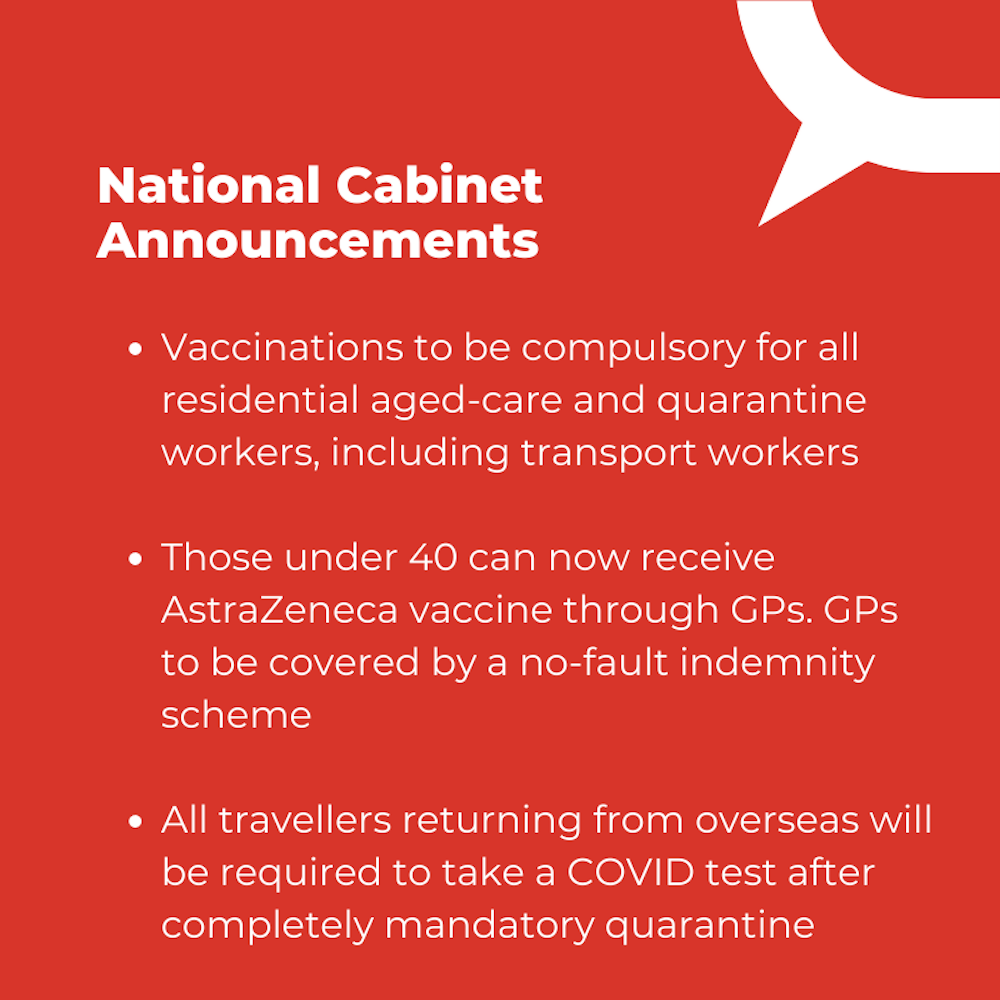
Well, not any more. With the rollout struggling and half the country in lockdown, Scott Morrison is now encouraging younger people to get the AstraZeneca vaccine, despite the Australian Technical Advisory Group on Immunisation (ATAGI) not recommending it for the under 60s.
Morrison’s Monday night announcement of the government’s new position was quite a significant moment.
It marked a break with the experts in a move that, if it were to backfire, would leave the government facing the heat without the “shield” of its advisers.
One can understand why Morrison is going down this path. The government needs to get the population vaccinated much more quickly. We are at the bottom of the OECD with our rollout. There is plenty of AstraZeneca, which is home made at CSL, and limited amounts of the imported Pfizer, the vaccine ATAGI recommends for the under 60s.
The hugely infectious Delta strain is putting the fear of god into federal and state governments, and many in the public. The current lockdowns show how quickly activity can be semi-crippled even by small numbers of cases.
All this when the younger part of the adult population, the under 40s, aren’t yet even in the current vaccination queue.
However, the contradiction is obvious. After AstraZeneca was associated with rare blood clots, the government took ATAGI advice on who should receive which vaccine – AstraZeneca for over 50s, Pfizer for those under.
In embracing the ATAGI advice it knew it would be contributing to hesitancy about vaccination generally and AstraZeneca in particular, but it said it felt it had no option.
Then ATAGI became even more cautious and recommended AstraZeneca be given only to those 60 and above. The government accepted the revised advice, which was likely to make people even more suspicious of AstraZeneca.
When Morrison in effect parks his attachment to the experts and says to younger people, if you are so inclined just talk to your doctor and make your own decision about taking an AstraZeneca jab, the danger is the public become confused or cynical or both.
Heath Minister Greg Hunt on Tuesday explained things this way: “So the advice is very clear on two fronts. One is the medical advice; two is the access.
“AstraZeneca remains the preferred vaccine for people 60 years and over. That has not changed, the advice of ATAGI, and Pfizer is the preferred for people under 60. And the clinical advice of ATAGI, again, has not changed.
“However, as has always been the case … on the basis of informed consent, individual patients and their doctors have been able to make a decision to take up the AstraZeneca on the basis of their individual circumstances and their own judgement,” Hunt said.
“Some GPs have reported that they have excess supply [of AstraZeneca]. And so if there are people who wish to access it, via informed consent, via the existing ATAGI rules, then that’s simply being enabled.”
It might have “always been the case”, but now people are being actively encouraged by the government towards this independent position. Australian Medical Association President Omar Khorshid described the PM’s announcement as “a really significant change in the vaccine program”.
So a 30-year-old woman may find herself weighing the ATAGI advice and the advice of her doctor (who, incidentally, is being provided with a professional indemnity giving “additional certainty” to those advising on vaccination).
Who knows where she will land if the two sets of advice differ?
The AMA and the Royal Australian College of General Practitioners both said on Tuesday they hadn’t received advance notice of the government move.
Karen Price, President of the RACGP, tweeted: “Phones are ringing off the hook at GP clinics. We had no warning of last night’s announcements and this isn’t the first time this has happened to general practice. It’s vital that government provides significant support to GPs to implement these changes to the vaccine rollout.”
She said on 2GB if doctors were to operate outside the ATAGI guidelines “we need to be super clear about what that means”.
Khorshid told The Guardian, “It took us by surprise”.
“Our recommendation is still really for patients to follow the ATAGI advice. Be patient and have the ATAGI-recommended vaccine when it’s available. I am certainly still backing the expert advice at this stage.”
Khorshid said he thought the government had taken this step because it wanted “to provide nervous Australians who are going into lockdown this week with something that they can actually do to improve their chances of getting through this and to push the nation’s vaccination program forward”.
It will be interesting to see how ATAGI now reacts.
Meanwhile there must be questions about how the officials let the doctors apparently be caught on the hop.
Just as the “medical advice” has stopped (at least in this case) being sacrosanct, so criticism of federal health officialdom continues to sharpen over its operations in the rollout. It’s no coincidence that a military man, Lieutenant-General “JJ” Frewen has been put in charge of trying to get the program on track.
The official medical and health experts are finding themselves a good deal more challenged by their federal political masters than a year ago.
Michelle Grattan does not work for, consult, own shares in or receive funding from any company or organisation that would benefit from this article, and has disclosed no relevant affiliations beyond their academic appointment.
Pfizer remains the “preferred” vaccine for Australians aged under 40, due to a small but real increased risk of a rare clotting disorder.
But last night Prime Minister Scott Morrison said younger Australians who didn’t want to wait could ask their GP for an AstraZeneca vaccine instead.
So far 29% of Australians have received a first dose of a COVID-19 vaccine, and 7% have had their second.
While Australia has low numbers of COVID-19 cases overall, outbreaks and lockdowns are causing significant disruption in our lives, prompting some younger people to seek out a vaccine.
In most states, people under 40 may have not yet been vaccinated if they’re not in a priority or high-risk group, as the national rollout is yet to offer Pfizer to under-40s.
But this statement from the prime minister opens up access to an AstraZeneca vaccine for anyone under 40 years.
The prime minister also announced an indemnity scheme to cover GPs who give the AstraZeneca vaccine to someone who has a severe adverse reaction. But the finer details of this new scheme, and what it covers, are not yet available.
Astra wasn’t ‘banned’ for young people, just not ‘preferred’
The Australian Technical Advisory Group on Immunisation (ATAGI), a group of vaccine experts which advises the government, recommended on April 8 that Pfizer be the “preferred” vaccine for adults aged under 50.
This recommendation was based on a risk-benefit assessment at the time. The increased risk of the rare but serious clotting event following AstraZeneca vaccine in those under 50 years outweighed the potential benefit, given how much COVID-19 was circulating at the time.
However ATAGI said AstraZeneca could still be used in adults aged under 50 years where:
the benefits are likely to outweigh the risks for that individual and the person has made an informed decision based on an understanding of the risks and benefits.
ATAGI then updated its advice on June 17 to say Pfizer was the preferred vaccine for those under 60 years.
This increase in age recommendation was because new data identified a higher risk of clotting after AstraZeneca among 50- to 59-year-old Australians than had been reported internationally and initially estimated in Australia.
ATAGI reiterated on June 17 that AstraZeneca could be used in adults under 60 for whom Pfizer wasn’t available, where the benefits outweighed the risks for the person, and they made an informed decision.
if you wish to get the AstraZeneca vaccine, then we would encourage you to go and have that discussion with your GP.
Professor Paul Kelly, Australia’s Chief Health officer later clarified:
there’s a preference for Pfizer up to the age of 60. But that preference is a preference. It’s a discussion for doctors to have with their own patients and work through their own risk and benefit in relation to that.
What should you weigh up?
Resources such as this decision guide can help you weigh up the potential benefits and harms for your circumstances, to make an informed decision about the AstraZeneca vaccine.
So, what are the side effects and more serious adverse effects?
The common side effects of AstraZeneca vaccination include fatigue, headache, body aches and fever and, rarely, anaphylaxis. These are most often after dose one and happen in the first two to three days after vaccination.
We know this because Australia’s active safety surveillance system, AusVaxSafety, has captured vaccine reactions in over one million surveys, including more than 350,000 people who have had a first dose of AstraZeneca.
We have a good idea of the side effects and adverse effects from the AstraZeneca vaccine. CDC/Unsplash
The clotting condition which causes most concern is called thrombosis with thrombocytopenia syndrome, or TTS. This involves blood clots (thrombosis), often in places we don’t usually see clots, such as the brain and abdomen.
It also causes low levels of blood clotting cells called platelets (thrombocytopenia).
We still don’t know the exact mechanism of TTS, but it appears to be caused by an overactive immune response, which is very different from other clotting disorders.
The estimates of clotting risk associated with first doses of the AstraZeneca vaccine are listed in the chart below. New cases detected are updated weekly on the Therapeutic Goods Administration (TGA) website.
(Keep in mind, the risk estimates in the under-50s are based on a much smaller number of people who received the AstraZeneca vaccine compared to those over 50.)
The severity of illness due to TTS ranges from fatal cases and severe disease, which is more likely to occur in younger people, to relatively milder cases. In Australia, the overall chance of dying from TTS is 3-4%.
It’s not currently possible to predict who will develop TTS. The only risk factor for TTS identified right now is age – it’s much less likely to occur in older adults than younger people.
TTS appears to be far more rare following second doses, with data from the United Kingdom indicating a rate of 1.5 per million second doses.
National cabinet yesterday announced it will mandate COVID-19 vaccination for residential aged-care workers, with the aim to ensure all aged-care staff have received their first dose by mid-September.
A support package worth A$11 million is intended to facilitate this, by enabling aged-care facilities to provide their staff with paid leave to be vaccinated.
Health department figures released to The Age showed two-thirds of Australian aged-care staff were yet to receive one dose as of last week. Of 263,000 workers, just over 88,000 (33.6%) had received their first shot and about 43,000 (16.3%) had received both doses.
Given the current community transmission across parts of Australia, and the low vaccination rates in this crucial group, it’s perhaps not surprising we’ve seen this policy shift.
Vaccine mandates for Australian health and aged-care workers exist
In Australia, this is not the first time we’ve moved to mandates to improve vaccine uptake among the health- and aged-care sectors.
Many health- and aged-care workers are required to show evidence they’re protected from a range of vaccine-preventable diseases. For example, annual flu vaccines are mandatory for those working in high-risk clinical settings, including staff in NSW Health aged-care facilities. With the introduction of these mandates, we have not documented mass departures of staff.
While Aged & Community Services Australia, the industry peak body, has welcomed the mandate as “the right decision”, others are questioning whether the government has made sufficient efforts to ensure on-site or priority off-site access to vaccination for aged-care staff across all states and territories.
To support vaccination access for the sector, the federal government announced 13 clinics in multiple locations for aged-care staff. But as of May, only three of these pop-up clinics had been established, all of which were in Sydney (in areas covered by the mass vaccination hubs).
Aged care provider peak bodies Leading Age Services Australia and Aged & Community Services Australia had previously called for more on-site vaccination for aged-care staff, as opposed to having staff members seek vaccination appointments via mass clinics or their GP.
In the aged-care sector, the delivery of vaccination is complicated by variations in staff working hours. Providing the COVID vaccine at their place of work can potentially addresses issues around access to vaccination.
Seeing coworkers getting vaccinated may also help build confidence in those who are sitting on the fence.
Studies have found workplace provision of vaccination plays an important part in the decision to immunise among aged-care workers, with higher vaccination rates in facilities providing on-site vaccination.
To support the introduction of this policy, it’s critical we support conversations within aged-care facilities to ensure staff members understand why the shift in policy has occurred, to address any misinformation and to support them to take up the vaccine.
Importantly, Australia’s aged-care workforce reflects the make-up of the broader Australian population. So English may be a second language for a portion of workers.
While efforts have been made to ensure information sheets are available in other languages, booking systems, including the one used to support the pop-up vaccination clinics in Sydney, are only available in English.
We need to be mindful to adopt best practice to support engagement with vaccine services for people from culturally and linguistically diverse communities. Information sessions should be held which allow for questions, and staff should have the opportunity to talk to an immuniser who speaks the same language if needed.
Previous surveys of aged-care staff have also identified some workers have limited computer skills, which may be a barrier to using online booking systems. Support should be available to assist those staff in booking their appointments.
Research has shown workplace provision of vaccination makes aged-care staff more likely to immunise. Shutterstock
Concerns have also been raised about the level of funding allocated to support staff members to to take leave to have the vaccine. Australian Nursing and Midwifery Federation federal secretary Annie Butler calculated the A$11 million would give each unvaccinated worker about $A30 per dose.
As Butler noted, this would be nowhere near enough to support time off from work. So this issue needs to be addressed immediately to ensure aged-care workers can take time off if needed to access off-site vaccination appointments, and ideally to recover if they experience any adverse reactions.
Mandates work
The introduction of this mandate aligns with what has been recommended previously to improve influenza vaccination of aged-care staff. Internationally, mandates have been shown to increase vaccine coverage for health workers including for influenza.
It also aligns with our past research on mandatory vaccination of aged-care staff, where we found positive support from stakeholders, including those responsible for developing policy and delivering vaccination programs to aged-care staff.
Beyond aged care, there may be a need to extend mandatory COVID vaccination policies to other health workers including those working in community or disability care, or to staff in hospitals.
However, it’s critical we understand the coverage levels for each of these groups before moving forward, as other strategies including the opportunity for paid time off to receive a vaccine or incentives may assist here, before we need to consider further mandates.
Holly Seale is an investigator on a study funded by NHMRC and has previously received funding for investigator driven research from NSW Ministry of Health, as well as from Sanofi Pasteur and Seqirus. She is the Deputy Chair of the Collaboration on Social Science and Immunisation.
Papua New Guinea and Fiji are among several countries in the region going backwards in their fight against the covid-19 pandemic and this is concerning, a New Zealand epidemiologist has warned.
PNG has recorded more than 170 deaths and more than 17,000 cases of the virus. In Fiji, 17 people have died and more than 3,000 active cases are in isolation.
Professor Michael Baker, from the University of Otago, said the figures coming out of both countries are a concern.
“One of the added worries with PNG is it’s by far the largest population [9 million] and many people are living in informal settlements in crowded conditions with multi-generational families,” he said.
“They are very vulnerable to this infection so it’s very concerning. This is the same in Fiji.
“We are seeing a pattern across the Asia-Pacific region now where countries that have managed the pandemic extremely well and have succeeded in eliminating the virus. Fiji did extremely well and had no transmission for over a year.
“But now what we’re seeing is an outbreak of the more infectious Delta variant and we will see more infections of the virus unfortunately.”
Professor Baker said this had put a lot of strain on the health control measures in these countries, due to fatigue and complacency, after more than a year of battling the virus.
Fiji’s government has refused to impose a national lockdown with Prime Minister Voreqe Bainimarama saying this would cripple the economy and impact on Fijian jobs.
Professor Michael Baker says the Delta variant has put a lot of strain on the health control measures in countries such as PNG and Fiji, due to fatigue and complacency, after more than a year of battling the virus. Image: RNZ/AFP
Fiji positivity rate at 7.4 percent The country’s covid-19 positivity rate is now at 7.4 percent while the World Health Organisation (WHO) threshold is at five percent.
“That’s a grim situation and is very concerning,” Professor Baker said. “They are on that exponential part of the curve and that means essentially uncontrolled transmission of this virus and we know all the consequences that go with that.
“That also means with more positive cases will come deaths. Typically there’s a mortality risk depending on the ages of the population of half a percent to one percent.”
In PNG, where testing remains limited, the government has been reluctant to force wider communities into lockdowns and so instead has urged the public to adhere to the preventative measures of the “niupela pasin” or new normal.
“But one of the real worries is that when you exceed the capacity of the health system to manage these ill people, they start dying from quite preventable causes. Some people are seriously ill and it will be hard to look after them even with the best intensive care.”
He said a change to policy settings is needed so people are more prepared for any outbreak.
Concern for Asia-Pacific region “I’m concerned for the whole Asia-Pacific region because they are all going backwards at the moment and having trouble containing this variant [Delta]. Just look at the terrible situation in Fiji.
“This is a real lesson for us in New Zealand that everything we are doing now we are going to have to do better if we are going to stay ahead of this more infectious variant.”
Professor Baker’s number one piece of advice is to stay home if you have cold or flu symptoms and get tested. After that, wearing masks indoors at level two and compulsory scanning are critical.
There have been calls to ramp up covid-19 vaccinations on both sides of the Tasman.
An alert level 2 was raised in New Zealand last week after an Australian tourist who had visited tourist attractions, restaurants and bars in Wellington between June 18 and 21 tested positive for the Delta variant of the virus on his return home.
Wellington moves back down to alert level 1 from midnight Tuesday, and cabinet has agreed in principle to resume travel with some Australian states from Sunday: Victoria, South Australia, ACT and Tasmania.
The travel pause with NSW, Western Australia, Northern Territory and Queensland is set to continue beyond Sunday. Cabinet will review the settings for those states on Monday, July 5, and announce a decision on Tuesday, July 6.
University of Otago epidemiologist Professor Michael Baker Image: Luke Pilkinton-Ching/University of Otago
Call to ramp up vaccinations The Australia New Zealand Leadership Forum worked on protocols and advice for the governments on the trans-Tasman travel deal, with tourism worth more than NZ$5 billion to the two countries.
Co-chair of the forum, Ann Sherry, believes the attitude of some towards vaccination is putting everyone at risk.
She said both countries need to give their vaccination rollouts “some acceleration”, especially as Australia and New Zealand have countries nearby with connections.
“I watched imagery last night of fighting in Fiji over someone who’d stolen crops,” she said.
“Now when you get to the stage in your near neighbours where people are fighting over food because they’re so dependent on tourism — so dependent on both Australians and New Zealanders coming in and out, and them getting work in both Australia and New Zealand — can we really in good conscience sit by and watch that happen?
“There’s a bigger world around us. A lot of places very dependent on Australia and New Zealand in the region, and they’re doing it tough at the moment.
“Their economies are collapsing and that puts a lot of vulnerable people at risk. And I personally don’t think we should just sit by, watch that happen and say, ‘we’re okay, so see ya’.”
19,000 cases in French Polynesia Meanwhile, French Polynesia’s covid-19 tally has breached the 19,000 cases mark after another nine infections were recorded over the weekend.
Daily infection numbers have, however, plummeted to single digits after peaking in November when French Polynesia had the fastest propagation rate of the pandemic outside Europe.
Six cases of the Delta variant were discovered last week and more than 60,000 people have been fully vaccinated.
Since last week, there is no curfew. Gatherings continue to be restricted to a maximum of 25 people and in enclosed spaces, masks have to be worn by people aged 11 and older .
The territory was reopened to quarantine-free travel for vaccinated visitors from the US last month.
This article is republished under a community partnership agreement with RNZ.
Health workers in Fiji … the country is struggling with the latest Delta variant outbreak. Image: RNZ/Fiji govt
As well as her usual interviews with experts and politicians about the news of the day, Politics with Michelle Grattan now includes “Word from The Hill”, where all things political will be discussed with members of The Conversations’s politics team.
In this episode, politics + society editor Amanda Dunn and Michelle discuss Scott Morrison’s Monday night announcement encouraging younger people to discuss with their doctors getting the AstraZeneca vaccine – despite this not being recommended by the official technical expert group which advises the government
They also dive into how the government’s handling of the pandemic is affecting its wider support, and the opposition’s ability to cut through in the wake of the pandemic.
Michelle Grattan does not work for, consult, own shares in or receive funding from any company or organisation that would benefit from this article, and has disclosed no relevant affiliations beyond their academic appointment.
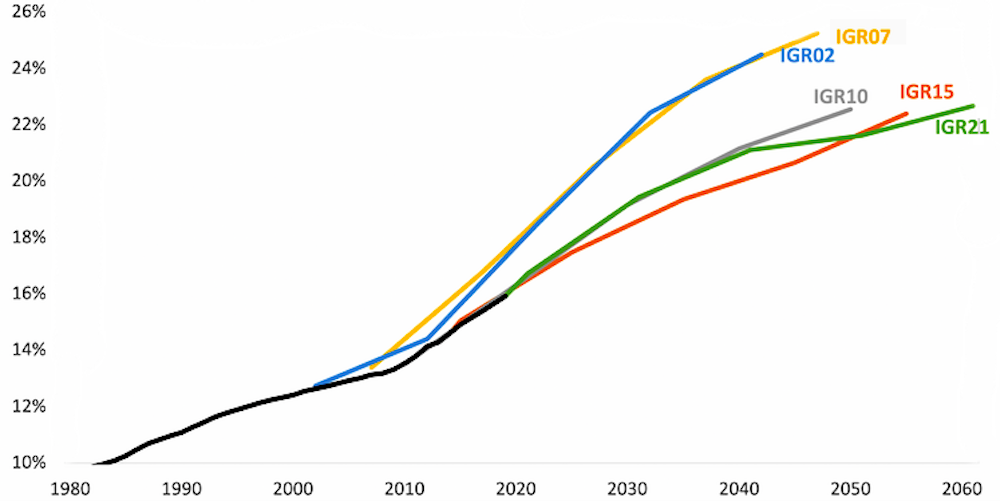
We’ve had five intergenerational reports now, the first (IGR02) in 2002, and the most recent (IGR21) on Monday.
Each has presented a startling picture of a widening gap between the revenue collected from a declining share of predominantly younger taxpayers and the spending needed on an increasingly older population.
In all but the latest, the financial challenge has got less worse over time.
It has worsened this time because the temporary halt to immigration has for the moment removed one of the tools we have used to slow population ageing and because the COVID crisis meant less economic growth, less growth in tax revenue, and more government spending than we had been expecting.
What’s sobering
Over the next 40 years, the economy and incomes are expected to grow more slowly than in the past, leaving the budget in continual deficit.
This is in part because while needed spending on ageing and health will increase as previously projected, income from taxes will increase only up to a self-imposed cap, reaching it in the 2030s.
But the reality may be worse. The report is optimistic about the rebound to migration, about increases in labour force participation, and about average productivity growth.
If any one of these generous assumptions doesn’t come to pass it will be more difficult than projected to balance the budget as the population ages.
What’s probable
While the demographic fallout from the pandemic is expected to exacerbate population ageing trends, over successive intergenerational reports until now, projections for the proportion of the population aged over 65 have become less pronounced.
Even now, projections for the proportion of the population aged over 65 are tracking those in the 2010 report, but haven’t taken us as far back as the first.
Much will depend on net migration. It is assumed to rebound to 235,000 people per year by 2025, with a revamped focus on skilled migrants. If it gets and stays that high, or climbs, our population will age slowly.
Proportion of population over 65, actual (black) and projected
Author’s analysis of ABS and Treasury data
What’s possible
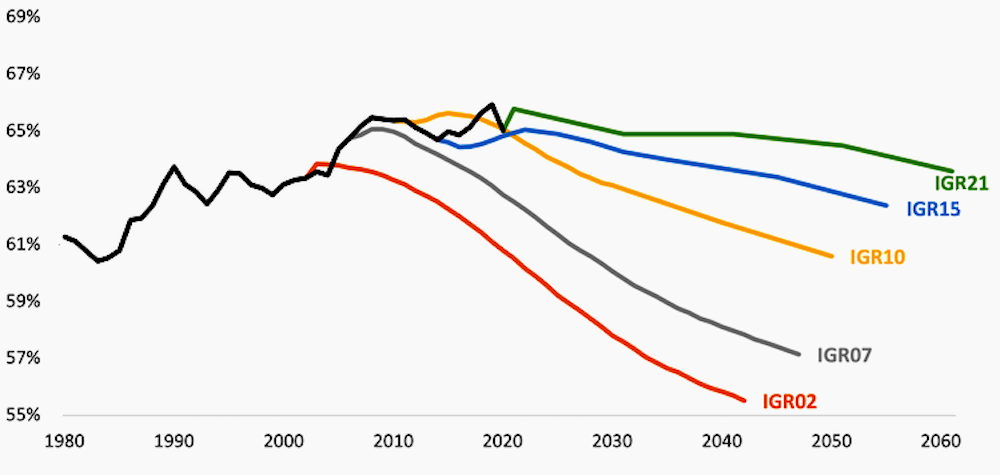
In each intergenerational report so far a greater proportion of the population has been making itself available for paid work than previously expected.
Since 2002, the labour force has grown by 41%. Nearly half of that increase was workers over the age of 50.
There are now a million more women over 50 in the labour force than at the time of the first intergenerational report, and the participation rate of women aged 60-64 had doubled.
But increases in older-age participation are slowing even though each new cohort of older Australians is healthier, more educated, and more employable.
Research shows if older people are to thrive and prosper in the labour market as the treasury’s figures suggest, Australia will need to dismantle barriers related to health, training, discrimination, and work conditions and scale up strategies to help employers recruit and retain older workers.
Proportion of people aged 15+ in the labour force, actual and projected
Author’s analysis of ABS and Treasury data
What looks over-optimistic
At the launch of the report on Monday, Treasurer Josh Frydenberg quoted economist Paul Krugman that “productivity isn’t everything, but in the long run, it’s almost everything.”
With greater labour productivity (GDP per hour worked) we earn more with the same or less effort, potentially offsetting the economic and fiscal impacts of ageing.
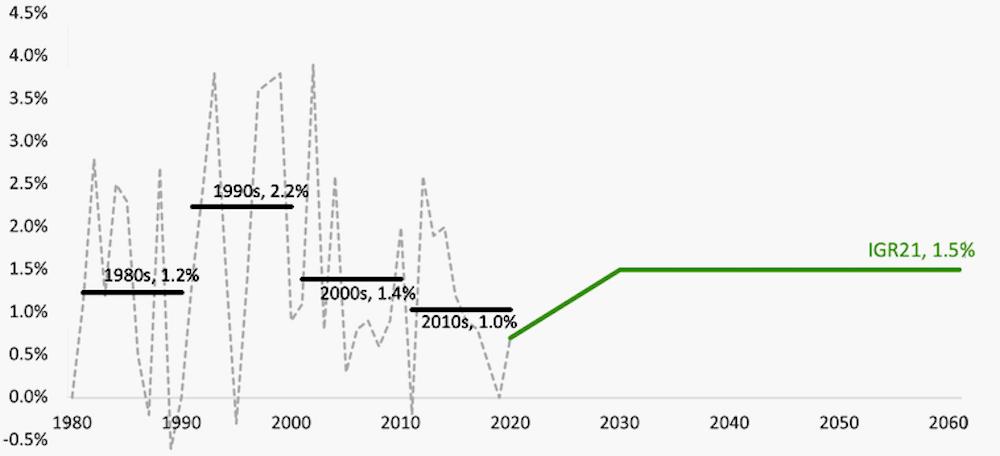
The report’s productivity growth assumption for the next 40 years is based on the average of the last 30 years: 1.5% per year.
Yet recent rates have been much less, and have been declining over time.
Labour productivity annual growth and decade averages, actual and projected
Change in average GDP per hour worked. Author’s analysis of ABS and Treasury data
Average annual productivity growth over the last decade, including the pandemic recession, has been 1%.
Treasury’s sensitivity modelling shows that lower than projected productivity growth of 1.2% would see the economy and incomes 9% to 10% lower by 2060-61 and the budget deficit 2.2 percentage points wider.
Australia isn’t alone in experiencing a slowdown in productivity growth and it isn’t clear how much Australia by itself can do about it.
The report points to a suite of microeconomic reforms related to competition, digital technologies, patents, research and development, and skills, some of which were recommended in a landmark review by the Productivity Commission in 2017.
But as the treasurer pointed out on Monday, many of the big reforms have already been done. As he put it: “you can’t float the dollar twice”.
What’s unmodelled
And a key set of figures are missing from the report — those relating to the impact of climate change.
There is a chapter on the environment describing risks, but it doesn’t feed them into formal projections in the way this month’s NSW intergenerational report did.
Frydenberg’s report is commendable. It presents an opportunity to talk about ways to achieve a better future – not just the one it outlines.
Rafal Chomik works for the ARC Centre of Excellence in Population Ageing Research which receives funding from the Australian Research Council.
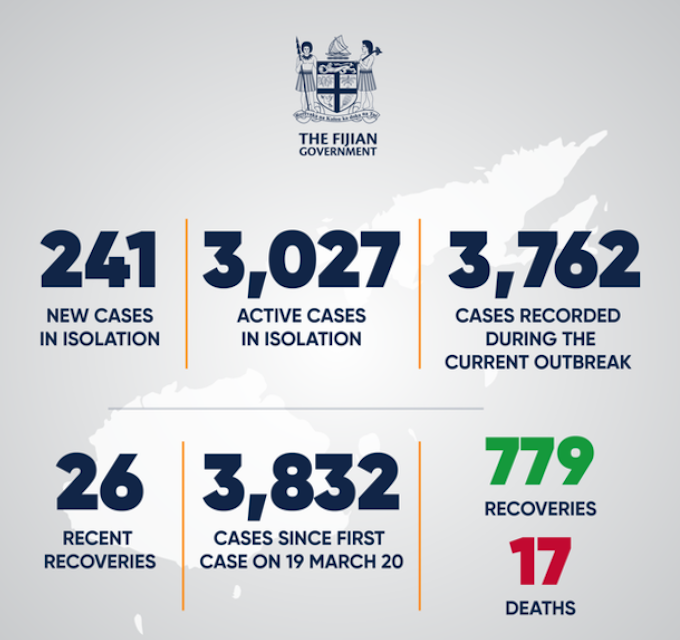
Fiji has reported 241 new cases of covid-19 infections and one death in the 24-hour period ending at 8am yesterday.
Health Secretary Dr James Fong said 5 cases were prison officers from Suva who were undergoing 14 days quarantine at the FSC Compound in Rakiraki as part of essential movement from red zone to green zone when they tested positive.
The remaining cases were from the Lami-Suva-Nausori containment zone.
He said there were 106 cases from existing areas of interest, and 17 from the following new areas of interest:
Fiji Times
Food City Suva
Matanisivoro Settlement
National Kidney Centre-Nadera
Suva City Council, and
Tamavua-i-Wai.
“The remaining cases are contacts of known cases, cases that were seen in screening clinics and were swabbed, and cases under investigation to determine possible sources of transmission,” Dr Fong said in his covid-19 update last evening.
He said the new covid-19 death was a 50-year-old man from Newtown – believed to have died at home and was declared dead on arrival by doctors at the Valelevu Health Centre.
“He was reported to be in severe respiratory distress before death. According to protocol, he was swabbed at the health centre, and tested positive. His death has been classified as a covid-19 death by the doctors at the health centre,” Dr Fong said.
“He had received the first dose of the vaccine early this month. He was not fully vaccinated.”
Dr Fong said another death that was previously reported to be under investigation had also now been classified by doctors as as a covid-19 death.
He said the 62-year-old man from Grantham Rd had presented to the FEMAT field hospital in respiratory distress and died on the same day.
“He had been having respiratory symptoms, including shortness of breath, for at least a week before presenting to FEMAT.
“According to protocol, he was swabbed and tested positive for covid-19. He was not vaccinated.”
Church warns pastors on vaccine messages Meanwhile, The Fiji Times reports that the Methodist Church has warned its leaders that it would take action against those influencing church members not to get vaccinated.
Speaking during a virtual meeting regarding the church’s stand on covid-19 on Thursday, the church’s general secretary, the Rev Iliesa Naivalu has reminded pastors that they were answerable to the church.
Naivalu has also called on them to refrain from circulating baseless videos being circulated on social media.
Naivalu reminded pastors that they had a duty to preach about goodness and life to those under their charge.
Timoci Vulais a Fiji Times reporter. Republished with permission.
Fiji covid-19 statistics updates for 28 June 2021. Graphic: Fiji govt
Retired foundation director of Otago’s National Centre for Peace and Conflict Studies Professor Kevin Clements has been awarded the International Studies Association’s (ISA) 2022 Distinguished Scholar Award in its peace studies section.
The ISA said the award was given each year to a scholar who had a substantial record of research, practice and/or publishing in the field of peace and conflict studies.
The association’s selection committee was deeply impressed by the breadth and quality of Professor Clements’ work on disarmament, conflict resolution and problems of historical memory and reconciliation in Asia-Pacific, as well as his institution – and organisation – building work.
“I would like to share this honour with all of my colleagues since, among other things, the committee noted my ‘institution and organisation building work’. I could do no institution building without all of your talent, hard work and support,” Professor Clements said.
“I look forward to acknowledging my NCPACS and Australian peace and conflict studies colleagues at the award ceremony.”
At the upcoming 2022 International Studies Association conference in Nashville, Tennessee, Professor Clements will join the Distinguished Scholar Awards Roundtable to celebrate his contributions to the field.
Professor Clements was at Otago for 11 years before retiring in 2020. He was awarded the NZ Peace Foundation’s 2014 Peacemaker Award and served as secretary-general of the International Peace Research Association and past secretary-general of the Asia Pacific Peace Research Association.
Prior to taking up these positions he was the professor of peace and conflict studies and foundation director of the Australian Centre for Peace and Conflict Studies at the University of Queensland, Brisbane, Australia.
His career has been a combination of academic analysis and practice in the areas of peacebuilding and conflict transformation. Professor Clements has been a regular consultant to a variety of non-governmental and intergovernmental organisations.
Facebook has today launched a public education campaign to help people in five Pacific Island countries and territories learn how to identify and combat health-related misinformation.
The locations and languages are Wallis & Futuna (French), New Caledonia (French), Tonga (English and Tongan), Solomon Islands (English and Solomon Islands Pijin), and Cook Islands (English).
The campaign, which follows an earlier launch in Samoa, Fiji, Papua New Guinea, will run for five weeks and includes graphics and videos.
The content is designed to encourage three key behaviours by Facebook users:
Awareness – Be informed that misinformation exists
Investigation – Find out more to confirm if the information is indeed false
Action – Visit the local health authority to get accurate information
Mia Garlick, director of public policy for Australia, New Zealand and Pacific Islands, says: “One of our commitments is to connect people to reliable information, and give people the tools to make informed decisions about the information they see on Facebook.
“We are extending our efforts to reach more people across the Pacific, ensuring they can easily compare what they see with official public health resources.
“We will continue to work with health experts including the World Health Organisation (WHO), and local partners, to make sure that we have the right policies in place to reduce the spread of harmful covid-19 and covid-19 vaccine misinformation on our platform.”
Throughout the pandemic, Facebook has worked closely with WHO to direct people to authoritative covid-19 information, and to do more to identify and take action to remove incorrect claims about the virus.
COVID-19 has exposed the inherent fault lines in India’s public health system. This year, as the pandemic’s deadly second wave began raging across the country, hospitals ran out of beds, oxygen cylinders, ventilators, and key drugs used in managing the disease.
Even as families of COVID-19 patients struggled to find decent hospital care, black marketeering of drugs and life-saving equipment such as oxygen concentrators and cylinders was reported across several cities.
Desperate to save their loved ones, citizens were forced to not only incur high costs of treatment at private hospitals, but also buy essential supplies, sometimes, at several times their original price.
Rural India, particularly, has borne the brunt of the deadly virus, with several villages lacking even basic testing facilities and medical care.
None of this is surprising, though.
Underfunding
A study published in the medical journal The Lancet in 2018 compared South Asian countries on access to health services and health care quality. It ranked India the lowest, despite the fact countries such as Sri Lanka and Bangladesh have much lower GDPs.
The answer to India’s current health crisis lies in over four decades of under-investment in health at the federal and state levels, and rampant commercialisation.
Health is primarily a state responsibility in India, with some funding coming from the federal and local governments. Publicly funded schemes support the poor and government workers, and people who are privately employed pay for their own health insurance.
However there is great variation on spending between states. And most of that spending goes to hospitals in urban areas. This has meant that over the years, regional areas and services like general practice and paramedicine have been neglected.
Several government committees have acknowledged the need to increase spending to strengthen public systems. And the pandemic has provided an urgent case. But despite this, funding has not increased.
Private profits over public health
An underfunded public health system opened opportunities for private players. Since the late 1970s, private businesses have been flourishing in all aspects of health care in India.
Private players are now dominating medical research, medical and paramedical education, and drug and tech manufacturing and development.
In the 1990s, market principles were introduced into to the health system.
This included the introduction of fees for consultation, diagnostics and drugs; hiring doctors, nurses and paramedical workers on non-permanent contracts; and encouraging public-private partnerships for developing health infrastructure and diagnostic services.
This resulted in competition between the government-funded health sector, and an unregulated and aggressive private sector. Soon, a mixed economy of the health system with an increasingly large presence of the private sector became the norm. This worsened regional, class, caste and gender inequities in access and utilisation of health services.
The poor are a large voter base so you can see the appeal, but the schemes create demand for high-end medical services, mostly in the private sector. As a result, government subsidies have been flowing into strengthening private health-care.
Those who need health care the most, get the least
The consequences of these trends have been devastating, particularly for populations already marginalised because of their caste, class, gender, region or religion.
These marginalised groups bear the direct cost of treatment as well as the indirect costs: transport, loss of wages, and the prohibitive cost of drugs and diagnostics.
Government underfunding of public health causes the poor to suffer, and the middle class who don’t earn huge wages but have to pay for their own health insurance also bear a heavy burden.
In cases of both acute and chronic illnesses, people have been forced to pay for medical care and have incurred huge debts, becoming a driver of poverty.
These trends have only been amplified during the COVID-19 pandemic. The complete lack of state protection for its citizens in the midst of a humanitarian crisis reveals its lack of commitment to the basic values of democracy.
Rama V Baru does not work for, consult, own shares in or receive funding from any company or organisation that would benefit from this article, and has disclosed no relevant affiliations beyond their academic appointment.
Climate Explained is a collaboration between The Conversation, Stuff and the New Zealand Science Media Centre to answer your questions about climate change.
When we say there’s a scientific consensus that human-produced greenhouse gases are causing climate change, what does that mean? What is the Intergovernmental Panel on Climate Change and what do they do?
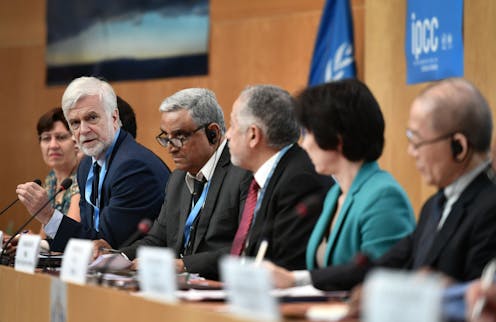
The Intergovernmental Panel on Climate Change (IPCC) provides the world’s most authoritative scientific assessments on climate change. It provides policymakers with regular assessments of the scientific basis of climate change, its impacts and risks, and options for cutting emissions and adapting to impacts we can no longer avoid.
The IPCC has already released five assessment reports and is currently completing its Sixth Assessment (AR6), with the release of the first part of the report, on the physical science of climate change, expected on August 9.
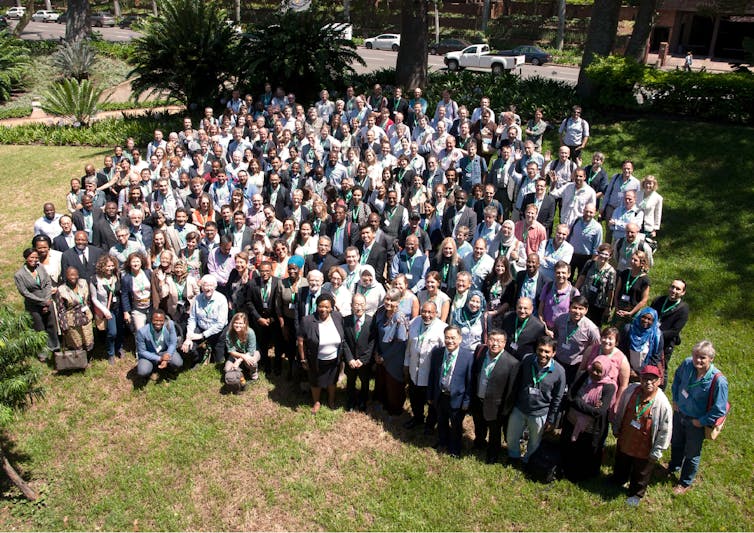
Each assessment cycle brings together scientists from around the world and many disciplines. The current cycle involves 721 scientists from 90 countries, in three working groups covering the physical science basis (WGI), impacts, adaptation and vulnerability (WGII) and mitigation of climate change (WGIII).
People contributing to IPCC reports come from 90 countries and different backgrounds. This image shows the Working Group II team. Author provided
In each assessment round, the IPCC identifies where the scientific community agrees, where there are differences of opinion and where further research is needed.
IPCC reports are timed to inform international policy developments such as the UN Framework Convention on Climate Change (UNFCCC) (First Assessment, 1990), the Kyoto Protocol (Second Assessment, 1995) and the Paris Agreement (Fifth Assessment, 2013-2014). The first AR6 report (WGI) will be released in August this year, and its approval meeting is set to take place virtually, for the first time in the IPCC’s 30-year history.
This will be followed by WGII and WGIII reports in February and March 2022, and the Synthesis Report in September 2022 — in time for the first UNFCCC Global Stocktake when countries will review progress towards the goal of the Paris Agreement to keep warming below 2℃.
During the AR6 cycle, the IPCC also published three special reports:
The IPCC’s special report on global warming at 1.5 showed present-day warming across the globe. IPCC, CC BY-ND
How the IPCC reaches consensus
IPCC authors come from academia, industry, government and non-governmental organisations. All authors go through a rigorous selection process — they must be leading experts in their fields, with a strong publishing record and international reputation.
Author teams usually meet in person four times throughout the writing cycle. This is essential to enable (sometimes heated) discussion and exchange across cultures to build a truly global perspective. During the AR6 assessment cycle, lead author meetings (LAMs) for Working Group 1 were not disrupted by COVID-19, but the final WGII and WGIII meetings were held remotely, bringing challenges of different time zones, patchy internet access and more difficult communication.
The IPCC’s reports go through an extensive peer review process. Each chapter undergoes two rounds of scientific review and revision, first by expert reviewers and then by government representatives and experts.
This review process is among the most exhaustive for any scientific document — AR6 WGI alone generated 74,849 review comments from hundreds of reviewers, representing a range of disciplines and scientific perspectives. For comparison, a paper published in a peer-reviewed journal is reviewed by only two or three experts.
The role of governments
The term intergovernmental reflects the fact that IPCC reports are created on behalf of the 193 governments in the United Nations. The processes around the review and the agreement of the wording of the Summary for Policymakers (SPM) make it difficult for governments to dismiss a report they have helped shape and approved during political negotiations.
Importantly, the involvement of governments happens at the review stage, so they are not able to dictate what goes into the reports. But they participate in the line-by-line review and revision of the SPM at a plenary session where every piece of text must be agreed on, word for word.
Acceptance in this context means that governments agree the documents are a comprehensive and balanced scientific review of the subject matter, not whether they like the content.
The role of government delegates in the plenary is to ensure their respective governments are satisfied with the assessment, and that the assessment is policy relevant without being policy prescriptive. Government representatives can try to influence the SPM wording to support their negotiating positions, but the other government representatives and experts in the session ensure the language adheres to the evidence.
Climate deniers claim IPCC reports are politically motivated and one-sided. But given the many stages at which experts from across the political and scientific spectrum are involved, this is difficult to defend. Authors are required to record all scientifically or technically valid perspectives, even if they cannot be reconciled with a consensus view, to represent each aspect of the scientific debate.
The role of the IPCC is pivotal in bringing the international science community together to assess the science, weighing up whether it is good science and should be considered as part of the body of evidence.
Rebecca Harris is a Lead Author on the IPCC’s Sixth Assessment Report, contributing to WGII. She received funding from the Department of Industry, Science, Energy and Resources to support travel to IPCC Lead Author Meetings
Australia is now over four months into its COVID vaccine rollout, and it’s still not going well.
At the six-week mark, I wrote about four ways the vaccine rollout had been bungled: the wrong pace, phasing, model, and messaging.
Nearly three months on, sadly none have been fixed, and new symptoms of these blunders are emerging.
With higher rates of vaccination, Australia’s current COVID outbreaks may have been more easily managed. Sydney, Perth, Darwin and now Brisbane are all in lockdown, and Victoria just exited one.
Bungle 1: the wrong pace
In April, I identified the first bungle as the federal government’s assertion the rollout was “a marathon not a sprint”. The government then said the rollout was “not a race”, but has since backed away from that message.
Despite abandoning the “not a race” excuse, the government hasn’t displayed a new sense of urgency. More doses are on order, but they won’t flow until September.
The continuing effects of the “stroll-out” are there for everyone to see. Only about 5% of the population is fully vaccinated, way behind the proportion in similar countries.
Bungle 2: the wrong phasing
At the three-month mark it was clear the phasing was wrong. Vaccination of quarantine and health workers, supposedly in phase 1a, was not completed before other phases were rolled out.
Mass vaccination requires mass vaccination centres. The original federal government model placed almost sole reliance on GPs for the rollout. That didn’t work.
Although thousands of general practices are providing vaccines, they only provide about half of all vaccinations. A mixed model — both GPs and mass centres — seems to be working now and should continue.
This isn’t consistent with a speedy mass rollout and harks back to the lethargic approach of the start of the year. The wrong pace still appears to be creating another bungle, the wrong model.
The biggest problem with the relentlessly optimistic political messaging is that it made it harder for the government to admit its mistakes, learn from them, and reset the rollout.
The wrong messaging continues on four fronts, albeit different from the earlier bungles.
Unfortunately, that signal is consistent with the government’s undermining of the public service and its love of flags, military men, and labelling everything as “Operation” something, as if a new militaristic label will somehow overcome the government’s mishandling, or perhaps simply distract people’s attention.
The second messaging bungle has been about vaccine hesitancy. When the present outbreak-induced vaccine demand dies down, the government should mount a series of media campaigns to address vaccine hesitancy properly.
And last night, the prime minister back-flipped on all of this and announced AstraZeneca would be available to anyone who wants it, of any age, if they request it from their GP. Unfortunately, many Australians appear to have voted with their feet (or arms) and are not interested in AstraZeneca so the take up of this option is likely to be trivial.
The tighter restrictions were about keeping people safe, but they were not marketed as such. As a consequence, the AstraZeneca vaccine now seems to be indelibly tarnished and will be phased out from about October, according to the government’s 2021 vaccination schedule.
The final contemporary messaging problem is about reopening borders. Obviously, now is not the right time to talk about opening borders, while COVID is spreading rapidly throughout the country.
But eventually we will need to have that conversation. Head-in-the-sand denialism — that the border reopening is far off in the future — is not good leadership. Even NSW Liberal premier Gladys Berejiklian argues we need to set a threshold for vaccinations for when opening up might happen. The federal government must lead this conversation, setting out the options and the timelines.
Over four months into the vaccine rollout, the bungling continues. It’s still too slow and badly managed, with devastating consequences for individuals and the economy. Can rollout 2.0 get it right? We can live in hope.
Grattan Institute began with contributions to its endowment of $15 million from each of the Federal and Victorian Governments, $4 million from BHP Billiton, and $1 million from NAB. In order to safeguard its independence, Grattan Institute’s board controls this endowment. The funds are invested and contribute to funding Grattan Institute’s activities. Grattan Institute also receives funding from corporates, foundations, and individuals to support its general activities, as disclosed on its website. Stephen Duckett has been partially vaccinated with AstraZeneca.
This is an edited extract from China Panic: Australia’s Alternative to Paranoia and Pandering, by David Brophy
Things could always be worse in Australia–China relations, but on both sides, analysts see a rift too deep to be mended anytime soon.
Leaders of the two countries have not held prearranged talks since 2016, ministers since 2018. Chinese officials now impose informal sanctions and bans on Australian exports on a regular basis, plunging some industries into crisis and spooking many of the rest.
Ostensibly, it was Australia’s call for China to admit an international investigation into the origins of COVID-19 that triggered China’s ongoing trade retaliation. But the truth is China is responding to a range of measures that represent a wholesale shift in the way Australia views it. Security laws, foreign investment decisions, raids on Chinese journalists – the list is long.
The combined effect of all these measures has been to cultivate an image of China as a uniquely dangerous country, with which business as usual cannot go on. China has got that message and is now taking its business elsewhere.
We’ve got ourselves into a position where serious debate as to the rationale for, and wisdom of, Australia’s foreign and domestic policies involving China is becoming hard to have. We need to get ourselves out of it.
Historians will eventually have a more precise picture of how Australia entered onto this path, but we can say with some confidence that security agencies have led the way.
China Panic, Black Inc. Books.
An inter-agency inquiry chaired by prime ministerial adviser John Garnaut has been widely cited as the catalyst for Malcolm Turnbull’s policy shift. ASIO has itself taken on an increasingly public role, issuing warnings from 2017 onwards that foreign interference was occurring at “an unprecedented scale” in Australia.
The Australian Strategic Policy Institute (ASPI) has likewise been assiduous in talking up risks from China. Headed by Peter Jennings, who advised John Howard on intelligence leading up to the Iraq War, ASPI has often been the brains behind Australia’s interventionist policies in the Pacific and the Middle East, and now serves as a clearing house for “get tough” strategies towards China.
Backbenchers from the right wings of both major parties have openly embraced the new mood, adopting the “Wolverines” moniker from the 1980s film Red Dawn.
While that image calls to mind plucky young Cold Warriors putting up a last-ditch defence, the definition of “security” that Australia’s hawks work with often extends well beyond the Australian continent and its maritime frontiers, making the line between defensive and offensive measures a blurry one.
Paul Monk, one-time director of China analysis for the Defence Intelligence Organisation, recently outlined a five-step plan to push back against Beijing. He advises Australia to configure its “information warfare capabilities” for offence, which will include “talking up the attractive prospects for a more open and tractable China”.
The definition of “tractable”, of course, is “easy to control or influence”. It’s notable that those most exercised by foreign influence are often the most interested in exercising it.
‘Selling out for the national interest’
In the economic sphere, meanwhile, those who first guided Australia’s liberalisation and turn to Asia remain bullish on China and champion trade multilateralism as the alternative to what they see as America’s turn to protectionist nationalism.
What of capital itself? Are Australia’s captains of industry tilting towards China, as many imagine?
Some have certainly been sending signals. At the height of the COVID-19 pandemic, it was hard not to be struck by the scene of Andrew “Twiggy” Forrest bypassing the government to engage his “Chinese friends” in the medical equipment industry, and then ambushing health minister Greg Hunt by inviting a Chinese consul to the press conference announcing his purchase.
Some in the immediate firing line of China’s trade shutdown have been more forthright in their views. When wine shipments were held up last November, one angry vigneron complained: “It’s no one else’s fault, it’s the Australian government’s fault.”
Many who do business with China probably feel the same way, but there can be a cost for speaking up. So effective has been the suspicion cast on corporate ties to China, that even the mildest critics from that milieu can find themselves pilloried for selling out the national interest.
My book is written, though, with an understanding that foreign policy is not so much a field of competing ideas as a field of competing interests. As much as Australia’s major parties are resolute in their loyalties to the US alliance, they also remain deeply beholden to corporate interests.
In a field of foreign policy dominated by these two outsized influences, it can often feel as if our options are constrained.
China hawks don’t so much challenge the corporate influence on Australian policy as use it as a foil: if we don’t side with the United States, they ask, then what’s to stop Australia dropping its criticism of China for the sake of a buck?
I take this question seriously. Certainly, nobody wants corporate lobbyists writing Australia’s China policy. Even if that’s not on the cards, certain truths have been exposed about the nature of Australia’s transactional relationship with China, and about China itself, that naturally make people hesitant to endorse any return to “business as usual”.
The standard critique of “engagement” – that the West learned to live with a repressive party-state so as to advance its own political and economic interests – has much truth to it.
Compromises that were made to preserve and cultivate “the relationship”; a revolving door between politics and the corporate world; the blurry line between political lobbying and more dubious forms of influence-peddling: all of these issues and more have come into view.
Where does Australia go from here?
The solution seems obvious. What we need is a position not beholden to the paranoid vision of the security agencies or to the priorities of trade, but one that lives up to its profession of universal values.
This, of course, is where the structural constraints of foreign policy get in the way. To reorient Australia’s China politics in a more progressive direction, one capable of both defusing the brewing cold-war conflict and extending solidarity to people in China, there’s no getting around the fact that those constraints will need to be broken down. A wider range of voices and interests need to be represented in the making of Australian foreign policy.
I sometimes talk about what “Australia” should do, but most of the time I’m really talking about what Australians should do. I’m sceptical that the Australian state, as it exists today, can be a principled humanitarian actor on the world stage – it’s simply not built for that purpose.
Similarly, with occasional exceptions, I avoid referring to a national “we”. The lesson to draw from today’s conflict over China policy is not that Australia is having trouble identifying its national interest, but that there’s really no such thing as a single national interest.
Global rivalries for economic and political dominance serve elite interests, but for the rest of us, they deplete public resources and endanger political freedoms.
To get out of the rut into which Australia’s China debate has settled, we need to recentre it on the interests that ordinary people in Australia and across Asia share in both combating oppression and resisting warmongering.
The array of questions that China raises for Australia today is daunting, far too diverse for anyone to claim expertise in them all. I’ve written my book not because these questions require a specialist, but because they’re too important to leave to the specialists.
David Brophy does not work for, consult, own shares in or receive funding from any company or organisation that would benefit from this article, and has disclosed no relevant affiliations beyond their academic appointment.
The government today announced that the current pause in trans-Tasman travel has been extended until at least midnight on Sunday. It will then only lift for South Australia, Australia Capital Territory, Tasmania and Victoria. Travellers will also need to have a pre-departure test within 72 hours of leaving Australia.
New Zealand has so far managed to avoid an outbreak, with no community transmission despite the fact that an Australian visitor spent a weekend in Wellington earlier this month and subsequently tested positive for the delta variant.
While alert levels for the Wellington region will return to level 1 tonight, it will be a few weeks before New Zealanders can breathe a sigh of relief. The rapidly changing situation in Australia now poses a new and arguably even greater risk.
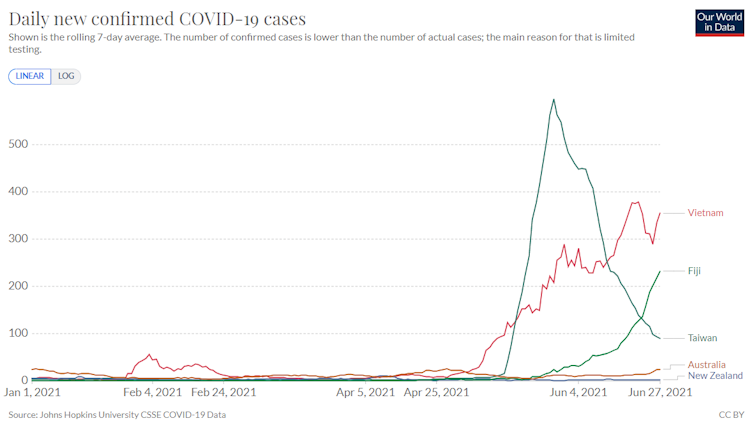
Several other countries in the Asia-Pacific region, which were once COVID-19 success stories, have all seen significant, uncontrolled and rapid surges in cases and hospitalisations. Australia is on the verge of joining this growing list, which includes Taiwan and Fiji.
Australia’s COVID-19 response committee held an emergency meeting on Monday in response to the escalating situation.
New South Wales is now the “epicenter”. The outbreak has reached 130 infections and residents are adjusting to life under lockdown. Hundreds of school children are also self-isolating after four students tested positive at a primary school.
In Western Australia, Perth and Peel have gone into a full lockdown from midnight Monday for at least four days.
Victoria, Tasmania and South Australia have no new local COVID-19 cases. However, at least 29 workers from the Northern Territory mine are now in South Australia, with tests yet to be completed.
In the UK, the delta variant now accounts for 99% of transmissions. Public health experts in New Zealand have called for an urgent upgrade of the country’s alert level system and contact tracing, as well as an acceleration of the vaccine rollout, to prevent future outbreaks.
The Australian outbreaks should add urgency to these calls. Two people have already travelled to New Zealand who were potentially exposed to an Australian miner with COVID-19. They are in isolation and are being tested.
A recent survey found 80% of New Zealanders think the government got restrictions right — more than any other surveyed country. New Zealand has used the “swiss cheese model”, which applies several layers of barriers and safeguards to protect people from the virus.
Many layers of our COVID-19 defence now require an upgrade. Until now, we’ve had a reactive approach to QR scanning, with low or declining usage. The only increases in QR scanning followed outbreaks or COVID-19 scares.
Yesterday, cabinet commissioned advice on making QR scanning mandatory. This may have to become part of life, just like checking IDs at a bar.
Cabinet is also looking into mandating mask use in more settings at alert level 2 and above. Face coverings may be particularly useful when physical distancing is not possible.
Bursting the travel bubble
The current pause is justified. Let us remind ourselves of the devastation caused beyond our borders and how quickly the less transmissible original strain of COVID-19 spread around New Zealand from March 2020 onwards.
The new delta variant is about 60% more transmissible than the alpha strain, which itself was more contagious than the original virus.
Things can change quickly and the current pause has allowed experts the time to assess the risk. It has also bought us valuable time to upgrade our response hopefully beyond just requiring pre-departure tests from Australia and treats the risk of a delta variant outbreak with the care it deserves.
Based on the uncertain and complex situation emerging across several Australian states, the reopening of the trans-Tasman bubble may remain difficult. The government has made it clear from the start that New Zealand travellers could get stuck in Australia. The data that emerges from Australia over the next few days will be crucial in determining how and when travel can resume safely.
Dr Lukas Marek, at the GeoHealth Laboratory, University of Canterbury, has contributed the data visualisation of New Zealand’s COVID-19 case numbers.
Matthew Hobbs receives funding from The Health Research Council.
Source: The Conversation (Au and NZ) – By Meg Elkins, Senior Lecturer with School of Economics, Finance and Marketing and Behavioural Business Lab Member, RMIT University
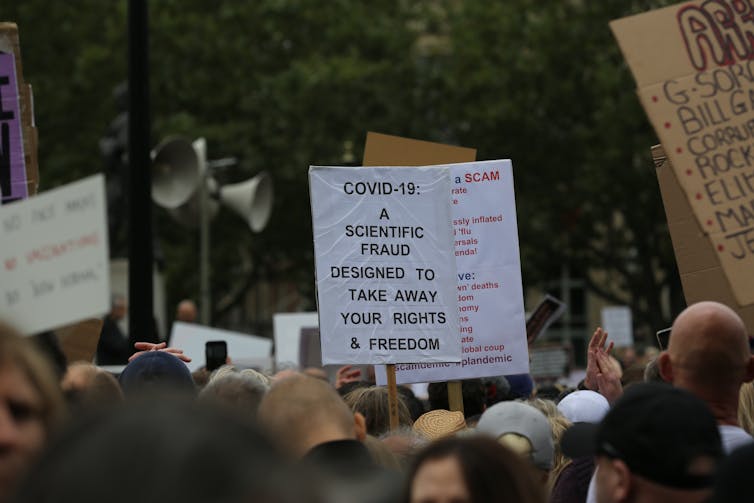
For ufologists the US government’s eagerly anticipated report of “unidentified aerial phenomena” may be a major disappointment. It goes further than any previous report in admitting unknowns. But conspiracy theorists will likely dismiss it as a cover-up.
But they aren’t alone in tending to dismiss anything that jars with their accepted narrative.
Take the “lab leak theory”. In January, for example, the Washington Post not only called the idea that COVID-19 was man-made a “debunked fringe theory”. It also called the theory it originated from the Wuhan Institute of Virology a “disputed fringe theory”.
Facebook banned claims the virus was made in a lab for being false and debunked in February. It has now reversed that ruling, with US president Joe Biden ordering his intelligence experts to “bring us closer to a definitive conclusion” by the end of August.
The issue has been complicated by hyper-partisan media conflating Facebook’s ban with censorship of the lab-leak theory. But many also dismissed the lab-leak theory too easily by conflating it with other conspiracy theories.
We’re all prone to accepting one narrative and sticking to it, no matter the evidence. This problem isn’t just “out there”. Behavioural research offers some lessons for all us to keep front and centre.
Seeing what we want to see
Even if we pride ourselves on being independently minded we can still fall prey to cognitive biases.
This isn’t just the result of the phenomenon known as the Dunning-Kruger effect – in which we tend to overestimate our competence in areas in which we are incompetent. Highly intelligent people are also susceptible to believing highly irrational ideas, as demonstrated by the list of Nobel prize-winning scientists who have embraced scientifically questionable beliefs.
Part of it also has to do with believing what we want to be true.
We settle on most of our opinions through nothing better than snap judgement or instincts. Our internal “press secretary” – a mental module that convinces us of our own infallibility – then justifies our reasons for holding those opinions after the fact.
Behavioural scientists call this motivated reasoning – when your personal preferences cloud your grasp on reality.
As Malcolm Gladwell writes in his book Blink: The Power of Thinking Without Thinking (Little, Brown, 2005): “Our selection decisions are a good deal less rational than we think.”
Most of us are overconfident about our own decision-making skills. lyas Tayfun Salci/Shutterstock
How long is a piece of string? You tell me
One cognitive bias that is especially amplified by social media is good old-fashioned conformism.
The potency of conformist thinking was graphically demonstrated by psychologist
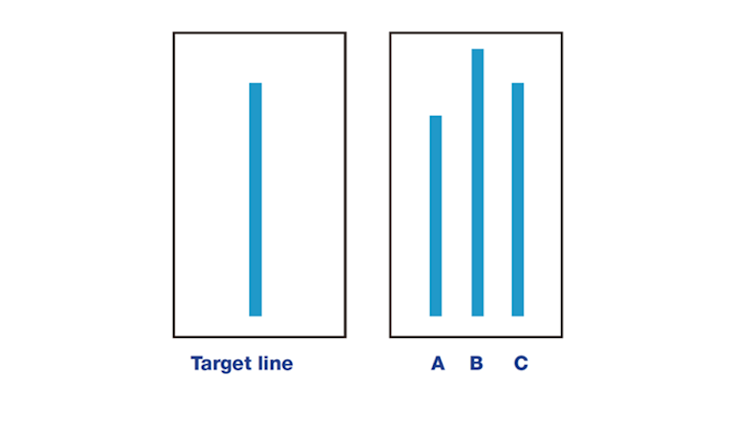
Solomon Asch in his classic 1956 study showing we can even disregard the evidence of our own eyes when it contradicts the majority view.
Asch assembled groups of participants and had them judge which of three numbered lines had the same length as a target line.
Which numbered line is the same length as the one on the left?
The answer should be easy. But in Asch’s group only one person was a real participant. The six others were “stooges”, instructed to sometimes give the same, patently wrong answer before the subject of the experiment answered.
The result: about a third of the time subjects went along with the majority view, though it was clearly wrong. The painful lesson: we are social creatures, swayed by the group, even willing to sacrifice the truth just to fit in.
Locked in the echo chamber
Facebook, Twitter and other social media sites can reinforce all the above instincts through creating “echo chambers” that validate what we chose to believe.
Exposure to different ideas does not fit well with the economics of online media – in which platforms, and content creators on those platforms, fight for limited attention by appealing to preferences and prejudices.
We enjoy echo chambers.
According to psychologist Jonathan Haidt, we appear to be born with a “self-righteousness gene” – an inherent need to be right. We are more prone to defend our opinions by criticising others. We find comfort in validation.
Once we have made our opinion known to others, we are doggedly reluctant to change course. Seeming consistent can become more important than seeming right, so we will go to great lengths to shore up opinions that come under scrutiny.
These foibles might be endearing if they didn’t have such serious implications. Believing in misinformation is an undeniable problem.
But we are going to need a different way to deal with conspiracy theories than simply trying to ban them. Seeking to enforce a single accepted narrative is not the solution.
If Facebook or mainstream media are the arbiters of who gets heard and who does not, then we will be pushed more towards our own filter bubbles, and conspiracy theorists towards theirs.
The authors do not work for, consult, own shares in or receive funding from any company or organisation that would benefit from this article, and have disclosed no relevant affiliations beyond their academic appointment.
University campuses are urban cultural institutions inextricably linked to the “making” of cities. They are also sited on unceded First Nations land, in prime locations.
Meaningful attempts to recognise this – and better represent Indigenous culture in the fabric of the campus – have been sporadic dating back to the late 20th century.
Momentum has continued in recent years as architectural, landscape and urban designers have experienced an awakening to Indigenous knowledge systems, voices and values, and to the importance of following best practice both internationally and domestically.
At the symposium, a Wailwan and Kamilaroi architect and lecturer at the University of Melbourne, Jefa Greenaway, stated:
Ideally, design in Australia would incorporate, consider or actively connect to the deep history of Indigenous occupation of this continent for millennia.
Yet, there is still much room for transforming words into action.
A recent Australian Research Council discovery project, Campus: Building Modern Australian Universities, led by the University of Melbourne, undertook a national study of Australia’s modern campuses. The project focused on the professional disciplines that have planned, designed, constructed and managed these built environments since the second world war.
A key finding in the study, scheduled for release by the University of Western Australia Press in early 2022, is the emerging centrality of Indigenous representation on campus.
A desktop survey was conducted to understand the “state of play” across Australia’s 42 universities and their campuses.
The key themes included:
the level of recognition of respective Traditional Owners and acknowledgement of Country
the presence of reconciliation action plans or other documents providing guiding frameworks towards reconciliation
Indigenous representation in campus master plans
evidence of Indigeneity in the landscapes, buildings and outdoor art emerging since the establishment of early projects like the award-winning Riawunna Centre at the University of Tasmania.
Riawunna Centre. Provided by Riawunna Centre for Aboriginal Education at the University of Tasmania, Author provided
The study revealed a recognition process in progress.
Universities are part of the growing community movement towards reconciling with First Nations people. The survey revealed over 90% of all Australian universities recognise the Traditional Owners on publicly available documents, with 75% providing this recognition on the front pages of their websites.
Reconciliation action plans endorsed by Reconciliation Australia have been developed for 60% of universities. However, only half of these say they were developed in conjunction with Indigenous people. Even fewer of these plans (40%) refer specifically to incorporating Indigenous matters directly into planning and design.
Exploring Indigenous input into campus design
A critical survey finding is that future excursions into campus design issues must be fundamentally collaborative and co-led by Indigenous people.
While nearly 70% of universities have a publicly accessible campus master plan, only a quarter contain Aboriginal content.
Two-thirds of universities in the study had at least one physical landscape or garden with Indigenous elements, such as yarning circles, bush food gardens, cultural walks, art or other physical features. Only half of these had Indigenous people’s involvement in their production.
Only one, RMIT’s Ngarara Place, built in 2015, is known to have been designed by an all-Indigenous team. Ngarara Place signifies Aboriginal and Torres Strait Islander people’s cultures and histories as manifest on the lands of the Kulin Nation and its custodians, the Woi-Wurrung and Boon Wurrung people.
While 60% of campuses have buildings linked to Indigenous culture, it is only in the past two decades that they have been purpose-built.
This desktop survey suggests an incomplete revolution. It raises critical questions about how design can negotiate the interface between Indigenous and non-Indigenous worldviews in the creation of current and future Australian university campuses.
This task is made harder as this research suggests few universities have developed a critical understanding of the urban Indigenous environments on which they were built. As Greenaway identifies above, incorporating such understanding is necessary to actively connect to the deep history of Indigenous occupation of this continent.
Including such information in the design and implementation of university campuses is a critical step towards true reconciliation between Indigenous and non-Indigenous people.
After all, universities produce Australia’s next generation of professionals and practitioners across a vast array of fields, including those disciplines most responsible for the country’s future built environment.
Andrew Saniga receives funding from the Australian Research Council.
Robert Freestone receives funding from the Australian Research Council.
Ross Wissing does not work for, consult, own shares in or receive funding from any company or organization that would benefit from this article, and has disclosed no relevant affiliations beyond their academic appointment.
Media coverage of the first few days of the COVID-19 Delta variant outbreak in New South Wales has been markedly different from that of the most recent lockdown in Victoria.
The most noticeable difference is that the media focus in New South Wales has been primarily informational: the growth and spread of cases; the lockdown rules. The political element has been secondary: should the lockdown have been imposed sooner and harder?
By contrast, when Victoria entered its fourth lockdown a month ago, the media focus was primarily political: what is wrong with Victoria that it always seems to be where lockdowns happen? Information took second place.
Some of the reasons for this difference are obvious. There was understandable exasperation among Victorians that they always seemed to be on the receiving end of lockdowns.
Also, the media conferences in Victoria had already become increasingly politicised over the course of the long lockdown in 2020, exemplified by the appearances there of the Sky News night-time commentator Peta Credlin.
When the daily briefings resumed last month, the media took up where they had left off.
But there also appear to be other, more subtle, factors at work.
One is that a media stereotype has developed about Victoria’s COVID response. The stereotype is that the government is incompetent in the way it handles the pandemic. Initial failures in hotel quarantine and contact-tracing have tainted perceptions of the entire government response, regardless of the improvements that have since been made. The fact the most recent outbreak occurred as a result of a hotel quarantine breach in South Australia was conveniently ignored by some media outlets.
The aggressive questioning of the Victorian government during the extended second lockdown was exemplified by the presence of Sky News commentator Peta Credlin. AAP/James Ross
Media stereotypes are generally founded on fact, and initially there were plenty of facts to support this one, as the hotel quarantine inquiry report showed.
But media stereotypes have a more insidious effect. They create what becomes the story we all know. And as every reporter will tell you, a new story reinforcing the stereotype always finds readier acceptance by the news desk than a story contradicting the stereotype.
Audiences too are more receptive to a story that is really an old story with new data. It reinforces a familiar worldview and makes fewer demands on the brain.
The American journalist and political sage Walter Lippmann wrote a hundred years ago:
There is nothing so obdurate to education or to criticism as the stereotype. It stamps itself upon the evidence in the very act of securing the evidence.
Another subtlety lies in the trajectory of media attitudes. The early briefings in Victoria last year were similar in tone and content to what was seen in New South Wales over the past few days: a focus on the growth in cases and on lockdown rules.
It will be interesting to observe whether this changes in New South Wales as time goes by if, as Premier Gladys Berejiklian says, the outbreak will get worse before it gets better and a prolonged lockdown ensues.
The political arguments in New South Wales do not concern government competence. In fact, the stereotype is that New South Wales has a superior contact-tracing system, allowing the state to avoid big lockdowns.
The politics in Sydney are about the impact on the government of it having to abandon its anti-lockdown position and sacrifice the state’s economic well-being in the interests of public health.
That earned it a reproachful editorial from The Weekend Australian, although the reasoned tone was in sharp contrast to the beating over the head dished out to Daniel Andrews by the Murdoch press during Victoria’s lockdowns.
Moreover, the Liberal-National government in New South Wales is not being politically targeted by its confreres in Canberra as the Labor government in Victoria was.
This raises another factor affecting the media dynamics of COVID coverage.
COVID politics are acquiring an ever-sharper edge. James Merlino, who was acting premier of Victoria during its most recent lockdown, took plenty of opportunities to sheet home responsibility for it to the federal government’s failures in quarantine and vaccination.
Even Berejiklian could not hide her frustration with the federal government over these failures as she fronted up on Monday to announce another 18 new cases in her state.
The intensification of the political differences is being accompanied by intensified polarisation in mainstream media coverage.
A vivid example of this was the reaction to a column in The Age on Saturday by Jon Faine. He was a long-time presenter of the mornings program on ABC Radio Melbourne and, having retired from that job, is writing for The Age.
In his column, he wrestles with his conscience over his response to the COVID outbreak in Sydney. It is a tug-of-war between two characters, “Good Jon” and “Bad Jon”.
Concerning the media, “Good Jon” thinks:
I am so impressed with the decorum with which the Sydney media pack conduct their press conferences with their Premier. They show respect, listen carefully, interrupt rarely if at all and we are all the wiser for it. And doesn’t the Premier show grace under pressure?“
But then “Bad Jon” thinks:
What an unbelievable double standard. The reptiles in Melbourne, weaponised by the Murdoch tabloids and Sky News, ripped into Dan Andrews and Brett Sutton every bloody day for weeks on end, repeated the same questions a gazillion times hoping to trip them up, shouted at them, harangued and argued, stopped asking legitimate questions and instead made unfounded assertions and then demanded that mere rumours be proven untrue. How dare they?
The Murdoch press hasn’t taken this lying down. On Monday, it published a response based on a one-sided presentation of the Faine article and claiming it had aroused “fury” in Sydney.
And that brings us to the final factor in the differences between the media coverage in the two states: the frankly rabid bias of the Murdoch tabloids.
The page-one headline in Sydney’s Sunday Telegraph on June 27 was a public-relations triumph for the Coalition governments in Sydney and Canberra: “Smart strain slips the net”. Such a clever virus. Nothing there about the failure to vaccinate airport drivers or make them wear masks.
Contrast that with the Herald Sun’s front page when one of Victoria’s lockdowns was announced: “State of disaster”. “6-week extreme lockdown to crush COVID”.
Denis Muller does not work for, consult, own shares in or receive funding from any company or organisation that would benefit from this article, and has disclosed no relevant affiliations beyond their academic appointment.
Unfortunately, while Victorians have the right to request voluntary assisted dying under Victorian law, a Commonwealth legal impediment makes it unduly difficult to access this service.
Commonwealth law makes it a crime to use a “carriage service” for the purposes of conveying “suicide related material”.
What does that mean?
You might think of a “carriage service” as letters being delivered on a 19th Century mail coach. But it actually relates to modern communication technologies including the telephone, SMS, email, internet and videoconferencing.
Posted letters and face-to-face conversations are allowed.
The Commonwealth law was not designed to thwart legal assisted dying. It was passed in 2005, well before any state legislation was enacted. Its stated intent was to prevent things such as incitement to commit suicide by cyber bullies or the promotion of suicide methods to those who are vulnerable and depressed.
But in relation to voluntary assisted dying, the practical effect is that using modern communication to respond to a patient who requests voluntary assisted dying is a potential Commonwealth crime — even though it may be legal under state law. When laws conflict, federal legislation trumps state law.
WA will become the second Australian state to enact voluntary assisted dying laws. Shutterstock
A barrier to access
A report on the operation of voluntary assisted dying in Victoria between January and June 2020 found the risk of prosecution under this law was a complicating factor for the medical community — and became even more so during the pandemic.
Although we haven’t seen voluntary assisted dying practitioners prosecuted under this law, they largely want to comply with the Commonwealth legislation, to avoid the risk of breaking the law and facing a hefty penalty. This makes the process of assessing patients’ requests for voluntary assisted dying both difficult and slow.
The Victorian Voluntary Assisted Dying Review Board has received reports of challenges faced by applicants who have had to attend face-to-face assessments. Without the option of telehealth, extremely unwell patients may have to undertake long and difficult journeys to have their eligibility assessed. This is especially problematic for patients who live in rural areas who may have to travel great distances to see a doctor who is willing to respond to their request (few doctors are credentialed to facilitate voluntary assisted dying).
If travel is impractical for the patient, the only other legal option is for a busy clinician to travel to the patient to perform the voluntary assisted dying assessment. In many cases the doctor may decide the assessment can’t be done.
The restriction also makes it potentially illegal for the doctor to phone their patient to inform them a permit has been issued, for the pharmacist to answer a patient’s ongoing query about the medication via email or phone, or for the care navigators (who help patients navigate the system) to provide advice or assistance over the phone.
Doctors have reported this Commonwealth law is frustrating. Shutterstock
Pushing back
Victoria essentially accepts the Commonwealth law, and has discouraged doctors from corresponding with patients on voluntary assisted dying over the phone or internet.
The massive size of WA means any restriction on modern communication will have a disproportionate effect for patients who may, as a result, have to travel many hundreds of kilometres for face-to-face consultations, and may have to depend on a postage service that can take days.
It seems clear the Commonwealth Criminal Code needs to be amended, but this will take time. In the interim the Commonwealth Director of Public Prosecutions needs to issue a guideline that, where a person is acting in accordance with state voluntary assisted dying legislation, offences in the Commonwealth Criminal Code will not be prosecuted. To date, requests by Victoria that this assurance be provided have proved unsuccessful.
With Queensland parliament set to debate voluntary assisted dying laws in September, Premier Annastacia Palaszczuk recently wrote to Prime Minister Scott Morrison requesting the federal government urgently amend the Commonwealth Criminal Code to exclude state government voluntary assisted dying schemes from this law. The Morrison government has rejected this request.
Patients are suffering
Voluntary assisted dying is now in various of stages of legalisation and implementation across Australia, and repeated surveys confirm the overwhelming majority of Australians support it.
Under these laws, terminally ill patients may well get the end they want, but not as efficiently as they desire, or should reasonably expect. Delay and inefficiency adds to anxiety and frustration at a time when patients and their families are at their most vulnerable.
Meanwhile, medical practitioners are frustrated, forced to choose between breaking the law and providing the care patients expect.
Australians expect government collaboration at all levels to deliver services that work as efficiently and effectively as possible. It doesn’t have to be like this.
Charles Corke is Deputy Chair of the Victorian Voluntary Assisted Dying Review Board and is a Senior Intensive Care Specialist at the University Hospital Geelong.
But today, we bring some good news: one rodent species, Gould’s mouse (Pseudomys gouldii), is set to be crossed off Australia’s extinct species list. This means the number of Australia’s extinct mammals will drop from 34 to 33.
Our new research compared genome sequences across Australia’s rodents, including eight extinct species and their 42 living relatives. In a case of historical mistaken identity, we found the Gould’s mouse was genetically indistinguishable from another living species, the Shark Bay mouse (Pseudomys fieldi), also known by the Indigenous name “Djoongari” from the Pintupi and Luritja languages.
But it’s not all good news. A lack of genetic diversity in remaining populations means Djoongari are less resilient to changing environments, including from climate change. We can’t let this species die out — this time, there’d be no coming back.
Back from the dead
When Europeans colonised Australia, they rapidly and catastrophically changed the environments in which native species thrived. The introduction of feral cats, foxes and other invasive species, agricultural land clearing, inappropriate fire management, and new diseases decimated native rodent populations.
Along with many other native mammals, some rodent species were also intensely hunted for bounty in the late 19th and early 20th centuries.
DNA from this specimen of Gould’s mouse, collected in 1837 from the Hunter Valley of NSW, reveals the species should no longer be considered extinct. Trustees of the Natural History Museum, London Photographer: C. Ching, Author provided
In 1837, a Gould’s mouse specimen was collected for the Natural History Museum, London, from the Hunter Valley of New South Wales. The last verified time it was seen alive was in 1857, near the border of Victoria and NSW.
After genomic analysis of these specimens, we found the species has been hiding in plain sight for more than 100 years, under a different name, thousands of kilometres away in Western Australia. Djoongari will now be reclassified under the scientific name Pseudomys gouldii.
Djoongari is a shaggy-coated mouse weighing 45 grams on average, making it twice the size of the invasive house mouse. It’s omnivorous, and feeds on a variety of flowers, leaves, fungi, insects and spiders. It also build tunnels and runways to travel at night, and uses above-ground nests as refuges during the day.
Not safe yet
The resurrection of the Gould’s mouse is positive news given Australia’s alarming rate of recent extinctions, but the species remains at risk.
Once occurring across mainland Australia, it now survives only on predator-free islands in Shark Bay, WA. Islands have been an important refuge for the species, protecting them from cats, foxes, diseases and other threats on the mainland.
Feral and pet cats are huge threats to small native animals. If you own a cat, make sure you keep it indoors to protect Australia’s wildlife. Shutterstock
Conservation efforts are underway to protect the mouse in Shark Bay, with insurance populations established on other nearby islands.
Now we know Djoongari once roamed as far east as the Hunter Valley in NSW, there’s greater scope to reintroduce the species to predator-proof protected areas on the mainland. This would mean more insurance populations, but also contribute towards restoring natural ecosystems on mainland Australia — also known as “rewilding”.
However, remnant populations of this once widespread species contain only a fraction of its original genetic diversity.
Genetic diversity is often used as a proxy for estimating the resilience of a species to threats and its potential to adapt to changes in its environment. When species have low genetic diversity, or are inbred, they are more susceptible to disease, and more likely to accumulate harmful genetic mutations.
Other eye-opening revelations
Our study also examined the genomes of seven other rodent species lost to extinction: the white-footed rabbit rat, lesser stick-nest rat, Bramble Cay melomys, short-tailed hopping mouse, long-tailed hopping mouse, big-eared hopping mouse and long-eared mouse.
Bramble cay melomys were declared extinct in 2016. Ian Bell, EHP, State of Queensland, CC BY-SA
In most cases, we found these now-extinct native rodents had relatively high genetic diversity immediately before they became extinct. High genetic diversity usually means large population sizes, suggesting native rodent populations were stable before European invasion.
This puts an end to any suggestion that these species were already on their way out prior to the arrival of Europeans.
Reports from early naturalists back up our findings. In 1846, John Cotton referred to the now-extinct white-footed rabbit rat as “the common rat of the country”. And in 1866, Gerard Krefft described the now-extinct lesser stick-nest rat as occurring in “great numbers”.
These species went from common to extinct in less than 150 years. That’s alarmingly fast by any standard.
It shows even though genetic diversity in now-extinct rodents was high prior to colonisation, it wasn’t enough. The environment and threats changed so dramatically and rapidly, these species didn’t have the chance to adapt.
There’s a clear lesson in all this
The threats to native wildlife brought by Europeans — including feral cat predation and land clearing — are ongoing. And under climate change, the environment as we know it is set to change further, dramatically.
It’s not enough to only establish insurance populations to save species. We need to control feral predators, protect and restore habitats, and curb emissions, so more species don’t endure a rapid wipe out.
In total, we’ve lost almost 100 species to extinction since 1788, and that’s just those we know about. In native rodents alone, in less than 150 years, the equivalent of more than 10 million years of unique evolutionary history has been lost forever.
Extinction doesn’t usually offer second chances, but we’ve now got another shot to protect Gould’s mouse. We need to act now, before it’s too late.
Emily Roycroft receives funding from the Australian Government Research Training Program, the Dame Margaret Blackwood Soroptimist Scholarship, the Alfred Nicholas Fellowship (University of Melbourne), and the Holsworth Wildlife Research Endowment. This project received funding from Bioplatforms Australia through the Australian Government National Collaborative Research Infrastructure Strategy, via the Oz Mammals Genomics Initiative.
The intergenerational reports are former treasurer Peter’s Costello’s fiscal future-proofing scheme — a five-yearly reminder that, without action, an ageing population and other changes will leave public finances looking ugly.
The fallout from COVID means Monday’s 2021 report projects a bigger sea of red ink than the previous 2015 report. It’s a useful reminder that lifting productivity, reforming age-based tax breaks, improving migration and confronting climate change are crucial to leaving a happier legacy for the next generation.
Let’s start with the bad news.
Budget deficits for 40 years, with net debt still at 34.4% of GDP in 2061, and the interest cost of serving that debt growing to 1.7% of GDP.
It’s what happens when ageing population hits up against highly age-skewed spending and tax policies.
The 40-year budget projections look nasty, but the reality is almost certainly worse, because the intergenerational report is too rosy on crucial assumptions.
Projections worse than they look
First, the report assumes productivity will grow at 1.5% per year over the next 40 years, in line with the 30-year average. That’s highly optimistic. Productivity did indeed go gangbusters in the 1990s, growing at 2.2% per year. But in the 20 years since growth has been more sluggish at 1.2%, and under 1% for the past five years.
The same is true of other advanced economies. Structural shifts including slowing technological change, the rise of less-productive service sectors, a reduction in job switching and increases in market concentration are slowing productivity growth almost everywhere.
Many of these headwinds are here to stay, which means an awful lot would need to go right to boost productivity in coming decades, including the unleashing of a new era of technological transformation.
Another big source of misplaced optimism is failure to quantify the impacts of climate change. It simply makes no sense to project fiscal outcomes over 40 years without an attempt to factor in the high and growing costs of a warming planet.
The NSW intergenerational report, released only three weeks ago, didn’t shy from that challenge.
It found that more severe natural disasters, sea level rises, heatwaves, and declining agricultural production would reduce incomes in NSW by A$8.3 billion a year in 2061 under a high-warming scenario compared to a lower warming one.
Treasurer Frydenberg said on Monday that the role of intergenerational reports was to deliver “sobering news”.
That’s half of their role. But they should also galvanise policy action.
There are many choices governments can make to put the nation on a better path.
There’s much we can do
First, they should do what is within their control to boost productivity.
This means working through the many positive suggestions from national and state productivity commissions, the Grattan Institute and others to revitalise our health and education systems, improve our tax system, fix planning regimes and make more sensible infrastructure choices.
Second, governments should lower barriers to workforce participation for women and older Australians by making childcare more affordable, improving paid parental leave, and revisiting the pension access age and superannuation preservation age.
Third, it should wind back the policies that supercharged the effect of the ageing population on government finances. Tax-free superannuation income in retirement, refundable franking credits, and special tax offsets for seniors mean we now ask wealthy older Australians to contribute a lot less than we did.
We tax seniors too lightly
An older household earning $100,000 a year pays on average less than half the total tax of a working-age household earning the same amount.
The intergenerational report makes clear that this is not sustainable, yet successive governments have been reluctant to shift the dial.
Fourth, we should embrace the benefits of migration.
Reorienting our skilled migration program to focus on long-term economic potential, especially by giving priority to younger, more skilled workers, would better support the ageing population and generate a substantial fiscal dividend, helping defray some of the costs of population ageing.
Finally, we’ve got to fill the federal policy vacuum on climate change.
In the absence of national leadership, state governments, businesses and others have stepped up with costly second, third, and fourth-best schemes.
We’re not yet serious about climate change
The NSW government’s intergenerational report identifies fixing the slow and disorderly energy transition as the single thing it can do to improve its long-term financial position and the state’s economy.
Better climate policy is now an economic as well as an environmental imperative.
Governments have spent the past 16 months in reactive mode, responding to a major health and economic crisis.
That is entirely understandable, but intergenerational reports have been warning of the impacts of the ageing population for almost 20 years.
Failing to act on the obvious to-do list would be a dereliction of duty to future generations. Let’s hope the next five-yearly check-in shows us on a better path.
The Grattan Institute began with contributions to its endowment of $15 million from each of the Federal and Victorian Governments, $4 million from BHP Billiton, and $1 million from NAB. In order to safeguard its independence, Grattan Institute’s board controls this endowment. The funds are invested and contribute to funding Grattan Institute’s activities. Grattan Institute also receives funding from corporates, foundations, and individuals to support its general activities as disclosed on its website.
Source: The Conversation (Au and NZ) – By John Hawkins, Senior Lecturer, Canberra School of Politics, Economics and Society and NATSEM, University of Canberra
Emblematic of the sort of claims that put the “con” into economics was an assertion by the Queensland Resources Council last year that “the resources sector employs 372,000 Queenslanders”.
The number employed in mining was 66,000, but the council claimed to have used input-output tables in the Australian National Accounts to add to that a much larger of “indirect” jobs created by mining.
It led to the awkward conclusion that mining contributed almost 46,000 full-time jobs to the electorate of McConnel, which had 40,000 enrolled voters.
The credulous way some of the media report such claims partly explains why the public has an inflated idea of the importance of the mining sector.
Surveyed Australians think coal mining makes up 9.4% of the workforce. The true figure at the time was 0.4% — or around 48,200 workers nationally as of May 2020.
The claims derive from a lesser known part of the Australian National Accounts, the ones that tell us each quarter whether or the economy has grown or whether we are in recession.
It comes out once a year, almost two full years after the calender year to which it refers.
Known as the input-output tables, it’s a honeypot for consultants because it paints an incredibly detailed picture of the ways in which each part of the economy interacts with each other.
As an example, the most recent (which came out last month) tells us the value of bakery products manufactured was A$8.2 billion.
To make these baked goods, the industry used $900 million of grains and cereals, $700 million of meat (fillings for pies), and $500 million of sugar and confectionery (icing for cakes).
It paid $200 million to transport the goods, $100 million to clean the factories and so on.
This added up to $5.2 billion in payments to other industries.
The difference between the $8.2 billion and the $5.2 billion represents the “value added” by baking manufacturers.
Employees in the industry were paid $2.6 billion and there were $200 million in profits for the investors.
Australia also imported another $1.9 billion of bakery products.
The input-output tables reveal a lot
The tables also show what happened to all these bakery products. $1 billion went to restaurants and $1.5 billion to other industries. $6.8 billion were bought by households, $800 million were exported.
Importantly, the input-output tables enable comparisons. The industries providing the most full-time equivalent jobs are retailing, professional services and health. The industries making the largest profits are finance and iron ore and oil and gas extraction.
In mining, the profits paid out are ten times what’s paid out in wages. In most manufacturing and service industries more is paid out in wages than profits.
What the tables cannot do is tell us how many jobs an industry has “created” outside of the industry itself.
Listen to the statistician
A few years back, a senior treasury official called out this practice, as the following extract from a Senate committee hearing shows:
If you add up all the jobs “created” by all the industries, you will find that we have many more jobs than there are in Australia […] In a well functioning economy any given industry that is creating jobs is doing that only to the extent that other industries are employing fewer people.
David Gruen is now head of the Australian Bureau of Statistics. Not only does the bureau no longer publish “multipliers” that allow spurious claims to jobs created to be easily calculated, under his leadership it now publishes a very prominent warning:
The most significant limitation of economic impact analysis using multipliers is the implicit assumption that the economy has no supply–side constraints. That is, it is assumed that extra output can be produced in one area without taking resources away from other activities, thus overstating economic impacts.
It concedes that users “can compile their own multipliers as they see fit”.
They shouldn’t, and we should be suspicious when they do.
John Hawkins does not work for, consult, own shares in or receive funding from any company or organisation that would benefit from this article, and has disclosed no relevant affiliations beyond their academic appointment.
Rock paintings from the main gallery at Djulirri in Namunidjbuk clan estate, showing traditional Aboriginal motifs as well as European boats, airplanes, and more.Photo by Sally K May.
The rock art of northwestern Arnhem Land is world-renowned and represents one of the world’s most enduring artistic cultures. Rock art is a continuing tradition. It includes images of “outsiders”: people and objects brought to Australian shores by Macassans from southeast Asia and, later, by Europeans.
Paintings of sailing vessels, smoking pipes, firearms, domesticated animals and other exotic items dot the landscape in Arnhem Land, often overlaying earlier works. Comparatively recent paintings feature more common images too, such as kangaroos, emus, and hand stencils.
While most Australians know about the history of European arrivals, few are familiar with the ongoing visits by people from southeast Asia to the region. Our latest research shows artists depicted early trading sailing vessels less often and differently to European ships — suggesting they viewed these encounters with other cultures in contrasting ways.
Macassans at Victoria Settlement (Port Essington), 1845 by H.S.Melville. Published in The Queen, 8 February 1862
Far from the generally accepted notion of an isolated shoreline, the north Australian coast was teeming with sailing vessels engaged in trade for hundreds of years before European exploration and settlement.
Most commonly referred to as Macassans (because they’d made the crossing from the port of Makassar in southern Sulawesi) these early traders came in fleets of praus with their signature tripod masts, to harvest trepang (sea cucumber) and for materials such as turtle shell, beeswax, and iron wood.
Working with Aboriginal Traditional Owners, especially members of the Lamilami family, our new research focuses on the Namunidjbuk clan estate within the Wellington Range in the Northern Territory. We looked closely at one particular type of rock art — boats in the form of Macassan praus and European ships.
A photograph of a prau (Macassan boat) from Djulirri that is found underneath beeswax pellets forming a female human figure. Radiocarbon analyses of the beeswax on top of the boat figure showed that the prau was painted in the late 1770s. Photo by Paul S.C. Taçon.
Sailing vessels are among the most common new subjects in rock art made during the last 500 years in northwest Arnhem Land. Yet, there is a perplexing inconsistency in how Aboriginal artists of this region treated Macassan prau and European ships.
The earliest dated prau depiction is from the first half of the 1600s. No depictions of European ships are thought to be older than the early 1800s.
Yet we counted many more rock art images of European ships: 50 examples in the study area, compared to only six prau (five images feature elements of both).
These extraordinary works illustrate the maritime history of this region. They range in detail from basic outlines of hulls to detailed depictions of European ships. Some even illustrate cargo.
Others reveal ship features found under the waterline such as anchors and propellers. Southeast Asian prau are recognisable because of their unique tripod masts and sails. Some paintings of European ships show the crew smoking pipes and with their hands on their hips.
Painting of a European ship at Djulirri. Photo: Sally K. May
When people are portrayed on or next to watercraft in our study area, it is always in association with European ships, with no depictions associated with prau at all.
So, why did Aboriginal artists feel the need to paint so many European ships, and sometimes their crew — but very few relating to southeast Asian visits?
‘Praos bouguis a la voile, Baie Raffles ; Voiture chinoise, Ile Banda’. Depiction of a Macassan prau in Raffles Bay, Northern Territory 1839 by L. Le Breton 1839. National Library of Australia: nla.obj-136471948
We argue the proliferation of European-related imagery signals the threat they posed to Indigenous sovereignty. Communicating this threat (via rock art and other means) to family and neighbouring clans was an essential tool for inter-generational education, inter-clan communication, resistance and survival.
This example of a European sailing vessel painted at Djulirri shows great attention to detail. Tracing: Virginia das Neeves
The lack of praus does not suggest a lesser cross-cultural relationship between Macassans and Aboriginal people. In fact, nearby in Anuru Bay is one of the largest Macassan trepang processing complexes in the NT.
Aerial view of Malarrak, where some of the paintings of watercraft are found. Photo: Daryl Wesley
But visits by the Macassans were seasonal, while the Europeans came to stay. Cross-cultural contact between Aboriginal people and Macassans in this region is generally thought to be characterised by mutual respect and exchange. Contact with Europeans was more violent, with historically known killings and massacres of Aboriginal people.
Importantly, our findings in northwest Arnhem Land are the opposite of research undertaken in other parts of northern Australia, such as Groote Eylandt, where there are many depictions of Macassan prau and crew. This reminds us that one size does not fit all in the history of invasion and cross-cultural contact in northern Australia.
For decades R. Lamilami (1957-2021) worked to protect his Country and to educate outsiders on the cultural significance of the Namunidjbuk clan estate and, more broadly, the Wellington Range. With this article we pay tribute to his life’s work and his firm belief that rock art is an irreplaceable history book for Australia.
Sally K. May receives funding from the Australian Research Council.
Daryl Wesley receives funding from Australian Research Council
Joakim Goldhahn receives funding from the Australian Research Council and Rock Art Australia
Paul S.C.Taçon receives funding from the Australian Research Council.
All workers in residential aged care facilities will be required to have at least a first COVID vaccination by mid-September under a decision at an emergency national cabinet meeting on Monday night.
And in a major move to speed up the lagging rollout, the AstraZeneca vaccine will be available to anyone who wishes to have it.
This effectively makes vaccinations immediately available to the whole adult population.
At present the Pfizer vaccine, which is in limited supply, is administered on health advice to those aged 40 to 59, while the under 40s are not yet being vaccinated.
To encourage the wider take up of AstraZeneca, the government will bring in a new no-fault indemnity scheme for general practitioners who are providing advice on COVID-19 vaccines.
Scott Morrison, addressing a news conference from The Lodge where he is in quarantine, said the medical advice talked about AstraZeneca being preferred for those over 60. This is because of rare blood clots in younger people.
“But the advice does not preclude persons under 60 from getting the AstraZeneca vaccine. And so if you wish to get the AstraZeneca vaccine, then we would encourage you to go and have that discussion with your GP.”
National cabinet met against the threatening backdrop of outbreaks in five jurisdictions and more than 270 active cases nationally. There is particular worry about NSW, where greater Sydney and certain other areas are in lockdown, and now Western Australian premier Mark McGowan has ordered Perth and Peel into lockdown.
Morrison said it was “important to get feedback from all the states and territories on the measures that they’re putting in place and to essentially get everybody on the same page in terms of their understanding of the situation, the impact particularly of the Delta variant.
“The Delta variant is proving to be a far more difficult element of this virus than we have seen to date,” he said.
The mandatory vaccination of residential aged care workers comes after the latest figures show only a third of this workforce has had a jab, and many fewer are fully vaccinated.
The federal government will partner with the states to ensure compliance, and provide $11 million for facilities to give staff time to get vaccinated or deal with side effects.
“We want to make sure that this won’t have a negative impact on available workforce,” Morrison said.
He said this was the third time the mandating for aged care workers had been before national cabinet.
Previously the proposal has run into resistance from the national cabinet’s health advisers, who have worried that compulsion could lead to people leaving the workforce.
But Chief Medical Officer Paul Kelly said the Australian Health Protection Principal Committee had on Monday unanimously supported the decision.
Morrison said there would be a “risk-benefit assessment” in early August.
He said: “This has been a difficult group to get vaccinated, and this is why I have been fairly constant and determined to ensure we got to where we are tonight.
“I would have preferred to have been here a little while ago, but nevertheless, our determination has paid off.”
National cabinet is getting further advice on making vaccination compulsory for disability care workers.
In other decisions, vaccination and testing will be mandatory for all quarantine workers including those involved in the transport of quarantined individuals. Morrison said this would be a state responsibility and there would be no Commonwealth funding program such as with the aged care workers.
This follows an unvaccinated transport worker triggering the Sydney outbreak.
In another response to one of the current outbreaks, it will be mandatory for returned travellers and close contacts to get tested two or three days after the travellers finish quarantine.
National cabinet also agreed to ensure that international quarantine residents and other high risk people should be kept separate from low risk people such as those crossing state borders.
Michelle Grattan does not work for, consult, own shares in or receive funding from any company or organisation that would benefit from this article, and has disclosed no relevant affiliations beyond their academic appointment.
Darren Chester says he can’t explain why Barnaby Joyce sacked him because the Deputy Prime Minister was “incoherent” when he rang on Sunday to tell him he was being dumped from cabinet to the backbench.
There were no harsh words, Chester said on Monday – just a “matter-of-fact conversation. He was sacking me. I didn’t agree with him, and I got on with the walk I was having with my dog.”
“I wouldn’t normally comment on private conversations, but I’m gonna say the conversation I had with Barnaby was so incoherent yesterday, I couldn’t actually explain what he was even saying to me.
“So people of Australia, brace yourself, there will be more conversations like that.”
For Chester, a moderate and a strong supporter of ousted leader Michael McCormack, who has lost the portfolios of veterans’ affairs and defence personnel, there must have been a strong feeling of déjà vu. He’s been here before with Joyce.
As he put it bluntly on Monday, “I’ve been screwed over by the National Party twice in the last three years”.
Or more precisely, by Joyce.
In December 2017, Chester was sacked in a reshuffle from the post of infrastructure and transport. Joyce, who was deputy prime minister to Malcolm Turnbull, took the portfolio himself.
It was reported one factor was Chester’s support for fellow Victorian Bridget McKenzie for deputy leader of the party. She beat Joyce’s candidate, Matt Canavan. Chester argued the Nationals needed a different sort of face.
That time, Chester was offered a very junior role, which he declined. This time, there was no offer.
And, in a bitter irony, his sacking now opened a place for McKenzie – who was forced to resign last year in the sports rorts affair – to return to cabinet.
Chester noted Joyce on Sunday had said “I was a competent minister – well he can explain why a competent minister is no longer in his job”.
As for the future, “the relationship I’ll have with Barnaby Joyce going forward will be completely and utterly business-like.
“I have no personal relationship with Barnaby, I don’t seek a personal relationship with Barnaby. It’ll be completely pragmatic. I will go to him with projects on behalf of Gippslanders, if I don’t get my fair share for Gippsland you’ll hear about it.”
Another loser in the reshuffle, resources and water minister Keith Pitt, who has been pushed from cabinet to the outer ministry, was restrained. “I just do the job I’m given to the best of my ability,” he said on Monday.
The mining sector has every cause to be surprised at being relegated, given Joyce is very close to it.
But the cabinet spot of Pitt, a McCormack vote, was needed to reward Andrew Gee, who went across to Joyce (and gets Chester’s portfolios). And there was also muttering about an old grudge against Pitt, lingering from Joyce’s first challenge.
Pitt on Monday put out a statement reporting Australia’s resource and energy exports are forecast to be a record $310 billion in 2020-21, rising in 2021-22 to $334 billion.
Commenting on the figures, the CEO of the Minerals Council of Australia Tania Constable pointedly said the industry “looks forward to the return of resources to cabinet”.
Michelle Grattan does not work for, consult, own shares in or receive funding from any company or organisation that would benefit from this article, and has disclosed no relevant affiliations beyond their academic appointment.
Last Saturday, the New South Wales government announced a two-week lockdown for Greater Sydney, the Blue Mountains, Central Coast and Wollongong after a spike in new COVID cases.
It’s spawned a lot ofcommentary about whether NSW delayed going into lockdown, and therefore has caused itself a longer lockdown. Indeed, one modelling study by University of Sydney researchers, published last November, estimated delaying lockdown by three days would extend the lockdown by three weeks.
But it’s not that simple.
This kind of modelling is about using lockdown as a primary intervention where you’re relying on the lockdown itself to snuff out transmission. Even if the cases aren’t tested and recognised, the virus eventually runs out of new susceptible people to infect. This isn’t the case in NSW, which is still relying on a strategy of test, trace and isolate.
If this lockdown is about buying time to allow contact tracers to get in front of the virus by getting all at-risk contacts of cases in quarantine before they’re infectious, then a day’s “delay” is probably not going to add weeks to it. The modelling doesn’t apply in this scenario.
Whenever we’re evaluating a lockdown, there’s always an element of “hindsight being 20/20”. Some of the circuit-breaker lockdowns we’ve had over the past year didn’t change the management of cases and contacts because all community transmission that did occur after lockdown was among known contacts already in quarantine. But we didn’t know that until after the lockdown was called. Circuit-breakers are essentially insurance policies or safety nets (though we should still evaluate them to know when they are justified).
During this pandemic we’re often making decisions in situations of considerable uncertainty.
Things have clearly shifted in our latest outbreaks in Victoria and NSW. Contact tracers have been very effective at finding, linking and documenting the spread of cases. And in NSW’s latest outbreak, health authorities have had the added advantage of discovering the cluster within the first generations of spread. This means they’ve been able to collect data on where the virus was, and how transmission was occurring, in almost real time.
It’s easy to sit here and say locking down earlier would have made a difference. But when should it have been called? When we knew of only ten cases the Saturday before last? While infections among casual contacts were concerning, nobody knew 24 future cases would soon be exposed to a case at private party of 30 held later that same night.
So what works best in situations like this — go early just in case? I would argue go with the data when you are this close to the leading edge of the outbreak. Assess the data in real time and be prepared for a rapid change in response.
The emerging story over last week was of many cases, but almost all linked to the known cluster. By week’s end, it was clear at least one branch of the outbreak was missed with multiple cases infectious in the community over five days or more.
What led to this lockdown?
Rather than relying on high-level modelling of transmission risk and projections, we can also build a detailed picture of the epidemiology of an outbreak as it is playing out.
NSW has had very detailed transmission data on almost all cases, bar a handful, which puts them in a strong position.
A potential risk in relying on contact tracing is how quickly things can escalate if you miss a major chain of infection. This was the case for the cluster involving a seafood wholesaler in Marrickville, which was spreading invisibly and had transmissions going back a week before they caught it. On Sunday, ten of the 30 new cases announced were linked to this cluster.
Another factor was casual transmission. This Delta variant is much more infectious than previous strains, and some of the early cases in this outbreak occurred from merely “fleeting” exposure. Some of these early transmissions happened in places where health authorities couldn’t be confident they could track down all casual contacts, and those who were exposed may have underestimated their risk of having been infected.
Yes it’s true almost all the cases are “linked” to previously known cases, but some of these were linked via a convoluted, longer path as a contact of earlier missed cases. This meant more people circulating while infectious over a larger number of days.
The distribution of cases also played a role. Even though it seems to still be largely focused around Bondi, cases and potential exposures were now spread beyond.
Should NSW have locked down a few days earlier? It’s hard to say, but will be important to evaluate when things settle
A lot of people forget there were only ten cases in total in this outbreak just over a week ago. There were two new cases per day between June 16 and 20 inclusive, which are numbers we all know are manageable for NSW contact tracers.
Should they have gone into a full lockdown on Sunday, June 20, when they had a total of ten cases? I don’t think you could defend that epidemiologically.
Cumulative cases then went from ten to 25 two days later, to 54 another two days later on June 24, to 112 on Saturday June 26 when lockdown was announced.
It looked like they were right on top of it, and were very close to getting to all contacts before their infectious periods. But they were still probably a day or so behind the virus. Even one infectious day each in the community by a few contacts simultaneously is very risky and adds to exposure sites.
This Delta variant also seems to have reduced the time between cases being exposed to the virus and becoming infectious themselves, according to NSW Chief Health Officer Kerry Chant.
All this painted a very different picture to the week before, and would have contributed to the decision to lock down.
We need to analyse the data
Now we need to evaluate this outbreak response, along with all others in Australia, and learn more about how the virus moves through our communities, our weak points, our most effective containment measures, and the optimal timing of these.
The lockdown won’t yet have played a significant role for new cases. But we also know from the timing of cases that locking down a few days earlier wouldn’t have stopped the seafood wholesaler outbreak, nor would it stop spread in high-risk essential workplaces.
Analysing the outbreak aims to understand any additional cases that might have been prevented with earlier lockdown, or how many cases will be prevented with lockdown in place now. It will allow us to, under various alternate scenarios, use these rich detailed case data to remove some of the uncertainty next time.
Catherine Bennett receives funding from Medical Research Future Fund and National Health and Medical Research Council.
The weekend’s news of COVID-19 outbreaks and various lockdowns around Australia reminds us there’s no room for complacency. We need to accelerate Australia’s COVID-19 vaccine roll-out and ensure people are fully vaccinated as soon as possible.
Just over six million Australians (30% of those eligible) have received their first dose of a COVID-19 vaccine. As of June 17, 3.8 million Australians had one dose of AstraZeneca.
Despite the benefits of vaccination, some people are concerned about the small but real risk of clotting after receiving their AstraZeneca vaccine. Some have even cancelled their booking for their second dose.
But until you’re fully vaccinated – with two doses of AstraZeneca or two doses of Pfizer, at the recommended time intervals – you’re not optimally protected. After your second AstraZeneca dose, your protection against the Delta variant almost doubles, from 33% to 60%.
Why are 2 doses are better than 1?
When you get the AstraZeneca vaccine, or an mRNA vaccine such as Pfizer, it directs your body to make the SARS-CoV-2 spike protein at the injection site.
This prompts an immune response, which recognises and remembers this spike protein.
But the vaccines don’t make the spike protein for very long, nor do they spread it. This restricts the size of the immune response.
Just like your own memory, which improves by repeated viewing or listening with a break in between, our immune memory generally improves with repeated exposure to something it needs to protect us against.
The recommended interval between doses of AstraZeneca is 12 weeks, while the minimum is four weeks after the first dose.
This is based on clinical trial data which showed around 73% “efficacy” after the first dose. This means in experimental studies, the first dose of the vaccine reduced the risk of getting COVID19 caused by the original strain by 73%.
In these trials, a longer duration between the first and second doses – 12 weeks, rather than eight or less – resulted in higher levels of antibodies which can stop the virus.
These antibodies will inevitably fall over time, but starting at a higher level after the last dose means it will take longer for them to fall to levels where protection is compromised.
How well does AstraZeneca protect against variants?
When the Alpha variant is dominant, the AstraZeneca vaccine provides 55-70% protection after one dose and 65-90% after two doses. Alpha is the variant associated with the Queensland flight crew outbreak.
For the Delta variant, which is circulating in Sydney, one dose provides 33% protection against symptomatic COVID-19. So after one dose, you’re 33% less likely to get sick with the Delta strain than someone who is unvaccinated.
Both vaccines offer greater protection against severe disease. Two doses of AstraZeneca reduces your chance of needing to be hospitalised with COVID-19 by 92%, while for Pfizer it’s 96%, compared with someone who wasn’t vaccianted.
Overall, contact tracing data shows one dose of either AstraZeneca or Pfizer vaccine can prevent disease from spreading to members in the same household by around 50%.
Today the New South Wales health minister revealed that of the 30 people at a Hoxton Park house party, 24 returned a positive COVID test. While you can still get COVID-19 when you’re vaccinated (generally a milder form), in this case, the six who have so far tested negative had all been vaccinated.
What about blood clots following second dose?
Thrombosis with thrombocytopenia syndrome (TTS) is a rare clotting condition that can occur after AstraZeneca vaccination because of an abnormal immune response.
Of the nearly 16 million people who received the second dose of AstraZeneca in the UK, 23 developed TTS, a rate of 1.5 per million people vaccinated. This compares with 14.2 per million for a first dose.
The risk of death from TTS is further reduced. If you received your first dose of AZ vaccine without developing TTS, you are even less likely to get it with the second dose.
That’s why health authorities recommend people who safely received their first dose of AstraZeneca vaccine have their second dose and protect themselves optimally.
Can I get the Pfizer vaccine for my second dose instead?
Some countries, including Canada and some in Europe, have approved mixing and matching different COVID-19 vaccine brands.
But while this is encouraging, we don’t have clear evidence that mixing vaccines will protect against COVID-19.
Mixing vaccine brands also increased common side effects including reactions such as headaches, fever, body aches and tiredness.
It’s possible that as more information becomes available from ongoing studies using AstraZeneca, Pfizer, Moderna and Novavax vaccines, the advice of mixing vaccines may eventually change.
But until more real-world data on vaccine safety and effectiveness are available, the advice in Australia is for people to receive two doses of the same vaccine.
The goal is full vaccination
The best way out of this pandemic is to ensure everyone is vaccinated as quickly as possible. Full protection kicks in about two weeks after completing vaccination.
While one dose offers some protection, it’s not as high as two doses. And we don’t know how long the protection from one dose will last.
Right now, a second dose of AstraZeneca vaccine is ready and waiting for everyone who had their first dose 12 weeks ago. So if you’re eligible, get both doses of the vaccine brand available to you, rather than settling for second-best and incomplete protection.
Meru Sheel receives funding from Westpac Scholars Trust.
Cyra Patel is an employee at the National Centre for Immunisation Research and Surveillance (NCIRS). NCIRS receives service contract funding from the Australian Government Departments of Health, NSW and other state government Departments of Health.
David Tscharke receives funding from the NHMRC, ARC and MS Research Australia. He is a Fellow of the Australian Society for Microbiology and a member of the Australian and New Zealand Society for Immunology, the Australian Virology Society and the Australian Society for Medical Research.
Not so long ago, Facebook was a goldmine for Australian news media. News featured prominently in Australians’ Facebook feeds, and newsrooms across the country saw a growing online audience engage with their stories.
People were liking, commenting and, most importantly, sharing stories, delivering new eyeballs to news outlets. This revolution in news distribution encouraged many of Australia’s biggest news media companies to invest time and money into posting on Facebook.
But the relationship between Facebook and news companies has soured. Facebook famously changed its algorithm in January 2018 to reduce “audience exposure to public content from all pages, including news” in favour of posts from family and friends.
Many news media companies (including The Conversation) responded by embracing alternative tactics, such as subscription campaigns, to reach readers directly. But some digital outlets that had lived their entire lives in synergy with Facebook could not adapt to this new environment, and had to lay off staff or reduce their operations.
While commentary during this period, and Facebook’s own updates, suggested that news content was no longer as prominent on Facebook, there was no hard data to see if this was actually true, particularly at the national level. So we decided to investigate how the Australian news sector performed on Facebook during this upheaval.
We began by building a sample of 32 national and metropolitan news organisations. We then used the Facebook-owned CrowdTangle database to collect engagement data from these organisations’ Facebook pages. Our data set included more than 2 million unique posts, from January 1 2014 to December 15 2020.
Next, we constructed a daily performance score for each news organisation’s page during this period. We removed the 25% best and 25% worst-performing posts, and averaged the remaining 50% across 30-day rolling intervals. We did this three times — once for each of the three dominant Facebook metrics: reactions (likes, hearts and so on), comments and shares.
Finally, we divided it by the “baseline average” from January-April 2017, which is in the middle of our data set. This means a score of 1 would represent the baseline average, whereas a score of 2 would mean performing twice as well as the baseline, and 0.5 only half as well.
We wanted to see whether our analysis can explain why Australian news organisations had begun moving away from Facebook. We also wanted to see whether some news organisations have been hit harder than others by the dramatic changes Facebook made to its algorithm in recent years.
A peak and then a collapse?
The first headline finding from our analysis is that in terms of engagement, Australian news content experienced a clear period of success on Facebook before a subsequent reset. This is especially so in the case of the number of user “reactions” to news content, shown below for the entire sector.
Sector-wide reactions to news content
Sector-wide performance score of Facebook reactions (30-day moving average shown in black; trend line shown in blue).
It was a similar story when we looked at “shares” across the whole sector:
Sector-wide shares of news content
Sector-wide performance score of Facebook shares (30-day moving average shown in black; trend line shown in blue).
Sharing of Australian news content peaked in 2014-16, and then declined towards the end of the decade. Remarkably, the sharing performance score in November 2020 was only 15% of the score measured in November 2014. This is striking, because at one stage news sharing was seen as central to the Facebook experience. Clearly, that no longer seems to be the case.
Comments, however, tell a different story. For the sector as a whole, comments peaked near the end of the decade, in May 2019.
Sector-wide comments on news content
Sector-wide performance score of Facebook comments (30-day moving average shown in black; trend line shown in blue).
The simple narrative of a peak and then a collapse is clouded still further when we look at specific news outlets. While we identified an overall decline in Facebook engagement with Australian news, there have been winners and losers.
The most dramatic fall afflicted digital-native youth outlets such as Junkee, Pedestrian and BuzzFeed, whose reaction performance scores dropped from 3.9 in January 2016 to 0.18 in late November 2020. The sharing score for these outlets also fell dramatically, from a high of 5.8 in November 2015 to 0.4 at the end of 2020.
In contrast, public service outlets the ABC and SBS rebounded towards the end of the decade. Their comments, reactions and shares rose after Facebook’s 2018 algorithm change and only recently returned to our 2017 baseline in late 2020.
Number of shares, segregated by news category
Facebook shares performance score by news category. Jagged lines show weighted 30-day moving average; smooth lines show trend line.
So what happened?
Our data reveal a clear connection between the overall decline in engagement with Australian news content on Facebook, and Facebook’s gradual move away from news. Social news outlets in particular have suffered a heavy toll from this change.
In contrast, public service outlets have been more resilient, perhaps because of the high levels of trust Australians place in these outlets. People may have turned to them for reliable information during crises such as Australia’s Black Summer bushfires and the COVID pandemic.
Our data cannot point to one factor that has caused this decline. Instead, we suggest there may be several. Facebook’s algorithm changes would obviously have had an impact; another related factor is that companies are adopting different business strategies and are no longer focused on producing compelling content for Facebook.
Whatever the case, it is clear the golden years of Facebook news engagement are over. Indeed, Facebook’s dwindling interest in news was further emphasised by the infamous news blackout in February 2021, during tense negotiations with the federal government over its plan to make tech platforms pay to host news content.
The upshot is that news media outlets can no longer rely on Facebook for easy engagement and audience growth. Whether by choice or necessity, they are already courting readers elsewhere.
James Meese receives funding from the Australian Research Council.
Francesco Bailo has received funding from Facebook.
Edward Hurcombe does not work for, consult, own shares in or receive funding from any company or organisation that would benefit from this article, and has disclosed no relevant affiliations beyond their academic appointment.
Source: The Conversation (Au and NZ) – By Adrian Beaumont, Honorary Associate, School of Mathematics and Statistics, The University of Melbourne
AAP/Lukas Coch
This week’s Newspoll, conducted June 23-26 from a sample of 1,513, gave Labor a 51-49 lead, a one-point gain for Labor since the previous Newspoll, three weeks ago. Primary votes were 41% Coalition (steady), 37% Labor (up one), 11% Greens (steady) and 3% One Nation (steady). Figures are from The Poll Bludger.
55% were satisfied with Scott Morrison’s performance (up one), and 41% were dissatisfied (down two), for a net approval of +14, up three points. Anthony Albanese’s net approval increased four points to -5. Morrison led Albanese as better prime minister by 53-33 (53-32 previously).
While Morrison’s net approval was up slightly, this followed a fall of nine points in the previous Newspoll. Analyst Kevin Bonham said Morrison’s current net approval is his second lowest since the COVID situation started last year.
The fieldwork for this poll was Wednesday to Saturday. The vast majority of the sample would have been done before NSW Premier Gladys Berejiklian put Greater Sydney into a two-week lockdown on Saturday. Further restrictions were announced for the NT and WA on Sunday, with Queensland following on Monday.
Problems with Australia’s vaccination rollout were apparent in April, but did not have an impact on Morrison’s, or the Coalition’s, polling, or the perception of handling of COVID. At the time, most Australians felt secure behind our hard border, and did not see any rush to get vaccinated.
I believe the current lockdowns are a danger to the Coalition, as the slow vaccination rollout may start to bite. The previous Newspoll was taken during the Victorian lockdown, and Morrison’s net approval slid nine points. In an early June Essential poll, the federal government’s handling of COVID dropped to a 53-24 good rating from 58-18 in late May.
Only 25% of Australians have received at least one dose of COVID vaccinations, compared to 48% in France and higher in other comparable countries. Furthermore, under 5% of Australians are fully vaccinated (received two doses), compared to at least 25% in comparable countries.
The head of the Therapeutic Goods Administration recently said that effective protection against the Delta COVID variant that has spread quickly in Sydney requires both vaccination doses.
Barnaby Joyce’s electoral impact
On June 21, Barnaby Joyce won a Nationals leadership spill, and replaced Michael McCormack as Nationals leader and deputy prime minister. Joyce returned as Nationals leader more than three years after he was forced to resign over an affair with a former staffer and sexual harassment allegations (which he denies).
I wrote in May that non-university educated whites have been deserting left-leaning parties in Australia, the US and UK, and that they appear to be voting contrary to elite opinion.
Elite opinion detests Joyce, so by this logic the Coalition should be boosted with non-uni whites. However, the Nationals have little appeal beyond regional electorates that are not based on a large regional city like Geelong or Newcastle.
At the 2019 federal election, The Poll Bludger wrote there were large swings to the Coalition in regional Queensland, taking seats that were Coalition-held by small margins out of range for Labor. The Coalition also gained Herbert by a large margin.
Owing to these swings, there are few seats where the Nationals traditionally do well that Labor could win at the next election. The weakness of Joyce is that non-uni whites outside the Nationals’ heartland don’t care who the Nationals’ leader is, while university-educated people will dislike the Coalition more than they would have had the far less well-known McCormack remained Nationals leader.
Excellent jobs report for government
On June 17, the ABS reported the unemployment rate in May had dropped 0.4% to 5.1%, returning to where it was before COVID. This drop occurred despite a 0.3% increase in the participation rate.
The employment population ratio – the percentage of the eligible population that is employed – jumped 0.5% to 62.8% in May. It is now higher than at any previous point in the ABS chart going back to May 2011; the previous high was 62.7% in September 2019.
With these economic figures, the government is a clear favourite to be re-elected. Provided the current COVID outbreaks do not lead to extended lockdowns, the economy will probably be doing well whenever the next election is held.
Essential climate change and foreign relations questions, and Morgan poll
In last week’s Essential poll, 56% (down two since January) thought climate change is happening and is caused by human activity, while 27% (down five) thought we are just witnessing a normal fluctuation in the earth’s climate.
45% (up three since January, but down seven since June 2020) thought Australia was not doing enough to address climate change. 30% (down five) thought we were doing enough, and 12% (up two) thought we were doing too much.
On foreign relations, 50% thought we should get closer to NZ (up one since December), 44% the UK (up six), 37% the European Union (up four), 32% the US (up four) and 12% China (down three). By 57-14, respondents favoured the US over China as most beneficial for Australia to strengthen our relationship with (42-18 in May 2020, before Joe Biden’s election as US president).
A Morgan poll, conducted June 12-13 and 19-20 from a sample of nearly 2,800, gave Labor a 50.5-49.5 lead, a 0.5% gain for the Coalition since early June. Primary votes were 41.5% Coalition (up 1.5%), 34.5% Labor (down 1%), 12% Greens (up 0.5%) and 3.5% One Nation (up 0.5%).
Victorian state poll and Tasmanian Labor leadership
As reported by The Poll Bludger, a Redbridge Victorian poll for The Herald Sun, conducted June 12-15 from a sample of almost 1,500, gave Labor a 52.4-47.6 lead. Primary votes were 41% Coalition, 37% Labor and 12% Greens.
Incumbent Daniel Andrews led Michael O’Brien as preferred premier by 42-23. I had a recent article about the Victorian June Resolve poll.
David O’Byrne was elected Tasmanian Labor leader on June 15, after defeating Shane Broad by a 74-26 margin of all votes cast.
Adrian Beaumont does not work for, consult, own shares in or receive funding from any company or organization that would benefit from this article, and has disclosed no relevant affiliations beyond their academic appointment.
Identifying the age of animals is fundamental to wildlife management. It helps scientists know if a species is at risk of extinction and the rate at which it reproduces, as well as determining what level of fishing is sustainable.
Determining the age of fish has been difficult in the past — primarily involving extracting the inner ear bone, also known as the “otolith”. Layers of growth in the otolith are counted like rings on a tree to reveal an individual’s age. Unless a dead specimen is available, this method requires killing a fish, making it unsuitable for use on endangered populations.
However a non-lethal DNA test developed by the CSIRO enables researchers to determine fish age for three iconic and threatened Australian freshwater species: the Australian lungfish, the Murray cod and the Mary River cod. We outline the technological breakthrough in our research just published.
Our fast, accurate and cost-effective test can be adapted for other fish species. We now hope to share this method to improve the protection of wild fish populations and help promote sustainable fisheries around the world.
Traditionally, age could only be determined on a dead fish. The new method is non-lethal. Shutterstock
Iconic species at risk
Human activity has led to the population declines of the three Australian fish species at the centre of our research.
The threatened Australian lungfish is found in rivers and lakes in southeast Queensland. It’s often referred to as a “living fossil” because its extraordinary evolutionary history stretches back more than 100 million years, before all land animals including dinosaurs.
Man-made barriers in rivers reduce the movement of water, which lowers lungfish breeding rates.
Older lungfish do not have hard otolith structures, which makes determining their age difficult. Bomb radiocarbon, which analyses carbon levels in organic matter, has been used to age Australian lungfish, but this method is too expensive to be widely used.
In the past, determining the age of Australian lungfish has been challenging.
The threatened Murray cod is Australia’s largest freshwater fish. The Mary River cod is one of Australia’s most endangered fish, found in less than 30% of its former range in Queensland’s Mary River.
Habitat destruction and overfishing are major threats to Murray cod and Mary river cod populations.
Otoliths can be used to determine age for both these cod species, however this has only been done on a population-wide scale for the more prevalent Murray cod.
When cells divide to make new cells, DNA is replicated. This can lead to DNA methylation, which involves the addition or the loss of a “methyl group” molecule at places along the DNA strand.
Research has found the level of DNA methylation is a reliable predictor of age, particularly in mammals, including humans.
To develop our test, we first worked with zebrafish. This species is useful when studying fish biology because it has a short lifespan and high reproductive rates. We took zebrafish whose ages were known, then removed a tiny clip of their fin. We then examined DNA methylation levels in the fin sample to identify the fish’s age.
Following this successful step, we transferred the method to Australian lungfish, Murray cod and Mary River cod. Again, we used fish of known ages, as well as bomb radiocarbon dating of scales and ages determined from otoliths.
We found despite the zebrafish and the study fish species being separated by millions of years of evolution, our method worked in all four species. This suggests the test can be used to predict age in many other fish species.
The test uses co-called DNA methylation to estimate age. Shutterstock
A conservation management boom?
In the same way human population demographers use census data to understand and model human populations, we now have the tools to do this with animals.
We are looking to expand this DNA-based method to determine the age of the endangered eastern freshwater cod and trout cod. We will also continue to test the method across other species including reptiles and crustaceans.
This work is part of CSIRO’s ongoing efforts to use DNA to measure and monitor the environment. This includes estimating the lifespan of vertebrate species such as long-lived fish and surveying biodiversity in seawater using DNA extracted from the environment.
We envisage that in the not too distant future, these methods may be used by other researchers to better understand and manage wild animal populations.
Benjamin Mayne does not work for, consult, own shares in or receive funding from any company or organisation that would benefit from this article, and has disclosed no relevant affiliations beyond their academic appointment.
Source: The Conversation (Au and NZ) – By Patricia A. O’Brien, Visiting Fellow, School of History, Australian National University, and Adjunct Professor, Asian Studies Program, Georgetown University
Samoa’s constitutional crisis has entered yet another phase, just over a month after the nation’s first woman prime minister-elect, Fiame Naomi Mata’afa, was locked out of parliament and sworn into office in a tent.
Samoa’s Supreme Court has today found the May 24 swearing in was unconstitutional — on the face of it a win for caretaker prime minister Tuilaepa Sa’ilele Malielegaoi.
However, the court also ordered that parliament convene within seven days from June 28. This is a win for Fiame’s Fa’atuatua I Le Atua Samoa Ua Tasi (FAST) Party, which has been pushing for this outcome for some time.
The much anticipated decision came with a clear warning for Tuilaepa and those who have acted on his behalf to disrupt democracy’s course. If they act to prevent parliament convening by July 5, the oaths of office taken on May 24 will be reinstated “so that the business of the nation can proceed”.
This is just the latest of many rounds in the legal fight that erupted after Samoa’s April 9 general election.
Fiame secured a one seat majority with the help of independent candidate, Tuala Tevaga Iosefo Ponifasio, who will formally join the FAST Party once parliament is convened. He was named Fiame’s deputy on May 24.
But when Tuilaepa (Samoa’s political leader since 1998) refused to concede, the Pacific’s oldest democracy was plunged into dangerous waters.
Power games
In the following weeks, an erratic Tuilaepa, with the critical assistance of key officials, pushed Samoa to the brink of autocracy. In stark contrast, an unflappable Fiame has repeatedly asked Samoa’s people for patience as the courts worked through the deluge of cases caused by the election stalemate.
The Supreme Court’s caseload since April 9 has included 28 petitions disputing electoral results. These are gradually being heard, and on June 18 the court awarded an additional seat to Fiame’s FAST Party (the HRPP candidate’s election was voided when he was found guilty of breaching election rules).
A great deal of the court’s time, however, has been spent working through the repercussions of an extraordinary chain of events that began on April 20.
In order to cancel FAST’s one seat majority, Head of State Afioga Tuimalealiifano Vaaletoa Sualauvi and Samoa’s Electoral Commission announced on social media that a 52nd parliamentary seat had been created.
The move was justified on the grounds that a constitutionally mandated 10% minimum of parliamentary seats reserved for women had not been met.
Five women had won seats, and heading into the election it had been agreed the 10% threshold equated to five seats. Now the Electoral Commissioner was saying six women should have seats, and a candidate from Tuilaepa’s Human Rights Protection Party (HRPP) was appointed.
Gender politics
It is one of many ironies in this political saga that Tuilaepa was using the gender quota to prevent Samoa’s first female prime minister from assuming office. With this move, the election results were again deadlocked.
The manoeuvre was one of the tactics designed to run down the clock on the constitutionally designated 45 days for a new government to be sworn in. If the May 24 deadline was broken it would trigger another election.
Then, as the courts considered the merits of the sixth seat for women, the head of state revoked the April 9 election results on the basis of the tied parliament and called for a fresh election to be held on May 21.
But a week before the May 24 deadline, the Supreme Court found the head of state did not have the powers to void the April 9 election results and the appointment of the HRPP member to the 52nd seat was illegal.
Those decisions gave Fiame back her one seat majority and plans were on track for parliament to be sworn in by Monday May 24. (The court did subsequently decide that a sixth seat for women was required, but that parliament must sit before the seat is filled by election.)
Stronger democracy
In another twist, on the evening of Saturday May 22 the head of state suspended parliament until further notice and left Apia for his home village some distance away.
Although the Supreme Court ordered on May 23 that parliament sit the next day, the parliament building was locked by order of Tuilaepa. The FAST Party resorted to the unofficial swearing in ceremony in a tent erected on the parliament lawns, presided over by FAST lawyers in what they argued was the “principle of necessity”.
As it stands now, FAST holds a two seat majority in Samoa’s Legislative Assembly, which will increase by one when Tuala formalises his move.
If the Supreme Court’s latest ruling is complied with, all 51 members will be sworn into office and Fiame will be Samoa’s next prime minister within seven days. The question is, will Tuilaepa abandon the power play that has tested Samoa’s democracy like never before in its 59 years since independence in 1962?
Australia has called for the convening of parliament in its first robust statement on the crisis. Other democracies are now likely to quickly follow suit.
So far, Samoa’s own democracy has been tempered and strengthened in the fires of this crisis. But it remains to be seen whether a political leader who embodies tomorrow’s woman has finally made Tuilaepa yesterday’s man.
Patricia A. O’Brien received funding from the Australian Research Council and New Zealand’s JD Stout Trust.
Source: The Conversation (Au and NZ) – By Karen Malone, Professor, Environmental Sustainability and Childhood Studies, Swinburne University of Technology
To remember things, you need to give them your full attention.
American neuroscientist and bestselling author of Still Alice, Lisa Genova’s key findings on preventing Alzheimer’s disease show how to enhance memory to retain information. This research can be adapted to children.
Children can be supported to exercise their mind muscles. They can learn the best ways to get information efficiently into their heads and access it effectively when they need to.
In her book Remember: the science of memory and the art of forgetting Genova points out to enhance memory we don’t need to play “computer brain games” or “read books on recall strategies”, what we simply need to do is improve our skills of noticing.
She writes that “noticing requires two things: perception (seeing, hearing, smelling, feeling) and attention”.
You can use a trip to the playground to help your children strengthen memory muscles and become better learners.
This can be done by paying attention, slowing down, mind mapping, rehearsing, enhancing the senses and mixing things up up.
Getting there
Fill your child’s backpack with snacks and drinks, and small figurines such as fairies, lions, tigers, koalas, dinosaurs or favourite small cars and trucks for storytelling and mud play.
Figurines are great for storytelling and mud play. Karen Malone, Author provided
Kid’s binoculars and magnifying glasses are great for noticing and spying on birds and bugs.
Pack watercolour paints, brushes and recycled paper for painting, and chalk and brown baking paper for tracing bark, leaves, rocks, hands and play equipment. Play dough is great for natural sculptures.
Then you’re on your way.
Creating a mind map
Like all animals humans use mind mapping to create maps of our immediate environment to navigate our surroundings. Our brain is wired to recall where things are located in space.
For wild animals this is critical for survival and for children, it helps them to feel safe. You can’t do mind mapping in a car – it requires walking.
Walking to the playground, run your hands across fence palings and smell rosemary twigs. Encourage your children to do this too.
Let your kids notice the things around them to create a mind map of their journey. Shutterstock
Collect eucalypt leaves, gum nuts, acorns and other natural loose objects and pop them in the bag to be used later in potions or paintings at the park.
You could make chalk drawings of rivers and fish on the pavement as a way of finding your path back home.
This pace may seem slow but to really notice, you need to slow down. A lot of neural work is happening as children construct a mind map. The more time adds detail to the memory.
Exercising the mind
Once at the park, decrease distractions by not multitasking (turning off devices). This allows space for noticing.
Let your children explore playground equipment until they are out of breath and their bodies are tired.
Now it is time to exercise their minds. Take a pause to consider the layers of the playgrounds, the earth, grasses, tree roots, ants and bugs, plants and trees, leaves, birds and the sky.
You can lie on your back with your children and all close your eyes. Quietening the mind, through mindfulness, allows children to be dreamy. Relaxing in a meditative state can lower anxiety and tension. Research on children in nature reveals it alleviates hyperactivity and depression. The mind can be “trained to become less reactive, to put the brakes on the runaway stress response”.
You can now unpack the figurines. These can be used for children to tell stories adding twigs, and leaves for the stage. They could mix petals and water into magic potions.
Children often tuck away strong emotional responses to events or information until quiet moments. Reactivating the neural circuits through retelling or externalising experiences helps children forge positive memories and process conflicting emotions.
Re-enacting stories using figurines or other objects can help children revisit positive and negative experiences they have encountered.
You can encourage your child to make fairy lands or sand pit dinosaur worlds and play out past events. In this way, children can project emotions through the objects as they play out narratives.
Positive emotions like happiness and joy actually enhance children’s recall to re-activate past positive emotions. By focusing on individual senses or emotional responses children learn to connect cues with association. This builds significant new repertoires to retrieve from later.
Fairy worlds can help your kids re-enact previous experiences. Karen Malone, Author provided
Multi-sensory and meaningful encounters, enhance our perceptions and recall by creating multi-neural pathways. This can be done by using a range of senses: smell, touch, sound etc.
You can encourage your children to pause and smell the scents, listen to birds, run a feather through fingers, collect stones. and touch rough bark and trace it on baking paper.
Set up the pencils and paints for drawing flowers or sculptures of piled up stones.
Mix it up and revisit
Genova writes “sameness is the kiss of death to memory”. If you want children to remember more of what has happened, step out of set routines and mix things up.
Go somewhere new, do something different. Look for ways to make the playground experience unusual.
You could eat food that is only green, make short digital stories, print photographs, revisit paintings, drawings and tracings, mark your journey on a map, then retell and reactivate children’s experiences as they drift to sleep.
Karen Malone does not work for, consult, own shares in or receive funding from any company or organisation that would benefit from this article, and has disclosed no relevant affiliations beyond their academic appointment.
Russell Crowe recently announced his support for a A$438 million film studio — complete with accommodation — in Coffs Harbour, New South Wales.
In the lead up to the state election, the Western Australian government announced their own $100 million film studio to be located in Fremantle.
This would be the first film studio in the state, and is intended to compete for Hollywood productions with existing major studios in Adelaide, Brisbane, Sydney, Melbourne and the Gold Coast.
These existing studios have all been fully booked for some time, and film production in Australia shows no sign of slowing down. With effective management of the COVID-19 pandemic and government production incentives, Australian studios are an attractive location.
Indeed, global juggernaut Marvel Studios has relocated its productions to Sydney for the “foreseeable future”.
It may seem the current boom is led by the strong growth of “Aussiewood”, or locally-filmed international productions. But more than 80% of the productions currently being made in Australia are Australian.
The rise of Australian cinema
Arts policy expert Jo Caust has cautioned that, while the government’s $400 million production incentive is predicted to attract billions in foreign expenditure and create thousands of jobs, it is a fund for foreign filmmakers, not for Australian films.
There are currently more than 90 screen projects in pre-production, production or post-production in Australia.
These include international television productions, like Amazon’s Nine Perfect Strangers and blockbuster films like Marvel’s Thor: Love and Thunder. But more than 80% of current productions are Australian: films where the intellectual property is owned, or jointly owned, and controlled by an Australian production company.
And those Australian productions are increasingly focused on quirky, popular films, telling local stories in new ways.
A trailer for 2020 Australian sci-fi film, Occupation Rainfall.
Historically, Australian cinema was dominated by movies emphasising the representation of our cultural identity: Australia’s stories, history, characters and the unique landscape.
Government-funded Australian films were typically informed by a national identity agenda, which emphasised cultural prestige and middle-class respectability over commercialism or pure entertainment.
Australian New Wave films, like My Brilliant Career, were interested in representation of cultural identity. IMDB
The films of the 1970s and 1980s’ “New Wave” are some of our most iconic. Think Picnic at Hanging Rock (1975), My Brilliant Career (1979) and Breaker Morant (1980).
During this period, popular genres were often dismissed by the local industry and screen funders. Action, gangster films, fantasy, horror and science-fiction films were viewed as “too American”.
In the 1990s, Australian cinema was dominated by art films, dramas and comedies. Many of these films followed quirky characters — think Muriel’s Wedding (1994) or Shine (1996) — that were difficult to compare to US films of the same period.
Australian films of the 1990s, like Muriel’s Wedding, were unlike anything coming out of Hollywood. IMDB
These trends of both the New Wave and the 1990s reflected attempts by government funding agencies to prioritise “Australian” content in a global and national market dominated by Hollywood.
In the last decade, we have seen action films like Occupation Rainfall (2020), musicals like The Sapphires (2012), Westerns like Mystery Road (2013), horror films like The Babadook (2014) and sci-fi films like I Am Mother (2019).
And audiences are also responding to these popular genre films: crime drama The Dry (2021) made over $20 million at the local box-office.
The boom in both international and local productions, however, creates competition for scarce resources.
Large film productions typically need studio space, but the major studios have been solidly booked for some time. The new proposals in Coffs Harbour and Fremantle will go some way to remedy these issues, but there are associated issues, such as the limited pool of film crews for the increasing number of productions.
It is also a tricky time for the industry to forward plan.
While Australia could be expected to maintain its pull as an attractive production destination because of world-class facilities, locations and competitive financial incentives, the pandemic-advantage is dissipating.
After being an early leader in COVID management, Australia’s vaccine rollout now lags woefully behind the United States. How long will Hollywood studios continue to privilege Australia?
An increasing focus on popular films also raises potential issues for the local industry. Many of these films require substantial special effects and large crews, so remain considerably more expensive to produce.
In order to continue this boom time, Australian film makers must be supported to sustain production and supported in accessing larger international markets, to justify these additional expenses.
These are arguably good problems to have, but they are ones we’ll need to address if the current upswings in both Aussiewood and Australian popular films are to continue.
Mark David Ryan has in the past received Australian Research Council funding to research Australian screen media and Australian Film Institute Research Collection funding to research Australian horror movies in 2018.
Kelly McWilliam has received past Australian Research Council funding to research screen media.
A report from the US task force dedicated to investigating UFOs — or, in the official jargon, UAPs (Unidentified Aerial Phenomena) — has neither confirmed nor rejected the idea such sightings could indicate alien visits to Earth.
On Friday June 25, the Office of the Director of National Intelligence (ODNI) released its eagerly awaited unclassified intelligence report, titled “Preliminary Assessment: Unidentified Aerial Phenomena”.
The document is a brief nine-page version of a larger classified report provided to the Congressional Services and Armed Services Committees. It assesses “the threat posed by unidentified aerial phenomena (UAP) and the progress the Department of Defence Unidentified Aerial Phenomena Task Force has made in understanding this threat”.
The report certainly does not, as many were hoping, conclude UFOs are alien spacecraft. Rather, it shows the task force hasn’t made much progress since first being set up ten months ago. Perhaps this is unsurprising, given its task.
However, the task force’s very existence would have been unthinkable to many people just one year ago. It’s unprecedented to see the broader policy shift towards the acknowledgement of UFOs as real, anomalous physical phenomena that are worthy of extended scientific and military analysis.
In April of last year, the US Department of Defense released three Department of Defense/AP
Seemingly advanced technologies
The report withholds specific details of its data sample, which consists of 144 UFO reports made mostly by military aviators between 2004 and 2021. Its bombshell finding is that “a handful of UAP appear to demonstrate advanced technology”.
This “handful” — 21 of the 144 reports — represents classic UFO enigmas. These objects:
appeared to remain stationary in winds aloft, move against the wind, manoeuvre abruptly, or move at considerable speed, without discernible means of propulsion. In a small number of cases, military aircraft systems processed radio frequency (RF) energy associated with UAP sightings.
These characteristics indicate some UAP may be intelligently controlled (because they aren’t blown around by the wind) and electromagnetic (as they emit radio frequencies).
No known aircraft can travel faster than sound without creating a sonic boom. NASA is currently developing “quiet supersonic technology”, which may allow planes to break the sound barrier while issuing a subdued “sonic thump”.
Some have claimed the objects are probably secret, advanced Russian or Chinese aircraft. However, global aerospace development has failed to match the flight characteristics of objects reported since the late 1940s. And it seems counterproductive to repeatedly fly secret aircraft into an adversary’s airspace where they can be documented.
How did we get here?
The report’s release is a profoundly important moment in the history of the UFO mystery, largely because of its institutional context. To fully appreciate what this moment might mean for the future of UFO studies, we have to understand how the UFO problem has been historically “institutionalised”.
In 1966, the US Air Force was facing increasing public pressure to resolve the UFO problem. Its effort to do so, then known as Project Blue Book, had become an organisational burden and a public relations problem.
It funded a two-year scientific study of UFOs based at the University of Colorado, headed by prominent physicist Edward Condon. The findings, published in 1969 as the Final Report on the Scientific Study of Unidentified Flying Objects, allowed the Air Force to end its UFO investigations.
Condon concluded nothing had come from the study of UFOs in the past 21 years that added to scientific knowledge. He also said “further extensive study of UFOs probably cannot be justified in the expectation that science will be advanced thereby”.
Nature, one of the world’s most reputable scientific journals, described the Condon Report as a “sledgehammer for nuts”. But by then the Air Force had collected 12,618 reports as part of Project Blue Book, of which 701 sightings were categorised as “unidentified”.
Unlike the new Pentagon report, the Condon Report didn’t find any UFOs that appeared to demonstrate advanced technology. The most problematic cases were resolved by being categorised ambiguously. Here’s one example:
This unusual sighting should therefore be assigned to the category of some almost certainly natural phenomenon which is so rare that it apparently has never been reported before or since.
With this strategic category in the toolkit, there was no need to acknowledge seemingly advanced technology exhibited by UAPs. Indeed, they were deliberately filtered from institutional knowledge.
For most of their postwar history, UFO reports have been regarded by state institutions as knowledge out of place, or “information pollution” — something to be excluded, ignored or forgotten.
The Pentagon’s UAP task force represents an abrupt reversal of this longstanding organisational policy. UFO reports, made primarily by military personnel, are no longer pollutants. They are now important data with national security implications.
That said, they do still represent “uncomfortable knowledge”. As the late Oxford University anthropologist Steve Rayner observed, knowledge can be “uncomfortable” for institutions in two ways.
First, Rayner said, “acknowledging potential information by admitting it to the realm of what is ‘known’ may undermine the organisational principles of a society or organisation”.
Meanwhile, he said “not admitting such information may also have serious deleterious effects on institutions, either directly or by making them prone to criticism from other parts of society that they ‘ought’ to have known”. Both aspects describe the institutional context of UFO information.
The US Department of Defence has confirmed UFOs threaten flight safety, and potentially, national security. In doing so, it has exposed a weakness in its organisational principles. It has admitted it’s not very good at knowing what UFOs are.
It also faces the criticism that seven decades after UFOs first appeared on the radar, it ought to know what they are. The new Pentagon report doesn’t compel us to accept the reality of alien visitation. But it does compel us to take UFOs seriously.
Adam Dodd does not work for, consult, own shares in or receive funding from any company or organisation that would benefit from this article, and has disclosed no relevant affiliations beyond their academic appointment.
Despite the excitement of the Australian swimming trials to determine which athletes will go to the Tokyo Olympics, it was still hard to overlook the absence of swimmer Shayna Jack.
Jack is a 22-year-old Australian swimming star. She has represented Australia at the world championships and the 2018 Commonwealth Games, where she was part of the women’s 4x100m freestyle relay team that won gold and set a new world record.
Jack tested positive for the banned substance Ligandrol before the 2019 World Aquatics Championships. Her four-year ban was reduced to two years, but the World Anti-Doping Agency and Sports Integrity Australia have appealed that decision and are seeking to have the four-year ban reinstated.
The appeal hearing begins today. Even if Jack successfully defends the appeal, her two-year period of ineligibility ends in July. This is before the Olympics begin, but just after the Australian swimming trials.
This means no matter what happens, Jack cannot compete in Tokyo.
Background of the case
Much has been written in the media about Jack’s doping ban. This reporting is seldom incorrect, though it often omits key details that make her case difficult to fully appreciate.
Here’s the background. In June 2019, Jack participated in an out-of-competition drug test. A month later, she was informed she had returned a positive result for Ligandrol, which works in a similar way to testosterone and anabolic steroids, but with fewer side effects.
In December 2019, the Australian Sports Anti-Doping Authority (now Sports Integrity Australia) issued an infraction notice, informing Jack she would be ineligible to compete and train with other swimmers for four years.
Last November, Alan Sullivan QC, an arbitrator for the Court of Arbitration for Sport (CAS), ruled a four-year ban was not the appropriate sanction, on the basis that Jack’s violation was not intentionally committed.
Jack has been unwavering in her assertion she would never take a performance enhancing drug knowingly. The difficulty for her is that she has never been able to show how the Ligandrol entered her system.
Negligent versus unintentional rule violations
We believe Jack will be successful in having the appeal dismissed. Our conclusion is based on our belief she is telling the truth about her inadvertent ingestion of Ligandrol, combined with Sullivan’s legally sound arbitral decision in the CAS.
In the original CAS hearing, Jack’s lawyer argued her four-year ban should be overturned on the basis there was “no fault or negligence” on her behalf.
Establishing “no fault or negligence” is very hard to do. According to the Swimming Australia Policy, this requires athletes to prove they “could not reasonably have known or suspected even with the exercise of utmost caution” they violated an anti-doping rule.
In addition, when a prohibited substance is detected, athletes must establish how it entered their bodies. As Jack could not establish how the Ligandrol entered her system, she was not able to overturn her ban on this ground.
However, athletes can have a ban reduced from four to two years if they can establish the anti-doping rule violation was not intentional. This is what Jack’s lawyer argued, and her sanction was ultimately reduced.
The complication in Jack’s case was whether she had to establish how the Ligandrol entered her body in order to prove (on the balance of probabilities) that she did not take the substance intentionally.
The precise wording of the Swimming Australia Policy was key here: it does not explicitly require an athlete to establish the source of a prohibited substance when proving the violation was not intentional. This is a requirement only when proving “no fault or negligence” with respect to an anti-doping violation.
Key points in the appeal
Previous CAS panels have produced conflicting decisions on this point.
The arbitrator in the Jack case relied on two previousdecisions to rule in her favour.
In the first case — filed by Peruvian swimmer Mauricio Fiol Villanueva — the CAS panel made clear that when an athlete cannot establish the source of a prohibited substance, it leaves the “narrowest of corridors” through which he or she could argue the violation was not intentional. According to the panel, such cases would be extremely rare.
The outcome of Jack’s CAS appeal rests on whether her case is one of these rare instances. Therefore, the factors that convinced Sullivan to reduce her ban will likely be key:
1) Jack was considered to be an articulate and impressive witness. She did not manufacture a story as to how the Ligandrol entered her system. She simply claimed she did not know. Sullivan described her as one of the most impressive witnesses he had seen in 40 years of legal practice.
2) Her testimony also showed she was a diligent athlete who followed all protocols from the swimming governing body and anti-doping authorities.
3) Numerous character witnesses were also persuasive, including coaches, doctors, officials, and other athletes. These included statements from Cate and Bronte Campbell, who were teammates of Jack’s in the freestyle relay event and her competitors in individual events.
4) Jack had never received a positive drug result before. She was tested on ten previous occasions between February 2018 and June 2019.
6) The amount of Ligandrol found in her sample was classified as “low”, and considered to be pharmacologically irrelevant. It would have no performance enhancing effects at this level.
7) There was no evidence of any long-term use of a prohibited substance.
The World Anti-Doping Agency and Sports Integrity Australia have brought their appeal, based on the need for clarity in applying anti-doping principles to cases of inadvertent doping. It is unfortunate for Jack that the facts of her case represent an excellent opportunity to test some of these legal principles.
The authors do not work for, consult, own shares in or receive funding from any company or organization that would benefit from this article, and have disclosed no relevant affiliations beyond their academic appointment.
Indonesia’s most troubled province of Papua is become embroiled in another mass demonstration with protesters barricading provincial government buildings and offices over a draconian and undemocratic appointment.
The latest unrest is in response to last week’s controversial appointment of Papua’s Provincial Government Secretary, Dance Yulian Flassy, as Acting Governor of Papuan province by Indonesia’s Home Affairs Minister Tito Karnavian.
It has been alleged that Flassy sent a letter to the Ministry of Home Affairs requesting to be appointed as Acting Governor of Papua.
The letter no T.121.91/4124/OTDA dated June 24, 2021, was signed by the Ministry of Home Affairs General Director of Regional Autonomy, Akmal Malik.
This sudden appointment shocked Governor Enembe, who has been in Singapore receiving medical treatment since May. The governor said that he had not been informed nor made aware of the appointment.
He said that this was “maladministration” and an attempt to cause more trouble in Papua.
Four points Governor Enembe wrote a letter to President Jokowi, which outlined four points:
Governor Enembe will return to Papua to perform his duty as governor as soon as he is fully recovered;
As an active governor, Governor Enembe has not been consulted, informed about, or agreed to Flassy’s appointment as Acting Governor;
Governor Enembe was elected by his people in accordance with Indonesia’s constitution to administer the province and lead his people. He stated that when he took office, he took an oath to protect the unitary state of Indonesia. He is disappointed by this kind of unlawful and unconstitutional behaviour coming from the high office; and
Governor Enembe requested President Jokowi to dismiss Flassy from office as he had misused his public portfolio in trying to take office without consulting Governor Enembe.
“In addition to these [points], Mr Flassy has already done many things that contradict my policies as Governor,” said Governor Enembe (Fajar Papua.com, June 25).
Governor Lukas Enembe … receiving medical treatment in Singapore. Image: West Papua Today
The Governor said he was surprised by the fact that Home Affairs Minister Tito Karnavian was the one who granted permission for him to go to Singapore for medical treatment in April. Governor Enembe asked: “Why, then, is Mr. Tinto trying to replace me, knowing that I am still alive and recovering?”
Muhammad Rifai Darus, Governor Enembe’s spokesperson, said Enembe was still active as the head of Papua’s regional, provincial government and criticised the appointment in its breach of proper procedure and mechanism (as reported by Papua Today online news, June 25).
Discriminatory move Ricky Ham Pagawak, the vice-chairman of the Democrat party in Papua, said that this appointment was discriminatory and a civil coup d’état against Governor Lukas’ office (Papua Post, June 26).
Papuan provincial office name board for the official named to “replace” Governor Enembe as “Acting Governor”. Image: APR
Pagawak continues to criticise the appointment by saying the letter was issued in the morning and in the afternoon on the same day Flassy was appointed.
“Is this fair?” he asked.
In response, Papuans have already blocked several government buildings, including the office of the Democrat Party.
“If there is no withdrawal of this appointment from the central government, Papuan people will continue to galvanize mass rallies and occupy provincial office until the matter is fully resolved,” said Pagawak (Suara Papua, June 26).
A barrier erected by protesters on the Papuan provincial office. Image: APR
A member of the Papuan Provincial Parliament, Nason Utty, also expressed his disappointment at Flassy’s move, sending a letter to the Ministry of Home Affairs, requesting to be appointed as Acting Governor of Papua.
“It is inappropriate for the provincial secretary to do this. Mr. Enembe remains the legitimate Governor of the Papuan Province, so this is an important decision that should be consulted first with him,” said Nason Utty (SindoNews.com, June 26).
Severe criticism Despite the severe criticism by Governor Enembe and Papuans, Luqman Hakim, Vice-Chairman of Commission II of the House of Representatives in Jakarta, said that this appointment was appropriate and proper procedures and mechanisms had been followed.
“The decision of the Minister of Home Affairs to appoint Papua Provincial Secretary, Dance Yulian Flassy, as acting Governor was needed and legitimate. In the principles of constitutional law, it is not permissible for a government to have a power vacuum,” Hakim told DetikNews reporters (June 26).
There is an element of common sense in Hakim’s statement – such high office should not be left as a power vacuum infinitely. Especially in Papua, one of the most conflict-ravaged regions of Indonesia and the world.
But even simple rules that govern such as common sense differ significantly between Jakarta and Papua.
In Papua, strong local leadership is needed to respond to never ending impending crises.
However, Jakarta is also notoriously known for introducing harmful policies, opposite to the wishes of Papuan people, which aggravate these conflicts and crises.
One such failed policy is the infamous Papuan Special Autonomy Law No. 21 of 2001, introduced 20 years ago to deflect the ever-growing demand for Papuan independence, following the fall of Suharto’s 32-year iron fist rule in 1998.
Autonomy law opposed This law will expire in November 2021. Jakarta’s insistence to extend what Papuans regard as a “failed and dead special autonomy” policy have already been met with severe criticism and massive rejection by Papuan society.
Exacerbating these situations further, controversial labelling of any Papuans who opposed Jakarta as “terrorists” in recent months, following the killing of a senior Indonesian intelligence officer, General I Gusti Putu Danny Karya Nugraha, also sparked outrage among Papuans and Indonesians alike.
Papuan civil society groups and churches strongly rejected this “terrorist” label and asked Jakarta to revoke the decision. This harmful label will give the green light for security forces to shoot any Papuan regarded as a West Papua National Liberation Army member.
Local media Suara Papua (Papua Voice) has recorded rare shocking footage on the current devastating humanitarian crisis in Papua’s highlands, as security forces continue to terrorise the locals in their pursuit for Papua’s liberation army.
Jakarta’s unsympathetic approach in not respecting Papuan’s customary practice of 40 days of national mourning for the May 21 passing of their Vice-Governor, Klemen Tinal, rubs salt in Papua’s deep wounds.
These are among many of Jakarta’s top-down, draconian policies that fan the burning flames in the hearts of Papuans in this decade-old-conflict-stricken region of the world.
Because the central government doesn’t even have the courtesy of asking their own elected Governor about the appointment of another Indigenous Papuan as acting Governor, indicates that Jakarta is creating and nurturing conflicts among Papuan indigenous people.
Governors not consulted Jakarta also did not ask the governors of both provinces (Papua and West Papua) about the impact that the recent “terrorist” labelling of Papuans might have on the psychology of the Papuan people.
It seems that Indonesia, a country that prides itself as the world’s fourth-largest democracy with an ambition to play a role in global affairs, struggles to decide what it stands for –- democracy and freedom? Or something else?
This indecisiveness was demonstrated further when Indonesia decided to join 14 other countries (including North Korea, Cuba, Venezuela, Russia and China) in rejecting a resolution on “The Responsibility to Protect” (R2P) and the prevention of genocide, war crimes, ethnic cleansing and crimes against humanity during the vote in the UN Assembly in May this year.
This ambivalence reflects in almost every policy Jakarta has introduced for Papua. We have the ruling elites in Jakarta making statements of removing all Indigenous Papuans from their ancestral homeland.
On the other hand, President Jokowi wants to approach Papua through welfare.
Unfortunately, the same president that talks about welfare also gives orders to his troops for a manhunt looking for “terrorists” in West Papua.
The appointment of Flassy as Acting Governor without consulting Governor Lukas Enembe and Papuan people reflects Jakarta’s tragic mishandling of West Papua.
Practising what is preached Jakarta should pick what principles and values it wants to live by and handle its affairs with Papuans accordingly.
Otherwise, any meaningful and permanent peace cannot be installed in the land of Papua if Jakarta continues to approach Papua with self-contradictory policies. It’s a case of practising what you preach.
Both Enembe and Flassy are Papuans and should be united in resolving the many challenges that their people face, not fighting over the top jobs. But unfortunately, elites in Jakarta continue to introduce policies that encourage Papuans to be at odds with one another for all sorts of things.
That is the true colour of the old colonial strategy of “divide and conquer” at work. We learned what happened over the past 500 years of European colonisation –- they used this strategy in decimate local indigenous populations.
Because of these unfortunate tragedies, Governor Lukas Enembe has stated that people in Papua remain calm and united to protect Papua and not be easily provoked by what is happening.
He has asked if Papuan people want to express their frustrations over the appointment of Dance Yulian Flassy, to do it peacefully without causing harm to all life in the land of Papua.
Muhammad Rifai Darus, Governor Enembe’s spokesperson, said Governor Enembe was alive and recovering.
When he comes home, he will deal with Jakarta and appoint his Vice-Governor in accordance with proper procedure and mechanism.
In the meantime, he asks the people in Papua to remain calm and not to provide any unnecessary opportunity for the enemy of Papua to use this moment to create more conflict and devastation.
Yamin Kogoya is a West Papuan academic who has a Master of Applied Anthropology and Participatory Development from the Australian National University who contributes to Asia Pacific Report. From the Lani tribe in the Papuan Highlands, he is currently living in Brisbane, Queensland, Australia.
The electoral stalemate in Samoa finally looks set to be resolved with a Court of Appeal ruling on Friday paving the way for a Supreme Court hearing today.
Today’s hearing will determine whether the swearing-in ceremony held last month by the election-winning FAST party was legal.
The Supreme Court is due to sit at 10am local time with a decision due as early as 12:30pm.
The Appellate Court on Friday declared that the issue of a contentious sixth women’s electoral seat could not prevent the convening of Parliament.
The decision refutes the caretaker Human Rights Protection Party (HRPP) government’s claim that the extra seat must be appointed before Parliament could sit.
FAST leader and Prime Minister-elect Fiame Naomi Mata’afa said whatever the Supreme Court decision was today, her party would continue to push to have Parliament convened and for the operational budget to be urgently approved by the end of June deadline.
Fiame has written to the Head of State requesting the house sit on Tuesday.
Back to Parliament “If it goes against us, all we’ll really need to do is to go back into Parliament and get sworn in and just continue to formulate the government based on our numbers.”
The FAST Party now has a 26-24 seat majority following the HRPP loss of Sagaga No.2 this month in an electoral petition.
Both candidates have been voided for corruption and a byelection is pending.
The Samoa Observer reports that the caretaker prime minister – and leader of HRPP – Tuila’epa Sa’ilele Malielegaoi – has scoffed at FAST’s call to convene Parliament following the Appellate Court decision.
Tuilaepa said at least FAST have had the Appeal Court’s decision explained to them and they now understand what it means.
At an evening of singing at HRPP headquarters on Saturday Tuilaepa said the court has clarified what the decision meant.
“And now they’re claiming they won and want Parliament to convene. There’s no decision like that,” the Observer quotes him as saying.
Tuilaepa maintains that Parliament cannot convene until all legal challenges are dealt with and until a sixth woman member has been chosen as per Section 44 of the Constitution.
Doubts over HRPP members Meanwhile, the prime minister-elect is questioning the legitimacy of the HRPP MPs who were not sworn in by deadline.
The constitution requires Parliament to convene and members to be sworn in by the 45th day following an election.
None of the HRPP’s 24-member caucus have taken the oath for this term.
FAST leader Fiame said if today’s Supreme Court hearing ruled in favour of her party’s swearing-in, then it brought the status of the HRPP members into doubt.
“There is still a big question on what exactly is the legal status of the HRPP MPs because, you know, they weren’t sworn in within the period that is required. So, you know, that’s another question that’s going to be challenging us.”
Also in court this week the caretaker government and officials face accusations of contempt of court for their role in blocking the FAST party from being sworn in.
FAST says the lockout at Parliament was in defiance of a Supreme Court ruling that Parliament should convene.
In Australia, the Morrison government has called on Samoa’s two political parties to cooperate and convene Parliament, while the Pacific Islands Forum Secretary-General Henry Puna has told media he has been assured by leaders of both parties that they will respect the court’s decisions.
This article is republished under a community partnership agreement with RNZ.
With health systems at a breaking point, hospitals at capacity and desperate family members searching for oxygen for loved ones, the devastating second wave of COVID-19 that has swept across South Asia has felt surreal. Official figures have indicated record-breaking daily coronavirus cases and deaths, not only in South Asia, but across the entire Asia-Pacific region during the latest surge. As devastating as it has been, the truth is we may never know how many people have died during the pandemic.
Underreporting of deaths is common across the Asia-Pacific region, with an estimated 60 per cent of deaths occurring without a death certificate issued or cause of death recorded. One reason for this is the lack of a coordinated civil registration system to accurately record all vital events. This issue is exacerbated in times of crisis, as many of the poor die as they lived: overlooked or without being officially counted.
Civil registration and vital statistics (CRVS) systems record deaths and other key life events such as births and marriages. A complete approach to civil registration, tracking vital statistics and identity management relies on multiple arms of government and institutions working together to collect, verify and share data and statistics so they are reliable, timely and put to right use. Without such official data and records during catastrophes such as a pandemic, we see how fast people get left out of extended social protection, vaccination drives and emergency cash transfers. Conversely, it significantly limits the ability of the most vulnerable groups to claim this access and their rights.
The need for accurate data and reporting mechanisms is critical at all times and even more crucial during humanitarian situations, whether a natural disaster or health emergency, when urgent decisions are required and hard choices have to be made. Governments, health authorities and development partners need timely and complete data to know the extent of the issue. This data can guide evidence-based decisions on where resources should be deployed and assess which interventions have been most effective. The more complete, accurate and trustworthy the data, the better the decisions. Or at least, the leadership is unable to use the excuse of ”we did not know.”
In 2014, the United Nations Economic and Social Commission for Asia and the Pacific (ESCAP) convened the first Ministerial Conference on Civil Registration and Vital Statistics, during which the Asian and Pacific CRVS Decade (2015-2024) was declared. Governments later set a time frame for realizing their shared vision – that all people in the region will benefit from universal and responsive CRVS systems.
These are complex and vast systems that need both technological and human capabilities to do it correctly, and the political commitment to sustain the effort. Development partners, including ESCAP, the United Nations Development Programme (UNDP) and the United Nations Children’s Fund (UNICEF), continue to actively work with governments and institutions to support the development of national civil registration systems, vital statistics systems and identity management systems such as national population registers and national ID card schemes.
A challenge facing governments has been transitioning from a standalone paper-based registration system to an integrated and interoperable digital one. UNICEF has worked with countries in the region on the registration of newborns, digitalization of old records and creation of integrated digital birth registration systems. UNICEF is also working with the World Health Organization (WHO) to improve integration of health services and civil registration, allowing governments to provide uninterrupted civil registration services and respond faster to health priorities, especially during crises.
UNDP and UNICEF play leading roles in implementing the UN Legal Identity Agenda, which aims to support countries in building holistic, country-owned, sustainable civil registration, vital statistics and identity management systems. Recognizing the importance of protecting privacy and personal data, UNDP advises countries on the appropriate legal and governance framework and has been engaged in supporting civil registration, national ID cards and legal identity in countries.
The human toll of the COVID-19 crisis has been immense with far reaching consequences for the most vulnerable families. To respond effectively to disasters and build back better, it is time we get everyone in the picture.
——————
Armida Salsiah Alisjahbana is the Executive Secretary of the United Nations Economic and Social Commission for Asia and the Pacific (ESCAP)
Kanni Wignaraja is the Director of the UNDP Regional Bureau for Asia and the Pacific, UNDP
Omar Abdi is the Deputy Executive Director of Programmes, UNICEF
Imagine you sit down and pick up your favourite book. You look at the image on the front cover, run your fingers across the smooth book sleeve, and smell that familiar book smell as you flick through the pages. To you, the book is made up of a range of sensory appearances.
But you also expect the book has its own independent existence behind those appearances. So when you put the book down on the coffee table and walk into the kitchen, or leave your house to go to work, you expect the book still looks, feels, and smells just as it did when you were holding it.
In Helgoland, physicist Carlo Rovelli lays out a new way to think about quantum mechanics – and reality itself.
Expecting objects to have their own independent existence – independent of us, and any other objects – is actually a deep-seated assumption we make about the world. This assumption has its origin in the scientific revolution of the 17th century, and is part of what we call the mechanistic worldview. According to this view, the world is like a giant clockwork machine whose parts are governed by set laws of motion.
This view of the world is responsible for much of our scientific advancement since the 17th century. But as Italian physicist Carlo Rovelli argues in his new book Helgoland, quantum theory – the physical theory that describes the universe at the smallest scales – almost certainly shows this worldview to be false. Instead, Rovelli argues we should adopt a “relational” worldview.
What does it mean to be relational?
During the scientific revolution, the English physics pioneer Isaac Newton and his German counterpart Gottfried Leibniz disagreed on the nature of space and time.
Newton claimed space and time acted like a “container” for the contents of the universe. That is, if we could remove the contents of the universe – all the planets, stars, and galaxies – we would be left with empty space and time. This is the “absolute” view of space and time.
Leibniz, on the other hand, claimed that space and time were nothing more than the sum total of distances and durations between all the objects and events of the world. If we removed the contents of the universe, we would remove space and time also. This is the “relational” view of space and time: they are only the spatial and temporal relations between objects and events. The relational view of space and time was a key inspiration for Einstein when he developed general relativity.
Rovelli makes use of this idea to understand quantum mechanics. He claims the objects of quantum theory, such as a photon, electron, or other fundamental particle, are nothing more than the properties they exhibit when interacting with – in relation to – other objects.
These properties of a quantum object are determined through experiment, and include things like the object’s position, momentum, and energy. Together they make up an object’s state.
According to Rovelli’s relational interpretation, these properties are all there is to the object: there is no underlying individual substance that “has” the properties.
So how does this help us understand quantum theory?
Consider the well-known quantum puzzle of Schrödinger’s cat. We put a cat in a box with some lethal agent (like a vial of poison gas) triggered by a quantum process (like the decay of a radioactive atom), and we close the lid.
The quantum process is a chance event. There is no way to predict it, but we can describe it in a way that tells us the different chances of the atom decaying or not in some period of time. Because the decay will trigger the opening of the vial of poison gas and hence the death of the cat, the cat’s life or death is also a purely chance event.
According to orthodox quantum theory, the cat is neither dead nor alive until we open the box and observe the system. A puzzle remains concerning what it would be like for the cat, exactly, to be neither dead nor alive.
But according to the relational interpretation, the state of any system is always in relation to some other system. So the quantum process in the box might have an indefinite outcome in relation to us, but have a definite outcome for the cat.
So it is perfectly reasonable for the cat to be neither dead nor alive for us, and at the same time to be definitely dead or alive itself. One fact of the matter is real for us, and one fact of the matter is real for the cat. When we open the box, the state of the cat becomes definite for us, but the cat was never in an indefinite state for itself.
Rovelli argues that, since our world is ultimately quantum, we should heed these lessons. In particular, objects such as your favourite book may only have their properties in relation to other objects, including you.
Thankfully, that also includes all other objects, such as your coffee table. So when you do go to work, your favourite book continues to appear is it does when you were holding it. Even so, this is a dramatic rethinking of the nature of reality.
On this view, the world is an intricate web of interrelations, such that objects no longer have their own individual existence independent from other objects – like an endless game of quantum mirrors. Moreover, there may well be no independent “metaphysical” substance constituting our reality that underlies this web.
As Rovelli puts it:
We are nothing but images of images. Reality, including ourselves, is nothing but a thin and fragile veil, beyond which … there is nothing.
Peter Evans receives funding from the Australian Research Council and the Foundational Questions Institute (FQXi).


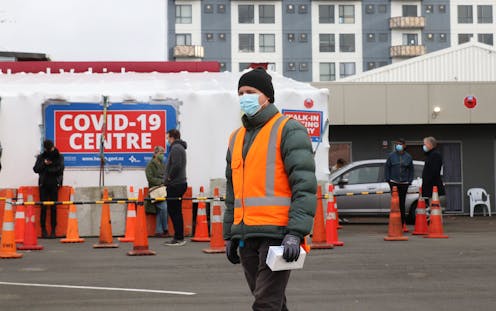





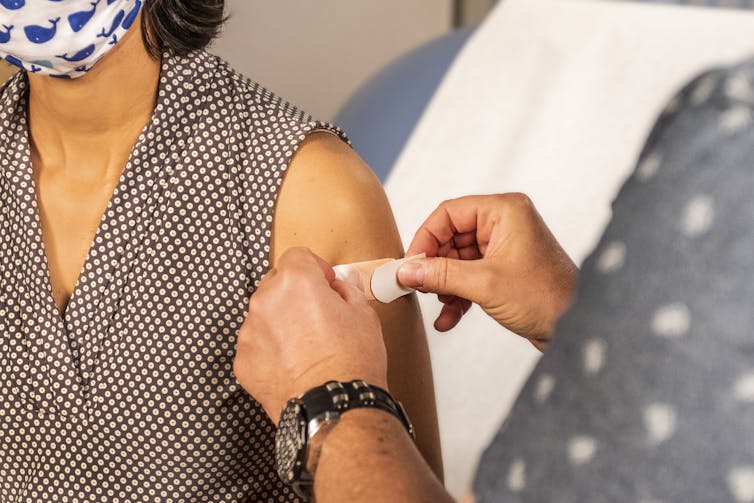
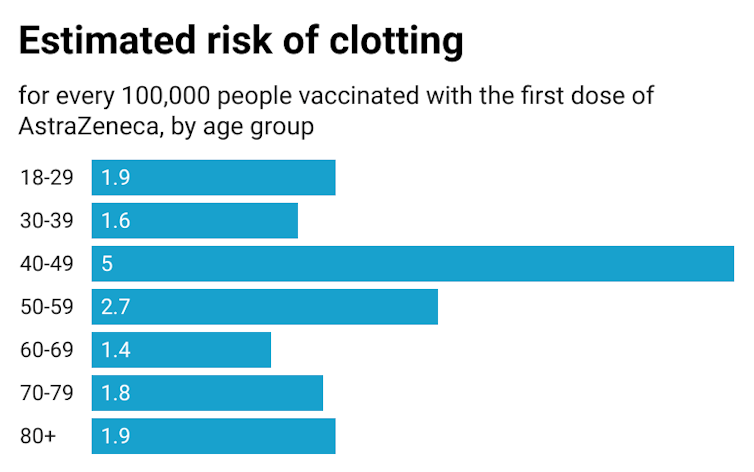



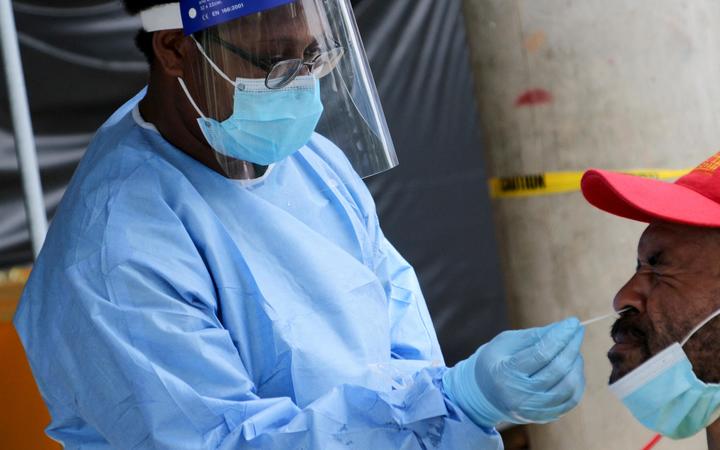
.jpg?1624536228)