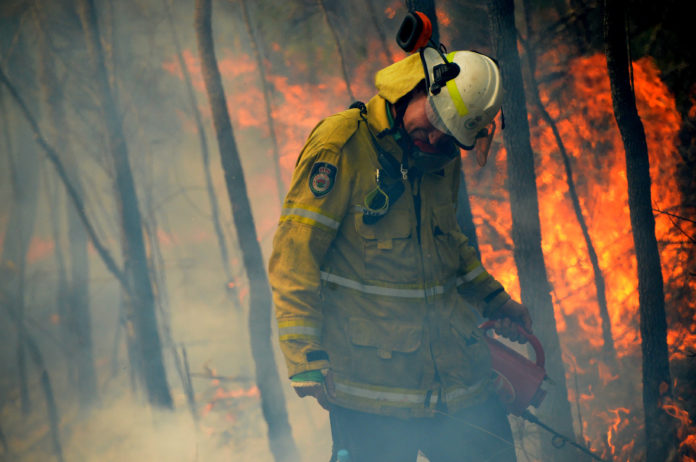
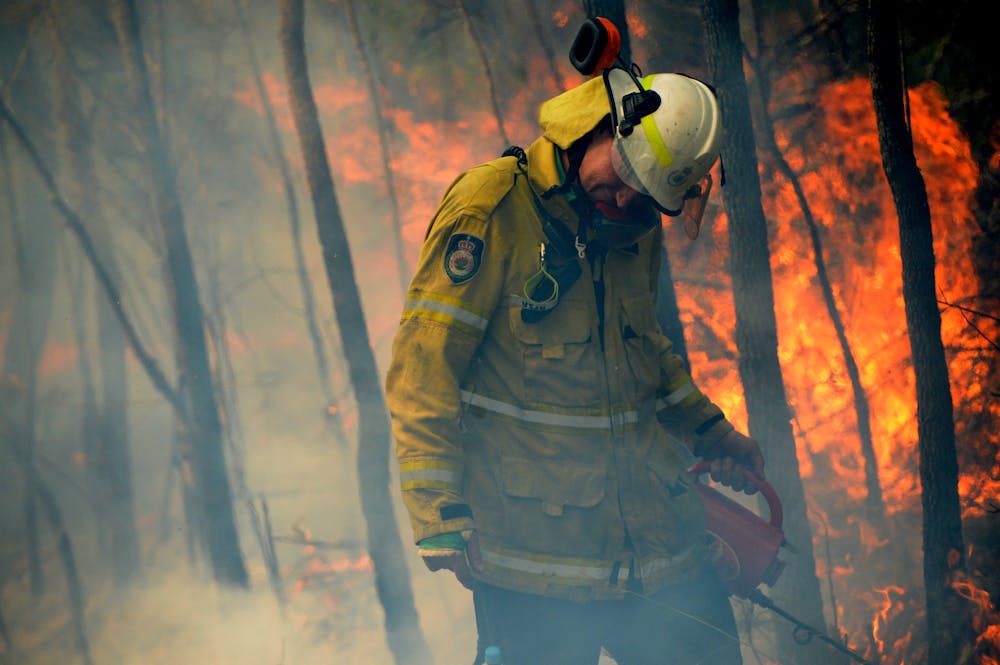
Have you ever wondered how our native wildlife manage to stay alive when an inferno is ripping through their homes, and afterwards when there is little to eat and nowhere to hide? The answer is adaptation and old-fashioned ingenuity.
Australia’s bushfire season is far from over, and the cost to wildlife has been epic. A sobering estimate has put the number of animals killed across eastern Australia at 480 million – and that’s a conservative figure.
But let’s look at some uplifting facts: how animals survive, and what challenges they overcome in the days and weeks after a fire.
This possum decided to flee a bushfire in the NSW Hunter region in 2018, but many other animals stay put.AAP/Darren Pateman
Sensing fire
In 2018, a staff member at Audubon Zoo in the United States accidentally burned pastry, and noticed something peculiar. In nearby enclosures ten sleepy lizards, or Tiliqua rugosa, began pacing and rapidly flicking their tongues. But sleepy lizards in rooms unaffected by smoke remained burrowed and calm.
It was obvious the lizards sensed the smoke from the burnt pastry, probably through olfaction, or sense of smell (which is enhanced by tongue flicking). So the lizards were responding as they would to a bushfire.
Other species detect fire for different reasons. Fire beetles from the genus Melanophila depend on fire for reproduction, as their larvae develop in the wood of burned trees. They can detect fire chemicals at very low concentrations, as well as infrared radiation from fires.
The beetles can detect very distant fires; one study suggests individuals of some species identify a fire from 130km away.
Stay or go?
Once an animal becomes aware of an approaching fire, it’s decision time: stay or go?
It’s common to see large animals fleeing a fire, such as the kangaroos filmed hopping from a fire front in Monaro in New South Wales a few days ago. Kangaroos and wallabies make haste to dams and creek lines, sometimes even doubling back through a fire front to find safety in areas already burned.
Other animals prefer to stay put, seeking refuge in burrows or under rocks. Smaller animals will happily crash a wombat burrow if it means surviving a fire. Burrows buffer animals from the heat of fires, depending on their depth and nearby fuel loads.
From here, animals can repopulate the charred landscape as it recovers. For example, evidence suggests populations of the agile antechnius (a small carnivorous marsupial) and the bush rat recovered primarily from within the footprint of Victoria’s Black Saturday fires.
Avoiding fire is only half the battle
The hours, days, and weeks after fire bring a new set of challenges. Food resources will often be scarce, and in the barren landscape some animals, such as lizards and smaller mammals, are more visible to hungry predators.
Feral cats can travel kilometres in search of vulnerable prey in a burnt-out landscape.HUGH MCGREGOR
In Australia, introduced predators can also be drawn to fires. Feral cats have been observed travelling up to 12.5km from their home ranges towards recently burned savanna ecosystems, potentially drawn by distant smoke plumes promising new prey.
A 2016 study found a native rodent was 21 times more likely to die in areas exposed to intense fire compared to unburned areas, mostly due to predation by feral cats. Red foxes have an affinity for burned areas too.
So should a little critter hunker down, or begin the hazardous search for a new home?
Staying put
Perhaps because of the risks of moving through an exposed landscape, several Australian mammals have learnt to minimise movement following fire. This might allow some mammal populations to recover from within a fire footprint.
Some animals can flee a fireground, while others use bush-smarts to stay put.Jeremy Piper/AAP
Running the gauntlet
Not all wildlife have adapted to stay put after a fire, and moving in search of a safe haven might be the best option.
Animals might take short, information-gathering missions from their refuges into the fireground before embarking on a risky trek. They may, for example, spot a large, unburned tree that would make good habitat, and so move towards it. Without such cues to orient their movement, animals spend more time travelling, wasting precious energy reserves and increasing the risk of becoming predator food.
A dead bird at a Victorian property on January 4, 2019. The ecological toll of the bushfires is immense.James Ross/AAP
Survival is not assured
Australia’s animals have a long, impressive history of co-existing with fire. However, a recent study I led with 27 colleagues considered how relatively recent threats make things much harder for animals in fire-prone landscapes.
Some native species are not accustomed to dealing with red foxes and feral cats, and so might overlook cues that indicate their presence, and make the bad decision to move through a burned landscape when they should stay put.
When fires burn habitat in agricultural or urban landscapes, animals might encounter not just predators but vehicles, livestock and harmful chemicals.
And as this bushfire season has made brutally clear, climate change is increasing the scale and intensity of bushfires. This reduces the number of small refuges such as fallen logs, increases the distance animals must cover to find new habitat and leaves fewer cues to direct them to safer places.
We still have a lot to learn about how Australia’s wildlife detect and respond to fire. Filling in the knowledge gaps might lead to new ways of helping wildlife adapt to our rapidly changing world.
One of the dominant ideas buzzing around the internet is that there’s little we can do to escape the prospect of more frequent and worse bushfires – ever.
That’s because there’s little we can do to slow or reverse the change in the climate.
Australia accounts for just 1.3% of global emissions. That’s much more than you would expect on the basis of our share of world’s population, which is 0.33%. But even if we stopped greenhouse gas emissions as soon as we could and started sucking carbon back in (as would be possible with reafforestation) it’d make little difference to total global emissions, which is what matters – or so the argument goes.
But this argument ignores the huge out-of-proportion power we have to influence other countries.
The cover of ‘Super-power’ by Ross Garnaut.Supplied
Garnaut conducted two climate change reviews for Australian governments, the first in 2008 for the state and Commonwealth governments, and the second in 2011 for the Gillard government.
In the second, he produced two projections of China’s emissions, based on what was known at the time.
One was “business as usual”, which showed continued very rapid increases. The other took into account China’s commitments at the just-completed 2010 United Nations Cancun climate change conference.
China’s annual emissions matter more than those of any other country – they account for 27% of the global total, which is a relatively new phenomenon.
The bulk of the industrial carbon dioxide already in the atmosphere was put there by the United States and the Soviet Union, who have been big emitters for much longer.
Egged on by the US Obama administration and by governments including Australia’s under Julia Gillard, China agreed at Cancun to slow its growth in emissions, and at the Paris talks in 2015 hardened this into a commitment to stabilise them by 2030.
The extraordinary graph
Garnaut’s 2011 projections showed growth moderating as a result of China’s commitment, which was at the time a cause for optimism.
When he returned to the numbers in 2019 to prepare his book, he was stunned. Egged on by the example of countries including the US and Australia, China had done far, far better than either “business as usual” or its Cancun commitments. Instead of continuing to grow rapidly, or less rapidly as China had said they would, they had almost stopped growing.
The graph, produced on page 29 of Garnaut’s book, is the most striking I have seen.
Since 2011, China’s emissions have been close to spirit-level flat. They climbed again only from 2017 when, under Trump in the US and various Coalition prime ministers in Australia, the moral pressure eased.
From the start of this century until 2011, China’s consumption of coal for electricity climbed at double-digit rates each year. From 2013 to 2016 (more than) every single bit of China’s extra electricity production came from non-emitting sources such as hydro, nuclear, wind and sun.
There are many potential explanations for the abrupt change. Pressure from nations including the US and Australia is only one.
What happened once could happen again
And there are many potential explanations for China’s return to form after Trump backslid on the Paris Agreement and Australia started quibbling about definitions. An easing of overseas pressure is only one.
But, however brief, the extraordinary pause gives us cause for hope.
Australia can matter, in part because it is hugely respected in international forums for its technical expertise in accounting for carbon emissions, and in part because of its special role as one of the world’s leading energy exporters.
Garnaut’s book is about something else – an enormous and lucrative opportunity for Australia to produce and export embedded energy sourced from wind and the sun at a cost and scale other nations won’t be able to match.
Some of it can be used to convert water into hydrogen. That can be used to turn what would otherwise be an intermittent power supply into a continuous one. That enables around-the-clock production of the green steel, aluminium, and other zero-emission products Japan, Korea, the European Union and the United Kingdom are going to be demanding.
It wouldn’t have been possible before. It has been made possible now by the extraordinary fall in the cost of solar and wind generation, and by something just as important – much lower global interest rates. Solar and wind generators cost money upfront but cost very little to operate. Interest rates are the cost of the money upfront.
There’s much that needs to be done, including establishing the right electricity transmission links. But Garnaut believes it can all be done within the government’s present emissions policy, helping it achieve its emission reduction targets along the way.
What’s relevant here is that moving to ultra-low emissions would do more. It could give us the kind of outsized international influence we are capable of. It could help us make an difference.
Source: The Conversation (Au and NZ) – By Melissa Rogerson, Lecturer, School of Computing & Information Systems/Interaction Design Lab, University of Melbourne
In Germany, the home of modern boardgaming, the industry has grown by over 40% in the past five years; the four-day SPIEL trade fair this year saw 1,500 new board and card game releases, with 209,000 attendees from around the world.
What is it about board games that attracts people, and what emerging trends can we see in the latest releases?
Board games are booming with young adults.Shutterstock
Social, challenging, real
Four main elements make board games enjoyable for families and dedicated hobbyists alike.
Firstly, board games are social; they are played with other people. Together, players select a game, learn and interpret the rules, and experience the game. Even a mediocre game can be fun and memorable when you play it with the right group of people.
Secondly, boardgames provide an intellectual challenge, or an opportunity for strategic thinking. Understanding rules, finding an optimal placement for a piece, making a move that surprises your opponent – all of these are enormously satisfying. In many modern boardgames, luck becomes something that you mitigate rather than something that arbitrarily determines a winner.
Thirdly, board games are material – they are made of things; they have weight, substance, and even beauty.
Hobbyists speak of the tactile joy and sensual delight of moving physical game pieces, and of their appreciation for the detailed art on a game box or board. Some go to great lengths to protect their games from damage, even “sleeving” individual cards in plastic to protect them from greasy fingers, spills or wear.
Collectable Monopoly sets and other vintage games can fetch hundreds of thousands of dollars at auction.
Finally – and this helps to explain the enormous volume of new releases each year – board games provide variety. Beyond “the cult of the new” lurks a desire to have the right game for the right situation – whatever combination of gamers and strategic depth that might require.
The game’s theme matters, but so do the mechanisms of its play, as well as the game’s expected duration. Like authors, game designers such as Pandemic creator Matt Leacock attract a following of fans who enjoy the style of games that they produce.
The author with just a few favourite games.Image: Shannon Morris, Author provided (No reuse)
‘Escape room’ experiences
To meet the demand for variety, designers look for new elements to offer in their games. “Legacy” style games – where players customise the game as they play it, writing on the board, and discarding rules or game components – create a one-off, individualised variant of a core game. They also invite a group to play together over several play sessions, modifying “their” game throughout the experience.
That can feel confronting to those of us who grew up protecting our games from “damage”.
If writing on game pieces is confronting, the Exit game series, by German couple Inka and Markus Brand is even more so.
These small, inexpensive games aim to replicate the experience of an “escape room” experience by providing the players with a series of puzzles to solve together, as a cooperative activity. To solve the puzzles, however, players must literally destroy the game – cutting up cards, tearing objects, folding and gluing and writing on them.
Board games are not fading away in the digital world. They are booming.
There’s a lot to be said for these low cost single-play games, which build communication and teamwork skills and – like real-world escape rooms – provide an opportunity for friends and families to work together to solve a common problem.
For those who would like to be able to retrace their steps, or to pass a game on to friends, the Unlock! game series takes a different look at the escape room genre by using an integrated app to provide clues and answers.
This ensures that the game itself is replayable, even if the players do not wish to revisit the same story.
Like Exit games, the Unlock! series offers creative opportunities to combine different objects as part of solving the puzzles, but adds occasional multimedia elements and uses the various properties of a smartphone as problem-solving tools.
Real boards, digital play
For people who enjoy solving puzzles, there are many other new games that combine digital technologies with the components and feel of a board game.
Chronicles of Crime puts players in the role of police detectives, who must travel to different locations to interview suspects, consult experts, and conduct searches.
Similarly, Detective sets players to solve a series of crimes. In this game, however, it is not enough to simply learn who committed a crime, it also must be proven by the chain of collected (and registered) evidence registered by players on a custom website.
These games reflect the broader development of a small group of games that use digital tools to add new features to board games.
One Night Ultimate Superheroes uses an app to run the game, taking on an administrative role that would otherwise have to be performed by a player.
The Lord of the Rings: Journeys in Middle-Earth uses an app to speed setup, set game maps, resolve rules and track the players’ progress, streamlining and simplifying play.
Beasts of Balance – a simple, dexterity-based stacking game – uses an app to create a story world which brings the tabletop animal figures to life and encourages players to stack different figures to continue its narrative.
These digital tools add variety to the range of boardgames that are available. More than simple battery-enabled games like Operation, they provide new ways to interact with the game material and mechanisms while still supporting the sociability, intellectual challenge and tangibility so enjoyed by players.
Physical board games aren’t going anywhere, but apps add exciting new possibilities to this play space.
The devastation of the Australian bushfires has generated an outpouring of generosity amongst Australians.
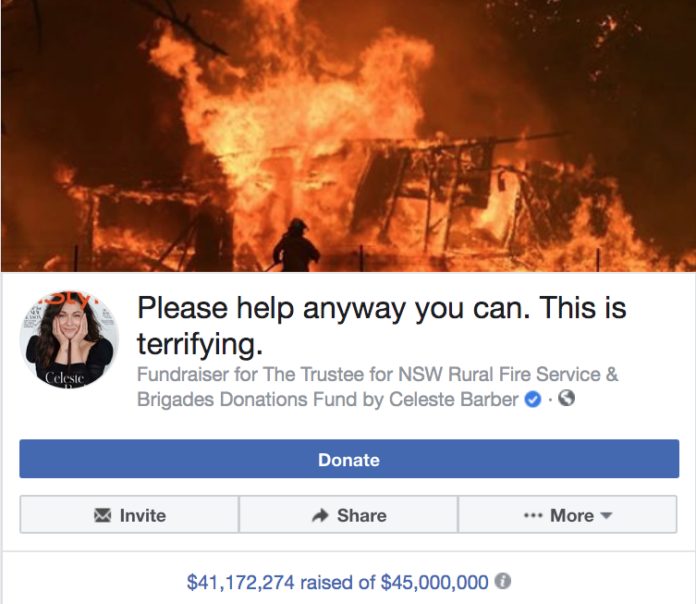
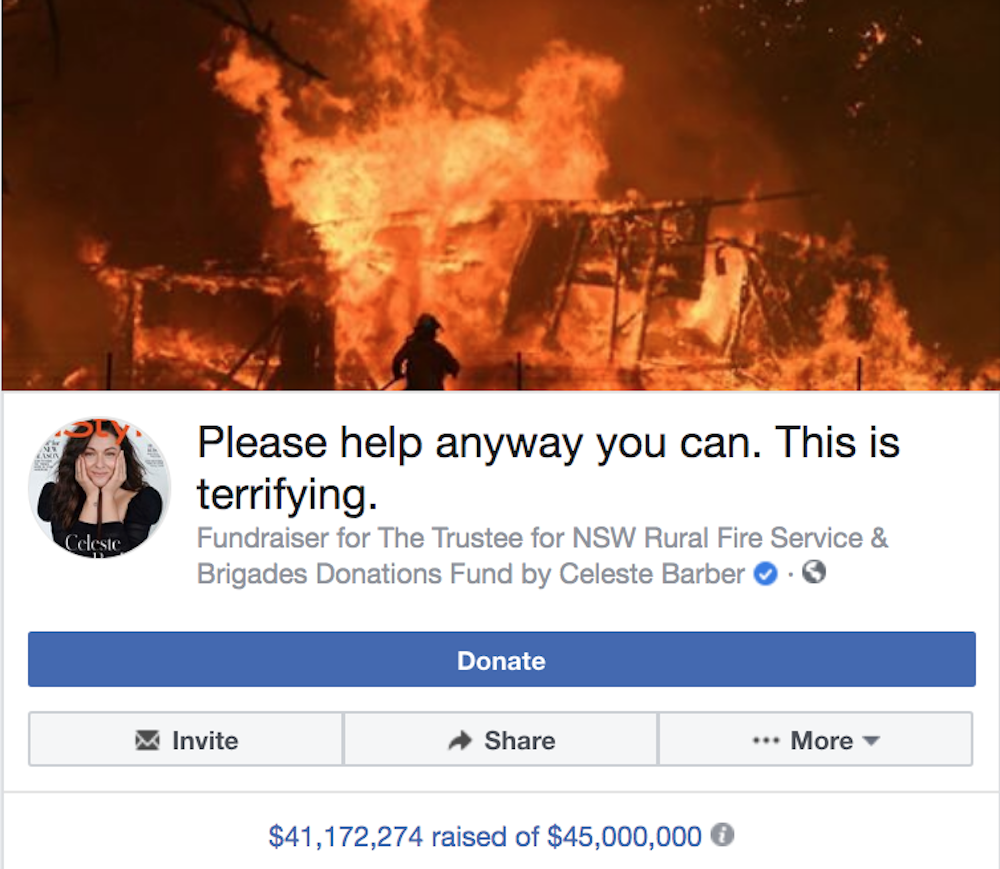
We have been giving directly to charities such as the Red Cross, the Salvation Army and others working on the ground to support survivors. Many of us have contributed to appeals such as Celeste Barber’s, which, at the time of writing, has raised A$42 million for the NSW Rural Fire Service.
At the time of writing, celebrity Celeste Barber had raised $42 million.Facebook
Wealthy Australians, like the Packer, Gandel and Minogue families, have also made large commitments, as have many businesses.
The fact that so many of us have been reaching into our pockets during this difficult time is not surprising. Australia is the fourth most generous nation in the world, according to the most recent edition of the World Giving Index and emergency relief is a common cause to which we give.
But it’s worth thinking carefully about how to give, to ensure you’re not wasting your contribution or inadvertently making things worse.
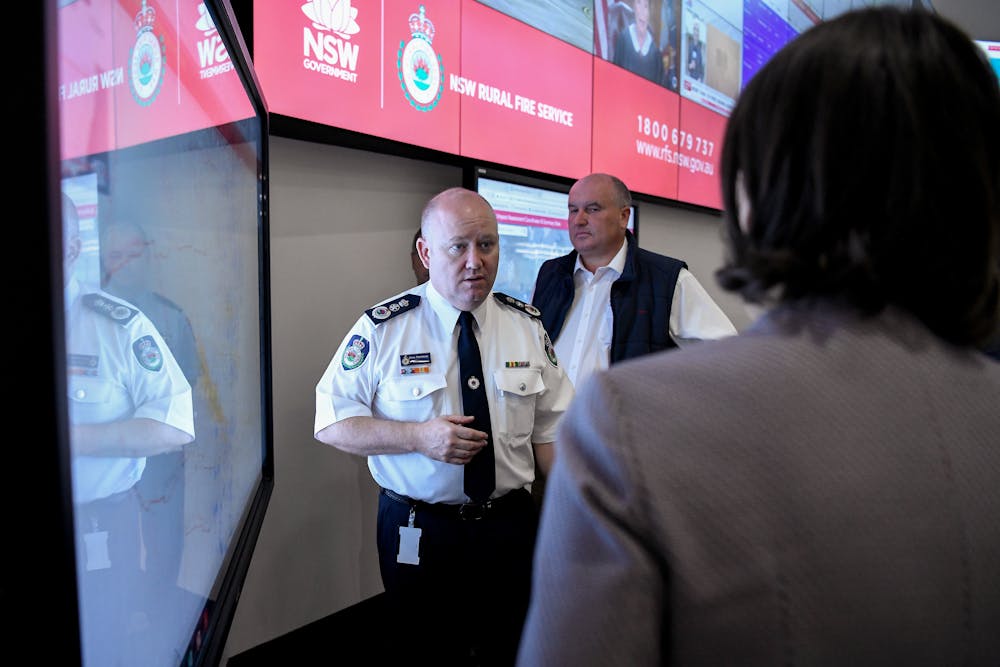
The head of the NSW Rural Fire Service, Shane Fitzsimmons, has pledged to spend the tens of millions of dollars donated to his organisation ‘where it was intended’. The Rural Fire Services is mostly funded by the NSW Government.AAP/BIANCA DE MARCHI
Watch out for scammers
One thing to be mindful of during times like these, is that unfortunately some people may seek to prey on the generosity of others. The Australian Competition and Consumer Commission has issued a warning about fundraising scams associated with the bushfires.
If you aren’t sure about an organisation that you’ve been approached by, you can always check whether they’re a registered charity using the Australian Charities and Not-for-profits Commission’s online register.
It lists all charities registered in Australia, and details their operations, finance and governance.
Money usually trumps everything else
Generally, it’s best to give money. The organisations you give it to can then decide how to use it best.
We may be tempted to give goods like blankets or clothes, but organisations often get overwhelmed by donations of goods.
The idea of donating while also clearing out unused items at home may seem tempting but many organisations don’t have the resources to sort through donations. Often, the goods donated just aren’t fit for use.
Research by the federal and South Australian governments examined this problem, saying of the 2009 Victorian bushfires:
The Victorian Bushfires resulted in the donation of in excess of 40,000 pallets of goods from across Australia that took up more than 50,000 square metres of storage space. The costs for managing these donations i.e. three central warehouses, five regional distribution points, approximately 35 paid staff, material handling equipment and transport costs to distribute the material aid, has amounted to over 8 million dollars.
In addition, volunteer numbers reached 1,500 during the first three months provided through over 40 store fronts. Resources in the fire affected areas immediately after the event were severely stretched as a result of material aid arriving without warning and without adequate resources to sort, store, handle and distribute.
The report highlighted how this is a consistent problem during disasters, leading to the development of the National Guidelines for Managing Donated Goods. These guidelines reinforce the point that donating money is the preferred way to help out during a disaster.
If specific requests are made for certain goods, however, then you can respond by donating accordingly. The charity Givit acts as a broker that facilitates the donations of goods that meet the needs of charities and those they are seeking to help.
Always make sure that what you donate is of reasonable quality. It’s important not to use donation appeals an excuse to clean out items that probably should go in the rubbish or recycling bin.
Donations after the bushfires are also important
We’re facing a long and hot summer, with the prospect of ongoing bushfires. At some stage, they will subside and with them the appeals for donations will also end.
But it’s important to remember that even once the immediate crisis has passed, rebuilding after a disaster takes a long time and requires considerable resources.
Governments play an important part but there is also a role for philanthropy both large and small. For example, the Foundation for Rural and Regional Renewal has a Disaster Resilience and Recovery Fund which makes grants to local not-for-profit groups for community-led projects that address the most pressing needs that emerge 12-18 months after a disaster.
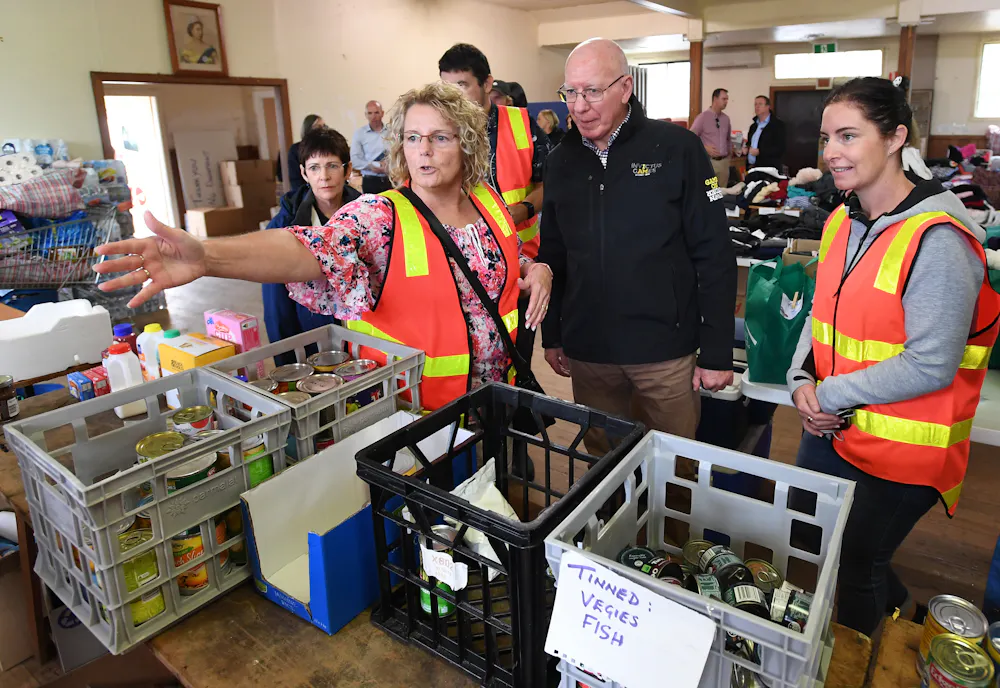
A relief centre in Bairnsdale, East Gippsland, Victoria. Emergency relief is a popular cause to which Australians donate but it’s important to think long term, too.AAP/JAMES ROSS
The bigger picture
Supporting the immediate response and rebuilding efforts is vital, but it’s also important to consider how as a nation we collectively address the factors which are increasing bushfire risk.
Climate change is increasing the risk that we will see more frequent and intense bushfires.
Charities provide vital support to those in need during times of crisis. But they also have an important advocacy role putting pressure on governments and businesses to change policies and practices.
There are many environmental charities doing exactly this, to push Australia toward a more comprehensive response to climate change.
So it’s also worth thinking about how your donation can help support the policy change needed to address climate change and to mitigate the risks associated with it – including more bushfires.
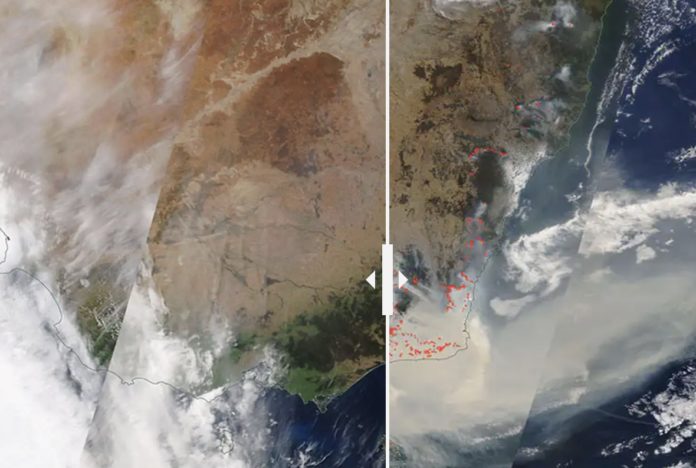
Editor’s note: We pulled four before-and-after-images from NASA’s Worldview application, and asked bushfire researcher Grant Williamson to reflect on the story they tell. Here’s what he told us:
I’ve been studying fires for more than a decade. I use satellite data to try to understand the global and regional patterns in fire – what drives it and how it will shift in the future as our climate and land use patterns change.
When I look at these images I think: this is a crisis we have seen coming for years. It’s something I have been watching unfold.
Look at the sheer scale of it. Seeing this much fire in the landscape in such a broad area, seeing so much severe fire at once, this quantity and concentration of smoke – it is astonishing. I haven’t seen it like this before.
November 1, 2019 and January 3, 2020
In this comparison, you can see November last year versus now. In the present picture (on the right hand side) you can see a vast quantity of intense fires currently burning right down the eastern seaboard and a huge amount of smoke. It’s been blowing out across toward New Zealand for weeks now.
The scale of the current fires is definitely unusual. In a typical year, you might see, for example, a large fire in the alps (near Mount Kosciuszko) or in the Blue Mountains – but they would be isolated events.
What’s striking here is that there is so much going on at once. I have never seen it like this before.
Black Saturday smoke, Feburary 8, 2009 and the 2019-2020 bushfires smoke, January 3, 2020
This one is comparing two smoke events: one from Black Saturday and one from the current fires. In both cases, huge quantities of smoke was released. Both times, the sort of forest burning is very dense, there is a lot of wet eucalypt forest here which naturally has a high fuel load and that’s creating all that smoke. This type of forest only burns during extreme weather conditions.
Simply due to the scale of it and the fact that it’s been going on so long, I would say the current event is worse than Black Saturday, in terms of the quantity of smoke.
East Australia, 10 years ago vs today
In this image, we can the impact of drought. A decade ago, on the left hand side, it was clearly quite green along eastern Australia. That green shows there is a lot of growing vegetation there: pasture crops, grasses and a very wet environment.
If you compare that to the current year, on the right hand side, you can see it’s now extremely brown and extremely dry. There’s not much in the way of vegetation. That’s a result of drought and high temperatures.
Kangaroo Island, 2 months ago vs today
In this image, you can see Kangaroo Island two months ago on the left hand side, versus today.
The main thing I note here is the drying. The “before” image is so much greener than the “after” image. So there’s a real lack of rainfall that’s driving fire severity in this area. You can really see how much the island has dried out.
This has been an extraordinary year for climate and weather, and that’s manifesting now in these unprecedented bushfires. It’s not over yet.
But what’s important is the lessons we draw from this crisis and doing as much as we can to reduce the risk in future.
Bushfires pose serious short- and long-term impacts to public drinking water quality. They can damage water supply infrastructure and water catchments, impeding the treatment processes that normally make our water safe to drink.
Several areas in New South Wales and Victoria have already been issued with warnings about the quality of their drinking water.
Here’s what we know about the short- and long-term risks.
Bushfires can damage or disrupt water supply infrastructure as they burn. And the risks can persist after the fires are out.
A loss of power, for example, disables important water treatment processes such as chlorine disinfection, needed to kill microorganisms and make our water safe to drink.
Drinking water for the towns of Eden and Boydtown on the NSW south coast has been affected in this way over recent days. Residents have been advised to boil their water before drinking it and using it for cooking, teeth brushing, and so on.
Other towns including Cobargo and Bermagui received similar warnings on New Year’s Eve.
In some cases, untreated water, straight from a river supply, may be fed directly into drinking water systems. Water treatment plants are bypassed completely, due to damage, power loss, or an inability to keep pace with high volumes of water required for firefighting.
We’ve seen this in a number of southern NSW towns this week including Batlow, Adelong, Tumbarumba, and the southern region of Eurobodalla Council, stretching from Moruya to Tilba. Residents of these areas have also been urged to boil their drinking water.
The ash left by a bushfire can contaminate the water supply.Dean Lewins/AAP
Untreated river water, or river water which has not been properly disinfected with chlorine, is usually not safe for drinking in Australia. Various types of bacteria, as well as the parasites giardia and cryptosporidium, could be in such water.
Animals including cattle, birds and kangaroos can excrete these microorganisms into river water. Septic tanks and sewage treatment plants may also discharge effluents into waterways, adding harmful microorganisms.
Human infection with these microorganisms can cause a range of illnesses, including gastrointestinal diseases with symptoms of diarrhoea and vomiting.
Bushfires can damage drinking water catchments, which can lead to longer term threats to drinking water. Drinking water catchments are typically forested areas, and so are vulnerable to bushfire damage.
Severe impacts to waterways may not occur until after intense rainfall. Heavy rain can wash ash and eroded soil from the fires into waterways, affecting drinking water supplies downstream.
For example, bushfire ash contains nutrients, such as nitrogen and phosphorous. Increased nutrient concentrations can stimulate the growth of cyanobacteria, commonly known as “blue-green algae”.
Cyanobacteria produce chemicals which may cause a range of water quality problems, including poor taste and odour. Some cyanobacteria can produce toxic chemicals, requiring very careful management to protect treated drinking water.
Boiling water will kill microorganisms, but not chemical substances.From shutterstock.com
Many water treatment plants include filtration processes to filter small suspended particles from the water. But an increase in suspended particles, like that which we see after bushfires, would challenge most filtration plants. The suspended particles would be removed, but they would clog the filters, requiring them to be more frequently pulled from normal operation and cleaned.
This cleaning, or backwashing, is a normal part of the treatment process. But if more time must be spent backwashing, that’s less time the filters are working to produce drinking water. And if the rate of drinking water filtration is slowed and fails to keep pace with demand, authorities may place limitations on water use.
In order to reduce the risk of gastrointestinal and other illnesses, water suppliers and health departments may issue a boil water alert, as we’ve seen in the past week. Bringing water to a “rolling boil” can reliably kill most of the microorganisms of concern.
In cases where water may be contaminated with chemical substances rather than microorganisms, boiling is usually not effective. So where there’s a risk of chemical contamination, public health messages are usually “do not drink tap water”. This means bottled water only.
Such “do not drink” alerts were issued this week following bushfire impacts to water treatment plants supplying the Victorian towns of Buchan and Omeo.
Impacts to catchments from bushfires and subsequent erosion can have long-lasting effects, potentially worsening untreated drinking water quality for many years, even decades.
Following these bushfires, many water treatment plant operators and catchment managers will need to adapt to changed conditions and brace for more extreme weather events in the future.
New Zealand Parliament Buildings, Wellington, New Zealand.
Dr Bryce Edwards.
Are our politicians doing a good job? Are they on top of the urgent problems that need fixing? These are some of the big questions that have arisen from reflecting on the last year in politics, especially as we shift into an election year.
Yesterday’s Political Roundup looked at the politicians who performed strongly in 2019 – see: Evaluating NZ’s politicians. But many end-of-year reviews also focused on where the politicians failed, especially the Government, given that 2019 was pronounced by Jacinda Ardern to be her Year of Delivery. The consensus is that the Year of Delivery failed to eventuate.
The Year of Stagnation?
So, do the politicians even deserve to be awarded the various “politician of the year” prizes given out at this time of the year? Former Cabinet Minister Peter Dunne doesn’t think so. He says that “2019 was an unsatisfactory and unsettled year, dominated by awful tragedies and missed opportunities”, and hence it’s inappropriate to “perpetuate the myth of celebrity” by focusing on personalities at the expense of dealing with serious issues. He argues that “Politicians should be judged on their achievements, not their appearance, turns of phrase or witticisms” – see: Goodbye to a year of stagnation and tragedy.
Elaborating on this and the superficiality of contemporary politics, Dunne says: “singling out a politician of the year as some sort of superstar simply fuels that vacuity. Rather, the focus should be on the progress the country has made during the year under review. In short, are we in better heart than we were at the start of the year, and has our emotional, social, and economic prosperity been advanced?”
For Dunne, 2019 was actually “the year of stagnation”. And the Government is responsible: “What was touted boldly at year’s start as the year of delivery slowly but surely morphed into the year of whimpered excuses. The failure of KiwiBuild is the most dramatic example – achieving only about 3 percent of its projected first year target, making only the slightest dent in the demand for affordable first homes. Elsewhere, optimistic deadlines for various projects were constantly announced, and then steadily pushed further back as reality struck, with decisions on the planned TVNZ/RNZ merger deferred being but the latest to join the ever-lengthening lists of delays.”
Dunne then catalogues the many areas in which things have stagnated or got worse: economic growth, job growth, rising fuel costs, poor public transport, child poverty, suicide levels, state housing waiting lists, health and education staffing, and the state of the environment. He concludes that “Too many timebombs are ticking, faster than ever.”
I’ve also argued that our politicians failed to make much real progress in 2019 – see my end-of-year column for the Guardian: New Zealand’s year of style over substance. In this, I contend that “politics was dominated by spin doctors, PR professionals and talented communicators”. Both major parties need to improve their game and move away from the soundbite-driven policies and sloganeering.
The Year of Spin?
In my column I also look at the question of whether we should be holding the Government to account based on the promise that 2019 would be their Year of Delivery. This is in light of recent revelation from Beehive sources that Ardern’s “Year of Delivery” promise in January last year was an impromptu creation from a spindoctor, rather than from Ardern herself, when she needed a soundbite for the media.
I argued that this exemplified the PR-approach of contemporary politics: “The explanation from the Beehive was to convey that it’s not actually fair to hold the PM to account for a catchphrase that was never intended to be taken so seriously. It is extraordinary that something presented as a solemn promise to the electorate is now being explained away as nothing more than a manufactured PR soundbite.”
The origins of the catchphrase were reported on 21 December by two different political journalists. Here’s Audrey Young’s account: “Ardern’s first mistake was made during her opening remarks to the MPs at the retreat, with media present. She didn’t have a prepared speech and she and chief press secretary Andrew Campbell put their heads together shortly before the start. Having copped so much flak in 2018 for it being a year of reviews and task forces Campbell came up with the crisp phrase that 2019 would be The Year of Delivery. She duly delivered the line and it became instantly mockable” – see: And my politician of the year is…(paywalled).
Young gives her own critique of such promises: “Both the KiwiBuild promises and Year of Delivery catchphrase epitomise the single biggest weakness of Ardern – a propensity to over-promise and a failure to manage expectation. Whether it is promising ‘transformational Government’, ‘the most open and transparent Government’ or ‘the Year of Delivery’ she fails to grasp that there is often little difference between a great sound-bite and a superlative that sets yourself up for failure.”
Stuff political journalists also reported the Beehive line about how that Year of Delivery line came about: “It was a sunny day in Martinbrough and KiwiBuild was falling over. Just days before the out-of-office caucus meeting in January, Housing Minister Phil Twyford had admitted that KiwiBuild would not be getting anywhere near close to 1000 homes ready by July. Jacinda Ardern, facing her caucus with the media pack watching, needed a line that might change the narrative that her Government hadn’t really done much so far. Her press secretary Andrew Campbell came up with just the thing: The ‘year of delivery’. It led headlines everywhere. But it also would come to haunt the Government” – see: The biggest political moments of 2019, from tragedy to farce.
Stuff political journalist Henry Cooke also reported on the origins of the spin-line, adding that “It is housing which Ardern pointed to as the biggest problem in her ‘year of delivery’ when talking to Stuff for an end-of-year interview” – see:Jacinda Ardern found new heights of power in 2019 – and hit hard limits. And he points out that a few months later, “Labour lost its decade-long battle to introduce a capital gains tax, a key tool in the party’s planned assault on high house prices.”
Here’s Coughlan’s list of Government achievements: “The Government has built thousands of public houses, unveiled $1.9 billion of mental health spending, and passed the Zero Carbon Act, alongside making vital reforms to the Emissions Trading Scheme.”
And here’s the disappointments: “KiwiBuild is all but dead, as are the key recommendations from the Tax Working Group, which received the bullet in April. Child wellbeing remains something of an open question, but the Government has shelved the heavy-hitting recommendations from its Welfare Expert Advisory Group, which was tasked with alleviating poverty in New Zealand.” In fact, he says, “Poverty looks like it’s here to stay.”
According to Coughlan, Labour’s coalition partners were “horrified” at Ardern’s promise to make 2019 their delivery year. He reports their reaction: “Had Ardern, whose political education was as a staffer in the Clark Government, forgotten that Government’s maxim: ‘under promise and over deliver’?”
Lack of progress in housing and infrastructure
Financial journalist David Hargreaves is despairing about the lack of progress made by the Government in housing and infrastructure, saying: “I think we’ll look back at this three-year term of Government as a lost opportunity. It’s been a time of a reasonably stable economy and very low interest rates. It’s a time when as a country we could have been getting things done. Like building some much-needed infrastructure and the Government helping out in meaningful way with reducing our housing shortage. For me, the over-riding impression coming out of 2019 is that the current Government is big on the symbolic gestures but very lousy at implementation” – see: The year that didn’t quite get started.
It’s the effective abandonment of KiwiBuild that Hargreaves is most disappointed about. And he thinks it’s not good enough that the Government won’t implement such promises: “Amazingly it does seem like the Government, from a public perspective, is going to ‘get away with it’. At least for now. I find it remarkable that any political party can make something like a KiwiBuild policy such a central part of its election policy, walk away from it once in Government, and seemingly not get caned.”
The other major “lost opportunity” is tax reform to affect the housing market: “With the abysmal failure of KiwiBuild, then so the Government’s decision to ditch any suggestion of Capital Gains Tax becomes more significant – and again possibly something that will cost us in the long run.”
The Spinoff’s Alex Braae also sees this as the biggest disappointment of the year: “The sheer wtf-ness of that moment still stands out, given how important a CGT was in the discussions and final report of the Tax Working Group. Not just a flop, but a moment of profoundly pathetic weakness from Labour to refuse to fight for something that there was previously every indication they believed in” – see the Spinoff’s New Zealand politics in 2019: we pick the champs and the flops.
Also in this Spinoff feature, rightwing political commentator Ben Thomas expresses his disappointment that more hasn’t been done in terms of mental health by David Clark, who he says is therefore one of the biggest “flops” of the year: “Seemingly unable to translate Labour’s much derided commissions of inquiry and working groups – and the better part of $1.9 billion in the ‘Wellbeing Budget’ – into any meaningful action on mental health.”
From the left, Morgan Godfery is also somewhat disappointed in his own Green Party, suggesting their time in Government this year has been to “compromise all our principles!”.
Godfery has also written that the Government has been very disappointing for Māori this year: “The government said no to a capital gains tax, no to most of the recommendations from its own welfare working group, and a ‘maybe’ to returning Ihumātao to its people. Prime Minister Jacinda Ardern came to power promising a ‘politics of kindness’ and a ‘transformational government’. It fails on the first count, refusing to lift all sanctions on beneficiaries, and fails on the second, content to preside over the system as is. Even the good things – like lifting the minimum wage – are things that were happening under the last government anyway” – see: The decade in the Māori world: from Taika to Tariana.
Former Act Party leader Rodney Hide says that Ardern’s promise of delivery in 2019 “has proved, like her government, empty and meaningless. The tragedy is that we accept it. It’s enough that politicians feel and emote; there’s no need to do or achieve anything. We should perhaps rename the country New Feel-Land” – see:Year of Delivery got lost in the post (paywalled).
He elaborates, suggesting that the current policy-making is driven by a new phenomenon: “The prime minister has plastics again in her sights. She says it’s what children write to her about most. There are news reports she’s planning on banning plastic stickers on fruit. I scoffed when we had government by focus group. We now have government by school project. It’s the age of social media. There is no thought and no analysis. It’s just the appearance, the look, the feel. There’s no need to do anything.”
According to this summary of the various international reports, New Zealand is doing well in terms of corruption, peace, democracy, press freedoms, happiness, and economic, civil and political freedoms. But we’re doing poorly in terms of the environment and suicide.
And for the latest report comparing New Zealand to the rest of the world, see John Anthony’sNew Zealand ranked seventh in 2019 global prosperity ranking. This covers the Legatum Institute rankings, which is very positive for New Zealand, with the major exception of “living conditions”, for which the country received its lowest ranking.
Finally, for satire on the Government’s spin about the “Year of Delivery” and Simon Bridges’ lightweight approach in 2019, see Steve Braunias’ The secret diary of New Year’s resolutions.
Australia is famous for its supposedly scary spiders. While the sight of a spider may cause some people to shudder, they are a vital part of nature. Hostile reactions are harming conservation efforts – especially when people kill spiders unnecessarily.
A pathological fear of spiders, known as arachnophobia, is of course, a legitimate condition. But in reality, we have little to fear. Read on to find out why you should love, not loathe, our eight-legged arachnid friends.
A male peacock spider. Spiders are a vital part of nature.She’s Got Legs/Caitlin Henderson
1. Spiders haven’t killed anyone in Australia for 40 years
The last confirmed fatal spider bite in Australia occurred in 1979.
Only a few species have venom that can kill humans: some mouse spiders (Missulena species), Sydney Funnel-webs (Atrax species) and some of their close relatives. Antivenom for redbacks (Latrodectus hasseltii) was introduced in 1956, and for funnel-webs in 1980. However, redback venom is no longer considered life-threatening.
2. Spiders save us from the world’s deadliest animal
Spiders mostly eat insects, which helps control their populations. Their webs – especially big, intricate ones like our orb weavers’ – are particularly adept at catching small flying insects such as mosquitos. Worldwide, mosquito-borne viruses kill more humans than any other animal.
3. They can live to an impressive age
The world’s oldest recorded spider was a 43- year-old female trapdoor spider (Gaius villosus) that lived near Perth, Western Australia. Tragically a wasp sting, not old age, killed her.
4. Spider silk is amazing
Spider silk is the strongest, most flexible natural biomaterial known to man. It has historically been used to make bandages, and UK researchers have worked out how to load silk bandages with antibiotics. Webs of the golden orb spider, common throughout Australia, are strong enough to catch bats and birds, and a cloak was once woven entirely from their silk.
Golden orb weaver (Trichonephila edulis)Caitlin Henderson/She’s Got Legs
5. Their venom could save our life
The University of Queensland is using spider venom to develop non-addictive pain-killers. The venom rapidly immobilises prey by targeting its nervous system – an ability that can act as a painkiller in humans.
The venom from a Fraser Island funnel web contains a molecule that delays the effects of stroke on the brain. Researchers are investigating whether it could be administered by paramedics to protect a stroke victim on the way to hospital.
Funnel-web venom is also being used to create targeted pesticides which are harmless to birds and mammals.
6. They could compete at Little Athletics
The Australian huntsman (Family Sparassidae) can run 40 body lengths per second, about eight times faster than the fastest human runners.
Other spiders have great throwing skills. To catch moths, the bolas spider spins a thread with a sticky glob of silk on the end. The glob mimics the scent of a female moth. When a male moth comes to investigate, the spider throws the glob at the moth, catches it then reels it in.
7. Spiders want to be left alone
Spiders are not aggressive and will either try to run away from people, or defend themselves. Many are exceptional at hiding or camouflaging themselves, in the hope we don’t even see them.
Wrap-around spiders (Dolophones species) flatten themselves around branches to hide during the day, then come out to build webs at night.
A wrap-around spider (Dolophones species) is a master of camouflage.Caitlin Henderson/She’s Got Legs
The Western Australian shield-back trapdoor spiders (Idiosoma species) uses its unusually hard abdomen to “plug” its tunnel when a predator enters, creating an impenetrable shield.
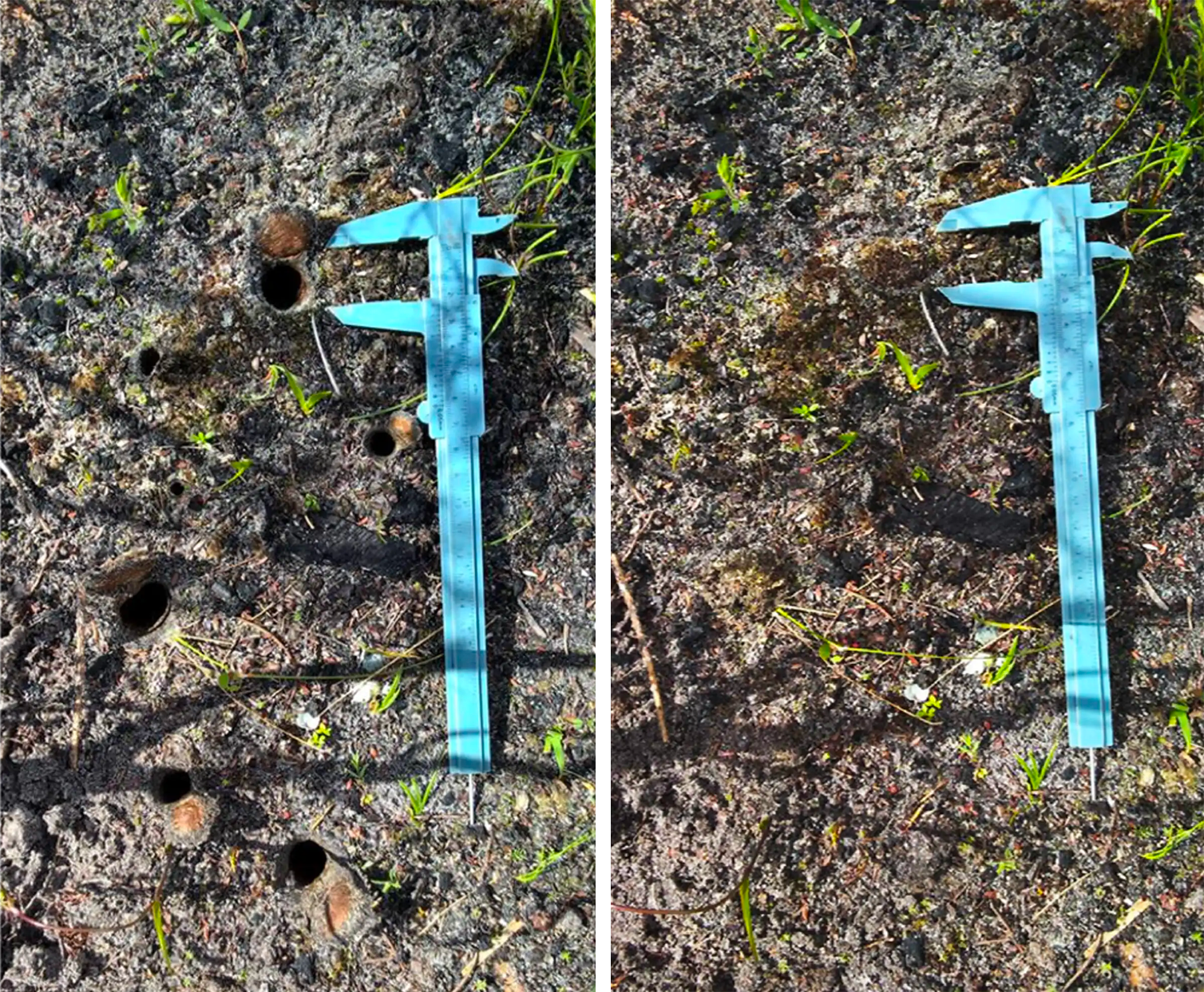
Trapdoor spiders live in burrows with a silken lid that shuts tight, then gets covered in dirt or leaf litter.
Trapdoor burrows of an Idiosoma species open (left) and closed (right)Author provided
8. Spiders have very unusual sex lives
It’s well known that some female spiders eat their partners during or after sex. But male Tasmanian cave spiders have evolved to avoid this fate. They use kinks in their legs to pin the female’s fangs apart while they mate, which can prevent her from killing him. These spiders are so fascinating, they are the subject of a documentary, Sixteen Legs
More generally, male spiders use their “hands” (called pedipalps), to transfer sperm into female spider “vaginas” (called epigynes).
During courtship, Australian male peacock spiders display their colourful abdomen to the female by using some pretty impressive dance moves.
9. Spiders are great mothers
Some female spiders produce milk for their young, or even sacrifice themselves as food. All spider mothers protect their babies, called spiderlings. However trapdoor spider mothers allow spiderlings to live in the home burrow for nine months, before they dig their own burrows nearby.
A wolf spider carrying her spiderlings.She’s Got Legs/Caitlin Henderson
10. Humans need spiders to survive
It is important to remember that spiders and other invertebrates – animals without spines – make up 98% of animal species. They are vital to the functioning of ecosystems; without them, the remaining 2% of vertebrates, including humans, could not survive.
OK, OK. I care about spiders. Now what?
Spread the word to your friends and family that spiders should be cared for.
By all means, teach children that certain spiders require caution, and should be admired from a safe distance. But if your child has an irrational fear of spiders, address this as early as possible. Encourage positive interest in the spider world by exposing children to books and movies with spiders as the lead protagonists, such as Charlotte’s Web and Spiderman.
Research has shown that adults can overcome fear of spiders through frequent exposure. So be sure to share images of spiders with your arachnaphobic friends!
Source: The Conversation (Au and NZ) – By Shahram Akbarzadeh, Professor of Middle East & Central Asian Politics, Deputy Director (International), Alfred Deakin Research Institute for Citizenship and Globalisation, Deakin University
US President Donald Trump has not held back on threatening Iran after the targeted killing of General Qassem Soleimani, a veteran of the Iran-Iraq war in the 1980s and a key player in expanding Iran’s links with armed groups across Iraq, Syria and Lebanon.
In addition to extreme sanctions, Trump’s latest threat includes hitting 52 military and cultural targets in Iran. As might be expected, the Iranian leadership has doubled down on its anti-US rhetoric and promises of retribution. Soleimani was too important to the regime to let this slide.
As the commander of the Quds Force in the Islamic Revolutionary Guards Corps (IRGC), Soleimani was in direct contact with Hezbollah in Lebanon. He mobilised the militant group to defend Syrian leader Bashar al-Assad against US-backed rebels and armed Islamist groups. Soleimani also visited Moscow in 2016 to make a case for, and coordinate, Russia’s military involvement in Syria.
Soleimani made frequent trips to Iraq to bolster the Kurdish and later the Shia militia push-backs against the Islamic State. The recapture of Mosul from the Islamic State in 2016 by the US-backed Iraqi army and the Shia Popular Mobilization Units (PMU) was greeted in Iran with joy.
Soleimani was celebrated as a national hero. The Iranian regime praised him for serving the national security doctrine of offensive defence: defeating ISIS beyond Iran’s borders.
Direct military confrontation is unlikely
It makes sense, then, that the Iranian regime feels compelled to respond to Soleimani’s assassination. Iran cannot afford to let its national hero be slain without retribution. When Soleimani’s daughter asked President Hassan Rouhani, “Who will avenge my father’s blood?”, his response was swift: “We will all take revenge”.
But what can Iran do? The Iranian leadership has been woefully aware of its limitations in case of any direct confrontation with the United States. Iran’s armed forces, including the zealot IRGC, are no match for US firepower. Direct military confrontation will amount to suicide, and the Iranian leadership is in no hurry to act crazy, no matter how deeply hurt it may feel.
This fits the pattern of the cat-and-mouse game the IRGC has been playing with the US navy in the Persian Gulf to disrupt oil shipments without raising the stakes too high. Iran threatened on many occasions to block the Strait of Hormuz and seriously hurt the global economy, but never carried through as it could have prompted a military retaliation from the US.
Iran, likewise, had a calibrated response to the re-imposition of crippling US sanctions following Trump’s withdrawal from the 2015 nuclear deal: a combination of harsh rhetoric and mild action. Tehran sought to look tough but not too threatening to invite a US reprisal.
But the targeted killing of a celebrated Iranian commander is a game changer, meaning the Iranian response will likely be stronger.
Given the perils of direct confrontation for the Iranian regime, the most likely recourse may be a mobilisation of Iran’s proxy affiliations to exact revenge on the United States, most likely in Iraq.
In fact, Iran does not really need to instruct Shia militia in Iraq to hurt the United States. The Popular Mobilization Units (PMU) also lost its second-in-command (Abu Mahdi al-Muhandis) in the same drone attack that killed Soleimani.
Rocket attacks in recent days on the Green Zone in Baghdad are likely to be just the prelude to a major PMU action against US assets in Iraq.
The turning tide against the US military presence, evident in the Iraqi parliament’s resolution to expel foreign forces, could embolden PMU to step up its operations even further. This would be disastrous for the war-ravaged country, and there is no guarantee that Iran would not be embroiled in the conflict.
Pro-Iranian demonstrators targeted the US embassy in Iraq after American airstrikes against an Iran-backed militia late last month.Murtaja Lateef/EPA
Diplomatic responses also have limited appeal
Beyond the military options, Iran also has two immediate diplomatic options. The first is to completely revoke the nuclear deal and resume its nuclear program.
With the US withdrawal from the deal in 2018 – and the Trump administration’s subsequent imposition of a “maximum pressure” strategy on Tehran – Iran already has no incentive to observe its commitments.
And Iran was edging away from the deal even before the latest escalation of tensions. After Soleimani’s assassination, Rouhani said Iran will recommence uranium enrichment and stockpiles, measures that the nuclear deal was designed to seriously limit and monitor.
The Iranian leadership claims it is still in compliance with the general rules set by the International Atomic Energy Agency to govern nuclear activity for civilian use. This move is designed to drive a wedge between the United States and its European allies. By addressing European leaders directly, Rouhani reiterated that Iran would be prepared to return to the deal, but only if Europe, Russia and China could offer a way around US sanctions. This scenario looks extremely unlikely.
Second, Iran could take its case to the United Nations and seek justice through international law.
In the wake of the Soleimani killing, the Iranian ambassador to the UN lambasted the United States for “an illegitimate action” and “an act of aggression”.
This move could resonate with the majority opinion in the United Nations, as well as many US lawmakers and international law experts, who have questioned Trump’s justification for assassinating Soleimani to prevent an imminent threat against the United States.
But going through the UN would be a lengthy and ineffective process as the United States has made a habit of dismissing or ignoring UN resolutions it does not like.
In addition, it is difficult to imagine that any non-military option would be enough to satisfy Iran’s impulse for revenge.
The current bushfire crisis provides compelling evidence of the dangers posed by extremely dry landscapes and hot, windy conditions.
While there’s noevidence “greenies” precipitated the current crisis by blocking hazard reduction, it is clear that we need to explore new ways to manage fuel loads to reduce the severity of bushfires.
It is worth considering how local, self organised, place-based, community groups could be supported to conduct various types of strategic hazard reduction, including targeted grazing and prescribed or fuel reduction burning.
RFS firefighters attempt emergency backburns to reduce fuel in late October 2019, as fires rip through through the north coast of NSW.AAP/Darren Pateman
Using the Landcare model for bushfire hazard reduction
One model we could look to is Landcare, which has enjoyed 30 years of bipartisan support. Funded and supported by governments, local, semi-autonomous, self-directed groups aim to take a sustainable approach to land management through on-ground projects such as habitat restoration and improving biodiversity.
These would be the equivalent of district Landcare groups, but focused on hazard reduction and fuel management. These groups could be encouraged to learn patch-burning techniques, and other landscape scale management practices, such as creating green firebreaks of non-flammable species.
If well coordinated, these techniques would reduce fire hazards across private and public lands. These groups could be an extension of existing Landcare groups combined with volunteer firefighting services. They would aim to increase capacity for fuel management at the landscape scale and provide opportunities for more people to learn skills and share knowledge, with and from professionals working in government forest and national parks agencies.
These kinds of activities, mostly in the cooler, green seasons would enhance the capacity of communities to prepare for future fires, and increase the capacity of traditional fire fighting to suppress dangerous fires.
2. These groups could work under the mentorship and authorisation of fuel management/reduction officers.
These could be public officers such as district fire officers or senior staff of public land management agencies who have had a long involvement in prescribed burning and fuel management on public lands.
3. In each district, fuel reduction periods could be officially declared. With this declaration state governments would assume liability for fuel reduction fires, so long as they had the appropriate planning, approvals and resourcing (for example, they were undertaken by trained groups and certified by appropriate officials).
4. Fuel reduction burning should employ Indigenous fire rangers, drawing on Indigenous knowledge and celebrating Indigenous patchwork burning practices.
Land use planning and management play key roles in shaping exposure to bushfire risks, and are therefore central to disaster mitigation.
Under conditions that favour wildfires, no amount of firefighting effort can protect all lives and property. Victoria’s Black Saturday Royal Commission – a comprehensive inquiry into the fires in which 173 people died, more than 5000 were injured and more than 2,000 houses destroyed – found that under extreme conditions, wildfires overwhelm the capacity of emergency services.
Even impressive tactics like water bombing are no match for an out-of-control blaze, but prevention can make fires more manageable.AAP/State Government of Victoria
South-eastern Australia has long experience of intense fires, yet our population has spread into the bushlands of coastal hinterlands and urban fringes. This has occurred despite scientists warning for more than 30 years that wildfire risks were intensifying due to climate change.
Since the Stretton Royal Commission into the 1939 Black Friday bushfires, more than 16 major inquiries have called for greater use of integrated approaches to land use planning and management to minimise disaster risks.
With climate change increasing bushfire impacts and intensities, we need to build capacity in local communities to manage fire hazard. This requires education, training and adapting policies and landscape management practices to devise plans that suit local conditions.
Countless generations of Indigenous people have effectively managed fire risk through skillful burning. It is time to learn how to burn well and to share the techniques and methods that can enable us live well in our flammable landscape.
The time has arrived when Australians must decide whether or not they will accept responsibility for the perpetuation of the koala […]
It seems extraordinary that this animal which is so greatly admired, not only by overseas visitors, but by Australians, is being allowed to suffer extinction.
The preservation of the koala was not talked about so much in environmentalist terms: instead, the koala was seen as a crucial icon of Australian identity and tourism.
The earliest picture postcard featuring a koala I have found was postmarked 1903, and it has been a mainstay of tourism advertising ever since.
A 1903 postcard featuring a ‘native bear’.Author provided, Author provided
In the latest ad from Tourism Australia, the koala has been recruited, once again, to market Australia, starring alongside Kylie Minogue, chilling in a graceful eucalyptus on Sydney Harbour.
Eighty four years on from the Evening News’ story, we are still talking about the possible extinction of koalas, our national tourism icon.
The creation of an icon
Koalas were exhibited at Melbourne Zoo from 1861 and at Taronga Zoo from 1914. But at the same time, koalas were hunted ruthlessly for fur throughout much of the 19th century. This practice only came to a halt at the end of the 1920s.
The original 1933 publication of Blinky Bill.Trove
By the 1930s, three koala-themed wildlife parks – the Koala Park in Pennant Hills, Sydney, Lone Pine Koala Park on the Brisbane River and the Adelaide Snake Park and Koala Farm – had opened for business.
A 1981 Qantas advertisement, published in American magazines.Qantas
The loss of a tourism icon
A 2014 study suggests koala tourism could now be worth as much as A$3.2 billion to the Australian economy and account for up to 30,000 jobs.
In 2020, Australia has 68 zoos and wildlife parks exhibiting just under 900 koalas. A photograph with a koala is a must-have souvenir for many international tourists.
Barack Obama meeting Jimbelung the koala in 2014.AAP Image/Andrew Taylor, G20 Australia
But it is impossible to look at Kylie hanging out with her koala mates without bringing to mind the shocking images of badly burned koalas and other wildlife as the devastating wild fires destroy millions of hectares of bushland habitat.
The plump, relaxed, pampered koalas in the Tourism Australia ad are far removed from the horrific realities of fire. These catastrophic fires have compounded the threatening processes that already affect koala populations: habitat destruction and fragmentation, disease, car accidents and dog attack.
Recent research has shown koalas are also vulnerable to climate change through changes in the nutritional status of eucalyptus leaves, excessively hot temperatures and these canopy-destroying wildfires.
The outpouring of emotion and financial support reflects the strong connection that Australians feel for the koala, formed out of the interplay of the animal’s baby-like features and its multitude of representations in popular culture, including, of course, tourism marketing.
Sadly, it is more than likely the koala will go on serving the national interest through its role in tourism even if it was to tragically go extinct in the wild.
The Tourism Tasmania logo features the extinct thylacine.
Most koala tourism is based on experiences with captive koalas. And extinction hasn’t been a problem elsewhere: Tasmanian Tourism uses a stylised image of the thylacine in its logo.
The long term survival of the koala ultimately rests with governments and their policies on forest clearing, fire management and climate change.
If future tourists to Australia are to experience the koala in the wild, it is imperative that governments act now to strengthen the protection of the species and most crucially, its habitat.
It’s a cliché, but Aussies love the beach. And little wonder: with 36,000 kilometres of coastline, Australia is blessed with some of the best beaches in the world.
Around 20 million Australians live within 50 kilometres of the coast. As summer temperatures soar, we flock to the ocean to splash, swim, surf, paddle, and plunge in the waves.
But where do those waves come from? How do they form, and why do they break? As it turns out, what we see at the shore is just the last few moments of an epic journey.
The waves we see crashing on the beach can begin their lives tens of thousands of kilometres away. Surface waves, as they are known, are born when the wind blows over the ocean, amplifying small ripples and transferring momentum from the atmosphere to the water.
The height of the wave depends on how long the wind is blowing and the distance – or fetch – over which it blows. The largest waves are created by distant storms, which churn up the surface of the ocean and radiate waves outwards like ripples in a pond.
Surface waves don’t move the water itself very far – each water molecule travels forward and back in a circle a few meters across and ends up back at its starting point.
As the wave crest rises, water molecules gather gravitational potential energy that is released as kinetic energy when the water descends into the trough of the wave. This energy is then passed onto the next crest in a see-saw of kinetic and potential energy that can propagate across an entire ocean basin.
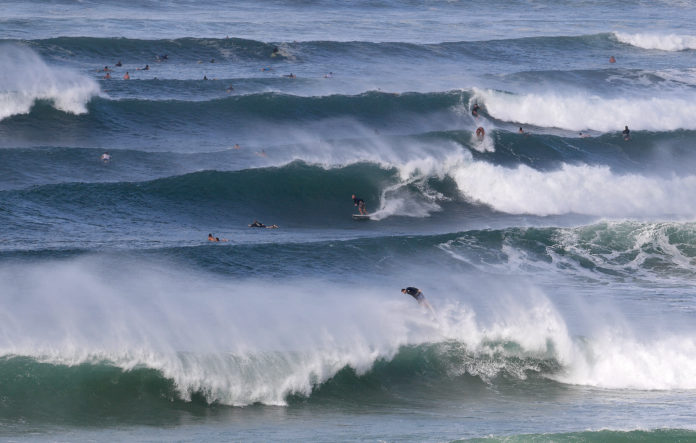
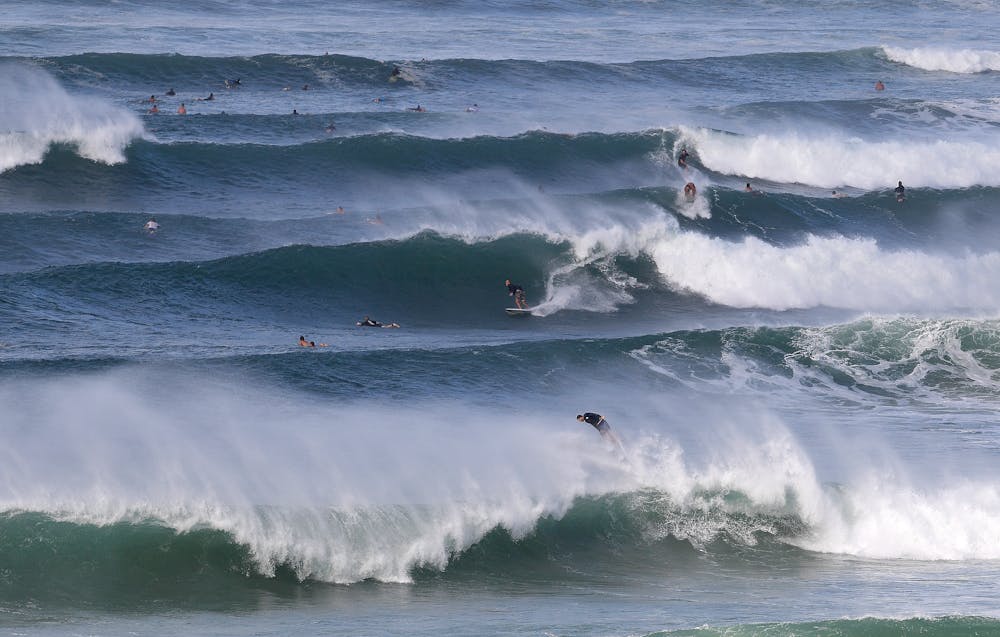
As waves approach the shore, they pile up closer together and grow taller, finally breaking when they become too steep to support themselves.Dave Hunt / AAP
The mounting wave
Once a wave leaves the open ocean and approaches land, the sea floor begins to exert its influence. Surface waves transmit their energy more slowly in shallow water than in deep water. This causes energy to pile up near the shore. Waves start to shoal, becoming taller, steeper, and more closely spaced.
Once a wave grows too steep to hold together, it breaks. Breaking waves come in different varieties.
Spilling breakers, which crumble gently into white water, occur when the sea floor rises relatively slowly.
By contrast, plunging breakers – the classic rolling waves favoured by surfers – form when the sea floor rises sharply, particularly near reefs and rocky headlands.
Finally, surging waves occur when the shore is almost vertical. These waves don’t produce breakers but rather a rhythmic rise and fall of the sea surface.
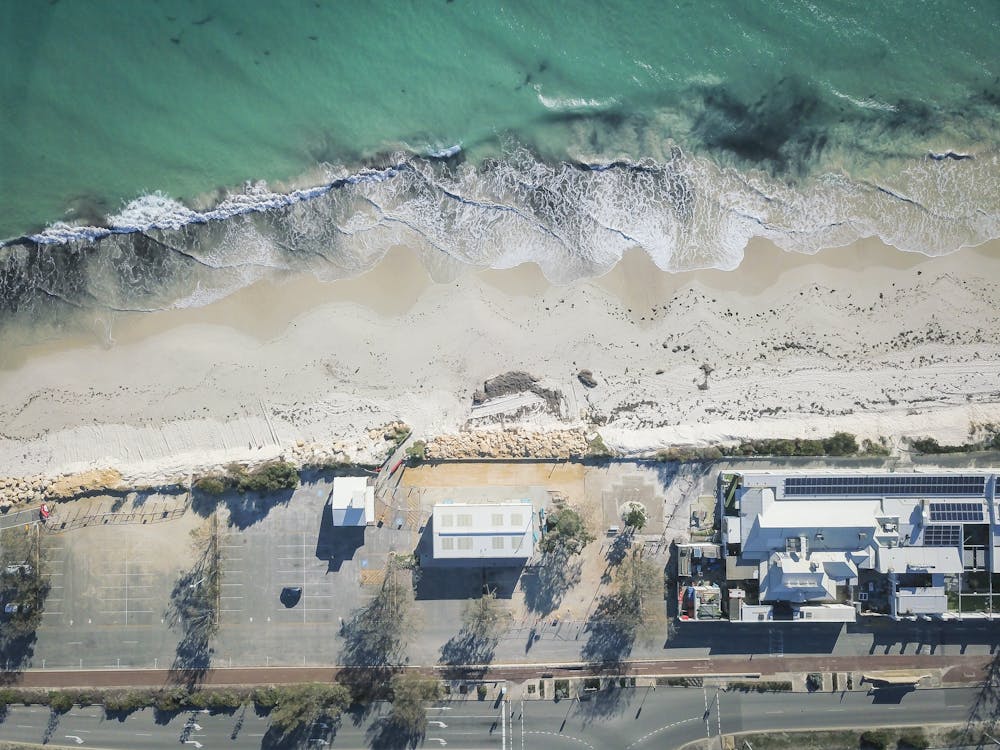
The shape of the waves depends on the shape of the shore.Richard Wainwright / AAP
Bend it like bathymetry
The shape or topography of the sea floor – called bathymetry – can have remarkable effects on breaking waves. If the depth of the sea floor changes parallel to the coast, incoming waves will refract or bend so their crests line up with the shoreline.
The effect can be clearly seen near headlands: waves close to the headland move slowly because the water is shallow, while waves further out move more quickly. This causes waves to curl around the headland like a marching band rounding a corner.
Bathymetry is also responsible for some of the biggest waves on Earth. Famous big wave surf spots like Mavericks in Northern California and Navarre in Portugal benefit from undersea canyons that refract incoming waves and focus them into monsters. The Navarre wave originates from an undersea canyon almost 5 kilometres deep to produce waves as tall as an eight-storey building.
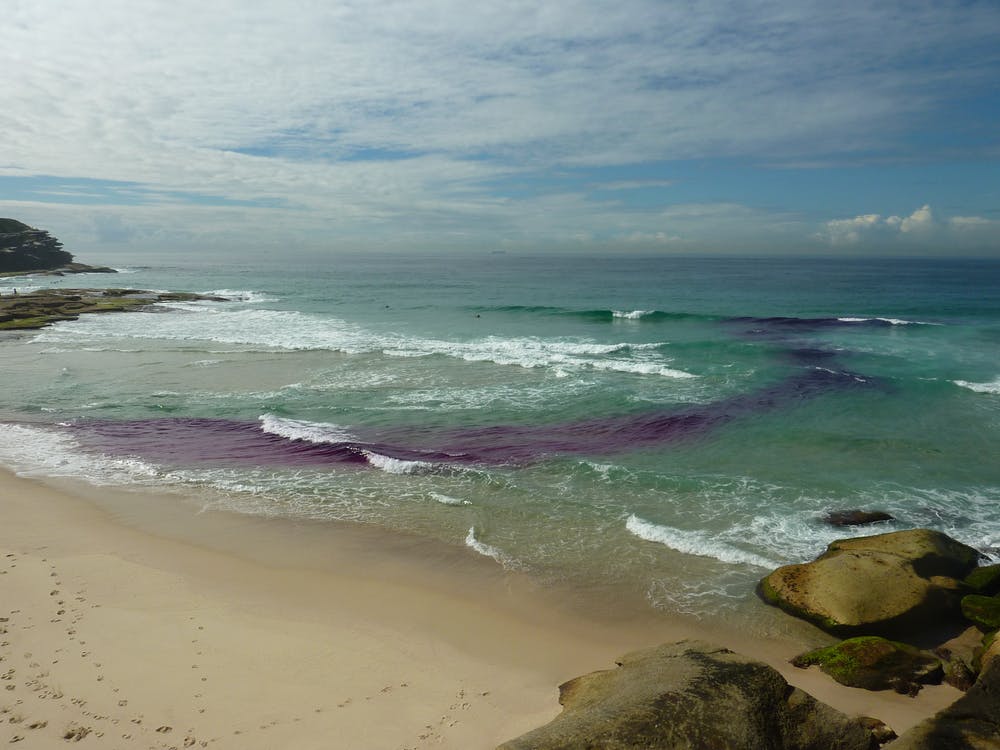
The story of a wave doesn’t end when it breaks, however. Breaking waves push water towards the shore, raising the water level. This water will try to flow back offshore via the lowest point along the beach. The result is a rip current: a swift, narrow current that flows out to sea.
Rip currents are Australia’s number one coastal hazard, responsible for more fatalities per year than shark attacks, bush fires, floods, and cyclones combined. Inexperienced swimmers caught in a rip can panic and try to swim against the current, which is a dangerous recipe for exhaustion. Yet most Australians are unable to identify a rip current, and two-thirds of those who think they can get it wrong.
Purple dye traces the path of a rip current.Rob Brander
To spot a rip, look for a gap in the waves, a dark channel, or ripples surrounded by smoother water. The safest thing to do is to stick to patrolled beaches and swim between the flags. If you do find yourself caught in a rip, Surf Lifesaving Australia advises you to stay calm and conserve your energy.
Rip currents are usually quite narrow, so swim at right angles to the current until you are outside the rip. If you are too tired to swim, tread water and let yourself go with the flow until the rip weakens and you can signal for help.
Above all, if you are unsure, don’t risk the rip. Sit back and enjoy the waves from a safe distance instead.
Frank Jotzo, the director of the Centre for Climate and Energy Policy at Australian National University, has some constructive advice for Prime Minister Scott Morrison in a column today for the ABC: do not waste an opportunity to recalibrate his government’s approach on climate change.
Morrison should heed Jotzo’s suggestion that he and his cabinet need to “drop the old anti-climate change stance”. As Jotzo writes,
You’ve been politically locked into a no-action position, but the bushfires give you the reason to change […] You can make it your mission to protect the country from harm, an essential conservative cause.
Jotzo speaks with authority as one of the country’s foremost experts on climate reduction policies. He has a global reputation.
Whether Morrison is capable of a course correction on climate change and, in the process, yield on an issue he has used to wedge his political opponents remains to be seen. However, he would be unwise to pretend that once the immediate bushfire danger passes and the smoke clears, the country will return to normal politically.
The nation will expect – indeed it will demand – that any government, conservative or Labor, face up to what is the new normal of a drying continent rendering human settlement increasingly vulnerable to extreme weather. Failure to do so will exact a heavy political price.
Scott Morrison’s holiday trip to Hawaii immediately came under fire from those who accused him of being out of touch with fire victims.Steven Saphore/AAP
Morrison’s fallback positions are less defensible
The prime minister insists he has not denied there is a link between climate change and bushfires, but at best his responses on the subject have been evasive and self-serving politically.
Pressed on the issue, his fallback position is to say
I am sure you would also agree that no response by any one government anywhere in the world can be linked to one fire event.
That might be true, but it is hardly the point in the wider scheme of what measures might be adopted to address problems of a sluggish response to the bushfire emergency.
Morrison and others in his government might also go easy on claims that local opposition to back-burning in native forests contributed to the fires. This is a coded attacked on the Greens and is not supported by the evidence.
When in doubt, politically you might say, blame the Greens.
Memo to Scott Morrison: people are fed up with politics proving to be a constraint on the development of a credible and sustainable climate policy that involves reasonable transitional steps to a low-carbon economy over time.
As such, he might also drop his claim that calls to reduce carbon emissions are “reckless”.
Where the prime minister is particularly vulnerable – this will be subject studied closely by any future commission of inquiry – lies in his refusal to meet a group of former emergency services leaders calling itself Emergency Leaders for Climate Change.
In April, the leader of the group, Greg Mullins, a former commissioner of NSW Fire and Rescue, wrote to Morrison warning him of the threat of “increasingly catastrophic extreme weather events”.
In September, this expert group wrote again to the prime minister asking for a meeting.
They received no constructive response.
Likewise, academic warnings about risks of climate-induced extreme weather events have been ignored.
In a March 2019 report for the Australian Strategic Policy Institute, ANU professor Robert Glasser called specifically for a national strategy to deal with climate disaster preparedness.
More than 500 Australians, about the same number who died in the Vietnam War, die each year from heat stress alone. The annual economic costs of natural disasters are projected to increase to A$39 billion by 2050, which is roughly equivalent to what the Australian government spends annually on defence.
Bear in mind Glasser’s report was written before these Christmas-New Year bushfire disasters.
We need to begin preparing now for this changing climate, by developing a national strategy that outlines exactly how we move on from business as usual and adopt a more responsible approach to climate disaster preparedness.
Demonstrating empathy, not political calculations
This bring us to issues surrounding the PM’s own leadership during the crisis.
Rosemary Williamson of the University of New England concluded a useful survey of Australian prime ministers’ responses to natural disasters last year with these words:
Australians will expect prime ministers to come and see for themselves, to demonstrate empathy and to instil confidence in recovery.
If these are the benchmarks for prime ministerial behaviour during a crisis brought on by disaster whether it is flood, fire or cyclone, Morrison has not lived up to these expectations.
First, he was – inexplicably – out of the country on holiday while uncontrollable fires began ravaging his home state of New South Wales.
Second, he has had trouble demonstrating reasonable empathy for victims of the fires.
And third, he has had difficulty accepting the Commonwealth had a shared responsibility for assisting the states in coping with the fallout from arguably the worst natural disaster in Australian history.
What has been most surprising is the time it has taken for Canberra to understand that such are the dimensions of this disaster that military assistance was necessary.
Weeks passed without the Australian Defence Force (ADF) being called out. The explanation for this delay is that states had not asked for military involvement, as if the out-of-control bushfires themselves respected state boundaries – or Commonwealth-state relations.
Coordination between Canberra and the states has improved in recent days, but in the early stages such cooperation left much to be desired.
Debate over climate – whether it is changing, and if so what to do about it – has become a culture wars issue over the years to the point where it has proved to be a useful political device for parties of the right.
As a politician of the right, Morrison would be reluctant to yield ground on issues to do with electricity prices that might benefit him politically in the future.
These are the political considerations that would be weighing in his calculations.
Morrison tours a scorched farm in Victoria last week.James Ross/AAP
Charting a new course
However, the ground is shifting politically.
Polls indicate the environment is assuming greater importance among Australians. It is not far behind the economy and health in people’s concerns, according to an exhaustive poll conducted by the ANU’s 2019 Australian Election Study.
Among issues that will burden governments – both federal and state – over the next months will be the heavy costs associated with cleaning up the mess. All up, costs will run into the billions given the dimensions of destruction.
Inevitably, the bushfires will have an impact on economic activity in the December and March quarters. Growth is anaemic in any case, and may well become weaker as a consequence of reduced economic activity during the bushfire season.
Whatever economic fallout ensues, the political costs for the prime minister will continue to weigh heavily.
He would do himself a favour by advancing a credible climate and land management policy that ensures the country is better prepared when the next disaster strikes, as it surely will.
The number of people with myopia, aka short-sightedness (difficulty seeing objects in the distance), has increased dramatically in recent years in various regions of the world.
For example, in many cities in China more than 90% of university students are living with myopia. In pure numbers this is one of the largest epidemics humanity has even seen, far greater than the obesity epidemic.
The myopia boom was first noted in 1980s in the cities of East Asian countries such as Korea, Taiwan and Singapore. The cities of China followed soon afterwards, and a similar trend is being noted in Europe.
From blur to blindness
For most people, myopia is merely an inconvenience requiring correction with glasses, contact lenses or refractive surgery.
Researchers and parents of children developing myopia have looked for explanations and the latest “suspect” is the use of personal electronic devices.
But the myopia epidemic in Asia preceded the release of smart phones by many years (the first iPhone was released in 2007).
New technologies – televisions in the 1960s, computers in the 1980s, laptops in the 1990s, and currently smartphones and tablets – have all been blamed for causing myopia.
As far back as the 1600s, the German astronomer Johannes Kepler, who first identified concave lenses could correct myopia, is said to have attributed his short-sightedness to all his years of “intense study of astronomical tables and so forth”. But he might well have blamed Gutenberg’s printed books (the latest technology at the time).
What’s to blame for myopia?
So what have researchers found so far?
Having parents with myopia increases a child’s risk for myopia. But children can mimic their parents’ potentially myopia-inducing lifestyle – such as near work that requires focusing on close-up objects and studying a lot inside – as well as inherit their genes.
After years of debate over whether myopia is due to genetic or environmental factors (with reading and screen use suggested), we now know it is an interaction of both genes and environment.
Untangling the interactions is a challenge because these factors are interrelated, with children who study more spending less time outdoors.
Don’t just blame the technology
Despite decades of parents warning children, no study has shown that sitting too close to the television causes myopia.
In the past two years, five papers (1, 2, 3, 4 and 5) have looked at myopia and personal electronic devices. Some, but not all, have found an association between the amount of screen use and myopia. But this does not mean screen time itself causes myopia.
Instead of reading from books, children are reading more from screens and changing the nature of their near work. Rising rates of myopia are related to near work behaviours, rather than screen use in particular.
Children are also changing the way they use screens. The simple idea that screen use occurs indoors was completely overthrown by the Pokémon Go craze, as gamers headed outdoors with their smartphones in search of virtual treats.
In addition, we now have children using virtual reality goggles to play games or even study.
children under two years of age have no screen time
two to five-year-old children have a maximum of one hour a day
five to 17-year-old children be limited to two hours of recreational screen time per day.
There is no rigorous scientific basis for these time limits in relation to visual health. But a recent study showed a large percentage of children exceeded these time limits.
Unlike previous generations, most children today experience a lot of screen time. But we don’t have consistent findings for use of television, computers, tablets, smart phones or even virtual reality goggles themselves as the main cause of myopia.
We clearly need some very large, well-conducted studies, where we directly measure the use of screen time across a wide range of health issues from infancy to young adulthood.
Some cities in China are trialling scheduled time spent outdoors at school to see if it prevents or decreases the progression of myopia in children.
In Australia, we need tailored messages to encourage kids to spend more time outdoors if they are inside reading or using screens too much.
Australia is in the midst of inconceivably bad bushfires. The death toll is rising, thousands of buildings have been destroyed and whole communities displaced. This scale is like nothing before, and our national response must be like nothing that has come before.
Prime Minister Scott Morrison on Sunday somewhat acknowledged the need for unprecedented action. He took the extraordinary step of calling up 3,000 Australian Defence Force reservists and mobilising navy ships and military bases to aid the emergency response. This has never before happened in Australia at this scale.
But it’s not enough. As this horrific summer of disaster continues to unfold in coming weeks, we clearly need to overhaul our emergency management plan with a workforce that’s large, nationally mobile, fully funded, and paid – rather than using under-resourced volunteers.
Although expensive, the cost of not acting on disaster risk, planning and preparation will be greatly outstripped by the cost of future climate and weather catastrophes.
Our disaster management system needs upgrading
The states and territories are primarily responsible for disaster preparedness and response. Typically, the federal government has no direct responsibility, but lends a hand when asked through a variety of programs, policies and initiatives.
This may have worked in the past. But with ever larger and more complex disasters, these arrangements are no longer fit for purpose.
What’s more, experts led by former Fire and Rescue NSW commissioner Greg Mullins have called for significant changes in Australia’s disaster management preparedness and response. They’ve signalled the need for new resources, policies and processes to tackle more frequent and complex disasters.
We’ve also seen how consultation and collaboration between the Commonwealth and states are not working smoothly.
NSW Rural Fire Service Commissioner Shane Fitzsimmons only learned that Defence reservists would be deployed when it was reported in the media. And it wasn’t immediately clear how new reservists would be integrated into existing response activities.
Finding a bipartisan way forward
The decade-long ideological battle between the left and right of Australian politics has paralysed climate policy development. This cannot continue.
Well-funded disaster preparedness and response inevitably builds resilience to climate change and extreme weather events like bushfires. This is something both sides of politics agree on – in fact, it was noted in the federal government’s own recent report profiling our vulnerability to disasters and climate change.
Prime Minister Scott Morrison took the extraordinary step of calling up 3,000 Australian Defence Force reservists and mobilising navy ships and military bases to aid the emergency response.AAP/LUKAS COCH
Aside from needing bipartisanship, an overhaul of Australia’s disaster management will require money. While we’re lucky to have a dedicated, paid and exceptional set of state and territory disaster and emergency management agencies such as the NSW Rural Fire Service, most heavy lifting is done by agency volunteers.
But with fire seasons starting earlier and lasting longer, we can no longer rely for months at a time on volunteers who must also work, pay their bills and feed their families.
We need a larger, paid, trained, professional emergency management workforce. I reject claims that such a workforce would stand idle most of the year. Severe weather seasons are starting earlier and lasting longer, so these professionals will be busy.
The workforce could be divided in to areas of expertise to tackle specific disaster types, and focus on different aspects of the disaster cycle such as prevention and preparation. These continue year-round.
Alternatively, volunteers could be compensated through direct payments for lost income, tax offsets for volunteers and their employers, or rent or mortgage assistance.
What’s more, a new national disaster management approach must intersect with state and local governments to help reduce disaster risk.
These might include contributing to land-use zoning plans, building design and standards for construction in at-risk areas, or building partnerships with the private sector.
Funding disaster preparedness
All this will cost money. Australia must accept that taxpayers will pay for future disaster preparedness, response and recovery. We need a bucket of cash for when disasters strike. Scott Morrison yesterday announced A$2 billion for recovery, but disaster funds should be ongoing.
This would be no different to the national Medical Future Research Fund – a A$20 billion fund to focus on solving nationally important medical issues funded through savings from the health budget.
There are several ways the money could be gathered. Commonwealth, state and territory governments could rethink their insistence on achieving budget surpluses, and instead spend money on a disaster fund. A “disaster levy” could be applied to household rates bills, a tax on carbon introduced, or planned tax cuts for middle and high income earners abandoned.
The public could also contribute to the fund directly. The ABC’s recent Australia Talks survey found on average, Australians would be willing to chip in A$200 each per year to pay for adaptation to climate change. If every Australian contributed, there’s another A$5 billion per year for the fund.
Future disaster management will require Australia to step up. It means making hard choices about what we want the future to be like, how we’ll pay for that, and what level of risk we are prepared to tolerate. It also means demanding that our leaders deliver meaningful climate change adaptation, including disaster planning.
Australia is in the midst of a bushfire crisis that will affect local communities for years, if not permanently, due to a national crisis of underinsurance.
Already more than 1,500 homes have been destroyed – with months still to go in the bushfire season. Compare this to 2009, when Victoria’s “Black Saturday” fires claimed more than 2,000 homes in February, or 1983, when the “Ash Wednesday” fires destroyed about 2,400 homes in Victoria and South Australia, also in February.
The 2020 fire season could end up surpassing these tragedies, despite the lessons learned and improvements in preparedness.
One lesson not really learned, though, is that home insurance is rarely sufficient to enable recovery. The evidence is many people losing their homes will find themselves unable to rebuild, due to lack of insurance.
A firefighter near the township of Bell, in the Blue Mountains, on October 21, 2013.Dan Himbrechts/AAP
Research published by the Victorian government in 2017, meanwhile, estimated just 46% Victorian households have enough insurance to recover from a disaster, with 28% underinsured and 26% having no insurance.
The consequences aren’t just personal. They potentially harm local communities permanently, as those unable to rebuild move away. Communities lose the vital knowledge and social networks that make them resilient to disaster.
All too often the disaster of having your home and possessions razed by fire is followed by the disaster of realising by how much you are underinsured.
As researchers into the impact of fires, we are interested why people find themselves underinsured. Our research, which includes interviewing those who have have lost their homes, shows it is complicated, and not necessarily due to negligence.
For example, a woman who lost her home in Kinglake, northeast of Melbourne, in the 2009 fires, told us how her insurance calculations turned out to bear no resemblance to the actual cost of rebuilding.
“You think okay, this is what I paid for the property,” she said. “I think we had about $550,000 on the house, and the contents was maybe $120,000.” It was on these estimates that she and her partner took out insurance. She told us:
You think sure, yeah, I can rebuild my life with that much money. But nowhere near. Not even close. We wound up with a $700,000 mortgage at the end of rebuilding.
An extra mortgage
A common issue is that people insure based on their home’s market value. But rebuilding is often more expensive.
For one thing there’s the need to comply with new building codes, which have been improved to ensure buildings take into account their potential exposure to bushfire. This is likely to increase costs by 20% or more, but is rarely made clear to insurance customers.
Construction costs also often spike following disasters, due to extra demand for building services and materials.
A further contributing factor is that banks can claim insurance payments to pay off mortgages, meaning the only way to rebuild is by taking out another mortgage.
“People who owned houses, any money that was owing, everything was taken back to the bank before they could do anything else,” said a former shop owner from Whittlesea, (about 30km west of Kinglake and also severely hit by the 2009 fires).
This meant, once banks were paid, people had nothing left to restart.
She told us:
People came into the shop and cried on my shoulder, and I cried with them. I helped them all I could there. That’s probably why we lost the business, because how can you ask people to pay when they’ve got nothing?
Undermining social cohesion
In rural areas there is often a shortage of rental properties. Insurance companies generally only cover rent for 12 months, which is not enough time to rebuild. For families forced to relocate, moving back can feel disruptive to their recovery.
Underinsurance significantly increases the chances those who lose their homes will move away and never return – hampering social recovery and resilience. Residents that cannot afford to rebuild will sell their property, with “tree changers” the most likely buyers.
Communities not only lose residents with local knowledge and important skills but also social cohesion. Research in both Australia and the United States suggested this can leave those communities less prepared for future disasters.
This is because a sense of community is vital to individuals’ willingness and ability to prepare for and act in a threat situation. A confidence that others will weigh in to help in turn increases people’s confidence and ability to prepare and act.
In Whittlesea, for example, residents reported a change in their sense of community cohesion after the Black Saturday fires. “The newer people coming in,” one interviewee told us, “aren’t invested like the older people are in the community.”
Australia is one of the few wealthy countries that heavily relies on insurance markets for recovery from disasters. But the evidence suggests this is an increasingly fraught strategy, particularly when rural communities also have to cope with the reality of more intense and frequent extreme weather events.
If communities are to recover from bushfires, the nation cannot put its trust in individual insurance policies. What’s required is national policy reform to ensure effective disaster preparedness and recovery for all.
The first tune I ever wrote – a proper tune, with an intro, verses, choruses and a middle bit – was a surfing instrumental.
I have always been a pretty crappy singer, and I figured that the guitar could sing for me (I know, I know). But like anyone who grew up in the 60s this genre made sense to me. It was both fun and familiar, and there was room for storytelling in the sound of the guitar.
Surf music was born with the release of Dick Dale’s first single Let’s Go Trippin’. Dale was born in Boston, but arrived in California as a teenager and started surfing. He played a left-handed guitar, but with the strings upside down, that is with the low strings at the bottom and the high strings at the top. This quite odd arrangement made for an idiosyncratic sound, all the physical movements up-ended; the dynamics reversed, the emphasis offset.
Dale first played Let’s Go Trippin’ in 1960, and it was a wild and crazy sound, the birth of a genre.
The fact that he has a Lebanese background informed his style. The frenetic oud and tarabaki playing that drives Lebanese pop music of the 50s seeped in, along with his love of drummer Gene Krupa’s snappy snare.
It didn’t take long for Dale’s influence to spread. Not really very surfy, but in 1962 Monty Norman’s James Bond theme for Dr. No was played by the tremendous John Barry Seven and is a great example of the foregrounding of the edgy guitar sound that Dale perfected.
The first of the teen surf movies, Beach Party, was released a year later: tales of teen idiocy, with Annette Funicello and Frankie Avalon at the helm, centred around summer, surf, music and endless partying.
At least a dozen of these films were made, formulaic and sanitised, with established comedians like Paul Lynde and Don Rickles, promoting a romanticised image of surf culture.
Although the movies were built on beach party guitar bands, the music charts and radio waves of the time were also home to beautiful, evocative guitar instrumentals. The Ventures from Washington state had their first hit with Walk, Don’t Run in 1960.
They played mostly covers, but developed a new sound – pounding toms and unison picking guitars – releasing many twangy gems including covers of Joe Meek’s Telstar, The Champs’ Tequila, as well as two of the touchstone tracks of the surf music genre in Pipeline and Wipeout.
In the UK, The Shadows were exploring similar terrain, with hits like Apache, Wonderful Land and Atlantis. They took a more lyrical approach, stepping away from the blues-based patterns of the US guitar artists, and sliding in minor chords and more complex structures.
But the thing that really sets The Shadows apart is the sound: the guitar amp producing washes of spacious reverb, as well as the watery bubbling of the vibrato; the guitar tremolo stretching the strings into tonal waves, and the orchestral layering on some of the grander tracks.
Santo and Johnny’s Sleepwalk is a lesson in subtle mood-making with its lap steel guitar evoking the distant Hawaiian islands.
It appears in the repertoire of both The Ventures and The Shadows, inspires another deeply influential beauty, Albatross, by Fleetwood Mac, with Peter Green on guitar, and echoes through the decades to the wonderful work of Richard Hawley.
Australia in the 70s and beyond – great beaches, great surfers, great music
The beaches south of Sydney produced Australia’s most notable surf band in 1961. The Atlantics had their genetic roots in Greece and Eastern Europe, an immigration success story years before Vanda and Young.
Their biggest hit, Bombora, is a surf rock classic and was an international sensation in the earliest days of the genre.
They had another big hit, The Crusher, and then in 1964 released War of The Worlds, awash with echoes and distortion and moodiness. It was innovative and brave, but ultimately spelled their demise as a surf band.
As the 60s hit their twilight, and the wave of political enlightenment from Prague and Paris reached our shores, the blonde, post-war beach party was dragged out by the undertow. The Summer of Love, then Woodstock came and went, leaving the surfing subculture chilling with a joint in the back of the panel van rather than wildly dancing around the bonfire with a bottle of Mateus Rosé.
The twangy instrumentals, with their snappy drums and lightning guitar lines stretched and grew, as synthesizers and production techniques replaced the earlier simple arrangements. The sound changed and became spacious, echoing the endless drift of the waves, and the slow drama of the incoming storm.
In 1970, Morning of the Earth was released, becoming the first film soundtrack to earn a gold record in Australia. It not only has tracks by singer-songwriters and pop stars but also by the acid-surf instrumentalists Tamam Shud. It became an enormously influential film, capturing the idyllic nature of the surfing culture.
But the twang hadn’t gone. The sound of the surf guitar is core to the music of The Cramps and The Pixies. It surfaced in Ricky Wilson’s great guitar lines for The B52s.
It rang clear as a bell in 80s Australian bands like The Sunnyboys, Surfside Six, Radio Birdman, The Riptides, and Mental As Anything.
The Cruel Sea rose in Sydney in 1987 from the ashes of Sekret Sekret, settling around the ebb and flow of guitarist Danny Rumour and guitarist/organist James Cruickshank and the rhythmic undertow of Ken Gormley and Jim Elliot.
Instrumental rock became groovy again. Eventually, Tex Perkins joined and they became award-winning mainstays in the rise of 90s festival culture.
More recently Headland, who began in 2014 playing live original instrumentals to gloriously evocative Super 8 footage of big surf at Lennox Head in the 70s, have restored faith in the power of the instrumental for the post millennium. Surf music lives!
I only ever played my little surf instrumental a few times and then that version of our band exploded – Lindy Morrison left to join the Go-Betweens and we entered a more angular and fierce phase. But last year, in a performance at the State Library about Brisbane posters and how they help to tell stories about our past, our culture and our place in the world, I played it again.
It felt odd to be doing it on my own, but it also felt both funny and appropriate. The tune had the twang of a simpler time. As does this little gem from Brian Wilson, who believes that smiles can fix the problems of the world.
As monstrous blazes overwhelm Australia’s south-east, the need for a national bushfire policy has never been more urgent. Active land management such as hazard-reduction burning and forest thinning must lie at the core of any such policy.
Done well, controlled burning limits a bushfire’s spread and makes suppression easier, by reducing the amount of flammable material. Clearing or thinning vegetation on roadsides and other areas also helps maintain fuel breaks, allowing firefighters access to forests in an emergency.
As former fire chiefs recently pointed out, of all factors driving a fire’s severity – temperature, wind speed, topography, fuel moisture and fuel load – fuel load is the only one humans can influence.
The royal commission into Victoria’s Black Saturday bushfires identified serious shortcomings in land and fuel management, primarily the domain of the states. Ten years ago I also called for a national approach to bushfires, including vegetation management.
Relatively little has changed since. It is as though Australia suffers collective and institutional amnesia when it comes to bushfire preparedness. But the threat will only escalate. Australia must have a sustained commitment to better land management.
Prime Minister Scott Morrison, meeting South Australian firefighters, says bushfire management is a state responsibility.AAP/Kelly Barnes
The three pillars of dealing with bushfires
Bushfire management comprises three planks: preparation, response and recovery.
Preparation involves managing fuel loads and vegetation, maintaining access to tracks and fire breaks, planning fire response and ensuring sufficient human capacity and resources to respond to worst-case scenarios.
Response involves deploying aircraft, fire trucks and firefighting personnel, and recovery requires social, financial and institutional support.
The federal government mostly focuses on bushfire response and recovery, which now falls under the Department of Home Affairs and the responsible Minister for Natural Disaster and Emergency Management, David Littleproud.
After major fire events in the 2000s, the Commonwealth committed significant resources to response. This included contributing to the cost of more fire-fighting planes and helicopters, and research funding.
A helicopter tackling a bushfire in Victoria’s East Gippsland.Victorian government
But what about fire preparation?
Prescribed burning is considered a key element of bushfire preparation. While there is some debate over its effect on a fire’s impact, the Victorian bushfire royal commission concluded fuel modification at a sufficient scale can reduce the impact of even high-intensity fires.
Other management actions include thinning dense forest areas, reducing the shrub layer mechanically where burning is not possible and maintaining fire breaks. As the climate changes, we may consider changing the tree species mix.
The newly merged Department of Agriculture, Water and the Environment is the federal agency with most interest in land management. However other agencies such as the Department of Industry, Science, Energy and Resources share some responsibilities.
Federal funding for land management deals with single issues such as weeds, feral animals, threatened species or water quality. Funding is often piecemeal, doled out to government bodies or community groups with little coordination. As federal programs are implemented, states often withdraw funding.
Former NSW Fire and Rescue commissioner Greg Mullins and other experts have warned fuel reduction burning is “constrained by a shortage of resources in some states and territories”, as well as by warmer, drier weather which reduces the number of days burning can be undertaken.
A hazard reduction operation by the NSW National Parks and Wildlife Service in the Blue Mountains. Fire experts say such services are underfunded.Mick Tsikas/AAP
At state level, since the major fires of the 2000s, funding for fire management has increased and coordination between fire response and land management agencies has improved.
However, the focus of the two groups remains divided, which can thwart progress. Fire services prioritise protecting lives and property once fires are going, while forest and land management agencies focus on reducing fire risk, and must consider a wider range of natural and community values.
In a rapidly changing climate, land management requires a long-term adaptive strategy, underpinned by sound analysis and research, supporting laws and policies, with sufficient funding and human resources. Bipartisan political support and leadership continuity is needed to sustain it.
A national approach
State agencies cannot carry the full financial burden for fire preparedness. With fire events happening in almost all states and territories, it is clear we need a national approach.
The federal government collects most tax revenue and should contribute a greater share of the costs of prescribed burning, maintaining access, fire detection, and rapid firefighting response.
Federal spending on land management can be better integrated to engage and protect communities, conserve biodiversity, maintain water quality, manage forest carbon emissions and improve forest resilience to future fires. Recent federal investments in savannah burning in northern Australia are a good example of this.
The Gospers Mountain Fire at Bilpin, NSW.DAN HIMBRECHTS/AAP
A federal bureau of bushfire and land management could support national policy and coordinate investment, including monitoring and reporting on forest and land condition. State agencies, local authorities and private landowners could continue to provide management to meet national targets.
Commitment to public education is also critical. Many people do not understand the need for appropriate human interventions, such as prescribed burning or thinning, to protect the forests we all enjoy. We must also learn from traditional owners about how to live in our country and manage land with fire.
In December, the federal government initiated an inquiry into the efficacy of vegetation and land management and bushfires. This inquiry needs to be expanded, avoiding the simplified debates of the past, and bring together all parties to identify solutions.
As one of the most urbanised countries on Earth, there are few votes to be gained in more spending on rural land management. Hazard reduction is a sometimes risky, labour-intensive measure, and tensions between reducing fuel loads and conserving the environment must be managed.
However after the grief, anger and recriminations from these fires have passed, it’s time for an urgent national rethink – and the Morrison government must lead the way.
The Beehive, Executive wing of the New Zealand Government.
Dr Bryce Edwards.
The verdicts are in on how New Zealand’s politicians performed last year. The end-of-year columns evaluating the MPs have been almost unanimous in their praise for Jacinda Ardern, who is seen to have navigated a difficult year superbly. But there are also some surprising verdicts.
Of the 13 pundits, 9 cite Jacinda Ardern as one of their “champs” of the year, followed by Simon Bridges with 5 nominations. Two minor party leaders also do very well: James Shaw gets picked by 5 pundits, and David Seymour by 4. Six of the pundits name Phil Twyford as the “flop” of the year.
From the left, Morgan Godfery sums up a view shared by many on Ardern’s strong year, saying: “No one can match Jacinda Ardern’s quick leadership, her crisp communication, and her sheer compassion and care for ordinary people and the victims of extraordinarily vile things. She is already a historically important prime minister, and is increasingly precious to the world.”
From the right, Liam Hehir concurs, saying the PM “Lit the way through our darkest hour and will always be remembered for that.” Hehir also praises the performance of National leader Simon Bridges, and explains why he was one of the “champs” of 2019: “Was being written off by all and sundry at the start of the year but has kept his cool and, if polling is to be believed, now has the Beehive within striking range.”
Bridges’ strong performance in 2019 is also confirmed by a number of other observers who consider him the more surprising success story.
Herald political editor Audrey Young says Bridges is her runner-up for the top politician of the year, saying “Bridges has had an excellent year. At a time when his MPs could have been getting bitter about being in opposition, he has held them together, got policy under development under way, maintained high support for his party, kept Judith Collins at bay and improved his own communications skills” – see: And my politician of the year is…(paywalled). She says, “Bridges is finally getting some of the recognition he deserves for doing a reasonable job”.
Young is in no doubt that the top award goes to the PM: “nothing had the same impact as Ardern reflecting both the anguish and strength of a broken-hearted country. Most leaders rise to the challenge during a crisis. Others may have managed remarkably well. But she did it. She helped New Zealand come to terms with what had happened. She not only rescued New Zealand’s reputation internationally, she enhanced it. She united a world in grief and in the process etched an unforgettable place for herself in it.”
She also singles out the following MPs for their strong performances: David Seymour, James Shaw, Chris Hipkins, and Tracey Martin.
Stuff political reporters agree with the Prime Minister and Leader of the Opposition being the top dogs – they collectively award Ardern “politician of the year” and Bridges “party leader of the year” – see: Stuff’s political awards for 2019: The best and the rest.
The Stuff journalists name National MP Nicola Willis as Backbencher of the year, as they did last year, and special mention is made of James Shaw getting “bipartisan support for his Zero Carbon Bill”.
Shaw is also credited by John Armstrong for his achievements in 2019, as is Ardern – see: A year of remarkable highs and awful lows for Jacinda Ardern and Simon Bridges. On Ardern’s post-Christchurch leadership, Armstrong draws special attention to her campaign against the use of social media by terrorists, saying it’s “worth stressing that the Prime Minister’s Christchurch Call amounts to a stunning diplomatic triumph for the leader of a country with a population of barely five million people. Ardern accordingly deserves far more credit for harnessing the opportunity to stem cyber-linked terrorism than her countrymen and women have given her.”
Armstrong also has strong praise for Bridges: “It would be overstating things to suggest that there has been a reversal in the respective performances of Ardern and Bridges compared with 2018. There is a hint of that. But Bridges has lifted his game. He landed a massive hit on the Government with his capitalising of the Treasury leak. He has refocused and reoriented the National Party’s basic policy positioning away from the centrist stance of John Key and Bill English during their stints as National’s leader. He has seen off Judith Collins’ simmering tilt for the leadership. She is no longer a threat. It is rare for a Leader of the Opposition to deliver a performance as adept, effective, capable and authoritative as Bridges is managing.”
TVNZ’s Katie Bradford puts Bridges’ performance on a similar level to the PM – see: White Island tragedy likely to shape Govt policy as much as Christchurch terrorist attack did. Here’s the key bit: “Bradford ranked Ms Ardern and National leader Simon Bridges equally this year – Ms Ardern for her split internationally and domestically, and for Mr Bridges, who had been widely criticised and was expected to be rolled, for ‘hanging in there’.”
Similarly, summing up the year in politics, former RNZ political editor Richard Griffin gives the National leader credit: “Simon Bridges appears to have refocused his objectives from the more scatter-gunned approach he brought to the difficult role at the beginning of his tenure. And he also appears to have effectively dealt to those in his ranks that fancied their chances just 12 months ago” – see: Turbulent political year sets up a fascinating photo line finish in 2020.
Griffin also points to the fact that Ardern “excels in managing international relationships and human dynamics”, and gives credit to her “capacity to empathise with the distraught and reflect the trauma of a nation in shock was an extraordinary example of raw emotion from a young mother in the face of evil barbarity rather than a calculating political leader.”
For Jamie Mackay, host of the radio show The Country, the PM doesn’t get the top award because she, “the definition of a woke politician, is a superstar on the world stage but less so on the domestic front”, and instead gives that award to Bridges. Mackay says that even though he is “sometimes somewhat dorky”, Bridges “staved off the enemy from within and landed some real hits on the accident-prone government” – see: The good, the bad, the ugly – and my wrap of 2019.
Mackay also gives a special award to David Parker, the Minister of Trade and the Environment: “my ag person of the year goes to a man who stamped his authoritarian authority on farming in 2019 like no other, and whose actions in 2020 could change the face of farming forever.”
In contrast, Parker only gets a “B” mark in Duncan Garner’s end-of-year report card, with the note, “I don’t know what he does and can’t remember the last thing he did or said, and I’m not sure he is being used in the right role, given his genuine competence” – see:School’s out and here is their report card.
In fact, most of the Government ministers only get Bs in Garner’s report. The best performing are Jacinda Ardern (“Has empathy in spades and is easily Labour’s best weapon”) and Winston Peters – both get a B+. But Iain Lees-Galloway gets a “D”, and Phil Twyford an “E”. On the latter, Garner says: “I can’t recall another minister who had such huge plans, only for the country to realise no-one had put any work into them. KiwiBuild = a huge disappointment.”
On the left, blogger Martyn Bradbury lists his Top 5 MPs of 2019: Chloe Swarbrick, Jan Logie, Willie Jackson, David Seymour, and Andrew Little – see: TDB 2019 Politics Awards. In terms of Little, Bradbury justifies his place in the list: “One of the most righteous Minister’s in the Government. His leadership on a range of Justice issues marks him as a real champion for progress. Best Prime Minister NZ never had.”
On the right, broadcaster Mike Hosking gives credit to David Seymour, for getting his End of Life Choice bill passed. Hosking says what the Act Party leader “achieved this year is not just the year’s most significant piece of law, but a law for the generations. Once a country passes such a law they do not go back. Seymour has changed this country forever. Even more impressive is the fact he did it largely alone” – see: David Seymour, my politician of year (paywalled).
Source: The Conversation (Au and NZ) – By Mike Lee, Professor in Evolutionary Biology (jointly appointed with South Australian Museum), Flinders University
The catastrophic bushfires raging across much of Australia have not only taken a huge human and economic toll, but also delivered heavy blows to biodiversity and ecosystem function.
Humans have seldom if ever seen fires like these, but we do know that wildfires have driven mass extinctions and reshaped life on Earth at least once before – when the asteroid strike that led to the demise of the dinosaurs sparked deadly global firestorms.
Australian biodiversity
Australia is one of only 17 “megadiverse” countries. Much of our species richness is concentrated in areas torched by the current bushfires.
While some mammals and birds face elevated extinction risk, things will be even worse for small, less mobile invertebrates (which make up the bulk of animal biodiversity).
For example, the Gondwana Rainforests of New South Wales and Queensland have been badly affected by the fires. These World Heritage listed forests are home to a rich diversity of insects and a huge range of land snails, some restricted to tiny patches.
The bushfires have been rightly described as unprecedented, and extinctions can play out over an extended period. The full gravity of the impending catastrophe is not yet clear.
There have been greater burnings in the deep past, as we can see from the fossil record. They provide strong and disturbing evidence of how fire drove widespread extinctions that completely reshaped life on Earth.
The ability to run fast and far was not enough to save dinosaurs from firestorms.Douglas Henderson
Around 66 million years ago, a mass die-off called the Cretaceous–Paleogene extinction event famously put an end to the reign of dinosaurs (sparing only birds). This event erased 75% of the planet’s species.
Scientists agree these extinctions were primarily caused by an asteroid about 10 kilometres wide crashing into present-day Mexico, blasting a huge crater the size of Tasmania.
A nuclear winter followed the impact, as fine particles thrown up into the atmosphere blocked sunlight for years. The extended frozen darkness killed ecosystems from plants and phytoplankton upwards.
Recent research shows that global wildfires were likely also an important driver of extinctions, at least for life on land.
The asteroid blasted flaming debris across the atmosphere. Massive deposits of soot found in the fossil record at this precise time suggest most of the Earth’s forests went up in smoke, though these cataclysmic calculations remain controversial.
The fossil record of land-dwelling animals – especially reptiles, birds and mammals – attests to the deadly efficiency of what has been dubbed the dinosaur firestorm. The nature of the victims and survivors is very relevant to current events.
The land animals that made it through the extinction all lived in ways that could confer resilience to heat and fire, such as living partly in water, being able to burrow or hide in deep crevices, or being able to escape rapidly by flight.
Land vertebrates that survived the ancient wildfires were either amphibious (crocodiles, freshwater tortoises), small enough to burrow or shelter (early rodent-sized mammals), or both amphibious and burrowing (platypuses).Michael Lee
Among reptiles, crocodilians and freshwater tortoises (both amphibious) sailed through. Worm-lizards and burrowing snakes survived, but surface-dwelling lizards and snakes were hard hit.
Among mammals, platypus-like monotremes (aquatic and burrowing) clung on, as did tiny rodent-like placental mammals (able to burrow, or hide in deep crevices), but all large placental mammals died. And while at least some birds survived, all their large, earth-bound, dinosaurian relatives perished.
In fact, it appears that every land-dwelling animal species larger than a domestic cat was ultimately doomed, unless it could swim, burrow or fly.
Even these abilities did not guarantee survival: they merely gave creatures a slightly better chance. For instance, pterosaurs could fly well, but still went extinct, along with most bird species.
Deforestation in ancient wildfires spared some ground-foraging birds but obliterated tree-dwelling, perching birds.Michael Lee
Recent research suggests perching birds –- which need forests to live in –- were essentially eliminated when most of the world’s trees disappeared. The sole avian survivors were ground-foragers similar to chickens and rails, and it took millions of years for new perching birds (modern songbirds) to re-evolve.
By exterminating many species, and doing so highly selectively, the global wildfires (alongside other effects of the asteroid impact) totally restructured Earth’s biosphere.
What about the current fires?
The recent rampant bushfires are regional rather than global (e.g. Australia, the Amazon, Canada, California, Siberia), and are burning less land cover than the worst-case dinosaur firestorm scenario.
Yet their long-term extinction effects could also be severe, because our planet has already lost half its forest cover due to humans. These fires are hitting shrunken biodiversity refuges that are simultaneously threatened by an anthropogenic cocktail of pollution, invasive feral species, and climate change.
The ancient catastrophe provides strong evidence, written in stone, that firestorms can contribute to extensive extinctions, even among large vertebrates with large distributions and high mobility.
It also shows certain types of organisms will bear the brunt of the impact. Entire guilds of similar species could vanish, severely impacting ecosystem function.
It took millions of years of regeneration and evolution for our planet’s biosphere to recover from the nuclear winter and wildfires of the asteroid impact. When a new world order eventually emerged, it was radically different: the age of dinosaurs gave way to the age of mammals and birds.
At the time of the 2011 Queensland flood crisis, the Australian Defence Force arrived to help. Community spirit was high. Australia and the world donated very generously.
But after the first few weeks, initial assistance gave way to often intractable difficulties with housing, insurance claims, job losses and chronic physical and mental health conditions.
Blanket media coverage of the crisis soon dwindled. And for many people, there simply was no return to “normal” life.
Police divers conducting a search amongst debris in waters around Grantham in the Lockyer Valley shortly after the 2011 flash floods.AAP/DAVE HUNT
Five years on
Five years after the event, many still struggled. The journey was far longer and more difficult for people who:
lost family members during or after the disaster
were traumatised by a near-death experience
could no longer work in their old job
had significant health problems
had insurance claims that were slow, difficult or rejected.
Those people who were most able to recover were people who:
lost possessions but who were not traumatised by the disaster
remained healthy and had insurance with companies that promptly paid their claims
were able to resume work
were able to repair or replace their homes and return to a relatively normal life within a few months to a year.
After five years, some people realised they would never recover. Some said they would have preferred to die than endure the five years post-flood.
Several survivors spoke of the “near miss” they had with death. For some, it was an incentive to live every day with renewed gusto. For others, the near miss reinforced the fragility of life and left them feeling more vulnerable.
A dolls house sits amongst debris on the railway line through Grantham in the Lockyer Valley, shortly after the 2011 flash floods.AAP/Dave Hunt
Death and near-death experiences
Thirty-three of the rescuers and survivors in the disaster experienced a near-death experience. Five years on, some of them had still not attended any counselling and reported memories of near-death experiences playing out in their minds in an endless video-loop. Some became hermits, afraid to leave home.
One of the rescuers told me it took five years to even acknowledge he had risked his life.
One mother whose children were at risk said:
Life as you know it changed on that day. You know that one second your life is normal and then how quickly things can change. I scan all the time. I scan rooms for the exit. I scan terrain in case something happens […] which is the quickest way to escape?
Lasting psychological impacts
Two thirds of the people interviewed still had ongoing traumatic memories five years after the disaster – including seeing or hearing the sounds of the disaster, smelling the fetid aromas associated with floods or feeling anxious at the sound of helicopters.
For some, the trauma triggers occurred only in the flood zone, while for others it could be anywhere, whcih meant moving away offered no respite.
In the small town of Grantham, where 13 people died, witnesses told an inquiry into the disaster that counsellors changed from week to week (meaning survivors had to retell their stories again to a new counsellor). The service then stopped because townspeople didn’t want to see them.
Australian Army personnel assisted in the immediate aftermath of the 2011 Queensland floods.AAP/DAVE HUNT
Return or move away?
Many people no longer felt safe at home. People who had to rebuild as property values fell and insurance premiums skyrocketed – some up to A$34,000/year – could not afford to insure their house. They feared a total loss of their homes next time.
Some people who never returned to affected towns fared better psychologically than those who did go back.
Some people returned initially, rebuilt, but then sold up and left again. Some told me they would not be alive unless they got out when they did.
Whole communities all but disappeared as almost the entire population left town.
Unsafe housing hampers recovery efforts after a disaster.AAP/ DAVE HUNT
Natural disasters are financial disasters
After a natural disaster, mortgages still need to be paid, even on houses that are uninhabitable. Accommodation costs mount. The risk of homelessness and bankruptcy increases and relationships can be put under enormous stress.
Property values in the towns and districts affected by the 2011 floods fell dramatically and immediately, meaning some people couldn’t sell and move away.
Several survivors were unable to return to their old jobs because their workplace had been destroyed or because it was too traumatic.
One who stayed to rebuild his business experienced another disaster two years later and lost his service station a second time. He rebuilt again only to have his business destroyed a third time the following year.
People who are injured at work in Queensland are eligible to claim on WorkCover, a government funded program that assists workers to recover and return to work. People injured in disasters, however are not eligible for the same type of assistance.
Many people relied on charities for food, clothes and shelter for months to years after the flood. Some refused or resisted charitable help or government help.
Some older people reported becoming dependent on their adult children for the first time.
A house finds its resting place after floating away in flood waters in the town of Grantham, where flash floods hit in 2011.AAP/Dave Hunt
What is needed
The research suggests several possible ways to help natural disaster survivors including, but not limited to:
better access to publicly funded psychological care beyond the current 10 visits allowable under the current Medicare system, especially for people who have lost family or their home or business
free and well coordinated government-funded counselling in disaster zones
income support and emergency housing for people who have lost homes
government-funded funerals for those who die in a natural disaster
provision of short-term retraining for those who cannot return to their old jobs
the creation of a “DisasterCover” system to support volunteer rescuers or firefighters with access to counselling, income support and job security – in the same way that WorkCover might support professional firefighters. A legislated scheme would mean survivors are not at the whim of ad hoc emergency government funding or relying on public appeals
such a scheme could cover emergency medical, rehabilitation and wage costs and then claim them back, where possible, from the claimant’s private medical and income protection insurance
improved land planning around where it is safe to build.
All of this sounds expensive. But the cost of not learning these lessons may be greater in the long run.
Eighty-one years ago, a broadcast of Orson Welles’s War of the Worlds supposedly caused mass hysteria in America, as listeners thought martians had invaded New Jersey.
There are varying accounts of the controversial incident, and it remains a topic of fascination, even today.
Back when Welles’s fictional martians attacked, broadcast radio was considered a state-of-the-art technology.
And since the first transatlantic radio signal was transmitted in 1901 by Guglielmo Marconi, radio has greatly innovated the way we communicate.
Dots and dashes
Before Marconi, German physicist Heinrich Hertz discovered and transmitted the first radio waves in 1886. Other individuals later developed technologies that could send radio waves across the seas.
At the start of the 20th century, Marconi’s system dominated radio wave-based media. Radio was called “wireless telegraphy” as it was considered a telegraph without the wires, and did what telegraphs had done globally since 1844.
Messages were sent in Morse code as dots and dashes from one point to another via radio waves. At the time, receiving radio required specialists to translate the dots and dashes into words.
The more refined technology underpinning broadcast radio was developed during the first world war, with “broadcast” referring to the use of radio waves to transmit audio from one point to many listeners.
This year, organised broadcast radio turns 100. These days it’s considered a basic technology, but that may be why it remains such a vital medium.
SOS: the Titanic sinks
By 1912, radio was used to run economies, empires and armed forces.
Its importance for shipping was obvious – battleships, merchant ships and passenger ships were all equipped with it. People had faith in technological progress and radio provided proof of how modern machines benefited humans.
However, the sinking of the Titanic that year caused a crisis in the world’s relationship with technology, by revealing its fallibility. Not even the newest technologies such as radio could avoid disaster.
A replica of the radio room on the Titanic. One of the first SOS messages in history came from the ship.Wiki Commons
Some argue radio use may have increased the ship’s death toll, as the Titanic’s radio was outdated and wasn’t intended to be used in an emergency. There were also accusations that amateur “ham radio” operators had hogged the bandwidth, adding to an already confusing and dire situation.
Nonetheless, the Titanic’s SOS signal managed to reach another ship, which led to the rescue of hundreds of passengers. Radio remains the go-to medium when disasters strike.
Making masts and networks
Broadcast radio got traction in the early 1920s and spread like a virus. Governments, companies and consumers started investing in the amazing new technology that brought the sounds of the world into the home.
Huge networks of transmitting towers and radio stations popped-up across continents, and factories churned out millions of radio receivers to meet demand.
Some countries started major public broadcasting networks, including the BBC.
Broadcasts could now be stored and heard repeatedly at different places instead of disappearing into the ether.
Transistors and FM
In 1953 radios got smaller, as the first all transistor radio was built.
A 1960 ad for a pocket sized Motorola transistor radio.Wiki Commons
Transistor circuits replaced valves and made radios very cheap and portable.
Along with being portable, radio sound quality improved after the rise of FM broadcasting in the 1960s. While both FM and AM are effective ways to modulate carrier waves, FM (frequency modulation) offers better audio quality and less noise compared to AM (amplitude modulation).
Music on FM radio sounded as good as on a home stereo. Rock and roll and the revolutionary changes of the 1960s started to spread via the medium.
AM radio was reserved for talkback, news and sport.
Beeps in space
In 1957, radio experienced lift-off when the USSR launched the world’s first satellite.
Sputnik 1 didn’t do much other than broadcast a regular “beep” sound by radio.
Meanwhile on Earth, radio stations continue to use the internet to extend their reach beyond that of analogue technologies.
Social media helps broadcasters generate and spread content, and digital editing tools have boosted the possibilities of what can be done with podcasts and radio documentaries.
The radio industry has learnt to use digital plenitude to the max, with broadcasters building archives and producing an endless flood of material beyond what they broadcast.
This year marks a century of organised broadcast radio around the world.
Media such as movies, television, the internet and podcasts were expected to sound its death knell. But radio embraces new technology. It survives, and advances.
For many young people, pornography has become the default sex educator. Children and young people are encountering pornography in greater numbers, at younger ages, and with a wider variety of content, influencing young people’s sexual lives.
Research evidence from around the world shows porn has harmful impacts on young people and adults alike. Some impacts are deeply troubling, particularly pornography’s contribution to sexual violence.
But with sexually explicit material still so easy to access online, there are ways we can minimise its harms among young people, from providing better education at school to developing more ethical porn.
The effects of porn: what the research says
Pornography can shift sexual interests, behaviours and relationships. It shapes “sexual scripts”, providing models of behaviour and guiding sexual expectations, with studies finding links between watching pornography and heterosexual anal intercourse, unsafe sex and more.
Pornography teaches sexist and sexually objectifying understandings of gender and sexuality. For instance, in a randomised experimental study among young men in Denmark, exposure to (nonviolent) pornography led to less egalitarian attitudes and higher levels of hostile sexism. And in a longitudinal study among US adolescents, increased use of pornography predicted more sexist attitudes for girls two years later.
Pornography also teaches violent attitudes and behaviours to both adolescents and adults.
What’s more, meta-analyses – systematic research that synthesises multiple studies – from 2000 and 2015 have found associations between watching pornography and actual violent behaviours.
In fact, longitudinal studies among adolescents find watching pornography is linked to sexually violent behaviour later in life. In a US study, people who watched violent pornography were more than six times as likely to engage in sexually aggressive behaviour. In another, it predicted more frequent sexual harassment perpetration two years later.
But while pornography use is an important risk factor for sexual violence, its risks are greater for some users than others. Four factors mediate the impacts of porn: the user’s attitudes and personality, their engagement with the material, its content, and the context of watching it.
So what can we do to minimise the harms of pornography on children and youths?
Parents may worry that teaching in schools about pornography will encourage students to seek it out for the first time, but there is no sign this actually happens.
Curriculums on pornography can teach young people to respond more critically, helping them assess and respond to pornography’s influence. “In The Picture”, for instance, is a great resource for schools to help support young people navigate the seemingly ubiquitous sexually explicit material online.
Such efforts do work. In a Dutch longitudinal study, the more a young person had learned about the use of pornography from their school sex education, the less likely they were to see women as sex objects.
And in a US evaluation of a five-session curriculum, students showed positive changes in their pornography-related knowledge, attitudes and intended behaviours.
Other than education, we need better pornography. Some call this “ethical pornography” – ethical in its production, use and distribution, and content.
First, participants should have consented to their involvement and not be harmed. The unethical production of porn is common: 12% of males and 6.2% of females in Australia have taken a nude or sexual image of another person without their consent.
Ethical pornography also involves ethical use and distribution. People consent to its viewing, and cannot be distributed without participants’ consent.
But discussions of “ethical pornography” have largely ignored the issue of content – physical and verbal aggression is routine in pornography.
So we must also hold the pornography industries to account. They must produce better pornography, which eroticises consent, respect, and intimacy rather than sexist hostility.
Parents have asked me:
My son is looking at porn. What kind of porn should he be looking at?
Maybe we need a ratings system – the “Healthy Sex Tick of Approval”?
Even depictions of consensual sex may still perpetuate the sexual objectification of women and reinforce other sexist social norms. And in a sexist culture, even the most ethical images of sex may be understood in ways that affirm that wider culture.
Still, it seems pragmatic to give attention to what might comprise “better”, or at least “less worse”, pornography.
Many Australians are reluctant to use sunscreen, even though it’s an important element in preventing the skin cancers that affect about two in three of us at some time in our lives.
The Cancer Council says myths about sunscreens contribute to this reluctance.
Here are 4½ sunscreen myths and what the evidence really says. Confused about the ½? Well, it’s a myth most of the time, but sometimes it’s true.
Myth #1. It’s bad for my bones
Many Australians are concerned using sunscreen might lead to vitamin D deficiency. The idea is that sunscreen would block the UV light the skin needs to make vitamin D, critical for bone health.
However, you need far less UV than you think to make the vitamin D you need: only one-third of the UV that causes a sunburn, and less than you need to tan.
Tests on humans going about their daily business generally show no vitamin D differences between people who use sunscreen and those who don’t.
If you google “toxic sunscreen”, you get more than eight million results. So people are clearly worried if it’s safe.
However, there’s little evidence of harm compared to the large benefits of sunscreens, which are highly regulated in Australia.
There is evidence large amounts of some sunscreen components can act as hormone disruptors. But the amounts needed far outstrip the amount sunscreen users are actually exposed to.
Some ingredients can act as hormone disruptors. But the amounts needed far outstrip the amount sunscreen users are actually exposed to.from www.shutterstock.com
Some people have also been alarmed by the US Food and Drug Administration (FDA) announcing further testing of the sunscreen ingredients avobenzone, oxybenzone, octocrylene and ecamsule. This was after a study showed their concentrations could reach over 0.5 nanograms/mL in the blood.
This experiment involved people thickly applying sunscreen to parts of the body not covered by a swimsuit, four times a day for four days in a row. In other words, this is the maximum amount you might apply on a beach holiday, and considerably more than you would wear on a day-to-day basis (unless you work in your budgie smugglers).
However, there’s no evidence these concentrations are harmful and the further testing is just a precaution.
That leads us to another common concern: nano-sized zinc oxide or titanium dioxide in sunscreens. Nanoparticle forms of these UV filters are designed to make them invisible on the skin while still keeping UV rays out.
Human studies show they either do not penetrate or minimally penetrate the stratum corneum. This is the upper-most layer of the skin, where the cells are already dead and tightly packed together to protect the living cells below. This suggests absorption and movement through the body, hence toxicity, is highly unlikely.
Myth #3. It’s pointless. I already have skin cancer in my family
Genetics and family history do play a role in many melanomas in Australia. For instance, mutations in genes such as CDKN2A substantially increase a person’s melanoma risk.
However, sun exposure increases melanoma risk on top of any existing genetic risk. So whatever your baseline risk, everyone can take steps to lower the additional risks that come with sun exposure.
Ongoing sunscreen use also reduces the number new actinic keratoses, a pre-cancerous skin lesion, and reduces the number of existing keratoses in Australians over 40 years old.
Regular sunscreen use also puts the brakes on skin ageing, helping to reduce skin thinness, easy bruising and poor healing that older skin can be prone to. And of course, getting burnt feels terrible at any age.
This one’s only half a myth. Many people say they have an allergic reaction to sunscreen but only about 3% really do.
Often, people are just sunburned. They thought they were well-protected but simply stayed out in the sun too long, or didn’t reapply sunscreen often enough.
Your sunscreen might also be out of date. Sunscreen eventually breaks down and loses its effectiveness, faster if you store it somewhere very hot, like a car.
Alternatively, you may have polymorphic light eruption, a condition where UV light alters a skin compound, resulting in a rash. This can be itchy or burning, small pink or red bumps, flat, dry red patches, blisters, or even itchy patches with no visible signs.
Fortunately, this condition often occurs only on the first exposure during spring or early summer. Keep out of the sun for a few days and the rash should settle by itself.
If none of those causes fit the bill, you may indeed have an allergy to some component of your sunscreen (allergic contact dermatitis), which a dermatologist can confirm.
Limbani the chimpanzee has about 650,000 Instagram followers. In recent months the account has featured viral photos and videos of the captive young ape playing the guitar, bouncing on a trampoline and wearing a giant banana costume.
Fans are also offered real-life encounters with the chimp at a Miami facility, paying US$700 for a ten-minute session.
Experts, including renowned primatologist Dr Jane Goodall, have raised concerns about Limbani’s care. They question why he is not in the company of other chimpanzees, and say his exposure to humans could cause stress and other health issues.
So before you click on or share wildlife content online, it’s worth considering how you might affect a species’ welfare and conservation in the wild.
Smiling chimps are actually stressed
Chimpanzees are frequently depicted in greeting cards, advertisements, film, television and internet images. They are often clothed, in human-like poses and settings. These performing animals are usually taken from their mothers as infants, physically disciplined in training, and can spend their retirement in poorly regulated roadside attractions or breeding facilities.
For example the chimpanzee, who appeared with Leonardo DiCaprio in The Wolf of Wall Streethas reportedly since been kept in a roadside zoo, dragged around by the neck and forced to perform circus tricks.
Primates are complex social animals, and the trauma they suffer when forced to perform is often clear. Research has shown the “cheeky chimp grins” we associate with happiness are actually a sign of fear or submission.
But it’s not just primates who are suffering. Earlier this year US banking giant JPMorgan Chase suspended an advertising campaign featuring captive elephants. The move followed an outcry from conservationists, who explained that elephants are often trained “using harsh and cruel methods” to perform unnatural behaviours and interact directly with people.
Trained captive elephants perform in Sri Lanka.EPA
Endangered in the wild
Images of wildlife in human-like poses and environments can also skew public perception about their status in the wild.
However research has shown that the prevalence of chimpanzees in media and entertainment can lull viewers into believing wild populations are thriving. This undermines both the need and urgency for in-situ conservation.
A 2008 article published in Science reported on the findings of two surveys where participants were asked to identify which of three great apes were endangered. In the first, 66% of respondents thought chimpanzees were endangered (compared with 95% for gorillas, and 91% for orangutans). In the second, 72% believed chimpanzees to be endangered (compared with 94% for gorillas and 92% for orangutans).
Participants in both studies said the prevalence of chimpanzees in television, advertisements and movies meant they must not be in jeopardy in the wild.
A PETA video objecting to a chimp appearing in the film Wolf of Wall Street.
Suitability as pets
Images of animals in close proximity with humans also affects their perceived desirability as exotic pets. Such images include “wildlife selfies” shared on social media by tourists, pet collectors and celebrities.
Social media provides an easy way for traffickers and buyers to connect. Over six weeks in 2017 in France, Germany, Russia and the UK, the International Fund for Animal Welfare identified more than 11,000 protected wildlife specimens for sale via more than 5,000 advertisements and posts. They included live otters, tortoises, parrots, owls, primates and big cats.
Facebook is also allegedly profiting from advertisements on pages illicitly selling parts and derivatives of threatened animals, including elephant ivory, rhino horn and tiger teeth.
Otter sold via Instagram in Indonesia.Instagram
Slow progress
Social media giants have gone some way to recognising the harmful impact of their wildlife content.
Facebook and Instagram are partners of the Coalition to End Wildlife Trafficking Online which aims to reduce wildlife trafficking online by 80% by 2020. Both platforms also banned the sale of animals in 2017 – however it is not well policed, and the advertisements persist.
In 2017, Instagram encouraged users not to harm plants or animals in pursuit of a selfie, and consider the potential animal abuse behind photo opportunities with exotic animals.
Al Gore’s 1992 forecast of a Digital Earth — where satellites beam data to reveal all the planet’s environmental dynamics – has gained momentum with the publication of the Manual of Digital Earth last month. The major anthology is sponsored by the Chinese Academy of Sciences. It’s a mark of the importance China attaches to what is now a United Nations-led project named the Global Earth Observation System of Systems (GEOSS).
GEOSS seems like medical science’s worldwide collaborations to map the human genome and the human brain – but at a much bigger magnitude. Scientists want to data-visualise the whole Earth. The project’s scope ranges from deep subterranean core samples, volcanic tremors, ocean surface temperatures, flooding and solar storms to urban populations, migrations and sprawls.
A recent Australian contribution to the Digital Earth vision is the online mapping of bushfires. This includes the Digital Earth Australia Hotspots map run by Geoscience Australia and the New South Wales Rural Fire Service’s Fire Map.
GEOSS began operating in 2005 (the same year as Google Earth) and is accelerating with the most tumultuous technology revolution in the history of cartography. It goes way beyond the satellite mapping we see on TV weather reports. And it relies on the grid of globally networked computers to access and crunch massive lakes and banks of geotagged data stored in high-security bunkers.
China’s digital ‘religion’
Huadong Guo of the Chinese Academy of Sciences is honorary president of the International Society for Digital Earth.Author provided
China’s support for the Digital Earth and GEOSS movement has become entwined with its foreign policy. Chinese authors wrote many papers in the 26-chapter manual. And the Chinese Academy of Sciences operates the secretariat and journal of the International Society for Digital Earth (ISDE).
Recent ISDE conferences have included invitation-only workshops on how to evolve China’s Digital Belt and Road program. It’s the high-tech aspect of China’s Belt and Road Initiative to expand its historical Silk Road trading links. China’s map of desired international paths and connections now includes non-Silk Road destinations, including the Malaysian peninsula, Ukraine, Germany, England, Portugal and Morocco.
A Geneva-based Australian pioneer of supercomputing and environmental simulations, Bob Bishop, welcomed the Manual of Digital Earth. He suggested to me it “somewhat proves” that:
the religion of China in the 21st century is ‘science’ and their particular denomination is ‘digital’. China made Buddhism universal by documenting a previously oral philosophy coming from India. It seems China could make Digital Earth universal by documenting fragmented ideas coming from the US and the rest of the world.
The manual explains, in more than 250,000 illustrated words, what has been done, and what needs to be done, to develop different parts of Gore’s vast ambition. Science now has all the basic capabilities to deliver a GEOSS/Digital Earth. These include:
grid computing
ubiquitous sensors to monitor environmental variables
machine learning and robotics to automate processes
good expertise with remote sensing data and imagery
broadband networks to enable citizen scientists to add and access information
international protocols and standards for writing, using and storing metadata and for exchanging data across different hardware and software systems.
The vision of Digital Earth that Al Gore first proposed in 1992 is becoming a reality.Matthew Conboy/Shutterstock
Bob Bishop has pointed out the scale of the challenge of processing and storing data on such a scale.Author provided
More questionable is whether there is enough processing speed and data-storage capacity to deliver the vision yet. Bishop has suggested we probably will need to look beyond still-nascent quantum computing to far-ahead neuromorphic engineering (imitating the human nervous system at a very large scale) to evolve an effective sim-planet system. That’s because, as Gore predicted, vast amounts of environmental data will need to be processed in real time.
The intergovernmental Group on Earth Observations (GEO) secretariat in the World Meteorological Organisation tower on the UN campus in Geneva is co-ordinating GEOSS. Leading space, meteorological, geoscience, surveying and UN technical agencies are among its more than 200 member organisations.
The Manual of Digital Earth is the world’s first comprehensive book of scholarly papers about Digital Earth/GEOSS theories, technologies, advances and applications. (It builds on a 2013 GEO-sponsored report edited by ISDE members.)
The book summarises recent advances and the current status of many relevant technologies. It highlights the challenge of how to smoothly transition scales during continuous zooming. It also discusses applications (including climate change, disaster mitigation and the UN Sustainable Development Goals); regional and national development (in Europe, Russia, China and Australia); and education and ethics.
ISDE founder Michael Goodchild has authored some of its most influential papers.Author provided
More than 100 experts from 18 countries contributed to the anthology. It was edited by three leaders of the International Society for Digital Earth: Huadong Guo of the Chinese Academy of Sciences, who is a professor at its Institute of Remote Sensing and Digital Earth (RADI); Michael F. Goodchild, emeritus professor of geography at the University of California Santa Barbara; and Alessandro Annoni, head of the Digital Economy Unit at the European Commission’s Joint Research Centre in Ispra, Italy.
ISDE president Alessandro Annoni co-authored a European Union report that urged Europe and the US to keep up with China’s high-tech ambitions.Author provided
Annoni is the ISDE’s president, Guo is the honorary president and Goodchild is an ISDE founder and a lead author of its most influential papers – including a next-generation Digital Earth vision statement in 2012.
The ISDE secretariat is based at the RADI in Beijing, although its presidents and senior members work in various countries. It’s closely involved with the GEOSS in Europe and with the UN’s Global Geospatial Information Management group in New York.
A 2019 European Union report, China: Challenges and Prospects from an Industrial and Innovation Powerhouse, examined China’s escalating industrial capabilities and international ambitions. Annoni and other senior European policy leaders were authors. The report said Europe and the United States needed to boost their industrial, research and innovation performances to compete with China in key high-tech sectors.
Holidaying in a disaster zone might seem crazy, but “volunteer tourism” can actually help communities recover from natural disasters.
And if can offer a unique and rewarding experience for volunteers, if done carefully.
When disaster hits a tourist destination – whether fire, flood, cyclone or earthquake – tourists usually stay away, leaving communities to deal with a loss of income on top of the costs of repair and recovery.
On the other hand, people who feel a natural curiosity, as well as a natural desire to help, are keen for experiences where they can interact with locals and make a difference.
This “volunteer tourism” should not be confused with “disaster tourism” in which tourists immediately travel to a scene not to help but to look.
Nepal shows what can be done
We examined volunteer tourism in Nepal in the wake of the April 2015 earthquake that killed nearly 9,000 people and injured nearly 22,000.
We found that when it was done in an ethical manner that considered local conditions and the community, it could aid recovery and resilience.
It is important that the process be controlled locally and that the invitation from locals be genuine. It is also important that volunteer tourists be prepared to engage in work that mainstream tourists would not.
In the four months that followed the Nepal earthquake, international tourism more than halved.
Initially most relief organisations asked international volunteers not to come unless they had specific expertise, such as medical skills, building skills, or experience responding to emergencies.
Then the Pacific Asia Travel Association and Nepalese tourism industry leaders worked together to produce the report of the Nepal Rapid Recovery Task Force, running workshops with more than 200 tourism industry leaders and professionals.
Volunteer tourism led the way back
The strategy they came up with prioritised potential tourism regrowth markets, including volunteer tourism.
Nepal relaxed conditions to allow international tourists to volunteer on a wide range of projects including rebuilding homes and schools, interning in hospitals, supporting non-government organisations and reestablishing sustainable agriculture.
It helped that Nepal was set up for it. It had already hosted organisations offering short-term travellers the opportunity to teach English and to work on health projects.
In 2015 and 2016 it hosted three global celebrities whose widely-publicised visits raised the profile and popular appeal of Nepal, especially to volunteer tourists.
US actress Susan Sarandon comforts Kanti Maya Tamang, who lost her husband and daughter during the earthquake in Ramkot village on the outskirt of Kathmandu, Nepal in May 2015.NARENDRA SHRESTHA/EPA
In May 2015, Hollywood actress Susan Sarandon visited Nepal and actively promoted volunteer tourism to the North American market.
In mid-2015 Hong Kong based actor Jackie Chan visited and encouraged Chinese tourists and volunteers to come to Nepal.
In March 2016, Prince Harry (the younger son of Prince Charles) spent two weeks in Nepal engaged in volunteer programs.
Nepal’s tourism recovery since then has been remarkable.
In 2015, the year of the earthquake, just under 600,000 international tourists visited.
By 2018 the number had reached an all time record of almost 1.2 million. In 2019 it grew further. Volunteer tourism drove the recovery.
The Nepal Association of Tour and Travel Agents says almost one third of the tours booked to Nepal in the two years after the earthquake comprised groups who combined tourism experiences with volunteering or philanthropy.
It needs to meet local needs
In times of national crisis, the priority of a government has to be restoring the welfare of its people. However, the process by which that happens is multifaceted. In destinations that rely on tourism as a primary source of foreign investment, it can make sense to build tourism into the recovery process.
A focus on tourism need not detract from other critical processes such as providing health care and emergency services, clearing debris and construction.
But that’s easier said than done. Natural disasters by their very nature sow confusion, severely damage infrastructure and impose great strains on emergency management and administration.
Volunteer tourism won’t work everywhere, but where conditions are right, international visitors can speed rather than slow recovery.
Public attention on the disastrous bushfire crisis in Australia will rightly continue for weeks to come. But as we direct resources to coping and recovery, we should not forget other weather and climate challenges looming this summer.
The peak time for heatwaves in southern Australia has not yet arrived. Many parts of Australia can expect heavy rains and flooding. And northern Australia’s cyclone season is just gearing up.
The events will stretch the ability of emergency services and the broader community to cope. The best way to prepare for these events is to keep an eye on Bureau of Meteorology forecasts.
Fires and other extreme events will test emergency services this summer.Darren Pateman/AAP
Let it rain
2019 was Australia’s driest year on record. Since early winter the Bureau of Meteorology has correctly predicted the development of these widespread dry conditions.
But relief may be coming. The latest bureau outlooks suggest more normal summer conditions from February to April. If it eventuates, this would include more rain.
The arrival of drought-breaking rains is notoriously hard to predict – in the past, they have come any time between January and May. Global warming is also complicating seasonal climate predictions.
We all hope the rain arrives sooner rather than later, and eases the fire situation. But rain will bring other risks.
Continental-scale droughts such as that experienced over the past few years are often broken by widespread heavy rains, leading to an increased risk of flooding including potentially lethal flash floods. The decade-long Millenium drought that ended in 2009 was followed by two extremely wet years with serious flooding.
A similar situation was seen in Indonesia in recent days when very heavy rains after a prolonged drought produced disastrous floods and landslides.
Indonesian rescuers searching for missing people after a landslide in West Java, Indonesia, triggered by heavy rain.EPA
The flood risk is exacerbated by the bare soil and lack of vegetation caused by drought, and by bushfires that destroy forest and grassland.
Australia’s north may be particularly hard hit. The onset of the tropical wet season has been very much delayed, as the bureau predicted. Over the last three months, some parts of the Australian tropics had their lowest ever October-December rainfall. But there are some suggestions widespread rain may be on its way.
Further south, drought-breaking rains can also be heavy and widespread, leading to increased flood risk. So even when the drought breaks and rains quell the fires, there will likely still be bouts of extreme weather, and high demand for emergency services.
Cyclones often bring welcome rains to drought-affected communities. But we should not overlook the serious damage these systems may bring such as coastal flooding and wind damage – again requiring intervention from emergency services.
And we are still a month away from the riskiest time for heatwaves in southern Australia. We’ve already had some severe heatwaves this summer. However they usually peak in the middle and end of summer, so the worst may be yet to come.
Lives have undoubtedly been saved this summer by improved forecasting of high temperatures and better dissemination of heatwave information by state and local governments. But after an already devastating early summer of fires and heat, warning fatigue may set in amongst both warning providers and the public. We must ensure heatwave warnings continue to be disseminated to populations at risk, and are acted on.
Shop staff clean up storm waters after Cyclone Debbie hit iQueensland in 2017.AAP
Be thankful for weather forecasters
The recent experience of farmers, fire fighters, water resource managers and communities illustrate the value of the service provided by the Bureau of Meteorology. Greatly improved weather and climate forecasting developed over the past few decades means communities can plan for and deal with our highly variable weather and climate far better than in the past.
Recent drought, fires and heatwaves – exacerbated by global warming – have been devastating. But imagine if we only had the limited weather forecast capabilities of even a few decades ago, without today’s high-speed computers to run weather forecast models, and satellites to feed in enormous amounts of data. How much worse would the impacts have been?
These forecasts have allowed heat alerts to be disseminated to vulnerable communities. Detailed information on weather conducive to fire spread has helped fire agencies provide more targeted warnings and direct resources appropriately.
An air tanker makes a pass to drop fire retardant on a bushfire in North Nowra, NSW, as fires spread rapidly.Mick Tsikas/AAP
Never before have weather forecasts been so readily available to the public. Here are ways you can use them to reduce risks to life and property during an extreme event:
Listen to ABC radio for emergency updates and detailed Bureau of Meteorology forecasts
load your state fire service emergency app onto your phone and check it regularly
check the bureau’s website for climate and weather forecasts
download a short-range rainfall forecast app such as Rain Parrot onto your phone. These apps use the bureau’s radar data to make short-range forecasts of rainfall for your location, and notify you if rain is coming.
Global warming is already lengthening the fire season and making heatwaves more intense, more frequent, and longer. It is also increasing the likelihood of heavy rains, and making droughts worse.
We must keep adapting to these changing threats, and further improve our ability to forecast them. And the community must stay aware of the many weather and climate extremes that threaten lives and property.
For 40 years I have studied bushfires in Australia. It has been my life’s work to try to better understand Australian landscapes and the interaction of humans and landscape fire.
As we contemplate a future where catastrophes like the one currently engulfing Australia become increasingly frequent, there’s an idea to which I keep returning: maybe it’s time to say goodbye to the typical summer Australian holiday.
Perhaps it’s time to rearrange Australian calendar and reschedule the peak holiday period to March or April, instead of December and January.
It’s easy to dismiss this idea as stupid but that’s the nature of adaptation. Things that once seemed absurd will now need serious consideration.
What’s truly absurd is the business-as-usual approach that sees thousands of holidaymakers heading directly into forests and national parks right in the middle of peak bushfire season.
Bushfire evacuees walking down to the beach at Mallacoota to board vessels and be ferried out to HMAS Choules.HELEN FRANK/Royal Australian Navy/AAP
All of the indications are that we are galloping into changing fire regimes. We can certainly see that with what’s occurred in the Australian alps (the snow country in southeastern Australia, near Mount Kosciuszko). There were incredibly intense fires there around the early 2000s and now those areas are re-burning.
To me, as a fire researcher, that’s an astonishing thought.
Yes, there have been very large fires in the past but they weren’t followed up with yet more very large fires a mere 15 years later. Normally, you’d be expecting a gap of 50 or 100 years. So the ecology is telling us that we are seeing the intervals between the fires shrinking. That is a really big warning sign.
And this increasingly frequent fire activity is completely consistent with what climate modelling was suggesting. The whole system is moving to a world that is hotter, drier, and with more frequent fire activity. It’s what was forecast and it’s what is now happening.
Big holidays in peak fire season
One of the great exacerbating factors of this crisis is the fact that it’s occurring in a holiday period. It makes things incredibly difficult for emergency management. The fact is that it would be a lot easier for firefighters to focus on stemming fires if they didn’t also have to manage mass evacuations, and deal with populations that are dispersed and far from home.
Scheduling the major Australian holiday at the same time as bushfire season also makes things extremely difficult for the enterprises that depend on the holiday trade. You need certainty to run a business and timing the major annual Australian holiday period with bushfire season strips certainty away from these business owners.
It’s also really terrible for holidaymakers themselves. People are in desperate need of a break, to spend time with family. Instead of returning to work rested and re-energised, many will be stressed, tired, perhaps even traumatised. (And let’s not forget the firefighters themselves, also denied a break with friends and family over the holidays).
And having the major holiday right in the middle of bushfire season also means that many people are denied a chance to experience national parks, as authorities close them off to reduce risk.
Rural Fire Service personnel at a roadblock near a bushfire in North Nowra, a popular holiday spot 160km south of Sydney.AAP/MICK TSIKAS
Adaptation means change, and change is hard
The old idea was that we can head off the crisis by reducing our emissions through decarbonisation. We had an opportunity to do that and we didn’t take it. We still have to decarbonise but now we also have to adapt.
And the sort of adaptation needed is not just about infrastructure, it’s also about the way we shape our lifestyle, our culture and traditions.
Climate change adaptation will nearly always be met with political, social and cultural resistance. It is not easy. But something like completely rearranging the Australian calendar around increased risks – it’s not even the biggest change required of us.
Some of the other things we are going to have to do will at first seem absurd, will be unbelievably painful economically and will require major adjustments.
There’s going to need to be a systematic change in behaviour and lifestyle as we adapt.
This crisis occurring in peak holiday time is highlighting the fact that the assumptions of normality we have got are being challenged by climate change.
It is confronting, but adaptation also brings with it great benefits – less loss of life, greater certainty and opportunity for businesses and holidaymakers, and smoother handling of fire crises as they emerge.
We need to put some serious thought into what future life will be like under climate change. Perhaps shifting peak holiday season to the cooler months is is the place to start.
As I write this, fires are consuming huge swathes of Australia and conditions are expected to worsen. The situation is attracting global interest, and reporting has been extensive.
But it isn’t always easy to find reliable information on how the situation is developing in specific areas that are home to your family and friends.
The following short guide draws on my experience covering bushfires as a reporter and my academic research. It may not be exhaustive but is intended to help Australians and their overseas family and friends source useful information and monitor the movement of fire fronts in real time.
Editors note: The Conversation will add to this list as the situation develops, and publish extensive bushfire analysis – on what’s happened, why and what’s next for Australia – in the coming days and weeks. Sign up to our daily newsletter to stay informed.
The latest warnings and news coverage are available for each state via the ABC emergency broadcaster in each state and territory. For current ABC emergency alerts, warnings and news coverage see:
In fast-moving and emergency fire situations, ABC Radio posts directly to its Facebook page Bushfire Recovery Relief page.
As strong south-easterly winds arrive during Friday night and on Saturday, it will be too dangerous in some areas for ground crews to confront fast-moving fire-fronts.
Evacuation orders were issued early on Friday for East Gippsland areas west of Kosciuszko National Park, south west of Canberra, in addition to evacuation orders issued for three other areas of south east NSW.
A fleet of aircraft monitors the movement of active fire fronts overnight using infrared cameras. During the day, waterbombing helicopters and fixed wing aircraft drop water and fire retardants to protect towns and houses where possible.
Aircraft movements over fire zones can be tracked in real time using Flightradar24.
Residents and visitors to south eastern Australia were asked to leave before the most severe weather conditions arrive on Saturday, with temperatures to soar to the mid to high 40s and for strong and changeable winds.
Destroyed buildings are seen in Cobargo, NSW, Wednesday, January 1, 2020. Several bushfire-ravaged communities in NSW have greeted the new year under immediate threat.AAP Image/Sean Davey
Victoria
In Victoria, a State of Disaster has been declared as dozens of new, active fires are burning across hundreds of square kilometres of inaccessible rugged and mountainous national parkland.
Residents of towns in East Gippsland were ordered to evacuate this week ahead of dangerous fire conditions.
To monitor active fires in Victoria, see Country Fire Authority notifications and listen to the emergency broadcaster, ABC Radio.
People in several parts of NSW have been advised to leave now. These areas include:
the south coast of NSW from Bateman’s Bay to Wonboyn near the Victorian border. Thousands of people trapped in the danger zone since New Year’s Eve are leaving by car or boat ahead of the worsening conditions;
the Batlow/Wondalga area south west of the national capital, Canberra. Motorists have been told it is not safe to enter the area. People leaving have been told to travel north towards Wagga Wagga;
the Shoalhaven near Sussex Inlet. Firefighters expect extreme conditions worse than those on New Year’s Eve. It is likely that roads will be cut, potentially trapping people on beaches again;
the popular skiing resorts of the Snowy Monaro. Evacuations have been ordered from Australia’s highest peak, Mount Kosciusko, in Kosciusko National Park, and the towns of Jindabyne, Berridale and Anglers Reach. Updates are available via the Monaro Team Rural Fire Service;
the area of Khancoban and the large area west of the Kosciuszko National Park. Fire authorities warn that communities in this area would not be defendable on Saturday.
The state’s rural fire service instructed tourists to leave the area between Batemans Bay and the Victoria border before Saturday, January 4 due to forecasts of widespread extreme fire danger – the second highest level of fire danger.Reuters Graphic, via AAP
Tasmania
In Tasmania, follow the Tasmanian Fire Service website for the latest updates and warnings. To connect with the community in Tasmania, see the Tasmania Fire Service Facebook page.
South Australia
In South Australia follow the South Australian Country Fire Service for updates. Current fires are burning in the Mount Lofty Ranges, the West Coast and the Riverland districts.
A dangerous fire is burning on Kangaroo Island south of Adelaide. An emergency warning was issued at 4.15pm Friday asking people to leave and warning the fire may pose a threat to lives directly in the path of the fire.
Western Australia
In Western Australia, follow Emergency WA. A total fire ban has been declared in Western Australia but there are no current emergency warnings. There are bushfire advice notifications for several fires burning in Western Australia.
Queensland
In Queensland, current bushfires can be monitored on the Queensland Government Rural Fire Service website. To monitor fire advice, watch and act alerts and emergency alerts see the Current Bushfires page of the Rural Fire Service website.
Traffic updates
Live traffic updates are available at Live Traffic NSW and via the Live Traffic NSW App.
Motorists can create a free account so they can plan their journey and get updates on traffic hazards if roads along your planned route become impassable.
Missing people
People who are leaving home due to the bushfires are asked to register with the Red Cross Register. Find. Reunite registration service online or at evacuation centres. Family and friends can use this site to check on their loved ones.
Connect with communities
If there’s a key area of interest for you, search for the local fire brigade and community Facebook page.
Where 2019 was a disappointing year for meteor showers, with two of the big three (the Quadrantids, Perseids and Geminids) lost mainly to moonlight, 2020 promises to be much better.
The year starts with a bang with the Quadrantids providing a treat for northern hemisphere viewers. The Perseids, in August, provide another highlight for those in the northern hemisphere, while the December Geminids round the year off for observers all around the world.
But the big three aren’t the only meteor showers that will put on a show this year. So when should you look up to see the meteoric highlights of the coming year?
Here’s our pick of the showers to watch. We have the time each shower is forecast to peak, finder charts showing you where best to look, and the theoretical peak rates you could see under ideal observing conditions. This is a number known as the Zenithal Hourly Rate (ZHR).
Because the ZHR is the theoretical maximum rate you could see per hour, it is likely that the rates you observe will be lower.
For any meteor shower, if you want to give yourself the best chance to see a good display, it is worth trying to find a good dark site, as far from light polluted skies as possible. Once you’re outside give yourself plenty of time to adapt to the darkness, at least half an hour. Then just sit back, relax, and enjoy the show.
Showers that can only really be seen from either the northern or southern hemisphere are denoted by [N] or [S], whilst those that can be seen from both are marked by [N/S].
You can download a ICS file of this guide to add to your favourite calender.
Quadrantids [N]
Active: December 28 – January 12
Maximum: January 4, 8:20am UTC = 8:20am GMT = 3:20am EST = 12:20am PST
The Quadrantids are the first of the big three meteor showers of the year – the three showers that give fabulous displays with ZHRs in excess of 100, year in, year out.
For most of the fortnight over which the Quadrantids are active, rates are low – just a few meteors per hour. In the hours approaching their peak, rates climb rapidly, before falling away just as rapidly once the peak is past. In total, rates exceed a quarter of their maximum value for just eight hours, centred on the peak.
From Vancouver, as the Quadrantids reach their peak, the radiant is low to the horizon, but it moves higher in the east as dawn approaches [Vancouver midnight].Museums Victoria/stellarium
The Quadrantid radiant is circumpolar (never sets) for locations north of 40 degrees north. As a result, the shower can be observed throughout the hours of darkness for most locations in Europe and many in North America.
The radiant lies in the constellation Boötes, the Herdsman, relatively near the tail of Ursa Major, the Plough or Great Bear.
The radiant rises highest in the sky in the early hours of the morning, so this is when the best rates can be seen. In 2020, the shower’s peak favours observers in the east of North America, though those in northern Europe should see a good display in the hours before dawn on the morning of January 4.
If skies are clear it is definitely worth wrapping up warm and heading out to observe the most elusive of the year’s big three.
Lyrids [N/S; N preferred]
Active: April 14 – 30
Maximum: Variable – between April 21, 10:40pm UTC and April 22, 9:40am UTC (April 22 9:40am UTC = 4:40am EST = 1:40am PST)
The Lyrids are a shower with a long and storied history – with records reporting their activity tracing back for millennia. Researchers have even suggested the Lyrids may have been active on Earth for more than a million years.
In the distant past, there are reports the Lyrids produced some spectacular displays – meteor storms, with thousands of meteors visible per hour.
The modern Lyrids are usually more sedate, with peak rates rarely exceeding ~18 meteors per hour. But they do sometimes throw up the odd surprise. An outburst of the Lyrids in 1982 yielded rates of ~90 meteors per hour for a short period.
While no such outburst is forecast this year, the peak of the shower will occur just a day before a new Moon, so skies will be dark and viewing conditions ideal.
From the USA, the radiant is well placed from late evening through the morning hours [Chicago 11pm]Museums Victoria/Stellarium
Although the Lyrids are best seen from the northern hemisphere, their radiant can reach a useful altitude for observers in the northern half of Australia. Keen observers might be tempted to head out in the early hours of the morning to watch.
Across Australia, the Lyrids are best seen in the hour before sunrise, when the radiant is at its highest [Brisbane, 5am].Museums Victoria/Stellarium
The radiant rises during the night so the best rates are seen in the early hours of the morning, before dawn. From northern hemisphere sites, reasonable rates can be seen after about 10:30pm, local time -– but for those at southern hemisphere latitudes, the radiant fails to reach a reasonable altitude until well after midnight.
Lyrid meteors tend to be relatively fast and are often bright. Despite the relatively low rates (at least, compared to the big three) they are well worth a watch, especially as conditions this year will be as close to perfect as possible.
Eta Aquariids [S]
Active: April 19 – May 28
Maximum: May 5, 9pm UTC = May 6, 7am AEST (Qld/NSW/ACT/Vic/Tas) = May 6, 4am AWST (WA) = May 6, 6am JST
While not counted as one of the big three, in many ways the Eta Aquariids stand clear of the pack as the best of the rest.
Only really visible to observers in the tropics and the southern hemisphere, the Eta Aquariids are fragments of the most famous of comets –- Halley’s comet. They mark the first (and best) of two passages made by the Earth through the debris laid down by that comet over thousands of years –- with the other being the Orionids, in October.
Look to the east before sunrise and catch the Eta Aquariids along with Jupiter, Saturn, and Mars too [Melbourne 5am].Museums Victoria/Stellarium
The radiant only rises a few hours before dawn, even at southern altitudes, and the further north you go, the closer to sunrise the radiant appears. This is what prevents northern hemisphere observers from taking advantage of the Eta Aquariids –- the Sun has risen by the time the radiant is high enough for the shower to put on a decent show.
The meteors are fast and often bright, and the brighter ones have a reputation for leaving behind noticeable smoky trains. The maximum of the shower is broad, with rates remaining above ~30 meteors per hour for the week around the date of the maximum.
It is well worth getting out to observe the Eta Aquariids at around the time their radiant rises. This gives the maximum amount of time to observe the shower before dawn, but in addition, those few meteors you observe when the radiant is sitting just above the horizon can be spectacular.
Known as Earthgrazers, such meteors enter the atmosphere at a very shallow angle, with the result that they can streak all the way across the sky, from horizon to horizon.
The Eta Aquariids reach their peak in 2020 a couple of days before the full Moon. That the radiant does not rise until a few hours before sunrise works to our advantage this year –- the shower’s radiant will rise at around the same time the Moon sets, so the shower can be observed in Moon-free skies, despite the proximity of the Full Moon.
Perseids [N]
Active: July 17 – August 24
Maximum: August 12, 1pm – 4pm UTC = 3am – 6am HST = 10pm – August 13, 1am JST + filament passage ~3 hours before the main peak
For northern hemisphere observers, the Perseids are perhaps the famous and reliable shower of the year.
While the Geminids offer higher rates, the Perseids fall during the middle of the northern summer, when families are often holidaying and the weather is warm and pleasant. As a result, the Perseids are the most widely observed of all meteor showers, and never fail to put on a spectacular show.
The parent comet of the Perseid meteor shower, 109P/Swift-Tuttle, was last at perihelion (closest to the Sun) in 1991. As a result, during the 1990s, the Perseids offered enhanced rates –- often displaying multiple peaks through the two or three days around their traditional maximum.
Those individual peaks were the result of the Earth passing through individual trails of material, laid down at past perihelion passages of the comet, which have not yet had time to fully disperse into the background of the shower as a whole.
It is now three decades since the comet’s last perihelion passage, but astronomers predict the Earth could well pass through one of those debris trails this year, at around 10am UTC (midnight Hawaii time, 3am Vancouver time), three hours before the normal forecast maximum for the shower.
As a result, peak rates should last for longer, and potentially reach higher values than would normally be expected from a typical Perseid return.
The radiant rises in the mid-evening from northern latitudes, which means the shower can be observed from around 10pm or 11pm, local time. The later in the night you look, the higher the radiant will be, and so the more meteors will be visible.
This year it’s best to catch the Perseids early in the evening before the Moon rises [Greenwich 9pm].Museums Victoria/Stellarium
Unfortunately, the peak of the Perseids in 2020 falls two days after the last quarter Moon, which means moonlight will begin to interfere with the display in the early hours of the morning. The best views of the shower will likely be seen between ~10pm or 11pm local time and ~2am the following morning.
If you can only observe in the hours before dawn, all is not lost. The Perseids are famed for producing plenty of bright meteors. They are worth observing even when the Moon is above the horizon, particularly on the nights around the forecast peak.
The Orionid meteor shower marks the second occasion the Earth encounters the stream of debris left behind by Halley’s comet each year.
In October, Earth passes farther from the centre of Halley’s debris stream than in May, with the result the observed rates for the Orionids are lower than for the Eta Aquariids. Despite this, the Orionids remain a treat for meteor enthusiasts in the northern autumn and southern spring.
The Orionids peak on October 21 but that maximum is often quite broad with activity hovering close to the peak rates for as much as a week around the maximum.
There is some evidence the peak rates vary over time, with a roughly 12 year periodicity, as a result of perturbations by the giant planet Jupiter (which orbits the Sun once every 12 years).
In the final years of the first decade of the 21st Century, the Orionids were markedly more active than expected, with maximum rates in the range 40-70. If the periodicity is real, then 12 years on from the peak of activity it is possible the Orionids will again put on a better than expected show.
So 2020 might well be an ideal year to look up and watch for fragments of Halley’s Comet vapourising high overhead.
Before dawn, Orion stands upright in the south as seen from the northern hemisphere [Vancouver 5am].Museums Victoria/Stellarium
The radiant rises just before local midnight, meaning the meteors are best observed in the early hours of the morning. The radiant reaches its highest altitude in the hours before dawn. The Moon will not interfere this year, setting in the early evening, long before the radiant rises.
The view from the southern hemisphere finds Orion upside in the northern sky before sunrise.Museums Victoria/Stellarium
Observers watching the Orionids are in for an extra treat. While the Orionids are active, so too are the Northern and Southern Taurid meteor showers. Where the Orionids are fast meteors, Taurids are slow, and often bright and spectacular.
Although the rates of both the Northern and Southern Taurids are lower than those of the Orionids (typically just ~5 per hour), their activity makes observations of the Orionids even more productive and exciting.
Geminids [N/S]
Active: December 4 – 17
Maximum: December 14, 12:50am UTC = 11:50am AEDT (NSW/ACT/Vic/Tas) = 8:50am AWST (WA) = 5:50pm EST (evening of December 13)
The Geminids, which peak in mid-December, are truly a case of saving the best until last. The biggest of the year’s big three, the Geminids have, over the past few decades, been growing ever more active and spectacular, with recent years seeing rates in excess of 150 per hour.
For observers in northern Europe, the radiant is above the horizon relatively soon after sunset, meaning that the Geminids can readily be observed from around 8pm onwards.
The further south you travel, the later in the evening the radiant rises. For observers in Australia, the times at which the radiant appears above the horizon can be seen below.
The Geminid radiant rises at about the following times across Australia.Author provided
As with all showers, the higher the radiant in the sky, the better the observed rates from the Geminids will be. The longer you watch, the better things will get.
Geminid meteors are of medium speed and often bright so they put on a spectacular show even in those years when moonlight interferes.
In 2020 the Moon will be new around this time so it will be possible to spend the entire night watching the Geminids without any interference from our nearest celestial neighbour.
The radiant reaches its highest at around 2am local time making the hours just after midnight the ideal time to catch the Geminids at their best.
The Geminids will put on a show during the early hours of the December 14 [Perth 2am; Sydney 3am]Museums Victoria/Stellarium
The Geminid peak is relatively broad -– with rates remaining high for at least 24 hours around the forecast maximum. Observers across the globe will be treated to a spectacular display from the shower in 2020.
So find a dark site, wrap up warm, and treat yourself to a night spent watching the year’s most spectacular display of natural fireworks.
What will happen in the 2020s? If history is any guide (and there’s good reason to think it is), the outlook isn’t great.
Here are some big-picture predictions: stagnant real wages, faltering standard of living for the lower and middle classes, worsening wealth inequality, more riots and uprisings, ongoing political polarisation, more elites competing for limited positions of power, and elites co-opting radical movements.
Thanks to globalisation, all this won’t just happen in one country but in the majority of countries in the world. We will also see geopolitical realignment, dividing the world into new alliances and blocs.
There is also a low to moderate chance of a “trigger event” – a shock like an environmental crisis, plague, or economic meltdown – that will kick off a period of extreme violence. And there is a much lower chance we will see a technological breakthrough on par with the industrial revolution that can ease the pressure in the 2020s and reverse the trends above.
These aren’t just guesses. They are predictions made with the tools of cliodynamics, which uses dozens of case studies of civilisations over the past 5,000 years to look for mathematical patterns in human history.
One area where cliodynamics has borne fruit is “demographic-structural theory”, which explains common cycles of prosperity and decline.
Here’s an example of a full cycle, taken from Roman history. After the second Punic war in 201 BCE, the Roman republic enjoyed a period of extreme growth and prosperity. There was a relatively small divide between the richest and poorest, and fewer members of elites.
As the population grew, smallholders had to sell off their farms. Land coalesced into larger plantations run by elites mostly with slave labour. Elite numbers ballooned, wealth inequality became extreme, the common people felt pinched, and numerous wealthy people found themselves shut out of power.
The assassination of Julius Caesar was a key event in the decline of the Roman republic.Jean-Leon Gerome
The rich resisted calls for land reform, and eventually the elites split into two factions called the Optimates and the Populares. The following century involved slave revolts and two massive civil wars.
Stability only returned when Augustus defeated all other rivals in 30 BCE – and ended the republic, making himself emperor. So began a new cycle of growth.
Booms and busts
Demographic-structural theory looks at things like the economic and political strength of the state, the ages and wages of the population, and the size and wealth of the elite to diagnose a society’s health – and work out where it’s heading.
Historically, some things we see today are bad signs: shrinking real wages, a growing gap between the richest and the poorest, rising numbers of wealthy and influential people who are becoming more competitive and factionalised.
Another bad sign is if previous generations witnessed periods of growth and plenty. It might mean that your society is about to hit a wall – unless a great deal of innovation and good policy relieves the pressure once again.
The modern global system has experienced a period of growth unprecedented in human history since 1945, often referred to as the “Great Acceleration”. Yet in country after country today, we see stagnant wages, rising inequality, and wealthy elites jousting for control.
Historically, periods of strain and “elite overpopulation” are followed by a crisis (environmental or economic), which is in turn followed by years of sociopolitical instability and violence.
Elite competition makes crises worse
Factional warring after a disaster in a top-heavy society makes things much worse. It can keep the population low for decades after the initial catastrophe, and may only end when elites are exhausted or killed off.
This underlying cycle fed the Wars of the Roses between the Lancastrians and Yorkists in 15th century England, the struggle between the Optimates and Populares in the Roman Republic, and countless other conflicts in history.
In a period of growth and expansion these dynastic, political, and religious animosities would be less pronounced – as there is more of everything to go around – but in a period of decline they become incendiary.
In different regions and time periods, the factions vary widely, but the ideological merits or faults of any particular faction have literally no bearing on the pattern.
We always massacre each other on the downward side of a cycle. Remember that fact as we embark on the pattern again in the 2020s, and you find yourself becoming blindingly angry while watching the news or reading what someone said on Twitter.
A connected world
Because the world’s societies and economies are more unified than ever before, the increasing political division we see in Australia or the United States also manifests itself around the world.
Violence between the Bharatiya Janata Party (BJP) and Trinamool Congress in Bengal, political polarisation in Brazil following the election of Jair Bolsonaro, and less public conflicts within China’s ruling party are all part of a global trend.
Clashes between supporters of the BJP and Trinamool Congress parties in Kolkata are a symptom of a worldwide trend.Piyal Adhikary / EPA
Trigger events
We can expect this decline to continue steadily in the next decade, unless a trigger event kicks off a crisis and a long period – perhaps decades – of extreme violence.
Here’s a dramatic historical example: in the 12th century, Europe’s population was growing and living standards were rising. The late 13th century ushered in a period of strain. Then the Great Famine of 1315–17 set off a time of strife and increasing violence. Next came an even bigger disaster, the Black Death of 1347–51.
After these two trigger events, elites fighting over the wreckage led to a century of slaughter across Europe.
From my own studies, these “depression phases” kill an average of 20% of the population. On a global scale, today, that would mean 1.6 to 1.7 billion people dead.
There is, of course, only a low to moderate probability that such a trigger event will occur in the 2020s. It may happen decades later. But the kindling for such a conflagration is already being laid.
One thing that could reverse this cycle would be a major technological breakthrough. Innovation has temporarily warded off decline in the past.
In mid-11th century Europe, for example, new land-clearing and agricultural methods allowed a dramatic increase in production which led to relative prosperity and stability in the 12th century. Or in the mid-17th century, high-yield crops from the Americas raised carrying capacities in some parts of China.
In our current situation, something like nuclear fusion – which could provide abundant, cheap, clean energy – might change the situation drastically.
The probability of this occurring in the 2020s is low. Nevertheless, innovation remains our best hope, and the sooner it happens the better.
This could be a guiding policy for public and private investment in the 2020s. It is a time for generous funding, monumental projects, and bold ventures to lift humanity out of a potential abyss.
Sunlit uplands of the distant future
If you look far enough ahead, our prospects become brighter.Shutterstock
Cheer up. All is not lost. The further we project into the future the brighter human prospects become again, as great advances in technology do occur on a long enough timescale.
Given the acceleration of the frequency of such advances over the past 5,000 years of history, we can expect something profound on the scale of the invention of agriculture or the advent of heavy industry to occur within the next 100 years.
That is why humanity’s task in the 2020s – and much of the 21st century – is simply to survive it.
When one reads the Uluru Statement of the Heart – and its call for a Voice to Parliament – it is important to recognise this is not a new fight. In fact, Aboriginal people began making demands for a political voice nearly a century ago.
The first Aboriginal political organisation, the Australian Aboriginal Progressive Association (AAPA), was formed in Sydney in 1924 and advocated several key changes aimed at protecting the rights of Aboriginal people.
These centred on basic rights such as land for every Aboriginal family and protecting Aboriginal children from being taken from their families. The AAPA also called for genuine Aboriginal self-determination and an Aboriginal board to sit under the Commonwealth government.
A number of these points were later resurfaced in the Uluru Statement – most notably, the establishment of a First Nations Voice.
The AAPA logo in 1924.Author provided
The launch of organised Aboriginal political protest
The AAPA’s statements, manifestos, speeches and correspondence set a clear path for guaranteeing Indigenous rights.
Fred Maynard, my grandfather, was the president of the AAPA in the 1920s. In his inaugural address to the organisation in 1925, he said,
Our people have not had the courage in the past to stand together but now we are united to fight for all of the things that are near and dear to us. We want to be in charge of our own destiny.
Fred Maynard and his sister Emma in Sydney in 1927.Author provided
More than 200 people gathered for this first-ever Aboriginal rights convention. The event became front-page news, with banner headlines proclaiming, “Aborigines demand self determination” and “Self determination is their aim”.
Two years later, the AAPA produced a manifesto that was delivered to all sections of government – both state and federal – and published widely across NSW, South Australia, Victoria and Queensland.
One of the most significant points was for an Aboriginal board to be established under the Commonwealth government, and for state control over Aboriginal lives to be abolished.
The control of Aboriginal affairs, apart from common law rights shall be vested in a board of management comprised of capable educated Aboriginals under a chairman to be appointed by the government.
Having a Voice in Parliament
This was just the beginning of the fight for self-determination.
In 1927, Dorothy Moloney, a fervent non-Indigenous supporter of the AAPA, voiced her public support for the organisation’s push for a royal commission into the state-controlled Aborigines Protection Boards. This was a direct challenge to decades of mismanagement and Aboriginal suffering.
In a newspaper column, Moloney emphasised the importance of Aboriginal recognition and giving Aboriginal people the right to vote:
The founders of the Commonwealth Parliament … excluded the native population from the franchise. The Royal Commission which will sit in the near future to make suggestions regarding the amendment of the Constitution will be asked to reverse this unfortunate flaw, since it is our boast that the people of this Country have a say in making the laws which they are expected to obey.
Prime Minister Stanley Bruce contacted NSW Premier Jack Lang to inform him that a request had been made for an “extra-parliamentary” royal commission into
the present status and general conditions of the Aborigines.
Lang, in turn, referred the matter to the Aborigines Protection Board. Its response was both negative and misinformed. And it sits as a reminder of the organisation’s sinister impact on Aboriginal lives for the greater part of the 20th century.
The Board doubts that the appointment for a Commission to inquire into the matter is called for, so far as New South Wales is concerned.
I wish to make it perfectly clear on behalf of our people, that we accept no condition of inferiority as compared with the European people.
That the European people by the arts of war destroyed our more ancient civilisation is freely admitted, and that by their vices and diseases our people have been decimated is also patent, but neither of these facts are evidence of superiority. Quite the contrary is the case.
Aboriginal control over their own affairs
In early 1928, the Royal Commission into the Constitution was finally established in Canberra to discuss, among other issues, the future of Aboriginal policy-making.
Maynard and missionary activist Elizabeth McKenzie-Hatton wrote a joint response to the commission asserting the Commonwealth government was better equipped, more capable and more accountable to manage Aboriginal affairs than the states.
AAPA Secretary Ben Roundtree also sent a letter to the commission strongly arguing the Aboriginal demands for Commonwealth action.
He reiterated this position in a piece for the South Australian newspaper The Daylight:
our unswerving loyalty is with you, to solidify the whole of the [A]boriginal position throughout Australia, also for the abolition of the state control as constituted which we claim is against the best interest of our people.
Sadly, though, the commission refused to take responsibility for Aboriginal affairs away from the states and hand its oversight to an Aboriginal board to sit under the Commonwealth government. The hopes of the AAPA and its supporters were dashed.
But Maynard didn’t stop pressing his cause. In early 1929, he spoke to the Chatswood Willoughby Labour League in NSW on Aboriginal issues. A newspaper report mentioned his call for an Aboriginal representative
in the Federal Parliament, or failing it, to have an [A]boriginal ambassador appointed to live in Canberra to watch over his people’s interests and advise the Federal authorities.
Important legacy of the AAPA
The AAPA disappeared from public view later that year. There is strong evidence the organisation was effectively broken up through the combined efforts of the NSW Aborigines Protection Board, missionaries and the police.
But the AAPA’s mission lived on. Two years later, Joe Anderson, one of the first Aboriginal people to use film to voice demands for Aboriginal recognition, famously delivered a nationwide address on the Cinesound News broadcast as the self-proclaimed “King Burraga”. He declared:
All the black man wants is representation in Federal Parliament.
Copyright: Cinesound Movietone Productions, Thought Equity Motion.
Nearly a century later, we need to mobilise support to embrace the Uluru Statement and its ideals of finally seeking to heal from the past and provide a platform that is just and equitable for all Australians.
As the legacy of the AAPA illustrates, this recognition is long overdue.
Source: The Conversation (Au and NZ) – By Linda Sweet, Professor, Chair in Midwifery, School of Nursing and Midwifery Deakin University and Western Health Partnership, Deakin University
The summer months are upon us and with them we’re getting the usual food safety reminders. Be careful handling raw meat when preparing for your backyard barbecue, refrigerate the potato salad, and so on. These tips are designed to protect us from food poisoning, an unwanted addition to anyone’s summer holiday.
But few people are likely to consider the issue of food handling for babies: in particular, of expressed breast milk. Parents who use expressed breast milk are routinely transferring it between containers, defrosting it, and reheating it.
Breast milk is a raw animal food product. It contains live cells, proteins, carbohydrates, fatty acids, micronutrients, probiotics, and more. But the health-giving properties of breast milk decrease over time. And while breast milk has properties which inhibit the growth of some harmful bacteria, factors such as heat and time can enable these harmful bacteria to grow.
The World Health Organisation recommends feeding babies breast milk exclusively for the first six months of life. So for many babies, this is their only source of food.
Up to 98% of breastfeeding women will express milk at some stage. Mothers may express milk if they are leaving their babies with partners, relatives, or babysitters. Planning to drink alcohol is another common reason women express milk ahead of time.
Mothers may choose to express milk if they’re going to be away from their baby for an extended period.From shutterstock.com
Some mothers only express and never directly feed: around 4% of breastfeeding women in Australia and up to 18% elsewhere. Mothers may exclusively express if their baby is not able to feed (because of a mouth malformation, poor latching, or breast refusal), if returning to work, or for other reasons.
If you’re using expressed breast milk to feed your baby – whether you do it all the time or it’s just a once off – here’s what to keep in mind.
Wash hands with soap and water (or hand sanitiser) every time, and dry on a clean cloth (or paper towel)
equipment and storage containers should be washed with warm soapy water and air dried (or dried with a paper towel).
Storage
Like other food products, the length of time for which you can safely store breast milk will depend on where you store it – whether at room temperature, in the fridge, or in the freezer.
We’ve summarised this information in the table below, where the “ideal limit” will ensure the milk keeps its nutritional value, and the “maximum limit” is the time period which should not be exceeded for safety reasons.
The advice for room temperature does not apply for environmental conditions over 26℃. It’s important to immediately refrigerate or freeze any expressed milk in temperatures above 26℃.
One study looked at storing breast milk in ice-packed coolers, for example a small styrofoam box packed with “blue ice” (the ice packs designed to keep food cold). This study found breast milk could be safely stored in this way for a maximum limit of 24 hours. This may be useful when parents need to store breast milk on the go, but this method of storage requires further research.
Ideally, thaw breast milk in the fridge and use it within 24 hours (you can also thaw it in a container of warm water for immediate use)
nutrients are best maintained under 37℃. Warm the breast milk by putting the bottle in lukewarm water (less than 40℃) for up to 20 minutes. Avoid the microwave for heating because it has the risk of hot spots (overheated sections of the liquid, like when you microwave a meal and some bits are hotter than others)
you can offer cool, room temperature, or warmed milk to the baby
discard any unused remains after a feed.
The guidelines aren’t always clear
In our recently published research, we reviewed the online guidelines around handling and storage of expressed breast milk accessible to Australian women. We found a lot of conflicting advice, which can be confusing for mothers.
Considering breast milk is the only source of food for many young babies, the number of mothers who express, and the future trend toward milk banking, more research needs to be done into the physical properties of breast milk, and its safe handling and storage.
Source: The Conversation (Au and NZ) – By Emma Sheppard-Simms, PhD Candidate, School of Technology, Environments and Design, University of Tasmania
In Australia, interment in a cemetery or a churchyard has been the most common choices for in-ground burial. Over the past 20 years, though, burial has become a less accessible and more costly option for many people. This is because increasing numbers of deaths have created a boom in demand for burial plots and cemeteries are fast running out of space.
The Australian way of death clearly needs to change, but arriving at solutions is a far more complicated matter.
Some people believe composting burial might provide one answer. Also known as “natural organic reduction”, composting burial is the brainchild of Katrina Spade, CEO of alternative burial company Recompose. The process involves decomposition of the corpse in soil — but not within a traditional cemetery.
How does it work?
The first step in the process of composting burial is to place the body into a vessel containing a mix of soil, wood chips, straw and alfalfa. As decomposition begins, microbial activity creates heat. This speeds things up and eliminates germs from the mix.
Over time the body is transformed into soil – around 760 litres of it. A portion of this soil will be returned to relatives for scattering, to make a memorial garden, or to use in public greening projects.
Artist’s impression of the proposed decomposition vessel in Seattle.Images courtesy of Olson Kundig
A pilot interment program conducted by Washington State University showed the process takes about four weeks. This is a big difference to traditional burial. It can take up to hundreds of years before a grave can be reused.
The state of Washington recently legalised composting burial. The next step is implementation and Recompose has paired with architecture firm Olson Kundig to design the world’s first facility for composting burial in Seattle. It has 75 vessels. If these are reused every four weeks, the facility could process about 900 burials per year.
How does the cost compare?
These recent developments pave the way for its possible introduction in Australia. However, many questions remain to be answered. Is it really a more affordable or sustainable option than traditional modes of bodily disposal?
In 2019, Australian Seniors’ Cost of Death Report found the average cost of a basic burial is $8,048. A basic cremation costs $3,108 on average.
However, the cost of an individual burial depends on where you live. Exclusive beachside locales command the highest prices for burial real estate.
And, if you’re an Australian pensioner with no savings who has lived your whole life in the inner city, you’re going to struggle to afford a burial plot in your neighbourhood.
When the Recompose facility opens in 2021 in Seattle, composting burial will be on offer for about USD$5,500 (A$8,000) — about the same as a basic traditional burial in Australia. The costs might come down if the practice becomes widespread.
However, the technology is likely to be covered by patent. This means licensing agreements would limit its adoption. So, in the short term at least, composting burial is likely to be marketed towards those on average to high incomes.
Honouring the dead
Perhaps the main benefit of composting burial is the flexibility of having remains that are not attached to a traditional grave site. If you want to be buried in a particular place that holds personal meaning for you, but don’t mind being decomposed in a building, composting burial may allow this to happen.
Of course, local bylaws that govern the disposal of human remains in public places will continue to play an important role.
Related to this is an underexplored potential for composting burial businesses to partner with government, private industry, nonprofit organisations and local councils to create memorial parks where “human soils” might be interred. A drawback to this could be squeamishness in the community about playing frisbee on top of grandpa.
Artist’s impression of the interior of the proposed Recompose facility in Seattle.Images courtesy of Olson Kundig
A greener alternative
Another potential benefit of composting burial is its sustainability. Founder Katrina Spade claims a metric ton of CO₂ will be saved every time someone chooses composting burial over traditional burial or cremation.
When seen in this light, composting burial makes more environmental sense than cremation. But, just like buying organic fruit, sustainability comes at a premium.
Beneath the practical considerations of space, cost and sustainability are the less visible questions about change and community resistance to burial practices that are new and confronting. It will take a lot to abandon traditional mourning practices that celebrate ideas of permanence, attachment to the grave and the notion of the loved one resting in an earthbound coffin.
There is hope, though, that composting burial will gain in appeal as a way of maintaining these important connections to traditional burial. By respecting each person’s desire to be returned after death to a place of their choosing, composting burial offers an intriguing and sensitive alternative.
A survey this year revealed that Australians, on average, spend 10.2 hours a day with interactive digital technologies. And this figure goes up every year.
This is time we don’t get back. And our analogue lives, which include everything not digital, shrink in direct proportion.
I recently decided to spend four weeks at sea without access to my phone or the internet, and here’s what I learnt about myself, and the digital rat race I was caught in.
Cold turkey
Until a year or so ago, I was a 10.2 hours a day person. Over the years, dependence on technology and stress had destroyed any semblance of balance in my life – between work and home, or pleasure and obligation.
I wanted to quit, or cut down, at least. Tech “detox” apps such as the time-limiting Screen Time were useless. Even with these, I was still “on”, and just a click away from unblocking Instagram.
So I thought: what about going cold turkey? No screen time at all, 24/7. Was that possible, and what would it feel like?
My commute to work passed the Footscray docks, where container-ships come and go. Passing one day, I wondered if it was possible to go on one of those ships and travel from Melbourne to … somewhere?
Turns out it was. You can book a cabin online and just go. And in what was probably an impulse, I went.
The time on that ship taught me there is a whole other side to life, the non-digital side, that gets pushed aside by the ubiquitous screen.
Real life contains people, conversations, flesh and textures that are not glass or plastic.
It also contains whole worlds that exist inside your head, and these can be summoned when we have the time, and devote a bit of effort to it.
These are worlds of memory and imagination. Worlds of reflection and thought. Worlds you see differently to the pallid glare of a screen.
I took four books with me and read them in a way I hadn’t before: slower, deeper and with more contemplation. The words were finite (and therefore precious).
I’d never spent time like this in my whole life, and was inspired to write about it in detail.
Of course, we all have our own commitments and can’t always do something like this.
But away from the screen, I learned a lot about our digital world and about myself, and have tried to adapt these lessons to “normal” life.
Since I’ve been back, it feels like some sense of balance has been restored. Part of this came from seeing the smartphone as a slightly alien thing (which it is).
And instead of being something that always prompts me, I flipped the power dynamic around, to make it something I choose to use – and choose when to use. Meaning sometimes it’s OK to leave it at home, or switch it off.
If you can persist with these little changes, you might find even when you have your phone in your pocket, you can go hours without thinking about it. Hours spent doing precious, finite, analogue things.
How to get started
You could begin by deleting most of your apps.
You’ll be surprised by how many you won’t miss. Then, slowly flip the power dynamic between you and your device around. Put it in a drawer once a week – for a morning, then for a day – increasing this over time.
If this sounds a bit like commercial digital detox self-care, then so be it. But this is minus the self-care gurus and websites. Forget those.
No one (and no app) is really going to help you take back your agency. You need to do it yourself, or organise it with friends. Perhaps try seeing who can go the furthest.
After a few weeks, you might reflect on how it feels: what’s the texture of the analogue world you got back? Because, more likely than not, you will get it back.
For some, it might be a quieter and more subjective pre-digital world they half remember.
For others, it might be something quite new, which maybe feels a bit like freedom.
Is it ever OK to swear? Yes. Swearing can be quite acceptable when delivered to drive home a particular point to a specific audience, enhance a comedic presentation, or deal with pain.
I am sure, in that last context, that midwives and partners have heard it all, many times over. And no-one would begrudge the delivering mother that opportunity. But in my experience, the use of profanity is usually gratuitous, repeatedly designed to offend and, to my mind, frequently just a sign of laziness in speech.
In fact, when delivered to an unsuspecting group, especially where children are present, it can amount to a criminal offence.
So what does the law say about letting fly with a few well-chosen expletives?
Kevin Rudd was applauded after saying “political shit storm” on TV.
Don’t say f*ck in front of children
Public profanity is an offence in every jurisdiction in Australia. The South Australian Summary Offences Act is one good example of this type of prohibition:
A person who uses indecent or profane language or sings any indecent or profane song or ballad in a public place; or in a police station; or which is audible from a public place; or which is audible in neighbouring or adjoining occupied premises; or with intent to offend or insult any person is guilty of an offence. Maximum penalty $250.
But context is everything. Saying “fuck” in front of families at the local sports ground would likely lead to a fine if someone complained to the local police. But the same words used by a comedian at a performance for paying patrons later that night will incur no such sanctioning.
Anyone who has regularly attended live theatre in the past decade, or who watches late night television or listens to late night radio, would know that, over the years, the use of profane language has become widespread.
Indeed, language is forever evolving. Words that used to be uttered sparingly are now deployed in media conversations as a matter of course. They’re subject to “language warnings” informed by the various radio and television codes of conduct, with television codes being particularly cognisant of the likelihood of children viewers.
Norm and Ahmed
Any modern history of the law of profanity in Australia must begin with the story of Alex Buzo’s 1968 play, “Norm and Ahmed”, which was destined to be seen only by adult audiences.
In the play, Buzo presents racial prejudice as profoundly irrational in the behaviour of ordinary Australians. The play script originally ended with the line “fuckin’ boong”. For its debut production in 1968, “fuckin’” became “bloody”. But the following year in Brisbane, Buzo’s original line was used.
After one performance, Norman Staines, the actor who said the line, was arrested. But it was not the use of the dreadful racial slur that had attracted the attention of the two police who mounted the stage, but rather the use of the word “fuckin’”.
The magistrate’s conviction of Staines was later overturned by the Supreme Court of Queensland on the grounds the word was not obscene in the context of the play. The High Court later agreed.
There is little doubt the judgements of these courts set a precedent. Swearing was now acceptable if employed in the context of adult entertainment.
Racist arrests
There are some interesting socio-legal writings on this subject, too. Criminologist Paul Wilson discovered in the New South Wales outback town of Moree in the late 1970s that the police were using the word “fuck” liberally in their banter with each other, while regularly arresting Aboriginal men in the street for using the same word on the basis it was “offensive”.
Wilson concluded from his research experience that rule-makers are often the most flagrant rule-breakers.
What’s more, practising criminal lawyers know police regularly use the offensive language law to give them the widest possible range of excuses to arrest someone giving them grief.
It’s difficult to say how many people today around Australia are charged with using offensive, profane or insulting language in any one year, but you could safely surmise it’s in the thousands.
What we can say from evidence in NSW is that Indigenous people, who comprise 3% of the population, make up approximately one-third of those charged and taken to court on account of their use of language deemed by police to be offensive.
More recently, in 2015, a political activist wore a sandwich board sign that linked former Prime Minister Tony Abbott with the “c” word. The activist was arrested and charged with offensive conduct.
The matter then wound its way through the courts. Two years later, magistrate Jacqueline Milledge concluded the law was concerned with what would offend the “hypothetical reasonable person”, saying:
It’s not someone who is thin-skinned, who is easily offended […] It’s someone who can ride out some of the crudities of life. [The sign is] provocative and cheeky but it is not offensive.
So where does all of this leave us? Can we use profanities? Yes, of course, but one should choose one’s audience carefully, lest the long arm of the law take an interest in our public utterances.
Evocative images of volunteer firefighters fill our newspapers and television screens. As we look with gratitude into their ash-stained faces, we want to see a modern-day hero looking back at us.
But firefighters don’t want us to see heroes, because calling them heroes overstates their ability to control fires and downplays the long-term psychological impacts of fighting fires.
That’s what we’ve learned after interviewing Black Saturday firefighters ten years after the tragedy, as part of an ongoing research project exploring the role of memory and commemoration in organisational planning.
As we listen to their recollections of that day, there is no doubt they engaged in heroic acts and need to be remembered for their bravery. But when we laud firefighters as heroes, we fail to acknowledge the ongoing impact of the fires. As one firefighter told us:
Each year on the Black Saturday anniversary every community group wanted to have a thank you event and they were getting frustrated by the firefighters not turning up.
What they couldn’t understand was what the firefighters were physically and mentally going through at that time.
Memorials do the remembering for us
Government funding for firefighting needs to make provision for counselling services for firefighters dealing with the long-term psychological effects of fighting fires.
Several firefighters talked about “deliberately trying not to remember because it is so difficult”. For others, remembering together was part of the healing process.
After the 10th anniversary, I had a bit of a meltdown. We’d arranged a gathering of that group of people who were very close on the day and I wasn’t going to go. I just had a picture of myself sitting in the corner crying my eyes out all night and it’s the first time that group had come together since the first anniversary and as it turned out it was brilliant.
It was exactly what we needed. It was a very close group of people who had a lot of trust in each other.
Over the past decade, memorials have been erected in communities affected by the Black Saturday fires. But firefighters we spoke to were concerned that creating memorials allowed communities and authorities to relegate the fires and their impact to the past.
Scholars of commemoration have observed that giving monumental form to memory can enable us to divest ourselves of the obligation to remember. It’s as if the memorial does the remembering for us.
Firefighters are battling unprecedented blazes around the country. We should remember their bravery without overstating their ability to fight fires.AAP Image/Jeremy Piper
Rather than building memorials, firefighting organisations need to commemorate through forms of collective communing, where knowledge is shared by older, experienced hands with new firefighters.
This communal commemoration could build on the informal forms of commemoration that firefighters told us they prefer – sitting around the fire truck, sharing stories. Staff rides, for instance, a tactical walk retracing the steps of those involved in a major fire, is an effective way of passing on knowledge while also remembering and honouring the work of firefighters.
Making sure it never happens again
Black Saturday firefighters we spoke to urged memorialisation to elicit a call to action.
Memorials do have a profound effect. The Kinglake memorial for me is extremely powerful in terms of reminding us of the scale of the tragedy, the names – I can still picture the faces. It is deeply emotional and powerful.
But how we can translate that powerful emotion into a resilience and a determination to make sure it never happens again?
Firefighters don’t want a roll call of heroes, but for communities to remember the lessons we have learnt from past fires and to ensure they have a bushfire plan and to heed warnings to leave.
As one firefighter said about the Black Saturday anniversary:
It should have been an opportunity to remind people of the dangers of bushfires and what can happen and the limitations of an organisation like ours, and to use that in a positive way to reinforce future preparedness rather than constantly looking back at the tragedy and not learning anything from it.
It was a national tragedy owned by everybody and we should be able to build up a cultural memory.
Collective memory carries an ethical obligation. In commemorating firefighters as heroes, we can fall into the danger of overstating their ability to control fires, absolving ourselves of responsibility.
Rather than simply valorising and memorialising firefighters as heroes, all levels of governments need to accept responsibility for their role in mitigating future bushfire impacts.
This means ensuring the landscape is managed appropriately, that our firefighters have the resources to fight fires, and that there is effective, science-based climate policy.
An Australian summer can be a holiday by the beach, recovering from exams, or anticipating the next stage of schooling. The summer break can also offer a wonderful opportunity to catch up on some reading.
Award-winning author and illustrator Shaun Tan wrote the
lessons we learn from […] stories are best applied to a similar study of life in general […] At its most successful, fiction offers us devices for interpreting reality.
(If you aren’t familiar with Tan’s work, look out for The Arrival, Cicada and Tales from the Inner City, among others).
Research from New Zealand suggests young adults like to read books which make them laugh, “let them use their imagination, have a mystery or problem to solve, have characters they wish they could be like”.
Based on this, here are some recommendations your teen could read this summer.
Living on Hope Street by Demet Divaroren does just that. Hope Street is a fictional Australian street with a diverse population.
This diversity is replicated in the book’s multiple-voice narrative structure.
The voices are initially separate but come together in a way that reflects the development of the community.
The characters range in age from school children to a Vietnam war veteran and include a refugee family. Hope Street has messages of tolerance, love, courage, friendship and the importance of family.
In The Things That Will Not Stand, by Michael Gerard Bauer, two teenagers, Sebastian and Tolly, attend a university open day together.
They meet a girl who is not quite what she seems but who so intrigues Sebastian, he stays on long after Tolly has gone home and the open day activities have finished, just so he can see her again.
There are some very funny scenes throughout the book, usually involving Tolly.
The action takes place on just one day, a day which both boys will remember for ever.
This book will particularly appeal to readers at the upper levels of secondary school, inviting them to imagine themselves in the place of the characters.
Maggie Stiefvater sets this book in a remote Colorado town, Bicho Raro, where a most unusual family lives – a family that appears to perform miracles. Into this tiny town comes Pete, whose application to join the army has been rejected and he is seeking to come to terms with that disappointment by hitchhiking.
He has been picked up by Tony, a DJ trying to escape fame and heading to Bicho Raro because he has heard about the family that can perform miracles.
Their visit changes both of them for the better. There is a lot here for older teenage readers as the book involves romance and humour, and has touches of magic and fantasy.
Stiefvaster also explores concepts of good and bad and the importance of knowing ourselves.
Ancient Crete is the setting for Wendy Orr’s Dragonfly Song. The book tells of those chosen to be the tribute to the Bull King (he chooses a tribute every year).
The outcast girl, called No-Name by everyone, seizes the opportunity to become one of the tributes, a task she knows to be demanding and often dangerous. She will have to brave the bloody bull dances in his royal court.
Will she actually survive the test?
The book is inspired by the legend of the Minotaur. It is thoroughly researched, lyrically written and invites readers to imagine themselves in No-name’s place.
A group of students and their teacher, separated from the others on a school excursion, find an odd-looking book in a deserted house. Emily Rodda beautifully uses the device of a story within a story in His Name Was Walter.
What happens next is mysterious and intriguing as past and present combine. The ending is both poignant and satisfying.
Imagine finding yourself stranded in an unknown wilderness without a mobile phone. This is exactly what happens to Brian in Gary Paulsen’s Hatchet.
It’s a kind of modern Robinson Crusoe story, first published in 1986 before the proliferation of mobile phones.
In this adventure, Brian has to be inventive and resilient to survive. The book is the first in a series of five. One review suggested, for many readers, Hatchet was “the first school-assigned book they fell in love with”.
How would life be without bees? How would the pollination of plants, so essential to life on earth, happen?
This intriguing story, by Bren MacDibble, explores that idea and sets up a scenario where children do the pollinating – but only the bravest and quickest.
Penny longs to be one of these, but can she, especially when it looks as though she might be taken away from the life she has known?
Mental health in our cities is an increasingly urgent issue. Rates of disorders such as anxiety and depression are high. Urban design and planning can promote mental health by refocusing on spaces we use in our everyday lives in light of what research tells us about the benefits of exposure to nature and biodiversity.
Mental health issues have many causes. However, the changing and unpredictable elements of our physical and sensory environments have a profound impact on risk, experiences and recovery.
Physical activity is still the mainstay of urban planning efforts to enable healthy behaviours. Mental well-being is then a hoped-for byproduct of opportunities for exercise and social interaction.
Neuroscientific research and tools now allow us to examine more deeply some of the ways in which individuals experience spaces and natural elements. This knowledge can greatly add to, and shift, the priorities and direction of urban design and planning.
What do we mean by ‘nature’?
A large body of research has compellingly shown that “nature” in its many forms and contexts can have direct benefits on mental health. Unfortunately, the extent and diversity of natural habitats in our cities are decreasing rapidly.
Too often “nature” – by way of green space and “POS” (Public Open Space) – is still seen as something separate from other parts of our urban neighbourhoods. Regeneration efforts often focus on large green corridors. But even small patches of genuinely biodiverse nature can re-invite and sustain multitudes of plant and animal species, as urban ecologists have shown.
It has also been widely demonstrated that nature does not effect us in uniform or universal ways. Sometimes it can be confronting or dangerous. That is particularly true if nature is isolated or uninviting, or has unwritten rules around who should be there or what activities are appropriate.
These factors complicate the desire for a “nature pill” to treat urban ills.
We need to be far more specific about what “nature” we are talking about in design and planning to assist with mental health.
The exponential accessibility and affordability of lab and mobile technologies, such as fMRI and EEG measuring brain activity, have vastly widened the scope of studies of mental health and nature. Researchers are able, for example, to analyse responses to images of urban streetscapes versus forests. They can also track people’s perceptions “on the move”.
Research shows us biodiverse nature has particular positive benefit for mental well-being. Multi-sensory elements such as bird or frog sounds or wildflower smells have well-documented beneficial effects on mental restoration, calm and creativity.
Planters bring life to a roadside in Carlton, Melbourne.Melanie Thomson, Author provided (No reuse)
Acknowledging the crucial role all these senses play shifts the focus of urban design and planning from visual aesthetics and functional activity to how we experience natural spaces. This is particularly important in ensuring we create places for people of all abilities, mobilities and neurodiversities.
These converging illustrations suggest biodiverse urban nature is a priority for promoting mental health. Our job as designers and planners is therefore to multiply opportunities to interact with these areas in tangible ways.
A residential street in Perth.Zoe Myers
The concept of “biophilia” isn’t new. But a focus on incidental and authentic biodiversity helps us apply this very broad, at times unwieldy and non-contextual, concept to the local environment. This grounds efforts in real-time, achievable interventions.
Using novel technologies and interdisciplinary research expands our understanding of the ways our environments affect our mental well-being. This knowledge challenges the standardised planning of nature spaces and monocultured plantings in our cities. Neuroscience can therefore support urban designers and planners in allowing for more flexibility and authenticity of nature in urban areas.
Neuroscientific evidence of our sensory encounters with biodiverse nature points us towards the ultimate win-win (-win) for ecology, mental health and cities.