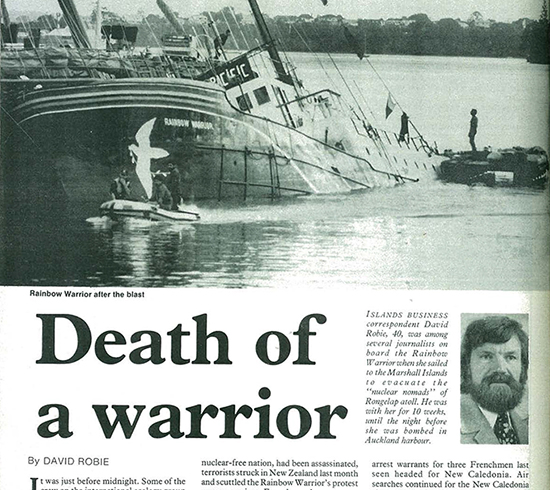
Page 1186

Mike Treen: Gaza Freedom Flotilla sets sail from Sicily

]]>

By Mike Treen on board the Freedom Flotilla

After months of preparation and training, the Freedom Flotilla is ready to depart for Gaza today.

The converted fishing trawler I am travelling on, the Al Awda (Return), along with three sailing yachts have been under constant guard as previous flotillas have been sabotaged in foreign ports by the Israeli secret services trying to stop the attempts to break the blockade.

I have met up with my fellow Kiwi of Palestinian descent, Youssef Sammour, a sailor and yacht engineer currently working in Dubai, who leaves Palermo after 45 days at sea.

READ MORE: Freedom Flotilla coalition 2018 mission

He has been sailing on the flotilla yacht Freedom since Amsterdam. If the boats are intercepted and the crew arrested they will all be subjected to a 10-year ban on re-entering Israel.

As a third generation refugee, Youssef does not want to rule out the possibility in the future of visiting his homeland.

-Partners-

Youssef considers himself a Kiwi as he has spent half his life in New Zealand at school and university. His father Khalil got work in New Zealand as a surgeon at Greymouth Hospital on the West Coast of the South Island.

My mum, Joan, grew up in Blackball, a small mining town just outside of Greymouth, and went to school in Greymouth. My Granddad, Walter Kirk, was a miner and a unionist, and part of the “red” Federation of Labour, the first national union federation formed in 1920 which had its national headquarters in Blackball.

Famous figures
Famous figures of the New Zealand Labour movement – Paddy Webb, Bob Semple, Walter Nash, Harry Holland – were household names, friends or colleagues.

Granddad was also one of the first, if not the first, Kiwi to play rugby league professionally in Australia for at least one season in the early 1900s.

For mum, Blackball was home, and it was where she wanted her ashes spread when she died which we were able to do five years ago. The only problem is she wanted them spread at the top of a steep mountain range behind Blackball known as The Creases.

I was back on May Day this year to commemorate the fifth anniversary of her death.

Youssef’s dad didn’t actually want to go to Greymouth – too small, isolated, and cold. He left his wife and son in Auckland and visited when he could.

Yet three years later, by the time he had finished his contract in Greymouth, Youssef says his father left in tears as he had come to love the place his colleagues, patients, and the wonderful people of Greymouth.

Youssef’s family’s story is both typical and special. Youssef’s dad was born on May 15, 1948 – the day known in Palestinian history as the Nakba – the day of “catastrophe”. The Jewish settlers proclaimed the state of Israel and presided over the expulsion of 750,000 Palestinians.

Traumatised by events
Youssef’s grandmother went into labour while on the road from Palestine to Lebanon. She gave birth to Khalil and was so traumatised by the events that she could not breast feed her child. They were forced to crush almonds for the milk to feed him along the way.

His parents were childhood friends, growing up in a refugee camp in Lebanon. Dad went to Cairo to become a surgeon and Samira, Youssef’s mum stayed in Beirut to study Chemistry. They ended up meeting again a few years later as they found themselves working in the same hospital in the United Arab Emirates (UAE).

They are still happily married today, Khalil is in his last year of work as chief of the surgical department in a private hospital in the Emirates.

They are looking to move back to NZ and finally get some well earned R&R. For a Palestinian family, home can be Beirut, Auckland or Greymouth, but often never Haifa, the home of their birth, even to scatter their ashes as I was able to do for my mum.
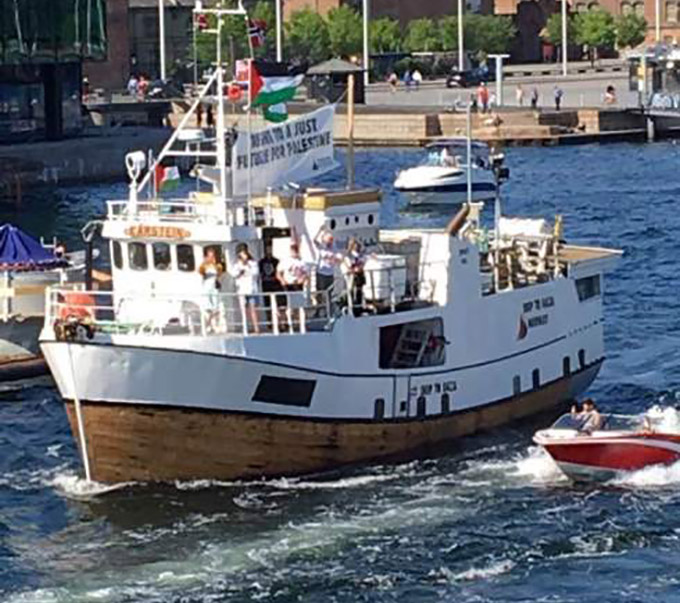
The Al Awda, one of the Gaza Freedom Flotilla’s four boats. Mike Treen is on board for the final leg of her voyage to Gaza. Image: Kia Ora Gaza

My own place on the Al Awda, I am taking over from another young Palestinian scholar, Awni Farhat, who grew up and Gaza and completed a master’s degree in human rights conflict studies in the Netherlands, but can’t return like a normal person to visit his family.

Such are the many small, but cruel, ironies of life in occupied Palestine.

Al Awda was a Norwegian fishing trawler. Scandinavians have been strong supporters of the decade-long campaign to breach the blockade from sea. Like New Zealand, these countries have strong fishing industries.

Blockade inhumanity
One aspect of the inhumanity of the blockade is stopping the fishing people in Gaza from plying their trade – even within the 12-mile maritime boundaries.

A reign of terror is maintained. Boats are fired on several times a day, dozens of fishers are wounded and a few killed each year. Just this last few weeks a limit of three nautical miles has been imposed. Several boats in Gaza that were planning to meet our small armada were singled out to be bombed in port.

Swedish sailors and campaign supporters were instrumental supplying the three yachts – Freedom, Mairead and Falestine – that have been part of the flotilla from the beginning of the journey in May. A Danish Socialist MP, Mikkel Gruner, is on the Al Awda. We have a professional chef from a leading restaurant as our personal cook.

Torstein Dahle, a city council member in the port city of Bergen and leader of the Red Party in Norway has spearheaded getting a fishing boat ready that can be donated to the fishers of Gaza and be able to carry the crew and volunteers to break the blockade.

This work to transform the ship began in January this year. A volunteer team of engineers, mechanics, carpenters and electricians have laboured for hundreds of hours to complete the work in time for the sailing part of the journey to begin.

In many ways this is a project of direct solidarity from workers and fishers in Scandinavia to the fishers of Gaza. They have generously allowed some others to join them because we have our own positions in our own societies and can amplify their message across the globe.

Workers intervene
Other workers have intervened to ensure the boats can reach their goal. The port authorities near Lisbon, Portugal, tried to prevent the ship’s entry until the port workers union Sindicato Dos Estivadores E Da Actividade Logistica told them they would have a serious problem if they tried.

That has been the pattern through the journey. Usually national governments and the police try to make life hard, while local governments and the people’s organisations welcome the boats.

One yacht was rammed and damaged by French police boats in Paris. In Palermo where we are at the moment, the mayor, Leoluca Orlando, who comes from people’s campaigns against corruption and Mafia control of the Church and the state in Sicily has announced that port will be renamed in remembrance to the historic Palestinian national leader Yasser Arafat who died, or more likely murdered by Israel, in 2004.

He is also fighting to preserve the city as a place of safe haven for refugees and beat back attempts by the right-wing and fascist forces in Italy to blame refugees for the social problems created by the capitalist Europe project which has resulted in nothing but austerity, welfare cuts and growing unemployment for working people across Europe.

The Freedom Flotilla participants were also warmly welcomed by thousands of Italian and Spanish supporters of refugee rights and open borders in a joint march through the fantastically beautiful city at night.

Everything is on Mediterranean time here. The place comes alive from 7pm when many central city streets are closed to cars, and families (including young children which made my Anglo-Kiwi mind a bit uncomfortable) enjoy meals on street tables until late at night.

Palermo is the capital city of Sicily and has a history going back 2700 years. It has been governed and settled by Greeks, Romans, Arabs, Normans. It is a historical and cultural centre for the meeting points between west and east in Europe.

Mike Treen (left) and Youssef Sammour with the Palestinian Ambassador to Italy, Dr Mai Alkailla. Image: Kia Ora Gaza

Ambassador’s visit
The Ambassador from Palestine to Italy, Dr Mai Alkaila, came to visit on July 18 during our training session to express solidarity and support. There was an unplanned and tearful reunion with Dr Swee Ang, a consultant orthopaedic surgeon; author of From Beirut to Jerusalem and the ship’s doctor.

Dr Ang’s journey with Palestine began as a volunteer surgeon in Gaza Hospital in Beirut’s Sabra Shatila Palestinian refugee camp in 1982. About three weeks after her arrival, more than 3000 of them were massacred.

These events traumatised the young surgeon and Dr Ang describes how the love and generosity of the Palestinian people helped bring her back to a purposeful meaningful life – but now one forever intertwined with the fate of the Palestinian people.

Dr Ang served in Gaza in 1988-89 during the first Intifada and again in 2009 after the Israeli invasion of Gaza in December 2008 that left thousands of casualties.

The ambassador generously offered to bring lunch the next day which she duly delivered and then served it herself – bodyguards discretely in the background. That day she spoke to Youssef and myself to say how she had delivered a special message of thanks to the NZ Embassy in Rome for New Zealand taking up the sponsorship of a UN Security Council resolution in December 2016 critical of the Israeli settlements in the occupied territories.

This resolution was significant because the US abstained rather than veto it as they usually did anything critical of Israel. This is not a new stance for New Zealand but one of the original sponsors had pulled out and it seems that then NZ Foreign Minister Murray McCully agreed to sponsor it without checking with the Prime Minister.

It led to Israel withdrawing its ambassador to New Zealand and barring the New Zealand ambassador in Israel. Diplomatic relations were restored in June 2017 after then Prime Minister Bill English wrote a cowardly letter to Israel expressing “regret” over the fallout from the resolution.

Peters not happy
The current Foreign Minister and NZ First leader, Winston Peters, who has a strong personal bias towards Israel, was not happy. The resolution features in the Labour-New Zealand First coalition agreement, which states a commitment to “record a Cabinet minute regarding the lack of process followed prior to the National-led government’s sponsorship of UNSC2334”.

Ambassador Alkaila also expressed her delight at the decision of NZ artist Lorde to boycott performing in Israel.

A city reception was also held and then the mayor and the ambassador joined and spoke at a support function in the evening of July 19.

We have had intensive training from US professionals in non-violent resistance. Tips have been given from those arrested, abused, or tasered by the Israeli military on previous expeditions on what might be expected.

Only one previous Gaza blockade shift saw casualties. In 2010, a six-boat flotilla led by a Turkish ship the MV Mavi Marmara, with almost 500 passengers was assaulted in the middle of the night and 10 were killed and dozens injured. This led to a prolonged diplomatic crisis between Turkey and Israel. Turkey as a NATO member is one of the few majority Muslim countries to maintain friendly relations with Israel.

Since then Israel has usually just boarded the ships, towed them to port and deported the participants after a few days of questioning.

My fellow passengers on the Al Awda are an extraordinary group. I hope to have a chance to talk to them more during our journey and get to tell their stories over the next few weeks.

Blockade must end
Whatever happens on this trip to Gaza, the siege and blockade will end.

lsrael is increasingly revealing its racist, authoritarian character. There are 13 million Palestinian people. Seven and a half million are displaced or in exile. Six and a half million Palestinians continue to live in historic Palestine alongside six and a half million people of Jewish descent.

A way must, and will be found to destroy the apartheid system that seeks to preserve the ethnic superiority of one group over another and allow that majority of people in the the region who want to live in peace and security to do so.

Mike Treen is the New Zealand representative on the 2018 international Freedom Flotilla determined to break through Israel’s illegal blockade of Gaza. The national director of the Unite Union and a veteran human rights defender is reporting here in rthe first of a series of reports for Kia Ora Gaza. The reports are being shared on Asia Pacific Report by arrangement.

Print Friendly, PDF & Email

Article by AsiaPacificReport.nz

]]>

Kiwis on board Freedom Flotilla in bid to break illegal Gaza blockade

]]>

The situation in Gaza “is criminal and genocide”, says Injustice author Miko Peled in an interview about the latest Israeli bombing attack on Hamas positions in the Gaza Strip. Video: RT

BACKGROUND: By Lois Griffiths of Scoop Independent News

Once again, a small number of individuals from several countries are trying to break the illegal siege imposed on the people of Gaza by sailing from Europe to Gaza on four small Scandinavian boats: Al Awda (The Return), Freedom, Falestine (Palestine) and Mairead (named for Nobel Peace Laureate Mairead Maguire)

But this year? After what’s been happening, the killing and maiming of unarmed marchers – 140 dead since March 30, including children, medics, journalists – by expert IDF snipers?

Why don’t they give up?

Who are the activists, where do they come from and why are they doing this?

READ MORE: Gaza protests – all the latest updates

-Partners-

Uneasy calm in Gaza after Hamas-Israel deal

Mike Treen (left) and Youssef Sammour with the Palestinian Ambassador to Italy, Mai Alkailla. Image: Lois Griffiths/Scoop

Two New Zealanders are on board the flotilla. Kiwi-Palestinian Youssef Sammour, an experienced sailor, has been with the flotilla for the entire long journey, beginning at Copenhagen.

He has sent many photos of the friendly welcomings they have received at ports along the way.

Unite Union organiser Mike Treen has joined the flotilla for the last leg, from Sicily to Gaza. Both Kiwis can be followed at the Kia ora Gaza website.

Does New Zealand genuinely have an independent foreign policy?

Challenge to NZ
If so, I challenge the New Zealand government to demand that Israel allow the Freedom Flotilla to enter Gaza.

The flotilla hopes to deliver basic medical supplies – gauzes and sutures – to Gaza where the doctors have been overwhelmed by the number of direct killings and serious woundings from skilled Israeli snipers.

The Freedom Flotilla is on a humanitarian mission. They pose no threat to Israelis.

The Al Awda, one of the Gaza Peace Flotilla’s four boats. Mike Treen is on board for the final leg of her voyage to Gaza. Image: Kia Ora Gaza

At least three of the participants are Americans.

One of them, Joe Meadors, is a survivor of the 1967 Israeli deadly attack on the USS Liberty, that killed 34 American servicemen.

President Lyndon Johnson and his Defence Secretary, Robert McNamara, declared that the bombing was an “accident”. They refused to conduct an inquiry but the survivors have never forgotten what they believe really happened.

Meadors is a past president of USS Liberty Veterans Association, founded in 1982. In a Common Dreams interview on July 12, Joe Meadors said,

“This trip is happening right after the protests called the Great March of Return, when so many people in Gaza were killed and wounded because they were demanding the right to return to the villages they were forced to flee in 1948.

“The Great March of Return is part of a 70-year struggle for the Palestinians’ right to live in the ancestral lands their families left behind.”…

“I want to show the people of Gaza that we care, that we are willing to put our lives on the line for them. We are willing to face the risks that they face every day. I hope we make it to Gaza but even if we don’t, our effort will inspire the people there and help bring world attention to their cause.”

Ex-CIA analyst
Elizabeth Murray
is a retired CIA analyst. She specialised in Middle Eastern political and media analysis. She is a member of Veteran Intelligence Professionals for Sanity (VIPS). Writing in Consortium News on May 22, Elizabeth Murray explains:

“I feel proud and privileged to join a group of international passengers aboard the Norwegian ship Al Awda.

“Along our route we hope to raise awareness and educate people about the plight of Palestinians, especially in Gaza, who are denied the basic freedoms and human rights the rest of us take for granted.

“As the Freedom Flotilla embarks on its peace odyssey, it is our hope to bring a light of hope and solidarity to the people of Gaza, who deserve the peaceful, dignified and joyful existence that is their right.”

Ann Wright is a retired US Army colonel and diplomat. She received the State Department Award for Heroism in 1997, after helping to evacuate several thousand people during the civil war in Sierra Leone. She is one of three State Department officials who publicly resigned in direct protest against the 2003 invasion of Iraq.

She has been active in Palestinian solidarity since 2009 helping take groups to Gaza. Ann Wright took part in the 2010, 2011, 2015 and 2016 Gaza Flotillas

“As a US citizen, I must challenge my own government’s complicity in the horrific conditions imposed on Palestinians by Israel,” she said.

Canadian activist Ron Rousseau from Yukon … “as an Indigenous activist … we feel that it’s necessary to be defending Palestine.” Image: Scoop

First Nation activist
One of the Canadians taking part is Ron Rousseau, First Nation activist from Yukon, Canada. Rousseau is president of the Whitehorse Local of the Canadian Union of Postal Workers and Aboriginal vice president of the Canada Labour Congress.

When interviewed by journalist Dimitri Lascaris, Ron Rousseau said:

“You know, as an Indigenous activist, as you know, it is, we feel that it’s necessary to be defending and making people aware of what’s actually happening inside of Palestine, and the people that live there, and how they are under siege.

“As we look at our history, you know, we were some 200 million in North America. And you know, our people were slaughtered.

“Our people were, had bounties on us, and even up to the point of where they were moved onto reservations where we needed a pass system to leave the reservation, even to go off for medical, you needed to ask permission to leave.

“So we were inside like a landlocked jail as well, up until the ’50s.”

Ron Rousseau explained that he learned about Palestine  through union activities.

“The first article I read was probably 10 years ago. It was a full bulletin put out to all members that went out to every postal worker in Canada, and then I went to an intensive four-week education for unionism, and we spent the whole day talking about Palestine.

“And I was, I was shocked, and I couldn’t take it off my mind, and been following it all the way along and making sure that people understood what was going on with family, friends, and everybody I talked to.”

Israeli participant
At least one Israeli is taking part. Zohar Chamberlain Regev is an Israeli citizen (born and raised in Kibbutz Kfar Hahoresh, near Nazareth) who has lived in Spain for the last 14 years. When asked why she was taking part, she replied,

“As a human being first of all, but also as an Israeli of Jewish origin, I am appalled by what is being done by Israel in Palestine in general and in Gaza in particular. We have always been told ‘how could the world be silent during the Holocaust’, now we know how…we have to stand by our Palestinian sisters and brothers in Gaza to save our own humanity.

“As an amputee, I can only begin to imagine what it is like for people in Gaza who have lost their limbs in the brutal attacks and are still waiting to be fitted with prosthetic limbs, as one of the many consequences of the illegal Israeli blockade.”

Malaysian Dr Fauziah Mohd Hasan is a consultant obstetrician and gynaecologist at a hospital in Kuala Lumpur, Malaysia. She has received international recognition for her medical humanitarian work in many countries including Kosovo, the Moluccas islands, Acheh Indonesia, Afghanistan, Gaza, Syria and Bangladesh.

Before departing to take part in the 2016 Women’s Boat to Gaza, Dr Hasan explained,

My participation is not in my individual capacity but representing my family, my women folks, my nation and all Muslims and humanity the world over.

“This humanitarian mission involves women only, just to show that there is a united voice in ending the blockade of Gaza, beyond gender, race, religion and geographical boundaries. It is purely a humanitarian mission to ensure freedom is given to all, for as Nelson Mandela once said:

‘We know too well that our freedom is incomplete without the freedom of the Palestinians.”

“To the people of Gaza, you are always in our prayers.”

Every participant – the Scandinavians, the two MPs, from Spain and Algeria – has a story to tell.

I’ve chosen the ones I thought would be most interesting to New Zealand readers.

Someone should write a book someday, about all the participants in all of the attempts to reach Gaza by sea, since the siege was imposed.

It’s inspiring to learn of humanitarian people from many parts of the world. Some efforts to reach Gaza have been successful.

Youssef Sammour’s boat Freedom. Image: Lois Griffiths/Scoop

The late Italian journalist Vittoria Arrigoni was overjoyed when his boat reached Gaza in August 2008 (see Freedom Sailors, edited by Greta Berlin).

History is us

History is not cowardly governments

with their loyalty to whoever has the strongest military

History is made by ordinary people

everyday people, with family at home and a reular job

who are committed to peace as a grat ideal

to the rights of all to staying human.

History is us who risked our lives

to bring utopia within reach

to offer a dream, a hope, to hundreds of thosands of people

Who cried with us as we reached the port of Gaza

Our message of peace is a call to action

for other ordinary people like ourselves

not to hand over your lives

to whatever puppeteer is in charge this time round

But to take responsibility for the revolution

First, the inner revolution

to give love , to give empathy

It is this that will change the world.

We have shown that peace is not an impossible utopia

Or perhaps we shown that sometimes

utopia can be possible

Believe this

Stand firm against intimidation, fear, and despair

And simple remain human.

Lois Griffiths is reporting for Scoop Independent News on the Freedom Flotilla. Other flotilla articles and images are at Kia Ora Gaza. Asia Pacific Report is sharing coverage with Kia Ora Gaza and Scoop.

Print Friendly, PDF & Email

Article by AsiaPacificReport.nz

]]>

Indonesia’s Papua ‘cover-up reflex’ prompts police dormitory raid

]]>

A video of a demonstration marking the bloody Biak massacre of 6 July 1998 staged last year. Video: BBB Times

By Michelle Winowatan

Dozens of Indonesian military and police personnel raided a student dormitory in Surabaya on July 6 to stop the screening of a documentary about security force atrocities in Papua.

It is the latest example of the government’s determination not to deal with past abuses in the country’s easternmost province.

Security forces carried out the raid following social media postings about the planned screening of the documentary Bloody Biak (Biak Berdarah).

READ MORE: Police claim raid on Papuan students to block ‘Bloody Biak’ film screening

The film documents Indonesian security forces opening fire on a peaceful pro-Papuan independence flag-raising ceremony in the town of Biak in July 1998, killing dozens.

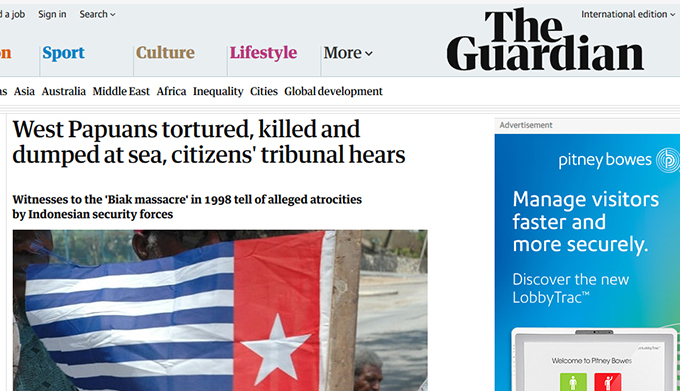
A Guardian report about a “citizens’ tribunal” hearing about the 1998 Biak massacre published on 13 December 2013. Image: PMC

-Partners-

Security forces said the dorm raid was necessary to prevent unspecified “hidden activities” by Papuan students.

The raid is emblematic of both the Indonesian government’s failure to deliver on promises of accountability for past human rights abuses in Papua and its willingness to take heavy-handed measures to stifle public discussion about those violations.

The government of President Joko “Jokowi” Widodo has not fulfilled a commitment made in 2016 to seek resolution of longstanding human rights abuses, including the Biak massacre and the military crackdown on Papuans in Wasior in 2001 and Wamena in 2003 that killed dozens and displaced thousands.

Killing with impunity
Meanwhile, police and other security forces that kill Papuans do so with impunity.

Media coverage of rights abuses in Papua are hobbled by the Indonesian government’s decades-old access restrictions to the region, despite Jokowi’s 2015 pledge to lift them.

Domestic journalists are vulnerable to intimidation and harassment from officials, local mobs, and security forces.

The government is also hostile to foreign human rights observers seeking access to Papua.

Last month, the United Nations High Commissioner for Human Rights, Zeid Ra’ad Al Hussein, said he was “concerned that despite positive engagement by the authorities in many respects, the government’s invitation to my Office to visit Papua – which was made during my visit in February – has still not been honoured”.

The raid in Surabaya signals the government’s determination to maintain its chokehold on public discussion of human rights violations across Indonesia.

This suggests that the government’s objective is to maintain Papua as a ”forbidden island” rather than provide transparency and accountability for human rights abuses there.

Michelle Winowatan is a Human Rights Watch intern. The Pacific Media Centre’s Pacific Media Watch freedom project monitors Asia-Pacific rights issues.

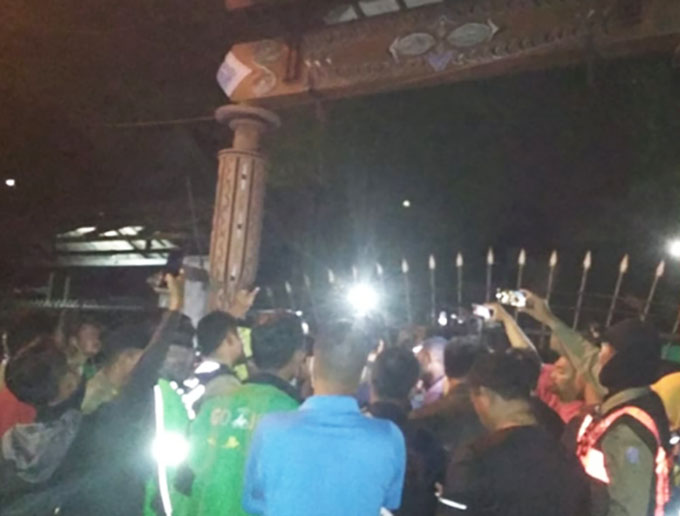
The scene at the Indonesian police raid on Papuan student quarters in Surabaya over the film Bloody Biak. Image: Suara.com
Print Friendly, PDF & Email

Article by AsiaPacificReport.nz

]]>

RSF condemns killing of radio journalist – shot in Philippines

]]>

Philippine radio journalist Joey Llana … shot at least 14 times in ambush as he drove to work at Radio DwZR in Legazpi City. Image: RSF Paris

Pacific Media Watch Newsdesk

Reporters Without Borders (RSF) has condemned the killing of Philippine radio journalist Joey Llana near Legazpi City, at the southeastern tip of the island of Luzon, and has called on the authorities to do everything possible to find those responsible.

Joey Llana, 38, was gunned down yesterday as he drove to work at Radio DwZR in Legazpi City, where he hosted a morning radio programme, reports the Paris-based global media freedom watchdog RSF.

Local police said he was hit at least 14 times in the head and body by shots fired by five unidentified gunmen.

The police have not yet identified a motive but a relative said Llana had recently received death threats, which suggested that he had been targeted in connection with his work.

President Rodrigo Duterte’s spokesman, Harry Roque, condemned the murder and said it would be investigated by the Presidential Task Force on Media Security.

We condemn radio journalist Joey Llana’s murder in the strongest terms as it is a serious press freedom violation, and we welcome the decision by the president’s office to open an immediate investigation and its declared desire to render justice to the victim,” a statement from RSF’s Asia-Pacific desk said.

-Partners-

“The Philippines, which is one of the most dangerous countries for journalists in Asia, must do everything possible to effectively combat violence against the media and impunity for this violence.”

Third journalist killed
If the initial suspicions are confirmed, Llana will be the third journalist to have been murdered this year in the Philippines in connection with their work, reports RSF.

Newspaper journalist Dennis Denora was slain in a similar fashion in the southern province of Davao del Norte in June, as was radio show host Edmund Sestoso in the central province of Negros Oriental in May.

At least six other journalists have been killed in connection with their work since Duterte, who is prone to virulent verbal attacks on the media, was elected president in 2016.

The Philippines fell six places in RSF’s 2018 World Press Freedom Index and is now ranked 133rd out of 180 countries.

Print Friendly, PDF & Email

Article by AsiaPacificReport.nz

]]>

Connecting the dots – Pacific disasters, cyclones, climate featured in latest PJR

]]>

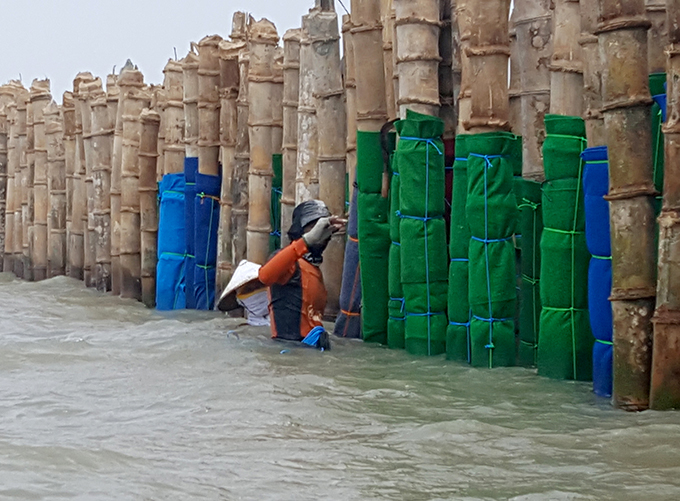
A “natural” seawall constructed out of giant bamboo poles built at the Semarang village of Demak Timbulsloko in an attempt to reduce “rob” flooding damage. Image: Del Abcede/PJR

Pacific Media Centre Newsdesk

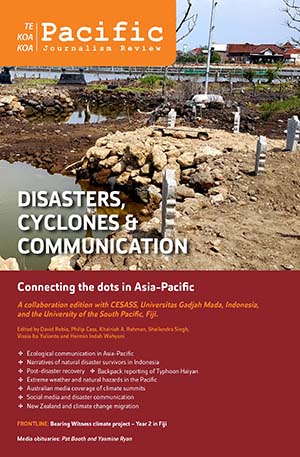
Rob” flooding in the Indonesian city of Semarang, Cyclone Winston’s devastation and social media in Fiji and “backpack journalism” in Typhoon Haiyan in the Philippines are among many issues featured in the latest Pacific Journalism Review.

This is the second edition of the New Zealand-based media research journal focused on climate change and global warming.

The first, published year, featured the Fiji and Pacific leadership at COP23 with a series of research papers.

READ MORE: Pacific Journalism Review online at AUT’s Tuwhera

Pacific Journalism Review 24(1)

This latest edition, published next week, is timely as the Pacific faces increasingly extreme and more frequent weather onslaughts.

Indonesian academics Dr Hermin Indah Wahyuni, Andi Awaluddin Fitrah and Fitri Handayani along with the Pacific Media Centre’s director, Professor David Robie, offer a comparative study on social adaptation to maritime disaster between Java and Fiji in a collaboration with the Centre for Southeast Asian Social Studies (CESASS) at the Universitas Gadjah Mada, Yogyakarta.

-Partners-

Another CESASS colleague, Dr Budi Irawanto, presents a paper on narratives of natural disaster survivors in Indonesian media.

The edition is also a collaboration with the University of the South Pacific whose Dr Shailendra Singh and Professor Vijay Naidu analyse the coverage of extreme weather in Pacific nations.

Post-disaster recovery
Dr Amanda Gearing of the Queensland University of Technology argues the case for a state-sponsored post-disaster recovery scheme and Monash journalism academic Dr Johan Lidberg offers a comparative study of Australian media coverage of COPs 15 and 21.

USP’s Glen Finau and colleagues analyse social media and disaster communication, Auckland University’s Norman Zafra analyses convergent technologies in disaster journalism while Unitec’s Dr Philip Cass assesses “a plan nobody hopes they will need” – what New Zealand needs to do about climate change migration and the future.

Dr Robie provides a case study of Bearing Witness 2017, the second year of a Pacific climate change storytelling project in Fiji that has produced dynamic and inspiring results.

Among unthemed articles, Dr Catherine Strong of Massey presents findings from a NZ women newspaper editors study and Steve Ellmers of Unitec offers a “tale of two statues” in Baghdad.

Two obituaries of two remarkable New Zealand journalists, investigative reporter and editor Pat Booth (profiled by A Moral Truth author Dr James Hollings) and Yasmine Ryan (penned by Evening Report editor Selwyn Manning) are also featured by PJR.

The journal has a strong review section including The General’s Goose on coup-struck Fiji, A Region in Transition, Grappling With The Bomb, “And there’ll be NO dancing” and After Charlie Hebdo.

This edition has been co-edited by Professor David Robie and Khairiah A. Rahman (AUT), Dr Hermin Indah Wahyuni and Dr Vissia Ita Yulianto (CESASS-UGM), Dr Philip Cass (Unitec) and Dr Shailendra Singh (USP).

Papers from the edition are available online at AUT’s Tuwhera platform.

Print Friendly, PDF & Email

Article by AsiaPacificReport.nz

]]>

PMC Seminar series: Lead-up to the independence referendum for New Caledonia

French soldiers on parade on Bastille Day in Noumea, New Caledonia, last week. Image: Lee Duffield/PMC

Event date and time: 

Friday, July 27, 2018 – 16:30 18:00

LEAD-UP TO THE INDEPENDENCE REFERENDUM FOR NEW CALEDONIA
Has 30 years of preparation under the Matignon Accords, signed in Paris, allowed New Caledonia to vote on independence this year on November 4 in full confidence? Dr Lee Duffield, an experienced Australian journalist and researcher, attended this year’s Bastille Day celebrations in Noumea. He says it might have been the last time the French National Day, July 14, would be officially commemorated in New Caledonia. Hear his report on the current independence debate after his conversations with leading figures in Noumea and people in the street.

Who: Dr Lee Duffield, research associate of the Pacific Media Centre

When: Friday, July 27, 2018 4.30pm-6pm

Where: Sir Paul Reeves Building, Auckland University of Technology,
City Campus Room, WG903A

Contact: Dr David Robie

Event on Facebook

Report by Pacific Media Centre ]]>

Toktok No 37 / Winter 2018

]]>

Pacific Media Centre

ISBN/code: ISSN 1175-0472

Publication date: Friday, July 20, 2018

Publisher: Pacific Media Centre


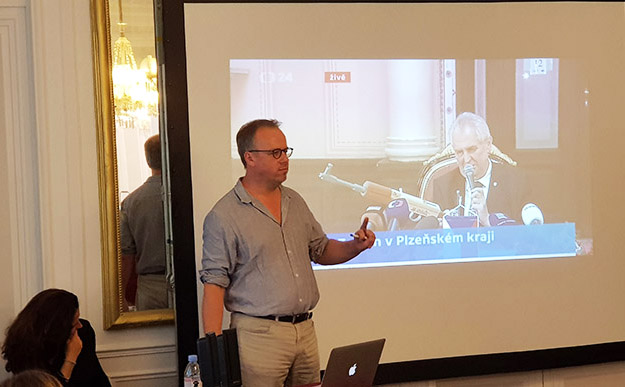
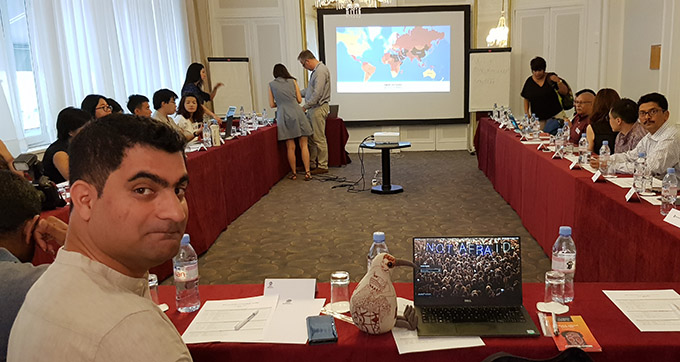
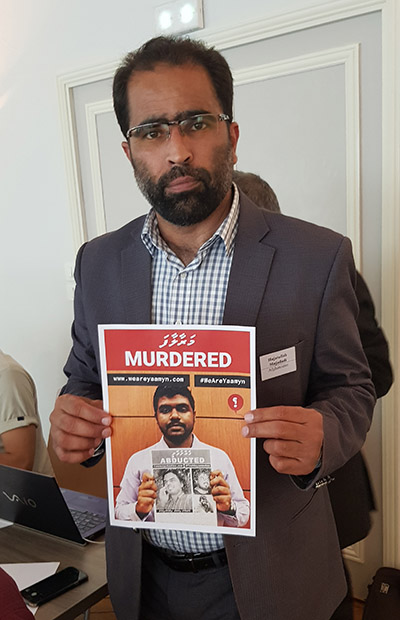
GLOBAL PRESS FREEDOM SUMMIT INCLUDES PMC
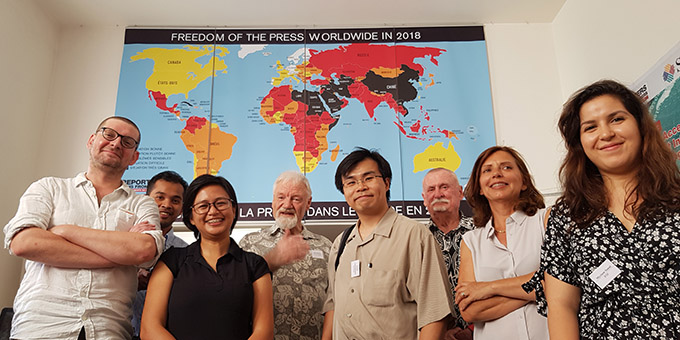
The Paris-based global media freedom watchdog Reporters Without Borders recently hosted press freedom defenders from the Asia-Pacific for a summit in the French capital.
Invited participants included Pacific Media Centre director Professor David Robie and delegates from Australia and Papua New Guinea among the 23 correspondents from 17 countries or territories.

The representatives were from Afghanistan, Australia, Bangladesh, Cambodia, China, India, Japan, Hongkong, Maldives, Mongolia, Nepal, New Zealand, Pakistan, Papua New Guinea, Philippines, Taiwan, Thailand and Tibet along with a team of Paris-based RSF advocates.

Asia Pacific head Daniel Bastard said the consultation was part of a new strategy making better use of the correspondents’ network to make the impact of advocacy work faster and even more effectively than in the past.

Dr Robie is convenor of the Pacific Media Watch freedom project which has employed post graduate students in part-time reporting/editing/research roles.

Also:
Tui O’Sullivan retires after outstanding career

PMC director condemns ‘targeting’ of journalists and silence on West Papua

Elite groups ‘contain’ nuclear food safety debate

PMC events photo gallery
 

Report by Pacific Media Centre ]]>

PNG needs to ‘pull its weight’ over Bougainville vote, says Momis

]]>
Evening Report
Evening Report
PNG needs to ‘pull its weight’ over Bougainville vote, says Momis
Loading
/

Bougainville President John Momis … considering going to the United Nations for advice. Image: Ramumine

By RNZ Pacific

The President of the Autonomous Region of Bougainville has raised concerns that the Papua New Guinea Government is not pulling its weight as the region prepares for its referendum on independence from Papua New Guinea next year.

Two weeks ago John Momis met with PNG Prime Minister Peter O’Neill in a meeting of the Joint Supervisory Board tasked with preparing for the vote.

However, outstanding financial commitments of hundreds of millions of kina which the PNG state owes to the Autonomous Bougainville Government remain an obstacle to preparations.

LISTEN: Momis speaking on Dateline Pacific

After a long wait, PNG finally made a payment of $US1.49 million to Bougainville last week, but then the cheque bounced.

Momis said in an interview with RNZ Pacific’s Dateline Pacific programme Port Moresby was continually failing to deliver on commitments and he was considering approaching the United Nations, New Zealand or Australia for advice.

-Partners-

The Pacific Media Centre has a content sharing partnership with RNZ Pacific.

Print Friendly, PDF & Email

Article by AsiaPacificReport.nz

]]>

Housing issue not just ethnic – Pākehā leaders have ‘failed’, says author

]]>

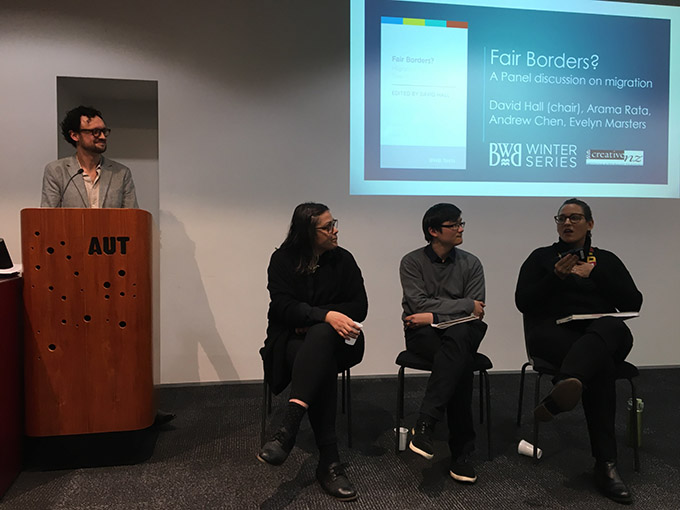
AUT Policy Observatory’s Dr David Hall (from left, podium) with fellow “fair borders” panellists Dr Arama Rata, Andrew Chen and Dr Evelyn Masters at last night’s discussion. Image: Rhahul Bhattarai/PMC

By Rahul Bhattarai

Author and researcher David Hall has criticised anti-immigration rhetoric in New Zealand’s housing crisis, saying a more serious problem is “Pākehā leaders … failing to take action”.

Speaking at a panel discussion at Auckland University of Technology last night, Dr Hall, editor of the book Fair Borders: Migration Policy in the 21st Century, said harm and hurt from such rhetoric created side effects impacting on migrants.

Negativity directed towards home buyers with Chinese sounding surnames diverted attention from “long lines of people with British sounding surnames” that held and continued to hold powerful and influential positions over the housing issue.

Although there is an ethnic dimension to housing crises, he said that the most significant issue was that “Pākehā leaders supported by electorates with Pākehā majorities [were] failing to take action.”

Dr Hall, senior researcher of AUT’s Policy Observatory, was joined by three of the book’s contributors, Andrew Chen, Dr Arama Rata and Dr Evelyn Masters, to discuss how New Zealand’s borders impacted on its citizens, recent immigrants, and on people barred from the country.

Dr Hall said that over emphasis and over simplification of the role of immigration was not just a way of avoiding taking action, it was a way of avoiding responsibility for taking action and that helped nobody – “not even Pākehā and I say that as a Pākehā myself”.

-Partners-

He pointed out that one continuous theme was the failure of successful decision makers to make the tough decision that might have made a difference, such as the mayors of Auckland going back to the 1990s or the housing ministers.

“There is bit of pattern here,” he said.

‘Tricky’ issues
Dr Hall said that house prices had been rising since 1990s and only eight years ago there were more people leaving the country than were arriving, yet the house prices rose during the negative migration period.

The issue was “very tricky” with some of the genuine social strains such as housing affordability and policy and its relationship to migration.

The debate treated “immigration as an economic medicine that might taste a little bad and people just need to put up with which also doesn’t do anything to address peoples’ genuine worries”.

This was not his story to tell as no one ever challenged him based on the colour of his skin.
“As a Pākehā this isn’t really my story to tell because no one ever challenges me on whether I belong here, no one ever suggests to me that I shouldn’t be speaking English in public and no one tells me to leave by virtue of my appearance but this happens all the time to people,” he said.

Dr Arama Rata, a research officer at the University of Waikato, said that in New Zealand there was a border in place which was established by the invaders.

Māori border ignored
But the “Māori border has been ignored, a new imposition of state authority is being imposed, borders have been closed around the nation state to allow certain desirable white migrants in and to exclude others, and now we have a very secure racist structure in place”.

She said borders needed to be in place but, “it should be controlled more by our values rather than just purely economic incentives and the way I think we need to stop framing immigration as a problem”.

Dr Evelyn Masters, with Pākehā lineage and Cook Islands heritage that she is really proud of, said she struggled in explaining her New Zealand identity because people judged her based on her appearance.

Dr Masters, research manager of NZ Institute for Pacific Research, said people struggled to understand that she had multiple lineage in her blood line and wanted to be known as a New Zealander.

She did not have to be just one race because she looked brown, she said.

“I just want to say that I am a New Zealander, because my experience is I am multiple – I have brown people and white people in my family, why do I have to be just one as you see me.”

Print Friendly, PDF & Email

Article by AsiaPacificReport.nz

]]>

Traumatised Papuan villagers flee Indonesian military in Nduga

]]>
Evening Report
Evening Report
Traumatised Papuan villagers flee Indonesian military in Nduga
Loading
/

By RNZ Pacific

Thousands of West Papuan villagers have reportedly fled from their homes in a remote regency due to conflict between Indonesian military forces and pro-independence fighters.

This follows a string of deaths in Nduga regency where Indonesian security forces and the West Papua National Liberation Army have exchanged gunfire in recent weeks.

Three people were killed in an attack on police at the local airport two weeks ago during regional elections. A faction of the Liberation Army claimed responsibility.

LISTEN TO RNZ PACIFIC: West Papuans tired of ongoing conflict

Following the attack, about 1000 extra police and military personnel were deployed to the remote regency as part of a joint operation.

They have been conducting an aerial campaign over the Alguru area in pursuit of the Liberation Army, with unconfirmed reports saying at least two Papuans have been shot dead and others injured in recent days.

-Partners-

A police helicopter was reportedly fired on by a faction of the Liberation Army last week, although it is unclear whether it was in response to rounds of aerial artillery fired by the military over Alguru.

The United Liberation Movement for West Papua has accused the Indonesian military of bombing in Nduga.

‘Bombing, burning’
“Bombing, burning houses, and shooting into villages from helicopters are acts of terrorism,” the Liberation Movement’s chairman Benny Wenda said.

“The Indonesian government’s horrific acts of violence against the Melanesian people of West Papua are causing great harm and trauma.”

The Nduga regent, Yarius Gwijangge, last week made a plea to the security forces not to shoot from the air because he feared this could lead to civilian casualties.

With the situation in Nduga remaining tense, a local Liberation Army field operations commander, Egianus Kogoya, confirmed a number of Alguru villagers had fled from their homes.

“All the (Liberation Army) soldiers scattered back into the forest with 50 heads of family from Alguru village without possessing or not carrying their possessions, in order to save themselves from the death threats of Indonesian military and police bombs,” Kogoya said.

“The Indonesian military helicopters fired the bombs, four times with huge explosion through air strikes at Alguru village. As a result of this attack, the gardens and houses of the people in Alguru’s village are flattened with the ground.”

However, Indonesia’s military published a statement saying reports that security forces were conducting airstrikes or dropping bombs were a hoax.

Liberation stronghold
It said military forces were working with police in “law enforcement activities” in Alguru which is considered a stronghold of the Liberation Army and the OPM Free West Papua Movement.

Indonesian authorities have described the Liberation Army as armed criminals rather than by their pro-independence moniker.

Meanwhile, Responding to the attacks, the largest organisation of Christian Churches in Indonesia called for the country’s human rights commission to open offices in Papua region.

The Communion of Churches (PGI) urged Indonesian authorities to stop repressive action and adopt a strategy of persuasion.

It said the National Commission on Human Rights should open an office in Papua, citing a government mandate under Papua’s special autonomy laws.

PGI spokesman Irma Riana Simanjuntak said Indonesia’s government should establish a fact-finding team to verify deaths in recent attacks and guarantee the public’s safety.

Indonesian authorities did not give permission to the KNPB to hold a demonstration, so police and military forces blocked the procession of demonstrators who aimed to petition the Papuan Legislative Council.

Human rights workers, journalists and medical workers should also be able to access Papua,  Simanjuntak said.

Indonesia officially ended restrictions on access to Papua in 2015 but human rights groups and journalists continue to face hurdles when trying to travel there.

Trauma revisited
Young people in Nduga are tired of violence triggered by politics, a West Papuan from the regency said.

Speaking from the Papua provincial capital Jayapura, Samuel Tabuni said he had been in contact with friends and family in Nduga.

Thousands of Nduga villagers had fled from the regency since the violence surged during last month’s elections, Tabuni said.

The villagers were terrified by recent developments which echoed shootings and killings that took place in previous Indonesian military deployments to the remote region, he said.

The recent influx of Indonesian military had brought back memories from 1996 in particular, when Indonesian military commander Prabowo Subianto led special forces into the same area on a campaign to save hostages held by the Free Papua movement commander Kelly Kwalik.

“That’s why when a lot of troops… army and police coming in to Nduga, Kenyam, most of our people are afraid, you know, that the same thing is going to happen,” Tabuni said.

“So we are deeply traumatised. That’s why when a lot of troops… army and police coming in to Nduga, Kenyam (the regency’s capital), most of our people are afraid, you know, that the same thing is going to happen. ”

Special Autonomy Status
Special Autonomy Status was granted to Papua by Jakarta in 2001 with the promise of developing its human potential but in Mr Tabuni’s view this had not transpired.

“Conflicts in Special Autonomy is more than in the past because of this politics,” he said.

“The regional politics as well as the politics in terms of campaigning (for) being head of regency and governors. So these two politics kill many Papuans, honestly, especially those that are young.”

Tabuni said many young Papuans wanted dialogue between Indonesia’s government and those pursuing independence to find a peaceful solution.

“We don’t want to be invoved in all this politics and conflict and war. We have to have open dialogue to solve all the problems.”

Meanwhile, human rights activists urged the security forces to withdraw their join operation in Nduga, saying it was having a major impact on the lives of local villagers.

The Pacific Media Centre has a content sharing partnership with RNZ Pacific.

Print Friendly, PDF & Email

Article by AsiaPacificReport.nz

]]>

Indonesia risks ending up with a doomed ‘can’t-do’ climate plan

]]>

By Warief Djajanto Basorie

Three hundred schoolchildren from the greater Jakarta area sat on a red carpet covering the cavernous Soedjarwo auditorium—named to honour the country’s first forestry minister—at the Ministry of the Environment and Forestry in January this year.

They were there to participate in the government-led Climate Festival; the theme was “Three Years of Climate Change Achievements”.

Dr Nur Masripatin, the then Director General of Climate Change (she stepped down in February 2018), tossed the kids a question on climate change: what will become of Indonesia if nothing is done about climate change by 2030?

An elementary schoolboy said the country would become hotter and drier. Another two students added to his answer, talking about global warming and the greenhouse gases that lead to climate change.

The director-general beamed broadly. Dr Nur Masripatin, who has a PhD in forest biometrics from Canterbury University in New Zealand, has been a veteran negotiator for Indonesia at the annual United Nations climate conference since 2005.

Indonesia is a country of islands, with a majority of the population living along coasts vulnerable to climate change, she explained to the assembled pupils. The government hopes that such an event will equip children with information on climate change that they’ll carry into adulthood.

-Partners-

Reaching Indonesia’s targets
The event also sought to inform the public on the progress made in implementing international agreements and national policies, such as the Paris Agreement and the Nationally Determined Contribution, related to climate change. Government projects such as this one are only deemed successful if the people meant to benefit from the project feel that they have a stake in the issue, and commit to seeing it through.

The Paris Agreement, reached at the UN climate conference in Paris in 2015, is a legally binding international contract to limit global warming “well below” 2˚C, through lowering carbon emissions from the burning of fossil fuels and the degrading of forests. The ultimate aim is zero carbon emissions worldwide by 2050.

In undertaking to realise the Paris Agreement, Indonesia’s Nationally Determined Contribution, or NDC, sets a target of cutting emissions by 29 percent against a “business as usual” scenario (in which no planned action is taken) and by 41 percent with international cooperation. This climate action plan is due to be implemented from 2020 to 2030.

One of the many documents handed out to participants of the Climate Festival was the country’s NDC Implementation Strategy, listing nine programmes with assigned activities spanning from ownership and commitment development to implementation and review. Also included was an academic paper on the draft government regulation for climate change.

The festival, and its accompanying books, talks, and handout material produced by the director general and her team, outlines an ambitious climate agenda. Yet what’s not covered is interesting, too.

While the NDC Implementation Strategy cites projected greenhouse gas emission levels, it does not provide details on whether, or how much, emissions have already been reduced since 2011, when the government issued its national action plan to reduce greenhouse gas emissions by 26 percent by 2020. Nor does the NDC explain the formula it uses to reduce emissions in the five slated sectors: land-use, energy, IPPU (industrial processes and product use), agriculture and waste. The first two sectors alone produced 82 percent of the country’s carbon emissions in 2010–2012.

Despite its absence in the Climate Festival’s documents, information on emission reduction is provided by the National Development Planning Agency (Bappenas). From 2010–2017, Indonesia has cut greenhouse gas emission by only 13.46 percent. It’s a figure the Indonesian government aren’t eager to publicise—it’s a long way from their target. The government doesn’t officially state how much carbon emissions has been reduced because the NDC does not start until 2020, a government official explained.

“The government shall regularly provide emission reduction achievements in line with the NDC target it has committed to after Indonesia ratified the Paris Agreement. This is in line with our commitment to the NDC up to 2030. The information can be accessed in SIGN SMART prepared by the Environment and Forestry Ministry,” says Dr Agus Justianto, Head of the Ministry’s Agency for Research, Development and Innovation.

A major emitter of greenhouse gases
According to the World Resources Institute (WRI), Indonesia is the world’s sixth largest emitter of greenhouse gases, and the largest contributor of forest-based emissions—an unsurprising fact if one thinks back to the devastating forest and peat fires in 2014 and 2015. Images from the United States’ National Aeronautics and Space Administration (NASA) released in 2014 and 2015 show dense smoke blanketing parts of the country and its neighbours. Those two years were exceptionally bad, but such burning takes place annually.

In September 2017, WRI Indonesia published a 36-page working paper on how Indonesia can achieve its climate change mitigation goal. The organisation found that existing policies in the land-use and energy sectors, even if fully implemented, are inadequate if the country is really serious about reaching the 29% target by 2030. Using its own methodology, WRI Indonesia estimated that the existing policies would only result in a 19% reduction.

A failure to achieve its mitigation target means that Indonesia won’t be able to contribute its declared share in global fulfillment of the 2015 Paris Agreement.

Rethinking policies
Reaching the NDC goal would require revisiting existing policies, particularly in agriculture and energy.

In agriculture, the government wants to double the output of the highly lucrative oil palm by 2020. This would require the clearing of more forest and peatland to add to the 14 million hectares of oil palm plantations already present in the country—a move that would surely lead to more carbon emissions. The policy also undermines a forest moratorium, in place since 2011, on the issuing of permits to convert primary forest and peatland to oil palm plantations, pulp and paper estates and other land-use change activities.

Dr Agus denies any planned clearing of peatland, insisting that the moratorium is still in place. What the government wants to increase, he stresses, is productivity per hectare on existing oil palm plantations.

President Joko “Jokowi” Widodo also has a plan to boost the country’s energy capacity by 35,000 megawatts during his current term, which comes to an end in 2019. Only 2000 megawatts of that energy will come from renewable energy; 20,000 megawatts will come from coal-fired plants, another major source of greenhouse gas emissions. Oil and gas, as well as hydropower, will provide the rest.

This matter of generating 20,000 megawatts of energy from coal-fired plants was put to Bambang Brodjonegoro, Indonesia’s Minister for National Development Planning and Head of Bappenas, at the Southeast Asia Symposium jointly organised by Oxford University and the University of Indonesia’s School of Environmental Science.

The “best solution”, advocated by environmentalists, would be to phase coal-fired plants out completely and embrace renewable energy sources. It’s in line with the call of the “Powering Past Coal” alliance, a partnership of over 20 governments who intend to move away from coal. No Southeast Asian government has joined the alliance thus far.

Brodjonegoro, a former dean of the University of Indonesia’s School of Economics, replied that Indonesia’s plan relies on the “second-best solution”: new coal-fired power plants will use clean coal technology, and that renewable energy, such as solar, wind or biomass, will be developed for isolated areas that are not yet part of the country’s power grid. Energy is required for economic growth, he argued, and Indonesia has abundant coal deposits to meet that energy need.

But Indonesia might not need as much energy as policymakers initially thought. According to the Electricity Supply Business Plan 2018-2027 drafted by the Energy and Mineral Resources Ministry, a projection in Indonesia’s additional power needs dropped from 78 gigawatts under the 2017–2026 plan to 56 gigawatts in the 2018–2027 plan. The decrease was due to overestimating the growth in demand; if the government had followed through with the initial plan, it would end up overspending by building unused power plants.

Plans are also underway to increase the portion of renewable energy—while renewable energy only provided 12.52 percent of Indonesia’s energy in 2017, it’s expected to rise to 23 percent in 2025. Coal is expected to decline as a source of energy from 58.3 percent in 2017 to 54.4 percent in 2025. But environmental groups say it’s still not good enough.

“Many nations like India, China and even Saudi Arabia have altered their investment direction to renewable energy, whereas Indonesia still depends on coal for more than 50 percent of its power source,” said Hindun Mulaika, Greenpeace Indonesia’s climate and energy campaigner, in a recent press release.

Other organisations have called for more ambitious action from the Indonesian government. Germanwatch and Climate Action Network pointed out in their 2018 Climate Change Performance Index that Indonesia has the potential to further develop renewable energy, particularly since it has relatively large amounts of hydropower. WRI Indonesia recommended other mitigation actions, such as strengthening and extending the forest moratorium, restoring degraded forest and peatland, and implementing energy conservation efforts.

According to WRI Indonesia, increasing renewable sources in the energy mix will require implementing multiple policies, such as a carbon tax on fossil fuel power plants, the replacement of coal-fired plants with wind or solar sources, and the provision of subsidies for the promotion of renewable energy.

Indonesia already has bilateral and multilateral agreements for cooperation in climate change, such as an accord with Norway signed in 2010, where the Scandinavian country pledged up to USD1 billion for “significant reductions in greenhouse gas emissions from deforestation, forest degradation and peatland conversion”. The financial contribution is made based on a verified emissions reduction mechanism. However, an influential coal lobby makes it difficult for the country to take bolder steps away from coal power plants.

A target that cannot be achieved
As it stands, Indonesia’s 29 percent NDC target is not achievable, says a government technocrat.

“It is not based on what sectors knew, what the energy sector knew, what the road transport sector knew. No one has reliable data. Everyone has some sense of statistics,” says the technocrat, who has asked to remain anonymous as he’s not authorised to speak to the press.

The distinction between data and statistics is an important one—while statistics present a snapshot of one aspect of an issue, data is a real mapping of what exists, providing a more holistic picture. A good NDC should have reliable data from every sector, disaggregated to show the reality in each of Indonesia’s 465 sub-national districts and town governments. While there might be a political aspect to this process, politics should not be dominant, the official added.

“No one has reliable data. Everyone has some sense of statistics”

The lack of data is a big problem with a major impact on the way targets have been set. The government arrived at the 29% target via inter-sectoral meetings where each of the five mitigation sectors (energy, land-use, industry, agriculture, waste) stated how far they were willing to go in terms of reductions. But if the various groups only have “some sense of statistics” without actual reliable data, the targets set could easily be off the mark.

Hopes for a future generation
Indonesia’s climate future is not bleak; there’s still hope for significant progress moving forward. Beyond government policy and programmes, numerous civil society organisations are actively working on the issue.

One example is Climate Reality Indonesia, which had a booth at the Climate Festival. Its members, who have participated in Al Gore’s climate course, are from all walks of life: students, academics, public officials, business people, homemakers, journalists, artists, clerics. They’re committed to spreading climate awareness among their own circles to encourage a ripple effect that will increase public knowledge across the country.

“Climate change can be viewed from different angles: water, air, marine resources, forests, agriculture, energy, education, laws. Hence it’s important to break down the issue of interest to understand the ground sentiment,” says Amanda Katili Niode, manager of Climate Reality Indonesia.

There are signs that the public are interested. In 2015, a survey by the Pew Research Centre found that 63 percent of the country supported limiting greenhouse gas emissions as part of an international agreement. Climate Reality Indonesia is thus working on creating visual materials on specific climate change impacts and solutions to use in their outreach programmes.

Following Climate Change Director General Nur Masripatin’s session, Hidayatun Nisa, a 24-year-old university graduate, delivered a rousing speech before the assembled schoolchildren. She told them about her work as a facilitator in the Care of Peat Village project run by the Peat Restoration Agency in a village in Jambi province on the east coast of central Sumatra, calling on students to study how to protect the environment for a better future.

“I do hope the children can learn to be sensitive to living things and protect the environment where they live. This also applies to their parents as the educational process that has the greatest effect is the education at home,” says Nisa.

Without a change in gear for a more ambitious and robust emphasis on renewable energy and the safeguarding of the environment, Indonesia’s climate change ambitions could end up amounting to little more than a can’t-do plan. As it is, the current generation is already not on track to meet its own stipulated goals. If the country does not undertake a course correction soon, today’s Indonesian children will find themselves having to pick up the slack in the future.

Warief Djajanto Basorie is a contributor to New Naratif, an independent research and journalism publication. He has reported for the domestic KNI News Service in Jakarta 1971-1991 and concurrently was Indonesia correspondent for the Manila-based DEPTHnews Asia (DNA, 1974-1991). DNA is a feature service reporting on development in Asia for Asian media in English and the vernacular. This article is republished under a Creative Commons licence.

Print Friendly, PDF & Email

Article by AsiaPacificReport.nz

]]>

Indonesian anti-corruption watchdog arrests nine, including House member

]]>

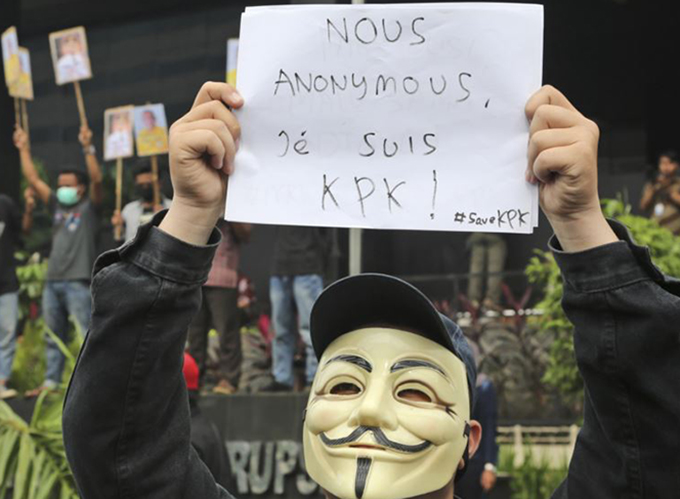
A masked supporter of Indonesian Corruption Eradication Commission (KPK) holds up a poster declaring “I am KPK” during a 2015 protest in support of the commission. Image: VOA file

Pacific Media Centre Newsdesk

Corruption Eradication Commission (KPK) investigators have arrested nine people during a raid in Jakarta, including a member of the House of Representatives, an expert staffer, a driver and a businessman, reports the Jakarta Post.

The KPK also seized Rp 500 million (US$34,692) as evidence, the newspaper said.

KPK chairman Agus Rahardjo alleged the evidence confiscated was related to a transaction involving the House’s Commission VII overseeing energy, mineral, research and technology and the environment.

Reports circulated that the lawmaker in question was Eni Saragih, the deputy leader of Commission VII, and that she was arrested in the residence of Social Affairs Minister Idrus Marham. Both are Golkar Party politicians.

Agus said the arrests were conducted of Friday following anonymous tip-offs, reports the Post.

Golkar politician Maman Abdurahman immediately dismissed the report of the arrest, saying that the KPK had merely “picked up” his colleague “ES” from Idrus’ residence while the minister was throwing a birthday party for his youngest child.

-Partners-

Maman was also present at the party.

“I didn’t know what reason the KPK had for picking her up. We should wait for the KPK to release an official statement. I hope she stays strong,” he said in a statement.

Print Friendly, PDF & Email

Article by AsiaPacificReport.nz

]]>

Contrasting accounts of Indonesian genocide and betrayal in West Papua

]]>

BOOK REVIEW: By David Robie

Two damning and contrasting books about Indonesian colonialism in the Pacific, both by activist participants in Europe and New Zealand, have recently been published. Overall, they are excellent exposes of the harsh repression of the Melanesian people of West Papua and a world that has largely closed a blind eye to to human rights violations.

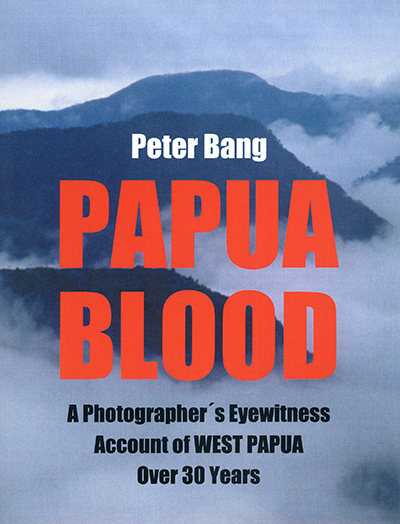
In Papua Blood, Danish photographer Peter Bang provides a deeply personal account of his more than three decades of experience in West Papua that is a testament to the resilience and patience of the people in the face of “slow genocide” with an estimated 500,000 Papuans dying over the past half century.

With See No Evil, Maire Leadbeater, peace movement advocate and spokesperson of West Papua Action Auckland, offers a meticulously researched historical account of New Zealand’s originally supportive stance for the independence aspirations of the Papuan people while still a Dutch colony and then its unprincipled slide into betrayal amid Cold War realpolitik.

Peter Bang’s book features 188 examples of his evocative imagery, providing colourful insights into changing lifestyles in West Papua, ranging through pristine rainforest, waterfalls, villages and urban cityscapes to dramatic scenes of resistance to oppression and the defiant displays of the Morning Star flag of independence.

Some of the most poignant images are photographs of use of the traditional koteka (penis gourds) and traditional attire, which are under threat in some parts of West Papua, and customary life in remote parts of the Highlands and the tree houses of the coastal marshlands.

Besides the photographs, Bang also has a narrative about the various episodes of his life in West Papua.

-Partners-

Never far from his account, are the reflections of life under Indonesian colonialism, and extreme racism displayed towards the Papuan people and their culture and traditions. From the beginning in 1963 when Indonesia under Sukarno wrested control of West Papua from the Dutch with United Nations approval under a sham “Act of Free Choice” against the local people’s wishes, followed by the so-called ‘Transmigrassi’ programme encouraging thousands of Javanese migrants to settle, the Papuans have been treated with repression.

‘Disaster for Papuans’
Bang describes the massive migration of Indonesians to West Papua as “not only a disaster for the Papuan people, but also a catastrophe for the rainforest, eartyn and wildlife” (p. 13).

“Police soldiers conducted frequent punitive expeditions with reference to violation of ‘laws’ that the indigenous people neither understood nor had heard about, partly because of language barriers and the huge cultural difference,’ writes Bang (p. 11). The list of atrocities has been endless.

“There were examples of Papuans who had been captured, and thrown out alive from helicopters, strangled or drowned after being put into plastic bags. Pregnant women killed by bayonets. Prisoners forced to dig their own graves before they were killed.” (p. 12)

A “trophy photo” by an Indonesian soldier from Battalion 753 of a man he had shot from the Lani tribe in 2010. Image from Papua Blood

A book that provided an early impetus while Bang was researching for his involvement in West Papua was Indonesia’s Secret War by journalist Robin Osborne, a former press secretary for Papua New Guinea Prime Minister Sir Julius Chan, the leader who was later ousted from office because of his bungled Sandline mercenary affair over the Bougainville civil war. Osborne’s book also influenced me when I first began writing about West Papua in the early 1980s.

After travelling through Asia, a young Peter Bang arrived in West Papua in 1986 for his first visit determined to journey to the remote Yali tribe as a photographer and writer interested in indigenous peoples. He wanted to find out how the Yali people had integrated with the outside world since missionaries had first entered the isolated tribal area just 25 years earlier.

When Bang visited the town of Angguruk for the first time, “the only wheels I saw at the mission station were punctured and sat on a wheelbarrow … It was only seven years ago that human flesh had been eaten in the area” (p. 16).

During this early period of jungle trekking, Bang rarely “encountered anything besides kindness – only twice did I experience being threatened with a bow and arrow” (p. 39). The first time was by a “mentally disabled” man confused over Bang’s presence, and he was scolded by the village chief.

Political change
Ten years later, Peter Bang again visited the Yali people and found the political climate had changed in the capital Jayapura – “we saw police and military everywhere” following an incident a few months earlier when OPM (Free Papua Movement) guerrillas had held 11 captives hostage in a cave.

He struck up a friendship with Wimmo, a Dani tribesman and son of a village witchdoctor and healer in the Baliem Valley, that was to endure for years, and he had an adoptive family.

On a return visit, Bang met Tebora, mother of the nine-year-old boy Puwul who was the subject of the author’s earlier book, Puwul’s World. At the age of 29, Puwul had walked barefooted hundreds of kilometres across the mountains from the Jaxólé Valley village to Jayapura, and then escaped across the border into Papua New Guinea. A well-worn copy of Puwul’s World was the only book in the village apart from a single copy of the Bible.

Years later, Bang met tribal leader and freedom fighter Benny Wenda who, with the help of Australian human rights activist and lawyer Jennifer Robinson, was granted asylum in the United Kingdom in 2003: “I felt great sympathy for Benny Wenda’s position on the fight for liberation. By many, he was compared to Nelson Mandela, although he was obviously playing his own ukelele” (p. 81)

A local chief in red sunglasses and bra talks to his people about the dangers of Indonesian administration plans for Okika region. Image: Peter Bang

Wenda and Filip Karma, at the time imprisoned by the Indonesian authorities for 15 years for “raising the Morning Star flag”, were nominated for the 2013 Nobel Peace Prize.

Bang founded the Danish section of the Free West Papua Campaign and launched an activist Facebook page.

One of the book’s amusing and inspirational highlights is his secret “freedom paddle” on the Baliem River when Peter Bang used a yellow inflatable rubber boat and a pocket-sized Morning Star flag to make his own personal protest against Indonesia (p. 123). This was a courageous statement in itself given the continued arrests of journalists in West Papua by the military authorities in spite of the “open” policy of President Joko Widodo.

As a special section, Bang’s book devotes 26 pages to the indigenous people of West Papua, profiling some of the territory’s 300 tribes and their cultural and social systems, such as the Highlands communities of Dani and Yali, and the Asmat, Korowai and Kombai peoples.

Fascinating insight
This book is a fascinating insight into West Papuan life under duress, but would have benefitted with tighter and cleaner copy editing by the English-language volunteer editors. Nevertheless, it is a valuable work with a strong sociopolitical message.

Peter Bang concludes: “Nobody knows what the future holds. In 2018, the Indonesian regime continues the brutal crackdown on the native population of West Papua.”

In contrast to Bang’s authentic narrative of life in West Papua, Maire Leadbeater’s See No Evil book – launched yesterday – is an activist historical account of New Zealand’s shameful record over West Papua, which is just as disgraceful as Wellington’s record on Timor-Leste over 24 years of Indonesian illegal occupation (tempered by a quietly supportive post-independence role).

Surely there is a lesson here. For those New Zealand politicians, officials and conservative journalists who prefer to meekly accept the Indonesian status quo, the East Timor precedent is an indicator that we should be strongly advocating self-determination for the Papuans.

One of the many strengths of Leadbeater’s thoroughly researched book is she exposes the volte-face and hypocrisy of the stance of successive New Zealand governments since Walter Nash and his “united New Guinea” initiative (p. 66).

“A stroke of the pen in the shape of the 1962 New York Agreement, signed by the colonial Dutch and the Indonesian government, sealed the fate of the people of West Papua,” the author notes in her introduction. Prior to this “selling out” of a people arrangement, New Zealand had been a vocal supporter of the Dutch government’s preparations to decolonise the territory.

In fact, the Dutch had done much more to prepare West Papua for independence than Australia had done at that stage for neighbouring Papua New Guinea, which became independent in 1975.

Game changer
Indonesia’s so-called September 30th Movement crisis in 1965 – three years after paratroopers had been dropped on West Papua in a farcical “invasion” – was the game changer. The attempted coup triggered massive anti-communist massacres in Indonesia leading to an estimated 200,000 to 800,000 killings and eventually the seizure of power by General Suharto from the ageing nationalist President Sukarno in 1967 (Adam, 2015).

A West Papua cartoon by Malcolm Evans (who also has a cartoon featured on the book cover) first published by Pacific Journalism Review in 2011. © Malcolm Evans

As Leadbeater notes, the bloodletting opened the door to Western foreign investment and “rich prizes” in West Papua such as the Freeport’s Grasberg gold and copper mine, one of the world’s richest.

“New Zealand politicians and diplomats welcomed Indonesia’s change in direction. Cold War anti-communist fervour trumped sympathy for the victims of the purge; and New Zealand was keen to increase its trade, investment and ties with the ‘new’ Indonesia.” (p. 22)

The first 13 chapters of the book, from “the Pleistocene period” to “Suharto goes but thwarted hope for West Papua”, are a methodical and insightful documentation of “recolonisation” and New Zealand’s changing relationship are an excellent record and useful tool for the advocates of West Papuan independence.

However, the last two contemporary chapters and conclusion, do not quite measure up to the quality of the rest of the book.

For example, a less than two-page section on “Media access” gives short change to the important media role in the West Papuan independence struggle. Leadbeater quite rightly castigates the mainstream New Zealand media for a lack of coverage for such a serious issue. Her explanation for the widespread ignorance about West Papua is simplistic:

“A major reason (setting aside Radio New Zealand’s consistent reporting) is that the issues are seldom covered in the mainstream media. It is a circular problem: lack of direct access results in a dearth of objective and fully rounded reporting; editors fear that material they do receive may be inaccurate or misrepresentative; so a media blackout prevails and editors conflate the resulting limited public debate with a lack of interest.” (p. 233)

Mainstream ‘silence’
Leadbeater points out that the mainstream media coverage of the “pre-internet 1960s did a better job”. Yet she fails to explain why, or credit those contemporary New Zealand journalists who have worked hard to break the mainstream “silence” (Robie, 2017).

She dismisses the courageous and successful groundbreaking attempts by at least two New Zealand media organisations – Māori Television and Radio New Zealand – to “test” President Widodo’s new policy in 2015 by sending crews to West Papua in merely three sentences. Since then, she admits, Indonesia’s media “shutters have mostly stayed shut” (p. 235).

One of the New Zealand journalists who has written extensively on West Papua and Melanesian issues for many years, RNZ Pacific’s Johnny Blades, is barely mentioned (apart from the RNZ visit to West Papua). Tabloid Jubi editor Victor Mambor, who visited New Zealand in 2014, Paul Bensemann (who travelled to West Papua disguised as a bird watcher in 2013), Scoop’s Gordon Campbell, Television New Zealand’s Pacific correspondent Barbara Dreaver and Tere Harrison’s 2016 short documentary Run It Straight are just a few of those who have contributed to growing awareness of Papuan issues in this country who have not been given fair acknowledgement.

Also important has been the role of the alternative and independent New Zealand and Pacific media, such as Asia Pacific Report, Pacific Scoop (both via the Pacific Media Centre), West Papua Media and Evening Report that have provided relentless coverage of West Papua. Other community and activist groups deserve honourable mentions.

Even in my own case, a journalist and educator who has written on West Papuan affairs for more than three decades with countless articles and who wrote the first New Zealand book with an extensive section on the West Papuan struggle (Robie, 1989), there is a remarkable silence.

One has a strong impression that Leadbeater is reluctant to acknowledge her contemporaries (a characteristic of her previous books too) and thus the selective sourcing weakens her work as it relates to the millennial years.

The early history of the West Papuan agony is exemplary, but in view of the flawed final two chapters I look forward to another more nuanced account of the contemporary struggle. Merdeka!

David Robie is director of the Pacific Media Centre and editor of Pacific Journalism Review. He was awarded the 1983 NZ Media Peace Prize for his coverage of Timor-Leste and West Papua, “Blood on our hands”, published in New Outlook magazine.

Papua Blood: A Photographer’s Eyewitness Account of West Papua Over 30 Years, by Peter Bang. Copenhagen, Denmark: Remote Frontlines, 2018. 248 pages. ISBN 9788743001010.
See No Evil: New Zealand’s Betrayal of the People of West Papua, by Maire Leadbeater. Dunedin, NZ: Otago University Press, 2018. 310 pages. ISBN 9781988531212.

References
Adam, A. W. (2015, October 1). How Indonesia’s 1965-1966 anti-communist purge remade a nation and the world. The Conversation. Retrieved from https://theconversation.com/how-indonesias-1965-1966-anti-communist-purge-remade-a-nation-and-the-world-48243

Bang, P. (1996). Duianya Puwul. [English edition (2018): Puwul’s World: Endangered native people]. Copenhagen, Denmark: Remote Frontlines.

Osborne, R. (1985). Indonesia’s secret war: The guerilla struggle in Irian Jaya. Sydney, NSW: Allen & Unwin.

Robie, D. (1989). Blood on their banner: Nationalist struggles in the South Pacific. London, UK: Zed Books.

Robie, D. (2017). Tanah Papua, Asia-Pacific news blind spots and citizen media: From the ‘Act of Free Choice’ betrayal to a social media revolution. Pacific Journalism Review : Te Koakoa, 23(2), 159-178. https://doi.org/10.24135/pjr.v23i2.334

Print Friendly, PDF & Email

Article by AsiaPacificReport.nz

]]>

Freeport’s $3.8b divestment mine deal – what it actually means

]]>

By Stefanno Reinard Sulaiman in Jakarta

Four Indonesian ministers gathered to witness the signing of an agreement between state-owned mining holding group PT Indonesia Asahan Aluminium (Inalum) and Freeport-McMoran (FCX) to take over Papua’s PT Freeport Indonesia (PTFI) in complex deals worth $3.85 billion.

Under the agreement, Indonesia will take control of 51 percent of Freeport Indonesia’s equity, and hold a majority stake in the company that operates the world’s largest gold mine, Grasberg in Papua.

The signing was the culmination of years of negotiations, preceding the current administration of President Joko “Jokowi” Widodo, and a tug-of-war between Indonesia and the American company.

The presence of four ministers at the signing was an indication of the economic and political importance of the deal to the Jokowi administration. But it is not yet a done deal, as officials have liked to claim.

The agreement requires the two parties to conduct further negotiations to finalise the details of the divestment. The government expects to finish ironing out the details sometime in August.

Freeport’s footprint in Indonesia
Here is your guide to understanding the seemingly never-ending negotiations, and why it matters for Indonesia to cement the deal as soon as possible:

  • Freeport-McMoran has operated in Indonesia since it signed its first contract in 1967 in a deal that was good for 30 years. In 1997, it received an extension for its operation until 2021. The two contracts in essence covered mining for copper, with gold and silver treated as associated resources found alongside copper ores.
  • Both contracts were signed during the regime of president Suharto. The first contract in 1967 was widely hailed as a landmark moment, symbolising the ushering in of Indonesia’s open-door policy to foreign investment under the pro-Western General Suharto, who had just taken over power from the socialist-leaning Sukarno a year earlier.
  • Developing the mines deep in the mountainous jungles of Papua required huge initial investment to build core infrastructure, including roads, housing and power plants, as well as preparing the pool of workers. In return for this investment, Freeport received generous tax breaks.

-Partners-

Freeport’s first phase of operations exploited the Ertsberg Mountain in Mimika regency. Once the mountain was flattened, Freeport turned to mining the adjacent Mt Grasberg, which turned out to contain even larger reserves. Freeport is looking to mine the large gold reserves underground, assuming the latest agreement holds.

Bloomberg Intelligence estimates that the reserves at the world’s biggest gold deposit and second-largest copper mine are worth about $14 billion.

Freeport-MacMoran’s operations in Indonesia accounted for 47 percent of its operating income in 2017, according to Bloomberg.

Freeport’s huge profits have been a source of contention with long-standing criticism that the tax and royalty revenues paid to the Indonesian government represent only a pittance of its true income.

Indonesia’s 9.36 percent stake in PTFI, as stipulated in the 1991 contract of work (CoW), also does not amount to much, particularly as Freeport has at times withheld paying dividends.

For example, PTFI paid Rp 1.4 trillion in dividends in 2017 after three years of failing to make any payments, according to the Finance Ministry.

Freeport has also attracted controversy for the environmental and social impacts of its operations in the heart of Papua.

Last year, the Supreme Audit Agency (BPK) came out with a damning report claiming that Freeport had caused $13 billion in environmental damages.

Wind of change for Freeport
In 2009, Indonesia passed the Coal and Mineral Mining Law, or Law No. 4/2009. The law requires all foreign mining companies to divest 51 percent of their shares to the Indonesian government, state-owned or regional-owned enterprises or private Indonesian companies within 10 years of the start of operation.

Freeport has managed to work its way around the regulation by indicating that it is operating under a CoW, which is good until 2021.

In January 2017, the government issued a new regulation requiring all mining contracting companies to switch to special mining permits (IUPK) in order to export products in the form of concentrates, which is one step above ore but still not refined.

Freeport refused to fully comply, arguing that the IUPK was not a nailed-down scheme because the stipulations, including the taxation scheme, could change according to changes in government regulations.

In February 2017, the Energy and Mineral Resources Ministry issued PTFI an IUPK saying the company had finally agreed to the terms, paving the way for the divestment deal signed on Thursday.

Series of agreements
In August 2017, following pressure from the government to divest its shares in PTFI, Freeport-McMoran’s top management agreed to increase Indonesia’s share in PTFI to 51 percent, as well as to develop a smelter and increase Indonesia’s revenue from PTFI’s tax and royalty payments.

The Indonesian government chose state mining holding company Inalum to become the majority shareholder in PTFI.

However, questions remain regarding the price tag and how Inalum will pay for its stake in Freeport. Inalum president director Budi Gunadi Sadikin said on Thursday that the company would have to pay $3.85 billion in August and that it had already secured loans from 11 banks.

What are the benefits of majority ownership in Freeport?

Bisman Bakhtiar, the executive director of the Center for Energy and Mining Law (Pushep), said it was time for Indonesia to take control over the huge gold reserves in Papua, as 50 years had passed since PTFI began operations.

“Too much of our resources have been exploited. Surely after 50 years, we have the capability to operate it ourselves,” Bisman said.

Indonesia will reap the largest share of the profits and dividends, which in the past had almost entirely gone to PTFI. The government will also continue to enjoy taxes, royalties as well as a cut of the revenue.

“There are many ways to maximise the benefits from PTFI for the people, and divestment is one of them,” he said.

However, Bisman urged the government to ensure that Indonesia benefited from the next phase of negotiations to finalise the divestment deal.

“Even though we will finally become the majority owner in August, we need to look at the tax, royalty and revenue sharing arrangements. Are they better or not?”

Stefanno Reinard Sulaiman is a journalist with The Jakarta Post.

Print Friendly, PDF & Email

Article by AsiaPacificReport.nz

]]>

Five Palestinians cheering for France at the World Cup 20 years on

]]>

French football fans hold a minute of silence to mark the one-year anniversary of the November 13 Paris attacks ahead of the 2018 World Cup group A qualifying football match between France and Sweden at the Stade de France in Saint-Denis, north of Paris, on November 11, 2016. Images: FIFA.com

By Marwan Bishara

Twenty years ago, I was asked by the General Council of the Parisian suburb Seine-Saint-Denis to invite four Palestinian youth to attend the World Cup in France and to organise their visit.

At the time, football was the last thing on my mind. I was finishing my doctorate in France, doing my research on Israel/Palestine and, in between, participating actively in human rights campaigns.

But then, this wasn’t just about football and the World Cup. It was also about an act of solidarity and fraternity that French progressives wanted to undertake.

READ MORE: Paul Lewis: Why the world needs France to win the World Football Cup

So, I accepted the mission, only to realise that this would turn into an experience of a lifetime for me and for the lucky four who made it from Palestine to Paris.

In order to pick the four young Palestinians, I ran a lottery in a weekly newspaper called, Fasl Al Maqal, published in Nazareth but distributed throughout Palestine. I ended up with four lucky winners from the Galilee, the West Bank and Gaza.

-Partners-

The French consulate in Jerusalem was just as excited as we were and issued the visas rather swiftly to enter France. That was the easy part. Leaving Israeli-controlled Palestine was another matter.

At every checkpoint we had to pass, we were stopped and questioned. At Ben Gurion airport in Tel Aviv, it was even worse.

More harassment
Once the security officers heard where we were going and what we were going for, their jealousy transformed into more questioning and harassment.

The winner from Gaza was not let in on the flight. The poor guy had to turn back, go to Rafah, cross into Egypt and fly to Paris from Cairo. He, too, made it in the end, albeit a bit late.

Once in France, we were accommodated in a youth facility in a suburb west of Paris along with youth from France and elsewhere. As my Palestinian companions kicked around the ball with their French peers, their only common language was football and that’s all they needed to communicate.

When we made it to the Stade de France stadium, located in Seine-Saint-Denis, for the semi-finals between France and Croatia, to our surprise, we found out that all five of us were in fact VIP guests at the council’s special suite.

It is difficult to describe the scene of four young men who had never been outside their camp, town or homeland being introduced to Parisian elegance.

Imagine, young Palestinians in jeans and sneakers and with a big passion for football walking into the VIP lounge of Stade de France and mingling with the French elites and international celebrities.

Imagine them strolling across the lounge, past beautiful hostesses, and onto the open balcony that overlooked the pitch where 22 football superstars were lining up to the cheers of 80,000 fans.

Best French cuisine
And that wasn’t all, for me at least: The menu featured the best of French cuisine and wines. As the guys cheered, I ate.

When the match started, one of the Palestinians whispered in my ear: “Isn’t this just a perfect place to plant a Palestinian flag?” And it was. One of them had brought a small flag along just in case so we put it up.

Our French hosts were generous and gracious with the Palestinian boys. And the most excited and passionate among them was a progressive French Jew. He was also the funniest. This added yet another twist to our journey, for until that moment a couple of my travel companions had never met a Jew who wasn’t a soldier or a settler.

And here they were – on an exciting trip, watching a World Cup match, in an amazing city, at a spectacular stadium, hanging out with wonderful people.

Oh, and what a match it was! France beat Croatia 2-1 in a thrilling 90 minutes!

It was our win too. It was heaven on earth. There was no fear, no hate, just bonheur.

And it went on. Three days later, on July 11 we went to the playoff for the third place at the Parc des Princes stadium where Croatia beat the Netherlands.

Back to reality
After that match, the reality came back to the Palestinian four, as we began to prepare for the departure. One or two began to wonder why they had to leave, or more accurately, how they could go back, how they could live a normal life after all they had seen.

But this wasn’t going to be the end of the wonderful trip. I had a surprise for them: We were going to the World Cup final! We were going to see France and Brazil play. They just couldn’t believe it.

My ticket from the 1998 World Cup final between France and Brazil. Image: Marwan Bishara/Al Jazeera

July 12 was an unforgettable day. The match was exciting. Zinedine Zidan scored twice, France won 3-0. But it seemed the sweetest victory that that day belonged to my young Palestinian companions. They saw it all and they were going to tell and retell that story for decades to come.

After the game, we went to Champs Elysees to celebrate along with thousands of French fans until the early hours of the morning. One of us even got a French kiss.

When in Paris, you kiss and tell. And what happens at the World Cup doesn’t stay at the World Cup.

Now there was an urgent need to go home and tell the story about a dream come through.

I think about these young men and those glorious days every four years when the World Cup kicks off. And I bet, these four Palestinians, who are now grown-up middle-aged men, will be rooting for Les Bleus today, just like I will.

Dr Marwan Bishara is the senior political analyst at Al Jazeera. This article is republished with the author’s permission.

Print Friendly, PDF & Email

Article by AsiaPacificReport.nz

]]>

Nauru, Fiji and Pacific Facebook gags criticised in Asia-Pacific media freedom summit

Report by Dr David Robie – Café Pacific. –
Reporters Without Borders secretary-general Christophe Deloire talks about the global threat against journalists.
Video:
Café Pacific

By David Robie in Paris
WHEN Reporters Without Borders chief Christophe Deloire introduced the Paris-based global media watchdog’s Asia-Pacific press freedom defenders to his overview last week, it was grim listening.

First up in RSF’s catalogue of crimes and threats against the global media was Czech President Miloš Zeman’s macabre press conference stunt late last year.

However, Zeman’s sick joke angered the media when he brandished a dummy Kalashnikov AK47 with the words “for journalists” carved into the wood stock at the October press conference in Prague and with a bottle of alcohol attached instead of an ammunition clip.

RSF’s Christophe Deloire talks of the Czech President’s anti-journalists gun “joke”.
Image: David Robie/PMC
Zeman has never been cosy with journalists but this gun stunt and a recent threat about “liquidating” journalists (another joke?) rank him alongside US President Donald Trump and the Philippines leader, Rodrigo Duterte, for their alleged hate speech against the media.

Deloire cited the Zeman incident to highlight global and Asia-Pacific political threats against the media. He pointed out that the threat came just a week after leading Maltese investigative journalist – widely dubbed as the “one-woman Wikileaks” – was killed in a car bomb blast.

Daphne Caruana Galizia was assassinated outside her home in Bidnija on 16 October 2017 after exposing Maltese links in the Panama Papers and her relentless corruption inquiries implicated her country’s prime minister and other key politicians.

Although arrests have been made and three men face trial for her killing, RSF recently published a statement calling for “full justice’” – including prosecution of those behind the murder.

Harshly critical
While noting the positive response by UN Secretary-General António Guterres to the journalists’ safety initiative by RSF and other media freedom bodies, Deloire was harshly critical of many political leaders, including Philippines President Duterte, over their attitude towards crimes with impunity against journalists.

In the Philippines, for example, there is still no justice for the 32 journalists brutally slain – along with 26 other victims – on 23 November 2009 by a local warlord’s militia in to so-called Ampatuan massacre, an unsuccessful bid to retain political power for their boss in national elections due the following year.

Rappler published a report last year updating the painfully slow progress in the investigations and concluded that “eight years and three presidential administrations later, no convictions have been made”.

Ironically, Rappler itself – hated by President Dutertre – has also been the subject of an RSF campaign in an effort to block the administration’s cynical and ruthless attempt to close down the most dynamic and successful online publication in the Philippines (133rd in the RSF World Media Freedom Index – a drop of six places).

NUJP’s Jhoanna Ballaran … worrying situation
in the Philippines. Image: David Robie/PMC
Founded by ex-CNN investigative journalist Maria Ressa, Rappler has continued to challenge the government, described by RSF last year as the “most dangerous” country for journalists in Asia.
Duterte’s continuous attacks against the media were primarily responsible for the downward trend for the Philippines in the latest RSF Index, with RSF saying: “The dynamism of the media has also been checked by athe emergence of a leader who wants to show he is all powerful.”

The media watchdog also stressed that the Duterte administration had “developed several methods for pressuring and silencing journalists who criticise his notorious war on drugs”.

Test case
The revocation of Rappler’s licence by the Securities and Exchange Commission (SEC) is regarded as a test case for media freedom in the Philippines.

The RSF consultation with some of its Asia-Pacific researchers and advocates in the field has followed a similar successful one in South America. It is believed that this is the first time the watchdog has hosted such an Asia Pacific-wide event.

Twenty three correspondents from 17 countries or territories — Afghanistan, Australia, Bangladesh, Cambodia, China, India, Japan, Hongkong, Maldives, Mongolia, Nepal, New Zealand, Pakistan, Papua New Guinea, Philippines, Taiwan, Thailand and Tibet — took part in the consultation plus a team of Paris-based RSF advocates.

Asia Pacific head Daniel Bastard says the consultation is part of a new strategy making better use of the correspondents’ network to make the impact of advocacy work faster and even more effectively than in the past.

Curtin University’s Associate Professor Joseph Fernandez …
keeping tabs on Australia’s media freedom.
Image: David Robie/PMC
The Pacific delegation – Associate Professor Joseph Fernandez, a journalist and media law academic who is head oif journalism at Curtin University of Australia (19th on the RSF Index), AUT Pacific Media Centre director Professor David Robie of New Zealand (8th) and former PNG Post-Courier chief executive and media consultant Bob Howarth of Papua New Guinea (53rd) – made lively interventions even though most media freedom issues “pale into insignificance” compared with many countries in the region where journalists are regularly killed or persecuted.

Nauru’s controversial ban on the ABC from covering the Pacific Islands Forum (PIF) this September was soundly condemned and the draconian 2010 Media Industry Development Decree in Fiji (57th) and efforts by Pacific governments to introduce the repressive “China model” to curb the independence of Facebook and other social media were also strongly criticised. (Nauru is unranked and China is 176th, four places above the worst country – North Korea at 180th).

Media highlights
Highlights of the three-day consultation included a visit to the multimedia Agence France-Presse, one of the world’s “big two” news agencies, and workshops on online security and sources protection and gender issues.

RSF’s Asia-Pacific head Daniel Bastard (left) and his colleague
Myriam Sni (right) with some of the Pacific and Southeast Asian
press defenders. Image: RSF
No sooner had the consultation ended when RSF was on the ball with another protest over two detained local journalists in Myanmar working for Reuters news agency.

An RSF statement condemned Monday’s decision by a Yangon judge to go ahead with the trial of the journalists on a trumped up charge of possessing secrets and again demanded their immediate release.

Wa Lone, 32, and Kyaw Soe Oo, 28, have already been detained for more than 200 days with months of preliminary hearings.

They now face a possible 14-year prison sentence for investigating an army massacre of Rohingya civilians in Inn Din, a village near the Bangladeshi border in Rakhine state, in September 2017.

RSF secretary-general Deloire says: “The refusal to dismiss the case against the journalists Wa Lone and Kyaw Soe Oo is indicative of a judicial system that follows orders and a failed transition to democracy in Myanmar.”

The chances of seeing an independent press emerge in Myanmar have now “declined significantly”.

The Pacific Media Centre’s David Robie was in Paris for the Reporters Without Borders Asia-Pacific consultation. Dr Robie is also convenor of PMC’s Pacific Media Watch freedom project.

This article was first published on Café Pacific.]]>

Protests gather force over Nauru ban on ABC from Pacific Forum

]]>

ABC ban … “The Nauruan government should not be allowed to dictate who fills the positions in an Australian media pool.” Image: David Robie/PMC

By Mong Palatino

Protests have been gathering force over the Nauru government ban on the Australian Broadcasting Corporation (ABC) from entering the country to cover the Pacific Islands Forum Leaders’ Summit in September.

Nauru accused ABC, which is Australia’s public broadcaster, of biased and false reporting.

The summit is an annual gathering of Oceania’s heads of state, where important matters concerning the region are addressed.

READ MORE: Nauru government’s move against press freedom ‘disgraceful’

Nauru … restricted media access because of “very limited accommodation”. Image: LoopNauru

On July 2, 2018, the Nauru government issued a statement restricting the number of people who can attend the summit because of “very limited accommodation.” But it singled out ABC and explained why it banned the broadcaster:

…no representative from the Australian Broadcasting Corporation will be granted a visa to enter Nauru under any circumstances, due to this organisation’s blatant interference in Nauru’s domestic politics prior to the 2016 election, harassment of and lack of respect towards our President in Australia, false and defamatory allegations against members of our Government, and continued biased and false reporting about our country. It is our right, as it is the right of every nation, to choose who is allowed to enter.

-Partners-

ABC aired a documentary in 2016 alleging torture and child abuse linked to Australian government’s offshore asylum-seeker processing centers, which are managed by Nauru. It also published a report which alleged that Nauru’s president and some of his ministers received bribery from an Australian phosphate dealer.

Nauru condemned both reports as “racist” and “biased political propaganda”.

The small island nation was a mining site for several decades until phosphate deposits were exhausted in the 1980s. It received aid from Australia and hosted an Australian immigration detention facility.

ABC news director Gaven Morris criticised the decision of Nauru:

The Nauruan Government should not be allowed to dictate who fills the positions in an Australian media pool.

It can hardly claim it is “welcoming the media” if it dictates who that media will be and bans Australia’s public broadcaster.

The Nauru government quickly responded by describing the ABC statement as “arrogant, disrespectful and a further example of the sense of entitlement shown by this activist media organisation.” It added:

We remind the ABC that we – like Australia – have every right to refuse a visa to any person or organisation that we believe is not of good character, and that entry into our country is a privilege not a right. The Australian media do not decide who enters Nauru.

Australia’s Prime Minister Malcolm Turnbull said Nauru’s decision was “regrettable” but refused to intervene on behalf of ABC.

The Media, Entertainment & Arts Alliance, an Australian network of media workers, said the government should pursue the issue with Nauru officials:

This is an attack on press freedom that our government needs to condemn in the strongest possible terms. Recognising the sovereignty of another nation does not extend to accepting they have the right to prevent free and open reporting.

Australia’s Federal Parliamentary Press Gallery threatened to boycott the event in Nauru:

If the ban is not reversed, the media pool will be disbanded. If one cannot go, none will go.

We oppose the Nauru edict because it is wrong in this instance and because it sets a dangerous precedent. What other Australians might be banned from a similar group by another government in future? We stand for a free press, not a banned one.

Red Ink of Australia’s Nine Network expressed support to ABC:

ABC is our competitor, and a tough one at that, but there is something bigger at stake here than beating a rival.

The ABC ban was also denounced by other media groups in the region. The New Zealand Parliamentary Press Gallery said:

This decision follows already restrictive conditions, limiting the number of journalists who can attend this important regional summit. While infrastructure constrains play a role in limited pooling numbers, we are appalled by this attempt to control media coverage.

Dan McGarry, the media director of Vanuatu Daily Post, explained why the newspaper will not be sending a delegate to Nauru in September:

I instructed the Daily Post’s editor to withdraw our reporter from the Vanuatu media delegation allotted to covering this event.

This isn’t a self-righteous, moralising action. It’s a survival tactic. If we allow ourselves to get into a situation where our ability to report is predicated on how positive our coverage is, then we can’t do our job.

Pacific Island News Association urged Nauru to reconsider its decision to promote media diversity:

The Pacific is on display and can be proud of its media diversity and efforts to strengthen our communities through dialogue and communication.

The International Federation of Journalists said Nauru had set a dangerous precedent:

Governments, leaders and politicians must remember the role of the media, and not use their powers to control and stifle press freedom. The Nauru government is setting a dangerous precedent by barring ABC journalists’ from covering the Pacific Island Forum.

The September event hosted by Nauru is the 49th Pacific Islands Forum.

Pacific Media Watch reports that the New Zealand-based Pacific Media Centre condemned the selective ban by the Nauru government in what it said was an authoritarian affront to media freedom in the region.

Director Professor David Robie, who also criticised Australian hypocrisy over Pacific media freedom, said:

Clearly the Nauru government is determined to gag any independent efforts to speak truth to power …

This is shocking and painfully obvious that Australia has much to hide in the region just like the Nauru government.

Nauru is unranked in the Reporters Without Borders World Press Freedom Index. However, the Nauru ban was criticised at an RSF Asia-Pacific media freedom summit in Paris last week.

Mong Palatino is an activist contributor to Global Voices and a two-term congressman in the Philippine House of Representatives. He blogs at Mongster’s Nest. This article is republished from Global Voices under a Creative Commons licence.

Print Friendly, PDF & Email

Article by AsiaPacificReport.nz

]]>

Pacific Media Centre condemns ‘flagrant’ Nauru ban on ABC at Forum

The New Zealand-based Pacific Media Centre has condemned the selective ban by the Nauru government in what it says is an authoritarian affront to media freedom in the region.

“Clearly the Nauru government is determined to gag any independent efforts to speak truth to power,” said director Professor David Robie.

“The fact that the ABC has gained Nauru’s displeasure is because the public broadcaster has exposed outrageous human rights violations in the Australian-established detention centre for asylum seekers and aired allegations of corruption on a higher level than many other media.”

To accuse the ABC of “biased and false reporting” when the Australian public broadcaster had by far one of the best and most comprehensive coverage of the South Pacific was disingenuous, he said.

Dr Robie also criticised the hypocrisy of the Australian government and the silence of other Forum member countries.

“Australia has spent large sums of money in journalism training in an effort to raise standards and strengthen the quality of independent media in the past two decades and yet stands meekly by in the face of this flagrant violation of media freedom.

“This is shocking and painfully obvious that Australia has much to hide in the region just like the Nauru government.”

The PMC director called on Nauru authorities to review its decision and rescind it.

Republic of Nauru’s media statement

Nauru government’s move ‘disgraceful’

This work is licensed under a Creative Commons Attribution-NonCommercial 3

Report by Pacific Media Centre ]]>

Bryce Edwards’ Political Roundup: Why Gareth Morgan’s TOP failed

Bryce Edwards’ Political Roundup: Why Gareth Morgan’s TOP failed

[caption id="attachment_13635" align="alignright" width="150"] Dr Bryce Edwards.[/caption] There was always a big problem with The Opportunities Party – no one really knew what it stood for, and no one really knew what type of voters it was appealing to. Yes, it claimed to exist to promote “evidence-based policies”, but to some extent all parties say this and it’s simply not a compelling enough reason for voters.  In terms of its target voter, TOP itself didn’t seem to know who it was trying to appeal to. Even Gareth Morgan seems to admit today on Twitter that he and deputy leader, Geoff Simmons, differed in who they were focused on: “Geoff’s interest was always only in millennials, the children of the urban property-owning elite who hang out at universities. Mine is more in working class people who are underpaid while the urban elite is protected from the tax break on income from owner occupied property”. The bigger problem was that many conservatives saw the party as politically “liberal” and many liberals saw the party as “conservative” – partly because it tried to be all things to all people, and hence failed to be anything very clear at all. Or as Liam Hehir puts it, TOP was “Too woke for talkback town, too talkback for woke town” – see: TOP, we hardly knew ye. Hehir elaborates on this liberal-conservative confusion: “What was TOP’s constituency? Where was its power base? It was a populist movement whose leader displayed disdain for the stupidity of common voters. It was an anti-establishment party that was going to rise up against the entrenched way of doing things from its base in, er, bureaucratic Wellington. It railed against personality driven politics while earning free media on the basis of celebrity.” This ideological confusion was there, Hehir says, from its very first day: “The muddled waywardness of TOP was there at its inception. Immediately following his announcement of the party, Morgan compared himself to Donald Trump. Then he took that back and said distanced himself from Trump. Finally, he said he was a bit like Trump. This was all at the same press conference, by the way.” Perhaps the lesson is that TOP was attempting to be a populist party in a country where there is currently little appetite for any sort of anti-Establishment political movement. This is the message of Giovanni Tiso’s blog post, Don’t let the garage door hit you. Tiso explains that the modus operandi of Morgan: “was to follow the playbook of the likes of Berlusconi, Trump and other contemporary populists. Beginning with chapter one, which instructs to seek controversy, always, in order to monopolise the news cycles and bamboozle the political debate.” However, the problem is those voters who might be interested in such a populist message seem to have departed from active participation in the political system: “the victims of our economic system are also largely excluded from the democratic process: so populists simply have no-one to appeal to – at least no-one who can be relied upon to vote. These are the very same conditions that stand in the way of genuine progressive alternatives.” Credit is given by Tiso for TOP’s taxation policies: “TOP was the only party that sought to shift the balance of taxation away from wages and towards capital, including capital tied in real estate. That Labour and the Greens have abandoned any serious attempt to shift this burden – or even admit, in the face of record level of unaffordability, that lower house prices may be a good thing – is one of the New Zealand left’s most enduring shames. And if there is a useful challenge to carry forward from TOP’s failed experiment, it should probably be this.” Tiso also criticises Morgan for simply not having the patience to progress his policies, which is what is normally required by new political formations. This is also the main point made by blogger No Right Turn, who says “Morgan’s biggest problem is that he is impatient” – see: TOP and the politics of impatience. No Right Turn makes the argument that other small parties like the Greens have played the long-game, and have ultimately been successful in bringing about some major changes. Here’s his main point: “Building consensus behind policy and changing political priorities requires time and patience. It requires convincing people. Morgan didn’t have patience, either for the process or with the people he was trying to convince. And that is why he was doomed to failure.” Claire Trevett’s obituary for TOP makes a similar point, saying the party “stood a chance of getting somewhere had it persisted. It was no mean feat getting to 2.4 per cent less than a year after setting up and in an election in which support for the smaller parties was squeezed by the juggernauts. Parties generally build over time unless there is a lightning rod issue to elevate them” – see: The slow, sad demise of Gareth Morgan’s TOP. [caption id="attachment_16685" align="alignleft" width="253"] Gareth Morgan, leader of The Opportunities Party (TOP). Image sourced from Wikipedia.org.[/caption] Morgan himself is aware of this problem and seems aware of his own impatience, saying, “to change the voting public’s political priorities requires a massive investment of time – time that individuals who have other options might more productively apply on other projects” – see his interview with Duncan Greive: ‘I enjoyed pissing off the flakes and groupies’: Gareth Morgan on TOP, RIP. The same interview has plenty of other nuggets from Morgan on why the party failed. For example: “Our market research analysis indicates that policy is of minor interest to all but a small subset of the voting public, that in essence there is a massive Establishment party inertia, which in part explains why the policy differences between Labour and National are so minor, even trivial. The way I’d express all that is that the electorate is too fat, content and complacent to respond to radical policy change”. Morgan also explains some of the decision-making that led to him calling it quits, essentially saying that the party failed to find a new leader to replace him. This point is elaborated on by Sean Plunket in an opinion piece yesterday: “Since the election Morgan has attempted in several different ways to transition the party from the perceived rich man’s hobby to a more sustainable and less dictatorial organisation.  A new high-profile leader was recruited, and work was proceeding to launch him and TOP.2 early next year. It was that individual’s decision to pull out of the role, made for totally justified personal reasons, that was the final nail in TOP’s coffin” – see: Is The Opportunities Party over? Presumably, the new leader who was supposed to take over from Morgan was Lance O’Sullivan. Plunket also announces that he’s very keen to keep TOP going, lamenting that Morgan has unilaterally killed off the party: “If TOP had any semblance of membership-driven authority that wouldn’t have been his decision to make alone. Those who were inspired and motivated by the type of politics TOP sought to promote now have a clear choice. They can revert to picking from the established political players and cynically write-off TOP as the cat man’s pet project, or pick up the torch and give it another crack.” Deputy leader Geoff Simmons has today published his own account of the party’s demise, and also seems interested in keeping the project alive: “A new party was never going to immediately upset the cosy grip of the Labour/National cartel over our parliament like Gareth wanted to. It is pretty clear that was an unrealistic goal, given that two thirds of NZers vote pretty much automatically for the same party every time. This is frustrating because those two parties are actually the closest to one another on policy. Breaking this cosy cartel is a very long term game and will probably require some kind of crisis to break established patterns. However, we learned that making an impact and coming close to getting into Parliament is doable. Now we just need to build on that” – see: What I learned from Gareth Morgan and the TOP adventure. Simmons sees major change is likely to occur in New Zealand politics and society: “Given the global trends, it looks like some sort of policy revolution is inevitable. The current system isn’t working. The only question is whether it we can make it a revolution for good, or let it descend into a Trump-style kickback that makes things worse.” There seems to be a consensus that TOP’s demise is another warning sign that the New Zealand party system is in danger of getting too small. As No Right Turn says, “it means we’ll be down to only 12 registered political parties (and only 5 in Parliament). Which isn’t a lot of options for voters to choose from. One way of measuring the health of a democracy is by the number of registered political parties. And on that metric, ours seems to be in slow decline” – see: TOP-less. This issue is examined in much more detail in Claire Trevett’s column (The slow, sad demise of Gareth Morgan’s TOP), which outlines all of the other small parties on the “scrap heap”. She laments that New Zealand voters are less interested in ideological diversity: “In New Zealand the diet is more restricted, perhaps by common sense or indifference as much as population size. But the diet is at risk of getting too bland if fringe parties fall by the wayside completely and NZ First or the Greens suffer the same fate as other minor parties have in government. Should the pool of parties shrink further, there will inevitably be calls to revisit the 5 per cent threshold required to get into Parliament.” But perhaps it’s simply a problem with “parties set up by moguls”, says Peter Dunne, who catalogues all the other parties led by business people that have failed to last, concluding: “The common threads of all these moves are that political parties formed and funded by wealthy business leaders do not last, because those who form them quickly lose enthusiasm for the vehicle they have established and invested so much of their own capital in when they fail to get a sufficient return at the next election. The art of politics is, after all, vastly different from the world of the business takeover, and success in business is no assurance of success in politics” – see: Another National ‘mate’ burns out. Some similar points are made by Brigitte Morten, who says that “vanity parties” are inherently unstable and unable to sufficiently incorporate their supporters: “Vanity parties generally start with a bang and fizzle out quickly. This is because there are not solid foundations to the party. A wealthy or charismatic leader starts a party based on their own view of the world, it does not come from a group of people with a shared view of the world. People generally join political parties because they want to be heard, want to have a say on policy and want to have a sense of ownership of making it better. A party built around a dominant central figure – like Gareth Morgan – fail to provide people in the long term with that ability” – see: TOP demise shows fate of vanity parties. There is now some attention being focused on what future political parties might arise, and where TOP’s supporters might go – see Alex Braae’s With TOP gone, where will the protest vote go next? And some of the existing political parties will be keen on soaking up some of that 2.4 per cent TOP vote – see Sophie Bateman’s David Seymour appeals to Opportunities Party voters while holding cats. Finally, one of the potentially bright lights that has come of the demise of TOP is a new think tank set up by a number of former party candidates, such as Jenny Condie and Jessica Hammond – you can find out more at their Civic website and their Facebook page.]]>

Newsletter: New Zealand Politics Daily – July 13 2018

Newsletter: New Zealand Politics Daily – July 13 2018 Editor’s Note: Here below is a list of the main issues currently under discussion in New Zealand and links to media coverage. [caption id="attachment_297" align="aligncenter" width="640"] The Beehive and Parliament Buildings.[/caption] Nurses’ strike RNZ: Nurses strike: ‘That is the offer’ – David Clark Press Editorial: Nurses’ strike over staffing levels, pay and priorities Herald: Acting PM Winston Peters to striking nurses: Offer is as good as it gets Catherine Groenestein (Stuff): No more cash for nurses, Acting Prime Minister Winston Peters says RNZ: DHBs consider final recommendations on offer to nurses Anneke Smith (RNZ): Nurses set to return to work as national strike ends Point of Order: Why striking nurses expect more from Labour Ministers Katarina Williams and Thomas Manch (Stuff): Doctors acknowledge ‘heightened risk’ of patients deteriorating overnight during nurses’ strike Janine Rankin (Manawatū Standard): ‘Crazy’: Palmerston North Hospital safer on the day of strike, nurses say Melissa Nightingale (Herald): District Health Boards coping well despite nurses’ strike Katarina Williams and Thomas Manch (Stuff): More staff and volunteers than planned arrive at hospitals Zane Small and Cleo Fraser (Newshub): Nurses’ strike: Volunteer surge has kept hospitals functioning – DHBs RNZ: Nationwide strike: ‘There are no nurses to fill gaps’ ODT: Blunder as staff not told of cancellations Waikato Times: Nurses make their views known as hundreds protest outside Waikato Hospital Stuff: Striking nurses: ‘This isn’t just about the money’ Stuff: Nurses striking across the country Stuff: Nurses on strike: NZ, this is what you don’t see Stuff: This is why I can’t take part in the nurses’ strike Stuff: How a brutal assault made one nurse leave mental health nursing Matthew Rosenberg (North Shore Times): ‘Not about money’: Nurses picket outside North Shore Hospital during strike Blanton Smith (Stuff): Taranaki nurses take part in national strike Jennifer Eder and Matt Brown (Stuff): Greedy or amazing? For and against the nurses strike in Blenheim Matthew Littlewood (Timaru Herald): Striking Timaru nurse says job pressures are ‘intolerable’ Mike Houlahan (ODT): Nurses turn out in force for strike Michael Neilson (Herald): ‘Just pay them more’: Young Auckland woman’s plea after surgery postponed due to strike Janika ter Ellen (Newshub): Patient supporting nurses’ strike despite searing pain, surgery delay Newshub: Kiwi calls nurses ‘invaluable’ despite having cancer surgery postponed Eleanor Ainge Roy (Guardian): ‘Be fair to those who care’: New Zealand hospitals in chaos as 30,000 nurses strike Environment and conservation Blanton Smith (Stuff): Govt quietly grants mining exploration permit inside Māui dolphin sanctuary Charlie Dreaver (RNZ): Minister wouldn’t have signed off on Taranaki seabed mining permit Anna Bracewell-Worrall (Newshub): Government’s shock mining exploration permit in Māui dolphin sanctuary Patrick Gower (Newshub): Exclusive: 1080 dumpsite uncovered in Stewart Island national park Gerald Piddock (Stuff): Consultation on 1080 drop near Taupō inadequate, Waikato Regional councillor says David Williams (Newsroom): DOC’s culture wars revealed Charlie Mitchell (Stuff): How do we decide which endangered species to save? Jake McKee Cagney (Stuff): Coromandel groups lobby Government to extend mining ban Te Aroha Tess Brunton RNZ): Multi-million dollar complex plan in Fiordland National Park creates tension Craig McCulloch (RNZ): Carbon neutral goal reliant on electric cars – Govt Rob Maetzig (Stuff): Fuel for thought as average emissions continue to drop Andrew McRae (RNZ): NZ businesses sign up to action against climate change Isobel Ewing (Newshub): Sixty major NZ companies make climate change pledge Rohan MacMahon (Newsroom): Let’s make tech work against climate change Matthew Rosenberg (Stuff): World heritage status for Auckland volcanoes? One councillor is ‘optimistic’ Annette Lambly (Stuff): DOC proposes to close 24 tracks to protect kauri Anneke Smith (RNZ): Northland iwi insist threatened kauri Tāne Mahuta in safe hands Newshub: Retail New Zealand says Government should set standards of plastic bags Emma Hurley (Newshub): Too much confusion about plastics recycling in New Zealand – Commissioner Leith Huffadine (Stuff): Plastic confusion: All you need to know about biodegradable and compostable plastics Kate Gudsell (RNZ): A ‘bewildering array of claims’ about biodegradable plastics 1News: Niue to ban single-use plastic bags Barry Soper (Newstalk ZB): Not hard to be cynical about recycling Collette Devlin (Dominion Post): If Wellington’s whale is gone, the Matariki fireworks are on Justice and police Shane Cowlishaw (Newsroom):Navigating a justice minefield Jo Moir (RNZ): Advisory head pleas for evidence-based approach on crime and justice Claire Trevett (Herald): Former National Party MP Chester Borrows says politicians should not to cave to ‘hard on crime’ line Herald: Former National MP Chester Borrows to head justice reform group Andrea Vance (Stuff): Government appoints another panel: To review justice system Anna Bracewell-Worrall (Newshub): Andrew Little kicks off ‘real change’ to the justice system Māori TV: First steps in fixing ‘broken’ criminal justice system announced Talisa Kupenga (Māori TV): Youth voice important for Justice reforms – lawyer James Oleson (Newsroom): NZ judges reject confines of three strike straightjacket John Cousins (Bay of Plenty Times): Sexual assault counsellor has misgivings over paedophile information reward Chelsea Boyle (Herald): Nash says new iwi community justice panel not a soft option Stuff: ‘Real dangers’ of jail house witnesses were addressed, appeal told Liam Stretch (RNZ): TradeMe rejects one in four police requests for information Jamie Ensor (Newshub): Police requested Trade Me member data nearly 1350 times in last year RNZ: Police failed to monitor suicidal man properly – IPCA Primary Industries Newshub: SAFE reveals proof of illegal pig stalls on South Island farm Sam Clarke (1News): Investigation underway after complaint about ‘cruel’ sow stalls on South Island pig farm Gerard Hutching (Stuff): Farmwatch’s claims of illegal crates disputed by pork industry Gavin Evans (Newsroom): Avoid fate of ‘dirty’ dairy, forestry warned Richard Laven (The Conversation): Eradicating cattle disease M. bovis in New Zealand may be costly, even impossible, but we must try Gerard Hutching (Stuff): MPI to begin second round of milk testing for cattle disease Mycoplasma Heather Chalmers (Stuff): North Canterbury dairy farm infected Ele Ludemann: Co-ops work for farmers Free speech Simon Wilson (Herald): Arming ourselves with free speech Chris Trotter (Daily Blog): Free Speech Denialism Is Fascism In Action Danyl Mclauchlan (Spinoff): A ferocious debate between three implacable enemies about free speech ODT Editorial: A democracy needs many views David Farrar: The Smear Off strikes again Hayden Donnell (Spinoff): All the times our new Free Speech Coalition really hated free speech Alex Birchall: For Free Speech or the Liberal Left? I’m With Free Speech International relations and trade Anne-Marie Brady (Herald): University links with China raise questions Matthew Hooton (Herald): Realism is back in foreign policy RNZ: ‘Words matter’ when it comes to China – Todd McClay Fran O’Sullivan (Herald): New Zealand must stand up to Trump Patrick Keyzer and Dave Martin (The Conversation): Why New Zealanders are feeling the hard edge of Australia’s deportation policy Grant Bradley (Herald): New Zealand passports slip down Henley Index power ranking Employment Bryce Edwards (Newsroom): Working for Families is corporate welfare Herald: Job-seeking misery: Are older Kiwi workers shunned? Jacob McSweeny (Wanganui Chronicle): Jobseeker’s misery: 32 applications, five interviews, no work Paul McBeth (BusinessDesk): New workplace laws to boost wages, ASB economists say Listener Editorial: The Bazley report exposes New Zealand’s workplace drinking problem Susan Edmunds (Stuff): What’s a wage rise got to do with the price of fish? BusinessDesk: Minimum wage hike lifts fast food prices Business/economy/tax Thomas Coughlan (Newsroom): A GDP recipe of sweat, toil and migration Brian Fallow (Herald): NZ running faster, but productivity falling behind John Milford (Stuff): Climate of uncertainty is at the heart of a fall in business confidence Hamish Rutherford (Stuff): Wellington’s business confidence drops, chamber blames labour reform Corin Dann (1News): Q+A Business Podcast: Climate change and ageing infrastructure, big financial challenges facing councils (video) Damien Venuto (Herald): Government spent $350K on campaign to get Kiwis interested in tax Victoria Carter (Herald): Women definitely bring new thinking to company boards Brittany Keogh (Stuff): Tackling gender bias in business: How Deloitte closed its gender pay gap Provincial Growth Fund 1News: Government’s multi-billion dollar provincial growth fund will make big money for benefactor Gia Garrick (RNZ): ‘It’s murky’: Questions over use of Provincial Growth Fund Lucy Bennett (Herald): Taranaki gets another $1.5m from Provincial Growth Fund Catherine Groenestein (Stuff): Taranaki company gets $950k from Government for hydrogen fuel project Housing Anne Gibson (Herald): Thousands of new state homes planned in Mangere, near Auckland Airport Housing: Housing Minister Phil Twyford reveals plan for 10,000 new Mangere homes Henry Cooke (Stuff): Up to 10,000 new homes will be built in South Auckland Collette Devlin (Dominion Post): Wellington residents voice concerns about proposed Housing NZ redevelopment Eric Crampton: Kiwibuild lotteries No Right Turn: Time to fix renting Mandy Te (Stuff): Can flatmates reject potential applicants because of their race? Newshub: Non-homeless beggars still need help – Auckland City Mission Don Franks: Auckland Herald covers for drug dealers Simon Hartley (ODT): Central still least-affordable spot Chris Morris (ODT): Vow to keep building after ‘nonsense’ ruling RNZ: MBIE rules Aramoana man’s structure is a house, not a boat Health Jonathan Guildford (Stuff): Study links regular teen drinking to adult booze problems, highlights purchasing age reform 1News: Regular drinking in teenagers leads to future alcohol problems study finds Diana Clement (North & South): Are retirement villages milking the elderly for profit? 1News: Kiwi woman documents her struggle to obtain medicinal cannabis in TVNZ1 doco Pot Pursuit Lana Hart (Herald): Thank you, taxpayers, for keeping my kids alive Vaimoana Tapaleao (Herald): Karl and Christine Laulu continue to grieve for two babies lost after vaccinations in Samoa Newshub: Whangārei doctor suspended for seeing female patients alone Census RNZ: Stats NZ defends census response rate Henry Cooke (Stuff): Census response rate drops as survey moves to online focus The Opportunities Party Sean Plunket (Newshub): Opinion: Is The Opportunities Party over? Geoff Simmons (Spinoff): What I learned from Gareth Morgan and the TOP adventure Claire Trevett (Herald): The pity of Gareth Morgan’s demise to the lipstick on a pig Brigitte Morten (RNZ): TOP demise shows fate of vanity parties TV Siena Yates (Herald): The Spinoff TV is $700,000, self-proclaimed ‘nonsense’ Damien Venuto (Herald): The World Cup shows that TV is far from dead Rat poison attack on Nick Smith RNZ: Rose Renton: ‘I stand by what I did’ Samantha Gee (Stuff): Rose Renton guilty of offensive behaviour after poison incident RNZ: Rose Renton found guilty of charge relating to rat poison accusation Herald: Rose Renton guilty of rubbing rat poison on Nelson MP Nick Smith Anna Bracewell-Worrall (Newshub): Rose Renton found guilty after rubbing rat poison on politician Education RNZ: Makeovers considered for run-down schools Herald: Teacher’s apology, confession after hitting child in Motueka saves his licence Nestlé Newshub: Over 50 jobs on the line in Nestlé New Zealand sell-off RNZ: Job losses at Nestle NZ after decision to sell off brands Kristin Price (Herald): Jobs to go under Nestlé plan to exit lolly-making in New Zealand Welfare 1News: ‘We’ve got it wrong’ – WINZ apologises to young family with baby for refusing emergency accommodation Herald: ‘Inhumane’: Winz worker’s appalling treatment of homeless pregnant mum slammed Local government Anne Gibson (Herald): Should Auckland Council sell its $500m worth of carparks? Charlie Gates (Press): Public art fund made big difference with little money Charlie Gates (Press): Public art fund scrapped in Christchurch City budget Logan Church (RNZ): Council to consult over Akaroa freedom camping ban Laurel Stowell (Wanganui Chronicle): Irate Whanganui man finds error in Horizons’ interim rating information Newshub: Rotorua’s Mayor on her city (video) Culture Georgina Harris (Idealog: More than a koru, part one: What role does Māoridom play in New Zealand’s design identity? Herald: ‘Maori Collection’ fragrances stuns Kiwi shopper in Moscow Te reo Māori Sally Blundell (Listener): Who are the politicians making an effort to learn te reo Māori? Peter Calder (Listener): Why this Pākehā is learning te reo Māori Other Newshub: Wastewater testing shows more meth use in New Zealand than Europe RNZ: Signs NZ Pasifika anti-violence program working Bree Loverich (Press): ‘Thousands’ more immigrants wanted says ChristchurchNZ George Block (ODT): KiwiBank closure petition off to parliament Point of Order: Feedback is sought on revised Bill on country-of-origin food labelling Fiona Farrell (ODT): Memorial represents thousands of objectors Todd Niall (Stuff): Eden Park’s first concert backed six to one with submissions closing Liam Dann (Herald): Retirement boss Diane Maxwell: I wish I’d been better with money when young Tom Hartmann (Herald): Get Sorted: KiwiSaver gets even better Northern Advocate: Northlanders love online shopping – spending $120m last year When Owen (1News): Te Tari – The Office: Inside Speaker Trevor Mallard’s office, full of history and old wigs Dave De Lorean (Stuff): ‘I thought I was a freak’: One man’s experience with gay conversion therapy Herald Editorial: Overseas holidays within reach of many families now]]>

Why Indonesia must ratify the global nuclear weapon ban treaty

]]>

Say No to Nuclear … Members attend the signing ceremony for the Treaty on the Prohibition of Nuclear Weapons on September 20, 2017 at the United Nations in New York. Image: Jakarta Post

By Deandra Madeena Moerdaning in Vienna

A year ago on July 7, 2017, the United Nations General Assembly adopted a resolution that pushes forward a new treaty on the Prohibition of Nuclear Weapons.

The agreement is the first of its kind that categorically prohibits nuclear weapons and hence focuses merely on disarmament. The treaty will only enter into force once 50 nations have ratified and acceded to it.

As a nation whose representative was among vice-presidents leading negotiations of the treaty and as a vocal opponent of nuclear weapons, it is crucial that Indonesia ratifies the Nuclear Weapon Ban Treaty immediately.

Here are the key reasons why:

  • As a member of the Non-Aligned Movement (NAM) and a coordinator of its working group on disarmament and nonproliferation since 1994, Indonesia was among co-sponsors of the resolution.
  • Indonesia signed this UN Treaty on September 20, 2017, the day when it opened for signature at the UN headquarters in New York. Ironically, Indonesia is not among the ten nations that have ratified the treaty through national legislation.

It is of vital importance that Jakarta maintains its leadership role and show commitment to shared international security interests of developing countries, the majority of NAM member states. Jakarta and NAM have always been vocal about attempts to eliminate double standards in international security, particularly regarding nuclear security.

Excellent example
On top of being an excellent example to ASEAN countries regarding compliance with non-proliferation regimes, Jakarta continues to encourage ASEAN member states and beyond to improve the persistently slow progress of the nuclear disarmament.

In a joint effort with ASEAN member states to combat the threat of nuclear weapons, during its chairmanship of the Association Jakarta opened the door for consultations between member states and nuclear-weapon states (NWS), to encourage the latter to sign the Southeast Asian Nuclear Weapon Free Zone Treaty (SEANWFZ).

-Partners-

Jakarta was praised for its efforts in promoting the spirit of the treaty beyond the region.

By ratifying the new Treaty, ASEAN member states would prove their determination to disarmament and making the region free from all kind of nuclear threats. Currently, only Thailand and Vietnam have ratified the treaty.

Others, including Indonesia, were had signed the deal, while Singapore chose to abstain.

Indonesia should immediately follow the path of Thailand and Vietnam and together persuade Singapore to support the Nuclear Weapon Ban Treaty in the spirit of Southeast Asia’s nuclear weapons-free zone.

Once all ASEAN member states have ratified the Nuclear Weapon Ban Treaty, they can continue pressing wider acceptance of SEANWFZ to nuclear weapon states.

Previous failure
The previous 2015 Non-Proliferation Treaty (NPT) Review Conference was dubbed a failure due to absence of consensus on nuclear disarmament. Thus all parties including Indonesia must prepare themselves better for the next 2020 Conference and keep trying to achieve a shared vision on disarmament.

The 2015 conference manifested the non-nuclear-weapon states’ concerns over the scale and pace of disarmament.

These states believe there have been too many restrictions and demands for them regarding peaceful use of nuclear technology. They also think nuclear weapon states have been ignoring their obligation to disarm their nuclear arsenals.

The 2020 Conference will be an excellent platform to reaffirm Jakarta’s demand for nuclear disarmament and security as well as to pressure nuclear weapon states to manifest their commitment to nuclear disarmament.

Indonesian delegates should continue expressing concerns about international security, including the US administration’s decision to withdraw from the Joint Comprehensive Plan of Action (JCPOA).

According to the Foreign Ministry, Affairs, Indonesia regrets this decision as Jakarta believes that the JCPOA is an achievement of diplomacy and can maintain stability in the region and the world. Indonesia is still optimistic about the future of JCPOA and hence urges other JCPOA’s signatories to maintain support for the agreement.

Nuclear weapons present a real and imminent threat to humanity, thus Indonesia should not loosen efforts towards nuclear non-proliferation and disarmament. Ratifying the UN Treaty on the Prohibition of Nuclear Weapons means Jakarta is greatly concerned about the slow pace of disarmament.

Deandra Madeena Moerdaning earned her master’s degree from King’s College in London’s War Studies Department. She is interning at the International Atomic Energy Agency in Vienna.

Print Friendly, PDF & Email

Article by AsiaPacificReport.nz

]]>

Colin Peacock: New era heralded in broadcasting – or more of the same?

]]>

Minister Claire Curran … “shameful and embarrassing” how public broadcasting spending in other countries dwarfs NZ. Image: Richard Tindiller/RNZ

ANALYSIS: By Colin Peacock of RNZ’s Mediawatch

The allocation of $15 million for public broadcasting will be split between RNZ, New Zealand on Air and a new fund targeting “under-served audiences”. It’s the biggest single boost for public broadcasting for a decade, but will it make a big difference?

“It’s the beginning of a new era,” said Broadcasting and Digital Media Minister Claire Curran, announcing the new funding arrangements.

She flourished a graph from a report showing how spending on public broadcasting in other countries dwarfs our own.

It was “shameful and embarrassing,” she said.

“This increase … is just the beginning.”

Labour went into the last election talking a good game too.

-Partners-

It pledged $38 million a year more for RNZ and public broadcasting funding agency New Zealand On Air to deliver “quality New Zealand programming and journalism modeled on the ABC in Australia”.

Multimedia platform
Curran said the bulk of the money would create a new multimedia platform called RNZ+ and a TV channel on Freeview was part of the plan.

But once in government, Labour earmarked only $15 million more for public media in the Budget in May. Plans for a TV channel were talked down and are now spoken of as merely “an aspiration” for the future.

The new money will now be split four ways.

RNZ chief executive Paul Thompson described the $4.5 million added to RNZ’s $35 million annual public funding as “a dose of steroids”.

“We’ll make you proud, Minister” said NZOA’s chair Dr Ruth Harley, welcoming a $4 million boost to its $100 million-a-year budget for local TV shows and digital content.

The minister said a further $6 million will go into a new “Innovation Fund” to create “more public media content for under-served audiences such as Māori and Pacific Peoples, children and regional New Zealand.”

Both RNZ and NZOA jointly suggested this idea, but suggested only $2 million for the new fund, leaving $8.5m for “stage one of the RNZ+ plan”.

Independent producers
The content will appear on RNZ platforms but it will be made by independent producers commissioned by NZ On Air, the minister said.

Other media companies had opposed the funding increase and TV and film production companies jointly called for $20 million extra for New Zealand on Air instead.

Last year, MediaWorks chief executive Michael Anderson claimed RNZ+ could wipe out his business and hired a lobbyist to talk the minister out of it. New Zealand on Air funding is a significance source of finance for some of its local programmes on TV channel Three.

He was happy with this week’s announcement.

“It targets the right communities and gives RNZ support and extra funding for NZ On Air makes sense,” he told Mediawatch.

The minister’s advisory group – after many weeks chewing over the issues – appear to have tried to keep RNZ, NZOA and independent programme-makers happy with a roughly even split of the fresh funds.

“Keeping our entities happy is not how I would describe it but I don’t see that as being a bad thing,” Curran told Mediawatch.

Better collaboration
“This is stage one. We are working on how to make better collaboration happen across the other public media such as Māori TV, Pacific media and state-owned TVNZ,” she said.

Clearly more money is welcome for organisations that have not had a substantial boost for years and it could go a long way. (Certainly further than the 200 hours of content local TV producers say they could generate with $20 million more funding).

The minister’s instance that there will be more money for media in future is also a comfort for them.

But in the end this is an incremental change which puts more money into the existing system – not a transformative one.

The remaining $500,000 of the new funding will be spent on researching how “Crown-funded media agencies can use their assets more efficiently.”

Perhaps it would be better if that had been done before the new funding arrangements were made. State-owned TVNZ for example has substantial assets – and big audiences – but no public mandate at all any more.

It has no role in the funding revealed this week.

Australian comparison
“Compared with Australia, the $216 million spent on broadcasting in 2017/18 is clearly inadequate,” Curran said at the announcement.

Her chart – from a PWC report commission by the Ministry for Culture and Heritage – showed Australia spends $1.6 billion on public broadcasting.

That is about $67 per person a year as opposed to just under $50 a head here. But Australians get a lot more public broadcasting for their money. They get commercial-free ABC TV channels, on-demand video and local and national radio as well ethnic-focused SBS radio and TV and indigenous channel NITV.

The ABC – the model for Labour’s policy according to its pre-election manfesto – is entirely funded directly by the government and is accountable for all of it.

How much you spend isn’t always the issue, but how you spend it.

The Pacific Media Centre has a content sharing partnership with RNZ Pacific.

Print Friendly, PDF & Email

Article by AsiaPacificReport.nz

]]>

Newsletter: New Zealand Politics Daily – July 12 2018

Newsletter: New Zealand Politics Daily – July 12 2018 Editor’s Note: Here below is a list of the main issues currently under discussion in New Zealand and links to media coverage. [caption id="attachment_297" align="aligncenter" width="640"] The Beehive and Parliament Buildings.[/caption] Nurses’ strike Gordon Campbell: On the nurses strike RNZ: Nurses strike begins: What you need to know Katarina Williams (Stuff): Negotiations between DHBs, nurses will resume after strike 1News: Nurses on strike nationwide after rejecting latest District Health Board pay offer Stuff: Nurses begin strike action across the country Herald: Nurses to strike nationwide from 7am after rejecting latest pay offer Herald: Nurses strike from 7am today after last-minute negotiations fail Newshub: Nurses still on hand for emergencies during strike Emma Russell (Herald): Woman instructed to drive two hours to care for her ill mum while nurses strike Stuff: Nurses moving forward with July 12 strike action after 11th-hour negotiations fail Herald: Nurses’ strike going ahead tomorrow after last-minute negotiations fail Alex Baird (Newshub): Nurses’ strike to go ahead after negotiations fail Katarina Williams (Stuff): Nurses to forge ahead with planned 24-hour strike RNZ: DHBs await final recommendations on nurses pay dispute Zane Small (Newshub): Finance Minister Grant Robertson rules out using surplus to increase nurses’ offer Katarina Williams (Stuff): It’s inconceivable the nurses’ strike will be called off, says doctors’ union Oliver Lewis (Stuff): Christchurch nurses prepare for nationwide strike on either side of the picket Erin Kennedy (Stuff): Why we’re going on strike: a Wellington nurse’s viewpoint Broadcasting Bill Ralston (Stuff): Radio New Zealand will lose out thanks to the threeway split of broadcasting funding Thomas Coughlan (Newsroom): RNZ funding back to square one Richard Harman (Politik): Minister to review future of TVNZ Brent Edwards (NBR): Extra money will make a difference to programmes by Xmas, says RNZ CEO Duncan Greive (Spinoff): Behold, a new era in public media – but how much has really changed? Martyn Bradbury (Daily Blog): Clare Curran & NZ on Air – feeding the echo chambers Lucy Bennett (Herald): Broadcasting Minister Clare Curran still keen on television channel for RNZ Tom Pullar-Strecker (Stuff): RNZ misses out on public broadcasting fund windfall – but still pockets $4.5m Leah Te Whata (Māori TV): $6 million allocated for under-served audiences, Māori Lucy Bennett (Herald): Broadcasting Minister Clare Curran reveals who gets what in Budget funding RNZ: RNZ gets $4.5m extra funding this year Newshub: RNZ and NZ On Air to split $15 million from Government for boosted content Tom Pullar-Strecker (Stuff): Warnings to Government ahead of media funding decision Defence Audrey Young (Herald): Winston Peters dismisses rebuke by China, saying NZ is a sovereign nation Anna Bracewell-Worrall (Newshub): Winston Peters stands by defence paper following ‘stern’ reaction from China Chris Trotter: The Costa Rican Solution Point of Order: NZ’s foreign policy has a new hue – but China sees red Guyon Espiner (RNZ): New Defence purchase deserves close scrutiny Point of Order: More goodies for Defence to be aired before Christmas Pete George: Golriz Ghahraman cops more criticism for inaccurate claims Kirsty Lawrence (Stuff): Mayors back No 5 Squadron’s move to Ōhakea Andre Chumko (Stuff): Digital memorial to reconnect whānau to stories of Māori war vets Housing Sophie Bateman and Ben Irwin (Newshub): Renters United announces plan to fix renting in New Zealand Kate Nicol-Williams (RNZ): Rent advocacy group launch plan to ‘fix renting’ in NZ  RNZ: Renters group pushes for tougher laws for landlords Stuff: Renters United’s blueprint for change explained CPAG: The time for tame reforms of tenancy laws is over Stuff: Blueprint for ‘fair deal’ for renters is recipe for two-tier housing market Rob Stock (Stuff): Landlords group hits back at Renters United’s claims Julie Iles (Stuff): Threat of blacklist reportedly stopping tenants from using Tenancy Tribunal 1News: $142 million to be spent on helping insulate homes for low-income Kiwis – ‘Too many homes are cold and damp’ Joel Ineson (Stuff): Warmer Kiwi Homes insulation programme will make 52,000 homes warmer over four years RNZ: New home insulation scheme under way Newshub: The next step for KiwiBuild registrants – the pre-qualification Mānia Clarke (Māori): Twyford indicates Kiwibuild homes for Te Kauwhata Jessica Tyson (Māori TV): Almost 3,000 homes to be built in Te Kauwhata Aroha Treacher (Māori TV): Acting Prime Minister Winston Peters drops in Debrin Foxcroft and Torika Tokalau (Stuff): Once dubbed a ‘working man’s hut’, now it’s a home for Joy Morris Julie Iles (Stuff): Auckland housing becomes slightly more affordable as regions rise Anne Gibson (Herald): Queenstown area house prices drop $67K: but don’t think it’s affordable yet Nicki Harper (Herald): Hawke’s Bay home affordability on rise – Massey University report Amanda Saxton (Stuff): Auckland’s phoney homeless make $100 a day on the streets Logan Church (RNZ): Chch streeties label plan to address begging and homelessness ‘crap’ Andrew McRae (RNZ): Urban intensification grows with rise in dwelling consents Environment and conservation Shane Cowlishaw (Newsroom): Miners given access to Māui dolphin sanctuary Charlie Mitchell (Stuff): The ark, the algorithm and our conservation conundrum Charlie Mitchell (Stuff): Ten critically endangered critters with the craziest stories James Renwick (Spinoff): I’m excited by this big business pledge on climate. Now let’s hold them to it Jihee Junn (Spinoff): The giants of NZ business pledge bold action on emissions. Is this the real deal? Jamie Morton (Herald): 60 leading Kiwi CEOs commit to climate action Anuja Nadkarni (Stuff): Businesses band together to tackle climate change Tim Grafton (Herald): Adapting to climate change as important as fighting it Mere McLean (Māori TV): Te Arawa have say on Zero Carbon Bill RNZ: More native bush tracks may close in fight against kauri dieback Evan Harding (Stuff): Southland caught up in nationwide recycling crisis Newshub: Wellington’s ‘Matariki’ whale spotted off south coast Thomas Manch (Dominion Post): The Wellington Harbour whale ‘waves goodbye’ after a Matariki visit 1News: Stunning photo shows Wellington’s beloved whale frolicking off south coast as Air NZ plane flies overhead Matthew Tso (Stuff): Wellington whale can thank Thomas Edison says former whaler Northland Age: Far North sand dunes need protection from vehicles – Te Rarawa 1News: Niue to ban single-use plastic bags Auckland Council venue ban for Southern and Molyneux Craig Tuck (RNZ): Freedom of speech – the more you know, the less you fear Andrew Geddis (Pundit): Southern and Molyneux: hard questions and no easy answers Tim Watkin (Pundit): The unnecessary martyrdom of Southern & Molyneux and the need to win the argument Simon Connell (Pundit): Freedom of speech means what we want it to mean Laura O’Connell Rapira: Free speech as a cover for hate Todd Niall (Stuff): Phil Goff’s tweets may have unwisely bought ratepayers a costly battle Stuff: Don Brash says people have a right to air racist views in New Zealand Nick Truebridge (Stuff): Don Brash’s son calls free speech court action against Auckland Council ‘terrible idea’ Vice: Free Speechers Prepare Court Action After Far-Right Speakers Denied Auckland Venue The Standard: Free Speech Martyn Bradbury (Daily Blog): Will Freedom of Speech debate become our ‘deplorables’ moment? Heather Roy: Governance or GOFF-ernance? Point of Order: If Don Brash is in favour – well, something must be wrong and he should be denounced Health Don Rowe (Spinoff): How terrible food is killing New Zealand’s poor Alexandra Nelson (Newshub): Rise in obesity in New Zealand inevitable, reveals world-first study Nicholas Jones (Herald): ‘Anti-sugar man’ joins Health Minister David Clark’s team Hamish Rutherford (Stuff): Leading sugar tax advocate, Dr Rob Beaglehole, hired as advisor to Health Minister Kurt Bayer (Herald): Exclusive: Security risk at killers’ unites Rachel Graham (RNZ): Cannabis medication for kids with epilepsy can cost ‘up to $100k’ Southland Times Editorial: So that’s all right then? Matthew Littlewood (Timaru Herald): St John defends response to Twizel medical callout Vaimoana Tapaleao (Herald): Unicef and World Health Organisation helping Samoa investigate vaccination deaths RNZ: Cooks lift MMR vaccine suspension Tracey Roxburgh (ODT): Private hospital for Queenstown? Newshub: Ezekiel Raui, the Māori 20yo who’s already met the Queen and Obama Justice and police Jo Moir (RNZ): Chester Borrows to head criminal justice advisory reform group Herald: Former detective Al Lester, top lawyer Nigel Hampton call to decriminalise all drugs Isaac Davison (Herald): Family Court not equipped to deal with parental alienation, Otago University study says Newshub: Auckland police officer under investigation Sam Sherwood (Stuff): Christchurch cop accused of sending inappropriate texts quits Education and training Luke Kirkness (Herald): Horrific catalogue of early education care complaints detailed in Ministry report Adele Redmond (Stuff): Poor hygiene, smoking, lice, abusive practices identified at daycare centres RNZ: Hundreds of complaints filed over child abuse at centres Merepeka Raukawa-Tait (Rotorua Daily Post): Charter schools should be a choice for parents Jared Nicol (Stuff): Hutt Valley school bus doubles price but company says it’s running at a loss Herald: Tertiary student leaders call for action after research shows many struggle with mental health Raniera Harrison (Māori TV): Tai Tokerau language expert calls for exclusive Northern wānanga Emma Jolliff (Newshub): Calls for Govt to introduce apprentice quota to meet skills shortage Local government and regions Collette Devlin (Stuff): City council boss slams Wellington councillor for publicly criticising staff Ruby Macandrew (Stuff): More than half of Wellington’s most quake-prone buildings secured as deadline looms Tess Brunton (RNZ): Queenstown hospitality businesses fear a bed tax could ruin their livelihoods Julian Lee (Press): New parts of Christchurch water supply may be chlorine-free next month Newshub: What Napier is getting from the Labour Government RNZ: Queenstown playground cost blows out by more than $300k Hamish McNeilly (Stuff): The treehouse, the council and ‘kids being kids’ David Clarkson (Stuff): Real estate agent admits industrial park property fraud Edward Gay (RNZ): ‘It wasn’t uncommon to see rotten meat and used sanitary products’ Newshub: Building expert praises action on jailed property developer Census Philip Matthews (Press Editorial): Online Census a bold experiment that backfired 1News: Peters has ‘no idea’ why census levels low, turn-out raises ‘serious questions’ say National Anna Bracewell-Worrall (Newshub): Concern over low rate of census response David Farrar: Census failure Trade Me Meghan Lawrence (Herald): Flatmates-wanted discrimination: ‘We won’t be able to accept people from India’ Newshub: Trade Me property listing specifies ‘no Indians’ Susan Edmunds (Stuff): Police quiz Trade Me about drugs, stolen goods, child exploitation Herald: Police went on Trade Me to hunt criminals 1350 times last year International relations and trade Barry Soper (Newstalk ZB): China and U.S trade war coming to a head Henry Cooke (Stuff): NZ’s Sir Don McKinnon signs letter to Trump decrying ‘deteriorating relationship’ with western allies Daily Blog: Union leader Mike Treen to join ship trying to break Israel’s blockade of Gaza Transport Herald: The challenge to build light rail in Auckland will be tested on Dominion Rd Bernard Orsman (Herald): Auckland’s $6 billion plan for modern trams could extend to Kumeu Laura Dooney (RNZ): New Wellington bus routes good for some but not all Gender and sexuality Melissa Gibson (Stuff): Impact of being told ‘no cake for you’ – why discrimination matters Amy Baker (Rodney Times): Lesbian couple will not take legal action over baker’s wedding cake refusal Aaron Hendry (Spinoff): Hey Christians, Jesus would have baked the cake Karl du Fresne (Stuff): Hard to stay abreast of these shifting terf wars Newshub: Gay conversion therapy: Kiwi Paul Stevens shares harrowing experience Russell McVeagh report Geoff Plimmer (Newsroom): Others could take a leaf out of Bazley’s book Tom Hunt (Stuff): Lawyers at the heart of Russell McVeagh allegations have practising certificates renewed Employment Tom Pullar-Strecker (Stuff): Inland Revenue asked to ‘check again’ by Revenue Minister Stuart Nash that worker contracts are legal Anuja Nadkarni (Stuff): Employment law needs a shakeup to prepare for the future Liz Gordon (Daily Blog): Babies Animals used in research Eva Corlett (RNZ): Increase in animals being used for testing and research – report Esther Taunton (Stuff): Scientists use more animals for research The Opportunities Party Giovanni Tiso: Don’t let the garage door hit you Martyn Bradbury: The glee over TOPs demise Awanui Black allegations David Fisher (Herald): Shock over Awanui Black abuse allegations impossible to measure Te Aniwa Hurihanganui (RNZ): Iwi offers reward for info about Awanui Black claims Herald: $10k reward for information on Awanui Black child sex claims Other Bryce Edwards (Newsroom Pro): Working for Families is corporate welfare RNZ: NZ work visas hit record high despite immigration changes Susan St John (Daily Blog): Policy changes to a festering sore are sadly in the far distance Erik Frykberg (RNZ): Farmers face possible one percent loss over Fonterra disagreement 1News: Watch: Police special tactics officers rappel down Beehive for training Morgan Godfery (Māui Street): Unions join Mana Wahine Claim Newshub: Six times MPs have sworn in Parliament Audit blog: Ethical leadership. It’s not a hat. Jacqueline Rowarth (Herald): Rigorous research needed around synthetic food Heath Moore (Herald): ‘Cultural misappropriation’: Kiwis slam use of Poi E in US TV series RNZ: Banks come through financial stress testing RNZ: More ancestral remains to be returned this week RNZ: Civil Aviation Authority seek tougher rules on recreational drone use Kera Sherwood-O’Regan (Spinoff): Rangatahi take the UN… again Stuff: Anthem girls confirmed to sing at domestic rugby final Robert Smith (RNZ): Women behind the camera: ‘There is a real push for it’]]>

Danish rescue diver praises Thai ‘cool’ kids in Mission Impossible

]]>

Search and rescue coordinator Narongsak Osotthanakorn (centre) announces that all 12 boys and their coach have been safely rescued from their cave in Thailand. Image: Bangkok Post

A Danish diver involved in the mission to successfully save 12 boys and their football coach from flooded Tham Luang cave in Thailand has hailed the children as “incredibly strong”, reports the Bangkok Post.

Ivan Karadzic, who runs a Thai diving business, described their treacherous escape journey as unprecedented.

“They [are being] forced to do something that no kid has ever done before. It is not in any way normal for kids to go cave diving at age 11,” he said Ivan Karadzic.

“They are diving in something considered [an] extremely hazardous environment in zero visibility. The only light that is in there is the torch light we bring ourself,” he told the BBC in an interview.

The boys, aged from 11 to 16, and their 25-year-old coach, ventured into Tham Luang cave in Chiang Rai’s Mae Sai district on June 23.

They became trapped when heavy rains flooded the cave. Two British divers found them on July 2 on a slope in pitch darkness 4km inside the cave.

More than 100 divers have helped with the extraction. Conditions were so dangerous a retired Thai Navy Seal died on Friday while trying to lay out oxygen tanks underwater in a tunnel, and the rescue chief at one point dubbed the operation “Mission Impossible”.

-Partners-

Oxygen tanks
Karadzic, who was stationed about half-way along to replace oxygen tanks, said the rescue workers had feared the worst.

“We were obviously very afraid of any kind of panic from the divers,” Karadzic said.

“I cannot understand how cool these small kids are, you know?

“Thinking about how they’ve been kept in a small cave for two weeks, they haven’t seen their mums. Incredibly strong kids. Unbelieva­ble, almost,” he added.

The chief of the Tham Luang mission officially announced last night that the rescue of all 13 people trapped in the cave had been accomplished and the restoration of the area would follow.

Rescue operation chief Narongsak Osotthanakorn told a media conference at the Pong Pha Tambon administration organisation near Tham Luang cave that the last group of five trapped people had been extracted.

A doctor and three divers who had been with the 13 people since their discovery had also already reached the main entrance of the cave.

All rescued … the Thai boy cavers. Image: Bangkok Post
Print Friendly, PDF & Email

Article by AsiaPacificReport.nz

]]>

Newsletter: New Zealand Politics Daily – July 11 2018

Newsletter: New Zealand Politics Daily – July 11 2018 Editor’s Note: Here below is a list of the main issues currently under discussion in New Zealand and links to media coverage. [caption id="attachment_297" align="aligncenter" width="640"] The Beehive and Parliament Buildings.[/caption] Nurses vote to strike 1News: Nearly half of nurses believed to oppose Thursday’s 24-hour strike Richard Harman (Politik): Robertson under siege from the nurses Shane Cowlishaw (Newsroom): Winston Peters says nurses don’t want to strike 1News: Nurses’ strike will cause ‘disruption to health services nationwide’ after ‘highest pay increase in 14 long years’ rejected – Winston Peters Anneke Smith (RNZ): Hospitals prepare for nurses strike Stuff: Up to 8000 procedures may be affected by nurses strike Amy Wiggins (Herald): Nurses strike: Up to 8000 people to have treatment rescheduled Jenny Carryer (RNZ): Strike action: Nurses need to hear out under-pressure government Stacey Kirk (Stuff): Government’s offer to nurses is generous – but they have a right to strike Susan Edmunds (Stuff): Nurses’ deal: How does it compare? RNZ: Why are nurses striking? Anna Bracewell-Worrall (Newshub): Explainer: The effect of the nurses’ strike Katarina Williams (Stuff): Nurses’ Organisation ordered into facilitation with DHBs ahead of Thursday’s strike Lucy Bennett (Herald): Government hoping for last-minute breakthrough in talks to avert nurses’ strike Frances Cook (Herald): Nurses vote to strike but acting PM says there is no more money Anna Bracewell-Worrall, Emma Hurley and Tova O’Brien (Newshub): ‘We haven’t got the money’: Winston Peters on nurses’ strike Stuff: Acting PM Winston Peters ‘very disappointed’ by nurses strike decision Newshub: Nurses reassure public ahead of Thursday’s strike RNZ: Nurses reject pay offer, strike will go ahead Mike Houlahan (ODT): Nurses’ strike affects 450 patients Eleanor Ainge Roy (Guardian): New Zealand teachers and nurses to hold first mass strike in a generation New York Times: New Zealand Nurses’ Strike Spotlights Fiscal Challenge for Government Defence Sam Sachdeva (Newsroom): China to NZ: ‘Correct your wrong words’ Laura Walters (Stuff): China fires back at NZ, calls remarks on South China Sea and Pacific politics wrong Point of Order: The Poseidon venture is important for firming NZ’s military alliances Guyon Espiner (RNZ): New Defence purchase deserves close scrutiny Gordon Campbell: Five reasons not to spend billions on replacing the Orions Dominion Post Editorial: $2.3b Poseidon purchase is a questionable adventure for Defence Force Laura Walters (Stuff): ‘New Zealand needs to stop investing in war industries’ – Greens Gia Garrick (RNZ): Defence force urged to replace 50-year-old Hercules fleet Gerald Cunningham (ODT): Is Dunedin’s planned memorial an affront? Corrections, justice and police Jane Patterson (RNZ): Ministers and Corrections at odds on Waikeria prison contract Anna Bracewell-Worrall (Newshub): Government scrutinised over Waikeria Prison PPP deal Katie Doyle (RNZ): Holding children in police cells a ‘disaster waiting to happen’ Shane Cowlishaw (Newsroom): Rape info released in privacy blunder George Block (ODT): 82 cases upheld in South Anna Leask (Herald): Auckland cop facing suspension, under investigation over alleged inappropriate behaviour with women Health Amy Wiggins (Herald): Obesity inevitable as report shows Kiwis surrounded by junk food Hannah Martin (Stuff): New Zealand’s high rates of obesity ‘inevitable’ – study Newshub: Fast food advertising targets young and disadvantaged – study RNZ: Māori public health org wants healthier food policies at sports clubs RNZ: NZ fast-food portions getting bigger – what’s that doing to our health? Emma Russell (RNZ): Sugary drinks advertised on Facebook putting young people at risk 1News: Winston Peters rails against ‘namby-pamby state’ potentially imposing a sugar tax, telling Jack Tame people can run their own lives Luke Kirkness (Herald): Frequent teen drinking leads to problems with alcohol and drug use in adulthood, study finds Emily Ford (Stuff): Nurses and doctors in high demand at Middlemore Hospital Dave De Lorean (Stuff): Samoan infants died after MMR vaccine. Here’s why an expert says Kiwis shouldn’t fear for their kids Vaimoana Tapaleao and Andrew McMartin (Herald): Samoa has seized all MMR vaccines after deaths of two toddlers Point of Order: Research underscores the need for Māori experts on health review panel Stuff: Quirk of assessment for rest home cost reaches Court of Appeal Warren Gamble (Stuff): Teen’s mental health campaign going to Parliament Government Thomas Coughlan (Newsroom): Twyford opens chequebook for regions Bay of Plenty Times: Government announces $158m in loans to Tauranga City Council 1News: Interest-free government loans for Tauranga and Waikato councils to improve water infrastructure Barry Soper (Newstalk ZB): Why is it NZ First MPs are the ones splashing the cash? David Farrar: Can we keep Winston as Acting PM? Chris Ford (Newsroom): An open letter to Grant Robertson Herald: Te Aroha welcomes baby Neve with a photo, a soak and some jam Auckland Council venue ban for Southern and Molyneux Newshub: Government divided over far-right speakers Brian Rudman (Herald): Phil Goff got ban on supremacists right Emma Hatton (RNZ): Auckland Council to be taken to court over ban on right-wing speakers Sophie Bateman (Newshub): Don Brash’s free speech group raises $50k to sue Auckland Council Herald: Auckland Council faces legal action: Free speech campaign raises $50k after ban of far-right speakers Nick Truebridge (Stuff): Free speech group raises $50k to challenge Auckland Council over far-Right speaker ban Stephen Franks: Goff: freedom of speech – partisan abuse of political power Karl du Fresne: The money has been raised and the judicial challenge will proceed No Right Turn: Doing the right thing for the wrong reasons Greg Presland (The Standard): The free speech coalition that is actually quite expensive Housing Jenna Lynch (Newshub): Where will the 100,000 KiwiBuild homes be built? ODT: KiwiBuild Otago figures revealed Henry Cooke (Stuff): Quarter of people waiting 150 days for public housing. One waited 3103 days Newshub: More than half of Kiwi landlords unprepared for healthy home legislation Susan Edmunds (Stuff): Tenants claim landlords lagging on healthy home moves 1News: Are you eligible? Expert encourages Kiwis to take up new government funding for home insulation Ryan Boswell (1News): Salvation Army warns homeless people will die this winter unless urgent action taken Mitch McCann (Newshub): Salvation Army says Government’s new housing project isn’t enough Mānia Clarke (Māori TV): Caution new Auckland city 280 unit block doesn’t become ghetto Jessica Tyson (Māori TV): 280 new apartments to support homeless in Auckland CBD Nick Loughnan (ODT): Housing rules need change Frank Newman: KiwiBuild bargains Newshub: Could there be a cheaper way than KiwiBuild? (video) Census David Williams (Newsroom): Census red flags raised in March Toby Manhire (Spinoff): Drop in census response rate prompts Stats NZ to plug gaps with other data The Opportunities Party Liam Hehir (Pundit): TOP, we hardly knew ye Jane Patterson (RNZ): Gareth Morgan’s The Opportunities party won’t contest 2020 election Alex Braae (Spinoff): With TOP gone, where will the protest vote go next? Sophie Bateman (Newshub): David Seymour appeals to Opportunities Party voters while holding cats No Right Turn: TOP and the politics of impatience National Party The Standard: Nicky Wagner’s “You are a bitch” redacted Toby Manhire (Spinoff): The mystery of the disappearing ‘bitch’ at the heart of NZ’s democracy Henry Cooke (Stuff): National’s Nicky Wagner calls Labour’s Deborah Russell ‘a bitch’ in Parliament Herald: National MP Nicky Wagner apologises for calling Deborah Russell a ‘bitch’ in heated debate Emma Hurley (Newshub): National MP Nicky Wagner called Labour MP a ‘bitch’ Julie Iles (Stuff): Sir Bill English appointed to board of Mt Cook Alpine Salmon Parliament Andrea Vance (Stuff): Helen Clark: Put more women on party lists Herald: Mum MP calls for travel cap change to help politicians with babies The Standard: Unparliamentary Language Chlöe Swarbrick: Guide to making a submission on the Election Access Fund Bill International relations and trade Sam Sachdeva (Newsroom): Amid Brexit turmoil, a significant announcement RNZ: NZ meat and dairy industry prepare for US-China trade war fallout Lucy Bennett (Herald): Don McKinnon among signatories on letter to Trump urging support for NATO Michael Reddell: Choices: New Zealand and the PRC Primary industries Robin Martin (RNZ): Farms fined $99k for effluent discharge in waterways Andrea Vance (Stuff): Businesses in the clear says vet at centre of M. bovis investigation Heather Chalmers (Stuff): Neighbouring M. bovis farms restock after being given all-clear Hamish Rutherford (Stuff): If John Wilson continues at Fonterra, he may simply make the diary giant a target Artificial meat Ian Taylor (Herald): Artificial meat can be part of New Zealand’s future Sharon Stephenson (Stuff): Fake meat disrupting our industry one burger at a time Cas Carter (Stuff): The Impossible Burger may be one of those things we don’t know we need Environment and conservation Jim Salinger and Alan Mark (Herald): Opinion: How do we achieve NZ’s new climate goal? Matthew Theunissen (RNZ): Environmentalists lobby to shut developments polluting marine reserve Isobel Ewing (Newshub): Council systems to stop sediment runoff aren’t working – expert Alison Ballance (RNZ): Southern right whales returning to mainland New Zealand Anneke Smith (RNZ): Calls for prosecution after damage to Māori archaeological site Jamie Morton (Herald): Study highlights NZ’s 750-year biodiversity tragedy Charlie Dreaver (RNZ): Ancestor’s dinners gives new insight into NZ biodiversity Jacob Anderson (Herald): What’s the beef with genetic technology? ODT Editorial: The building blocks of recycling Matt Brown (Stuff): Jawbone held by DOC as whale buried Diplomat rental dispute RNZ: Diplomat gets out of paying landlords due to immunity Newshub: Wellington landlord can’t recoup $20k EU diplomat owes in rent, damages Education Lucy Bennett (Herald): Advisory group of principals and teachers to be set up to consult on NCEA review Koroi Hawkins (RNZ): NZ kindy fighting to save Pacific languages bags prestigious award Herald: Study: Tertiary students struggling with mental health, considering quitting university Laura Tupou (Newshub): Majority of students considering leaving university – NZUSA Te Kuru o te Marama Dewes (Māori TV): ITPs look to embrace Māori innovation Catrin Owen (Stuff): Director of unregistered private training school must wait for sentence Sinead Gill (Herald): How a sexual harassment scandal brought down student campaign for sexual violence Hamish McNeilly (Stuff): Otago college first-year nicknames slammed as ‘straight-up bullying’ Animal testing Chelsea Boyle (Herald): Quarter of a million animals used in research, testing and teaching in 2016 Newshub: Animal testing on the rise in New Zealand Gender and sexuality Rachel Stewart (Herald): Let’s eat cake and laugh at the state of the world Anuja Nadkarni (Stuff): Can a business reject customers based on religious beliefs or sexual orientation? No Right Turn: Wedding cake bigotry is illegal Amy Baker (Stuff): Residents weigh in on Auckland cake maker’s refusal to create cake for same-sex couple Newshub: Government urged to ban gay conversion therapy Vice: Is New Zealand Ever Going to Ban Gay Conversion Therapy? Transport Collette Devlin (Stuff): Push for law to guarantee airport access for council-run public transport buses RNZ: Is Auckland dodging the regional fuel tax? Sam Warburton (Interest): Auckland’s new regional fuel tax is regressive and is really hurting poor families Newshub: ‘Horrifying incident’: Public transport industry reeling after death on double-decker bus Auckland Council development Anne Gibson (Herald): Auckland Council golf courses a $2b-plus development bonanza Anne Gibson (Herald): Three billboards outside Esmonde Rd, Takapuna: campaign to block Auckland Council development plans Ringatu John Boynton (RNZ): Ringatū commemorates 150 years since being founded Aroha Treacher (Māori TV): Ringatu commemorates 150 years Awanui Black allegations David Fisher (Herald): ‘I put him on a pedestal’ Anihera Black reveals life with alleged paedophile RNZ: Police look into accusations against iwi leader Te Awanuiārangi Black Newshub: Police speak to Te Awanui Black’s widow over paedophilia allegations Herald: Police speak to Awanui Black’s wife about paedophilia allegations Other Hamish Rutherford (Stuff): Prominent business figure Rob Campbell takes shot at doomsday brigade Brian Easton (Pundit): Are Loans Income? Tom Pullar-Strecker (Stuff): Privacy overhaul ‘not sufficient’, privacy commissioner John Edwards tells MPs Tim Dare (Newsroom): Tread carefully with big data ethics Jane Clifton (Listener): The AM Show-Winston Peters farce raises a more troubling issue Pacific Media Centre: Journalist tells of Rainbow Warrior bombing, Pacific fallout on ABC (audio) Cherie Sivignon (Stuff):Call-blocking tech brings relief to Nelson couple, national trial planned Amanda Cropp (Stuff): Hotel developer battles to demolish “decaying, doomed, eyesore” heritage building RNZ: ANZ employs digital assistant ‘Jamie’ to help customers Newshub: Advertisement claiming prayer could improve medical condition amended after ASA complaint RNZ: ‘The NZ voice is so different’ – Film Commission head Annabelle Sheehan RNZ: Pacific women artists with a mission in Aotearoa RNZ: Countdown withdraws frozen veggie product after Australian recall Newshub: Countdown recalls frozen vegetables amid fears of dangerous listeria strain Edward Gay (RNZ): Property developer jailed after ‘gross’ offending]]>

‘Sick joke’, threats cited in Asia-Pacific declining media freedom summit

]]>

Reporters Without Borders secretary-general Christophe Deloire talks about the global threat against journalists. Video: Café Pacific

By David Robie in Paris

When Reporters Without Borders chief Christophe Deloire introduced the Paris-based global media watchdog’s Asia-Pacific press freedom defenders to his overview last week, it was grim listening.

First up in RSF’s catalogue of crimes and threats against the global media was Czech President Miloš Zeman’s macabre press conference stunt late last year.

However, Zeman’s sick joke angered the media when he brandished a dummy Kalashnikov AK47 with the words “for journalists” carved into the wood stock at the October press   conference in Prague and with a bottle of alcohol attached instead of an ammunition clip.

RSF’s Christophe Deloire talks of the Czech President’s anti-journalists gun “joke”. Image: David Robie/PMC

Zeman has never been cosy with journalists but this gun stunt and a recent threat about “liquidating” journalists (another joke?) rank him alongside US President Donald Trump and the Philippines leader, Rodrigo Duterte, for their alleged hate speech against the media.

Deloire cited the Zeman incident to highlight global and Asia-Pacific political threats against the media. He pointed out that the threat came just a week after leading Maltese investigative journalist – widely dubbed as the “one-woman Wikileaks” – was killed in a car bomb blast.

-Partners-

Daphne Caruana Galizia was assassinated outside her home in Bidnija on 16 October 2017 after exposing Maltese links in the Panama Papers and her relentless corruption inquiries implicated her country’s prime minister and other key politicians.

Although arrests have been made and three men face trial for her killing, RSF recently published a statement calling for “full justice’ – including prosecution of those behind the murder.

Asia-Pacific correspondents gather for the opening session of the RSF consultation in Paris. Image: David Robie/PMC

Harshly critical
While noting the positive response by UN Secretary-General António Guterres to the journalists’ safety initiative by RSF and other media freedom bodies, Deloire was harshly critical of many political leaders, including Philippines President Duterte, over their attitude towards crimes with impunity against journalists.

Afghan Independent Journalists’ Association vice-president Hujatullah Mujadidi holds an image of a murdered journalist at the Asia-Pacific consultation. Image: David Robie/PMC

In the Philippines, for example, there is still no justice for the 32 journalists brutally slain – along with 26 other victims – on 23 November 2009 by a local warlord’s militia in to so-called Ampatuan massacre, an unsuccessful bid to retain political power for their boss in national elections due the following year.

Rappler published a report last year updating the painfully slow progress in the investigations and concluded that “eight years and three presidential administrations later, no convictions have been made”.

Ironically, Rappler itself – hated by President Dutertre – has also been the subject of an RSF campaign in an effort to block the administration’s cynical and ruthless attempt to close down the most dynamic and successful online publication in the Philippines (133rd in the RSF World Media Freedom Index – a drop of six places).

Founded by ex-CNN investigative journalist Maria Ressa, Rappler has continued to challenge the government, described by RSF last year as the “most dangerous” country for journalists in Asia.

Duterte’s continuous attacks against the media were primarily responsible for the downward trend for the Philippines in the latest RSF Index, with RSF saying: “The dynamism of the media has also been checked by athe emergence of a leader who wants to show he is all powerful.”

The media watchdog also stressed that the Duterte administration had “developed several methods for pressuring and silencing journalists who criticise his notorious war on drugs”.

Test case
The revocation of Rappler’s licence by the Securities and Exchange Commission (SEC) is regarded as a test case for media freedom in the Philippines.

NUJP’s Jhoanna Ballaran … worrying situation in the Philippines. Image: David Robie/PMC

National Union of Journalists of the Philippines advocate Jhoanna Ballaran says the situation is very worrying.

The RSF consultation with some of its Asia-Pacific researchers and advocates in the field has followed a similar successful one in South America. It is believed that this is the first time the watchdog has hosted such an Asia Pacific-wide event.

Twenty three correspondents from 17 countries or territories — Afghanistan, Australia, Bangladesh, Cambodia, China, India, Japan, Hongkong, Maldives, Mongolia, Nepal, New Zealand, Pakistan, Papua New Guinea, Philippines, Taiwan, Thailand and Tibet — took part in the consultation plus a team of Paris-based RSF advocates.

Asia Pacific director Daniel Bastard says the consultation is part of a new strategy making better use of the correspondents’ network to make the impact of the advocacy work faster and even more effective than in the past.

The Pacific delegation – Associate Professor Joseph Fernandez, a journalist and media law academic who is head oif journalism at Curtin University of Australia (19th on the RSF Index), AUT Pacific Media Centre director Professor David Robie of New Zealand (8th) and former PNG Post-Courier chief executive and media consultant Bob Howarth of Papua New Guinea (53rd) – made lively interventions even though most media freedom issues “pale into insignificance” compared with many countries in the region where journalists are regularly killed or persecuted.

Nauru’s controversial ban on the ABC from covering the Pacific Islands Forum (PIF) this September was soundly condemned and the draconian 2010 Media Industry Development Decree in Fiji (57th) and efforts by Pacific governments to introduce the repressive “China model” to curb the independence of Facebook and other social media were also strongly criticised. (Nauru is unranked and China is 176th, four places above the worst country – North Korea at 180th).

RSF’s Asia-Pacific director Daniel Bastard (left) and his colleague Myriam Sni (right) with some of the Pacific and Southeast Asian press defenders. Image: RSF

Media highlights
Highlights of the three-day consultation included a visit to the multimedia Agence France-Presse, one of the world’s “big two” news agencies, and workshops on online security and sources protection and gender issues.

A workshop on online media security and “how to block hackers” by Nico Diaz of The Magma cited Chinese general and strategist Sun Tzu’s quote: “To know your enemy, you must become your enemy.” Image: David Robie

No sooner had the consultation ended when RSF was on the ball with another protest over two detained local journalists in Myanmar working for Reuters news agency.

An RSF statement condemned Monday’s decision by a Yangon judge to go ahead with the trial of the journalists on a trumped up charge of possessing secrets and again demanded their immediate release.

Wa Lone, 32, and Kyaw Soe Oo, 28, have already been detained for more than 200 days with months of preliminary hearings.

They now face a possible 14-year prison sentence for investigating an army massacre of Rohingya civilians in Inn Din, a village near the Bangladeshi border in Rakhine state, in September 2017.

RSF secretary-general Deloire says: “The refusal to dismiss the case against the journalists Wa Lone and Kyaw Soe Oo is indicative of a judicial system that follows orders and a failed transition to democracy in Myanmar.”

The chances of seeing an independent press emerge in Myanmar have now “declined significantly”.

The Pacific Media Centre’s David Robie was in Paris for the Reporters Without Borders Asia-Pacific consultation. Dr Robie is also convenor of PMC’s Pacific Media Watch freedom project.

Czech President Miloš Zeman’s “joke” threat against journalists. Video: The Young Turks

Print Friendly, PDF & Email

Article by AsiaPacificReport.nz

]]>

This week in history – the Rainbow Warrior bombing as told to ABC’s Nightlife

]]>
Evening Report
Evening Report
This week in history - the Rainbow Warrior bombing as told to ABC's Nightlife
Loading
/

Report by Dr David Robie – Café Pacific. –


Journalist, media educator and author David Robie … Rainbow Warrior bombing reflections
after 33 years. Image: PMC
Pacific Media Watch Newsdesk
Pacific environmental and political journalist David Robie has recalled the bombing of the original Greenpeace flagship Rainbow Warrior 33 years ago in an interview with host Sarah Macdonald on the ABC’s Nightlife “This Week in History” programme.

Dr Robie, now professor of journalism and director of the Pacific Media Centre at Auckland University of Technology, wrote the 1986 book Eyes Of Fire: Last Voyage of the Rainbow Warrior that has been published in four countries and five editions.

LISTEN: Terrorism in Auckland in 1985

The 2015 edition of Eyes of Fire with the Rongelap
evacuation on the cover. Image: LIP
He spoke of the humanitarian voyage of the Rainbow Warrior to Rongelap Atoll in the Marshall Islands to fetch the islanders to safety in a four-voyage relocation mission.

The Rongelap community had been ravaged by the fallout and the long-term health impact of US nuclear testing.

Dr Robie was awarded the 1985 Media Peace Prize by the NZ Peace Foundation for his coverage.

His reflections were broadcast in a 23-minute programme broadcast at the weekend marking the bombing by French secret agents on 10 July 1985.

David Robie’s cover story for the Fiji-based Islands Business on the Rainbow Warrior bombing in August 1985.
Image: PMC
This article was first published on Café Pacific.]]>

Translation as struggle and resistance: Re-translating 19th century Tagalog revolutionary texts

Event date and time: 

Wednesday, July 25, 2018 – 16:30 18:00

PACIFIC MEDIA CENTRE SEMINAR: Indigenous meanings and epistemologies tend to be forgotten and buried, and even erased, by non-indigenist interpretations and translations. This seminar is an exploration of an ‘indigenist hermeneutic’ to a re-translation of key texts of the Katipunan ng mga Anak ng Bayan, a 19th-century anti-colonial movement in the Spanish colony of Filipinas, the present-day Philippines. That the Katipunan used the indigenous language, Tagalog, in all their communications and not the language of their colonisers, Spanish, signified a delinking from European constructs epistemically, ethically and politically. An indigenist re-translation aims to recover indigenous meanings erased or concealed by modernising translations; and it challenges and offers an alternative interpretation to the prevailing notion in Philippine historiography that the Katipunan movement was essentially influenced by ideas from the European Enlightenment. Translation becomes a struggle and resistance against erasure, and incorporation into modernity’s Eurocentric epistemic territory.

Who: Pia Cristóbal Kahn, Master of Indigenous Studies, Te Tumu School of Māori, Pacific and Indigenous Studies, University of Otago.

When: Wednesday, 25 July 2018, 4.30-6pm

Where: WG703, City Campus

Contact: Dr Sylvia Frain

Report by Pacific Media Centre ]]>

Police claim raid on Papuan students to block ‘Bloody Biak’ film screening

]]>

The scene at the Indonesian police raid on Papuan student quarters in Surabaya over the film Bloody Biak. Image: Suara.com

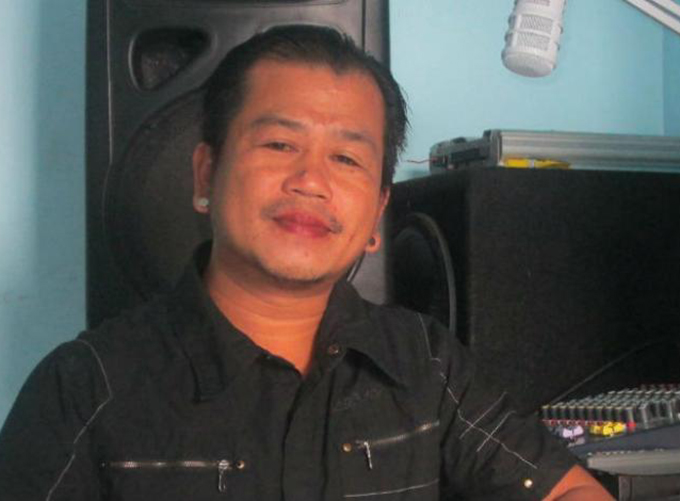
By Pebriansyah Ariefana in Surabaya

Indonesian police have revealed that police and military officers raided a Papuan student dormitory in the East Java provincial capital of Surabaya in Indonesia at the weekend because the students were allegedly planning to screen the documentary film Bloody Biak (Biak Berdarah).

Tambaksari Sectoral Police Chief Police Commander Prayitno claimed that security personnel went to the Papuan student dormitory in order to prevent an incident such as one that occurred in Malang earlier in the week from happening in Surabaya.

“[According] to information we received, they announced on social media that they would show the film Bloody Biak. So we went to the dormitory to anticipate this,” he said.

However, the planned screening of the film Bloody Biak on Friday was cancelled, and replaced by a screening of World Football Cup matches.

“If the discussion had still gone ahead. Apparently the film Bloody Biak [was to be screened] which tells the story of the massacre of Papuan people. I don’t know if this was true or not”, he said.

A joint operation by hundreds of TNI (Indonesian military), police and Public Order Agency officers (Satpol PP) raided the Papuan student dormitory located on Jl. Kalasan No. 10 Surabaya on Friday.

-Partners-

The dormitory is home to hundreds of students and Papuan alumni from various tertiary education institutions in Surabaya.

Security personnel sealed off the Papuan student dormitory because of suspicions that there would be “hidden activities”.

Inside the dormitory, they were to hold a discussion and wanted to screen the film Bloody Biak that evening.

Background
On July 6, 1998, scores of people in Biak Island’s main town were wounded, arrested or killed while staging a peaceful demonstration calling for independence from Indonesia.

Earlier last week on July 1, police violently closed down a discussion by West Papuan students at Brawijaya University in the East Java city of Malang marking the 47th anniversary of the proclamation of independence in 1971 by the Free West Papua Movement.

Police claimed that they closed own the discussion following complaints from local people.

Translated from the Suara.com story by James Balowski for the Indoleft News Service. The original title of the article was “Film Biak Berdarah, Alasan Polisi Kepung Asrama Papua di Surabaya”.

Print Friendly, PDF & Email

Article by AsiaPacificReport.nz

]]>

Journalist tells of Rainbow Warrior bombing, Pacific fallout on ABC

]]>
Evening Report
Evening Report
Journalist tells of Rainbow Warrior bombing, Pacific fallout on ABC
Loading
/

Journalist, media educator and author David Robie … Rainbow Warrior bombing reflections after 33 years. Image: PMC

Pacific Media Watch Newsdesk

Pacific environmental and political journalist David Robie has recalled the bombing of the original Greenpeace flagship Rainbow Warrior 33 years ago in an interview with host Sarah Macdonald on the ABC’s Nightlife programme.

Dr Robie, now professor of journalism and director of the Pacific Media Centre at Auckland University of Technology, wrote the 1986 book Eyes Of Fire: Last Voyage of the Rainbow Warrior that has been published in four countries and five editions.

LISTEN: Terrorism in Auckland in 1985

The 2015 edition of Eyes of Fire with the Rongelap evacuation on the cover. Image: LIP

He was awarded the 1985 Media Peace Prize by the NZ Peace Foundation for his coverage.

He spoke of the humanitarian voyage of the Rainbow Warrior to Rongelap Atoll in the Marshall Islands to fetch the islanders to safety in a four-voyage relocation mission.

The Rongelao community had been ravaged by the fallout and the long-term health impact of US nuclear testing.

-Partners-

His reflections were broadcast in a 23-minute programme broadcast at the weekend marking the bombing by French secret agents on 10 July 1985.

David Robie’s cover story for the Fiji-based Islands Business on the Rainbow Warrior bombing in August 1985. Image: PMC
Print Friendly, PDF & Email

Article by AsiaPacificReport.nz

]]>

Newsletter: New Zealand Politics Daily – July 9 and 10 2018

Newsletter: New Zealand Politics Daily – July 9 and 10 2018 Editor’s Note: Here below is a list of the main issues currently under discussion in New Zealand and links to media coverage. [caption id="attachment_297" align="aligncenter" width="640"] The Beehive and Parliament Buildings.[/caption] Defence Audrey Young (Herald): China ambassador registers concern over NZ’s strategic defence policy statement Henry Cooke (Stuff): Winston Peters says China expressed concern over defence plan naming it as a threat Sam Sachdeva (Newsroom): Peters confirms China concerns over defence paper Van Jackson (Incline): The Price of New Zealand’s Strategy-Force Mismatch Nevil Gibson (NBR): NZ First aims to end long-standing ‘free rider’ defence strategy Richard Harman (Politik): The coalition makes the decision National would not Sam Sachdeva (Newsroom): $2.3b NZDF plane deal to ‘strengthen Pacific Reset’ Gia Garrick (RNZ): Defence Minister urged to not put missiles and bombs on new aircraft Anna Bracewell-Worrall and Tova O’Brien (Newshub): Government buys $2.3 billion Defence Force aircraft Jason Walls (Interest): The Government will spend $2.3 billion on four new P-8A Poseidon aircraft RNZ: Govt to spend $2.3b on planes to replace aging fleet Laura Walters (Stuff): Submarine-hunting planes to replace ageing Orions Hannah Martin (Stfuf); Air Force squadron to move from Whenuapai to Ohakea RNZ: New vice-chief announced at Defence Auckland Council venue ban for Southern and Molyneux RNZ: Phil Goff defends blocking far-right speakers who ‘spout racist nonsense’ Bryce Edwards (Herald): Political Roundup: Does freedom of speech extend to far-right voices? Chris Trotter (Daily Blog): Do We Really Lack the Courage to Debate the Alt-Right? Do We Really Lack the Ideas to Defeat Them? Martyn Bradbury (Daily Blog): Since when were we on the Left frightened to fight crypto-fascsists? Craig McCulloch (RNZ): Winston Peters would’ve let far-right activists speak 1News: Winston Peters would have let far-right commentators talk at venue on ‘basis of free speech’ Newshub: Winston Peters would’ve let controversial far-right speakers into NZ Lucy Bennett (Herald): Bridges backs free speech for far-right writers banned from Auckland Council venues 1News: Phil Goff was ‘entitled’ to ban Canadian far-right speakers from council venues, Simon Bridges says Pete George: Peters, Bridges support free speech Nick Truebridge and Todd Niall (Stuff): Call for judicial review of Auckland Council agency’s blocking of far-right speakers Karl du Fresne: Free speech coalition to seek judicial review of Goff speaking ban Karl du Fresne: Southern and Molyneux: my response to Kimbo Martyn Bradbury (Daily Blog): The disconnect between platforming fascists and stopping them recruiting more No Right Turn: The cost of a free and democratic society II Michael Reddell: Free speech, even for odd or obnoxious views Steven Cowan: Freedom is always and exclusively freedom for the one who thinks differently Peter Cresswell: Some propositions on free speech Dane Giraud: Progressive opposition to free speech is completely baffling Employment Paul Buchanan: Unions, Parties and the decision to strike Anuja Nadkarni (Stuff): NZ’s reputation of having a high quality of life could be under threat, economist says Hamish Rutherford (Stuff): Public service workers hit by deluge as Government warns of a ‘rainy day’ Katie Doyle (RNZ): About 4000 govt employees rally around the country for better pay Herald: IRD and MBIE staff march for higher pay in Wellington and Auckland CBDs Samantha Gee (Nelson Mail): Government workers in Nelson plant trees during strike action Oliver Lewis (Stuff): ‘We’re not asking to be millionaires’: nurses’ pay offer vote expected to be close Laura Macdonald (Stuff): Nurse strike sees hundreds of surgeries, appointments cancelled RNZ: Auckland pizza franchises fined and forced to pay back wages Mānia Clarke (Māori TV): Picket support for HOYTS staff threatened with lock-out Julie Iles (Stuff): Auckland and Wellington face off for best-paying city Wilhelmina Shrimpton (Newshub): Work stress driving Kiwis to breaking point Business/Economy Rob Campbell (Spinoff): Business has no right to a second winter of discontent Dene Mackenzie (ODT): Sharemarket thriving, despite woes besetting businesses Dene Mackenzie (ODT): Business confidence remains weak in quarter, survey shows Housing RNZ: New state housing apartments announced in central Auckland Newshub: Phil Twyford announces ‘flagship’ state housing development David Cormack (Herald): Why this Government looks just like the old one Tim Brown (RNZ): House in Queenstown’s first special housing area sells for $890k Michael Daly (Stuff): Govt criticised for moving slowly on Auckland growth boundary Newshub: Grafton now Auckland’s fastest rising suburb Scott Yeoman (Bay of Plenty Times): ‘Stop putting cash in cups’: Group offers new way to help homeless Eva Corlett (RNZ): Auckland City Mission opens women-only night shelter High Country tenure review Timaru Herald editorial: Comprehensive review of tenure review should happen No Right Turn: Ripped off International relations Herald: Winston Peters tips leadership challenge for British PM Theresa May Stuff: Winston Peters in praise of Boris Johnson Newshub: Winston Peters warns of political ‘spill’ after Boris Johnson resigns Herald: Winston Peters: Government hands tied over EU diplomat Eva Tvarozkova rental dispute Isaac Davison (Herald): Landlord loses bid to recoup $20,000 from EU diplomat Eva Tvarozkova for damage, unpaid rent Barry Soper (Newstalk ZB): Don’t rent your property to a diplomat Tom Hunt (Dominion Post): European diplomat won’t have to pay $20,000 bill to landlord Marie Leadbeater (Spinoff): The Monday Extract: New Zealand’s disgraceful role in the ‘slow genocide’ of West Papua Health Nicholas Jones (Herald): Urgent need for sugary drinks tax: Health boards Māori TV: Labelled a child killer because of non-vaccination Phil Pennington (RNZ): Hospital buildings still in use despite safety warnings Emma Russell (Herald): Rest home in breach for failing to change elderly resident’s wound dressing RNZ: Elderly woman gets infection after dressing not changed Logan Church (RNZ): Hillmorton security guard labelled ‘useless’ by nurses Tess Brunton (RNZ): Waitaki no closer to cause of E.coli contamination Herald: New Zealand’s worrying fast-food trends revealed in new study Sarah Catherall (Listener): Inside the Plunket controversy: Why volunteers are up in arms Tema Hemi (Māori TV): Government referendum on cannabis doesn’t go far enough – Expert Tamsyn Parker (Herald): Kiwis feeling gloomier about their health and wellbeing The Opportunities Party Duncan Greive (Spinoff): ‘I enjoyed pissing off the flakes and groupies’: Gareth Morgan on TOP, RIP Herald: Gareth Morgan’s Opportunities Party decides it won’t contest the 2020 election Julian Lee and Joelle Daly (Stuff): Gareth Morgan’s The Opportunities Party is over Newsalk ZB: The Opportunities Party is no more Anna Bracewell-Worrall (Newshub): Gareth Morgan’s The Opportunities Party folds Jenée Tibshraeny (Interest): The Opportunities Party won’t contest the 2020 election; Gareth Morgan says the Jacinda effect shows people don’t vote on policy No Right Turn: TOP-less Women on boards Alex Davis (Herald): Research shows no benefit from women on company boards Andrea Brewster (RNZ): Board diversity essential for leadership in 2018 Point of Order: Genter, gender, governance and GDP – shouldn’t the Govt start with its Cabinet? Primary and extractive industries Lois Williams (RNZ): Campaign against country’s largest chicken farm steps up Robin Martin (RNZ): Offshore ban causes onshore pain Environment and conservation Nikki Preston (Herald): Investigation into how 49 cows died and were buried on heritage-protected Motutapu Island ongoing Anna Bracewell-Worrall (Newshub): NZ’s plastics challenge: Four solutions to piling up waste Laurel Stowell (Wanganui Chronicle): Whanganui River to feature in National Geographic magazine Pat Baskett (Newsroom): A case of David and Goliath at Long Bay Newshub: Wellington’s ‘Matariki’ whale could be a good sign – expert Herald: Fossil bone study uncovers unknown animal species and Māori behaviours No Right Turn: Mini-Muldoonism Martyn Bradbury (Daily Blog): So technically, NZ is less environmental than Al Qaeda Education David Fisher (Herald): Mother found guilty of failing to get children to school claimed they were too sick to attend Koroi Hawkins (RNZ): Claims NZ curriculum failing to reflect Pasifika identity Emily Ford (Stuff): Compulsory te reo Māori would ‘do so much good’ for New Zealand, actor says Brent Edwards (NBR): Education Minister promises rescue mission for polytechs Joel MacManus and Charlie O’Mannin (Critic): Selwyn College Students Secretly Voted on the Fresher Girl with the ‘Best Rack’ Newshub: Otago University students’ obscene voting topics exposed in report Charlie O’Mannin (Critic): Campaign To Repeal Voluntary Student Membership Starts Government Thomas Coughlan (Newsroom): Something’s off with toilet tax debate Sophie Bateman (Newshub): Melinda Gates sings Jacinda Ardern’s praises over paid parental leave package Craig McCulloch (RNZ): Phil Twyford fined $500 for using phone on flight Newshub: Transport Minister Phil Twyford fined $500 for aircraft cell phone use Herald: Transport Minister Phil Twyford fined $500 for using phone on plane 1News: Transport Minister Phil Twyford fined $500 for using his phone on a plane Spark Newshub: Spark charged with misleading and overcharging customers RNZ: Spark faces charges for allegedly over-billing customers Gender and sexuality 1News: ‘Trans women are women’ – Minister for Women Julie Anne Genter responds to some feminists’ concerns transgender rights will compromise their own Sarah Robson (RNZ): Pressure mounts for government to ban gay conversion therapy Katie Newton (Stuff): Lesbian couple ‘shocked’ by Kiwi baker who refused to make wedding cake Herald: Warkworth baker refuses to make wedding cake for gay couple Chris Lynch (Newstalk ZB): The Warkworth baker and the same-sex couple – a slice of homophobia or free speech? Greg Presland (The Standard): Cake makers and fascists Auckland RNZ: A tug of war over Auckland’s marinas Bernard Orsman (Herald): More than half of Aucklanders to get a rates rise of less than 2.5 per cent Awanui Black allegations Leigh-Marama McLachlan and Te Aniwa Hurihanganui (RNZ): Calls mount for an investigation into Te Awanuiārangi Black 1News: Paedophilia claim against dead iwi leader sparks worries about victims, debate on Māoridom’s handling of abuse Graham Cameron (Spinoff): ‘I believe Ani Black’: Sexual abuse and the silence that poisons communities Sandra Conchie and David Fisher (Herald): Speak out against powerful abusers says Louise Nicholas as paedophile allegations shock community Matt Shand (Stuff): Friends and leaders react to Awanui Black paedophile allegations Other Victoria Young (NBR): Former Russell McVeagh partner’s practising certificate renewed Jenny Ling (Stuff): Calls for nationwide meth reduction programme Raniera Harrison (Māori TV):Northland boxers ‘square off’ to knock-out P in the North Eden More (RNZ): New role helping grow Te Māngai Pāho media strategy Russell Brown (Spinoff): The new Hawaiki cable is doing what Sam Morgan and Peter Thiel could not Sara Meij (Nelson Mail): New Zealand’s changing energy landscape to include solar micro grids Victoria University (Newsroom): Patents threaten to misappropriate Māori knowledge Bruce Munro (ODT): Atoms and Eves Teresa Cowie (RNZ): Insight: Goldrush – The rise of the esports industry Leighton Keith (Taranaki Daily News): Simon Bridges polls the public to develop blueprint for the future Dan Dalgety (RNZ): New era for the Akaroa Volunteer Fire Brigade Greg Presland (The Standard): Dotcom loses in the Court of Appeal Herald: SPCA says abuse of possum ‘unnecessary cruelty’ and not pest control RNZ: Nine to Noon: Political commentators: Matthew Hooton and Stephen Mills (audio) Richard MacManus (Newsroom): A cashless society in 10 years? Herald: Name removed from memorial to late Supreme Court judge Sir Robert Chambers Newsletter: New Zealand Politics Daily – July 6 2018 – Today’s content Defence Sam Sachdeva (Newsroom): Bold defence plan comes at a cost Richard Harman (Politik): Why we are not (quite) playing Aussie rules with China? David Capie (Spinoff): NZ has signalled a new, tougher stance on China. How will Beijing respond? Keith Locke (Daily Blog): Defence policy statement edges NZ closer to Trump’s America Jim Rolfe (Politik): The Defence Policy Statement— a very good start 1News: ‘We’re not going to cut corners’ – Defence Minister on New Zealand’s potential investment in new aircraft Gia Garrick (RNZ): Govt’s defence strategy takes solid stance on China Anna Bracewell-Worrall (Newshub): NZ faces threats from China, Russia ‘in ways not previously seen’, Defence warns Audrey Young (Herald): Defence Minister Ron Mark issues strategic paper as basis for future Defence decisions Sam Sachdeva (Newsroom): Potent threats to NZ outlines in Govt report Laura Walters (Stuff): New defence policy strategy explicit in pointing finger at threats Laura Walters (Stuff): ‘Global warming is happening’: Defence adds climate change issues to its strategy for the first time Jonathan Mitchell (RNZ): Defence policy: Climate change central to new strategy 1News: Weather extremes predicted to be new frontline for New Zealand Defence Force Rebecca Howard (BusinessDesk): NZDF looks to the stars and cyberspace in policy refresh David Fisher (Herald): NZDF buys Ron Mark-endorsed book but says it’s ‘terrible’ Audrey Young and Lucy Bennett (Herald): Navy vessel came close to capsize in Southern Ocean, Defence Minister Ron Mark says Chris Chang (1News): Bodies of 27 NZ Defence Force personnel coming home Paul Hobbs (1News): Woman questions defence force’s commitment to stamping out sexual harassment Crown land sales Charlie MItchell (Stuff): After taxpayers paid to get rid of it, farm sells for $17.5m Charlie MItchell (Stuff): Handing NZ’s heritage to millionaires: The case for an inquiry into tenure review Housing Henry Cooke (Stuff): KiwiBuilds in Auckland unaffordable for many, govt analysis shows Stuff: Bridges says National might keep KiwiBuild if by ‘some magic’ it works Tracy Watkins (Stuff): Government’s flagship KiwiBuild scheme too big to fail Stacey Kirk (Stuff): Govt injects oversupply of hope into undersupplied housing market Simon Wilson (Herald): Building homes is far more than a numbers game Anne Gibson (Herald): What house deposit will you need to qualify for KiwiBuild? Newshub: KiwiBuild a ‘hoax’ – National leader Simon Bridges Tom Sainsbury: Kiwis of Snapchat: It’s a KiwiBuild free-homes bonanza! Tracy Neal (RNZ): Nelson co-housing group wants to improve home ownership chances Dileepa Fonseka (Stuff): From $460k deposit to $12.7m: Why these Auckland house prices have soared Mei Heron (1News): Concerns that international students are being exploited by some landlords Kate Newton (The Wireless): Why renters won’t dob in bad landlords Stuff: Mean weekly rent in New Zealand creeping up year on year Debrin Foxcroft (Stuff): Woman opts to live in motorhome to beat Auckland’s rising rents Jenni Walker (Stuff): Tenants, you have a phone, use it Matthew Theunissen (RNZ): Homeless shaken awake as Rotorua shelter awaits consents Cleo Fraser (Newshub): Rotorua Lake Council blocks homeless from sleeping at shelter Cleo Fraser (Newshub): ‘No sleeping is allowed’: Rotorua homeless kept awake over shelter’s building consent issues Matt Brown (Stuff): Auckland homes nearly half of country’s real estate agents – vying for a healthy commission Mark Longley (Newshub): Does Auckland really need all those real estate agents? Government John Armstrong (News): Peters has not put a foot wrong since stepping into Acting PM role Audrey Young (Herald): National seeks to dislodge Peters from his six-week sedan chair ride Tracy Watkins (Stuff): Labour’s not really feeling the love at the moment Peter Dunne (Newsroom): What Labour needs now Chris Trotter: Undivided Power Is Perilous Jason Walls (Interest): A big Green problem for New Zealand’s left Duncan Garner (Herald): Hey, Shane, all the regions want some of that loot, bro Shane Cowlishaw (Newsroom): Roadblocks for Government fleet’s electric shift National Party RNZ: Simon Bridges: Govt’s ‘untargeted’ spending makes no sense Lucy Bennett (Herald): National accuses Government of loose spending, high borrowing Jason Walls (Interest): Politicians at the Pub: The MP formally known as ‘Crusher Collins’ Stuff: Simon Bridges admits he underestimated ‘the power’ of Radio Hauraki Elections Graeme Edgeler (Public Address): Careful what you wish for: How entrenching the Māori seats may lead to the opposite of what its supporters seek Richard Swainson (Waikato Times): Pining for when things weren’t so serious International relations and trade Zac Fleming (RNZ): MFAT refuses to front up about Vietnam aid Barry Soper (Newstalk ZB): Aussies the ugly underbelly of friendship we once had Jenny Liu (Herald): How US-China trade war could affect NZ Point of Order: The challenge of forging better relations while avoiding the flak from US-China trade war Gerard Hutching (Stuff): National Portrait: NZ ambassador to China John McKinnon looks back on diplomatic career Fran O’Sullivan (Herald): Time on NZ’s side as trade hostilities break out Simon Draper (Herald): NZ must not become casualty of US-China trade war Business/Economy Liam Dann (Herald): Business still feels pained by Labour Damien Grant (Stuff): Empathy won’t help when a global financial crisis strikes Employment Glenn Barclay (Herald): Workers strike as message falls on deaf ears Karen Brown (RNZ): Nurses to vote on latest pay offer, strike action still possible Herald: Inland Revenue asks for patience during PSA strike this afternoon Shamubeel Eaqub (Stuff): The message we’re sending the caring sector Herald: 4000 MBIE and Inland Revenue staff will strike for two hours Newshub: Thousands of Government staff prepare to strike on Monday Tim O’Connell (Stuff): MSD and Nelson company partner to provide jobs for unemployed Cherie Sivignon (Stuff): First Union brings campaign to Nelson, calls on retail employers to pay living wage Melanie Earley (Stuff): Open-plan offices stressing women out, Auckland researcher says Welfare Eva Corlett (RNZ): Auckland mum: ‘It’s been five years of living hell’ Martin van Beynen (Stuff): MSD loan case’s Ms F no poster girl for poverty Melissa Nightingale (Herald): Pension fix looms after 80 years Joel Ineson (Stuff): Superannuation will be cut after retiree refuses to apply for Australian pension Andrew Gunn (Stuff): MSD’s theory that loans are income is making those mortgages look expensive Russell McVeagh review Tom Hunt (Dominion Post): Russell McVeagh intern applications increase during scandal Deborah Hill Cone (Herald): The reasons I struggle with the Bazley report Fiona McNamara (RNZ): Changing ‘work hard, play hard’ culture not enough ODT: Protection of young women imperative Police and justice Andrea Vance (Stuff): Criminal Cases Review Commission proposal ready for Cabinet Tracy Watkins (Stuff): NZ First minister says top cop’s party link ‘news to me’ Michael Morrah (Newshub): Winston Peters criticised over rape case comments Herald Editorial: Use of Tasers needs to be monitored Jo Lines-Mackenzie (Stuff): Sex offenders next to families as Corrections puts them in motels Natasha Holland and Michael Fallow (Stuff): ‘I still don’t know what happened’: Gaps in investigation into teen’s 1996 shooting Kelly Dennett (Stuff): A preventable death: Auckland woman’s manslaughter subject of internal review by police Mike Williams (Hawkes Bay Today): David Elliott just as wrong as Rudy Giuliani on crime Tom Furley (RNZ): Removal of Justice Sir Robert Chambers’ name from memorial slammed as ‘ridiculous’ Kim Dotcom Tom Pullar-Strecker (Stuff):Dotcom saga: Many wrongs make for a right mess Daisy Hudson (ODT): Dotcom vows to fight on Banking sector Sam Stubbs (Spinoff): Are Australian banks rent seeking in New Zealand? And what can we do about it? Tina Morrison (ODT): New Reserve Bank head wants greater organisational diversity Health Andrea Vance (Stuff): Government’s ‘shocking’ $6.5 million funding cut to cochlear implants Kirsty Johnston (Herald): Investigation, apology after doctor loses confidential breast cancer patient files Southland Times Editorial: Having a jab at the anti-vaxxers Jennifer Eder (Stuff): Are fire foam chemicals the tip of the iceberg? RNZ: DHB review: ‘People should let the process take its course’ Piers Fuller (Stuff): Wairarapa Hospital was warned of seismic issues in its ceilings years ago Phil Pennington (RNZ): Construction delays stall opening of new West Coast hospital Natalie Akoorie (Herald): Changes still to be made after multiple failings in care of mental health patient Samantha Gee (Nelson Mail): How Nelson developed a pioneering mental health service for children and adolescents Warren Gamble (Nelson Mail): Teenage campaigner’s tenacious battle for youth mental health Libby Wilson (Stuff): ‘The start of an avalanche’: Nicky Stevens’ path to death under compulsory care Katie Nicol-Williams (1News): More needs to be done to stop junk food reigning supreme at sports events – study RNZ: About two-thirds of food at country’s sporting venues classified as ‘junk’ Newshub: New Zealand’s huge junk food problem at sport venues Emily Ford and Jane Matthews (Stuff): Cameron Duncan died of cancer at 17; 15 years later he could become a father Newshub: Auckland schoolboy killed after ute flipped saved five lives with organ donation ACC Mike Houlahan (ODT): ACC review concerns ‘not rocket science’ RNZ: Lawyer questions legality of thousands of ACC disputes Laura Tupou (Newshub): Cost of assault on Pacific people rising Cate Broughton (Stuff): Ex reviewer of ACC claims fired for using ‘inconsistent fonts’ Euthanasia Jeremy Rees (Newsroom): Hospices say no to euthanasia Alison McCulloch: On Voluntary Death Media Tim Murphy (Newsroom): MediaRoom: Journalism for the public good Chris Trotter (Daily Blog): What’s Wrong With Today’s Journalists? RNZ: Public broadcasters group says Nauru ban unacceptable The Ruminator: Herald has eight left columnists and one right one: Redux David Farrar: Herald has eight left columnists and one right one Indira Stewart (RNZ): Youth unite to change negative perceptions of South Auckland Auckland Council venue ban for Southern and Molyneux Dominion Post Editorial: Tolerance is a virtue David Farrar: Phil Goff the new commissar of speech Karl du Fresne: Where does the Left – and for that matter the National Party – really stand on freedom of speech? Karl du Fresne: A triumph for left-wing bigotry and intolerance Saziah Bashir (RNZ): Hate speech more than just ‘an unpopular opinion’ Oscar Kightley (Stuff): We have the freedom not to stand such divisive speech Jonathan Mitchell (RNZ): Green Party co-leader receives rape and death threats on social media 1News: ‘My skin has thickened’ – MP Marama Davidson receives ‘vile’ death threats after far-right Canadian duo banned from council venues Debrin Foxcroft (Stuff): Greens co-leader Marama Davidson receives violent threats on social media Herald: Death threats for Greens co-leader Marama Davidson after support for venue ban for Canadian couple accused of hate speech Herald: Mayor bans controversial Canadian pair from talking in Auckland Council venues Emma Hatton (RNZ): Far-right pair banned from speaking at Auckland Council venues – Phil Goff Newshub: Auckland ‘alt-right’ event cancelled due to ‘health and safety’ Todd Niall (Stuff): Controversial Canadian speaker denied visa as Auckland agency cancels booking No Right Turn: The cost of a free and democratic society Vice: Protests Prepared for Anti-Islam Alt-Right Speakers in NZ Greg Presland (The Standard): The extent of the right to free speech Greg Presland (The Standard): Far right Canadian activist wants to come to New Zealand to insult local communities Pete George: Goff intervenes, Auckland venue banned, speaking tour canned Impossible burger Bryce Edwards (Herald): Political Roundup: The existential threat of a meat-free burger David Cohen (RNZ): Airline dining out on ‘fake beef’ controversy David Slack (Stuff): Say hamburger one more time Susan Edmunds (Stuff): Air NZ defends Impossible Burger again Herald Editorial: Our impossible MPs need to weigh up the possible Jonathan Milne (SST): Air NZ should serve up Kiwi kai – but it needn’t be beef burgers Tom Sainsbury: Kiwis of Snapchat: Boycott Air New Zealand! Steve Braunias (Herald): Secret diary of… the impossible burger Georgina Harris (Idealog): Air New Zealand takes the plant-based Impossible Burger to the skies Point of Order: What makes Impossible Burgers possible? Lots of chemistry and a hint of GM Immigration Teuila Fuatai (Newsroom): NZ religious groups exploit migrant ‘clerics’ RNZ: NZ Immigration publishes Samoa quota ballot results Newshub: First refugees arrive under new community sponsorship category Amanda Saxton (Stuff): Racism drives Afghan refugees from home in Auckland Thalia Kehoe Rowden (Spinoff): It’s time for Aotearoa to step up and welcome home more refugees Matariki and the whale John Boynton (RNZ): Labour’s Māori caucus considers Matariki public holiday Newshub: What’s the Wellington whale like? Five facts about the southern right whale Eden More (RNZ): Visiting whale a ‘sign’ – Wellington kaumātua RNZ: Matariki fireworks postponed due to whale visit Newshub: Wellington’s Matariki fireworks postponed by harbour whale fears RNZ: Wgtn whale visit: Police urge drivers to stay focussed Newshub: Wellington whale continues to cause traffic problems Environment Henry Cooke (Stuff): Will New Zealand’s Zero Carbon Bill actually save us? Thomas Coughlan (Newsroom): Making friends of enemies for climate change goals Will Harvie (Stuff): Zero carbon: Policy meets science Charlie MItchell (Stuff): ECan elections may be ‘very dangerous’ if ‘extremists’ elected, warns farming leader Jamie Ensor (Newshub): Govt drags feet on pre-election conservation pledge Jamie Morton (Herald): Campaign aims to restore Waikato’s ‘seabird mountain’ Hawkes Bay Today: Closed contentious Craggy Range track treated to a ‘healing’ event RNZ: Waitaki Geopark application likely to inspire many more RNZ: Calls for stronger dog control bylaws after kiwi killed RNZ: Pig population boom around threatened kauri forest RNZ: 70 feral goats shot on Banks Peninsula in DoC trial RNZ: NZDF supports avalanche risk survey in Nelson Lakes RNZ: South Island scallop fishery remains off the menu RNZ: Motorists urged to switch to copper-free brake pads Primary industries Keith Woodford (Stuff): Dairy industry’s big challenge: a strategic reset RNZ: Taranaki farms tested for M Bovis Aroha Treacher (Māori TV): MPI warn against continued illegal selling of seafood online Child welfare and family violence Lisa Owen (Newshub): Interview: Tracey Martin (video) RNZ: Kim Hill interview: Children’s Commission marks 2 years in the role (audio) Isaac Davison (Herald): Custodial parent faring worse after breakups – Becroft Barbara Dreaver (1News): National violence programme for Pasifika youth kicks off Lucy Corry (The Wireless): Are parents still smacking their kids? Tess Brunton (RNZ): Football coach accused of rubbing child’s nose in dirt Education Adele Redmond (Stuff): Multiple teachers deregistered for hitting, force-feeding and dragging young children Melanie Earley (Stuff): More than 70 schools now challenging the Government’s NCEA review process Herald: Principals NCEA Coalition reaches 70 schools Tema Hemi (Māori TV): Hato Petera supporters protest to keep their school open Regan Paranihi (Māori TV): Raukura maintain their reign for another two years RNZ: Te Rōpū Raukura win kapa haka champs for second year running Tom Pullar-Strecker (Stuff): Drop of 44,000 international students forecast if work visa rule change goes ahead RNZ: Disabled student unable to finish degree without support Eden Park charity row Newshub: Helen Clark’s actions over Eden Park charity concert ‘morally wrong’ – Sir Ray Avery Lisa Owen (Newshub): Interview: Sir Ray Avery (video) Alison Mau (Stuff): Clark v Ray – ‘There hasn’t been a public scrap of this calibre for ages’ Herald: Eden Park charity concert battle off to Environment Court Film industry Colin Peacock (RNZ): Shining a light on our movie money Eric Crampton: Paying for more hostages Matt Nippert (Herald): Sir Peter Jackson’s $237m war museum in doubt Collette Devlin (Stuff): Government $25m for convention centre on hold until Sir Peter Jackson and council agree on museum Tom Hunt (Dominion Post): We cringed at ‘Wellywood’ and now we can grimace at, um, er, ‘Huttywood Hills’? Local government Bernard Orsman (Herald): Golf courses and parks among big sell-off by Auckland Council Todd Niall (Stuff): Auckland mayor Phil Goff scotches ‘toilet tax’ talk Herald Editorial: Once bitten, twice shy on another council tax Cherie Howie (Herald): Auckland councillors weigh in on ‘toilet tax Bernard Orsman (Herald): Regional fuel tax could be followed by a toilet tax in Auckland Newshub: Auckland Council considering ‘toilet tax’ 1News: Ports of Auckland charged over death of ocean swimmer Catrin Owen (Stuff): Ports of Auckland charged over death of ocean swimmer Leslie Gelberger Gary Farrow (Stuff): Local Government Minister Nanaia Mahuta to research country-wide water system Max Christoffersen (Waikato Times): Opinion: Who voted for Richard Briggs’ $440k annual salary? Hamish Rutherford (Stuff): Trevor Mallard slams bus event as celebration of lost jobs for ‘my poorest neighbours’ Collette Devlin (Dominion Post): Concerns about harassment and bullying at Wellington City Council Chris Lynch (Newstalk ZB): Christchurch City Council lacks transparency Herald: Christchurch City Council forced to reveal touch wall cost $1.24 million RNZ: Christchurch sports field saved from development David Williams (Newsroom): Timeout on Christchurch’s big sports project Tracy Neal (RNZ): Waimea Dam project likely higher than first estimated Cherie Sivignon (Stuff): Tasman District Council pursues local bill for dam land, MP seeks full house support Building industry and safety Phil Pennington (RNZ): Analysis: Quake-prone buildings force tough decisions Rob Stock (Stuff): New Zealand needs a specialist building court, say property lawyers Heather du Plessis-Allan (Herald): Red tape delaying bathroom renovation Northern Advcoate: Whangarei house renovation ends in $2000 fine Women on boards Transcript: Q+A: Minister for Women Julie Anne Genter Katie Scotcher (RNZ): Women on public boards: ‘The private sector needs to catch up’ Lucy Bennett (Herald): Government target of 50 per cent women on state sector boards and committees by 2021 Anna Bracewell-Worrall (Newshub): Government target: Gender balance on state sector boards Ele Ludemann: Do as they say not as they do David Farrar: The least ambitious target ever Gender and sexuality Melody Thomas (Stuff): Early Māori view on sexual fluidity far more liberal than previously believed Bryce Edwards (Newsroom): Transgender rights debate rises to surface Charles Anderson, John Daniell, Brannavan Gnanalingham and Gary Steel (Stuff): What’s it like to grow up male in New Zealand? Awanui Black allegations David Fisher (Herald): Widow says her former husband’s paedophile rings goes to ‘highest heights’ Yvonne Tahana (1News): Allegations of paedophilia against iwi leader Awanui Black causes shockwaves Gia Garrick (RNZ): Community in shock over accusations against iwi leader Sandra Conchie (Bay of Plenty Times): Tauranga community leaders react to claims deceased iwi leader was a paedophile David Farrar: Be careful about rushing to judgement Anneke Smith (RNZ): Widows claims of late husband’s paedophilia – ‘brave’ Herald: Widow of Awanui Black claims he was a paedophile Laura Tupou (Newshub): Iwi leader Te Awanui Black’s widow claims he was a paedophile Other Gareth Vaughan (Interest): Does NZ’s new law ‘ensuring multinationals pay tax based on the actual economic activity they carry out in NZ’ apply to Visa and Mastercard? Rob Stock (Stuff): Nine-figure payday beckons for Aussies planning to close Kiwi insurance fund Kurt Bayer (Herald): Meth plague at record levels, with P-related arrests nearly doubling in 5 years Tess Brunton (RNZ): Instagram hunters keeping search and rescue busy Talisa Kupenga (Māori TV): Ngāti Tamaoho in “high spirits” at final claims reading Elton Rikihana Smallman (Stuff): With trademark combover and rimmed glasses, Wētere played it well Dale Husband (E-Tangata): Tipene O’Regan: We must remember to remember Emma Espiner (Newsroom): Sit with discomfort and build a bridge Suzanne McFadden (Newsroom): What girls want: more sport Neil Reid (Herald): Basketball: The truth behind Steven Adams’ Tall Blacks snub Bruce Munro (ODT): The sound of silence Finn Hogan (Newshub): Is NZ missing out on a digital gold rush? Brenda Harwood (ODT): Hundreds sign South D post-shop petition MIchael Reddell: Are things better or worse than 50 years ago? Joel Maxwell (Stuff): What does that troublesome word Pākehā mean? RNZ: Self-styled NZ Baptist pastor facing deportation from Australia Newshub: Extremist NZ pastor Logan Robertson faces deportation from Australia Herald: Marama Fox’s secret heartache as 29-year marriage ends]]>

Bryce Edwards’ Political Roundup: Does freedom of speech extend to far-right voices?

Bryce Edwards’ Political Roundup: Does freedom of speech extend to far-right voices?

[caption id="attachment_13635" align="alignright" width="150"] Dr Bryce Edwards.[/caption] New Zealand has largely escaped the escalating debates and conflicts occurring in the US and elsewhere about whether to allow or ban offensive political speech. Until now. Two controversial Canadian speakers who have cancelled their NZ appearance after being banned from Auckland Council venues have ignited debates over “hate speech” and “freedom of speech”. Lauren Southern and Stefan Molyneux had been due to appear next month at the Bruce Mason Centre in Auckland. But on Friday, the Auckland City Council, which owns the venue, pulled the plug on the event, due to “security concerns” involving the “health and safety” of the presenters, staff and patrons of the event. This is all covered by Anna Bracewell-Worrall in her news report, Auckland ‘alt-right’ event cancelled due to ‘health and safety’. The article explains that the issue was sparked when “Auckland Peace Action (APA) called on the Government to not allow the speakers entry to New Zealand.” The group also threatened to disrupt the event, saying: “If they come here, we will confront them on the streets. If they come, we will blockade entry to their speaking venue”. Mayor Phil Goff fronted the issue, and explained the decision: “I just think we’ve got no obligation at all – in a city that’s multicultural, inclusive, embraces people of all faiths and ethnicities – to provide a venue for hate speech by people that want to abuse and insult others, either their faith or their ethnicity”. Event promoter, David Pellowe, then announced that the show was cancelled, saying “there were no other venues available at this late stage” – see the Herald’s Mayor bans controversial Canadian pair from talking in Auckland Council venues. He complains that Phil Goff’s decision is political, and that “Far from being willing to engage in a robust contest of ideas, he finds it far simpler to shut down any ideas he disagrees with.” A victory against “hate speech”? The other group attempting to prevent Southern and Molyneux from speaking was the New Zealand Federation of Islam Associations, who say the pair are spreading hate about Muslims. The Federation has been lobbying the Minister of Immigration and Immigration New Zealand to deny them entry to the country. Federation president Hazim Arafeh explained that one of the two, Lauren Southern, should not be afforded the right to free speech, because she “abuses her right of freedom of speech. She’s just going to give a talk in which she’s just going to insult all of us… I don’t think insulting Muslims comes under free speech, that’s an abuse of freedom of speech” – see Emma Hatton’s article, Controversial speaker Lauren Southern ‘going to insult all of us’ – Islamic community leader. This article cites Massey University’s Paul Spoonley categorising the pair as being “white supremacists” and their message as “hate speech”. But he is also reported as believing that “banning people entry to New Zealand would need to meet a high threshold and the decision warranted a public discussion.” Many on the political left believe that threshold has been met by the couple. For example, writing at The Standard, Greg Presland argues that Southern’s message falls into the category of “hate speech” and “Freedom of speech does not require us to let her in to insult local communities” – see: The extent of the right to free speech, and Far right Canadian activist wants to come to New Zealand to insult local communities. Saziah Bashir has an interesting opinion piece in favour of the clampdown on the Canadians, saying in her RNZ item that Southern’s “actions are actually physically and emotionally harmful” – see: Hate speech more than just ‘an unpopular opinion’. Therefore, any decision to deny them entry to New Zealand is quite straightforward and uncomplicated, especially because their presence here “risks the safety of an entire community” – Muslims. She argues the “right to freedom of expression is not unfettered”, and because Southern and Molyneux have other ways to distribute their message (YouTube), their rights to freedom of speech would not be harmed by any ban on them. Some of these debates about hate speech might sound esoteric, but for Oscar Kightley it’s very straight forward, because the concept of freedom of speech should include the freedom to ban people from coming to speak to others: “Of course, freedom of speech is an important principle, but that isn’t one way. Surely people have that same freedom to have their own reactions to any speech. Including the freedom to say: yeah nah, you can’t actually come into New Zealand and say that stuff” – see: We have the freedom not to stand such divisive speech. Suppressing “free speech”? The decision to ban the Canadians from council venues is A triumph for left-wing bigotry and intolerance according to Karl du Fresne, who says “July 6 was the day when extreme left-wing bigotry and intolerance triumphed over the democratic values”. He says that “Goff has betrayed us all” by capitulating to “fringe extremists like Valerie Morse” of Auckland Peace Action. It “sends a signal that all the extreme left has to do in future to deny a platform to people it doesn’t like is to threaten violent disruption.” He also draws attention to the “irony” that Valerie Morse has previously escaped conviction for “burning a New Zealand flag in a protest gesture at an Anzac Day service in Wellington in 2007” because the Supreme Court ruled – rightly in du Fresne’s view – that “Freedom of expression quite properly allows New Zealanders to engage in acts that other people find deeply objectionable.” Karl du Fresne believes freedom of speech, even for offensive speech, is highly desirable: “We live in a liberal democracy that depends on free speech and the free exchange of ideas and opinions” – see his second column on the matter: Let’s hear the Canadians for ourselves and decide then whether it’s dangerous. He argues we should be, and are, robust enough to deal with fringe views: “New Zealand is by world standards a remarkably tolerant and moderate society, and stolidly resistant to inflammation by extremists of any stripe. Perhaps even more importantly, it’s a robust democracy that is perfectly capable of being exposed to rancid opinions without being swayed.” This view is shared by leftwing blogger No Right Turn, who says “the answer to speech you don’t like is more speech, not less” – see: The cost of a free and democratic society. He argues the threshold for banning something should be incredibly high, and this has not been reached: “Unfortunately, being insulted is just something people have to put up with in a free and democratic society, and our Supreme Court is on record (in Brooker v Police) as saying so. We have a right to freedom of speech in New Zealand, which covers not just the right of these racists to speak, but also the right of their racist audience to listen. Restricting that right pre-emptively requires a very high test: basically an announced intention on the part of the speaker to incite a riot. If that test isn’t met, there’s no justifiable reason to prevent them from speaking.” The Dominion Post has a similar view, publishing an editorial that says a healthy society has to put up with some offensive views, and that “Without the possibility of offence we would be a bland, totalitarian state devoid of interest, imagination and ideas” – see: Tolerance is a virtue. It argues a ban on such views are counterproductive, as it “plays into the hands of those seeking publicity and profile.” Furthermore, we need to distinguish between what is “truly damaging and hateful” and that which is “merely offensive and comfortably dismissed”. The editorial believes that Southern and Molyneux fall into the latter category. There’s also the problem of giving politicians such as Phil Goff the power to make the decision on which political views to ban. This is the argument put by David Farrar who says “the Mayor now personally decides whose speech is acceptable, and can use an Auckland Council facility. Governments tend to own many large speaking venues so this in fact does massively restrict the ability of someone to do a public session” – see: Phil Goff the new commissar of speech. Farrar wonders if future speakers who allegedly stir up religious tensions will also be banned: “now Goff has unilaterally announced his own test, let’s keep him to it. If you ever see a booking for a Council facility which has a speaker from an organisation with a history of anti-semitism or supporting terrorism, then make sure we all know so we can demand Goff be even handed.” TV comedy writer Dane Giraud also gets serious, explaining why he’s baffled about “progressive” opposition to free speech, saying that dangerous ideas only become more dangerous when they are suppressed – see: Progressive opposition to free speech is completely baffling. Finally, could Auckland ratepayers end up with a costly bill from the decision to cancel this event? Blogger No Right Turn has just blogged to say that the decision looks to be illegal, as it breaches the Bill of Rights Act, which includes “the right to freedom from discrimination on the basis of political opinion” – see: The cost of a free and democratic society II. He also says the decision sets a dangerous precedent: “Because if we let the mayor of Auckland decide what speech is acceptable in public facilities, then a future mayor may decide that they don’t like speech that we approve of. Like union meetings, or speeches in favour of reforming drug laws, or political movements against landlords and the rentier economy. Or speeches in favour of racial justice”.]]>

Bryce Edwards’ Political Roundup: Existential burger wars

]]>

Bryce Edwards’ Political Roundup: Existential burger wars

[caption id="attachment_13635" align="alignright" width="150"] Dr Bryce Edwards.[/caption] There really is a major shift going on at the moment in which vegetarian and vegan food practices are in the ascendancy. And it’s very political. In fact, as if to underline this shift, the restaurant that’s directly across the road from the Prime Minister’s Wellington residence in Thorndon has just announced that it will no longer serve meat.  The rise of vegetarianism The Hillside Kitchen and Cellar is one of the city’s top restaurants, and it’s where Jacinda Ardern sometimes meets journalists for interviews, including foreign ones. Now they’ll have to have their conversations over lentils rather than lamb. Owner and chef Asher Boote has explained the striking of meat from the menu: “The growing conversation around these things is huge and the stats are that more and more people are eating a lower amount of meat or no meat, so we are just moving with the times really” – see Ewan Sargent’s article, Top Wellington restaurant is taking meat off the menu. There are plenty of other signs of an increasing vegetarian market in New Zealand. Local operator of the Lord of the Fries chain of vegan restaurants, Bruce Craig, has witnessed the growing interest in meat-free diets, and is expanding his own chain, saying “he hoped the country would move with the times to develop plant-based protein” – see Aimee Shaw’s Vegan fast food operator Lord of the Fries set to open 13 more NZ stores, expand to India. The same article also reports: “The movement towards plant-based protein has attracted some heavy hitters. Canadian film-maker James Cameron has taken the lead in supporting a plant-based future. He owns several Wairarapa farms and is in the process of converting them to produce plant-based agriculture. He has also set up a company with Sir Peter Jackson, called PBT New Zealand, which is said to use technology to help produce plant-based protein ‘meat’ alternatives.” This new venture by Cameron and Jackson, and other “post-meat” developments in New Zealand, are explored by Whena Owen in her recent five-minute Q+A investigation: Fake meat on the menu. For a look at other new companies in New Zealand who are innovating around a post-meat diet , see Jihee Junn’s Meat-free, dairy-free, and made in New Zealand. And for a review of the latest “fake meat” vegan burger at the new Britomart branch of Lord of the Fries, see Toby Manhire’s The meat-free Beyond Burger. His conclusion is: “It’s just quite a decent burger but to be quite a decent burger and not involve any dead animals is very laudable and good.” He’s particularly praiseworthy of the “fake-meat” patty: “The texture works, the flavour is quietly impressive and it’s even persuasively juicy.” The rise of the Impossible Burger It goes by various names – “fake meat”, “synthetic meat”, “plant protein”, etc – but whatever the term there’s no doubt that advances in technology mean we are seeing the fast rise in vegetarian meat-like products that are designed to be superior to conventional meat. Unsurprisingly, this is being taken very seriously by New Zealand’s Ministry for Primary Industries (MPI), which has recently released an array of reports into the Evolution of Plant Protein, which includes a very interesting case study of The Impossible Burger. This report very clearly and colourfully explains all you need to know about the new phenomenon and why it’s going to impact on agriculture in this country. The burger company is based in California, but has some links with New Zealand, especially now that it has chosen to partner with the national airline in an experiment to provide the non-meat product to air travellers, for the first time. Before this partnership became controversial, Air New Zealand flew a number of journalists to the US to check out the new burger, and this is best covered by Herald science reporter, Jamie Morton in his article, Tasting the Impossible Burger with Air New Zealand. Morton’s article explores both the connection that Impossible Foods CEO and scientist, Pat Brown, has with New Zealand, as well as the disruptive affect it could have here. He reports that Brown is a big fan of this country, having visited many times, and says he wouldn’t have chosen to work with any other airline. He’s also talked a lot with farmers here, who he says have some “ambivalence” about what he is doing. Morton asks him about the “existential threat” of his product to farmers, and Brown says he wants to work with them, adding: “If you look into the future, you can see it’s absolutely inevitable that there is going to be an irreversible transition away from animals as a food production system”. Morton reports on his own tasting of the Impossible Burger, saying that he’s “loved meat for as long as I can remember”, but he was very impressed by the vegetarian product: “The first bite was a revelation: tasting something like a lamb burger, packing a rich, juicy texture, but with an almost-sweet aroma.” Journalist and travel-writer Sharon Stephenson concurs, saying the burger “tastes, dare I say it, better than meat”, and “It was everything the PR machine promised it would be: thick juicy patties that felt and chewed like meat, that wouldn’t be out of place at a back-yard barbie with a beer and a sunny deck” – see: Air New Zealand to serve plant-based burger on Los Angeles-Auckland flights. She also reports on the environmental superiority of the burger: “It turns out the Impossible Burger uses 95 percent less land, 75 percent less water than beef, and generates 85 to 87 percent fewer greenhouse-gas emissions. And it doesn’t contain any hormones, antibiotics, cholesterol or artificial flavours.” It’s this radical environmental advantage of vegetarian food that makes these new technological products threatening to conventional meat. At a recent University of Auckland “Future of Food Symposium”, ecologist Mike Joy was reported as explaining that environmental needs meant that future had to be meat-free: “He said the only way to change a future without enough food for all is to remove animals from our diets” – see Farah Hancock’s A future where food is off the menu. Joy lays out the numbers, “To produce one gram of protein from beef, one square metre of land is required. To get one gram of protein from rice requires just .02 of a square metre of land.” What this means, according to Joy, is we must all drop meat from our diets: “It’s not a choice. We don’t have a choice. We can choose between spinach and kale, but not animals because we will all starve.” And for more on how meat is farmed and killed, the Herald has recently made available a new video exploring the realities – see: MEAT the documentary about the animals we eat made available to NZ Herald readers. Responses to rise of the Impossible Burger This week, politicians voiced their beef with Air New Zealand’s choice of menu for its two weekly flights out of Los Angeles. Three backbench MPs were particularly outspoken: Clutha-Southland National MP Hamish Walker urged the airline to reconsider serving “fake burger patties”, National’s agriculture spokesperson Nathan Guy tweeted to say he was “disappointed”, and New Zealand First MP Mark Patterson said it was a “slap in the face” and “an existential threat to New Zealand’s second biggest export earner”. When acting Prime Minister Winston Peters added his weight to the complaints, it became an international news item. CNN had the best coverage – see Bard Wilkinson’s New Zealand PM has beef with the Impossible Burger. This reported Winston Peters saying he was “utterly opposed to fake beef” and that Air New Zealand should be promoting real New Zealand meat. Some of this escalated complaint is covered by Krysta Neve, of the animal rights’ group SAFE, who pointed to the origins of the polarised debate: “Beef+Lamb New Zealand took it upon themselves to comment on Air New Zealand’s social media post, saying the airline should be offering their customers grass-fed, free range beef and lamb” – see: Air NZ ‘bullied’ in burgergate debate. Verdicts on burgergate Newspaper editorials and commentators have largely been unsympathetic towards complaints about the Impossible Burger. Today, for example, the New Zealand Herald explains that Air New Zealand’s supply of the burger is not a “kick in the teeth” for beef farmers, but a case of innovating to remain ahead of competitors, and others should be doing the same – see: Our impossible MPs need to weigh up the possible. The editorial complains that it’s actually the politicians who are finding it “impossible to innovate and adapt” like the national airline is. The newspaper also points to the fact that in the US the Food and Drug Administration is still holding up a final clearance for the Impossible Burger, a delay that suggests the power of the cattle industry to protect itself. The paper suggests that the “grizzles about Air NZ have a similar resonance”. The Southland Times also congratulates Air New Zealand for its innovation, and says artificial meat is a “massive and legitimate challenge” that agriculture in this country can’t ignore: “Let’s face it, though. It’s not as though lab-grown or plant-based meats are going to go away, or languish ignored, if enough New Zealanders put our fingers in our ears and go la-la-la” – see: Air NZ: the flesh is weakened? The Press has published an editorial asking: “Does the National Party hate vegetarians?” – see Philip Matthews’ Wake up and smell the meatless future. He says that the complaints are a “bizarre over-reaction” and “red meat advocates knocking Air NZ’s menu choice risk looking as backward as climate change deniers.” Herald travel writer Winston Aldworth also mocks those kicking up a fuss, saying “It’s odd to consider that we’re still in an age when faceless MPs can rant about the evil effects of vegetarianism on the national economy” – see: Why MPs are wrong to criticise Air New Zealand’s Impossible Burger. Aldworth thinks Air New Zealand have made a very smart move, and naysayers will have more to worry about soon: “wait until they start making perfect milk protein.” Science communicator Siouxsie Wiles also has a very useful explanation of the Impossible Burger, pointing out the genetic modification process involved, but saying that the actual burger “doesn’t contain anything that is genetically modified” – see: How genetic modification helps the Impossible Burger take flight. But Wiles also makes the point that farming advocates are right to be worried, because the burger “isn’t aimed at vegetarians. It’s aimed at meat-eaters.” And this is the “risk” – that many meat-eaters will start consuming artificial meat. After all, CEO Pat Brown says: “A lot of people love to eat meat… What I’m doing is allowing them to eat a lot more of what they love, except in a way that’s better for them and the planet.” Finally, to find out which politician didn’t say “The Impossible Burger is the biggest single threat to the New Zealand way of life since the Asian takeaway”, see Steve Braunias latest column today: Secret diary of the impossible burger. And for other satire about the Impossible Burger controversy, see Madeleine Chapman’s Fight back against the fake-meat traitors and live like me, a true NZ patriot, and Tom Sainsbury’s Kiwis of Snapchat: Boycott Air New Zealand!]]>

Newsletter: New Zealand Politics Daily – July 6 2018 – Today’s content

Newsletter: New Zealand Politics Daily – July 6 2018 – Today’s content Editor’s Note: Here below is a list of the main issues currently under discussion in New Zealand and links to media coverage. [caption id="attachment_297" align="aligncenter" width="640"] The Beehive and Parliament Buildings.[/caption] Housing Shamubeel Eaqub (Stuff): KiwiBuild a win for higher-income households Oscar Lau (Stuff): Double jackpot for KiwiBuild winners is wrong Bryce Edwards (Herald): Political Roundup: Kiwibuild is now ‘socialism for the rich Jessie Chiang (RNZ): KiwiBuild $180k income cap not fair, Ōtāhuhu locals say Scott Yeoman (Bay of Plenty Times): Tauranga’s mayor and builder query KiwiBuild eligibility criteria Jenée Tibshraeny (Interest): Are young people that earn decent salaries too privileged to be thrown a bone by the Government? David Hargreaves (Interest): Now the big job – managing KiwiBuild expectations Anne Gibson (Herald): Glimpse of first KiwiBuild homes: Where we’re at with the bold plan so far Anna Bracewell-Worrall and Jenna Lynch (Newshub): Can you afford a Kiwibuild home? Mike Hosking (Newstalk ZB): Phil Twyford’s KiwiBuild dream is already falling apart RNZ: KiwiBuild: Phil Twyford and Amy Adams – in their own words Newshub: Nearly 20,000 Kiwis have applied for KiwiBuild Herald: KiwiBuild Q+A: How to get into the affordable housing scheme Newshub: ‘Straight lie’ that National didn’t build houses – ex-Housing Minister Nick Smith Deena Coster (Stuff): Pensioner housing at premium in Taranaki with predictions it will get worse Alice Guy (Rotorua Daily Post): Rotorua’s homeless told they can no longer sleep at night shelter Herald: Tenants charged $650pw for Auckland rental with maggots and dog faeces under carpet Newshub: Tenant taken to tribunal for moving out after finding poo and maggots in her house 1News: Drug dealing and fighting leaves some Northland residents living in fear of their state house neighbours Russell McVeagh review Sasha Borissenko (Newsroom): The Russell McVeagh report: what’s missing Sasha Borissenko (Newsroom): Clark says law firm board should resign Melissa Nightingale (Herald): Former prime minister Helen Clark says Russell McVeagh board should resign Amy Wiggins (Herald): Auckland University to re-establish links with Russell McVeagh in wake of Bazley report Herald: Justice Minister Andrew Little to look at recommendations in Bazley report Alison Mau (Stuff): Bazley report: Russell McVeagh apologies don’t wash Catriona MacLennan (Stuff): Why the review into Russell McVeagh ended up a cop-out Herald: Ex-lawyer: Bazley inquiry on bad behaviour at New Zealand law firm Russell McVeagh a failure Katie Scotcher (RNZ): Sexual misconduct review at Russell McVeagh eases fears over speaking out Newsroom: It’s not people but kaupapa, Russell McVeagh 1News: Fears report into Russell McVeagh law firm that found ‘sexually inappropriate behaviour’ just the tip of the iceberg for legal profession Mei Heron (1News): Damning report released into culture at Russell McVeagh law firm, including ‘crude, drunken and sexually inappropriate behaviour’ Philip Matthews (Press Editorial): Russell McVeagh law firm review is a wake-up call Herald Editorial: Russell McVeagh not alone in mistreatment of women Tom Hunt and Ruby Macandrew (Dominion Post): Russell McVeagh: The scandal, the fallout, the eventual apology Sam Sachdeva (Newsroom): ‘Soul searching’ at Russell McVeagh Newsroom: A welcome bomb put under Russell McVeagh The Standard: Russell McVeagh Police and justice Mitch McCann (Newshub): Alo Ngata Taser death: Family ‘can’t comprehend’ what happened Mitch McCann (Newshub): Alo Ngata Taser death: Police name dead man who assaulted elderly victim Mandy Te, Laine Moger and Melanie Earley (Stuff): Tongan community in shock after ‘fiercely loyal’ man dies after being tasered Herald: Claims of police brutality refuted after death of Alo Ngata following arrest RNZ: Police defend officers after man dies after being tasered 1News: More details emerge of ‘violent and volatile’ Auckland incident where man was Tasered four times and later died Mitchell Alexander (Newshub): 42 domestic violence, 25 sexual assault charges against police Jamie Ensor (Newshub): Revealed: Shocking number of young Kiwis killed in police pursuits Laura Walters (Stuff): Human Rights Commission criticises corrections law changes Shane Cowlishaw (Newsroom): Privacy breach at Disputes Tribunal David Fisher (Herald): Sidelined by government, called ‘loopy’ and ‘callous’, now the Sensible Sentencing Trust is about to lose its founder Tara Shaskey (Stuff): Black Power president’s daughter in court for revealing rape victim’s identity Banking industry Tamsyn Parker (Herald): More bank workers come forward with concerns about customer loans Conan Young (RNZ): Bank employee blows whistle on sales tactics 1News: High Paywave fees from banks are making goods and services ‘more expensive for everyone’ MPI refers staff misconduct evidence to SFO Zac Fleming (RNZ): MPI refers evidence of serious staff misconduct to SFO Tracy Watkins (Stuff): SFO called in after private eye inquiry Lucy Bennett (Herald): MPI refers potential misconduct to Serious Fraud Office Newshub: MPI refers evidence of potential serious staff misconduct to the Serious Fraud Office No Right Turn: More corruption Welfare Phil Pennington (RNZ): 21 safety assessments by Oranga Tamariki Wairarapa late Leigh-Marama McLachlan (RNZ): Subsequent child rules: ‘I did not understand how they could take baby’ RNZ: Ministry of Social Development maintains stance despite fraud tip-off criticism Daily Blog: Must read guest blog: A heartfelt letter penned by “Ms F” after her win against MSD No Right Turn: WINZ’s war on the poor Joe Ascroft (Newsroom): Why universalism is a mistake Parliament RNZ: Winston Peters wants ‘two-part referendum’ on Māori seats Morgan Godfery (Māui Street): Will Winston get his referendum? Regan Paranihi (Māori TV): Electoral Commission promote Māori option in te reo Māori Morgan Godfery (Māui Street): One Māori seat could go, new figures show Barry Soper (Newstalk ZB): Think this is Winston Peters’ last term as an MP? Think again 1News: Winston Peters’ greatest quips: A collection of the Acting Prime Minister’s most interesting moments in Parliament this week 1News: ‘Don’t give up your day job’ – Winston Peters accuses Paula Bennett of being a bad comedian during pun filled parliamentary exchange Peter Dunne: Sometimes MPs deserve public scorn 1News: Meet the man who interprets the PM’s speeches into sign language 1News: Inside Parliament: KiwiBuild ballot and appeals to Government from charter schools (video) Ewan McQueen: Its time for new things in NZ politics International relations and trade Herald: ‘Don’t want him’: The test deporting Kiwis out of Australia Paul Buchanan (Interest): New Zealand is facing a very tough choice between our security interests and our economic interests, and that choice may have to be made very soon Matthew Hooton (Herald): Markets undervalue Donald Trump risk RNZ: Nauru authoritarian slide sparks call for action from NZ Business/economy Brian Fallow (Herald): Company tax rate – leave it where it is, Cullen review told Simon Wilson (Herald): What’s making Auckland business so grumpy? Brian Gould: Finding the money Martyn Bradbury (Daily Blog): The 3 real reasons why business confidence in NZ is plummeting Health Nicholas Jones (Herald): Health bungle: Patients left off surgical waiting lists Stuff: Dr Lance O’Sullivan: Penalise parents who won’t vaccinate their kids 1News: New Zealand needs to start taking high obesity rates ‘seriously’, as nearly half of Kiwis predicted to be clinically obese in two decades’ time Emma Russell (Herald): Christchurch mum with postnatal depression waits 7 months for treatment Listener: Suppressing data is not the answer to the problem of surgery targets Scott Yeoman (Bay of Plenty Times): Four suspected suicides in two years at Bay of Plenty aged residential care facilities Cate Broughton (Stuff): Thousands of ACC ‘independent’ reviews invalid, lawyers say Herald: SSC boss Peter Hughes urges end to speculation surrounding Counties Manukau DHB Ruth Hill (RNZ): Wairarapa Hospital not meeting quake standards – draft report Oliver Lewis (Stuff): Occupancy at Hillmorton Hospital’s acute inpatient service ‘unsustainable’ Karen Brown (RNZ): Ian Powell to step down from doctors’ union Emma Russell (Herald): Ian Powell announces departure from New Zealand’s largest medical union Jeremy Rees (Newsroom): How many people would die under Seymour’s bill? Impossible burger Eleanor Ainge Roy (Guardian): Fake chews? New Zealand MP fears ‘existential threat’ of synthetic burgers Krysta Neve (Stuff): Air NZ’s burgergate shows change is coming Southland Times Editorial: Air NZ: the flesh is weakened? Point of Order: Politicians could stop beefing and take definitive action to support “real meat” Immigration Gill Bonnett (RNZ): Immigration dumps controversial deportation analytical tool Kirk Hope (Stuff): Speedier process for construction immigration a timely move Environment David Williams (Newsroom): Environmental group seeks Mackenzie deal Lois Williams (RNZ): Ministry defends kauri dieback programme performance Lois Williams (RNZ): Regional Council boost funding to fight kauri dieback threat Jane Patterson (RNZ): Environment Minister takes swipe at Greater Wellington Regional Council at bus reveal Emma Hurley and Ben Irwin (Newshub): Electric double decker buses launch in Wellington Eden More (RNZ):  Whakatāne iwi appeal water bottling consents Jono Galuszka (Stuff): Defence Force says it is complying with regional council’s firefighting foam order Shaun Hendy (Newsroom): Skip flying and walk the walk RNZ: Rare native daisy saved from extinction RNZ: Whale in Wgtn harbour might mean Matariki fireworks postponed Newshub: Wellington workers late as huge whale frolics in inner city harbour 1News: Video: Wellington’s curious whale frolics in front of delighted paddle boarders, boatgoers in harbour Media Chris Trotter (Daily Blog): What’s Wrong With Today’s Journalists? Tim Murphy (Newsroom): Newstalk faces the music Herald: And now for the good news Education Farah Hancock (Newsroom): Challenge to govt ‘bullying’ of charter schools Regan Paranihi (Māori TV): Is there a future for Māori Boarding Schools Nia Phipps (Stuff): Parents send thank-you cards to teachers who just voted to strike Tom Pullar-Strecker (Stuff): Unitec compounded woes with ‘big experiment’, says union boss Helen Clark opposes Eden Park fundraiser RNZ: Helen Clark fires back at Sir Ray Avery Nick Truebridge (Stuff): Eden Park concert spat: Helen Clark fires back at Sir Ray Avery’s ‘fall from grace’ comments Jamie Ensor (Newshub): Helen Clark ‘should know better’ on Eden Park concert – Sir Ray Avery Todd Niall (Stuff): Helen Clark wants court to decide Eden Park charity concert plan Toby Morris (Spinoff): Turn it up, Eden: the Yimby case for concerts at Eden Park Employment Willie Jackson (Daily Blog): Simon burns bridges as National bashes workers Newshub: Private sector criticised for lack of gender equality Jackie Blue (Stuff): Equality at work is improving but at a glacial pace Herald: Government to ensure women make up half of state board and committee appointments Catherine Harris (Stuff): Women must make up half of all state sector boards: Govt Animal cruelty Eric Frykberg (RNZ): Animal abuse: Government reveals nearly 200 investigations underway 1News: MPI says it supports rehoming of lab animals, instead of euthanasia Local government Newshub: Christchurch City Council’s refusal to tell ratepayers cost of $92m library’s touch screen wall Logan Church (RNZ): Taxpayers’ Union close to filing legal action over touch screen wall No Right Turn: A public duty Benn Bathgate (Stuff): The price of democracy has been itemised and it’s $237,336 Herald: Auckland Council standing firm on no housing at two sites in the city Khalia Strong (Stuff): Auckland local board ends ratepayer-funded lunches Transport 1News: Expert: Road-side drug tests would miss synthetic and prescription drugs – two of our biggest killers Thomas Coughlan (Newsroom): Air NZ slams Auckland Airport over charges Phil Pennington (RNZ): Heavy vehicles await recertification after towing safety prompt Kim Dotcom Zane Small (Newshub): Kim Dotcom confident NZ Supreme Court will rule against his extradition to US 1News: Kim Dotcom to seek Supreme Court appeal against extradition to US after appeal court’s ‘toilet paper’ judgement Sam Hurley (Herald): Court of Appeal upholds Kim Dotcom extradition decision to the US RNZ: Kim Dotcom eligible to be extradited to US, court rules Martyn Bradbury (Daily Blog): Why I’m not surprised by the Court of Appeal Kim Dotcom decision David Farrar: Court of Appeal rules against Dotcom Other RNZ: Final reading of treaty settlement for hapū destroyed by Crown Newshub: Future direction of defence to be revealed on Friday Tova O’Brien (Newshub): Half Air Force’s Hercules aircraft grounded due to repairs Emma Hatton (RNZ): Controversial speaker Lauren Southern ‘going to insult all of us’ – Islamic community leader Newshub: Single mum ‘appalled’ after Countdown wouldn’t sell her wine Nicky Kelly (Standard): Blogs and the Political Establishment Julie Hill (Noted): Are we there yet? Women’s rights in NZ examined in new exhibition David Farrar: Actually public service satisfaction rose under National]]>

Bryce Edwards’ Political Roundup: Kiwibuild is now “socialism for the rich”

Bryce Edwards’ Political Roundup: Kiwibuild is now “socialism for the rich”

[caption id="attachment_13635" align="alignleft" width="150"] Dr Bryce Edwards.[/caption] If there was any excitement brewing at being able to enter a lottery to buy an affordable Kiwibuild house, it was certainly short-lived, as further details revealed that the “lottery of birth” has probably already scuttled most people’s chances. Disappointment is setting in as more people realise that the scheme is really only going to benefit the rich. This is because the houses are priced so high that few will be able to afford to even enter the final ballot for them. What’s more, many are asking why the income caps have been pitched so high that the scheme seems destined to be dominated by rich buyers who are after a good investment.  Complaints about the new “income cap” [caption id="attachment_2652" align="aligncenter" width="640"] Rural Northland poverty in the spotlight. Image courtesy of Localbodies-bsprout.blogspot.co.nz.[/caption] With the official launch yesterday of the Kiwibuild lottery scheme, Housing Minister Phil Twyford announced the criteria for those who want to enter the ballot to be the lucky recipients of houses that will be “sold at cost”. The criteria now includes a cap on income so that buyers wouldn’t include millionaires, as critics had started to allege. The income cap – $180,000 annual income for a couple and $120,000 for singles – was widely derided as being far too high, as it would continue to allow the wealthy to monopolise the scheme. Newshub’s Jenna Lynch was highly critical: “in effect there is no real income cap. Only the top eight per cent won’t be able to buy these homes. It’s a free for all. This is not going to help those on low or middle incomes – they’ll be locked out by relatively high wage earners” – see her column: Kiwibuild a free for all. Lynch also criticises the lack of asset-testing for Kiwibuild homebuyers: “Further there’ll be no asset checks for those buying a first home meaning so long as your income is below the caps, you could have millions locked away in assets other than housing and still be eligible to get the keys to a Kiwibuild house”. According to Stuff journalist Henry Cooke, the “sky-high income cap”, together with any lack of “weighting for need or income like there is for state houses”, means the rich will benefit the most: “Needy families who could really use the help will be out in the cold hard private rental market while a couple of doctors making $80k each will happily move into a nice new home” – see: Why the Government is letting the rich buy KiwiBuild homes. But Cooke reports that there is some logic behind this “socialism for the rich” approach. First, Twyford argues that there will be a trickle-down effect whereby the rich buying the Kiwibuild houses will eventually benefit the poor through other houses becoming cheaper (or just not getting more expensive). Second, there’s the need, electorally, for Labour to keep the rich happy, with the idea that Kiwibuild is also for them: “Setting the income cap so high also invites quite a lot of middle-class buy-in. A whole lot of well-off people who assumed they would never get Government help to buy a home would have woken up on Wednesday morning to a pleasant surprise. Just like Superannuation and free education before it, making a policy universal (or close to it) buys you a lot of voters who have an interest in never seeing a policy die.” Third, there’s a likelihood that the Government will actually need rich people to be buying the houses, given that they will be unaffordable for most others. Cooke says, “One of the worst possible outcomes for Twyford is that he does build these houses and then they sit empty.” This is an argument examined in detail today by Newsroom’s Thomas Coughlan, who delves into the official demographic statistics, and MBIE documents, to work out who might be actually able to afford the Kiwibuild houses. He appears to conclude that the Kiwibuild houses are simply going to be too expensive for most buyers, and that’s why the income cap has to be so high – so as not to exclude those most likely to buy the houses. But even then, there could be a problem selling the houses, as most high-income people already own property – see: Twyford’s ‘middle-class aspirational’ plan. Excluding the poor and average income New Zealanders There’s a line being run by the Government that the lottery-element of Kiwibuild is a great equaliser – because poor applicants have just as much chance of having their name picked as rich applicants. Twyford has said “Everyone has an equal shot in the ballot so people who are on a low income, or a high income, as long as they fit the criteria … then they can have a crack at doing this” – see Jane Patterson’s Ballot will keep Kiwibuild equal, Twyford says. On this, Alex Braae of The Spinoff says “It’s a classic case of equality triumphing over equity – the IT professional flatting in Grey Lynn and earning $100,000 a year has the same chance of getting a house as the solo mum working two jobs to keep the rent payments coming through” – see: Can you buy a Kiwibuild house? It is certainly reminiscent of Anatole France’s famous aphorism about “legal egalitarianism” that “in its majestic equality, the law forbids rich and poor alike to sleep under bridges, beg in the streets, and steal loaves of bread”. The point being that any low or average income earner is free in theory to apply for the lottery but, in practice, most won’t be able to. As Brad Flahive reports, “In order to enter the ballot you also need proof that a bank is willing to loan you the money needed” – see: KiwiBuild: How to get yourself in the running for the Government’s new homes. Flahive produces calculations for various income scenarios of people who might be able to afford a Kiwibuild house, and shows that they will need to pay about 45 per cent of their weekly income on the mortgage repayments. And once you add other housing ownership costs on top of that (insurance, maintenance, etc), in reality it would be very difficult for many to obtain bank approval to enter the ballot. On the issue of who banks will lend to, Henry Cooke reports that banks will only lend to those who already have large deposits: “Jenny Campbell from The Mortgage Supply said many banks wouldn’t be keen to lend out 90 per cent of the value of one of the homes because of the stringent rules around on-selling” – see: KiwiBuild houses won’t sell with 10 per cent deposits, says broker. Kiwibuild’s three-year non-sale rule It’s this rule that prevents the buyer from being able to sell the house within three years of purchase that is the main problem for the banks according to Henry Cooke: “The idea is essentially that if a buyer defaults, anything that restricts banks from selling or renting out the property makes the mortgage riskier.” He reports Campbell from The Mortgage Supply company as criticising the Government for not consulting the lending industry over the issue. But Twyford says that he hasn’t been told of any such concerns by banks. The “three-year rule” exists to prevent investors simply buying the Kiwibuild houses at cost and then on-selling them quickly at market rates and making a large capital gain. But many critics suggest that three-years is far too short, and rich purchasers will be enabled to easily make money out of Kiwibuild. For example, Alex Braae comments: “That might not sound like very long at all, but think about it this way – it’s more than 1,000 whole days. After that, sweet as, flip away.” Jenna Lynch also points out that the three-years is much shorter than Labour’s capital gains housing rule: “three years isn’t even the benchmark for how long genuine homebuyers should hold onto a home. It’s two years less than the government’s bright line test – the pseudo-capital gains tax introduced to curb property speculation. Smart young investors will see this policy for what it is – an opportunity for them to get their foot on the property ladder, exploit a government system and put them one step ahead of their peers.” In Jane Patterson’s report Phil Twyford explains why he’s chosen three years: “we didn’t want to put in place anything too onerous or too heavy handed”. And Twyford told the media yesterday that the chosen time-period is a “Goldilocks” one: “it’s not too hot and it’s not too cold – three years is just about right in terms of an obligation to live in the house”. Can Kiwibuild be made more progressive? At the moment, it seems that the way Kiwibuild is configured, poor and middle-income earners will be locked out from the chance of being homeowners. In fact, the scheme might even worsen inequality in New Zealand. Researcher Jessica Berentson-Shaw says: “giving only some people the opportunity to own a home may embed inequalities that have been in place for decades in New Zealand” – see: KiwiBuild risks embedding wealth and housing inequalities. She argues “our homes have become a money-making scheme for the wealthy”, and Kiwibuild won’t do anything to change that. Twyford has responded to such criticisms by asserting that Kiwibuild was never meant to be anything other than what it is. He told the NBR: “KiwiBuild is not a welfare policy – it’s a middle-class homeownership policy… It’s been designed to restore the dream of affordable homeownership to people who traditionally up until the last decade or so have quite rightly expected that they would have a decent chance to own their own home” – see Dane Ambler’s ‘Kiwibuild is not a welfare policy’: Twyford defends eligibility criteria (paywalled). However, this article also quotes Real Estate Institute chief executive Bindi Norwell making a plea for Kiwibuild to be more equitable: “One modification that we would like to see, however, is a percentage of the properties to be allocated to low-income earners… This would ensure those who really need it the most, for example, a single parent working two part-time jobs to support a family, will have a higher chance of having his or her name pulled out of the ballot than a single person earning $120,000”. Others are calling for the income cap to be lowered, and for the non-sale period to be increased significantly. For example, Tauranga mayor Greg Brownless has proposed that buyers should have to live in the Kiwibuilds for ten years, because that would get rid of “any chance of people doing it just to profit” – see Scott Yeoman’s Tauranga’s mayor and builder query KiwiBuild eligibility criteria. In addition, “He said the purpose of KiwiBuild should be to help people with combined incomes of ‘way less than $100,000′ and with single incomes of around $50,000 to $60,000 or less.” Even the National Party appears to be proposing a more progressive alternative to Kiwibuild. Housing spokesperson, Amy Adams says that National’s “First Home Buyers policy” would have an income cap of only $130,000 for couples, and $80,000 for an individual, and buyers would have to live in the houses longer before selling them – see Jason Walls’ The Opposition’s Finance Spokeswoman has slammed the combined income limit of would-be KiwiBuild homeowners. Finally, for a more radical view on how Kiwibuild could be transformed into a programme that benefits low and middle-income New Zealanders – see Shamubeel Eaqub’s just-published column KiwiBuild a win for higher-income households.]]>

Newsletter: New Zealand Politics Daily – July 5 2018 – Today’s content

Newsletter: New Zealand Politics Daily – July 5 2018 – Today’s content Editor’s Note: Here below is a list of the main issues currently under discussion in New Zealand and links to media coverage. [caption id="attachment_297" align="aligncenter" width="640"] The Beehive and Parliament Buildings.[/caption] Housing Henry Cooke (Stuff): Why the Government is letting the rich buy KiwiBuild homes Jess Berentson-Shaw (RNZ): KiwiBuild risks embedding wealth and housing inequalities Jenna Lynch (Newshub): Opinion: KiwiBuild a free-for-all Thomas Coughlan (Newsroom): Twyford’s ‘middle-class aspirational’ plan Barry Soper (Newstalk ZB): Kiwibuild shows the Kiwi housing dream is over Henry Cooke (Stuff): KiwiBuild houses won’t sell with 10 per cent deposits, says broker  Brad Flahive (Stuff): KiwiBuild: How to get yourself in the running for the Government’s new homes Dene Mackenzie (ODT): KiwiBuild eligibility parameters broad Scott Yeoman (Bay of Plenty Times): Tauranga’s mayor and builder query KiwiBuild eligibility criteria Jane Patterson (RNZ): Ballot will keep Kiwibuild equal, Twyford says Henry Cooke (Stuff): KiwiBuild registration: More people than homes within hours 1News: Almost 6,000 registrations of interest for KiwiBuild homes, says Housing Minister Sophia Duckor-Jones (RNZ): Thousands sign up for KiwiBuild in first day Herald: KiwiBuild applications hit 1200 as Kiwis rush to get in Jason Walls (Interest): Adams slams $180k KiwiBuild income cap – says it should be $130k  Alex Braae (Spinoff): Can you buy a Kiwibuild house? Anusha Bradley (RNZ): Housing NZ tenant with kids forced to live in home with ‘safety issues’ Glenn McConnell (Stuff): If property managers can’t fix mouldy homes, are they just ripping off renters? Chloe Winter (Stuff): Oxygen ordered to pay tenants after two-month delay in fixing leak Gia Garrick (RNZ): Landlords will get creative with fees, MPs warned RNZ: Methamphetamine contamination: Toxicologist Leo Schep explains the science Katy Jones (Stuff): House values drop in “less buoyant” market Danyl Mclauchlan (Spinoff): Did Bob Jones create the housing crisis? Revisiting his 1977 bestseller Russell McVeagh review Steph Dyhrberg (Newsroom): Russell McVeagh report makes for ‘savage reading’ Sam Sachdeva (Newsroom): Russell McVeagh slammed over sex assaults RNZ: Russell McVeagh review: Women felt ‘intimidated, confused and uncomfortable Frances Cook (Herald): ‘Out of control’: Junior Russell McVeagh staff faced drunken, sexually inappropriate behaviour: Dame Margaret Bazley Tom Hunt (Stuff): Bazley report: A light shines into Russell McVeagh law firm and what it shows isn’t good Newshub: Damning review into culture at Russell McVeagh released Damian George (Stuff): Female staff at Russell McVeagh work function ‘thought they should have been safe’ Sasha Borissenko (Newsroom): Four things the Russell McVeagh review must address GCSB spying in the Pacific David Fisher (Herald): How the GCSB collects information about Kiwis through spying on the Pacific – and why it’s legal Tracy Watkins (Stuff): Report confirms the GCSB was spying on the Pacific – but it’s legal Jane Patterson (RNZ): GCSB intelligence-gathering in Pacific all legal – report RNZ: NZ spy agency cleared of wrongdoing in new report Newshub: GCSB cleared over allegations it spied on Kiwis working in Pacific No Right Turn: The GCSB spied on the Pacific David Farrar: IGIS says GCSB acted entirely properly with work in the Pacific Employment Teuila Fuatai (Newsroom): Pizza Hut stores profiled for migrant exploitation Stuff: Fact check: Are public sector salaries higher? Stuff: Over 16,000 have been unemployed for over a year RNZ: Teachers’ strike: Pay rise needed to curb ‘crisis’ Carla Penman (Herald): Half of teachers at a south Auckland school on verge of quitting Newshub: Teaching not seen as attractive career path anymore – strike negotiator Logan Church (RNZ): Workers allegedly exploited at Christchurch water bottling plant Cloud Ocean Water Logan Church (RNZ): Bottling company rejects claims of worker safety issues at plant Matthew Rosenberg (Stuff): Long days, no annual leave, no breaks – courier drivers reveal difficulties of job Business Rebecca Howard (BusinessDesk): Shrinking profitability in business surveys sounds warning MIchael Reddell: Falls in business confidence: 2000 and 2018 Banking industry Tamsyn Parker (Herald): Customers being sold loans they can’t afford: Westpac worker Tamsyn Parker (Herald): Third bank appoints female CEO Welfare, poverty, inequality Zac Fleming (RNZ): 20% of benefit fraud tip-offs have some legitimacy Anusha Bradley (RNZ): Debts cancelled more often for pensioners than beneficiaries Victoria University (Newsroom): ‘A full apology from the highest level of government’ Mānia Clarke (Māori TV): Swift capping on loan sharks needed Mere McLean (Māori TV): Salvation Army Rotorua stepping in to help Police and justice Audrey Young (Herald): Police minister Stuart Nash says he would have conducted his own due diligence on Wally Haumaha Newshub: Lawyer says Taser death victim likely one of the ‘vulnerable’ Newshub: Three agencies to investigate man who died in police custody Newshub:Auckland police: Man dies after multiple Taserings Melanie Earley (Stuff): Man dead after ‘violent’ struggle and arrest by Auckland police RNZ: Man who was tasered, restrained died in police custody Herald: Witness says man who died in police custody three days after being arrested and tasered was ‘out of control Matt Stewart (Stuff): Cost of policing Wellington protests is skyrocketing Phillipa Yalden (Stuff): Police stayed quiet for five weeks on rape in Hamilton CBD Jarrod Gilbert (Herald): Crime is sophisticated, prevention needs to be too RNZ: Sir Graham Panckhurst to review Scott Watson’s latest attempt to clear name Government John Tamihere (Herald): Peters right to pursue leak in court Claire Trevett (Herald): National’s problem with Winston Peters’ heater bills Hamish Rutherford (Stuff): Booming employment market gives Crown accounts another boost Foreign investment Richard Harman (Politik): Parker rejects Treasury advice Jane Clifton (Listener): The Govt is making big moves on foreign speculators and Google’s low tax payment Tax Jason Walls (Interest): IMF calling on the Tax Working Group to introduce a land taxes to help give KiwiBuild a leg up Herald: Bill will introduce automatic tax refunds Education Bali Haque (Herald): Tomorrows Schools review must deal with the market’s failure Elizabeth Rata (Herald): NCEA’s fatal flaw is to assess projects before knowledge Newshub: Government announces $49 million investment in Auckland schools John Boynton (RNZ): Charter school closure will affect Māori Audrey Young and Lucy Bennett (Herald): Maori educationist Sir Toby Curtis calls on PM to show some ‘aroha’ to charter schools Kymberlee Fernandes and Adele Redmond (Stuff): Closure of charter schools ‘in breach’ of the Treaty of Waitangi, Māori educators claim Anna Bracewell-Worrall (Newshub) Maori leader claims Govt ‘bullying’ charter schools, urges PM to show aroha 1News: ‘Where is the love for these students?’ – Chris Hipkins questioned by Nikki Kaye over partnership schools Jono Galuszka (Stuff): Teacher with history of assaulting pupils struck off for twisting child’s nose Catrin Owen (Stuff): Auckland teacher acquitted of sex charges against students John Gerritsen (RNZ): Unitec council at risk of being fired with $100m losses forecast Tom Pullar-Strecker (Stuff): Unitec in ‘extreme financial difficulty’ Scott Palmers (Newshub): The problem with student loans? Not enough interest – NZ Initiative Impossible burger and meat-free diets Philip Matthews (Press Editorial): Wake up and smell the meatless future Winston Aldworth (Herald): Why MPs are wrong to criticise Air New Zealand’s Impossible Burger Gia Garrick (RNZ): Acting Prime Minister Winston Peters hits out at fake meat burger Lucy Bennett (Herald): Impossible burgers could be good for meat industry, says Damien O’Connor Rachael Kelly (Southland Times): Southern MPs slam Air New Zealand’s meat-free burger option RNZ: National MP slams Air NZ’s offer of meat-free burger Herald: NZ First MP Mark Patterson criticises Air New Zealand over ‘Impossible burger’ Martyn Bradbury (Daily Blog): The ignorance of MPs criticising Air NZs impossible burger is impossibly terrifying Madeleine Chapman (Spinoff): Fight back against the fake-meat traitors and live like me, a true NZ patriot Siouxsie Wiles (Spinoff): How genetic modification helps the Impossible Burger take flight Martin van Beynen (Stuff): Impossible burger? Artificial meat is having your cake and eating it Joel Maxwell (Stuff): Time for some ribbing – but no meat Primary industries Esther Taunton (Stuff): How Greenpeace found an ally in Fonterra in fight against Mackenzie Basin dairy expansion Esther Taunton (Stuff): Fonterra’s stance on Mackenzie dairy expansion ‘shows depth of negative feeling’ Farah Hancock (Newsroom): Govt officials weaken local forest rules Kate Gudsell (RNZ): Ministry recommended pest weeds in oversight for Billion Tree plan Guy Trafford (Interest): Is dairy NZ’s coal? Herald: IHC ditches calf sale fundraising scheme amid Mycoplasma bovis fears Catherine Groenestein (Stuff): Cattle classes cancelled at annual show due to M. Bovis risk Environment Anna Bracewell-Worrall (Newshub): Skeletons of giants: NZ’s sacred kauri in crisis Lois Williams (RNZ): Pine forests could incubate kauri dieback, scientists warn Anusha Bradley (RNZ): Te Mata Peak stoush escalates to High Court over track Piers Fuller (Stuff): Town promises to do more to tackle air pollution, now linked to diabetes Mike Hosking (Newstalk ZB): Banning plastic bags dabbling in faux answers Health Herald: Private investigators Thompson and Clark used by Auckland DHB to catch thieving employee RNZ: Two million New Zealanders will be obese by the 2030s – study Oliver Lewis (Stuff): ‘Wake-up’ call study shows ‘alarming’ increase in obesity rates Emily Ford (Stuff): Māori health researcher says culture more important than losing weight Lucy Bennett (Herald): Documents reveal ‘weak’ financial position of Counties Manukau DHB Newshub: Middlemore Hospital emergency department nurses wearing security alarms as violence surges Tom Hunt (Stuff): Ready for a big quake: Wellington Hospital plans to raid vending machines after earthquake Ruby McAndrew and Thomas Manch (Stuff): Earthquake-prone building report finds Wairarapa Hospital may be at risk Laine Moger (Stuff): ‘I hope you have very painful toothache’: Auckland DHB member’s outburst at anti-fluoride campaigners Stuff: Having an invisible illness means always feeling judged Jeremy Rees (Newsroom): Tales of death and dying, unplugged Water quality RNZ: Govt to slash red tape around drinking water quality rules Laura Walters (Stuff): Law change planned to speed up changes to drinking water standards Lucy Bennett (Herald): Health Minister David Clark admits safe drinking water may be costly RNZ: Clutha water supply fails all standard levels International relations and trade Eleanor Ainge Roy and Ben Doherty (Guardian): Release teenager from Australian immigration detention, urges acting New Zealand PM Ian Rintoul (RNZ): US zero tolerance policy is very close to home Charles Finny (Stuff): NZ should put some feelers out on a trade deal with the US Local government Tina Law (Press): Ombudsman calls for Attorney-General to take action against Christchurch council for touch wall cost secrecy Johnny Moore (Press): Christchurch ratepayers are unhappy with their Council but who will pay the price? Logan Church (RNZ): Shortage of Christchurch events forces restructure RNZ: Illegal oil dumping case goes to court Film industry subsidies Gordon Campbell: On subsidising the film industry Rajneel Singh (Spinoff): Want to scrap Hollywood tax breaks? Fine, but RIP to our local film industry Stats House Phil Pennington (RNZ): Wgtn’s Statistics House floors not built as planned Chloe Winter (Stuff): Expert panel told Wellington’s Statistics House not built to design Defence Sam Sachdeva (Newsroom): NZDF ‘puppet’ officer leaves Timor-Leste Michael Morrah (Newshub): Bodies of military personnel killed in Malaysia to return home No Right Turn: A colossal waste of money Sam Hurley (Herald): Trial set for Commodore Alfred Keating in Washington embassy hidden camera case Other RNZ: Pasifika families in New Zealand need help to stop gambling – report Tommy Livingston (Stuff): Kim Dotcom loses appeal against extradition Eleanor Ainge Roy (Guardian): NZ National party appeals order to pay Eminem $600,000 in copyright battle Sam Hurley (Herald): Labour Party camp indecent assault accused appears in court Newshub: Labour Party camp sexual assault suspect pleads not guilty Todd Niall (Stuff): Helen Clark’s concert opposition a ‘fall from grace’: Sir Ray Avery RNZ: Sir Ray Avery defends plan for benefit concert at Eden Park Scout Barbour-Evans (Spinoff): I’m pregnant and I’m going to be a dad Duncan Greive (Spinoff): The richest group of New Zealanders just got some more government money Herald: Are we really welcomed by Kiwis?’ When racism and refereeing collide Herald: Friends remember Rangitoto College student who died in car accident with moving haka Sam Hurley (Herald): Supreme Court allows Craig v Williams defamation appeal over compensation amount RNZ: Colin Craig and Jordan Williams’ court battle continues Simon Smith (Stuff): How much does a community get for having an alcohol monopoly? RNZ: Beehive evacuated after fire]]>

Newsletter: New Zealand Politics Daily – July 4 2018 – Today’s content

Newsletter: New Zealand Politics Daily – July 4 2018 – Today’s content Editor’s Note: Here below is a list of the main issues currently under discussion in New Zealand and links to media coverage. [caption id="attachment_297" align="aligncenter" width="640"] The Beehive and Parliament Buildings.[/caption] Police and justice Herald: Editorial: Inquiry needs to ask hard questions of police appointment Jared Savage and Phil Kitchin (Herald): Victim of Mt Maunganui rape calls for Wally Haumaha to resign as deputy police commissioner over comments Talisa Kupenga (Māori TV): Haumaha’s apology “falls short” – Louise Nicholas Herald: Peters explains Haumaha’s support for mates 1News: Watch: Fired up Winston Peters denies Wally Haumaha was NZ First Candidate in face of Simon Bridges’ questions Stuff: Nats leader Simon Bridges talks about ties between NZ First and top cop No Right Turn:The bigger crime? Barry Soper (Newstalk ZB): Wally Haumaha’s past comes back to haunt him Martyn Bradbury (Daily Blog): Sweet Jesus! Parents hide your children – it’s that one time of the year Mike Hosking is kinda right Tracy Neal (RNZ): Couple targetted in 1080 investigation say faith in police destroyed Martin van Beynen (Press): IPCA rules police used excessive force Dal Dalgety (RNZ): Force used by police officer constituted assault – IPCA Belinda Feek (Herald): Police guilty of using ‘excessive force’ in Ashburton arrest: IPCA Emma Hurley (Newshub): Police used excessive force ‘leg-sweeping’ man in Ashburton – IPCA No Right Turn: Still the obvious question Rob Kidd (ODT): Senior police officer scolded but cleared Tim Brown (RNZ): Senior Dunedin detective criticised over investigation Brian Rudman (Herald): Govt has bob each way on penal policy Martyn Bradbury (Daily Blog): Kelvin Davis – caught between a rock and a mega prison RNZ: Head of the Family Court retires from the bench Herald: National Party wants restrictions on how serious offenders spend compensation Housing Zane Small (Newshub): Who will be able to afford a KiwiBuild home? RNZ: KiwiBuild eligibility: Couples can earn up to $180,000 Henry Cooke (Stuff): KiwiBuild: Couples earning up to $180k will be able to buy homes 1News: KiwiBuild home buyers must have income below $120,000 for singles, $180,000 for couples Newshub: KiwiBuild income caps announced at $120,000 for singles and $180,000 for couples Greg Ninness (Interest): KiwiBuild home buyers who meet the eligibility criteria will go into a ballot to be able to buy a home Craig McCulloch (RNZ): Govt to impose max income cap on KiwiBuild buyers Anne Gibson (Herald): Applicants can earn up to $180k to qualify for KiwiBuild homes Jenna Lynch (Newshub): KiwiBuild income caps to be introduced Mike Hosking (Newstalk ZB): Exactly who can afford Phil Twyford’s ‘affordable’ homes? Anuja Nadkarni (Stuff): Sniffer dogs in apartments for random drug tests Katie Doyle (RNZ): Tenancy Tribunal backs tenant against property manager Oxygen Jenny Ling (Stuff):HNZ tenants intimidating Northland residents Business Bernard Hickey (Newsroom): React now to this confidence problem Hamish Rutherford (Stuff): A war between big business and the unions could see everyone lose Richard Harman (Politik): Peters sets out on facts offensive Newshub: Winston Peters says business confidence report is ‘bias from a minority’ Liam Dann (Herald): Grant Robertson pushes back on business gloom Bryce Edwards (Herald): Political Roundup: How has the Government got so offside with business so quickly Liam Dann (Herald): Business getting even gloomier, latest survey shows Patrick O’Meara (RNZ): Winter of discontent continues for business BusinessDesk: NZ business confidence hits seven-year low Emma Jolliff (Newshub): Business confidence slumps to a seven-year low – report SImon Hartley (ODT): Businesses increasingly pessimistic SImon Hartley (ODT): Otago business confidence ‘particularly downbeat’ Patrick O’Meara (RNZ): Investors confident after strong returns Employment Jordan Williams (Herald): Public servants are well paid compared to private sector John Gerritsen (RNZ): Primary teachers vote to strike after rejecting pay offer Adele Redmond (Stuff): Primary school teachers vote to strike, reject Government’s pay offer Newshub: Striking teachers say pay rise offered is not enough Newshub: Primary teachers to strike after rejecting pay offer Greg Presland (Standard): The teachers’ strike 1News: Voting to begin by nurses on whether to accept latest DHB offer 1News: Gender Pay Principles ‘a really significant step’ towards closing gap Welfare, inequality, poverty RNZ: Call for review into ministry’s penalities for beneficiaries getting loans Sam Hurley (Herald): Debt is not income: Solo mum of two wins landmark High Court battle against MSD Zac Fleming (RNZ): Solo mum’s loans were not income – High Court ruling Isobel Ewing (Newshub): Woman wins case against Ministry of Social Development over bank loans Peter McKenzie (Newsroom): No shame in universalist agenda 1News: Winston Peters says he believes ‘in universality’ when asked if he would opt out of Winter Energy Payment Newsroom: NZ loan sharks ‘a real underbelly’ RNZ: Checkpoint: Soup kitchen open-mic night a big success in South Auckland International relations and trade Claire Trevett and Lucy Bennett (Herald): Detained teen’s Australian lawyer pleased with Winston Peters’ comments Claire Trevett (Herald): Acting PM Winston Peters challenges Australia on Kiwi teen’s detention RNZ: Winton Peters says Australia is ignoring UN obligations on children Conor Whitten (RNZ): Government clashes with Australia over New Zealand teen in adult detention Laura Walters (Stuff): Acting PM Winston Peters says Australia should protect child rights Laura Walters (Stuff): New $180m fund to help counter NZ’s ‘decreasing influence’ in Pacific RNZ: Academic questions prominence of Pacific Islands Forum RNZ: NZ parliamentary press gallery echoes outrage over Nauru ABC ban Teuila Fuatai and Sam Sachdeva (Newsroom): SIS investigates Chinese student in Auckland Herald: Acting PM unaware of SIS investigation into Chinese student Dene Mackenzie (ODT): Spreading the word about Asia Michael Reddell: The debate on PRC influence on Q&A Education Claire Trevett (Herald): Education Minister Chris Hipkins’ invitation to secondary principals over NCEA review Newshub: Education Minister open to meeting principals challenging NCEA review Herald: Treaty of Waitangi claim lodged over charter school closures John Gerritsen (RNZ): Teacher union opposes charter school application Shane Cowlishaw (Newsroom): Crumbling classrooms – how do we fix them? Liz Gordon (Daily Blog): Who should run schools? Te Aniwa Hurihanganui (RNZ): Emerging stars of kapa haka take to the stage Anna Bracewell-Worrall (Newshub): Border arrests for student loan debtors ‘exacerbates the situation’ – Education Minister ODT Editorial: The tertiary education game Ruby Macandrew (Stuff): ‘Modest’ number of submissions received for Victoria University name change Environment Henry Cooke (Stuff): What is the NZ Government’s Zero Carbon Bill and will it do anything? Wayne Mapp (Spinoff): National has signed up on zero emissions, but not the map to get there RNZ: Kauri dieback in Waipoua Forest a ‘tragedy’ – scientist Alison Mau (Stuf): Tāne Mahuta could soon be infected with fatal Kauri dieback disease Marty Sharpe (Stuff): Environmental group taking council and winery to High Court over Te Mata Peak track Anusha Bradley (RNZ): Ruataniwha dam scheme revival raises doubts in Hawke’s Bay Newshub: Kaikōura earthquake a one-in-5000- to 10,000-year event, new research suggests Tracy Neal (RNZ): Kaikōura earthquake research details scientific rarity Local government Robin Martin (RNZ): Mayoral pay packages now based on full-time role – Remuneration Authority Nick Truebridge (Stuff): Auckland Council cannot find all online accommodation providers subject to new rates Suneil Connor (Stuff): Airbnb set to keep growing in New Zealand despite council rules Tim Murphy (Newsroom): Helen Clark opposes Eden Park charity gig Herald: Former PM Helen Clark opposes Eden Park charity concert Newshub: Tokoroa community not satisfied with changes to gambling policy Kim Gillespie (Wanganui Chronicle): Editorial: South Taranaki fluoride court costs hard to swallow Logan Church (RNZ): Court Theatre wins big in Performing Arts precinct Newshub: Dunedin City Council orders family treehouse to be removed Tim Miller (ODT): Council considers new sites Primary industries Lois Williams (RNZ): Northland sharemilker filmed striking cows loses job, home Kate Gudsell (RNZ): Mackenzie Basin: Fonterra dairying criticism rejected RNZ: Fonterra’s support ‘just words’ say Greenpeace Transport Todd Niall (Stuff): Analysis: Regional Fuel Tax cash poses the unanswerable question Megan Sutherland (Newshub): Auckland’s fuel tax: South Islanders have been paying those prices for years Grant Bradley (Herald): Air New Zealand serves Impossible Burger with no meat Newstalk ZB: Politicians slam Air NZ over ‘meat free burger’ Gerard Hutching (Stuff): Air NZ’s Impossible Burger criticised by former primary industries minister Newshub: Bus driver allegedly rams car in Wellington Millie McCaughan (1News): Wellington taxi driver making it her mission to provide safer transport for women Health Tess Brunton (RNZ): Waitaki Plains locals enduring E coli contamination risk John Boynton (RNZ): Wife of House of Shem founder waiting for apology from DHB Peter de Graaf (Herald): Whangaroa health trust faces crisis as staff, bosses quit Jamie Tahana (RNZ): Pacific nations ready for fight with sugar giants Beck Vass (Herald): Not everyone gets a macaroni midwife like Jacinda’s Jeremy Rees (Newsroom): Is assisted dying a Pākehā issue? Government Anna Bracewell-Worrall (Newshub): Winston Peters ‘understands’ comparison to Donald Trump Henry Cooke (Stuff): Greens fill top backroom position with Pete Huggins National Party Melissa Nightingale (Herald): National Party argue costs for Eminem ‘Lose Yourself’ copyright breach RNZ: Nats appeal to lower ‘Eminem-esque’ copyright damages Ben Irwin (Newshub): National Party brings encore in Eminem court battle Claire Trevett (Herald): New MP Dan Bidois’ tribute to the women who shaped his life Film industry Stephen Clarke (Spinoff): Peter Jackson’s war museum reeks of a $12 million indulgence of private passion David Farrar: Film subsidies Other Tom Pullar-Strecker (Stuff): Tax Working Group warned off lowering company tax Sally Rae (ODT): Husband can stay, wife must go, immigration says Tom Hunt (Stuff): Defence Force reopens court of inquiry into Wairarapa Unimog death Charlie Dreaver (RNZ): Rangatahi’s UN trip: ‘The UN is a western-built mechanism’ Melissa Nightingale (Herald): Te Papa collects NopeSisters T-shirts for Women’s Suffrage 125 Bryce Edwards (Newsroom Pro): The battle over transgender rights Craig McCulloch (RNZ): New legislation clears way for NZ to patrol seas for drug smugglers Peter Lyons (ODT): Let’s grow up and legalise dope Jessica Wilson (Spinoff): Product recalls rarely work and it’s time we do something about it John Boynton (RNZ): US business called out for selling fake mokomokai Point of Order: Child-welfare question: can non-Maori really cope more comfortably with officials who remove their kids? Northern Advocate: Well respected father of Northland based MP Shane Jones dies Laine Moger (Stuff): National MP Nikki Kaye ‘incredibly’ saddened by stepbrother’s murder conviction Tova O’Brien (Newshub): NZ will intervene if Nikki Kaye’s brother sentenced to death – Winston Peters]]>

Bryce Edwards’ Political Roundup: What’s driving down business confidence?

]]>

Bryce Edwards’ Political Roundup: What’s driving down business confidence? [caption id="attachment_13635" align="alignright" width="150"] Dr Bryce Edwards.[/caption] Business interests aren’t very happy at the moment. We know this from numerous “business confidence” surveys, media interviews with CEOs, and increasingly restive business groups. Of course, as discussed in yesterday’s Political Roundup column, much of this might be put down to “business bias” against a Labour government – quite simply, businesses are struggling with the pledge the government made when it came to power, that “capitalism must regain its human face”. There is more to it than this, though. At the moment, there seem to be three main concerns for business: 1) A belief that this coalition government arrangement is unstable and unpredictable, 2) The oil and gas exploration decision, and 3) Proposed employment law reforms. These are all explored below. 1) An unstable and unpredictable coalition government arrangement On Friday, veteran political journalist John Armstrong penned a hard-hitting TVNZ column that implores the new government to reflect on how its relationship with business is developing. Armstrong warns that despite the potential for this dynamic to lead to the government’s early demise, “Labour instead gives every impression that it cannot be bothered” with the problem – see: Ardern’s baby leave gives her time to give serious thought to Labour’s ‘cannot be bothered’ attitude to business sector. Armstrong worries that Cabinet ministers are in an arrogant phase, believing they are “infallible”, and that “Ardern’s troops have become battle-hardened” with a strong belief in the need to “remain staunch rather than being seen to be caving in to employers hell-bent on blocking reform.” They don’t seem to realise, that “the Government’s honeymoon is long over.” Although Armstrong puts some of the government’s relationship “disconnect” with business down to ideology (“Under the leadership of first Andrew Little and then Ardern, Labour has also undergone a marked shift to the left”), his most important point is that business doesn’t think the government’s reform agenda is clear and consistent enough, and “Business hates inconsistency. It hates uncertainty”. Rightwing commentator Matthew Hooton also published a column on Friday that explained that falling business confidence is “driven by huge policy uncertainty”, which is further undermined by “questions about Government’s decision-making processes” – see: Business uncertainty to get worse. The problem isn’t so much the Labour Party, according to Hooton, but the struggling New Zealand First and Green parties, whose fight for survival will necessitate asserting themselves with some bolder policy initiatives as time goes on: “As the election emerges on the horizon, the pressure on NZ First and the Greens to make ever-more outlandish demands will only increase and Labour’s ability to say no will decline. Even the most peculiar policy proposal or sudden carve-out for your competitor will become possible. No one can really anticipate what will happen. But only the most brave or reckless businesspeople will see the next two years as a good time to take a risk.” The latest editorial in the Listener also says business has little problem with “fiscally conservative” Grant Robertson, and is instead more worried about his colleagues who have made a habit of taking “potshots” at business: “Robertson’s mission is to convince business it does not face wild policy lurches or instability. Yet fellow ministers have repeatedly undermined Robertson’s message. So far this is more a matter of careless and self-aggrandising rhetoric and poor communications than of actual business-hindering policy. But an understandable sense of enmity has ensued” – see: NZ’s falling business confidence reflects the true price of ministers’ potshots. The Listener singles out Employment Minister Iain Lees-Galloway and “ad hominem attacks on Air New Zealand and Fonterra” from Regional Economic Development Minister Shane Jones. 2) The oil and gas exploration decision The surprise decision of the Government to essentially ban further oil and gas exploration apparently still has many in the private sector reeling. This isn’t simply because they disagree with the actual decision, but because the decision-making process has scared them. Concern has actually increased as more information has come to light. Last month official documents were released that indicate the decision was made quickly, without proper Cabinet involvement, no industry consultation, and minimal advice from government department officials. Matthew Hooton has been the biggest critic of the process in the media, suggesting that businesses are rightfully fearful that their own sectors could be vulnerable to similar interventions by the government. He wrote about this in detail last month in his column, Crisis-filled month triggered Ardern’s oil & gas move. To Hooton, the decision involved very poor process, and was not actually driven by environmental considerations, but essentially by pragmatic and strategic considerations: “Could there be a more cavalier and shameful way for a Government to behave when making decisions affecting 8481 jobs, billions of dollars of exports and which it had been advised would most likely increase greenhouse emissions and thus worsen climate change? The reason for the urgency is suggested by its context. After Labour’s mishandling of the sexual assault allegations at its summer camp, Winston Peters’ inexplicable stance on the Russian chemical weapons attack in the UK, Phil Twyford’s comical Pt Chevalier KiwiBuild announcement, and the scandal involving Clare Curran and RNZ, Ardern was desperate for something — anything — to reassure her core supporters.” These points were also made strongly by Fran O’Sullivan, who argued the decision was rushed in order to aid the PM’s diplomatic trip to Europe: “Ardern put her debut as a global climate change warrior ahead of making credible plans to transition New Zealand away from a reliance on fossil fuels towards clean energy. There’s no other way to interpret the documents and emails that have been released this week” – see: Ardern’s Orwellian move to ban exploration. Although pro-business commentators might be expected to criticise the process, some on the political left were also unimpressed. The No Right Turn blogger said: “Like many, I welcomed this decision – we need to decarbonise, and slowly shutting down the oil industry is a necessary step to that. But the process they followed to do it all seems a bit Mickey Mouse” – see: Government by press conference. The blogger condemned the PM’s decision not to involve Cabinet and government departments in such a controversial decision, pointing to the Cabinet Manual’s rules about this. He concluded: “fundamentally, this is not how decisions are supposed to be made in our system of government. And it raises the question of exactly why the government chose to sidestep Cabinet in this manner. And if it was to avoid their obligations under the Public Records Act and Official Information Act, then that is looking very dubious indeed.” Many journalists have since reported that business leaders have been concerned about this episode of governance. But Hamish Rutherford has reported that Finance Minister Grant Robertson claims that few businesspeople raise the oil and gas decision with him: “On Tuesday he played down the degree to which the abrupt decision to end offering offshore oil permits has dented investment confidence, saying it was hardly ever raised with him. If that really was the case, that seems likely to be a sign that business has not yet become comfortable being candid with the finance minister” – see: To inspire confidence, Grant Robertson must do more than repeat the message. 3) Employment law reforms currently proposed In all likelihood, the main problem that the business sector has with the new leftwing government is the perennial “class struggle” issue of wanting to retain its advantages over employees. With the Labour-led government carrying out all sorts of industrial relations reform, business is simply unhappy to have profitability under threat. The chief executive of Wellington Chamber of Commerce, John Milford is fairly upfront about this, saying in a recent newspaper column on business confidence surveys, that “The problem for the Government is that confidence is not going to improve as long as they insist on pushing ahead with their proposed changes to industrial legislation” – see: Minister, concerns from business aren’t junk. Milford makes it clear that employers regard the reforms as a backwards step: “What’s proposed is old thinking that’s threatening to take us back to the industrial strife of the 1970s.” And he outlines what they don’t like: “the Employment Relations Amendment Bill as it’s drafted that will further reduce flexibility and harm the growth prospects of businesses. They are provisions that allow union reps to enter a workplace without permission, force businesses to settle collective agreements even if they don’t or can’t agree, and force them to join a multi-employer collective agreement (MECA).” So, some degree of union power is being restored by this government, and understandably this isn’t welcomed by those who might be negatively impacted. This has also been discussed by John Roughan: “The Government is on a mission to raise incomes at the lower levels and rightly so. It proposes to do so not just with steeper annual increases in the statutory minimum wage but by strengthening trade unions. This is probably what is keeping business confidence low, and rightly so” – see: Striking state servants will be chilling business confidence. This is also dealt with in Liam Dann’s column, Business heads for winter of discontent. Here’s the main point: “Feedback from groups like the Employers and Manufacturer Association (EMA) and Business NZ suggests that despite a broad acceptance that the new Government is not radical, there is genuine concern about the impact of new labour laws. This is less about rises to the minimum wage and more related to issues like the repeal of the 90-day trial period for businesses with more than 20 staff and changes to collective bargaining rules which will give unions more clout in some workplaces.” Fran O’Sullivan reports that business groups have launched a campaign against the reforms: “employer groups confirmed they are launching an advertising campaign which will include billboards, newspaper and digital advertising. The ‘Please Fix the Bill’ campaign is funded by BusinessNZ’s member groups” – see: Business returns to fighting the same old fight. Finally, not all businesses are complaining about the Government. Today, Graham Adams writes about one big business that is very happy, and he quotes their latest annual report: “As a business, we are pleased with the youthfulness and energy of New Zealand’s new government. Given the problems they face, we are impressed with the speed at which they are coming to grips, and we wish them well” – see: Mainfreight: A dissenting business voice on the government .]]>

Newsletter: New Zealand Politics Daily – July 3 2018 – Today’s content

Newsletter: New Zealand Politics Daily – July 3 2018 – Today’s content Editor’s Note: Here below is a list of the main issues currently under discussion in New Zealand and links to media coverage. [caption id="attachment_297" align="aligncenter" width="640"] The Beehive and Parliament Buildings.[/caption] Corrections RNZ: Peters defends Kelvin Davis over prison numbers mix-up Anna Bracewell-Worrall (Newshub): Kelvin Davis and the case of confusion over prison population report Audrey Young (Herald): Corrections Minister Kelvin Davis says ministers worked from official report on prison population 1News: ‘Politically dishonest’ – Bridges accuses government of ignoring report forecasting increase in prison muster – while they downsize Waikeria prison Dan Satherley (Newshub): Prison numbers set to balloon, Ministry of Justice report claims RNZ: Minister hadn’t seen inmate forecast before Waikeria decision Point of Order: If keeping baddies banged up is the objective, Corrections data suggest prisons work well Herald: Christchurch Prison inmate suffers serious injuries in assault by gang members Police 1News: Winston Peters says ‘rational perspective’ needed as inquiry launched into appointment of deputy police commissioner Audrey Young (Herald): Simon Bridges wants probe into appointment of Deputy Police Commissioner broadened Gia Garrick (RNZ): National Party’s outcry over appointment of NZ First MP to inquiry role Audrey Young and Jared Savage (Herald): Winston Peters outlines two broad issues at the heart of inquiry into Deputy Police Commissioner’s appointment Laura Walters (Stuff): Govt releases broad terms of reference for top cop hiring probe Herald: Top cop Wally Haumaha to remain Deputy Commissioner of Police during inquiry into his selection Jared Savage (Herald): Simon Bridges says ‘conflict of interest’ in inquiry into promotion of Wally Haumaha, once closely linked to NZ First Mike Hosking (Newstalk ZB): Deputy Police Commissioner Wally Haumaha and the witch-hunt into his appointment Tom Furley (RNZ): Man’s drink-driving conviction overturned after police refused toilet access National Party David Fisher (Herald): 1080 blackmail suspects: Minister Nick Smith told us not to sue Stuff: National Party appeals against $600,000 damages for using Eminem rip-off music Primary industries Farah Hanock (Newsroom): Sharemilker can still work with cows Sarah Murphy (RNZ): Northland farm in spotlight again over allegations of mutilated cattle Northern Advocate: Offal pit revealed on Mangapai farm at centre of animal abuse allegations Gerard Hutching (Stuff): Why and how farmers kill their livestock Keith Woodford (Interest): Official positions ignore the cascading evidence for early arrival of Mycoplasma bovis ODT Editorial: Disease’s huge ramifications Martyn Bradbury (Daily Blog): Is there anything MPI can’t screw up? Simon Lusk (Whaleoil): Farmers and climate change Business Bryce Edwards (Herald): Political Roundup: Should politicians care about ‘business confidence’? Hamish Rutherford (Stuff): Confidence falls with most companies warning of falling profit and investment plans Graham Adams (Noted): Mainfreight: A dissenting business voice on the government Dene Mackenzie (ODT): Shakier picture expected in business survey Chris Hutching (Stuff): Smiths City’s $1.5m for unpaid meetings adds to red ink International relations and trade Richard Harman (Politik): Why the Ministry of Foreign Affairs lost the TPP debate and how it is now recovering Michael Reddell: Eaqub on nationalism Sam Sachdeva (Newsroom): NZDF officer suspended over Timor-Leste ‘puppet’ remarks Thalia Kehoe Rowden (Spinoff): How you can help Australia’s caged children Employment Nita Blake-Persen (RNZ): Nurses begin voting on latest offer by District Health Boards 1News: Voting to begin by nurses on whether to accept latest DHB offer RNZ: Nurses strike still on cards despite revised offer Amy Wiggins (Herald): New Zealand Nurses organisations supports latest pay offer Newshub: Will Kiwi nurses accept the DHBs latest pay offer? Oliver Lewis (Stuff): Nurses’ union recommends offer that will put nursing ‘back on its feet’ Newshub: Nurses release details of latest DHB pay offer 1News: Gender Pay Principles ‘a really significant step’ towards closing gap Claire Trevett (Herald): Parenting, caring to be recognised in bid to close pay gap in public service Newshub: Government releases gender pay guidelines for public sector Anuja Nadkarni (Stuff): MBIE starts collecting data on workplace harassment Herald: ‘Be more understanding’: Boss complains about able-bodied staff not being allowed to park in spaces Stuff: What do people do if they’re not employed? Kiwisaver Rob Stock (Stuff): KiwiSaver contribution ‘holidays’ to get shorter Tamsyn Parker (Herald): The big changes coming to KiwiSaver Education John Gerritsen (RNZ): Secondary principals call for teacher-only day for NCEA review Laura Walters (Stuff): A new approach to education consultation, and not everyone’s happy Timaru Herald Editorial: Do Auckland school principals’ concerns reflect the whole country? Herald: Disgruntled principals ‘welcome to get in touch’ – Education Minister Chris Hipkins Kymberlee Fernandes (Stuff): South Auckland school leading way in Pasifika students’ science success RNZ: Students allowed to go home after lockdown Catherine Woulfe (Listener): The lax regulation of early childhood education centres must change, experts say Anna Bracewell-Worrall (Newshub): No guarantee post-grad allowances will happen this term Newshub: Govt to increase student loan borrowing limit for medical students Laura Walters (Stuff): Medical students set to benefit from student loan cap changes Elena McPhee (ODT: Approval, relief, for Otago students as loan extended Te Kuru o te Marama Dewes (Māori TV): Student loan cap increase a welcome relief to Māori med students Scott Palmer (Newshub): Revealed: Top 10 student loan borrowers owe more than $370k each Transport Russell Morrison (Stuff): The case for tolling Transmission Gully does not add up Katie Doyle (RNZ): Transmission Gully toll considered by government to offset cost rise Ben Irwin (Newshub): Government considers tolling new Transmission Gully motorway No Right Turn: National’s ripoff road Newshub: Calls to cheapen public transport as fuel tax kicks in Herald: People seen stockpiling fuel before tax hike 1News: Winston Peters refuses to rule out Government funding of regional airports after Kāpiti gets new service RNZ: Kāpiti to take flight again from next month Housing Dileepa Fonseka (Stuff): Auckland’s middle class plummeting down property ladder Hamish Fletcher (Herald): More than half of Auckland households unable to buy ‘affordable’ $650k home, council says RNZ: Experts call for government to focus on Māori affordable housing, not just Kiwibuild Andrew King (Herald): Investment houses do not have an unfair tax advantage Newshub: Majority of renting Kiwis want to ditch agency letting fees 1News: Asking prices for Auckland houses fall 2.4 per cent in a month back to 2017 levels, stable nationally Greg Ninness (Interest): Property asking prices and new listings tumble on Realestate.co.nz Guy Trafford (Interest): High Court ruling on PSA may have stinging repersussions for MPI on mycoplasma bovis claims Health Newshub: One in five Kiwis drinking water that doesn’t meet standards – report Phil Pennington (RNZ): Counties-Manukau DHB with rotting buildings prioritised millions for IT overhaul Logan Church (RNZ): Nurses at Christchurch’s Hillmorton Hospital worried safety problems putting off potential staff RNZ: Aggressive breast cancer more common among Pasifika RNZ: Middlemore to open new ward over winter Emily Ford (Stuff): Staff flu jab uptake still below target at Auckland health boards Cate Broughton (Stuff): Family voice needs to be heard mum tells mental health inquiry Iulia Leilua (Māori TV): A lens on suicide Euthanasia Jeremy Rees (Newsroom): Assisted dying divides Anglican bishops Jeremy Rees (Newsroom): What to call ending your life? Māmari Stephens: Beyond the Bubble: conversations across the divide. Ep 1/2! Welfare, inequality, poverty Ben Leahy (Herald): Seven companies have been accused of helping lump Auckland families with debt David Cormack (Herald): It’s expensive being poor Barry Soper (Newstalk ZB): Baby bonus breeds welfare dependency Tema Hemi (Māori TV): Extra dollars could be wasted Eleanor Ainge Roy (Guardian): Jacinda Ardern welcomes new welfare reforms from the sofa with new baby Joanne Carroll (Stuff): Work and Income apologises for using 60,000 wrong names RNZ: Increase in demand for food parcels – Chch City Mission Child welfare Leigh-Marama McLachlan (RNZ): Whānau with children in state care lack clarity on rights Tom Kitchin (ODT): Community gathers to farewell children’s village Jo McKenzie-McLean (Stuff): Final farewell to Roxburgh children’s residential village Kate Hawkesby (Newstalk ZB): Hero foster parents need more help, resources Michelle Duff (Stuff): Malnourished kids are our responsibility Environment Kate Gudsell (RNZ): Environment Minister David Parker may reset water quality standards John Boynton (RNZ): Great Barrier locals protest poison drop on Rakitū Jono Edwards (ODT): Sir Alan concerned over wetland’s destruction Shane Cowlishaw (Newsroom): China can lead on climate change: Shaw Eleanor Ainge Roy (Guardian): New Zealand the most perilous place for seabirds due to plastic pollution Al Williams (Timaru Herald): Greenpeace protesters charged after Mackenzie demonstration Newshub: Anti-dairying activists who locked themselves to machinery cut free and arrested Kristin Price (Herald): Greenpeace dairy farm protesters arrested by police in South Canterbury Media and broadcasting Sue Allen (Stuff): Campbell stays true to journalism Martyn Bradbury (Daily Blog): After banning Winston, The AM Show then criticise him for not coming back??? WTF Duncan? Local government Newshub: Auckland’s new goal: Jobs, not ‘world’s most liveable city’ Todd Niall (Stuff): Auckland drops ‘most liveable city’ goal, making jobs the new focus Anna Burns-Francis (1News): Council tells family to remove backyard tree house it says breaches Building Code Technology Richard MacManus (Newsroom): The hidden dangers of facial recognition Bill Ralston (Listener): Where is New Zealand’s chief technology officer? Other Aaron Smale (Newsroom): An ironic case of foxes and henhouses Anne Gibson (Herald): Foreign investors buy $2.1 billion of NZ assets in first five months of the year Victoria University (Newsroom): NZ must do better against corruption Morgan Godfery (Eureka St): All hail Queen Jacinda Hannah Martin (Stuff): More than 1200 people seek support on sexual harm helpline in its first month Hayden Donnell (Spinoff): One reporter’s doomed quest to use Google’s tax tactics Paul Drum (Newsroom): Tourist tax’s time has come Rachel Graham (RNZ): Decisions on Christchurch’s red zone move a step closer Stuff: Māori Women’s Welfare League bid to oust head over rule change Luke Kirkness (Herald): John Paul College First XV members violently attack bird in ‘horrific’ Snapchat story Eva Corlett (RNZ): Old navy ship changes tack to protect ocean from warships leaking oil Tim Miller (ODT): Pacifist’s memorial approved Jennifer Dann (Herald): 12 Questions with David Seymour: I played the game pretty well Newshub: NZ needs to rethink genetic engineering stance – experts Amanda Saxtom (Stuff): Moving to NZ ‘the most humbling experience’ of her life, migrant says David Farrier  (Spinoff): ‘This thing is weird’: Get ready for New Zealand’s Gay Oscars Brian Easton (Pundit): To Wed or not to Wed. RNZ: National MP Nikki Kaye’s stepbrother convicted of murder in California Herald: MP Nikki Kaye’s stepbrother convicted of murder]]>

Bryce Edwards’ Political Roundup: Should politicians care about “business confidence”?

]]>

Bryce Edwards’ Political Roundup: Should politicians care about “business confidence”?

[caption id="attachment_13635" align="alignleft" width="150"] Dr Bryce Edwards.[/caption] The business community’s confidence in the economy – and therefore the Government – seems to have hit a new low recently. There have been dozens of articles published in the last couple of weeks highlighting business concerns. So how seriously should politicians take the constant surveys about business confidence? A looming “Winter of discontent”? According to the reports of political and business journalists there are genuine fears of an impending “Winter of discontent”, in which the business community signals its strong hostility to what the Labour-led government is doing, and thereby attempts to change its direction. Comparisons are being made with the last time a Labour-led government came into power, in 2000, when business apparently went into opposition mode, fighting strongly against planned employment changes. This is best covered by Richard Harman in his column, Another winter of discontent? Harman reports “BusinessNZ is warning of a drop in business confidence – raising questions about whether like the Clark Government, the Ardern Government faces a first-year winter of discontent from business.” And he suggests that the new Government might be about to revive the type of business-friendly charm offensive that Helen Clark and Michael Cullen used back in 2000, in order to woo back the support of CEOs. For a reminder of exactly what happened, it’s worth reading Branko Marcetic’s Does Jacinda Ardern face a Helen Clark style winter of discontent? According to Marcetic, although there are some parallels with 2000, the 2018 situation is not so severe: “If we’re currently reliving the events of 2000, this iteration has been far milder – perhaps more a ‘cold snap of discontent’ than a full-blown winter. Nothing so far matches the ferocity of the business revolt faced by Clark, nor the unceasing march of negative news coverage and even international condemnation from right-wing commentators her government faced. New Zealand businesses have surprisingly acquiesced to certain policies that were condemned 18 years ago, such as a higher minimum wage.” A business-friendly government? Marcetic suggests the Labour-led government has been surprisingly accommodating to business, and its leftwing reforms have been relatively mild. This is also one of the main points made by Matthew Hooton, who wrote on Friday about how little business leaders have to fear from the new Minister of Finance: “Pity Finance Minister Grant Robertson. The former student leader, junior diplomat and political staffer has done almost everything right to avoid repeating the Winter of Discontent that rocked Helen Clark’s first term. He has assiduously networked with industry groups and tries hard to bond with businesspeople despite the enormous gulf between his outlook and theirs. His fiscal rules were designed to avoid allegations of profligacy to the extent of upsetting the Labour left” – see: Business uncertainty to get worse. Hooton says Robertson has tried hard to pacify business, in part through very orthodox economic management, and suggests teachers and nurses wanting pay rises have greater reason to complain about the Minister of Finance than business. What’s more, he points out that the sharemarket is at a record high, changes to the Reserve Bank have been only “cosmetic”, free-trade agreements continue to be progressed, and even the feared cuts to immigration haven’t materialised. In fact, the Finance Minister has already been assiduously cultivating business interests, according to Tracy Watkins: “Robertson has been living on the road since the Budget, cultivating and wooing business audiences and carrying on where he and Prime Minister Jacinda Ardern left off with their pre-Budget charm offensive on a sceptical business sector” – see: Less is more: Why Labour is happy to slow the pace of change. Watkins suggests he’s doing well – “Robertson is an entertaining and engaging speaker” and his speeches are “about reassuring business…that the focus on the fundamentals hasn’t changed.” She also points out that business should be relatively happy with the main way that the new government is carrying out change – with reviews and committees: “there’s no harm in slowing down the pace of change by putting big decisions out to consultation and expert review. It shows Labour is willing to be flexible and pragmatic. And it lets everyone take a breath. Sometimes in politics, less really is more.” Hamish Rutherford has also been reporting on Robertson’s business charm offensive, saying that although the politician has great soundbites and is “polished” and “extremely on-message”, he also seems uncertain about how to turn around the perception problem of businesses – see: To inspire confidence, Grant Robertson must do more than repeat the message. Business bias against Labour? Should the numerous surveys about business confidence be taken that seriously? The accuracy of business perception as a useful gauge of the state of the economy has been questioned. The economic consulting business BERL has found a distinct lack of correlation between business confidence and the performance of the economy: “between 2000 and 2008, when Labour last led the government, business was pessimistic for 82 months, yet the economy grew on average 3.2% a year and the government recorded nine years of budget surpluses. In contrast from 2009 to 2017, when National led the government, business was optimistic for 87 months but the economy grew on average just 1.98% a year as the country felt the effects of the global financial crisis and the Canterbury earthquakes” – see Brent Edwards’s NBR article, Don’t read too much into business confidence surveys, economist says (paywalled). BERL’s chief economist, Ganesh Nana is quoted saying that business confidence surveys “really reflect changes in government rather than changes in the economy.” This is also the point CTU president Richard Wagstaff makes when he says such surveys are about partisan politics: “Business confidence is just a one-sided opinion poll of a handful of very wealthy people” – see: The views of business matter, but they are not a magic guide to the economy. Wagstaff suggests that in a democracy, such views should not carry more weight than those of ordinary voters: “Of course the views of business leaders do matter – exactly as much as the views of everyone else.” For more on why it’s anti-democratic to pay so much attention to the “political tantrums” of business leaders, see Bryan Gould’s Business confidence – or confidence trick? He suggests that current CEOs simply have “their own axe to grind” over the National government losing power, because these employers are “pretty much in favour of profits and capital gains, and they don’t like trade unions or workers’ rights or higher wages very much.” Here’s Gould’s main point: “Business sentiment, in other words, is not based on anything concrete but is rather a reflection of the disappointment felt by business leaders at having to deal with a Labour-led government – a matter of political prejudice rather than economic fact. It is almost as if, having lost the election, they want a second crack at it, to see whether they can unsettle the elected government and push it off its stride, through the simple mechanism of proclaiming that they don’t like it and would have preferred to carry on with the easy ride offered by the previous government.” Can business concerns be ignored? Even if they are unfounded and inaccurate, the problem for the government is business concerns can’t simply be ignored. And that’s one of the main themes of the reporting on “business confidence” – the idea that regardless of the justice of business perceptions, perception can become reality if businesses stop investing, stop employing more people and essentially “go on strike”. As BERL’s Ganesh Nana puts it, “The concern is it becomes a self-fulfilling prophecy because businesses talk themselves into a bit of gloom and they see, or they hear, that other businesses are in a similar gloom so they put off decisions and that becomes a self-fulfilling prophecy, which can turn the economy into a spiral.” For this reason, the latest Listener editorial declares “these business voices nevertheless need to be taken seriously – urgently. If they find reason to hold back on investment and expansion, their pessimism will hurt us all” – see: NZ’s falling business confidence reflects the true price of ministers’ potshots. Finally, Chris Trotter explains that business confidence surveys are very real indeed, as they are “a sharp reminder about who it is that really runs the country”. Not only are the surveys a “winking warning-light on the capitalists’ dashboard”, they are the forerunner to an “investment strike”, which is the way that business interests ultimately assert their control over government policy – see: The Strike that Labour fears most.]]>