Page 1109

What happens now we’ve found the site of the lost Australian freighter SS Iron Crown, sunk in WWII

]]>

Source: The Conversation (Au and NZ) – By Emily Jateff, Adjunct lecturer in archaeology, Flinders University

Finding shipwrecks isn’t easy – it’s a combination of survivor reports, excellent archival research, a highly skilled team, top equipment and some good old-fashioned luck.

And that’s just what happened with the recent discovery of SS Iron Crown, lost off the coast of Victoria in Bass Strait during the second world war.

Based on archival research by Heritage Victoria and the Maritime Archaeological Association of Victoria, we scoped an area for investigation of approximately 3 by 5 nautical miles, at a location 44 nautical miles SSW of Gabo Island.

Hunting by sound

We used the CSIRO research vessel Investigator to look for the sunken vessel. The Investigator deploys multibeam echosounder technology on a gondola 1.2 metres below the hull.

Multibeam echosounders send acoustic signal beams down and out from the vessel and measure both the signal strength and time of return on a receiver array.

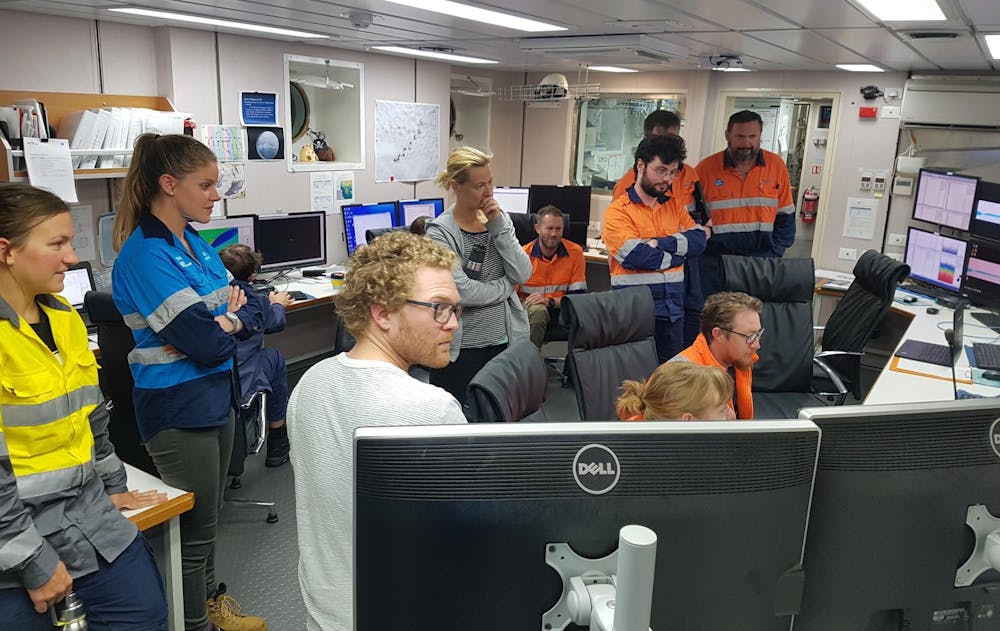
The science team watches the survey from the operations room of the CSIRO research vessel (RV) Investigator. CSIRO, Author provided

The receiver transmits the data to the operations room for real-time processing. These data provide topographic information and register features within the water column and on the seabed.

At 8pm on April 16, we arrived on site and within a couple of hours noted a feature in the multibeam data that looked suspiciously like a shipwreck. It measured 100m in length with an approximate beam of 16-22m and profile of 8m sitting at a water depth of 650m.

Given that we were close to maxing out what the multibeam could do, it provided an excellent opportunity to put the drop camera in the water and get “eyes on”.

Down goes the camera.

The camera collected footage of the stern, midship and bow sections of the wreck. These were compared to archival photos. Given the location, dimension and noted features, we identified it as SS Iron Crown.

The merchant steamer

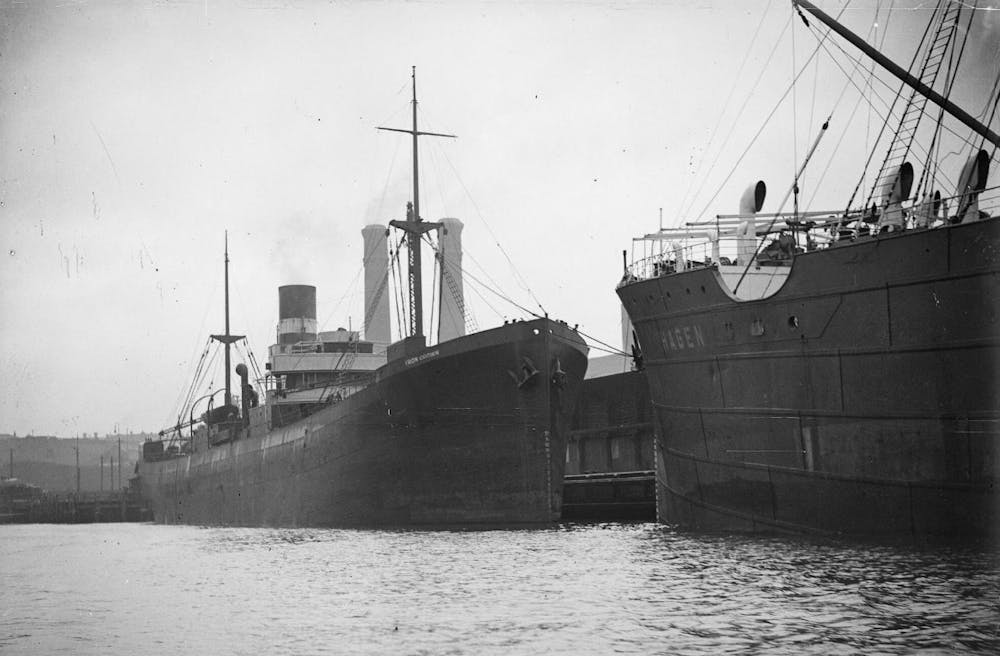
SS Iron Crown was an Australian merchant vessel built at the government dockyard at Williamstown, Victoria, in 1922.

SS Iron Crown afloat. South Australian Maritime Museum, Author provided

On June 4 1942, the steel screw steamer of the merchant vavy was transporting manganese ore and iron ore from Whyalla to Newcastle when it was torpedoed by the Japanese Imperial Type B (巡潜乙型) submarine I-27.

Survivor accounts state that the torpedo struck the vessel on the port side, aft of the bridge. It sank within minutes. Thirty-eight of the 43 crew went down with the ship.

This vessel is one of four WWII losses in Victorian waters (the others were HMAS Goorangai lost in a collision, SS Cambridge and MV City of Rayville lost to mines) and the only vessel torpedoed.

After the discovery

Now we’ve finally located the wreck – seven decades after it was sunk – it is what happens next that is truly interesting.

A bathymetric map showing SS Iron Crown on the sea floor with its bow on the right. CSIRO, Author provided

It’s not just the opportunity to finally do an in-depth review of the collected footage stored on an external hard drive and shoved in my backpack, but to take the important step of ensuring how the story is told going forward.

When a shipwreck is located, the finder must report it within seven days to the Commonwealth’s Historic Shipwreck Program or to the recognised delegate in each state/territory with location information and as much other relevant data as possible.

Shipwrecks aren’t just found by professionals, but are often located by knowledgeable divers, surveyors, the military, transport ships and beachcombers. It’s no big surprise that many shipwrecks are well-known community fishing spots.

While it is possible to access the site using remotely operated vehicles or submersibles, we hope the data retrieved from this voyage will be enough.

It was only 77 years ago that the SS Iron Crown went down. This means it still has a presence in the memories of the communities and families that were touched by the event and its aftermath.

No war grave, but protected

Even though those who died were merchant navy, the site isn’t officially recognised yet as a war grave. But thanks to both state and Commonwealth legislation, the SS Iron Crown was protected before it was even located.

All shipwrecks over 75 years of age are protected under the Commonwealth Historic Shipwrecks Act 1976. It is an offence to damage or remove anything from the site.

A drop camera view of the bow of SS Iron Crown with anchor chains. CSIRO, Author provided

This protection is enhanced by its location in deeper water and, one hopes, by the circumstances of its loss.

Sitting on the sea floor in Bass Strait, SS Iron Crown is well below the reach of even technical divers. So the site is unlikely to be illegally salvaged for artefacts and treasures.

Yet this also means that maritime archaeologists have limited access to the site and the data that can be learnt from an untouched, well-preserved shipwreck.

Virtual wreck sites

But, like the increasing capabilities for locating such sites, maritime archaeologists now have access to digital mapping, 3D modelling technologies and high-resolution imagery as was used for the British Merchant Navy shipwreck of the SS Thistlegorm.

You can move within the video.

These can even allow us to record shipwreck sites (at whatever the depth) and present them to the public in a vibrant and engaging medium.


Read more: VR technology gives new meaning to ‘holidaying at home’. But is it really a substitute for travel?


Better than a thousand words could ever describe, these realistic models allow us to convey the excitement, wonder and awe that we have all felt at a shipwreck. Digital 3D models enable those who cannot dive, travel or ever dream of visiting shipwrecks to do so through their laptops, mobiles and other digital devices.

Without these capabilities to record, visualise and manage these deepwater sites, they will literally fade back into the depths of the ocean, leaving only the archaeologists and a few shipwreck enthusiasts to investigate and appreciate them.

So that’s the next step, a bigger challenge than finding a site, to record a deepwater shipwreck and enable the public to experience a well-preserved shipwreck.

SS Iron Crown alongside SS Hagen. National Library of Australia, Author provided

ref. What happens now we’ve found the site of the lost Australian freighter SS Iron Crown, sunk in WWII – http://theconversation.com/what-happens-now-weve-found-the-site-of-the-lost-australian-freighter-ss-iron-crown-sunk-in-wwii-115848

Telling the forgotten stories of Indigenous servicemen in the first world war

]]>

Source: The Conversation (Au and NZ) – By Jim McKay, Honorary Senior Research Fellow, The University of Queensland

Warning: This story contains images of Aboriginal and Torres Straight Islander people who are deceased.


The number of Aboriginal and Torres Strait Islanders who served with Australian forces in the first world war is estimated to be in the range of 1,000-1,200. But the precise figure will never be known, because a number of those who served changed their names and birthplaces when they enrolled to get around racist enlistment practices.

Despite fighting and dying for Australia, Aboriginal and Torres Strait Islanders still weren’t considered citizens upon their return from the war. Many of these veterans were also denied repatriation benefits, and excluded from returned services clubs.

Aboriginal and Torres Strait Islanders have long sought to gain recognition for the service and sacrifices of their men and women. Some do this by telling stories in their families and local communities about the military careers of their forebears.

These stories often take the form of oral histories. Oral history projects by groups of Aboriginal people have proven valuable for redressing the unrecognised service and racist treatment of their ancestors who served in the Australian Light Horse during the Sinai-Palestine Campaign of 1916-18.


Read more: On Anzac Day, we remember the Great War but forget our first war


Commemorating the Battle of Beersheba

Although most Australians know little or nothing about the Battle of Beersheba, the Australian government funded its centennial commemoration at Beersheba (now in southern Israel) in October 2017.

One hundred Australian and a few New Zealand military history reenactors attended the joint service as part of a commercial tour, during which they rode in period military outfits along the route of their ancestors.

A group of Aboriginal men and women, who were descended from some of the estimated 100 Aboriginal members of the Australian Light Horse, also participated in the tour. Several had ancestors who were in the “Queensland Black Watch”, a predominantly Aboriginal reinforcement unit.

The group’s participation was enabled by a transnational network of organisations, but the key driver was Rona Tranby Trust, which funds projects to record and preserve Aboriginal oral histories. In 2017, it a group of Aboriginal men and women to complete 11 histories of their ancestors who fought and died in the Sinai-Palestine Campaign.

Like the other reenactors, Aboriginal participants were honouring their ancestors’ courage and sacrifice. But they also wanted to document the neglected stories of their service, and the racial discrimination their forebears experienced.

Here we share, with permission, some of the stories that came from the trip, and from the family history projects the group members continue to work on.

Ricky Morris

Gunditjmara man and retired Army Sergeant Ricky Morris was officially invited to lay a wreath on behalf of all Indigenous veterans at the service in Beersheba. Morris is the 19th of an astonishing 21 men and women Anzacs in his family. He served in a progeny of the Light Horse unit of his grandfather, Frederick Amos Lovett.

Frederick Amos Lovett of the 4th Light Horse Regimen and his grandson Ricky Morris. Rona Tranby Trust

At a time when Aboriginal and Torres Strait Islanders were neither citizens nor counted in the census, Frederick and his four brothers left the Lake Condah Aboriginal Mission, 300 km west of Melbourne, to sign up.

But their service counted for nothing. Gunditjmara people were subjected to a “second dispossession” when they were forced off Lake Condah under the Soldier Settlement Scheme. The scheme granted land to returning soldiers, but like almost all Aboriginal applicants, the brothers were denied soldier settlement blocks.

Morris is a member of the Victorian Indigenous Veterans Association Remembrance Committee and gives talks at schools about Aboriginal culture and his family. He interviewed two elderly aunts for his family history project, which he described as:

…a unique opportunity to follow in the footsteps of those who fought and died for Australia, and the diversity of Australians who put their hands up to answer the call.


Read more: In remembering Anzac Day, what do we forget?


Mischa Fisher and Elsie Amamoo

Mischa Fisher and her daughter, Elsie Amamoo, undertook the tour to obtain information for a website about Mischa’s grandfather, Frank Fisher.

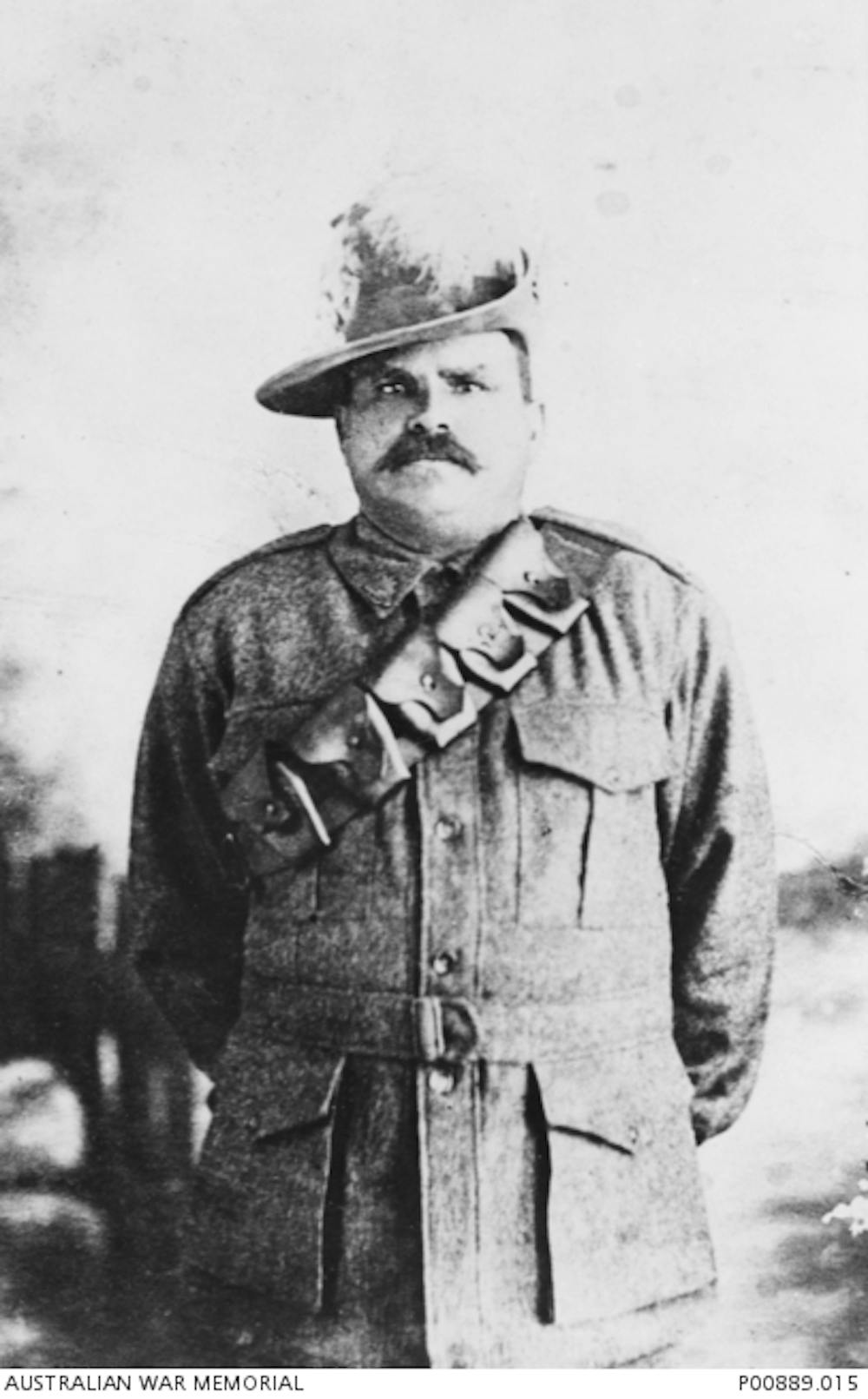
Trooper Frank Fisher was an Aboriginal serviceman who enlisted in Brisbane on 16 August 1917. Australian War Memorial

Frank was born into the Wangan and Jagalingou community in the goldmining town of Clermont, 1,000 km north of Brisbane. He was one of 47 men from Barambah Aboriginal Settlement who enlisted in the first world war. While Frank was away, his wife Esme was prevented from accessing his salary. After Frank was discharged, he was again placed under the control of the superintendent at Barambah.

Mischa and Elsie have interviewed Frank’s descendants, and accessed archival footage from the Ration Shed Museum – an Aboriginal heritage, educational and cultural centre. Elsie only recently learned that Frank, who is also the great-grandfather of Olympic 400m champion Cathy Freeman, was a member of the “Black Watch”.

While training for a reenactment of the Light Horse charge at Beersheba, she tearfully told a reporter what the project meant to her:

To me, it feels like I have got a missing piece of the puzzle of who I am […] That’s what it basically means to me: just being able to have that ability to close the gap in terms of my identity and knowing who I am and where I fit in the Australian history, but also within my family as well.

Michelle and Peta Flynn

Peta Flynn, great niece of Charles Fitzroy Stafford. Rona Tranby Trust

Sisters Michelle and Peta Flynn are descendants of “Black Kitty”, a Cannemegal/Warmuli girl, who, in 1814, was among the first group of Aboriginal children placed in the Parramatta Native Institution at the age of five.

The sisters have been researching their family history for over 20 years. Their ancestors include the three Stafford brothers, who were in the Light Horse.

At Beersheba, Peta explained her motivation for writing a book about her great uncle, Charles Stafford:

My daughter, niece and nephews will be able to take [the book] into their schools and communities and actually be proud of who we are and where we come from – and ensure our family’s history will not be lost to future generations.


Read more: Indigenous soldiers remembered: the research behind Black Diggers


Lessons and legacies

The experiences of Ricky Morris, Mischa Fisher, Elsie Amamoo, and Michelle and Peta Flynn show how exploring family histories can generate feelings of solidarity, honour and closure.

Although group members were on a reenactment tour, their emotions were typical of the inward pilgrimages often experienced by genealogical tourists. Past and present family connections were heightened by being there; feelings of sadness, solidarity and pride arose.

At the same time, these stories show the benefits of combining academic, public and vernacular accounts to study silences and absences in the histories of Aboriginal and Torres Strait Islander peoples.

The official commemoration at Beersheba will only ever be studied by a handful of specialist scholars, but the family histories of this group will have enduring value for Aboriginal and non-Aboriginal Australians alike.

ref. Telling the forgotten stories of Indigenous servicemen in the first world war – http://theconversation.com/telling-the-forgotten-stories-of-indigenous-servicemen-in-the-first-world-war-114277

Auckland Sri Lankan community holds vigil for terror bomb victims, survivors

]]>
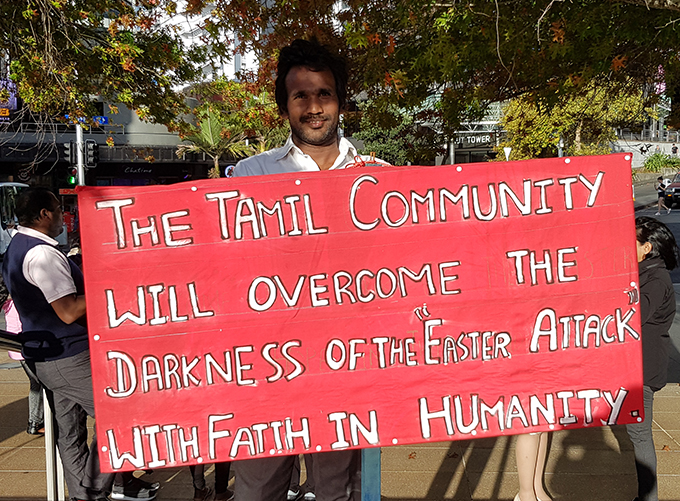
Surya holds a Tamil community placard proclaiming “we will overcome the darkness” in today’s Auckland vigil for the victims on Sri Lanka’s Easter bomb attacks. Image: David Robie/PMC

Pacific Media Centre Newsdesk

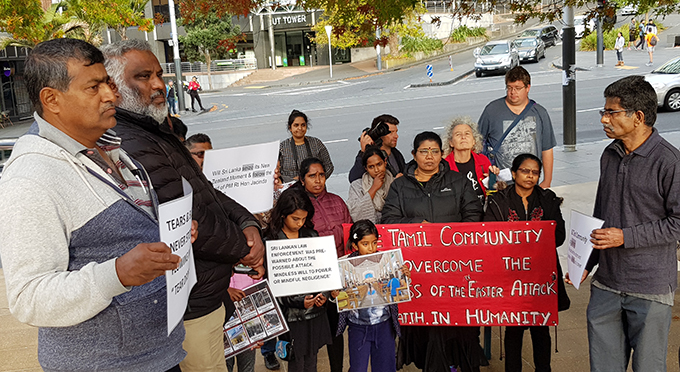
About 60 people from the Sri Lankan community and human rights advocates gathered in Auckland’s Aotea Square today in a solidarity vigil for the survivors of the Easter Sunday bombings.

More than 320 people were killed in the Sri Lankan atrocities.

Today’s vigil was organised by the Federation of Tamil Associations in NZ (FTANZ).

Meanwhile, the New Zealand and Sir Lankan governments are treating with caution reports that the suicide bombings of three Christian churches and three tourist hotels in three cities across Sri Lanka were carried out by Islamic State (ISIS) in retaliation for the Christchurch mosques terror attacks on March 15.

The terrorist group’s Amaq news agency says ISIS has claimed responsibility for the Easter bombings.

It is the deadliest overseas operation claimed by ISIS since it proclaimed its “caliphate” almost five years ago, and would suggest it retains the ability to launch devastating strikes around the world despite multiple defeats in the Middle East, reports The Guardian.

Auckland Sri Lankans and human rights advocates at the vigil in Aotea Square today. Image: David Robie/PMC Federation of Tamil Associations of New Zealand (FTANZ) coordinator Dr Siva Vasanthan at the Auckland vigil today. Image: David Robie/PMC RNZ Checkpoint’s Alex Perrottet interviewing FTANZ president George Arulanantham at the Auckland vigil today. Image: David Robie/PMC



Print Friendly, PDF & Email

Article by AsiaPacificReport.nz

‘Fake news’ is already spreading online in the election campaign – it’s up to Australians to stop it

]]>

Source: The Conversation (Au and NZ) – By Michael Jensen, Senior Research Fellow, Institute for Governance and Policy Analysis, University of Canberra

We’re only days into the federal election campaign and already the first instances of “fake news” have surfaced online.

Over the weekend, Labor demanded that Facebook remove posts it says are “fake news” about the party’s plans to introduce a “death tax” on inheritances. Labor also called on the Coalition to publicly disavow the misinformation campaign.

An inauthentic tweet purportedly sent from the account of Australian Council of Trade Unions secretary Sally McManus also made the rounds, claiming that she, too, supported a “death tax”. It was retweeted many times – including by Sky News commentator and former Liberal MP Gary Hardgrave – before McManus put out a statement saying the tweet had been fabricated.

What the government and tech companies are doing

In the wake of the cyber-attacks on the 2016 US presidential election, the Australian government began taking seriously the threat that “fake news” and online misinformation campaigns could be used to try to disrupt our elections.

Last year, a taskforce was set up to try to protect the upcoming federal election from foreign interference, bringing together teams from Home Affairs, the Department of Finance, the Australian Electoral Commission (AEC), the Australian Federal Police (AFP) and the Australian Security Intelligence Organisation (ASIO).

The AEC also created a framework with Twitter and Facebook to remove content deemed to be in violation of Australian election laws. It also launched an aggressive campaign to encourage voters to “stop and consider” the sources of information they consume online.


Read more: We’ve been hacked – so will the data be weaponised to influence election 2019? Here’s what to look for


For their part, Facebook and Twitter rolled out new features aimed specifically at safeguarding the Australian election. Facebook announced it would ban foreign advertising in the run-up to the election and launch a fact-checking partnership to vet the accuracy of information being spread on the platform. However, Facebook will not be implementing requirements that users wishing to post ads verify their locations until after the election.

Twitter also implemented new rules requiring that all political ads be labelled to show who sponsored them and those sending the tweets to prove they are located in Australia.

While these moves are all a good start, they are unlikely to be successful in stemming the flow of manipulative content as election day grows closer.

Holes in the system

First, a foreign entity intent on manipulating the election can get around address verification rules by partnering with domestic actors to promote paid advertising on Facebook and Twitter. Furthermore, Russia’s intervention in the US election showed that “troll” or “sockpuppet” accounts, as well as botnets, can easily spread fake news content and hyperlinks in the absence of a paid promotion strategy.

Facebook has also implemented measures that actually reduce transparency in its advertising. To examine how political advertising works on the platform, ProPublica built a browser plugin last year to collect Facebook ads and show which demographic groups they were targeting. Facebook responded by blocking the plugin. The platform’s own ad library, while expansive, also does not include any of the targeting data that ProPublica had made public.


Read more: Russian trolls targeted Australian voters on Twitter via #auspol and #MH17


A second limitation faced by the AEC, social media companies, and government agencies is timing. The framework set up last year by the AEC to address content in possible violation of electoral rules has proven too slow to be effective. First, the AEC needs to be alerted to questionable content. Then, it will try to contact whoever posted it, and if it can’t, the matter is escalated to Facebook. This means that days can pass before the material is addressed.

Last year, for instance, when the AEC contacted Facebook about sponsored posts attacking left-wing parties from a group called Hands Off Our Democracy, it took Facebook more than a month to respond. By then, the group’s Facebook page had disappeared.


FOI request by ABC News, Author provided Portions of AEC letter to Facebook legal team for Australia and New Zealand detailing steps for addressing questionable content, sent 30 August 2018. FOI request by ABC News, Author provided


The length of time required to take down illegal content is critical because research on campaigning shows that the window of opportunity to shift a political discussion on social media is often quite narrow. For this reason, an illegal ad likely will have achieved its purpose by the time it is flagged and measures are taken to remove it.

Indeed, from 2015 to 2017, Russia’s Internet Research Agency, identified by US authorities as the main “troll farm” behind Russia’s foreign political interference, ran over 3,500 ads on Facebook with a median duration of just one day.

Even if content is flagged to the tech companies and accounts are blocked, this measure itself is unlikely to deter a serious misinformation campaign.

The Russian Internet Research Agency spent millions of dollars and conducted research over a period of years to inform their strategies. With this kind of investment, a determined actor will have gamed out changes to platforms, anticipated legal actions by governments and adapted its strategies accordingly.

What constitutes ‘fake news’ in the first place?

Finally, there is the problem of what counts as “fake news” and what counts as legitimate political discussion. The AEC and other government agencies are not well positioned to police truth in politics. There are two aspects to this problem.

The first is the majority of manipulative content directed at democratic societies is not obviously or demonstrably false. In fact, a recent study of Russian propaganda efforts in the United States found the majority of this content “is not, strictly speaking, ‘fake news’.”

Instead, it is a mixture of half-truths and selected truths, often filtered through a deeply cynical and conspiratorial worldview.

There’s a different issue with the Chinese platform WeChat, where there is a systematic distortion of news shared on public or “official accounts”. Research shows these accounts are often subject to considerable censorshipincluding self-censorship – so they do not infringe on the Chinese government’s official narrative. If they do, the accounts risk suspension or their posts can be deleted.. Evidence shows that official WeChat accounts in Australia often change their content and tone in response to changes in Beijing’s media regulations.


Read more: Who do Chinese-Australian voters trust for their political news on WeChat?


For this reason, suggestions that platforms like WeChat be considered “an authentic, integral part of a genuinely multicultural, multilingual mainstream media landscape” are dangerously misguided, as official accounts play a role in promoting Beijing’s strategic interests rather than providing factual information.

The public’s role in stamping out the problem

If the AEC is not in a position to police truth online and combat manipulative speech, who is?

Research suggests that in a democracy, the political elites play a strong role in shaping opinions and amplifying the effects of foreign influence misinformation campaigns.

For example, when Republican John McCain was running for the US presidency against Barack Obama in 2008, he faced a question at a rally about whether Obama was “an Arab” – a lie that had been spread repeatedly online. Instead of breathing more life into the story, McCain provided a swift rebuttal.

After the Labor “death tax” Facebook posts appeared here last week, some politicians and right-wing groups shared the post on their own accounts. (It should be noted, however, that Hardgrave apologised for retweeting the fake tweet by McManus.)

Beyond that, the responsibility for combating manipulative speech during elections falls to all citizens. It’s absolutely critical in today’s world of global digital networks for the public to recognise they “are combatants in cyberspace”.

The only sure defence against manipulative campaigns – whether from foreign or domestic sources – is for citizens to take seriously their responsibilities to critically reflect on the information they receive and separate fact from fiction and manipulation.

ref. ‘Fake news’ is already spreading online in the election campaign – it’s up to Australians to stop it – http://theconversation.com/fake-news-is-already-spreading-online-in-the-election-campaign-its-up-to-australians-to-stop-it-115455

‘Fake news’ is already spreading online in the election campaign. What can we do to stop it?

]]>

Source: The Conversation (Au and NZ) – By Michael Jensen, Senior Research Fellow, Institute for Governance and Policy Analysis, University of Canberra

We’re only days into the federal election campaign and already the first instances of “fake news” have surfaced online.

Over the weekend, Labor demanded that Facebook remove posts it says are “fake news” about the party’s plans to introduce a “death tax” on inheritances. Labor also called on the Coalition to publicly disavow the misinformation campaign.

An inauthentic tweet purportedly sent from the account of Australian Council of Trade Unions secretary Sally McManus also made the rounds, claiming that she, too, supported a “death tax”. It was retweeted many times – including by Sky News commentator and former Liberal MP Gary Hardgrave – before McManus put out a statement saying the tweet had been fabricated.

What the government and tech companies are doing

In the wake of the cyber-attacks on the 2016 US presidential election, the Australian government began taking seriously the threat that “fake news” and online misinformation campaigns could be used to try to disrupt our elections.

Last year, a taskforce was set up to try to protect the upcoming federal election from foreign interference, bringing together teams from Home Affairs, the Department of Finance, the Australian Electoral Commission (AEC), the Australian Federal Police (AFP) and the Australian Security Intelligence Organisation (ASIO).

The AEC also created a framework with Twitter and Facebook to remove content deemed to be in violation of Australian election laws. It also launched an aggressive campaign to encourage voters to “stop and consider” the sources of information they consume online.


Read more: We’ve been hacked – so will the data be weaponised to influence election 2019? Here’s what to look for


For their part, Facebook and Twitter rolled out new features aimed specifically at safeguarding the Australian election. Facebook announced it would ban foreign advertising in the run-up to the election and launch a fact-checking partnership to vet the accuracy of information being spread on the platform. However, Facebook will not be implementing requirements that users wishing to post ads verify their locations until after the election.

Twitter also implemented new rules requiring that all political ads be labelled to show who sponsored them and those sending the tweets to prove they are located in Australia.

While these moves are all a good start, they are unlikely to be successful in stemming the flow of manipulative content as election day grows closer.

Holes in the system

First, a foreign entity intent on manipulating the election can get around address verification rules by partnering with domestic actors to promote paid advertising on Facebook and Twitter. Furthermore, Russia’s intervention in the US election showed that “troll” or “sockpuppet” accounts, as well as botnets, can easily spread fake news content and hyperlinks in the absence of a paid promotion strategy.

Facebook has also implemented measures that actually reduce transparency in its advertising. To examine how political advertising works on the platform, ProPublica built a browser plugin last year to collect Facebook ads and show which demographic groups they were targeting. Facebook responded by blocking the plugin. The platform’s own ad library, while expansive, also does not include any of the targeting data that ProPublica had made public.


Read more: Russian trolls targeted Australian voters on Twitter via #auspol and #MH17


A second limitation faced by the AEC, social media companies, and government agencies is timing. The framework set up last year by the AEC to address content in possible violation of electoral rules has proven too slow to be effective. First, the AEC needs to be alerted to questionable content. Then, it will try to contact whoever posted it, and if it can’t, the matter is escalated to Facebook. This means that days can pass before the material is addressed.

Last year, for instance, when the AEC contacted Facebook about sponsored posts attacking left-wing parties from a group called Hands Off Our Democracy, it took Facebook more than a month to respond. By then, the group’s Facebook page had disappeared.


FOI request by ABC News, Author provided Portions of AEC letter to Facebook legal team for Australia and New Zealand detailing steps for addressing questionable content, sent 30 August 2018. FOI request by ABC News, Author provided


The length of time required to take down illegal content is critical because research on campaigning shows that the window of opportunity to shift a political discussion on social media is often quite narrow. For this reason, an illegal ad likely will have achieved its purpose by the time it is flagged and measures are taken to remove it.

Indeed, from 2015 to 2017, Russia’s Internet Research Agency, identified by US authorities as the main “troll farm” behind Russia’s foreign political interference, ran over 3,500 ads on Facebook with a median duration of just one day.

Even if content is flagged to the tech companies and accounts are blocked, this measure itself is unlikely to deter a serious misinformation campaign.

The Russian Internet Research Agency spent millions of dollars and conducted research over a period of years to inform their strategies. With this kind of investment, a determined actor will have gamed out changes to platforms, anticipated legal actions by governments and adapted its strategies accordingly.

What constitutes ‘fake news’ in the first place?

Finally, there is the problem of what counts as “fake news” and what counts as legitimate political discussion. The AEC and other government agencies are not well positioned to police truth in politics. There are two aspects to this problem.

The first is the majority of manipulative content directed at democratic societies is not obviously or demonstrably false. In fact, a recent study of Russian propaganda efforts in the United States found the majority of this content “is not, strictly speaking, ‘fake news’.”

Instead, it is a mixture of half-truths and selected truths, often filtered through a deeply cynical and conspiratorial worldview.

There’s a different issue with the Chinese platform WeChat, where there is a systematic distortion of news shared on public or “official accounts”. Research shows these accounts are often subject to considerable censorshipincluding self-censorship – so they do not infringe on the Chinese government’s official narrative. If they do, the accounts risk suspension or their posts can be deleted.. Evidence shows that official WeChat accounts in Australia often change their content and tone in response to changes in Beijing’s media regulations.


Read more: Who do Chinese-Australian voters trust for their political news on WeChat?


For this reason, suggestions that platforms like WeChat be considered “an authentic, integral part of a genuinely multicultural, multilingual mainstream media landscape” are dangerously misguided, as official accounts play a role in promoting Beijing’s strategic interests rather than providing factual information.

The public’s role in stamping out the problem

If the AEC is not in a position to police truth online and combat manipulative speech, who is?

Research suggests that in a democracy, the political elites play a strong role in shaping opinions and amplifying the effects of foreign influence misinformation campaigns.

For example, when Republican John McCain was running for the US presidency against Barack Obama in 2008, he faced a question at a rally about whether Obama was “an Arab” – a lie that had been spread repeatedly online. Instead of breathing more life into the story, McCain provided a swift rebuttal.

After the Labor “death tax” Facebook posts appeared here last week, some politicians and right-wing groups shared the post on their own accounts. (It should be noted, however, that Hardgrave apologised for retweeting the fake tweet by McManus.)

Beyond that, the responsibility for combating manipulative speech during elections falls to all citizens. It’s absolutely critical in today’s world of global digital networks for the public to recognise they “are combatants in cyberspace”.

The only sure defence against manipulative campaigns – whether from foreign or domestic sources – is for citizens to take seriously their responsibilities to critically reflect on the information they receive and separate fact from fiction and manipulation.

ref. ‘Fake news’ is already spreading online in the election campaign. What can we do to stop it? – http://theconversation.com/fake-news-is-already-spreading-online-in-the-election-campaign-what-can-we-do-to-stop-it-115455

Ditch plastic dog poo bags, go compostable

]]>

Source: The Conversation (Au and NZ) – By M. Leigh Ackland, Professor in Molecular Biosciences, Deakin University

We humans have a habit of avoiding our waste. We find organic waste particularly unpleasant. We bag it and dispose of it as soon as possible.

Even the most environmentally conscious person would rather not handle something like decomposing food or dog poo with their bare hands. Plastic bags are often the first step we take to disconnect ourselves from our waste – until we can get rid of it somewhere else.

Traditional plastic bags are made from ethylene, derived from petroleum or natural gas. Ethylene does not degrade easily. So these types of bags are major contributors to plastic pollution.

More than three-quarters of plastic ends up in landfill, while up to 5% finds its way to the ocean. Only 9% of plastics are recycled.


Read more: Is your dog happy? Ten common misconceptions about dog behaviour


Many environmentally conscious pet owners are turning to biodegradable bags as the solution to their doggy-doo woes, but many brands won’t break down in landfill, compounding the problem. Alternatives are at hand, though, with compostable bags and community sharing programs that can help non-composters.

A ‘biodegradable’ statement on a bag isn’t enough: it needs a logo

“Biodegradable” means something that can potentially be broken down naturally in the environment, particularly by microorganisms but also by other factors such as heat, light and oxygen. We usually think of biodegradable materials as derived from natural sources such as plants, but synthetic materials can also be biodegradable.

But there are issues with the term “biodegradable bag”. Bags can be labelled biodegradable, but after being used and discarded they might only partly decompose because the conditions are not right for full decomposition. Or else the decomposition might take a long time.

Full decomposition means complete conversion of the bag into simple substances such as carbon dioxide and water that can be re-used by microorganisms like bacteria and fungi.

Food becomes poop, which becomes…? Carol Von Canon/Flickr, CC BY-NC-SA

The biodegradability of plastic can be measured in a laboratory using methods such as carbon tracking. There are international standards for testing biodegradability of plastics. The International Organization for Standardization (ISO) has developed these standards.

Unfortunately, ocean and landfill environments are not conducive for degradation of biodegradable plastic. Marine environments often don’t contain the right types of microorganisms needed to break down plastics, or there aren’t enough to be effective in a reasonable time frame. Landfill conditions often lack oxygen, which limits the types of microorganisms that can exist there.

Compost, however, provides an ideal environment for biodegradation. Compost contains a diverse range of organic materials that support the growth of many different varieties of organisms.

DNA sequencing has revealed the huge diversity of microorganisms that exist in compost. These include bacteria, fungi and invertebrates that can digest a wide range of organic materials. In particular, fungi are found to possess enzymes that are capable of breaking down many different organic substances.

Compost to the rescue

You can now buy compostable bags. These are a type of biodegradable bag that is suitable for disposal in compost only (not in the ocean or landfill!).

How can you tell if a compostable bag can actually be fully broken down in compost? Standards Australia produces standards for the biodegradability of plastic bags. Code AS 4736-2006 specifies a biodegradable plastic that is suitable for overall composting (which includes industrial processes) and other microbial treatment, while AS 5810-2010 specifies home composting.

Standards Australia provide a brief overview of the testing carried out for AS 5810-2010. Other countries have similar standards – for example, the US has ASTM code D6400, which certifies that the material meets the degradation standard under controlled composting conditions.

The Australian Bioplastics Association administers a voluntary verification scheme. This enables manufacturers or importers to have their plastic materials tested and certified.

There is a double arrow logo you can watch out for on bags that have been certified as home compostable and there is a seedling logo for certified compostable. If you cannot locate a certified compostable bag in your area, you can source them online. Make sure they have have the certified compostable logo of the country from which they come.

It is interesting to observe the biodegradability of a plastic bag in your compost heap, as I did with a compostable bag full of dog poo. After two weeks buried in the compost, the only evidence of the bag was some small black fragments. These looked like leaf mould except they had the print from the bag label on them. In comparison, a normal plastic bag buried at the same time was completely unaltered. Of course, this experiment is not proof of total bag degradation – proper laboratory testing would be required for this.


Read more: Are you walking your dog enough?


What if you can’t compost?

If you cannot compost, you will probably be relying on your local council to dispose of your waste. If the council uses landfill for waste disposal then there may be no point in using compostable bags for your waste, as landfill does not have the right conditions for composting to occur.

If you have a kerbside green waste collection that is composted, this service most likely will not accept food waste at the moment – which means dog poo is very unlikely to be included. Nor may compostable bags be allowed in green waste collections. Some councils, however, are working towards food organics/green organics waste collections for the future, and these may include compostable bags.

Moyne Shire in western Victoria, for instance, provides compostable bags for dog poo and accepts it along with green waste in its fortnightly “FOGO” collection.

If you have material for composting but do not have a compost heap, you can join Sharewaste. Sharewaste links people who want to recycle their organic waste with their neighbours who can use the waste for composting, worm farms or chickens. So this is a way to avoid sending your organic waste to landfill.

Composting your organic waste is like harvesting rain into your water tank or tapping into sunlight for your energy needs. These things are meaningful beyond their utility; they connect you to nature and give insights into the natural cycles of life on planet Earth.

ref. Ditch plastic dog poo bags, go compostable – http://theconversation.com/ditch-plastic-dog-poo-bags-go-compostable-112605

Sylvester Gawi: Deplorable neglect of PNG’s ‘voice of the nation’

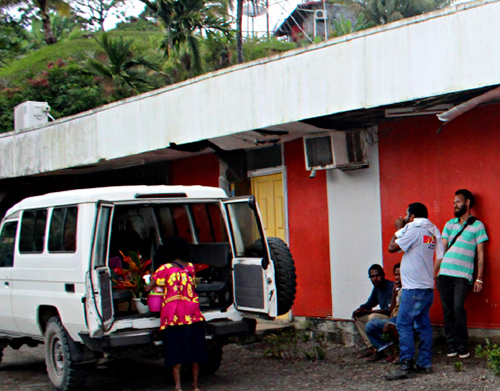
Radio Morobe … “The Morobe provincial government has neglected its upgrading and funding in the last 10 years or more”. Image: Post-Courier

COMMENTARY: By Sylvester Gawi in Lae

I grew up in the 1990s listening to NBC Radio – Radio Kundu – which was informative and always reaching out to the mass population of Papua New Guinea who can afford a transmitter radio.

From entertaining stringband tunes, toksave segments and nationwide news coverage to the ever popular school broadcasts in classrooms, NBC (National Broadcasting Corporation) has been the real voice of the nation.

It contributed immensely to the nation’s independence, growth and development and stood steadfastly to promote good governance and transparency in development issues the country faces.

READ MORE: NBC-PNG rebranding – but nothing to show in the provinces

For more than 40 years it has been the most effective communication medium for most ordinary citizens who benefited from its nationwide coverage.

I was a young kid back then and grew up inspired to take up a job in radio broadcasting, particularly with NBC.

-Partners-

Radio Morobe was the ultimate choice for listeners all over the province. It broadcast in medium, shortwave and FM frequencies and reached even the rural and isolated regions in Morobe and neigbouring provinces.

The Radio Morobe studio building was constructed and opened in October 1971 and since then its pioneer broadcasters have all aged with time into the 21st century.

Building condemned
The Morobe provincial government has neglected its upgrading and funding in the last 10 years or more and since then the building has crumbled and was condemned in October 2018.

Radio Morobe … condemned building. Image: Post-Courier

I joined NBC in 2015 and worked among a new crop of officers and a few oldies up till now.

These are some of the notable areas the MPG has failed to assist NBC Morobe, despite provincial governments being given the task to upkeep NBC radio services to be operational.

  • little or no funding annually for the station operations;
  • a tranmission tower built for NBC Morobe being taken back and managed by MPA. It is making millions for the MPA with nothing from its revenue given to NBC Morobe;
  • general maintenance and or replacement of studio utilities;
  • NBC reception towers not functioning, thus transmission is NOT reaching the wider population in rural remote areas;
  • district authorities NOT realising the power of communication to their people and funding its reach in their electorates;
  • politicians and aspiring politicians making empty promises and using the radio to promote their agendas and gone into hiding when elected;
  • now the radio station structure has been condemned by authorities as unsafe NBC Morobe is no longer broadcasting; and
  • last but not the least, NBC Morobe management and staff are now being locked out of their temporary studio over non-payment of bills. The landlord is the MPG through its business arm Morobe Sustainable Development Ltd.

It has been almost 6 months since the NBC Morobe building was condemned by PNG Power as unsafe. Nothing concrete has been done to rebuilt it despite political promises.

NBC Morobe has been off-air for about 3 months now and staff are still on payroll without being physically at work. The same problem is being faced by majority of NBC radio stations nationwide.

Denied freedom
Our people have been denied their freedom to be informed on their government’s performance. Health, Education and disaster awarenesses are not reaching the people.

Land and resource owners are being denied their freedom of expression. The people can no longer send toksaves to their loved ones, but are forced to pay for and use expensive yet poor telecommunication methods to send messages.

The high cost of risky sea travel and road trips on deteriorating roads have cost so many lives, yet our government keeps promising the people that they will fix NBC services.

NBC radio services in Morobe have been going on and off. One cannot pick up its signal out of Lae City.

Multi-million kina resource extracting projects are sprouting all over Morobe and yet our people are NOT informed on the positive and negative impacts to their land, sea and rivers.

I hope our new Communication Minister Koni Iguan can fix this from the ministerial level. Minister Iguan’s Markham electorate cannot even receive NBC signal and its worse than you think.

Markham valley itself is an important economic hub of this country.

This blog is republished with permission.

Print Friendly, PDF & Email

Article by AsiaPacificReport.nz

Asian and Pacific nations struggling over media self-censorship, says RSF

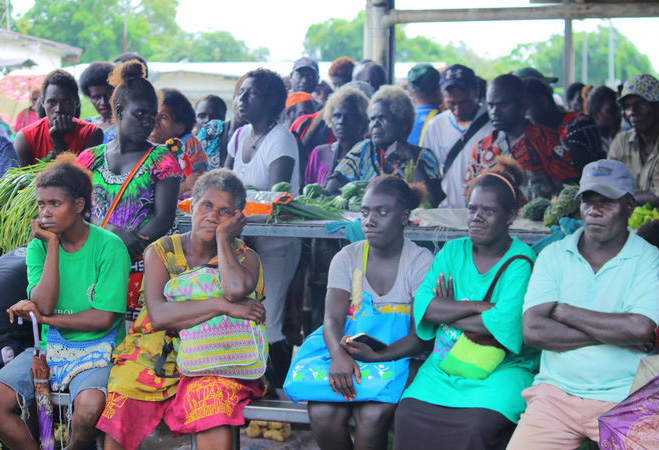
Papua New Guinean media … RSF says journalists faced intimidation, direct threats, censorship, prosecution and bribery attempts. Image: EMTV News

By RNZ Pacific

Democracies across Asia and the Pacific are struggling to resist disinformation and protect press freedoms, according to a new report.

Reporters Without Borders released its 2019 index last Thursday showing an increase in self-censorship of journalists in parts of the Pacific last year.

Although Pacific Island countries generally rose in press freedom rankings, Reporters Without Borders was also concerned about an absence of editorial independence.

READ MORE: Pacific ‘bright spots’ amid World Press Freedom Index Asian warnings

In Papua New Guinea, it said journalists faced intimidation, direct threats, censorship, prosecution and bribery attempts.

“All this was particularly visible during the Asia-Pacific Economic Cooperation summit in the capital, Port Moresby, in November 2018, when journalists who wanted to raise sensitive issues were censored by their bosses and the government was accused of accommodating the Chinese delegation’s demands for certain journalists to be excluded although they had obtained accreditation,” the RSF 2019 index said.

-Partners-

The group said self-censorship was also on the rise in Tonga, where politicians have sued media outlets and keeps tight controls over state media.

“This was particularly so at the state radio and TV broadcaster, the Tonga Broadcasting Commission (TBC), where two senior editors were sidelined under pressure from the government.

Suppressing editorial independence
“In 2018, the government gained full control over the TBC, suppressing all vestiges of editorial independence.”

Elsewhere, Reporters Without Borders said balanced election coverage in Fiji and the acquittal of Fiji Times journalists on sedition charges was an “encouraging victory”.

“The relatively pluralist and balanced coverage of the 2018 parliamentary elections – the second since the 2006 coup d’état – confirmed the Fiji media’s liveliness and spirit of resistance.”

In Samoa, the group said the country was “in the process of losing its status as a regional press freedom model”.

RSF said defamation laws had given Prime Minister Tuilaepa Sailele Malielegaoi a licence to attack critical journalists.

In Solomon Islands, similar defamation laws were criticised by RSF as intimidating journalists and encouraging media self-censorship

“Indonesian diplomatic pressure for an end to any form of support for West Papuan separatism could pose a threat to the public debate.”

It also praised public broadcaster Solomon Islands Broadcasting Corporation (SIBC) as playing a “vital role in keeping the population informed by radio” in a country with low literacy rates.

This article is republished under the Pacific Media Centre’s content partnership with Radio New Zealand.

Print Friendly, PDF & Email

Article by AsiaPacificReport.nz

House prices and demographics make death duties an idea whose time has come

]]>

Source: The Conversation (Au and NZ) – By John Mangan, Professor and Director of the Australian Institute For Business and Economics, The University of Queensland

Suddenly, death duties are part of the election campaign.

Not that Labor (or the Coalition) is proposing them, but photoshopped fake tweets from Labor figures saying they will introduce them have been doing the rounds, and the Coalition is using the suggestion it its advertising, parading around trucks on whose side is printed: “Labor will tax you to death”.

At the risk of entering the political (non) debate, its worth drawing attention to a substantial consensus among economists that they are something we need.

What are death duties?

Death duties (more formally known as inheritance taxes) are levied on the estates of dead people above a predefined tax-free threshold, prior to their distribution to the beneficiaries.

They have a long pedigree, being currently administered in 19 developed countries. The average rate among members of the Organisation of Economic Co-operation and Development is 15% but rates vary from 4% in Italy to 55% in Japan.

We had them in Australia until the late 1970’s, administered by both the Commonwealth and state governments. However in both cases the taxes were distinguished by the ease with which they could be avoided.

Without them, our rich will get richer

Since death duties went, Australian income inequality has climbed, with the standard measure (known as the Gini coefficient) climbing from 0.27 to 0.32 between 1982 and 2016 on a scale where a result of zero would mean income was equally shared and a result of 1 would mean one person earned all the income.

It’s harder to tell what’s happening to the distribution of wealth. The figures don’t go back as far, and the global financial crisis disrupted what appears to have been a long term trend for the distribution to become less equal. The Gini coefficient for the distribution of wealth is 0.52, much worse than in is for the distribution of income.

The removal of death duties is far from the only potential reason.

Others include:

  • Demographics. More Australians are older and they are more likely than younger people to own homes whose values have shot up in two waves around the turn of this century and the middle of the 2010s. Almost 90% of the gain in wealth in the past 20 years has been in households headed by someone over 45 years.

  • Income growth. Wage growth has slumped during the past decade, leaving higher housing, sharemarket and other asset prices as the chief form of wealth growth.

Untaxed inheritance is likely to matter more. Over the next 20 years about 13% of Australia’s current population is expected to reach its life expectancy, meaning 3.18 million people are likely to die. Their net worth accounts for 27% to 37% of Australia’s total wealth.


Read more: Why we should put an inheritance tax back into the spotlight


A study by financial planning experts at Griffith University estimates that over the next 20 years Australians over 60 will transfer A$3.5 trillion in wealth, worth about $320,000 on average to each recipient.

Around four fifths of that wealth will go to the top one fifth of recipients, pushing the Gini wealth inequality coefficient considerably higher.

It’s a concern because societies with bigger inequalities have bigger social and economic problems.

They are better than most alternatives

Death duties meet most of the basic conditions for a good tax.

They are fair (in that they treat people in the same situation the same and take more from those who have than those who do not) and they are easy to understand.

Their big advantage over ordinary income tax is that they distort economic activity less: because they are levied on unearned rather than earned income they are unlikely to prod people into earning less.

The Economist magazine puts it this way:

Unlike income taxes, they do not destroy the incentive to work; whereas research suggests that a single person who inherits an amount above $150,000 is four times more likely to leave the labour force than one who inherits less than $25,000. Unlike capital-gains taxes, heavier estate taxes do not seem to dissuade saving or investment. Unlike sales taxes, they are progressive. To the extent that a higher inheritance tax can fund cuts to all other taxes, the system can be more efficient.

They are points made a century earlier by US President Theodore Roosevelt who told Congress

No advantage comes either to the country as a whole or to the individuals inheriting the money by permitting the transmission in their entirety of the enormous fortunes which would be affected by such a tax

Yet they’re not yet popular

Inheritance taxes pit two widely held views against one another.

One is that governments should leave people to dispose of their wealth as they see fit.

The other is that a permanent, hereditary elite makes a society unhealthy (as well as unfair). The sons and daughters of people who built great companies are not necessarily the best people to run them.

Getting them reintroduced isn’t that unlikely.

The 2010 Henry Tax Review supported them. Noting that what it called a “bequests tax” would help Australia navigate its demographic changes, it said

Over the next 20 years, the proportion of all household wealth held by older Australians is projected to increase substantially. Large asset accumulations will be passed on to a relatively small number of recipients.

However it also noted that

There would be a need for anti-avoidance provisions, including a tax on gifts. There would, inevitably, be significant administration and compliance costs. A tax on bequests should not be levied at very high rates. People should not be unduly deterred from saving to leave bequests. A substantial tax-free threshold combined with a low flat rate beyond that point would be an appropriate structure for a bequest tax. Bequests to spouses should be concessionally treated.

The 2015 Treasury tax discussion paper presented to treasurer Joe Hockey also canvassed the idea, although it noted that “such taxes can be difficult to administer effectively”.

More recently, on taking on the job of treasurer under prime minister Malcolm Turnbull, Scott Morrision refused to rule them out amid calls for a tax targeting bequests of more than $2 million.

The best chance of bringing an inheritance tax back would be to link to something socially worthwhile such as housing affordability, education or relief from other taxes. Ordinary bequests beneath a high threshold would be exempted, and the threshold would be indexed (it wasn’t, when Australia last had death duties, meaning that over time they became more intrusive and unpopular). Exemptions could be considered for husbands and wives and perhaps for family farms.

It most likely wouldn’t be a big revenue raiser, but it would make an important point: that wealth is worth taxing (at least on death) in addition to income and spending. Taxing wealth in its own right is no more double taxing than is tax on income and expenditure. And if we can do a bit to redistribute the avalanche of wealth about to hit the best off 20 per cent of beneficiaries, it would be no bad thing for the maintenance of what by international standards is still a relatively equal society.

ref. House prices and demographics make death duties an idea whose time has come – http://theconversation.com/house-prices-and-demographics-make-death-duties-an-idea-whose-time-has-come-114175

Why Pluto is losing its atmosphere: winter is coming

]]>

Source: The Conversation (Au and NZ) – By Andrew A. Cole, Senior Lecturer in Astrophysics, University of Tasmania

The ominous warning – “winter is coming”, popularised by fantasy series Game of Thrones – applies equally well to Pluto.

The dwarf planet’s tenuous atmosphere appears to be on the verge of a stunning collapse due to a change in the seasons and approaching colder conditions, according to research to be published in the journal Astronomy & Astrophysics.

Discovered in 1930, it was only around 1980 that astronomers began to suspect Pluto might have an atmosphere. That atmosphere was tentatively discovered in 1985 and fully confirmed by independent observations in 1988.


Read more: I’ve Always Wondered: How do we know what lies at the heart of Pluto?


At the time, astronomers had no way of knowing what dramatic changes were in store for the little world’s thin envelope of nitrogen, methane and hydrocarbons.

A cosmic coincidence

By a cosmic coincidence, the last decades of the 20th century and first decades of the 21st also saw a lucky alignment of Earth, Pluto and the dense stellar fields of the distant centre of the Milky Way.

This animation combines various observations of Pluto over the course of several decades. NASA

This coincidence means Pluto passes relatively often between us and a background star. When this happens, its shadow falls on Earth, an event astronomers refer to as an occultation.

During an occultation, any observatory that happens to lie within the path of the shadow can watch the star seem to disappear as Pluto passes in front of it, and then to reappear as the planetary alignments shift. For any given place on Earth’s surface, a Pluto occultation lasts a couple of minutes at most.

The technique of occultations has been widely used to study the orbits, rings, moons, shapes and atmospheres of the worlds of the outer Solar System, including asteroids, comets, planets and dwarf planets.

By comparing what observers see at different locations on Earth, the size and shape of the occulting world can be worked out. If the object has an atmosphere, then for a few brief seconds as the starlight winks out and then comes back on, the starlight can be altered by absorption and refraction as it passes through the planetary atmosphere.

Since the first successful occultation measurements in the 1980s, a succession of observations have established increasingly precise measures of Pluto’s radius, as well as continually sharpening our understanding of the temperature and pressure of its atmosphere.

Long orbit and seasons

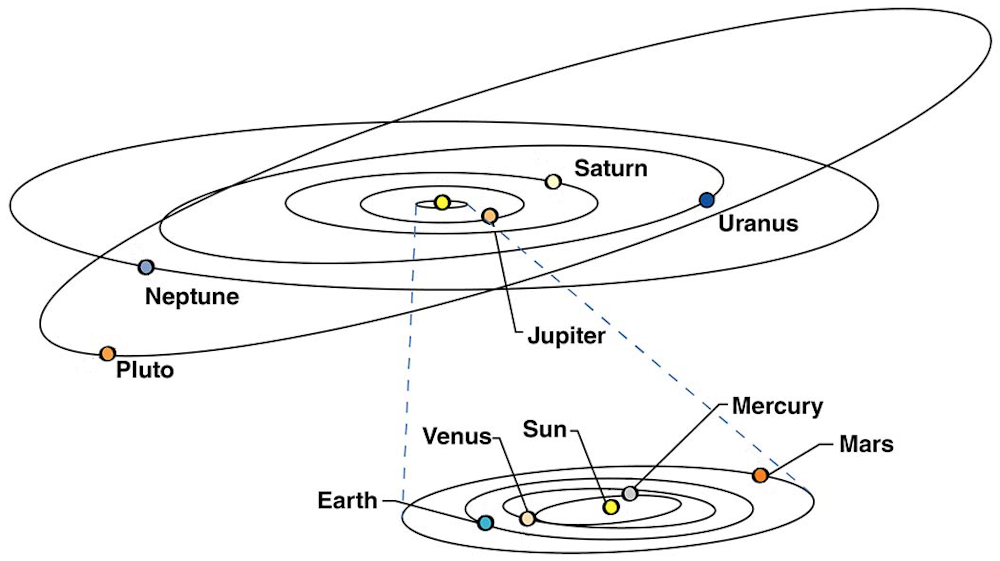
Like Earth, Pluto has a seasonal cycle due to the inclination of its poles to the plane of its orbit. Over the course of Pluto’s long year – equivalent to 248 Earth years – first the north pole and then the south pole are angled toward the distant Sun.

A drawing of the Solar System shows Pluto’s tilted orbit, which is also more elliptical than that of the planets. NASA (modified)

But unlike Earth, Pluto’s orbit is stretched into an extreme elliptical shape. Its orbit is so elongated that its distance from the Sun varies from 4.4 to 7.4 billion kilometres (30 to 50 times as far as the Earth-Sun distance).

By contrast, Earth’s distance from the Sun varies by only 3.4% over a year. Pluto’s atmosphere was discovered just before Pluto reached its closest approach to the Sun, which happened in 1989.

Since 1989, Pluto has been retreating from the Sun. The temperatures have been decreasing accordingly.

Under pressure

At the time Pluto started moving away from the sun, astronomers expected that this would cause its atmospheric pressure to drop, in much the same way that the pressure in an automobile tyre decreases with cold weather and increases in the heat. On the contrary, observations from 1988-2016 have shown a steady increase in the atmospheric pressure.

Immediately before the arrival of NASA’s New Horizons probe in 2015, occultation measurements discovered the atmospheric pressure on Pluto has tripled since 1988 (the equivalent on Earth would be to compare the pressure at the top of Mt Everest to that at sea level).

What is the cause of the discrepancy? Any thought that the occultation measurements were in error was banished by the Radio Science Experiment (REX) aboard New Horizons, which returned direct measurements in agreement with the Earthbound observers.

The new research has solved the mystery using a seasonal model for the transport of gas and ice around the surface of the planet.

Even though Pluto is moving farther from the Sun every year, its north pole is continuously sunlit during this part of its orbit, causing its nitrogen ice cap to revert to the gas phase.

This explains the rapid increase of atmospheric pressure over the past three decades.

But the climate modelling shows this trend will not continue.

The frozen canyons of Pluto’s north pole captured by NASA’s New Horizons spacecraft. NASA/Johns Hopkins University Applied Physics Laboratory/Southwest Research Institute

Winter really is coming

Pluto will continue to move farther from the Sun until the year 2113, and the weak sunlight will not be sufficient to similarly warm the southern polar regions.

During the long northern autumn and winter, Pluto’s atmosphere is expected to collapse, frosting out onto the surface like ice on a car windscreen on a clear and cold winter night.


Read more: Planet or dwarf planet: all worlds are worth investigating


At its lowest ebb, the atmosphere is predicted to have less than 5% of its current pressure. The combination of Pluto’s close approach to the Sun and northern hemisphere spring won’t recur until the year 2237.

Until then, it will be of critical importance to test our understanding of planetary atmospheric models under extreme low-temperature and low-pressure conditions through continued occultation measurements.

But these opportunities will become less frequent as Pluto’s orbit takes its apparent position farther from the dense starfields of the galactic centre that helped us make the observations.

ref. Why Pluto is losing its atmosphere: winter is coming – http://theconversation.com/why-pluto-is-losing-its-atmosphere-winter-is-coming-115567

The government and tech companies can’t prevent ‘fake news’ during the election – only the public can

]]>

Source: The Conversation (Au and NZ) – By Michael Jensen, Senior Research Fellow, Institute for Governance and Policy Analysis, University of Canberra

We’re only days into the federal election campaign and already the first instances of “fake news” have surfaced online.

Over the weekend, Labor demanded that Facebook remove posts it says are “fake news” about the party’s plans to introduce a “death tax” on inheritances. Labor also called on the Coalition to publicly disavow the misinformation campaign.

An inauthentic tweet purportedly sent from the account of Australian Council of Trade Unions secretary Sally McManus also made the rounds, claiming that she, too, supported a “death tax”. It was retweeted many times – including by Sky News commentator and former Liberal MP Gary Hardgrave – before McManus put out a statement saying the tweet had been fabricated.

What the government and tech companies are doing

In the wake of the cyber-attacks on the 2016 US presidential election, the Australian government began taking seriously the threat that “fake news” and online misinformation campaigns could be used to try to disrupt our elections.

Last year, a taskforce was set up to try to protect the upcoming federal election from foreign interference, bringing together teams from Home Affairs, the Department of Finance, the Australian Electoral Commission (AEC), the Australian Federal Police (AFP) and the Australian Security Intelligence Organisation (ASIO).

The AEC also created a framework with Twitter and Facebook to remove content deemed to be in violation of Australian election laws. It also launched an aggressive campaign to encourage voters to “stop and consider” the sources of information they consume online.


Read more: We’ve been hacked – so will the data be weaponised to influence election 2019? Here’s what to look for


For their part, Facebook and Twitter rolled out new features aimed specifically at safeguarding the Australian election. Facebook announced it would ban foreign advertising in the run-up to the election and launch a fact-checking partnership to vet the accuracy of information being spread on the platform. However, Facebook will not be implementing requirements that users wishing to post ads verify their locations until after the election.

Twitter also implemented new rules requiring that all political ads be labelled to show who sponsored them and those sending the tweets to prove they are located in Australia.

While these moves are all a good start, they are unlikely to be successful in stemming the flow of manipulative content as election day grows closer.

Holes in the system

First, a foreign entity intent on manipulating the election can get around address verification rules by partnering with domestic actors to promote paid advertising on Facebook and Twitter. Furthermore, Russia’s intervention in the US election showed that “troll” or “sockpuppet” accounts, as well as botnets, can easily spread fake news content and hyperlinks in the absence of a paid promotion strategy.

Facebook has also implemented measures that actually reduce transparency in its advertising. To examine how political advertising works on the platform, ProPublica built a browser plugin last year to collect Facebook ads and show which demographic groups they were targeting. Facebook responded by blocking the plugin. The platform’s own ad library, while expansive, also does not include any of the targeting data that ProPublica had made public.


Read more: Russian trolls targeted Australian voters on Twitter via #auspol and #MH17


A second limitation faced by the AEC, social media companies, and government agencies is timing. The framework set up last year by the AEC to address content in possible violation of electoral rules has proven too slow to be effective. First, the AEC needs to be alerted to questionable content. Then, it will try to contact whoever posted it, and if it can’t, the matter is escalated to Facebook. This means that days can pass before the material is addressed.

Last year, for instance, when the AEC contacted Facebook about sponsored posts attacking left-wing parties from a group called Hands Off Our Democracy, it took Facebook more than a month to respond. By then, the group’s Facebook page had disappeared.


FOI request by ABC News, Author provided Portions of AEC letter to Facebook legal team for Australia and New Zealand detailing steps for addressing questionable content, sent 30 August 2018. FOI request by ABC News, Author provided


The length of time required to take down illegal content is critical because research on campaigning shows that the window of opportunity to shift a political discussion on social media is often quite narrow. For this reason, an illegal ad likely will have achieved its purpose by the time it is flagged and measures are taken to remove it.

Indeed, from 2015 to 2017, Russia’s Internet Research Agency, identified by US authorities as the main “troll farm” behind Russia’s foreign political interference, ran over 3,500 ads on Facebook with a median duration of just one day.

Even if content is flagged to the tech companies and accounts are blocked, this measure itself is unlikely to deter a serious misinformation campaign.

The Russian Internet Research Agency spent millions of dollars and conducted research over a period of years to inform their strategies. With this kind of investment, a determined actor will have gamed out changes to platforms, anticipated legal actions by governments and adapted its strategies accordingly.

What constitutes ‘fake news’ in the first place?

Finally, there is the problem of what counts as “fake news” and what counts as legitimate political discussion. The AEC and other government agencies are not well positioned to police truth in politics. There are two aspects to this problem.

The first is the majority of manipulative content directed at democratic societies is not obviously or demonstrably false. In fact, a recent study of Russian propaganda efforts in the United States found the majority of this content “is not, strictly speaking, ‘fake news’.”

Instead, it is a mixture of half-truths and selected truths, often filtered through a deeply cynical and conspiratorial worldview.

There’s a different issue with the Chinese platform WeChat, where there is a systematic distortion of news shared on public or “official accounts”. Research shows these accounts are often subject to considerable censorshipincluding self-censorship – so they do not infringe on the Chinese government’s official narrative. If they do, the accounts risk suspension or their posts can be deleted.. Evidence shows that official WeChat accounts in Australia often change their content and tone in response to changes in Beijing’s media regulations.


Read more: Who do Chinese-Australian voters trust for their political news on WeChat?


For this reason, suggestions that platforms like WeChat be considered “an authentic, integral part of a genuinely multicultural, multilingual mainstream media landscape” are dangerously misguided, as official accounts play a role in promoting Beijing’s strategic interests rather than providing factual information.

The public’s role in stamping out the problem

If the AEC is not in a position to police truth online and combat manipulative speech, who is?

Research suggests that in a democracy, the political elites play a strong role in shaping opinions and amplifying the effects of foreign influence misinformation campaigns.

For example, when Republican John McCain was running for the US presidency against Barack Obama in 2008, he faced a question at a rally about whether Obama was “an Arab” – a lie that had been spread repeatedly online. Instead of breathing more life into the story, McCain provided a swift rebuttal.

After the Labor “death tax” Facebook posts appeared here last week, some politicians and right-wing groups shared the post on their own accounts. (It should be noted, however, that Hardgrave apologised for retweeting the fake tweet by McManus.)

Beyond that, the responsibility for combating manipulative speech during elections falls to all citizens. It’s absolutely critical in today’s world of global digital networks for the public to recognise they “are combatants in cyberspace”.

The only sure defence against manipulative campaigns – whether from foreign or domestic sources – is for citizens to take seriously their responsibilities to critically reflect on the information they receive and separate fact from fiction and manipulation.

ref. The government and tech companies can’t prevent ‘fake news’ during the election – only the public can – http://theconversation.com/the-government-and-tech-companies-cant-prevent-fake-news-during-the-election-only-the-public-can-115455

Sickly sweet or just right? How genes control your taste for sugar

]]>

Source: The Conversation (Au and NZ) – By Daniel Liang-Dar Hwang, Postdoctoral Researcher, The University of Queensland

You might love sugary doughnuts, but your friends find them too sweet and only take small nibbles. That’s partly because your genes influence how you perceive sweetness and how much sugary food and drink you consume.

Now our recently published study shows a wider range of genes at play than anyone thought. In particular, we suggest how these genes might work with the brain to influence your sugar habit.


Read more: Fact or fiction – is sugar addictive?


What we know

When food touches our taste buds, taste receptors produce a signal that travels along taste nerves to the brain. This generates a sensation of flavour and helps us decide if we like the food.

Genetic research in the past decade has largely focused on genes for sweet taste receptors and whether variation in these genes influences how sensitive we are to sweetness and how much sugar we eat and drink.

Our previous study showed genetics accounts for 30% of how sweet we think sugars or artificial sweeteners are. However, at the time, we didn’t know the exact genes involved.


Read more: Curious Kids: how do tongues taste food?


What our latest study found

Our new study looked at data from 176,867 people of European ancestry from Australia, the US and UK.

We measured how sweet 1,757 Australians thought sugars (glucose and fructose) and artificial sweeteners (aspartame and neohesperidin dihydrochalcone) were. We also looked at how sweet 686 Americans thought sucrose was and whether they liked its taste.

We also calculated the daily intake of dietary sugars (monosaccharide and disaccharide sugars found in foods such as fruit, vegetables, milk and cheese) and sweets (lollies and chocolates) from 174,424 British people of European descent in the UK Biobank.

How many lollies do you eat a day? The researchers combined these types of questions with genome analysis to find links between sugar intake and people’s genes. from shutterstock.com

Then we looked at the associations between millions of genetic markers across the whole genome and the perception of sweet taste and sugar intake, using a technique known as genome-wide association analysis.

After a 15-year study, we showed that several genes (other than those related to sweet taste receptors) have a stronger impact on how we perceive sweetness and how much sugar we eat and drink.

These included an association between the FTO gene and sugar intake. Until now, this gene has been associated with obesity and related health risks. However, the effect is possibly driven not by FTO but nearby genes whose protein products act in the brain to regulate appetite and how much energy we use.

We believe a similar situation may be influencing our sugar habit; genes near the FTO gene may be acting in the brain to regulate how much sugar we eat.

Our study suggests the important role the brain plays in how sweet we think something is and how much sugar we consume. That’s in addition to what we already know about the role of taste receptors in our mouth.

Why we love sweet foods

Our natural enjoyment of sweet foods could be an evolutionary hangover. Scientists believe being able to taste sweetness might have helped our ancestors identify energy-rich food, which played a critical part in their survival.


Read more: Our ancient obsession with food: humans as evolutionary Master Chefs


However, being able to taste sweetness doesn’t always mean you prefer to eat lots of sweet-tasting food.

So it looks like there are genes associated with the consumption of sweet foods, but not how sweet we think they are, such as FTO. There might also be genes that influence our perception of sweetness but not how likely we are to eat sweet food.

Regional differences

We were surprised to find genes for sweet taste receptors had no effect on either the ability to taste sweetness or on the amount of sugar consumed in our study, which looked only at large populations of European descent.

But by comparing people of different ancestries in the UK Biobank, we showed there was some variation between different populations that variations in genes for sweet taste receptors might explain. For instance, we found people of African descent tended to eat more sugar than people of European and Asian descent.

So, how can we use this?

Just like genetics can help explain why some people choose tea over coffee, our latest study helps explain why some people prefer sweet food. That could lead to personalised diets to improve people’s eating habits based on their genetics.

However, genetics is not the only factor to influence your taste for sugary foods and how much of these you eat or drink. So you can’t always blame your genes if you’ve ever tried to quit sugary drinks or snacks and failed.

ref. Sickly sweet or just right? How genes control your taste for sugar – http://theconversation.com/sickly-sweet-or-just-right-how-genes-control-your-taste-for-sugar-113455

A whole new world: how WWI brought new skills and professions back to Australia

]]>

Source: The Conversation (Au and NZ) – By James Waghorne, Academic Historian, Melbourne Graduate School of Education, University of Melbourne

The first world war was significant to the formation of Australian national identity and defining national characteristics, such as making do and mateship. This is well acknowledged.

But it was also a technical war, which spurred advances in knowledge and expertise. Combined with the status of professionals in the public service, it profoundly reshaped Australia. It also led to the development of universities as places for training and professional qualification, as well as important research.

Before the war, concern about efficient use of public money and a desire to protect the public led governments to pass legislation to control professional practice. This ensured only qualified doctors could provide medical treatment, only qualified teachers taught in schools, and so on.

The recently released book The First World War, the Universities and the Professions in Australia, 1914–1939, edited by the authors, outlines how the war sped up these developments and widened the range of workers, such as physiotherapists, who saw themselves as part of a professional group.

New knowledge created in war

During the war, surgeons and dentists developed new techniques, such as traction splints and blood transfusions. The use of saline fluid to treat shock dramatically improved the survival rate of the wounded. Advances in plastic surgery – led by New Zealand-born but London-based Harold Gillies and assisted by Australian surgeons – helped those with devastating facial injuries. Psychiatrists contended with the new condition of shell shock.


Read more: World War I: the birth of plastic surgery and modern anaesthesia


Engineers gained experience in logistics and the management of people. John Monash received a Doctor of Engineering in 1920 for his wartime developments in the coordinated offensive.

New ideas spread rapidly. As the noted surgeon Victor Hurley observed in 1950:

… treatment of large numbers of wounded and the stimulus of war necessities presented the opportunity for close observations and investigations on a large scale, such as were not readily possible in civil life.

The “regular contacts with officers of other medical services” allowed developments to be exchanged.

Professional contributions to the war

Professionals were also important to the war effort at home. Linguists provided translating and censorship services, lawyers drafted international treaties, while scientists and engineers developed processes for the mass manufacture of munitions and tested materials for use in military equipment.

The gas mask developed at the University of Melbourne. Australian War Memorial

Often these initiatives combined expertise from different professions. Medical, engineering and science professors at the University of Melbourne developed a gas mask, manufactured in large quantities but not deployed.

Back in Australia, the Commonwealth government established the first federally funded research body – the Advisory Council of Science and Industry (later CSIRO) in 1916. Its first task was to tackle agricultural production issues, such as the spread of prickly pear. Australia’s farm production was essential to the war effort.

University research expanded after the war, as government and industry worked with the universities.

The greatest need was for doctors and nurses. Medical students who had broken their studies to enlist were brought back from the front to complete their training before returning. University medical schools shortened courses to rush more graduate doctors to the front. Women medical graduates, such as Vera Scantlebury-Brown, also served in Europe, although they could not join the medical corps.


Read more: The forgotten Australian women doctors of the Great War


The Great War’s broader influences

More broadly the experience of travelling to European theatres of war exposed professionals to international ideas. Architect soldiers, in particular, brought the influences of European and Middle-Eastern sites to Australian buildings.

A notable example is the Royal Australasian College of Surgeons building. This was designed in a Greek revival style by returned soldiers Leighton Irwin and Roy Kenneth Stevenson. It opened in 1935 to house the college, which accredited Australian surgeons and sought to raise the standard of surgery and hospitals, efforts also spurred by the Great War.

The Royal Australasian College of Surgeons building was designed in a Greek revival style. from shutterstock.com

Repatriation efforts cemented the position of professionals in the public sphere. Doctors determined eligibility for invalid benefits and managed treatment.

Returned soldiers received training, both in technical skills and also professional degrees. Many took the opportunity of studying in overseas institutions, including British and European universities, schools of the Architectural Association, London, or the Royal College of Surgery.

Australia’s universities remitted tuition fees for returned soldiers. This allowed individuals such as Albert Coates to go to university and become a noted surgeon. Coates would later gain renown for his work with prisoners of war in the second world war.

How did the war change professions?

After the war, new communication technologies created careers in radio broadcasting and advertising.

In response to the cascade of new knowledge, and to keep up with professional developments, university courses became increasingly specialised, at the expense of the generalist. The gaps created by specialisation allowed new groups to seek professional status, often competing with other professionals.

For instance, the number of war wounded, combined with poliomyelitis (polio) epidemics, created unprecedented demand for masseurs. Universities had offered individual subjects in massage at the turn of the century. Now masseurs pressed for full degree status, clashing with doctors who controlled medical practice.

By the time of the second world war, masseurs had become physiotherapists, with professional status.

Nurses learnt new skills during the war, and achieved greater social recognition. Wikimedia Commons

Nurses had learnt new skills during the first world war and achieved greater social recognition. To build on this, the Australian Nursing Federation (now known as the Australian Nursing and Midwifery Federation) – established in 1924 – lobbied for university qualifications. It sought to overcome the prevailing conception nursing was marked by “service and sacrifice”, ideals encouraged by the reliance on volunteer nurses during the war.

All Australian states had nursing registers by 1928, admitting only qualified nurses. Although nurses could attend subjects in some universities before the second world war, a full university course waited until the latter part of the 20th century.


Read more: Friendship in war was not just confined to bonds between men


A new national sentiment, fostered by the war, was evident in all of these developments. Professionals no longer fought battles only within local and state areas. Now they argued in general terms, confident their expertise supported national priorities.

Professionals lobbied through national associations, such as the Institution of Engineers (established in 1919), the Australian Veterinary Association (established in 1926), and the Law Council of Australia (established in 1933). These groups sought to raise the standing of their members and defend their interests, on this new basis.

The histories of professional groups and higher education have often focused on the period after the second world war, and the expansion of the sector. However, this overlooks the role of the first world war in transforming Australia into a nation that valued expertise, knowledge and professional standing.

ref. A whole new world: how WWI brought new skills and professions back to Australia – http://theconversation.com/a-whole-new-world-how-wwi-brought-new-skills-and-professions-back-to-australia-115375

Get set for take-off in electric aircraft, the next transport disruption

]]>

Source: The Conversation (Au and NZ) – By Jake Whitehead, Research Fellow, The University of Queensland

Move aside electric cars, another disruption set to occur in the next decade is being ignored in current Australian transport infrastructure debates: electric aviation. Electric aircraft technology is rapidly developing locally and overseas, with the aim of potentially reducing emissions and operating costs by over 75%. Other countries are already planning for 100% electric short-haul plane fleets within a couple of decades.

Australia relies heavily on air transport. The country has the most domestic airline seats per person in the world. We have also witnessed flight passenger numbers double over the past 20 years.

Infrastructure projects are typically planned 20 or more years ahead. This makes it more important than ever that we start to adopt a disruptive lens in planning. It’s time to start accounting for electric aviation if we are to capitalise on its potential economic and environmental benefits.


Read more: Why aren’t there electric airplanes yet?


What can these aircraft do?

There are two main types of electric aircraft: short-haul planes and vertical take-off and landing (VTOL) vehicles, including drones.

The key issue affecting the uptake of electric aircraft is the need to ensure enough battery energy density to support commercial flights. While some major impediments are still to be overcome, we are likely to see short-haul electric flights locally before 2030. Small, two-to-four-seat, electric planes are already flying in Australia today.

An electric plane service has been launched in Perth.

A scan of global electric aircraft development suggests rapid advancements are likely over the coming decade. By 2022, nine-seat planes could be doing short-haul (500-1,000km) flights. Before 2030, small-to-medium 150-seat planes could be flying up to 500 kilometres. Short-range (100250 km) VTOL aircraft could also become viable in the 2020s.

If these breakthroughs occur, we could see small, commercial, electric aircraft operating on some of Australia’s busiest air routes, including Sydney-Melbourne or Brisbane, as well as opening up new, cost-effective travel routes to and from regional Australia.

Possible short-haul electric aircraft ranges of 500km and 1,000km around Melbourne, Sydney and Brisbane. Author provided

Why go electric?

In addition to new export opportunities, as shown by MagniX, electric aviation could greatly reduce the financial and environmental costs of air transport in Australia.

Two major components of current airline costs are fuel (27%) and maintenance (11%). Electric aircraft could deliver significant price reductions through reduced energy and maintenance costs.

Short-haul electric aircraft are particularly compelling given the inherent energy efficiency, simplicity and longevity of the battery-powered motor and drivetrain. No alternative fuel sources can deliver the same level of savings.

With conventional planes, a high-passenger, high-frequency model comes with a limiting environmental cost of burning fuel. Smaller electric aircraft can avoid the fuel costs and emissions resulting from high-frequency service models. This can lead to increased competition between airlines and between airports, further lowering costs.


Read more: Don’t trust the environmental hype about electric vehicles? The economic benefits might convince you


What are the implications of this disruption?

Air transport is generally organised in combinations of hub-and-spoke or point-to-point models. Smaller, more energy-efficient planes encourage point-to-point flights, which can also be the spokes on long-haul hub models. This means electric aircraft could lead to higher-frequency services, enabling more competitive point-to-point flights, and increase the dispersion of air services to smaller airports.

While benefiting smaller airports, electric aircraft could also improve the efficiency of some larger constrained airports.

For example, Australia’s largest airport, Sydney Airport, is efficient in both operations and costs. However, due to noise and pollution, physical and regulatory constraints – mainly aircraft movement caps and a curfew – can lead to congestion. With a significant number of sub-1,000km flights originating from Sydney, low-noise, zero-emission, electric aircraft could overcome some of these constraints, increasing airport efficiency and lowering costs.

The increased availability of short-haul, affordable air travel could actively compete with other transport services, including high-speed rail (HSR). Alternatively, if the planning of HSR projects takes account of electric aviation, these services could improve connectivity at regional rail hubs. This could strengthen the business cases for HSR projects by reducing the number of stops and travel times, and increasing overall network coverage.

Synchronised air and rail services could improve connections for travellers. Chuyuss/Shutterstock

What about air freight?

Electric aircraft could also help air freight. International air freight volumes have increased by 80% in the last 20 years. Electric aircraft provide an opportunity to efficiently transport high-value products to key regional transport hubs, as well as directly to consumers via VTOL vehicles or drones.

If properly planned, electric aviation could complement existing freight services, including road, sea and air services. This would reduce the overall cost of transporting high-value goods.

Plan now for the coming disruption

Electric aircraft could significantly disrupt short-haul air transport within the next decade. How quickly will this technology affect conventional infrastructure? It is difficult to say given the many unknown factors. The uncertainties include step-change technologies, such as solid-state batteries, that could radically accelerate the uptake and capabilities of electric aircraft.

What we do know today is that Australia is already struggling with disruptive technological changes in energy, telecommunications and even other transport segments. These challenges highlight the need to start taking account of disruptive technology when planning infrastructure. Where we see billions of dollars being invested in technological transformation, we need to assume disruption is coming.

With electric aircraft we have some time to prepare, so let’s not fall behind the eight ball again – as has happened with electric cars – and start to plan ahead.


Read more: End of the road for traditional vehicles? Here are the facts


ref. Get set for take-off in electric aircraft, the next transport disruption – http://theconversation.com/get-set-for-take-off-in-electric-aircraft-the-next-transport-disruption-114178

Before the Anzac biscuit, soldiers ate a tile so hard you could write on it

]]>

Source: The Conversation (Au and NZ) – By Lindsay Kelley, Lecturer, Art & Design, UNSW

Before Anzac biscuits found the sticky sweet form we bake and eat today, Anzac soldiers ate durable but bland “Anzac tiles”, a new name for an ancient ration.

Anzac tiles are also known as army biscuits, ship’s biscuits, or hard tack. A variety of homemade sweet biscuits sent to soldiers during the first world war may have been referred to as “Anzac biscuits” to distinguish them from “Anzac tiles” on the battlefield.


Read more: Feeding the troops: the emotional meaning of food in wartime


Rations and care package treats alike can be found in museum collections, often classified as “heraldry” alongside medals and uniforms. They sometimes served novel purposes: Sergeant Cecil Robert Christmas wrote a Christmas card from Gallipoli on a hard tack biscuit in 1915.

The back of the biscuit reads “M[erry] Christ[mas] [Illegible] / Prosperous New Y[ear] / from Old friends / Anzac / Gallipoli 1915 / [P]te C.R. Christmas MM / 3903 / [illegible] / AIF AAMC”. More than a Christmas card, biscuits like these gave family at home a taste of foods soldiers carried and ate in battle. Archives around the world hold dozens of similar edible letters home.

Damaged army hard tack biscuit used as a Christmas card. Accession number REL/00918. Courtesy of Australian War Memorial

Biscuit as stationery

This Anzac tile was made in Melbourne. In pencil, an anonymous soldier has documented his location directly on the biscuit’s surface: “Engineers Camp, Seymour. April 2nd to 25th 1917.”

Army Hard-tack Biscuit. Australian War Memorial. Accession Number: REL/03116. Courtesy of the Australian War Memorial

In her history of the Anzac biscuit, culinary historian Allison Reynolds observes that “soldiers creatively made use of hardtack biscuits as a way of solving the shortage of stationery”.

Hardtack art

Army biscuits also became art materials on the battlefield. This Boer War era “Christmas hardtack biscuit”, artist unknown, serves as an elaborate picture frame.

Incorporating embroidery that uses the biscuit’s perforations as a guide, it also includes artillery shells, which form a metallic border for the photograph mounted on the biscuit.

Christmas hard tack biscuit: Boer War. Australian War Memorial. Accession Number: REL/10747. Courtesy of the Australian War Memorial

A tin sealed with sadness

During WWI, any care package biscuit that was sweetly superior to an Anzac tile might have been called “Anzac biscuit”. By 1966, the name “Anzac biscuit” was given to a specific recipe containing golden syrup, desiccated coconut, oats, but never eggs.

Anzac biscuits held in our archives evoke everyday experiences of baking and eating. In one case, the biscuits also tell a story of loss. Lance Corporal Terry Hendle was killed in action just hours after his mother’s homemade biscuits arrived in Vietnam. The tin was returned to his mother, Adelaide, who kept it sealed and passed it down to his sister, Desley.

Australian War Memorial curator Dianne Rutherford explains that the museum will never open the sealed tin, because “this tin became a family Memorial to Terry and is significant for that reason. After Terry’s death, Adelaide and Desley never baked Anzac biscuits again”.

Sealed biscuit tin with Anzac biscuits: Lance Corporal Terence ‘Terry’ Edward Hendle, 6th Battalion, Royal Australian Regiment. Australian War Memorial. Accession Number: AWM2016.460.1. Courtesy of the Australian War Memorial

Today, biscuit manufacturers must apply for Department of Veterans’ Affairs permission to use the word “Anzac”, which will only be granted if “the product generally conforms to the traditional recipe and shape”. Variations on the name are also not permitted – in a recent example, ice cream chain Gelato Messina was asked to change the name of a gelato from “Anzac Bikkie” to “Anzac Biscuit”.

The Anzac tile, on the other hand, rarely rates a mention in our commemorations of Anzacs at war – although school children and food critics alike undertake taste tests today in an effort to understand the culinary “trials” of the Anzac experience.

Scholar Sian Supski argues that Anzac biscuits have become a “culinary memorial”. What if the biscuits you bake this Anzac day ended up in a museum? What stories do your biscuits tell?


Lindsay will be launching a three year project about biscuits called “Tasting History” during the Everyday Militarisms Symposium at the University of Sydney on April 26.

She is recruiting participants for upcoming biscuit tasting workshops. Sign up here.

ref. Before the Anzac biscuit, soldiers ate a tile so hard you could write on it – http://theconversation.com/before-the-anzac-biscuit-soldiers-ate-a-tile-so-hard-you-could-write-on-it-114742

View from The Hill: Joyce could be facing waves at a judicial inquiry after the election

]]>

Source: The Conversation (Au and NZ) – By Michelle Grattan, Professorial Fellow, University of Canberra

It’s hard to believe Barnaby Joyce really wants to lead the Nationals again. Of course everyone knows he does, desperately, but his unhinged ABC interview with Patricia Karvelas on Monday showed a breathtaking absence of political judgement or personal restraint.

Joyce went on the program to defend his conduct in the 2017 A$79 million water buyback from two Queensland properties owned by Eastern Australia Agriculture (EAA).

Regardless of how his approval of this deal will ultimately be judged, his shouting, interruptions and at times absurd language drowned out any chance of his getting his points across.

Joyce loyalists will see it as Barnaby-being-Barnaby. But it was further reason for Nationals to despair about the parlous state of their party, as they watch an ineffective leader and an out-of-control aspirant.

The Joyce interview made it harder for the government to manage this big distraction in a messy second campaign week.

The controversy over the water purchase is based on old story; the election has enabled it to be resurrected for a powerful fresh spin around the political circuit.

Water expert Quentin Grafton, professor of economics at the Crawford School at the Australian National University, lays out the issues.

Grafton estimates the Commonwealth paid about $40 million too much for this water. He identifies three areas of concern: the government’s failure to get value for money (remembering this was floodwater, which is unreliable); the lack of transparency in the deal, and the nature of the process – a negotiated sale rather than an open tender.

Much has been made of EAA being a subsidiary of Eastern Australian Irrigation (EAI), which is based in the Cayman Islands, a tax haven. This does, however, seem an irrelevance in the context of the value for money issue.

Also, it is one thing to say tax avoidance structures should be cracked down on, quite another to suggest the government should decline to deal with a company with a structure that accords with the law.

There has also been talk about Energy Minister Angus Taylor. As a business consultant Taylor helped set up the two companies and was a director of each.

But according to Taylor’s office he ended all links before entering parliament, never had a direct or indirect financial interest in EAA or any associated company, had no knowledge of the water buyback until after it happened, and received no benefit from this transaction.

So the questions, in this affair, centre on the conduct of the Agriculture Department and its then minister.

Grafton says: “Either the public servants were incompetent in relation to understanding value for money – or there’s an alternative explanation.”

The department is sensitive, taking the unusual step during Easter (and in the “caretaker” period) of issuing a statement defending its actions. It said it had done “due diligence”. The water purchase had been consistent with Commonwealth Procurement Rules “and paid at a fair market rate, as informed by independent market valuation,” the statement said.


Read more: Australia’s ‘watergate’: here’s what taxpayers need to know about water buybacks


Joyce is known in general to have been a meddling minister.

In this case, he insists he followed departmental advice in approving the purchase, and had been at arms length from the deal.

“My role was never to actually select a purchaser or to determine a price,” he told a Tuesday news conference. But he approved the authority to negotiate without tender, and imposed conditions, including having the department report back to him before finalising the deal.

The current Minister for Agriculture and Water Resources, David Littleproud, tried to stem the damage on Tuesday by asking the Auditor-General to inquire into the matter. Littleproud added a political twist, requesting the audit to look back as far as 2008, to encompass Labor’s period.

But this wasn’t going to satisfy Labor. The opposition had demanded documents by the end of Tuesday; predictably, it didn’t get what it wanted.

Bill Shorten flagged the need for a judicial inquiry.

Late Tuesday, environment spokesman Tony Burke accused Scott Morrison of “trying to cover up his government’s incompetence, chaos and potential misconduct”.

“It is now clear that there needs to be an independent inquiry into the Eastern Australia Agriculture scandal, with coercive powers so that Australians can get the truth,” Burke said. (That inquiry, however, wouldn’t be probing Labor deals.)

If Labor wins on May 18, yet again we will see a government launch an investigation into the conduct of its predecessor. If this comes to pass, Joyce will find himself in the witness box, a prospect he seems to relish – at least now.

ref. View from The Hill: Joyce could be facing waves at a judicial inquiry after the election – http://theconversation.com/view-from-the-hill-joyce-could-be-facing-waves-at-a-judicial-inquiry-after-the-election-115866

Australia’s ‘watergate’: here’s what taxpayers need to know about water buybacks

]]>

Source: The Conversation (Au and NZ) – By Lin Crase, Professor of Economics and Head of School, University of South Australia

In 2017, the then agriculture minister, Barnaby Joyce, signed off on an A$80 million purchase of a water entitlement from a company called Eastern Australia Agriculture.

The problem is that Energy Minister Angus Taylor used to be a director of Eastern Australia Agriculture – though he didn’t have a financial interest – and the company is a liberal party donor. What’s more, the value of the water purchased for A$80 million is under question.

Now, as the election looms, this issue has resurfaced. But why should taxpayers be concerned?


Read more: Is the Murray-Darling Basin Plan broken?


Water buybacks using an open tender were halted by the current government in 2015, even though this is the most cost-effective way to set aside water for the environment. Instead, the government pronounced that subsidies for irrigators were a better deal.

Until 2015, the government bought back most water using an open tender process, before it was replaced by a subsidy scheme for irrigation and occasional closed tenders.

The problem with the closed tender process is that it tends to lack transparency, which raises questions about how effective the government is spending public money. And it’s hard to prove closed tenders deliver the most cost effective outcome.

Former water minister Barnaby Joyce is facing criticism over the water buyback controversy. Steve Gonsalves/AAP

The Murray-Darling Basin is a very productive agricultural zone and its rivers have been used to boost agricultural outputs through irrigation.

State governments spent much of the 20th century allocating this water to agricultural users. By the 1990s it was clear too much water was being extracted. This resulted in both harm to the river environment and potential reduced reliability for those with existing water rights.

Various attempts to rein in extractions were made around this time, but ultimately the Murray-Darling Basin Plan was adopted to deal with the problem.

In agreeing on the plan, the federal government committed to spending A$13 billion to reduce the amount of water being extracted from the Murray-Darling Basin. To accomplish this the government has two basic strategies.

One involves buying up existing rights for water use. The other hinges on using subsidies so farmers use less water when irrigating.

Reducing water extraction from the basin

The second approach of using subsidies is generally more politically appealing. This is because few farmers ever object to receiving a subsidy and the public has an affinity with the idea of “saving” water.


Read more: Damning royal commission report leaves no doubt that we all lose if the Murray-Darling Basin Plan fails


The problem, however, is that subsidies are a more costly way of returning water to the river system than simply buying back existing water rights. And so-called water savings are hard to measure how much water savings are a result of subsidies or some other factor.

This is why some analysts even claim subsidies are reducing the level of water available for the environment.

Buying back water rights is generally more cost-effective than providing subsidies. But a clear and transparant process still matters because water rights are not the same for everyone and it’s a complex process to determine their overall value.

Allocations and entitlements

First, most water users hold a legal right, known as an entitlement. Water entitlements represent the long-term amount of water that can be taken and used – subject to rain, of course.

Second, water allocations represent the amount of water currently available against a given entitlement – this is the water that is available now.

If a farmer owns an entitlement in the River Murray, chances are the annual allocation will be determined by how much water has flowed into upstream storages like Hume Dam, Dartmouth Dam or Lake Eildon.

Even then the allocation will vary, depending on which state issued the original entitlement. For instance, New South Wales water is generally allocated more aggressively. This means NSW entitlements tend to be less reliable in dry years than Victorian or South Australian entitlements.

If a farmer owns an entitlement where there are no upstream storages, as is the case with much of the Darling River system, then the allocation will vary depending on how much water is flowing in the river.


Read more: Discontent with Nationals in regional areas could spell trouble for Coalition at federal election


So what?

All of this means the amount of water that can actually be used for the environment when an entitlement passes to the government will depend heavily on the underlying characteristics of the water right.

Partly for this reason, water buybacks were historically conducted using an open tender process.

This meant the government would announce its willingness to buy water entitlements. Farmers would then notify the government about what entitlements they held and the price they were prepared to take.


Read more: Investors and speculators aren’t disrupting the water markets


Running an open tender allowed the government to assess the value for money of the different entitlements on offer at the time.

Water buybacks through open tender began seriously in about 2007 to 2008. This meant the price owners were prepared to sell for would be registered, and then the government would determine which offer provided the best value. Around 60% of all water now held for the environment by the Commonwealth was secured through open tenders.

As a general rule, a relatively high-reliability water entitlement was bought for about $2,000 per megalitre and this has become the metric for many in the market. But the current government halted this process in 2015.

Now, the government buys water through direct negotiation with water-entitlement holders.

The government justified ending open-tender buybacks on the basis that the water being secured was causing undue harm to rural and regional communities. And, instead, much more expensive subsidies would supposedly generate a better overall return.

This view is not universally shared. The receipts from openly tendered water entitlements were being used by many farmers to adjust their business, while still staying in the region.

Many rural communities continue to thrive, regardless of the strategy chosen to secure water for the environment. Subsidies also tend to favour particular irrigators rather than the community in general.


Read more: Droughts, extreme weather and empowered consumers mean tough choices for farmers


Having set aside the cheapest option of open-tender buybacks and declaring support for irrigation subsidies, the problem the government now faces is that it must explain why closed tenders persisted (albeit in isolated cases) and were signed off by Ministers as good value for money.

Closed tenders need not deliver a poor outcome for taxpayers. But it does mean the likelihood of establishing the best value for money is reduced, simply because there are fewer reference points.

And if it’s legitimate to overspend public money on irrigation infrastructure subsidies, the credibility of a supposedly cost-effective closed tender is also brought into question.

ref. Australia’s ‘watergate’: here’s what taxpayers need to know about water buybacks – http://theconversation.com/australias-watergate-heres-what-taxpayers-need-to-know-about-water-buybacks-115838

How soldier guitars, culture and faith paved way for Bougainville’s peace

]]>

The trailer for Will Watson’s documentary on Bougainville peacemaking, Soldiers Without Guns.

FILM REVIEW: By David Robie

While a gripping film about the apocalyptic Bougainville war, or more accurately the peace that ended the decade-long conflict, opened in cinemas across New Zealand last week, an island roadshow has been taking place back in the Pacific.

Initiated by the United Nations, the roadshow – featuring Bougainville President Father John Momis, many of his cabinet members and UN Resident Coordinator Gianluca Rampolla – is designed to help prepare the Bougainvillean voters to decide on their future.

This future is due to be put to the test in a referendum on October 17 in the crucial political outcome of an extraordinary peace process that began in chilly mid-winter talks at Burnham Military Camp near Christchurch in July 1997.

The vote is already four months delayed, partly due to spoiling tactics of Peter O’Neill’s Papua New Guinean government which would avoid the vote if it could.

The Bougainville referendum roadshow … speaking to the women. Image: Bougainville News

In any case, the vote is not binding and the O’Neill government may not even honour it, even if there is an overwhelming vote for independence in the island with a population of 250,000.

-Partners-

The choice is simple: Voters will be asked to choose between greater autonomy and full independence. The vote is expected to favour independence.

Also at stake is the future of the Panguna – once the mainstay of Papua New Guinea’s economy and now abandoned because of the environmental devastation caused by the huge Australian-owned copper mine – and the right of a people to choose their own destiny free from rapacious foreign extraction industries.

After almost 10 years of civil war when an estimated 10,000 to 20,000 people lost their lives through the actual fighting between the Bougainville Revolutionary Army (BRA) and other armed groups and the Papua New Guinean military, and through deaths from lack of medical treatment and starvation as a result of a military blockade around the island state, a breakthrough was achieved in New Zealand.

Training a child to play shoot … a scene from both Hakas And Guitars and Soldiers Without Guns. Image: Freeze frame from Hakas And Guns trailer
Exhausted by the deadlock, the deprivations of the war and 14 failed attempts at negotiating a peace, talks in the bitter cold at Burnham sparked off the long journey for a lasting peace. As former North Solomons provincial government official and a peace process officer Robert Tapi recalls:

The silent majority of Bougainvilleans were tired of war and longed to return to normal village life. Women’s groups, church groups and chiefs increased the pressure on both the BRA and the PNG-backed Bougainville Transitional Government to negotiate for peace.

On all sides, the likely cost of victory was proving too high. The moderate revolutionary leaders realised that even if they did “win”, they “would inherit a hopelessly divided society”.

The first meeting resulted in the Burnham Declaration of July 18, 1997, which urged the leaders to call a ceasefire and for the establishment of an international peacekeeping force with the withdrawal of the PNG Defence Force.

Following the Burnham Truce and the endorsement of a Truce Monitoring Group (TMG) in Cairns in November 1997, a further Burnham meeting in January 1998 produced the Lincoln Agreement and paved the way for the Ceasefire Agreement in Arawa on April 30, 1998.

The success of the breakthrough in Burnham and the following meetings was thanks to the inclusion of women’s groups, churches and local chiefs as well as the political opponents, meeting on neutral territory and with New Zealand not intervening in the talks. Also helpful was then Foreign Minister Don McKinnon’s friendly and chatty style with the delegates, which boosted Bougainvillean morale.

“Land is our heartbeat” … women played a key role in the Bougainville peace – and the documentary. Image: Freeze frame from Soldiers Without Guns

Filmmaker Will Watson stepped up to tell the extraordinary New Zealand peacekeeping story initially through an award-winning 2018 documentary for Māori Television, Hakas And Guitars, following up with this year’s feature film Soldiers Without Guns.

He had been monitoring the war and aftermath while a journalism student and began to put together a project team in 2005. Ironically, due to funding and other obstacles, it took him 13 years to complete the feature film – longer than the actual war.

A couple of years later, in 2007, he had a film crew on the ground in Bougainville to carry out interviews and gain invaluable footage. His documentary is an inspiring and fitting tribute to the innovative “guitars, waiata and wahine” approach of the NZ-led peacekeeping force.

Soldiers Without Guns poster at the Civic premiere in Auckland earlier this month. Image: David Robie
By concentrating on a strategy of winning the hearts and minds through hundreds of kilometres of foot slogging treks to villages and communicating directly and honestly with ordinary people, the soldiers gained the trust of Bougainvilleans from all sides.

It was a courageous and insightful decision by the first mission commander, Brigadier Roger Mortlock, now retired, to go to Bougainville without weapons and guarantee the peace. He had experienced a UN peacekeeping failure in Angola and was determined this mission would succeed.

Bougainville … a long history of struggle against the Australian-owned Panguna mine and for independence. Image: Freeze frame from Soldiers Without Guns
Another key factor in the success was Major Fiona Cassidy, an Army public relations manager at the time, and her ability to communicate in a meaningful way with the Bougainvillean women in what is a matriarchal society.

In a recent RNZ Pacific interview, she admitted finding the challenge a bit “scary”:

“When you looked at the country brief, you knew that you were not going into a benign environment. It actually was hostile. So it was a little bit scary thinking, ‘Okay, we’re going to a country which has been at war for so long, it still isn’t stable, and we’re going in unarmed.’”

During the start of the Bougainville war, I was head of the journalism programme at the University of Papua New Guinea and reported the first year of the conflict in a cover story for Pacific Islands Monthly. As part of this, I revealed how a New Zealand environmental consultancy unwittingly became a catalyst for fuelling the conflict.

I wrote in my 2014 book Don’t Spoil My Beautiful Face: Media, Mayhem and Human Rights in the Pacific:

Apart from convoys with soldiers riding shotgun and yellow ochre Bougainville Copper Limited trucks packed with security forces sporting M16s, you would hardly guess that a guerrilla war was in progress near the Bougainville provincial capital of Arawa. But once you reached the sandbagged machinegun nest in Birempa village at the foot of the rugged mountain jungles of the Crown Prince Range, the tension started to rise.

Scanning the dense vegetation for a sign of the militants of the Bougainville Republican Army (BRA)—known as Rambos in the first year of the decade-long civil war – the Papua New Guinea Defence Force soldier manning the machinegun didn’t notice the irony of the T-shirt he was wearing.

“Mine Of Tears” … a t-shirt popular early in the Bougainville war. Image: David Robie

Scrawled across his chest were the words MINE OF TEARS, a word play on the title of Richard West’s 1972 book River of Tears: The rise of Rio Tinto-Zinc Mining Corporation. The book was an expose of the mining operations by BCL’s parent company CRA Limited of Australia—a subsidiary of Britain’s Conzinc-Riotinto—and it had already become the “Bible” of the many of the militants.

At the time I was reporting on the fledgling war for a cover story featured by Pacific Islands Monthly in its November 1989 edition entitled MINE OF TEARS: BOUGAINVILLE ONE YEAR LATER. No other journalists were on the ground at the time, and the only other people staying at the small hotel in the port town of Kieta were soldiers, some cradling guns on their knees when having dinner. The atmosphere was surreal and ghostly in those early days.

The problems of Bougainville cannot be divorced from the rest of the country, or even from the rest of the Pacific. At stake are the crucial issues of a conflict between Western concepts of land ownership and indigenous land values, the equity between the national government, provincial administration and the traditional landowners, and a choice between genuine sovereignty over resource development projects or dependence on foreign control.

For those of us who have had some involvement in the Bougainville war bearing witness, Will Watson and his crew deserve huge praise for bringing this story to the big screen, and honouring New Zealand’s contribution to peace – Australia couldn’t have done it – and providing hope for Bougainville’s future.

With luck, the island will become independent and bring some meaning to all that terrible loss of life and deprivation.

Professor David Robie is director of the Pacific Media Centre.

Print Friendly, PDF & Email

Article by AsiaPacificReport.nz

Bougainville: The valley of the Rambos, 1989

A Papua New Guinean soldier guards the road to Panguna, Bougainville, 1989. Image: David Robie

David Robie

Tuesday, April 23, 2019

Abstract

‘The original [Panguna mine] agreement overrode our customs, denied us our land rights and was too rushed. It contradicts our way of life; what comes from the land should benefit the landowners … nobody else. ’ –  A Nasioi militant landowner

APART from convoys with soldiers riding shotgun and yellow ochre Bougainville Copper Limited trucks packed with security forces sporting M16s, you would hardly guess that a guerrilla war was in progress near the Bougainville provincial capital of Arawa. But once you reached the sandbagged machinegun nest in Birempa village at the foot of the rugged mountain jungles of the Crown Prince Range, the tension started to rise. Scanning the dense vegetation for a sign of the militants of the Bougainville Republican Army (BRA)—known as Rambos in the first year of the decade-long civil war – the Papua New Guinea Defence Force soldier manning the machinegun didn’t notice the irony of the T-shirt he was wearing.

Chapter 16 of Don’t Spoil My Beautiful Face: Media, Mayhem and Human Rights in the Pacific, by David Robie (2014). ISBN 9781877484254

Report by Pacific Media Centre

Ethnic media are essential for new migrants and should be better funded

]]>

Source: The Conversation (Au and NZ) – By John Budarick, Lecturer in Media, University of Adelaide

The fact that the community ethnic and multicultural broadcasting sector didn’t receive additional funding in the latest budget reflects a misunderstanding of the important role of ethnic media in Australian society.

Ethnic print and broadcasting have a long history in Australia, dating back to at least 1848 with the publication of Die Deutsche Post.

Early foreign language broadcasting featured on commercial radio in the 1930s, and throughout the middle of the 20th century. This was before the boom days of the 1970s, when both the Special Broadcasting Service (SBS) and community radio were firmly established.

Today, along with SBS, more than 100 community radio stations feature content in over 100 languages. There are also ethnic media organisations that broadcast or print content in English.


Read more: Media and social responsibility at a time of radicalisation


How ethnic media are funded

Much like mainstream print, ethnic newspapers receive little if any direct government funding. They rely on advertising dollars, as well as occasional small grants.

Ethnic broadcasting is primarily funded through two streams:

  • government funding of SBS
  • funding of community ethnic broadcasters through the Community Broadcasting Foundation (CBF), which is itself funded federally.

According to the peak body of ethnic community broadcasting in Australia, the National Ethnic and Multicultural Broadcasters’ Council (NEMBC), an annual indexation freeze in funding introduced by the Liberal government in 2013 has cost the sector almost A$1 million. That’s approximately 20% of their total support.

A significant fund of A$12 million over four years has been granted to the community broadcasting sector. But this is generalist funding rather than aimed at ethnic broadcasting specifically. It’s directed towards assisting community stations to transition to a digital signal, the production of local news in English, and management training.

The NEMBC is also in its third year of a new competitive grants process introduced by the Community Broadcasting Foundation.

According to the NEMBC, many ethnic broadcasters are facing a precarious funding environment. This is due to the lack of specialist funding, the costs associated with transitioning to digital broadcasting, and the complexity of the Community Broadcasting Foundation grants process.


Read more: Whitewash? That’s not the colour of the SBS charter


Why it’s important

The difficulties facing ethnic broadcasting impact the unique contribution it can make to modern Australia. And it’s a problem that extends beyond policy – media funding for public service, community and ethnic broadcasting is regularly under siege. It’s also a broader social issue.

Ethnic media are often thought of as either quaint services for nostalgic migrants, or as dangerous sources of ethnic segregation. For many, the role of ethnic media rarely, if ever, extends beyond a specific cultural, ethnic or linguistic community.

What’s missing from this image is the role of ethnic media in facilitating successful migrant settlement. Research shows that ethnic media can facilitate feelings of belonging and social participation among first and subsequent generation migrants. Ethnic media connect migrants and culturally and linguistically diverse Australians with other social groups, as well as with their own local communities.

On a more practical level, ethnic media are important sources of information. When advice is needed on a range of issues, from health care services to migration law, ethnic media play a vital role.

This is not a case of migrants staying in their linguistic “ghettos” and building separate ethnic economies. Rather, it involves seeking sources of relevant, and culturally and linguistically appropriate, information in order to live and thrive in Australian society.

That might be providing advice on voting or taxation to migrants from Sudan. Or informing elderly German migrants of changes to aged care services. Ethnic media provide information that is attuned to the particular needs of their audience.

This is a service that mainstream media are largely unable to provide, with their focus on a broad audience. But without it, migrants potentially miss out on important information.

These are also services that benefit both recent migrant groups, such as those from Africa or the Middle East, and more established communities. For elderly Germans in South Australia, information today comes in the form of German broadcasting in Adelaide, with presenters and producers who understand the needs and histories of their audience.


Read more: Debate on free speech alone means little for minorities


Essential sources of vital information

Ethnic media may also be valuable allies to relevant government departments and settlement service providers. My own ongoing work with ethnic broadcasters and community leaders indicates a level of dissatisfaction with the way government services are communicated to migrant groups from non-English speaking backgrounds.

Ethnic broadcasting is often able to capture the subtleties and nuances that one-size-fits-all government communication campaigns cannot. They are therefore in a unique position to effectively communicate government initiatives at a local, state and national level.

It is no surprise that what would become SBS Radio was originally designed to inform migrants about the introduction of Medibank health insurance scheme.

It’s important that the services provided by the ethnic media sector, particularly those that cannot be measured in purely economic terms, are understood and supported.

ref. Ethnic media are essential for new migrants and should be better funded – http://theconversation.com/ethnic-media-are-essential-for-new-migrants-and-should-be-better-funded-115233

Rift between NZ government and aid agency over naming of nurse captured by ISIS

]]>

Source: The Conversation (Au and NZ) – By Alexander Gillespie, Professor of Law, University of Waikato

Last week’s revelation that a New Zealand nurse has been captured by Islamic State and detained in Syria for almost six years has caused tensions for the New Zealand government.

Louisa Akavi was working for the International Committee of the Red Cross (ICRC), known as Red Crescent in the Middle East, when she was captured in 2013. When the ICRC revealed her name last week, New Zealand PM Jacinda Ardern didn’t welcome the move.

The government and New Zealand media had kept the story secret in a bid to improve her chances of surviving.


Read more: The rout of ISIS gives the world an opportunity to defeat its ideology


A selfless aid worker

Louisa Akavi is an exemplar of humanity. The New Zealander of Cook Island descent is a highly specialised nurse who has offered her skills to those in need, wherever they are. She has conducted 17 missions for the ICRC since the mid-1990s.

If there was a high-risk war zone in the last 30 years, odds are she had been in it. The ICRC – neutral, practical, discreet and focused on relieving human suffering irrespective of where it was found – had Akavi working for them in northern Syria. She was captured there while travelling in a medical convoy in October 2013, a little over a month after arriving. If she is still alive, she will have been in captivity longer than any other ICRC worker in the aid organisation’s 156-year history.

Exactly who captured Akavi is uncertain. Hostages, local and especially foreign, were taken and traded among groups in a thriving illegal market for reasons of both economic return via sale to others, ransom to foreign governments or propaganda value.

High point of risk

If there was a point when Avaki’s life would have hung by a thread, it would have been in late February 2015 when Sir John Key’s National government decided to join the conflict against Islamic State and help train Iraqi forces. Few matters could have weighed more heavily on the mind of the government than the risk of Akavi facing a fate similar to that of many other Western hostages, who paid the price for New Zealand’s intervention in that war.

But there have been several sightings of Akavi since then. That she appears to have survived suggests other considerations might have been at play.

The most obvious is that Akavi was not partisan in the conflict. She was a mature woman, working for the ICRC, and she had medical skills that may have been useful to her captors.

The problem with this assumption is that Islamic State, like the Taliban and Boko Haram, does not believe it is bound by any of the norms that govern international humanitarian law, including the sacrosanct nature of medics and the ICRC in combat zones.

How valuable Akavi was as a medic would have been entirely dependent on how many others with similar skills also existed within ISIS-held areas.

Ransoming hostages

The second reason Akavi may have survived is because she might have had some economic value via ransom. ISIS knew that many Western governments, fearful of the short-term consequences of seeing the public death of one of their citizens, paid ransom demands to get their people home.

But the New Zealand government, like many other Western governments, has a clear policy of not paying for hostages.

The reason this rule exists in international policy is because if such payments are made citizens of that country will be targeted even more in the long term due to expectation of reward. The same thinking applies to the ICRC, which also will not pay for any of its staff who are held hostage. They too know if the ICRC started down this road the number of its members being kidnapped would quickly multiply.

Keeping the story secret

The third reason Akavi may have survived her captivity is that until earlier this week the ICRC, the New Zealand government and the media have all kept her out of the headlines. This invisibility meant Islamic State was not provoked into any hasty actions.

The invisibility of Akavi dissolved when the ICRC – not the New Zealand government – broke the silence. With the defeat of ISIS on the battlefield, The ICRC believed the time was right to appeal for help in finding her, or, if she was still being held, for her (and other ICRC captives) to be released.

For an organisation that prides itself on working behind the scenes and only going public when there is no alternative, this was an unexpected step. It might have been helped by the fact that Akavi did not appear in an ISIS propaganda video following the Christchurch terror attack.

The ICRC’s hope is that Akavi will emerge from the fog of war that still envelopes much of the region, and that she will surface from among the millions of displaced people in and around the region. The fear of the New Zealand government is that although ISIS may have been defeated in their strongholds, parts of the organisation remain intact and it might be holding Akavi, along with others, as one of its last bargaining chips. If this is correct, the New Zealand government is about to get drawn into some very difficult deliberations.

The final possibility is that we may never know what happened to Louisa Akavi. She, along with tens of thousands of others, may have simply disappeared in one of the worst conflicts of the 21st century. Held by a murderous regime which was pounded incessantly, this person, whose only crime was to seek to relieve human suffering, may have paid the ultimate price because she cared about others.

ref. Rift between NZ government and aid agency over naming of nurse captured by ISIS – http://theconversation.com/rift-between-nz-government-and-aid-agency-over-naming-of-nurse-captured-by-isis-115593

Jokowi’s camp ups ante against Prabowo’s ‘real count’ vote claim

]]>
The great wait … A TV cameraman and a reporter work in front of a large screen showing the ongoing results of the 2019 election vote count at the General Elections Commission (KPU) headquarters in Jakarta on Sunday. The vote count is being carried out between April 25 to May 23. Image: Seto Wardhana/The Jakarta Post

By Marguerite Afra Sapiie in Jakarta

As tensions intensified between incumbent Joko “Jokowi” Widodo and challenger Prabowo Subianto over the expected results in the Indonesia election last week, the rival camps scrambled on their own to prove that their respective candidate was the rightful winner of the poll.

The Jokowi-Ma’ruf Amin ticket, which is predicted to win the election as shown by the quick-count results, has even decided to up the ante against Prabowo’s victory claims, as the campaign team publicly opened their own process of final vote counting.

The campaign team also alleged that Prabowo, who had declared himself the new president, citing his own camp’s internal real count, has manipulated the public by not using complete data on the vote counts.

READ MORE: Indonesian election exposes ethnic, religious divides

Jokowi’s camp has employed around 250 people working on three different shifts, 24 hours every day to count the C1 vote tally forms from polling stations across the country in a “war room”, located in Gran Melia hotel in South Jakarta.

The room, which featured TV screens showing real-time vote counting, is open for everyone who wants to monitor the real vote count, Jokowi-Ma’ruf Amin campaign team executive Moeldoko said.

-Partners-

“We have nothing to hide here and we want everything to be open, so there won’t be doubts or scepticism anymore […] our mechanism and standards for the real count are also accountable,” Moeldoko said on Sunday.

Similar to the real count by the General Elections Commission (KPU), the team working in the facility counts votes based on a digitised version of the C1 forms, which record the final vote count of each polling station at the district level, from hundreds of thousands of polling booths across Indonesia.

Real time data
The witnesses at all polling stations sent the photo of C1 forms to the team, established under the Witness Directorate of the campaign team, which would input the data in real time. The coordinator of witnesses in each district was responsible for overseeing and clarifying the data sent by the witnesses.

As of 4:30 p.m. on Sunday, the team had input around 23.8 million votes from 119,216 polling stations, or 14 percent of the 813,350 across Indonesia.

The data so far showed that Jokowi-Ma’ruf lead with 56.16 percent against Prabowo-Sandiaga’s 45.84 percent.

Early vote counts conducted by a number of pollsters, including the Centre for Strategic and International Studies (CSIS) and Cyrus Network as well as Saiful Mujani Research and Consulting (SMRC) showed the Jokowi-Ma’ruf Amin ticket had 54 to 56 percent of the vote against Prabowo-Sandiaga Uno’s 44 to 46 percent.

In a controversial move, the former Army general declared his victory hours after the election and said the camp’s internal real count showed that he had won the race with 62 percent of the vote from over 320,000 polling stations across the country.

Prabowo-Sandiaga Uno campaign team spokesman Andre Rosiade explained that the real count was derived after their witnesses sent the photos of C1 forms to the Prabowo-Sandiaga campaign team as well as to the headquarters of political parties in the coalition.

Witness Directorate deputy director Lukman Edy, however, said the team had found that Prabowo’s claim was not supported by reliable data and in the revealed cases, the rival camp did not put the results from all polling stations in the province into the equation.

Quick-count results
In Lampung, for instance, the war room has gathered around 50 percent of votes, which put Jokowi in the lead with 57.6 percent against Prabowo’s 42.33 percent. The tally was already similar to quick-count results by pollsters, such as SMRC which put Jokowi at 57.7 percent.

“[Prabowo’s camp] put our votes at 40.91 percent while they won with 59.09 percent [in Lampung]. After we looked into it, turns out they only used data from 30 polling stations,” Lukman said.

A similar situation happened in Jakarta, with Prabowo’s campaign team declaring victory in the province by only counting 300 out of thousands of polling stations, he said.

Prabowo-Sandiaga Uno campaign team spokesperson Dahnil Anzar Simanjuntak said the team did not think too much about the analysis done by Jokowi’s camp, and said they would keep focusing on monitoring the real count. The KPU is expected to announce the final results on May 22.

Meanwhile, in what could be seen as an attempt to diffuse tensions, Jokowi has appointed Luhut Panjaitan — a retired Army general — as his envoy to engage in talks with the Gerindra Party patron.

According to Luhut, he and Prabowo had talked on the phone, describing their conversation as “full of laughter” with “a little bit of nostalgia”.

“Pak Prabowo is a good man […] I know him as a very rational man who can think clearly,” Luhut told journalists on Monday, “So I just want to suggest that he does not listen too much to those whose ideas are somewhat baseless.

“I truly want Pak Prabowo to leave behind a legacy as a leader who participates in strengthening democracy in Indonesia and respects any decision by the KPU,” Luhut said.

Marguerite Afra Sapiie is a Jakarta Post reporter.

Print Friendly, PDF & Email

Article by AsiaPacificReport.nz

Media Files: Investigative journalist Adele Ferguson on the ‘disappointing’ banking royal commission and how she works with whistleblowers

]]>

Source: The Conversation (Au and NZ) – By Andrew Dodd, Director of the Centre for Advancing Journalism, University of Melbourne

Today on Media Files, it’s journalism versus the big banks. We’re hearing from Adele Ferguson, the celebrated journalist who many credit as the driving force behind the banking royal commission.

Adele Ferguson is a reporter with the Sydney Morning Herald and the Age and a columnist for the Australian Financial Review. Over many years, her reporting has exposed the way financial institutions have flouted the rules and how regulators like the Australian Securities and Investments Commission (ASIC) have consistently failed to hold financial institutions to account.

New to podcasts?

Podcasts are often best enjoyed using a podcast app. All iPhones come with the Apple Podcasts app already installed, or you may want to listen and subscribe on another app such as Pocket Casts (click here to listen to Trust Me, I’m An Expert on Pocket Casts).

You can also hear us on Stitcher, Spotify or any of the apps below. Just pick a service from one of those listed below and click on the icon to find Trust Me, I’m An Expert.


Additional credits

Producers: Andy Hazel and Gavin Nebauer

Theme music: Susie Wilkins.

Image

KYM SMITH/AAP

ref. Media Files: Investigative journalist Adele Ferguson on the ‘disappointing’ banking royal commission and how she works with whistleblowers – http://theconversation.com/media-files-investigative-journalist-adele-ferguson-on-the-disappointing-banking-royal-commission-and-how-she-works-with-whistleblowers-115460

Sri Lanka has a history of conflict, but the recent attacks appear different

]]>

Source: The Conversation (Au and NZ) – By Damien Kingsbury, Professor, School of Humanities and Social Sciences, Deakin University

Sri Lanka has long been subject to extremist violence. Easter Sunday’s coordinated bomb blasts, which killed almost 300 and injured hundreds more, are the latest in a long history of ethno-religious tragedies.

While no one has yet claimed responsibility for the attacks, 24 people have been arrested. Three police were killed in their capture.

The Sri Lankan government has blamed the attacks on the National Thowheeth Jama’ath (NTJ), a radical Islamist group known for vandalising Buddhist statues.

These attacks are different from previous ethno-religious violence in Sri Lanka. By fomenting generalised religious hatred, they appear to have more in common with Al-Qaeda, which has sought specific political change.


Read more: Who are Sri Lanka’s Christians?


For many, the bomb blasts immediately recalled Sri Lanka’s ethnic civil war. The war was fought between the Liberation Tigers of Tamil Eelam (Tamil Tigers) and the Sri Lanka government from 1983 until 2009.

In its final weeks, around 40,000 mostly Tamil civilians were killed, bringing the war’s total toll to more than 100,000 from a population of around 20 million.

The Tamil Tigers were completely destroyed in 2009. Many Tigers, including their leader, were summarily executed. There remains much bitterness among Tamils towards the ethnic majority Sinhalese, but there is no appetite for renewing a war that ended so disastrously.

A history of unrest

Ethnic tensions in Sri Lanka were high prior to independence in 1948, and stoked by the 1956 election of the Sri Lanka Freedom Party under Prime Minister Solomon Bandaranaike.

Bandaranaike proclaimed himself “defender of the besieged Sinhalese culture”, and oversaw the introduction of the Sinhala Only Act. The act privileged the country’s majority Sinhalese population and their religion of Buddhism over the minority Hindu and Muslim Tamils. The fallout from this legislation forced Bandaranaike to backtrack, but he was assassinated in 1959 by an extremist Buddhist monk for doing so.

Inter-ethnic tensions continued with outbursts of mob violence. In 1962, there was an attempted military coup, and in 1964, around 600,000 third and fourth generation “Indian” Tamils were forcibly removed to India.

In 1972, and again in 1987, the predominantly Sinhalese Marxist Janatha Vimukthi Peramuna party (JVP) launched insurrections that were bloodily suppressed. Clashes between Sinhalese and Tamils in 1983 led to an attack on a Sri Lankan army convoy. This sparked the “Black July” Sinhalese rampage against ethnic Tamils, leaving at least 3,000 dead and marking the start of the inter-ethnic civil war.

The war was noted for its bitterness, with the Tamil Tigers using suicide bombing as a tactical weapon, as well as for targeted political assassinations. India intervened in the war in 1987. In retribution, a Tamil Tiger suicide bomber assassinated former Indian Prime Minister Rajiv Gandhi in 1991.


Read more: Violent Buddhist extremists are targeting Muslims in Sri Lanka


Extremist violence isn’t new

Sri Lanka’s Muslims are predominantly ethnic Tamils and make up about 10% of the population. They have been at the margins of these more recent conflicts – excluded as Tamil speakers, but at odds with the more numerous Hindu Tamils. However, they also have long been subject to Sinhalese persecution, with anti-Muslim riots dating back at least as far as the early 20th century.

As the Tamil Tiger war progressed, Sinhalese Buddhism became more radicalised. Some Sinhalese claimed that all of Sri Lanka should be exclusively Buddhist. With the Tamil Tigers defeated, Sri Lanka’s non-Buddhist communities were again persecuted. This culminated in 2013 with a Buddhist attack on a mosque. Anti-Muslim riots in 2014 resulted in a ten day state of emergency. Last year, there were more anti-Muslim riots. Buddhist monks have also disrupted Christian church services.


Read more: Explainer: Why Sri Lanka is sliding into political turmoil, and what could happen next


Sri Lanka’s history of extremist violence, then, is far from new. Sinhalese Buddhist chauvinism has been the driver of much of this conflict. It may be that the Colombo East bombings are a reaction to recent ethnic persecution.

But if so, this raises the question of why Christian churches and upmarket hotels were bombed, rather than symbols of the Sinhalese Buddhist community. One can speculate about the logic of radicalisation and its possible manifestations. It is possible that, if Islamist-inspired, the bombings were not a direct retaliation for last year’s anti-Muslim riots, but part of a wider jihadi agenda.

It is instructive that, when the suspected terrorists were arrested and weapons found, three police were shot dead. Clearly, whoever was responsible was well trained, and there have been suggestions of international links. This contributes to speculation of returned Islamic State fighters having joined NTJ.

The Sri Lankan government was slow to release details of those believed responsible, as it knows ethnic and religious tensions are easy to spark. Identification of responsibility could well provide fuel for another round of inter-ethnic bloodletting.

If NTJ links are proven, or of the more radical elements of the Buddhist community are persuaded by wider speculation, it is likely Sri Lanka’s Tamil Muslims will bear the brunt of their reprisals. It is in this manner that Sri Lanka’s wheel of ethno-religious conflict turns.

ref. Sri Lanka has a history of conflict, but the recent attacks appear different – http://theconversation.com/sri-lanka-has-a-history-of-conflict-but-the-recent-attacks-appear-different-115815

You look but do not find: why the a⁠b⁠s⁠e⁠n⁠c⁠e⁠ ⁠o⁠f⁠ ⁠e⁠v⁠i⁠d⁠e⁠n⁠c⁠e⁠ ⁠can be a useful thing

]]>

Source: The Conversation (Au and NZ) – By Deborah Brown, Associate Professor in Philosophy, The University of Queensland

Imagine you’re looking for your keys and you think you might have left them on the bookshelf. But when you look, you see nothing but books. A natural conclusion to draw is that the keys are not there.

Now imagine you’re an early 20th century astrophysicist seeking to test the hypothesis that there is a planet (Vulcan) causing perturbations in Mercury’s orbit. You keep looking but find nothing. You conclude that Vulcan does not exist.

Both arguments seem straightforward, and yet in both cases you are relying on an assumption that an absence of evidence can be a good reason for inferring that what you are looking for is just not there.


Read more: Sorry Mr Spock: science and emotion are not only compatible, they’re inseparable


In other words, an absence of evidence is evidence of absence.

But it’s the opposite assumption — that an absence of evidence is not evidence of absence — that has come to have the status of a received truth.

Of gods and aliens

Consider the recent pronouncement by the 2019 Templeton Prize winner, the US-based physicist Marcelo Gleiser, that atheism is inconsistent with the scientific method.

Endeavouring perhaps to put a catechism among the dogmatists, Gleiser reasons that atheists are unscientific precisely because they assume that an absence of evidence (of God’s existence) is evidence of an absence (of God).

That, he asserts, is contrary to the scientific method. Absence of evidence is not evidence of an absence and science abhors a dogmatist.

Gleiser is in interesting company. British astrophysicist Martin Rees, in his 2011 book From Here to Infinity: Scientific Horizons, used the slogan to suggest the possibility of an undiscovered, super-intelligent animal species on Earth and extraterrestrial intelligence elsewhere in the universe. He wrote:

There may be a lot more out there than we could ever detect. Absence of evidence wouldn’t be evidence of absence.

Rees was the 2011 Templeton prize winner and past president of the Royal Society, the oldest, independent academy of science whose luminaries include Isaac Newton, Robert Boyle, Charles Darwin, Albert Einstein and Stephen Hawking.

Communist connections?

During the Cold War, US Senator Joseph McCarthy reportedly justified naming someone as a communist, despite a complete lack of evidence, on the grounds that:

I do not have much information on this except the general statement of the agency [unidentified] that there is nothing in the files to disprove his Communist connections.

Former US Defense Secretary Donald Rumsfeld receiving the Defender of the Constitution Award in 2011. Flickr/Gage Skidmore, CC BY-SA

At a NATO press conference in 2002, the then US defense secretary Donald Rumsfeld declared the war in Iraq justified on the grounds that although there was no evidence Iraq had weapons of mass destruction (WMDs):

Simply because you do not have evidence that something exists does not mean that you have evidence that it doesn’t exist.

A hidden God? Extraterrestrials? Communists? WMDs? If this is where the slogan “absence of evidence is not evidence of absence” leads, why would anyone find it compelling?

The slogan sounds like a cautionary tale – a healthy dose of scepticism to ward off the pox of hasty inferences drawn from a paucity of evidence. But trouble brews when cautionary tales get deployed as indisputable methodological principles.

Do fish feel pain?

Consider, for example, how the slogan is used against the following (abbreviated) absence of evidence argument:

Animals that feel pain possess the neural circuitry enabling them to execute the neural computations that lead to pain. There is no evidence that fish possess such circuitry. Hence, fish don’t feel pain.

Evidence purported to support the argument that fish feel pain has been strongly discredited by neuroscientists but widely ignored primarily because of the false belief that “incompleteness of current knowledge certainly does not constitute evidence for inferring that fish in particular do not feel pain”.

Hooked! Flickr/matt dean, CC BY-NC-ND

But as far as science can tell, the hardware within the fish brain is simply insufficient to perform the neural computations necessary for a nervous system to be consciously aware of its own inner processes, that is, for it to feel pain.

That’s the best we can say (so far) and that’s the way science works. We have found no evidence that a fish can feel pain, so in this case, we should feel confident that an absence of evidence is evidence of absence.

When finding nothing tells you something

As with the keys and Vulcan arguments at the beginning, we are warranted to infer an absence from an absence of evidence in certain contexts.

What kinds of contexts are those? The kinds of contexts where we could reasonably expect to find evidence if our hypothesis were true, where our methodology is sound, and where we do not obtain positive results.

If the hypothesis that fish feel pain were true, we could reasonably expect to find evidence of something without which pain in vertebrates does not occur. But in the case of fish, we do not find this evidence.

Critics of the fish argument assume that by deploying the slogan an absence of evidence is not evidence of absence, they have discharged the burden of proof. They insist that the proponent of the fish argument must positively rule out the possibility that in some unknown or yet-to-be-identified region of the fish brain produces pain.

This is not how the burden of proof works.

If you doubt that Iraq had WMDs (because there was no evidence it did), you do not have the burden of proving that you are right. Nor do you have the burden of disproving that super-intelligent terrestrials or extraterrestrials exist.

The burden rests with those who claim that such things are probable enough to be live options.


Read more: Where’s the proof in science? There is none


Similarly, if you accept that fish lack the capacity to feel pain, why not task the doubters to prove that fish feel pain?

Ordinary hypothesis testing, revision and replacement – the very falsifiability of scientific hypotheses – depends on being able to assume that in certain contexts of inquiry an absence of evidence can serve as evidence of absence.

What science eschews is not a role for negative findings but the reliance on slogans of any stripe parading as received truths.

ref. You look but do not find: why the a⁠b⁠s⁠e⁠n⁠c⁠e⁠ ⁠o⁠f⁠ ⁠e⁠v⁠i⁠d⁠e⁠n⁠c⁠e⁠ ⁠can be a useful thing – http://theconversation.com/you-look-but-do-not-find-why-the-a-b-s-e-n-c-e-o-f-e-v-i-d-e-n-c-e-can-be-a-useful-thing-114988

Crackdown on foreign workers is part of Shorten’s wages campaign

]]>

Source: The Conversation (Au and NZ) – By Michelle Grattan, Professorial Fellow, University of Canberra

Bill Shorten is pledging an overhaul of the visa system for foreign workers, saying this is needed to make sure employers do not import cheap labour instead of hiring locals.

As Shorten campaigns on the theme of wages this week, he will cast the measures he unveils on Tuesday as levelling the playing field for Australian workers, and preventing their pay being undercut.

Meanwhile the government will announce a $100 million Australian Business Growth Fund to provide long-term capital for small and family enterprises so they can grow without having to give up control.

Scott Morrison says the fund would assist “businesses like a local brewery or restaurant that wants to expand interstate or even overseas, or maybe a family-owned construction company wanting to grow to so they can meet demand”.

In its moves in relation to temporary workers, a Labor government would boost the lowest wage that could be paid under a 457-style visa, crack down on the exploitation of foreign workers, and ensure businesses looked to local people first.

“The top end of town [is] turning to temporary work visas to undercut local jobs, wages and conditions,” Labor says in a statement from Shorten, employment spokesman Brendan O’Connor and immigration spokesman Shayne Neumann.

“When businesses use overseas workers as a cheap replacement for local workers it contributes to wage stagnation.”

Labor says there are more than one million underemployed Australians wanting more work, and youth unemployment is 11.7%, compared with the 5% general unemployment rate. There are nearly 1.6 million temporary visa holders with work rights in Australia.


Read more: View from The Hill: Can $55 million get Clive Palmer back into parliamentary game?


A Shorten government would raise the Temporary Skilled Migration Income Threshold (TSMIT) to A$65,000 with annual indexing. This is the lowest wage a worker can be paid under a 457-style visa, and has been frozen since 2013. At present it is about $54,000.

Loopholes (such as providing substandard accommodation) that enable employers to artificially inflate salaries to meet the TSMIT would be closed.

“Where wages are above the minimum TSMIT, the market salary rate framework will continue to operate as a core component of the temporary skilled visa system,” the statement says.

Labor would take recommendations on this framework from a tripartite body representing government, unions and employers.

To prevent exploitation of workers, an ALP government would

  • target exploitative employers by increasing funding for a joint agency taskforce

  • create a public register of the number of visa holders engaged by individual workplaces and employers

  • require employers to provide their workers with relevant employment documentation and information about support services

  • extend the Fair Work Ombudsman’s regulatory powers to the inspection of workplaces and investigation of employer breaches of visa work conditions

  • extend the current standing for unions to commence civil actions for breaches of the Fair Work Act to include breaches relating to visa work conditions.

Labor says the situation needs to end where about four in five temporary skilled worker visas are given for occupations for which there aren’t local shortages.

It would establish a tripartite Australian Skills Authority (ASA) to restrict temporary work visas to filling genuine shortages.

“Labor will also introduce the Australian Jobs Test to prevent labour agreements from being entered into unless they support or create jobs for Australian workers.”

As well it would “crack down on unqualified and under-qualified temporary workers by strengthening enforcement of skills assessment and occupational licensing requirements.”

Business growth fund

The government says it expects its proposed new business fund would expand to $1 billion over five to ten years.

Under the plan, “the government will partner with other financial institutions to provide equity funding to small and family businesses”.

It would back 30-50 businesses each year with annual turnovers between $2 million and $50 million.

“The Fund will be modelled on the similar vehicles that have been set up in both Canada and the United Kingdom,” the government says in a statement. Since 2011, the Business Growth Fund in the UK has invested about $2.7 billion over a range of sectors.

The government has been working with banks and other financial institutions on the proposal for the fund, which it believes would get private sector support.

Labor would replace Northern Australia Infrastructure Facility

In another Tuesday announcement Labor will commit to replacing the Northern Australia Infrastructure Facility (NAIF) with a new fund to help build nationally-important infrastructure projects like gas pipelines across Queensland and the Northern Territory.

Labor says NAIF, set up by the Coalition government, has been an “abject failure”; hardly anything has been spent and it has been criticised by the auditor-general.

ref. Crackdown on foreign workers is part of Shorten’s wages campaign – http://theconversation.com/crackdown-on-foreign-workers-is-part-of-shortens-wages-campaign-115816

Discontent with Nationals in regional areas could spell trouble for Coalition at federal election

]]>

Source: The Conversation (Au and NZ) – By Chris Aulich, Adjunct Professor at the University of Canberra, University of Canberra

The Coalition has been buoyed by the re-election of the Berejiklian government at the recent New South Wales state election. But this in turn has been tempered by the poor performance of the National Party. The Nationals suffered swings averaging 20%, primarily to the Shooters, Fishers and Farmers Party (SFF) but also to well-known independents.


Read more: View from The Hill: NSW result gives federal Liberals a boost in the mind games


The SFF’s Roy Butler captured an 18% swing against the Nationals to win the seat of Barwon, and in Murray, the SFF‘s Helen Dalton defeated the sitting National member, Austin Evans, with a 20% swing. In Wagga Wagga, sitting independent Joe McGirr comfortably retained the seat he won in the 2018 byelection, and in Dubbo, the Nationals held on in spite of a swing of 23% against them.

So why is the Nationals brand on the nose in regional Australia?

When the party leaders Warren Truss and Malcolm Turnbull signed their Coalition agreement in 2015, it was accompanied by a “side letter”, unusual for these agreements. It placed water management in the agriculture portfolio under the watch of then-deputy Nationals leader, Barnaby Joyce, and restrained the government from changing its climate and marriage equality policies.

This was described by many at the time as a clear win for the Nationals, but it now looks more like a poisoned chalice.

In the 2019 federal election, several Coalition-held regional seats are being challenged by independents. Many of these independents say they are standing because of the inability of governments to manage water resources. Southern farmers, irrigators and residents clearly agree with this assessment by recently conducting a tractor and truck protest in the centre of Albury.


Other independents cite declining standards of living in the bush as their motive for standing. New NSW state member, Roy Butler, argues that regional communities are losing health services, jobs and investment in infrastructure. This is reflected in the average life expectancy in regional Australia, which is increasing marginally, but at a significantly lower rate than in urban areas. Butler has also taken up concerns about water, describing the “shameful mismanagement of water in the Murray-Darling”.

Nor has the recent federal budget been a circuit breaker for regional Australia. Analysts have concluded that regional Australia (and older people) would benefit the least from the Coalition’s tax cuts to 2024-25, with middle- and high-income city dwellers faring best. Importantly for many in the regions, little attention was paid in the budget to water management.

The Nationals have also been accused by many in regional areas of favouring the big irrigators, ignoring climate change and being out of touch with the electorate. National leaders have not helped by blaming the ABC for “setting rural policy” (Barnaby Joyce) or the drought itself (Darren Chester).

These complaints of regional neglect have manifested in the nomination of a number of strong independents in the federal election. In the Northern NSW seat of Cowper, former independent MP Rob Oakeshott is challenging the Nationals’ Pat Conaghan. Needing a swing of less than 5%, this seat is now very much a marginal one.

While independent Cathy McGowan is not seeking re-election in the Victorian seat of Indi, her supporters have endorsed another independent, Helen Haines. However, Haines faces a tight contest against former Wodonga Mayor and National, Mark Byatt. She has inherited McGowan’s grassroots organisation, Voices for Indi, which has mounted a campaign drawing support from both the centre and the right. Hubs of the “orange independent movement” have been established throughout the electorate to act as policy touchstones, as well as providing feedback to the candidate.

In Farrer, Albury Mayor Kevin Mack hopes to unseat the Liberals’ Sussan Ley by adopting a similar grassroots campaign to that in Indi. The “Voices for Farrer” group is frustrated by the failure of MPs to address health, education and transport issues, and the inability of government to resolve the water crisis in irrigation areas.


Read more: One Nation, guns and the Queensland question: what does it all mean for the 2019 federal election?


The sprawling regional seat of Mallee in Victoria has been held by the Nationals for 70 years and received a swing of 25% at the last election. However, sitting member Andrew Broad is not recontesting, leaving political life under a cloud. Local farming identity, Ray Kingston, another former local mayor, is standing as an independent. It is likely he will win votes from the Nationals, but whether or not it will be enough is debatable. Kingston echoes the refrain of other regional independents when he says “country people aren’t silly, they know we don’t get looked after”.

It has often been argued that there is a disconnection between what voters want and what their representatives are prepared to do. It manifests itself in issues such as marriage equality, climate change mitigation and population policy more generally.

In regional areas, the independents movement has focused on health and education and above all, water management. Frustration with the Nationals is clear. As Roy Butler says, “the loss of regional seats is the price [the Nationals] paid for regional neglect” in NSW.

It may also be a price that the federal Coalition has to pay.

ref. Discontent with Nationals in regional areas could spell trouble for Coalition at federal election – http://theconversation.com/discontent-with-nationals-in-regional-areas-could-spell-trouble-for-coalition-at-federal-election-115364

How much do sedentary people really need to move? It’s less than you think

]]>

Source: The Conversation (Au and NZ) – By Emmanuel Stamatakis, Professor of Physical Activity, Lifestyle, and Population Health, University of Sydney

People who spend much of their day sitting may need to move around less than we thought to counteract their sedentary lifestyle, new research shows.

Our research, published today in the Journal of the American College of Cardiology, found about 20-40 minutes of physical activity a day seems to eliminate most health risks associated with sitting.

That’s substantially lower than the one hour a day a previous study has found.


Read more: Health Check: in terms of exercise, is walking enough?


We spend almost all our waking day sitting, standing, or moving. The health impact of each one of these can be complex.

For example, too much standing can lead to lower back problems and even a higher risk of heart disease. But sitting for too long and not moving enough can harm our health.

Then there are people who sit for many hours and also get in reasonable amounts of physical activity. For example, someone who has an office job but walks to and from work for 20 minutes each way and runs two to three times a week easily meets the recommended level of physical activity.


Read more: Why sitting is not the ‘new smoking’


While we know moving is better than sitting, what is far less clear is how much of a good thing (moving) can offset the harms of a bad thing (sitting).

That’s what we wanted to find out in our study of almost 150,000 Australian middle-aged and older adults.

We followed people enrolled in the 45 and Up Study for nearly nine years. We looked at links between sitting and physical activity with deaths from any cause, and deaths from cardiovascular disease such as heart disease and stroke, over that time. We then estimated what level of moderate-to-vigorous physical activity might offset the health risks of sitting.

This kind of activity is strenuous enough to get you at least slightly out of breath if sustained for a few minutes. It includes brisk walking, cycling, playing sports or running.

What we found

People who did no physical activity and sat for more than eight hours a day had more than twice (107%) the risk of dying from cardiovascular disease compared to people who did at least one hour of physical activity and sat less than four hours a day (the “optimal group”).

But it wasn’t enough just to sit less. People who did less than 150 minutes of physical activity a week and sat less than four hours a day still had a 44-60% higher risk of dying from cardiovascular disease than the optimal group.

We also calculated the effect of replacing one hour of sitting with standing, walking, and moderate and vigorous physical activity.

Among people who sit a lot (more than six hours a day) replacing one hour of sitting with equal amounts of moderate physical activity like strenuous gardening and housework, but not standing, was associated with a 20% reduction in dying from cardiovascular disease.

Replacing one hour of sitting with one hour of vigorous activity such as swimming, aerobics and tennis, the benefits were much greater, with a 64% reduction in the risk of dying from cardiovascular disease.

What does it all mean?

The great news for people who sit a lot, including sedentary office workers, is that the amount of physical activity needed to offset the health risks of sitting risks was substantially lower than the one hour a day a previous study found.

Even around 20-40 minutes of physical activity a day – the equivalent of meeting the physical activity guidelines of 150 to 300 minutes a week – seemed to eliminate most risks associated with sitting.

For people who sat a lot, replacing sitting with vigorous physical activity was better than replacing it with moderate activity; and replacing sitting with moderate activity or walking was better than replacing it with standing.

What’s the take-home message?

Our study supports the idea that sitting and exercise are two sides of the same health “coin”. In other words, enough physical activity can offset the health risks of sitting.

Should we worry about sitting too much? Yes, because sitting takes up valuable time we could spend moving. So too much sitting is an important part of the physical inactivity problem.

We also know only a minority of adults get enough physical activity to offset the risks of sitting.

For those who sit a lot, finding ways to reduce sitting would be a good start but it is not enough. The most important lifestyle change would be to look for or create opportunities to include physical activity into our daily routine whenever possible.

How to widen our activity ‘menu’

Not everyone has a supportive environment and the capacity to create opportunities to be active. For example, lack of time and physical activity being low on people’s list of priorities are the main reasons why inactive adults don’t exercise. Also, many do not have the motivation to power through a strenuous workout when they are juggling many other life challenges.

There are no known remedies to a lack of time or low motivation. So, perhaps we need to add new approaches, beyond exercising and playing sport for leisure, to the “menu” of physical activity options.


Read more: Don’t have time to exercise? Here’s a regimen everyone can squeeze in


Incidental physical activity like active transportation – think walking fast or cycling part or all of the way to work – or taking stairs are great ways to become or stay active without taking much extra time.

ref. How much do sedentary people really need to move? It’s less than you think – http://theconversation.com/how-much-do-sedentary-people-really-need-to-move-its-less-than-you-think-114824

Logged native forests mostly end up in landfill, not in buildings and furniture

]]>

Source: The Conversation (Au and NZ) – By Chris Taylor, Research Fellow, Fenner School of Environment and Society, Australian National University

Victoria has some of the most carbon-dense native forests in the world. Advocates for logging these forests often argue that wood products in buildings and furniture become long-term storage for carbon.

However, these claims are misleading. Most native trees cut down in Victoria become woodchips, pulp and pallets, which have short lifespans before going to landfill. In landfill, the wood breaks down and releases carbon back into the atmosphere.

On the other hand, our evolving carbon market means Australia’s native forests are extremely valuable as long-term carbon stores. It’s time to recognise logging for short-lived wood products is a poor use of native forests.


Read more: Logging must stop in Melbourne’s biggest water supply catchment


The problem with logging native forests

Victoria has about 7.6 million hectares of native forests. The most carbon-dense areas are in ash forests, consisting of mountain ash, alpine ash and shining gum trees.

These forests can store up to 1,140 tonnes of carbon per hectare for centuries.

Only 14% of logs cut from Victorian native forests end up as timber products used in buildings and furniture. Shutterstock

But around 1.82 million hectares of Victorian native forests are allocated to the government’s logging business, VicForests.

VicForests claims logging is the only market for the large area of native forest allocated to it. In other words, its forests are exclusively valued as timber asset, in the same way a wheat crop would be exclusively valued for wheat grain production.

In Victorian native forests, industrial scale clearfell logging removes around 40% of the forest biomass for logs fit for sale.

The remaining 60% is debris, which is either burned off or decomposes – becoming a major source of greenhouse gas emission.


Read more: Logging burns conceal industrial pollution in the name of ‘community safety’


Myth one: storing carbon in wood products

The first myth we want to address is logging native forests is beneficial because the carbon is stored in wood products. This argument depends on the proportion of forest biomass ending up in wood products, and how long they last before ending up in landfill.

The majority of timber used in construction consists of plantation softwood, not native forest hardwood. Chris Taylor, Author provided (No reuse)

On average, logs suitable to be sawn into timber make up only an average 35% of total logs cut from Victorian native forests.

Of this 35%, sawmills convert less than 40% into sawn timber for building and furniture. Offcuts are woodchipped and pulped for paper manufacturing, along with sawdust sold to chicken broiler sheds for bedding.

Sawn timber equates to 14% of log volume cut from the forest. The remaining 84% of logs cut are used in short-lived and often disposable products like copy paper and pallets.


Read more: Forest soil needs decades or centuries to recover from fires and logging


The lifespan of paper products is assumed to be three years. Although around 75% of paper and cardboard is recovered, recycling is growing more uncertain with recovered paper being sent to landfill.

The maximum lifespan of a timber pallet is seven years. At the end of their service, timber pallets are sent to landfill, chipped for particleboard, reused for landscape mulch or burnt for energy generation.

Longer-lived wood products, such as the small proportion of native timber used in building and furniture, have a lifespan of around 90 years. These wood products are used to justify logging native forests.

But at the end of their service life, the majority of these wood products also end up in landfill.

In fact, for the 500,000 tonnes of wood waste generated annually from building, demolition and other related commercial processes in Victoria, over two thirds end up in landfill, according to a Sustainability Victoria report.

Myth two: the need to log South East Asian rainforests

A second myth is using logs from Victorian native forests will prevent logging and degradation of rainforests across South East Asia, particularly for paper production.

This is patently absurd. The wood from the Victorian plantation sector – essentially timber farms, rather than trees growing “wild” in native forests – could replace native forest logs used for paper manufacturing in Victoria several times over.

In fact, in 2016-17 89% of logs used to make wood pulp (pulplogs) for paper production in Victoria came from plantation trees, with the majority of hardwood logs exported.

And Australia is a net exporter by volume of lower-value unprocessed logs and woodchips.


Read more: Native forests can help hit emissions targets – if we leave them alone


Processing pulplogs from well managed plantations in Victoria instead of exporting them would give a much needed jobs boost for local economies.

With most of these plantations established on previously cleared farmland, they offer one of the most robust ways for the land use sector to off-set greenhouse gas emissions.

Hardwood pulplogs produced from plantations and native state forests across Victoria. Author provided (No reuse)

Next steps

The time is right for Australian governments to develop a long-term carbon storage plan that includes intact native forests.

Logging results in at least 94% of a forest’s stored carbon ending up in the atmosphere. A maximum of 6% of its carbon remains in sawn timber, for up to 90 years (but typically much shorter). This is patently counterproductive from a carbon-storage point of view.


Read more: Native forest protections are deeply flawed, yet may be in place for another 20 years


State-owned forest management companies, such as VicForests, can transition away from the timber business and begin managing forests for carbon storage. Such a concept is not new – the federal government has already approved a way to value the carbon storage of plantations.

The same must now be developed to better protect native forests and the large amounts of carbon they can store.

ref. Logged native forests mostly end up in landfill, not in buildings and furniture – http://theconversation.com/logged-native-forests-mostly-end-up-in-landfill-not-in-buildings-and-furniture-115054

The budget’s dirty secret is the hikes in tax rates you’re not meant to know about

]]>

Source: The Conversation (Au and NZ) – By Steven Hamilton, Assistant professor, George Washington University

As I mentioned a few days ago, Treasurer Josh Frydenberg and Prime Minister Scott Morrison recycled three pretty big tax ideas in the 2019 budget, each one originally from the 2018 budget but supercharged, and in one case doubled.

The ideas were:

  • eventually eliminating the 37% bracket to make the tax system flatter;

  • upsizing the Low and Middle Income Tax Offset to A$1080; and

  • increasing the value of business investments that may be written off.

Today I’ll deal with the second: the Low and Middle Income Tax Offset, also known as the LMITO or lamington.

In last year’s budget it was to be worth up to $530 per person, but this year the government intends to more than double that to $1,080. And they’d do so retrospectively, so that by the time people put in their 2019 tax returns, many will get a tax cut more than twice as big as originally expected.

(As it happens, the operative word is “intends”. In budget week Morrison said the Tax Office would be able to make the changes “administratively” without the need for legislation. He didn’t have time to introduce the leglislation and Labor would broadly support it. Last week in its official pre-election overview of the government’s finances, the public service said no. It would need “the relevant legislation to be passed before the increase to the Low and Middle Income Tax Offset can be provided for the 2018-19 financial year”.)

The idea of the lamington

But let’s examine the idea of the lamington anyway because it does have bipartisan support and will become law and part of the tax scales. On one hand, it will deliver a welcome boost to taxpayers on middle and low (but not the lowest) incomes. On the other hand, it will push up a key marginal tax rate and kill incentives in a way the Treasurer hasn’t yet acknowledged.

The offset is a gift of $530 (soon to be $1080) slipped into the tax returns of everyone who earns between $48,000 and $90,000.

People earning more than $90,000 will get less of the offset as their income climbs, up to an income of $125,000 when it the offset will vanish. Low earners will get $200 (soon to be $255), climbing to the maximum of $530 ($1080) as their income climbs from $37,000 to $48,000. People with an income too low to pay tax won’t have any tax to offset, and so will get nothing.

Described in dollar terms as I just have, it’s easy to understand. You can work out the tax cut you’ll get, and the Coaltion has helpfully prepared tables to let you see.

But it is possible to describe the changes in another way, not in dollar terms, but as a new set of marginal rates. And this is where they get interesting, and unattractive.

As a longer-term goal, the Coalition says it wants most taxpayers to pay the same unchanging marginal rate of 30% for all incomes between $45,000 and $200,000. It believes that high marginal rates and frequently changing marginal rates sap incentive.

By 2024 it wants the tax scale to look like this:


Commonwealth budget papers


Frydenberg says the lower, flatter scale would incentivise “people to stay in work, to work longer, to work more”.

So you would think he wouldn’t want to make it bumpy, or lift the marginal rate, which is exactly what his LMITO does.

What the lamington does to those rates

You won’t find the following chart anywhere in the budget papers, but it is what the offsets in this budget and in the last one will do to the tax scale for the next four years before they are replaced by the flatter scale.

First, here’s what we are told the rates look like today:


Australian Tax Office


Now, here’s what they will actually be when you take account of the existing Low Income Tax Offset (or LITO) and the promised supersized Low and Middle Income Tax Offset (LMITO) in the budget.


Derived from Commonwealth Budget Paper 2, 2019


The graph is lumpy in part because the LMITO is clawed back at the impressive rate of 3 cents for each extra dollar earned between $90,000 and $125,000. This means it adds 3 cents to the marginal tax rate in that range, pushing it up from 37 cents to a high 40 cents, before at higher incomes it falls back to 37 for taxpayers earning more than $125,000.

Bizarrely, it means the party that has pledged to abolish the 37% rate because it saps incentive has decided to first boost it to 40% over a substantial range of incomes.

The graph is lumpy further down the income scale for another reason: as the LMITO climbs between $37,000 and $48,000, the separate LITO is is clawed back.

Below are the “including offsets” and “excluding offsets” scales together, to enable you to see the differences. The tax rates people will face are those including offsets.


Derived from Commonwealth Budget Paper 2, 2019


The graph clarifies the trade-off at the heart of the lamington: it targets tax relief at low and middle earners at the necessary cost of higher rates further up the income scale.

How much of a problem is it? Well, that depends.

It’s a classic example of what economists call the equity-efficiency trade-off.

Arthur Okun, an adviser to US President Lyndon Johnson, described it thusly: redistributing income is like transporting water from one place to another in a leaky bucket – you can do it, but you’d better be prepared to lose some water as you ae doing it.

In much the same way, you can restrict tax cuts to low earners, but that means high earners have to face higher marginal rates which to some degree will shrink economic activity.

The critical question is how much it will shrink economic activity, how leaky is the bucket?


Read more: Mothers have little to show for extra days of work under new tax changes


It worsens incentives for the roughly 700,000 Australians earning between $90,000 and $125,000. For every additional dollar each of them earns, the government will take away an extra 3 cents. That might not sound like much, but the evidence suggests it will have an effect.

How? Well, the tax rate increase lowers the benefit of generating additional taxable income. And there are a range of ways to avoid generating additional taxable income. The most obvious is working fewer hours, for example by not working overtime or by working fewer days per week. Secondary earners (often women returning to work after maternity leave) are particularly prone to that kind of response.

But it also could mean not going for promotions or pay rises where they take effort, for example by not gaining extra skills or not putting in additional work effort. And, as I found in a recent study, it could involve claiming more deductions to put a brake on your taxable income.

What will the lamington cost us?

Relying on data for the Australian tax system, I find that a 3 percentage point increase in the marginal tax rate results in an average reduction in taxable incomes of around 0.6%. For someone earning $125,000 per year, that amounts to a reduction in taxable income of $750 per year, by any of the means described above or others.

If we assume the average affected person earns in the middle of the relevant range, that implies an aggregate reduction in taxable income of almost half a billion dollars a year from the 3 percentage point tax increase. That means around $300 million less in consumption and saving and around $200 million less in income tax revenue, all because of LMITO.

That half a billion per year is the real, measurable, and unavoidable cost of targeting the Coalition’s tax break. When economists talk about “distortions” or “deadweight losses” created by tax increases, that’s what they mean. It is the cost of fairness. Whether that cost is worth paying is an open question. The government has evidently decided that it is. And now we can decide at the ballot box, ideally armed with proper information.

But it is of concern that the presentation of the policy – while politically attractive – obscures the genuine increases in marginal tax rates the Coalition’s changes will bring about, and thereby their real economic costs.

Eliminating most offsets and concessions, as recommended by the Henry Tax Review in 2010, would do the tax system good. And it do all of us good by making it easier to see what we are being asked to vote for come election time.


Read more: A simpler tax system should spark joy. Sadly, the one in this budget doesn’t


ref. The budget’s dirty secret is the hikes in tax rates you’re not meant to know about – http://theconversation.com/the-budgets-dirty-secret-is-the-hikes-in-tax-rates-youre-not-meant-to-know-about-115457

MONA’s Eat the Problem is possibly well-meaning but ultimately exquisitely elitist

]]>

Source: The Conversation (Au and NZ) – By Svenja J. Kratz, Lecturer in Interdisciplinary Creative Practice, University of Tasmania

Eat the Problem, Kirsha Kaechele’s latest MONA-based project, proposes that killing and consuming invasive species offers a more sustainable and ethical option than our current industrial farming practices.

In some ways, Kaechele’s work is a welcome contribution to a complex topic. We do need to imagine strategies to combat current and anticipated ecological crises. Art and playful speculations are valuable ways of inviting people to consider alternatives.

Still, while this premise offers a good starting point for critical discussion, the outcome comes across, in my view, as little more than an exquisitely designed elitist spectacle. It fails to take into consideration the complex realities this proposition entails and does not seem to recognise how the design and curatorial decisions draw attention to – but don’t challenge – the growing disparity between the rich and the poor.

As indicated on Kirsha’s Portal on the MONA website, Eat the Problem encompasses a book, exhibition, treatments and feasts. The book (a 544-page, hardcover volume) features essays, literary and visual works alongside provocative invasive species recipes with ingredients such as blackberries, cane toad, starfish, rabbit, horse, deer and camel.

There is even a recipe for human. And humans, after all, (albeit a select group) are the most invasive and destructive species on the planet.

Possum, salt-baked vegetables, hazelnut, wild rice by Vince Trim Recipe from Eat the Problem by Kirsha Kaechele, Mona. Photo credit Rémi Chauvin Image courtesy Mona Museum of Old and New Art, Hobart, Tasmania, Australia

There are authors from diverse cultural backgrounds, but the book noticeably capitalises on MONA’s intimate relationship with some of the world’s most recognisable artists and chefs. Contributors include culinary celebrities such as Heston Blumenthal, Tetsuya Wakuda and Shannon Bennett and superstars of the art and humanities worlds including James Turrell, Marina Abramović, Mike Parr and Germaine Greer.

While the impressive list of authors already guarantees readership interest, the publication itself is also absolutely beautiful. Organised into different color-coded sections graduating along the spectrum from white to black, each page is elegantly formatted.

Recipe pages are particularly stunning, with carefully crafted compositions that include bespoke plates and cutlery. At the entrance of the exhibition, I watched a museum visitor view a sample publication as an invigilator gracefully turned the pages of the book while donning a pair of white gloves. While this may seem over the top, it is not unreasonable, as each book carries a hefty $277.77 price tag.

A page from the book. Photo Credit: MONA/Jesse Hunniford Image courtesy of the artist and MONA Museum of Old and New Art, Hobart, Tasmania, Australia

The exhibition is equally opulent. The central feature is a 27-metre, custom designed, musical sculpture with accompanying performances and multi-course feasts. Inspired by director Alejandro Jodorowsky’s Rainbow Thief and described by Kaechele as the word’s largest Glockenspiel, the sound sculpture comprises a series of rainbow coloured rungs with aluminium bars that can be played.

The Grand Feasting Table or A New Musical invention, Eat the Problem. Mona/Jesse Hunniford Image Courtesy MONA Museum of Old and New Art, Hobart, Tasmania, Australia

The resulting sound is beautifully meditative and resonates sensually through the quiet, concrete interior of the exhibition space. Connecting with the project focus, the surface of each coloured step incorporates materials derived from invasive species. They include camel hump and deer fat, Wakame seaweed and Tapioca.

The artwork operates as a sculpture and performance object, but also doubles as a table during the feasts that feature an invasive species menu. In these feasts, each course is monochrome, coloured in harmony with the book and table. Feast participants are also required to dress in a specific colour, depending on their booking.

According to Kaechele, during a press interview, the ultimate aim of these events is to facilitate transformation. They invite participants to consider whether government-culled animals should be formally available for consumption and if personal hunting and cooking of invasive species is a more sustainable option than farmed produce.

Grand Feast, Eat The Problem: The Red Course. Mona/Jesse Hunniford Image Courtesy MONA Museum of Old and New Art, Hobart, Tasmania, Australia

Sunday lunchers become part of the artwork and can be watched by visitors as they enjoy their $222.22, three-colour meal.

At $666.66, grand feasters are afforded more privacy and can enjoy their nine-color, degustation menu in the evening when the museum is closed to the general public. Micro-tastings ($111.11) are available on select days during Dark Mofo.

The exhibition also includes a series of health treatments, some of which are performed on a giant, rainbow wheel cushion or the Glockenspiel artwork. Sunday morning “sound bath and energy sessions” are free and open to all museum visitors. Other treatments must be booked and range from $80 for Yin Yoga sessions to $120 for “CranioSacral Therapy”. It seems, therefore, that the ultimate level of transformation and healing is largely dependent on your available budget.

The exhibition also features islands of picture book-like soft, sculptural works by American artist Elena Stonaker. On my visit, there was a beautiful, blonde, naked and playfully painted young woman gently nestled into the crevices of the giant forms.

Soft sulptures: Big Mamas, Snake’s Belly, Elena Stonaker. Mona/Jesse Hunniford Image Courtesy MONA Museum of Old and New Art, Hobart, Tasmania, Australia

Incorporating human female figures, raindrops, flowers, skulls and a shamanic butterfly goddess, the installation evokes connections to transformation and a longing for a new, more utopian, female empowered Garden of Eden, in which humans and nature, life and death, are in perfect harmony.

Of course, all utopias are inherently flawed and the prospering of one species (or gender, ethnicity, class and culture) invariably comes at the expense of another.

Echoes of The Satyricon

Reflecting on the project, and particularly the act of watching an elite group of people enjoy spectacularly presented cuisine and wellness treatments, or even surveying a beautiful naked performer, I was reminded of The Feast of Trimalchio by Russian artist collective AES+F.

Drawing heavily on luxury fashion and advertising imagery, the work references the book The Satyricon attributed to Roman courtier Petronius, a tale that, as the artists assert, “has become synonymous with wealth, luxury, gluttony and unbridled pleasure”.

Set in a lavish imaginary island resort populated by white clad “master” tourists and ethnic “servants”, the AES+F work presents a visually enthralling but thoroughly disturbing commentary on colonisation, contemporary consumerism and Western excess.

Eat the Problem makes connections to the opulent feasts described in Satyricon and like AES+F’s work employs a range of visual strategies used by advertising agencies and luxury brands – but this is seemingly without a deeper level of critical self awareness.

Viewed as a commercial design and branding exercise, the project is highly successful, exceptional even. The book and exhibition elements are uniformly seductive. I want to touch and own the book. I want to attend the sensuous, dress-up dinner party, feast on the finely crafted cuisine, marvel at my courage to eat the “controversial” ingredients and play music with the handcrafted dining implements.

I want to try all of the treatments and buy a custom-made emerald green cane toad leather purse (available in the “gift shop”). But the costs of doing so are well above my already fortunate monthly entertainment and accessory budget.

If anything, the project reinforces my understanding that leisure activities, fashion items and even thinking about sustainability and having a moral choice are a privilege that is not accessible to all. Poverty, as my UTAS colleague Dr Toby Juliff has pointed out, not only limits access to cultural activities and key resources including quality food, and health care, it also entails an “ethical impoverishment”.

While the beauty the various project components evoke could be viewed as a deliberate strategy to encourage critical reflection on the role of wealth and excess in the sustainability debate, I am not entirely convinced. Unlike, the dark foreboding and impending doom that accompanies the AES&F work, I cannot discern a moment in which the expectations of Eat the Problem audiences will be disrupted.

I have no doubt that any invasive species meal prepared by MONA head chef Vince Trim will be aesthetically delightful and delicious. Events will be fun and treatments relaxing.

Apart from the feral cat consommé – only unpleasant because we like our house cats – the practice of harvesting invasive species is not as controversial as Kaechele and Trim suggest. There is already a large collection of invasive species recipe books (although mostly from the US) and cane toad wallets are a regular feature in Queensland market stalls.

However, establishing a market for invasive organisms, might put pressure on maintaining their population rather than eradicating it. Transportation of these species could spread them further. (MONA had to import many of its invasive ingredients). The widespread uptake of hunting and killing invasive animals for personal consumption would also require additional instruction and management. This could mean that only people who can afford training programs and permits would be able to harvest from their local areas.

It is worth pointing out that this review focuses only on the Eat the Problem project without consideration of the many community-based food projects developed by Kaechele, (such as the 24 Carrot Gardens Projecy), which teaches children around Hobart how to grow, harvest and cook healthy food. Viewed in relation to these, Eat the Problem, could be seen as a single, possibly transformative project, which effectively uses the familiar trappings of excess common to a target audience with the wealth and power to implement major change.

What I want to know is when will the more difficult conversations – about power, privilege and ethics, human responsibility and empathy for all species or the promises and pitfalls of the proposition – take place?

Perhaps there will be an uncomfortable moment when the experience will turn against participants, revealing their own complicity and role in the very approaches, systems and predicaments they wish to address.

ref. MONA’s Eat the Problem is possibly well-meaning but ultimately exquisitely elitist – http://theconversation.com/monas-eat-the-problem-is-possibly-well-meaning-but-ultimately-exquisitely-elitist-115433

Maria Ressa on Time’s ‘100 most influential people in world’ list

]]>
Maria Ressa as Time’s Person of the Year in 2018 as a “guardian of the truth” – now she has been named by the magazine as one of the 100 Most Influential People in the World. Image: Time Magazine

By Christia Marie Ramos in Manila

Philippine journalist, editor and publisher Maria Ressa has been named among Time magazine’s “100 Most Influential People in the World” this year.

The list, released by Time magazine last week, included an article dedicated to Ressa written by former US Secretary of State Madeleine Albright, describing the Filipino journalist as someone who “remains undaunted”.

“Around the world, a new generation of authoritarian leaders is leading a concerted and intentional assault on truth, with serious consequences for journalists such as Maria who are committed to exposing corruption, documenting abuse and combatting misinformation,” Albright wrote.

READ MORE: Cases against Rappler publisher Maria Ressa

The latest “most influential” cover of Time magazine. Image: Time magazine

“Maria’s Manila-based news site Rappler has already been indicted by President Duterte’s government on questionable tax-evasion charges, and Maria was arrested and briefly imprisoned earlier this year for allegedly violating a dubious ‘cyber-libel’ law. But Maria remains undaunted,” she added.

Albright also recalled the time when she presented Ressa with the National Democratic Institute’s highest honour back in 2017.

-Partners-

“She spoke of the hard work and courage of her colleagues at Rappler: ‘We are journalists, and we will not be intimidated. We will shine the light. We will hold the line.’ That is precisely what she has done,” Albright said.

Ressa joins the roster with Pope Francis, former US First Lady Michelle Obama, Grammy award winning singer-songwriter Taylor Swift, and many more.

Time magazine has previously named Ressa as its 2018 Person of the Year alongside other journalists indentified as global “guardians of the truth”

“Soon after learning that she was one of a group of journalists being honoured by Time as Person of the Year in 2018, Filipino reporter Maria Ressa had a startling realisation—she was the only one of the honorees who was not either dead, a recent survivor of a deadly attack or imprisoned. She has since been arrested and released on bail multiple times,” Albright added.

Christia Marie Ramos is a journalist with the Philippines Daily Inquirer.

Print Friendly, PDF & Email

Article by AsiaPacificReport.nz

Yap’s traditional chiefs seek to expel, gag probing US journalist

]]>
The Yap State Legislature … chiefs’ letter attacks journalist and “fake news” publication. Image: Yap twitter

Pacific Media Watch Newsdesk

Traditional chiefs, members of the Council of Pilung from the four main islands of Yap, have written to the Yap Legislature in a bid to persuade the Federated States of Micronesia Congress to declare a Pacific Island Times correspondent persona non grata.

Joyce McClure is a US citizen resident in Yap who is a correspondent for the Pacific Island Times, although the chiefs describe the name of the publication as “Pacific Time magazine news website”, reports editor Bruce Lloyd.

The 10 traditional chiefs, charged under the Yap State constitution with overseeing matters of tradition and culture, said in a lengthy letter to Speaker Vincent Figir of the Yap State Legislature that McClure’s journalistic activities “[have] been or may be disruptive to the state environment and/or to the safety and security of the state”.

READ MORE: ‘Holding the line’ Pacific Island Times editorial

Journalist Joyce McClure … under local fire in Yap for her investigative articles. Image: Twitter

The letter also demanded that the FSM Congress declare “this particular American citizen” persona non grata.

“As the paramount authority of the land, we the Council of Chiefs find this lady’s activities are rather creating unnecessary turmoil in our small society that is entirely not called for.

-Partners-

“Therefore, we are collectively seeking assistance in the removal of Ms. Joyce McClure from the State of Yap and banning her publication of unverified information pertaining to the State of Yap and its People.”

Nine of the 10 chiefs signed off on the view that McClure “has treated the local people of Yap State as uneducated fools and deemed irresponsible of how they should run their local government [sic].”

Accused of ‘malpractice’
The letter accused McClure, a veteran journalist and marketing expert who most recently was contracted to advise on the successful MicroGames in Yap, of journalistic malpractice:

The embattled McClure has previously offered to meet with the Yap State Legislature and the Council of Pilung to provide proof of her work and respond to the allegations directly.

The chief’s letter also attacked the Pacific Island Times, claiming, “[it] has proven to be the first ever fake-news agency in the Pacific Ocean/Island Nations given all of her published articles of Yap State without verifications containing biased strong opinions against Asian ethnicity, government and/or business in general creating confusions amongst local people and fuming [sic] the fire under the minority who are also anti-Asians.”
The letter also suggests that the traditional chiefs have taken it upon themselves to create a list of prohibited journalistic “sanctions” for Yap, which is at odds with the US First Amendment and Article IV, Section 1 of the FSM Constitution, including satire that uses “humor, irony, exaggeration, ridicule, and false information to comment on current events”.

In a Pacific Island Times publisher’s statement, Mar-Vic Cagurangan condemned the “attempt to silence a journalist and curtail freedom of the press”.

“We regret the Council of Pilung’s demand to have Joyce McClure sent out of Yap and declared persona non grata. We regret such an attempt to silence a journalist and curtail freedom of the press,” the editorial said.

The publication described McClure, an American citizen who has been a resident of Yap for three years, as the Times’ correspondent in Yap. She was also writing for other regional and international media outlets.

Investigative stories
“Among the recent stories Ms Joyce has written include a private company’s apparent attempt to bribe the newly installed state officials. Ms Joyce reported that Yap Gov. Henry S. Falan and Lt. Gov. Jesse John Salalu rejected the gift bag containing a bottle of Chivas Regal and an envelope filled with crispy dollar bills amounting to $4000, which the company sent during the officials’ January 14 inauguration.

“Last year, we published Ms McClure’s investigative story about Chinese commercial vessels harvesting Yap fish with local help,” the Pacific Island Times said.

Cagurangan said the website’s management team supported Ms McClure – “We have confidence in her competence and integrity”.

According to the magazine, the Pacific Island Times is published in Guam by the Pacific Independent News Service LLC with the slogan “Fearless, fair and focused”.

“Our goal is to be the most comprehensive, accurate, analytical and most interesting source of news on politics, government affairs, economy and business, arts and culture in Guam and in the region,” the Times says.

It also describes its editorial team as having 75 cumulative years of local experience.

Print Friendly, PDF & Email

Article by AsiaPacificReport.nz

Health Check: what causes constipation?

]]>

Source: The Conversation (Au and NZ) – By Vincent Ho, Senior Lecturer and clinical academic gastroenterologist, Western Sydney University

Most people have experienced being blocked up from time to time, whether it’s while travelling, after taking painkillers, or when you’ve let your diet go.

But some people will experience constipation more often, and for longer periods. Chronic constipation is generally defined as a problem that has persisted for six months or more. It can mean you have hard or lumpy stools that you’re straining to pass, or are passing fewer than three stools per week – or both.

Constipation is sometimes related to the rate at which food moves through the colon in order to be expelled as poo. This process is known as colonic transit.


Read more: Your poo is (mostly) alive. Here’s what’s in it


Some people have normal colonic transit, but become constipated because of other factors, such as harder stools. This is called functional constipation.

Others have conditions of the rectum, such as narrowing or tearing or an inability to relax the anal sphincter, that make it difficult to evacuate the waste.

What is the ideal poo form?

Poo should ideally be in a sausage form with cracks, or a smooth sausage form. Using the Bristol stool chart, this is type three or four.

Type three or four is ideal. Cabot Health, Bristol Stool Chart

But if this doesn’t describe your usual poo, don’t worry: a good proportion of people don’t pass these stool types regularly and are perfectly healthy.

In terms of how easy it should be to pass, the goal is to prevent undue straining. Passing stools in the squatting position or with an elevated foot rest may make it easier.


Read more: What’s the best way to go to the toilet – squatting or sitting?


At the extreme end of the spectrum, some people with rectal evacuation disorders find it so difficult to empty their bowels, they often need to resort to digital manual evacuation. This involves using a gloved, lubricated finger to remove the stool.

So what are the key factors that affect the consistency of our stools?

Water

Our stools are made up of around 75% water. Once the water content falls below 75%, any slight decrease in water content can lead to quite a large increase in the thickness of that stool. And the thicker the stool, the more difficult it will be to pass.

An experiment in pigs found a decrease in the water content of stools by just 20% resulted in a 240-fold increased thickness of that stool.

The amount of water in our stool, however, is regulated by the gut. An average person consumes around one to two litres of fluid a day. But this represents a small fraction of the daily volume of fluid handled by the gut. Most fluid is reabsorbed by the small intestine and colon, resulting in an average stool fluid volume of around 100mls.

Drinking enough water is important, but when you’re adequately hydrated, more isn’t necessarily better. Africa Studio/Shutterstock

It’s important to drink more water when you’re dehydrated – and this will reduce constipation. But drinking additional water when you’re already well hydrated doesn’t improve the consistency of your stools.

Be mindful of how frequently we can become mildly dehydrated. When travelling, for example, you might drink more coffee and alcohol than usual, which can lead to dehydration and constipation.

Fibre

Fibre can hold onto water and is therefore able to soften stools that are too hard.

A high-fibre diet leads to a quicker colon transit time – the time it takes to digest food and poo out the waste – while a poor-fibre diet is associated with constipation.

A high-fibre diet is helpful for patients with normal colonic transit. But people with slow transit constipation generally find their symptoms aren’t improved with dietary fibre.

Excessive fibre consumption doesn’t change colonic transit and can even worsen symptoms.


Read more: What the consistency of your poo says about your health


But for most of us, there’s certainly room to improve our daily fibre intake. A recent Australian population survey found more than one in two children and more than seven in 10 adults didn’t consume enough fibre.

Exercise

People who don’t get enough physical activity are more likely to have problems with constipation.

On the flipside, one review found that exercise, and particularly aerobic exercise, was helpful for constipation. Although the authors acknowledge more research needs to be done in this area.

Exercise can help alleviate constipation. George Rudy/Shutterstock

But interestingly, a study evaluating Youtube exercise videos marketed as improving bowel problems found they were not all that good at improving constipation.

Ageing, pregnancy and periods

Constipation is far more common in older people, often due to low-fibre diets, dehydration, lack of adequate physical activity, major medical conditions and the use of medications.

Constipation occurs more often in women than in men. Women often report constipation just before and during their periods, which may be due to the effects of the hormone progesterone.

Young women in particular are more likely to experience slow transit constipation, where there’s a delay in digested food passing through the body and being expelled. Symptoms often present around puberty but can develop at any age. People with this condition often have very infrequent bowel motions and rarely feel the urge to poo, even if weeks have gone by without a bowel motion.


Read more: Health Check: what to eat and avoid during pregnancy


And constipation is a common problem during pregnancy. A British study of more than 1,500 women found 39% of pregnant women reported constipation at 14 weeks.

This is due, in part, to a surge in progesterone, which slows the body’s ability to digest food and expel the waste. During pregnancy, water absorption from the gut increases, which can make stools drier. In late pregnancy, an enlarging uterus can also slow the forward movement of poo.

ref. Health Check: what causes constipation? – http://theconversation.com/health-check-what-causes-constipation-114290

The Assange arrest – a warning from history for journalists

]]>

Report by Dr David Robie – Café Pacific.

Julian Assange being dragged from the Ecuadorean Embassy in London … an emblem of the times.
Image: John.Pilger.com

 By John Pilger in London

THE GLIMPSE of Julian Assange being dragged from the Ecuadorean Embassy in London is an emblem of the times. Might against right. Muscle against the law. Indecency against courage.

Six policemen manhandled a sick journalist, his eyes wincing against his first natural light in almost seven years.

That this outrage happened in the heart of London, in the land of Magna Carta, ought to shame and anger all who fear for “democratic” societies. Assange is a political refugee protected by international law, the recipient of asylum under a strict covenant to which Britain is a signatory. The United Nations made this clear in the legal ruling of its Working Party on Arbitrary Detention.

But to hell with that. Let the thugs go in. Directed by the quasi fascists in Trump’s Washington, in league with Ecuador’s Lenin Moreno, a Latin American Judas and liar seeking to disguise his rancid regime, the British elite abandoned its last imperial myth: that of fairness and justice.

Imagine Tony Blair dragged from his multi-million pound Georgian home in Connaught Square, London, in handcuffs, for onward dispatch to the dock in The Hague. By the standard of Nuremberg, Blair’s “paramount crime” is the deaths of a million Iraqis. Assange’s crime is journalism: holding the rapacious to account, exposing their lies and empowering people all over the world with truth.

“Assange’s crime is journalism: holding the rapacious to account, exposing their lies and empowering people
all over the world with truth.” Image: Johnpilger.com

The shocking arrest of Assange carries a warning for all who, as Oscar Wilde wrote, “sow the seeds of discontent [without which] there would be no advance towards civilisation”. The warning is explicit towards journalists. What happened to the founder and editor of WikiLeaks can happen to you on a newspaper, you in a TV studio, you on radio, you running a podcast.

Assange’s principal media tormentor, The Guardian, a collaborator with the secret state, displayed its nervousness this week with an editorial that scaled new weasel heights. The Guardian has exploited the work of Assange and WikiLeaks in what its previous editor called “the greatest scoop of the last 30 years”. The paper creamed off WikiLeaks’ revelations and claimed the accolades and riches that came with them.

Secret password
With not a penny going to Julian Assange or to WikiLeaks, a hyped Guardian book led to a lucrative Hollywood movie. The book’s authors, Luke Harding and David Leigh, turned on their source, abused him and disclosed the secret password Assange had given the paper in confidence, which was designed to protect a digital file containing leaked US embassy cables.

With Assange then trapped in the Ecuadorean Embassy, Harding joined the police outside and gloated on his blog that “Scotland Yard may get the last laugh”. The Guardian has since published a series of falsehoods about Assange, not least a discredited claim that a group of Russians and Trump’s man, Paul Manafort, had visited Assange in the embassy. The meetings never happened; it was fake.

But the tone has now changed. “The Assange case is a morally tangled web,” the paper opined. “He (Assange) believes in publishing things that should not be published…. But he has always shone a light on things that should never have been hidden.”

These “things” are the truth about the homicidal way America conducts its colonial wars, the lies of the British Foreign Office in its denial of rights to vulnerable people, such as the Chagos Islanders, the expose of Hillary Clinton as a backer and beneficiary of jihadism in the Middle East, the detailed description of American ambassadors of how the governments in Syria and Venezuela might be overthrown, and much more. It all available on the WikiLeaks site.

The Guardian is understandably nervous. Secret policemen have already visited the newspaper and demanded and got the ritual destruction of a hard drive. On this, the paper has form. In 1983, a Foreign Office clerk, Sarah Tisdall, leaked British government documents showing when American cruise nuclear weapons would arrive in Europe. The Guardian was showered with praise.

When a court order demanded to know the source, instead of the editor going to prison on a fundamental principle of protecting a source, Tisdall was betrayed, prosecuted and served six months.

If Assange is extradited to the United States for publishing what The Guardian calls truthful “things”, what is to stop the current editor, Katherine Viner, following him, or the previous editor, Alan Rusbridger, or the prolific propagandist Luke Harding?

Other editors next?
What is to stop the editors of The New York Times and The Washington Post, who also published morsels of the truth that originated with WikiLeaks, and the editor of El Pais in Spain, and Der Spiegel in Germany and The Sydney Morning Herald in Australia. The list is long.

David McCraw, lead lawyer of The New York Times, wrote: “I think the prosecution [of Assange] would be a very, very bad precedent for publishers… from everything I know, he’s sort of in a classic publisher’s position and the law would have a very hard time distinguishing between the New York Times and WilLeaks.”

Even if journalists who published WikiLeaks’ leaks are not summoned by an American grand jury, the intimidation of Julian Assange and Chelsea Manning will be enough. Real journalism is being criminalised by thugs in plain sight. Dissent has become an indulgence.

In Australia, the current America-besotted government is prosecuting two whistle-blowers who revealed that Canberra’s spooks bugged the cabinet meetings of the new government of East Timor for the express purpose of cheating the tiny, impoverished nation out of its proper share of the oil and gas resources in the Timor Sea. Their trial will be held in secret.

The Australian Prime Minister, Scott Morrison, is infamous for his part in setting up concentration camps for refugees on the Pacific islands of Nauru and Manus, where children self harm and suicide. In 2014, Morrison proposed mass detention camps for 30,000 people.

Real journalism is the enemy of these disgraces. A decade ago, the Ministry of Defence in London produced a secret document which described the “principal threats” to public order as threefold: terrorists, Russian spies and investigative journalists. The latter was designated the major threat.

‘Submissive void’
The document was duly leaked to WikiLeaks, which published it. “We had no choice,” Assange told me. “It’s very simple. People have a right to know and a right to question and challenge power. That’s true democracy.”

What if Assange and Manning and others in their wake – if there are others – are silenced and “the right to know and question and challenge” is taken away?

In the 1970s, I met Leni Reifenstahl, close friend of Adolf Hitler, whose films helped cast the Nazi spell over Germany. She told me that the message in her films, the propaganda, was dependent not on “orders from above” but on what she called the “submissive void” of the public.

“Did this submissive void include the liberal, educated bourgeoisie?” I asked her. “Of course,” she said, “especially the intelligentsia…. When people no longer ask serious questions, they are submissive and malleable. Anything can happen.”

And did. The rest, she might have added, is history.

This article is republished from John Pilger’s blog with his permission.

This article was first published on Café Pacific.

View from The Hill: Malcolm Turnbull’s home truths on the NEG help Labor in the climate wars

]]>

Source: The Conversation (Au and NZ) – By Michelle Grattan, Professorial Fellow, University of Canberra

An Easter weekend in an election campaign might be a bit of a challenge for a pair of leaders who were atheist. But fortunately for Scott Morrison and Bill Shorten, declared believers, it wasn’t a problem.

Both attended church services during the so-called campaign cease-fire that the main parties had proclaimed for two of the four days.

Morrison on Sunday was pictured in full voice with raised arm at his Horizon Pentacostal church in The Shire, where the media were invited in. On Friday he’d been at a Maronite Catholic service in Sydney.

Sunday morning saw Shorten at an Anglican service in Brisbane, his family including mother-in-law Quentin Bryce, former governor-general.

Neither leader was hiding his light under a bushel.

Church, chocolate and penalty rates

Sunday was an opportunity to wheel out the kids, chasing Easter eggs (Shorten) or on the Rock Star ride at Sydney’s Royal Easter Show (Morrison). This was campaigning when you’re not (exactly) campaigning.

The minor players weren’t into the pretend game. For them, the relative restraint on the part of the majors presented rare opportunity. Usually Centre Alliance senator Rex Patrick would have little chance of being the feature interview on the ABC’s Insiders.

But while Friday and Sunday were lay days for the major parties Saturday was not (and Monday won’t be either).

For Labor, Easter has meshed nicely with one of the key planks of its wages policy – restoration of penalty rate cuts by the Fair Work Commission. Even on Sunday, Shorten pointedly thanked “everyone who’s working this weekend”.

It was the start of Labor’s campaign focus turning from health to wages this week, when it will cast the election as a “referendum on wages”.

Turnbull resurrects the NEG

The weekend standout, however, was the intervention of Malcolm Turnbull, who launched a series of pointed tweets about the National Energy Guarantee (NEG).

Turnbull was set off by a reference from journalist David Speers to “Malcolm Turnbull’s NEG”.

“In fact the NEG had the support of the entire Cabinet, including and especially the current PM and Treasurer. It was approved by the Party Room on several occasions”, the former prime minister tweeted.


“It had the support of the business community and energy sector in a way that no previous energy policy had. However a right wing minority in the Party Room refused to accept the majority position and threatened to cross the floor and defeat their own government”.

“That is the only reason it has been abandoned by the Government. The consequence is no integration of energy and climate policy, uncertainty continues to discourage investment with the consequence, as I have often warned, of both higher emissions and higher electricity prices.”

He wasn’t finished.


“And before anyone suggests the previous tweet is some kind of revelation – all of the economic ministers, including myself, @ScottMorrisonMP, @JoshFrydenberg spent months arguing for the NEG on the basis that it would reduce electricity prices and enable us to lower our emissions.”

And then:

“I see the @australian has already described the tweets above as attacking the Coalition. That’s rubbish. I am simply stating the truth: the NEG was designed & demonstrated to reduce electricity prices. So dumping it means prices will be higher than if it had been retained. QED”

“The @australian claims I ‘dropped the NEG’. False. When it was clear a number of LNP MPs were going to cross the floor the Cabinet resolved to not present the Bill at that time but maintain the policy as @ScottMorrisonMP, @JoshFrydenberg& I confirmed on 20 August.”


(Frydenberg, incidentally, has lost out every which way on the NEG. As energy minister he tried his hardest to get it up, only to see it fall over. Now he is subject to a big campaign against him in Kooyong on climate change, including from high-profile candidates and GetUp.)

Turnbull might justify the intervention as just reminding people of the history. But it is damaging for the government and an Easter gift for Labor – which is under pressure over how much its ambitious emissions reduction policy would cost the economy. It also feeds into Labor’s constant referencing of the coup against Turnbull.

Turnbull’s Easter tweets are a reminder

  • the Coalition sacrificed a coherent policy on energy and climate for a hotchpotch with adverse consequences for prices;

  • it dumped that policy simply because of internal bloodymindedness, and

  • the now-PM and treasurer were backers of the NEG, which had wide support from business.

Shorten has strengthened his commitment on the NEG, indicating on Saturday he’d pursue it in government even without bipartisan support.

“We’ll use some of the Turnbull, Morrison, Frydenberg architecture, and we will work with that structure,” he said.

Given the hole it has left in the government’s energy policy, pressing Morrison on the economic cost of walking away from the NEG is as legitimate as asking Shorten about the economic impact of his policy.


Read more: VIDEO: Michelle Grattan on the starting line of the 2019 election campaign


ref. View from The Hill: Malcolm Turnbull’s home truths on the NEG help Labor in the climate wars – http://theconversation.com/view-from-the-hill-malcolm-turnbulls-home-truths-on-the-neg-help-labor-in-the-climate-wars-115795