Page 1108

‘We’ll deal to you’ Namah threat to PNG daily newspapers

Pacific Media Watch Newsdesk

An opposition party leader who believes there will soon be a change in government in Papua New Guinea has warned the country’s two foreign-owned daily newspapers that the new regime will “deal” to them.

Vanimo-Green MP Belden Namah, leader of the PNG party, one of the two major parties in the opposition, has put the Australian-owned Post-Courier and Malaysian-owned National newspapers on notice.

Angered by the two dailies for not running his news conference stories, he threatened to regulate the print media when a new government is installed in a likely vote of no-confidence next month, reports the Post-Courier.

READ MORE: No media freedom in PNG, says senior journalist

Opposition politician Belden Namah … threatened PNG daily newspapers. Image: NBC TV

“One thing I also want to say, especially to the print media, the Post-Courier and The National you have to report what’s coming out from the Opposition as it is healthy for the country,” he said.

“You know I held a media conference two days ago, the Post-Courier and The National never printed it.

-Partners-

“I congratulated the two ministers who resigned and the Post-Courier, you only printed about the OTC land at Five-Mile [land designated for a controversial K2 billion Chinatown development],” he said, with three Highlands provincial governors and two other MPs also resigning yesterday from Prime Minister Peter O’Neill’s divided government.

O’Neill is in China this week to attend a “Belt and Road” initiative conference.

Newspapers ‘on notice’
“I am putting the Post-Courier and The National on notice, tomorrow when government changes it will be a totally different story and we will regulate to ensure that you do the right thing for the people of this country.”

Namah has a controversial background being both a former Opposition Leader and part of the O’Neill government.

Before entering politics he was a PNG Defence Force captain and jailed for sedition in the Sandline mercenary affair in 1997. The scandal surrounding the ill-fated mercenary operation, planned to crush Bougainville rebels, forced the resignation of Sir Julius Chan as prime minister.

In 2014, a former police chief issued an arrest warrant for Namah, accusing the politician of having threatened him.

Although Papua New Guinea has risen 15 places to 38th in the latest RSF World Press Freedom Index this month, Reporters Without Borders warned that the country’s media independence was “at risk”.

Pacific Media Watch is a regional media freedom project of the Pacific Media Centre.

Print Friendly, PDF & Email

Article by AsiaPacificReport.nz

View from The Hill: Palmer flypaper sticky for both sides

]]>

Source: The Conversation (Au and NZ) – By Michelle Grattan, Professorial Fellow, University of Canberra

Ahead of the first pre-pollers voting on Monday – and then switching off from the campaign noise – Labor will dangle more big bait, this time on child care.

Bill Shorten flagged the initiative on Friday, saying that “in the very near future, we’ll be announcing new plans to cut the cost of long day child care. And we will announce … a new national push for pay equity, starting with early childhood educators”.

The policy is both pitching to parents, and forming part of the ALP commitment to finding ways to lift wages, especially for the low paid.

Labor mapped out its early campaign weeks to focus on issues of very specific concern to voters. It started with health, featuring its big cancer package, and moved to wages. It will broaden into cost of living, and building for the future on various policy fronts.

While the ALP has handled the presentation of its issues in a very ordered fashion, the same can’t be said of its approach to one of the campaign’s formalities – the leaders’ debates.

The debate over debates

Shorten gave the impression of being dragged to the two now bedded down – in Perth on Monday (sponsored by the West Australian) and Brisbane on Friday (sponsored by News Corp outlets).

Morrison agitated for more; with Shorten pushed on Friday, Labor proposed a third be hosted by the National Press Club.

Morrison is confident on his feet and feels he has nothing to lose by multiple encounters. Shorten should have set out a debates’ proposal early on, rather than appearing to be on the defensive.

One might have expected the Labor leader to be enthusiastic for debates – he prides himself on all those town hall meetings. But he’s now risk averse and, as election favourite, knows debates potentially hold more pain than gain for him.

More broadly, in recent years leaders’ debates have lost a lot of their significance, falling victim to competitive pressure between media outlets. As has been often argued, we should have a “debates commission” to ensure at least two face offs are run as major set piece occasions, not owned by any media organisation.

The deal that’s “no deal”

Apart from the debate about debates, Friday’s campaign argy bargy centred on the Liberals’ preference deal with Clive Palmer’s United Australia Party, due to be announced by Palmer on Monday.

Morrison displays his usual chutzpah over this rather tawdry trade.

On the murky matter of preferences, the Prime Minister would prefer to hide behind the party organisation, an unconvincing line blown apart when he issued his edict about the Liberals putting One Nation behind Labor.

In particularly awkward timing, Morrison was in Townsville – where Palmer’s nickel workers were dudded in 2016 – when he had to field questions about the preference deal.

As one questioner succinctly put it: “Nowhere in the country knows better than Townsville the devastation and how that can be wrought by Clive Palmer. How can you look voters in this city in the eye and say they should direct their preferences to him, especially in the Senate?”

That is a question to which there is no answer that can sound half way good.

Morrison’s message for the locals was “Vote for Phil Thompson, the LNP candidate. That’s where you should put your vote and that’s the vote I’m interested in.”

Never mind that this ignores the point that voters must allocate preferences and the Liberals are saying allocate them in Palmer’s direction.

Morrison insisted there were “no policy deals that were being done with minor parties” in preference talks.

It was really all a matter of Palmer believing “Labor’s tax policy would be devastating for the Australian economy.”

As far as Morrison was concerned, “ I’m interested in forming a government on the other side of this election. I’m going make sure I do everything I possibly can to ensure that we’re able to form that government”.

He was dismissive of a warning from former Western Australian premier Colin Barnett (still stung by his preference deal with One Nation) that preferencing a discredited Palmer could alienate soft voters, as well as the Chinese.

Both sides now

The preference issue seemed easy pickings for Labor – except it had had a dalliance itself with the big man.

Shorten said there had been “no formal negotiations”, but Anthony Albanese unwisely went further.“Not once have we been talking to Clive Palmer about preferences because we understand it’s a recipe for chaos”.

Palmer immediately blew the whistle on that, revealing Queensland senator Anthony Chisholm had put out feelers. Chisholm, as a former Queensland ALP state secretary, would know quite a lot about such things.

It took the gloss off Labor’s attack on a deal it wanted to cast, in the colourful wording of Penny Wong, as “a marriage of convenience between an ad man and a con man”.

ref. View from The Hill: Palmer flypaper sticky for both sides – http://theconversation.com/view-from-the-hill-palmer-flypaper-sticky-for-both-sides-116096

Five PNC rebels break away from O’Neill’s cabinet in shock move

By Jack Lapauve Jnr in Port Moresby

Three Papua New Guinean provincial governors and two other MPs have resigned from Prime Minister Peter O’Neill’s People’s National Congress Party in what appears to be a significant power shift.

Enga’s Sir Peter Ipatas, Southern Highlands Governor William Powi and Hela’s Phillip Undialu resigned from the PNC. They were joined by the Member for Komo-Magarima, Manasseh Makiba, and Member for Esala, Steven Davis

The move is a major development in the PNC. Sir Peter, Undialu and Powi have been the PNC’s strongest allies and key links between the party and other Highlands MPs.

READ MORE: Life after #Marape – PNG’s ‘glass men’ still trying to work out what’s next

The three governors made the announcement at a news conference in Port Moresby today. They were accompanied by Jiwaka Governor, Dr William Tongamp.

In announcing his resignation, the Enga Governor Sir Peter said his move follows close consultation with his people. He thanked the Prime Minister for the opportunity to serve in the PNC government.

-Partners-

Hela Governor Phillip Undialu was less diplomatic.

In a statement, he outlined his reasons for exiting the party which included the  loss of confidence in the Prime Minister’s leadership, the delay in distributing earthquake disaster funds and a general dissatisfaction among other MPs.

The resignation follows the exit of high ranking ministers, long-standing Finance Minister James Marape and Davis.

In a Facebook posting, opposition Member for Madang Bryan Kramer warned more government members were likely to resign.

As the calm breaks and the storm sets in, it is surely the beginning of the end of Peter O’Neill’s reign,” he said.

“Loyalty to God and country and not a corrupt Prime Minister.”

O’Neill is visiting China this week as part of the Belt and Road initiative.

Jack Lapauve is an EMTV News reporter. This story is published under the Pacific Media Centre’s partnership with EMTV.

We are live from Parliament house.Five Governors announcing their resignation from PNC.

Posted by Loop PNG on Thursday, 25 April 2019

Loop PNG video of the PNC breakaway MPs media conference today.

Print Friendly, PDF & Email

Article by AsiaPacificReport.nz

It’s not worth wiping out a species for the Yeelirrie uranium mine

]]>

Source: The Conversation (Au and NZ) – By Gavin Mudd, Associate Professor of Environmental Engineering, RMIT University

One day before calling the election, the government approved the controversial Yeelirrie uranium mine in the remote wilderness of Western Australia, about 500km north of Kalgoorlie.

The Tjiwarl Traditional Owners have fought any uranium mining on their land for the last 40 years, and the decision by the government wasn’t made public until the day before Anzac Day.

This region is home to several of Australia’s deposits of uranium and not only holds cultural significance as part of the Seven Sisters Dreaming Songline, but also environmental significance.


Read more: An end to endings: how to stop more Australian species going extinct


If the mine goes ahead, groundwater levels would drop by 50cm and wouldn’t fully recover for 200 years. And 2,422 hectares of native vegetation would be cleared.

I visited the site 16 years ago and, like the rest of the Western Australian outback, there’s a wonderful paradox where the land appears barren, but is, in fact, rich with biodiversity.

The former pilot open cut at Yeelirrie, February 2003 – unrehabilitated from the early 1980s. Photo G M Mudd

Native animals living in underground water, called stygofauna, are one such example of remarkable Australian fauna that aren’t obvious at first glance. These animals are under threat of extinction if the Yeelirrie uranium mine goes ahead.

Stygofauna are ecologically fragile

Most stygofauna are very tiny invertebrates, making up species of crustaceans, worms, snails and diving beetles. Some species are well adapted to underground life – they are typically blind, pale white and with long appendages to help them find their way in total darkness.

Yeelirrie stygofauna. Photograph by Giulia Perina, Subterranean Ecology Pty Ltd

In 2016, the Western Australian Environmental Protection Agency (EPA) advised against building the Yeelirrie uranium mine because it would threaten the stygofauna species there, despite the proposed management strategies of Cameco Australia, the mine owner.

Stygofauna are extremely local, having evolved in the site they’re found in. This means individual species aren’t found anywhere else in the world.

EPA chairman Tom Hatton said:

Despite the proponent’s well-considered management strategies, based on current scientific understanding, the EPA concluded that there was too great a chance of a loss of species that are restricted to the impact area.

Yeelirrie has a rich stygofauna habitat, with 73 difference species recorded.

A species of stygofauna in Yeelirrie. Photograph by Giulia Perina, Subterranean Ecology Pty Ltd

And to get to the uranium deposit, the miners need to dig through the groundwater, a little like pulling the plug in the middle of the bathtub. Stygofauna have adapted to living at different levels of the water, so pulling out the plug could dry out important parts of their habitat.

Stygofauna are also susceptible to any changes in the chemistry of the groundwater. We simply do not know with confidence what mining will do to the groundwater chemistry at Yeelirrie in the long term. Various wastes will be backfilled into former pits, causing uncertainty for the welfare of surrounding stygofauna.


Read more: Maybe we can, but should we? Deciding whether to bring back extinct species


The approval conditions suggest that the mine should not be allowed to cause extinction – but if this does happen, nothing can be done to reverse it. And there would be no penalty to Cameco either – which has said it can’t guarantee such a condition can be met.

So are the economic benefits worth wiping out a species?

Short answer: no. But let’s, for a moment, ignore these subterranean animals and look at whether the mine would be beneficial.

Yeelirrie is one of Australia’s largest uranium deposits – and yet it has a low grade of 0.15% (as uranium oxide). This refers to the amount of uranium found in rock. For comparison, the average grade of uranium mines globally is normally 0.1 to 0.4% of uranium oxide (with some higher and others lower).

And Cameco’s Cigar Lake and McArthur River mines in Canada have typically been 15-20% of uranium oxide. Despite such rich ore, McArthur River was uneconomic and closed indefinitely in early 2018.

What’s more, the future of nuclear power is not bright. According to the World Nuclear Industry Status Report, the number of nuclear reactors under construction around the world is at its lowest point in a decade, as renewable energy increases. The amount of nuclear electricity produced each year is flat. And nuclear’s share of global electricity is constantly falling behind renewables.


Read more: Electric cars can clean up the mining industry – here’s how


But, in any case, we don’t yet know enough about these stygofauna to warrant their extinction. They could, for instance, have untold benefits to medical science, or perhaps have wider environmental and cultural significance.

And, ethically, what right do we have to wipe out a species? They have evolved and survived just like us. At the end of the day, there are much safer, cheaper, more ethical and cleaner ways to generate electricity to boil a kettle.

ref. It’s not worth wiping out a species for the Yeelirrie uranium mine – http://theconversation.com/its-not-worth-wiping-out-a-species-for-the-yeelirrie-uranium-mine-116059

VIDEO: Michelle Grattan on week two of the campaign #AusVotes

Source: The Conversation (Au and NZ) – By Michelle Grattan, Professorial Fellow, University of Canberra

University of Canberra Vice-Chancellor Deep Saini speaks with Michelle Grattan about the week in politics. They discuss the messaging and tactics of the leaders on the campaign trail, the resurrection of the issue of water buybacks, and the impact of Clive Palmer’s political advertising on his election chances and what his popularity means for preference deals.

ref. VIDEO: Michelle Grattan on week two of the campaign #AusVotes – http://theconversation.com/video-michelle-grattan-on-week-two-of-the-campaign-ausvotes-116068

State of the states: Palmer’s preference deal and watergate woes

]]>

Source: The Conversation (Au and NZ) – By Chris Aulich, Adjunct Professor at the University of Canberra, University of Canberra

Our “state of the states” series takes stock of the key issues, seats and policies affecting the vote in each of Australia’s states.

We’ll check in with our expert political analysts around the country every week of the campaign for updates on how it is playing out.


New South Wales

Chris Aulich, Adjunct Professor at the University of Canberra

There is a clear fault line in the Coalition between conservatives and moderates, reflected in the number of centre-right women challenging more conservative members.

Some sitting moderates have chosen not to renominate – Ann Sudmalis in NSW won’t recontest, while Julia Banks in Victoria has resigned from the Coalition to challenge Greg Hunt in Flinders. Other moderate women are standing as independents (Kerryn Phelps and Zali Steggall in NSW, and Helen Haines in Victoria) or as candidates for other centre-right parties (Rebekha Sharkie in SA).

What typically unites these women is a rejection of conservative social policies – and perhaps also a rejection of the alleged culture of bullying within the Coalition parties. These candidates are modernists in that they support progressive policy issues. As independents they can also sidestep the Coalition’s internal fracas about quotas and targets for women.

In NSW, independent Zali Steggall is challenging Tony Abbott in Warringah. Front and centre of her campaign is action on climate change, refugee policy and foreign aid. Her views on marriage equality contrast dramatically with Abbott’s in an electorate that overwhelmingly voted “yes” in the marriage equality postal vote.

Similarly, independent MP Kerryn Phelps, contesting Wentworth, was a significant player in the marriage equality debates and has argued forcibly for a more humane treatment of asylum seekers.

Both Steggall and Phelps have complained about “dirty tricks” and the negative campaigns being mounted against them. Billboards linking Steggall to Labor, allegations that she is receiving funds from GetUp! (she is not), the renting of premises next to her office that were then plastered with anti-Steggall advertising, and the sexualising of Steggall posters all appear to be an attempt to intimidate and demean her.

A number of articles critical of Steggall have been published by the Daily Telegraph, with free copies delivered to residents who are not subscribers to the paper. This includes a front page story in which Steggall’s ex-husband and his current wife described her as “opportunistic” and “lacking the temperament of a leader”. The couple have since declared that the Telegraph article does not reflect how they feel about Steggall’s candidature.

Kerryn Phelps says dirty tricks were behind the removal of hundreds of her election posters in her campaign to retain the seat of Wentworth. Labor’s Tim Murray has also complained that his posters had been removed and replaced by Liberal posters. Liberal challenger, Dave Sharma, rejects any allegation that this activity has been sanctioned by him or the Liberal Party. Today it was reported that Sharma’s posters have also been defaced.

The seats of Wentworth and Warringah are critical to the reelection of the Morrison government and it’s clear that some supporters of the conservative wing of the Coalition have “taken off the gloves”. We can only speculate if it’s because the independents are women or because they are moderates.


Read more: Lies, obfuscation and fake news make for a dispiriting – and dangerous – election campaign


Queensland

Maxine Newlands, Senior Lecturer in Political Science at James Cook University

Labor leader Bill Shorten’s first hustings in Herbert coincided with reports of a deal that the Coalition will preference Palmer’s United Australia Party (UAP) over other populist parties.

UAP’s candidate, former NRL player Greg Dowling, will run for the lower house, while Palmer has his sights on the Senate. Palmer’s big cash splash announcement may cause more of a ripple than a bounce, considering former Queensland Nickel workers will have to wait until after the election to get their money back.

With One Nation and Fraser Anning’s Conservative National Party (FACN) also throwing their hats into the ring, there’s now four right-leaning minor parties vying for votes.

Herbert’s 2019 election is shaping up to be a rerun of 2013. Six years ago, preferences played a huge role in deciding 97 of the 150 seats nationally. 40% of Queensland seats were decided on preference votes in 2013.

The latest polling shows UAP at 14% – almost the same as 2013 after preferences (15.52%), but this was before Pauline Hanson’s One Nation (PHON) confirmed their candidate. In 2016, One Nation preferences helped push the incumbent, Labor’s Cathy O’Toole, over the line. With a preference deal between LNP and UAP, Palmer’s chance of a seat in the Senate is a good bet, but it’s now a four-way spilt for the lower house.

UAP and Katter’s Australian Party (KAP) will be the benefactors in the Herbert electorate, placed ahead of Liberals and Labor on the how-to-vote cards. In a battle between UAP, PHON and FACN, it’s the Greens that could benefit the most.

With UAP aligned with LNP, the Greens candidate Sam Blackadder has a chance of picking up protest votes against Labor. The Greens could also take votes from latecomers, the Animal Justice Party, thanks to its clear policy on climate change – something that has eluded the major parties.

There’s a similar picture in Dickson, with One Nation, Fraser Anning and the Animal Justice Party all putting up candidates. Plus there’s former Palmer United Party, now independent candidate, Thor Prohaska running on a democracy ticket.

Like Herbert, PHON and FACN will have to fight for votes from UAP in Dickson. In 2013, Palmer’s party polled 9.8% of the vote in Dickson. With UAP favouring LNP over ALP like it did in 2013, it could help Dutton to retain his marginal seat this time around.

Western Australia

Ian Cook, Senior Lecturer of Australian Politics at Murdoch University

Attention was on Bill Shorten and Clive Palmer in WA election news this week.

Bill Shorten came under scrutiny when it was revealed that three WA Labor candidates had been forced to include him in their election advertising after they were found distributing pamphlets that made no reference to the Labor leader.

Polls consistently show that Australian voters prefer Scott Morrison to Bill Shorten as prime minister. But Shorten is a bigger problem for Labor in WA than he is elsewhere – although it’s not clear by how much.

A poll last month by Crosby Textor showed that Shorten had a minus 26 favourability in the Perth seat of Cowan, which is held by Labor’s Anne Aly by a margin of just 0.7%. That makes Shorten more unpopular in Cowan than he is in other marginal seats across the country. And it’s the reason that candidates would rather put Premier Mark McGowan in their campaign material.

Like the rest of Australia, many West Australians will vote Labor even though they don’t particularly like or trust Bill Shorten. So, we can expect more ads attacking Shorten as the Liberals look to capitalise on one of the few positives (or should that be negatives) they have to work with in WA.

Clive Palmer was in WA news for the same reason he was in everyone’s news: the Newspoll that showed that his United Australia Party would change the result in some marginal seats. That includes one of one of ours: Pearce.


Read more: Grattan on Friday: All is forgiven in the Liberal embrace of Palmer


Pearce is held by Christian Porter and this election is a big moment for him. Porter was Attorney-General in Scott Morrison’s government, and he has a high profile in WA. He was also on the way to becoming premier when he took a detour into federal politics. Porter undoubtedly has ambitions and is one of the bright young(ish) things in the WA Liberal Party, so his future is important to his party’s fate in the West.

After One Nation’s disastrous campaign in the last state election, WA voters are obviously looking elsewhere and Palmer has spent a lot of money on the UAP campaign. Christian Porter and the WA Liberals will be hoping that it isn’t enough to make the difference in Pearce.

South Australia

Rob Manwaring, Senior Lecturer in Politics and Public Policy at Flinders University

It would be ironic, to say the least, if former Labor state Premier Jay Weatherill’s legacy will be to have delivered the final nail in the coffin of the Turnbull-Morrison governments.

Last week, water policy dominated the political and campaign agenda, with the issue of water buybacks causing significant problems for the Coalition, and the Nationals in particular. Yet the groundwork for this poisonous issue was laid when the Weatherill government set up a state royal commission into alleged water theft by the upstream states.

Since then, the issue has been a lingering problem, exacerbated by the dead fish in the Menindee. Since the revelations of the water buybacks story, this has proved a problematic issue, culminating with a remarkable interview on the ABC with the former Minister for Agriculture and Water Resources Barnaby Joyce.

he Darling River and the Menindee Lakes are under pressure from low water flow as a result of the continuing drought affecting more than 98% of New South Wales. Dean Lewins/AAP

While elections are rarely ever decided in key marginal South Australian seats, this issue could be the exception. It’s striking how it has unified South Australians. When the original allegations of water fraud were revealed by the ABC, there was a press conference with all key South Australian senators, including Sarah Hanson-Young, Cory Bernadi, Nick Xenophon and Penny Wong. Commonwealth governments rarely benefit from this issue in the state where the Murray ends.

The Nationals have no presence in South Australia, and the electoral damage is likely to be limited to the Liberals in the seat of Mayo, where Centre Alliance MP Rebekah Sharkie has been strong on water policy. But this issue, so close to South Australian politics, could prove problematic on the national stage.

Tasmania

Michael Lester, researcher and PhD student at the Institute for the Study of Social Change

The Tasmanian North West Coast seat of Braddon is sitting on a knife-edge. Braddon is notoriously fickle, having changed hands five times since 1998, and margins are always tight.

Labor’s Justine Keay won the seat from the Liberal’s Brett Whitely in 2016. She retained the seat after having to resign and recontest it in the July 2018 citizenship byelections, but failed to make any electoral gains. She is now defending a very slim 1.7% margin.

In 2018, Keay had seven opponents. This election she is up against eight:

  • Karen Wendy Spaulding from the United Australia Party
  • independents Craig Brakey and Brett Michael Smith
  • Shane Allan from Fraser Anning’s Conservative National Party
  • Liberal Gavin Pearce
  • The National’s Sally Milbourne
  • Phill Parsons from The Greens
  • Graham Gallaher from Pauline Hanson’s One Nation.

Braddon is hard to call. In the absence of polling, local commentators are looking to the betting odds which presently place Keay as clear favourite at $1.45, with Pearce at $2.65. Despite that, some see Braddon as Liberal Party’s best chance of winning a seat in Tasmania – especially since an electoral boundary redistribution in 2017 added the more affluent Port Sorell area.


Read more: Labor’s crackdown on temporary visa requirements won’t much help Australian workers


There is no single electorate-wide issue here. Braddon is a diverse mix of regional centres and agricultural districts extending from Devonport and Latrobe in the east, through Ulverstone, Burnie, Wynyard, Stanley, Smithton and Waratah, then down the west coast to the mining towns of Rosebery, Zeehan, Queenstown and the tourism and fishing village of Strahan. It also includes King Island in Bass Strait.

Tasmania’s recent economic renaissance has been slow to reach many areas of this electorate. So, candidates are aiming their promises at people’s concerns over economic development, jobs, youth training, health services and education. And both major parties have been careful to match almost anything the other side offers up.

Labor’s commitment of a A$25 million grant to support a Tasmanian AFL team has emerged as one big point of difference in the strongly pro-football Braddon, while the Liberals run a campaign on what better uses that money could be put to.

Victoria

We’ll be back with an update on Victoria next week.

ref. State of the states: Palmer’s preference deal and watergate woes – http://theconversation.com/state-of-the-states-palmers-preference-deal-and-watergate-woes-115910

Why New Zealand needs to translate its response to Christchurch attacks into foreign policy

Source: The Conversation (Au and NZ) – By Hanlie Booysen, Lecturer, Victoria University of Wellington

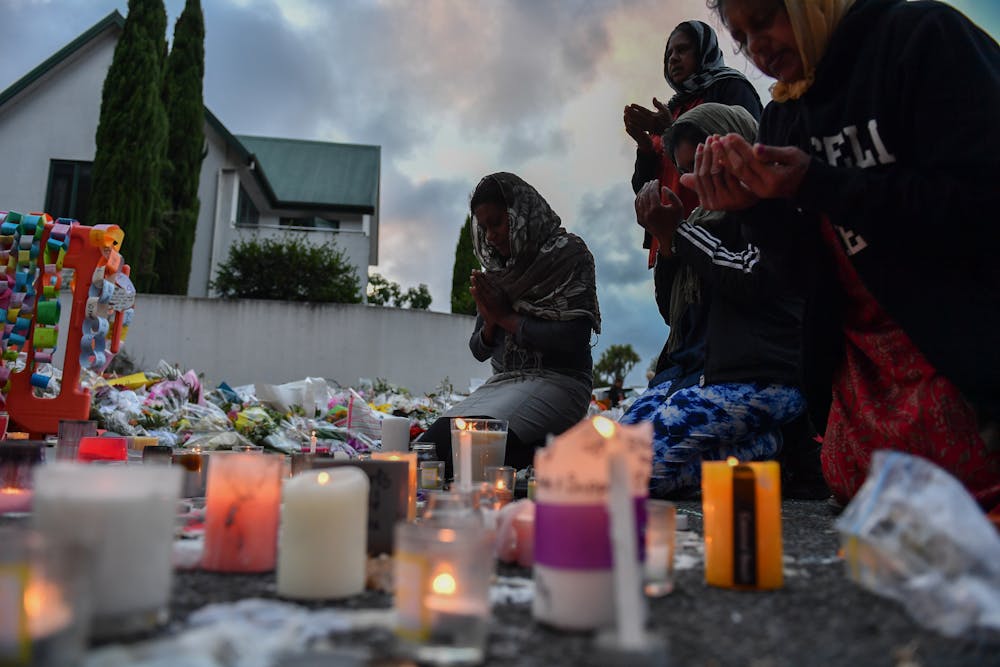
During his two-day royal visit this week, Prince William has met with survivors of the Christchurch mosque shootings and has praised New Zealand’s response to the attacks.

To the people of New Zealand and the people of Christchurch, to our Muslim community and all those who have rallied by your side, I stand with you in gratitude to what you have taught the world in these past weeks.

Earlier, Prince Hassan bin Talal of Jordan described New Zealanders as “citizens of the future”.

Globally, Prime Minister Jacinda Ardern’s response to the attacks is seen as a new way of reacting to violent extremism. With an emphasis on what unites people, communities in different countries were motivated to express solidarity across religious and cultural divides.

In contrast, the opportunistic linking of the Easter Sunday terrorist attacks in Colombo, Sri Lanka, with Christchurch will once again serve to divide humanity.


Read more: Islamic State has claimed responsibility for the Sri Lanka terror attack. Here’s what that means


Solidarity at home

Domestically, the terrorist attack on Muslim worshippers in Christchurch was met by a display of unity. A heartfelt exchange of respect between the country’s leadership and the minority Muslim community characterised the days and weeks following the attack.


Read more: From Mahometan to Kiwi Muslim: history of NZ’s Muslim population


A renewed rejection of racism in all its forms, including Islamophobia, led to a public discussion of the Crusaders rugby team’s name. The government took decisive action by tightening gun laws and instituting a royal commission of inquiry into New Zealand’s security and intelligence agencies.

But the question now is whether New Zealand can translate its new-found domestic cohesion and goodwill into foreign policy.

Support for Palestinian sovereignty

The Israel-Palestine conflict is a good place to start. If solidarity at home is to influence global understanding and cooperation across cultures, Palestinian sovereignty must be a foreign policy priority.

The international community’s failure over the past 72 years to find a just and sustainable solution to the “Palestine question” is an ongoing source of discord between Muslims and non-Muslims.

Shortly after its establishment, the UN Alliance of Civilisations (UNAOC) noted:

The Israeli military occupation of Palestine has been perceived in the Muslim world as a form of colonialism and has led many to believe, rightly or wrongly, that Israel is in collusion with the “West”.

Palestinian casualties, dispossession and suffering due to the occupation fuel resentment and radicalisation in the Muslim world. The impunity an American veto allows Israel further enhances the perception of Western hypocrisy. The US and Israel’s disregard for the legal status of Jerusalem as corpus separatum undermines both the potential for peace between Israelis and Palestinians and an international rules-based system.

New Zealand needs to be more vocal in international forums in criticising Israel’s occupation policies.

Challenging Islamophobia

Islamophobia, or an anti-Muslim bias that incorrectly presents Muslims as a dangerous monolithic group, is both a domestic and global concern. The real danger is that Islamophobia becomes the norm.

Politicians, such as Hungarian Prime Minister Viktor Orban, promote the notion of a clash of civilisations when they present Muslims as a threat to Christian Europe. The United Kingdom’s security strategy in response to the terrorist attacks in London on July 7 2005, called Prevent, is an example of anti-radicalisation policies that target people based on their faith, specifically Muslims.


Read more: Terror, Muslims, and a culture of fear: challenging the media messages


Islamophobia also finds expression in conflating radical and moderate Islamists. These groups may share the pursuit of an ideal state, based on Islamic teachings, but they differ drastically in their methods and interpretation of Islam. Autocratic governments in the Middle East and North Africa (MENA) region fuel Islamophobia when they dismiss these differences in order to demonise their moderate Islamist opposition.

This can be explained by the fact that moderate Islamism offers an authentic alternative to authoritarianism. For example, Syria’s President Bashar al-Assad and his late father, Hafez al-Assad, have a history of demonising and repressing the moderate Islamist Syrian Muslim Brotherhood (SMB) to ensure the regime’s political survival. Saudi Arabia, the United Arab Emirates (UAE) and Egypt declared the Muslim Brotherhood a terrorist organisation in the wake of the 2010-11 Arab uprisings, which threatened autocrats across the MENA region.


Read more: Competing foreign interests trump Syrian aspirations for political change


A rules-based international system

The UAE and Saudi Arabia are key markets for New Zealand. They are also members of the Gulf Cooperation Council (GCC), our eighth-largest trading partner. In equating moderate Islamism with terrorism to contain domestic dissent, these states contribute to international disunity and hate.

New Zealand needs to resist pressure from these partners as well as from some other member countries in the Five Eyes intelligence alliance to view Islamists as monolithic. It also needs to enhance support for initiatives that strengthen global understanding and cooperation between non-Muslim and Muslim-majority countries such as the UNAOC.

At the UN General Assembly in September 2018, Ardern signalled a clear direction for foreign policy by calling for kindness, collectivism and an international rules-based system. This is in stark contrast to US President Donald Trump’s portentious rejection of globalism.

New Zealand’s response to the Christchurch terrorist attack showed the world values that, in Ardern’s words, “represent the very best of us”. The expectation remains that our foreign policy will follow through.

ref. Why New Zealand needs to translate its response to Christchurch attacks into foreign policy – http://theconversation.com/why-new-zealand-needs-to-translate-its-response-to-christchurch-attacks-into-foreign-policy-115556

Labor’s crackdown on temporary visa requirements won’t much help Australian workers

]]>

Source: The Conversation (Au and NZ) – By Ross Guest, Professor of Economics and National Senior Teaching Fellow, Griffith University

Bill Shorten is holding out the prospect of protecting Australian workers from foreign ones.

He has pledged to tighten the visa system for short-term skilled migrants, ensuring they have to be paid more so that “it isn’t cheaper to pay an overseas worker than pay a local worker”.

But the evidence does not support his claim that his policy proposal will boost local jobs and wages. He said

There are more than 1 million underemployed Australians wanting more work and youth unemployment is at 11.7%

At the same time, there are almost 1.6 million temporary visa holders with work rights in Australia, with the top end of town turning to temporary work visas to undercut local jobs, wages and conditions

Requirements have already been toughened

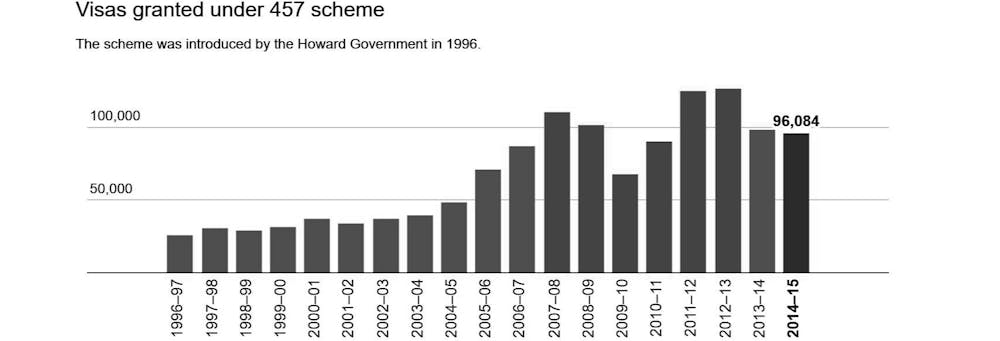
The first point to note is that Shorten’s policy relates only to short-term visas for skilled migrants. Up until 2017, these were known as 457 visas. Their number peaked at 126,000 in 2012-13.


Parliamentary Library


Prime Minister Malcolm Turnbull replaced the 457 visa with the 482 visa, partly in response to evidence that some employers had exploited the 457 to employ foreign workers on low wages.

The new visa required

  • applicants to demonstrate work experience (minimum two years) and English language proficiency

  • the sponsoring employer to demonstrate lack of success in finding a local worker to do the job

  • the salary level to be at the market level for the role, and above what is known as the Temporary Skilled Migration Income Threshold. This is now about A$54,000.

Since August 2018, employers of workers with 482 visas have also had to pay a fee to the Department of Education and Training to subsidise apprenticeships. Known as the Skilling Australians Fund Levy, it ranges from $2,400 to $7,200, depending on the length of the visa and the employer’s annual turnover.

The core of Labor’s policy is to increase the income threshold to $65,000, a figure that will be indexed annually. The skilling levy would be 3% of the income threshold, a level that for some businesses would be an increase of 63%.

Skilled migrants are not the problem

The most recent statistics published by the federal government (for 2017-18) show a total of 83,470 people on temporary skilled worker visas (both 482 visas and residual 457 visas).

This means Shorten’s reference to the almost 1.6 million temporary visa holders with work rights in Australia – such as backpackers and international students (who we know are often exploited by unscrupulous employers) – is something of a red herring. Labor’s proposal won’t make any difference to them.


Read more: Crackdown on foreign workers is part of Shorten’s wages campaign


Even if the 83,470 workers that the policy would affect were being employed to undercut local wage expectations, their number – less than 1% of Australia’s 10 million total employees – is simply not enough to influence market wages. In no occupation are visa holders more than 1% of total employees.

But there’s scant evidence to suggest the 482 visas are routinely used to employ cheaper workers. The average base nominated salary for visas in 2017-18 was $94,800, well above the average full-time wage (about $85,000) and even higher than the $54,000 or Labor’s proposed $65,000 minimum.

Admittedly, averages don’t tell the full story. But in only one sector – food and accommodation, accounting for 10.7% of visas granted – was the average wage lower than $65,000.

It suggests that raising the income threshold won’t have much impact.

Labor’s proposals would be felt in the regions

There is one possible exception to this: regional and remote Australia, which has benefited the most from temporary skilled worker visas. If the market wage for say, an early career chef, is below $65,000 (which it could be for some places in Australia), a restaurant or café employer in a small town would no longer be able to employ a migrant worker at the going rate, and it might also struggle to find would be be a $7,800 levy.

Labor’s proposal would impose higher relative costs on regional employers.

Claims about the impact of temporary work visas on employment and wages have been heard but seldom subject to rigorous analysis.

A significant inquiry into short-term migrant work visas in Australia was conducted by a Senate select committee in 2015-16. It noted an inverse relationship between 457 visas granted and the unemployment rate. In other words, the visas were associated with low, rather than high unemployment rates.

This suggests visas are meeting genuine skills shortages rather than displacing Australian workers.

Migrants create as well as fill jobs

Migrant workers are also consumers. They spend their income, contributing to demand for goods and services from local businesses, which adds to the demand for workers generally.

The same dynamics apply as those involving all migrants. As peer-reviewed research by researchers at the Australian National University has shown, migration has had “no detectable effect on employment or wages of all workers who have lived in Australia for more than five years”.

These findings are essentially supported by the Productivity Commission.

In sum, there’s little evidence that Australia’s current visa program for temporary skilled migrants has a negative effect on local jobs or wages.

Labor’s plans are unlikely to achieve anything positive. They might even hurt.


Read more: Dog whistles, regional visas and wage theft – immigration policy is again an election issue


ref. Labor’s crackdown on temporary visa requirements won’t much help Australian workers – http://theconversation.com/labors-crackdown-on-temporary-visa-requirements-wont-much-help-australian-workers-115844

New Zealand’s dismal record on child poverty and the government’s challenge to turn it around

Source: The Conversation (Au and NZ) – By Michael Fletcher, Senior Research Fellow, Institute for Governance and Policy Studies, Victoria University of Wellington, Victoria University of Wellington

The latest statistics on childhood poverty in New Zealand suggest that, on some key measures, things are worse than previously estimated.

About one in six children (16% or 183,000) live below a before-housing-cost relative poverty measure, but that figure jumps to almost one in four (23% or 254,000) once housing costs are accounted for. And 13% (148,000) are living in households that experience material hardship – 6% in severe hardship. These children don’t have such basic things as two good pairs of shoes. Their families regularly have to cut back on fresh fruit and veggies, put up with feeling cold and postpone visits to the doctor.

The data show that the government will need to do much more to reach its targets for reducing childhood poverty.


Read more: One in five NSW high school kids suffers “severe” deprivation of life’s essentials


Measuring child poverty

New Zealand introduced the Child Poverty Reduction Act at the end of last year. It was a bold move reflecting the Ardern government’s commitment to do something about New Zealand’s dismal child poverty statistics. Earlier this month, Stats NZ released the first set of baseline statistics required under the act.

Previous governments, both National and Labour, may have talked about child poverty but shied away from binding targets. Prime Minister Jacinda Ardern, who has also made herself minister for child poverty reduction, has put through clear legislation, eventually winning cross-party support for it.

The act does two main things. First, it requires the government statistician to report annually on a set of four “primary” and six “supplementary” measures of child poverty. (One primary measure, poverty persistence, does not come into force until 2025.)

Second, it requires governments to set three-year and ten-year targets for each of the primary measures and to report on progress to parliament. Any failures to meet targets must be explained.

The three primary measures are:

  1. Relative poverty, before housing costs: the proportion of children living in households whose equivalised disposable income before housing costs is less than 50% of the median. This measure compares a household’s income for the previous 12 months to the current median for all households. The median will move from year to year due to inflation and economic changes. A low-income household will improve its situation if its income moves by more than the median.
  2. Constant value poverty after housing costs: the proportion of children living in households whose equivalised disposable income after housing costs is less than 50% of the base-year median. This measure gives an indication of the spending power households have after paying either rent or mortgage repayments, rates and insurance.
  3. Material hardship: the proportion of children living in households that are experiencing material hardship, defined as having a score of six or more on the DEP-17 deprivation index.

The government’s targets

Well before the act was finalised, the prime minister had announced the government’s ten-year targets: 5% on the first measure, 10% on the second and 7% on the third.

These are ambitious targets, which would put New Zealand near the top of the OECD rankings. That said, they still imply a significant number of children in poverty.

During the evolution of the legislation, the government also decided to bring forward the starting year for measurement of the targets to 2018-19, therefore making the baseline year 2017-18. This has the advantage of ensuring the impact of its Families Package contributes to achieving the targets, but the disadvantage that targets had to be set before the official Stats NZ baseline measures were available.

The three-year targets were therefore expressed in percentage-point decreases, rather than in absolute terms (reductions of 6, 4 and 3 percentage points respectively).

Ironically, the worse-than-expected figures make the government’s short-term targets slightly easier to reach. Taking six percentage points off a larger number is easier to achieve than if the baseline had turned out lower than expected. Nonetheless, it must still lift 72,000 children over the first line, 42,000 over the after-housing-cost measure, and 37,000 out of the material hardship category.

How to reduce childhood poverty

The Families Package, announced before the 2017 election, will go part of the way. Its increases in the Working for Families tax credits and, to a lesser extent, the changes to the Accommodation Supplement will reduce child poverty, especially against the first before-housing-cost measure. Treasury has estimated that the Families Package will reduce the number of children below this measure by 64,000 by 2021.

The impact on the after-housing-cost measure is likely to be smaller because of rising rental costs, which grew by an average of 5.2% during 2018. The reduction in the number of children living under material hardship is also likely to be less substantial.

Other changes might have some effect. The government is committed to increasing the statutory minimum wage to $20 per hour by 2021. It was $15.75 for most of the baseline year, rising to $16.50 on April 1 2018. Ministry of Business, Innovation and Employment analysis, however, suggests minimum wage increases will have a “relatively limited impact” on poverty among households with children because most poor kids are not living in households with a minimum-wage earner.

Housing initiatives, especially more state housing, will help eventually but will take too long to have any impact on the three-year poverty targets. The 2018 budget extensions to free and low-cost doctors’ visits for children and the broadening of access to the Community Services Card can be expected to help families experiencing material hardship, as will other changes such as the banning of tenancy letting fees. But these can only be expected to have marginal impacts.


Read more: NZ budget 2018: gains for health, housing and education in fiscally conservative budget


Substantial further initiatives will be needed over the next two years. The size of the task is illustrated here.

Michael Fletcher, CC BY-ND

The after-housing-costs measure must come down the most but has been heading in the right direction following the global financial crisis. This reflects the fact that it is adjusted only for price inflation and the incomes of some poor households have been rising more quickly than prices. The material hardship measure has also been trending down, probably for similar reasons.

The most challenging target will be the relative poverty measure. Recent good economic growth and a strong labour market have done nothing to reduce this measure. Indeed, it has been more or less constant for over a decade.

Cutting poverty on this measure requires bringing poor households nearer to the median, reducing inequality between the poor and those in the middle. A rising tide that lifts all boats equally will do nothing to reduce relative poverty.

The government will also need to ensure its policies help the poorest of the poor. Reaching the three primary targets but not cutting the numbers below the lowest poverty line would be a hollow achievement. Most of these children are in families reliant on benefit incomes. Part of any successful strategy to reduce child poverty must involve increasing the level of assistance to families on benefits.

ref. New Zealand’s dismal record on child poverty and the government’s challenge to turn it around – http://theconversation.com/new-zealands-dismal-record-on-child-poverty-and-the-governments-challenge-to-turn-it-around-115366

Solomon Islands police remain on high alert in the wake of political unrest

Evening Report
Evening Report
Solomon Islands police remain on high alert in the wake of political unrest
Loading
/
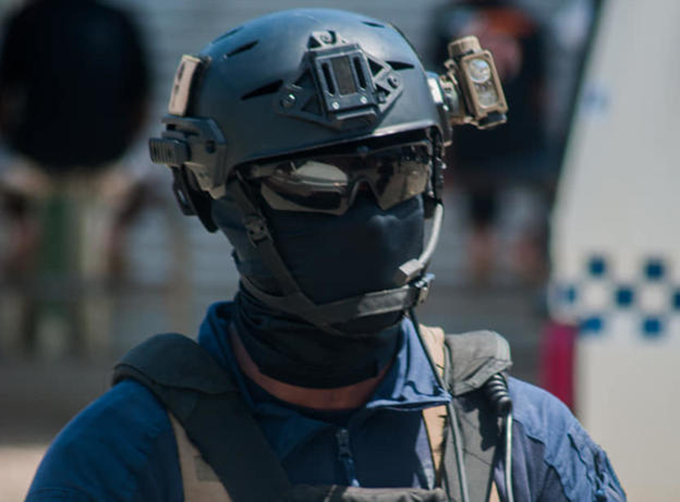
A member of the Police Response Team in Solomon Islands on patrol during the election of the prime minister in Honiara. Image: Gino Oti/RNZ Pacific

By Koroi Hawkins in Honiara

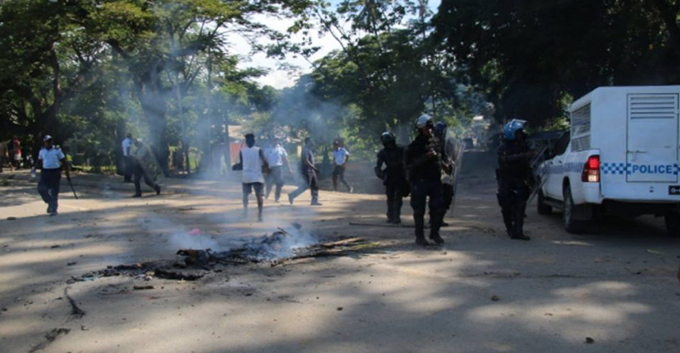
Police in Solomon Islands remain on high alert after Wednesday’s riots which broke out across the capital Honiara shortly after Manasseh Sogavare was announced the country’s prime minister.

So far 50 people have been taken into custody in connection with the unrest which saw opportunists taking advantage of the chaos to continue to loot and destroy public and private property up until the early hours of Thursday morning.

The police commissioner Matthew Varley said the situation was now under control and he is urging residents of Honiara to go about their daily lives.

LISTEN: The full Koroi Hawkins interview with Police Commissioner Matthew Varley

Varley said he was disappointed in the individuals who decided to take part in the lawlessness and reassured the wider Solomon Islands community that police will be working around the clock to protect them and to keep the peace.

“Anyone who comes out tonight and continues with this sort of behaviour I say is being opportunistic, looking to cause trouble, looking to loot and steal and to get into a fight,” Commissioner Varley said.

-Partners-

“And police are trying to send a message out through chiefs and leaders in communities today that we don’t want to see a repeat of what occurred last night but at the same time we are taking precautions to make sure police officers are highly visible and ready to respond to anymore issues that might arise.”

This article is published under the Pacific Media Centre’s content partnership with Radio New Zealand.

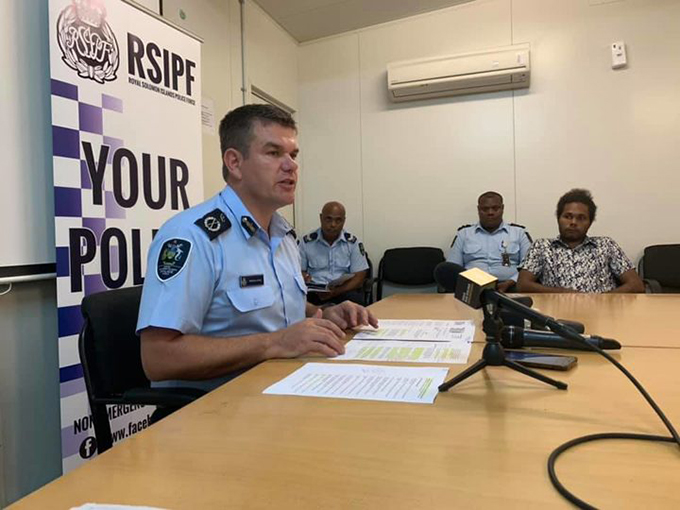
Solomon Islands Police Commissioner Matthew Varley updates media on election security operations. Image: Koroi Hawkins/RNZ Pacific

Print Friendly, PDF & Email

Article by AsiaPacificReport.nz

Bid to expel journalist from Yap puts spotlight on Micronesian ‘free’ media

By Michael Andrew

Traditional chiefs are trying to expel a US journalist from the Federated States of Micronesia island of Yap.

Last week the Pacific Island Times reported that the chiefs, member of the council of Pilung, had written a letter to the Yap Legislature requesting that Joyce McClure be made a “persona non grata”.

Signed by nine chiefs, the letter described McClure’s journalistic activates as “disruptive to the state environment and/or to the safety and security of the state” and labelled the news magazine and website she writes for, Pacific Islands Times, a “fake news agency”.

READ MORE: Yap’s traditional chiefs seek to expel probing US journalist

Pacific Island Times … “Fearless. Fair. Focused.” Image: Pacific Island Times

It also said McClure’s articles contained “biased strong opinions against Asian ethnicity”.

RNZ Pacific reported that the efforts to have her expelled were linked to her scrutiny of Chinese investment on the island.

-Partners-

“They have been what I call cautionary tales about what the Chinese government is doing in terms of their Belt and Road initiative,” she told RNZ in an interview.

Such stories have investigated pollution from a Chinese resort development and the operation of Chinese fisheries in local waters.

Mystery stories

Journalist Joyce McClure … under local fire for her investigative articles. Image: Twitter

However, McClure said she did know which story the chiefs had taken issue with.

“It’s a mystery what they are referring to,” she said.

“I do wish they would come forward with examples of what they’re talking about.”

Pacific Island Times publisher and editor-in-chief chief Mar-Vic Cagurangan told Pacific Media Watch the campaign against McClure was consistent with a publishing climate where “community connections influence what gets published.”

“It is not easy to be a journalist in a small community, where everyone knows everyone – everyone is related,” she said.

Based in nearby Guam, Cagurangan said that although the island benefits from the US First Amendment of the right to free speech, local media organisations may face “economic sanctions” for some content.

“Guam is a small market, where some elected officials are business owners or have a family that owns a business that deals with government.

Questionable contracts
“When I was the editor of the now-defunct Marianas Variety, I had encountered many occasions when a certain business owned by the family of the governor pulled out their ads following the publication of a series of stories about questionable contracts entered into by the administration.”

She said that despite the threats, the paper would continue to run important stories.

“Although we rely on advertising revenue to keep going, we refuse to compromise our journalistic integrity and independence.”

The Yap State Legislature … chiefs’ letter attacks journalist and “fake news” publication. Image: Yap twitter

However, she said in other jurisdictions of the Federated States of Micronesia (FSM), the risks of reporting were much greater. There has been at least one case of a journalist being expelled.

In 1997, the FSM government declared Canadian citizen Sherry O’Sullivan persona non grata in response to information about government corruption published in her publication, The FSM News, as reported by Pacific Journalism Review.

The Pacific Daily News took up her case, saying in an editorial that “actions to censor her are misdirected and, instead, end up posing a serious threat to the right of free speech and a free press in the Federated States of Micronesia”.

The following year, the US Department of State released a report criticising the FSM government for stifling investigation into its activities and figures.

Threat ‘unsurprising’
Associate professor of journalism at the University of Guam, Francis Dalisay, said it was not normal for media in the FSM to challenge local elites and power structures. He said it was not surprising that the chiefs in Yap viewed Joyce McClure as a threat.

“The local media in Yap may have a greater tendency to report on issues and matters that are meant to maintain the status quo and tradition.”

Dalisay has published research on the relationship between the mainstream media in Guam and the US military establishment. He found that the local papers often focused on the benefits while neglecting the risks of increased US activity.

Manny Cruz, an indigenous journalist from Guam who is also a doctoral research scholar attached to AUT’s Pacific Media Centre, said that such risks included the confiscation of indigenous land for military use.

He said that because of the islands’ strategic significance for US military operations, it should be at the forefront of global news.

“They’re currently going through a process of military build-up.

“They want to actually bring in more US marines, and they’re building up more federal facilities on indigenous, sacred land.

“This is something that really the entire world should be looking at.”

Michael Andrew is contributing editor of the Pacific Media Centre’s Pacific Media Watch freedom project.

Manny Cruz talking to Michael Andrew on a recent PMC Southern Cross radio programme.

Print Friendly, PDF & Email

Article by AsiaPacificReport.nz

Why the idea of alien life now seems inevitable and possibly imminent

Source: The Conversation (Au and NZ) – By Cathal D. O’Connell, Researcher and Centre Manager, BioFab3D (St Vincent’s Hospital), University of Melbourne

This article is an edited extract from an essay, The search for ET, in The New Disruptors, the 64th edition of Griffith Review.

We’re publishing it as part of our occasional series Zoom Out, where authors explore key ideas in science and technology in the broader context of society and humanity.


Extraterrestrial life, that familiar science-fiction trope, that kitschy fantasy, that CGI nightmare, has become a matter of serious discussion, a “risk factor”, a “scenario”.

How has ET gone from sci-fi fairytale to a serious scientific endeavour modelled by macroeconomists, funded by fiscal conservatives and discussed by theologians?

Because, following a string of remarkable discoveries over the past two decades, the idea of alien life is not as far-fetched as it used to seem.

Discovery now seems inevitable and possibly imminent.

It’s just chemistry

While life is a special kind of complex chemistry, the elements involved are nothing special: carbon, hydrogen, oxygen and so on are among the most abundant elements in the universe. Complex organic chemistry is surprisingly common.

Amino acids, just like those that make up every protein in our bodies, have been found in the tails of comets. There are other organic compounds in Martian soil.

And 6,500 light years away a giant cloud of space alcohol floats among the stars.

Habitable planets seem to be common too. The first planet beyond our Solar System was discovered in 1995. Since then astronomers have catalogued thousands.

Based on this catalogue, astronomers from the University of California, Berkeley worked out there could be as many as 40 billion Earth-sized exoplanets in the so-called “habitable zone” around their star, where temperatures are mild enough for liquid water to exist on the surface.

There’s even a potentially Earth-like world orbiting our nearest neighbouring star, Proxima Centauri. At just four light years away, that system might be close enough for us to reach using current technology. With the Breakthrough Starshot project launched by Stephen Hawking in 2016, plans for this are already afoot.

Life is robust

It seems inevitable other life is out there, especially considering that life appeared on Earth so soon after the planet was formed.

The oldest fossils ever found here are 3.5 billion years old, while clues in our DNA suggest life could have started as far back as 4 billion years ago, just when giant asteroids stopped crashing into the surface.

Our planet was inhabited as soon as it was habitable – and the definition of “habitable” has proven to be a rather flexible concept too.

Life survives in all manner of environments that seem hellish to us:

Tantalisingly, some of these conditions seem to be duplicated elsewhere in the Solar System.

Snippets of promise

Mars was once warm and wet, and was probably a fertile ground for life before the Earth.

Today, Mars still has liquid water underground. One gas strongly associated with life on Earth, methane, has already been found in the Martian atmosphere, and at levels that mysteriously rise and fall with the seasons. (However, the methane result is under debate, with one Mars orbiter recently confirming the methane detection and another detecting nothing.)

Martian bugs might turn up as soon as 2021 when the ExoMars rover Rosalind Franklin will hunt for them with a two-metre drill.

Besides Earth and Mars, at least two other places in our Solar System might be inhabited. Jupiter’s moon Europa and Saturn’s moon Enceladus are both frozen ice worlds, but the gravity of their colossal planets is enough to churn up their insides, melting water to create vast subglacial seas.

In 2017, specialists in sea ice from the University of Tasmania concluded that some Antarctic microbes could feasibly survive on these worlds. Both Europa and Enceladus have undersea hydrothermal vents, just like those on Earth where life may have originated.

When a NASA probe tasted the material geysered into space out of Enceladus last June it found large organic molecules. Possibly there was something living among the spray; the probe just didn’t have the right tools to detect it.

Russian billionaire Yuri Milner has been so enthused by this prospect, he wants to help fund a return mission.

A second genesis?

A discovery, if it came, could turn the world of biology upside down.

All life on Earth is related, descended ultimately from the first living cell to emerge some 4 billion years ago.

Bacteria, fungus, cacti and cockroaches are all our cousins and we all share the same basic molecular machinery: DNA that makes RNA, and RNA that makes protein.

A second sample of life, though, might represent a “second genesis” – totally unrelated to us. Perhaps it would use a different coding system in its DNA. Or it might not have DNA at all, but some other method of passing on genetic information.

By studying a second example of life, we could begin to figure out which parts of the machinery of life are universal, and which are just the particular accidents of our primordial soup.

Perhaps amino acids are always used as essential building blocks, perhaps not.

We might even be able to work out some universal laws of biology, the same way we have for physics – not to mention new angles on the question of the origin of life itself.

A second independent “tree of life” would mean that the rapid appearance of life on Earth was no fluke; life must abound in the universe.

It would greatly increase the chances that, somewhere among those billions of habitable planets in our galaxy, there could be something we could talk to.

Perhaps life is infectious

If, on the other hand, the discovered microbes were indeed related to us that would be a bombshell of a different kind: it would mean life is infectious.

When a large meteorite hits a planet, the impact can splash pulverised rock right out into space, and this rock can then fall onto other planets as meteorites.

Life from Earth has probably already been taken to other planets – perhaps even to the moons of Saturn and Jupiter. Microbes might well survive the trip.

In 1969, Apollo 12 astronauts retrieved an old probe that had sat on the Moon for three years in extreme cold and vacuum – there were viable bacteria still inside.

As Mars was probably habitable before Earth, it’s possible life originated there before hitchhiking on a space rock to here. Perhaps we’re all Martians.

Even if we never find other life in our Solar System, we might still detect it on any one of thousands of known exoplanets.

It is already possible to look at starlight filtered through an exoplanet and tell something about the composition of its atmosphere; an abundance of oxygen could be a telltale sign of life.

A testable hypothesis

The James Webb Space Telescope, planned for a 2021 launch, will be able to take these measurements for some of the Earth-like worlds already discovered.

Just a few years later will come space-based telescopes that will take pictures of these planets directly.

Using a trick a bit like the sun visor in your car, planet-snapping telescopes will be paired with giant parasols called starshades that will fly in tandem 50,000 kilometres away in just the right spot to block the blinding light of the star, allowing the faint speck of a planet to be captured.

The colour and the variability of that point of light could tell us the length of the planet’s day, whether it has seasons, whether it has clouds, whether it has oceans, possibly even the colour of its plants.

The ancient question “Are we alone?” has graduated from being a philosophical musing to a testable hypothesis. We should be prepared for an answer.

ref. Why the idea of alien life now seems inevitable and possibly imminent – http://theconversation.com/why-the-idea-of-alien-life-now-seems-inevitable-and-possibly-imminent-115643

Lies, obfuscation and fake news make for a dispiriting – and dangerous – election campaign

Source: The Conversation (Au and NZ) – By Denis Muller, Senior Research Fellow in the Centre for Advancing Journalism, University of Melbourne

The integrity of Australia’s electoral processes is under unprecedented challenge in this federal election.

The campaign has already been marred by fake news, political exploitation of social media falsehoods and amplification by mainstream media of crude slurs made on Facebook under the cover of anonymity.

We have seen our first recorded instance of Facebook running Australian fake news.

It was a false post about the Labor Party’s tax policies, wrongly saying Labor intended to introduce a 40% inheritance tax.

It was interesting to trace how this fakery was created.

The false post had a link to a press release issued in January by Treasurer Josh Frydenberg.

It said Labor’s assistant treasury spokesman, Andrew Leigh, had written an article 13 years ago – when he was an academic – that favoured introducing an inheritance tax. Thirteen years ago – before he was even in politics.


Read more: ‘Fake news’ is already spreading online in the election campaign – it’s up to us to stop it


Then to add to the fakery, and seemingly by coincidence, the Liberal Party had a black van driving around city streets with large signs saying “Labor will tax you to death”.

The Liberals have denied being involved in the duplicity and there is no evidence to suggest they were. But the false post had just enough of an impressionistic link to the Liberal attack to make its message plausible: a tincture of “truthiness”.

Then the Coalition made mischief with it.

George Christensen, Nationals MP for the Queensland seat of Dawson, put up a Facebook post three days after the original, saying:

Labor does the bidding of their union bosses [and] the union bosses have demanded Bill Shorten introduce a death tax.

The original post also generated memes from far-right political groups, piling new lies on top of the old.

Labor has demanded Facebook take down the original, but there is no sign it has done so.

The delay is not only unconscionable, but has given the likes of Christensen and others the opportunity to cloak the original falsehood in political commentary, creating the basis for a specious circular argument. It goes like this:

Facebook posts a lie. It generates political reaction. The political reaction absorbs the lie into political speech. Political speech should not be censored. Therefore taking down the original lie would be censorship.

This is yet one more way in which Facebook’s irresponsibility taints the democratic process.

So much for the fine promises made by Facebook’s founder, Mark Zuckerberg, last year on what became known as his “apology tour” of Washington and Brussels.

He told officials he would stop the spread of fake news and voter manipulation on Facebook.

He told a US Senate committee that every advertiser who wanted to run political ads would need to be authorised, and that would mean confirming their identity and location.

Yet the ABC is reporting that just months after Zuckerberg’s “apology tour”, Facebook was playing ducks and drakes with the Australian Electoral Commission over precisely this question of authorisation.

The ABC reports that it has obtained documents under freedom-of-information that show a prolonged battle last year between the commission and Facebook over unauthorised political ads from a mysterious outfit called Hands Off Our Democracy, which was paying for sponsored posts attacking left-wing groups and political parties.

The posts eventually disappeared, but only after Facebook tried to give the commission the brush-off.

The ABC is also reporting that almost a year after Zuckerberg made his promises to clean up Facebook’s act, and with Australia’s federal election only three weeks away, Facebook still has not brought its new authorisation rules to Australia.

Meanwhile, the Electoral Commission is on the front foot about fake news.

A Google search for “Facebook carries fake news about Labor’s tax policy” brings up as its top item an ad from the commission warning people not to be misled by disinformation.

The commission has set up a special electoral integrity taskforce, which includes the Australian Signals Directorate and ASIO, to try to head off potential threats to the democratic process.

A further threat to the integrity of Australia’s electoral process is the interplay between Facebook and elements of the mainstream media.

A few days ago, the convoy protesting against the Adani coal mine arrived in Queensland, led by environmental activist and former Greens leader Bob Brown.

Simultaneously, a private Facebook group called Stop Adani Convoy posted a number of repugnant messages, including a reference to gas chambers.


Read more: Australian governments have a long history of trying to manipulate the ABC – and it’s unlikely to stop now


The post was anonymous, but it was picked up and amplified by Brisbane’s Courier-Mail newspaper under the heading: “Bob Brown’s mob of revolting protesters liken coal mines to gas chambers”.

Well down in the story, the newspaper said it was not suggesting Brown had anything to do with this statement, an inclusion that was all about avoiding a writ for libel.

Brown said: “Some of the headlines in the Murdoch media are simply disgraceful. They’re a disgrace to journalism”.

This interaction of social media and elements of the mainstream media, in which extremist language and feverish controversy are exploited as a means of dividing the community and of promoting a reactionary political worldview, was a potent feature of the 2016 US presidential campaign and the Brexit referendum the same year.

Where the issue is highly controversial and emotive – as with climate change, immigration or Brexit – the extremism expressed on social media makes headlines in the mainstream media, raising the political temperature and fuelling further partisanship.

There is a lot of research that shows how these effects are damaging democracies around the world. The findings are laid out in books such as those by Cass Sunstein (#republic), Steven Levitsky and Daniel Ziblatt (How Democracies Die) and A.C. Grayling (Democracy and Its Crisis).

An important long-term issue in the 2019 federal election is how robust Australia’s democratic institutional arrangements turn out to be in the face of these pressures.

ref. Lies, obfuscation and fake news make for a dispiriting – and dangerous – election campaign – http://theconversation.com/lies-obfuscation-and-fake-news-make-for-a-dispiriting-and-dangerous-election-campaign-115845

Think you’re allergic to penicillin? There’s a good chance you’re wrong

Source: The Conversation (Au and NZ) – By Greg Kyle, Professor of Pharmacy, Queensland University of Technology

Are you allergic to penicillin? Perhaps you have a friend or relative who is? With about one in ten people reporting a penicillin allergy, that’s not altogether surprising.

Penicillin is the most commonly reported drug allergy. But the key word here is “reported”. Only about 20% of this 10% have a true penicillin allergy – so the figure would be one in 50 rather than one in ten.

People may experience symptoms they think are a result of taking penicillin, but are actually unrelated. If these symptoms are not investigated, they continue with the belief that they should steer clear of penicillin.


Read more: Weekly Dose: penicillin, the mould that saves millions of lives


This can become a problem if a person is sick and needs to be treated with penicillin. Penicillin and related antibiotics are the most common group of drugs used to treat a broad range of infections, from chest or throat, to urinary tract, to skin and soft tissue infections.

The overestimation of penicillin allergies is also not ideal because it means people are being treated with a broader range of antibiotics than necessary, which contributes to the problem of antibiotic resistance.

Yes, penicillin comes from mould

To understand more about why so many people think they’re allergic to penicillin, we need to look at a brief history of the drug.

Penicillin (benzylpenicillin or Penicillin G) was first discovered in 1928 and first used in 1941.

It was grown from a mould, as it is today. The liquid nutrient broth the mould grew in was drained, and the penicillin purified from it.

In the 1930s and 40s, and even through the 1960s and 70s, purification techniques were not as efficient as they are today. So, many early allergic reactions are thought to be due to impurities in the early penicillin products – especially injections.

Penicillin is now more versatile and can kill a wider range of bacteria than in its earlier days. From shutterstock.com

Penicillin and the range of antibiotic compounds that followed it revolutionised how we treat bacterial infections.

This led to widespread, and sometimes inappropriate, use of these medicines. Antibiotics do not work against viruses, but are sometimes prescribed for bacterial infections that occur while people have viral infections such as glandular fever.

We know using penicillin while a person has glandular fever can cause a rash that looks like penicillin allergy but is not related.

People may report symptoms to their health professionals that seem like a reaction to penicillin. Perhaps these symptoms are not fully investigated because it takes time and can be expensive – they’re just put down to the common penicillin allergy.

Further, some people perceive other side effects of a penicillin antibiotic such as nausea or diarrhoea as an allergy, when these are not, in fact, allergy symptoms.

From this point, the penicillin family will not be used to treat these patients.


Read more: We know _why_ bacteria become resistant to antibiotics, but _how_ does this actually happen?


The problem of antibiotic resistance

An allergy to penicillin can also limit the use of some other antibiotics which may cross-react with the allergy.

Cross reaction occurs when the chemical structure of another antibiotic is so similar to the structure of penicillin that the immune system gets confused and recognises it as the same thing.

To avoid this, doctors need to look to antibiotics from other medication classes when prescribing patients with a documented penicillin allergy.

But we need to be careful when drawing on a wider range of antibiotics. This is because the more bacteria are exposed to antibiotics, the more likely they are to develop resistance to these antibiotics.

The range of penicillins we have today came from experimenting with the chemistry of the original penicillin molecule and changing its properties. From shutterstock.com

To address the growing problem of antibiotic resistance, we now try to restrict antibiotics as much as possible to the lowest level one that will kill the specific bacteria.

We don’t kill tiny ants in our gardens with a sledgehammer, so likewise, we use a narrow-spectrum antibiotic wherever possible to keep the broad-spectrum antibiotics for severe and complex infections.

The penicillin family contains both narrow and broad-spectrum antibiotics. Ruling out this family and its “cousins” when we don’t need to can limit the choice of antibiotics and increase the chance of making other antibiotics less useful.

Can I get tested?

Studies show penicillin allergy reduces over time. So even if you did have a true penicillin allergy, it may have gone away over several years.

Under the guidance of your doctor, it is possible to be tested to see if you’re allergic – or still allergic – to penicillin.

A skin “scratch” test involves injecting a small amount of penicillin and monitoring for a reaction. Rescue medications will be on hand in case you do have a severe reaction. Your GP will probably refer you to an allergy specialist to get this done.


Read more: Common skin rashes and what to do about them


If you have been told you’re allergic, you should first try to find out when the reaction occurred and what happened in as much detail as possible.

Let your GP know all this information and he or she can then decide whether a skin test might be appropriate.

Do not try a test dose at home – the risk of a life-threatening reaction is not worth it.

And if you believe you are allergic to penicillin, the most important thing to do is tell each health professional (doctor, pharmacist, nurse, dentist, etc.) you come into contact with.

ref. Think you’re allergic to penicillin? There’s a good chance you’re wrong – http://theconversation.com/think-youre-allergic-to-penicillin-theres-a-good-chance-youre-wrong-112687

Bizarrely distributed and verging on extinction, this ‘mystic’ tree went unidentified for 17 years

Source: The Conversation (Au and NZ) – By Gregory John Leach, Honorary Fellow at Menzies School of Health Research, Charles Darwin University

Sign up to the Beating Around the Bush newsletter here, and suggest a plant we should cover at batb@theconversation.edu.au.


Almost 30 years ago, the specimen of a weird tree collected in the southern part of Kakadu National Park was packed in my luggage. It was on its way to the mecca of botanical knowledge in London, the Royal Botanic Gardens Kew.

But what was it?

With unusual inflated winged fruits, it flummoxed local botanists who had not seen anything like it before. To crack the trees identity, it needed more than the limited resources of the Darwin Herbarium.

Later, we discovered a fragmentary specimen hidden in a small box at the end of a little-visited collection vault in the Darwin Herbarium. And it had been sitting there quietly since 1974.

Most of the specimens inside this box just irritate botanists as being somewhat intractable to identify. This is what’s known as the “GOK” box, standing for “God Only Knows”.

Together with the resources of Kew Gardens, the species was finally connected with a genus and recognised as a new species.

A year later, it was named Hildegardia australiensis.


The Conversation


Mysterious global distribution

The species is the only Australian representative for an international genus, Hildegardia. Under Northern Territory legislation, it’s listed as “near threatened”, due to its small numbers and limited distribution.

The genus Hildegardia was named in 1832 by Austrian botanists Schott and Endlicher. They named it after Hildegard, the eleventh-century German abbess and mystic, the “Sybil of the Rhine”.

The genus retains some of this mystical and elusive nature. It’s rare with small isolated populations, traits that seem to dominate for all bar one of the species in the genus.

Twelve species of Hildegardia are recognised: one from Cuba, three from Africa, four from Madagascar and one each from India, the Philippines, Indonesia and Australia.

This bizarre global distribution is even more unusual in that almost the entire generic lineage seems to be verging on extinction.

The Australian species fits this pattern of small fragmented populations and, despite being a reasonably sized tree at up to 10 metres tall, remained unknown until 1991.

God only knows what unidentified specimens are in this box. I.D. Cowie, NT Herbarium, Author provided (No reuse)

Rarely seen and hard to find

Generally, Hildegardia species are tall, deciduous trees of well-drained areas, often growing on rocky hills.

Their trunks have a smooth, thin bark which smells unpleasant and exudes a gum when wounded. Most species have heart-shaped leaves and bear a profusion of orange-red flowers when leafless. These are followed by strange, winged fruits with one or two seeds.

Hildegardia australiensis would have to be one of the most rarely seen trees in Australia in its natural habitat. It is native to the margins of the western Arnhem Land Plateau with scattered populations on limestone and sandstone scree slopes.

These are all difficult locations to visit, so if you really want to see it, a helicopter is recommended. Fortunately it is easy to grow and has found its way into limited cultivation.

Several trees have been in the Darwin Botanic Gardens since the early nineties and a few are known to have been planted in some of the urban parks in greater Darwin. The plantings have been more to showcase a rare and odd-looking tree rather than any great ornamental value.

Growing on ‘sickness country’

In the NT the tree is so poorly known that it has no common name other than the default generic name of Hildegardia.

It appears to have no recorded Indigenous uses, which is perhaps not surprising as much of its distribution is in “sickness country”.

Hildegardia australiensis often grows in rocky fields. I.D. Cowie, NT Herbarium, Author provided (No reuse)

This is country with uranium deposits, and was avoided by the traditional owners. Rock art showing figures with swollen joints has been interpreted as showing radiation poisoning.

But it does have one claim to fame. A heated debate between conservationists and miners was sparked during a proposed development of the Coronation Hill gold, platinum and palladium mine in Kakadu National Park.

The main population of H. australiensis is only a stone’s throw from Coronation Hill and the species became one of the key identified biodiversity assets that could have been threatened by development of the mine.

The area around Coronation Hill, or Guratba in the local Jawoyn language, is also of considerable spiritual significance to the Jawoyn traditional landowners and forms part of the identified “sickness country”. A creation deity, Bula, rests and lays dormant under the sickness country and should not be disturbed.

Eventually, these concerns culminated in the Hawke government on June 17, 1991 to no longer allow the mine development.


Read more: The Price of God at Coronation Hill


So are the seeds edible?

While there appears to be no known uses of the Australian species, the tree may have hidden potential.

The closely related trees Sterculia and Brachychiton are well known as bush tucker plants and good sources of fibre. The local Top End species Sterculia quadrifida, for instance, is commonly known as the Peanut Tree and is a highly favoured bush tucker plant.

The fibre potential of H. australiensis is being explored by internationally acclaimed Darwin-based papermaker, Winsome Jobling. Cyclone Marcus whipped through Darwin in 2018 and one of the casualties was a planted tree of H. australiensis in the Darwin Botanic Gardens.

The strange winged fruit of Hildegardia australiensis. I.D. Cowie, NT Herbarium, Author provided (No reuse)

Thankfully, material was salvaged. Winsome has material stored in her freezer awaiting extraction and processing to see what the fibre potential is.

H. barteri, an African species in the Hildegardia genus, has a broad distribution through half a dozen African countries. And the West African locals have a number of uses for it, from eating the seeds to using the bark as fibre for ropes. But we don’t know just yet if the flesh or seed in the Australian species is edible.

Whether the Australian species might also harbour such useful properties still awaits some testing and research. Fortunately, with the creation deity Bula watching over the natural populations the species, unlike many of its close relatives, appears secure in the wild.


Sign up to Beating Around the Bush, a series that profiles native plants: part gardening column, part dispatches from country, entirely Australian.

ref. Bizarrely distributed and verging on extinction, this ‘mystic’ tree went unidentified for 17 years – http://theconversation.com/bizarrely-distributed-and-verging-on-extinction-this-mystic-tree-went-unidentified-for-17-years-115239

What’s the school cleaner’s name? How kids, not just cleaners, are paying the price of outsourcing

Source: The Conversation (Au and NZ) – By Frances Flanagan, Researcher, Discipline of Work and Organisational Studies, University of Sydney

This is an edited extract from The New Disruptors, the 64th edition of Griffith Review. It is a little longer than most published on The Conversation.


It is supposed to be a test of character. An A+ student sits down to the final exam of his degree and is surprised to be presented with a piece of paper with a single question: what is the name of the person who cleans this building?

Walter W. Bettinger II, CEO of a finance giant, the Charles Schwab Corporation, told a version of this story to The New York Times last year, describing the test as “the only one I ever failed” and “a great reminder of what really matters in life”.

I recently tried it out on my eight-year-old, a New South Wales public school student, and she flunked too. This result, though, is less to do with her moral qualities, I suspect, than her state of residence. For NSW, it turns out, is one of the harder states for a kid to pass the “what’s the cleaner’s name?” test.

Kath Haddon, a school cleaner in NSW since 1981, remembers when cleaners’ names started to drop from use in her workplace. It was in early 1994, following the Greiner Coalition government’s decision to dissolve the Government Cleaning Service and tender the work to private companies.

“We went from being employees of the school to being employees of the contractors overnight, and you could physically feel the change,” she says.

She stopped being invited to meetings about school health and safety – that was now the contractors’ job – and face-to-face conversations with the school principal ceased. Instructions were now delivered via a bureaucratic maze of faxes, phone calls, logbook entries and area manager site visits.

Only in some states do children know their cleaner’s name. from shutterstock.com

Passing the “name the cleaner” test is far easier for kids in Tasmania, where cleaners have remained direct employees of the school. In fact, when I spoke to Tasmanian school cleaner Robert Terry about what his job was like, the theme of name-remembering was one of the first subjects to come up.

“I can barely step onto school grounds without hearing ‘Robbo this, Robbo that!’,” he laughs. He has been cleaning primary schools since the 1970s and sees remembering names as a crucial dimension to his work.

“At the start of the year I look at the whole group and pick out the really shy ones, the ones looking like they are left out or the ones who are in trouble,” he twinkles.

“I stand at the front and tell them, ‘I’m Robbo, I’m the cleaner here, don’t worry about what the teacher says, do what I say!’ ”

One kindergarten boy, Julian (not his real name), spent much of first term hiding under his desk, refusing to speak. Robert made great play of walking past him with his drill, an object of fascination to the boy.

He would carry the drill into Julian’s classroom, across his line of sight as he crouched beneath the desk and put a screw in the wall. The next day he did the same, taking the same screw out of the wall.

He repeated the pattern every day until the boy eventually came out from under the desk and allowed him to roll a ball up and down the corridor with him.

A week later, the teacher later got in touch to say that the boy had at last spoken. His first word? Robbo.

A neoliberal experiment

How did we get to be a nation where cleaners’ names ring out across a playground in some states and not others? This peculiar phenomenon is the outcome of an experiment in neoliberal design that was never planned: the privatisation of school cleaning in some states and territories (NSW, Victoria, Australian Capital Territory, Northern Territory, Western Australia and South Australia) and not in others (Tasmania and Queensland) in the 1990s.

Some states have since reversed, wholly or partially, the system (WA, ACT and Victoria), but at 20 years’ distance the story of Australia’s patchwork system of public and privately contracted school cleaning can tell us much about what happens in the long run when the maintenance of school space is transformed from a public service to a private for-profit affair.

Outsourcing cleaners has had the unlikely consequence of alienating children from the consequences of some of their actions. from shutterstock.com

The Victorian case was the first and most dramatic. In 1992, the Kennett government, acting on the professed urge to liberate Victorians from “sterile bureaucracy”, terminated every government-employed school cleaner overnight.

Every school principal was now expected to act like the director of a standalone business. At the same time, the total school cleaning budget was slashed to less than half. Leaflets about “how to get an ABN” were thrust into cleaners’ hands, from which they learnt that, as contractors, their minimum pay (then around A$9 an hour) would fall to precisely zero.

Paperwork proliferated as more than 700 new cleaning companies were established, each one required to bid for individual contracts with 1,750 schools.

School principals, most of whom had little business experience, became overwhelmed with a new set of obligations and tended to choose the cheapest tender for each contract. A system that entrenched the cutting of corners, underquoting, exploitation and spooling bureaucracy was born.

Schools that once had seven cleaners were suddenly cleaned by two. Principals unblocked toilets during the day while teachers cleaned schoolyards. Parents organised working bees to clean pavements and water troughs, which had been excised from the cleaning contracts.

Cleaners bought supplies with their own money, snipped sponges in half to make them go further and took dirty mops home to clean on their own time.

In 2017, the workers’ union United Voice found one cleaner working in a Victorian public school for just A$2.70 an hour.

In NSW, change was slower, with contracts created for just three large cleaning companies, rather than hundreds of small owner-operators, and cleaner numbers falling through attrition, rather than slashed budgets.

Who are the winners?

The losers from privatised school cleaning aren’t very visible.

They are the children, who miss out on the chance to confide in a trusted adult outside the disciplinary teaching hierarchy, someone who is looking out for them when things get difficult, whether that is in school or after hours.

These children do not get the chance to put a name and a face to the person who cleans up their mess, and so to think more carefully about the consequences of their actions.

Who is really paying the cost of outsourcing cleaners? from shutterstock.com

They are the teachers, who have one less resource to draw upon to de-escalate conflict in the classroom. Who do not have the option of sending a potentially disruptive student out to help the cleaner run errands, or to a groundsperson to do some planting, rather than straight to the principal’s office.

They are also the cleaners themselves, most of whom are forced to work in conditions that do not allow them the time and opportunity to do their jobs as well as they would wish to do them, or to know the students they serve.

Who receive wages that give them no possibility of living in, or even remotely close to, the communities they clean. Who must drive for two or more hours in the dark to get to work in the morning, and then sleep in the car between shifts. Who may miss out on the chance to buy a house or have a family of their own.

The winners from the system aren’t easy to spot either. They are the bureaucrats with careers staked to the implementation of a “hollowed out” vision of government. They are the fund managers and shareholders who benefit from adjustments to the balance sheets of multinationals.

They are the executives of the multinationals themselves, such as Rafael del Pino y Calvo Sotelo – executive director of the Spanish multinational Ferrovial, which holds the cleaning contract for a portion of NSW schools – whose annual remuneration in 2017 was more than A$8 million.

The question of how to employ school cleaners is fundamentally not an economic one. It cannot be answered without addressing the more foundational question of what, in essence, a public school is for.

Is it a site for the inculcation of literacy and numeracy skills on the cheapest possible basis? If so, why should marketisation stop with the cleaning staff? Why not tender out the services of teacher aides, administrative staff, teachers themselves?

Further cost savings could be made by incentivising students to stay home and teach themselves using Wikipedia, Siri and a handful of apps. Such “innovation” would surely generate enormous “savings” for the public purse.

We wince at such suggestions because at primary school we want our kids to learn more than reading and writing.

But when my daughter makes a mess at school and it is left to be cleaned up by a person in the early hours of the next morning, whose name she does not know, who are we letting down?

ref. What’s the school cleaner’s name? How kids, not just cleaners, are paying the price of outsourcing – http://theconversation.com/whats-the-school-cleaners-name-how-kids-not-just-cleaners-are-paying-the-price-of-outsourcing-115443

Podcasts and cities: ‘you’re always commenting on power’

Source: The Conversation (Au and NZ) – By Dallas Rogers, Program Director, Master of Urbanism, School of Architecture, Design and Planning, University of Sydney

More and more podcasts about cities are being produced by journalists and academics. They’re being recorded in research labs, urban planning offices, on the streets and in the neighbourhoods of our cities.

Podcasting allows academics to share research across vast geographical distances. And, we argue, podcasters are creating new conversations about who and what the city is for.


Read more: Speaking with: Cameron McAuliffe on NIMBYs, urban planning and making community consultation work


Why are urban podcasts important?

Consider the 99 Percent Invisible episode, Structural Integrity. It starts with a seemingly technical discussion about the engineering challenges of the 279-metre Citicorp building in New York. It has a uniquely engineered stilt-style base and was the seventh-tallest building in the world when constructed in 1977.

The podcast opens with the chief structural engineer, William LeMessurier, recalling: “1978, I’m in my office, I get a call from a student. I do not know the school, I wish he would call me … I think he was an architectural student.”

The student who calculated that the 279-metre Citicorp building was at risk of being blown over turned out to be a woman. Felix Lipov/Shutterstock

According to this student’s research, the Citicorp building could blow over in the wind. LeMessurier re-ran his engineering calculations to find the student was right. There was about a 1-in-16 chance the building would collapse in the middle of New York.

“What I wanted to know,” says LeMessurier, “when is this building going to fall down?”

But this technical discussion is simply a storytelling device to get us to the question of gender. A little later, we hear the podcast host say: “OK, wait for it, wait for this moment, it’s a good one, here it comes.” Then we hear a female voice.

In a masterclass in radio storytelling, we find out the architectural student is Diane Hartley. “It turns out that she was the student in LeMessurier’s story.”

Learning from community radio

As a listener, you’re encouraged to reflect on LeMessurier’s assumption that the smart engineering student was a man, and to call LeMessurier out when it becomes evident the student is a woman.

We’re part of a group of academic community radio makers who want to tell these types of stories, and we’re drawing on the interviewing and storytelling skills of journalists.

2ser community radio in Sydney produces podcasts like City Road (our show) and HistoryLab. These shows combine the rigour of research with academic voices and journalistic storytelling.

In an environment where research papers are buried behind publisher paywalls, podcasting allows academics to communicate their research beyond the university.


Hear more: Trust Me, I’m An Expert


Community radio and university partnerships are blurring the line between academia and journalism to offer new ways of hearing about the latest research.

Podcasting is about power and representation

Podcasting is not just about audio recording equipment, production and distribution. When you tell a story with a podcast, as Chenjerai Kumanyika reminds us,

Power is always present; you’re always commenting on power.

For Kumanyika, podcasting is about shared commitments to social justice, media diversity, democracy and promoting rigorous public debate on issues of social importance.

In post-Ferguson America, for example, African American podcasters recreated “iconic spaces of Black sociality like the barber/beauty shop or the church” by “cocooning” themselves in conversations in their own vernaculars while walking through and experiencing the city.

In South Korea, podcasters engaged in democratic conversations to challenge state control. Black and/or radical voices are often absent in mainstream media in the US and Korea.

In Sydney, the two young Aboriginal radio makers of The Survival Guide provide a (post-)colonial reading of the urban planning process guiding the gentrification of their community in Redfern. The tagline for their Radio Skid Row show is:

There is a black history to your flat white.


Read more: Speaking with: Chris Ho and Edgar Liu about diversity and high density in our cities


We need new voices and stories

One reason podcasts like these matter is that the democratising power of the media is under threat globally. From liberal democracies to authoritarian states, mainstream media get their content from a shrinking number of large commercial media groups.

Australia sits 19th on the World Press Freedom Index, alongside the UK at 40 and the US at 45, as the threats to investigative and public interest journalism mount. Around the world, media organisations are scrambling to adjust as new digital platforms increasingly control the dissemination of news content.

As academic podcasting evolves, it could become an important research dissemination tool within a media environment defined by narrowing content and concentrating ownership.

Podcasts can allow for public discussions that bypass large, commercially driven media monopolies. But the danger is commercial podcasting distributors are stepping in to commercialise and control podcast distribution too.


Read more: Media Files: What does the future newsroom look like?


Listen up!

Podcasting can expand the way we participate in cities. It allows those who are not regularly heard to have new (and old) conversations with listeners.

So next time you listen to a podcast, ask yourself: who is talking and who are they in conversation with? And what commercial and other interests are regulating and limiting these conversations?

The voices that have historically been excluded from traditional media are now speaking. Are you listening?

ref. Podcasts and cities: ‘you’re always commenting on power’ – http://theconversation.com/podcasts-and-cities-youre-always-commenting-on-power-114176

Vital signs. Zero inflation means the Reserve Bank should cut rates as soon as it can, on Tuesday week

Source: The Conversation (Au and NZ) – By Richard Holden, Professor of Economics, UNSW

What do US pizza executive Herman Cain, US conservative commentator Stephen Moore, US Chief Justice Earl Warren, and Australia’s Reserve Bank governor Philip Lowe have in common?

More than you might think.

The immediate issue for Lowe is Wednesday’s inflation figures released by the Bureau of Statistics. Inflation for the first quarter of 2019 came in at 0.0%. Zero. Nada.

Taken together, the sum of consumer prices moved not at all between the last quarter of 2019 and the first quarter of 2019. The annual increase (all of it in the last three quarters of last year) was 1.3%.

However you cut the numbers, inflation is now incredibly low. The Reserve Bank’s measures of so-called underlying inflation (that mute the effects of sharp movements in things such as the prices of fruit and vegetables) are at the same level they were in 2016 when the Reserve Bank cut rates twice – in May and then August.

The Reserve Bank must cut

It has to do it again. The market expects it and is pricing in a cut.

Trading on the Australian Securities Exchange implies that 67% of those wagering real money expect the Reserve Bank to cut its cash rate from its present record low of 1.5% to another uncharted low of 1.25% when it next meets to consider rates on Tuesday May 7, a fortnight before the election.

A day earlier, before the release of Wednesday’s shockingly low inflation figure, only 13% expected a cut on Tuesday week.

ASX Target Rate Tracker

Three days after the Reserve Bank meeting, and just one week before the election, Lowe is due to release his quarterly report on the state of the economy and his stance on interest rates. He’ll find it easier to write if he justifies a cut.

Not only is inflation far lower than he is his aiming for, but economic growth has plummeted to levels that imply annual growth of closer to 1% than the present 2.3% or his forecast of 3% by December. Strong house price growth, that would have once been a reason for caution about cutting rates, is no longer a consideration.

A broad cross-section of market economists expect a cut on Tuesday week.

Westpac’s Bill Evans has long predicted 50 basis points of cuts this year, and on Wednesday ANZ economists Hayden Dimes and David Plank said

The downward surprise to core inflation in the first quarter leaves the RBA with little choice but to cut the cash rate by 25 points at its May meeting, with another basis points likely to follow in August

The Reserve Bank’s inflation target of 2-3% has become a joke. Inflation has rarely even entered that range the entire time Lowe has been governor.

Lowe keeps hoping for lower unemployment to spark wages growth, but despite unemployment being consistently at or near its long term low of 5%, nothing has much happened, for almost a decade.

Most observers think that unemployment would need to be much lower – closer to 4% than 5% – for wages to take off.

Politics makes it urgent

Then factor in the election. Labor is odds-on to win. If it does, then there is a chance of fairly radical industrial relations reform. Think about the wish list of Australian Council of Trade Unions Secretary Sally McManus. That seems unlikely to me because of Labor’s extremely sensible economic team, but it’s possible.

Whether it happens or not, until the industrial relations landscape becomes clear businesses are unlikely to do a lot of hiring. Why hire a bunch of folks if you don’t know what you might have to end up paying them or how easy it will be to let them go or change what they do?

That uncertainty is likely to put more downward pressure on wages than whatever upward pressure comes from Labor heavying the Fair Work Commission Labor into reversing its recent penalty-rates decision.

The Bank is losing credibility

All this suggests that the Reserve Bank has waited far too long for wages to tick up of their own accord.

We’ve had recent lessons from the US about the importance of credibility in central banking.

Donald Trump’s nomination of pizza executive Herman Cain to the board of the US Federal Reserve has been withdrawn after sexual harassment allegations, his nomination of Stephen Moore is in doubt after a series of derogatory public remarks he made about women.

They have political problems. Their nominations are in trouble because they are, to put it bluntly, grossly unqualified to govern the Federal Reserve.

The Reserve Bank’s problem is obviously different. It enjoys an impeccable reputation. But repeatedly seeming to ignore inflation numbers (and its own targets for inflation) is putting that reputation at risk.

Having resolve is important. The Reserve Bank isn’t supposed to just do exactly what the market expects or wants it to do.

But getting way out of whack with informed public sentiment without offering good reasons for doing so is very dangerous.

US Chief Justice Earl Warren – the great liberal reformer who desegregated education, ensured the right to a lawyer in criminal cases, and established the principle of one person one vote – was famously mindful of the Court not getting too far ahead of public opinion.

In Brown v Board of Education, which ruled racially segregated education unlawful, Warren worked hard to ensure a unanimous opinion of the Court. That opinion required desegregation “with all deliberate speeed” – a phrase that was justly criticised as allowed desegregation to proceed far too slowly, but ensured that the court wasn’t too far out ahead of the Southern states and allowed them to adapt rather than defy it.

The Reserve Bank’s problem is not getting too far ahead of public opinion, it is lagging too far behind.

The consequences can be similar, though. If the public and the markets lose faith in the Bank as an institution – if it seems radically out of touch – then it will lose it’s ability to persuade and it will risk forced change from the outside.

Forced change is a possibility. Each new government strikes a new agreement with the Reserve Bank governor setting out what it expects of him.

The present one specifies “inflation between 2% and 3%, on average, over time”. If it can be seen that the governor has paid scant regard to the agreement, the new one might make the target more binding, or replace it with a different target.

Treasurer and Reserve Bank Governor, Statement on the Conduct of Monetary Policy, September 19, 2016. Reserve Bank of Australia

It’s time to stop waiting

Governor Lowe waiting for wages to tick up without any underlying factor to cause it to happen is like Waiting for Godot. And it’s getting absurd.

He needs a better narrative than “something will turn up”, and he needs to cut rates. Not with all deliberate speed, but fast.

ref. Vital signs. Zero inflation means the Reserve Bank should cut rates as soon as it can, on Tuesday week – http://theconversation.com/vital-signs-zero-inflation-means-the-reserve-bank-should-cut-rates-as-soon-as-it-can-on-tuesday-week-115931

Friday essay: how Western attitudes towards Islam have changed

Source: The Conversation (Au and NZ) – By Philip Almond, Emeritus Professor in the History of Religious Thought, The University of Queensland

Less than a week after the attack on the Twin Towers in New York on 11 September 2001, US President George W. Bush gave a remarkable speech about America’s “Muslim Brothers and sisters”. “These acts of violence,” he declared, “violate the fundamental tenets of the Islamic faith.” After quoting from the Quran, he continued, “The face of terror is not the true faith of Islam. That’s not what Islam is all about. Islam is peace.”

This speech is remarkable, not only for its compassion towards Muslims in the face of the attack on the US, but also because Bush was contradicting what has been, since the beginnings of Islam, the standard Western perception of this religion – namely that it is, at its core, a religion of violence.

Since its beginnings in the Arabia of the 7th century CE, the religion of Muhammad the prophet had pushed against the borders of Christendom. Within 100 years of the death of Muhammad in 632 CE, an Arabian empire extended from India and the borders of China to the south of France. Militarily, early Islam was undoubtedly successful.

Since that time, for the Christian West, regardless of the Islamic precept and practice of religious tolerance (at least as long as non-Muslims did not criticise the prophet), Islam has remained often threatening, sometimes enchanting, but ever-present. Indeed, the West created its own identity against an Islam that it saw as totally other, essentially alien, and ever likely to engulf it.

Thus, from the 8th century to the middle of the 19th, it was the virtually unanimous Western opinion that Islam was a violent religion whose success was due to the sword.


Read more: In spite of their differences, Jews, Christians and Muslims worship the same God


That Islam is, at its core, a violent religion is an attitude still present among some today. In the aftermath of the horrific murder of 50 Muslims in Christchurch by an Australian right wing nationalist, the conservative Australian politician Fraser Anning declared (straight out of the West’s medieval playbook), “The entire religion of Islam is simply the violent ideology of a sixth century despot masquerading as a religious leader, which justifies endless war against anyone who opposes it and calls for the murder of unbelievers and apostates.” Any violence against Muslims, he suggested, was therefore their own fault.

Anning has been roundly condemned for his statements by both sides of politics. He is clearly wildly out of step with mainstream public opinion in Australia. A change.org petition with more than 1.4 million signatures has been delivered to Senator Mehreen Faruqi, Australia’s first Muslim senator.

Greens Senator Sarah Hanson-Young speaks during a censure motion against Independent Senator Fraser Anning (on right) as he walks out of the Senate chamber at Parliament House in Canberra on April 3. Mick Tsikas/AAP

Clearly, blaming innocent people at prayer for their deaths at the hands of a right wing zealot crossed all the boundaries. But Anning’s view of Islam does echo an historic Western emphasis on the use of force in Islam as an explanation for its success.

This was, of course, part of an argument about the relative truth of Christianity and Islam. According to this, the success of Islam was due solely to the sword. The success of Christianity, having renounced the sword, was due to divine favour. The one was godly, the other Satanic.

This Western image of a benign, peaceful Christianity against a malevolent, violent Islam was a mythical one. With few exceptions, its proponents ignored both the violence that often went along with the spread of Christianity and the religious tolerance that often accompanied the extension of Islam. But the myth did reflect the deep-seated Western horror, always potent in the collective imagination, of being literally overrun by the fanatical hordes.

A 14th century miniature depicting Crusaders at The Battle of Wadi al-Khazandar (Battle of Homs) of 1299. Wikimedia Commons

Ripe for colonialism

In the 19th century, however, attitudes did begin to change. Muhammad was, on occasion, imagined not as the ambitious, profligate impostor of old but as a “silent great soul”, a hero who spoke “from Nature’s own heart”, as Thomas Carlyle called him. The Dublin University Magazine described him in 1873 as “one of the greatest ever sent on earth”.

Grigory Gagarin. Muhammad’s Preaching (circa 1840-1850) Wikimedia Commons

Islam too now came to be seen more benevolently. The increasing cultural and global political power of the West rendered obsolete the traditional fear of being overwhelmed by Islam. The “religion of force” was now meeting a greater secular force, that of the imperial West. Islam no longer looked as threatening as it once had. The doctrine of Jihad (holy war), declared The Quarterly Review in 1877, “is not so dangerous or barbarous a one as is generally imagined”.

Islamic cultures now came to be seen as spheres of Western patronage, secular and religious. The image of a vibrant, active, progressive West against a passive, inert Islam was congenial to colonial enterprise. Ironically, the religion of aggressive action now came to be viewed as passively stagnant, decadent and degenerate, ripe for domination by an assertive West.

The inability of Western commentators in the 19th century to endorse a newly submissive Islam arose from a deep-seated Western incapacity to treat Islam on equal terms. Indeed, the greater value of the West over all those it variously characterised as backward, degenerate, or uncivilised was a central feature of most discussions of non-Western forms of life.

In short, Islam and progress were incompatible. And there was a strong tendency throughout the Victorian period to blame Islam for all the imagined ills of Oriental societies – the moral degradation of women, slavery, the physical and mental debilities of men, envy, violence and cruelty, the disquiet and misery of private life, the continual agitations, commotions, and revolutions of public life.

Contemporary times

Cut to the 21st century and a post-imperialist age, and Muslim nationalisms are again on the rise, not only in the Middle East and North Africa, but in Indonesia, India and Pakistan. The West once again feels under threat. The myth of Islam as essentially violent has re-surfaced. But, interestingly, it has done so in a different way.

On the one hand, the growth of terrorism has moved the imagined military threat of Islam from the borders of the West to its very centres – to London, Paris, New York.

On the other hand, Islam is now seen as a cultural threat as much as a military one. Even at its most benign, it is perceived as threatening Western values by virtue of the Muslims in its midst, stubbornly refusing to acquiesce to Western values. Thus the need to keep Muslims out. In December 2015, to the outrage of many Americans, then presidential candidate Donald Trump called for a ban on Muslims entering the US. Better the enemy kept outside the wall than the enemy within.

The refusal of the UK to allow Shamima Begum, the school girl who left London in 2015 to join ISIS, to return to England is the most recent example of the fear of home-grown terrorism and the enemy “within”. That she appears to endorse a violent Islam and is lacking in remorse has not helped her cause.

Shamima Begum leaving Gatwick Airport, southern England, 17 February 2015. London Metropolitan Police/EPA

In addition, a new discourse has emerged of Islam as having failed to have a Reformation and an Enlightenment as did the West. Thus, for example, former Prime Minister of Australia Tony Abbott declared in December 2015 that Islam has never had its own version of the Reformation and the Enlightenment – the two events that seem to symbolise for Abbott the transition from barbarism to civilisation.

“It’s not culturally insensitive,” he declared, “to demand loyalty to Australia and respect for Western civilisation. Cultures are not all equal. We should be ready to proclaim the clear superiority of our culture to one that justifies killing people in the name of God.”

Does Islam need an Enlightenment like Europe had in the 18th century? Well yes, in the sense that European governments finally legislated freedom of religion to stop Catholics and Protestants slaughtering each other. Like Christianity in Europe in the 17th century, Islam in the 21st is as much at war with itself (especially in the conflict between Sunnis and Shiites) as it is at war with the West.

So, in the light of this history of Western attitudes to Islam, what are we to make of President Bush’s claim that Islam really is a religion of peace and that Muslim terrorists are, as a consequence, not true Muslims?

Malcolm Turnbull in 2017: emphasised inclusivity. Lukas Coch/AAP

At its simplest, it is a recognition that there are vast numbers of Muslims, indeed the majority by far, both inside and outside the West, who endorse the virtues of tolerance, compassion, kindness and – simply put – just getting on with each other and with others.

It is also a recognition that multicultural and multi-religious societies thrive on unity and not divisiveness. As then Australian Prime Minister Malcolm Turnbull put it in March 2017, “What I must do, as a leader, and what all leaders should do in Australia, is emphasise our inclusivity, the fact that we are a multicultural society where all cultures, all faiths are respected and that is mutual. So, trying to demonise all Muslims is only confirming the lying, dangerous message of the terrorists.”

Many religions under one name

It is foolish to deny that there is a violent edge to Islam, as there is to Christianity and Judaism. In all these traditions, there is the tension between the idea of a God whose will is always good and a God whose will is always right.

And where God is seen as a being whose will can transcend the good (as he is in Islam, Christianity and Judaism), evil acts committed in his name can abound. Both peace and violence can equally find their justification in the Muslim, Christian and Jewish idea of God.

The willingness of the Islamic State group to accept reponsibility for the horrific bombings in Sri Lanka indicates their belief that such acts are in accord with the will of God.

That said, the question of whether Islam is essentially violent is not one that any longer makes much sense (if it ever did). The supposed fundamental oppositions between the West and Islam fail to map on to any reality.

“Islam” and “the West” are no longer helpful banners behind which any of us should enthusiastically rally. There really is no clash of civilisations here, not least because the notion of “civilisation”, Islamic or Western, really doesn’t have any purchase in a globalised world.

Moreover, we now know that it is difficult to identify the essence of any religion and futile to search for one. Any one religion is really many religions under the one name. So there are many Islams – Sunni and Shiite, but also Indonesian, Albanian, Malaysian, Moroccan, Pakistani, all culturally nuanced in quite different ways. This was evident in the many nationalities of those at prayer in the Christchurch mosques.

Worshippers pray at a makeshift memorial at the Al Noor Mosque in Christchurch on March 19. Mick Tsikas/AAP

So too, there are many Christianities, often so different as to be hardly recognisable as parts of the same tradition – think Pentecostal snake handlers in the American south, Catholic peasants in Sicily devoted to the Virgin Mary, or cool Lutherans in Scandinavia.

The fault line in modern religion doesn’t go to a clash between civilisations or even to a clash between religions so much as to a struggle within religions and within cultures, between theologies, ethics, political ideologies, ethnicities, exclusivism and inclusivism.

It is a struggle between liberals and conservatives, fundamentalists and moderates, reason and revelation. It is a battle within theologies between a God who is thought to be knowable through nature, man and history and a God who is thought to be only knowable through the revelations contained in the inerrant pages of the Torah, the New Testament or the Quran.

It is a struggle within all religions between those who believe there are “many paths to Heaven”, endorse freedom of religion, encourage tolerance and support mutual respect against those who believe there is only “one way to Paradise” and desire to impose this on everyone else, whatever it takes.

ref. Friday essay: how Western attitudes towards Islam have changed – http://theconversation.com/friday-essay-how-western-attitudes-towards-islam-have-changed-111989


Message to the EU: you have the chance to stop fuelling devastation in the Amazon

Source: The Conversation (Au and NZ) – By Claire F.R. Wordley, Research Associate in Conservation Evidence, University of Cambridge

The effects of European consumption are being felt in Brazil, driving disastrous deforestation and violence.

But the destruction can end if the European Union demands higher environmental standards on Brazilian goods. Hundreds of scientists and Indigenous leaders agree: the time to act is now, before it’s too late.


Read more: Jair Bolsonaro can be stopped from trashing the Amazon – here’s how


In an open letter published today in the journal Science, more than 600 scientists from every country in the European Union (EU) and 300 Brazilian Indigenous groups asked the EU to demand tougher standards for Brazilian imports.

The letter calls on the EU to ensure a trade deal with Brazil respects human rights and the natural world.

Crucially, this can be done without harming Brazil’s agriculture, if already cleared land is used to its full potential. Indeed, in the long term, farming in the region depends on the rains brought by healthy forests.

Destruction of the Amazon under Bolsonaro

Brazil’s Indigenous people and the forests they protect are facing annihilation.

Controversial president Jair Bolsonaro is opening the Amazon rainforest to business and threatening Indigenous people who stand in the way. In his first hours in office, Bolsonaro gave power over Indigenous land to the Ministry of Agriculture, which is widely seen to be controlled by corporate lobbyists.


Read more: Bolsonaro’s approval rating is worse than any past Brazilian president at the 100-day mark


Brazilian president Jair Bolsonaro. Antonio Lacerda/AAP

In the months since, he has axed environmental roles in the government and planned three major building projects in the Amazon, including a bridge over the river itself.

As Bolsonaro scraps environmental laws, forests are being cut down faster than they have been in years. And the EU is helping drive this carnage: more than a football field of Brazilian rainforest is cut down every hour to produce livestock feed and meat for Europe.


Read more: Amazon deforestation, already rising, may spike under Bolsonaro


Although the situation may seem dire for the Amazon and its inhabitants, ongoing trade talks provide a chance to act.

Billions of euros flow to Brazil from business with the EU, its second-largest trade partner. Goods flowing in the other direction include environmentally and socially destructive livestock feed (usually soy grown on deforested land) which enters the EU on a tariff-free basis. Right now, European consumers have no way of knowing how much blood is actually in their hamburger. The ongoing EU-Brazil trade talks are therefore a powerful opportunity to curb Bolsonaro’s appetite for destruction.

With a side order of indigenous human rights abuse. Laura Kehoe and Sara Lucena, Author provided

It is hard to overstate the case for strong action from Europe. People in Brazil – especially Indigenous and local communities – are being violently repressed when trying to defend their land against agricultural and mining companies.

Brutal repression and environmental catastrophe

This violence has reached record levels under Bolsonaro, with at least nine people murdered so far in April 2019. And genocide is a real possibility if nothing is done to protect Indigenous people and their land.

Alarmingly, Bolsonaro has even said:

It’s a shame that the Brazilian cavalry hasn’t been as efficient as the Americans, who exterminated the Indians.

On top of the horrifying assault on Brazil’s original inhabitants, demolishing the country’s forests, savannas and wetlands would have devastating consequences for the world.

If the Amazon rainforest alone is destroyed, the resulting carbon emissions could make it extremely difficult to limit global warming to less than two degrees. Burning fossil fuels is often seen as the only culprit in climate breakdown, but tropical deforestation is the second-largest source of carbon emissions in the world.

Brazil’s forest loss 2001-2013 shown in red. Indigenous lands outlined. Mike Clark/GlobalForestWatch.org, Author provided

Even losing part of the Amazon could cause a tipping point where the forests no longer create enough rain to sustain themselves. This would cause droughts that would drive many species to extinction, devastate farming in the region and likely cause further violence.

We must act now

We are not just at an ecological tipping point, but a social one, too. The world is waking up to the risks posed by destroying our climate and natural world. Climate change is considered the number one security threat by Brazilian people and by many European nations.

Deforestation could affect the Amazon’s diverse animal population, such as squirrel monkeys. Ryan Anderton/flickr, CC BY-NC-ND

Europeans believe neither their country nor the EU is doing enough to protect our planet’s life support systems. As protests flare up in Europe over environmental crises, climate change will be a key issue in the upcoming European elections.


Read more: Strict Amazon protections made Brazilian farmers more productive, new research shows


As scientists, we use emotive words carefully. But our open letter calls on the EU to take urgent action because we are terrified of the consequences of Brazilian deforestation, both locally and globally.

We beg the EU to stand up for its citizens’ values and our shared future by making sure trade with Brazil protects, rather than destroys, the natural world on which we all depend.


Visit EUBrazilTrade.org for more information – including a list of parliamentary members standing in the European election who support this initiative. Register to vote in the EU elections here.

ref. Message to the EU: you have the chance to stop fuelling devastation in the Amazon – http://theconversation.com/message-to-the-eu-you-have-the-chance-to-stop-fuelling-devastation-in-the-amazon-115465

Grattan on Friday: All is forgiven in the Liberal embrace of Palmer

]]>

Source: The Conversation (Au and NZ) – By Michelle Grattan, Professorial Fellow, University of Canberra

This election is acquiring quite a few back-to-the-future touches.

There’s John Howard, in robust campaign mode. One of those he’s spruiking for is the embattled Tony Abbott, with a letter to Warringah voters, a video and a planned street walk.

Then there’s a prospect that independent Rob Oakeshot might be set for resurrection. Oakeshott, remembered for that 17-minute speech when he (finally) announced he’d support the Gillard government, could strip the Nationals of the northern NSW seat of Cowper.

And bizarrely, there’s Clive Palmer, becoming a player to be reckoned with.

Only last June Morrison said of Palmer’s renewed political push that he thought Australians would say “the circus doesn’t need another sideshow.”

Well, the sideshow’s here and the Liberals are grabbing a prize from its spinning wheel, with an in-principle preference deal with Palmer’s United Australia Party (still to be formally announced by the UAP on Monday).

With Morrison, preferences are a matter of cost-versus-benefit.

That assessment led him to declare recently the Liberals would place One Nation behind Labor. Given the expose of One Nation’s cavorting with the US gun lobby, and how vulnerable the Liberals are in Victoria, Morrison needed to make a gesture.


Read more: View from The Hill: James Ashby rocks a few boats, including his own


Anyway, the One Nation preference issue is most relevant to the Nationals, and the edict didn’t apply to them.

Indeed on Thursday, Nationals’ senator Steve Martin announced the Tasmanian Nationals Senate how-to-vote card will have One Nation third, behind the Liberals (and ahead of Labor) after an agreement between the two parties. “One Nation is less objectionable than the Labor/Greens cohort,” Martin said.

A cost-benefit analysis leads Morrison to turn a blind eye to the times Palmer stymied the Coalition government when he had the power to do so, let alone his business practices, including leaving his nickel refinery workers in the lurch. As is his style, Morrison simply throws a blanket over such inconvenient history.


Read more: View from The Hill: Can $55 million get Clive Palmer back into parliamentary game?


Preference deals are all very well but if Palmer’s comeback takes more votes off the Coalition than from Labor it’s damaging for the government. They won’t all be returned via preferences. Of course Pauline Hanson also has a lot to worry about from any Palmer surge.

The Australia Institute, releasing its latest round of Senate polling in a report out on Friday, notes a “striking rise in support” for the UAP over its last four polls – from 0.8% in August last year to 3.1% earlier this month.

The current figures wouldn’t get the UAP a Senate seat, the report says. “But if the party’s vote continues to grow sharply, it will be an outside chance in Queensland and (surprisingly) Victoria.”

Victoria sounds far-fetched but in the Senate polling the UAP in that state was on 4.7%. Last week, Newspoll surveys in four marginal seats across the country had the UAP polling an average 8%, and 14% in the Queensland seat of Herbert.


Read more: Poll wrap: Palmer’s party has good support in Newspoll seat polls, but is it realistic?


With two weeks gone in the campaign, there’s a good deal of confusion about the state of play. The holidays have broken the flow, and while the parties have their data, we’re lacking public evidence about whether Labor’s 52-48% Newspoll lead of around a fortnight ago has been maintained.

But a couple of points seem clear. First, Morrison so far has more than held his own on the campaign trail; Bill Shorten has under-performed. Second, the Liberals’ relentlessly negative campaign looks dangerous for Labor. This is especially so as Shorten is facing the full weight of News Corps’ hostility.

Labor entered the campaign in a good position. Its challenge is to limit the extent to which its initial advantage is eroded by its opponents’ scare tactics.

Although Morrison is battling for the survival of the government, it can be argued Shorten has more at stake personally.

That sounds counter-intuitive, but think of it this way.

Morrison has been leader well short of a year. The government has been generally written off. If the Coalition’s loss was small, many Liberals would see Morrison as having done a good job.

It would be another matter with a big defeat, but the blame for a relatively narrow one would likely (and rightly) be rammed home less to him, and more to the disgraceful shambles of the whole Coalition outfit.

But a Shorten loss, against the odds and after years of polling in Labor’s favour, would see the blame heaped on him (and shadow treasurer Chris Bowen, a driver of much of Labor’s ambitious policy).

Shorten would be criticised not just for his campaign – more fundamentally, he’d be condemned for adopting the big target strategy, so open to scare attacks.

And he’d be blamed for being who he is, a leader with an X factor when X stands for some hard-to-identify (and seemingly impossible to rectify) political gene that makes voters wary of him.

For two terms, Shorten’s government enemies and critics on his own side have underestimated him.

The Liberals thought he could be slain at the royal commission into trade unions that Tony Abbott set up. Malcolm Turnbull did not grasp how tough an opponent he’d be in 2016. Anthony Albanese was ready for him to stumble at the Super Saturday byelections.

Once again, facing this ultimate test, watchers are wondering whether Shorten has the goods.

Nonetheless, he and others in Labor appear confident of the numbers, even if in the melee it’s not just Coalition seats up for change, but some held by Labor and independents too.

Labor is encouraged that health, its signature issue and at the centre of Shorten’s first-week campaigning, is coming through strongly in its research, and climate change has been climbing up the issues scale.

Now the holidays are over, the campaign will ramp up quickly, with a new Newspoll, increasing voter tune-in, and prepolling beginning on Monday.

Also on Monday, Morrison and Shorten meet in Perth for a debate sponsored by the West Australian newspaper, an encounter where body language might be as revealing as content.

On Friday next week, they’ll be at a “people’s forum” in Brisbane. By then, with only a fortnight left, the trajectory of the campaign may be clearer.

ref. Grattan on Friday: All is forgiven in the Liberal embrace of Palmer – http://theconversation.com/grattan-on-friday-all-is-forgiven-in-the-liberal-embrace-of-palmer-116011

Grattan on Friday: All is forgiven in Liberal-Palmer embrace

]]>

Source: The Conversation (Au and NZ) – By Michelle Grattan, Professorial Fellow, University of Canberra

This election is acquiring quite a few back-to-the-future touches.

There’s John Howard, in robust campaign mode. One of those he’s spruiking for is the embattled Tony Abbott, with a letter to Warringah voters, a video and a planned street walk.

Then there’s a prospect that independent Rob Oakeshot might be set for resurrection. Oakeshott, remembered for that 17-minute speech when he (finally) announced he’d support the Gillard government, could strip the Nationals of the northern NSW seat of Cowper.

And bizarrely, there’s Clive Palmer, becoming a player to be reckoned with.

Only last June Morrison said of Palmer’s renewed political push that he thought Australians would say “the circus doesn’t need another sideshow.”

Well, the sideshow’s here and the Liberals are grabbing a prize from its spinning wheel, with an in-principle preference deal with Palmer’s United Australia Party (still to be formally announced by the UAP on Monday).

With Morrison, preferences are a matter of cost-versus-benefit.

That assessment led him to declare recently the Liberals would place One Nation behind Labor. Given the expose of One Nation’s cavorting with the US gun lobby, and how vulnerable the Liberals are in Victoria, Morrison needed to make a gesture.


Read more: View from The Hill: James Ashby rocks a few boats, including his own


Anyway, the One Nation preference issue is most relevant to the Nationals, and the edict didn’t apply to them.

Indeed on Thursday, Nationals’ senator Steve Martin announced the Tasmanian Nationals Senate how-to-vote card will have One Nation third, behind the Liberals (and ahead of Labor) after an agreement between the two parties. “One Nation is less objectionable than the Labor/Greens cohort,” Martin said.

A cost-benefit analysis leads Morrison to turn a blind eye to the times Palmer stymied the Coalition government when he had the power to do so, let alone his business practices, including leaving his nickel refinery workers in the lurch. As is his style, Morrison simply throws a blanket over such inconvenient history.


Read more: View from The Hill: Can $55 million get Clive Palmer back into parliamentary game?


Preference deals are all very well but if Palmer’s comeback takes more votes off the Coalition than from Labor it’s damaging for the government. They won’t all be returned via preferences. Of course Pauline Hanson also has a lot to worry about from any Palmer surge.

The Australia Institute, releasing its latest round of Senate polling in a report out on Friday, notes a “striking rise in support” for the UAP over its last four polls – from 0.8% in August last year to 3.1% earlier this month.

The current figures wouldn’t get the UAP a Senate seat, the report says. “But if the party’s vote continues to grow sharply, it will be an outside chance in Queensland and (surprisingly) Victoria.”

Victoria sounds far-fetched but in the Senate polling the UAP in that state was on 4.7%. Last week, Newspoll surveys in four marginal seats across the country had the UAP polling an average 8%, and 14% in the Queensland seat of Herbert.


Read more: Poll wrap: Palmer’s party has good support in Newspoll seat polls, but is it realistic?


With two weeks gone in the campaign, there’s a good deal of confusion about the state of play. The public holidays have broken the flow, and while parties have their research, publicly we’re lacking evidence about whether Labor’s 52-48% Newspoll lead of around a fortnight ago has held.

But a couple of points seem clear. First, Morrison so far has more than held his own on the campaign trail; Bill Shorten has under-performed. Second, the Liberals’ relentlessly negative campaign looks dangerous for Labor. This is especially so as Shorten is facing the full weight of News Corps’ hostility.

Labor entered the campaign in a good position. Its challenge is to limit the extent to which its initial advantage is eroded by its opponents’ scare tactics.

Although Morrison is battling for the survival of the government, it can be argued Shorten has more at stake personally.

That sounds counter-intuitive, but think of it this way.

Morrison has been leader well short of a year. The government has been generally written off. If the Coalition’s loss was small, many Liberals would see Morrison as having done a good job.

It would be another matter with a big defeat, but the blame for a relatively narrow one would likely (and rightly) be rammed home less to him, and more to the disgraceful shambles of the whole Coalition outfit.

But a Shorten loss, against the odds and after years of polling in Labor’s favour, would see the blame heaped on him (and shadow treasurer Chris Bowen, a driver of much of Labor’s ambitious policy).

Shorten would be criticised not just for his campaign – more fundamentally, he’d be condemned for adopting the big target strategy, so open to scare attacks.

And he’d be blamed for being who he is, a leader with an X factor when X stands for some hard-to-identify (and seemingly impossible to rectify) political gene that makes voters wary of him.

For two terms, Shorten’s government enemies and critics on his own side have underestimated him.

The Liberals thought he could be slain at the royal commission into trade unions that Tony Abbott set up. Malcolm Turnbull did not grasp how tough an opponent he’d be in 2016. Anthony Albanese was ready for him to stumble at the Super Saturday byelections.

Once again, facing this ultimate test, watchers are wondering whether Shorten’s has the goods.

Nonetheless, he and others in Labor appear confident of the numbers, even if in the melee it’s not just Coalition seats up for change, but some held by Labor and independents too.

Labor is encouraged that health, its signature issue and at the centre of Shorten’s first-week campaigning, is coming through strongly in its research, and climate change has been climbing up the issues scale.

Now the holidays are over, the campaign will ramp up quickly, with a new Newspoll, increasing voter tune-in, and prepolling beginning on Monday.

Also on Monday, Morrison and Shorten meet in Perth for a debate sponsored by the West Australian newspaper, an encounter where body language might be as revealing as content.

On Friday next week, they’ll be at a “people’s forum” in Brisbane. By then, with only a fortnight left, the trajectory of the campaign may be clearer.

ref. Grattan on Friday: All is forgiven in Liberal-Palmer embrace – http://theconversation.com/grattan-on-friday-all-is-forgiven-in-liberal-palmer-embrace-116011

Bat and bird poo can tell you a lot about ancient landscapes in Southeast Asia

Source: The Conversation (Au and NZ) – By Christopher Wurster, Senior Research Associate of Stable Isotope Geochemistry, James Cook University

The islands of Sumatra, Borneo and Java were once part of a much larger landmass connected to Asia called Sundaland.

But there are some species that are unique to each island today – such as the two species of orangutan – so in research, published today in Scientific Reports, we looked at what could have kept them apart.

And that involves looking at ancient poo samples.

Land exposed

Sundaland was largest during times of lowest sea level, when it was bigger than all of today’s Europe combined.

Most recently, this was about 20,000 years ago at the peak of the last ice age. Glacial (ice age) periods are much longer than interglacials (warm – like today).

This means Sundaland was exposed above sea level for about 90% of the time over the last few million years, and looked like it does today about 10% of that time.

Sundaland when sea level was at its lowest 20,000 years ago. Study sites are shown that support savanna (orange) or rainforest (green) during that time. Also shown are the Molengraf rivers, on the now-submerged shelf, originally identified from early bathymetric surveys in 1921.

But what did the ancient landscapes look like across this vast – now largely underwater – continent?

Drop what you eat

To find this out we looked at thick accumulations of bat and bird poo in caves across the region.

Bats flying out of an Indonesian cave for a nightly feed. Chris Wurster, Author provided

Insect-feeding bats and birds live in caves. Every night, millions leave their roosts to feed, eating insects from the landscapes surrounding the cave.

After returning to sleep, the bats and birds “do their business”, defecating on the cave floor. The piles of excrement are mostly made up of insect skeletons. So the bats effectively act as mini-scientists, “sampling” the insects that were around the cave during each feed.

Over time, droppings accumulate in deposits several metres thick, which contain insect skeletons many thousands of years old.

Although we can’t identify the insects, as they are too broken up, we can look at chemical fingerprints to figure out what kind of plants the insects were feeding on. This is because insects that feed on tropical grasses leave a very different chemical imprint to those that feed on trees.

Bats clumping on a cave wall: look out below. Chris Wurster, Author provided

So these deposits tell us what type of vegetation was around the cave, and how this changed over time. This is lucky for us, because many other types of records of past environments simply don’t exist in the region, or are now under the sea.

Rainforest refuges

Because there aren’t many other sources of information, there is no agreement on what the landscapes were like across Sundaland in the past.

Some argue, and many models support this idea, that tropical rainforests always covered the whole region, similar to what exists on the islands today.

But there is another idea: that a savanna cut through Sundaland from north to south. This was flanked east and west by wet tropical rainforest, which served as a refuge for rainforest animals and plants during ice ages.

The whole Indonesian region is a biodiversity hotspot with lots of species found only on specific islands and nowhere else. Why? Think of the two species of orangutan, one found only in Sumatra and another only in Borneo. Why are there two subspecies of the Sunda clouded leopard, each unique to Borneo and Sumatra? What about the small Indian civet, found on mainland Asia and Java, but mostly absent from Borneo and Sumatra?

This is curious considering that for most of the time these weren’t in fact islands. So how did these species evolve separately if, for most of the time, they should have been able to move freely from Borneo to Sumatra through rainforest?

The answer to this question has implications for the conservation of many species in the region.

Chris, in over his head in cave poo. Hamdi Rifai, Author provided

We need more caves

We scoured Malaysia and Indonesia for caves with deposits that can answer this question. So what does the cave poo say?

In our latest published study, we present results from a 3-metre pile of ancient excrement covering almost 40,000 years.

Saleh Cave is on the southeastern end of Borneo and at the southern equatorial end of a savanna corridor, if one existed. Today, lush tropical rainforest covers the region.

Being guided to Saleh Cave. Chris Wurster

The chemical fingerprint in the cave poo is clear. Tropical grasses were a dominant part of the landscape during the ice age until recently – geologically speaking.

Putting this in the context of our earlier work in Malaysia, we conclude that a savanna corridor north of the equator was likely. Or, to put it another way, tropical forests did retreat to refuges on Sumatra and Borneo and did not cover Sundaland during the ice age.

Other ocean records also show that tropical grasses expanded, but these records are well to the south and east, and not in the heart of the proposed savanna corridor.

A barrier landscape

The savanna corridor acted as a barrier for rainforest specialists that wanted to move across Sundaland. On the other hand, the savanna corridor served as a bridge for species adapted to the open non-forest environments north and south of the equator.

This neatly explains many of the odd patterns of animal, insect and bird distributions we see across a region of major significance as a biodiversity hotspot.

It might also partly explain how people managed to move through the region so rapidly and on into Sahul (Australia and New Guinea) – the companion ice age continent to Sundaland – more than 50,000 years ago.

ref. Bat and bird poo can tell you a lot about ancient landscapes in Southeast Asia – http://theconversation.com/bat-and-bird-poo-can-tell-you-a-lot-about-ancient-landscapes-in-southeast-asia-115628

‘Leave it up to Parliament,’ says USP academic in wake of Honiara riots

By Rosalie Nongebatu, editor of Wansolwara

A Solomon Islands academic says the only body that can find a legitimate solution to his country’s current crisis is the National Parliament.

Senior politics lecturer at the Suva-based University of the South Pacific, Dr Gordon Nanau, said this following the unrest and rioting in Honiara yesterday by a large group of people angry over the outcome of the prime ministerial election in Honiara.

Manasseh Sogavare was voted into power at Parliament House for the fourth time yesterday after polling 34 votes, ahead of rival Matthew Wale whose 14 supporters boycotted the 50-seat Parliament.

READ MORE: 50 charged, 11 police injured during Solomon Islands riots

Solomon Islands police used tear gas to disperse crowds in Honiara’s China Town. Image: Wansolwara/SIBC
Angry mobs took to the streets yesterday afternoon, looting and causing damage to businesses, vehicles and both private and public properties, in protest against the election of Sogavare.

Videos and photos circulated on social media showed men and women, running, yelling, and throwing rocks at buildings and damaging vehicles in the Eastern part of town.

Dr Gordon Nanau … Solomon Islanders “must not allow lawlessness and criminal activities to dictate who becomes prime minister”. Image: Wansolwara
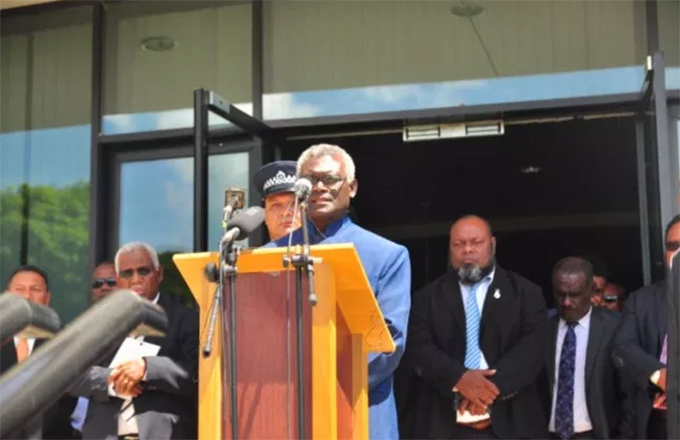
-Partners-

“The only body that can find a legitimate solution to the current situation is the National Parliament of Solomon Islands. If the Prime Minister decides to step down based on his own judgment or that of his colleagues in the House, it will be up to Parliament to determine the candidate with majority support to become prime minister,” Dr Nanau said.

“Again, the process for such a change must be through Parliament. Solomon Islanders must not allow lawlessness and criminal activities to dictate who becomes prime minister.

Convene Parliament
“Parliament must be allowed to convene soon and have a government formed to discuss the current situation.

“This also calls for the 14 MPs who walked out of Parliament to show leadership and allow parliamentary processes to be effected. This is the only way to find a legitimate solution to the current impasse.”

The Pacific Casino Hotel at Kukum, where Sogavare and his Democratic Coalition for Advancement stayed in the lead up to the election, was also looted and damaged by the angry mobs.

The burning and looting continued in the eastern part of the capital last night, which saw the burning of the Oceanic Marine Building at KGVI and the looting and rampage of a recently opened shopping complex.

Local police used tear gas to disperse crowds in China Town and again last night in East Honiara to control the crowds.

Reports also suggested that a few innocent people were tear gassed in their own homes as rioters randomly ran into their areas to get away from police.

Sogavare’s win caused an upset as people allegedly saw this as a continuation of the former government and took to the streets to call for a change in the government leadership. The protests after the announcement slowly developed into rioting and unrest, amidst heavy police presence.

USP students call for calm
Solomon Islands students at USP in Suva have called on fellow citizens in Honiara to stay calm and not to take the law into their own hands.

Solomon Islands final-year law student Eddie Babanisi, who is currently based at USP’s Laucala campus, said there were processes in place to address grievances relating to the election outcome.

“I call on the young people to stop what they are doing now. Please stand down and listen to the police and authorities’ call for calm,” he said.

“They have just elected respective leaders into Parliament and they should take this up with their leaders to take up through relevant channels, instead of staging riots.

“Whatever happened yesterday was a parliamentary procedure to choose our leaders and the public has no right over what the National Parliament has decided in electing the new prime minister.”

Bachelor of Commerce final-year student Sophie Kwaomae, who is also from Solomon Islands, said the protests and riots might not be staged just for political reasons.

“The reality is that these young people running around causing havoc don’t have anything better to do but to wait for opportunities to loot and damage the city,” she said.

“Majority of them seem to have horded from squatter settlements into town. The real reasons for this might not be political, but also social, such as unemployment and the poverty stricken conditions they live in every day, thus the motivation to stage such actions to vent their frustration. These are the very issues that the incoming government must prioritise.”

USP campus closes
In light of the unrest by recent political events, USP vice-chancellor Professor Pal Ahluwalia said all USP campuses on Solomon Islands would be closed until further notice.

He said students and staff were urged to remain at home and adhere to security advisories issued by national authorities.

“Our prayers are with you all and the nation at this time, for a peaceful and safe outcome to these events,” he said.

The prime ministerial election continued yesterday morning despite a High Court injunction for the election to be postponed.

The postponement was proposed to make way for the full hearing of the validity of the nomination of Sogavare for prime ministership last Friday.

However, Governor-General Sir Frank Kabui exercised his constitutional powers to ensure the election ensued.

Talking to the crowd outside the National Parliament soon after his election, Prime Minister Sogavare said they were listening to what people were saying.

Manasseh Sogavare speaks on the steps of Solomon Islands National Parliament shortly after winning the prime ministerial election yesterday. Image: Wansolwara
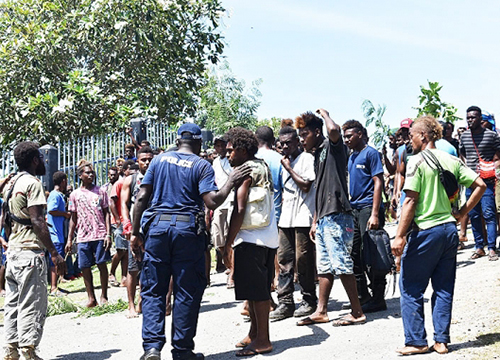
“I want to assure this nation that we are listening to what people are saying. We have heard from various squatters and various groups, who have made very important statements.

“These have not fallen on deaf ears. We will take them into consideration when we work on the government’s new policies.”

‘Rule of law’
In a short video released after the election, Matthew Wale, the Leader of the Grand Coalition whose 15 members abstained from voting yesterday and walked out during election proceedings, said the laws of the country must be upheld.

“While the Grand Coalition recognises the authority of the Governor-General to preside over the meeting, under the National Constitution of our country, the group felt that the decision of the High Court injunction orders directing the Governor-General to postpone the meeting of members that was convened at 9.30am, should have been adhered to,” he said in the clip.

“The Grand Coalition believes that our legal processes must be respected. We believe that the order and directions of the High Court were reasonable, given the significance of the submissions.

“The walkout, therefore, is for the sake of the rule of law. The Governor-General did not abide by the direction to differ the meeting, a direction of the High Court. No one is above the law including his excellency.”

Rosalie Nongebatu of the Solomon Islands is a final-year journalism student at USP’s Laucala campus. She is also editor of Wansolwara, the USP Journalism Programme’s student training print and online publications. This article is republished as part of USP and the Pacific Media Centre’s journalism education partnership.

Print Friendly, PDF & Email

Article by AsiaPacificReport.nz

30 arrested in Honiara post-election riots as calm returns to capital

Police say some people decided to take the law into their own hands and marched through some streets of the capital, fighting, causing public disturbances and property damage, reports the Solomon Star.

RNZ Pacific reports that an uneasy calm has returned to the capital while Sogavare rejected accusations his past governments have “failed” Malaita over project implementation.

More reports, pictures on ABC Pacific Beat

A police officer speaks to a youth during yesterday’s disturbances in Honiara. Image: Solomon Star
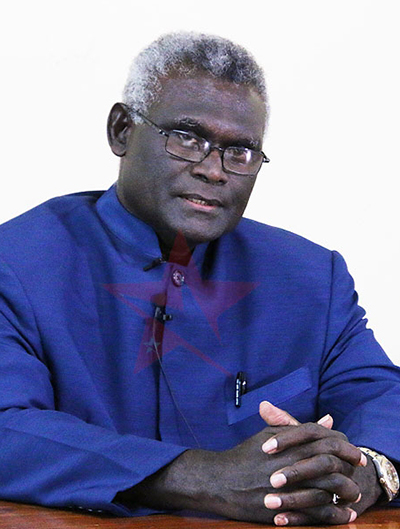
Significant damage was caused at the Pacific Casino Hotel and many vehicles were also damaged.

These crowd marches were illegal and investigating police are expected to arrest more suspects.

-Partners-

Five Royal Solomon Islands Police Force (RSIPF) and four Correctional Services officers were injured and needed medical attention, the Star reports.

Commissioner Matthew Varley called on residents to stay home unless it was “extremely necessary” to avoid further trouble.

Police operation
“I have ordered a large police operation to conduct more high visibility patrols across Honiara tonight and police will stop anyone that is causing trouble around the city,” he said.

Manasseh Sogavare speaking to media yesterday after being elected prime minister again. Image: Solomon Star

“People engaged in disorderly conduct will be searched and dealt with.

“I have also ordered a number of road blocks and checkpoints to be put in place to reduce traffic in the city.”

Commissioner Varley said: “This is necessary to ensure we maintain security across Honiara tonight. The RSIPF will not take any chances when it comes to public safety.

“If you are a law abiding citizen, then you have nothing to fear.

“Police are in control and we are continuing to respond to any incidents of disturbance around the city.

“But anyone who is planning to carry out any illegal activity can expect police to deal with you sternly.”

Swift action
The Police Response Team (PRT) officers and riot squad officers have been ordered to take swift action against anyone using violence.

“I urge all law abiding citizens to stay at home tonight and stay off the streets,” Commissioner Varley said.

“We need peace in our families, our communities and in our nation.”

Reports from RNZ Pacific and the Solomon Star.

Solomon Islands police in riot gear during yesterday’s post-election disturbances in Honiara. Image: Melanesia News Network
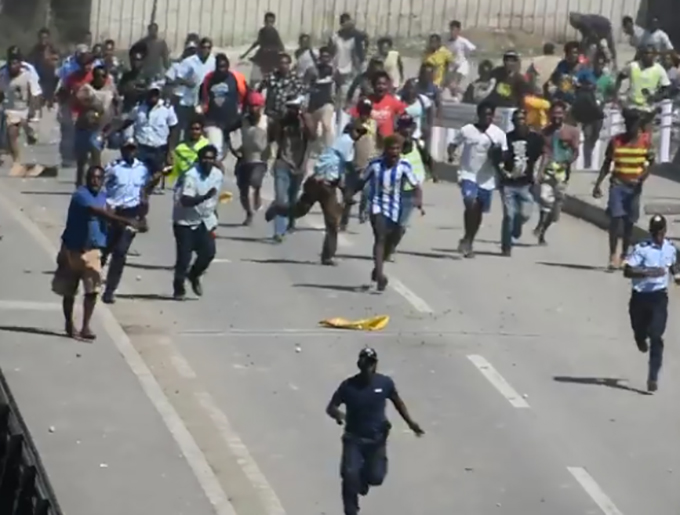
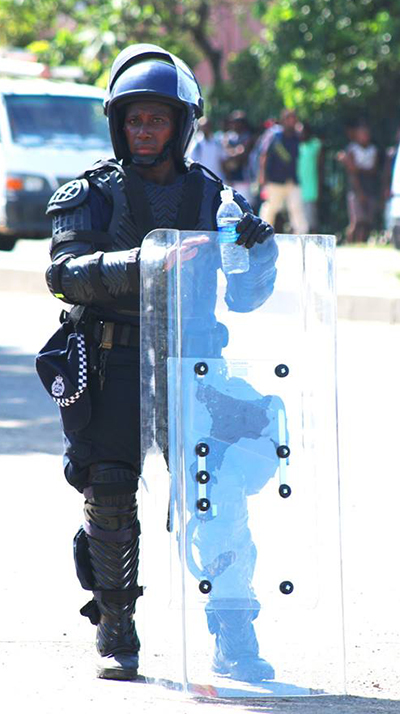
Article by AsiaPacificReport.nz

Islamic State has claimed responsibility for the Sri Lanka terror attack. Here’s what that means

Source: The Conversation (Au and NZ) – By Greg Barton, Chair in Global Islamic Politics, Alfred Deakin Institute for Citizenship and Globalisation, Deakin University

In the wake of any tragedy, it should be enough to grieve and stand in solidarity with those who mourn. With a massive toll – at least 359 dead and around 500 injured – it feels disrespectful to the people of Sri Lanka to be dissecting what went wrong even as the dead are being buried.

But the reality is that most, if not all, of these lives need not have been taken. We owe it to them and their loved ones to make sense of what happened and work towards doing all that can be done to ensure it does not happen again.

The Easter attacks represent one of the most lethal and serious terrorist operations since the September 11 attacks in the US, outside of attacks within active conflict zones. And this in a now peaceful country, which for all its history of civil war and ethno-nationalist terrorism in decades past has never had a problem with jihadi radical Islamist terrorism.

The burials have begun for the more than 300 people killed in the attacks. M.A. Pushpa Kumara/EPA

A return to deadlier, more coordinated strikes

The long-anticipated claim of responsibility for the attacks was made by the Islamic State (IS) on Tuesday night. This could help explain how one local cell based around a single extended family circle of hateful extremists not previously known for terrorism could execute such a massive attack. It was larger even than IS’s previous truck-bomb attacks in Syria, Iraq and Afghanistan.

The attacks follow a familiar, if now rarely seen, IS operandi of coordinated suicide bombings. The targeting of Catholic churches, which made little sense initially in the context of the domestic social issues at the heart of the country’s recent civil war, fit an all-too-familiar pattern of IS attacks on Christians, along with fellow Muslims.


Read more: Who are Sri Lanka’s Christians?


The fact that 40 or more Sri Lankans travelled to Syria to fight with IS could help explain how the terror network was able to build vital personal links in the very small community of Sri Lankan Islamist extremists so it could subcontract its attack plans to them. At this point, the precise involvement of returnees from Syria and foreign IS supporters in the bombings remains under investigation.

The Easter weekend attacks more resemble the al-Qaeda attacks of the 2000s than they do recent attacks of IS. Like the 2000 attack of the USS Cole in Yemen, the September attacks in New York and Washington, the 2002 bombings in Bali, the 2003 truck bombs in Istanbul, the 2004 train bombings in Madrid, the 2005 tube and bus bombings in London, the Sri Lanka bombings involved multiple attackers acting in concert. With the exception of September 11, all of these also involved improvised explosive devices (IEDs).

The Sri Lanka bombings exceeded all but the September 11 attacks in sophistication and deadliness, despite the fact the perpetrators were previously known only for acts of hateful vandalism.

Over the past decade, al-Qaeda has been unable to carry out significant attacks outside of conflict zones. It has also become increasingly focused on “reputation management” and has tended to avoid indiscriminate mass killings, all the whilst growing its global network of affiliates.


Read more: Out of the ashes of Afghanistan and Iraq: the rise and rise of Islamic State


The emergence of IS saw the tempo and scale of terrorist attacks transformed. Most attacks took place in conflict zones (Syria, Iraq, Libya, Yemen, Afghanistan, Pakistan, southern Philippines).

A number of significant attacks were conducted well beyond the battlefield. There were at least four such attacks in 2014, 16 in 2015, 22 in 2016, 18 in 2017, and 10 in 2018. The vast majority of these attacks were conducted by lone actors.

Why was it that, outside of conflict zones, not just al-Qaeda but even IS at the height of its powers focused largely on lone-actor attacks?

It is probably not for want of trying. The reason is that most larger, more ambitious plots were tripped-up by intelligence intercepts. This is especially the case in stable democracies, including our neighbours Indonesia and Malaysia.

Why Sri Lanka?

The other big question is how one of the deadliest terrorist attacks ever was able to be executed in Sri Lanka?

Sri Lanka was a soft target. Having successfully defeated the Tamil Tiger rebel group a decade ago through military might, Sri Lanka has become complacent. It has not seen a pressing need to develop police and non-military intelligence capacity to counter terrorism.


Read more: War is over, but not Sri Lanka’s climate of violence and threats


At the same time, it has struggled with good governance and political stability. Just six months ago, it faced a major constitutional crisis when President Maithripala Sirisena sacked his deputy, Prime Minister Ranil Wickremesinghe, and attempted to replace him with the former prime minister and president Mahinda Rajapaksa.

The attempt failed, but in the stand-off that ensued, Wickremesinghe, and ministers loyal to him, were excluded from intelligence briefings. In particular, they say that they were left unaware of the multiple warnings issued by the Indian intelligence service, RAW, to the authorities in Colombo about the extremist figures who played a key role in the Easter attacks.

Thus, despite several discoveries earlier this year of large amounts of explosives stored in remote rural locations on the island, and multiple warnings from the Indians, including final alerts just hours before Sunday’s attacks, the government and security community were left distracted and caught off-guard.

Between “fighting the last war” and fighting each other, they deluded themselves that there was no imminent terrorist threat.

A candlelight vigil to the Sri Lanka victims in Bangalore, India. Jagadeesh NV/EPA

What other countries are vulnerable?

If the massive attacks in Sri Lanka over Easter serve to remind us that IS is very far from being a spent force, the question is where this energetic and well-resourced network will strike next.

For all that it achieved in Sri Lanka, IS is unlikely to be able to build an enduring presence there. So long as the Sri Lankan government and people emerge from this trauma with renewed commitment to unity – and with elections at the end of the year, this is far from certain – the “perfect storm” conditions exploited by IS are unlikely to be repeated.

So where else is IS likely to find opportunity? India and Bangladesh continue to present opportunities, as does much of Central Asia. In our region, it is Malaysia, Thailand and the Philippines that we should be most worried about.

Malaysia has emerged stronger and more stable from its swing-back to democracy but continues to be worryingly in denial about the extent to which it is vulnerable to terrorist attacks, downplaying the very good work done over many years by the Special Branch of the Royal National Malaysian Police.


Read more: Defeated in Syria and Iraq, the Islamic State is rebuilding in countries like Indonesia


Thailand and the Philippines remain less politically stable, and rather more brittle than they care too acknowledge. And both tend to delude themselves into thinking that the problems of their southern extremes will never manifest in a terror attack in Bangkok or Manila, respectively.

The people of Sri Lanka have paid far too high price for the lessons of the Easter weekend attacks to be ignored or forgotten.

ref. Islamic State has claimed responsibility for the Sri Lanka terror attack. Here’s what that means – http://theconversation.com/islamic-state-has-claimed-responsibility-for-the-sri-lanka-terror-attack-heres-what-that-means-115915

Poll wrap: Palmer’s party has good support in Newspoll seat polls, but is it realistic?

]]>

Source: The Conversation (Au and NZ) – By Adrian Beaumont, Honorary Associate, School of Mathematics and Statistics, University of Melbourne

With 23 days to go until the May 18 election, Newspoll had seat polls of Herbert, Lindsay, Deakin and Pearce. All four polls were conducted April 20 from samples of 500-620. Clive Palmer’s United Australia Party (UAP) had the support of 5% in Deakin, 7% in Lindsay, 8% in Pearce and 14% in Herbert.

Seat polls are notoriously unreliable. In addition, the UAP has clearly been added to the party readout in these seats. Pollsters regularly ask for Labor, the Coalition, the Greens and One Nation. All other voters are grouped as “Others”, although a follow-up question can be asked – if Other, which other?

The strongest indication that UAP support is overstated in these seat polls is that the all Others vote is unrealistically low in three of the four seats polled. In Herbert, Pearce and Deakin, all Others are at just 2%, while they are 8% in Lindsay. It is likely that many of those who will vote for Others at the election said they would vote for the UAP as that party was in the readout.

Herbert was tied at 59-50, unchanged from the 2016 election. In Lindsay, Labor was ahead by 51-49, also unchanged. The Liberals led by 51-49 in Deakin, but this was a solid swing to Labor from 56.4-43.6 to the Liberals at the 2016 election. In Pearce, there was a 50-50 tie (53.6-46.4 to Liberals at the 2016 election).

Primary votes in Herbert were 31% LNP, 29% Labor, 14% UAP, 10% Katter’s Australian Party, 9% One Nation and 5% Greens. In Deakin, primary votes were 46% Liberals, 39% Labor, 8% Greens and 5% UAP. In Pearce, primary votes were 40% Liberals, 36% Labor, 8% Greens, 8% UAP and 6% One Nation. In Lindsay, primary votes were 41% Liberals, 40% Labor, 7% UAP and 4% Greens.

Relative to the national swing, Labor is expected to struggle in the Townsville-based seat of Herbert due to the Adani coal mine issue. In Lindsay, the retirement of Labor MP Emma Husar in controversial circumstances may have made it vulnerable.

Bad ReachTEL seat polls for Labor in Bass and Corangamite

There were two ReachTEL seat polls conducted last week from samples of 780-850. In the Labor-held Tasmanian seat of Bass, the Liberals had a 54-46 lead. In the Victorian seat of Corangamite, which is on no margin following a redistribution, the Liberals led by 52-48. The Bass poll was conducted for the Australian Forest Products Association, and the Corangamite poll for The Geelong Advertiser.

Bass and Tasmania have an older demographic than Australia overall. I wrote last week that, according to Newspoll data, those aged 50 or over are best for the Coalition. Corangamite also has an older demographic than the country overall.


Read more: Poll wrap: Labor maintains its lead in Newspoll, while One Nation drops; NSW upper house finalised


Labor won Bass by 56.1-43.9 at the 2016 election, a 10.1% swing to Labor. But at the 2013 election, Bass was the best of the five Tasmanian seats for the Liberals, and this also occurred at the March 2018 state election. Labor’s big 2016 swing may have been caused by the unpopularity of hard-right Liberal MP Andrew Nikolic. In the July 2018 federal byelections, Labor had an underwhelming victory in Bass’s neigbouring seat, Braddon.

While seat polls are unreliable, the Corangamite and Bass polls are evidence that, as reported by The Poll Bludger originally from The Australian Financial Review, Scott Morrison appears to have a greater appeal to blue-collar and outer suburban voters than Malcolm Turnbull, and this has helped the Coalition in seats like Bass and Corangamite.

One Nation to contest 59 of the 151 House seats

Nominations for the election were declared this week. Labor, the Coalition, the Greens and the UAP will contest all 151 House seats. One Nation will contest 59 seats, with Fraser Anning’s Conservative National Party running in 48 seats, Animal Justice in 46 and the Christian Democrats in 42.

Until now, national pollsters have assumed One Nation was running in all seats for their polls. With One Nation only running in 39% of seats, most pollsters will reduce their national vote. This reduction may assist the Coalition on primary votes.

In the Senate, a quota for election is one-seventh of the vote, or 14.3%. Labor, the Greens and the Coalition are likely to be in the mix for the final seats in every state. It is possible that the small right-wing parties, such as Anning’s party, the UAP, the Australian Conservatives and Christian Democrats, could cause seats that should go to the right to go to the left instead if they do not tightly preference each other, One Nation and the Coalition.

Voters are told to number six boxes above the line for a formal vote, though only one number is actually required. At the NSW state election, left-wing micro-party voters preferenced more than right-wing micro-party voters, resulting in Animal Justice easily winning the final upper house seat.


Read more: Poll wrap: Labor maintains its lead in Newspoll, while One Nation drops; NSW upper house finalised


At the federal election, it will be clear that left-wing micro-party supporters need to preference Labor and the Greens in their top six. It will be clear for right-wing micro supporters to preference the Coalition in the top six, but it is not likely to be clear which other right-wing party to preference.

ref. Poll wrap: Palmer’s party has good support in Newspoll seat polls, but is it realistic? – http://theconversation.com/poll-wrap-palmers-party-has-good-support-in-newspoll-seat-polls-but-is-it-realistic-115802

Solomons police call for calm to counter riots after PM elected

]]>
Rioting in Honiara today after the parliamentary election of Manasseh Sogavare as Prime Minister. Image: Screenshot from Dan Dãñzõ Kakadi video

By RNZ Pacific

Police in Solomon Islands called for calm today after rioting broke out in the capital of Honiara over the election of Manasseh Sogavare as the new prime minister.

Sogavare’s win – his fourth term as prime minister – represents a continuation of the last government and those protesting are purportedly people who had been wanting a change in government

Videos and pictures posted on social media show large crowds of mostly young men walking and running through the streets, yelling and throwing stones at buildings, and breaking in and damaging some private properties.

READ MORE: Protests erupt in Solomon Islands as Sogavare elected for fourth time

A woman police officer in riot gear in Honiara today. Image: Pacific Newsroom

Police riot squads have been trying to disperse the more rowdy groups with tear gas.

One group caused substantial damage to the Pacific Casino Hotel complex at Kukum where Sogavare and the members of his Democratic Coalition for Advancement had been based

-Partners-

The situation in Honiara remains tense with most shops and businesses having closed.

Police said they would continue high visibility patrols throughout the night and are urging people to stay away from the city centre.

Meanwhile, Sogavare has been sworn in at Government House and is now officially the prime minister of Solomon Islands.

This article is republished under the Pacific Media Centre’s content partnership with Radio New Zealand.

Print Friendly, PDF & Email

Article by AsiaPacificReport.nz

Avengers: Endgame exploits time travel and quantum mechanics as it tries to restore the universe

]]>

Source: The Conversation (Au and NZ) – By Michael Milford, Professor, Queensland University of Technology

At the end of Avengers: Infinity War half the people (including heroes and villains) in the universe were gone in the snap of a finger from Thanos (Josh Brolin).

So how can Avengers: Endgame (in cinemas from this week) try to bring them back?

Well, with that tried and tested movie plot device: time travel. Plus a surprising amount of scientific jargon thrown in, including quantum mechanics, Deutsch propositions, eigenvalues and inverted Möbius strips.


Read more: We did a breakthrough ‘speed test’ in quantum tunnelling, and here’s why that’s exciting


But don’t think that everything you hear during the movie was created in the minds of some crazy screenwriter. Many of the time-travel concepts in Endgame are connected, at least in name, to recent scientific theory, simulation and speculation.

Marvel Studios’ Avengers: Endgame – official trailer.

Let’s dive into the science of quantum time travel and discuss whether eigenvalues can really save the universe, but be warned: moderate spoilers ahead.

Time travel 101

The key premise of the movie is that the only thing that can reverse the deaths of half the universe are the things that caused those deaths in the first place: the powerful Infinity Stones.

Problem is, Thanos destroyed these in the present day, so the stones are only available in the past. Retrieving them will require a convoluted journey back in time to multiple locations by the remaining Avengers.

Is time travel actually possible? We’ve known since Albert Einstein posed his Theory of Special Relativity more than 100 years ago that travel forward in time is relatively easy.

All you need to do is move at close to the speed of light and you can theoretically travel millions or even billions of years into the future within your lifetime.

But could you get back again? This feat appears to be much more difficult. Here are a few challenges and possible solutions.

The grandfather paradox

Travelling back in time can cause apparent logical inconsistencies in reality, like the well-known grandfather paradox.

Disrespecting your elders doesn’t pan out well for you. iimages / 123rf.com / Michael Milford.

If you went back in time and killed your grandfather when he was young, then you could never be born, but if you weren’t born, then how did you go back and kill him?

Scientists have several theories about these time loops (physicists call them closed timelike curves). Some theories state that such loops are just physically impossible and therefore travel back in time can never happen.

But we know, also thanks to Einstein, that spinning black holes can twist up both space and time, which is why one side of the black hole is brighter than the other in the first picture ever taken of one.

Time travel in the Endgame

In the movie, the characters first make fun of many other time-travel movies such as Back to the Future and the Terminator series where changing your own past and future is possible.

Instead, Endgame goes with the alternative reality idea, where any changes back in time cause a whole new universe to be created, a so-called splitting or branching off of multiple timelines. In physics, this idea is called the Many Worlds Theory.

Changes in the past cause multiple future timelines in one theory of time travel. lilu330 / 123rf.com / Michael Milford.

To avoid this problem, the Avengers plan to borrow the stones from past timelines, use them in the present day, but return them to exactly the same moment once they have finished with them. But will it work?

Enter quantum mechanics

Quantum mechanics is mentioned a lot in the movie and there are in fact many emerging theories about quantum time travel, including some that potentially solve the grandfather paradox.

In quantum mechanics, atomic particles are more like indistinct waves of probability. So, for example, you can never know both exactly where a particle is and what direction it’s moving. You only know there is a certain chance of it being in a certain place.

A British physicist named David Deutsch, who is mentioned in the movie, combined this idea with the Many Worlds theory, and showed that the grandfather paradox can disappear if you express everything probabilistically.

Like the particles, the person going back in time only has a certain probability of killing their grandfather, breaking the causality loop. This has been simulated successfully.

This might seem strange, and while some of the jargon used in the movie may seem a little over the top, you can be sure that real quantum science is even stranger than movie makers could ever imagine. It’s clear that even scientists are struggling to make sense of the implications of quantum theory.

Terminology for effect

The time-travel theory scenes (of which there are several) are filled with technical jargon, some out of place, some in the right ballpark.

Here are a few of the terms we hear in the movie concerning time travel:

Eigenvalues: In discussing their approach to time travel, characters Tony Stark and Bruce Banner mention eigenvalues. This is most likely an example of movie maths talk for effect, as eigenvalues are a fairly low-level (basic) concept in linear algebra.

Verdict: A case of the math mumbles

Planck scale: The Planck scale is all about very small things. Planck length, time and mass are base units used in physics. A Planck length is 1.616 × 10⁻³⁵m. That’s very small.

It is the distance that light travels in one unit of Planck time – which is also a very small amount of time. Given the movie is about quantum mechanics-based time travel, chatting Planck scales don’t seem too far off topic.

Verdict: Planck has a point.

Inverted Möbius strip

Möbius strip. Wikimedia/David Benbennick, CC BY-SA

The time-travel jargon also discusses inverting a Möbius strip. A normal Möbius strip is a surface with only one side. You can create one easily by taking a strip of paper, twisting it once, and then sticking it together.

Although a Möbius strip has a range of interesting mathematical properties, its technical relevance to time travel is tenuous, beyond some high-level attempts to explain the grandfather paradox.

Verdict: Twisting theory a little.

Verdict

From a scientific perspective, it’s intriguing to have a new movie with such a heavy plot foundation in time travel, and the movie doesn’t pull many punches in diving straight into both the jargon and implications of various time-travel scenarios.


Read more: Remember Blockbuster, Nirvana and pagers? The new Captain Marvel lives in the 1990s


While some of the mathematical terminology is clearly there for effect, the plot makes a reasonable effort to adhere to current high level-thinking about time travel – to a point.

Time travel is one of those captivating scientific concepts that is perhaps furthest from implementation by scientists, and so its pivotal role in a movie about superheroes who can fly, go subatomic, destroy universes and change reality is perhaps particularly apt.

Thinking about time-travel paradoxes makes me cry… Marvel Studios

ref. Avengers: Endgame exploits time travel and quantum mechanics as it tries to restore the universe – http://theconversation.com/avengers-endgame-exploits-time-travel-and-quantum-mechanics-as-it-tries-to-restore-the-universe-115705

Psychedelics to treat mental illness? Australian researchers are giving it a go

]]>

Source: The Conversation (Au and NZ) – By Martin Williams, Postdoctoral Research Fellow, Monash University

An estimated one in ten Australians were taking antidepressants in 2015. That’s double the number using them in 2000, and the second-highest rate of antidepressant use among all OECD countries.

Yet some studies have found antidepressants might be no more effective than placebo.

Not only does this mean many Australians aren’t experiencing relief from their psychological distress, but some may also be contending with adverse side effects from their medications.

Also, the provision of these medications is costing Australian taxpayers millions of dollars through the Pharmaceutical Benefits Scheme.


Read more: If you’re coming off antidepressants, withdrawals and setbacks may be part of the process


Australia needs a paradigm shift in the way we treat mental illness. Scientific research is increasingly pointing to psychedelic drugs like psilocybin and MDMA (methylenedioxymethamphetamine, more commonly known as Ecstasy) as viable options.

While social stigma and academic conservatism have seen Australia lag behind other countries in this area of research, we are on the cusp of the first Australian trial of psychedelic drugs for mental health.

This research is going to look at psilocybin-assisted therapy for anxiety and depression among terminally ill patients.

A brief history of psychedelic drugs

Psychedelics are a broad category of drugs that can produce profound changes in consciousness. “Magic mushrooms”, containing psilocybin, have been used by some indigenous communities for at least 1,000 years. Other psychedelics, such as LSD and MDMA, were first synthesised in the laboratories of major pharmaceutical companies early in the 20th century.

In the 1950s, psychedelics were considered “wonder drugs”, used with psychotherapy in treating a range of conditions. These included depression, end-of-life anxiety, post-traumatic stress disorder (PTSD) and alcohol dependence.

But, in the 1960s, psychedelics escaped the clinic and became popular among the younger generation. In response to their association with the counterculture movement, a moral panic ensued. Psychedelic drugs were made illegal internationally in 1971.

Research and practice were abandoned, until recent shifts in attitude led to the re-emergence of medical research using psychedelics.

Some people will take antidepressants for many years. From shutterstock.com

In 2013, we wrote a piece in The Conversation about this international psychedelic science renaissance.

By that time, researchers at Johns Hopkins School of Medicine had shown psilocybin could reliably induce mystical states leading to positive changes in personality such as openness and sociability. Psychotherapists at UCLA harnessed these effects to reduce anxiety and depression in people with terminal cancer.

Meanwhile, researchers across the USA, Switzerland, Canada and Israel had achieved promising results treating PTSD with psychotherapy (“talk therapy” guided by trained therapists) assisted by MDMA.

In the past six years, two phase 2 clinical trials have shown psilocybin can improve quality of life for people with terminal cancer.


Read more: Shroom to grow: Australia’s missing psychedelic science


Another study showed psilocybin-assisted psychotherapy can effectively treat depression. Some 67% of participants showed clinically and statistically significant reductions in depressive symptoms.

Phase 3 trials are now planned. If these confirm the treatments to be effective, MDMA and psilocybin are likely to become approved medications in some countries within the next five years.

Psilocybin even appears useful in treating alcohol and nicotine addiction. And MDMA may ease social anxiety in people on the autism spectrum.

How psychedelics work in the brain

We’re now beginning to understand the neurological mechanisms responsible for the mystical states and creative thinking psychedelics can produce, and how they can aid the treatment of anxiety and depression.

Psychedelics reduce the activity of a neural circuit in the brain called the default mode network (DMN).

‘Magic mushrooms’ contain psilocybin, a mind-altering psychedelic substance. Jonathan Carmichael, Author provided

The DMN is responsible for our “resting state” sense of self, which can become distorted as depression and similar mental illnesses take hold. By temporarily decreasing the activity of the DMN, psychedelics appear to enable other less direct neural pathways to be established.

These interconnections can reduce the amount we persistently rethink the same thought, which is characteristic of depression. Similarly, they promote the development of fresh perspectives on personal situations and interpersonal relationships.


Read more: History, not harm, dictates why some drugs are legal and others aren’t


It also appears psychedelics can promote the physical regrowth of neuronal connections that have withered away in people who experience long-term depression.

The mechanism of this process is not yet understood, but it seems to correlate well with the demonstrated positive mental health outcomes of psychedelic-assisted psychotherapy.

On the other hand, various health conditions for which psychedelics are not suitable are widely recognised. In particular, people with underlying personality disorders or psychiatric conditions such as schizophrenia risk worsening of their symptoms.

People who have medical conditions such as heart or liver disease, or who are using a wide range of medications including antidepressants, are also advised to avoid psychedelics without careful medical supervision.

In all cases, it is stressed that psychedelic therapy should always take place under professional supervision to minimise potential health risks.

An Australian first

Since our last Conversation article, we’ve seen some fundamental shifts in Australia.

Later this year, a phase 2 study of psilocybin-assisted therapy for anxiety and depression in 30 terminally ill patients will begin at St Vincent’s Hospital in Melbourne.

This trial, due to be completed in 2021, will look at the effects of psychedelic psychotherapy in people with terminal conditions other than cancer, in addition to those with cancer.


Read more: Psychedelic drug use linked to fewer mental health problems


Meanwhile, a newly established charity, Mind Medicine Australia, is aiming to negotiate Australia’s regulatory framework to have psychedelics reclassified from the most restrictive drug category to one that accommodates prescription medicines.

If the results of our study, and those of others around the world, confirm the promise of the initial trials already completed, there is an excellent chance several of these treatments will be approved for prescription use within three to five years.

But, as well as proving the efficacy of these treatments, we will need to continue to demonstrate their safety, negotiate regulatory hurdles and ultimately convince doctors and the public that psychedelic psychotherapy is a viable approach for mental health treatment.

ref. Psychedelics to treat mental illness? Australian researchers are giving it a go – http://theconversation.com/psychedelics-to-treat-mental-illness-australian-researchers-are-giving-it-a-go-112952

Victorian women poets of WW1: capturing the reverberations of loss

]]>

Source: The Conversation (Au and NZ) – By Kevin Brophy, Emeritus Professor of Creative writing, University of Melbourne

Just as fiction’s George Smiley made sense of the world – and even made his baffling way about a world at war through knowing the works of minor German poets – our own very real Michael Sharkey (who has an equally resonant and unlikely name) has found that his passion for a certain strain of minor poets also intersects with history, war, intrigue, political resistance and troubling nationalism.

His remarkable new anthology, Many Such as She: Victorian Australian Women Poets of World War One, arose from Sharkey’s interest in civilian poets’ responses to the war that produced those soldier poets still gracing school and university curriculums a century on.

But why civilian poets, and why women? In the spirit of redress, Sharkey has uncovered expressions of how the war felt, how it was imagined, and how it was negotiated as a moral, political and deeply personal though socially shared phenomenon by those who were doubly separated from the conflict — through being so far away in Australia, and by the fact of being women.

Paradoxically, such a project, he suggests, makes a lot more sense and is closer to home for Australians than reading anthologies of poems by British soldier-poets. Like the best writers and researchers, Sharkey went about producing the book that he wanted to read.

We know that difficult times and extreme events can take us to poetry, and perhaps this impulse was embraced in the early 20th century with more grace, confidence and a deeper conviction of what is fitting than could have been the case earlier or later, especially among women.

A natural expression of thought and emotion

As an anthology of largely unrecognised minor poets, the reader’s interest is inevitably drawn to the limitations of the works selected, and to their representative significance. It seems that many women were not only capable of turning to poetry, but that there was something natural, even expected about this avenue to public expressions of thought and emotion. Sharkey notes in his introduction that the 24 women poets included, and the many others whose poetry was not, were consistently eloquent and technically competent, a testimony to the high standards of education early in the 20th century.

Universal education though, brings with it inevitable nudging towards “prevailing tastes” and narrowing of the imagination. These poets, working with readers’ and editors’ expectations, were themselves heirs to 19th century English traditions in poetry. Hence, as Sharkey observes, much of this minor poetry tends to read to us now as “lilting or lolloping”.

Against this observation (and taking a lesson from it), the current vogue for a colloquial, free verse in English language poetry might read in the future as a sign of how far contemporary poetry has drifted from song and lyric.

Some lines that might suffice as an example of the skill and musicality in this poetry come from Nettie Palmer’s 1916 poem, Birds, a love song from a wife to a soldier-husband, written when Nettie lived at Emerald in the Dandenongs.

The rhyming on a falling meter at the moment of each stanza’s inserted couplet, together with the dramatically long line following a two-beat line, work to bring both delicacy and the sense of a faltering, yearning spirit to lines that can’t help but touch our hearts:

At morning, when white clouds like leaves drop down
Filling the hollows,
And make vast, milk-white lakes and silence follows,
There on a stump some laughing jackass clown
Stiller than wood thought all the world his own.
But all the world was ours! The birds were ours,
Because we knew them,
The trees were ours, because our love passed through them,
And every dome of cloud and all the flowers
And mountain mists that built our silent bowers.
Enough, we had been jubilant too long,
The gods have judged us,
Such vital joy their tranquil eyes begrudged us.
You fight in France: here when the thrushes throng
How can I bear alone to hear their song.

The poetry in the anthology ranges, as we would expect, from imperialistic nationalism rife with improving sentiments and sentimentality all the way to poetry of open protest against the war. In the many nuances of reaction between these extremes, Sharkey perceives that the sheer quantity of poetry by women in response to that war “pointed to a catastrophic intellectual and emotional crisis experienced by the poets.”

There was so much of this poetry that any plan to publish it would be not only grandiose, but uneconomic. Hence, the interestingly narrowed state focus of this anthology: Victorian Australian women poets: presented in alphabetical order, with each poet introduced by several pages of historical context and life history (each one meticulously referenced).

Wit and sympathy

Beatrice Vale Bevan. Photographer unknown. State Library of Victoria.

Beatrice Vale Bevan (1876-1945) is one of those whose poetry might lilt and lollop through its paces, but nevertheless what shines through is her wit, her sympathy and her plainly human reaching towards a language that might come somewhere near sensing and expressing how deplorable death had become.

At the end of her poem debating William Locke’s statement, “Human nature is only capable of a certain amount of deploring”, in the poem that offers the book its surtitle (Many Such as She), Bevan reflects upon the flowers on the twin graves of a soldier in France and his young widow at home who, it seems, had suicided: the final stanza goes:

And he and Margaret, now above,
(since heaven’s above?) no loss deplore,
But love each other more and more!
Why say we ‘dead?’ ‘Immortal dead!’
‘Immortal living!’ some have said,
When was this violet in my hand,
When summer scorched and dried the land?

Martha Coxhead, photo by J. Ward Symons Studio, Footscray, 1916. Courtesy of Maxwell Coxhead.

As the wife of a high ranking Congregational minister and school headmaster, Beatrice’s climactic questions, and even her asides, are hard won and bravely spoken, and do go some considerable way towards expressing a vision of widening circles of deplorable grief that a war leaves in its wake.

Among those whose poetry sees death and life as equally noble when offered to the cause of the empire, are Marion Bray (1885-1947) who offers in a short poem a simple pair of knitted socks to a soldier far away, Muriel Beverley Cole, Martha Coxhead, Violet Cramer and others.

War sprung sprightly into tripping verse

Mary Bright, a deeply committed poet and spiritualist with many publications in her lifetime, and like several of the women here, one who had lost her husband and a nephew and cousins to the war, was unafraid of imagining herself into the maddened, bewildered and patriotic minds of soldiers being killed and maimed on the battle fronts:

… we couldn’t find our mates.
They were all scattered far and wide
Through death’s untimely gates.
…. We didn’t want to die—for fame
Nor for glory did we care.
We had to go, our country called—
We did but do our share.

-From Pozières

‘E’ — Mary E. Fullerton, photo by Marietta Studio, Melbourne. Australasian, 3 July 1925, p. 14. State Library of Victoria.

It can be difficult to know what to make of such verse. It can be a chilling experience to find that war sprung so sprightly into tripping verses. But this would be, perhaps, to mistake the tone of public literary activity in these years.

The poetry does not pretend to more than papering over what is beyond the deplorable and nearly beyond meaning. We do read tragedy between the lines here, and there is no reason this would not have been the case in 1916, perhaps especially through the prism of awareness regarding imposed and self-dictated censorship in public utterances.

Outspokenness

This situation makes the poetry of Mary Fullerton (1868-1946) remarkable for its outspokenness:

In many a cot the woman,
With the babe on her shelt’ring breast,
Is nursing his limbs for battle
A-crooning her son to rest.
All over the world the women
Give service and love and life;
While over the world the tyrants
Are brewing the brew of strife.

-From The Targets

Among the bereft was Phyllis Lewis (1894-1986), a gifted teacher and briefly fiancée to a certain Robert Menzies.

Lieutenant Raymond Lade and Phyllis Lewis (wedding photo), 20 April 1920. Photograph by David Livingston Muntz, Glenferrie Road, Malvern. Courtesy of Penny Lade.

Her one published poem, 1918, was a eulogy to her brother Owen, killed in a plane accident near Amiens: “Oh lawless howling wind—/Oh darkness none can lift—Oh hopeless night—/Oh gibbering shadows making heavy flight—/Oh soundless gloom of mind!” her long four-part poem goes when she must face what the war took from her and her family.

Recently my father died and I have inherited some boxes of papers that detail a kind of family history. Among these papers is the telegram informing my grandmother that her son, my father’s brother, died in action in New Guinea in the last week of WWII on that island.

This loss hung over my grandmother and over the whole of her family, for that war really could not stop reverberating until they died with this loss still in them. Such reverberations are the true subject matter of this anthology, and giving them our attention might be more important than we could ever suppose.

Sharkey is to be thanked for finding a way to present these 24 poets to Victorians and to Australians, and for giving us another way to understand and hear our own history. Walleah Press have done a fine job of packaging the anthology as a sturdy paperback.

Many such as She: Victorian Australian Women Poets of World War One, is edited by Michael Sharkey and published by Walleah Press.

ref. Victorian women poets of WW1: capturing the reverberations of loss – http://theconversation.com/victorian-women-poets-of-ww1-capturing-the-reverberations-of-loss-108084

Politics with Michelle Grattan: Caroline Fisher on the spin machines of #AusVotes19

]]>

Source: The Conversation (Au and NZ) – By Michelle Grattan, Professorial Fellow, University of Canberra

While the major party leaders seem to have curated their images, University of Canberra assistant professor in communications and media Caroline Fisher says they can’t always control how these could be manipulated.

Fisher says there has been “a real attempt to soften” Scott Morrison as the “daggy dad” through candid personal selfies. In contrast, Bill Shorten has opted for more professional shots which portray him “in a more prime ministerial light” but “are almost otherworldly”.

She also discusses the way family, particularly their wives, have been used to increase warmth and relatability, as well as the use of negative messaging in the campaign.

New to podcasts?

Podcasts are often best enjoyed using a podcast app. All iPhones come with the Apple Podcasts app already installed, or you may want to listen and subscribe on another app such as Pocket Casts (click here to listen to Politics with Michelle Grattan on Pocket Casts).

You can also hear it on Stitcher, Spotify or any of the apps below. Just pick a service from one of those listed below and click on the icon to find Politics with Michelle Grattan.

Additional audio

A List of Ways to Die, Lee Rosevere, from Free Music Archive.

Image:

Kelly Barnes(AAP)

ref. Politics with Michelle Grattan: Caroline Fisher on the spin machines of #AusVotes19 – http://theconversation.com/politics-with-michelle-grattan-caroline-fisher-on-the-spin-machines-of-ausvotes19-115918

Foreign policy should play a bigger role in Australian elections. This is why it probably won’t

]]>

Source: The Conversation (Au and NZ) – By Matt McDonald, Associate Professor of International Relations, The University of Queensland

Australians don’t tend to vote on foreign policy in federal elections. This makes perfect sense: there is, for the most part, a tradition of bipartisanship on foreign policy and usually few key points of difference between the major parties.

The idea is that foreign policy should somehow be above politics and the politicking that typically characterises election campaigns.

Research on the Australian government’s policy agendas also suggests a limited and generally declining prominence of foreign policy in elections. In a 2010 study, for instance, researchers analysed governor-general and prime minister election speeches from 1945-2008 and found that foreign policy played an increasingly marginal role in both.


Read more: Morrison and Shorten reveal their positions on key foreign policy questions


There are, of course, exceptions. In both the 1969 and 1972 elections, the increasingly unpopular Vietnam War became a major campaign issue, with Gough Whitlam campaigning to end conscription and bring Australian troops home. Whitlam’s message helped Labor sweep to power in 1972 for the first time in 23 years.

And in the 2001 and 2004 elections, foreign policy again featured in election debates. In 2001, John Howard’s incumbent Coalition government emphasised its willingness to take a tougher stance on asylum and terrorism than the opposition, helping return it to power.

And in 2004, Labor promised the withdrawal of Australian troops from the war in Iraq, while Howard (who was re-elected) argued this would only help fuel terrorism in the region.

Yet even in these “foreign policy” elections – when asylum seekers, terrorism and Iraq loomed large over the campaigns – health and education were still identified as most important issues for voters.

Without anything resembling a similar international crisis now, can we realistically expect a significant role for foreign policy in the 2019 election?

Australia’s key foreign policy challenges

Clearly, Australia faces important foreign policy challenges that warrant a significant national debate. As Susan Harris Rimmer noted in her foreign policy outlook for 2019, this is a particularly volatile time for Australia’s foreign relations.

Of the many pressing challenges facing the country, managing the relationship with China will be profoundly difficult. For starters, our most important trading partner has demonstrated a willingness to destabilise regional security through its actions in the South China Sea. It has also moved into Australia’s traditional sphere of influence in the South Pacific and attempted to influence Australian politics through donations, lobbying and even cyber-incursions.

Beijing has also demonstrated a willingness to retaliate against Australia when Canberra has challenged it. The passage of Australia’s new foreign interference law, for instance, triggered warnings to Chinese students studying in Australia and new restrictions on Australian coal exports to China.


Read more: With Bishop gone, Morrison and Payne face significant challenges on foreign policy


Australia’s relationship with China has been made more difficult by the loss of certainty around the US alliance under President Donald Trump. For Australia, it’s hard to tell whether the bigger challenge is a continued trend away from US global leadership or a potential shift to a more activist US foreign policy as Trump attempts to establish a legacy.

Australia also faces uncertainties in its relations with Indonesia and India following elections in both countries, the feasibility of its so-called “Pacific Pivot” and the ongoing spectre of terrorism. Yet, despite the importance of all of these foreign policy issues, all signs still point to an election focused overwhelmingly on domestic issues.

On most of these issues, including Australia’s approach to China and the US alliance, we have not seen significant points of difference between the parties thus far. Yet, whoever is chosen to manage Australia’s foreign relations matters. The parties need to spend more time discussing foreign affairs so voters understand what their strategies will be, particularly when it comes to our most important economic partner and our most important security partner.

One foreign policy-related flashpoint: climate change

To the extent that international issues have featured prominently in prior elections, they have often been viewed through the lens of domestic politics.

Climate change and asylum have become perennial issues in recent Australian elections, for instance. But climate change debates have regularly focused on energy prices, while asylum debates have often focused on the defence of Australian values and the Australian way of life.

On asylum, Labor has emphasised its consistency with existing Coalition government policies – both remain opposed to transferring asylum seekers from offshore processing centres to Australia.


Read more: In his first major foreign policy test, Morrison needs to stick to the script


Climate change, however, has already emerged as one of the key issues of this year’s campaign, with both parties taking aim at one another’s promises on everything from renewable energy targets to electric vehicles.

Of course, all dimensions of climate policy have implications beyond Australia. Yet on climate diplomacy specifically, it’s Australia’s engagement with the UN Framework Convention on Climate Change (UNFCCC) and its climate reduction targets that are most prominent. Here, the opposition has committed to a more significant target of emissions reductions under the Paris Agreement – 45% by 2030 – than the Coalition’s 26-28%. The Coalition also plans to use carryover credits from the generous Kyoto Protocol allowance for Australia, a position ruled out by the opposition.

For the Coalition, however, the focus is again related to domestic concerns: how much Labor’s ambitious plans will cost Australians. Given the broader climate debate so far and the perceived success of past climate scare campaigns – especially against the carbon tax in 2013 – a full-frontal Coalition attack on Labor’s climate policies is not just possible, it’s arguably likely.

As the election looms, then, there may be a small role for foreign policy and Australian action on transnational issues after all. Chances are, though, it won’t be the wide-ranging foreign policy debate we should be having.

ref. Foreign policy should play a bigger role in Australian elections. This is why it probably won’t – http://theconversation.com/foreign-policy-should-play-a-bigger-role-in-australian-elections-this-is-why-it-probably-wont-115298

What happens now we’ve found the site of the lost Australian freighter SS Iron Crown, sunk in WWII

]]>

Source: The Conversation (Au and NZ) – By Emily Jateff, Adjunct lecturer in archaeology, Flinders University

Finding shipwrecks isn’t easy – it’s a combination of survivor reports, excellent archival research, a highly skilled team, top equipment and some good old-fashioned luck.

And that’s just what happened with the recent discovery of SS Iron Crown, lost off the coast of Victoria in Bass Strait during the second world war.

Based on archival research by Heritage Victoria and the Maritime Archaeological Association of Victoria, we scoped an area for investigation of approximately 3 by 5 nautical miles, at a location 44 nautical miles SSW of Gabo Island.

Hunting by sound

We used the CSIRO research vessel Investigator to look for the sunken vessel. The Investigator deploys multibeam echosounder technology on a gondola 1.2 metres below the hull.

Multibeam echosounders send acoustic signal beams down and out from the vessel and measure both the signal strength and time of return on a receiver array.

The science team watches the survey from the operations room of the CSIRO research vessel (RV) Investigator. CSIRO, Author provided

The receiver transmits the data to the operations room for real-time processing. These data provide topographic information and register features within the water column and on the seabed.

At 8pm on April 16, we arrived on site and within a couple of hours noted a feature in the multibeam data that looked suspiciously like a shipwreck. It measured 100m in length with an approximate beam of 16-22m and profile of 8m sitting at a water depth of 650m.

Given that we were close to maxing out what the multibeam could do, it provided an excellent opportunity to put the drop camera in the water and get “eyes on”.

Down goes the camera.

The camera collected footage of the stern, midship and bow sections of the wreck. These were compared to archival photos. Given the location, dimension and noted features, we identified it as SS Iron Crown.

The merchant steamer

SS Iron Crown was an Australian merchant vessel built at the government dockyard at Williamstown, Victoria, in 1922.

SS Iron Crown afloat. South Australian Maritime Museum, Author provided

On June 4 1942, the steel screw steamer of the merchant vavy was transporting manganese ore and iron ore from Whyalla to Newcastle when it was torpedoed by the Japanese Imperial Type B (巡潜乙型) submarine I-27.

Survivor accounts state that the torpedo struck the vessel on the port side, aft of the bridge. It sank within minutes. Thirty-eight of the 43 crew went down with the ship.

This vessel is one of four WWII losses in Victorian waters (the others were HMAS Goorangai lost in a collision, SS Cambridge and MV City of Rayville lost to mines) and the only vessel torpedoed.

After the discovery

Now we’ve finally located the wreck – seven decades after it was sunk – it is what happens next that is truly interesting.

A bathymetric map showing SS Iron Crown on the sea floor with its bow on the right. CSIRO, Author provided

It’s not just the opportunity to finally do an in-depth review of the collected footage stored on an external hard drive and shoved in my backpack, but to take the important step of ensuring how the story is told going forward.

When a shipwreck is located, the finder must report it within seven days to the Commonwealth’s Historic Shipwreck Program or to the recognised delegate in each state/territory with location information and as much other relevant data as possible.

Shipwrecks aren’t just found by professionals, but are often located by knowledgeable divers, surveyors, the military, transport ships and beachcombers. It’s no big surprise that many shipwrecks are well-known community fishing spots.

While it is possible to access the site using remotely operated vehicles or submersibles, we hope the data retrieved from this voyage will be enough.

It was only 77 years ago that the SS Iron Crown went down. This means it still has a presence in the memories of the communities and families that were touched by the event and its aftermath.

No war grave, but protected

Even though those who died were merchant navy, the site isn’t officially recognised yet as a war grave. But thanks to both state and Commonwealth legislation, the SS Iron Crown was protected before it was even located.

All shipwrecks over 75 years of age are protected under the Commonwealth Historic Shipwrecks Act 1976. It is an offence to damage or remove anything from the site.

A drop camera view of the bow of SS Iron Crown with anchor chains. CSIRO, Author provided

This protection is enhanced by its location in deeper water and, one hopes, by the circumstances of its loss.

Sitting on the sea floor in Bass Strait, SS Iron Crown is well below the reach of even technical divers. So the site is unlikely to be illegally salvaged for artefacts and treasures.

Yet this also means that maritime archaeologists have limited access to the site and the data that can be learnt from an untouched, well-preserved shipwreck.

Virtual wreck sites

But, like the increasing capabilities for locating such sites, maritime archaeologists now have access to digital mapping, 3D modelling technologies and high-resolution imagery as was used for the British Merchant Navy shipwreck of the SS Thistlegorm.

You can move within the video.

These can even allow us to record shipwreck sites (at whatever the depth) and present them to the public in a vibrant and engaging medium.


Read more: VR technology gives new meaning to ‘holidaying at home’. But is it really a substitute for travel?


Better than a thousand words could ever describe, these realistic models allow us to convey the excitement, wonder and awe that we have all felt at a shipwreck. Digital 3D models enable those who cannot dive, travel or ever dream of visiting shipwrecks to do so through their laptops, mobiles and other digital devices.

Without these capabilities to record, visualise and manage these deepwater sites, they will literally fade back into the depths of the ocean, leaving only the archaeologists and a few shipwreck enthusiasts to investigate and appreciate them.

So that’s the next step, a bigger challenge than finding a site, to record a deepwater shipwreck and enable the public to experience a well-preserved shipwreck.

SS Iron Crown alongside SS Hagen. National Library of Australia, Author provided

ref. What happens now we’ve found the site of the lost Australian freighter SS Iron Crown, sunk in WWII – http://theconversation.com/what-happens-now-weve-found-the-site-of-the-lost-australian-freighter-ss-iron-crown-sunk-in-wwii-115848

Telling the forgotten stories of Indigenous servicemen in the first world war

]]>

Source: The Conversation (Au and NZ) – By Jim McKay, Honorary Senior Research Fellow, The University of Queensland

Warning: This story contains images of Aboriginal and Torres Straight Islander people who are deceased.


The number of Aboriginal and Torres Strait Islanders who served with Australian forces in the first world war is estimated to be in the range of 1,000-1,200. But the precise figure will never be known, because a number of those who served changed their names and birthplaces when they enrolled to get around racist enlistment practices.

Despite fighting and dying for Australia, Aboriginal and Torres Strait Islanders still weren’t considered citizens upon their return from the war. Many of these veterans were also denied repatriation benefits, and excluded from returned services clubs.

Aboriginal and Torres Strait Islanders have long sought to gain recognition for the service and sacrifices of their men and women. Some do this by telling stories in their families and local communities about the military careers of their forebears.

These stories often take the form of oral histories. Oral history projects by groups of Aboriginal people have proven valuable for redressing the unrecognised service and racist treatment of their ancestors who served in the Australian Light Horse during the Sinai-Palestine Campaign of 1916-18.


Read more: On Anzac Day, we remember the Great War but forget our first war


Commemorating the Battle of Beersheba

Although most Australians know little or nothing about the Battle of Beersheba, the Australian government funded its centennial commemoration at Beersheba (now in southern Israel) in October 2017.

One hundred Australian and a few New Zealand military history reenactors attended the joint service as part of a commercial tour, during which they rode in period military outfits along the route of their ancestors.

A group of Aboriginal men and women, who were descended from some of the estimated 100 Aboriginal members of the Australian Light Horse, also participated in the tour. Several had ancestors who were in the “Queensland Black Watch”, a predominantly Aboriginal reinforcement unit.

The group’s participation was enabled by a transnational network of organisations, but the key driver was Rona Tranby Trust, which funds projects to record and preserve Aboriginal oral histories. In 2017, it a group of Aboriginal men and women to complete 11 histories of their ancestors who fought and died in the Sinai-Palestine Campaign.

Like the other reenactors, Aboriginal participants were honouring their ancestors’ courage and sacrifice. But they also wanted to document the neglected stories of their service, and the racial discrimination their forebears experienced.

Here we share, with permission, some of the stories that came from the trip, and from the family history projects the group members continue to work on.

Ricky Morris

Gunditjmara man and retired Army Sergeant Ricky Morris was officially invited to lay a wreath on behalf of all Indigenous veterans at the service in Beersheba. Morris is the 19th of an astonishing 21 men and women Anzacs in his family. He served in a progeny of the Light Horse unit of his grandfather, Frederick Amos Lovett.

Frederick Amos Lovett of the 4th Light Horse Regimen and his grandson Ricky Morris. Rona Tranby Trust

At a time when Aboriginal and Torres Strait Islanders were neither citizens nor counted in the census, Frederick and his four brothers left the Lake Condah Aboriginal Mission, 300 km west of Melbourne, to sign up.

But their service counted for nothing. Gunditjmara people were subjected to a “second dispossession” when they were forced off Lake Condah under the Soldier Settlement Scheme. The scheme granted land to returning soldiers, but like almost all Aboriginal applicants, the brothers were denied soldier settlement blocks.

Morris is a member of the Victorian Indigenous Veterans Association Remembrance Committee and gives talks at schools about Aboriginal culture and his family. He interviewed two elderly aunts for his family history project, which he described as:

…a unique opportunity to follow in the footsteps of those who fought and died for Australia, and the diversity of Australians who put their hands up to answer the call.


Read more: In remembering Anzac Day, what do we forget?


Mischa Fisher and Elsie Amamoo

Mischa Fisher and her daughter, Elsie Amamoo, undertook the tour to obtain information for a website about Mischa’s grandfather, Frank Fisher.

Trooper Frank Fisher was an Aboriginal serviceman who enlisted in Brisbane on 16 August 1917. Australian War Memorial

Frank was born into the Wangan and Jagalingou community in the goldmining town of Clermont, 1,000 km north of Brisbane. He was one of 47 men from Barambah Aboriginal Settlement who enlisted in the first world war. While Frank was away, his wife Esme was prevented from accessing his salary. After Frank was discharged, he was again placed under the control of the superintendent at Barambah.

Mischa and Elsie have interviewed Frank’s descendants, and accessed archival footage from the Ration Shed Museum – an Aboriginal heritage, educational and cultural centre. Elsie only recently learned that Frank, who is also the great-grandfather of Olympic 400m champion Cathy Freeman, was a member of the “Black Watch”.

While training for a reenactment of the Light Horse charge at Beersheba, she tearfully told a reporter what the project meant to her:

To me, it feels like I have got a missing piece of the puzzle of who I am […] That’s what it basically means to me: just being able to have that ability to close the gap in terms of my identity and knowing who I am and where I fit in the Australian history, but also within my family as well.

Michelle and Peta Flynn

Peta Flynn, great niece of Charles Fitzroy Stafford. Rona Tranby Trust

Sisters Michelle and Peta Flynn are descendants of “Black Kitty”, a Cannemegal/Warmuli girl, who, in 1814, was among the first group of Aboriginal children placed in the Parramatta Native Institution at the age of five.

The sisters have been researching their family history for over 20 years. Their ancestors include the three Stafford brothers, who were in the Light Horse.

At Beersheba, Peta explained her motivation for writing a book about her great uncle, Charles Stafford:

My daughter, niece and nephews will be able to take [the book] into their schools and communities and actually be proud of who we are and where we come from – and ensure our family’s history will not be lost to future generations.


Read more: Indigenous soldiers remembered: the research behind Black Diggers


Lessons and legacies

The experiences of Ricky Morris, Mischa Fisher, Elsie Amamoo, and Michelle and Peta Flynn show how exploring family histories can generate feelings of solidarity, honour and closure.

Although group members were on a reenactment tour, their emotions were typical of the inward pilgrimages often experienced by genealogical tourists. Past and present family connections were heightened by being there; feelings of sadness, solidarity and pride arose.

At the same time, these stories show the benefits of combining academic, public and vernacular accounts to study silences and absences in the histories of Aboriginal and Torres Strait Islander peoples.

The official commemoration at Beersheba will only ever be studied by a handful of specialist scholars, but the family histories of this group will have enduring value for Aboriginal and non-Aboriginal Australians alike.

ref. Telling the forgotten stories of Indigenous servicemen in the first world war – http://theconversation.com/telling-the-forgotten-stories-of-indigenous-servicemen-in-the-first-world-war-114277

Auckland Sri Lankan community holds vigil for terror bomb victims, survivors

]]>
Surya holds a Tamil community placard proclaiming “we will overcome the darkness” in today’s Auckland vigil for the victims on Sri Lanka’s Easter bomb attacks. Image: David Robie/PMC

Pacific Media Centre Newsdesk

About 60 people from the Sri Lankan community and human rights advocates gathered in Auckland’s Aotea Square today in a solidarity vigil for the survivors of the Easter Sunday bombings.

More than 320 people were killed in the Sri Lankan atrocities.

Today’s vigil was organised by the Federation of Tamil Associations in NZ (FTANZ).

Meanwhile, the New Zealand and Sir Lankan governments are treating with caution reports that the suicide bombings of three Christian churches and three tourist hotels in three cities across Sri Lanka were carried out by Islamic State (ISIS) in retaliation for the Christchurch mosques terror attacks on March 15.

The terrorist group’s Amaq news agency says ISIS has claimed responsibility for the Easter bombings.

It is the deadliest overseas operation claimed by ISIS since it proclaimed its “caliphate” almost five years ago, and would suggest it retains the ability to launch devastating strikes around the world despite multiple defeats in the Middle East, reports The Guardian.

Auckland Sri Lankans and human rights advocates at the vigil in Aotea Square today. Image: David Robie/PMC Federation of Tamil Associations of New Zealand (FTANZ) coordinator Dr Siva Vasanthan at the Auckland vigil today. Image: David Robie/PMC RNZ Checkpoint’s Alex Perrottet interviewing FTANZ president George Arulanantham at the Auckland vigil today. Image: David Robie/PMC


Print Friendly, PDF & Email

Article by AsiaPacificReport.nz

‘Fake news’ is already spreading online in the election campaign – it’s up to Australians to stop it

]]>

Source: The Conversation (Au and NZ) – By Michael Jensen, Senior Research Fellow, Institute for Governance and Policy Analysis, University of Canberra

We’re only days into the federal election campaign and already the first instances of “fake news” have surfaced online.

Over the weekend, Labor demanded that Facebook remove posts it says are “fake news” about the party’s plans to introduce a “death tax” on inheritances. Labor also called on the Coalition to publicly disavow the misinformation campaign.

An inauthentic tweet purportedly sent from the account of Australian Council of Trade Unions secretary Sally McManus also made the rounds, claiming that she, too, supported a “death tax”. It was retweeted many times – including by Sky News commentator and former Liberal MP Gary Hardgrave – before McManus put out a statement saying the tweet had been fabricated.

What the government and tech companies are doing

In the wake of the cyber-attacks on the 2016 US presidential election, the Australian government began taking seriously the threat that “fake news” and online misinformation campaigns could be used to try to disrupt our elections.

Last year, a taskforce was set up to try to protect the upcoming federal election from foreign interference, bringing together teams from Home Affairs, the Department of Finance, the Australian Electoral Commission (AEC), the Australian Federal Police (AFP) and the Australian Security Intelligence Organisation (ASIO).

The AEC also created a framework with Twitter and Facebook to remove content deemed to be in violation of Australian election laws. It also launched an aggressive campaign to encourage voters to “stop and consider” the sources of information they consume online.


Read more: We’ve been hacked – so will the data be weaponised to influence election 2019? Here’s what to look for


For their part, Facebook and Twitter rolled out new features aimed specifically at safeguarding the Australian election. Facebook announced it would ban foreign advertising in the run-up to the election and launch a fact-checking partnership to vet the accuracy of information being spread on the platform. However, Facebook will not be implementing requirements that users wishing to post ads verify their locations until after the election.

Twitter also implemented new rules requiring that all political ads be labelled to show who sponsored them and those sending the tweets to prove they are located in Australia.

While these moves are all a good start, they are unlikely to be successful in stemming the flow of manipulative content as election day grows closer.

Holes in the system

First, a foreign entity intent on manipulating the election can get around address verification rules by partnering with domestic actors to promote paid advertising on Facebook and Twitter. Furthermore, Russia’s intervention in the US election showed that “troll” or “sockpuppet” accounts, as well as botnets, can easily spread fake news content and hyperlinks in the absence of a paid promotion strategy.

Facebook has also implemented measures that actually reduce transparency in its advertising. To examine how political advertising works on the platform, ProPublica built a browser plugin last year to collect Facebook ads and show which demographic groups they were targeting. Facebook responded by blocking the plugin. The platform’s own ad library, while expansive, also does not include any of the targeting data that ProPublica had made public.


Read more: Russian trolls targeted Australian voters on Twitter via #auspol and #MH17


A second limitation faced by the AEC, social media companies, and government agencies is timing. The framework set up last year by the AEC to address content in possible violation of electoral rules has proven too slow to be effective. First, the AEC needs to be alerted to questionable content. Then, it will try to contact whoever posted it, and if it can’t, the matter is escalated to Facebook. This means that days can pass before the material is addressed.

Last year, for instance, when the AEC contacted Facebook about sponsored posts attacking left-wing parties from a group called Hands Off Our Democracy, it took Facebook more than a month to respond. By then, the group’s Facebook page had disappeared.


FOI request by ABC News, Author provided Portions of AEC letter to Facebook legal team for Australia and New Zealand detailing steps for addressing questionable content, sent 30 August 2018. FOI request by ABC News, Author provided


The length of time required to take down illegal content is critical because research on campaigning shows that the window of opportunity to shift a political discussion on social media is often quite narrow. For this reason, an illegal ad likely will have achieved its purpose by the time it is flagged and measures are taken to remove it.

Indeed, from 2015 to 2017, Russia’s Internet Research Agency, identified by US authorities as the main “troll farm” behind Russia’s foreign political interference, ran over 3,500 ads on Facebook with a median duration of just one day.

Even if content is flagged to the tech companies and accounts are blocked, this measure itself is unlikely to deter a serious misinformation campaign.

The Russian Internet Research Agency spent millions of dollars and conducted research over a period of years to inform their strategies. With this kind of investment, a determined actor will have gamed out changes to platforms, anticipated legal actions by governments and adapted its strategies accordingly.

What constitutes ‘fake news’ in the first place?

Finally, there is the problem of what counts as “fake news” and what counts as legitimate political discussion. The AEC and other government agencies are not well positioned to police truth in politics. There are two aspects to this problem.

The first is the majority of manipulative content directed at democratic societies is not obviously or demonstrably false. In fact, a recent study of Russian propaganda efforts in the United States found the majority of this content “is not, strictly speaking, ‘fake news’.”

Instead, it is a mixture of half-truths and selected truths, often filtered through a deeply cynical and conspiratorial worldview.

There’s a different issue with the Chinese platform WeChat, where there is a systematic distortion of news shared on public or “official accounts”. Research shows these accounts are often subject to considerable censorshipincluding self-censorship – so they do not infringe on the Chinese government’s official narrative. If they do, the accounts risk suspension or their posts can be deleted.. Evidence shows that official WeChat accounts in Australia often change their content and tone in response to changes in Beijing’s media regulations.


Read more: Who do Chinese-Australian voters trust for their political news on WeChat?


For this reason, suggestions that platforms like WeChat be considered “an authentic, integral part of a genuinely multicultural, multilingual mainstream media landscape” are dangerously misguided, as official accounts play a role in promoting Beijing’s strategic interests rather than providing factual information.

The public’s role in stamping out the problem

If the AEC is not in a position to police truth online and combat manipulative speech, who is?

Research suggests that in a democracy, the political elites play a strong role in shaping opinions and amplifying the effects of foreign influence misinformation campaigns.

For example, when Republican John McCain was running for the US presidency against Barack Obama in 2008, he faced a question at a rally about whether Obama was “an Arab” – a lie that had been spread repeatedly online. Instead of breathing more life into the story, McCain provided a swift rebuttal.

After the Labor “death tax” Facebook posts appeared here last week, some politicians and right-wing groups shared the post on their own accounts. (It should be noted, however, that Hardgrave apologised for retweeting the fake tweet by McManus.)

Beyond that, the responsibility for combating manipulative speech during elections falls to all citizens. It’s absolutely critical in today’s world of global digital networks for the public to recognise they “are combatants in cyberspace”.

The only sure defence against manipulative campaigns – whether from foreign or domestic sources – is for citizens to take seriously their responsibilities to critically reflect on the information they receive and separate fact from fiction and manipulation.

ref. ‘Fake news’ is already spreading online in the election campaign – it’s up to Australians to stop it – http://theconversation.com/fake-news-is-already-spreading-online-in-the-election-campaign-its-up-to-australians-to-stop-it-115455

‘Fake news’ is already spreading online in the election campaign. What can we do to stop it?

]]>

Source: The Conversation (Au and NZ) – By Michael Jensen, Senior Research Fellow, Institute for Governance and Policy Analysis, University of Canberra

We’re only days into the federal election campaign and already the first instances of “fake news” have surfaced online.

Over the weekend, Labor demanded that Facebook remove posts it says are “fake news” about the party’s plans to introduce a “death tax” on inheritances. Labor also called on the Coalition to publicly disavow the misinformation campaign.

An inauthentic tweet purportedly sent from the account of Australian Council of Trade Unions secretary Sally McManus also made the rounds, claiming that she, too, supported a “death tax”. It was retweeted many times – including by Sky News commentator and former Liberal MP Gary Hardgrave – before McManus put out a statement saying the tweet had been fabricated.

What the government and tech companies are doing

In the wake of the cyber-attacks on the 2016 US presidential election, the Australian government began taking seriously the threat that “fake news” and online misinformation campaigns could be used to try to disrupt our elections.

Last year, a taskforce was set up to try to protect the upcoming federal election from foreign interference, bringing together teams from Home Affairs, the Department of Finance, the Australian Electoral Commission (AEC), the Australian Federal Police (AFP) and the Australian Security Intelligence Organisation (ASIO).

The AEC also created a framework with Twitter and Facebook to remove content deemed to be in violation of Australian election laws. It also launched an aggressive campaign to encourage voters to “stop and consider” the sources of information they consume online.


Read more: We’ve been hacked – so will the data be weaponised to influence election 2019? Here’s what to look for


For their part, Facebook and Twitter rolled out new features aimed specifically at safeguarding the Australian election. Facebook announced it would ban foreign advertising in the run-up to the election and launch a fact-checking partnership to vet the accuracy of information being spread on the platform. However, Facebook will not be implementing requirements that users wishing to post ads verify their locations until after the election.

Twitter also implemented new rules requiring that all political ads be labelled to show who sponsored them and those sending the tweets to prove they are located in Australia.

While these moves are all a good start, they are unlikely to be successful in stemming the flow of manipulative content as election day grows closer.

Holes in the system

First, a foreign entity intent on manipulating the election can get around address verification rules by partnering with domestic actors to promote paid advertising on Facebook and Twitter. Furthermore, Russia’s intervention in the US election showed that “troll” or “sockpuppet” accounts, as well as botnets, can easily spread fake news content and hyperlinks in the absence of a paid promotion strategy.

Facebook has also implemented measures that actually reduce transparency in its advertising. To examine how political advertising works on the platform, ProPublica built a browser plugin last year to collect Facebook ads and show which demographic groups they were targeting. Facebook responded by blocking the plugin. The platform’s own ad library, while expansive, also does not include any of the targeting data that ProPublica had made public.


Read more: Russian trolls targeted Australian voters on Twitter via #auspol and #MH17


A second limitation faced by the AEC, social media companies, and government agencies is timing. The framework set up last year by the AEC to address content in possible violation of electoral rules has proven too slow to be effective. First, the AEC needs to be alerted to questionable content. Then, it will try to contact whoever posted it, and if it can’t, the matter is escalated to Facebook. This means that days can pass before the material is addressed.

Last year, for instance, when the AEC contacted Facebook about sponsored posts attacking left-wing parties from a group called Hands Off Our Democracy, it took Facebook more than a month to respond. By then, the group’s Facebook page had disappeared.


FOI request by ABC News, Author provided Portions of AEC letter to Facebook legal team for Australia and New Zealand detailing steps for addressing questionable content, sent 30 August 2018. FOI request by ABC News, Author provided


The length of time required to take down illegal content is critical because research on campaigning shows that the window of opportunity to shift a political discussion on social media is often quite narrow. For this reason, an illegal ad likely will have achieved its purpose by the time it is flagged and measures are taken to remove it.

Indeed, from 2015 to 2017, Russia’s Internet Research Agency, identified by US authorities as the main “troll farm” behind Russia’s foreign political interference, ran over 3,500 ads on Facebook with a median duration of just one day.

Even if content is flagged to the tech companies and accounts are blocked, this measure itself is unlikely to deter a serious misinformation campaign.

The Russian Internet Research Agency spent millions of dollars and conducted research over a period of years to inform their strategies. With this kind of investment, a determined actor will have gamed out changes to platforms, anticipated legal actions by governments and adapted its strategies accordingly.

What constitutes ‘fake news’ in the first place?

Finally, there is the problem of what counts as “fake news” and what counts as legitimate political discussion. The AEC and other government agencies are not well positioned to police truth in politics. There are two aspects to this problem.

The first is the majority of manipulative content directed at democratic societies is not obviously or demonstrably false. In fact, a recent study of Russian propaganda efforts in the United States found the majority of this content “is not, strictly speaking, ‘fake news’.”

Instead, it is a mixture of half-truths and selected truths, often filtered through a deeply cynical and conspiratorial worldview.

There’s a different issue with the Chinese platform WeChat, where there is a systematic distortion of news shared on public or “official accounts”. Research shows these accounts are often subject to considerable censorshipincluding self-censorship – so they do not infringe on the Chinese government’s official narrative. If they do, the accounts risk suspension or their posts can be deleted.. Evidence shows that official WeChat accounts in Australia often change their content and tone in response to changes in Beijing’s media regulations.


Read more: Who do Chinese-Australian voters trust for their political news on WeChat?


For this reason, suggestions that platforms like WeChat be considered “an authentic, integral part of a genuinely multicultural, multilingual mainstream media landscape” are dangerously misguided, as official accounts play a role in promoting Beijing’s strategic interests rather than providing factual information.

The public’s role in stamping out the problem

If the AEC is not in a position to police truth online and combat manipulative speech, who is?

Research suggests that in a democracy, the political elites play a strong role in shaping opinions and amplifying the effects of foreign influence misinformation campaigns.

For example, when Republican John McCain was running for the US presidency against Barack Obama in 2008, he faced a question at a rally about whether Obama was “an Arab” – a lie that had been spread repeatedly online. Instead of breathing more life into the story, McCain provided a swift rebuttal.

After the Labor “death tax” Facebook posts appeared here last week, some politicians and right-wing groups shared the post on their own accounts. (It should be noted, however, that Hardgrave apologised for retweeting the fake tweet by McManus.)

Beyond that, the responsibility for combating manipulative speech during elections falls to all citizens. It’s absolutely critical in today’s world of global digital networks for the public to recognise they “are combatants in cyberspace”.

The only sure defence against manipulative campaigns – whether from foreign or domestic sources – is for citizens to take seriously their responsibilities to critically reflect on the information they receive and separate fact from fiction and manipulation.

ref. ‘Fake news’ is already spreading online in the election campaign. What can we do to stop it? – http://theconversation.com/fake-news-is-already-spreading-online-in-the-election-campaign-what-can-we-do-to-stop-it-115455