Page 1031

Riding on the kangaroo’s back: animal skin fashion, exports and ethical trade

Source: The Conversation (Au and NZ) – By Dr Fabri Blacklock, UNSW

The Versace fashion house recently announced it had stopped using kangaroo skins in its fashion collections after coming under pressure from animal rights group LAV.

Kangaroo meat and skin has an annual production value of around A$174 million, with skins used in the fashion and shoe manufacturing industries.

There are legitimate questions regarding the ethical manner in which kangaroos are killed. But Indigenous people have long utilised the skins of kangaroos and possums. Versace’s concerns may have been allayed by understanding more about our traditions and practices.

Reviving skills

There has always been concern around how native animals are treated while alive and how they are killed to cause as little distress, pain and suffering as possible. Campaigners say 2.3 million kangaroos in Australia are hunted each year. Official sources cite this figure as the national quota, but put the number actually killed at around 1.7 million.

Australian Aboriginal people have for many thousands of years utilised native animals, predominantly kangaroos and possums. Consciously and sustainably, every part of the animal was used. The kangaroo meat was eaten, the skins used to make cloaks for wearing, teeth used to make needles, sinew from the tail used as thread.

The cloaks were incised with designs on the skin side significant to the wearer representing their totems, status and kinship. Cloaks were made for babies and added to as the child grew into adulthood, and people were buried in their cloaks when they died.

Traditional possum coats at the Melbourne Museum’s Aboriginal Cultural Centre in Melbourne, 2006. The cloaks are called ‘Biganga’, which translates as AAP Image/Julian Smith

Aboriginal women from New South Wales and Victoria have begun reviving the tradition of kangaroo and possum skin cloak-making to pass down knowledge of this important practice to future generations. Interestingly, possum skins can only be purchased from New Zealand for these crafts. As an introduced species, they have wreaked havoc on NZ animal populations and the environment, but are a protected species in Australia.

Culls and trade

In Australia, kangaroos are not farmed but are harvested for meat and fur in the wild under a voluntary code of conduct. The code is difficult to monitor and enforcement is complicated by federal and state sharing of responsibility. This code is currently under review.

The export and import of wildlife is regulated under Australia’s national environmental law, the Environment Protection and Biodiversity Conservation Act 1999 Act.

In practice, kangaroos are shot in the wild by professional licensed shooters with an intended single shot to the head to kill them quickly.

There are concerns over whether shooters should be trained better and whether nighttime shoots with poor visibility result in the killing of alpha males or mothers with joeys in their pouches.

If mothers are accidentally shot, the code dictates the joey should be shot too. Sometimes the shot does not kill them instantly and they are then clubbed over the head. Traditionally, Aboriginal people speared kangaroos. This was unlikely to kill them instantly, so they were swiftly killed with a blow to the head by a boondi (wooden club).

Why kangaroo?

Kangaroo skin is extremely strong and more flexible than other leathers, including cow hide.

It is routinely used in the production of soccer boots as they mould to the feet extremely well and don’t need to be worn in like harder leathers. This has led to an increase in the use of kangaroo.

LAV reports Italy is the biggest importer of kangaroo leather in Europe, where it is used to produce soccer shoes and motorbike suits. They are lobbying brands Lotto and Dainese to stop using kangaroo, arguing that shooting animals is not sustainable given the estimated 1 billion creatures killed in bushfires this season.

Animal rights groups want companies like Lotto to stop using kangaroo. Shutterstock

In terms of environmental sustainability, kangaroos cause less damage to the environment than cattle. Cows contribute methane gas, their hard hooves destroy the earth, they eat the grass to a point that it does not regenerate. Kangaroos eat the grass leaving a small portion to re-flourish, they bounce across the land without causing damage to it, and don’t produce methane gases.

The use of kangaroo skins in fashion can be done ethically if the code is reviewed in consultation with Aboriginal people and enforced properly. The industry has the potential to produce and support sustainable business opportunities for Aboriginal communities.

While celebrities are shamed for wearing fur fashion, this relates to the unregulated and inhumane treatment of coyotes, chinchillas, foxes, mink, rabbits, and other fur-bearing animals. In contrast, scientists consider kangaroo harvest as “one of the few rural industry development options with potential to provide economic return with minimal environmental impact”.

Singer and actress Jennifer Lopez is a longtime fur fan and a Versace favourite. Chloe Bell/Future Image/WENN

Only natural

Versace, along with most fashion retailers across the high-end to ready-to-wear spectrum, use synthetic fibres in their fashion products. Such materials eventually cause more damage to the environment than natural fibres and skins. They don’t biodegrade and many of these fibres end up in landfill, our oceans or in the stomachs of fish.

Animal skins will always be used in fashion and other products because of the unique properties the skins bring to design and function.

While the bushfires have killed millions of Australian native animals, kangaroo culls are managed to have limited impact on the population.

We should focus our energy on saving Australian native animals that are close to extinction and lobbying for a stricter ethical code for shooters that can be legally enforced to ensure kangaroos are killed humanely.

ref. Riding on the kangaroo’s back: animal skin fashion, exports and ethical trade – https://theconversation.com/riding-on-the-kangaroos-back-animal-skin-fashion-exports-and-ethical-trade-130207


Two satellites just avoided a head-on smash. How close did they come to disaster?

Source: The Conversation (Au and NZ) – By Gregory Cohen, Associate Professor, Western Sydney University

It appears we have missed another close call between two satellites – but how close did we really come to a catastrophic event in space?

It all began with a series of tweets from LeoLabs, a company that uses radar to track satellites and debris in space. It predicted that two obsolete satellites orbiting Earth had a 1 in 100 chance of an almost direct head-on collision at 9:39am AEST on 30 January, with potentially devastating consequences.

LeoLabs estimated that the satellites could pass within 15-30m of one another. Neither satellite could be controlled or moved. All we could do was watch whatever unfolded above us.

Collisions in space can be disastrous and can send high-speed debris in all directions. This endangers other satellites, future launches, and especially crewed space missions.

As a point of reference, NASA often moves the International Space Station when the risk of collision is just 1 in 100,000. Last year the European Space Agency moved one of its satellites when the likelihood of collision with a SpaceX satellite was estimated at 1 in 50,000. However, this increased to 1 in 1,000 when the US Air Force, which maintains perhaps the most comprehensive catalogue of satellites, provided more detailed information.


Read more: You, me and debris: Australia should help clear ‘space junk’


Following LeoLabs’ warning, other organisations such as the Aerospace Corporation began to provide similarly worrying predictions. In contrast, calculations based on publicly available data were far more optimistic. Neither the US Air Force nor NASA issued any warning.

This was notable, as the United States had a role in the launch of both satellites involved in the near-miss. The first is the Infrared Astronomical Satellite (IRAS), a large space telescope weighing around a tonne and launched in 1983. It successfully completed its mission later that year and has floated dormant ever since.

The second satellite has a slightly more intriguing story. Known as GGSE-4, it is a formerly secret government satellite launched in 1967. It was part of a much larger project to capture radar emissions from the Soviet Union. This particular satellite also contained an experiment to explore ways to stabilise satellites using gravity.

Weighing in at 83kg, it is much smaller than IRAS, but it has a very unusual and unfortunate shape. It has an 18m protruding arm with a weight on the end, thus making it a much larger target.

Almost 24 hours later, LeoLabs tweeted again. It downgraded the chance of a collision to 1 in 1,000, and revised the predicted passing distance between the satellites to 13-87m. Although still closer than usual, this was a decidedly smaller risk. But less than 15 hours after that, the company tweeted yet again, raising the probability of collision back to 1 in 100, and then to a very alarming 1 in 20 after learning about the shape of GGSE-4.

The good news is that the two satellites appear to have missed one another. Although there were a handful of eyewitness accounts of the IRAS satellite appearing to pass unharmed through the predicted point of impact, it can still take a few hours for scientists to confirm that a collision did not take place. LeoLabs has since confirmed it has not detected any new space debris.

But why did the predictions change so dramatically and so often? What happened?

Tricky situation

The real problem is that we don’t really know precisely where these satellites are. That requires us to be extremely conservative, especially given the cost and importance of most active satellites, and the dramatic consequences of high-speed collisions.

The tracking of objects in space is often called Space Situational Awareness, and it is a very difficult task. One of the best methods is radar, which is expensive to build and operate. Visual observation with telescopes is much cheaper but comes with other complications, such as weather and lots of moving parts that can break down.

Another difficulty is that our models for predicting satellites’ orbits don’t work well in lower orbits, where drag from Earth’s atmosphere can become a factor.

There is yet another problem. Whereas it is in the best interest of commercial satellites for everyone to know exactly where they are, this is not the case for military and spy satellites. Defence organisations do not share the full list of objects they are tracking.

This potential collision involved an ancient spy satellite from 1967. It is at least one that we can see. Given the difficulty of just tracking the satellites that we know about, how will we avoid satellites that are trying their hardest not to be seen?


Read more: Trash or treasure? A lot of space debris is junk, but some is precious heritage


In fact, much research has gone into building stealth satellites that are invisible from Earth. Even commercial industry is considering making satellites that are harder to see, partly in response to astronomers’ own concerns about objects blotting out their view of the heavens. SpaceX is considering building “dark satellites” the reflect less light into telescopes on Earth, which will only make them harder to track.

What should we do?

The solution starts with developing better ways to track satellites and space debris. Removing the junk is an important next step, but we can only do that if we know exactly where it is.

Western Sydney University is developing biology-inspired cameras that can see satellites during the day, allowing them to work when other telescopes cannot. These sensors can also see satellites when they move in front of bright objects like the Moon.

There is also no clear international space law or policy, but a strong need for one. Unfortunately, such laws will be impossible to enforce if we cannot do a better job of figuring out what is happening in orbit around our planet.

ref. Two satellites just avoided a head-on smash. How close did they come to disaster? – https://theconversation.com/two-satellites-just-avoided-a-head-on-smash-how-close-did-they-come-to-disaster-130794

Trump’s Middle East ‘vision’ is a disaster that will only make things worse

Source: The Conversation (Au and NZ) – By Tony Walker, Adjunct Professor, School of Communications, La Trobe University

US President Donald Trump’s “vision” for Israelis and Palestinians is not a realistic peace plan to end a decades-old conflict. Rather, it’s more like a real estate deal in which one side is a recipient of a low-ball offer.

In the meantime, the other side is continuing to expand its hold on property to which it does not have the title deeds under international law. This is not the “deal of the century”, as Trump claims, but an invitation to Israel to assert its sovereignty over swathes of territory seized in the 1967 war.


Read more: Fifty years on from the Six Day War, the prospects for Middle East peace remain dim


In return, the Palestinians are being offered a “Swiss cheese” arrangement in which what is left of territory under their nominal control is pock-marked with settlement enclaves that will remain subject to Israeli military occupation.

This does not represent a two-state solution, or even a half-a-state solution. The Trump plan is a recipe for endless occupation of a stunted Palestinian entity with little or no prospect of achieving statehood, or even a basic autonomy free from military occupation.

The latest peace plan will likely join other failed initiatives, like rusting ordnance in the desert after Middle East conflicts.

It will do nothing for regional peace and stability. On the contrary, it will provide a rallying call for extremists across the Middle East who have no interest in reasonable compromise that would enable Israelis and Palestinians to co-exist in neighbouring entities.

The fact that Palestinian representatives were not involved in negotiations on a future outlined by the president of the United States and accepted with alacrity by Israeli Prime Minister Benjamin Netanyahu, one of the most nationalistic and uncompromising leaders in Israel’s history, tells its own story.

The Palestinian leadership severed official contact with the Trump administration in 2017 when Washington recognised Israel’s sovereignty over Jerusalem and shifted its embassy there from Tel Aviv.

The Palestinians can reasonably be criticised for pulling back from direct dealings with the administration, but given Washington’s biases towards Israel, this boycott is hardly surprising.

The Trump plan amounts to not much more than a series of talking points, apart from the green light it gives to Israeli supporters of annexation. In addition, the Palestinian leadership is being asked to agree to terms that fall far short of what had been negotiated in previous peace efforts dating back to the Oslo Accords of 1993.

The famous handshake on the White House lawn to signify the accords in 1993 is a distant memory. Shutterstock

Under Oslo, a “Palestinian Self-Governing Authority” would be established for a five-year transitional period, leading to a permanent two-state solution settlement based on United Nations Security Council Resolutions 242 and 338.

These called for the withdrawal of Israeli forces from territories occupied in war.

Sadly, the Oslo process was stillborn due to toxic internal politics on both the Israeli and Palestinian sides. An opportunity was squandered. That was a quarter of a century ago.

Under the Trump plan, the so-called two-state solution is dead for the foreseeable future given that Israel is allowed to annex territory under its control, including the Jordan Valley.

Israel has said it will move ahead with annexation as soon as this coming Sunday.

At the same time, the Trump administration has validated Israel’s settlement-building on Palestinian land in the West Bank by reversing longstanding US policy that regarded these settlements as a breach of international law.

The Trump “vision” should also be viewed in the context of the US administration’s unprecedented accommodation of an ultra-nationalist Israeli government’s priorities.

No Palestinian representatives attended the unveiling in Washington of the Trump plan celebrated by a US president under threat of impeachment and an Israeli prime minister charged with corruption.

Arab attendees came from those countries in the Gulf that could be regarded as American clients: Bahrain and United Arab Emirates. Representatives of Egypt, Saudi Arabia and Jordan were not present. Egypt and Jordan are the only two Arab countries to have peace treaties with Israel.

While Cairo’s response – like that of Riyadh – to the Trump plan has been muted, it is unlikely leaders of these two countries will risk demonstrations that would likely follow overt acceptance of arrangements inimical to Palestinian interests.


Read more: US can no longer be counted on to end Israel-Palestinian conflict


In all of this, the year 1995 should be regarded as the reference point for any discussion of what lies ahead for the Palestinians and Israelis. That was the year a Jewish zealot assassinated Prime Minister Yitzhak Rabin.

The so-called peace process effectively died that day.

Rabin’s death and Netanyahu’s subsequent election effectively stymied efforts to encourage a more constructive atmosphere in which compromise might be possible.

A combination of Netanyahu’s obduracy and a weak and divided Palestinian leadership has meant prospects for peace have gone backwards since Oslo in 1993. The handshake on the White House lawn between Palestine Liberation Organisation leader Yasser Arafat and Israeli Prime Minister Yitzhak Rabin is a distant memory.

The Trump plan is highly unlikely to reverse a continuing drift away from reasonable compromise. It risks making things worse, if that’s possible.

ref. Trump’s Middle East ‘vision’ is a disaster that will only make things worse – https://theconversation.com/trumps-middle-east-vision-is-a-disaster-that-will-only-make-things-worse-130697

Coronavirus: Pacific Islands ‘fighting a war’ on epidemics

Video report by RNZ Pacific.

RNZ Pacific’s Jamie Tahana reports

In the Pacific, where several countries are already dealing with epidemics, some countries have taken extreme measures to try and halt the spread of the new coronavirus.

While authorities say the risk of an outbreak remains low, little is being left to chance – especially in measles-devastated Samoa.

This video and article are republished under the Pacific Media Centre’s content partnership with Radio New Zealand.

Print Friendly, PDF & Email

Article by AsiaPacificReport.nz

NZ coronavirus evacuees from Wuhan to be quarantined at unknown location

Former Deputy Prime Minister and New Zealand First leader, Winston Peters.

By RNZ News

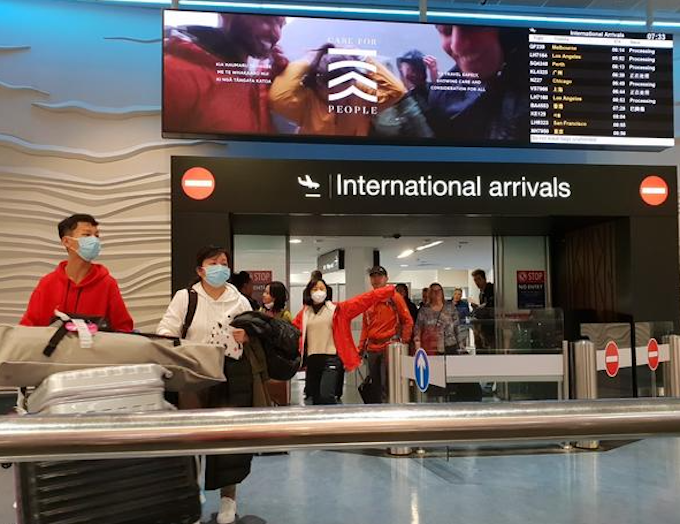
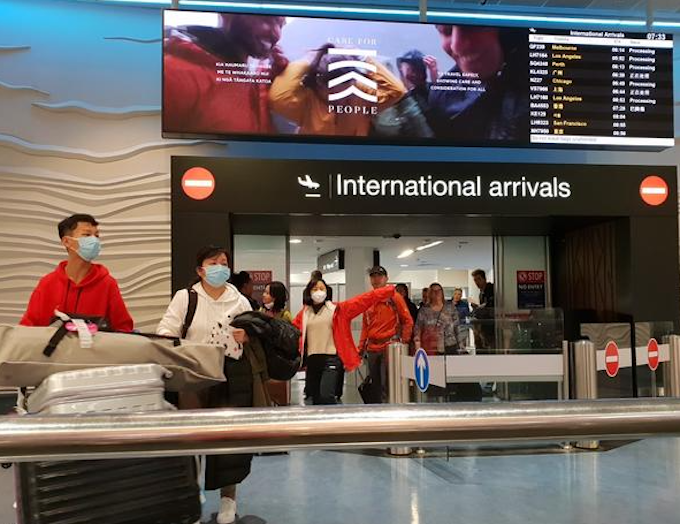
New Zealanders evacuated from Wuhan amid the coronavirus outbreak will be quarantined in Aotearoa – not on Christmas Island like the Australians.

As efforts to co-ordinate evacuations continue, Foreign Affairs Minister Winston Peters said New Zealanders would be brought back home, but where to remained a question to be answered.

“We are looking at the quarantine options within New Zealand already, we are working on that.” He said the government would be able to provide information on where when it had made a choice.

READ MORE: Pacific coronavirus updates with RNZ

There are 53 New Zealanders registered as being in Wuhan and Peters said extracting them was a complex issue. The criteria for getting on an evacuation flight were still being worked out.

The timeframe depended on the Chinese government’s permission to allow an aircraft to be used for extraction.

– Partner –

LISTEN TO RNZ MORNING REPORT: ‘We are looking at the quarantine options within New Zealand already’

A domestic aircraft would be a quicker solution than a military aircraft.

Peters said the mission would require the agreement of whoever flew and staffed the plane. Health safety measures would be put in place for them as well, he said.

When asked if New Zealand would pull consular staff out of China he said “that’s a fair question” but that “we don’t want to overreact until we know what we are reacting to and what the issue in terms of medical rescue is all about … it’s a major concern and all aspects of the problem known now and potentially are being looked at”.

New Zealand and Australian diplomats are meeting in Wuhan today to finalise a plan to get trapped residents out.

Travel cancelled and insurance warning
Meanwhile, travel companies in New Zealand are cancelling tours to China amid the coronavirus outbreak. It comes after a directive from the Chinese government.

One of those is Flight Centre, which has dropped all planned tours until April.

Its head of product, Victoria Courtney, said if people had left already for a tour it would go ahead as planned.

“Our advice at this stage … is to come in, talk to your travel consultant and we will reaccommodate people. We are working with all of our preferred partners on the ground to reaccommodate people wherever possible onto other itineraries or other holidays if possible and work to postpone or reschedule trips if that’s what customers choose to do.

“I think our advice would definitely be looking at the safe traveller information which is evolving daily … avoid all unessential travel to china and try to either cancel, postpone or reschedule.”

Courtney warned people to check their travel insurance if they were still going.

“Travel insurance will cover customers … if they get sick and they need to be repatriated or they have any medical expenses that they incur through the coronavirus … but most travel insurance itself won’t cover situations of communicable disease so it’s really good at this time to look at your travel insurance policy.

“There are some … which do cover situations like this, but it’s really worth talking to your travel insurance company or your travel adviser and we can work through the fine details.”

This article is published under the Pacific Media Centre’s content partnership with Radio New Zealand.

Print Friendly, PDF & Email

Article by AsiaPacificReport.nz

Bees learn better when they can explore. Humans might work the same way

Source: The Conversation (Au and NZ) – By Adrian Dyer, Associate Professor, RMIT University

Understanding how humans learn is one key to improving teaching practices and advancing education. Does everybody learn in the same way, or do different people need different teaching styles?

The question may sound straightforward, but assessing and interpreting learning performance remains elusive. It is one of the most widely debated educational topics of today, especially for learners who have unique ways of demonstrating their understanding.

Self-based exploratory behaviour can enhance learning outcomes. Author supplied.

Bees learn

We looked for answers in what might be an unexpected place: among honeybees. In a new study published in the Video Journal of Education and Pedagogy, we use the bees as a model to understand how different individuals acquire information.

Using animal models to understand learning has a long and proud history. The Nobel Prize winner Ivan Pavlov famously trained dogs to associate a sound with a food reward. Eventually Pavlov demonstrated that the dogs began to salivate at the sound.

Pavlov’s experiment revealed the core theory behind how we understand associative learning in education, society and popular culture. (Think of how Gringott’s dragon was conditioned in Harry Potter And the Deathly Hallows.)

Much of what we know about the physiology of memory formation comes from the seminal work of the Nobel laureate Eric Kandel. Kandel used the simple sea slug (Aplysia californica) to investigate how connections between neurons in the brain enable learning.

Bees are surprisingly good learners and recent research shows individuals can learn faces, add and subtract and even process the concept of zero. Bees learn complex tasks through trial and error, where a reward of sugar water is provided for correctly solving a problem.

A honeybee with a white identification mark learns to discriminate between 3 and 5 item displays that each present the same overall surface area. Author supplied.

Teaching bees arithmetic

We were very interested to discover whether all individual bees would learn complex tasks in a similar way. Would each individual show similar learning performance throughout training, or would individuals demonstrate different learning strategies?


Read more: We taught bees a simple number language – and they got it


One foundation math skill we all learn at about preschool age is how to add and subtract numbers. Arithmetic is not a trivial task. It requires long-term memory of rules associated with particular symbols like plus (+) or minus (–), as well as short-term memory of what particular numbers to manipulate in a given instance.

When we trained bees to add and subtract, we evaluated how many trials it took each bee to acquire the task, and summarised the data examining how individuals learn in a video.

We were surprised to see that all bees did not learn the task at the same stage of training. Instead, different individuals acquired the capacity to solve the problem after a different number of trials.

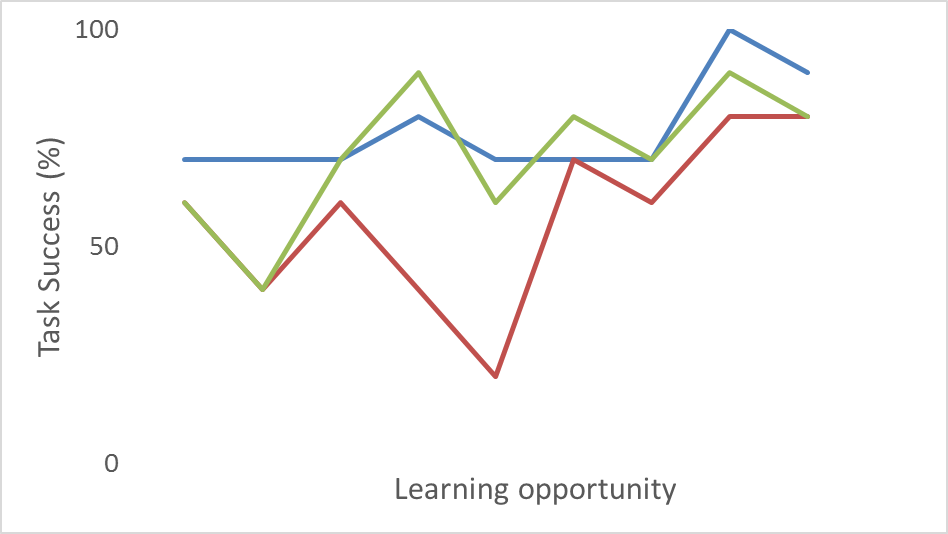
There was no common learning stage throughout the trials where bees achieved success. Rather the task required bees to try different strategies to see what worked. In particular, the opportunity to learn from mistakes was critical to enabling the bees to learn maths-based problems.

Different paths of learning: Performances of three different bees in an arithmetic task. While all three reach success, the path to learning the task is very different. Author supplied.

This finding suggests that when brains have to learn multi-stage problems involving different types of memory, an opportunity for exploratory behaviour is what nature prefers.

What does this mean for education?

Learning through experience. Shutterstock

Humans and bees last shared a common ancestor about 600 million years ago. However, we share a large number of genes and it is likely we have some similarities in how we process information.

We know that bees and humans have a common way of processing numbers from one to four, for instance, suggesting that learning processes may be linked to evolutionary conserved mechanisms. So bees’ improved results when learning maths problems in an individual exploratory fashion suggests this may be how humans too are wired to acquire new skills.

Indeed, some recent research in learning and learning difficulties in children has found evidence that individuals frequently see and learn in different ways depending on environmental context.

Our biology may be programmed to encourage exploratory learning, rather than trying to acquire information in a set prescribed way. If so, our education systems should take this into consideration.

This idea may not be new, but may face challenges if computer-based learning is increasingly adopted as there is a risk that limited programming could limit learning styles.

On the other hand, the clever use of exploratory learning environments – digital or physical – may enhance learning outcomes.

We should not shy away from examining how our evolutionary history impacts learning and using this to our advantage. Understanding evolutionary principles could help in designing learning environments best suited to encouraging exploration for optimal learning, for example.

ref. Bees learn better when they can explore. Humans might work the same way – https://theconversation.com/bees-learn-better-when-they-can-explore-humans-might-work-the-same-way-129439

The Australian government needs to step up its fight to free Kylie Moore-Gilbert from prison in Iran

Source: The Conversation (Au and NZ) – By Peter Greste, Professor of Journalism and Communications, The University of Queensland

Diplomacy and hostage negotiation are both subtle businesses. The training, culture and professional instincts of diplomats and negotiators make them inclined to operate behind the scenes to solve problems.

Better to work relationships to sort things out quietly, they argue, than get all shouty in public where the messaging can get out of hand.

So it is with the case of Australian-British academic, Kylie Moore-Gilbert, who has been in Ward 2-A of Iran’s notorious Evin prison since October 2018, where she is serving a 10-year sentence for “espionage”.


Read more: As pressure on Iran mounts, there is little room for quiet diplomacy to free detained Australians


The Australian government unequivocally rejects the charges as baseless. Asked by reporters what his government was doing to get her out, Prime Minister Scott Morrison vaguely said

we’re doing everything that we can do to bring her home.

Foreign Minister Marise Payne wasn’t much more forthcoming. In response to a question about Moore-Gilbert, she said recently,

Our view is that we don’t accept the charges upon which she was detained, held, charged and convicted, and we want to ensure the conditions in which she is held are appropriate.

But if, after almost a year and a half since her detention, things are still dire for the Middle East specialist, the strategy has failed spectacularly.

‘In the midst of a serious psychological problem’

In a series of handwritten letters smuggled out and published last week by the Centre for Human Rights in Iran, the academic said her “health has deteriorated significantly” and

I think I am in the midst of a serious psychological problem, I can no longer stand the pressures of living in this extremely restrictive detention ward anymore.

She describes being held in solitary confinement, with the lights on 24 hours a day and without medical attention, adequate food or phone calls to her family. In another note to the prosecutor, she points out that under Iran’s own laws, after being convicted she must be moved to a “normal” prison ward.

The Washington Post journalist Jason Rezian, who was himself held on charges of spying in the same prison wing run by the IRGC (Islamic Revolutionary Guard Corps), called it “a place beyond government oversight”.

Her situation is much more dire than the (Australian) government is letting on.

So, when the traditional methods have failed so dismally to improve anything about Moore-Gilbert’s situation, surely the time has come to shift gears and get shouty to ramp up public pressure on both Australian diplomats and Iranian politicians.

Public pressure can mobilise government action

Whether they admit it or not, governments everywhere tend to respond to public uproar. In 2015, after I was released from a prison in Egypt where I had been held on terrorism charges for 13 months, I asked a European diplomat what my colleagues and I should be doing to free other colleagues who remained in jail. He responded:

Keep up the protests and the lobbying from human rights groups. Get on Twitter and Facebook; give interviews to TV and radio stations. Stay noisy.

My response was that Egyptians don’t “give a damn” about Twitter, Facebook or Human Rights Watch.

And he said,

But I and my colleagues do. And by keeping the fire burning under our backsides, you not only keep us focused, you also give us the tools to say to the Egyptians, ‘we can’t move on to other business until you sort this situation out’.

It is risky to draw direct comparisons between our case and Moore-Gilbert’s. But it was clear that in our campaign, the extraordinary public pressure gave then-Foreign Minister Julie Bishop the political weight she needed to mobilise more muscular diplomatic and consular resources than usual.

It pushed both her and the Prime Minister Tony Abbott to speak publicly and forcefully in favour of our release. The attention pushed the Egyptians to keep us in better conditions than other “terrorists”. It created space for a more coordinated international response. And in the end it proved too much for Cairo to resist.


Read more: Peter Greste released: good news from the Middle East


The dangers of negotiations

To be clear, it is always difficult for governments to balance their responsibility to help a citizen in trouble in a foreign land against broader national interests, particularly when it involves a strategically important country like Iran.

But if the Australian government is involved in any negotiations or “bargaining” to free Moore-Gilbert, it risks validating the Iranian strategy and encouraging more hostage-taking.

In this case, we still don’t know why Iran is holding Moore-Gilbert or what it might be asking for in exchange for her release. But given the escalating tensions between Tehran and the West, she is almost certainly being used as a bargaining chip.

If her family, colleagues and the public continue to heed the diplomats’ advice and remain quiet, and if Morrison and Payne keep tiptoeing around the issue, it is almost certain nothing will change.

ref. The Australian government needs to step up its fight to free Kylie Moore-Gilbert from prison in Iran – https://theconversation.com/the-australian-government-needs-to-step-up-its-fight-to-free-kylie-moore-gilbert-from-prison-in-iran-130591

Plants safely store toxic mercury. Bushfires and climate change bring it back into our environment

Source: The Conversation (Au and NZ) – By Larissa Schneider, DECRA fellow, Australian National University

Climate change and bushfire may exacerbate recent mercury pollution and increase exposure to the poisonous neurotoxin, according to our study published in the Journal of Paleolimnology.

Mercury stored in plants is released during bushfires, suggesting Australia is particularly at risk.

Our study in the Venezuelan Andes examined how mercury deposits responded when the world warmed by about 3℃ between 14,500 and 11,500 years ago. (Scientists call this period the transition from the Last Glacial Maximum to the Holocene).

We found the amount of mercury deposited in the environment at this time increased four-fold.

A dangerous neurotoxin

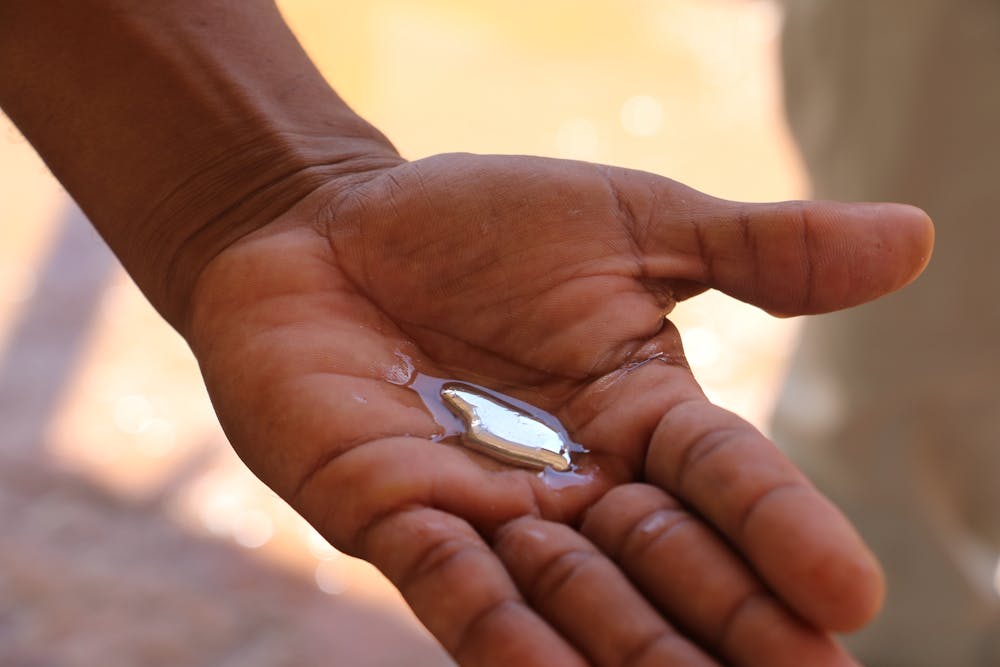
Mercury is a naturally occurring but dangerous neurotoxin that, in sufficient amounts, can cause impaired motor skills, breathing difficulty and memory problems in humans.

Once in the environment, mercury builds up in the bodies of animals. The build-up is magnified when those animals are then eaten by other animals, and so on. This process is called bioaccumulation and biomagnification.


Read more: Australia emits mercury at double the global average


Industrial activities such as mining, fossil fuel combustion and cement production release mercury into the environment.

Over the past 150 years, humans have tripled the amount of mercury in the atmosphere. It can remain there for months, and be transported by wind to even the most remote ecosystems on Earth.

Mercury is dangerous to humans and wildlife. Shutterstock

Climate change unlocks mercury deposits

Average global temperatures have increased by 0.8℃ since 1880 , with two-thirds of this warming occurring since 1975. Understanding how mercury responded to past known climate change may help us forecast future mercury exposure as the climate warms.

The Last Glacial Maximum (also known as an ice age), and the start of the Holocene (the present period), occurred between 19,000 and 11,700 years ago.


Read more: Another problem with China’s coal: Mercury in rice


It was not a smooth transition; global climate oscillated between warm and cold at this time.

Abrupt returns to cold, glacial-like conditions occurred during two periods of time called the Older Dryas and the Younger Dryas. These climate oscillations provide a unique opportunity to understand how mercury in our environment responds to rapid climate change.

Looking in lakes

Layers of sediment settle to the bottom of lakes over thousands of years. By collecting sediment cores, scientists can precisely date each layer and reconstruct past climates. Lake sediment also provide a good historical of mercury contamination.

We examined how mercury deposits in a small lake – the Laguna de Los Anteojos in the Venezuelan Andes – changed as the ecosystem shifted with the climate.

We studied how mercury deposits in this small lake, named Laguna de Los Anteojos, changed as the climate warmed. Wikimedia Commons

We found the amount of mercury in the lake increased rapidly as temperature increased – which doesn’t bode well for us.

It suggests human-caused global warming might drive a similar increase in the amount of mercury deposited in remote ecosystems, even if emissions are reduced.

As the climate warmed, we found, more mercury entered water systems. Once in the aquatic system, it can be absorbed by plants or consumed by animals, and pass on up the food chain in ever-increasing amounts.

Bushfires dump more mercury into the environment

Plants can store a significant pool of mercury from the atmosphere, which is good – until fires occur.

Unfortunately, mercury stored by vegetation is released during burning. This is particularly the case in contaminated areas, where plants store significant quantities of mercury emitted from human activities such as mining.

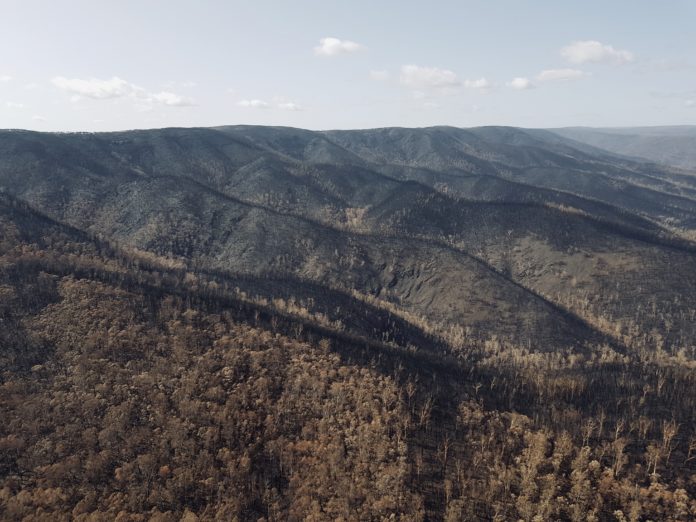
Given the recent catastrophic fires engulfing large tracts of land in Australia, that’s a worry.

Plants can store a significant pool of mercury from the atmosphere, which is good – until bushfires occur. Shutterstock

There’s a dearth of mercury studies in Australia (a fact acknowledged even by the United Nations) so it’s not yet possible to estimate mercury emissions from the recent Australian bushfires.

One thing we do know, however, is the number of bushfires in Australia is not expected to decrease.


Read more: Many of our plants and animals have adapted to fires, but now the fires are changing


It sounds bleak, but Australian researchers are working hard to better understand how mercury behaves as our ecosystem changes.

The more we know, the better our chances of mitigating mercury pollution and the risk it poses to humans and wildlife.

ref. Plants safely store toxic mercury. Bushfires and climate change bring it back into our environment – https://theconversation.com/plants-safely-store-toxic-mercury-bushfires-and-climate-change-bring-it-back-into-our-environment-129788

Kids learn best when you add a problem-solving boost to ‘back-to-basics’ instruction

Source: The Conversation (Au and NZ) – By Andrew J. Martin, Scientia Professor and Professor of Educational Psychology, UNSW

Last year there was substantial hand-wringing over Australia’s declining results in the Programme for International Student Assessment (PISA) tests. Ideas for how to reverse this decline were coming from far and wide, thick and fast.

Federal Minister for Education Dan Tehan declared Australian education needed to go “back-to-basics” while influential commentators pointed out PISA tests are focused on “problem-solving” and this is what we need more of in Australian schools.

Of course, both views are correct. The problem is they are often framed as mutually exclusive, when in fact we can effectively teach the basics and optimise problem-solving at the same time.


Read more: PISA doesn’t define education quality, and knee-jerk policy proposals won’t fix whatever is broken


Our recent research suggests “load reduction instruction” is one way to do this. To explain load reduction, we must first explain a bit about memory.

Short and long-term memory

There are two key parts of the human memory system: working memory and long-term memory.

Working memory is the in-the-moment component that receives and sends information to long-term memory. It is limited and estimated to hold information for about 15-20 seconds, with a capacity about the size of a phone number.

Long-term memory has vast capacity and indefinite duration. The teacher needs to help students build up their long-term memory such as fundamental facts and rules (times-tables) as well as concepts and procedures needed for performing more complex tasks (difficult algebra).

Teachers need to teach in a way that reduces the burden on students’ working memory when they are learning new content or skills. If working memory is overloaded, students may misunderstand information or not understand it at all.


Read more: I had an idea in the 1980s and to my surprise, it changed education around the world


Explicit instruction is a good way to ease this burden when students are learning the basics. Here, for example, a teacher clearly and systematically shows the students what to do and how to do it.

Once students understand the basics, they can take on more complex information. In fact, research has shown if students are not moved onto problem-solving opportunities after they have learnt the basics, their learning can decline (this is called the “expertise reversal effect”).

Short-term memory is limited and can only hold information the size of a phone number at any one time. from shutterstock.com

Fostering problem-solving can be done through guided inquiry-oriented learning. Here the teacher may assign a more open-ended or complex task students complete on their own using, or inferring from, the information and skill they gained in the explicit instructional phase. It is “guided” because the teacher still has a role in monitoring progress and assisting as appropriate.


Read more: Explainer: what is inquiry-based learning and how does it help prepare children for the real world?


What is load reduction instruction?

Load reduction instruction aims to integrate explicit instruction and guided inquiry with the following five principles:

  1. make tasks simple enough to suit the students’ existing knowledge or skill level at the start of the learning process. The teacher could do some pre-testing to understand what the students already know and then present information and tasks at a level of difficulty that matches the students’ ability

  2. instructional support from the teacher through the task. The teacher could provide a task for students to do in steps and work closely with them through each one

  3. structured practice and repetition. After working through a task with students, the teacher could give similar tasks where students can practise what they know or can do

  4. feed-back and feed-forward. The teacher could provide corrective information (if correction is needed) and specific suggestions for the student to apply or to improve on the next task

  5. guided independent practice, problem-solving and inquiry-oriented learning. The teacher could provide a more complex task students do on their own and that may involve more than one path to a solution or more than one solution. The teacher’s guidance is minimal (such as reminding students of the likely steps involved or providing some hints when students get stuck), but always available.

The first four principles may be considered the “back-to-basics” parts of load reduction instruction and rely on the more traditional explicit approaches. Then, as core skill and knowledge develop, the fifth principle is emphasised: problem-solving.

How we know it works

We have conducted two studies exploring load reduction instruction in class. The first study involved 393 high school students in 40 maths classrooms.

Students rated their maths teacher on five aspects of each of the five principles described above.

Students also reported on their own motivation and engagement in maths, their academic buoyancy in maths (how well they bounce back from academic setback), and their maths achievement. We found the more the teacher was reported to implement load reduction instruction, the higher their students’ levels of motivation, engagement, academic buoyancy and achievement.


Read more: Don’t just solve for x: letting kids explore real-world scenarios will keep them in maths class


In a second study (currently under peer review), students from more than 150 science classrooms rated their science teacher using the five principles. Students also rated their own engagement in science (how much they enjoyed and participated in class) and completed a brief science test.

Our analyses revealed students who were taught using load reduction principles had higher levels of engagement in science and higher levels of science achievement.

Back-to-basics and problem-solving should go hand in hand. The success of one is inextricably tied to the success of the other. But the order in which things are done is critical. Explicit instruction must first be used to ease the load on students as they learn the basics. Then, when some expertise has developed, students move to guided inquiry to nurture their problem-solving capacity.

ref. Kids learn best when you add a problem-solving boost to ‘back-to-basics’ instruction – https://theconversation.com/kids-learn-best-when-you-add-a-problem-solving-boost-to-back-to-basics-instruction-129008

Building standards give us false hope. There’s no such thing as a fireproof house

Source: The Conversation (Au and NZ) – By Geoff Hanmer, Adjunct Lecturer in Architecture, UNSW

Bushfires have killed 33 people and destroyed nearly 3,000 houses across Australia so far this fire season. Canberra is under threat right now.

It isn’t only houses. Significant commercial buildings have been destroyed, among them Kangaroo Island’s iconic Southern Ocean Lodge.

In New South Wales alone, 140 schools have been hit. Many require extensive work.

The National Construction Code provides false, and dangerous, hope.

It requires new homes (Class 1 buildings) built in declared “bushfire-prone” areas to be built to either Australian Standard 3959, the National Association of Steelframed Housing standard “Steel Framed Construction in Bushfire Areas”, or a “performance solution”, which could be anything that in the opinion of a qualified person complies with the performance requirements of the code.

It also applies to Class 2 buildings (apartments) and Class 3 buildings (hotels and guesthouses) in bushfire-prone areas.

Disturbingly, the code does not apply to community buildings, such as schools.

The standard does not fireproof buildings

The definition of “bushfire-prone” varies from state to state, as do the procedures for enforcing it.

Confused? So are many construction professionals.

The sad truth is that any practical building that is exposed to an intense bushfire will probably burn down, whether it complies with Australian Standard 3959 or not.

Worse still, the available evidence suggests there is a significant risk that the people sheltering in it will not survive without an effective refuge, which Australian Standard 3959 does not mandate or consider.

The standard speaks for itself:

Although this Standard is designed to improve the performance of buildings when subjected to bushfire attack in designated bushfire-prone areas, there can be no guarantee that a building will survive a bushfire event on every occasion. This is substantially due to the unpredictable nature and behaviour of fire and extreme weather conditions.

More importantly, while a building constructed to Australian Standard 3959 might be less likely to burn down, Standard 3959 in its current form might not protect the people within the building.

Worse, it might not protect people

The highest aim of any system of building regulation ought to be life and safety, followed by the protection of adjoining properties and then, a long way back, by the protection of the property itself.

In the case of bushfire, the Australian Building Codes Board and its political masters appear to have put the protection of buildings first, when it should be last.

If a house is under threat by bushfire, the best advice is to evacuate early, whether it complies with Australian Standard 3959 or not.


Read more: Our buildings aren’t made to keep out bushfire smoke. Here’s what you can do


By encouraging people to believe they can defend a structure compliant with Australian Standard 3959 we could be putting more people at risk than if we simply told them to evacuate.

Residents and firefighters defending houses have accounted for a large percentage of the deaths this fire season.

It’d be better to rethink where we build

We may need to have difficult conversations about whether our subdivision practices are appropriate. Allowing people to build in areas that are bushfire-prone, particularly where buildings are effectively built into the bush, might be creating unmanageable problems for the future.

If there is no such thing as a bushfire-proof house, as Australian Standard 3959 seems to concede, we might need to focus on evacuation and shelters.

In the United States, rather than requiring houses to resist tornadoes or wildfires, the Federal Emergency Management Agency encourages the provision of shelters. State and local authorities often make these mandatory.

People are more important than buildings

Having attended one funeral for a person killed defending their home this fire season, I have had enough. We should not be worrying about protecting buildings until we have worked out how to protect human life.

The Building Ministers’ Forum and the Australian Building Codes Board should either embrace a policy of early evacuation or mandate fire shelters in bushfire-prone areas for both new and existing houses.


Read more: Australian building codes don’t expect houses to be fire-proof – and that’s by design


The board and the states should also make every effort to regulate to ensure all buildings and places designated as refuges of last resort can properly fulfil their intended function, whether they are new or not.

If we are going to have another fire season similar to this year, and so far the CSIRO predictions on this have been totally accurate, we will need to sort this out quickly, preferably before next summer.

ref. Building standards give us false hope. There’s no such thing as a fireproof house – https://theconversation.com/building-standards-give-us-false-hope-theres-no-such-thing-as-a-fireproof-house-130165

How the term ‘Anthropocene’ jumped from geoscience to hashtags – before most of us knew what it meant

Source: The Conversation (Au and NZ) – By Dr Duncan Cook, Senior Lecturer in Geography, Australian Catholic University

Disastrous fires, ongoing drought, and heat extremes have refocused Australians’ attention on the human contribution to climate change.

For decades experts have known (and warned) of the consequences for Australia, but for many, there is a realisation that our environment has shifted beyond “normal” boundaries, and that humans have played some part in this. This is fertile ground for the idea we occupy a new human-dominated phase of planetary history: the Anthropocene.

Use of the term Anthropocene (the root “anthropo” means human, the suffix “-cene” signals a geologic time epoch) has been growing for more than a decade. No longer the exclusive domain of geoscientists, it has jumped from academic journals to pop culture while many are still asking “the what now?”


Read more: Blue Acceleration: our dash for ocean resources mirrors what we’ve already done to the land


A very short history

It has been 20 years since Dutch Nobel Laureate Paul Crutzen and colleagues used the term to describe the human modification of the planet since the industrial revolution. However, the concept dates back to at least the mid- to late-19th century when Italian Catholic priest, geologist and palaeontologist Antonio Stoppani proposed an “anthropozoic era”.

There has been a push in the last decade to have the Anthropocene formally recognised as the current piece of Earth history.

Last year, the Anthropocene Working Group of the International Union of Geological Sciences (IUGS) agreed to a proposal for a formal Anthropocene period with an onset marked by the distinct chemical signatures of mid-20th century atomic bomb fallout that we can detect worldwide.

Some scholars have questioned the need for an Anthropocene epoch at all. Others recognise its usefulness but debate when between the mid-18th and mid-20th century AD the period started.


Read more: Enough ‘Anthropocene’ nonsense – we already know the world is in crisis


While there are good arguments for such a recent start date, it potentially excludes the impact of thousands of years of human deforestation, agriculture, and building that are the environmental antecedents of the world we see today (a so-called Early Anthropocene, or a Palaeoanthropocene model).

Though there is argument about its starting point, the Anthropocene concept of human geological impact has taken hold. Unsplash, CC BY

Re-writing the past

One issue here is that our knowledge of human impacts in the distant past is being rapidly re-written. Take the Maya lowlands of Central America, where our research team used the term Mayacene to describe early Anthropocene deforestation, agriculture and urbanisation. In a new paper, my colleagues have shown Pre-Columbian Maya wetland agricultural systems in present-day Belize were five times larger (and older) than previously thought.

We are only now beginning to understand the long history of human modification, in tropical forests and elsewhere, that may have increased greenhouse gas emissions and altered climate long before the industrial revolution.

History tells us trying to pin down when (and where) major human disturbance first occurred is a great challenge. The stratigraphic (and historical and archaeological) evidence suggests an Anthropocene that is time-transgressive, with many different beginnings (and some declines) globally. We can say it had transformed much of the planet by 3,000 years ago.

Can we reverse millennia of human impacts? Kelly Sikkema/Unsplash, CC BY

Escape from acadaemia

An undecided start date has not prevented the Anthropocene idea spreading rapidly through many academic disciplines.

Highly regarded journals, such as Anthropocene and Anthropocene Review, publish an expanding body of human-impacts research.

Across the humanities and social sciences, the Anthropocene has become an important frame for re-examining human-environment relationships. Historian Dipesh Chakrabarty’s 2009 essay, for example.

Offshoot Anthropocene ideas have sprouted, including the Technoscene (the influence of technology), the Capitalocene (the influence of economies), and (my favourite) the Chthulucene that imagines a future re-worlding where multispecies groups learn to live in harmony with nature.

Despite the viral spread and mutation of the term, what remains is the recognition of the enormity and permanence of human environmental modification, and the (usually) negative consequences.

The 2010s were marked by important Anthropocene books, documentaries and movies, marking the spread of the term into the public discourse.

Musician Grimes’ new album will be called Miss Anthropocene. Illustration by Charlotte Rutherford/Instagram

In 2014, Anthropocene was added to the Oxford English Dictionary; six years later, Google’s search engine shows some 6.4 million internet hits on the term. In The Atlantic last year, science writer Peter Brannen wondered whether the concept was an arrogant human folly:

The idea of the Anthropocene inflates our own importance by promising eternal geological life to our creations.

The cultural impact of the Anthropocene is seen in major art projects and museum exhibitions, and you can now find the word (and the ideas) in many songs and albums. Canadian musician Grimes’ announced her upcoming release Miss Anthropocene is a “concept album about the anthropomorphic Goddess of climate change”.

On social media, Anthropocene has become a byword for the severe human impacts on the environment we see around us – in posts about bushfire smoke, plastic beach flotsam, and expanding farmlands.

Lasting impact

It’s not often ideas and terminology from the geosciences escape and find a home in society, so the journey of the Anthropocene, from neologism to global catch phrase and environmental rallying point is fascinating.

The Anthropocene is not (yet) a formally defined geological unit, and so for now, we continue to live in the Meghalayan Age of the Holocene epoch.

The Anthropocene has arguably become a “charismatic mega-concept”. It brings together the sciences, humanities, and the public realm, stimulating ongoing debate and new research.


Read more: Friday essay: thinking like a planet – environmental crisis and the humanities


Perhaps this is the “global awareness” ANU’s Will Steffen and colleagues anticipated in their 2007 Anthropocene model?
Time will tell if this shared terminology and understanding can translate into action, to repair (or at least slow) millennia of human impacts on the Earth.

ref. How the term ‘Anthropocene’ jumped from geoscience to hashtags – before most of us knew what it meant – https://theconversation.com/how-the-term-anthropocene-jumped-from-geoscience-to-hashtags-before-most-of-us-knew-what-it-meant-130130

View from The Hill: Politicians not bureaucrats are the ones in touch, Morrison claims in sports affair

Source: The Conversation (Au and NZ) – By Michelle Grattan, Professorial Fellow, University of Canberra

As the suspense over Bridget McKenzie’s future continues, Scott Morrison on Wednesday argued that in allocating public money, it’s politicians rather than officials who understand the community.

Previously, Morrison has highlighted that all the grants then sports minister McKenzie decided upon – overriding the ranking worked out by officials according to the program’s criteria – were “eligible” under the sports scheme.

Answering questions at the National Press Club, he elevated another line.

He recalled when he was social services minister his department had allocated the grants under a program and the result was some “wonderful community organisations” were defunded. He and the then prime minister had to intervene and fix things.

“On other occasions, departments have made decisions which had stripped money from Foodbank, and I’ve had to reverse those decisions,” he said.


Read more: Scott Morrison’s ‘resilience’ speech overshadowed as McKenzie crisis deepens


In contrast to officials, “politicians, ministers, members of parliament, we’re part of our community. We know what’s happening in our community. We’re in touch with our community. We know the things that can make a difference in our community. And it’s important because we’re accountable to those people in our communities for getting stuff done that’s going to make a difference in their communities”.

Later he elaborated. “It’s not a question of either/or. It’s a question of the two working together. And my best experience as a minister and a prime minister is where you just worked together closely with your public officials and you make decisions.”

Despite Morrison saying how much he respected the “professionalism”, “expertise” and “skills” of the public service, his remarks won’t be lost on federal bureaucrats who already feel somewhat under siege from the PM.

On a literal reading of Morrison’s analysis, McKenzie gets protection on two grounds. The politically-based grants she made were “eligible” and politicians know best anyhow.

This suggests if McKenzie is to be dumped it will have to be on the ground of her failure to disclose her membership of a gun club she funded, rather on the propriety (or rather, impropriety) of her doling out money skewed to marginal seats – which is the more serious sin.

Around the government, there is some bewilderment that Morrison hasn’t dealt with the McKenzie situation before this (which of course does involve Nationals leader Michael McCormack).


Read more: Grattan on Friday: Bridget McKenzie has made herself a sitting duck


It’s impossible to believe Phil Gaetjens, secretary of Morrison’s department, could not have finished his assessment of whether McKenzie had breached ministerial standards days ago if the PM had been minded to take a quick decision.

Whatever method there is in dragging this out isn’t obvious even to some in the Nationals, where McKenzie doesn’t have a great deal of support. It was noticed that on the ABC on Wednesday Victorian National Darren Chester, active in gathering the numbers for McKenzie’s election to the party’s deputy leadership, would not say whether she had his backing.

With parliament returning next week, Morrison can’t dally much longer.

He again played down his office’s part in the sports grants affair, saying “all we did was provide information based on the representations made to us, as every prime minister has always done”.

He also hinted he might make reparations to those organisations that were high on the officials’ list but missed out on grants, and are now squawking.

“There are many, many, many more worthy projects in this area … I will work with the Treasurer to see how we can better support even more projects in the future.”

But beware the fine print in his words. “On any grants program, however it’s done, there will always be many applicants whose projects are very worthy and they’re unable to be accommodated by the budget that we’ve set.

“We’re a responsible government that manages public money carefully.”

The nub of the McKenzie affair is that the government was being “careful” about the politics in how this money was “managed”. For all Morrison’s public rationalisations, the voters understand this – and the PM must know they do. As he said, politicians “are part of our communities – we live in them – we engage there every day”. And no doubt they are hearing loud and clear the community feedback about the sports rorts.

ref. View from The Hill: Politicians not bureaucrats are the ones in touch, Morrison claims in sports affair – https://theconversation.com/view-from-the-hill-politicians-not-bureaucrats-are-the-ones-in-touch-morrison-claims-in-sports-affair-130795

Our biggest enemy amid the Wuhan virus outbreak – panic

Rappler editorial

It’s not the virus. It’s not the Chinese flying into the Philippines. Our biggest enemy amid the Wuhan crisis is panic.

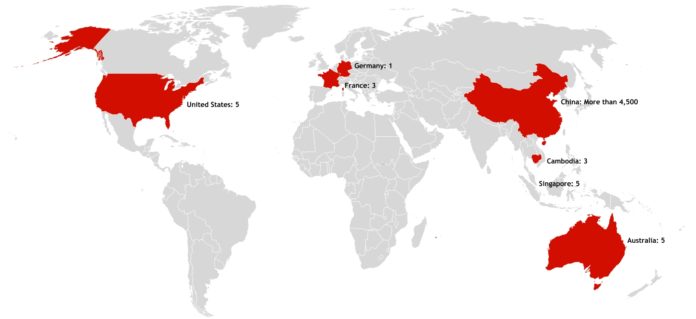
Here’s the situation: a new strain of the coronavirus has caused an outbreak in the city of Wuhan in central China. It has so far killed 106 people and infected more than 4500.

While the entire province of Hubei is on lockdown, the virus has nevertheless been transmitted by infected humans to at least 12 other countries.

READ MORE: Coronavirus update: NZ to team up with Australia to get citizens out of Wuhan

The Philippines is awaiting confirmation if the virus has reached its shores.

So far, the only case acknowledged by the Department of Health (DOH) to be under observation is a five-year-old boy from Wuhan who was isolated in a hospital in Cebu City starting January 12, and has since been discharged.

– Partner –

While the boy has exhibited flu-like symptoms, there’s no certainty yet that what he has is the newly-discovered 2019 novel coronavirus (nCoV), also called the Wuhan virus. It could be any of the 7 known coronaviruses. Health authorities are awaiting the results of lab tests done on the boy’s samples in Australia.

The Bureau of Immigration has tracked down the family of four whose father, after traveling from Wuhan to Hong Kong, has been found to be “preliminary positive” with the virus. Leaving the patient in HK, the family boarded a Cebu Pacific flight to Manila on January 22.

Monitoring movements
The Justice Department says it is monitoring the movements of that family, and “may refer them to Bureau of Quarantine” (BOQ). The airline urged the passengers of that flight 5J 111 to get themselves checked.

On Monday morning, January 27, Health Secretary Francisco Duque III said in a Malacañang briefing that the DOH was investigating 11 possible nCov cases in 6 regions in the country, but reiterated that there is no confirmed case yet.

Without any confirmation from health authorities, the rest of the supposed cases we’ve been reading about on social media are speculations or outright misinformation.

Understandably, Filipinos are worried. The 2019 nCov, which can infect a person’s airways, has symptoms similar to the deadly SARS-CoV of 17 years ago, and can be transferred from human to human. And while scientists have yet to understand the new virus’ life cycle, how exactly it’s transmitted, and whether it is going to mutate, there is no approved vaccine or treatment yet for the coronavirus infection.

As of January 28, DOH says there is still no confirmed case of the 2019 nCov in the Philippines

But we should caution ourselves against letting this worry spiral into panic. Because panic can blur our judgment. It makes us vulnerable to wrong information or speculation or conspiracy theories. It makes us discriminate against any person “who looks Chinese” and is wearing a mask, or is in the vicinity of a hospital.

It makes us question the specialists in the health department when they don’t seem to be as worried as we are. We nag our local governments to do drastic things that are outside the protocols established by the DOH.

Push for total ban
We’ve heard of Chinese-looking individuals not being allowed to enter the emergency room of a hospital – a nurse had to talk to them outside, and then they were turned away. In one city, we heard that some journalists were among those pushing the mayor to declare a total ban on Chinese tourists.

Some have made racist remarks about what the Chinese in the mainland eat.

Let’s go back to what authorities say we know about the Wuhan virus, and stick to that.

Arnaud Fontanet, head of the department of epidemiology at Institut Pasteur in Paris, says the 2019 nCov, in its current form, appears to be “weaker” than SARS. It’s too early to say whether the virus is going to mutate or not.

Rabindra Abeyasinghe, the country representative to the Philippines of the World Health Organisation (WHO), said as of January 21 that it was “too early to say this is a severe disease.” So far, those who have died had pre-existing illnesses, while not all of them had a history of getting in contact with the wet market in Wuhan where wild animals being sold were suspected to have been the source of the virus.

‘Basis for testing’
Through the WHO, China’s health ministry is expected to provide the Philippines and other countries a DNA sample of the 2019 nCoV. This “will serve as the basis for our own testing and treatment” via the Research Institute for Tropical Medicine, says Secretary Duque.

Duque says the Philippines’ “detection capability is still evolving,” but this should not be a handicap. Thanks to the internet, scientists from universities, research centers, and even private companies across the globe are collaborating online to study the Wuhan virus so China and other countries can all respond to it appropriately.

So far, the Philippines has suspended all direct flights to and from Wuhan, and has put its Bureau of Quarantine at the airports on high alert.

The DOH assures the public that it is ready in case the Wuhan virus reaches the Philippines, and this confidence stems from the fact that, since the 2003 SARS crisis, protocols on monitoring and testing are in place, and surveillance units are in place in the regions, cascading information and instructions down to the barangays.

Our part – as citizens, as local governments – is to take heed.

An editorial published today by the leading independent Philippines online news website.

Print Friendly, PDF & Email

Article by AsiaPacificReport.nz

Fear spreads easily. That’s what gives the Wuhan coronavirus economic impact

Source: The Conversation (Au and NZ) – By Ilan Noy, Professor and Chair in the Economics of Disasters, Te Herenga Waka—Victoria University of Wellington

One way to count the cost of the Wuhan coronavirus is by how many people catch it, and then how many die. Another is the direct financial costs of public health measures to treat those infected and contain its spread.

Yet another is the wider economic cost. But how to calculate this?

Some suggest a neglible impact on the global economy if the death toll is less or similar to the SARS outbreak in 2002-03.


Read more: What we know suggests the economic impact of Wuhan coronavirus will be limited


But the economic impact is not directly tied to the number of people who get sick (morbidity) or die (mortality). It almost wholly depends on the indirect effects of the decisions that many millions of individuals make to minimise their chance of catching the virus, and the decision of governments on how to react to the threat.

This means the Wuhan outbreak could directly affect relatively few people, compared to past pandemics, yet still pack an intense punch in a more interconnected global economy.

Learning from SARS

We can draw lessons from the SARS (Severe Acute Respiratory Syndrome) experience, the first epidemic of the 21st century.

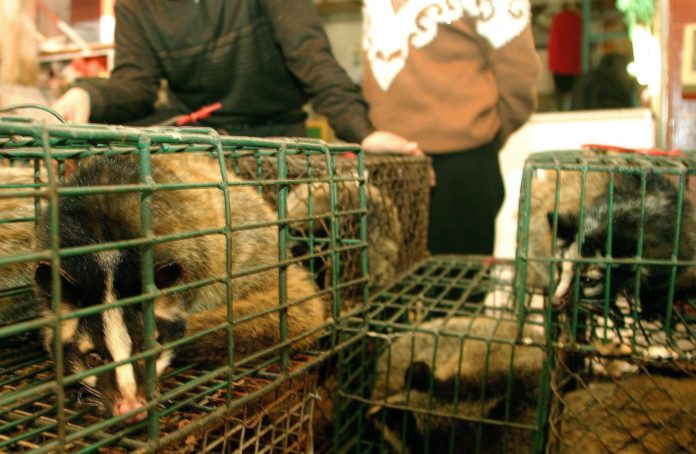
SARS was another coronavirus. As the Wuhan virus emerged in late December from an animal market, SARS originated from animal markets in the southern Chinese province of Guangdong in November 2002.

Zoonotic epidemics – diseases emerging from animal hosts – are not new. But they are becoming more common with closer proximity between wild animals, domesticated animals and people; and they spread more rapidly due to increased movements of people within and between countries. Their economic risk is also likely to increase.


Read more: Wuhan coronavirus: we still haven’t learned the lessons from SARS


SARS spread to infect individuals across 26 countries in a matter of weeks. Fortunately it was then contained relatively rapidly. Ultimately about 8,500 people caught it. The mortality rate was about 11% with fewer than a thousand deaths.

Civet cats in an animal market in Guangzhou in January 2004. SARS is thought to have been transferred from bats to civet cats and then to humans. Paul Hilton/EPA

The SARS outbreak was, of course, devastating to its victims and their families. But its public-health impacts were relatively limited and short-lived. It nonetheless had significant economic impacts. Though fewer than 10,000 people were directly infected, tens of millions of individuals changed their behaviour out of fear of catching the virus.

Overestimating risks

These behavioural changes were partly driven by government directives, but more importantly by personal judgments about risks.

Behavioural studies suggest individuals typically overestimate the risks that are memorable, vivid or generate fear, while underestimating more common risks. Thus shark attacks are feared more than traffic accidents.

In a survey of 705 people in Hong Kong at the height of the SARS epidemic, 23% of respondents feared they were likely to become infected with SARS. The actual infection rate was only 0.0026%. In the US, where 29 people were infected and no one died, 16% of survey respondents felt they or their family were likely to get infected with SARS.


Read more: How contagious is the Wuhan coronavirus and can you spread it before symptoms start?


Such fears led to observed economic effects. Disproportionately affected were leisure venues (restaurants, cinemas, bars and clubs) and businesses associated with domestic and international tourism.

Evening mass at a Catholic church in Hong Kong on Saturday, May 10 2003. David G. McIntyre/EPA

The economies of China, Hong Kong, Singapore and Taiwan were hardest hit. At the height of the epidemic, international visitor arrivals fell dramatically in these four countries. According to World Bank research, GDP losses to these countries amounted to US$13 billion

In Beijing, the losses to the tourism sector were estimated to be 300 times the direct cost of medical treatment for SARS in the city.

Panic is easy to spread

A complete tally of the cost of SARS has never been undertaken, but what we do know about the SARS experience is most likely a good guide to what the costs of the Wuhan outbreak might be. It will be the reactions of governments and individuals to the perceived threat of the virus, and not the virus itself, that will have the biggest economic costs.

The Chinese government has imposed a mandatory curfew on more than 30 million people. It’s possible hundreds of millions more are changing their plans willingly or because they are being instructed to do so.

Examples include Hong Kong and other countries now hesitating to allow in Chinese tourists, and citizens of other nations being advised to avoid travelling to China. The US Centers for Disease Control, for example, has recommended against all non-essential travel to China, including areas far from Wuhan.


Read more: Coronavirus outbreak: WHO’s decision to not declare a global public health emergency explained


We do not yet know enough about the virulence of this coronavirus, though the preliminary evidence suggests its mortality rate is much lower than that of SARS.

But with social media, panics can also spread more rapidly and further. All signs point to a global overreaction to this crisis, and therefore to an amplified economic impact. Even highly reputable media outlets such as The New York Times have not proven immune to sensationalism, promoting stories with dramatic headlines such as “Alarm Grows as Markets Tumble and Death Toll Rises”.

We should all, therefore, rely as much as possible on verifiable information. Preventing the contagious spread of inaccurate and exaggerated information comes a close second to our responsibilities to prevent the spread of the virus itself.

ref. Fear spreads easily. That’s what gives the Wuhan coronavirus economic impact – https://theconversation.com/fear-spreads-easily-thats-what-gives-the-wuhan-coronavirus-economic-impact-130780

Comma again? Philip Pullman’s Oxford comma rage doesn’t go far enough

Source: The Conversation (Au and NZ) – By Roslyn Petelin, Course coordinator, The University of Queensland

High-profile author Philip Pullman tweeted on Sunday about the new 50 pence English coin due for release by the Royal Mint on Friday, January 31.

“The ‘Brexit’ 50p coin is missing an Oxford comma, and should be boycotted by all literate people,” he said.

An Oxford comma is the comma inserted before “and” or “or” in a list to separate the final item in a list from the items that go before it.

Sir Philip lives in Oxford, which voted to remain in the European Union. He has written several bestselling books, including the fantasy trilogy His Dark Materials. He argues that the commemorative coin requires a comma between “prosperity” and “and” – a very controversial opinion.

When The Guardian republished his tweet in an article, hundreds of responses were posted within hours. Moderators removed many comments – presumably the most heated ones.

Exciting passions

The mention of the Oxford (or Harvard or serial) comma unfailingly attracts passionate advocates (of which I am one) and determined detractors.

As Comma Queen Mary Norris, former copy editor at The New Yorker, says:

Nothing, but nothing — profanity, transgender pronouns, apostrophe abuse — excites the passion of grammar geeks more than the serial, or Oxford, comma. People love it or hate it, and they are equally ferocious on both sides of the debate. Individual publications have guidelines that sink deep into the psyches of editors and writers. The Times, like most newspapers, does without the serial comma. At The New Yorker, it is a copy editor’s duty to deploy the serial comma, along with lots of other lip-smacking bits of punctuation, as a bulwark against barbarianism.

Although its use is widespread in North America, the Oxford comma is not as widely used in Australia and the UK.

The Australian government’s Style Manual for Authors, Editors and Printers merely says “sometimes a comma is placed between the last two items to ensure clarity” and doesn’t use it in the manual’s title.

The UK National Curriculum authority warns students will be penalised if they use a serial comma in a list of simple items such as “apples, cheese, and milk”.

Many of the detractors say: “I was taught at school not to use it.”

To them I would say: “Well, you were taught wrong!”

As one poster on The Guardian article comments:

The use of the Oxford comma is not standard practice [in the UK], merely because of the ignorant, narrow-minded grammar school teachers we had.

Many believe it should be used only to avoid ambiguity, as in Robert Fulford’s example of a blooper that occurred in a newspaper reporting on a documentary about Merle Haggard: “Among those interviewed were his two ex-wives, Kris Kristofferson and Robert Duvall.”

My argument is deciding whether or not to use the Oxford comma is an unnecessary burden. I advocate using it at all times, although most journalists aren’t fans of the comma – perhaps because they can save a couple of spaces by omitting it.


Read more: Grammarians rejoice in the $10 million comma


The 50p coin

To return to the quote on the coin in question, “Peace, prosperity and friendship with all nations”, placing an Oxford comma after “prosperity”, as Pullman advocates, doesn’t go far enough, in my opinion, to sort out the problem with the quote.

The intent of the quote seems to apply “with all nations” to the three nouns, but by parsing out each section we can see this does not work.

Does “Peace with all nations” make grammatical sense? No.

Does “Prosperity with all nations” make grammatical sense? No.

Whatever committee adapted US President Thomas Jefferson’s 1801 inauguration principles “peace, commerce, and honest friendship with all nations” by merely deciding to drop the Oxford comma and echo the rest of his words has resulted in this egregiously inept wording.

As admirable (or pedantic, depending on your feelings about the Oxford comma) as Pullman might be in advocating for the use of the Oxford comma on the coin, it’s clear this coin has committed more than one crime against the rules of grammar.

ref. Comma again? Philip Pullman’s Oxford comma rage doesn’t go far enough – https://theconversation.com/comma-again-philip-pullmans-oxford-comma-rage-doesnt-go-far-enough-130699

Had constipation? Here are 4 things to help treat it

Source: The Conversation (Au and NZ) – By Clare Collins, Professor in Nutrition and Dietetics, University of Newcastle

Chronic constipation is incredibly common. Around one in four people worldwide report symptoms, while in Australia and New Zealand, it’s around one in seven.

Lots of things can trigger constipation: being out of your usual routine (think holidays, illness or injury), having a low fibre intake, not drinking enough water and inactivity.

Certain medications can also cause constipation including iron supplements, painkillers, diuretics (to help you get rid of sodium and water), and other drugs to treat heart disease, mental health conditions and allergies.


Read more: Health Check: what causes constipation?


Constipation is more common in older adults and in women, due to hormonal changes that slow bowel motility – the time it takes for your body to digest food and expel the waste products (stools or bowel motions). Pregnant women are particularly prone to constipation.

How do you know you’re constipated?

Symptoms include:

  1. lumpy or hard stools
  2. feeling that your bowels haven’t emptied completely or your anus is blocked
  3. straining to pass a bowel motion
  4. manipulating your body position to try and pass a bowel motion
  5. having fewer than three bowel motions per week.

If over a three-month period you answer yes to two or more of these symptoms most weeks, then you have “constipation”.

The good news is it can be treated and then prevented.

Women are more likely to become constipated than men because they experience more horomonal changes. Kongsak/Shutterstock

If your bowels are so packed you can’t pass any bowel motions at all, see your GP. You may need treatment with specific laxatives to clear your bowels before you can start on a prevention plan.

Here are four things that research shows improve bowel function, which refers to the time it takes for food to move through your digestive system and be expelled as a bowel motion (called gut transit time), the frequency and volume of bowel motions, and stool consistency.

1. High-fibre foods

Dietary fibres are complex carbohydrates that aren’t digested or absorbed in the gut.

Different types of dietary fibres improve bowel function through the following processes:

  • the fermentation of fibre in the colon produces water and other molecules. These make stools softer and easier to pass

  • absorption of water into stools stimulates the gut to contract and makes bowel motions softer

  • a higher fibre intake creates bigger stools, which pass more quickly, resulting in more regular bowel motions.


Read more: Health Check: are you eating the right sorts of fibre?


A good source of fibre is psyllium. It forms a viscous gel, which gets fermented in the colon, leading to softer bowel motions. Psyllium is the main ingredient in Metamucil, which is commonly used to treat constipation.

Psyllium is a type of fibre that helps soften bowel motions. Shawn Hempel/Shutterstock

A review comparing the effect of psyllium to wheat bran in people with chronic constipation found psyllium was 3.4 times more effective at increasing the amount of stool passed.

This is important because having a bigger bowel motion waiting in the colon to be passed sends signals to your gut that it’s time to expel the stool – and it helps the gut contract to do just that.

The review found both psyllium and coarse wheat bran had a stool-softening effect, but finely ground wheat bran had a stool-hardening effect.

Other foods rich in fermentable carbohydrates include dark rye bread and legumes (chickpeas, lentils, four-bean mix, red kidney beans, baked beans); while wholemeal and wholegrain breads and cereals are high in different types of dietary fibres.


Read more: Multigrain, wholegrain, wholemeal: what’s the difference and which bread is best?


2. Kiwi fruit

Kiwi fruit fibre absorbs about three times its weight in water. This means it helps make stools softer and boosts volume by increasing the amount of water retained in bowel motions. This stimulates the gut to contract and moves the bowel motions along the gut to the anus.

In a study of 38 healthy older adults, researchers found adding two to three kiwi fruit per day to their diets for three weeks resulted in participants passing bowel motions more often. It also increased the size of their stools and made them softer and easier to pass.

Kiwi fruit can help you go to the loo more regularly. Nitr/Shutterstock

Kiwi fruit are also rich in the complex carbohydrate inulin a type of fructan. Fructans are a prebiotic fibre, meaning they encourage growth of healthy bacteria in the colon.

But fructans can also aggravate symptoms in some people with irritable bowel syndrome (IBS). If you have IBS and constipation, check in with your GP before upping your fructan intake.


Read more: Explainer: what is irritable bowel syndrome and what can I do about it?


If you don’t like kiwi fruit, other vegetables and fruit high in fructans include spring onion, artichoke, shallots, leek, onion (brown, white and Spanish), beetroot, Brussels sprouts, white peaches, watermelon, honeydew melon and nectarines.

3. Prunes

Prunes are dried plums. They contain a large amount of sorbitol, a complex carbohydrate that passes undigested into the colon where bacteria ferment it. This produces gas and water, which triggers an increase in bowel movements.

Eating prunes is even more effective than psyllium in improving stool frequency and consistency.

One study of adults with constipation compared eating 100 grams (about ten) prunes a day for three weeks to those who ate psyllium. The prune group passed an average of 3.5 separate bowel motions per week compared to 2.8 in the psyllium group.

The prune group’s stools were also softer. They rated, on average, 3.2 on the Bristol stool chart compared to 2.8 for the psyllium group, meaning their bowel motions were more toward smooth to cracked sausage-shaped motions rather than lumpy ones.

The Conversation, CC BY-ND

If you don’t like prunes, other foods that contain sorbitol include apples, pears, cherries, apricots, plums and “sugar-free” chewing gum and “sugar-free” lollies.

4. Water

Not drinking enough water is the strongest predictor of constipation. When your body is a bit dehydrated, there’s less water for the fibre in your colon to absorb, meaning your bowel motions also become dehydrated and harder to pass.

Aim for around 1.5 to two litres of fluid per day, which can include liquids such as tea, coffee, soup, juice, and even jelly and the liquid from stewed fruit.


Read more: Health Check: what your pee and poo colour says about your health


Putting it all together

Start by increasing the amount of water or other liquids you drink. You should be drinking enough that your urine is the colour of straw.

Aim for two litres of water a day. Pixel-Shot/Shutterstock

Next, add in psyllium. Start with a tablespoon once a day with breakfast cereal.

Psyllium forms a gel as soon as it comes into contact with liquids so to make psyllium more palatable, mix it with a small amount of stewed fruit or yoghurt and eat it straight away. If needed, increase psyllium to twice a day.

At least once a day, have some prunes (either dried or canned) or kiwi fruit and a variety of other foods high in fibre, fructans, sorbitol and fermentable carbohydrate.

If your bowel habits don’t improve, see your GP.

ref. Had constipation? Here are 4 things to help treat it – https://theconversation.com/had-constipation-here-are-4-things-to-help-treat-it-123364

Humans are good at thinking their way out of problems – but climate change is outfoxing us

Source: The Conversation (Au and NZ) – By John Quiggin, Professor, School of Economics, The University of Queensland

There is growing evidence that Earth’s systems are heading towards climate “tipping points” beyond which change becomes abrupt and unstoppable. But another tipping point is already being crossed – humanity’s capacity to adapt to a warmer world.

This season’s uncontrollable bushfires overwhelmed the nation. They left 33 people dead, killed an estimated one billion animals and razed more than 10 million hectares – a land area almost the size of England. The millions of tonnes of carbon dioxide the fires spewed into the atmosphere will accelerate climate change further.

Humans are a highly adaptive species. In the initial phases of global warming in the 20th century, we coped with the changes. But at some point, the pace and extent of global warming will outrun the human capacity to adapt. Already in Australia, there are signs we have reached that point.

Climate change and its effects, such as drought, challenge the human capacity to adapt. Dean Lewins/AAP

Wine woes

For Australia, the first obvious tipping point may come in agriculture. Farmers have gradually adapted to a changing climate for the last two decades, but this can’t go on indefinitely.

Take wine grapes. In the space of just 20 years, a warming climate means grape harvest dates have come back by roughly 40 days. That is, instead of harvesting red grapes at the end of March or early April many growers are now harvesting in mid-February. This is astounding.

The implications for wine quality are profound. Rapid ripening can cause “unbalanced fruit” where high sugar levels are reached before optimum colour and flavour development has been achieved.


Read more: In this new world of bushfire terror, I question whether I want to have kids


To date, wine producers have dealt with the problem by switching to more heat-tolerant grape varieties, using sprinklers on hot days and even adding water to wine? to reduce excessive alcohol content. But these adaptations can only go so far.

On top of this, the recent fires ravaged wine regions in south-eastern Australia. Smoke reportedly ruined many grape crops and one wine companies, Tyrrell’s Wines, expects to produce just 20% of its usual volume this year.

At some point, climate change may render grape production uneconomic in large areas of Australia.

Smoke has tainted grape crops across southeast Australia. James Ross/AAP

The Murray Darling crisis

Farmers are used to handling drought. But the sequence of droughts since 2000 – exacerbated by climate change – raises the prospect that investment in cropland and cropping machinery becomes uneconomic. This in turn will negatively impact suppliers and local communities.

The problems are most severe in relation to irrigated agriculture, particularly in the Murray–Darling Basin.

In the early 1990s, it became clear that historical over-extraction of water had damaged the ecosystem’s health. In subsequent decades, policies to address this – such as extraction caps – were introduced. They assumed rainfall patterns of the 20th century would continue unchanged.


Read more: Australia’s bushfire smoke is lapping the globe, and the law is too lame to catch it


However the 21st century has been characterised by long periods of severe drought, and policies to revive the river environment have largely failed. Nowhere was this more evident than during last summer’s shocking fish kills.

The current drought has pushed the situation to political boiling point – and perhaps ecological tipping point.

Thousands of dead fish at Menindee Lakes in the Murray Darling river system underscored the effect of drought. AAP/Supplied

Tensions between the Commonwealth and the states have prompted New South Wales government, which largely acts in irrigator interests, to flag quitting the Murray Darling Basin Plan. This may mean even more water is taken from the river system, precipitating an ecological catastrophe.

The Murray Darling case shows adaptation tipping points are not, in general, triggered solely by climate change. The interaction between climate change and social, political and economic systems determines whether human systems adapt or break down.

Power struggles

The importance of this interplay is illustrated even more sharply by Australia’s failed electricity policy.

Political and public resistance to climate mitigation is largely driven by professed concern about the price and reliability of electricity – that a transition to renewable energy will cause supply shortages and higher energy bills.

However a failure to act on climate change has itself put huge stress on the electricity system.


Read more: Some say we’ve seen bushfires worse than this before. But they’re ignoring a few key facts


Hot summers have caused old coal-fired power stations to break down more frequently. And the increased use of air-conditioning has increased electricity demand – particularly at peak times, which our system is ill-equipped to handle.

Finally, the recent bushfire disaster destroyed substantial parts of the electricity transmission and distribution system, implying yet further costs. Insurance costs for electricity networks are tipped to rise in response to the bushfire risk, pushing power prices even higher.

So far, the federal government’s response to the threat has been that of a failed state. A series of plans to reform the system and adapt to climate change, most recently the National Energy Guarantee, have floundered thanks to climate deniers in the federal government. Even as the recent fire disaster unfolded, our prime minister remained paralysed.

Failure to act on climate change is putting pressure on our electricity systems. Darren England/AAP

The big picture

Australia is not alone in facing these adaptation problems – or indeed in generating emissions that drive planetary warming. Only global action can address the problem.

But when the carbon impact of Australia’s fires is seen in tandem with recent climate policy failures here and elsewhere, the future looks very grim.

We need radical and immediate mitigation strategies, as well as adaptation measures based on science. Without this, 2019 may indeed be seen as a tipping point on the road to both climate catastrophe, and humanity’s capacity to cope.


Read more: Scientists hate to say ‘I told you so’. But Australia, you were warned


ref. Humans are good at thinking their way out of problems – but climate change is outfoxing us – https://theconversation.com/humans-are-good-at-thinking-their-way-out-of-problems-but-climate-change-is-outfoxing-us-129987

Why we may have lost battle against China’s coronavirus

By Andrio Adiwibowo in Jakarta

After beating the Severe Acute Respiratory Syndrome (SARS) and Middle Eastern Respiratory Syndrome (MERS) epidemics in the past, we may think we will win the battle against the 2019 novel coronavirus (2019-nCoV).

But this optimism is turning into pessimism.

First, several developed countries known to have the best infection control in the world have confirmed cases. It started with Japan and South Korea and peaked when the United States announced its first confirmed case on January 21.

READ MORE: China battles coronavirus outbreak – all the latest

Instead of declining, the number of people infected is on the rise. Developed countries like Canada, France and Australia had reported infections. At this stage, the game seems to be over.

The situation at ground zero is even worse. As reported by Al Jazeera, there have been 106 deaths in China alone, while across the world the figure of infected people has exceeded 4520 within only three weeks, mostly in China.

– Partner –

Worse, Wuhan has gradually lost its ability to defend itself.

Outside China, a new case has been confirmed almost every day in 14 countries. In Indonesia, there has been growing concern about whether the coronavirus epidemic has reached the country, after two suspected cases were reported in Jambi and Bandung, West Java. The patient being treated at Hasan Sadikin Hospital in Bandung has traveled to Wuhan.

Enemy in backyard
“Hence, the enemy has arrived in our backyard. The question now is whether the previous SARS and MERS epidemics have taught us any lessons.

The reproductive number (RO) measures how infectious a disease is. According to Maimuna Majumder, an expert from Harvard Medical School, and a 2020 paper by Jonathan M. Read et al, the 2019-nCoV has the highest RO ever recorded.

For comparison, the RO for the average flu and SARS are 1.3 and 2.0, respectively, while the RO for the 2019-nCoV can reach 3.8. This explains why the number of confirmed cases is so high.

Indonesian health authorities have too much confidence in using thermal scanners to defend against the 2019-nCoV. It worked for SARS, but this time around it has failed to detect the person from Jambi, who was a returning traveler.

We should remember that we are dealing with a virus that can mutate. First, the virus is an organism known to have a seven to 14-day incubation period. During this period, a carrier does not show any symptoms that can be detected by a thermal scanner. That’s why carriers can pass undetected.

Experts say the 2019-nCoV can mutate and has a longer incubation period, making it difficult to detect. The virus is mutating but unfortunately our technology is not up to date.

Maintaining momentum is crucial to dealing with coronavirus infections. Unfortunately, emergency action was not taken immediately on January 1, when 41 cases were reported.

Golden period
The golden period of three weeks passed without any significant action taken, such as quarantines or a travel ban. Measures taken after this golden period may do little to stop the infection from spreading.

The dark side of Wuhan lies in the Huanan market, the center of this epidemic. The 2019-nCoV is assumed to have been transmitted from wild animals sold in the market.

The ongoing epidemic exposes the big picture of China’s health problems. Despite having 5G technology, people in China have maintained a tradition of consuming bushmeat, ranging from camels to bats. The SARS epidemic started from human consumption of civets that were carrying the virus.

As of Sunday, it had been confirmed that 33 out of the 585 samples collected from the market contained the coronavirus. To prevent such epidemics from recurring, not only must the virus be killed but the practice of consuming bushmeat must also be stopped.

Indonesia’s capacity to win the battle against the novel coronavirus is represented by the country’s epidemic preparedness index (EPI) and infectious vulnerability index (IVI). Based on a study by Isaac Bogoch et al, Indonesia, represented by Denpasar, scores 0.563 in the IVI, which is the lowest among the 18 cities across the world surveyed.

This is a serious issue considering that Denpasar is the country’s top tourist destination for foreigners.

Furthermore, Ben Oppenheim et al have categorised Indonesia under EPI cluster 3, with vaccination coverage of only 5 percent. These facts serve as a reminder that Indonesia needs to strengthen its arsenal to win the fight against the new coronavirus.

Hopefully, smarting from our mistakes, we can do something to improve our defense against not only the coronavirus but also other viruses that may strike in the future.

Dr Andrio Adiwibowo is a lecturer at the School of Public Health, University of Indonesia (UI).

Print Friendly, PDF & Email

Article by AsiaPacificReport.nz

Scott Morrison’s ‘resilience’ speech overshadowed as McKenzie crisis deepens

Source: The Conversation (Au and NZ) – By Michelle Grattan, Professorial Fellow, University of Canberra

Scott Morrison will use his first major 2020 speech to press his plan for more federal government power to intervene directly when there are natural disasters, including by deploying the defence force without requests from the states.

In his speech titled “An even stronger, more resilient Australia”, Morrison on Wednesday will flag that a bigger role for the military in fires and other disasters will also have implications for the structure and training of the force.

But the Prime Minister’s hope for clear air for his messages is being stymied by the crisis around deputy Nationals leader Bridget McKenzie, triggered by the damning Australian National Audit Office report on the then sports minister’s handling of grants to sporting organisations.


Read more: Grattan on Friday: Bridget McKenzie has made herself a sitting duck


More damaging information

On Tuesday Morrison again left her situation hanging, as more damaging information emerged against her in the sports rorts affair.

The ABC reported the agency meant to administer the sports grant scheme, Sport Australia, wrote to McKenzie’s office before the election expressing concern it was being compromised by political interference.

Sport Australia assessed applications for grants but its listing was overridden by McKenzie’s decisions, which favoured marginal seats. The ABC also obtained a spreadsheet from December 2018 prepared by the minister’s office. The spreadsheet had grants colour-coded according to the political complexion of seats.

Notably non-committal about the future of McKenzie, now agriculture minister, Morrison told a news conference in Blayney, where he was announcing more drought assistance, he had not yet received advice from the secretary of his department, Phil Gaetjens, on whether she had breached the ministerial guidelines.


Read more: Scott Morrison orders probe into whether Bridget McKenzie breached ministerial code


In his National Press Club address, an extract of which was released ahead of delivery, Morrison will say there is now “a clear community expectation” for the federal government to have greater power to respond in a national emergency or disaster, particularly through the use of the defence force.

“After this fire season and before the next one, this is an area where we need to get clarity and make some decisions, including changing the law where necessary,” he will say.

While Morrison called out defence force reserves to help with the fire effort, he says he is aware of stretching the federal government’s powers as defined in the constitution.


Read more: Grattan on Friday: Bridget McKenzie has made herself a sitting duck


Issues for the the royal commission

He will outline three issues to be considered by the royal commission he proposes in the wake of the fires. These are:

  • the constitutional and legal framework that would allow the federal government to declare a national state of emergency, enabling it to act on its own initiative, including deploying the military

  • the legal interface between federal and state and territory governments in preparing for and responding to national natural disasters and emergencies

  • enhanced national accountability for natural disaster risk management, resilience and preparedness. This would include targets and transparent reporting, with improved national standards.

Morrison will say “an enhanced, more proactive role for our defence force in response to domestic natural disasters will have implications for force structure, capability, command, deployment and training”.

He will argue that too often findings from inquiries into past disasters have been forgotten.

“One of the first tasks of a royal commission will be to audit the implementation of previous recommendations.

“As the years pass, the bush grows back and fuel loads increase, people move in still larger numbers to live in fire-prone areas and dangerous fires occur again in a cycle which must be broken.

“We must continue to learn from this fire season so we are better prepared for the next one. Whether that be the deployment of the ADF, local hazard reduction, access to resources such as aerial firefighting equipment, consistency of disaster recovery arrangements or resilience in the face of a changing climate.

“And we must learn from Indigenous Australians and their ancient practices on how to improve our resilience to these threats.”


Read more: Forest thinning is controversial, but it shouldn’t be ruled out for managing bushfires


Morrison has previously stressed the importance of more emphasis on hazard reduction and holding states accountable for their performance in that area.

“Hazard reduction is as important as emissions reduction. Many would argue even more so, because it has a direct practical impact on the safety of a person going into a bushfire season,” he said recently.

Defence has confirmed the heat of the landing light of a defence reconnaissance helicopter that landed in Namadgi National Park is believed to have started the fire now raging near the outskirts of Canberra. It is the worst fire Canberra has faced since the disastrous 2003 burn.

ref. Scott Morrison’s ‘resilience’ speech overshadowed as McKenzie crisis deepens – http://theconversation.com/scott-morrisons-resilience-speech-overshadowed-as-mckenzie-crisis-deepens-130700

Seniors struggle with technology, and often their kids won’t help

Source: The Conversation (Au and NZ) – By Bernardo Figueiredo, Senior Lecturer in Marketing, RMIT University

Seniors may not enjoy the stereotype of struggling with technology, but undeniably many older people do have difficulty mastering their devices.

A 2016-17 Deloitte survey of Australian consumers found 78% of seniors aged 65-75 owned a smartphone, as well as 82% of those aged 55-64.

My colleagues and I recently conducted a survey of 750 older Australians (mostly over 70). We found high levels of digital device ownership, but only “moderate” levels of confidence in using them.

Many seniors who struggled with digital devices felt they lacked support. In particular, they said their own families often displayed a “can’t be bothered explaining” attitude.

Unsurprisingly, this attitude is very unhelpful. There is plenty all of us can do to help the seniors in our lives get connected.

Unhelpful children

Our survey found seniors were most comfortable using computers and had the most difficulty with tablets. More concerningly, we discovered that seniors who go looking for advice often face serious obstacles.

Among those who asked for tech advice, 44% were most likely to approach their adult children first. A further 23% listed their children as their second choice. But they weren’t always helped with a smile.

Many respondents said their adult children didn’t have the patience or willingness to help. Follow-up interviews with older Australians revealed that explaining new apps and constantly evolving technologies to someone who isn’t a digital native can carry a lot of emotional tension.

Some survey participants didn’t want their older parents to have more technology, because they thought this would result in more work for them.

As one participant, Mary, related:

My daughter wouldn’t allow me to have a computer. She said I didn’t need it!

On the other hand, some older people simply didn’t want to ask for help because they didn’t wanted to demonstrate their independence and not seem technologically inept.

In some cases, people avoided asking for help so as to avoid conflict or maintain family relationships.

Grandkids are friendlier

We discovered grandchildren were generally more eager to give advice, but only 7% of older people went to them first. Seniors saw grandchildren as more willing to help, and sometimes willing to trade technology advice for other kinds of help such as swimming lessons.

When asked about this, 72-year-old Jenny said:

My grandchild is far more tolerant than my grown-up adult children are.

But while their hearts are in the right place, grandkids tend to fix a specific problem with a device without actually teaching their grandparent how to do it themselves.

Other options

After their own children, the next most common place for seniors to turn was professionals. Fifteen per cent of older people said they would go to professionals first, and 21% said the pros would be their second option.

However, professionals in retail outlets were not well trusted, and were seen to have a sales agenda that pushed unwanted products.

Around 13% of seniors surveyed reported asking their spouse or partner first for advice, while 8% asked friends their own age. However, in both cases the advice was not always helpful and sometimes plain wrong.

What can you do?

There are a few simple ways you can help your older friends and relatives reach across the digital divide.

First, try to make an effort to invest some time in helping a senior use their device. While it’s constructive to teach them a specific task, it’s also about boosting their overall confidence and helping them live more independently.

Also, send them links to instructional videos on YouTube. Our study found that once older people are past a certain knowledge threshold, they can independently search for information on how to use technology.


Read more: What younger people can learn from older people about using technology


YouTube turned out to be one of seniors’ biggest allies for learning new digital skills. It allows them to search for content and watch at their own pace, as many times as needed.

As 77-year-old Peter explained:

YouTube is good because you can run a YouTube, and as you’re running it, you can stop it, do what you’ve got to do, and then come back and run it a bit more, and do the next part of it.

We found seniors also profited from collective computer classes, such as those held at the University of the Third Age, seniors’ computers clubs, and local libraries. These classes gave them a chance to learn the skills themselves in an open, social environment.

It removed the pressure from learning, while retaining their cherished autonomy.

While some seniors are very savvy with a tablet – after all, it was Boomers who led the computer revolution we now enjoy – the rapid pace of technological change combined with an ageing society presents a serious issue.

To face this issue, as a first step we should ask ourselves – as children, grandchildren, spouses and friends – what’s our role in helping those older than us keep up with technology?

ref. Seniors struggle with technology, and often their kids won’t help – http://theconversation.com/seniors-struggle-with-technology-and-often-their-kids-wont-help-130464

The US presidential primaries are arcane, complex and unrepresentative. So why do Americans still vote this way?

Source: The Conversation (Au and NZ) – By David Smith, Senior Lecturer in American Politics and Foreign Policy, US Studies Centre, University of Sydney

While political parties in both Australia and Britain have recently moved towards leadership contests that give more say to ordinary party members, nothing matches the democratic scale of the American process to nominate presidential candidates.

The Democratic nomination contest, which begins on Monday with the Iowa caucuses and then continues with the New Hampshire primary on February 11, looks and feels a lot like the presidential election that will be held in November.

In 2016, 57.6 million voters participated in the primaries or caucuses to choose the Republican and Democratic candidates, which was just shy of the record turnout in the 2008 contests.

The amount of money now invested in these nominating contests is staggering, as is the attention focused on them by the media.


Read more: In the Democrats’ bitter race to find a candidate to beat Trump, might Elizabeth Warren hold the key?


When did primary voting begin?

Americans have not always chosen presidential candidates this way. Throughout the early days of US politics, state party leaders chose candidates at the national conventions in a deal-making process mostly hidden from ordinary citizens.

A few states adopted primaries early in the 20th century as part of the progressive revolt against elite control of all institutions. Party leaders still made the final choice, but primaries served as a useful “beauty contest” to test a candidate’s viability in the presidential election.

The turning point came with the Democratic National Convention of 1968, a violent affair at the height of the Vietnam War. The vast majority (80%) of the votes in the 13 state primaries that year had gone to anti-war candidates, but party leaders swung the convention to the pro-war vice president, Hubert Humphrey, who hadn’t contested the primaries and went on to lose the election to Richard Nixon.


Read more: Two dozen candidates, one big target: in a crowded Democratic field, who can beat Trump?


This bitter and divisive event led to reforms in the Democratic Party that made primaries the main means of selecting candidates. Republicans quickly followed suit, and by 1976, primaries and caucuses decided the nominees for both major parties.

In another quirk of the process, candidates are awarded a certain number of delegates depending on how they fare in these nominating contests. The final vote for the nominee takes place among these delegates at the national party conventions in July and August.

Technically, the delegates decide, but they nearly always affirm the results already decided in the primaries.

Because of the US voting system, presidential candidates like Pete Buttigieg focus an inordinate amount of attention on states like Iowa. Gary He/EPA

Declining influence of the parties

Despite this democratic reform, the party elites didn’t entirely lose power.

An landmark study published in 2008 examined the importance of the “invisible primary” before voting even begins. In this process, party leaders effectively vet candidates and choose a front-runner to support during the actual primaries and caucuses.

When party leaders coordinate with each other, the authors found, they nearly always get their preferred candidate.

This model has been highly influential, but has required serious re-evaluation since the 2016 election when Donald Trump won the Republican nomination despite fierce opposition from party elites.

Trump’s nomination showed the weakness of the party “establishment” compared to the sheer force of celebrity. His ability to command media attention far outweighed endorsements from party leaders during the nominating process.

Joe Biden has spent considerable time in New Hampshire ahead of the first primary on Feb. 11. CJ Gunther/EPA

The power of Iowa and New Hampshire

As in presidential elections, the outcome of the nominating contests is determined state by state, not by a single popular vote. And as in presidential elections, not all states are created equal.

States vote at various times between February and June, and a huge amount of attention is given to the states voting first.

Iowa comes first with its caucuses (small gatherings of voters that discuss candidates and choose delegates), followed soon after by New Hampshire with its primary (a straightforward ballot election). South Carolina and Nevada round out the voting in February before the Super Tuesday contests on March 3, when more than a dozen states vote.

With a large field of candidates, Iowa and New Hampshire play a crucial role in giving some candidates momentum, while denying others a pathway to the nomination. It’s not unusual to see candidates drop out after these contests, despite the fact there are still 48 states left to vote.


Read more: The secret origins of presidential polling


To make matters more complicated, every state and territory has its own rules on how primaries and caucuses are conducted.

Iowa earned its first-place status because its unique process takes so long. Iowans will meet at more than 1,600 caucus sites on Monday to choose delegates to go to county conventions. Those representatives will then select delegates for the state convention, where it will be decided how Iowa’s delegates to the national convention will be divided up.

This system was devised to give more power to grassroots activists. It often results in chaos. In 2016, there were ties at some caucuses with results decided by games of chance, and the Iowa Democratic Party unilaterally changed one result.

The Democratic National Committee has since imposed new rules to make the process clearer and more transparent.

The problem of race

Another problem is that Iowa and New Hampshire are both whiter and more rural than the rest of the country. Both states are particularly unrepresentative of the Democratic Party electorate, which is more than 40% non-white.

Though Iowans are proud of giving Barack Obama a crucial, early win in 2008, no African-American or Latino candidates gained enough traction in these early states this time around to even make it to the voting.

Julián Castro, one of those minority candidates who has already dropped out, said last year that Democrats can’t

complain about Republicans suppressing the votes of people of color, and then begin our nominating contest in two states that hardly have people of color.

Castro is not alone with this complaint, though others have argued that white and non-white Democratic voters have similar preferences this time around.

Cory Booker was one of several minority candidates who dropped out of the presidential race before the Iowa caucus and New Hampshire primary. CJ Gunther/EPA

There have been attempts since the 1970s to reduce the importance of these two states in the nominating process, but they have fiercely resisted change.

New Hampshire has enshrined in law that it must hold its primary before any other state. And even without Republican challenger to Trump this year, the Iowa Republican Party is still holding its laborious caucuses.

In the words of the state’s Republican chairman,

we cannot go one year without Iowa first-in-the-nation or we are done.

Little momentum for change

The nominating system, then, is a huge and unwieldy monster. Other than the reforms of the 1970s, there has been little conscious design of nominating institutions.

Instead, haphazard bargains have hardened into historical legacies. The constitution also has nothing to say about political parties and provides no guidance on how nominations could or should be done.

There may be widespread dissatisfaction with the length and expense of primary campaigns, the outsized influence of early states and the ugly conflicts primaries cause before the real election even begins.

But major reforms are unlikely in the near future. As a result, those who want to succeed must master an arcane system, not try to change it.

ref. The US presidential primaries are arcane, complex and unrepresentative. So why do Americans still vote this way? – http://theconversation.com/the-us-presidential-primaries-are-arcane-complex-and-unrepresentative-so-why-do-americans-still-vote-this-way-129759

Not all Australian parents can access quality childcare and preschool – they can’t just ‘shop around’

Source: The Conversation (Au and NZ) – By Kate Noble, Education Policy Fellow, Mitchell Institute, Victoria University

Many providers of early childhood education and care are charging above the cap for government subsidies and parents are being forced to meet the additional costs. This is according to recently released data.

This has been the situation for some time. But the data confirms a trend and means parents are facing increasing costs for education and care.

And despite significant government investment in early learning, governments spend less than half the amount per child in early childhood education compared with what they spend per child in school. Parents are making up the difference.

Noting early childhood is a private market, education minister Dan Tehan encouraged parents to “shop around” to ensure they’re getting value for money. But many families already shop around and still face major barriers balancing care and work. And for others – especially those living in disadvantaged areas – shopping around is not a realistic option.

The illusion of choice

Some families are fortunate enough to secure places in high quality, early childhood services close to home, and can meet the cost of care. But many face the almost impossible challenge of finding close, available, quality, cost-efficient services.

Many families in rural and regional areas have their choice limited by having too few early education and care providers.

For metropolitan families, the choice can appear greater. However, according to the Australian government’s Child Care Finder website, a family living in Preston (Melbourne) requiring care five days a week for their two-year-old child could choose from 33 long day care centres.

Of these, 12 have adequate availability, but only nine meet or exceed the government’s National Quality Standard. Only three services with fees listed have availability, meet quality standards and charge below the government’s hourly rate cap of A$11.77.

Of 24 centres available to a family living in Ascot, Queensland, only seven have adequate availability and only six of these meet quality standards. Only three services with fees listed have availability, meet quality standards and charge below the government’s hourly rate cap.

Unlike Australian schools and universities, which are not allowed to accumulate profits, childcare is delivered by a combination of private for-profit and not-for-profit providers. This means market drivers, like demand for places, have a large influence on the cost to parents.

A 2014 Senate inquiry into the future of Australia’s childcare sector found costs tend to be higher in communities with fewer vacancies and longer waiting lists.

In other words, the market drives costs up where it can, and families are unlikely to find much lower fees if they travel to the next suburb or town.

How to exercise choice, if you have any

Cost and location are important to parents, but they aren’t necessarily the most important for children’s learning and development. Choices can also include the type of care (long day care, family day care, occasional care), educational philosophy, facilities and educators’ skills and experience.

Warm and responsive relationships with educators are particularly important for children’s development. from shutterstock.com

All government-registered services are assessed on a range of quality measures that rate how well they support children’s learning and development. These measures include relationships with children, health and well-being, educational programs and partnerships with families. Service ratings are published on the Australian government’s Child Care Finder website.

Research shows these quality indicators are important to a child’s learning and development and they impact a child’s outcomes in school and later in life.

Research also shows the quality of adult-child engagements is the most important driver of overall quality. This means warm and responsive relationships with educators are particularly important for children’s development.

Parents should check which quality standards the service has been rated on most highly. A service with a great educational program and relationships with children will deliver the best learning.

There is also no substitute to watching how educators talk and play with children, and how well they incorporate learning into everyday moments as they go about their daily work.

Less choice in disadvantaged areas

Research shows children from the most disadvantaged backgrounds have the most to gain from accessing quality early learning. But while many families on lower incomes can access higher levels of subsidies for early childhood education and care, their choices are often limited, and the quality of service provider may be lower than for those on higher incomes.

Our research shows children from lower socioeconomic backgrounds are less likely to access high quality services compared with children from more advantaged backgrounds. Data shows services in the most disadvantaged areas are 10% less likely to meet quality standards compared with services in more advantaged areas.

Early childhood education and care is a vital stage of learning and can help reduce inequality. It provides a social hub not just for children, but also for parents and families, establishing lasting relationships and community connections.

Early childhood education and care also has long term benefits to the economy. Research from The Front Project and PwC has found for every dollar invested into preschool, the economy receives a return of A$2. There is a clear rationale for ensuring every family can afford quality services.

The onus shouldn’t be on parents to pay more, shop around and accept second best. Instead, it’s the responsibility of all governments to work together to ensure families can access high quality services in their communities.

ref. Not all Australian parents can access quality childcare and preschool – they can’t just ‘shop around’ – http://theconversation.com/not-all-australian-parents-can-access-quality-childcare-and-preschool-they-cant-just-shop-around-130369

How to cope with extreme heat days without racking up the aircon bills

Source: The Conversation (Au and NZ) – By Emma Power, Senior Research Fellow, Geography and Urban Studies, Western Sydney University

Summer in Australia is getting hotter. Extreme heat events, with daytime temperatures over 35 degrees Celsius, are becoming more common and we are getting more of these days in a row.

We all need to prepare ourselves, our homes and our neighbourhoods for hot and very hot days. Since 2016, the Cooling the Commons research project has been working with people living in some of Sydney’s hottest neighbourhoods to learn how they cope with heat.


Read more: Keeping the city cool isn’t just about tree cover – it calls for a commons-based climate response


Discussion groups with residents across hotspots in Western Sydney, including Penrith, Cranebrook and St Marys, highlighted a wealth of things we can do to manage heat. We published some of the following tips in a recent flier.

Why can’t we all just rely on air conditioning?

Official advice for extreme heat is often to stay inside and turn on the air conditioning. While air conditioning can play a role, not everyone can afford it. Low-income and older households can be especially vulnerable to bill shock and are more likely to feel the impacts of extreme heat.


Read more: High energy costs make vulnerable households reluctant to use air conditioning: study


There is also the risk that running air conditioners uses energy resources that contribute further to global warming. More immediately, hot exhaust air from air-conditioning units can make the local environment hotter. This means keeping one home cool can make it harder for neighbours to keep their homes cool and make being outside even more uncomfortable.

Air conditioning in private homes creates a cool refuge for only some. Unless those homes have an open-door policy on hot days, many of us will need to find other ways to keep cool. If you do have air conditioning, think about how you could share your air with those near you who might really need it.


Read more: How people can best make the transition to cool future cities


Prepare before the heat hits

Shade is important for creating more comfortable living spaces.

Identify which parts of your home get the most afternoon sun in summer. Can you plant trees or vines, or move a pot plant outside the window to create a green screen? Can you attach awnings to shade the windows?

Low-cost temporary solutions can include attaching light-coloured shade cloth outside the window using removable hooks, or installing heavy drapes or blinds inside. Blankets or even aluminium foil are a low-cost creative way of keeping heat out.

Illustration by Thomas Baldwin, from Climate Risk? Climate Ready!, Author provided

Open up to let in cool air at night

Can you open the windows and doors overnight to let in cooler air? If you are concerned about security, look for options for locking the windows in an open position, or using flyscreens and security grilles on windows and doors.

A low-cost option to keeping flying insects at bay on hot nights is a mosquito net over the window or around the bed.

Illustration by Thomas Baldwin, Author provided

Use low-cost resources to prepare in advance.

Ceiling or portable fans are one of the best ways to cool your body when it’s hot. But remember fans don’t cool rooms, so turn off the fan when you leave the room or you’re just burning electricity.

Find ice trays and containers to freeze water – cake tins and storage containers are a good option. Putting these in front of a portable fan will mean the fan blows cool air.

Illustration by Thomas Baldwin, Author provided

Putting a wet face cloth on the insides of your wrists, around your ankles or on the back of your neck will bring down your body temperature. Hanging damp sheets in doorways or in front of a fan will help keep the temperature down – although the trick with the sheets won’t work if it’s a really humid day.

How to stay cool and comfortable on hot days

Morning is likely to be the coolest time of the day. Open up your windows and doors to let in the cooler morning air.

It’s the best time to be active – walk the dog, take the kids to the park, go for a swim. If possible, do your cleaning, cooking or outside work now. Plan meals that don’t require an oven.

Illustration by Thomas Baldwin, Author provided

Close up as it heats up.

As the day starts to get hot, close the house up – shut windows, blinds and curtains. This could be as early as 9am on really hot days. If you are heading out to work, do this before you leave home.

Closing internal doors can help to keep the heat in one part of your home. You need to close doors to any parts of the home that get hot before the day gets hot.

Stay hydrated.

Drink plenty of water throughout the day. Put a jug of tap water in the fridge and remember to top it up.

Don’t forget to move pet water bowls and day beds out of the sun. If you live in a dry area, it can’t hurt to put out extra water bowls for needy wildlife!

Find a cooling refuge.

If your home gets uncomfortably hot, find the closest cooling refuges in your neighbourhood. These are places where you can go to cool down. Good examples that won’t break the bank are the local swimming pool or library.

Illustration by Thomas Baldwin, Author provided

Some local councils provide lists of cooling centres on their websites.

Save air conditioning for when it’s most needed.

Try to save air conditioning for the hottest parts of the day. It will be most effective and cheapest to run if your home is well insulated and you’ve closed it up for the day.

Look after neighbours.

Remember to check on elderly or frail neighbours. Along with the very young, they are usually more affected by the heat and may need to cool down sooner than you do.

If your neighbours are in need, consider inviting them into your home to cool down. When it’s hot, let’s think of our cities as social commons rather than a collection of private spaces.

Illustration by Thomas Baldwin, Author provided

Read more: When the heat is on, we need city-wide plans to keep cool


ref. How to cope with extreme heat days without racking up the aircon bills – http://theconversation.com/how-to-cope-with-extreme-heat-days-without-racking-up-the-aircon-bills-128857

Marketing, not medicine: Gwyneth Paltrow’s The Goop Lab whitewashes traditional health therapies for profit

Source: The Conversation (Au and NZ) – By Nadia Zainuddin, Senior Lecturer, University of Wollongong

In Gwyneth Paltrow’s new Netflix series, The Goop Lab, Paltrow explores a variety of wellness management approaches, from “energy healing” to psychedelic psychotherapy.

Goop has long been criticised for making unsubstantiated health claims and advancing pseudoscience, but the brand is incredibly popular. It was valued at over US$250 million (A$370 million) in 2019.

The alternative health industry is worth A$4.1 billion in Australia alone – and projected to grow.

A key driver of the industry is increased health consciousness. With easier access to information, better health literacy, and open minds, consumers are increasingly seeking alternatives to managing their well-being.

Goop has capitalised on the rise in popularity of alternative health therapies – treatments not commonly practised under mainstream Western medicine.

Health systems in countries such as Australia are based on Western medicine, eschewing traditional and indigenous practices. These Western systems operate on measurable and objective indicators of health and well-being, ignoring the fact subjective assessments – such as job satisfaction and life contentment – are just as important in evaluating quality of life.

This gap between objective measures and subjective assessments creates a gap in the marketplace brands can capitalise on – not always for the benefit of the consumer.

The Goop Lab fails to engage with the cultural heritage of traditional health and well-being practices in any meaningful way, missing an important opportunity to forward the holistic health cause.


Read more: Gwyneth Paltrow’s new Goop Lab is an infomercial for her pseudoscience business


The uncritical manner in which these therapies are presented, failure to attribute their traditional origins, absence of fact-checking, and lack of balanced representation of the arguments for and against these therapies only serve to set back the wellness cause.

New to the West, not new to the world

Many of the historical and cultural origins of the therapies in The Goop Lab are not investigated, effectively whitewashing them.

The first episode, The Healing Trip, explores psychedelic psychotherapy, suggesting this is a new and novel approach to managing mental health.

In reality, psychedelics have been used in non-Western cultures for thousands of years, only recently enjoying a re-emergence in the Western world.

In the second episode, Cold Comfort, the “Wim Hof Method” (breathing techniques and cold therapy) is also marketed as a novel therapy.

For the ‘Hof method’ a group of Goop staff members did yoga on the banks of Lake Tahoe. Screenshot/Netflix

The meditation component of Hof’s method ignores its Hindu origins, documented in the Vedas from around 1500 BCE. The breathing component closely resembles prāṇāyāma, a yogic breathing practice. The “Hof dance” looks a lot like tai chi, an ancient Chinese movement practice.

Whitewashing these alternative therapies represents a form of colonisation and commodification of non-Western practices that have existed for centuries.

The experts showcased are usually white and from Western cultures, rather than people of the cultures and ethnicities practising these therapies as part of their centuries-old traditions.

Rather than accessing these therapies from authentic, original sources, often the consumer’s only option is to turn to Western purveyors. Like Paltrow, these purveyors are business people capitalising on consumers’ desire and pursuit of wellness.

Only the rich?

Paltrow describes Goop as a resource to help people “optimise the self”. But many of these therapies are economically inaccessible.

In The Health-Span Plan, Paltrow undergoes the five-day “Fast Mimicking Diet” by ProLon – a diet designed to reap the health benefits of fasting while extremely restricting calories. The food for the treatment period costs US$249 (A$368) (but shipping is free!). The average Australian household spends just over A$250 on groceries weekly.

Paltrow also undergoes a “vampire facial”, where platelet-rich plasma extracted from your own blood is applied to your skin. This facial is available at one Sydney skin clinic for between A$550 and A$1,499.

Paltrow’s vampire facial is touted as a ‘natural alternative’ to botox. Screenshot/Netflix

These therapies commodify wellness – and health – as a luxury product, implying only the wealthy deserve to live well, and longer.

This sits in stark odds with the goals of the World Health Organisation, which views health as a fundamental human right “without distinction of race, religion, political belief, economic, or social condition”.

A right to live well

Companies like Goop have a responsibility to explain the science and the origins of the methods they explore.

Given their profit-driven motive, many absolve themselves of this responsibility with an easy disclaimer their content is intended to “entertain and inform – not provide medical advice”. This pushes the burden of critically researching these therapies onto the consumer.

Governments should seek to fund public health systems, such as Medicare, to integrate traditional health practices from other cultures through consultation and working in collaboration with those cultures.


Read more: Traditional medicines must be integrated into health care for culturally diverse groups


Perhaps this will give everyone access to a wellness system to help us live well, longer. This way, citizens are less likely to be driven towards opportunists such as Goop seeking to capitalise on our fundamental human right to live well.

ref. Marketing, not medicine: Gwyneth Paltrow’s The Goop Lab whitewashes traditional health therapies for profit – http://theconversation.com/marketing-not-medicine-gwyneth-paltrows-the-goop-lab-whitewashes-traditional-health-therapies-for-profit-130287

How contagious is the Wuhan coronavirus and can you spread it before symptoms start?

Source: The Conversation (Au and NZ) – By C Raina MacIntyre, Professor of Global Biosecurity, NHMRC Principal Research Fellow, Head, Biosecurity Program, UNSW

Cases of the Wuhan coronavirus have increased dramatically over the past week, prompting concerns about how contagious the virus is and how it spreads.

According the World Health Organisation, 16-21% of people with the virus in China became severely ill and 2-3% of those infected have died.


Read more: The Wuhan coronavirus is now in Australia – here’s what you need to know


A key factor that influences transmission is whether the virus can spread in the absence of symptoms – either during the incubation period (the days before people become visibly ill) or in people who never get sick.

On Sunday, Chinese officials said transmission had occurred during the incubation period.

So what does the evidence tell us so far?

Can you transmit it before you get symptoms?

Influenza is the classic example of a virus that can spread when people have no symptoms at all.

In contrast, people with SARS (severe acute respiratory syndrome) only spread the virus when they had symptoms.

No published scientific data are available to support China’s claim transmission of the Wuhan coronavirus occurred during the incubation period.

However, one study published in the Lancet medical journal showed children may be shedding (or transmitting) the virus while asymptomatic. The researchers found one child in an infected family had no symptoms but a chest CT scan revealed he had pneumonia and his test for the virus came back positive.

2-3% of those infected with the Wuhan coronavirus in China have died. Yuan Zheng/AAP

This is different to transmission in the incubation period, as the child never got ill, but it suggests it’s possible for children and young people to be infectious without having any symptoms.

This is a concern because if someone gets sick, you want to be able to identify them and track their contacts. If someone transmits the virus but never gets sick, they may not be on the radar at all.

It also makes airport screening less useful because people who are infectious but don’t have symptoms would not be detected.

How infectious is it?

The Wuhan coronavirus epidemic began when people exposed to an unknown source at a seafood market in Wuhan began falling ill in early December.

Cases remained below 50 to 60 in total until around January 20, when numbers surged. There have now been more than 4,500 cases – mostly in China – and 106 deaths.


Read more: Coronavirus outbreak: WHO’s decision to not declare a global public health emergency explained


Researchers and public health officials determine how contagious a virus is by calculating a reproduction number, or R0. The R0 is the average number of other people that one infected person will infect, in a completely non-immune population.

Different experts have estimated the R0 of the Wuhan coronavirus is anywhere from 1.4 to over five, however the World Health Organisation believes the RO is between 1.4 and 2.5.

Here’s how a virus with a R0 of two spreads:


The Conversation, CC BY-ND

If the R0 was higher than 2-3, we should have seen more cases globally by mid January, given Wuhan is a travel and trade hub of 11 million people.

How is it transmitted?

Of the person-to-person modes of transmission, we fear respiratory transmission the most, because infections spread most rapidly this way.

Two kinds of respiratory transmission are through large droplets, which is thought to be short-range, and airborne transmission on much smaller particles over longer distances. Airborne transmission is the most difficult to control.

SARS was considered to be transmitted by contact and over short distances by droplets but can also be transmitted through smaller aerosols over long distances. In Hong Kong, infection was transmitted from one floor of a building to the next.


Read more: Wuhan coronavirus: we still haven’t learned the lessons from SARS


Initially, most cases of the Wuhan coronavirus were assumed to be from an animal source, localised to the seafood market in Wuhan.

We now know it can spread from person to person in some cases. The Chinese government announced it can be spread by touching and contact. We don’t know how much transmission is person to person, but we have some clues.

Coronaviruses are respiratory viruses, so they can be found in the nose, throat and lungs.

The amount of Wuhan coronavirus appears to be higher in the lungs than in the nose or throat. If the virus in the lungs is expelled, it could possibly be spread via fine, airborne particles, which are inhaled into the lungs of the recipient.

We still don’t know exactly how it’s transmitted but it could be through fine, airborne particles. David Chang/AAP

How did the virus spread so rapidly?

The continuing surge of cases in China since January 18 – despite the lockdowns, extended holidays, travel bans and banning of the wildlife trade – could be explained by several factors, or a combination of:

  1. increased travel for New Year, resulting in the spread of cases around China and globally. Travel is a major factor in the spread of infections

  2. asymptomatic transmissions through children and young people. Such transmissions would not be detected by contact tracing because health authorities can only identify contacts of people who are visibly ill

  3. increased detection, testing and reporting of cases. There has been increased capacity for this by doctors and nurses coming in from all over China to help with the response in Wuhan

  4. substantial person-to-person transmission

  5. continued environmental or animal exposure to a source of infection.


Read more: Are you in danger of catching the coronavirus? 5 questions answered


However, with an incubation period as short as one to two days, if the Wuhan coronavirus was highly contagious, we would expect to already have seen widespread transmission or outbreaks in other countries.

Rather, the increase in transmission is likely due to a combination of the factors above, to different degrees. The situation is changing daily, and we need to analyse the transmission data as it becomes available.

ref. How contagious is the Wuhan coronavirus and can you spread it before symptoms start? – http://theconversation.com/how-contagious-is-the-wuhan-coronavirus-and-can-you-spread-it-before-symptoms-start-130686

Pingers, pingas, pingaz: how drug slang affects the way we use and understand drugs

Source: The Conversation (Au and NZ) – By Julaine Allan, Senior research fellow, Charles Sturt University

Slang names or street names for drugs are common. From pingers (MDMA), to fishies (GHB) to going into the K-hole (ketamine), slang use marks someone as an insider with knowledge and experience of illicit drug use.

The use of language around drugs is important because people using drugs referred to by slang names could misunderstand what they’re getting.

At the same time, tuning in to drug slang offers researchers and health workers an avenue by which to track patterns of drug use.


Read more: ‘My friends are taking MDMA at raves and music festivals. Is it safe?’


A bit of history

Clinicians and people who study drug use have attempted to catalogue slang terms for drug use since the 1930s.

David Maurer, an American linguistics professor who studied the use of language in the American underworld, published the first glossary of drug slang terms in 1936. The aim was to guide law enforcement as well as to inform doctors, parents and teachers about drug use.

The definitions reflect the social and cultural values around drug-taking practices at the time. For example, Maurer’s glossary featured the term “to vipe”, meaning to smoke marijuana. The definition included how beginners were taught special smoking techniques by hostesses, likely sex workers.

Why is drug slang important?

The use of slang indicates a person uses drugs because they know the secret language of a subculture. With this in mind, researchers seek to identify drug subcultures through understanding language use.

In 1979, researchers created a drug slang association test to identify if the number of slang names people knew related to their use of a drug type. The authors found people in prison, who commonly used opiates, knew more slang words for heroin than college students did.


Read more: How the dictionary is totes taking up the vernacular


More recently, one study analysed Twitter posts to identify new slang. Another study used slang terms in Instagram hashtags to document drug use patterns.

For clinicians and researchers, slang offers insights into drug users’ beliefs and behaviours, which can in turn guide interventions. The slang words can be metaphors for the drug effects or appearance, giving health professionals an understanding of a person’s drug use experience.

Researchers also believe they get better results from surveys if they use the same language as people using drugs.

The use of slang can indicate to others a person uses drugs. From shutterstock.com

Pingers

As we find ourselves at the height of music festival season, let’s look at a timely example.

MDMA (3,4- methylenedioxymethamphetamine), or ecstasy, is one of the drugs people take most commonly at music festivals. The term “pinger” (or pinga) is thought to be an Australian creation used to refer to MDMA.

Most festival goers attend few events and are only occasional users of illegal drugs, so they may be unfamiliar with slang names and what drug they refer to. The drug they purchase could be completely different to what they expected.


Read more: Explainer: what is nitrous oxide (or nangs) and how dangerous is it?


The first reference to pingers is reported to be in the glossary of an Australian surfing book published in 2003. More recently the word pinger has appeared in several pop culture dictionaries with examples related to drug use. For example:

>“I had so many pingers last night I was tripping balls”.

An Australian video game called Big City Earnez has players collecting “pingaz” – things that look like tablets – in different Melbourne suburbs and hiding from the police.

None of these examples refer to MDMA specifically, but there’s an assumption people know what the word pinger means, including the drug’s use and effects.

Drug slang is part of the music festival vernacular. Yvette de Wit/Unsplash

And the term’s use has spread out of Australia. By 2012, Vice.com, a UK website that regularly reports on popular and emerging drug use, was using the term pinger to describe MDMA.

Slang can also describe ways drugs are used. “Shelving a pinger” refers to inserting a drug in the anus.

Buyer beware

A problem with relying on slang to identify drugs is meanings change over time. It took a few years for pinger to be used in the UK as slang for MDMA. In 2009 police in England and Wales were issued with a list of 3,000 words to learn so they could “stay ahead of criminals”. Pinger was not on the list but ping-on was listed as meaning opium and pingus as the prescription drug Rohypnol (a sedative and muscle relaxant).

Slang terms are also culturally specific. Not all countries use the same slang even when English is the main language. In Ireland “yoke” is a word used to refer to MDMA pills or capsules while “molly” is a common word in the United States. “Shelving a pinger” is called “boofing a roll” in the US. Beyond the likelihood of embarrassment, misunderstanding slang terms can increase the risk of drug-related harms.


Read more: History, not harm, dictates why some drugs are legal and others aren’t


And even if you’re clear on the terminology, a label doesn’t mean a drug is necessarily what you think it is. A pinger may have MDMA in it, a combination of drugs or no drugs at all.

The risk of using slang is thinking you know what it means and not asking for clarification. If you’re buying pingers or another drug called by a slang name, it’s important to ask what it is.

ref. Pingers, pingas, pingaz: how drug slang affects the way we use and understand drugs – http://theconversation.com/pingers-pingas-pingaz-how-drug-slang-affects-the-way-we-use-and-understand-drugs-129452

What we know suggests the economic impact of Wuhan coronavirus will be limited

Source: The Conversation (Au and NZ) – By Mark Humphery-Jenner, Associate Professor of Finance, UNSW

The Wuhan coronavirus has had a significant human toll. More than 100 people have died and nearly 3,000 are known to be infected, including some in Australia. The number actually infected will be higher. People experiencing only mild symptoms often don’t report them.

The economic cost is as hard to tease out as the health cost, but there are clues.

They suggest the coronavirus will have little impact on the global economy, quite a bit in China, and some in Australia, which will most likely be short-lived.


Confirmed cases of Wuhan coronavirus

Data included until January 27th 2019. The Conversation

China is bearing the immediate brunt

The impact in China is already apparent, with 35 million people under effective lockdown, air travel curtailed, and some tourist destinations closed. In a sign the virus might spread, five million people reportedly left Wuhan before the lockdown.

The Shenzhen and Shanghai composite stock market indexes fell 3.52% and 2.75% before they closed for what turned out to be an extended Lunar New Year break.

While China’s steps to contain the coronavirus will hurt its economy in the short term, in longer term they might contain the damage.

Previous pandemics suggest scale

The world has changed significantly since the the Spanish Flu pandemic of 1918, the Asian Flu pandemic of 1957-58 and even the Severe Acute Respiratory Syndrome (SARS) pandemic of 2001-02.

On one hand the world has become better at containment and treatment; on the other, it has become more connected. But previous pandemics can tell us a lot.

Emergency hospital during 1918 epidemic, Camp Funston, Kansas. Otis Archives, National Museum of Health and Medicine

1918 Spanish Flu: According to the US Centers for Disease Control and Prevention, the Spanish Flu hit 500 million people worldwide, killing as many as 50 million worldwide, including 675,000 in the United States.

The US Congressional Budget Office believes such an event in 2006 would have cut US gross domestic product 4.25% below where it would have been.

World Bank calculations suggest a severe pandemic, killing 71 million people, would cut world GDP by about 5%.

1957-58 Asian Flu Pandemic: The 1957-58 pandemic killed about 1.1 million people worldwide, including 116,000 in the United States. A follow-up 1968 pandemic had a similar effect.

The Congressional Budget Office believes a recurrence would cut United States GDP to about 1% below where it would have been. Similar countries would be affected in a similar way. The World Bank believes such a scenario would cut world GDP by between 1% and 2%.

2001-02 SARS pandemic: According to the US CDC, SARS infected around 8,100 people, with 774 dying, which was a 9.4% mortality rate. Its economic impact is open to debate. SARS mainly affected mainland China and Hong Kong, with one study estimating it cut their GDPs by 1.1% and 2.6%.


Read more: Should we be worried about the new Wuhan coronavirus?


But because the event coincided with the recovery from a global recession, the effect is hard to estimate. Other estimates are less pessimistic.

The economic impact was limited, with little impact outside of China and Hong Kong, as Australia’s Treasury noted at the time.

This one should be smaller

Here’s what we know.

  • It’s not yet severe. Fewer than 100 people have died so far. The mortality rate is just under 3%. China has moved aggressively to contain the virus meaning it should have have less impact on gross domestic product than earlier pandemics.

  • There’s been minimal global impact. There have been few cases outside China. The countries with few if any reported cases are likely to suffer little impact, as correctly predicted by a Treasury discussion paper on the impact of SARS.

  • China and Hong Kong are the worst hit. The impact is likely be less than SARS because the coronavirus is less severe, because of China’s forthright containment efforts and because the outbreak has coincided with the Lunar New Year break. However, the aggressive steps taken to contain the virus might have a significant short term impact. Travel has declined significantly. Tourist attractions, such as Disneyland in China have closed. Wuhan is likely to see a significant economic decline.

  • The impact should be short-lived. With SARS, the economies of both China and the rest of the world rebounded shortly afterwards. To some extent, this coincided with the world emerging from an economic downturn. But other estimates suggest that even the impact of the severe 1918 pandemic was short-lived.

  • Different industries will be impacted differently. In impacted regions, tourism and consumer spending are likely to be the most significantly hit, as was the case in 1918. China has already suffered a significant reduction in travel expenditure. Other industries, including medical industries, will experience positive impacts. But given that the coronavirus is relatively contained, the impact is unlikely to spread those industries in other countries.

Taken together these points suggest the coronavirus is unlikely to significantly affect the world economy.

Based on what we know so far, the impact on China is likely to be short-lived.


Read more: Are you in danger of catching the coronavirus? 5 questions answered


The flow on effect to countries with a relationship with China such as Australia is likely to modest and and also short-lived.

Should infection or mortality rates spike the impact could worsen.

ref. What we know suggests the economic impact of Wuhan coronavirus will be limited – http://theconversation.com/what-we-know-suggests-the-economic-impact-of-wuhan-coronavirus-will-be-limited-130598

NZ investigates person who died after travelling to China for coronavirus

By RNZ News

The unexpected death of a person in New Zealand who recently travelled to China is being investigated for coronavirus, but a local district health board says virus is unlikely the cause.

The novel coronavirus, known as 2019-nCoV, has infected 2800 people and killed at least 80 in China. The outbreak is believed to have emerged late last year from illegally traded wildlife at an animal market in Wuhan, Hubei province.

A small number of cases linked to people who travelled from Wuhan have been confirmed in more than 10 countries, including Australia, Thailand, France, Japan and the United States where authorities said they had 110 people under investigation in 26 states.

READ MORE: RNZ global updates on coronavirus

In a statement, Bay of Plenty’s District Health Board said investigations were common in unexpected deaths, but it was unlikely this person had been infected with the novel coronavirus.

Dr Neil de Wet, medical officer of health at Toi Te Ora Public Health, said they were undertaking this measure to rule out the virus as a cause, because the person had recently travelled to China.

– Partner –

There are no cases of the novel coronavirus in New Zealand to date.

Health advice is also being provided to travellers arriving to New Zealand from China.

The DHB said travellers who became sick within a month of their arrival were encouraged to seek medical advice and contact Healthline (for free) on 0800 611 116 or a doctor.

It said people should also mention any recent travel to China and any known contact with someone with severe respiratory illness who has been in China.

Reports of a suspected case in Queenstown earlier today turned out to be a false alarm.

This article is published under the Pacific Media Centre’s content partnership with Radio New Zealand.

Print Friendly, PDF & Email

Article by AsiaPacificReport.nz

Fire almost wiped out rare species in the Australian Alps. Feral horses are finishing the job

Source: The Conversation (Au and NZ) – By Jamie Pittock, Professor, Fenner School of Environment & Society, Australian National University

On Friday I flew in a helicopter over the fire-ravaged Kosciuszko National Park. I was devastated by what I saw. Cherished wildlife species are at grave risk of extinction: those populations the bushfires haven’t already wiped out are threatened by thousands of feral horses trampling the land.

The New South Wales park occupies the highest mountain range in Australia and is home to plants and animals found nowhere else in the world. Many of these species are threatened, and their survival depends on protecting habitat as best we can.


Read more: Double trouble as feral horse numbers gallop past 25,000 in the Australian Alps


Kosciuszko National Park provides habitat for two species of corroboree frog (critically endangered), the alpine she-oak skink (endangered), broad-toothed rat (vulnerable) and stocky galaxias (a critically endangered native fish), among other threatened species.

As the climate has warmed, the cool mountain habitat of these species is shrinking; bushfires have decimated a lot of what was left. Feral horses now threaten to destroy the remainder, and an urgent culling program is needed.

Devastation as far as the eye can see on the burnt western face of Kosciuszko National Park. Jamie Pittock

Not a green leaf in sight

Australia’s plants and ecosystems did not evolve to withstand trampling by hard-hooved animals, or their intensive grazing. Unfortunately, the New South Wales government has allowed the population of feral horses in the park to grow exponentially in recent years to around 20,000.

I flew over the northern part of the park with members of the Invasive Species Council, who were conducting an urgent inspection of the damage. Thousands of hectares were completely incinerated by bushfires: not a green leaf was visible over vast areas. A cataclysm has befallen the western face of the mountains and tablelands around Kiandra and Mount Selwyn.


Read more: Many of our plants and animals have adapted to fires, but now the fires are changing


Further north and east of Kiandra the fires were less intense and burnt patchily. On Nungar Plain the grassland and peat wetlands were only lightly burnt, and the first green shoots were already visible along the wetlands of the valley floor.

At first, I wondered if the fires may have spared two animals which live in tunnels in the vegetation on the sub-alpine high plains: the alpine she-oak skink and broad-toothed rat (which, despite the name is a cute, hamster-like creature).

The hamster-like broad toothed rat. Flickr

But not only was their understory habitat burnt, a dozen feral horses were trampling the peat wetlands and eating the first regrowth.

On the unburnt or partially burnt plains a few ridges over, 100 or more horses were mowing down the surviving vegetation.

Precarious wildlife refuges

Next we flew over a small stream that holds the last remaining population of a native fish species, the stocky galaxias. A small waterfall is all that divides the species from the stream below, and the jaws of the exotic trout which live there.

The aftermath of the fires means the last refuge of the stocky galaxias is likely to become even more degraded.

Over the years, feral horses have carved terraces of trails into the land causing erosion and muddying the stream bank. As more horses congregate on unburnt patches of vegetation after the fires, more eroded sediment will settle on the stream bed and fill the spaces between rocks where the fish shelter. Ash runoff entering the stream may clog the gills of the fish, potentially suffocating them.

An Alpine she-oak skink. Renee Hartley

Read more: Conservation scientists are grieving after the bushfires — but we must not give up


Many key wetland habitats of the southern and northern corroboree frogs have also been burnt. These striking yellow and black frogs nest in wetland vegetation.

A corroboree frog. Flickr

We hovered over a key wetland for the northern corroboree frog that had not been burnt, deep in the alpine forest. A group of feral horses stood in it. They had created muddy wallows, trampled vegetation and worn tracks that will drain the wetland if their numbers are not immediately controlled.

Horses out of control

Five years ago a survey reported about 6,000 feral horses roaming in Kosciuszko National Park. By 2019, the numbers had jumped to at least 20,000.

We saw no dead horses from the air. Unlike our native wildlife, most appear to have escaped the fires.


Read more: Why do brumbies evoke such passion? It’s all down to the high country’s cultural myth-makers


Flying down the upper Murrumbidgee River’s Long Plain, I saw large numbers of feral horses gathered in yet more wetlands. Displaced by the fires to the south and west, they were already trampling the mossy and heathy wetlands that store and filter water in the headwaters.

The Murrumbidgee River is a key water source for south-east Australia. The horses stir up sediment and defecate in the water. They create channels which drain and dry the wetlands, exposing them to fire.

One-third of Kosciuszko National Park has been burnt out and at the time of writing the fires remain active. Feral horses are badly compounding the damage.

Feral horse numbers in the national park have reached at least 20,000. Perry Duffin/AAP

If we don’t immediately reduce feral horse numbers, the consequences for Kosciuszko National Park and its unique Australian flora and fauna will be horrendous.

Responsible managers limit the numbers of livestock on their lands and control feral animals. The NSW government must repeal its 2018 legislation protecting feral horses in Kosciuszko National Park, and undertake a responsible control program similar to those of the Australian Capital Territory and Victorian governments.

Without an emergency cull of feral horses in Kosciuszko National Park, burnt vegetation may not fully recover and threatened species will march further towards extinction.

ref. Fire almost wiped out rare species in the Australian Alps. Feral horses are finishing the job – http://theconversation.com/fire-almost-wiped-out-rare-species-in-the-australian-alps-feral-horses-are-finishing-the-job-130584

Stone tools reveal epic trek of nomadic Neanderthals

Source: The Conversation (Au and NZ) – By Kseniya Kolobova, Leader research scientist, Russian Academy of Sciences

Neanderthal (Homo neanderthalensis) fossils were first discovered in western Europe in the mid nineteenth century. That was just the first in a long line of surprises thrown up by our closest evolutionary cousins.

We reveal another in our new study of the Neanderthals who lived in Chagyrskaya Cave in southern Siberia around 54,000 years ago. Their distinctive stone tools are dead ringers for those found thousands of kilometres away in eastern and central Europe.

Chagyrskaya Cave in southern Siberia’s Altai Mountains and excavation of the archaeological deposits. Institute of Archaeology and Ethnography of the Siberian Branch of the Russian Academy of Sciences, Author provided

The intercontinental journey made by these intrepid Neanderthals is equivalent to walking from Sydney to Perth, or from New York to Los Angeles, and is a rare example of long-distance migration by Palaeolithic people.

Knuckleheads no more

For a long time Neanderthals were seen as intellectual lightweights. However, several recent finds have forced a rethink of their cognitive and creative abilities.

Neanderthals are now believed to have created 176,000 year-old enigmatic structures made from broken stalactites in a cave in France, and cave art in Spain that dates back more than 65,000 years.

They also used bird feathers and pierced shells bearing traces of red and yellow ochre, possibly as personal ornaments. It seems likely Neanderthals had cognitive capabilities and symbolic behaviours similar to those of modern humans (Homo sapiens).

Our knowledge of their geographical range and the nature of their encounters with other groups of humans has also expanded greatly in recent years.

We now know that Neanderthals ventured beyond Europe and western Asia, reaching at least as far east as the Altai Mountains. Here, they interbred with another group of archaic humans dubbed the Denisovans.


Read more: Fresh clues to the life and times of the Denisovans, a little-known ancient group of humans


Traces of Neanderthal interactions with our own ancestors also persist in the DNA of all living people of Eurasian descent. However, we can still only speculate why the Neanderthals vanished around 40,000 years ago.

Banished to Siberia

Other questions also remain unresolved. When did Neanderthals first arrive in the Altai? Were there later migration events? Where did these trailblazers begin their trek? And what routes did they take across Asia?

Chagyrskaya Cave is nestled in the foothills of the Altai Mountains. The cave deposits were first excavated in 2007 and have yielded almost 90,000 stone tools and numerous bone tools.

The excavations have also found 74 Neanderthal fossils – the richest trove of any Altai site – and a range of animal and plant remains, including the abundant bones of bison hunted and butchered by the Neanderthals.

We used optical dating to determine when the cave sediments, artefacts and fossils were deposited, and conducted a detailed study of more than 3,000 stone tools recovered from the deepest archaeological levels. Microscopy analysis revealed that these have remained intact and undisturbed since accumulating during a period of cold and dry climate about 54,000 years ago.

Using a variety of statistical techniques, we show that these artefacts bear a striking similarity to so-called Micoquian artefacts from central and eastern Europe. This type of Middle Palaeolithic assemblage is readily identified by the distinctive appearance of the bifaces – tools made by removing flakes from both sides – which were used to cut meat.

Micoquian biface used as a meat knife by Neanderthals at Chagyrskaya Cave (left, showing both sides); and butchering of horse carcass using an experimentally manufactured biface (right). Institute of Archaeology and Ethnography of the Siberian Branch of the Russian Academy of Sciences, Author provided

Micoquian-like tools have only been found at one other site in the Altai. All other archaeological assemblages in the Altai and central Asia lack these distinctive artefacts.

Neanderthals carrying Micoquian tools may never have reached Denisova Cave, as there is no fossil or sedimentary DNA evidence of Neanderthals there after 100,000 years ago.


Read more: Dishing the dirt: sediments reveal a famous early human cave site was also home to hyenas and wolves


Going the distance

The presence of Micoquian artefacts at Chagyrskaya Cave suggests at least two separate dispersals of Neanderthals into southern Siberia. Sites such as Denisova Cave were occupied by Neanderthals who entered the region before 100,000 years ago, while the Chagyrskaya Neanderthals arrived later.

The Chagyrskaya artefacts most closely resemble those found at sites located 3,000–4,000 km to the west, between the Crimea and northern Caucasus in eastern Europe.

Comparison of genetic data supports these geographical links, with the Chagyrskaya Neanderthal sharing closer affinities with several European Neanderthals than with a Neanderthal from Denisova Cave.

When the Chagyrskaya toolmakers (or their ancestors) left their Neanderthal homeland in eastern Europe for central Asia around 60,000 years ago, they could have headed north and east around the land-locked Caspian Sea, which was much reduced in size under the prevailing cold and arid conditions.

Early and later Neanderthal dispersals to southern Siberia. Kseniya Kolobova / Maciej Krajcarz / Victor Chabai, Author provided

Their intercontinental odyssey over thousands of kilometres is a rarely observed case of long-distance dispersal in the Palaeolithic, and highlights the value of stone tools as culturally informative markers of ancient population movements.

Environmental reconstructions from the animal and plant remains at Chagyrskaya Cave suggest that the Neanderthal inhabitants survived in the cold, dry and treeless environment by hunting bison and horses on the steppe or tundra-steppe landscape.

Our discoveries reinforce the emerging view of Neanderthals as creative and intelligent people who were skilled survivors. If this was the case, it makes their extinction across Eurasia even more mysterious. Did modern humans deal the fatal blow? The enigma endures, for now.

ref. Stone tools reveal epic trek of nomadic Neanderthals – http://theconversation.com/stone-tools-reveal-epic-trek-of-nomadic-neanderthals-129886

Wuhan coronavirus: Unconfirmed reports of infected person in NZ

By RNZ News

New Zealand health authorities are following up reports of a person with coronavirus in the southern New Zealand tourism city of Queenstown.

The novel coronavirus, known as 2019-nCoV, has infected 2800 people and killed at least 80 in China. The outbreak is believed to have emerged late last year from illegally traded wildlife at an animal market in Wuhan, Hubei.

A small number of cases linked to people who travelled from Wuhan have been confirmed in more than 10 countries, including Australia, Thailand, France, Japan and the United States where authorities said they had 110 people under investigation in 26 states.

READ MORE: RNZ global updates on coronavirus

Director-General of Health Ashley Bloomfield told RNZ Morning Report that local health authorities were following up reports of a person with coronavirus in Queenstown.

The Ministry of Health had heard “through the grapevine” about the case but there was no confirmation.

– Partner –

Dr Bloomfield said a throat swab could be taken and sent to Melbourne for testing if deemed necessary by health professionals.

‘Well-developed protocol’
“We’ve got a really well-developed protocol and case definition for anyone who may be a possible or suspected case … so any clinician or public health unit staff member who is checking someone to see if they may be a case will be following that protocol.”

He said any results from samples sent to Australia could be expected within days.

“We’re using the lab there at the moment and working towards being able to do the test onshore here later this week.”

He said there was no confirmation either on whether the person was a tourist but they had been staying at a hotel.

The Rees Hotel in Queenstown posted to its Facebook page saying it had received rumours that there was an outbreak of coronavirus at the hotel.

“Please note that these rumours are unfounded and untrue as there has been no outbreak of the virus in New Zealand,” the Facebook message said.

This article is published under the Pacific Media Centre’s content partnership with Radio New Zealand.

Print Friendly, PDF & Email

Article by AsiaPacificReport.nz

Australia’s National Digital ID is here, but the government’s not talking about it

Source: The Conversation (Au and NZ) – By Dr Patrick Scolyer-Gray, Research Fellow, Cyber Security, Deakin University

The Australian government’s Digital Transformation Agency (DTA) has spent more than A$200 million over the past five years developing a National Digital ID platform. If successful, the project could streamline commerce, resolve bureaucratic quagmires, and improve national security.

The emerging results of the project may give the Australian public cause for concern.

Two mobile apps built on the DTA’s Trusted Digital Identification Framework (TDIF) have recently been released to consumers. The apps, myGovID and Digital ID, were developed by the Australian Taxation Office (ATO) and Australia Post, respectively.

Both apps were released without fanfare or glossy marketing campaigns to entice users. This is in keeping with more than five years of stealthy administrative decision-making and policy development in the National Digital ID project.

Now, it seems, we are set to hear more about it. An existing digital identity scheme for businesses called AUSkey will be retired and replaced with the new National Digital ID in March, and the DTA has recently put out a contract for a “Digital Identity Communication and Engagement Strategy”.

The DTA’s renewed investment in public communications is a welcome change of pace, but instead of top-down decision-making, why not try consultation and conversation?

We fear what we don’t understand

Ever since the Hawke government’s ill-fated Australia Card proposal in the 1980s, Australians have consistently viewed national identification schemes with contempt. Some have suggested that the DTA’s silence comes from fear of a backlash.

History provides insight into some, but not all, of the numerous potential reasons for the DTA’s strategic opacity.

For example, people do not respond positively to what they do not understand. Surveys suggest that fewer than one in four Australians have a strong understanding of digital identification.

The National Digital ID project was launched more than five years ago. Why hasn’t the public become familiar with these technologies?

What is the TDIF?

Part of an overview of the TDIF available on the DTA website. Trusted Digital Identity Framework (TDIF)™: 02 – Overview © Commonwealth of Australia (Digital Transformation Agency) 2019., CC BY

The TDIF is what’s known as a federated digital identification system. This means it relies on multiple organisations called Identity Providers, who act as central repositories for identification.

In essence, you identify yourself to the Identity Provider, which then vouches for you to third parties in much the same way you might use a Google or Facebook account to log in to a news website.

The difference in this case is that Identity Providers will control, store and manage all user information – which is likely to include birth certificates, marriage certificates, tax returns, medical histories, and perhaps eventually biometrics and behavioural information too.


Read more: 94% of Australians do not read all privacy policies that apply to them – and that’s rational behaviour


There are currently two government organisations offering Identity Service Providers: the Australian Tax Office (ATO) and Australia Post. By their nature, Identity Providers consolidate information in one place and risk becoming a single point of failure. This exposes users to harms associated with the possibility of stolen or compromised personal information.

Another weakness of the TDIF is that it doesn’t allow for releasing only partial information about a person. For example, people might be willing to share practically all their personal information with a large bank.

However, few will voluntarily disclose such a large amount of personal information indiscriminately – and the TDIF doesn’t give the option to control what is disclosed.

Securing sovereignty over identity

It might have been reasonable to keep the National Digital ID project quiet when it launched, but a lot has changed in the past five years.

For example, some localities in Canada and Switzerland, faced with similar challenges, chose an alternative to the federated model for their Digital ID systems. Instead, they used the principles of what is called Self Sovereign Identity (SSI).

Self-sovereign systems offer the same functions and capabilities as the DTA’s federated system. And they do so without funnelling users through government-controlled Identity Providers.

Instead, self-sovereign systems let users create, manage and use multiple discrete digital identities. Each identity can be tailored to its function, with different attributes attached according to necessity.

Authentication systems like this offer control over the disclosure of personal information. This is a feature that may considerably enhance the privacy, security and usability of digital identification.

Moving forward

Based on the idea of giving control to users, self-sovereign digital identification puts its users ahead of any institution, organisation or state. Incorporating elements from the self-sovereign approach might make the Australian system more appealing by addressing public concerns.

And self-sovereign identity is just one example of many technologies already available to the DTA. The possibilities are vast.

However, those possibilities can only be explored if the DTA starts engaging directly with the general public, industry and academia. Keeping Australia’s Digital National ID scheme cloaked will only increase negative sentiment towards digital identity schemes.


Read more: Why aren’t more people using the My Health Record?


Even if self-sovereign identity proved appealing to the public, there would still be plenty of need for dialogue. For example, people would need to enrol into the identification program by physically visiting a white-listed facility (such as a post office). That alone poses several technological, economic, social and political challenges.

Regardless of the direction Australia takes for the Digital National ID, there will be problems that need to be solved – and these will require dialogue and transparency.

Government and other organisations may not support a self-sovereign identity initiative, as it would give them less information about and administrative control over their constituents or clients.

Nonetheless, the implementation of a national identity scheme by stealth will only give the Australian public good reason for outrage, and it might culminate in intensified and unwanted scrutiny.

To prevent this from occurring, the DTA’s project needs to be brought out of hiding. It is only with transparency and a dialogue open to all Australians that the public’s concerns can be addressed in full.

ref. Australia’s National Digital ID is here, but the government’s not talking about it – http://theconversation.com/australias-national-digital-id-is-here-but-the-governments-not-talking-about-it-130200

Indigenous languages matter – but all is not lost when they change or even disappear

Source: The Conversation (Au and NZ) – By Maïa Ponsonnet, Senior lecturer, University of Western Australia

UNESCO’s International Year of Indigenous Languages recently came to an end after a year of celebration of linguistic diversity. And with a “decade of Indigenous languages” now under consideration, it’s a good time to review what these celebrations mean.

When the media report on the crisis of endangered languages, the view there’s an associated loss of culture, identity and even memory, is widely expressed.

While there are very good reasons to deplore the loss of small languages, assuming this loss condemns cultural identity may be unhelpful and reductive to those who have already shifted away from their heritage language.


Read more: Explainer: the largest language spoken exclusively in Australia – Kriol


To test the claim “losing language means losing culture”, I carried out linguistic research on Kriol, a postcolonial language now spoken by thousands of Indigenous Australians in the north of the country.

I found that regardless of the language they speak, people still find ways to express old ways of speaking in a new language, so language doesn’t fundamentally alter their cultural identity. In other words, their culture can shape their language, not just the other way around.

Yugul Mangi Ranger Maritza Roberts speaking in Kriol, showing the uses of the stringybark tree.

Reclaiming suppressed languages

UNESCO’s year-long campaign has highlighted the role of language in preserving cultural identities: its action plan says languages

foster and promote unique local cultures, customs and values.

Highlighting the role of language with respect to culture is important to help minorities access the support they need to maintain or reclaim heritage languages.
Many people experience strong emotional attachment to their mother tongue. In Australia and other colonised countries, many Indigenous languages have been actively suppressed.

In such contexts, language maintenance and reclamation constitute responses to historical trauma, as well as acts of resistance.


Read more: Some Australian Indigenous languages you should know


However, when praise of linguistic diversity does not go hand in hand with nuanced discussion about the complex relationship between language and culture, it can feed the already prevalent misconceptions that language “conditions” culture.

Post-colonial languages

In a country like Australia, where more than 80% of the Indigenous population has adopted new, post-colonial languages, this thinking is oversimplified.

Today, most Indigenous Australians speak Aboriginal English, a form of English with dialectal differences. A few thousand others speak creoles or mixed languages – languages that combine English-like forms with some features of older Australian languages.

This means for the vast majority of Indigenous Australians – and perhaps for descendants of migrants as well – singling out language as one of the main ways to maintain culture may be misplaced, and sometimes plainly hurtful.


Read more: While old Indigenous languages disappear, new ones evolve


Under Australian Native Title laws, for instance, Indigenous groups must demonstrate cultural continuity to be granted legal rights over their traditional land. While language isn’t mentioned in the Native Title Act 1993, the ways language can be used as evidence, and how it can influence court proceedings, is well-documented.

In this context, putting emphasis on traditional languages is a disadvantage for English-speaking Indigenous groups.

This shows that broader colonial ideology is still in play, where Indigenous populations are expected to conform to a static concept of Indigeneity, defined by the coloniser.

Languages can reflect values

The linguistic and anthropological literature provides many examples of how languages can reflect cultural values and knowledge. This often surfaces in the way languages organise their vocabularies.

For instance, some Australian languages, including Kriol, have a word that means both “feel sorry” and “give”, which fits in well with the moral values of many Indigenous Australian societies. Other examples of possible correlation between language and culture are metaphors, or the expression of kinship relations.


Read more: Countering the claims about Australia’s Aboriginal number systems


While researchers often note such correlations between language and culture, little scientific research has explored what happens to such linguistic properties when people adopt a new language.

My recent linguistic study has shown how Kriol can preserve many of the meanings and convey the same emotions in the older Australian languages it replaces, such as the critically endangered Dalabon language.

Language is shaped by culture

The basic grammar of Kriol and the shape of its words resemble English, and differ sharply from Dalabon.

But many of the meanings of Kriol words match the meanings of Dalabon words, so culturally specific concepts are preserved, even though the words sound different.

For instance, in Dalabon the word marrbun means both “feel sorry” and “give”, as mentioned. In Kriol, we find the word sori, which sounds like “sorry” in English, but its meanings include “feel sorry” and “give”, just like marrbun. Similar adaptation mechanisms occur throughout the grammar.


Read more: Meet the remote Indigenous community where a few thousand people use 15 different languages


What this shows is that language and meaning are highly plastic: they adapt to what speakers have to say. In this way, language is shaped by culture, and even when language is replaced, culture can continue.

This aligns well with the way Kriol speakers perceive their own language. Working with many Kriol speakers in communities near Katherine, Northern Territory, I have learned they regard Kriol as part of their identity. Some wish to maintain Dalabon or other Australian languages, just like they wish to maintain artistic traditions or story telling.

But this doesn’t mean the language they currently speak, although much closer to English, distances them from their own culture and identity.

ref. Indigenous languages matter – but all is not lost when they change or even disappear – http://theconversation.com/indigenous-languages-matter-but-all-is-not-lost-when-they-change-or-even-disappear-127519

ACT cannabis laws come into effect on Friday, but they may not be what you hoped for

Source: The Conversation (Au and NZ) – By Stephen Bright, Senior Lecturer of Addiction, Edith Cowan University

New cannabis cultivation and possession laws come into effect in the Australian Capital Territory (ACT) on Friday, January 31. But they’re not what most cannabis enthusiasts would be hoping for.

The ACT laws are a good first step, but they contradict federal laws that make cultivation and possession of cannabis a criminal offence. And it’s not clear whether these federal laws will continue to be enforced in the ACT.

The new laws also do little to regulate the supply of cannabis or its seeds. Instead, cannabis legislation and regulation should be approached in a similar way to alcohol and tobacco.


Read more: Most Australians support decriminalising cannabis, but our laws lag behind


What do the ACT laws allow?

The new laws will allow territory residents aged 18 or older to grow cannabis plants at home. There will be a limit of two plants per person and four per household. And each person will be allowed to be in possession of no more than 50 grams of dried cannabis.

Cannabis plants can only be cultivated on private properties. And only by people who usually live there.


Read more: Home grown cannabis to be legal in the ACT. Now what?


These laws won’t impact criminal offences for the large-scale cultivation of cannabis, or the supply of cannabis or cannabis seeds.

The commercial sale of cannabis via retail outlets or coffee shops will also remain prohibited.

However, the laws prompt the obvious question: if people are growing cannabis plants, where are they getting the seeds?

Although a person would not be prosecuted for possession or cultivation of a cannabis plant under the new ACT laws, the person providing the seeds or plants would be committing an offence.

What about the federal laws?

Considerable uncertainty still exists over potential conflicts between these fresh ACT laws and federal laws that criminalise the possession of cannabis.

Under the federal Criminal Code Act 1995, it’s an offence to possess a controlled drug. This can carry a penalty of two years imprisonment.

It’s unclear whether people who grow and use cannabis are at risk. PRO Stock Professional/Shutterstock

Attorney-General Christian Porter MP has publicly stated the federal offences will still have full effect in the ACT. As such, the Attorney-General’s office expects ACT police to enforce the federal criminal laws after January 31.

This will result in a bizarre situation where people growing plants at home in the ACT could be breaking federal laws despite being allowed to under local laws.

It’s hard to say how ACT Police will respond to people who use cannabis. The situation will require leadership within the ranks of law enforcement to decide the appropriate response.

The evidence supports decriminalisation

In most of Australia, the possession of cannabis is still a criminal offence. Given 34.8% of Australians aged over 14 have smoked cannabis at least once, many Australians have broken the law.

The economic costs to the justice system involved in prosecuting cannabis offences are considerable, even when diversion schemes are in place.

Diversion schemes typically require people caught with small amounts of cannabis to attend education or drug counselling. These schemes appear cost-effective when compared to imprisonment.


Read more: Australia’s recreational drug policies aren’t working, so what are the options for reform?


Research suggests prosecuting people for possession of small quantities of cannabis might actually be more harmful than the drug itself, leading to unemployment, relationships issues, and further problems with the law.

Criminalisation also creates a barrier to people seeking drug treatment and provides considerable profits for organised crime.

A step in the right direction

The ACT is leading Australia in progressive drug policy reform; the introduction of this law is another step in the right direction.

However, good laws should be unambiguous and clarify the inconsistencies with the federal law. They should also clarify the legal mechanisms for supply.


Read more: A new approach to drug reform: regulated supply of cannabis and ecstasy


A variety of cannabis legalisation models exist overseas, ranging from commercial retail sale and cultivation, to small scale sanctioned cannabis social clubs, which operate in some parts of Spain and the Netherlands. These clubs are not-for-profit collectives where cannabis can be grown and used.

Canada and many states in the US have adopted a commercial retail model, where people can buy cannabis at a local store, similar to alcohol or tobacco. Australia should follow these countries in regulating cannabis in a similar way to how we regulate alcohol and tobacco.

ref. ACT cannabis laws come into effect on Friday, but they may not be what you hoped for – http://theconversation.com/act-cannabis-laws-come-into-effect-on-friday-but-they-may-not-be-what-you-hoped-for-130050

Pulling out weeds is the best thing you can do to help nature recover from the fires

Source: The Conversation (Au and NZ) – By Don Driscoll, Professor in Terrestrial Ecology, Deakin University

Many Australians feel compelled to help our damaged wildlife after this season’s terrible bushfires. Suggested actions have included donating money, leaving water out for thirsty animals, and learning how to help the injured. But there is an equally, if not more, important way to assist: weeding.

An army of volunteers is needed to help land owners with judicious weed removal. This will help burnt habitats recover more quickly, providing expanded, healthy habitat for native fauna.

Other emergency responses, such as culling feral animals and dropping emergency food from aeroplanes, are obviously jobs for specialists. But volunteer weeding does not require any prior expertise – just a willingness to get your hands dirty and take your lead from those in the know.

Volunteer weeding will help burnt habitats recover more quickly. Silje Polland/Flickr

Why is weeding so critical?

The recent bushfires burned many areas in national parks and reserves which were infested with weeds. Some weeds are killed in a blaze, but fire also stimulates their seed banks to germinate.

Weed seedlings will spring up en masse and establish dense stands that out-compete native plants by blocking access to sunlight. Native seedlings will die without setting seed, wasting this chance for them to recover and to provide habitat for a diverse range of native species.


Read more: Many of our plants and animals have adapted to fires, but now the fires are changing


This mass weed germination is also an opportunity to improve the outlook for biodiversity. With a coordinated volunteer effort, these weeds can be taken out before they seed – leaving only a residual seed bank with no adult weeds to create more seed and creating space for native plants to flourish.

With follow-up weeding, we can leave our national parks and reserves – and even bushland on farms – in a better state than they were before the fires.

Bush regeneration groups are well placed to restore forests after fire, but need volunteers. Flickr

Weeding works

In January 1994, fire burned most of Lane Cove National Park in Sydney. Within a few months of the fire, volunteer bush regeneration groups were set up to help tackle regenerating weeds.

Their efforts eradicated weeds from areas where the problem previously seemed intractable and prevented further weed expansion. Key to success in this case was the provision of funding for coordination, an engaged community which produced passionate volunteers and enough resources to train them.


Read more: Conservation scientists are grieving after the bushfires — but we must not give up


Following recent fires in the Victorian high country, volunteers will be critical to controlling weeds, particularly broom (Scotch broom and related species), which occurs throughout fire-affected areas .

Fire typically kills these woody shrubs but also stimulates seed germination. Without intervention, broom will form dense stands which out-compete native plant species .

However, swift action now can prevent this. Mass germination reduces the broom’s seedbank to as low as 8% of pre-fire levels, and around half of the remaining seeds die each year. Further, broom usually takes three years to flower and replenish its seedbank. So with no new seeds being produced and the seedbank low and shrinking, this three-year window offers an important opportunity to restore previously infested areas.

Scotch broom, a native shrub of Western Europe, has infested vast swathes of Australia. Gunter Maywald-CSIRO/Wikimedia

Parks Victoria took up this opportunity after the 2003 fires in the Alpine National Park. They rallied agencies, natural resource management groups and local landholders to sweep up broom . Herbicide trials at that time revealed that to get the best outcome for their money, it was critical to spray broom seedlings early, within the first year and a half.

Broom management also needs to use a range of approaches, including using volunteers to spread a biological control agent.

Plenty of work to do

Parks Victoria continue to engage community groups in park management and will coordinate fire response actions when parks are safe to enter. Similar programs can be found in New South Wales, Western Australia, South Australia, Queensland, Tasmania, the Northern Territory, and the ACT.

A wide range of weeds expand after fire and warrant a rapid response. They include lantana, bitou bush, and blackberry.


Read more: Yes, native plants can flourish after bushfire. But there’s only so much hardship they can take


Managing weeds after fire is currently a high priority at many sites. At the edges of the World Heritage Gondwana rainforests of southwest Queensland and northern and central NSW, there is a window to more effectively control lantana. In many forested areas in NSW, Victoria and South Australia, fire has created an opportunity to address important weed problems.

State government agencies have the mapping capacity to locate these places. Hopefully they can make these resources easy for the public to access soon, so community groups can self-organise and connect with park managers.

A koala badly injured during the Canberra bushfires before it was returned to the wild. ALAN PORRIT/AAP

All this needs money

Emergency funding is now essential to enable community-based weed control programs at the scale needed to have a substantial impact. Specifically, funding is needed for group coordinators, trainers and equipment.

While emergency work is needed to control regenerating weeds in the next 6-18 months, ongoing work is needed after that to consolidate success and prevent reinfestations from the small, but still present, seed bank.

Ongoing government funding is needed to enable this work, and prepare for a similar response to the next mega-fires.

Want to act immediately?

You can volunteer to do your bit for fire recovery right now. In addition to state-agency volunteer websites, there are many existing park care, bush care and “friends of” groups coordinated by local governments. They’re waiting for you to join so they can start planning the restoration task in fire-affected areas.

Contact them directly or register your interest with the Australian Association of Bush Regenerators who can link you with the appropriate organisations.


Read more: You can leave water out for wildlife without attracting mosquitoes, if you take a few precautions


If we do nothing now, the quality of our national parks will decline as weeds take over and native species are lost. But if you channel your fire-response energy and commitment to help manage weeds, our national parks could come out in front from this climate-change induced calamity.

By all means, rescue an injured koala. But by pulling out weeds, you could also help rescue a whole ecosystem.


Dr Tein McDonald, president of the Australian Association of Bush Regenerators, contributed to this article.

ref. Pulling out weeds is the best thing you can do to help nature recover from the fires – http://theconversation.com/pulling-out-weeds-is-the-best-thing-you-can-do-to-help-nature-recover-from-the-fires-130296

Thinking about thinking helps kids learn. How can we teach critical thinking?

Source: The Conversation (Au and NZ) – By Peter Ellerton, Lecturer in Critical Thinking; Curriculum Director, UQ Critical Thinking Project, The University of Queensland

Few people doubt the value of developing students’ thinking skills. A 2013 survey in the United States found 93% of employers believe a candidate’s

demonstrated capacity to think critically, communicate clearly, and solve complex problems is more important [the emphasis is in the original] than [their] undergraduate major.

A focus on critical thinking is also common in education. In the Australian Curriculum, critical and creative thinking are known as “general capabilities”; the US has a similar focus through their “common core”.

Critical thinking is being taught successfully in a number of programs in Australian schools and universities and around the world. And various studies show these programs improve students’ thinking ability and even their standardised test scores.

But what is critical thinking and how can we teach it?

What we mean by critical thinking

There are many definitions of critical thinking that are vague or ill-formed. To help address this, let’s start by saying what critical thinking is not.

First, critical thinking is not just being smart. Being able to recognise a problem and find the solution are characteristics we associate with intelligence. But they are by themselves not critical thinking.

Intelligence, at least as measured by IQ tests, is not set in stone. But it does not seem to be strongly affected by education (all other things being equal), requiring years of study to make any significant difference, if at all. The ability to think critically, however, can improve significantly with much shorter interventions, as I will show.

Second, critical thinking is not just difficult thinking. Some thinking we see as hard, such as performing a complex chemical analysis, could be done by computers. Critical thinking is more about the quality of thinking than the difficulty of a problem.

So, how do we understand what good quality thinking is?

Critical thinkers have the ability to evaluate their own thinking using standards of good reasoning. These include what we collectively call the values of inquiry such as precision, clarity, depth and breadth of treatment, coherence, significance and relevance.

I might claim the temperature of the planet is increasing, or that the rate of deforestation in the Amazon is greater than it was last year. While these statements are accurate, they lack precision: we would also like to know by how much they are increasing to make the statement more meaningful.

Or I might wonder if the biodiversity of Tasmania’s old growth forests would be affected by logging. Someone might reply if we did not log these forests, jobs and livelihoods would be at risk. A good critical thinker will point out while this is a significant issue, it is not relevant to the question.

A good argument has to be sensitive to the values of inquiry, like relevance. from shutterstock.com

Critical thinkers also examine the structure of arguments to evaluate the strength of claims. This is not just about deciding whether a claim is true or not, but also whether a conclusion can be logically supported by the available data through an understanding of how arguments work.

Critical thinkers make the quality of their thinking an object of study. They are sensitive to the values of inquiry and the quality of inferences drawn from given information.

They are also meta-cognitive – meaning they’re aware of their thought processes (or some of them) such as understanding how and why they arrive at particular conclusions – and have the tools and ability to evaluate and improve their own thinking.

How we can teach it

Many approaches to developing critical thinking are based on Philosophy for Children, a program that involves teaching the methodology of argument and focuses on thinking skills. Other approaches provide this focus outside of a philosophical context.

Teachers at one Brisbane school, who have extensive training in critical thinking pedagogies, developed a task that asked students to determine Australia’s greatest sports person.

Students needed to construct their own criteria for greatness. To do so, they had to analyse the Australian sporting context, create possible evaluative standards, explain and justify why some standards would be more acceptable than others and apply these to their candidates.

They then needed to argue their case with their peers to develop criteria that were robust, defensible, widely applicable and produced a choice that captured significant and relevant aspects of Australian sport.

Learning experiences and assessment items that facilitate critical thinking skills include those in which students can:

  • challenge assumptions
  • frame problems collectively
  • question creatively
  • construct, analyse and evaluate arguments
  • discerningly apply values of inquiry
  • engage in a wide variety of cognitive skills, including analysing, explaining, justifying and evaluating (which creates possibilities for argument construction and evaluation and for applying the values of inquiry)

One strategy that also has a large impact on students’ ability to analyse and evaluate arguments is argument mapping, in which a student’s reasoning can be visually displayed by capturing the inferential pathway from premises to conclusion. Argument maps are an important tool in making our reasoning available for analysis and evaluation.


This map shows part of an argument in favour of giving artificial flowers over real ones.

How we know it works

Studies involving a Philosophy for Children approach show children experience cognitive gains, as measured by improved academic outcomes, for several years after having weekly classes for a year compared to their peers.

This type of argument-based intellectual engagement, however, can show high outcomes in terms of the quality of thinking in any classroom.

Research also shows deliberate attention to the practice of reasoning in the context of our everyday lives can be significantly improved through targeted teaching.

Researchers looking at the gains made in a single semester of teaching critical thinking with argument maps said

the critical thinking gains measured […] are close to that which could be expected to result from three years of undergraduate education.

Students who are explicitly taught to think well also do better on subject-based exams and standardised tests than those who do not.

Our yet-to-be-published study, using verified data, showed students in years three to nine who engaged in a series of 12 one-hour teacher-facilitated online lessons in critical thinking, showed a significant increase in relative gains in NAPLAN test results – as measured against a control group and after controlling for other variables.

In terms of developing 21st century skills, which includes setting up students for lifelong learning, teaching critical thinking should be core business.


The University of Queensland Critical Thinking Project has a number of tools to help teach critical thinking skills. One is a web-based mapping system, now in use in a number of schools and universities, to help increase the critical thinking abilities of students.

ref. Thinking about thinking helps kids learn. How can we teach critical thinking? – http://theconversation.com/thinking-about-thinking-helps-kids-learn-how-can-we-teach-critical-thinking-129795

Rebuilding from the ashes of disaster: this is what Australia can learn from India

Source: The Conversation (Au and NZ) – By Mittul Vahanvati, Lecturer, School of Global, Urban and Social Studies, RMIT University

A key question facing us all after Australia’s unprecedented bushfires is how will we do reconstruction differently? We need to ensure our rebuilding and recovery efforts make us safer, protect our environment and improve our ability to cope with future disasters. Australia could learn from the innovative approach India adopted in 2001 after the nation’s second-most-devastating earthquake.


Read more: With costs approaching $100 billion, the fires are Australia’s costliest natural disaster


The quake in Gujarat state killed 20,000 people, injured 300,000 and destroyed or damaged a million homes. My research has identified two elements that were particularly important for the recovery of the devastated communities.

First, India set up a recovery taskforce operating not just at a national level but at state, local and community levels. Second, community-based recovery coordination hubs were an informal but highly effective innovation.

Rebuilding for resilience

Scholars and international agencies such as the United Nations Office for Disaster Risk Reduction (UNDRR) have promoted post-disaster reconstruction as a window of opportunity to build resilience. By that, they mean we not only rebuild physical structures – homes, schools, roads – to be safer than before, but we also revive local businesses, heal communities and restore ecosystems to be better prepared for the next bushfires or other disasters.


Read more: From bush fires to terrorism: how communities become resilient


This is easier said than done. Reconstruction is a highly complex and lengthy process. Two key challenges, among others, are a lack of long-term commitment past initial reconstruction and a failure to collaborate effectively between sectors.

Reconstruction programs require a balancing of competing demands. The desire for speedy rebuilding must be weighed against considerations of long-term challenges such as climate change adaptation and environmental sustainability.

There will always be diverse views on such issues. For example, planners may suggest people should not be allowed to rebuild in areas at high risk of bushfires. Residents may wish to rebuild due to their connection to the land or community.

Such differences in opinion are not necessarily a hindrance. As discussed below, managing such differences well can lead to innovative solutions.


Read more: Before we rush to rebuild after fires, we need to think about where and how


What can we learn from India’s experience?

The 2001 earthquake in Gujarat destroyed or damaged a million homes. Gabriel N/WIkimedia, CC BY-SA

The 2001 Gujarat earthquake was declared a national calamity. My research examined post-disaster reconstruction processes that influenced community recovery – physical, social and economic. The findings from Gujarat 13 years after the quake were then compared with recovery processes seven years after the devastating 2008 Kosi River floods in the Indian state of Bihar.

Of my key findings, two are most relevant to Australia right now.

India’s government set up a special recovery taskforce within a week of the earthquake. The taskforce was established at federal, state, local and community level, either by nominating an existing institution (such as the magistrate’s court) or by establishing a new authority.

The Australian government has set up a National Bushfire Recovery Agency, committing A$2 billion to help people who lost their homes and businesses rebuild their communities. While Australia effectively has a special taskforce at federal and state level (such as the Bushfire Recovery Victoria agency), we need it at local and community levels too. Moreover, no such agency exists at state level in New South Wales.

Without such a decentralised setup, it will be hard to maintain focus and set the clear priorities that local communities need for seamless recovery.


Read more: Scott Morrison’s biggest failure in the bushfire crisis: an inability to deliver collective action


Second, India’s recovery coordination hub at community level was an innovative solution to meet the need of listening to diverse views, channelling information and coordinating various agencies.

A district-wide consortium of civil society organisations in Gujarat established Setu Kendra – literally meaning bridging centres or hubs.

These hubs were set up informally in 2001. Each hub comprised a local community member, social worker, building professional, financial expert and lawyer. They met regularly after the earthquake to pass on information and discuss solution.

Bushfire Recovery Victoria has committed A$15 million for setting up community recovery hubs, but it remains to be seen how these are modelled and managed.

The community hubs in India have had many benefits. The main one was that the community trusted the information the people in the hub provided, which countered misinformation. A side effect of community engagement in this hub was their emotional recovery.


Read more: Disaster recovery from Australia’s fires will be a marathon, not a sprint


These hubs also managed to influence major changes in recovery policy. Reconstruction shifted from being government-driven to community-driven and owner-driven.

This was mainly possible due to the Setu Kendras acting as a two-way conduit for information and opinions. Community members were able to raise their concerns with government in a way that got heard, and visa versa.

Due to the success of coordination hubs in Gujarat after 2001, the state government of Bihar adopted the model in 2008. It set up one hub per 4,000 houses. In Gujarat, these hubs continued for more than 13 years.

More than 2.3 million people were affected by the 2008 floods in Bihar, where the state government adopted the community hub model for disaster recovery. EPA/AAP

The UN agency for human settlements, UN-Habitat, notes these community hubs as an innovation worth replicating.

We in Australia are at a point when we need to create such hubs to bring together researchers, scientists, practitioners, government and community members. They need to have an open conversation about their challenges, values and priorities, to be able to negotiate and plan our way forward.

Australia needs a marriage between government leadership and innovation by grassroots community organisations to produce a well-planned recovery program that helps us achieve a resilient future.

ref. Rebuilding from the ashes of disaster: this is what Australia can learn from India – http://theconversation.com/rebuilding-from-the-ashes-of-disaster-this-is-what-australia-can-learn-from-india-130385

2020 survey: no lift in wage growth, no lift in economic growth and no progress on unemployment in year of low expectations

Source: The Conversation (Au and NZ) – By Peter Martin, Visiting Fellow, Crawford School of Public Policy, Australian National University

2020 is shaping up as a dismal year for the economy, with no progress on many of the key measures that matter for Australians.

Unemployment will stay above 5% and probably rise rather than fall.

Economic growth will continue to have a “1” in front of it, instead of the “2” or “3” that used to be common, and living standards will grow more slowly.

Wage growth, forecast in the budget to climb to 3%, will instead remain stuck near 2.2%, where it has been for half a decade.


Read more: We asked 13 economists how to fix things. All back the RBA governor over the treasurer


Those are the central forecasts of a panel of 24 leading economists from 15 universities in six states assembled by The Conversation to review the year ahead, a year they expect to be marked by one only more interest rate cut, more modest growth in house prices, and a return to slower growth in the share market.

The panel comprises macroeconomists, economic modellers, former Treasury, IMF, OECD, Reserve Bank and financial market economists, and a former member of the Reserve Bank board. Combined, their forecasts are more likely to be correct than those of any individual member. One-third are women.

They expect the long-promised budget surplus to all but disappear as a result of responses to the bushfires and weaker-than-predicted economic growth.

Economic growth

The Treasury believes the Australian economy is capable of growing at a sustained annual pace of 2.7%, but it hasn’t grown that fast since mid-2018. Growth slipped below 2% in March 2019 and hasn’t recovered. It now has been below 2% for three consecutive quarters, the longest period since the global financial crisis.

The panel’s central forecast is for economic growth to stay at or below 2% for at least another year, producing the longest period of low economic growth since the early 1990s recession. The average forecast for the year to December is 1.9%.

Panellist Saul Eslake says it will be the result of persistently slow growth in household disposable incomes, reflecting “very slow growth in real wages, the increasing proportion of gross income absorbed by tax, and weakness in property income (interest and rent) as well as (at the margin) the impact of the drought on farm incomes”.

It will be domestic rather than overseas conditions that hold back Australian growth. US economic growth is expected to remain little changed at 2.1% notwithstanding trade friction with China, and China’s officially reported growth is expected to ease back only slightly from 6% to 5.8%.


Living standards

One of the best measures of overall living standards (the one the Reserve Bank watches) is real net national disposable income per capita, which takes better account of buying power than gross domestic product does. In the year to September it climbed an unusual 3.3%, pushed up by a resurgence in iron ore export prices.

The iron ore price has since slid from US$120 a tonne to around US$90 a tonne, and the panel’s average forecast is for it to fall further.

As a result it expects growth in living standards to slow to 2.4% in 2020, a result that will still be better than between 2012 and 2016 when a dive in export prices sent it backwards.


Read more: Why we’ve the weakest economy since the global financial crisis, with few clear ways out


Growth in nominal GDP, the raw total unadjusted for inflation, is also expected to slow, slipping from 5.4% to 4.4% as export prices weaken, producing a decline in revenue growth the government has already factored in to the budget.

The unemployment rate is expected to end the year near the top of the 5%-to-5.5% band it has been stuck in for the past two years, rather than falling to the 5% forecast in the budget or towards the 4.5% the Reserve Bank believes is possible.

Only one of the panel, Warren Hogan, expects the unemployment rate to end the year below 5%.


Wages and prices

The panel’s central forecast is for inflation to remain below the bottom of the Reserve Bank’s 2-3% target band, where it has been for most of the past five years.

One panellist, Margaret McKenzie, breaks ranks. She expects the drought and bushfires and floods to sharply push up the cost of food and essential items including energy, quickly pushing inflation into the range the authorities have long wanted, but not for the reasons they wanted.

“I don’t think people have thought about it, because there hasn’t been inflation for so long,” she says. “The problem is that the fires are likely to contract an already weak economy, impelling the Reserve Bank to cut interest rates further, even though its inflation targeting regime would tell it not to.”

Wage growth is forecast to be well below the highest inflation forecast and only a little above the central forecast, resulting in continued low real wage growth and seeing the budget miss its wage growth target for the eighth year in a row.


Business

Household spending barely grew in the year to September, inching ahead by a shockingly low 1.2%, the least since the financial crisis, and not enough to account for population growth.

The panel’s central forecast is for a recovery in spending growth to a still-low 2.4%, with spending held back by low consumer confidence and what former Organisation for Economic Co-operation and Development director Adrian Blundell-Wignall calls a “sense that we are living on borrowed time”.


Read more: GDP update: spending dips and saving soars as we stash rather than spend our tax cuts


“China is slowing, bank-financed housing has been pushing the envelope and is very expensive, and the governments have never had a plan for the next phase of sustainable growth,” he says. “This perception of no confidence in the government has not been helped by the bushfire events.”

There are few signs of a recovery in business investment, notwithstanding record-low interest rates.

The panel’s average forecast is for investment by mining and non-mining companies to grow by only 1.7% and 1.9% in 2020, which will represent a turnaround for mining, in which investment fell 11.2% in the year to September.


Markets

Financial markets should provide less support to households in the year ahead, with the ASX 200 share price index expected to climb only 6.4% after soaring 20% in the year just ended.

None of the panellists expect last year’s growth to continue.

The Australian dollar is expected to end the year at 68 US cents, close to where it is at present. The iron ore price is expected to fall to US$75, a smaller slide than was assumed in the budget.


Home prices

Housing investment (homebuilding) is expected to stabilise in 2020, falling only slightly from here on, after sliding 9.6% in the year to September 2019.

Sydney and Melbourne home prices are expected to continue to recover, growing by 5% in 2020.

Panellist Nigel Stapledon says the higher home prices will in time boost perceptions of wealth, opening up the possibility that consumer spending will “surprise on the upside”.


Interest rates and budget

The panel’s central forecast is for only one more cut in the Reserve Bank’s cash rate this year, in the first half, followed by no further cuts in the second half. This would allow the bank to avoid so-called unconventional monetary policy or “quantitative easing” in which it forces down longer-term rates by buying government and private bonds, an option Governor Philip Lowe said it would only resort to after it had cut its cash rate to 0.25%.

The single cut would take the cash rate to an all-time low of 0.5%. In anticipation the ANZ cut its online saver account rate from 0.1% to 0.05% on Thursday.


Read more: Now we know. The Reserve Bank has spelled out what it will do when rates approach zero


The cut could come as soon as next week when the board holds its first meeting for the year on February 4. Governor Lowe has scheduled an address to the National Press Club for the following day.

Most of the panel think quantitative easing will not be needed and many question its effectiveness, saying the government could achieve much more by fully abandoning its commitment to surplus in order to stimulate the economy.

The panel expects the government’s 10-year bond rate to remain historically low at 1.3%. That makes it about as cheap as it has ever been for the government to borrow for worthwhile purposes.


Treasurer Josh Frydenberg has abandoned his absolute commitment to return the budget to surplus this financial year, saying his first priority is “meeting the human cost of the bushfires”.

The 2019-20 surplus was forecast at A$7.1 billion in the May budget and then downgraded to $5 billion in the December update.

The panel’s average forecast is for a bushfire-ravaged $2.2 billion.


Most of the panel believe that with good management the government can avoid a recession for another two years, propelling the Australia economy into what will be its 30th straight year of expansion.

On average they assign a 27% probability to a recession within the next two years, down from their average forecast of 29% in June.

Several point out that, whereas the main risks to continued growth come from overseas, China appears to be managing its slowing economy better than expected, although the emergency triggered by the new and deadly Wuhan coronavirus might change that.


Read more: Their biggest challenge? Avoiding a recession


Among those who do fear a home-bred recession is Julie Toth who has lifted her estimate of the likelihood of a recession from 25% to 50%, saying growth is already so weak that it won’t take much to send it backwards.

“The bushfire disaster presents the real and immediate possibility of two quarters of negative growth for the fourth quarter of 2019 and the first quarter of of 2020,” she says.

“Even if disaster relief and fiscal stimulus are delivered swiftly, resource constraints (a lack of skilled tradespeople, water, equipment and appropriate building materials) mean reconstruction will be very slow.”


The panel began compiling its responses when the bushfires weren’t as bad as they subsequently became and before the emergence of the Wuhan coronavirus.

It delivered its final forecasts on January 20 when the worst of the bushfires appeared to have passed but before the coronavirus had spread to Australia.

The effects of both won’t be known for some time.

2020 is turning out to be a year of uncertainty, as well as low expectations.


The Conversation 2020 Forecasting Panel

Click on economist to see full profile.


Read more: Buckle up. 2019-20 survey finds the economy weak and heading down, and that’s ahead of surprises


ref. 2020 survey: no lift in wage growth, no lift in economic growth and no progress on unemployment in year of low expectations – http://theconversation.com/2020-survey-no-lift-in-wage-growth-no-lift-in-economic-growth-and-no-progress-on-unemployment-in-year-of-low-expectations-130289

More than skin deep, beauty salons are places of sharing and caring

Source: The Conversation (Au and NZ) – By Hannah McCann, Lecturer in Cultural Studies, University of Melbourne

What happens when people visit beauty and hair salons? Are trips to the salon simply about shaping how one looks on the outside, or can these spaces involve something deeper?

Research shows that beyond “beauty”, salons can be spaces for clients to have intimate conversations with salon workers.

This means beyond technical hair and beauty skills, working in the industry involves listening to and managing the emotions of clients.

In my research and interviews with salon workers between 2017 and 2019, most described themselves as makeshift counsellors. One sign in a Melbourne shopfront even read
Therapy is expensive, get a haircut instead, we’re great listeners.

Beyond the technical

Research conducted in the United States shows salon workers can act as “lay health educators”. Workers have close physical contact with clients and potentially access to different and diverse communities, depending on the salon.

Some US salon workers have even been engaged to assist public health campaigns, educating the general public about health issues such as melanoma, diabetes, and unintended pregnancy.

Salon workers can develop a “commercial friendship” with clients as they maintain close physical proximity with the client over a long period. But they are neutral figures in relation to emotional disclosures.

This relationship means clients may disclose more details about the troubles in their lives than they would to friends or family. UK research also shows salons are spaces where workers often provide clients with emotional support.

It’s appropriate then that initiatives have emerged across the globe to train hairdressers and other salon workers to respond to client disclosures.

In Victoria the Eastern Domestic Violence Service has been running a program called Hair-3R’s (recognise, respond and refer), to train salon workers to safely manage client disclosures of family violence.

In some US states, “cosmetologists” (hairstylists, manicurists and other salon workers) are legally required to do formal training in domestic violence and sexual assault awareness every two years to renew their salon licenses.

Though they are likely to hear distressing client disclosures, salon workers are not often trained how to cope or respond. Unsplash, CC BY

What workers signed up for?

Expecting salon workers to respond to issues such as family violence is asking a lot. Low wages and sometimes dangerous working conditions persist in the beauty industry.

When I interviewed salon workers trained in the Hair-3R’s program, I found they were relieved to be able to have frank discussions about the nature of their work, and grateful to receive support and guidance in negotiating these issues.

Research has shown salon workers are likely to have clients disclose intimate partner violence to them at some point. But workers I spoke with also mentioned a huge array of different issues clients bring up.

Marriage breakdown, mental health, suicidal ideation, gender transition and job loss were among the client issues reported by workers.

While the majority of conversations a worker has in a day or even over the course of a week may not be so “heavy”, they will likely encounter diverse and sometimes distressing stories, given the huge segment of the community they come into contact with over months and years. Many workers suggested the Hair-3Rs training was the first time they’d spoken about the emotional aspects of their work or had it recognised as something they negotiate daily.

Beyond the surface

Feminists writing about beauty have long focused on the gender expectations maintained in these spaces. From this perspective, salons have been seen as reinforcing stereotypes of how women should look and how they should maintain their bodies.

A reframing of this perspective notes the beauty industry is highly feminised, dominated by workers who are working class and often migrant women. Salon workers are represented as low-skilled “bimbos” in popular culture and the media. It is therefore no surprise the emotional nature of this line of work has remained largely hidden and both economically and culturally undervalued.

In Legally Blonde (2001) the salon relationship extends beyond grooming. IMDB

As the beauty industry continues to boom – a day spa, nail salon or laser hair removal clinic on almost every Australian street corner and dotted throughout our shopping centres – we might speculate people are accessing these services for reasons beyond maintaining appearances.

While some may lay the blame on an increasingly image-soaked world due to the popularity of social media such as Instagram, we might also look to what kind of emotional refuge the salon is providing for a world in crisis.

Further research is needed to identify what can be done to support workers in this industry, who may accidentally find themselves acting as untrained social workers or therapists with little community support or recognition.

ref. More than skin deep, beauty salons are places of sharing and caring – http://theconversation.com/more-than-skin-deep-beauty-salons-are-places-of-sharing-and-caring-127006

How smart were our ancestors? Turns out the answer isn’t in brain size, but blood flow

Source: The Conversation (Au and NZ) – By Roger S. Seymour, Professor Emeritus of Physiology, University of Adelaide

How did human intelligence evolve? Anthropologists have studied this question for decades by looking at tools found in archaeological digs, evidence of the use of fire and so on, and changes in brain size measured from fossil skulls.

However, working with colleagues at the Evolutionary Studies Institute of the University of the Witwatersrand in South Africa, we have found a new way to estimate the intelligence of our ancestors.

By studying fossil skulls, we determined how much blood – and how much energy – the brains of ancient hominins required to keep running. This energy use gives us a measure of how much thinking they did.

We found the rate of blood flow to the brain may be a better indication of cognitive ability than brain size alone.

The brain as a supercomputer

Researchers have often assumed increases in intelligence in human ancestors (hominins) occurred as brains grew larger.

This is not an unreasonable assumption; for living primates, the number of nerve cells in the brain is almost proportional to the brain’s volume. Other studies of mammals in general indicate the brain’s metabolic rate – how much energy it needs to run – is nearly proportional to its size.

Information processing in the brain involves nerve cells (neurons) and the connections between them (synapses). The synapses are the sites of information processing, much like the transistor switches of a computer.

The human brain contains more than 80 billion neurons and up to 1,000 trillion synapses. Although it occupies only 2% of the body, the brain uses about 20% of the energy of a resting person.

Some 70% of that energy is used by the synapses to produce neurochemicals that transfer information between neurons.


Read more: Human intelligence: why are we the smartest primates?


To understand how much energy the brains of our ancestors used, we focused on the rate of blood flow to the brain. Because blood supplies essential oxygen to the brain, it’s closely related to synaptic energy use.

The human brain requires about 10 mL of blood every second. This changes remarkably little, whether a person is awake, asleep, exercising or solving tricky maths problems.

In this regard, we can view the brain as a rather energy-expensive supercomputer. The greater a computer’s capacity, the more power it needs to stay running – and the bigger its electrical supply cables need to be. It is the same with the brain: the higher the cognitive function, the higher the metabolic rate, the greater the blood flow and the larger the arteries that supply the blood.

Measuring artery size from skulls

The blood flow to the cognitive part of the brain, the cerebrum, comes through two internal carotid arteries. The size of these arteries is related to the rate of blood flow through them.

Just as a plumber would install larger water pipes to accommodate a higher flow rate to a larger building, the circulatory system adjusts the sizes of blood vessels to match the rate of blood flow in them. The rate of flow is in turn related to how much oxygen an organ requires.

We initially established the relationship between blood flow rate and artery size from 50 studies involving ultrasound or magnetic resonance imaging of mammals. The size of the internal carotid arteries can be found by measuring the size of the holes that allow them through the base of the skull.

The arteries that carry blood to the brain pass through small holes in the base of the skull. Bigger holes mean bigger arteries and more blood to power the brain. Roger Seymour, Author provided

Next, we measured these holes in the skulls of 96 modern great apes, including chimpanzees, orangutans, gorillas. We compared the skulls to 11 from Australopithecus hominins that lived approximately 3 million years ago.

Chimpanzee and orangutan brains are approximately 350 mL in volume, while gorilla and Australopithecus are a little larger at 500 mL. Conventional wisdom suggests Australopithecus should be at least as intelligent as the others.

However, our study showed an Australopithecus brain had only two thirds the blood flow of a chimp or orangutan, and half the flow of a gorilla.

Anthropologists have often placed Australopithecus between apes and humans in terms of intelligence, but we think this is likely wrong.

The unique trajectory of human brain evolution

Over time, the brains of our ancestors required more and more energy. Roger Seymour, Author provided

In humans and many other living primates, the rate of internal carotid artery blood flow appears to be directly proportional to brain size. This means if the size of the brain doubles, the rate of blood flow also doubles.

This is unexpected because the metabolic rate of most organs increases more slowly with organ size. In mammals, doubling the size of an organ will normally increase its metabolic rate only by a factor of about 1.7.

This suggests the metabolic intensity of primate brains – the amount of energy each gram of brain matter consumes each second – increased faster than expected as brain size increased. For hominins, the growth was even quicker than in other primates.


Read more: How our species got smarter: through a rush of blood to the head


Between the 4.4 million year old Ardipithecus and Homo sapiens, brains became almost five times larger, but blood flow rate grew more than nine times larger. This indicates each gram of brain matter was using almost twice as much energy, evidently due to greater synaptic activity and information processing.

The rate of blood flow to the brain appears to have increased over time in all primate lineages. But in the hominin lineage, it increased much more quickly than in other primates. This acceleration went side by side with the development of tools, the use of fire and undoubtedly communication within small groups.

ref. How smart were our ancestors? Turns out the answer isn’t in brain size, but blood flow – http://theconversation.com/how-smart-were-our-ancestors-turns-out-the-answer-isnt-in-brain-size-but-blood-flow-130387