Page 1188

PNG troops arrive in Mendi – PM and politicians apologise for riot ‘distress’

]]>

Southern Highlands protesters declare “No Southern Highlands government, then no PNG gas project or government services”. Image: Freeze frame from social media video by Sedrick Ranpi

Pacific Media Centre Newsdesk

More than 100 Papua New Guinea soldiers from Taurama Barracks First Royal Pacific Islands Regiment arrived in the Southern Highlands capital of Mendi at the weekend for the state of emergency operation which takes force from today.

Political leaders from the Southern Highlands – including Prime Minister Peter O’Neill, who is from the province – apologised to the nation for the “distress” caused by rioting and destruction of state property last week, reports the PNG Post-Courier.

Video clips circulating in PNG social media at the weekend show armed Southern Highlanders, some with assault rifles, challenging the government and threatening the massive PNG liquefied gas pipeline project in the province.

Some protest placards say “No SHPG then * no PNGLN *no Govt servc”, referring to the suspension of the Southern Highlands provincial government and the appointment by Port Moresby of an acting provincial administrator.

A 24-hour deadline was given by the protesters but it was unclear what their demands were or when the deadline would expire.

Prime Minister Peter O’Neill and leaders of the Southern Highlands province, including election petitioners for the governor’s seat, apologised over the distress, upheaval and destruction of state property in last week’s rioting.

-Partners-

Petitioner Joe Kobol met with Prime Minister O’Neill and Southern Highlands leaders with Enga Governor Peter Ipatas and other stakeholders of the province to apologise to the nation and iron out all issues surrounding the recent events.

‘Normalcy’ being restored
O’Neill told the Post-Courier in an interview that “normalcy” was now being restored, saying that all leaders had agreed that an independent provincial administrator would be appointed to maintain balance and independence of the operation of the province.

“All the leaders of Southern Highlands have met, including Joe Kobol and Pastor Bernard, who also contested the governor’s seat, and we have discussed issues that have caused the burning of state properties because of a court decision last week,” he said.

“Normalcy is being restored in the province and today we want to apologise to Papua New Guinea for the recent events that had taken place, mainly out of frustration,” he said.

“The leaders and I want to express and apologise for the distress caused. Our country has always enjoyed the peaceful resolution of the leaders.

“I also want to thank Enga Governor Sir Peter Ipatas, one of our senior statesmen, who is also here with us and I also want to thank Joe Kobol and Pastor Bernard, who are here to apologise and discuss the way forward,” O’Neill said.

The prime minister added that all the leaders had agreed for Thomas Eluh to be SOE Controller and that an emergency committee of Parliament would be convened immediately to assess the situation on the administration and the rule of law and order.

Mobile squad reinforcements
The Post-Courier’s Johnny Poiya reports that a number of Highlands-based police mobile squad groups and soldiers are also in Mendi town strengthening the number of security forces for the operation.

SOE controller Thomas Eluh is expected to arrive from Port Moresby today to the town where he left couple of months ago when he was removed as acting provincial administrator.

Provincial police commander Chief Superintendent Joseph Tondop, joint task force commander Lieutenant-Colonel Emmanuel Todick and senior security officers for the emergency operations met yesterday and discussed their operational plans.

Print Friendly, PDF & Email

Article by AsiaPacificReport.nz

]]>

Disturbing Asia-Pacific millennials in the digital communication ecosystem

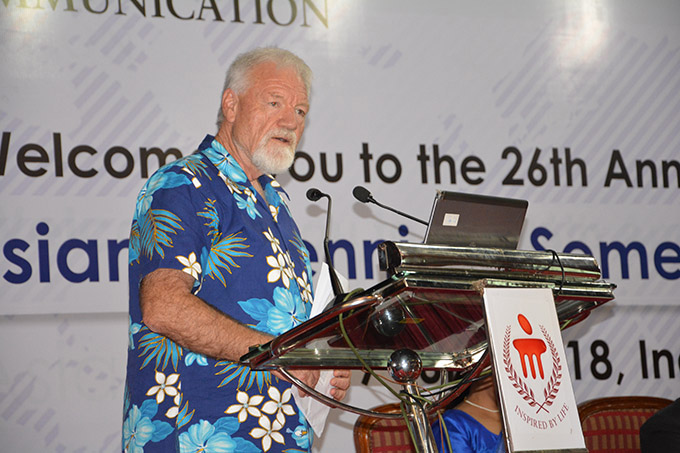
The digital age and the power and challenges of the Millennials as presented by keynote speaker Professor B P Sanjay, pro vice-chancellor of the University of Hyderabad, at the AMIC2018 conference at Manipal, Karnataka, India, on 7-9 June 2018.

The theme of the 26th AMIC (Asian Media Information and Communication) annual conference focuses on disturbing Asian millennials in the context of digital communication ecosystem. Disturbance or disruption is not considered negative but an opportunity to build on. The breadth and scope of this address cannot be  pan-Asian given the limitations of time. It is assumed that diverse and plural perspectives can be expected from the distinguished registrants to the conference. With a focus on India and comparable features in a few other contexts, this address will focus on implications of the changes for the Millennials. That Asia has a significant share of world millennials speaks volumes about the manner in which new media has caught their imagination in China and India. China’s adaptive context is more discussed in comparative literature than India.

The euphoric underpinnings of the digital era into which the Asian region and its sub-variants, the Asia-Pacific, the ASEAN and South Asia have leaped into is reminiscent of many such parallels in the past, both colonial and post-colonial that have highlighted the techno-centric dimension.  Panaceas for development, redeeming and reinforcing democratic traditions, empowerment and participation have been the paradigms of such celebration.  Several academic discourses have contested simplistic replacement notions of replacement of old media when a new medium emerges. Notwithstanding several critiques of the key structural variables that are needed for access, equity, and participation, the celebration of the new media cannot escape our attention and the new ray of hope is the disruption and potential for the millennials to carve out a better context. India in many forums has celebrated the advantages of its millennials. There are divergent hopes and cynicism with regard to what is described as the enormous latent power of the millennials in India described also as the demographic dividend. For example in the BRICS context the dividend factor for India is as follows:

 
The hope is the spread and access of legacy media in India along with a very high degree of spread of mobile telephony and its increasing utility as a device for enhanced social networking and consumption of information and entertainment content, more of the later. (1) The digital disruption in terms of complete substitution to new media took time to transcend the issues and concerns of the digital divide and many issues across demographic spread remain. However, by 2018, the connected consumers’ (in India)  base is about 550 million (dynamic statistics).

This base will be at least 50 percent and millennials will be substantial.


Source:  https://www.slideshare.net/wearesocial/digital-in-2018-in-southern-asia-86866282

Industry annual projections and assessment affirm that mobile will be the primary device for internet access. Across the world, 2018 stats indicate that Asia Pacific region has registered the highest mobile data traffic.  Games and entertainment precede all other forms of content with education coming up last.

Source: https://www.slideshare.net/wearesocial/digital-in-2018-in-southern-asia-8686622

The Indian language online content is expected to reach about 60 percent. Therefore, digital destinations across genres will capitalise on the profile that is non-English. The question legacy media leaders are reflecting upon is whether they can convert their content into digital attractions or face the disruption by digital natives that is eroding the traditional player’s role and position. This disruption may not be as fast and displacing as it is in the West but the writing on the wall is there.

Latest stats are available too but the above is from We Are social agency that releases worldwide and country specific statistics.

Information has been considered as an enabling and empowering input. The speed with which it currently travels through several platforms has raised erstwhile concerns about    legacy media content through adaptation or   user-generated content (UGC). Ethics apart, legacy media is reposed with higher faith based on its screening and verification process and layered institutional processing. While UGC reflects a paradigm shift with regard to the fact that theoretically allows for higher participation. The millennials profile is not uniform across countries and therefore the kind and nature of content have come into sharper focus. Critique of what kind of content is consumed or circulated is a matter of both academic discourse and the legal and regulatory frameworks.

The spectre of fake news with different connotations in other contexts stares us particularly in surcharged communal and electoral politics. The vulnerability is so high that the standard operating procedure in the recent past has been recourse to Internet shut down in volatile contexts. Fake news was also sought to be formally regulated and it was withdrawn as clarity was lacking as to where does such news originate. Several concerned professionals who have reflected on it suggest that among many platforms WhatsApp seems to be the most widely used.

“Fake news is a bit of a misleading term, believes Pankaj Jain, one of India’s most active fake news slayers: Fake news can mean many things – a mistake, intentional misleading, twisting a news story, or fabricating a complete lie. In the past while media houses and credible journalists have been found to put out misleading stories and/or mistakes, the most damage is done by people, fake social media profiles, polarising websites, and pages which spread fake news intentionally for garnering votes and spreading hate,” Jain says. Out of all the channels through which fake news spreads, Jain, whose initiative, Social Media Hoax Slayer, blows the lid off of false information being passed around social media platforms, feels the biggest culprit is the instant messaging app, WhatsApp.” (Sachadeva, 2018)

This has a comparative resonance in, for example, South East Asia.

Karen Lema and other analysing the scenario observe that “most worrying to media rights advocates is that several countries are promoting new legislation or expanding existing regulations to make publishing fake news an offense. The fear is that, rather than focusing on false stories published on social media, authoritarian leaders will use the new laws to target legitimate news outlets that are critical of them.” (Lema, 2018)

Reference in academic literature to user-generated content (UGC) is indicative of a reversal of the overwhelming argument that media in their broadest form is more of an information push or downloadable factor rather than the user having a say. Social media platforms with UGC are examples that have upheld the user. Promising as it may be, it has also revealed an inherent pattern of groupism, territorialization, and affiliations along homogenous sets of ideas and practices. In diverse and plural contexts, this has caused concerns of furthering social schisms.

Has entertainment gone beyond the cartels and expanded? Uploading of one’s own form of entertainment is evident and nascent revenue and acceptance models can be worked out. A related but important aspect with regard to the Millennials is their familiarity and dexterous use of new media platforms. “Global total broadcast TV advertising revenue, consisting of multi-channel and terrestrial TV advertising revenues, accounted for 97.2% of global total TV advertising revenue in 2014. But as viewing continues to move away from traditional networks towards digital alternatives, advertisers will consider changing where they allocate their expenditure to reach desired demographic segments.” (PWC estimate)

While education in the formal sense is imbued with a host of debates of the public sector, commercialization, and privatization, a default faith is placed in the new media that can virtually bring “handheld” education to the millennials.  This is an area public and private sector education sector   intend to reach out through online education and learning options.

The extension models of higher education seem to suggest that this can be tapped to bring the skilled youth to the workforce. The transformative potential and better forms of content production and dissemination are immense. With telecoms in fierce competition and entertainment firms collaborating with them, the spread is vast. Do they contribute to the millennials forging ahead or is the latent disruption more than the potential build up to better contexts daunts us?

I am hopeful that the vast research and academic experience that each one of you brings to this conference helps us unravel the complexities and move forward.

Professor B P Sanjay

Note
(1). The growth of print media for example is explained by many factors including literacy, low subscription and newsstand rates, hyper localisation etc. The millennial specific dimension has not been captured in industry-supported surveys as they say 12+ years and do not stratify the base by age.

Report by Pacific Media Centre ]]>

No Man is an Island – bringing communication and connectivity to the Pacific

THIS EVENT HAS BEEN CANCELLED: The Pacific Ocean is life itself. It’s on the frontlines for the fight for our planet. The Floating Foundation provides a platform for doctors, nurses, and marine scientists to help the environment and the peoples of this incredible ocean.

The Floating Foundation’s director of communications, Archer Miller, explores and explains the importance of communication and media in relation to bringing positive lasting impact to Pacific communities.

She explores the importance of diversity in non-profits and how their efforts can only succeed with stakeholder power from the Pacific communities in question. How can we create a galvanised community of ocean caregivers using media and dialogue?
 

Who: Archer Miller, director of communications, Floating Foundation  
When: Thursday, 21 June 2018, 4.30-6pm (CANCELLED)
Where: WG608, City Campus  

Contact: Sylvia.Frain@aut.ac.nz

More information: The Floating Foundation

Map for PMC and AUT

Report by Pacific Media Centre ]]>

Frustrated PNG tribesmen capture 2 policemen – seize vehicles, weapons

]]>

Southern Highlands tribesmen show off seized police vehicle and assault rifles. Image: EMTV News Facebook

Pacific Media Centre Newsdesk

Two Papua New Guinean police vehicles travelling from Hagen to Hela in the Highlands after servicing were fired on today in a Highlands attack, with one vehicle being seized and two policemen taken captive, report local media.

The Tari-based MS9 vehicles were shot at this morning at Tindom Hill, Semin village, reports the EMTV News Facebook page.

Loop PNG also reports the attack, saying it was carried out by “disgruntled Nipa locals”.

READ MORE: Mendi in chaos after renewed political violence erupts

A seized PNG police vehicle at Semin village, Southern Highlands. Image: EMTV News Facebook

But the news website also quoted regional police chief Gideon Kauke as saying the policemen were “rescued by another unit” while their weapons and vehicles had been removed.

Kauke said the police were “regrouping” and deciding on the next course of action.

-Partners-

EMTV News said the first vehicle, driven by the MS9 commander, escaped with a flat tyre. The second vehicle was driven by two other police officers and three assault rifles had been seized.

Hela police chief Martin Lakari had appealed to Southern Highlands people to release the officers and the state vehicles.

Deputy Police Commissioner Operations Jim Andrews confirmed police were holding talks with locals to negotiate the return of vehicles and weapons.

Loop PNG reported the tribesmen were upset over Prime Minister Peter O’Neill’s government decision on Friday to suspend the Southern Highlands provincial government following rioting in Mendi on Thursday.

Asia Pacific Report republishes EMTV News content with permission.

Print Friendly, PDF & Email

Article by AsiaPacificReport.nz

]]>

Disturbing Asian millennials in the digital communication ecosystem

The digital age and the power and challenges of the Millennials as presented by keynote speaker Professor B P Sanjay, pro vice-chancellor of the University of Hyderabad, at the AMIC2018 conference at Manipal, Karnataka, India, on 7-9 June 2018.

The theme of the 26th AMIC (Asian Media Information and Communication) annual conference focuses on disturbing Asian millennials in the context of digital communication ecosystem. Disturbance or disruption is not considered negative but an opportunity to build on. The breadth and scope of this address cannot be  pan-Asian given the limitations of time. It is assumed that diverse and plural perspectives can be expected from the distinguished registrants to the conference. With a focus on India and comparable features in a few other contexts, this address will focus on implications of the changes for the Millennials. That Asia has a significant share of world millennials speaks volumes about the manner in which new media has caught their imagination in China and India. China’s adaptive context is more discussed in comparative literature than India.

The euphoric underpinnings of the digital era into which the Asian region and its sub-variants, the Asia-Pacific, the ASEAN and South Asia have leaped into is reminiscent of many such parallels in the past, both colonial and post-colonial that have highlighted the techno-centric dimension.  Panaceas for development, redeeming and reinforcing democratic traditions, empowerment and participation have been the paradigms of such celebration.  Several academic discourses have contested simplistic replacement notions of replacement of old media when a new medium emerges. Notwithstanding several critiques of the key structural variables that are needed for access, equity, and participation, the celebration of the new media cannot escape our attention and the new ray of hope is the disruption and potential for the millennials to carve out a better context. India in many forums has celebrated the advantages of its millennials. There are divergent hopes and cynicism with regard to what is described as the enormous latent power of the millennials in India described also as the demographic dividend. For example in the BRICS context the dividend factor for India is as follows:

 
The hope is the spread and access of legacy media in India along with a very high degree of spread of mobile telephony and its increasing utility as a device for enhanced social networking and consumption of information and entertainment content, more of the later. (1) The digital disruption in terms of complete substitution to new media took time to transcend the issues and concerns of the digital divide and many issues across demographic spread remain. However, by 2018, the connected consumers’ (in India)  base is about 550 million (dynamic statistics).

This base will be at least 50 percent and millennials will be substantial.


Source:  https://www.slideshare.net/wearesocial/digital-in-2018-in-southern-asia-86866282

Industry annual projections and assessment affirm that mobile will be the primary device for internet access. Across the world, 2018 stats indicate that Asia Pacific region has registered the highest mobile data traffic.  Games and entertainment precede all other forms of content with education coming up last.

Source: https://www.slideshare.net/wearesocial/digital-in-2018-in-southern-asia-8686622

The Indian language online content is expected to reach about 60 percent. Therefore, digital destinations across genres will capitalise on the profile that is non-English. The question legacy media leaders are reflecting upon is whether they can convert their content into digital attractions or face the disruption by digital natives that is eroding the traditional player’s role and position. This disruption may not be as fast and displacing as it is in the West but the writing on the wall is there.

Latest stats are available too but the above is from We Are social agency that releases worldwide and country specific statistics.

Information has been considered as an enabling and empowering input. The speed with which it currently travels through several platforms has raised erstwhile concerns about    legacy media content through adaptation or   user-generated content (UGC). Ethics apart, legacy media is reposed with higher faith based on its screening and verification process and layered institutional processing. While UGC reflects a paradigm shift with regard to the fact that theoretically allows for higher participation. The millennials profile is not uniform across countries and therefore the kind and nature of content have come into sharper focus. Critique of what kind of content is consumed or circulated is a matter of both academic discourse and the legal and regulatory frameworks.

The spectre of fake news with different connotations in other contexts stares us particularly in surcharged communal and electoral politics. The vulnerability is so high that the standard operating procedure in the recent past has been recourse to Internet shut down in volatile contexts. Fake news was also sought to be formally regulated and it was withdrawn as clarity was lacking as to where does such news originate. Several concerned professionals who have reflected on it suggest that among many platforms WhatsApp seems to be the most widely used.

“Fake news is a bit of a misleading term, believes Pankaj Jain, one of India’s most active fake news slayers: Fake news can mean many things – a mistake, intentional misleading, twisting a news story, or fabricating a complete lie. In the past while media houses and credible journalists have been found to put out misleading stories and/or mistakes, the most damage is done by people, fake social media profiles, polarising websites, and pages which spread fake news intentionally for garnering votes and spreading hate,” Jain says. Out of all the channels through which fake news spreads, Jain, whose initiative, Social Media Hoax Slayer, blows the lid off of false information being passed around social media platforms, feels the biggest culprit is the instant messaging app, WhatsApp.” (Sachadeva, 2018)

This has a comparative resonance in, for example, South East Asia.

Karen Lema and other analysing the scenario observe that “most worrying to media rights advocates is that several countries are promoting new legislation or expanding existing regulations to make publishing fake news an offense. The fear is that, rather than focusing on false stories published on social media, authoritarian leaders will use the new laws to target legitimate news outlets that are critical of them.” (Lema, 2018)

Reference in academic literature to user-generated content (UGC) is indicative of a reversal of the overwhelming argument that media in their broadest form is more of an information push or downloadable factor rather than the user having a say. Social media platforms with UGC are examples that have upheld the user. Promising as it may be, it has also revealed an inherent pattern of groupism, territorialization, and affiliations along homogenous sets of ideas and practices. In diverse and plural contexts, this has caused concerns of furthering social schisms.

Has entertainment gone beyond the cartels and expanded? Uploading of one’s own form of entertainment is evident and nascent revenue and acceptance models can be worked out. A related but important aspect with regard to the Millennials is their familiarity and dexterous use of new media platforms. “Global total broadcast TV advertising revenue, consisting of multi-channel and terrestrial TV advertising revenues, accounted for 97.2% of global total TV advertising revenue in 2014. But as viewing continues to move away from traditional networks towards digital alternatives, advertisers will consider changing where they allocate their expenditure to reach desired demographic segments.” (PWC estimate)

While education in the formal sense is imbued with a host of debates of the public sector, commercialization, and privatization, a default faith is placed in the new media that can virtually bring “handheld” education to the millennials.  This is an area public and private sector education sector   intend to reach out through online education and learning options.

The extension models of higher education seem to suggest that this can be tapped to bring the skilled youth to the workforce. The transformative potential and better forms of content production and dissemination are immense. With telecoms in fierce competition and entertainment firms collaborating with them, the spread is vast. Do they contribute to the millennials forging ahead or is the latent disruption more than the potential build up to better contexts daunts us?

I am hopeful that the vast research and academic experience that each one of you brings to this conference helps us unravel the complexities and move forward.

Professor B P Sanjay

Note
(1). The growth of print media for example is explained by many factors including literacy, low subscription and newsstand rates, hyper localisation etc. The millennial specific dimension has not been captured in industry-supported surveys as they say 12+ years and do not stratify the base by age.

Report by Pacific Media Centre ]]>

PNG opposition demands PM O’Neill resign over Mendi torching riot

]]>

Oro Governor Gary Juffa speaks during the Opposition demand for Prime Minister Peter O’Neill’s resignation. Video: EMTV News

Pacific Media Centre Newsdesk

Papua New Guinea’s Opposition has demanded the resignation of Prime Minister Peter O’Neill over this week’s rioting in the Southern Highlands capital of Mendi.

Opposition Leader Patrick Pruaitch, flanked by fellow members, made the call yesterday following the torching of an aircraft, and the burning of the Mendi courthouse and other buildings, reports EMTV News.

The Opposition claimed that what happened in the previous 24 hours in O’Neill’s home province was a demonstration of lack of confidence in the government under Prime Minister O’Neill’s leadership.

RNZ Pacific reports that frustration over alleged corruption sparked the unrest in Mendi with reporter Melvin Levongo saying police were outnumbered and unable to stop a mob armed with high-powered weapons destroying an Air Niugini Dash-8 aircraft at the provincial airport.

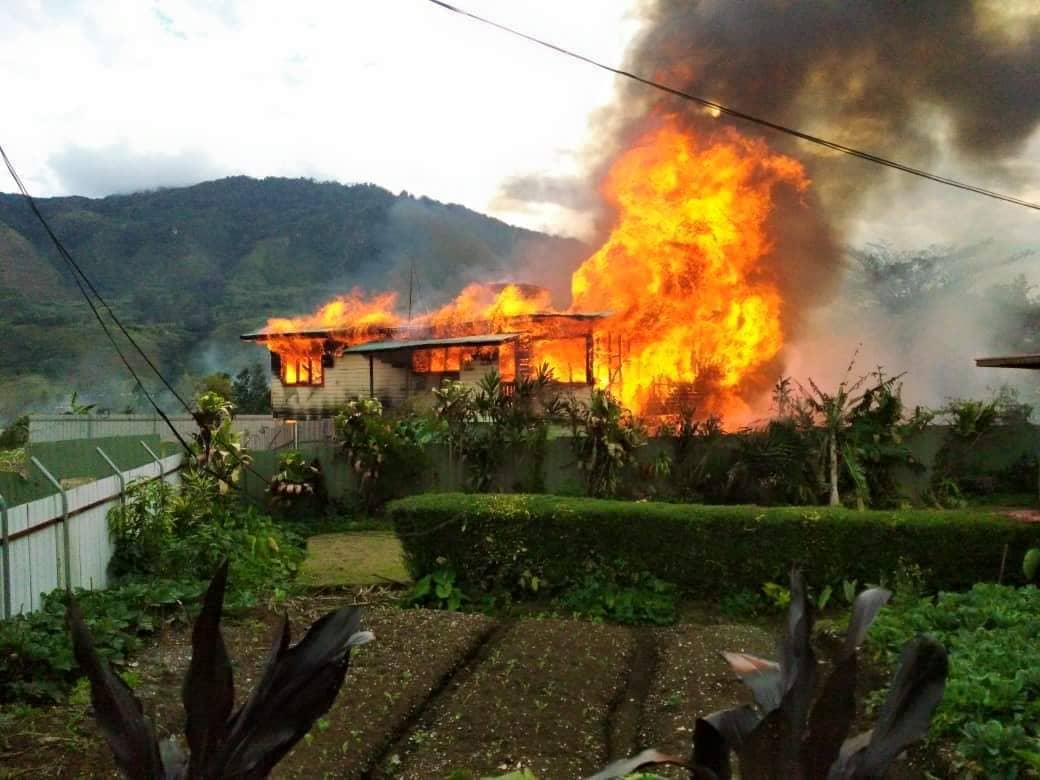
After this, the protesters burned down the governor’s residence, the local courthouse and other buildings.

-Partners-

Police said Thursday’s National Court ruling upholding Governor William Powi’s 2017 election had sparked the rampage.

The election result had been challenged by losing candidates Joseph Kobol and Bernard Peter Kaku.

PNG Defence Force troops being deployed to Mendi. Image: Loop PNG

Loop PNG reports that security is being strengthened for doctors working in Mendi.

The president of the National Doctors Association, Dr James Naipao, said the doctors were near or in the Mendi hospital.

“If the civil unrest gets out of hand, they will be evacuated,” he said.

Authorities said 200 PNG Defence Force troops would be deployed to Mendi.

The soldiers had already flown to Mount Hagen and were on their way to Mendi.

PNGDF chief-of-staff Philip Polewara said the situation was tense. Other reinforcements had been sent from Tari to guard the hospital, police station and state property.

Print Friendly, PDF & Email

Article by AsiaPacificReport.nz

]]>

Kontras urges Jokowi to resolve Papuan Wasior human rights case

]]>

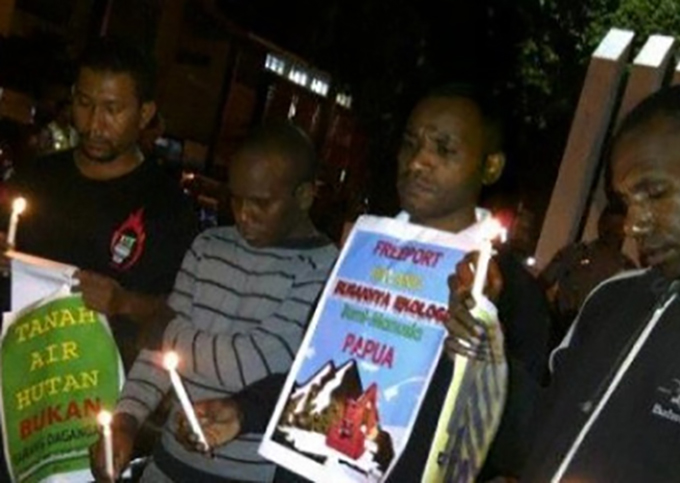
Dozens of youth and students hold a candlelit protest in front of the Diponegoro University campus, Semarang, in 2013 over the human rights abuses that occurred in Wasior and Wamena in 2001. Image: PY/WPAN

By Karina M. Tehusijarana in Jakarta

Indonesia’s Commission for Missing Persons and Victims of Violence (Kontras) has urged President Joko “Jokowi” Widodo to take concrete steps to resolve alleged gross human rights violations in Wasior, Papua, marking the 17th anniversary of the incident this week.

“Kontras regrets and criticices the lack of action of President Jokowi’s administration in dealing with and resolving human rights abuses in Papua,” said Kontras commissioner Yati Andriyani.

The incident, which took place on June 13, 2001, was triggered when five members of the National Police’s Mobile Brigade (Brimob) and one civilian were killed after a dispute between residents and timber company PT Vatika Papuana Perkasa.

During a search for the perpetrators, Brimob members allegedly committed gross human rights violations in the form of murder, torture and abduction.

A National Commission on Human Rights (Komnas HAM) investigation into the incident found that at least four people were killed, 39 wounded from torture, five abducted and one sexually abused.

The case was submitted to the Attorney-General’s Office for prosecution in 2004 but has seen little progress since then.

-Partners-

During his campaign for president in 2014, Jokowi had promised to resolve past human rights violations, including the Wasior incident.

“Instead of fulfilling that promise, Attorney-General H.M. Prasetyo said on June 1 this year that gross human rights abuses were difficult to resolve through judicial processes,” Yati said.

Print Friendly, PDF & Email

Article by AsiaPacificReport.nz

]]>

O’Neill imposes PNG curfew, vows arrests in wake of Mendi torchings

]]>

Mendi’s courthouse was among two buildings set ablaze by the protesters over an unsuccessful appeal over last year’s general election. Image: Scott Waide/EMTV News

Pacific Media Centre Newsdesk

Papua New Guinea authorities have imposed a 6pm to 6am curfew in the Southern Highlands provincial capital of Mendi to prevent further violence.

Prime Minister Peter O’Neill has vowed that political leaders who are alleged to be behind the violence in which an Air Niugini aircraft at Mendi airport and the courthouse were set ablaze and destroyed yesterday will be arrested.

He said the culprits would be arrested and charged within a 21-day period, reports the PNG Post-Courier.

The blazing Air Niugini Link PNG aircraft at Mendi airport. Image: EMTV News

O’Neill announced this today after the National Executive Council decided to declare a state of emergency in Mendi.

Former Southern Highlands Provincial Administrator Thomas Eluh has been appointed SOE Controller.

Additional police and Defence Force personnel will be flown into Mendi to restore law and order.

-Partners-

The riot in Mendi followed a National Court decision yesterday dismissing the election petition by Joseph Kobol who had challenged last year’s election result, declaring the incumbent William Powi as Governor.

Plane, buildings set ablaze
An Air Niugini PNGLink Dash 8 aircraft was set on fire at Mendi airport, the District and National Court Building, as well as Governor William Powi’s residence were set alight in the election related violence to hit the Province.

Air Niugini chief executive officer Durani Tahawar said today that the captain and crew of the torched Link PNG Airline had safely arrived in Mount Hagen from Mendi under escort and were now being checked in at a safe Hotel.

“Our HGU staff is with them and we are grateful that they are safe, they shall return tomorrow to Port Moresby,” he said.

Earlier, Prime Minister O’Neill described the actions of the protesters as “disgraceful”, reports EMTV News.

Link PNG has suspended flights to Mendi, Tari and Wapenamanda until further notice.

Asia Pacific Report republishes EMTV News content with permission.

Print Friendly, PDF & Email

Article by AsiaPacificReport.nz

]]>

Protesters in PNG’s Highlands torch plane, shut Mendi airport

]]>

The destroyed Air Nuigini Dash 8 at Papua New Guinea’s Mendi Airport. Image: Melvin Levongo/RNZ Pacific

By RNZ Pacific

Protesters in the Papua New Guinea Southern Highlands town of Mendi have torched a plane and closed the airport.

Earlier, the local police station commander Gideon Kauke had said police were guarding the aircraft to ensure there was no further damage after its tyres had been flattened.

But he said his team of about 10 police could not contain a mob of “uncountable numbers”, particularly after missiles were thrown, forcing them to retreat.

“We were guarding the plane but compared to them we were outnumbered and they came in all directions, all corners. Missiles were thrown, bush knives were thrown,” Kauke said.

Kauke said some of the protesters, who continued to behave “menacingly” in Mendi as their numbers build up, were carrying guns.

He said the protest was in response to a court ruling in Waigani confirming the election of the Southern Highlands Governor William Powi.

-Partners-

Governor Powi’s success in last year’s PNG general election had been challenged by Joseph Kobol and Bernard Peter Kaku.

Kauke said the protestors alleged there was foul play in the court decision.

This RNZ Pacific news item is published under a content sharing agreement with the Pacific Media Centre.

Print Friendly, PDF & Email

Article by AsiaPacificReport.nz

]]>

New military counter-terrorism unit arrests 5 West Papuans, says Jubi

]]>

The Joint Special Operations Command (Koopssusgab), a joint military counter-terrorism unit, was reportedly involved n the arrests. Graphic: Tabloid Jubi

By Victor Mambor in Jayapura

Five civilians in Timika have reportedly been arrested by the newly reactivated military counter-terrorism unit for “aspiring” to West Papuan independence.

“At 10pm on Saturday June 9, Orpa Wanjomal (40) and his stepchild Polce Sugumol (31) were arrested at their home in the SP 2 [housing unit] in Timika,” United Liberation Movement for West Papua (ULMWP) spokesperson Jakob Rumbiak said yesterday.

“Five hours later, at 3am in the morning, on Sunday June 10, Titus Kwalik was arrested at the SP 10.

“At the same time Julianus Dekme (31) and Alosius Ogolmagai (49) were arrested at Julianus’ house at the SP 6. The five civilians were arrested for aspiring to Papuan independence.”

Rumbiak said that the Joint Special Operations Command (Koopssusgab) was involved in the arrests. The Koopssusgab is a joint military counter-terrorism unit, which was recently reactivated in concert with revisions to the Anti-Terrorism Law, and is under the direct authority of Indonesian President Joko “Jokowi” Widodo.

Commando unit
The commando unit, according to House of Representatives (DPR) Commission I chairperson Abdul Kharis Almasyhari, was formed to assist in dealing with terrorism under certain conditions if the national police request assistance.

-Partners-

According to Almasyhari, under the revisions to the 2003 Anti-Terrorism Law, which were enacted on May 25, there are additional regulations which make it more comprehensive, including the possibility of involving the TNI (Indonesian military) under certain conditions.

“However the Koopssusgab apparently can’t be formed yet because they don’t have a core budget yet,” said Almasyhari.

Nevertheless, the ULMWP is sure that the arrests were carried out by Koopssusgab.

“The use of the special military anti-terrorist force against West Papuan civilians is irresponsible and morally wrong”, said Rumbiak.

The West Papuan people were not terrorists, and had never carried out terrorist acts, unlike Indonesian terrorists or extremists.

The West Papuan people’s right to self-determination is guaranteed under the Indonesian Constitution, the United Nations Human Rights Charter, UN General Assembly Resolution 1514 (1960), the UN Convention on Civil and Political Rights (2007) and UN General Assembly Resolution 1752 Chapters XVII and XII.

Tabloid Jubi has attempted to contact Mimika District Police Chief Assistant Superintendent Agung Marlianto via WhatsApp for clarification of the alleged arrests. As of posting this article however, Marlianto has not responded.

Translated by James Balowski for the Indoleft News Service. The original title of the article was “ULMWP: 5 warga sipil Timika ditangkap karena aspirasi Papua Merdeka”. Victor Mambor is editor of Tabloid Jubi.

Print Friendly, PDF & Email

Article by AsiaPacificReport.nz

]]>

Pacific news journalists grapple with challenges of social media, harsh laws

]]>

BRIEFING: By Geraldine Panapasa in Suva

Like it or not, social media has become part and parcel of almost everyday discussions.

Whether it’s talk about the economy or the latest development and trends, large and influential platforms such as Facebook, Twitter, YouTube, Instagram and LinkedIn have become the go-to source for news and information.

Add technological advancements and accessibility to the mix, and one is left with a digitally-empowered society and a media industry grappling with a number of challenges such as fake news, citizen journalism and in some cases, harsh legislation.

Legislation that can either be viewed as a way to clamp down on journalists or to some extent, limit one’s constitutional freedom of speech, expression and publication, or it could be legislation driven by genuine concerns to ensure news and information are accurate, fair and balanced.

The advent of social media, its impact on journalism and the transforming political situations that are evidently changing the way the media operates in the Pacific were at the heart of the discussions at last month’s 5th Pacific Media Summit organised by the Pacific Islands News Association (PINA) in Nuku’alofa, Tonga.

The May 7-11 event, attended by more than 100 media practitioners and stakeholders, also highlighted other pertinent issues relating to the theme, “Empowering the Media for Digital Challenges”, such as climate reporting; social media impact on financial literacy, women empowerment and the environment; international humanitarian law; gender and the digital media; the role of the media in fighting corruption; and dealing with threats against the media.

-Partners-

But the biggest concern by far was dealing with the change that social media brought in terms of the traditional dissemination of receiving, consuming, sharing and interpreting news and information.

Overlooking checks
The opportunities for social media users to maximise on the platforms to freely exchange information and news, often at times overlooking the checks and balances that journalists practise, have become a concern for some regional governments, who have openly advocated for legislation that curbs the deliberate act of spreading misinformation or hoax messages through traditional forms of print and broadcast news.

Take for instance, Fiji’s highly-controversial Online Safety Act 2018, which recently became law after being passed by Parliament with 27 votes on May 16. It aimed to promote responsible online behaviour and online safety as well as act as a deterrence of harmful electronic communication.

To a large extent, the Act addressed cyberbullying, cyberstalking, internet trolling, and exposure to offensive or harmful content, particularly for children. Public submissions to the Standing Committee on the Online Safety Bill included one from a former media personality, Lenora Qereqeretabua, who felt it was a tactic to scare online users rather than try to develop capacity for responsible online behaviour and online safety.

Another submission to the Bill, from the Media Watch Group in Fiji, emphasised the right to responsible free speech for Fiji citizens, saying this was a fundamental component of a truly democratic society and a must for a developing island nation in this growing digital age.

Recently, the Samoan Prime Minister Tuilaepa Maleilegaoi threatened to ban the social media network Facebook in Samoa after what he described were “gutless anonymous bloggers” using the freedom of social media to abuse government officials and innocent members of the public.

Papua New Guinea followed suit last month by considering to block Facebook as a result of alleged defamatory publications, fake news, identity theft and unidentified users breaching the law in terms of posting pornographic materials and fake news.

During the summit in Tonga, PNG Acting Secretary for the Department of Communication and Information, Paul Korni, did not mince his words when he told participants that they would not hesitate to enforce legislation that monitored social media such as Facebook if it meant putting a tight lid on the dissemination of “fake news” and other alleged defamatory publications.

Cyberspace arena
World-renowned digital technology activist Dhyta Caturani from Indonesia put things into perspective when she made a strong statement at the summit about the internet and new media platforms that made it possible for people to do and say things that were not possible for them before in this new arena – cyberspace.

In terms of fake news, governments, civil society and even the media are still battling this issue. And one point Caturani raised was uncovering the reasons or intentions behind fake news.

This, Caturani believes, is key if media and stakeholders were to address the issue of fake news, finding the motivations and intentions of fake news and putting the fire out through due diligence and fact-checking information before publishing or broadcasting news.

She said some fake news were churned out by irresponsible internet users while others used fake news to propagate political interests or agendas – a notion shared also by senior journalists in the region when it came to identifying the purpose of fake news.

“Why has this (cyber) space now become heavily monitored, regulated, surveilled, censored and our data being stolen from us without consent or sold, not to mention the online violence?” she asked during her keynote address at the opening of the summit.

“The answer is profit. With millions of people now connected to the internet, with billions of information and data published, the capitalists realised that the internet is the new source of making limitless profits.

“The other answer is fear. Those in power realised that the internet has now become a tool for people to challenge those in power and abusing power to disrupt the status quo and to demand freedom and equality.

Censorship a global trend
“We now see censorship as a global trend. Governments all over the world are copying one another to pass draconian laws that will give them the legitimisation to censor any content, any expression, any voice published online. Some governments even shut down the internet entirely.”

Veteran journalists from Fiji, New Caledonia, Papua New Guinea, Samoa and Tonga shared similar concerns about the fake news trend in relation to the challenge for the media in a digitally-empowered society – that fake news and social media platforms had given rise to “citizen journalism” and the circulation of unverified information, and analysis of news by the general public on popular social media platforms such as Facebook and Twitter, and that journalists and media stakeholders needed to adapt to this “new normal” or “seismic change” while maintaining their integrity and ethics.

It’s a new form of journalism that continues to grow.

Journalists Association of Samoa president Rudy Bartley said this was a challenge for journalists and media workers.

“It’s either you adapt or die. There are a lot of fake news circulating and those issues, without social media, would never have happened,” Bartley said.

Long-time PNG journalist Joseph Ealedona said they were very critical of new media and its impact on the future of journalism. While they welcomed the change in the way news and information were disseminated, the concern was maintaining journalistic integrity and ethics.

Vital solution
In the midst of these challenges and debates about new media platforms and its impact on journalism in the region, Tongan journalist Kalafi Moala summed up perhaps a vital solution when he shared his concept in dealing with this trend.

“Instead of monitoring these, we need to continue to educate people to tell the truth. It is telling the truth and authenticity that will expose the fake. I have never seen new media, social media as a threat to journalism at all. I see it as an extension of the media when it is used properly,” Moala said.

These media trends and practices continue to play a vital role in terms of getting news out first and in real time. The onus is more or less on journalists and media workers to adapt and embrace these current media practices without compromising their ethics and code of conduct as the fourth estate.

Geraldine Panapasa is editor-in-chief of Wansolwara newspaper with the University of the South Pacific journalism programme. This is a special report for Asia Pacific Report.

Print Friendly, PDF & Email

Article by AsiaPacificReport.nz

]]>

Newsletter: New Zealand Politics Daily – June 14 2018 – Today’s content

Newsletter: New Zealand Politics Daily – June 14 2018 – Today’s content Editor’s Note: Here below is a list of the main issues currently under discussion in New Zealand and links to media coverage. [caption id="attachment_297" align="aligncenter" width="640"] The Beehive and Parliament Buildings.[/caption] Prison, justice and police Brad Flahive (Stuff): Government’s new double-bunked prison cells at Waikeria do not meet international standards  Shane Cowlishaw (Newsroom): New, smaller prison a risky move Herald: Corrections Minister: Prisoners could sleep on mattresses on ground if prison population continues to grow Dan Satherley (Newshub): Prisoners might have to sleep on the floor – Corrections Minister RNZ: Checkpoint: New prison in Waikeria will be ready by 2022 Laura Walters (Stuff): New Waikeria prison to have 100-bed mental health facility Belinda Feek (Herald): Waikeria Prison unit to feature new purpose-built mental health facility Tova O’Brien and Anna Bracewell-Worrall (Newshub): Waikeria prison: Government ditches mega-prison, goes with small rebuild 1News: New $750 million, 600 bed prison to be built south of Hamilton Gia Garrick (RNZ): Waikeria: Small prison with mental health unit announced Mānia Clarke (Māori TV): Waikeria gets new 500-bed prison, mental health facility Anna Whyte (1News): Waikeria Prison decision: What should be done to combat New Zealand’s rising prison population? Alex Braae (Spinoff): When is an expanded prison not a mega prison? Stuff: PM Jacinda Ardern says Waikeria Prison will not be like ‘US mega-style’ jails  Gia Garrick (RNZ): Govt’s Waikeria prison decision shows no ‘cohesive plan’ Branco Marcetic (Spinoff): A brief history of New Zealand’s most absurd three-strikes cases Aaron Smale (Newsroom): Parliament and prison: a male Māori symmetry Laura Walters (Stuff):Police aim to seize millions from gangs, new cabinet paper reveals RNZ: Record number of Pasifika join NZ police Chinese water bottling deal Tracy Watkins (Stuff): And they thought being in Opposition was hard 1News: ‘You morons’ – members furious after Green Party Minister approves Chinese-owned water bottling plant expansion Craig McCulloch (RNZ): Green Party labelled ‘sellout’ over water decision Emma Hurley (Newshub): Greens criticised after being forced to go ‘against party kaupapa’ Lucy Bennett (Herald): Green MP and minister Eugenie Sage under fire from party members over Otakiri water-bottling decision Mere McLean (Maori TV): Chinese water bottling deal ‘muskets and blankets’ Matt Shand (stuff): Consent granted for Chinese water bottling giant to purchase Otakiri Spring Mike Hosking (Newstalk ZB): Bottling it – the Greens don’t understand how government works No Right Turn: The harsh reality of government Housing Hamish Fletcher (Herald): Out-of-date housing affordability measure irrelevant Henry Cooke (Stuff): Housing affordability gets worse – especially in Auckland Herald: Housing affordability falls for first-home buyers 1News: Worsening affordability for first-home buyers as property prices rise in most major NZ cities Stuff: Housing Affordability Measure: How likely is owning a home where you live? Lois Williams (RNZ): National MP queries social housing in high-value suburb Anne Gibson (Herald): House prices set new national record, Auckland decline embedded Liu Chen (Auckland Now): Foreign investors ‘not to be blamed for housing crisis’ Lucy Bennett (Herald): Developers on board with KiwiBuild off-the-plan programme David Hargreaves (Interest): Housing Minister coy on actual numbers of houses to result from the Kiwibuild ‘Buying off the Plans’ tender RNZ: Twyford: ‘Housing NZ is a landlord – not the police’ Henry Cooke (Stuff): Judith Collins hounds Phil Twyford over ‘anti-social’ state housing tenants Jane Patterson (RNZ): Twyford, Collins hammer it out over housing Thomas Coughland (Newsroom): Twyford attacked over growing housing waitlist Katie Bradford (1News): Watch: ‘There are no excuses’ – Judith Collins and Housing Minister Phil Twyford fire up over state housing waiting list The Standard: Nats indignant that Twyford is not fixing their housing crisis quickly enough Lucy Bennett (Herald): Antisocial HNZ tenants might stay in homes and neighbours moved, CE Andrew McKenzie says Newshub: Dunedin students challenge landlord over mould-ridden flat Elena McPhee (ODT): Mouldy flats caused by ‘lifestyle not landlords’ Evan Harding (Stuff): Council to investigate ‘draughty and mouldy’ flat 1News: Wellington students get $1400 bill for adding replacement housemates to their lease Zahra Shahtahmasebi (Press): Rough sleepers in Christchurch blasted with elevator music at all hours Primary industries Dan Satherley (Newshub): Shane Jones ‘entitled’ to harsh opinion of Fonterra – Agriculture Minister Sophie Bateman (Newshub): Shane Jones launches blistering attack on Fonterra, economists Jo Moir (Stuff): Shane Jones tears strips off Fonterra and says the chairman should ‘catch the next cab out of town’ 1News:‘I’ve had a gutsful’ – Shane Jones lays into Fonterra at Fieldays Lucy Bennett (Herald): Shane Jones calls for Fonterra chairman John Wilson to step down Chris Bramwell (RNZ): Shane Jones lambasts Fonterra at Fieldays Chris Bramwell (RNZ): Jones’ attack on Fonterra about ego and publicity – National Chris Bramwell (RNZ):Ministry defends sending slaughtered calves to landfill Tim Newman (Southland Times): Cows in landfill going to waste? Nita Blake-Persen (RNZ): Council report warned of damage from forest debris Eric Frykberg (RNZ): East Coast forestry: Replanting ‘required’ under contracts Stuff: Tolaga Bay farmers demand logging halt, but foresters label it unconstructive Patrick O’Sullivan (Herald): Watch: Tsunami of slash angers East Coast farmers and residents Isobel Ewing (Newshub): Fieldays: Farmers face up to Mycoplasma bovis biosecurity scares Jill Galloway (Stuff): Farmers first line of defence for spotting Mycoplasma bovis Winston Peters and government David Cohen (RNZ): Peters lawsuit not some rare phenomenon Karl du Fresne (Stuff): Where Peters is involved, the potential for mayhem and debacle is never far away Bryce Edwards (Herald): Political Roundup: Questions over Grant Robertson’s ‘cash for access’ fundraising Michele Hewitson (Listener): Is Minister Shane Jones a bit of a joke or just an ordinary bloke? Bryce Edwards (Newsroom Pro): Our revival of trust in Government The Standard: Kiwis trust in Government surges Siouxsie Wiles (Spinoff): A brilliant woman is our new chief scientist, and the timing couldn’t be better Public service Point of Order: State services: what’s  behind the “upheaval”? RNZ: Public sector reshuffle: ‘Musical chairs for the boys’ Jess Berentson-Shaw (RNZ): Public CEO reshuffle: Why are only men’s hands safe hands? Parliament Rino Tirikatene (Southland Times): Māori amid the numbers game Claire Trevett (Herald): The accidental genius of David Seymour, champion of dorks everywhere 1News: Watch: ‘The word booty has multiple meanings’ – Shane Jones leaves Paula Bennett laughing after light-hearted exchange Auckland Council Simon Wilson (Herald): The council and its malcontents Bernard Orsman (Herald): Phil Goff message to his critics: Respect is a two-way street Jenny Suo (1News): ‘It’s just not acceptable’ – group of Auckland councillors accuse Mayor of not acting on culture of bullying in his office RNZ: Deputy backs Goff over ‘strong dissatisfaction’ letter Herald: Auckland Councillors’ letter to ‘non-inclusive’ Mayor Phil Goff revealed Zane Small and Mitch McCann (Newshub): Revealed: Councillors slam Auckland Mayor Phil Goff in public letter Mandy Te (Auckland Now): Auckland councillors send letter of ‘no confidence’ to Mayor Phil Goff RNZ: Councillors condemn Phil Goff in letter Zane Small and Mitch McCann (Newshub): Auckland Mayor Phil Goff blindsided by councillors’ letter of no confidence Police apology to Nicky Hager Tim Watkin (Pundit): More questions from the Nicky Hager case Southland Times Editorial: Arid police apology troubling in itself Philip Matthews (Press) Editorial: Searching questions after Hager apology Jacinda Ardern’s baby plans Newshub: Jacinda Ardern ‘not tempting fate’ with childbirth Stuff: Prime Minister Jacinda Ardern discusses baby plans with Alison Mau Jessie Chiang (RNZ): Mums’ baby tips for PM: ‘Just go with the flow’ Herald: Clarke Gayford shares First Baby’s ‘bloody cute’ gifts Environment 1News: Yoghurt pottles and coffee lids going straight to landfill as China plastic waste ban bites Nita Blake-Persen (RNZ): Plastics going straight to landfill as China waste ban bites Jamie Morton (Herald): Plastic pollution: Has our action come too late? No Right Turn: DoC covers up for corporate spies Kate Gudsell (RNZ): Antarctica ice melt speeding up Building safety Laura Twyman (1News) New Zealand buildings’ cladding risk should be outlined in LIM reports – lawyer Laura Twyman (1News): Christchurch City Council identifies 29 buildings with same cladding as London’s Grenfell Tower Zane Small (Newshub): No buildings in Auckland like Grenfell Tower, council says Health Eric Crosbie and George Thompson (Noted): Why did it take 53 months for NZ to introduce plain cigarette packs? Stuff: New Zealand: Where alcohol is normalised – and that means more drinking Cleo Fraser (Newshub): More City Mission detox beds good start but not enough – rehab centre Finn Hogan (Newshub): Funding rehab with seized criminal assets ‘feels right’ – Health Minister Teuila Fuatai (Newsroom): Crime money to fund extra detox beds Melanie Earley (Auckland Now): Auckland City Mission to receive $16.7m for addiction treatment Sarah Robson (RNZ): City Mission secures nearly $17m for treatment facilities Emma Hurley (Newshub): Auckland City Mission gets $16.7m for addiction treatment facilities John Boynton (RNZ): Māori food practices could keep kaumātua healthy 1News: ‘Our son Nicky suffered from a serious mental illness but it shouldn’t have been a death sentence’ RNZ: ‘If Nicky said he was not suicidal, they seemed to accept his word’ Laura Tupou (Newshub): Nicky Stevens’ mother criticises Hamilton mental health facility Kirsty Lawrence (Stuff): Mental health expert puzzled drug and alcohol screening didn’t happen Race relations Jarrod Gilbert (Herald): Race role requires special talents – Devoy didn’t have them human rights role 1News: Rotorua car salesmen stood down over racist ‘clever Māori’ remarks; auto dealer says team ‘devastated’ by ‘stupid ignorant comments’ Newshub: Tauranga car salesmen stood down over racist voicemail to Māori customer RNZ: Māori experience racism everyday in North Shore – study Auckland Now: Racism at the playground: ‘People pack up their kids and head in the opposite direction’ Isra’a Emhail (RNZ): Fast friends: Ramadan helps mosque curb stereotypes 1News: Ramadan helps Auckland mosque curb stereotypes after recent spate of turmoil Local government David Williams (Newsroom): Chch water boss’s chlorination ‘conflict’ Collette Devlin (Dominion Post): Te Tauihu policy first step towards Wellington becoming te reo Māori capital Dominion Post: Together we stand: why we have a Te Reo masthead Samantha Motion (Bay of Plenty Times): Tauranga City Council bylaw bans begging and rough sleeping near shops Felix Desmarais (Bay of Plenty Times): Tauranga begging ban ‘difficult and problematic’ to enforce, says lawyer Foreign affairs and trade Sam Sachdeva (Herald): Kiwi diplomat’s lobbyist emails revealed Laura Walters (Stuff): NZ-China relationship more complex than ‘sensational’ headlines Inequality and poverty Richard Harman (Politik): Child poverty – not something the Government does well Michael Reddell: Relative poverty: old and young Employment Jane Clifton (Listener): Will the Labour Party’s proposed Fair Pay Agreements do the business? Tarannum Shaikh (Stuff): Exposing harsh realities of women workers on minimum wages Education and child welfare Isaac Davison (Herald): Kiwi kids at six years old: Thriving and happy, but with a few concerns Leigh-Marama McLachlan (RNZ): Long-term funding shortage for kura’s senior students Adele Redmond (Stuff): Growing need for mental health services at university putting students at risk NZ’s regions Joanna Wane (North & South): Saying goodbye to the big city: The fluctuating fortunes of the regions David Farrar: $1 billion of our money to try and buy Shane a seat Kiwisaver Jenée Tibshraeny (Interest): Could a ‘rainy day fund’ be incorporated into KiwiSaver? Sam Stubbs (Herald): Investors not interested in sin Money lending Newshub: Predatory lenders return to target New Zealand’s vulnerable Gareth Vaughan (Interest): Government review of Credit Contracts and Consumer Finance Act includes a look at credit card interest rates Cathedral Square Liz McDonald (Press): Cathedral Square design ‘will fix Christchurch’s damaged and uninviting’ heart Alison Pugh (1News): Revamped design for Christchurch’s Cathedral Square ‘visionary’ say business leaders 1News: ‘Symbol of vibrant future’ – First images of preliminary design for renovated Christchurch Cathedral Square revealed NZ Post, Kiwibank closures RNZ: Fury over closures of KiwiBank, NZ Post in Dunedin George Block (ODT): Closure of NZ Post, Kiwibank branches confirmed The Standard: Liberalism Uber Alles Roading, road safety Newshub: Drugs behind more fatal crashes than alcohol – study Ashleigh Collis (Horowhenua Chronicle): Further evidence of early Māori occupation found at Horowhenua roadworks site Media BusinessDesk: Radio NZ looking for more content-sharing deals Alastair Thompson (Scoop): The News Crisis & Scoop – Once More Unto The Breach Other Chelsea Boyle (Herald): Agencies hitting back against scammers are fighting a never-ending war Helen Castles (1News): Governance of 90 Mile Beach in limbo due to ’embarrassing’ tribal stoush Grant Bradley (Herald): Ministry says tourists pay ‘fair share’ to government as tax decision nears David Hargreaves (Interest):  Westpac economists now see our economy lagging behind that of our peers ‘for the next few years’ Michael Reddell: Getting prepared for the next serious recession Amanda Saxton and Michelle Duff (Auckland Now): Crew of Floating Foundation aid mission abandon ship on Waiheke Island 1News: Cost of vegetables could rise because of flooding in Gisborne and Hawke’s Bay, supplier warns Herald: Te Papa calls for Matariki to become nationally-celebrated event Emma Hurley (Newshub): Te Papa calls for more New Zealanders to celebrate Matariki RNZ: Hope for return of Kiwi sailor’s remains in North Korea]]>

Bryce Edwards’ Political Roundup: Questions over Grant Robertson’s “cash for access” fundraising

Grant Robertson, New Zealand's Minister of Finance. Image courtesy of https://www.labour.org.nz/grantrobertson

Bryce Edwards’ Political Roundup: Questions over Grant Robertson’s “cash for access” fundraising

[caption id="attachment_13635" align="alignright" width="150"] Dr Bryce Edwards.[/caption] It was labelled “corrupt” and “cash-for-access” when the last government did it. But now that Labour Government ministers are fundraising by holding exclusive dinners for the wealthy, it’s suddenly OK. This is the story of how the Minister of Finance is leveraging his executive powers to try and get money out of the rich and powerful, and it’s hard to see how it’s any different to the type of events run by National that Labour politicians used to rail strongly against. [caption id="attachment_16523" align="aligncenter" width="1316"] Grant Robertson, New Zealand Minister of Finance. Image courtesy of Labour.org.nz/grantrobertson.[/caption] In general, there seems to be three problems with this fundraising revelation: 1) It’s ethically questionable, and could be seen as corrupt, 2) It’s entirely hypocritical since Labour opposed National doing the same thing, and 3) It’s the type of cosying up to business that should be embarrassing for a Labour Party. In an expose last week that never got the attention it deserved, business journalist Hamish Rutherford raised questions about the integrity of the new government – see: Labour hosts business and lobbyists at $600-a-head dinners in exclusive private clubs. The gist of the story is that the Minister of Finance, Grant Robertson, has been fundraising for the Labour Party by inviting businesspeople, corporate lobbyists and other wealthy individuals to meet with him in exclusive venues. On Wednesday, it was at the Wellington Club, and on Thursday it was at the Northern Club in Auckland. At the Wellington meeting, the Minister of Finance apparently “spoke about May’s Budget and future Budgets. He also signalled policy announcements set to be announced in the coming weeks”, and “After his speech, Robertson went table to table for more private conversations with small groups.” According to Rutherford, the standard price of entry is $600, and the “concern is that wealthy figures are able to gain access and insight that is not available to the general public.” Why there was such a low-key response The response to this potential scandal has been muted. The parliamentary opposition has decided not to make a noise about it, beyond quite rightly pointing out the hypocrisy of Labour now using the benefits of being in government to raise money for their own party. Simon Bridges is quoted by Rutherford saying: “Labour sought to kick the crap out of us for somewhat similar sorts of events. Now they’re deep in it.” Of course, Bridges also knows that National would be hypocritical if they complained about Labour’s elite fundraising, and has stated that National doesn’t have a problem with what the Minister of Finance is doing. Without any politician making complaints, most of the media haven’t covered the issue. Even the Greens have been relatively muted in their expressed unease with Robertson’s behaviour. Newshub’s Anna Bracewell-Worrall and Jenna Lynch report that “Green co-leader Marama Davidson says she’s had a word to Labour”, with the co-leader quoted saying “I’ve simply registered a concern that high-end fundraisers are not the best look and it’s not something that the Greens would do” – see: Green Party cross with Labour after swanky dinner with minister. It seems that the Greens’ problem with “cash for access” schemes is more that the ticket prices are too high, than the fact that the events are happening at all. Davidson says: “Every political party absolutely does fundraising and we completely understand that. The Green Party holds fundraisers that our ministers of course attend, but we wouldn’t hold something that was high-end… We tend to cater our fundraisers towards being affordable and inclusive, and suitable to our members, communities and constituencies who are our supporters”. Political commentators, so far, have also been relatively silent or relaxed about the fundraising. Rightwing commentator Matthew Hooton attended the Auckland Northern Club meeting with Robertson, and he reported on this in his RNZ Nine to Noon Politics slot on Monday. Hooton defended the practice of the exclusive meetings – you can listen to this discussion (at about the 22-minute point of this 25-minute interview: Political commentators Mike Williams & Matthew Hooton. Hooton says: “If that Cabinet manual rule was to be taken literally, it would be that Jacinda Ardern, Winston Peters, and James Shaw can’t even go to a sausage sizzle and make sausages for their party in their capacity as prime minister or deputy prime minister. And parties do fundraise. Unless we are going to move to state funding of political parties then I think this is a completely legitimate way of parties to fundraise. It is not corrupt. It is more like backstage passes for Adele. People go along and they hear a speech, and there’s an illusion that they are on the inside, in the bubble, and you get their photo taken with the minister.” Mike Williams, a former Labour Party president and fundraiser, had the same point of view, saying “I’m totally relaxed about this. Everybody does it, everyone has done it. It’s done quite overtly and openly.” With a lack of strong condemnation from the media and other political parties, it’s mostly been left to outsiders to comment. The No Right Turn blogger has labelled it “corruption”, and poured scorn on Labour’s defence of it: “So, they’re selling access, exploiting office for private gain, just like National. No doubt they’ll trot out the Politician’s Excuse: ‘it was within the rules’. But that doesn’t change the fundamental truth here: this is corrupt, and the only reason it is not criminal is because politicians write the laws to suit themselves” – see: Same as the old boss. Is this kind of fundraising really allowed? There has been some debate about whether there are any rules against Cabinet ministers fundraising in this way. Labour’s fundraising party president, Nigel Haworth, has defended the practice, arguing that Grant Robertson was at the meeting wearing his MP hat rather than his Ministerial hat. This is despite the invitation to the dinner clearly stating: “You are cordially invited to join me at a private post-Budget dinner with the Finance Minister, Hon Grant Robertson MP”. This concept of ministers wearing different hats was one that was often used by the previous National government, especially in justifying their ministers’ involvement in their “Cabinet Club” fundraisers. Given this innovative distinction, party president Haworth has pronounced that the Minister of Finance has not breached the Cabinet manual, which is the book of rules about how the government operates. Journalist Hamish Rutherford sought Prime Minister Jacinda Ardern’s official ruling on this. Her office replied to him that the Cabinet Office had provided a response to this issue, saying “The conclusion of the advice is that while it is preferable if Minister are described in invitations to these events in their party political terms, it is not required or a breach of the rules” – see: Prime Minister says fundraiser where ‘Finance Minister’ was guest did not breach Cabinet rules. Surprisingly, the rules say “that Ministers can and will attend political fundraisers, and there is no explicit guidance in the Manual as to how they should be described on those occasions”. Certainly such a lack of rules benefits the politicians. However, the Cabinet manual also clearly states that “A Minister must not accept additional payment for doing anything that could be regarded as a ministerial function”, and in this case that is exactly what appears to have happened. The manual also states that such money raised must be “declared to the Registrar of Pecuniary and Other Specified Interests of Members of Parliament”, and so it will be interesting to see if Robertson complies with this. Rutherford also reports in his article that Haworth “insisted Robertson was there as a party member” rather than a minister. Haworth is quoted: “No, no, he wasn’t there [as Finance Minister]. He was there, invited by me, as a senior member of the party… This is an absolutely important issue that you must understand, now, obviously, for it to be reported absolutely clearly”. Furthermore, Haworth says, “This event was no different from what all political parties have done on many occasions for decades”. Finally, we should expect to see more of this type of scandal with Labour, because being in government again means that there’s plenty of people who want to give the party money. This is because, in modern politics, “money flows towards power”, something I wrote about recently in a Newsroom column – see: The money follows Labour again.]]>

Activists fear Indian proposal for coal reserves in Indonesian-ruled Papua

]]>

By Febriana Firdaus in Jakarta

As it seeks to diversify its sources of fuel, India is looking to get in on the ground floor of coal mining in previously unexploited deposits in Indonesian-ruled Papua.

In exchange for technical support and financing for geological surveys, officials say India is pushing for special privileges, including no-bid contracts on any resulting concessions  a prospect that could run foul of Indonesia’s anti-corruption laws.

The details of an Indian mining project in Papua are still being negotiated, but Indonesia’s energy ministry welcomes the prospect as part of a greater drive to explore energy resources in the country’s easternmost provinces.

READ MORE: Strategic partnership between India and Indonesia

In future, the ministry hopes mining for coking coal will support the domestic steel industry, while also bringing economic benefits to locals.

Rights activists, however, fear the launch of a new mining industry could deepen tensions in a region where existing extractive projects have damaged the environment and inflamed a long-running armed conflict.

-Partners-

Indonesia’s new coal frontier
When Indian Prime Minister Narendra Modi visited Jakarta last month, joint efforts to extract and process Indonesia’s fossil fuels, including coal, were on the agenda.

India’s interest in investing in a new coking coal mining concession in Papua can be traced to 2017, when officials from the Central Mine Planning and Design Institute (CMPDI) and Central Institute of Mining and Fuel Research (CIMFR), both Indian government institutes, met with Indonesia’s Ministry of Energy and Mineral Resources in Jakarta.

The bilateral plan was announced by then-ministry spokesman Sujatmiko after the first India Indonesia Energy Forum held in Jakarta in April 2017. “The focus is on new territories in Papua,” he said.

To follow up, the Ministry of Energy and Mineral Resources sent a team to India in early May. The current energy ministry spokesman, Agung Pribadi, who was part of the delegation, told Mongabay that officials from state-owned energy giant Pertamina, major coal miner PT Adaro Energy, and state-owned electricity firm PLN also joined the meeting.

The Indonesian team presented research outlining the potential for mining high-caloric content coal in West Papua province, and lower-caloric coal in Papua province.

According to the team’s report, only 9.3 million tons of reserves have so far been identified. By contrast, Indonesia as a whole expects to export 371 million tons of coal this year. However, the true extent of coal deposits could be larger, said Rita Susilawati, who prepared the report presented during the meeting and is head of coal at the ministry’s Mineral, Coal and Geothermal Resources Centre. “Some areas in Papua are hard to reach due to the lack of infrastructure. We were unable to continue the research,” she explained.

During the visit, Indian and Indonesian officials discussed conducting a geological survey in Papua, Agung said. India would finance the survey using its national budget. With Indonesian President Joko Widodo prioritising infrastructure investment, the energy ministry has few resources to conduct such surveys.

Expected privileges
Indonesia also anticipates benefiting and learning from India’s experience in processing coking coal.

In exchange, India expected privileges from the Indonesian government, including the right to secure the project without a bidding process, Agung said.

Indonesia denied the request, and the talks were put on hold. Approving it would have been too risky, Agung said, since the bidding process is regulated in Indonesia. “We recommend they follow the bidding process or cooperate with a state-owned enterprise,” Agung said.

India’s ministry of coal did not respond to an emailed request for comment.

Energy and mining law expert Bisman Bakhtiar said there was still a chance India could get the rights to develop any resulting coal concessions without having to go through an open bidding process. “It can proceed under the G-to-G (government-to-government) scheme by signing a bilateral agreement,” he said.

This form of agreement would supersede the ministerial regulations requiring competitive bidding, Bisman explained, although he said any such agreements should emphasise that any projects must be carried out according to local laws.

There is precedent in Indonesia for G-to-G schemes bypassing the open bidding process, Bisman said. For example, multiple projects have been carried out on the basis of cooperation agreements with the World Bank and Australia. In another instance, Indonesian media mogul Surya Paloh imported crude oil from Angola via a bilateral cooperation agreement with Angola’s state-owned oil company Sonangol.

Draft law
A draft law currently being discussed in the House of Representatives could also smooth the path for India. It says that if there is agreement between Indonesia and a foreign government to conduct geological studies, the country involved will get priority for the contract.

However, this would still require the country to meet market prices. “We called it ‘right to match.’ If there are other parties who offer lower prices, then they should follow that price,” Bisman said.

Another option would be for India to appoint one of its local companies to work with Indonesian private sector giant Adaro or state-owned coal miner PT Bukit Asam. Such a deal could be conducted as a business-to-business (B-to-B) agreement, and would be legal according to Indonesia’s Energy Law.

Or, Indonesia could assign a state-owned firm like Bukit Asam to work with India based on a memorandum of understanding (MOU) signed by both countries.

“But all these options have a potential risk,” Agung said. “They can be categorised as collusion by the Corruption Eradication Commission (KPK).” He said a conventional bidding process should be prioritised.

Bisman said India needed to consider other risks, such as the social and political situation in Papua. The region is home to an armed pro-independence movement and has faced decades of conflict around the world’s largest and most profitable gold and copper mine, Grasberg, owned by US-based Freeport McMoRan.

‘Land grab’
Despite the presence of the mine, Papua remains Indonesia’s poorest province, with some of the worst literacy and infant mortality rates in Asia. Indonesia’s National Commission on Human Rights (Komnas HAM), a state-funded body, has characterised Freeport’s concession as a “land grab,” for which the original stewards of the land, the Amungme and Kamoro indigenous people, were never properly consulted or compensated.

The Indonesian energy ministry’s own research says that any project must take into account the impact on Papua’s indigenous peoples, and must factor in specific local concepts of land ownership, leadership and livelihood.

Franky Samperante, executive director of rights advocacy group Yayasan Pusaka, said he was worried about the plan. “It is way too risky,” he said, pointing to the social and environmental fallout of the Grasberg mine.

“There should be communication between the mining company and indigenous Papuans,” he said, warning Jakarta to carefully calculate the social, environmental and national security impacts.

Local indigenous people need to be meaningfully involved in the decision-making process, he said, especially since the mining would occur in and near forests where indigenous people live and gather and hunt their food.

Print Friendly, PDF & Email

Article by AsiaPacificReport.nz

]]>

Bryce Edwards’ Political Roundup: Police apologise to Nicky Hager for “dirty politics”

]]>

Bryce Edwards’ Political Roundup: Police apologise to Nicky Hager for “dirty politics”

[caption id="attachment_13635" align="alignright" width="150"] Dr Bryce Edwards.[/caption] It’s been a long time coming, but Nicky Hager’s battle with the Police, who badly mistreated him when they investigated his Dirty Politics book in 2014, has finally come to an end. Victory for Hager comes in the form of the Police making him a significant apology and a substantial financial payout. This is not just a win for Hager personally, but also for freedom of the press, for the ongoing vigilance against police authoritarianism, and the general fight against injustice. No doubt, the payout from the Police will now fund Hager to continue producing his important public interest journalism. [caption id="attachment_5283" align="aligncenter" width="620"] New Zealand’s landmark judicial ruling against the Police for raiding Nicky Hager’s house was just the latest chapter in the ongoing saga of Dirty Politics. Image: Nicky Hager – at the Dirty Politics book launch.[/caption] News of the apology and payout can be read in David Fisher’s report, Police pay Nicky Hager ‘substantial damages for unlawful search of his home in hunt for Dirty Politics hacker. In this, Fisher provides some background to today’s outcome: “The settlement comes almost four years after the publication of Dirty Politics, which alleged the office of former Prime Minister Sir John Key ran a dirty tricks campaign through right wing bloggers. Hager wrote the book after an anonymous source known only as Rawshark provided information said to have been hacked from Whaleoil blogger Cameron Slater.” Police then sought to discover who had hacked Slater’s computer and, although they didn’t suspect Hager himself, they raided his home, and also obtained information from banks, airlines and phone companies that Hager was a customer with. The treatment Hager received was enough to unite many of the left and right in condemning the Police actions. I wrote back in 2015 about how many on the political right – such as Matthew Hooton and Rodney Hide – were highly supportive of Hager’s case – see: Libertarians against dirty politics. Hager claimed that these Police actions were unlawful, and gained a High Court ruling that agreed with him – see, also, my 2015 roundup of this landmark case: Dirty Politics won’t die. This showed that many experts agreed about the need to have properly functioning mechanisms – especially investigative journalism –  that hold the powerful to account, and that the police actions had undermined that mechanism. After a court ruling that the Police actions were “unlawful”, Hager was then able to take High Court action to remedy the situation. Henry Cooke reports that “A court date – now cancelled – was scheduled in just over a week for the breaches of the Bill of Rights” – see: Police apologise to Nicky Hager over Dirty Politics raid as part of settlement. It’s also worth noting that Hager’s daughter was the only person at her father’s house when the Police raided it, and she also received a settlement from the Police in 2016 – see RNZ’s Hager’s daughter’s police pay-out ‘a relief’. For analysis of today’s settlement, see law professor Andrew Geddis’ blog post, Why the police’s apology to Nicky Hager matters. He concludes that what the Police did to Hager was “completely unreasonable and dangerous to our democracy. It should never have happened, and should never happen again”. Geddis gives a comprehensive account of what the Police did wrong in this case. Here’s the most interesting part: “The police admit that they misled a court by omission into giving them apparent legal authority to raid the house of not a suspect in a crime, but a witness to it. That witness, they knew, was a working journalist whose efficacy depends upon being able to assure his sources… And in what is perhaps the most damning indictment of the police’s actions, they now admit that they told some of these third parties they wanted information about Mr Mr Hager because he was suspected of fraud and other criminal activities. This was what is known in legal circles as a complete and utter lie.” Nicky Hager has now given an interesting five-minute interview with Newshub’s Emma Joliff, in which he says the Police settlement “blew me away” – see: Police apologise to Nicky Hager for 2014 house raid. In this interview, Hager elaborates on the positive impact that today’s settlement might have for public interest journalism: “What I’m hoping this decision will do is that people who’ve got really important information that matters to the public and matters in big issues won’t be too scared to give it to us. That’s what really matters, and we couldn’t have got a better result for that”. This issue is dealt with in more detail in David Fisher’s latest report: Nicky Hager says the unlawful police search on his home sent the key Hit & Run source ducking for cover. In this, Hager explains how the Police raid on his home put his next book, Hit and Run (co-written with Jon Stephenson), in jeopardy, as the key whistleblowing source became scared of his confidentiality being safe from Police. Hager says: “That’s what the ‘chilling effect’ means – people are scared to talk.” Hager has also said today that he believes the National Government was behind the unlawful Police crackdown on him in response to his Dirty Politics book: “I strongly suspect that there was political interference in it, but I don’t think I can prove it” – see his two-minute interview with TVNZ’s Katie Bradford: Nicky Hager receives apology from police and ‘substantial damages’ over Dirty Politics investigation. Hager adds that “The PM and Judith Collins were very angry”, and the Police raid was meant to be “punishment”, “not for breaking the law, but for releasing information that powerful people didn’t want to come out.” There’s been plenty of reaction to the settlement on Twitter, and here’s some of the more interesting responses: Nandor Tanczos (@NandorTanczos) Following on from the shambles & backtracking at the Defense Force over ‘Hit & Run’, today comes another vindication of Nicky Hagar and his work in ‘Dirty Politics’. This is an important outcome for anyone seeking to expose corruption and lies among the powerful. Rachel Stewart (@RFStew) Everybody on the right of NZ politics will be having a septic, shitty little day. And I’m glad. You can’t buy integrity, and that’s what Nicky Hager has in spades. Thomas Beagle (@thomasbeagle) So, what’s happening to the members of NZ Police who authorised and carried out the multiply illegal search of Nicky Hager? #TheNZAccountabilityDeficit Meg de Ronde (@MegdeRonde) Very pleased & proud to see this outcome for Hager & for human rights in NZ. Thanks again to all the amazing people that donated to the Givealittle so we could support this legal action. We all did it! Felix Geiringer (@BarristerNZ) It has been one of the greatest pleasures of my life to act for Nicky on the #DirtyPolitics case. I will never meet a person with more integrity. Alex Coleman (@ShakingStick) Hager is lucky he’s not on twitter to get inundated with all the apologies from the people who said on here that the raid on his house was absolutely fair game and that he was just being a sook about something he should have expected Branko Marcetic (@BMarchetich) A victory for press freedom in Aotearoa. The police investigation into Hager had the potential to cause a chilling effect on NZ journalism. Instead, this outcome will hopefully have a chilling effect on future police intimidation of reporters Lew (@LewSOS) Nicky Hager still the undisputed champion. Nobody can lay a glove on him, try as they might. Branko Marcetic (@BMarchetich) Further thought on the Hager outcome: this, coupled with the NZDF’s dishonesty regarding Hit & Run, is exactly the reason why people warn against vesting sec services & law enforcement with easily abused powers. These organisations can and frequently do become politicised The politicians haven’t provided much reaction yet. But Shane Cowlishaw quotes National leader Simon Bridges: “Look, if the police stuffed up and they got the law wrong, then the apology is the right thing to do. In terms of compensation where that goes, again, I haven’t seen the detail but there’s a pretty well-worn legal track for that in case law, and I think that’s where the answer should lie” – see: Hager triumphs as police capitulate. Of course, Hager’s victory has involved much help from others. For example, his initial legal action against the Police was made possible by some activists crowdfunding through a Give-a-Little page for some of his legal costs, which raised $65k, and then US journalist Glenn Greenwald raised another $21k. Finally, this column requires something of a disclosure from the author – because I have championed Nicky Hager’s case, being supportive of his journalistic work, and of his rights. I was an “expert witness” in the legal case that Hager took against the Police. And last year, I wrote in tribute to Hager’s work on the eve of the release of his Hit and Run book, co-written with Jon Stephenson, in which I explain why such work is badly needed in New Zealand: “The real value of Hager’s work is that it enhances the democratic process. His research is usually on the powerful in society, and helps us understand how that power is used. Of course it’s the nature of the powerful that they seek to wield their influence without raising public awareness. But in a democracy we need to know how society really works, why decisions are made, and how they are influenced” – see: Why we need another Nicky Hager book.]]>

Newsletter: New Zealand Politics Daily – June 13 2018 – Today’s content

Newsletter: New Zealand Politics Daily – June 13 2018 – Today’s content Editor’s Note: Here below is a list of the main issues currently under discussion in New Zealand and links to media coverage. [caption id="attachment_297" align="aligncenter" width="640"] The Beehive and Parliament Buildings.[/caption] Prisons, justice and three strikes repeal Gordon Campbell (Werewolf): On Sir Peter Gluckman and his report on prison reform Newshub: Government to reveal plans for Waikeria Prison this afternoon Gia Garrick (RNZ): Waikeria prison plan announcement today Newshub: Plans for more cops will worsen prison bed shortage Zane Small (Newshub): Former Labour President Mike Williams calls for rehabilitation in prisons Jane Patterson (RNZ): Peters dismisses coalition ‘backstab’ on three strikes law Lucy Bennett (Herald): Coalition regroups after ‘three strikes’ law repeal untidiness Anna Bracewell-Worrall (Newshub): Winston Peters on charm offensive after Three Strikes and super lawsuit test cohesion Moana Makapelu Lee (Maori TV): Govt no longer scrapping Three Strikes law Jo Moir (Stuff): NZ First says it won’t ever support Three Strikes repeal, taking it completely off the table Herald: No support from New Zealand First to repeal ‘three strikes’ law 1News: Watch: ‘You’ve got a listening problem’ – Winston Peters and Simon Bridges clash over Three Strikes law repeal Government Hamish Rutherford (Stuff): With Winston Peters in charge, it seems everything could be up for grabs Guyon Espiner (RNZ): Peters deploys favourite political weapons Wayne Mapp (Spinoff): How will Winston Peters act as PM? Just look at the last few days Danyl Mclauchlan (Spinoff): Why it’s getting hard to see Ardern’s government lasting past 2020 Tim Murphy (Newsroom): PM seeks $1.8m from state Thomas Coughlan (Newsroom): The Peters Show debuts to National’s delight Claire Trevett (Herald): Cut & Thrust: Acting PM-designate Winston Peters’ Yes Minister moments with Grant Robertson Charles Anderson (Guardian): New Zealand coalition under strain as Jacinda Ardern prepares for maternity leave Craig McCulloch (RNZ): National Party criticises Peters’ privacy lawsuit Claire Trevett (Herald): National leader Simon Bridges: Winston Peters should put aside ‘personal vendettas’ Tim Murphy (Newsroom): Peters targets Govt’s ‘no surprises’ policy No Right Turn: Awkward Police apology to Nicky Hager Herald Editorial: Hager case triumph for public information Bryce Edwards (Herald): Political Roundup: Police apologise to Nicky Hager for ‘dirty politics’ Emma Hatton (RNZ): Relief for Hager after tough-won settlement with police 1News: Nicky Hager receives apology from police and ‘substantial damages’ over Dirty Politics investigation Shane Cowlishaw (Newsroom): Hager triumphs as police capitulate Martyn Bradbury (Daily Blog): What we need to believe in illegal Police persecution against Hager No Right Turn: Justice for Nicky Hager Public service Colin James (RNZ): Is public service working for MPs or the public? Richard Harman (Politik): The politics behind the big public service top jobs reshuffle Tracy Watkins (Stuff): Upheaval in public service after sweeping changes Meth report Laura Walters (Stuff): Housing NZ report into meth test saga to cover ‘every aspect’ of ‘policy failure’ Matt Brown (Stuff): Family sells meth-contaminated house ‘below market value’ weeks before bombshell report Mike Butler (NZCPR): Meth, evidence, govt failure Housing Susan St John (Newsroom): A new way to fix our housing bubble Henry Cooke (Stuff): Public housing waiting list surges: 8108 awaiting homes in April Lois Williams (RNZ): ‘New homelessness’ in Whangarei sparks call for help John Anthony (Stuff): Auckland developers stuck in holding pattern as banks tighten purse strings, Colliers says Hamish McNeilly (Stuff): Mould, leaking wastewater disgusts Dunedin student flat tenants Julie Iles (Stuff): Firewood shortage leading to emergency deliveries for families without heating Herald: Auckland second most expensive city to relocate to Money lending, scams Rob Stock (Stuff): ‘There’s just too many dodgy, shady, blood-sucking leech businesses out there’ Chelsea Boyle (Herald): Family’s worry as elderly man pours life savings into romance scam Building safety Tom Furley (RNZ): ‘No doubt’ of legal action over aluminium cladding – lawyer Carla Penman (Herald): Apartment owner ‘disgusted’ that controversial cladding hasn’t yet been removed Phil Pennington (RNZ): Council names Auckland buildings with Grenfell Tower-type cladding Carla Penman (Herald): Apartment owner ‘disgusted’ that controversial cladding hasn’t yet been removed Dileepa Fonseka (Auckland Now): Grenfell-tower style cladding found on Auckland stadiums, university and office blocks Anne Gibson (Herald): Thousands in Auckland buildings with cladding cores like Grenfell Tower Damien George (Stuff): 18 Wellington buildings with Grenfell Tower-style cladding require safety check RNZ: Wgtn Council says 113 buildings have aluminium cladding Herald: Wellington City Council identifies 113 buildings cladding similar to Grenfell Tower Environment Zac Fleming (RNZ): DOC withholds information after demands from Thompson and Clark Henry Cooke (Stuff): Green Party members revolt over water bottling decision Martyn Bradbury (Daily Blog): Green Party green lights Chinese company to take MORE water? RNZ: Chinese company granted consent to buy land for water bottling Point of Order: Maori water claims likely to spring from land decision in favour of Chinese water bottler Mike Hosking (Newstalk ZB): Just add water for a xenophobic political ‘scandal’ Andrea Vance (Stuff): MPs told to ‘get on’ with Kermadecs sanctuary Charlie Dreaver (RNZ): Demonstrators call for action on Kermadec sanctuary Primary industries Thomas Coughlan (Newsroom): Farmers keep taking biosecurity risks Herald: Biosecurity onus on all of us, says Minister of Agriculture Damien O’Connor Herald: NZ biosecurity top-scores in KPMG agribusiness survey Rebecca Howard (BusinessDesk): Only two out of 100 Kiwis think biosecurity threats affect them Te Aniwa Hurihanganui (RNZ): Battle to protect mānuka honey to cost $5.5m Lynley Tulloch (Scoop): Big Fat Lies and the New Zealand Dairy Industry Gerald Piddock (Stuff): Farmers need to reverse the negative narrative on the primary sector Lyn Webster (Stuff): Proof please for ‘zero carbon utopia’ from cattle disease compo RNZ: Forestry damage: ‘I do understand the anguish’ RNZ: Forestry companies ‘committed to do our fair share’ RNZ: Farmers order forestry companies to pay for ‘one helluva mess’ RNZ: Closure of scallop fishery to be extended in South Island Health RNZ: Ministry concedes caregivers should have been paid Hannah Martin (Stuff): Pasifika, Māori put in seclusion at double the rates of Pākehā Libby Wilson (Herald): Coroner’s inquest for Nicky Stevens, patient who died after leaving mental health facility Rachel Stewart (Herald): Silence, then judgment – our approach to suicide isn’t working Deborah Hill Cone (Herald): What the sadness of celebrity deaths Kate Spade and Anthony Bourdain can teach us Samantha Gee (Stuff): Disability support staff claim bullying and unsafe behaviour Aaron Leaman (Stuff): Waikato DHB confident of avoiding deadline dramas Rachael Kelly (Southland Times): National maternity authority supports Lumsden centre Virginia Fallon (Stuff): The E word: when, if ever, is it acceptable to call someone ‘elderly’? Chief Science Advisor announced Eloise Gibson (Newsroom): PM’s new, protein-wrangling science advisor Jamie Morton (Herald): Scientists applaud pick for successor to PM’s science adviser Professor Sir Peter Gluckman Nicole Lawton ad Mandy Te (Stuff): PM Jacinda Ardern announces new science advisor 1News: Prime Minister’s new Chief Science Advisor announced by Jacinda Ardern Katie Scotcher (RNZ): Juliet Gerrard named as Chief Science Advisor Education Teuila Fuatai (Newsroom): Immigration and education system under siege Madison Reidy (Stuff): Economy expected to take up to $100m hit from post-study visa changes Jason Walls (Interest): ANZ say the Government has overestimated how many students its new work rights policy will affect by up to 6000 people per year Elena McPhee (ODT): Feedback supports claims Danielle Clent (Stuff): Auckland school changes zone to cut out students moving in to planned housing development Giovanni Tiso: A modest proposal for solving the crisis in ‘special education’ by next Tuesday Amy Baker (North Harbour News): Auckland school ‘ignored and disregarded’ as 12-metre-high building approved on boundary Jess Berentson-Shaw (Spinoff): How we talk about early childhood education matters Parliament Bevan Rapson (North & South): M. bovis and meth panic: When issues should be bigger than politics Toby Manhire (Spinoff): Revealed: David Seymour has won more votes for TV dancing than he did in actual election Newshub: Gerry Brownlee caught playing solitaire during Parliament Question Time Local government Bernard Orsman (Herald): Auckland councillors pen letter of no confidence in mayor Phil Goff Newshub: Auckland Mayor Phil Goff faced with letter of no confidence David Farrar: Goff no confidenced by half of Auckland Council Chris Harrowell (Auckland Now): Major development plans outlined for Auckland’s waterfront Virginia Fallon (Stuff):Kāpiti Coast District Council to consider funding private airline Tracy Neal (RNZ): Council backs out of $5m Holcim purchase Chloe Ranford (Stuff): Rates row: Some Sounds residents not Sounds enough Financial hardship, welfare Stuff: My constant struggle to stay above the poverty line Shane Te Pou (Newsroom): Let’s keep welfare for the poor Defence Laura Walters (Stuff): Jacinda Ardern isn’t sure whether NZDF Afghanistan mission a success  RNZ: NZDF told it needs plan to avoid further foam contamination RNZ: Council orders NZDF not to discharge stormwater with firefighting foam International relations and trade Claire Trevett (Herald): Trump-Kim meeting ‘giant leap forward’ for peace says Foreign Minister Winston Peters Stuff: Donald Trump-Kim Jong Un talks carry potential for ‘peace in our time’, Winston Peters says Reserve Bank Michael Reddell: Gift receiving at the Reserve Bank Michael Reddell: (Lack of) transparency at the Orr Reserve Bank Jacinda Ardern’s baby plans and Clarke Gayford 1News: Watch: ‘I just feel enormous’ – Jacinda Ardern hints she’s eager for baby to arrive as due date looms Madison Reidy (Stuff): Economy expected to take up to $100m hit from post-study visa changes Jo Moir (Stuff): It was a police decision to clear Clarke Gayford’s name after rumours Other Susan Edmunds (Stuff): Here’s how KiwiSaver needs to change, experts say Stuff: Four NZ Post and Kiwibank branches to close in Dunedin Fiona Hutton (Herald): We need a well informed referendum on legalising cannabis Liz McDonald (Stuff): Cathedral Square plan due Wednesday should end long costly wait Pete George: Minister for Women questions Twitter follower imbalance Tom Pullar-Strecker (Stuff): ‘Your call can’t be connected due to high demand’ Michelle Duff and Amanda Saxton (Stuff): Charities Services investigates complaint into seaborne medical aid charity Jess Gibson (Stuff): Insulation jobs help refugees brush up their English Leonie Pihama: Speaking Truth to Racism Tom Hunt (Dominion Post): Wellington SPCA staff summoned to meeting as bullying accusations surface ODT Editorial: Appalling dog attacks continue Brian Rudman (Herald): Matariki a more genuine festival than foreign imports David Cormack (Herald): Why Simon Bridges is wrong about changing abortion law]]>

Newsletter: New Zealand Politics Daily – June 12 2018 – Today’s content

Newsletter: New Zealand Politics Daily – June 12 2018 – Today’s content Editor’s Note: Here below is a list of the main issues currently under discussion in New Zealand and links to media coverage. [caption id="attachment_297" align="aligncenter" width="640"] The Beehive and Parliament Buildings.[/caption] Police apology to Nicky Hager Andrew Geddis (Pundit): Why the police’s apology to Nicky Hager matters David Fisher (Herald): Police pay Nicky Hager ‘substantial damages’ for unlawful search of his home in hunt for Dirty Politics hacker Henry Cook and Tom Hunt (Stuff): Police apologise to Nicky Hager over Dirty Politics raid as part of settlement Newshub: Police apologise to Nicky Hager for 2014 house raid RNZ: Police to compensate Hager over Dirty Politics raid Martyn Bradbury (Daily Blog): My statement to the NZ Police now they have settled the illegal persecution of Nicky Hager Government and three strikes repeal 1News: PM insists no ‘division’ between NZ First and Labour after embarrassing last-minute Three Strikes Law repeal backdown RNZ: PM on three strikes law: ‘It’s simply democracy John Armstrong (1News): Andrew Little’s Three Strikes mess ‘galling’ for Ardern on last working day in Wellington Audrey Young (Herald): Jacinda has left the building but what an untidy trail she leaves behind Chris Trotter (Daily Blog): What They Do In The Shadows: Winston Saves Labour From Itself Tracy Watkins (Stuff): Three strikes lesson – Winston won’t be a token prime minister Henry Cooke (Stuff): Three Strikes backdown proves Labour’s election policies are far from sure bets Shane Cowlishaw (Newsroom): Three strikes and you’re out Jason Walls (Interest): Ardern downplays claims cracks in Coalition are forming ODT Editorial: Winston’s growing influence Herald Editorial: Labour should not pander to NZ First on prisons Mike Hosking (Newstalk ZB): One clever strike from Winston Peters 1News: Watch: Simon Bridges declares nation is in for a ‘snoozefest’ with Winston Peters as PM Herald: Justice Minister Andrew Little still hopeful of NZ First support for three strikes repeal Chris Bramwell (RNZ): Little still hopeful three strikes can be repealed eventually Audrey Young (Herald): Sensible Sentencing Trust thanks NZ First for halting plans to repeal of Three Strikes law Herald: ‘We can breathe easier’: Families pleased three strikes law will not be repealed Newstalk ZB: NZ First forces Labour to ditch three strikes law repeal 1News: Three strikes law to stay as Labour say NZ First unlikely to support repealing it – ‘This is about making good decisions, not fast decisions’ Craig McCulloch (RNZ): Labour’s three strikes repeal off the table Moana Makapelu Lee (Maori TV): Govt no longer scrapping Three Strikes law Laura Walters (Stuff): Government’s three strikes repeal killed by NZ First Anna Bracewell-Worrall (Newshub): Justice reform struck down by NZ First Herald: Kiwis trust government more than churches and charities 1News: Prime Minister’s new Chief Science Advisor announced by Jacinda Ardern Justice and prisons RNZ: Tackling youth crime: Early intervention was clear 20 years ago Matt Stewart (Stuff): Office of PM’s Chief Science Advisor argues for developmental crime prevention model for young offenders Isaac Davison (Herald): Forget boot camps – early intervention is the key to reducing youth offending, new study says Emma Hurley (Newshub): Early prevention the key to reducing youth crime – chief science advisor’s report Zane Small (Newshub): ‘No to American-style mega-prisons’ – Prime Minister Jacinda Ardern Liam Martin (Herald): Prison breeds crime, it doesn’t cure it Richard Harman (Politik): The prison dilemma facing Labour Teuila Fuatai (Newsroom): Our prison rates are on judges, too Laura Walters (Stuff): Govt to announce decision on Waikeria prison build this week Danielle Clent (Auckland Now): Unforeseen delays’ with Auckland Prison redevelopment David Garrett (Kiwiblog): Guest Post: What does “tough on crime” mean? Winston Peters’ legal action Henry Cooke (Stuff): PM says Winston Peters would recuse himself from any lawsuit decisions Lucy Bennett (Herald): PM Jacinda Ardern confident Winston Peters will follow Cabinet manual on conflict of interest in legal case Audrey Young (Herald): Winston Peters taking new legal action over superannuation overpayment leak Stuff: Winston Peters continues legal action over pension leak RNZ: Peters’ $400,000 suit over superannuation leak Newshub: Winston Peters takes new legal action over super leak Jacinda Ardern’s baby plans Newshub: PM Jacinda Ardern says she doesn’t want her baby to be overdue Lucy Bennett (Herald): Prime Minister Jacinda Ardern to be based in Auckland for remainder of pregnancy RNZ: PM halts travel for ‘impending baby arrival’ Stuff: Jacinda Ardern keeps permanent base in Auckland until after the birth of first child 1News:Jacinda Ardern begins final week at work with baby’s due date just days away Timaru Herald Editorial: A baby in high office: One day we’ll hopefully take this in our stride Parliament Bryce Edwards (Herald): Political Roundup: Lessons learned from the Northcote byelection Bryce Edwards: The Did Not Vote option was the clear winner in Northcote Herald: Envelope with white powder sent to Wellington MP Paul Eagle’s electorate office in Newton Ben Irwin (Newshub): Work comes before twerk: David Seymour defends stint on Dancing with the Stars NZ Jack van Beynen (Stuff): David Seymour vows to dance on despite criticism Health Peter Davis (Stuff): Health review should consider making doctors’ visits free to all Ruby Nyika (Stuff): Poverty causing ‘third world’ dental problems, Hamilton dentist says The Standard: Killing Them Softly With… Cate Broughton (Stuff): Health board raises concerns over Christchurch Hospital service failure risk RNZ: Year-long delay in screening fatal cancer Rebecca Moore (Stuff): Arthritis hydrotherapy classes may be cut Kirsty McMUrray (Taranaki Daily News): Unions slam health board for ‘shambolic’ process over new Taranaki lab Stuff: Where is the lowest birth rate in New Zealand? Eric Crampton: Alcohol harms and the NZ reforms Jennifer Dann (Herald): Twelve Questions: The Inside Word host Jehan Casinader on mental health Newshub: ‘Crying’s better than dying’: Kiwis must break ‘archaic’ view of depression – Kiwi actor Rob Mokaraka Education and child welfare Delphine Herbert (Newshub): Early childhood centre care in state of ‘crisis’ – researcher Laura Dooney (RNZ): Girl with disability misses school after ministry delay Michelle Cooke (RNZ): Mum’s crusade to name schools that used seclusion RNZ: Couple made $4.6m selling assignments to students Hamish McNeilly (Stuff): University of Otago refuses to release emails about controversial Critic magazine Cas Carter (Stuff): Rankings are what makes the academic world go around Building industry Phil Pennington (RNZ): Skyscraper steel from China still under review – council Phil Pennington (RNZ): NZ still using ‘seriously flawed’ building product assessment RNZ: Not enough inspectors for construction boom Meth report and housing Kate Newton (RNZ): Evidence used for meth evictions, costs questioned David Faulkner (Spinoff): Who is to blame for the meth test mess? A property manager’s perspective Mike Yardley (Stuff): On meth in state houses, we have swung too far toward permissiveness about drug use RNZ: Auckland’s housing crisis forecast to get worse 1News: Auckland’s housing crisis forecast to get worse Anuja Nadkarni (Stuff): First home Kiwisaver withdrawals get more popular as balances increase Primary industries Herald: Fishing boats refusing to take Government observers: Forest & Bird No Right Turn: Time to deal with this criminal industry Sally Rae (ODT): ‘Certainty’ around eradication expedites progress Joyce Wyllie (Stuff): Imitation makes a mockery of milk and meat words and their meanings Environment Mike Watson (Stuff): Anxiety around proposed climate change legislation ‘understandable’, Climate Change Minister says Jacqueline Rowarth (Stuff): Good journalism counters social media’s threat to democracy Scott Yeoman (Bay of Plenty Times): Tauranga oil spill clean up complete, council investigation begins Marty Sharpe (Dominion Post): Landowner rejects wāhi taonga claim as Maori lore was ‘contrary to the bible’ Employment Chris Trotter: It’s Time To Stop Subsidising New Zealand’s Least Efficient Employers Point of Order: Maybe a fair wage model is better found by taking a steer from Mainfreight RNZ: Company monitored after worker’s arm sucked into machine Jim Rose (Stuff): Beware of pay transparency: it plays into the hands of bosses and men Transport and road safety David Williams (Newsroom): KiwiRail faces future with its hand out Simon Collins (Herald): Survey catches 3.5 per cent of Auckland motorists using mobile phones Tom Hunt and Marty Sharpe (Stuff): Two Monday morning crashes and 2018’s road toll hits 171 Laura Dooney (RNZ): Council weighs subsidy to save Kāpiti-Auckland service RNZ: Auckland train fare dodging set for $500 fine Refugees and immigration Sam Kilmister (Stuff): Refugee’s Palmerston North home broken into 10 times in one year David Hargreaves (Interest): The country is in urgent need of a clear approach to its migration policy Racism and race relations Max Harris (E-Tangata): Racism and White Defensiveness in Aotearoa: A Pākehā Perspective 1News: ‘Tell her don’t be a f***** clever Māori’ – Woman left shocked over car dealer’s racist voice message Zizi Sparks (Rotorua Daily Post): Farmer Auto Village apologises after staff member leaves racist voicemail Ian Hyslop: Biculturalism revisited  Vincent O’Malley (Spinoff): Learning (and not learning) about the New Zealand Wars Rowan Light (Stuff): Captain Cook ‘First Encounter’ celebrations a ‘difficult step towards a truly shared story’ Philip Matthews (Stuff): Putting history in its place: the move to Māori names Canterbury quakes Martyn van Beynen (Press): Boss of CTV engineering firm wins costs in ongoing court battle Liz McDonald (Stuff): Church ‘white ants’ accused of stalling Christ Church Cathedral restoration Local government Nick Truebridge (Press): Christchurch City Council nutting out how to apply business rate as Airbnb popularity surges Dave Armstrong (Dominion Post): A CAB that needs a squeaky wheel Collette Devlin (Dominion Post):Councillor criticises council staff for ‘poor handling’ of Citizens Advice Bureau Melissa Nightingale (Herald): Wellington the greediest little capital? Scott Yeoman (Bay of Plenty Times): Tauranga City Council spent $1.6 million dealing with Bella Vista Homes RNZ: Fixing Auckland’s ailing water infrastructure Defence Laura Walters (Stuff): Defence Minister says NZ to look at big picture in the Middle East  Jo Moir (Stuff): Government pushes out decision on Afghanistan deployment by another three months 1News: New Zealand extends its stay in Afghanistan for another three months International relations and trade Newstalk ZB: Ardern ‘hopeful’ ahead of US North Korea summit Michael Reddell: Playing distraction on the PRC RNZ: New hub reflects NZ grassroots support for West Papua Dog attacks Kate Hawkesby: Our dog attack stats are horrific Dave Nicoll (Southland Times): Dog attack victim suffered more than 60 puncture wounds George Block (ODT): ‘They’re not bad dogs’: Rottweiler owner on attack Royal visit Herald: Prince Harry and Meghan Markle trip to New Zealand confirmed Stuff: Prince Harry and Meghan are coming to New Zealand RNZ: Royal visit confirmed: Harry and Meghan coming to NZ Other Zane Small (Newsroom): Three-in-four Kiwis targeted by scams – survey Anuja Nadkarni (Stuff): Customs staff probed over alleged serious misconduct 1News: Woman who had benefit cut for going on two Tinder dates has payments wrongly suspended again Sarah Robson (RNZ): Woman has benefit wrongly suspended for second time Liam Hehir (Stuff): Government needs to make moves to increase small business confidence Stuff: Government pockets $2.6b a year from international tourists Lincoln Tan (Stuff): NZ sex workers write open letter to Government asking for a Minister of Prostitution Jarrod Gilbert (RNZ): ‘Gangs are changing… We should too’ RNZ: Māori magazines get new digital life Donna Miles (Daily Blog): Petition urges the government to stop Super Fund from investing in illegal settlements on Occupied Palestinian Territory Herald: Funds raised for poisoned Putaruru family to be put in the children’s names Sarah Murphy (RNZ): Church ponders on $60k raised for poisoned family Dale Husband (E-Tangata): Ngahiwi Tomoana: Get out of the way. We’re coming through. Dale Husband (E-Tangata): Vui Mark Gosche: From groundsman to chairman of the board Lydia Lewis (Newshub): The first New Zealand beauty contestant to wear a hijab Tuiloma Lina-Jodi Samu (E-Tangata): Holding on to all our ancestral languages]]>

‘Fake news’ and millennials’ lack of media judgment a challenge, says leading Indian academic

]]>

By David Robie in Manipal, India

“Fake news” combined with a lack of critical media judgment by many in the millennial generation is a major challenge to democracies across the world, says a leading Indian communication academic.

Speaking at the 26th annual conference of the Asian Media Information and Communication Centre (AMIC) conference with the theme “Disturbing Asian millennials: Some creative responses”, Professor Bharthur Sanjay, pro vice-chancellor of the University of Hyderabad, said the vulnerability of some states in the face of the social media crisis had led to a default response of shutting down the internet in “volatile contexts”.

In the case of India and some states, efforts to formally regulate fake news with legislated responses were withdrawn.

Papua New Guinea is an example of an Asia-Pacific country where a government minister has threatened to shut down Facebook for a month to research so-called “fake accounts”.

Professor Sanjay did not mention Papua New Guinea but he said the implications were wide-ranging for Asia-Pacific countries. Papua New Guinea is due to host APEC in November.

The WhatsApp social media platform – widely used throughout Asia – was cited as a leading outlet for disseminating fake news.

“Fake news” is a misleading term because of its wide-ranging intepretations, says Professor Sanjay of the University of Hyderabad, at AMIC2018. Image: David Robie/PMC

-Partners-

“Fake news is a bit of a misleading term, as fake news can mean many things – a mistake, intentional misleading, twisting a news story, or fabricating a complete lie,” Dr Sanjay said.

Fake accounts damage
In the opening address at the host Manipal University (MAHE) in Karnataka, South India, Dr Sanjay said that while news media organisations and credible journalists had been found to publish misleading stories and mistakes, the most damage was done by people with fake social media profiles, polarising websites, and social media sites seeking to intentionally spread fake news to win elections or promote hatred.

Formal education contexts featured debates about the public sector, commercialisation and privatisation while a “default faith” was placed on new media that could virtually bring “handheld” education to the millennials.

This was a field that the public and private education sector intended to reach out to through online education and learning tools and options, said Dr Sanjay.

He said the euphoric underpinnings of the digital era in the Asia-Pacific and its subregions of ASEAN countries, South Asia and the Southeast Asia had parallels in the colonial and postcolonial periods with a technocentric dimension.

Dr Sanjay said online Indian language context was expected to reach about 60 percent.

Digital destinations across genres would capitalise on the profile that was non-English.

Information was considered an enabling and empowering input.

The speed with which it travels through multiple platforms has raised concerns about legacy media content through adaptation or user-generated content, Dr Sanjay said.

Higher trust
Apart from ethics, the legacy media enjoyed higher trust based on its screening and verification processes.

User-generated content reflected a paradigm shift that in theory allowed higher participation.

The millennials profile was not uniform across countries and the kind of content had come into sharper focus.

A critique of the content was an issue for both academic discourse and legal and regulatory frameworks, Dr Sanjay said.

Extension models of higher education seemed to suggest that they could be tapped to bring skilled youth into the workplace.

Speakers in the opening AMIC2018 plenary on “Millennials – concept of democracy: Freedom of expression for all v. Freedom of expression for themselves”. Image: Pacific Media Centre

AMIC chairman Professor Crispin Maslog of the Philippines said the millennials were the largest such generation in history – “and we ‘centennials need to understand them’.”

“There are some 1.8 billion out of the 7 billion global population – and they love smart phones. Of that 1.8 billion, 600 million are Asian.”

Redefining millennial life
Millennials, sometimes known as the “echo boomers”, are generally regarded as the 16 to 34-year-olds – the “digital natives’ who are not just consumers of media, but produce their own media content.

Globalisation, migration and technology are some of the major factors redefining the millennials’ way of life.

Pacific Media Centre’s Professor David Robie speaking in a plenary session at the AMIC2018 conference. Image: AMIC2018

Most of the 200 academics from 15 countries at the conference presented papers on millennials education research and innovative case stories.

Themes explored included “Branding millennials – defining identity”, “A passion for technology – living in a social media world”, “News and current affairs as consumption (or creation) practices”, “evolving gender representation in the new mediascape”, and “Research and data management – today’s cutting edge competencies”.

One of the conference highlights was a “Free/Dem” panel dialogue and presentation about communication for and by young people in practice.

Giving Indian girls from poor communities a technology chance in life … Summi of FAT speaking at AMIC2018. Image: David Robie/PMC

Deepika and Summi, programme associates of India’s Feminist Approach to Technology (FAT), gave inspiring addresses in Hindi about how their movement had worked across the continent to give girls in poverty-hit communities the opportunity to work with computers and learn technical skills.

“When I saw people using computers, I wanted to be able to do the same,” said Summi, a 13-year-old from a very poor urban neigbourhood where girls never got an opportunity.

“Now I am able to help other girls to do the same.”

One of the performers in the Yakshagana Kendra cultural show at AMIC2018. Image: David Robie

Creative communication and culture were also major parts of the programme, including an episode of Jataaya Moksha performed by MAHE’s creative arts school Yakshagana Kendra.

Launching a report on “World Trends in Freedom of Expression and Media Development“, New Delhi-based national UNESCO programme officer Anirban Sarma, said that while new media had expanded freedoms and communication beyond the media, there had also been “increasing incursions into proivacy and an expansion of mass and arbitrary surveillance”.

“The rise of new forms of political populism as well as what have been seen as authoritarian policies are important developments,” says the report based on a survey of 131 countries.

“Citing a range of reasons, including national security, governments are increasingly monitoring and also requiring the take down of information online, in many cases not only relating to hate speech and content seen to encourage violent extremism, but also what has been seen as legitimate political positioning.”

Asia communication awards

AMIC2018 Asian Communication Award co-winner Charlie Agatep … critical of the “digital acrobats” who swept President Rodrigo Duterte to power. Image: David Robie/PMC

Filipino Charlie Agatep – a public relations guru in Asia – made a passionate video plea for more courageous, rigorous and accurate journalism as an antidote for “fake news”.

He was also critical of the “digital acrobats” who swept Rodrigo Duterte into the presidency in 2016 and who still manipulates and distorts public opinion in the Philippines.

Agatep founded the PR agency Agatep Associates in 1988 and transformed it into Grupo Agatep Inc., the largest marketing and digital (social media) communication agency in the Philippines.

He was one of two AMIC Asia Communication Award in Transformative Leadership recipients for 2018.

The other was Manila-based Father Franz-Josef Eilers, an inspirational Catholic church and social justice communicator of the Society of Divine Word (SVD).

The conference was hosted by MAHE’s School of Communication whose director Professor Padma Rani, thanked ZEE television, UNESCO and the many sponsors and her “fabulous” faculty team for the successful outcome.

Next year’s conference will be hosted by Chulalongkorn University in Bangkok, Thailand.

  • The Pacific Media Centre’s Professor David Robie addressed the opening plenary panel on “Millennials’ concept of democracy: freedom of expression for all v. freedom of expression for themselves” and delivered a paper on the expanding notions of “Pacific way” journalism.

A brief clip from a community journalism promotion video produced for the Manipal University School of Communication and screened at the university’s “experimental theatre”.

Print Friendly, PDF & Email

Article by AsiaPacificReport.nz

]]>

Green co-leader slams human rights ‘obscenity’ over West Papua

]]>

Green Party co-leader … “We are standing in solidarity with women leaders of indigenous movements around the world and around the Pacific.” Image: Rahul Bhattarai/PMC

By Rahul Bhattarai in Auckland

Green Party co-leader Marama Davidson last night condemned the “obscenity” of jailing West Papuans by Indonesian authorities for raising their Morning Star flag of independence.

Speaking at the launch of the West Papua solidarity “desk” at the First Union community office in Onehunga, Davidson said she was upholding the party’s long standing solidarity for the indigenous Melanesians in their search for self-determination and independence.

About 25 people supporting the cause of West Papua gathered at the event in a bid to raise awareness in New Zealand over the ongoing issue of human rights violations in West Papua by the Indonesian government.

“It’s a privilege to launch the desk because we need to continue to do the work to raise awareness and to stand in solidarity with the people of West Papua,” Davidson said.

Davidson, along with the cultural group Oceania Interrupted, are creating an activist action of performance to “disturb” public places to help raise awareness as Maori and Pacific women of the Pacific.

“We are standing in solidarity with women leaders of indigenous movements around the world and around the Pacific,” she said.

-Partners-

Davidson has also asked Prime Minister Jacinda Ardern to call on Indonesian President Joko Widodo to account and to raise the human rights issues.

Indonesia has just been elected to the UN Security Council for a two-year term.

Facing imperialism
Green MP Golriz Ghahraman said that this was a “solidarity movement for both the people of Pacific and across the world – it’s part of the imperialism that people are experiencing”.

She added that the people of West Papua were facing militarised oppression by the Indonesian government in order to seize their resources.

“West Papuan culture and heritage is violently suppressed for access to their natural minerals,” she said.

Human rights and peace activist Marie Leadbeater, author of the forthcoming book See No Evil, said that West Papua was a close Melanesian neighbour which had been under Indonesian control since 1963 against the will of Papuan people.

She said: “They were promised self-determination and an opportunity to become an independent nation, the same as other independent nations in the Pacific.”

That promise had not yet been fulfilled and as a result the West Papuan people had been resisting or campaigning, which came at a huge price, including the loss of thousands of lives due to the conflict with the Indonesian government.

Print Friendly, PDF & Email

Article by AsiaPacificReport.nz

]]>

Bryce Edwards’ Political Roundup: Lessons from a boring by-election

]]>

Bryce Edwards’ Political Roundup: Lessons from a boring by-election

[caption id="attachment_13635" align="alignright" width="150"] Dr Bryce Edwards.[/caption] Lesson #1: Boring by-elections produce disengaged citizens. By and large, voters stayed away from the polling booths in Northcote, leading Newshub political editor Tova O’Brien to pronounce that democracy was the biggest loser of this campaign – see: Clear loser in Northcote, and it wasn’t the candidates. O’Brien’s main point was this: “Voter turnout is always a bit crap in by-elections, and it was crap again – just 43.7 percent. The advance votes showed real promise for higher voter turnout – more than twice as many people voted in advance in Northcote than they did in the Mt Albert or Mt Roskill by-elections last year. Yes, turnout is up on those (27.6 percent in Mt Albert, 38.5 percent in Mt Roskill) but it’s not a patch on the Northland by-election – 64.4 percent, which was still crap. The general election was 79.8 percent – we could still do better there. So come on, guys – don’t let the politicians be the only winners whether they won or not. Vote.” Leftwing blogger Steven Cowan also points to the very low voter turnout, and suggests the problem is systemic rather than the fault of voters – see: Neither representative or democratic. He says, “The Northcote by-election reveals – again – that New Zealand’s political system is broken.” Lesson #2: The “Did Not Vote” option was the most popular in Northcote. The 43.7 per cent turnout figure from the Electoral Commission is based on those who voted as a percentage of those enrolled. However, the Commission and Statistics New Zealand previously estimated that in Northcote there is an eligible voter population of 54,790 (of which about nine per cent were not enrolled). So, when you take that into account, the “real” voter turnout was actually well under 40%. And Bidois’ vote tally of 10,147 is actually only about 18.5 per cent of the electorate. In fact, nearly two thirds of the electorate chose not to vote at all – see my blog post, The Did Not Vote option was the clear winner in Northcote. Lesson #3: The Northcote by-election was boring. According to rightwing commentator, Brigitte Morten, there’s little to be learnt from the by-election results, because the results simply “reinforced the status quo”. She maintains that both Labour and National ran strong campaigns – with Labour utilising the “star power” of the PM to good effect in the electorate – but there was really little of interest to follow: “If you were looking for excitement from your politicians, the Northcote by-election just might have proved that politics lately is a snooze-fest” – see: Northcote by-election: no wonder people are watching Dancing with the Stars. Lesson #4: NZ politics is stalemated. There really aren’t any great changes going on in terms of the popular support for parties at the moment, and the Northcote results were much as expected, with very little change from previous electiond. This point is made best today by Richard Harman in his column, Why Northcote shows NZ politics are stalemated. He says: “Overall, there was a tiny swing (1.6%) from National to the Labour/Greens/NZ First block. A swing that small hardly matters. In essence, neither National nor Labour made up ground.” Harman says this stalemate, in which the two major parties are fairly evenly weighted, shows that the minor parties are going to be crucial in the future: “it is now clear that the fate of Labour’s support parties will play a huge, if not dominant role in the next election. If they collapse and Labour does not try to save them with electoral deals then the closer the contest comes to a two-party Labour v National race and National’s chances improve… So the conclusion from Saturday is that to be safe, Labour needs to start targeting National voters, and National itself needs to think deeply and seriously about its support party strategies. Until either party makes a move in those directions, the current stalemate looks likely to continue.” Lesson #5: National is relieved not to have lost. Both Labour and National are spinning the Northcote result as a reason to celebrate. National is rejoicing in the fact that they have been able to retain a similar share of the vote (51 per cent) as last time, while Labour is pointing to their own vote increasing from 35 per cent to 44 per cent. In Labour’s case, their increased percentage seems to be the simple result of votes from the Greens and New Zealand First sticking with the main government candidate. Audrey Young explains National’s relief, saying Simon Bridges, “always had a lot more to lose from the result than Prime Minister Jacinda Ardern – given that National has won the seat for the past five general elections. A loss for Labour in a seat it has not won since 2002 would have been, and is, business as usual. The Northcote contest will be barely remembered in the annals of byelections. A loss for National would have been a major setback for a leader who has been in the job for only four months” – see: National and Simon Bridges have reason to celebrate Northcote win. Lesson #6: National’s opinion polling is more reliable than Labour’s. Much was made in the last two weeks of the campaign about internal party polling of Northcote voters. Prior to polling day, Simon Wilson covered this, and his conclusion is worth reading in light of the results, in which National’s (preliminary) majority turned out to be 1362: “National said its campaign polling revealed it had an 8 per cent lead, while Labour claimed, from its own polling, that National’s lead had fallen from 6.4 per cent to 2.1 per cent. If National was right, its candidate Dan Bidois would probably win with a 1500 majority. If Labour was right, National might squeak home with fewer than 400 votes” – see: By the numbers: why either party could win the Northcote byelection. Lesson #7: The by-election indicates National has some problems. There is a consensus that Labour ran a good campaign in Northcote. And National’s was also more than adequate. However, according to Richard Harman in a column last week, the by-election campaign has highlighted some problems for National – see: Much ado about not a lot in Northcote. The first problem for National is the strategic one of how to campaign when you have only just left office, and the new government isn’t producing any useful issues to rail against: “The Nats frankly admit that Jacinda Ardern’s Government has really done anything to provoke strong feelings of either support or opposition within the electorate. At the same time, National has to be careful how far it goes with its criticism of the Government on issues like transport because only nine months ago, it was the Government and therefore largely responsible for the congestion on the main roads in the electorate.” Additionally, says Harman, National has some organisational issues: “Under Coleman the National Party organisation in the electorate had declined and to make up the required numbers for the selection meeting, National Party members from other electorates across the northern North Island were brought in to the selection meeting. Many of those members were electorate officials and were conscious that the party leadership wanted the Maori Harvard educated economist, Bidois, with his stellar CV, in Parliament. It’s clear National has been struggling to get the numbers to staff its campaign and at its launch there were a number of MPs from the South Island and southern North Island present.” Lesson #8: Advance voting is taking over, making a mockery of the old rules. This was the first election in which more people voted prior to polling day. According to the Electoral Commission, 57 per cent of votes were cast in advance. This is higher than any previous by-election or general election. For example, at the 2014 election, 26 per cent of votes were in advance. This increased at last year’s election to nearly 40 per cent. I’m quoted by RNZ’s Charlie Dreaver as saying this is because “both National and Labour are making an effort to push voters into casting their votes earlier” – see: Campaigning rules questioned as voting habits change. With advance voting going up, this is likely to increasingly bring into question existing electoral laws that apply to polling day but not to the advance voting period. I’m quoted saying “Candidates can’t really go out campaigning on polling day, but they can do it in those days leading up when those people are voting, so it really means there’s a contradiction, it means the rules aren’t consistently applied, it makes something of a mockery of those rules”. Finally, for details of the new National MP for Northcote, there are two profiles that are well worth reading: Audrey Young’s profile of the man who described himself as the “Fonzie” of Howick College – see: Failure is a big part of the success of new Northcote MP Dan Bidois, and Simon Wilson’s Coffee with National’s candidate Dan Bidois.]]>

Newsletter: New Zealand Politics Daily – June 11 2018 – Today’s content

Newsletter: New Zealand Politics Daily – June 11 2018 – Today’s content Editor’s Note: Here below is a list of the main issues currently under discussion in New Zealand and links to media coverage. [caption id="attachment_297" align="aligncenter" width="640"] The Beehive and Parliament Buildings.[/caption] Northcote by-election Richard Harman (Poltik): Why Northcote shows NZ politics are stalemated Audrey Young (Herald): Bidois’ win in Northcote caps a week National wants to remember Audrey Young (Herald): National and Simon Bridges have reason to celebrate Northcote win Audrey Young (Herald): Failure is a big part of the success of new Northcote MP Dan Bidois Tracy Watkins (Stuff): Northcote by-election no Northland as both National and Labour can claim victory Charlie Dreaver (RNZ): Campaigning rules questioned as voting habits change Tova O’Brien (Newshub): Clear loser in Northcote, and it wasn’t the candidates Tova O’Brien (Newshub): Dan Bidois stays on message after Northcote win Brigitte Morten (RNZ): Northcote by-election: no wonder people are watching Dancing with the Stars Newshub: Simon Bridges ‘gets to be happy’ with Northcote win – commentator Dileepa Fonseka (Auckland Now): Coleman’s vote intact in Northcote, victorious Dan Bidois says after by-election Hannah Martin and Felicity Reid (North Shore Times): PM Jacinda Ardern ‘proud’ of defeated Shanan Halbert in Northcote by election Dan Satherley (Newshub): ‘Very good outcome’ in Northcote despite the loss – Jacinda Ardern Anna Whyte (1News): ‘I have been a fighter my entire life’ – New Zealand’s newest MP Dan Bidois takes out Northcote by-election 1News: ‘There’s no other reason to go into politics’ – new MP entering Parliament wants to ‘make a difference’ Newshub: Northcote by-election – the results Tova O’Brien (Newshub): Voting closes in Northcote by-election Herald: Northcote byelection: National’s Dan Bidois newest MP Gia Garrick (RNZ): National holds on to Northcote seat John Armstrong’s (1News): Northcote likely to still be in National’s hands after tomorrow’s by-election Government 1News: PM proud of first 100-days: ‘We’re laying the foundation for a transformative government’ Dan Satherley (Newshub): Bridges vows to undo Government’s changes 1News: Jacinda Ardern has ‘no concerns whatsoever’ on Winston Peters’ stepping in as acting PM Tracy Watkins (Stuff): Winston Peters’ first strike? Tracy Watkins (Stuff): Can Winston do this? Yes, he probably can Duncan Garner (Stuff): Stay calm, everyone, Winston’s got this Steve Braunias (Herald): The Secret Diary of … Winston Peters Andrew Gunn (Stuff): Winston Peters prepares for his moment on the throne Reuben Bonner (Vice): Jacinda Ardern’s Handover Notes For Winston Peters Heather du Plessis-Allan (Herald): Greens should be nervous about Winston Peters taking charge Stacey Kirk (Stuff): Is it time to plaster the Green Party caucus on the side of a milk carton? Andrea Vance (Stuff): Damien O’Connor: Helen Clark coup ‘set my career back’ Jo Moir (Stuff): Kelvin Davis says he let himself down when he called National MP ‘hysterical’ Lucy Bennett (Herald): Kelvin Davis says sorry to Jacqui Dean over ‘hysterical’ comment Anna Bracewell-Worrall (Newshub): Kelvin Davis apologises to Prime Minister for sexist remark Herald: Kelvin Davis a ‘disgrace’ over sexist comment, says National MP Judith Collins Anna Bracewell-Worrall (Newshub): A short anthology of sexist remarks in Parliament 1News: Watch: ‘I’m not superhuman’ – PM Jacinda Ardern on juggling work and becoming a mum Herald: Jacinda Ardern: Bad advice, good gifts and Gayford’s plans to fish and parent Herald: Prime Minister Jacinda Ardern’s partner, Clarke Gayford, speaks about ‘smear campaign’ Labour Party Hamish Rutherford (Stuff): Prime Minister says fundraiser where ‘Finance Minister’ was guest did not breach Cabinet rules Anna Bracewell-Worrall and Jenny Lynch (Newshub): Green Party cross with Labour after swanky dinner with minister Herald: Labour accused of hypocrisy over Grant Robertson speech at party fundraiser No Right Turn: Same as the old boss Cherie Sivignon (Nelson Mail): Labour MP hopeful Rachel Boyack resigns from union job to concentrate on policy Primary industries Michael Morrah (Newshub): Exclusive: 50 fishing boats refused to have Govt observers onboard in 18 months Erik Frykberg (RNZ): Many skippers accused of avoiding fisheries observers Herald: MEAT the documentary about the animals we eat made available to NZ Herald readers Rod Oram (Newsroom): Reform RMA and fisheries laws urgently Marty Sharpe and Katy Jones (Stuff): Forestry slash reminder economic boon not without problems Tracy Neal (RNZ): Storms put spotlight on forestry practises in Tasman region David Williams (Newsroom): M. bovis semen call ‘premature’: MPI Eric Frykberg (RNZ): Cattle cull reaches 24,500 in M bovis battle Herald: One-shot M. bovis kill attempt going well, says Agriculture Minister Damien O’Connor Point of Order: If we must come down from Peak Cow, let’s be careful about the regulatory path we take Gerard Hutching (Stuff): Shearers push for 25 per cent pay hike, as farmers struggle to make earning from wool Stuff: Significantly more Māori farms are grassland, stats show Oil and gas exploration Fran O’Sullivan (Herald): Ardern’s Orwellian move to ban exploration Jason Walls (Interest): The Government’s handling of the oil and gas exploration ban has undone much of the goodwill it earned with business-friendly Budget Jenée Tibshraeny (Interest): Oil and gas exploration ban more of an aggravator than a game-changer Point of Order: Oil, gas and chaos – process was burned in decision to ban new licences Environment RNZ: Methane must not be exempted from targets – Forest and Bird Stuff: Laying the platform for change Mānia Clarke (Māori TV): Māori Farmers welcome lower govt methane target Eric Frykberg (RNZ): Farmers welcome further greenhouse gas discussions No Right Turn: Climate change: Why we need to worry about methane Steven Cowan: Zero Carbon Bill: Too little, too late Nita Blake-Persen (RNZ): Ruataniwha plains ‘drying up’ Dominic Harris (Stuff): Disgusted environmentalists quit water talks over claims of farming bias Employment Audrey Young (Herald): Fair pay deals – making possible the art of the impossible Tom Pullar-Strecker (Stuff): No working group needed for this solution to stagnant wages Don Franks: Fair Pay Agreements: Well, they would call them that, wouldn’t they? Darien Fenton (The Standard): Is it OK to bring a hand grenade to a business meeting? Aimee Shaw (Herald): Govt vows to crack down on exploitation of migrant workers Shamubeel Eaqub (Stuff): Workforce trends start to overtake the tried and true paths to a career Susan Edmunds (Stuff): Where women are paid the most Chris Hutching (Stuff): The place of bonuses in the workplace – an incentive or a gift? Inequality and poverty Tom O’Connor (Waikato Times): When did fair become not so fair for all? Laura Tupou (Newshub): The sisters teaching Aucklanders how to use food parcels Treatment of elderly  Marie Bennett (ODT): Financial abuse of the elderly common and unacceptable Nichlolas Jones (Herald): Refund over ‘premium’ aged-care room: ‘Everybody should look at their contracts’ Nichlolas Jones (Herald): Dementia unit monitoring welcomed after ‘horror’ cases Foreign buyers Susan Edmunds (Stuff): Foreign buyer ban not needed – or plans vindicated? Greg Ninness (Interest): Capital outflows from China may have had a bigger impact on Auckland’s housing market than low interest rates and high immigration Greg Ninness (Interest): Associate Finance Minister David Parker says the price of New Zealand homes should be set by buyers in this country Ben Leahy (Herald): Chinese continue to top the list of New Zealand foreign buyers, Stats NZ figures show Eric Crampton: Foreign buyers again Mike Hosking (Newstalk ZB): Time for Labour’s xenophobic bollocks on foreign house buyers to end Anne Marie May (RNZ): Disgraced US TV host cleared to keep Central Otago property Newshub: Disgraced US TV presenter hangs on to his Otago high country station Housing Benn Bathgate (Stuff): For the second largest group of homeless people in New Zealand, Tiny brought big change Tamsyn Parker (Herald): Amount first-home buyers take from KiwiSaver surges Patrick O’Meara (RNZ): Housing sector cautiously backs one-stop policy shop Ben Leahy (Herald): Phil Twyford’s ‘super-ministry’ a sensible approach to tackling housing issues: industry Michael Daly (Stuff): Govt can’t grow house-building much faster than Nats did, Nick Smith says Thomas Coughlan and Lynn Grieveson (Newsroom): Govt shuffling the housing deck chairs: National Lucy Bennett (Herald): New Ministry of Housing and Urban Development a ‘dud’, says National Zane Small (Newshub): What hope is there for youth in overpriced Auckland? Meth report Colin Peacock (RNZ): Mediawatch: Bringing the big meth myth mess to light John Minto (Daily Blog): Holding Housing New Zealand as accountable as we can The Listener: Why the shambles over P-contaminated houses is a wrong that must be righted Kerre McIvor (Herald): Meth-level stuff-up to have far-reaching consequences Health Dan Satherley (Newshub): Government not ruling out ditching district health boards Newshub: Health Minister urges nurses to ‘seriously’ consider pay offer Newshub: Interview: David Clark (video) Te Aniwa Hurihanganui (RNZ): Māori, Pasifika more likely to die from bowel cancer – study Anna Leask (Herald): Pharmac urged to fund life-extending breast cancer drug for all after new study revealed significant benefits Anna Leask (Herald): Incurable breast cancer: Women denied access to drugs feel ‘brushed aside’ Herald on Sunday Editorial: Sugar drinks should come with a warning Brittany Keogh (Herald): Growing support for ‘cigarette-style’ warnings on fizzy drinks, dentists, academic, millennials back measure Lucy Bennett (Herald): Cancelled Gold Coast conference costs Counties Manukau DHB Eva Corlett (RNZ): Cervical screening programme delay could put lives at risk – union Southland Times Editorial: Govt must confront our shunning of GPs for EDs Brittany Keogh (Herald): ACC reviewing burn victim’s case after compo bungle RNZ: Dunedin Hospital redevelops despite plans to relocate Tess Brunton (RNZ): Southern DHB opens $3.2m hospital unit in Dunedin Te Aniwa Hurihanganui (RNZ): More Māori studying to be doctors Donna-Lee Biddle and Ruby Nyika (Stuff): The Kiwi scientists who don’t advertise what they grow – and where they grow it Alexandra Nelson (Newshub): North Island rescue helicopters urged to remain after last-minute rescue Samantha Gee (Stuff): Teen continues to campaign against changes to mental health service Alcohol RNZ: MP says new research backs her call for another review of alcohol sales Farah Hancock (Newsroom): Alcohol Act struggles under industry pressure Ruth Hill (RNZ): Law changes to curb binge-drinking largely failed – research 1News: Law to fix NZ’s binge drinking culture isn’t working research shows Liz Gordon (Daily Blog): The alcohol industry and the law Kymberlee Fernandes (Stuff): No more liquor shops and bars in south Auckland, Māori wardens say Justice and police David Fisher (Herald): Official: The ‘evidence’ being cited on the three-strikes law doesn’t actually show it’s working Liam Martin (Herald): Three strikes – prison policy by baseball slogan Vaimoana Tapaleao (Herald): Families of victims urge Justice Minister not to repeal three strikes law RNZ: Three strikes repeal will test acting PM – Simon Bridges Melissa Nightingale (Herald): Number of people unfit to stand trial triples in seven years Anne Marie May (RNZ): Making the justice system more just Sam Hurley (Herald): High Court provides ruling on cases involving classified national security information Stuff: ‘Gist’ of security secrets in passport case should be revealed – judge Thomas Manch (Stuff): Corrections report reveals relationship between Rimutaka prison staffer, murderer inmate, and prison manager Emma Hatton (RNZ): Gang violence blamed for rise in prisoners being restrained RNZ: ‘We don’t move quickly enough’ – Corrections Rob Kidd (ODT): Violent offenders programme success Nicholas Jones (Herald): Police Commissioner: Racial profiling perception ‘concern we need to address’ Newshub:Police Commissioner asks to meet Marama Davidson over racism claims Nicholas Jones (Herald): Green Party co-leader Marama Davidson accuses police of racial profiling, ‘systemic racism’ Kurt Bayer (Herald): Methamphetamine made by armed rebels and gangs in Myanmar jungles coming to New Zealand Jarred Williamson (Manukau Courier): A new tradition: Police host its first Iftar dinner as part of Ramadan Consumer exploitation and scams Chelsea Boyle (Herald): Scammers costing duped Kiwis up to $500m a year Chelsea Boyle (Herald): Scammers siphoning millions of dollars from vulnerable New Zealanders each year Rob Stock (Stuff): Australian ‘vulture funds’ circle Kiwi debt market Sarah Robson (RNZ): Complaints against loan sharks not forthcoming Rebecca Stevenson (Stuff): Kris Faafoi says he’s ready to take on clampers, high interest lenders and other bad actors Chloe Winter (Stuff): Consumer NZ probe busts retailers for displaying misleading signs on refund policy in stores Susan Edmunds and Anuja Nadkarni (Stuff): Questions raised over where New Zealand bottled water is coming from Education and child welfare Brittany Keogh (Herald): Forty per cent of children in state care moved between three-plus caregivers in five years John Gerritsen (RNZ): ECE centres too crowded, noisy and cold, researchers warn Simon Collins (RNZ): Review group quietly appointed on replacing National Standards David Fisher (Herald): Sacked HIV teacher: Boss says they had to tell parents her medical details because of ‘danger’ and ‘fear’ Newshub: West Coast teacher’s HIV status revealed in letter to parents Andre Chumko (Stuff): Student who shared social media images of peer with Down syndrome punished Simon Collins (Herald): Charter schools in limbo after termination notices Sophia Duckor-Jones (RNZ): School leavers with learning issues get better shot at a job Newshub: Bullied James Cook High School student too afraid to return to school Jono Edwards (ODT): Coach allegedly made child rub his nose in the dirt Immigration RNZ: Woman’s deportation ‘completely inappropriate’ – ministry Newshub: Woman reported crime and was deported Local government Alex Baird (Newshub): Council tells Wellington CAB change focus or lose funding Newshub: Protesters sleep in condemned grandstand Paul Little (Herald): Not so great expectations RNZ: Speedway move: ‘We’ll be able to put more meetings on’ Herald: Why is this Kiwi mayor trying to lure Arnold Schwarzenegger to New Zealand? Tina Law and Jonathan Guildford (Stuff): Council to charge derelict property owners for using public spaces Benn Bathgate (Stuff): Mayoral runner up issues own challenge in wake of ‘disgruntled loser’ claims Media Jeremy Rose (RNZ): Mediawatch: Pokie turn-off turns on media John Boynton (RNZ): Māori content could shine in new media landscape BusinessDesk: StuffMe case ‘unique’ for ComCom Foreign affairs and trade RNZ: NZ Pacific aid should not counter China – academic Finn Hogan (Newshub): Inspirational UN lawyer’s message to New Zealand Technology Charlie Dreaver (RNZ): The era of artificial intelligence in New Zealand Damien Venuto (Herald): Digital heebie jeebies: Have Google and Facebook become too creepy? Sam Hurley (Herald): Government and judiciary serve Google 73 times with requests to remove content Finn Hogan (Newshub): Access to internet should be like access to water – tech guru Public service and policy Peter Dunne (Newsroom): Sidelining officials could hurt Labour John Roughan (Herald): Take a long look in the mirror, green zealots Bob Brockie (Stuff): Here’s another topic for the science adviser Sam Warburton (Interest): It’s time to push back against a lack of evidence in local & central government policy making Gangs RNZ: Insight: Future of Gangs Newshub: Which is New Zealand’s biggest gang? Craig Koning and Floating Foundation Alison Mau (Stuff): To Craig Koning’s crew and volunteers, he was God Amanda Saxton and Michelle Duff (Stuff): Charity boss who has sex with young women on ship reprimanded for bullying Michelle Duff and Amanda Saxton (Stuff): The philanthropist’s net: Women who were trapped in paradise Transport, roading, safety Bernard Orsman (Herald): Auckland public transport third most expensive in the world Dileepa Fonseka (Auckland Now): New powers to issue fines on public transport for fare dodgers Deena Coster (Stuff): Iwi close to agreement on cash and compo package connected to $200m roading project Ruby McAndrew and Virginia Fallon (Stuff): Wellington region’s Transmission Gully project hits halfway mark Phillipa Yalden (Stuff): Traffic blitz nets 2000 unrestrained drivers, 1000 using cellphones 1News: Facebook page telling motorists how to avoid getting caught ‘defeats the purpose’ – police Virginia Larson (Noted): What’s with the rise in aggression behind the wheel? Blake Medal Jamie Morton (Herald): ‘Exceptional and courageous’ Dame Tariana Turia honoured Jonathan Mitchell (RNZ): Dame Tariana first Māori woman to receive Blake Medal Cleo Fraser (Newshub): Peter Beck, Dame Tariana Turia among Blake Leader Awards winners Other Edward O’Driscoll (Newshub): Dozens of Customs staff probed over serious misconduct Jake Metzger (RNZ): From ‘ponytail-gate’ to alleged cover-ups: inside the role of government watchdogs Paula Tesoriero (Herald): We strongly support right to freedom of speech Susan Edmunds (Stuff): Power industry grapples with right way to fight for customers Wairarapa Times-Age: Angry widow slams Army crash investigation into Warren Carter’s death Audrey Young (Herald): Defence Secretary Mattis says friends don’t have to choose between US and China – and NZ doesn’t Nicole Lawton (Stuff): Animal welfare meeting ends in walkout after rodeo boss attends George Block (ODT): Autistic man mauled by Rottweilers Damien Grant (Stuff): Don’t be outraged at my fireworks party, everything in life has risks Julian Buchanan (Spinoff): Stop blaming banned drugs for the devastation caused by prohibition Lynn Prentice (Standard): Populism and population decline Tracy Watkins (Stuff): Below the beltway Alex Braae (Spinoff): Life after Colin: Can the rebranded Conservatives rescue the NZ right? Denise McNabb (Interest): Death and Taxes: John George Russell, the man who made the IRD’s job a living nightmare Guy Williams (Stuff): People are too easily offended these days! John-Michael Swannix and Finn Hogan (Newshub): Pride, politics and performance: The resurgence of drag in New Zealand Martin van Beynen (Stuff): We have gone too far in eliminating risk Lynda Chanwai-Earle (RNZ): Ground-breaking: first NZ beauty contestant in hijab]]>

Newsletter: New Zealand Politics Daily – June 08 2018 – Today’s content

Newsletter: New Zealand Politics Daily – June 08 2018 – Today’s content Editor’s Note: Here below is a list of the main issues currently under discussion in New Zealand and links to media coverage. [caption id="attachment_297" align="aligncenter" width="640"] The Beehive and Parliament Buildings.[/caption] Environment Isobel Ewing (Newshub): Govt’s climate change plan a ‘cop-out’ – Greenpeace Jamie Morton (Herald): Greenpeace want agricultural greenhouse gas emissions in carbon act Richard Harman (Politik): New climate policy proposal makes big concessions to farmers Eloise Gibson (Newsroom): Zero carbon plan weighs softer targets for farms Jamie Morton (RNZ): NZ’s bold new climate bill: four big ways it matters Isobel Ewing (Newshub): Low-income households could be hit hardest by Govt’s climate change plans Cass Mason (Herald): Poor Kiwis face worst, and best, of climate change Dan Satherley (Newshub): Climate change debate: It’s James Shaw’s turn to listen Nicole Lawton (Stuff): Climate change: Government wants public views on fighting it Newshub: Farmers have ‘trepidation’ Zero Carbon Bill will impact sector – Fed Farmers Martyn Bradbury (Daily Blog): Why being Carbon Neutral in 2050 is meaningless sophistry and the Greens go a lighter shade of lime No Right Turn: Climate change: Backing away from net-zero No Right Turn: Climate Change: Ambition is cheap Mike Hosking (Newstalk ZB): Green MP James Shaw’s Zero Carbon bill makes zero sense Stephanie Mitchell (Taranaki Daily News): Conservation minister offers Sage words in Taranaki visit Herald Editorial: We must get to root of kauri dieback Charlie Dreaver (RNZ): Microbead ban takes effect, but experts warn no silver bullet Zane Small (Newshub): Can small supermarkets meet Government’s single-use plastic bag ban? Alexia Russell (Newsroom): Okura fight is not over Kate Gudsell (RNZ): Court rejects Okura Estuary development Chris Reed (Herald): Search for Citizen Scientists under way as Auckland beach clean-up yields 1715 pieces of litter in one hour Guy Williams (ODT): Sir Bill English appointed Wakatipu Wildlife Trust patron Housing and meth report Patrick O’Meara (RNZ): Housing super ministry ‘will help fix crisis’, says Twyford Madison Reidy (Stuff): Housing Minister sets up ministry to advise on house prices and homelessness Herald: ‘Super-ministry’ to bring housing agencies under one roof RNZ: How many NZ homes are being snapped up by overseas buyers? Kate Nicol-Williams (1News): One in five inner city Auckland homes bought by foreigners in March quarter Greg Ninness (Interest): Overseas house buyer activity is concentrated in places like Auckland and Queenstown Susan Edmunds (Stuff): 3 per cent of NZ house sales to foreigners Dan Satherley (Newshub): Govt’s foreign buyer ban will ‘destroy’ the housing market – Collins Tom Furley (RNZ): Realtors at odds with govt over new oversea ownership stats Barry Soper (Newstalk ZB): Why David Seymour has a point about state housing Herald: P was for panic! What next, now the ‘meth house myth’ has been debunked? Ryan Dunlop (Herald): Real estate watchdog issues new rules for agents on meth contamination Newshub: Real estate agents to no longer disclose low meth levels Henry Cooke (Stuff): Meth myth: Tauranga social housing provider following HNZ’s lead Alexia Russell (Newsroom): $4.7m spruce-up for homeless hostel Liam Dann (Herald): Mortgage rates are set to rise – what you need to know Labour Party, Ardern Hamish Rutherford (Stuff): Labour hosts business and lobbyists at $600-a-head dinners in exclusive private clubs Talisa Kupenga (Māori TV): No conflict of interest in receiving petition to strip Labour donor of knighthood – PM Mandy Te (Stuff): PM says she is ‘chugging along’ one week before her baby is due Government Matthew Hooton (Herald): Crisis-filled month triggered Ardern’s oil & gas move Branko Marcetic (Spinoff): Does Jacinda Ardern face a Helen Clark style winter of discontent? Audrey Young (Herald): Prime Minister Jacinda Ardern disputes claim that Govt is spending $114m on 122 reviews Moana Makapelu Lee (Māori TV): National criticises Government working groups Newshub: Kelvin Davis rubbishes National’s accusation of ‘vacant’ Parliament performance Craig McCulloch (RNZ): Davis under fire for ‘vacant’ performance in Parliament Jo Moir (Stuff): MPs consider recalling Kelvin Davis to select committee over ‘vacant’ answers Shane Cowlishaw (Newsroom): Safety first when it comes to pork barrels Jo Moir (Stuff): Jones: Huge investment in Far North comes down to advocacy, not bias Lucy Bennett (Herald): Regional Economic Development Minister Shane Jones appears at estimates hearing Transport industry Paul Hobbs (1News): Private investigators Thompson and Clark unlawfully accessed protestors’ private information through motor vehicle register, Greenpeace claims Herald: Major steel failure on new Waikato highway revealed in documents No Right Turn: When agencies lie Northcote by-election Audrey Young (Herald): Jacinda Ardern says Northcote byelection will come down to the wire Katie Scotcher (RNZ): PM out campaigning 10 days ahead of due date Anna Bracewell-Worrall (Newshub): Northcote by-election: Why who comes out on top matters Mānia Clarke (Māori TV): Can Labour make Northcote see red? Primary and extractive industries Vaimoana Tapaleao (Herald): Fishing industry open to cameras on boats, but worry how data will be used RNZ: Orca likely killed when hit by ship – report RNZ: Checkpoint: Is this the end for forestry on the East Coast? Press Editorial: A need for more resilient forests RNZ: Forestry waste clean-up after Tolaga Bay rain to cost $10 million Jill Galloway (Stuff): More bobby calves face slaughter as fewer calves likely to be raised from farmer concerns about Mycoplasma bovis RNZ: M bovis count adds up with Wairarapa farm infection Herald: More woe for farmers as M.bovis discovered on another farm Marty Sharpe (Stuff): Plan to take Hawke’s Bay groundwater to ‘augment’ rivers is concerning farmers and environmentalists Gerald Piddock (Stuff): Government launches action plan for good farming to improve water quality Nicole Sharp (ODT): Farmers need to fight the Southland Water and Land Plan, Feds say Lois Williams (RNZ): ‘Suck it and see’ avo water consents worry conservationists Lisette Reymer (Newshub): Fruit industry fuming as MPI confiscates 55,000 ‘very important’ plants RNZ: How do you know a goat is happy? Katy Jones (Stuff): The future of sand mining in NZ Employment Herald: Employers may be to blame for more than 500,000 KiwiSaver members missing out on $270 million Richard Wagstaff (Herald): Fair pay agreements will be good for business, as well as workers Bryan Gould: Let’s have a fairer wage bargain Koroi Hawkins (RNZ): NZ grower says RSE workers invaluable to the industry Tim Newman (Southland Times): Southland’s business harvest is plentiful, but the workers are few Health Catherine Hutton (RNZ): ‘Are they joking?’: Carers offended by Ministry assessments Nicholas Jones (Herald): Big delay in life-saving improvements to cervical cancer screening Emma Russell (Herald): NZ running out of shingles vaccine barely two months after it became free, Pharmac confirms Simon Smith (Stuff): Wounded man waits as people ‘looking for free treatment’ clog A&E Oliver Lewis (Stuff): Study finds emergency department violence going under-reported Nita Blake-Persen (RNZ): Christchurch Hospital staff spat at, pinched and slapped – survey Herald: One-month-old baby recovering after being given the wrong medication by a pharmacy RNZ: More Maori and Pasifika training to be doctors and dentists Hannah Martin (Stuff): Lack of understanding prevents minority groups accessing chronic pain services Kirsty Lawrence (Stuff): Testing done at site of crashed Skyhawk to see how Bulls water was contaminated Kirsty Lawrence (Stuff): Defence Force did not formally tell Horizons about contamination issue Justice and police Laura Walters (Stuff): Police Minister gets $216.5m less than he asked for Hamish McNeilly (Stuff): The Snowman and the Queen: Police slam former detective over assassination cover-up claim Katie Doyle (RNZ): Corrections making it too hard to volunteer, says charity Newshub: Convicted child rapist won’t move next to Christchurch school after community’s concerns Foreign affairs and trade Sam Sachdeva (Newsroom): China interference claims ‘need new evidence’ ODT Editorial:Supporting our South Pacific neighbours Education and child welfare Simon Collins (Herald): Charter schools in limbo after termination notices Mike Houlahan (ODT): 8% of kids found with social problems; 7% borderline Farah Hancock (Newsroom): Four hours a day in class – and success John Taylor (Herald): Students cannot “discover” all the knowledge they need George Heagney (Stuff): Teachers unhappy with pay offer could go on strike Matthew Cattin (Stuff): Zoning change cuts family off from school just 800m away Adele Redmond (Stuff): Staff cuts cause New Zealand universities to drop down world rankings Refugees Tarannum Shaikh (Eastern Courier): Refugee from war-torn country gives back to ethnic community in New Zealand Giles Dexter (Newshub): Refugees get voices heard in new Christchurch art exhibition Consumer debt Sarah Robson (RNZ): Govt eyeing debt collection changes Rob Stock (Stuff): The secretive industry of selling consumer loans Local government Simon Day (Spinoff): The power, importance, and future of the Māori roll Simon Wilson (Herald): Roar no more: Speedway is leaving Western Springs Auckland Now: Speedway to move from Western Springs, paving way for cricket to move in Benn Bathgate (Stuff): ‘Disgruntled loser’: Rotorua mayor frustrated by legal challenges from man she beat Budget, tax, economy Jason Walls (Interest): ‘Wellbeing Budget’ will be a world first and has already caught the attention of leading economists from all over the world Herald: Treasury seeks feedback on proposed Living Standards Dashboard RNZ: Pasifika people urged to support 2018 NZ budget Brian Fallow (Herald): Who said tax was meant to be fair? Gyles Beckford (RNZ): Northland rises up the economic ranks Building safety and earthquake risk Cate Broughton (Stuff): No work on earthquake-prone hospital building for at least 12 months Patrick Gower (Newshub): ‘Death trap’ stadium a Taranaki tragedy RNZ: Stadium shutdown could be $10m loss for New Plymouth Charlie Dreaver (RNZ): Mayor backs decision to keep quake-prone mall open RNZ: Queensgate Mall found to be earthquake prone Emma Hurley (Newshub): ANZ, ASB close Lower Hutt branches due to earthquake risk Pacific Aerospace fined Sam Hurley (Herald): Revealed: What NZ company Pacific Aerospace really knew about its North Korean plane Thomas Manch (Stuff): Aircraft maker Pacific Aerospace fined $74,000 for illegal North Korea exports RNZ: NZ firm fined nearly $75k for breaching UN sanctions Other David Fisher (Herald): Simon Bridges tests his mettle in the Far North as National’s new leader Thomas Coughlan (Newsroom): RBNZ reform could bring in deposit insurance Laura Dooney (RNZ): Surge in electricity disconnections over unpaid bills Gareth Kiernan (Infometrics): Being impoverished and on a high income is just a myth RNZ: Gang membership ‘bigger than people realise’ Dominion Post: Wellington Mayor and MP support Matariki replacing Queen’s Birthday holiday Kanoa Lloyd (Newshub): Public holiday for Matariki is so obvious, it should already exist Hamish Coney (Newsroom): Toi Art a template for a more ‘woke’ future]]>

Newsletter: New Zealand Politics Daily – June 07 2018 – Today’s content

Newsletter: New Zealand Politics Daily – June 07 2018 – Today’s content Editor’s Note: Here below is a list of the main issues currently under discussion in New Zealand and links to media coverage. [caption id="attachment_297" align="aligncenter" width="640"] The Beehive and Parliament Buildings.[/caption] Employment Gordon Campbell: On Jim Bolger’s workplace reform task force Bryce Edwards (Newsroom Pro): In Defence of Jim Bolger Chris Trotter (Daily Blog): Forget the 1970s, Labour’s Fair Pay Agreements will take New Zealand back to the 1890s! Tom Pullar-Strecker (Stuff): Employers walk to table on fair pay, but there are doubts they’ll drink Tom Pullar-Strecker (Stuff): BusinessNZ chooses to sit at fair-pay table rather than ‘lob hand grenades’ Herald Editorial: Imposing terms of employment carries big economic risks Laura Walters (Stuff): Former PM and regional rugby boss work on future workplace legislation Newshub: Five things you need to know about former Prime Minister Jim Bolger 1News: Government’s Fair Pay Agreements will drive up costs for businesses and is ‘another step back to the 1970s’ -National Rob Stock (Stuff): Lobbying over 90-day trial laws intensifies Mike Hosking (Newstalk ZB): Govt mad to change 90-day trial for workers Rob Stock (Stuff): Time for a fairer share for workers Tara Shaskey (Stuff): Rest home blames new pay legislation in decision to close its doors Danielle Clent (Stuff): Marae restaurant manager’s work visa denial ‘racist’, former minister claims Teuila Fuatai (Newsroom): Kiwi reveals firm’s treatment of migrants Leigh-Marama McLachlan (RNZ): Immigration accused of racist ruling over marae worker Laura Walters (Stuff): Immigration New Zealand deports migrants engaging in illegal sex work Aaron Leaman (Stuff): Boot on other foot for bully battler Meth report, housing, building industry Philip Matthews (Press Editorial): Who pays for the meth scandal? Craig McCulloch (RNZ): Meth evictions: Govt has ‘moral responsibility’ to put it right Mandy Te (Stuff): State Housing Action Network says HNZ and WINZ senior management should be replaced Lucy Bennett (Herald): Allowing drug users to remain in Housing NZ properties a ‘step too far’: Collins Anna Bracewell-Worrall (Newshub): Standards NZ ‘stands by the process’ that created meth limits deemed far too low 1News: Testing of meth contaminated houses will be based on ‘science’ and ‘evidence’, says Jacinda Ardern Henry Cooke (Stuff): Meth Myth: HNZ apologise and may pay up – but won’t admit misusing guidelines Ella Prendergast (Newshub): Housing NZ ‘absolutely’ sorry for kicking people out of meth homes Stuff: Housing NZ boss Andrew McKenzie fronts over meth-myth houses Ryan Boswell (1News): Government stands by MSD’s decision to kick people out of emergency housing, trying to recoup money Ryan Boswell (1News): Tenants behaving badly: Government expects to recoup $5m from emergency housing recipients who didn’t follow the rules Joseph Nunweek (Spinoff): If only Housing NZ’s contemptible tactics stopped at the meth-test debacle Piers Fuller (Stuff): A tenth of New Zealand houses not fit to live in, health researcher says Melissa Nightingale (Herald): Housing New Zealand thermally upgrading state houses in Hutt Valley Nona Pelletier (RNZ): House sales slow, prices flat in winter slowdown Susan Edmunds (Stuff): Winter chill hits New Zealand property market Collette Devlin (Stuff): Draft National Planning Standards aim to make building plans easier Government Sam Sachdeva (Newsroom): Government needs more hard-hitting advice: Minister Andrea Vance (Stuff): Has the Government got review-itis? Andrea Vance (Stuff): Outsourcing Government: The $55m cost of reviews Claire Trevett (Herald): Hope and change will be back after this short break ODT Editorial: A lack of Government progress Barry Soper (Newstalk ZB): Easy for new Government to blame the last Richard Harman (Politik): Waka jumping and oil exploration Peter Dunne (Interest): The Government is not prepared to confront lessons from the past John Tamihere (Herald): Love him or loathe him, Winston Peters is now Prime Minister, writes John Tamihere Tova O’Brien (Newshub): Jacinda Ardern to keep power from Winston Peters ‘until last second’  Jane Patterson (RNZ): Coalition deal puts a stop to $100m Parliament buildings plan ODT: ‘Rural proofing’ for new policies Madison Reidy (Stuff): Government decisions spawn big business Health Nicholas Jones (Herald): Dementia unit monitoring ‘will shine a light’: Ombudsman Nicholas Jones (Herald): Grey Power hails strengthened monitoring of dementia units: ‘we are very pleased’ Shane Cowlishaw (Newsroom): Ombudsman to monitor our most vulnerable Nikki Mandow (Newsroom): Don’t quit! We need your excise dollars Newshub: Who cares about vaping when smokefree goal won’t be met – expert John Gibb (ODT):Smart tech used in varsity quit smoking study Mava Enoka (The Wireless): Patient says Tauranga Hospital nurses argued while she bled Mike Hosking (Newstalk ZB): Nurses struggle with bitter pill of truth that pay offer is a good deal Marty Sharpe (Stuff): Dead woman sent $98 bill for ambulance journey of 400 metres Zoe Hunter (Herald): ’13 Reasons Why’: Tauranga principals concerned about season 2 of controversial Netflix series Budget, economy and tax Thomas Coughlan (Newsroom): A politically barren debt dispute RNZ: Revenue Minister grilled over GST on online purchases Paul Drum (Herald): It’s time to look at capital gains tax RNZ: NZ minister says future budgets may offer more for Pasifika and Maori Cameron Bagrie (Herald): Why NZ is living in a Freddie Mercury economy Foreign affairs and trade Brian Easton (Pundit): Trade Wars Simon Hartley (Herald): China still New Zealand’s top trading partner Isaac Davison (Herald): Solomon Islands PM welcomes NZ aid money during first official visit Stuff: Landlord sues diplomat over rental of $1500 a week home Jonathan Mitchell (RNZ): Diplomat pleads diplomatic immunity over tenancy dispute Frances Cook (Herald): Diplomat sticks to immunity claim over rental dispute Oil and gas exploration Pattrick Smellie (BusinessDesk): Quickly, quietly, the oil industry is given its marching orders Hamish Rutherford (Stuff): Energy Minister says onshore block offer is enough to fend off legal threat from oil industry Rebecca Howard (Herald): Grant Robertson received no Treasury advice on impact of oil and gas offshore exploration ban Newstalk ZB: National: Lack of treasury input on oil decision ‘beggars belief’ Primary industries Hawkes’ Bay Today Editorial: Logging pesticide use outmoded Mitch McCann (Newshub): Forestry industry accepts ‘some’ blame for Tolaga Bay chaos David Hall (Stuff): Clear-cut forestry might give a healthy rate of return but local communities are paying the price Kate Gudsell (RNZ): Tougher rules needed to stop logging debris – environmentalist David Williams (Newsroom): Privacy and M. bovis more complex than you think Jenna Lynch (Newshub): Grant Robertson signs blank cheque to tackle Mycoplasma bovis Guy Trafford (Interest): Perceptions of who-pays-what for m.bovis culling needs balance but payout estimates underline the sector’s strength Logan Church (RNZ): Cheviot farmer admits being first in area with M bovis ODT: Lots of challenges for chief executive Eric Frykberg (RNZ): No biosecurity concern over 55,000 seized cuttings – industry RNZ: NZ orchards audited after biosecurity concerns Jessie Chiang (RNZ): Tegel hui: ‘I don’t know who was listening’ Katie Scotcher (RNZ): Tegel ‘treat us like we don’t exist’ – marae Environment Lois Williams (RNZ): Kauri species threat reinitiates call to halt milling Newshub: Products containing microbeads to be taken off shelves today Newshub: Zero Carbon Bill consultation begins Jamie Morton (Herald):DB, Les Mills, Phil Goff among call for climate action ODT Editorial: Extreme weather the new normal? Emily Joy Frost (Newsroom): How to help put plastic behind us 1News: Moves towards banning single-use plastic bags to begin ‘very, very soon’ – PM Tova O’Brien (Newshub): Government flip-flops on plastic bags ban – but one is coming eventually Don Rowe (Spinoff): It’s a wrap on plastic bags Emma Cropper (Newshub): Controversial north Auckland development rejected by Environment Court EQC report Liz Mcdonald (Press): Critical EQC report wants poor systems and culture fixed Rachel Graham (Press): Damning report reveals minefield of EQC shortfalls Newshub: EQC report provides recommendations to resolve outstanding earthquake claims Lucy Bennett (Herald): Report recommends manual review of outstanding Canterbury quake EQC claims RNZ: EQC review ‘just another report’ – insurance advocate Education Ryan Dunlop (Herald): Industrial action on cards as Ministry of Education pay rise offer for teachers falls short Stuff: Primary teachers’ union attacks new Ministry of Education pay offer Newshub: Jenny Salesa vows political support for water-only schools John Morris (Herald): Schools face another round of political change 1News: Should NZ ditch school holidays and leave it up to parents when kids take time off? Simon Collins (Herald): Staff cuts drag NZ universities down in world rankings – but Waikato University jumps John Gerritsen (RNZ): Most NZ universities slip in global rankings Elena McPhee (ODT): Most in jobs review ‘keen to stay’ Glenn McConnell (Stuff): Fees free is ill-thought-through craft cider socialism Northcote by-election Simon Wilson (Herald): By the numbers: why either party could win the Northcote byelection Felicity Reid (Auckland Now): Local issues dominate voters’ minds before Northcote by-election 1News: Northcote by-election: Legalising euthanasia, putting abortion into the Health Act and why they’re the best person to be NZ’s newest MP Jacinda Ardern’s baby Greg Boyed (Herald): Is Jacinda Ardern’s pregnancy reason Govt is getting easy ride? Newshub:No, Jacinda Ardern did not have a labour ‘false alarm’ last night Regional development Andre Chumko (Stuff): First train marks return of mothballed Napier to Wairoa rail line Anusha Bradley (RNZ): Restored train line replaces 5500 logging trucks on the road Local government Emma Hatton (RNZ): Rising insurance premiums to hit councils’ pockets Matthew Two (Stuff): Hutt City Council votes to pay staff the living wage Eva Corlett (RNZ): ‘Small victory’ in long battle – Bella Vista residents RNZ: ‘Hell and back’: Bella Vista homeowners to be compensated Bridget Grace (Newshub): Tauranga City Council to buy 21 ‘uninhabitable’ Bella Vista homes Eva Corlett (RNZ): Bella Vista homeowners: ‘We did not ask for this’ Janine Rankin (Manawatū Standard): Māori wards campaign wraps up until next time Robin Martin (RNZ): Mayor apologises for uproar caused by golf course plan Wayne Mulligan (Dominion Post): Shelly Bay an opportunity for Wellington iwi to rise, says iwi leader Newshub: New Auckland stadium could go atop Spaghetti Junction – transport expert Pike River Joanne Carroll (Stuff): Pike River mine re-entry to take longer than expected Lucy Bennett (Herald): Hope Pike River mine re-entry will start in December, but will go longer Bob Jones defamation proceedings Sam Hurley (Herald): Sir Bob Jones files defamation proceedings against filmmaker accusing him of ‘hate speech’ Newshub: Sir Bob Jones files defamation action after petition for knighthood to be revoked – report Media BusinessDesk: NZME-Stuff merger diminishes democracy: ComCom Stuff: Broadcaster Carol Hirschfeld shakes off RNZ departure, joins Stuff Kerry Harvey (Stuff): The Spinoff gets its own TV show – and they expect they’ll get feedback Tax Payers’ Union: Tax Villains: The Spinoff Breach $40,000 Agreement With IRD Other Phil Pennington (RNZ): Docs reveal Huntly steel failure despite NZTA denials Donna Chisholm (Listener): How a woman’s rape complaint led to her arrest for underage sex Zane Small (Newshub): Rawene Masonic Hotel owner stands by ‘baby dumped for pokies’ story Katie Scotcher (RNZ): Hotel owners firm on abandoned baby claims RNZ: ‘A heck of a shock’: New Plymouth stadium shut down Madeleine Holden (Spinoff): How junior lawyers are pressured to keep quiet about harassment Alex Braae (Spinoff): A public holiday for Matariki is inevitable]]>

Newsletter: New Zealand Politics Daily – June 06 2018 – Today’s content

Newsletter: New Zealand Politics Daily – June 06 2018 – Today’s content Editor’s Note: Here below is a list of the main issues currently under discussion in New Zealand and links to media coverage. [caption id="attachment_297" align="aligncenter" width="640"] The Beehive and Parliament Buildings.[/caption] Employment Richard Harman (Politik): How things have changed; but can National forgive him? Claire Trevett (Herald): Former PM Jim Bolger’s third strike a Labour masterstroke Tracy Watkins (Stuff): Jim Bolger’s back to lead workplace shake-up, and business leaders are on edge Shane Cowlishaw (Newsroom): Fair pay agreements: Is the sky set to fall? Jason Walls (Interest): Jim Bolger to lead Govt’s ‘significant’ shake-up of labour laws Craig McCulloch (RNZ): Bolger working group could take NZ back to 70s, National warns Lucy Bennett (Herald): A ban on industrial action a feature of Government’s new Fair Pay Agreements Tracy Watkins and Stacey Kirk (Stuff): Workplace shake-up in Government’s sights – Jim Bolger to lead pay working group Chris Bramwell (RNZ): Former PM to spearhead ‘fair pay’ shake up Rebecca Howard (BusinessDesk): Former Prime Minister Jim Bolger to lead fair pay working group Dene Mackenzie (ODT): Task force for bargaining Lucy Bennett (Herald): Workplace Relations Minister Iain Lees-Galloway announces team to make Fair Pay recommendations Emma Hurley (Newshub): Government announces working group for Fair Pay Agreements Newshub: National promises to scrap Government’s Fair Pay Agreements working group David Farrar: Danger Will Robinson Danger Cecile Meier (Stuff): ‘Vegan’ job requirement could be discrimination Meth report, housing, building industry RNZ: Housing NZ boss Andrew McKenzie apologises over faulty meth tests Stuff: Housing NZ boss Andrew McKenzie fronts over meth-myth houses RNZ: Meth evictions: ‘Those without shelter are prioritised’ – PM Newshub: No compensation for landlords who followed incorrect meth guidelines – Jacinda Ardern Isaac Davison (Herald): DHB says it does not tip off Housing NZ about drug patients Bridget Burke (RNZ): State house meth tested after tenant sought addiction help Henry Cooke (Stuff): HNZ meth tested after a DHB told them a tenant was seeking drug help, Tenancy Tribunal ruling says Russell Brown: The miserable archive Danyl Mclauchlan (Spinoff): National announces benefit concert to aid those failed by the last government Willie Jackson (Daily Blog): National’s contamination hysteria aimed at state tenants Elton Rikihana Smallman (Stuff): Meth standard prevails despite new report from the Prime Minister’s chief science adviser Sir Peter Gluckman Jason Wells (Interest): Simon says… New Zealand has a housing crisis Liz Gordon: Housing crises Greg Ninness (Interest): New houses are getting smaller in Auckland, bringing building costs down Nigel Isaacs (Newsroom): Why our building regulation just doesn’t cut it Oil and gas exploration Hamish Rutherford (Stuff): Ardern’s rush to announce oil exploration ban risks her moral high ground Barry Soper (Newstalk ZB): Oil and gas industry shouldn’t have been kept in dark by the Government Newshub: Govt’s decision process to ban oil exploration misleading – National Hamish Rutherford (Stuff): Government warned oil decision could have ‘chilling effect’ on investment in Taranaki Hamish Rutherford (Stuff): Government was warned that ban on new oil permits could raise global greenhouse emissions Jane Patterson (RNZ): Govt warned of ‘chilling effect’ over halting oil, gas permits Pattrick Smellie (BusinessDesk): Govt axed oil exploration without a formal Cabinet paper and after minimal analysis Jenée Tibshraeny (Interest): Documents reveal MBIE advised Government to limit oil and gas exploration to Taranaki; Said an offshore ban would ‘likely increase’ global greenhouse gas emissions Thomas Coughlan (Newsroom): Oil and gas ban likely to increase emissions Lucy Bennett (Herald): Methanex would close by 2026 under ban on offshore exploration, MBIE says Anna Bracewell-Worrall and Emma Hurley (Newshub): Inside the oil and gas ban – which Cabinet is yet to sign off Newstalk ZB: Questions raised over oil and gas ban decision David Farrar: Government by decree No Right Turn: The offshore exploration ban advice No Right Turn: Government by press conference Health Zane Small (Newshub): ‘They lack balls’: Hone Harawira slams Govt’s anti-smoking efforts Zane Small (Newshub): Ban smoking in cars with kids – Duncan Garner Southland Times Editorial: A health review in H2’s hands Catherine Hutton (RNZ): Breast cancer: Calls for genetic test to be funded in NZ Jamie Morton (Herald): Global cancer rates: How does NZ compare? Nicholas Jones (Herald):Cartwright Collective among groups concerned about proposed cervical screening law change before Parliament’s health committee Debris Foxcroft (Stuff): Mental Health Commissioner calls for zero suicides in care Dave Macpherson (Daily Blog): What is it about mental illness that causes the ‘authorities’ to be missing in action? Dani McDonald (Stuff): Mike King’s mental health movement spreads to the world Simon Collins (Herald): Study urges warnings for patients on antidepressants Stuff: Over half of antidepressant users experience withdrawal when they stop medication Phil Pennington (RNZ): Middlemore Hospital on track to meet winter demand Herald Editorial: Middlemore must minimise risk to patients Hannah Martin (Manukau Courier): Middlemore building repair plans ‘risky’ – Ministry; DHB says no risk to patients Isaac Davison (Herald): Family appeals to Government for change after medical cannabis costs plunge them into debt Immigration and international students Timaru Herald Editorial: International student changes will have to be watched carefully David Hargreaves (Interest): Govt opens the gate to NZ for degree students Newshub: Illegal sex workers deported in visa crackdown Justice and police David Fisher (Herald): The number of people trying – and succeeding – in taking their lives while in prison has surged during the inmate boom David Fisher (Herald): Murder and mutilation comments emerge on National’s new ‘tough on crime’ social media campaign Anne Marie May (RNZ): Waikeria high-security wing ‘not fit for purpose Environment David Williams (Newsroom): Minister mulls clamp on commissioner Newshub: Humans blamed after 113 native plants added to threatened list RNZ: Kauri officially re-classified as a threatened species Eric Frykberg (RNZ): Govt expects action over waterways Dave Frame, Myles Allen and Adrian Macey (Newsroom): Here’s our chance to become climate leaders Mike Hosking (Newstalk ZB): The Greens need reining in Gerald Piddock (Stuff): Message to James Shaw: We are eating less meat Emma Hurley (Newshub): Government set to introduce single-use plastic bag ban Jamie Morton (Herald): Minister downplays reports of imminent plastic-bag ban Chloe Winter (Stuff): NZ close to decision on banning single-use plastic bags Chloe Winter (Stuff): Countdown removes plastic from its own products, bans plastic straws Isobel Ewing (Newshub): Twelve firms pledge to tackle plastic waste in NZ by 2025 Herald: 12 companies commit to being plastic free RNZ: More companies pledge to tackle plastic waste Jane Bowron (Stuff): My plastic fightback begins in the front garden Phoebe Smith (Guardian): Mount Taranaki: will the New Zealand peak’s ‘living person’ status bring respect? Deena Coster (Stuff): Possible name change ahead for mountain’s new legal personality, national park Jacinda Ardern’s baby Newshub: Gayford’s ‘great plans’ for life as stay-at-home dad 1News: Destination of Jacinda Ardern’s baby’s first outing on world stage revealed Tova O’Brien (Newshub): Revealed: Prime Minister Jacinda Ardern’s big plans after giving birth Stuff: PM Jacinda Ardern has false alarm as baby’s due date approaches Stuff: Jacinda Ardern to remain in charge of NZ until she gets to hospital Anna Bracewell-Worrall (Newshub): Prime Minister Jacinda Ardern’s baby birth plan released 1News: Jacinda Ardern releases additional details surrounding upcoming birth of child Charles Anderson (Guardian): Jacinda Ardern will work up until she goes to hospital to give birth Northcote by-election RNZ: Watch: Northcote by-election – Bidois v Halbert Felicity Reid (Stuff): Campaign leaflets taken away from Northcote polling booth Parliament Jane Clifton (Listener): The Government has a cunning plan to save Auckland – by emptying it Chris Bramwell (RNZ): First look: Parliament lawn to feature playground Herald: Parliament is for everyone, says Mallard, announcing new playground Laura Walters (Stuff): Parliament to add a playground for kids to its grounds Pete George: New Conservative Party launched Queen’s Birthday honours Michael Reddell: Sir William and the rockstar economy Newshub: ‘I couldn’t have imagined anything like this’ – Catherine Healy on being a dame Auckland Simon Wilson (Herald): Back to the future: Welcome to Auckland Plan 2050, Auckland council’s new 30-year plan for the city Auckland Now: Auckland Plan 2050 will focus on ‘critical issues’ – council Bernard Orsman (Herald): Auckland Transport releases more information into staff dismissal Simon Smith (Auckland Now): Auckland light rail would be one of the ‘slowest public transport airport links in the world’ Newshub: Spate of Auckland bus crashes sparks call for answers RNZ: ‘You’d think this report put our national security at risk’ Newshub: Auckland Council’s ‘bed tax’ will hurt bach owners – Bookabach Mike Wesley-Smith and Finn Hogan (Newshub): Are there explosives buried beneath Auckland’s North Head? Mike Wesley-Smith and Finn Hogan (Newshub): The hunt for North Head’s secret tunnels Mycoplasma bovis Gareth Enticott and Anne Galloway (Sciblogs): The social science of Mycoplasma Rob Stock (Stuff): Mycoplasma bovis slaughter pushes annual cow cull total higher Dene Mackenzie (ODT): Accounts enabled ‘bovis’ response Gerald Piddock (Stuff): Cattle disease spread will not interrupt Fieldays – chief executive Peter Cullen (Stuff): How much support do dairy farmers deserve? Education and child welfare Leigh-Marama McLachlan (RNZ): Kura kaupapa leaders to complain to UN over lack of funding John Morris (Spinoff): These education reforms put the sector at the precipice of disaster RNZ: Waikato University seeks to boost Pasifika enrolment Susan St John (Daily Blog): We can help solve child poverty – here is one crucial way how Leith Huffadine (Stuff): Teenage girls more at risk from harmful content online than boys Welfare Zach Castles (Herald): Government’s welfare review could set the scene for the next election Katarina Williams (Stuff): Biggest beneficiary debtors still receiving NZ Superannuation or main benefits Media BusinessDesk: Stick to your knitting: Stuff/NZME tell ComCom Tom Pullar-Strecker (Stuff): NZME, Stuff merger appeal begins Banking and finance regulation Sarah Robson (RNZ): Interest rate cap not enough to stop ‘debt spiral’ Sarah Robson (RNZ): Law change failing to crack down on loan sharks Fran O’Sullivan (Herald):NZ regulators could learn lesson from huge penalty ABC/RNZ: Criminal cartel charges laid against Australia’s ANZ Michael Reddell: Another Orr interview Tourism Brian Rudman (Herald): Better to clip tourism ticket at the border Tracy Neal (RNZ): National park fee hike may hit tourism numbers Stuff: NZ Great Walks tourist tax ‘leaves a bad taste’ Local government RNZ: Council to get to root of logging debris problem after floods Mitch McCann (Newshub): Gisborne’s storm clean-up could cost more than $10 million – District Council Gender David Farrar: So where is the fuss about these gender inequalities? David Cormack (Herald): The truth about white men and privilege Olivia Caldwell (Stuff): Lack of women in coaching detrimental to sport, says professor Other Sasha Borissenko (Newsroom): Did the Law Society do enough? Talisa Kupenga (Māori TV): Māori economy could be worth more than $50bil estimate Jonathan Underhill (BusinessDesk): British American paid $1.1B into government coffers Rob Stock (Stuff): Unreasonable shops trying to buck the Consumer Guarantees Act Louis Davis (Dominion Post): ‘Feebate’ may help to wean motorists off petrol-driven cars Nona Pelletier (RNZ): Vodafone, Vocus to invest millions in broadband services Zane Small and Lucy Warhurst (Newshub): ‘Inconsistencies’ in pub owner’s story about removing pokies after baby left on pavement Val Leveson (Herald): The endless game]]>

Juffa accuses O’Neill government of ‘shutting down’ free speech in PNG

]]>

Oro Govenor Gary Juffa … not just about Facebook, a matter of democracy. Image: PNG Parliament

Pacific Media Centre Newsdesk

Oro Governor Garry Juffa says the people of PNG find it “frightening” and “alarming”  that the Papua New Guinea government is making a move towards shutting down their opportunity to have access to information and to speak freely.

He says the media freedom issue is not just about Facebook – it is about “fundamental democracy” and free speech in the country.

Juffa was responding to a Parliamentary Privileges Committee hearing about a criticism Opposition Madang MP Bryan Kramer made about Communications Minister Sam Basil in the controversy about a threatened shutdown of Facebook in Papua New Guinea for “research” into abuse.

“This criticism that they [givernment MPs] are complaining about, they are basically complaining about is their feelings of being hurt because of something that has offended them or has demeaned them in some ways, but this comes with the territory,” Juffa has said in the Post-Courier.

“When you are a leader you going to get criticised, that’s normal, [US President] Donald Trump gets criticised you know, the Australian Prime Minister gets criticised and they take it, they don’t go and refer these matters to the Parliamentary Privileges Committee in their countries, they don’t cry about it and demand apologies,” he said.

“We should be feeling hurt about the fact that we don’t have medicines in our aid posts and hospitals, we should be feeling hurt about the fact that our schools are shutting down because they are not getting funds they need, that our teachers are not being paid, we should be getting hurt about the fact that our economy is taking such a nose dive that ordinary Papua New Guineans are losing their homes, they are losing their business, they are not being paid, people are losing their jobs, these are the things that we need to be hurt about and expressing our concerns about.

-Partners-

‘World looking’
“But we have taken three days of Parliament over an issue because someone in Parliament is being hurt about what someone said about them, it’s quite ridiculous and in fact the world is now looking at Papua New Guinea and thinking what is going on in that country.

“This is not about Facebook.

“This is about the freedom of our people to have the opportunity to say what they want, I may not agree with what you say but we must always fight to protect your right to say it because that’s the fundamental hallmark of democracy.

“We are supposed to host APEC, I mean APEC nations that are coming here that promotes and subscribe to democracy will be aghast, will be shocked that here is a country that is deliberately moving to snuff out or stop the opportunity for its people to dissent.

“The Opposition walk-out from Parliament was a demonstration of our disgust at the fact that the government is deliberately moving against our peoples rights to express themselves.”

Print Friendly, PDF & Email

Article by AsiaPacificReport.nz

]]>

Keith Jackson: Did dumb just get dumber and Sam Basil dig a hole?

]]>

A near confrontation on the floor of Parliament on Friday, with the Papua New Guinea Opposition walking out in protest over the referral of Madang MP Bryan Kramer, to the Parliamentary Privileges Committee following a Facebook posting. Video: EMTV News

OPINION: By Keith Jackson in Noosa

Samuel H Basil, the man who might ban Papua New Guineans from Facebook, was not always such a stern opponent of the social media platform he now despises – a platform used by nearly a million of his fellow citizens.

Indeed it was only 18 months ago that Basil – who is now Communications Minister – posted on his own Facebook page: “FB users in PNG have used the medium to their advantage exposing corruption in government…. Everything is changing; people are taking their bloggers seriously and their politicians as comedians.”

Yes, bloggers serious; politicians comic.

READ MORE: Gary Juffa on the Kramer censoring – another attack on free speech

Then last week, having defected not only from his political base but seemingly from his former progressive and liberal ideas, Basil felt able to announce that Facebook could be banned for a month for some mysterious “research” – and maybe disposed of permanently, perhaps to be replaced by Basbook.

Communications Minister Sam Basil with Prime Minister Peter O’Neill – worried about the wellbeing of PNG or just politicians feelings being hurt? Image: PNG Attitude

-Partners-

An immediate worldwide flambé of curiosity then thrust the story into the news stratosphere, some journalists linking it with Papua New Guinea’s APEC forum later this year. Basil seemed to back away, then push the idea forward again so by week’s end what the government intends to do was very much up in the air.

But one thing did remain constant (see more stories on PNG Attitude) – the desire of most national politicians to get rid of the dreadful FB thing that is causing them so much grief with increasingly savvy and critical voters.

Among the small group of politicians fighting to keep Facebook alive is Madang MP Bryan Kramer who was cheeky enough (in a Facebook post of course) to allude to Basil in a headline which asked, “Did dumb just get dumber?”.

Parliamentary walkout
Affecting to have been taken aback, in Parliament the majority of members voted to refer Kramer to the Privileges Committee whereupon Opposition Leader Patrick Pruaitch and 23 other members walked out of the chamber in protest.

The committee will decide if Kramer’s post brought Parliament into disrepute.

Opposition Madang MP Bryan Kramer … controversial statement made outside Parliament on Facebook. Image: EMTV News

However, there is something of a problem – the committee is meant to investigate breaches of parliamentary privilege and Kramer’s statement was not made in Parliament.

“I think what is frightening and what is alarming for the people of PNG is a deliberate move towards shutting down their opportunities to have access to information and to also speak freely,” Pruaitch said.

“They [politicians] are complaining about their feelings being hurt.”

Meanwhile, in far away Uganda, Parliament has just passed a new social media tax which will charge a daily fee of 200 Ugandan shillings (about K1.75) to anyone using apps Facebook, WhatsApp and Twitter. That’s a hefty sum in a country where the average person earns K6 a day.

But, as with Sam Basil’s ill thought through proposition for Papua New Guinea, it is unclear in Uganda how social media use will be monitored and how the money will be collected.

Digging themselves deeper holes in their desire to rein in social media seems to be a developing political trait.

This article is republished by Asia Pacific Report with permission and was originally published by Keith Jackson’s blog PNG Attitude.

Print Friendly, PDF & Email

Article by AsiaPacificReport.nz

]]>
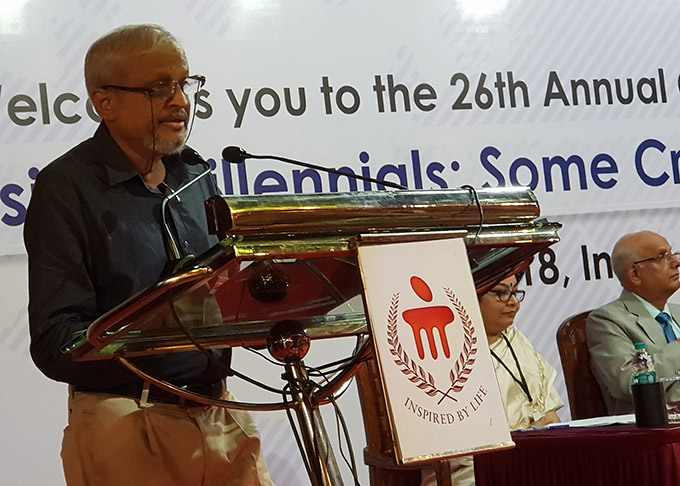
Bryce Edwards’ Political Roundup: The M. Bovis debacle deserves more debate

Bryce Edwards’ Political Roundup: The M. Bovis debacle deserves more debate

[caption id="attachment_13635" align="alignright" width="150"] Dr Bryce Edwards.[/caption] What has emerged from the debate over the Mycoplasma Bovis saga is that New Zealand appears to have been let down by authorities – especially politicians and senior government bureaucrats who have mismanaged the country’s biosecurity, leaving farming in turmoil, and the taxpayer picking up most of the tab for their negligence. Leading the charge against the Ministry of Primary Industries (MPI), Duncan Garner accuses the government department of being dysfunctional and ill-prepared for inevitable breaches of biosecurity like M. Bovis. He says former MPI minister Nathan Guy should resign, David Carter should apologise and, although current minister Damien O’Connor is doing OK, he “went missing for months” – see his column: Alert, alert, mad cows on loose, MPI in deep coma. Garner says that MPI and the previous government should have been ready for such a breach: “Surely we had a plan for this chaos, should it arrive? This disease was here in 2015. So what did the National Government do? It did as little as possible.  Nothing but damn negligence and utter inaction, from what I can see. Nothing in the face of a major threat to our wealth creators, our farmers who feed the world and seriously help us pay our way… It’s not as though National Party ministers and MPI hadn’t been warned, in a 2015 rebuke of MPI by the auditor-general: MPI staff were generally poorly trained and had the wrong tools.” Biosecurity New Zealand’s Roger Smith hit back, labelling Garner’s column “shallow and incorrect analysis” – see: MPI response system robust, says biosecurity head. Smith says “I would like to reassure all New Zealanders that MPI has a very good model for managing biosecurity responses which allows us to respond swiftly and consistently to incursions.” But he adds: “We also know our response to date has, at times, not been perfect and it has been harder on individuals than it should have been.” Writing on this “Garner-Smith bunfight”, Newsroom’s David Williams defends Garner, and says Garner “is well-connected and obviously worked his sources before putting fingers to keyboard. He pitched his criticism, rightly, at the top, at senior management and at the ministers who’ve overseen this mess. Because it is a mess. In my opinion, Smith talked when he should have been listening” – see: MPI must rebuild trust. Williams also provides details of others criticising MPI, including farmers who have been affected. For example, he says “Northland’s branch [of Federated Farmers] is calling for a full, independent inquiry about MPI’s approach to biosecurity.” He paints a picture of an agency that is too slow, too lax, and untrusted by farmers. Williams, who is based in the South Island, says “A few people tell me the way MPI has handled this outbreak means, they think, some farmers won’t be inclined to report problems in the future. They don’t think MPI has their back.” MPI’s big problem, Williams says in another article – Zero tolerance bites for cattle farmers – is that the agency needs to rebuild trust with farmers at the same time that it has to crack down on their non-compliance with many rules. The biggest non-compliance problem – which has been highlighted by the M. Bovis disaster – is the industry’s National Animal Identification and Tracing System (NAIT), which is meant to control stock movements and allow authorities to better deal with biosecurity outbreaks. It hasn’t worked, Williams says: “Five years of voluntary NAIT compliance hasn’t worked, with adherence as low as 30 percent in some areas. Stuff reported in December that only one $150 fine had been issued since 2012 for failing to declare the movement of an animal.” Williams reports that “MPI is expected to consult on recommended changes to the NAIT system in the next few months.” The new government are quite rightly pointing to the fact that the animal tracking system, NAIT, was developed and overseen by the previous National government. A very good RNZ article explains the origins of the system, and quotes new agriculture minister Damien O’Connor as being highly critical – see: How did NZ end up facing a 150,000-cow, $886m cull, and who is to blame? Reporting on the development of M. Bovis debacle, this article says “O’Connor again criticised NAIT for the spread of the disease, and was joined by Jacinda Ardern, who said her government had inherited a ‘shamefully underfunded’ system that was an ‘abysmal failure’. The government said farmers who did not abide by the system could face penalties.” That compliance with the animal tracking system rules hasn’t been enforced by MPI, amounts to a “system of light handed (to non-existent) regulation for farmers” according to Gordon Campbell, who complains that “taxpayers are now being expected to pick up the tab for some of the consequences of the latitude that has been extended to farmers” – see: On showing maximum love to farmers over M Bovis. It certainly raises the question of why the taxpayer should be funding a problem in the private sector. And a Newshub-Reid Research survey shows that New Zealanders are evenly divided on this issue of “whether it’s right for the taxpayer to stump up the cost of eradicating the disease” – see Tova O’Brien’s Should taxpayers fund the M bovis clean up? The results say: “Forty-four percent say it’s fair, 44.5 percent say it’s not fair and 12 percent don’t know.” Agriculture and biosecurity expert, Keith Woodford, says it is “legitimate” to question why the public is having to pay for this farming problem. He’s quoted by Andrea Fox in her article, Business case for cattle disease plan kept secret from public. This article also questions why MPI is keeping secret the background information on the decision to eradicate M. Bovis. Economist Michael Reddell also questions why the public has to pay “when all the benefits will accrue to industry themselves.  It has the feel of the classic line about people being keen, when they can, to socialise losses and capitalise gains” – see: Why are we gifting so much to farmers? According to Reddell, there’s more than a hint of electoral strategy involved: “Perhaps the government is dead keen not to alienate further the business community and ‘regional New Zealand’, but this appears to be almost wholly an industry issue, and I’m not sure that mending party political fences with elements of the business community is really a legitimate use of public money. Perhaps there is a stronger wider public policy case to be made for this intervention?  But if so, it hasn’t been made to the public so far. Instead, they are just taking our money and giving it to the farmers, to directly benefit the bottom lines of firms in that industry.” Keith Woodford has provided further explanation of the government decision in his article, Mycoplasma bovis: What does ‘phased eradication’ mean? But he adds that MPI “have not covered themselves in glory. All members of their response team will have been working hard within imposed limits, but the MPI system has let them down with too many layers of management and an inability to make timely operational decisions for each farm.” Ultimately, there will need to be a change to biosecurity laws, which have been shown by this debacle to be out of date. Prime Minister Jacinda Ardern explains: “We just need to make sure it is fit for purpose and every time I have a conversation I hear something else that makes me think was the Act agile enough for us to be able to deal with this infection as quickly and effectively as we could?” – see Andrea Vance’s Biosecurity legislation to be overhauled following M Bovis outbreak. Finally, Rachel Stewart has a long-running beef with MPI, and her recent column on the debacle is worth reading – see: Ministry’s cunning plan fails to stop M. bovis cattle disease. For a different take on the biggest victims, at the centre of the disaster, read her latest column: Why I love cows and you should too.]]>

Newsletter: New Zealand Politics Daily – June 01 2018 – Today’s content

Newsletter: New Zealand Politics Daily – June 01 2018 – Today’s content Editor’s Note: Here below is a list of the main issues currently under discussion in New Zealand and links to media coverage. [caption id="attachment_297" align="aligncenter" width="640"] The Beehive and Parliament Buildings.[/caption] Meth report Zac Fleming (RNZ): Taxpayers funded meth decontamination for private homes Dan Satherley (Newshub):National had no idea meth guidelines were wrong – Judith Collins RNZ: Meth compensation: ‘I’m not ruling it out, I’m not ruling it in’ RNZ: Twyford rules out apology over meth tests Stuff: Phil Twyford apologises for meth myth saga but won’t commit to compensation John Minto (Daily Blog): Paula Bennett is right…. state house tenants should be compensated for state sanctioned abuse Anna Bracewell-Worrall (Newshub): Meth myth: 1338 state homes decontaminated in two years – almost all needlessly Scott Yeoman (Bay of Plenty Times): $1.3 million spent on meth cleanup in state houses – just $3000 on mould John Lewis (ODT): Meth clean-up cost frustrating for landlord Greg Presland (The Standard): National’s strategy on the Housing Corp P fiasco Justice Philip Matthews (Press Editorial): Time’s up for three strikes Newstalk ZB: Criminologist: Three strikes law is a travesty Isaac Davison (Herald): National would pass retrospective laws to make sure three strike offences don’t go unpunished Isaac Davison (Herald): National promises to bring back three strikes and reverse any bail or sentencing changes ODT Editorial: Law changes a risk and challenge Laura Walters (Stuff): Opinion: Govt prioritising three strikes law overturn but what about the prison muster? Tova O’Brien (Newshub): Justice reform is needed but an angry Minister doesn’t help the case Moana Makapelu Lee (Maori TV): Sensible Sentencing Trust opposes repeal of ‘Three Strikes’ law Stuff: Potential claims from prisoners held too long are ‘unquantifiable’ Leigh-Marama McLachlan (RNZ): Family Court problems run deep for whānau – Māori lawyers Georgia May Gilbertson (Herald): Stuart Nash says 40th aggravated robbery in Hawke’s Bay shows a ‘societal issue’ Police Gordon Campbell: On the carnage being caused by Police pursuits Rob Kidd (ODT): Missing occupation on charge sheet an ‘oversight’ Kate Nicol-Williams (1News): Largest ever graduation of Auckland police keeps Government’s goal of 1800 extra cops by 2020 on track Auckland  Simon Wilson (Herald): You should hear what the councillors said about the fuel tax Bernard Orsman and Tess Nichol (Herald): Regional petrol tax will hurt poor communities in South Auckland, say local councillors Tess Nichol (Herald): ‘It’s a lot to ask of motorists’: AA says new fuel taxes need to deliver results for Auckland Dan Satherley (Newshub): All of NZ will pay for Auckland’s fuel tax – vehicle lobby Anna Loren (Stuff): What you need to know about Auckland’s regional fuel tax Bernard Orsman (Herald): Auckland Council gives green light to 11.5c fuel tax to hit motorists on July 1 RNZ: Auckland’s fuel tax a reality after council vote Herald Editorial: Auckland Council’s proposed rates should have precise purposes Jackson Thomas (Stuff): Auckland Council approve Goff’s $26 billion budget Grant Bradley (Herald): Airlines accuse Auckland Airport of making $3.6 billion in excess returns Mycoplasma bovis and forestry Conan Young (RNZ): ‘This is people’s livelihood’: M bovis on Gypsy Day Newsub: Farmers wary of M bovis as ‘Gypsy Day’ begins Andrea Fox (Herald): Hunt for vaccine a priority if cattle disease M. bovis beats eradication Maja Burry (RNZ): Greater food safety reassurance needed over M bovis – exporter RNZ: Checkpoint: Farmers at country club: ‘We want to stop the spread’ Alison Pugh (1News): ‘It doesn’t work’ – Farmers question effectiveness of MPI’s Mycoplasma bovis testing Stu Hunt (Nelson Mail): What do we do when the real mess begins? Paul Mitchell (Stuff): Manawatū farmers question Simon Bridges on M bovis at Palmerston North Q+A Hannah Bartlett (Stuff): Nelson Tasman farmers backing Government’s move to eradicate M Bovis Bernadette Hunt (Spinoff): ‘We were as low as you can get’: a dispatch from Mycoplasma bovis ground zero Lindy Laird (Northern Advocate): Seedling marks $6 million Ngāti Hine and Government forestry venture Housing Guyon Espiner (RNZ): Is Labour’s Kiwibuild policy Talk Big but Think Small? Eva Corlett (RNZ): Winter causes ‘intense’ pressure for homelessness sector Stuff: Hardest winter yet for group providing accommodation for homeless families Robin Martin (RNZ): Whanganui emergency housing unhabitable, Salvation Army says Herald: Wellington homes are too cold to be healthy, University of Otago research confirms Brian Fallow (Herald): Property values at risk as climate changes Anuja Nadkarni (Stuff): Increasing pressure on housing stock in next year Chloe Winter (Stuff): Wellington residential development land supply scarce, as population balloons Tina Morrison (BusinessDesk): NZ residential building consents slip 3.7% in April Health Richard Edwards, Janet Hoek and Anaru Waa (Spinoff): How can we make World Smokefree Day irrelevant by 2025? Barry Soper (Newstalk ZB): Cigarettes in parliament Marty Sharpe (Stuff): IDEA Services blasted over treatment of vulnerable man found with surgical glove in his bowel Chris Bramwell (RNZ): Intellectually disabled man assaulted in care Mike Houlahan (ODT): Cadbury site deal is done Danielle Clent (Stuff): Auckland district health boards tackling sudden infant death in Māori babies Listener: The nurses’ pay dispute has put the Government in a tricky situation BusinessDesk: Nurse pay hike could hit private health providers Te Mata Peak track Nicki Harper (Herald): New Te Mata track resolution not to everyone’s satisfaction Marty Sharpe (Stuff): Winery and iwi agree to buy land together for alternative Te Mata Peak track Sean Hogan (1News): Deal reached between iwi and winery in Te Mata Peak walking track saga RNZ: Iwi and winery to build new Te Mata track together Employment Peter Lyons (ODT): Reality of wages trumps economic dogma Matt Stewart (Stuff): Testing for drugs in workplace likened to testing for meth house contamination Gill Bonnett (RNZ): NZ sex workers undercut by illegal foreign prostitutes Government, Labour Party, Ardern Eloise Gibson (Newsroom): Sir Peter Gluckman – the knowledge broker Michele Hewitson (Listener): Shane Jones is planting 150 trees in his backyard. 999,999,850 to go Richard Harman (Politik): 118 inquiries and counting Chris Trotter (Daily Blog): Generating Our Own Momentum? Chris Trotter (Daily Blog): The Italian Job Herald Editorial: PM lets us share her growing excitement Simon Collins (Herald): PM gets practice holding a baby, hosts morning tea for her Plunket nurse and local community Ben Leahy (Herald): ‘Everything’: Ambitious Jacinda Ardern to do list sells for $2500 at charity auction National Party Matthew Hooton (Herald): National’s high polling near miraculous Wanganui Chronicle Editorial: Not so simple for Simon to bridge the gap Parliament Mike Hosking (Newstalk ZB): Why the Northcote byelection result is more interesting than we might have imagined Mitchell Alexander (Newshub): Security called into Northcote by-election mall confrontation Te Kuru o te Marama Dewes (Maori TV): Mahuta concerned at Māori roll exodus Foreign affairs and trade Dan Satherley (Newshub): NZ labelled ‘soft underbelly’ of Five Eyes spy network in Canadian report Stuff: New Zealander under 18 held in Australian immigration detention facility Simon Murdoch (Incline): A Turning Point for New Zealand’s Maritime Periphery Rae Si’ilata (Newsroom): Enacting alofa between NZ and Samoa Poverty and inequality, financial hardship claims Donna -Lee Biddle (Stuff): Report reveals deep pockets of deprivation in the Waikato Susan Edmunds (Stuff): $100,000: It’s not what it used to be Gareth Kiernan (Stuff): Fact-checking the ‘struggling rich’ Money lending  Susan Edmunds (Stuff): Commerce Commission review finds 803% interest charge Tamsyn Parker (Herald): One in four lenders may have breached law, Commerce Commission warns Multi-national tax Matt Nippert (Herald): Google claims another loss for NZ operations Thomas Coughlan (Newsroom): OECD backs NZ tax plan in face of critics Business and economy Liam Dann: Business heads for winter of discontent Sonia Mazey and Jeremy Richardson (Herald): Business should be more optimistic about the Coalition Government RNZ: Businesses ‘should pay a fair price’ for power – aluminium smelter Nathan Torkington (Spinoff): Why half-baked R&D changes are a finger in the eye to startups and software Megan Woods (Spinoff): ‘If you do R&D, we plan to support it’: Megan Woods defends the new tax incentive RNZ: NZ economy forecast set to outpace most of OECD Tina Morrison (BusinessDesk): New Zealand’s ‘solid’ economic growth seen continuing Michael Reddell: Please Mr Orr, could we have some better analysis Roger Douglas (Kiwiblog): On budget issues Roger Douglas (Kiwiblog): Policy Recommendations Roger Douglas (Kiwiblog): Outcomes Education RNZ: Biggest polytech makes $31m deficit, adviser appointed John Morgan (Newsroom): Time to bring ‘knowledge’ back to schools? RNZ: NZQA cancels results of cheating students Southland Times Editorial:No need to get hot-headed about beanie rules Paul Barkle (Informetrics): Fees-free: Grades are out Environment Jamie Morton (Herald): NZ’s recycling crisis after China ban: ‘This situation is not sustainable’ Emma Hurley and Alex Baird (Newshub): Recycling sector warns Government the system is broken Herald: Avoiding meat and dairy is the best way to help the planet, study shows RNZ: ‘Rare earth’ minerals potential for regions Stuff: Z Energy cuts single-use plastic bags from all service stations in New Zealand Newshub: Z Energy to stop providing plastic bags Tourism Jane Patterson (RNZ): Tourism sector anxious about proposed border tax Damien Venuto (Herald): International media call BS on NZ’s 100% pure claims Other Chester Borrows (Herald):Learn your history, no matter how unpalatable it might be Natalie Akoorie (Herald): 795 emergency calls answered by automated system then abandoned during April storm Tom Pullar-Strecker (Stuff): Male overstayers prioritised for deportation Phil Pennington (RNZ): Two years on, another building standards review Shane Cowlishaw (Newsroom): Why it’s time to ‘panic’ about cybersecurity Peter Dunne (Newsroom): What our abortion debate would look like Tom Pullar-Strecker (Stuff): Banks axe ‘guiding principle’ on internet fraud reimbursement in new code Stuff: Kiwis charged with driving under the influence of alcohol or drugs reaches six-year high Herald: British politician Nigel Farage to visit New Zealand Isaac Davison (Herald): Forced marriage bill extended to civil unions and de facto relationships Herald: SPCA ‘desperate’ for foster parents as centres fill up countrywide Qiane Matata-Sipu (Spinoff): Māori women talk about the future of moko kauae 1News: ‘I’m just so sorry’ – Law Society President apologises to sexually harassed female lawyers Emily Menkes (Stuff): Golliwogs cause stir at Oamaru restaurant Madeleine Chapman (Spinoff): Wake up New Zealand and give a voice to those who already have booming voices]]>

Vanuatu court orders release of ‘wanted’ Fiji man, seeks papers

]]>

Vanuatu’s Supreme Court … relevant documents from Fiji needed by June 12. Image: Vanuatu govt

By Royson Willie and Kizzy Kalsakau in Port Vila

Vanuatu’s Supreme Court has asked the police and immigration to release Fijian citizen Mohammed Rizwan and to substantiate the claim that he is a wanted man in Fiji.

Rizwan’s lawyer, Frederick Loughman, confirmed that yesterday’s conference in chambers saw the court directing for the relevant documentation from Fiji to be made available by June 12.

After the documents are submitted to the court as ordered by the court on Wednesday, then the matter would be listed for trial.

READ MORE: Contempt application filed in Vanuatu over attempt to deport Fijian

An application for contempt would be heard after this matter is heard.

One of the grounds for the application for contempt was that the agents of the government did not provide any formal legal instrument from the government of Fiji to substantiate their new grounds for deportation or the claim that Rizwan is a wanted man in Fiji.

-Partners-

Minister of Internal Affairs Andrew Napuat said the Immigration Act section 53 said the minister could carry out the removal of non-citizen without notice if the person was a wanted person in another country.

“That’s basically what we’re following,” Napuat said.

“We’re following what the law says.”

Discharged from hospital
The minister said Rizwan was discharged from hospital on Wednesday evening but there was another application to the Magistrate Court by the Acting Director of Immigration for Rizwan to be detained because he was allegedly a wanted person in Fiji.

The minister confirmed that Rizwan has a valid residence visa.

“He’s entitled to live in Vila but we don’t have a copy of his police clearance ever since he arrived.

“That’s something that we’re still investigating.

“We need that to come and other supporting documents from Fiji about his cases and that the Fijian authorities want him in Fiji so they can settle outstanding matters they have against him,” the minister alleged.

The minister said Rizwan’s detention and supervision after being discharged from the hospital was done by immigration officers.

“We don’t have any personal issues with the foreigners we’re dealing with.

‘Implementing the law’
“We’re just basically implementing the law, which has not been implemented in the past or may have been relaxed in the past.

“The funny thing though is when we are trying to implement the law and safeguard the interest, the sovereignty of Vanuatu and their nation there are some people that don’t see the logic behind the work the government is doing.

“Even if they are lawyers or politicians, they need to ask themselves, what do they want for this country?

“That’s the most important thing.

“Do they want this country to be a home for criminals, illegal immigrants, overstayers, those that do not have the appropriate papers to come into the country and work here?

“I believe that money should not be the factor that will drive the citizens of the country to do what they want to do.

“They need to look higher into seeing their country, their future, the future of the people, their children.

“It’s sad to see that when the government is trying to do things according to law and trying to protect the sovereignty and interest of the people, some people don’t see that as important,” the Internal Affairs Minister said.

The lawyer representing Rizwan had said his interest was to see that the law was adhered to at all times, even if it was a deportation carried out by the government, it must be done within the confines of Vanuatu laws.

The Pacific Media Centre has a content sharing arrangement with the Vanuatu Daily Post.

Print Friendly, PDF & Email

Article by AsiaPacificReport.nz

]]>

Scott Waide: Any Facebook shutdown in PNG dangerous on many levels

]]>

The Post-Courier story that stirred up the Facebook ban controversy … now mixed messages from the PNG government. Image: PMC screenshot of PC

OPINION: By Scott Waide in Lae

Maybe it was a slip of the tongue or a misinterpreted statement… But there is no doubt that whatever it was that Papua New Guinea’s Minister responsible for Communications and Information Technology, Sam Basil, said this week has created a storm now being reported on global media outlets.

While some commentators are screaming “fake news”, others are taking it all in as a fact.

What gave this statement its legitimacy was its publication on one of Papua New Guinea’s two dailies – the Post Courier. The online version of the story has been quoted numerous times that has become the top story out of Papua New Guinea in the last 24 hours.

READ MORE: Facebook shutdown outcry – ‘a mockery to APEC’

The country doesn’t usually make it into the tech pages of websites, but it has.

Matt Novak from Gizmodo wrote: “The (PNG) government also said that it’s exploring the creation of its own social media site to replace Facebook.”

-Partners-

John Russel from Techcrunch: “… the Facebook ban — however delicious it may sound given recent events — is not confirmed for Papua New Guinea. It remains a possibility once Basil has liaised with police.”

The suggestion to shut down Facebook is dangerous on many levels.

Papua New Guinea’s Facebook ‘ban’ … a global furore. Image: Scott Waide’s blog

PNG on back foot
Firstly, it places PNG on the back foot. It is a highly embarrassing position to be in as members of APEC discuss the region’s economic future with e-commerce and social media being a pivotal focus of the talks.

Any shutdown of Facebook for any length of time, is contrary to the spirit of the discussions where wider access to ICT forms the basis of future economic policies.

In Papua New Guinea, small businesses are starting to thrive. Their main avenue to sell to a wider customer base? Facebook pages. Not websites. Website developers charge a minimum of K2500 for a basic site. It is too big an amount for small businesses.

Not one to mince his words, the director of the Institute of National Affairs , Paul Barker, told The Fiji Times: “It would be a travesty if PNG sought to close down Facebook during the APEC month [in November], making PNG seem rather foolish, as it would be both an attack on embracing technology, undermining the information era and mechanisms for accountability, but also damaging business and welfare.

“Facebook is no longer just a platform for chatting to friends and relatives, and exchanging photos, it’s now a critical tool for information sharing and social auditing, and also a major platform for business, especially micro, small to medium enterprises (MSMEs).”

In Lae City where I live, Facebook is a primary means of reporting crimes to the police. The Lae Police Metropolitan Command has a Facebook page linked to its crime reporting systems and toll free number. It is an integral part of policing.

Primary disaster reporting tool
In Papua New Guinea, Facebook has become the primary disaster reporting tool used by rural communities.

In February, when the Highlands was struck by a 7.5 magnitude earthquake, the first pictures of the damage and deaths were posted on Facebook.

Yet it took at least two weeks before the National Disaster Center began collating the information that was readily available within 20 minutes of the disaster.

It is good that this debate is happening now instead of later.

Scott Waide’s blog columns are frequently published by Asia Pacific Report with permission. He is also EMTV deputy news editor based in Lae.

Print Friendly, PDF & Email

Article by AsiaPacificReport.nz

]]>

New Caledonia referendum offers chance to turn page, says journo

]]>

The Kanak flag and the French Tricolour …. an independence vote is due on November 4. Image: RNZ Pacific

By RNZ Pacific

This year’s referendum on independence from France is a chance to turn a new page on New Caledonia’s past, says a Kanak journalist.

The referendum is is due on November 4 – more than 30 years after a boycotted poll and subsequent violence which led to the 1988 Matignon Accord.

The agreement has allowed gradual progress towards independence to be finally decided this year.

READ MORE: 30 years on from the Ouvéa massacre

A 98 percent majority voted in favour of staying with France in the 1987 vote which was boycotted as the indigenous Kanaks waged a campaign for independence.

Violent conflict continued, including the Ouvéa massacre when 19 Kanaks and two French soldiers were killed but the 1998 Noumea Accord a decade later allowed gradual steps towards independence to be finally decided this year.

-Partners-

Andre Qaeaw of the Kanak-run station Radio Djiido said as the next referendum approached, the media had a role to play in keeping conflict at bay.

Speaking at the Pacific Media Summit in Tonga earlier this month, he said the situation did not need to be portrayed as confrontation between France and the Kanak people.

“People are influenced by [the] media. Plenty of media talk about the events as a confrontation – France against Kanak people or Pacific Ocean people,” he said.

‘We can change’
“What we are trying to do is show that we can change.

“We can also say that during the First World War, the Second World War, Oceanic people, they fight together with Australia, New Zealand and [the] French. So we have a common heritage so we are not obliged to be always in the binary confrontation point of view.”

“The challenge is to explain that we are not against France, we are not against another country.”

Andre Qaeaw of New Caledonia’s Radio Djiido … Kanaks don’t want to relive the events of 1988. Image: RNZ Pacific

Some politicians were inciting divisions, he said, but his people did not want to relive events like those of 1988.

“We try to be smarter, a new way of thinking things. We have Facebook, we have internet, we have tutors, we don’t have the same way of thinking [then] and now.

“We have to prepare the new generation,” Qaeaw said.

Pacific means peace, he pointed out and all people belonged.

“The Kanak people say we need to do better, to share and to think not only towards Noumea, the capital.

“We have 300 tribes. They don’t have water, they need schools, they need education and health.

“Pacific islanders, we just need that respect,” he said.

This RNZ Pacific news item is published under a content sharing agreement with the Pacific Media Centre.

Print Friendly, PDF & Email

Article by AsiaPacificReport.nz

]]>

Bryce Edwards’ Political Roundup: Can the Human Rights Commission be fixed?

]]>

Bryce Edwards’ Political Roundup: Can the Human Rights Commission be fixed?

[caption id="attachment_13635" align="alignright" width="150"] Dr Bryce Edwards.[/caption]

Concerns about bigotry and harassment in New Zealand are ongoing, or even rising. Yet the primary state agency that deals with these issues – the Human Rights Commission – has been discredited and is in turmoil. The latest ministerial report is incredibly damning, illustrating that the Commission is not living the values it wants everyone else to live by. For its supporters, the Human Rights Commission (HRC), plays an important role in fostering inclusion, understanding and harmony, by campaigning publicly against sexism, racism, homophobia and other forms of discrimination. But to its critics, it’s proved itself not up to the task of protecting human rights and, in the eyes of some, become a “politically correct” activist state agency, that goes beyond its proper purpose by policing free speech. So, how can the Commission be reformed? Or should it be scrapped? How the scandal started Back in February, journalist Harrison Christian published an expose on the HRC in the Sunday Star Times: Human Rights Commission finance boss sexually harasses young intern, keeps job. The whole scandal was somewhat of a paradox – not simply because a human rights agency might be expected to be the last place that sexual harassment should be occurring – but particularly because the agency was entirely remiss in the way they dealt with the intern’s complaint. As reported in the article, the intern claimed that the HRC did not have her interests as their main concern: “I felt it wasn’t so much about me any more, it was about protecting the organisation, and them hitting all the right points that they had to hit legally. Ultimately I felt it came down to making sure they could move on as an organisation.” Writing at the time, Alison Mau was shocked: “you’d think of all places the HRC would have a gold-standard way of investigating in a fair, balanced, independent and transparent manner” – see: After Human Rights Commission harassment scandal, how can victims trust the process? She also hoped that the scandal would “not reflect on the work that the HRC does for New Zealanders in the wider sense. It would be a shame if confidence in its public role took a knock.” Then in May, Harrison Christian followed up with more detail on what had occurred in the HRC, how his own investigation was carried out, and he drew attention to the uncooperative and murky role of its managers in the scandal – see: Analysis: The road to the truth about the Human Rights Commission. The CEO, Cynthia Brophy, comes out of this account poorly. The extent of the problem with the Human Rights Commission Given the controversy, a ministerial inquiry was commissioned by Minister of Justice, Andrew Little, which produced a damning report by retired judge Coral Shaw. This is covered in RNZ’s HRC report: ‘Deep divide’ between staff and managers. The report details bullying and dysfunctional leadership in the agency. In the wake of the review, most of those at the top of the Commission have been moved on. First to go was the Chief Commissioner, David Rutherford – see Harrison Christian’s HRC chief commissioner David Rutherford to go following damning report. Then, on Friday, two of the Human Rights Commissioners, Susan Devoy and Jackie Blue, announced their departure. Devoy wrote an “exclusive guest essay” about this for The Spinoff website (a media outlet that receives sponsorship from the HRC) – see: How the Human Rights Commission can rebuild trust. While worth reading, you won’t find much in the way of interesting reflections – or much real contrition – from Devoy. Instead this is a PR piece is about the achievements of herself and colleagues, how they have been “speaking truth to power”, and how she feels “vindicated”. She also “calls on those who failed staff in relation to sexual harassment allegations to do the right thing and step aside.” Apart from this, there is very little in her essay about how the HRC can be reformed. Can the HRC be reformed? The ministerial report was very clear that the latest problems at the HRC were about more than just the personnel, with former commissioners reporting that the dysfunction had been present for “many years”, and under previous commissioners. There are signs that with the departure of some of the problematic managers, it might now be “business as usual” at the Commission. Andrew Little even said on Friday: “So it’s time to look further afield and see if we can get some new blood”,  suggesting he may not accept the need for bigger reform. Andrew Little and his government clearly also need to look at the appointment processes for new commissioners. This is explained very well by former commissioner Peter Hosking in his article, Drop the politics from human rights. He asks why the government doesn’t consult with the opposition over the new appointments. For a long time now, the commissioner appointment process has been party political, with the government of the day making the decision, sometimes even ignoring officials’ advice. Hosking says that the process should be bipartisan, pointing out that the United Nations has previously recommended this to New Zealand, and the ministerial review makes a good suggestion in this regard: “the Judge recommending consideration be given to whether the commissioners should be officers of Parliament, similar to the Ombudsman, Auditor-General and Office of the Parliamentary Commissioner for the Environment.” Other suggestions for reform come from David Farrar, who has written one of the most interesting commentaries on the ministerial review – see: The Human Rights Commission review. He says the extent of the problem is made clear in the review: “Government reviews are normally diplomatically worded. This review is damning in the language used such as toxic, unprofessional etc. Andrew Little has his work cut out for him with the HRC. The status quo is clearly untenable.” Here’s Farrar’s main point about the need for a structural change in the organisation: “I think the issue may be structure as much as people. Most organisation have part-time governors who sit strategy and policy and full-time staff who do the work. The HRC has full-time Commissioners who lead the work program but also collectively are meant to govern the organisation. There is also a CEO and a Chief Commissioner. So very blurred accountability in my opinion… I prefer the traditional models with a clear line between governance and management. Effectively the HRC has multiple bosses as each Commissioner has control over their area, plus a Chief Commission and a CEO.” Maybe the HRC is simply too tarnished and broken to be reformed, and needs to be scrapped. That’s the view of Damien Grant, who draws a parallel with Britain’s News of World publication being shut down: “One the best things Rupert Murdoch did was shut the News of the World. As his son, James, explained at the time: ‘The News of the World is in the business of holding others to account. But it failed when it came to itself’… The Commission, like News of the World, preaches one thing and practices another” – see: Shut it down – rights watchdog fails to practice what it preaches. Damning the organisation, Grant quotes a staff member saying “There’s a culture of victimisation and secrecy, no one feels that they can speak the truth or be heard”, and he points to the ministerial report stating that “78 per cent of its staff did not believe their employer treated everyone fairly”. Grant believes the HRC to be generally redundant, suggests that trade unions are better at dealing with harassment and discrimination: “The best organisation to challenge bullying and harassment in the workplace isn’t a dysfunctional government agency but unions. Asserting the rights of workers is exactly the sort of role a successful union would aspire to and, if effective, will gain new recruits as a result.” Has the Commission also become victim of “mission creep”? According to John Drinnan, it has become increasingly activist, which is a problem for a state agency – see: Dysfunctional HRC targets hate and disharmony. Drinnan reports that AUT academic Paul Moon “sees as evidence of an ‘ideology’ developing at the Commission”, and criticises its lack of transparency. Drinnan says the HRC continues to promote restrictions on free speech, and he points to a recent forum about online hate speech, in which there was a complete lack of ideological diversity: “None of the speakers are promoters for free speech.” Drinnan also reports Andrew Little as saying a review of human rights laws is coming up, and “It may well be that is the time to consider whether there has to be a beefing up over the coverage of hate speech”. Finally, maybe some lessons can be learnt from the UK’s equally controversial version of our agency, the Equality and Human Rights Commission, which was headed for ten years by Trevor Phillips. While running the EHRC, Phillips was a highly controversial public figure akin to some of New Zealand’s commissioners such as Susan Devoy. But he now says he’s had a “Road to Damascus” change of heart about the agency and now takes an entirely different approach to human rights issues and debate. You can listen to his 2015 interview with RNZ’s Katherine Ryan here: Straight conversations about racial and religious differences. And you can watch his recent British documentary: Has Political Correctness Gone Mad?

]]>

Newsletter: New Zealand Politics Daily – May 30 2018 – Today’s content

Newsletter: New Zealand Politics Daily – May 30 2018 – Today’s content Editor’s Note: Here below is a list of the main issues currently under discussion in New Zealand and links to media coverage. [caption id="attachment_297" align="aligncenter" width="640"] The Beehive and Parliament Buildings.[/caption] Farming and mycoplasma bovis Andrea Fox (Herald): Business case for cattle disease plan kept secret from public Keith Woodford (RNZ): Mycoplasma bovis: what does ‘phased eradication’ mean? Rachel Stewart (Herald): Why I love cows and you should too Liam Dann (Herald): Let’s keep cattle cull in perspective Andrea Vance (Stuff): Biosecurity legislation to be overhauled following M Bovis outbreak Sally Rae (ODT): Minister calls for bio review RNZ: M bovis: How did we get here? Gordon Campbell: On showing maximum love to farmers over M Bovis Tova O’Brien (Newshub): Should taxpayers fund the M bovis clean up? ODT: ‘M. bovis’ eradication costs will be uneven Southland Times Editorial: Season of fear and hope Jamie Gray (Herald): MPI will face ‘don’t give a damn’ attitude on M. Bovis, farmer says Kurt Bayer (Herald): South Canterbury farming couple to start again after cow loss Kurt Bayer (Herald): Jacinda Ardern visits farmer struggling with M. Bovis cow culling RNZ: M bovis-affected famer says eradication the right decision Sally Rae (ODT): PM visits M bovis affected farmers Sally Brooker (ODT): Farmer slams bovis decision as ‘madness’ Newshub: Owner of Mycoplasma bovis-infected farm says Govt has ‘no clue’ what its doing 1News: Concerns native plants, precious wildlife will be wiped out by Mckenzie country dairy farm Debrin Foxcroft (Western Leader): MPI to tighten rules on organic labelling to tackle greenwashing Fishing industry  Michael Morrah (Newshub): Leaked MPI report reveals ‘widespread’ under-reporting in fishing industry Joel Ineson (Stuff): Leaked Govt report shows thousands of tonnes of fish dumped, unreported RNZ: Leaked report shows thousands of tonnes of fish dumped Health Richard Harman (Politik): H2 to sort out health system Thomas Coughlan (Newsroom):‘H2’ to head public health review Anna Bracewell-Worrall (Newshub): H2 takes on health: Government announces huge review of health system Nita Blake-Persen (RNZ): Govt announces review into health care inequities Eva Corlett (RNZ): Crucial that ‘Māori are central’ to health review Stacey Kirk (Stuff): DHBs in for shakeup as public health system goes under the microscope in major review Phil Pennington (RNZ): Middlemore failed to pursue millions in leaky building claim John Tamihere (Western Leader): Government needs to sort out ‘after-hours debacle’ Stuff: Which region has the highest rate of smoking among adults? Logan Church (RNZ): Hillmorton nurse dragged across floor by patient, colleagues report Tom Kitchen (ODT): Mayor keeps eye on village email crusade Oliver Lewis (Stuff): Nurses accuse district health boards of dirty tactics over $93,000 claim Emma Russell (Herald): Nurses strike looks likely with revised pay offer causing upset Herald: A Kiwi nurse says her colleagues are unhappy with revised DHB pay offer RNZ: Nurses’ pay rise: ‘This is a substantial increase’ – DHBs Meth report Herald Editorial: Chief science advisor does New Zealand a favour Barry Soper (Newstalk ZB): Meth house myth – Have we been duped? Anna Bracewell-Worrall (Newshub): State houses needlessly emptied where meth previously smoked – report Tom Furley (RNZ): Landlord’s $37k meth decontamination nightmare: ‘We were made to feel dirty’ Susan Edmunds (Stuff): Meth report ‘kick in the guts’ to those who paid to decontaminate Herald: Real estate boss Bob Brereton angered by Gluckman meth report Newshub: Meth tester already knew ‘contaminated’ houses had little health impact Herald: Meth tester hits back at Gluckman report on meth contamination Henry Cooke and Joel Ineson (Press): Christchurch City Council could reopen meth homes after report finds ‘no risk’ from drug residue Henry Cooke (Stuff): The meth house is a myth: There’s ‘no risk’ from drug smoking residue, Govt report finds Benedict Collins (RNZ): Meth house contamination debunked by PM’s science advisor Lucy Bennett (Herald): Meth-testing in homes – don’t bother, says Chief Science Adviser Sir Peter Gluckman Housing Chris Harrowell (Manakau Courier): Salvation Army unhappy with “uncertainty” around KiwiBuild programme Lucy Bennett (Herald): Housing Minister Phil Twyford stands by ‘move out of Auckland city’ comments over affordable housing concerns Newshub: Auckland ‘nimbys’ who don’t like state housing can leave – Phil Twyford Herald: Act leader David Seymour hits back at Phil Twyford’s ‘move to Pokeno’ claim Anne Gibson (Herald): $750m Northcote state-house intensification: 300 going, 1200 new homes rising Employment Shane Cowlishaw (Newsroom): Tug of war to begin over Holidays Act RNZ: Holidays Act overhaul won’t hurt workers – minister Claire Trevett (Herald): Holidays Act overhaul on the way after costly annual leave hiccups Craig McCulloch (RNZ): Payroll mess prompts govt to review Holidays Act Laura Walters (Stuff): ‘Nightmare’ Holiday Act to be overhauled Anuja Nadkarni (Stuff): Employers looking forward to Holiday Act overhaul Simon Hartley (ODT): Holidays Act task force welcomed Nikki Mandow (Newsroom): Why we need more quirky workers Susan Hornsby-Geluk (Stuff): The gig economy may give rise to the ‘dependent contractor’ Leith Huffadine (Stuff): New Zealand has a long history of going on strike. Now, it’s a complex issue Heike Menne-Spohr (Newsroom): Sexual violence an employment, union and Govt issue Immigration and migrant exploitation Gill Bonnett (RNZ): Immigration NZ accused of targeting Indian applicants Liu Chen (Stuff): NZ is rebuilding, top to bottom, but migrant construction workers fear exploitation National Party Bryce Edwards (Newsroom Pro): “No mates National” seeks companion Alex Braae (Spinoff): Simon Bridges needs to make friends. But voters know bullshit when they smell it Ele Ludemann: National in drag difficult sell 1News: ‘It doesn’t have any allies, ACT’s not doing its job’ – political editor Jessica Mutch on National’s poll problems Opinion polls Matthew Whitehead (The Standard): Pollwatch: Colmar Brunton 28/5/2018 Matthew Whitehead (The Standard): Pollwatch: Reid Research, 27/05/2018 David Cormack (Herald): Reasons Kiwis prefer Judith Collins over Simon Bridge Government Dominion Post Editorial: Pregnant pause amid the pressure David Farrar: No budget bounce for Labour Stuff: PM Jacinda Ardern speaks candidly about pregnancy, baby names Welfare and financial hardship Sarah Robson (RNZ): Benefit abatement rates a ‘disincentive to work’ Sue Bradford (Pundit): New welfare taskforce is a slow train… but on which track? Susan Edmunds (Stuff): High-paid families feeling the squeeze as costs pile up Mike Hosking (Newstalk Zb): Genuine ‘poverty’? Or a pity party for people who can’t budget? Police RNZ: ‘Police need to be adults’ on police chases – lawyer Phillipa Yalden (Stuff): Number of people being killed during police chases on the rise, figures show Toby Manhire (Spinoff): Please let’s not descend to ‘fault’ and ‘feral’ in the debate on police pursuits Patrick Gower (Newshub): Grandparents of teen driver killed in pursuit say they don’t blame police 1News: Watch: Family of 12-year-old girl who died after Palmerston North police pursuit address ‘hateful comments’ on social media Ryan Dunlop (Herald): Football club reveals why they called police on group of Pakuranga teenagers Sophie Bateman (Newshub): Father outraged after 13yo punched by police in Auckland Alison Mau (Stuff): When is it OK to punch a child? Herald: Wally Haumaha appointed Deputy Police Commissioner Abortion Hamish Rutherford (Stuff): Bridges risks being caught on the wrong side of the country ODT Editorial: NZ abortion change coming International relations and trade Paul Buchanan: Cherry picking on Chinese influence RNZ: First NZ youth in Australian detention Megan Sutherland (Newshub): Kiwi family’s financial struggle for medical care for sick daughter in Australia RNZ: NZ volunteer service to expand its work in the Pacific Law profession Sam Hurley (Herald): One in five NZ lawyers sexually harassed – Law Society survey finds Tommy Livingston and Catrin Owen (Stuff): Widespread harassment, bullying and racism identified within the law profession RNZ: One third of female lawyers sexually harassed at work – survey’ Education Herald: Auckland Grammar to design own courses after being upset by possible education changes Emma Russell (Herald): James Cook student suspended after assault that put 16-year-old boy in hospital Zizi Sparks (Rotorua Daily Post): Kaitao Intermediate reiterates values after bullying incident ODT: ‘High stress’ as jobs, pay pared Joss Miller (ODT): Uni administration should stick to its core functions Northcote by-election Steve Kilgallon (Stuff): Act candidate Stephen Berry has a dream for the North Shore. It’s very stupid Felicity Reid (Stuff): ‘It’s not rubbish about fixing T2 or T3 lanes’: ACT’s motorway solution Katie Fitzgerald (Newshub): ‘Let’s drain the swamp’ – Northcote candidate channels US President Donald Trump Local government Jono Galuszka (Manawatu Standard): Palmerston North City Council rejects paying staff living wage Tom McRae (Newshub): No funds for waterfront stadium in Auckland Council’s budget Todd Niall (RNZ): Private rubbish collector wants council to stay out of Rodney Robin Martin (RNZ): New Plymouth council under fire for ‘recycling’ protected reserve Cal Roberts (Wairarapa Times-Age): Council CEO apologies over letter to disgraced Olympian Anusha Bradley (RNZ): Hawke’s Bay businesses losing sleep over bed tax Chris Morris (ODT): Cull backs centre remaining in use Muriel Newman: Race-Based Democracy Opposed Media David Loughrey (ODT): Allied Press secures future of news paper and its staff Stuff: Otago Daily Times owner snaps up Clutha Leader Environment and animal welfare Jennifer Eder (Marlborough Express): Cabinet paper shows toxic PFAS chemicals not just for fighting fires Matthew Salmons (Press): Clarity needed on hawk laws in New Zealand, advocate says Transport 1News:1 NEWS Colmar Brunton Poll: Only a third of Kiwis support Government’s plan to increase fuel tax around the country Edward Gay (RNZ): Former AA worker took more than $56k in bribes for licenses RNZ: Old train carriages heading to the tip Consumer law Tom Pullar-Strecker (Stuff): Spark to refund more than $1m to 135,000 former customers Herald: Spark to return phone credit to over 100,000 ex-customers Aimee Shaw (Herald): Commerce Commission issues warning letter to Apple not to mislead consumers Banks Susan Edmunds (Stuff): Customers need adequate information about bank outages Rob Stock (Stuff): BNZ systems collapse a blow to cashless society project Gender Thomas Manch (Stuff): Women-only gym denies transgender woman from joining Vera Alves (Herald): Transgender woman accuses Wellington women-only gym of discrimination Newshub: Transgender woman turned away from Wellington women’s gym Other Teuila Fuatai (Newsroom): Keep calm and reform our prisons Patrick O’Meara (RNZ): Anti-money laundering rules ineffective, says study Cass Mason (Newsroom): Are our scientists independent enough? Phil Quin (Newsroom): Drug reform: don’t take ‘yes’ for an answer RNZ: ‘King of Waitangi’ farewelled after 4 day tangihanga Newshub: Child support debts: Overseas parents owe $750 million Brian Rudman (Herald): Don’t let the freedom campers’ queue in the dunes grow Niki Harré (Hawke’s Bay Today): Are we as selfish as we think? Sam Sachdeva (Newsroom): Air Force planes run into engine troubles Vera Alves (Herald): Pro-Trump groups target New Zealand brewery over ‘Dump the Trump’ beer]]>

Media and communications for the Floating Foundation

Event date and time: 

Thursday, June 21, 2018 – 16:30 18:00

Managing communications and social media for a Pacific charity comes with its challenges and rewards.

Archer-Mary will discuss her experience in communications for the Floating Foundation: www.floatingfoundation.net, a Registered New Zealand charity.

With a motto such as, “Research. Charity. Adventure”, the foundation “provides a platform for doctors, nurses, and marine scientists to help the environment and the peoples of this incredible ocean”.

Who: Archer-Mary Miller, Communications, Floating Foundation  
When: Thursday, 21 June 2018, 4.30-6pm  
Where: WG608, City Campus  

Contact: Sylvia.Frain@aut.ac.nz

More information: The Floating Foundation

Map for PMC and AUT

Report by Pacific Media Centre ]]>

Diabetes deaths in Fiji worst in the world, says watchdog

]]>

By RNZ’s Dateline Pacific

The latest life expectancy world rankings show Fiji has the highest death rate from diabetes in the world with 188 of 100,000 fatalities being attributed to the disease.

The head of Diabetes Fiji says the ranking highlights the magnitude of the problem and the need for a more proactive approach.

Jenny Meyer reports:

LISTEN TO DATELINE

Transcript
Project manager Viliame Qio says people are shying away from medical attention and treatment out of denial and so when they do come forward they have more severe complications from their illness.

He says there needs to be more community education about diabetes and many people turn to traditional healers for help first, which also delays effective treatment.

-Partners-

“We have three amputations that take place in a day in the major hospitals and the main reason is the people are presenting late, they come very late, they are not coming early. So we want to get people to be educated that they have to seek medical attention first before they resort to other traditional methods or herbal methods.”

Viliame Qio says diabetes is the leading cause of disability in Fiji and people need to heed the public health messages about poor eating habits and sedentary lifestyles.

Dr Jone Hawera is a Fijian surgeon and says the diabetes crisis is becoming more widespread now affecting people in rural areas and at younger ages.

‘Bottom of the cliff’
“Just last week we amputated half a foot of a 30-year-old i-Taukei female. It’s not only the rate that’s increasing it’s also the age group that’s involved with the amputations. And that means we have a big disabled and non productive population. The economic impacts that’s going to make for us is huge.”

Dr Hawera says he is part of a group of frustrated, demoralised, under-resourced health personnel working at the bottom of the cliff trying to deal with the ongoing diabetes crisis.

He says there are many factors affecting the rate of diabetes including issues like food security and climate change and policy makers must do more to turn the crisis around.

He says diabetes is a physical manifestation of social issues and preventative policies need to address these.

“It’s preventable and that’s the hope that we continue to have, we know that it’s preventable. A lot of these deaths are preventable. A lot of these complications like amputations are preventable. We are trying to improve our education and our awareness, making people really understand what diabetes is and what causes it and the many ways they can prevent complications once they have it.”

Dr Hawera says he would like to see diabetes education get to a point in Fiji where people are prevented from getting the disease in the first place.

Early detection vital
Viliame Qio says both education and early detection are vital to dealing with the crisis.

“The very important thing is that you get screened and secondly that you adopt a healthy lifestyle. Especially the eating habits.

“Our diet has been transitioning from healthy food to very fast food and with this fast food comes a sedentary lifestyle. We need people to be very health cautious, to be mindful of what they eat and be physically active.”

Fiji’s Ministry of Health says one in three Fijians has diabetes and there is a higher incidence in Fijians of Indian descent.

It encourages regular health checkups and says symptoms include frequent urination, feeling thirsty and hungry, fatigue, blurry vision and pain in the hands and feet.

This RNZ Pacific item is part of the content sharing arrangement with the Pacific Media Centre.

Print Friendly, PDF & Email

Article by AsiaPacificReport.nz

]]>

Indonesia plans to ramp up lobbying for UN Security Council seat

]]>

Indonesia’s Foreign Minister Retno Marsudi … prioritising contributions to peace, including in peace-keeping operations, and realising the Sustainable Development Goals. Image: P.J.LEO/Jakarta Post

By Dian Septiari in Jakarta

Indonesian Foreign Minister Retno Marsudi is set to lobby more countries to vote for her country in its campaign for a non-permanent seat on the United Nations Security Council ahead of the vote that will take place next week.

Retno said she would head for New York again on Sunday, a few days before voting day on June 8.

“On the 4th [Monday] there will a diplomatic reception at the United Nations headquarters, while on the 5th, 6th and the 7th I still have the chance for more lobbying before voting day,” she told reporters on the sidelines of an iftar (breaking-of-the-fast) event at the Foreign Ministry on Monday.

In the last two weeks, Retno has visited New York, Guyana, Argentina and Peru and attended forums, where she also talked about Indonesia’s campaign for the seat.

Retno expressed her optimism, counting on Indonesia’s track record and contributions to world’s peace.

“Hopefully with all the contributions well-documented, it will become the reason why the countries vote for Indonesia,” she said.

-Partners-

She said if Indonesia gained the seat, it would prioritise contributions to peace, including in peace-keeping operations, realising the Sustainable Development Goals and pushing for more cooperation to solve transnational organised crime.

  • Dian Septiari is a Jakarta Post journalist.

More Indonesia stories

Print Friendly, PDF & Email

Article by AsiaPacificReport.nz

]]>

PNG students in China say Facebook move is ‘irrelevant’ and damaging

]]>

Papua New Guinean students in China protesting over a separate issue. A file picture of the Shenyang PNG Students Association members protesting over the shooting of students at the University of PNG in 2016. Image: Loop PNG

By Melisha Yafoi in Beijing

Students studying in Beijing, China, have described the move by Papua New Guinea’s Communications Minister Sam Basil to suspend Facebook for one month as “irrelevant” and damaging for education communications.

The students in a forum have expressed disappointment that there are more pressing issues that the government needs to address yet it is concerned about legislating freedom of speech for the people.

They said that being outside the country they were able to read information and connecting with family back home as many of the people do not have other social media platforms other than Facebook.

READ MORE: Facebook shutdown ‘a mockery to APEC’

They also said through Facebook, leaders were made accountable to their actions and were condemned publicly for their wrongdoing.

“Some people abuse it but the majority use this to express themselves. Why is government so worried about it. They have better things to do than wasting time to fb issue,”  Beijing PNG students vice-president Samuel Ray said.

-Partners-

“The real issues are out there. We have police brutality on the rise, car theft, rural urban drift, poverty, deteriorating infrastructure both school, road and heath services. Drug shortage, TFF policy not working well etc.”

It was also raised that it is obvious that the people have already lost their trust in the government. As a result there would be no positive result coming from this temporary suspension.

‘Top shots on toes’
“Most politicians, top government officials and top shots are always on their toes for being exposed of under the table deals,” the students said.

“Our national media (with due respect to the hard working media team) can sometimes be compromised by the government. Thus leaves social media, with no restrictions on people on what they post. A national social network isn’t a solution. Data of citizens shouldn’t rest in the hands of privileged individuals to manipulate.”

An international relations student suggested that PNG’s Communications and Information Technology Department should focus more on things like how to improve network services around the country and work on helping PNG catch up to the digital era rather than trying to keep PNG away from it.

She said shutting down Facebook will not solve anything and trying to analyse its positive or negative impacts was a waste of time and resources.

“The government, instead of choosing to totally shut down Facebook, should innovate ideas on establishing appropriate alternatives especially on the imposition of penalties on those abusive users of this social media platform,” another student said.

Melisha Yafoi is a contributor to the Post-Courier.

Print Friendly, PDF & Email

Article by AsiaPacificReport.nz

]]>

RSF strategic media freedom summit planned for Asia-Pacific

Event date and time: 

Wednesday, July 4, 2018 – 08:00 Friday, July 6, 2018 – 17:00

THE PACIFIC MEDIA CENTRE will be participating in a Reporters Without Borders (RSF) Asia Pacific region summit in Paris.

RSF is running training courses and assessing its work in the region.

Colleagues from Australia, Timor-Leste and the Pacific will be attending.

When: 4-6 July 2018
Where: Paris, France

RSF website

Report by Pacific Media Centre ]]>

Savu border unsolved, but Timor-Leste leader praises ‘amazing’ Indonesia link

]]>

Fretilin’s former Prime Minister Dr Mari Alkatiri … “we look forward to guaranteed stability, ongoing development and to bring people out of poverty” in Timor-Leste. Image: Agora Timor

By Ismira Lutfia Tisnadibrata in Dili

East Timor’s outgoing Prime Minister Dr Mari Alkatiri says that after almost two decades of separation from Indonesia, the country’s relations with its neighbour continue to strengthen despite some unresolved issues.

Indonesia “is our biggest supporter,” he said.

Timor-Leste, also known as East Timor, celebrated the 16th anniversary of its hard-fought restoration to independence last week on May 20.

The day marked Timor-Leste regaining its independence after 24 years of Indonesia’s occupation, which invaded the country shortly following its independence from Portugal in November 1975 that political party Frente Revolucionária de Timor-Leste Independente (Fretilin) unilaterally declared.

In an exclusive interview at a hotel near Fretilin party’s headquarters, Dr Alkatiri, Fretilin’s secretary-general, described East Timor’s relationship with its former invader as “amazing, very good.”

“We still have some pending issues, such as maritime and land borders in Oecussi,” he said, referring to an East Timor coastal exclave surrounded by Indonesia’s East Nusa Tenggara province, which lies on the western part of Timor Island. East Timor is located on the island’s eastern half.

-Partners-

Oecussi is a special administrative zone and has been designated as special economic zone with Dr Alkatiri as its president.

Maritime border dispute
Dr Alkatiri, who also served as East Timor’s first prime minister from 2002 to 2006, said both countries need to solve the border issue soon because it would be difficult to define a maritime border on the Savu Sea without a clearly marked land border.

“But the goodwill from both governments is there,” he said, adding that successive governments of East Timor would continue to strengthen the relations between the two countries.

Dr Alkatiri described Indonesia as East Timor’s “biggest supporter” in its bid to become the 11th member of the Association of Southeast Asian Nations (ASEAN).

Outgoing Timor-Leste Prime Minister Dr Mari Alkatiri with his wife Marina Ribeiro Alkatiri, daughter Nurima Ribeiro Alkatiri and son-in-law Machel Silveira, pose for a photograph after an interview with Arab News at a hotel near the Fretilin party headquarters earlier this month. Image: AN

Dr Alkatiri, who has been serving his second term as prime minister since September last year, is a Muslim leader in a predominantly Catholic country. His family on his paternal grandfather’s side came from Hadramaut in Yemen.

“They came as traders at that time and decided to stay,” he said.

Dr Alkatiri’s maternal grandparents were Timorese who came from Baucau and Liquica districts. He is married to Marina Ribeiro and has three children.

De facto leader
Indonesia was one of the regional bloc’s founding countries when it was established in 1967, and is regarded as its de facto leader.

Indonesia endorsed East Timor’s ASEAN bid when it formally submitted its application in 2011 during Indonesia’s ASEAN chairmanship.

Singapore, the current chair, has been reluctant to welcome East Timor into the bloc, but has said it looked forward to East Timor meeting the requirements to allow it to become a member.

Singapore’s Prime Minister Lee Hsien Loong said after hosting an ASEAN leaders’ summit in April that the topic was discussed during the forum, but “there was no extended discussion of the matter in this meeting”.

Dr Alkatiri said that ASEAN membership is “a very long dream”.

So far, Timor-Leste has met two of the requirements to be an ASEAN member: The country is located in Southeast Asia and has embassies in all 10 member states.

“This is one of the few things that is a consensus between the leadership of Timor Leste, despite the differences,” he said.

Coalition rule
Dr Alkatiri’s apparent successor Xanana Gusmao, who is poised to serve as prime minister for the third time, said East Timor is doing its best to become an ASEAN member.

“We understand some (member) countries think we are not ready, but sooner or later, we will be a member,” Gusmao said in an interview at his party National Congress for Timorese Reconstruction (CNRT) headquarters.

CNRT led a three-party coalition that beat the shortlived, Fretilin-led minority government in the May 12 parliamentary election.

Dr Alkatiri said the most pressing need for East Timor, with almost half its 1.2 million population still living in poverty, was government investment in public infrastructure, such as education and health, and spending on basic living needs, such as community housing and clean water.

“This is a 16-year-old country. We still need to build the nation; we really need to strengthen the foundation of the nation, institutional, political foundation, everyone needs to join efforts to do it,” he said.

Print Friendly, PDF & Email

Article by AsiaPacificReport.nz

]]>