Page 1155

A/B testing: how offline businesses are learning from Google to improve profits

]]>

Source: The Conversation (Au and NZ) – By Mark Sanderson, Professor of Information Retrieval, RMIT University

The market testing that helped give us the Google search we know today is being emulated by industries from hospitality to manufacturing to help better focus their products and services and meet customer needs. So what did Google do?

If you travel back through internet time via the Internet Archive, you can see what Google looked like soon after it first launched, more than 20 years ago.

An early version of Google. Internet Archive

While the logo is familiar, the look and feel of the website used to be quite different to what it is now. How did Google evolve into the faster-to-load, nicer-to-see, easier-to-read, pages and apps that we use today?

A senior Google employee told me that the search engine kept ahead of the competition via a process of rigorous prototype testing. At the time we spoke, prototypes were tested “offline” by measuring the reactions of hired test subjects to particular features and designs. But soon testing moved “online” and we all became the subjects of A/B tests.


Read more: Why OKCupid sending users on bad dates was a good idea


What is A/B testing?

An A/B test is when a company gives a user access to one of two versions of a website or app:

A) the current version

B) the prototype.

The way users interact with the product is measured during testing. Subtle differences in these interactions can illustrate which version is more effective, according to particular criteria. If the prototype is proven superior, it replaces the existing version as the default product.

Google engineers ran their first A/B test in 2000 to determine the optimum number of search results that should be shown per page.

What A/B testing looks like.

Statistics decide, not managers

Websites and apps have become a constellation of comparisons that collectively evolve systems to an improved state. Every change to an interface or alteration to an algorithm is A/B tested.

Web companies run an astonishing number of tests. In a talk, Microsoft stated that the Bing search engine runs over 1,000 a month. So many, in fact, that every time we access an internet site or app, we are likely unwitting subjects of an A/B test. We are rarely aware of the tests because the variations are often subtle.

Companies are able to run so many tests that they have moved to a process known as hill climbing: taking small steps, getting gradually better. This approach has been so successful that it drives the way many companies innovate today.

Teams are charged with the goal of increasing the user measures. If a small tweak tanks, it’s dropped. If it triumphs, it’s launched. The decisions are made by statistics, not managers.


Read more: Data surveillance is all around us, and it’s going to change our behaviour


Indeed, advocates of A/B testing stress the importance of ignoring the views of managers, which they call HiPPOs – the Highest Paid Person’s Opinions. This acronym was coined by Greg Linden, an early Amazon employee. Linden suggested that, just as supermarkets put magazines and snacks by the checkout queue, Amazon should adopt the same approach with its online shopping carts.

He recalls that a “senior vice president was dead set against” the idea, fearing it would discourage people from checking out.

Linden ignored the HiPPO and ran an A/B test. The results showed that Amazon would make more money and not lose customers, so Linden’s idea was launched. A/B tests have proved to be more accurate, faster and less biased than any HiPPO.

A/B testing can’t solve everything

The complicated part of A/B testing is figuring out how to measure users in a way that will yield the insights you need. Tests need to be carefully designed, and continually reviewed.

Do it wrong and you could end up with success in the short-term, but failure in the long run. A news site that promotes celebrity tidbits might get the immediate gratification of clicks, but lose loyal readers over time.

There are also limits to what A/B testing can observe. The testing relies on measuring user input, mouse clicks, typing, spoken commands, or taps on a mobile screen. Spotify recently asked if someone has a playlist on in the background and they aren’t interacting with their phone, how can Spotify measure if the user is satisfied? No one currently has an answer.


Read more: Google hits 20 but will struggle to become a trillion dollar company like Apple


Taking A/B testing offline

Despite these risks and limitations, the success of A/B testing pervades all companies with an internet presence. And now this testing is being trialled in the physical world.

A couple of years ago, I met with a company that prints and sends utility bills to customers. They A/B tested different formats of the bill, learning which formats improved the rates of customers paying on time.

Restaurants and bars are reportedly using data from sensors to learn which restaurant layout encourages the most sales. For example, if an intimate seating arrangement in the back of a bar attracts people to stay longer, customers in that space are likely to spend more on drinks.

A/B testing could even extend to manufacturing. Slightly different versions of a product could be made on flexible production lines. Production could then be altered if one version of the product was found to sell better than another.

It’s not always a smooth ride, but the power of A/B testing is here to stay.

ref. A/B testing: how offline businesses are learning from Google to improve profits – http://theconversation.com/a-b-testing-how-offline-businesses-are-learning-from-google-to-improve-profits-106843


The Greens set to be tested on a number of fronts in the Victorian election

]]>

Source: The Conversation (Au and NZ) – By Narelle Miragliotta, Senior Lecturer in Australian Politics, Monash University

Critical times lie ahead for the Greens in Victoria and across the federation more generally.

In recent years, the Greens have managed to achieve what most minor parties and independents have failed to do: cut a swathe through a political system that is not particularly welcoming to new entrants. The Greens have defied the odds, cultivating a modest but committed base of support and managing to elect representatives to every Australian parliament except in the Northern Territory.

Yet in spite of their achievements over the last three decades, an underlying fragility permeates the Greens’ electoral prospects. And the Victorian state election on November 24 throws into sharp relief the precariousness that confronts the party.

Victoria has arguably emerged as one of the Greens’ electoral strongholds. Since 1999, the Greens’ statewide share of the lower house primary vote has increased from 1.2% to 11.5% in 2014.

At the 2014 state election, the party seized the electorate of Melbourne from Labor and, in what was deemed a shock outcome, won the Liberal-held seat of Prahran. These two wins were in addition to gaining five upper house seats. The Greens later won the inner metropolitan lower house seat of Northcote in a 2017 byelection.


Read more: Victoria election: the scandals, sloganeering and key issues to watch


That the Greens have several seats to defend is an enviable position for the party going into this election. But it also presents a challenge. Securing the re-election of all eight incumbents, let alone expanding their parliamentary representation, is a critical test of the party’s ability to shed its minor party status.

The Greens have opportunities to gain new lower house seats at this election. In the seat of Brunswick, the ALP incumbent, Jane Garrett, fearing a “green-slide”, chose to retreat to the comparative safety of the number one spot on Labor’s Eastern Victorian upper house ticket. Garrett’s instincts might prove correct, especially with reports that the Liberals have issued an open ticket in that seat.

Richmond is also an active prospect for the Greens because the Liberals are not fielding an official candidate. The Liberals claim this decision is entirely principled; they do not wish to be implicated in the re-election of the ALP incumbent, Richard Wynne, because of his involvement in the so-called “red shirts scandal”. But it is impossible to ignore the fact that Richmond is Labor’s third-most-marginal electorate and the seat of a presiding minister.

But what the Liberals give, they also have the power to take away. Their decision to field candidates in Northcote and Melbourne, where Labor is competitive, puts both seats in contention.

This is especially true of Northcote, which the Greens won in a byelection with relatively low turnout (79% compared to 91.67% at the 2014 election) and no Liberal candidate to channel second preferences to the Labor candidate. This time, the Liberals are issuing an open ticket. Under these conditions, Liberals voters are likely to be more inclined to preference the Labor candidate ahead of the Greens.

Nor will Prahran be an easy seat for the Greens to retain. It is among the 16 “target seats” that have been the focus of Liberal campaign efforts for the past nine months. The Greens incumbent, Sam Hibbins, holds the seat by the barest of margins (0.37%). Hibbins was elected from third position with the assistance of preferences from minor parties and the ALP in 2014.

The upper house also presents uncertainty for the Greens. The party was keen to negotiate a preference deal with Labor because it secured all but one upper house vacancies with a full quota in 2014. However, Labor ignored its overtures, focusing its energies on ill-fated preference negotiations with the Liberals. In this election, the group ticket votes lodged by Labor place the Greens behind right-tending parties in several regions.

When combined with the size of the field and the likely strengthening of Labor’s primary vote, several analysts warn that the Greens might be in peril in some regions.

Aggravating matters further is that the Greens have been caught off guard having to defend the party against Labor’s claims that it has “a toxic cultural problem” in relation to women. Nor are the Greens able to invoke asylum-seeker policy to turn concerned inner metropolitan voters away from Labor given that it is a federal matter.

Labor is also campaigning on several issues that have potential to crowd out the Greens’ policy messaging. In addition to announcing a fairly progressive energy policy, a pledge to expand the rail network and to build cycle lanes, Labor has indicated it will establish a taskforce to consider a proposal for the Great Forest National Park, an initiative it had rejected prior to the 2014 state election.

None of this is to say that Labor will easily gazump the Greens. The government’s policy pledges are likely to be perceived as either too contingent or modest to satisfy the more committed green/progressive supporter. But Labor’s election pledges might prove enough to slow down the Greens’ advance in key inner metro seats, while the micro-parties and their intricate preference deals might well frustrate Green hopes in several upper house regions.

ref. The Greens set to be tested on a number of fronts in the Victorian election – http://theconversation.com/the-greens-set-to-be-tested-on-a-number-of-fronts-in-the-victorian-election-105857

If you’re feeding with formula, here’s what you can do to promote your baby’s healthy growth

]]>

Source: The Conversation (Au and NZ) – By Rachel Laws, Senior Lecturer in Public Health Nutrition, School of Exercise and Nutrition Sciences, Institute for Physical Activity and Nutrition, Deakin University

While breastfeeding is the recommended approach to infant feeding, some mothers may not be able to breastfeed. Others may find themselves moving on from breastfeeding to infant formula.


Read more: Breastfeeding is not ‘easy’ – stop telling new mothers that it is


If a baby isn’t breastfed, or is partially breastfed, commercial infant formula should be the only other food given until around six months, and should be continued alongside solid foods until 12 months. Some 80% of parents in Australia introduce formula within the first year of life.

Formula feeding, however, may increase the risk of being overweight or obese during childhood. The exact reason for this is unclear.

To address this, we undertook a review of studies linking infant formula feeding practices with unhealthy weight gain. The evidence tells us there are a number of things parents using formula can do to promote optimal growth for their baby. These centre around choice of formula and feeding methods.

Choose a formula with the lowest amount of protein

There are many infant formulas on the market to choose from. But for healthy full-term babies, there is little evidence to say that one formula is better than another. The only recommendation we can provide is around protein levels.

A large randomised controlled trial in Europe found that a higher protein content of infant formula is associated with higher weight in the first two years of a child’s life. Based on this research, the Australian Infant Feeding Guidelines recommend choosing a formula with a lower amount of protein.

Breastmilk contains about 1-1.1g of protein per 100ml. Infant formulas available in Australia have a protein content within the range of 1.3-2g per 100ml, so choosing a formula at the lower end of this range is preferable.

It’s best to choose an infant formula with less protein. Shutterstock

Infant formulas (known as step 1, stage 1 or from birth) typically have lower amounts of protein than follow-on formulas (step 2 or stage 2). So if you’re using formula, it’s best to stick with infant formula. This is the only type of formula babies need until they’re 12 months old. No studies have shown any advantages in using follow-on formulas.

At 12 months (but not before) babies can have full cream cow’s milk. Most healthy toddlers do not need formula or toddler milk from this point.


Read more: Don’t stress about the shortage, toddlers don’t need formula


Follow preparation instructions carefully

It’s important that instructions on the tin are followed to make up the formula so it isn’t under or over concentrated. To ensure formula is prepared correctly, remember to:

  • use the right scoop (the one that came with the tin)
  • use level, lightly packed scoops (not over or under filling it or packing it in tightly)
  • add water first and then the powder.

It’s also important not to add anything else to the bottle.

Follow the baby, not the clock

All babies, whether breast or formula fed, should be fed “on demand”. That is, when they show signs of hunger (being awake and alert, mouth opening, sucking hand or fist) rather than by the clock. Crying can also be a late sign of hunger; but babies cry for many reasons, so this is not always a cue to feed.

Responding to signs of fullness (such as turning away and closing the mouth) is another important part of responsive feeding. For bottle-fed babies, it’s important parents attend to these cues to avoid pressuring their baby to finish the bottle. This may override a baby’s innate ability to self-regulate their intake and may even impact later eating behaviours.

At six months of age, parents should introduce a sippy cup with the aim of phasing out bottles by 12 months. Shutterstock

To be attuned to these cues, it’s important to hold your baby when feeding them. This may seem obvious, but parents can be tempted to let older babies feed themselves, or put them in their cot with a bottle to go to sleep. This is not recommended as it can be a choking hazard, lead to tooth decay, ear infections, unhealthy weight gain and disturbed sleep.

Babies will vary in how often they want to feed in response to factors including hunger, thirst, and hot weather. This is normal. The information on the formula tin about how much and how often to feed is a guide only. Parents shouldn’t worry if their baby does not drink as much or as often as suggested – as long as they’re producing plenty of wet nappies, and are growing and developing normally.

If parents do have concerns, they should discuss these with a GP or maternal and child health nurse. The Australian Infant Feeding Guidelines also have a helpful table of formula requirements by age and weight.

Phase out bottles by 12 months of age

Finally, it’s best to phase out bottles by the time a child is a year old. Prolonged use of bottles into the toddler years is associated with a higher risk of later overweight and obesity, along with other problems including tooth decay, ear infections, iron deficiency and speech difficulties.

It’s recommended parents introduce a “sippy” or training cup at six months and aim to phase out bottles by 12 months of age.

If you would like to learn more about feeding your baby across the first year of life , join Deakin University’s free Infant Nutrition online course, starting again on November 19 and running until January 14.

ref. If you’re feeding with formula, here’s what you can do to promote your baby’s healthy growth – http://theconversation.com/if-youre-feeding-with-formula-heres-what-you-can-do-to-promote-your-babys-healthy-growth-106165

Getting clean drinking water into remote Indigenous communities means overcoming city thinking

]]>

Source: The Conversation (Au and NZ) – By Nina Lansbury Hall, Lecturer, Environmental Health Unit, School of Public Health, The University of Queensland

Many people in Australia do not have access to safe drinking water. It’s particularly difficult in Indigenous communities because they are small, remote and challenged by additional issues to secure essential power and water services. To make sure everyone has access to safe drinking water, we’ll have to get smarter about the way we treat it.

Drinking water contamination can come from naturally occurring chemicals, such arsenic, cadmium, nitrates, uranium and barium. It can also come from microbes from sewage and animal wastes.


Read more: Better boil ya billy: when Australian water goes bad


There are also chemicals in farming areas from pesticides, and from mining areas, and also in defence areas that have leached fire-fighting foam into the groundwater (“PFAS” chemicals).

In our research and conversations with residents and water operators in remote Indigenous communities, we have been told that their water is not safe to drink, and that they have no reasonable or practical alternatives and no help.

Hearing from the locals

One Indigenous custodian from Katherine, NT, told us that the levels of PFAS from fire-extinguisher foam were high in their soil and water. Worried locals stopped picking berries or fishing from the river. Despite their protests for action, they said they felt ignored.

Their fears were based on the 2017 testing of water bores around Katherine’s RAAF base with raised PFAS levels. Defence provided bottled water to 50 homes.

Over in the Kimberley, WA, an traditional owner said,

our water is contaminated with nitrates … They say the level is … too high for babies under three months and pregnant women … now the whole community (150 people) cart water from this one tap for drinking and cooking. … We feel fear and we don’t know how much damage is being done to us.

Data reflects the scope and seriousness of the problem. For example, a WA Auditor-General’s report in 2015 found that many communities had unsafe levels of the chemical contaminants nitrates and uranium in the two-year reporting period.


Read more: We asked five experts: do I have to drink eight glasses of water per day?


In Borroloola, NT, situated neat a zinc mine, the community were told by the mining company that the ground (bore) water on the McArthur River was contaminated with lead and manganese. Community representatives told us,

[We were told] we should not drink it, and then they said it was safe and that the high lead had come from our pipes and not the mine … a monitoring group said that our fish are toxic with lead from the mine, so we stopped fishing and started worrying … We can’t live with this contamination anymore. We need the water to be clean.

The McArthur River Mining Pty Ltd’s own Environmental Impact Statement reflects that values “exceed” the trigger value for further investigation in sulfate, zinc and lead. Recent statements in the media from the company indicate the levels are safe.

Safe water for all

Treating drinking water can be different and difficult in remote locations compared to cities.

There are different types of drinking water treatments depending on the type of water (freshwater vs saltwater), the cleanliness of the water (lots of sediment vs dissolved chemicals), and the cost of the treatment (remote communities often only use basic chlorine treatment as they are too small to justify the investment for reverse osmosis). Then there are extreme weather events, such as cyclones and flooding, and the “people factor”, including the skills of the water plant operators.

Only now are government agencies and water utilities starting to realise that there are no “one size fits all” or simple technological fixes for treating water in remote areas. Instead, they are beginning to seek water treatment technology specifically designed for these regions. Sometimes the simplest technologies are going to be longest-serving as they can be fixed, will not be damaged in cyclones, and can be operated by one person.

For example, Queensland Health ran a successful pilot project in the outer Torres Strait Islands to reduce microbial contamination of water. They focused on the “people factor” by building the skills of local staff. They addressed the “governance facto” by ensuring that all relevant government agencies collaborated. And they addressed the “technology factor” by upgrading the technology for water disinfection.

Chemicals in water can also be removed with simple technologies that are locally-appropriate. For instance, Indigenous teenager and Science Teachers’ Association WA’s Young Scientist of the Year Uriah Daisybell, from the Christian Aboriginal Parent-directed School in Coolgardie, WA invented a water treatment system by burning shells and combining with magnets to create a charcoal filter. Testing of the filtered water found that heavy metals were reduced to safe levels.


Read more: Why does some tap water taste weird?


Australia is a vast country, with naturally-occurring chemicals in water and high risk of man-made contamination. Innovation and attention is required to achieve the United Nations’ Resolution to provide safe, clean, accessible and affordable drinking water and sanitation for all – especially in our remote communities.


We are bringing together a Safe Water Summit this month in Brisbane, with representatives from Indigenous and farming communities.

ref. Getting clean drinking water into remote Indigenous communities means overcoming city thinking – http://theconversation.com/getting-clean-drinking-water-into-remote-indigenous-communities-means-overcoming-city-thinking-106701

How much will voters pay for an early Christmas? Eight charts that explain Victoria’s transport election

]]>

Source: The Conversation (Au and NZ) – By Marion Terrill, Transport Program Director, Grattan Institute

The most magical time of the year is upon Victorians: election season. The (taxpayer-funded) gifts promised by the major parties far exceed anything Santa could bring. And the multi-billion-dollar toys on everybody’s wish list? Trains, tracks and roads.

There’s nothing unusual about politicians promising big-ticket items to curry favour with voters, but this election the size of these commitments is astronomical: more than A$170 billion worth of projects are on the table.


Read more: Infrastructure splurge ignores smarter ways to keep growing cities moving


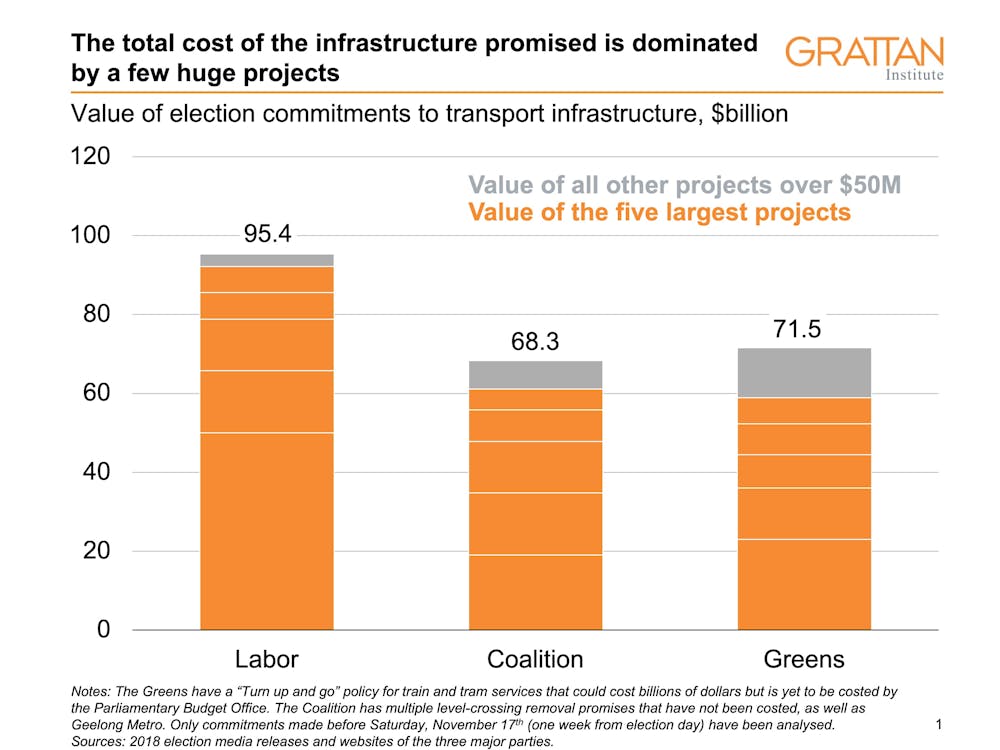
Grattan Institute has crunched the numbers, investigating the major parties’ transport infrastructure pledges worth more than A$50 million. Although cost is a cause for concern, the recent trend towards first conducting business cases is encouraging.

How did we get here?

Population growth has been a big topic in the lead-up to Saturday’s state election. Politicians often cite it as the cause of ever-worsening congestion, despite evidence that Australia’s cities are actually coping quite well.


Read more: Our fast-growing cities and their people are proving to be remarkably adaptable


It’s often assumed that a city’s transport infrastructure needs to grow at the same rate as population. This misconception allows politicians to promise popular mega-projects in the name of busting congestion.

Labor has the most extensive and expensive suite of projects, at a cost totalling A$95 billion. More than half of that is just one project: a A$50 billion suburban rail loop that rings around Melbourne’s middle suburbs and connects most train lines.

The Coalition’s commitments total $65 billion. The difference in the major party totals is mainly due to the smaller scale of the Coalition’s flagship rail project: a A$19 billion promise to deliver “European-style high-speed rail” to Victoria’s regional cities and towns.

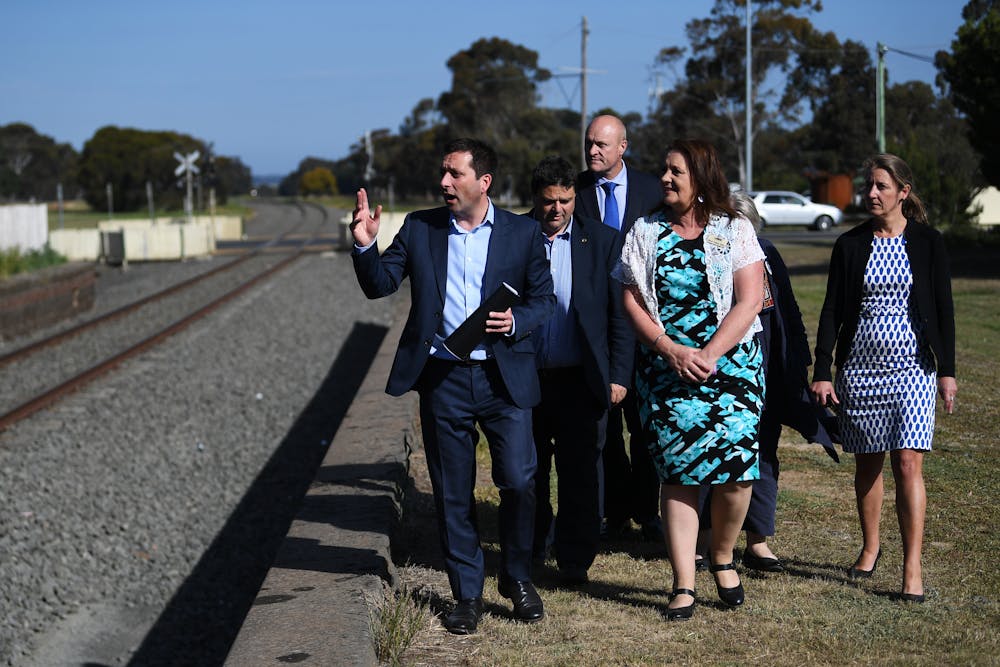
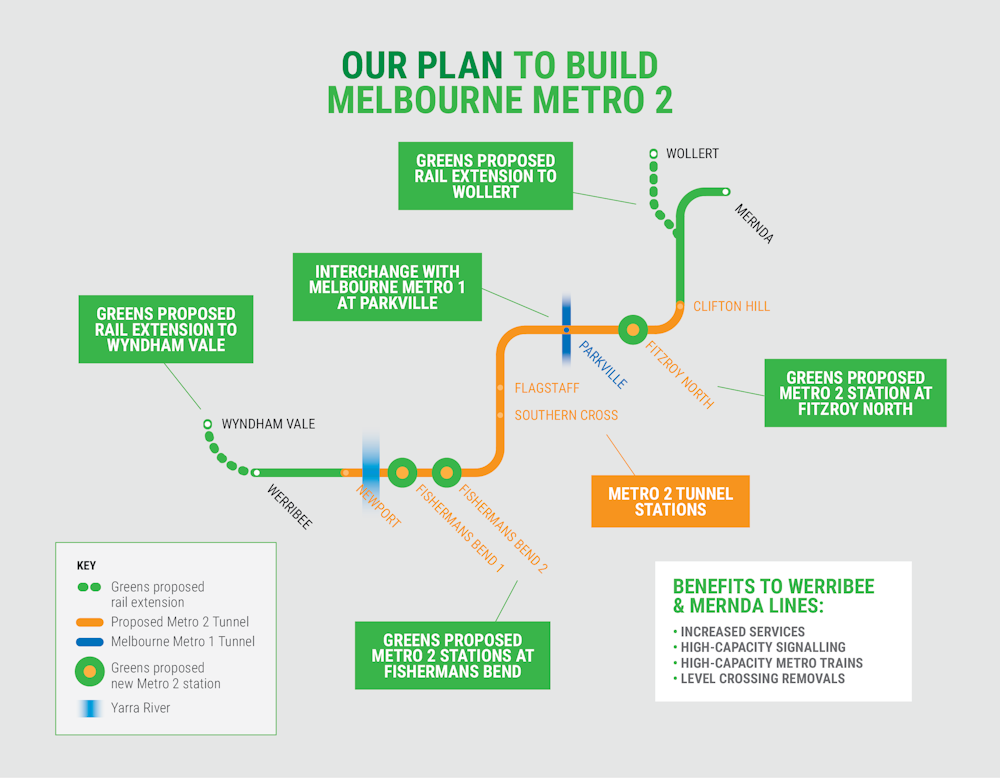
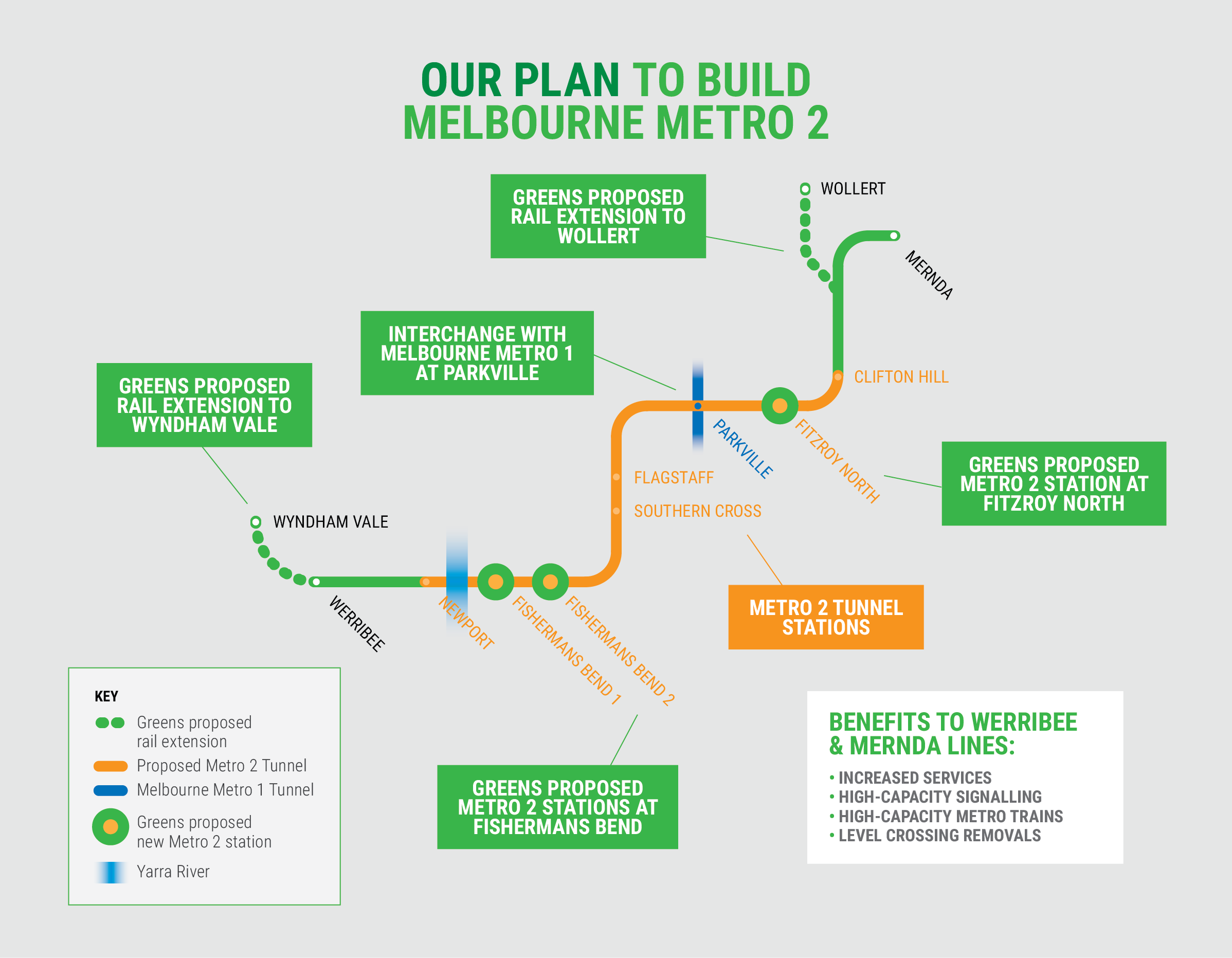
The biggest Victorian Coalition promise is high-speed rail to regional cities and towns, at a cost of A$19 billion. James Ross/AAP The Greens’ promise with the biggest price tag is the A$23 billion Melbourne Metro 2 project (click map to enlarge). The Greens Victoria

The Greens have so far committed to projects worth at least A$72 billion. The largest is Melbourne Metro 2 at an estimated A$23 billion.

These promises mean that every party wants the credit, if elected, for being the government that built the largest transport infrastructure project in our nation’s history. The current title holder, WestConnex in Sydney, totals only A$16.8 billion.

Critics might point out that Labor and The Greens have committed only to business cases for the suburban rail loop and Melbourne Metro 2 respectively. But since two-thirds of infrastructure projects announced with a price tag end up being built, voters are right to treat these promises as commitments to the entire project. Unfortunately, there is no election material with the nuanced message: “We support a business case for this project, which we will have rigorously assessed by an independent body, and if the project’s costs outweigh the benefits, we’ll scrap it.”

No matter who wins on Saturday, the full cost of the promised infrastructure won’t be felt immediately. Many of these projects are slated to run over years or decades and will have an impact on several budgets. Voters have the job of deciding not just where they want their money spent, but their children’s money too.

Total spend isn’t the only difference

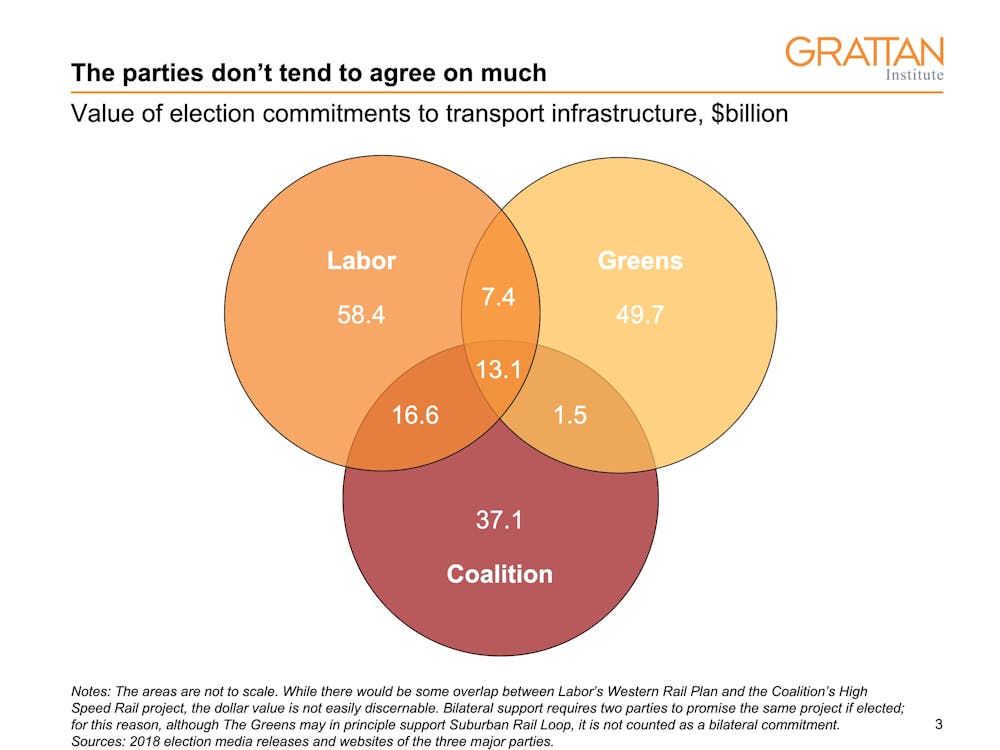
The major parties don’t tend to agree on much, especially around election time. The value of their unilateral pledges exceeds the value of projects with multi-party support.

The largest promised project to have clear support from all three parties is the airport rail link, estimated at A$13 billion. (The Greens support this project but will not be announcing it as a policy until the business case is complete.)


Read more: Melbourne Airport is going to be as busy as Heathrow, so why the argument about one train line?


Parties differ in both what they promise and where they want to build it, and the patterns are fairly predictable.

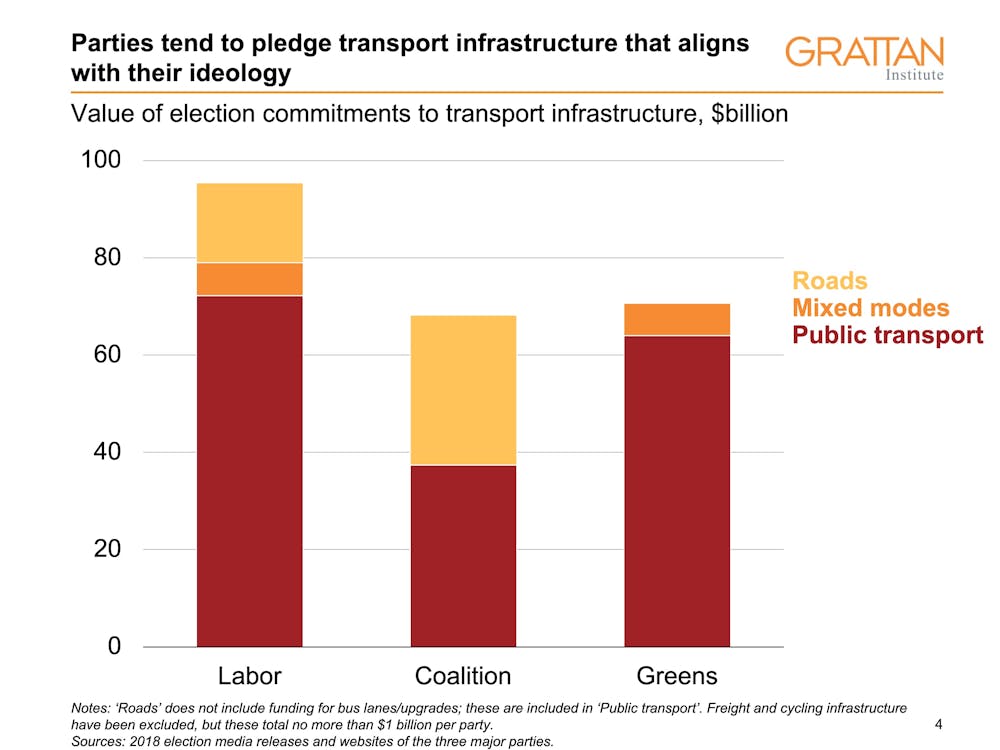
Public transport (particularly heavy rail) is the winner this election, but it’s clear that parties tend to choose projects that fit with their ideology. The Coalition has promised the most for roads. The Greens have focused almost exclusively on public transport.

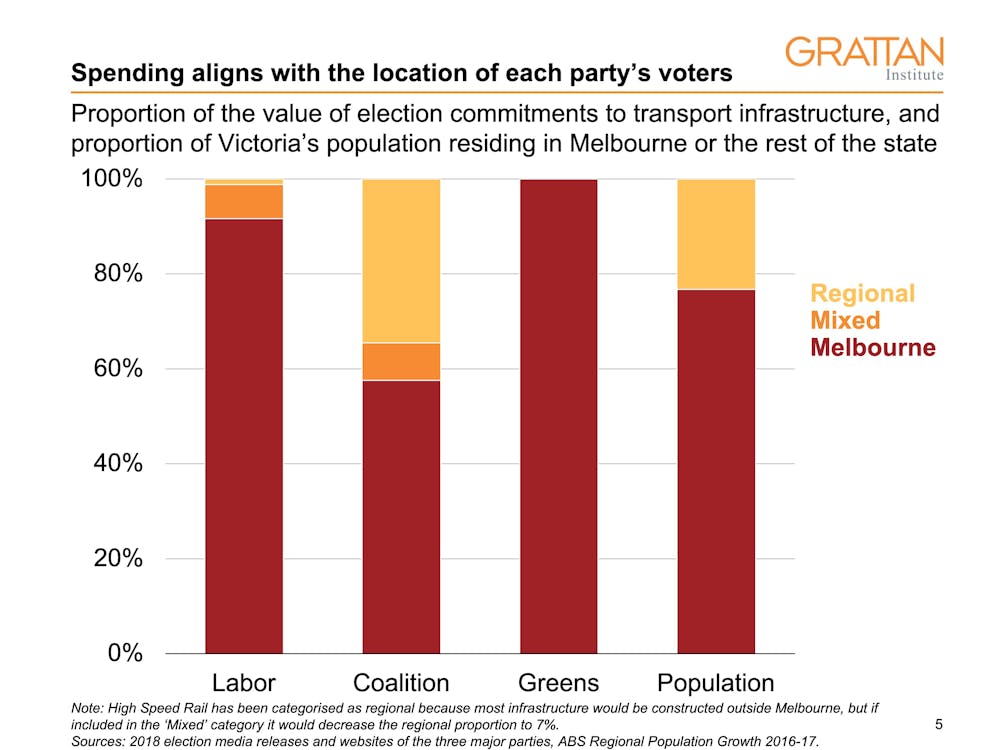
The Coalition’s projects are skewed towards benefiting regional Victorians. Labor and the Greens have announced projects that focus mainly on Melbourne.

These patterns may be influenced by where the parties’ respective voting bases tend to cluster, but also by the demands of different parts of the state. For instance, congestion may be a less salient issue in the regions, so voters there may prefer health or education investment rather than big-ticket transport infrastructure.

Is all this spending wise?

There is often a mismatch between the total cost of a project and how much a party pledges in an election campaign. The discrepancy is due to three factors:

  • only a business case is promised
  • the state government is expected to bear only part of the cost
  • the party has not made the funding arrangement clear.

An interesting phenomenon this election is the practice of pledging a business case only. At first glance, this appears misleading – voters might be enticed by the prospect of a mega-project, yet the party has to fork out only about 1% of the total cost if it wins.

Ideally, parties would have independently evaluated business cases ready before committing to projects, so voters could rest assured that any promised project is a smart one. This is important because projects announced prematurely tend to have the largest cost overruns. And without doing due diligence, there’s not enough evidence that the initiative will deliver enough benefits to justify its price; voters won’t know whether it’s a good use of taxpayer funds until it’s built and they’re stuck with it.


Read more: Spectacular cost blowouts show need to keep governments honest on transport


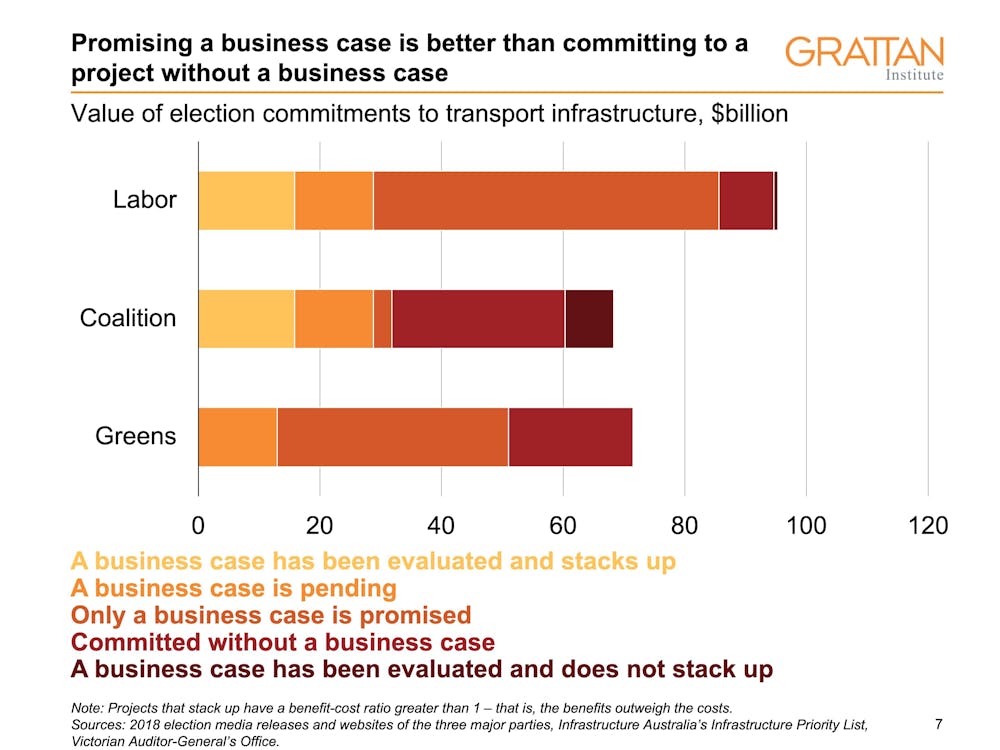
So promising a business case is still better than committing to a project without one – or, worse still, committing to a project that clearly does not stack up.

Both Labor and the Coalition are guilty here. Labor has committed to rail duplication between Waurn Ponds and South Geelong, despite Infrastructure Australia – the nation’s independent advisory body – warning that “the costs of the project outweigh its benefits”. And the Coalition has promised to revive the massive East West Link, despite the Victorian Auditor-General’s criticism of the original project: “… the EWL business case did not provide a sound basis for the government’s decision to commit to the investment”.

Of the infrastructure promised this election, only the North East Link has a business case that Infrastructure Australia has assessed and approved.

But this is a state election and Infrastructure Australia is required to assess only projects of national significance for which more than A$100 million in federal funding is sought. Fortunately, since 2015 Victoria has had its own independent advisory body: Infrastructure Victoria. It set out recommendations for the state in its 30-Year Infrastructure Strategy.

The cost of a suburban rail loop is the main reason most of Labor’s promised spending isn’t in line with Infrastructure Victoria recommendations (click map to enlarge). Victorian government/AAP

The Greens’ platform is most closely tied to these recommendations, both by number of projects and total size. While the Coalition has made the most pledges that do not align with Infrastructure Victoria’s strategy, Labor’s set of non-aligned projects is worth far more, owing mostly to the suburban rail loop.

The huge infrastructure promises this election may excite some voters, but for parties to pledge “visionary” projects outside of what Infrastructure Victoria has recommended smacks of hubris. By building their own glitzy mega-projects without doing due diligence, politicians risk choosing badly and failing to solve the underlying problems voters care about. Worse, the state has a finite budget, so worthwhile projects will have to be relegated to the bottom drawer to make way for the attention-grabbing goliaths.

Going into the polls, Victorians should have one thing on their transport infrastructure wish lists: projects with rigorous and independently assessed business cases. Anything less than that is like buying your kids shoddily manufactured, untested toys. And that may well end in tears once they’re unwrapped.


A note on sources and assumptions: Election commitments were sourced from official party media releases and websites. Only infrastructure promises worth more than A$50 million were considered. Given Labor is in government, only Labor promises pertaining to a “re-elected Andrews government” were included. Judgment had to be exercised to avoid double counting when existing promises were subsumed into later ones. Similarly, care was taken not to double-count projects announced as part of a larger program, such as individual level-crossing removals. Where a party released a range of cost estimates, the largest value was taken.

ref. How much will voters pay for an early Christmas? Eight charts that explain Victoria’s transport election – http://theconversation.com/how-much-will-voters-pay-for-an-early-christmas-eight-charts-that-explain-victorias-transport-election-106782

Fresh thinking: the carbon tax that would leave households better off

]]>

Source: The Conversation (Au and NZ) – By Richard Holden, Professor of Economics and PLuS Alliance Fellow, UNSW

Today, as part of the UNSW Grand Challenge on Inequality, we release a study entitled A Climate Dividend for Australians that offers a practical solution to the twin problems of climate change and energy affordability.

It’s a serious, market-based approach to address climate change through a carbon tax, but it would also leave around three-quarters of Australians financially better off.

It is based on a carbon dividend plan formulated by the Washington-based Climate Leadership Council, which includes luminaries such as Larry Summers, George Schultz and James Baker. It is similar to a plan proposed by the US (and Australian) Citizens’ Climate Lobby.

How it would work

Carbon emissions would be taxed at A$50 per ton, with the proceeds returned to ordinary Australians as carbon dividends.

The dividends would be significant — a tax-free payment of about A$1,300 per adult.

The average household would be A$585 a year better off after taking account of price increases that would flow through from producers.


Read more: Trying to measure the savings from the carbon tax is a mug’s game


If those households also cut their energy consumption as a result of the tax they would be even better off.

And the payment would be progressive, meaning the lowest-earning households would get the most. The lowest earning quarter would be A$1,305 a year better off.

Untaxed exports, fewer regulations

For energy and other producers making things to sell to Australians, the tax would do what all so-called Pigouvian taxes do — make them pay for the damage they do to others.

But Australian exporters to countries without such schemes would have their payments rebated.

Imports from countries without such schemes would be charged “fees” based on carbon content.


Read more: Emissions policy is under attack from all sides. We’ve been here before, and it rarely ends well


This means Australian companies subjected to the tax wouldn’t be disadvantaged by imports from countries without it, and nor would importers from countries with such a tax.

The plan would permit the rollback of other restrictions on carbon emissions and expensive subsidies.

Our estimates suggest the rollbacks have the potential to save the Commonwealth A$2.5 billion per year.

It’s working overseas

Our plan is novel in the Australian context, but similar to one in the Canadian province of British Columbia which has a carbon tax that escalates until it reaches C$50 per ton, with proceeds returned to citizens via a dividends.


Read more: Taxpayers will back a carbon tax if they get a cheque in the mail


Alaska also pays long-term dividends from common-property resources. The proceeds from its oil reserves have been distributed to citizens since 1982, totalling up to US$2,000 per person.

It could be phased in

We would be open to a gradual approach. One option we canvass in the report is beginning with a A$20 per metric ton tax and increasing it by A$5 a year until it reaches A$50 after six years.

The dividends would grow with the tax rate, but the bulk of households would immediately be better off in net terms and much better off over time.

And it would be simple

Our plan doesn’t create loopholes or incentives to get handouts from the government, as have previous plans that directed proceeds to polluters.

It will not satisfy climate-change deniers, but then no plan for action on climate change would do that — other than perhaps the governmment’s direct action policy, which provides a costly taxpayer-funded boondoggle to selected winners.


Read more: The too hard basket: a short history of Australia’s aborted climate policies


But for those who understand that climate change is real, our plan balances the important benefits we gain from economic development and associated carbon emissions against the social cost of those emissions.

It does it in a way that provides compensation to all Australians, but on an equal basis, making the lowest-income Australians substantially better off.

It is the sort of policy that politicians who believe in both the realities of climate change as well as the power and benefits of markets ought to support.

ref. Fresh thinking: the carbon tax that would leave households better off – http://theconversation.com/fresh-thinking-the-carbon-tax-that-would-leave-households-better-off-107177

Why we should worry about Victoria’s China memorandum of understanding

]]>

Source: The Conversation (Au and NZ) – By Peter Lloyd, Professor of Economics, University of Melbourne

Victoria’s Labor government stole a march on the rest of the country last month becoming the first (and only) state government to sign a memorandum of understanding with China under China’s Belt and Road Initiative.

Belt and Road is China’s ambitious plan to lend money to improve infrastructure and other links between it and about 70 other nations that together make up more than 60% of world’s population.


Read more: The Belt and Road Initiative: China’s vision for globalisation, Beijing-style


The Australian government has refused to sign at the federal level where it could have used Belt and Road money to help develop the north. It did this in part because of concerns about China’s strategic intentions. Labor says it is more open to signing.

There’s not much in it

When it signed it in October, Victoria’s Labor government refused to release the text, but it has since done so under pressure ahead of Saturday’s state election.


The memorandum Victoria’s government has made public. Government of Victoria


At first glance, there isn’t much in it, apart from a series of motherhood statements espousing cooperation:

The parties will work together within the Belt and Road Initiative, with the aim of promoting connectivity of policy, infrastructure, trade, finance and people, so as to seek new opportunities in cooperation and inject new momentum to achieve common development to strive to develop an open global economy, jointly combat global challenges and promote the building of a common future.

Also, the agreement makes clear it is not legally binding.

There are risks nonetheless

But the memorandum itself is the equivalent of hanging out a sign saying Chinese infrastructure investment is welcome.

On signing it, Premier Dan Andrews boasted that in four years he had “more than tripled Victoria’s share of Chinese investment in Australia, and nearly doubled our exports to China”. He sees Victoria as leading the development of closer links between the Australian and Chinese economies.

One risk is that Victoria will get projects that don’t pass cost-benefit analysis, a concern overseas.

Another is excessive debt accumulation by Victoria, also a concern overseas where it has led to strategic assets falling into Chinese hands.


Read more: Will an ambitious Chinese-built rail line through the Himalayas lead to a debt trap for Nepal?


In August the current Prime Minister of Malaysia, Mohathir Mohamed cancelled a US$27 billion East Coast Rail Link project and two other pipeline projects that his predecessor had signed as part of the Belt and Road Initiative.

He did so partly on the grounds that the awarding of these projects was linked to corruption in the previous administration and partly on the grounds that they would lead Malaysia to become excessively indebted to China.

He went further, speaking of “a new version of colonialism”.

And they mightn’t be our workers

Another concern is the large scale use of imported Chinese labour.

When read alongside an earlier memorandum of understanding signed as part of the China Australia Free Trade Agreement over the use of Chinese labour on infrastructure projects funded by Chinese partners, it would appear to allow the employment of an unlimited number of Chinese workers.


Read more: Patching the flaws around ChAFTA’s labour provisions


This memorandum signed between the Commonwealth government and China as part of the free trade agreement is lax. It includes no requirement for labour market testing.

Because of the difference in wage rates paid to Chinese and Australian infrastructure workers that would remain even after the imposition of the minimum wages required by the memorandum, the Chinese partner would have a strong incentive to employ Chinese workers.


Read more: FactCheck: could foreign workers be paid less under the China-Australia FTA?


It could mean that although Australia would get the infrastructure, it would miss out on employing Australians to build it.

ref. Why we should worry about Victoria’s China memorandum of understanding – http://theconversation.com/why-we-should-worry-about-victorias-china-memorandum-of-understanding-107135

Why adult video stars rely on camming

]]>

Source: The Conversation (Au and NZ) – By Sophie Pezzutto, PhD Candidate in Anthropology, Australian National University

With pirated and amateur pornography widely available online, porn no longer provides a steady income for many working in the adult industry. During my research interviewing transgender porn stars in Las Vegas, the overwhelming majority of those interviewed said that now, more than ever, they rely on a variety of other income streams beyond the traditional porno shoot with a studio.

Being a porn star today typically involves a range of sex work, from selling self-produced clips, to offering phone sex services, being an escort, taking care of “sugar daddies” (i.e. rich, usually older men), or “camming” on the internet. Previously regarded as not worth the time for many porn stars, using a webcam from the comfort of one’s home to broadcast oneself masturbating or having sex has emerged as a popular choice.

Indeed, while just 15 years ago, pre-recorded porn such as DVDs, pay sites, and clips generated twice as much revenue worldwide as camming, today that ratio has been reversed. In 2018, the camming industry is estimated to generate US$2 billion in annual revenue worldwide, according to Stephen Yagielowicz, a spokesperson for XBIZ, the adult industry’s leading business publication.

The daily life of a cam performer

“Camming” can be likened to an online strip show where the cam performer uses the webcam on their computer to put on a show for anyone in their chat room. The performer usually sets tipping goals and the more people tip by pledging tokens, the more happens on screen.

Typically, it involves numerous sex toys and ultimately orgasm, but many of the shows get very creative. They can feature anything from fortune wheels and costumes, to “couple shows” with partners and guest appearances from other cam performers.

During the show, viewers get to chat with the cam performer, often requesting sexual acts and sometimes simply asking them questions about their life. There are no fixed rules on length and format of a cam show, but it usually takes anywhere from one to four hours. Many of my informants in Las Vegas cam anywhere between two to six hours a day, multiple times a week.

Cam performers usually run sessions in intervals, timing them to coincide with office hours in big cities on the east coast such as New York and Chicago: one cam show in the morning just before offices open, one during lunch break, and one just before people head home to their families.

While not all cam models shoot studio porn, many porn performers are increasingly camming. Established trans porn stars can make anywhere around US $100 – $200 an hour through camming: “As porn performers we are able to leverage our already existing fan base”, one of my main informants explained to me. For last year’s Christmas special her chat room peaked at 30,000 viewers – the average size of a Mets baseball game.

The changing structure of porn

Porn performers in the industry are generally contracted and paid on a shoot by shoot basis. Trans women in porn generally make anywhere between US$800-1,200 for a sex scene that involves penetration (which is slightly higher than the average cisgender performer, but lower than the highest paid cisgender stars). The number of shoots however, fluctuate a lot. A performer can get booked up to six times a month (in some instances even more), but other months they might not get booked at all.


Read more: Explainer: what does it mean to be ‘cisgender’?


“After they’ve shot you a bunch of times, there usually is a month or two where you don’t get any shoots”, one research participant told me. As a consequence, performers may go several months without a single shoot, which makes budgeting extremely difficult.

In addition to this income insecurity, there are numerous expenses not covered by the companies hiring the performers, such as wardrobe, STI testing, transportation, and accommodation costs. “Factoring in all my expenses and the money I lose from not camming, porn does not really make me money”, said one of my informants. “I see porn mainly as a marketing tool for myself.”

Camming is booming and here to stay

Camming has proven itself more resilient to piracy than studio pornography primarily due to the personal nature of cam shows. “For many viewers it is a unique opportunity to interact with their favourite porn star on a regular basis,” one participant remarked. “That’s something they don’t get from regular porn”.

As a consequence the camming industry has boomed and income from it can make up most of even a well-known porn star’s earnings. Work is not only more consistent, but also much safer: “If I focus on making my money with solo shows then I don’t even have to worry anymore about HIV scares in the industry,” one of my participants pointed out after a recent incident.

At the same time however, camming can be very tough work. One informant told me: “some days I end up crying because people either don’t tip you for hours at a time or tip you just to say nasty things”. Further, cam companies, which host web cam performers, take incredibly high commissions of anywhere between 50 – 70% on every dollar earned by the cam performer.

These draw-backs notwithstanding, camming is set to grow with more and more porn stars relying on it to provide a regular income. Given the various risks of much other sex work, this might not necessarily be a bad thing.

ref. Why adult video stars rely on camming – http://theconversation.com/why-adult-video-stars-rely-on-camming-104758

Victoria votes: your guide to the 2018 election health promises

]]>

Source: The Conversation (Au and NZ) – By Vijaya Sundararajan, Professor and Head of Department, Public Health, La Trobe University

With health care spending accounting for 30% of the Victorian budget, or A$20 billion, health is a major policy area for the Victorian election on Saturday.

While the Commonwealth pays for general practice, private specialists, pharmaceutical benefits and aged care, the states are responsible for running hospitals, community health services and ambulance services. They also want to keep Victorians healthy and out of hospital.

This election campaign, Labor has committed $4.3 billion to health; the Coalition has promised $1.3 billion, and the Greens have pledged $1.35 billion. Much of the difference comes down to infrastructure spending.


Read more: Waiting for better care: why Australia’s hospitals and health care is failing


Labor

Labor’s health policy emphasises its commitment to a public health system. A re-elected Labor government would build a new hospital in the western Melbourne suburb of Footscray ($1.5 billion) and spend $1.2 billion on capital improvements to other hospitals in outer suburban Melbourne and regional areas.

Labor’s hospital package also includes $675 million for ten new or upgraded community hospitals. These health services would provide day surgeries, diagnostic imaging and specialist outpatients, in addition to admitted and urgent care.

The remainder of nearly A$1 billion goes to a range of other promises, including:

The boost in hospital funding is likely to enhance care in the hospital catchment areas and ease the pressure on surrounding hospitals. Improved nurse-to-patient ratios will likely improve the safety and quality of care in the state’s emergency departments and hospital wards.


Read more: Why do we wait so long in hospital emergency departments and for elective surgery?


Is it necessary to commit $3.3 billion to hospitals, presumably on top of current levels of funding?

Much of this goes to capital improvements. Without such investments now, the existing hospital capacity in and around Melbourne will not be able to keep up. But it’s unclear where the money will come from to run these extra hospitals and hospital expansions. It’s hoped that operating costs will not then be taken from existing hospitals.

Coalition

The Coalition’s funding commitments are spread across the key sectors of health including:

There is evidence for much of the Coalition’s commitments. In particular, palliative care has been shown in trials to not only improve quality of life, but also, in some cancers, survival.


Read more: Assisted dying is one thing, but governments must ensure palliative care is available to all who need it


Improving access to community care for disadvantaged groups and in rural and regional areas has the potential to improve the management of chronic disease, such as asthma and diabetes, leading to better health in the long term.

Greens

The Greens’ platform is anchored in a social determinants of health and a population health approach that conceives of health more explicitly as an outcome of broader social and economic conditions.


Read more: Want to improve the nation’s health? Start by reducing inequalities and improving living conditions


The Victorian Greens party’s main priorities are:

The Greens’ funding for free ambulance services would ensure nobody misses out on timely care for traumatic injuries and heart attacks because they don’t have ambulance cover. A similar program operates in Queensland.

The Greens have a well-developed policy, conceiving of health and well-being broadly. The package includes substantial commitments to mental health, community health care and dental health.

But there is no extra funding for hospitals beyond the current budget.

Ambulance services would stand to benefit $668 million if the Greens were elected. AAP/Julian Smith

Comparing the three parties

The biggest difference in the health funding commitments between the three parties is Labor’s focus on hospital infrastructure funding (which accounts for 78% of its health promises). It’s not clear whether the Coalition and the Greens oppose the bulk of Labor’s hospital commitments or are simply silent.

Although this level of funding to hospitals may seem like an inordinate amount, it’s important to consider the role of modern hospitals. They have become the providers of not only admitted care, but emergency care (including GP-type visits), specialist care in outpatient clinics, chronic disease management and palliative care.

When this hospital infrastructure funding is taken out of consideration, the three parties are hard to distinguish. Labor is promising $960 million, Coalition is pledging $816 million and the Greens have committed $1.3 billion to a range of community, mental health, ambulance, chronic disease and prevention services.


Read more: If we’re to have another inquiry into mental health, it should look at why the others have been ignored


The most evident gaps are Labor’s lack of funding for prevention and innovation, and the Greens’ lack of extra hospital capital funding.

A change to the Coalition would likely mean less hospital funding, particularly for a new Footscray hospital, but significant funding for community palliative care services and hospital in the home.

A more comprehensive list of the three parties’ election health promises is available on the Victorian Healthcare Association’s Election Alert.

ref. Victoria votes: your guide to the 2018 election health promises – http://theconversation.com/victoria-votes-your-guide-to-the-2018-election-health-promises-106698

Hundreds of protesting PNG police move in on Parliament over pay

]]>
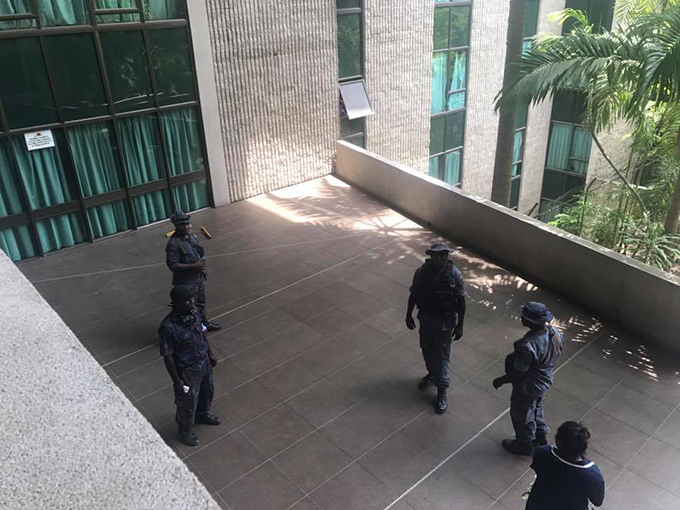
PNG security forces protesting in Waigani over unpaid APEC security allowances. Image: Loop PNG

By RNZ Pacific

Hundreds of Papua New Guinea police have descended on Parliament Haus in the Port Moresby suburb of Waigani demanding payments they say they are owed for providing security at last weekend’s APEC leaders summit.

RNZ Pacific’s correspondent in PNG, Melvin Levongo, said multiple police vehicles with armed police were involved.

He said police were demanding to speak with Prime Minister Peter O’Neill and APEC Minister Justin Tkatchencko about the extra allowances they were owed.

READ MORE: Reporters attacked as security forces move into Parliament Haus

Levongo said a policeman told him they were very angry at the government.

“You guys have got money to purchase Maserati cars but we are asking for our allowance, so that’s the situation currently at the moment,” he said.

-Partners-

Levongo said traffic had been halted in and around Parliament Haus, and that there was no military involvement in the protest.

Photographs are circulating on social media showing damage at Parliament Haus, including broken glass windows and doors for which PNG police are said to be responsible.

Opposition Madang MP Bryan Kramer’s Facebook page shows hallways and lobbies that have been trashed and an image of startled shadow ministers whose meeting was interrupted.

This article is republished under the Pacific Media Centre’s content partnership with Radio New Zealand.

PNG security forces on guard at Parliament Haus in Waigani today. Image: Brian Kramer FB Opposition Madang MP Bryan Kramer speaking in a live Facebook feed about today’s protest at Parliament Haus. Image: Bryan Kramer FB



Print Friendly, PDF & Email

Article by AsiaPacificReport.nz

Former PM Sir Mekere blasts ‘lavish staging’ and ‘ridicule’ of APEC

]]>

NZ Foreign Minister Winston Peters announces a K22 million (NZ$10 million) aid project to help polio vaccination for Papua New Guineans at the St John Ambulance Operations Centre in Port Moresby. Video: EMTV News

Pacific Media Centre Newsdesk

A former prime minister has accused Papua New Guinea’s current leader Peter O’Neill of exposing the country to “international ridicule and criticism” over the lavish staging of APEC and failure of the meeting to make the customary Leaders’ Declaration for the first time in its history.

Sir Mekere Morauta, MP for Moresby North West in the nation’s capital, today declared in a statement: “APEC has revealed to the world the corruption, waste and mismanagement within the O’Neill government, and their devastating effects on the nation and citizens.”

He said the leaders summit had shone an international spotlight on O’Neill’s “crude and cynical attempts to play one nation against another”.

READ MORE: PNG security forces strike at Parliament for unpaid APEC allowances

Sir Mekere also accused the prime minister and lacking an ability to understand the nuances of international relations and the dramatic geopolitical changes happening in the region.

NZ Foreign Minister Winston Peters at St John Ambulance Operations Centre in Port Moresby yesterday. Image: EMTV News


-Partners-

“What should have been a moment for PNG to shine on the international stage instead descended into chaos, including embarrassing diplomatic incidents, international media allegations of financial and procedural impropriety and organisational disarray,” Sir Mekere said.

“Papua New Guinea’s international standing has been diminished.”

The former PM said the issue for Papua New Guinea was not a failure of the international APEC organisation, the countries involved, or of PNG’s professional diplomats – it was an issue of failed leadership.

Quality of life
Sir Mekere said PNG should not have hosted APEC in the first place.

The K3 billion “lavished” on the event should have been spent on improving the quality of life of ordinary Papua New Guineans.

“Instead we have preventable diseases such as polio, leprosy, TB and malaria surging and people dying – 21 children are now known to have contracted polio,” Sir Mekere said.

“Many schools are closing across the nation. Public servants are not being paid properly and other entitlements such as superannuation payments are being withheld.

“Essential infrastructure outside Port Moresby is crumbling into the dust, and government systems and processes are failing by the day.”

However, Prime Minister O’Neill said he had made history in inviting Pacific Island leaders to take part in the APEC leaders summit, reports the PNG Post-Courier.

“I know Australia, New Zealand and PNG are active members of APEC, but there are also countries within the Pacific region that have their own story to tell,” O’Neill said.

Reception dinner
He said this when he led the Pacific leaders to a reception dinner hosted by Australian Prime Minister Scott Morrison at the Australian High Commission residence last night.

Pacific leaders who attended included Samoa Prime Minister Tuilaepa Sailele Malielegaoi, Vanuatu Prime Minister Charlot Salwai and the Prime Ministers of the Cook Islands, Solomon Islands and Tonga.

“I would like to thank the Pacific leaders for joining us here at the margins of the APEC meeting.

“Again [the reason] to bring the Pacific Island leaders’ to APEC is that we don’t want to be forgotten out of the APEC community,” O’Neill said.

Print Friendly, PDF & Email

Article by AsiaPacificReport.nz

Poll wrap: Labor’s worst polls since Turnbull; chaos likely in Victorian upper house

]]>

Source: The Conversation (Au and NZ) – By Adrian Beaumont, Honorary Associate, School of Mathematics and Statistics, University of Melbourne

This week’s Fairfax Ipsos poll, conducted November 14-17 from a sample of 1,200, gave Labor just a 52-48 lead, a three-point gain for the Coalition since October. Primary votes were 37% Coalition (up two), 34% Labor (down one), 13% Greens (down two) and 5% One Nation (steady). As usual, the Greens are too high in Ipsos and Labor too low.

This poll is the Coalition’s best result from any pollster since Malcolm Turnbull was ousted. Last week, Newspoll gave Labor a 55-45 lead, and it is unlikely Labor lost three points in a week. Ipsos is the most volatile Australian pollster. However, Essential (see below) confirms Ipsos by also shifting to a 52-48 lead for Labor.

Respondent allocated preferences in Ipsos were 53-47 to Labor, one point better for Labor than the previous election method. Under Turnbull, Labor usually performed worse on respondent preferences, but the three Ipsos polls under Scott Morrison have Labor tied or ahead of the previous election method using respondent preferences. A stronger flow to Labor from the Greens and non-One Nation Others could be compensating for weaker flows from One Nation.

48% approved of Morrison (down two), and 36% disapproved (up three), for a net approval of +12. Last week’s Newspoll gave Morrison a -8 net approval; although Ipsos gives incumbent PMs much better ratings than Newspoll, the difference is very large this time. Bill Shorten’s net approval was up one point to -7. Morrison led Shorten by 47-35 as better PM (48-35 in October).

46% thought Muslim immigration should be reduced, 35% remain the same and 14% increased. In October, a question about all immigration found 45% wanted it reduced, 29% wanted it to stay the same, and 23% increased.

47% thought the government’s main priority on energy policy should be reducing household bills, 39% reducing carbon emissions and 13% reducing the risk of power blackouts. Labor will attempt to convince people that clean energy can be consistent with cheap energy.

I think the shift to the Coalition is more likely due to last week’s economic data than the Bourke Street attack. On November 14, the ABS reported September quarter wage growth data; according to The Guardian’s Greg Jericho, wages are growing more than inflation for the first time since 2013. On November 15, the ABS reported that 33,000 jobs were added in October, with the unemployment rate stable at 5.0%.

On November 14, Westpac reported that consumer sentiment increased 2.8% from October to 104.3 in November. If people feel good about their personal economic situation, it is more likely they will feel good about the government.

Essential: 52-48 to Labor

This week’s Essential poll, conducted November 15-18 from a sample of 1,027, gave Labor a 52-48 lead, a two-point gain for the Coalition since last fortnight. Primary votes were 37% Coalition (up one), 35% Labor (down four), 11% Greens (up one) and 7% One Nation (up one).

44% said their vote was very firm and unlikely to change, including 50% of Labor voters and 46% of Coalition voters.

By 35-28, voters thought the Liberal government and its ministers were poor, but they also thought the Labor opposition and its shadow ministers poor by 33-28. By 36-35, voters thought the Labor team would do a better job of governing than the Liberal team.

On a range of issues, more people thought the government was not doing enough than doing enough, particularly on the ageing population (67-17), transitioning to renewable energy (64-14) and affordable housing (64-16).

In additional questions from last week’s Newspoll, voters thought Shorten and Labor had the best approach to improve housing affordability by 45-35 over Morrison and the Coalition. By 47-33, voters were in favour of reducing negative gearing tax concessions (54-28 in April 2017).

Micro parties likely to win several seats in Victorian upper house

The Victorian election will be held on November 24. There have been no statewide media-commissioned polls since a late October Newspoll (54-46 to Labor). A ReachTEL poll for a left-wing organisation, conducted November 13 from a sample of 1,530, gave Labor a 56-44 lead, which would be a four-point gain for Labor since an early October ReachTEL poll for The Age.

I would like to see a media poll before concluding that the Victorian election will be a blowout win for Labor, but Labor is likely to win.

The Victorian upper house has eight five-member electorates. A quota is one-sixth of the vote, or 16.7%. During the last term, Labor never proposed any reforms to the upper house group voting system. As a result, there are many micro parties who are swapping preferences with each other so that one of them has a good chance of election.


Read more: Victorian ReachTEL poll: 51-49 to Labor, and time running out for upper house reform


According to analyst Kevin Bonham’s simulations of upper house results, seven micro party representatives could be elected. While the particular micro party that wins could change, the overall numbers probably won’t unless the major parties and Greens do much better than expected, or there is a much higher rate of below-the-line voting.

The Greens in particular appear likely to lose seats that they would win with a sensible system. Labor may well have shot themselves in the foot by sticking with group ticket voting; with a sensible system, Labor and the Greens would probably win an overall upper house majority. Conservative micro party members are likely to stall progressive legislation.

It is easy to vote below-the-line in Victoria, as only five numbers are required for a formal vote, though voters can continue numbering beyond “5”. I recommend that voters number at least five boxes below-the-line, rather than voting above-the-line, where parties control their voters’ preferences. If enough people vote below-the-line, the micro parties’ preference harvesting could be thwarted.

UK’s Brexit debacle could lead to Labour landslide; Greens surge in Germany

Last week, UK PM Theresa May did a deal with the European Union regarding Brexit, but Brexit Secretary Dominic Raab and other ministers resigned in protest. It is likely that the UK House of Commons will reject the deal, owing to opposition from both the hard right and the left. A “no deal” Brexit is likely to greatly damage the UK economy, and could lead to a Labour landslide.

In March 2018, the German Social Democrats re-entered a grand coalition with the conservative Union parties – the same right/left coalition that governed Germany in three of the last four terms. Both the Union parties and Social Democrats have lost support, but it has gone much more to the Greens than the far-right AfD.

You can read more about Brexit and the German Greens’ surge on my personal website.

ref. Poll wrap: Labor’s worst polls since Turnbull; chaos likely in Victorian upper house – http://theconversation.com/poll-wrap-labors-worst-polls-since-turnbull-chaos-likely-in-victorian-upper-house-107176

We still live here: public housing tenants fight for their place in the city

]]>

Source: The Conversation (Au and NZ) – By Pratichi Chatterjee, PhD Student, Urban Geography, University of Sydney

After years of strong housing market growth, Sydney’s property market is slowing. Despite this, housing stress remains a reality for many Sydneysiders, with rents remaining largely untouched.

Public housing is a lifeline for those who can’t afford to rent in the private market, but the numbers of households in this position means many must wait years for a place.

Median rents for apartments in Sydney fell only 0.9% in the September quarter, to $545 a week. This means a household needs to earn about $94,000 a year to avoid housing stress. About half of the households in Sydney earn less than this.

Adding to these cost pressures, tenancy laws are strongly weighted in favour of landlords. This gives tenants little security of tenure and exposes them to frequent upheaval, inadequate conditions and rental hikes.


Read more: An open letter on rental housing reform


But public housing tenants are also facing upheaval and uncertainty in inner-city areas such as Waterloo and Redfern, as a result of redevelopments that they feel are aimed at pushing their communities out of the city.

What is happening to public housing?

The lack of public housing investment in New South Wales and the costs of private rental mean over 50,000 people are on the state waiting list. In inner-city areas, they face a wait of five to ten years for public housing.

Through the Communities Plus program and the Social and Affordable Housing Fund, the NSW government plans to build 27,000 more social and affordable homes. But this figure is somewhat misleading. In the last three years, the government has sold off half as much public housing as it has built. And the figure of 27,000 looks more like 9,900 when you consider that this includes around 17,000 dwellings that will be demolished and rebuilt.

Several of the housing estates that remain will undergo massive redevelopment. One of these projects involves Sydney’s largest inner-city public housing estates, in Waterloo. The redevelopment will transform it into a mixed estate of 70% private housing and 30% social housing, going from just over 2,000 dwellings to potentially more than 7,000.

Residents fear being pushed out

The Waterloo redevelopment will produce a mixed estate of 30% social housing and 70% private. Carol Tang, Author provided

Since the redevelopment was announced in 2015, we have been working with the residents of Waterloo to understand their experience of the redevelopment. Many residents feel the project is a ploy to “move the poor people out of the city”, as one of them put it.

While the government has promised everyone the right to return, there is still a huge amount of uncertainty. And this is justified given that, like many large infrastructure projects conceived during Sydney’s boom time, the Waterloo project will be subject to many changes and delays.

Residents of the Matavai and Turanga towers installed coloured lights in their windows to make a statement: ‘We live here’. Nic Walker, Author provided

The residents of Waterloo, however, will not go quietly. “People are trying to speak up,” says Maryanne Laumua, a Waterloo tenant and key team member of the WeLiveHere2017 project.

One of the ways that residents are speaking up is by making their presence known on Sydney’s skyline. In September 2017, residents in the tallest of Waterloo’s towers, Matavai and Turanga, installed coloured lights in their apartment windows to make a statement: “We live here”. The residents’ efforts are chronicled in a new ABC documentary, There Goes Our Neighbourhood.


Read more: We Live Here: how do residents feel about public housing redevelopment?


A long history of displacement

A history of displacement through colonialism, redevelopment and evictions has shaped Waterloo and neighbouring Redfern. The Gadigal people were violently dispossessed of their country after European invasion. Throughout the last century, “slum clearance” displaced many working-class households.

The demolition of The Block in Redfern removed many Aboriginal families from their homes. The redevelopment in neighbouring Waterloo comes at a time when approval has been given to redevelop The Block. The Redfern development includes construction of student housing that seems to have priority over affordable Indigenous housing.

These areas also have a long history of organising against displacement. Waterloo residents joined with the unions as part of the 1970s Green Bans campaigns to limit the destruction of working-class housing in the suburb. Jenny Munro and other Aboriginal leaders have campaigned tirelessly for the rights of their community, which includes a years-long tent embassy protest on the site of The Block.

The redevelopment of Waterloo’s public housing estate will hardly make a dent in easing housing pressure in Sydney. And as Waterloo resident Karyn Brown puts it:

To solve the city’s housing crisis, they are picking on public housing tenants, those on the second rung of the housing ladder.

Waterloo tenants resisting the redevelopment are concerned that it’s a form of state-led gentrification. They see the notion of “social mix” — the idea that introducing private owners and tenants can “fix” disadvantaged communities — as a smokescreen for the class upgrading of their neighbourhood. Indeed, there is little empirical evidence to support the notion that social mix can solve a community’s problems.


Read more: Social mix in housing? One size doesn’t fit all, as new projects show


Rather than a project intended to alleviate their disadvantage, many tenants feel that “social mix” is both classist and racist. As Lorna Munro and Joel Sherwood-Spring put it, the dilution of the existing community including the Aboriginal population is simply a continuation of the colonial project.

The residents of Waterloo’s public housing might be far from the city’s wealthiest residents, but they’ve got fighting spirit and community pride in spades. As There Goes Our Neighbourhood shows, this community is diverse, creative and determined to fight for their right to remain in the city.


There Goes Our Neighbourhood airs on ABC on Tuesday, November 20, at 9.20pm.


Read more: Class divide defies social mixing and keeps public housing stigma alive


ref. We still live here: public housing tenants fight for their place in the city – http://theconversation.com/we-still-live-here-public-housing-tenants-fight-for-their-place-in-the-city-107188

Fiji women have confidence that their gender in politics will hear their voices

]]>
SODELPA’s Lynda Tabuya … “breath of fresh air” in Fiji politics. Image: Wikimedia Commons

By Koroi Tadulala in Suva

The role of women in every segment of society is vital and this is slowly been reflected through more women contesting political spaces in Fiji.

This year recorded the highest number of women contesting the country’s general election compared to previous elections – and also the highest number elected.

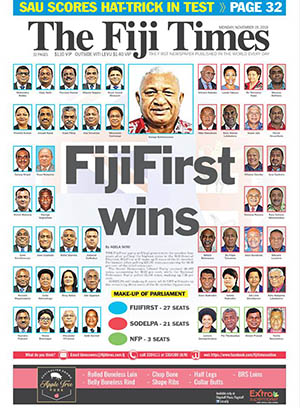
The new 51-seat Parliament includes 10 women, five in government and five in the opposition.

READ MORE: 2018 Fiji elections – the ‘fake news’ catchphrase of this ballot but beware

The highest polling woman, SODELPA’s Lynda Tabuya – a talented lawyer and former beauty queen described by media as a “breath of fresh air”, being the fifth highest of the successful MPs.

Speaker of Parliament Dr Jiko Luveni says this the success of women is “wonderful news” and she is expected to continue as Speaker.

-Partners-

A total of 56 women from all 6 political parties contested this year hoping to represent women and their issues in political debate.

Amelia Qalituraga, 40, of Banaras Lautoka, is delighted that more women stood for election despite politics being a male-dominated field in this country.

Grassroots support
While casting her vote last Wednesday, she expressed hope that women in Parliament would be able to help out women at grassroots level, especially over the minimum wage rate.

“Working as a cleaner at the rate of $2.70 an hour hasn’t been any easy for me and my family,” she says.

“Na veika ga keimami kerea jiko vei ira na marama era na curu I Palimedi me ra rogoci keimami kei na neimami gagadre,” she added. (The only thing we want from women representatives is to listen to our needs and voices.)

With the rise in sexual assault and rape cases victimising women, Qalituraga hopes that women in Parliament will be able to make a change.

“Na levu ni sexual assault kei na rape sa yaco tu ni kua, au sa vavinavinaka saraga ni na rawa ni rogoci na neimami gagadre.” (With the rise in sexual assault and rape cases against women, I believe that women in political spaces will be able to listen to our concerns now).

Krishneel Vikash Chand, a 21-year-old student at the University of Fiji, says “only a woman will be able to understand the needs of other women and their issues”.

“I think it’s good to have more women in politics because it gives women more empowerment,” he adds.

Better represented
Chand says the idea of women being part of the decision making process would allow women to be better represented and ensure their voices are heard.

Despite the positive response from most people about women competing in political spaces,  some prefer men to address their issues rather than women.

Madhuri Nair … supports idea of empowerment for women but prefers men to address women’s issues. Image: Wansolwara

Madhuri Nair, of Field 40, Lautoka, likes the idea of women empowerment but prefers men to address women’s issues.

“I think it’s good that more women are participating in political spaces, however, I want men to solve women’s issues because sometimes women don’t think nicely.”

Despite the mixed responses from people around Lautoka, it is clear women at the grassroots level want their voices heard and issues to be addressed.

  • Premila Kumar, Selai Adimaitoga, Veena Bhatnagar, Mereseini Vuniwaqa and Rosy Akbar are included in the 27-member FijiFirst-led government while Social Democratic Liberal Party members Lynda Tabuya, Ro Teimumu Kepa, Salote Radrodro, Adi Litia Qionibaravi and National Federation Party member Lenora Qereqeretabua are included in the 24-member opposition.

Koroi Tadulala is a final-year student journalist at the University of the South Pacific. This article is republished under the content sharing arrangement between USP’s Wansolwara student journalism newspaper and AUT’s Pacific Media Centre.

Print Friendly, PDF & Email

Article by AsiaPacificReport.nz

Bainimarama wins again in Fiji, helped by muzzling the media, unions and the church

]]>

Source: The Conversation (Au and NZ) – By Dominic O’Sullivan, Associate Professor of Political Science, Charles Sturt University

Former coup leader Josaia Voreqe “Frank” Bainimarama has won re-election in Fiji. But he did so in a country where press freedom is severely limited, and authoritarian rule is used to curb dissent – even from the once highly influential Methodist church.

The election, held on November 14, saw fairly weak voter turnout – though its conduct was fair according to an international observer mission co-chaired by Jane Prentice, a federal Government MP from Queensland.

A more complicated story lies behind the Multinational Observer Group’s preliminary view that the election is “on track to reflect the will of the… voters”.


Read more: Two past coup leaders face off in Fiji election as Australia sharpens its focus on Pacific


Bainimarama seized power in a coup in 2006 before holding an election in 2014. He invited the group to observe to satisfy the international community of Fiji’s return to democratic stability. His Fiji First party will form government after winning 50.02% of the vote.

The Social Democratic Liberal party (SODELPA), led by Sitiveni Rabuka, another former Prime Minister and coup leader, won 39.85% of the vote. The National Federation Party will take the remaining three seats in the 51 member parliament.

Rabuka once characterised democracy as a “foreign flower unsuited to Fijian soil”. The key point here, as I have argued, is that restrictions on free speech means that there is no way of testing popular Fijian opinion.

Former prime minister and coup leader Sitiveni Rabuka, who lost the latest election, in a 2006 file photo. Dean Lewins/AAP

The Multinational Observer Group described the election as only a “step” towards democracy. Four of the opposition parties say the provisional results don’t match what their scrutineers observed. SODELPA argues that the complicated voter registration process meant that 30,000 citizens were turned away from polling stations. They were allegedly told that they were not properly registered. In a strong democracy, the claim would at least be possible to verify.


Read more: Fiji coup leader gets the democratic approval he wanted


Poor weather, which saw voting suspended and rescheduled at 23 polling stations, undoubtedly played a part, but voter turnout of between 53% and 61% across polling stations is a sign of democracy not working to its potential. The Fijian media is unlikely to analyse voter turnout, nor any aspect of the election’s conduct.

The Fiji Times’ limited and shallow coverage of the election campaign reflects its turbulent relationship with the Media Industry Development Decree and other laws and practices that restrict impartial political journalism.

The Fiji Times no longer leaves blank spaces where banned stories would have been published. However, the newspaper and its editor have been found guilty of contempt of court for publishing an article critical of the judiciary and, while ultimately acquitted, the newspaper was charged with sedition in 2018.


Read more: Fiji’s media still struggling to regain ‘free and fair’ space


The requirement for journalistic “quality, balance, (and) fair judgement” and penalties for non-compliance are set out in an act of parliament. The act is selectively enforced. The Fiji Sun is polemical and partisan. SODELPAs “false propaganda” is the newspaper’s “analysis”’ of the 10 percentage point drop in support for Fiji First from the 2014 to the 2018 election.

Under normal circumstances, the unprecedented number of government initiatives rolled out across the country in the last four years should have been enough to carry Fiji First to a bigger victory.

There can be no independent scrutiny of the Fiji Sun’s claim that the “abnormal” circumstances of the 2018 campaign included SODELPAs “strong pro-indigenous campaign (being) riddled with lies”.

It is true that the Fijian economy has grown at an annual average of 3.6% over the past five years. It is also true that investment in education, health and transport infrastructure have improved people’s standards of living.

Yet, there are no conventions of caretaker government to moderate the use of incumbency for political gain. The Multinational Observer Group has indicated it is likely to recommend “against government ministers and senior officials conduct(ing) a range of high profile activities, such as concluding commercial contracts, opening buildings and dispensing government grants and funds during the campaign.”

Restrictions on freedom of association have been used against trade unions which object to Bainimarama’s authoritarian style. They have been used against the Methodist Church which preaches a strong indigenous nationalism and has been a key influence in previous election campaigns.

Former Australian foreign minister Julie Bishop, posing with Australian defence force personnel, during a visit to Fiji in 2013. Rashida Yosufzai/AAP

Bainimarama’s Fiji First’s indigenous policy is based on multiracial equality as a path to the disruption of aristocratic self-interest. It is the only party to have significant multiracial diversity in its parliamentary membership.

SODELPA makes the case for custom and tradition in public life. For a formal political role for the Great Council of Chiefs and a comprehensive review of the 2013 Constitution.

It may have been a free vote. But the conditions for an informed vote – scrutiny and robust debate – were not present. Bainimarama had military support; significant under a constitution that gives the military overarching authority for the “well-being” of Fiji and all its citizens. This perhaps helps explain the argument that: “one reason for the return of elections is that Bainimarama is confident of winning them”.

Bainimarama’s position is secure. Fiji’s political stability is assured – but only for the moment. Democratic institutions are not strong. One cannot be sure that they enjoy durable public support. Fijian politics beyond Bainimarama is uncertain, unpredictable and insecure.

ref. Bainimarama wins again in Fiji, helped by muzzling the media, unions and the church – http://theconversation.com/bainimarama-wins-again-in-fiji-helped-by-muzzling-the-media-unions-and-the-church-107192

Indonesia matters to us, and always has. Why the relationship will survive Morrison’s Jerusalem thought bubble

]]>

Source: The Conversation (Au and NZ) – By Tim Harcourt, J.W. Nevile Fellow in Economics, UNSW

All hell broke loose during the Wentworth by-election when Prime Minister Scott Morrison suddenly announced that he was thinking of moving of Australia’s embassy in Israel from Tel Aviv to Jerusalem.

The main objections came, not on merits of the idea itself, but on whether it would upset Indonesia, the nation with whom Australia had just completed a landmark, but unsigned, free trade agreement and the nation with the world’s largest Muslim population.

The agreement is now unlikely to be signed for quite some time. In a face to face meeting with Indonesian President Joko Widodo last week that was intended to clear the way, Morrison was instead pressed about the Middle East.


Read more: How will Australia’s plan to move its embassy to Jerusalem affect relations with Indonesia?


But how important is the Indonesian trade relationship really? And would it be folly to sacrifice it on the altar of Middle East politics?

Why the relationship matters

Australia and Indonesia have been entwined for a long time.

What is now Indonesia is almost certainly the Australian continent’s oldest trading partner.

Indigenous Australians fished and traded sea cucumber and other goods with their Makassan counterparts from at least the least the early 1700’s. Makassar is in the south-west corner of the Indonesian province of Sulawesi.


Read more: What Indonesia expects from Australia’s new Prime Minister Scott Morrison


Australia provided critical support as what was then known as the Dutch East Indies fought for independence from the Dutch after the end of the second world war.

The Australian government provided medical supplies. Australian waterside workers refused to load Dutch ships.

Australia has helped in times of need

These close ties continued 50 years later during the late 1990s Asian financial crisis when the Reserve Bank of Australia clashed with the International Monetary Fund and Clinton administration, who wanted to impose tough conditions on Indonesia in return for bailing it out.

Australia’s Treasurer Peter Costello took the advice of Reserve Bank Deputy Governor Stephen Grenville, who had been a diplomat in Jakarta, and stared down the IMF and the United States.

As a result the Indonesian economy fared much better, recovered more quickly and avoided much of damage endured by other developing economies that had done as the IMF wanted.


Read more: Australian universities to benefit in Australia-Indonesia free trade deal


Two decades on, Indonesia is one of Australia’s top 15 trade partners, worth A$16.5 billion in two-way trade, and one of the biggest markets for Australian education.

There’s room for growth

In many ways, Indonesia is underdone as a partner for Australia.

It houses abound 262 million people but only around 250 Australian companies of any size, compared to more than 3,000 in China.

Among the companies that do have a big presence are the ANZ, Leightons, the Commonwealth Bank, Orica and Bluescope.


Read more: Indonesia’s knowledge sector is catching up, but a large gap persists


Its attractions are a massive and growing urban middle class and its need for infrastructure given the logistical challenges of connecting a huge population living across over 17,000 islands.

The relationship will survive Jerusalem

A free trade agreement is important to both sides, whatever political rhetoric President Widodo might need to employ to hold off his fundamentalist opponents.

Morrison told Widodo he would decide on the location of Australia’s Israel embassy by Christmas. The trade deal is likely to be signed soon after.

ref. Indonesia matters to us, and always has. Why the relationship will survive Morrison’s Jerusalem thought bubble – http://theconversation.com/indonesia-matters-to-us-and-always-has-why-the-relationship-will-survive-morrisons-jerusalem-thought-bubble-107145

Elephants and economics: how to ensure we value wildlife properly

]]>

Source: The Conversation (Au and NZ) – By Michael Vardon, Associate Professor at the Fenner School, Australian National University

Ensuring the economic health of nations is one of the biggest tasks expected of governments. The elephant in the room has long been the health of the environment, on which the health of the economy (and everything else) ultimately depends.

Most countries still rely on gross domestic product as the lead measure of their economic health. But this does not account for the loss of environmental condition. There is a growing recognition of the environmental damage that human activity causes, our dependence on a functioning environment, and the need for new approaches to measure and manage the world.

We hope this new idea can be advanced internationally at the two-week meeting of the Convention on Biological Diversity, which began this week in Sharm El-Sheikh, Egypt.


Read more: Why we need environmental accounts alongside national accounts


Integrating the environment into national accounts has long been suggested as a way to improve information and has been tried in several countries.

In Botswana, where elephants are included in the nation’s environmental accounts, spending on wildlife conservation is now seen as an investment, rather than a cost. This example shows how integrating environmental assets into economic data can help provide a new policy framing for conservation. But worldwide, this type of “expanded accounting” has had limited impact on policy decisions so far.

On target

The Convention on Biological Diversity includes what are known as the Aichi Targets. Target 2 states:

By 2020, at the latest, biodiversity values have been integrated into national and local development and poverty reduction strategies and planning processes and are being incorporated into national accounting, as appropriate, and reporting systems. (emphasis added)

This provides a clear starting point for conservationists and economists to work together. So far, little has been done on the valuation of biodiversity, and the work that has been done so far has not progressed very far on the question of how to integrate environmental and economic values into national accounting.

On one hand, putting monetary values on biodiversity has been decried as the commodification of nature. But we argue that without using appropriately defined monetary values, the environment will always be vulnerable to economic forces. If Aichi Target 2 is to be met by 2020, we clearly need an agreed concept of biodiversity value, and a shared approach to recognising it.


Read more: It pays to invest in biodiversity


Crucially, as well as calculating the environment’s contribution to the economy, we also need to assess the requirements for maintaining and enhancing biodiversity. To return to the example of Botswana’s elephants, this means recognising that elephants need land and water (Botswana’s wildlife consumes 10% of all its water, with elephants accounting for most use). As tourism-related industries generated roughly US$2 billion in 2013 (Botswana’s second-largest sector by revenue, with mining the first), the allocation of water and land to wildlife is clearly a prudent investment decision.

This approach can also reveal the impacts and trade-offs resulting from different land uses on environmental values. In Victoria’s Central Highlands, for example, the cessation of native logging would reduce revenue from timber production, but would also help support a range of rare and endangered species, including Leadbeater’s Possum. It would also benefit a range of other industries like agriculture, as well as the people in cities like Melbourne.


Read more: Logging must stop in Melbourne’s biggest water supply catchment


Keeping the books up to date

Like any accounting system, these estimates of the economic value of the environment would need to be updated, ideally annually, if they are to remain relevant in underpinning governments’ decisions. This would also entail regular data collection on the species and ecosystems themselves.

Unfortunately, however, consistent long-term nationwide monitoring of biodiversity at the species or ecosystem level is rarely done. And while remote-sensing offers some promise for landscape-scale monitoring of major ecosystem types (such as tropical savannahs, temperate forests, wetlands), there is generally no substitute for boots on the ground.

This month’s summit in Egypt offers an opportunity for countries to reaffirm their recognition of the benefits that biodiversity provides to people and the economy. It also provides a chance to go further, to agree that integrated accounting will help us understand and appreciate the trade-offs between the environment and economy.

Recognising and accounting for the elephant in the room would be a great achievement – not to mention a sound investment in the future.


The authors would like to acknowledge the contribution of Heather Keith to this article.

ref. Elephants and economics: how to ensure we value wildlife properly – http://theconversation.com/elephants-and-economics-how-to-ensure-we-value-wildlife-properly-107184

Six activists detained for staging palm oil shipboard rally, says Greenpeace

]]>
Greenpeace activists unfurl a banner reading “Drop Dirty Palm Oil Now” at a Wilmar International palm oil refinery in Bitung, North Sulawesi, in September. Image: Jurnasyanto Sukarno/Greenpeace Indonesia

By Ivany Atina Arbi in Jakarta

Six Greenpeace activists have reportedly been detained by the captain of the tanker Stolt Tenacity for staging a rally against global forests destruction, particularly in Indonesia, the world’s largest producer of palm oil, and in Papua New Guinea.

The ship was transporting crude palm oil, owned by the world’s biggest palm oil trader Wilmar International, from a refinery in Dumai in Riau to Europe.

According to a statement released by Greenpeace Indonesia at the weekend, six Greenpeace activists from Indonesia, Germany, Britain, France, Canada and the United States staged the peaceful rally in the Cadiz Bay near Spain.

READ AND WATCH MORE: Greenpeace protesters detained after boarding palm oil tanker off Spain + video

They managed to unfurl banners that read “Save Our Rainforest” and “Drop Dirty Palm Oil” on board the tanker before being detained by its captain.

“We have informed the tanker’s captain through VHF marine radio channels about the peaceful and antiviolence action […] and asked him to free the activists and let them continue the peaceful rally,” said Greenpeace campaigner Hannah Martin.

-Partners-

She added that Wilmar was the main supplier of palm oil to food giant Mondelez. Based on Greenpeace’s recent investigation, palm oil suppliers to Mondelez had allegedly destroyed roughly 70,000 hectares of forests across Southeast Asia in the past two years. Mondelez is the producer of Oreo cookies, among others.

Greenpeace, therefore, urged Mondelez to stop its trading with Wilmar until the later managed to produce palm oil without destroying forests.

Sustainability criteria
Mondelez has dismissed such allegations, saying the company had been prioritising suppliers that meet sustainability criteria that allow retailers and customers to trace their products back to the mill.

“We’re asking our direct suppliers to call on their upstream suppliers to map and monitor the plantations where oil palm is grown, so we can drive further traceability. We’re also excluding 12 companies from our supply chain as a result of breaches,” the company said in a statement last week, refusing to reveal the 12 companies.

Wilmar had earlier urged Greenpeace to take “collaborative action” with the company if it wanted to improve the palm oil industry.

In its statement concerning Greenpeace’s similar rally in September in Wilmar’s refinery in Bitung, North Sulawesi, Wilmar said the protest was a criminal act of trespassing and vandalism as well as a safety risk to the activists as well as Wilmar staff.

“No organisation is above the law and we urge Greenpeace to adopt a collaborative mindset and work with the palm oil industry to take genuine and positive action.”

Wilmar also disputed Greenpeace’s claims about the companies it sourced palm oil from.

“It must be clarified that, out of the 25 companies listed, Wilmar is buying from 13 supplier groups, not 18 as alleged in the report,” the company said, adding that 11 of the 13 companies have been put on Wilmar’s grievance list.

“Greenpeace’s allegation that Wilmar is failing at monitoring our supply chain is based on a willful lack of understanding of our work on the ground.”

Ivany Atina Arbi is a Jakarta Post journalist.

Print Friendly, PDF & Email

Article by AsiaPacificReport.nz

Cool for cats: that spiny tongue does more than keep a cat well groomed

]]>

Source: The Conversation (Au and NZ) – By Susan Hazel, Senior Lecturer, School of Animal and Veterinary Science, University of Adelaide

Have you ever been licked by a cat? If so you’ll know the feline tongue feels more like sandpaper than satin.

A cat’s tongue is covered in hundreds of sharp, scoop-shaped spines made of keratin that spring into action during grooming. Until now we haven’t really known why their tongues are so rough.

But new research, published today in Proceedings of the National Academy of Sciences, shows they play a role in helping a cat keep cool.

Cat grooming

Domestic cats spend up to a quarter of their waking time grooming their fur coat to help remove pesky fleas and loose hairs. If they didn’t groom, then any excess debris could tangle fur, causing painful tugging of the skin, and even lead to infection.


Read more: Senate inquiry calls for tougher rules on pet food in Australia


But the new study reports something else that happens when a cat uses its tongue for grooming.

The scientists used CT scans of cat tongues to work out the structure of the spines, known as papillae. The spines are about 2mm long and have a U-shaped cavity at their tip (more on why later). The researchers also measured the hardness of the papillae, and found it is similar to that of human fingernails.

This is the surface of a cat’s tongue. Rigid, hollow papillae near the tongue tip are shown on the right, while soft, conical papillae near the throat are shown to the left. Alexis Noel

It got more interesting when the scientists used high-speed videography to work out what happens to the spines when a cat is grooming. Only the spines at the end of the tongue contact the fur during grooming. These are larger and not as closely packed as the spines nearer the bottom of the tongue.

A slice of a cat tongue, displaying papillae embedded in tissue. Image courtesy of Taren Carter (photographer).

As a cat grooms, there are four steps. First the tongue is extended out of the mouth. Then the muscles in the tongue expand the surface, and the spines rotate to become perpendicular to the tongue.

In the final two steps the tongue sweeps through the fur and is taken back into the mouth with a U-shaped curl.

This is a black cat grooming its fur, displaying the papillae on the tongue.

Using some fake fur and a force plate, the scientists calculated that with the amount of compression of the tongue on the fur, the spines can actually contact the skin of the cat.

This is where it gets even more interesting – and also a bit icky, as we need to think about cat saliva.

The saliva action

The U-shaped cavity in the tip of the spines, which we mentioned earlier, acts as a wick in the mouth to take up saliva. This is the same action as when you put the tip of a tissue in water and the water creeps up the tissue.

Because scientists like to work out the detail, they calculated that these cavities would take up around 4μL (microlitres) of saliva across 290 spines. (It would take around 1,200 times this amount of saliva to fill a 5ml metric teaspoon.)

This 4μl is only around 5% of the total saliva on the surface of the cat’s tongue. Not much, but it has a really important function as it can deposit saliva right down to a cat’s skin.

The scientists used the estimate that cats spend around a quarter of their time awake grooming (about 2.4 hours a day) and lick about once per second.

This means cats can lose around a quarter of the total heat they need to lose per day through the tiny bit of saliva in their tongue spines. (We lose heat through liquid by sweating when we’re hot.)

Cool for cats

Many (not all) cats live in hot climates, so this would be really important for their survival. The researchers looked at the tongues of several species of cat, including domestic cat, bobcat, cougar, snow leopard, tiger and lion.

Most cats groom themselves very effectively, helped by enzymes (special chemicals) in their saliva that dissolve blood and other debris.

By working out how far the spines penetrate cat fur, and measuring the length of fur in different breeds, the scientists also worked out the only cats that can’t groom themselves effectively are domestic Persians, which are typically long-haired.


Read more: Chocolate Labradors die earlier than yellow or black, and have more disease


This means if you own a Persian you need to take the time to brush them, or else matts form and can damage their skin and lead to infections. But here’s where the scientists made another breakthrough.

A new brush

In the final part of this research, the scientists used the knowledge they gained about the spiny form of a cat’s tongue, and used 3D printing to develop a better grooming brush to use on cats.

The prototype grooming tool allows easy removal of hair after grooming.

The scientists say the biology-inspired brush should help remove allergens from cat fur, and help with the application of any cleaning lotions and medications on cats’ skin.

The brush design may also help inspire news ways to clean other complex hairy surfaces.

So next time you watch a cat grooming, take a moment to marvel at just how much awesome science is involved in the evolutionary design of its tongue.

ref. Cool for cats: that spiny tongue does more than keep a cat well groomed – http://theconversation.com/cool-for-cats-that-spiny-tongue-does-more-than-keep-a-cat-well-groomed-107007

The gender qualification gap: women ‘over-invest’ in workplace capabilities

]]>

Source: The Conversation (Au and NZ) – By Leonora Risse, Vice-Chancellor’s Postdoctoral Research Fellow, RMIT University

It took a Nobel Prize before Canadian physicist Donna Strickland got promoted to a full professorship. As anecdotal evidence that women have to prove themselves even more than men to earn a job promotion, her story is hard to beat.

Looking deeper, it’s more complex than outright sexism. Strickland herself dismissed suggestions her career had ever been stymied by being treated differently to her male colleagues. Her explanation for why her intellect and achievements had not been recognised by promotion to full professor? “I never applied.”

That she had to add a Nobel Prize to her CV before she considered applying for her promotion is likely to resonate among women. Many sense they need to do more than their male counterparts to prove their worth in the workplace.


Read more: And then there were three: finally, another woman awarded a Nobel Prize in Physics


But is there any statistical evidence that women need higher credentials than men to be promoted and recognised in their own profession?

Much research focuses on the gender gap in absolute outcomes. This doesn’t help with this specific question. We need a way to compare men and women on the same rung of the career ladder.

To do this, I have borrowed a methodology from productivity and efficiency analysis called stochastic frontier analysis. My findings: women have the equivalent of up to one-and-a-half year’s extra education, and nearly a full year’s extra workforce experience, than what is required for their job.

Measuring over-investment

The first thing is to measure the overall capabilities of each worker. This is captured by their qualifications, years of experience, cognitive ability, language proficiency, health and traits that are shown to enhance productivity such as conscientiousness.

Next, each worker’s bundle of capabilities are benchmarked against workers at a similar rung on the career ladder. This position is captured by their workplace seniority, earnings and other entitlements (such as paid parental leave and flexible work arrangements).

It is then possible to identify those workers who possess a higher bundle of capabilities than the minimum required to reach their current position on the career ladder.

The Household, Income and Labour Dynamics in Australia (HILDA) survey provides a broad sample of about 5,000 workers to study.

Comparing everyone else to the “most economical” performers – those who have achieved their position with the lowest capabilities to their name – I found men over-invest by up to 4%, while women over-invest by up to 11%.

These percentages, generated by stochastic frontier methodology, provide a more sophisticated picture than simple averages.

If we imagine the distribution curve for “capability over-investment”, it’s not neatly symmetrical. It’s a lop-sided bell curve. At one end are the “most economical” performers. Most other workers are clustered towards this end. At the other end of the curve – the “tail” – are workers who exceed the minimal requirements the most.

The numbers indicate the distance between these most over-qualified workers and the “most economical” performers, who reached their position with the bare minimum credentials.

Uncovering implicit biases

This technique allows us to test what factors are driving women’s greater accumulation of credentials. Tellingly, this over-investment isn’t directly connected to children and care responsibilities. Nor is it due to women’s lower confidence, a hypothesis that I tested by including a variable called “achievement motivation”.

Existing evidence steers us towards implicit biases woven throughout workplace dynamics that may create higher hurdles for women to clear along the career ladder.


Read more: Playing nice at work could cost you success


For instance, analysis using Australian Census data finds women earn less from their university degrees, even when comparing men and women within the same high-earning discipline such as law, economics, dentistry and medicine. Survey data also reveals that women, when they do ask for a promotion, do not receive the same outcomes as men.

Internalising higher hurdles

These findings, and Strickland’s story, are consistent with women tuning into – and possibly internalising – the need to jump higher hurdles. It explains why women hold back from applying for a job until they are certain of fulfilling the criteria – a behaviour much less apparent among men.

Organisations need to more rigorously scrutinise whether their systems for assessing the merits of their male and female applicants are truly fair and equitable. Failing to recognise each person’s capability isn’t just a loss for the individual. All of society potentially loses out.

Take the case of Carol Greider. On the same day that American molecular biologist was jointly awarded the 2009 Nobel Prize in Physiology or Medicine, the National Institutes of Health (NIH) rejected her application for funding to pursue her research on cancer cells that won her the Nobel Prize. The NIH grants committee deemed her work “not worthy of discussion”.

If we are to fully benefit from society’s entire pool of knowledge and talent, that’s the sort of blindness we need to correct.

ref. The gender qualification gap: women ‘over-invest’ in workplace capabilities – http://theconversation.com/the-gender-qualification-gap-women-over-invest-in-workplace-capabilities-105385

Your riding position can give you an advantage in a road cycling sprint

]]>

Source: The Conversation (Au and NZ) – By Paul Franciscus Johannes Merkes, PhD candidate, Edith Cowan University

Many professional road cycling events are hundreds of kilometres long, but the final placings are often decided by what happens in the last few seconds of any race stage.

New research shows that a rider can gain up to an extra 5kph advantage in those final sprint seconds, and it all depends on how they position themselves on their bicycle.

That can be enough to make the difference between winning or losing a race.

Race to the finish

If you’ve ever watched a professional road cycling event, either live or on television, you know they can go on for several days or even weeks.


Read more: 3D concrete printing could free the world from boring buildings


But more than half of the stages during the Santos Tour Down Under and the Tour de France, as well as some of the recent World Championships, were won in either a head-to-head, small group, or mass sprint finish.

The average speed during professional road cycling sprints is 63.9kph (53.7-69.1kph) sustained for between 9 and 17 seconds for men, and 53.8kph (41.6-64kph) for 10-30 seconds for women.

During the sprint, men produce peak power outputs between 13.9 and 20.0 Watts per kilogram (989-1,443 Watts), and women 10.8-16.2 Watts per kilogram (716-1,088 Watts).

But peak power output is not the only important factor to win the sprint, with tactics playing a significant role.

Our new research, published this month in the International Journal of Sports Physiology and Performance, shows that adopting a forward standing position during a sprint could give riders a speed boost of up to 5kph.

The three tested sprinting positions from left to right: seated, standing, and forward standing. International Journal of Sports Physiology and Performance, Author provided

The drag on a cyclist

Cycling speed is affected by several factors, including power output, aerodynamic drag (CdA), road characteristics, and environmental variables.

During the sprint, roughly 95% of the total resistive forces working against the rider is caused by aerodynamic resistance. Therefore, it is important to reduce aerodynamic drag in road cycling, particularly during the sprint which is the fastest activity on the bicycle (with the exclusion of some downhill riding during a race).

Given that the outcomes of road cycling sprints are often decided by very small margins – in one race stage down to just 0.0003 seconds – the aerodynamics are meaningful to overall sprint performances.

Studies on flow dynamics in cycling have shown that lowering the head and torso significantly reduces wind resistance.

That is why several cyclists have, over the past few years, begun to adopt a forward standing cycling sprint position.

This novel sprint position has already shown to be successful at the highest level of professional cycling, in events such as the Giro d’Italia and Vuelta a España and in Australia’s biggest road cycling race, the Santos Tour Down Under (see video, below).

Santos Tour Down Under 2016 stage 6 victory in the forward standing position.

Body position to the test

To better understand why this forward standing position may give riders an advantage, we compared it with the more traditional seated and standing sprint positions.

During the study, participants rode 250 metres in two directions at 25kph, 32kph and 40kph and in each of the three positions, resulting in a total of 18 efforts per participant.

During these efforts we measured cycling velocity, power output, road gradient, wind velocity and direction, temperature, humidity, and barometric pressure.

We then used these variables, together with the weight of the cyclist and bicycle, and constants for rolling resistance and the efficiency of the drive system, in a mathematical model to calculate the aerodynamic drag.

This model has previously been shown to give valid measurements compared with a wind tunnel.

The results are in

We found the forward standing cycling sprint position resulted in a 23-26% reduction in aerodynamic drag compared with a seated and standing position, respectively.

This decrease in drag could potentially result in an important increase in cycling sprint velocity of 3.9-4.9kph.


Read more: Skill vs luck: who really deserves the rewards from success?


Throughout the average duration of a typical road cycling sprint (about 14 seconds) this would result in a gain of 15-19 metres, which is why it could mean the difference between winning and losing a race.

How ECU is helping the world’s best cyclists improving their sprint performance.

While this novel position was more aerodynamic, it is plausible that changes in body position may influence a rider’s movement kinetics, and therefore increasing or decreasing power output. This is currently under investigation in this PhD project.

But cyclists who want to improve their sprint performance might want to start practising the forward standing position. It takes time to learn how to sprint in that position but you could gain those aerodynamic benefits, and potentially win more races.

ref. Your riding position can give you an advantage in a road cycling sprint – http://theconversation.com/your-riding-position-can-give-you-an-advantage-in-a-road-cycling-sprint-106539

As tensions ratchet up between China and the US, Australia risks being caught in the crossfire

]]>

Source: The Conversation (Au and NZ) – By Tony Walker, Adjunct Professor, School of Communications, La Trobe University

Port Moresby may not be Yalta, nor, it might be said, is it Potsdam. But for a moment at the weekend the steamy out-of-the-way Papua New Guinea capital found itself at the intersection of great power combustibility.

When this latest chapter in America’s relationship with China is written, the Asia-Pacific Economic Cooperation (APEC) forum in Port Moresby in November 2018 may well come to be regarded as a moment when Washington exposed its determination to reassert itself in the region.

The failure of APEC leaders for the first time in the organisation’s history since 1993 to agree on a final communique, due to a standoff on trade between the United States and China, points to more trouble ahead.


Read more: After APEC, US-China tensions leave ‘cooperation’ in the cold


Unless frictions on trade and other issues are eased over the coming months, Washington and Beijing will have embarked on a course that threatens to destabilise the whole region.

These are significant moments in the evolution of a fractious relationship between an established and a rising power.

The US has long wrestled with a workable approach to an ascendant China. It has oscillated between a hedging strategy, elements of containment, and a process of engagement.

None of these approaches has gelled.

Now, it appears to be moving towards a policy of strategic competition and economic confrontation. This is a combustible formula.

Competing worldviews were on show in Port Moresby as leaders of the two countries put aside diplomatic niceties.

US Vice President Mike Pence’s declaration that the US would not “change course” in its trade dispute with China until that country “changes its ways” could hardly have been more provocative.

China’s leader, Xi Jinping, took a swipe at the US when he said countries that embraced protectionism were “doomed to failure”.

Failure to secure American and Chinese signatures to a leaders’ communique arose from differences over the need to reform the World Trade Organisation.

China dug its heels in on language that might have posed challenges to the role of state-owned enterprises, and also on the question of differential treatment of developed and developing countries.

China has long benefited under WTO rules from being regarded as a developing country.

Both Pence and Australian Prime Minister Scott Morrison warned loans to Pacific countries were being used as a “debt trap” to assert Chinese influence. Xi strongly rejected these assertions.

Whatever the upshot of these skirmishes, America’s posture in the Asia-Pacific has shifted to one in which it seems to be spoiling for a fight. Canberra should be wary.

The Barack Obama pivot to the Asia-Pacific ended up lacking substance and has been superseded by a combative Trump administration. Its approach has less to do with engagement than with confronting China’s regional ambitions.

The pressure point for regional competition lies in the South China Sea, where China is developing base facilities on disputed features. That strategic competition now extends to the southwest Pacific.

Pence’s announcement that the US would partner Australia and Papua New Guinea in the development of a naval base on Manus Island overlooking the Bismarck Sea is, arguably, the most significant American security initiative in the Asia-Pacific since the end of the Vietnam War. Pence said:

We will work with these nations to protect sovereignty and maritime rights of the Pacific Islands as well.

Thus, Beijing was put on notice that America would adopt a more forward-leaning posture in the Asia-Pacific. Where this leads is hard to predict, but what is certain is that trade and other tensions will have a security overlay.

American bases on the Korean Peninsula and in the Japanese archipelago will now stretch into the southwest Pacific. The Manus base will overlook maritime routes on Australia’s northern approaches.

From an Australian strategic perspective, this is a hugely significant development, and one that will test Canberra’s ability to balance its security relationship with the US and its commercial partnership with China.

Beijing will correctly view the Manus facility as a joint endeavour to neutralise China’s thrust into the southwest Pacific, where it has been cultivating micro-states as part of attempts to spread its power and influence across the region.

Belatedly, Canberra is responding to this Chinese assertiveness in its backyard by ramping up its diplomatic engagement, expanding its aid programs, and now partnering Papua New Guinea and the US in the development of a joint naval facility.

In the period ahead, Australian diplomacy towards China will need to be more nimble and subtle than it has been in the recent past.

Beijing will be watching.

Morrison was not understating the case when he said US involvement in the Lombrun base on Manus would elevate Australia’s relations with its ANZUS alliance partnership to a “new level”.

How this “new level” plays out will depend on careful management of relations with China by whatever government is in power.

A joint naval facility will inevitably make it more difficult to avoid being caught in an American slipstream in any confrontation with China.

Finally, in the lead-up to what is shaping as one of more important encounters between world leaders in years – the meeting between Xi Jinping and Donald Trump at the G20 in Buenos Aires this month – Australian policymakers would be advised to read Pence’s October 4 address to the Hudson Institute in Washington.


Read more: Australia and China push the ‘reset’ button on an important relationship


Assuming Pence’s speech represents an administration view, this should be regarded as a deeply antagonistic statement verging on a declaration of hostilities.

Pence accused China of: seeking to influence America’s mid-term congressional elections; engaging in cyber attacks against American institutions; stealing American property rights; and adopting ruinous trade practices:

When it comes to Beijing’s malign influence and interference in American politics and policy, we will continue to expose it, no matter the form it takes.

We will work with leaders at every level of society to defend our national interest and most cherished goals.

Some viewed the Pence speech as the forerunner of a new cold war. That probably overstates the case, but it is also true that relations between Washington and Beijing have taken a turn for the worse.

Watch this space.

ref. As tensions ratchet up between China and the US, Australia risks being caught in the crossfire – http://theconversation.com/as-tensions-ratchet-up-between-china-and-the-us-australia-risks-being-caught-in-the-crossfire-107178

Infrared sauna is no better for your health than traditional sauna: busting a common wellness myth

]]>

Source: The Conversation (Au and NZ) – By Jack Tsonis, Lecturer, Graduate Research School, Western Sydney University

If you follow wellness trends, you might’ve come across the claim that an infrared sauna, which heats the body with light, is better for you than a traditional sauna, which uses radiant heat from a stove.

In short, this claim is a myth, and is not supported by any strong comparative evidence. While there are differences between infrared and traditional saunas, the limited evidence we do have suggests both types of sauna are good for your health.


Read more: Why saunas really are good for your health


The claim

Typically one of two things will be suggested: that the type of heat produced by infrared leads to stronger detoxifying effects; or that the lower temperature is more comfortable, leading to a longer stay and therefore greater effect.

As for the first claim, there is no evidence detoxification is the main reason you feel good after a sauna. The excretion of heavy metals may have therapeutic benefit in limited cases, but it is not clear how well sauna achieves this, or whether there is any significant difference between traditional and infrared in this regard.

The second claim – that the lower temperature of infrared makes it more effective than traditional sauna – may apply at the level of personal preference, but has no scientific backing.

Traditional sauna: an overview

Saunas are at least 2,000 years old, and have been a popular social activity in many cultures. The European type has become the traditional sauna we know today – a room with wooden walls and a large stove. The defining characteristic is the use of water to create steam over a pile of hot rocks.

Today, traditional saunas can be heated by fire, gas, or most commonly, electricity. They’re typically heated between 70º-90ºC. Standard practice is to sit in the heat for 10-20 minutes, take a break (including a plunge in cold water if available), and then get back into the sauna; sometimes repeating the cycle multiple times.


Read more: Curious Kids: What happens in the body when we sweat?


After decades of scattered research, a Finnish team recently found associations between regular sauna bathing and positive outcomes in areas such as cardiovascular health, blood pressure, respiratory illness, and even dementia. Their largest study was based on a cohort of 2,315 middle-aged men, with a 20 year follow up period. The average temperature was 77ºC, and better outcomes were observed in participants who used sauna the most (four times per week or more).

While the precise mechanisms are still not understood, the researchers suggest the physical effects of sauna – including heart rate, blood pressure, and cellular response – correspond to similar benefits seen with regular physical exercise.

How does infrared sauna compare?

Infrared technology is not new, but infrared sauna has only gained popularity in recent decades. Designed to look like traditional saunas, the modern infrared sauna includes heating panels in the walls (no stove). The ambient temperature is normally much lower, between 40º-60ºC. However, the penetrating nature of infrared heat makes you sweat profusely, and your thermoregulatory system responds in a similar (but not identical) way.

Typically you will begin to sweat quickly, but the lower temperature means a lower heart rate. Sessions in an infrared sauna can often last for around 30-45 minutes. This is why some people suggest that it is more comfortable, and potentially safer.

The heat in an infrared sauna comes from panels on the walls. From shutterstock.com

However, traditional sauna often involves multiple rounds of heat, so it’s easy to accumulate 45 minutes (or longer) with cool-down breaks in between. Higher temperatures also produce exercise-like effects more quickly. For example, the positive results seen in recent Finnish studies include many people whose sessions typically last for only 10-20 minutes.

Infrared sauna is also less social. While some infrared devices are built for more than one person, the tendency is towards individual bathing.

Any sauna is better than no sauna

While infrared is gaining popularity, research is lacking, and the vast majority of published research relates to traditional sauna (which itself is limited in terms of strong evidence).

The closest thing we have to comparative evidence is a recent systematic review – the first to compare studies of both traditional and infrared sauna. This review concludes that all positive outcomes seen with infrared sauna simply reinforce what is already known about traditional sauna.

There is much still to be explored on the health benefits of sauna. In the meantime, the take-home message is to use whatever sauna you like. Try different things, and listen to your body. Maybe you prefer the calm, private, softer nature of infrared sauna. Or maybe you prefer the fuller sensory experience of traditional sauna, including the heat, the steam, the smell, and the people.

Whatever the case, you will feel good afterwards. So get out there, and start sweating.

ref. Infrared sauna is no better for your health than traditional sauna: busting a common wellness myth – http://theconversation.com/infrared-sauna-is-no-better-for-your-health-than-traditional-sauna-busting-a-common-wellness-myth-102408

Insurance is unaffordable for some, but it’s middle Australia that is underinsured

]]>

Source: The Conversation (Au and NZ) – By Kate Isabel Booth, Senior Lecturer in Human Geography and Planning, University of Tasmania

House and contents underinsurance looks like a problem in need of a solution. It is estimated around half of Australians don’t have an insurance policy that fully covers their assets. Without insurance, households are unable to “bounce back” after a disaster or emergency event.

A lack of insurance has been associated with issues of affordability. It has been assumed that households suffering financial hardship and disadvantage are at risk of being underinsured. If their property is lost or damaged, underinsurance would lead to hardship and disadvantage becoming more entrenched.

But emerging research in Australian cities shows that rental status rather than socio-economic disadvantage is a driver of underinsurance. The prevalence of “middle Australian” renters who don’t have contents insurance is challenging the idea that affordability is the real issue.


Read more: The shocking truth about insurance. We pick bad policies even with good information


What are the risks for renters?

Renters appear low risk. For these people, a disaster or emergency event might involve a loss of personal possessions but not of a housing asset. But, following a disaster, renters can face eviction, homelessness or be forced to live in a damaged property.

A renter we interviewed described being evicted on the morning after Hobart’s recent floods:

We were wondering about temporary accommodation, whether they would put us up until we found a new place to live … They said that that was under contents insurance, which was our responsibility, and the house insurance just covers the house.

Unable to find a new rental, he and his friends couch-surfed for six weeks. “It was really quite stressful … not knowing where we were going to go.”

Another renter stayed in her flood-damaged house and found the lack of communication about repairs frustrating.

We’re trying to keep the communication going, like taking photos of things as they deteriorate … This massive fungus grew from the wall and we were like ‘Here, this is what’s happening in the bathroom’ … but not getting any response back.

With an increasing number of households in the rental market in Australian cities, exactly how insurance interacts with rental experiences merits a closer look.


Read more: Ideas of home and ownership in Australia might explain the neglect of renters’ rights


Where does climate change come into it?

Our findings also show that households aren’t making the connection between insurance and climate change. Despite a predicted increase in impacts, Australians generally assume that disasters will not affect the price of insurance.

In response to new risk modelling, parts of cyclone-prone northern Australia have experienced rising premiums – 350% increases for strata properties in the case of Port Hedland]. Unmitigated flood threats in New South Wales and Queensland have resulted in significant price increases or even in insurance becoming unavailable.

Households in rural and regional areas are more likely to be insured than those in cities. Previous research suggests this is because rural residents are more attuned to environmental conditions. In cities, residents can feel less connected and less exposed to environmental changes.

Australian cities are becoming denser and losing greenery, which might contribute to declining environmental awareness. Cues from plants are important drivers of people’s perceptions of environmental change. In one study, the presence of dead pot plants was found to strengthen belief in global warming.


Read more: We’re investing heavily in urban greening, so how are our cities doing?


Other visible clues to the environmental changes happening in our cities may also be hidden by engineered solutions such as the enclosure of watercourses in stormwater drains. As one of the renters affected by the Hobart flooding said, the risk “hadn’t really crossed my mind. It just seemed like quite a tame climate.”

What are the implications?

Uninsured or underinsured households lack the self-sufficiency that frees governments from significant spending on recovery. Unsurprisingly, governments are aiming to improve insurance coverage to lessen vulnerability and build resilience. Underinsurance is seen as a social welfare issue and appears to draw attention to the need for improved financial literacy.


Read more: Lessons in resilience: what city planners can learn from Hobart’s floods


Submissions to the Financial Services Royal Commission highlight some issues that householders face when dealing with insurance. But there is more to understanding how households think about insurance and why so many are underinsured.

Our research illustrates how rapid urban change is likely affecting insurance uptake. Those living in disadvantage are at risk, but underinsurance must be uncoupled from simple assumptions about affordability. How renters fare when property is destroyed or damaged appears significantly different from home owners, but no less problematic.

If house and contents insurance is to help in “bouncing back” from disaster events, we need to know more about this and about urban environmental awareness.

ref. Insurance is unaffordable for some, but it’s middle Australia that is underinsured – http://theconversation.com/insurance-is-unaffordable-for-some-but-its-middle-australia-that-is-underinsured-105662

Toppling bankers can be satisfying, but it’s not enough to heal a sick culture

]]>

Source: The Conversation (Au and NZ) – By Mathew Donald, Academic – Management, Leadership and Organisational Change, Charles Sturt University

AMP’s chief executive Craig Meller, chairperson Catherine Brenner and other directors fell on their swords after the banking royal commission revealed the insurer had spent a decade charging customers for phantom services and lying to the corporate watchdog.

NAB senior executive Andrew Hagger resigned after the commission revealed he had withheld critical information from regulators about the “fee for no service” lurk.

Freedom Insurance directors David Hancock and Katrina Glendinning bailed out after the commission revealed their company’s aggressive sales tactics included selling a complicated insurance policy over the phone to a man with Down syndrome.

There’s symbolic power in heads rolling when organisations do wrong. It can be particularly cathartic for victims of bad behaviour.

But merely changing leaders is no guarantee of a fresh start or new direction for those organisations. On its own it will not heal a sick culture or prevent future malfeasance.

Not so simple

A change in leadership, granted, may be necessary. Staff and stakeholders need to be able to trust their leaders. But this is only the start, not the solution.

My research has been focused on the particular leadership and management qualities that will effect the way an organisation changes.

Change is not a simple process. An organisation’s culture is influenced by its many established structures, processes and policies. These evolve over time. They influence, and are influenced by, the behaviours and attitudes of staff. Multiple factors will probably need to be addressed simultaneously to effect change.

Politics’ revolving door

The limitation of relying on leadership change as a singular strategy is demonstrated by Australian federal politics. In the past decade both major parties have twice deposed incumbent prime ministers.

In each case the motivation for change was the idea a new leader would improve the party’s electoral popularity. That has proven a flawed strategy, with each new leader also subsequently shafted. The most recent change, replacing Malcolm Turnbull with Scott Morrison, looks like it will work no better.


Read more: The economics of Australia’s too-common leadership spills


The irony is that such moves have increased the public’s disillusionment with the culture of the major parties. It has compounded perceptions there is something rotten with the political system. A revolving door of leaders has done nothing to reverse the view politicians are out of touch with the community.

Sticky wicket

Cricket Australia provides another case study where leadership change is no guarantee of cultural change.

The scandal of the Australian men’s cricket team being caught cheating quickly led to senior players being disciplined. Then a sweeping cultural review was commissioned.

Finally, after the release of the report, chairman David Peever buckled to demands he take responsibility for overseeing a culture of “winning without counting the costs”. Then two of the organisation’s senior executives, Pat Howard and Ben Armafio, were sacked.

Despite the various changes, it’s still not clear the organisation has changed sufficiently to rebuild trust internally or with the public.


Read more: Cricket Australia’s culture problem is it still doesn’t think fans are stakeholders in the game


What’s true for a cricket team or political party is true for a bank or any other type of company. Relying on a change in the top job to change the organisation is a recipe for future disappointment.

New directions are easy to spin, yet quite hard to initiate and see through. There is a need for multilayered actions to improve engagement and restore trust. The entire organisational culture needs to repeatedly reinforce an ethical vision. Everyone needs to know what needs to change, and be engaged in making those changes.

In short, the entire organisation needs to own the solution.

ref. Toppling bankers can be satisfying, but it’s not enough to heal a sick culture – http://theconversation.com/toppling-bankers-can-be-satisfying-but-its-not-enough-to-heal-a-sick-culture-106242

Guide to the classics: Euripides’ Medea and her terrible revenge against the patriarchy

]]>

Source: The Conversation (Au and NZ) – By Paul Salmond, Honorary Associate, Classics and Ancient History, La Trobe University

The Athenian poet Euripides was the last of the three great Greek tragedians (after Aeschylus and Sophocles) and also the least successful.

Greek tragedies were performed competitively at religious festivals in Athens in honour of the god Dionysus. While 18 of his 90-odd plays have survived, Euripides claimed only four festival victories. One prize was awarded posthumously, indicating that at the Dionysia, as with the Oscars, death could be a handy avenue to success.

Sculpture of Euripides. Wikimedia

It’s not difficult to see how Euripides estranged the festival judges. Unlike the intricate plotting of Sophocles, exemplified by the intriguing whodunit devices employed in Oedipus The King, Euripides’ interest lay in the psychological motivations of his characters. Some scholars accordingly describe his plays as more modern than his contemporaries.

Euripides challenged conventions by depicting strong, passionate female characters and cynical, often weak male mythological heroes. He was considered more of a social critic than his contemporaries, who disparaged his emphasis on clever women.

In Aristophanes’ comedy The Thesmophoriazusae, the women of Athens use an annual fertility festival to plot secret revenge on Euripides for his depiction of them as crazed, sex-addicted killers. The central joke is not that Euripides is defaming women in his plays, but rather that he is onto them and must be stopped before he reveals more.


Read more: Guide to the classics: Thucydides’s History of the Peloponnesian War


The Story

Euripides’ dismissal by some as a misogynist sits uncomfortably alongside his complex and sympathetic female characters. Medea is a case in point: a sorceress and former princess of the “barbarian” kingdom of Colchis, she mourns the loss of her husband’s love, the hero Jason. To further his political ambitions, Jason abandons Medea in order to marry a Corinthian princess.

An 1898 poster for the play.

Medea confides her grief to her nurse and the Chorus of Corinthian women who sympathise, but fear her response; and these fears are well-founded. Medea takes horrible vengeance on Jason by murdering his new wife then slaughtering their own children.

The play ends like a brutal thunderclap as Medea escapes to Athens in a dragon-drawn chariot, flanked by the corpses of her sons, mocking Jason’s agony and revelling in her victory.

Jason predicts justice will pursue Medea (“The curse of children’s blood be on you! Avenging justice blast your being!”) but so complete is his defeat, this threat seems empty. Medea has inflicted savage sacrifices to wreak her revenge and now, revealed in all her supernatural splendour, no one can touch her.

The Athenians don’t seem to have responded particularly well to Medea in so far as the festival judges placed it third. This might in part be attributable to poor timing. Medea was performed first in the spring of 431 BC, a few weeks before the Spartan king Archidamus invaded Attica – initiating the 27-year Peloponnesian War that proved catastrophic for Athens. War had been brewing for a decade and in their state of profound anxiety perhaps Athenians were simply in no mood for the horrors Euripides was offering.

But there are other reasons for Medea’s failure. As a barbarian from the wild realm of Colchis (in modern Georgia) Medea would be inherently untrustworthy to an Athenian audience. They might sympathise with her feelings of isolation and homesickness (“Of all pains and hardships none is worse than to be deprived of your native land”) but she remained associated with the Eastern “other” that marched into Greece under the Persian king Xerxes and sacked Athens 50 years previously.

Traditionalists might also have objected to Medea’s sexual politics. In Medea more than his other plays (The Trojan Women excepted) Euripides depicts a world where the steadfastness and bravery of women count for nothing amid the machinations of men (“we women are the most wretched…I’d rather stand three times in the front line than bear one child”).

Artemisia Gentileschi, Medea, circa 1620. Wikimedia Commons

Medea’s lament may seem admirably subversive to a modern audience but it appears that the festival judges had little appetite for the gender conflict that so fascinated Euripides. It’s worth noting that Euripides’ plays grew in popularity after his death, so it’s likely their “salacious” content enjoyed a better reception outside the formal competition environment.

Despite Euripides’ popularity with modern audiences Medea remains a challenging play. Although scenarios of fathers “avenging” themselves on their wives through killing their children are depressingly familiar to us, the resolve of a mother to destroy her enemies through sacrificing her children is fundamentally distancing.

Medea may be a prisoner to her passion (“Oh, what an evil power love has in people’s lives!”) but she plans her vengeance with cold brutality. Only her female confidants sense with dread what she is up to and who can they tell?

Adaption of the classic

That said, Medea’s remorseless depiction of a woman forced to strike against an oppressive patriarchy did see it embraced by the 1960s counterculture. Pasolini adapted the play in his polarising style in 1969, but Medea’s themes were not borrowed to the extent of other Greek works during the American cinematic Renaissance of the 1970s (Roman Polanski, for instance, used Sophocles’ Oedipus as his canvas for 1974’s Chinatown).

A sympathetic depiction of a grieving mother killing her children to ruin her husband seemed too great a hurdle for filmmakers. Decades later, however, Ridley Scott channeled Medea’s denouement in having Thelma and Louise take violent revenge against the patriarchy and refuse to be taken – “escaping” in their airborne chariot, their male pursuers looking on impotently.

Thelma and Louise take violent revenge against the patriarchy and refuse to be taken – “escaping” in their airborne chariot.

Medea is particularly cogent today in the context of the #MeToo movement’s assault on patriarchal power. Euripides’ fascination with women outscheming their “masters” and striking back lethally springs from an anxiety at the heart of Athenian society.

Medea, Hippolytus and Aristophanes’ comedies seemingly demonstrate that the cloistering of Athenian women did not result from a male assumption they were unintelligent or weak. On the contrary, it reflects a belief in a vicious cycle where the subjugation of women made them intent on revenge, making it a social necessity to oppress them further.

As a modern articulation of Medea’s themes, the play’s central message was distilled to its essence in Clint Eastwood’s 1992 revisionist Western Unforgiven. A “chorus” of prostitutes commission bloody revenge on men who mutilated one of their sisterhood.

When townsmen gather angrily outside the brothel after one of the murders, the group matriarch screams from above “He had it coming! They all have it coming!” To Medea, truer words were never spoken.

ref. Guide to the classics: Euripides’ Medea and her terrible revenge against the patriarchy – http://theconversation.com/guide-to-the-classics-euripides-medea-and-her-terrible-revenge-against-the-patriarchy-106151

View from The Hill: What about a Jerusalem consulate as a Morrison escape hatch?

]]>

Source: The Conversation (Au and NZ) – By Michelle Grattan, Professorial Fellow, University of Canberra

When Scott Morrison parachuted into the prime ministership, he was anxious to remove outstanding barnacles quickly. Now that he’s foolishly created one of his own, he needs to bring a similar sense of urgency to dealing with it.

Having cabinet ministers scrapping publicly over whether Australia’s embassy should be relocated from Tel Aviv to Jerusalem is adding to the perception at home of government disunity and fanning the friction the issue has already caused with our neighbours.

We’ve had Treasurer Josh Frydenberg backing a move (and attacking the anti-Semitic record of Malaysian Prime Minister Mahathir Mohamad), and Defence Industry Minister Steve Ciobo opposing it, declaring “the current location of the embassy is the right location”.

When Defence Minister Christopher Pyne was asked on Monday why a delicate foreign policy decision had been played out in public like this, he responded: “you’ll have to ask the people who are making those comments.”

Pyne irritated Frydenberg into the retort that “Chris has been giving his opinion freely on this matter for quite a while, so I don’t know what got into his Weeties this morning”.

Foreign Minister Marise Payne, invited to urge colleagues to keep their views to themselves, said primly but sensibly: “I always think discretion is the better part of valour”.

While everyone is piling into the debate, the government is supposedly undertaking a “process” to make a decision (something missing before Morrison opened the ruckus prior to Wentworth).

But, let’s face it, the “process” could be adequately gone through in a week.

Experts in the Foreign Affairs and Trade department, Defence, the military, the intelligence agencies, the Prime Minister’s Department, and relevant overseas posts are on top of the facts and the arguments.

Then-foreign minister Julie Bishop examined these when Donald Trump was preparing to move the United States’ embassy; she reported to Malcolm Turnbull and ministers that there was no case for Australia to follow suit.

In the context of the current debate, the material could be speedily put together for cabinet’s national security committee.

Morrison has said a decision will be made by Christmas but there is little point in letting it drag on – or at least the disadvantages outweigh the advantages.

Those at home and abroad who hold firm positions aren’t going to change them.

Admittedly being in the middle of the “summit season” is a complicating factor. Perhaps Morrison doesn’t want to have to explain a decision face-to-face when he meets various leaders at the coming G20.

As has been widely observed, the Prime Minister is now in a no win situation. If he opts for the status quo, he angers the right in his party and the Jewish lobby; he’d also be accused of bowing to the pressure from Indonesia and Malaysia.

If the government approves the embassy move, it will infuriate these neighbours and probably lose the free trade deal with Indonesia.

The longer a resolution is put off, the more Morrison is likely to be pushed towards a shift because the loss of face in admitting there wasn’t a case will become greater.

Ideally he needs some compromise. One option would be to say that Australia will set up a consulate in Jerusalem, while keeping the embassy in Tel Aviv.

Let’s be clear: we don’t need a consulate in Jerusalem. The two cities are only about an hour apart by road. The diplomatic resources would be better used elsewhere.

But the imperative now for Morrison is damage control – trying to prevent the Indonesians delivering a blow to trade, and attempting to stop fresh break outs by the right of the Liberal party.

The consulate route would bring criticisms from those on both sides of this argument. But Morrison is going to be under attack whatever he does. It’s a matter of looking for the least worst way out.

Apart from the diplomatic aspects, on cost grounds a consulate could be established relatively quickly and cheaply. Shifting the embassy would take a long time and a great deal of money.

Labor has strongly opposed moving the embassy although it has not yet formally spelled out how it would handle the situation if it won the election and inherited a decision to shift it.

But if the government did approve a shift, Labor could be expected to announce that in power it would reverse the decision, making for a clear point of difference at the election.

ref. View from The Hill: What about a Jerusalem consulate as a Morrison escape hatch? – http://theconversation.com/view-from-the-hill-what-about-a-jerusalem-consulate-as-a-morrison-escape-hatch-107214

Telling the real stories behind ‘plastic’ Pacific islanders and stereotypes

]]>

A look at the lives of Pacific islanders who choose to ignore or struggle to embrace their heritage. Video: Plastic Polynesia trailer

By Leilani Sitagata

Two final-year communication studies students at Auckland University of Technology decided for their end-of-year project to film a mini documentary about what it means to be a “plastic” islander.

The television majors Elijah Fa’afiu and Jamey Bailey brought it all to life to create Plastic Polynesia.

The nickname “plastic” refers to a person who is out of touch with their culture and perhaps cannot understand or speak their language.

READ MORE Dear Heather, we’re really talented, empowered – and we’re not leeches!

The film looks at the lives of Pacific Islanders who choose to ignore or struggle to embrace their heritage and follows a student learning Samoan for the first time.

-Partners-

Fa’afiu says he was passionate to pursue this concept because he can relate to being “plastic”.

AUT filmmakers Jamey Bailey (producer) and Elijah Fa’afiu (director). Image: Leilani Sitagata/PMC


Plastic identity
“I identify with the term ‘plastic’ and it turns out that I’m not the only one who does,” he says.

“I wanted to explain this word and how it differentiates Pacific Islanders from each other.”

He says that over the years he has not been in touch with his Samoan and Māori heritage, and this is the case for a lot of Kiwis.

‘Disconnected from roots’
“I feel I’ve been disconnected from my roots, that wasn’t intentional – it was just how things ended up.”

Alongside Fa’afiu was producer Bailey, who was in a similar boat to him when it comes to being connected to his culture.

“I label myself as ‘plastic’ because it’s an easy scapegoat.

“I don’t speak the language, I don’t do church, I don’t do all the things I’m supposed to do.”

He says that this film was an opportunity to challenge and explore what exactly “we are meant to do”.

Part of the documentary follows university student Rashad Stanley as he undertakes the journey to learning the Samoan language.

Not knowing
This was important to Fa’afiu as he says he can relate to the experience of not knowing such a big part of his culture.

“Being born in New Zealand, my parents did take me to church and speak Samoan to me, but I never really absorbed the language.”

Plastic Polynesia also touches on the idea of how Pacific Islanders are stereotyped.

Bailey says he strongly believes this generation is the one that’s working hard to break the misconceptions surrounding all types of people.

“Growing up, the common stereotypes are that we’re only at school for the sports and music, and mainstream media has been a big part of the way Pacific Islanders are perceived.

“With Plastic Polynesia, we’re trying to break those stereotypes and show that there are Polynesians out there who are different.”

The film also includes an interview with Hibiscus and Ruthless’ Nafanuatele Lafitaga Mafaufau Peter as well as many students.

Bailey says the message is key and he hopes the audience will catch on to the importance behind the story they share.

“In terms of face value, a lot of people just see brown skin and we want to tell that stories don’t get heard.

“Our goal by the end of this is to bring awareness that we can’t get grouping people, we’re all individual.”

Leilani Sitagata is a reporter on the Pacific Media Centre’s Pacific Media Watch freedom project.

  • Plastic Polynesia will be screened during the AUT Shorts film festival being held at The Vic in Devonport on November 22
Print Friendly, PDF & Email

Article by AsiaPacificReport.nz

Politics with Michelle Grattan: Lowy Institute’s Jonathan Pryke on APEC 2018

]]>

Source: The Conversation (Au and NZ) – By Michelle Grattan, Professorial Fellow, University of Canberra

The Asia-Pacific Economic Cooperation forum (APEC) ended with no agreed communique and unresolved tensions between the United States and China on open display.

Lowy Institute’s Pacific Islands program director, Jonathan Pryke, who observed the forum in Port Moresby, said: “it is distressing for all parties that they weren’t able to find common ground. There is a fear that we’re losing the middle here.”

Pryke told The Conversation “the desire for a convergence of China into the international liberal order seems like a bit of a fantasy now.”

But he says “whilst the summit has left everyone on a pretty sour note” because of the state of the communique “it is still important for all the middle powers to find more ways in which they can communicate and work together to maintain this liberal order.”

On Australia partnering with America to develop a naval base on Manus, he said “the devil will be in the details … but it does send a strong symbolic message to China.”

ref. Politics with Michelle Grattan: Lowy Institute’s Jonathan Pryke on APEC 2018 – http://theconversation.com/politics-with-michelle-grattan-lowy-institutes-jonathan-pryke-on-apec-2018-107189

Rock Bang is a highly charged fusion of music, theatre, and circus

]]>

Source: The Conversation (Au and NZ) – By Mandy Stefanakis, Sessional lecturer in music education, Deakin University

Review: Rock Bang, Malthouse, Melbourne.


In this, their 40th year performing, Circus Oz have combined their many talents with German musical duo Astrid and Otto (aka Australian comedians Clare Bartholomew and Daniel Tobias from Die Roten Punkte). Their show, Rock Bang, fuses music, theatre, cabaret, comedy and acrobatics.

In our world of hyper-sensory experience, there is almost an expectation that we are able to juggle such diverse forms. But the most rewarding aspect of this show, under the artistic direction of Rob Tannion, is when a particular artform is given the space to shine.

Pizza dough becomes a juggling act. Mark Turner

It is built around the narrative of Astrid and Otto’s (fictional) lives: their escape from dire childhood circumstances in rural Germany to Berlin, just as the wall is coming down; their absorption into the city’s music and cabaret scene, and the formation of their band Die Roten Punkte (The Red Dots), which features the tiniest of drum kits and other errant sound-making objects. Astrid and Otto eventually “wake up in Wagga Wagga” (as you do)!

One of the standout scenes in the telling of this narrative is the use of the audience as forest, where Astrid and Otto seek reassurance and shelter after fleeing home. It’s a simple, but effective metaphor.

Circus Oz’s acrobatic skills provide many highlights. The juggling of pizza dough balls, in a scene set in a Berlin pizza parlour begins with one ensemble member dressed as a baker. Gradually, all are drawn in. The use of sight gags – such as flying pizza trays and dropped pizza balls being picked up, dusted off and placed back on the tray – and the coordination of it all, is highly skillful and provides great comic theatre.

Mark Turner

Otto has a pivotal moment when David Bowie visits Berlin in 1990. With Bowie’s theatricality and mixed musical genre approach, it is easy to understand the influence he has on Die Roten Punkte. It is, ostensibly, from this point that the duo decide to get into rock and roll, with Bowie as guardian angel. The impact of the experience is explored when a Circus Oz member in golden garb aerially performs beautifully choreographed movements largely within the confines of a large metal hoop. This angel appears as different phases of the moon, shining down on Otto as he sings.

Bowie’s Space Oddity is also referenced when Otto becomes somewhat estranged from reality in a scene that sees him aloft in a spaceship, lost in another world. All hands are on deck for lighting and musical effect. It works incredibly well. The scene echoes the Australian band Jet’s earlier exploration of this theme in the song, Timothy.

Mark Turner

Astrid works effectively with the Circus Oz ensemble in a range of scenes. But two juxtaposed sections in Rock Bang point out the need for the arts community to always think innovatively and beyond clichés when depicting those who are marginalised in society.

They are set in rehab unit where Astrid finds herself in detox. In the first scene, perhaps with a desire for a setting that will enhance the acrobatic spectacle, it is unfortunate that caricatures of those suffering from mental illness are used.

The next scene, however, as Astrid seeks an escape route from this confinement, is wonderfully inventive. All cast members assume Astrid’s persona. We are privy to multiple Astrids and a medley of beautifully choreographed and executed movements as she manoeuvres her getaway.

When Otto and the Circus Oz cast explore the growing techno music scene that developed in Berlin and other parts of Europe in the 1980s and 90s, Otto takes on the persona of a robot. Musically, visually and theatrically, the scene – featuring the song, Robot/Lion, about a robot who wants to be a lion – works very well. It is pure Daft Punk (who themselves have have drawn on Kraftwork), with a touch of Bowie.

Otto and Astrid’s musical exploration of Kraftwerk’s ambivalence towards the positive and negative impact of technology on humanness, is also explored in this song. A toy lion is Otto’s motto of resilience and love throughout the opera. It is used as a substitute when there is no human to fulfil the role. And we remain aware that despite the intrigue of robotics, this one is the very human Otto.

Musicians Tamara Murphy, Casey Bennetto, Dean Matters and Shannon Bourne ably perform across the vast array of rock genres, from techno to punk, as they accompany Otto and Astrid’s songs and experiences. Rock Bang is a highly charged and rewarding multi-sensory experience.


Rock Bang is being staged at the Malthouse until November 25.

ref. Rock Bang is a highly charged fusion of music, theatre, and circus – http://theconversation.com/rock-bang-is-a-highly-charged-fusion-of-music-theatre-and-circus-107094

2018 Fiji elections – the ‘fake news’ catchphrase of this poll but beware

]]>

By Sri Krishnamurthi

“Fake News” was the catch phrase of the 2018 Fiji Elections – the second democratic elections since Commodore, now Prime Minister, Voreqe Bainimarama, carried out Fiji’s fourth coup in 2006.

Prime Minister Voreqe Bainimarama … reelected with easily the strongest personal vote in the Fiji general election but his FijiFirst party has lost ground since 2014. Image: SK/PMC
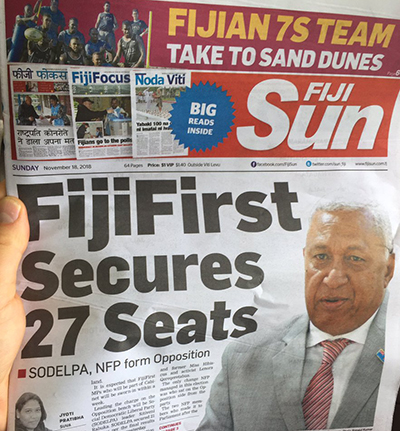
That FijiFirst with 227,241 (50.02 percent) votes won the elections with just over half of 458,532 votes cast, giving it 27 seats, is testimony to how nervous it was going into the elections.

The Social Democratic Liberal Party (SODELPA) won 181,072 votes (39.85%), close to 40 percent of the vote and gets 21 seats in parliament, doing better than it did in 2014, while the National Federation Party completes the makeup with 33,515 votes (7.38 percent) and three seats in the 51-seat Parliament.

“SODELPA – It’s strong indigenous propaganda supported by some deliberate misinformation contributed to a much improved performance, compared with 2014,” said the pro-government newspaper Fiji Sun today in its analysis of the elections.

This was a quaint way of accusing SODELPA of indulging in fake news by the government’s self-confessed propaganda organ.

FijiFirst … triumphs again in a general election, but only just. Image: SK/PMC

In his statement on winning the elections yesterday, published in the Fiji Sun, Bainimarama took the unusual step of accusing the other national daily newspaper, The Fiji Times, of colluding with the opposition in a thinly veiled attack on SODELPA.

-Partners-

“These same disruptive politicians of old, aided and abetted by The Fiji Times did not care to tell you the truth – the truth that iTaukei (Native) land is not only safe like never before under our Constitution but as total land holding has grown under FijiFirst,” he said in a statement.

‘Dishonest politicians’
“In fact it was only under the leadership of these same dishonest politicians that iTaukei land was actually and permanently alienated.

“Their lies and deception knew no boundaries, as individuals, whole communities and religious sentiments were slandered and belittled in an atmosphere of political deceit. They were willing to create economic chaos and undermine our economic future in their greed to win government,” Bainimarama said in his statement from New Zealand, where he was attending his brother Sevenaia’s funeral.

The 48-hour media blackout period – extended until Saturday, November 17, to allow for 22 polling venues to be opened for 7,458 people who were affected by floods – made it easy for social media trolls to make mischief.

At a press conference during the election, Ashwin Raj, the CEO of the Media Industry Development Authority (MIDA), admitted to being caught out by the ferocity of fake news and the social media.

In an interview with ABC’s Pacific Beat programme. Pacific Freedom Forum (PFF) co-chair Bernadette Carreon put her finger on the problem.

She said the vacuum left by the media blackout had led to fake news and misinformation being shared.

“The media is not allowed to publish any information regarding the election and so there have been reports of some fake websites coming up during the blackout and we call it fake news because it could potentially influence the voting,” she said.

Fact checking
“Media or the readers cannot fact check because the media is not allowed to air any news or information about the election process.”

That fake news dominated the media at the Fiji Elections Office (FEO) for more than two days was hardly surprising – as nothing could be reported on the campaign or the candidates.

FijiFirst’s financial statement for the nine months until 30 September 2018. Image: SK/Twitter
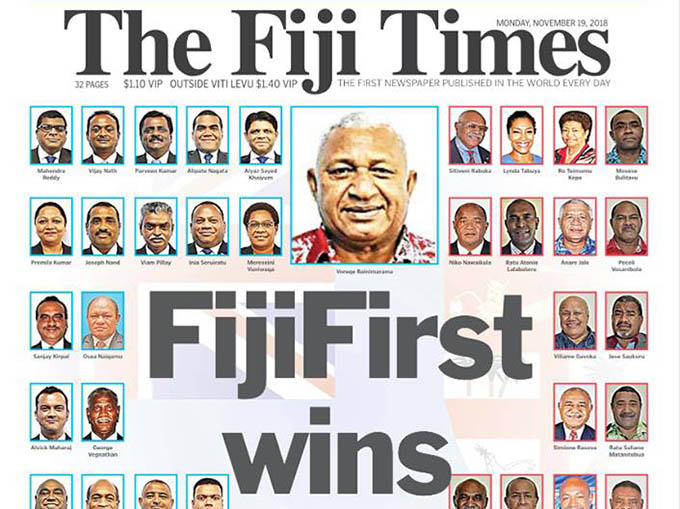
It has been reported on Twitter that FijiFirst, from the financial declarations last month, spent $1.9 million on advertising and $80,000 on social media as of 30 September 2018. (See image)

However, the media blackout and fake news did not have any influence on the Monday before the elections when SODELPA leader Sitiveni Rabuka faced the High Court for the appeal by the Fiji Independent Commission Against Corruption (FICAC) against charges of corruption which were initially dismissed.

The appeal was subsequently dismissed as well to loud cheers from his supporters.
The media scrum was a sight to behold as Rabuka emerged from courtroom victorious accompanied by his protégé Lynda Tabuya.

With more than 2000 people singing Fijian songs in harmony he was escorted down the steps of Parliament which backs onto the court house.

It appeared to be in defiance of the government which have for so long subdued the Fijian people and their natural exuberance.

Sigh of relief
It clearly signalled the portent of what was to come two days later in the elections, and one shudders to think of what could have happened that day had he lost the court case.

But, for now a collective sigh of relief in Fiji, relief that stability continues with murmurings of corruption, relief that a strong opposition is in place, and 10 women have made to Parliament making up 20 percent of the seats, but it bodes for uncertainty in the 2022 elections.

As Professor Jon Fraenkel from Victoria University of Wellington, a visitor and speaker at the University of the South Pacific, told the Australian Associated Press (AAP) on November 14.

“Many indigenous voters are wary of the endless polarisation and mind games of FijiFirst, and there is also considerable anti-Muslim sentiment targeted at the Attorney-General and his many appointees.”

A third term in government is difficult for any party and the warnings are already been written on the wall for FijiFirst – the people have spoken and will again.

Sri Krishnamurthi is a journalist and Postgraduate Diploma in Communication Studies student at Auckland University of Technology. He was attached to the University of the South Pacific’s Journalism Programme, filing for USP’s Wansolwara News and the AUT Pacific Media Centre’s Asia Pacific Report.

Print Friendly, PDF & Email

Article by AsiaPacificReport.nz

After APEC, US-China tensions leave ‘cooperation’ in the cold

]]>

Source: The Conversation (Au and NZ) – By Nick Bisley, Head of Humanities and Social Sciences and Professor of International Relations at La Trobe University, La Trobe University

United States Vice President Mike Pence’s remarks at the end of this year’s summit season just about blasted the word “cooperation” out of the APEC acronym. Amid ill-concealed US-China tensions, it had already been looking out of place.

Pence unveiled US plans to help Australia and Papua New Guinea – APEC’s host this year – expand a military base on Manus Island, which is in PNG. In September, Australia had already announced funding for an upgrade of the facility.

Former Australian foreign minister Gareth Evans famously declared in 1993 that APEC was “four adjectives in search of a noun”. As one of APEC’s founding fathers, he could be forgiven for getting the parts of speech slightly wrong.

But 25 years on, “cooperation” is looking doubtful. The Asia-Pacific Economic Cooperation forum set sail in Canberra in 1989. Two former prime ministers, Bob Hawke and Paul Keating, lay some claim to its parentage. APEC has grown to boast 21 member economies (where China, Hong Kong and Taiwan are listed as separate member economies).


Read more: In his first major foreign policy test, Morrison needs to stick to the script


APEC is part of summit season in Asia in November, and the one closest to Australia’s heart, given its origins in Canberra. Three other big set pieces are also held within this week each year and bring all the key players in the region together, ostensibly to talk about advancing cooperation, community building and grappling with common problems. Two others relate to ASEAN, the grouping of 10 South-east Asian nations – its annual summit, and the ASEAN Plus 3 meeting where they bring in South Korea, Japan and China. Then there is the East Asia Summit, which comprises the 10 ASEAN members, plus Australia, China, India, Japan, New Zealand, South Korea, the United States and Russia. These talk-fests give states and economies, great and small, the chance to gather to try advance a broad-ranging positive agenda.

But the many handshakes, photo ops and positive sounding joint-statements could not mask the reality of hardening US-China geopolitical competition. It is a cruel irony that a group of meetings created to advance cooperation became the platform for what amounted to a very public drawing of lines of great power competition.

Feelings were mixed when it was announced US President Donald Trump would go to Europe for the centenary of world war one’s truce this year, instead of Asia’s summits. The signal sent that the president does not prioritise the region is unmistakable.

Prime Minister Scott Morrison mixes exotic dress with his passion for rugby league team the Cronulla Sharks in his APEC diplomacy.

During his visit, Pence put on a stern face on US policy, and in his speech to the APEC CEO Summit he reinforced the United States’ wish to build a relationship with China, based on “based on fairness, reciprocity, and respect for sovereignty”. In earlier comments to the Hudson Institute he accused Beijing of stealing military blueprints, “and using that stolen technology, the Chinese Communist Party is turning plowshares into swords on a massive scale…”.

Washington now sees itself in full spectrum competition with China for regional and global influence. Pence portrayed China as an aggressive and almost imperial power with a malign regional vision. In contrast, he emphasised that the US wanted to protect an open and rules-based system of genuine partnerships. He underscored the long-term nature of this commitment.

The problem, both for Washington and its partners, is that this new muscular approach to China is, as yet, not fully resourced, and does not align the military aspects with trade – notwithstanding the Manus announcement.

Trump’s economic nationalism jibes badly with the interests of its partners and its long term regional strategy. A free and open Indo-Pacific sits uncomfortably with America’s economic nationalism, imposing tariffs on allies and pleas for multilateral approaches being summarily dismissed.

New Zealand’s Jacinda Arden and Canada’s Justin Trudeau share a laugh as Scott Morrison and other APEC leaders look on.

At the same CEO summit, Xi Jinping gave a rare major address outside of China. Like Pence, he sought to lay out a vision for the region that presented China as a force for economic openness, integration and development.

Continuing the themes first articulated at Davos in 2017, the unstated but obvious point of contrast was with America. Xi also rebutted criticism of the Belt and Road Initiative, declaring it was neither a trap nor a geopolitical gambit but an “open platform for cooperation”. But as with his earlier efforts to paint China as a defender of economic openness, the claims remain unconvincing.

Hosting APEC in PNG was fitting, given the south-west Pacific has become a key site of US-China competition. The Manus announcement, along with another that a group of Western allies would collaborate to drive a massive electrification project in the country, gives a concrete sense of what this means for the region. As in the Cold War, when Soviet-American rivalry led to bidding wars in the developing world, today China and the US are competing for influence in the form of infrastructure and development funding.


Read more: Pence visit reassures that the US remains committed to the Asia-Pacific


If the speeches laid down rhetorical battle lines, APEC’s conclusion showed the consequences of this competition. For the first time in the grouping’s history, APEC members were unable to agree on the wording of a final communique. While a new Cold War is not yet here, this is another worrying step toward a serious rift in the global economy and geopolitics.

The biggest loser of the summit season is probably ASEAN. Founded in 1967 to wall off the newly independent states of south-east Asia from Cold War competition as the Vietnam war escalated, the grouping’s principal purpose has been to ensure the region does not become the wrestling mat of great power competition. It had been crucial to ensuring this goal was met in the Cold War and its aftermath. Events of this past week show it is finding that much harder to achieve as the geopolitical temperature rises.

If there were any doubts, Asia’s summit season confirms that the region has entered a new phase. Great power competition is now Asia’s most important dynamic. Even though the set piece theatre is about community building and cooperation, the reality is that China and the US have irreconcilable visions for the region and its future.

The only question is how much they are willing to pay to prevail in the contest for Asia’s future.

ref. After APEC, US-China tensions leave ‘cooperation’ in the cold – http://theconversation.com/after-apec-us-china-tensions-leave-cooperation-in-the-cold-106448

Health Check: why women get PMS and why some are more affected

]]>

Source: The Conversation (Au and NZ) – By Jayashri Kulkarni, Professor of Psychiatry, Monash University

Women have been menstruating throughout history. So it’s curious the earliest documented record of what we now know to be premenstrual syndrome (PMS) appeared pretty late in the game. In 1931, psychoanalyst Karen Horney described increased tension, irritability, depression and anxiety in the week preceding menstruation in one of her patients.

Now it’s generally accepted up to 80% of women in their reproductive years experience some PMS. The condition includes symptoms such as fatigue, poor coordination, feeling out of control, feeling worthless and guilty, headache, anxiety, tension, aches, irritability, mood swings, weight gain, food cravings, no interest in usual activities, cramps, feeling sad or depressed, breast tenderness, sleep problems, and difficulty concentrating.

Premenstrual syndrome is different to premenstrual dysphoric disorder (PMDD), which is rarer (only 3-5% of women of reproductive age experience it) and is listed in the diagnostic manual of mental disorders. People who experience PMDD have severe depression which is often accompanied by suicidal thoughts. Their onset and offset usually coincide with the premenstrual cycle. Unlike PMS, the severely depressed mood of PMDD usually comes on suddenly.

Reproductive hormones – oestrogen, progesterone and testosterone – are also potent brain hormones. They influence the brain chemicals responsible for our thoughts, behaviours and emotions. Their amounts fluctuate throughout the menstrual cycle, so the connection between them and mental health is clear. And we are learning more about why some women may be more affected than others.


Read more: Chemical messengers: how hormones affect our mood


Brain chemicals and PMS

There is no single clear theory yet to explain exactly which hormones trigger particular chemicals or why only some women experience PMDD or PMS.

But we know some women are susceptible to mood changes due to small fluctuations in reproductive hormones. In these vulnerable women, small changes in oestrogen and progesterone levels lead to shifts in central brain chemicals (GABA, serotonin and dopamine) that then affects mood and behaviour.

At the same time, many of the physical PMS symptoms such as breast tenderness, bloating, headaches and constipation are a direct effect of reproductive hormones. So both mind and body are affected.

Hormonal changes before menstruation affect both the body and mind. from shutterstock.com

Oestrogen appears to be a “protective” hormone, which can improve psychotic symptoms (such as those common in schizophrenia) as well as depression. Oestrogen directly influences the neurotransmitters serotonin and dopamine to achieve this positive effect.

So depression and other adverse mental symptoms can appear or worsen during phases when oestrogen is low. This happens during the four to seven days before menstruation, and during the transition into menopause.


Read more: Menopausal mood swings can signal more serious mental illness


Progesterones can have the opposite effect. Many women who take a progesterone-only contraceptive pill (the mini-pill) experience depression. There are certain types of progesterone in the combined oral contraceptive pill that can be very depressive.

What about the more severe symptoms?

Recent work suggests PMDD is the result of brain neurochemicals responding in unusual ways to fluctuations in brain oestrogen, progesterone and testosterone, as well as the hormones released by the pituitary gland that determine the levels and fluctuations of these reproductive hormones.

Other studies about the cause of PMDD reveal that a breakdown product of progesterone – called allopregnanolone (ALLO) – is a critical stimulator of a receptor on a part of the GABA transmitter. When stimulated, the GABA system can alleviate anxiety. Benzodiazepine drugs like diazepam (Valium) stimulate the GABA system and help to calm down agitation.


Read more: Weekly Dose: Valium, the ‘safer choice’ that led to dependence and addiction


In this way, ALLO works as an “anti-anxiety” hormone. Just like oestrogen, progesterone levels (and its metabolite ALLO levels) fall in the premenstrual phase.

Women who have PMDD are often agitated, anxious and depressed during the premenstrual phase. A newer theory is that their brain chemistry isn’t reacting normally to ALLO, so they become anxious. This is important to explore further and already new drugs that impact ALLO are being developed and tested.

PMDD is complex, like many mental health conditions, and there is an interplay between psychological and social issues as well as hormonal and neurochemical factors. Tertiary education, supportive relationships, fewer socioeconomic struggles and good physical health appear to be helpful, but do not mitigate PMDD completely. Overall, PMDD appears to be biologically driven.

How can we treat it?

Understanding the body-mind connections in both PMS and PMDD is critical for developing effective management strategies for the many women who suffer from significant depression and other issues every month.

Management options need to consider all aspects of the woman’s life including her work, relationships, past traumas, current physical health and daily demands. Many women experiencing PMDD require hormone treatment and other strategies such as antidepressant medication to help them improve their quality of life.


Read more: Biology is partly to blame for high rates of mental illness in women – the rest is social


It’s a good idea for women experiencing PMDD or PMS to keep a diary of their cycles and moods. Women can be reassured their observations connecting hormones and moods are valid. It is important women with PMS/PMDD seek help from health professionals who will explore specific targeted treatments with them. Above all, it is important to recognise the links between hormones and mental health.

ref. Health Check: why women get PMS and why some are more affected – http://theconversation.com/health-check-why-women-get-pms-and-why-some-are-more-affected-106077

‘The people have spoken’ – Fiji Times comments on a split election

]]>
The Fiji Times editorial … “The challenge for individual voters is to cast aside differences, and unite for a common goal, to move our nation forward.” Image: PMC screenshot

EDITORIAL COMMENT: By Fred Wesley, editor-in-chief of The Fiji Times

Yesterday marked the end of the 2018 Fiji General Election.

It marked the end of a period that culminated in two weeks of intense campaigning.

In the heated battles, parties clung onto strategies they calculated would woo the important component in the election process — the voters.

Today’s Fiji Times front page. Image: FT/PMC

However that panned out, campaigning reached unprecedented levels of attacks, some personal at times.

The attacks inched their way onto the various social media platforms, raising the profile of this particular election.

In the end though, before the writ for election was handed over by the chairperson of the Fijian Electoral Commission, Suresh Chandra, to the President of our nation, Jioji Konrote yesterday, the masses had spoken.

The FijiFirst party got 227,241 votes when the final results were tallied. Their highest votes were from the Western Division, accounting for 91,902 of their total count.

The Voreqe Bainimarama led-party received 65,901 votes from the Central Division, 34,291 votes from the Eastern Division and 31,073 votes from the Northern Division.

The party received 4074 votes through postal ballots.

The Social Democratic Liberal Party (SODELPA) polled the second highest votes in this year’s polls, making up 39.85 percent of the total votes cast with 181,072.

Their highest votes were from the Central Division where they collected 67,255 votes.

The Sitiveni Rabuka led-party gathered 43,813 votes from the Western Division, 35, 013 votes from the Eastern Division and 30,919 votes from the Northern Division. SODELPA received 4072 votes through postal voting.

The National Federation Party recorded 33,515 votes when the final results were released yesterday.

Out of this, 12,025 were from the Western Division, 10,941 from the Central Division, 5457 from the Eastern Division and 4336 from the Northern Division.

The Biman Prasad led-party received 756 votes from postal voting.

The results meant FFP came off with 27 seats of the 51-member Parliament, while SODELPA came off with 21 and NFP with three to make up the 24-member Opposition.

It was good to note that the new Parliament includes 10 women, five in government and five in the opposition. Congratulations certainly are in order for Mr Bainimarama and his party.

He has the huge task of bringing together a nation that has been split in this election.

His challenge would be to understand the needs of the 227,094 voters who did not vote for his party. For now, all battles must be put on the backburner for the good of the nation.

The challenge for individual voters is to cast aside differences, and unite for a common goal, to move our nation forward.

The masses have spoken.

They have given Mr Bainimarama and FijiFirst the mandate to govern for the next four years.

We must embrace that fact.

That is the beauty of democracy.

Republished from The Fiji Times, 19 November 2018.

Article by AsiaPacificReport.nz

Curious Kids: How do remote controls work?

]]>

Source: The Conversation (Au and NZ) – By Andrew Maxwell, Senior Lecturer, University of Southern Queensland

This is an article from Curious Kids, a series for children. The Conversation is asking kids to send in questions they’d like an expert to answer. All questions are welcome – serious, weird or wacky! You might also like the podcast Imagine This, a co-production between ABC KIDS listen and The Conversation, based on Curious Kids.


How do remote controls work? – Ethan, 10, Sydney.


Thanks, Ethan. I was younger, I wondered the same. I was completely mesmerised with how a lump of plastic could possibly change channels on a TV without any physical connection.

Very early TV remote controls worked with wires. Then we created battery-powered remotes and we didn’t need the wires any more.

Now remotes are everywhere. In fact, the planet-watching Voyager spacecraft are controlled remotely and they are presently 20 billion kilometres away. It takes 20 hours for instructions to travel from Earth to the spacecraft but we can do it – using a remote.


Read more: Curious Kids: How do x-rays see inside you?


A controller from a console game is a type of remote. seanwhelan/Unsplash, CC BY

A remote control has three things, what engineers would call a “communications channel”, a “procotol”, and an “interface”. I will explain what those words mean.

The communications channel

The communications channel is what connects the remote to the device you want to control (like a TV).

It could be light (such as infra-red light), sound or radio waves (sometimes called electromagnetic waves). The human eye cannot see infra-red light or radio waves.

TVs tend to use infrared light as it is low cost, easy to build, and suitable for a short distance like in a lounge room. However, it does require a direct “line of sight” so that the light beam is not blocked. How many times have you heard “get out of the way!” when someone is trying to change the channel?

Radio waves are usually used for long distance situations, or for outdoors, and can even travel through objects.

Many game consoles like the XBox and PlayStation use low power radio waves (like Bluetooth, which is a type of radio wave system). This is great for games as it does not need line of sight. It will still work even if you bounce around the room, or dive behind the couch with your controller.

Protocol

You can think of the protocol as the “language” the remote uses to communicate with the TV, XBox or whatever the device may be.

TVs, for instance, use a long list of “binary codes” (on and off, or one and zero bit sequences) that tell the TV what to do. Some codes tell the TV volume to go up, others tell it to go down, or change channel.

These patterns have been predetermined so that the TV will understand the remote. It can “speak” the language of the remote. The remote will package the message up in a little packet of data that the TV can understand.

Some remotes are able to send messages and receive them. For instance, a game console control will send commands to the console (eg “move the character forward”) and can receive them (for example, “make the controller rumble and vibrate”).

User interface

“User interface” is just a fancy way of saying how the remote looks and is used.

TV remotes just have a rather boring array of buttons. Some remotes have a screen and look like a mobile phone.

Pump up the volume

Say you want to turn up the volume on your TV. You press a button on the remote. The little microcontroller (which is just a tiny computer) in the remote wakes up, and reads which button you have pressed (“volume turned up, please”). It then creates a packet of data – a message – in a language the TV can understand.

It sends the message via an infrared light to the TV, assuming you aimed the remote correctly.

That message is then picked up by the infrared TV receiver, which decodes it (“ahh, he wants the volume turned up, ok.”). Then the small microcontroller (a tiny computer) in the TV makes the necessary changes to the volume.

All remotes all are designed to:

  1. take your request
  2. apply the protocol (translate it into a language the device can understand)
  3. create a packet of data (a message) and
  4. send the message via the communications channel to the device.

You then put these things together and you have a remote control.

Even the remote used to control the Voyager Spacecraft follows the same method. It’s no more complicated than controlling a TV, it just has more steps to it.

Thank you for this question, and I hope I have helped you understand the fascinating world of remote controls.


Read more: Curious Kids: How and why do magnets stick together?


Hello, curious kids! Have you got a question you’d like an expert to answer? Ask an adult to send your question to us. They can:

* Email your question to curiouskids@theconversation.edu.au
* Tell us on Twitter

CC BY-ND

Please tell us your name, age and which city you live in. You can send an audio recording of your question too, if you want. Send as many questions as you like! We won’t be able to answer every question but we will do our best.

ref. Curious Kids: How do remote controls work? – http://theconversation.com/curious-kids-how-do-remote-controls-work-103840

One year on from Royal Commission findings on Northern Territory child detention: what has changed?

]]>

Source: The Conversation (Au and NZ) – By Kate Fitz-Gibbon, Senior Lecturer in Criminology, Monash University

A change of government in the Northern Territory has done little or nothing to address the underlying issues relating to abusive practices inflicted on young offenders in detention – captured in images that sent shockwaves around Australia, and the wider world, more than two years ago.

On July 25, 2016, the ABC Four Corners investigative programme aired Australia’s Shame, a documentary featuring disturbing imagery and footage of children being abused while held in the Don Dale Juvenile Detention Centre in Darwin.

‘Hooded, shackled, strapped to a chair and left alone’

The evidence of abuse included accounts of detained boys who had been exposed to tear gas and the use of spit hoods while being held in isolation. This shone a national spotlight onto the violence perpetrated within juvenile justice institutions against some of society’s most vulnerable.


Read more: Evidence of NT detention centre abuse was there for all to see


After the documentary aired, then prime minister Malcolm Turnbull announced plans for a Royal Commission into the Northern Territory’s juvenile detention system Royal Commission into the Protection and Detention of Children in the Northern Territory. The then NT chief minister, Adam Giles, of the Country Liberal Party whose federal representatives vote with the Nationals, responded to the Don Dale allegations, stating: “I was shocked and disgusted…A community is judged by the way it treats its children.”

Since the Don Dale allegations emerged, there has been a change of NT government, with Michael Gunner now chief minister of a Labor government. A question emerges though: what changes have occurred for children in detention?

Michael Gunner, chief minister of the Northern Territory, with Nunggubuyu woman Selena Uibo, minister for education and workforce training, photographed in June. Gregory Roberts/AAP

One Year on

We have just marked the one-year anniversary of the findings and recommendations of the Royal Commission into the Protection and Detention of Children in the Northern Territory.

The royal commission confirmed that over the past decade, children detained in the NT had been mistreated, verbally abused, humiliated, isolated or left alone for long periods, among other human rights breaches. At the sharp end of of rights breaches, the commission stated that many children held in detention had been assaulted by staff, who either wilfully ignored rules or were unaware of the rules. Either way, they clearly acted in breach of Australia’s international human rights obligations and some domestic laws.


Read more: Why are so many Indigenous kids in detention in the NT in the first place?


The royal commission found that senior government members were aware of but chose to ignore these abusive practices. The report made substantial recommendations for reform.

One year on, Don Dale continues to be in operation despite the royal commission recommending it be closed as soon as possible. The ongoing use of the facility continues to arouse significant concerns among legal practitioners, human rights advocates and youth justice stakeholders. It raises a critical question of what has been achieved in the 12 months since the commission reported – and in over two years since the ABC exposed “Australia’s shame”.

What has been achieved?

The NT government asserts that “Territory Families (an NT government department) is undertaking extensive reform of youth detention”, with the development of “an operating model that better considers the needs of young people”. It states that in 2017-2018 enhanced and specialised training has been completed, along with the hiring of 23 new recruits, the introduction of the ‘Australian Childhood Foundation’s Trauma Informed and Strength Based approach’ and Restorative Practice training. These developments represent important progress but recent high-profile incidents at the Don Dale detention centre pose further serious questions about the extent to which the problems at the heart of the Royal Commission remain unaddressed.

The notorious Don Dale youth detention centre near Darwin pictured last week after a distubance. Glenn Campbell/AAP

Earlier this month, Don Dale dominated the media headlines again following reports of riots, fires within the detention centre and staff assaults. Reports stated that tear gas had been deployed. Other allegations reported include young women “showering and using the toilet under the watchful eye of security cameras which are recording and monitoring on site”.

These reports act as an unwelcome reminder of the continued broken state of NT’s juvenile justice system and the ongoing and urgent need for change to ensure better protections for young people held in detention.

The continued failure to protect children’s rights

It is nearly 30 years since Australia ratified the 1989 Convention on the Rights of the Child. Yet we still do not have a national strategy or measures to ensure the implementation of appropriate protection of children’s rights in Australia.

Serious concerns about the state of children’s rights in Australia were highlighted in the latest national coalition NGO report to the United Nations Committee on the Rights of the Child. The Children’s Report, published by UNICEF on November 1, draws on 58 consultations with 527 children and young people in 30 locations around Australia. Its findings draw significant attention to Australia’s gross violations of the rights of children held in detention.


Read more: Abuse in youth detention is not restricted to the Northern Territory


The report makes a substantial number of recommendations that build and give national standing to those previously made by the royal commission. They include: that the government immediately review and amend youth justice legislation, policies and practices to ensure that all children are treated consistent with the UNCRC and the Beijing Rules. It also recommended that governments prioritise detention centres where children are placed as requiring immediate action as part of the implementation of the Optional Protocol to the Convention against Torture and Other Cruel, Inhuman or Degrading Treatment or Punishment.

Another recommendation was that all governments prohibit the use of solitary confinement other than as a last resort; prohibit the use of restraints against children and routine strip searches, unless all other options have been exhausted. Importantly, the report also recommends that governments ensure the existence of child specific, independent inspectorates and complaint mechanisms.

The Children’s Report explicitly calls for governments to be held accountable to the children and young people affected by state failings in the provision of juvenile justice, and calls out the failure to implement the recommendations of the royal commission.

Mechanisms for accountability

The lack of substantive progress in the year since the commission reported highlights the need for accountability and independent implementation monitoring. Scepticism over the degree to which the commission will represent a moment of change is understandable. It is now more than 25 years after the Royal Commission into Aboriginal Deaths in Custody. For many, the lack of progress since that 1998 Royal Commission casts doubt over the potential for this royal commission to achieve meaningful change to the lives of young indigenous Australians in the NT.

The Northern Territory government has allocated $70 million for the construction of two new detention centres in Darwin and Alice springs. It is expected that these will be completed in mid-2020.

The royal commission established that the present situation is unacceptable. UNICEF’s report reaffirmed this on the international human rights stage. Change in this area cannot be slow and cannot be incremental. We have the evidence, the commission has laid out the road map and now action is needed.

We call on the NT government to act to better protect the rights of the children within its care.

ref. One year on from Royal Commission findings on Northern Territory child detention: what has changed? – http://theconversation.com/one-year-on-from-royal-commission-findings-on-northern-territory-child-detention-what-has-changed-106993

Violence towards women in the video game Red Dead Redemption 2 evokes toxic masculinity

]]>

Source: The Conversation (Au and NZ) – By Jessamy Henricksen, Ph.D. Student and Sexologist, CQUniversity Australia

It’s common practice in the world of gaming for serious video game players to upload videos of their gaming experiences to YouTube, usually for purposes of providing tips to other gamers, walkthroughs and highlights.

Last month, the YouTube channel “Shirrako” uploaded a video capture of a portion of the recently released video game Red Dead Redemption 2 (RDR2). The video depicted an avatar (the figure representing the player in a video game) physically assaulting a female character until she was unconscious. The video was titled: “Beating Up Annoying Feminist”.

A screen grab from the RDR2 video uploaded to YouTube. Screen Shot on November 16, 2018

Within days, the video had received more than one million views. While some viewers remarked that they planned to replicate the behaviour in the video, others commented:

The only good feminist is a DEAD FEMINIST

Giving women the right to vote was a mistake

Recent research into online gaming in the wake of the #MeToo movement sheds light on this kind of behaviour, raising concerns about the influence of gaming culture on attitudes of sexism and violence against women.


Read more: Curious Kids: Why do adults think video games are bad?


Depictions of violence against women

Following much hype and anticipation, RDR2 – the sequel to the videogame Red Dead Redemption – was released in Australia on October 26, 2018. Across the board, reactions have been glowing, with players posting fantastic reviews.

But video games and their developers have often been criticised for portrayals of violence towards women, and RDR2 is no exception.

The game is set in the US Wild West and gives players the ability to take control and act out violence towards other game characters. This includes physically assaulting and killing the female character, a suffragette, who symbolises the early feminist movement advocating for women’s voting rights.

When gamers upload videos of their gaming experiences, the videos regularly depict inappropriate and socially unacceptable behaviours. That might include beating up sex workers, or assaulting other female game characters.

Following media coverage of the Shirrako channel’s video being pulled and reinstated by YouTube, the channel uploaded further videos. Titles included: “Dropping Feminist to Hell & Killing the Devil”, and “Annoying Feminist Fed to Alligator”.

It’s part of the culture

Such open hostility towards women may be surprising to those who aren’t familiar with gaming culture, but such videos and behaviours are quite common. In fact, Rockstar Games has been criticised in the past for the blatant sexism and stereotypical portrayals of female characters in its games.

Women are often depicted as being weak, submissive and vulnerable to violence from male characters. Such portrayals can shape gamers’ views of stereotypical gender norms, and foster negative attitudes towards victims of violence. Recent research has shown an association between playing violent video games and decreased empathy towards female victims of violence.


Read more: Anger, aggression and violence: it matters that we know the difference


As in previous Rockstar games, RDR2 gives players the option to kill female characters that represent women’s suffrage, without repercussions. So, should Rockstar Games be held accountable for fostering negative attitudes? Should game developers consider implementing a gaming block that prevents players from attacking the female game characters?

These are serious questions worthy of reflection considering the extensive history of game developers creating games that allow for violence against female characters. Particularly when the character is a suffragette, a symbol of women’s fight for equality.

Backlash against #MeToo

Women and men around the globe are rallying to bring attention to violence against women and girls. The current #MeToo movement has provided a space for personal stories to be shared and heard. But there seems to be resistance to this form of social activism from a select group of men.

A recent study explored tweets posted by men in response to the #MeToo movement that used the hashtag #HowIWillChange. According to the researchers:

…#HowIWillChange was intended to engage men and boys in the ongoing discussion about sexual violence by asking them to evaluate their role in sustaining rape culture.

Among the tweets, researchers observed the expression of sexist attitudes, a hostile resistance to social change, and a desire to maintain current gender power structures.

Hegemonic masculinity, which is the process by which certain masculine traits are positioned in society, serves to maintain patriarchal power structures and justifies the subordination of women. Toxic masculinity is considered to be a form of hegemonic masculinity. It promotes aggression, competitiveness and domination.

Consequently, behaviours of gamers and their comments towards female characters should be taken seriously. They highlight concerning attitudes and beliefs about gendered violence, which are further amplified when pushed out to an anonymous public forum, such as YouTube or social media.


Read more: There are no age restrictions for gambling in video games, despite potential risks to children


Anonymity perpetuates bad behaviour

Anonymity has been found to be an influential factor when it comes to negative online behaviours. It allows individuals to freely exhibit inappropriate and socially unacceptable attitudes towards women.

And the power to openly encourage such behaviours anonymously via YouTube comments means people can share their hatred towards women and the feminist movements, without offline repercussions.

These behaviours paint a dark picture in the current quest for gender equality.

RDR2 is, therefore, not “just” a game, it’s a reflection on outdated sexist behaviours and attitudes that need to change. Now it is time to start an important dialogue about why there are some individuals who feel the need to depict such violence toward women, and why others accept these acts of violence towards women as normal.

ref. Violence towards women in the video game Red Dead Redemption 2 evokes toxic masculinity – http://theconversation.com/violence-towards-women-in-the-video-game-red-dead-redemption-2-evokes-toxic-masculinity-106920

Victoria election: the scandals, sloganeering and key issues to watch

]]>

Source: The Conversation (Au and NZ) – By Zareh Ghazarian, Lecturer, School of Social Sciences, Monash University

Victorians will decide who governs the state for the next four years on Saturday. Premier Daniel Andrews and Opposition Leader Matthew Guy, along with all other candidates, can see the finish line as the parties make last-minute appeals for support.

The election campaign has been far from scintillating. The leaders’ debate, which will be held in the ultra-marginal seat of Frankston on Wednesday, may be a highlight in a relatively well-managed campaign by both major parties.

This election is unique in that up to 50% of voters are expected to have voted before election day. This means the parties are appealing to a smaller number of voters in the final week of the campaign than in previous elections.

Early exits dogging the Liberals, Greens

While the major parties had avoided embarrassing gaffes in the early days of the campaign, there have been a few missteps of late.

One Liberal candidate quit over a controversial online video that featured the hashtag #MuslimBan, while another withdrew following concerns about her fundraising for an unregistered charity.

The Greens have also been mired in controversy. One candidate withdrew over social media posts that boasted about shoplifting, while another candidate has attracted criticism for rapping about date rape.

Public safety and other key issues

When it comes to the issues, government services – especially healthcare, education and public transport – as well as energy and public safety have been at the core of the policy debates.

Both parties have ostensibly built their campaigns around market research and the messages they believe will influence how citizens vote.


Read more: How Australia’s NRA-inspired gun lobby is trying to chip away at gun control laws, state by state


Labor’s slogan, “Delivering for all Victorians”, seeks to maintain the party’s perceived strengths in delivering services. In contrast, the Liberals’ slogan, “Get Back in Control” is aimed at positioning the party as a more measured and effective manager of public finances and services.

Matthew Guy on the campaign trail with MP Roma Britnell. The Liberals have pledged $1 billion to repair country and regional roads. James Ross/AAP

One of the big issues that has dominated Victorian politics in recent years has been public safety. News coverage of the so-called “African gang problem”, and the tragic terror attack last week in the CBD, have provided the Liberals with what they see as an opportunity to position the party as a stronger manager of law and order in the state.


Read more: FactCheck: does Victoria have Australia’s highest rate of crime?


Guy has campaigned strongly on this issue with the view that it will sway voters in marginal seats concerned about safety.

Public transport has also been a prominent issue in the campaign, with the government touting its removal of railway crossings, as well as a proposed new rail system. The Coalition has also promised to extend rail lines in growing suburbs on Melbourne’s fringe, while also removing railway crossings.

Daniel Andrews has made public transport a central part of Labor’s campaign, including a proposed $50 billion suburban rail loop. Valeriu Campan/AAP

In terms of education, Labor has promised to build new schools and upgrade existing ones. The Liberals have also indicated they would seek to “de-clutter” the state’s curriculum and provide a “back-to-basics” schools policy.

‘Red shirts’ and ‘lobster with a mobster’

Aside from the policy debates, the parties will also be judged on their performances since the last election in 2014.

Both major parties have avoided the instability that has been the hallmark of their federal counterparts over the last decade. Both Andrews and Guy have remained relatively safe in their roles, though they did suffer some setbacks.

Andrews had to go into damage control following the dubious use of taxpayer funds by some Labor MPs, while also being side-tracked by the so-called “red shirts” affair, in which taxpayer funds were used to pay campaign staff (who wore red shirts).

The government also lost ministers over allegations of misconduct made by staff and use of a ministerial car to ferry pet dogs. Cracks also appeared in the government when Emergency Services Minister Jane Garrett resigned from Cabinet over the pay and conditions for firefighters.

The Liberal Party has not been without its share of drama. Guy was embroiled in the so-called “lobster with a mobster” affair – a dinner at a lobster restaurant with an alleged mafia boss – and his past dealings as planning minister also attracted scrutiny after being released by the government. This did Labor no favours, however, as the premier was forced to apologise to those whose private details were made public as part of the document release.


Read more: State governments are vital for Australian democracy: here’s why


While Labor has been enjoying the benefits of incumbency, the Liberal Party has, at times, appeared to be distracted by an identity crisis. Like the federal party, the Victorian Liberals have grappled with the question of who they are seeking to represent. Whether it is a pragmatic party, or a more ideologically driven socially conservative party, appears to be at the root of such debates.

Adding further to the frustrations to the Liberal leadership has been the well-publicised dispute with the Cormack Foundation over control of campaign funds, as well as the imprisonment of its former state director for stealing A$1.5 million from the party.

Despite all the political dramas, the election itself could be fairly straightforward. With opinion polls showing the government leading on the all-important two-party preferred measure, it looks highly likely Labor will be returned in Victoria.

ref. Victoria election: the scandals, sloganeering and key issues to watch – http://theconversation.com/victoria-election-the-scandals-sloganeering-and-key-issues-to-watch-105495