Page 1148

Explainer: why is Australia adopting the global refugee compact but not the migration compact?

]]>

Source: The Conversation (Au and NZ) – By Azadeh Dastyari, Deputy Director of the Castan Centre for Human Rights Law, Senior Lecturer in the Faculty of Law, Monash University

Australia was one of 176 countries to vote in favour of the Global Compact on Refugees (refugee compact) in mid-November this year. The United Nations General Assembly will adopt it by the end of 2018.

However, Australia did not join the Global Compact for Safe, Orderly and Regular Migration (migration compact) at a conference in Morocco on December 10-11.

What are the compacts and what do they aim to do?

There is much confusion about the two compacts, with commentators often conflating the two documents. However, they are distinct agreements with differing subjects.

The term “refugee” used in the refugee compact has a specific meaning under international law. It refers to a person outside their own country who fears persecution because of their race, nationality, membership of a particular social group or political opinion.

As a signatory to the Refugee Convention and Refugee Protocol, Australia has particular obligations to refugees under these two treaties. The refugee compact does not replace these obligations. Instead, it is a non-binding agreement that “intends to provide a basis for predictable and equitable burden- and responsibility-sharing”.

The Refugee Compact lists four objectives. They are to:

  1. ease pressures on host countries
  2. enhance refugee self-reliance
  3. expand access to third country solutions
  4. support conditions in countries of origin for return in safety and dignity

Unlike the term “refugee”, the term “migrant” does not have a precise meaning under international law. Australia does not have any specific international legal obligations to migrants beyond respecting their human rights under the human rights treaties to which it is a party.

The migration compact does not create any new binding legal obligations on states such as Australia. Instead, it has a range of 23 objectives for safe, orderly and regular migration. These include the collection and better use of data on migration; strengthening responses to smuggling and trafficking; eliminating discrimination; using detention as a last resort; saving lives; managing borders in an integrated, secure and coordinated manner; addressing and reducing vulnerabilities in migration; and strengthening international cooperation.

Where did the compacts come from?

The two compacts have emerged from a need for the international community to better cooperate and respond to unprecedented numbers of people on the move, particularly into Europe. This includes refugees fleeing persecution from conflicts such as Syria.

In September 2016, the United Nations General Assembly unanimously adopted the New York Declaration for Refugee and Migrants to address such concerns. The declaration contained a commitment to begin two separate tracks of negotiations: the refugee compact and the migration compact.

Australia’s response

Australia has been relatively silent on the refugee compact, but has objected to the migration compact on the grounds that it would compromise Australia’s sovereignty.

The migration compact has also been accused of failing to:

adequately distinguish between people who enter Australia illegally and those who come to Australia the right way.

In addition, Australia has cited its success with migration as a reason for its refusal to adopt the migration compact. It has stated:

when we are asked to sign up to international agreements that we believe will compromise our successful way of doing things, we will pass.

The criticisms regarding the threat to Australia’s sovereignty and the lack of distinction between categories of migrants is surprising. As has been explained by Goodwin-Gill and McAdam, it is a misrepresentation of the document.

As with the refugee compact, the migration compact does not create any binding legal obligations on states. It affirms that “within their sovereign jurisdiction, States may distinguish between regular and irregular migration status”.

Furthermore, irrespective of whether Australia signs the migration compact, it is obliged to protect the human rights of migrants under existing international law. This includes, for example, the obligation to refrain from arbitrary detention. Thus the illegality of arbitrary detention, including on Nauru and Manus Island, under international law will not change whether Australia signs the migration compact or not.

Why has Australia signed the refugee compact but not the migration compact?

The United States is the only country to vote against the Refugee Compact. In contrast, the United States, Australia, the Netherlands, Austria, Bulgaria, Hungary, Czech Republic, Poland, Dominican Republic, Chile, Latvia, Slovakia, Estonia and Italy either withdrew from the migration compact negotiations or expressed reservations, often citing concerns about sovereignty as the reason.

But rather than being a real threat to sovereignty, the migration compact appears to have taken on a symbolic meaning that the refugee compact has not. Its opponents are governments with strong anti-immigration and asylum seeker policies. For such states, the migration compact has become a convenient strawman against which states can demonstrate a show of power and resistance to serve domestic political interests.

Syrian refugees at a camp at Haouch El Nabi in the Bekaa valley, Lebanon. AAP/EPA/Wael Hamzeh

A reason why the migration compact has been used as a foil in this way may simply be in the timing. The United States has led the rejection of the migration compact. It was early to withdraw from the process. In contrast, it continued to support the refugee compact until close to the last minute.

The earlier withdrawal of the US may have contributed to the galvanisation against the migration compact. Each state rejecting the migration compact adds to its perception as problematic, even if such a characterisation is unreasonable.

There may also be a fear that signing the migration compact may lead to new binding international obligations to migrants in the future. By contrast, the refugee compact may be viewed as less of a threat since states have existing obligations to refugees under international law.

However, adopting any hypothetical additional binding legal obligations will be a choice that governments can make in the future. Signing the migration compact does not bring an obligation to sign any future binding agreements.

In addition, the reluctance to join the migration compact but vote for the refugee compact may be because of the perception that the refugee compact requires less of states. The refugee compact has been criticised for lacking concrete mechanisms for governments to take on burden and responsibility sharing.

This may be true, and is an issue that has been addressed in part in the latest version of the refugee compact, which calls for indicators that will track progress by states. But again, the non-binding nature of the agreements means that states do not have to do anything they do not wish to do.

As the opening lines of the New York Declaration attest:

since earliest times, humanity has been on the move.

Rejecting international cooperation cannot and will not stop people from fleeing danger, migrating for better economic opportunities or moving to be with loved ones.

However, without international cooperation the system is uneven, dangerous and unsustainable. The migration and refugee compacts are not perfect. But they offer countries the opportunity to do better for themselves, for those on the move and for the international community as a whole.

ref. Explainer: why is Australia adopting the global refugee compact but not the migration compact? – http://theconversation.com/explainer-why-is-australia-adopting-the-global-refugee-compact-but-not-the-migration-compact-108167

ACCC wants to curb digital platform power – but enforcement is tricky

]]>

Source: The Conversation (Au and NZ) – By Katharine Kemp, Lecturer, Faculty of Law, UNSW, and Co-Leader, ‘Data as a Source of Market Power’ Research Stream of The Allens Hub for Technology, Law and Innovation, UNSW

We need new laws to monitor and curb the power wielded by Google, Facebook and other powerful digital platforms, according to the Australian Competition and Consumer Commission (ACCC).

The Preliminary Report on the Digital Platforms Inquiry found major changes to privacy and consumer protection laws are needed, along with alterations to merger law, and a regulator to investigate the operation of the companies’ algorithms.

Getting the enforcement right will be key to the success of these proposed changes.


Read more: Digital platforms. Why the ACCC’s proposals for Google and Facebook matter big time


Scrutinising accumulation of market power

The report says Google and Facebook each possess substantial power in markets such as online search and social media services in Australia.

It’s not against the law to possess substantial market power alone. But these companies would breach our November 2017 misuse of market power law if they engaged in any conduct with the effect, likely effect or purpose of substantially lessening competition – essentially, blocking rivalry in a market.

Moving forwards, the ACCC has indicated it will scrutinise the accumulation of market power by these platforms more proactively. Noting that “strategic acquisitions by both Google and Facebook have contributed to the market power they currently hold”, the ACCC says it intends to ask large digital platforms to provide advance notice of any planned acquisitions.

While such pre-notification of certain mergers is required in jurisdictions such as the US, it is not currently a requirement in other sectors under the Australian law.

At the moment the ACCC is just asking the platforms to do this voluntarily – but has indicated it may seek to make this a formal requirement if the platforms don’t cooperate with the request. It’s not currently clear how this would be enforced.

The ACCC has also recommended the standard for assessing mergers should be amended to expressly clarify the relevance of data acquired in the transaction as well as the removal of potential competitors.

The law doesn’t explicitly refer to potential competitors in addition to existing competitors at present, and some argue platforms are buying up nascent competitors before the competitive threat becomes apparent.


Read more: Explainer: what is public interest journalism?


A regulator to monitor algorithms

According to the ACCC, there is a “lack of transparency” in Google’s and Facebook’s arrangements concerning online advertising and content, which are largely governed by algorithms developed and owned by the companies. These algorithms – essentially a complex set of instructions in the software – determine what ads, search results and news we see, and in what order.

The problem is nobody outside these companies knows how they work or whether they’re producing results that are fair to online advertisers, content producers and consumers.

The report recommends a regulatory authority be given power to monitor, investigate and publish reports on the operation of these algorithms, among other things, to determine whether they are producing unfair or discriminatory results. This would only apply to companies that generate more than A$100 million per annum from digital advertising in Australia.


Read more: Attention economy: Facebook delivers traffic but no money for news media


These algorithms have come under scrutiny elsewhere. The European Commission has previously fined Google €2.42 billion for giving unfair preference to its own shopping comparison services in its search results, relative to rival comparison services, thereby contravening the EU law against abuse of dominance. This decision has been criticised though, for failing to provide Google with a clear way of complying with the law.

The important questions following the ACCC’s recommendation are:

  • what will the regulator do with the results of its investigations?
  • if it determines that the algorithm is producing discriminatory results, will it tell the platform what kind of results it should achieve instead, or will it require direct changes to the algorithm?

The ACCC has not recommended the regulator have the power to make such orders. It seems the most the regulator would do is introduce some “sunshine” to the impacts of these algorithms which are currently hidden from view, and potentially refer the matter to the ACCC for investigation if this was perceived to amount to a misuse of market power.

If a digital platform discriminates against competitive businesses that rely on its platform – say, app developers or comparison services – so that rivalry is stymied, this could be an important test case under our misuse of market power law. This law was amended in 2017 to address longstanding weaknesses but has not yet been tested in the courts.


Read more: We should levy Facebook and Google to fund journalism – here’s how


Privacy and fairness for consumers

The report recommends substantial changes to the Privacy Act and Australian Consumer Law to reduce the power imbalance between the platforms and consumers.

We know from research that most Australians don’t read online privacy policies; many say they don’t understand the privacy terms offered to them, or they feel they have no choice but to accept them. Two thirds say they want more say in how their personal information is used.

The solutions proposed by the ACCC include:

  • strengthening the consent required under our privacy law, requiring it to be express (it may currently be implied), opt-in, adequately informed, voluntary and specific
  • allowing consumers to require their personal data to be erased in certain circumstances
  • increasing penalties for breaches of the Privacy Act
  • introducing a statutory cause of action for serious invasion of privacy in Australia.

Read more: 94% of Australians do not read all privacy policies that apply to them – and that’s rational behaviour


This last recommendation was previously made by the Australian Law Reform Commission in 2014 and 2008, and would finally allow individuals in Australia to sue for harm suffered as a result of such an invasion.

If consent is to be voluntary and specific, companies should not be allowed to “bundle” consents for a number of uses and collections (both necessary and unnecessary) and require consumers to consent to all or none. These are important steps in addressing the unfairness of current data privacy practices.

Together these changes would bring Australia a little closer to the stronger data protection offered in the EU under the General Data Protection Regulation.

But the effectiveness of these changes would depend to a large extent on whether the government would also agree to improve funding and support for the federal privacy regulator, which has been criticised as passive and underfunded.

Another recommended change to consumer protection law would make it illegal to include unfair terms in consumer contracts and impose fines for such a contravention. Currently, for a first-time unfair contract terms “offender”, a court could only “draw a line” through the unfair term such that the company could not force the consumer to comply with it.

Making such terms illegal would increase incentives for companies drafting standard form contracts to make sure they do not include detrimental terms which create a significant imbalance between them and their customers, which are not reasonably necessary to protect their legitimate interests.


Read more: Soft terms like ‘open’ and ‘sharing’ don’t tell the true story of your data


The ACCC might also take action on these standard terms under our misleading and deceptive conduct laws. The Italian competition watchdog last week fined Facebook €10 million for conduct including misleading users about the extent of its data collection and practices.

The ACCC appears to be considering the possibility of even broader laws against “unfair” practices, which regulators like the US Federal Trade Commission have used against bad data practices.

Final report in June 2019

As well as 11 recommendations, the report mentions nine areas for “further analysis and assessment” which in itself reflects the complexity of the issues facing the ACCC.

The ACCC is seeking responses and feedback from stakeholders on the preliminary report, before creating a final report in June 2019.

Watch this space – or google it.


Read more: How not to agree to clean public toilets when you accept any online terms and conditions


ref. ACCC wants to curb digital platform power – but enforcement is tricky – http://theconversation.com/accc-wants-to-curb-digital-platform-power-but-enforcement-is-tricky-107791

Will the new Mary Poppins film acknowledge the suffragettes’ success?

]]>

Source: The Conversation (Au and NZ) – By Ana Stevenson, Postdoctoral Research Fellow, International Studies Group, University of the Free State

Mary Poppins first flew down from a hazy London skyline to care for Jane and Michael Banks in a children’s book published in 1934. Julie Andrews immortalised the character on screen in the celebrated 1964 film; now Emily Blunt is set to do the same in the 2018 sequel, Mary Poppins Returns.

In the original children’s books, penned by London-based Queensland expatriate P.L. Travers, Mrs. Banks was not a suffragette. But Disney’s 1964 film, set in 1910, reimagined this character (played by Glynis Johns) as a campaigner for women’s enfranchisement, complete with the campy, toe-tapping song Sister Suffragette.

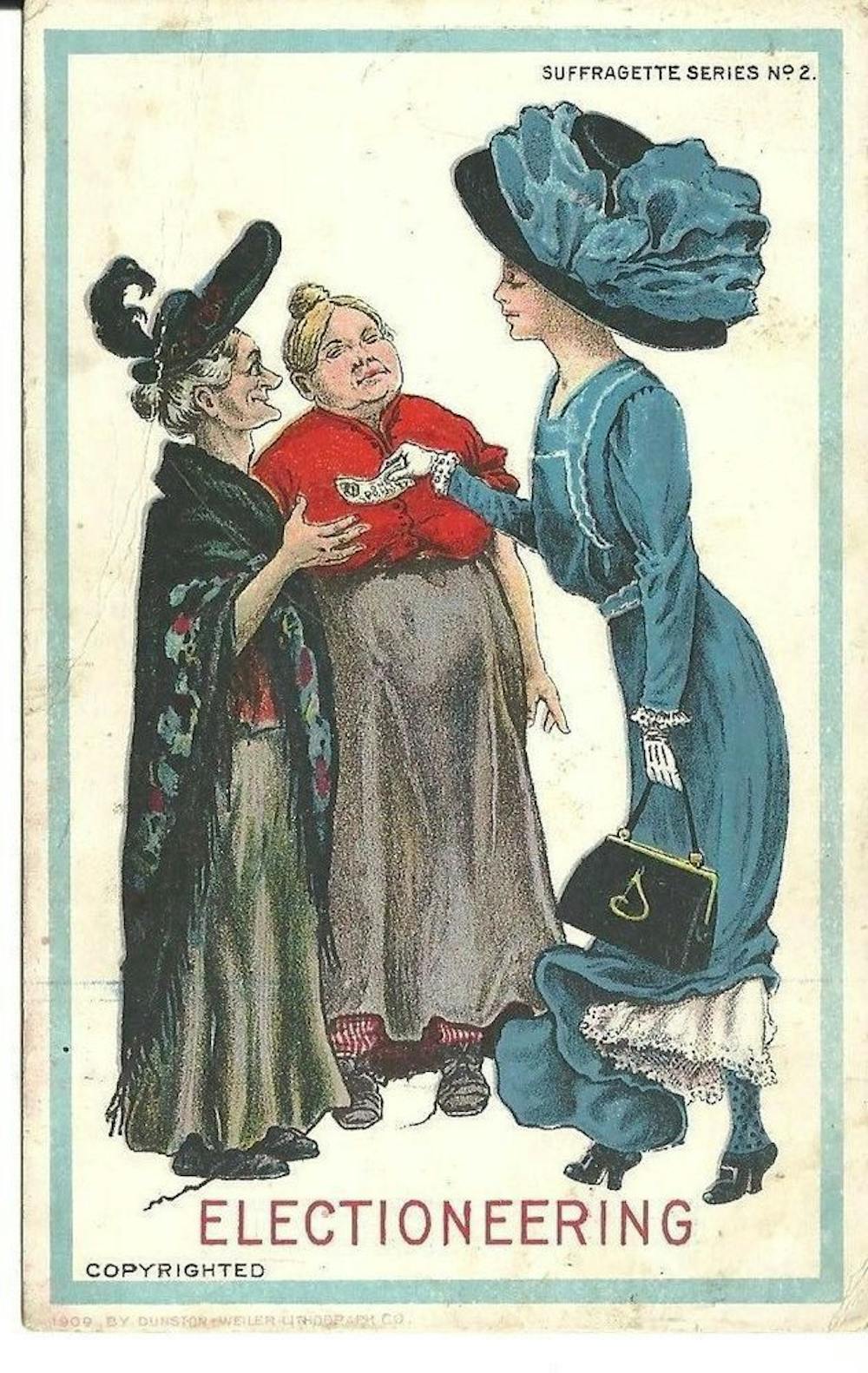
Prefiguring Mrs. Banks? A 1909 Dunston Weiler Lithograph Co. anti-suffrage postcard. Catherine H. Palczewski Postcard Archive/The Suffrage Postcard Project

Mrs. Banks was recently described by one critic as a “feminist heroine”. However, the portrait the Disney film painted of the suffragette was far more complicated – a product of both the pro-suffrage and anti-suffrage propaganda of the 1910s.

The character of Mrs. Banks wears a “Votes for Women” sash, attends public suffrage demonstrations, and enthusiastically advocates the cause to her domestic workers.

But when her character is read through the lens of anti-suffrage propaganda, it seems the Disney vision was far more influenced by this worldview.

Anti-suffrage films and postcards revelled in depicting the suffragette as a flighty mother. Disinterested in her household, she was more dedicated to the suffrage cause than to her children.

Prefiguring 14 Cherry Tree Lane? Anti-suffrage postcards depicted households in total disarray. Catherine H. Palczewski Postcard Archive/The Suffrage Postcard Project

As Lori Kenschaft has observed, film reviewers in 1964 also perceived Mrs. Banks as a “nutty suffrage mother,” whose depiction fed into the idea that suffragettes — and, by extension, other feminists — were mentally unbalanced.

Anti-suffrage propaganda also warned that households would be turned upside-down by women’s involvement in the suffrage campaign.

The Banks household is indeed in a state of total upheaval – both literal and metaphorical – as evinced by the twice-daily explosions their neighbour Admiral Boom wreaks on Cherry Tree Lane.

The character of Mrs. Banks supports Emmeline Pankhurst and the Women’s Social and Political Union. Under Pankhurst’s leadership, the union advocated militancy to acquire the vote. This led to the imprisonment of many British suffragettes. Some famously carried out hunger strikes, which resulted in brutal, state-sanctioned force-feeding.

Many anti-suffrage postcards suggested that the force-feeding of suffragettes was humorous. Ville de Paris/Bibliothèque Marguerite Durand

Anti-suffrage postcards routinely found humour in such violence. Mrs. Banks herself offers a rather blithe account of these experiences in the 1964 film. Gleefully, she shrieks, “Mrs. Whitman-Allen chained herself to the wheel of the prime minister’s carriage!”

Today, the representation of suffrage in popular culture can still be controversial. The 2018 open world video game Red Dead Redemption 2, set in an alternate history of the American frontier in 1899, offers players the chance to assault and kill a suffragist who wears a “Votes for Women” sash.


Read more: Violence towards women in the video game Red Dead Redemption 2 evokes toxic masculinity


This character, a statuesque figure with grey hair and square jaw, resembles Rev. Dr. Anna Howard Shaw, who became president of the National American Woman Suffrage Association in 1904. Earnestly spruiking historically faithful suffrage propaganda, she says:

Once women get the vote … there’ll be no more wars, no hunger, no stupidity. We’ll elect a woman president! Within the first ten years, of course. You see, men are such judgemental prigs, you need women to help straighten you out!

Videos have since emerged on YouTube featuring players violently beating this suffragist unconscious after she says, “Let me vote.”

The 1964 characterisation of Mrs. Banks is far kinder than this. But it presents enough ambiguity to beg the question: Is Mrs. Banks really the crusader so many have envisioned her to be?

At the end of the film, Mrs. Banks gives her “Votes for Women” sash to her children to use as their kite’s tail. As the Banks family stands together harmoniously, the kite disappears into the air. Is Mrs. Banks shouting the cause from the rooftops, or abandoning it altogether?

Suffrage may not hold much consequence in Mary Poppins Returns. The 2004 Cameron Mackintosh musical theatre adaptation of the 1964 film excised the suffrage subplot entirely.

And yet, this long-awaited sequel will be set in 1935, just years after the full enfranchisement of British women through the Representation of the People (Equal Franchise) Act of 1928. Mrs. Banks herself famously sang of this next generation:

Our daughters’ daughters will adore us; And they’ll sing in grateful chorus: “Well done, sister suffragette!”

The film’s trailer features Jane and Michael Banks rediscovering their tattered old kite in the attic. Briefly visible to the discerning eye, its tail still features their mother’s “Votes for Women” sash.

While Michael leaves the kite streetside for garbage collection, his young son and the chimney-sweep Bert soon recover it. When they take the kite for a whirl, it lures Mary Poppins back down from the sky. Might Mary Poppins Returns also follow Jane Banks in her exploits as a recently enfranchised woman?

ref. Will the new Mary Poppins film acknowledge the suffragettes’ success? – http://theconversation.com/will-the-new-mary-poppins-film-acknowledge-the-suffragettes-success-106771

How much physical activity should teenagers do, and how can they get enough?

]]>

Source: The Conversation (Au and NZ) – By Vaughan Cruickshank, Program Director – Health and Physical Education, Maths/Science, Faculty of Education, University of Tasmania

Many teenagers spend a lot of time being sedentary (sitting or lying down) at school or work, when travelling and during their free time. Modern conveniences such as smart phones, computers and food delivered to your front door encourage sedentary behaviour. But this lack of physical activity can have negative consequences for your physical and mental health.


Read more: How physical activity in Australian schools can help prevent depression in young people


We have all probably been told we have to exercise to stay healthy, but how much physical activity is the right amount for teenagers? And what are the benefits?

How much and why?

All Australians aged 13-17 are encouraged to do 60 minutes of physical activity each day. There are numerous benefits of physical activity, including physical (improved fitness and decreased risk of illness), social (having fun with friends) and emotional (helps manage stress and anxiety) benefits.

You should try to include a combination of aerobic activities (such as swimming or walking), strength training (such as sit ups or weight training) and flexibility training (such as yoga or stretching).

Try to include a mix of different types of exercise in your routine. from www.shutterstock.com

Try to mix up easy, moderate, and harder activities that are both fun and personally challenging. Limiting sitting time and screen time by regularly interrupting periods of sedentary behaviour is another good idea. For example, standing and moving for a few minutes after every hour of sitting.

There are 1,440 minutes in every day, so being physically active for just 60 minutes is easily achievable.

Planned activities

There are hundreds of types of physical activities you could do. The most important thing is to do activities you enjoy, because you’ll be more likely to keep doing them. Research also suggests you’ll be more likely to be physically active if you exercise with your friends.

Doing a Google search for your location and activity (for example, “swimming clubs near me”) will help you find heaps of clubs and groups you can join up to keep active with your friends, and find new friends with similar interests. Check out some of the types of planned physical activities you can participate in, in the diagram below and challenge yourself to try something new.


Technology can be both good and bad when it comes to physical activity. Smart phones and computers contribute to sedentary behaviour, but they can also be used to promote and encourage physical activity behaviours. There are numerous mobile apps that can help motivate you to increase your physical activity. Getting a pedometer or smart watch could also help motivate you to do the recommend minimum of 10,000 steps a day.

Incidental activity

Another way you can increase your physical activity is to increase the activity you do throughout the day. Incidental activity refers to any movement that increases your level of daily activity. These activities don’t happen at the gym, but instead rely on your daily choices.

For example, office workers are often told to get more activity into their day by doing things such as parking further away from work and walking the rest of the way, and using the stairs instead of the lift.

Walking the family pet is a good option to work physical activity into your daily routine. from www.shutterstock.com

Similarly, you could:

  • walk or ride to school instead of taking a car or bus
  • walk around the oval as you chat to your friends at lunchtime instead of sitting
  • do something active when you meet up with your friends on the weekend, such as swimming at the beach
  • do an extra lap when you go to the shopping centre and/or, go down every aisle when you go to the supermarket
  • at family gatherings, play games with your younger siblings and cousins rather than playing on your phone
  • take your dog for a walk and a play at the park more often
  • ride an exercise bike or do some stretching while you watch TV
  • have “active ads” where you do something active – such as push ups or body weight squats – every time a commercial comes on
  • playing exergames like Nintendo Wii can be better than just sitting on the couch.

Read more: Exergames: good for play time, but should not replace physical education


Making these simple choices each day can become a habit that increases your physical activity and improves your health. Incidental activity doesn’t replace planned exercise, but all the activity you do during the day adds up, and these two forms of activity can work together to increase your physical activity level.

Incidental activity requires no special equipment or preparation. You can just stand up and move at any time you choose. Remember: something is better than nothing and more is better than less.

ref. How much physical activity should teenagers do, and how can they get enough? – http://theconversation.com/how-much-physical-activity-should-teenagers-do-and-how-can-they-get-enough-102709

Human rights watchdog calls for police probe into ‘unclear’ Papua killings

]]>
Christmas spirit at a Human Rights Day rally in the Papuan capital of Jayapura this week. Image: Voice Westpapua

Pacific Media Centre Newsdesk

Indonesian police should investigate a Papuan armed group’s killing of at least 17 people, including a soldier, at a construction area in Nduga in Papua’s densely forested Central Highlands earlier this month, Human Rights Watch said today.

The circumstances of the killings on December 2 remained unclear, said the watchdog.

Papuan militants should cease unlawful killings, and the Indonesian government should ensure that its security forces act in accordance with international standards and not commit abuses in response to the attack, said the watchdog.

READ MORE: Indonesia’s Papua media blacklist

“A Papua militant group’s attack on a worksite raises grave concerns that require a full investigation,” said Elaine Pearson of Human Rights Watch.

“Militants and responding security forces should not inflict harm on ordinary Papuans.”

-Partners-

The West Papua National Liberation Army (Tentara Pembebasan Nasional Papua Barat), the military wing of the Free Merdeka Movement (Organisasi Papua Merdeka), claimed responsibility for the killings, saying those killed were military personnel from the Indonesian Army Corps of Engineers.

An army colonel said that three of the survivors of the attack were military personnel working as engineers.

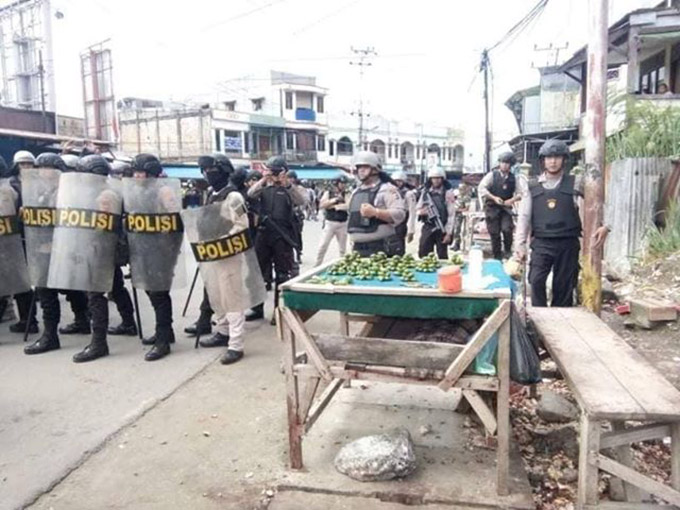
Indonesian police prepare to face peaceful Papuan protesters in the capital of Jayapura this week. Image: Voice Westpapua

‘Military engineers’
Sebby Sambom, a spokesman for the Papuan armed group, told the media that the attacks were organised by the militant’s group’s third Ndugama Command.

He said they had monitored the workers for three months and concluded that they were engineering corps personnel wearing civilian clothes.

However, Indonesia’s public works minister, Basuki Hadimuljono, said that those killed were workers from state-owned companies PT Istaka Karya and PT Brantas Abipraya, sent from Sulawesi to work on the 4300 km Trans-Papua highway.

He said that only the soldiers protecting the workers were armed, including the one killed in the attack.

Indonesian President Joko Widodo said in reaction to the attacks he had “ordered the armed forces commander and the police chief to pursue and capture all the perpetrators of such rude and violent acts”.

Priests, seminarians and students take part in a peaceful Human Rights Day march in the capital Jayapura this week. Image: Voice Westpapua
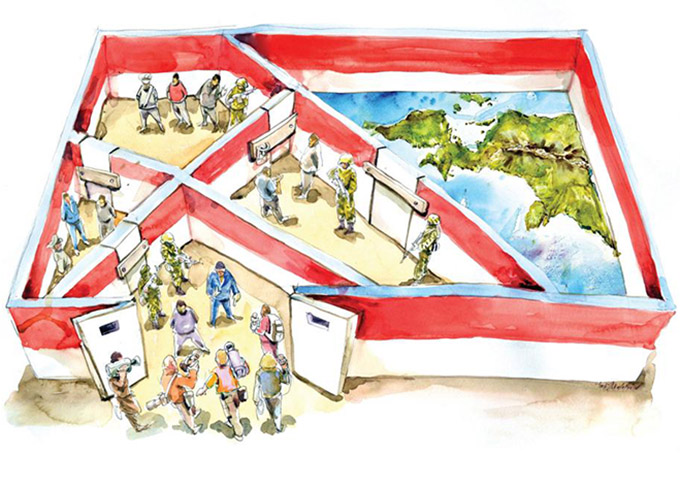

In West Papua, December 1 is widely commemorated as the day West Papua declared nationhood. In 1961, under Dutch rule, an elected council consisting mostly of indigenous Papuans commissioned the creation of a national anthem and flag.

On December 1, 1961, the West Papuan Morning Star flag was flown beside the Dutch tricolor for the first time.

Indonesia took control over Papua with United Nations recognition in 1969.

500 plus arrested
Over the last five decades, some Papuans have resisted Indonesian rule. On December 1, 2018, more than 500 students were arrested in more than 10 Indonesian cities after peacefully raising the Morning Star flag and demanding a referendum on independence.

Indonesia’s National Police initially announced that the killings in Nduga were in retribution for a worker taking photographs of Papuan militants organising a flag-raising ceremony near a road and bridge construction.

More than 100 military and police officers were evacuating the dead and injured, and engaged in a military operation against the militants.

Human Rights Watch has long documented human rights abuses in Papua’s Central Highlands, where the military and police have frequently engaged in deadly confrontation with armed groups.

Indonesian security forces have often committed abuses against the Papuan population, including arbitrary detention and torture. A lack of internal accountability within the security forces and a poorly functioning justice system mean that impunity for rights violators is the norm in Papua.

“The Indonesian security forces should exercise care when operating in Nduga, directing all security personnel to treat Papuans in accordance with international standards,” said the watchdog.

“They should transparently investigate and hold accountable anyone implicated in a criminal offence. Both the military and the police should allow journalists to operate independently in the area.”


A cartoonist’s depiction of Indonesian government restrictions on media freedom and rights monitoring in Papua. Cartoon: © 2015 Toni Malakian/Human Rights Watch

Remote access
Nduga is an extremely remote area where no journalists have had access since the attacks.

A decades-long official restriction on foreign media access to Papua and controls on Indonesian journalists there have fostered that lack of justice for serious abuses by Indonesian security forces and fueled resentment among Papuans.

“The situation in Nduga is muddled in large part because no journalists can independently go into the area to interview witnesses and verify what happened,” Pearson said.

“Having independent monitors on the ground will help deter abuses by both the militants and security forces, which would benefit all Papuans.”

Print Friendly, PDF & Email

Article by AsiaPacificReport.nz

ADHD prescriptions are going up, but that doesn’t mean we’re over-medicating

]]>

Source: The Conversation (Au and NZ) – By Daryl Efron, Associate Professor, Royal Children’s Hospital

The rate of medications dispensed for attention-deficit hyperactivity disorder (ADHD) in children aged 17 and under increased by 30% between 2013-14 and 2016-17.

The Australian Atlas for Healthcare Variation, released today, shows around 14,000 prescriptions were dispensed per 100,000 children aged 17 and under in 2016-17, compared with around 11,000 in 2013-14.

The atlas for 2016-17 also showed some areas had a high dispensing rate of around 34,000 per 100,000 while the area with the lowest rate was around 2,000 per 100,000 – a 17-fold difference. This difference is much lower than in 2013-14, when the highest rate was 75 times the lowest.

For decades people have been concerned too many children could be diagnosed with ADHD and treated with medications. We are conducting a study called the Children’s Attention Project, following 500 children recruited through Melbourne schools. So far, we have found only one in four children who met full ADHD criteria were taking medication at age ten.

So it looks like, if anything, more children with ADHD should be referred for assessment and consideration of management options.

How many kids are medicated?

ADHD is the most common neurodevelopmental disorder of childhood – the prevalence is around 5% in Australia. Children with ADHD have great difficulty staying focused, are easily distracted and have poor self-control. Many are also physically hyperactive, especially when they are young.

To be diagnosed, children need to have major problems from their ADHD symptoms both at home and school. These include learning difficulties, behavioural problems and trouble making friends. Young people with ADHD are more likely to fail school, have lower quality of life, experience substance abuse issues and teenage pregnancy, or end up in prison.


Read more: ADHD: claims we’re diagnosing immature behaviour make it worse for those affected


Medication can make a big difference to these children’s lives. While there are many ways to help children with ADHD, stimulant medication is the most effective treatment. All international clinical guidelines recommend it for children with significant ADHD that persists after non-medication approaches have been offered.

Our previous research found that about 80% of children diagnosed with ADHD by a paediatrician (the main medical specialty that manages ADHD) in Australia are treated with medication.

Children with ADHD have trouble making friends. Charlein Gracia/Unsplash

The atlas shows the proportion of children and adolescents who had at least one ADHD medication prescription dispensed was 1.5% in 2013-14 and 1.9% in 2016-7. This is similar to the prevalence of stimulant medication prescription in previous Australian studies in the past 15 years. It sits between the US (high) and Europe (low) and is not excessive given the prevalence of the condition.

The Children’s Attention Project found those with the most severe symptoms were more likely to be prescribed medications, as were those from families of lower socioeconomic status. Other Australian studies have found similar results. This is not surprising as ADHD does appear to be more common in children from socioeconomically disadvantaged families.

Our research suggests that disadvantaged families in Australia appear to be able to access services for ADHD, at least in metropolitan centres.

Why does it vary between areas?

The atlas finding that there is considerable regional variation in prescribing of stimulant medications in Australia has been identified in previous studies and needs to be better understood. Some variation in health care is normal and good, but too much suggests there may be a problem with the quality of care or access to care. For example, greater prescribing in regional areas may reflect lack of timely access to non-pharmacological services.


Read more: Want to improve the nation’s health? Start by reducing inequalities and improving living conditions


We do need to keep watching this space, monitoring rates and regional variation of medication use. A landmark study in the US, published in 1999, compared medication with intensive parent and teacher behaviour training. The children who received medication had a much greater reduction in ADHD symptoms.

But medication is only one consideration in ADHD. Other supports are also important. Behavioural therapies can help reduce anxiety and behaviour problems in children with ADHD and improve relationships with parents and teachers.

However, accessing psychologists can be hard for many families. While Medicare rebates are available for up to ten sessions per year, costs can still be a barrier. In our research, Victorian parents reported out-of-pocket costs of up to A$200 per session with a psychologist.

ADHD is not considered a disability under the National Disability Insurance Scheme, so families are not eligible for funding packages.

Further research is needed to better understand the factors influencing access to care for Australian children with ADHD, and why there is such variation in rates of prescribing between regions. We also need to ensure children across Australia get equitable access to non-medication management.


Read more: Girls have ADHD too – here’s why we may be missing them


We need evidence-based clinical guidelines relevant to the Australian healthcare system, which is quite different from places such as the UK and US. This work must include adult ADHD, which is an emerging area with a raft of clinical and service system complexities.

ref. ADHD prescriptions are going up, but that doesn’t mean we’re over-medicating – http://theconversation.com/adhd-prescriptions-are-going-up-but-that-doesnt-mean-were-over-medicating-108474

Huawei executive’s arrest will further test an already shaky US-China relationship

]]>

Source: The Conversation (Au and NZ) – By Tony Walker, Adjunct Professor, School of Communications, La Trobe University

When US Vice President Mike Pence got to his feet at the conservative Hudson Institute in Washington on October 4, it was clear that US-China relations were entering a new, certainly fractious, possibly destructive phase.

In those remarks, Pence did not hold back. They bear repeating in light of the latest blow-up in an increasingly testy relationship, this time over the arrest in Canada of the daughter of one of China’s most prominent business figures.

The Chinese Communist Party has used an arsenal of policies inconsistent with free and fair trade, including tariffs, quotas, currency manipulation, forced technology transfer, intellectual theft and industrial subsidies that are handed out like candy to foreign investment. These policies have built Beijing’s manufacturing base, at the expense of its competitors – especially the United States of America.

Meng Wanzhou, a senior executive in telecommunications manufacturing giant Huawei and daughter of its founder, is alleged by the United States to have violated sanctions on selling technology to Iran.

Her extradition to the US to stand trial is being sought. This is an explosive issue, not least because – rightly or wrongly – it will be perceived in Beijing as a component of a trade war driven by a hostile US administration.


Read more: G20 summit bring a truce in US-China trade relations – but it’s likely to be temporary


What will also be playing out in China is the issue of “face”. An inability by China’s leadership to bring about Meng’s release will involve “loss of face” in a country where nationalist sentiments remain potent, overlaid by a lingering sense of grievance over foreign interference.

China could not have drawn any conclusion from the Pence Hudson Institute speech other than that Washington viewed Chinese business practices as war by another means.

In Pence’s remarks, there was little concession to a grand bargain between the US and China sought by successive administrations. Rather, the US vice president delivered a warning to Beijing that his country was intent on a more confrontational approach to perceived Chinese mercantilism – and lawbreaking.

The gloves were off. Inevitably, Meng’s arrest will be viewed in Beijing through this prism, whether circumstances are material or not.

What is relevant in Huawei’s case is an effective veto on it building 5G networks in Anglosphere countries around the world.

Four members of the Five Eyes – the US, United Kingdom, Australia and New Zealand – have banned Huawei from participating in advanced 5G networks. Canada is reviewing its options.

This coordinated resistance by intelligence-sharing allies reflects misgivings about risks to communications networks in their countries from a company with murky links to the Chinese military.

While there is no explicit connection between Meng’s arrest and pushback against Huawei’s 5G business, China will inevitably link the two episodes as examples of Western efforts to stifle competition from a Chinese behemoth.

This would be an understandable reaction, but on the face of it these are separate issues.

What is the case is the Pence Hudson Institute speech signals a potential rupture in the nearly half century of relative amity – leaving aside outrage over the Tiananmen Square bloodletting of 1989 – dating from the Shanghai Communique of 1972.

This was signed by visiting President Richard Nixon and Chinese Premier Zhou Enlai. After years of contentiousness on Taiwan and other issues, the US and China agreed to work towards normalising relations.

What is different now is that, seemingly in the blink of an eye, China has grown its economy to the point where it is the world’s biggest on a purchasing power parity basis. It’s set to become the largest overall within the next ten years.

Companies like Huawei symbolise China’s extraordinary economic success and the threat this poses to established businesses in the West.

Back in 1972, no-one could have anticipated China would move as far and fast as it has – to the point where it is challenging the US and its allies on many fronts.

This returns us to the issue of Meng Wenzhou, whose arrest is threatening to derail trade negotiations advanced by Presidents Donald Trump and Xi Jinping at a dinner engagement at the recent Buenos Aires G20 summit.

China’s official response had been relatively measured in what appears to be an attempt to compartmentalise the Meng arrest issue and not allow it to bring important trade talks unstuck.

Trump and Xi agreed on a 90-day window ending on March 1 to enable the trade negotiations – aimed at forestalling increases of US tariffs on Chinese imports – to proceed. However, Meng’s arrest casts doubt on this process.


Read more: The risks of a new Cold War between the US and China are real: here’s why


In the past 48 hours, China has stiffened its official rhetoric. This includes the summoning of the US ambassador in Beijing for a dressing down. Chinese displeasure was summed up in a Foreign Ministry statement:

The actions of the US seriously violated the lawful and legitimate rights of the Chinese citizen, and by their nature were extremely nasty. China will respond further depending on US actions.

What this portends is anybody’s guess, but once they have swung into action, US legal processes are relentless. In the meantime, Canada finds itself in a Chinese firing line as its own judiciary deals with a politically charged extradition process.

In the wider scheme of things, it is hard to envision a more unhelpful development at a critical moment in US-China relations. This is not a complication that is doing anyone any favours, least of all world markets, or the friends and trading partners of those at its centre.

ref. Huawei executive’s arrest will further test an already shaky US-China relationship – http://theconversation.com/huawei-executives-arrest-will-further-test-an-already-shaky-us-china-relationship-108478

Pacific voices tell stories of climate change reality in new documentary

]]>

A new documentary Subject to Change, a collection of interviews and personal stories from across the Pacific, explores the impact of climate change. Video: MFAT

Pacific Media Watch Newsdesk

Two young women students are the driving force who created a new documentary titled Subject to Change which highlights the climate change challenges faced by Pacific people in the region.

Among the most vulnerable to climate change impacts, Pacific voices are at the heart of the film which has been premiered at the UN Climate Change Conference (COP24) in Katowice, Poland, at the Pacific and Koronivia Pavilion.

Producer Amiria Ranfurly, who is of Niuean-New Zealand descent, and Polish director Wiktoria Ojrzyńska, are students of Massey University of New Zealand.

READ MORE: AUT’s Bearing Witness climate change project

The young women chose to showcase climate change in their work because of the impact in the region.

-Partners-

“We wanted to explore the impacts that climate change is having on our world, and Subject to Change is a documentary film that presents a collection of interviews and personal stories from across the Pacific,” says Ranfurly.

“With passion and determination, we have created a film that shares insight to New Zealand’s response to the global objectives set by the Paris Agreement, alongside intimate stories from the frontline in a truthful and evocative way.”

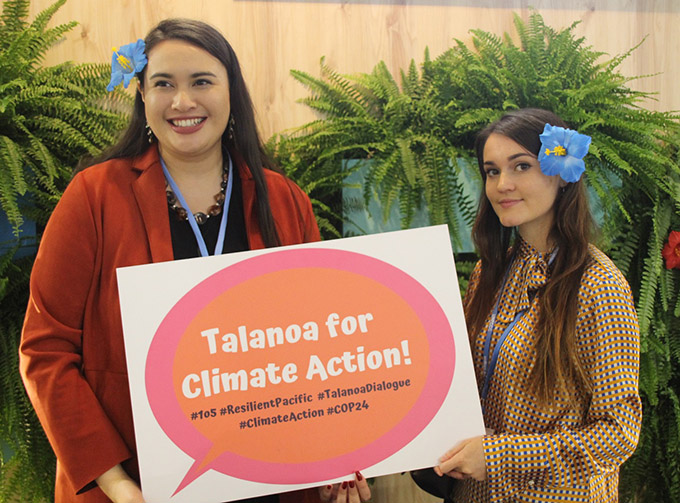
Documentary producer Amiria Ranfurly (left) and director Wiktoria Ojrzyńska … “intimate frontline climate stories”. Image: COP24 Pacific


Director Ojrzyńska says: “Directing Subject to Change was an amazing storytelling experience, during which I worked with many inspirational people and gained experience across different aspects of filmmaking.”

Collaboration project
Subject to Change
is a collaboration between Massey University and NZ’s Ministry of Foreign Affairs and Trade (MFAT).

Present to launch the film at the premiere was the Ambassador and Climate Change Special Adviser of the Government of New Zealand, with special guest speaker Inia Seruiratu, COP23 High Level Climate Champion of Global Climate Action, and Minister for Defence and National Security of Fiji who introduced the Director and the Producer of the film.

“Climate change remains the single greatest threat to the livelihoods, security and wellbeing of the peoples of the Pacific,” said Ambassador Stephanie Lee. “Our Prime Minister, Jacinda Ardern, has described the climate change challenge as the Nuclear-Free Movement of our generation.”

“We have heard about the IPCC 1.5 degrees report and we already knew that it really underlines this challenge as an urgent one. The documentary you are about to see embodies that sense of challenge, but it also embodies a sense of hope,” said Ambassador Lee.

The documentary featured and drew strongly on the perspective of the Fijian people, particularly of those of the small island of Batiki with a population of around 300 people that was hit hardest by Cyclone Winston in February, 2017.

Inia Seruiratu thanked the NZ government and Massey University for supporting the documentary, as well as New Zealand’s support and partnership on the Pacific and Koronivia Pavilion where the premiere was being held.

Speaking about his experience as a Pacific islander, Seruiratu thanked the producer, director and the team behind the documentary for producing a powerful medium with which the voices of the vulnerable could be heard.

“People need to see and experience visually the realities others such as those in the Pacific are facing in order to better understand. And this is why this documentary is so important and serves as a great tool,” said Seruiratu.

Print Friendly, PDF & Email

Article by AsiaPacificReport.nz

Recovered Aboriginal songs offer clues to 19th century mystery of the shipwrecked ‘white woman’

]]>

Source: The Conversation (Au and NZ) – By Stephen Morey, Senior Lecturer, Department of Languages and Linguistics, La Trobe University

In 1846 Melbourne was gripped by a panic: a story had spread that a white woman had been shipwrecked off the coast of Gippsland and was living with Aboriginal people. “Expeditions” were sent to “rescue” her. Messages were left for her printed on handkerchiefs, and because some believed she was Scottish, some of these were written in Gaelic.

The expeditions sent to Gippsland resulted in the massacre of large numbers of Indigenous people from the Gunai/Kurnai community.

For generations, people have argued over whether the “white woman” really existed and if so, what happened to her. In her 2001 book The Captive White Woman of Gipps Land author Julie Carr recounted a story written in 1897 by Mary Howitt, the daughter of A.W. Howitt, an anthropologist and Gippsland magistrate, which told how the white woman later had children with an Aboriginal husband and drowned in McLennan’s strait. Carr came to the conclusion that evidence for the existence of the woman was inconclusive; government searches in 1846 and 1847 having failed to find her.

But we have recently identified two short songs in the Aboriginal language of Gippsland (Gunai/Kurnai) about the white woman’s story that provide some clues. These were in the papers of Howitt at the State Library of Victoria.

A handkerchief for the white woman shipwrecked in Gippsland.

A gift of possum skin

At the top of one page of Howitt’s notes headed August 23 1868, per J.C. Macleod (the son of an early pastoralist), Howitt wrote the following note:

Blacks told him [Macleod] in the early days the white woman was wrecked in the coast with some men who were killed – the woman being saved. She was a tall woman, young with very long black hair in ringlets (some said the hair was fair). … She was the Miss Howard who was about 16 years of age when the vessel in which she was going to Melbourne was lost. Daughter of Commissary Howard. Part of the vessel was after picked up in the ninety mile beach

Two Gunai/Kurnai songs are written on the same page. Howitt notes that these songs were composed by a “Dinni Birraark”, a senior songster and ritual specialist, where dinni is the word for “old” and the birraark is the name of an expert who was skilled in songs and magic. These men were said to fly and see beyond the physical world.

In the 1840s there were seven surviving men who held the title of Dinni Birraark. The composer of this song was likely to have been a man also known as Bunjil Bamarang from near Bairnsdale. Bunjil Bamarang was not his personal name, but indicated that he was an expert (Bunjil) in something. We do not know what Bamarang refers to, but it may indicate expertise in the use of the “spear shield”, which was called bammarook in Gunai/Kurnai.

One of these songs, written down by Howitt, directly mentions the “white woman”:

State Library of Victoria

We have transcribed this as:

U-auda kai-ū Lohan-tŭkan móka kat-teir nŭ́rrau-un-gŭl mūndū wánganna

Underneath the song, Howitt gives translations for many of the words. For instance, he translates Lohan-tŭkan as “white woman”. The overall meaning of the song seems to be, “Give the white woman from over the sea the possum skin skirt, and that blanket there.”

This genre of song, gunyeru, was traditionally sung with dancing at public gatherings, what might be otherwise commonly referred to as a “corroboree” (although the word “corroboree” originates from the Dharuk language spoken in the Sydney area). The Dinni Birraark was certainly an acknowledged expert in composing this style of song.

Burning ladders

On the same page, is a second song that seems to give more information about the Lohan-Tuka, or white woman’s, story:

State Library of Victoria

This we have transcribed as:

Blaung-a-requa drūraua kŭllŭngŭka
Wŭrūng-tūnkū bŭdda-tūnkū pŭtta-ngaiu
tūka-pŭnta kŭrnŭng-ŭka ma-kŭrnung-ita

In the first line of the song there are three words that Howitt translates as “burn”, “ladder” and “whitefellow”. This would appear to be a sentence meaning, “The whitefellow’s ladder is burning”.

When we remember that ships in the 1840s were sailing ships, we can imagine that the Dinni Birraark used a word that he knew – “ladder” – to represent the rigging on a sailing ship. As Gunai/Kurnai elder, Russell Mullett, pointed out to us, “As a senior man, the Dinni Birraark would have used a ladder in his ritual life.”

The remaining portions of this second song are harder to interpret. It seems that the Dinni Birraark was watching the burning of this ship from the narrow strip of land along the Ninety Mile Beach between the sea and the freshwater of the Gippsland Lakes.

In this place, perhaps a musk duck (Tuka) had a nest, there was a hollow place near to water. Intriguingly the word for white woman, Lohan Tuka, is a compound including the word for musk duck. Perhaps, as Mullett has suggested, the place where the Dinni Birraark watched this had an association with an ancestral musk duck.

The message printed on handkerchiefs in a bid to find the shipwrecked white woman.

These songs are composed as if witnessing real events: the wreck of a ship and the rescue of a young woman. Nothing is more naturally human than offering a young shipwreck victim a “skirt and a blanket”, and the description of the shipwreck as a “burning ladder” is fully plausible.

These two songs seem to suggest that there was a White Woman, the Lohan Tuka. There is much tragedy in this story – shipwreck, massacre, possible drowning. This history needs to be told and re-told.

What these songs reveal is an Indigenous perspective on it and a glimpse into the rich artistic culture of the Gunai/Kurnai. In the words of Mullett, “taken together these two songs are like an opera composed by the Dinni Birraark”.

ref. Recovered Aboriginal songs offer clues to 19th century mystery of the shipwrecked ‘white woman’ – http://theconversation.com/recovered-aboriginal-songs-offer-clues-to-19th-century-mystery-of-the-shipwrecked-white-woman-108070

As Indigenous incarceration rates keep rising, justice reinvestment offers a solution

]]>

Source: The Conversation (Au and NZ) – By Sophie Russell, Research Associate, UNSW

The over-incarceration of Aboriginal and Torres Strait Islander Australians is one of our nation’s most significant human rights concerns.

Data released last week show the number of people imprisoned in Australia has continued to rise. The rate of Indigenous incarceration has increased by 45% since 2008.

It is a national shame that Aboriginal and Torres Strait Islander Australians make up 2% of the total Australian population, but 28% of the Australian prison population.

Aboriginal and Torres Strait Islander men are 15 times more likely to be in custody than non-Indigenous men. Aboriginal and Torres Strait Islander women are 21 times more likely to be in custody than non-Indigenous women.

The picture is particularly stark for Indigenous children. They make up 7% of the general youth population but 54% of those in youth detention across Australia. This ranges, on average, from 15% in Victoria to 97% in the Northern Territory.

The staggering over-representation of Indigenous people in prison was the focus of the Australian Law Reform Commission report Pathways to Justice – Inquiry into the Incarceration Rate of Aboriginal and Torres Strait Islander People. The report was delivered to the federal attorney-general in December 2017. A year later, the government has yet to respond.

What did the inquiry recommend?

Two key recommendations involved “justice reinvestment”. Justice reinvestment is a strategy for reducing the number of people in prison by investing funds drawn from the corrections budget into early intervention, prevention and diversionary solutions in communities where many prisoners come from and return to.

Justice reinvestment involves working with a community to design local solutions to overcome the drivers of crime and incarceration.

The inquiry recommended an independent justice reinvestment body be set up with Aboriginal and Torres Strait Islander leadership. This would provide technical expertise and promote the reinvestment of resources from the criminal justice system into community-based initiatives.


Read more: We need evidence-based law reform to reduce rates of Indigenous incarceration


The inquiry also recommended that governments support justice reinvestment trials in partnership with Aboriginal and Torres Strait Islander communities. This would include allowing access to local criminal justice data, supporting local justice reinvestment initiatives and facilitating participation and coordination between relevant government departments and agencies.

A small number of community-led justice reinvestment trials are taking place throughout Australia. There is widespread support for further advancing justice reinvestment.

Evidence shows justice reinvestment is already working

The Maranguka Justice Reinvestment project in Bourke, New South Wales, is the most developed community-based trial. The Bourke Tribal Council, assisted by Just Reinvest NSW, directs and guides Maranguka.

The project is building a safer and stronger community. This has led to significant reductions in crime and reoffending. From 2016 to 2017, the Bourke community experienced a:

  • 23% reduction in police-recorded incidents of domestic violence
  • 14% reduction in bail breaches for adults
  • 42% reduction in days spent in custody for adults
  • 31% increase in year 12 student retention rates
  • 38% reduction in charges across the top five juvenile offence categories.

A KPMG impact assessment found the Maranguka project achieved savings of A$3.1 million in 2017. Two-thirds of that relates to the criminal justice system and one-third is the broader economic impact in the region.

The financial impact of the project is about five times greater than its operational costs. If Bourke is able to sustain just half the 2017 results, an additional gross impact of A$7 million over the next five years could be achieved.

Justice reinvestment offers a solution

Community leaders, academics and representatives from businesses, nongovernment organisations and government attended a national justice reinvestment forum in Canberra last week. The message from the forum was clear: solutions to reduce Indigenous imprisonment need to be community-designed and driven, with government support.

Research has found a large portion of prisoners come from and return to a small number of inadequately resourced neighbourhoods and communities. It is well known that prisons are filled with people who are disproportionately disadvantaged and who have unmet social, health and disability-related needs.

Research has also shown that prison does not reduce crime. It actually perpetuates cycles of poverty, disadvantage and reoffending.


Read more: FactCheck Q&A: are Indigenous Australians the most incarcerated people on Earth?


It costs almost A$300 a day to keep an adult in prison. The average cost of locking up a young person is almost five times that amount.

Aboriginal and Torres Strait Islander over-incarceration cost the Australian economy an estimated A$7.9 billion in 2016. These costs are expected to grow to A$9.7 billion in 2020 and A$19.8 billion by 2040, if we continue on the same trajectory.

Australia cannot afford the social, health and economic costs of over-imprisonment of Aboriginal and Torres Strait Islander Australians. Strong, healthy and connected communities are the most effective way to prevent crime and make communities safer. Justice reinvestment offers a pathway to achieve this.

ref. As Indigenous incarceration rates keep rising, justice reinvestment offers a solution – http://theconversation.com/as-indigenous-incarceration-rates-keep-rising-justice-reinvestment-offers-a-solution-107610

How physical activity in Australian schools can help prevent depression in young people

]]>

Source: The Conversation (Au and NZ) – By Alexandra Parker, Professor of Physical Activity and Mental Health, Victoria University

Adolescence is a critical time for the development of mental health problems. In fact, depression is most likely to occur during adolescence and young adulthood. It’s the leading cause of disability in young people worldwide.

At least one‐quarter of young people will experience an episode of depression before 19 years of age. By year 9, students who have experienced a mental disorder are on average two years behind in academic achievement compared to those without a mental disorder.

The consequences of depression in adolescence are serious and can be lifelong. These include an increased risk of depression late in life, poor social functioning and academic achievement and reduced employment security, as well as greater risk of suicide and self‐harm.


Read more: What can parents do about their teenagers’ mental health?


Many young people don’t recover from depression, despite treatment with the best available evidence‐based treatment approaches. Given the scope and impact of depression in young people, and poor recovery rates, it’s crucial to understand how to help prevent the development of depression in young people.

An increasing body of evidence indicates physical activity and exercise are effective for improving mood. We recently also examined studies to assess the efficacy of physical activity and exercise as a prevention for depression in young people. We found eight controlled research studies that examined this. These studies showed exercise and physical activity are effective as a depression-prevention approach for young people.

How much physical activity do young people need to do?

Few young people seek professional help for mental health concerns. It’s important to engage young people in places that suit them to prevent the onset of mental health problems. Prevention and early intervention are crucial and especially relevant in the education setting.

Many young people never recover from depression once it is established. from www.shutterstock.com

The Australian guidelines state young people should engage in 60 minutes of physical activity a day. The majority of young people don’t reach this target.

In fact, disengagement from regular exercise, physical activity and sporting clubs steadily increases during adolescence. This coincides with the average age of onset of depression.

Physical activity is an important part of the Australian Curriculum. The Australian national policy requires government schools to provide at least two hours of physical activity per week during primary education and junior secondary education. The provision of any physical education is not required as part of the senior secondary curriculum. Even during primary education and junior secondary education, the mandated 120 minutes a week doesn’t meet Australian guidelines.

Schools are a key site for the promotion of healthy behaviours. Many long-term health-related behaviours and patterns – both positive and negative – are established during the developmental phase of adolescence and early adulthood.

How do we get them to do more?

The research indicates physical activity is associated with reduced risk of depression in young people. Physical activity is an acceptable, non-stigmatising approach to promoting better mental health in young people. To meet the specific needs of young people, a physical activity program should facilitate self-reliance, motivation, and mental health and wellbeing literacy.

Depression is the leading cause of disability for young people across the globe. from www.shutterstock.com

Motivation to engage in physical activity can be increased by offering choice of activities, increasing skills and ability to engage in physical activity, and opportunities for social connection. Schools are best placed to ensure physical activity is increased and protected within the Australian curriculum and that young people meet the Australian guidelines for physical activity each day.

Most school-based intervention studies of physical activity have used supervised programs of moderate to vigorous physical activity. These consist of 30 to 45 minutes, three to five days per week. The physical activity should include a variety of activities, be age-appropriate and enjoyable.

Some researchers suggest schools could also promote physical activity outside physical education classes by ensuring at least 20 minutes of recess per day.

Finally, physical educators can be key drivers of physical and health literacy and behaviour change. They can do this, for example, through school-based activities and by providing information about the benefits of physical activity via newsletters and notices sent home.


Read more: Yes, your kids can run all day – they’ve got muscles like endurance athletes


Physical activity programs within schools should also address the health, mental health and stress-reduction motivations for engaging in physical activity and focus on the benefits of participation. This should include a focus on fun and enjoyment, while building confidence and independence.

Any physical activity program delivered in schools should also encourage young people to draw on parental and social support to increase the physical activity they do outside school time.

ref. How physical activity in Australian schools can help prevent depression in young people – http://theconversation.com/how-physical-activity-in-australian-schools-can-help-prevent-depression-in-young-people-107889

Cities can grow without wrecking reefs and oceans. Here’s how

]]>

Source: The Conversation (Au and NZ) – By Silvia Tavares, Lecturer in Urban Design, James Cook University

What happens if the water temperature rises by a few degrees?” is the 2018 International Year of the Reef leading question. While the ocean is the focus, urbanisation is the main reason for the rising temperatures and water pollution. Yet it receives little attention in this discussion.

In turn, rising temperatures increase downpours and urban floods, adding to the pressures on urban infrastructure.


Read more: Design for flooding: how cities can make room for water


Protecting the reef as Cairns grows

Cairns is an expanding Queensland city located between two World Heritage sites – the Great Barrier Reef and the Daintree Rainforest. While important research focuses on these sites themselves, not much is known about how the surrounding urban areas influence these natural environments. Similarly, little is known about how urban planning and design contribute to the health of the inner city and surrounding water bodies, including the ocean.

Cairns is a major Australian tourism destination with a unique coastal setting of rainforest and reef. This attracts growing numbers of visitors. One effect of this success is increased urbanisation to accommodate these tourists.

There are many opportunities to promote sustainable and socially acceptable growth in Cairns. Yet this growth is not without challenges. These include:

  • impacts of climate change, including sea-level rise and ocean warming
  • lack of comprehensive urban infrastructure strategy
  • lack of comprehensive assessment of the benefits of integrated urban design to maximise coastal resilience and the health of streams and oceans.

Rain gardens are common in Singapore. Roger Soh/Flickr, CC BY-SA

As with most Australian cities, Cairns has an urban layout based on wide streets, mostly with little or no greenery. Rain gardens, for instance, are rare. Bioswales that slow and filter stormwater are present along highways, but seldom within the city.

The arguments for not adding greenery to the urban environment are familiar. These typically relate to costs of implementation and maintenance, but also to the speed with which water is taken out of streets during the tropical rainy season. This is because green stormwater solutions, if not well planned, can slow down the water flow, thus increasing floods.

However, cities can be designed in a way to imitate nature with solutions that are an integral part of the urban system. This can include dedicated areas of larger wetlands and parks, which capture water and filter pollution and undesired nutrients more efficiently, reducing polluted runoff to the reef.


Read more: If planners understand it’s cool to green cities, what’s stopping them?


Integrated urban design

Integrated urban design is an aspect of city planning and design that could be further developed to ensure the whole system works more efficiently. This involves integrating the three elements that make up urban infrastructure:

  1. the green – parks, residential gardens, rain gardens, green roofs and walls, bioswales, etc
  2. the grey – built drains, footpaths, buildings, underground vacuum system, etc
  3. the blue – streams, stormwater systems, etc.

A rain garden, which absorbs rain and stores water to help control run-off from impervious hard surfaces, in Wellington, New Zealand. Karine Dupré

Urban infrastructure, therefore, can and should be planned and designed to provide multiple services, including coastal resilience and healthier water streams and oceans. To achieve this, a neighbourhood or city-wide strategy needs to be implemented, instead of intermittent and ad hoc urban design solutions. Importantly, each element should coordinate with the others to avoid overlaps, gaps and pitfalls.

This is what integrated urban design is about. So why don’t we implement it more often?

Challenges and opportunities

Research has shown that planning, designing and creating climate-resilient cities that are energy-optimised, revitalise urban landscapes and restore and support ecosystem services is a major challenge at the planning scale. To generate an urban environment that promotes urban protection and resilience while minimising urbanisation impacts and restoring natural systems, we need to better anticipate the risks and have the means to take actions. In other words, it is a two-way system: well planned and designed green and blue infrastructures not only deliver better urbanised areas but will also protect the ocean from pollution. Additionally, it helps to manage future risks of severe weather.

The uncertainties of green infrastructure capacity and costs of maintenance, combined with inflexible finance schemes, are obstacles to integrated urban solutions. Furthermore, the lack of inter- and transdisciplinary approaches results in disciplinary barriers in research and policymaking to long-term planning of the sort that generates urban green infrastructure and its desired outcomes.

On the bright side, there is also strong evidence to suggest sound policy can help overcome these barriers through technical guides based on scientific research, standards and financial incentives.


Read more: Here’s how green infrastructure can easily be added to the urban planning toolkit


Collaborative partnerships are promising, too. Partnerships between academia and industry tend to be more powerful than streamlined industry project developments.

Finally, and very promisingly, Australia has its own successful green infrastructure examples. Melbourne’s urban forest strategy has been internationally acclaimed. Examples like these provide valuable insights into local green infrastructure governance.

Cairns has stepped up with some stunning blue infrastructure on the Esplanade which raises awareness of both locals and visitors about the protection of our oceans.

This is only the start. Together academics, local authorities, industry stakeholders and communities can lead the way to resilient cities and healthier oceans.

Cairns Esplanade Lagoon helps raise awareness of the need to protect the ocean as the city grows. Karine Dupré, Author provided


Read more: How green is our infrastructure? Helping cities assess its value for long-term liveability


ref. Cities can grow without wrecking reefs and oceans. Here’s how – http://theconversation.com/cities-can-grow-without-wrecking-reefs-and-oceans-heres-how-107263

Digital platforms. Why the ACCC’s proposals for Google and Facebook matter big time

]]>

Source: The Conversation (Au and NZ) – By Sacha Molitorisz, Postdoctoral Research Fellow, Centre for Media Transition, Faculty of Law, University of Technology Sydney

The Australian Competition and Consumer Commission has released the preliminary report of its Digital Platforms Inquiry, and Google and Facebook won’t be happy.

Rather than adopting a gently-gently approach, the ACCC has produced draft recommendations that are extensive and dramatic.

If implemented, they would significantly affect the way the digital platforms make their money, and help direct the content we consume.

What’s more, the inquiry is touted as a world first. Its findings will be closely monitored, and perhaps even adopted, by regulators internationally.

Who should care?

The digital platforms themselves should (and do) care.

Any new regulations designed to foster competition or protect individual privacy (both are among the ACCC’s recommendations) have the potential to harm their revenues.

They’ve a lot to lose. In 2017, nearly A$8 billion was spent on online advertising in Australia, and more than half went to Google and Facebook (p3).

News organisations whose output is disseminated by those platforms should (and do) care too.

As the ACCC notes, more than half of the traffic on Australian news websites comes via Google and Facebook (p8).


Read more: News outlets air grievances and Facebook plays the underdog in ACCC inquiry


Increasingly, news producers depend on social media and search engines to connect with consumers. Google is used for 95% of searches (98% on mobile devices).

The rise of Google, Facebook and other digital platforms has been accompanied by unprecedented pressures on traditional news organisations.

Most obviously, classified advertising revenue has been unbundled from newspapers.

In 2001, classified advertising revenue stood at A$2 billion. By 2016, it had fallen to A$200 million. The future of newspapers’ ability to produce news is under a cloud, and digital platforms help control the weather.

Of course, advertisers care too.

But the stakeholders with the most to gain or lose are us, Australian citizens.


Read more: Taking on big tech: where does Australia stand?


Our lives are mediated by Google, Facebook, Apple, Amazon, Twitter and others as never before. Google answers our search queries; Facebook hosts friends’ baby snaps; YouTube (owned by Google) distributes professional and user-generated videos; Instagram (owned by Facebook) hosts our holiday snaps.

As the ACCC notes, they have given us tremendous benefits, for minimal (apparent) cost.

And they’ve done it at lightning speed. Google arrived in 1998, Facebook in 2004 and Twitter in 2006. They are mediating what comes before our eyes in ways we don’t understand and (because they keep their algorithms secret) in ways we can’t understand.

What does the ACCC recommend?

The ACCC’s preliminary recommendations are far-reaching and bold.

First, it suggests an independent review to address the inadequacy of current media regulatory frameworks.

This would be a separate, independent inquiry to “design a regulatory framework that is able to effectively and consistently regulate the conduct of all entities which perform comparable functions in the production and delivery of content in Australia, including news and journalistic content, whether they are publishers, broadcasters, other media businesses, or digital platforms”.

This is a commendable and urgent proposal. Last year, cross-media ownership laws were repealed as anachronistic in a digital age. To protect media diversity and plurality, the government needs to revisit the issue of regulatory frameworks.


Read more: Starter’s gun goes off on new phase of media concentration as Nine-Fairfax lead the way


Second, it proposes privacy safeguards. Privacy in Australia is dangerously under-protected. Digital platforms such as Google and Facebook generate revenue by knowing their users and targeting advertising with an accuracy unseen in human history.

As the ACCC puts it, “the current regulatory framework, including privacy laws, does not effectively deter certain data practices that exploit the information asymmetries and the bargaining power imbalances that exist between digital platforms and consumers.”

It makes a number of specific preliminary recommendations, including creating a right to erasure and the requirement of “express, opt-in consent”.

It also supports the creation of a civil right to sue for serious invasions of privacy, as recommended by the Australian Law Reform Commission.

Australians lack the protections that Americans enjoy under the US Bill of Rights; we certainly lack the protection afforded under Europe’s sweeping new privacy law.


Read more: Google slapped hard in Europe over data handling


It wants the penalties for breaches of our existing Privacy Act increased. It recommends the creation of a third-party certification scheme, which would enable the Office of the Australian Information Commissioner to give complying bodies a “privacy seal or mark”.

And it wants a new or existing organisation to monitor attempts by vertically-integrated platforms such as Google to favour their own businesses. This would happen where Google gives prominence in search results to products sold through Google platforms, or prominence to stories from organisations with which it has a commercial relationship.

The organisation would oversee platforms that generate more than A$100 million annually, and which disseminate news, or hyperlinks to news, or snippets of news.

It would investigate complaints and even initiate its own investigations in order to understand how digital platforms are disseminating news and journalistic content and advertising.

As it notes,

The algorithms operated by each of Google and Facebook, as well as other policies, determine which content is surfaced and displayed to consumers in news feed and search results. However, the operation of these algorithms and other policies determining the surfacing of content remain opaque. (p10)

It makes other recommendations, touching on areas including merger law, pre-installed browsers and search engines, takedown procedures for copyright-infringing content, implementing a code of practice for digital platforms and changing the parts of Australian consumer law that deal with unfair contract terms.

Apart from its preliminary recommendations, there are further areas on which it invites comment and suggestions.


Read more: New data access bill shows we need to get serious about privacy with independent oversight of the law


These include giving media organisations tax offsets for producing public interest news, and making subscribing to news publications tax deductible for consumers.

Platforms could be brought into a co-regulatory system for flagging content that is subject to quality control, creating their own quality mark. And a new ombudsman could deal with consumer complaints about scams, misleading advertising and the ranking of news content.

All of these recommendations and areas of interest will generate considerable debate.

What’s next?

The ACCC will accept submissions in response to its preliminary report until February 15.

At the Centre for Media Transition, we played a background role in one aspect of this inquiry.

Earlier this year, we were commissioned by the ACCC to prepare a report on the impact of digital platforms on news and journalistic content. It too was published on Monday.

Our findings overlap with the ACCC on some points, and diverge on others.


Read more: Google and Facebook cosy up to media companies in response to the threat of regulation


Many thorny questions remain, but one point is clear: the current regime that oversees digital platforms is woefully inadequate. Right now, as the ACCC notes, digital platforms are largely unregulated.

New ways of thinking are needed. A mix of old laws (or no laws) and new media spells trouble.

ref. Digital platforms. Why the ACCC’s proposals for Google and Facebook matter big time – http://theconversation.com/digital-platforms-why-the-acccs-proposals-for-google-and-facebook-matter-big-time-108501

Recovered Aboriginal songs offer clues to 18th century mystery of the shipwrecked ‘white woman’

]]>

Source: The Conversation (Au and NZ) – By Stephen Morey, Senior Lecturer, Department of Languages and Linguistics, La Trobe University

In 1846 Melbourne was gripped by a panic: a story had spread that a white woman had been shipwrecked off the coast of Gippsland and was living with Aboriginal people. “Expeditions” were sent to “rescue” her. Messages were left for her printed on handkerchiefs, and because some believed she was Scottish, some of these were written in Gaelic.

The expeditions sent to Gippsland resulted in the massacre of large numbers of Indigenous people from the Gunai/Kurnai community.

For generations, people have argued over whether the “white woman” really existed and if so, what happened to her. In her 2001 book The Captive White Woman of Gipps Land author Julie Carr recounted a story written in 1897 by Mary Howitt, the daughter of A.W. Howitt, an anthropologist and Gippsland magistrate, which told how the white woman later had children with an Aboriginal husband and drowned in McLennan’s strait. Carr came to the conclusion that evidence for the existence of the woman was inconclusive; government searches in 1846 and 1847 having failed to find her.

But we have recently identified two short songs in the Aboriginal language of Gippsland (Gunai/Kurnai) about the white woman’s story that provide some clues. These were in the papers of Howitt at the State Library of Victoria.

A handkerchief for the white woman shipwrecked in Gippsland.

A gift of possum skin

At the top of one page of Howitt’s notes headed August 23 1868, per J.C. Macleod (the son of an early pastoralist), Howitt wrote the following note:

Blacks told him [Macleod] in the early days the white woman was wrecked in the coast with some men who were killed – the woman being saved. She was a tall woman, young with very long black hair in ringlets (some said the hair was fair). … She was the Miss Howard who was about 16 years of age when the vessel in which she was going to Melbourne was lost. Daughter of Commissary Howard. Part of the vessel was after picked up in the ninety mile beach

Two Gunai/Kurnai songs are written on the same page. Howitt notes that these songs were composed by a “Dinni Birraark”, a senior songster and ritual specialist, where dinni is the word for “old” and the birraark is the name of an expert who was skilled in songs and magic. These men were said to fly and see beyond the physical world.

In the 1840s there were seven surviving men who held the title of Dinni Birraark. The composer of this song was likely to have been a man also known as Bunjil Bamarang from near Bairnsdale. Bunjil Bamarang was not his personal name, but indicated that he was an expert (Bunjil) in something. We do not know what Bamarang refers to, but it may indicate expertise in the use of the “spear shield”, which was called bammarook in Gunai/Kurnai.

One of these songs, written down by Howitt, directly mentions the “white woman”:

State Library of Victoria

We have transcribed this as:

U-auda kai-ū Lohan-tŭkan móka kat-teir nŭ́rrau-un-gŭl mūndū wánganna

Underneath the song, Howitt gives translations for many of the words. For instance, he translates Lohan-tŭkan as “white woman”. The overall meaning of the song seems to be, “Give the white woman from over the sea the possum skin skirt, and that blanket there.”

This genre of song, gunyeru, was traditionally sung with dancing at public gatherings, what might be otherwise commonly referred to as a “corroboree” (although the word “corroboree” originates from the Dharuk language spoken in the Sydney area). The Dinni Birraark was certainly an acknowledged expert in composing this style of song.

Burning ladders

On the same page, is a second song that seems to give more information about the Lohan-Tuka, or white woman’s, story:

State Library of Victoria

This we have transcribed as:

Blaung-a-requa drūraua kŭllŭngŭka
Wŭrūng-tūnkū bŭdda-tūnkū pŭtta-ngaiu
tūka-pŭnta kŭrnŭng-ŭka ma-kŭrnung-ita

In the first line of the song there are three words that Howitt translates as “burn”, “ladder” and “whitefellow”. This would appear to be a sentence meaning, “The whitefellow’s ladder is burning”.

When we remember that ships in the 1840s were sailing ships, we can imagine that the Dinni Birraark used a word that he knew – “ladder” – to represent the rigging on a sailing ship. As Gunai/Kurnai elder, Russell Mullett, pointed out to us, “As a senior man, the Dinni Birraark would have used a ladder in his ritual life.”

The remaining portions of this second song are harder to interpret. It seems that the Dinni Birraark was watching the burning of this ship from the narrow strip of land along the Ninety Mile Beach between the sea and the freshwater of the Gippsland Lakes.

In this place, perhaps a musk duck (Tuka) had a nest, there was a hollow place near to water. Intriguingly the word for white woman, Lohan Tuka, is a compound including the word for musk duck. Perhaps, as Mullett has suggested, the place where the Dinni Birraark watched this had an association with an ancestral musk duck.

The message printed on handkerchiefs in a bid to find the shipwrecked white woman.

These songs are composed as if witnessing real events: the wreck of a ship and the rescue of a young woman. Nothing is more naturally human than offering a young shipwreck victim a “skirt and a blanket”, and the description of the shipwreck as a “burning ladder” is fully plausible.

These two songs seem to suggest that there was a White Woman, the Lohan Tuka. There is much tragedy in this story – shipwreck, massacre, possible drowning. This history needs to be told and re-told.

What these songs reveal is an Indigenous perspective on it and a glimpse into the rich artistic culture of the Gunai/Kurnai. In the words of Mullett, “taken together these two songs are like an opera composed by the Dinni Birraark”.

ref. Recovered Aboriginal songs offer clues to 18th century mystery of the shipwrecked ‘white woman’ – http://theconversation.com/recovered-aboriginal-songs-offer-clues-to-18th-century-mystery-of-the-shipwrecked-white-woman-108070

FactCheck: did more people buy their seventh home than bought their first home last year?

]]>

Source: The Conversation (Au and NZ) – By Stephen Whelan, Associate Professor of Economics, University of Sydney

Last year, more people bought their seventh home than those buying their first.

– Queensland Minister for Housing and Public Works Mick de Brenni, media statement, November 22, 2018

Housing affordability remains a serious issue in many cities across Australia.

Federal Labor has promised to make negative gearing reforms if elected in 2019. In Queensland, Minister for Housing and Public Works Mick de Brenni announced a A$2 billion housing scheme he said would create more affordable housing in the Labor-held state.

De Brenni said that “last year, more people bought their seventh home than those buying their first”. The statistic attracted attention after being published in an Australian Broadcasting Corporation (ABC) article on Saturday.

Is the claim correct?

Checking the source

In response to a request for sources and comment, a spokesperson for Mick de Brenni told The Conversation:

The statistics referenced in that quote were misinterpreted from a Misha Zelinski article for the Huffington Post.

The quote has now been removed from [a December 6] ministerial media statement, and we have contacted the ABC to get it removed from their article.

Housing affordability remains a significant barrier for first home buyers. As Shadow Treasurer Chris Bowen recently said:

“Last year, for the first time in history, more than 50% of all new home loan approvals were for investment purposes.”

The spokesperson said the November 22 media statement was in the process of being amended. The original ABC article has now been amended.

Verdict

Queensland Minister for Housing and Public Works Mick de Brenni’s statement that “last year, more people bought their seventh home than those buying their first” is incorrect.

A spokesperson for the minister acknowledged the error and amended a relevant ministerial statement in response to The Conversation’s FactCheck. A media article containing the assertion was also amended.

Lost in translation

As acknowledged by the Minister’s office, the statistics quoted were a misinterpretation of information published in a Huffington Post article.

There is no data available to support the claim.

In response to The Conversation’s request for information, a media spokesperson for the Australian Taxation Office (ATO) said while the agency does collect information on individuals’ ownership of a rental property:

… the data is only for those who rent out the property (based on numbers of schedules with a unique address). We don’t have anything on all properties an individual owns.

Therefore, we don’t have data comparing proportion of first home buyers to second, third, fourth, fifth, sixth and seventh home buyers.

Keeping in mind the caveats above, you can see some of the data the ATO does collect in the table below. It is drawn from the ATO’s Taxation Statistics report 2015-16.

To collect this data, the ATO sampled 2% of all individual tax returns filed in 2015-16.

Individuals – interest in a rental property, by overall net rent outcome, 2014–15 to 2015–16 income years. Australian Taxation Office, taxation statistics 2015-16

A media spokesperson for the Australian Bureau of Statistics (ABS) told The Conversation the ABS does not have the data to make any comment on this claim.

Likewise, a spokesperson for property data firm CoreLogic said the company does not hold data to support the claim.

ABS Housing Finance figures for October 2018 indicate that the value of housing financing provided to investors exceeded that provided to first home buyers in that month.

First home buyers represented 18.1% of all loans made, and generally take out smaller loans than other borrowers (see Table 9). In comparison, loans made to investors represented around 33% of all housing related loans in October 2018.

Nonetheless, it is not possible to identify how many dwellings an investor owns. – Stephen Whelan


Blind review

I agree with the conclusion of the FactCheck: there isn’t any data available to support the claim.

While ABS data on housing finance show that investors had taken out a higher share of loans in October 2018 than first home buyers, it is not sufficient to justify a claim that more people bought their seventh home than those buying their first in the last year.

Indeed, my calculations from the unit record files from the most recent household wealth module in the Household, Income and Labour Dynamics in Australia (HILDA) Survey, for the year 2014, indicate that among property investors, less than 2% held seven or more properties in that year. – Rachel Ong ViforJ


The Conversation FactCheck is accredited by the International Fact-Checking Network.

The Conversation’s FactCheck unit was the first fact-checking team in Australia and one of the first worldwide to be accredited by the International Fact-Checking Network, an alliance of fact-checkers hosted at the Poynter Institute in the US. Read more here.

Have you seen a “fact” worth checking? The Conversation’s FactCheck asks academic experts to test claims and see how true they are. We then ask a second academic to review an anonymous copy of the article. You can request a check at checkit@theconversation.edu.au. Please include the statement you would like us to check, the date it was made, and a link if possible.

ref. FactCheck: did more people buy their seventh home than bought their first home last year? – http://theconversation.com/factcheck-did-more-people-buy-their-seventh-home-than-bought-their-first-home-last-year-108492

FactCheck: did more people buy their seventh home than bought their first last year?

]]>

Source: The Conversation (Au and NZ) – By Stephen Whelan, Associate Professor of Economics, University of Sydney

Last year, more people bought their seventh home than those buying their first.

– Queensland Minister for Housing and Public Works Mick de Brenni, media statement, November 22, 2018

Housing affordability remains a serious issue in many cities across Australia.

Federal Labor has promised to make negative gearing reforms if elected in 2019. In Queensland, Minister for Housing and Public Works Mick de Brenni announced a A$2 billion housing scheme he said would create more affordable housing in the Labor-held state.

De Brenni said that “last year, more people bought their seventh home than those buying their first”. The statistic attracted attention after being published in an Australian Broadcasting Corporation (ABC) article on Saturday.

Is the claim correct?

Checking the source

In response to a request for sources and comment, a spokesperson for Mick de Brenni told The Conversation:

The statistics referenced in that quote were misinterpreted from a Misha Zelinski article for the Huffington Post.

The quote has now been removed from [a December 6] ministerial media statement, and we have contacted the ABC to get it removed from their article.

Housing affordability remains a significant barrier for first home buyers. As Shadow Treasurer Chris Bowen recently said:

“Last year, for the first time in history, more than 50% of all new home loan approvals were for investment purposes.”

The spokesperson said the November 22 media statement was in the process of being amended. The original ABC article has now been amended.

Verdict

Queensland Minister for Housing and Public Works Mick de Brenni’s statement that “last year, more people bought their seventh home than those buying their first” is incorrect.

A spokesperson for the minister acknowledged the error and amended a relevant ministerial statement in response to The Conversation’s FactCheck. A media article containing the assertion was also amended.

Lost in translation

As acknowledged by the Minister’s office, the statistics quoted were a misinterpretation of information published in a Huffington Post article.

There is no data available to support the claim.

In response to The Conversation’s request for information, a media spokesperson for the Australian Taxation Office (ATO) said while the agency does collect information on individuals’ ownership of a rental property:

… the data is only for those who rent out the property (based on numbers of schedules with a unique address). We don’t have anything on all properties an individual owns.

Therefore, we don’t have data comparing proportion of first home buyers to second, third, fourth, fifth, sixth and seventh home buyers.

Keeping in mind the caveats above, you can see some of the data the ATO does collect in the table below. It is drawn from the ATO’s Taxation Statistics report 2015-16.

To collect this data, the ATO sampled 2% of all individual tax returns filed in 2015-16.

Individuals – interest in a rental property, by overall net rent outcome, 2014–15 to 2015–16 income years. Australian Taxation Office, taxation statistics 2015-16

A media spokesperson for the Australian Bureau of Statistics (ABS) told The Conversation the ABS does not have the data to make any comment on this claim.

Likewise, a spokesperson for property data firm CoreLogic said the company does not hold data to support the claim.

ABS Housing Finance figures for October 2018 indicate that the value of housing financing provided to investors exceeded that provided to first home buyers in that month.

First home buyers represented 18.1% of all loans made, and generally take out smaller loans than other borrowers (see Table 9). In comparison, loans made to investors represented around 33% of all housing related loans in October 2018.

Nonetheless, it is not possible to identify how many dwellings an investor owns. – Stephen Whelan


Blind review

I agree with the conclusion of the FactCheck: there isn’t any data available to support the claim.

While ABS data on housing finance show that investors had taken out a higher share of loans in October 2018 than first home buyers, it is not sufficient to justify a claim that more people bought their seventh home than those buying their first in the last year.

Indeed, my calculations from the unit record files from the most recent household wealth module in the Household, Income and Labour Dynamics in Australia (HILDA) Survey, for the year 2014, indicate that among property investors, less than 2% held seven or more properties in that year. – Rachel Ong ViforJ


The Conversation FactCheck is accredited by the International Fact-Checking Network.

The Conversation’s FactCheck unit was the first fact-checking team in Australia and one of the first worldwide to be accredited by the International Fact-Checking Network, an alliance of fact-checkers hosted at the Poynter Institute in the US. Read more here.

Have you seen a “fact” worth checking? The Conversation’s FactCheck asks academic experts to test claims and see how true they are. We then ask a second academic to review an anonymous copy of the article. You can request a check at checkit@theconversation.edu.au. Please include the statement you would like us to check, the date it was made, and a link if possible.

ref. FactCheck: did more people buy their seventh home than bought their first last year? – http://theconversation.com/factcheck-did-more-people-buy-their-seventh-home-than-bought-their-first-last-year-108492

UN official defends West Papuan rights – free speech, peaceful assembly

]]>
UN’s OHCHR spokesperson Ravina Shamdasani … “there are many West Papuan grievances, and we’ve seen this in many parts of the world where grievances are unaddressed, or there’s a suppression of dissent.” Image: UN interview screenshot

Pacific Media Watch Newsdesk

West Papuan rights to freedom of speech and peaceful assembly have been defended by the Office of the UN High Commissioner for Human Rights (OHCHR) in a response to the mass arrests of Papuan protesters during flag raising ceremonies earlier this month.

“These are indigenous people at the end of the day,” says spokesperson Ravina Shamdasani.

“So they are trying to defend their rights to be able to pray and to be able to retain their culture, their links to their land, but also the Papua region of Indonesia has not benefitted from all the economic development that the rest of the country has had.

LISTEN HERE: The full interview with OHCHR’s Ravina Shamdasani

“The rates of malnutrition are quite high.”

Shamdasani said in a radio interview with UN News that while President Joko “Jokowi” Widodo had been initiating development projects, “the problem here is that the people haven’t really been consulted.

-Partners-

“There haven’t been meaningful consultations [with] the people who are actually affected by this.”

In the interview, Shamdasani put into context the recent arrests of nearly 600 citizens who were detained for participating in West Papua’s national day, December 1, a global event for commemorating the first raising the Morning Star flag – banned by Indonesian authorities.

She also answered questions about development, armed conflict, and trying to gain access to the region.

Behind the West Papuan protests
The UN interview transcript:

[UN NEWS] The mass arrest of demonstrators in Indonesia who were attempting to mark a national day for indigenous people in the east of the archipelago, has been condemned by the UN human rights office, OHCHR.

More than 500 activists were detained at the start of the month – though they’ve since been released.

Spokesperson Ravina Shamdasani explained to UN News’ Daniel Johnson what’s behind these latest developments.

Ravina Shamdasani (RS): Last weekend there were peaceful protesters in the Papuan region of Indonesia who were celebrating what they call the “West Papua National Day,” and some 500 of them were arrested, detained. They were all subsequently released within 24 to 48 hours, but this does not take away from the fact that they should not have been arrested in the first place, and that this is not the first time this has happened.

It happens year after year and on several occasions during the year as well.

Daniel Johnson, UN News – Geneva (UN): What exactly are they protesting for apart from the fact that it’s their national day?

RS: Quite often these protests are protests for independence from Indonesia and of course we understand that the situation is complex. The Indonesian government is certainly not happy with these protests, but these people have their right to freedom of peaceful assembly and expression. So there was really no reason to arbitrarily detain them.

UN: As a minority what particular rights are they trying to defend and what are they trying to say is being threatened?

RS: Well, these are indigenous people at the end of the day. So they are trying to defend their rights to be able to pray and to be able to retain their culture, their links to their land, but also the Papua region of Indonesia has not benefited from all the economic development that the rest of the country has had. The rates of malnutrition are quite high. Now the current president of Indonesia has been initiating development projects. The problem here is that the people haven’t really been consulted. There haven’t been meaningful consultations of the people who are actually affected by this.

UN: Why is that? What structures are there in Papua, in Indonesia, to do this or not?

RS:The president has his analysis that the problem is one of economic development, um so he is trying to tackle that. But what we have emphasised, and what our previous High Commissioner during a visit to Jakarta in February of this year emphasised, was that development can of course bring with it access to many fundamental goods and services that can vastly improve people’s well beings, but if they cannot voice their concerns, and if they can’t participate in these decisions, the resulting development may not really increase their welfare, because it doesn’t really address the problems that they have.

UN: Ok, and what is your presence on the ground in this part of Indonesia given that it’s a huge country archipelago?

RS: We do not have a presence in Indonesia but we have a regional office in Bangkok that covers Southeast Asia – So we are, you know, in close contact with human rights defenders, civil society, government officials as well.

We have actually been seeking access to this region for quite awhile now. In February the High Commissioner was promised access, and we are still in discussions with the government of Indonesia to make that happen.

UN: This issue is not one that I’ve seen very often having been here what four years now. What’s your hope for the follow up and how many other similar cases are there that go really beneath the radar of international mainstream media?

RS: Too many international mainstream media tend to focus on the big conflicts. However there are many places like Papua, which are quite small, which have historic kind of long standing structural issues and unfortunately may not come up to the radar until there is an outbreak of conflict

What our office tries to do is try to ring the alarm bells early on, before the situation rises to the level of an armed conflict.

UN: You’re not suggesting it’s at that level now? Of course.

RS: No we’re not suggesting it’s at that level now, but there are many grievances, and we’ve seen this in many parts of the world where grievances are unaddressed, or there’s a suppression of dissent. And then people take the law into their own hands because they feel they are not being heard.

This is actually happening at a very low level in Papua at the moment. There are armed groups that are operating. In fact, just this week I believe a number of people were killed. These were government contractors who were there doing a development project.

They were killed by armed groups which of course is unacceptable, but you have to understand the root causes and you have to address the root causes.

UN Office of Human Rights defends Papuans right to freedom of peaceful assembly and expression

Print Friendly, PDF & Email

Article by AsiaPacificReport.nz

Keith Rankin’s Chart for this Month: Crisis Postponed

Crisis Postponed. Graphic by Keith Rankin.

By Keith Rankin

There will almost certainly be another major financial crisis, just like there will be another big earthquake (or, as the Australians would instead say, another big bushfire). We can do much to improve our monitoring of systemic stresses, our awareness of critical-state dynamics, and our before-and-after mitigation processes. Wilful blindness is not a strategy that works well.

In the pre-World War 1 capitalist era, financial crises happened approximately every ten years. Some were worse than others, and they became increasingly global in reach. Melbourne’s massive financial crisis of 1893 was initiated by the financial failure of the Buenos Aires Water Supply and Drainage Company, and the ensuing bank crisis in London. But the economy of Victoria in general and Melbourne in particular was in a critical state then, and would have suffered a financial collapse in the 1890s regardless of those particular precipitating events.

The ‘Long Depression’ of the 1880s in New Zealand was triggered by the collapse of the City of Glasgow Bank in 1879; a collapse that was largely caused by that bank’s unsupervised exposure to rampant land speculation in Canterbury.

This month’s chart suggests that, while there is more than enough unspent income to fuel a financial crisis, the global financial system is not presently in a critical state. We still have learning time.

The chart shows global financial balances for the private (non-government) and government sectors from 1981 to 2017. As can be seen clearly, the normal state of the world is for the global private sector to run financial surpluses (ie spending less than its total revenue; this is the ‘private urge to save’), which means that the combined governments of the world must run accommodating deficits (ie spending more than their global total revenues). It’s a zero-sum system. The financial balances of all sectors combined add to zero. This means that the private sector persists in striving for substantial surpluses AND governments persistently seek to avoid deficits, then the capitalist economy finds itself in a state of collapse.

Capitalist collapse is avoided by governments accommodating the private urge to save (Japan’s government provides our best example of accommodating deficits), or by us having periodic private debt‑fuelled spending binges (which enable governments to collect more taxes and run surpluses for a while); binges which lead to acute financial crises within the private sector. Or by our addressing and countering the unsustainable accumulation of financial assets, thereby rendering financial crises unnecessary.

The chart shows three of these private-sector ‘binges’, in the mid-late-1980s, in the late 1990s, and in the mid-late 2000s. The chart shows a different pattern in the mid-late 2010s. The banks struggle to get private households and businesses to spend more, despite record-low interest rates.

Following the 2008 global financial crisis (GFC), the private sector responded to its insolvency by paying down large amounts of debt, and by taking on much less new debt. This private sector objective was partially accommodated by unusually high government deficits (‘fiscal stimulus’) – governments taking on new debt, and running down (or halting contributions to) sovereign wealth funds.

This objective and was somewhat thwarted, however; fiscal stimulus in most countries was never more than a partial accommodation to extreme private caution. The thwarting intensified in 2010 through government ‘fiscal consolidation’ programmes, otherwise known as ‘austerity’. The most egregious example of ‘thwarting’ was the European Union (EU) programme to balance government budgets in the Eurozone countries. Fortunately, governments in the emerging and developing economies were able to increase their deficits, helping the government sector to effectively offset private surpluses in the mid‑2010s.

We can get a sense, from the chart, that world private surpluses (especially those in excess of economic growth rates) represent fuel to be consumed during future crises. A dramatic fall in private balances represents the beginning of an acute financial crisis. In the 1987-92 period, the crisis happened in two parts; New Zealand and the United States (and others) mainly experienced the 1987 shock, while Australia, Japan and Scandinavia experienced their financial crises in 1991. In the 1997 financial crisis, east Asia was most affected, while the United States was little affected until late 2000. In 2008 the crisis was global, although Europe descended into its more chronic crisis around 2011.

The chart also tells us that an early-decade pattern of falling private balances has halted; debt-enabled spending looks unlikely to accelerate in 1919 or 1920. The next major crisis may not occur until the 1927-31 period. And a crisis then likely will be different in character to both the 2008-09 GFC, and the Great Depression of the early 1930s. There may be a critical mass of accumulated private surpluses to fuel the crisis of 2029 (the midpoint of 2027-31), a new ‘yuppie’ generation with little memory of the GFC, and an academic establishment no more equipped to anticipate a sudden change of circumstance than there was in 1928 or in 2007.

The chart shows only one form of dichotomous interconnection – that between private individuals/organisations and governments. There are other financial dichotomies that may prove to be equally as important in the twenty-first century, but generally are much harder to get data for. These include households versus businesses (before the GFC, business surpluses were accommodated by household deficits), advanced current account surplus economies versus developing deficit economies (data is plentiful in this case), young versus old (older persons’ financial surpluses are accommodated by younger persons’ deficits), and rich versus poor (richer persons’ [eg world’s wealthiest five percent] surpluses need to be accommodated by the deficits of the remaining 95 percent as well as the deficits of governments. The cessation of any of these present accommodations can be expected to precipitate financial consequences that we are unprepared for. Unknown unknowns; so long as we persist in a bubble of wilful ignorance.

As private surpluses accumulate (the blue columns in the chart), the tension builds. As the tension builds, accommodating sectors cannot (or, unwittingly, choose not) to play their necessary deficit roles. Debtors default, or otherwise stop spending in favour of debt ‘deleverage’. Asset values diminish as sellers of goods, services and assets struggle to find buyers. Deflation sets in. Real interest rates need to be negative to restore a semblance of balance, meaning that interest rates actually should be more negative than inflation rates. (Negative interest rates since 2014 have already substantially eased financial tensions in non‑Eurozone Switzerland, Sweden and Denmark.)

What can we do today to avert a crisis of liberal capitalism in about ten years’ time?

Governments can commit to long-run deficit targets of two‑three percent per annum. (This is contrary to the fiscal accord that all parties currently in the New Zealand Parliament have signed up to.) Younger people can continue to borrow, and purchase goods/services rather than assets, and then turn to bankruptcy as an accommodating mechanism. (The bankruptcies of persons without assets does represent a systemic rebalancing, albeit an unpalatable one.)

Or other new methods of containing the growth of income inequality (with a view to reducing inequality eventually to 1960s’ levels) – methods other than higher wages, which coexist with unsustainable economic growth – should be adopted. Such methods do exist. It is up to each of us to learn about them; to be willing to see. Don’t wait for the politicians, nor the entrenched political left or right. We, in civil society, need to reclaim our public equity.

How low will Bitcoin now go? The history of price bubbles provides some clues

]]>

Source: The Conversation (Au and NZ) – By Lee Smales, Associate Professor, Finance, University of Western Australia

Nearly 170 years before the invention of Bitcoin, the journalist Charles Mackay noted the way whole communities could “fix their minds upon one object and go mad in its pursuit”. Millions of people, he wrote, “become simultaneously impressed with one delusion, and run after it, till their attention is caught by some new folly more captivating than the first”.

His book Extraordinary Popular Delusions and the Madness of Crowds, published in 1841, identifies a series of speculative bubbles – where people bought and sold objects for increasingly steep prices until suddenly they didn’t. The best-known example he cites is the tulip mania that gripped the Netherlands in the early 17th century. Tulip bulbs soared in value to sell for up to 25,000 florins each (close to A$45,000 in today’s money) before their price collapsed.

The Bitcoin bubble surpasses this and all other cases identified by Mackay. It is perhaps the most extreme bubble since the late 19th century. In four years its price surged almost 2,800%, reaching a peak of US$19,783 in December 2017. It has since fallen by 80%. A month ago it was trading at more than US$6,000; it is now down to US$3,500.


Read more: Bitcoin turns ten – here’s how it all started and what the future might hold


That’s still a fantastic gain for anyone who bought Bitcoin before May 2017, when it was worth less than US$2,000, or before May 2016, when it was worth less than $500.

But will it simply keep dropping? What makes Bitcoin worth anything?

To begin to answer this question, we need to understand what creates the values that drive speculative price bubbles, and then what causes prices to plunge.

The above chart shows the magnitude of the Bitcoin bubble compared with the price movement of Japanese property and dot-com bubble from four years prior to their peak until four years after.

When asset values diverge

We typically think about bubbles in financial assets such as stocks or bonds, but they can also occur with physical assets (such as property) or commodities (like tulip bulbs).

A bubble begins when the price people are willing to pay for something deviates significantly from its “intrinsic value”.

The intrinsic value of an asset is theoretical, based its “fundamental” value. Fundamental value includes: the ability to generate cash flow (e.g. interest or rental income); scarcity or rarity value (e.g. gold or diamonds); and potential use (e.g. silver and platinum are used in both jewellery and industrial operations).

A house may have fundamental value owing to the scarcity of land, its use as a home, or its ability to generate rental income. A tulip (or Bitcoin) has none of those things; even the presumed scarcity does not exist when you consider all of the alternative flowers (or cryptocurrencies) available.

Flemish painter Jan Brueghel the Younger portrayed tulip speculators as monkey in his ‘Satire on Tulip Mania’ dated to circa 1840. Jan Brueghel the Younger / Wikimedia Commons, CC BY

Price bubble preconditions

A bubble tends to occur after a sustained period of economic growth, when investors’ get used to the price an asset always increasing and credit is easily accessible.

To these conditions something more must be added for a bubble to form. That is typically a major disruption or innovation, such as the development of a new technology. Think of railways in the 19th century, electricity in the early 20th century, and the internet at the end of the 20th century.

Initially most investors tend to be cautious and “rational” about a new technology. For instance, early investment in railways took advantage of limited competition and focusing on profitable routes only. It was gradual and commercially successful.

This creates higher growth and profitability, leading to positive feedbacks (from greater investment, higher dividend payouts, and increased consumer spending), which raises confidence further.

If conditions allow, this develops into a period the economic historian Charles Kindleberger described as “euphoric”: investors become fixated on the ability to make a profit by selling the asset to a “greater fool” at an even higher price.

South Cryptocurrency values are displayed in the Seoul shopfront of Bithumb, South Korea’s leading cryptocurrency exchange, in January 2018. Jeon Heon-Kyun/EPA

That is, they are attracted not by “fundamental” motives – the benefits from potential cash-flows such as dividend or rental income – but by “speculative” motives – the pursuit of short-term capital gains.

Higher prices attract a greater number of speculators, pushing prices higher still. Uncertainty around the significance of the new technology allows extreme valuations to be rationalised, although the justifications seem weaker as prices rise further.

The virtuous cycle of ever-rising prices continues, often fuelled by credit, until there is an event that leads to a pause in price rises. Kindleberger suggests this can be a change in government policy or an unexplained failure of a firm.

When asset prices stop rising, investors who have borrowed to finance their purchases realise the cost of interest payments on their debt will not be offset by the capital gain to be made by holding onto the asset. So they cut their losses and start to sell the asset. Once the price starts falling, more investors decide to sell.

Bitcoin’s bubble

Observers of the cryptocurrency market will find this story familiar. Bitcoin emerged following one of the longest economic expansions in history, with easily accessible credit, and global interest rates at their lowest levels in 5,000 years of civilisation.

The surge in price attracted speculators into the Bitcoin market, helped by intense media attention. There are cases of individuals paying for Bitcoin by using credit cards or by re-mortgaging their homes. The rationale for higher prices became more fantastical, with claims the price could rise to $100,000, despite more sober warnings.


Read more: A history of Bitcoin – told through the five different groups who bought it


The possible triggers for a pause in Bitcoin price rises included concerns about increased government regulation of crypto-assets and the possibile introduction of central bank digital currencies, as well as the large theft of assets and collapse of exchanges that have dogged Bitcoin’s short history.

Going down

In liquid markets such as stocks (where it is inexpensive to buy and sell assets in large values) the price decline can be steep. In illiquid markets, where assets cannot easily be sold for cash, the fall can be brutal. Examples include the mortgage-backed securities (MBS) and collateralised debt obligations (CDOs) that led to the Global Financial Crisis.

Bitcoin is particularly illiquid. This is due to a large number of different Bitcoin exchanges competing; often substantial transaction costs, and constraints on the capacity of the Blockchain to record transactions.

A Bitcoin ‘mine’ in China. Miners are rewarded with new currency for solving the complex math problems required to validate and record Bitcoin transactions. It requires a massive amount of computer-processing power. Liu Xingzhe/Chinafile/EPA

The aftermath

The aftermath of a bursting bubble can be brutal. The stock market crash of 1929 was a prelude to the Great Depression of the 1930s. The collapse in Japanese asset values after 1989 heralded a decade of low growth and deflation. The dot-com crash of 2000-01 destroyed US$8 trillion of wealth.

The effect of a crash depends the size, ownership and importance of the asset involved. The effect of the tulip crash was limited because tulip speculations involved a relatively small number of people. But sharp declines in property values during 2007 led to the worst financial crisis since the Great Depression.

Bitcoin is more like tulips. The entire market valuation was about US$300 billion at the peak. To put this into context, the US stock and housing markets are currently valued more than US$30 trillion each (the equivalent Australian markets are valued at A$2 trillion and A$6.9 trillion respectively). Relatively few investors own the majority – it is estimated that 97% of all Bitcoin are owned by just 4% of users. This suggests the effects on the wider economy of the Bitcoin crash should be contained.

Estimating Bitcoin’s intrinsic value

The true value of cryptocurrencies is widely debated. Bitcoin entrepreneurs suggest a much higher price is justified. Others, such as Eugene Fama (a Nobel Prize winner) and Warren Buffett believe it is close to worthless. The Bank of International Settlements has described it as “a combination of a bubble, a Ponzi scheme and an environmental disaster”.


Read more: What is the real value of a bitcoin?


Obtaining a realistic estimate of Bitcoin’s intrinsic value is tricky because it is not an asset that generates a periodic cash flow, such as interest or rental income.

For such an asset, value ultimately depends on what others are willing to pay for it. This often relates to scarcity.

This does not provide a positive story for Bitcoin. Though the total number of Bitcoins is limited, there are many competing, virtually indistinguishable cryptocurrencies (such as Ehtereum and Ripple).

Bitcoin also fails to meet the criteria of a currency. Its the price movements are too volatile to be a unit of account. The transaction capacity of the Blockchain is too limited for it to be a medium of exchange. Nor does it appear to be a good store of value.

Since it produces no income, has limited scarcity value, and few people are willing to use Bitcoin as currency, it is even possible that Bitcoin has no intrinsic value.

ref. How low will Bitcoin now go? The history of price bubbles provides some clues – http://theconversation.com/how-low-will-bitcoin-now-go-the-history-of-price-bubbles-provides-some-clues-107596

Going travelling? Don’t forget insurance (and to read the fine print)

]]>

Source: The Conversation (Au and NZ) – By David Beirman, Senior Lecturer, Tourism, University of Technology Sydney

Over the past year, Australians took almost 11 million international trips. We’re among the world’s leading international travellers on a per-capita basis.

Australians took more than 3.5 million trips to Asia in the past year. Indonesia (especially Bali), Thailand, Malaysia, Philippines, Vietnam, Singapore and Cambodia are the most popular destinations in the region. This is especially the case for young Australian travellers, who are attracted by low prices, the range of activities, and the easy-going lifestyle.

However, all international travel involves risks. You may have an accident or illness that lands you in hospital; you may even need to be repatriated to Australia. So it’s important to take out appropriate insurance for your trip.


Read more: What to claim for lost, delayed or damaged bags on overseas flights


No, the consulate won’t pay

In the late 1970s, travel insurance companies struggled to convince 50% of Australian international travellers to purchase travel insurance. Now around 90% purchase health insurance.

Travellers aged under 30 are much more likely to travel without insurance cover than any other age group. Around 82% of international travellers aged 18-29 have insurance.

Young men are more likely to refuse travel insurance than women. This is concerning because young men are more likely to engage in risky behaviour, such as riding motorbikes or risky drinking, and the peer pressure to take a dare remains strong. Some men, particularly those travelling in groups, imagine themselves to be bulletproof.

Young Australians are less likely to travel with insurance. Goh Rhy Yan

Some Australians still naively believe their government will bail them out if they become sick or are injured and aren’t covered by travel insurance.

But while Australian diplomatic legations can provide details of local doctors and hospitals in an emergency, they won’t pay for medical or psychiatric services or medications.

Check the fine print

Some insurance claims run to hundreds of thousands of dollars, especially if the person requires extensive treatment in an intensive care unit.

Most reputable travel insurance companies offer substantial medical coverage. They generally provide unlimited cover for any illness or accident experienced overseas. This includes covering the costs of treatment, hospitalisation, medication, surgery and, if necessary, evacuation or repatriation.

Some cheaper policies may require travellers to pay an excess on their premium for unlimited medical coverage.

Travellers are covered for tropical diseases such as Malaria, Zika and other conditions which can be contracted while travelling.

Many adventurous travellers engage in high risk activities but these are not necessarily covered by travel insurance policies. Travellers who plan to ski, bungee jump, mountaineer, abseil, trek or engage in other risky activities, should choose your insurance cover carefully.

This Choice guide is a good place to start. It explains traps and exclusions that may apply to insurance cover for loss, injury or illness.


Read more: Mobile apps might make you feel better about travelling alone, but they won’t necessarily make you safer


Few travel insurance companies will cover policy-holders for treatment related to pre-existing medical conditions, including pregnancy or heart attacks at any age.

Travellers who need medical treatment from injuries incurred while intoxicated by drugs or alcohol may also have their claims rejected.

Australians who are injured in a motorbike accident abroad may find their claims rejected if they don’t have a motorbike licence in Australia and especially if they aren’t wearing a helmet (even if it isn’t required in the country they’re riding in).

If you’re over 75, you might need to shop around for the right policy. Yichuan Zhan

Insurance companies’ definition of a senior can range from age 50 to over 80, but in many cases premiums will rise from age 75.

Some travel insurance companies have more stringent fitness requirements and require more medical documentation for senior travellers, especially those who have previously had a heart attack.

Reading the fine print of an insurance policy or obtaining expert advice is one of the least glamorous aspects of travel planning but it’s an essential part of minimising risk for your trip.


Read more: Bali tourism and the Mt Agung volcano: quick dollars or long term reputation


ref. Going travelling? Don’t forget insurance (and to read the fine print) – http://theconversation.com/going-travelling-dont-forget-insurance-and-to-read-the-fine-print-107961

Labour rally in Jakarta, Fiji march highlight global human rights issues

]]>

How UN agencies strive to put human rights at the centre of their work. Video: UN

Pacific Media Centre Newsdesk

Hundreds of workers from the Confederation of United Indonesian Workers (KPBI) held a protest march at the weekend in the capital of Jakarta and Fiji’s Coalition on Human Rights staged a march today to commemorate World Human Rights Day.

In Jakarta, the Indonesian workers marched from the Farmers Monument in Central Jakarta to the nearby State Palace on Saturday, reports CNN Indonesia.

During the action, the workers highlighted the problems of corruption and the failure to resolve human rights violations.

READ MORE: The Universal Declaration of Human Rights turns 70

“This action is a reflection of the regime that is in power, Jokowi [President Joko Widodo] has failed, particularly in cases of corruption and human rights violations in Indonesia”, said KPBI secretary-general Damar Panca.

The Jakarta rally for human rights at the weekend. Image: Rayhand Purnama Karim/CNNI

-Partners-

Panca said that during Widodo’s administration corruption had become more widespread as had human rights violations. Trade unions had also suffered human rights violations when holding protests.

Panca said that not long ago during a peaceful demonstration, workers were assaulted and had tear gas fired at them by security forces.

“Not just that, 26 labour activists have been indicted. So we are articulating this now because it is the right moment – namely in the lead up to Anti-Corruption Day (December 9) and Human Rights Day (December 10),” he said.

Social welfare demands
In addition to highlighting human rights violations, they also demanded that the government take responsibility for providing social welfare for all Indonesians and rejected low wages, particularly in labour intensive industries, low rural incomes and contract labour and outsourcing.

Panca said that Saturday’s action was also articulating several other problems such as inequality in employment, the criminalisation of activists and the need for free education.

The KPBI is an alliance of cross-sector labour federations. Saturday’s action was joined by the Indonesian Pulp and Paper Trade Union Federation (FSP2KI), the Cross-Factory Labour Federation (FBLP), the Populist Trade Union Federation (SERBUK), the Indonesian Harbour Transportation Labour Federation (FBTPI), the Indonesian Workers Federation of Struggle (FPBI), the Industrial Employees Trade Union Federation (FSPI), the Solidarity Alliance for Labour Struggle (GSPB) and the Greater Jakarta Railway Workers Trade Union (SPKAJ)

“This action is not just in Jakarta, similar actions with the same demands are also being organised by KBPI members in North Sumatra. In Jakarta they have come from across Jabodetabek [Jakarta, Bogor, Depok, Tangerang and Bekasi, Greater Jakarta],” he said.

According to CNN Indonesia’s observations, the hundreds of workers wearing red and carrying protest gear continued to articulate their demands from two command vehicles near the State Palace, directly in front of the West Monas intersection.

They also sang songs of struggle and followed the directions of speakers shouting labour demands. The protest was closely watched over by scores of police officers.

Fiji rally for rights
In Suva, Fiji, the NGO Coalition on Human Rights organised a march for today to commemorate World Human Rights Day.

The march will begin at 10am from the Flea Market ending in a rally at Sukuna Park and is the culmination of 16 days of activism against gender-based violence from November 25 to December 10.

World Human Rights Day is celebrated annually on December 10 to mark the adoption of the Universal Declaration of Human Rights (UDHR) by the United Nations General Assembly in 1948.

This year is a significant milestone for the UDHR as it marks its 70th Anniversary.

Human Rights Day is a day to celebrate and advocate for the protection of Human Rights globally. Since its launch in 1997, the NGOCHR now includes members such as the Fiji Women’s Crisis Centre, Fiji Women’s Rights Movement, Citizen’s Constitutional Forum, FemLINK Pacific, Ecumenical Centre for Research and Advocacy, Drodrolagi Movement, Social Empowerment and Education Program and observers, Pacific Network on Globalisation, Haus of Khameleon and Diverse Voices and Action for Equality.

The Indonesian report was translated by James Balowski of Indoleft News. The original title of the article was “Ratusan Buruh Berunjuk Rasa di Istana, Soroti Pelanggaran HAM”.

Print Friendly, PDF & Email

Article by AsiaPacificReport.nz

Curious Kids: Where do dreams come from?

]]>

Source: The Conversation (Au and NZ) – By Shane Rogers, Lecturer in Psychology, Edith Cowan University

This is an article from Curious Kids, a series for children. The Conversation is asking kids to send in questions they’d like an expert to answer. All questions are welcome: find out how to enter at the bottom. You might also like the podcast Imagine This, a co-production between ABC KIDS listen and The Conversation, based on Curious Kids.


Where do dreams come from? – Winifred, age 4, Selby, Victoria.

Hi Winifred. People have wondered about where dreams come from for a very long time. To be honest, scientists still don’t fully understand where dreams come from. But we have a few ideas.

Dreams are like imagining stuff while you are asleep, so you could say dreams come from your imagination. As you know, our imaginations can be very powerful – if you try imagining your favourite food, your mouth might even start watering.


Read more: Curious Kids: Why do we need food?


Going to sleep is like putting a computer into “sleep” mode. The computer is not completely switched off, it just is not working as hard. When we go into sleep mode, we can rest and save our energy but we don’t fully turn ourselves off.

When we are asleep our brain does not switch off. It keeps working, but not as hard. But the part of the brain that helps us make decisions when we are awake? It is resting. That’s when our imagination can run wild.

What is she dreaming about? Flickr/Jon Huss, CC BY

Why do we dream?

People who have done research on why we dream have found most dreams people have tend to be about common stuff that happens in our lives (like playing with a friend).

Or we dream about stuff that might be important to us (like an upcoming party).

We think this is the same for animals who dream, too. Cats seem to commonly dream about chasing things, because that’s what cats think about doing a lot when they are awake.

Scientists have found out that when we dream about stuff, it might help us to remember that stuff better when we are awake. So maybe our dreams help us make stronger memories.

It’s a good idea for kids to get a good sleep each night to help you remember what you are learning about each day.

Solving problems

Other scientists think that maybe dreams help us to solve problems.

Let’s say you are learning how to ride a bike or a scooter. You might dream about riding. Maybe you are trying out different ways to ride, get the balance right, and not crash. It’s like you are practising while you are asleep. Then when you are awake, you might even have an idea about how to get better at riding.

Have you ever dreamed you were in a strange place? Flickr/marco, CC BY

But what about strange dreams? Well, it might be that our brain is just trying to make sense of some strange thoughts that come to us while we are asleep.

Maybe nightmares are the brain trying to replay scary experiences in an effort to make sense of them. Researchers have shown that some people might be able to make their bad dreams less scary if they imagine and write down different endings for their dreams and “practise” them before bed.

Some people think dreams might keep the mind busy and entertained, allowing the body to have a good rest.

The truth is, nobody really knows for sure where dreams come from. Maybe the answer will come to you in a dream.


Read more: Curious Kids: Why do our brains freak us out with scary dreams?


Hello, curious kids! Have you got a question you’d like an expert to answer? Ask an adult to send your question to us. You can:

* Email your question to curiouskids@theconversation.edu.au
* Tell us on Twitter by tagging @ConversationEDU with the hashtag #curiouskids, or
* Tell us on Facebook

CC BY-ND

Please tell us your name, age and which city you live in. You can send an audio recording of your question too, if you want. Send as many questions as you like! We won’t be able to answer every question but we will do our best.

ref. Curious Kids: Where do dreams come from? – http://theconversation.com/curious-kids-where-do-dreams-come-from-105130

Newsflash. The government doesn’t need to break up power companies in order to tame prices. The ACCC says so

]]>

Source: The Conversation (Au and NZ) – By Tony Wood, Program Director, Energy, Grattan Institute

Who wouldn’t want cheaper power?

And who wouldn’t enjoy a bit of a stoush between the big bad generators and the government, trying to break them up on our behalf?

Even if it was largely tangential to keeping prices low.

The “big stick” of forced divestiture, where the government through a court could order an energy company to sell off bits of itself, never made it to a vote in the final chaotic fortnight of parliament just finished.

It will be the subject of a Senate inquiry that will report on March 18. After that, parliament is set to sit for only seven days before the election, so its possible it’ll never happen, under this government.

The government’s bill is good in parts

Parts of its Treasury Laws Amendment (Prohibiting Energy Market Misconduct) Bill are uncontroversial.

The main trigger was the Australian Competition & Consumer Commission’s June report, Restoring Electricity Affordability and Australia’s Competitive Advantage.

It found against forced divestiture, but thought along similar lines to the government in some respects.

The legislation presented to parliament this month bans three types of misconduct:

  • electricity retailers’ failing to pass on cost savings
  • energy companies’ refusing to enter into hedge contracts (agreements to buy and sell at a particular price) with smaller competitors
  • generators’ manipulating the spot (short term) market, for example by withholding supply.

It imposes civil penalties for the first, forces companies to offer contracts for the second, and provides for divestiture orders for the third, after they have been recommended by the government and approved by the Federal Court.


Read more: Consumers let down badly by electricity market: ACCC report


There are good reasons for the government to act on the three behaviours, although each of the its proposed solutions raises concerns.

The ACCC wants something similar but different

Firstly, the ACCC did not identify the legislation’s first target as a major cause of high prices. They did observe that it is complicated to shop around and the offers are confusing, and sometime next year Australian governments will force retailers in some states to offer fairer default offers at an affordable price.

But it unclear why the energy sector has been singled out as an industry whose retailers have to pass on cost savings and not supermarkets or banks or airlines or petrol stations or any other kind of industry.

Secondly, the ACCC most certainly did raise concerns about dominant generator-retailers preferring not to enter into hedge contracts with competitors, particularly in South Australia.


Read more: FactCheck Q&A: are South Australia’s high electricity prices ‘the consequence’ of renewable energy policy?


It recommended that the Australian Energy Market Commission impose a “market making obligation” forcing large, so-called gentailers to buy and sell hedge contracts.

Its recommendation has the same intent as the one proposed by the government, although it has the advantage of being administered by a regulator that already exists.

Thirdly, the ACCC also concluded that concentration in the wholesale market means higher prices. Its report focused on the bidding activity of the Queensland government owned generator Stanwell Corporation.

Manipulation isn’t a major price driver

The Grattan Institute identified market manipulation by generators as a contributor to higher prices in our July 2018 report Mostly working: Australia’s wholesale electricity market.

But we found it made a much smaller contribution than high gas and coal prices and the closure of ageing coal generators.

We recommended a rule change to constrain generators’ bidding practices in specific circumstances.


Read more: Why the free market hasn’t slashed power prices (and what to do about it)


The ACCC recommended giving powers to the Australian Energy Regulator to investigate and fix such problems.

It considered a divestiture mechanism of the kind in the government’s leglislation, but rejected it as extreme.

Its own less extreme recommendations would “if implemented, be a better means to restore competition to a level which serves consumers well”.

Breaking up corporations is a broader question

There may well be a case for breaking up corporations whose size prevents or substantially lessens competition. It happens overseas.

The government cites the example of the United States Sherman anti-trust legislation. It has been in place since 1890 and has been famously used to break up Standard Oil and AT&T. The ACCC does not have this power.

There is debate about whether it would work in the much smaller market of Australia.


Read more: Uncomfortable comparisons. Why Rod Sims broke the ACCC record


Allan Fels, a former head of the Australian Competition and Consumer Commission a believes it would.

But quite sensibly he argues it should apply across the board, including sectors such as banking in light of the findings of the royal commission.

Ian Harper, who led the government’s 2015 competition review, is less convinced. However, he says if a divestment power is introduced, it should be introduced broadly.


Read more: Harper Review: a mixed basket for Coles and Woolworths


It’s worth considering divestment powers broadly, rather than rushing to introduce them in one sector of the economy in what was to have been the leadup to Christmas because of a concern that its prices were too high.

The ACCC has already delivered a comprehensive report on the means to bring them down.

The government would be better served acting comprehensively on its recommendations.

ref. Newsflash. The government doesn’t need to break up power companies in order to tame prices. The ACCC says so – http://theconversation.com/newsflash-the-government-doesnt-need-to-break-up-power-companies-in-order-to-tame-prices-the-accc-says-so-108333

How researchers assess whether medications work

]]>

Source: The Conversation (Au and NZ) – By Yasmine Probst, Senior lecturer, School of Medicine, University of Wollongong

This article is in the series This is research, where we ask academics to share and discuss open access articles that reveal important aspects of science. Today’s piece explains how clinical trials assess drug effectiveness.


Ear infections, or “otitis media”, can cause of a lot of pain and discomfort in youngsters. In some children, persistent infections result in hearing loss.

But what sort of treatment should these children have, and how can doctors work out what is actually effective?

Here’s where a type of research called a clinical trial is useful.

Let’s take a look at the “OSTRICH” clinical trial, which investigated the impact of a short course of oral steroids (prednisolone) in children with persistent ear infection leading to fluid build-up in the ear, and hearing loss.


Read more: Bulging ear drums and hearing loss: Aboriginal kids have the highest otitis media rates in the world


What is a clinical trial?

Clinical trials are the favoured type of study for showing cause and effect. They sit near the top of the study pecking order, only outdone in importance by summaries of lots of clinical trials put together.

Clinical trials can assess impact of a medication on a disease or condition. Researchers generally test a particular treatment, and compare the outcome to a different treatment or no treatment (if it’s ethical to do so).

The ideal design is one when the researchers and participants do not know who is assigned to the different treatments being tested. This is referred to as blinding.

Blinding may not always be possible. In food trials for example (where we do most of our work), it is very hard to blind a participant from a food they need to eat. Measures can be taken to minimise the impact of this, though.


Read more: Randomised control trials: what makes them the gold standard in medical research?


The OSTRICH trial

The OSTRICH trial used an approach where they tested a real medication, in this case a steroid, and compared it to a treatment that was almost the same but without the active ingredient – called a placebo.

The researchers worked with 389 children aged two to eight years with ear infection symptoms, fluid build up for at least three months, and with confirmed hearing loss in both ears. Two hundred kids were allocated to received oral steroids, and 189 to receive placebo for seven days.

With this approach they recorded the impact of the treatments on the ear canal and middle ear, and also conducted clinical tests for hearing. The parents kept a diary of symptoms, and completed questionnaires.

The children were followed up five weeks weeks, six months and 12 months after completion of the treatment. The primary outcome for the trial was acceptable hearing confirmed by an audiometry test at five weeks.

Both the families and the researchers did not know who had the real medication until the study was finished – this is called double blinding. This time period meant that researchers had to be careful with the information they collected to avoid potential errors.

Kids are unpredictable

Even with the best laid plans, children are hard to predict. As well as looking at the effect of a medication on a disease, the number of study participants who follow all instructions and finish the study as per the plan is an important outcome.

Not all of the starting 389 kids finished the full 12 months of the OSTRICH trial, and this was due to a variety of reasons. Some families withdrew consent to take part, some children didn’t meet the hearing loss criteria at the outset, and some families couldn’t be contacted as time moved on. Some children didn’t always take their medication. This won’t surprise you if you have ever needed to give a child medicine – of any sort.

Lots of things happen during a clinical trial that reduce your sample size. Francis and colleagues, Lancet Volume 392, Issue 10147, p557-568, August 18, 2018, CC BY

In children who did complete the trial, the results showed no statistically significant difference between children treated with the steroid and those treated with the placebo drug. Assessed at five weeks, hearing was only slightly improved in the group assigned the real medication compared to the group given the placebo.

The study authors wrote:

A short course of oral prednisolone is not an effective treatment for most children aged 2–8 years with persistent otitis media with effusion, but is well tolerated. One in 14 children might achieve improved hearing but not quality of life.

What didn’t they find?

Clinical trials can only make conclusions regarding the effect of what they are testing on the group they have tested it with.

This study quite simply shows that in children aged two to eight, a one-week course of oral steroids has minimal impact on hearing loss in children who had hearing loss due to ear infection and fluid build up, and assessed five weeks after the treatment started.

The study authors can’t conclude that this same finding will apply to children outside of the two- to eight-year age group, or to other types of medications, or steroids given for different time periods.

The researchers commented at the end of their study report that perhaps a clinical trial of oral steroids plus antibiotics is required for children with infection and hearing loss in this age group.


The open access research paper for this analysis is Oral steroids for resolution of otitis media with effusion in children (OSTRICH): a double-blinded, placebo-controlled randomised trial.

ref. How researchers assess whether medications work – http://theconversation.com/how-researchers-assess-whether-medications-work-102773

Human rights in 2018 – ten issues that made headlines

]]>

Source: The Conversation (Au and NZ) – By Louise Chappell, Director of the Australian Human Rights Institute; Professor of Law, UNSW

On December 10, the world marks 70 years since the adoption of the Universal Declaration of Human Rights. Regrettably, instead of the anniversary signalling the enduring impact of human rights, some are fearing the “end of human rights”. Here we highlight some of the rights challenges that captured the world’s attention this year, illustrating the struggle to secure human rights is far from over.

1. Australia’s first year on the UN Human Rights Council

Australia took its place on the UN Human Rights Council this year for a three-year term. Australia delivered a strong statement about Myanmar’s atrocities against ethnic Rohingya Muslims, but was criticised for holding refugees and asylum seekers offshore. While Australia supported important country resolutions, it failed to take a leadership role on any key issues.

2. United States’ retreat from Human Rights Council

The US faced international condemnation when it quit the Human Rights Council, calling it a “protector of human rights abusers and a cesspool of political bias”. The US has long complained of the council’s perceived bias against Israel. But, by withdrawing, the US decreased its options for confronting and addressing human rights violators. This increases the responsibility of governments like Australia’s to ensure the council addresses the world’s most serious human rights violations.

3. Violence against women

In Australia, while the #MeToo movement has spurred women to come forward with their experiences of sexual harassment and abuse, a number of high-profile cases of alleged sexual harassment by actors and politicians highlighted ongoing barriers to justice for victims. At the same time, the #countingdeadwomen femicide index reports that one woman in Australia is killed every week by an intimate partner.

4. Facebook’s reckoning

Free speech, privacy and electoral integrity came under the microscope in March, when a former employee of Cambridge Analytica blew the whistle on its practice of harvesting data from millions of US Facebook users in an effort to influence the 2016 presidential elections.

Cambridge Analytica was also investigated in the UK for a possible role in the Brexit referendum.

There is also growing criticism of Facebook for not doing enough to stop its use to spread hate speech. For example, in Myanmar it has been used as a tool to incite violence against Rohingya.

5. Rohingya crisis

In August, a UN Fact Finding Mission on Myanmar, which included Australian human rights expert Chris Sidoti, delivered a scathing report detailing crimes against humanity, war crimes, sexual violence and possible genocide by Myanmar’s security forces against the Rohingya.


Read more: Explainer: why the UN has found Myanmar’s military committed genocide against the Rohingya


The UN Human Rights Council, in response, created a mechanism to collect and preserve evidence to aid future prosecutions for atrocity crimes in Myanmar. Australia joined other Western nations in imposing targeted sanctions on military officers named in the UN report. While the Australian government maintains an arms embargo on Myanmar, our defence forces continue to provide training to the Myanmar military.

6. Crackdown against Turkic Muslims in Xinjiang

Turkic Muslims in China’s northwestern Xinjiang region have long faced repression. In 2018, Human Rights Watch and others reported an escalation in this repression with the government detaining 1 million people in political re-education camps, with evidence of their torture and mistreatment. Muslims not detained still face pervasive controls on freedom of movement and religion. The Foreign Affairs Department revealed under parliamentary questioning that three Australians were detained in the camps.

7. Saudi Arabia

Saudi Arabia made international headlines when a prominent journalist, Jamal Khashoggi, was murdered in the Saudi consulate in Istanbul. The case prompted a closer examination of Saudi Arabia’s human rights record. The country’s repression, imprisonment and ill-treatment of activists includes the alleged torture of leading women’s rights defenders.

In Yemen, the Saudi-led coalition has committed many violations of international humanitarian law, including apparent war crimes, killing thousands of civilians. Millions of Yemenis are confronting a famine, in part because of restrictions on aid delivery. Yet the USA, UK, France and Australia sell the Saudi government weapons and military equipment that may well contribute to its Yemen campaign.

Millions of Yemenis are facing a famine. Yarya Arhab/AAP/EPA

8. Children off Nauru

Australia’s government appeared to respond to the “Kids Off Nauru” campaign launched by civil society groups, medical professionals and lawyers. December figures show ten refugee children remain on the island, down from 119 children in August.


Read more: As children are airlifted from Nauru, a cruel and inhumane policy may finally be ending


Mounting political pressure forced the government to remove children who had been transferred there in 2013 and 2014, though many were removed from Nauru only after legal proceedings were started. But the departure of families makes the situation even more desperate for the adults left behind. And those transferred to Australia are told they will not remain permanently, keeping them in limbo.

9. One year since the Uluru statement

Indigenous communities have fought hard throughout 2018 to have the federal government focus on the Uluru Statement from the Heart, after the Turnbull government dismissed it out of hand in 2017.

The statement calls for a constitutionally enshrined “First Nations Voice” in parliament and the establishment of a Makarrata Commission to supervise agreement-making between governments and First Nations, and facilitate truth-telling of First Nations’ histories. These steps were seen as laying the foundation for a treaty with Australia’s First Nations peoples. A 2018 parliamentary committee endorsed the need for a voice in parliament and has called for a process of co-design between Indigenous people and government appointees.

10. LGBTI discrimination

One year on from the breakthrough on marriage equality, the parliamentary year ended with Australia’s politicians unable to find a way to remove legislative exemptions allowing religious schools to discriminate against LGBTI pupils and teachers.


Read more: Political impasse stops protection for LGBT students passing this year


Advocates and the Labor opposition rejected government amendments that sought to stop schools being able to exclude students on the basis of their sexual orientation, gender identity, or sex characteristics, but would also allow them to enforce rules in line with their religious teachings.

ref. Human rights in 2018 – ten issues that made headlines – http://theconversation.com/human-rights-in-2018-ten-issues-that-made-headlines-106534

We asked five experts: should I lie to my children about Santa?

]]>

Source: The Conversation (Au and NZ) – By Sophie Heizer, Commissioning Editor, Education, The Conversation

Ah yes, December. Christmas trees and decorations are popping up in shop windows, the weather is warming up, and the school holiday period looms. This may be exciting or distressing, depending on your relationship with your family.

Not everyone celebrates Christmas. But, for those who do, you may find yourself lying to your children during the holidays about jolly old Saint Nick. But is there real harm in lying to your children to prop up a popular myth? And don’t you deserve the credit for buying all the presents?

As adults we know Santa Claus isn’t real, but many of us remember the disappointing day we discovered this was the case. We asked five experts from various fields if you should lie to your children about Santa.

Four out of five experts said no

Here are their detailed responses:


If you have a “yes or no” education question you’d like posed to Five Experts, email your suggestion to: sophie.heizer@theconversation.edu.au


Disclosures: David Zyngier is convenor of The Public Education Network.

ref. We asked five experts: should I lie to my children about Santa? – http://theconversation.com/we-asked-five-experts-should-i-lie-to-my-children-about-santa-106930

Grey nomad lifestyle provides a model for living remotely

]]>

Source: The Conversation (Au and NZ) – By Timothy Moore, PhD Candidate, Melbourne School of Design, Monash University

Every other year, retired couple Jorg and Jan journey some 5,000 kilometres in their campervan from Port Fairy in southeastern Australia to Broome in the far northwest for a change of lifestyle and scenery. There they catch up with other couples from across the nation, who often converge on the beach for communal dinners. Jorg and Jan’s break lasts several weeks.

They are two of tens of thousands of retired adults travelling independently across the continent at any given time in search of adventure, warmer weather and camaraderie after a lifetime of hard work. These part-time nomadic adventurers, or grey nomads, have recast the image of Australia’s ageing population. Rather than being inert and conservative, or in need of care, these older Australians are champions of a radical type of urbanism: dwellings are mobile, infrastructure is portable or pluggable, social networks are sprawled, and adherents are on the move daily or weekly.


Read more: Grey dawn or the twilight years? Let’s talk about growing old


Nomads driving along Meelup Beach Road near Dunsborough. Image courtesy of Tourism Western Australia

Grey nomad is a term used to describe Australians over 55 years old who travel for an extended time – from weeks to months – and cover more than 300 kilometres in a day across semi-arid and coastal Australia. The term was popularised following the 1997 Australian documentary Grey Nomads, which captured the phenomenon of older travellers who made their homes wherever they parked.

What is the scale of grey nomadism?

Travellers, including grey nomads, contribute to a “roaming economy”: decentralised dwelling results in decentralised spending. The Western Australian government estimated in its Caravan and Camping Visitor Snapshot 2016 report that 1.54 million domestic visitors spent time in caravans or camping, contributing more than A$1 billion to the state economy.

According to the Campervan & Motorhome Club of Australia, RV drivers spend an average of $770 per week. And their value to a remote place extends beyond economic capital to human capital. Grey nomads often provide labour (such as gardening, house-sitting or their pre-retirement professional skills) in exchange for a place to park or for extra income.

Nomads relax at a caravan site in Esperance. Image courtesy of Tourism Western Australia

The availability of caravan parks, campsites and public parking reserves is essential to attract the grey nomad to regional towns. According to a 2012 report for Tourism WA, A Strategic Approach to Caravan & Camping Tourism in Western Australia, the state had a total of 37,369 campsites at 769 locations. In addition, remote private properties are becoming available through apps such as WikiCamps Australia.


Read more: Grey nomads drive caravan boom but camp spots decline


But while many nomads go off-grid, carrying their solar panels and generators, others are just looking for free reserves to park in. Beyond the site and its amenities – such as power, water, showers or flushing toilets – qualities such as “authenticity” are important to nomads, as highlighted by Mandy Pickering. Sites should feel remote rather than urban.

Will future generations be as fortunate?

The rise of the grey nomad over the past half-century has been made possible through the ability of ageing Australians to fund this retirement lifestyle. They might sell their houses (some may simply benefit from having secure accommodation), withdraw their superannuation or receive government benefits. Nomadism is a reward after a lifetime entangled in an economic and social system that keeps the individual tied to a stable workplace and place to live.

Aerial view of Osprey Campground near Ningaloo Reef. Image courtesy of Tourism Western Australia

For future generations, the outlook in terms of grey nomadism being a viable retirement lifestyle is not especially bright. Home ownership is sliding out of reach for many younger people. And many are enmeshed in the gig economy, meaning they are not receiving employer superannuation contributions.


Read more: Renters Beware: how the pension and super could leave you behind


Future generations may be so much in debt or living in such straitened circumstances that they cannot retire to a life of leisurely travel.

While grey nomadism might not be a sustainable model in the future, the lifestyle demonstrates how future generations of nomads – not necessarily grey – can live cheaply while populating regional centres for weeks or months, bringing economic and human capital to these remote places. These nomads will be able to work on their laptops in the public libraries, cafes, share houses and co-working spaces of country towns, accessing work remotely through cloud-based telecommunications.

They might not come in campervans but be dropped off in driverless vehicles; vacant campsites might become sites for small cabins. Or, as these nomads will be looking for temporary accommodation, spare rooms or entire houses might be made available. To find these dwellings, they might use apps that bring great efficiency to managing housing occupancy, enabling the “sharing” (renting) of unoccupied space for days, weeks or months.

Are regional towns ready to embrace these “emerging nomads” who are attracted by affordable living costs, network coverage, fast internet speeds, great weather, temporary housing options and unique regional identities, as the grey nomads were before them?

Grey nomads are recognised as a group that requires distributed infrastructures. They demonstrate a capacity for domesticity and urbanity without boundaries. The grey nomads are the precursor to a new generation that might not only want to travel, but need to in an economic environment that is not static or stable. And that will mean they can no longer afford to stay in one place.


This article was co-authored by Amelia Borg, a director of Sibling Architecture and a Masters of Business student at the University of Melbourne.

The Conversation is co-publishing articles with Future West (Australian Urbanism), produced by the University of Western Australia’s Faculty of Architecture, Landscape and Visual Arts. These articles look towards the future of urbanism, taking Perth and Western Australia as its reference point, with the latest series focusing on the regions. You can read other articles here.


Read more: Off the plan: shelter, the future and the problems in between


ref. Grey nomad lifestyle provides a model for living remotely – http://theconversation.com/grey-nomad-lifestyle-provides-a-model-for-living-remotely-106074

The government can restrain electricity prices without threatening to break up power companies. Its adviser says so

]]>

Source: The Conversation (Au and NZ) – By Tony Wood, Program Director, Energy, Grattan Institute

Who wouldn’t want cheaper power?

And who wouldn’t enjoy a bit of a stoush between the big bad generators and the government, trying to break them up on our behalf?

Even if it was largely tangential to keeping prices low.

The “big stick” of forced divestiture, where the government through a court could order an energy company to sell off bits of itself, never made it to a vote in the final chaotic fortnight of parliament just finished.

It will be the subject of a Senate inquiry that will report on March 18. After that, parliament is set to sit for only seven days before the election, so its possible it’ll never happen, under this government.

The government’s bill is good in parts

Parts of its Treasury Laws Amendment (Prohibiting Energy Market Misconduct) Bill are uncontroversial.

The main trigger was the Australian Competition & Consumer Commission’s June report, Restoring Electricity Affordability and Australia’s Competitive Advantage.

It found against forced divestiture, but thought along similar lines to the government in some respects.

The legislation presented to parliament this month bans three types of misconduct:

  • electricity retailers’ failing to pass on cost savings
  • energy companies’ refusing to enter into hedge contracts (agreements to buy and sell at a particular price) with smaller competitors
  • generators’ manipulating the spot (short term) market, for example by withholding supply.

It imposes civil penalties for the first, forces companies to offer contracts for the second, and provides for divestiture orders for the third, after they have been recommended by the government and approved by the Federal Court.


Read more: Consumers let down badly by electricity market: ACCC report


There are good reasons for the government to act on the three behaviours, although each of the its proposed solutions raises concerns.

The ACCC wants something similar but different

Firstly, the ACCC did not identify the legislation’s first target as a major cause of high prices. They did observe that it is complicated to shop around and the offers are confusing, and sometime next year Australian governments will force retailers in some states to offer fairer default offers at an affordable price.

But it unclear why the energy sector has been singled out as an industry whose retailers have to pass on cost savings and not supermarkets or banks or airlines or petrol stations or any other kind of industry.

Secondly, the ACCC most certainly did raise concerns about dominant generator-retailers preferring not to enter into hedge contracts with competitors, particularly in South Australia.


Read more: FactCheck Q&A: are South Australia’s high electricity prices ‘the consequence’ of renewable energy policy?


It recommended that the Australian Energy Market Commission impose a “market making obligation” forcing large, so-called gentailers to buy and sell hedge contracts.

Its recommendation has the same intent as the one proposed by the government, although it has the advantage of being administered by a regulator that already exists.

Thirdly, the ACCC also concluded that concentration in the wholesale market means higher prices. Its report focused on the bidding activity of the Queensland government owned generator Stanwell Corporation.

Manipulation isn’t a major price driver

The Grattan Institute identified market manipulation by generators as a contributor to higher prices in our July 2018 report Mostly working: Australia’s wholesale electricity market.

But we found it made a much smaller contribution than high gas and coal prices and the closure of ageing coal generators.

We recommended a rule change to constrain generators’ bidding practices in specific circumstances.


Read more: Why the free market hasn’t slashed power prices (and what to do about it)


The ACCC recommended giving powers to the Australian Energy Regulator to investigate and fix such problems.

It considered a divestiture mechanism of the kind in the government’s leglislation, but rejected it as extreme.

Its own less extreme recommendations would “if implemented, be a better means to restore competition to a level which serves consumers well”.

Breaking up corporations is a broader question

There may well be a case for breaking up corporations whose size prevents or substantially lessens competition. It happens overseas.

The government cites the example of the United States Sherman anti-trust legislation. It has been in place since 1890 and has been famously used to break up Standard Oil and AT&T. The ACCC does not have this power.

There is debate about whether it would work in the much smaller market of Australia.


Read more: Uncomfortable comparisons. Why Rod Sims broke the ACCC record


Allan Fels, a former head of the Australian Competition and Consumer Commission a believes it would.

But quite sensibly he argues it should apply across the board, including sectors such as banking in light of the findings of the royal commission.

Ian Harper, who led the government’s 2015 competition review, is less convinced. However, he says if a divestment power is introduced, it should be introduced broadly.


Read more: Harper Review: a mixed basket for Coles and Woolworths


It’s worth considering divestment powers broadly, rather than rushing to introduce them in one sector of the economy in what was to have been the leadup to Christmas because of a concern that its prices were too high.

The ACCC has already delivered a comprehensive report on the means to bring them down.

The government would be better served acting comprehensively on its recommendations.

ref. The government can restrain electricity prices without threatening to break up power companies. Its adviser says so – http://theconversation.com/the-government-can-restrain-electricity-prices-without-threatening-to-break-up-power-companies-its-adviser-says-so-108333

Blowing up the Parthenon: the power of a symbol

]]>

Source: The Conversation (Au and NZ) – By Bronwen Neil, Professor of Ancient History, Macquarie University

The Parthenon is one of the most famous and recognisable buildings in the world. Designed as a testimony to Athenian greatness, visible miles from the Acropolis (the citadel) on which it stands, the Parthenon still stands proudly among the remains of a massive complex of buildings that celebrated Athens’s deities. It is a witness to the lasting legacy of the ancient Greeks and their architectural ingenuity. But it is also a very good reminder of the fragility of Western power.

It has been seen as central to the history of Western civilisation, a symbol of democracy, and was included on a draft curriculum put forward by the Ramsay Centre, where it is the only work included that doesn’t stem from the Judaeo-Christian tradition.

But the building has a troubled past that is somewhat at odds with our ideas of democratic values.

An 18th-century reconstruction of the Acropolis, including the Parthenon. Leo von Klenze, 1846. Wikimedia

A potted history

The Parthenon is a temple named for the virgin goddess Athena. It was built from 447 to 432 BCE from compulsory donations by the city’s tributary states. Athens had called on some 200 city-states to support it against the threatening Persian Empire, an alliance known as the Delian League. This ultimately led to the development of an Athenian empire. What started as a united front against an external enemy became an excuse for Athens to gain more ships and then more money from her allies. The Parthenon was built from the profits of this arrangement.

Sparta, Athens’ major rival, and her allies soon got tired of paying for the far-away capital’s expenses. The ensuing wars between the Delian League, led by Athens, and the Peloponnesian league, led by Sparta, in the Peloponnesian peninsula seriously dented Athenian supremacy.

Later, in around 296-295 BCE, a native citizen of Athens, the tyrant Lachares, stripped the Parthenon’s massive gold-and-ivory statue of Athena the Virgin (Athena Parthenos) of her ornaments to pay his troops. This was rather like asking the Mexicans to pay for the building of a wall to separate them from the United States.

The temple to Athena later served as an orthodox church of St Mary the Virgin for 1,000 years and then as a mosque during the Ottoman occupation from 1458 to 1821. It has been used as a barricade and an arsenal, or storage place for gunpowder, by Greece’s enemies. In 1687 an Ottoman ammunition pile was ignited when the occupying power came under attack from the Venetians. The explosion blew the roof off and the temple has never been fully restored.

Its relics have been ransacked by collectors under the guise of keeping them safe. The most famous example is the Parthenon Marbles, sculptures which were removed to London in the early 1800s by Lord Elgin. They were acquired by “conservators” for the British Museum, where they still have their own dedicated display in the Parthenon Room 18.

A scene from the Parthenon Marbles, held in the British Museum. Wikimedia, CC BY-SA

After a long-term campaign by the Greek government, some of the Parthenon statues have recently been returned to the magnificent Acropolis museum. The history of re-purposing of the Parthenon thus runs the full gamut of Western civilisation’s ups and downs, and raises important questions about cultural hegemony, and the relationship between art, architecture and power, and who controls that power.

The power of symbols

The study of the western canon of Classical art and architecture is undoubtedly still relevant. The Greco-Roman civilisation was the source of so many modern European and New World institutions, in the areas of law, defence, agriculture and politics, to name a few.

As James Ostenberg (better known by his stage name Iggy Pop) commented, reading Edward Gibbon’s The History of the Decline and Fall of the Roman Empire helped him “gain perspective” by showing him the parallels between the United States and the ancient Roman (and by extension Greek) past.

America is Rome … All of Western life and institutions are traceable to the Romans and their world. We are all Roman children, for better or worse,” he said.

The Parthenon has long been upheld as a symbol of democracy. The ideal of rule by the people was established in Greece as a political system at the same time as the Parthenon was built, the mid-fifth century BCE. Pericles, the Athenian statesman who started the building of the Acropolis, also founded a limited democracy with voting rights for male citizens. However, he also limited Athenian citizenship to those with Athenian parentage on both their mother’s and father’s side.

More recently, Melina Mercouri, who has campaigned to have the Parthenon Marbles returned to Greece from the British Museum, has stated that they are “a tribute to democratic philosophy”.

But when we celebrate the survival of Athenian culture in the enduring symbol of the Parthenon, we should also remember the chequered history of the temple. And we should not forget Sparta, another ancient Greek city-state with its own distinctive culture and values, at whose expense the Acropolis was raised.

As with any survey of Western civilisation, only context can help us decide which elements of our cultural history are rightly celebrated, and which serve as monuments to other characteristics that are not so great.

ref. Blowing up the Parthenon: the power of a symbol – http://theconversation.com/blowing-up-the-parthenon-the-power-of-a-symbol-100826

Nations close ranks to stop ‘big four’ oil producers watering down UN report

]]>

By Sara Stefanini and Karl Mathiesen in Katowice, Poland

In a moment of drama in Poland, countries have closed ranks against a push by oil producers to water down recognition of the UN’s report on the impacts of 1.5C warming.

Four big oil and gas producers blocked the UN climate talks from welcoming the most influential climate science report in years, as the meeting in Katowice descended into acrimony yesterday.

By failing to reach agreement after two and half hours of emotional negotiations, delegates in Katowice set the scene for a political fight next week over the importance of the UN’s landmark scientific report on the effects of a 1.5C rise in the global temperature.

READ MORE: 12 activists denied entry to Poland for UN climate summit

The battle, halfway through a fortnight of Cop24 negotiations, was over two words: “note” or “welcome”.

Saudi Arabia, the US, Kuwait and Russia said it was enough for the members of the UN climate convention (the UNFCCC) to “note” the findings.

-Partners-

But poor and undeveloped countries, small island states, Pacific nations, Europeans and many others called to change the wording to “welcome” the study – noting that they had commissioned it when they reached the Paris climate agreement in 2015.

“This is not a choice between one word and another,” Rueanna Haynes, a delegate for St Kitts and Nevis, told the plenary.

‘This is us’
“This is us, as the UNFCCC, being in a position to welcome a report that we requested, that we invited [scientists] to prepare. So it seems to me that if there is anything ludicrous about the discussion that is taking place, it is that we in this body are not in a position to welcome the report.”

The four opposing countries argued the change was not necessary. Saudi Arabia threatened to block the entire discussion if others pushed to change the single word – and warned that it would disrupt the last stretch of negotiations between ministers next week.

The aim of the Cop24 climate summit is to agree a dense set of technical rules to underpin the Paris Agreement’s goals for limiting global warming to well below 2C, and ideally 1.5C, by the end of the century.

The scientific report was published by the Intergovernmental Panel on Climate Change (IPCC) in October. It found that limiting global warming to 1.5C, rather than below 2C, could help avoid some of the worst effects of climate change, and potentially save vulnerable regions such as low-lying Pacific islands and coastal villages in the Arctic.

But it also made clear that the world would have to slash greenhouse gases by about 45 percent by 2030.

Before the plenary on Saturday, the UN’s climate chief Patricia Espinosa said she hoped to see countries “really welcoming and highlighting the importance of this report… Even if the IPCC is very clear in saying how difficult it will be to achieve that goal, it still says it is possible”.

The US, which raised doubts about the science behind the report before it was finalised, said on Saturday that it would accept wording that noted the IPCC’s findings – while stressing that that “does not imply endorsement” of its contents.

Russia said “it is enough just to note it”, rather than welcoming the report, while Kuwait said it was happy with the wording as it stood.

Plenary push
The push in the plenary to change the wording to “welcome” began with the Maldives, which chairs the alliance of small island states. It was quickly backed by a wide range of countries and groups, including the EU, the bloc of 47 least developed countries, the Independent Association of Latin America and the Caribbean, African countries, Norway (another large oil and gas producer), Argentina, Switzerland, Nepal, Bhutan, Marshall Islands, Belize and South Korea.

Negotiators huddled with the plenary meeting’s chair, Paul Watkinson, for nearly an hour to try and work out a compromise.

But Watkinson’s suggestion – welcoming the “efforts” of the IPCC experts and noting the “importance of the underlying research” – fell flat.

Delegates from Latin America, small islands, Europe, New Zealand, Canada, Africa and elsewhere argued it was not enough to highlight the work that went into the report, it needed to address the findings.

Watkinson said he was disappointed that they could not agree. But a negotiator said the talks would continue: “This is a prelude to a huge fight next week,” when ministers arrive in Poland. It will be up to the Polish hosts to find a place for the report’s findings in the final outcome of the talks.

Wording that welcomes, rather than notes, the 1.5C report should be the bare minimum, Belize negotiator Carlos Fuller told Climate Home News. However, “the oil producing countries recognise that if the international community takes it on board, it means a massive change in the use of fossil fuels”, he said. “From the US point of view, this is the Trump administration saying ‘we do not believe the climate science’.”

‘Won the fight’
Fuller added: “In my opinion we have won the fight, because the headline tomorrow will be: the UNFCCC cannot agree the IPCC report’, and people will say ‘Why, what’s in the report?’ and go and look.”

The 1.5C science wasn’t the only divisive issue after a week of Cop24 talks, with countries still mostly holding their ground on the Paris Agreement’s rulebook.

Contentious decisions related to the transparency of reporting emissions and the make up of national climate plans have all been refined, but ultimately kicked to the higher ministerial level. Several observers raised the concern that some unresolved issues may be too technical for ministers to debate with adequate expertise.

Financial aid is still contentious issue. The rules on how and what developed countries must report on their past and planned funding, and the extent to which emerging economies are urged to do the same, remains largely up for debate.

In a further moment of drama on Saturday afternoon, Africa stood firm as UN officials tried to finalise a draft of the rules that will govern the deal. Africa’s representative Mohamed Nasr said the continent could not accept the deal as it was presented, forcing the text to be redrafted on the plenary floor.

“You can’t bully Africa, it’s 54 countries,” said one negotiator, watching from the plenary floor.

The change will mean new proposals to be made to the text next week. That would allow African ministers to attempt to strengthen a major climate fund dedicated to helping countries adapt to climate change and push for less strict measures for developing countries.

‘Voicing our concerns’
“We have been voicing our concerns, maybe the co-chairs in their attempt to seek a balanced outcome they overlooked some of the stuff. So we are saying that we are not going to stop the process but we need to make sure that our views are included,” Nasr told CHN.

Mohamed Adow, a campaigner with Christian Aid, said the African intervention had “saved the process” by ensuring that dissatisfied countries could still have their issues heard.

“It’s actually much better than it’s ever been in this process at this stage,” he said. “Because this is the end of the first week and ministers have been provided with clear options. Of course nothing is closed but the options are actually narrower.”

This article is republished with permission from Climate Home News.

Print Friendly, PDF & Email

Article by AsiaPacificReport.nz

Widodo wants security forces to guard all development projects in Papua

]]>
Sixteen bodies have been retrieved from the killings of workers on a Papuan infrastructure project claimed by pro-independence militants to be Indonesian soldiers. Image: Hark Arena

By Ray Jordan in Lampung, Indonesia

President Joko “Jokowi” Widodo insists that work on the Trans-Papua road project will continue despite this week’s shooting of construction workers in the Papua regency of Nduga.

Widodo is asking that all infrastructure projects and Trans-Papua construction workers always be accompanied by security personnel.

For the moment, Widodo said that the government would prioritise the evacuation of the victims of the shooting by the West Papuan Liberation Army that is regularly branded by the authorities as armed criminal “separatists”.

READ MORE: West Papua independence leader urges calm after killings

“Yes this is because there is still a process there that isn’t finished yet, we will prioritise the evacuation as quickly as possible. After that construction will continue”, Widodo told journalists at the Mahligai Agung Convention Hall at the Bandar Lampung University in Lampung City, North Sumatra.

According to The Jakarta Post, the casualties include 19 workers of state-owned construction company PT Istaka Karya, who had been assigned to build a 275 km section to connect Wamena and Mamugu as part of President Widodo’s flagship trans-Papua road project.

-Partners-

One Indonesian Military (TNI) soldier was also killed.

But the West Papua National Liberation Army (WPNLA), which claimed responsibility for the attack and said 24 people had been killed, alleged the workers were in fact soldiers in disguise, according to RNZ Pacific.

Independence rallies
Last Saturday, as members of the Liberation Army held a ceremony to commemorate Papua’s independence from Dutch colonial rule on December 1, 1961, as part of many rallies across Papua, Indonesia and internationally, a worker was said to have snapped a photo of the scene.

This enraged the militants.

In Sumatra, President Widodo said that wherever construction work was being carried out in Papua, workers must be accompanied by security forces in order to provide a sense of safety.

A Papuan freelance journalist John Pakage, who was reportedly beaten by members of the Indonesian Mobile Brigade Corps and his family threatened. Image: Wenslaus

“I want to convey that wherever construction work is going on it is always accompanied by security personnel in order to truly provide security guarantees for workers who are working in the field, in the jungles, in preparing infrastructure, particularly roads in the land of Papua which will never stop, but will continue regardless,” he said.

Widodo said the government’s goal was to continue development in Papua in order to create a sense of social justice in eastern Indonesia. Widodo said he wanted all of Indonesian society to experience this development.

“This is to provide infrastructure in the land of Papua and secondly also social justice for all Indonesian people to address the discrepancies in infrastructure between Java and Papua, between the east and west, that is what we can truly pursue”, said Widodo.

Earlier, national police chief General Tito Karnavian claimed that the West Papua Liberation Army led by Egianus Kogoya numbered no more than 50 people who had around 20 firearms.

‘Diplomatic’ resolution
The Guardian reports that Benny Wenda, the chair of the United Liberation Movement for West Papua (ULMWP), said it was hard to know exactly what happened at Nduga, amid conflicting reports on the long-running tensions, and without free access for media or human rights groups.

Indonesian authorities had not responded to requests for comment from The Guardian.

Wenda told The Guardian he could not stop the liberation army but wanted to tell them the UMLWP wanted to solve the issue “diplomatically”.

“We don’t want any bloodshed, we want Indonesia to come to the international table to discuss and we can agree to a referendum That’s what our campaign is about,” he said.

Sebby Sambom, spokesman for the WPNLA, the military wing of the Free Papua Movement (OPM), said in a telephone interview that they attacked a government construction site last weekend because they believe the project is conducted by the military, according to Jawa Pos TV.

“Trans-Papua road projects are being carried out by Indonesian military and that is a risk they must bear,” Sambom said.

“We want them to know that we don’t need development, what we want is independence.”

According to Wenslaus, John Pakage, a freelance journalist who was also a former Reuters and Tabloid Jubi journalist, was beaten by members of the Indonesian Mobile Brigade Corps and his family threatened.

Detik News translated by James Balowski for the Indoleft News Service. The original title of the article was “Jokowi Minta Pekerja Trans Papua Selalu Didampingi Aparat Keamanan“.

Print Friendly, PDF & Email

Article by AsiaPacificReport.nz

Comic explainer: forest giants house thousands of animals (so why do we keep cutting them down?)

]]>

Source: The Conversation (Au and NZ) – By Madeleine De Gabriele, Deputy Editor: Energy + Environment

Giant eucalypts play an irreplaceable part in many of Australia’s ecosystems. These towering elders develop hollows, which make them nature’s high-rises, housing everything from endangered squirrel-gliders to lace monitors. Over 300 species of vertebrates in Australia depend on hollows in large old trees.

These “skyscraper trees” can take more than 190 years to grow big enough to play this nesting and denning role, yet developers are cutting them down at an astounding speed. In other places, such as Victoria’s Central Highlands Mountain Ash forests, the history of logging and fire mean that less than 1.2% of the original old-growth forest remains (that supports the highest density of large old hollow trees). And it’s not much better in other parts of our country.

David Lindenmayer explains how these trees form, the role they play – and how very hard they are to replace.


Read more: Mountain ash has a regal presence: the tallest flowering plant in the world


Wes Mountain/The Conversation, CC BY-ND


Read more: The plan to protect wildlife displaced by the Hume Highway has failed


Sign up to Beating Around the Bush, a series that profiles native plants: part gardening column, part dispatches from country, entirely Australian.

ref. Comic explainer: forest giants house thousands of animals (so why do we keep cutting them down?) – http://theconversation.com/comic-explainer-forest-giants-house-thousands-of-animals-so-why-do-we-keep-cutting-them-down-106708

PMC director reports on historic New Caledonia referendum 30 years on

]]>

By Craig Major of AUT Communications

Professor David Robie, Director of the Pacific Media Centre in the School of Communication Studies, has been part of the contingent of more than 100 journalists and media academics reporting on and analysing the historic New Caledonian independence referendum in early November. Only 2 out of the 100 were from New Zealand.

David was interviewed by Tokyo TV and other media and had several of his archival photos used in media such as SBS World News because of his specialist knowledge of the 1980s insurrection known locally as “les evenements” that led to the referendum 30 years later.

New Caledonians voted 56% against independence from France while the strong yes vote of 44% (the indigenous Kanaks are in a minority) has opened the door for delicate negotiations and two further referendums in 2020 and 2022.

Professor Robie authored a book in 1989, Blood On Their Banner: Nationalist Struggles in the South Pacific, published by Zed Books in London, which is widely cited today about the period, and a sequel in 2014 Don’t Spoil My beautiful face: Media, Mayhem & Human Rights in the Pacific.

He has also written several articles on the referendum and the events leading up to on Asia Pacific Report.

The Pacific Media Centre has had a busy month with coverage of the Fiji general election on November 14 in collaboration with the University of the South Pacific Journalism programme and also coverage of the Asia Pacific Economic Cooperation (APEC) in collaboration with EMTV News.

Postgraduate student Sri Krishnamurthi flew to Fiji to report on the election in partnership with USP’s Wansolwara student newspaper as a continuation of his International Journalism Project.

Read David’s articles on the Asia Pacific Report website

Report by Pacific Media Centre

The government’s encryption laws finally passed despite concerns over security

]]>

Source: The Conversation (Au and NZ) – By Robert Merkel, Lecturer in Software Engineering, Monash University

After being caught up in the broader drama of the last day of Parliament for 2018, the Telecommunications and Other Legislation Amendment (Assistance and Access) Bill 2018 passed both houses on Thursday, with the support of the Coalition and Labor.

The bill is long and complex, but arguably its most significant new provision is the ability to issue companies or individuals with a “technical capability notice”.

These notices compel companies to modify software and the services they provide to allow access to information that could not otherwise be obtained. There are large financial penalties for companies that do not comply.


Read more: Yes, a WhatsApp message could be subject to FOI – but you’d have to find it first


A technical capability notice can be issued at the behest of law enforcement bodies, including state, federal, in some circumstances foreign law enforcement bodies (via the federal Attorney-General), and the Australian Security Intelligence Organisation (ASIO).

The capabilities permitted in the bill can only be used by law enforcement when investigating crimes with a maximum penalty of three years’ jail or more. This covers a much broader range of offences than terrorism or the distribution of child abuse material.

Law enforcement bodies must obtain judicial warrants to use the capability.

The bill is very broad in the types of assistance that could be requested. The one attracting most attention is the ability to intercept messages sent using end-to-end encryption used by tools such as WhatsApp, iMessage and Telegram.

Messages in the ‘dark’

It was claimed that without this bill, law enforcement agencies face risks of “going dark” – a term used by the FBI to describe when communications can’t be intercepted.

Labor MP Peter Khalil told Parliament:

We’ve heard … that members of the Parliamentary Joint Committee on Intelligence and Security have heard evidence from security, intelligence and law enforcement agencies about the risks of the surveillance environment going dark because of some of this technology where terrorists, paedophiles, organised crime and drug traffickers all utilise encrypted technologies and applications for their communications and their planning.

In practice, the picture for law enforcement is more grey than completely dark.
Israeli company NSO group already sells spyware that is reportedly able to gain full access to iPhone and Android smartphones.

It is almost certain that Australian intelligence and some law enforcement bodies have software with similar capabilities.

But this type of spyware relies on accidental security flaws in Android and iOS, which may be fixed by updates from Google or Apple at any time.

Would the new laws be effective?

There has been considerable debate as to how effective the bill will be in enabling access to end-to-end encrypted messaging, were a warrant to be issued.

In my opinion, a law enforcement body could use capabilities gained from issuing technical capability notices to get access to just about anything on a standard smartphone or PC, including end-to-end encrypted messages. This would be the case even if the encrypted messaging system was developed by a foreign company beyond the direct reach of Australian law.

A technical capability notice could be used to compel the supplier of system software for a smartphone or PC (for instance, Google, Apple, Microsoft, a smartphone hardware manufacturer, or even an Australian telecommunications company that distributes custom firmware for the phones it sells) to hide spyware in an update targeted at a specific smartphone or computer user who is the subject of a law enforcement warrant or an ASIO investigation.

The spyware would be able to see everything done on the device. This includes the contents of end-to-end encrypted messages after they are decrypted, or the decrypted contents of a hard disk encrypted using full disk encryption.

But while the act is an extremely powerful tool for law enforcement seeking help to access encrypted information, there will be circumstances where it will not be effective.

Not every system that can be used to run an end-to-end encrypted messaging system has an Australian corporate or individual presence that can be served with a technical capability notice.

So what are the risks?

In theory, only law enforcement and intelligence agencies will be able to gain access to material through the mechanisms detailed in the new law.

The law specifically prohibits the creation of “systemic vulnerabilities”. That includes changes to systems that might allow hackers to gain access to information from other users of the system.

But it is extraordinarily difficult to create mechanisms that allow law enforcement to gain access to information about specific people from specific systems, while posing no risk that anyone else can use the same mechanism to gain unauthorised access to other information. In other words, a “targeted capability” could easily end up becoming a “systemic vulnerability”.

Access tools used by intelligence agencies have been stolen and used in extremely damaging ways in the past. It’s impossible to guarantee that it won’t happen with the access mechanisms created under this law.

What happens now?

One major concern with the bill is its potential effect on parts of the Australian IT industry, as foreign customers may be concerned that their own secrets may not be protected from Australian governments.

This may pose a particular problem for companies selling into the European Union, where a strict data privacy law known as the General Data Protection Regulation applies.

Encryption system provider Senetas was one of the several companies that expressed concern over the bill. It warned of the potential loss of trust in Australian cyber security and products and that could lead to a loss in exports, and jobs and technical expertise relocating overseas.


Read more: Protecting our digital heritage in the age of cyber threats


For regular users of computers and smartphones, in theory, things won’t change much.

If you get caught up in the investigation of a serious crime, or are of interest to intelligence agencies (a group which could easily include journalists receiving leaks of classified material), the new powers will make it much easier for government agencies to gain full access the information, encrypted or not, on your computers and smartphones.

But for the majority of us, life goes on. We can only hope that in the process of trying to fight crime and protect Australia’s national security, that the Australian government doesn’t accidentally facilitate events like the WannaCry ransomware attack.

ref. The government’s encryption laws finally passed despite concerns over security – http://theconversation.com/the-governments-encryption-laws-finally-passed-despite-concerns-over-security-108409

The problems with small satellites – and what Australia’s Space Agency can do to help

]]>

Source: The Conversation (Au and NZ) – By Duncan Blake, PhD candidate, law and military uses of outer space, University of Adelaide

Australia is part of the global explosion in space industries – including the design and engineering of satellites smaller than a loaf of bread.

But we’re at a point now where we need to take the next step.

The growing number of small satellites orbiting Earth presents some unique challenges, such as interference with communication networks, the buildup of space junk, and the legal questions that arise if something goes wrong.

Australia’s new Space Agency can play a vital role in coordinating our government policy around these issues.


Read more: Yes we’ve got a space agency – but our industry needs ‘Space Prize Australia’


Acceleration in small sats

Since Sputnik 1 in 1957, there have been 8,303 registered space objects. Only 20 of those, so far, have been registered to Australia, but five satellites have been launched for Australia in just the past four weeks (although not all of them have been registered yet).

Fleet Space in Adelaide had two satellites launched from New Zealand, one from India and one from the United States. The University of New South Wales in Canberra had the M1 satellite launched on the same rocket as the Fleet Space satellite from the US.

Globally, there are almost 1,900 active satellites in orbit. That number is set to increase rapidly in the near future – regulators in the US alone have recently approved more than 12,000 new satellites to be launched into space over the next decade.

In Australia, Fleet Space plans to launch 100 satellites over the next decade.

The volume is growing, but the satellites are shrinking. We’ve moved from satellites the size of buses, to those similar in size to a washing machine, to cubesats (10x10x10cm), and even smaller still.


Read more: We’re drafting a legal guide to war in space. Hopefully we’ll never need to use it


Australia has committed itself to secure a large proportion of a global space market worth more than A$400 billion, tripling the Australian space industry from A$4 billion to A$12 billion and growing many thousands of jobs in the many new space start-ups in Australia.

That’s great news for the Australian economy, and the new Australian Space Agency has the mandate to make that happen.

Here’s where we need new policy around satellites to meet the challenges involved.

1. Congestion in signalling networks

Communication with your satellite is essential, even if communication is not its main purpose – to get data from remote sensing satellites, navigational satellites, experimental satellites, or just to track it, control it and monitor its status. But the use of radio frequency by small satellites has been hotly contested.

Big satellite manufacturers and operators, and others, oppose the allocation of frequency to small satellites through the international regulator – the International Telecommunications Union and its domestic equivalent – the Australian Communication and Media Authority (ACMA).

Notwithstanding that big satellite manufacturers and operators have a commercial incentive to oppose the disruptive upstarts, they have a point.

Small satellites don’t use less bandwidth in proportion to their small size (although they may transmit with less power). So, by their sheer number, they represent a significant risk of congestion and interference in the electromagnetic spectrum – leading to mobile phones not working properly, WiFi networks being degraded, and maybe even failure of your Netflix account.

The ACMA is seeking solutions to those potential problems, but if the solutions involve imposing significant technical and financial burdens on new space start-ups, these companies may go offshore to find better solutions – a loss for Australia.

2. The problem of space junk

Small satellites add to the space debris problem in outer space – because a significant proportion of them fail and not all of them follow international best practice (such as it is) on the operation of small satellites.

For example, US company Swarm Technologies went ahead with the launch of several very small satellites known as “Space Bees” via a launch on an Indian rocket even though the US Federal Communications Commission had previously declined to grant them a licence, on the basis that they were too small to be tracked, thereby making collision avoidance impossible.

SpaceFlight, a company that finds and facilitates launch opportunities for satellite operators, facilitated this opportunity for Swarm Technologies, and it was SpaceFlight that facilitated launch opportunities for the five Australian satellites launched in the last four weeks.

To be fair, Swarm Technologies and SpaceFlight have taken good steps to earn back the confidence of regulators in the US and globally, but it does demonstrate the need for clear and enforced best practice standards.

Unfortunately, there is a lack of consensus internationally on what those standards should be.

In Australia, our Space Agency has yet to decide on the content of subordinate legislation (Rules) under the new Space Activities (Launches and Returns) Act 2018 that may commit Australia to best practice standards for small satellites.

Again, there is a difficult balancing act – if the standards are too lax, there is a greater possibility of something going wrong and we lose reputation, influence, bargaining power and the opportunity to optimise international conditions for Australian commercial and other national interests.

If they are too strict, new space start-ups may find them unpalatable, and move their operations offshore – and the prospect of new jobs and economic growth in the industry dissipates.

3. Mistakes can happen

What happens if something does go wrong? Who bears the liability?

Under international law, in the first instance, liability rests with any state that launches, procures the launch or whose facility or territory is used for launch. Ultimately, that means the taxpayer.

A small satellite could conceivably be responsible for a failure at launch, or a collision in orbit, where there is infrastructure worth many hundreds of billions of dollars (not least, the International Space Station). Thankfully, the probability of any such failure or collision is generally extremely small.

But who accepts that risk of liability on behalf of the Australian taxpayer? For non-governmental operators, it is the Australian Space Agency.

Government operators are largely exempt from the legislation. Australia’s Department of Defence has been involved in the recent Buccaneer cubesat and the M1 cubesat, and CSIRO has recently initiated a project to acquire its own cubesat.

An artist’s impression of CSIROSat-1 CubeSat. Inovor Technologies

There is the possibility of different standards within government and relative to the private sector. Australia’s Space Agency does not currently have a strong mandate to coordinate across all space activities in which our nation participates.

In the case of the Buccaneer cubesat and the M1 cubesat, the University of New South Wales in Canberra – which built and arranged the launch of the satellites – is subject to control by the Space Agency under legislation.

In other cases, the Space Agency will have to engage and influence others through excellent communication and soft influence. So far, the staff and leadership of the agency have managed that with great skill.

But there’s more work to be done.


Read more: It’s not clear where Trump’s ‘Space Force’ fits within international agreement on peaceful use of space


ref. The problems with small satellites – and what Australia’s Space Agency can do to help – http://theconversation.com/the-problems-with-small-satellites-and-what-australias-space-agency-can-do-to-help-108156

Five ways to reduce the risk of stillbirth

]]>

Source: The Conversation (Au and NZ) – By Vicki Flenady, Professor, Mater Research Institute; Director, Centre of Research Excellence in Stillbirth, The University of Queensland

Six Australian babies are stillborn each day. This equates to more than 2,000 babies each year.

Stillbirth is defined as the death of a baby of at least 20 weeks’ gestation or 400 grams in weight. Most stillbirths occur during pregnancy.

There’s been a reduction over the past 20 years of baby deaths within the first four weeks of life. But stillbirth rates have not declined. The current rate of 7.1 per 1,000 births puts Australia 28th among the 34 OECD countries for stillbirth.

The rate of late gestation stillbirths (after 28 weeks) in Australia of 2.7 per 1,000 births is around 50% higher than top performing countries worldwide, such as the Netherlands, Finland and Denmark, which have rates of 1.8, 1.8 and 1.7 per 1,000 respectively. And the rates of stillbirth for Aboriginal and Torres Strait Islander and disadvantaged women are often double that of non-Indigenous Australians.

Up to 50% of stillbirths happen unexpectedly and a clear cause is never identified. In around one-third, deficiencies in the quality of care in pregnancy and labour are known to play a part.


Read more: Five ways to help parents cope with the trauma of stillbirth


This week, a Senate Report put forward 16 recommendations to reduce the rates of stillbirth in Australia targetting a 20% reduction in the stillbirth rate within three years.

We can achieve this aim by focusing on five evidence-based practices for women and health providers:

1) Sleep on your side in the last trimester

The position pregnant women sleep in has recently emerged as an important risk factor for stillbirth. Women who report going to sleep on their back after 28 weeks of pregnancy have an almost three-fold increased risk of stillbirth.

It’s recommended women after 28 weeks of pregnancy settle to sleep on their side although not all women are aware of this advice. A public awareness campaign on maternal sleep position will be launched in Australia early in 2019. This is based on those in the United Kingdom and New Zealand.

2) Seek help if fetal movements decrease

Women who experience decreased or altered fetal movement should immediately contact their midwife or doctor, as this is a marker for potential problems with the baby, including poor growth, disability and stillbirth.

But women are often not aware of this risk factor and, as such, don’t immediately report decreased fetal movement. A public awareness program on decreased fetal movement was recently launched in Victoria.

We are currently testing a mobile phone app for women to track fetal movement. Our preliminary data shows around 20% of women report concerns about decreased fetal movement during their pregnancy. Of these, around one-third will wait longer than 24 hours to contact their health care provider.

The response by care providers to maternal reporting of decreased fetal movement is often not as good as it should be.

3) Get help to stop smoking

Smoking during pregnancy is strongly associated with stillbirth and other serious problems such as fetal growth restriction, premature birth, and SIDS. It impacts on the child’s health throughout his or her life.

One in ten Australian mothers smoke during pregnancy, and rates are higher for women under 20 years (31%), who live remotely (35%) or are Indigenous (42%).

Quitting smoking has massive benefits for women and their babies, but the rate of quitting in pregnancy is low.


Read more: Here’s how to close the gap on Indigenous women smoking during pregnancy


4) Attend check-ups to monitor baby’s growth

Fetal growth restriction – when the baby isn’t growing well – is a strong marker of potential problems with the baby, including stillbirth, death in the first weeks of life and also chronic diseases later in life.

Good antenatal detection, combined with careful management, improve the baby’s chances of being born healthy.

But Australian midwives and doctors are often poor at detected fetal growth restriction; we only identify around one-third of babies who have it.

We have developed a program to educate midwives and doctors about fetal growth restriction, through improved screening and management of women at risk. So far this has been well-received.

We hope to see similar improvements to that of the UK’s screening and management program, which increased the detection of babies with growth restriction from 34% to 54%.

5) Optimise birth timing, if possible

The risk of stillbirth increases as women approach and go past their due date, as the placental function decreases.

The absolute risk of stillbirth from being overdue is very low, affecting about one in 1,000 women. But women in higher-risk groups should be more closely monitored for their risk of stillbirth and, if necessary, have their labour induced. This includes women who:

  • are older than 35 years
  • smoke
  • are overweight or obese
  • have pre-existing diabetes
  • are having their first baby
  • have had a previous stillbirth
  • are Indigenous or from other disadvantaged groups
  • have South Asian heritage.

However, the benefit of reducing the risk of stillbirth via an early birth needs to be carefully weighed against the risk of intervention for the baby at a given gestation.

We’ve long known that preterm babies have poorer outcomes than those born at term. It’s becoming increasingly apparent birth at 37-38 weeks’ gestation is also associated with a greater risk of disease, developmental problems and early death.

Obstetric interventions, such as caesarean section, also increase risks of infection and blood loss for the mother. The aim is to reduce stillbirths for women at or near the end of the pregnancy, while not increasing unnecessary intervention.


Read more: What happens when labour is induced and when is it necessary?


Education to improve risk assessment and monitoring are under development, as are measures to assist women and their care providers to jointly assess the risks and benefits of inducing labour.

While the Senate report highlighted need for further research to better understand and predict who is at highest risk of stillbirth, with what is already known, we can substantially reduce the numbers of stillborn babies and families who suffer the tragedy of this loss.

ref. Five ways to reduce the risk of stillbirth – http://theconversation.com/five-ways-to-reduce-the-risk-of-stillbirth-108253

The best thing about the new Oz horror film The School is its poster

]]>

Source: The Conversation (Au and NZ) – By Ari Mattes, Lecturer in Media Studies, University of Notre Dame Australia

Review: The School


There’s something about the Australian context that lends itself to explorations of horror. As I have argued elsewhere, the combination of what historian Geoffrey Blainey famously described as the “tyranny of distance,” the barrenness of the Australian outback and landscape for European settlers, white Australia’s convict origins, and its guilt regarding the genocide of the Indigenous Australians, have all helped create a cultural milieu ripe for narratives of anxiety, despair, and terror.

Some of the best examples of horror and fantasy genre films have emerged from Australia, from Peter Weir’s masterful The Cars that Ate Paris to Leigh Whannell’s recent Upgrade.

Unfortunately, The School, a new film from writer-director Storm Ashwood, is not one of them. Like many of the 1980s trashploitation films by which The School seems to be inspired, the best thing about this kids adventure-cum-horror film – think The Goonies meets Silent Hill – is its poster.

Poster for The School. Bronte Pictures, Head Gear Films, Kreo Films FZ

The film opens quite well, recalling, in its pre-title sequence, recent, closed-room horror thrillers like Saw and Cube. The protagonist, Amy (Megan Drury), wakes in a grimy, post-apocalyptic style building in a bathtub full of blood, to find herself under attack from “hungries,” zombie-like creatures who crawl along the ground, as young Timmy (Jack Ruwald) tells her.

From this point, though, things get murky, with the story cutting between Amy’s past – she is a doctor who works in the same hospital in which her son has lain in a coma for two years following a near-drowning accident – and “The School,” a kind of purgatory presided over by Escape From New York-style gangs of upset schoolkids and an array of creatures like “weepers” and “the wall walker.”

She discovers that her son David (who is or isn’t dead?) is in a place called the Forbidden Zone, and sets off with two young guides, Timmy and Becky (Alexia Santosuosso), to help her navigate the nightmarish School. Along the way, they battle creatures and the more menacing gang, ruled by the tyrannical and predictably camp Zac (Will McDonald). It culminates with various revelations that aren’t at all unexpected, and yet still don’t seem to make much sense according to the rules established by the film itself.

The tyrannical and predictably camp Zac (Will McDonald). Bronte Pictures, Head Gear Films, Kreo Films FZ

The filmmakers seem to think it’s more interesting if the audience doesn’t know what’s going on, and that confusion automatically leads to curiosity. This, of course, usually isn’t the case.

Its incoherent story is matched by limp design choices. It embraces a trash aesthetic, and yet looks cheap and ineffective, and thus lacks the capacity to convince the viewer and make us believe in this world. The creatures look like they’ve come from a low-rent videogame, and the score is awkward in its attempt to create an atmosphere of dark fantasy.

It is critical to the success of a film like The School, so centralised as it is around the interior psychological and emotional shape of its protagonist, that its lead actor is flawless; this, unfortunately, is not the case here – Megan Drury’s performance is wooden and melodramatic, and not at all compelling.

Indeed, the worst thing about The School is the acting. Aside from the always excellent Nicholas Hope in a small role, most of the performances are well below what one expects from a professionally-made feature film with these resources.

Even though it’s not a complete disaster – few films are, and The School is efficiently shot and edited – it is a good example of an indie film that doesn’t work in part because of a poor story and script.

The scenario of the film should be engaging – seeing someone trapped in an inescapable hell automatically raises compelling existential questions, which explains why it’s been the premise of a diverse array of narratives from Jean-Paul Sartre’s play, No Exit, to the recent television series Wayward Pines.

And yet The School just doesn’t seem to know what it’s doing – it never gets into, for example, the potentially interesting material raised by the overlaying of two key modern disciplinary institutions, the school and the hospital – instead settling for lines like Dr Masuta’s (delivered by Nicholas Hope with a serious face): “And hell, like heaven – it’s only a story… Hell exists only in the mind Amy. It is the place we imagine all our suffering belongs.”

The School is a dreary and unsatisfying film; any potentially interesting notes are drowned out by the acting and heavy-handed approaches to most of the key cinematic areas, including composition and production design. It is a shame, because there are much better indie Australian genre films around – Michael Chrisoulakis’ Los Angeles Overnight, for example – that fail to acquire local theatrical release.


The School is in cinemas now.

ref. The best thing about the new Oz horror film The School is its poster – http://theconversation.com/the-best-thing-about-the-new-oz-horror-film-the-school-is-its-poster-108340