Page 1019

Looking on the bright side, The Leunig Fragments film skips dark truths

Source: The Conversation (Au and NZ) – By Camilla Nelson, Associate Professor in Media, University of Notre Dame Australia

The cartoonist’s task is to give voice to ideas and sentiments that are repressed in culture. For Michael Leunig, it was an odd poetic impulse – a strand of lyricism, which Australians probably never suspected they possessed – that gave rise to his iconic work. According to the National Trust, he is an Australian National Living Treasure.

As the subject of Kasimir Burgess’s documentary The Leunig Fragments, Leunig is an oddly esoteric figure.

He is pictured sipping tea from a pristine white Ikea cup, curled up foetal-like on a couch, staring wide-eyed at the sky, or out across the misty water; dressed like a solitary trainspotter in a dark anorak and felt scarf, strangely child-like, but with lots of wild grey hair.

Leunig is best known for his daily newspaper cartoons featuring the whimsical characters Vasco Pyjama and Mr Curly. Together with his signature images of the duck, the teapot, an odd star or waning moon, they have supported his commentary on Australia’s political, social and emotional life for decades.

Audiences will also know Leunig for his paintings and poetry, but more so for the “Leunig industry”, the dozens of newspaper lift outs, posters and calendars, not to mention mugs, aprons, totes, tea towels and assorted kitsch synonymous with Australian popular culture through the 1980s and 90s.

For all its ubiquity, Leunig’s whimsy can be deceptively cutting, or, as Philip Adams puts it, “weaponised”.

The edge manifests itself in the disturbing use of light, dark, wings, halos, and clouds — let’s face it, this is an oddly religious mythos for a newspaper cartoonist (he once told Andrew Denton he liked the sound of the word, “God”) – and it hints at Leunig’s darker, more strident and uncomfortable themes.

The film covers Michael Leunig’s childhood but doesn’t delve into his controversies.

A lost boy

Born in Footscray in Melbourne’s inner west, Leunig was the son of an abattoir worker and the second eldest of five children. He became estranged from both his parents and siblings. He tells Burgess he never attended his parents’ funerals; never visited their graves; and doesn’t know where they’re buried. He doesn’t mention his sister, feminist cartoonist Mary Leunig, once in the course of Burgess’ film.

Burgess documentary storytelling is restrained and unobtrusive. He doesn’t impose a narrative, but, as his title suggests, lets the “fragments” tell the story. Shaped by image, soundtrack and theme, the result feels more like a musical score than conventional filmic story telling. It stumbles into the terrain of the literal only once or twice.

There’s also a layer of self-reflectivity that pulls the narrative together, giving context through the elements of docudrama that are woven into the film – the auditioning of a child actor to play Leunig as a boy is priceless; also conspicuous is the visual motif of the English teacher; a female muse from Leunig’s childhood that he seems to have carried with him throughout his life.

But at the end of it all, Leunig the man remains a mystery, which, I suspect is precisely Burgess’ point.

Sour tastes

Leunig’s career is not without controversy; a fact this documentary rather evades.

Leunig’s parody of John Howard as the prime minister who couldn’t stoop lower than he had, “No Disrespect Intended, however … ”, which was notoriously dropped from the Sydney Morning Herald, doesn’t appear. Nor does the controversy that swirled around the cartoons about the occupation of the Gaza.

His condemnation of the War on Terror is featured but treated poetically rather than specifically, or politically.

Worryingly, Leunig’s recurrent blasts at women he portrays as selfish or neglectful float across the screen and are seldom contextualised or even questioned.

After all, Leunig is well known for his anti-feminism: his opposition to childcare services for women who need to work to support their families, the outrageous irresponsibility of his anti-vaxx cartoons also aimed at mothers, his mindless tirades against young women who, he alleges, love their digital devices more than they love their babies.

Leunig’s short animation Dripping Tap, for example, runs almost full length in this documentary. In this video a husband, unable to sleep, tells his wife about the hopes and dreams and life and romance that is leaking out of his heart and into the mattress. Leunig’s punchline, delivered by the wife, is not only unkind, it is fundamentally chauvinist. “No, it’s definitely the cold tap in the laundry” is predicated on the assumption that women – unlike men – have no hopes or dreams or poetry, just domestic concerns.

‘No, it’s definitely the cold tap in the laundry.’ Leunig’s women are tethered to the domestic.

Women, like the figure of the teacher muse in this film, are just there to support men.

This documentary is beautiful, but it’s also more than a little deceptive in the way that it skates seamlessly across the surface of Leunig’s thoughts. Burgess should have dug a little deeper, down into the dark.

The Leunig Fragments opens in cinemas from February 13.

ref. Looking on the bright side, The Leunig Fragments film skips dark truths – https://theconversation.com/looking-on-the-bright-side-the-leunig-fragments-film-skips-dark-truths-131202


Rights advocate says security chief’s ‘garbage’ slur will open Papua wounds

By Devina Halim in Jakarta

Lawyer and human rights activist Veronica Koman says Coordinating Minister for Security, Politics and Legal Affairs Mahfud MD “garbage” comment will only deepen the Papuan
people’s wounds.

Earlier, Mahfud had referred to data on Papuan political prisoners and civilians killed in Nduga, which was handed over to President Joko “Jokowi” Widodo during his visit to Canberra this week as “garbage”.

The document contained data on 57 political prisoners as well as 243 civilian victims who have been killed in Nduga regency, Papua, since December 2018.

READ MORE: Activists give Indonesian leader details of deaths, political prisoners

“However I’m still very disappointed, bearing in mind this will deepen the wounds of the Papuan people,” Koman said.

She claimed, however, not to be surprised by Mahfud’s statement.

– Partner –

Koman recalled a statement by Mahfud last year when he said there had been no cases of human rights (HAM) crimes during Widodo’s first five years in office.

According to Koman, Mahfud’s statement also hurt the ordinary’s people’s feelings.

“Remember that before he once issued a statement which hurt the ordinary people’s feelings, namely that there has not been one HAM violation during Jokowi’s era, so actually it’s not too surprising when statements such as this come out of his mouth,” she said.

Gaining justice difficult
Koman believes it is difficult for victims to obtain justice because human rights violations are not acknowledged by the government.

This, she said, showed that the human rights situation was becoming worse.

“Never mind obtaining justice, they won’t even admit there has been a single violation. This statement indicates the increasingly bleak human rights situation under [Widodo],” she said.

Moreover, following Mahfud’s statement, Koman admitted to being pessimistic about whether the government would withdraw security forces from Papua.

She believes this even though data on alleged victims of the military operations in Papua have already been given to Widodo.

“I’m not indeed too optimistic, but at last now we know, that the military operations in Nduga will continue but not because President Jokowi doesn’t know there are a growing number of victims,” said Koman.

“The supreme military command of this country already knows, but the operations will continue. Will the Papuan people still be asked to put their hopes in Pak [Mr] Jokowi?,” she asked.

Documents handed over
As has been reported, Mahfud made a statement earlier in response to the documents handed over to Widodo in Canberra on Monday by Koman and other activists, which he referred to as “garbage”.

“It’s, what do you say, if indeed they exist, there’s just garbage,” said Mahfud at the Presidential Palace in Bogor on Tuesday.

Mahfud, who accompanied Widodo to Australia, also said he did not know if the documents had really been handed over directly to the head of state.

Mahfud said this was because there were many people competing with each other to greet him and hand over letters and documents to Widodo.

Earlier, Koman said that the documents were handed over directly to Widodo.

“Our team in Canberra succeeded in handing the documents over directly to President Jokowi. The documents contained the names and locations of 57 Papuan political prisoners who have been charged with makar (treason, subversion, rebellion), who are currently incarcerated in seven cities across Indonesia,” said Koman in a media release.

“We also handed over the names and ages of 243 civilians who have died during the military operations in Nduga [district, West Papua] since December 2018, both those killed by security forces as well as that died of illness and starvation in refugee camps,” she said.

Prisoners released
Koman also noted a previous decision by Widodo to release five Papuan political prisoners during his first term in office in 2015.

But in the start of his second term in office, there were 57 people who had been charged with makar who are currently awaiting trial.

This would only worsen the conflict in Papua, said Koman.

Koman also questioned what Widodo would do in response to requests for troops to be withdrawn from Nduga.

Translated by James Balowski for Indoleft News. The original title of the article published by Kompas.com was “Dokumennya Disebut Sampah oleh Mahfud MD, Veronica Koman: Ini Memperdalam Luka”.

Print Friendly, PDF & Email

Article by AsiaPacificReport.nz

Sanders narrowly wins New Hampshire as Klobuchar surges, while Queensland is tied 50-50

Source: The Conversation (Au and NZ) – By Adrian Beaumont, Honorary Associate, School of Mathematics and Statistics, University of Melbourne

With 87% reporting in today’s New Hampshire Democratic primary, Bernie Sanders won 25.7%, defeating Pete Buttigieg, who won 24.4%. Amy Klobuchar was a surprise strong third with 19.8%. Former frontrunners Joe Biden and Elizabeth Warren bombed, with both winning fewer than 10% and failing to meet the 15% threshold needed to win national delegates.

In 2016, Sanders won the New Hampshire primary by a crushing 60-38 margin over Hillary Clinton. This year, the combined total for moderate candidates (Buttigieg, Klobuchar and Biden) was almost 18 points ahead of the combined total for far-left candidates (Sanders and Warren).

Democratic delegates are awarded proportionally, but with a 15% threshold. Sanders’ best chance to win the nomination is if the moderate candidates listed above, plus Michael Bloomberg, all miss the threshold in enough places, and allow Sanders to win a pledged delegate majority on a low vote share.

If several candidates win 15% or more and nobody is near a majority of pledged delegates, there will be a “contested Democratic convention” in mid-July. Contested conventions occurred frequently before the era of primaries and caucuses that give voters the opportunity to select their party’s presidential candidate. The last time a genuine contested convention occurred was in 1952.

The FiveThirtyEight model forecast has the probability of nobody winning a pledged delegate majority rising to 33%, while a Sanders majority chance is down to 38%, and Biden is at 18%, having crashed in the forecast after his poor Iowa result.


Read more: Buttigieg and Sanders close in Iowa results, and Labor increases Newspoll lead


Amy Klobuchar is a US senator from Minnesota. She was first elected in 2006, and re-elected in 2012 and 2018, winning all three times by at least 20 points. In 2016, Clinton defeated Donald Trump by just 1.5% in Minnesota, while Barack Obama won by 8% in 2012. Klobuchar has outperformed the presidential lean in Minnesota by a large margin.

Klobuchar is 59, while the other top Democratic candidates can be perceived as either too old (Warren, Bloomberg, Biden and Sanders are all in their 70s, with the latter three in their late 70s), or too young (Buttigieg is 38). Klobuchar has a good case to make that she’s electable.

Getting under 10% was dismal for both Warren and Biden. Biden may be able to recover once the calendar turns to states with more black voters (Iowa and New Hampshire are almost all white). It is very hard to see where Warren can win, other than in her home state of Massachusetts.

In the RealClearPolitics average of national Democratic polls, Sanders leads with 23.0%, followed by Biden at 20.4%, Bloomberg 13.6%, Warren 13.0%, Buttigieg 10.4% and Klobuchar 4.4%. Most fieldwork for these polls was taken after Iowa, explaining drops for both Biden and Warren. Can Klobuchar increase her national vote share after New Hampshire?

The next Democratic contest is the February 22 Nevada caucus, followed by the February 29 South Carolina primary. There have been no polls in either state since Iowa. 14 states vote on “Super Tuesday” March 3, and 34% of pledged delegates are awarded as a result.


Read more: With four days remaining, Sanders leads narrowly in Iowa, but Biden leads nationally


Trump’s ratings and general election polling

One week after Trump’s acquittal by the Senate on impeachment charges, his ratings with all polls in the FiveThirtyEight aggregate are 43.6% approve, 51.9% disapprove (net -8.3% approval). With polls of registered or likely voters, Trump’s ratings are 44.4% approve, 51.8% disapprove (net -7.4%).

Trump’s current ratings are his highest since very early in his presidency. The US economy (see below) continues to perform well, and that is Trump’s best asset in the general election this November.

In general election match-ups, Trump still trails all the leading Democrats in RealclearPolitics averages. He trails Sanders by 4.3%, Buttigieg by 1.0%, Klobuchar by 2.6%, Bloomberg by 6.0%, Biden by 5.6% and Warren by 2.2%.

Trump won the New Hampshire Republican primary with over 85%.

A great jobs report for Trump

In the US January jobs report, the household survey had a 0.1% rise in unemployment from December, to 3.6%. However, this unemployment increase was driven by a 0.2% increase in the participation rate, to 63.4%. The employment population ratio – the percentage of eligible Americans who are employed – rose 0.2% to 61.2%, its highest since November 2008, near the beginning of the global financial crisis.

The US uses two surveys for its jobs reports. In the establishment survey, 225,000 jobs were added in January, and the three-month average jobs gain for November to January was 211,000. The one weakness in this report is that average hourly wages increased 7c. We do not yet have the January inflation report. In December, inflation-adjusted wages fell.

In a recent Quinnipiac University poll, Trump’s ratings on the economy were 54-42 approve, down from his all-time high of 57-38 approve by the same pollster in mid-January.

Queensland YouGov poll: 50-50 tie

The Queensland election will be held on October 31, just before the US general election. A YouGov poll, presumably conducted November 5-6 from a sample of over 1,000, had a 50-50 tie, a one-point gain for Labor since the last such poll in August.

Primary votes were 35% LNP (down two), 34% Labor (up two), 15% One Nation (up two) and 10% Greens (down three). The reduced Greens vote and higher One Nation vote will decrease Labor’s share of overall preferences.

Premier Annastacia Palaszczuk’s ratings were 29% approve (down five) and 44% disapprove (down one), for a net approval of -15, down four points. Opposition Leader Deb Frecklington’s ratings were worse, at 23% approve (down eight) and 44% disapprove (up six), for a net approval of -21, down 14 points. Palaszczuk led as better Premier by 34-22 (34-29 in August).

At the May 2019 federal election, Queensland polling greatly overstated federal Labor’s position. However, polling was accurate at the November 2017 Queensland state election.


Read more: Newspoll probably wrong since Morrison became PM; polling has been less accurate at recent elections


Sinn Féin upsets conservative duopoly at Irish election

Irish politics has been dominated by two conservative parties: Fianna Fáil and Fine Gael. But at Saturday’s election, the far-left Sinn Féin upset this order by coming first on first preferences with 24.5% (up a massive 10.7% since the 2016 election). While Sinn Féin was first on votes, they were second on seats. More details at the beginning of my New Hampshire live blog for The Poll Bludger.

ref. Sanders narrowly wins New Hampshire as Klobuchar surges, while Queensland is tied 50-50 – https://theconversation.com/sanders-narrowly-wins-new-hampshire-as-klobuchar-surges-while-queensland-is-tied-50-50-131448

Pauline Hanson stymies bid to hobble Mathias Cormann

Source: The Conversation (Au and NZ) – By Michelle Grattan, Professorial Fellow, University of Canberra

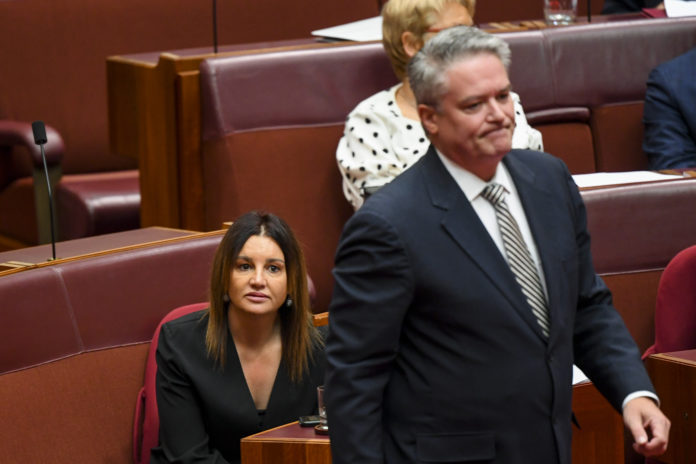
A bid to hobble Senate leader Mathias Cormann in retaliation for the government’s refusal to produce the report from top public servant Phil Gaetjens on Bridget McKenzie failed after Pauline Hanson withdrew her support and Centre Alliance split.

Under the plan, Cormann would not have been allowed to answer questions in the Senate on behalf of the prime minister, represent him at estimates, or sit at the centre table in the chamber. The ban would have applied until March 6 unless the government tabled the report.

Initially Pauline Hanson signed up to the motion but then at the last moment withdrew her support. One Nation was the decider – if its two votes had stayed with the Labor-initiated motion, it would have passed.

With one Centre Alliance senator abstaining, the vote was lost 35-36.

Centre Alliance’s Rex Patrick spoke strongly in favor of the motion, saying the Senate needed to push back against the government running to a bunker called “cabinet”.

His party colleague Stirling Griff, explaining his abstention, said later he supported the premise behind the motion but the penalty would have had no real consequences other than humiliating Cormann.

Hanson told the Senate on reflection she was against setting a precedent. “Senator Cormann is an elected member of this chamber. He has a right to his place in this chamber,” she said. “It is not up to us to take away that right that was given to him by the Australian people when they voted for him.”

Cormann said the ban proposal was completely unprecedented in the Senate’s history and claimed it exceeded the Senate’s powers.

Earlier this week the government defied a call from the Senate to produce the Gaetjens report on McKenzie’s conduct in the sports rorts affair.

Morrison asked Gaetjens, the secretary of the Department of Prime Minister and Cabinet (and his one-time chief of staff), to advise him on whether she had breached ministerial standards.

This followed an Auditor-General report finding her decisions on grants were politically skewed.

But Gaetjens concluded political considerations had not been the primary determining factor in the grants’ allocation, although he did find she had breached ministerial standards by not declaring her association with gun organisations. On this basis she resigned from the cabinet, and the deputy leadership of the Nationals – which set off a train of events still destabilising the Nationals.


Read more: View from The Hill: We need to see Gaetjens’ report on McKenzie – not least for Gaetjens’ sake


In response to a Senate order to produce the report, the government claimed public interest immunity, saying it was a cabinet document.

Labor’s Senate leader, Penny Wong, accused the government of a “disgusting political coverup” in refusing to table the Gaetjens report and other documents.

“This is all about protection of the prime minister, who is up to his neck in the sports rorts scandal,” Wong said.

“We’re being asked to accept that the findings of an independent statutory officer, the Auditor-General, should be overridden by a secret report authored by someone of dubious credibility – because Mr Gaetjens is Mr Morrison’s mate, his former chief of staff, and that inquiry was commissioned by Mr Morrison to get exactly the advice he wanted so that he could do what he had already decided,” Wong said.

Earlier this week, crossbencher Jacqui Lambie launched a scathing attack on the government’s refusal to release the report.

“We’re supposed to trust this so-called independent process that found that senator McKenzie made a mistake in not declaring her shooting club membership, but not that she misused taxpayer funds.

“According to the prime minister, we’re supposed to trust that there was no basis for the suggestion that political considerations were the primary determining factor,” she told the Senate.

“Does he take millions of Australians out there for absolute morons?”

ref. Pauline Hanson stymies bid to hobble Mathias Cormann – https://theconversation.com/pauline-hanson-stymies-bid-to-hobble-mathias-cormann-131670

We’re in danger of drowning in a coronavirus ‘infodemic’. Here’s how we can cut through the noise

Source: The Conversation (Au and NZ) – By Connal Lee, Associate Lecturer, Philosophy, University of South Australia

The novel coronavirus that has so far killed more than 1,100 people now has a name – covid-19.

The World Health Organisation (WHO) didn’t want the name to refer to a place, animal or certain group of people and needed something pronounceable and related to the disease.

“Having a name matters to prevent the use of other names that can be inaccurate or stigmatising,” said WHO director-general Tedros Adhanom Ghebreyesus.

The organisation has been battling misinformation about the coronavirus, with some experts warning rumours are spreading more rapidly than the disease itself.


Read more: Coronavirus fears: Should we take a deep breath?


The WHO describes the overabundance of information about the coronavirus as an “infodemic”. Some information is accurate, but much of it isn’t – and it can be difficult to tell what’s what.

What’s the problem?

Misinformation can spread unnecessary fear and panic. During the 2014 Ebola outbreak, rumours about the disease led to panic-buying, with many people purchasing Ebola virus protection kits online. These contained hazmat suits and face masks, which were unnecessary for protection against the disease.

As we’ve seen with the coronavirus, misinformation can prompt blame and stigmatisation of infected and affected groups. Since the outbreak began, Chinese Australians, who have no connection or exposure to the virus, have reported an increase in anti-Chinese language and abuse both online and on the streets.


Read more: Coronavirus fears can trigger anti-Chinese prejudice. Here’s how schools can help


Misinformation can also undermine people’s willingness to follow legitimate public health advice. In extreme cases, people don’t acknowledge the disease exists, and fail to take proven precautionary measures.

In other cases, people may not seek help due to fears, misconceptions or a lack of trust in authorities.

The public may also grow bored or apathetic due to the sheer quantity of information out there.

Mode of transmission

The internet can be an ally in the fight against infectious diseases. Accurate messages about how the disease spreads and how to protect yourself and others can be distributed promptly and accessibly.

But inaccurate information spreads rapidly online. Users can find themselves inside echo chambers, embracing implausible conspiracy theories and ultimately distrusting those in charge of the emergency response.

The infodemic continues offline as information spreads via mobile phone, traditional media and in the work tearoom.

Previous outbreaks show authorities need to respond to misinformation quickly and effectively, while remaining aware that not everybody will believe the official line.

Responding to the infodemic

Last week, rumours emerged that the coronavirus was transmitted through infectious clouds in the air that people could inhale.

The WHO promptly responded to these claims, noting this was not the case. WHO’s Director of Global Infectious Hazard Preparedness, Sylvie Briand, explained:

Currently the virus is transmitted through droplets and you need a close contact to be infected.

This simple intervention demonstrates how a timely response be effective. However, it may not convince everyone.


Read more: Coronavirus fears: Should we take a deep breath?


Official messages need to be consistent to avoid confusion and information overload. However, coordination can be difficult, as we’ve seen this week.

Potentially overly optimistic predictions have come from Chinese health officials saying the outbreak will be over by April. Meanwhile, the WHO has given dire warnings, saying the virus poses a bigger threat than terrorism.

These inconsistencies can be understandable as governments try to placate fears while the WHO encourages us to prepare for the worst.

Health authorities should keep reiterating key messages, like the importance of regularly washing your hands. This is a simple and effective measure that helps people feel in control of their own protection. But it can be easily forgotten in a sea of information.

It’s worth reminding people to regularly wash their hands. CDC/Unsplash

A challenge is that authorities may struggle to compete with the popularity of sensationalist stories and conspiracy theories about how diseases emerge, spread and what authorities are doing in response. Conspiracies may be more enjoyable than the official line, or may help some people preserve their existing, problematic beliefs.

Sometimes a prompt response won’t successfully cut through this noise.

Censorship isn’t the answer

Although censoring a harmful view could limit its spread, it could also make that view popular. Hiding negative news or over-reassuring people can leave them vulnerable and unprepared.

Censorship and media silence during the 1918 Spanish flu, which included not releasing numbers of affected and dead, undercut the seriousness of the pandemic.

When the truth emerges, people lose trust in public institutions.

Past outbreaks illustrate that building trust and legitimacy is vital to get people to adhere to disease prevention and control measures such as quarantines. Trying to mitigate fear through censorship is problematic.

Saving ourselves from drowning in a sea of (mis)information

The internet is useful for monitoring infectious diseases outbreaks. Tracking keyword searches, for example, can detect emerging trends.

Observing online communication offers an opportunity to quickly respond to misunderstandings and to build a picture of what rumours gain the most traction.

Health authorities’ response to the infodemic should include a strategy for engaging with and even listening to those who spread or believe inaccurate stories to gain deeper understanding of how infodemics spread.

ref. We’re in danger of drowning in a coronavirus ‘infodemic’. Here’s how we can cut through the noise – https://theconversation.com/were-in-danger-of-drowning-in-a-coronavirus-infodemic-heres-how-we-can-cut-through-the-noise-131303

Crossbench split stymies bid to hobble Mathias Cormann

Source: The Conversation (Au and NZ) – By Michelle Grattan, Professorial Fellow, University of Canberra

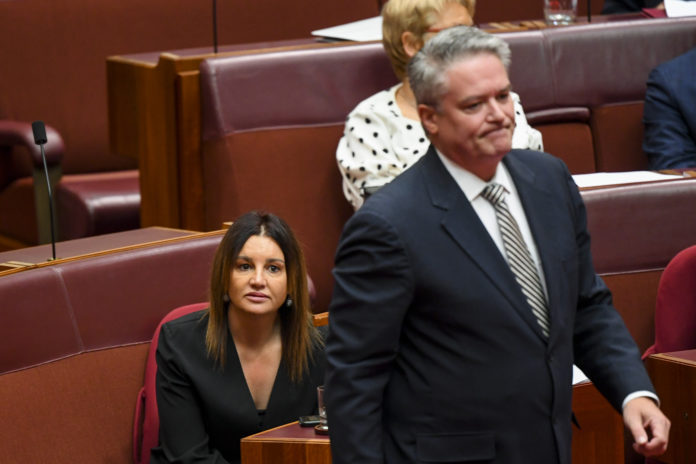
A bid to hobble Senate leader Mathias Cormann in retaliation for the government’s refusal to produce the report from top public servant Phil Gaetjens on Bridget McKenzie failed after Pauline Hanson withdrew her support and Centre Alliance split.

Under the plan, Cormann would not have been allowed to answer questions in the Senate on behalf of the prime minister, represent him at estimates, or sit at the centre table in the chamber. The ban would have applied until March 6 unless the government tabled the report.

Initially Pauline Hanson signed up to the motion but then at the last moment withdrew her support. One Nation was the decider – if its two votes had stayed with the Labor-initiated motion, it would have passed.

With one Centre Alliance senator abstaining, the vote was lost 35-36.

Centre Alliance’s Rex Patrick spoke strongly in favor of the motion, saying the Senate needed to push back against the government running to a bunker called “cabinet”.

His party colleague Stirling Griff, explaining his abstention, said later he supported the premise behind the motion but the penalty would have had no real consequences other than humiliating Cormann.

Hanson told the Senate on reflection she was against setting a precedent. “Senator Cormann is an elected member of this chamber. He has a right to his place in this chamber,” she said. “It is not up to us to take away that right that was given to him by the Australian people when they voted for him.”

Cormann said the ban proposal was completely unprecedented in the Senate’s history and claimed it exceeded the Senate’s powers.

Earlier this week the government defied a call from the Senate to produce the Gaetjens report on McKenzie’s conduct in the sports rorts affair.

Morrison asked Gaetjens, the secretary of the Department of Prime Minister and Cabinet (and his one-time chief of staff), to advise him on whether she had breached ministerial standards.

This followed an Auditor-General report finding her decisions on grants were politically skewed.

But Gaetjens concluded political considerations had not been the primary determining factor in the grants’ allocation, although he did find she had breached ministerial standards by not declaring her association with gun organisations. On this basis she resigned from the cabinet, and the deputy leadership of the Nationals – which set off a train of events still destabilising the Nationals.


Read more: View from The Hill: We need to see Gaetjens’ report on McKenzie – not least for Gaetjens’ sake


In response to a Senate order to produce the report, the government claimed public interest immunity, saying it was a cabinet document.

Labor’s Senate leader, Penny Wong, accused the government of a “disgusting political coverup” in refusing to table the Gaetjens report and other documents.

“This is all about protection of the prime minister, who is up to his neck in the sports rorts scandal,” Wong said.

“We’re being asked to accept that the findings of an independent statutory officer, the Auditor-General, should be overridden by a secret report authored by someone of dubious credibility – because Mr Gaetjens is Mr Morrison’s mate, his former chief of staff, and that inquiry was commissioned by Mr Morrison to get exactly the advice he wanted so that he could do what he had already decided,” Wong said.

Earlier this week, crossbencher Jacqui Lambie launched a scathing attack on the government’s refusal to release the report.

“We’re supposed to trust this so-called independent process that found that senator McKenzie made a mistake in not declaring her shooting club membership, but not that she misused taxpayer funds.

“According to the prime minister, we’re supposed to trust that there was no basis for the suggestion that political considerations were the primary determining factor,” she told the Senate.

“Does he take millions of Australians out there for absolute morons?”

ref. Crossbench split stymies bid to hobble Mathias Cormann – https://theconversation.com/crossbench-split-stymies-bid-to-hobble-mathias-cormann-131670

Activists give Indonesian leader details of Papuan deaths, political prisoners

Evening Report
Evening Report
Activists give Indonesian leader details of Papuan deaths, political prisoners
Loading
/

Pacific Media Watch

Pacific human rights activists have personally handed Indonesian President Joko Widodo a protest letter which includes a list of deaths and political prisoners in West Papua.

Written by West Papuan activists and signed by Greens leader Adam Bandt and Senator Richard Di Natale, the letter listed the names of 57 political prisoners charged with treason and held behind bars in seven cities across Indonesia, reports the community and indigenous radio The Wire.

The letter also included the names and ages of 243 civilians who have died during the Nduga military operation since December 2018, 110 of them children.

LISTEN TO THE WIRE: Letter given to President Widodo outlines West Papuan deaths

“These revelations ask the question of why President Widodo and Australian Prime Minister Scott Morrison would discuss economic ties and climate change, when human rights are at risk?”, The Wire asked.

Jokowi, as President Widodo is known, has been in Australia this week on a bilateral visit.

– Partner –

According to a media release made available to The Jakarta Post, the president was handed details on West Papua’s civilian death toll and political prisoners by activists in a bid to urge an end to the political and humanitarian crisis while he was visiting the Federal Parliament in Canberra.

“Our team in Canberra has managed to hand over letters to President Jokowi directly. The letters include names and locations of 57 political prisoners charged with treason and held behind bars in seven cities across Indonesia,” Indonesian human rights lawyer Veronica Koman said.

Names listed
“We also listed the names and ages of 243 civilians who have died during the Nduga military operation since December 2018.

“At the beginning of his first term in 2015, President Jokowi released five West Papuan political prisoners. Indonesians and West Papuans alike saw the move as a new hope for West Papua.

“But now, at the beginning of his second term, there are 57 people awaiting trial for treason, facing life imprisonment. This route will only fuel further conflict,” she said.

Koman said that the West Papuan governor, regents, church leaders, customary leaders, academics, activists and students had begged President Jokowi to withdraw troops from Nduga regency since December 2018, but the request had been ignored.

She said she hoped that Jokowi would halt the humanitarian crisis in the region as he now had the data, including the names of 110 dead children among the total of 243 people.

Print Friendly, PDF & Email

Article by AsiaPacificReport.nz

Covid-19 outbreak: Four cruise ships barred from entering Tonga

By RNZ Pacific

Four cruise ships have been refused entry into Tonga due to health warnings following the global covid-19, or coronavirus, outbreak.

The Nuku’alofa Tourism Office said the order to refuse entry came from acting Director of Health Reynald ‘Ofanoa.

Three ships were to arrive in Nuku’alofa today – the Astor, Columbus, and Crystal Serenity.

READ MORE: Earlier reports on the covid-19 outbreak

A fourth vessel, a super-yacht Windstirid, was to call into Vava’u having sailed from Rarotonga.

The Astor is a German-registered vessel with 600 passengers; Columbus carries 1500 passengers and sailed from London while the Crystal Serenity is carrying 1000 passengers.

– Partner –

The cruise ships are reported to be heading for Suva and New Zealand waters.

Tonga has tightened cautionary measures concerning the covid-19 virus with health checks at the airport for incoming flights.

Extra caution has been exercised around cruise ships since the Diamond Princess was quarantined in Japan, when 135 passengers fell ill with the virus.

Meanwhile, the Northern Marianas has sent a sample from a patient suspected of having covid-19 to the United States for testing.

However, the Commonwealth Health Care Corporation said the patient did not meet the full covid-19 case definition and the test was a precaution.

The corporation said CNMI had not had a confirmed case and its islands remained covid-19-free.

It has also refuted a social media post alleging a man with the virus had arrived in the CNMI after escaping from a quarantine area in China.

This article is republished under the Pacific Media Centre’s content partnership with Radio New Zealand.

Print Friendly, PDF & Email

Article by AsiaPacificReport.nz

All eyes on Australia as World Urban Forum urges climate action

Source: The Conversation (Au and NZ) – By Barbara Norman, Chair of Urban & Regional Planning and Director of Canberra Urban & Regional Futures, University of Canberra

The Australian bushfires have caught the world’s attention. They dominated the speeches by global leaders at the World Urban Forum (WUF10) in Abu Dhabi this week. The United Nations secretary-general and the executive director of UN-Habitat, the convenor of the forum, expressed their sympathy and support for the Australian people. Both highlighted the need to act on climate change.

In Abu Dhabi this week, over 18,000 participants from nearly 170 nations have discussed the critical issues of climate change, social inclusion and urban innovation. The theme of planning for climate change (mitigation and adaptation) ran through the whole conference.

In the many discussions at this forum, it’s clear the world is watching how Australia responds to the recent extreme events experienced by so many communities across the country.


Read more: As the world looks to put cities on a sustainable path, the Australian government goes missing


The World Urban Forum is held every two years. It is the global gathering of city leaders, non-government organisations (NGOs) and UN agencies engaged in developing more sustainable solutions for an urbanising world.

The majority of urban communities in Australia and across the globe are located in coastal zones. They face similar challenges responding to climate risks (fire, flood and coastal inundation) as well as managing urban growth and, in some cases, decline following economic loss.

Planning for “coastal urban futures” will require an integrated response. This depends on support by all levels of government, taking into account social, economic and environmental considerations, including climate change.


Read more: Coastal communities, including 24 federal seats at risk, demand action on climate threats


I interviewed a leading Australian planner, Commonwealth Association of Planners president Dyan Currie, who emphasised the importance of a holistic approach to the recovery from the recent fires and floods. “Building resilience by building back better, considering economic structures, mental health and communities, is critical,” she said. And it will take time.

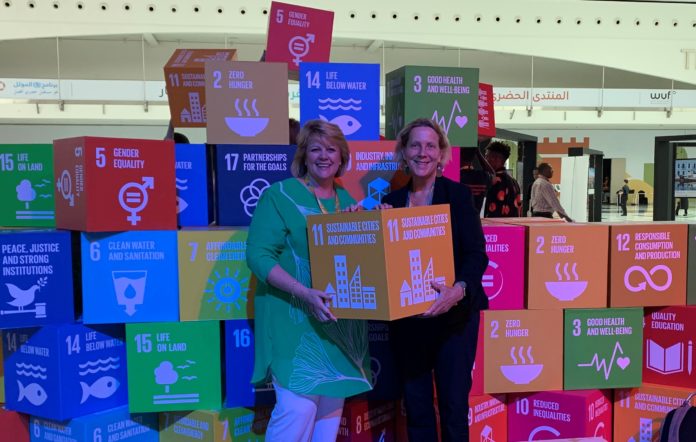
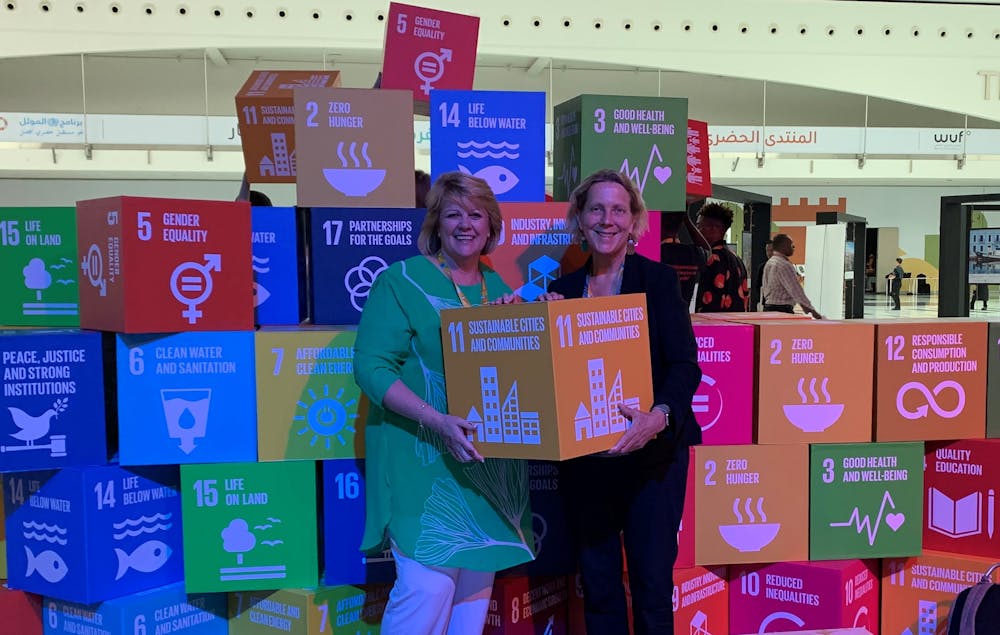
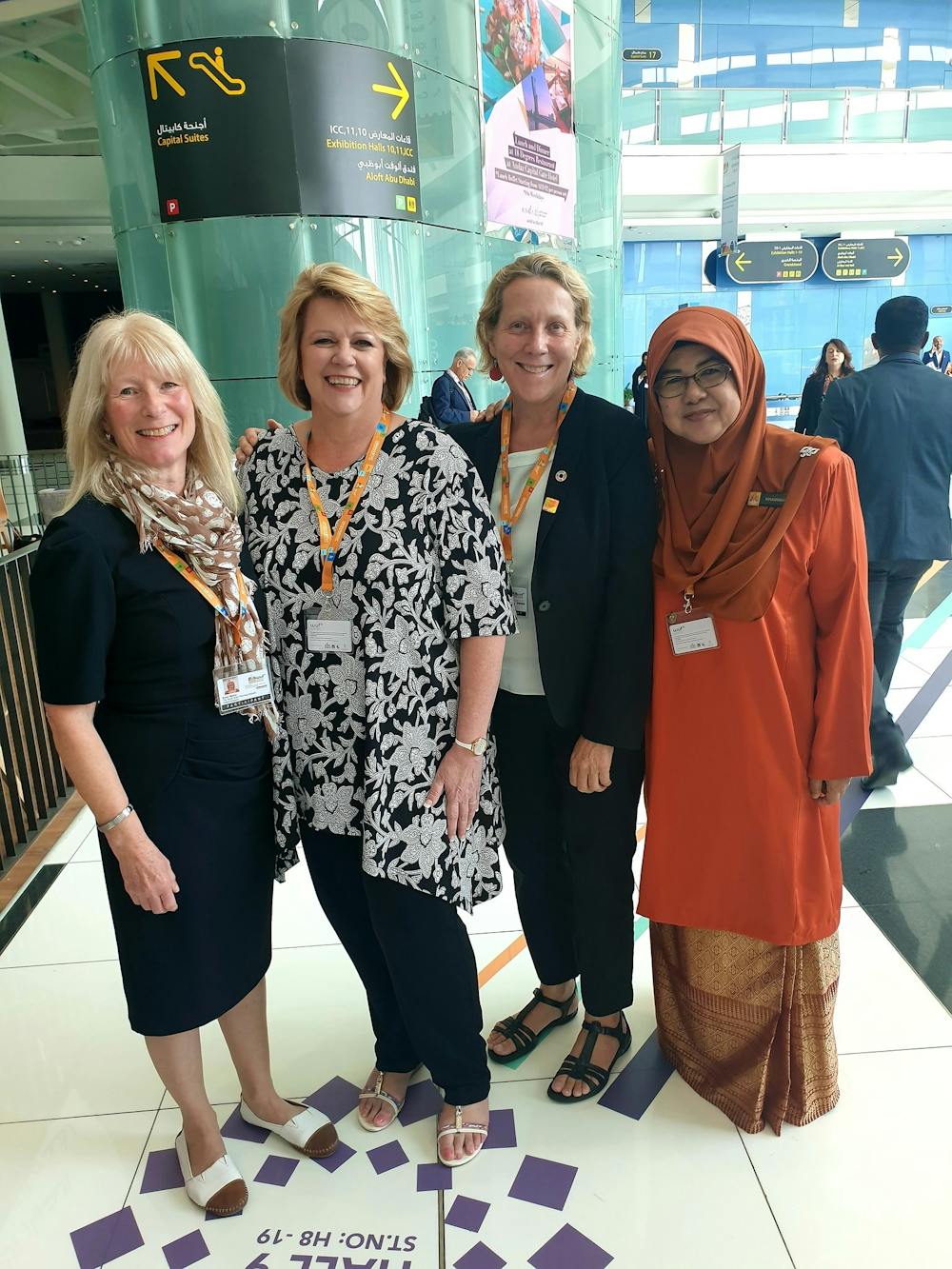
Leading Australian planner Dyan Currie with the author, Barbara Norman, and their pick of the SDGs in Abu Dhabi. Author provided

An expanding new global network, Planners for Climate Action, shared experiences, including of the recent Australian fires. A range of built environment professional institutes support the network, which includes a number of Australians.

The author (second from right) with, from left, Royal Town Planning Institute (UK) president Sue Manns, Commonwealth Association of Planners president Dyan Currie and past national president of the Malaysian Planning Institute Khairiah Talha. Author provided

Case studies of success in implementing change at the subnational level were showcased. One of these was the Australian Capital Territory (ACT) reaching its goal of 100% renewable electricity by 2020.

A shared vision, clear targets and leadership were yet again clearly identified as key ingredients for cities to successfully implement more sustainable urban solutions.

A climate tipping point

The costs to communities, economies and the environment have passed the tipping point. The urgency to act is immediate. As we tackle the big challenges of climate change and urbanisation, we must, in the words of UN Secretary-General António Guterres, “ensure that no one and no place is left behind”.

In opening WUF10, Guterres said:

As we embark on a decade of action to deliver the Sustainable Development Goals, the world’s cities, towns and communities will be at the heart of this work.

The UN under-secretary-general and executive director of UN-Habitat, Maimunah Sharif, said:

Urbanisation is inevitable and if left unplanned it will continue to lead humanity deeper into the climate emergency and higher forms of inequality and deprivations.

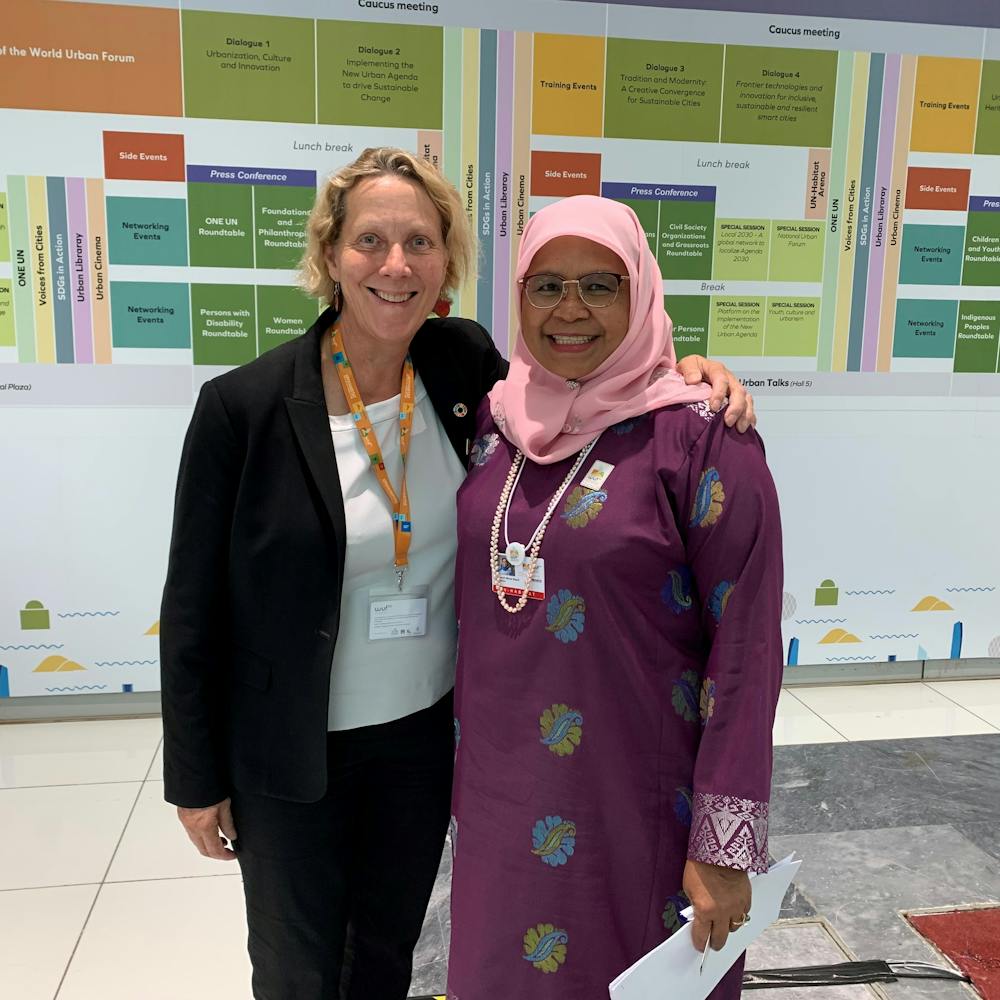
The author and Maimunah Sharif, executive director of UN-Habitat. Author provided

Underpinning all discussions was the need to implement the UN Sustainable Development Goals (SDGs) and the New Urban Agenda adopted in Quito in 2016 and to meet the global climate goals of the Paris Agreement.

The global population is expected to grow from 7 billion to 10 billion by 2050. Most people will live in urban settlements. This means the planning and development of our cities is fundamental to our future sustainability.

Key messages from the forum

The overall theme for WUF10 was “culture and innovation as a basis for achieving inclusive, safe, resilient and sustainable cities and human settlements”. Valuing the contribution of different cultures, creativity and and innovation was highlighted as central to urban sustainability.

Key points of agreement at WUF10 include:

  • the need for cultural diversity to be celebrated and embraced in planning and designing urban settlements

  • the importance of connecting urban innovation with culture in the process of urbanisation

  • the critical role of civic engagement by all communities in urban planning.

WUF10 provided hope in outlining the opportunities to create new sustainable urban futures. These will be based on renewable energy, more self-reliant local systems for smaller communities, and combining innovation with natural solutions.

New ideas were canvassed, such as floating cities, as well as the marrying of the traditional with the future. Environmental industries – including regeneration, waste management and energy transition – were discussed as an example of opportunities for smaller coastal communities.


Read more: Floating cities: the future or a washed-up idea?


In all this, acting on climate change was a given. Implementing the SDGs was core to discussions.

The real value of WUF10, in my view, this year being also the UN’s 75th anniversary, was the emphasis given to the importance of local cultures, communities and social inclusion. Communities must be actively involved in determining their own futures for long-term urban sustainability.

Following the recent devastation from bushfires and extreme weather events in Australia, we should embrace this opportunity to build back better. If higher levels of government provide the enabling frameworks to support and empower local communities to develop more resilient and sustainable urban futures, it is all possible.

ref. All eyes on Australia as World Urban Forum urges climate action – https://theconversation.com/all-eyes-on-australia-as-world-urban-forum-urges-climate-action-130884

Chief Scientist: we need to transform our world into a sustainable ‘electric planet’

Source: The Conversation (Au and NZ) – By Alan Finkel, Australia’s Chief Scientist, Office of the Chief Scientist

I want you to imagine a highway exclusively devoted to delivering the world’s energy.

Each lane is restricted to trucks that carry one of the world’s seven large-scale sources of primary energy: coal, oil, natural gas, nuclear, hydro, solar and wind.

Our current energy security comes at a price, the carbon dioxide emissions from the trucks in the three busiest lanes: the ones for coal, oil and natural gas.

We can’t just put up roadblocks overnight to stop these trucks; they are carrying the overwhelming majority of the world’s energy supply.

But what if we expand clean electricity production carried by the trucks in the solar and wind lanes — three or four times over — into an economically efficient clean energy future?

Think electric cars instead of petrol cars. Think electric factories instead of oil-burning factories. Cleaner and cheaper to run. A technology-driven orderly transition. Problems wrought by technology, solved by technology.


Read more: How to transition from coal: 4 lessons for Australia from around the world


Make no mistake, this will be the biggest engineering challenge ever undertaken. The energy system is huge, and even with an internationally committed and focused effort the transition will take many decades.

It will also require respectful planning and retraining to ensure affected individuals and communities, who have fuelled our energy progress for generations, are supported throughout the transition.

As Tony, a worker from a Gippsland coal-fired power station, noted from the audience on this week’s Q+A program:

The workforce is highly innovative, we are up for the challenge, we will adapt to whatever is put in front of us and we have proven that in the past.

This is a reminder that if governments, industry, communities and individuals share a vision, a positive transition can be achieved.

The stunning technology advances I have witnessed in the past ten years make me optimistic.

Renewable energy is booming worldwide, and is now being delivered at a markedly lower cost than ever before.

In Australia, the cost of producing electricity from wind and solar is now around A$50 per megawatt-hour.

Even when the variability is firmed with storage, the price of solar and wind electricity is lower than existing gas-fired electricity generation and similar to new-build coal-fired electricity generation.

This has resulted in substantial solar and wind electricity uptake in Australia and, most importantly, projections of a 33% cut in emissions in the electricity sector by 2030, when compared to 2005 levels.

And this pricing trend will only continue, with a recent United Nations report noting that, in the last decade alone, the cost of solar electricity fell by 80%, and is set to drop even further.

So we’re on our way. We can do this. Time and again we have demonstrated that no challenge to humanity is beyond humanity.

Ultimately, we will need to complement solar and wind with a range of technologies such as high levels of storage, long-distance transmission, and much better efficiency in the way we use energy.

But while these technologies are being scaled up, we need an energy companion today that can react rapidly to changes in solar and wind output. An energy companion that is itself relatively low in emissions, and that only operates when needed.

In the short term, as Prime Minister Scott Morrison and energy minister Angus Taylor have previously stated, natural gas will play that critical role.

In fact, natural gas is already making it possible for nations to transition to a reliable, and relatively low-emissions, electricity supply.

Look at Britain, where coal-fired electricity generation has plummeted from 75% in 1990 to just 2% in 2019.

Driving this has been an increase in solar, wind, and hydro electricity, up from 2% to 27%. At the same time, and this is key to the delivery of a reliable electricity supply, electricity from natural gas increased from virtually zero in 1990 to more than 38% in 2019.

I am aware that building new natural gas generators may be seen as problematic, but for now let’s assume that with solar, wind and natural gas, we will achieve a reliable, low-emissions electricity supply.

Is this enough? Not really.

We still need a high-density source of transportable fuel for long-distance, heavy-duty trucks.

We still need an alternative chemical feedstock to make the ammonia used to produce fertilisers.

We still need a means to carry clean energy from one continent to another.

Enter the hero: hydrogen.

Hydrogen could fill the gaps in our energy needs. Julian Smith/AAP Image

Hydrogen is abundant. In fact, it’s the most abundant element in the Universe. The only problem is that there is nowhere on Earth that you can drill a well and find hydrogen gas.

Don’t panic. Fortunately, hydrogen is bound up in other substances. One we all know: water, the H in H₂O.

We have two viable ways to extract hydrogen, with near-zero emissions.

First, we can split water in a process called electrolysis, using renewable electricity.

Second, we can use coal and natural gas to split the water, and capture and permanently bury the carbon dioxide emitted along the way.

I know some may be sceptical, because carbon capture and permanent storage has not been commercially viable in the electricity generation industry.

But the process for hydrogen production is significantly more cost-effective, for two crucial reasons.

First, since carbon dioxide is left behind as a residual part of the hydrogen production process, there is no additional step, and little added cost, for its extraction.

And second, because the process operates at much higher pressure, the extraction of the carbon dioxide is more energy-efficient and it is easier to store.

Returning to the electrolysis production route, we must also recognise that if hydrogen is produced exclusively from solar and wind electricity, we will exacerbate the load on the renewable lanes of our energy highway.

Think for a moment of the vast amounts of steel, aluminium and concrete needed to support, build and service solar and wind structures. And the copper and rare earth metals needed for the wires and motors. And the lithium, nickel, cobalt, manganese and other battery materials needed to stabilise the system.

It would be prudent, therefore, to safeguard against any potential resource limitations with another energy source.

Well, by producing hydrogen from natural gas or coal, using carbon capture and permanent storage, we can add back two more lanes to our energy highway, ensuring we have four primary energy sources to meet the needs of the future: solar, wind, hydrogen from natural gas, and hydrogen from coal.


Read more: 145 years after Jules Verne dreamed up a hydrogen future, it has arrived


Furthermore, once extracted, hydrogen provides unique solutions to the remaining challenges we face in our future electric planet.

First, in the transport sector, Australia’s largest end-user of energy.

Because hydrogen fuel carries much more energy than the equivalent weight of batteries, it provides a viable, longer-range alternative for powering long-haul buses, B-double trucks, trains that travel from mines in central Australia to coastal ports, and ships that carry passengers and goods around the world.

Second, in industry, where hydrogen can help solve some of the largest emissions challenges.

Take steel manufacturing. In today’s world, the use of coal in steel manufacturing is responsible for a staggering 7% of carbon dioxide emissions.

Persisting with this form of steel production will result in this percentage growing frustratingly higher as we make progress decarbonising other sectors of the economy.

Fortunately, clean hydrogen can not only provide the energy that is needed to heat the blast furnaces, it can also replace the carbon in coal used to reduce iron oxide to the pure iron from which steel is made. And with hydrogen as the reducing agent the only byproduct is water vapour.

This would have a revolutionary impact on cutting global emissions.

Third, hydrogen can store energy, not only for a rainy day, but also to ship sunshine from our shores, where it is abundant, to countries where it is needed.

Let me illustrate this point. In December last year, I was privileged to witness the launch of the world’s first liquefied hydrogen carrier ship in Japan.

As the vessel slipped into the water I saw it not only as the launch of the first ship of its type to ever be built, but as the launch of a new era in which clean energy will be routinely transported between the continents. Shipping sunshine.

And, finally, because hydrogen operates in a similar way to natural gas, our natural gas generators can be reconfigured in the future to run on hydrogen — neatly turning a potential legacy into an added bonus.

Hydrogen-powered economy

We truly are at the dawn of a new, thriving industry.

There’s a nearly A$2 trillion global market for hydrogen come 2050, assuming that we can drive the price of producing hydrogen to substantially lower than A$2 per kilogram.

In Australia, we’ve got the available land, the natural resources, the technology smarts, the global networks, and the industry expertise.

And we now have the commitment, with the National Hydrogen Strategy unanimously adopted at a meeting by the Commonwealth, state and territory governments late last year.

Indeed, as I reflect upon my term as Chief Scientist, in this my last year, chairing the development of this strategy has been one of my proudest achievements.

The full results will not be seen overnight, but it has sown the seeds, and if we continue to tend to them, they will grow into a whole new realm of practical applications and unimagined possibilities.


This is an edited extract of a speech to the National Press Club of Australia on February 12, 2020. The full speech is available here.

ref. Chief Scientist: we need to transform our world into a sustainable ‘electric planet’ – https://theconversation.com/chief-scientist-we-need-to-transform-our-world-into-a-sustainable-electric-planet-131658

World must ‘hit hard’ over deadly virus but there is hope, says WHO chief

Pacific Media Watch

The World Health Organisation has pledged to “hit hard” against the deadly coronavirus

while saying there is hope and “we are not defenceless”.

WHO chief Tedros Adhanom Ghebreyesus said he saw a “realistic chance” of stopping the outbreak.

“Covid-19” is the new official name for the virus that was first identified in China on December 31.

READ MORE: Earlier reports on the Covid-19 outbreak

“We now have a name for the disease and it’s Covid-19,” Tedros told reporters in Geneva, explaining that “co” stood for “corona,” “vi” for “virus” and “d” for “disease,” reports Agence France-Presse.

– Partner –

Tedros said the name had been chosen to avoid references to a specific geographical location, animal species or group of people in line with international recommendations for naming in order to avoid stigmatisation.

The WHO had earlier given the virus the temporary name of “2019-nCoV acute respiratory disease” and China’s National Health Commission this week said it was temporarily calling it “novel coronavirus pneumonia”, or NCP.

Speaking on the first day of an international scientific conference in Geneva that will look at possible vaccine options to combat the virus, Tedros also said he saw a “realistic chance” of stopping the outbreak.

“We are not defenceless,” he added.

“We have to use the current window of opportunity to hit hard and stand in unison to fight this virus in every corner.

“If we don’t we could have far more cases and far higher costs on our hands.”

Print Friendly, PDF & Email

Article by AsiaPacificReport.nz

Is the dress green or red? Planet-friendly couture won’t be for everyone but it can lead the way

Source: The Conversation (Au and NZ) – By Mark Liu, Chancellors Postdoctoral Research Fellow, Fashion and Textiles Designer, University of Technology Sydney

Hollywood legend Jane Fonda hit the 92nd Academy Awards ceremony stage this week in a beaded red dress by Elie Saab – a gown she had previously worn at Cannes in 2014.

Rising star Kaitlyn Dever walked the Oscars red carpet in a deep scarlet Louis Vuitton dress she told reporters was “completely sustainable” thanks to fibre technology.

Two very different fashion approaches towards saving the planet – but how effective are they at mitigating the environmental impact of fashion? The first comes from an activist trying to be more sustainable, the second from a designer label making production changes.

Size of the problem

The fashion industry creates in excess of 85 billion tonnes of clothing a year and is responsible for 10% of global carbon emissions.

Chemical dyes in fashion create 20% of global waste water and crops such as cotton use 24% of global insecticides.

Microfibers and micro plastics from laundered garments have contaminated our beaches, bottled drinking water, and aquatic food chain.

Fast fashion promotes the reckless over-production and over-consumption of cheaply made clothing, and is reliant on exploiting inexpensive labour.

Less than 1% of fabrics can be recycled and fibre-to-fibre recycling technology is still in its infancy, without the infrastructure to address the vast amount of garments produced.

A ‘completely sustainable’ dress?

Dever’s dress was made from a material called “Tencel Luxe”, with lyocell fibre created from sustainably-grown trees. The wood is cut into tiny pieces, dissolved in a solvent and extruded into a soft cellulose fibre.

Booksmart actor Kaitlyn Dever in her Oscars dress. DAVID SWANSON/EPA

This process first developed in 1972 to create a cheap cotton substitute, often blended into cotton and polyester in inexpensive fabrics. Over time, lyocell improved to make a fabric more appropriate for luxurious products.

The sustainability of the fabric has also improved significantly. Today, 99% of the solvent used in the manufacturing process is recyclable. The fabric itself has the same challenges as cotton when it comes to recycling. The length of the fibres break down and shorten over time, lowering the quality when recycled into new fabrics – unless virgin material is added.

Indeed, lyocell fabric is far from perfect, and requires a large amount of energy in its production. Just substituting one material for another does not solve sustainability problems.


Read more: Time to make fast fashion a problem for its makers, not charities


Dever’s dress was made over 1,900 hours by a team of artisans with 14,400 Swarovski crystals and glass beads. A gown this opulent uses so much material, energy and labour that its carbon footprint becomes excessive.

The sustainability measure of a garment must include how it is recycled after its life. At present, some cutting edge fibre-to-fibre recycling technologies exist but Louis Vuitton is yet to offer recycling services.

The Louis Vuitton group hosts the Viva Tech Conference for exhibitors working on sustainable concepts to showcase their developments. It is encouraging that the company’s chairman and chief executive Bernard Arnault believes “sustainable, globalised growth is possible” and a priority for the company.


Read more: Five weird and wonderful ways nature is being harnessed to build a sustainable fashion industry


A second outing

With her commitment to climate change activism, Fonda has said she will no longer buy new clothing.

In a world that demands novelty, Fonda’s bold act of choosing an old gown that tastefully fits into today’s trends truly brings “vintage” clothing to the red carpet.

Jane Fonda previously wore her dress at the 2014 Cannes Film Festival. SEBASTIEN NOGIER/EPA

Fonda used her celebrity influence to turn a dress on the red carpet into a political symbol.

She has vowed not to buy clothing ever again, inspired by teenage activist Greta Thunberg, who she said showed that we can’t just “go about our business” in the face of a climate emergency.

No stranger to being arrested, Fonda’s real world activism is that type needed to change government policies in ways that reign in the fashion industry.

Activists can petition governments, watch over corporations and form grassroots community groups to organise change. Celebrities who straddle the red carpet and the picket line such as Jane Fonda (or Emma Thompson for Extinction Rebellion) are key to a sustainable fashion industry.

Think before you shop

It is inspiring to see these two stars’ dresses become talking points.

It shows the public’s growing awareness of climate change and their willingness to change their behaviour to make a difference. The fashion industry will determine significant aspects of the future of our environment and the lives of over 40 million workers around the world.

From developing new green technology to changing consumer consumption behaviour and outlawing exploitative labour practices that make fast fashion possible, we are still a long way from a “completely sustainable” industry.

Corporations will need to evolve and adapt to customers who demand sustainability. They will have to offer services that recycle garments after they have been used, and embrace recycled materials. Celebrities bring these issues to the public and give them steps they can take right now.

When ask by a reporter about what people could do right now to be more sustainable, Dever said, “it’s just a matter of letting it be a part of your lifestyle”.

With fashion, I think you can think a little before you buy something brand new, and I think can also support vintage – I think that’s really, really important. And also look into the brands you’re supporting.

This is a great starting point which hopefully continues into a deeper conversation of how far we yet have to go.

ref. Is the dress green or red? Planet-friendly couture won’t be for everyone but it can lead the way – https://theconversation.com/is-the-dress-green-or-red-planet-friendly-couture-wont-be-for-everyone-but-it-can-lead-the-way-131469

Conservative but green independent MP Zali Steggall could break the government’s climate policy deadlock

Source: The Conversation (Au and NZ) – By Kate Crowley, Associate Professor, Public and Environmental Policy, University of Tasmania

When barrister, former world champion alpine skier, and now independent MP Zali Steggall took Tony Abbott’s New South Wales seat of Warringah in the 2019 election, she promised to pressure the government for action on climate change.

She was voicing the heightened concern in Warringah about climate change and the environment, and repudiating the denialism of one-time Prime Minister Abbott, who once described climate change as “absolute crap”.


Read more: Abbott’s loss in Warringah shows voters rejecting an out-of-touch candidate and a nasty style of politics


On Monday, Steggall released her Climate Change (National Framework for Adaptation and Mitigation) Bill 2020. It will be presented to the federal House of Representatives on March 23 for a conscience vote.

The bill came just as horrendous flooding hit the east coast of Australia, not quite extinguishing the fires that, nationally, have killed 33 people, burned 11 million hectares of land, and destroyed thousands of homes.

Steggall’s bill outlines ways to bring Australia’s carbon emissions down to zero by 2050. It focuses on climate risks, with adaptation and mitigation measures to secure a more resilient Australia, including establishing an independent climate change commission to advise parliament.

Steggall is a non-aligned, conservative independent. So while the bill isn’t likely to pass – most private members bills don’t – hers is unique in its non-partisan nature. And it could even shift Australia’s stubborn climate change politics through her #climateactionnow appeal to the public.

What the bill says

The federal government, and Prime Minister Scott Morrison in particular, have faltered in leadership and policy in the face of Australia’s recent disasters. He argues the government will not be panicked into stronger climate policy.


Read more: States shine as federal government flounders this summer – now they should lead on climate change


Last year, the government was re-elected on a platform of supporting an expanded coal industry, promoting regional coal industry jobs, paying polluters to reduce emissions, paying for reduced land clearing, and using carry-over credits to meet its global emissions target.

But Steggall’s bill changes the climate policy conversation entirely. It calls for a detailed risk assessment of the challenges of warming across all sectors, and national plans for adapting to those challenges, while reducing emissions in a transparent and accountable way.

It provides five-year plans to reduce emissions to zero by 2050, linking climate risks and impacts with emissions reduction. The plans are sector-wide, as similar plans are in the UK, with safeguards to ensure equitable transition, and they’ll be revised to adjust emissions reduction targets every five years.

This is a climate policy approach that reflects national and international malaise about Australia’s recent bush fire horrors, and now flooding crisis, because proposing zero emissions by 2050 is what more than 60 countries have already promised.

What’s more, the bill calls for transparent monitoring, reporting and accountability in line with global expectations, by establishing an independent Climate Change Commission. The commission’s role wouldn’t be to develop policy, but to ensure the five-year climate plans are progressing towards their targets.

Non-partisan nature

On the same day as its release, Business Council of Australia CEO Jennifer Westacott put forward her support for a net zero emissions target, saying Zali’s bill offered a sensible climate target the major parties could agree on.

Westacott’s support signals to the Morrison government the business community is looking for more ambitious and targeted climate policy action, anticipating the new jobs that will follow a transition to a low carbon economy.

But the main strength of Zali’s bill is its non-partisan nature. And it’s important for side stepping toxic climate politics and for proposing reasoned, apolitical, tried and tested policy solutions.

Scott Morrison has said his government won’t be panicked into a stronger carbon emissions policy. AAP Image/Mick Tsikas

The bill is modelled on the David Cameron government’s 2008 Climate Change Act in the UK – legislation from a conservative party. This act sets carbon budgets, which can be controversial, but the UK are successfully reducing emissions.


Read more: The UK has a national climate change act – why don’t we?


Shifting the climate debate

All it would take for Zali’s bill to pass is for a majority of MPs in the House of Representatives to vote for it, meaning some members of the government would need to use their conscience vote.

If this were to happen, it would be a relief for business and industry, which are looking for certainty; for State and Territories, which are building vibrant renewable energy economies; and for Australians for whom climate change is now a foremost concern.

Although members of parliament are elected to represent their constituents, political allegiance invariably trumps popular will as they vote along party lines.

So Steggall is appealing directly to voters to contact their MP to secure support for her bill, and through her “Climate Act Now” petition.


Read more: Australia’s bushfire smoke is lapping the globe, and the law is too lame to catch it


If enough constituents do this, the climate debate may shift as a result of Zali’s efforts. Whether or not her legislation is adopted as she has proposed it, it may still open the door to a revised version resolving Australia’s climate policy deadlock.

This is an almost impossible task, but Zali will likely build support as she did in seeking her election in Warringah, by staying focused, by meeting as many people as possible, and by staying true to her ideas.

ref. Conservative but green independent MP Zali Steggall could break the government’s climate policy deadlock – https://theconversation.com/conservative-but-green-independent-mp-zali-steggall-could-break-the-governments-climate-policy-deadlock-131644

Instant prescriptions might be the way of our digital future, but we need to manage the risks first

Source: The Conversation (Au and NZ) – By Jonathan Penm, Lecturer (Pharmacy), University of Sydney

Digital technology is making access to health care easier than ever before. Multiple websites and apps allow consumers to consult general practitioners (GPs) and pharmacists from any location, at any time.

Recently, we’ve seen the emergence of apps which generate prescriptions almost instantly, removing the need for a person to visit their GP when they need a new prescription.

While this is clearly convenient, there are some possible drawbacks we need to consider.


Read more: Prescription monitoring is here, but we need to tread carefully to avoid unintended harms


People want convenience

Taking medicines as prescribed, without breaks, results in better health outcomes for the individual. It also produces substantial health system savings by reducing emergency department visits and hospitalisations.

The World Health Organisation estimates around 50% of people who take prescription medicines fail to take them correctly, such as missing doses.

Although we don’t know how many of these people miss doses because they aren’t able to see their doctor in time to get a new prescription, it’s likely to be a contributing factor. In 2018-2019, 19% of Australians reported having to wait longer than they considered acceptable to get an appointment with a GP.

Part of the appeal of a mobile app that dispenses prescriptions is not waiting to see a doctor. From shutterstock.com

Australians, like many people around the world, now have an appetite for more digital solutions to access health services.

How the apps work

Although many online service providers require a video or phone consultation with a health-care professional before issuing a prescription, some newer services only ask consumers to enter their information into an online form.

These services, often mobile apps, require users to select what health condition they need medicine for, which medicine they need, and then answer some questions about previous use, pregnancy status, other medicines and medical conditions. They are charged for a GP to review their responses and approve a script if appropriate. The script is then sent to a pharmacy.

Although some apps offer the option to speak to the GP directly for an additional fee, in most of these cases, people don’t speak to a health-care professional.

These services are being marketed as helpful for people who have run out of a regular medicine but have been unable to see a GP to get a new prescription.


Read more: ‘Use this app twice daily’: how digital tools are revolutionising patient care


But some online services also offer prescriptions for new health problems. Missing out on a face-to-face consultation in these cases creates the potential for misdiagnosis. And a person is more likely to be prescribed a medicine that may not be the most appropriate for their condition.

Many health-care decisions mean weighing up the pros and cons of medical treatment with the guidance of a health-care professional. These online services may not allow people to make fully informed decisions about their health care.

Continuity of care

Although digital solutions may be convenient, the Royal Australian College of General Practitioners has raised concerns about quality and safety.

We’ve long accepted continuity of care as an essential feature of health care, especially in general practice. Having a regular doctor who knows your medical history, spends sufficient time with you and explains things well improves the quality of care you receive and is associated with fewer visits to hospital.

A review of 22 studies found most (82%) showed a significant reduction in deaths with increased continuity of care with the same GP.

The apps generate prescriptions which consumers can then collect at a pharmacy. Syda Productions/Shutterstock

Digital consultations, however, have the potential to cause fragmented care. A person may “see” a variety of different providers online, increasing the risk that doctors – including one’s regular GP – will have incomplete health and medication histories to guide future conversations about best care. These gaps can increase the risk of mistakes and possible harms.


Read more: A loaf of bread and a packet of pills: how supermarket pharmacies could change the way we shop


When things can go wrong

These services rely on the consumer choosing the correct medicine (often from a list of medicines). Although this may seem reasonable, there are thousands of medicines available on prescription in Australia, and many of them sound and look similar, despite being very different.

If the online service prompts users to choose from a list of medicines used for the same reason, people may be confronted with multiple options that seem similar. For instance, a person wanting blood pressure medications may be asked to choose between Coveram 5/10 or Coveram 10/5. Coveram 5/10 includes 5mg of perindopril and 10mg of amlopdipine, while Coveram 10/5 includes 10mg of perindopril and 5mg of amlopdipine. Inadvertently taking double or half the needed dose can be dangerous.

Even health-care professionals with years of professional training and experience can select the wrong medicine. So they commonly use digital aids, such as bar code scanners, to reduce the risk of errors. Without an interaction between the consumer and the health-care professional, there’s no opportunity for health-care providers to manage the risk of these sorts of mistakes.

See the benefits, manage the harms

There’s little doubt a growing proportion of medical encounters will in future be virtual, using video or other technologies.

But we need more research to evaluate the benefits or possible harms of online services that provide prescriptions based on a questionnaire.


Read more: Drug resistance: how we keep track of whether antibiotics are being used responsibly


The best way forward may be digital solutions integrated into the services offered by existing providers as a flexible option for regular clients. For example, providing online prescriptions may be appropriate if they’re reviewed by your regular GP and sent to your regular pharmacist – people who know your health needs and know your medicines.

ref. Instant prescriptions might be the way of our digital future, but we need to manage the risks first – https://theconversation.com/instant-prescriptions-might-be-the-way-of-our-digital-future-but-we-need-to-manage-the-risks-first-131308

‘Closing the Gap’ process will better involve Indigenous Australians: Morrison

Source: The Conversation (Au and NZ) – By Michelle Grattan, Professorial Fellow, University of Canberra

Scott Morrison is expected to warn against adopting a “deficit mindset” towards progress on Indigenous disadvantage, when on Wednesday he presents the twelfth “Closing the Gap” report, which shows disappointing results on key targets.

The prime minister will give details of the government’s major overhaul of the assessment process, saying that until recently Closing the Gap was never a partnership with Indigenous people. “We believed we knew better – we don’t”.

Among the current seven targets, those not met or not on track are for child mortality, school attendance, literacy and numeracy (where there is improvement), employment (which is stable), and life expectancy.

Those “on track” are in the areas of childhood education and year 12 attainment.

Morrison will say “we must see the gap from the viewpoint of Indigenous Australians before we can hope to close it”.

He says, in a draft of his speech, “the targets don’t celebrate the strengths, achievements and aspirations of indigenous people. They don’t tell you what’s happening on the ground or stirring under it.

“They don’t tell you how realistic or achievable these targets were in the first place. They reinforce the language of failing and falling short and they mask the real progress that has been made.”

Morrison says that on “almost every measure” there has been progress – although not as much as should have been made by now.

The government’s “refreshed” process is billed as aiming to deliver shared responsibility and accountability.

“There remains much more to do and we will do it differently by working together,” Morrison says. “By going from good intentions and sky-high aspirations to local, practical action that’s driven by local leaders and local needs with clear accountability and responsibility and a clear line of sight to the community.”

The federal government and the Coalition of Peaks (a group of about 50 community-controlled peak organisations) are working together with the states and territories to produce a new national agreement on Closing the Gap. This is to set out shared priorities for the next decade.

The structure and targets of the revamped scheme are to be finalised in April and then will go to the Council of Australian Governments.

It is planned to have some 15 targets, with a more specific and measurable path to them. The Closing the Gap program was started by the Rudd government.

The results from the latest report are:

Child Mortality – Target: Halve the gap in mortality rates for Indigenous children under five within a decade (by 2018) – Not met.

  • in 2018, the Indigenous child mortality rate was 141 per 100,000 —twice the rate for non-Indigenous children (67 per 100,000)

  • since the 2008 target baseline, the Indigenous child mortality rate has improved slightly, by about 7%. But the mortality rate for non-Indigenous children has improved at a faster rate and so the gap has widened.

Early Childhood Education – Target: 95% of all Indigenous four-year-olds enrolled in early childhood education (by 2025) – On track.

  • in 2018, 86.4% of Indigenous four-year-olds were enrolled in early childhood education compared with 91.3% of non-Indigenous children

  • between 2016 and 2018, the proportion of Indigenous children enrolled in early childhood education increased by almost 10 percentage points. There was a slight decline of less than one percentage point for non-Indigenous children

  • the attendance rate for Indigenous children was highest in inner-regional areas (96.6%), almost 17 percentage points higher than the lowest attendance rate in very remote areas (79.7%).

School Attendance – Target: Close the gap between Indigenous and non-Indigenous school attendance within five years (by 2018) – Not met.

  • the majority of Indigenous students attended school for an average of just over four days a week in 2019. These students mostly lived in major cities and regional areas

  • school attendance rates for Indigenous students have not improved over the past five years. Attendance rates for Indigenous students remain lower than for non-Indigenous students (around 82% compared to 92% in 2019)

  • gaps in attendance are evident for Indigenous children as a group from the first year of schooling, and the gap widens during secondary school. In 2019, the attendance rate for Indigenous primary school students was 85% -— a gap of about nine percentage points. By Year 10, Indigenous students attend school 72% of the time on average — a gap of about 17 percentage points.

Literacy and Numeracy – Target: Halve the gap for Indigenous children in reading, writing and numeracy within a decade (by 2018) – Not met but improvements.

  • at the national level, the share of Indigenous students at or above national minimum standards in reading and numeracy has improved over the decade to 2018. The gap has narrowed across all year levels by between three and 11 percentage points

  • despite these improvements, in 2018 about one in four Indigenous students in years 5, 7 and 9, and one in five in year 3, remained below national minimum standards in reading. Between 17 to 19% of Indigenous students were below the national minimum standards in numeracy

  • between 2008 and 2018, the share of year 3 students exceeding national minimum standards in reading increased by about 20 percentage points.

Year 12 Attainment – Target: Halve the gap for Indigenous Australians aged 20–24 in Year 12 attainment or equivalent attainment rates (by 2020) – On track.

  • in 2018–19, 66% of Indigenous Australians aged 20–24 had attained year 12 or equivalent

  • between 2008 and 2018–19, the proportion of Indigenous Australians aged 20–24 attaining year 12 or equivalent increased by 21 percentage points. The gap has narrowed by 15 percentage points, as non-Indigenous attainment rates have improved at a slower pace

  • the biggest improvement in year 12 attainment rates was in major cities, where the gap narrowed by 20 percentage points — from 26 percentage points in 2012–13 to six percentage points in 2018–19.

Employment – Target: Halve the gap in employment outcomes between Indigenous and non-Indigenous Australians within a decade (by 2018) – Not met (stable).

  • in 2018, the Indigenous employment rate was 49% compared to 75% for non-Indigenous Australians

  • over the decade 2008–2018, the employment rate for Indigenous Australians increased slightly (by 0.9 percentage points), while for non-Indigenous Australians it fell by 0.4 percentage points. Thus the gap has not changed much

  • the Indigenous employment rate varied by remoteness. Major cities had the highest employment rate at 59%, compared to 35% in very remote areas. The gap in employment outcomes was widest in remote and very remote Australia.

Life Expectancy – Target: Close the life expectancy gap within a generation (by 2031) – Not on track.

  • in 2015–2017, life expectancy at birth was 71.6 years for Indigenous males (8.6 years less than non-Indigenous males) and 75.6 years for Indigenous females (7.8 years less than non-Indigenous females)

  • over 2006 to 2018, there was an improvement of almost 10% in Indigenous age-standardised mortality rates. But non-Indigenous mortality rates improved at a similar rate, so the gap has not narrowed

  • since 2006, there has been an improvement in Indigenous mortality rates from circulatory disease (heart disease, stroke and hypertension). But this has coincided with an increase in cancer mortality rates, where the gap is widening.

Meanwhile, in response to some disquiet in the Coalition party room on Tuesday, Morrison gave an assurance that it would be consulted on the design and timing of the proposed referendum for indigenous recognition the government aims to run this term.

ref. ‘Closing the Gap’ process will better involve Indigenous Australians: Morrison – https://theconversation.com/closing-the-gap-process-will-better-involve-indigenous-australians-morrison-131570

Small world: atom-scale materials are the next tech frontier

Source: The Conversation (Au and NZ) – By Baohua Jia, Professor, Swinburne University of Technology

Every age in the history of human civilisation has a signature material, from the Stone Age, to the Bronze and Iron Ages. We might even call today’s information-driven society the Silicon Age.

Since the 1960s, silicon nanostructures, the building-blocks of microchips, have supercharged the development of electronics, communications, manufacturing, medicine, and more.


Read more: Why nanotechnology is more than just a buzzword


How small are these nanostructures? Very, very small – you could fit at least 3,000 silicon transistors onto the tip of a human hair. But there is a limit: below about 5 nanometres (5 millionths of a millimetre), it is hard to improve the performance of silicon devices any further.

So if we are about to exhaust the potential of silicon nanomaterials, what will be our next signature material? That’s where “atomaterials” come in.

What are atomaterials?

“Atomaterials” is short for “atomic materials”, so called because their properties depend on the precise configuration of their atoms. It is a new but rapidly developing field.

One example is graphene, which is made of carbon atoms. Unlike diamond, in which the carbon atoms form a rigid three-dimensional structure, graphene is made of single layer of carbon atoms, bonded together in a two-dimensional honeycomb lattice.


Read more: Harder than diamond, stronger than steel, super conductor … graphene’s unreal


Diamond’s rigid structure is the reason for its celebrated hardness and longevity, making it the perfect material for high-end drill bits and expensive jewellery. In contrast, the two-dimensional form of carbon atoms in graphene allows electron travelling frictionless at a high speed giving ultrahigh conductivity and the outstanding in plane mechanical strength. Thus, graphene has broad applications in medicines, electronics, energy storage, light processing, and water filtration.

Using lasers, we can fashion these atomic structures into miniaturised devices with exceptional performance.

Using atomaterials, our lab has been working on a range of innovations, at various stages of development. They include:

  • A magic cooling film. This film can cool the environment by up to 10℃ without using any electricity. By integrating such a film into a building, the electricity used for air conditioning can be reduced by 35%, and summer electricity blackouts effectively stopped. This will not only save electricity bills but also reduce greenhouse emissions.
Baohua Jia and Han Lin with the graphene cooling film. CTAM Global OpenLab, Author provided
  • Heat-absorbing film. Some 97% of Earth’s water is in the oceans, and is salty and unusable without expensive processing. Efficiently removing salt from seawater could be a long-term solution to the growing global freshwater scarcity. With a solar-powered graphene film, this process can be made very efficient.

The film absorbs almost all the sunlight shining on it and converts it into heat. The temperature can be increased to 160℃ within 30 seconds. This heat can then distil seawater with an efficiency greater than 95%, and the distilled water is cleaner than tapwater. This low-cost technology can be suitable for domestic and industry applications.

  • Smart sensing film. These flexible atomaterial films can incorporate a wide range of functions including environmental sensing, communication, and energy storage. They have a broad range of applications in healthcare, sports, advanced manufacturing, farming, and others. For example, smart films could monitor soil humidity near plants’ roots, thus helping to make agriculture more water-efficient.

  • Ultrathin, ultra-lightweight lenses. The bulkiest part of a mobile phone camera is the lens, because it needs to be made of thick glass with particular optical properties. But lenses made with graphene can be mere millionths of a millimetre thick, and still deliver superb image quality. Such lenses could greatly reduce the weight and cost of everything from phones to space satellites.

  • Near-instant power supply. We have developed an environmentally friendly supercapacitor from graphene that charges devices in seconds, and has a lifetime of millions of charge cycles. By attaching it to the back of a solar cell, it can store and deliver solar-generated energy whenever and wherever required. You will be free and truly mobile.

The graphene supercapacitor could help mobile power truly live up to its name. CTAM Global OpenLab, Author provided

Where to next?

It can take years for some of these laboratory technologies to reach fruition. To try and speed up the process, we established the CTAM Global OpenLab to engage with industry, academia, government and the wider community and to promote sharing and collaboration. The lab was launched earlier this month at the International Conference on Nanomaterial and Atomaterial Sciences and Applications (ICNASA2020).


Read more: Finding an affordable way to use graphene is the key to its success


The world is facing pressing challenges, from climate change, to energy and resource scarcity, to our health and well-being.

Material innovation is more vital than ever and needs to be more efficient, design-driven and environmentally friendly. But these challenges can only be solved by joint effort from worldwide researchers, enterprise, industry and government with a sharing and open mindset.

ref. Small world: atom-scale materials are the next tech frontier – https://theconversation.com/small-world-atom-scale-materials-are-the-next-tech-frontier-131147

States shine as federal government flounders this summer – now they should lead on climate change

Source: The Conversation (Au and NZ) – By Jennifer Menzies, Principal Research Fellow, Policy Innovation Hub, Griffith University

The recent federal government response to the bushfire crisis and the “sports rorts” affair are symptomatic of a deeper political malaise – role confusion.

Since the roles and responsibilities of the federal government have become untethered from Australia’s Constitution through a range of High Court decisions, there are no principles to guide what is a meaningful role for the Commonwealth. This means it dips into areas that are the responsibility of the states.

Funding local sports clubs, for example, replicates existing state and local government programs. But it has become a key campaign tool for the federal Coalition government to be “seen” to be relevant to issues affecting local communities.

The Natural Disaster Relief and Recovery Arrangements (NDRAA) have given Australia a framework for a world-class response to natural disasters. With four categories of assistance, the federal government provides funding for relief and recovery. This summer, after being accused of being to slow to respond, the Commonwealth is forging a new role for itself by deploying the Australian Defence Force. Again, it wants to be “seen” to be responsive.

This role instability means the federal government campaigns on issues under the jurisdictional control of the states and territories. When the prime minister changes, so do the areas of the federal government’s interest. The Commonwealth’s approach to managing the relationship with the states and territories is unstable and can veer from the cooperative to the coercive, from benign neglect to micro-managing program outcomes.


Read more: State governments are vital for Australian democracy: here’s why


The culture of the federal government stands for the political culture in Australia. This is underpinned through most political commentary being generated by journalists based in Parliament House in Canberra. They promote a world view forged by constant interaction with federal ministers and senior bureaucrats.

Yet the political culture in Canberra is not the same as the political culture within state governments. While the federal government can cherry-pick when and what issues to become involved in, the states keep all the big service-delivery systems in Australia ticking over. They keep building hospitals, managing law and order, educating children, building and operating infrastructure and managing population and natural resources.

There are a number of reasons why state governments have created a more effective platform to deliver on their responsibilities.

The past couple of decades has seen the rise of managerialist, non-ideological and pragmatic premiers. These leaders have become more sophisticated in how they approach issues. They are genuinely responsive to the community through mechanisms like community cabinets held regularly in regional towns and ministerial consultative and advisory committees.

State leaders are comfortable with and have initiated accountability regimes (still lacking federally) and have become experienced crisis managers who are willing to lead in such a situation. Because service delivery requires them to be less ideological and more pragmatic, they are not riven by the kind of ideological fervour that prevents the federal government from acting on issues such as climate change.

Finally, with Queensland adopting fixed four-year parliamentary terms, the federal government is now the only jurisdiction with an erratic election timetable called by the prime minister for political advantage. Four-year terms allow for the business of government to progress in an orderly manner and through the parliament. It brings a steadiness and certainty missing from the more febrile arrangements in place federally.


Read more: Securing Australia’s future: governance and state-federal relations


The states bring stability and ballast to our federation. Since commissioning the original Garnaut report in 2007 they have acted to address the challenge of climate change. They have implemented mitigation and adaptation policies. They do this because they are vulnerable to the impacts of climate change such as extended droughts, coastal erosion, inundation and natural disasters. All have the target of zero emissions by 2050.

While the federal government struggles to find a meaningful role for itself in the 21st century, there is greater scope to harness the stability the states provide. A collective agreement between the states on emission targets is a good starting point. If all states and territories agreed on an approach, Australia would have a national plan without the need for federal government involvement.

As we enter another week of parliamentary theatrics, perhaps the time has come to turn to the workhorse of the federation for action on climate change – the states.

ref. States shine as federal government flounders this summer – now they should lead on climate change – https://theconversation.com/states-shine-as-federal-government-flounders-this-summer-now-they-should-lead-on-climate-change-131302
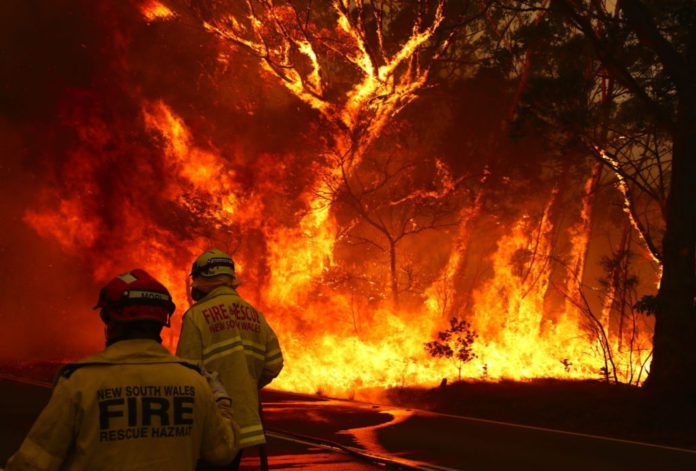
222 scientists say cascading crises are the biggest threat to the well-being of future generations
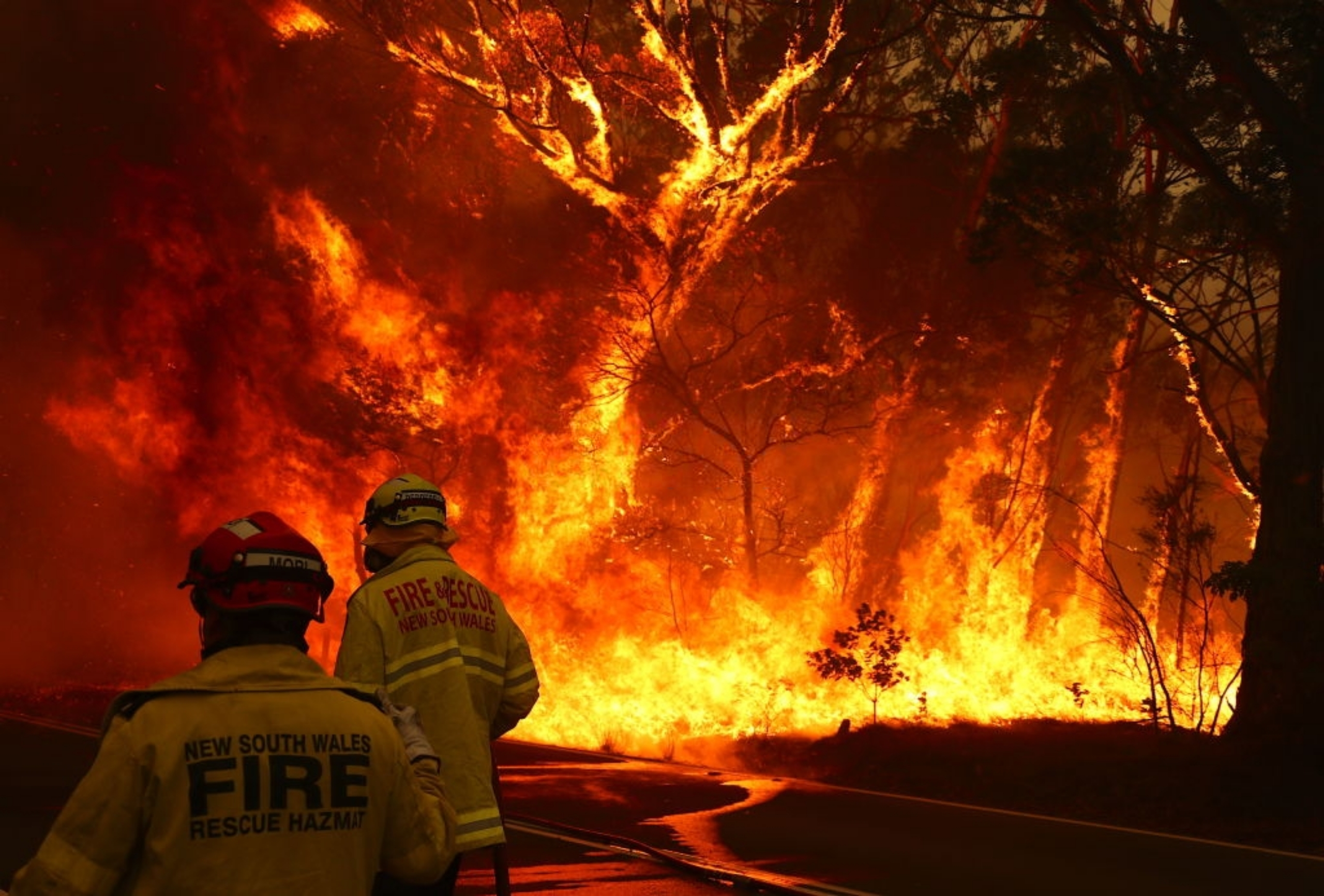
Source: The Conversation (Au and NZ) – By Anthony Capon, Director, Monash Sustainable Development Institute, Monash University

The bushfires raging across Australia this summer have sharpened the focus on how climate change affects human health. This season bushfires have already claimed more than 30 human lives, and many people have grappled with smoke inhalation and mental health concerns.

The changing nature of bushfires around the world is one of the tragic consequences of climate change highlighted in “Our Future on Earth, 2020” – a report published on Friday by Future Earth, an international sustainability research network.


Read more: No food, no fuel, no phones: bushfires showed we’re only ever one step from system collapse


The report includes a survey of 222 leading scientists from 52 countries who identified five global risks: failure of climate change mitigation and adaptation; extreme weather events; major biodiversity loss and ecosystem collapse; food crises; and water crises.
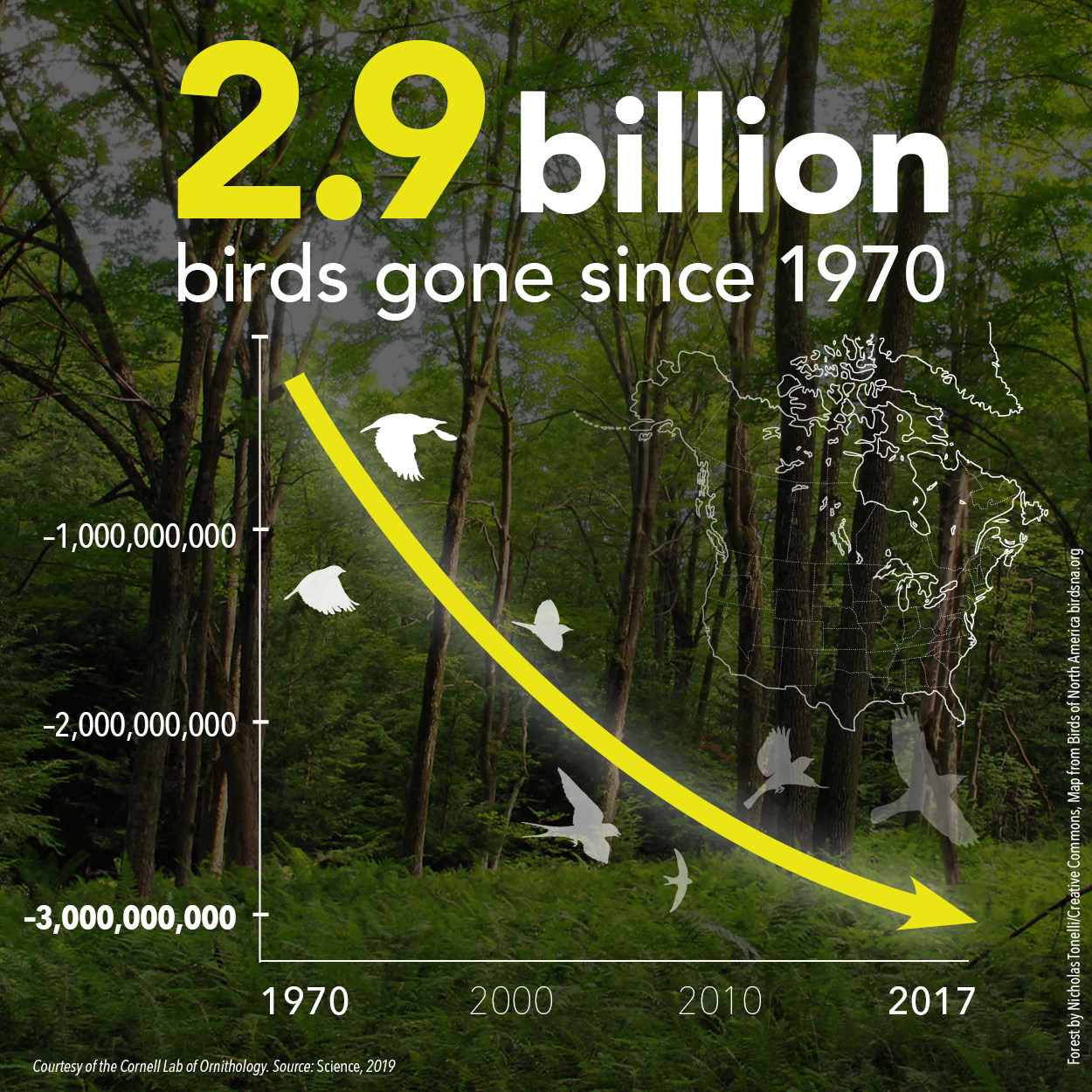
They identified these risks as the most severe in terms of impact on planetary health – the health of human civilisation and the state of the natural systems on which it depends.

Notably, the scientists underlined the threat that the interplay and feedback loops between these risks pose. In other words, each of these global risks worsens one another in ways that may cascade to create a worldwide systemic crisis.

For instance, it’s not just bushfires – it’s the combination of bushfires with drought, biodiversity loss, floods and ecosystem degradation.

We should not be thinking about them in isolation as politicians sometimes seem to do, for instance by proposing to respond to bushfires by simply removing vegetation.


Read more: Lots of people want to help nature after the bushfires – we must seize the moment


Ultimately, the report leads us to wonder: will humans continue to thrive on Earth? The answer depends on whether we can act together, with urgency, to reduce our footprint.

Hopefully, some good can come from this summer’s devastating bushfires. They might just help us wake up to the urgent need for climate action. The health and well-being of future generations depends on it.

The report isn’t all doom and gloom

Beyond these global risks, the report covers topics including food, oceans, politics, media and forced migration. The report doesn’t simply describe problems, it highlights where progress is being made, such as with technology.

The Our Future on Earth report found the bushfires are just one consequence of inaction on climate change. Shutterstock

Much existing technology is being used to promote consumption in the pursuit of economic growth, rather than to safeguard ecosystems or to promote just and fair societies. But the report also highlights how the digital sector has immense potential for reducing emissions and empowering people to monitor and protect ecosystems.

This can include, for instance, using digital technologies to improve energy efficiency and reduce emissions in buildings, transport and industry. And new imaging technologies are providing satellite data to monitor forests in real time, and track deforestation and illegal forest activity.


Read more: The eye in the sky that can spot illegal rubbish dumps from space


But the “great acceleration” of economic growth during the second half of the 20th century has put enormous pressure on earth systems. Rapid expansion of broadscale agriculture and extensive mining in some regions has led to deforestation, biodiversity loss and land degradation.

Now, there is an opportunity to reverse this trend by harnessing investments and financial instruments for sustainable development, including green bonds, sustainability-linked loans and more.

Connecting crises through the lens of health

One way we can connect the five global risks, tackling them in a holistic way, is to think about human health. Specifically, human health offers a useful perspective on sustainable development for policy-makers for three reasons.


Read more: How does bushfire smoke affect our health? 6 things you need to know


First, it makes clear the need for action is urgent because extreme weather events – amplified in frequency, intensity and duration by climate change – are already affecting health.

This is not a future issue, we’re already seeing health impacts in Australia. Smoke from the fires has exposed about half of Australia’s total human population to hazardous levels of air pollution for weeks. And mental health experts are concerned about rising levels of anxiety about bushfires.

We’ve already seen the vulnerabilities of human health during the bushfire crisis. AAP Image/Lukas Coch

Health also makes the need for action more personal. There are compelling human stories about the loss of lives and livelihoods from environmental change for engaging policy makers. This isn’t an abstract environmental issue: it’s affecting real people in our local communities.

But it’s not all bad: there are health benefits from transitions to sustainable development. For instance, we’re able to, by 2030, reduce the 7 million annual deaths from air pollution by two-thirds.

Using this health lens can illuminate potential win-win-wins from sustainable development policy, and can help policy makers grapple with the enormity of the crises the world faces.

Health in all nations

Dr Gro Brundtland, who chaired the World Commission on Environment and Development in 1987, contributed to Our Future on Earth.

She notes that a key message from the 1987 report remains relevant, explaining:

Our most urgent task today is to persuade nations of the need to return to multilateralism.

In other words, the future health of Australian people depends on people from other nations. Dr Brundtland is reminding us of the interdependence of all people on Earth.


Read more: The Chinese coal ‘ban’ carries a significant political message


For Australia, this means we should be actively supporting the Paris Agreement on climate change. We also must carefully reflect on the health impacts in other countries from our thermal coal exports, as more than 440,000 premature deaths each year are associated with air pollution from coal burning.

Beyond humans, Dr Brundtland’s call for multilateralism is a broader reminder of the interdependence of all species – all animals, plants and microorganisms.

ref. 222 scientists say cascading crises are the biggest threat to the well-being of future generations – https://theconversation.com/222-scientists-say-cascading-crises-are-the-biggest-threat-to-the-well-being-of-future-generations-131551

Don’t ‘just Google it’: 3 ways students can get the most from searching online

Source: The Conversation (Au and NZ) – By Renee Morrison, Lecturer in Curriculum Studies, University of Tasmania

Searching online has many educational benefits. For instance, one study found students who used advanced online search strategies also had higher grades at university.

But spending more time online does not guarantee better online skills. Instead, a student’s ability to successfully search online increases with guidance and explicit instruction.

Young people tend to assume they are already competent searchers. Their teachers and parents often assume this too. This assumption, and the misguided belief that searching always results in learning, means much classroom practice focuses on searching to learn, rarely on learning to search.


Read more: Most young Australians can’t identify fake news online


Many teachers don’t explictly teach students how to search online. Instead, students often teach themselves and are reluctant to ask for assistance. This does not result in students obtaining the skills they need.

For six years, I studied how young Australians use search engines. Both school students and home-schoolers (the nation’s fastest growing educational cohort showed some traits of online searching that aren’t beneficial. For instance, both groups spent greater time on irrelevant websites than relevant ones and regularly quit searches before finding their desired information.

Here are three things young people should keep in mind to get the full benefits of searching online.

1. Search for more than just isolated facts

Young people should explore, synthesise and question information on the internet, rather than just locating one thing and moving on.

Search engines offer endless educational opportunities but many students typically only search for isolated facts. This means they are no better off than they were 40 years ago with a print encyclopedia.

It’s important for searchers to use different keywords and queries, multiple sites and search tabs (such as news and images).

Part of my (as yet unpublished) PhD research involved observing young people and their parents using a search engine for 20 minutes. In one (typical) observation, a home-school family type “How many endangered Sumatran Tigers are there” into Google. They enter a single website where they read a single sentence.

The parent writes this “answer” down and they begin the next (unrelated) topic – growing seeds.

The student could have learnt much more had they also searched for

• where Sumatra is

• why the tigers are endangered

• how people can help them.

I searched Google using the key words “Sumatran tigers” in quotation marks instead. The returned results offered me the ability to view National Geographic footage of the tigers and to chat live with an expert from the World Wide Fund for Nature (WWF) about them.

Clicking the “news” tab with this same query provided current media stories, including on two tigers coming to an Australian wildlife park and on the effect of palm oil on the species. Small changes to search techniques can make a big difference to the educational benefits made available online.

More can be learnt about Sumatran tigers with better search techniques. from Shuttertock

2. Slow down

All too often we presume search can be a fast process. The home-school families in my study spent 90 seconds or less, on average, viewing each website and searched a new topic every four minutes.

Searching so quickly can mean students don’t write effective search queries or get the information they need. They may also not have enough time to consider search results and evaluate websites for accuracy and relevance. .


Read more: On an average day, only 1% of Australian news stories quoted a young person. No wonder so few trust the media


My research confirmed young searchers frequently click on only the most prominent links and first websites returned, possibly trying to save time. This is problematic given the commercial environment where such positions can be bought and given children tend to take the accuracy of everything online for granted.

Fast search is not always problematic. Quickly locating facts means students can spend time on more challenging educational follow-up tasks – like analysing or categorising the facts. But this is only true if they first persist until they find the right information.

3. You’re in charge of the search, not Google

Young searchers frequently rely on search tools like Google’s “Did you mean” function.

While students feel confident as searchers, my PhD research found they were more confident in Google itself. One year eight student explained: “I’m used to Google making the changes to look for me”.


Read more: Now there’s a game you can play to ‘vaccinate’ yourself against fake news


Such attitudes can mean students dismiss relevant keywords by automatically agreeing with the (sometimes incorrect) auto-correct or going on irrelevant tangents unknowingly.

Teaching students to choose websites based on domain name extensions can also help ensure they are in charge, not the search engine. The easily purchasable “.com”, for example, denotes a commercial site while information on websites with a “.gov”(government) or “.edu” (education) domain name extension better assure quality information.

Search engines have great potential to provide new educational benefits, but we should be cautious of presuming this potential is actually a guarantee.

ref. Don’t ‘just Google it’: 3 ways students can get the most from searching online – https://theconversation.com/dont-just-google-it-3-ways-students-can-get-the-most-from-searching-online-116519

Half of over-55s are open to downsizing – if only they could find homes that suit them

Source: The Conversation (Au and NZ) – By Amity James, Senior Lecturer, School of Economics, Finance and Property, Curtin University

More than half of Australians over the age of 55 are open to downsizing, according to a new report based on a survey of 2,400 households. The main barrier to moving to a smaller home is a lack of housing that matches their needs and preferences. The rapid growth in the number of older Australians adds to the major challenge housing markets face in meeting their diverse housing needs.

Downsizing, or rightsizing, is considered an essential component of meeting the housing aspirations of older Australians. At the same time, downsizing creates housing opportunities for younger households by freeing up family homes.


Read more: What sort of housing do older Australians want and where do they want to live?


The ageing population also creates fiscal challenges for government, in terms of delivering services to the home and providing residential care. Downsizing can enable older Australians to age well and age in place rather than potentially move prematurely into residential care.

The report released today by the Australian Housing and Urban Research Institute (AHURI), for which 2,400 households over 55 were surveyed, found 26% of such households had downsized. Another third had thought about it. Overall, the findings point to a strong appetite among older Australians to downsize their dwellings.

With about 6.5 million Australians aged 55 or older, living in about 4.3 million households, our findings suggest downsizing could be relevant to 2.5 million households.

Why downsize? And what are the obstacles?

We know older Australians downsize in response to life events such as changes in health and relationship status, or children leaving the parental home. Lifestyle preferences and difficulties maintaining their garden or house also shape downsizing behaviour.

Barriers to downsizing include a lack of suitable housing and a lack of financial incentives. There are also emotional and physical barriers to moving. Financial factors, however, do not greatly impact the decision to move, nor does perceived financial well-being increase once they have downsized.


Read more: Downsizing cost trap awaits retirees – five reasons to be wary


Where those who had downsized were dissatisfied, this was most commonly related to the new dwelling, particularly its size, and the neighbourhood.

Is it actually downsizing?

One of the policy rationales for downsizing is to reduce the underutilisation of dwellings. However, this is at odds with the attitude of many older Australians. They consider “spare” bedrooms necessary for use as permanent guest rooms (58%), studies (50%), or dedicated rooms for children or grandchildren (31%).

Space remains important to Australian downsizers. Over half of them move to a dwelling with three or more bedrooms. A third move to an apartment.

However, two-thirds of downsizers surveyed did move to a dwelling with fewer bedrooms. Three bedrooms was the preferred dwelling size for older Australians. Downsizing the garden was essential for most.

Author provided

Older Australians aspire to attain or retain home ownership. Their preferred neighbourhood has shopping, medical, recreational and public transport services all within walking distance.

Downsizers appear mobile. While under a quarter downsized within their original neighbourhood, 42% moved to a neighbourhood completely new to them.

The survey finding of a lack of suitable housing options matching would-be downsizers’ preferences may explain why so few were able to downsize in their original neighbourhood.

Delivering what older Australians want

If the local market does not have enough options available to meet the needs of older households, it is very difficult to downsize within an existing community. Moving to another desired location can also be problematic.

Meeting the needs of older Australians generally means an increase in medium-density housing. Developers are likely to require incentives to produce these medium-density products rather than potentially more profitable high-density development – although there is, of course, a downsizing market for well-located apartments.

Most downsizers want less garden to maintain, but still want a three-bedroom home. Ben Romalis/Shutterstock

Read more: People want and need more housing choice. It’s about time governments stood up to deliver it


The retirement industry has begun responding to the aspirations of older Australians. It is developing larger dwellings and offering a growing range of options, from high-end to affordable — all of which are accessible and suitable for ageing in place.

Equity-rich older Australians may wish to build a new dwelling in which to downsize. But they are often unable to borrow for this unless they have considerable capital available.

To support this avenue, new development finance models could be created to allow older Australians to develop without first having to sell the primary home. This shift would allow more collaborative forms of development, such as a group of like-minded individuals developing a site as housing for a small community.


Read more: Co-housing works well for older people, once they get past the image problem


For those vulnerable private renters moving into retirement, more secure rental accommodation through the social housing sector and delivered privately is essential. The community housing sector has a key role to play.

Where next?

The Australian housing landscape must shift towards a model of dwelling diversity with secure tenures – ownership and rental – in neighbourhoods where residents can walk easily to weekly services and recreation facilities, participate socially and be close to public transport options.


Read more: Fall in ageing Australians’ home-ownership rates looms as seismic shock for housing policy


Design is equally important. Australians need adaptable dwellings that can change to meet housing needs.

Such a landscape will provide effective downsizing options in which households can age well in the places that best meet their needs and aspirations.


Read more: For Australians to have the choice of growing old at home, here is what needs to change


ref. Half of over-55s are open to downsizing – if only they could find homes that suit them – https://theconversation.com/half-of-over-55s-are-open-to-downsizing-if-only-they-could-find-homes-that-suit-them-130531

We depend so much more on Chinese travellers now. That makes the impact of this coronavirus novel

Source: The Conversation (Au and NZ) – By Mingming Cheng, Senior Lecturer, School of Marketing, Curtin University

Australia has joined New Zealand, the United States, Indonesia, India, Israel and other countries in deciding to refuse entry to all foreigners flying from or who have recently been in mainland China.

These bans dramatically escalate the potential economic impact of the novel coronavirus.


Read more: How does the Wuhan coronavirus cause severe illness?


Over the past two decades China has grown from a minnow to a whale in international travel. Not counting mainland Chinese visiting Hong Kong and Macau (about 76 million in 2018), data from the United Nations World Tourism Organisation show the number of Chinese going abroad climbed from 2.8 million in 1997 to about 73 million in 2018.

This places China fourth in terms of international visits, behind Germany (about 92 million), the United States (88 million) and Britain (74 million).

Rise of the Chinese traveller

Besides Hong Kong and Macau, Chinese travellers most visit neighbouring nations – Thailand, Japan, Vietnam, South Korea and Singapore. Next is Italy, then the United States and Malaysia.

Australia is somewhat down the list – just the 17th-most-popular destination for Chinese visitors in 2018 (1.4 million visits). New Zealand was the 26th (about 448,000).


CC BY

But China is now Australia’s largest source of international visitors. Short-term arrivals from China overtook those from New Zealand (the top source for many decades) in 2017.


In the 12 months to November 2019, there were 1.44 million Chinese visitors to Australia, according to Tourism Australia. This was about 15% of the total 9.44 million short-term arrivals.

But Chinese visitors contributed relatively more to the Australian economy. The average spend per Chinese trip was $A9,235. This compared with $A5,943 for Germans, $A5,219 for Americans, $4,614 for Japanese and $A2,032 for New Zealanders.

This meant Chinese travellers contributed about A$12 billion to the Australian economy – or 27% of the total amount spent by all international visitors. International tourism accounts for about a quarter of Australia’s total tourism market. That means, in the greater scheme of things, Chinese travellers help create 0.6% of Australia’s annual GDP.

China overtook New Zealand as the leading country of origin for short-term arrivals to Australia in 2017. Mick Tsikas/AAP

The student effect

The reason the Chinese spend (on average) so much more than other visitors is due to the large number of Chinese who come to Australia to study.

The Tourism Australia data show almost 275,000 of the 1.44 million Chinese visits – about 20% – were for educational purposes. By comparison, study was the reason for fewer than 14,000 – or less than 1% – of the 1.42 million visits by New Zealanders.


Read more: Why New Zealand is more exposed than others to the economic chills of China’s coronavirus outbreak


Chinese students stayed an average of 124 nights before going home and spent an average of $27,000. This is more than any other nationality. The average spent by all international students was A$22,000.

Chinese tourists, on average, stayed an average of 14 days and spent A$4,655. The average for all international holidaymakers was A$4,286. The biggest-spending were the Italians (A$7,174), Germans (A$6,028) and British ($A6,011).

So Chinese students accounted for just shy of 58% – or A$7.1 billion – of all the money spent by Chinese visitors.

Ban impacts

Australia’s travel ban has come just in time to disrupt the plans of thousands of Chinese students coming or returning to Australia. February is normally the peak month for Chinese arrivals in Australia. In 2019, the month recorded 206,300 arrivals – roughly double the average month.

This is because this month is when many Chinese students arrive or return to Australia to start the university year. (It’s also due in part to the proximity of the Chinese lunar new year – January 25 this year, February 25 last year – when hundreds of thousands of Chinese travel for a holiday or to visit family.)


Read more: The coronavirus outbreak is the biggest crisis ever to hit international education


Chinese students enrolled in Australian universities comprise 38% of all full-fee paying international students. With international students now contributing about 23% of university revenues, this suggests the Chinese market alone contributes about 9%.

More Chinese students come to Australia for vocational education and training or school. All up, Chinese students account for about 30% of total overseas student enrolments.


CC BY

Long-term impacts

Our main point of reference for the economic impact of the coronavirus is the impact of SARS in late 2002. The Chinese government imposed similar travel restrictions to now. But Australia did not ban travellers from China outright. It instead relied on screening at airports.

In May 2003 just 3,100 Chinese visited Australia, a 75% decline on the 12,600 visitors in May 2002. Visitor numbers from other Asian countries also suffered, with the total number of international short-term arrivals falling 8.5% in April , then a further 2.6% in May.

But SARS was contained relatively quickly. By July the Chinese government had lifted its restrictions. The following month Chinese arrivals were back up to more than 12,000.


Chinese visitor arrivals during and after the SARS crisis. Australian Bureau of Statistics

The economic impact of SARS was therefore “short-lived and limited”, according to the Australian Treasury.


Read more: Fear spreads easily. That’s what gives the Wuhan coronavirus economic impact


The economic impact of the novel coronavirus is shaping to be more signficant, based on the scale of crisis, the severity of travel restrictions, the likelihood travel bans will stay in place for longer and the much greater numbers of Chinese tourists and students on which Australia’s tourism and education industries have come to rely.

ref. We depend so much more on Chinese travellers now. That makes the impact of this coronavirus novel – https://theconversation.com/we-depend-so-much-more-on-chinese-travellers-now-that-makes-the-impact-of-this-coronavirus-novel-130798

Looking for love on a dating app? You might be falling for a ghost

Source: The Conversation (Au and NZ) – By Lisa Portolan, PhD student, Institute for Culture and Society, Western Sydney University

Consider the moments you have fallen in love.

If you unpick the threads, you will quickly find much of the falling occurred in the mind. Many artefacts that go towards creating intimacy are imagined. We can’t fully understand or know someone else, but we can construct a persona around them and a shared view of the future.

Yes, there were likely tangible and physical components that went towards constructing the intimacy. You would have seen that person, had a discussion with them, a date (or several dates even), but realistically a lot of it happened in your mind.

Love requires imagination: a shared vision, narrative or trajectory.

In our connected world, this imagination is fostered from the very start of the interaction. It happens from the moment we pick up our phones, tap on an app and consider swiping right. And we’re doing a lot of swiping: 5 million matches a day on Tinder alone. Dating apps and dating have become virtually synonymous.


Read more: Why Tinder is so ‘evilly satisfying’


It would be easy to chalk up the success of the dating app to functionality, mobility and ease, but what about its reawakening of the imagination?

Dreamspaces

Dating apps provide users with the ability to dream, to fantasise, to construct a person and an imagined story based on limited information. We open the app with a series of beliefs about who might make for our perfect match. Athletic, committed, creative, respectful, passionate, educated, age-appropriate (or inappropriate) … and then we interpret.

Consider what you are supplied with: a few profile pictures and a brief description. Information is limited; gaps need to be filled.

A photo taken with an adorable chocolate Labrador. Is he an animal lover – and therefore dependable? Holding a cocktail in a party dress with a friend. Does she enjoy her social life – and so is she fun to be around? On the beach: they must love the outdoors.

Would you swipe right on this good boy? Tadeusz Lakota/Unsplash

From there, we springboard into interpreting other prompts and creating a narrative. You’re imaging an afternoon spent at the dog park (with the chocolate lab and your cavoodle – they would be the best of friends); an evening at the latest bar sipping the newest drink; a swimsuit, board shorts and a towel haphazardly flung over a balcony in the memory of a day spent at the beach.

And while you are imagining your potential match, they are imagining you, too.


Read more: Must love jokes: why we look for a partner who laughs (and makes us laugh)


Swipe right, and start a DM chat, and our intrepid interpretation of the other person and potential intimacy continues. The ghost of an imagined relationship has begun to haunt us.

Go on, ghost me

“Hauntology” was coined by philosopher Jacques Derrida to refer to the return or persistence of elements from the past, as in the manner of a ghost.

Dating apps allow the user to mobilise hauntological recollections from a previous relationship, a movie, a novel, or an idea.

The virtual digital space is the perfect location for such hauntologies. You might think there is another person on the other side of the app, but we can also consider them to be a ghost.

It’s easy to understand why dating apps are so popular. Their mobility makes them easy to use; users are in control of their selection of potential matches.

Tinder founders Sean Rad and Justin Mateen say the design takes “the stress out of dating”, and the game-like quality of the app creates less emotional investment.

But the imagining constitutes a significant emotional investment. Studies have shown imagined occurrences have similar, if not the same, impact as reality.

Despite the lack of a face-to-face interaction you might find yourself intensely linked to your ghost. But will your ghost match the actual person when you meet them face-to-face for the first time? Will the two converge, or will there be an unbearable space between?

Hello, is it me you’re looking for? Kinga Cichewicz/Unsplash

Awareness is half the battle. When you’re next flicking through potential matches on a dating app, be conscious of how far you’re taking your digital imaginings.

You can aim to keep them in check, or you can consciously let them spiral – in the knowledge of the notion you might be falling for a ghost.


Researchers at Western Sydney University are looking for Bumble and Tinder users aged between 18 and 35 living in New South Wales to investigate dating apps and gender roles. Click here for more information and to register.

ref. Looking for love on a dating app? You might be falling for a ghost – https://theconversation.com/looking-for-love-on-a-dating-app-you-might-be-falling-for-a-ghost-128626

Behave as a team, Morrison tells the troops

Source: The Conversation (Au and NZ) – By Michelle Grattan, Professorial Fellow, University of Canberra

As he battles to put containment lines around the damage the Nationals’ meltdown is causing his government, Scott Morrison has given his party room a pointed lecture about unity.

He has also obtained a letter from Llew O’Brien in which O’Brien reaffirms he will support the government. O’Brien quit the Nationals this week and then won the deputy speakership thanks to the votes of several rebel Nationals.

O’Brien, who remains a member of the Queensland Liberal National Party, sent the letter after meeting Morrison on Monday night.

Before Tuesday’s Coalition meeting, the word was put out for members to show restraint, after recent public airings of differences over coal in particular.

Addressing the party room, Morrison reminded members they were there as a team, declaring the government had a “contract” with the Australian people.

Those walking into the government party room took on serious responsibilities and must do so as a government. The government had gone to the election highlighting local plans and the capabilities of local members but also very much as members of a team.

“The people endorsed us to be the government,” he said, emphasising the government wasn’t him or any individual. “We are together the government.”


Read more: View from The Hill: It turned into a profitable day at the office for Nat rat


He said there were many parties in this government: the Liberal party, the National party, the CLP in the Northern Territory, the LNP in Queensland.

But “the contract we have with the Australian people” was to work collectively as their government. The government’s strength was its values, policies and beliefs, which were endorsed at the election.

Acknowledging the difficulties of the last couple of months Morrison told members, when they returned home after the current fortnight sitting, “to focus on the people who put us here”.

Treasurer and deputy Liberal leader Josh Frydenberg invoked John Howard’s adage about being a broad church, when Howard added, “you sometimes have to get the builders in to put in the extra pew on both sides of the aisle to make sure that everybody is accommodated”.

Frydenberg lamented Monday’s “historic moment” in the Australian-Indonesian relationship, with President Joko Widodo visiting Australia and addressing parliament, had been overshadowed in the news bulletins. He also urged MPs to focus on government achievements and policies and future plans “and put internal issues of recent days behind us”.


Read more: Politics with Michelle Grattan: Michael McCormack moves on from his near-death experience


Embattled Nationals leader Michael McCormack, who at the weekend did the Tumbarumba trek which was started by Tim Fischer, said he’d had a call from Fischer’s widow Judy, who’d reflected on how Tim and his team had “stuck firm through difficult periods”. She had said Tim “would want us all to stand firm and together at present”, focused on continuing to deliver the government’s commitments.

O’Brien was present at the meeting but didn’t speak.

Also quiet were the Liberal moderates, who have been recently outspoken on climate change.

One of the Nationals rebels, former resources minister Matt Canavan, spruiked the advantages of the feasibility study for a Queensland coal-fired power station at Collinsvillle, but his comments were relatively non-combative.


Read more: VIDEO: Michelle Grattan on the Coalition and coal


In contrast, earlier Canavan prodded the southern Liberals when on Monday night he hit back with heavy sarcasm against former prime minister Malcolm’s Turnbull’s comment that it was “nuts” to advocate government support to build a coal-fired power station.

Canavan told Sky, “Good luck to Malcolm, he’s welcome to have his views. In fact, I hope that Malcolm keeps expressing those views and that maybe come around the next election he can lead a convoy, let’s say, up to Collinsville, and have a rally up there, and campaign against the coal-fire power station.

“I think that would go down very well, to have Malcolm’s motorcade come up to North Queensland, and tell us all why we shouldn’t be using our own product which we export overseas to create jobs here.”

Asked in question time whether the government would be willing to indemnify a Collinsville coal-fired power station against carbon risk, Morrison said it was committed to the feasibility study but “the matter that the member has raised with me in this question is not currently before the government”.

ref. Behave as a team, Morrison tells the troops – https://theconversation.com/behave-as-a-team-morrison-tells-the-troops-131143

Rights groups, journalists condemn Duterte bid to shut key TV network

By Felipe F. Salvosa II in Manila

New York-based Human Rights Watch has led a barrage of condemnation against the Duterte government’s “assault on media freedom” by filing a court petition to void the franchise of ABS-CBN, the largest television network in the Philippines.

The petition for quo warranto accuses ABS-CBN of skirting the ban on foreign ownership of mass media and illegally operating a digital for-pay channel and a subsidiary for mobile and digital TV platforms. The publicly listed company denies the allegations.

Shares in ABS-CBN fell 1.76 percent to 16.70 pesos each following news of the quo warranto petition filed by Solicitor-General Jose Calida, who campaigned for President Rodrigo Duterte in the 2016 election.

READ MORE: Duterte top state lawyer asks Supreme Court to shut ‘abusive’ media network

HRW said in a statement that the Philippine Congress should thwart the Duterte government’s “misuse” of regulatory powers, adding that Calida’s action could prevent the renewal of ABS-CBN’s 25-year franchise, which expires on March 30.

“Philippine legislators have a responsibility to uphold media freedom and resist administration efforts to pressure news outlets to toe the government’s line,” said HRW Philippines researcher Carlos Conde.

– Partner –

“President Duterte’s administration should cease its politically motivated legal actions against the network.”

HRW also said the Philippines licence renewal process allowed Congress to put “inappropriate pressure” on broadcast networks.

‘All-out assault’
“The administration’s attempt to cancel ABS-CBN’s franchise or deny its extension is not just an attack on a single network, but an all-out assault on media freedom,” Conde said.

“Complaints against broadcasters should be addressed in the proper forum, such as the National Telecommunications Commission.”

The Foreign Correspondents Association of the Philippines (FOCAP) also denounced the government’s move, citing ABS-CBN as a “cornerstone of Philippine democracy and the free press for its independent and critical reportage and massive following in the country and abroad”.

“The constitutional violation and other legal infractions raised by the Solicitor-General in his quo warranto petition before the Supreme Court have been denied by ABS-CBN and questioned by some members of the legislature, which has exclusive rights to grant such franchises,” FOCAP said.

“These moves politically harass and threaten a pillar of the media industry that employs thousands of Filipinos and has played a crucial part in helping fight official corruption and abuse for decades.

“We call on Congress to act independently. We call on our Supreme Court Justices to side with the people’s right to truthful and independent news, the Constitution and democracy. We call on our media colleagues to close ranks in this perilous time,” FOCAP said.

The University of the Philippines College of Mass Communication said Calida’s action was “another blatant attack on the freedom of the press”.

Silencing media voices
“In filing a ‘quo warranto’ against ABS-CBN, the current administration demonstrates the lengths that they will go to silence critical media voices,” it said in a statement.

“It has been 34 years since we won back our right to information and a free press through the 1986 EDSA Revolution.

“However, government actions such as these show us the volatility of this hard-won freedom, the need to remain vigilant so as to not allow history to repeat itself,” it said.

“As we have seen in the recent past, multiple tactics have been used to attack the media—from the legal harassment of ABS-CBN and Rappler to the use of spurious data and fake news against media institutions like VERA Files and the Philippine Centre for Investigative Journalism.”

Opposition senator Francis Pangilinan criticised the Duterte government for “training its guns” on critics amid the outbreak of the novel coronavirus.

Another opposition lawmaker, Risa Hontiveros, argued that a quo warranto petition wouldn’t succeed.

“The provision attacks a corporation that was not legally incorporated. ABS-CBN, is, of course, legally incorporated,” she said.

‘Vindictive move’
“I see the Solicitor-General’s quo warranto petition against ABS-CBN as an attack on the free press and a vindictive move against critical journalism,” she added.

The leader of the Senate minority, Franklin Drilon, cast doubt on Calida’s motivation, noting that the petition, which would require weeks – if not months – to resolve, would become useless when ABS-CBN’s franchise expired next month.

“If between now and March, Congress decides to hear the franchise renewal of ABS-CBN — all these issues raised by SolGen Calida in his quo warranto petition can be taken up during the hearing,” Drilon said.

Felipe F. Salvosa II is coordinator of the Journalism Programme in the Department of Communication and Media Studies at the University of Santo Tomas in Manila.

Print Friendly, PDF & Email

Article by AsiaPacificReport.nz

Duke the dog’s plane death shows how climate change complicates pet ownership

Source: The Conversation (Au and NZ) – By Simone Blackman, Lecturer in Commercial Law, University of Tasmania

This summer’s bushfires and heatwaves may have led you to wonder how climate change will shape our lives. But have you given any thought to how it might affect your pets?

The issue of climate change and pet ownership came to the fore in recent weeks after several dogs reportedly died during air transit in soaring temperatures. They included a boxer called Duke, who died in December after being left in a crate on the tarmac in near 40℃ heat during a flight delay.


Read more: Vets can do more to reduce the suffering of flat-faced dog breeds


Qantas and Virgin Australia subsequently announced an overhaul of how some breeds of dogs, cats and rabbits – those with physical features that restrict their airways – travel on their planes.

The new flight restrictions have their pros and cons. One the one hand, it’ll improve welfare for dogs who struggle on flights and put a spotlight on the issues snub-nosed dogs face. But also it can create complications for breeders, and for transporting rescue dogs.

Duke the boxer died on a plane after being left on the tarmac on a nearly 40 degree day. Kay Newman/Facebook

Travel woes

The bushfire crisis has made us rethink the typical Australian holiday. And by extension, we should integrate our pets into our bushfire survival plans and reconsider whether to take them on holiday.

Snub-nosed dogs, with their short snouts and respiratory systems, mean they’re more prone to dying in flight. This risk is higher in warm weather, when the body must work harder to regulate temperature.


Read more: Curious Kids: is it true dogs don’t like to travel?


Both Qantas and Virgin Airlines have long had more stringent travel requirements for certain breeds, such as for snub-nosed dogs.

Among Qantas’s recent changes, a registered veterinarian must clear all snub-nosed animals to fly immediately before travelling. In making the announcement, Qantas said the extreme features of snub-nosed breeds mean they often struggle to breathe, even in mild conditions.

Qantas’s new precautions apply to snub-nosed breeds including boxers, bulldogs and pugs, which are becoming increasingly popular.

Virgin has banned snub-nosed dogs altogether, as well as some types of rabbits, from flying until further notice.

These calls, however, are somewhat arbitrary when it comes to which dog breeds to ban or apply restrictions to. There is no evidence-based threshold beyond which certain temperatures become untenable for dogs of a given head shape, or a given age or body weight.

Inbreeding risk

With 4.8 million pet dogs in Australia, the travel restrictions will not only affect dog owners, but dog breeders and rescue groups who fly puppies to their new homes across Australia.

We predict a sustained decline in demand for puppies of breeds the travel restrictions affect. This means breeds with a smaller population may fall victim to less interstate and international movement of gametes (reproductive cells), leading, in turn, to less genetic diversity and, sadly, more inbreeding.

One of us, Simone Blackman, breeds Tibetan spaniels, a snub-nosed breed that is subject to the new flight restrictions. These Tasmanian-bred puppies can now only be transported to mainland Australia by ferry, if a person accompanies them. Clearly, this is neither good for the puppies in question – because the trip by air is considerably shorter – nor practical for a hobby breeder. It also means there is less opportunity to garner genetic diversity from mainland Australia.

Qantas placed more restrictions on snub-nosed pets flying following Duke the boxer’s death, while Virgin Airlines banned them altogether. Barbara Walton/EPA

The carbon pawprint

As the climate warms, it will become more important to make sound ethical and financial decisions around pet ownership.

For example, those who seek to lighten their ecological footprint may need to consider the methane and nitrous oxide emissions, potent greenhouse gases that come from pet food production. The meat in dog food is highly processed and must be transported.

In fact, a 2017 US study found these gases from pet food release the equivalent of 64 million tons of carbon dioxide a year. That’s equivalent to the emissions produced from over a year of driving 13.6 million cars.

Owners can make low-carbon pet food decisions, sourcing locally made food. For example, buying from local markets or from producers such as the Pet Grocer whose mission is to produce dog food that’s healthy, sustainable and ethical.


Read more: What about your carbon pawprint?


Rising temperatures mean owners also need to think twice about leaving pets outside without shade, instead opting to leave pets indoors with air conditioning on.

Looking to the future

Of course, dogs exist in the same climate, and breathe the same bushfire smoke, as their owners. Under climate change, dogs (and people) with breathing issues will suffer the most, alongside those which are old and overweight.

Warmer weather also means less dog-walking in the heat of the day, which is not good for dogs or their owners.

Dog ownership brings immense joy for many Australians, but we must understand how climate change will complicate the way we keep and care for them. It’s clear the welfare of pets, humans and the planet are inextricably intertwined.

ref. Duke the dog’s plane death shows how climate change complicates pet ownership – https://theconversation.com/duke-the-dogs-plane-death-shows-how-climate-change-complicates-pet-ownership-130601

Poppers can now be sold in pharmacies, but getting them might not be so easy

Source: The Conversation (Au and NZ) – By Stefanie Vaccher, Statistician/Epidemiologist, UNSW

New regulations come into place this month that allow the sale of amyl nitrite, known as poppers, in Australian pharmacies.

Amyl nitrite and the broader class of drugs it belongs to, alkyl nitrites, were previously illegal in Australia. But poppers were easy to obtain, sold as “room deodoriser” or “leather cleaner” in adult stores and sex-on-premises venues.

Poppers are inhaled, giving a short buzz and mild head-rush because they relax muscles and blood vessels. They’re also used to facilitate more pleasurable sex, particularly anal intercourse. They relax the anal sphincter muscles, allowing for easier sex.


Read more: Weekly Dose: amyl started as a poison antidote, now a common party drug


But you’re not likely to find poppers in pharmacies anytime soon – no product has yet completed the manufacture, testing, and registration processes required to sell a medication in Australia.

There are also a number of other barriers to overcome before users can make a successful transition to purchasing poppers in a pharmacy.

In the meantime, exemptions should be given to stores and venues where poppers were previously sold to ensure people can continue to access them.

Who uses poppers?

Our recent research found almost half of gay and bisexual men in Australia have used poppers in the last six months.

Women also use poppers, but much less frequently. Almost 10% of lesbian, bisexual, and queer women report using poppers in the last six months, mostly at parties.

The majority (65%) of men we surveyed reported that despite any changes to the legal status of poppers, they would continue to find ways to obtain them.

Almost half of gay and bisexual men have recently used poppers. mavo/Shutterstock

We found the use of poppers wasn’t associated with an increased risk of acquiring HIV.

In fact, men who used poppers were more likely to be protected against HIV by using pre-exposure prophylaxis or PrEP (a medication to prevent HIV) than men who didn’t use poppers.

Poppers may also play a role in reducing the risk of HIV transmission, by decreasing the risk of tearing or abrasions during sex.


Read more: Is Truvada (PrEP) the game-changer that will end new HIV transmissions in Australia?


What’s changing?

Recent regulatory changes were designed to ensure that safe and reliable medications could be sold in Australian pharmacies in an easily accessible manner.

This presents an opportunity for pharmacists to have a conversation with potential poppers users prior to their purchase. The discussion could include information about side effects, drug interactions, and safe use practices.

However, at this stage it’s unclear whether poppers will only be dispensed to people who intend to use it as a sexual enhancement aid, or whether it will also be made available for people wanting a quick high.

In its ruling, the Therapeutic Goods Administration stated amyl nitrite could only be sold in Australian pharmacies “when in preparations for human therapeutic use and packaged in containers with child-resistant closures”.

Poppers sold in pharmacies would need to be appropriately packaged. Aleksandar Karanov/Shutterstock

No product has passed through the lengthy manufacture, testing, and registration processes required to sell a medication in Australia.

This process can take several years, so we don’t expect the gap in the market to be filled in the near future.

Making sure stigma doesn’t become a barrier

It’s important pharmacists provide information about all medications in a non-judgemental way.

But the experience of Australian women accessing the morning after pill suggests this may not always be a reality.

Some women accessing emergency contraception from pharmacists feel stigmatised for their actions, which may deter them from purchasing the medication from a pharmacist in future.


Read more: Note to pharmacists on how not to sell the morning-after pill


Similarly, the potential for stigma and discrimination could deter some people from visiting a pharmacy to access poppers. They may also face other practical barriers, such as opening hours and accessibility of pharmacies.

We need a transition plan

It’s still illegal to buy poppers in sex shops and sex-on-premises venues. But it’s unclear whether there will be crackdowns on their sale outside of pharmacies in Australia.

During the transition to pharmaceutical poppers, these stores and venues should be offered exemptions to continue to sell poppers. This would allow ongoing access while the market catches up to new regulatory requirements.

These shops and venues could also provide an alternative for people who may not be comfortable discussing their sexual practices in public pharmacies. People who want more information could then be referred onto a knowledgable and LGBT-friendly pharmacist in their area.

So how can people legally access poppers?

Buying online from overseas is an option, though you’ll need a script. MRProduction/Shutterstock

Under Australia’s personal importation scheme, people with a valid prescription can buy poppers online.

However, this requires finding a general practitioner who is willing to write a prescription for amyl nitrite, and a reliable overseas pharmacy to purchase this medication through.

Poppers have been used as a sexual enhancement aid for decades. Allowing their sale in pharmacies is a good first step but we have a long way to go until they’re easily accessible.

ref. Poppers can now be sold in pharmacies, but getting them might not be so easy – https://theconversation.com/poppers-can-now-be-sold-in-pharmacies-but-getting-them-might-not-be-so-easy-131146

High Court rules Indigenous people cannot be deported as aliens, but the fight for legal recognition remains

Source: The Conversation (Au and NZ) – By Kate Galloway, Associate Professor of Law, Griffith University

The High Court made an important decision today about whether it is possible for Aboriginal Australians to be deported from the country if they are not citizens.

By a majority of 4:3, the court decided that

Aboriginal Australians … are not within the reach of the ‘aliens’ power conferred by s 51(xix) of the Constitution.

The outcome of the decision is clear for one of the men, Brendan Thoms, who is a registered native title holder. As such, it is beyond the power of the Commonwealth to deport him.

However, the majority was divided on the question of whether the other plaintiff, Daniel Love, was an Aboriginal person as a question of fact, and so did not make a finding about whether or not he was an “alien”.

This case is significant. In some regards, it is about questions of deportation and immigration. But, crucially, it is a constitutional law case grappling with the deeper question of whether Aboriginal and Torres Strait Islander Australians can be aliens and therefore excluded from the Australian state.

Although the decision applies to only a small number of people – Indigenous Australians who are not citizens – it has a broader impact in recognising the special status of Indigenous Australians in Australia.

Background of the case

The case involved two Aboriginal men born overseas who were ordered to be deported from Australia because they each had a criminal conviction. Both men appealed to the High Court and their cases were heard together late last year.

Love, a Kamileroi man, was born in Papua New Guinea to an Aboriginal father and PNG mother. He moved to Australia in 1984 when he was five years old, but never applied for citizenship. After serving a 12-month sentence for assault occasioning bodily harm, his permanent residency visa was cancelled by the government. He was in detention but was released in 2018 pending the High Court’s decision.


Read more: Can Indigenous Australians be deported as ‘aliens’? A High Court decision will show us the strength of modern colonial power


Thoms, a Gunggari man and declared native title holder, was born in New Zealand to an Aboriginal mother and New Zealand father. He has lived in Australia since 1994. Like Love, his visa was cancelled after he served part of an 18-month sentence for a domestic violence assault. He has remained in immigration detention pending the court’s decision.

The Commonwealth has maintained that since the men are not citizens of Australia, the minister for Home Affairs has the power to cancel their visas and deport them. Under Section 51 (xix) of the Constitution, the Commonwealth has the power to make laws relating to “naturalisation and aliens”.

However, lawyers for the two men argued that although they are not citizens, they cannot be aliens – and therefore cannot be deported.

As a question of law, an alien is a person who owes allegiance to another country because they were born there. For people recognised as Aboriginal Australians, with longstanding connections to community, culture and traditional land, this implies they do not belong in their own country.

As Love’s lawyers argued to the court,

as a member of the Aboriginal race of Australia and the child of an Australian citizen … [he] is not an alien.

This argument suggests a new category of person described as “non-citizen non-aliens”. And under this special category, the lawyers argued, the minister would not have the constitutional right to deport them.


Read more: The government’s ‘new page’ on Indigenous policy is actually just more of the same


The conflict in this case arises because it seems contradictory for Aboriginal people to be thought of as strangers in their own land. This is especially so for registered native title holders, such as Thoms. As a native title holder, the law recognises his connection to the land.

The basis of the men’s argument, therefore, rests on the connection of Aboriginal and Torres Strait Islander people to their country and the obvious implication of belonging.

Impact for Indigenous Australians

The court’s decision is good news for Indigenous Australians, as it expresses a new form of relationship between Indigenous people and the state – that of a “non-citizen, non-alien”.

The category will protect Aboriginal and Torres Strait Islander Australians born overseas, ensuring they will not lose their right to traditional lands because of an accident of birth. The decision upholds the law’s recognition of the importance of Indigenous Australians’ connection to, and rights over, their lands.

But it does mean that a person must be able to prove their Aboriginality before the court as a question of fact.


Read more: Ken Wyatt’s proposed ‘voice to government’ marks another failure to hear Indigenous voices


Because Thoms is a native title holder, his circumstances were clear. The majority was divided, however, on Love’s status as an Aboriginal person, as he is not a native title holder. And there was ultimately no finding as to whether he qualifies as an alien under the law.

The case also highlights the ongoing challenges for Indigenous Australians in their fight for proper legal recognition in relations with the state.

The minister ignored the implications of these men’s Aboriginality in seeking to deport them. And the Commonwealth argued before the High Court that these men did not belong in Australia – that they were aliens. Further, three of the seven judges agreed with that argument and decided there was no special category for “non-citizen, non-aliens”.

The fact this case was brought at all indicates that the relationship between Indigenous Australians and the state remains unresolved.

Despite the majority decision, it seems First Nations peoples’ close connection with the land is still not enough on its own to guarantee their ongoing rights to be part of Australia, and to retain their ties to community and country.

This decision will be recognised as a milestone for Indigenous Australians. But the closeness of the decision and the qualified finding in relation to Love’s case means this question of belonging for non-citizen Indigenous people will likely be raised again.

ref. High Court rules Indigenous people cannot be deported as aliens, but the fight for legal recognition remains – https://theconversation.com/high-court-rules-indigenous-people-cannot-be-deported-as-aliens-but-the-fight-for-legal-recognition-remains-131377

Curious Kids: is the sky blue on other planets?

Source: The Conversation (Au and NZ) – By Jake Clark, PhD Candidate, University of Southern Queensland


Is the sky blue on other planets, like on Earth? What is an atmosphere, and do other planets have one? – Charlie, age 10


G’day Charlie, and thank you so much for your incredibly curious question.

Before I get too excited talking about the atmospheres of other planets, first we have to talk about what an atmosphere actually is.

Earth’s atmosphere is split into different layers. ESA

The atmosphere is normally the outermost layer of a planet. On rocky worlds like Earth it is usually the lightest and thinnest layer.

The thing that makes an atmosphere an atmosphere is what it’s made of. It’s not made up of big lumps of rocks or huge swirling oceans; it is made up of gases.

What’s in an atmosphere?

Atmospheres can contain a wide variety of gases. Most of Earth’s atmosphere is a gas called nitrogen that doesn’t really react with anything. There’s also a fair bit of oxygen, which is what we need to breathe. There are also two other important gases called argon and carbon dioxide, and tiny amounts of lots of other ones.

The mix of gases is what gives a planet’s atmosphere its colour.


Read more: Curious Kids: Why is the sky blue and where does it start?


Earth’s atmosphere is made up of gases that tend to bounce blue light in all directions (known as “scattering”) but let most other colours of light straight through. This scattered light is what gives Earth’s atmosphere its blue colour.

Do other planets have blue atmospheres? Some of them sure do!

The blue “haze” surrounding Earth in space is caused by the scattering of light from Earth’s atmosphere.

Other worlds

The atmospheres of the two ice giants in our solar system, Neptune and Uranus, are both beautiful shades of blue.

However, these atmospheres are a different blue than ours. It’s caused by the huge amounts of a gas called methane swirling around.

(Side note: methane is also the main component of farts. That’s right, there’s a layer of farts on Uranus.)

The atmosphere of Uranus (left) is slightly greener than Neptune’s (right). NASA / JPL-Caltech / Björn Jónsson

Jupiter and Saturn, however, have completely different-coloured atmospheres.

Ice crystals made of a chemical called ammonia in Saturn’s upper atmosphere make it a pale shade of yellow.

Uranus’ atmosphere also contains some ammonia, which makes the planet a slightly greener shade than the deep blue we see on Neptune.

Jupiter’s atmosphere has distinctive brown and orange bands, thanks to gases that may contain the elements phosphorus and sulfur, and possibly even more complicated chemicals called hydrocarbons.**

The Juno spacecraft flying past Jupiter in 2017.

In some extreme cases, the entire planet might just be a huge atmosphere with no rocky surface at all. Astronomers and planetary scientists like myself are still trying to work out whether Jupiter and Saturn have rocky surfaces, deep down in their atmosphere, or whether they’re both simply huge balls of gas.

The Cassini spacecraft took this cracking image of Saturn back in 2010. NASA/JPL-Caltech/Space Science Institute

However, there are some planets that have no atmosphere at all! The Sun’s closest and smallest neighbour, Mercury, is one example. Its surface is exposed to the vastness of space.

Beyond our solar system

So far I’ve been talking about the atmospheres of planets in our Solar system. But what about planets in other planetary systems, orbiting other stars?

Well, astronomers have been detecting the atmospheres of these planets (which we call “exoplanets”) for the past 20 years! It wasn’t until last year, however, that astronomers managed to detect the atmosphere of a rocky exoplanet. The planet is called LHS 3844b and it’s so far away that the light takes almost 50 years to reach us!

LHS 3844b weighs twice as much as Earth, and we astronomers thought it would have a pretty thick atmosphere. But, to our surprise, it has little to no atmosphere at all! So it might be more like Mercury than Earth.

Animation showing an artist’s impression on what LHS 3844b’s surface may look like.

We still have a lot to learn about far-off planets and discovering one with an Earth-like atmosphere that’s ripe for life is still many years away.

Maybe, Charlie, you could be the first astronomer to detect an Earth-like atmosphere on another world!

ref. Curious Kids: is the sky blue on other planets? – https://theconversation.com/curious-kids-is-the-sky-blue-on-other-planets-129779

France drags its heel over nuclear compensation claims from Tahiti

By RNZ Pacific

The French nuclear compensation commission, CIVEN, says it will soon report on how to respond to last month’s Supreme Court reinstatement of some compensation claims from French Polynesia.

The court approved the validity of two claims by nuclear weapons test victims thrown out last year, saying the old eligibility criteria were still relevant.

The applications had been dismissed because a clause was added to a French finance act in late 2018, which changed the entitlement terms and quashed the claims.

READ MORE: Nuclear tests in Polynesia: France acknowledges harm caused to local people

The current compensation law now again requires proof of a minimum level exposure to the weapons tests.

CIVEN said it is reviewing how it can apply the decision to its mandate.

– Partner –

In 2017, six of CIVEN’s nine members resigned when the eligibility criteria were loosened, and as a result its work was briefly suspended.

Twenty-three types of cancer are on the list of illnesses recognised as the possible aftermath of France’s weapons tests.

The Supreme Court ruled three years ago that CIVEN is to attribute payments to victims out of national solidarity.

This means that the French state is legally not responsible for ill health caused by the weapons tests.

Between 1966 to 1996, France carried out 193 nuclear weapons tests in French Polynesia.

This article is republished under the Pacific Media Centre’s content partnership with Radio New Zealand.

Print Friendly, PDF & Email

Article by AsiaPacificReport.nz

Elaine Pearson: Five urgent issues for Indonesia’s president to address

By Elaine Pearson

Indonesian President Joko Widodo (known as Jokowi) addressed Australia’s Parliament yesterday.

Indonesia is often referred to as the democratic success story of Southeast Asia and a model of Muslim democracy, yet it has been responsible for significant backsliding on human rights in recent years.

This backsliding is serious enough that Australian leaders should ask Jokowi some hard questions during his Canberra visit.

READ MORE: Joko Widodo uses historic speech to call for greater action to tackle climate change

Here are five current human rights concerns:

1. Indonesia’s draconian new Criminal Code
Indonesia has been working on updating its colonial-era Criminal Code for decades. Now Indonesia’s Parliament is discussing a new draft code with a raft of problematic provisions that would be disastrous for women and minorities, and for many Indonesians in general.

– Partner –

The new code proposes to punish extramarital sex with up to one year in jail and unmarried couples who live together with six months. Consensual sex between adults should never be a crime, and this law would disproportionately affect lesbian, gay, bisexual and transgender (LGBT) people.

While it does not mention same-sex conduct, same-sex relationships are not legally recognised in Indonesia, so it would effectively criminalise all same-sex conduct.

The code also would criminalise disseminating information about contraception as well as criminalising some abortions. It would expand the toxic blasphemy law, which has been used to target religious minorities.

While Jokowi delayed the vote following mass protests against the proposed code last year, he should show leadership in ensuring that abusive provisions are removed. These provisions not only violate Indonesia’s human rights obligations but will help foment hatred and discrimination against certain groups.

2. Rising discrimination and attacks against LGBT people
While some gay and lesbian Australians might not think twice about visiting Bali for a holiday, they should be concerned about the rise in hateful rhetoric, discrimination and violence against LGBT people in Indonesia.

Since early 2016, Indonesian politicians, government officials, and state offices have issued anti-LGBT statements – calling for everything from criminalisation to “cures” for homosexuality, to censorship of information about LGBT people and of positive reporting on their activities.

The government’s failure to halt arbitrary and unlawful raids by police and militant Islamists on private LGBT gatherings has effectively derailed public health outreach efforts to vulnerable populations. Last November, Indonesia’s ombudsman revealed that a number of ministries openly discriminate against LGBT people in job postings, saying that applicants “must not be mentally disabled and not show sexual orientation or behavioral deviations.”

3. No UN access for West Papua
The 2019 Pacific Island Forum Leaders’ statement, signed by all Pacific nations including Australia, expressed concern about “reported escalation in violence and continued allegations of human rights abuses in West Papua (Papua)” and urged the Indonesian government to honour Jokowi’s 2018 promise to allow the UN Human Rights Office to visit the two provinces and report on the situation before the next Pacific Island Forum’s leaders meeting this year.

But the UN Human Rights Office has still had no access to West Papua. And last year’s protests and violence, in which at least 53 people – both Papuans and migrants from other parts of Indonesia – were killed and hundreds more wounded, make the visit even more urgent. Precise estimates on deaths are difficult because access to Papua is limited.

Indonesian authorities have detained and charged at least 22 people for peaceful acts of free expression – mainly for raising the pro-Papuan independence Morning Star flag or speaking about “West Papua independence” in public. They are charged with  treason (makar) and face up to 20 years in prison.

4. Rising religious intolerance
Indonesia’s blasphemy law punishes deviations from the central tenets of Indonesia’s six officially recognised religions – Islam, Protestantism, Catholicism, Hinduism, Buddhism and Confucianism – with up to five years in prison. The blasphemy law is alarmingly used for political purposes and to target religious minorities.

The highest-profile victim of the law was the former Jakarta governor, Basuki Purnama (Ahok), sentenced in 2017 to two years in prison for allegedly defaming Islam in a speech to fishermen on Seribu Islands, near Jakarta. More recently, a woman was sentenced to 18 months in prison for complaining about the level of a mosque’s loudspeaker.

These are among a number of worrying signs of growing efforts by the government to impose religious conservatism.

Local and provincial-level governments in at least five provinces have introduced decrees mandating that women and girls must wear the hijab in civic buildings, universities and schools. Schools have enforced these regulations in more than a dozen provinces, even on non-Muslim students.

5. Defence Minister implicated in abuses
Imagine what would happen if an Australian soldier discharged from the military for human rights abuses and disobeying orders became our Defence Minister. That is exactly what has happened in Indonesia, when last year Jokowi appointed his presidential opponent, Prabowo Subianto, to the post.

The Indonesian army dismissed Prabowo in 1998 over allegations of kidnapping of more than two dozen activists in 1997-98 during the fall of Suharto. He has also been accused of abuses in East Timor during his time there as a Kopassus commander.

Indonesia’s military has a long  record of impunity for killings and enforced disappearances. That is sadly unlikely to improve under Prabowo’s leadership of one of Indonesia’s most powerful institutions.

President Jokowi has another four years to take concrete steps to protect the human rights and freedoms for  all Indonesians. But unless he takes steps to stop the backsliding, Indonesia may face much bigger social and political crises.

Elaine Pearson is Australia director of Human Rights Watch. This article has been republished from HRW.

Print Friendly, PDF & Email

Article by AsiaPacificReport.nz

‘Death by a thousand cuts’: women of colour in science face a subtly hostile work environment

Source: The Conversation (Au and NZ) – By Meredith Nash, Associate Professor in Sociology, University of Tasmania

It’s hard for women to succeed in science. Our research shows it’s even harder for women of colour.

We interviewed women of colour working in scientific and technical organisations across Australia about their experiences. As well as direct discrimination, they face a barrage of brief, everyday racial slights and indignities that one described as “death by a thousand cuts”.

In addition, we found women of colour often hesitate to tackle these affronts themselves as they are wary their claims will be doubted and they will be perceived as “too emotional”.

However, there’s plenty that white people and those in positions of authority can do to improve the situation.


Read more: Science prizes are still a boys’ club. Here’s how we can change that


Looking from all angles

In Australia, there are many programs and policy initiatives that address the barriers faced by women in scientific and technical fields. Without meaning to, these efforts often disproportionately benefit white women.

Our research comes after a recent US survey of women in astronomy and planetary science that revealed women of colour experience the most hostile workplace environment of any group and are at greater risk of gender and racial harassment.

As sociologists, we argue that to describe women’s experiences in the workplace, we need to take an intersectional approach – one that traces the interconnections between gender, race, class, age, sexuality, ability and other features of identity.

What do women of colour say about their experiences?

In our study of the experiences of 30 women of colour in Australian scientific and technical organisations, we found that racial microaggressions are a common experience.

Racial microaggressions are the brief, everyday verbal, behavioural, and environmental racial slights and indignities experienced by people of colour. The cumulative effect of these seemingly minor events has a devastating impact.


Read more: Many small microaggressions add up to something big


Some women described feeling invisible, and having to work hard to overcome preconceptions. These experiences are likely to resonate with many white women as well. As Shankari (53, born in India) noted, “getting to the same table takes so much effort”.

However, women of colour also face microaggressions based on their racial or cultural background. For instance, Gabbie (44, born in the UK) said, “as a woman you have to be better than your male counterparts and as a woman of colour you have to be even better than your white female counterparts”.

You can really start to feel like you’re not valued because […] it’s the tenth time your manager said, ‘Oh, don’t worry about it, you’re stressing too much’ […] And it makes you home in on yourself as if there’s something wrong with you and you almost start – I don’t know – gaslighting yourself. (Astrid, 28, born in Australia)

Women of colour also have to manage their (white) colleagues in a non-threatening manner to create change.

It’s like a constant managing up […] just fitting in and not being difficult, quietly getting your point across, slowly over time. (Kelly, 35, born in South Africa)

Why do these experiences matter?

Microaggressions are subtle and often unintended, making them difficult to recognise and confront. They can be verbal (such as asking “Where are you from?”), behavioural (such as a white woman avoiding getting in a lift with an African man) or environmental (such as all buildings in a university being named after rich white men).

People of colour may describe a feeling that “something is not right”. In contrast, white people often sincerely believe they have acted in good faith, leading them to perceive people of colour as oversensitive. So identifying and responding to racial microaggressions is fraught.

What can white people do to change the situation?

White people hold the bulk of leadership positions in scientific and technical organisations. They are best positioned to bring about change, yet they are often the least likely to recognise microaggressions.

Here’s what white people can do:

  • listen to what people of colour say about their experiences

  • learn to recognise racial microaggressions and take action when you see them. Being passive won’t help

  • confront your own prejudices and biases. For example, white scientists must question the common belief that anyone can succeed in science as long as they work hard

  • white people tend to see other white people as more credible. So amplify the concerns of women of colour

  • follow women of colour rather than trying to lead.


Read more: Australia needs more engineers. And more of them need to be women


Today is International Day of Women and Girls in Science. It’s a day to highlight the contributions of women and girls in science – and to remember that gendered barriers aren’t the only ones many women must overcome.

ref. ‘Death by a thousand cuts’: women of colour in science face a subtly hostile work environment – https://theconversation.com/death-by-a-thousand-cuts-women-of-colour-in-science-face-a-subtly-hostile-work-environment-130204

Despite its Pacific ‘step-up’, Australia is still not listening to the region, new research shows

Source: The Conversation (Au and NZ) – By Leanne Smith, Visiting Fellow, Western Sydney University

The Australian government has spent the past year promoting its “Pacific step-up” as one of the country’s “highest foreign policy priorities”.

Although there has been some progress on the diplomatic front in the past year – an increase in diplomatic visits, a boost in foreign aid and a new A$2 billion infrastructure financing initiative – there is some way to go to bring balance, mutual respect and a sense of long-term partnership and commitment to our relations with the region.

New research shows people in three of Australia’s closest Pacific neighbours – the Solomon Islands, Fiji and Vanuatu – are concerned Australia does not know how to engage successfully as part of the Pacific community.

Three key messages came through:

  • the quality of our relationships matter more than the quantity of our aid or trade

  • our values, norms and ways of doing things are a vital part of how we conduct our engagement with the Pacific

  • Australia, and its historical relationship, is valued but we are one of many partners for Pacific islanders.

Late last year, the Whitlam Institute at Western Sydney University commissioned a policy research project led by the peacebuilding NGO Peacifica and Pacific specialist Tess Newton Cain. It aimed to understand how people in the three island nations view Australians and the government’s policies in the Pacific.

We conducted focus groups and one-on-one interviews with 150 participants from varying backgrounds, including people from urban and rural settings, women, young people, business people and those engaged in civil society and government. These conversations were then followed by expert seminars in Canberra and Suva.

The full report will be released at the Australasian Aid Conference on February 17.

‘Stifled by a degree of parochialism’

The participants in our surveys praised Australia’s efforts to empower women, as well as our humanitarian assistance programs, for their effectiveness and impact. But beyond that, the picture was more bleak in terms of whether we have the right policy and diplomatic priorities.

Across the three countries, there was a similar concern of a lack of balance and equality in the Australia-Pacific relationship and a belief Australia doesn’t truly hear the perspectives of its neighbours.


Read more: Can Scott Morrison deliver on climate change in Tuvalu – or is his Pacific ‘step up’ doomed?


There was also a perception of a certain level of racism and disrespect directed towards people from the Pacific. As one participant said, the relationship is

layered over and stifled by a degree of parochialism that is not only unnecessary, it’s counter-productive.

Our participants pointed to numerous examples of how Australians lack cultural sensitivity in their dealings with the Pacific, especially compared to people from New Zealand and even China. As one participant noted:

China is listening and looking, observing.

They also expressed major dissatisfaction with the contrast between the welcome Australians receive when they come to the Pacific compared to the welcome islanders receive when they come here. Visa conditions were a major part of this concern.

Remove the visa requirement to allow South Sea countries to be able to have access to a region that they helped to develop.

When discussing aid, our participants noted problems with the role of international NGOs working in the Pacific, many of which are based in Australia. Participants were concerned by the Pacific’s over-reliance on international NGOs, the crowding out of local partners and the failure of governments and international NGOs to appreciate and acknowledge the value of local knowledge.

The importance of recognising Pacific sovereignty

Historical memory runs deep and policy approaches to the region need to take into account colonial histories – including Australia’s own role.

For these nations, the late 18th century practice of “blackbirding” – the kidnapping of South Sea islanders as indentured labour for Australian plantations – is still very much part of the historical framing of the relationship with Australia.

Our participants also took very seriously issues of their own sovereignty, independence and the importance of national ownership of their futures. They reflected a desire for developing long-term and sustainable bilateral relations based on mutual respect and common interest.

One participant said,

as a Pacific islander, these are our countries, this is our place. Whatever countries want to do to help us should be something that is beneficial for us but also creating relationships. That is what our culture is all about, creating lasting relationships, not just to fulfil their own agendas and leave us.

Scott Morrison has stressed the importance of the ‘Pacific family’, but the message isn’t resonating completely in the region. Mick Tsikas/AAP

The role of Indigenous Australians

Interestingly, our research shows Australian domestic politics are important to our relations with the region.

It’s not surprising Australia’s climate policies impact how we are perceived in the region, but our policies toward Indigenous people are also significant.

Our participants felt Aboriginal and Torres Strait Islanders were almost invisible in Australia’s relations with the Pacific and this has limited our understanding of – and potential for engagement with – the region.


Read more: Pacific Island nations will no longer stand for Australia’s inaction on climate change


Repeatedly, the point was made that Australia lacks a clear sense of identity and connection to place and this is hampering our relationships in the Pacific. As one participant said,

Although we are from the same region, the Pacific Islands and Australia rarely speak with one voice … When you see international meetings, Fiji and other Pacific countries are sitting on one side of the table, while Australia, New Zealand and the US are always sitting over there.

Ways to improve our understanding of the region

While our research shows there is a genuine warmth in the Pacific toward Australia, it also makes clear we could be doing much better.

One perceived flaw of the “Pacific step-up” is that it’s a unilateral Australian initiative for the region, not a shared agenda.


Read more: As Australia’s soft power in the Pacific fades, China’s voice gets louder


We need to listen more to the national and international aspirations of Pacific islanders. We also need to expand our engagement beyond traditional diplomatic and government links. For many respondents, cultural and faith communities represent international linkages that are at least as important as nation-state relations.

Our report will make a number of recommendations for more effective Australian policy-making. One idea is co-hosting a regional cooperation summit, where a diverse range of regional policy-makers and communities can explore issues that are of utmost importance for Pacific peoples.

And as our research shows, strong Aboriginal and Torres Strait Islander leadership and participation in such a gathering would be essential.

ref. Despite its Pacific ‘step-up’, Australia is still not listening to the region, new research shows – https://theconversation.com/despite-its-pacific-step-up-australia-is-still-not-listening-to-the-region-new-research-shows-130539

Feel like you’re a mozzie magnet? It’s true – mosquitoes prefer to bite some people over others

Source: The Conversation (Au and NZ) – By Cameron Webb, Clinical Lecturer and Principal Hospital Scientist, University of Sydney

It’s always you, isn’t it? The person busy swatting away buzzing backyard mosquitoes or nursing an arm full of itchy red lumps after a weekend camping trip.

You’re not imagining it – mosquitoes really are attracted to some people more than others.

Why do mosquitoes need blood?

Only female mosquitoes bite. They do it for the nutrition contained in blood, which helps develop their eggs.

Mosquitoes don’t just get blood from people. They’re actually far more likely to get it from biting animals, birds, frogs and reptiles. They even bite earthworms.

But some mosquitoes specifically target people. One of the worst culprits is the Aedes aegypti species, which spreads dengue and yellow fever viruses.

Another that prefers humans are the Anopheles mosquitoes, responsible for spreading the parasites that cause malaria.


Read more: Curious Kids: When we get bitten by a mosquito, why does it itch so much?


How do mosquitoes find us?

Most mosquitoes will get their blood from whatever is around and don’t necessarily care if they’re biting one person or another.

Although it’s our blood they’re after, there is no strong indicator they prefer a particular blood type over another. Some studies have suggested they prefer people with type O blood but that’s unlikely to be the case for all types of mosquitoes.

Whether we’re picked out of a crowd may come down to heavy breathing and skin smell.

When they need blood, mosquitoes can pick up on the carbon dioxide we exhale. Around the world, carbon dioxide is one of the most common “baits” used to attract and collect mosquitoes. If you’re exhaling greater volumes of carbon dioxide, you’re probably an easier target for mosquitoes.


Read more: The worst year for mosquitoes ever? Here’s how we find out


When the mosquito gets closer, she is responding to a range of stimuli.

Perhaps it’s body heat and sweat: exercise that increases body temperature and perspiration can attract mosquitoes.

Perhaps it’s body size: studies indicate pregnant women are more likely to be bitten by mosquitoes.

How hairy are you? Mosquitoes may have a tough job finding a path through to your skin if there is an abundance of body hair.


Read more: Mozzie repellent clothing might stop some bites but you’ll still need a cream or spray


More than anything else, though, it’s about the smell of your skin. Hundreds of chemicals are sweated out or emitted by our body’s bacteria. The cocktail of smells they create will either attract or deter mosquitoes.

The saltmarsh mosquito is one of the biggest nuisance-biting pests in Australia. Dr Cameron Webb

It’s not just who they bite but where

Mosquitoes could also have a preference for different parts of the body.

One study showed mosquitoes are more attracted to hands and feet than armpits, but that just turned out to be because of deodorant residues.

Mosquitoes may also be more attracted to our feet: studies have shown cheese sharing similar bacteria to that found between our toes attracts mosquitoes!

Who is to blame for this misery?

It’s not your diet. There is no evidence that what you eat or drink will prevent mosquito bites. Some food or drink may subtly change how many mosquitoes are likely to bite you but it won’t make that much difference.

Eating bananas or drinking beer has been shown to marginally increase the attraction of mosquitoes but the results aren’t enough to suggest any dietary change will reduce your mosquito bites. That’s why our supermarket shelves aren’t full of “mozzie repellent” pills.


Read more: What can I eat to stop mosquitoes biting me?


Your irresistibility to mosquitoes may not be your fault. Blame your parents. Studies have shown the chemicals responsible for the “skin smell” that attracts mosquitoes has a high level of heritability when twins are exposed to biting mosquitoes.

Whether you’re a mosquito magnet or not, topical insect repellents are the best way to stop mozzie bites. Dr Cameron Webb

What can you do about it?

We have to be careful about generalisations. There are thousands of types of mosquitoes around the world and all will have a different preference for what or who to bite. And the attraction of individuals and the scenario that plays out in one part of the world may be much different in another.

Remember, it only takes one mosquito bite to transmit a pathogen that could make you sick. So whether you’re a mosquito magnet or feeling a little invisible because you’re not bitten so often, don’t be complacent and use insect repellents.

ref. Feel like you’re a mozzie magnet? It’s true – mosquitoes prefer to bite some people over others – https://theconversation.com/feel-like-youre-a-mozzie-magnet-its-true-mosquitoes-prefer-to-bite-some-people-over-others-128788

When introduced species are cute and loveable, culling them is a tricky proposition

Source: The Conversation (Au and NZ) – By Lily van Eeden, PhD Candidate in Human-Wildlife Conflict, University of Sydney

Almost one in five Australians think introduced horses and foxes are native to Australia, and others don’t want “cute” or “charismatic” animals culled, even when they damage the environment. So what are the implications of these attitudes as we help nature recover from bushfires?

Public opposition to culling programs is often at odds with scientists and conservationists.

These tensions came to the fore last month when scientists renewed calls for a horse-culling program to protect native species in Kosciusko National Park – a move strongly opposed by some members of the public.

To manage the environment effectively, including after bushfires, we need to understand the diversity of opinion on what constitutes a native animal, and recognise how these attitudes can change.

Governments are responding

In Australia, native species are usually defined as those present before European settlement in 1788. Lethal pest control usually targets species introduced after this time, such as horses, foxes, deer, rabbits, pigs, and cats.

But fire makes native fauna more vulnerable to introduced predators. Fire removes ground layer vegetation that small wildlife would use as protective cover. When this cover is gone, these animals are easier targets for predators like cats and foxes.


Read more: Fire almost wiped out rare species in the Australian Alps. Feral horses are finishing the job


State governments have started to respond to this impending crisis. In January, the New South Wales government announced its largest ever program to control feral predators, in an effort to protect native fauna after the fires.

The plan includes 1500-2000 hours of aerial and ground shooting of deer, pigs, and goats and distributing up to a million poison baits targeting foxes, cats, and dingoes over 12 months.

Similarly, the Victorian government announced a A$17.5 million program to protect biodiversity the fires affected, including A$7 million for intensified management of threats like introduced animals.

But will the public be on board? Widespread media coverage of the recent fires and their impacts on wildlife, including the loss of more than a billion animals, might garner support for protecting native wildlife from pests.

On the other hand, efforts to manage animals such as cats and horses might be hampered by a lack of public support for culling charismatic animals that many people value or view as belonging in Australia now.

Different folks, different strokes

The distinctions many Australians draw – native animals are “good” and introduced species are “bad” – shape how people view conservation efforts. A survey we conducted in 2017 found people more likely to disapprove of lethal methods for managing species they perceived to be native.

In the same survey, we found nearly one in five Australians considered horses and foxes to be native to Australia.

This suggests either that a) people lack knowledge of Australia’s natural history or b) people disagree with conservationists’ definition of animal “nativeness”.

Calls to manage horses to prevent environmental degradation in Australian national parks are hugely controversial, with many people arguing the horses belong now. Shutterstock

Many introduced species, such as horses and foxes, have existed in Australia for more than a century and have established populations across much of the country. It’s unlikely they’ll ever be eradicated.

Some people, including scientists, say we should just accept introduced species as part of Australia’s fauna. They argue current management justifies killing based on moral, not scientific judgements and introduced animals may increase biodiversity.


Read more: Feral cat cull: why the 2 million target is on scientifically shaky ground


But the issue remains extremely divisive. A central tenet of traditional conservation is that humans have a duty to protect native species and ecosystems from the threat introduced species pose. It’s difficult to do this without culling introduced animals.

Animal welfare concerns may also drive opposition to culling, taking the view that all animals, even non-natives, have intrinsic value and the right to live.

What’s more, non-native culling programs can be controversial when the animal is considered “cute” or “charismatic”, or of cultural value. For example, a plan to cull feral horses in the Kosciusko National Park in 2018 was met with public outrage, prompting the NSW government to overturn the decision.

Yet protecting introduced species in national parks goes against the very reason they were created – to conserve native ecosystems and species.

Some animals are more equal than others

When analysing public attitudes towards various species, we must also consider how attitudes shift over time.

In Australia, non-native animals such as domestic camels and donkeys were considered useful for transport and highly valued. But we ultimately turned them loose and relabelled them as pests when we started using cars.

We asked the Australian public whether they viewed dingoes, horses, and foxes as native or non-native in Australia. van Eeden et al. (2020)

Interestingly, we’ve already accepted some introduced species as native. Humans brought dingoes to Australia at least 3,500 years ago. They’re described as native under Australian biodiversity legislation, and 85% of our 2017 survey participants considered dingoes to be native.

Perhaps its only a matter of time until more recently arrived species like horses and foxes are counted as native. Some scientists argue this shift should be based on how ecosystems and species adapt to these new arrivals. For example, some small Australian mammals show fear of dingoes or dogs, but they haven’t yet learnt to fear cats.

Native species can be pests too

Native species, such as kangaroos and possums, may also be culled if they’re perceived to be overabundant or damaging economic interests like agriculture.


Read more: From feral camels to ‘cocaine hippos’, large animals are rewilding the world


While the plight of bushfire-affected koalas on Kangaroo Island attracted considerable media interest, and the immediate welfare of any animal affected by fires is always a concern, koalas were actually introduced there.

They’ve been managed as a pest on Kangaroo Island for more than 20 years, and it’s unlikely the rescued koalas will be returned to the island. In this case, public concern transcends the distinction between native and introduced.

Public perception is important

We might never all agree on how best to manage native and non-native species. But effective environmental management, including after bushfires, requires understanding the diversity of opinion.

Doing so can help to develop management plans the public supports and allow effective communication about management that is controversial.

In fact, the NSW Office of Environment and Heritage did undertake an extensive public consultation process in developing their horse management plan for Kosciuszko National Park, but it wasn’t used after the “brumby bill” gave horses protection in 2018.


Read more: Passing the brumby bill is a backward step for environmental protection in Australia


With human lives and many animal lives lost, response to the bushfires is already highly emotive. Failure to consider public attitudes towards managing animals will lead to backlash, wasted money and time, and continuing decline of the native species whose conservation is the goal of these actions.

ref. When introduced species are cute and loveable, culling them is a tricky proposition – https://theconversation.com/when-introduced-species-are-cute-and-loveable-culling-them-is-a-tricky-proposition-130471

Bias starts early – most books in childcare centres have white, middle-class heroes

Source: The Conversation (Au and NZ) – By Helen Joanne Adam, Lecturer in Literacy Education and Children’s Literature, Edith Cowan University

Only 18% of books available in four Australian childcare centres include non-white characters. Animal characters make up around half the books available, with the animals largely leading lives, and adhering to values, of middle-class Caucasians.

My study, published in The Australian Educational Researcher recently, analysed 2,413 books in four Western Australian childcare centres. Most of the small proportion of books that included minorities tended to perpetuate stereotypes rather than providing an authentic representation of the people and their lifestyle.

The books we share with young children can be a valuable opportunity to develop their understanding of themselves and others. But the overwhelming promotion of white middle-class ideas and lifestyles risks alienating children from minority groups and giving white middle-class children a sense of superiority.

Five categories of books

I used a format from multicultural literature experts to split the books into five categories: culturally authentic, culturally neutral, culturally generic, solely Caucasian and no people.

Angus & Robertson

1. Culturally authentic books have a main character from a minority background and are usually written by an author from the background represented. Only 2% of the books I analysed were in this category.

An example of this type of book is “Sam’s Bush Journey”. Written by Sally Morgan and Ezekiel Kwaymullina, the book is about an Aboriginal boy learning about his culture.

Culturally authentic books allow children to see reflections of their backgrounds. These often have storylines most children, of all groups, can relate to in some way.

They can increase children’s understanding and appreciation of those from different cultures, which helps break down stereotypes and misunderstandings.

Scholastic

2. Culturally neutral books usually have a white main character with non-white characters playing minor roles, often just in the background in pictures. The authors of these books are usually white.

An example of this type of book is “Ready for Kindergarten, Stinky-face”. Stinky Face is a white boy who voices many anxieties about going to kindergarten. Some of the illustrations of Stinky Face’s anxieties have children from minority groups.

Culturally neutral books allow children to see some diversity but present majority viewpoints. Only 5% of the books in my analysis were culturally neutral.

Oz Publishing

Culturally generic books usually aim to teach children about cultural diversity. People appearing in culturally generic books from minority backgrounds are usually portrayed in stereotypical ways, often with a focus on their special clothing, food or celebrations.

Sometimes, books in this category present diversity in socially conscious ways but the authors of these books are usually white. In my analysis, 11% of books were in this category.

An example of this type of book is “Where are you from?”, which teaches kids about the different cultures of the world.

Culturally generic books can be used to talk about or challenge stereotypes. But in my study – as well as a similar one I conducted in 2011 – they were often the only book representing a particular culture or race.


Read more: Five tips to make school bookshelves more diverse and five books to get you started


Relying on this type of book to teach about a particular race or culture can reinforce stereotypical beliefs about non-white races.

Solely Caucasian books are ones in which all the characters are white and they are usually written by white authors. Around 33% of the books in my analysis were in this category.

No people represented the largest proportion of books I analysed – 49%. Most of these are animal stories, mirroring white middle-class storylines. The storylines are shown through such things as style of dress, housing, daily activities and food.


Why is this a problem?

Many of the books I’ve described are, on their own, of a high quality and worth sharing with children. But collectively, they represent a problem.

Books can be mirrors – allowing children to see themselves, their lifestyles and backgrounds. This helps develop a positive sense of self.

Books can also be windows, allowing children to see how those different to themselves live, as well as note similarities and differences between them. This can help develop understanding, acceptance and appreciation of diversity.

Children develop their sense of identity and views towards others from a very young age. Research shows children develop a bias towards their own race from as young as three months of age. By the time children are four to six years old they already show awareness of racial stereotyping or prejudice in different situations.


Read more: 5 reasons I always get children picture books for Christmas


But studies also show this bias can be changed or prevented even through brief exposure to other racial faces, including in pictures.

Despite Australia’s multicultural society many children from ethnic minority groups are more likely to see a dinosaur or rabbit as a main character in a book than a member of their own culture. And the few characters that do represent a minority culture play secondary roles to white characters, can give the impression whiteness is of greater value.

We can take action and choose books that increase diversity and present our children with authentically diverse viewpoints. If we want to see genuine and long lasting change in society, we need to start with our children.

ref. Bias starts early – most books in childcare centres have white, middle-class heroes – https://theconversation.com/bias-starts-early-most-books-in-childcare-centres-have-white-middle-class-heroes-130208

Buildings kill millions of birds. Here’s how to reduce the toll

Source: The Conversation (Au and NZ) – By Norman Day, Lecturer in Architecture, Practice and Design, Swinburne University of Technology

As high-rise cities grow upwards and outwards, increasing numbers of birds die by crashing into glass buildings each year. And of course many others break beaks, wings and legs or suffer other physical harm. But we can help eradicate the danger by good design.

Most research into building-related bird deaths has been done in the United States and Canada, where cities such as Toronto and New York City are located on bird migration paths. In New York City alone, the death toll from flying into buildings is about 200,000 birds a year.

Across the US and Canada, bird populations have shrunk by about 3 billion since 1970. The causes include loss of habitat and urbanisation, pesticides and the effects of global warming, which reduces food sources.

An estimated 365 million to 1 billion birds die each year from “unnatural” causes in the US. The greatest bird killer in the US remains the estimated 60-100 million free-range cats that kill nearly 4 million birds a year. Australia is thought to have up to 6 million feral cats.


Read more: For whom the bell tolls: cats kill more than a million Australian birds every day


But rampant global urbanisation is putting the reliance on glass buildings front-of-stage as an “unnatural” cause of bird deaths, and the problem is growing exponentially.

In the line of flight

Most birds fly at around 30-50km/h, with falcons capable of up to 200km/h. When migrating, birds generally spend five to six hours flying at a height of 150 metres, sometimes much higher.

And that’s where the problems start with high-rise buildings. Most of them are much taller than the height at which birds fly. In Melbourne, for example, Australia 108 is 316 metres, Eureka 300 metres, Aurora 270 metres and Rialto 251 metres. The list is growing as the city expands vertically.

The paradigm of high-rise gothams, New York City, has hundreds of skyscrapers, most with fully glass, reflective walls. One World Trade is 541 metres high, the 1931 Empire State is 381 metres (although not all glass) and even the city’s 100th-highest building, 712 Fifth Avenue, is 198 metres.

To add to the problems of this forest of glass the city requires buildings to provide rooftop green places. These attract roosting birds, which then launch off inside the canyons of reflective glass walls – often mistaking these for open sky or trees reflected from behind.

Reflections of trees and sky lure birds into flying straight into buildings. Frank L Junior/Shutterstock

A problem of lighting and reflections

Most cities today contain predominantly glass buildings – about 60% of the external wall surface. These buildings do not rely on visible frames, as in the past, and have very limited or no openable windows (for human safety reasons). They are fully air-conditioned, of course.


Read more: Glass skyscrapers: a great environmental folly that could have been avoided


Birds cannot recognise daylight reflections and glass does not appear to them to be solid. If it is clear they see it as the image beyond the glass. They can also be caught in building cul-de-sac courtyards – open spaces with closed ends are traps.

At night, the problem is light from buildings, which may disorientate birds. Birds are drawn to lights at night. Glass walls then simply act as targets.

Some species send out flight calls that may lure other birds to their death.

White-throated Sparrows collected in a University of Michigan-led study of birds killed by flying into buildings lit up at night in Chicago and Cleveland. Roger Hart, University of Michigan/Futurity, CC BY

Read more: Want to save millions of migratory birds? Turn off your outdoor lights in spring and fall


We can make buildings safer for birds

Architectural elements like awnings, screens, grilles, shutters and verandas deter birds from hitting buildings. Opaque glass also provides a warning.

Birds see ultraviolet light, which humans cannot. Some manufacturers are now developing glass with patterns using a mixed UV wavelength range that alerts birds but has no effect on human sight.

New York City recently passed a bird-friendly law requiring all new buildings and building alterations (at least under 23 metres tall, where most fly) be designed so birds can recognise glass. Windows must be “fritted” using applied labels, dots, stripes and so on.

The search is on for various other ways of warning birds of the dangers of glass walls and windows.

Combinations of methods are being used to scare or warn away birds from flying into glass walls. These range from dummy hawks (a natural enemy) and actual falcons and hawks, which scare birds, to balloons (like those used during the London Blitz in the second world war), scary noises and gas cannons … even other dead birds.

Researchers are using lasers to produce light ray disturbance in cities especially at night and on dark days.

Noise can be effective, although birds do acclimatise if the noises are produced full-time. However, noise used as a “sonic net” can effectively drown out bird chatter and that interference forces them to move on looking for quietness. The technology has been used at airports, for example.

A zen curtain developed in Brisbane has worked at the University of Queensland. This approach uses an open curtain of ropes strung on the side of buildings. These flutter in the breeze, making patterns and shadows on glass, which birds don’t like.

These zen curtains can also be used to make windows on a house safer for birds. However, such a device would take some doing for the huge structures of a metropolis.

More common, and best adopted at the design phase of a building, is to mark window glass so birds can see it. Just as we etch images on glass doors to alert people, we can apply a label or decal to a window as a warning to birds. Even using interior blinds semi-open will deter birds.

Birds make cities friendlier as part of the shared environment. We have a responsibility to provide safe flying and security from the effects of human habitation and construction, and we know how to achieve that.

ref. Buildings kill millions of birds. Here’s how to reduce the toll – https://theconversation.com/buildings-kill-millions-of-birds-heres-how-to-reduce-the-toll-130695

Go local: how to keep the power on when disaster hits

Source: The Conversation (Au and NZ) – By Bjorn Sturmberg, Research Leader, Battery Storage & Grid Integration Program at The Australian National University, Australian National University

Bushfires, storms and floods regularly leave thousands of Australian homes and businesses without power.

Sydney’s wettest weekend in three decades left more than 130,000 households without power on Sunday.

South Australian storms two weeks ago blew over the transmission towers connecting the state to the national energy grid. The Royal Adelaide Hospital was among the buildings affected.

Tens of thousands more households in Queensland, New South Wales, Australian Capital Territory, Victoria and South Australia have endured blackouts lasting from hours to days in the past month or so due to bushfires.


Read more: Trust Me I’m An Expert: Why February is the real danger month for power blackouts


It’s timely to consider how we can build a better system – one that’s more resilient in times of disaster and also doesn’t contribute, through carbon emissions, to making disasters more frequent.

One part of the solution is more connectedness, so one transmission line being severed is not the crisis it is now.

But just as important is ensuring connectedness isn’t crucial.

This means moving away from centralised systems – powered by a few big generators – to decentralised ones, with many local and small-scale generators. Instead of one big grid, we need many microgrids, interconnected but able to operate independently when necessary.

Power in a warming world

Australia’s energy infrastructure is looking increasingly fragile as global warming intensifies.

First, hotter and longer heatwaves put more pressure on grids. As energy demand spikes on hot afternoons, so does the incidence of coal-fired generators breaking down. At the same time, heatwaves reduce the capacity of both coal and gas generators.

The following graph from the Australian Energy Market Operator shows how the efficiency falls for coal-power turbines, combined-cycle gas turbines and open-cycle gas turbines.


This graph shows how the efficiency falls for coal-power turbines, combined-cycle gas turbines and open-cycle gas turbines falls as the temperature increases. Australian Energy Market Operator

Hotter weather also impedes the efficiency of photovoltaic solar panels as well as the capacity of electrical wires to transport power.


Read more: 35 degree days make blackouts more likely, but new power stations won’t help


Second, hot and windy weather increases the chance of electrical wires sparking fires by contacting dry plants. This is what led to some of the deadly Black Saturday bushfires in 2009. The only protection against this is to turn off power on windy days. In California such blackouts affect millions of people.

Third, as already alluded to, a warmer climate increases the regularity and intensity of bushfires, floods and storms – events that in recent weeks have cut off power to communities right when they needed it most.

Modern microgrids

To make the system more resilient, we need to ensure a local area can maintain power even when power is cut off elsewhere. This is feasible with microgrids.

A microgrid is simply an electricity grid built to a more local scale. The national electricity grid stretches from Port Lincoln in South Australia to Port Douglas in far-north Queensland. A microgrid might stretch no further than a few streets. It might cover an industrial estate, a town or a region.

Rather than relying on electricity generators hundreds or thousands of kilometres away, it has enough local generators to generally meet local demand. Though “grid-tied” – drawing or contributing power to a bigger grid as needed – it can also “island” (disconnect) and run independently.

Australian demonstrations

There are microgrid projects around Australia. These are preparing for a greater system transformation through ironing out problems and proving the benefits.

One is in the Melbourne suburb of Mooroolbark. It has demonstrated a single street (of 18 houses) can continue to operate on its own solar panels and battery storage for 22 hours before reconnecting to the national grid.

At a regional scale, the ESCRI project near Dalrymple in South Australia combines a much larger battery array with 55 wind turbines and solar systems. So long as there’s enough wind, the system can provide electricity indefinitely to 4,600 customers.

ESCRI battery at Dalrymple in South Australia. https://www.escri-sa.com.au/

Managing distributed energy resources

Microgrids are not only ideal for isolating regions from blackouts. They also help integrate “distributed energy resources” such as rooftop solar systems and electric vehicles, which pose a challenge to the way centralised way grids have traditionally been controlled.


Read more: How electric cars can help save the grid


We should build on these strengths to reconfigure our national energy market as a grid of self-managing, self-reliant microgrids.

The main investment required for a “grid of microgrids” is for each region to install a battery and microgrid controller (and potentially more local generators). In remote regions this may be cheaper than the cost of maintaining transmission lines. Most of the system will continue to be connected, however, ensuring efficiency by drawing on the cheapest energy available. Only when disturbances occurred would regions isolate themselves to avoid blackouts.

With Energy Networks Australia, which represents energy distributors, warning power prices will have to rise to cover higher insurance costs as risks increase, accelerating the transition to microgrids deserves to be a key policy for any government concerned with energy security.

ref. Go local: how to keep the power on when disaster hits – https://theconversation.com/go-local-how-to-keep-the-power-on-when-disaster-hits-130534

As Fates would have it – what we learn from minor players in Greek tragedies and Hollywood films

Source: The Conversation (Au and NZ) – By Elodie Paillard, Honorary Associate, Department of Classics and Ancient History, University of Sydney

Many will be familiar with the looming presence of Oedipus or Antigone in Classical Greek tragedy. But how many remember the so-called secondary characters (nurses, soldiers, pedagogues) with whom the great heroes of the past appeared on stage?

“Minor” characters of 5th century BC works have an important role in encouraging audience reflection.

Recent research has taken an interest in these roles. They reflect the reality of life for non-elite members of society — pinpointing biases and encouraging the less-privileged to defend themselves against prejudice.

Likewise, in modern theatre or Hollywood blockbusters, secondary characters often represent the unconscious biases of contemporary society, and are increasingly used as ways to denounce those biases.

We don’t need another hero

Classical scholars have historically been preoccupied with the study of heroes like Ajax and Oedipus, or characters belonging to mythological royal families, like Antigone or Creon.

Nineteenth century scholarship tended to see Classical Greek tragedy as an ideal, elevated literary genre, whose target audience was a restricted group of elite Athenian citizens.

For scholars who usually belonged to the social elite, only mythological heroes and elite citizens deserved to be studied.

More recently, with the opening of the field of Classical studies to more diverse students and scholars, a shift away from this restricted view of the past has taken place.

Plenty of space for the masses in Delphi, Greece. Shutterstock

Recent studies have examined poverty in ancient societies and brought together literature, inscriptions, and archaeological evidence to examine expression among non-elites in Athens.

Scholars now acknowledge the ancient audiences of these works were more diverse than previously assumed and included spectators from lower socio-political backgrounds.

Suddenly, it makes sense to pay more attention to the minor, non-elite, characters onstage in Athenian theatres. Anonymous characters take on new significance with this frame. My book on Sophocles’ non-elite characters is part of this effort.

Growing influence

Our access to what was performed on stage in Classical Athens is limited. Among the hundreds of tragedies composed and performed at the time, only about 30 complete plays have survived, authored by the three great tragic poets of the 5th century BC: Aeschylus, Sophocles, and Euripides.

The secondary characters in these surviving plays are much more than literary tools used to tell the audience about events that happened off stage. Many of them interact with the principal characters and try to influence the action.

Interestingly, non-elite figures are staged as much more active and efficacious in the later plays than in early ones. This phenomenon can be linked to the growing socio-political importance of non-elite citizens at the time they were written.

With the reinforcement of democracy in the second half of the 5th century BC, an increasing number of citizens from lower social status began to actively participate in the political life of their city. Socrates, in Xenophon’s Memorabilia, trying to encourage someone to speak in the political assembly of citizens, tells him that there is nothing to fear, because the assembly is now (at the beginning of the 4th century) full of fullers, cobblers, builders, smiths, farmers, and merchants. While the remark may be comic, a progression towards a widening participation of lower-status citizens by the end of the 5th century is clear.

When members of the audience saw that someone of a similar socio-political background to them was able to express their opinion even among people of a superior social status, their own political practice was encouraged. Their place within democracy was reinforced.

The model for the assistant-finds-their-own-power Hollywood narrative can be seen in the Greek Tragedy Antigone. IMDB

A good example of this dynamic is the guard in Sophocles’ play Antigone. When he arrives on stage for the first time, he addresses the king (Creon) in a clumsy way, as if he does not know how to speak in public or to someone who is higher on the social ladder. The king has a bullying attitude towards him, treating him almost as a slave.

When the same character returns in the second part of the play, he brings along Antigone (caught burying her brother, against the orders of the king), thus proving himself useful. This time, he not only succeeds in speaking clearly to Creon, but wins a debate between them.

By showing a simple guard as receiving a higher status by acquiring the ability to speak well and defend his opinions, the play encouraged non-elite spectators to do the same in their daily lives.

In dramatic terms, this character is the basis for a classic Hollywood trope: the underling who finds their power. See: The Devil wears Prada, Working Girl or darker versions in Swimming with Sharks and the upcoming The Assistant.

Theatre today

Although the conventions of modern theatre are different from those of Classical Greek theatre, it is worth paying attention to the way secondary characters are staged today.

Scholars note that translating Greek Tragedy to the modern stage is not just about the relationship between the text and the director but also the cultural context. Canadian film Antigone last year offered the story as a snapshot of the refugee crisis.

Canadian film Antigone (2019) was a social realist re-imagining of the Sophocles’ play. IMDB

Re-stagings of Classical drama sometimes still use ancient secondary characters as a way of sending a message to the modern audience. A good example is the way in which the war captive is treated in the 2004 staging of Martin Crimp’s Cruel and Tender directed by Luc Bondy (inspired by Sophocles’ Women of Trachis). By showing her as seductive and manipulative, the play encourages the audience to reflect on some modern prejudices.

In 2015, Adena Jacobs restaged Euripides’ The Bacchae for the Melbourne Festival, with teenage girls driving the action rather than men relating events.

A modern staging of The Bacchae removed the men telling the story.

Broadway’s 14-time Tony Award-nominated hit musical Hadestown weaves together the Greek myths of Orpheus & Eurydice and Hades & Persephone. Three Fates – with show-stopping moves and tunes transcend their traditionally behind-the-stage roles and control the destinies of the main players.

So, next time you go to the theatre, whether to watch a contemporary play or one inspired by the Classics, pay attention to the secondary figures on the stage: they might teach you something about society or even encourage you to think more deeply about the difference each one of us can make.

ref. As Fates would have it – what we learn from minor players in Greek tragedies and Hollywood films – https://theconversation.com/as-fates-would-have-it-what-we-learn-from-minor-players-in-greek-tragedies-and-hollywood-films-124155