Page 999

Great time to try: 5½ ways to make movie masterpieces at home

Source: The Conversation (Au and NZ) – By Aaron Burton, Lecturer in Media Arts, University of Wollongong

Being in isolation might be a great time to try something new. In this series, we get the basics on hobbies and activities to start while you’re spending more time at home.


Isolation is a common theme in cinema: stranded on an island (Cast Away), in space (Gravity or The Martian), on a boat (Life of Pi), stuck in the desert (127 hours), or simply confined to an apartment (Rear Window). But what about when the filmmakers themselves are stranded?

Luckily, most of us are carrying sophisticated cameras in our pockets and have easy access to online film libraries and creative collaborators.

As psychoanalytic approaches to filmmaking reveal, our screens have a unique ability to see beyond reality. Our screens reach into the deepest depths of our desires, fantasies, and emotional landscapes.

Here are five approaches to filmmaking that can challenge our perception of the world, from the (dis)comfort of your own home:

1. Video diary

I’m not referring to the kind of YouTube vlogging that made Jenna Marbles a millionaire, nor the diary room confessional of Big Brother, but a visual rendition of expressive journal keeping.

Avant-garde filmmaker Jonas Mekas pioneered the film diary in the 1960s by experimenting with the camera’s limits – incorrect exposure, disorderly movement, re-arranging time, and injecting a poetic voice. The challenge here is to portray your inner experience and not let the recording device simply “capture” it.

Jonas Mekas – Always Beginning | TateShots.

If diaristic wanderings prove difficult, Gillian Leahy’s My Life Without Steve is a beautiful example of what can be achieved in a single apartment. The reflective narration from protagonist Liz guides us through emotional turmoil, memory, and theories of lost love.

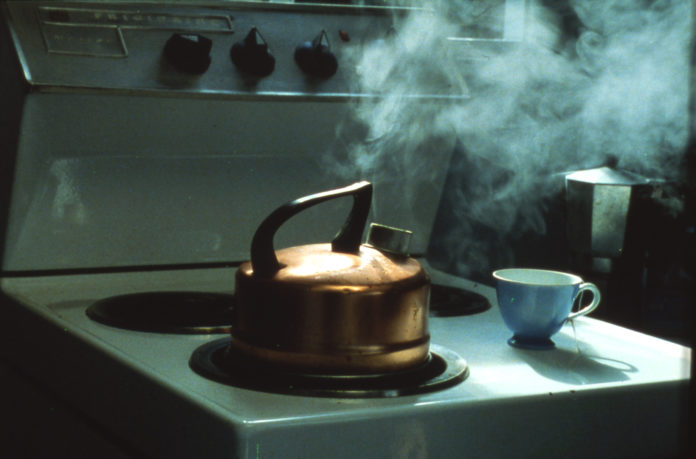
Additionally, the meticulous still-life compositions by cinematographer Erika Addis, entirely restricted to the apartment space, offer an intimacy and familiarity beyond words: streetlights dancing on the water, a steaming kettle, floral wallpaper …
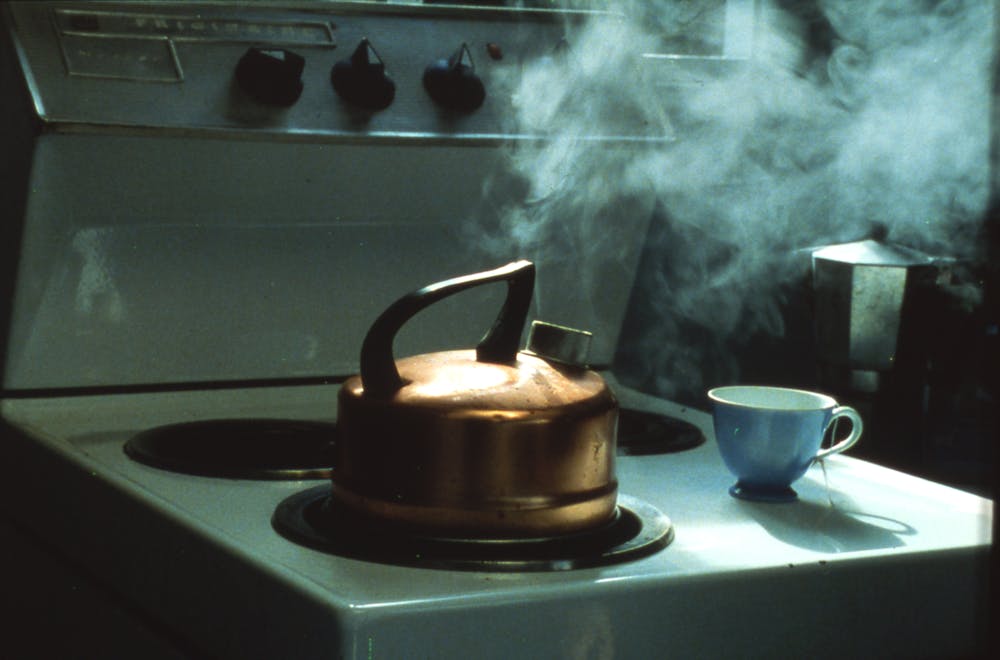
Still image from My Life Without Steve (1986) directed by Gillian Leahy. Ronin Films

2. Location home

Sometimes the location can be more significant than the person. This is certainly the case in films documenting imprisonment such as Berhouz Boochani’s experience of Manus Island detention centre in Chauka, Please Tell Us The Time, or Jafar Panahi’s discrete autobiography This Is Not A Film recorded under house arrest in Iran. In 2015, The Wolfpack told the unusual tale of seven brothers confined to a New York apartment with Hollywood movies as their window onto the world.

Isolation offers an opportunity to interrogate the politics of home. The 1970s feminist movement gave rise to scathing critiques of gender-based domestic roles. Martha Rosler’s video art performance Semiotics of the Kitchen has inspired generations of classroom appropriations. The crude infomercial inspired performance undermine both the authority of the camera and the kitchen as a space of domination.

Semiotics in the Kitchen (1975)

Chantal Akerman’s Jeanne Dielman, 23, Quai du Commerce, 1080 Bruxelles, also released in 1975, offers a less obvious subversion of domesticity. The protagonist is a single mother undertaking sex work as part of her daily routine to provide for her child. Rather than sensationalising prostitution, the camera respectfully captures the subtle gestures and emotions of the working mother.

Jeanne Dielman, 23, Quai du Commerce, 1080 Bruxelles.

3. Online collaboration

Collaborative media comes in many forms: participatory video, citizen media, user-generated and crowd-sourced content.

Collaborative approaches to filmmaking were pioneered by visual anthropologists attempting to accurately and ethically record foreign cultures. Handing the camera over was seen as a way to access insider knowledge. YouTube and Instagram could be considered large-scale collaborative media projects. More coherent and meaningful projects focus on a particular theme or creative parameter.

User-generated content (UGC) and fan-based creations have since become common to the genre, such as The Johnny Cash Project, Shrek Retold, and Man With A Movie Camera: The Global Remake.

Joseph Gordon-Levitt’s HitRecord is one of the most innovative UGC platforms with more than 750,000 contributors and the opportunity to get paid if the production makes money. By investing in personal contributions, the audience gains a sense of proprietorship over the project and boost distribution through their social networks.

The best examples of collaborative media are highly curated and elaborately produced. The National Film Board of Canada (NFB) and Katerina Cizek have produced a series of ambitious multimedia compilations under the Highrise projects. Of these projects, Out My Window is perhaps the most relevant to our current experience, featuring 13 participants from around the globe sharing personal stories from their highrise homes.

Collaborative media offers a multitude of voices to common themes and experiences. The trick to maintaining cohesion and continuity is to formulate detailed instructions for how to contribute.

Highrise / One Millionth Tower | National Film Board of Canada.

4. Found footage

Found footage documentaries are composed entirely from existing media. The recent surge in this genre such as Apollo 11, Maradona, Amy, and The Final Quarter about footballer Adam Goodes, all demonstrate that filmmakers need not touch a camera to produce a cinematic masterpiece.

While we may not individually be able to acquire rights to copyrighted material, most of us are unwittingly accumulating extensive media archives of our lives. The popular 1 Second Everyday app demonstrates how existing phone footage can be transformed into a revealing and enthralling sequence through rhythm-based montage.

1 Second Everyday.

5. Machinima

Machinima (machine-cinema) is an innovative alternative to animation, in which detailed 3D graphics engines of computer games are used as cinematic stages. Most of the productions in this genre mimic mainstream comedy and action movies but there are a few examples of how the artform can interrogate our relationship to virtual worlds.

Nominated for the “Weird” category of the Webby Awards for online excellence, the narrator of Grand Theft Auto Pacifist navigates the ultra-violent game world, understood as an extension of our lived society, in a hilarious experiment to see if he can exist peacefully.

Grand Theft Auto Pacifist.

But be warned, the first person I knew to go down the machinima path disappeared without a trace for two months, lost to the World of Warcraft.

The ½ – since it’s not for everyone

Lastly, my half recommendation. While not something I can recommend to students, during this difficult period of social distancing those of us fortunate enough to be isolated with loved ones might use the opportunity to master the elusive art of sexual desire … erotica.
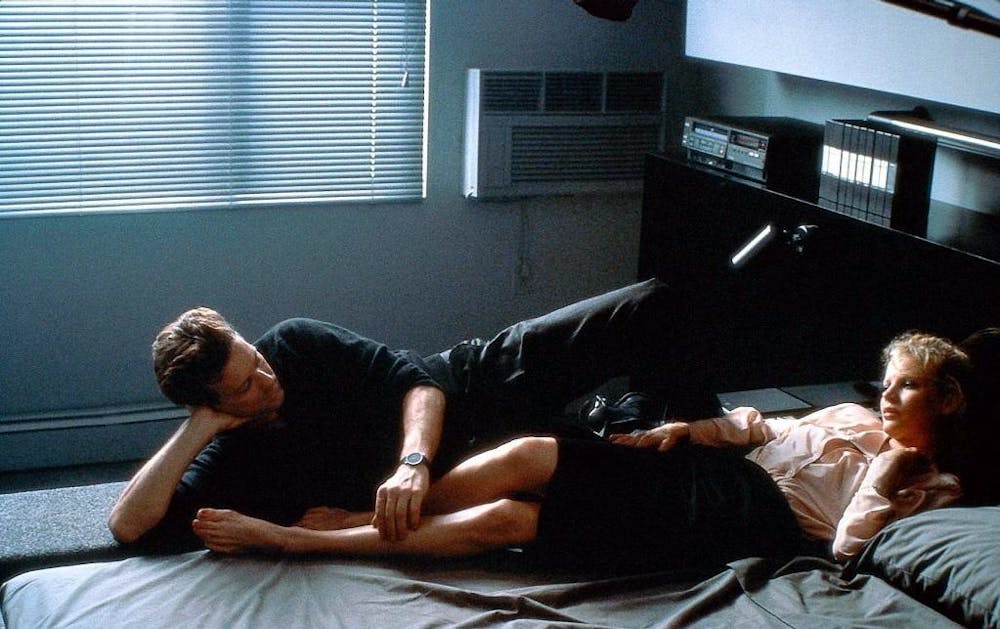
Kim Basinger and Mickey Rourke in Nine ½ Weeks (1986) IMDB

Again, the camera need not be enslaved as a witness but can be recruited to explore the psychological and physical playing field of our desires.

And not all of your filmmaking need be shared around.

ref. Great time to try: 5½ ways to make movie masterpieces at home – https://theconversation.com/great-time-to-try-5-ways-to-make-movie-masterpieces-at-home-134907

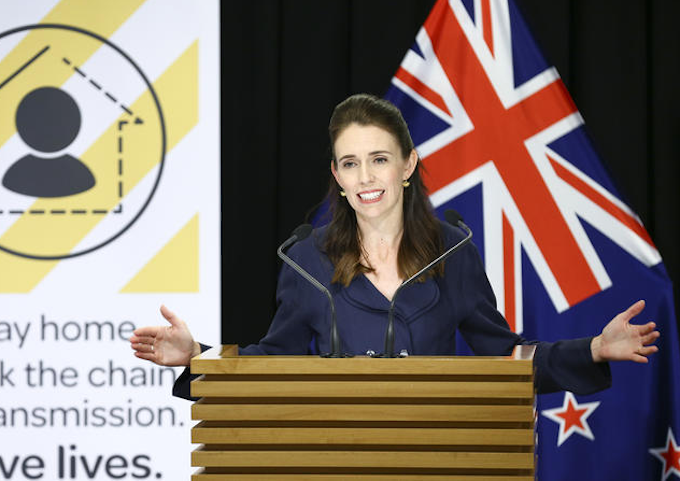
NZ lockdown – day 11: Nation has ‘made a good start’, says PM

Prime Minister of New Zealand, Jacinda Ardern.

By Jane Patterson, political editor of RNZ News

Prime Minister Jacinda Ardern says it’s too early to claim success against the spread of Covid-19 but 11 days into lockdown, New Zealand has made a good start.

At today’s media briefing, Ardern was reluctant to draw too many conclusions from the number of new positive tests but said in the last few days cases had been relatively steady.

“We have made a good start, and the decisions that we’ve made to date have made a difference,” she said.

READ MORE: Al Jazeera coronavirus live updates – ‘A lot of death ahead’ in US

She cited scientific modelling by Rodney Jones that had estimated there could be 4000 confirmed cases by this weekend, but measures taken by the government had limited that to just 1000.

“Those 3000 fewer cases shows the difference that cumulative action can make. Three thousand fewer people sick with Covid-19, 3000 fewer people passing the virus onto others and into others,” she said.

– Partner –

“We can and we must continue to break the chain of transmission.”

Compliance overall had been “generally strong” except for a few exceptions, Ardern said.

“There are still some who I would charitably describe as idiots.

“A 38-year-old Christchurch man arrested last night after being seen on a video online coughing at people in a supermarket, I include in that description.”

He will appear in court tomorrow charged with endangering life by criminal nuisance and obstruction of an officer of health.

Exit plan
Ministers and senior officials are now starting to talk about a possible exit plan, and what the picture would have to look like before moving out of Alert Level Four.

They will be looking at the number of new cases, what’s happening with community transmission and the success of contact tracing for the various clusters, Ardern said.

“All of that information will tell us whether or not we have got control back of Covid-19 in New Zealand, and whether we’re in a position to move to different elite levels.

“I’m wanting to dig deeper into some of what we need to be looking for.”

Getting a true idea of the level of community infection was key and would be helped by the big increase in testing, Ardern said.

“What we want to make sure is that we’ve got enough regional spread in that testing.

“So if these areas we were not seeing enough data, that we are spreading out that testing so that it can give us the intelligence we need.”

She also presented new data from the Ministry of Foreign Affairs, which compared how long countries took to close their borders after recording their first case.

“We closed our borders 25 days after our first case: Germany took 49 days, Spain 52. Australia , Singapore 61. Our first economic package was in place 18 days after the first case – most countries took more than 40 days,” she told reporters.

Director General of Health Dr Ashley Bloomfield said detailed analysis of the clusters and the level of community transmission remained important.

“To find out if we, for example, assume they were all community transmission, where are they? What’s the geographical pattern, what’s the age distribution and so on.”

Sunday’s update:

  • 89 new cases of Covid-19, bringing New Zealand’s total to 1039.
  • 15 people are in hospital, and three are in intensive care. Two of those people are in Auckland and one is in Wellington. One person has died.
  • So far, 36,209 tests have been carried out, 3093 tests were processed yesterday.

This article is republished by the Pacific Media Centre under a partnership agreement with RNZ.

  • If you have symptoms of the coronavirus, call the NZ Covid-19 Healthline on 0800 358 5453 (+64 9 358 5453 for international SIMs) or call your GP – don’t show up at a medical centre.
Print Friendly, PDF & Email

Article by AsiaPacificReport.nz

Refugees, asylum seekers flag fears over possible Brisbane virus hotspot

By Stefan Armbruster of SBS News in Brisbane

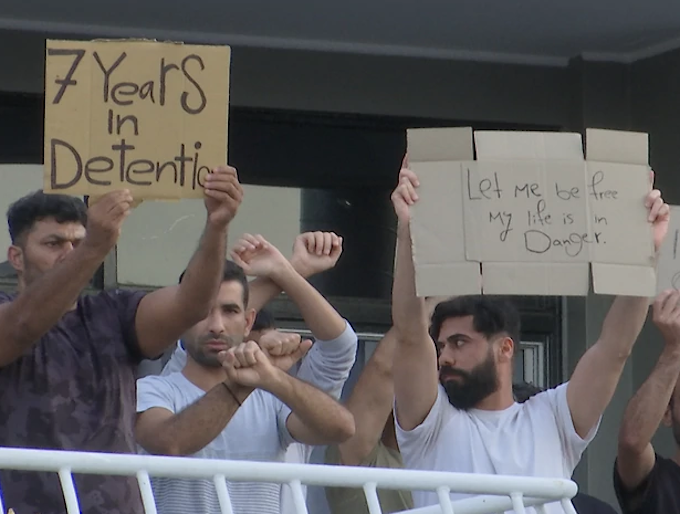
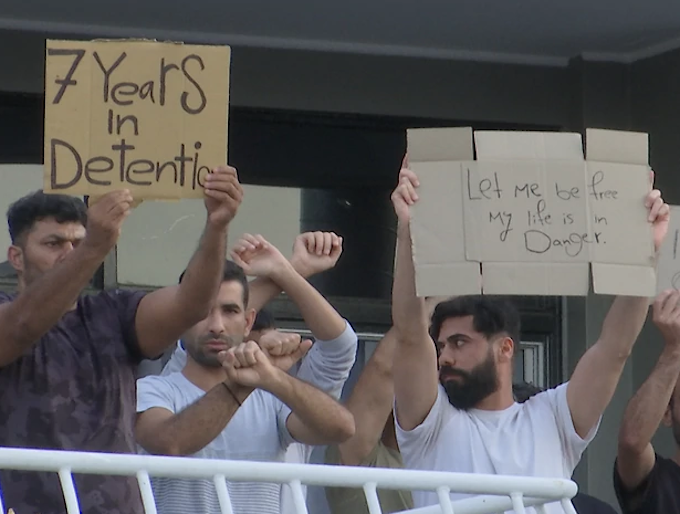
Refugees and asylum seekers in Brisbane have begun daily protests urging for their release after doctors and human rights lawyers flagged fears that a repurposed hotel could become a coronavirus infection hotspot.

In response to the Covid-19 pandemic, the UN Human Rights Commissioner this week issued a global call for detainees to be released, where possible, for their safety.

Concern among more than 80 detainees at the Kangaroo Point Central Hotel has been heightened after a guard employed by contractor Serco tested positive last month.

READ AND WATCH: The full SBS story and video

In a statement, the Department of Home Affairs said “infection control plans are in place” and “no detainees across the immigration detention network have tested positive to Covid-19.”

Most of the detainees at Kangaroo Point were medivaced from Australian offshore-processing on Manus in Papua New Guinea and Nauru. Some have been held there for medical treatment for more than six months.

– Partner –

This article has been republished in brief with SBS and the author’s permission.

Print Friendly, PDF & Email

Article by AsiaPacificReport.nz

Pacific coronavirus: Cases rise in Tahiti, Guam and Hawai’i

By RNZ Pacific

The number of people with Covid-19 in the Pacific continues to climb with French Polynesia hitting 40 cases, Guam now over 90 and the US state of Hawai’i suffering its third coronavirus death.

In the past day, another person tested positive for Covid-19 in French Polynesia.

However the number of carriers in hospital was unchanged at one.

READ MORE: Al Jazeera coronavirus live updates – US cases rise above 300,000

In the US territory of Guam six positive tests have taken the number of cases there to 93.

Four people have died there, two confirmed this weekend.

– Partner –

The official count for the territory does not include the more than 155 cases that are reported to have occurred on the USS Theodore Roosevelt, which is docked in Guam.

Earlier the commander of the coronavirus-stricken aircraft carrier was stood down after he issued a memo pleading for help from Washington, DC, one which quickly became public.

Meanwhile, the US state of Hawai’i suffered its third death from Covid-19 with an elderly O’ahu resident, who had been hospitalised in critical condition on life support for several weeks after travelling to Washington, the latest to die from the virus.

Hawai’i currently has at least 319 cases.

New Caledonia back at 18 cases
New Caledonia’s tally of Covid-19 cases is again reported to be 18.

Another case had been recorded after the retesting of a separate presumed carrier returned a negative result.

For a day the number of confirmed cases had dropped to 17.

New Caledonia President Thierry Santa … in self-isolation. Image: Jamie Tahana/RNZ

Meanwhile, territorial President Thierry Santa has moved into self-isolation after a member of his crisis management team tested positive for the coronavirus.

On Friday, the President of the Southern Province, Sonia Backes, said one of her close work associates tested positive to the Covid-19 virus and was in hospital.

Backes said she had also been tested and the result was negative.

Fiji with 12 Covid-19 cases
Over the weekend Fiji recorded five cases of Covid-19, bringing its total to 12.

Two of the new cases included a 20-year-old woman from Nadi who had returned from New Zealand on March 22 and a 39-year-old woman from Lautoka who is linked to the country’s first case.

The other three cases are all linked to the Suva couple who tested positive to the coronavirus on Thursday.

All five patients were stable and isolated in hospital.

Fiji Prime Minister Voreqe Bainimarama appealed for the public to adhere to a nationwide curfew and city lockdowns to stop the spread of the coronavirus.

This article is republished by the Pacific Media Centre under a partnership agreement with RNZ.

  • If you have symptoms of the coronavirus, call the NZ Covid-19 Healthline on 0800 358 5453 (+64 9 358 5453 for international SIMs) or call your GP – don’t show up at a medical centre.
Print Friendly, PDF & Email

Article by AsiaPacificReport.nz

Creeping authoritarianism in Pacific not the answer to virus pandemic

PACIFIC PANDEMIC DIARY: By David Robie

A rather beautiful Guåhan legend is rather poignant in these stressed pandemic times. It is one about survival and cooperation.

In ancient times, goes the story, a giant fish was eating great chunks out of this western Pacific island. The men used muscle and might with spears and slings to try to catch it.

This didn’t work. So, the women from many villages got together while washing their hair in a river. They wove their locks into a super strong net, caught the fish and saved the island.

READ MORE: Al Jazeera coronavirus live updates – World Bank says economic crunch will hit poorest nations most

PACIFIC PANDEMIC DIARY

Now modern day Guåhan, or Guam, is the Covid-19 coronavirus epicentre in the Pacific, if we leave out the US state of Hawai’i. With the latest five more cases, Guam now has 82 infections – more than double the next worst island territory, French Polynesia with 37; there have also been three deaths so far.

For long time observers, the plight of Guam is not exactly a surprise.

– Partner –

“Epidemics or outbreaks of disease have been a persistent part of Guam’s history since first contact with Europeans,” writes local author, artist and activist Michael Lujan Bevacqua in the Pacific Daily News. “From the start of Spanish colonisation in 1668, you can provide a historical outline of Guam’s history over the next two centuries simply in terms of disease outbreaks.

“As the Spanish brought new diseases into the Marianas, their mere presence was deadly to CHamorus. As the first priests under San Vitores began to spread out across the Marianas, their arrival was often announced through microbes, with someone dying a strange and unsettling death, even prior to a priest actually visiting a village.”

Death by colonial ship
Death by epidemic always entered the territory the same way – by ship.

Although the last major outbreak happened back in 1918, writes Bevacqua, when the world was engulfed by the Spanish flu with 868 people dying locally (6 percent of the island population), some people still recall the horror.

And now Guam is host again to the worst Covid-19 outbreak in the Pacific. To make matters worse, another ship is involved with the colonial masters seeking sanctuary. The landing of almost 3000 crew members from the USS Theodore Roosevelt yesterday by Governor Lou Leon Guerrero to be quarantined in hotels ashore has been branded as a “dangerous” gamble by community leaders.

Seventy seven confirmed cases were on board with three deaths and the captain feared a disaster with the cramped quarters on board.

While the Pacific infection rates are still relatively low, many governments have been responding with panic, paranoia and creeping authoritarianism, especially in relation to freedom of information, media independence and constructive and accurate communication, so vital in these critical times.

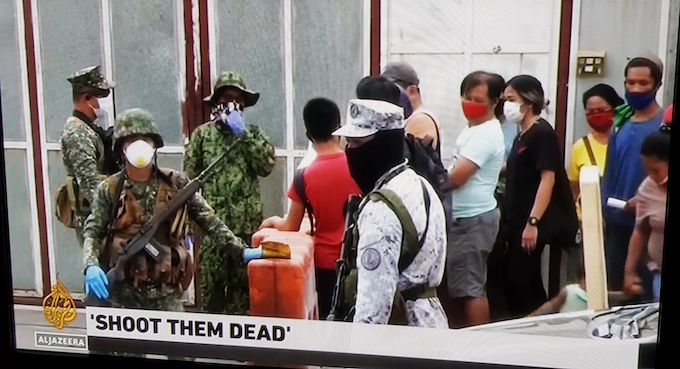
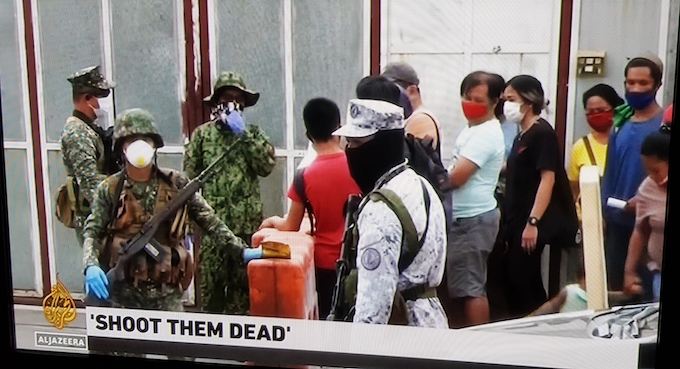
Perhaps they are borrowing some ideas from not-so-distant neighbours in Southeast Asia. For example, the Philippines where President Rodrigo Duterte gave a controversial order to troops to “shoot dead” violators of the capital Manila’s three-week coronavirus lockdown, including those protesting for food.

Duterte’s ‘shoot them dead’ virus order to troops slammed as dangerous

Duterte’s government, intolerant of the news media at the best of times, has also cracked down on journalists. The Paris-based media freedom advocate Reporters Without Borders (RSF) has called on Philippine prosecutors to abandon all proceedings against media under a new law that is claimed to combat “false information” about the coronavirus pandemic “but in fact [it] constitutes a grave violation of press freedom”.

Two journalists face prison
Two journalists based in the southern province of Cavite – Latigo News TV website editor Mario Batuigas and video blogger and online reporter Amor Virata – are facing the possibility of two months in prison and fine of 1 million pesos (NZ$68,000) along with a local mayor as a result of charges under the new law brought by the police last weekend.

According to RSF, they are accused of spreading “false information on the Covid-19 crisis” under section 6(6) of the “Bayanihan [community] to Heal As One Act,” which President Duterte signed into law on March 25 granting himself special powers.

Philippines checkpoint
Philippines troops vet citizens at a Manila checkpoint. Image: PMC screenshot/Al Jazeera

In Cambodia, people who violate the extensive new state of emergency powers fast-tracked into law yesterday face up to 10 years in prison, according to a draft of the pending legislation.

“The law includes 11 articles divided into five chapters and gives the government near limitless powers to repress public gatherings and free speech during times of threats to national security and public order — or in times of health crises — and gives authorities wide powers to arrest people as they deem necessary,” reports Cambojanews.

In Indonesia, President Joko Widodo’s government has pressed ahead with fast a track  debate to adopt three controversial laws, including the revised Criminal Code and a weakening of the anti-corruption law, widely interpreted to collectively cement legal intolerance to dissent just at a time when the Covid-19 crisis public restrictions prevent any demonstrations.

Critics are stunned that the Parliament is determined to press ahead with this debate at the time of the health emergency that some critics have described as a “slowly-ticking coronavirus bomb nearing the point of detonation”.

Lacking public oversight
According to The Jakarta Post in an editorial: “It seems fairness is not something many of our politicians, either in the legislative and executive branches of power, believe in strongly. The deliberation of the three bills, which have met widespread opposition given to their contentious articles, will lack public oversight, which is essential.”

But as Gadjah Mada University communication lecturer Wisnu Prasetya Utomo notes in his Indonesia at Melbourne blog: “A key element of responding to the coronavirus outbreak must also involve efforts to eliminate or challenge misinformation. Minimising fear and panic as a result of hoaxes and misinformation is half the job in responding to this evolving crisis, which as yet has no end in sight.”

Allan Bird
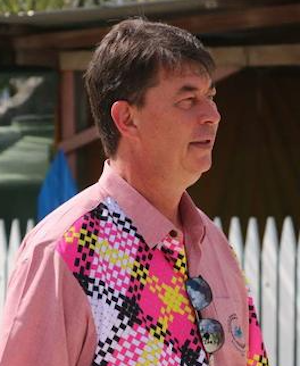
East Sepik Governor Allan Bird … “This is a fight for survival.” Image: PNG Post-Courier

The Indonesian “bomb” across the border in Papua stirred an angry response in neigbouring Papua New Guinea from East Sepik Governor Allan Bird, who controversially called for a “shoot to kill” order to frontier troops against border-crossers. He later explained his views in a blog.

“This is a fight for survival. If we spend all our bullets (resources) and deploy our troops in the wrong corridor, we will lose the war,” he wrote.

“So what’s the strategy? Where should we deploy our assets to fight the virus? Where are we most vulnerable? And where can we mount our best defence? To me it’s at the entry point. Our borders… That’s the front line.

“Who do we need on the frontline? Soldiers and policemen. Well resourced. That should be 60 percent of our effort.”

Draconian rule, censorship
In Vanuatu, the caretaker government, taking cover from last month’s post-election confusion, has introduced draconian, authoritarian rule and censorship this week with the public barely noticing, as my colleague Sri Krishnamurthi revealed yesterday in Asia Pacific Report.

Vanuatu using Covid-19 to impose censorship on media, citizens

A regional media freedom advocacy group, Pacific Freedom Forum, has voiced concerns over governments taking advantage of emergency powers to impose restrictions on Pacific media. The detention and charging of two high profile Fiji citizens with breaching the Public Order Act over social media comments about Covid-19 brought the issue to a head.

The forum also noted that the Cook Islands had just passed information restrictions in its new Covid-19 legislation, levelling heavy fines and jail terms for those spreading “harmful information” over the pandemic.

“The state of emergency is not an excuse to treat newsrooms as a one-way channel to the public, or to gag dissent, social media commentary, and hard questions with restrictions and legislation,” warned Melanesia co-chair Ofani Eremae, a Solomon Islander.

As Governor Bird says, a comprehensive strategy is needed – not only for his country, but also for the Pacific region: “Burning roadside markets and beating up our women who sell food is not a smart strategy. Why is this our focus?”

Those legendary Guåhan women had the right idea: strategy, strength in unity and collaboration.

Print Friendly, PDF & Email

Article by AsiaPacificReport.nz

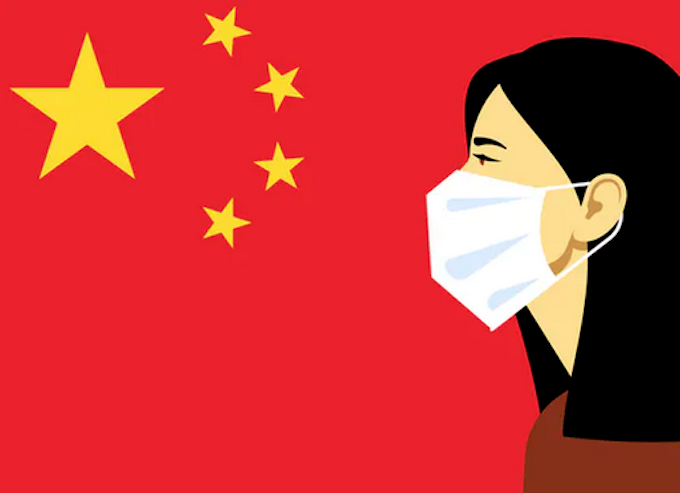
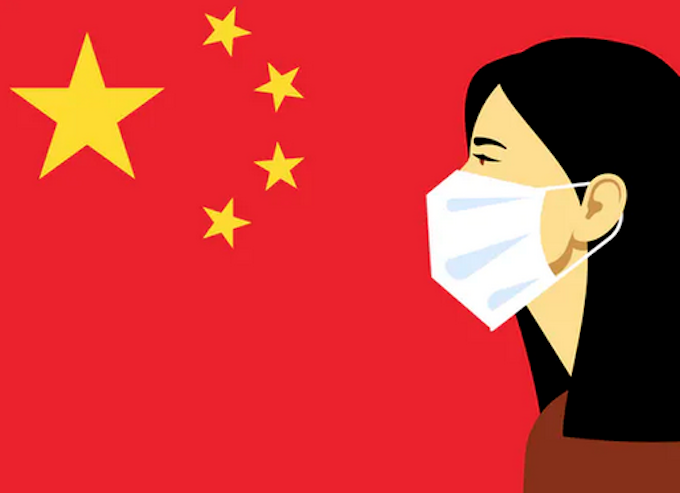
Masking power in the age of contagion: China’s two faces over coronavirus

ANALYSIS: By Haiqing Yu of RMIT University and Michael Keane of Curtin University

China has gradually emerged out of its shadow of despair as the epicentre where the coronavirus pandemic started. Now, there is face saving required – as well as agenda-setting in the global power play.

China played a decisive role in combating the invisible enemy. Chinese officials and academics are taking this opportunity to rescript the narrative and place China as the new world leader.

In the quest for this leadership, China seems to be playing the game of “white face” (friendly face) and “red face” (hostile face). Similar to the Western concept of good cop/bad cop, white face and red face uses seemingly opposing actions to achieve a singular goal.

READ MORE: Do homemade masks work? Sometimes. But leave the design to the experts

The red face is Zhao Lijian, a Chinese foreign ministry spokesman who suggested the virus originated in the US and was brought to Wuhan by American soldiers.

The white face is providing medical supplies to countries now battling the pandemic, gestures of goodwill described as “mask diplomacy” or “medical diplomacy”.

– Partner –

By understanding the context for these donations, we can understand a lot about how China embeds symbolism within its soft power diplomacy.

Guarding life
Chinese people have a long history of wearing masks as protection from disease, chemical warfare, pollution, and severe weather. As early as the 13th century, court servants would cover their noses and mouths with a silk cloth when bringing food to the emperor.

As China increasingly encountered foreign powers through Treaty Ports at the turn of the 20th century, disease control became a critical concern. Despite the long legacy of traditional medicine, China was seen as an unhygienic place by the Western occupiers of these ports.

China’s opening to the West in 1978 led to a greater awareness of hygiene. The Chinese word for hygiene weisheng (literally “guarding life”) was incorporated by health reformers in numerous applications, from wooden disposable chopsticks to toilet paper.

In China, not wearing masks in the current health crisis is seen as unhygienic, irresponsible, and even transgressive. Punitive measures are taken by authorities, with non-mask-wearers publicly shamed and humiliated on Chinese social media.


Authorities in China are humiliating citizens caught not wearing face masks. They see the masks as key in tackling the coronavirus epidemic. Videos of the confrontations are escaping censorship and going viral on sites like Weibo. Video: Daily Telegraph

In the West, masks have been widely viewed with suspicion. The official advice from Australian health authorities is if you are not sick, don’t wear masks.

This has lead to anxiety and discontent among Chinese Australians, frustrated by what they see as bad advice. The general public attitude toward mask wearers compounds the problem as Chinese Australians are unfairly targeted with racist slurs.

International diplomacy
At the height of the Wuhan outbreak, government, private companies and individual citizens in Japan donated thousands of masks. But more significant than the masks was the symbolism. Emblazoned on cargo boxes from the Japan Youth Development Association were Chinese characters reading “Lands apart, sky shared”, a line from an ancient Chinese poem.

A month later, the Jack Ma Foundation reciprocated with a large donation of masks to Japan, with a quote from the same poem: “Stretching before you and me are the same mountain ranges; let’s face the same wind and rain together.”

Millions of masks and thousands of testing kits are being sent overseas, coordinated and endorsed by Chinese government organisations and taking place at the government-to-government level; by the private sector through companies and charity foundations; and by individuals helping their overseas friends.

Mask diplomacy is part of China’s new dual level power play: aiding to foreign countries to regain face and demonstrate its role as a responsible global power; and sharing conspiracy theories about the origins of the virus to attack the opponent.

China is being aided in this messaging by inefficiency of the US in handling the crisis. By finger pointing at the US, some say China is hoping to “distract from domestic government incompetence.”

This effort to rewrite the virus narrative through mask diplomacy is a strategic gambit to claim the moral high ground and assert international power.

Changing faces
Perhaps a clue to what is now unfolding comes from the world of theatre.

In Chinese Sichuan opera, the performer magically changes masks. A skilled performer can accomplish ten mask changes in 20 seconds. This is one of the great accomplishments of Chinese culture, part of its soft power arsenal. The term used in Chinese, bianlian (literally “changing face”), however, is also a synonym for suddenly turning hostile.

China may have dodged a bullet. But if the pandemic spirals further out of control, China will have a lot more work to do to deliver its charm offensive.

The next few months will be crucial. Much of the global leadership in this global warfare will depend on the US, with its own president appearing to change face at any moment.

Power in the age of global contagion requires more than the dual faces of white and red. The world needs healing, and so the Chinese government will need to carefully moderate its propaganda. Triumphalism over the success of its own military-style control strategies and finger pointing at others may evoke blowback in the theatre of geopolitics.The Conversation

Dr Haiqing Yu is associate professor, School of Media and Communication, RMIT University and Dr Michael Keane is professor of Chinese digital media and culture, Curtin University. This article is republished from The Conversation under a Creative Commons license. Read the original article.

Print Friendly, PDF & Email

Article by AsiaPacificReport.nz

NZ lockdown – Day 9: How many Covid-19 cases does nation really have?

Every day at 1pm New Zealand’s Director-General of Health Dr Ashley Bloomfield announces precise figures on the number of confirmed and probable cases of Covid-19 in the country.

He is working on the best information available, and during this week the level of community transmission was put at around 1 percent.

But Sir David Skeggs, a renowned professor of epidemiology, does not believe the health authorities really know what the level is.

READ MORE: Al Jazeera coronavirus live updates – US deaths 6000, infections top 240,000

He explained why when he appeared before Parliament’s Epidemic Response Committee at its first meeting on Tuesday.

“Testing has been heavily skewed towards people who have returned from overseas or their contacts, so it’s no surprise that most of the cases detected have links to overseas travel,” he said.

– Partner –

“The actual number of people who have been infected will be far higher than the 589 notified, and we really have no idea of the extent of community spread.”

When Bloomfield was asked at his daily briefing to comment on what Sir David had said, he replied: “We have some idea, so I disagree with him in that sense. We know where our cases of community spread are, we know we have these clusters, which are being investigated to see what the source of infection is.

‘We have some idea’
“So we have some idea. The more testing we do, the more we will get a picture of community transmission.”

After 10 days of lockdown, it has become clear that more testing needs to be done. The number of people returning from overseas is finite, it is steadily dropping. The people they have had contact with have been and are being traced.

It is the way we deal with community spread that will determine whether we can beat Covid-19, and when the lockdown can be lifted.

The government knew this from the beginning. “Stay home, save lives” was Prime Minister Jacinda Ardern’s message.

What it doesn’t know is how effective the restrictions are as people go to supermarkets and other essential services, mostly but not always obeying the social distancing rules.

On Wednesday the testing criteria was broadened, and in Bloomfield’s words the requirement of having been overseas or having been in contact with someone who had returned, or having been in contact with a known case, was “decoupled” from symptoms.

Anyone with symptoms that could mean a person has Covid-19 will be tested.

Random testing not ruled out
Random community testing has not been ruled out, but will depend on capacity.

The capacity to carry out tests has also been an issue. By the end of the week it had ramped up to more than 2000 a day and the aim is to reach 5000. Current capacity is put at around 4000 and is increasing.

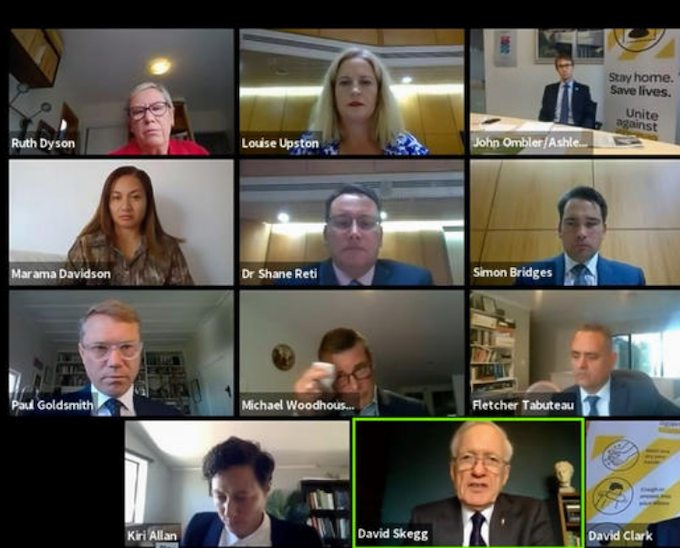
Scrutiny of the effectiveness of the lockdown restrictions is also ramping up, and the Epidemic Response Committee is the lead player. There are 11 MPs on it, two-thirds opposition and one third government.

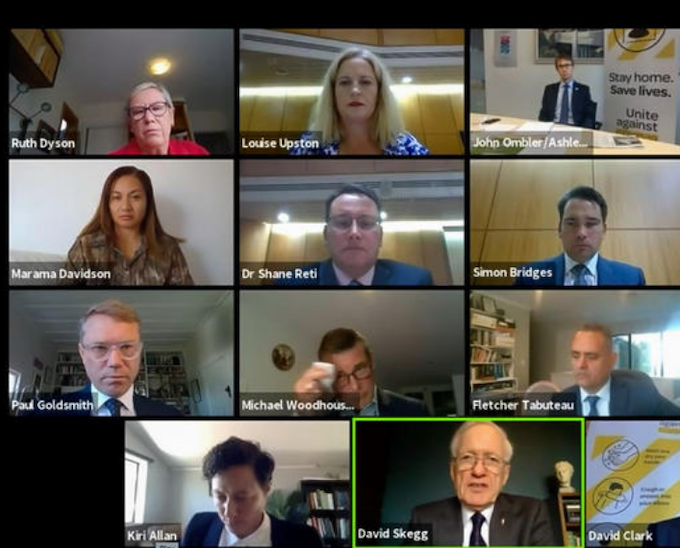
They meet remotely and have been calling in cabinet ministers, experts such as Sir David Skeggs, and department heads. Questioning is intense and so far there has been very little of the point scoring that usually goes on in Parliament.

The meetings are livestreamed and RNZ’s website carries it, which is the easiest way to find it. Details of when it meets are on Parliament’s website, it is essential for anyone who wants to know what is going on.

Publishing shock
The horrendous economic impact of the lockdown becomes more evident as each day passes, the latest shocking news being the decision by the publishing house Bauer to shut down magazines including The Listener and Woman’s Weekly.

The publisher turned down the wage subsidy on offer, which left Ardern “extraordinarily disappointed“. It was believed to have been in difficulty before Covid-19 and said it couldn’t see advertising revenue rising to pre-lockdown levels when Level 4 is lifted. Not being allowed to publish for four weeks appears to have pushed it over the edge.

The National Party wants the government to be more transparent with economic data, such as the number of people applying for the unemployment benefit.

Finance spokesman Paul Goldsmith told RNZ on Friday the extent of the consequences of the lockdown must be made clear. The absence of data on the wage subsidy scheme, for example, made it difficult to assess its effectiveness.

“It was set up early on when we were talking about the West Coast and tourism,” he said. “Now we’re dealing with a situation where very large parts of the economy have zero revenue.”

Goldsmith also raised an issue that has become critical for business survival – rents. Most commercial landlords don’t appear to have been giving their small business clients a break.

“The second biggest cost for most businesses is their rent and there’s huge pressure on that at the moment, Goldsmith said.

‘Zero revenue, things pile up’
“If you’ve got zero revenue, you might have a bit of a wage subsidy to help pay employees, but the costs around rent and other things are just piling up.”

National is not criticising the government for imposing the lockdown, but it is becoming increasingly worried about the number of businesses that will fail and never reopen.

Right at the core of the economic impact is how long the lockdown will last, and that depends on the success of the war the health authorities are waging on Covid-19.

Bloomfield, while acknowledging more testing needs to be done, has pointed out that our per capita rate is double that of the UK and 50 percent higher than South Korea, which is considered to be the benchmark country.

Compared with other developed countries, New Zealand with one death so far is doing very well. More testing will help authorities discover the extent of community spread and by this time next week it may be possible to see how close the light at the end of the tunnel really is.

New cases number drops
RNZ reports that the number of new Covid-19 cases has dropped from yesterday’s daily high of 89 to 71 today, but the number of clusters throughout the country has risen from seven to 10, the Health Ministry has confirmed.

Director-General of Health Dr Ashley Bloomfield said there were 49 new confirmed cases and 22 new probable cases of Covid-19, bringing New Zealand’s total cases to 868.

Peter Wilson is a life member of Parliament’s press gallery, 22 years as NZPA’s political editor and seven as parliamentary bureau chief for NZ Newswire.

Article by AsiaPacificReport.nz

‘Stupid coronavirus!’ In uncertain times, we can help children through mindfulness and play

Source: The Conversation (Au and NZ) – By Ben Deery, Lecturer in Early Childhood Education, University of Melbourne

“Stupid coronavirus!” I heard my six-year-old mumble while talking in her sleep.

Earlier that day her swimming and basketball lessons were cancelled, a birthday party postponed, and she had to race with me between several meetings before the university campus shut down. “Stupid coronavirus indeed!”

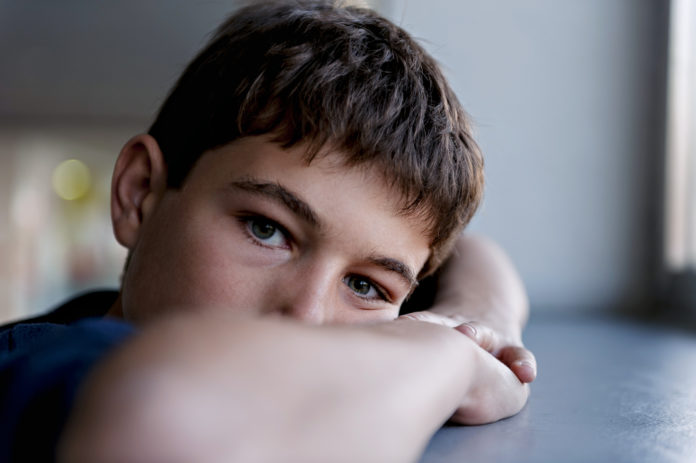
Hearing this reminded me these are strange and worrying times for young children. While we need to look after ourselves and others, we also need to consider how all this is affecting our kids, and how we can help them through it.


Read more: Kids at home because of coronavirus? Here are 4 ways to keep them happy (without resorting to Netflix)


Kids and anxiety

Australian research found child anxiety diagnoses almost doubled from 2008 to 2013. It’s difficult to say whether this is due to a true increase or we’re simply recognising anxiety better in children.

Feeling anxious or worried sometimes is a part of healthy development. But at times, children may feel more anxious or worried than usual.

Climate change, the bushfires, and COVID-19 may have contributed to and continue to fuel increased anxiety. We need research to better understand the effects these crises have had on children’s well-being.

We can support children during these times and also keep an eye out for when they might need more help than we can give. If their anxiety is interfering with typical childhood activities or family life, it could be time to see a GP, paediatrician or psychologist.

But there are many things you can do as a parent or caregiver.

Mindfulness for children?

Mindfulness is the regular and repeated act of directing our attention to the present moment. Mostly, our attention follows whatever is most interesting; mindfulness helps us to focus without judging ourselves when we can’t.

It’s commonly used to reduce stress, improve well-being, and address mental health, which it does reasonably well. In a broader sense, the goal of mindfulness is to help us to sit with our experiences whether they are pleasant, unpleasant, or somewhere in between.


Read more: 6 strategies to juggle work and young kids at home: it’s about flexibility and boundaries


Mindfulness practices have become more popular over recent years. Many people practise mindfulness in their day-to-day lives, often using apps (though we need more research to explore the benefits of these). Mindfulness programs are also run in workplaces and other settings.

Large numbers of parents, teachers, and entire schools are also turning to mindfulness.

But what does the evidence say about mindfulness for children?

The evidence is mixed

A recent review of over 60 studies of school-based mindfulness programs involving preschool to secondary students suggested gains in social-emotional and cognitive skills.

The researchers didn’t observe similar gains in academic achievement or student behaviour. They noted the quality of research, much like that in adults, was not strong enough to make the claims many would like to make about the widespread benefits of mindfulness.

Children are not immune to the stress and anxiety many of us are feeling right now. Shutterstock

Short-term early childhood mindfulness programs and those delivered using audio-guided tracks have so far provided questionable results at best.

One small but promising study used classroom mindfulness activities (for example, listening to sounds), emotion coping skills (like “where in my body do I feel anger?”), and breathing techniques (such as breathing with a soft toy on the tummy).

At the end of the first year of this program, pre-schoolers displayed better learning skills. After two years, children displayed higher vocabularies and reading scores.


Read more: What is mindfulness? Nobody really knows, and that’s a problem


Our own pilot work teaching pre-schoolers about mindfulness found benefits too. While there was little difference immediately after the intervention, three months later, children who learned mindfulness showed significant benefits to their mental well-being compared with those who didn’t.

Adapting mindfulness activities

Obviously, you can’t ask a five-year-old to sit still and focus on their breath for 45 minutes. Techniques commonly used in adults just won’t work with kids.

Mindfulness for children should be interactive, play-based, and focused on sensory and body awareness. It should use emotional vocabulary and sensory language (for example, talking about sounds, taste, textures and smells), be hands-on where possible, and most importantly, it should be fun.

Mindfulness-based activities will look different for children than they do for adults. Shutterstock

Given the lack of strong empirical evidence for mindfulness on its own for young children just yet, we should integrate aspects of mindfulness-based activities with other components.

Think playful learning about emotions, like colouring in where we notice certain feelings in our bodies, or drawing how music makes us feel. These activities take from other well-known psychological approaches called cognitive behaviour therapy and psycho-education.

3 mindfulness activities for kids

1. Belly breathing with a “buddy”

  • find a favourite soft toy (with some weight is good), a plastic bath boat, or similar
  • have your child lie down and place the object on their tummy
  • get them to pay attention to it by looking and touching
  • encourage them to focus on how the object moves up and down as they breathe (you can suggest calm and slow breathing might even put the toy or people in the boat to sleep)
  • this activity can be great as part of bath time or getting ready for bed.

2. “Robot” child

  • ask your child to pretend they are a robot lying on the ground
  • use a remote control (you can make one from cereal box) and pretend to “shut-down” your child/robot’s body
  • begin with their feet/legs, move up the body to arms/hands, before getting to the face/brain
  • ask “robot” if they can still feel any “electricity” in that body part after it’s been shut down
  • as your child gets better with this activity, you can get more detailed with robot body parts (for example, toes, fingers, noses, ears)
  • a variation is to get your robot-child to tense and relax (and reset) each body part as you control it with your remote.

3. A mindful walk or “sensory countdown”

  • go for a walk outside and try to notice or find: five different sounds, four matching colours, three different textures, two different smells
  • add different sounds, sights, shapes, and textures to tick off on a bingo-style checklist
  • this activity can be adapted for inside play.

Read more: 8 tips on what to tell your kids about coronavirus


Play School will air a special episode “Mindfully Me” on Monday April 6 at 9am AEST on ABC Kids and the ABC Kids app. The program is accompanied by family and educator notes online.

ref. ‘Stupid coronavirus!’ In uncertain times, we can help children through mindfulness and play – https://theconversation.com/stupid-coronavirus-in-uncertain-times-we-can-help-children-through-mindfulness-and-play-135317

‘Zoombombers’ want to troll your online meetings. Here’s how to stop them

Source: The Conversation (Au and NZ) – By David Tuffley, Senior Lecturer in Applied Ethics & CyberSecurity, Griffith University

Zoombombing” in case you haven’t heard, is the unsavoury practice of posting distressing comments, pictures or videos after gatecrashing virtual meetings hosted by the videoconferencing app Zoom.

With hundreds of millions around the world now reliant on the app for work, this unfortunate trend is becoming more common, often involving a bombardment of pornographic imagery.

In some cases, online trolls have crashed alcohol support group meetings held via the app. “Alcohol is soooo good,” the trolls reportedly said to one group of recovering alcoholics.

In another incident, a Massachusetts-based high school teacher conducting an online class had someone enter the virtual classroom and shout profanities, before revealing the teacher’s home address.

Easy targets

The problem is that Zoom meetings lack password protection. Joining one simply requires a standard Zoom URL, with an automatically generated nine-digit code at the end. A Zoom URL looks something like this: https://zoom.us/j/xxxxxxxxx


Read more: Working from home risks online security and privacy – how to stay protected


Gatecrashers may only have to try a handful of code combinations before successfully landing a victim. The meeting’s host doesn’t need to grant permission for others to join. And while hosts can disable the screen share function, they’d have to be quick. Too slow, and the damage is done.

Last week, Zoom upgraded security on its default settings, but only for education accounts. The rest of the world needs to do this manually.

Video conferencing is incredibly valuable

Video conferencing technology has matured in recent years, driven by massive demand even before COVID-19.

With social distancing restriction, virtual meetings are now the norm everywhere. Platforms like Zoom, Microsoft’s Skype and others have stepped up to meet demand.

Zoom is a cloud-based service that allows users to freely talk to and share video (if bandwidth allows) with others online. Notes, images and diagrams can also be shared to collaborate on projects. And meetings can have up to hundreds, even thousands, of participants.

How to stop the trolls

Zoom is primarily a corporate collaboration tool that allows people to collaborate without hindrance. Unlike social media platforms, it was not a service that had to engineer ways to manage the bad behaviour of users – until now.

In January, Zoom issued a raft of security patches to fix some problems. If you get a prompt from Zoom to install updates, you should – but only if these updates are from Zoom’s own app and website, or via updates from Google Play or Apple’s App Store. Third-party downloads may contain malware (software designed to cause harm).


Read more: Coronavirus could spark a revolution in working from home. Are we ready?


While up-to-date software is your first line of defence, another is to keep your meeting URL away from public forums such as Twitter. Anyone with meeting’s URL can join, after which they’re free to post comments, pictures and videos at will. If you’re hosting a meeting that gets Zoombombed, disable the “screen sharing” option as quickly as possible.

Another option for more security is to use the “waiting room” function. This makes people wanting to join visible to the host, but keeps them out of the main meeting until they’re allowed in. This option is turned off by default. You can enable it by signing-in to your Zoom account at https://zoom.us/ and clicking “Settings”.

Other tips:

  • ensure screen sharing is possible for the host only

  • turn off the function that allows file transfer

  • turn off the “allow removed participants to rejoin” setting

  • turn off the “join before host” setting

  • turn on the “require a password” setting for meetings.

This video explains the ins and outs of setting up a safe Zoom session.

Who are the trolls?

With many Zoomombing attacks being on educational institutions, it’s likely a large number of these trolls are simply mischievous students who obtain meeting URLs from other students or chatrooms.

But zoombombing is by no means restricted to the classroom. With the world in lockdown, extremists of all kinds are finding ways to relieve their confinement frustration. We’ve known for some time that being able to operate anonymously on the web does not bring out the best in people.


Read more: Dark web, not dark alley: why drug sellers see the internet as a lucrative safe haven


At present, it doesn’t appear Zoombombing is an organised criminal activity. That said, it’s probably only a matter of time before someone finds a way to leverage financial reward from the practice. This could take the form of business intelligence gleaned from listening in to the meetings of rivals and competitors, in a similar fashion to planting a “bug” in the room.

Similarly, we could see a black market for Zoom URLs emerge among professional hackers, who would have new incentives to hack various systems to obtain valuable URLs.

Cybersecurity experts, privacy advocates, lawmakers and law enforcement are all concerned Zoom’s default privacy settings don’t do enough to protect users from malicious actors.

The bottom line

As the COVID-19 pandemic leads the world to do their work online in isolation, the technology that allows this freedom must come under close scrutiny.

Zoombombing is progressing from a student prank to more serious incidents of racist, sexist and anti-semitic hate speech.

Fortunately, safeguards aren’t difficult to build into such videoconferencing technologies. This just requires a willingness to do so, and needs to be done as a matter of urgency.

ref. ‘Zoombombers’ want to troll your online meetings. Here’s how to stop them – https://theconversation.com/zoombombers-want-to-troll-your-online-meetings-heres-how-to-stop-them-135311

Can I visit my boyfriend or my parents? Go fishing or bushwalking? Coronavirus rules in the Northern Territory and Tasmania

Source: The Conversation (Au and NZ) – By Sunanda Creagh, Head of Digital Storytelling

Editor’s note: The following is current as at April 3, 2020. Things are changing quickly so best to keep an eye on the latest information from the NT government, the Tasmanian government and the federal government.

This article adds to the information we’ve published for New South Wales, Queensland and Victoria, on South Australia and the ACT and Western Australia. We will bring you more information as we collect it.

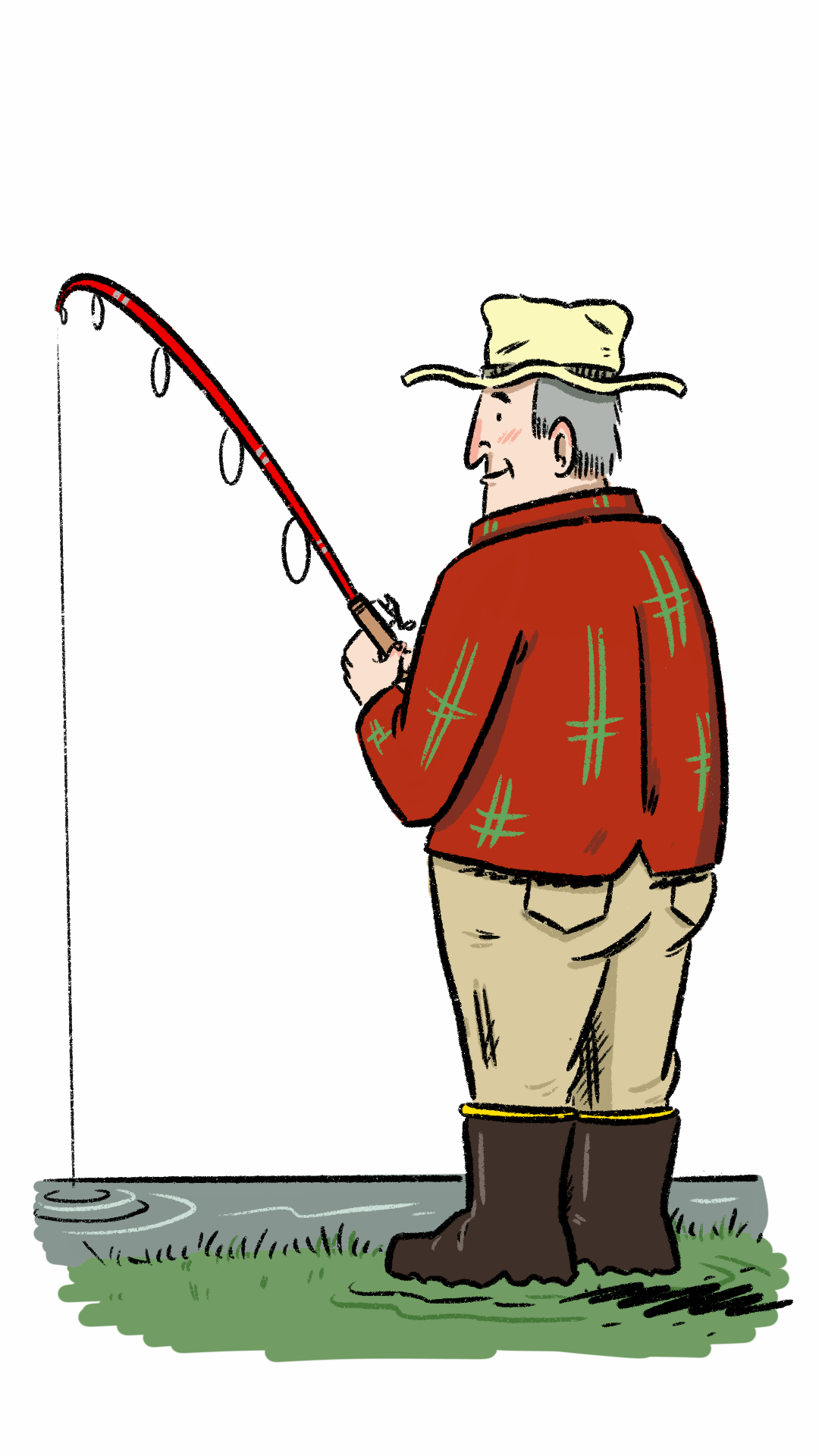
According to Google Trends, some of the top coronavirus searches nationally in the past few days include “can I visit my parents coronavirus Australia?”, “can I go fishing during coronavirus?” and “can I go for a drive during coronavirus Australia?”

“Can I visit my boyfriend during coronavirus Australia?” was also a common one.


Read more: Sleep won’t cure the coronavirus but it can help our bodies fight it


We asked legal experts Ros Vickers at Charles Darwin University in the Northern Territory and Brendan Gogarty at the University of Tasmania to help shed some light on what the new rules might mean for residents of their state and territory.

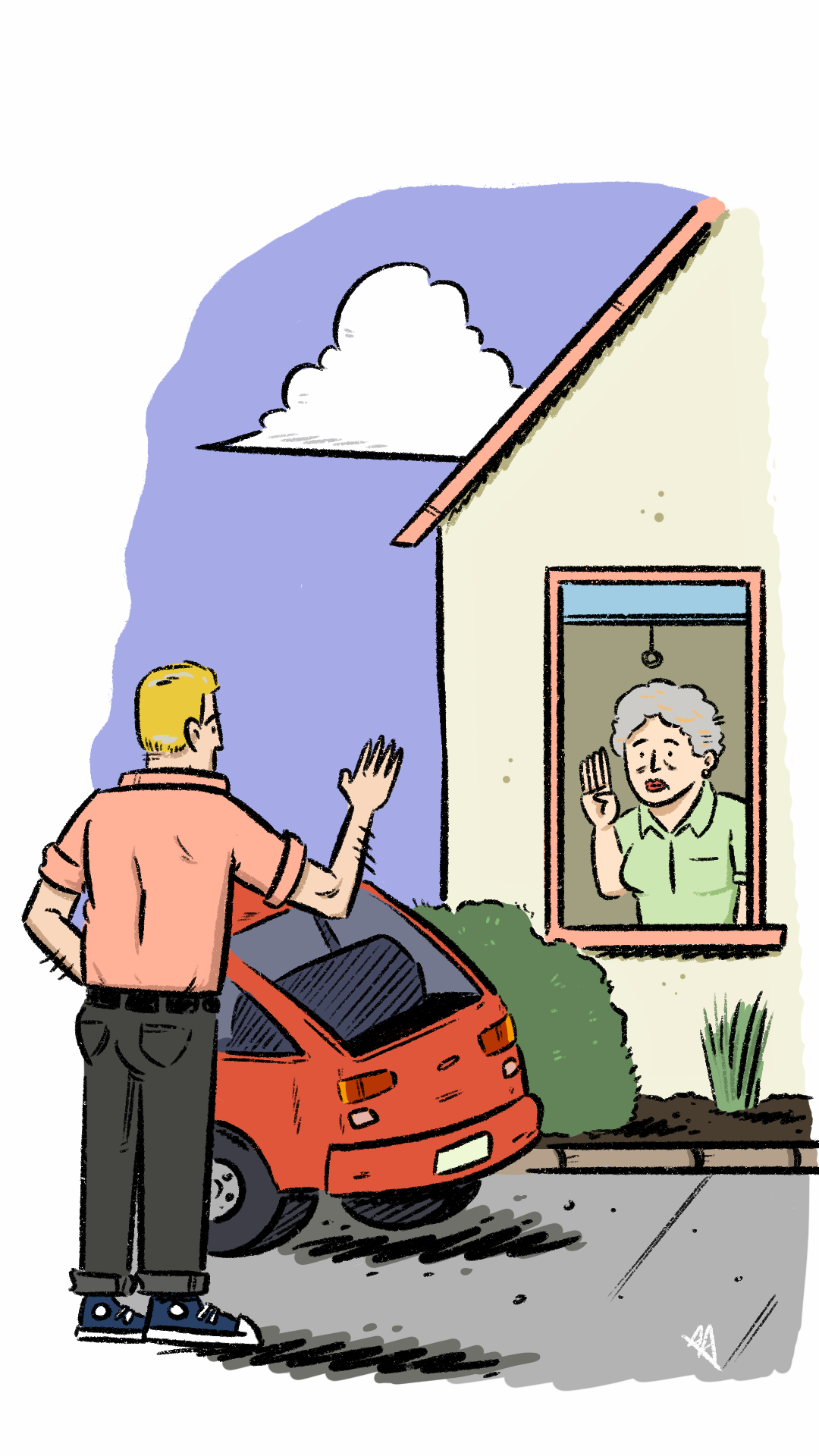
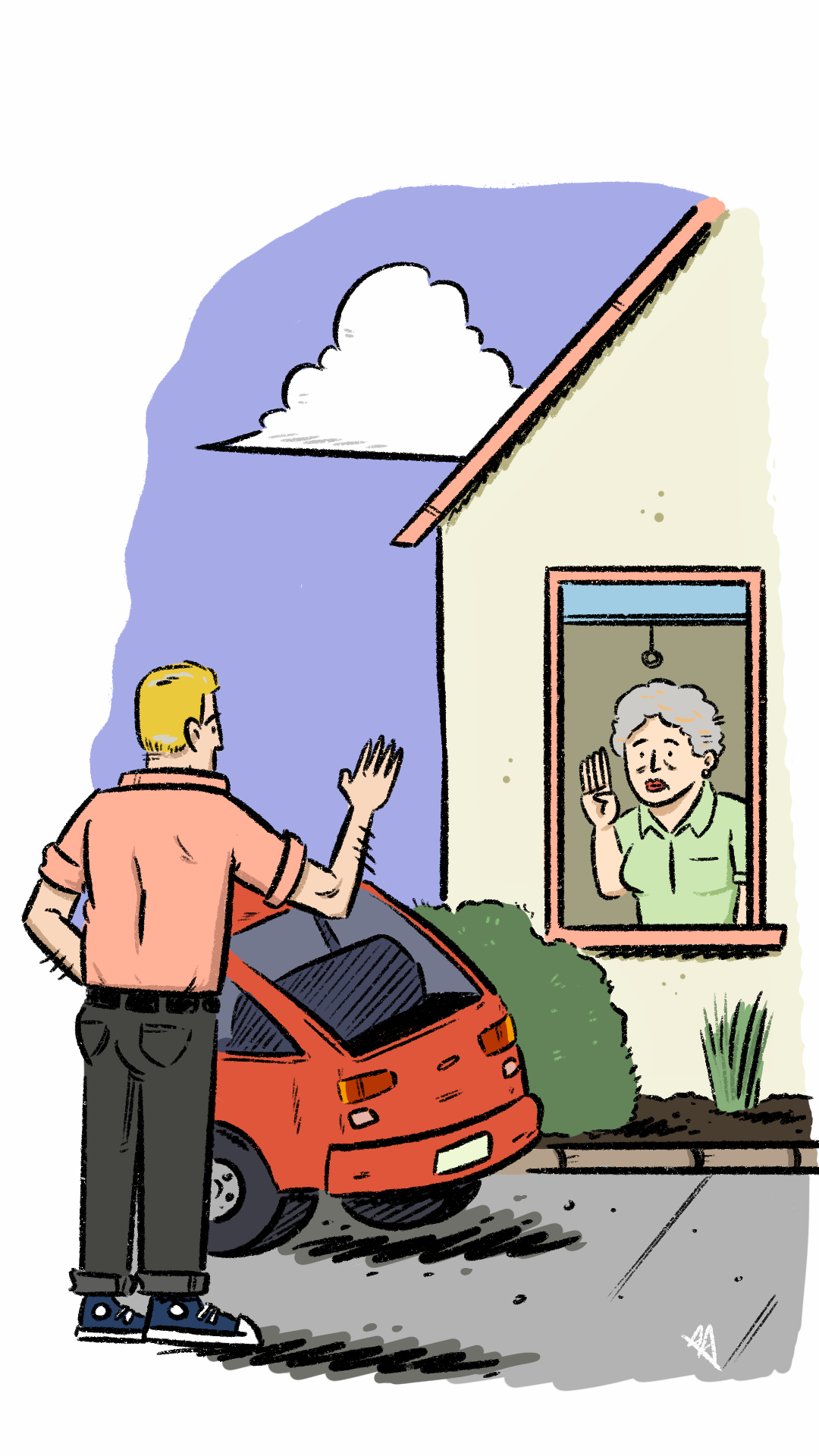
Can I visit my parents?

Wes Mountain/The Conversation, CC BY-ND

Ros Vickers, NT: The short answer is yes, provided you comply with the social distancing being less than 10 people inside or outside with 4m² available to each.

The answer differs if your parents are in an aged care facility. If you classify as, “a person providing care and support to a resident of the facility” you can visit for up to two hours per day.

But you must meet the other criteria of health and non-exposure to COVID-19.

Brendan Gogarty, Tas: It depends.

If they live in their own home, the policy answer is no; there is a stay at home declaration. However, this has been written on the fly and there are some significant gaps in it that suggest maybe you can.

The exceptions are to provide social support, which is not defined. The other exception is provision of care to attend to another person’s compassionate needs – well, care is a really broad word; it could mean a lot of different things.

If you are going to your parents house to provide “social support” and “care” you can probably do it.

If they live in a care facility, the owner of the facility is under strict public health rules so it depends on the facility. That includes, at the least, restricting the number of visitors in a room, the distance between them, and other measures intended to stop the transmission of COVID-19. These override a family member’s right to visit the relative.

The general policy is don’t do it.


Read more: Can I still go to the dentist? How coronavirus is changing the way we look after our teeth


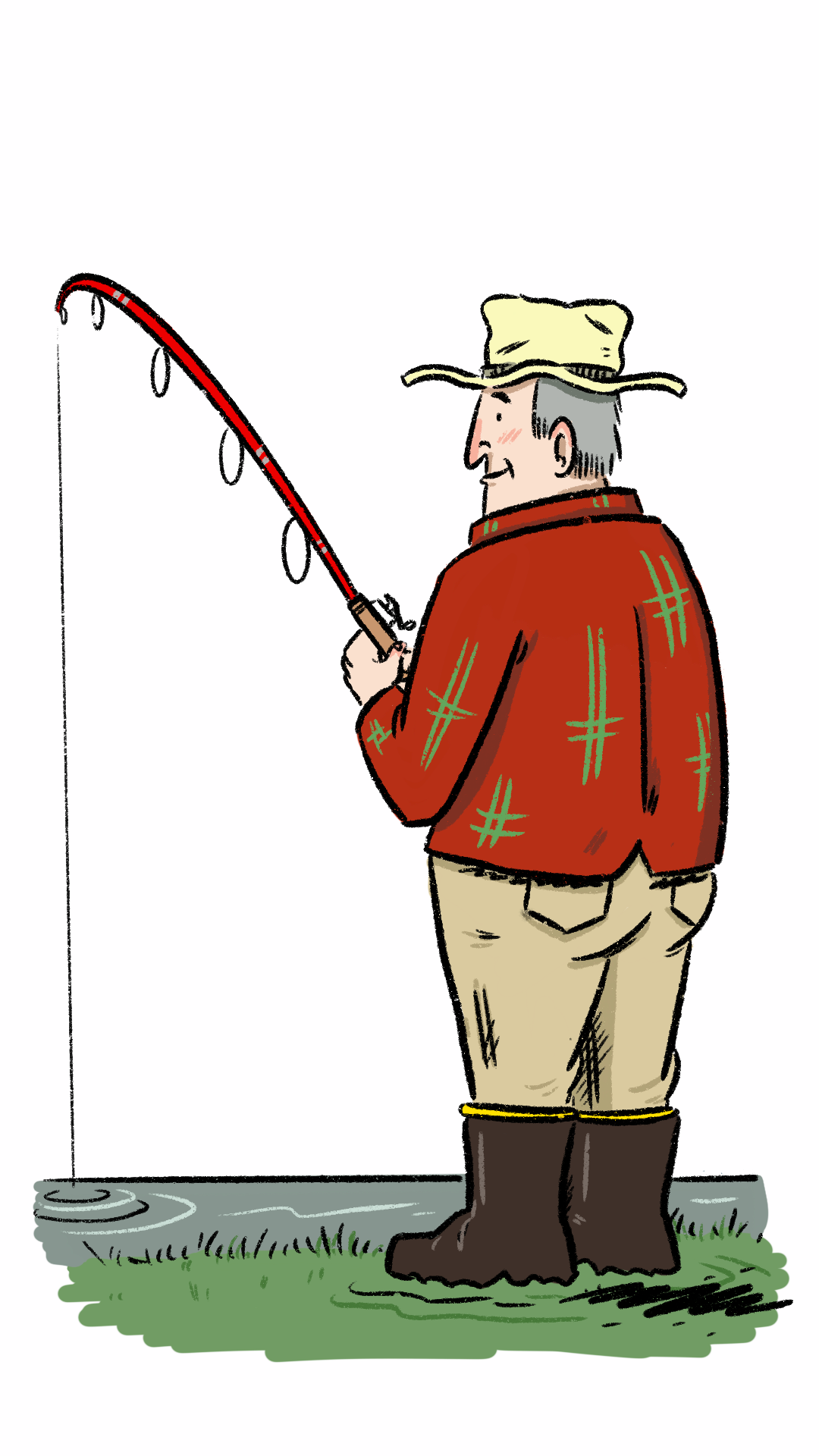
Can I go bushwalking/fishing?

Ros Vickers, NT: Most national parks are now closed, although you can still go bushwalking on local trails provided you practise social distancing.

Campgrounds, multi-day walks, swimming spots and high-use day areas are closed.

The NT chief minister Michael Gunner said you can go fishing with your family or your housemates and maintain social distancing with other people.

Wes Mountain/The Conversation, CC BY-ND

Fishing in remote communities is not allowed as you are not able to get a permit to enter Remote communities in the NT. The following places are open for fishing:

  • Darwin Harbour
  • Dundee
  • Leeders Creek
  • Bynoe Harbour
  • Channel Point
  • Adelaide River (mouth)
  • Cox Peninsula
  • Shoal Bay

Brendan Gogarty, Tas: No and no. But also maybe yes.

All national parks and state reserves are closed by law in Tasmania. That means no camping, walking, or any recreational activity – some research and volunteering exceptions exist, but these are limited – and all gates and access points are shut. Some smaller parks do fall under local council authority and those may be on a case-by-case basis.

Fishing is not an exception to the stay at home declaration, so technically this is not permitted (unless you count it as “exercise”).

However, there is conflicting policy (not law) advice from the department that regulates recreational fishing in Tasmania, which says you can do it so long as you respect social distancing rules. Of course, departmental websites aren’t law, but it could be seen as a “reasonable excuse” under the present stay at home declaration.

For the minute, it is better not to do it, although you probably could make an excuse to do it.


Read more: Can mosquitoes spread coronavirus?


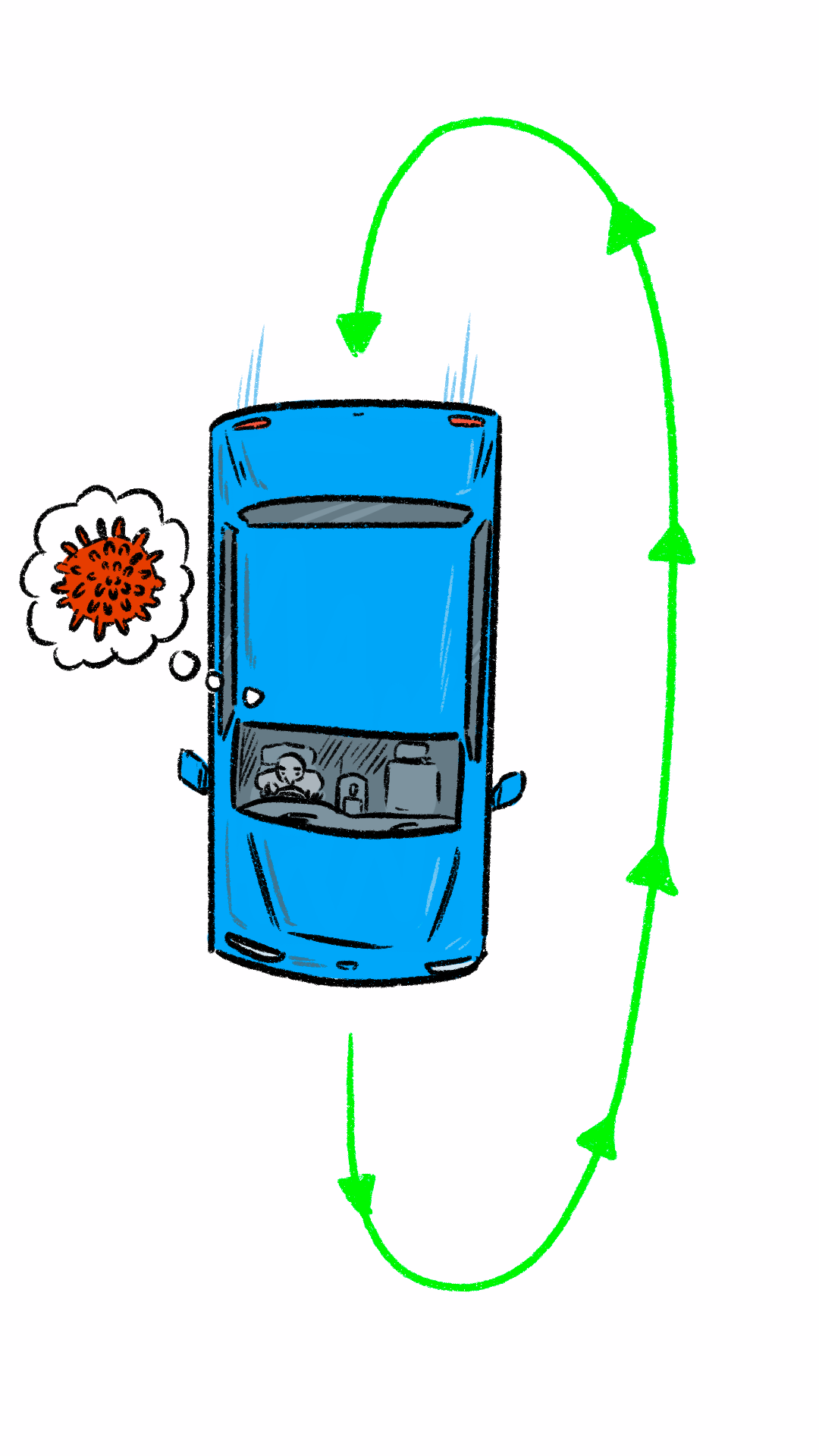
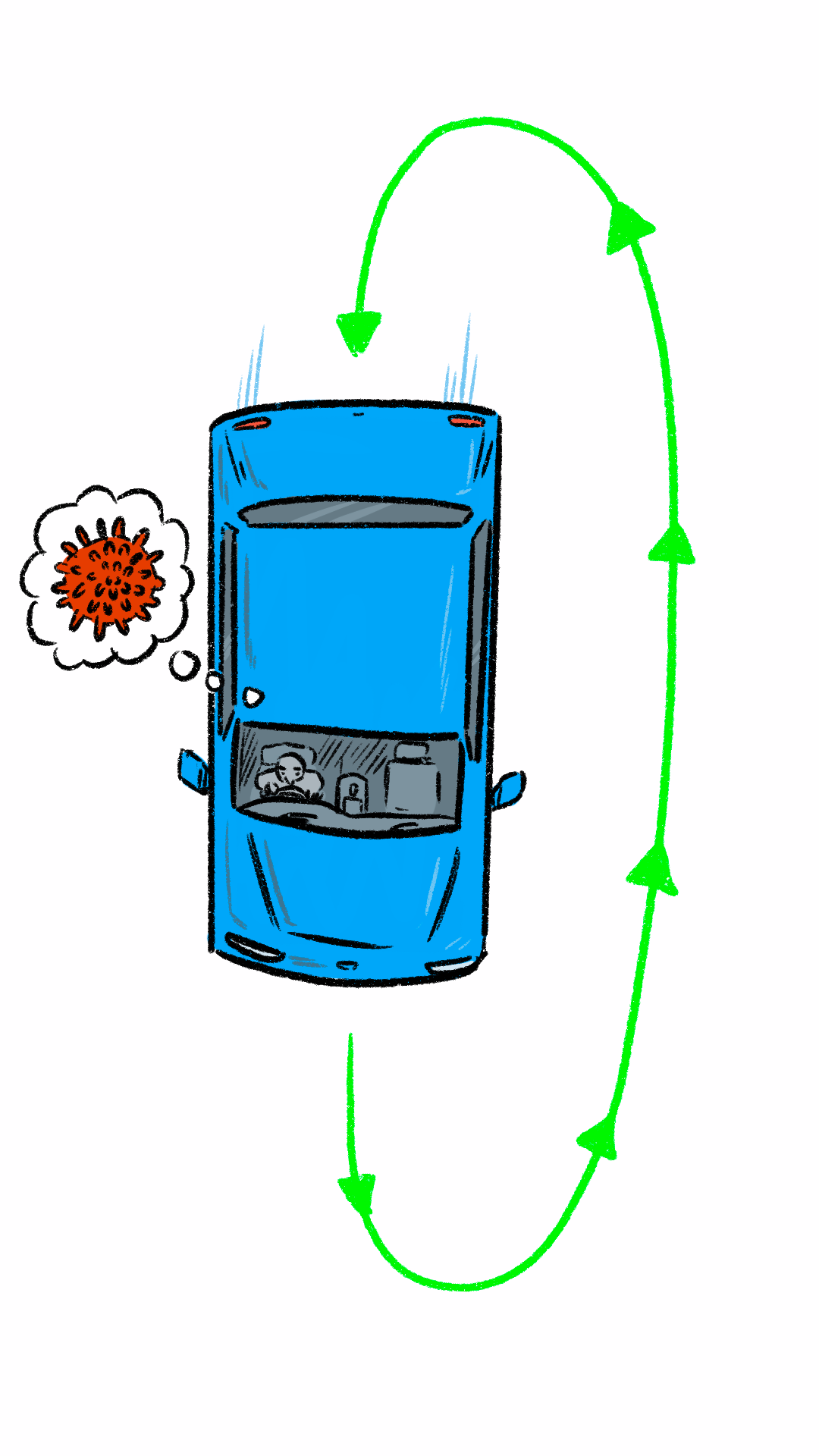
Can I go for a drive?

Wes Mountain/The Conversation, CC BY-ND

Ros Vickers, NT: Essential travel is allowed, being travel to work, education, grocery shops or medical help.

At present there are no police checks regarding movement, and no indication that this will be monitored by police. You can ride a bike within certain restrictions.

Border restrictions apply at the NT borders.

Brendan Gogarty, Tas: You can drive to and from whatever essential service you need to get to like work, going to the vet or to get food. But no recreational driving.


Read more: If coronavirus cases don’t grow any faster, our health system will probably cope


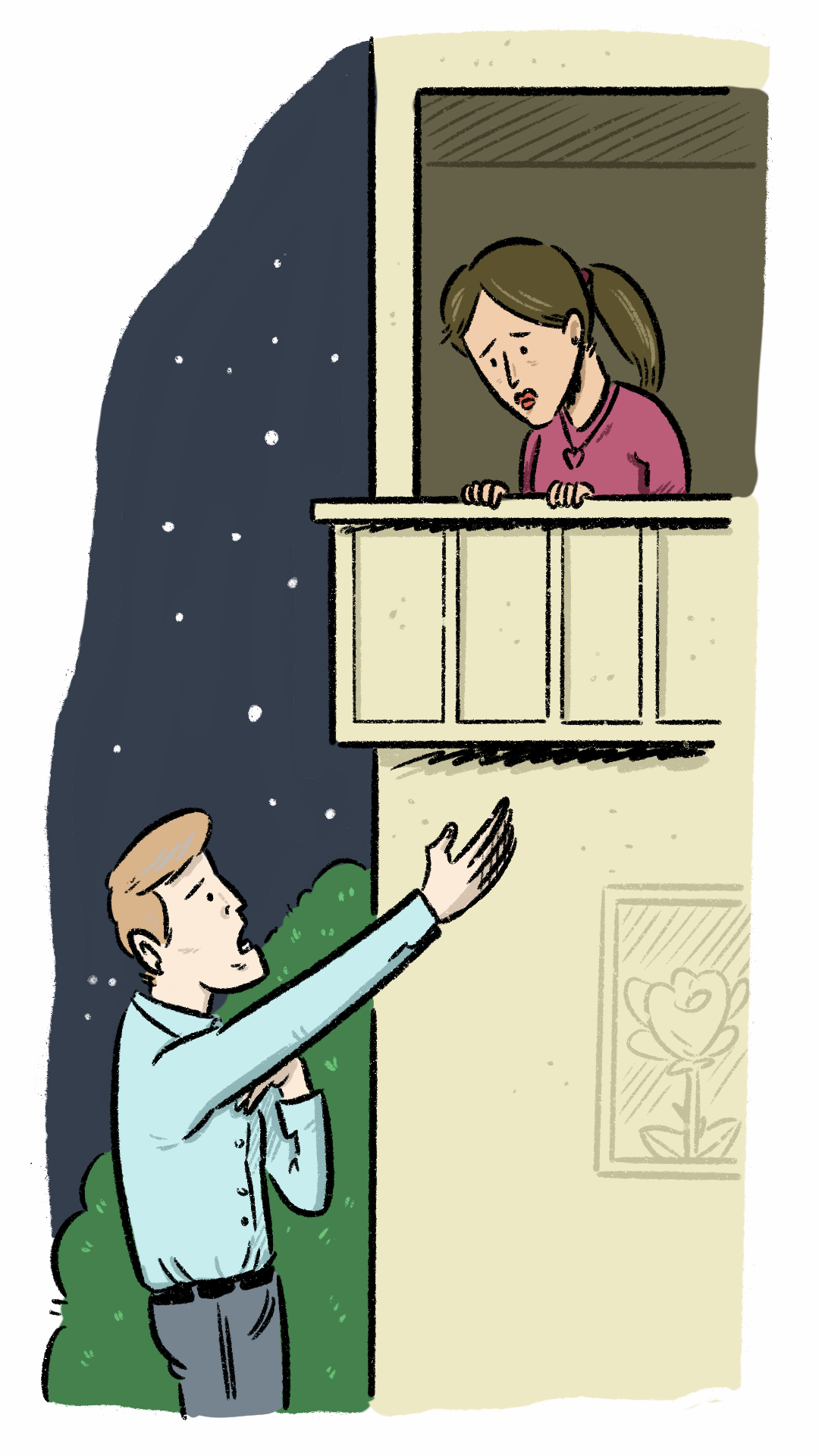
Can I visit my girlfriend/boyfriend?

Wes Mountain/The Conversation, CC BY-ND

Ros Vickers, NT: Yes, you can visit their private residence or exercise with them.

Essential travel does not clearly include visiting partners, but visiting others and allowing guests in your house is allowed while practising social distancing.

Brendan Gogarty, Tas: That’s the same as your parents. The policy is you shouldn’t do it. You should both stay in your homes for the period of the crisis. But you have the same exceptions – provision of social support and care and attending to a person’s compassionate needs.

Again, I don’t think the police would necessarily stop you but its contrary to the policy behind the law – reducing people’s movement outside of their “primary” residence to only those journeys which are absolutely essential to sustaining life and health.


Read more: The coronavirus lockdown could test your relationship. Here’s how to keep it intact (and even improve it)


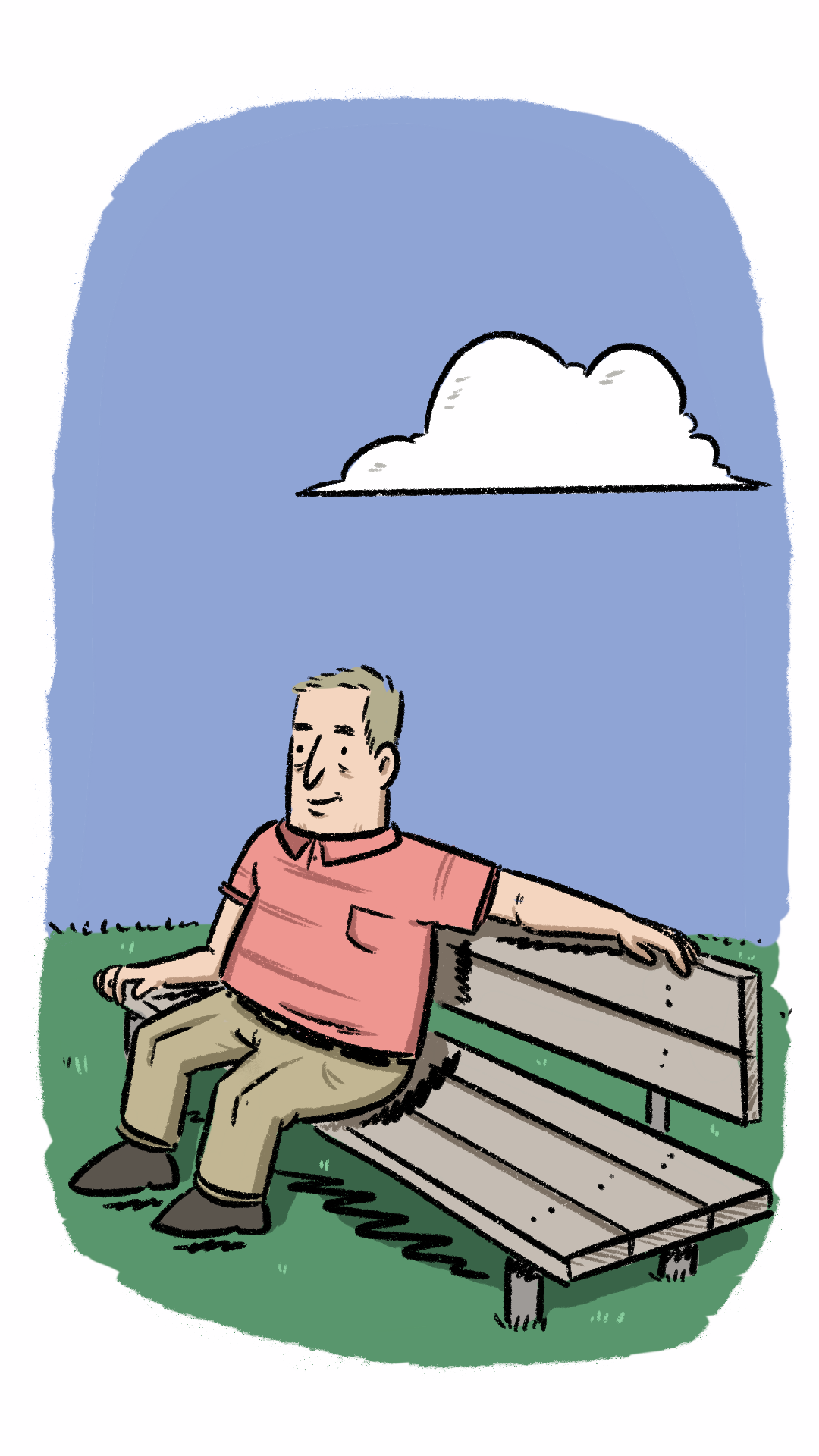
Can I go for a walk around my neighbourhood or sit on a park bench?

Wes Mountain/The Conversation, CC BY-ND

Ros Vickers, NT: Yes, as long as you maintain social distancing of 1.5m with those who are not part of your household.

You can also go for a bike ride alone or with one other person, or with the people that you live with. (See Michael Gunner, chief minister of NT’s Facebook page.)

Brendan Gogarty, Tas: Yes, you can go for a walk if it is exercise. Sitting on a park bench is not exercise so I’d avoid doing it.


Read more: Coronavirus: tiny moments of pleasure really can help us through this stressful time


ref. Can I visit my boyfriend or my parents? Go fishing or bushwalking? Coronavirus rules in the Northern Territory and Tasmania – https://theconversation.com/can-i-visit-my-boyfriend-or-my-parents-go-fishing-or-bushwalking-coronavirus-rules-in-the-northern-territory-and-tasmania-135549

Can I visit my boyfriend or my parents? Go fishing or bushwalking? Coronavirus rules in Western Australia

Source: The Conversation (Au and NZ) – By Michael Lund, Commissioning Editor, The Conversation

Editor’s note: The following is current as at April 3, 2020. Things are changing quickly so best to keep an eye on the latest information from WA Health, as well as the federal government.

This article adds to the information we’ve published for New South Wales, Queensland and Victoria and on South Australia and the ACT. We will bring you more information on other states as we collect it.

According to Google Trends, some of the top coronavirus searches nationally in the past few days include “can I visit my parents coronavirus Australia?”, “can I go fishing during coronavirus?” and “can I go for a drive during coronavirus Australia?”

“Can I visit my boyfriend during coronavirus Australia?” was also a common one.


Read more: Can I visit my boyfriend? My parents? Can I go fishing or bushwalking? Coronavirus rules in NSW, Queensland and Victoria explained


We asked legal experts in Western Australia – Natalie Skead and Michael Douglas from the University of Western Australia – to help shed some light on what the new rules might mean for residents of their state.

Can I visit my parents?

Wes Mountain/The Conversation, CC BY-ND

It depends.

If you’re a child with parents who live apart, and you move between each of your parent’s homes, then you can keep doing that.

Aside from that, you can’t organise a prohibited gathering, which includes more than two people in “a single undivided indoor space” like a room or even a patio, unless you maintain 4m² distancing.

So, yes, you can visit your parents if you each stay sufficiently far from one another, but you can’t hug mum! Sunday family dinner is off the cards for now.

There is an exception “for the purposes of providing care or assistance … to a vulnerable person or providing emergency assistance”. The terms “care” and “vulnerable person” are not defined. If one of your parents has a disability or a health condition, and you want to look after them, then visiting them is okay.

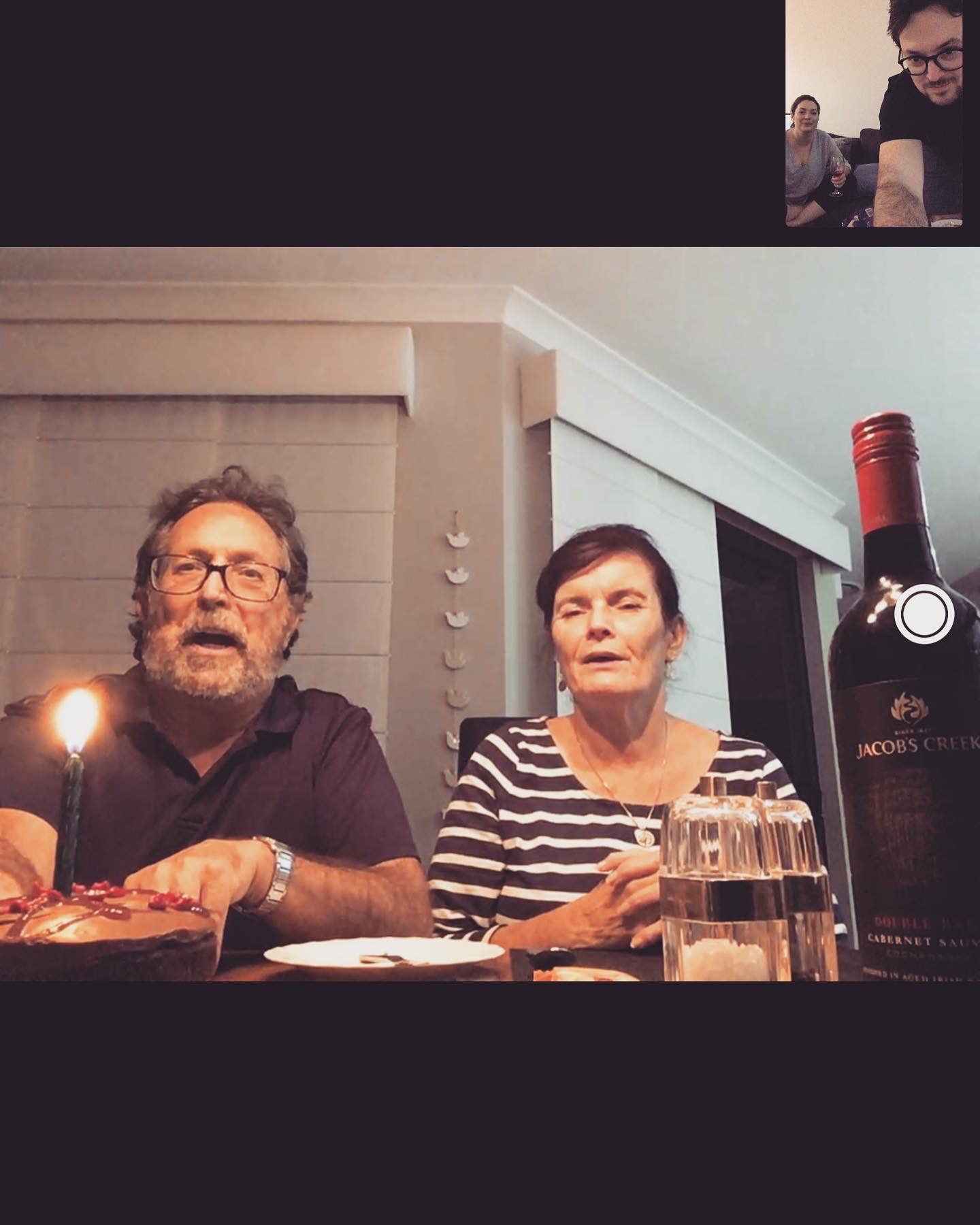
It also depends on where your parents live. The parents of one of the authors (Michael) live down south, while he lives in Perth. It was his dad’s birthday on Wednesday. The intra-state travel restrictions meant he could not visit the elder Douglas. They all had a FaceTime birthday dinner instead.

Birthdays during pandemic. Douglii

The Prohibition on Regional Travel Directions say you cannot enter another “region” in WA unless certain exceptions apply. “Regions” are defined in the Planning Act.

But there’s an exemption for “compassionate grounds” — like one of your parents is seriously ill, or an immediate family member has died. Visiting a parent on their birthday is not enough.

If your parents live in certain parts of the Kimberley, or a remote Aboriginal community, visiting may require quarantine under restrictions made by both the state and federal governments, if it is permissible at all under the Prohibited Regional Travel Directions. The situation there is not good and by the time you read this, visiting may be prohibited.

If your parents are interstate and you are in WA, then the answer is more complicated. Seek legal advice.


Read more: Can I still go to the dentist? How coronavirus is changing the way we look after our teeth


Can I go fishing or bushwalking?

Wes Mountain/The Conversation, CC BY-ND

The Preventative Restriction of Activities Directions do not specifically address fishing or bushwalking. But doing either with more than two people would be a prohibited gathering. That means you can only walk in the bush with the people who you are currently living with or one other person you don’t live with, but even then stay appropriately socially distanced.

Fishing is a bit murkier. Western Australia appears to have taken some guidance from a since deleted Facebook post, by the Queensland Minister for Transport and Main Roads, Mark Bailey, who attempted to clarify the boating and fishing rules as permitting boaters to fish for food to travel locally in their community.

The latest advice from the WA government is the social distancing rules for gatherings of no more than two in public places apply on the land and the sea, meaning they apply to both boat- and land-based fishing.

So, you can fish for food with one friend, or those you live with. If you’re going out on a boat, though, it will need to be a biggish one to accommodate the 1.5m/4m² distancing rule.

It also depends on where you propose to fish or bushwalk. You can’t do either outside your “region”.


Read more: Can mosquitoes spread coronavirus?


Can I go for a drive?

Wes Mountain/The Conversation, CC BY-ND

The Australian government’s Department of Health says “all Australians are required to stay home unless it is absolutely necessary to go outside”.

This means you can only go for a drive to buy essential food, to attend to health needs (visiting a doctor or a pharmacy), or on compassionate grounds (for example, to care for a vulnerable person). So you should not go for a leisurely drive just to get out the house.

You can’t drive outside your region.


Read more: If coronavirus cases don’t grow any faster, our health system will probably cope


Can I visit my boyfriend/girlfriend?

Wes Mountain/The Conversation, CC BY-ND

Under the directions, a gathering of two people indoors is not permitted “where there is not at least 4m² of space for each person at the gathering”.

This means you can visit your girlfriend or boyfriend provided the room you’re in is big enough, but you cannot touch them!

One might argue spending time with the girlfriend or boyfriend falls under the “care for vulnerable person” exception. That’s a weak argument.

An important exception applies where the “gathering” is with a member of the same household, meaning two or more persons who usually reside at the same place, irrespective of whether those persons are related to each other.

So if you immediately move in to your partner’s place, and then stay there, you may be okay to touch them, legally speaking. But you may be putting each other at unnecessary risk.

If your partner lives in another “region”, then you cannot visit them (even to move in).


Read more: The coronavirus lockdown could test your relationship. Here’s how to keep it intact (and even improve it)


Can I go for a walk around my neighbourhood or sit on a park bench?

Wes Mountain/The Conversation, CC BY-ND

A walk around your neighbourhood — or on the beach — to get some fresh air or catch up with a friend, is not currently covered by state restrictions provided you limit it to a walk with only one friend or those with whom you live.

That said, given your walk would flout the federal Department of Health requirement we all “stay home unless it is absolutely necessary to go outside”, we suggest you think twice before heading out.

Sitting outdoors on a park bench or other public space with members of your household or one other person observing the social distancing rules, is not prohibited by WA’s restrictions against public gatherings. But, again, the federal government cautions strongly against hanging out in public, so you probably shouldn’t.


Read more: Coronavirus: tiny moments of pleasure really can help us through this stressful time


ref. Can I visit my boyfriend or my parents? Go fishing or bushwalking? Coronavirus rules in Western Australia – https://theconversation.com/can-i-visit-my-boyfriend-or-my-parents-go-fishing-or-bushwalking-coronavirus-rules-in-western-australia-135544

What does the coronavirus pandemic sound like? The voices of people struggling, secluding and surviving around the world

Source: The Conversation (Au and NZ) – By Sunanda Creagh, Head of Digital Storytelling

What does the COVID-19 pandemic sound like?

For this episode, Dallas Rogers – a senior lecturer in the School of Architecture, Design and Planning at the University of Sydney – asked academic colleagues from all over the world to open up the voice recorder on their phones and record a two minute report from the field about their city.

Many of those who responded to the call are struggling, just like us, to make sense of their experience in the COVID-19 city.

The resulting stories reflect on hygiene, disease, quarantine, social control and the urban environment from cities around the world.

If you want to hear all the stories in full, you can find them here, and read more about the project here.


Contributors

Roger Keil (@rkeil), Professor at York University

Jason Byrne (@CityByrne), Professor at the University of Tasmania

Kurt Iveson (@kurtiveson), Associate Professor at the University of Sydney

Tanja Dreher (@TanjaDreher), Associate Professor at the University of NSW

Carolyn Whitzman (@CWhitzman), Professor and Bank of Montreal Women’s Studies Scholar at the University of Ottawa

Tooran Alizadeh (@DrTooran), Associate Professor at the University of Sydney

Eugene McCann (@EJMcCann), Professor at Simon Fraser University

Beth Watts (@BethWatts494), a Senior Research Fellow at Heriot-Watt University

Amanda Kass (@Amanda_Kass), PhD candidate at the University of Illinois at Chicago

Elle Davidson, Aboriginal Planning Lecturer at the University of Sydney

Creighton Connolly (@Creighton88), Senior Lecturer at the University of Lincoln

Kelly Dombroski (@DombroskiKelly), Senior Lecturer at the University of Canterbury

Kate Murray (@katiemelbourne), Connected Cities Lab at the University of Melbourne

Em Dale (@carnivoresetal), at Oxford University

Matt Novacevski (@places_calling), PhD candidate at the University of Melbourne

Mirjam Büdenbender (@MBuedenbender), advisor to the chair of the social-democratic parliamentary group in Berlin

Natalie Osborne (@DrNatOsborne), Lecturer at Griffith University

Ash Alam (@urbanmargin), Lecturer at University of Otago

Cameron Murray (@DrCameronMurray), Post-doctoral fellow at the University of Sydney

Deepti Prasad (@Deepti_Prasad_), PhD candidate at the University of Sydney

Madeleine Pill (@pillmad), Senior Lecturer at the University of Sheffield

Matt Wade, (@geminidluxe), Post-doctoral Fellow at the National University of Singapore is with Renae Johnson, an independent artist, in Singapore

Susan Caldis (@SusanCaldis), PhD candidate at Macquarie University

Paul Maginn (@Planographer), Associate Professor at the University of Western Australia

Music Credits

Crop circles by Craft Case, Inspri8ion by Pulsed, The city below by Marten Moses, Someone else’s memories by So Vea. https://www.epidemicsound.com/

Theme beats by Unkle Ho from Elefant Traks.

Production credits

Project coordinated by Dallas Rogers.

Audio edited by Miles P. Herbert, with additional audio editing by Wes Mountain.

Lead image

AAP/EPA/ANDY RAIN


Read more: Coronavirus is stressful. Here are some ways to cope with the anxiety


ref. What does the coronavirus pandemic sound like? The voices of people struggling, secluding and surviving around the world – https://theconversation.com/what-does-the-coronavirus-pandemic-sound-like-the-voices-of-people-struggling-secluding-and-surviving-around-the-world-135539

Look who’s talking: Australia’s telcos, banks and supermarkets granted exemption to cartel laws

Source: The Conversation (Au and NZ) – By Sven Gallasch, Lecturer in Law, Swinburne University of Technology

“People of the same trade seldom meet together, even for merriment and diversion,” wrote Adam Smith in The Wealth of Nations (published in 1776), “but the conversation ends in a conspiracy against the public, or in some contrivance to raise prices.”

With the coronavirus crisis, though, Australia’s competition watchdog has decided a little more conversation is in the public interest.


Read more: Morrison tells big business to show ‘patriotism’ as COVID-19 threatens to hit harder than GFC


The Australian Competition and Consumer Commission is lightening up on its normal competition rules by giving interim authorisation for competitors to cooperate.

On Wednesday the regulator authorised the NBN Co and the five biggest telcos (Telstra, Optus, Vodafone Hutchison, TPG and Vocus) to “work together to take measures necessary to keep Australia’s telecommunications networks operating effectively”.

On Tuesday it authorised wholesalers of medicines “to co-operate to facilitate distribution of essential medication and pharmacy products.

On Monday it authorised banks “to co-operate to provide supplementary relief packages for individuals and businesses”.

And last week it authorised the major supermarket chains (Woolworths, Coles, Aldi and IGA/Metcash) to coordinate their activities to ensure the supply of retail products, particularly those in short supply.

What is cartel conduct

Normally a competition watchdog guards against any collaboration or collusion between competitors. There are hefty fines and even criminal penalties to deter competitors talking to each other.

Cartel conduct – agreements to fix prices, share markets, rid bids or control the amount of goods and services available to buyers – is arguably the biggest threat to a well-functioning competitive market.

Rather than competing on product quality, price and service, cartels maximise profits by agreeing to charge consumers more, pay suppliers less and putting the squeeze on other competitors. Competition officials have described cartels as “cancers on the open market economy”.


Read more: Cartels caught ripping off Australian consumers should be hit with bigger fines


But these are not normal times. The normal behaviour that allows markets to function has been thrown into flux. Panic buying of toilet paper, hand sanitiser, pasta and other staples has led to significant supply shortages. Video conferencing and streaming has led to a surge in broadband data use.

Empty toilet paper shelves at a Coles supermarket in Sydney, March 20 2020. James Gourley/AAP

In these “unprecedented circumstances”, the watchdog has decided the benefits of permitting competitors to cooperate to secure the supply of essentials goods outweigh the risks.

Different times, different conditions

History shows cartel conduct is tempting to companies in hard economic times. In fact, it’s even tempting to regulators.

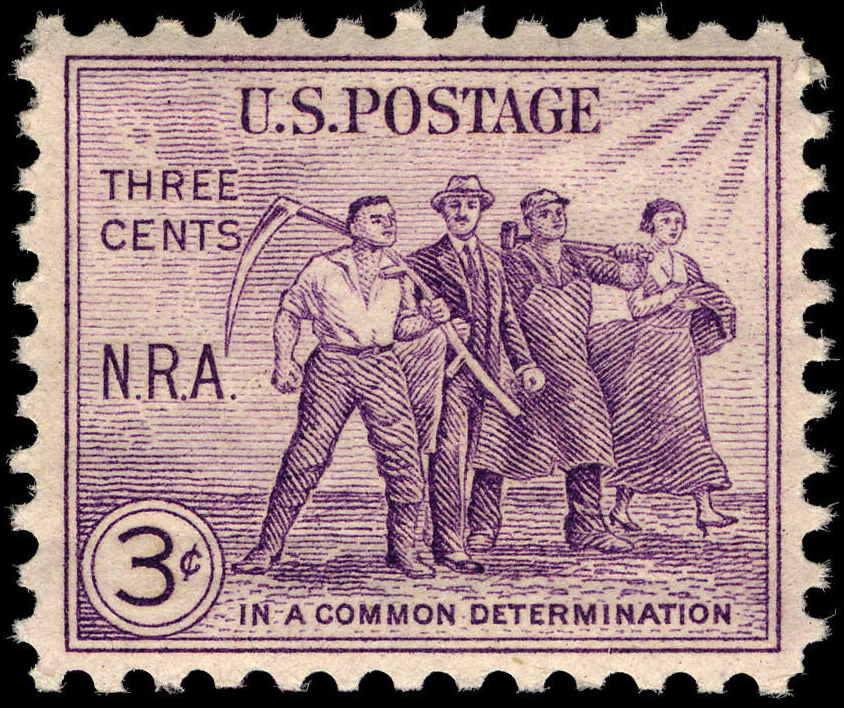
A 1933 US Postage stamp commemorating the National Recovery Administration established under National Industrial Recovery Act. Wikimedia, CC BY-SA

In 1933 the United States legalised cartel conduct with the National Industrial Recovery Act. The intention was to assist recovery from the Great Depression. Agreements to restrict output and fix prices were seen as a short-term solution to keep businesses afloat. It has since been argued the US law actually slowed the recovery by converting “otherwise competitive industries into highly regulated, cartelised, and often inefficient industries”.

The US government’s mistake is not one the Australian Competition and Consumer Commission is making.

Its interim authorisations allow officials from the regulator and the federal government to monitor discussions. Every arrangement must be approved by the regulator. Everything is “out in the open”, eliminating a key feature for any cartel arrangement to succeed – secrecy.

Conditions now are also very different to those in 1930s America.

Then the issue was over-supply. Now it’s mostly a problem of undersupply, due to demand surges.


Read more: There’s plenty of toilet paper – so why are people hoarding it?


This is not a situation in which supermarkets, pharmaceutical companies and broadband providers have anything to gain through restricting supply.

They might have an interest in increasing prices. But the competition watchdog has expressly forbidden talk about retail prices.

A tight leash needed

European regulators are taking a similar approach to Australia. The European Commission has declared it will not actively intervene against “necessary and temporary measures” to avoid supply shortage:

“Considering the current circumstances, such measures are unlikely to be problematic, since they would either not amount to a restriction of competition […] or generate efficiencies that would most likely outweigh any such restriction.”

Even so, there are risks. There are anti-cartel laws for good reason. The longer competitors spend working together, as Adam Smith noted, the greater the risk of conspiracy.

The competition watchdog will need to keep talks on a tight leash. Apart from price, it needs to ensure companies do not share information about operations and processes that would allow them to act independently in a mutually beneficial manner. This would give us exactly what cartel laws are meant to stop – higher prices.

Australia’s competition watchdog is arguably better equipped for this task than its European counterparts. But with more industry requests for competitors to cooperate likely, it will need to stay vigilant, making full use of its powers to monitor talks and ensure cooperation only goes on for as much, and as long, as absolutely necessary.

ref. Look who’s talking: Australia’s telcos, banks and supermarkets granted exemption to cartel laws – https://theconversation.com/look-whos-talking-australias-telcos-banks-and-supermarkets-granted-exemption-to-cartel-laws-135303

Trans-Tasman media suffers a blow on both sides on the Tasman

By Sri Krishnamurthi, contributing editor of Pacific Media Watch

Media on both sides on the Tasman face apocalyptic times as the Covid-19 coronavirus pandemic decimates the industry with Bauer Media NZ closing its doors and host of regional – 23 at the moment – Australian papers being shut down.

Add to that, the imminent closure of the Australian Associated Press on June 26 – although that had nothing to do with the virus – and there is not much to be optimistic about in the industry.

READ MORE: Bauer Media closures – so many livelihoods, so much destruction

“NZ journalism must not be left to languish. The sudden closure of Bauer Media NZ is devastating for New Zealand journalism and for the publics which depend on it in this time of national crisis,” said Greg Treadwell, president of the Journalism Education Association New Zealand (JEANZ) in a statement issued yesterday, which was co-signed by Dr Tara Ross, head of journalism at the University of Canterbury and Charles Riddle, principal academic staff member, journalism, at Wintec.

“Iconic magazine titles that have been household names, some for generations, were today shut down, with the Covid-19 crisis blamed for the closures.

“Among the pages consigned to history today was the work of some of the country’s pre-eminent journalists. The implications for New Zealand democracy are serious.”

– Partner –

He described it as numerous blows to the media industry.

Essential industry reeling
“These closures have impacted an essential industry already reeling with multiple structural and commercial failures.

“Redundancies are under way or reportedly mooted for other major media companies in New Zealand.

“The Journalism Education Association of New Zealand urges the New Zealand government to keep public-affairs journalism at the forefront of its thinking as it moves to support New Zealanders during the Covid-19 crisis,” Dr Treadwell said.

Meanwhile, in Australia the Journalism, Education and Research Association (JERAA) has joined the Media, Entertainment and Arts Alliance (MEAA) in calling on the government to provide $40 million emergency funding from the Regional and Small Publishers Jobs and Innovation Package as a survival fund to keep regional and rural newspapers alive during the coronavirus crisis.

“I think that is a really important thing in Australia right now, New Zealand suffers from this as well,” Dr Treadwell said.

“But I completely understand our Australian colleagues calling on the government to support their community newspapers because they suffer from news deserts there, not just physical ones, but news deserts where whole communities have no local papers.

“This is happening in New Zealand as well, our community newspapers that are around here need to operate during the lockdown.

‘Dreadful state’
“I do think the New Zealand community newspaper scene is in a dreadful state.”

As, for Australia, in a statement JERAA said Saffron Howden’s evolving map of Australia showed 23 closed newspapers including the Sunraysia Daily, The Guardian – Swan Hill, Gannawarra Times, Loddon Times, Barrier Daily Truth, Yarram Standard, Great Southern Star, Latrobe Valley Express, Star News Group, Maryborough District Advertiser, Gulf Chronicle, North Central News, Shepparton News, New South Western Standard, Cape and Torres News, The Bunyip, Bairnsdale Advertiser, Warragul and Drouin Gazette.

In addition, JERAA also noted News Corp Australia’s decision to suspend the printing of 60 community titles in New South Wales, Victoria, Queensland and South Australia from April 9.

While these publications will continue to publish digital news, the loss of print products will be an accessibility issue in regions with aging populations or limited internet access, the JERAA statement said.

Dr Treadwell called on the government to support New Zealand’s community newspapers.
He expressed sympathy for the Kaiatia-based Northland Age and its editor Peter Jackson, which has closed after 116-years.

“The idea of the Northland Age no longer publishing is heart-breaking, the government needs to act, it’s not as if you can off a newspaper and turn it back on again,” he said.

In the JEANZ statement, he said: “While we commend the change that will allow community papers to publish during the national lockdown, the government should also make plans to ensure all New Zealanders continue to get high-quality information in the coming months.

“Not only will we need strong science and environment reporting, we will need in-depth, long-form and even creative journalism to tell the complex stories that will arise from this pandemic.

“A well-informed public will be essential. An adequately resourced news media, across both public and private sectors, is also critical in the current state of emergency, given the dramatically increased powers the state has at its disposal.”

Pacific facing crisis too
The Pacific Media Centre’s director Professor David Robie, who is also deeply concerned about the impending crisis for many Pacific Islands media groups, said his response to the closures in Australia and New Zealand was “in a word – devastated”.

“The media in many respects has been dying a slow death, certainly in print. And although we have a number of small yet successful start-up digital media ventures, we have witnessed the gradual decline of quality media overall in New Zealand,” he said.

“In one foul swoop, a foreign-owned corporate, Bauer Media, has been allowed to destroy the heart of New Zealand’s magazine industry. And there has been barely a whimper.

“We no longer even have a strong media union – such as Australia has with the MEAA to stage at least some semblance of a defence. I find it quite outrageous that a German company can do this, one that has just reported group profits back home – just dump a cluster of NZ cultural icons in publishing with such titles as Metro, the Listener and NZ Women’s Weekly with their long and proud histories.

“Especially when we are led to believe that the government tried to intervene and offered substantial financial support to keep the company going. One suspects that Bauer were planning to scuttle the magazines anyway and the pandemic simply provided the pretext.”

Dr Robie said he believed all media in New Zealand should have been treated as “essential services” – especially in this “so-called post-truth era when we are faced with an avalanche on lies, disinformation and fake news”.

“Many among the general public don’t know what to believe any more. We need more quality media with a trusted pedigree, not less.

“And community publications identified closely with their neighbourhoods and ethnic and diasporic media are also vitally important in our democracy. Closing or silencing of media inevitably weakens the robustness of our democracy.”

Apart from Bauer Media, the Northland Age and Radio Sport, Mediaworks has asked staff to take a 15 percent pay cut, Television New Zealand has frozen payrates, NZME is calling redundancies and Stuff staff have been warned to expect a cull.

Print Friendly, PDF & Email

Article by AsiaPacificReport.nz

Puerto Rico and COVID-19: A Precarious Healthcare System Faces Serious Challenges

Source: Council on Hemispheric Affairs – Analysis-Reportage

By Erick J. Padilla Rosas
From Eugene, Oregon

The COVID-19 pandemic poses a great challenge to countries with high levels of poverty, limited medical infrastructure, and a lack of universal access to health care.  So far, the number of confirmed cases of coronavirus in Puerto Rico is 286 and 11 deaths. [1] Puerto Rico, an unincorporated territory of the United States, does not fare much better in terms of public access to health care services than most underdeveloped countries. To make things worse, in the three years prior to the novel coronavirus pandemic there had been a reduction in public access to the government health care system. Eligibility requirements for the federal health plan began to be more rigorous in 2017 due to irregularities found in the status of nearly 30,000 patients who had acquired help from the Medicaid system without being eligible for it. At this time eligibility for the program is directed at patients who receive a net income of no more than $800 per month.[2] With such a low income threshold, only half of the citizens living below the poverty level in Puerto Rico are eligible for coverage. Since 60% of the population lives below the poverty level, the eligibility requirements exclude many Puerto Ricans who cannot afford private health insurance.[3] In addition to these obstacles with regard to access to healthcare, the Puerto Rican archipelago’s health system now suffers from the lack of reliable leadership with the dismissal of Health Department Secretary Rafael Rodríguez Mercado on March 13, 2020. [4]

The socio-economic conditions

The unemployment is also taking a heavy toll on Puerto Ricans. By January 2020, nearly 94,000 Puerto Rican citizens were already unemployed. This figure represented an increase of 2,000 unemployed compared to January 2019.[5] Between March 16 and March 30, some 76,928 Puerto Ricans applied for unemployment benefits; that’s not counting those who have not yet had access to the Internet or someone to help them with the application process. [6] To date, unemployment claims in the Puerto Rican archipelago have reached more than 100,000.[7]

Fortunately, last week Puerto Rico approved an unprecedented financial package of $787 million to blunt the economic blow caused by the pandemic. Democracy Now reports:

“Measures include a three-month moratorium on mortgage payments, as well as other loans; bonuses for essential services providers such as medical staff and police; and improving remote education by buying tablets and educational tools. Governor Wanda Vázquez also said Puerto Rico’s public sector employees will keep getting paid, and small businesses and self-employed workers will receive cash to cope with the crisis.” [8]

Given the limited public access to health care services and high poverty and unemployment rates, this minimal relief is urgently needed. It is in the face of these economic challenges and deficits in the health care system in Puerto Rico that the Governor took swift action aimed at fighting the novel coronavirus pandemic.

The historical-political context of the Governor’s response

After the events of the summer of 2019, when Puerto Rico’s citizens demanded the resignation of former Gov. Ricardo Rosselló Nevares, the political atmosphere in Puerto Rico has fallen short of robust democratic participation.[9] The Constitution of the Commonwealth of Puerto Rico provides that when there is a vacancy in the office of Governor, the Secretary of State becomes the Governor. However, this position was left vacant before Rosselló resigned. Therefore, the line of succession fell under the responsibility of the Secretary of the Department of Justice, Wanda Vázquez Garced, the current Governor of Puerto Rico. Although Vázquez was not elected democratically by the people of Puerto Rico, she is constitutionally the governor. As such, she has taken the lead in addressing the responsibility to take political action on the pandemic and has a measure of democratic legitimacy.

Governor Wanda Vázquez declared a curfew on March 15, 2020 to be effective that same day from 9:00 p.m. until March 30, and this order has now been extended until April 12. [10] Among the directives included in the governor’s executive order, cars with license plates ending in even numbers will only be allowed to travel on the streets on Mondays, Wednesdays, and Fridays. On the other hand, the license plates of cars ending in odd numbers may be used on Tuesdays, Thursdays, and Saturdays. On Sundays, grocery stores and supermarkets will be closed. Citizens may leave their homes only to buy food or go to the pharmacy, financial institutions, gas stations, and health centers such as hospitals, with the exception of dental offices. Citizens are allowed to be out of the home with justifiable reasons from 5:00 a.m. to 7:00 p.m. Those companies and public services whose tasks involve the health and safety of citizens may continue to operate. This category includes police officers, messengers, car mechanics, gas stations, telecommunications services, and other functions essential for the proper functioning of a quarantined society.

Although stopping the entry of the virus into Puerto Rico has not been possible, this unincorporated territory of the United States was among the first countries in the Americas to take rigorous measures to control the spread of the virus. [11] The implementation of such measures in some cases required cooperation of US government authorities. For example, because Puerto Rico’s airports operate under the authority of the Federal Aviation Administration (FAA), the governor had to draft a petition to the federal government to have flights restricted to the island. As a result of this intervention, only one of the island’s three main airports is currently providing domestic flights, though the petition proposed closing the airports for all domestic flights for at least 14 days.

Preparing for an increase in COVID-19 cases

A nurse from the Mayaguez region who prefers to remain anonymous told the author that at the moment, there are enough hospital beds to deal with the limited number of cases. However, this time “no hospital has the capacity to receive a massive influx of patients under the appropriate isolation protocols.” Regarding the safety equipment needed by health care professionals to care for coronavirus patients, he states that “protective equipment is scarce and the administration of each hospital keeps it restricted as needed. I have not been denied any equipment at this time, but I personally recognize my rights and the regulations that protect me as a nurse and those that protect patients.”

To date, there has been no reported lack of beds to treat patients in hospitals. According to Dr. Juan Salgado, member of the Interagency state medical group, “Puerto Rico has 6,000 hospital beds and an estimated 60%, that is to say 3,600 beds, are available to receive patients”  [as of March 28]. However, if  COVID-19 infections in Puerto Rico continue at the same rate of growth, in three weeks there will not be enough available in the archipelago’s  hospitals to treat patients.[12] In any case, the Puerto Rico Medical Task Force, the health advisory institution on COVID-19 issues in Puerto Rico, is already planning to equip some sports centers and hotels to treat COVID-19 patients before it is too late and before the hospitals and health centers are at full capacity.[13]

On a positive note, in response to a potential shortage of hand sanitizer, some of Puerto Rico’s distilleries have stepped up to the plate. Serrallés Distillery, Inc., has produced 70% ethyl alcohol to provide free of charge to help hospitals and health clinics in Puerto Rico to alleviate the current ethyl alcohol shortage.[14] For its part, as the Miami Herald reports, “one of the world’s largest rum factories, the Bacardi plant in Puerto Rico, has tweaked its production lines to pump out ethanol needed to make hand sanitizers.”[15] The bottles of hand sanitizers are to be distributed among those health and security personnel and volunteers who work day after day against the spread of the pandemic. Without a doubt, these are just two examples of how Puerto Rican companies have joined forces to fight the pandemic.

The Department of Health has published a preparedness and response plan against the COVID-19 entitled “Plan de Preparación y Respuesta ante el Coronavirus Novel 19 COVID-19.”[16] In collaboration with the Puerto Rico Medical Task Force COVID-19, the government of Puerto Rico and Puerto Ricans are taking to the social networks to share information, help raise awareness, and educate citizenry about the importance of staying home for the duration of the pandemic and until the Center for Disease Control changes its recommended protocols.[17]

Erick Javier Padilla Rosas is a Philosophy master student in the Department of Philosophy and Religious Studies at Louisiana State University (LSU), where he works as a teaching assistant. His publications include: “From Colonized Thought to Decolonial Aesthetics: The Search for a ‘Philosophical Voice’ Amongst Puerto Rican Colonized Subjects,” published by the Council on Hemispheric Affairs (COHA) on May 28, 2019; “Movilización popular en Puerto Rico: más allá de un chat…,” published also by COHA on July 25, 2020; and “El inicio de un nuevo orden boricua,” published by Revista Cronopio on December 20, 2019.

Fred Mills assisted as editor of this article

Main photo: Patients are screened in this tent in front of the emergency room of Hospital Perea in Mayagüez (Credit: Wilfredo Soto)


End Notes

[1] Departamento de Salud. Gobierno de Puerto Rico. April 1,, 2020. http://www.salud.gov.pr/Pages/coronavirus.aspx. See also BBC News Mundo, “Coronavirus: el mapa que muestra el número de infectados y muertos en el mundo por el covid-19,” 12 de marzo de 2020. https://www.bbc.com/mundo/noticias-51705060

[2] Laura M. Quintero, “Disminuyen personas elegibles para Mi Salud,” El Vocero. 14 de agosto de 2017. https://www.elvocero.com/gobierno/disminuyen-personas-elegibles-para-mi-salud/article_b122501e-807c-11e7-971f-bba17276d2dc.html

[3] Elga Valle, “La pobreza en Puerto Rico,” Enciclopedia de Puerto Rico. https://enciclopediapr.org/encyclopedia/la-pobreza-en-puerto-rico/

[4] El Vocero PR, “Gobernadora acepta renuncia del secretario de Salud,” 13 de marzo de 2020. https://www.elvocero.com/gobierno/gobernadora-acepta-renuncia-del-secretario-de-salud/article_e8a31cd8-6591-11ea-9d09-47aa98665ea2.html

[5] Departamento del Trabajo y Recursos Humanos, “Empleo y desempleo en Puerto Rico,” Encuesta de Grupo Trabajador, enero 2020. https://estadisticas.pr/files/inventario/empleo_y_desempleo/2020-03-25/EMPLEO%20Y%20DESEMPLEO%20EN%20PUERTO%20RICO.pdf

[6] Metro PR, “Más de 76,000 personas han solicitado el desempleo,” 30 de marzo de 2020. https://www.metro.pr/pr/noticias/2020/03/30/mas-de-76000-personas-han-solicitado-el-desempleo.html

[7] Metro PR, “Más de 15,000 puertorriqueños solicitan desempleo en 24 horas,” 1 de abril de 2020. https://www.metro.pr/pr/noticias/2020/04/01/mas-de-15000-puertorriquenos-solicitan-desempleo-en-24-horas.html

[8] Democracy Now, “Puerto Rico Passes $787 Million Financial Package as Coronavirus Pandemic Further Cripples Economy,” Independent Global News, March 24, 2020. https://www.democracynow.org/2020/3/24/headlines/puerto_rico_passes_787_million_financial_package_as_coronavirus_pandemic_further_cripples_economy

[9] Iris Alejandra Soto Ruiz and Erick Javier Padilla Rosas, “Movilización popular en Puerto Rico: más allá de un chat…,” Council on Hemispheric Affairs, July 25, 2019. http://www.coha.org/movilizacion-popular-en-puerto-rico-mas-alla-de-un-chat/

[10] Yaritza Rivera Clemente, “Toque de queda por el coronavirus,” El Vocero PR, 15 de marzo de 2020. https://www.elvocero.com/gobierno/gobernadora-decreta-toque-de-queda-por-el-coronavirus/article_e8c283a2-66c7-11ea-aea1-03a07fae93f0.html

Metro PR, “Estos son los cambios en el toque de queda emitido por la gobernadora,” 30 de marzo de 2020. https://www.metro.pr/pr/noticias/2020/03/30/estos-los-cambios-toque-queda-emitido-la-gobernadora.html

[11] Eldiario.es, “Las estrictas medidas en Puerto Rico contra el COVID-19 favorece un bajo contagio,” 23 de marzo de 2020. https://www.eldiario.es/sociedad/estrictas-Puerto-Rico-COVID-19-favorecen_0_1008950115.html

[12] Yennifer Álvarez, “En tres semanas sistema hospitalario local pudiera agotar disponibilidad de camas,” Noticel, San Juan, Puerto Rico. https://www.noticel.com/ahora/top-stories/20200328/en-tres-semanas-sistema-hospitalario-local-pudiera-agotar-disponibilidad-de-camas/

[13] Juan Marrero, “Task Force recomienda usar hoteles y facilidades deportivas como centros de salud,” Metro PR, 31 de marzo de 2020. https://www.metro.pr/pr/noticias/2020/03/31/task-force-recomienda-usar-hoteles-y-facilidades-deportivas-como-centros-de-salud.html

[14] Sabrosía Puerto Rico, “Destilería boricua anuncia producción de alcohol etílico para donar a hospitales,” 15 de marzo de 2020. https://www.sabrosia.pr/actualidad/2020/03/15/destileria-boricua-anuncia-produccion-alcohol-etilico-distribuir-hospitales-sector-salud.html

[15] Jim Wyss, “Rum to the rescue? How Bacardi is tweaking production to fight the coronavirus,” Miami Herald, March 24, 2020. https://www.miamiherald.com/news/nation-world/world/americas/article241460771.html

[16] Departamento de Salud, “Plan de Preparación y Respuesta ante el Coronavirus Novel 19 COVID-19,” Gobierno de Puerto Rico, marzo, 2020. http://www.salud.gov.pr/Dept-de-Salud/Pages/Unidades-Operacionales/Oficina-de-Preparacion-y-Coordinacion-de-Respuesta-en-Salud-Publica.aspx

[17] See “Puerto Rico Medical Task Force Covid-19” at facebook: https://www.facebook.com/puertoricomedicaltaskforcecovid19/

Duterte’s ‘shoot them dead’ virus order to troops slammed as dangerous

Pacific Media Watch

The International Coalition for Human Rights in the Philippines (ICHRP) has strongly condemned the shoot-to-kill order by President Rodrigo Duterte this week as a ‘dangerous’ opening to target and kill anyone in a public space.

“We are raising the alarm in the international community on President Duterte’s directive to kill unruly violators of the coronavirus quarantine,” said coalition president Peter Murphy.

“This pronouncement is a dangerous order that allows authorities to target and kill anyone in a public space.

READ MORE: ‘Shoot them dead’ – Duterte orders troops to kill quarantine violators

“It is also a complete violation of the fundamental rights of Filipinos especially in this time of global pandemic.”

President Duterte addressed the nation hours after incidents of unrest and people massing up for food and relief in the country’s capital.

– Partner –

In his televised speech, his tirade of violent threats included: “I will not hesitate. My orders are sa pulis pati military…na pagka ginulo at nagkaroon ng okasyon na lumaban at ang buhay ninyo ay nalagay sa alanganin—shoot them dead,” (I will not hesitate. My orders to the police and military…if they caused any disorder, and they fight back and your lives are on the line—shoot them dead).

The same day, 21 citizens were arrested for going out of their homes and demanding the relief promised by the national government.

Residents rally for food, aid
Residents of an urban community in the biggest city in Metro Manila staged a rally asking for food and aid amid the government’s lockdown to contain the coronavirus, which in turn has left millions of Filipinos jobless and hungry.

“Our support goes to the poor Filipinos whose only crime is to be hungry and demand what is rightfully theirs,” said Murphy in a statement.

“The right to food and basic social services should be ensured especially in times like these. A video circulating in the social media shows citizens demanding food being violently dispersed by authorities.

Philippines checkpoint
Philippines troops vet citizens at a Manila checkpoint. Image: PMC screenshot/Al Jazeera

“Naintindihan ninyo? Patay. Eh kaysa mag-gulo kayo diyan, eh ‘di ilibing ko na kayo (Do you understand? Dead. Instead of causing trouble, I’ll send you to the grave),” Duterte added in his recorded address.

Recently, the president was given special powers to distribute P200 billion (US$3.9 billion) to more than 18 million poor households. But after a week the aid remains unreleased.

“President Duterte’s criminal negligence coupled with brutal measures to address the pandemic is taking its toll on Filipinos. Millions of informal workers have been displaced and right abuses have been rampant all over the country,” said Murphy.

Enforcing social distancing
“The police and military who have been deployed to enforce social distancing are not trained for this task and have been the very perpetrators of human rights violations,” ICHRP stated.

The authorities have been detaining homeless people, putting curfew violators in cages and using torture methods to punish them, and even arresting citizens over “provoking” posts on social media.

Netizens showed their anger online over the president’s pronouncement to “shoot them dead” and called for him to be ousted. The #OustDuterte hashtag has been trending in the Philippines for two days now.

The World Health Organisation (WHO) states that “measures that limit individual rights and civil liberties must be necessary, reasonable, proportional, equitable, non-discriminatory, and in full compliance with national and international laws.”

Print Friendly, PDF & Email

Article by AsiaPacificReport.nz

Young people are anxious about coronavirus. Political leaders need to talk with them, not at them

Source: The Conversation (Au and NZ) – By Melissa Kang, Associate professor, University of Technology Sydney

Young people in Australia are among the fastest-growing group to contract COVID19. According to the Department of Health, there are now more cases in Australia among people aged 20 – 29 years than any other age group. Our research has found that, contrary to popular belief, many young people in Australia are seriously concerned about the virus.

YouthInsight, the research arm of Student Edge, conducted an online survey of 520 young people aged 14 – 25 around Australia in March 2020. Ninety-three percent of respondents were studying.

Coronavirus brings anxiety

The survey found that the health of families was their greatest concern, followed by the impact on their studies. Respondents gained most of their information about COVID-19 from social media, their schools and television news. Knowledge about hygiene and physical distancing measures was relatively high, but there was some misinformation about practices such as drinking more water and “taking a pneumonia vaccine”. More than half of the respondents had had their work hours cut. The majority expressed feelings of concern, fear, anxiety and depression.

Reachout, Australia’s leading youth online mental health organisation, has found that young people using community forums are worried about managing their mental health and other preexisting health conditions with increasing physical restrictions. They fear their well-being will be de-prioritised in a health system under strain. They describe feeling overwhelmed, anxious and uncertain about the short and long-term future, with loss of work and employment instability causing severe anxiety. School and university students report facing drastic changes to modes of learning, or even deferrals.


Read more: COVID-19 has thrown year 12 students’ lives into chaos. So what can we do?


Young people involved in the Wellbeing, Health & Youth NHMRC Centre of Research Excellence and the Australian Association for Adolescent Health feel that inconsistent messaging from the government at state and national levels has made it harder for the community to come together.

As co-authors of this article, they note young people in school have received conflicting advice from governments and unfeasible directives such as maintaining physical distance while sitting in dual classroom desks, elbow-to-elbow.

Those who live away from family (such as many university students) face difficult decisions between being cut off from families or studying online, away from peers. Young Aboriginal and Torres Strait Islander people are concerned about how COVID-19 will affect their elders. Elders hold all knowledge, and at times like this young people would visit, sit with and learn from them. This is no longer possible with physical distancing restrictions.

While WHO Director-General Tedros Adhanom Ghebreyesus expressed gratitude most young people are “spreading the word, not the virus”, Australian governments have made little effort to communicate with young people.

Instead, they have been singled out in press conferences, “blasted” and “lambasted” by the chief medical officer. They have also been chided by the prime minister, who has reportedly “lost confidence” in the “younger community”. Media coverage of the debate around school closures has mostly talked about young people, rather than with them.

How can policymakers become more attuned and responsive to young people’s needs and concerns?

Engaging with young people works

We have seen global action led by young people in relation to climate change and evidence that they have a major role to play in disasters when they are given a voice.

Press conferences for children have been held by New Zealand’s Prime Minister Jacinda Ardern and Norway’s Prime Minister Erna Solberg to answer their questions and help allay anxiety.

Such activities send a powerful message that young people are valued and listened to. An Australian political leader or health communication expert could hold regular conversations with young people to garner their concerns and inform press conferences.

Organisations such as ReachOut.com have shown, for more than 20 years, how working in partnership with young people to understand how mental health policy and services can better engage with their concerns and needs results in better engagement and outcomes.

Social media is one part of the solution

With physical distancing, the whole world is increasingly online, seeking clarity and connection about what to do. In response to false information going viral, Facebook, Google, Instagram, Snapchat, Pinterest, and TikTok are “working to tackle misinformation” by prioritising resources and tips from reputable sources.


Read more: Studying a uni course online? Here are 4 tips to get yourself tech ready


While this is a positive change for our information landscape, we cannot only rely on filtering by social media platforms. A review exploring social media and the well-being of children and young people found young people’s online and offline social connections, motivations and values underpin their health and well-being.

More than targeting communications at young people and their peers, caregivers and trusted professionals need to be involved in discussions about what information to share and how to support each other in these unprecedented times. Existing platforms, such as youth services, youth peaks, consumer and adolescent health research organisations convene groups of young people to advise in such situations.

Coronavirus is a litmus test for the strength of societies everywhere. We are all in this together. To make changes that are equitable and sustainable for young and old alike, we must act together – in policy and community responses. The best way to include young people is to engage meaningfully and respectfully – and speak with, not at, them.

This article was written in collaboration with young people: Keshini Vijayan, Jahin Tanvir, Mali Dillon, Ella Cehun and Kate Thompson. *.

ref. Young people are anxious about coronavirus. Political leaders need to talk with them, not at them – https://theconversation.com/young-people-are-anxious-about-coronavirus-political-leaders-need-to-talk-with-them-not-at-them-135302

Sleep won’t cure the coronavirus but it can help our bodies fight it

Source: The Conversation (Au and NZ) – By Cassandra Pattinson, Research Fellow, The University of Queensland

Getting a good night’s sleep can be difficult at the best of times. But it can be even harder when you’re anxious or have something on your mind – a global pandemic, for example.

Right now though, getting a good night’s sleep could be more important than ever.

Sleep is essential for maintaining our health and mood. Sleep can also boost our immune function and help us deal with stress.


Read more: Can’t sleep and feeling anxious about coronavirus? You’re not alone


How much do we need?

Social distancing has many of us spending more time at home. This may mean more sleep for some people – suddenly you’ve got time to sleep in and even have a nap in the afternoon.

For others, falling out of your usual routine may mean less sleep. Instead of going to bed when you normally would, you might be staying up late watching Netflix, scrolling social media or glued to coronavirus news.

For adults, achieving between seven and nine hours of sleep per night is the goal. If you know you’re a person who needs more or less, finding that perfect amount of sleep for you and aiming to achieve that consistently is key.

Looking at a screen isn’t the best way to wind down before bed. Shutterstock

Sleep and our circadian system (or internal body clock) are essential for regulating our mood, hunger, recovery from illness or injury, and our cognitive and physical functioning.

Shifting our bed or wake times from day-to-day may affect all of these functions. For example, higher variability in night-to-night sleep duration has been linked to increased depression and anxiety symptoms.

Long-term consequences of sleep problems can include obesity, diabetes, heart disease, and high blood pressure.

Sleep and immune function

Declines in the quality and/or quantity of sleep can affect our immunity, leaving us more susceptible to illnesses including viruses.

During sleep, the immune system releases proteins called cytokines. Certain cytokines are important for fighting infections and inflammation, and help us respond to stress. But when we don’t get enough sleep or our sleep is disrupted, our bodies produce fewer of these important cytokines.


Read more: Coronavirus: Social distancing may be a rare chance to get our sleep patterns closer to what nature intended


In one study, participants were exposed to the common cold (rhinovirus). Those who slept less than seven hours per night were almost three times more likely to develop a cold than those who slept eight hours per night or more.

Another study indicated that a single night of no sleep may delay our immune response, slowing our body’s ability to recover.

While we don’t have any research yet on the relationship between sleep and the coronavirus, we could expect to see a similar pattern.

Sleep and stress: a vicious cycle

You’ve probably heard the phrase “to lose sleep over” something. We have this saying because stress can negatively affect sleep quality and quantity.

Lack of sleep also causes a biological stress response, boosting levels of stress hormones such as cortisol in our bodies the next day.

Cortisol levels typically peak in the morning and evenings. Following a poor night’s sleep, you might feel more stressed, have trouble focusing, be more emotional, and potentially have trouble falling asleep the next night.

Prolonged sleep loss can make us more vulnerable to experiencing stress and less resilient at managing daily stressors.


Read more: Why our brain needs sleep, and what happens if we don’t get enough of it


Think of sleep as your “shield” against stress. A lack of sleep can damage the shield. When you don’t get enough sleep the shield cracks and you are more susceptible to stress. But when you get enough sleep the shield is restored.

Sleep acts as a ‘shield’ against stress. You want to keep your shield at full strength. Credit: Alicia C. Allan, Institute for Social Science Research, University of Queensland.

It’s important to stop this cycle by learning to manage stress and prioritising sleep.

Tips for healthy sleep

To allow yourself the opportunity to get enough sleep, plan to go to bed about eight to nine hours before your usual wake-up time.

This may not be possible every night. But trying to stick to a consistent wake-up time, no matter how long you slept the night before, will help improve your sleep quality and quantity on subsequent nights.

Reading a book is a good way to relax before bed. Shutterstock

Think about your environment. If you’re spending a lot of time at home, keep your bed as a space for sex and sleep only. You can also enhance your sleep environment by:

  • keeping your lights dim in the evening, especially in the hour before sleep time
  • minimising noise (you might try using earplugs or white noise if your bedroom gets a lot of noise from outside)
  • optimising the temperature in your room by using a fan, or setting a timer on your air conditioning to ensure you’re comfortable.

Create a routine before bedtime to mentally relax and prepare for sleep. This could include:

  • setting an alarm one hour before bed to signal it’s time to start getting ready
  • taking a warm shower or bath
  • turning off screens or putting phones on airplane mode an hour before bed
  • winding down with a book, stretching exercises, or gentle music.

Read more: Explainer: how much sleep do we need?


Some other good ways to reduce stress and improve sleep include:

  • exercising daily. To maximise the benefits for sleep, exercise in the morning in natural light
  • incorporating relaxation into your daily life
  • limiting caffeine, alcohol and cigarettes, particularly in the hours before bed.

Some nights will be better than others. But to boost your immunity and maintain your sanity during this unprecedented time, make sleep a priority.

ref. Sleep won’t cure the coronavirus but it can help our bodies fight it – https://theconversation.com/sleep-wont-cure-the-coronavirus-but-it-can-help-our-bodies-fight-it-134674

This lizard lays eggs and gives live birth. We think it’s undergoing a major evolutionary transition

Source: The Conversation (Au and NZ) – By Charles Foster, Postdoctoral Research Associate, University of Sydney

Our earliest vertebrate (animals with backbones) ancestors laid eggs, but over millions of years of evolution, some species began to give birth to live young.

There is a traditional dichotomy in vertebrate reproduction: species either lay eggs or have live births. However, as is often the case in biology, things aren’t as simple as they first appear, and there are a handful of vertebrate animals that do both.

One of these is the three-toed skink (Saiphos equalis). Our recent research suggests the egg-laying S. equalis may currently be in the process of transitioning from egg-laying to giving live birth.

Studying them gives us a unique opportunity to watch evolution in action.

Saiphos equalis has a distinctive yellow belly, and a long, slender body, ideal for its underground lifestyle. Charles Foster

From eggs to babies, and back again?

There are two main reproductive strategies in vertebrates.

Animals that lay eggs are called “oviparous”. For instance, many fish species spawn eggs that are fertilised externally. In other oviparous species, including birds and some lizards and snakes, eggs are fertilised inside the mother, an eggshell is added, and then eggs are laid.

Depending on the species, much or all of the nutrition needed to grow a healthy baby is supplied in the egg yolk.

In contrast, “viviparous” animals carry embryos internally until they are fully developed. The embryos can rely entirely on yolk for nutrition, or the parents can provide supplementary nutrition, sometimes via a placenta (as in humans).

There is strong evidence that egg-laying is ancestral to live birth, meaning it came first. Many physiological changes were necessary for live birth to have evolved from egg-laying. With this transition, some structures were lost, including the hard outer eggshell. Other mechanisms were gained to ensure embryonic survival within the parent, including the supply of adequate oxygen and water during development.

The evolution of live birth has occurred frequently, including at least 121 times in independent groups of reptiles.

Evolutionary “reversals” to egg-laying are much rarer, probably because regaining the physiological machinery for producing eggshells would be exceptionally difficult.

¿Por que no los dos?

Despite the vast differences between egg-laying and live birth, some species can do both. This phenomenon called “bimodal reproduction” is exceptionally rare. There are more than 6500 species of lizards worldwide, but only three exhibit bimodal reproduction.


Read more: Lizards help us find out which came first: the baby or the egg?


We’re lucky enough to have two of these in Australia. Our research group at the University of Sydney studies the bimodally reproductive three-toed skink, in the hope of understanding how live birth evolved.

In northern NSW, the three-toed skink gives birth to live young, but near Sydney, they lay eggs. Even though they reproduce differently, previous research has shown these lizards are a single species.

The three-toed skink displays geographic variation in reproductive mode. It has four very tiny legs, and only three toes per foot. Yi-Kai Tea

Even the egg-laying members of the species are odd, as the eggs are retained within the mother for a relatively long time. After being laid, ordinary skink eggs are incubated for at least 35 days before they hatch, but some three-toed skink eggs hatch in as few as five days after being laid.

One female even laid eggs and gave birth to a live baby in the same litter.

An egg-laying three-toed skink from near Sydney with its clutch of eggs. Stephanie Liang

Read more: The first known case of eggs plus live birth from one pregnancy in a tiny lizard


The genetics behind different reproductive modes

Most aspects of an animal’s development are controlled by its genes, but not every gene is always active. Genes can be expressed (switched on) to different degrees, and gene expression can stop when not needed.

An egg-laying skink uterus undergoes only a couple of genetic changes between being empty and holding an egg.

A live-bearing skink uterus is different. It undergoes thousands of genetic changes to help support the developing baby, including genes that probably help provide oxygen and water, and regulate the mother’s immune system to keep the baby safe from immunological attack.

Unexpected similarities between the egg-laying and the live-bearing

Our research measured changes in gene expression between egg-laying and live-birth in the three-toed skink. We investigated how the expression of all genes in the uterus differed between when the uterus was empty and when it held an egg or embryo.

As expected, live-bearing S. equalis, undergo thousands of genetic changes during pregnancy to produce a healthy baby.

But surprisingly, when we looked at the uterus of the egg-laying S. equalis, we found these also undergo thousands of genetic changes, many of which are similar to those in their live-bearing counterparts.

Embryos of egg-laying Saiphos equalis are nearly completely developed at the time of laying. Stephanie Liang

Some of the most important genetic changes in gene expression in egg-laying S. equalis allow embryos to develop within the mother for a long time. These genes also seem to allow the uterus to remodel to accommodate a growing embryo, and drive the same kinds of functions required for the embryonic development in live-birthing three-toed skinks.

Are ‘reversals’ to egg-laying easier than previously thought?

Our findings are important because they demonstrate that egg-laying three-toed skinks are an evolutionary intermediate between “true” egg-laying and live birth.

We now know that uterine gene expression in egg-laying S. equalis mirrors live-bearing skinks much more closely than true egg-laying skinks. These results may explain why it’s possible for a female three-toed skink to lay eggs and give birth to a live baby in a single pregnancy.

The similarities in gene expression between egg-laying and live-bearing three-toed skink uteri might also mean “reversals” from live birth back to egg-laying could be be easier than previously thought. However, this may be restricted to species in which live-birth has evolved recently, such as the three-toed skink.


Read more: Why we’re not giving up the search for mainland Australia’s ‘first extinct lizard’


ref. This lizard lays eggs and gives live birth. We think it’s undergoing a major evolutionary transition – https://theconversation.com/this-lizard-lays-eggs-and-gives-live-birth-we-think-its-undergoing-a-major-evolutionary-transition-133630

This lizard lays eggs and gives live birth. We think it’s undergoing major evolutionary transition

Source: The Conversation (Au and NZ) – By Charles Foster, Postdoctoral Research Associate, University of Sydney

Our earliest vertebrate (animals with backbones) ancestors laid eggs, but over millions of years of evolution, some species began to give birth to live young.

There is a traditional dichotomy in vertebrate reproduction: species either lay eggs or have live births. However, as is often the case in biology, things aren’t as simple as they first appear, and there are a handful of vertebrate animals that do both.

One of these is the three-toed skink (Saiphos equalis). Our recent research suggests the egg-laying S. equalis may currently be in the process of transitioning from egg-laying to giving live birth.

Studying them gives us a unique opportunity to watch evolution in action.

Saiphos equalis has a distinctive yellow belly, and a long, slender body, ideal for its underground lifestyle. Charles Foster

From eggs to babies, and back again?

There are two main reproductive strategies in vertebrates.

Animals that lay eggs are called “oviparous”. For instance, many fish species spawn eggs that are fertilised externally. In other oviparous species, including birds and some lizards and snakes, eggs are fertilised inside the mother, an eggshell is added, and then eggs are laid.

Depending on the species, much or all of the nutrition needed to grow a healthy baby is supplied in the egg yolk.

In contrast, “viviparous” animals carry embryos internally until they are fully developed. The embryos can rely entirely on yolk for nutrition, or the parents can provide supplementary nutrition, sometimes via a placenta (as in humans).

There is strong evidence that egg-laying is ancestral to live birth, meaning it came first. Many physiological changes were necessary for live birth to have evolved from egg-laying. With this transition, some structures were lost, including the hard outer eggshell. Other mechanisms were gained to ensure embryonic survival within the parent, including the supply of adequate oxygen and water during development.

The evolution of live birth has occurred frequently, including at least 121 times in independent groups of reptiles.

Evolutionary “reversals” to egg-laying are much rarer, probably because regaining the physiological machinery for producing eggshells would be exceptionally difficult.

¿Por que no los dos?

Despite the vast differences between egg-laying and live birth, some species can do both. This phenomenon called “bimodal reproduction” is exceptionally rare. There are more than 6500 species of lizards worldwide, but only three exhibit bimodal reproduction.


Read more: Lizards help us find out which came first: the baby or the egg?


We’re lucky enough to have two of these in Australia. Our research group at the University of Sydney studies the bimodally reproductive three-toed skink, in the hope of understanding how live birth evolved.

In northern NSW, the three-toed skink gives birth to live young, but near Sydney, they lay eggs. Even though they reproduce differently, previous research has shown these lizards are a single species.

The three-toed skink displays geographic variation in reproductive mode. It has four very tiny legs, and only three toes per foot. Yi-Kai Tea

Even the egg-laying members of the species are odd, as the eggs are retained within the mother for a relatively long time. After being laid, ordinary skink eggs are incubated for at least 35 days before they hatch, but some three-toed skink eggs hatch in as few as five days after being laid.

One female even laid eggs and gave birth to a live baby in the same litter.

An egg-laying three-toed skink from near Sydney with its clutch of eggs. Stephanie Liang

Read more: The first known case of eggs plus live birth from one pregnancy in a tiny lizard


The genetics behind different reproductive modes

Most aspects of an animal’s development are controlled by its genes, but not every gene is always active. Genes can be expressed (switched on) to different degrees, and gene expression can stop when not needed.

An egg-laying skink uterus undergoes only a couple of genetic changes between being empty and holding an egg.

A live-bearing skink uterus is different. It undergoes thousands of genetic changes to help support the developing baby, including genes that probably help provide oxygen and water, and regulate the mother’s immune system to keep the baby safe from immunological attack.

Unexpected similarities between the egg-laying and the live-bearing

Our research measured changes in gene expression between egg-laying and live-birth in the three-toed skink. We investigated how the expression of all genes in the uterus differed between when the uterus was empty and when it held an egg or embryo.

As expected, live-bearing S. equalis, undergo thousands of genetic changes during pregnancy to produce a healthy baby.

But surprisingly, when we looked at the uterus of the egg-laying S. equalis, we found these also undergo thousands of genetic changes, many of which are similar to those in their live-bearing counterparts.

Embryos of egg-laying Saiphos equalis are nearly completely developed at the time of laying. Stephanie Liang

Some of the most important genetic changes in gene expression in egg-laying S. equalis allow embryos to develop within the mother for a long time. These genes also seem to allow the uterus to remodel to accommodate a growing embryo, and drive the same kinds of functions required for the embryonic development in live-birthing three-toed skinks.

Are ‘reversals’ to egg-laying easier than previously thought?

Our findings are important because they demonstrate that egg-laying three-toed skinks are an evolutionary intermediate between “true” egg-laying and live birth.

We now know that uterine gene expression in egg-laying S. equalis mirrors live-bearing skinks much more closely than true egg-laying skinks. These results may explain why it’s possible for a female three-toed skink to lay eggs and give birth to a live baby in a single pregnancy.

The similarities in gene expression between egg-laying and live-bearing three-toed skink uteri might also mean “reversals” from live birth back to egg-laying could be be easier than previously thought. However, this may be restricted to species in which live-birth has evolved recently, such as the three-toed skink.


Read more: Why we’re not giving up the search for mainland Australia’s ‘first extinct lizard’


ref. This lizard lays eggs and gives live birth. We think it’s undergoing major evolutionary transition – https://theconversation.com/this-lizard-lays-eggs-and-gives-live-birth-we-think-its-undergoing-major-evolutionary-transition-133630

Vale Bruce Dawe, Australia’s ‘Poet of Suburbia’

Source: The Conversation (Au and NZ) – By Kevin John Brophy, Emeritus Professor of Creative writing, University of Melbourne

“Katrina, I had in mind a prayer, but only this came,” Bruce Dawe wrote to his infant daughter, new-born, in intensive care, her life in the balance, declaring as poets must that their poems are the best and only real gift they can give.

I did not know Dawe, who died aged 90 on Wednesday, but I knew his poetry from my first years of reading poems. For decades, the first contemporary poems many Australians read were his.

Born in 1930 in Fitzroy, a failed student after attending seven schools, he worked as a labourer like his father, a farmhand, a postman, and spent a year on the University of Melbourne campus where he became a poet and a Catholic. He joined the RAAF in 1959.

As well as publishing a growing list of books, he studied part time until he achieved a PhD. His teaching life at the Darling Downs Institute of Advanced Education and the University of Southern Queensland lasted from 1969 until 1993. By then he was easily Australia’s most well-read and well-loved poet. His death this week is a significant moment for poets and readers of poetry.

Poet Bruce Dawe reads Little Red Fox. National Film & Sound Archive

A skilled mate

We know that poetry is somehow central to our nation’s soul, but mostly we like to keep its presence at the margins. In living memory, Les Murray and Dorothy Porter managed to bring poetry to wide audiences, but neither of them so broadly, neither of them prompting the passion of Dawe’s many readers.

When it comes to poetry, readers know pretty quickly what is authentic. Dawe’s poems are real enough to talk to you with one arm over your shoulder, or sit beside you, inviting you to look with them at what this whole damned creation is doing now.

But he couldn’t have survived as a poet by simply being genial. His poetry always held a deep steadiness of purpose in its gaze. This was his special skill. He was able to bring us in to seeing for instance how “the spider grief swings in his bitter geometry” (from Homecoming) when dead soldiers are freighted home.

He was uncannily capable of making poetry that talked plainly but still mysteriously about the most extreme of our experiences: funerals and suicides, drowned children, a mother-in-law’s glorious death falling out of her chair at a barbecue, the last nail being driven into the body of Christ (“the iron shocking the dumb wood”), the 1995 massacre at Srebrenica, or the hanging of Ronald Ryan.

You cannot read his poems without finding some personal connection to them too; my grandmother who once held a telegram announcing her son’s wartime death, and whose home was opposite Ronald Ryan’s bloody shootout on Sydney Road, had seemed to me to have had her life marked by images in Dawe’s poems.

In Australia, we know there’s another job requirement for any poet worth their salt, and that is a dry and thoroughly demotic wit. Dawe’s hilarious At Shagger’s Funeral is just one gem that Lawson would have been proud to have chiselled out.

Tests of time

New themes of gender, ethnicity, identity politics, the explosion of poetry since the avant-garde experiments of Fluxus might seem to leave Dawe’s poetry suspended in a historical moment, but this is to say no more than what happens to every strong and distinctive poet.

No one wrote poetry quite like Dawe. Lots of poets took inspiration from him too, many without realising it – the vibrant “street poetry” movement in Melbourne through the 1970s and 80s, morphing into performance poetry and spoken word – each take their impulse from Dawe’s confidence in poetry’s place as a voice for, about, and from life as it’s lived by the most desperate and the most ordinary of us.

The bravery of his poetry, its wit and sensitivity to the world are there in one of the most stark and touching love poems you could imagine reading:

Hearing the sound of your breathing as you sleep,

with the dog at your feet, his head resting

on a shoe, and the clock’s ticking

Like water dripping in a sink

– I know that, even if reincarnation were a fact,

given the inherent cruelty of the world

where beautiful things and people

are blasted apart all the day long,

I would never want to come back, knowing

I could never be this lucky twice …

(from You and Sarajevo: for Gloria)

He has been praised for the technical achievement of blending the colloquial with the lyrical, something he often got “right”. But beyond this deftness, his poems always reach towards our most humane responses to the world.

We know from our present troubles as a nation, as a planet, and as a species, that we need poets as right and true as Bruce Dawe to continue this sometimes visionary and sometimes laughably inadequate work.

A mural dedicated to poet Bruce Dawe in his birthplace Fitzroy.

ref. Vale Bruce Dawe, Australia’s ‘Poet of Suburbia’ – https://theconversation.com/vale-bruce-dawe-australias-poet-of-suburbia-135438

Vanuatu using Covid-19 to impose censorship on media, citizens

By Sri Krishnamurthi of Pacific Media Watch

The Vanuatu government is using the Covid-19 to impose draconian measures and authoritarian rule by end of last month.

Wholesale censorship of all Covid-19 related content has been instituted.

Office of the Government Chief Information Officer (OGCIO) took the extraordinary step to issue directives under the State of Emergency regulations a host of censorship measures.

READ MORE: Vanuatu imposes curfew under emergency powers

Included under censorship of information was all information relating to Covid-19 and its containment had to be verified by the National Disaster Management Office (NDMO) before being released to the media.

The NDMO insists on authorising all content, but has been mostly unresponsive to requests for liaison or feedback.

– Partner –

Also, Facebook accounts real or fake in breach the first directive were to be closed down, according to the OGCIO instruction.

SIM card registration is going to be required, along with other draconian measures that hinder rather than improving the information ecosystem, according to the directive given on March 31.

‘Example of overreach’
“These measures are a clear example of overreach and constitute an unacceptable level of media control to the point of censorship,” said adjunct associate professor Tess Newton Cain at Griffith University, Queensland, who holds dual citizenship in the United Kingdom and Vanuatu.

Caretaker Vanuatu Prime Minister Charlot Salwai … awaiting formation of the post-elections government after last month. Image: VDP

“It appears that this approach is endorsed by the Council of Ministers, which is operating in a caretaker capacity until such time as a new government is formed,” she said, commenting on caretaker prime minister Charlot Salwai’s government.

The Vanuatu elections were held on March 19-20, with four parties emerging on unofficial election results with a similar numbers of MPs – namely Graon Mo Jastis, Reunification Movement for Change, Vanua’aku and Leaders’ Party of Vanuatu.

Hence, the OGCIO is exercising unprecedented power while lobbying goes on to form a government.

The Vanuatu “censorship” directive from the National Disaster Management Office. Image: PMC screenshot

“Having read this directive from the OGCIO I have very grave concerns that this is an attempt to use what is an emergency situation to bring in measures that would otherwise be difficult or impossible to progress under the terms of Vanuatu’s Constitution which guarantees a right to free expression.

“If this is about controlling fake or misleading information in relation to Covid-19 and nothing more, does that mean Facebook accounts that have been deleted (assuming that can actually be effected) will be reinstated?” she asked.

She is bemused over a requirement to register SIM cards at a time of Covid-19.

‘Impacts of Covid-19’
“I would expect that directives issued at this time would be those specifically designed to combat the spread and impacts of Covid-19 in the country,” she said.

“I am not aware of any health or epidemiological advice to support the need to have all SIM cards registered by the end of the month.

“It is not clear to me why this is necessary at this time and I have yet to see any explanation from the Vanuatu authorities.”

Dr Newton Cain does not see any need for an authoritarian approach.

“Vanuatu is a democratic country and basic rights and freedoms should not be curtailed unless absolutely necessary,” she said.

“What we have seen over the last few days should be of the utmost concern to the citizens of Vanuatu and to others in our region. It points to an increased tendency to authoritarianism on the part of officials, which should be resisted at all costs.”

Vanuatu has no cases of Covid-19 which makes the directive even more bizarre, believe critics, although a cyclone could hit the southern half of the country on Monday or Tuesday.

Print Friendly, PDF & Email

Article by AsiaPacificReport.nz

While we fixate on coronavirus, Earth is hurtling towards a catastrophe worse than the dinosaur extinction

Source: The Conversation (Au and NZ) – By Andrew Glikson, Earth and paleo-climate scientist, Australian National University

At several points in the history of our planet, increasing amounts of carbon dioxide in the atmosphere have caused extreme global warming, prompting the majority of species on Earth to die out.

In the past, these events were triggered by a huge volcanic eruption or asteroid impact. Now, Earth is heading for another mass extinction – and human activity is to blame.

I am an Earth and Paleo-climate scientist and have researched the relationships between asteroid impacts, volcanism, climate changes and mass extinctions of species.


Read more: Here’s what the coronavirus pandemic can teach us about tackling climate change


My research suggests the current growth rate of carbon dioxide emissions is faster than those which triggered two previous mass extinctions, including the event that wiped out the dinosaurs.

The world’s gaze may be focused on COVID-19 right now. But the risks to nature from human-made global warming – and the imperative to act – remain clear.

The current rate of CO2 emissions is a major event in the recorded history of Earth. EPA

Past mass extinctions

Many species can adapt to slow, or even moderate, environmental changes. But Earth’s history shows that extreme shifts in the climate can cause many species to become extinct.

For example, about 66 million years ago an asteroid hit Earth. The subsequent smashed rocks and widespread fires released massive amounts of carbon dioxide over about 10,000 years. Global temperatures soared, sea levels rose and oceans became acidic. About 80% of species, including the dinosaurs, were wiped out.

And about 55 million years ago, global temperatures spiked again, over 100,000 years or so. The cause of this event, known as the Paleocene-Eocene Thermal Maximum, is not entirely clear. One theory, known as the “methane burp” hypothesis, posits that a massive volcanic eruption triggered the sudden release of methane from ocean sediments, making oceans more acidic and killing off many species.

So is life on Earth now headed for the same fate?

Comparing greenhouse gas levels

Before industrial times began at the end of the 18th century, carbon dioxide in the atmosphere sat at around 300 parts per million. This means that for every one million molecules of gas in the atmosphere, 300 were carbon dioxide.

In February this year, atmospheric carbon dioxide reached 414.1 parts per million. Total greenhouse gas level – carbon dioxide, methane and nitrous oxide combined – reached almost 500 parts per million of carbon dioxide-equivalent

Author provided/The Conversation, CC BY-ND

Carbon dioxide is now pouring into the atmosphere at a rate of two to three parts per million each year.

Using carbon records stored in fossils and organic matter, I have determined that current carbon emissions constitute an extreme event in the recorded history of Earth.

My research has demonstrated that annual carbon dioxide emissions are now faster than after both the asteroid impact that eradicated the dinosaurs (about 0.18 parts per million CO2 per year), and the thermal maximum 55 million years ago (about 0.11 parts per million CO2 per year).

An asteroid wiped out the dinosaurs 66 million years ago. Shutterstock

The next mass extinction has begun

Current atmospheric concentrations of carbon dioxide are not yet at the levels seen 55 million and 65 million years ago. But the massive influx of carbon dioxide means the climate is changing faster than many plant and animal species can adapt.

A major United Nations report released last year warned around one million animal and plant species were threatened with extinction. Climate change was listed as one of five key drivers.

The report said the distributions of 47% of land-based flightless mammals, and almost 25% of threatened birds, may already have been negatively affected by climate change.


Read more: Curious Kids: What effect did the asteroid that wiped out the dinosaurs have on plants and trees?


Many researchers fear the climate system is approaching a tipping point – a threshold beyond which rapid and irreversible changes will occur. This will create a cascade of devastating effects.

There are already signs tipping points have been reached. For example, rising Arctic temperatures have led to major ice melt, and weakened the Arctic jet stream – a powerful band of westerly winds.

A diagram showing the weakening Arctic jet stream, and subsequent movements of warm and cold air. NASA

This allows north-moving warm air to cross the polar boundary, and cold fronts emanating from the poles to intrude south into Siberia, Europe and Canada.

A shift in climate zones is also causing the tropics to expand and migrate toward the poles, at a rate of about 56 to 111 kilometres per decade. The tracks of tropical and extra-tropical cyclones are likewise shifting toward the poles. Australia is highly vulnerable to this shift.

Uncharted future climate territory

Research released in 2016 showed just what a massive impact humans are having on the planet. It said while the Earth might naturally have entered the next ice age in about 20,000 years’ time, the heating produced by carbon dioxide would result in a period of super-tropical conditions, delaying the next ice age to about 50,000 years from now.

During this period, chaotic high-energy stormy conditions would prevail over much of the Earth. My research suggests humans are likely to survive best in sub-polar regions and sheltered mountain valleys, where cooler conditions would allow flora and fauna to persist.

Earth’s next mass extinction is avoidable – if carbon dioxide emissions are dramatically curbed and we develop and deploy technologies to remove carbon dioxide from the atmosphere. But on the current trajectory, human activity threatens to make large parts of the Earth uninhabitable – a planetary tragedy of our own making.


Read more: Anatomy of a heatwave: how Antarctica recorded a 20.75°C day last month


ref. While we fixate on coronavirus, Earth is hurtling towards a catastrophe worse than the dinosaur extinction – https://theconversation.com/while-we-fixate-on-coronavirus-earth-is-hurtling-towards-a-catastrophe-worse-than-the-dinosaur-extinction-130869

Follow rules or face 24-hour curfew in Fiji, warns Bainimarama

By Indra Singh in Suva

Prime Minister Voreqe Bainimarama says that if Fijians continue to disregard the Covid-19 coronavirus pandemic directives from authorities, a nationwide 24-hour curfew could be imposed.

His comments come as Fiji yesterday recorded its two latest coronavirus cases, taking the total to seven.

Bainimarama said there was no “magic bullet” to overcome the deadly virus and following social-distancing instructions was the way to win the war against the disease.

READ MORE: Al Jazeera coronavirus live updates – Global infections tops 1 million

LISTEN: FBC audio of PM Bainimarama

“We’re closely watching the behavior of all Fijians, and if these habits aren’t changed on your own accord, we aren’t afraid to scale up our enforcement to contain COVID-19. We can achieve this one of two ways: By your willing cooperation, or by heavy-handed action. For every Fijian, this will be much easier if you follow our directives –– but if not, we will be forced to crack down with a nationwide 24-hour curfew.”

– Partner –

After announcing the lockdown for Suva, which came into effect this morning, and the changing of curfew times, the Prime Minister said people needed to be patient.

“The point is, food and essential goods will remain on the shelves of our shops and supermarkets. Do not run to the supermarkets and buy up goods this afternoon –– doing so will crowd these stores and put every shopper at-risk.”

He said the government was putting this into place to help Fiji fight against the  coronavirus.

The PM said that also from today, social gatherings would be banned entirely, everywhere in Fiji.

Indra Singh is news manager of FBC News.

Print Friendly, PDF & Email

Article by AsiaPacificReport.nz

Thanks to coronavirus, Scott Morrison will become a significant prime minister

Source: The Conversation (Au and NZ) – By Paul Strangio, Associate Professor of Politics, Monash University

One of Australia’s preeminent historians, Stuart Macintyre, once observed of John Curtin, the Labor Party leader revered for navigating this nation through the dangers of the second world war, that he

would have made a timid and mediocre prime minister in peacetime; in war he assumed duties no one else could discharge. The occasion found the man.

Scott Morrison is no John Curtin. Yet, because of his incumbency coinciding with what is the most perilous peacetime challenge the country has faced in living memory, Morrison now seems destined to be a significant Australian prime minister.

Remember this is the “accidental” prime minister, who obtained the office almost by default after Liberal Party conservatives botched their assault on Malcolm Turnbull’s leadership in August 2018. He then miraculously survived the May 2019 election largely courtesy of Bill Shorten’s chronic unpopularity and Labor’s poorly calculated campaign.


Read more: Coronavirus shines a light on fractured global politics at a time when cohesion and leadership are vital


Fresh from that victory, Morrison’s government spent the following months frittering away the public’s goodwill. It appeared bereft of a discernible policy program, was divided over climate policy, and tainted by the scandal over its pre-election pork-barrelling of community sport funding grants.

Then there was Morrison’s mishandling of the summer bushfires calamity. Put together, it was a record that had the hallmarks of him joining the ranks of the beleaguered set of post-John Howard prime ministers who have each struggled to leave a substantial imprint on the nation.

But now that unflattering history seems like it dates from another age. In the new all-encompassing COVID-19 reality, Morrison has recovered if not the public’s trust, at least its ear, as he has presided over a series of momentous health and economic related responses to the pandemic – the latest among them the gargantuan $130 billion “JobKeeper” payment. The pace and scale of these actions arguably even puts in the shade the policy pyrotechnics of the famed first fortnight of Gough Whitlam’s government in December 1972.

Timing, in short, can be everything in politics.

It has long been recognised that crises present both an opportunity and a danger for leaders. As Macintyre’s observation suggests, Curtin’s reputation – he is commonly lauded as Australia’s greatest prime minister – sprang from a fortuitous congruence between the challenges he met during 1941-45 and his own leadership repertoire.

On the other hand, James Scullin, another Labor leader who was ostensibly equally gifted as Curtin, had his prime ministership broken by the crisis of the Great Depression. Powerless to arrest the country’s descent into economic freefall, Scullin is typically ranked at the bottom of the heap of Australia’s national leaders.


Read more: How Australia’s response to the Spanish flu of 1919 sounds warnings on dealing with coronavirus


In other words, while Morrison’s prime ministership seems fated to have an import that was unimaginable only weeks ago, this is no guarantee that it will be remembered as a success. How skilfully his government manages the crisis and the recovery phase will be the true test. It will be months, perhaps even years, before we will be able to fully measure whether Morrison was the appropriate leader for this time.

The political science literature suggests that in a crisis a leader has to perform at least three essential tasks. The first is to authoritatively interpret the causes, dynamics and consequences of the unfolding crisis. The second is to mobilise and coordinate and, where required, recalibrate existing governing systems to facilitate an appropriate response. Thirdly, it must persuasively explain the crisis to the public and the nature of the government’s actions.

Against these benchmarks, the jury is still out regarding Morrison’s response to the COVID-19 emergency. At least initially, and to be fair in common with most of his counterparts internationally, Morrison appeared slow to fathom the gravity of the threat. There are legitimate questions about whether his government’s actions were sufficiently expeditious and proportionate.

In terms of tweaking governing systems, a “national cabinet” (COAG by another name) has been established as the key decision-making forum for dealing with the crisis, and an advisory network of health bureaucrats and medical experts created.

There are also reports of a heavy reliance on treasury officials, the government seeking counsel from an informal group of business leaders, and the prime minister has also brought on board the former Rudd government minister and ACTU chief, Greg Combet, to provide a conduit to the trade union movement. Indeed, it has been striking to note how willingly Morrison has leaned on public service advice in all this. It is a sharp contrast with a prime minister who had hitherto spoken disdainfully of the “Canberra bubble” and also a far cry from his government’s bloody-minded reluctance to heed expert opinion on climate change.

When it comes to public communication, Morrison early on sent out too many mixed messages. He resorted to hectoring rather than informing and calming. But those tendencies have been less evident in recent days, and he appears to be doing much better than during the bushfires crisis when he lost control of the narrative at the beginning and never recovered it.


Read more: Grattan on Friday: Which leaders and health experts will be on the right side of history on COVID-19 policy?


There will be other things that will help determine Morrison’s effectiveness in dealing with the current crisis, not least his own psychological resilience and the robustness of the personal support network that he has around him. For most of us, the relentless pressures that Morrison and other leaders internationally are enduring at this time are nigh on unthinkable. Part of the legend of the naturally pensive Curtin is that, worn down by the tribulations of governing during war, he literally worried himself into an early grave.

There will also be a question of how Morrison readapts once the worst of the crisis is behind us. Like what happened to Kevin Rudd following the Global Financial Crisis, a potential danger for the future harmony of Morrison’s government is that he will have become habituated to small-circle decision making.

“Events, dear boy, events”, is what the British post-war prime minister, Howard Macmillan, is reputed to have replied when asked by a journalist what he feared most as a leader. Yet unanticipated events can make as well as break a leader. Morrison is currently finding that out – as are we, anxiously looking on.

ref. Thanks to coronavirus, Scott Morrison will become a significant prime minister – https://theconversation.com/thanks-to-coronavirus-scott-morrison-will-become-a-significant-prime-minister-135314

Automatic doors: the simple technology that could help stop coronavirus spreading

Source: The Conversation (Au and NZ) – By Geoff Hanmer, Adjunct Professor of Architecture, University of Adelaide

New research the New England Journal of Medicine suggests that SARS CoV 2, which causes the disease known as COVID-19 coronavirus, is more stable on plastic and stainless steel than on cardboard or copper:

The longest viability of both viruses was on stainless steel and plastic; the estimated median half-life of SARS-CoV-2 was approximately 5.6 hours on stainless steel and 6.8 hours on plastic”

This is disquieting news for building designers and the manufacturers of door hardware and taps, who have traditionally used stainless steel or chromed brass under the common (but incorrect) impression that they provide an unfriendly environment for bacteria and viruses.

They are certainly relatively easy to clean, at least visually, but taps and door pulls in public toilets and door hardware in apartment common spaces and lift buttons are not cleaned between every use.

With this in mind, it is concerning to see just how many doctor’s surgeries and dedicated coronavirus facilities in Australia and elsewhere still appear to be equipped with manual hinged doors with stainless steel or chromed brass handles and push plates, both inside and out.

Doctor’s surgeries have door handles

It is clear from the available research that this type of touch point poses a risk of transmission, particularly in placers where a significant proportion of users will be ill with a virus, if not SARS CoV 2.

Door handles, door pushes, lift buttons, flush buttons, taps and hand dryer buttons are all typically made from hard materials including stainless steel and plastic.

While SARS CoV 2 is a uniquely hazardous bug, other common viruses and bacteria, including the common cold and the rotaviruses that cause gastro-intestinal infections are also transferred by touch points in buildings.

This is completely unnecessary given that we have simple technology available to obviate the problem.

Automatic doors are cheap and safe

While the lifts and reinforced concrete were probably the most significant technical developments for buildings in the nineteenth century, the development of a reliable automatic door was, alongside mechanical air conditioning, among the two most significant technical developments for buildings in the twentieth century.

Similarly, we now have reliable technology to automatically flush toilets, dispense hand wash and operate taps.

Even if we can’t afford an automatic door on the outer doors of public toilets, the least we can do is plan the doors to open outwards so the doors can be opened with our elbows, or eliminate the doors entirely by making the entrances U-shaped.

Our reluctance to install them is odd

In the current crisis, we ought to be consider propping open high-traffic doors in public buildings, retrofitting powered door openers or simply removing them. We can use keys, pens and elbows to operate lift buttons.

The fact that sliding automatic doors are not more widespread is odd. They are moderately priced by comparison with many other components of buildings and often more durable in high traffic areas than hinged doors.

They are also safer than hinged doors because they are unlikely to clobber people or crush fingers, and they are far friendlier to people with children and people carrying boxes of files or trays of donuts.

Some architects don’t like the look of them, but this is hardly a sufficient reason not to mandate them given their benefits.


Read more: To restore public confidence in apartments, rewrite Australia’s building codes


It is astonishing that it is still possible under the National Construction Code to build medical facilities meant for people who are more likely than most to have infectious illnesses without mandating the use of automatic doors, automatic flushing devices, automatic taps and automatic handwash dispensers.

And it is hard to believe that the same rules should not be applied to all high traffic locations, such as common spaces in large apartments, airports, bus stations and train stations.

And there’s a problem with air conditioners

A related problem highlighted in the new research is that SARS CoV 2 appears to be able to continue to live in the air. The time it took for half of the virus particles to become inactive was just over an hour. If the research is correct, airborne transmission is possible.

Many air conditioning systems recirculate air throughout a floor or a whole building, typically at around eight air changes per hour.

Research from Purdue Universityand the National Centre for Infectious Diseases in Singapore suggests that recirculating air conditioning systems could spread SARS CoV 2, although we are not sure how likely it is.

Some air conditioning systems, including in parts of some hospitals, are equipped with High Efficiency Particulate Air (HEPA) filters which appear to be effective in capturing SARS CoV 2, even though it is about three times smaller than the smallest opening in a HEPA filter.

Most conventional air conditioning filters won’t do it.


Read more: Our buildings aren’t made to keep out bushfire smoke. Here’s what you can do


It might be wise to operate using recirculating air conditioning systems that lack HEPA filters in full fresh-air mode where this is possible, which is the case in many recently-built office buildings.

If people who may have the disease are confined in a building without openable windows, such as a hotel, those in the building could face problems. Most recent hotels have a system which confines recirculated air to one room and should be safe, but not all do.

Openable windows and natural ventilation are probably the safest option, providing a good reason for many of us to stay at home.

Domestic split system air conditioners, which simply recirculate air within one house, or systems that rely on 100% outside air, are safe, providing those of us in homes aren’t already infected.

ref. Automatic doors: the simple technology that could help stop coronavirus spreading – https://theconversation.com/automatic-doors-the-simple-technology-that-could-help-stop-coronavirus-spreading-135420

Vital Signs: Scott Morrison is steering in the right direction, but we’re going to need a bigger boat

Source: The Conversation (Au and NZ) – By Richard Holden, Professor of Economics, UNSW

The Australian government’s JobKeeper wage subsidy, estimated to cost A$130 billion, is a crucial measure to help keep the economy from completely cratering.

But, even if COVID-19 is sufficiently under control for the economy to return to semi-normality in six months, the plan is unlikely to be sufficient and will need to be increased. To paraphrase the famous line in Jaws, we’re going to need a bigger boat.

Perhaps even more importantly, the Australian narrative around “debt and deficits” will have to change.

A welcome change of direction

First, let’s give the Morrison-Frydenberg government credit for discarding its core political narrative about balancing budgets and enacting a plan that blows a massive hole in the budget. This, granted, was the only responsible course of action, but it still shows a willingness to put the national interest above tribal politics. That’s something we haven’t seen in this country for a long time.

The A$130 billion JobKeeper program, paying up to A$1,500-per-fortnight to six million Australians for six month, is by far the costliest of the Australian government’s spending measures in response to the coronavirus crisis. By comparison, the extra payments to welfare recipients, including doubling of the new Jobseeker payment, will cost a mere A$24 billion.


Read more: JobKeeper payment: how will it work, who will miss out and how to get it?


On the plus side, the JobKeeper program covers full-time and part-time workers, sole traders, and not-for-profits. It’s good that it encourages employers to retain workers. It minimises both the economic and social disruption that would deepen the crisis and slow recovery. The delivery of payments, via employer payrolls, is likely to be vastly more efficient than Centrelink processes.

On the minus side, the fact it is a flat subsidy – every worker gets $1,500 a fortnight regardless of what they had been earning – overcompensates some workers and undercompensates others. This creates employer incentives to retain the lowest-paid workers at the expense of better-paid workers. An employer could, for example, keep on workers paid less than A$1,500 a fortnight, because now that labour is effectively free, while retrenching higher skilled workers they would have to pay partially out of their own pockets.


Read more: Australia’s $130 billion JobKeeper payment: what the experts think


Undercompensation of some workers will come back to bite. People have financial commitments – mortgages and rents being the most significant – based on what they earn. Undercompensation means some workers won’t be able to ride out the economic crisis without being forced to sell assets, going into significant personal debt or defaulting on rent or mortgage payments.

That will reverberate throughout the rest of the economy. It will put pressure on landlords and banks, among other parties to whom these workers have made financial commitments.

So quibbles can be made about the details of the JobKeeker payment. It would have been far better to do a 100% wage replacement up to some cap (perhaps double the current A$1,500 a fortnight).

That would cost more, but it would be better targeted and have fewer adverse flow-on effects.

A new narrative on debt and deficits

But at least the government is prepared to spend more.

“The first revolution,” said jazz poet Gil Scott Heron, “is when you change your mind about how you look at things.”

It is good see the Morrison government change its mind on the concept of a budget deficit. We now need a bigger revolution in our national thinking about debt and deficits.

Even now the overwhelming narrative among many commentators across the political spectrum is along the lines of “we need to do this and the debt will take a long time to pay back”. We must stop thinking like that.

Australia entered this crisis with a projected net debt of about A$361 billion – 18% of GDP. As a thought experiement – although it might end up a grim reality – imagine the economy operates at two-thirds capacity for 18 months (the likely time before a vaccine becomes widely avaiable, according Australia’s deputy-chief medical officer).

And suppose the government completely compensates for that lost GDP with stimulus payments of one kind or another. That would leave us with net debt of about 70% of GDP post-crisis.

That compares to the 107% the United States had entering the crisis.

Setting aside the important practical matters of how we issue government bonds and implement that debt level, let’s focus on the servicing cost.

Right now the ten-year government bond rate is 0.78%. That moves up and down, so let’s make it 1% for simplicity. With a A$2 trillion economy and 70% net debt to GDP, that would mean A$14 billion a year in interest payments.

That’s seems a lot when compared with the roughly A$60 billion the nation spends on primary and secondary education.


Read more: Vital Signs: Australia’s nation-building opportunity held hostage by the deficit daleks


But it’s not that big a price to get through a once-in-a-century event. It’s smaller than the A$17 billion collected from the tobacco excise. It’s about $560 a year for each Australian.

We need to start thinking about a national debt that gets shrunk away as a percentage of GDP rather than gets paid back. That’s what happened after World War II.

The idea we should have zero net-debt to GDP has to change. If we continue to think of fiscal responses to this crisis as loans that need to be paid back on a short clock, we will do too little on the fiscal front. We will damage the ability of the economy to come out this crisis healthy enough to grow away the debt.

ref. Vital Signs: Scott Morrison is steering in the right direction, but we’re going to need a bigger boat – https://theconversation.com/vital-signs-scott-morrison-is-steering-in-the-right-direction-but-were-going-to-need-a-bigger-boat-135209

It is necessary to worry about health, but pessimism about the economy will hurt us

Source: The Conversation (Au and NZ) – By Gordon Menzies, Associate Professor of Economics, University of Technology Sydney

During this pandemic, our twin health and economic crises require two different types of concern, and they operate differently.

For the health crisis, a high level of concern is necessary. Saving lives demands nothing less than full compliance with unprecedented restrictions.

For the economic crisis, it is logical to be worried. Elsewhere, I have distinguished between economic wants and needs, and right now the provision of needs is under threat.

On the other hand, extreme pessimism about the economy is dangerous.

The #CoronaEconomy is different to the normal economy and interpreting it is subject to distortion from confirmation bias, which is the tendency for people to process information in a way that screens out things that don’t accord with the narrative they have adopted.

The world faces a crisis, and so it is entirely appropriate that many people have adopted a crisis narrative. But if confirmation bias turns it into a view that “nothing good can happen in the economy” it will have gone too far.


Read more: When a virus goes viral: pros and cons to the coronavirus spread on social media


As the pandemic spreads, the worldwide media will have up to 195 countries and more than a dozen major stock exchanges to confirm that view.

This is unfortunate. Just as panic buying can create a crisis in supply chains that needn’t be there, undue pessimism can create a needless crisis in the economy.

If those who remain relatively well off through the crisis decide not to spend merely because they are worried about a downturn – the financial equivalent of hoarding – it will make the downturn they are worried about even bigger.

In turn it will further threaten people’s employment, accommodation, and their ability to fulfil their basic needs.


Read more: Psychology can explain why coronavirus drives us to panic buy. It also provides tips on how to stop


There is genuine bad news. The pandemic has endangered access to health care, shut down industries, pushed people out of jobs and made it hard to spend. And Australia is taking a huge hit in external income as commodity prices fall.

Fortunately there’s also good news.

  • Voluntary transfer payments are emerging. People and groups are giving away money to meet the unfolding challenges. Some managers at firms such as Qantas are forgoing pay while others are giving up their jobs.

  • Some workers are taking fictional leave, which amounts to a gift to their employer, or sharing around reduced working hours, which amounts to a gift to the employee most likely to miss out otherwise.

  • Coles, Woolworths, and some other employers are expanding. Even “panic buying”, whether justifiable or not, can generate employment.

  • As in the global financial crisis, government stimulus payments can help cushion unemployment, even though not every initiative will operate perfectly.

  • The movement online of what used to be face-to-face activity will make some businesses more productive when the crisis is over, giving them room to grow and provide products and services more cheaply.

Best of all, our country’s exposure to commodity price downturns is limited by our floating exchange rate.

More than half our exports are resource-based or rural, meaning large falls in world demand could be expected to wreak havoc with employment.

But our floating exchange rate cushions these shocks, as it did during the 1990s Asian financial Crisis, the 2000s global financial crisis and at the end of the mining boom.

The latest depreciation is a big one, and will help us.


Trade-weighted Australian dollar exchange rate since float

Index of Australian dollar exchange rates weighted by trade shares. Source: RBA

In 1948 the English author CS Lewis, wrote an essay, Living in the Atomic Age, about coping with an ever-present existential threat.

His context was different. It was about the atomic bomb. But the message was that the best way to deal with an overwhelming concern was simply to be the best of ourselves.

If we are all going to be destroyed by an atomic bomb, let that bomb when it comes find us doing sensible and human things — praying, working, teaching, reading, listening to music, bathing the children … not huddled together like frightened sheep and thinking about bombs.

It would help right now if we recognised that extreme concern, while entirely appropriate as a means to protect health, isn’t helpful as a means of protecting the economy.

There’s no point huddling together like economically-frightened sheep. It blinds us to the good that’s around us now, and the good that is to come.

ref. It is necessary to worry about health, but pessimism about the economy will hurt us – https://theconversation.com/it-is-necessary-to-worry-about-health-but-pessimism-about-the-economy-will-hurt-us-135421

Friday essay: mom jeans and nostalgia in a time of uncertainty

Source: The Conversation (Au and NZ) – By Harriette Richards, University of Melbourne

Times of instability and crisis produce increased nostalgia for the past. We long for a time that no longer exists, or never existed. Like melancholy, nostalgia is a sentiment of loss – one that’s particularly familiar to us today – for an imagined way of life that has disappeared.

It is, as Svetlana Boym put it in The Future of Nostalgia, “a romance with one’s own fantasy”.

Nostalgia is central to fashion. Every season, the fashion industry reaches into the archives with cyclical predictability, echoing historical trends and stimulating nostalgic feelings through marketing that makes the consumer “miss things that never were”. At the same time, fashion reflects present culture, mirroring the social imagining of the moment.

One recent trend to cycle through this system – and stick – are “mom jeans”.

Mom jeans are part 90s throwback, part post #metoo statement. Barbora Polednová/Unsplash, CC BY

‘Not a woman anymore’

These high-rise, loose-fitting, straight-legged blue jeans are nonchalantly reminiscent of the original Levi’s 501s, representative of mid-century ranch wear, 1990s grunge and early 2010s normcore, yet also distinctly current.

In a 2003 Saturday Night Live sketch, Rachel Dratch, Tina Fey, Maya Rudolph and Amy Poehler famously satirised mom jeans.

As the very antithesis of the popular low-slung, hip- and midriff-baring styles of the time, popularised by pop stars like Britney Spears, mom jeans were the opposite of cool. They were frumpy, drab, dowdy – everything a mom apparently represents. The sketch, styled as a JCPenney advertisement, includes a voiceover that suggests the jeans are a garment that say: “I’m not a woman anymore, I’m a mom”.

What started out as a punchline is now on-trend.

Despite the fact that high-waisted, straight-legged styles had been the norm for much of the 20th century, they were suddenly deeply conservative in comparison to the tight jeans young women were wearing in the early 2000s. The pejorative term “mom jeans” cemented this perception.

Like other stereotypes that have long served to desexualise mothers, the jeans symbolised a sense of modesty that separated womanhood from motherhood. As Ashley Fetters wrote in her article about mom jeans in The Atlantic last year: “the stereotype is so powerful that linking something to motherhood can extinguish its sex appeal pretty quickly”.

In this case, it was not only sex appeal that was being extinguished but the entirety of a woman’s identity.

‘The 90s are back, baby!’

Over a decade after the sketch first aired, the social and political mood in the United States was steadily sobering. This was reflected in fashion, which moved away from the body-conscious styles of the early 2000s to become looser, oversized, more gender-neutral.

Mom jeans, differing only slightly from their close cousin “dad jeans”, fit within this shift.

While the early 2000s were epitomised by Spears and her ilk in low-slung jeans, the post-#MeToo era is embodied in celebrities like 18-year-old Billie Eilish, known for favouring oversized designer garments and speaking out against the impossible beauty standards imposed on women.

Fast fashion trend arbiters such as Zara, ASOS and H&M have been selling denim labelled “mom jeans” since at least 2015. A recent campaign for mom jeans at Big W proclaiming “The 90s are back, baby!” might indicate their penetration into the fashion landscape in Australia.

This mainstream popularity of mom jeans does not call for a return to 90s sexual politics, nor to ideas of motherhood as separate from womanhood. Rather, the nostalgia represented in this style recalls an imagined time, when things were simpler, calmer, easier.

‘The vintage fit that’s reached cult status’

In the fast fashion landscape, beset by issues of ethics and sustainability, the trend is unique in its staying power.

Cotton On advertising for their “authentic look” mom jeans spuiks them as a “vintage fit that’s reached cult status”. As such, this nostalgic fashion trend is an apt metaphor for our current moment. It demonstrates a collective utopian vision of the past while we are marooned in the dystopian present.

When the future is uncertain, we turn to speculating on the past, using nostalgia to think through our now. In evoking an imagined past and reflecting a sombre cultural present, mom jeans are far more than a garment that symbolises parental status. They are a garment that locates women in place and time, politically and materially.

A roomy fit of one’s own

The homesickness of nostalgic longing means we find comfort in the familiarity of the past, no matter how recent. In response to today’s COVID-19 crisis, we are turning to old movies, letter writing and vintage fashion trends more than ever. Nostalgia is a defence mechanism against upheaval.

Mom jeans, recalling a history of denim that has influenced fashion since the development of the Levi’s 501 in the late 19th century, epitomise this affective yearning. Thankfully, in this time of physical distancing and self-isolation, their roomy fit also makes them perfect for working from home.

ref. Friday essay: mom jeans and nostalgia in a time of uncertainty – https://theconversation.com/friday-essay-mom-jeans-and-nostalgia-in-a-time-of-uncertainty-133510

Grattan on Friday: Imagine if we could extract a permanent vaccine against hyper-partisanship from COVID-19

Source: The Conversation (Au and NZ) – By Michelle Grattan, Professorial Fellow, University of Canberra

As the COVID-19 transforms our individual lives, we are learning a few new things about ourselves as a society.

We’ve known Australians suspect authority and, like other Western countries, have come to trust government less and less – right? One goes to our historical narrative; the other is borne out by quantitative research. And we don’t need a survey to know our political system is highly, often gratingly, adversarial.

But the coronavirus has challenged these truisms, for now.

First, stringent restrictions are being accepted and indeed approved in a way inconceivable a couple of months ago.

Yes, there was early flouting of social distancing and later we’ve had argument and push back around the edges (Victoria had to drop a silly prohibition on visiting a partner who lives separately).

But in the main the clamps are working without creating outrage, though we might wonder how it will be months on, in winter’s depth. Will people adjust to this peculiar lifestyle, or will nerves and tempers explode?

The long haul ahead makes it all the more vital measures are fine-tuned for sustainability and administered sensibly.

Second, we see an interesting twist on the “trust” issue. There was much media and other criticism of the government’s earlier mixed messaging, but the Essential poll published this week indicates a substantial level of trust in what the government says and does.

The poll asked whether people agreed or disagreed with the statement “I trust the government to provide honest and objective information about the COVID-19 outbreak”. Some 56% trusted the government – the same figure as in the previous week’s poll.

When people were asked how they rated the government’s response to the outbreak, 45% said it was good – not a majority but well above those who rated it as poor (31%).

It’s early days. But we can hypothesise that while Australians generally have a low level of trust in government – research from the “Democracy 2025” project shows Australia is very low among mature democracies – the situation is different in a major crisis, when people may be more inclined to turn to traditional institutions (as well as to the experts they already trust).

Third, politicians and other political players have been able to go from fighting like alley cats over the most minor matters to cooperating on an extraordinary range of unprecedented initiatives.


Read more: We should listen to coronavirus experts, but local wisdom counts too


Labor has – quite reasonably – argued at the margin especially by getting out in front of the government. But it has passed two economic packages, and will do the same with the third, with minimum quibbling and maximum alacrity. Federal and state leaders have worked effectively together, across party lines, through the national cabinet, despite some significant differences.

A community thoroughly tired of knee jerk political aggression might ask: after the crisis is over, could we retain some of this more productive approach?

Sharp conflicts will return, and that’s appropriate. But it would be a positive legacy if what in recent years has become destructive and debilitating hyper-partisanship remained dialled down.

While the current drastic measures are necessary to try to stop COVID-19’s steady trot breaking into a full gallop, their nature does raise some concern.

Police cars patrolling parks; drones in the sky; the power to electronically monitor people in quarantine; soldiers walking the streets.

Remember the recurring debates over draconian provisions when anti-terrorism laws were proposed? Unsurprisingly, there has been much less questioning of tough measures in current circumstances, although the police are having to defend certain actions, which is good – “the Australian way,” as Scott Morrison might say.

When this is over, there must be a clear end to such incursions into civil liberties. The Australian Industry Group says all measures need dates for review. The Ai Group is focusing on business requirements, but the point applies on civil liberty grounds as well.

The crisis has also told us a good deal about Morrison.

We’ve always known he’s highly pragmatic; now we see this pragmatism on steroids. He’s willing to adopt policies that, for his side of politics, go completely against the grain.

The politician who harped endlessly about how Labor overspent to keep Australia out of recession in the global financial crisis this week unveiled a mind-boggling $130 billion package aimed at stopping Australia falling into depression.

The package embraced a wage subsidy to cushion businesses and workers – a measure the government had initially dismissed when it was promoted by Labor and the unions.

As in the GFC, when Treasury secretary Ken Henry was a driving force, so the current Treasury secretary, Steven Kennedy, was a key figure in the preparation of this week’s package.

He is the right man in the right place at the right time.

Despite the exceptional circumstances, for Kennedy there’s an element of deja vu. He was in Kevin Rudd’s office during the GFC.

Moreover, Kennedy (who incidentally trained as a nurse), had long ago thought about prescriptions for handling a pandemic.

In a 2006 paper, titled “A primer on the macroeconomic effects of an influenza pandemic”, which examined “the pathways through which a pandemic might affect the Australian economy”, he wrote: “policies that restore confidence and consumption, support business in the short term, and promote a quick return to work are likely to be most effective in offsetting the adverse economic consequences of a pandemic”.

An insider describes Kennedy as forceful, “not afraid to speak up, to put his view.” Another source notes “we’re back to a world where Treasury is influential. Treasury is central – in the days of [former secretary John] Fraser it wasn’t, because he was so erratic”.

So far Morrison has been able to maintain a united party behind measures some of its members would hate, and others be shocked by. There is probably a good deal of biting of tongues.

While the desirable exit strategy on the social distancing side is clear – stop the measures as soon as it’s safe to do so – what will have to be done longer term with the economy and the budget is unfathomable.

The questions, however, are numerous.

The most obvious is: to what extent will the mega package be effective in keeping businesses in “hibernation”?


Read more: ‘Go now, go hard and go smart’: the strategy Group of Eight universities experts urged the government to take


Morrison and Reserve Bank Governor Philip Lowe promote the imagery of crossing a bridge to “the other side”, when the economy can bounce back. This is the optimistic scenario. What happens if, despite the government’s efforts, many businesses simply die on the journey over?

And the future won’t be just or even mainly in Australia’s hands – the state of the world economy and particularly China will be crucial.

Amid all the international chaos, one bright spot is that commodity markets, on which Australian exports so depend, have not at this point been significantly affected.

There will be some major changes in attitudes coming out of the crisis.

Internationally and in Australia, there is likely to be a rise in the advocacy of protectionism.

We can expect increased concern about our dependence on China. For the duration of the crisis, applications for foreign investment in Australia are being more extensively scrutinised; post crisis, there is likely to be a feeling we have become too deeply in hock to China.

On the budget’s future, there is already speculation about cuts, and a possible winding back of the legislated tax relief.

But when the delayed budget is brought down in October, the outlook will still be uncertain, making it very difficult to frame.

Undoing the new generous measures will be a political nightmare. Morrison talks about “snap back” provisions. That goes against all experience of attempting to take away what people have. Good luck with removing free child care, welfare payment increases and much else, and then facing an election.

Morrison says Labor’s GFC measures had a long tail of cost. But the nature of the programs – home insulation, school halls – made them much easier to stop, compared with free child care and the like.

The debate about “debt and deficit” which, like the corporates, is in hibernation for the moment, will become a generational one, with surpluses beyond a telescope’s reach.

The Liberal party’s Back in Black mugs are now heirlooms for the grandkids.

ref. Grattan on Friday: Imagine if we could extract a permanent vaccine against hyper-partisanship from COVID-19 – https://theconversation.com/grattan-on-friday-imagine-if-we-could-extract-a-permanent-vaccine-against-hyper-partisanship-from-covid-19-135450

Where are we at with developing a vaccine for coronavirus?

Source: The Conversation (Au and NZ) – By Kylie Quinn, Vice-Chancellor’s Research Fellow, School of Health and Biomedical Sciences, RMIT University

SARS-CoV-2, the virus that causes COVID-19, is changing how we live. With a rapid increase in cases, we are now isolating in our homes to “flatten the curve”.

However, it will be nearly impossible to eradicate the virus simultaneously all around the world. And when we do emerge from isolation, the virus could potentially re-establish itself.

Our best chance to keep it in check in the future will be to develop a vaccine.

Australia’s CSIRO has just begun testing two new vaccine candidates. These are just two of many potential vaccines that scientists are working on around the world.


Read more: ‘Like a key to a lock’: how seeing the molecular machinery of the coronavirus will help scientists design a treatment


Vaccine design basics

All vaccines must contain two components:

  • the adjuvant, a molecule that acts as a “danger signal” to activate your immune system

  • the antigen, a unique molecule that acts as a “target” for the immune response to the virus.

The adjuvant must be mixed with the antigen to activate an immune response. But you can’t induce any old immune response – you must trigger the right type of response for the infection you’re targeting.

Researchers divide immune responses broadly into those that make:

  • antibodies, which bind to the surface of viruses to prevent infection of cells

  • T cells, which kill cells that have become infected with the virus.

Adjuvants and antigens are selected to induce antibody and/or T cell responses to ensure we have the right kind of immune response against the right target.

The basic components of a vaccine include the adjuvant and the antigen. Author provided

The ideal vaccine would be safe, easy to administer, simple and cheap to manufacture, and provide long-term protection against COVID-19. This protection would, hopefully, completely prevent infection with SARS-CoV-2.

But, to begin with, we’d even be happy with a vaccine that could reduce the amount of virus generated during a typical infection. If an infected person is making less virus, they are less likely to infect others. Less virus could also reduce the amount of damage caused by an infection in the patient.

Know your enemy

To design an effective vaccine for SARS-CoV-2, we need to understand the virus.

The genetic sequence of SARS-CoV-2 is very similar to two other coronaviruses – 79% identical to the original SARS (severe acute respiratory syndrome) from 2003, and around 50% identical to MERS (Middle East respiratory syndrome) from 2012.

Researchers working on SARS and MERS vaccines are now providing critical basic information on vaccines that may work for SARS-CoV-2.

Other researchers working on viral vaccines for dengue, Zika, hepatitis C, HIV and influenza are also pivoting to use their knowledge for SARS-CoV-2.


Read more: Revealed: the protein ‘spike’ that lets the 2019-nCoV coronavirus pierce and invade human cells


The SARS-CoV-2 virus uses ribonucleic acid (RNA) as its genetic material. This is usually associated with high mutation rates, which can be a problem for vaccines, as viruses can mutate their antigens to evade the immune response. Fortunately, SARS-CoV-2 seems to have a moderate rate of mutation to date, meaning it should be susceptible to a vaccine.

The SARS-CoV-2 viral particle is covered by “spike” proteins. This spike protein binds to a molecule on the surface of lung cells called the human angiotensin-converting enzyme 2 (ACE2).

There’s a lot of spike protein on the outside of the virus, making it a prime target for our immune response. So most researchers have focused on the spike protein as an antigen for SARS-CoV-2.

The spike protein may be a good target for a potential vaccine. Author provided

There’s a lot we still don’t know

Importantly, for SARS-CoV-2 vaccines, we don’t yet know what type of immune response is needed.

We know patients who recover from COVID-19 can produce antibodies, but we don’t know what kind of antibodies.

We know COVID-19 patients who develop severe disease have low numbers of T cells, but we don’t have clear evidence of whether T cells can protect against COVID-19.

We know some experimental vaccine designs for MERS and SARS can make disease symptoms worse in animals, but we don’t know whether this would happen with SARS-CoV-2.

Since there are still a lot of unknowns, we have to cover all bases. Fortunately, dozens of vaccine designs are now advancing towards clinical testing.

Vaccines in the pipeline

Vaccine development during a pandemic happens at a global scale and is underway in several countries, including Australia.

The first vaccine to make it into clinical trials in mid-March is a lipid-encapsulated mRNA vaccine. For this vaccine, a short piece of the genetic material from the virus (mRNA) is coated with an oily layer (lipid).

The lipid helps the mRNA get inside a person’s muscle cells, and the mRNA provides a blueprint to make the spike protein the antigen (target). The mRNA itself acts as an adjuvant (danger signal).

This vaccine is now being given to volunteers in a phase I clinical trial in Seattle.

The main advantage of this vaccine is that it can be manufactured very quickly. The DNA sequence of SARS-CoV-2 used to design this vaccine was first published in January and the vaccine was ready for trials in mid-March, which is an incredibly tight turnaround for a vaccine.

But this type of vaccine has not been widely used in humans and we don’t know if it will induce robust immune responses. While modest immunity would be better than no immunity, we may need additional, more potent vaccines in the longer term.


Read more: The US is fast-tracking a coronavirus vaccine, but bypassing safety standards may not be worth the cost


Another type of vaccine researchers are exploring is called a subunit vaccine. In a subunit vaccine, the spike protein is used as the antigen (target), mixed with an adjuvant (danger signal) to activate the immune system. The shape of the spike protein must be highly consistent to generate a robust immune response.

A team at the University of Queensland is using a “molecular clamp”, which is a short piece of protein that holds a larger protein in the correct shape. They are working together with CSIRO, which is now producing large quantities of this clamped antigen and is beginning testing of this and other vaccines.

There are also newer approaches, such as “viral vector” vaccines. Scientists make a viral vector by taking genetic material from SARS-CoV-2 and inserting it into a harmless virus. When this is given to a person, the docile viral vector can’t cause any disease but it looks like a vicious virus to the immune system, and so it can generate robust immune responses.

These vaccines were rolled out rapidly for the Ebola epidemic in West Africa in 2014 and in Congo in 2018/19 with promising results.

They’re on their way for SARS-CoV-2, with CSIRO beginning to test a viral vector called ChAdOx1.


Read more: Here’s why the WHO says a coronavirus vaccine is 18 months away


Finally, researchers are trialling a vaccine called “BCG”. This vaccine was developed 112 years ago for tuberculosis, but it seems to also provide general health benefits. Infants vaccinated with BCG had better overall survival and fewer viral respiratory infections in conditions with higher mortality and more circulating infections.

We don’t know how a tuberculosis vaccine can protect against unrelated viruses but researchers at a number of institutions, including the Murdoch Children’s Research Institute, are preparing to trial the BCG vaccine in health-care workers to see if it reduces COVID-19 infections or disease severity.

Moving at an unprecedented speed

Vaccine development is usually a long process involving both pre-clinical and clinical testing. For example, it took more than 15 years for Professor Ian Frazer and his team to develop and license the human papillomavirus (HPV) vaccine.

We’re moving through the vaccine pipeline quickly to develop a vaccine for COVID-19. Author provided

In stark contrast, experts have estimated a vaccine for SARS-Cov-2 may take 12-18 months. A huge international infrastructure is mobilising to develop a vaccine at an unprecedented speed.

However, safety will always be paramount with vaccines, so researchers are accelerating but not skipping clinical trials. Now we eagerly await the initial results.

ref. Where are we at with developing a vaccine for coronavirus? – https://theconversation.com/where-are-we-at-with-developing-a-vaccine-for-coronavirus-134784

Democracy 2025 – How does Australia compare: what makes a leading democracy? With Michelle Grattan, Mark Evans and Ian Chubb

Source: The Conversation (Au and NZ) – By Michelle Grattan, Professorial Fellow, University of Canberra

In this special hour long podcast presented by Mark Evans, professor of governance and director of Democracy 2025, the panel discusses Australian democracy with Emeritus Professor Ian Chubb and Michelle Grattan.

The panel dissects the Australian trust in government, compared with other modern democracies around the world. Drawing on the world values survey, the report (available here) notes the sharp focus on the quality of democratic governance, especially in the time of global crisis caused by coronavirus.

ref. Democracy 2025 – How does Australia compare: what makes a leading democracy? With Michelle Grattan, Mark Evans and Ian Chubb – https://theconversation.com/democracy-2025-how-does-australia-compare-what-makes-a-leading-democracy-with-michelle-grattan-mark-evans-and-ian-chubb-135440

Free child care to help nearly one million families, especially workers in essential services

Source: The Conversation (Au and NZ) – By Michelle Grattan, Professorial Fellow, University of Canberra

The government will provide free child care in a move aimed at ensuring parents, especially in essential services, are able to keep working.

More than 945,000 families with 1.3 million children will benefit.

The new arrangement will scrap, after Sunday, the present funding system – including the means test and the activity test – and instead the government will pay half the sector’s revenue up to the existing hourly rate cap.

CC BY-ND

The plan will cost the government $1.6 billion over three months – compared with $1.3 billion if current revenues and subsidies had continued, based on the existing system and the big reductions in enrolments that have taken place.

The funding will be paid direct to the centres, with the condition they remain open, so parents do not have the disruption of having to seek out another provider. There are some 13,000 childcare and early leaning services. The new arrangements will also extend to after school and school holiday services.

Priorities will be set for access, with the first in line being working parents, vulnerable and disadvantaged children, and parents with existing enrolments.

Centres should “re-engage with those parents who have taken their children out of care, to see whether they can be accommodated as necessary as well,” Education Minister Dan Tehan said.

“But there is a clear priority list that we want centres to take into account, and the most important of those are those essential workers and the vulnerable children.”

Scott Morrison said: “In this ‘new normal’ that we’re living in, it’s no longer about entitlement. It’s about need.

“And we’re calling on all Australians to think about what they need, and to think about the needs of their fellow Australians who may have a greater need when it comes to calling on the many things that are being provided.”

For parents who have removed their children from childcare, centres can waive the gap fee, dating back to March 23.

The payment to centres will start to be made in a week’s time, and will run initially for three months, after which it may be extended.

Morrison and Tehan said in a statement the plan would provide “planning certainty to early childhood education and care services at a time where enrolments and attendance are highly unpredictable”.

Childcare centres can also get assistance under the JobKeeper program announced this week and the cash and loan schemes also available for businesses.

The Australian Childcare Alliance, the peak body for early learning services, welcomed the announcement as “extraordinary”. It said an overnight survey it had done had shown 30% of providers “faced closure this week due to as massive, shock withdrawal of families – either from fear or unemployment – and another 25% were not sure they could ever recover, even once the virus crisis has passed”.

But with the new financial measures , plus the JobKeeper payment and other existing support mechanism the early learning sector should be able to continue to play its essential role, ACA said.

ref. Free child care to help nearly one million families, especially workers in essential services – https://theconversation.com/free-child-care-to-help-nearly-one-million-families-especially-workers-in-essential-services-135439

Morrison has rescued childcare from COVID-19 collapse – but the details are still murky

Source: The Conversation (Au and NZ) – By Jen Jackson, Education Policy Lead, Mitchell Institute, Victoria University

Prime Minister Scott Morrison has announced free childcare for more than one million families, with a funding boost that aims to keep more than 13,000 childcare services across Australia open.

In doing so, the government has backed its earlier recognition of early childhood education and care being an essential service.

Estimates suggest about 650 early childhood education and care services have already closed in Australia due to falling enrolments.

The government plans to pay 50% of the sector’s revenue up to the existing hourly rate cap, based on the enrolment numbers before parents started withdrawing their children because of the COVID-19 pandemic.

It will only do this so long as services remain open and do not charge families for care.


Read more: Free child care to help nearly one million families, especially workers in essential services


The funding will apply from April 6 based on the number of children who were in care during the fortnight leading into March 2, whether or not they are attending services.

The plan will cost A$1.6 billion over the coming three months.


The Conversation/AAP

What this means

Today’s announcement is a much needed lifeline for the early education and care sector, which was on the brink of collapse.

By last week, drops in occupancy at childcare centres were estimated to be between 15% and 50%.

Normally, the childcare subsidy is paid directly to early childhood services, which then pass it on to families as a fee reduction. Today’s announcement effectively increases the fee reduction to result in zero fees.


Read more: Quality childcare has become a necessity for Australian families, and for society. It’s time the government paid up


Last month, the government also increased the time families can stay away from childcare without losing their access to subsidies, from 42 days to 62 days. The new plan waives gap fees, so families don’t face costs for keeping children at home.

Previously, families would face fees even when their child was absent from childcare, so services could keep operating. While this made sense in the pre-COVID world, many families discontinued enrolment when they were not sure when their children would return to care.

Federal education minister Dan Tehan said families that discontinued their enrolment since February 17 were encouraged to re-enrol their child:

Re-starting your enrolment will not require you to send your child to child care and it certainly won’t require you to pay a gap fee. Re-starting your enrolment will, however, hold your place for that point in time when things start to normalise, and you are ready to take your child back to their centre.

Finding a place in quality childcare remains a struggle for many Australian families, so support to stay enrolled is a significant benefit.

The funding boost means many centres can stay open and early childhood educators (including the 72% who are part-time or casual workers) will be able to keep working.


Read more: COVID-19: what closing schools and childcare centres would mean for parents and casual staff


JobKeeper payments will be available for those who cannot keep working. This is welcome respect from government for the importance of these workers, who are risking their health to give children continuity of care.

Where are the gaps?

The announcement caused initial confusion about whether free childcare would apply to all families. Education minister Dan Tehan asked that services prioritise vulnerable families and those who can’t care for their children safely at home.

The Prime Minister said “working parents” would be prioritised, not just those working in the most critical jobs.

Tehan later clarified that the support applies to all families who have an existing relationship with a childcare centre.

While families struggling to care for young children while working from home will welcome this announcement, it still leaves uncertainty about how “prioritisation” will occur.

It is also not clear whether the call for prioritisation was expected to limit the number of families using childcare services, to allow educators to implement strategies like extra cleaning and physical distancing to protect children and staff from infection.

Benefits for children’s learning are also largely missing in the political spin. The Prime Minister is right that “children need as much familiarity and continuity as we can help provide”, but early childhood services do more than provide familiar spaces for children.

When it comes to school education, the global focus has remained on keeping children learning, even for those not at school. But research shows learning is even more important in the early years, so governments also need a plan to support educators and families to keep early education going.


Read more: Preschool benefits all children, but not all children get it. Here’s what the government can do about that


Another glitch is that Goodstart Early Learning, Australia’s largest early childhood service provider, is technically ineligible for the government support announced so far. The company’s annual revenue is just above the A$1 billion eligibility limit for access to the new package.

Goodstart itself was born from the last major crisis in Australian childcare, when ABC Learning went bankrupt, placing more than 1,000 services at risk of closure. Goodstart, a not-for-profit social enterprise, was created from a consortium of community organisations and government support, to provide a new model of childcare that prioritised learning over profit.

It would be a cruel twist of fate if the solution to the last childcare crisis was left out of the solution to the current one.

Beyond the band-aid

Education minister Dan Tehan has described today’s reforms as “turning off the old system” of childcare funding. When Australia reaches the other side of the crisis, governments will face tough decisions about whether the clunky pre-COVID system – with childcare funding pieced together from a complex mix of government funding and vastly variable fees – should ever be turned back on.

A broken system will crumble to pieces at the first sign of crisis. Australia has seen childcare come close to the brink of collapse twice now in just over a decade. Governments owe it to children and families to never let it happen again.

ref. Morrison has rescued childcare from COVID-19 collapse – but the details are still murky – https://theconversation.com/morrison-has-rescued-childcare-from-covid-19-collapse-but-the-details-are-still-murky-134798

Who can get tested for coronavirus?

Source: The Conversation (Au and NZ) – By Hassan Vally, Associate Professor, La Trobe University

To control the spread of COVID-19 we need to identify as many people with the virus as possible. If we know who has it, we can isolate them so they can’t infect others and quarantine their close contacts in case they’ve already been infected.

But some experts are concerned we’re not testing enough. Because of restrictions on who can be tested, they argue, we’re only seeing the tip of the iceberg. Beneath the surface, the virus could be spreading much more than we think.


Read more: To get on top of the coronavirus, we also need to test people without symptoms


The federal government recently expanded its testing guidelines and now allows states and territories to set their own rules for testing. But before we get to what they say, let’s look at the symptoms.

What are the symptoms of COVID-19?

Colds, influenza and COVID-19 are all respiratory illnesses and share many of the same symptoms.

For COVID-19, the most common symptoms are fever and a dry cough. Other symptoms might include fatigue, the production of phlegm, shortness of breath, a sore throat and a headache.

But some people experience no, or mild, symptoms.

The Conversation, CC BY-ND

What is Australia’s testing criteria?

Across Australia, if you develop a respiratory illness, with or without a fever, you can be tested for coronavirus if you:

  • have returned from overseas in the past 14 days or spent time on a cruise ship

  • have been in close contact with a confirmed COVID-19 case in the past 14 days

  • have severe community-acquired pneumonia and there is no clear cause.


Read more: Coronavirus: how long does it take to get sick? How infectious is it? Will you always have a fever? COVID-19 basics explained


If you have a fever or a respiratory illness, you can be tested (and in some cases, must be tested), if you:

  • work in health care, aged care or other residential care sectors

  • have spent time in a location with elevated levels of community transmission

  • have spent time at a “high-risk” location where there are two or more linked cases of COVID-19. This could be an aged care facility, a remote Aboriginal community, a correctional facility, a boarding school, or a military base with live-in accommodation.

Who else can get tested?

Australians in all states and territories can get tested if they meet the criteria above, but some states have expanded their criteria.

In Western Australia, if you have fever of 38℃ and over and have signs of a respiratory infection, you may be tested.

In New South Wales, GPs have discretion to test anyone who has symptoms of COVID-19. People in who identify as Aboriginal in rural and remote communities may also be tested, as can people who live in communities with local transmission.

South Australia has had a cluster of cases among airport baggage handlers. Therefore, anyone who has symptoms of COVID-19 and has been at the airport in the past 14 days, including the carpark or terminal, should also present.

Queensland will offer testing for people who have symptoms consistent with COVID-19 and live in a Aboriginal or Torres Strait Islander communities, as Indigenous Australians are more vulnerable to COVID-19.


Read more: Coronavirus will devastate Aboriginal communities if we don’t act now


Victoria has introduced random testing at screening centres, testing every fifth person who presents. This should provide a snapshot of the spread of the virus among a broader section of the community.

The ACT, Northern Territory and Tasmania are following the national guidelines and haven’t included any other groups or situations in which someone can be tested.

So what if you think you have COVID-19?

If you think you have symptoms of COVID-19, call your your GP and advise them of your symptoms and other relevant details, such as travel or contact with a known case.

First, call your GP or the coronavirus helpline. St Vincent’s Hospital

If you don’t have a usual GP or want to discuss your concerns, call the National Coronavirus Helpline on 1800 020 080. You will be given information on where the closest COVID-19 testing clinic is and detailed advice on whether you should be tested.

If you’re asked to come to a COVID-19 clinic, you’ll need to take precautions. These include driving yourself if possible, wearing a mask if you have one, staying at least 1.5 metres from other people and coughing or sneezing into your elbow.

ref. Who can get tested for coronavirus? – https://theconversation.com/who-can-get-tested-for-coronavirus-135422

NZ lockdown – day 8: Biggest increase with 89 new cases, 92 people recovered

By RNZ News

New Zealand has had its biggest increase in one day as the Health Ministry confirms 89 new cases of Covid-19, bringing the total number of cases to 797.

Director-General of Health Dr Ashley Bloomfield said today 92 people had now recovered from the coronavirus.

Thirteen people are in hospital, two are in ICU in Wellington and Nelson. All patients are stable and there have been no further deaths.

READ MORE: Al Jazeera coronavirus live updates – Grim one day death tolls for US, Spain, UK

Today’s Covid-19 media briefing. Video: RNZ News

Dr Bloomfield said 51 percent of cases still have a strong link to travel and 31 percent are linked to confirmed cases.

– Partner –

Only 1 percent are being classed as community transmission, but 17 percent are still being contact traced.

He said the country was not at the turnaround point yet – with the biggest number of cases and tests done in one day.

Dr Bloomfield said 2563 tests were done yesterday. More than 26,000 tests now conducted.

“I want to acknowledge the huge amount of work that has gone on among our labs over the last few weeks to increase our capacity, amongst the staff there and the work they are doing.”

41 million extra face masks
Dr Bloomfield said 41 million additional face masks have been ordered for New Zealand. There are currently 23 million pairs of gloves, 850,000 face masks and 640,000 face shields in the country.

“ICU staff are geared up, they’ve got their plans in place to be able to deal with and treat additional people if that’s required.”

He said hospital occupation rates were about 50 percent, which was much less than normal, and hospitals were prepared to take Covid-19 patients.

Police Commissioner Mike Bush said while most people were following the lockdown rules, there were some exceptions.

“I’m aware of some isolated incidents where people are not necessarily complying, I refer for example to the commentary coming out of Kaitaia this morning from Dr Lance O’Sullivan.

“I can say that we have deployed more of our police staff up into that area to again engage, educate and encourage people to do the right thing, as the majority are doing, of course if that doesn’t work there will be an enforcement follow up.”

Increase in family violence
Bush also said there had been an increase in family violence in Counties Manukau.

He said 9000 individual kits of personal protective equipment (PPE) have been issued to frontline police staff and more stock would be deployed.

Speaking on his final day as Police Commissioner, Bush said he was “extremely proud” of the 14,000 people within New Zealand police and other emergency services who were on the front line of the response to Covid-19.

Andrew Coster will take over the role of Police Commissioner. Bush will stay on as part of the government’s response to Covid-19, taking on the role of strategic leadership of the operational response.

New Zealand is now in its eighth day of the level 4 alert status – a full lockdown for at least four weeks.

This article is republished by the Pacific Media Centre under a partnership agreement with RNZ.

  • If you have symptoms of the coronavirus, call the NZ Covid-19 Healthline on 0800 358 5453 (+64 9 358 5453 for international SIMs) or call your GP – don’t show up at a medical centre.
Print Friendly, PDF & Email

Article by AsiaPacificReport.nz

1 in 10 children affected by bushfires is Indigenous. We’ve been ignoring them for too long

Source: The Conversation (Au and NZ) – By Bhiamie Williamson, Research Associate & PhD Candidate, Australian National University

The catastrophic bushfire season is officially over, but governments, agencies and communities have failed to recognise the specific and disproportionate impact the fires have had on Aboriginal peoples.

Addressing this in bushfire response and recovery is part of Unfinished Business: the work needed for Indigenous and non-Indigenous people to meet on more just terms.

In our recent study, we found more than one quarter of the Indigenous population in New South Wales and Victoria live in a fire-affected area. That’s more than 84,000 people. What’s more, one in ten infants and children affected by the fires is Indigenous.


Read more: Strength from perpetual grief: how Aboriginal people experience the bushfire crisis


But in past bushfire inquires and royal commissions, Aboriginal people have been mentioned only sparingly. When referenced now, it’s only in relation to cultural burning or cultural heritage. This must change.

Bushfire residents

Indigenous people comprise only 2.3% of the total population of NSW and Victoria. But they make up nearly 5.4% of the 1.55 million people living in fire-affected areas of these states.

And of the total Indigenous population in fire-affected areas, 36% are less than 15 years old. This is a major concern for delivering health services and education after bushfires have struck.

Importantly, where Indigenous people live has a marked spatial pattern.

There are 22 discrete Aboriginal communities in rural fire-affected areas. Of these, 20 are in NSW, often former mission lands where people were forcibly moved or camps established by Aboriginal peoples.

Ten per cent of Indigenous people in fire-affected areas in NSW and Victoria live in these communities.

And those living in larger towns and urban areas aren’t evenly distributed. For example, Indigenous people comprise 10.6% of residents in fire-affected Nowra–Bomaderry, compared with 1.9% of residents in fire-affected Bowral–Mittagong.

These statistics are steeped in histories and geographies that need to directly inform where and how services are delivered.

Indigenous rights and interests

Aboriginal people hold significant legal rights and interests over lands and waters in the fire-affected areas. These are recognised by state, federal or common law. This includes native title, land acquired through the NSW Aboriginal Land Rights Act or lands covered by Registered Aboriginal Parties in Victoria.

Even where there’s no formal recognition, all fire-affected lands have Aboriginal ownership held and passed down through songlines, languages and kinship networks.

Areas in NSW and Victoria burnt and affected by fires of 250 ha or more, July 1, 2019 to January 23, 2020, and Aboriginal legal interests in land. Author provided

The nature of these legal rights and interests means the bushfires have different consequences for Aboriginal rights-holders than for non-Indigenous landowners.

Many non-Indigenous land-owners in the fire-affected areas face the difficult decision of whether to stay and rebuild, or sell and move on. Traditional owners, on the other hand, are in a far more complex and unending situation.

Traditional owners carry inter-generational responsibilities, practices and more that have been formed with the places the know as their Country.

They can leave and live on someone else’s Country, but their Country and any formally recognised communal land and water rights remain in the fire-affected area.

Relegated to the past

Clearly, Aboriginal people have unique experiences with bushfire disasters, but Aboriginal voices have seldom been heard in the recovery processes that follow.


Read more: Our land is burning, and western science does not have all the answers


The McLeod Inquiry, which followed the 2003 Canberra bushfires and the 2009 Black Saturday Royal Commission – were critical processes of reflection and recovery for the nation. Even in these landmark reports, references to Aboriginal people are almost completely absent.

There were only four brief mentions across three volumes of the Black Saturday Royal Commission. Two were cultural heritage protections discussions in relation to pre-bushfire season preparation, and two were historical references to past burning practices.

In other words, Aboriginal people – their cultural practices, ways of life and land management techniques – are relegated to the past.

This approach must change to acknowledge that Aboriginal people are present in contemporary society, and have distinct experiences with bushfire disasters.

More than cultural burning

This year, we’ve seen strong interest in Aboriginal people’s fire management, including in the early months of the federal royal commission, and in NSW and Victoria state inquiries.

Aboriginal voices only in regards to cultural burning is deeply problematic. Shutterstock

But including Aboriginal voices only in regards to cultural burning is deeply problematic. Yet, it’s an emerging trend – not only in these official responses, but in the media.

This narrowly defined scope precludes the suite of concerns Aboriginal people bring to bushfire risk matters. Their concerns go across the natural hazard sector’s spectrum of preparation, planning, response and recovery.

Aboriginal people need to be part of the broad conversation that bushfire decision-makers, researchers, and the public sector are having.

Amplifying Aboriginal voices

To date, Victoria offers the most substantial effort to include Aboriginal voices by establishing an Aboriginal reference group to work alongside the bushfire recovery agency. But Aboriginal people require a much stronger presence in every facet of these state and national inquiries.

We identify three foundational steps:

  1. acknowledge that Aboriginal people have been erased, made absent and marginalised in previous bushfire recovery efforts, and identify and address why this continues to happen

  2. establish non-negotiable instructions for including Aboriginal people in the terms of reference and membership of post-bushfire inquiries

  3. establish Aboriginal representation on relevant government committees involved in decision-making, planning and implementation of disaster risk management.


Read more: Friday essay: this grandmother tree connects me to Country. I cried when I saw her burned


The continued marginalisation of Aboriginal people diminishes all of us – in terms of our values in living within a just society.

It was never acceptable to silence Aboriginal people in responses to major disasters. It’s incumbent upon us all to ensure these colonial practices of erasure and marginalisation are relegated to the past.

ref. 1 in 10 children affected by bushfires is Indigenous. We’ve been ignoring them for too long – https://theconversation.com/1-in-10-children-affected-by-bushfires-is-indigenous-weve-been-ignoring-them-for-too-long-135212