 Fiji Times appeals to readers on its website today to report the fake page to Facebook. Image: PMC
Report fake page to Facebook plea from Fiji Times editor

Pacific Media Watch Newsdesk
The Fiji Times has appealed to readers to report a fake Facebook account purporting to be the official page of the daily newspaper.
In a message posted on the newspaper’s website today, editor-in-chief Fred Wesley says: “We need your support to report this FAKE page https://web.facebook.com/Fiji-Times-254313332110085/ to Facebook so it can be removed.”
The fake page ran a false news item claiming that opposition SODELPA leader Sitiveni Rabuka had been barred from contesting tomorrow’s general election. In fact, a High Court ruling yesterday cleared Rabuka to contest the election to the jubilation of a crowd waiting outside the Suva courtroom.
The fake news item said:
“The Social Liberal Democratic Party (SODELPA) leader Sitiveni Rabuka has been disqualified from running for the 2018 Fijian General Elections.
“All votes cast for Rabuka’s number will not be counted now …”
The official Facebook account of the newspaper can be accessed on this link: https://web.facebook.com/fijitimesonline/
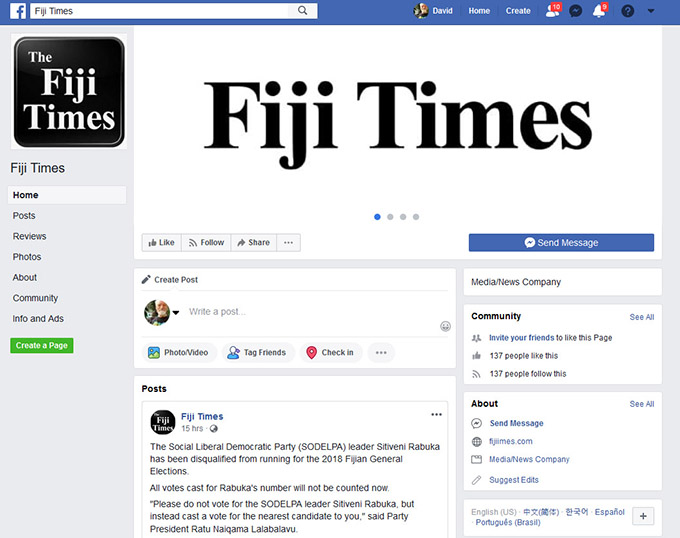 The Fake Fiji Times FB page. Image: PMC
 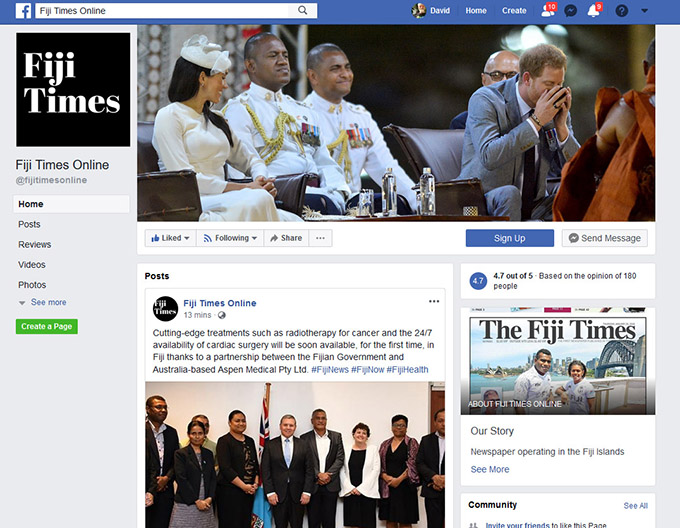 The true Fiji Times FB page. Image: PMC
False news warning
Radio NZ Pacific reports that election authorities in Fiji are warning about false news stories in the run-up to tomorrow’s election.
They were telling people to report any so-called fake news.
Social media users have found fake media sites with items about visa-free access to Australia and a ban on celebrating Diwali.
Ashwin Raj, of Fiji’s media authority, said there was so much fake news that audiences found it hard to decide which was fact or fiction.
Raj said people should report fake news.
A two-day campaign blackout started at midnight on Sunday, but the complaints to the elections office said some material remained on banners and car stickers.
Offenders risk the chance of a hefty fine and up to 10 years in jail.

Article by AsiaPacificReport.nz
]]>Why controversial child protection reforms in NSW could lead to another Stolen Generation

Source: The Conversation (Au and NZ) – By Alison Whittaker, Research Fellow, University of Technology Sydney
Among the most significant powers exercised by governments is that of removing children from their families. Potential reforms before the NSW parliament this week would expand this power in frightening ways.
The reforms contained in the Children and Young Persons (Care and Protection) Amendment Bill represent a radical shift in basic child welfare principles. These changes could make removals more permanent, while dispensing with core safeguards and transparency measures. It is Aboriginal communities who stand to lose the most.
Children are already being removed from Indigenous communities at an unprecedented rate. Indigenous children make up 36.9% of children in out-of-home care in Australia, despite being just 3% of the population.
And stakeholders ranging from the Kinchela Boys Home Aboriginal Corporation to the peak body for Community Legal Centres NSW are fearful that, if passed, the NSW legislation will force adoptions and create another Stolen Generation.
What’s been proposed?
We’re especially concerned by four fundamental proposed changes:
- placing a two-year limit on creating a permanent arrangement for a child
- making guardianship orders by consent outside of courts
- amending how families can apply for restoration
- removing parental consent to adoption for children on permanent orders.
Proponents suggest the reforms are aimed at stopping children “flopping from one foster home to another”, as Pru Goward, NSW minister for family and community services, put it.
Pru Goward says the bill will bring ‘landmark reforms’ to the state’s child protection system. Dean Lewins/AAPHowever, we are talking here about legally permanent care arrangements being made with arbitrary deadlines.
As Aboriginal advocates have argued, and as the evidence attests, family and kin support is key to keeping Aboriginal kids home, safe and connected with their culture. The reforms proposed in the bill will make it much harder to achieve that goal.
A permanent placement within two years
The most commonly criticised feature of the bill is the arbitrary maximum period of two years within which a decision about permanent placement has to be made.
As governments increasingly outsource their child welfare responsibilities to private agencies, there is a danger that market incentives can intrude into decision-making. The incentive to cycle children into permanent arrangements, regardless of their suitability, to meet performance indicators and targets is particularly chilling.
In Australia, the Royal Commission into Institutional Responses to Child Sex Abuse noted the vulnerability of children in care to sex abuse. Yet, once children are placed on guardianship orders or adopted, they are on their own, with no further review or oversight. They are no longer counted in the out-of-home care statistics.
And the factors that cause children to enter into care – especially Aboriginal children – aren’t usually solved within a two-year time frame. They’re often related to poverty and inter-generational trauma. These include insecure housing, drug and alcohol addiction, family violence, and mental health and behavioural problems.
Read more: Child protection report lacks crucial national detail on abuse in out-of-home care
Almost half of all children in out-of-home care in NSW in 2014-2015 had a parent who had contact with the child welfare department themselves when they were a child.
Services to address these problems (such as support for victims of domestic violence and rehabilitation facilities) are either not available or have a lengthy wait list – sometimes two years or longer.
And it’s hard to see how the frequently backlogged NSW Children’s Court could cope with the additional pressure of a looming two-year deadline.
The changes create insurmountable conditions tantamount to permanent removal with no oversight.
Guardianship orders ‘by consent’ outside of courts
Under the bill, permanent care orders can be made “by consent” in alternative dispute resolution without necessarily establishing a child is at risk. As the Law Society of NSW says in its submission to the state government:
While the child’s safety and best interests are of course paramount, these provisions would allow the court to make a guardianship order with the parents’ consent, even where there is no finding that a child is at risk of significant harm or should be subject to a care and protection order.
These decisions will be made in negotiations – without judicial oversight – between families, governments, agencies and carers with vastly different legal resources, powers and goals. Families will be assisted by lawyers who may be ill-equipped to deal with a sudden influx of new cases in an unfamiliar forum.
Read more: Why children in institutional care may be worse off now than they were in the 19th century
The legislation provides limited safeguards, but these cannot make the alternative dispute resolution suitable in cases where fundamental legal rights – such as the state breaking up a family – are at stake.
This means thousands of children who have already been transferred from foster care to private guardianship arrangements – over 894 of them Indigenous as of June 2017 – could soon be adopted without their parents’ knowledge or consent.
Once a decision has been made, the reforms narrow the criteria for reviewing them. This makes it virtually impossible for families to get permanent placement decisions changed.
In its own report on the bill, the NSW government conceded most stakeholders opposed these changes.
Rushed process leaving little time for response
Decisions such as these already take place in the context of the unconscious bias and structural racism of the out-of-home care system. And Indigenous child placement principles – which aim to keep children safe while retaining their connections to family, community, culture and country – are not being properly implemented.
Read more: FactCheck Q&A: are Indigenous children ten times more likely to be living in out-of-home care?
We do not yet know the extent of that system failure. The NSW government is not waiting for the results of an ongoing review into how it handles Aboriginal child placements. A similar review in Victoria revealed that systematic failings have contributed to the over-representation of Aboriginal children in care and that over 60% of those children had been placed with non-Aboriginal carers.
It is astonishing this bill is being rushed straight to the upper house in the last sitting days before the NSW election in March, leaving no chance for adequate debate and giving Aboriginal stakeholders just weeks’ notice to respond. A recent motion to send the bill to a short inquiry that would last mere days was voted down.
We know that NSW child protection laws need to change, but not this way. The Commonwealth government has apologised to the Stolen Generations, and the NSW government has apologised to survivors of forced adoptions. Both apologies warned us of the need to learn from past policies. If this bill passes, we will have all but forgotten them.
– ref. Why controversial child protection reforms in NSW could lead to another Stolen Generation – http://theconversation.com/why-controversial-child-protection-reforms-in-nsw-could-lead-to-another-stolen-generation-106330]]>Newsletter: New Zealand Politics Daily – November 13 2018
Newsletter: New Zealand Politics Daily – November 13 2018
Editor’s Note: Here below is a list of the main issues currently under discussion in New Zealand and links to media coverage.
[caption id="attachment_297" align="aligncenter" width="640"] The Beehive and Parliament Buildings.[/caption]
Child abuse inquiry to include faith-based institutions
Barry Soper (Newstalk ZB): Child abuse inquiry – Brace yourself for NZ’s cruel past
1News: Jack Tame questions Acting PM Kelvin Davis over Government’s decision to limit timeframe for child abuse inquiry
Phil Pennington (RNZ): Abuse survivors encouraged to speak as inquiry scope widens
Jason Walls (Herald): Royal Commission of Inquiry into Historical Abuse in State Care largest ever undertaken in New Zealand, says Sir Anand Satyanand
Chris Morris (ODT): Abuse inquiry widened
Chris Morris (ODT): ‘Should have done it sooner’: Survivor on abuse inquiry
Lucy Bennett (Herald): Apology needed for people abused in state and church care: sex abuse survivors support group
Chris Bramwell (RNZ): Religious institutions to be included in state abuse inquiry
Thomas Coughlan (Newsroom): Churches to be examined in state care abuse inquiry
1News: Watch: PM widens inquiry into abuse of children in state care to include faith-based institutions
Jason Walls (Herald): Royal Commission of Inquiry into Historical Abuse in State Care will now include churches, PM Jacinda Ardern says
Stacey Kirk and Tom Hunt (Stuff): Government expands abuse inquiry to churches and ‘faith-based institutions’
Megan Sutherland (Newshub): Government expands state care abuse inquiry to include church abuse
Police
Herald Editorial: Police commissioner does not come out of Haumaha inquiry well
Jared Savage (Herald): New details of bullying allegations against Wally Haumaha outlined in report
Gia Garrick (Herald): Louise Nicholas stands by criticism after report clears Wally Haumaha
Derek Cheng (Herald):Louise Nicholas concerns not relevant to Haumaha appointment process – Police Commissioner
Anna Bracewell-Worrall (Newshub): ‘We struggled to get taken seriously’: Women speak out on Wally Haumaha inquiry
RNZ: Wally Haumaha: ‘It has not been easy for anyone’
Scott Palmer (Newshub): Police Minister Stuart Nash won’t back Wally Haumaha despite inquiry clearing him
Jared Savage (Herald): Wally Haumaha inquiry: Government releases QC’s report into appointment process for Police Deputy Commissioner
Thomas Coughlan (Newsroom): Haumaha report clears Government
Stacey Kirk (Stuff): Wally Haumaha inquiry and the politics of perception
Thomas Manch (Stuff): Top cop Wally Haumaha ‘looking forward’ to continuing his work after report clears his appointment
Thomas Manch (Stuff): Top cop Wally Haumaha’s appointment cleared by Government inquiry
Anna Whyte (1News): Appointment process for Deputy Police Commissioner Wally Haumaha found to be ‘adequate and fit for purpose’ – report
Jo Moir (RNZ): Haumaha appointment process was ‘adequate and fit for purpose’
Newstalk ZB: Inquiry into Wally Haumaha finds appointment process was adequate
No Right Turn: This is what happens when agencies investigate themselves
Derek Cheng (Herald): Wally Haumaha report raises more questions than answers, says National Party
Matt Shand (Stuff): Opposition police spokesman says Haumaha sends wrong message for police
No Right Turn: We don’t need more terror laws
Sinead Corcoran (Stuff): NZ Police and Pride Board in ‘negotiations’ over uniform ban
RNZ: Calls for Pride boycott over uniform ban
Cleo Fraser (Newshub): ‘You f***ed up’: Nelson man wants compensation after police shoot dog
Teachers’ pay dispute
Press Editorial: Teachers test the Government
Jessica Long (Stuff): Why primary teachers’ and principals’ negotiations have led to strike action
1News: North Island schools closed as week-long primary teachers’ strike rolls into second day
John Gerritsen (RNZ): Teachers defend strike decision
John Lewis (ODT): Offer ‘too late’ to avert strike: OPPA chairman
1News: ‘This is all we’ve got’ – Government pushed to limit on primary pay offer, says PM
Simon Collins (Herald): Education Minister Chris Hipkins says teachers keep asking for more
RNZ:Primary and secondary teachers may have combined campaign in 2019
Nicole Bremner (!News): Fighting talk from teachers’ union president, who says fight with Government ‘will get rougher’
Scott Palmer (Newshub): Teachers not ruling out third strike to fix education ‘crisis’ – NZEI
Simon Collins (Herald): Striking primary teachers at meeting in Auckland are urged to ‘fight for your professional lives’
Josephine Franks and Collette Devlin (Stuff): Striking Auckland teachers ‘living pay cheque to pay cheque’ take to the streets
RNZ: Teachers strike: What you need to know
Diane Crate (Stuff): New offer for teachers is misleading, here’s the truth
Simon Collins (Herald): Parents taking extra ‘Dad Sunday’ back teachers’ strikes
Jodie Rimmer (Herald): As parents we need to get behind the teachers’ strike
Point of Order: After expelling the charter schools, Hipkins is pressed to do better on teachers’ pay
Josephine Franks (Stuff): Hunger strikes, a 180km march, 3-month walkouts: Teacher protests around the world
Education
Simon Collins (Herald): Struggling to learn: Brain science reveals why some kids learn differently
Jessica Long (Stuff): NZQA’s digital pilot goes offline to affect English students
Native Affairs (Māori TV): The digital future of education
Rachel Rafferty (Briefing Papers): The costs of choice in the New Zealand history curriculum
Bullying
Rhonwyn Newson (Newshub): Stand Strong NZ: New series calls for a tougher stance on school bullying
Raniera Harrison (Māori TV): Bullying in NZ schools second highest in OECD
Zane Small (Newshub): Stand Strong NZ: ‘The fallout is huge’ – Kiwi teen’s death brings cyberbullying into focus
Patrick Gower (Newshub): Stand Strong NZ: Patrick Gower – I refused to let name-calling stop me chasing my dreams
Alice Webb-Liddall (Newshub): Stand Strong NZ: Beautiful messages flood in for Patrick Gower after bullying revelations
Eilish Grieveson (Newshub): When the bullied become the bullies
Environment and conservation
Craig McCulloch (RNZ): Green MP Eugenie Sage accused of ‘rubber-stamping’ land sales to foreigners
Simon Hampton and Zane Small (Newshub): Paris Agreement regulations won’t stop ice sheet collapse – report
Amber-Leigh Woolf (Stuff): Capital Kiwi: Owner of Te Kamaru Station says he wants kiwi back on his land
Amber-Leigh Woolf (Stuff): Capital Kiwi: First of 4400 traps set at Terawhiti station
Dan Dalgety (RNZ): ‘We think it can be a safe place for kiwi to live’
Laura Macdonald (Newshub): Why kiwi could be seen in Wellington backyards in just five years
Rowan Quinn (RNZ): Battle against Dome Valley dump plan gears up
Dave Nicoll (Stuff): Environment Southland takes top honours at biosecurity awards
ODT Editorial: Back yards an untapped resource
Wayne Linklater (Stuff): ‘Facts’ don’t give scientists a monopoly on the truth
Justice
Victoria University (Newsroom): One law for all or one justice for all?
David Farrar: Judicial pensions
Vincent Olsen-Reeder (Spinoff): When a judge slaps down a lawyer for a few words of te reo, it’s about power
Sam Hurley (Herald): Herald challenges judge’s decision to suppress ‘callous’ man who robbed injured crash victim
Housing
Phil Twyford (ODT): Setting the record straight on the KiwiBuild scheme
Felix Desmarais (Stuff): KiwiBuild signals interest in ‘pocket’ of prime land on Wellington peninsula
Susan Edmunds (Stuff): Government ‘risks lack of KiwiBuild buyers’
Armistice centenary
Chris Trotter (Daily Blog): A Diet Of Lies
Alice Webb-Liddall (Newshub): Winston Peters criticises French President Emmanuel Macron’s Armistice Day speech
1News: Winston Peters criticises Emmanuel Macron’s Armistice Day speech in Paris
NZ-Pacific relationship, Pacific Aotearoa Summit
RNZ: Cooks delighted as NZ Super qualification eased
RNZ: NZ planned Pacific TV service not what is needed – expert
Vaimoana Tapaleao (Herald): State of Pasifika community in New Zealand to be revealed at Pacific Summit
Defence
1News: New Defence Force boss on working with China – ‘We have discussions about how we can cooperate in the South Pacific’
Newshub: Why terrorists aren’t targeting New Zealand
Foreign affairs
Laura Walters (Newsroom): Great power rivalry on the agenda
Zane Small (Newshub): What Jacinda Ardern plans to tell Australian PM Scott Morrison
Government
Jenée Tibshraeny (Interest): Meeting with Adrian Orr among those not disclosed by Shane Jones
Katie Kenny (Stuff): Algorithms are everywhere but the public sector seems scared to use them
Richard MacManus (Newsroom): How Government algorithms are judging you
Point of Order: Ministerial appointments monitor – jobs for the boys (and jobs for the girls, too)
Banking and finance
Tim Hazledine (Herald): Govt should use Kiwibank to undercut the big four
Jenée Tibshraeny (Interest): Jones accuses the FMA of being ‘chummy’ with banks, the RBNZ of being too independent and the Super Fund of using the wrong investment strategy
Transport
Bernard Orsman (Herald): Auckland cycleways overestimated demand to obtain taxpayer funding, says Auckland Transport report
Mike Hosking (Newstalk ZB): Cycleways exposed as the sham they are
Michael Naylor (Herald): E-bikes, e-scooters and e-vehicles pose a threat to public transport
Ruby Macandrew (Stuff):Lime scooters likely to launch in Wellington before the end of summer
Ben Strang (RNZ): Pilots seek stricter drone laws as they await improved technology
Kate Gudsell (RNZ): Drone disrupting airspace ‘could have been catastrophic’
Local government
Matthew Littlewood (Stuff): Economists see lack of detail in Alpine Energy share sale proposal
Janine Rankin (Manawatū Standard): Ombudsman decision savages Horowhenua email blocking
Herald: Chief Ombudsman asks Horowhenua council to apologise for blocking mayor’s and councillors’ email
RNZ: Ombudsman – Council’s blocking of emails wrong
No Right Turn: Unreasonable
Auckland
Bernard Orsman (Herald): Buying a section in a new development north of Auckland will come with an ‘infrastructure payment’; tagged onto rates bill
Newshub: North Auckland gets $91m infrastructure package
Bill McKay (Newsroom): Yes to Auckland CBD stadium, just not the waterfront
Nick Truebridge (Stuff): $1.8b Auckland stadium plan on shaky ground as council pours cold water on funding plea
Waitara Lands Bill
Robin Martin (RNZ): Hapū divided over Waitara Lands Bill
Deena Coster (Stuff): Govt Minister Andrew Little listens to concerns of Waitara leaseholders as bill reading looms
Health
RNZ: New unit to transform critical care at Dunedin Hospital
David Loughrey (ODT): Build will be more complex due to soils
Angie Skerrett (Newshub): ‘Virtual campus’ suggested to ease rural doctor shortage
Leonie Hayden (Spinoff): Under the Korowai: new approaches to Māori mental health
Eric Crampton: Sugar tax advice
Ngāi Tahu agreement with Oranga Tamariki
RNZ: ‘We are really interested in stepping up’
Regan Paranihi (Māori tV): Oranga Tamariki team up with Ngāi Tahu
Employment and training
Richard Harman (Politik): Budget to include radical new approach to skills retraining
John Boynton (RNZ): Programme builds rangatahi’s confidence to climb leadership ladder
One Billion Trees Project
David Fisher (Herald): Shane Jones’ One Billion Trees bungle: scrub, weeds mar planting of 1 million seedlings
Kate Nicol-Williams (1News): Nurseries call for quicker action on Govt’s plan to plant 1 billion trees by 2027
Canterbury earthquakes, earthquake risks
RNZ: Govt to announce details of independent inquiry into EQC
Liz McDonald (Stuff): Test case for on-sold homes with botched repairs still nine months away
Chloe Ranford (Stuff): Liquefaction report says rivers most at risk
Abortion
Trish McBride (Stuff): Deciding to abort must be more than a simple solution to a problem
Bob McCoskrie: We love them both
Amy Brooke: Jacinda Ardern’s priorities aren’t most New Zealanders
Media
Colin Peacock (RNZ): Rank and file missing from conference coverage
Stuff: Journalism figure Brian Priestley dies
Primary industries
David Williams (Newsroom): Minister challenged over Mackenzie greening
Angie Skerrett (Newshub): Misinformation puts extra pressure on M bovis farmers
Iulia Leilua (Māori TV): Turning pollution into profit
Business, economy
RNZ: Low confidence threat to economic growth – Bridges
David Cormack (Herald): Silly Simon Bridges should avoid repeating Angry Andy Little’s mistake
Native Affairs (Māori TV): Māori enterprise – awakening the taniwha
Mainzeal
Matthew Theunissen (RNZ): Mainzeal loan generated hundreds of millions in wealth, court hears
RNZ: Mainzeal directors should’ve said they’d resign: lawyer
Civil defence
Alice Webb-Liddall (Newshub): Civil Defence to test another mobile alert this weekend
1News: Nationwide test of Emergency Mobile Alert system announced
Other
Phil Pennington (RNZ): Controversial Codemark certificates axed
Aaron Leaman (Stuff): KiwiRail defends decision to purchase new diesel trains
Russell Brown (Public Address): Getting serious about the cannabis referendum
RNZ: New Zealanders losing millions to scammers, new data shows
Tamsyn Parker (Herald): Scam victim: ‘I felt like vomiting’
Susan Edmunds (Stuff): Meridian: Here’s how households could save $180m
Mark Jennings (Newsroom): It was a hurricane with no name: Vector boss
1News: Simon Bridges hints there may be more than just ministerial incompetence behind Karel Sroubek scandal
Zane Small (Newshub): ‘Indoctrination?’: Questions over Church of Scientology’s free English lessons
Madeleine Chapman (Spinoff): Which MP occupies the worst seat in parliament? A Spinoff investigation
Conan Young (RNZ): Race-fixing charges not expected to impact NZ Trotting Cup]]>
The Beehive and Parliament Buildings.[/caption]
Child abuse inquiry to include faith-based institutions
Barry Soper (Newstalk ZB): Child abuse inquiry – Brace yourself for NZ’s cruel past
1News: Jack Tame questions Acting PM Kelvin Davis over Government’s decision to limit timeframe for child abuse inquiry
Phil Pennington (RNZ): Abuse survivors encouraged to speak as inquiry scope widens
Jason Walls (Herald): Royal Commission of Inquiry into Historical Abuse in State Care largest ever undertaken in New Zealand, says Sir Anand Satyanand
Chris Morris (ODT): Abuse inquiry widened
Chris Morris (ODT): ‘Should have done it sooner’: Survivor on abuse inquiry
Lucy Bennett (Herald): Apology needed for people abused in state and church care: sex abuse survivors support group
Chris Bramwell (RNZ): Religious institutions to be included in state abuse inquiry
Thomas Coughlan (Newsroom): Churches to be examined in state care abuse inquiry
1News: Watch: PM widens inquiry into abuse of children in state care to include faith-based institutions
Jason Walls (Herald): Royal Commission of Inquiry into Historical Abuse in State Care will now include churches, PM Jacinda Ardern says
Stacey Kirk and Tom Hunt (Stuff): Government expands abuse inquiry to churches and ‘faith-based institutions’
Megan Sutherland (Newshub): Government expands state care abuse inquiry to include church abuse
Police
Herald Editorial: Police commissioner does not come out of Haumaha inquiry well
Jared Savage (Herald): New details of bullying allegations against Wally Haumaha outlined in report
Gia Garrick (Herald): Louise Nicholas stands by criticism after report clears Wally Haumaha
Derek Cheng (Herald):Louise Nicholas concerns not relevant to Haumaha appointment process – Police Commissioner
Anna Bracewell-Worrall (Newshub): ‘We struggled to get taken seriously’: Women speak out on Wally Haumaha inquiry
RNZ: Wally Haumaha: ‘It has not been easy for anyone’
Scott Palmer (Newshub): Police Minister Stuart Nash won’t back Wally Haumaha despite inquiry clearing him
Jared Savage (Herald): Wally Haumaha inquiry: Government releases QC’s report into appointment process for Police Deputy Commissioner
Thomas Coughlan (Newsroom): Haumaha report clears Government
Stacey Kirk (Stuff): Wally Haumaha inquiry and the politics of perception
Thomas Manch (Stuff): Top cop Wally Haumaha ‘looking forward’ to continuing his work after report clears his appointment
Thomas Manch (Stuff): Top cop Wally Haumaha’s appointment cleared by Government inquiry
Anna Whyte (1News): Appointment process for Deputy Police Commissioner Wally Haumaha found to be ‘adequate and fit for purpose’ – report
Jo Moir (RNZ): Haumaha appointment process was ‘adequate and fit for purpose’
Newstalk ZB: Inquiry into Wally Haumaha finds appointment process was adequate
No Right Turn: This is what happens when agencies investigate themselves
Derek Cheng (Herald): Wally Haumaha report raises more questions than answers, says National Party
Matt Shand (Stuff): Opposition police spokesman says Haumaha sends wrong message for police
No Right Turn: We don’t need more terror laws
Sinead Corcoran (Stuff): NZ Police and Pride Board in ‘negotiations’ over uniform ban
RNZ: Calls for Pride boycott over uniform ban
Cleo Fraser (Newshub): ‘You f***ed up’: Nelson man wants compensation after police shoot dog
Teachers’ pay dispute
Press Editorial: Teachers test the Government
Jessica Long (Stuff): Why primary teachers’ and principals’ negotiations have led to strike action
1News: North Island schools closed as week-long primary teachers’ strike rolls into second day
John Gerritsen (RNZ): Teachers defend strike decision
John Lewis (ODT): Offer ‘too late’ to avert strike: OPPA chairman
1News: ‘This is all we’ve got’ – Government pushed to limit on primary pay offer, says PM
Simon Collins (Herald): Education Minister Chris Hipkins says teachers keep asking for more
RNZ:Primary and secondary teachers may have combined campaign in 2019
Nicole Bremner (!News): Fighting talk from teachers’ union president, who says fight with Government ‘will get rougher’
Scott Palmer (Newshub): Teachers not ruling out third strike to fix education ‘crisis’ – NZEI
Simon Collins (Herald): Striking primary teachers at meeting in Auckland are urged to ‘fight for your professional lives’
Josephine Franks and Collette Devlin (Stuff): Striking Auckland teachers ‘living pay cheque to pay cheque’ take to the streets
RNZ: Teachers strike: What you need to know
Diane Crate (Stuff): New offer for teachers is misleading, here’s the truth
Simon Collins (Herald): Parents taking extra ‘Dad Sunday’ back teachers’ strikes
Jodie Rimmer (Herald): As parents we need to get behind the teachers’ strike
Point of Order: After expelling the charter schools, Hipkins is pressed to do better on teachers’ pay
Josephine Franks (Stuff): Hunger strikes, a 180km march, 3-month walkouts: Teacher protests around the world
Education
Simon Collins (Herald): Struggling to learn: Brain science reveals why some kids learn differently
Jessica Long (Stuff): NZQA’s digital pilot goes offline to affect English students
Native Affairs (Māori TV): The digital future of education
Rachel Rafferty (Briefing Papers): The costs of choice in the New Zealand history curriculum
Bullying
Rhonwyn Newson (Newshub): Stand Strong NZ: New series calls for a tougher stance on school bullying
Raniera Harrison (Māori TV): Bullying in NZ schools second highest in OECD
Zane Small (Newshub): Stand Strong NZ: ‘The fallout is huge’ – Kiwi teen’s death brings cyberbullying into focus
Patrick Gower (Newshub): Stand Strong NZ: Patrick Gower – I refused to let name-calling stop me chasing my dreams
Alice Webb-Liddall (Newshub): Stand Strong NZ: Beautiful messages flood in for Patrick Gower after bullying revelations
Eilish Grieveson (Newshub): When the bullied become the bullies
Environment and conservation
Craig McCulloch (RNZ): Green MP Eugenie Sage accused of ‘rubber-stamping’ land sales to foreigners
Simon Hampton and Zane Small (Newshub): Paris Agreement regulations won’t stop ice sheet collapse – report
Amber-Leigh Woolf (Stuff): Capital Kiwi: Owner of Te Kamaru Station says he wants kiwi back on his land
Amber-Leigh Woolf (Stuff): Capital Kiwi: First of 4400 traps set at Terawhiti station
Dan Dalgety (RNZ): ‘We think it can be a safe place for kiwi to live’
Laura Macdonald (Newshub): Why kiwi could be seen in Wellington backyards in just five years
Rowan Quinn (RNZ): Battle against Dome Valley dump plan gears up
Dave Nicoll (Stuff): Environment Southland takes top honours at biosecurity awards
ODT Editorial: Back yards an untapped resource
Wayne Linklater (Stuff): ‘Facts’ don’t give scientists a monopoly on the truth
Justice
Victoria University (Newsroom): One law for all or one justice for all?
David Farrar: Judicial pensions
Vincent Olsen-Reeder (Spinoff): When a judge slaps down a lawyer for a few words of te reo, it’s about power
Sam Hurley (Herald): Herald challenges judge’s decision to suppress ‘callous’ man who robbed injured crash victim
Housing
Phil Twyford (ODT): Setting the record straight on the KiwiBuild scheme
Felix Desmarais (Stuff): KiwiBuild signals interest in ‘pocket’ of prime land on Wellington peninsula
Susan Edmunds (Stuff): Government ‘risks lack of KiwiBuild buyers’
Armistice centenary
Chris Trotter (Daily Blog): A Diet Of Lies
Alice Webb-Liddall (Newshub): Winston Peters criticises French President Emmanuel Macron’s Armistice Day speech
1News: Winston Peters criticises Emmanuel Macron’s Armistice Day speech in Paris
NZ-Pacific relationship, Pacific Aotearoa Summit
RNZ: Cooks delighted as NZ Super qualification eased
RNZ: NZ planned Pacific TV service not what is needed – expert
Vaimoana Tapaleao (Herald): State of Pasifika community in New Zealand to be revealed at Pacific Summit
Defence
1News: New Defence Force boss on working with China – ‘We have discussions about how we can cooperate in the South Pacific’
Newshub: Why terrorists aren’t targeting New Zealand
Foreign affairs
Laura Walters (Newsroom): Great power rivalry on the agenda
Zane Small (Newshub): What Jacinda Ardern plans to tell Australian PM Scott Morrison
Government
Jenée Tibshraeny (Interest): Meeting with Adrian Orr among those not disclosed by Shane Jones
Katie Kenny (Stuff): Algorithms are everywhere but the public sector seems scared to use them
Richard MacManus (Newsroom): How Government algorithms are judging you
Point of Order: Ministerial appointments monitor – jobs for the boys (and jobs for the girls, too)
Banking and finance
Tim Hazledine (Herald): Govt should use Kiwibank to undercut the big four
Jenée Tibshraeny (Interest): Jones accuses the FMA of being ‘chummy’ with banks, the RBNZ of being too independent and the Super Fund of using the wrong investment strategy
Transport
Bernard Orsman (Herald): Auckland cycleways overestimated demand to obtain taxpayer funding, says Auckland Transport report
Mike Hosking (Newstalk ZB): Cycleways exposed as the sham they are
Michael Naylor (Herald): E-bikes, e-scooters and e-vehicles pose a threat to public transport
Ruby Macandrew (Stuff):Lime scooters likely to launch in Wellington before the end of summer
Ben Strang (RNZ): Pilots seek stricter drone laws as they await improved technology
Kate Gudsell (RNZ): Drone disrupting airspace ‘could have been catastrophic’
Local government
Matthew Littlewood (Stuff): Economists see lack of detail in Alpine Energy share sale proposal
Janine Rankin (Manawatū Standard): Ombudsman decision savages Horowhenua email blocking
Herald: Chief Ombudsman asks Horowhenua council to apologise for blocking mayor’s and councillors’ email
RNZ: Ombudsman – Council’s blocking of emails wrong
No Right Turn: Unreasonable
Auckland
Bernard Orsman (Herald): Buying a section in a new development north of Auckland will come with an ‘infrastructure payment’; tagged onto rates bill
Newshub: North Auckland gets $91m infrastructure package
Bill McKay (Newsroom): Yes to Auckland CBD stadium, just not the waterfront
Nick Truebridge (Stuff): $1.8b Auckland stadium plan on shaky ground as council pours cold water on funding plea
Waitara Lands Bill
Robin Martin (RNZ): Hapū divided over Waitara Lands Bill
Deena Coster (Stuff): Govt Minister Andrew Little listens to concerns of Waitara leaseholders as bill reading looms
Health
RNZ: New unit to transform critical care at Dunedin Hospital
David Loughrey (ODT): Build will be more complex due to soils
Angie Skerrett (Newshub): ‘Virtual campus’ suggested to ease rural doctor shortage
Leonie Hayden (Spinoff): Under the Korowai: new approaches to Māori mental health
Eric Crampton: Sugar tax advice
Ngāi Tahu agreement with Oranga Tamariki
RNZ: ‘We are really interested in stepping up’
Regan Paranihi (Māori tV): Oranga Tamariki team up with Ngāi Tahu
Employment and training
Richard Harman (Politik): Budget to include radical new approach to skills retraining
John Boynton (RNZ): Programme builds rangatahi’s confidence to climb leadership ladder
One Billion Trees Project
David Fisher (Herald): Shane Jones’ One Billion Trees bungle: scrub, weeds mar planting of 1 million seedlings
Kate Nicol-Williams (1News): Nurseries call for quicker action on Govt’s plan to plant 1 billion trees by 2027
Canterbury earthquakes, earthquake risks
RNZ: Govt to announce details of independent inquiry into EQC
Liz McDonald (Stuff): Test case for on-sold homes with botched repairs still nine months away
Chloe Ranford (Stuff): Liquefaction report says rivers most at risk
Abortion
Trish McBride (Stuff): Deciding to abort must be more than a simple solution to a problem
Bob McCoskrie: We love them both
Amy Brooke: Jacinda Ardern’s priorities aren’t most New Zealanders
Media
Colin Peacock (RNZ): Rank and file missing from conference coverage
Stuff: Journalism figure Brian Priestley dies
Primary industries
David Williams (Newsroom): Minister challenged over Mackenzie greening
Angie Skerrett (Newshub): Misinformation puts extra pressure on M bovis farmers
Iulia Leilua (Māori TV): Turning pollution into profit
Business, economy
RNZ: Low confidence threat to economic growth – Bridges
David Cormack (Herald): Silly Simon Bridges should avoid repeating Angry Andy Little’s mistake
Native Affairs (Māori TV): Māori enterprise – awakening the taniwha
Mainzeal
Matthew Theunissen (RNZ): Mainzeal loan generated hundreds of millions in wealth, court hears
RNZ: Mainzeal directors should’ve said they’d resign: lawyer
Civil defence
Alice Webb-Liddall (Newshub): Civil Defence to test another mobile alert this weekend
1News: Nationwide test of Emergency Mobile Alert system announced
Other
Phil Pennington (RNZ): Controversial Codemark certificates axed
Aaron Leaman (Stuff): KiwiRail defends decision to purchase new diesel trains
Russell Brown (Public Address): Getting serious about the cannabis referendum
RNZ: New Zealanders losing millions to scammers, new data shows
Tamsyn Parker (Herald): Scam victim: ‘I felt like vomiting’
Susan Edmunds (Stuff): Meridian: Here’s how households could save $180m
Mark Jennings (Newsroom): It was a hurricane with no name: Vector boss
1News: Simon Bridges hints there may be more than just ministerial incompetence behind Karel Sroubek scandal
Zane Small (Newshub): ‘Indoctrination?’: Questions over Church of Scientology’s free English lessons
Madeleine Chapman (Spinoff): Which MP occupies the worst seat in parliament? A Spinoff investigation
Conan Young (RNZ): Race-fixing charges not expected to impact NZ Trotting Cup]]>
Marshall Islands president narrowly survives no-confidence vote

 Marshall Islands President Dr Hilda Heine … survived challenge to her government’s policies. Image: SPC
By Giff Johnson in Majuro for RNZ Pacific
Marshall Islands President Hilda Heine has survived a vote of no confidence with parliament, the Nitijela, split evenly 16-16
The movers of the motion needed 17 votes to topple Dr Heine. The vote was held yesterday with 32 of the 33 members present, as one was off-island for medical treatment.
Heine, Finance Minister Brenson Wase and Foreign Minister John Silk led 45 minutes of government response to the five issues outlined by the motion movers, with Dr Heine saying the vote was really a “referendum about our own politics.”
Wase said the criticism of the government for moving ahead with a digital currency plan had been overtaken by events, with numerous countries in the Pacific following the Marshall Islands by announcing plans for their own digital currencies and requesting support from the International Monetary Fund (IMF).
He said delays in releasing the Marshall Islands’ “SOV” currency were so the country could meet the requirements of the US, European Union and others.
Silk said the international recognition accorded Heine and her government showed the opposition’s contention that the government had ruined the nation’s reputation internationally was wrong.
He cited donors doubling their annual grants and the country’s chairmanship of various global climate groups.
Lack of transparency
Opposition Senators Casten Nemra, Bruce Bilimon and Alfred Alfred, Jr. fired back, hammering the government on lack of transparency in handling theft of money from its national trust fund in 2017 and saying the government had taken away people’s right to vote by eliminating postal absentee balloting for islanders living offshore.
The parliament chamber was packed with a standing-room only crowd to view the debate and the vote that followed.
Immediately after the results were confirmed, Speaker Kenneth Kedi, who had backed the no confidence move, congratulated Dr Heine and her Cabinet, and then, following a motion to recess, declared Nitijela to be in recess.
Giff Johnson is editor of the Marshall Islands Journal and correspondent for RNZ Pacific. This article is republished under the Pacific Media Centre’s content partnership with Radio New Zealand.
Article by AsiaPacificReport.nz
]]>How the use of emoji on Islamophobic Facebook pages amplifies racism

Source: The Conversation (Au and NZ) – By Ariadna Matamoros-Fernández, Lecturer in Digital Media at the School of Communication, Queensland University of Technology
In the aftermath of the fatal stabbing in Melbourne’s Bourke Street on Friday, Facebook and other social media platforms were flooded with hateful messages towards Muslims and Islam.
Over the weekend, I browsed several Islamophobic Facebook pages, such as “No sharia law – Never ever give up Australia” and “Reclaim Australia”. These groups were using the incident to dehumanise Muslims by sharing mocking memes, GIFs, decontextualised information, and blatantly racist comments.
I noted the “angry” reaction button being widely used in response to posts, while comments on posts were often accompanied by other emoji that emphasised states of rage towards Muslims: angry face, pouting face, swearing face.
Facebook emoji reactions. Screengrabbed by author, November 2018This kind of emoji use involves overt racist language and practices, but emoji can also be used to cloak everyday microaggressions in humour and play. For example, previous research has found how online harassers often use cues such as smiley emoticons to mitigate their abuse.
Racism on social media is structural too. A larger body of evidence shows that it can be built into, and normalised by, social media platforms, which also have the power to curb it by instituting responsible policies and processes.
Using emoji to amplify Islamophobia
Facebook introduced “reactions” in early 2016. Beyond just a simple “like”, this function allowed users to interact with posts and comments by clicking on emoji-like buttons to signify emotions: love, laughter, surprise, sadness and anger.
Since then, hate groups and other users have appropriated this technical feature to spread anger towards specific targets. One way of doing this involves overlaying a question on an image or video and encouraging users to respond by choosing between two reactions, with the “angry” reaction typically being one of the options.
In the below example, taken from a Belgian far-right political party’s Facebook page, users are asked to respond to the question of whether the school year should be adapted to accommodate Islamic traditions.
Facebook images posted by Flemish far-right political party Vlaams Belang incite its audience to express anger against Muslims. Screengrabbed by author, September 2017In this way, “reactions” facilitate the performance of rage and antagonism towards other groups by allowing users to click on an angry-faced emoji.
The way Facebook uses this information can have problematic consequences. According to a 2016 blog post, Facebook’s algorithms interpret the clicking of the “angry” reaction on a post as an indication that users want to see more content related to those posts. Islamophobic content that attracts high numbers of “angry” reactions therefore has the potential to become even more visible and shareable.
Facebook also uses these emotional responses to posts to create user profiles to sell to advertisers. The creation of automated categories based on user behaviour has involved Facebook in several public scandals. For example, in the past, Facebook has reportedly allowed advertisers to target “jew haters” and people interested in “white genocide conspiracy theory” – a useful tool for people who wish to spread hate.
How emoji can reproduce cultural stereotypes
In general, emoji are benign and funny digital images. But their design and use can reproduce long-running racist stereotypes.
The US body responsible for the emoji set, the Unicode Consortium, decides what ends up being represented as emoji. At times, these decisions have caused controversies around cultural diversity and race. For example, Apple’s family emojis originally excluded depictions of same-sex couples.
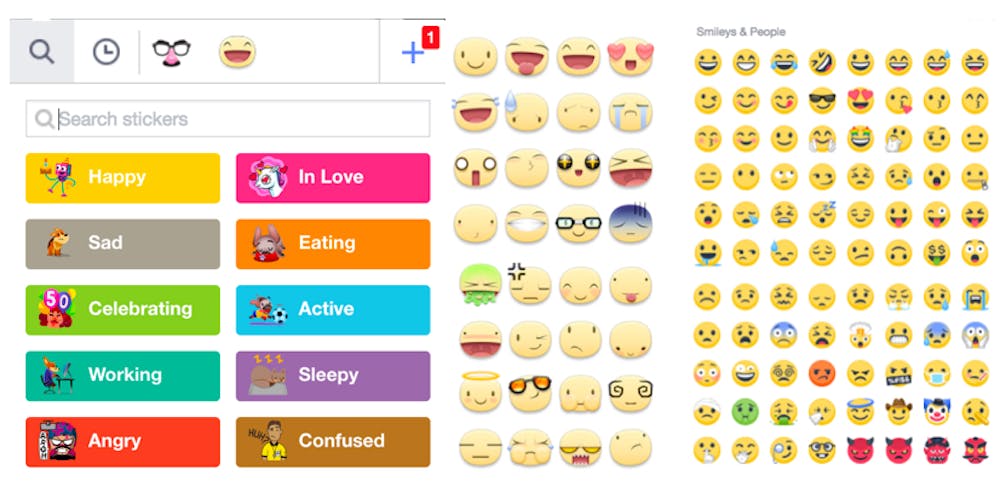
Sticker categories for comments offered by Facebook by default (left), Facebook’s Meep Stickers (centre) and emoji’s facial expressions (right) Screengrabbed by author, September 2017Racist stereotypes can be further entrenched by the way emoji are used. In my study of the use of Facebook reactions by Belgian far-right political party, Vlaams Belang, I examined how emoji were used to spread anger. I found that users often responded to posts by posting more emoji and Meep stickers.
Facebook’s vomit Meep sticker.The vomit sticker surfaced as a popular and recurrent choice to express disgust towards Muslims.
A pig sticker is posted in response to a questions asking if policewomen should be able to wear their headscarves.‘ Screengrabbed by author, May 2017This aligns with other exploitations of the act of vomiting as a cultural trope to convey xenophobia.
For example, the British television series Little Britain used hyperbolic humour to ridicule the racism of Maggie Blackamoor, one of its characters, by having her vomit every time she ate food made by a non-white person, or met people from different ethnicities.
People also used pig emoji, and various stickers, to show opposition to Muslims. According to Islamic law, eating pork is forbidden, and, historically, Western Islamophobia has used pork to attack Muslims.
The practice of posting pig emoji on the comments of Islamophobic posts draws on this long tradition, contributing to the weaponising of pork to antagonise Muslims.
The challenge of moderating social media content
The fact that racist discourse proliferates through emoji and stickers on Facebook suggests a need for new ways to moderate content.
It is not currently possible to switch off the use of emoji and stickers in comments. That means that people can flood Facebook public pages with problematic emoji, without the platform having an easy solution to it. While Facebook has automated filters to moderate certain words and textual expressions, there isn’t yet a filter to ban emoji, even though they are standardised characters.
Reporting emoji and other stickers as hate speech can be difficult, if not impossible. Whether a cute pig emoji signifies Islamophobia depends on the context in which it was posted, and Facebook’s flagging mechanism doesn’t allow users to explain why certain content might be hateful.
As a result, the practice of weaponising emoji to spread racist discourse is likely to continue.
Failing to provide options to report or minimise certain uses of emoji reflects an assumption that emoji and stickers can’t be used for hateful purposes. But it’s clear that user practices on social media, and the way platforms mediate that use, can contribute to structural racism and other forms of oppression, and make them appear normal, mundane and acceptable.
We all have an interest in ensuring that social media companies take proper responsibility to prevent the content that appears on their platforms from being used to spread hate.
– ref. How the use of emoji on Islamophobic Facebook pages amplifies racism – http://theconversation.com/how-the-use-of-emoji-on-islamophobic-facebook-pages-amplifies-racism-105285]]>Morrison wants Muslim leaders to do more to prevent terrorism, but what more can they do?

Source: The Conversation (Au and NZ) – By Greg Barton, Chair in Global Islamic Politics, Alfred Deakin Institute for Citizenship and Globalisation; Co-Director, Australian Intervention Support Hub, Deakin University
With the simple statement “more needs to happen”, Prime Minister Scott Morrison was emphatic. In the wake of the terror attack on the crowded streets of Melbourne’s CBD last Friday, it is difficult to argue against any plan to do more to fight terrorism in Australia.
The question is what can be done and what should be done. Morrison, in part, put the onus on religious leaders by urging them not to “look the other way”:
If you’re an imam or a leader in one of those communities, you need to know who those people are in your community that might be doing that.
But exactly what it is they should be doing to help prevent similar terror attacks is not spelt out.
Read more: Out of the ashes of Afghanistan and Iraq: the rise and rise of Islamic State
Lone-actor attacks hard to anticipate
Leaving aside the politically charged nature of comments from government ministers – campaigning ahead of the fast-approaching elections in Victoria and imminent federal elections in the new year – it is important to take an objective look at what reasonably can be done.
Friday’s attack was the sort of terrorist attack that police have identified as being their primary concern.
Clearly Australian authorities, along with counter-terrorism forces around the world, have been very effective in preventing large-scale, ambitious terrorist plots. A lot of hard work and enormous resources have gone into ensuring that the sort of massive attacks that jihadi terrorists carried out in New York, Bali, Madrid and London at the beginning of the century have not being repeated.
Read more: How the Australian government is failing on countering violent extremism
But lone-actor attacks continue to worry police precisely because they are so very hard to anticipate and disrupt. When one or two people decide to launch an attack with little planning and no communications across a larger terrorist network, the methods of intelligence that are so successful in preventing large-scale attacks have little utility.
One of the problems with suggesting that Muslim leaders need to “do more” is that it implies they have information they are not sharing, or that they’re failing to take action when they see a problem.
The reality is that Islamic leaders generally have little to do with the troubled young people most likely to be involved in lone-actor attacks like the one in Melbourne. Muslim communities, like many others in multicultural Australia, face a challenge in closing the gap between young people and the older generation recognised as the community’s formal leaders or religious teachers. They live in two separate worlds.
It is not the actively religious young people who are generally the source of problems. Rather, it is the alienated and the angry who turn their backs on community leaders – they are the real concern.
Among those attackers who do become religious, they generally reject mainstream religious leadership, making it difficult for those imams, for instance, to spot troubled youth and intervene.
Community-based outreach can have an impact
More than 250 passports have been cancelled or suspended by the Australian government over the last six years and many more people have had their travel plans stopped on the grounds of reasonable suspicion that they intended to travel to the Middle East and join a terrorist group like Islamic State.
They have not been found guilty of any crime and are under no legal obligation, generally speaking, to participate in rehabilitation programs.
Nevertheless, state and federal police are quietly having considerable success in working with these young people, on a voluntary basis, to reengage them with their families and communities. Some members of the Australian National Imams Council (ANIC) play a key role in this low-key work. Mental health professionals, counsellors and social workers work alongside religious teachers in attempting to turn troubled young lives around.
Can anything more be done? Almost certainly. While dozens of youths at risk of radicalisation currently receive help in this manner, there are hundreds of others who are not benefiting from structured interventions.
The lack of any legal compulsion for them to participate in one of these community-based programs is certainly one of the problems. But so, too, is the lack of resources. In comparison with the many tens of millions of dollars spent at the hard end of countering terrorism, the resources provided to youth workers and community intervention programs remain pitifully small.
If anything more can be done, it is in this area. Simply finding the resources to employ a hundred properly trained and equipped youth workers to engage with at-risk youths would likely yield considerable dividends.
But this will only be achieved with trust and confidence built on mutual respect. The last thing that is needed is to publicly call out Islamic leaders, and Muslims in general, and lay the problem at their feet. This is not fair. We don’t do this with other communities.
And doing this threatens to undermine so much of the good work that is being done away from the spotlight of public attention.
– ref. Morrison wants Muslim leaders to do more to prevent terrorism, but what more can they do? – http://theconversation.com/morrison-wants-muslim-leaders-to-do-more-to-prevent-terrorism-but-what-more-can-they-do-106776]]>FactCheck Q&A: have 90% of Labor MPs worked in trade unions?

Source: The Conversation (Au and NZ) – By Ray Markey, Emeritus Professor, Macquarie University
The Conversation fact-checks claims made on Q&A, broadcast Mondays on the ABC at 9.35pm. Thank you to everyone who sent us quotes for checking via Twitter using the hashtags #FactCheck and #QandA, on Facebook or by email.
Excerpt from Q&A, October 2, 2018.
It’s nice for Amanda to say you need to reflect society, but you can’t reflect society if 90% of your members of parliament were chosen from trade unions and worked in trade unions and that’s the background they bring to the table.
– Minister for Trade, Tourism and Investment Simon Birmingham, speaking on Q&A, October 2, 2018
On an episode of Q&A, panellists discussed the extent to which the composition of the Australian parliament reflects the demographic make up of society.
Labor MP Amanda Rishworth said in addition to having women account for 50% of parliamentarians, there needed to be more diversity of skills and experience.
“So we need to move further than just looking at men and women. We need people from a whole range of backgrounds,” Rishworth said.
Minister for Trade, Tourism and Investment Simon Birmingham later suggested to Rishworth that “you can’t reflect society if 90% of your members of parliament were chosen from trade unions and worked in trade unions, and that’s the background they bring to the table”.
Let’s check the records.
Response from a spokesperson for Simon Birmingham
In response to The Conversation’s request for sources and comment, a spokesperson for Simon Birmingham provided a 2015-16 membership application form for the South Australian branch of the Australian Labor Party and said:
Based on this application, and the disclaimer that a person applying for membership must be a member of a union, it would seem the Minister may have underestimated the percentage.
Verdict
On Q&A, Minister for Trade, Tourism and Investment Simon Birmingham said “90% of [Labor’s] members of parliament were chosen from trade unions and worked in trade unions”. In terms of federal parliamentarians, this is a gross exaggeration.
According to parliamentary members’ biographies, taken from the 45th Parliamentary Handbook of the Commonwealth of Australia, 2017, about one third (33.7%) of Labor’s currently serving federal MPs have worked in trade unions, or 32 of Labor’s 95 members of federal parliament (the total comprising 69 members of the House of Representatives and 26 Senators).
Regarding the source provided by the Minister’s office
The source provided by Minister Birmingham’s office doesn’t support the statement; it refers to a discounted fee offered for South Australian Labor party membership if the applicant is also a union member. Having been a member of a union isn’t the same as having worked for one, and being a union member isn’t a requirement of becoming a member of the Labor party.
How many Labor MPs have worked in trade unions?
A trade union is a member-based organisation that represents the interests of workers in particular industries, or groups of industries, to employers. The Australian Labor Party grew out of the union movement in the 1890s. Affiliated unions play a significant role in the Labor party today; in its internal structures and forums, and influence in choice of parliamentary candidates.
The proportion of former union officials entering parliament as Labor members peaked in 1901, at 79% of Labor representatives. The proportion has been declining steadily since then.
Minister Birmingham referred to members of parliament (MPs) who had been “chosen from” and “worked in trade unions” and who bring that background to the table. In this FactCheck, we’ll look at members of both the House of Representatives and the Senate who have worked in trade unions.
To see how things stand today, we can look to the Parliamentary Handbook of the Commonwealth of Australia 2017, which includes the biographies of the 76 Senators and 150 members of the House of Representatives in the current (45th) federal parliament. (Four of the Labor MPs listed in the handbook, which was published in July 2017, are no longer in parliament: Sam Dastyari, David Feeney, Katy Gallagher and Tim Hammond.)
Included in these biographies are MPs’ qualifications and occupations before entering federal Parliament.
According to those biographies, the proportion of Labor MPs who have worked in trade unions is about a third (33.7%). That’s 32 of Labor’s 95 members of parliament (the total comprising 69 members of the House of Representatives and 26 Senators).
The proportion has declined since the previous parliament, elected in 2013. In that, the 44th parliament, the proportion of Labor representatives with a union background was 45%.
The number of Labor MPs and Senators with a union background dropped slightly between the 44th and 45th parliaments, from 36 to 32, but the total number of Labor representatives also increased substantially, from 80 to 95.
In terms of how these figures compare to union representation in the broader community: around 15% of the Australian workforce are union members.
Total union membership is now around 1.5 million, however, unions collectively represent 59.5% of the workforce in bargaining for conditions through enterprise agreements or awards.
From which unions have the MPs come?
The three unions with the largest contingents of employees-turned-MPs are the Shop, Distributive and Allied Employees’ Union, with six former employees now MPs, the Transport Workers’ Union with three (this was originally four after the 2016 election, but reduced when David Feeney resigned from the seat of Batman and was replaced by Ged Kearney in the March 2018 by-election), and United Voice.
Other unions with two former employees each are the Australian Manufacturing Workers’ Union, the Australian Workers’ Union, and the Community and Public Sector Union.
Another 11 unions each have one representative, and a couple of MPs did not specify their union background.
Many of those with a union background were university graduates appointed to union positions as political operatives before or after becoming a political staffer. Few came up through the ranks of a union, as their predecessors more commonly did.
What other types of backgrounds do Labor MPs have?
More than half (51.6%) of Labor MPs in the current government were party officials, or staffers for Labor Ministers or back-benchers before being elected.
Some have experience as public servants (18%), lawyers (16%), employees of non-governmental organisations (12%), and small business owners (8%). Small numbers have a background in business, consultancy, journalism, the military and State legislatures. Many have moved between a number of these categories during their careers.
What about the Liberal Party?
The Liberal Party also has a high proportion of MPs who were political staffers or party officials before entering parliament, at 45%. Of those 38 representatives, 14 appear to have entered the Commonwealth parliament directly from political staffer positions, and a further three from State legislatures.
The main difference between the Liberal and Labor parties is that whereas Labor has former union employees, the Liberal Party has many parliamentary members with a background in business (36 MPs), especially in banking and finance (7), and large consulting firms (6).
Some Liberal Party MPs have backgrounds in employers’ associations (9 MPs) and think tanks (6 MPs). – Raymond Markey
Blind review
I agree with the conclusion that about one-third of Labor MPs in the current federal parliament have worked in trade unions. I counted 30 Labor MPs with union backgrounds. The extra two the lead author found could be because a wider definition of union official was used. – Adrian Beaumont
The Conversation FactCheck is accredited by the International Fact-Checking Network.
The Conversation’s FactCheck unit was the first fact-checking team in Australia and one of the first worldwide to be accredited by the International Fact-Checking Network, an alliance of fact-checkers hosted at the Poynter Institute in the US. Read more here.
Have you seen a “fact” worth checking? The Conversation’s FactCheck asks academic experts to test claims and see how true they are. We then ask a second academic to review an anonymous copy of the article. You can request a check at checkit@theconversation.edu.au. Please include the statement you would like us to check, the date it was made, and a link if possible.
– ref. FactCheck Q&A: have 90% of Labor MPs worked in trade unions? – http://theconversation.com/factcheck-qanda-have-90-of-labor-mps-worked-in-trade-unions-104226]]>Expanding suspension powers for schools is harmful and ineffective

Source: The Conversation (Au and NZ) – By Linda J. Graham, Professor in the School of Early Childhood & Inclusive Education, Queensland University of Technology
New research released today reveals extraordinary increases in suspensions and exclusions in Queensland state schools. But these increases don’t necessarily mean student behaviour is getting worse.
Education reform and changes in school policy can also contribute to rising rates of school exclusions and suspensions. Some groups of students can be more adversely affected by these changes than others. It is important to examine policy effects because suspensions and exclusions are more harmful than helpful and tend not to resolve the behaviour in question.
This research is relevant to all education sectors and states as rising school suspension rates are not unique to Queensland. Other states are implementing reforms that could lead to similar problems.
Why were changes to legislation made?
In 2014, the Queensland government introduced legislation to grant school principals greater disciplinary powers. Among these new powers were options to impose community service and Saturday detentions.
Read more: Why suspending or expelling students often does more harm than good
The Queensland government also changed the maximum length of short suspensions from five to ten days and axed the appeals process. Parents are now unable to appeal short suspensions and, in the case of a long suspension (11 to 20 days), must apply to the Director-General of the Education Department.
One rationale provided for the Queensland government’s change to legislation was school exclusions were increasing and the government wanted to give principals more flexible options to respond to problem behaviour. In response to early community concern about emerging effects, the Education Minister promised schools would adjust and these changes would soon lead to a reduction in suspensions and exclusions.
They didn’t.
Which students were most affected and why?
Expanding principals’ disciplinary powers adversely affected students in all year levels in Queensland state schools but, particularly, high school students and those entering primary or secondary school for the first time.
In this study, exclusions and suspensions were examined as a proportion of enrolments. This takes into account increases or decreases in student numbers which may affect the number of suspensions reported each year.
Between 2013 and 2014, suspensions in the first or Preparatory year of primary school rose by 51.28% (as a proportion of enrolments) and have continued to increase each year since. Suspensions in year seven increased by 19.92% in 2014 and again, by a whopping 82.54%, in 2015. These rates show no sign of slowing.
Although some of the increases may appear moderate, if suspensions were keeping pace with enrolment growth, there should be no proportional increase. In other words, suspension growth outstripped enrolment growth in the Queensland state school system, which suggests something other than student numbers is driving suspension increases.
Two other education reforms occurred in Queensland around the same time as the expansion of principals’ powers. The first involved a reduction in the school starting age which meant children entering Prep in 2015 can be as young as four and a half years old when they first begin formal schooling. The second reform, also in 2015, involved moving year seven from the primary to secondary schooling phase.
Read more: Help disruptive students, don’t just suspend them
The most powerful indication something other than student behaviour is driving suspension increases is the doubling of the suspension rate for year sevens in 2015. The only observable difference between the year sevens in that year and those every year before them is the school environment.
Why do increases in suspension matter?
Research shows suspension is associated with an increase in anti-social behaviour and contact with the criminal justice system, due to a lack of adult supervision and greater freedom to associate with deviant peers. Contrary to popular belief, suspension does not promote behavioural change.
This is because inappropriate behaviours need to be replaced, and replacement behaviours need to be explicitly taught. Sending kids home doesn’t give them the skills they need to do better next time or help solve the problem that led to the suspension.
There is conclusive evidence suspension leads to academic failure and school dropout, even after controlling for prior achievement. This is because suspension weakens students’ sense of school belonging and makes gaps in achievement worse by taking vulnerable children away from teaching and learning, rather than providing them with the support and positive guidance they need.
Suspension can predict contact with the criminal justice system. from www.shutterstock.comDisadvantaged children, children with a disability, Indigenous children and children in out-of-home care are all significantly overrepresented in school suspension statistics. These are the children who most need to be at school and for whom suspension is most likely to have serious and long-term negative impact.
Suspension is also known to reinforce problem behaviours. For example, if a student is persistently engaging in task avoidance, disruption or truanting, suspension will reward that behaviour. Rather than decrease the behaviour, suspension will increase it.
In short, there is no evidence to support the increased use of suspension and ample evidence governments should try to limit or even eradicate its use.
When is suspension appropriate and when is it not?
There are times when suspension is appropriate, such as when a student brings drugs or a weapon to school, or engages in physical violence resulting in injury. Hitting a teacher is never OK. But even here, it’s important to make sure a frightened five-year-old accidentally connecting with a teacher mid-meltdown is not construed as a deliberate act of violence.
Sustained bullying (cyber or otherwise) is another example where suspension may be appropriate. But in-school suspension, where students are removed from their regular classes and required to complete their work in a supervised setting, is a better option than out-of-school suspension.
Read more: Excluding Indigenous youth from schools may severely increase their risk of incarceration
Extreme behaviours are not the only reasons principals suspend and there are instances where it’s done for the wrong reason. Suspending a student to appease teachers or other parents, or to “send a message” to other students are inappropriate uses of suspension.
What are better ideas?
Knowing the source of behaviour is the most important key to solving it. This is because similar behaviours can have very different antecedents and responses that don’t address the root problem will fail.
For example, a common frustration for teachers is when students appear not to listen in class and continually ask for further explanation or don’t follow instructions. Careful observation and clarification with students will provide clues as to why some appear not to be listening.
Some may have a language disorder and may be experiencing difficulty understanding what was said. Others may have attention difficulties or poor working memory and may miss key information.
Such difficulties are common among students receiving suspensions. Without consistent, high-quality responsive teaching, these students will experience failure and frustration, leading to classroom disruption and conflict with teachers.
Negative behaviours need to be replaced with positive ones, not just removed from the classroom. from www.shutterstock.comFor students who have language disorders or attention difficulties, teachers can adopt proactive strategies that benefit all students. These strategies include:
-
clear and consistent routines
-
well-designed seating plans
-
variations in verbal tone and pace with frequent pauses to allow students to process information
-
clear and simple verbal instructions delivered in logical sequence
-
visual aids to enhance students’ comprehension of verbally described concepts and/or complementary written instructions
-
regular reiteration of learning objectives, instructions, and classroom expectations
-
positive reinforcement of good behaviour and recognition of effort
-
providing one-to-one clarification and feedback to students who experience learning and behavioural difficulties
-
in-class pairing with another student who is a friendly and academically supportive role model.
For some students these strategies will not be enough on their own and these students will need more intensive supports, such as targeted interventions to enhance academic skills, counselling, mentoring/monitoring, and skills training for teachers.
Using proactive supports to address underlying issues, de-escalating conflict when it occurs, and using in-school suspension as a last resort will help address rising suspension rates. Governments should be acting in the best interests of everyone by backing approaches that have positive evidence and backing away from those for which there is none.
– ref. Expanding suspension powers for schools is harmful and ineffective – http://theconversation.com/expanding-suspension-powers-for-schools-is-harmful-and-ineffective-106525]]>Adenomyosis causes pain, heavy periods and infertility but you’ve probably never heard of it
Source: The Conversation (Au and NZ) – By Anusch Yazdani, Associate Professor, The University of Queensland
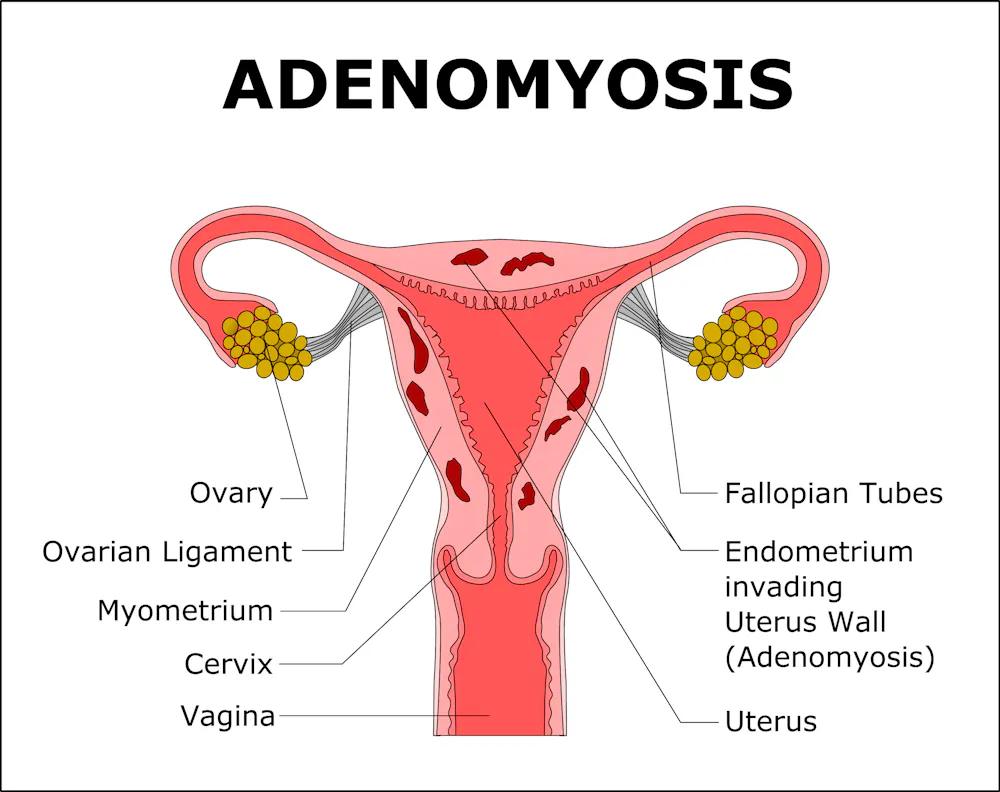
Adenomyosis is a condition of the uterus (womb), where the tissue that grows on the lining of the uterus (also known as the endometrium) is also present on the inside muscular wall of the uterus. Adenomyosis can cause symptoms such as heavy bleeding during your period, bleeding when you are not due for your period, period pain (dysmenorrhea), pain during or after sex (dyspareunia) and infertility.
Although women with adenomyosis often also have endometriosis, they are different conditions. With endometriosis, cells similar to those that line the uterus are found in other parts of the body such as the fallopian tubes, the ovaries or the tissue lining the pelvis (the peritoneum).
Read more: Considering surgery for endometriosis? Here’s what you need to know
The area of the uterus affected by adenomyosis is known as the endometrial-myometrial junction, which is where the endometrium and the myometrium (the muscular part of the uterus) meet.
Adenomyosis is when tissue that lines the uterus is present inside the muscular wall of the uterus. from shutterstock.comDisruption in the endometrial-myometrial junction is now considered an important contributor to reproductive problems such as recurrent implantation failure, a condition that can prevent women falling pregnant. Adenomyosis can either be quite spread out, known as generalised adenomyosis or localised in one place, also known as an adenomyoma.
Adenomyosis can have a number of causes though none have been definitively identified. There is an association between the presence of adenomyosis and the number of times a women has given birth: the more pregnancies, the more likely you are to have adenomyosis. Women with adenomyosis have also often had a trauma to the uterus such as surgery in the uterus, like during a caesarean section.
How common is adenomyosis?
Like endometriosis, we don’t know exactly how many women may be affected by the condition. What makes the impact of adenomyosis so tricky to determine is that it is quite commonly found during regular screening tests, even when women are not complaining of any symptoms, which means many women may have it and not know about it.
Because it’s often found in women with other conditions like endometriosis, it’s difficult to determine which condition caused the symptoms. We don’t currently know why some women with adenomyosis have symptoms and others don’t.
Read more: Vulvas, periods and leaks: women need the right words to seek help for conditions ‘down there’
There are also a number of different criteria for diagnosing adenomyosis, which can differ in important factors. For instance, the number of sections of adenomyosis that need to be affected for a diagosis when looking at tissue samples under a microscope. This makes it a problem when we try to work out how common adenomyosis is.
There can also be differences of opinion among the experts who look at these tissue samples. Experts can look at the same slides and come to very different conclusions.
How is it diagnosed?
Unlike endometriosis, which can only be definitively diagnosed through a key-hole surgery, a diagnosis of adenomyosis can be done through both invasive and non-invasive methods. The most common invasive method is a uterine biopsy (tissue sampling). A biopsy of the uterus can also be performed to make the diagnosis by an abdominal key-hole surgical procedure (laparoscopy) but this remains limited to clinical trials.
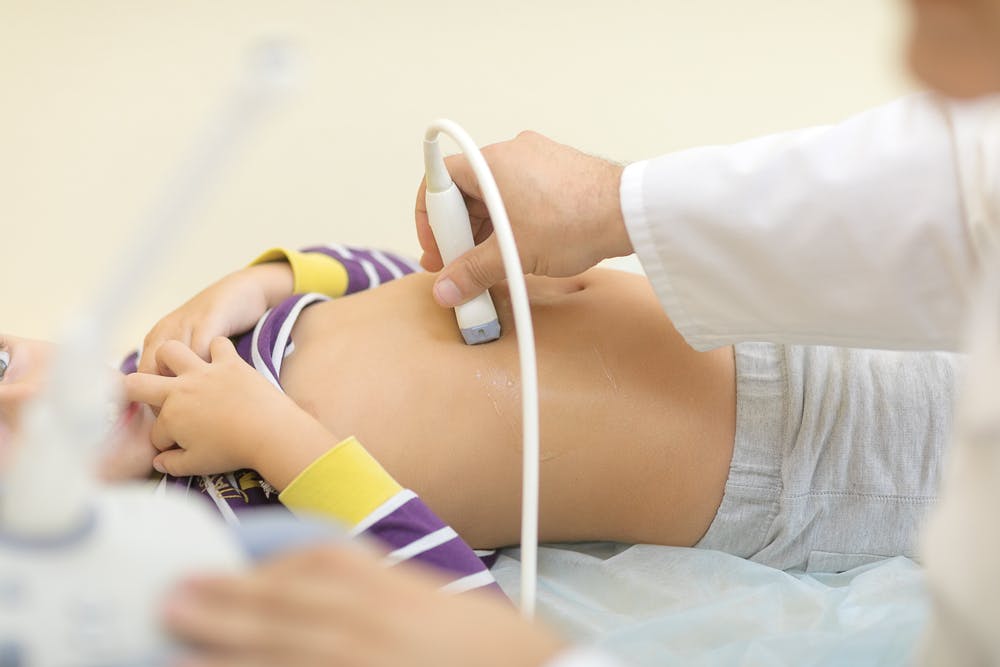
Adenomyosis can be diagnosed through ultrasound. from shutterstock.comBiopsies going through the vagina up to the uterus may have a role in the diagnosis of adenomyosis, but can potentially damage the uterus and therefore are avoided in women wishing to fall pregnant. The ultimate biopsy is a hysterectomy (the removal of the uterus). This is the most accurate method but is obviously a significant surgical procedure and will prevent women having children. A diagnosis of adenomyosis has been made in between 10-88% of hysterectomy specimens showing how common this condition is.
Non-invasive diagnosis can be made by different types of imaging. Ultrasound is commonly available and can be done either using the probe on the abdomen or, preferably, placing the probe in the vagina.
However, ultrasound isn’t always the best choice as it only detects adenomyosis about 50-87% of the time. Magnetic resonance imaging (MRI) is a better choice as there are a number of typical features seen during MRI. These vary throughout the cycle and in response to hormonal therapy but can reliably predict adenomyosis.
What are the treatments?
Management options for adenomyosis include hormonal therapy and surgery. These are mainly targeted at reducing symptoms such as pain. There isn’t much research into whether these increase the chance of getting pregnant.
Read more: What happens to endometriosis when you’re on the pill?
Hormonal treatments focus on suppressing menstruation. This can be achieved by combined oestrogen and progesterone therapy (such as the combined oral contraceptive pill), progestogen-only treatment (such as a Mirena) or placing women into an “induced” menopause (through GnRH analogs).
Hormonal treatments, such as the contraceptive pill, aim to suppress menstruation. Thought Catalog/UnsplashSurgical treatment is most effective when the adenomyosis is localised to a smaller area and can be removed, and this type of surgery doesn’t prevent women falling pregnant in the future. If the adenomyosis is spread throughout a larger area then treatments include destroying the lining of the uterus (endometrial ablation) provided adenomyosis is not too deep, and hysterectomy, both of which will prevent further pregnancy.
Other treatment options are interventional radiology such as uterine artery embolisation, where the blood supply to the uterus is cut off and magnetic resonance-guided focused ultrasound where the adenomyosis is destroyed with ultrasound energy.
Does it affect fertility?
There is some evidence adenomyosis can reduce fertility, but this is still controversial. Clinical studies are limited by difficulties and differences in diagnosis and their study designs have problems.
Some MRI studies show changes consistent with infertility, but because patients presenting with infertility in their 30s and 40s are more likely to be diagnosed with adenomyosis, it’s difficult to say if adenomyosis is the cause of their fertility issues.
When couples are undergoing assisted reproduction (such as IVF) there is limited evidence to support a negative impact on oocyte and embryo quality, implantation and pregnancy rates. Overall, there appears to be limited negative impact of adenomyosis on allowing the embryos to implant or overall pregnancy rates.
Read more: Women now have clearer statistics on whether IVF is likely to work
– ref. Adenomyosis causes pain, heavy periods and infertility but you’ve probably never heard of it – http://theconversation.com/adenomyosis-causes-pain-heavy-periods-and-infertility-but-youve-probably-never-heard-of-it-104412]]>
Kyoto on the path to becoming the Copenhagen of Asia
Source: The Conversation (Au and NZ) – By Brendan F.D. Barrett, Specially Appointed Professor, Center for the Study of Co*Design, Osaka University
Against the backdrop of climate scientists warning that we have 12 years to cut carbon emissions to avoid disastrous climate change, Kyoto is searching for an alternative, sustainable future. The Japanese city is moving away from heavy reliance on cars and towards getting around by public transport, cycling and walking. Already, more than three-quarters of personal trips in the city are not by car.
With the 2010 Walkable Kyoto Declaration, the city aimed to stop being a car-dominated society. Kyoto has an ambitious list of 94 projects promoting walkability.
The results so far are impressive, according to municipal government data. Use of public transport has increased significantly. Car traffic entering the city is declining year on year, as is use of car parking. Only 9.3% of tourist movements in the city were by car compared to 21% in 2011.
As a result of this, emissions from transportation in 2015 were 20% lower than 1990 levels.
Survey by Kyoto municipal government of 1,000 citizens on their mode of transport for personal trips. Kyoto municipal government, Author providedA city made for cycling
Kyoto is determined to improve on this. The next target is to enhance opportunities for cycling.
Cycling is the best way to see the city. Whether you are a resident or a tourist, cycling is the secret to unlocking Kyoto’s beauty and experiencing its heritage sites. An increasing number of the 50 million tourists a year are choosing to rent a bike.
Kyoto is a compact, flat city with a grid structure. This makes it easy to cycle and navigate. Kyoto has been described as one of the ten best cities to explore by bike.
Navigating the city by bicycle is both convenient and efficient. Bicycles provide mobility that’s accessible for a wide range of demographics, from school kids to parents with their toddlers on board to over-65s taking a short trip to the local shops.
Cycling through the Imperial Gardens. Author providedIn June 2018 one of Japan’s first shared cycle schemes, Pippa, popped up in Kyoto with 100 bikes in 22 locations. There are plans to increase to 500 bikes in 50 locations by the end of the year. Proposals for shared electric bicycles would broaden the variety of users able to navigate the city by bike.
Mobility policy innovation
While we both have cycled extensively around Kyoto and appreciate the many wonders and delights, we are fascinated by the mobility experience for regular people living in Kyoto.
That is one reason we are impressed by the March 2015 New Kyoto City Bicycle Plan, which replaced a 2010 plan.
This new plan identifies the promotion of cycling as healthy across various realms — for the society, economy and sustainability of the city overall.
Cycling trends in Kyoto provide cause for optimism. It now has close to 45km of official cycleways. While not as big as European cycling cities like Copenhagen (which boasts 416km of cycleways), Kyoto’s network is relatively large for an Asian city.
Cycling through the city centre along the Kamo River. Author providedOn-street discarding of bicycles has declined 27-fold since 2001. Bicycle parking space has increased by 65% in the same period.
Two in every three Kyotoites own a bicycle, compared to one in every three owning a car. Car ownership is dropping year by year.
More kids cycle to school in Kyoto than almost any other city in Japan (only Osaka is higher). Cycling is on the increase for people between the ages of 20 and 34, as well as those between 65 and 69.
Need to educate cyclists and drivers
A few obstacles still stand in the way of Kyoto achieving its sustainable mobility goals.
First of all, only 33% of cyclists cycle on the road. Everyone else uses the pavement, meaning neither pedestrians nor cyclists feel safe.
Second, cyclists across Japan are notorious for not following rules. They ignore signals, ride the opposite direction to traffic, listen to music or use their phone while cycling, cycle with a passenger on the back, cycle with an umbrella in the rain, don’t wear helmets and rarely cycle with lights at night.
Bicycle signage on Kyoto roads is becoming ubiquitous. Author providedIn other words, Japanese cyclists are perceived to be, at times, reckless. This explains why a third of Kyoto’s cycling policies focus on improving cyclists’ manners. It also explains why the municipality introduced a mandatory bicycle insurance scheme from April 2018. That’s something other cities could copy.
The Kyoto bicycle plan focuses on measures to enhance the visibility of cyclists with road markings as well as extensive educational programmes for car drivers and cyclists on road etiquette.
The good news is that the number of accidents involving cyclists in the city has declined by 40% since 2004 and represents 20% of all accidents. This is close to what we find in Copenhagen.
New dedicated cycleways in Kyoto are helping to reduce accidents. Author providedWhat else can Kyoto do?
A continued focus on social design and innovation is the answer to Kyoto’s mobility challenges. The city’s population is projected to shrink by 13% between 2010 and 2040 (reaching around 1.28 million). At the same time, the proportion of over-65s will increase significantly.
This suggests private car ownership will continue to decline, by an estimated 6-10% a year. The bicycle ownership rate is likely to increase by 7% or more each year.
In this context, the focus on public transport, cycling and walking makes a great deal of sense.
Kyoto could become the world’s most walkable city. Author providedBut Kyoto could still do a lot more to reduce car traffic, especially in the city centre. Manchester in the UK provides a useful example. It recently announced plans to invest £1.5 billion (A$2.7 billion) in a 1,600km cycle network.
Another model for Kyoto to follow is that of the world’s most bicycle-friendly city – Copenhagen.
Today many cities across the world are seeking to “Copenhagenize”. In the future, we want them to be able to follow Kyoto as a model of best practice for Asian city sustainability.
– ref. Kyoto on the path to becoming the Copenhagen of Asia – http://theconversation.com/kyoto-on-the-path-to-becoming-the-copenhagen-of-asia-105368]]>Unlocking Australia’s productivity paradox. Why things aren’t that super
Source: The Conversation (Au and NZ) – By Adam Triggs, Research fellow, Australian National University
2018 marks the 40 year anniversary of the first Superman film. Starring as Superman, Christopher Reeve fought foes and vanquished villains in an action-packed battle between good and evil.
Four decades on, Superman continues to feature in films, but often not alone.
He now stars alongside Batman, Wonder Woman, The Flash, Aquaman and other superheroes. For the fans of DC Comics, it is a delightful coming together of childhood favourites.
But for economists, it symbolises a worrying decline in productivity.
Superman needs help
Where once a single superhero was able to save the world, now two or more are required to complete the same task.
As Oscar Wilde once said, life often imitates art.
Back when the first Superman film was released, average annual total factor productivity growth among advanced economies was almost 10 times what it fell to in 2016.
In Australia, it was three times higher in 1995-96 than in 2016-17.
Read more: Australia’s productivity problem: why it matters
Real wage growth has been close to zero in the past two years, in line with close to zero productivity growth.
But what is most striking about what has happened is when it has happened. The past 25 years have seen extraordinary advances in technology.
We ought to be much more productive
An extra 3.5 billion people have gained access to the internet, the processing power of computers has skyrocketed, and we now have smartphones, with almost everything on them, and factories and warehouses that are automated in ways that would have once only been dreamt of.
The sharing economy promises to unlock the full potential of our idle cars, our unused bicycles and empty rooms and houses. The accumulated history of human knowledge is at our fingertips.
So where’s the resulting increase in productivity?
US economist Robert Solow once famously remarked that “you can see the computer age everywhere but in the productivity statistics”.
Read more: The internet has done a lot, but so far little for economic growth
Economists have since put forward a variety of explanations for this paradox, but with little agreement.
There’s little agreement about why we’re not
Some, like 2018 Nobel Laureate William Nordhaus, point to historical data showing long lag-times between technological advances and increases in productivity.
For them, a surge in productivity is just around the corner – 10 years away, according to some estimates.
Others, like Harvard’s Martin Feldstein, argue the paradox is driven by measurement failures.
Read more: Budget explainer: the problem with measuring productivity
Others argue that the productivity improvements from technology have been crowded out by other factors, like the aftershocks of the global financial crisis, weak demand and investment, slowing trade, stalling growth in global value chains, ageing populations, reduced investment in education, the impacts of automation on demand and inequality, weakening competition and reduced business dynamism.
Harvard’s Marc Melitz suggests that an explanation for the paradox may lie at the firm-level.
Productivity growth might be hidden
While some firms have been highly productive, their effects have been offset by laggard firms. The OECD found that “frontier firms” have consistently achieved productivity growth six times that of laggard firms which have dragged down the average.
Some attribute this to the increased prevalence of “zombie firms” – unproductive firms kept alive by cheap money, low interest rates and nervous investors.
It’s possible to see this at the industry level. John Fernald, from the Federal Reserve Bank of San Francisco, finds that productivity gains from information and communications technology have been concentrated in specific industries, the benefits from which have been netted-out by industries that have failed to adopt new technologies.
Northwestern University’s Robert Gordon, however, sees no paradox at all.
Or technology might be holding it back
He says, as much as we might like them, the technological advances in recent decades have been no match for the really big advances between 1870 and 1970, such as electricity and the automobile.
Harvard’s Jeff Frankel goes further.
He points to evidence suggesting the latest advances in technology might be actually cutting productivity by distracting us and reducing our attention spans.
Read more: Why we should approach claims of a productivity crisis with caution
Others are less pessimistic, but still conclude that as firms adopt more and more new technology, the extra returns from those extra investments shrink.
With all this uncertainty, what’s the best approach for an incoming or reelected government?
So what should we do?
It sounds trite, but the best approach is “flexibility”.
More precisely it is well functioning mechanisms that allow us to adjust things such as exchange rates, interest rates, government spending and industry settings.
On the whole we have these mechanisms. We will also need strong laws that encourage competition; that will enable new or suddenly productive firms to displace old ones that have grown used to large market shares.
If we do turn out to be on the cusp of a new productivity surge, a flexible, competitive economy will enable us to spread the benefits quickly.
Allow good firms to grow, bad ones to die
If instead we turn out to be on track for a low productivity future, or if the productivity gains from new technology are crowded out by other effects, then flexibility can also help, redirecting resources away from inefficient firms to more efficient ones.
If it turns out the productivity paradox is no paradox at all but merely a measurement failure, then it is yet another reason to properly fund organisations such as the Australian Bureau of Statistics.
The new government will need to watch, and to some extent it will need to wait. But it will need to be ready.
As American economist Paul Krugman observed a generation ago when productivity growth was much higher than it is today, “productivity isn’t everything, but in the long run it is almost everything”.
– ref. Unlocking Australia’s productivity paradox. Why things aren’t that super – http://theconversation.com/unlocking-australias-productivity-paradox-why-things-arent-that-super-106350]]>Here’s looking at: George Baldessin’s Mary Magdalene on Rue St Denis
Source: The Conversation (Au and NZ) – By Ted Snell, Professor, Chief Cultural Officer, Cultural Precinct, University of Western Australia
The extraordinary sculpture of Mary Magdalene by the 15th century Bavarian carver Tilman Riemenschneider focuses our attention on her hair, which twists, curls and cascades down and around her body. This is the hair that caressed Jesus’ feet, and that grew to cover her modesty in the years after his crucifixion when she lived her reclusive life in the desert.
Ascension of Mary Magdalene from the Magdalena Altarpiece, Münnerstadt (1490–92) by Tilman Riemenschneider. Bayerisches National Museum, Munich, Wikimedia CommonsWhile historians now believe this later life is a conflation of Magdalene with that of Saint Mary of Egypt, a 4th-century prostitute turned hermit, the focus on hair serves to identify her as someone outside acceptable society.
Women 2000 years ago in Jerusalem would have covered their head and never shown their hair in public. Yet Magdalene had long hair, and in many depictions of her in art, literature and theology, she has been portrayed as revealing this hair and using it to anoint Jesus’ feet. These acts of devotion identified her as a woman of ill-repute.
Although this intepretation was recently comprehensively debunked by theologian Dorothy Ann Lee, it was orthodoxy in the 15th century. The narrative unfolded through the metaphor of her hair is crucial to Reimenschneider’s depiction of Magdalene as she ascends to heaven to be reunited with her saviour.
Read more: Friday essay: who was Mary Magdalene? Debunking the myth of the penitent prostitute
Hair is also a defining feature of George Baldessin’s portrait of Mary Magdelene on the Rue St Denis: MM of Rue St Denis, 1976. She stands awkwardly, her arms and legs crossed, one hand protecting her modesty, the other cradling a skull wrapped in her long tresses.
George Baldessin MM of Rue St Denis 1976, charcoal and black chalk, 119.9 x 80.6 cm. National Gallery of Victoria, Melbourne. Purchased with the assistance of The Docking Drawing Fund (NGV), 2001 (2001.537)© The Estate of George BaldessinRue St Denis was a street notorious for prostitution. When Baldessin was working at the Lacourière printworks in Paris in 1975, he and his wife Tess had direct experience of the street and its inhabitants. The girls and their pimps meshed with his newfound interest in medieval images of Magdalene.
The resulting series of drawings and etchings depict a very contemporary Magdalene, either locked into angular architecture or hovering in the open void of the page. She is often alone, in one image spread-eagled on a table, in others in shimmering silver but mostly in prickly black.
Read more: An ape in anguish: Brett Whiteley’s Sacred baboon
The images of Magdalene made in the last years of his life – before his sudden death in a car accident in 1977 – are some of Baldessin’s most powerful works. The ambition of his draughtsmanship fully realises the profound intent of his subject matter. In the best of these works, his penchant for mannerist gestures is restrained, and Magdalene’s figure is rendered emotively, without compromising anatomical accuracy. His elegant line is rooted in its descriptive trajectory around the body.
George Baldessin at RMIT, Melbourne c. 1965. Unknown.Peering out from the spiky tangle of her hair, the MM on the Rue St Denis seems to be entreating us to empathise with her plight. Unlike Reimenschnieder’s Magdelene, already on her way to heaven, Baldessin’s is plying her trade and enduring the vicissitudes of life. She is aware of her impending death if salvation doesn’t come, evidenced by the skull in her left hand. She has been found guilty by society, and her pleading gaze is unlikely to assuage that judgement.
Many artists have brought the scriptures to life by re-siting them in familiar territory. Arthur Boyd’s relocation of biblical narratives to the streets of Melbourne, Salvatore Zofrea’s resetting of the Psalms in Sydney, and English artist Stanley Spencer, who chose his village of Cookham as the mise en scène for his transcriptions, all contemporise the Bible in this way. Yet Baldessin’s relocation is more literary than factual.
There are no visual indications of Paris, nothing to identify the street or any buildings or landmarks. The yawning gulf of the blank page, with minor geometric intrusions, is the space MM inhabits. The Rue St Denis is a title, a textual frame within which to locate this person. It relies on the viewer providing context to interpret MM’s predicament.
To this drawing, we bring our knowledge of the street as both a route of pilgrimage leading to the medieval Basilica of St Denis and a site of sexual exploitation, which adds poignancy and pathos to our reading.
This drawing and others in the series construct a moral tale. The contemporary Magdalene is vulnerable and at risk, yet she is judged and found wanting like so many others who are ostracised for their beliefs or their situation.
When asked what he was trying to express, Baldessin explained: “I think human weakness through the vulnerable figure, without extracting its dignity, no matter how uncertain.”
It is something he achieved in this image of MM, searching for salvation while confronting her mortality.
Baldessin/Whiteley Parallel Visions is at NGV Australia, Melbourne, until 28 Jan, 2019.
– ref. Here’s looking at: George Baldessin’s Mary Magdalene on Rue St Denis – http://theconversation.com/heres-looking-at-george-baldessins-mary-magdalene-on-rue-st-denis-102412]]>Health Check: should you take probiotics when you’re on antibiotics?
Source: The Conversation (Au and NZ) – By Lito Papanicolas, Infectious diseases specialist and PhD candidate, South Australian Health & Medical Research Institute
If you take antibiotics, there’s a good chance you’ll also get diarrhoea.
Antibiotics kill harmful bacteria that cause disease. But they also cause collateral damage to the microbiome, the complex community of bacteria that live in our gut. This results in a profound, though usually temporary, depletion of the beneficial bacteria.
One popular strategy to mitigate the disruption is to take a probiotic supplement containing live bacteria during, or following, a course of antibiotics.
Read more: Healthy guts are swarming with bugs, so what do they do?
The logic is simple: beneficial bacterial in the gut are damaged by antibiotics. So why not replace them with the “beneficial” bacterial strains in probiotics to assist gut bacteria returning to a “balanced” state?
But the answer is more complicated.
There is currently some evidence that taking probiotics can prevent antibiotic-associated diarrhoea. This effect is relatively small, with 13 people needing to take probiotics for one episode of diarrhoea to be averted.
But these studies have often neglected to evaluate potential harms of probiotic use and haven’t looked at their impact on the wider gut microbiome.
Pros and cons of probiotics
The assumption that there is little downside to taking probiotics was challenged in a recent Israeli study.
The participants were given antibiotics and split into two groups: the first group was given an 11-strain probiotic preparation for four weeks; the second was given a placebo, or dummy pill.
The researchers found the antibiotic damage to the gut bacteria of those in the first group allowed the probiotic strains to effectively colonise the gut. But this colonisation delayed the normal recovery of the microbiota, which remained perturbed for the entire six month study period.
In contrast, the microbiota of the second group returned to normal within three weeks of finishing antibiotics.
Read more: Health Check: should healthy people take probiotic supplements?
This research exposes a perhaps unexpected truth: we still don’t know what types of bacteria are truly beneficial or even what constitutes a healthy microbiome.
The answer is unlikely to be that individual bacterial strains are particularly helpful.
It’s more likely a diverse community of thousands of different types of microbes working together can provide health benefits. This microbial community is as individual as each one of us, meaning there is not just one configuration that will result in health or illness.
So, it’s unlikely that the addition of one or even 11 strains of bacteria in a probiotic could somehow balance this complex system.
A more effective (but less palatable) alternative?
The Israeli study also explored an alternative approach to microbiome restoration.
One group of participants had their own stool collected and frozen prior to antibiotic treatment. It was then re-instilled into their gut at the end of the antibiotic therapy.
This treatment, known as autologous faecal transplantation, was able to restore the microbiome to original levels after just eight days. The other group took 21 days to recover.
Read more: Poo transplants and probiotics – does anything work to improve the health of our gut?
This approach has also been shown to effectively restore the gut microbiome following combined antibiotic and chemotherapy treatment. These patients are predictably at risk of serious complications, such as bloodstream infection, as a result of microbiome disruption.
Research currently underway will help us understand whether microbiome restoration with autologous faecal transplantation will translate into tangible benefits for these patients.
But such an approach would not be a realistic option for most people.
Feed the good bacteria
Good food for gut bacteria. Roosa KuljuA more practical strategy to aid recovery is to provide the good bacteria in your gut with their preferred source of nutrition: fibre. Fibrous compounds pass undigested through the small intestine and into the colon, where they act as fuel for bacterial fermentation.
So if you’re taking antibiotics or have recently finished a course, make sure you eat plenty of vegetables, fruit and wholegrains. Your gut bacteria will thank you for it.
– ref. Health Check: should you take probiotics when you’re on antibiotics? – http://theconversation.com/health-check-should-you-take-probiotics-when-youre-on-antibiotics-104570]]>Two past coup leaders face off in Fiji election as Australia sharpens its focus on Pacific

Source: The Conversation (Au and NZ) – By Dominic O’Sullivan, Associate Professor of Political Science, Charles Sturt University
Fiji faces a general election on Wednesday, just as Australia’s main political parties devote more attention to the western Pacific, driven by worries about China’s growing influence in the region.
For most Australians, the nation is a handy holiday destination – closer than Bali or Thailand. Last month, its palm-fringed beaches were in the global spotlight when the Duke and Duchess of Sussex took a trip to the former British colony.
Anyone with a longer memory will perhaps associate Fiji with coups – two in 1987 and one in 2006. There was also a putsch – a civilian overthrow of the government – in 2000.
This week’s general election is only the second since Josaia Voreqe Bainimarama, who often goes by the name Frank, appointed himself prime minister after the 2006 coup. He was eventually elected in 2014 and is expected to be re-elected this week.
Read more: Fiji coup leader gets the democratic approval he wanted
For Australia, the strategic importance of the western Pacific is coming into sharp focus.
Prime Minister Scott Morrison has announced $3 billion in infrastructural spending in the region. He has committed the Australian Defence Force to military training in Pacific nations.
Australia has an abiding interest in a south-west Pacific that is secure strategically, stable economically and sovereign politically.
In a speech to the Lowy Institute last month, Bill Shorten committed a future Labor government to an independent foreign policy with a strong Pacific focus. It would support Fiji, Papua New Guinea and Tonga to develop their military capabilities.
Read more: Labor is making big promises for a Pacific development bank, but questions remain
On Fiji, he said:
We want to mend the relationship with the RFMF [Republic of Fiji Military Forces], to ensure that the ADF [Australian Defence Force] is best-placed to develop the Fiji military’s professional capabilities and to ensure Fiji’s security needs.
For Fijian voters, the military is never far from politics.
Bainimarama insists the election will be free and fair . However, the electoral system is unnecessarily complicated. Critics argue this is a deliberate strategy to disenfranchise voters.
However, as he disliked the Constitution put to him by an independent review in 2009, Bainimarama decreed his own in 2013. Section 131 (2) of that Constitution gives ultimate political authority to the military:
It shall be the overall responsibility of the Republic of Fiji Military Forces to ensure at all times the security, defence and well-being of Fiji and all Fijians.
Read more: Fiji’s media still struggling to regain ‘free and fair’ space
The military has tended to be the arbiter in national affairs since the first coup in 1987.
As Bainimarama put it before the 2006 coup:
[Prime Minister Laisenia] Qarase is trying to weaken the army by trying to remove me … if he succeeds there will be no one to monitor them, and imagine how corrupt it is going to be.
The coups and the putsch were ostensibly statements of indigenous nationalism – indigenous Fijians asserting their rights over the generally wealthier and better educated descendants of Indian indentured labourers brought to Fiji by British colonial authorities between 1879 and 1916.
However, Fijian politics is vastly more complicated than an indigenous non-indigenous binary. The contentious point, according to Professor Brij V. Lal of the Australian National University’s College of Asia and the Pacific, “is not really about having a Fijian head of government,” but rather which Fijian leader would be acceptable to a particular group of Fijians at any given time”.
The prime minister’s main rival clears legal hurdle
Bainimarama’s main opponent is an indigenous former prime minister and coup leader, Sitiveni Rabuka. Bainimarama is also an indigenous Fijian.
Rabuka faced electoral fraud charges that could have seen him declared him ineligible to stand at the election. Rabuka’s acquittal in the Magistrate’s Court was appealed by the Fiji Independent Commission Against Corruption, and dismissed by the High Court only on Monday afternoon. At his campaign launch in 2018, Rabuka ominously remarked:
I am here to do what I can for as long as I ever can for the good of the country.
However, indigenous nationalism and how the right to self-determination might be played out is important. It is interwoven with class, religion and an urban/rural divide to add to the fragility and complexity of Fiji’s conditional democracy.
Just as it did in 2014, Bainimarama’s Fiji First is campaigning on a range of issues including the building of a multiracial society. Practical measures to improve access to education and healthcare are also important to Fiji First.
Land ownership and rental returns are key political issues
Rabuka’s Social Democratic Liberal Party (SODELPA) argues for the restoration of distinctive indigenous voice in public life. It seeks the restoration of the Great Council of Chiefs and of chiefly influence over the distribution of rental incomes.
SODELPA will also begin extensive public consultation on the drafting of a new Constitution.
Ultimately, indigenous prosperity depends on the strength of the national economy. This, in turn, depends on political stability. Contemporary Fiji enjoys neither. While there are signs of improving economic growth, the Fijian people face two obstacles in ensuring that the outcome of Wednesday’s election reflects their collective will.
Firstly, registering to vote then casting a valid and informed vote is difficult. Secondly, as Fiji’s history since 1987 shows, and as the 2013 Constitution confirms, the election’s outcome is ultimately subject to military approval. It may not, then, be in Australia’s best interests to support a stronger Fijian military.
Democratic stability serves Australia’s interests. In Fiji, democracy can be strong only when the military is weak.
– ref. Two past coup leaders face off in Fiji election as Australia sharpens its focus on Pacific – http://theconversation.com/two-past-coup-leaders-face-off-in-fiji-election-as-australia-sharpens-its-focus-on-pacific-106347]]>SODELPA’s Rabuka cleared for Fiji election – FICAC appeal dismissed

 A media scrum at the Fiji High Court 2 today for the anti-corruption agency FICAC’s unsuccessful appeal against the acquittal of SODELPA leader Sitiveni Rabuka on a false declaration of assets charge. Image: Sri Krishnamurthi/PMC
By Sri Krishnamurthi in Suva
In a dramatic afternoon, more than 1000 people sang Fijian songs of jubilation as Chief-Justice Anthony Gates dismissed the appeal by the Fiji Independent Commission Against Corruption (FICAC) against former Prime Minister Sitiveni Rabuka.
In a jam-packed High Court 2, Chief Justice Gates said the magistrate was correct to dismiss the original charges of not guilty of providing a false declaration of assets under electoral rules.
The FICAC took its appeal to the High Court as was its legal right.
Chief Justice Gates said that had Rabuka been found guilty, he would have had the right to appeal his case in the High Court too.
In his 36-page ruling, Chief Justice Gates said the magistrate had been correct in his findings that the prosecution had not been able to prove its case beyond reasonable doubt.
He said that the interview conducted by FICAC with Rabuka left many answers unprobed or unclarified.
He went on to say such interviews should always be conducted on the basis that reliance may have to be made solely on that procedure.
Acquitted last month
Rabuka was acquitted of the charges last month but FICAC had appealed that decision, taking its case to the High Court.
The hearing lasted more than an hour, after which Rabuka emerged to the cheers of joy from his supporters wearing a white shirt over which he draped a red scarf, all the time smiling but looking relieved.
Now that he is a free man he can stand as a candidate in the Fiji general election as the leader of SODELPA, the second largest political party after the ruling FijiFirst Party.
Voting is on Wednesday.
Vandhana Bhan from Radio Tarana, who got close to Rabuka’s white SUV, asked him the age-old question “how are you feeling?”
Rabuka replied, “great and getting better.”
She asked Rabuka if he had anything to say to the people? “Thank you to all of them for their prayers,” he said before being whisked away.
Sri Krishnamurthi is a journalist and Postgraduate Diploma in Communication Studies student at Auckland University of Technology. He is attached to the University of the South Pacific’s Journalism Programme, filing for USP’s Wansolwara News and the AUT Pacific Media Centre’s Asia Pacific Report.
Article by AsiaPacificReport.nz
]]>Detained tourist in West Papua on allegations of ‘treason’ awaits trial

 Accused tourist Jakup Febian Skrzypski with Frits Ramandey of the Human Rights Commission Office of Papua. Image: Tabloid Jubi
By Islami Adisubrata in Wamena, West Papua
Indonesian Regional Police in West Papua have handed over the documents of the case of a Polish tourist, Jakup Fabian Skrzypski, who was arrested recently with three Papuans and accused of “treason”, to the Jayawijaya District Attorney.
Skrzypski reportedly entered Indonesia on a tourist visa but was arrested on suspicion of working as a journalist illegally and having contact with an “insurgency” group, report news agencies.
The file was handed over to the District Attorney on November 2 and he is expected to face trial in Wamena along with three co-accused.
READ MORE: Police declare papers on accused tourist ready for trial
“So, the four suspects were handed over, two arrested in Wamena, including Skrzypski, and others arrested in Yalimo,” said Lintong Simanjuntak, Adjunct Police Commissionaire who is also the Chief of Violence and Crime Division of the Directorate of Crime Investigation of Papua Regional Police.
Skrzypski and three other people departed from Jayapura to Wamena and were immediately transferred to Jayawijaya District Attorney Office for re-examination.
The four now are detained by the Jayawijaya District Attorney.
Two of the defendants were sent to the House of Correction Class B Wamena, while the other two have been placed in police custody in Jayawijaya police headquarters.
Foreign Ministry help
Adjunct Commissionaire Simanjuntak, who accompanied the four defendants from Jayapura to Wamena, said that although Papua police would investigate this case of alleged treason, the trial would be conducted in Wamena – the place where the incident occurred.
Simanjuntak said that during the investigation, the police were assisted by the Foreign Ministry and had communicated with the Polish Ambassador in Jakarta, ensuring that all procedures had been completed appropriately.
The Chief of State’s Defence and Public Security of the Papua District Attorney Adrianus Irham Tamana said that the trial would be conducted before 20 days of detention had lapsed.
“The trial before 20 days of detention will be handed over to the court. Currently, they are still under our custody,” said Tamana.
But the public prosecutor’s team objected putting the detainees in the police headquarters jail as it was already overcrowded and this could effect access to the basic rights of the detainees in that overcrowded prison, said the detainees legal adviser Latifah Anum Siregar.
“Does this transfer create a problem of over capacity? What about their access and rights? Can these be fulfilled or not?” she asked.
Cell overflowing
Siregar said that during the detention by Papua regional police, the holding cell had already been overflowing, with 50 people occupying space for 25.
Also, the detainees needed to share the toilet for bathing and washing dishes.
“Security must be compared with humanitarian purpose. Don’tt apply security as the reason to ignore humanity.
“My clients have to get access to lawyers, religious leaders and this shouldn’t be restricted,” Siregar said.
She also said Skrzypski had rejected all allegations against him.
Islami Adisubrata is a journalist with Tabloid Jubi and this article has been translated into English and is republished with permission under a content sharing arrangement.
Article by AsiaPacificReport.nz
]]>Newsletter: New Zealand Politics Daily – November 12 2018
Newsletter: New Zealand Politics Daily – November 12 2018
Editor’s Note: Here below is a list of the main issues currently under discussion in New Zealand and links to media coverage.
[caption id="attachment_297" align="aligncenter" width="640"] The Beehive and Parliament Buildings.[/caption]
Supreme Court ruling on prisoners’ right to vote, justice
Matthew Theunissen (RNZ): Prison reform charity wants debate on prisoners’ right to vote
RNZ: Youth advocacy group disappointed in govt’s stance on prisoner votes
Craig McCulloch (RNZ): Prisoners’ right to vote currently not a priority for Parliament – Little
Martyn Bradbury (Daily Blog): In just 7 words did Andrew Little demolish real prison reform?
No Right Turn: “Not a priority”
Sam Hurley (Herald): Supreme Court upholds decision saying ban on prisoner voting inconsistent with Bill of Rights
Laura Walters (Newsroom): Step forward for NZ human rights law
Catrin Owen (Stuff): High Court declaration on prisoner voting rights upheld
Alex Baird (Newshub): Kiwi prisoners’ right to vote upheld Supreme Court rules
No Rigjht Turn: Vindicated
Matt Nippert (Herald): Dame Sian Elias’ $3.3m super payout
Scott Palmer (Newshub): Duncan Garner slams Dame Sian Elias’ ‘gold-plated’ super scheme
Jamie Ensor (Newshub): The ‘compassionate’ way Kelvin Davis slashed New Zealand’s prison population
Andrea Vance (Stuff): Greater counter terrorism powers on the cards
Andrea Vance (Stuff): Government considers reviving tattoo removal scheme
Jared Savage (Herald): Court of Appeal overturns rape convictions for teenage boy and criticises defence lawyer Brandt Shortland in miscarriage of justice
Edward Gay (Stuff): Te reo in court is important, says Waitangi Tribunal lawyer
RNZ: Law society surprised by resistance to use of te reo in court
Stuff: Obituary: Destined from childhood to be well qualified for top judge’s job
Hugh Rennie (Stuff): Obituary: Sir John McGrath had reputation for supporting many women lawyers
Teachers’ pay dispute
Martin van Beynen (Stuff): Pay teachers more or expect more inequality
Luke Kirkness (Herald): NZ teachers have biggest workloads, survey finds as NZEI strikes begin
1News: Simon Bridges sympathises with striking teachers as he accuses Government of wasting money
Scott Palmer (Newshub): Simon Bridges thinks teachers’ strike justified, blames Government
Simon Collins (Herald): Teachers: Govt offer came too late to change strike meetings
Katie Scotcher (RNZ): Primary school teachers on strike again today
Josephine Franks (Stuff): Auckland teachers strike in first day of rolling nationwide action
Newstalk ZB: Teacher’s rep: ‘We didn’t call off strike because venues were booked’
Lucy Bennett and Simon Collins (Herald): Education Minister Chris Hipkins hits back: ‘Other Kiwis would appreciate $9500 pay hike’
Laura Tupou (Newsroom); Government’s latest pay offer to primary school teachers ‘misleading’
RNZ: ‘An air of unreality’ – ERA slams teacher union’s pay demands
Newshub: Employment Relations Authority recommends primary school teachers accept pay offer
George Heagney (Stuff): Impasse between teachers and Ministry of Education shows no sign of thawing
Damian George and Collette Devlin (Stuff): Primary teachers and principals confirm nationwide strike after facilitation talks fail
Thomas Coughlan (Newsroom): Teachers to begin week of strikes
RNZ: Primary teacher strikes to go ahead as last-ditch offer fails
Lucy Bennett and Simon Collins (Herald): Education Minister Chris Hipkins disappointed by primary teachers strike action
Jenna Lynch (Newshub): Education Minister Chris Hipkins ‘disappointed’ teachers’ strike going ahead
David Farrar: Teachers striking again
Education
Scott Palmer (Newshub): Stand Strong NZ: New Zealand’s ‘deeply disturbing’ bullying rates revealed
Simon Collins (Herald): Students who die early 100 times more likely to have been expelled from school – study
Simon Collins (Herald): Struggling to learn: kids who learn differently struggle in schools
Astrid Austin (Hawkes Bay Today): Hawke’s Bay school expulsion rates reveal drug use frequent factor
John Gerritsen (RNZ): Learning revolution or pathway to ignorance?
Simon Shepherd and Katie Fitzgerald (Newshub): 600 new learning support coordinators ‘too important’ to wait for data
Adele Redmond and Laine Moger (Stuff): Local schooling or parent choice? Number of schools with zones hits a record high
Lizzie Marvelly (Herald): I wish I’d been taught about same-sex relationships at school
Simon Collins (Herald): Henderson Valley School board agrees to consider parents’ concerns over principal Janet Moyle
Keith Locke (Daily Blog): SIS persecuting foreign students with allegations of WMD research
RNZ: Student investigated over ‘incredibly vague’ WMD allegations
Tom Pullar-Strecker (Stuff): ‘No qualifications required’ campaign runs out of steam
Siouxsie Wiles (Stuff): Politicians, don’t interfere with science
Child abuse
Phil Pennington (RNZ): Wellington Catholic school has no records of sex abuse
Tom Hunt (Stuff): Jehovah’s Witness child sex abuse survivor urges examination of NZ church
Media
Graham Adams (Noted): The Jami-Lee Ross saga: Questions around cover-ups continue
Colin Peacock (RNZ): JLR’s greatest hits keep coming (audio)
Pete George (Your NZ): The non-naming of the National MP raises media issues
Colin Peacock (RNZ): Stuff tightens squeeze on community papers
Martyn Bradbury (Daily Blog): Stuff threatened to gut journalism if they didn’t get their monopoly – will this spook Government Broadcasting Policy?
Jeremy Rose (RNZ): Possible push polling polarises Porirua
Arana Taumata (E-Tangata): Māori media: Work hard, but fight hard too
Quinton Hita (E-Tangata): Māori media: Broadcasting can’t save te reo
Morgan Godfery (E-Tangata): Māori media: Where are our Māori print journalists?
Barry Soper (Newstalk ZB): Chilling memories of bullying tactics
National Party
Southland Times Editorial: ‘Moving on’ is not acceptable
Audrey Young (Herald): Leaked tape shows a little kindness from Simon Bridges
Claire Trevett (Herald): National leader Simon Bridges: Turning the tank of Opposition after Jami-Lee Ross
David Farrar: Maybe JLR should join NZ First!
Government
Gia Garrick (RNZ): Shane Jones fails to disclose 61 meetings
Zane Small (Newshub): National MP slams Shane Jones’ failure to disclose meetings
Lucy Bennett (Herald): NZ First MP Tracey Martin – no ego, all action
Jo Moir (Stuff): Labour Māori caucus needs to face ‘cold harsh reality’
Herald: Book extract: What matters most to Jacinda Ardern
Dionne Christian (Herald): Prime Minister Jacinda Ardern inspires political play by Sam Brooks
Armistice centenary
Chris Trotter: What We “Don’t Know And Can’t Know” – The Truth About World War I
Bruce Munro (ODT): The prospects for peace
Mike Treen (Daily Blog): Why did New Zealand suffer the worst casualty rate in World War One?
Andrew Johnston (Spinoff): The Mangel-wurzel, monster of endless war
RNZ: Armistice Day: ‘Don’t anyone talk to me of the glories of war’
Jonathan Milne (Stuff): Too many of the real heroes of WWI have been forgotten; let’s do better for today’s heroes
John Roughan (Herald): We are fascinated with war for good reason
Herald Editorial: A day to remember a nation’s sacrifice
Tom Hunt, Dominic Harris and Ben Bathgate (Stuff): Armistice Day silence broken with a cacophony of noise as NZ marks centenary
1News: Gun salutes, silence and sound as New Zealand marks Armistice centenary
RNZ: Services mark 100 years since end of WW1
Newshub: Armistice Day commemorated around New Zealand
Tema Hemi (Māori TV): 100th anniversary of Armistice Day
Jason Walls (Herald): Jacinda Ardern: Armistice Centenary is a time for reflection and looking towards the future
1News: Watch: Jacinda Ardern speaks of ‘peace, multilateralism and inclusion’ during Armistice Day speech
AP: Armistice centenary: Winston Peters, Prince Harry lay wreaths before All Blacks Test with England
Kate Nicol-Williams (1News): Wairarapa War Camp memorial to be unveiled as part of Armistice Day
RNZ: Plaque recognising role of hospital ship unveiled
APEC, Foreign Affairs
Hamish Rutherford (Stuff): Apec summit highlights the simple price of maintaining Pacific influence: cash
Hamish Rutherford (Stuff): Prime Minister Jacinda Ardern leads ministers to APEC and East Asia Summit
Richard Harman (Politik): McCully defends the China relationship
Fran O’Sullivan (Herald): New Zealand’s tricky balancing act between two trading superpowers
Michael Reddell: Some reading for Todd McClay
RNZ: Cook Islands to join China’s Belt and Road
Thomas Nash (Spinoff): Why it’s time to push NZ foreign policy thinking out of the comfort zone
Housing
Mike Hosking (Newstalk ZB): So where’s all the KiwiBuild buyers then?
Jason Walls (Herald): The Government’s flagship KiwiBuild policy is on ‘life support’ National’s Judith Collins claims
Stacey Kirk and Laine Moger (Stuff): KiwiBuild at threat of going ‘KiwiBust’ over ‘plummeting popularity’
Ben Leahy (Stuff): Twyford says KiwiBuild no lottery after criticism of Auckland ballot
Bryce Edwards (Herald): Political Roundup: Is KiwiBuild becoming KiwiSpeculator?
Bryce Edwards (Newsroom): Will state housing fix what KiwiBuild can’t?
Hayden Donnell (Spinoff): Did Phil Twyford just turn KiwiBuild into a property investor’s paradise? The definitive ruling
Donna-Lee Biddle (Stuff): Housing NZ tenant, 84, forced to move as newly renovated home set for demolition
1News: Anti-poverty advocate tells PM to ‘chase up’ compo for state tenants evicted for drug use
Mike Wesley-Smith and Finn Hogan (Newshub): Calls for night shelter to stop homeless dying on Auckland streets
Tom Dillane (Herald): Starbucks staff report harassment by homeless at Auckland’s Queen St store
Anne Gibson (Herald): ‘We look at Bastion Point’: Māori protester plans mass anti-Fletcher action
Herald: House price growth slumps, becoming ‘buyers’ market’, ASB chief economist says
Anuja Nadkarni (Stuff): ASB housing survey shows confidence in the market is rising
Karel Sroubek residency decision
Collette Devlin (Stuff): Immigration New Zealand explains how Karel Sroubek case worked
Derek Cheng (Herald): Travel to Czech Republic missing from Karel Sroubek case file
Martyn Bradbury (Waatea News): The attacks by National on Immigration Minister, Iain Lees-Galloway are ridiculous
Steve Braunias (Herald): The secret diary of Iain Lees-Galloway
Heather du Plessis-Allan (Herald): Iain Lees-Galloway too sloppy to stay
Herald: Jacinda Ardern addresses Immigration Minister Iain Lees-Galloway’s future
Health
Duncan Garner (Stuff): For a country that says kids are our future, we have a funny way of showing it
Emma Russell (Herald): New Zealanders biggest consumers in favour of sugary drinks tax, poll reveals
Niki Bezzant (Herald): Let’s keep our kids healthy
Herald on Sunday Editorial: Long waits for public health services can be fixed
Karen Brown (RNZ): NZers’ use of medication not helping mental health – report
Deborah Hill Cone (Herald): DHBs must start offering more talk therapy
RNZ: Unpaid carers suffer high levels of anxiety and depression – study
Mike Houlahan (ODT): Chance to help reform ACC
RNZ: Lack of rural health professionals will result in crisis – GPs
Jacques Steenkamp and Imogen Neale (Stuff): Billion dollar drug company wants to be ‘reimbursed’ with taxpayer funding
Stacey Kirk (Stuff): Who’s really driving the campaign to publicly fund a $1m drug for the orphan disease Spinal muscular atrophy?
RNZ: Government to spend more than $7m on Bay of Islands hospital
Northern Advocate: Bay of Islands Hospital gets $7.1m primary health centre injection from Government
Libby Wilson (Stuff): Rural health school bid not a threat to Waikato med school push: backers
Daniel Birchfield (ODT):Health company confident of breaking even
Jono Edwards (ODT):Volunteers create health centre
Alex Perrottet (RNZ): Checkpoint: Families support GP’s controversial ‘miraculous’ eczema cream
Phil Pennington (RNZ): Support for family of dead woman inadequate – principal
Hadley Grace Robinson-Lewis (Daily Blog): Alex Pirie a social justice and mental health advocate
Banking and finance
ODT Editorial: Uneasiness over bank probe
Brian Gaynor (Herald): Aussies are banking on bumper profits in NZ
Gareth Vaughan (Interest): Why the regulators should take a look at the credit card market
Susan Edmunds (Stuff): Union calls for cap on bank chief executive pay
Lynda Hallinan (Stuff): Should we overlook the fact it appears to be the banks who are robbing us blind?
Torika Tokalau (Stuff): Auckland woman claims she was victim of ‘racist’ treatment at bank
Damien Grant (Stuff): The best guardians of a bank’s customers are the customers themselves
Kirsty Wynn (Herald): Major bank offers lowest interest rate since after World War II
Wealth and inequality
Stuff: Plan to target ‘poverty cycle’ in one of country’s most deprived suburbs
Katie Doyle (RNZ): Reducing childhood inequity focus of planned Rotorua programme
1News: Financial institutions urged to adopt ‘living wage’
Rob Stock (Stuff): Feeling wealthy? New Zealand ranks sixth in global wealth report
Oscar Kightley (Stuff): The joy of six brings rich rewards
Joanne Carroll (Stuff): Abusive partners deny women money for food, power, rent and sanitary products
Herald: ‘Economic abuse’: Finances used to control Kiwi women, research shows
Employment
Imran Ali (Northern Advocate): Northland unemployment climbs in September quarter
John Boynton (RNZ): Study reveals the effects of gig economy on employment
Aimee Shaw (Herald): The gig trap: Study finds ‘gig economy’ workers unlikely to secure ‘regular’ employment
Alice Peacock (Herald): Women feel need to bury sexism struggles, office study finds
Carrie Buckmaster (Spinoff): Public service employers need to do more to stop sexual harm by staff. Here’s how.
Police
Thomas Manch (Stuff): Wally Haumaha report expected on Monday, but his fate may remain unclear
Herald: Katie Fitzgerald and Simon Shepherd (Newshub): Government commits to date for release of Wally Haumaha inquiry
Tom Hunt (Stuff): Nine under-14s laser ‘painted’ and one 15-year-old was Tasered in 2017
Aziz Al-Sa’afin (Newshub): The not-so-inclusive Pride Parade
Bridie Chetwin-Kelly (Newshub): Auckland Pride board treasurer Matty Jackson resigns following ban on uniformed police
Sinead Corcoran (Stuff): NZ Police ‘banned’ from wearing uniforms to Pride Parade
Zane Small (Newshub): ‘Giant backwards step’: Auckland Pride Parade bans cops in uniform
Sam Hurley (Herald): Double prison sentence under controversial law for third striker who ‘terrorised’ tourist
RNZ: Auckland police HQ to shift to new location
Belinda Feek (Herald): ‘The laws need to change’, double fatal crash family urge
Harrison Christian (Stuff): Northland man allegedly pepper sprayed while wearing handcuffs and seatbelt
Electricity
RNZ: Calls for investigation into surge in wholesale power prices
Gavin Evans (BusinessDesk): Electricity regulator tells networks to get on with pricing reform
Corporate boxing, death of Kain Parsons
Stacey Kirk (Stuff): Government rejected calls for a review of corporate boxing – until someone died
Meghan Lawrence (Herald): Nearly 14,000 ACC claims for boxing in three years and three known deaths
Herald: Kiwi boxing champ’s ‘simple remedy’ to dangers of corporate boxing following Christchurch death
Cleo Fraser (Newshub): Safety a priority at first charity boxing match since Kain Parsons’ death
Parliament
Henry Cooke (Stuff): Three lessons for Kiwi politicians in chaotic US midterms
Phil Smith (RNZ): Going through the Motions
Peter Wilson (RNZ): Week in Politics: Lees-Galloway’s turn as Ross runs out of steam
Angie Skerrett (Newshub): Labour MP Kiri Allan disputes ‘rural experience’ stats
Herald: ACT leader David Seymour auctions off Brave Blossoms scarf from Speaker Trevor Mallard
Treaty of Waitangi
Northern Advocate: Thousands start voting on new Ngāpuhi Treaty negotiations plan
Bess Manson (Stuff): National Portrait: Dame Claudia Orange, Treaty witness
Welfare
Marty Sharpe (Stuff): Taxpayer-funded training organisation left disabled clients sitting idle and bored for long periods
Martyn Bradbury (Daily Blog): Survey shows toxic culture at WINZ takes more than Labour’s whitewash renovation
Supreme court ruling on swamp kauri
Farah Hancock (Newsroom): Draining the swamp kauri swamp
Lois Williams (RNZ): Supreme Court decision could shut down swamp kauri trade
Linday Laird (Herald): Northland group jubilant as Supreme Court deems swamp kauri export illegal
John Anthony (Herald): Swamp kauri cannot be exported unless it’s a finished product, Supreme Court rules
Emma Cropper (Newshub): Supreme Court rules swamp Kauri cannot be exported
BusinessDesk: Calling swamp kauri a tabletop doesn’t make it true
No Right Turn: Ending the pillage
Environment and conservation
Liz McDonald (Stuff): The industries with a thirst for Christchurch’s pure water
Cherie Sivignon (Stuff): Cr Dana Wensley queries basis for claim Waimea dam partner, WIL, was skint
Rachael Kelly (Stuff): MP’s feast on whitebait at hearings of native fish bill
Phil Pennington (RNZ): Extent of water contamination near air bases confirmed
Kirsty Lawrence (Stuff): Councils call for action to fix water-contamination problems at Ōhakea
No Right Turn: One way of fixing it
Kennedy Warne (E-Tangata): You can’t be a kaitiaki from a distance
Te Kuru o te Marama Dewes (Māori TV): Reviving the rivers
Matthew Theunissen (RNZ): Likely-extinct bird sighted in Golden Bay
Tim Newman (Stuff): Sightings spark hope in the search for New Zealand’s most wanted bird
Jamie Ensor (Newshub): South Island kokako spotted by tramper – report
Wilhelmina Shrimpton (Newshub): New Zealand’s only kea dog headed for retirement
Primary and extractive industries
Tony Wall (Stuff): The kiwifruit worker’s death that led to a multi-pronged, groundbreaking prosecution
Gerard Hutching (Stuff): Mycoplasma milk testing turns up only three infected farms
Rod Oram (Newsroom): Board culture at heart of Fonterra failure
Rebecca Stevenson and John Anthony (Stuff): Fonterra chief executive Miles Hurrell earning ‘substantially less’ than Theo Spierings
RNZ: Good riddance
Crime
Tom Pullar-Strecker (Stuff): Winner of Government cyber crime tender now frustrated by ‘weird’ lack of support
Kirsty Johnston (Herald): Auckland teen to travel to Denmark to testify against alleged cyber criminal
Newshub: A third of Kiwis have fallen victim to scams – Westpac
Anuja Nadkarni (Stuff): Kiwis losing up to $500 million each year in scams, Westpac fraud survey tells
Tamsyn Parker (Herald): Business email compromise scams costing Kiwis $8000 a day
Harrison Christian (Stuff): Auckland’s street gangs: Social media a breeding ground for ‘wannabe’ gangsters
RNZ: Drugs from the dark net: Police target importers
Herald: Dark net drug importers targeted in major police operation across NZ
Aine Kelly-Costello (Newshub): Dark net drug operation about avoiding ‘downward spiral of drug addiction’ – police
Phil Taylor (Herald): Soft approach on Dark Net drugs is Government’s doing, says Opposition
Transport
Alexia Russell (Newsroom): Getting on board with Universal Basic Mobility
RNZ: Wellington bus network launches new services in response to complaints
RNZ: Lime recalls all e-scooters made by Okai
RNZ: Drone leads to controlled airspace closure at Wellington Airport
Tracy Neal (RNZ): Council accused of charging ‘illegal’ fee to pilots
Cannabis
RNZ: Medicinal cannabis regulation ‘could be all sorted in six months’
Chris Hutching (Stuff): Is cannabis another boom and bust investment sector?
Matthew Tso (Stuff): Cannabis reform advocates preach education over ‘smoke-ups’ outside Parliament
Local government
Andre Chumko (Stuff): Councils eye up real-time satellite monitoring for compliance matters
Aaron Leaman (Stuff): Hamilton’s only holiday park up for sale
RNZ: Stewart Island visitor levy is under review
Todd Niall (Stuff): Auckland lacks a champion to speak up on its biggest issues
RNZ: Kelly Tarlton’s wants nothing to do with wharf development
John-Michael Swannix (Newshub): Auckland’s Albert Park Tunnels ‘have to be open before the America’s Cup’ – developer Bill Reid
Guy Williams (Stuff): New Zealand, stop building roads and malls on our waterfronts
Other
Charlie Dreaver (RNZ): Pokie profits on the rise, despite fewer machines
Emma Hatton (RNZ): Furniture industry shake-up over flammable foam concerns
Laura Walters (Newsroom): Further deaths from synthetics
1News: Defence force wants unmanned aircraft by mid-2020s
Christine McCarthy (Newsroom): Saving ‘ugly duckling’ buildings from demolition
Stuff: Lawyer in secret passport case concerned talks might be bugged
Philip Matthews (Stuff): The week in good news: more jobs, more voters, more donuts
RNZ: Criminal case against cowboy a ‘publicity stunt’
Nikki Macdonald (Stuff): The mayoral mistress, the streaker, or the cat? Who is Wiki-worthy?
Max Cryer (Herald): Should NZ defend or amend national anthem?
RNZ: Company fined $100k after fatal fall from mobility scooter on damaged footpath
Zane Small (Newshub): Should New Zealand drop gender for birth certificates, licences?
Koro Vaka’uta (RNZ):NZ Samoan recognised for connecting public service with Pasifika]]>
Two past coup leaders face off in Fiji general election as Australia sharpens focus on the western Pacific
Source: The Conversation (Au and NZ) – By Dominic O’Sullivan, Associate Professor of Political Science, Charles Sturt University
Fiji faces a general election on Wednesday, just as Australia’s main political parties devote more attention to the western Pacific, driven by worries about China’s growing influence in the region.
For most Australians, the nation is a handy holiday destination – closer than Bali or Thailand. Last month, its palm-fringed beaches were in the global spotlight when the Duke and Duchess of Sussex took a trip to the former British colony.
Anyone with a longer memory will perhaps associate Fiji with coups – two in 1987 and one in 2006. There was also a putsch – a civilian overthrow of the government – in 2000.
This week’s general election is only the second since Josaia Voreqe Bainimarama, who often goes by the name Frank, appointed himself prime minister after the 2006 coup. He was eventually elected in 2014 and is expected to be re-elected this week.
Read more: Fiji coup leader gets the democratic approval he wanted
For Australia, the strategic importance of the western Pacific is coming into sharp focus.
Prime Minister Scott Morrison has announced $3 billion in infrastructural spending in the region. He has committed the Australian Defence Force to military training in Pacific nations.
Australia has an abiding interest in a south-west Pacific that is secure strategically, stable economically and sovereign politically.
In a speech to the Lowy Institute last month, Bill Shorten committed a future Labor government to an independent foreign policy with a strong Pacific focus. It would support Fiji, Papua New Guinea and Tonga to develop their military capabilities.
Read more: Labor is making big promises for a Pacific development bank, but questions remain
On Fiji, he said:
We want to mend the relationship with the RFMF [Republic of Fiji Military Forces], to ensure that the ADF [Australian Defence Force] is best-placed to develop the Fiji military’s professional capabilities and to ensure Fiji’s security needs.
For Fijian voters, the military is never far from politics.
Bainimarama insists the election will be free and fair . However, the electoral system is unnecessarily complicated. Critics argue this is a deliberate strategy to disenfranchise voters.
However, as he disliked the Constitution put to him by an independent review in 2009, Bainimarama decreed his own in 2013. Section 131 (2) of that Constitution gives ultimate political authority to the military:
It shall be the overall responsibility of the Republic of Fiji Military Forces to ensure at all times the security, defence and well-being of Fiji and all Fijians.
Read more: Fiji’s media still struggling to regain ‘free and fair’ space
The military has tended to be the arbiter in national affairs since the first coup in 1987.
As Bainimarama put it before the 2006 coup:
[Prime Minister Laisenia] Qarase is trying to weaken the army by trying to remove me … if he succeeds there will be no one to monitor them, and imagine how corrupt it is going to be.
The coups and the putsch were ostensibly statements of indigenous nationalism – indigenous Fijians asserting their rights over the generally wealthier and better educated descendants of Indian indentured labourers brought to Fiji by British colonial authorities between 1879 and 1916.
However, Fijian politics is vastly more complicated than an indigenous non-indigenous binary. The contentious point, according to Professor Brij V. Lal of the Australian National University’s College of Asia and the Pacific, “is not really about having a Fijian head of government,” but rather which Fijian leader would be acceptable to a particular group of Fijians at any given time”.
The prime minister’s main rival clears legal hurdle
Bainimarama’s main opponent is an indigenous former prime minister and coup leader, Sitiveni Rabuka. Bainimarama is also an indigenous Fijian.
Rabuka faced electoral fraud charges that could have seen him declared him ineligible to stand at the election. Rabuka’s acquittal in the Magistrate’s Court was appealed by the Fiji Independent Commission Against Corruption, and dismissed by the High Court only on Monday afternoon. At his campaign launch in 2018, Rabuka ominously remarked:
I am here to do what I can for as long as I ever can for the good of the country.
However, indigenous nationalism and how the right to self-determination might be played out is important. It is interwoven with class, religion and an urban/rural divide to add to the fragility and complexity of Fiji’s conditional democracy.
Just as it did in 2014, Bainimarama’s Fiji First is campaigning on a range of issues including the building of a multiracial society. Practical measures to improve access to education and healthcare are also important to Fiji First.
Land ownership and rental returns are key political issues
Rabuka’s Social Democratic Liberal Party (SODELPA) argues for the restoration of distinctive indigenous voice in public life. It seeks the restoration of the Great Council of Chiefs and of chiefly influence over the distribution of rental incomes.
SODELPA will also begin extensive public consultation on the drafting of a new Constitution.
Ultimately, indigenous prosperity depends on the strength of the national economy. This, in turn, depends on political stability. Contemporary Fiji enjoys neither. While there are signs of improving economic growth, the Fijian people face two obstacles in ensuring that the outcome of Wednesday’s election reflects their collective will.
Firstly, registering to vote then casting a valid and informed vote is difficult. Secondly, as Fiji’s history since 1987 shows, and as the 2013 Constitution confirms, the election’s outcome is ultimately subject to military approval. It may not, then, be in Australia’s best interests to support a stronger Fijian military.
Democratic stability serves Australia’s interests. In Fiji, democracy can be strong only when the military is weak.
– ref. Two past coup leaders face off in Fiji general election as Australia sharpens focus on the western Pacific – http://theconversation.com/two-past-coup-leaders-face-off-in-fiji-general-election-as-australia-sharpens-focus-on-the-western-pacific-106347]]>When the numbers aren’t enough: how different data work together in research

Source: The Conversation (Au and NZ) – By Jacqueline Stephens, Postdoctoral Research Fellow, University of South Australia
This article is in the series This is research, where we ask academics to share and discuss open access articles that reveal important aspects of science. Today’s piece looks at how types of data – quantitative and qualitative – are useful in different ways.
As an epidemiologist, I am interested in disease – and more specifically, who in a population currently has or might get that disease.
What is their age, sex, or socioeconomic status? Where do they live? What can people do to limit their chances of getting sick?
Questions exploring whether something is likely to happen or not can be answered with quantitative research. By counting and measuring, we quantify (measure) a phenomenon in our world, and present the results through percentages and averages. We use statistics to help interpret the significance of the results.
While this approach is very important, it can’t tell us everything about a disease and peoples’ experiences of it. That’s where qualitative data becomes important.
Let’s take the viral disease influenza (flu) as an example.
Read more: ‘Aussie flu’? We can’t be sure where flu originates, and that doesn’t really matter anyway
How many people had flu
Quantitative methods tell me that over the period 2001 to 2014, Influenza B strain was responsible for an average of 17% of the notified cases of the flu in Australia each year, with most remaining cases caused by influenza A virus.
Delve even deeper, and we see variation in incidence from year to year. For example, in 2010, influenza B strain caused 9.6% of the notified influenza cases, while in 2013 it caused 36.9% of the cases.
The number of people diagnosed with influenza types A and B varies from year to year. Influenza and Other Respiratory VirusesThese two virus strains – influenza A and B – are responsible for our seasonal flu each year, and circulate together in the community at varying levels over the seasons and by geography.
Each year the strains of influenza A and B change through evolution. So vaccinations need to be developed and administered every year to account for this.
Due to the rapid evolution of flu viruses, it makes sense for researchers to monitor influenza, so that steps can be taken to improve vaccines and reduce the number of people that get sick each year.
Read more: Explainer: what’s new about the 2018 flu vaccines, and who should get one?
But that is not the whole picture.
Sometimes researchers want to know more than numbers. Sometimes it’s important to understand more complex issues in health care. Questions such as: how do people make decisions about their health, including risk of flu? What information do they use? Where do they find this information?
The answers to these questions are complicated. People apply reasoning to decisions based on many factors that are influenced by our social, cultural and political backgrounds.
The bigger story
Understanding and fitting the numbers into a bigger story is what qualitative research aims to achieve.
Qualitative methods include a range of techniques – but interviews are one of the most common ways of gathering this sort of data.
Semi-structured interviews use a set of questions to guide the interview. This allows flexibility to explore ideas that arise during the conversation.
An audio-recording of the interview is transcribed and used for analysis, which is typically completed by at least two researchers independently to ensure they both come to the same conclusions.
Here’s another example from flu research that tells the story.
In a report published earlier this year, Australian researchers investigated how parents sought information during the 2009 pandemic of swine flu.
By completing mixed methods research – research that includes both quantitative and qualitative research methods – the researchers were able to gain a deeper understanding of their topic.
Mixed methods research
Applying a quantitative research method known as a cross-sectional cohort study, the researchers surveyed 431 parents recruited from childcare centres. They report that 90% of parents trusted the information that their doctor gave them about the influenza pandemic. Nurses (59%) and government (56%) were also trusted sources of information.
Only 7% of parents trusted information published about the pandemic in the media, and even less parents trusted information published by anti-vaccination groups (6%) and celebrities (1%).
Ranked list of who parents trust for swine flu information:
- doctor
- nurse
- government
- childcare centre
- family/friends
- natural therapist
- media
- anti-vaccination group
- celebrity.
However, these numbers don’t tell us anything about why they did or did not trust these sources of information.
Here is where the qualitative research helps: a group of 42 parents were interviewed to ask more detailed questions.
Their responses revealed that even though parents trusted their GP as a source of information, they would go to their hospital’s emergency department for medical care during the pandemic.
Parents found that the way the media reported the pandemic generated fear among the community, which was not consistent with the mildness of the pandemic.
Finally, parents said they used the internet to supplement the information given by their doctors, nurses, and childcare centres; a finding missed in the quantitative study.
Read more: How tracking people moving together through time creates powerful data
The full picture
Clearly, the information gathered during the qualitative research expanded and gave meaning to the numerical data gathered from the survey.
From the qualitative research we gained a greater understanding of where parents get information about influenza during an outbreak. This is vital information that can help health care workers ensure that parents have the information they want and need.
Traditionally there has been a tension between quantitative and qualitative researchers, with researchers on both sides arguing that their methods are superior to answer complex questions.
However, this tension misses the point that research questions of significant interest almost always can be answered better with the combination of methods.
Read more: What it means when scientists say their results are ‘significant’
The open access research papers for this analysis are Epidemiology of influenza B in Australia: 2001-2014 influenza seasons and Much ado about flu: A mixed methods study of parental perceptions, trust and information seeking in a pandemic.
– ref. When the numbers aren’t enough: how different data work together in research – http://theconversation.com/when-the-numbers-arent-enough-how-different-data-work-together-in-research-103907]]>Worlds and theatre collide in Secret Love in Peach Blossom Land

Source: The Conversation (Au and NZ) – By William Peterson, Senior Lecturer in Drama, Flinders University
Review: Secret Love in Peach Blossom Land, OzAsia Festival.
I have often heard OzAsia Festival Artistic Director Joseph Mitchell suggest that he looks forward to the day when contemporary work from Asia is so woven into the country’s performing arts landscape that a specialised festival such as this one will be unnecessary.
The fact that Secret Love in Peach Blossom Land has finally received its Australian premiere – over 30 years after it was first staged – suggests that this day has not yet come. The play is directed by Stan Lai, one of Asia’s most esteemed theatre directors, and created by him and Taipei’s Performance Workshop.
The backdrop informing the play’s creation was the historical moment when travel restrictions were lifted and Taiwanese citizens, many of them having fled China in the 1940s and 1950s, could return to China for the first time. As Lai observed in a post-show Q-and-A, many of his parents’ generation went through life unable to be with the people they loved – those they left behind.
This play is in fact two plays woven together, one being a tragic love story. This is the “Secret Love” of the title, dramatized onstage with great emotional clarity and depth by Fan Kuang-yao and Chu Jr-ying. They play the two lovers, Jiang Bin Liu and Yun Zhi Fan respectively, who fall in love in Shanghai during the Japanese occupation and separate just after the second world war.
The backdrop to the play is the lifting of travel restrictions between Taiwan and China. OzAsia FestivalLater in the play, with the ailing Jiang on his deathbed in the Taipei hospital, we learn that he has placed an ad in the local newspaper seeking Yun, the pigtailed girl he left behind, on the chance that she, like himself and so many of their generation, ended up in Taiwan. While such a melodramatic plot, to say nothing of the passage of time might seem to make the play irrelevant, it oddly continues to resonate.
Lai estimates that the play has received over 5,000 productions in China, the majority on university campuses. This speaks to its continued relevance to young Chinese people on the other side of the Formosa Strait. And it is when “Secret Love” intersects with the second play, “Peach Blossom Land,” that we begin to understand why this play has endured in the repertory.
To Chinese people, observes Lai, “Peach Blossom Land” is Shangri-La, the mythical land of eternal bliss and peace, described in a well-known fifth century Chinese poem that has been variously adapted. Thus, the play’s title combines two stories that don’t belong together — clearly, there is no room for a secret love in a perfect world!
OzAsia FestivalBut cleverly, the collision between the two plays is not just in differences of tone, content, and style. It also extends from the “real” onstage conflict between actors and the production teams of the two plays as they find themselves booked to rehearse at the same time on the same stage.
In addition, the intrusion of the “Peach Blossom” company into the world of the “Secret Love” company also creates an opening for a contemporary clash between two distinct theatre cultures.
The “Peach Blossom” players burst onto the stage early in the play, interrupting the serious, heartfelt drama of Jiang and Yun saying their goodbyes in a devastated, post-war Shanghai. Unlike the high-brow dramatic company, led by a difficult director who is clearly too personally invested in the play’s content, the actors in “Peach Blossom Land” are pop-culture denizens, casual, daggy in appearance. Their acting style is broad, farcical, and underpinned by physical and situational humour.
OzAsia FestivalAs the two plays alternate and the companies increasingly intrude into one another’s dramatic spaces, they begin to overlap emotionally as well. Ultimately, we see that the mythical Peach Blossom Land is not so much a happy place as a boring one, and that the price of happiness for those living in it is not knowing anything of the past.
The delightful antics of Tang Tsung-sheng, who plays the humble fisherman Lao Tao, guide us to this world and back again, while the conventions of this style of theatre, with its silly two-dimensional scenery and bits of comic business are sent up even as we see actors mastering the form.
Improbably, after shedding a tear when Jiang is reunited with Yun on his deathbed and the two plays and two casts collide across “real” and dramatic time one final time, we experience what Lai suggests is “the human experience of laughing and crying,” the feeling the company had, when initially creating this work, that “it should be different sides of the same coin.”
That Shangri-La is only possible without memory suggests that memory, even a traumatic one, is what makes us human.
Secret Love in Peach Blossom Land was staged as part of the OzAsia Fesival.
– ref. Worlds and theatre collide in Secret Love in Peach Blossom Land – http://theconversation.com/worlds-and-theatre-collide-in-secret-love-in-peach-blossom-land-106769]]>Poll wrap: Coalition, Morrison slip further in Newspoll; US Democrats gain in late counting
Source: The Conversation (Au and NZ) – By Adrian Beaumont, Honorary Associate, School of Mathematics and Statistics, University of Melbourne
This week’s Newspoll, conducted November 8-11 from a sample of 1,800, gave Labor a large 55-45 lead, a one-point gain for Labor since last fortnight. Primary votes were 40% Labor (up one), 35% Coalition (down one), 9% Greens (steady) and 6% One Nation (steady).
This is the second consecutive Newspoll drop for the Coalition, after they recovered somewhat from the post-spill fallout to trail 53-47 four weeks ago. In Malcolm Turnbull’s final four Newspolls as PM, the Coalition trailed by just 51-49; the situation is far worse for them now.
Labor’s primary vote in this poll has returned to 40%, a level only exceeded in the first two polls after Turnbull was ousted. Before those two polls, Labor’s support in Newspoll had only been at 40% or more once since Julia Gillard’s early days as PM.
Read more: Grattan on Friday: Turnbull tells Liberals to answer that unanswerable question
39% were satisfied with Scott Morrison’s performance (down two), and 47% were dissatisfied (up three), for a net approval of -8, down five points. Bill Shorten’s net approval dropped two points to -15. Morrison led Shorten by 42-36 as better PM (43-35 last fortnight).
By 48-40, voters were opposed to Australia becoming a republic, a dramatic shift from a 50-41 margin in favour of a republic in April. This is the first time since the republic referendum in 1999 that those opposed have outnumbered those in favour. The popularity of Princes Harry and William (see Essential below) probably explains this shift.
This Newspoll was the fifth to gauge Morrison’s ratings. Turnbull’s net approval peaked at +38 in his fifth Newspoll, in November 2015, before starting a long decline. Morrison’s net approval peaked at +7 in his third Newspoll, and he has lost a net 15 points since that peak.
I have said before that the Coalition under Morrison would probably have problems with the educated people who were drawn to Turnbull. To compensate, Morrison needs to outperform Turnbull among those without high levels of educational attainment.
For these people, personal economic fortunes are probably a key concern. As long as wages growth remains low, Labor and the unions will be able to win support from this group. In my opinion, the Coalition’s only realistic chance of re-election is for wages to improve strongly by the time the next election is due in May 2019. The ABS will release data for wages in the September quarter on Wednesday.
Essential: 54-46 to Labor
In last week’s Essential poll, conducted November 1-4 from a sample of 1,028, Labor led by 54-46, a one-point gain for Labor since three weeks ago. Primary votes were 39% Labor (up two), 36% Coalition (down two), 10% Greens (steady) and 6% One Nation (down one). Rounding probably assisted the Coalition in this poll. While it is not as bad as Newspoll for the Coalition, the movement in Essential agrees with Newspoll.
Morrison’s net approval was +4, down 11 points since October. Shorten’s net approval was -6, up six points. Morrison led Shorten by 41-29 as better PM (42-27 in October).
By 44-32, voters supported Australia becoming a republic with its own head of state (48-30 in May). Over 60% had favourable opinions of Queen Elizabeth and Princes Harry and William, but opinion was split 33-30 favourable on Prince Charles.
By 39-35, voters approved of government support for new coal-fired power stations. Just 8% said they had a high interest in horse racing, while 44% said they had no interest.
Queensland Galaxy: 50-50 tie federally, 53-47 to state Labor
A Queensland Galaxy poll, conducted November 7-8 from a sample of 839, had a federal 50-50 tie in Queensland, unchanged from August when Turnbull was still PM. Primary votes were 38% Coalition (up one), 34% Labor (steady), 9% Greens (steady) and 9% One Nation (down one).
This poll would be a 4% swing to Labor from the 2016 election in Queensland, so it is not good news for the Coalition (the national swing in Newspoll would be just over 5%). One of the reasons given for replacing Turnbull was that he was on the nose in Queensland. Under Morrison, the Coalition is matching its position in Queensland compared to Turnbull, but it is performing far worse in the rest of Australia.
The same poll gave state Labor a 53-47 lead, a two-point gain for Labor since August. Primary votes were 36% Labor (up one), 34% LNP (down three), 11% Greens (steady) and 10% One Nation (steady).
46% (up five) approved of Premier Annastacia Palaszczuk, and 37% (down one) disapproved, for a net approval of +9, up six points. Opposition Leader Deb Frecklington had a +6 net approval, up one point. Palaszczuk led as better Premier by 43-26 (44-23 in August).
Late counting strongly favours Democrats in US midterms
Late counting for the November 6 US midterm elections has heavily favoured the Democrats, and they have reversed some election-night Republican leads in House and Senate seats.
The House is likely to finish at a 234-201 Democrat majority, which would be a net gain of 40 for the Democrats since the 2016 election. That would be Democrats’ highest number of gains in a House election since 1974 – despite the strong US economy and Republican gerrymandering.
The Senate is likely to finish at a 53-47 Republican majority, a two-seat net gain for the Republicans since the 2012 election, the last time these seats were contested; Democrats had a great year in 2012. Democrats lost North Dakota, Indiana, Missouri and likely Florida, but gained Nevada and likely Arizona. A Democrat win in Arizona would be their first Arizona senator elected since 1988.
I wrote in August that Trump’s ratings were well below where they should be given the strong US economy. If he had not been so blatantly right-wing on many issues, Trump’s ratings would probably have been far better at the midterms, and the Republicans would have held the suburban seats that they lost.
Read more: Polls update: Trump’s ratings held up by US economy; Australian polls steady
Democrats currently lead in the House popular vote by 6.5 points, and it is likely to end at about an eight-point Democrat margin. Rasmussen polls, which always give Trump far better ratings than other pollsters, had Republicans winning the House popular vote by one point.
– ref. Poll wrap: Coalition, Morrison slip further in Newspoll; US Democrats gain in late counting – http://theconversation.com/poll-wrap-coalition-morrison-slip-further-in-newspoll-us-democrats-gain-in-late-counting-106766]]>Flavourz film festival wows audience with ethnicity, pollution, fun films

Banabans of Rabi: A Story of Survival – the trailer.
By Rahul Bhattarai
Nine years on the popular Flavourz Film Festival has grown and grown … with more than 170 people watching the screening of 15 student documentary and feature productions at Auckland University of Technology at the weekend.
The short films – ranging between 2min30sec and 12min – featured topics as wide ranging as birdlife, culture, ethnicity, matchmaking, migration, plastic pollution, racism, the Banabans of Rabi and the closure of Hato Petera College. Some were quirky and funny.
 FLAVOURZ FILM FESTIVAL 2018
“Flavourz has evolved over the years. In the beginning it had a small screening and a small lecture hall, now we have got about a 170 people here today,” said senior lecturer and film maker Jim Marbrook.
READ MORE: Banabans of Rabi short climate change documentary chosen for Nuku’alofa
 Part of the audience at the Flavourz Film Festival screening at Auckland University of Technology. Image: David Robie/PMC
“it’s a showcase of some of our really interesting work with the focus on diversity and culture.”
Marbrook was one of the founders of the festival along with Tui O’Sullivan, Isabella Rasch and Pacific Media Centre director Professor David Robie.
“We got the idea to put on a film festival to celebrate diversity,” said Marbrook
AUT has one of the New Zealand’s leading school of communications with the latest facilities and highly experienced staff for the students to learn from.
A Migrant’s Story, by Irra Lee, one of the films screened at the festival. Trailer
‘Lucky students’
“In a Bachelors of Communications Studies programme students are very lucky because we have a very strong journalism school and we have screen production courses,” said James Nicholson, curriculum leader and a senior lecturer for television and screen production.
 AUT filmmakers Tom Blessen (left) and Hele Ikimotu … telling the Pacific stories away from the mainstream. Image: Rahul Bhattarai/PMC
An 11 minute postgraduate documentary, Banabans of Rabi: A Story of Survival, by Hele Ikimotu and Blessen Tom, made as part of the three-year-old Bearing Witness climate change project, was one of the films screened.
It has been accepted as an entry in the Nuku’alofa Film Festival in Tonga later this month.
Banabans of Rabi shows the impact of climate change and on the remote northern island of Rabi in particular.
Hele Ikimotu was inspired to make this film in order to explore his own unknown Kiribati culture and the struggles of the people on the island where the Banaban people had been relocated by the British colonial government.
Such voices are seldom heard in the mainstream media.
“When it comes to climate change it is only about the bigger cities and the islands,” Ikimotu said.
‘Telling the stories’
“In Fiji, it’s always about Nadi and Suva but not so much about the outer islands. So, I thought this would be a good opportunity to tell the stories of those who don’t get the opportunity to talk about what they are going through.
“I had never really experienced that side of my culture, never knew too much about it,” he said.
“So when the opportunity to go to Fiji came with the Pacific Media Centre, I used it to go to Rabi. I knew it was a difficult trip but if I put in some effort it could happen.”
The trip from Suva to Rabi was 15 hours long.
“it was a very gruesome trip, with up to seven hours in a motor vehicle at a stretch, and a boat ride,” said Blessen Tom.
Banabans of Rabi: A Story of Survival will be screened at the 2018 Nuku’alofa Film Festival in Tonga on November 22/23.
The inaugural Flavourz film festival in 2009.
Article by AsiaPacificReport.nz
]]>Curious Kids: How and why do magnets stick together?
Source: The Conversation (Au and NZ) – By Stephen Bosi, Senior Lecturer in Physics, University of New England
This is an article from Curious Kids, a series for children. The Conversation is asking kids to send in questions they’d like an expert to answer. All questions are welcome – serious, weird or wacky! You might also like the podcast Imagine This, a co-production between ABC KIDS listen and The Conversation, based on Curious Kids.
Hi my name is Dean and I am 7 years old. My question is: How and why do magnets stick together? – Dean, age 7, Vermont Sth.
Hi Dean!
This is a good question and a bit tricky to answer, but I’ll try my best.
Every magnet has two sides: a north pole and a south pole. We use these names because if you hang a magnet from a thread, the magnet’s north pole points (almost) towards the north direction.
This is because the Earth’s core (its centre) is a large, weak magnet. Your little, strong magnet lines up with Earth’s magnetic core, so it points north. That’s how a magnetic compass works.
If you sprinkle iron filings (a fine powder of iron) around a magnet, you can see an image of the magnetic field. from www.shutterstock.comMagnets don’t always stick together.
If you hold two magnets the wrong way around, they push apart – they repel! In other words, if you hold two magnets together so that like-poles are close together (two norths OR two souths), they repel. Try it! It feels like the magnets are surrounded by an invisible rubber layer pushing them apart. That invisible layer is called a magnetic field.
Like-poles repel: We can use curvy arrows (called field lines) to draw the shape of the magnetic field around magnets. The arrows always start at the magnet’s north pole and point towards its south pole. When two like-poles point together, the arrows from the two magnets point in OPPOSITE directions and the field lines cannot join up. So the magnets will push apart (repel). Image credit: Author provided.It’s only when you hold unlike-poles together (a north pointing to a south) that magnets stick together (they are attracted). Now, the magnetic field acts like a stretched rubber band pulling the magnets together. (Be careful; two strong magnets can pinch your skin).
Unlike-poles attract: When a north pole and south pole point together, the arrows point in the SAME direction so the field lines can join up and the magnets pull together (attract). Image credit: Author provided.So, why do magnets attract or repel?
You have probably heard of energy. Energy is needed to create movement.
A car that’s sitting still will start to move when the petrol inside it burns. That’s because petrol contains stored-up energy which is released when it burns.
When this stored-up energy is released, some of it changes into movement energy. Scientists call this stored-up energy “potential energy” and call movement energy “kinetic energy”.
When you start running, it’s because energy stored in your food is released and some of it changes into movement energy.
What’s this got to do with magnets? Well, the magnetic field that surrounds all magnets contains stored-up energy. But there’s a way to change the amount of stored-up energy surrounding the magnet. And the way you change it will tell you which way the magnet will move.
A rule to remember
Everything in the universe follows a rule. I will tell you the rule in a moment, but first I have to say that it’s not easy to explain why the universe follows this rule without complicated mathematics. The best I can say is “that’s just how the universe behaves”. (I’m sorry. I don’t like answers like that either).
The rule is: wherever there is stored-up energy in an object (and the object is not tied down or stuck in place), then the object will be pushed in the direction that causes the stored-up energy to decrease. The stored-up energy will be reduced and replaced by movement energy.
So if two magnets are pointing with unlike-poles together (north pole to a south pole), then bringing them closer together decreases the energy stored up in the magnetic field. They will be pushed in the direction that decreases the amount of stored-up energy. That is, they are forced together (this is called attraction).
If two magnets are pointing with like-poles together (a south pole to a south pole OR north to north), then stored-up energy will decrease if they move apart.
So our rule says the magnets will be pushed in the direction that decreases the amount of stored-up energy. That is, they are forced apart (repelled).
I should also say that when dropped objects are attracted to Earth and fall down, it’s NOT because of magnetism. It’s because of gravity. Earth is also surrounded by a gravitational field which also contains stored up energy.
Unlike magnetism, gravity never repels because gravity only points one way. There are no north and south poles for gravity.
Read more: Earth’s magnetic heartbeat, a thinner past and new alien worlds
Can I keep taking stored-up energy from the magnetic field forever?
No.
Once two magnets stick together, you’ll need to put some stored-up energy back into the field by pulling the magnets apart again. You can’t get energy for nothing.
The energy needed to pull the magnets apart comes from you, and you get it from the food you eat. And the plants or animals you eat get their energy from other plants and animals, or from the Sun. All energy comes from somewhere.
Hello, curious kids! Have you got a question you’d like an expert to answer? Ask an adult to send your question to us. They can:
* Email your question to curiouskids@theconversation.edu.au
* Tell us on Twitter
Please tell us your name, age and which city you live in. You can send an audio recording of your question too, if you want. Send as many questions as you like! We won’t be able to answer every question but we will do our best.
– ref. Curious Kids: How and why do magnets stick together? – http://theconversation.com/curious-kids-how-and-why-do-magnets-stick-together-101899]]>Fiji Elections Office will monitor two-day blackout period

 Fiji’s Supervisor of Elections Mohammed Saneem … monitoring the media blackout. Image: Jovesa Naisua/Fiji Times file photo
By Litia Cava in Suva
The Fijian Elections Office (FEO) will keep an eye to ensure that the blackout period is respected, says Supervisor of Elections Mohammed Saneem
During a press conference today, Saneem said people must take heed of the legal particulars in relation to the blackout period.
“We urge all Fijians to please take heed of the legal requirements, kindly read all the provisions and make sure that you are in compliance with it,” Saneem said.
 “The FEO will be keeping a close eye on the usuals to ensure that the blackout period is respected and that Fijians get the opportunity to make their decision in the two days.”
Saneem also urged all political candidates to remove all their billboards and that all billboards under political parties must be removed.
This also included all the cards that have been distributed around by party supporters around the country.
The two-day blackout period is tomorrow and Tuesday with the election on Wednesday.
Litia Cava is a Fiji Times reporter.
Article by AsiaPacificReport.nz
]]>




 Sri Krishnamurthi (from left), Professor David Robie, Pauline Mago-King and Rahul Bhattarai at a Pacific Media Centre editorial meeting this week. Image: Stephanie Tapungu/PMC


 AUT Pacific Media Centre’s Sri Krishmamurthi arrived in Fiji today to report the elections with the Wansolwara team at the University of the South Pacific.

 USP student journalist Koroi Tadulala reads the Amnesty International Fiji human rights agenda for election candidates at the launch. Image: Wansolwara