Page 1147

Australia’s Brexit strategy: a little less Britpopulism, a little more Eurovision please

]]>

Source: The Conversation (Au and NZ) – By Tim Harcourt, J.W. Nevile Fellow in Economics, UNSW

It has been called “the Kylie effect”, after one of Australia’s most famous exports.

It is the path taken by Australians wanting to crack the big time in Britain. Long before pop princess Kylie Minogue hit the stage, indeed, the path was well-worn – including by bands like the Easybeats and AC/DC, and writers like Germaine Greer and Clive James.

Just as with talented Australians, so too with Australian businesses. They set their sights firmly on the British market. London becomes their second home. “The continent” is something that only looks inviting once they’ve made it in Old Blighty. Most of Europe remains largely unexplored territory.

But the slow-moving car crash of Brexit suggests Australian companies need to stop focusing only on topping the British pops and think about Eurovision.


Read more: The Brexit mess could lead to a break-up of a no longer United Kingdom


Historical ties

The Kylie effect – which European officials less charmingly call “Europhobia” or “Channel Fever” – remains glaringly evident in export data from the Australian Bureau of Statistics.

There were 5,975 companies selling goods to Britain in 2016-17. This compares with 3,040 selling to Germany, 1,764 to the Netherlands, 1,581 to France and 552 to Italy.

This is hardly surprising given Australia’s strong historical ties with Britain. We share a common language and cultural, legal and political traditions. Britain was our number one trading partner until 1966 (when Japan overtook it). It remains among our top 20 partners when most the other spots have been taken by Asian neighbours.

Relations with Europe haven’t been helped by some historical animosity over contentious trade issues like the extravagant agricultural subsidies paid within the European Union. These have been seen as against the interests of Australian farmers. It was once said that for the cost of the European Union’s Common Agricultural Policy you could send all the French cows around the world business class twice.

One reason for establishing the EU-Australia Leadership Forum (which had its first meeting in June 2017) is to get past these issues and have a broader conversation focused on other promising areas of collaboration.

Scrambled exit

What happens when you impose Brexit on this scenario?

Britain’s withdrawal from the European Union is (as Pascal Lamy, the former director general of the World Trade Organisation, was fond of saying) a bit like separating the yolk from the white after making an omelette.

But the democratic process by which it was decided must be respected, even if increasing numbers of the British public realising how high the divorce bill is going to be.

Right now it appears there appears to be no acceptable divorce deal in place. The British government has negotiated a deal with the EU that prime pinister Theresa May says is “the best deal available”, but it is unacceptable to the majority of Parliament.

So May has to head back to Brussels “cap in hand” to seek a better deal. If that fails, Britain could be headed for an economically disruptive “no deal” Brexit by the end of March 2019.

As a result the British Treasury and the Bank of England fear Britain might be plunged into its deepest recession in nearly a century. The Bank of England has warned the economy could shrink by as much as 8%, with unemployment and inflation soaring.


Read more: The economic cost of Brexit is unavoidable – but that doesn’t mean it’s not worth it


European identity

In some ways the European Union is in a dilemma. It wants to make separation hard for British to discourage other countries to follow. At same time it doesn’t want to weaken the British economy as that could also hurt Europe and the global economy.

Nor is Brexit the only issue for the EU to worry about. There are big challenges in Italy, Hungary, Austria and Poland. And then there’s Russia.

The European project began with the best of intentions. It was set up to prevent another war between France and Germany, and to create lasting peace and economic stability in Europe. This has largely been achieved.

But as the project evolved it became a question of how far you take a customs union and expand it to include a common currency, central bank and foreign policy. As much as European unity is desirable, it has it limits. National identity still trumps it. As journalist Mark Kenny once noted, “Australia can enter the Eurovision song contest, but Europe can’t.”

We need double dealing

Though the headlines about Brexit seem pretty grim for Britain, it will continue to remain an obvious market for Australian exporters.

But Europe is clearly becoming more important. Indeed, according to the DHL Export Barometer, which surveys exporters around Australia about conditions affecting their global business prospects) 17% see Europe as their most desirable new territory. In second place is Southeast Asia (15%). Britain ranks with Indonesia and Japan (11% each).

As Australia has a free trade agreement by another name (a Comprehensive Economic Partnership) with Japan, and is about to sign one with Indonesia, there is a strong case now to complete deals with the European Union and Britain.

The true irony might be that Brexit turns our long-standing Europhobia into giving us Eurovision.

ref. Australia’s Brexit strategy: a little less Britpopulism, a little more Eurovision please – http://theconversation.com/australias-brexit-strategy-a-little-less-britpopulism-a-little-more-eurovision-please-108587

Cut the pension, boost Newstart. What our algorithm says is the best way to get value for our welfare dollars

]]>

Source: The Conversation (Au and NZ) – By Ben Phillips, Associate Professor, Centre for Social Research and Methods, Director, Centre for Economic Policy Research (CEPR), Australian National University

It would be unlikely if our current welfare system gave us the best possible value for the A$120 billion we hand out in benefits each year.

For one thing, we live, work, and arrange families differently to what we did in earlier decades, but the size and nature of the payments has barely changed.

What if we could eliminate more poverty than we do at the moment while spending no more, or what if we could spend less and leave poverty no worse off?

Until now, these have been hard questions to answer.


Read more: Don’t believe what they say about inequality. Some of us are worse off


Examining the impact of up to 20 welfare payments and 55 supplementary payments and concessions with multiple withdrawal rates across a range of family types has been time-consuming to near impossible.

At the ANU Centre for Social Research and Methods, we have developed a new algorithm that can calculate it almost instantly.

The first such tool in Australia, we have first used it to work out how to optimise a subset of benefits to get the biggest bang for the bucks.

What matters is the poverty gap

Our target is the poverty gap. The poverty gap is a similar concept to the poverty rate except that it is based not only on whether a household is in poverty, but also how deep in poverty that household is.

The most commonly used standard says a single-person household is in poverty if its income is below about A$450 per week (half the median disposable income).

The less commonly used standard, which we prefer, defines a single-person household as being in poverty if its income is below half the median disposable income net of housing costs, producing a threshold of A$370 per week.


Read more: New evidence suggests we may need to rethink policies aimed at poverty


The poverty gap is the dollar shortfall below these thresholds. A household above them has no poverty gap.

As in real life, our algorithm has a budget constraint. If it didn’t, governments could just give everyone lots of money and there would be no poverty.

It finds that if the aim is to minimise the poverty gap, we need to make quite dramatic changes in how we spend welfare dollars.

We need to raise the rate, big time

To minimise the most commonly used measure of poverty, the Newstart unemployment benefit would have to climb from its current A$551 per fortnight to A$821 – a jump of 50%, and a far bigger hike than the A$150 per fortnight that crossbench Senators are calling for with the backing of the Raise The Rate campaign.

The Age Pension would stay about the same, Family Tax Benefit A for children aged less than 13 years would fall from A$218 per fortnight to A$154, Family Tax Benefit B would fall by a similar proportion, rent assistance would stay about the same, and the parenting payment would fall modestly.

And probably cut the pension

The results are different when we try to minimise poverty as defined by our preferred measure – half of median disposable income, net of housing costs.

To do this, we would have to cut the age pension from A$902 per fortnight to A$836, lift Newstart less substantially to A$751 per fortnight (still an increase of around A$100 per week, and still more than crossbenchers are asking for), lift rent assistance from a maximum rate of A$137 per fortnight to A$161, and leave family payments about where they are.

We could cut poverty by 11%, at no cost

The algorithm suggests that reductions in the poverty gap of as much as 11% could be achieved simply by spending more on Newstart and less on other benefits, without any extra spending on the overall bundle of payments.

Alternatively, we could cut our spending on the bundle by about 7% and leave the poverty gap no worse. Lifting the budget for the bundle could lead to even larger reductions in poverty.

A 10% increase in the budget those benefits could reduce poverty by more than 20%.


The Council of Social Service supports an increase of $150 a fortnight. It should probably be bigger. ACOSS


But there is more to benefits than poverty

There are arguably sound reasons why we pay more to people on long-term benefits such as the pension than to people on short-term benefits such as Newstart, meaning that poverty reduction isn’t the system’s only goal.

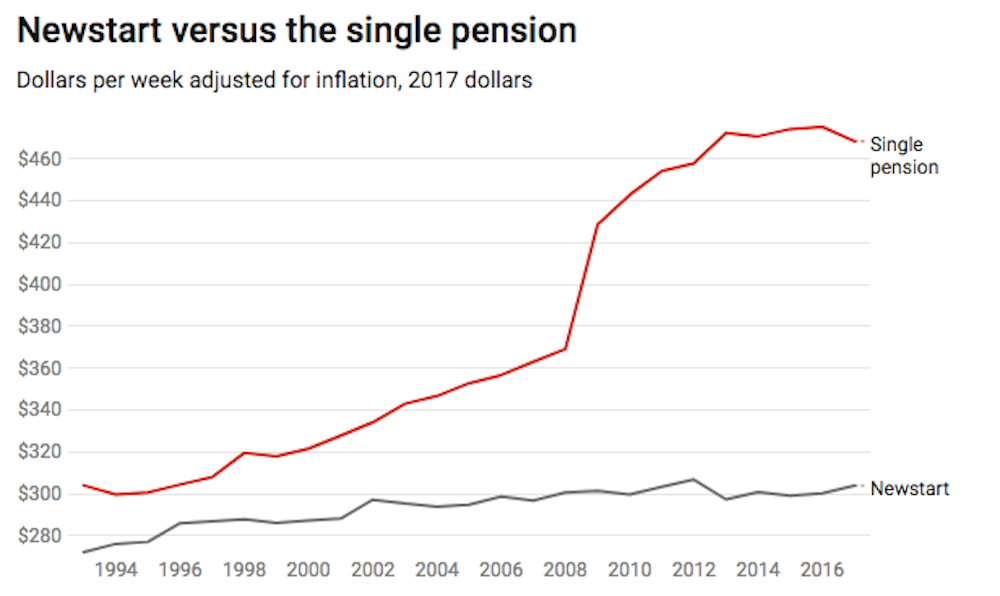
However, it should be noted that the difference in indexation arrangements between the two benefits has pushed down Newstart from about 90% of the age pension in the early 1990s to just 60% today, meaning Newstart is highly likely to be genuinely out of whack, whatever the system’s objectives.


ACOSS


Also, our analysis finds that many households in apparent poverty are not on benefits, and so can’t be helped by changes to the bundle of payments.

On the other hand, while some of these households are legitimately in poverty, others are asset-rich. Around 56% of the apparent gap in poverty resides in households whose main source of income is something such as shares, rental income or superanuation, suggesting they might not need as much help as our algorithm suggests.


Read more: It’s not just Newstart. Single parents are $271 per fortnight worse off. Labor needs an overarching welfare review


We believe our new methodology is an Australian first.

It provides a very efficient means of deriving optimal social security payment settings from a variety of policy objectives.

We expect to broaden it to more policy objectives in the future and to a broader range of payments and elements of the social security system, and to include personal income tax.


Read more: New budget standards show just how inadequate the Newstart Allowance has become


Our method is in its infancy.

We have provided one illustration of how it can be used, and the results are striking: the best way to cut poverty when constrained by a budget is to boost Newstart while pushing down either the pension or family benefits by a modest amount.

ref. Cut the pension, boost Newstart. What our algorithm says is the best way to get value for our welfare dollars – http://theconversation.com/cut-the-pension-boost-newstart-what-our-algorithm-says-is-the-best-way-to-get-value-for-our-welfare-dollars-108417

Australia’s problem with Aboriginal World Heritage

]]>

Source: The Conversation (Au and NZ) – By Ian Lilley, Professor in Aboriginal and Torres Strait Islander Studies, The University of Queensland

Journalist Stan Grant once compared our Indigenous cultural heritage to the Vatican’s Sistine Chapel. Ironically, though Grant pointed to the Lake Mungo site in the Willandra Lakes as an example, Aboriginal people are poorly represented by Australia’s World Heritage sites. Torres Strait Islanders are not represented at all.

Of 19 World Heritage sites across the country, including such wonders as the Great Barrier Reef and the Sydney Opera House, only two, Kakadu and Uluru-Kata Tjuta, recognise the values of “living” Aboriginal culture, alongside the breathtaking natural features in those areas. These are what UNESCO calls “mixed” sites, bringing nature and culture together.

Australia’s two other such sites – the Tasmanian Wilderness, and the Willandra lakes – recognise archaeological records of Aboriginal people, along with natural values, but not contemporary Indigenous rights and associations.

None of Australia’s three sites inscribed purely for cultural values recognises Aboriginal people. They are the Sydney Opera House, the Royal Exhibition Building in Melbourne, and a multi-component listing of convict sites across the country including Port Arthur in Tasmania.

Aboriginal people rightly remain concerned, and often angry, that they were excluded from the original nominations of all of Australia’s World Heritage sites, natural, cultural and mixed. Yet they also remain deeply sceptical about the benefits of such listing.

Some progress

There has been some progress. Australia received enormous international credit for modifying, in 1994, the original Uluru-Kata Tjuta nomination to recognise living Aboriginal culture. But the real turnaround has been when Aboriginal people have directed these processes themselves.

After years of work, Gunditjmara people succeeded in having the site of Budj Bim on Aboriginal land in southwest Victoria, placed on Australia’s Tentative World Heritage List. The site includes a remarkable system of eel traps around Lake Condah. Elements of these traps date back over 6,500 years. This is the first step in the long process of gaining World Heritage recognition.

Remains of a 1,700 year old stone house at Budj Bim, Victoria. denisbin/Flickr, CC BY-ND

Recently the World Heritage Committee established a forum for Indigenous peoples – in the making since the early 2000s. With the issue now so firmly on the international agenda, Australia will come under intense scrutiny to lift its game regarding Aboriginal and Torres Strait Islander World Heritage. How might that be done?

Indigenous heritage now

World Heritage sites are assessed against ten criteria across natural and cultural values. Originally highly Eurocentric, these criteria have gradually widened to become more inclusive, especially of Indigenous people.

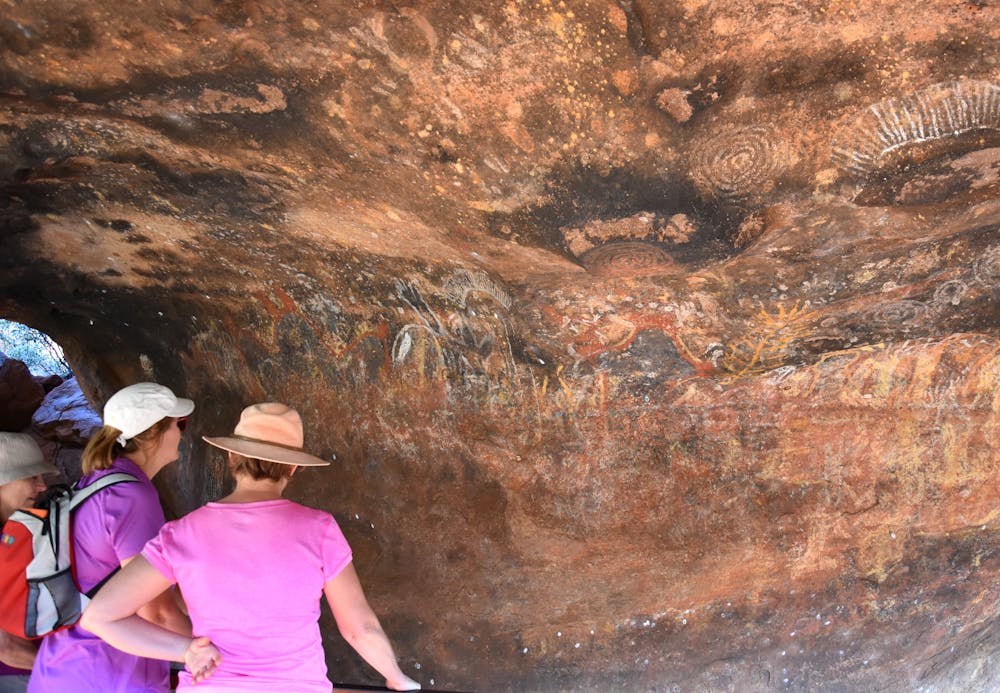
Uluru-Kata Tjuta has long been held up as the paragon of this shift. It was originally listed as World Heritage in 1987, solely for its environmental characteristics. It was relisted in 1994 to include Aboriginal values, recognising the importance of Uluru and Kata Tjuta to the Traditional Owners, the Anangu people. Today, the area is recognised for being one of the most ancient human landscapes in the world, including its spiritual dimensions.

Rock art at Uluru. Shutterstock


Read more: Why we are banning tourists from climbing Uluru


Unlike Uluru-Kata Tjuta, and, later, Kakadu, the Tasmanian Wilderness and Willandra are recognised for their archaeological and rock-art sites, rather than for their living heritage. Willandra, for instance, celebrates archaeological evidence that demonstrates an Aboriginal presence more than 40,000 years ago, in what was then a lush environment quite unlike the present semi-arid conditions.

Such archaeological and rock-art sites are unquestionably important for the extraordinary history they contain, and Aboriginal people have a particular attachment to them as evidence of their ancient and continuing connection with their land. They are actively involved in management of these places for that very reason.

Yet the cultural value of these sites remains defined by non-Aboriginal archaeologists, rather than Aboriginal belief systems or political aspirations.

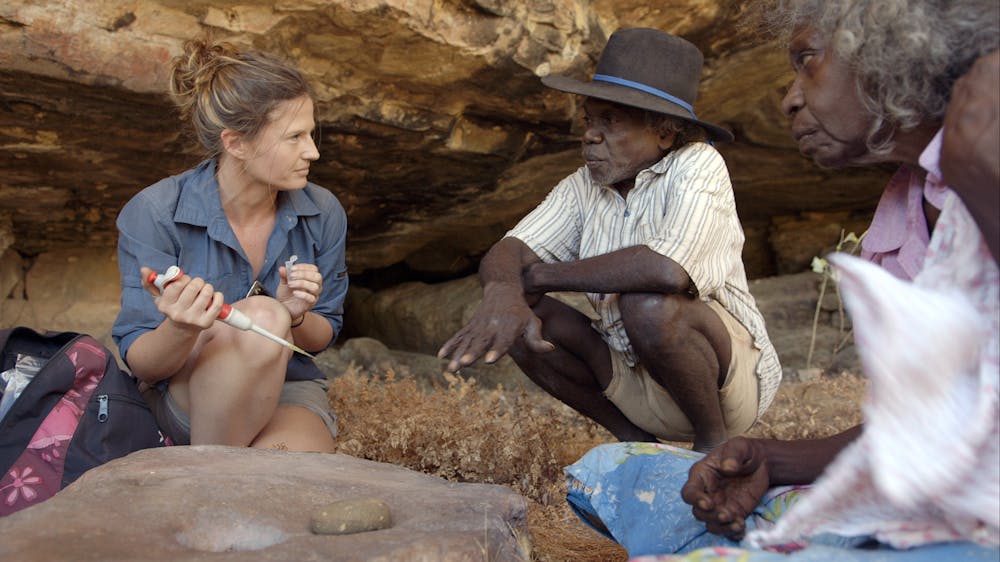
Researcher Elspeth Hayes with Mark Djandjomerr and traditional owner May Nango at Madjedbebe rock shelter in Kakadu National Park in 2017. Vincent Lamberti

The Tasmanian Wilderness is recognised for being one of the last expanses of temperate rainforest in the world. It also includes evidence in limestone caves of Aboriginal occupation up to 35,000 years ago. Yet the listing fails to identify or formally recognise the relationship between that area – particularly the hand-stencil, rock-art sites – and Tasmanian Aboriginal people today.


Read more: Friday essay: how archaeology helped save the Franklin River


Outdated process

We are investigating what World Heritage might better deliver to Indigenous people. One of our major cases is the popular tourist destination of K’Gari (Fraser Island), given a World Heritage listing for its natural heritage in 1992. Some members of the local Butchulla community want Aboriginal heritage included in the listing.

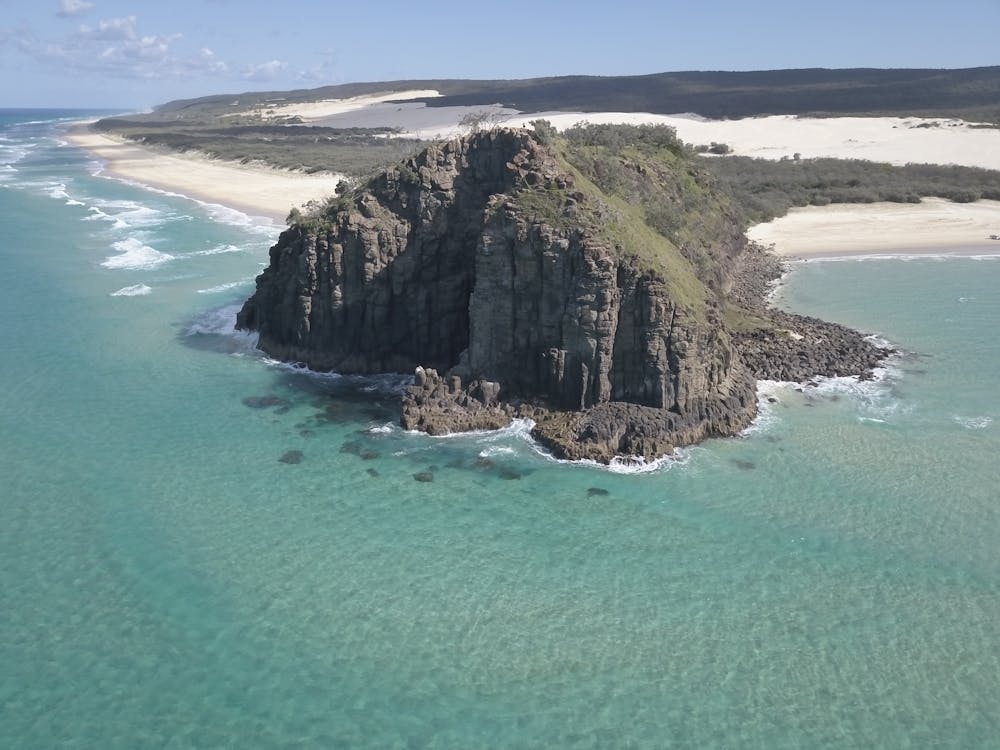
Many archaeological and Butchulla story sites at K’gari are unquestionably unique to the Butchulla people and have great significance for the community today. Takky Wooroo (Indian Head), the rocky headland that anchors the vast sand island in place, is one well-known example.

Takky Wooroo (Indian Head) anchors the vast sand island of K’Gari (Fraser Island). Shutterstock

However the Butchulla face hurdles in having this heritage recognised. The first is proving that their heritage is “better” than examples of Aboriginal heritage elsewhere. The second is demonstrating a continuous connection to it.

Both of these criteria are central to the World Heritage process, but are legacies of an outdated approach to Aboriginal culture. The process lumps diverse Aboriginal people into one group, when we know that Australia was home to hundreds of different peoples.

While the connection of the Butchulla to their heritage has already been recognised under Native Title, we would never assume that European cultures must remain unchanged since 1700 to be recognised as heritage.

How to do better

Our research is consistently finding that Aboriginal people are deeply sceptical about the benefits of World Heritage listing, despite efforts by State and Commonwealth governments to ensure Aboriginal input.

One concern is that World Heritage is seen as universal, something for all people. But some Aboriginal people see this as diminishing their very particular attachment to places, such as the remains of Mungo Man at the Willandra Lakes, an ancestor of deep personal and community significance.

‘Mungo Man’ was repatriated to the Willandra Lakes, where the remains were found, in 2017. PERRY DUFFIN

What can we do better? It is simple. All future heritage sites should canvass Aboriginal and Torres Strait Islander involvement early in the nomination process, even those where there is no obvious Aboriginal link to the site. This process is already retrospectively underway for Australia’s natural sites. and in 2012, it meant the Indigenous heritage values of Queensland’s Wet Tropics were recognised at a national level, which is vital to having them recognised internationally.

We should also support Indigenous people to make their own nominations. This is what’s happening at Budj Bim. While non-Indigenous archaeologists are helping with the nomination, it is being driven by local Aboriginal people. They have linked the archaeological value to both ancestral stories, and to the Gunditjmara’s continuing efforts to maintain and protect their heritage today.


Read more: The detective work behind the Budj Bim eel traps World Heritage bid


What other possible sites are there?

There are a great range of other amazing sites that we know are “out there”. Take the famed “Dreaming tracks” and “songlines” that criss-cross the continent, for instance. Tracing the travels of ancestral beings, they encode the locations of living places and sacred spaces, mapping the disposition of resources across the landscape and through seasonal cycles.


Read more: Songlines: Tracking the Seven Sisters is a must-visit exhibition for all Australians


They encompass some of the nation’s most dramatic natural features as well as camping places, sources of water, food and other resources, art sites and Indigenous sacred places, thus combining natural and cultural, tangible and intangible, and ancestral as well as living heritage.

With suitable protection of secret-sacred information, as well as the routes themselves and the specific sites they incorporate, Aboriginal songlines and the routes of ancestor-heroes in Torres Strait could be a future World Heritage nomination. A number are already on various state government heritage lists.

Similar nominations are appearing in other parts of the world, such as the recently-listed mixed site of Pimachiowin Aki, co-developed by the Ojibwe (Anishinaabe) peoples “in the heart of Canada’s boreal forest” – not least because of precedents set by Australia over the years.

ref. Australia’s problem with Aboriginal World Heritage – http://theconversation.com/australias-problem-with-aboriginal-world-heritage-82912

Politics with Michelle Grattan: Anthony Albanese on Labor’s road ahead

]]>

Source: The Conversation (Au and NZ) – By Michelle Grattan, Professorial Fellow, University of Canberra

Labor frontbencher Anthony Albanese, a senior minister in the last Labor government and briefly deputy prime minister, is preparing to “hit the ground running” if the ALP wins next year’s election.

But meanwhile the opposition is concentrating on staying focused and on message, fully aware that things can always go wrong.

Speaking to The Conversation, Albanese wouldn’t comment on Bill Shorten’s unpopularity with voters, arguing instead that it’s a matter of whether the Labor team is “seen as worthy of election”.

Albanese predicts next week’s ALP national conference will be “very constructive”, dismissing concerns about divisions over boat turnbacks.

The debate is not focused on that, he said – rather the emphasis is on settling people from Nauru and Manus in third countries, dealing with those needing medical assistance, and co-operating in regional processing.

Asked about the ALP last week capitulating to the government over the encryption bill, Albanese said he wasn’t involved in the decision, which was “made by the leadership group”.

Always under pressure from the Greens in his own seat of Grayndler, Albanese predicts a “schism” in the “dysfunctional” party is imminent. A conflict between two tendencies in the NSW Greens could lead to a split “as soon as the March state election … two parties essentially running against each other trying to claim the same ground”.

ref. Politics with Michelle Grattan: Anthony Albanese on Labor’s road ahead – http://theconversation.com/politics-with-michelle-grattan-anthony-albanese-on-labors-road-ahead-108687

Three things high school graduates should keep in mind when they have their ATARs

]]>

Source: The Conversation (Au and NZ) – By Ittima Cherastidtham, Fellow, Higher Education Program, Grattan Institute

School leavers across Australia are about to get their ATAR (Australian Tertiary Admission Rank). In the coming weeks, they will get a chance to update their university course preferences.

Most students attend university to improve their job prospects. But less than half of surveyed students believe they had enough information when they chose their course.

Here are three things prospective university students should keep in mind when finalising their preferences.

1. Drop-out rates

About one in five school leavers who start university will not complete a degree within nine years – and they generally earn less than their peers who graduate.

A Grattan Institute report released in April showed people who study part-time are much more likely to drop out than full-time students. Course choice is also important. Among students with similar characteristics, those studying health or education are less likely to drop out than those studying IT, engineering, science, or humanities.


Read more: So you’ve got your ATAR, now what? Here are some options


Surveys of people who consider dropping out show engineering and IT students are often dissatisfied with the teaching and cite a lack of interest in their course. Science students are more likely to consider leaving because of poor employment prospects. This is rarely a reason cited by health and education students.

2. Early-career employment

Health and education bachelor-degree graduates have strong employment prospects. A Grattan report released in September found about 80% of health and education graduates were in a full-time jobs four months after finishing university. And they continue to do well during their early career (from their mid-20s to mid-30s). The share of women in this age range in full-time jobs is generally lower than men because many women leave work to have children.

Only 60% of science graduates who were looking for a full-time job found one within four months of finishing their degree. While this is partly because more science graduates continue studying, their poor job prospects persist into their early career. Some 66% of male and 50% of female science graduates in their mid-20s to mid-30s have a full-time job. Employment outcomes for other disciplines are shown below.


Having a job is one thing. Having a job that uses the skills developed at university is another. About 80% of employed early-career engineering and law graduates have a professional or managerial job. The figure for early-career nursing and education graduates is even better.

Getting a professional job is more difficult for graduates in generalist fields – humanities, commerce and science – and their prospects have declined since the Global Financial Crisis. Fewer than 60% of employed early-career male science graduates have a professional job. Female humanities graduates who have a job are more likely to work in sales or services than in professional occupations. Figures for other disciplines are shown below.


3. Lifetime earnings

In terms of pay, commerce graduates typically have a slow start but can expect to earn above-average income over their lifetime – A$2.1 million for women and A$3 million for men.

Because nurses and teachers have flatter pay scales, men in nursing or education have lower-than-average lifetime earnings (about A$2.5 million). But their flexible working conditions make it easier for women with children to work in these fields. The average female nursing or education graduate can expect to earn A$2.1 million over their lifetime – more than the average female graduate.

Law and engineering graduates have much stronger lifetime earnings prospects than humanities and science graduates.


A 2014 Grattan Institute report found graduates of some universities tended to earn more over their lifetime than graduates of others, but the variation between universities was not as large as variation between fields of education.

A final word of advice

Students should look beyond course names to explore course content. That way they may be able to improve their employment prospects while still studying in a field that interests them. This information can be found on each university’s web page.


Read more: Your ATAR isn’t the only thing universities are looking at


For example, students who like science should consider health courses. Health students spend about 25% of their first year studying science subjects – and they have better chances of securing a job that uses their qualification.

While choosing preferences is only one of the many steps students will take in their higher education journey, getting this right is important. The better choices they make now, the sooner students can realise their career goals.

ref. Three things high school graduates should keep in mind when they have their ATARs – http://theconversation.com/three-things-high-school-graduates-should-keep-in-mind-when-they-have-their-atars-107601

Your drinking water could be saltier than you think (even if you live in a capital)

]]>

Source: The Conversation (Au and NZ) – By Ian Wright, Senior Lecturer in Environmental Science, Western Sydney University

As the drought drags on, small communities in eastern Australia are turning to emergency water supplies. Often, this means bore water, which has prompted health fears over its high salt content.

As alarming as this is, drinking water right around Australia can have surprisingly high levels of salt. All capital cities have water salinity levels that are within the Australian Drinking Water Guidelines of 500 milligrams per litre (mg/L) – however the guidelines do not regard salinity as a health consideration, but rather as an “aesthetic” guideline, based on taste.


Read more: Why does some tap water taste weird?


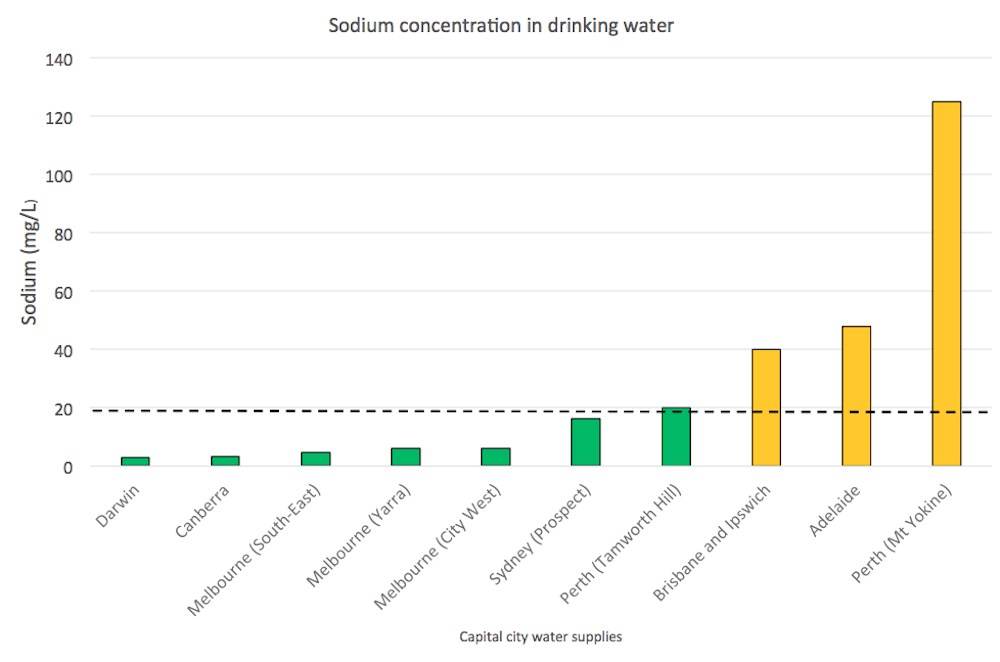
But Australians consume too much salt, and many need to reduce salt in their diet, so the sodium component of salt has key health implications. For people following low-sodium diets for health reasons, the salt in their drinking water may be important. It is generally recommended that people on low-sodium diets drink water with less than 20mg of sodium per litre, but Brisbane, Adelaide and most of Perth have saltier water than this.

What salinity means

Water salinity is commonly reported as “total dissolved solids,” which includes all organic and inorganic substances. “Salts” are soluble compounds of sodium, calcium, potassium, magnesium, chloride, sulfate and bicarbonate. Salts enter our waters from everywhere: the ground, the ocean, the air and living creatures.

We investigated drinking water in Australian capital cities, and some regional locations to compare salt content. When data was not publicly available for capitals, we approached water authorities for data on water salinity.

We found four major groupings for the capital cities:

  1. The highest salinity water was in some Perth districts
  2. The second and third highest were in Adelaide and Brisbane
  3. Sydney and some supply districts within Perth (such as Tamworth Hill) have the joint second lowest salinity.
  4. Melbourne, Hobart, Darwin and Canberra all share the lowest salinity.

Water can start tasting noticably salty at 180 mg/L. The figure below shows which districts have less than or more than 180 mg/L.

Average salinity (TDS) concentrations for Capital Cities. At more than 180 mg/L drinking water can start to taste salty (shaded yellow) and is shaded green for <180 mg/L. Author provided

Health implications

Generally, we all love salt in our food. But one element of salt has potentially serious consequences for many Australians: sodium. It is recommended we consume less than 2,300mg per day. People with high blood pressure should consume less than 1,600mg per day, but the average Australian consumes twice that.

High levels of sodium in the diet are associated with elevated blood pressure (hypertension), for which a sodium-reduced diet is sometimes recommended. Health care professionals may also recommend low sodium diets for patients with kidney disease and cardiovascular disease.

If you’re following a low sodium diet, you may not have considered water as a potential source. It is generally recommended that people on low sodium diets drink water with less than 20 mg/L of sodium.

Salinity varies a lot

We obtained sodium data that showed water from Darwin, Canberra, Sydney, Melbourne and Hobart have less than 20 mg/L. However, Perth (most areas), Adelaide and Brisbane have more than 20mg/L of sodium in their water supplies.

However, water supplies can be complex. One district in Perth, Tamworth Hill, has 20mg of sodium per litre, which conforms with the requirements for a low-sodium diet. Another Perth district around 50km away, Mt Yokine, has sodium levels more that six times higher, at 125mg/L.

Average sodium concentration for Capital city water supplies. At more than 20 mg/L people on low-sodium diets need to consider sodium in their drinking water – they should discuss with their doctor/dietician. CREDIT, Author provided

Regional and remote regions of Australia often have water with elevated salinity. Tennant Creek and Alice Springs in Northern Territory and Geraldton in WA are three regional Australian cities with sodium content higher than generally found in Australian capitals.

Horrocks in WA has the highest, based on our review of available public data. It is a very small coastal settlement 500km north of Perth. At 408 mg/L it is more than 130 times higher than Darwin’s average sodium concentration.

What can you do about it?

Where medical health professionals recommend a low sodium diet consumption of sodium through drinking water should be considered. If unsure of the sodium content of your water, and if you are on a low sodium diet, then contact your local water supplier. This could also be a topic to discuss with your doctor or other health care providers.

There are a number of small household water treatment systems that use reverse-osmosis to remove minerals. They can provide treated water with much lower sodium content.

Low-salt bottled water could be an option, but caution is needed. Apart from the expense, some commercial bottled waters also have elevated sodium levels. Check the mineral contents on the bottle label, and if you are on a low-sodium diet make sure that sodium is low.

Hard to find this data

One reason for the over-representation of the Northern Territory and Western Australia is simply that the information is available (we applaud them both). We have not been able to find sodium results for many regional and remote water supplies across Australia.

In many cases, water authorities report compliance with Australia’s Drinking Water Guidelines – as is proper – but currently sodium is not measured as a potential health issue.

We suggest sodium should be treated as a health-related attribute of drinking water. It would therefore be monitored in every water supply, and could be usefully advertised. Most people have too much salt in their diet, and it is true that much of this comes from processed food. But in some locations a surprisingly large amount can be from our drinking water.

ref. Your drinking water could be saltier than you think (even if you live in a capital) – http://theconversation.com/your-drinking-water-could-be-saltier-than-you-think-even-if-you-live-in-a-capital-106054

Four journalists, one newspaper: Time Magazine’s Person of the Year recognises the global assault on journalism

]]>

Source: The Conversation (Au and NZ) – By Peter Greste, Professor of Journalism and Communications, The University of Queensland

Time Magazine has just announced its “Person of the Year” for 2018, and for once, it isn’t one person. This time it is four people and a newspaper.

Collectively calling them “The Guardians”, Time has awarded the accolade to the murdered Saudi journalist Jamal Khashoggi, Filipino journalist Maria Ressa who edits the Rappler news website, two young Reuters journalists Wa Lone and Kyaw Soe Oo currently serving seven-year sentences for exposing a massacre in Myanmar, and the staff of The Capital Gazette newspaper in the American town of Annapolis, Maryland, who continued publishing after five of their colleagues were gunned down in an attack in June.

Time’s Person of the Year cover is reserved for those who the magazine judges have had “the greatest impact on the news”, and not always for the better (it famously nominated Adolf Hitler in 1938). Its decision to name a collection of journalists is a marker not just of the impact those individuals have made, but a nod to the wider global crisis of confidence in journalism and “the truth”. The nominees are there partly for what they have done, but also for what they have come to represent.

Khashoggi is undoubtedly the best known of the group. The grim details of his assassination, in which he was lured into the Saudi consulate in Istanbul to get documents for his marriage before he was strangled and dismembered with a bone saw, are as compelling as any airport novel. But they also exposed the cynicism of the Crown Prince Mohammed bin Salman, who has tried to present himself as Saudi Arabia’s Western-friendly liberal saviour while ruthlessly and illiberally cracking down on dissenters.

As Khashoggi himself once asked in a Washington Post column:

Must we choose between movie theatres and our rights as citizens to speak out, whether in support of or critical of our government’s actions?

Maria Ressa is less well-known but no less courageous. A former CNN correspondent, she co-founded Rappler seven years ago, building it into one of the most trusted independent sources of news in The Philippines.

Rappler has fearlessly covered President Duterte’s authoritarian edicts, including his war on drugs that has taken an estimated 12,000 lives. In the process, she has weathered a storm of assaults from Duterte himself and his army of online trolls. She now faces up to 10 years in prison on tax evasion charges that seem contrived not to punish financial crimes but silence a vital critical voice.


Read more: Book: In the name of security – secrecy, surveillance and journalism


Wa Lone and Kyaw Soe Oo produced one of the most impressive pieces of journalism of 2017, investigating the murder of ten Rohingya Muslim men with forensic attention to detail. They unearthed a series of photographs of the victims and their killers, and were able to piece together a detailed narrative so compelling that the authorities were forced to imprison the soldiers responsible for 10 years. For their work, the Reuters journalists were also arrested for violating the Official Secrets Act and sentenced to seven years. (A police officer testified in court that they framed the journalists.)

And The Capital Gazette? A few hours after a gunman burst into the newspaper’s offices and murdered five staffers, one of its reporters, Chase Cook, tweeted: “I can tell you this. We are putting out a damn paper tomorrow”. The paper did exactly that.

It was not producing the kind of work that might attract a murderous response. It is a local rag that covers council elections and school sports, not autocrats and genocide. And yet the press is now so demonised that a reader felt justified in shooting it up for its reporting of his own court case.

From the local to the global, these examples expose the way one of the most fundamental pillars of a free, liberal society – journalism itself – is under assault.

The digital revolution is partly to blame. It has created a firehose of information that has enabled us to find “news” that confirms whatever we want to believe. In the process, it has eroded trust in the media and enabled anyone who squirms under its spotlight to dismiss it as “fake”. In the process, our capacity to hold informed, rational public debate has been dangerously undermined.

Make no mistake. This is a global crisis that strikes at the foundations of democracy, which is why Time’s decision is so timely and important.

Journalists are not without fault. News is a messy, imperfect human construct, and in the rush to create stories that stand out from the digital noise, standards have slipped. But the verbal and physical assaults on news agencies and their staff fail to acknowledge the professionalism that so many bring to their craft. The difference between fake news and the real thing is that good journalists acknowledge errors and correct them fast.


Read more: How investigative journalists are using social media to uncover the truth


The Time cover also demands a response. If we do nothing, we will end up heading further down a path that nobody but the authoritarians are happy with. Even in Australia, where national security laws have dramatically limited the ability of journalists to keep watch over government, the problems are acute and deteriorating. That is why a group of colleagues and I have set up the Alliance for Journalists’ Freedom to advocate for media freedom in the broadest sense – the ability to work free of unnecessarily restrictive laws, in a financial environment that supports independent quality news.

The questions are huge. How do we balance the democratic need for transparency and accountability, with the demands of national security? How do we pay for journalism that is costly and necessary but not always commercially viable? How do we restore trust in an institution that underpins the way our society and our government works?

The AJF has partnered with the University of Queensland, where I am UNESCO Chair in Journalism and Communication, to work on research that tackles some of these most pressing problems.

If we do nothing, we can expect to see a lot more cases like Jamal Khashoggi, Maria Ressa, The Capital Gazette or Wa Lone and Kyaw Soe Oo. I suspect that is a world few of us would relish.

ref. Four journalists, one newspaper: Time Magazine’s Person of the Year recognises the global assault on journalism – http://theconversation.com/four-journalists-one-newspaper-time-magazines-person-of-the-year-recognises-the-global-assault-on-journalism-108669

An opt-out system isn’t the solution to Australia’s low rate of organ donation

]]>

Source: The Conversation (Au and NZ) – By Neera Bhatia, Senior Lecturer in Law, Deakin University

Organ transplantation relies on the generosity of a person to volunteer their organs for donation after death, or the generosity of the family to gift or donate the organs of their deceased relative.

But last year, the organs of just 510 deceased donors were transplanted into Australian recipients. This amounts to 20.7 donations per million people and puts Australia down to 17th place for international deceased organ donation.

Last week, a parliamentary committee report on organ donation and trafficking made a number of recommendations for the Australian government, including investigating whether an opt-out system of organ donation could help increase donation rates.


Read more: Here’s what Australia can do to help end the Chinese organ trade


Several countries have recently made the switch from opt-in to opt-out systems. But this hasn’t necessarily increased organ donation rates. One reason is if someone hasn’t actively opted in, their family members will still need to consent to their organs being removed. And where families don’t consent, the donation doesn’t proceed.

Opt-in vs opt-out

In Australia, a person must register to donate their organs or tissues. This is sometimes referred to as an opt-in system of organ donation.

While 69% of Australians believe organ donation is important, only one in three people are registered as organ donors.

In an attempt to boost similarly low donation rates, a number of countries – including Wales, Iceland and now England (by mid-2020) – have switched to opt-out systems.

In an opt-out system, a person is automatically presumed to have given their consent to be a donor before their death unless they had made a specific request not to donate their organs. So, organs may be taken unless people have registered an objection not to be donor, or their family members (next of kin) object. This is known as a “soft opt-out”.


Read more: How we can increase Australia’s organ donation rate


In 2017, France introduced a law that requires doctors to only inform the relatives about which organs are to be procured, and not ask their permission to procure. This is an example of a “hard opt-out” system.

We believe the consent of the family members (next of kin) should always be sought if a person has not registered their consent before death for their organ to be procured.

Historically, Australian governments have been wary of adopting an opt-out system of organ donation.

Despite several states considering reforming the current organ donation system and a 2016 independent review looking at options to boost donation rates, an opt-out system was not considered preferable. We suspect this was because people tend to react negatively when their choice is taken away.

There were just 510 deceased organ donors in Australia last year. Nimon/Shutterstock

Family consent

There is no conclusive evidence opt-out systems of organ donation increase the number of donors available.

An opt-out system is unlikely to increase donation rates without the consent of the family.

In our society, the family have always been responsible for decisions about a burial or cremation of the body of their relative. Arbitrarily violating this right would cause psychological harm and no direct benefit.

You only have to consider the anger and grief of parents in the scandal that broke out in 1999 around the non-consensual harvesting of their children’s organs at a UK hospital. It shows how devastating un-consented procurement of organs of a deceased relative would be.

There are other reasons why non-consensual organ procurement would cut across social expectations. Autopsies are now not performed routinely and if conducted are not without the consent of relatives. This further adds to the notion relatives have decision-making rights.

Are we to have an opt-out system which includes all citizens? Who would dare tell parents their dead child’s organs are to be compulsorily procured? Who would ignore the practices of certain religions which expect the deceased body to be buried intact? These are all insurmountable obstructions to hard opt-out systems.

There is significant variability in how opt-out systems work. Take Spain, for example. It introduced an opt-out system, often referred to as a presumed consent model, in 1979 and it took almost a decade before donation rates increased. Even when they did, Spain’s success was due largely to close consultation with family members, which continues today.

Brazil also introduced a presumed consent system of organ donation but abolished it after a year and a half, in late 1998. This was due to uncertainty, fear and mistrust of the medical profession prematurely declaring people dead to remove organs.

And even under the presumed consent system, the majority of doctors would only remove organs from the deceased after receiving consent from family members.

Gift of life

Opt-out systems of organ donation go against the very concept of gifting or donating. It’s taking organs without consent, as opposed to donation. It presumes consent by the deceased when none exists.

As a society, we need to normalise organ donation and dispel the fears, myths and perhaps sheer ambivalence that surrounds it.

We need to encourage innovative education programs and engagement with individuals and families to promote robust, honest and meaningful conversations about organ donation.


Read more: Organ donation campaigns could be more effective if they focused on feelings rather than facts


It may be difficult to have conversations about organ donation with families after a tragic accident or a sudden death. But, where possible, doctors should engage families in discussions about organ donation early on.

Family members should be encouraged to respect the wishes of the deceased, whether that was via the organ donation register, a prior conversation, or by any other means.

It’s unlikely there will be an adequate supply of organs to meet the demand anytime soon in Australia. There is no simple solution or quick fix to increase organ donation rates, but an opt-out system is not the answer.

Organ donation should continue to be just that – a donation. Based on the generosity and free will of the donor by virtue of a gift, and not based on a default system of taking without consent.

ref. An opt-out system isn’t the solution to Australia’s low rate of organ donation – http://theconversation.com/an-opt-out-system-isnt-the-solution-to-australias-low-rate-of-organ-donation-108336

What the Victorian government’s decision not to sign on to the Gonski reforms means for schools in the new year

]]>

Source: The Conversation (Au and NZ) – By Anna Olijnyk, Lecturer, Adelaide Law School, University of Adelaide

Victorian schools could potentially be without federal funding after 31 December 2018 if the state government refuses to sign up to the Gonski 2.0 funding reforms. In a letter to Victorian Premier Daniel Andrews on Monday, Prime Minister Scott Morrison stated he was committed to coming to an agreement by today, when the Council of Australian Governments meets. The Victorian government has raised its portion of school funding from 66% to 75%, and is asking that the federal government also raise their share by an additional 5% to 25%.

Another letter, this time written by shadow federal education minister Tanya Plibersek to Andrews, circulated this morning. In the letter, Plibersek promised Labor would backdate any school funding withheld from Victorian students if it wins the May election.


Read more: FactCheck: does Victoria have Australia’s lowest rate of public school funding?


The federal government has responded by saying Victoria isn’t entitled to federal funding after 31 December if the state doesn’t sign on to the reforms. The Victorian government claims it has legal advice that says the state would be entitled to funding come 2019.

In what essentially amounts to a game of political chicken, who wins? The federal government is right that it doesn’t have to fund Victorian schools in 2019 if they don’t sign an agreement. But that would be a poor political move at a time when the Coalition faces mounting criticism in the lead-up to an election.

The Australian constitution, money, and schools

The standoff is underpinned by the financial relationship between state and federal government, established by the Australian constitution. What does the constitution require the governments to do in this situation? Basically, nothing. Neither the state nor the federal government is under any constitutional obligation to fund schools. Nor does the constitution give Victoria an entitlement to federal funding.


Read more: State governments are vital for Australian democracy: here’s why


The constitution leaves responsibility for running schools to state governments. The federal parliament is not given power to make laws about schools. So why does the federal government have anything to do with schools?

The answer lies in a very powerful provision of the constitution: section 96. This section allows the federal government to give money to state governments, on such terms and conditions as the federal Parliament thinks fit. For example, the federal government may give a state money to run schools, on the condition the money is distributed in a certain way, or even that particular teaching methods are adopted.

What can state government do if it doesn’t like the conditions?

There are three options:

  1. the state can accept the money on those conditions, even though it doesn’t like them
  2. the state can refuse to accept the money at all
  3. the state can try to negotiate with the federal government to secure the money on more appealing conditions.

From a constitutional point of view, the states are in a weak position here. The federal government can simply refuse to hand over the money, leaving the states with empty pockets. Australian state governments rely heavily on section 96 grants from the federal government.

The states are unable to collect enough tax to fund crucial government responsibilities (such as education and health). Under the constitution, the federal government has greater ability to collect tax, so the states rely on the federal government for a large chunk of the state budget each year. It’s called a vertical fiscal imbalance.

But what about the politics?

From a political point of view, the playing field is more even. For many years, the federal government has given the states money to pay for schools. There is now a strong public expectation it will continue to do so. If the federal government were to refuse to fund Victorian schools in 2019, this would be rich fodder for the government’s political opponents.


Read more: What kind of prime minister will Scott Morrison be?


Similarly, though, if the Victorian government refuses to accept money on the conditions offered by the federal government, it will be partially responsible if schools don’t have enough funding to operate in 2019.

The constitution leaves both governments with a lot of freedom to choose what to do here. But for either government to be responsible for shutting down Victoria’s schools would be extremely unattractive, politically. There is a strong political incentive on both sides for the Victorian and federal governments to reach agreement very soon – certainly in time for the new school year to proceed as usual.

ref. What the Victorian government’s decision not to sign on to the Gonski reforms means for schools in the new year – http://theconversation.com/what-the-victorian-governments-decision-not-to-sign-on-to-the-gonski-reforms-means-for-schools-in-the-new-year-108674

Honouring the dead: Alex Seton’s stark, moving protest sculptures carved from marble

]]>

Source: The Conversation (Au and NZ) – By Joanna Mendelssohn, Honorary Associate Professor, Art & Design: UNSW Australia. Editor in Chief, Design and Art of Australia Online, UNSW

Alex Seton’s sculpture A Durable Solution? is concentrating the minds of some delegates as they approach this weekend’s ALP national conference in Adelaide. It is the key work in All We Can’t See, an exhibition in the foyer of the Adelaide Convention Centre.

No delegate will be able to avoid this visual response to the Nauru Files, the records of life on that island first exposed by The Guardian. With exquisite timing, the show’s opening reception will be held at the centre on Sunday, the evening before the Labor Party debates its refugee policy.

Seton has a carved series of stark, minimalist memorial plaques, naming the 12 men who have died under our “care” on Nauru and Manus Island. There is no compromise, no gloss. The white Carrara marble, the same material used by Michelangelo, has been pared back, muted. Its surface is bereft of texture, the only incisions are the names of the dead and the dates they died.

Detail from Alex Seton, A Durable Solution?

A Durable Solution? is the third time this relatively young artist has made work that can be described as a collective memorial. Even though each of these sculptural installations commemorate the lives of a specific group of people, they also focus on the individual, to allow private grief. Seton has described his approach to memorials as “capturing those moments that are a test of our humanity”.

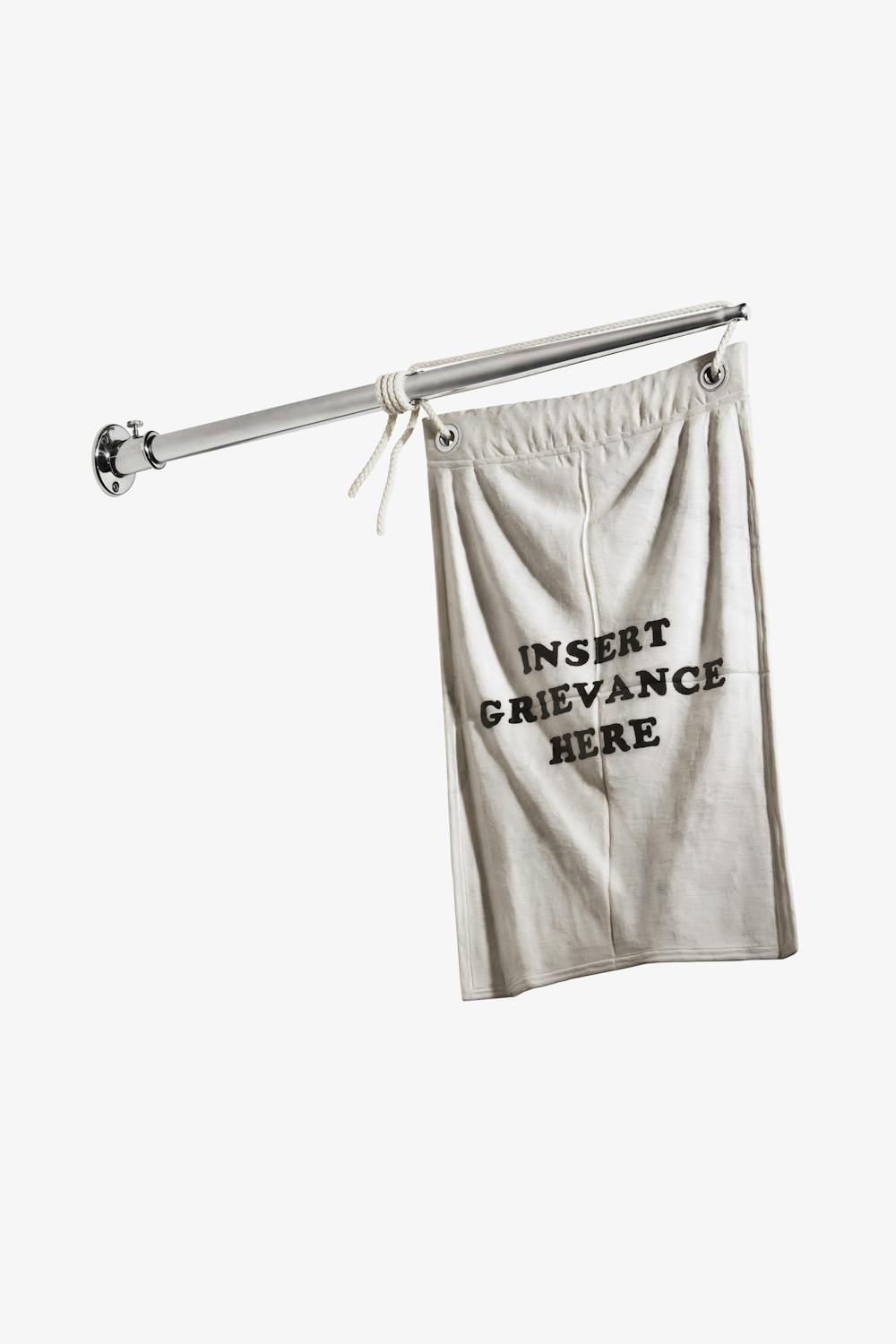
Alex Seton: Insert Grievance Here (2011).

He came to memorials via his series of sculptures of flags. Seton is an artist passionate about one material, marble. While this may be the great classic stone for monuments, it is very unfashionable in the 21st century. But his childhood home was near the Wombeyan Caves Marble Quarry, and he was fascinated by those rough blocks of veined rock that could be transformed beyond recognition.

So while studying a Bachelor of Art Theory degree, Seton began to carve. His passion for the precise craft of manufacture melded with his understanding of subtext and symbol. He learnt to carve stone so that it was easily mistaken for fabric. He looked at the ultimate symbolic use of cloth – in flags.

Carving folded flags

Flags may be ironic, but more often they are patriotic. They are the symbols soldiers fight under, and when they are killed a flag will drape their coffin. Seton is the same age as some of the young soldiers who first died in Australia’s longest war in Afghanistan. As part of coming to terms with the deaths from his generation. he began to carve folded Australian flags to honour the dead – one for each soldier.

These are made of pink, pearl marble from Chillagoe in north Queensland. Its flush suggests flesh and blood. Each is “bound” with a cloth halyard, creating confusion as to where the stone may begin. Twenty-three flags were first exhibited in Lismore and Brisbane. More have been added with each death.

Alex Seton, As of Today, marble with halyard. Sullivan + Strumpf

The title of these works, As of Today, reminds the viewer that more deaths may be on the way. The Australian War Memorial purchased the flags, with a commission to add more when necessary. There are now 42. Seton has said,

Initially I thought this work was about us – how easily we forget – but it is not about us at all. It is about those who gave their lives and whose memory we now preserve.

At the same time as the Australian War Memorial was preparing to show his work, Seton was completing a rather different memorial. Dark Heart, at the 2014 Adelaide Biennial, can be described as a dive into the dark night of the national soul. Much of the art was confronting, pricking the national conscience as a Jeremiad against the follies of modern Australia.

Now owned by the Art Gallery of South Australia, Someone Died Trying To Have a Life Like Mine was made in response to a particular incident in the sorry history of the many boat people who have died at sea.

In May 2013, 28 empty lifejackets were found washed ashore on Cocos Island. There is no official record of who the voyagers may have been, but one jacket contained a small amount of Iranian money.

Alex Seton Someone Died Trying to Have a Life Like Mine, Wombeyan marble, polyester webbing, stainless steel, varied dimensions. Adelaide Biennial

Seton began his work to honour these dead, and to give an answer to the question many ask – why set off in an unseaworthy boat across hostile waters? The answer is that these people want what we take for granted, a life like ours.

Each carved jacket manages to quote elements of the western canon of art. One is burst open like Michaelangelo’s Dying Slave. Two are together, as intimate as a quattrocento Madonna and Child. Others are placed in an arc, like flying angels.

The power of Someone Died Trying to Have a Life Like Mine comes from its evocation of empathy, the realisation that the people Seton is commemorating were like us. They wanted to walk in our shoes, so we are drawn to don their lifejackets.

It is this empathetic approach to honouring the dead that gives Alex Seton’s memorials their power. He moves beyond the studied factionalism of party politics and asks the viewer to consider the shared humanity of those who have died.

It does not matter whether they are soldiers or asylum seekers, lost at sea or imprisoned on land. They are us, and we are them.

ref. Honouring the dead: Alex Seton’s stark, moving protest sculptures carved from marble – http://theconversation.com/honouring-the-dead-alex-setons-stark-moving-protest-sculptures-carved-from-marble-108502

Curious Kids: How does the Moon, being so far away, affect the tides on Earth?

]]>

Source: The Conversation (Au and NZ) – By Mark Hemer, Senior Research Scientist, Oceans and Atmosphere, CSIRO

This is an article from Curious Kids, a series for children. You can send your question to curiouskids@theconversation.edu.au. You might also like the podcast Imagine This, a co-production between ABC KIDS listen and The Conversation, based on Curious Kids.


How does the Moon, being so far away, affect the tides on Earth? – Lachie, age 8, Doreen, Melbourne.


Great question Lachie!

The short answer is that the Moon’s gravity pulls the oceans (and us) towards it. Even though the Moon is so far away, it is large enough that it’s force of gravity is strong enough to do that.

But before we get into how the Moon affects tides, let’s look at what tides are.

Tides are the rise and fall of water level in the oceans (and lakes, and even in your cup of water, but they’re very small).

When the sea level rises to its highest point, we call that high tide. When it falls to its lowest point, that’s called low tide.

The rise and fall of the tides is known as the tide cycle. If there’s one high tide and one low tide a day, like you would see if you went on holiday to Perth, it’s called a diurnal tide cycle. If there are two high tides and two low tides, like you see in Victoria, it’s called a semi-diurnal tide cycle.

The Moon has the most effect on the tides, but it’s not the only factor that affects them. The Sun and the Earth can also affect the tides. We’ll start with the Moon.


Read more: Curious Kids: Are there living things on different galaxies?


Tides and the Moon

The Moon affects the tides because of gravity. You will have noticed that every time you jump, you always land back on the ground. This is because the Earth’s gravity is pulling you back down.

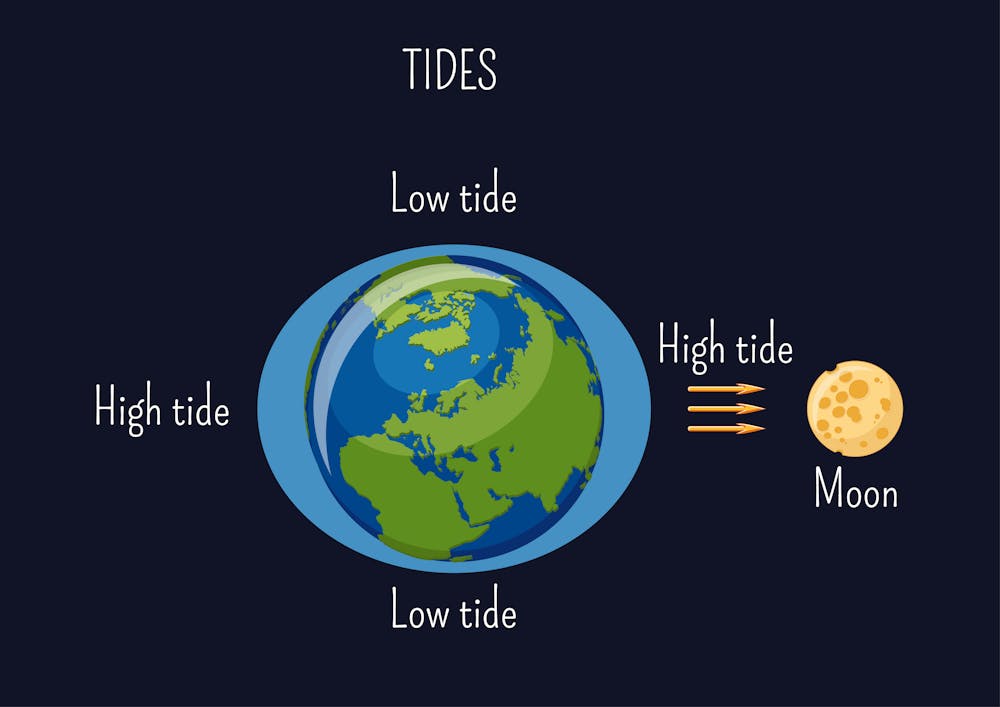
The Earth’s spinning means that another high tide occurs on the opposite side of the Earth to the Moon. Shutterstock

The Moon has gravity of its own, which pulls the oceans (and us) towards it. The Moon’s gravitational pull on us is much weaker than Earth’s, so we don’t really notice it, but we can see the Moon’s effect on the liquid water of the oceans. The oceans are pulled towards the Moon’s gravity slightly, causing a bulge or high tide on the side of the Earth closest to the Moon.

The Earth’s effect

If the Moon causes a high tide on one side of the Earth, what causes the high tide on the other side?

The Earth is spinning, which is why we have night and day. The Earth’s spinning means that another high tide occurs on the opposite side of the Earth to the Moon.

These two high tides draw water away from the rest of the oceans, causing two low tides between the high tides.

Why do we have tides? – Forces of Nature with Brian Cox: Episode 2 – BBC One.

The Sun

The Sun, just like the Moon and the Earth, also has its own gravity which can affect the tides. Although the Sun is much larger than the Moon and has more gravity, it’s also much further away, meaning its pull on the tides is less than half as strong as the Moon’s.

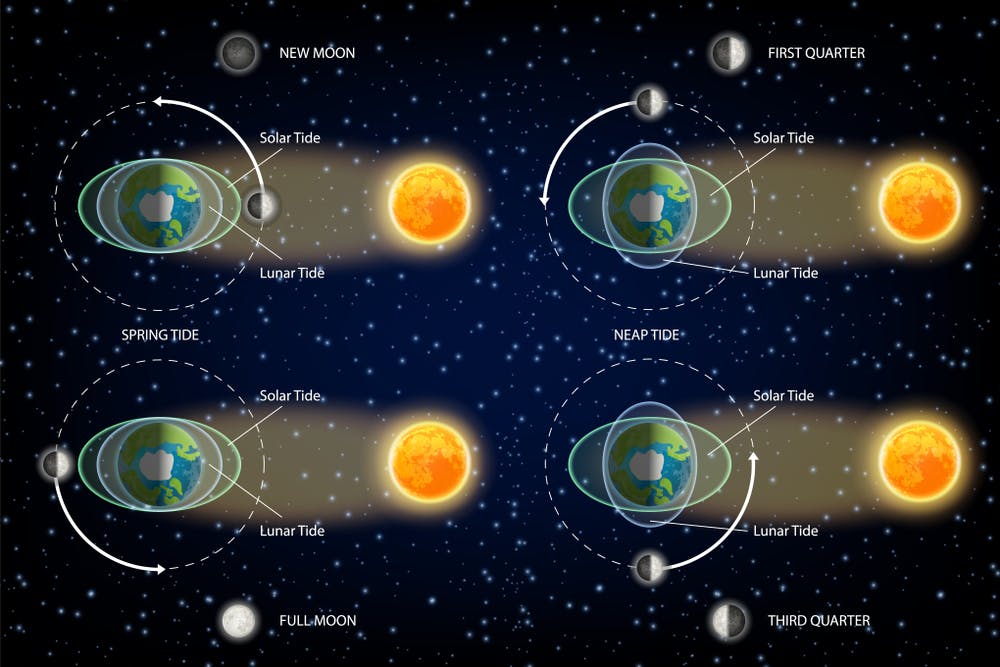
It still does have an effect, though. When the Sun and Moon are in line with the Earth (when a full moon or new moon occur), their combined gravity cause very high tides (and very low tides), known as “spring tides.”

When the Sun and Moon are at right angles to each other (during a waxing or waning moon), the Sun helps to cancel out the pull of gravity from the Moon, causing lower high tides and higher than average low tides, known as “neap tides”.

Lunar and Solar tides diagram. Shutterstock

So the Moon affects the tides because of gravity, but gravity from the Sun and the spinning of the Earth also change how the tides behave.

Best wishes,

Mark Hemer.


Read more: Curious Kids: Is there anything hotter than the Sun?


Hello, curious kids! Have you got a question you’d like an expert to answer? Ask an adult to send your question to us. You can:

* Email your question to curiouskids@theconversation.edu.au
* Tell us on Twitter by tagging @ConversationEDU with the hashtag #curiouskids, or
* Tell us on Facebook

CC BY-ND

Please tell us your name, age and which city you live in. You can send an audio recording of your question too, if you want. Send as many questions as you like! We won’t be able to answer every question but we will do our best.

ref. Curious Kids: How does the Moon, being so far away, affect the tides on Earth? – http://theconversation.com/curious-kids-how-does-the-moon-being-so-far-away-affect-the-tides-on-earth-105371

Sincha Dimara: My mother, a West Papuan survivor of many hardships, spurred along by her faith

]]>
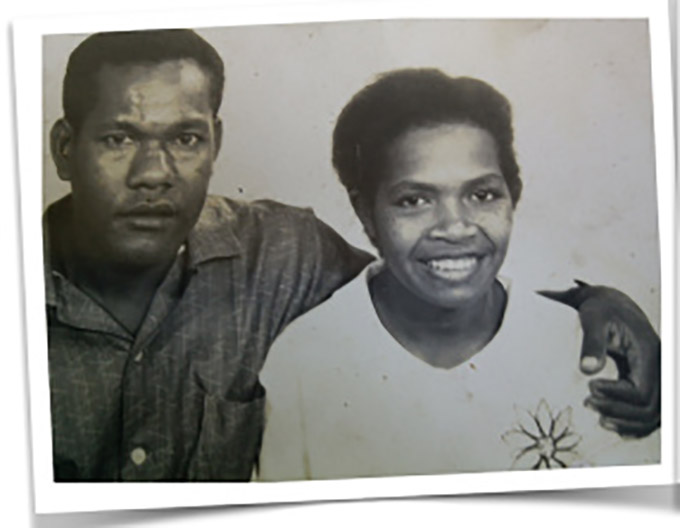
Dominguis and Dolfintje Dimara pictured on the day they were married. Image: #InspirationalPapuaNewGuineans

PROFILE: By Sincha Dimara in Port Moresby

I once asked my mother how was it that she married at the tender age of 16 and left home in West Papua for a foreign land – neighbouring Papua New Guinea – never to see family again for more than three decades.

She told me: “When your father left for work and I was left alone, it dawned on me that I may never see my family again.

“Silent tears flowed in those quiet moments, tanta (aunty) Wanma noticed. She asked me if papa was not nice to me. I shook my head, ‘no’… it was only after the birth of my first child, that my whole world changed.”

READ MORE: Inspirational Papua New Guineans

My mother, Dolfintje Imbab, was born on 4 December 1949, four years after World World Two ended. She was 70 last week (on 4 December 2018).

She was born somewhere on the banks of the Warfor River on Supiori Island, part of the Biak Islands in West Papua at a time when villagers had been forced to move inland to escape the horrors of war.

-Partners-

She completed her primary education in 1960, in what was then a Dutch colony. She was not considered for further studies because most women back then were told to return home to assist the family male members of the family to continue their education.

This meant gardening, fishing and other daily chores to sustain the family.

Against Indonesian takeover
My father, Domingus Dimara (that’s a story on its own), came to Papua New Guinea as a young man in 1963. He was against Indonesia’s takeover of West Papua then and decided to make PNG home.

Family snapshots … Dominguis and Dolfintje Dimara. Right: Dolfintje Dimara and with their first child. Image:
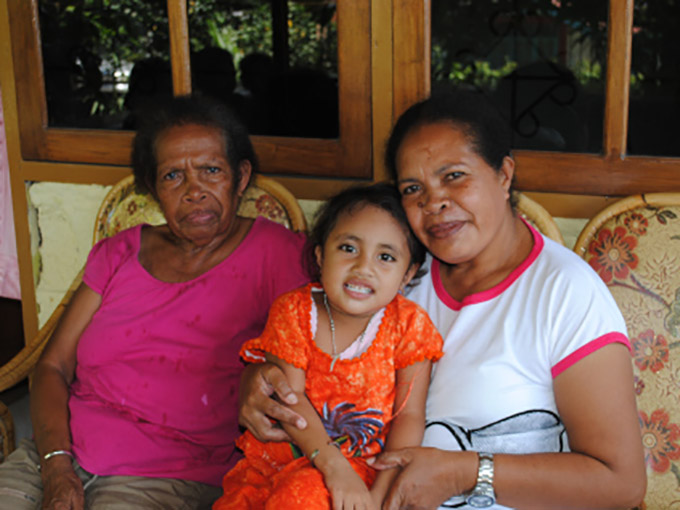
#InspirationalPapuaNewGuineans

He returned in 1965 in search for a bride; my mother was chosen.

My late father was a disciplinarian and always believed in doing the right thing. Initially there was resistance from my maternal grandparents upon hearing that their daughter would marry and move far from home.

My maternal grandmother placed locally made bracelets (gelang biak) on both her arms. The bracelets identify a woman or man as a Biak person.

They were married in May 1965 in Biak town and after meeting legal and customary obligations they travelled to the capital Hollandia, now Jayapura. From there, they travelled by plane to Lae, then on to Port Moresby.

My parents lived with Om and Tanta Marjen (late Aunty and Uncle Marjen) who had earlier moved to Port Moresby after Indonesia gained control of West Papua.

My parents were also accommodated by the Wanma family. This was in the 1960s. One of mum’s early memories is witnessing the 1969 South Pacific Games in Port Moresby and the basketball matches played at the Hohola Courts.

New suburbs sprouted
A few years later when Port Moresby was beginning to expand and new suburbs sprouted, my father was able to secure a house from the National Housing Commission in 1970.

Dolfintje Imbab Dimara with her sister and grand niece in Jayapura. Image:

#InspirationalPapuaNewGuineans

In 1990, more than 30 years since her arrival in PNG, mum first crossed the border as a PNG citizen into Indonesian territory. She did so after communicating with family members through letters for more than 20 years.

Her father had passed on but her mother – my grandmother – was still alive then. She would meet family members again over the years.

In 1979, both of my parents were granted PNG citizenship along with other West Papuans. Among them were the Marjens, Sarwoms, Wanmas.

Sadly, my father passed on in 1994. My mother’s strength and love for the family has kept her going this far.

She lost three of her seven children. Edward our youngest died of heart failure in 1992. Robin was murdered by criminals in 1999 and my sister Salomina died of breast cancer in 2013.

Throughout all the hardships, I believe her faith in God has kept her going. She has mastered the Motu language, speaks a little English and Tok Pisin and made many friends in PNG.

She is also a survivor of breast cancer having gone through treatment in 2011. In a few weeks’ time she will travel home to visit her place of birth and meet her siblings again.

I jokingly asked if it was time to return for good. But I guess she’d rather spend time with the family she created – her children and grandchildren.

Sincha Dimara has been an #EMTV producer for 30 years. She is manager, news and current affairs of the television network in Papua New Guinea.

Print Friendly, PDF & Email

Article by AsiaPacificReport.nz

‘Designer’ babies won’t be common anytime soon – despite recent CRISPR twins

]]>

Source: The Conversation (Au and NZ) – By Merlin Crossley, Deputy Vice-Chancellor Academic and Professor of Molecular Biology, UNSW

This article is part of our occasional long read series Zoom Out, where authors explore key ideas in science and technology in the broader context of society and humanity.


Despite reports that two genetically modified babies have been born in China I don’t think you’ll be seeing designer babies soon.

This is not just because the laws in many countries, and scientific norms in others, prevent this, but for a much simpler reason: genome editing technology has, and will always have, limits. Limits that are related not to the technology itself but to the intrinsic complexity of the human genome.

In addition, the costs and risks of the procedures will outweigh the benefits for the foreseeable future.


Read more: What is CRISPR gene editing, and how does it work?


Some people may doubt this. But remember, making genetically modified mice became routine back in the 1980s and animals have been cloned (genetic “copies” made) since the 1990s. And yet until the announcement of the CRISPR babies – still yet to be confirmed by a peer-reviewed publication – there were no credible attempts to apply genetic technologies to viable human embryos.

There has been talk of designer babies for years but in my view they will remain (as they are now) very, very rare, for quite a while yet.

Baby 007

Let’s look at a hypothetical case study. Imagine you want to start a family, and would like your child to look like the latest James Bond. You ask a fertility doctor if she can conduct a kind of “genetic surgery” to change the genes of your embryo.

Same same, but different: six wax versions of James Bond. from www.shutterstock.com

In simple terms she can’t. You would have to change thousands of genes. Firstly, no one can identify which genes would lead to such an outcome. Secondly, and from a practical point of view, CRISPR only enables researchers to change a handful of genes at a time.

So you think again. Maybe you imagine your baby having the eyes of Jesse Williams, or the hair of Jay-Z? A genetic surgeon still can’t guarantee success. Even just the colour of eyes and hair are the result of complex genetic interactions.

Perhaps you’d rather parent a sporting superstar, like tennis player Karolina Pliskova (1.86m tall). One day it might be possible to “design” a daughter with this height by adjusting genes that control growth hormones. But again, multiple different – background – genes will have an impact, and you can’t be sure of getting the level right.

The risks here are significant. Ethics aside, it would be much simpler to inject hormones to promote growth rather than play with genes and risk your child growing to an unpredictable height (plus other unknown consequences).

Being tall like Karolina Pliskova offers a distinct advantage in many sports. from www.shutterstock.com


Read more: Researcher claims CRISPR-edited twins are born. How will science respond?


Such poor predictability is not due to the limits of genome editing technology – the technology has moved fast to this point, and will no doubt advance further in capability over coming years. Rather, it is due to the interplay between the thousands of genes within our genomes.

On top of that, environmental inputs (the “nurture” part of our development) and epigenetic effects (where subtle chemical modifications, often in response to environmental impacts, influence the expression of certain genes) create further unpredictability.

For these reasons, we simply can’t start ordering physical characteristics off some sort of cosmetic genetic surgeon’s menu – let alone attempt to alter mental traits, like temperament or intelligence.

There is also the problem of trade offs involved in any change. The CRISPR-edited babies reportedly born in China were intended to be resistant to HIV. It is not clear whether they will be – but even if they are, current knowledge suggests that they would also be more susceptible to influenza and West Nile virus. This is due to the many roles that the edited CCR5 gene plays in our immune system.

There are few “free lunches” in human evolution. And few parents would play a game of trial and error with their offspring once they understand the risks.

Preventing genetic disease

Superficial traits aside, even using CRISPR editing to combat serious genetic disease is unlikely to be common.

In many countries genetic counselling is already used to reduce the risk of passing on genetic diseases, like Tay-Sachs (in which the accumulation of fatty substances in nerve cells causes paralysis, dementia, blindness, psychoses, and even death).

Increasingly, in the future, if parents suffering from or carrying genetic mutations, choose to have biological children, they might consider in vitro fertilisation (IVF) and only proceed with unaffected embryos for a pregnancy. In the case of an existing pregnancy, pre-natal diagnosis can give parents information they can use to help them decide whether or not to terminate, or perhaps correct the cells in the embryo as explained below.

During IVF, a single cell can be safely removed from an embryo for genetic testing. from www.shutterstock.com’

It’s possible in the near future that some genetic diseases will be treated at the level of fixing the genes within certain cells in embryos, children or adults, rather than modifying whole embryos. Here, the relevant cells could be taken out of the body, the genes corrected and then the cells injected back in. Blood diseases in which vital oxygen-carrying haemoglobin is defective, such as sickle cell disease and thalassemia, will likely be cured in this way.

In the cases of liver and muscle diseases it may be possible to inject harmless viruses carrying the genome editing agents into these organs.

It’s only in exceptionally rare instances that parents might ask for their embryo to be changed. Sickle cell disease (which leads to anaemia), or cystic fibrosis (that affects the respiratory, digestive and reproductive systems) are examples. Each disease results from two affected copies of the relevant gene coming together: one copy from each parent. If both parents were affected by one of these disorders – which, given these conditions are so rare, is improbable but possible – their only option for having an unaffected biological child would be gene editing.

But one still wouldn’t jump into editing the genome of an embryo, because we have to weigh up not only the benefits but also the risks. The risks are important – because if an unintended genetic change is made, and an unanticipated consequence follows, it could affect not only that child but future generations as well.

At present scientists have generally agreed not to consider modifying human embryos until we know enough about the technology to evaluate the risks, and unless society is on board.


Read more: Tension as scientist at centre of CRISPR outrage speaks at genome editing summit


Society must decide

But it seems this consensus was recently broken. There is concern that in terms of Jiankui He’s work with CRIPSR in human embryos we cannot be sure of either the efficacy of the editing or the consequences of any unintended changes made to the genomes. (Jiankui He has apparently gone missing since his recent appearance at a genome editing summit).

I don’t expect many other scientists to follow his path for now.

In the future there may be rare cases where parents who both carry genes for serious genetic diseases do seek to have an unaffected child via gene editing, and perhaps society would sanction this choice. Where we would draw the line for editing less serious but also well-known genetic variations remains to be determined. In the more distant future actual genetic enhancements may well be contemplated but I think the reactions to Jiankui He’s work make this less rather than more likely.


Read more: Is your genome really your own? The public and forensic value of DNA


For now, CRISPR genome editing remains a revolutionary technology that is transforming biological research and will have many medical and agricultural applications. It’s also clear that different advances associated with genome sequencing, genetic privacy, and discrimination, will present us with many regulatory and ethical challenges in coming years.

But I don’t expect to be debating these issues with designer babies who have grown to adulthood. For the most part, that will remain science fiction.

ref. ‘Designer’ babies won’t be common anytime soon – despite recent CRISPR twins – http://theconversation.com/designer-babies-wont-be-common-anytime-soon-despite-recent-crispr-twins-108342

Law and order is no get-out-of-jail card for floundering politicians

]]>

Source: The Conversation (Au and NZ) – By Luke McNamara, Professor of Law, UNSW

With confidence in politicians at an all-time low, it would be easy to assume criminal law-making is only ever about “law and order” bidding and winning elections.


Read more: Historical fall of Liberal seats in Victoria; micros likely to win ten seats in upper house; Labor leads in NSW


For example, when it emerged that Hassan Khalif Shire Ali was on bail when he killed one man and injured two others in Bourke Street, Melbourne, on November 9, the Victorian opposition reiterated its plan for a “one strike and you’re out” bail system.

This was classic law and order politics – though it didn’t produce the result Victorian Liberal leader Matthew Guy had hoped.


Read more: How a race scare left South Sudanese star basketballers with nowhere to play


All instances of criminal law-making (or promising) deserve scrutiny – especially if they raise concerns that politicians might be politicising the law for electoral advantage. However, it would be a mistake to assume this is the only way criminal laws are made.

We are part of a team of Australian researchers examining how, when and why criminal laws are made. What drivers and processes sit behind the moment when an attorney-general stands up in parliament and introduces a new bill? And how do we assess what makes a good process?

So far, we’ve found there is a stark difference between the careful evidence-based, deliberative and consultative processes associated with the criminal law’s use against some harms – like domestic violence – and the “urgent” non-consultative law-making with others – like terrorists and outlaw motorcycle gangs.

NSW Attorney General Mark Speakman embraces child abuse advocate and survivor Paul Gray after unveiling plans for new laws to jail those who cover up child abuse. Dean Lewins/AAP

Recently in NSW, we saw an interesting variation on the familiar law and order auction. In the second last parliamentary sitting week for 2018, the Berejiklian government launched something of a pre-emptive strike ahead of the state election in March 2019. In the space of three days, the NSW parliament enacted seven major criminal law statutes. Here we highlight some examples illustrating the diversity of ways criminal laws get made.

In the words of NSW Attorney General Mark Speakman, the Community Protection Legislation Amendment Bill 2018:

introduces a number of reforms aimed at keeping the community safe, including from the risk of terrorism and other high-risk offenders, bushfires, child abuse and the supply of drugs causing death.

Here, a diverse range of harms are “knitted” together through a narrative of community fear, anxiety and need for protection. Despite these common themes, the changes to the criminal law made by this bill have different origins.

For example, the introduction of higher penalties for lighting bushfires was influenced by what’s been happening in other states, and a determination to “keep up”. As the attorney-general put it: this will “ensure that the New South Wales penalty is now the equal toughest in the country”.

A mourner places a candle to remember the 173 people who died in the Black Saturday bushfires of 2009 in forests on the outskirts of Melbourne and in the city’s hinterland. Julian Smith/AAP

The controversial new homicide offence of drug supply causing death has a different back-story. After two drug-related deaths at the Defqon musical festival in September this year, NSW Premier Gladys Berejiklian appointed an expert panel to advise the government on what law reform and other strategies could prevent further tragedies. A new offence was one of the panel’s recommendations.

The same bill also increased penalties for the crime of concealing a child abuse offence – a crime introduced in June this year following recommendations of the Royal Commission into Institutional Responses to Child Sexual Abuse. Attorney-General Mark Speakman explained that this amendment, just six months later, was because the government had:

listened to the voices of the more than 13,000 people who signed a petition calling for tougher maximum penalties for the concealment of child abuse offences.


Read more: Luke Foley’s resignation is a disaster for Labor but may not bolster Berejiklian much either


The Crimes (Domestic and Personal) Violence Amendment Bill 2018 expanded the definition of the existing stalking or intimidation offence in NSW to cover “cyberbullying”. The attorney-general told parliament the “bill will be known colloquially as “Dolly’s Law”, in tribute to 14-year-old Amy “Dolly” Everett, who tragically took her own life in January this year following persistent bullying and abuse, including cyberbullying.

He thanked Dolly’s parents who had “worked tirelessly, campaigning and raising awareness about the potentially devastating effects of bullying and cyberbullying”.

The Crimes Legislation Amendment Bill 2018 created a new offence of strangulation. A 2017, NSW Domestic Violence Death Review Team report found the offence of choking did not cover all the ways in which domestic violence strangulation can occur. This new offence is an example of change underpinned by careful consideration of the available evidence by an expert body and that can rightly be said to fill a gap in the criminal law.


Read more: The pathologies of populism


When many countries are grappling with political populism, it is timely to reflect on how the community figures in these examples: victims whose loss is the catalyst for change; a collective of persons in need of protection; and law-makers. The NSW attorney-general described some recent criminal law changes as “citizen law that if individual citizens lobby hard enough and speak to politicians they can effect change”. He hoped that “in some small way this will restore some people’s confidence in our democracy and the ability of citizens to effect change”.

The idea of “citizen law” is interesting. Is it the process that most inspires confidence and democratic legitimacy? What is gained (and lost) if a government is more attuned to the voices of regular people, including victims and their families, than to experts, like lawyers and academics?

The answers are not straightforward. Our research suggests it is important to avoid simplistic accounts of what drives criminal law-making. And, as the Victorian election result shows, politicians should be wary of putting all their eggs in the law and order basket.

ref. Law and order is no get-out-of-jail card for floundering politicians – http://theconversation.com/law-and-order-is-no-get-out-of-jail-card-for-floundering-politicians-107701

What’s the most value for money way to tackle obesity? Increase taxes on alcohol

]]>

Source: The Conversation (Au and NZ) – By Jaithri Ananthapavan, Senior Research Fellow, Health Economics, Deakin University

We don’t often equate the kilojoules we drink in our glass of wine or pint of beer with the weight that accumulates around our middle. But our new study shows increasing the price of alcohol is the most value for money policy option to prevent obesity in Australia.

The study, released today, shows if we increase alcohol taxes by standardising them across different types of alcohol, overall alcohol consumption would go down. This would lead to substantial reductions in the kilojoules Australians consume each day.

In 2016-17, Australians drank 186 million litres of pure alcohol – equivalent to more than nine litres for each person over the age of 15 years.


Read more: Think before you drink: alcohol’s calories end up on your waistline


The health and social harms associated with drinking too much are well documented. Our research is among the first to show that policies aimed at reducing alcohol consumption would also have significant impacts on body weight.

Current taxes on alcohol

Australia’s current alcohol taxation system is complex and illogical. Most alcoholic beverages are taxed based on their alcohol content, but different rates of tax are applied to different products.

Beers have the lowest rates, and spirits and ready-to-drink beverages (such as a can of bourbon and cola) have the highest.

Wine is taxed using a different system (the wine equalisation tax) based on its final wholesale price.

Under the current system, the total price (including taxation, in 2013 prices) of a standard drink (equivalent to 10g of alcohol) varies from around A$0.65 for cask wine to A$2.79 for ready-to-drink beverages.

Proposed new tax regime

Public health groups have long advocated for reforms to the current alcohol taxation system in Australia.

Our research group modelled the impact of replacing the current system with a uniform volumetric tax, based on alcohol content.


Read more: Fifty years on, time to call it a day for cheap wine casks


We applied a tax of 84 cents per standard drink across all alcoholic beverages (beers, wines, spirits and ready-to-drink products). This is equivalent to a 10% increase to the rate currently applied to spirits.

This proposed change would have the biggest impact on the price of cask wine, increasing it by more than 120%. The price of beer will increase by 28% on average, bottled wine by around 33%, and ready-to-drink alcoholic beverages by 2.7%.

Deakin University

Impact on health

Increasing the price of alcohol is one of the most effective ways of reducing consumption.

Alcohol is high in kilojoules, with a pint of beer almost on par with a chocolate bar in terms of energy content. So even relatively small levels of alcohol consumption can have a big impact on daily energy intake.

Pint or chocolate bar? They’re just about equal in kiljoules. Seth Weisfeld

Our modelling showed that the proposed new tax regime would, on average, result in a 16% reduction in alcohol consumption across the population. This would lead to average weight loss of around 0.7kg.

When this is modelled over the lifetime of the whole population, the health impact is substantial. It is estimated that this tax change could prevent more than 190,000 cases of diabetes and 16,000 cases of cancer.

In total, the policy change could result in more than 470,000 healthy life years gained for the Australian population.

By preventing obesity-related diseases, this policy would save about A$4.8 billion in health-care costs.

These savings are much higher than the total costs of administering this change to the tax system, at A$31.9 million.


Read more: Ten reasons some of us should cut back on alcohol


The health impacts are in addition to the many other benefits of reduced alcohol consumption. These include the prevention of several chronic diseases (including liver cirrhosis and breast cancer), injuries, road accidents and violence.

The additional revenue collected from this new tax regime compared to the current taxation system would be around A$2.3 billion each year.

We need an obesity prevention strategy

The Council of Australian Governments (COAG) Health Council recently committed to develop a national obesity strategy. In addition, the Senate Select Committee into the obesity epidemic in Australia released a report last week that set out a number of recommendations for government. These initiatives recognise that a range of policies are needed to address the current obesity crisis.

In addition to the alcohol tax changes, our study examined the cost-effectiveness of 15 other obesity prevention policies. These included bans on TV advertising for unhealthy foods, a 20% tax on sugary drinks, the Health Star Rating food labelling system, and interventions targeted at schools, workplaces, supermarkets, local communities and private health insurers.

A range of policy measures are needed to reduce rates of obesity. Photobac/Shutterstock

We found that all of the interventions evaluated would result in substantial health benefits for Australia and offer good value for money. There are a broad range of promising policies that can be acted on by a range of decision makers including local, state and federal governments and the private sector.

Even though increasing the price of alcohol is likely to be unpopular, if governments are committed to an effective national obesity strategy then an increase in alcohol taxation should be considered as one part of a comprehensive societal response.

ref. What’s the most value for money way to tackle obesity? Increase taxes on alcohol – http://theconversation.com/whats-the-most-value-for-money-way-to-tackle-obesity-increase-taxes-on-alcohol-108335

Not wiped out. Why Whyalla, of all places, now has a sustainable future

]]>

Source: The Conversation (Au and NZ) – By Michael O’Neil, Executive Director, SA Centre for Economic Studies, University of Adelaide

Whyalla will be wiped off the map by Julia Gillard’s carbon tax, Whyalla risks becoming a ghost town, an economic wasteland if this carbon tax goes ahead – Then opposition leader Tony Abbott, campaigning against Julia Gillard’s carbon tax in 2011.

Whyalla’s ‘”death notice” has been written a number of times over the past 40 years, beginning with the closure of the shipyards in 1978, continuing with infamous predictions of doom in the leadup to the carbon tax, and most recently, as what was once the BHP steelworks clung to life suffocating in debt and despair under a new owner in 2016.

The revival of the regional city that sits on the western side of South Australia’s Spencer Gulf took a big step forward in July 2017 when British-based industrialist, Sanjeev Gupta, bought the steelworks, and brought hope to the local community of 22,000 people.


Head of GFG Sanjeev Gupta, visits the Arrium Steel plant in Whyalla, South Australia. July, 2017. David Mariuz/AAP


This week that hope turned to optimism when Mr Gupta announced a $600 million upgrade of the existing steelworks, increasing its capacity to 1.8 million tonnes annually.

That announcement, while welcome news to the 2,500 employees, was accompanied by another one, much bigger – a feasibility study of a state-of-the-art plant capable of producing 10 million tonnes of steel for export annually.

If it comes off, it’ll triple Australia’s steel output.

Other potential investments announced on Monday that will define the future of Whyalla include:

  • A $145 million horticulture business backed by Chinese investment,
  • A $45 million four-star hotel for Whyalla’s foreshore, and
  • A $6 million organics recycling business.

Whyalla is relatively remote, a long distance away from both the customers for and many of the raw materials needed to create steel.

But it rich in wind, with Australia’s biggest collection of wind farms nearby, and rich in sun, enjoying an impressive 300 days of sunshine a year.


In a location remote from customers and raw materials, Whyalla appears to be an unlikely place to make steel. Datawrapper


Two major renewable energy projects are either underway or are soon to leave the drawing boards near Port Augusta, 75 kilometres north of Whyalla.

The Bungala photo-voltaic solar farm, which recently completed its commissioning, is the largest in the southern hemisphere with a capacity of 220 megawatts.


The Bungala Solar Farm, near Port Augusta. Australia’s largest operational solar PV plant. Enel Green Power


The Aurora concentrated solar thermal project involves a massive array of mirrors that direct the sun’s energy onto a receptor where molten salt retains the energy and can be released on demand.

The super-hot salt is despatched through a heat exchanger where it produces steam which, in turn, generates electricity with a conventional steam turbine. It has a capacity of 150 megawatts but, importantly, it can store 1,100 megawatt hours of energy, thereby overcoming one of the major shortcomings of renewable energy.


Solar thermal uses mirrors to concentrate sunlight onto a tower that heats molten salt. Facebook: Solar Reserve


As the SA Centre for Economic Studies has previously reported, the availability of cheaper renewable energy will be a competitive advantage for Whyalla and, more generally, the greater Eyre Peninsula region.

This power advantage can be coupled with the region’s other colossal advantage – space. There is abundant land to support low cost, large-scale agricultural and horticultural production, a point implicitly confirmed by Monday’s announcement of a proposed $145 million solar greenhouse.

It’s an outlook that is a far cry from the dark days in 2016 when Arrium, an ofshoot of BHP, went into voluntary administration owing A$4 billion.

The subsequent administration of the steelworks by consulting group KordaMentha was a complex affair with negotiations culminating in workers taking a pay cut and the state and federal governments stepping up with assistance packages that proved critical to the immediate viability of the plant and its eventual sale to Sanjeev Gupta’s GFG Alliance.

The State Government contributed A$50 million for a future purchaser to make capital improvements at the steelworks, waived royalties on the magnetite ore that the steelworks were reconfigured to consume, provided $5 million dollars to ensure that Arrium’s creditors could survive, and implemented a range of skills development and training programs.


The federal government also chipped in with a A$20 million for regional training and investment, and sourced steel from Whyalla for a major upgrade of the Tarcoola rail line.

In 2016, our centre published Whyalla Economic Development: A Plan for the Future and said the city needed a serious discussion to plan its future because a narrow view focused on shipbuilding in earlier times, and steel-making more recently, had compromised its economic viability.

Part of that planning had to include decisions on such infrastructure improvements as upgrading the electricity transmission system to give it the capacity to carry growing volumes of renewable energy, which is harder to carry than power from conventional generators.


Read more: At its current rate, Australia is on track for 50% renewable electricity in 2025


Investment in human capital is also required and the Centre was encouraged to see the state government act on our 2016 recommendation and commit $100 million towards construction of a new high school in Whyalla, which is scheduled to open in 2022.

The suite of development proposals announced on Monday came with claims that Whyalla’s population could quadruple to 80,000 people as a consequence. An expansion of that size would itself be a major economic stimulus through all the housing, transport and other services required.

Such growth, complemented by effective promotion and marketing that has been missing in the past, could make Whyalla “the gateway” to the greater Eyre Peninsula and the tourism attractions that lie beyond.

KordaMentha’s partner, Mark Mentha, told the ABC’s Australian Story in September that when he arrived as administrator of Arrium, he saw “vulnerability and fear” in the eyes of steelworkers.

If he went back, he would see hope and optimism.

Written with Peter Gill, business journalist at the South Australian Centre for Economic Studies.

ref. Not wiped out. Why Whyalla, of all places, now has a sustainable future – http://theconversation.com/not-wiped-out-why-whyalla-of-all-places-now-has-a-sustainable-future-108506

How cinema’s new Aquaman draws on the mythology of ancient sea gods

]]>

Source: The Conversation (Au and NZ) – By Adam Turner, PhD student, University of Newcastle

Muscular, bearded and trident-wielding, Jason Momoa’s portrayal of the titular Aquaman in the forthcoming DC film draws on ancient Greek and Roman iconography.

Water gods in Greek mythology are a diverse group. There are human-looking gods such as Poseidon, god of the sea, or Tethys: goddess of freshwater, rainfall, and nurse to the Olympians. Others, such as Tethys’ husband Oceanus, who represents the primordial ocean surrounding the world, are depicted as both human, and/or part-human combined with a fish or serpent.

Ruling Atlantis is a key role associated with sea gods. First mentioned in Plato’s The Republic, Atlantis was the Poseidon-worshipping city state held to be a pinnacle of ethics. According to Plato, Atlantis sunk into the ocean after it lost the favour of the gods due to the inhabitants’ hubris.

A third century mosaic depicting Tethys and Oceanus. Wikimedia, CC BY-SA

While Aquaman is strictly speaking a superhero rather than a sea god, his appearance and powers in the upcoming movie certainly draw on those of maritime divinities.

Aquaman’s abilities to communicate with sea life, control the ocean and swim at superhuman speeds all resemble traits associated with Poseidon. Poseidon is well attested to communicating with (and even creating) sea creatures, and the nereids and oceanids – nymphs of the ocean – by which he is surrounded. In Homer’s Odyssey, Poseidon is a capricious, dangerous deity who delays Odysseus’ return home by ten years.

Aquaman comic book depiction. Crayolamom/flickr

In DC’s original comics, Aquaman, who first appeared in 1941, was most typically an outcast of the Atlantean cities. Depending on the version, Aquaman (also known as Arthur Curry) either grew up on land or was abandoned to die there, as he needed to be in contact with water every hour.

In other comics from the 1950s, Aquaman was depicted as the half-Atlantean son of Queen Atlanna, although in later versions he is depicted as fully Atlantean. A warrior king, he defended Atlantean cities, (and more broadly, the ocean and surface world as a member of the Justice League), from a variety of super-villains, as well as contemporary threats such as pirates and Nazi U-boats.

He does this through masterful skill in melee combat and, as the comics progress, through increasingly supernatural powers (such the ability to create water and dehydrate people).


Read more: Guide to the Classics: Homer’s Odyssey


The trident

Aquaman’s weapon of choice – a trident – has always been associated with Poseidon. Homeric poets noted that Poseidon was gifted his trident by the elder cyclopes, the one-eyed giants of ancient Greece, to help him in the war against the titans – the previous generation of deities.

In the comics, Aquaman’s trident is often referred to as “Poseidon’s trident”, or otherwise a trident known as “Neptune’s trident” is portrayed. (Neptune was the Roman equivalent of Poseidon.) Much like the trident of the Olympian Poseidon, Aquaman’s trident can create water.

Poseidon holding a trident. Corinthian plaque, 550–525 BC. From Penteskouphia. Wikimedia Commons

Sea gods on screen

In the comics, Aquaman is blonde, pale and usually clean shaven. While the green and orange costuming in the film is the same as the comic book character, Mamoa’s tattoos, dark beard and untamed hair are imported from other sea gods on screen.

Aquaman’s tattoos show a deference to the Polynesian god Maui that featured heavily in Moana (2016) and Momoa’s own cultural heritage. Maui, the trickster of Polynesian mythology, is credited with pulling islands from the sea with his hook.

The Atlantis-like city depicted in the promotional material for Aquaman. IMDB

Previous depictions of Greek Gods on screen have featured merman. In Disney’s The Little Mermaid (1989), King Triton, (named after Poseidon’s merman son) possesses a golden trident which has many abilities. In Disney’s Hercules: The Animated Series, Poseidon is shown as an anthropomorphous man, who has physical aspects of a fish. And in the game Age of Mythology, Poseidon is shown as a merman.

In contrast, Momoa’s Aquaman, with his beard, trident and dangerous personality, is no part-fish, part-human combination. This is much more in line with ancient sea mythology.

His Aquaman will be a distinct recall to the classical tradition of Poseidon, the “dark haired lord” whose hand “the brazen trident wields”.

ref. How cinema’s new Aquaman draws on the mythology of ancient sea gods – http://theconversation.com/how-cinemas-new-aquaman-draws-on-the-mythology-of-ancient-sea-gods-105856

Victorian upper house greatly distorted by group voting tickets; federal Labor still dominant in Newspoll

]]>

Source: The Conversation (Au and NZ) – By Adrian Beaumont, Honorary Associate, School of Mathematics and Statistics, University of Melbourne

The November 24 Victorian election will result in an upper house of 18 Labor out of 40 (up four since the 2014 election), 11 Coalition (down five), one Green (down four), three Derryn Hinch Justice, two Liberal Democrats, and one each for Animal Justice, Sustainable Australia, Transport Matters, Fiona Patten and Shooters, Fishers & Farmers.

Overall upper house vote shares were 39.2% Labor (up 5.8% since 2014), 29.4% Coalition (down 6.7%), 9.3% Greens (down 1.5%), 3.8% Hinch Justice, 3.0% Shooters, 2.5% Liberal Democrats, 2.5% Animal Justice and 2.1% Labour DLP. In regions where the DLP and Lib Dems were to the left of Labor and the Liberals respectively on the ballot paper, they had far higher vote shares through name confusion.

Labor won 45% of upper house seats on 39.2% of votes, and the Coalition 27.5% of seats on 29.4% of votes. The Greens won just 2.5% of seats despite 9.3% of votes, while Hinch Justice won 7.5% of seats on 3.8% of votes, and the Lib Dems 5% of seats on 2.5% of votes. Transport Matters and Sustainable Australia combined won 5% of seats on 1.4% of votes. This was not a good advertisement for democracy.

It is deeply disappointing that Labor made no effort during the last term to reform the flawed group voting ticket system.

Although the result is a bad outcome for democracy, Labor will probably be happy. If the Coalition opposes, they need three of 11 crossbenchers to reach the 21 votes needed to pass legislation. The Greens, Animal Justice and Patten are likely to be Labor allies on progressive legislation. In the last parliament, Labor, the Greens and Patten had 20 combined votes.

There are eight regions in Victoria that each return five members. A quota is one-sixth of the vote, or 16.7%.

In the federal Senate, voters are instructed to number at least six boxes above the line, though a single “1” above the line is still formal. Preferences are set by voters, not by parties.

The table below shows the actual results and what I believe the results would have been had the federal Senate system been in place. Under the Senate system, the most likely outcome would be 19 Labor, 14 Coalition, four Greens, two Shooters and one Hinch Justice. The actual results would probably match the federal Senate results in just two of the eight regions

Victorian upper house: actual results compared with results using federal Senate system.

In Eastern Metro, Labor had 2.22 quotas, the Liberals 2.17, the Greens 0.54 and the Lib Dems 0.25. Labor preferences would easily elect the Greens under the Senate system. Instead, Transport Matters won from just 0.62%, or 0.04 quotas.

In Northern Metro, Labor had 2.55 quotas, the Greens 1.00, the Liberals 0.99, the Socialists 0.25, the DLP 0.25 and Fiona Patten 0.20. Labor would win three seats under the Senate system, but lost its third seat to Patten in the actual count.

In South-Eastern Metro, Labor had 3.00 quotas, the Liberals 1.74 and the Greens 0.33. The Liberals would have won the last seat under the Senate system. Instead, the Liberal Democrats, with just 0.84% or 0.05 quotas, won the final seat.

In Southern Metro, the Liberals won 2.30 quotas, Labor 2.07 and the Greens 0.81. The Greens would easily win the last seat under the Senate system. Instead it went to Sustainable Australia, on just 1.32%, or 0.08 quotas.

In Western Metro, Labor won 2.78 quotas, the Liberals 1.28, the Greens 0.52 and Hinch Justice 0.41. With assistance from right-wing preferences, Hinch Justice would probably beat the Greens for the final spot under the Senate system. This is one occasion where the actual result would probably occur under a better system.

In Eastern Victoria, the Coalition won 2.05 quotas, Labor 2.02, the Greens 0.40, the Shooters 0.30, Hinch Justice 0.27 and the Lib Dems 0.24. The Shooters or Hinch Justice could have overtaken the Greens under the Senate system; the Shooters won the final seat, matching a possibility of the Senate system

In Northern Victoria, Labor won 1.91 quotas, the Coalition 1.87, the Shooters 0.47, the Greens 0.39, Hinch Justice 0.29 and the Lib Dems 0.23. If the Senate system applied, the results would be two each for Labor and the Coalition, and one Shooter. Instead, Labor won two, and the Coalition, Hinch Justice and the Lib Dems one each.

In Western Victoria, Labor won 2.29 quotas, the Coalition 1.80, the Greens 0.45, Hinch Justice 0.27, the Shooters 0.27 and Animal Justice 0.17. Under the Senate system, Labor preferences would have helped the Greens win the final seat, with the Coalition certain of a second seat. Instead, Labor won two, and the Coalition, Animal Justice and Hinch Justice one each.

Liberals retain Ripon after recount

In the lower house seat of Ripon, the Liberals trailed Labor by 31 votes on the provisional results, but won after a recount by 15 votes. Final lower house seat totals were 55 Labor out of 88 (up eight since the 2014 election), 27 Coalition (down 11), three Greens (up one) and three independents (up two).


Read more: Historical fall of Liberal seats in Victoria; micros likely to win ten seats in upper house; Labor leads in NSW


Newspoll: 55-45 to federal Labor

This week’s federal Newspoll, conducted December 6-9 from a sample of 1,730, gave Labor its third successive 55-45 lead. Primary votes were 41% Labor (up one since last fortnight), 35% Coalition (up one), 9% Greens (steady) and 7% One Nation (down one). This is the final Newspoll of 2018.

This is the third consecutive Newspoll in which Labor’s primary vote has exceeded 40%. Other than in the immediate aftermath of Malcolm Turnbull’s ousting, Labor’s primary had only reached 40% once since Julia Gillard’s early days as PM. Analyst Kevin Bonham says no government has recovered from such a dire position in aggregate polling to win with five months left.

In the final four Newspolls under Turnbull, the Coalition trailed by just 51-49. In the last three Newspolls, they have trailed 55-45. It appears that ousting Turnbull was a big mistake.

42% were satisfied with Scott Morrison’s performance (down one), and 45% were dissatisfied (up three), for a net approval of -3, down four points. Bill Shorten’s net approval was down two points to -15. Morrison led Shorten by 44-36 as better PM (46-34 last fortnight).

55% thought Labor would win the next election, while just 24% thought the Coalition would win. By 48-30, voters opposed Shorten’s plan to abolish franking credit cash refunds for retirees (50-33 in March).

By 46-40, voters did not think Turnbull was disloyal to the Coalition, though Coalition voters thought Turnbull disloyal by 56-34. By 56-36, voters thought Turnbull should be allowed to speak his mind, rather than keep his thoughts private. By 56-29, voters did not think Turnbull should be expelled from the Liberal party.

I think the Coalition’s best hope of winning the next election is for the economy to be very good, with strong wages growth. However on December 5, the ABS reported that the economy grew just 0.3% in the September quarter, well below expectations.

Essential: 54-46 to Labor

In last week’s Essential poll, conducted November 29 to December 2 from a sample of 1,032, Labor led by 54-46, a two-point gain for Labor since three weeks ago. Primary votes were 39% Labor (up four), 38% Coalition (up one), 10% Greens (down one) and 6% One Nation (down one).

Morrison’s ratings were 42% approve (up one since November) and 34% disapprove (down three), for a net approval of +8. Shorten’s net approval fell two points to -8. Morrison led Shorten by 40-29 as better PM (41-29 in November).

24% thought restricting negative gearing to new homes would lower house prices, 21% thought it would increase house prices, 27% make no difference and 29% didn’t know. 37% thought restricting negative gearing would increase rents, 14% lower them, 24% make no difference and 26% didn’t know.

53% thought Australia was not doing enough to address climate change (down three since October), 24% thought we were doing enough (up one), and 9% doing too much (up two). By 39-30, voters supported ending cash refunds from dividend imputation. The question was long, with information that many voters would not be aware of.

ReachTEL national and seat polls

A ReachTEL national poll for the Australian Youth Climate Coalition, conducted December 4 from a sample of 2,350, gave Labor a 54-46 lead. Primary votes were 38.2% Labor, 37.0% Coalition, 10.6% Greens and 6.9% One Nation. Sky News was commissioning ReachTEL polls once a month until June, but since then the only ReachTEL national polls have been from left-wing sources.

The Poll Bludger has details of ReachTEL polls in the Victorian federal seats of Corangamite and Higgins. The Liberals have no margin after a redistribution in Corangamite, and are trailing 59-41. In Higgins, the Liberals have a 10.3% margin, but are trailing 53-47. Seat polls are unreliable, but these are massive swings to Labor.

Facing heavy defeat, Theresa May postpones Commons vote on Brexit deal

UK Prime Minister Theresa May’s Brexit deal with the European Union was scheduled to be voted on by the House of Commons today. But faced with many defections from both the left and right of her Conservative party, and unhelpful opposition parties, May has pulled the vote.

The problem for May is that there is probably no deal that is agreeable to the European Union that can pass the Commons. Unless a deal passes the Commons, or some other option like a second Brexit referendum passes, the UK will crash out of the European Union on March 29, 2019. Such a “no deal” Brexit is likely to greatly damage both the UK economy and the Conservative party – see my personal website for more.

ref. Victorian upper house greatly distorted by group voting tickets; federal Labor still dominant in Newspoll – http://theconversation.com/victorian-upper-house-greatly-distorted-by-group-voting-tickets-federal-labor-still-dominant-in-newspoll-108488

Explainer: why is Australia adopting the global refugee compact but not the migration compact?

]]>

Source: The Conversation (Au and NZ) – By Azadeh Dastyari, Deputy Director of the Castan Centre for Human Rights Law, Senior Lecturer in the Faculty of Law, Monash University

Australia was one of 176 countries to vote in favour of the Global Compact on Refugees (refugee compact) in mid-November this year. The United Nations General Assembly will adopt it by the end of 2018.

However, Australia did not join the Global Compact for Safe, Orderly and Regular Migration (migration compact) at a conference in Morocco on December 10-11.

What are the compacts and what do they aim to do?

There is much confusion about the two compacts, with commentators often conflating the two documents. However, they are distinct agreements with differing subjects.

The term “refugee” used in the refugee compact has a specific meaning under international law. It refers to a person outside their own country who fears persecution because of their race, nationality, membership of a particular social group or political opinion.

As a signatory to the Refugee Convention and Refugee Protocol, Australia has particular obligations to refugees under these two treaties. The refugee compact does not replace these obligations. Instead, it is a non-binding agreement that “intends to provide a basis for predictable and equitable burden- and responsibility-sharing”.

The Refugee Compact lists four objectives. They are to:

  1. ease pressures on host countries
  2. enhance refugee self-reliance
  3. expand access to third country solutions
  4. support conditions in countries of origin for return in safety and dignity

Unlike the term “refugee”, the term “migrant” does not have a precise meaning under international law. Australia does not have any specific international legal obligations to migrants beyond respecting their human rights under the human rights treaties to which it is a party.

The migration compact does not create any new binding legal obligations on states such as Australia. Instead, it has a range of 23 objectives for safe, orderly and regular migration. These include the collection and better use of data on migration; strengthening responses to smuggling and trafficking; eliminating discrimination; using detention as a last resort; saving lives; managing borders in an integrated, secure and coordinated manner; addressing and reducing vulnerabilities in migration; and strengthening international cooperation.

Where did the compacts come from?

The two compacts have emerged from a need for the international community to better cooperate and respond to unprecedented numbers of people on the move, particularly into Europe. This includes refugees fleeing persecution from conflicts such as Syria.

In September 2016, the United Nations General Assembly unanimously adopted the New York Declaration for Refugee and Migrants to address such concerns. The declaration contained a commitment to begin two separate tracks of negotiations: the refugee compact and the migration compact.

Australia’s response

Australia has been relatively silent on the refugee compact, but has objected to the migration compact on the grounds that it would compromise Australia’s sovereignty.

The migration compact has also been accused of failing to:

adequately distinguish between people who enter Australia illegally and those who come to Australia the right way.

In addition, Australia has cited its success with migration as a reason for its refusal to adopt the migration compact. It has stated:

when we are asked to sign up to international agreements that we believe will compromise our successful way of doing things, we will pass.

The criticisms regarding the threat to Australia’s sovereignty and the lack of distinction between categories of migrants is surprising. As has been explained by Goodwin-Gill and McAdam, it is a misrepresentation of the document.

As with the refugee compact, the migration compact does not create any binding legal obligations on states. It affirms that “within their sovereign jurisdiction, States may distinguish between regular and irregular migration status”.

Furthermore, irrespective of whether Australia signs the migration compact, it is obliged to protect the human rights of migrants under existing international law. This includes, for example, the obligation to refrain from arbitrary detention. Thus the illegality of arbitrary detention, including on Nauru and Manus Island, under international law will not change whether Australia signs the migration compact or not.

Why has Australia signed the refugee compact but not the migration compact?

The United States is the only country to vote against the Refugee Compact. In contrast, the United States, Australia, the Netherlands, Austria, Bulgaria, Hungary, Czech Republic, Poland, Dominican Republic, Chile, Latvia, Slovakia, Estonia and Italy either withdrew from the migration compact negotiations or expressed reservations, often citing concerns about sovereignty as the reason.

But rather than being a real threat to sovereignty, the migration compact appears to have taken on a symbolic meaning that the refugee compact has not. Its opponents are governments with strong anti-immigration and asylum seeker policies. For such states, the migration compact has become a convenient strawman against which states can demonstrate a show of power and resistance to serve domestic political interests.

Syrian refugees at a camp at Haouch El Nabi in the Bekaa valley, Lebanon. AAP/EPA/Wael Hamzeh

A reason why the migration compact has been used as a foil in this way may simply be in the timing. The United States has led the rejection of the migration compact. It was early to withdraw from the process. In contrast, it continued to support the refugee compact until close to the last minute.

The earlier withdrawal of the US may have contributed to the galvanisation against the migration compact. Each state rejecting the migration compact adds to its perception as problematic, even if such a characterisation is unreasonable.

There may also be a fear that signing the migration compact may lead to new binding international obligations to migrants in the future. By contrast, the refugee compact may be viewed as less of a threat since states have existing obligations to refugees under international law.

However, adopting any hypothetical additional binding legal obligations will be a choice that governments can make in the future. Signing the migration compact does not bring an obligation to sign any future binding agreements.

In addition, the reluctance to join the migration compact but vote for the refugee compact may be because of the perception that the refugee compact requires less of states. The refugee compact has been criticised for lacking concrete mechanisms for governments to take on burden and responsibility sharing.

This may be true, and is an issue that has been addressed in part in the latest version of the refugee compact, which calls for indicators that will track progress by states. But again, the non-binding nature of the agreements means that states do not have to do anything they do not wish to do.

As the opening lines of the New York Declaration attest:

since earliest times, humanity has been on the move.

Rejecting international cooperation cannot and will not stop people from fleeing danger, migrating for better economic opportunities or moving to be with loved ones.

However, without international cooperation the system is uneven, dangerous and unsustainable. The migration and refugee compacts are not perfect. But they offer countries the opportunity to do better for themselves, for those on the move and for the international community as a whole.

ref. Explainer: why is Australia adopting the global refugee compact but not the migration compact? – http://theconversation.com/explainer-why-is-australia-adopting-the-global-refugee-compact-but-not-the-migration-compact-108167

ACCC wants to curb digital platform power – but enforcement is tricky

]]>

Source: The Conversation (Au and NZ) – By Katharine Kemp, Lecturer, Faculty of Law, UNSW, and Co-Leader, ‘Data as a Source of Market Power’ Research Stream of The Allens Hub for Technology, Law and Innovation, UNSW

We need new laws to monitor and curb the power wielded by Google, Facebook and other powerful digital platforms, according to the Australian Competition and Consumer Commission (ACCC).

The Preliminary Report on the Digital Platforms Inquiry found major changes to privacy and consumer protection laws are needed, along with alterations to merger law, and a regulator to investigate the operation of the companies’ algorithms.

Getting the enforcement right will be key to the success of these proposed changes.


Read more: Digital platforms. Why the ACCC’s proposals for Google and Facebook matter big time


Scrutinising accumulation of market power

The report says Google and Facebook each possess substantial power in markets such as online search and social media services in Australia.

It’s not against the law to possess substantial market power alone. But these companies would breach our November 2017 misuse of market power law if they engaged in any conduct with the effect, likely effect or purpose of substantially lessening competition – essentially, blocking rivalry in a market.

Moving forwards, the ACCC has indicated it will scrutinise the accumulation of market power by these platforms more proactively. Noting that “strategic acquisitions by both Google and Facebook have contributed to the market power they currently hold”, the ACCC says it intends to ask large digital platforms to provide advance notice of any planned acquisitions.

While such pre-notification of certain mergers is required in jurisdictions such as the US, it is not currently a requirement in other sectors under the Australian law.

At the moment the ACCC is just asking the platforms to do this voluntarily – but has indicated it may seek to make this a formal requirement if the platforms don’t cooperate with the request. It’s not currently clear how this would be enforced.

The ACCC has also recommended the standard for assessing mergers should be amended to expressly clarify the relevance of data acquired in the transaction as well as the removal of potential competitors.

The law doesn’t explicitly refer to potential competitors in addition to existing competitors at present, and some argue platforms are buying up nascent competitors before the competitive threat becomes apparent.


Read more: Explainer: what is public interest journalism?


A regulator to monitor algorithms

According to the ACCC, there is a “lack of transparency” in Google’s and Facebook’s arrangements concerning online advertising and content, which are largely governed by algorithms developed and owned by the companies. These algorithms – essentially a complex set of instructions in the software – determine what ads, search results and news we see, and in what order.

The problem is nobody outside these companies knows how they work or whether they’re producing results that are fair to online advertisers, content producers and consumers.

The report recommends a regulatory authority be given power to monitor, investigate and publish reports on the operation of these algorithms, among other things, to determine whether they are producing unfair or discriminatory results. This would only apply to companies that generate more than A$100 million per annum from digital advertising in Australia.


Read more: Attention economy: Facebook delivers traffic but no money for news media


These algorithms have come under scrutiny elsewhere. The European Commission has previously fined Google €2.42 billion for giving unfair preference to its own shopping comparison services in its search results, relative to rival comparison services, thereby contravening the EU law against abuse of dominance. This decision has been criticised though, for failing to provide Google with a clear way of complying with the law.

The important questions following the ACCC’s recommendation are:

  • what will the regulator do with the results of its investigations?
  • if it determines that the algorithm is producing discriminatory results, will it tell the platform what kind of results it should achieve instead, or will it require direct changes to the algorithm?

The ACCC has not recommended the regulator have the power to make such orders. It seems the most the regulator would do is introduce some “sunshine” to the impacts of these algorithms which are currently hidden from view, and potentially refer the matter to the ACCC for investigation if this was perceived to amount to a misuse of market power.

If a digital platform discriminates against competitive businesses that rely on its platform – say, app developers or comparison services – so that rivalry is stymied, this could be an important test case under our misuse of market power law. This law was amended in 2017 to address longstanding weaknesses but has not yet been tested in the courts.


Read more: We should levy Facebook and Google to fund journalism – here’s how


Privacy and fairness for consumers

The report recommends substantial changes to the Privacy Act and Australian Consumer Law to reduce the power imbalance between the platforms and consumers.

We know from research that most Australians don’t read online privacy policies; many say they don’t understand the privacy terms offered to them, or they feel they have no choice but to accept them. Two thirds say they want more say in how their personal information is used.

The solutions proposed by the ACCC include:

  • strengthening the consent required under our privacy law, requiring it to be express (it may currently be implied), opt-in, adequately informed, voluntary and specific
  • allowing consumers to require their personal data to be erased in certain circumstances
  • increasing penalties for breaches of the Privacy Act
  • introducing a statutory cause of action for serious invasion of privacy in Australia.

Read more: 94% of Australians do not read all privacy policies that apply to them – and that’s rational behaviour


This last recommendation was previously made by the Australian Law Reform Commission in 2014 and 2008, and would finally allow individuals in Australia to sue for harm suffered as a result of such an invasion.

If consent is to be voluntary and specific, companies should not be allowed to “bundle” consents for a number of uses and collections (both necessary and unnecessary) and require consumers to consent to all or none. These are important steps in addressing the unfairness of current data privacy practices.

Together these changes would bring Australia a little closer to the stronger data protection offered in the EU under the General Data Protection Regulation.

But the effectiveness of these changes would depend to a large extent on whether the government would also agree to improve funding and support for the federal privacy regulator, which has been criticised as passive and underfunded.

Another recommended change to consumer protection law would make it illegal to include unfair terms in consumer contracts and impose fines for such a contravention. Currently, for a first-time unfair contract terms “offender”, a court could only “draw a line” through the unfair term such that the company could not force the consumer to comply with it.

Making such terms illegal would increase incentives for companies drafting standard form contracts to make sure they do not include detrimental terms which create a significant imbalance between them and their customers, which are not reasonably necessary to protect their legitimate interests.


Read more: Soft terms like ‘open’ and ‘sharing’ don’t tell the true story of your data


The ACCC might also take action on these standard terms under our misleading and deceptive conduct laws. The Italian competition watchdog last week fined Facebook €10 million for conduct including misleading users about the extent of its data collection and practices.

The ACCC appears to be considering the possibility of even broader laws against “unfair” practices, which regulators like the US Federal Trade Commission have used against bad data practices.

Final report in June 2019

As well as 11 recommendations, the report mentions nine areas for “further analysis and assessment” which in itself reflects the complexity of the issues facing the ACCC.

The ACCC is seeking responses and feedback from stakeholders on the preliminary report, before creating a final report in June 2019.

Watch this space – or google it.


Read more: How not to agree to clean public toilets when you accept any online terms and conditions


ref. ACCC wants to curb digital platform power – but enforcement is tricky – http://theconversation.com/accc-wants-to-curb-digital-platform-power-but-enforcement-is-tricky-107791

Will the new Mary Poppins film acknowledge the suffragettes’ success?

]]>

Source: The Conversation (Au and NZ) – By Ana Stevenson, Postdoctoral Research Fellow, International Studies Group, University of the Free State

Mary Poppins first flew down from a hazy London skyline to care for Jane and Michael Banks in a children’s book published in 1934. Julie Andrews immortalised the character on screen in the celebrated 1964 film; now Emily Blunt is set to do the same in the 2018 sequel, Mary Poppins Returns.

In the original children’s books, penned by London-based Queensland expatriate P.L. Travers, Mrs. Banks was not a suffragette. But Disney’s 1964 film, set in 1910, reimagined this character (played by Glynis Johns) as a campaigner for women’s enfranchisement, complete with the campy, toe-tapping song Sister Suffragette.

Prefiguring Mrs. Banks? A 1909 Dunston Weiler Lithograph Co. anti-suffrage postcard. Catherine H. Palczewski Postcard Archive/The Suffrage Postcard Project

Mrs. Banks was recently described by one critic as a “feminist heroine”. However, the portrait the Disney film painted of the suffragette was far more complicated – a product of both the pro-suffrage and anti-suffrage propaganda of the 1910s.

The character of Mrs. Banks wears a “Votes for Women” sash, attends public suffrage demonstrations, and enthusiastically advocates the cause to her domestic workers.

But when her character is read through the lens of anti-suffrage propaganda, it seems the Disney vision was far more influenced by this worldview.

Anti-suffrage films and postcards revelled in depicting the suffragette as a flighty mother. Disinterested in her household, she was more dedicated to the suffrage cause than to her children.

Prefiguring 14 Cherry Tree Lane? Anti-suffrage postcards depicted households in total disarray. Catherine H. Palczewski Postcard Archive/The Suffrage Postcard Project

As Lori Kenschaft has observed, film reviewers in 1964 also perceived Mrs. Banks as a “nutty suffrage mother,” whose depiction fed into the idea that suffragettes — and, by extension, other feminists — were mentally unbalanced.

Anti-suffrage propaganda also warned that households would be turned upside-down by women’s involvement in the suffrage campaign.

The Banks household is indeed in a state of total upheaval – both literal and metaphorical – as evinced by the twice-daily explosions their neighbour Admiral Boom wreaks on Cherry Tree Lane.

The character of Mrs. Banks supports Emmeline Pankhurst and the Women’s Social and Political Union. Under Pankhurst’s leadership, the union advocated militancy to acquire the vote. This led to the imprisonment of many British suffragettes. Some famously carried out hunger strikes, which resulted in brutal, state-sanctioned force-feeding.

Many anti-suffrage postcards suggested that the force-feeding of suffragettes was humorous. Ville de Paris/Bibliothèque Marguerite Durand

Anti-suffrage postcards routinely found humour in such violence. Mrs. Banks herself offers a rather blithe account of these experiences in the 1964 film. Gleefully, she shrieks, “Mrs. Whitman-Allen chained herself to the wheel of the prime minister’s carriage!”

Today, the representation of suffrage in popular culture can still be controversial. The 2018 open world video game Red Dead Redemption 2, set in an alternate history of the American frontier in 1899, offers players the chance to assault and kill a suffragist who wears a “Votes for Women” sash.


Read more: Violence towards women in the video game Red Dead Redemption 2 evokes toxic masculinity


This character, a statuesque figure with grey hair and square jaw, resembles Rev. Dr. Anna Howard Shaw, who became president of the National American Woman Suffrage Association in 1904. Earnestly spruiking historically faithful suffrage propaganda, she says:

Once women get the vote … there’ll be no more wars, no hunger, no stupidity. We’ll elect a woman president! Within the first ten years, of course. You see, men are such judgemental prigs, you need women to help straighten you out!

Videos have since emerged on YouTube featuring players violently beating this suffragist unconscious after she says, “Let me vote.”

The 1964 characterisation of Mrs. Banks is far kinder than this. But it presents enough ambiguity to beg the question: Is Mrs. Banks really the crusader so many have envisioned her to be?

At the end of the film, Mrs. Banks gives her “Votes for Women” sash to her children to use as their kite’s tail. As the Banks family stands together harmoniously, the kite disappears into the air. Is Mrs. Banks shouting the cause from the rooftops, or abandoning it altogether?

Suffrage may not hold much consequence in Mary Poppins Returns. The 2004 Cameron Mackintosh musical theatre adaptation of the 1964 film excised the suffrage subplot entirely.

And yet, this long-awaited sequel will be set in 1935, just years after the full enfranchisement of British women through the Representation of the People (Equal Franchise) Act of 1928. Mrs. Banks herself famously sang of this next generation:

Our daughters’ daughters will adore us; And they’ll sing in grateful chorus: “Well done, sister suffragette!”

The film’s trailer features Jane and Michael Banks rediscovering their tattered old kite in the attic. Briefly visible to the discerning eye, its tail still features their mother’s “Votes for Women” sash.

While Michael leaves the kite streetside for garbage collection, his young son and the chimney-sweep Bert soon recover it. When they take the kite for a whirl, it lures Mary Poppins back down from the sky. Might Mary Poppins Returns also follow Jane Banks in her exploits as a recently enfranchised woman?

ref. Will the new Mary Poppins film acknowledge the suffragettes’ success? – http://theconversation.com/will-the-new-mary-poppins-film-acknowledge-the-suffragettes-success-106771

How much physical activity should teenagers do, and how can they get enough?

]]>

Source: The Conversation (Au and NZ) – By Vaughan Cruickshank, Program Director – Health and Physical Education, Maths/Science, Faculty of Education, University of Tasmania

Many teenagers spend a lot of time being sedentary (sitting or lying down) at school or work, when travelling and during their free time. Modern conveniences such as smart phones, computers and food delivered to your front door encourage sedentary behaviour. But this lack of physical activity can have negative consequences for your physical and mental health.


Read more: How physical activity in Australian schools can help prevent depression in young people


We have all probably been told we have to exercise to stay healthy, but how much physical activity is the right amount for teenagers? And what are the benefits?

How much and why?

All Australians aged 13-17 are encouraged to do 60 minutes of physical activity each day. There are numerous benefits of physical activity, including physical (improved fitness and decreased risk of illness), social (having fun with friends) and emotional (helps manage stress and anxiety) benefits.

You should try to include a combination of aerobic activities (such as swimming or walking), strength training (such as sit ups or weight training) and flexibility training (such as yoga or stretching).

Try to include a mix of different types of exercise in your routine. from www.shutterstock.com

Try to mix up easy, moderate, and harder activities that are both fun and personally challenging. Limiting sitting time and screen time by regularly interrupting periods of sedentary behaviour is another good idea. For example, standing and moving for a few minutes after every hour of sitting.

There are 1,440 minutes in every day, so being physically active for just 60 minutes is easily achievable.

Planned activities

There are hundreds of types of physical activities you could do. The most important thing is to do activities you enjoy, because you’ll be more likely to keep doing them. Research also suggests you’ll be more likely to be physically active if you exercise with your friends.

Doing a Google search for your location and activity (for example, “swimming clubs near me”) will help you find heaps of clubs and groups you can join up to keep active with your friends, and find new friends with similar interests. Check out some of the types of planned physical activities you can participate in, in the diagram below and challenge yourself to try something new.


Technology can be both good and bad when it comes to physical activity. Smart phones and computers contribute to sedentary behaviour, but they can also be used to promote and encourage physical activity behaviours. There are numerous mobile apps that can help motivate you to increase your physical activity. Getting a pedometer or smart watch could also help motivate you to do the recommend minimum of 10,000 steps a day.

Incidental activity

Another way you can increase your physical activity is to increase the activity you do throughout the day. Incidental activity refers to any movement that increases your level of daily activity. These activities don’t happen at the gym, but instead rely on your daily choices.

For example, office workers are often told to get more activity into their day by doing things such as parking further away from work and walking the rest of the way, and using the stairs instead of the lift.

Walking the family pet is a good option to work physical activity into your daily routine. from www.shutterstock.com

Similarly, you could:

  • walk or ride to school instead of taking a car or bus
  • walk around the oval as you chat to your friends at lunchtime instead of sitting
  • do something active when you meet up with your friends on the weekend, such as swimming at the beach
  • do an extra lap when you go to the shopping centre and/or, go down every aisle when you go to the supermarket
  • at family gatherings, play games with your younger siblings and cousins rather than playing on your phone
  • take your dog for a walk and a play at the park more often
  • ride an exercise bike or do some stretching while you watch TV
  • have “active ads” where you do something active – such as push ups or body weight squats – every time a commercial comes on
  • playing exergames like Nintendo Wii can be better than just sitting on the couch.

Read more: Exergames: good for play time, but should not replace physical education


Making these simple choices each day can become a habit that increases your physical activity and improves your health. Incidental activity doesn’t replace planned exercise, but all the activity you do during the day adds up, and these two forms of activity can work together to increase your physical activity level.

Incidental activity requires no special equipment or preparation. You can just stand up and move at any time you choose. Remember: something is better than nothing and more is better than less.

ref. How much physical activity should teenagers do, and how can they get enough? – http://theconversation.com/how-much-physical-activity-should-teenagers-do-and-how-can-they-get-enough-102709

Human rights watchdog calls for police probe into ‘unclear’ Papua killings

]]>
Christmas spirit at a Human Rights Day rally in the Papuan capital of Jayapura this week. Image: Voice Westpapua

Pacific Media Centre Newsdesk

Indonesian police should investigate a Papuan armed group’s killing of at least 17 people, including a soldier, at a construction area in Nduga in Papua’s densely forested Central Highlands earlier this month, Human Rights Watch said today.

The circumstances of the killings on December 2 remained unclear, said the watchdog.

Papuan militants should cease unlawful killings, and the Indonesian government should ensure that its security forces act in accordance with international standards and not commit abuses in response to the attack, said the watchdog.

READ MORE: Indonesia’s Papua media blacklist

“A Papua militant group’s attack on a worksite raises grave concerns that require a full investigation,” said Elaine Pearson of Human Rights Watch.

“Militants and responding security forces should not inflict harm on ordinary Papuans.”

-Partners-

The West Papua National Liberation Army (Tentara Pembebasan Nasional Papua Barat), the military wing of the Free Merdeka Movement (Organisasi Papua Merdeka), claimed responsibility for the killings, saying those killed were military personnel from the Indonesian Army Corps of Engineers.

An army colonel said that three of the survivors of the attack were military personnel working as engineers.

Indonesian police prepare to face peaceful Papuan protesters in the capital of Jayapura this week. Image: Voice Westpapua

‘Military engineers’
Sebby Sambom, a spokesman for the Papuan armed group, told the media that the attacks were organised by the militant’s group’s third Ndugama Command.

He said they had monitored the workers for three months and concluded that they were engineering corps personnel wearing civilian clothes.

However, Indonesia’s public works minister, Basuki Hadimuljono, said that those killed were workers from state-owned companies PT Istaka Karya and PT Brantas Abipraya, sent from Sulawesi to work on the 4300 km Trans-Papua highway.

He said that only the soldiers protecting the workers were armed, including the one killed in the attack.

Indonesian President Joko Widodo said in reaction to the attacks he had “ordered the armed forces commander and the police chief to pursue and capture all the perpetrators of such rude and violent acts”.

Priests, seminarians and students take part in a peaceful Human Rights Day march in the capital Jayapura this week. Image: Voice Westpapua
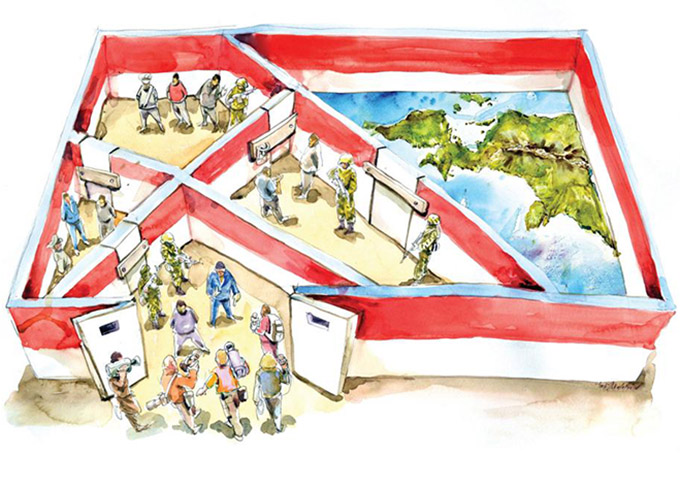
In West Papua, December 1 is widely commemorated as the day West Papua declared nationhood. In 1961, under Dutch rule, an elected council consisting mostly of indigenous Papuans commissioned the creation of a national anthem and flag.

On December 1, 1961, the West Papuan Morning Star flag was flown beside the Dutch tricolor for the first time.

Indonesia took control over Papua with United Nations recognition in 1969.

500 plus arrested
Over the last five decades, some Papuans have resisted Indonesian rule. On December 1, 2018, more than 500 students were arrested in more than 10 Indonesian cities after peacefully raising the Morning Star flag and demanding a referendum on independence.

Indonesia’s National Police initially announced that the killings in Nduga were in retribution for a worker taking photographs of Papuan militants organising a flag-raising ceremony near a road and bridge construction.

More than 100 military and police officers were evacuating the dead and injured, and engaged in a military operation against the militants.

Human Rights Watch has long documented human rights abuses in Papua’s Central Highlands, where the military and police have frequently engaged in deadly confrontation with armed groups.

Indonesian security forces have often committed abuses against the Papuan population, including arbitrary detention and torture. A lack of internal accountability within the security forces and a poorly functioning justice system mean that impunity for rights violators is the norm in Papua.

“The Indonesian security forces should exercise care when operating in Nduga, directing all security personnel to treat Papuans in accordance with international standards,” said the watchdog.

“They should transparently investigate and hold accountable anyone implicated in a criminal offence. Both the military and the police should allow journalists to operate independently in the area.”


A cartoonist’s depiction of Indonesian government restrictions on media freedom and rights monitoring in Papua. Cartoon: © 2015 Toni Malakian/Human Rights Watch

Remote access
Nduga is an extremely remote area where no journalists have had access since the attacks.

A decades-long official restriction on foreign media access to Papua and controls on Indonesian journalists there have fostered that lack of justice for serious abuses by Indonesian security forces and fueled resentment among Papuans.

“The situation in Nduga is muddled in large part because no journalists can independently go into the area to interview witnesses and verify what happened,” Pearson said.

“Having independent monitors on the ground will help deter abuses by both the militants and security forces, which would benefit all Papuans.”

Print Friendly, PDF & Email

Article by AsiaPacificReport.nz

ADHD prescriptions are going up, but that doesn’t mean we’re over-medicating

]]>

Source: The Conversation (Au and NZ) – By Daryl Efron, Associate Professor, Royal Children’s Hospital

The rate of medications dispensed for attention-deficit hyperactivity disorder (ADHD) in children aged 17 and under increased by 30% between 2013-14 and 2016-17.

The Australian Atlas for Healthcare Variation, released today, shows around 14,000 prescriptions were dispensed per 100,000 children aged 17 and under in 2016-17, compared with around 11,000 in 2013-14.

The atlas for 2016-17 also showed some areas had a high dispensing rate of around 34,000 per 100,000 while the area with the lowest rate was around 2,000 per 100,000 – a 17-fold difference. This difference is much lower than in 2013-14, when the highest rate was 75 times the lowest.

For decades people have been concerned too many children could be diagnosed with ADHD and treated with medications. We are conducting a study called the Children’s Attention Project, following 500 children recruited through Melbourne schools. So far, we have found only one in four children who met full ADHD criteria were taking medication at age ten.

So it looks like, if anything, more children with ADHD should be referred for assessment and consideration of management options.

How many kids are medicated?

ADHD is the most common neurodevelopmental disorder of childhood – the prevalence is around 5% in Australia. Children with ADHD have great difficulty staying focused, are easily distracted and have poor self-control. Many are also physically hyperactive, especially when they are young.

To be diagnosed, children need to have major problems from their ADHD symptoms both at home and school. These include learning difficulties, behavioural problems and trouble making friends. Young people with ADHD are more likely to fail school, have lower quality of life, experience substance abuse issues and teenage pregnancy, or end up in prison.


Read more: ADHD: claims we’re diagnosing immature behaviour make it worse for those affected


Medication can make a big difference to these children’s lives. While there are many ways to help children with ADHD, stimulant medication is the most effective treatment. All international clinical guidelines recommend it for children with significant ADHD that persists after non-medication approaches have been offered.

Our previous research found that about 80% of children diagnosed with ADHD by a paediatrician (the main medical specialty that manages ADHD) in Australia are treated with medication.

Children with ADHD have trouble making friends. Charlein Gracia/Unsplash

The atlas shows the proportion of children and adolescents who had at least one ADHD medication prescription dispensed was 1.5% in 2013-14 and 1.9% in 2016-7. This is similar to the prevalence of stimulant medication prescription in previous Australian studies in the past 15 years. It sits between the US (high) and Europe (low) and is not excessive given the prevalence of the condition.

The Children’s Attention Project found those with the most severe symptoms were more likely to be prescribed medications, as were those from families of lower socioeconomic status. Other Australian studies have found similar results. This is not surprising as ADHD does appear to be more common in children from socioeconomically disadvantaged families.

Our research suggests that disadvantaged families in Australia appear to be able to access services for ADHD, at least in metropolitan centres.

Why does it vary between areas?

The atlas finding that there is considerable regional variation in prescribing of stimulant medications in Australia has been identified in previous studies and needs to be better understood. Some variation in health care is normal and good, but too much suggests there may be a problem with the quality of care or access to care. For example, greater prescribing in regional areas may reflect lack of timely access to non-pharmacological services.


Read more: Want to improve the nation’s health? Start by reducing inequalities and improving living conditions


We do need to keep watching this space, monitoring rates and regional variation of medication use. A landmark study in the US, published in 1999, compared medication with intensive parent and teacher behaviour training. The children who received medication had a much greater reduction in ADHD symptoms.

But medication is only one consideration in ADHD. Other supports are also important. Behavioural therapies can help reduce anxiety and behaviour problems in children with ADHD and improve relationships with parents and teachers.

However, accessing psychologists can be hard for many families. While Medicare rebates are available for up to ten sessions per year, costs can still be a barrier. In our research, Victorian parents reported out-of-pocket costs of up to A$200 per session with a psychologist.

ADHD is not considered a disability under the National Disability Insurance Scheme, so families are not eligible for funding packages.

Further research is needed to better understand the factors influencing access to care for Australian children with ADHD, and why there is such variation in rates of prescribing between regions. We also need to ensure children across Australia get equitable access to non-medication management.


Read more: Girls have ADHD too – here’s why we may be missing them


We need evidence-based clinical guidelines relevant to the Australian healthcare system, which is quite different from places such as the UK and US. This work must include adult ADHD, which is an emerging area with a raft of clinical and service system complexities.

ref. ADHD prescriptions are going up, but that doesn’t mean we’re over-medicating – http://theconversation.com/adhd-prescriptions-are-going-up-but-that-doesnt-mean-were-over-medicating-108474

Huawei executive’s arrest will further test an already shaky US-China relationship

]]>

Source: The Conversation (Au and NZ) – By Tony Walker, Adjunct Professor, School of Communications, La Trobe University

When US Vice President Mike Pence got to his feet at the conservative Hudson Institute in Washington on October 4, it was clear that US-China relations were entering a new, certainly fractious, possibly destructive phase.

In those remarks, Pence did not hold back. They bear repeating in light of the latest blow-up in an increasingly testy relationship, this time over the arrest in Canada of the daughter of one of China’s most prominent business figures.

The Chinese Communist Party has used an arsenal of policies inconsistent with free and fair trade, including tariffs, quotas, currency manipulation, forced technology transfer, intellectual theft and industrial subsidies that are handed out like candy to foreign investment. These policies have built Beijing’s manufacturing base, at the expense of its competitors – especially the United States of America.

Meng Wanzhou, a senior executive in telecommunications manufacturing giant Huawei and daughter of its founder, is alleged by the United States to have violated sanctions on selling technology to Iran.

Her extradition to the US to stand trial is being sought. This is an explosive issue, not least because – rightly or wrongly – it will be perceived in Beijing as a component of a trade war driven by a hostile US administration.


Read more: G20 summit bring a truce in US-China trade relations – but it’s likely to be temporary


What will also be playing out in China is the issue of “face”. An inability by China’s leadership to bring about Meng’s release will involve “loss of face” in a country where nationalist sentiments remain potent, overlaid by a lingering sense of grievance over foreign interference.

China could not have drawn any conclusion from the Pence Hudson Institute speech other than that Washington viewed Chinese business practices as war by another means.

In Pence’s remarks, there was little concession to a grand bargain between the US and China sought by successive administrations. Rather, the US vice president delivered a warning to Beijing that his country was intent on a more confrontational approach to perceived Chinese mercantilism – and lawbreaking.

The gloves were off. Inevitably, Meng’s arrest will be viewed in Beijing through this prism, whether circumstances are material or not.

What is relevant in Huawei’s case is an effective veto on it building 5G networks in Anglosphere countries around the world.

Four members of the Five Eyes – the US, United Kingdom, Australia and New Zealand – have banned Huawei from participating in advanced 5G networks. Canada is reviewing its options.

This coordinated resistance by intelligence-sharing allies reflects misgivings about risks to communications networks in their countries from a company with murky links to the Chinese military.

While there is no explicit connection between Meng’s arrest and pushback against Huawei’s 5G business, China will inevitably link the two episodes as examples of Western efforts to stifle competition from a Chinese behemoth.

This would be an understandable reaction, but on the face of it these are separate issues.

What is the case is the Pence Hudson Institute speech signals a potential rupture in the nearly half century of relative amity – leaving aside outrage over the Tiananmen Square bloodletting of 1989 – dating from the Shanghai Communique of 1972.

This was signed by visiting President Richard Nixon and Chinese Premier Zhou Enlai. After years of contentiousness on Taiwan and other issues, the US and China agreed to work towards normalising relations.

What is different now is that, seemingly in the blink of an eye, China has grown its economy to the point where it is the world’s biggest on a purchasing power parity basis. It’s set to become the largest overall within the next ten years.

Companies like Huawei symbolise China’s extraordinary economic success and the threat this poses to established businesses in the West.

Back in 1972, no-one could have anticipated China would move as far and fast as it has – to the point where it is challenging the US and its allies on many fronts.

This returns us to the issue of Meng Wenzhou, whose arrest is threatening to derail trade negotiations advanced by Presidents Donald Trump and Xi Jinping at a dinner engagement at the recent Buenos Aires G20 summit.

China’s official response had been relatively measured in what appears to be an attempt to compartmentalise the Meng arrest issue and not allow it to bring important trade talks unstuck.

Trump and Xi agreed on a 90-day window ending on March 1 to enable the trade negotiations – aimed at forestalling increases of US tariffs on Chinese imports – to proceed. However, Meng’s arrest casts doubt on this process.


Read more: The risks of a new Cold War between the US and China are real: here’s why


In the past 48 hours, China has stiffened its official rhetoric. This includes the summoning of the US ambassador in Beijing for a dressing down. Chinese displeasure was summed up in a Foreign Ministry statement:

The actions of the US seriously violated the lawful and legitimate rights of the Chinese citizen, and by their nature were extremely nasty. China will respond further depending on US actions.

What this portends is anybody’s guess, but once they have swung into action, US legal processes are relentless. In the meantime, Canada finds itself in a Chinese firing line as its own judiciary deals with a politically charged extradition process.

In the wider scheme of things, it is hard to envision a more unhelpful development at a critical moment in US-China relations. This is not a complication that is doing anyone any favours, least of all world markets, or the friends and trading partners of those at its centre.

ref. Huawei executive’s arrest will further test an already shaky US-China relationship – http://theconversation.com/huawei-executives-arrest-will-further-test-an-already-shaky-us-china-relationship-108478

Pacific voices tell stories of climate change reality in new documentary

]]>

A new documentary Subject to Change, a collection of interviews and personal stories from across the Pacific, explores the impact of climate change. Video: MFAT

Pacific Media Watch Newsdesk

Two young women students are the driving force who created a new documentary titled Subject to Change which highlights the climate change challenges faced by Pacific people in the region.

Among the most vulnerable to climate change impacts, Pacific voices are at the heart of the film which has been premiered at the UN Climate Change Conference (COP24) in Katowice, Poland, at the Pacific and Koronivia Pavilion.

Producer Amiria Ranfurly, who is of Niuean-New Zealand descent, and Polish director Wiktoria Ojrzyńska, are students of Massey University of New Zealand.

READ MORE: AUT’s Bearing Witness climate change project

The young women chose to showcase climate change in their work because of the impact in the region.

-Partners-

“We wanted to explore the impacts that climate change is having on our world, and Subject to Change is a documentary film that presents a collection of interviews and personal stories from across the Pacific,” says Ranfurly.

“With passion and determination, we have created a film that shares insight to New Zealand’s response to the global objectives set by the Paris Agreement, alongside intimate stories from the frontline in a truthful and evocative way.”

Documentary producer Amiria Ranfurly (left) and director Wiktoria Ojrzyńska … “intimate frontline climate stories”. Image: COP24 Pacific


Director Ojrzyńska says: “Directing Subject to Change was an amazing storytelling experience, during which I worked with many inspirational people and gained experience across different aspects of filmmaking.”

Collaboration project
Subject to Change
is a collaboration between Massey University and NZ’s Ministry of Foreign Affairs and Trade (MFAT).

Present to launch the film at the premiere was the Ambassador and Climate Change Special Adviser of the Government of New Zealand, with special guest speaker Inia Seruiratu, COP23 High Level Climate Champion of Global Climate Action, and Minister for Defence and National Security of Fiji who introduced the Director and the Producer of the film.

“Climate change remains the single greatest threat to the livelihoods, security and wellbeing of the peoples of the Pacific,” said Ambassador Stephanie Lee. “Our Prime Minister, Jacinda Ardern, has described the climate change challenge as the Nuclear-Free Movement of our generation.”

“We have heard about the IPCC 1.5 degrees report and we already knew that it really underlines this challenge as an urgent one. The documentary you are about to see embodies that sense of challenge, but it also embodies a sense of hope,” said Ambassador Lee.

The documentary featured and drew strongly on the perspective of the Fijian people, particularly of those of the small island of Batiki with a population of around 300 people that was hit hardest by Cyclone Winston in February, 2017.

Inia Seruiratu thanked the NZ government and Massey University for supporting the documentary, as well as New Zealand’s support and partnership on the Pacific and Koronivia Pavilion where the premiere was being held.

Speaking about his experience as a Pacific islander, Seruiratu thanked the producer, director and the team behind the documentary for producing a powerful medium with which the voices of the vulnerable could be heard.

“People need to see and experience visually the realities others such as those in the Pacific are facing in order to better understand. And this is why this documentary is so important and serves as a great tool,” said Seruiratu.

Print Friendly, PDF & Email

Article by AsiaPacificReport.nz

Recovered Aboriginal songs offer clues to 19th century mystery of the shipwrecked ‘white woman’

]]>

Source: The Conversation (Au and NZ) – By Stephen Morey, Senior Lecturer, Department of Languages and Linguistics, La Trobe University

In 1846 Melbourne was gripped by a panic: a story had spread that a white woman had been shipwrecked off the coast of Gippsland and was living with Aboriginal people. “Expeditions” were sent to “rescue” her. Messages were left for her printed on handkerchiefs, and because some believed she was Scottish, some of these were written in Gaelic.

The expeditions sent to Gippsland resulted in the massacre of large numbers of Indigenous people from the Gunai/Kurnai community.

For generations, people have argued over whether the “white woman” really existed and if so, what happened to her. In her 2001 book The Captive White Woman of Gipps Land author Julie Carr recounted a story written in 1897 by Mary Howitt, the daughter of A.W. Howitt, an anthropologist and Gippsland magistrate, which told how the white woman later had children with an Aboriginal husband and drowned in McLennan’s strait. Carr came to the conclusion that evidence for the existence of the woman was inconclusive; government searches in 1846 and 1847 having failed to find her.

But we have recently identified two short songs in the Aboriginal language of Gippsland (Gunai/Kurnai) about the white woman’s story that provide some clues. These were in the papers of Howitt at the State Library of Victoria.

A handkerchief for the white woman shipwrecked in Gippsland.

A gift of possum skin

At the top of one page of Howitt’s notes headed August 23 1868, per J.C. Macleod (the son of an early pastoralist), Howitt wrote the following note:

Blacks told him [Macleod] in the early days the white woman was wrecked in the coast with some men who were killed – the woman being saved. She was a tall woman, young with very long black hair in ringlets (some said the hair was fair). … She was the Miss Howard who was about 16 years of age when the vessel in which she was going to Melbourne was lost. Daughter of Commissary Howard. Part of the vessel was after picked up in the ninety mile beach

Two Gunai/Kurnai songs are written on the same page. Howitt notes that these songs were composed by a “Dinni Birraark”, a senior songster and ritual specialist, where dinni is the word for “old” and the birraark is the name of an expert who was skilled in songs and magic. These men were said to fly and see beyond the physical world.

In the 1840s there were seven surviving men who held the title of Dinni Birraark. The composer of this song was likely to have been a man also known as Bunjil Bamarang from near Bairnsdale. Bunjil Bamarang was not his personal name, but indicated that he was an expert (Bunjil) in something. We do not know what Bamarang refers to, but it may indicate expertise in the use of the “spear shield”, which was called bammarook in Gunai/Kurnai.

One of these songs, written down by Howitt, directly mentions the “white woman”:

State Library of Victoria

We have transcribed this as:

U-auda kai-ū Lohan-tŭkan móka kat-teir nŭ́rrau-un-gŭl mūndū wánganna

Underneath the song, Howitt gives translations for many of the words. For instance, he translates Lohan-tŭkan as “white woman”. The overall meaning of the song seems to be, “Give the white woman from over the sea the possum skin skirt, and that blanket there.”

This genre of song, gunyeru, was traditionally sung with dancing at public gatherings, what might be otherwise commonly referred to as a “corroboree” (although the word “corroboree” originates from the Dharuk language spoken in the Sydney area). The Dinni Birraark was certainly an acknowledged expert in composing this style of song.

Burning ladders

On the same page, is a second song that seems to give more information about the Lohan-Tuka, or white woman’s, story:

State Library of Victoria

This we have transcribed as:

Blaung-a-requa drūraua kŭllŭngŭka
Wŭrūng-tūnkū bŭdda-tūnkū pŭtta-ngaiu
tūka-pŭnta kŭrnŭng-ŭka ma-kŭrnung-ita

In the first line of the song there are three words that Howitt translates as “burn”, “ladder” and “whitefellow”. This would appear to be a sentence meaning, “The whitefellow’s ladder is burning”.

When we remember that ships in the 1840s were sailing ships, we can imagine that the Dinni Birraark used a word that he knew – “ladder” – to represent the rigging on a sailing ship. As Gunai/Kurnai elder, Russell Mullett, pointed out to us, “As a senior man, the Dinni Birraark would have used a ladder in his ritual life.”

The remaining portions of this second song are harder to interpret. It seems that the Dinni Birraark was watching the burning of this ship from the narrow strip of land along the Ninety Mile Beach between the sea and the freshwater of the Gippsland Lakes.

In this place, perhaps a musk duck (Tuka) had a nest, there was a hollow place near to water. Intriguingly the word for white woman, Lohan Tuka, is a compound including the word for musk duck. Perhaps, as Mullett has suggested, the place where the Dinni Birraark watched this had an association with an ancestral musk duck.

The message printed on handkerchiefs in a bid to find the shipwrecked white woman.

These songs are composed as if witnessing real events: the wreck of a ship and the rescue of a young woman. Nothing is more naturally human than offering a young shipwreck victim a “skirt and a blanket”, and the description of the shipwreck as a “burning ladder” is fully plausible.

These two songs seem to suggest that there was a White Woman, the Lohan Tuka. There is much tragedy in this story – shipwreck, massacre, possible drowning. This history needs to be told and re-told.

What these songs reveal is an Indigenous perspective on it and a glimpse into the rich artistic culture of the Gunai/Kurnai. In the words of Mullett, “taken together these two songs are like an opera composed by the Dinni Birraark”.

ref. Recovered Aboriginal songs offer clues to 19th century mystery of the shipwrecked ‘white woman’ – http://theconversation.com/recovered-aboriginal-songs-offer-clues-to-19th-century-mystery-of-the-shipwrecked-white-woman-108070

As Indigenous incarceration rates keep rising, justice reinvestment offers a solution

]]>

Source: The Conversation (Au and NZ) – By Sophie Russell, Research Associate, UNSW

The over-incarceration of Aboriginal and Torres Strait Islander Australians is one of our nation’s most significant human rights concerns.

Data released last week show the number of people imprisoned in Australia has continued to rise. The rate of Indigenous incarceration has increased by 45% since 2008.

It is a national shame that Aboriginal and Torres Strait Islander Australians make up 2% of the total Australian population, but 28% of the Australian prison population.

Aboriginal and Torres Strait Islander men are 15 times more likely to be in custody than non-Indigenous men. Aboriginal and Torres Strait Islander women are 21 times more likely to be in custody than non-Indigenous women.

The picture is particularly stark for Indigenous children. They make up 7% of the general youth population but 54% of those in youth detention across Australia. This ranges, on average, from 15% in Victoria to 97% in the Northern Territory.

The staggering over-representation of Indigenous people in prison was the focus of the Australian Law Reform Commission report Pathways to Justice – Inquiry into the Incarceration Rate of Aboriginal and Torres Strait Islander People. The report was delivered to the federal attorney-general in December 2017. A year later, the government has yet to respond.

What did the inquiry recommend?

Two key recommendations involved “justice reinvestment”. Justice reinvestment is a strategy for reducing the number of people in prison by investing funds drawn from the corrections budget into early intervention, prevention and diversionary solutions in communities where many prisoners come from and return to.

Justice reinvestment involves working with a community to design local solutions to overcome the drivers of crime and incarceration.

The inquiry recommended an independent justice reinvestment body be set up with Aboriginal and Torres Strait Islander leadership. This would provide technical expertise and promote the reinvestment of resources from the criminal justice system into community-based initiatives.


Read more: We need evidence-based law reform to reduce rates of Indigenous incarceration


The inquiry also recommended that governments support justice reinvestment trials in partnership with Aboriginal and Torres Strait Islander communities. This would include allowing access to local criminal justice data, supporting local justice reinvestment initiatives and facilitating participation and coordination between relevant government departments and agencies.

A small number of community-led justice reinvestment trials are taking place throughout Australia. There is widespread support for further advancing justice reinvestment.

Evidence shows justice reinvestment is already working

The Maranguka Justice Reinvestment project in Bourke, New South Wales, is the most developed community-based trial. The Bourke Tribal Council, assisted by Just Reinvest NSW, directs and guides Maranguka.

The project is building a safer and stronger community. This has led to significant reductions in crime and reoffending. From 2016 to 2017, the Bourke community experienced a:

  • 23% reduction in police-recorded incidents of domestic violence
  • 14% reduction in bail breaches for adults
  • 42% reduction in days spent in custody for adults
  • 31% increase in year 12 student retention rates
  • 38% reduction in charges across the top five juvenile offence categories.

A KPMG impact assessment found the Maranguka project achieved savings of A$3.1 million in 2017. Two-thirds of that relates to the criminal justice system and one-third is the broader economic impact in the region.

The financial impact of the project is about five times greater than its operational costs. If Bourke is able to sustain just half the 2017 results, an additional gross impact of A$7 million over the next five years could be achieved.

Justice reinvestment offers a solution

Community leaders, academics and representatives from businesses, nongovernment organisations and government attended a national justice reinvestment forum in Canberra last week. The message from the forum was clear: solutions to reduce Indigenous imprisonment need to be community-designed and driven, with government support.

Research has found a large portion of prisoners come from and return to a small number of inadequately resourced neighbourhoods and communities. It is well known that prisons are filled with people who are disproportionately disadvantaged and who have unmet social, health and disability-related needs.

Research has also shown that prison does not reduce crime. It actually perpetuates cycles of poverty, disadvantage and reoffending.


Read more: FactCheck Q&A: are Indigenous Australians the most incarcerated people on Earth?


It costs almost A$300 a day to keep an adult in prison. The average cost of locking up a young person is almost five times that amount.

Aboriginal and Torres Strait Islander over-incarceration cost the Australian economy an estimated A$7.9 billion in 2016. These costs are expected to grow to A$9.7 billion in 2020 and A$19.8 billion by 2040, if we continue on the same trajectory.

Australia cannot afford the social, health and economic costs of over-imprisonment of Aboriginal and Torres Strait Islander Australians. Strong, healthy and connected communities are the most effective way to prevent crime and make communities safer. Justice reinvestment offers a pathway to achieve this.

ref. As Indigenous incarceration rates keep rising, justice reinvestment offers a solution – http://theconversation.com/as-indigenous-incarceration-rates-keep-rising-justice-reinvestment-offers-a-solution-107610

How physical activity in Australian schools can help prevent depression in young people

]]>

Source: The Conversation (Au and NZ) – By Alexandra Parker, Professor of Physical Activity and Mental Health, Victoria University

Adolescence is a critical time for the development of mental health problems. In fact, depression is most likely to occur during adolescence and young adulthood. It’s the leading cause of disability in young people worldwide.

At least one‐quarter of young people will experience an episode of depression before 19 years of age. By year 9, students who have experienced a mental disorder are on average two years behind in academic achievement compared to those without a mental disorder.

The consequences of depression in adolescence are serious and can be lifelong. These include an increased risk of depression late in life, poor social functioning and academic achievement and reduced employment security, as well as greater risk of suicide and self‐harm.


Read more: What can parents do about their teenagers’ mental health?


Many young people don’t recover from depression, despite treatment with the best available evidence‐based treatment approaches. Given the scope and impact of depression in young people, and poor recovery rates, it’s crucial to understand how to help prevent the development of depression in young people.

An increasing body of evidence indicates physical activity and exercise are effective for improving mood. We recently also examined studies to assess the efficacy of physical activity and exercise as a prevention for depression in young people. We found eight controlled research studies that examined this. These studies showed exercise and physical activity are effective as a depression-prevention approach for young people.

How much physical activity do young people need to do?

Few young people seek professional help for mental health concerns. It’s important to engage young people in places that suit them to prevent the onset of mental health problems. Prevention and early intervention are crucial and especially relevant in the education setting.

Many young people never recover from depression once it is established. from www.shutterstock.com

The Australian guidelines state young people should engage in 60 minutes of physical activity a day. The majority of young people don’t reach this target.

In fact, disengagement from regular exercise, physical activity and sporting clubs steadily increases during adolescence. This coincides with the average age of onset of depression.

Physical activity is an important part of the Australian Curriculum. The Australian national policy requires government schools to provide at least two hours of physical activity per week during primary education and junior secondary education. The provision of any physical education is not required as part of the senior secondary curriculum. Even during primary education and junior secondary education, the mandated 120 minutes a week doesn’t meet Australian guidelines.

Schools are a key site for the promotion of healthy behaviours. Many long-term health-related behaviours and patterns – both positive and negative – are established during the developmental phase of adolescence and early adulthood.

How do we get them to do more?

The research indicates physical activity is associated with reduced risk of depression in young people. Physical activity is an acceptable, non-stigmatising approach to promoting better mental health in young people. To meet the specific needs of young people, a physical activity program should facilitate self-reliance, motivation, and mental health and wellbeing literacy.

Depression is the leading cause of disability for young people across the globe. from www.shutterstock.com

Motivation to engage in physical activity can be increased by offering choice of activities, increasing skills and ability to engage in physical activity, and opportunities for social connection. Schools are best placed to ensure physical activity is increased and protected within the Australian curriculum and that young people meet the Australian guidelines for physical activity each day.

Most school-based intervention studies of physical activity have used supervised programs of moderate to vigorous physical activity. These consist of 30 to 45 minutes, three to five days per week. The physical activity should include a variety of activities, be age-appropriate and enjoyable.

Some researchers suggest schools could also promote physical activity outside physical education classes by ensuring at least 20 minutes of recess per day.

Finally, physical educators can be key drivers of physical and health literacy and behaviour change. They can do this, for example, through school-based activities and by providing information about the benefits of physical activity via newsletters and notices sent home.


Read more: Yes, your kids can run all day – they’ve got muscles like endurance athletes


Physical activity programs within schools should also address the health, mental health and stress-reduction motivations for engaging in physical activity and focus on the benefits of participation. This should include a focus on fun and enjoyment, while building confidence and independence.

Any physical activity program delivered in schools should also encourage young people to draw on parental and social support to increase the physical activity they do outside school time.

ref. How physical activity in Australian schools can help prevent depression in young people – http://theconversation.com/how-physical-activity-in-australian-schools-can-help-prevent-depression-in-young-people-107889

Cities can grow without wrecking reefs and oceans. Here’s how

]]>

Source: The Conversation (Au and NZ) – By Silvia Tavares, Lecturer in Urban Design, James Cook University

What happens if the water temperature rises by a few degrees?” is the 2018 International Year of the Reef leading question. While the ocean is the focus, urbanisation is the main reason for the rising temperatures and water pollution. Yet it receives little attention in this discussion.

In turn, rising temperatures increase downpours and urban floods, adding to the pressures on urban infrastructure.


Read more: Design for flooding: how cities can make room for water


Protecting the reef as Cairns grows

Cairns is an expanding Queensland city located between two World Heritage sites – the Great Barrier Reef and the Daintree Rainforest. While important research focuses on these sites themselves, not much is known about how the surrounding urban areas influence these natural environments. Similarly, little is known about how urban planning and design contribute to the health of the inner city and surrounding water bodies, including the ocean.

Cairns is a major Australian tourism destination with a unique coastal setting of rainforest and reef. This attracts growing numbers of visitors. One effect of this success is increased urbanisation to accommodate these tourists.

There are many opportunities to promote sustainable and socially acceptable growth in Cairns. Yet this growth is not without challenges. These include:

  • impacts of climate change, including sea-level rise and ocean warming
  • lack of comprehensive urban infrastructure strategy
  • lack of comprehensive assessment of the benefits of integrated urban design to maximise coastal resilience and the health of streams and oceans.

Rain gardens are common in Singapore. Roger Soh/Flickr, CC BY-SA

As with most Australian cities, Cairns has an urban layout based on wide streets, mostly with little or no greenery. Rain gardens, for instance, are rare. Bioswales that slow and filter stormwater are present along highways, but seldom within the city.

The arguments for not adding greenery to the urban environment are familiar. These typically relate to costs of implementation and maintenance, but also to the speed with which water is taken out of streets during the tropical rainy season. This is because green stormwater solutions, if not well planned, can slow down the water flow, thus increasing floods.

However, cities can be designed in a way to imitate nature with solutions that are an integral part of the urban system. This can include dedicated areas of larger wetlands and parks, which capture water and filter pollution and undesired nutrients more efficiently, reducing polluted runoff to the reef.


Read more: If planners understand it’s cool to green cities, what’s stopping them?


Integrated urban design

Integrated urban design is an aspect of city planning and design that could be further developed to ensure the whole system works more efficiently. This involves integrating the three elements that make up urban infrastructure:

  1. the green – parks, residential gardens, rain gardens, green roofs and walls, bioswales, etc
  2. the grey – built drains, footpaths, buildings, underground vacuum system, etc
  3. the blue – streams, stormwater systems, etc.

A rain garden, which absorbs rain and stores water to help control run-off from impervious hard surfaces, in Wellington, New Zealand. Karine Dupré

Urban infrastructure, therefore, can and should be planned and designed to provide multiple services, including coastal resilience and healthier water streams and oceans. To achieve this, a neighbourhood or city-wide strategy needs to be implemented, instead of intermittent and ad hoc urban design solutions. Importantly, each element should coordinate with the others to avoid overlaps, gaps and pitfalls.

This is what integrated urban design is about. So why don’t we implement it more often?

Challenges and opportunities

Research has shown that planning, designing and creating climate-resilient cities that are energy-optimised, revitalise urban landscapes and restore and support ecosystem services is a major challenge at the planning scale. To generate an urban environment that promotes urban protection and resilience while minimising urbanisation impacts and restoring natural systems, we need to better anticipate the risks and have the means to take actions. In other words, it is a two-way system: well planned and designed green and blue infrastructures not only deliver better urbanised areas but will also protect the ocean from pollution. Additionally, it helps to manage future risks of severe weather.

The uncertainties of green infrastructure capacity and costs of maintenance, combined with inflexible finance schemes, are obstacles to integrated urban solutions. Furthermore, the lack of inter- and transdisciplinary approaches results in disciplinary barriers in research and policymaking to long-term planning of the sort that generates urban green infrastructure and its desired outcomes.

On the bright side, there is also strong evidence to suggest sound policy can help overcome these barriers through technical guides based on scientific research, standards and financial incentives.


Read more: Here’s how green infrastructure can easily be added to the urban planning toolkit


Collaborative partnerships are promising, too. Partnerships between academia and industry tend to be more powerful than streamlined industry project developments.

Finally, and very promisingly, Australia has its own successful green infrastructure examples. Melbourne’s urban forest strategy has been internationally acclaimed. Examples like these provide valuable insights into local green infrastructure governance.

Cairns has stepped up with some stunning blue infrastructure on the Esplanade which raises awareness of both locals and visitors about the protection of our oceans.

This is only the start. Together academics, local authorities, industry stakeholders and communities can lead the way to resilient cities and healthier oceans.

Cairns Esplanade Lagoon helps raise awareness of the need to protect the ocean as the city grows. Karine Dupré, Author provided


Read more: How green is our infrastructure? Helping cities assess its value for long-term liveability


ref. Cities can grow without wrecking reefs and oceans. Here’s how – http://theconversation.com/cities-can-grow-without-wrecking-reefs-and-oceans-heres-how-107263

Digital platforms. Why the ACCC’s proposals for Google and Facebook matter big time

]]>

Source: The Conversation (Au and NZ) – By Sacha Molitorisz, Postdoctoral Research Fellow, Centre for Media Transition, Faculty of Law, University of Technology Sydney

The Australian Competition and Consumer Commission has released the preliminary report of its Digital Platforms Inquiry, and Google and Facebook won’t be happy.

Rather than adopting a gently-gently approach, the ACCC has produced draft recommendations that are extensive and dramatic.

If implemented, they would significantly affect the way the digital platforms make their money, and help direct the content we consume.

What’s more, the inquiry is touted as a world first. Its findings will be closely monitored, and perhaps even adopted, by regulators internationally.

Who should care?

The digital platforms themselves should (and do) care.

Any new regulations designed to foster competition or protect individual privacy (both are among the ACCC’s recommendations) have the potential to harm their revenues.

They’ve a lot to lose. In 2017, nearly A$8 billion was spent on online advertising in Australia, and more than half went to Google and Facebook (p3).

News organisations whose output is disseminated by those platforms should (and do) care too.

As the ACCC notes, more than half of the traffic on Australian news websites comes via Google and Facebook (p8).


Read more: News outlets air grievances and Facebook plays the underdog in ACCC inquiry


Increasingly, news producers depend on social media and search engines to connect with consumers. Google is used for 95% of searches (98% on mobile devices).

The rise of Google, Facebook and other digital platforms has been accompanied by unprecedented pressures on traditional news organisations.

Most obviously, classified advertising revenue has been unbundled from newspapers.

In 2001, classified advertising revenue stood at A$2 billion. By 2016, it had fallen to A$200 million. The future of newspapers’ ability to produce news is under a cloud, and digital platforms help control the weather.

Of course, advertisers care too.

But the stakeholders with the most to gain or lose are us, Australian citizens.


Read more: Taking on big tech: where does Australia stand?


Our lives are mediated by Google, Facebook, Apple, Amazon, Twitter and others as never before. Google answers our search queries; Facebook hosts friends’ baby snaps; YouTube (owned by Google) distributes professional and user-generated videos; Instagram (owned by Facebook) hosts our holiday snaps.

As the ACCC notes, they have given us tremendous benefits, for minimal (apparent) cost.

And they’ve done it at lightning speed. Google arrived in 1998, Facebook in 2004 and Twitter in 2006. They are mediating what comes before our eyes in ways we don’t understand and (because they keep their algorithms secret) in ways we can’t understand.

What does the ACCC recommend?

The ACCC’s preliminary recommendations are far-reaching and bold.

First, it suggests an independent review to address the inadequacy of current media regulatory frameworks.

This would be a separate, independent inquiry to “design a regulatory framework that is able to effectively and consistently regulate the conduct of all entities which perform comparable functions in the production and delivery of content in Australia, including news and journalistic content, whether they are publishers, broadcasters, other media businesses, or digital platforms”.

This is a commendable and urgent proposal. Last year, cross-media ownership laws were repealed as anachronistic in a digital age. To protect media diversity and plurality, the government needs to revisit the issue of regulatory frameworks.


Read more: Starter’s gun goes off on new phase of media concentration as Nine-Fairfax lead the way


Second, it proposes privacy safeguards. Privacy in Australia is dangerously under-protected. Digital platforms such as Google and Facebook generate revenue by knowing their users and targeting advertising with an accuracy unseen in human history.

As the ACCC puts it, “the current regulatory framework, including privacy laws, does not effectively deter certain data practices that exploit the information asymmetries and the bargaining power imbalances that exist between digital platforms and consumers.”

It makes a number of specific preliminary recommendations, including creating a right to erasure and the requirement of “express, opt-in consent”.

It also supports the creation of a civil right to sue for serious invasions of privacy, as recommended by the Australian Law Reform Commission.

Australians lack the protections that Americans enjoy under the US Bill of Rights; we certainly lack the protection afforded under Europe’s sweeping new privacy law.


Read more: Google slapped hard in Europe over data handling


It wants the penalties for breaches of our existing Privacy Act increased. It recommends the creation of a third-party certification scheme, which would enable the Office of the Australian Information Commissioner to give complying bodies a “privacy seal or mark”.

And it wants a new or existing organisation to monitor attempts by vertically-integrated platforms such as Google to favour their own businesses. This would happen where Google gives prominence in search results to products sold through Google platforms, or prominence to stories from organisations with which it has a commercial relationship.

The organisation would oversee platforms that generate more than A$100 million annually, and which disseminate news, or hyperlinks to news, or snippets of news.

It would investigate complaints and even initiate its own investigations in order to understand how digital platforms are disseminating news and journalistic content and advertising.

As it notes,

The algorithms operated by each of Google and Facebook, as well as other policies, determine which content is surfaced and displayed to consumers in news feed and search results. However, the operation of these algorithms and other policies determining the surfacing of content remain opaque. (p10)

It makes other recommendations, touching on areas including merger law, pre-installed browsers and search engines, takedown procedures for copyright-infringing content, implementing a code of practice for digital platforms and changing the parts of Australian consumer law that deal with unfair contract terms.

Apart from its preliminary recommendations, there are further areas on which it invites comment and suggestions.


Read more: New data access bill shows we need to get serious about privacy with independent oversight of the law


These include giving media organisations tax offsets for producing public interest news, and making subscribing to news publications tax deductible for consumers.

Platforms could be brought into a co-regulatory system for flagging content that is subject to quality control, creating their own quality mark. And a new ombudsman could deal with consumer complaints about scams, misleading advertising and the ranking of news content.

All of these recommendations and areas of interest will generate considerable debate.

What’s next?

The ACCC will accept submissions in response to its preliminary report until February 15.

At the Centre for Media Transition, we played a background role in one aspect of this inquiry.

Earlier this year, we were commissioned by the ACCC to prepare a report on the impact of digital platforms on news and journalistic content. It too was published on Monday.

Our findings overlap with the ACCC on some points, and diverge on others.


Read more: Google and Facebook cosy up to media companies in response to the threat of regulation


Many thorny questions remain, but one point is clear: the current regime that oversees digital platforms is woefully inadequate. Right now, as the ACCC notes, digital platforms are largely unregulated.

New ways of thinking are needed. A mix of old laws (or no laws) and new media spells trouble.

ref. Digital platforms. Why the ACCC’s proposals for Google and Facebook matter big time – http://theconversation.com/digital-platforms-why-the-acccs-proposals-for-google-and-facebook-matter-big-time-108501

Recovered Aboriginal songs offer clues to 18th century mystery of the shipwrecked ‘white woman’

]]>

Source: The Conversation (Au and NZ) – By Stephen Morey, Senior Lecturer, Department of Languages and Linguistics, La Trobe University

In 1846 Melbourne was gripped by a panic: a story had spread that a white woman had been shipwrecked off the coast of Gippsland and was living with Aboriginal people. “Expeditions” were sent to “rescue” her. Messages were left for her printed on handkerchiefs, and because some believed she was Scottish, some of these were written in Gaelic.

The expeditions sent to Gippsland resulted in the massacre of large numbers of Indigenous people from the Gunai/Kurnai community.

For generations, people have argued over whether the “white woman” really existed and if so, what happened to her. In her 2001 book The Captive White Woman of Gipps Land author Julie Carr recounted a story written in 1897 by Mary Howitt, the daughter of A.W. Howitt, an anthropologist and Gippsland magistrate, which told how the white woman later had children with an Aboriginal husband and drowned in McLennan’s strait. Carr came to the conclusion that evidence for the existence of the woman was inconclusive; government searches in 1846 and 1847 having failed to find her.

But we have recently identified two short songs in the Aboriginal language of Gippsland (Gunai/Kurnai) about the white woman’s story that provide some clues. These were in the papers of Howitt at the State Library of Victoria.

A handkerchief for the white woman shipwrecked in Gippsland.

A gift of possum skin

At the top of one page of Howitt’s notes headed August 23 1868, per J.C. Macleod (the son of an early pastoralist), Howitt wrote the following note:

Blacks told him [Macleod] in the early days the white woman was wrecked in the coast with some men who were killed – the woman being saved. She was a tall woman, young with very long black hair in ringlets (some said the hair was fair). … She was the Miss Howard who was about 16 years of age when the vessel in which she was going to Melbourne was lost. Daughter of Commissary Howard. Part of the vessel was after picked up in the ninety mile beach

Two Gunai/Kurnai songs are written on the same page. Howitt notes that these songs were composed by a “Dinni Birraark”, a senior songster and ritual specialist, where dinni is the word for “old” and the birraark is the name of an expert who was skilled in songs and magic. These men were said to fly and see beyond the physical world.

In the 1840s there were seven surviving men who held the title of Dinni Birraark. The composer of this song was likely to have been a man also known as Bunjil Bamarang from near Bairnsdale. Bunjil Bamarang was not his personal name, but indicated that he was an expert (Bunjil) in something. We do not know what Bamarang refers to, but it may indicate expertise in the use of the “spear shield”, which was called bammarook in Gunai/Kurnai.

One of these songs, written down by Howitt, directly mentions the “white woman”:

State Library of Victoria

We have transcribed this as:

U-auda kai-ū Lohan-tŭkan móka kat-teir nŭ́rrau-un-gŭl mūndū wánganna

Underneath the song, Howitt gives translations for many of the words. For instance, he translates Lohan-tŭkan as “white woman”. The overall meaning of the song seems to be, “Give the white woman from over the sea the possum skin skirt, and that blanket there.”

This genre of song, gunyeru, was traditionally sung with dancing at public gatherings, what might be otherwise commonly referred to as a “corroboree” (although the word “corroboree” originates from the Dharuk language spoken in the Sydney area). The Dinni Birraark was certainly an acknowledged expert in composing this style of song.

Burning ladders

On the same page, is a second song that seems to give more information about the Lohan-Tuka, or white woman’s, story:

State Library of Victoria

This we have transcribed as:

Blaung-a-requa drūraua kŭllŭngŭka
Wŭrūng-tūnkū bŭdda-tūnkū pŭtta-ngaiu
tūka-pŭnta kŭrnŭng-ŭka ma-kŭrnung-ita

In the first line of the song there are three words that Howitt translates as “burn”, “ladder” and “whitefellow”. This would appear to be a sentence meaning, “The whitefellow’s ladder is burning”.

When we remember that ships in the 1840s were sailing ships, we can imagine that the Dinni Birraark used a word that he knew – “ladder” – to represent the rigging on a sailing ship. As Gunai/Kurnai elder, Russell Mullett, pointed out to us, “As a senior man, the Dinni Birraark would have used a ladder in his ritual life.”

The remaining portions of this second song are harder to interpret. It seems that the Dinni Birraark was watching the burning of this ship from the narrow strip of land along the Ninety Mile Beach between the sea and the freshwater of the Gippsland Lakes.

In this place, perhaps a musk duck (Tuka) had a nest, there was a hollow place near to water. Intriguingly the word for white woman, Lohan Tuka, is a compound including the word for musk duck. Perhaps, as Mullett has suggested, the place where the Dinni Birraark watched this had an association with an ancestral musk duck.

The message printed on handkerchiefs in a bid to find the shipwrecked white woman.

These songs are composed as if witnessing real events: the wreck of a ship and the rescue of a young woman. Nothing is more naturally human than offering a young shipwreck victim a “skirt and a blanket”, and the description of the shipwreck as a “burning ladder” is fully plausible.

These two songs seem to suggest that there was a White Woman, the Lohan Tuka. There is much tragedy in this story – shipwreck, massacre, possible drowning. This history needs to be told and re-told.

What these songs reveal is an Indigenous perspective on it and a glimpse into the rich artistic culture of the Gunai/Kurnai. In the words of Mullett, “taken together these two songs are like an opera composed by the Dinni Birraark”.

ref. Recovered Aboriginal songs offer clues to 18th century mystery of the shipwrecked ‘white woman’ – http://theconversation.com/recovered-aboriginal-songs-offer-clues-to-18th-century-mystery-of-the-shipwrecked-white-woman-108070

FactCheck: did more people buy their seventh home than bought their first home last year?

]]>

Source: The Conversation (Au and NZ) – By Stephen Whelan, Associate Professor of Economics, University of Sydney

Last year, more people bought their seventh home than those buying their first.

– Queensland Minister for Housing and Public Works Mick de Brenni, media statement, November 22, 2018

Housing affordability remains a serious issue in many cities across Australia.

Federal Labor has promised to make negative gearing reforms if elected in 2019. In Queensland, Minister for Housing and Public Works Mick de Brenni announced a A$2 billion housing scheme he said would create more affordable housing in the Labor-held state.

De Brenni said that “last year, more people bought their seventh home than those buying their first”. The statistic attracted attention after being published in an Australian Broadcasting Corporation (ABC) article on Saturday.

Is the claim correct?

Checking the source

In response to a request for sources and comment, a spokesperson for Mick de Brenni told The Conversation:

The statistics referenced in that quote were misinterpreted from a Misha Zelinski article for the Huffington Post.

The quote has now been removed from [a December 6] ministerial media statement, and we have contacted the ABC to get it removed from their article.

Housing affordability remains a significant barrier for first home buyers. As Shadow Treasurer Chris Bowen recently said:

“Last year, for the first time in history, more than 50% of all new home loan approvals were for investment purposes.”

The spokesperson said the November 22 media statement was in the process of being amended. The original ABC article has now been amended.

Verdict

Queensland Minister for Housing and Public Works Mick de Brenni’s statement that “last year, more people bought their seventh home than those buying their first” is incorrect.

A spokesperson for the minister acknowledged the error and amended a relevant ministerial statement in response to The Conversation’s FactCheck. A media article containing the assertion was also amended.

Lost in translation

As acknowledged by the Minister’s office, the statistics quoted were a misinterpretation of information published in a Huffington Post article.

There is no data available to support the claim.

In response to The Conversation’s request for information, a media spokesperson for the Australian Taxation Office (ATO) said while the agency does collect information on individuals’ ownership of a rental property:

… the data is only for those who rent out the property (based on numbers of schedules with a unique address). We don’t have anything on all properties an individual owns.

Therefore, we don’t have data comparing proportion of first home buyers to second, third, fourth, fifth, sixth and seventh home buyers.

Keeping in mind the caveats above, you can see some of the data the ATO does collect in the table below. It is drawn from the ATO’s Taxation Statistics report 2015-16.

To collect this data, the ATO sampled 2% of all individual tax returns filed in 2015-16.

Individuals – interest in a rental property, by overall net rent outcome, 2014–15 to 2015–16 income years. Australian Taxation Office, taxation statistics 2015-16

A media spokesperson for the Australian Bureau of Statistics (ABS) told The Conversation the ABS does not have the data to make any comment on this claim.

Likewise, a spokesperson for property data firm CoreLogic said the company does not hold data to support the claim.

ABS Housing Finance figures for October 2018 indicate that the value of housing financing provided to investors exceeded that provided to first home buyers in that month.

First home buyers represented 18.1% of all loans made, and generally take out smaller loans than other borrowers (see Table 9). In comparison, loans made to investors represented around 33% of all housing related loans in October 2018.

Nonetheless, it is not possible to identify how many dwellings an investor owns. – Stephen Whelan


Blind review

I agree with the conclusion of the FactCheck: there isn’t any data available to support the claim.

While ABS data on housing finance show that investors had taken out a higher share of loans in October 2018 than first home buyers, it is not sufficient to justify a claim that more people bought their seventh home than those buying their first in the last year.

Indeed, my calculations from the unit record files from the most recent household wealth module in the Household, Income and Labour Dynamics in Australia (HILDA) Survey, for the year 2014, indicate that among property investors, less than 2% held seven or more properties in that year. – Rachel Ong ViforJ


The Conversation FactCheck is accredited by the International Fact-Checking Network.

The Conversation’s FactCheck unit was the first fact-checking team in Australia and one of the first worldwide to be accredited by the International Fact-Checking Network, an alliance of fact-checkers hosted at the Poynter Institute in the US. Read more here.

Have you seen a “fact” worth checking? The Conversation’s FactCheck asks academic experts to test claims and see how true they are. We then ask a second academic to review an anonymous copy of the article. You can request a check at checkit@theconversation.edu.au. Please include the statement you would like us to check, the date it was made, and a link if possible.

ref. FactCheck: did more people buy their seventh home than bought their first home last year? – http://theconversation.com/factcheck-did-more-people-buy-their-seventh-home-than-bought-their-first-home-last-year-108492

FactCheck: did more people buy their seventh home than bought their first last year?

]]>

Source: The Conversation (Au and NZ) – By Stephen Whelan, Associate Professor of Economics, University of Sydney

Last year, more people bought their seventh home than those buying their first.

– Queensland Minister for Housing and Public Works Mick de Brenni, media statement, November 22, 2018

Housing affordability remains a serious issue in many cities across Australia.

Federal Labor has promised to make negative gearing reforms if elected in 2019. In Queensland, Minister for Housing and Public Works Mick de Brenni announced a A$2 billion housing scheme he said would create more affordable housing in the Labor-held state.

De Brenni said that “last year, more people bought their seventh home than those buying their first”. The statistic attracted attention after being published in an Australian Broadcasting Corporation (ABC) article on Saturday.

Is the claim correct?

Checking the source

In response to a request for sources and comment, a spokesperson for Mick de Brenni told The Conversation:

The statistics referenced in that quote were misinterpreted from a Misha Zelinski article for the Huffington Post.

The quote has now been removed from [a December 6] ministerial media statement, and we have contacted the ABC to get it removed from their article.

Housing affordability remains a significant barrier for first home buyers. As Shadow Treasurer Chris Bowen recently said:

“Last year, for the first time in history, more than 50% of all new home loan approvals were for investment purposes.”

The spokesperson said the November 22 media statement was in the process of being amended. The original ABC article has now been amended.

Verdict

Queensland Minister for Housing and Public Works Mick de Brenni’s statement that “last year, more people bought their seventh home than those buying their first” is incorrect.

A spokesperson for the minister acknowledged the error and amended a relevant ministerial statement in response to The Conversation’s FactCheck. A media article containing the assertion was also amended.

Lost in translation

As acknowledged by the Minister’s office, the statistics quoted were a misinterpretation of information published in a Huffington Post article.

There is no data available to support the claim.

In response to The Conversation’s request for information, a media spokesperson for the Australian Taxation Office (ATO) said while the agency does collect information on individuals’ ownership of a rental property:

… the data is only for those who rent out the property (based on numbers of schedules with a unique address). We don’t have anything on all properties an individual owns.

Therefore, we don’t have data comparing proportion of first home buyers to second, third, fourth, fifth, sixth and seventh home buyers.

Keeping in mind the caveats above, you can see some of the data the ATO does collect in the table below. It is drawn from the ATO’s Taxation Statistics report 2015-16.

To collect this data, the ATO sampled 2% of all individual tax returns filed in 2015-16.

Individuals – interest in a rental property, by overall net rent outcome, 2014–15 to 2015–16 income years. Australian Taxation Office, taxation statistics 2015-16

A media spokesperson for the Australian Bureau of Statistics (ABS) told The Conversation the ABS does not have the data to make any comment on this claim.

Likewise, a spokesperson for property data firm CoreLogic said the company does not hold data to support the claim.

ABS Housing Finance figures for October 2018 indicate that the value of housing financing provided to investors exceeded that provided to first home buyers in that month.

First home buyers represented 18.1% of all loans made, and generally take out smaller loans than other borrowers (see Table 9). In comparison, loans made to investors represented around 33% of all housing related loans in October 2018.

Nonetheless, it is not possible to identify how many dwellings an investor owns. – Stephen Whelan


Blind review

I agree with the conclusion of the FactCheck: there isn’t any data available to support the claim.

While ABS data on housing finance show that investors had taken out a higher share of loans in October 2018 than first home buyers, it is not sufficient to justify a claim that more people bought their seventh home than those buying their first in the last year.

Indeed, my calculations from the unit record files from the most recent household wealth module in the Household, Income and Labour Dynamics in Australia (HILDA) Survey, for the year 2014, indicate that among property investors, less than 2% held seven or more properties in that year. – Rachel Ong ViforJ


The Conversation FactCheck is accredited by the International Fact-Checking Network.

The Conversation’s FactCheck unit was the first fact-checking team in Australia and one of the first worldwide to be accredited by the International Fact-Checking Network, an alliance of fact-checkers hosted at the Poynter Institute in the US. Read more here.

Have you seen a “fact” worth checking? The Conversation’s FactCheck asks academic experts to test claims and see how true they are. We then ask a second academic to review an anonymous copy of the article. You can request a check at checkit@theconversation.edu.au. Please include the statement you would like us to check, the date it was made, and a link if possible.

ref. FactCheck: did more people buy their seventh home than bought their first last year? – http://theconversation.com/factcheck-did-more-people-buy-their-seventh-home-than-bought-their-first-last-year-108492

UN official defends West Papuan rights – free speech, peaceful assembly

]]>
UN’s OHCHR spokesperson Ravina Shamdasani … “there are many West Papuan grievances, and we’ve seen this in many parts of the world where grievances are unaddressed, or there’s a suppression of dissent.” Image: UN interview screenshot

Pacific Media Watch Newsdesk

West Papuan rights to freedom of speech and peaceful assembly have been defended by the Office of the UN High Commissioner for Human Rights (OHCHR) in a response to the mass arrests of Papuan protesters during flag raising ceremonies earlier this month.

“These are indigenous people at the end of the day,” says spokesperson Ravina Shamdasani.

“So they are trying to defend their rights to be able to pray and to be able to retain their culture, their links to their land, but also the Papua region of Indonesia has not benefitted from all the economic development that the rest of the country has had.

LISTEN HERE: The full interview with OHCHR’s Ravina Shamdasani

“The rates of malnutrition are quite high.”

Shamdasani said in a radio interview with UN News that while President Joko “Jokowi” Widodo had been initiating development projects, “the problem here is that the people haven’t really been consulted.

-Partners-

“There haven’t been meaningful consultations [with] the people who are actually affected by this.”

In the interview, Shamdasani put into context the recent arrests of nearly 600 citizens who were detained for participating in West Papua’s national day, December 1, a global event for commemorating the first raising the Morning Star flag – banned by Indonesian authorities.

She also answered questions about development, armed conflict, and trying to gain access to the region.

Behind the West Papuan protests
The UN interview transcript:

[UN NEWS] The mass arrest of demonstrators in Indonesia who were attempting to mark a national day for indigenous people in the east of the archipelago, has been condemned by the UN human rights office, OHCHR.

More than 500 activists were detained at the start of the month – though they’ve since been released.

Spokesperson Ravina Shamdasani explained to UN News’ Daniel Johnson what’s behind these latest developments.

Ravina Shamdasani (RS): Last weekend there were peaceful protesters in the Papuan region of Indonesia who were celebrating what they call the “West Papua National Day,” and some 500 of them were arrested, detained. They were all subsequently released within 24 to 48 hours, but this does not take away from the fact that they should not have been arrested in the first place, and that this is not the first time this has happened.

It happens year after year and on several occasions during the year as well.

Daniel Johnson, UN News – Geneva (UN): What exactly are they protesting for apart from the fact that it’s their national day?

RS: Quite often these protests are protests for independence from Indonesia and of course we understand that the situation is complex. The Indonesian government is certainly not happy with these protests, but these people have their right to freedom of peaceful assembly and expression. So there was really no reason to arbitrarily detain them.

UN: As a minority what particular rights are they trying to defend and what are they trying to say is being threatened?

RS: Well, these are indigenous people at the end of the day. So they are trying to defend their rights to be able to pray and to be able to retain their culture, their links to their land, but also the Papua region of Indonesia has not benefited from all the economic development that the rest of the country has had. The rates of malnutrition are quite high. Now the current president of Indonesia has been initiating development projects. The problem here is that the people haven’t really been consulted. There haven’t been meaningful consultations of the people who are actually affected by this.

UN: Why is that? What structures are there in Papua, in Indonesia, to do this or not?

RS:The president has his analysis that the problem is one of economic development, um so he is trying to tackle that. But what we have emphasised, and what our previous High Commissioner during a visit to Jakarta in February of this year emphasised, was that development can of course bring with it access to many fundamental goods and services that can vastly improve people’s well beings, but if they cannot voice their concerns, and if they can’t participate in these decisions, the resulting development may not really increase their welfare, because it doesn’t really address the problems that they have.

UN: Ok, and what is your presence on the ground in this part of Indonesia given that it’s a huge country archipelago?

RS: We do not have a presence in Indonesia but we have a regional office in Bangkok that covers Southeast Asia – So we are, you know, in close contact with human rights defenders, civil society, government officials as well.

We have actually been seeking access to this region for quite awhile now. In February the High Commissioner was promised access, and we are still in discussions with the government of Indonesia to make that happen.

UN: This issue is not one that I’ve seen very often having been here what four years now. What’s your hope for the follow up and how many other similar cases are there that go really beneath the radar of international mainstream media?

RS: Too many international mainstream media tend to focus on the big conflicts. However there are many places like Papua, which are quite small, which have historic kind of long standing structural issues and unfortunately may not come up to the radar until there is an outbreak of conflict

What our office tries to do is try to ring the alarm bells early on, before the situation rises to the level of an armed conflict.

UN: You’re not suggesting it’s at that level now? Of course.

RS: No we’re not suggesting it’s at that level now, but there are many grievances, and we’ve seen this in many parts of the world where grievances are unaddressed, or there’s a suppression of dissent. And then people take the law into their own hands because they feel they are not being heard.

This is actually happening at a very low level in Papua at the moment. There are armed groups that are operating. In fact, just this week I believe a number of people were killed. These were government contractors who were there doing a development project.

They were killed by armed groups which of course is unacceptable, but you have to understand the root causes and you have to address the root causes.

UN Office of Human Rights defends Papuans right to freedom of peaceful assembly and expression

Print Friendly, PDF & Email

Article by AsiaPacificReport.nz

Keith Rankin’s Chart for this Month: Crisis Postponed

Crisis Postponed. Graphic by Keith Rankin.

By Keith Rankin

There will almost certainly be another major financial crisis, just like there will be another big earthquake (or, as the Australians would instead say, another big bushfire). We can do much to improve our monitoring of systemic stresses, our awareness of critical-state dynamics, and our before-and-after mitigation processes. Wilful blindness is not a strategy that works well.

In the pre-World War 1 capitalist era, financial crises happened approximately every ten years. Some were worse than others, and they became increasingly global in reach. Melbourne’s massive financial crisis of 1893 was initiated by the financial failure of the Buenos Aires Water Supply and Drainage Company, and the ensuing bank crisis in London. But the economy of Victoria in general and Melbourne in particular was in a critical state then, and would have suffered a financial collapse in the 1890s regardless of those particular precipitating events.

The ‘Long Depression’ of the 1880s in New Zealand was triggered by the collapse of the City of Glasgow Bank in 1879; a collapse that was largely caused by that bank’s unsupervised exposure to rampant land speculation in Canterbury.

This month’s chart suggests that, while there is more than enough unspent income to fuel a financial crisis, the global financial system is not presently in a critical state. We still have learning time.

The chart shows global financial balances for the private (non-government) and government sectors from 1981 to 2017. As can be seen clearly, the normal state of the world is for the global private sector to run financial surpluses (ie spending less than its total revenue; this is the ‘private urge to save’), which means that the combined governments of the world must run accommodating deficits (ie spending more than their global total revenues). It’s a zero-sum system. The financial balances of all sectors combined add to zero. This means that the private sector persists in striving for substantial surpluses AND governments persistently seek to avoid deficits, then the capitalist economy finds itself in a state of collapse.

Capitalist collapse is avoided by governments accommodating the private urge to save (Japan’s government provides our best example of accommodating deficits), or by us having periodic private debt‑fuelled spending binges (which enable governments to collect more taxes and run surpluses for a while); binges which lead to acute financial crises within the private sector. Or by our addressing and countering the unsustainable accumulation of financial assets, thereby rendering financial crises unnecessary.

The chart shows three of these private-sector ‘binges’, in the mid-late-1980s, in the late 1990s, and in the mid-late 2000s. The chart shows a different pattern in the mid-late 2010s. The banks struggle to get private households and businesses to spend more, despite record-low interest rates.

Following the 2008 global financial crisis (GFC), the private sector responded to its insolvency by paying down large amounts of debt, and by taking on much less new debt. This private sector objective was partially accommodated by unusually high government deficits (‘fiscal stimulus’) – governments taking on new debt, and running down (or halting contributions to) sovereign wealth funds.

This objective and was somewhat thwarted, however; fiscal stimulus in most countries was never more than a partial accommodation to extreme private caution. The thwarting intensified in 2010 through government ‘fiscal consolidation’ programmes, otherwise known as ‘austerity’. The most egregious example of ‘thwarting’ was the European Union (EU) programme to balance government budgets in the Eurozone countries. Fortunately, governments in the emerging and developing economies were able to increase their deficits, helping the government sector to effectively offset private surpluses in the mid‑2010s.

We can get a sense, from the chart, that world private surpluses (especially those in excess of economic growth rates) represent fuel to be consumed during future crises. A dramatic fall in private balances represents the beginning of an acute financial crisis. In the 1987-92 period, the crisis happened in two parts; New Zealand and the United States (and others) mainly experienced the 1987 shock, while Australia, Japan and Scandinavia experienced their financial crises in 1991. In the 1997 financial crisis, east Asia was most affected, while the United States was little affected until late 2000. In 2008 the crisis was global, although Europe descended into its more chronic crisis around 2011.

The chart also tells us that an early-decade pattern of falling private balances has halted; debt-enabled spending looks unlikely to accelerate in 1919 or 1920. The next major crisis may not occur until the 1927-31 period. And a crisis then likely will be different in character to both the 2008-09 GFC, and the Great Depression of the early 1930s. There may be a critical mass of accumulated private surpluses to fuel the crisis of 2029 (the midpoint of 2027-31), a new ‘yuppie’ generation with little memory of the GFC, and an academic establishment no more equipped to anticipate a sudden change of circumstance than there was in 1928 or in 2007.

The chart shows only one form of dichotomous interconnection – that between private individuals/organisations and governments. There are other financial dichotomies that may prove to be equally as important in the twenty-first century, but generally are much harder to get data for. These include households versus businesses (before the GFC, business surpluses were accommodated by household deficits), advanced current account surplus economies versus developing deficit economies (data is plentiful in this case), young versus old (older persons’ financial surpluses are accommodated by younger persons’ deficits), and rich versus poor (richer persons’ [eg world’s wealthiest five percent] surpluses need to be accommodated by the deficits of the remaining 95 percent as well as the deficits of governments. The cessation of any of these present accommodations can be expected to precipitate financial consequences that we are unprepared for. Unknown unknowns; so long as we persist in a bubble of wilful ignorance.

As private surpluses accumulate (the blue columns in the chart), the tension builds. As the tension builds, accommodating sectors cannot (or, unwittingly, choose not) to play their necessary deficit roles. Debtors default, or otherwise stop spending in favour of debt ‘deleverage’. Asset values diminish as sellers of goods, services and assets struggle to find buyers. Deflation sets in. Real interest rates need to be negative to restore a semblance of balance, meaning that interest rates actually should be more negative than inflation rates. (Negative interest rates since 2014 have already substantially eased financial tensions in non‑Eurozone Switzerland, Sweden and Denmark.)

What can we do today to avert a crisis of liberal capitalism in about ten years’ time?

Governments can commit to long-run deficit targets of two‑three percent per annum. (This is contrary to the fiscal accord that all parties currently in the New Zealand Parliament have signed up to.) Younger people can continue to borrow, and purchase goods/services rather than assets, and then turn to bankruptcy as an accommodating mechanism. (The bankruptcies of persons without assets does represent a systemic rebalancing, albeit an unpalatable one.)

Or other new methods of containing the growth of income inequality (with a view to reducing inequality eventually to 1960s’ levels) – methods other than higher wages, which coexist with unsustainable economic growth – should be adopted. Such methods do exist. It is up to each of us to learn about them; to be willing to see. Don’t wait for the politicians, nor the entrenched political left or right. We, in civil society, need to reclaim our public equity.

How low will Bitcoin now go? The history of price bubbles provides some clues

]]>

Source: The Conversation (Au and NZ) – By Lee Smales, Associate Professor, Finance, University of Western Australia

Nearly 170 years before the invention of Bitcoin, the journalist Charles Mackay noted the way whole communities could “fix their minds upon one object and go mad in its pursuit”. Millions of people, he wrote, “become simultaneously impressed with one delusion, and run after it, till their attention is caught by some new folly more captivating than the first”.

His book Extraordinary Popular Delusions and the Madness of Crowds, published in 1841, identifies a series of speculative bubbles – where people bought and sold objects for increasingly steep prices until suddenly they didn’t. The best-known example he cites is the tulip mania that gripped the Netherlands in the early 17th century. Tulip bulbs soared in value to sell for up to 25,000 florins each (close to A$45,000 in today’s money) before their price collapsed.

The Bitcoin bubble surpasses this and all other cases identified by Mackay. It is perhaps the most extreme bubble since the late 19th century. In four years its price surged almost 2,800%, reaching a peak of US$19,783 in December 2017. It has since fallen by 80%. A month ago it was trading at more than US$6,000; it is now down to US$3,500.


Read more: Bitcoin turns ten – here’s how it all started and what the future might hold


That’s still a fantastic gain for anyone who bought Bitcoin before May 2017, when it was worth less than US$2,000, or before May 2016, when it was worth less than $500.

But will it simply keep dropping? What makes Bitcoin worth anything?

To begin to answer this question, we need to understand what creates the values that drive speculative price bubbles, and then what causes prices to plunge.

The above chart shows the magnitude of the Bitcoin bubble compared with the price movement of Japanese property and dot-com bubble from four years prior to their peak until four years after.

When asset values diverge

We typically think about bubbles in financial assets such as stocks or bonds, but they can also occur with physical assets (such as property) or commodities (like tulip bulbs).

A bubble begins when the price people are willing to pay for something deviates significantly from its “intrinsic value”.

The intrinsic value of an asset is theoretical, based its “fundamental” value. Fundamental value includes: the ability to generate cash flow (e.g. interest or rental income); scarcity or rarity value (e.g. gold or diamonds); and potential use (e.g. silver and platinum are used in both jewellery and industrial operations).

A house may have fundamental value owing to the scarcity of land, its use as a home, or its ability to generate rental income. A tulip (or Bitcoin) has none of those things; even the presumed scarcity does not exist when you consider all of the alternative flowers (or cryptocurrencies) available.

Flemish painter Jan Brueghel the Younger portrayed tulip speculators as monkey in his ‘Satire on Tulip Mania’ dated to circa 1840. Jan Brueghel the Younger / Wikimedia Commons, CC BY

Price bubble preconditions

A bubble tends to occur after a sustained period of economic growth, when investors’ get used to the price an asset always increasing and credit is easily accessible.

To these conditions something more must be added for a bubble to form. That is typically a major disruption or innovation, such as the development of a new technology. Think of railways in the 19th century, electricity in the early 20th century, and the internet at the end of the 20th century.

Initially most investors tend to be cautious and “rational” about a new technology. For instance, early investment in railways took advantage of limited competition and focusing on profitable routes only. It was gradual and commercially successful.

This creates higher growth and profitability, leading to positive feedbacks (from greater investment, higher dividend payouts, and increased consumer spending), which raises confidence further.

If conditions allow, this develops into a period the economic historian Charles Kindleberger described as “euphoric”: investors become fixated on the ability to make a profit by selling the asset to a “greater fool” at an even higher price.

South Cryptocurrency values are displayed in the Seoul shopfront of Bithumb, South Korea’s leading cryptocurrency exchange, in January 2018. Jeon Heon-Kyun/EPA

That is, they are attracted not by “fundamental” motives – the benefits from potential cash-flows such as dividend or rental income – but by “speculative” motives – the pursuit of short-term capital gains.

Higher prices attract a greater number of speculators, pushing prices higher still. Uncertainty around the significance of the new technology allows extreme valuations to be rationalised, although the justifications seem weaker as prices rise further.

The virtuous cycle of ever-rising prices continues, often fuelled by credit, until there is an event that leads to a pause in price rises. Kindleberger suggests this can be a change in government policy or an unexplained failure of a firm.

When asset prices stop rising, investors who have borrowed to finance their purchases realise the cost of interest payments on their debt will not be offset by the capital gain to be made by holding onto the asset. So they cut their losses and start to sell the asset. Once the price starts falling, more investors decide to sell.

Bitcoin’s bubble

Observers of the cryptocurrency market will find this story familiar. Bitcoin emerged following one of the longest economic expansions in history, with easily accessible credit, and global interest rates at their lowest levels in 5,000 years of civilisation.

The surge in price attracted speculators into the Bitcoin market, helped by intense media attention. There are cases of individuals paying for Bitcoin by using credit cards or by re-mortgaging their homes. The rationale for higher prices became more fantastical, with claims the price could rise to $100,000, despite more sober warnings.


Read more: A history of Bitcoin – told through the five different groups who bought it


The possible triggers for a pause in Bitcoin price rises included concerns about increased government regulation of crypto-assets and the possibile introduction of central bank digital currencies, as well as the large theft of assets and collapse of exchanges that have dogged Bitcoin’s short history.

Going down

In liquid markets such as stocks (where it is inexpensive to buy and sell assets in large values) the price decline can be steep. In illiquid markets, where assets cannot easily be sold for cash, the fall can be brutal. Examples include the mortgage-backed securities (MBS) and collateralised debt obligations (CDOs) that led to the Global Financial Crisis.

Bitcoin is particularly illiquid. This is due to a large number of different Bitcoin exchanges competing; often substantial transaction costs, and constraints on the capacity of the Blockchain to record transactions.

A Bitcoin ‘mine’ in China. Miners are rewarded with new currency for solving the complex math problems required to validate and record Bitcoin transactions. It requires a massive amount of computer-processing power. Liu Xingzhe/Chinafile/EPA

The aftermath

The aftermath of a bursting bubble can be brutal. The stock market crash of 1929 was a prelude to the Great Depression of the 1930s. The collapse in Japanese asset values after 1989 heralded a decade of low growth and deflation. The dot-com crash of 2000-01 destroyed US$8 trillion of wealth.

The effect of a crash depends the size, ownership and importance of the asset involved. The effect of the tulip crash was limited because tulip speculations involved a relatively small number of people. But sharp declines in property values during 2007 led to the worst financial crisis since the Great Depression.

Bitcoin is more like tulips. The entire market valuation was about US$300 billion at the peak. To put this into context, the US stock and housing markets are currently valued more than US$30 trillion each (the equivalent Australian markets are valued at A$2 trillion and A$6.9 trillion respectively). Relatively few investors own the majority – it is estimated that 97% of all Bitcoin are owned by just 4% of users. This suggests the effects on the wider economy of the Bitcoin crash should be contained.

Estimating Bitcoin’s intrinsic value

The true value of cryptocurrencies is widely debated. Bitcoin entrepreneurs suggest a much higher price is justified. Others, such as Eugene Fama (a Nobel Prize winner) and Warren Buffett believe it is close to worthless. The Bank of International Settlements has described it as “a combination of a bubble, a Ponzi scheme and an environmental disaster”.


Read more: What is the real value of a bitcoin?


Obtaining a realistic estimate of Bitcoin’s intrinsic value is tricky because it is not an asset that generates a periodic cash flow, such as interest or rental income.

For such an asset, value ultimately depends on what others are willing to pay for it. This often relates to scarcity.

This does not provide a positive story for Bitcoin. Though the total number of Bitcoins is limited, there are many competing, virtually indistinguishable cryptocurrencies (such as Ehtereum and Ripple).

Bitcoin also fails to meet the criteria of a currency. Its the price movements are too volatile to be a unit of account. The transaction capacity of the Blockchain is too limited for it to be a medium of exchange. Nor does it appear to be a good store of value.

Since it produces no income, has limited scarcity value, and few people are willing to use Bitcoin as currency, it is even possible that Bitcoin has no intrinsic value.

ref. How low will Bitcoin now go? The history of price bubbles provides some clues – http://theconversation.com/how-low-will-bitcoin-now-go-the-history-of-price-bubbles-provides-some-clues-107596