Page 1138

Health Check: what causes bloating and gassiness?

]]>

Source: The Conversation (Au and NZ) – By Vincent Ho, Senior Lecturer and clinical academic gastroenterologist, Western Sydney University

Your trousers fit when you put them on in the morning. But come mid-afternoon, they’re uncomfortably tight – and you didn’t even overdo it at lunchtime. Sound familiar?

Around one in six people without a health problem and three in four people with irritable bowel syndrome (IBS) report problems with bloating. In fact, for people with IBS and constipation, bloating is their most troublesome symptom.


Read more: Explainer: what is irritable bowel syndrome and what can I do about it?


Bloating is, of course, a feeling of increased abdominal pressure, usually related to gas. It may or may not be accompanied by visible enlargement of the waist (known as abdominal distension).

But contrary to popular belief, bloating and abdominal distention isn’t caused by an excessive production of gas in the intestines.

What causes intestinal gas?

Gas in the upper gut can come from swallowed air, chemical reactions (from neutralising acids and alkali) triggered by food, and dissolved gas moving from the bloodstream into the gut.

Food products that are poorly absorbed in the small intestine can travel lower down to the large intestine where they’re fermented by bacteria. This process can produce carbon dioxide, hydrogen or methane gas.

Gas from the gut can come out through belching or passing wind, or by being absorbed into the blood or consumed by bacteria.

How much wind is normal?

Back in 1991, researchers in the UK tracked the farts of ten healthy volunteers. The volume of gas they expelled in a day varied from 214 mls (on a low-fibre diet) to 705 mls (on a high fibre diet).


Read more: Health Check: what happens when you hold in a fart?


The participants passed wind an average of 14 to 18 times per day, and it was comprised mainly of carbon dioxide and hydrogen.

In the fasting state, the healthy gastrointestinal tract contains around 100 mls of gas which is distributed almost equally among six segments of the gut: the stomach, small intestine, ascending colon, transverse colon, descending colon and lower (pelvic) colon.

Tefi/Shutterstock

After eating, the volume of gas in the gut can increase by about 65% and tends to be located around the pelvic colon.

As the stomach stretches and small bowel is stimulated, the passage of gas accelerates and you might feel the urge to fart.

But for people with a high-fat diet, fats inside the small bowel can delay this passage and make you retain the gas.

Bloaters don’t produce more gas

A 1975 study compared the amount of intestinal gas between people who reported being bloated and those who said they were not.

The researchers pumped (inert) gas through a tube directly into the participants’ intestines at a relatively high flow of 45 mls per minute. Then they recovered the gas via a plastic tube from their rectum.

The researchers found no difference in the levels of gas collected between the bloating and healthy subjects.

Not everyone who feels bloated will have a distended stomach. siam.pukkato/Shutterstock

More recent research using abdominal CT scans has shown that people with bloating have similar volumes of intestinal gas as those who don’t feel bloated.

Likewise, although people with IBS experience more abdominal distention, they do not produce more intestinal gas than other people.

This leads us to believe the volume of gas in the gut itself isn’t the main mechanism for bloating.

When gas gets trapped

Most people tolerate intestinal gas really well because they can propel and evacuate gas very efficiently. As a result, only a relatively small amount of gas remains inside the gut at a given time.

In one study, researchers pumped just over 1.4 litres of gas in two hours into the mid-small bowel of healthy volunteers. This led to only a very small change in waist circumference: no more than 4mm.

On the other hand, people with abdominal conditions such as IBS or functional dyspepsia (indigestion), show impaired gas transit – in other words, the gas ends up being trapped in different parts of the bowel rather than moving along easily.


Read more: What’s the best way to go to the toilet – squatting or sitting?


Studies show people with abdominal conditions tend to retain a relatively large proportion of gas pumped into the mid small bowel. They may even have notable increases in waist circumference without any gas being pumped in.

This impairment was confirmed in a study comparing 20 participants with IBS to a control group of 20 healthy participants. All received gas pumped directly into the mid-small bowel.

Some 90% of IBS participants retained the gas in their intestines compared to only 20% of control subjects. The researchers found abdominal distension was directly correlated with gas retention.

Some people also have problems evacuating this gas, or farting. People with IBS and chronic constipation, for instance, may have difficulty relaxing and opening their anal sphincter to release farts.

This can lead to intestinal gas retention and symptoms of bloating, abdominal pain and distension.

Pain without looking bloated

Despite feeling extremely bloated, some people have minimal or no distension of their stomach.

Research among people with IBS suggests this pain and discomfort may be due to a heightened sensitivity in the gut when a section of the abdomen stretches.

In fact, one study found those with bloating alone had more abdominal pain than those with who had symptoms of bloating and abdominal distension.

If you’re sensitive to this stretching, are unable to move gas throughout your gut, and can’t get rid of it, you’re likely to have bloating and pain, whether or not there’s any visual sign.


Read more: Nervous tummy: why you might get the runs before a first date


ref. Health Check: what causes bloating and gassiness? – http://theconversation.com/health-check-what-causes-bloating-and-gassiness-107605


Why Trump’s wall rhetoric is about power rather than policy

]]>

Source: The Conversation (Au and NZ) – By Richard Shaw, Professor of Politics, Massey University

The nation whose anthem lauds “the land of the free and the home of the brave” and whose constitution was drafted “in order to form a more perfect union … and secure the blessings of liberty” continues to flirt with the prospect of authoritarian rule.

In the aftermath of his decision to temporarily reopen the federal government, President Trump is once again threatening to declare a state of emergency to allow him to spend public money on the construction of a wall on the United States-Mexico border without congressional approval.

The weakened position Trump finds himself in now makes such drastic action unlikely. But one of the lessons to be taken from Trump’s presidency is to expect the unexpected.


Read more: Separation of powers: An invitation to struggle


Should he do so, it would not, of course, be the first time an American president has asserted this prerogative.

Current crisis not about policy

Generally, there can be compelling reasons for declaring a state of emergency, but Trump would have been perhaps the first to invoke this prerogative in order to fulfil a (subtly altered) campaign promise.

While there is a legitimate debate about whether or not there actually is an emergency at the border, the crisis that would be created should Trump declare an emergency in order to secure public funding for his “big, beautiful wall” would not primarily be about policy. It would concern more fundamental matters, such as the efficacy of America’s much-vaunted constitutional system of checks and balances.

The US constitution established three branches of government: legislative, executive, and judicial. It apportions power to each branch so none can dominate the others. But the American constitution pays relatively little attention to the presidency. There are only four short sections concerning the office, only one of which contains much detail about presidential powers.

This means the powers of the president remain under-articulated. The constitution is also silent on how states of emergency should be managed. Taken together, this means it’s not entirely clear that legislative and judicial institutions can rein in a president who declares a state of emergency on spurious grounds.

In effect, by declaring a state of emergency a president assumes additional powers by essentially creating exceptions to rules and laws that normally constrain them. The courts can and likely would review the legality of any such action. But rulings against presidents are the exception.

Battle for the GOP

More prosaically, if the “Trump shutdown” strained relations within the Republican Party imagine what a “Trump state of national emergency” might do. The party’s establishment has proved willing to accept various affronts to presidential conventions of conduct.

This includes Trump’s propensity to play fast and loose with the truth, his lack of appetite for work and limited grasp of policy detail as well as his inability to serve as a president for all Americans.

But it is clear the partial shut-down has significantly ratcheted up tensions within the party and added to speculation Trump will face a primary challenge some time before the 2020 presidential election.

In that context, it is conceivable that a presidential declaration of a state of emergency for wall funding might at last be the moment when Republicans – or at least enough of them to give Trump pause for thought – act in the long-term interests of the country.

More likely, there will be a point at which political self-interest trumps Trump. Republicans seeking to hold onto seats in 2020 in districts won by Hilary Clinton in 2016, or in which the Democratic Party was resurgent in last year’s midterms, may well peel away from Trump if his already soft approval rating continues to slide. There are already signs that some establishment figures are putting daylight between themselves and the president, and as the Republican convention and the 2020 presidential election move into view, more may choose to follow suit.

Road to tyranny

Under these scenarios, Republicans may take a closer interest in restraining Trump than they have done so far. Seriously spooked Republicans may prove more amenable to the notion of impeaching the president. And because a president cannot dissolve Congress, Trump would be unable to get in a preemptive strike should the House move to impeach him.

None of this may come to pass. Trump may well be on the defensive right now but his chances of being re-elected in 2020 will be seriously (and perhaps fatally) compromised if he backs down on the wall issue again when congressional negotiations on immigration and border security wrap up on February 15. During the two years of his administration he has proved perfectly happy to plough on regardless of public or political sentiment for far less significant issues. It is conceivable that he will do so again.

He has also demonstrated that he chafes against constraints on presidential agency, wishes to expand the reach of the executive branch and responds badly to criticism. In short, he is a poor fit for a liberal democracy but potentially a rather good one for an autocracy.

ref. Why Trump’s wall rhetoric is about power rather than policy – http://theconversation.com/why-trumps-wall-rhetoric-is-about-power-rather-than-policy-110499

Bishops slam ‘cycle of hate’ they say is destroying moral fabric of Philippines

]]>
Catholic Bishops’ Conference of the Philippines president Archbishop Romulo Valles (right) and vice-president Bishop Pablo Virgilio David address the media in a press conference yesterday. Image: Maria Tan/Rappler

By Paterno Esmaquel II in Manila

The Catholic Bishops’ Conference of the Philippines (CBCP) has slammed the “cycle of hate” in the country as seen in the Jolo Cathedral bombing that killed at least 20 people – among them churchgoers – in Mindanao.

“The recent bombing of the cathedral of Jolo where scores of people were killed and several more were injured is a further evidence to the cycle of hate that is destroying the moral fabric of our country,” said the CBCP in its pastoral statement after its 118th plenary assembly over the weekend.

The CBCP statement was signed by the conference president, Davao Archbishop Romulo Valles, and read by its vice-president, Caloocan Bishop Pablo Virgilio David, in a press conference yesterday.

READ MORE: The real culprits behind the Philippine cathedral bombing

The bishops in their statement noted “how the culture of violence has gradually prevailed in our land.”

“Lately, we have also been on the receiving end of cruel words that pierce into the soul of the Catholic Church like sharp daggers,” said the CBCP, in apparent reference to the tirades of President Rodrigo Duterte against the Catholic Church.

-Partners-

“We have silently noted these painful instances with deep sorrow and prayed over them. We have taken our cue from Pope Francis who tells us that in some instances, ‘the best response is silence and prayer,’” said the CBCP.

‘Conquer evil with good’
Archbishop Valles stressed it was important to “conquer evil with good,” as the title of their statement said.

On the Jolo Cathedral bombing, Valles told reporters: “Such incident is very sad, very tragic – almost difficult to imagine that man can do that to his fellow brothers and sisters, but yet as believers, as Catholics, we must go back to our faith, look inside our hearts how to respond to this evil deed…with good. That is the strength of our faith in this situation especially it’s a Catholic cathedral that was bombed.”

Asked if the President’s words had contributed to this “cycle of hate,” Bishop David answered, “I think your guess will be as good as mine.”

Cagayan de Oro Archbishop Antonio Ledesma, who sat in the same press conference, added that the Jolo Cathedral bombing “jeopardises the peace process in Mindanao, especially after the plebiscite on the Bangsamoro Organic Law, which in effect is really a peace treaty, a peace agreement, between the government panel and the armed groups of the Muslim communities.”

“We hope that this bombing of the cathedral will not sidetrack us, the majority communities of both Muslims and Christians, from the path of lasting peace through the Bangsamoro Organic Law,” Archbishop Ledesma said.

The CBCP said, “In the midst of spiritual warfare, Saint Peter admonishes us to ‘be sober and alert’ especially when the enemy attacks ‘like a roaring lion, looking for someone to devour.’”

“As members of God’s flock, we must learn to be brave, to stick together, and look after one another,” the bishops said.

Paterno Esmaquel II is a Rappler journalist.

Print Friendly, PDF & Email

Article by AsiaPacificReport.nz

Farmed fish dying, grape harvest weeks early – just some of the effects of last summer’s heatwave in NZ

]]>

Source: The Conversation (Au and NZ) – By Jim Salinger, Honorary Associate, Tasmanian Institute for Agriculture, University of Tasmania

As the Australian heatwave is spilling across the Tasman and pushing up temperatures in New Zealand, we take a look at the conditions that caused a similar event last year and the impacts it had.

Last summer’s heatwave gave New Zealand its warmest summer and the warmest January on record. It covered an area of four million square kilometres (comparable to the Indian subcontinent), including the land, the eastern Tasman Sea and the Pacific east of New Zealand to the Chatham Islands.

In our research, we looked at what happened and why, and found that the heatwave affected many sectors, leading to early grape harvests and killing farmed fish in parts of the country.


Read more: Coastal seas around New Zealand are heading into a marine heatwave, again


Drivers of warmer than average conditions

We used a combination of land and ocean temperature observations, large-scale analyses of the atmospheric circulation, and ocean modelling to understand the drivers of the 2017/18 summer heatwave. It was memorable for a number of extreme events and statistics.

The average air temperature was 2.2°C above the 1981-2010 normal of 16.7°C, and it was the warmest summer ever recorded in more than 150 years. The number of extreme warm days and warm nights was also the highest recorded, going back several decades.

The peak month was January 2018, 3.2°C above normal and the warmest month recorded in observations as far back as 1867. Ocean surface temperatures were similarly extreme, with a marine heatwave that lasted about five months, at 2.0°C above normal at its peak.

The combined New Zealand annual land and sea surface temperature record, in °C, from 1867 to 2018, compared with the 1981-2010 average. The blue bars represent individual years, and the red line trends over groups of years. Jim Salinger, CC BY-ND

The warming was mostly the result of very settled conditions over the country, especially to the east, bringing light winds, plenty of sun, and warm air from the subtropics. Such conditions in summer are associated with the positive phase of a polar ring of climate variability known as the Southern Annular Mode (SAM), which brings high pressures (anticyclones) to New Zealand and parts of other southern hemisphere countries in the mid-latitudes, including southern Australia and Tasmania, southern Chile and Argentina.

The SAM was strongly positive throughout last summer, especially in January, and weak La Niña conditions were prevalent in the tropics. The light winds in the New Zealand region allowed the ocean surface to warm rapidly, without the usual turbulent mixing to transport the heat away. The warmest waters in the Tasman Sea formed an unusually thin layer near the surface.

Impacts and repercussions

New Zealand was affected by more than its normal share of ex-tropical cyclones, notably Fehi and Gita. They brought strong winds, storm surges and heavy rainfalls that caused flooding as they passed through. The warm ocean waters around New Zealand would have helped maintain the intensity of the storms and supply moisture to drive the heavy downpours.

The warm conditions caused massive ice loss in South Island glaciers, estimated to be the largest annual loss of glacier ice in nearly 60 years of records for the Southern Alps. Satellite data from end-of-summer snowline measurements at the Tasman Glacier suggest that the Southern Alps lost 9% of glacier ice during last summer alone.

The Franz Josef glacier on New Zealand’s West Coast advanced during the 1980s and 1990s but is now retreating. Andrew Lorrey/NIWA, CC BY-ND


Read more: A bird’s eye view of New Zealand’s changing glaciers


Warm air temperatures had a marked effect on managed and natural ecosystems. The Marlborough grape harvest was unusually early in 2018, two to three weeks ahead of the normal maturation time. Marine ecosystems were significantly disrupted. Coastal kelp forests struggled to grow in the warm sea. In southern New Zealand, the temperature threshold was breached three times, resulting in substantial losses of kelp canopies.


Read more: A marine heatwave has wiped out a swathe of WA’s undersea kelp forest


For the first time, Atlantic salmon had to be imported as farmed fish died in salmon farms in the Marlborough Sounds. Commercial fishers reported that snapper was spawning approximately six weeks early off the South Island coast, and Queensland groper was reported in northern New Zealand, 3000km out of range.

Past and future

The summer of 2017/18 shared some characteristics with another hot summer, way back in 1934/35. That season was so warm that it prompted a special report by the New Zealand Meteorological Service. Conditions were similar: persistent high-pressure systems in the New Zealand region, positive SAM conditions, light winds over and around New Zealand, warm ocean surface and air temperatures. While those two summers shared some natural variations in the local climate, the recent summer was warmer for two reasons.

First, climate in the region is now more than half a degree warmer now than in the 1930s. Second, the SAM has been trending towards its positive phase over the last few decades, making settled conditions over New Zealand more frequent now than in the 1930s. That trend is mostly related to the ozone hole that occurs in spring and early summer, cooling the polar atmosphere and driving the strongest winds farther south towards Antarctica, leaving lighter winds and higher pressures over New Zealand.

Looking to the future, we can compare the conditions experienced in 2017/18 with what climate models predict for the future. We estimate that the extreme warm conditions of New Zealand’s last summer would be typical summer conditions by the end of the century, for an emissions scenario associated with a couple of degrees of global warming above pre-industrial temperatures. If emissions keep increasing as they have done in recent years, last summer will seem cool by the standards of 2100.

ref. Farmed fish dying, grape harvest weeks early – just some of the effects of last summer’s heatwave in NZ – http://theconversation.com/farmed-fish-dying-grape-harvest-weeks-early-just-some-of-the-effects-of-last-summers-heatwave-in-nz-110577

Curious Kids: how did spoken language start?

]]>

Source: The Conversation (Au and NZ) – By Mark Ellison, Post-Doctoral Research Fellow, Australian National University

Curious Kids is a series for children. If you have a question you’d like an expert to answer, send it to curiouskids@theconversation.edu.au You might also like the podcast Imagine This, a co-production between ABC KIDS listen and The Conversation, based on Curious Kids.


I want to know how did language in words start? – Finn, age 10, Melbourne.


This is a great question for a curious kid. But it is such a hard question that in 1866 the Linguistic Society of Paris got sick of people writing about it with nothing more than guesses, and banned articles on the topic.

Fortunately, scientific progress in the past 150 years has changed this situation. We don’t have all the answers, but we can make better guesses than people could in 1866.


Read more: Curious Kids: how is water made?


In the beginning

The first thing to think about is that at one time there was no spoken language.

We’re confident language as we know it did not exist around 6 million years ago because our ancestors then were also the ancestors of chimpanzees, who do not have language.

And our best guess (from this article) is that we had language at least 500,000 years ago, because it seems Neanderthals may have had language like ours, and our last common ancestor with them was half a million years before today.

So what happened between no-language and language?

Because change is generally gradual – an idea that scientists call the “principle of uniformity” – many people who study language origins believe there was an intermediary stage, called “proto-language”. It’s hard to find out what happened in language so long ago, because words don’t have bones, and so don’t leave fossils.

One of the ways we work out what proto-language might have been like is by looking at languages that have developed from nothing in recent times. One of the best examples is Nicaraguan Sign Language (LSN).

Through repeated interaction inside our small community groups and between those groups over thousands of years, better ways of communicating with sound arose by either chance or by people being creative. Photo by Daniel Fazio on Unsplash, CC BY


Read more: Curious Kids: Why does English have so many different spelling rules?


The children who created their own language

Before 1977, deaf children in Nicaragua lived with their families and were often very isolated, as there were no special schools for them. Generally, they created their own gestures for communicating with their families. But by 1983, more than 400 of them were attending a school in the capital city. The students there really wanted to speak to each other, but did not have a common language.

They started to create one together, transforming their separate home signing systems into the beginnings of a new language. Younger children learned from older children, and changed the hand gestures to make them more fluent.

So before spoken language might have got started, just like before LSN got started, we probably communicated in a proto-language with a small range of sounds and signs local to our own group.

Language changes constantly. Photo by Andrea Tummons on Unsplash, CC BY

Through repeated interaction inside our small community groups and between those groups over thousands of years, better ways of communicating with sound arose, either by chance or by people being creative.

We know from experiments (like this one) that people like to adopt new ways of representing things if they seem better, or more efficient.

Over many thousands of years, there would have been lots of opportunities to create new ways of talking, try them out, adapt them, keep the good ones, and steal better ones from your neighbours.

In the space of a few short years, deaf Nicaraguan school children created their own language. Over hundreds of thousands of years, the same process created the thousands of spoken languages that exist in the world today.


Read more: Curious Kids: Who made the alphabet song?


Hello, curious kids! Have you got a question you’d like an expert to answer? Ask an adult to send your question to curiouskids@theconversation.edu.au

CC BY-ND

Please tell us your name, age and which city you live in. We won’t be able to answer every question but we will do our best.

ref. Curious Kids: how did spoken language start? – http://theconversation.com/curious-kids-how-did-spoken-language-start-109190

Vanuatu plans first ever referendum over political reform laws

]]>
Graphic: Vanuatu Daily Post

By Glenda Willie in Port Vila

Voters in Vanuatu will be given the opportunity to vote for political reform laws in the country’s first ever referendum in June this year.

The Chairman of the Task Force on the Constitutional Review, Minister Ralph Regenvanu explained that the voting process would be similar to the general elections.

All eligible voters will vote in the existing polling stations. According to the Task Force Chairman, on voting day which is June 4, 2019, a question in relation to the reform will be asked.

READ MORE: Public consultation on Vanuatu political reforms

Referendum planned for June 4. – Vanuatu Daily Post

“Those who agree with the question will indicate their answer with a green card and those who disagree with a red card,” he told the Vanuatu Daily Post.

Minister Regenvanu confirmed a budget had been secured for the national referendum.

-Partners-

There is also a budget for mass national awareness into this historic event.

“This week the government will commence with the consultations with national institutions such as the Vanuatu National Council of Women (VNCW), Vanuatu Christian Council (VCC) and all the provincial centers prior to the final national consultation on Political Parties Bill which is scheduled to take place at the Chiefs’ Nakamal on February 22, 2019,” he said.

‘Mass awareness’
Regenvanu further stated that based on the outcome of the final consultation, the bill and constitutional amendment would be taken before Parliament in March to be passed.

“Once it’s passed, we will organise the national mass awareness ahead of the referendum. The awareness will take place in April and May.”

A timetable has been prepared on the consultations schedules of all the respective provincial centers. The consultation in Shefa Province will be held on January 31 at the Shefa Provincial Headquarter.

Minister Regenvanu is currently conducting consultations on this proposed political reform law in his capacity as a Member of Parliament for the Port Vila Constituency.

Prime Minister Charlot Salwai initially asked all MPs to consult with their constituencies and obtain their views regarding the proposed package when he introduced the proposed political reform package in Parliament last December.

This is part of the government’s efforts to introduce laws for the purpose of reducing political instability and enhancing the integrity of Parliament and its members.

The proposed political reform package consists of one new law, an amendment to the Constitution, and amendments to two existing laws.

The four proposed Bills are:

  1. A new law, the Bill for the Political Parties (Regulation) Act
  2. An amendment to the Constitution, The Constitution (Seventh)(Amendment) Act
  3. Bill for the Representation of the People (Amendment) Act
  4. Bill for the Charitable Associations (Incorporation)(Amendment) Act

Glenda Willie is a Vanuatu Daily Post journalist. This article is republished with permission.

Print Friendly, PDF & Email

Article by AsiaPacificReport.nz

Flying taxis within five years? Not likely

]]>

Source: The Conversation (Au and NZ) – By Jason Middleton, Emeritus Professor, School of Aviation, UNSW

When the American aerospace company Bell Nexus unveiled an air taxi at the Consumer Electronics Show (CES) in Las Vegas this month it breathed new life into conversations about a future where ride sharing happens in the air rather than on the ground.

Recent comments to the ABC by Australia’s Civil Aviation Safety Authority (CASA) lent credence to the idea that we may see flying taxis operating in Australia within five years.

CASA spokesman Peter Gibson said:

It’s a bit like you can just go and charter a helicopter at Brisbane to go to the Sunshine Coast. That’s all they’re doing, but they’re doing it in an electric aircraft controlled by a traffic management system and they’re doing it a price point cheaper than you could hire a helicopter.

It sounds easy, right? But there’s a big difference between a helicopter-style charter service and a fully operational fleet of flying taxis – whether they’re automated or piloted by humans. Five years is very optimistic.

Here are seven questions we need to answer before we can turn that vision into a reality.


Read more: Why aren’t there electric airplanes yet?


1. Where will we put all the landing pads?

Concepts for air taxis come in many shapes and sizes. They might hold four passengers, or just one. They might have a single rotor or multiple. In any case, the size of the landing pad is likely to be similar to that required for a small helicopter. A small two-seater Hughes R22 requires a landing pad of at least 15 metres in diameter.

It’s difficult to imagine large numbers of 15 metre diameter landing pads in an urban environment, in close proximity to power lines and buildings. The cost of urban land area is already prohibitive. Presumably, the only available options in an urban landscape, if parks are exempt, are on the tops of buildings.

Even then, unless the building is very large, construction of more than one or two taxi pads on any building seems unlikely, as well as costly. That means more than 50 to 100 landing pads in, for example, the Sydney CBD might not be feasible.

The most likely location for landing pads is on the tops of buildings. Bell/Cover Images

2. Who will get landing priority?

Drone pads would need to be used sequentially. Even with a very efficient five minute turn around, a pad could only cope with, at most, 12 landings and takeoffs in an hour.

So who decides which taxis get landing priority and controls usage? If the first to arrive has priority, how will popular destinations be served? For example, how will a large number of people all get to and from the cricket?

3. How can we ensure they’re safe?

Existing helicopters fly safely enough, but they require the power of turbine or piston engines to lift the aircraft, pilot, fuel and payload. The cost of helicopters is currently prohibitive for the average user.

So perhaps the tilt-rotor, quad-copter concept would be utilised, but even Bell Boeing has struggled to get high reliability for its V22 Osprey. Electric motors may be the solution. Developers are well on the way to creating suitable electric motors for rotary power to carry one person, as shown by the French Volta electric helicopter, but battery technology is a limiting factor.

Ensuring the the engine power system, electrical system and navigation system is reliable is crucial. The Washington Post identified 418 major drone accidents in US Military operations worldwide in the 12 years up to 2013. Drones were destroyed or caused damage in around half these cases, with a total cost of more than US$2 million.

The civil aircraft approval system requires extensive testing to facilitate reliability and, in many cases, they require dual systems to cater for system failures. This will be a huge challenge for the manufacturers of flying taxis – and for CASA.


Read more: Curious Kids: If an insect is flying in a car while it is moving, does the insect have to move at the same speed?


4. Where should air taxis be able to fly?

According to CASA, piloted air taxis would be subject to existing CASA regulations, but automated air taxis, or drones, are a different story.

Drones are currently limited to flying in airspace that is separate to that of manned aircraft. That means they can’t fly higher than 400 feet (122 metres) above ground level, and they’re not permitted to operate near airports. These regulations are designed to reduce risks to airliners – some of which carry more than 500 people.

But Sydney tower is approximately 1,000 feet high (305 metres), and many urban buildings exceed 400 feet (122 metres) in height. That means a set of modified height limitations will need to apply. Who will set these parameters? And how will drone taxis respond when emergency services require sole use of airspace?

The Bell Nexus at CES.

5. How will we avoid mid air collisions?

Manned general aviation aircraft rely on “see and be seen” when flying at lower levels using visual flight rules. If we change the height restriction for drone taxis, how would they comply with “see and avoid”?

Many drones now have obstacle collision avoidance, including airborne vehicle avoidance. The challenge will be to set protocols that will be consistently and safety applied by a number of drones all in close proximity.

We need to establish a protocol for cases where drones taxis are on converging tracks with each other, or other light aircraft. For instance, should aircraft give way to the right, or to a climbing aircraft?

If the risks of mid-air collision were to be mitigated by keeping drones away from major airports, that could mean limiting their use over the Sydney CBD, for example.

6. When should air taxis be grounded due to weather?

Urban environments not only create physical obstructions for air taxis, but buildings can cause unpredictable wakes and eddies in any amount of wind. Convective clouds can also create thermal turbulence, along with hail, heavy rain, and downdrafts (microbursts).

Air taxis will need to be able to fly in bad weather conditions, otherwise their use will be severely limited. Who will decide if drones need to be grounded due to bad weather? Over what area and time periods should the grounding occur?

7. How should air taxis be regulated?

Air taxis will need extensive regulatory oversight. Australia has a propensity for inventing new rules, so a large bureaucracy is likely to arise around this nascent industry.

With a small number of potential users, it’s difficult to see costs of the bureaucracy being levied solely on the users and developers. Will tax payers foot some of the bill?


Read more: It’s time to wake up to the devastating impact flying has on the environment


These questions – and many others – will need to be satisfactorily answered before a fully automated, safe and reliable fleet of air taxis become a reality.

Whether or not we can overcome these hurdles, it’s likely that any system will be strongly limited in number. They will therefore likely be very expensive to operate to cover developmental and operational costs.

In my view, the combination of safety, operational, commercial and regulatory constraints renders the practicality of air taxis highly improbable for the next few decades.

ref. Flying taxis within five years? Not likely – http://theconversation.com/flying-taxis-within-five-years-not-likely-110025

Why a government would be mad to advise the refusal of royal assent to a bill passed against its will

]]>

Source: The Conversation (Au and NZ) – By Anne Twomey, Professor of Constitutional Law, University of Sydney

In both the United Kingdom and Australia there is speculation that controversial bills may be passed against the will of the government. If so, could the government advise that the bill be refused royal assent – the last formal step in turning a bill into a law?

This raises questions about whose advice the Queen or governor-general acts upon when giving royal assent, and whether it is constitutionally permissible or wise for ministers to advise that assent not be given to a bill that has validly passed both houses of parliament.

Could it happen with Brexit and Nauru?

In the UK, internal parliamentary dissent about the management of Brexit has led some cross-party parliamentarians to suggest they might support a bill that would require the deferral of Brexit, rather than allow Britain to crash out of the European Union without an agreement.

This has given rise to speculation in both the British popular press and academic blogs about whether the Queen could refuse assent to such a bill, acting on the advice of government ministers.


Read more: Explainer: what is a hung parliament and how would it affect the passage of legislation?


In Australia, the issue has arisen because the Morrison government has slipped into a parliamentary minority. This creates the potential for a bill, such as one concerning the transfer of asylum seekers from Nauru to Australia for medical care, to pass the House of Representatives and the Senate without government support.

In both the UK and Australia, the standing orders of the relevant houses of parliament impose impediments to the passage of bills without government support. This is done by giving the government effective control over parliamentary business. Other parliamentary tactics, such as filibustering, may also be used to prevent the passage of such bills.

But if such impediments are overcome and a bill passes both houses against the wishes of the government, can it advise the Queen or the governor-general (described here collectively as the “head of state”) to refuse royal assent, and what should the head of state do if so advised?

Royal assent

In both the UK and Australia, parliament is defined as having three constituent parts – the lower house, the upper house and the Queen. A bill does not become a law until it has been passed by both houses (subject to special procedures for certain bills that may not need to be passed by the upper house) and has received royal assent. Royal assent is therefore a critical part of the legislative process. It has not been refused in the United Kingdom since 1707.

Royal assent is a critical part of the legislative process. AAP/EPA/Neil Hall

In practice, in neither country is the head of state given ministerial advice to assent to bills. While there is a common belief that assent is advised in meetings of the Privy Council or the Federal Executive Council as the case may be, this is not so. It is done separately by the head of state as part of his or her normal paperwork, once the houses have passed the bills.

Indeed, in the UK, the formal words of enactment of a bill state that it is:

enacted by the Queen’s most Excellent Majesty, by and with the advice and consent of the Lords Spiritual and Temporal, and Commons, in this present Parliament assembled, and by the authority of the same.

In Australia the more succinct phrase is: “The Parliament of Australia enacts”.

The position is nicely illustrated by the controversy concerning Britain’s entry in 1972 into what later became the European Union. A British subject, Alan McWhirter, argued that the Queen should refuse assent to the European Communities Bill as it would fetter the powers of parliament.

The first draft reply prepared by the British government explained it was a constitutional convention that the Queen cannot refuse assent to bills passed by both houses, and which ministers advise should receive assent.

After legal advice from the Lord Chancellor’s Office that ministerial advice is not tendered in relation to royal assent, the draft letter was corrected to say that it is an established constitutional convention that:

the Royal Assent is not withheld from Bills which have been passed by both Houses of Parliament.

The relevant principles

If ministers were to advise the head of state to refuse assent to a bill that both houses had validly passed, it would potentially raise a clash between the principles of representative and responsible government. The principle of representative government requires the head of state to act in accordance with the will of the democratically elected parliament by giving assent to bills the houses have validly passed.

The principle of responsible government ordinarily requires the head of state to act on the advice of ministers who are responsible to parliament because they hold the confidence of the lower house. The corollary of this principle is that the head of state is not obliged to act on the advice of ministers who have ceased to hold the confidence of the house.

The principle of responsible government serves that of representative government by ensuring that the executive government is responsible to, and derived from, the representatives of the people in parliament. Both principles require that parliament prevails over the executive, and the executive can only function as long as it holds the support of the lower (representative) house.

As Nick Barber has argued, it would therefore be inappropriate to rely on the principle of responsible government to undermine parliamentary representative government by allowing ministers to defeat the will of the houses of parliament.

The consequences of advising refusal of assent

The defeat of a government on a bill, whether it be defeat of a bill proposed by the government or the passage of a bill opposed by the government, will not necessarily indicate a loss of confidence and require the government to resign or seek an election. But it will do so when the bill is one of major importance to the government.

There is therefore a strong argument that if a government regards a bill to be of such critical importance that it is prepared to advise the head of state to refuse assent to it, then the government’s defeat indicated by the passage of that bill amounts to a loss of confidence in the government.


Read more: Dual citizenship debacle claims five more MPs – and sounds a stern warning for future parliamentarians


This is why it would be madness for a government to advise the head of state to refuse assent to a bill that has been passed against its wishes. Such action would not only raise a serious question about whether it can continue governing, but it would place the head of state in an invidious position by forcing him or her to reject either the advice of the houses of parliament or of ministers.

Added to this would be enormous public controversy about the constitutional propriety of the government’s action. This would undoubtedly be damaging for a government in a subsequent election.

There is a reason why there is no precedent of a government in the UK or Australia advising the refusal of assent in such circumstances. It would not only be a constitutionally dubious thing to do, but would also be politically stupid.

ref. Why a government would be mad to advise the refusal of royal assent to a bill passed against its will – http://theconversation.com/why-a-government-would-be-mad-to-advise-the-refusal-of-royal-assent-to-a-bill-passed-against-its-will-110501

Back at school? Here’s how to keep kids free of head lice

]]>

Source: The Conversation (Au and NZ) – By Cameron Webb, Clinical Lecturer and Principal Hospital Scientist, University of Sydney

A new school year, and another battle between bloodsucking parasites and the kids they love to live on.

But the real casualties are the stressed-out parents and carers trying to keep their kids free of lice.

Here are some tips for delaying the inevitably tricky task of lice treatment for as long as possible.

Remind me, what are head lice?

Head lice (Pediculus capitis) are insects found almost exclusively in the hair on human heads. These parasites aren’t found anywhere else on the planet.

They’re perfectly designed to scuttle up and down strands of hair, feeding on blood from the scalp of those infested. They typically feed about three times a day, spending up to 15 minutes on each occasion.

While their bites may cause some mild irritation, lice don’t spread bugs that make us sick.

Head lice don’t live long – not much more than a month. The adults lay eggs (commonly known as nits), which typically hatch in around a week or so. This life cycle is simple, but crucial for identifying and eradicating infestations.

You want to remove the adult lice, then treat again two weeks later to get rid of the newly hatched lice before they have a chance to lay more eggs. By Blamb/Shutterstock It’s worth investing in a lice comb. By Jiri Hera

The eggs are immovably cemented to shafts of hair. These eggs, even when the lice have hatched, will remain and grow out with the hair strands.

This means that spotting nits more than a centimetre or so from the scalp may not require treatment at all.

Instead, look for the live lice moving about. This is the most reliable way to confirm an infestation. Use a special lice comb from the local pharmacy to make the search easier.

How do children become infested?

Head lice don’t jump or fly or swim. They move from head to head through direct contact as the strands of hair from two people make contact, creating a bridge for adventurous lice to a new world.

But lice can be fussy, with one study showing hairs need to be specifically aligned to allow the parasites to skip from one strand to another.

This is why transmission of lice from one person to another doesn’t happen as readily as urban myths suggest.

Sharing hats, towels, or pillows won’t dramatically increase the chance of picking up head lice. They’re not going to crawl across the classroom floor either.

Direct head-to-head contact is the best way to share an infestation, so keep an eye out for kids crowded around smartphones and tablets!

Head lice may be small but they can cause big worries for parents and carers of school aged children! Eran Finkle/Flickr

Lice don’t necessarily have a particular predilection for clean or dirty hair. Short hair isn’t immune from infestation, but long hair means the chances of picking up lice are greater.

Ensuring hair is neatly pulled back will dramatically reduce the risk of picking up head lice.

Are head lice really a problem in Australia?

Head lice are a problem the world over. But they are more of a nuisance than a health risk in most instances.

Research suggests around one-third of Australian primary school-aged children could currently have head lice. With more than 2.1 million primary school students in Australia, that’s about 700,000 potentially infested children.

The thought of head lice may be actually worse than the itchiness resulting from an actual infestation. The Australian Academy of Science provides an entertaining breakdown of why this maligned parasites cause so much stress.

It’s more difficult to control head lice than in the past. International studies indicate lice are becoming resistant to commonly used insecticide treatments. This is also likely to be a problem in Australia but more research is needed to better understand the situation here.

Alternatives to traditional insecticides, such as botanical extracts, may be more useful in the future.


Read more: Here’s how you beat ‘indestructible’ head lice


Most health authorities in Australia recommend avoiding insecticides, and instead suggest wetting the hair (or using conditioner) and then combing the lice out.

Essential to eradicating head lice infestations is two treatments, each about a week apart. This ensures adult lice are killed, then any eggs remaining are allowed to hatch but those newly hatched lice are killed by the second treatment before they have an opportunity to lay more eggs.

I’m itchy already!

Perhaps the biggest health issue associated with head lice is the stress and anxiety for parents and carers of infested children.

Even before a single louse is even spotted, finding a note from the school warning of a “lice outbreak” could be enough to trigger frantic head scratching! There is even a term for this: psychosomatic itching.

Don’t worry – head lice are annoying but they’re not harmful. By DGLimages

Unfortunately, there are no quick fixes for getting rid of lice. And no matter what social media claims, using mayonnaise, hair straighteners or household cleaning products) is a bad idea.

The most important thing to remember is lice aren’t going to cause health problems, nor are they indicators of poor household hygiene or quality of care.


Read more: How to keep school lunches safe in the heat


ref. Back at school? Here’s how to keep kids free of head lice – http://theconversation.com/back-at-school-heres-how-to-keep-kids-free-of-head-lice-110344

To predict droughts, don’t look at the skies. Look in the soil… from space

]]>

Source: The Conversation (Au and NZ) – By Siyuan Tian, Postdoctoral fellow, Australian National University

Another summer, another drought. Sydney’s water storages are running on empty, and desalinisation plants are being dusted off. Elsewhere, shrunken rivers, lakes and dams are swollen with rotting fish. Governments, irrigators and environmentalists blame each other for the drought, or just blame it on nature.

To be sure, Australia is large enough to usually leave some part of our country waiting for rain. So what exactly is a drought, and how do we know when we are in it?

This question matters, because declaring drought has practical implications. For example, it may entitle those affected to government assistance or insurance pay-outs.

But it is also a surprisingly difficult question. Droughts are not like other natural hazards. They are not a single extreme weather event, but the persistent lack of a quite common event: rain. What’s more, it’s not the lack of rain per se that ultimately affects us. The desert is a dry place but it cannot always be called in drought.

Ultimately, what matters are the impacts of drought: the damage to crops, pastures and environment; the uncontrollable fires that can take hold in dried-up forests and grasslands; the lack of water in dams and rivers that stops them from functioning. Each of these impacts is affected by more than just the amount of rain over an arbitrary number of months, and that makes defining drought difficult.


Read more: Is Australia’s current drought caused by climate change? It’s complicated


Scientists and governments alike have been looking for ways to measure drought in a way that relates more closely to its impacts. Any farmer or gardener can tell you that you don’t need much rain, but you do need it at the right time. This is where the soil becomes really important, because it is where plants get their water.

Too much rain at once, and most of it is lost to runoff or disappears deep into the soil. That does not mean it is lost. Runoff helps fill our rivers and waterways. Water sinking deep into the soil can still be available to some plants. While our lawn withers, trees carry on as if there is nothing wrong. That’s because their roots dig further, reaching soil moisture that is buried deep.

A good start in defining and measuring drought would be to know how much soil moisture the vegetation can still get out of the soil. That is a very hard thing to do, because each crop, grass and tree has a different root system and grows in a different soil type, and the distribution of moisture below the surface is not easy to predict. Many dryland and irrigation farmers use soil sensors to measure how well their crops are doing, but this does not tell us much about the rest of the landscape, about the flammability of forests, or the condition of pastures.

Not knowing how drought conditions will develop, graziers face a difficult choice: sell their livestock or buy in feed? Shutterstock

Soils and satellites

As it turns out, you need to move further away to get closer to this problem – into space, to be precise. In our new research, published in Nature Communications, we show just how much satellite instruments can tell us about drought.

The satellite instruments have prosaic names such as SMOS and GRACE, but the way they measure water is mind-boggling. For example, the SMOS satellite unfurled a huge radio antenna in space to measure very specific radio waves emitted by the ground, and from it scientists can determine how much moisture is available in the topsoil.

Even more amazingly, GRACE (now replaced by GRACE Follow-On) was a pair of laser-guided satellites in a continuous high-speed chase around the Earth. By measuring the distance between each other with barely imaginable accuracy, they could measure miniscule changes in the Earth’s gravitational field caused by local increases or decreases in the amount of water below the surface.

By combining these data with a computer model that simulates the water cycle and plant growth, we created a detailed picture of the distribution of water below the surface.

It is a great example showing that space science is not just about galaxies and astronauts, but offers real insights and solutions by looking down at Earth. It also shows why having a strong Australian Space Agency is so important.


Read more: The lessons we need to learn to deal with the ‘creeping disaster’ of drought


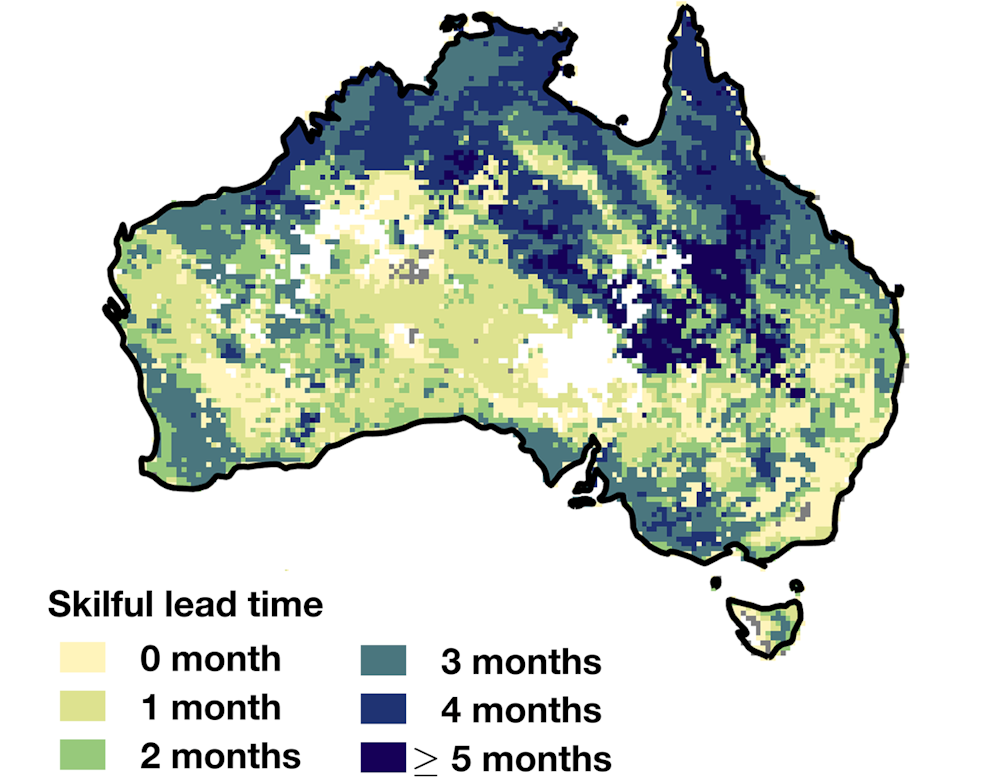
Taking it a step further, we discovered that the satellite measurements even allowed us to predict how much longer the vegetation in a given region could continue growing before the soils run dry. In this way, we can predict drought impacts before they happen, sometimes more than four months in advance.

Map showing how many months ahead, on average, drought impacts can be predicted with good accuracy. author provided

This offers us a new way to look at drought prediction. Traditionally, we have looked up at the sky to predict droughts, but the weather has a short memory. Thanks to the influence of ocean currents, the Bureau of Meteorology can sometimes give us better-than-evens odds for the months ahead (for example, the next three months are not looking promising), but these predictions are often very uncertain.

Our results show there is at least as much value in knowing how much water is left for plants to use as there is in guessing how much rain is on the way. By combining the two information sources we should be able to improve our predictions still further.

Many practical decisions hinge on an accurate assessment of drought risk. How many firefighters should be on call? Should I sow a crop in this paddock? Should we prepare for water restrictions? Should we budget for drought assistance? In future years, satellites keeping an eye on Earth will help us make these decisions with much more confidence.

ref. To predict droughts, don’t look at the skies. Look in the soil… from space – http://theconversation.com/to-predict-droughts-dont-look-at-the-skies-look-in-the-soil-from-space-110493

From The Getting of Wisdom to Heartbreak High: Australian school stories on screen

]]>

Source: The Conversation (Au and NZ) – By Michelle Smith, Senior Lecturer in Literary Studies, Monash University

Going to school is one of the few life experiences almost everyone shares. From the time children began to be educated in small groups in Britain, there were school stories in popular culture, beginning with what many consider the first novel for children, Sarah Fielding’s The Governess; or, The Little Female Academy (1749).

The Governess; or, The Little Female Academy (first published 1749; this edition 2005). Goodreads

The emphasis in early school stories was on moral and intellectual learning, which the reader was supposed to absorb. However, as school became a universal experience, stories about school elevated peer acceptance, sporting success, and friendships to the main sources of drama.

This has remained true from the crucial cricket match of Tom Brown’s School Days (1857) to the quidditch tournaments of the Harry Potter series.

School stories appeal to children and adolescents because they represent a world comprised largely of other young people, with adult teachers relegated to the periphery. However, they also mark changes in the kinds of ideals and goals we want young people to aspire towards.

Conformity and obedience were measures of a protagonist’s success in early school stories. However, as the genre has evolved in film and television, school stories have celebrated characters who transgress adult expectations, emphasising the importance of individuality.

Nerds, jocks and popular kids

North American film and television from the 1980s embraced stories about high school in particular, with earnest considerations of the dilemmas faced by teenagers forced into almost familial relationships with each other.

John Hughes’s The Breakfast Club (1985) was among the first films to treat the experience of high school with seriousness and empathy. In what became a template for the genre, it explores the unique forms of social stratification found in schools between the popular kids, the nerds, the jocks, and outcasts who sprinkle dandruff on their artworks.

Canadian series Degrassi Junior High. IMDB

Canadian series Degrassi Junior High (1987-89) and Degrassi High (1989-1991) were pioneering in their focus on teenagers and willingness to confront mature topics including drug use, teen pregnancy, racism, and sexuality. The ultimate dark and vindictive side of school friendships were most memorably fictionalised in 1988’s Heathers, which darkly satirised teen suicide. Reflecting a significant transformation in real-world schools, the recent television reboot of Heathers had its premiere delayed for almost a year because of the Parkland, Florida school shooting.

Some of the longest-running American TV series set in schools in the 1990s nevertheless idealised beautiful, popular, and often wealthy students. Both the Saturday-morning comedy Saved by the Bell (1989-1993) and the prime-time drama Beverly Hills, 90210 (1990-2000) were largely told from the perspective of fashionably dressed and perfectly coiffed characters at the zenith of the social hierarchy.

Outsiders and underdogs

Australian school stories have differed from their British and American counterparts from the outset. Henry Handel Richardson’s classic novel The Getting of Wisdom (1910), which was adapted into a film in 1977, is the story of poor country girl, Laura Tweedle Rambotham, who is sent to an exclusive Melbourne boarding school.

While the usual arc of the school story was to teach the outsider appropriate lessons about how to conform and contribute to school spirit and sporting success, Laura lies in an ill-fated attempt to be liked, cheats to pass her final exams, and finishes school without having found peer acceptance. It is her very inability to change herself to fit stifling gender and class expectations that has made her an enduring and beloved character for the past century.


Read more: The case for Henry Handel Richardson’s The Getting of Wisdom


Such irreverence toward authority figures is a frequent attribute of Australian stories about school. In its early years, teen soap Home and Away (1988-present) built many dramas around conflict with high-school principal Donald Fisher, who the students privately referred to as “Flathead”.

Students in Home and Away (1988-present) have often questioned authority.

With conscious efforts to present a grittier and more realistic depiction of school life, Heartbreak High (1994-1999) not only included a cast that aimed to represent Australia’s increasingly multicultural society but depicted teachers as less authoritarian, and heavily invested in their student’s welfare.

Heartbreak High (1994-1999).

In a reworking of the opposition between student and teacher, it has become common for Australian stories about school life to retain a focus on the underdog but to draw out its comedic potential. Hating Alison Ashley (2005), based on the novel by Robin Klein, cast pop darling Delta Goodrem as the beautiful, superficially perfect student, but presents the story from the perspective of friendless hypochondriac Erica Yurken.

Rather than a disciplinarian setting in which the teachers and principal have ultimate control, Barringa East high school exhibits a loss of adult order, with graffiti and rubbish covering the campus.

The film opens with the explanation that three teachers have retired due to the trauma of teaching at the school, with two institutionalised and one escaping to join the Hare Krishnas. While the overall culture of underachieving students allows Erica to shine academically, she does not feel comfortable in herself until she makes an unlikely friend in her imagined rival, Alison. A happy ending for Erica is found not in changing herself and achieving popularity, but in finding a supportive friend to join her outside the mainstream.

The trailer for 2005 film Hating Alison Ashley.

Chris Lilley’s Summer Heights High (2007) at once adopted the perspective of an underdog in the form of Jonah Takalua (a Tongan character controversially played by Lilley), and a queen bee in the form of Ja’mie King, a private school girl “slumming” at a state school.


Read more: Jonah From Tonga and the essence of cringe


Rather than glamorising the wealthy, image-obsessed Ja’mie, the series positions viewers to laugh at the shallowness of her manipulations to gain the approval of teachers and the few students she deems worthy of her attention. While many of the teachers at the school do care for student welfare, the infamous Mr G is the ultimate demonstration of the way teachers and authority figures are often depicted as flawed and ineffectual.

Chris Lilley as Ja’mie in Summer Heights High (2007). IMDB

Across time, Australian stories about school have more in common with the narratives of outsiders like Napoleon Dynamite than those of inspirational teachers as in Dead Poets Society or the beautiful students of Riverdale.

Attributes such as wealth, attractiveness, and family connections and status often distinguish the protagonists of American and British stories. Similarly, working hard and behaving correctly often brings success and popularity to these characters.

In contrast, Australian stories about school days are more likely to question structures of authority and social status. And anyone who wants to suck up to the popular kids or teachers can just, in the words of the students of Heartbreak High, “Rack off!”

ref. From The Getting of Wisdom to Heartbreak High: Australian school stories on screen – http://theconversation.com/from-the-getting-of-wisdom-to-heartbreak-high-australian-school-stories-on-screen-109941

View from The Hill: Independent push against Frydenberg

]]>

Source: The Conversation (Au and NZ) – By Michelle Grattan, Professorial Fellow, University of Canberra

A high profile independent candidate, Oliver Yates, is expected to run against Treasurer Josh Frydenberg in the heartland Liberal seat of Kooyong in Melbourne.

Yates, who lives in the electorate, is a member of the Liberal party and a former international banker and former CEO of the Clean Energy Finance Corporation. At present he works for several firms on renewable energy projects.

Son of Bill Yates, a colourful character who held the Victorian seat of Holt in 1975-80 and was earlier a member of the House of Commons, Yates has made swingeing attacks on the Liberals, saying in a recent Guardian article that the “party is in need of desperate cultural reform”.

Challenger Oliver Yates. Clean Energy Finance Corporation

On climate change, which would be central to his campaign, he wrote in an earlier Guardian piece: “Refusing to reduce emissions as cheaply as possible is irrational, immoral and economically reckless.”

Frydenberg had a very solid 58% of the primary vote in 2016, and would not be at risk unless his primary vote was pushed well under 50%. But Liberals were shocked when at the Victorian election the seat of Hawthorn, which is within Kooyong, was lost to Labor.

Yates’ expected challenge and an anticipated announcement by former Liberal Julia Banks that she will run against Health Minister Greg Hunt in Flinders follow the unveiling of Zali Steggall’s bid to oust former prime minister Tony Abbott in Warringah.

The political crows have been circling Abbott, but until the appearance of Steggall – a Liberal-leaning born-and-bred local – the political odds were on him.

Now the Liberal disruptor is himself target of a major disruption, with the outcome uncertain.

The House of Representatives voting system makes it hard for independents to break through, so they are still a relatively rare breed in the lower house. However they are more common than previously and now the times are more auspicious for them than ever before.

Once established, they are hard to shift. So we can expect independents Rebekha Sharkie in Mayo and Andrew Wilkie in Denison to be back after the May election.

Banks’ prospects in Flinders would not seem high, although union-commissioned polling has been bad for Hunt, who backed Peter Dutton’s challenge to Malcolm Turnbull.

Banks presently holds the seat of Chisholm. Last year she deserted the Liberals to go to the crossbench citing the leadership change and bullying.

Hunt had 51.6% of the primary vote last election; ABC election analyst Antony Greens says that post-redistribution he is on about 50.5%. But the ALP vote is around 27% and Hunt seems in more danger from Labor than from an independent.

Two of the most interesting contests involving independents will Indi in north eastern Victoria, and Wentworth in Sydney.

Cathy McGowan famously tipped out Liberal frontbencher Sophie Mirabella from Indi in 2013. McGowan, with a long background in the area, and backed by the grassroots “Voices For Indi” forum, was completely dug in by 2016. She would have won again this year.

But she had set in place a process for a community selection for a successor and earlier this month that produced Helen Haines, 57, from Wangaratta , a public health researcher. McGowan then confirmed she would not stand.

Indi will test whether can one independent pass on the “community candidate” heritage to another.

All the McGowan infrastructure is in place for Haines. On the other hand, by definition an independent candidate must establish themselves as an individual.

Haines will have to demonstrate her personal credentials, and convince voters that the local area will have a stronger “voice” in the next parliament if it has an independent than if its member comes from the Coalition (Labor can’t win the seat).

McGowan’s “voice” has been enhanced in this parliament because of the tight numbers. The crossbench has the crucial balance of power in these last months because the parliament is now “hung”.

The numbers in the next parliament are unlikely to be as close which would reduce the clout of a crossbencher.

In Wentworth, Kerryn Phelps was greatly helped to her 2018 byelection win by voter at the treatment of the seat’s former member Malcolm Turnbull. She was also assisted by the Liberal candidate Dave Sharma, a former diplomat, not being a local.

By the time the election comes in May Phelps – who won by just 1850 votes – will enjoy the advantage of incumbency but have had less than a year to establish herself as member.

In this contest there are two interesting questions. Will a sizeable number of the locals have got over their rage about Turnbull, and reassess their vote? And will some people, in a seat where voters like to have a high flier, decide to switch to a candidate with prospects of rising through the Liberal ranks in the next few years?

Some might say the Wentworth contest as one in which the voters are spoilt for choice.

Wentworth voters reacted against the loss of a former prime minister – in Warringah, many voters just want their ex-PM to shuffle off. Steggall, an former Olympian (in winter sports) and a barrister, will run hard on climate change, and attack Abbott’s views in general as out of touch with his constituents. She says Warringah is conservative economically and financially but progressive socially (as shown by a 75% yes vote on same-sex marriage).

As with Indi – although in a much less developed form – there is a community group backing Steggall – and she says she wants to give people in Warringah “a real choice for a voice”.

ref. View from The Hill: Independent push against Frydenberg – http://theconversation.com/view-from-the-hill-independent-push-against-frydenberg-110600

Bryce Edwards’ Political Roundup: Could John Tamihere “make Auckland great again”?

Political Roundup: Could John Tamihere “make Auckland great again”? 

by Dr Bryce Edwards

Get ready for a more lively local government contest in New Zealand’s biggest city this year. Recent local election campaigns have been relatively dull affairs. In fact, at the last elections in 2016, voter turnout slumped to the lowest level for some time – with only about 38 per cent bothering to turn out. But this year’s Auckland mayoralty contest looks set to be the most colourful in a while.

Auckland City, the backbone to New Zealand economy.

The contest is shaping up to be between two very different centrist politicians: Phil Goff, the grey technocrat, versus John Tamihere the wild post-political populist.

A red-blue double act of “post-political” unity

Launching his campaign in the weekend, Tamihere surprised many with the campaign he has constructed, which involves big political players from across the political spectrum. In particular, by including Christine Fletcher as his running mate for deputy mayor, Tamihere’s campaign could be seen as a very clever attempt to put forward a “post-political” option for Auckland voters. It’s being sold as a team that is putting its ideological backgrounds and loyalties aside for the good of the wider city. This will have some immediate appeal in our anti-political age.

Auckland Stuff journalist Todd Niall has been covering the recent developments well, and refers to the Tamihere/Fletcher ticket as “a red-blue double act”, but says it isn’t yet clear if the combo is “a stroke of genius, or a strike-out” – see his column today: Which John Tamihere will run for Auckland mayor?

Niall explains the logic behind the red-blue council ticket: “The winners of Auckland’s three previous mayoral contests – Len Brown twice and Phil Goff once –have cleaned up not only in their Labour-heritage heartlands of the west and south, but also done well in blue areas across Pakuranga, Howick and the isthmus. Victory has been about broad appeal”.

But Niall isn’t yet convinced it’s a winning formula, asking the following questions: “Can Tamihere achieve the crossover needed to get election-winning support, and if not can Fletcher’s presence persuade blue voters to “come on in, the water’s fine” ? Can he deliver his strong views on social housing, in a way that doesn’t suggest a conflict of interest with Waipareira? For both Tamihere and Fletcher, can their pairing with a running-mate some might consider a polar opposite, enhance rather than damage their own support bases?”

Nevertheless, Niall also argues that the Tamihere/Fletcher campaign “could be the most intriguing bid yet in four elections in the Super City.” In fact, writing prior to the announcement, he also argued that the campaign was shaping up to be interesting: This year’s race could be the most interesting since the inaugural ‘clash of the titans’ duel of 2010, in which Len Brown beat former National and Act party MP John Banks” – see: The summer of Auckland mayoral wannabees.

In this article, Niall draws attention to the centrist political operating styles of both Goff and Brown as mayors. But he says that a Tamihere-Fletcher combo would be the first campaign to “feature a US Presidential-style running mate”. This “would provide plenty for voters to get their heads around, trying to figure out the direction the pair would take.”

The New Zealand Herald’s editorial on this development in the Auckland mayoral race also says that it “should make for a lively start to local body election year” – see: John Tamihere offers a shake-up to mayoralty but he could be vulnerable to attack .

The Herald explains why the Tamihere/Fletcher combo is strategically clever: “The Labour Party would classify Tamihere on the right too but he will probably have more appeal to many in Labour’s constituency, especially Māori, than to conservative or business-minded voters. It is probably to appeal to the latter constituency that Tamihere is running on a ticket with Christine Fletcher, a former mayor and still a councillor. Fletcher stands to be Deputy Mayor and gives the ticket an element of local body experience that Tamihere lacks.”

The logic of this left-right unity strategy is also put forward by leftwing blogger Martyn Bradbury: “that’s important because the fundamental changes Tamihere is seeking in forcing Central Government to pay for Auckland’s growth and the vast increase in social housing he is proposing will demand across the spectrum support. If elected, Tamihere would be Auckland’s first ever Māori Mayor, something that won’t go unnoticed in the South and West Auckland voting bloc. Tamihere’s attack against the large vested corporate interests of Auckland has been part of his previous attack on Goff and his ‘Auckland for us not them’ narrative will be heard across the city” – see: Tamihere brings together left-right coalition to defeat Goff.

Tamihere’s anti-establishment populism

There’s more than a hint of anti-Establishment politics to Tamihere’s campaign. Everything from his five-point plan, which includes the populist promise to “Clean the house” through to the main slogan of “Shake it up and sort it out” is vintage populist politics, and even reminiscent of some of Donald Trump’s successful 2016 campaign. There’s a very clear theme amongst Tamihere’s campaign, so far, about the need to “take back control”.

Some of this can be seen in TVNZ’s coverage: John Tamihere announces bid for Auckland mayor, crosses party line for running mate. This article reports Tamihere’s “promise to ‘open the books and clean the house’ at Auckland council, ensuring a thorough audit of where taxpayer money is being spent.”

According to TVNZ, Tamihere “said he wants control of the city to go back to the people instead of ‘faceless managers in central Auckland’. Other issues Mr Tamihere has pledged to address include social housing, homelessness, the regional fuel tax and council spending. Key themes of his campaign are integrity, efficiency, democracy and leaving a better legacy for the children of our generation.”

Some of this will resonate widely, especially for those who believe Phil Goff hasn’t been active enough as mayor. See, for example, the Herald’s editorial comments on Tamihere’s pitch, pointing out that Goff hasn’t delivered: “the shake-up he promised for the council last time has hardly happened. The council still seems detached from the needs and concerns of citizens and may need a new broom.”

Tamihere’s running-mate is also channeling a more outspoken style. Bernard Orsman reports: “Christine Fletcher has unleashed an extraordinary attack on Phil Goff, accusing the mayor of weak leadership and failing to make Wellington sit up and listen by holding their feet to the fire” – see: Christine Fletcher calls Phil Goff a weak leader who has failed Auckland.

Amongst many criticisms of Goff, the article points out “Fletcher was one of nine councillors to sign a letter to Goff last year saying he runs a ‘non-inclusive style of leadership’ and trust and transparency at council is getting worse. As deputy designate on a mayoral ticket with Tamihere, Fletcher said Goff works alone behind closed doors with bureaucrats, commissioning expensive reports from consultants that only come to light for councillors under the Official Information Act.”

Phil Goff has responded to some of this criticism, especially about the so-called “Goff gas tax”, pointing out that Fletcher actually voting in favour of it – see RNZ’s Phil Goff fires back: Dumping ‘Goff’s gas tax’ would create $4.3b revenue gap, Auckland mayor says.

Goff adds: “Before anybody criticises a form of revenue, they’ve got to say how they’d fill the revenue gap of $4.3 billion if they were to do away with it, and if you don’t do that there’s a real question of credibility.”

Tamihere’s past 

Tamihere’s possibility of success might hinge on whether Auckland voters care about his past controversies – which are very well covered in Scott Palmer’s John Tamihere’s most controversial moments.

Will people hold past misdemeanours against him? As Grant Duncan of Massey University comments, “Possibly people are prepared to put that in the past. But people I’m sure will start to drag up some of those old stories as the campaign goes forward” – see Newshub’s ‘Old stories’ may derail John Tamihere’s mayoralty bid – expert.

Duncan also says: “One thing you can’t accuse Mr Tamihere of is political correctness. He is entertaining and an outspoken person, and it will be interesting to see how he gets along with Christine Fletcher.”

Todd Niall has also dealt with this, reporting from the Tamihere/Fletcher announcement: “His running-mate Christine Fletcher said at their campaign launch that Tamihere had ‘matured and moved on’ since the episode in which he’d described women as ‘frontbums’. Tamihere’s demeanour went steely when his past was raised, obliquely asking in return whether anyone had not learned from mistakes.”

Tamihere was also interviewed this morning on RNZ’s Morning Report, and responded to a question about his past controversies, saying “Here’s the thing, my name is JT not JC. I’m not totally in control of the whole shooting match all the time, I make mistakes. I’ve indicated I own them, what do you want me to do – jump off the Harbour Bridge?” – see: Tamihere bids for Auckland mayoralty: ‘My name’s JT, not JC’.

It’s possible that raising these controversies might even work in Tamihere’s favour. As with the 2016 attacks on Donald Trump – especially by Hillary Clinton and her supporters – sometimes this can actually play into the hands of those under fire. Martyn Bradbury has put the case for this: “I think a woke attack by Goff could be terribly counter productive. Many Aucklanders stuck in traffic every day are furious at smug pronouncements from woke activists on cycling, and if the attack against Tamihere are seen as coming from that part of the political spectrum, Tamihere could throw caution to wind, assume he has nothing to lose… and come out with some populist attack on cycle lanes and reap the vast angry chunk of Auckland’s gridlocked voter block.”

Finally, for the most in-depth and recent examination of Tamihere’s past and present orientation to various controversies, as well as how he plans to take Auckland forward, see Simon Wilson’s John Tamihere on Roast Busters, front bums and running for Auckland mayoralty.

Too big to fail. The risks to Australian taxpayers from New Zealand banks

]]>

Source: The Conversation (Au and NZ) – By Matthew Greenwood-Nimmo, Senior Lecturer in Economics, University of Melbourne

Australian banks have been under enormous scrutiny during the financial services royal commission, which reports on Friday. But one thing that hasn’t dominated the headlines is their relationships with their subsidiaries in New Zealand.

Each of Australia’s big four banks owns one of the New Zealand big four.

This has important practical implications, a fact acknowledged by New Zealand’s Financial Markets Authority and the Reserve Bank of New Zealand when they completed their own review into the conduct and culture of New Zealand’s banks in November.

Too big to fail?

If a systemically important bank gets into difficulties, the host country government usually intervenes with a rescue package and looks after depositors.

This (implicit) guarantee gives those banks a “too big to fail” status. It allows them to borrow funds more cheaply than their smaller competitors because lenders believe the government will come to their rescue if they get into trouble. It also allows them to take greater risks, knowing that, thanks to taxpayers, they will survive regardless.

New Zealand is trying to end that guarantee.

Not in New Zealand

Simply put, if a New Zealand bank fails, the Open Banking Resolution states that the cost will be faced primarily by the bank’s shareholders and creditors rather than by taxpayers.

Households that deposit with it could lose some of their savings.

Suppose that a financial crisis hits both countries at the same time – a plausible scenario given that the economies of Australia and New Zealand are exposed to similar risks.

The New Zealand bank at risk of failure would not receive a taxpayer-funded bailout. It would turn to its financially-stretched Australian parent for help.

If that help placed the Australian parent at risk, Australian taxpayers might have to come to the rescue.

Australian taxpayers might find themselves supporting the New Zealand banking system.

Each of New Zealand’s big four banks is owned by one of Australia’s big four banks.

No easy way out

There are problems with each of the obvious solutions.

One would be for New Zealand to legislate deposit insurance and rescind its declaration that its banks will not be bailed out.

From New Zealand’s perspective, it would be unfair: the Australian owners would collect profits from their New Zealand subsidiaries in good times, while relying on New Zealand taxpayers to foot the bill in the bad.

New Zealand regulators would also wear the burden of having to making sure the Australian owners didn’t take excessive risks in New Zealand.

Another solution would be for Australia to follow New Zealand’s lead and declare that it too would stand firm and not bail out important Australian banks.

Such a policy might not be credible. The political cost of allowing households to lose their savings would be hard for elected officials to bear. The government would face considerable pressure to renege on its commitment.


Read more: Bank deposit insurance: Is your money safe and at what price?


A third, intriguing, possibility is that governments around the world could act together and formalise the “too big to fail” guarantee, knowing that other governments would do the same. To offset the burden facing taxpayers, governments could charge those important banks for being too big to fail.

The imminent report of the royal commission would be a good time for us to work out what to do.

ref. Too big to fail. The risks to Australian taxpayers from New Zealand banks – http://theconversation.com/too-big-to-fail-the-risks-to-australian-taxpayers-from-new-zealand-banks-110286

At least 20 killed as two bomb blasts hit Jolo Cathedral in Philippines

]]>

Bombs minutes apart tore through a Roman Catholic cathedral in Jolo, Sulu, in the southern Philippines region of Mindanao at the weekend. Video: Philippine Daily Inquirer

By Rambo Talabong and Mara Cepeda in Jolo, Philippines

At least 20 people were killed as two explosions rocked the Cathedral of Our Lady of Mount Carmel in Jolo, Sulu, yesterday, just days after the historic Bangsamoro Organic Law (BOL) was ratified paving the way for self-rule by the Muslim majority region.

This revised death toll, sent to reporters last night, comes hours after Autonomous Region in Muslim Mindanao (ARMM) police Chief Superintendent Graciano Mijares earlier reported a death toll of 27.

In his latest update, Mijares said the following died in yesterday’s Jolo Cathedral bombing:

  • 14 civilians
  • 5 from the Armed Forces of the Philippines (AFP)
  • 1 from the Philippine Coast Guard (PCG)

READ MORE: Military will ‘crush’ Jolo attackers

Soldiers and civilians are among the dead and wounded in twin explosions that rocked the cathedral in Jolo, Sulu, on Sunday. Image: PTV Twitter

Mijares also said at least 111 individuals were wounded:

  • 90 civilians
  • 17 from the AFP
  • 2 from the PCG
  • 2 from the Philippine National Police (PNP)

-Partners-

Casualties evacuated
The ARMM regional police said casualties “were immediately evacuated” as the AFP and the PNP secured the area.

The PNP Criminal Investigation and Detection Group (CIDG) earlier said two improvised explosive devices (IEDs) were used to bomb the cathedral.

According to the ARMM regional police, one IED exploded inside the cathedral, and another at the entrance.

PNP spokesperson Senior Superintendent Bernard Banac said that the second explosion happened as AFP personnel responded to the first explosion.

The people of Sulu province, which includes the city of Jolo, narrowly voted against the Bamsamoro law, although it was supported by 85 percent of the vote overall in the provinces and districts taking part in the referendum.

Malacañang and top government officials condemned the twin bombings.

Presidential Spokesperson Salvador Panelo vowed that the military would “crush” the perpetrators of the bombing and several politicians also extended their condolences to the victims’ families and called for justice to be served.

The Armed Forces of the Philippines and the Philippine National Police are already on heightened alert and have vowed to “thoroughly investigate” the bloody incident.

Rambo Talabong and Mara Cepeda report for Rappler news portal.

Print Friendly, PDF & Email

Article by AsiaPacificReport.nz

Benny Wenda: West Papuan people’s ballot petition handed over to UN

]]>
Benny Wenda and the West Papua petition … “Today is a proud moment to represent your voices.” Image: Benny Wenda FB

By Benny Wenda, chairman of the United Liberation Movement for West Papua

As chairman of The United Liberation Movement for West Papua (ULMWP), I have presented the West Papuan People’s Petition for self-determination to the UN High Commissioner for Human Rights, Michelle Bachelet.

With the official support from the government of Vanuatu, on behalf of the people of West Papua, I presented this petition, signed by more than 1.8 million West Papuan people to the United Nations.

To our many friends working in solidarity with the West Papuan struggle all over the world, we thank you for standing with us. Your assistance is vital in our long road to freedom.

And to the people of West Papua, thank you. Today is a proud moment to represent your voices – thank you for never giving up and for courageously coming to the streets and flying the Morning Star flag, despite the brutality you face.

Thank you for your patience, your strength and your spirit. Thank you to so many of you for having the courage to sign the historic People’s Petition – your voice is now in the hands of the United Nations.

We are making progress, together, in unity.

-Partners-

It is my life mission and purpose to do all I can to ensure West Papuans are given an Internationally-Supervised Vote, a referendum. This is what the ULMWP, and all of you, work towards each day. Today is a great moment for us all.

Your humble friend,

Benny Wenda
Chairman of the United Liberation Movement for West Papua

Print Friendly, PDF & Email

Article by AsiaPacificReport.nz

The ‘sharing economy’ simply dresses up our consumerist tendencies in a more palatable ideology

]]>

Source: The Conversation (Au and NZ) – By Marianna Sigala, Professor of Tourism – Director of the Centre for Tourism & Leisure Management, University of South Australia

The scope and scale of the so-called “sharing economy” has increased exponentially over the past decade, to the point where it affects almost every aspect of our lives.

Ride sharing has changed how we move. Food delivery apps have changed our eating habits. Airbnb has changed how we holiday. Dating apps have changed how we meet our partners. And some of these apps may have influenced how we work, and whether or not we can pay our rent.

This shift to peer-to-peer transactions is often portrayed as an antidote to the consumer culture of modern society because it supports sharing instead of ownership. But have sharing platforms simply created a new form of capitalism?

Research suggests that rather than transforming us, the sharing economy simply repackages our same old consumerist impulses in a more appealing message.


Read more: Sharing economy sounds caring, but let’s put it to the ethical city test


We evaluate commercial and shared services in the same way

The sharing economy both shapes and is shaped by the providers and consumers of shared services.

Studies have shown that people perceive, select and evaluate shared experiences in a similar way to commercial offers. For example, the criteria we use to select Airbnb accommodation or Uber drivers is similar to how we evaluate commercial accommodation and transportation services. That is: price, location, service quality and reputation.

Studies also confirm the factors influencing satisfaction and the likelihood of rebooking are the same.

This affects how suppliers develop services. Sharing platforms use peer review comments and ratings to calculate the quality scores of service providers, recognising those of a higher quality.

Similar to TripAdvisor reviews of hotels, scores on the Airbnb peer review system influence the amount sharing providers can charge.

The commercialisation of authenticity

The number of people quitting their full-time jobs to become entrepreneurs of the sharing economy has increased. Data from across 36 countries show 43% of millennials and 61% of Gen Z envision leaving their jobs within two years. Among millennials who would quit their jobs, 62% regard the gig economy as a viable alternative.

These entrepreneurs invest in assets, such as real estate or cars, and hire other micro-entrepreneurs to manage them. The kinds of management services that might be outsourced include cleaning, pricing, marketing and booking, book keeping, and meeting and greeting services.

In these cases, the owners of the “shared” asset rarely interact with their guests. So instead of experiencing genuine feelings of hospitality and intimate social interactions, customers experience fleeting interactions and professional encounters.


Read more: Airbnb regulation needs to distinguish between sharing and plain old commercial letting


By adapting and transferring traditional professional services from the commercial economy to the shared economy, these entrepreneurs contribute to the commercialisation of “authentic” experiences.

And it’s hard for entrepreneurs to avoid using these kinds of services if they want their offering to be competitive among many other alternatives. Studies show non-professional hosts face operational inefficiencies, such as lower occupancies and pricing, compared to their professional counterparts.

Sharing platforms contribute to this. Airbnb provides a pricing tool, similar to those used by professional hotels, so hosts can monitor market trends and their competitors’ prices. Photography services help hosts present themselves professionally, as research shows the way hosts construct and present their online personality and identity influence their competitiveness.

Success on Airbnb is determined by the extent to which service providers can convince customers to consume their professionally curated “authentic” experiences. In order to thrive, micro-entrepreneurs need to adopt a professional operational mindset and commercial management practices.

Not really communal or sustainable

The sharing economy is often romanticised as a shift away from the evils of capitalism to a more communal and socially conscious way of life.

Some studies do suggest micro-entrepreneurs and customers do not discriminate on the basis of race, gender or sexual orientation when deciding how, and with who, they will “share” resources.

But if that’s true, then why do people from minority groups earn less on sharing plaftorms? And why are platforms focusing on niche markets – such as noirbnb.com for people of colour and misterbandb.com for gay travellers – thriving?

If the sharing economy is supposed to increase environmental sustainability by reducing the ownership and production of bicycles and cars, how do we account for the waste visible in China’s “bike share graveyards”?

China’s bike sharing “graveyard”.

Peer-to-peer marketplaces that redistribute and recycle food, industrial waste and other resources burden the logistics and transportation sector to an extent that may offset any other socio-economic benefit of food sharing. More research is required before we know whether the positives outweigh the negatives across the whole supply chain.


Read more: Why people trust sharing economy strangers more than their colleagues


Consumption hasn’t gone away

People who participate in the sharing economy are primarily motivated by financial rewards. Service providers use the income from “sharing” their assets to purchase larger houses or better cars, while customers seek cheaper deals than traditional providers can offer.

The sharing economy enables people to consume during the economic crisis, satisfying materialist needs, values, priorities and lifestyles in different ways – through “sharing” and “access”, rather than “ownership”.

People see the practice of sharing resources as a way to achieve self-image, self-promotion, social appreciation and recognition. Even people living in more collectivist cultures see the sharing economy as a way to express community and social values.

For example, dating and “partner rental” platforms have boomed in China, a culture where it is taboo for young people to be gay or remain single. People aren’t using these platforms to seek to find and meet new friends, rather they seek to satisfy a social need to present a certain lifestyle.

The sharing economy has not changed people’s mindsets, values, lifestyles or behaviours. People still wish to consume at the same levels and they do consume for the same reasons, but in a different way. The sharing economy disrupts the traditional economy, but it has not transformed it.

ref. The ‘sharing economy’ simply dresses up our consumerist tendencies in a more palatable ideology – http://theconversation.com/the-sharing-economy-simply-dresses-up-our-consumerist-tendencies-in-a-more-palatable-ideology-99090

We asked five experts: is it safe to run while pregnant?

]]>

Source: The Conversation (Au and NZ) – By Alexandra Hansen, Chief of Staff, The Conversation

Pregnancy can be a magical time, but also a stressful one. With so many things you can and can’t do, it can get confusing. Guidelines recommend women without complicated pregnancies should be maintaining fitness. But how?

Many women love the alone time pounding the pavement for a nice run out in nature, but is this too strenuous? We asked five experts if it’s safe to run while pregnant.

Five out of five experts said yes

Here are their detailed responses:


If you have a “yes or no” health question you’d like posed to Five Experts, email your suggestion to: alexandra.hansen@theconversation.edu.au


ref. We asked five experts: is it safe to run while pregnant? – http://theconversation.com/we-asked-five-experts-is-it-safe-to-run-while-pregnant-104489

Lift teacher status to improve student performance

]]>

Source: The Conversation (Au and NZ) – By Julie Sonnemann, Fellow, Grattan Institute

Australia needs to lift the status of teachers to attract the best and brightest to teaching. The world’s top-performing school systems make it a national priority to attract the strongest candidates. Improving teacher selection improves student results.

Australia’s brightest students are increasingly rejecting teaching. The greatest falls were in the 1980s. But entry standards have slipped further over the past decade.

Author provided, Author provided

In 2018, only one in four students offered a place in undergraduate teaching based on their Australian Tertiary Admission Rank (ATAR) had an ATAR of 80 or more, compared to one in two across all courses.

To stop the decline, New South Wales and Victoria have tightened entry standards. Victoria will increase minimum ATAR requirements from 65 to 70 this year.

Federal Labor’s shadow education minister Tanya Plibersek wants to make entry to teaching far more competitive by significantly increasing ATAR requirements towards an ATAR of about 80. She has threatened to cap teaching places if universities don’t lift entry standards themselves. She says too many high-achieving school students get told not to “waste their ATAR” by going into teaching.

The federal minister, Dan Tehan, says better career paths and pay reforms are key to making teaching a more attractive profession. His Parliamentary Inquiry into teaching status will report back soon.


Read more: Viewpoints: should teaching students who fail a literacy and numeracy test be barred from teaching?


Both arguments have merit. Making entry more selective will help lift status, but the low status of teaching is more than an image problem. There also needs to be deeper reforms to the job itself, such as higher pay at the top end, better opportunities for career advancement, and improvements to the professional working environment.

These reforms would have dual benefits: they would help attract talented people to teaching, and empower existing teachers to be more effective.

Entry to teaching should be more selective

Tightening teacher selection can deliver big improvements in student results. Yet universities tend to have a knee-jerk reaction to proposals to raise ATAR entry standards. For example, earlier this month the President of the Australian Council of Deans of Education, Tania Aspland, claimed “there is no evidence to show that those with higher ATARs become better teachers”.

But the world’s top-performing systems, such as Singapore, Korea and Finland, invest heavily in screening candidates on admission to teaching. Prospective teachers are assessed on their prior academic ability, as well as traits such as dedication to teaching.

Singapore even assesses student teacher performance in a real-world classroom trial. Only one in ten students who apply to be teachers in Singapore are accepted.

Making entry to teaching more selective will need careful management. from www.shutterstock.com

Several rigorous studies find prior academic performance is a good indicator of who will go on to become a great teacher, not just on standardised tests but also according to on-the-job performance reviews. One 2018 multi-country study found countries with teachers who have high academic aptitude get better student maths and literacy results.

Yes, some studies find no link between markers of cognitive ability (such as the SAT scores of US teachers) and student results. But on balance, the evidence suggests requiring prospective teachers to have a higher ATAR – along with other predictive factors such as leadership capabilities and dedication to teaching – will increase the likelihood of recruiting more effective teachers.


Read more: In the ATAR battle, one thing is clear: teaching needs to attract better recruits


Making entry to teaching more competitive will need to be carefully managed. To ensure diversity in the future workforce, there will need to be adequate alternative pathways for students from a variety of backgrounds or specialist skills. But alternative pathways should not be used as a smokescreen for lowering overall entry standards.

Deeper reforms are needed to help raise teacher status

Tightening selection into teaching will help make it more prestigious, but lifting the profession’s low status requires at least three other reforms.

First, lift teacher pay at the top end. Teachers in Australia start on a good salary compared to other graduates, but the pay is too low at the top end. Australia’s top teacher salary is 40% higher than the starting salary, well below the OECD average of 80%. To attract high-achievers, the top-end salary needs to be competitive with their options elsewhere.

There are no easy fixes. from www.shutterstock.com

Second, offer better career pathways. The best teachers should have fast-track opportunities that give them responsibility for developing other teachers and driving improvement in their school and beyond. Job descriptions such as this exist on paper, but they don’t necessarily happen in practice.

Better career options for those passionate about mastering teaching should sit alongside school leadership pathways, so teachers don’t have to switch into school management to gain promotion and a pay rise.


Read more: To raise status of teaching, Australia needs to lift pay and cut teacher numbers


Third, improve the professional work environment for teachers. Teachers need more opportunities to develop on the job, with meaningful feedback on how to improve their classroom practice. They need more high-quality, tried-and-tested materials – and fewer time-consuming administrative tasks.

There are no easy fixes to the entrenched problem of low teacher status in Australia. Making entry to teaching more selective would be a good first step, but deeper reforms to pay, career and the work environment are also necessary.

ref. Lift teacher status to improve student performance – http://theconversation.com/lift-teacher-status-to-improve-student-performance-110095

Life in a tiny house: what’s it like and how can it be made better?

]]>

Source: The Conversation (Au and NZ) – By Heather Shearer, Research Fellow, Cities Research Institute, Griffith University

Mention “tiny house” in any social gathering and people almost always say, “Oh I love tiny houses.” The enthusiasm for tiny houses isn’t matched, however, by the take-up of tiny house living. Very few people actually live in tiny houses. So, why the discrepancy?

As a follow-up to my research (in 2015 and 2017), I interviewed people around the country (in person and on social media) about their lived experience in tiny houses. I also stayed in a tiny house.


Read more: Australians love tiny houses, so why aren’t more of us living in them?

Read more: Interest in tiny houses is growing, so who wants them and why?


Tiny houses need to maximise use of every space. Heather Shearer, Author provided

Most of the people I interviewed were in southeast Queensland, but some were in Victoria and Tasmania. The majority were situated in rural or semi-rural areas, although a couple lived in suburban locations (Brisbane and Logan).

Most were aged in their 20s, or were 55-plus, and were couples or singles, the majority women. A few had children.

Nearly all had built their own tiny house, but some had bought their homes from tiny house builders. Interestingly, few homes were the archetypal tiny house on wheels – there were container houses, converted buses, and even tents.

This accords with research on the typology of tiny houses, which found they can take a number of forms. Note: “True tiny houses … (whether on foundation or wheels) are generally smaller than 400 sq ft (37m2).”

So how do people feel about tiny house life?

People had lived in their tiny houses from weeks to a couple of years. The majority had only positive things to say about tiny house living. As one respondent enthused:

I LOVE it. Love living in it; independent side of things … it’s much better than [living in] the caravan – own shower, kitchen, composting toilet, complete independence.

Another said:

I actually enjoy to live in a smaller space, because you don’t feel overwhelmed, and with kids you can see all the time, you can hear them and see what they’re up to. I love tiny house living, and I would love to help other people getting into it, it would be awesome.

Some tiny houses can be found in the suburbs. Heather Shearer, Author provided

Other positive experiences included:

  • freedom from debt – “the real cost savings and availability to be an actual home owner instead of permanent debt”
  • community – “joining the community of like-minded people”
  • having one’s own space.

People also often mentioned the ease of maintenance. Nearly all commented on how easy it was to keep clean and to heat or cool. One respondent said:

Cleaning the house takes half an hour and I know where everything is. I don’t accumulate things I don’t need.

Another commented:

A tiny house is a breeze to clean.

Those who were negative expressed minor concerns with issues such as cleaning composting toilets and small spaces. One commented:

The multipurpose nature of each room means that the bedding smells like fish when I cook salmon.

You can have a decent kitchen, but think twice about cooking anything that you don’t want to smell throughout the house. Jekka Shearer, Author provided Making do: the basin doubles as a baby bath. Jekka Shearer, Author provided

But, more seriously, longer-term concerns included:

  • insecurity of tenure
  • lack of privacy
  • inability to get bank loans
  • difficulties with having young children in a very small space.

One young Tasmanian couple with a 15-month-old son moved out of their tiny house (which they had built themselves) partly because it was too difficult to keep their active child content in the small space during the cold and wet winter months.


Read more: Tiny houses look marvellous but have a dark side: three things they don’t tell you on marketing blurb


Here to stay but planning laws haven’t kept up

An ongoing issue is where to put tiny houses. Planning laws are still the major obstacle to tiny house living.

One respondent said:

I don’t like the fact that there is no surety that I can stay legally in one place. I don’t like knowing that I can’t stay long-term. You know what your timeframe is for renting, [you’re] not going to be moved for a ridiculous reason. There’s no protection if in a tiny house. Silly [council] rules like I [have to] stay in it for two nights, then move into the main house for one night, I get why these things have been put into place … waste and water, amenity; but I don’t see why [regulations] for that can’t be implemented.


Read more: Tiny houses: the big idea that could take some heat out of the housing crisis


The biggest challenge with tiny houses isn’t making them comfortable and homely, it’s finding a site with long-term security of tenure. Jekka Shearer, Author provided Interior of a tiny house for sale. Heather Shearer, Author provided

Major findings of this and other research are that tiny houses are here to stay. They are definitely not just a niche market, but are more suited to certain demographics.

Interestingly, those who had moved to more conventional houses seemed almost guilty about having left. Tiny houses should be more realistically viewed as one stage in the lifetime housing journey, which may suit some and not others.

Housing in the 21st century needs to be more flexible to suit various lifestyle stages and households, not just singles and nuclear families. Safe shelter is a fundamental human right, but conventional housing has become increasingly unattainable for many.


Read more: We need more flexible housing for 21st-century lives


Local governments in particular could be far more proactive by adapting their planning schemes to permit more flexible types of dwellings, obviously in accordance with building, health, safety and environmental regulations. This would enable people to live in security without being afraid that they are going to be moved off because some neighbour might complain.

As long as safe and sanitary, and not an environmental eyesore, then why not? It’s very easy to say, if you have a certain size property, then you can have x tiny houses, [at a] certain distance.

Finally, as the owner of a property that has a number of tiny houses said:

I have worked in urban development for 20 years and the concept of affordable housing is a furphy unless we change legislation and allow people to live smaller. I am passionate that housing should be accessible by all, that people shouldn’t have to resort to social and public housing. Tiny housing offers a major disruptive solution to an ever-growing housing unaffordability and social divide in housing.

ref. Life in a tiny house: what’s it like and how can it be made better? – http://theconversation.com/life-in-a-tiny-house-whats-it-like-and-how-can-it-be-made-better-110495

Hidden women of history: María, a slave in Manila who resisted sexual exploitation

]]>

Source: The Conversation (Au and NZ) – By Susan Broomhall, Professor of History, University of Western Australia

In 1635, María, a slave woman from the Indian sub-continent living in the Spanish-controlled Philippine Islands, enters the historical record. We know that women as well as men were involved in forced movements like María’s around the region but historical documentation about their lives is rarely available.

Hernando Guerrero OSA, Archbishop of Manila from 1635 to 1641. Wikicommons.

María was owned by an artilleryman named Francisco de Nava who was then living in Manila. In 1635, the city’s archbishop, Don Hernando Guerrero, began an investigation into, in the words of the contemporary documents, “illicit communication” between the two.

Nava explained that they had an understanding. “He had brought [María] from India, saying that he was going to marry her, as he had taken her while she was a maiden”.

This was, in his eyes at least, a contract for her virginity: María would gain a respectable marriage in exchange for her sexual labour.

A slave’s autonomy

However, the evidence surrounding this case suggests María had other ideas. She “left the house, going to that of Juan de Aller, a kinsman of Doña Maria de Francia, wife of Don Pedro de Corcuera, whom she asked to buy her.”

A contemporary report noted that “the slave girl said that she preferred to belong to another” than to be Nava’s wife.

Maria de Francia, an influential woman who was the wife of the governor’s nephew, “became fond of her” and sought to buy María from Nava, with support from the archbishop.

Female slaves such as María were vulnerable to the sexual expectations of their masters and as migrants, they generally had few familial or other social networks to assist or protect them.

How did María attract the attention and sympathy of powerful local citizens to assist her? She had managed to engage ecclesiastical authorities and elite women in her plight, who were prepared to step in, in order to instil Catholic moral values.

Johannes Vingboons, The town of Manila, c. 1665, Nationaal Archief NL-HaNA_4.VELH_619.69, Wikipedia. Wikipedia

The sexual behaviour of women and men in Manila was of great concern to Spanish secular and ecclesiastical officials. The city was a known trading centre for slaves but Spanish authorities were anxious about the “many offenses to God” that took place between female slaves, in particular, and men in the city.

In 1608, King Felipe III had outlawed the “evil” of the passage of female slaves aboard vessels, but the practice continued. In November 1635, the governor, Don Sebastian Hurtado de Corcuera, once again complained about the “great license and looseness of life” in Manila.

María’s case may thus have offered authorities an opportunity to discipline the wider population and reinforce moral expectations. They were willing to recognise a slave woman’s capacity to resist sexual exploitation, although not, it seems, a right to freedom from slavery itself.

A tragedy

At María’s departure, Nava was reportedly “so beside himself over the loss of the said slave that he refused to sell her at any price, saying that he wished, on the contrary, to marry her.”

But there were other stories circulating that complicated his narrative. The governor, for example, reported that Nava “had said the year before that he had been married in Nueva España.” Could his marrying María be even legally possible?

Still, Nava went to de Francia’s house, “to request that they should give him the slave,” whereupon he was beaten and placed in the stocks.

His reaction to the loss of María was perceived by onlookers as excessive, and shortly afterwards, an order was given that he should be treated as if he were mad.

On Sunday, 8 August 1635, at three in the afternoon, María was passing by in the street in a carriage with her new mistress. Nava approached them, asking María if she recognised him as her master.

Interestingly, one account provides another hint of a possible assertion of autonomy in María’s actions: “The slave answered him with some independence”, it was reported. But María’s precise words were not considered worthy of note for the historical record.

The encounter ended tragically for María. “Blind with anger,” Nava “drew his dagger in the middle of the street and killed her by stabbing her, before anyone could prevent it.”

Nava was condemned to death. On 6 September 1635 he was executed on gallows raised at the site where María had been killed, in front of the San Agustin Church.

María’s agency

This is not a celebratory history, for María’s life ended abruptly. We don’t know what María looked like or how she felt about her plight except through her actions as they were recorded by others. What we do know about her comes from documents created by Nava’s crime.

But these documents provide small insights into the experiences of displaced and marginal women who are typically among the most silent in the archives.

They reveal María’s forms of agency and resistance — not only in her access to support mechanisms among the powerful Catholic elite of colonial Manila, but also in her most basic impulse to refuse to accept her situation and to seek a better life within the limited choices before her.

ref. Hidden women of history: María, a slave in Manila who resisted sexual exploitation – http://theconversation.com/hidden-women-of-history-maria-a-slave-in-manila-who-resisted-sexual-exploitation-110182

Live Video Stream: New Zealand Bloodstock’s 2019 National Yearling Sales Series kicks off at 3pm today

]]>

First Day of Karaka 2019

The 2019 National Yearling Sales Series kicks off this afternoon seeing the first 100 yearlings catalogued in Book 1 go under the hammer from 3pm.

The Sale will be streamed live on www.nzb.co.nz, on the New Zealand Bloodstock facebook page, and on Karaka Pop Up (SKY Channel 263).

On all four days of Book 1, coverage will commence with a half-hour preview show before the live Sale broadcast begins.

Book 2 and Book 3 will be broadcast live online from 11.00am each day.

Racing.com will broadcast Book 1 on Free-to-air (Channel 68/78) and Foxtel Channel 529 on Monday 28 January, as well as streaming live on Racing.com.

All catalogues are available at reception or can be viewed online.

Visit www.nzb.co.nz for all Sale news and information.

Live stream of this event made possible by R2.co.nz

Australian-Chinese author’s detention raises important questions about China’s motivations

]]>

Source: The Conversation (Au and NZ) – By Tony Walker, Adjunct Professor, School of Communications, La Trobe University

The arrest of an Australian-Chinese citizen in China for unspecified reasons is the last thing Australia needs at a sensitive moment in the reset of a relationship that has chilled over the past two years.

But whether it likes it or not, Canberra is being drawn into a broader controversy over China’s detention of foreign nationals on grounds that are opaque and at the mercy of an unpredictable Chinese justice system.

The arrest last weekend of author and diplomat Yang Hengjun raises the question of whether he has become part of a pattern of retaliatory measures by a Chinese government that finds itself under stress from within and without.


Read more: Huawei executive’s arrest will further test an already shaky US-China relationship


At this stage it has not been revealed why Yang, a critic of China’s Communist Party, has been detained. On a previous visit to China in 2011 he was arrested and released without charge. He described that episode as a “misunderstanding”.

What should concern Australian officials is that Yang will find himself lumped with other foreign nationals from countries that may have displeased China and therefore become hostages to a wider diplomatic game.

Beijing’s initially muted response to Australia’s decision to exclude, on security grounds, the Chinese technology behemoth Huawei from building its 5G network may have disguised more intense displeasure.

In the case of the arrest late last year of two Canadian nationals on accusations of “endangering national security”, it is hard to place any other interpretation on their detention than that they are pawns, even hostages, in a broader conflict.

Diplomat Michael Kovrig and businessman Michael Spavor were arrested following the detention in Vancouver of the chief financial officer and daughter of the founder of Huawei, pending her extradition to the United States.

Huawei executive Meng Wanzhou. AAP/EPA/ Maxim Shipenkov

The US Justice Department is bringing charges against Meng Wanzhou for violating sanctions against Iran.

Her case is highly sensitive and enmeshed in a complex US-China relationship scarred by an ongoing trade dispute. In all of this, Canada, in its response to a US extradition request, finds itself the target of Chinese reprisals.

In the case of the unfortunate Canadians ensnared in a diplomatic argument that originated in Washington, a Chinese saying could be applied:

Kill the chicken to frighten the monkey.

In this case, Canada is the “chicken” and the United States is the “monkey”.

Whatever China’s tactics are in all of this, the arrest of the Canadian nationals on national security grounds represents a very serious development. The ripples from it are spreading as more and more countries become alarmed at China’s resort to what could be described as hostage-taking to protect – or advance – its interests.

One lesson might be that if a country, or a company for that matter, finds itself in a dispute with China, then advice to its nationals or employees should be to steer clear of the People’s Republic.

China’s behaviour in this latest stage would hardly seem to correspond with respect for a rules-based international order.

What can be read into these worrying developments is that under pressure, the Chinese regime is adopting a more combative approach to dealing with its foreign policy challenges as its size and reach brings it into conflict with the United States and its allies.

A slowing Chinese economy is adding to pressures on a regime whose tenure depends on maintaining employment and countering unrest.

Above all else, the issue of “stability” preoccupies China’s leaders, who are familiar with the chaos that has swept the country in its long history.

In Beijing this week, President Xi Jinping expressed his concerns about a difficult period ahead for China as it grapples with challenges at home and abroad.

Speaking to officials he warned of a “black swan” event, in which China might be obliged to deal with unexpected developments that threw it off its course. This included what he called a “grey rhinoceros event” – a reference to known risks that are ignored until too late. He said:

In the face of a turbulent international situation, a complex and sensitive environment, and the arduous task of reform… We must be highly vigilant against “black swan” and “grey rhinoceros” incidents.

These sentiments are hardly surprising given the challenges China faces in transforming its economy from an investment-led to a demand-driven model in a slowing economic environment. But they do suggest a higher-than-usual level of anxiety in Beijing in this latest period.

In the years since China began opening up to the world in the late 1970s, it is hard to identify a period that is more challenging for a hard-pressed Chinese leadership. One possible exception is a period in the early 1990s when the country struggled with inflationary pressures and risks of a hard economic landing from a retrenchment in government spending.

The difference between now and then is that China’s economy then was a fraction of the size it is today. Ripples from a Chinese slowdown were hardly felt beyond China’s shores.


Read more: Australia and China push the ‘reset’ button on an important relationship


Today, the effects of a slowing Chinese economy will have an impact across the globe. This is not least in Australia, one-third of whose exports in goods and services are bound up in a trading relationship.

Australian official cautiousness over the detention of an Australian-Chinese national is explained by a desire not to elevate a dispute with Beijing beyond what is necessary.

Foreign Minister Marise Payne has joined her Canadian and other colleagues in expressing “concern” over the detention of the two Canadians in apparent retaliation for the detention of the Huawei official.

If it transpires that an Australian-Chinese citizen has been similarly detained, Payne will have to go beyond simply expressing concern in solidarity with the Canadians.

In defence of their nationals, including a third individual whose sentence of 15 years for drug smuggling was converted to a death penalty, Canadian Prime Minister Justin Trudeau and Foreign Minister Chrystia Freeland have been outspoken.

What should now be clear is that expectations of China becoming a benign power are mistaken. These latest episodes are proving to be a lesson in dealing with a country that is no longer “hiding its capacities” and “biding its time”, as former paramount leader Deng Xiaoping advised.

ref. Australian-Chinese author’s detention raises important questions about China’s motivations – http://theconversation.com/australian-chinese-authors-detention-raises-important-questions-about-chinas-motivations-110433

Geosiris is an early contender for Sexiest Plant of 2019

]]>

Source: The Conversation (Au and NZ) – By Elizabeth Joyce, PhD candidate, James Cook University

Sign up to Beating Around the Bush, a series that profiles native plants: part gardening column, part dispatches from country, entirely Australian.


It’s a pale rebel with a mysterious past, who doesn’t play by the family rules. You might not guess from looking at it, but Geosiris australiensis is my pick for the Sexiest Plant of 2019.

I might be biased though: my colleagues and I have just uncovered the amazing life, and evolutionary history of this mysterious herb. It was only found in Australia in 2017, so there’s plenty left to discover.

But here are five things we do know about this strange, alluring guy.


Read more: Native cherries are a bit mysterious, and possibly inside-out


You’re no sun of mine!

Geosiris (literally, “earth iris”) grow as small (5-12 cm high), pale, perennial herbs on the floor of the tropical rainforest. A single stem arises from an underground rhizome which produces a white or pale purple flower after every wet season.

Geosiris doesn’t photosynthesise. Most plants are autotrophic (auto = self, trophic = feeding) – that is, they make their own food using energy from the sun through photosynthesis. Plants photosynthesise by using green chlorophyll, stored in part of the cell known as a chloroplast.


The Conversation


However Geosiris is mycoheterotrophic (myco = fungus, hetero = other, trophic = feeding). Instead of photosynthesising, it steals the food from autotrophic plants and uses fungi as the middle man. That is why Geosiris isn’t green: it doesn’t photosynthesise so there is no green chlorophyll.

So how does Geosiris get away with this? It’s unclear, but our best guess is that Geosiris has found a way to cheat an already well-established system.

More than 90% of all plants have a cooperative relationship with fungi in the soil, in which the fungus offers up soil nutrients (such as phosphorus) to the plant in exchange for carbon. However, when plants evolve mycoheterotrophy, they work out a way of hijacking this system: mycoheterotrophs take nutrients from the fungus as well as the carbon it harvested from the photosynthesising plant.

This relationship is thought to be very specialised, with specific mycoheterotroph, autotroph and fungus species involved in each interaction. We think this is what Geosiris does, but much more research is needed into how it gets away with such a scandal, what’s in it for the fungus, and what species of fungus is involved.

The sun feeds most plants, and Geosiris steals from them using fungal associations. Author provided

They’re the family rebel…

Mycoheterotrophy is surprisingly common in plants. Occurring in more than 500 species of flowering plants, this stealthy feeding strategy has evolved at least 47 separate times in 36 plant families, one species of liverwort, and (possibly) one conifer.

However, Geosiris earns its rebel status by being the only mycoheterotrophic genus in its family, Iridaceae, which contains many popular garden genera such as Iris, Gladiolus, Freesia and Dietes.


Read more: Spinifex grass would like us to stop putting out bushfires, please


Geosiris split off from its autotrophic ancestors about 53 million years ago. During this time away from the family, Geosiris did away with photosynthesis and became mycoheterotrophic.

…with a sexy, slimmed-down genome

This loss of photosynthesis was accompanied by a major change in the genes of Geosiris. Genes responsible for photosynthesis are found in the chloroplast genome. The chloroplast genome mostly contains genes responsible for photosynthesis, however also contains a few genes important for processes like energy production.

Over the past 53 million years, the number of functional genes in the Geosiris chloroplast genome has roughly halved compared with its autotrophic relative Iris missouriensis. This reduction in number of genes is not random though. The genes lost were those responsible for photosynthesis, while the genes retained have vital functions like energy production that Geosiris still needs.

Think of it like a Fitbit. You buy one with the intention of seeing your New Year fitness resolutions through, but come March your exercise regime falls by the wayside. In the meantime your Fitbit stops working but you don’t mind: you’re not using it anymore so there is no need to get it fixed. Eventually that Fitbit ends up in the bottom of your drawer, lost forever along with sundry cables, batteries and the SoFresh Greatest Hits of 2010.

In the case of Geosiris, over time photosynthetic genes become mutated but the cell doesn’t bother to fix the mutated genes because they aren’t needed. These gene mutations are passed on to offspring, and over generations the genes are eventually lost forever.

They’re rare…

For more than 100 years, there was only one species of Geosiris known to science: Geosiris aphylla from the rainforests of Madagascar. It wasn’t until 2010 that a second species was discovered in the Comoro Islands, just north of Madagascar. But then, in 2017 botanists on an expedition discovered a new species_ – Geosiris australiensis – in the Daintree Rainforest of Queensland, Australia.

Author provided

So how did such a small, mycoheterotrophic herb find its way across the vast Indian Ocean?

…and glamorous globe-trotters

The Iridaceae family originated in Australia (back when Australia was still connected to Antarctica), but around 53 million years ago the ancestor of Geosiris travelled across the Indian Ocean to Madagascar. Then, around 30 million years ago, a lineage of Geosiris managed to travel back to Australia, splitting off into the newly discovered species Geosiris australiensis.

There are a few explanations as to how the ancestors of Geosiris did so much travelling in a time before Qantas frequent flyer points. One is that they did, literally, jump across the Indian Ocean, with seeds carried by wind between Madagascar and Australia. Geosiris has minuscule “dust seeds”, only about 0.2 millimetres wide. They’re so small they can be carried by wind for long distances. Records show that similar dust seeds from orchids have been carried thousands of kilometres by wind dispersal.

A second, more likely explanation, is that Geosiris travelled overland along the perimeter of the Indian Ocean. Geosiris jumped continents during periods when the global climate was especially hot and humid. During these times tropical rain forests extended from Africa, around the coast of the Indian Ocean, all the way to Southeast Asia.


Read more: Stringybark is tough as boots (and gave us the word ‘Eucalyptus’)


As a result, there was a lovely tract of suitable habitat for Geosiris to inhabit and travel through. If this is the case, perhaps there are even more species of the inconspicuous and mysterious Geosiris waiting to be discovered in the rainforests of Southeast Asia.


Sign up to Beating Around the Bush, a series that profiles native plants: part gardening column, part dispatches from country, entirely Australian.

ref. Geosiris is an early contender for Sexiest Plant of 2019 – http://theconversation.com/geosiris-is-an-early-contender-for-sexiest-plant-of-2019-109889

Beware of Pity is beautiful to watch, but clashes with modern sensibilities

]]>

Source: The Conversation (Au and NZ) – By Caroline Wake, Senior Lecturer in Theatre and Performance, UNSW

Review: Beware of Pity, Sydney Festival 2019


Performances in the Roslyn Packer Theatre typically begin when the house lights go down, the stage lights come up, and the audience falls silent. In Beware of Pity, the house lights stay up and the audience is still talking when the seven members of the Schaubühne Berlin ensemble skip lightly onto the stage, assume their positions and stare out at the audience.

It is more akin to the entrance of an orchestra than a theatre ensemble. The audience responds with tentative applause; one actor nods in acknowledgement but the rest continue staring. This soliciting of attention, only to disdain it once it arrives, is central to Beware of Pity.

The play is based on Austrian author Stefan Zweig’s novel of the same name. The book was published on the eve of one war in 1939, and is set on the eve of another in 1914. Don’t let the dates fool you: this is no modernist affair.

Beware of Pity is performed by the Schaubühne ensemble at the Sydney Festival. Jamie Williams

Instead it is closer to a bildungsroman, or coming-of-age novel, that tells the story of the young soldier Anton Hofmiller and his entanglement with, and brief engagement to, Edith Kekesfavla, the daughter of a wealthy baron. Approximately 80 years after the book’s publication, the London-based Complicité and Berlin-based Schaubühne have adapted it for the stage, premiering it in 2015 and touring it since.

Both the novel and the play are told as stories-within-stories that start approximately in the present day – 1937 in the novel and 2013 in the play – before rapidly rewinding to 1914. Rather than disposing of the descriptive passages and focusing on dialogue, as most theatrical adaptations do, this one retains both, with the ensemble alternating between reading the narrative and enacting the events within it.

The events themselves are minor but take on major proportions in the minds of the characters. The catalysing event occurs when Hofmiller (Laurenz Laufenberg, the only actor to play a single role) invites Edith to dance, unaware that she is paralysed from the waist down.

Marie Burchard as Edith and Laurenz Laufenberg as Hofmiller in Beware of Pity. Jamie Williams

The mortified Hofmiller – Toni to his friends – makes amends by spending a month’s pay on a preposterously large bunch of roses. Edith responds by inviting him to tea and soon he is visiting every day, apparently oblivious to her growing affection for him. It is not until she demands a goodnight kiss with what he perceives to be an unbecoming appetite that he comes to realise what has happened.

Midway through the performance, Beware of Pity goes back in time again, through a story that Edith’s doctor (Johannes Flaschberger) tells Hofmiller. It turns out that Edith’s father is not a baron by birth and obtained his castle by deceiving the woman who inherited it. He pays her vastly less than it is worth, but takes pity when he realises that she has nowhere to go, inviting her to stay on at the castle as his wife.

The doctor’s own marriage is also one of suggested imbalance: he married a former patient of his who is described as “blind and plain”. Is Hofmiller merely the latest in a long line of men who have been tricked into marriage by women manipulating their capacity for pity? Or is it more complicated than that?

The set, costumes and performances in Beware of Pity are all superb. Jamie Williams

There is no doubt that the play is out of step with contemporary sensibilities. It would fail the Bechdel Test for its representation of women, the Fries Test for the representation of people with disabilities, and any other test you might care to administer.

Nevertheless, it is beautiful to watch: the set (Anna Fleischle), costumes (Holly Waddington) and performances are all superb. On the night I attended, however, the English surtitles were not well positioned. One screen was too distant while the other was obscured, but hopefully this has since been remedied.

Soft spots and stark slices of light (Paul Anderson) bring the actors in and out of focus, in concert with the sound design (Pete Malkin). The sounds are mostly naturalistic: birds to evoke the garden and amplified footsteps to convey the spaciousness of the castle.

Others are more suggestive, such as when a heartbeat throbs through the space to convey a character’s anxiety, or when the strings and harp of Mahler’s Symphony No 5, Adagietto float through the air.

The actors perform with vigour and precision. Marie Burchard lip-syncs Edith’s lines in a scene with Hofmiller, while Eva Meckbach speaks her dialogue into a microphone. Laufenberg leans forward to hand a photograph to Burchard while another actor downstage places the photographs in front of the camera, sending the live feed to a large screen upstage.

Laurenz Laufenberg as Hofmiller is the only actor in Beware of Pity to play a single role. Jamie Williams

The most satisfying moments come when all seven performers and the screens coincide, as when the actors frantically flap their hands as if to clap while the screen displays scores of hands clapping.

Sometimes all this activity makes the performance feel over-engineered, for example when one character mentions black gas and a projection of black gas appears upstage. These moments of over-illustration are not only unsubtle but also untrusting of the audience.

Light and sound work together to bring Beware of Pity to life. Jamie Williams

When not participating in a scene the actors sit, smoke, drink, and watch the action. As this mode of meta-spectatorship – we watch them watching – combines with the story-within-a-story and the marriages-before-the-marriage, Beware of Pity becomes almost too self-reflexive.

Indeed, much of the play seems concerned with “the pleasure of creativity” generally – as Hofmiller puts it – and with theatricality specifically. Edith is described as walking “like a marionette”, while Hofmiller laments his inability to act, or rather to lie, saying “I was not convincing”.

The final scene takes place at a performance of Gluck’s Orpheus, where the elderly Hofmiller glimpses the even more elderly doctor. Why would a military man go to the theatre? To be re-sensitised to suffering and reawaken his sense of pity, or to dull it further and persuade himself that every death is fictional or at least accompanied by an aria?

Both Hofmiller and Beware of Pity seem to want it both ways. Hofmiller wants to confess to a crime but also be forgiven for it. Likewise, Beware of Pity comes to warn us against pity via the medium most closely associated with it. Pity is described as a force of nature throughout the performance: a “poison”, a “surge”, a “double-edged weapon”.

So, yes, beware of pity but even more so beware of those who issue such a warning. Chances are they want that pity for themselves.

ref. Beware of Pity is beautiful to watch, but clashes with modern sensibilities – http://theconversation.com/beware-of-pity-is-beautiful-to-watch-but-clashes-with-modern-sensibilities-110440

VIDEO: Michelle Grattan on Morrison’s first political plays of 2019

]]>

Source: The Conversation (Au and NZ) – By Michelle Grattan, Professorial Fellow, University of Canberra

University of Canberra Vice-Chancellor Deep Saini speaks with Michelle Grattan about the week in Australian politics. They discuss Scott Morrison’s decision to install former Labor president Warren Mundine as the candidate for the ultra-marginal NSW seat of Gilmore, Kelly O’Dwyer’s announcement that she would not be contesting the next election, and the government’s Australia Day plan to force councils to conduct citizenship ceremonies on January 26 or have their right to do so at all revoked.

ref. VIDEO: Michelle Grattan on Morrison’s first political plays of 2019 – http://theconversation.com/video-michelle-grattan-on-morrisons-first-political-plays-of-2019-110500

Typhoon Usman and nightmarish Christmas holiday times in Bicol

]]>

Flooding of ricefields and villager homes beside the causeway between Vinzons and Labo in Camarines Norte, Bicol region, during Typhoon Usman on 29 December 2018. Video: Café Pacific

By David Robie

It was nerve wracking, and at times really scary. The wind howled and bowled over grown trees, the rain fell in a continuous deluge, and electricity was cut for the best part of three days.

Vinzons, a small town of about 44,000 people in a remote corner of mountainous Bicol in the Philippines, was “marooned”.

The ricefields to the north and west and south of the town were flooded, the Labo River had broken its banks and the Pacific Ocean was encroaching to the east.

Once was a rice field … a flooded area beside the Labo causeway, swollen by the Labo River and looking like the open sea. Image: David Robie/PMC
Our Christmas present – Typhoon Usman – had turned us into a virtual island.

Typhoon Usman … daily media reports of death and destruction, but Vinzons was largely cut off for communications.
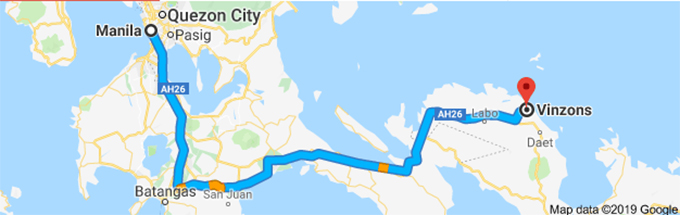
People turned up my wife’s sister’s home with horror stories. Flooded in the middle of the night. Awakened by floodwaters lapping at their bedside. Waist deep in water.

-Partners-

And the fears of electrocution were very real.

Rumours were rife of deaths in the Vinzons district.

The 360 km road from Manila to Vinzons through the rugged Bicol mountains. Map: Google

Communications blackout
But it was hard to get accurate and verified information with a communications blackout. Internet was down. No television and cellphone reception difficult.

Our planned trip to the impressive Mayon volcano, 206 km southwards past Naga was cancelled. We would never have made it.


Flooding at the bridge to Magcawayan school … after the waters had dropped. Video: Café Pacific

What was really happening? I called in at the local community radio station, Radyo Katabang 107.7FM, tucked away in a rooftop shack.

However, it was Christmas time and although the radio was on an emergency generator, the skeleton staff were relying on networked programming from Manila, 360 km away on the Pan-Philippine Highway – itself blocked by massive road slips.

Technician Michael Sarical holds the fort at community Radio Katabang. Image: David Robie/PMC

I drove around with my wife’s lawyer nephew in a “Judiciary”-plated four-wheel-drive vehicle to get a sense of the devastation in the district.

A small military detachment – a truck and soldiers – arrived to guard the emergency rice supplies and other foodstuffs as they were being dispensed by volunteers at the Vinzons Town Hall.

Soldiers awaiting orders at the Vinzons Town Hall. Image: David Robie/PMC

By December 30, the typhoon – now downgraded to a “tropical depression” (still very depressing, actually) – had eased and children were out in droves playing in the flooded streets in spite of the risks.


“Fun” on the flooded Vinzons streets. Video: Café Pacific

Plugged into news
And we were now plugged into the newscasts again. It wasn’t quite as bad as we had thought – only one death in Vinzons (out of a total of 122 across Bicol, the island of Samar and the Central Visayas).

Volunteers at the Vinzons Town Hall prepare relief food packs for evacuees. Image: David Robie/PMC
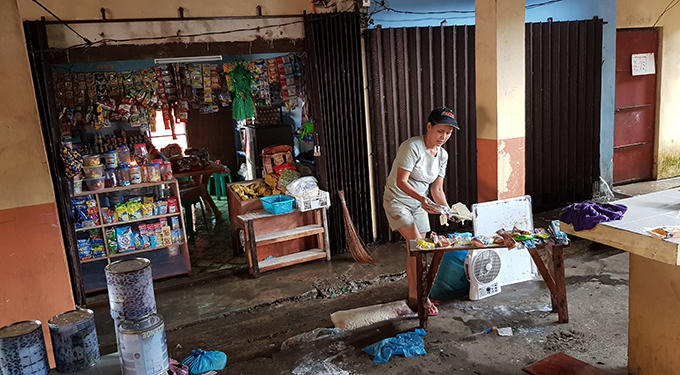
At least 57 of the dead were from Camarines Sur province, mostly from a landslide in the town of Sagnay, reports the Philippine Daily Inquirer.

At least 18 of the dead were from Albay, 15 from Camarines Norte (our province), eight from Sorsogon and seven from Masbate.

Of the 23 missing people – presumed dead, 20 were from Camarines Sur, and three from Tiwi, Albay.

Bicol relief officials also said nearly 31,000 people had sought shelter in six evacuation centres.

One Municipal Social Welfare Development (MSWD) official I spoke to in Vinzons, Irine Cribe del Rio, said a total of 641 families (2185 people), had been sheltered during the storm, mostly at Vinzons Elementary School.

Clean-up time in a Vinzons market shop. Image: David Robie/PMC

Crops devastated
Although they went back to their homes – if still standing – their freshly planted rice fields and livelihoods were devastated.

An average of 20 typhoons and storms lash the Philippines each year, killing hundreds of people and leaving millions in near-perpetual poverty, reports The Guardian.

The most powerful was Super Typhoon Haiyan which left more than 7360 people dead or missing across the central Philippines in 2013.

Yet, remarkably, in spite of the hardships the community is full of smiles and laughter.

David Robie and his wife, Del, were on holiday in the Vinzons town of Bicol when the typhoon struck. They assist a local school through a support project.

Print Friendly, PDF & Email

Article by AsiaPacificReport.nz

Drinking water study raises health concerns for New Zealanders

]]>

Source: The Conversation (Au and NZ) – By Michael (Mike) Joy, Senior Researcher; Institute for Governance and Policy Studies, Victoria University of Wellington

Last year, a Danish study reported a link between nitrate in drinking water and the risk of developing colorectal (bowel) cancer. This finding could have important implications for New Zealanders.

New Zealand has one of the highest bowel cancer rates in the world. Recent data show also that drinking water supplies in some parts of New Zealand have nitrate levels more than three times higher than the threshold level for colorectal cancer risk identified in the Danish study.

This study and other research raise an important question about the contribution nitrate exposure through drinking water may be making to New Zealand’s high rates of bowel cancer.


Read more: What’s behind the increase in bowel cancer among younger Australians?


Health implications of nitrates in drinking water

Nitrate fertiliser is added to pasture and crops to accelerate plant growth. Much of it enters waterways either directly with rain and irrigation or through animal urine.

The Danish study, published in the International Journal of Cancer, was extensive both in number of participants and length of follow-up. It included 2.7 million people over 23 years and monitored their individual nitrate exposure levels and colorectal cancer rates.

The findings confirmed widely held suspicions that long-term exposure to nitrate may be linked to cancer risk. The investigators propose that the risk results from nitrate converting into a carcinogenic compound (N-nitroso) after ingestion.

The research found a statistically significant increase in colorectal cancer risk at 0.87ppm (parts per million) of nitrate-nitrogen in drinking water. There was a 15% increase in risk at levels over 2.1ppm, compared with those who have the least exposure.

One key implication is that the current nitrate standard for drinking water used in most countries, including New Zealand, is probably too high.

International nitrate standards

The cancer risk level (0.87ppm) identified in the study is less than a tenth of the current maximum allowable value (MAV) of nitrate-nitrogen of 11.3ppm (equivalent to 50ppm of nitrate). This level has been in use in many countries for decades and comes from the World Health Organisation’s limit. It is based on the risk of “blue baby syndrome” (infantile methaemoglobinaemia, a condition that reduces the ability of red blood cells to release oxygen to tissues) – but not the risk of cancer.

Rates of bowel cancer vary across New Zealand, with the highest incidence in South Canterbury, with an age-standardised rate of 86.5 cases per 100,000 people. Bowel cancer is the second-highest cause of cancer death in New Zealand and each year around 3,000 people are diagnosed and 1,200 die of the disease.

A recent epidemiological review estimated the contribution of a range of modifiable “lifestyle” risk factors to colorectal cancer in New Zealand. In order of importance, these factors are obesity, alcohol, physical inactivity, smoking and consumption of red meat and processed meat. It would be useful to conduct more research to see if nitrate exposure in drinking water should be added to this list.

This map shows the nitrate-nitrogen trends at monitored sites. The Canterbury region, on the east coast of the South Island, shows that groundwater quality has worsened. Ministry for the Environment, Stats NZ, CC BY-ND

A recent Fish and Game New Zealand investigation of drinking water supplies in the Canterbury region found that nitrate levels in drinking water sourced from groundwater in areas of intensive farming and horticulture are already high and rising. The findings are consistent with data from the regional council Environment Canterbury. The latest groundwater report showed that half of the wells they monitor have values greater than 3ppm nitrate-nitrogen, more than three times the Danish study’s trigger level for colorectal cancer risk.

Christchurch City Council data show that of 420 samples collected during five years from 2011 to 2016, 40% exceeded 0.87ppm.


Read more: You’ve heard of a carbon footprint – now it’s time to take steps to cut your nitrogen footprint


Impact on ecosystems

When nitrate enters waterways, it accelerates algae growth. Freshwater scientists have long been pushing for nitrate limits to curtail algal proliferation, but restrictions have been slow and in some regions non-existent. An important coincidence is that the Australian and New Zealand guideline for healthy aquatic ecosystems for nitrate is at 0.7mg/l nitrate-nitrogen, close to the level required to stay under the colorectal cancer risk value found in the Danish study.

The Canterbury region exemplifies the problems resulting from the failure of central and local government policy in New Zealand to protect both ground and surface water. These failures cannot be blamed on a lack of awareness as these outcomes were predicted decades ago. For example, in 1986 the Ministry of Works predicted the nitrate contamination we now see as a consequence of regional irrigation schemes. It made it clear that alternative drinking water supplies would have to be found for Canterbury residents.

Apart from health and ecological concerns, another worry is that public fears about drinking water safety will prove a boon for water bottling companies, which have free access to New Zealand’s cleanest water.

While many New Zealanders face significant and increasing costs for water treatment, water bottlers pay virtually nothing. The only cost, apart from bottling costs, is a one-off 35-year regional council consent fee. This anomaly highlights the urgent need for government to put tougher limits on nitrate loss and face up to dealing with water ownership issues in New Zealand.

In conclusion, surface water in many parts of New Zealand is highly contaminated with nitrates as a result of intensified farming. These elevated levels are undoubtedly damaging freshwater ecosystems and biodiversity, and may also be harming human health.

At the very least, public health authorities need to conduct a systematic survey to assess current nitrate levels in New Zealand drinking waters, including those that are not part of the routinely monitored networked system. This information could then be used to provide a quantitative estimate of the colorectal cancer burden in New Zealand that can be attributed to this hazard.

ref. Drinking water study raises health concerns for New Zealanders – http://theconversation.com/drinking-water-study-raises-health-concerns-for-new-zealanders-108510

Unions slam ‘farcical’ UPNG appointments of chancellor, VC

]]>
UPNG’s acting vice-chancellor Professor Kenneth Sumbuk … integrity questioned. Image: EMTV News

Pacific Media Centre Newsdesk

Papua New Guinea’s Trade Union Congress has slammed the appointments of Jeffrey Kennedy as chancellor and Kenneth Sumbuk as vice-chancellor of the University of Papua New Guinea, reports the Post-Courier.

President John Paska said the congress had initially welcomed the announcement to investigate administrative malpractice and other aspects of the university but these two appointments now questioned the credibility of the exercise.

He said this was a governance issue which attracted public attention and commentary.

UPNG audit “action” pledged … front page story in The National.

“With the stroke of a pen the Minister, Pila Niningi, has turned what appeared to be a step in the right direction into a farcical exercise denigrating it into a comical show piece,” he said.

“Last year we questioned the selection process of candidates for the vice-chancellors position. Our questions emanated from information received about serious allegations that had been raised about Professor Sumbuk’s administration of K23 million (NZ$11 million) for various UPNG activities.

“We are not in any way pronouncing guilt on Sumbuk but the fact remains serious allegations hang over his persona that only a properly constituted investigation can ascertain to the contrary. To the best of our knowledge no investigation has been conducted to determine the veracity of the allegations,” he said.

-Partners-

Sources report that the university council had already recommended the appointment of Professor Frank Griffin, a former head of science at UPNG as vice-chancellor. However, the council was sacked on Monday and new members appointed.

Integrity in question
Paska told the Post-Courier Sumbuk’s integrity and credibility remained in question.

“Meanwhile, we query the eligibility of Mr Kennedy for the position of chancellor of the university. How does he qualify to be chancellor?

“Something is horribly wrong. The wheels of credibility and integrity of this investigation have collapsed before moving an inch. Unless otherwise my personal confidence in this exercise is shattered and I believe so is the public’s.”

“We call on the Prime Minister to intervene and rectify the situation, Paska said.

The National reports that the interim council would look into the 13 areas identified in a 2013 external audit as requiring attention, and implement them.

Acting vice-chancellor Professor Sumbuk told The National after his appointment by the interim council at its first meeting yesterday that he would “revive UPNG’s academic standard and review the 2013 external audit”.

Council ousted
“As we settle into the new academic year, we will audit all 13 areas of the university management that has not been done (since 2013),” he said.

“Parents and students must not worry about anything as there will be nothing shaken or swept under (the carpet). I am looking forward to facilitating the investigation and reviews proposed by the government.”

The 10 council members were appointed on Monday by Minister for Higher Education, Research, Science and Technology Pila Niningi after ousted acting chancellor Dr Nicholas Mann and acting vice-chancellor Vincent Malaibe.

Niningi said he had to make the changes because of the failure by the university council to respond to queries he had made on matters regarding the institution since last July.

However, Dr Mann told The National on Wednesday that they would reserve their comment on their “sidelining” by Niningi because they were seeking legal advice from the university’s lawyers.

“Whether the decision to sideline us is proper or not, that would be advised by our lawyers and then we will announce it to the public,” Dr Mann said.

The council also rescinded the hike in compulsory fees, which will remain at K2939 (NZ$1300).

Print Friendly, PDF & Email

Article by AsiaPacificReport.nz

Higher English entry standards for international students won’t necessarily translate to success

]]>

Source: The Conversation (Au and NZ) – By Sally Baker, Lecturer, School of Social Sciences, UNSW

For some time, lowering standards and inadequate English language proficiency have dominated discussions about international students in Australia. Studies show many international students struggle in their relationships, with their finances, feelings of isolation and belonging, all of which affect their educational experience.

The suggestion that raising entry standards would ensure success and a higher quality of international graduates is not necessarily true. Achieving a higher level of English proficiency through a standardised test will not guarantee international students’ motivation to fully participate in their degree programs.


Read more: English test for international students isn’t new, just more standardised


Universities need to look beyond language proficiency at the point of entry, and do more to support all facets of academic, linguistic and social development. These include discipline-specific language, mental health, and culturally appropriate pastoral support throughout their degrees. While language proficiency is the most important factor, these other factors have been shown to impact students’ academic performance.

Focusing only on increasing entry scores on standardised tests like the International English Language Testing System (IELTS) is unlikely to help. We also need to provide them with support after they’ve arrived at an Australian university. If we don’t, the number of international students who choose to study in Australia could decrease, hurting the A$32 billion a year industry.

What is IELTS and how does it work?

One of the most popular proficiency tests is the International English Language Testing System, which costs A$340 and consists of four tests. Despite its dominance in global language testing, the IELTS has been criticised by university academic and administrative staff for being a poor predictor of academic performance.

The federal government requires student visa applicants to achieve at least a 5.5 on the test. Alternatively, they can get a 5.0 and do at least 10 weeks of intensive English language learning, or a 4.5 and do at least 20 weeks of intensive English language learning. The highest a person can achieve is a 9.0.

The test is comprised of a 15-minute speaking test, 40 multiple choice questions each in listening and reading, and a two-part writing test. Here is what a 5.0 sounds like:

This test-taker has enough vocabulary to talk about familiar and unfamiliar topics, but meaning is occasionally lost through limited vocabulary. Her basic grammar is reasonably accurate but she struggles with complex sentences.

A student who achieved a band 8.0 speaks much more fluidly, drawing on a wide range of less common words and phrases, but she still has to occasionally pause to search for the right words.

Like all standardised tests, IELTS suffers from the weight of expectation about what it can actually assess. IELTS can only offer a snapshot of students’ use of language. As you can hear in the video, the activities test-takers do in the IELTS test are generic and poorly reflect the kinds of language use and literacy students will need to complete their degrees.

It also can’t assess understandings of cultural norms, conversational ability, or capacity to engage in the host country’s social life. These are also important for success. The score can only indicate someone’s proficiency in a familiar testing context, and their tolerance for high-stakes exams.

For success, international students need ongoing support

Universities profit massively from international student enrolments. If they don’t do anything to support these students through their studies (instead of just raising the entry requirement), they’re likely to lose significant income. There is also a moral obligation for universities to better respond to the needs of these students.

Universities should recognise that for international students, disciplinary specific, people-rich supports work better than general study skills models for most students. Accessing medical or mental health support through digital booking systems could prevent international students from seeking help. They’re already less likely than domestic peers to seek support.


Read more: More international students should mean more support for communication and interaction


Despite the economic incentive to make sure international enrolments remain steady, collaborating to set up and share more responsive forms of support on the ground is difficult. The siloed nature of university departments hinders collaboration.

For example, there are many language specialists in English Language Intensive Courses for Overseas Students (ELICOS) centres at universities. Universities could draw on their expertise to work with university teachers in their specific disciplines to support international students. They could help the students learn the language and literacy practices relevant to their disciplines, as well as help improve their oral and written expression.

So what would work?

Universities need to work towards students feeling confident about asking for help, and knowing who to talk to and where to find the right information.


Read more: Using university language tests for migration and professional registration is problematic


Universities need to ensure support services are targeted to the needs of culturally and linguistically diverse students. They also need to ensure there are many types of support available to avoid a backlog that would see students giving up or not having access to the right support at the right time. This should be a core part of university business.

Specific strategies to promote cultural and linguistic diversity include:

  • taking an approach to teaching and learning that encourages multilingual students to use multiple languages to make sense of course content

  • establishing language ambassadors who can help newly-arrived international students navigate their new university and find services such as counselling or language supports

  • explicitly teaching cultural diversity to students and staff, offering safe spaces to unpack assumptions and biases and creating culturally safe institutions which promote inclusive and supportive environments in both policy and practice.

Finally, universities need to encourage and offer training to support staff to engage in these practices. Many academics and support staff come up with excellent strategies, but these are often ad hoc or isolated. Universities should also offer incentives to collaborate and showcase best practice strategies for others to use and adapt.

ref. Higher English entry standards for international students won’t necessarily translate to success – http://theconversation.com/higher-english-entry-standards-for-international-students-wont-necessarily-translate-to-success-110350

We’re awarding the Order of Australia to the wrong people

]]>

Source: The Conversation (Au and NZ) – By Nicholas Gruen, Adjunct Professor, Business School, University of Technology Sydney

It’s almost Australia Day and hundreds of us are in line for an award.

Sadly, as unpublished research by my firm Lateral Economics reveals, many will get it for little more than doing their job. And the higher the job’s status, the higher the award.

Governors General, High Court Justices and Vice Chancellors of major universities would hope for the highest Companion of the Order (AC). Professors, public service departmental heads and senior business people should hope for the next one down – an Officer of the Order (AO). School Principals would generally slot in next for Members of the Order (AM).

If you’re lucky, or you’ve done your job extraordinarily well, you’ll be promoted one rank, but that’s pretty much it.

We reward most the already rewarded

Meanwhile, those who succeed in some achievement principally in and for their community usually qualify for the lowest award, if that; the Medal of the Order (OAM). And usually only if they’ve become conspicuous.

The level of gratitude among recipients seems to follow an equal and opposite arc. Those at the bottom seem the most thrilled for being recognised the least.

Distinction in putting others first gets short shrift. As Anne Summers lamented in 2013:

Seven years ago I nominated a woman I admire for an Australian honour. It took two years but it came through and she was awarded a Medal of the Order of Australia (OAM) for a lifetime of work with victims of domestic violence. I was disappointed she had not been given a higher award – I had hoped for an AM (Member of the Order of Australia) at the very least – but she was thrilled and so was her family.

Money, fame and status are nothing to be sneezed at if they are honestly earned. But they are their own reward. Why should they beget other rewards?

We could be putting awards to use

Here’s an idea. Why don’t we award honours to encourage people to do more than their job? In a world that is lavishing increasing rewards on the “haves”, the worldly rewards for doing your job need little bolstering.

Knowing awards are reserved for people who do more than their jobs might encourage us to choose more selfless and socially committed lives at the outset of our careers.

There’s a hunger among the young to do just that – to combine good, privately rewarding careers with serving their community and tackling social ills.

If honours are “the principal means by which the nation officially recognises the merit of its citizens” as the 2011 Government House review put it, I’d like to use it to encourage those people the most.

Wouldn’t it be more consistent with Australian values?

It’d make them more Australian

Government House provides online biographies of all those awarded honours. Lateral Economics sampled about half of them back to 2013 looking specifically at the gender division of honours and the extent to which those biographies included descriptions of work done without personal gain.

Barely more than a quarter of Order of Australia recipients recorded voluntary work in their biographies.

And those that did were more likely to be near the bottom of the awards ladder.

More than a third of those receiving the very bottom award, the OAM, were engaged in obviously selfless work, compared with a fifth at the top (just two out of ten ACs).

Still we may be making a little progress. Perhaps spurred by sentiments such as those expressed by Anne Summers, last year saw a higher percentage of women than in any previous year. Unusually, six women got the top honour, the AC, compared with four men, and the proportion with voluntary service broke through the 30% barrier for the first time.

I wonder what Australia Day will bring. I’m thinking that, whatever it is, we can do a lot better, for our community, and our country.


Thanks to Shruti Sekhar for research assistance.

ref. We’re awarding the Order of Australia to the wrong people – http://theconversation.com/were-awarding-the-order-of-australia-to-the-wrong-people-110487

To protect us from the risks of advanced artificial intelligence, we need to act now

]]>

Source: The Conversation (Au and NZ) – By Paul Salmon, Professor of Human Factors, University of the Sunshine Coast

Artificial intelligence can play chess, drive a car and diagnose medical issues. Examples include Google DeepMind’s AlphaGo, Tesla’s self-driving vehicles, and IBM’s Watson.

This type of artificial intelligence is referred to as Artificial Narrow Intelligence (ANI) – non-human systems that can perform a specific task. We encounter this type on a daily basis, and its use is growing rapidly.


Read more: When AI meets your shopping experience it knows what you buy – and what you ought to buy


But while many impressive capabilities have been demonstrated, we’re also beginning to see problems. The worst case involved a self-driving test car that hit a pedestrian in March. The pedestrian died and the incident is still under investigation.

The next generation of AI

With the next generation of AI the stakes will almost certainly be much higher.

Artificial General Intelligence (AGI) will have advanced computational powers and human level intelligence. AGI systems will be able to learn, solve problems, adapt and self-improve. They will even do tasks beyond those they were designed for.

Importantly, their rate of improvement could be exponential as they become far more advanced than their human creators. The introduction of AGI could quickly bring about Artificial Super Intelligence (ASI).

While fully functioning AGI systems do not yet exist, it has been estimated that they will be with us anywhere between 2029 and the end of the century.

What appears almost certain is that they will arrive eventually. When they do, there is a great and natural concern that we won’t be able to control them.

The risks associated with AGI

There is no doubt that AGI systems could transform humanity. Some of the more powerful applications include curing disease, solving complex global challenges such as climate change and food security, and initiating a worldwide technology boom.

But a failure to implement appropriate controls could lead to catastrophic consequences.

Despite what we see in Hollywood movies, existential threats are not likely to involve killer robots. The problem will not be one of malevolence, but rather one of intelligence, writes MIT professor Max Tegmark in his 2017 book Life 3.0: Being Human in the Age of Artificial Intelligence.

It is here that the science of human-machine systems – known as Human Factors and Ergonomics – will come to the fore. Risks will emerge from the fact that super-intelligent systems will identify more efficient ways of doing things, concoct their own strategies for achieving goals, and even develop goals of their own.

Imagine these examples:

  • an AGI system tasked with preventing HIV decides to eradicate the problem by killing everybody who carries the disease, or one tasked with curing cancer decides to kill everybody who has any genetic predisposition for it

  • an autonomous AGI military drone decides the only way to guarantee an enemy target is destroyed is to wipe out an entire community

  • an environmentally protective AGI decides the only way to slow or reverse climate change is to remove technologies and humans that induce it.

These scenarios raise the spectre of disparate AGI systems battling each other, none of which take human concerns as their central mandate.

Various dystopian futures have been advanced, including those in which humans eventually become obsolete, with the subsequent extinction of the human race.

Others have forwarded less extreme but still significant disruption, including malicious use of AGI for terrorist and cyber-attacks, the removal of the need for human work, and mass surveillance, to name only a few.

So there is a need for human-centred investigations into the safest ways to design and manage AGI to minimise risks and maximise benefits.

How to control AGI

Controlling AGI is not as straightforward as simply applying the same kinds of controls that tend to keep humans in check.

Many controls on human behaviour rely on our consciousness, our emotions, and the application of our moral values. AGIs won’t need any of these attributes to cause us harm. Current forms of control are not enough.

Arguably, there are three sets of controls that require development and testing immediately:

  1. the controls required to ensure AGI system designers and developers create safe AGI systems

  2. the controls that need to be built into the AGIs themselves, such as “common sense”, morals, operating procedures, decision-rules, and so on

  3. the controls that need to be added to the broader systems in which AGI will operate, such as regulation, codes of practice, standard operating procedures, monitoring systems, and infrastructure.

Human Factors and Ergonomics offers methods that can be used to identify, design and test such controls well before AGI systems arrive.

For example, it’s possible to model the controls that exist in a particular system, to model the likely behaviour of AGI systems within this control structure, and identify safety risks.

This will allow us to identify where new controls are required, design them, and then remodel to see if the risks are removed as a result.

In addition, our models of cognition and decision making can be used to ensure AGIs behave appropriately and have humanistic values.

Act now, not later

This kind of research is in progress, but there is not nearly enough of it and not enough disciplines are involved.


Read more: Why R2D2 could be your child’s teacher sooner than you think


Even the high-profile tech entrepreneur Elon Musk has warned of the “existential crisis” humanity faces from advanced AI and has spoken about the need to regulate AI before it’s too late.

The next decade or so represents a critical period. There is an opportunity to create safe and efficient AGI systems that can have far reaching benefits to society and humanity.

At the same time, a business-as-usual approach in which we play catch-up with rapid technological advances could contribute to the extinction of the human race. The ball is in our court, but it won’t be for much longer.

ref. To protect us from the risks of advanced artificial intelligence, we need to act now – http://theconversation.com/to-protect-us-from-the-risks-of-advanced-artificial-intelligence-we-need-to-act-now-107615

New research reveals our complex attitudes to Australia Day

]]>

Source: The Conversation (Au and NZ) – By Darren Pennay, Campus Visitor, ANU Centre for Social Research and Methods, Australian National University

In the cultural warfare over whether January 26 should be retained as Australia Day, survey results are deployed like guided missiles. But what do Australians really think about the continuing debate?

A recent study undertaken by the Institute of Public Affairs found that three-quarters of Australians agreed that Australia Day should be celebrated on January 26.

In a survey taken late last year, before the annual Australia Day debate commenced, the Social Research Centre asked members of its Life in Australia research panel a similar question:

To what extent do you agree or disagree that 26 January is the best day for our national day of celebration?

And from the 2,167 responses, it received similar results: 70% of respondents agreed (37% strongly agreed/33% agreed).

But this is where the story becomes interesting.

Support for 26 January increases with age. It is 73% for Generation X (39-53 years) and 80% among Baby Boomers (54-72 years). Among the Silent Generation (73 years or older), support for January 26 is nearly unanimous (90%). But it is notably lower among the younger generations at 47% and 58% for Generation Z (aged 23 years or younger) and Millennials (24-38 years).

These results may explain why the ABC shifted its Triple J Hottest 100 away from 26 January after taking a poll in which 60% of the 65,000 who voted supported the move.


Read more: Henry Reynolds: Triple J did the right thing, we need a new Australia Day


Support was also lower among those with a university degree (55%) compared to those without (75%). In terms of geography, support for January 26 was highest in Western Australia (83%) and lowest in Victoria (65%), and higher in the regions (78%) than the capital cities (66%). These results seem consistent with what we know about the patterns of progressive and conservative political values in Australia.

There are stark differences according to party affiliation. Support is highest among Coalition (85%) and One Nation (94%) supporters compared with 62% of Labor supporters and just 38% among Greens. On these results, perhaps the federal Labor Party’s present support for Australia Day might eventually come under pressure from within.

Those who disagreed that January 26 was the best day for our national celebration were asked:

On which day do you think Australia should have its national day?

Ten options were offered or an alternative could be nominated.

Reconciliation Day on May 27 – the anniversary of the 1967 referendum – was the most popular alternative at 24%. It was followed by January 1, Federation Day (18%). Somewhat bizarrely, 15% of those opposed to January 26 being the date nominated May 8, because it sounds like “mate”. At present, no date clearly stands out as a popular alternative to January 26 as Australia Day.

To gain a better insight into what January 26 actually means to Australians, we then asked a series of questions to explore which aspects of Australia’s culture and heritage were most strongly associated with Australia Day.


Read more: Why Australia Day survives, despite revealing a nation’s rifts and wounds


Just over two-thirds (68%) of respondents agreed that January 26 celebrated our British culture and heritage. 63% believed the current timing was a celebration of our democracy and system of government. And 58% believed it celebrated the contribution of all immigrants to Australia.

The view that Australia Day recognised the contribution of all immigrants to Australia received stronger endorsement from those born overseas (65%) than the Australian born (55%). This suggests that the long-standing official Australia Day emphasis on unity in diversity has to some extent spoken to their sense of belonging. There is no other date in the Australian calendar that could be considered to represent the contribution of migrant communities.

The association of Australia Day and British culture and heritage was highest in New South Wales (73%). This possibly reflects the particular significance of January 26 for the history of that state, but it is still below the levels observed in the Australian Capital Territory – 81% – and the Northern Territory – 77%. The association with British culture and heritage is highest amongst Coalition and One Nation supporters, at 73% and 71% respectively. For the Silent Generation, the celebration of Australia Day on 26 January is particularly evocative of British culture and heritage: more than four out of five agreed.

Official proponents of Australia Day have fudged the association of January 26 and Britishness as far back as the 1988 Bicentenary. They have more often emphasised diversity and belonging. Yet, fewer respondents accepted that the day was a celebration of migrant contributions relative to its association with British heritage.

In a similar vein, only a minority – although a large one (40%) – believed January 26 celebrated Aboriginal and Torres Strait Islander culture and heritage. This proposition is rejected most strongly by Labor and Greens supporters, those living in the capitals and the young.

Yet perhaps the most striking of all our findings is that 45% of respondents agreed the day was offensive to Indigenous Australians. This figure is higher than that found in an Australia Institute poll of January 2018, which put the figure at 37%.

The survey also found that women (49%) are more likely than men (42%) to see things this way, possibly reflecting the modern pattern for women to have more progressive political views. Those with a university degree (59%), Victorians (51%) and capital city residents (48%) were also more likely to hold this opinion. And the party divide on this issue is clear. Labor and Greens (50% and 75%) supporters are much more likely to agree than Coalition and One Nation voters (32% and 12%).

Nearly three in ten (29%) of respondents who agree with having Australia Day on January 26 also recognise the date is offensive to Indigenous people. It seems that many of us are sensitive to their objections, but not concerned enough to want to change the date. Australians incorporate in their historical consciousness a range of perspectives on the Australian past, and their significance for present-day commemoration, even when they are apparently in conflict with one another.


Read more: First reconciliation, then a republic – starting with changing the date of Australia Day


So what factors are at play here? One school of thought is that many Australians are mindful of the day’s negative connotations, but place a high value on it because it is an important marker in the calendar. The attachment to this last summer public holiday before the school year starts possibly outweighs concern about offence. Previous research has shown that when people were asked to associate three words with Australia Day, the favourites were “barbecue”, “celebration” and “holiday”.

Still, the mix of attitudes we have uncovered seems likely to ensure the day remains contentious. Any expectation that January 26 might perform a similar kind of civic function to July 4 (Independence Day) in the United States or July 14 (Bastille Day) in France is fanciful.

It may be that the fortnight or so surrounding Australia Day is evolving into an annual season in which some of the deepest paradoxes of Australian identity play out in public.

ref. New research reveals our complex attitudes to Australia Day – http://theconversation.com/new-research-reveals-our-complex-attitudes-to-australia-day-110035