Page 1115

Potentially unaffordable, and it still won’t fix bracket creep. The Coalition’s $300 billion tax plan assessed

]]>

Source: The Conversation (Au and NZ) – By Danielle Wood, Program Director, Budget Policy and Institutional Reform, Grattan Institute

The big surprise in last week’s budget was the size of new income tax cuts – A$158 billion over a decade, in addition to the A$144 billion already promised in last year’s budget.

A lot of the plan doesn’t take effect until 2024-25, so it’s easy to dismiss as tax cuts on the never-never. But given it’s a central plank of the government’s campaign for re-election, it deserves closer scrutiny.


Grattan Institute


The plan comes in three stages.

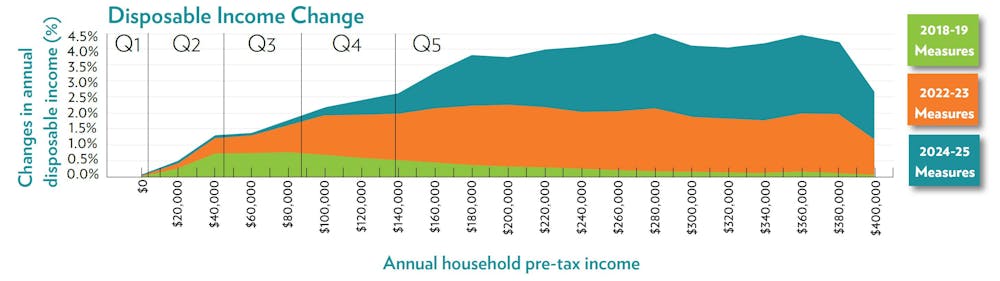
The major part of stage 1 is the Low and Middle Income Tax Offset – giving everyone earning less than $126,000 a cheque in the mail come July and then for the following three years. Stage 2 (2022-23) would lift the top threshold of the 19% and the 32.5% brackets. The biggest cuts would come in stage 3 (2024-25) when the government removed the 37% bracket and cut the 32.5% rate to 30%.

Everyone earning between $45,000 and $200,000 would face the same 30% marginal tax rate.

2019 Budget infographic

Unsurprisingly, in absolute terms the biggest beneficiaries would be high-income earners. More than half the benefit would go to the top 20% of earners, those with taxable income over $87,500 a year.

But to better understand what the plan would do to the progressivity of the system, we need to consider what would happen to rates without the plan.

Without change, the average tax rate would increase across the income distribution, as wage growth pushed people into higher tax brackets.

The plan would prevent some of that bracket creep by lowering future tax rates.

Most taxpayers would be better-off than without a change – but high-income earners would benefit the most.


Read more: NATSEM: federal budget will widen gap between rich and poor


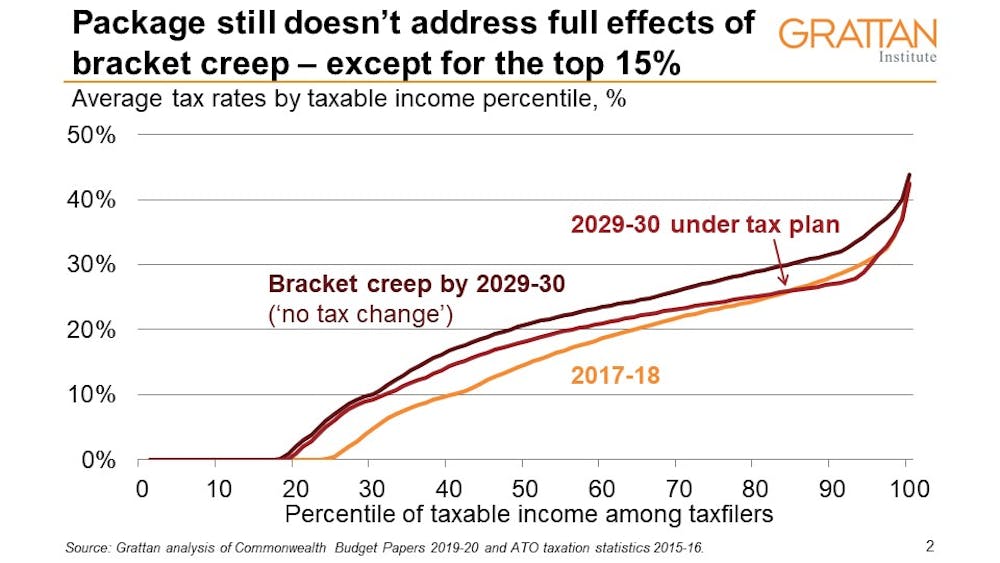
It goes part-way to addressing bracket creep for low and middle income earners. Someone in the middle of the income distribution would pay 3.6% more tax in 2029-30 than today, instead of 6.1% more without the plan.

But Australia’s highest earners – the top 15% of taxpayers – would escape bracket creep entirely, paying the same average tax rate or less in 2029-30 than today.


Grattan Institute


This result would be a shift in the proportion of tax paid at different points in the income distribution.

Middle earners, those earning between the third to top and the third to bottom ten percents of the income distribution, would pay a larger share of tax in 2029-30 than they do today: 23% compared to 20%.

But high-income earners, those in the top fifth of the income distribution, would pay a smaller share of tax: 65% in 2029-30 compared to 68% today.

It’s more a tax cut than tax reform

The government has been keen to sell the tax package as a “huge reform” because it removes an entire tax bracket.

It says flattening the tax scale would create a greater incentive for higher-income earners to work. But unlike earlier tax reform packages, there has been little in the way of clear articulation or modelling to demonstrate that this would be the case. And there are reasons to doubt that it would be the case.


Read more: Mothers have little to show for extra days of work under new tax changes


The people who would benefit most from the tax reform would be in the top 6% of the income distribution in 2024-25. Barring major changes to gender work patterns in the next five years, they would be disproportionately men, working full time. But as the Henry Tax Review pointed out, the people who are the most responsive to changes in effective tax rates are second-earners (mainly women) working part-time.

Proper reform of the income tax system would lower the economic barriers to second-earners working more: the increase in tax, the cuts in family and childcare benefits and higher childcare costs that accompany working more.

And it might not be affordable

The budget numbers point to a decade of surpluses, exceeding 1% of GDP by 2026-27, even with the tax cuts. But the surpluses rely on payments as a share of gross domestic product falling steadily over the decade, from 24.9% of GDP today to 23.6% by 2029-30.

Achieving such a reduction would require significant cuts in spending growth across almost every major spending area, during a period when we know that an ageing population will increase spending pressures, particularly on health and welfare. The Parliamentary Budget Office says ageing will add 0.3% of GDP a year to spending by 2028-29.

The approach marks a change since the 2016-17 budget, when the government forecast that payments would grow as a share of GDP over the decade because of the ageing population. There have not been enough significant savings measures in the past three budgets to explain the turnaround. It appears to be more driven by assumption than by reality.


Read more: Expect a budget that breaks the intergenerational bargain, like the one before it, and before that


If we were to make the still-conservative assumption that spending remained merely constant as a share of GDP at 24.9%, the third stage of the tax cuts would push the budget back into deficit in 2024-25.

The bottom line

The pre-election tax package finally does something about bracket creep – but solves it only for the highest of earners.

It passes up the opportunity for more comprehensive reform. And most disconcertingly, it punches a sizeable hole in government revenue just at the time an ageing population will start to demand that more money be spent.


Read more: What will the Coalition be remembered for on tax? Tinkering, blunders and lost opportunities


ref. Potentially unaffordable, and it still won’t fix bracket creep. The Coalition’s $300 billion tax plan assessed – http://theconversation.com/potentially-unaffordable-and-it-still-wont-fix-bracket-creep-the-coalitions-300-billion-tax-plan-assessed-115057

The 14 Indigenous words for money on the new 50 cent coin

]]>

Source: The Conversation (Au and NZ) – By Felicity Meakins, Associate Professor and ARC Future Fellow, The University of Queensland

When you rifle around in your purse for some change, you might be lucky enough to pull out a new 50 cent coin, launched today by the Royal Australian Mint to celebrate the International Year of Indigenous Languages.

The coin, developed in consultation with Indigenous language custodian groups and designed by the Mint’s Aleksandra Stokic, features 14 different words for “money” from Australian Indigenous languages. But where do these words come from?


Read more: The state of Australia’s Indigenous languages – and how we can help people speak them more often


Old words for new things

Money, or an object which abstractly represented the value of goods and services, did not exist in Australia before European colonisation. Trade was practised, but it was between items deemed to be of similar worth, for example pearl shell, quartz, food or songs. With the entry of money into the Indigenous economy, new words were needed to refer to coins and later paper money.

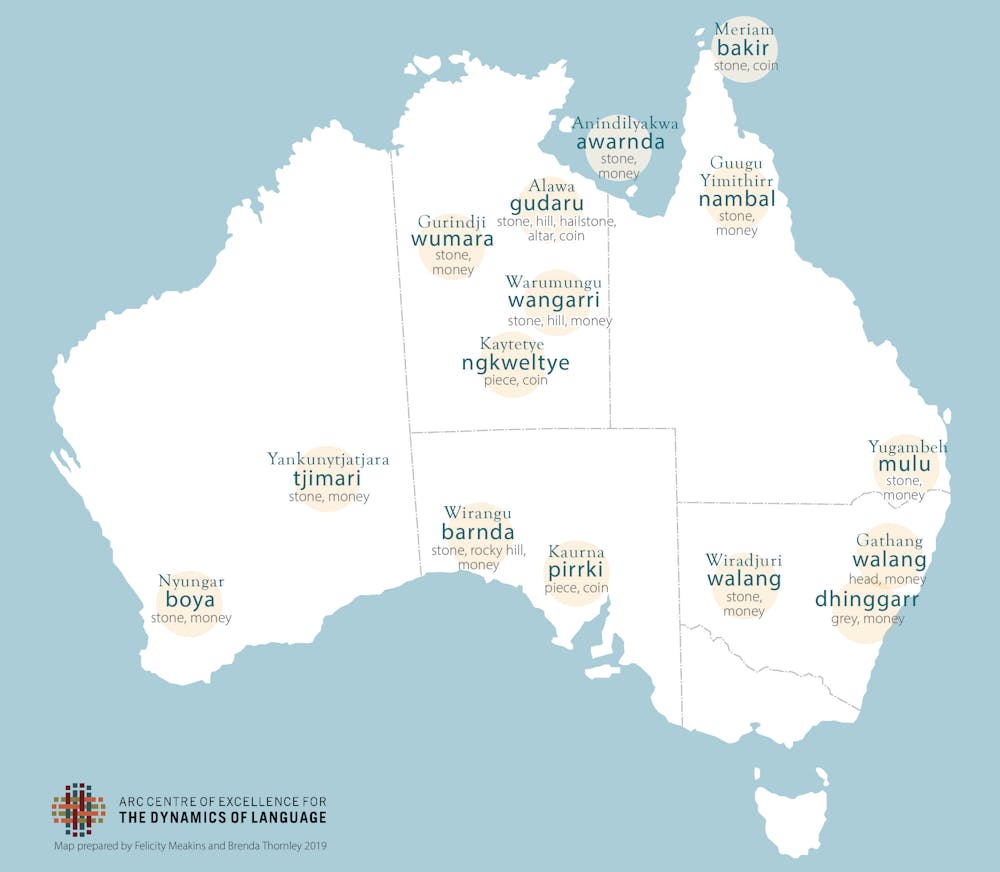
Most Indigenous words for money come from words for “stone”, “rock” or “pebble”, no doubt in reference to the size and shape of coins. On the new 50 cent coin, you’ll find words for “stone” from across Australia:

Kaytetye, spoken in Central Australia, and Kaurna, the language of Adelaide, go against the trend by extending the words ngkweltye and pirrki, which both mean “piece”, to also mean “money”.

Gathang, from the Central New South Wales coast area, uses dhinggarr “grey”, perhaps due to the colour of most coins, and walang “head”, presumably in reference to the monarch’s head on the coin. Wiradjuri from Central New South Wales also uses walang, but in this case it means “stone”.

Origin of the Indigenous words for ‘money’ on the new 50 cent coin. Felicity Meakins and Brenda Thornley

Other words for ‘money’ from Indigenous languages

The diversity of Indigenous words for money on the new 50 cent coin is an attempt to reflect the linguistic tapestry of Australia, a nation of over 300 languages and many more dialects. However, the words featured on the coin are just a small sample of Indigenous words for money.

Some languages differentiate between coins and paper money. Murrinh-patha, spoken in the Daly River region of the Northern Territory, uses palyirr “stone” for coins and we “paperbark” to mean notes.

Other languages have words that vary by denomination. Alyawarr, spoken just north of Alice Springs, uses aherr-angketyarr “lots of kangaroos” to refer to the A$1 coin, and rnter-rnter “red” in reference to $20 notes. Alyawarr people also say kwert-apeny “like smoke” for $100 notes – perhaps confusing at first, until you recall the original light blue and grey $100 note (1984-1996) depicting Sir Douglas Mawson.


Read more: Some Australian Indigenous languages you should know


Borrowed words for money

In some cases, terms for money have been borrowed from other languages. The English word “money” has been given a local flavour by different languages, for example: mani/moni (Kriol) and maniyi or tala (Warlpiri).

Another borrowing comes from Australia’s close neighbours. The legacy of 18th century Macassan traders from present-day Indonesia remains in words for “money” originally derived from rupiah (Indonesia’s word for currency). These include rrupiya (Mawng, Burarra, Djinang) and wurrupiya (Tiwi). (And note that Tiwi also uses wurrukwati “mussel shell” for “money”).

Probably the most innovative borrowing for money, still used throughout south-western Queensland, is banggu. The word derives from bank and –gu, the latter being used to express ownership. So banggu literally means “of the bank”, and perhaps emerged during the period in Queensland history when the state government was withholding wages from Indigenous people. These stolen wages are now thought to be worth as much as A$500 million in banggu.

Indigenous representation on Australian currency

Indigenous Australians have not always been well represented on Australian currency. Take, for example, the use of a bark painting by David Malangi on the back of the old $1 note released in 1966, used without consent or acknowledgement, or the first polymer $10 note, released in 1988, which featured an anonymous Indigenous man painted up for ceremony.

Contrast this to 1995, where the Indigenous man on the $50 note is named as the first published Indigenous author, Ngarrindjeri writer David Unaipon, and 2017 where a commemorative 50 cent coin was designed by Boneta-Marie Mabo and released for National Reconciliation Week.

The use of multiple words for money on the new coin challenges the myth of a single Australian language. It also represents a shift in Indigenous representation to naming and individuation: from depicting Australian Indigenous people and their languages as a single group, to recognising the diversity of these groups and their languages.

ref. The 14 Indigenous words for money on the new 50 cent coin – http://theconversation.com/the-14-indigenous-words-for-money-on-the-new-50-cent-coin-113110

Independent, returning MPs dominate new Solomon Islands Parliament

]]>
Evening Report
Evening Report
Independent, returning MPs dominate new Solomon Islands Parliament
Loading
/
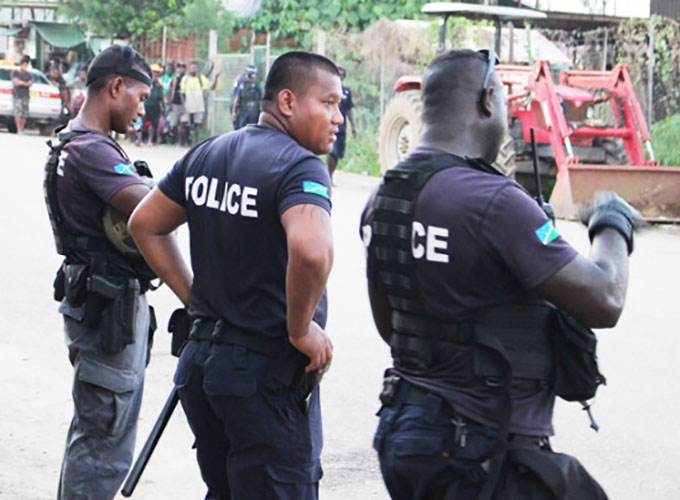
Police Response team (PRT) on the alert in Gizo, Western province, for the Solomon Islands general election last week. Image: SI Police/Solomon Star

By Koroi Hawkins of RNZ Pacific

Independent and returning MPs dominate the line-up for Solomon Islands new Parliament with all the results in from last week’s election.

Nearly three-quarters of MPs have retained their seats, including the Prime Minister of the last two years, Rick Hou.

The 50-seat Parliament has 14 new MPs and two women.

The Solomon Islands Parliament chamber in Honiara. Image: Koroi Hawkins/RNZ Pacific

Lanelle Tanangada and Freda Soriacomua are among the 36 MPs who retained their seats.

LISTEN TO RNZ PACIFIC DATELINE

Twenty-one MPs standing as independents have been elected, making up nearly half the Parliament, while the two largest of the eight parties voted in have just eight seats each.

-Partners-

Most constituencies recorded voter turnouts of more than 80 percent.

The Electoral Commission and international observer groups have commended the country for a peaceful election.

Observers also noted some discrepancies such as voters having difficulty finding their names on polling day.

Print Friendly, PDF & Email

Article by AsiaPacificReport.nz

All female mammals have a clitoris – we’re starting to work out what that means for their sex lives

]]>

Source: The Conversation (Au and NZ) – By Andrew Pask, Professor, University of Melbourne

Female enjoyment of sex is typically associated with the human species.

But actually all female mammals have a clitoris, the highly sensitive organ that is linked with pleasure and orgasm in women.

And research is now starting to slowly unpack how the clitoris might be involved in sexual encounters in mammals. For example, a research paper presented at a biology conference this week showed that the clitoris in dolphins is very large, and more complex than we previously thought.

Let’s take a look at the biology and evolution of the clitoris – for science.

It starts in the uterus

All babies, regardless of whether they are destined to become a boy or a girl, begin development in the womb with a small bulge called a genital tubercle.


Read more: What makes you a man or a woman? Geneticist Jenny Graves explains


If the developing fetus is destined to become male, the fetal testes will produce the male hormone testosterone and the genital tubercle will develop into a penis. If, on the other hand, the fetus is destined to become a female, the fetal ovary will not produce any hormones and instead the genital tubercle will develop into the clitoris.

Both structures look very similar in the early days of pregnancy.

Human genitals photographed at 11 weeks gestation. strictly_nub_theory on Instagram (screen shot April 8 2019)

Since the penis and the clitoris both develop from the same structure, they share many similarities.

The clitoris has a hood in humans: this is the same as the foreskin in males. The clitoris has a glans, which is the same structure as the head of the penis in men. Both the penis and clitoris become engorged with blood when stimulated. And both structures are full of nerves which, at least in humans, provide a pleasurable sensation when stimulated.

A very recent science

But compared to the penis, the clitoris is not well studied even in humans.


Read more: You need more than just testes to make a penis


Amazingly, it was not until the late 1990s that the complete anatomy of the human clitoris was accurately described by Australia’s first female urologist, Helen O’Connell. Her work to understand the detailed form and function of the clitoris provides answers to some basic biological questions about sex.

Such research also has implications in pelvic area surgery, where doctors can use this knowledge to avoid any loss of sexual function.

The external aspect of the human clitoris is just a very small portion of its entire structure. In this image, the dark pink and white structures are internal. from www.shutterstock.com


Read more: ‘Is it normal for girls to masturbate?’


Female hyenas are special

Because the penis and clitoris develop from the same tissue in the fetus, anything that affects the hormone balance in the embryo can impact its development. A great example of this is seen in the female spotted hyena.

In this mammal, the female rules the pack. She is larger and more muscular than the males because she is exposed to high levels of male hormones during embryonic development.

Just grin and bear it, or is this enjoyable? from www.shutterstock.com

But this more muscled physique comes at a cost. The male hormones also affect the clitoris, turning it into a structure that looks like the male penis.

Unfortunately for the female hyena this 20cm clitoris contains the birth canal. So, the female needs to both mate and give birth through her clitoris, which often splits in the process, causing a high death rate in first time mothers.

There are other known differences in clitoris anatomy across species too.

The urethra is the tube through which urine passes to the outside of the body. Many animals have the urethra running through the clitoris (as it does in the penis) while in humans, the urethra opens at the base of the clitoris.

The Conversation, CC BY-ND

Most mammals also have a small bone in the clitoris to help it become rigid during intercourse. This is known as the os clitoris and again shares a counterpart in the penis, the os penis. Os clitoris and os penis bones are present in most mammals, and humans are unusual in not having one in either organ.


Read more: Lascivious virgins and lustful itches: women’s masturbation in early England


Getting lost in the moment

The jury is still out on whether all mammals experience orgasm.

Non-human primates almost certainly do, but it is difficult to measure pleasure in animals.

What is certain is that females who stick around for longer during the act of mating are much more likely to become pregnant and produce more offspring. So if a clitoris does enhance enjoyment, then it would be strongly selected for in nature through increasing the females chance of having offspring.

Although the clitoris is not well studied, there is evidence of larger clitorides – yes, this is the plural of clitoris – in animals in which sex plays an important part in relationship building. Examples include the matriarchal hyena, bonobo chimps, humans and most recently in the dolphin.

Lots of surprises

A paper released this week reveals that female bottlenose dolphins have clitorides similar to humans, and that female dolphins may experience sexual pleasure.

Researchers used a combination of dissections and 3D scans to explore the female genitalia of dolphins in detail.

The shape and structure of the dolphin clitoris is very similar to that of the human. Both animals have extensive areas of erectile tissue that are larger than the clitoral hood. The skin under the clitoral hood also contains bundles of nerves that may increase sensitivity, raising the possibility that sexual experiences can be pleasurable for female dolphins.

Computer reconstruction of the clitoris of the bottlenose dolphin, which researchers say is remarkably similar to the human clitoris in its structure and shape. Dara Orbach, Mount Holyoke College

However, there are also some differences in the location of the clitoris with respect to the vaginal opening and how it would be stimulated during copulation.

These comparative studies help us learn about the function of genitalia, and the evolution of sexual bonding across species.

Science has revealed a bizarre array of penis shapes found in mammals, from a four-headed penis in the echidna to two-headed penises in many marsupials.

It remains to be seen what surprises the clitoris has in store for us.

ref. All female mammals have a clitoris – we’re starting to work out what that means for their sex lives – http://theconversation.com/all-female-mammals-have-a-clitoris-were-starting-to-work-out-what-that-means-for-their-sex-lives-114916

Labor’s cancer package would cut the cost of care, but beware of unintended side effects

]]>

Source: The Conversation (Au and NZ) – By Kees Van Gool, Health economist, University of Technology Sydney

Labor’s big-ticket election promise is a A$2.3 billion package to provide free medical scans and specialist consultations for cancer patients, plus automatic listing of new cancer therapies on the Pharmaceutical Benefits Scheme (PBS) once they’re recommended by the nation’s expert advisory panel.

One in two Australians will be diagnosed with cancer by the age of 85, and around 145,000 new diagnoses are made each year. So most of us have a close relative or friend who will be affected by the policy.

But there are some important policy considerations a Shorten government would need to plan for to ensure the package provides optimal care, improves patient outcomes, and does actually reduce out-of-pocket costs.


Read more: Shorten promises $2.3 billion package to relieve costs for cancer patients


What’s the problem with cancer care?

New therapies for cancer are rapidly evolving, and are often extremely expensive. Seeking treatment involves navigating a complex array of public and private providers across multiple health care sectors, often leaving patients with high out-of-pocket costs.

These costs are highly dependent on which providers the patients choose (and the fees they charge), the level of private insurance cover, and the volume of services used.

A recent Queensland study found the median out-of-pocket expenses for a breast cancer patient, for example, was A$4,192.

It’s possible but very time-consuming for patients to “shop around” to reduce costs. But this is an unreasonable burden to place on patients.

The Labor proposal provides an opportunity to develop a comprehensive cancer control program that encompasses prevention, early diagnosis, treatment and follow-up – at a reasonable cost.


Read more: Cutting cancer costs is a worthy policy, but we need to try to prevent it too


Better care for cancer patients

Cancer treatment is well researched; there are clear evidence-based guidelines that establish clinical pathways for the best treatment.

Nevertheless, there is substantial variation in treatments given to cancer patients. This difference cannot always be explained by their clinical conditions, and sometimes the care is not evidence-based.

It’s important that the proposed reforms do not just fund more care, but support more of the best care.

Opposition leader Bill Shorten announced the A$2.3 billion cancer package in last week’s budget reply. Dan Peled/AAP

The approach that has shown promise in other countries is known as “bundled payments”.

Under bundled payments, a series of health care services – that can span over time and across multiple health care sectors and providers – are bundled together for funding purposes. This gives providers or institutions greater flexibility in how they spend money delivering care to the patient.

There is a danger that bundling can provide incentives to skimp on care, because the provider receives the same amount of funding no matter how much care is provided. But this can be addressed by monitoring the quality of care and the patients’ outcomes.

Ensuring the financial benefits flow to patients

Australian governments have made several attempts to provide better safety nets that cushion patients from extra charges.

Study after study shows that, in these circumstances, providers are likely to raise their fees. So while patients get some financial benefit, the doctors benefit also.

Under current Medicare rules, the Australian government does not and cannot determine doctors’ fees. It can only determine the amount of the Medicare benefit.

In general practice, most consultations are bulk-billed implying that the fee the doctor charges is equivalent to the Medicare benefit.

Only 31% of specialist consultations are bulk-billed, leaving more patients with an out-of-pocket payment.


Read more: Specialists are free to set their fees, but there are ways to ensure patients don’t get ripped off


What can government do to encourage cancer care providers to bulk-bill?

Labor has announced they will add a bulk-billing incentive payment, as occurs in primary care. Specialists will receive an additional payment if they bulk-bill a cancer-related service.

This will not guarantee that every patient will not incur any out-of-pocket costs – although it should increase the likelihood that they will. Indeed, the Labor target is that 80% of patients will be bulk-billed.

However, previous research has shown that while the GP bulk-billing incentive led to a reduction in costs for those eligible (concession card holders), it also increased costs for those not eligible.

Careful monitoring is required to ensure the volume of services – and their fees for non-cancer patients – do not go up.

Not all cancer care is based on the best available evidence. Napocska/Shutterstock

A further unprecedented complication is that for some services, it will be necessary to differentiate Medicare payments on the basis of the patient’s cancer status.

To guarantee patients face no out-of-pocket costs would require more radical reform. Again, the bundled payment system could be a vehicle for such reforms whereby payments are conditional on all the patient’s service providers agreeing to deliver care with no additional fee to the patient.

Depending on whether a patient is privately insured, the bundled payment could be financed by private health funds and Medicare.

Of course, it’s not yet clear that bundled payment schemes can be directly applied to the Australian setting.

The Labor cancer package requires careful and rigorous research effort to inform and guide the policy development.

A new vision for Medicare

Medicare is now 35 years old. It was built on fee-for-service payment, and focused on short, acute episodes of illness.

Now it’s time to move to new funding mechanisms that provide better care for complex, ongoing conditions, at a cost patients and the country can be sure represent efficient use of resources.


Read more: More visits to the doctor doesn’t mean better care – it’s time for a Medicare shake-up


Cancer is a good place to start and it could indeed be the most significant reform of Medicare so far.

Imagine a health system where every Australian was assured of optimal care, no matter what their illness or economic circumstances. That is a health system worth paying taxes for.

ref. Labor’s cancer package would cut the cost of care, but beware of unintended side effects – http://theconversation.com/labors-cancer-package-would-cut-the-cost-of-care-but-beware-of-unintended-side-effects-114979

How has education policy changed under the Coalition government?

]]>

Source: The Conversation (Au and NZ) – By Glenn C. Savage, Senior Lecturer in Education Policy and Sociology of Education, University of Western Australia

This article is part of a series examining the Coalition government’s record on key issues while in power and what Labor is promising if it wins the 2019 federal election.


School’s policy and funding

Glenn C. Savage, Senior Lecturer in Education Policy and Sociology of Education, University of Western Australia

The Coalition’s approach to schooling policy since the 2016 election has primarily focused on its Quality Schools agenda. This centres on increased funding (A$307.7 billion in total school recurrent funding from 2018 to 2029). It also attempts to steer national reform in areas such as teaching, curriculum, assessment and the use of evidence.

The Coalition wants to steer reform in teaching, curriculum, assessment and the use of evidence. from shutterstock.com

The government’s policies are strongly informed by the 2018 Review to Achieve Educational Excellence in Australian Schools (aka Gonski 2.0) which examined how record levels of federal funding could be better tied to evidence-based practices.

The review’s recommendations are central to the National School Reform Agreement. This ties federal funding from 2019-2023 to a number of new national reform initiatives, which include:

  • changes to the Australian Curriculum through the development of “learning progressions”. These describe the common development pathway along which students typically progress in their learning, regardless of age or year level
  • developing an online assessment tool to help teachers monitor student progress
  • reforms to improve the consistency and sharing of data
  • a review of senior secondary pathways to work, further education and training
  • establishing a national evidence institute to undertake research on “what works” to improve schooling outcomes
  • developing a national strategy to support teacher workforce planning.

While the Coalition sees the agreement as heralding a positive new reform era, deals done with states to get it over the line are far from ideal, especially in the fraught area of school funding.

Labor and the Coalition aren’t all that different when it comes to schools policy. Ellen Smith/AAP

The agreement ensures that by 2023, private schools will receive 100% of the recommended amount under the Schooling Resource Standard (SRS) funding model, whereas most government schools will be stuck at 95%.

The states share a great deal of the blame. But it’s not a good look for a federal government promoting a commitment to needs-based funding.

What about Labor?

A Labor government would change some elements of the national reform conversation. But the extent to which it would radically shift the current trajectory is debatable.

Labor has promised further school funding increases and flagged other reforms such as universal access to early childhood education for three and four year olds, tougher requirements for entry into teaching degrees, and the creation of a National Principals’ Academy to provide leadership training.

But Labor also shares a great deal in common with the Coalition.

Both preference a strong federal role in schooling. Both support (at least in theory) the principles of the SRS, and there is significant alignment between parties when it comes to reforms in the National School Reform Agreement.

Labor has also been promoting the idea of a national evidence institute for some time and many reforms in the school reform agreement build directly on those established by Labor as part of its “education revolution” agenda from 2007-2013.

While the parties will draw dividing lines to make a choice between them look stark, they have more in common than they would like to admit.


Read more: What the next government needs to do to tackle unfairness in school funding


Higher education

Tim Pitman, Senior Research Fellow, Curtin University

Since the last federal election, the Coalition has been mostly dealing with the fallout from their ambitious policy agenda conceived under Tony Abbott, as laid out in the 2014 Higher Education Reform Bill. The chief aims of this policy were to:

  • cut higher education funding by 20%
  • increase subsidies to private providers
  • deregulate tuition fees.

The Coalition started their new government with no clear pathway to enact their vision for higher education. from shutterstock.com

The reforms were voted down by the Senate in late 2014 and again in early 2015. This meant the government had no clear pathway to enact their vision for higher education and fewer options for reducing higher education expenditure. One way to do the latter would be to increase the maximum student fee payable.

Another option would be to freeze increases to the amount the Commonwealth subsidised the universities to teach students, so in future years it would spend less, in real terms, on higher education. The government took this option in 2017, saving an estimated A$2.2 billion. Research funding also took a hit.

The government further announced it would introduce performance-based higher education funding, though it is still not clear how, exactly, performance will be defined.

Labor says if it is elected, it will end the freeze on increases to the Commonwealth student subsidies. Labor will also conduct an inquiry into post-secondary education, with one aim being to repriotise the importance of vocational education, so it sits alongside, not beneath, higher education.

Labor heads are also promising a A$300 million University Future Fund to fast-track funding for high priority research and teaching projects.

For both the Coalition and Labor, regional Australia is shaping up as a key battleground and this is already being reflected in higher education policy. In February 2018, the Coalition announced it was funding 22 regional study hubs across regional Australia to provide

study spaces, video conferencing, computing facilities and internet access, as well as academic support for students studying via distance at partner universities.

In November 2018, it followed with a further A$135 million in additional support for regional universities affected by their freeze on funding.

In response, Labor has upped the ante on the regional hubs, saying it will not only maintain support for the study hubs but will fund mentoring and pathways programs in the communities that have the hubs. It will also commit an additional A$174 million for equity and pathways funding to support students from areas with low graduation rates, many of which are in regional Australia.


Read more: Australia should start planning for universal tertiary education


Early childhood

Susan Irvine, Associate Professor, School of Early Childhood and Inclusive Education, Queensland University of Technology

There are some recurring and predictable storylines in early childhood education election policies in Australia. At the last election, the Coalition’s main storyline was affordability.

Its central platform was the Jobs for Families Package – a controversial bill that promised a simplified and more generous fee subsidy to help parents cover the rising cost of education and care.

The Coalition introduced a subsidy for early childhood education, but the means test has some vulnerable children missing out. from shutterstock.com

It was controversial because it tied children’s access to early education with their parents’ participation in the paid workforce. To get the subsidy, families had to meet a new work activity test. Children whose families did not meet this test had their hours of early education cut in half.

A drawn-out battle in the Senate saw the bill eventually pass with some hard-fought amendments to support more equitable access for children and families experiencing disadvantage.

On the whole, the childcare subsidy has been a positive change for most Australian families. However, there is evidence that the continuing focus on parent work participation means some of our children in low-income families – who research shows will benefit the most from access to high quality early education – are missing out.

The Coalition’s other 2016 election commitment was funding for universal preschool education, focusing on four year olds in the year prior to school. However, this has been doled out on an annual basis. The result being no security for children, families and service providers.

In the 2019 budget, the government committed funding for universal preschool for all Australian children only until the end of 2020.


Read more: Don’t be fooled, billions for schools in budget 2019 aren’t new. And what happened to the national evidence institute?


This is one of two key differences between the Coalition and Labor’s early childhood policies. Labor has committed to secure and sustainable funding for universal preschool. It has also committed to expanding access to three year olds, providing two years of early education prior to school entry.

The other key difference relates to broader investment in the early years workforce. The single most important factor influencing quality and children’s outcomes are the teachers and educators working with children. Australia urgently needs a new Early Years Workforce Strategy. The Coalition allowed the previous strategy to lapse and has remained silent on matters relating to pay and conditions.

Labor has announced a commitment to investment in the workforce, including funding to train more educators and teachers, and, has previously pledged support for professional wages for professional work.

ref. How has education policy changed under the Coalition government? – http://theconversation.com/how-has-education-policy-changed-under-the-coalition-government-113921

Tourists behaving badly are a threat to global tourism, and the industry is partly to blame

]]>

Source: The Conversation (Au and NZ) – By Freya Higgins-Desbiolles, Senior Lecturer in Tourism Management, University of South Australia

Japan’s Nanzoin Temple is famous for its huge statue of a reclining Buddha. Its custodians are less laidback about the hordes of tourists the temple attracts. Signs in 12 languages now warn foreign visitors they may not enter in large groups.

It’s part of anti-tourist sentiment, driven by “the bad manners and abhorrent actions” of some visitors from abroad, reportedly growing all over Japan – and elsewhere in the world.

Nanzoin Temple. www.shutterstock.com

In Amsterdam, for example, city authorities have put a halt on new hotels and souvenir shops, and are cracking down on private rental platforms.

Tourism brings many benefits to communities around the world. But tourism hotspots are feeling the strain as tourist numbers increase. Locals resent being crowded out of restaurants and parks. They resent paying inflated prices. Most of all they resent tourists behaving badly.

The increasing prevalance of the badly behaved tourist, either in reality or simply as cultural meme, presents a serious issue for the tourism industry. In cities at tourism’s bleeding edge, such as Venice, resentment has boiled over into anti-tourism protests. In Barcelona the cause against foreign visitors has been embraced by left-wing nationalist activists. Their view is expressed in graffiti around Barcelona: “Refugees welcome; tourists go home.”

Tourists go home. Refugees welcome. Dunk/flickr, CC BY-SA

Unless the tourism industry does something to address underlying aggravations, such sentiments are likely to spread. There’s a danger tourism, instead of building bridges for cross-cultural understanding and friendship, will add to the stereotypical walls that separate people.

When in Rome…

Sometimes bad behaviour is a matter of perception, and comes down to cultural differences. There are places in China, for example, where it’s perfectly acceptable to leave your restaurant table, and the floor around it, an absolute mess. Two Chinese women visiting Japan, however, became the focus of international criticism due to a video that appeared to show them being asked to leave an Osaka restaurant because of their “disgusting eating habits”.

‘Please just go’

The question arises as to why tourists don’t make more effort to understand and follow local customs.

Then there’s the question of why tourists behave in ways they wouldn’t dream of at home. Maybe it’s wearing a lime-green mankini while wandering through Krakow. Or nothing at all at Angkor Wat, Cambodia’s most holy shrine.


Read more: Tourists behaving badly: how culture shapes conduct when we’re on holiday


The evidence suggests there’s something about being on holiday that simply seems to lower people’s inhibitions.

Otherwise ordinary people commit stupid acts like attempting to steal a propaganda poster in the world’s most totalitarian state. Or spray-painting grafitti on a wall of a site where millions were murdered. Or brawling for a prime selfie spot at Rome’s Trevi Fountain.

Rome’s famed Trevi Fountain. Giuseppe Lami/EPA

Sustainable tourism rests on a number of pillars. One of those is the need for the tourist to respect local people, cultures and environments.

The problem now, as other tourism scholars have pointed out, is that tourism is promoted as an activity of pure hedonism. Rather than being encouraged to see themselves as global citizens with both rights and responsibilities, tourists are sold an illusion of unlimited indulgence. They are positioned as consumers, with special privileges.

Is it any wonder that encourages indulgent behaviour and an attitude of entitlement?

The Tiaki promise

We know about some of the incidents mentioned because the perpetrators themselves recorded their crimes for posterity. On other occasion an offended local has done the filming.

Such is the case of the “pig” British tourists who created a media storm on their holiday to New Zealand in January. A video showing the rubbish they left behind at a beachside park turned them into a media sensation. More than 10,000 people signed a petition for them to be deported.

It’s a classic case study in how a local event can now so easily become a national or international incident.

But I believe New Zealand also provides a case study in how the global tourism industry can deal with antitourist sentiment by encouraging tourists to show greater respect.

To deal with multiple problems associated with tourists – including bad driving, damaging camping practices and to ignorance of safety in the outdoors, New Zealand’s tourism authority and operators are promoting “The Tiaki Promise”.

The Tiaki Promise.

Tiaki is a Maori word meaning to guard, preserve, protect or shelter. An associated principle is Kaitiakitanga, an ethic of guardianship based on traditional Maori understandings of kinship between humans and the natural world.


Read more: A green and happy holiday? You can have it all


The Tiaki campaign thus asks tourists to look after New Zealand, “to act as a guardian, protecting and preserving our home”. In exchange it promises a warm welcome to those who care to care.

Such a principle of reciprocity is an inviting code for responsible tourism. The tourism industry’s challenge is to develop effective strategies to bring tourists and locals into better alignment.

The key is in communicating the priceless experiences that emerge from being with the locals rather than imposing on them.

ref. Tourists behaving badly are a threat to global tourism, and the industry is partly to blame – http://theconversation.com/tourists-behaving-badly-are-a-threat-to-global-tourism-and-the-industry-is-partly-to-blame-112398

Curious Kids: how did the months get their names?

]]>

Source: The Conversation (Au and NZ) – By Chris Matthew, Lecturer in Ancient History, Australian Catholic University

Curious Kids is a series for children. If you have a question you’d like an expert to answer, send it to curiouskids@theconversation.edu.au You might also like the podcast Imagine This, a co-production between ABC KIDS listen and The Conversation, based on Curious Kids.


How did the months get their names? – Sylvie, age 8, Brisbane.


The names of the months are very old and they come from ancient Rome. Rome is the capital of Italy and several thousand years ago it was the heart of a very powerful empire (which is like a kingdom, only bigger).

In the very beginning of the Roman calendar (more than 2000 years ago), there were only 10 months in the year. The Romans based this version on the ancient Greek calendar. Later, however, the Romans added in two more. The names of some of the months also changed a few times.

Here’s how the early version would have looked.

This fancy fellow is Mars, the Roman god of war. March is named after him. Shutterstock

In the early days

MARCH: Happy New Year! March was the start of the year for the Romans. The beginning of spring was the time when everyone could go out and start fighting each other, so the month was named after Mars – the Roman god of war.

APRIL: The name for this month may come from a Roman word for “second” – aprilis – as it was the second month of the Roman year.

MAY: Spring is in full bloom for the Romans in May, and this month is named after Maia – a goddess of growing plants.

JUNE: This month is named after Juno, the queen of the Roman gods.

Here’s a statue of Juno, the Roman queen of the gods. June is named after her. Shutterstock

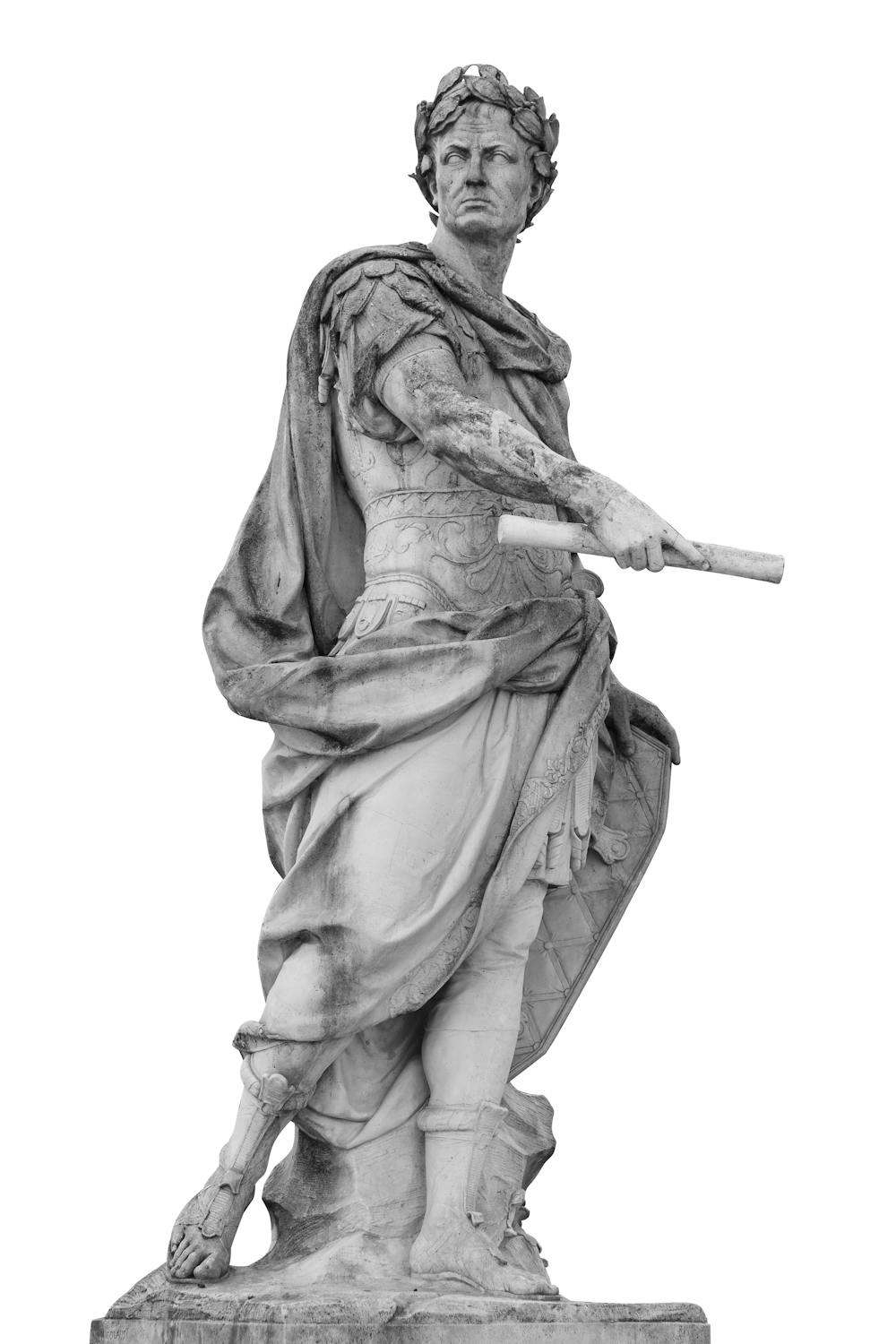
JULY: This month used to be called Quintilis – the Roman word for “fifth” as it was the fifth month of the Roman year. It was later changed to July by Emperor Julius Caesar after his family name (Julius). An emperor is like a king, only more powerful.

Here’s the Roman emperor Julius Caesar, who decided to name a month after his family name (Julius). He called it July. Shutterstock

AUGUST: This month was first called Sextillia – the Roman word for “sixth”, as it was the sixth month of the Roman year. It was later changed to August by the Emperor Augustus, and he named it after himself.

SEPTEMBER: The name for this month comes from the Roman word for “seventh” – septimus – as it was the seventh month of the Roman year.

OCTOBER: The name for this month comes from the Roman word for “eighth” – octavus – as it was the eighth month of the Roman year.

NOVEMBER: The name for this month comes from the Roman word for “ninth” – nonus – as it was the ninth month of the Roman year.

DECEMBER: The name for this month comes from the Roman word for “tenth” – decimus – as it was the tenth month of the Roman year.

Then a few extra months were added…

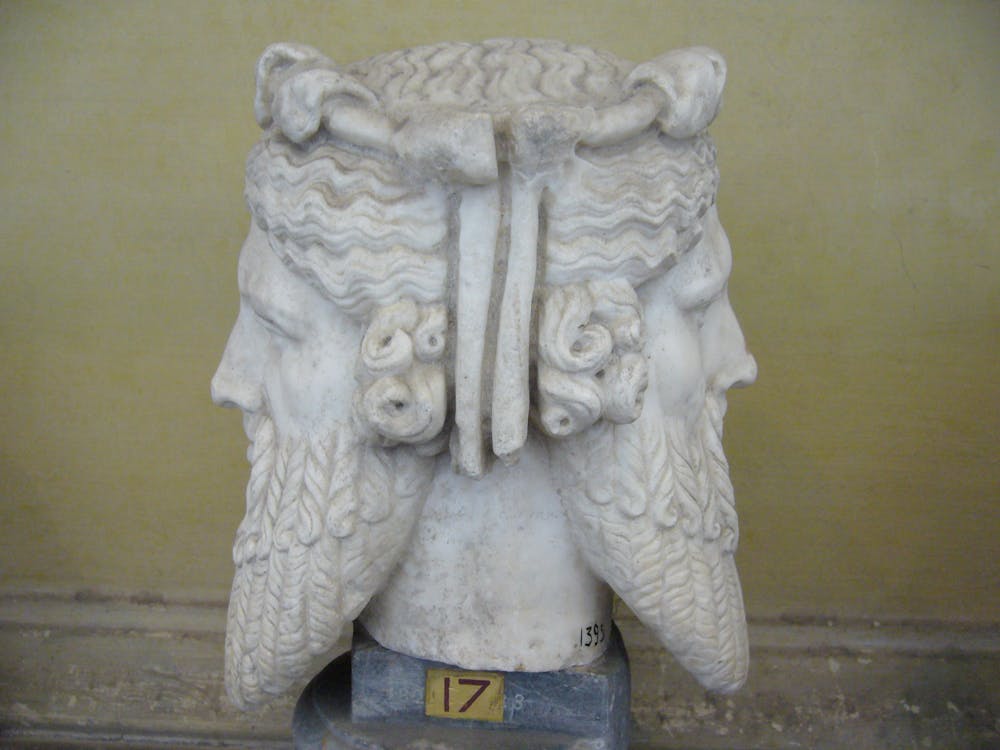
JANUARY: This was one of the extra months that the Romans added to the year. This month was named after Janus – the god of beginnings and endings. He is often depicted as having two faces.

Janus, the god of beginning and endings, is often shown as having two faces. By Loudon dodd – Own work, CC BY-SA 3.0, CC BY

FEBRUARY: This is another extra month that the Romans added to the calendar. They put it right after January. Its name comes from a festival that was held at this time called Februa. The festival aimed to cleanse the city of evil spirits and welcome health and fertility.

Because the Romans put two new months into the year, the names of the months do not make sense anymore. If our year started in March as it did for the Romans, December would still be the tenth month.

But 450 years ago, people who used this calendar started thinking that January was the first month of the year. So now December in the twelfth month for the Western calendar.


Read more: Curious Kids: why are there different seasons at specific times of the year?


Hello, curious kids! Have you got a question you’d like an expert to answer? Ask an adult to send your question to curiouskids@theconversation.edu.au

ref. Curious Kids: how did the months get their names? – http://theconversation.com/curious-kids-how-did-the-months-get-their-names-113558

The swamp foxtail’s origin is hidden in its DNA

]]>

Source: The Conversation (Au and NZ) – By Roderick John Fensham, Associate Professor of Biological Sciences, The University of Queensland

Sign up to the Beating Around the Bush newsletter here, and suggest a plant we should cover at batb@theconversation.edu.au.


Swamp foxtail (Cenchrus purpurascens) is a delightful grass that forms a neat tussock up to a metre tall with a distinctive fluffy spikelet that resembles a fox’s tail.

Foxtails are widely used in horticulture. The purple forms are particularly popular in ornamental gardens and some have even become invasive weeds.

The foxtail grasses are more commonly seen in these cultivated settings, which has led to much confusion about swamp foxtails’ origins in Australia. The species is simultaneously an exotic weed from Asia, the dominant grass in an endangered Australian ecosystem and a rare native species in isolated desert springs.


The Conversation


Is it native?

It was uncertain for a while whether swamp foxtail is actually native to Australia. Although Europeans collected it near Sydney, it was possible the seeds had come with livestock on the early ships.

The plant’s fluffy spikelets resemble a fox tail. Shutterstock

This theory was put to rest by genetic studies that found small populations have existed in inland Queensland for hundreds of thousands of years.

The species spread southward and was first recorded in Victoria in the 1970s.

European records

Robert Brown, the botanist who accompanied Matthew Flinders as he circumnavigated the continent, made the the earliest European collections of the swamp foxtail near Sydney in 1802.

Despite the early date of the collections, it is feasible that the swamp foxtail was brought to Sydney within 14 years of settlement as a byproduct among grain or hay. However, while the species occurs naturally in Asia, the Javanese ports were not on the typical travelling route from Europe.


Read more: Spinifex grass would like us to stop putting out bushfires, please


The intrepid adventurer Ludwig Leichardt later collected this species near the Gwydir River region. This collection provides more convincing evidence the swamp foxtail is native to Australia. It seems unlikely that, in the early years of colonisation, the swamp foxtail had been transported overland with the squatters who were spreading out from their successful properties in the Hunter Valley.

The spread southward

The history of herbarium records, from collections in the late 1800s and early 1900s, suggests swamp foxtail might have been native to Queensland and New South Wales.

Collections south of these locations happened after 1940. The species was not recorded in Victoria until the 1970s. It seems almost certain the swamp foxtail spread southward during the 20th century, in some places as an undesirable weed.

Unusual and isolated habitats

Aboriginal fire management possibly maintained natural grassy openings among the northern NSW rainforests. The curious “grasses”, as they were named, are well documented on early survey plans of the Big Scrub country. Many a place name, Howards Grass Road and Lagoon Grass Road among them, bear testament to their existence.

The surveyors provided detailed recordings of the dominant grass on the valley floors: the “foxtail”. The swamp foxtail is now rather rare on the valley floors of the Richmond and the Tweed River valleys, replaced by crops on prime agricultural land. It managed to survive in a few locations west of Murwillumbah and on springs, but large expanses of the foxtail grasslands have succumbed to the plough.

An extremely isolated population of the swamp foxtail at Elizabeth Springs in western Queensland. Author provided

A particularly unusual habitat for the swamp foxtail is the artesian springs that feed permanent wetlands in the semi-deserts of inland Queensland. The swamp foxtail occurs there in very local populations separated by hundreds of kilometres.

This raises the question: is the swamp foxtail a recent arrival on these tiny, strange and isolated ecosystems, or are these ancient populations?

Genetic studies have provided conclusive evidence of an ancient origin. The oldest lineage is the population at Elizabeth Springs to the south of Boulia. Its molecular signature suggests this population has been isolated for hundreds of thousands of years.

Where swamp foxtail does occur at springs, it is always accompanied by rare species that are seen only in those unusual wetlands.


Read more: Grass trees aren’t a grass (and they’re not trees)


Crossing continents and climates

Swamp foxtail demonstrates the complexity of defining a species’ origin. This species probably evolved in Asia, because this is where most of its relatives are found. It found its way to Australia, possibly through a migratory bird that dropped a seed in a desert spring.

It then had a second migration, either from the springs or from a repeat dispersal from Asia, and found a niche in the valley floors of subtropical landscapes. It was abundant in these moist and fertile habitats when Europeans colonised the continent in 1788.

Since then, the swamp foxtail has spread to temperate climates where it has become invasive and, in some situations, a minor pest. Quite a journey.

ref. The swamp foxtail’s origin is hidden in its DNA – http://theconversation.com/the-swamp-foxtails-origin-is-hidden-in-its-dna-114731

‘Explain your wealth, don’t lose your cool,’ PCIJ tells Duterte

]]>
The Philippine Center for Investigative Journalism looks into the wealth of President Rodrigo Duterte and his family, drawing the ire of the President. Duterte. Image: Rappler montage/Malacañang/Shutterstock

By Rappler

The Philippine Center for Investigative Journalism has responded to what it called President Rodrigo Duterte’s “broadsides” aimed at PCIJ’s recent reports on the Duterte family’s wealth, saying there was no reason for the President to “lose his cool”.

“The PCIJ report was built on the Dutertes’ own declarations in their SALNs (Statements of Assets, Liabilities, and Net Worth) and data from official government records,” said PCIJ executive director Malou Mangahas in a letter sent to media groups.

“PCIJ had wished only for the Dutertes to offer clear, direct, straightforward replies to our queries. Instead of blaming PCIJ for the report. Mr Duterte should turn his attention [to] his deputies, notably Presidential Legal Counsel Salvador Panelo, for the failure of [the] Office of the President to attend to PCIJ’s request letters, over the last 5 months.”

READ MORE: The Duterte millions – Rodrigo, Sara, Paolo mark big spikes in wealth while in office

DUTERTE: Rich man, poor man, mayor, President. Graphic: PCIJ

On Saturday, April 6, the President claimed it was money driving investigative reports. While he did not mention PCIJ by name, the comments were made in the aftermath of the investigative group’s three-part report, “The Dutertes: Wealth Reveal & Riddles”.

“Makita mo ‘yung utak ng mga investigative journalism kaya…. Pera-pera lang. Binabayaran ‘yan kung gano’n kalaki. Pati nung lawyering ko,” said the President.

-Partners-

(Look at how those in investigative journalism think…. It’s all about money. They get paid a huge sum if the story is that big. They even included my lawyering.)

The series reported that members of the Duterte family may have participated in conflicts of interest, declared assets inconsistently, were affiliated with an unregistered law firm, were found with “sudden, sharp” increases in wealth while in public office, and emerged from elections with their personal funds largely intact.

Opaque data
President Duterte and his children Sara and Paolo separately and together offer token or opaque data that, under the law, they are required to reveal in their SALNs
Duterte, Sara, Paolo mark big spikes in wealth, cash while in public office

How and why their fortunes are rising remain a mystery; the numbers do not seem to add up, reports PCIJ

The President said his late mother, Soledad Roa Duterte, was responsible for the family’s wealth.

“Putang ina ninyo. Hoy, ‘yung mga dilaw, all the time I was with my mother. Maski na noong mayor na ako, ang nagpapakain sa akin nanay ko. ‘Yung nanay ko ang may pera. ‘Yun ang nanay ko nag-iwan ng pera sa amin. Pero kung magkano, eh bakit sabihin ko sa inyo?” asked Duterte.

(You sons of whores. You yellows, I was with my mother all the time. Even when I was still mayor, it was my mother who fed me. My mother was the one who had the money. It was my mother who left money for us. But as to how much, why would I tell you?)

Better to have responded
PCIJ said it has reported on the wealth and the controversies of 5 presidents before Duterte: Benigno Aquino III, Gloria Macapagal Arroyo, Joseph Estrada, Fidel Ramos, and Corazon Aquino.

PCIJ detailed its efforts to solicit comments from the Duterte camp in letters sent beginning October 2018. According to Mangahas, it would have been “far better had Mr Duterte, daughter and Davao City Mayor Sara, and son and former Davao City vice mayor Paolo granted PCIJ’s request for comments, and possibly sit-down interviews, before the story ran.”

“Eh ngayon, tinitira kami ng mga anak ko. All about lawyering. Ano ba naman pakialam nila na what happened to my law office?” Duterte said in Iloilo City.

(Now, my children and I are being attacked. All about lawyering. What do they care about what happened to my law office?)

Among its findings, PCIJ reported that “the President, Sara, and Paolo separately and together offer a muddled mix of token or opaque data” in their SALNs.

PCIJ found spikes in the net worth of Duterte and his children. PCIJ said the President, Sara, and Paolo “have all consistently grown richer over the years, even on the modest salaries they have received for various public posts, and despite the negligible retained earnings reflected in the financial statements of the companies they own or co-own.”

The numbers, said the investigative group, “do not seem to add up.”

The Pacific Media Centre and Pacific Media Watch collaborate with Rappler and the Philippine Centre for Investigative Journalism.

Print Friendly, PDF & Email

Article by AsiaPacificReport.nz

Commonwealth observer group praises Solomon Islands election

]]>
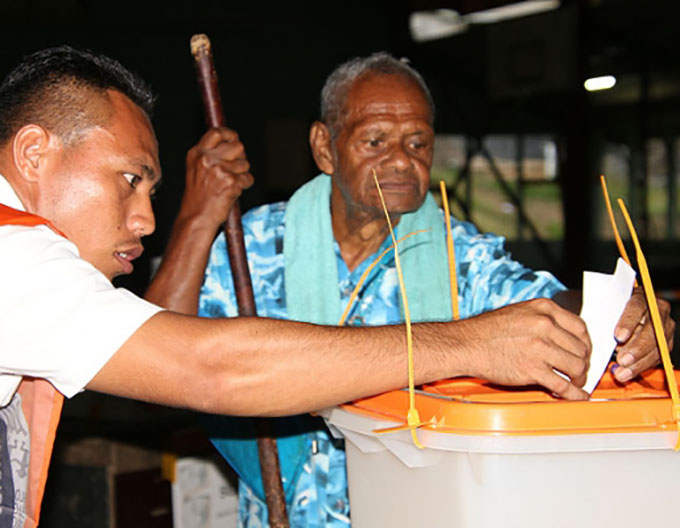
A voting station in the Solomon Islands. Image: Koroi Hawkins/RNZ Pacific

By RNZ Pacific

The Commonwealth observer group has commended the commitment of the people of Solomon Islands to participating peacefully in last Wednesday’s national election.

In a preliminary statement released over the weekend, its chairperson, former Vanuatu prime minister Sato Kilman, said the group acknowledged the efforts of the Solomon Islands Electoral Commission to conduct the election under the country’s new Electoral Act which was brought in just the year before.

Kilman said his group observed some positive aspects of the process and also identified areas that could be improved to enhance the country’s democratic process.

One example of this was the group noted the out-of-constituency voter registration arrangements saw complaints raised about the lack of clarity around the definition of an “ordinary resident” and where citizens can register to vote.

Complaints were also received about the lack of out-of-constituency voting arrangements for those working in essential services areas such as hospitals and those who have had to travel outside of their constituency for work purposes.

The group praised the security operation for the election and acknowledged the logistical support from Australia and New Zealand both to police and electoral authorities.
Solomon Islands election result board

-Partners-

It, however, noted on polling day that several voters were unable to find their names on the lists at polling stations.

Ballot box inconsistencies
They also noted inconsistencies in the way ballot boxes were sealed and labelled and some voting screens needed to be more carefully positioned.

Accessibility to polling stations was also quite difficult in some locations although the group noted where this was the case polling agents did their best to assist the elderly and people with disabilities.

Counting was still underway when the Commonwealth observer group releases their statement but they said there were several areas that could be worked on to improve the efficiency of the count.

Other areas which the group said it would cover in more depth in its final report were concerns about incumbent MPs using Constituency Development Funds in their campaigning, supporting more aspiring women politicians to contest as only 26 out of the 333 candidates were women.

It also made some observations on the limit on campaign funding set out under the country’s new Electoral Act.

This article is republished under the Pacific Media Centre’s content partnership with Radio New Zealand.

Print Friendly, PDF & Email

Article by AsiaPacificReport.nz

Edible seaweed can be used to grow blood vessels in the body

]]>

Source: The Conversation (Au and NZ) – By Aurelien Forget, Lecturer in Macromolecular Chemistry, Freiburg University

When we have small wounds on our skin or muscles they can usually heal by themselves.

But in deeper wounds – such as those in diabetic patients or in muscle tissue after a heart attack – repair is more difficult. These sorts of issues often require more serious treatments, and may eventually need amputation or a transplant if healing is not complete.

While organ transplants save lives, we fall short in available organs for this procedure, and alternative methods are needed.

Technology such as bioprinting has been proposed to build fully functional organs outside the body. But what if we could boost our own regenerative capabilities? Would it be possible to create the organs inside the body?


Read more: The next pharmaceutical revolution could be 3D bioprinted


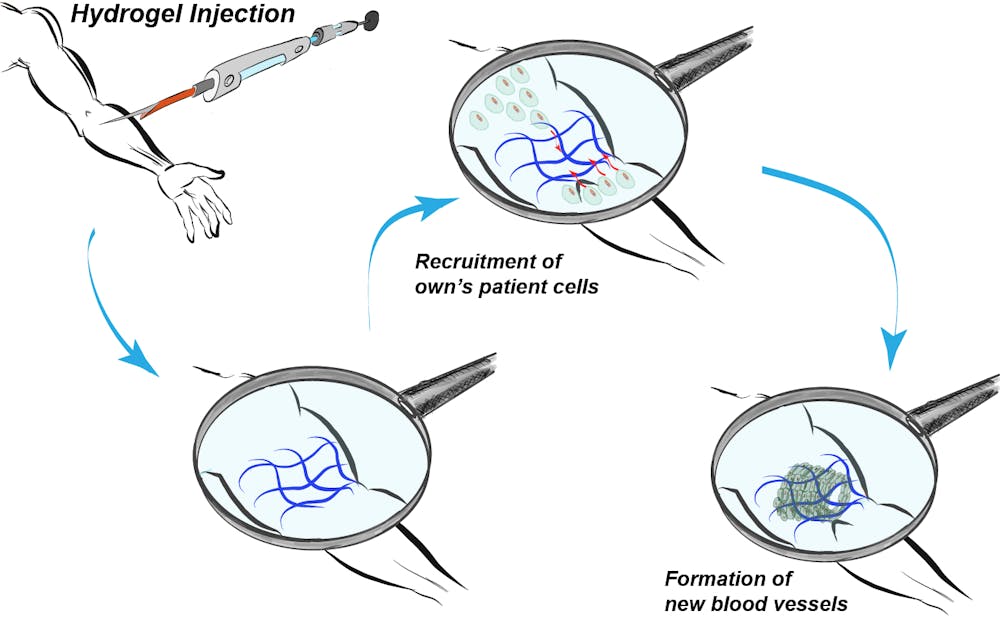
In a recent publication we demonstrate that by a simple injection of a gel extracted from edible seaweeds, we can direct the body to create stable blood vessels in a muscle. These vessels are the key in helping tissue to live.

These results are an important step toward regenerative therapies based solely on biomaterials.

What are regenerative therapies?

Regenerative therapy (also called regenerative medicine) is an area of research that combines medicine, molecular biology, and biotechnology. It aims to engineer tissues or organs and restore normal function.

As an example, 3D bioprinting has had some success, such as the creation of implantable corneas for the eye.

But this approach requires specialised manufacturing facilities. The cells must be isolated, grown in a bioreactor – a special vessel providing the right environment for tissue growth – and used to create artificial organs under controlled and sterile conditions.

Process of biofabrication of patient specific organs. Steffen Harr

A new approach emerged a couple of years ago. This uses the body to produce a particular type of tissue or cells, and is called the in vivo (in the body) bioreactor. This was initially developed to make bones.

To create tissue in the human body, we need to trigger and exploit our own regenerative capabilities. Unfortunately we are not as good as salamanders: we can’t regrow a new limb.

But with some help, we could regenerate individual tissues. To achieve this, the help can come in the form of materials that:

  • reproduce the tissue properties needed, such as the stiffness of the tissues, and

  • carry chemical and biological signals that can direct the tissue growth.

A tissue is defined as a group of cells working together for a specific function. As an example, muscle tissues are made of cells organised into fibres, forming the so-called muscle fibres.

Materials that can talk with cells

Our body’s tissues are made up of many different cell types, and also materials that exist outside the cells. These materials are known as the extracellular matrix (ECM).

The ECM is made up of several different elements. It holds water, and also stores vital information to help cells move, grow and organise into functional tissues.

We don’t need to go into the details of what the ECM is made of here. But what we can say is that scientists can copy many of its functions using a gel-like material called hydrogel. This can be modified to pass specific biological information to cells.

Edible seaweed to create blood vessels

We have been developing a new class of injectable hydrogel.

The material making the hydrogel is called agarose, which is also used to make jelly cakes in the kitchen, and in biology laboratories to separate DNA.

Agarose is a polysaccharide – a long chain of sugar – that is extracted from red seaweed found in many oceans around the world.

Agarose powder used in the laboratory for the separation of DNA and agar used to make jelly cakes. Aurelien Forget

In our lab, we can modify agarose by attaching a small molecule (a peptide) that will talk to the cells. Using this approach, we have created a unique formulation of the hydrogel that provides the ideal environment for certain cells to organise into blood vessels.

Now in our latest work with collaborators at the University Hospital of Basel, we show that this same hydrogel injected into muscle can “talk” to the body and initiate the formation of new blood vessels.

Previously, only cartilage or bone could be regenerated within the body.

Formation of new blood vessels induced by an injectable therapeutic material. Steffen Harr

Future therapies

This approach paves the way for the creation of a new class of therapies in which injectable materials could become as useful as pharmaceutical drugs.

We envision that in certain cases a patient with a defect organ might one day be able to get an injection of a material that will carry with it information to talk to cells and direct their organisation into new functional tissues.


Read more: The ‘painless woman’ helps us see how anxiety and fear fit in the big picture of pain


This approach would let our body do most of the complicated tasks, in contrast to cell therapies or bioprinting of organs outside the body – where cells must be harvested, grown and re-implanted. Materials therapies would be highly valuable for patients in remote location where complex infrastructures are not available.

More speculatively, organ bioprinting is considered as one of the critical technologies for the expansion of the humans to other planets.

By using regeneration-triggering materials to overcome injuries or disease we could leave the critical repair task for our body. Perhaps one day a person living in space would be able to inject themselves with one of these materials.

ref. Edible seaweed can be used to grow blood vessels in the body – http://theconversation.com/edible-seaweed-can-be-used-to-grow-blood-vessels-in-the-body-112618

What the data say about discrimination and tolerance in New Zealand

]]>

Source: The Conversation (Au and NZ) – By Simon Chapple, Director, Institute for Governance and Policy Studies, Victoria University of Wellington

Following the Christchurch mosque shootings, there has been considerable discussion of intolerance and experiences of discrimination in New Zealand.

For example, Anjum Rahman, a spokesperson for the Islamic Women’s Council, has expressed concerns about rising levels of discrimination against the Muslim community.

This discussion has been driven by specific examples of discrimination or intolerance. Such anecdotes clearly prove wrong the idea that New Zealand is free of discrimination or intolerance, but they provide no evidence of societal prevalence of such experiences and attitudes.

My aim here is to consider data on the occurrence of discrimination and the extent of tolerance across New Zealand society, in aggregate and by different groups. This allows some generalisable conclusions about what we do and don’t know.

Experiences of discrimination

Stats NZ’s most recent General Social Survey (collected between April 2016 and April 2017) allows a consideration of local discrimination and tolerance. It uses an officially collected and statistically representative population sample. It also enables an analysis by subgroups defined by migrant status, main ethnic category and region.

Aggregating across all experiences of discrimination (e.g. by ethnicity, age, gender, dress, language, religion, sexual orientation etc), and hence maximising reported discrimination, most New Zealanders (83.1%) report no discrimination in the previous year. There is little difference in reported discrimination between New Zealand-born people (83.5% report no discrimination) and long-term migrants (83.7%). However, while a large majority of recent migrants (74.3%) report no discrimination, the figure was smaller.

Across all major ethnic categories, the large majority report no discrimination. Of New Zealand Europeans, 85.4% report no discrimination. Rates for Pacific (80.1%), Māori (74.4%) and Asian New Zealanders (73.4%) are lower, but still high.

In terms of regional differences, 83.1% of Cantabrians (where Christchurch is) report no discrimination, identical to New Zealand-wide rates. On this evidence, Canterbury is not a local hotbed of discrimination.

How big are the observed difference in discrimination between groups reported above? The standard social science approach divides population differences into “small”, “medium” and “large”. On the basis of this division, the most elevated experiences of discrimination experienced by ethnic minorities and recent migrants are closest to small in size.


Read more: Can religious vilification laws protect religious freedoms?


Tolerance of ethnic and religious diversity

In terms of tolerance, the large majority of New Zealanders are comfortable or very comfortable with a neighbour with a different religion (87.4%). They feel the same comfort regarding a neighbour from a different ethnic group (88.7%).

The one case where only a small majority express comfort involves a neighbour with a mental illness. Only 53.2% of people are very comfortable or comfortable here.

There are no notable differences in tolerance by migrant status, ethnic category or region. Hence, with the exception of the mentally ill, all groups share a majority value of out-group tolerance, and harbour a similar small share of the intolerant.

There is no official data on discrimination experienced by Muslim New Zealanders compared to other groups. Equally, there is no official data on Muslim tolerance of other ethnic and religious groups as neighbours.

However, there is information from the New Zealand Attitudes and Values Study on negative attitudes, in the form of reported anger. People report on a 1 to 7 scale, where 1 is “No anger”, 4 is “Neutral”, and 7 is “Anger”. People report on anger towards several main ethnic categories, as well as Muslims, a religious group. In terms of the sampling approach, these data are less well suited for answering population questions than the official Statistics New Zealand data.

Bearing this caveat in mind, the survey shows a broad lack of out-group negativity. Most societal responses fall between “No anger” and “Neutral”. For example, 91.3% of non-Pacific people report “No anger” to “Neutral” attitudes towards Pacific people. Comparable out-group figures for Asians are 90.3%, for New Zealand Europeans 87.3% and for Māori 86.0%.

All these figures are basically identical. For Muslims the number is slightly lower at 81.9%. But in all cases the share of society in the “No anger” to “Neutral” zone is a large majority. Equally, differences between Muslims and ethnic groups are small.

Unfortunately there are no other religious groups where the anger question is asked. This means there is no benchmark to compare out-group anger towards Muslims. Data on anger towards Evangelical Christians, Hindus or Jews are not collected.


Read more: After Charlottesville, how we define tolerance becomes a key question


While discrimination experienced by minority groups, defined by migrant status and ethnic category, clearly exists, it is not the experience of a large majority of New Zealanders from any of these groups. Furthermore, group differences are small.

The large majority of New Zealanders also seem to be tolerant, including of different ethnic groups and religions, and are not angry, as far as one can tell, towards Muslims.

There appears to be, however, a small elevation in anger towards Muslims compared to ethnic groups. But whether anger is greater towards Muslims compared with other religious minorities remains unclear from the available evidence. It is worth observing that all religious groups, Muslim or otherwise, are minorities in New Zealand.


Many thanks to Chris Sibley, at the University of Auckland, for making the data from the New Zealand Attitudes and Values Study available. Errors and opinions are mine alone.

ref. What the data say about discrimination and tolerance in New Zealand – http://theconversation.com/what-the-data-say-about-discrimination-and-tolerance-in-new-zealand-114369

What will the Turnbull-Morrison government be remembered for?

]]>

Source: The Conversation (Au and NZ) – By Rob Manwaring, Senior Lecturer, Politics and Public Policy, Flinders University

This article is part of a series examining the Coalition government’s record on key issues while in power and what Labor is promising if it wins the 2019 federal election.


When the “mighty Roman” Gough Whitlam died, Indigenous leader Noel Pearson delivered a memorable eulogy. Channelling Monty Python, Pearson asked what had Whitlam ever done for Australia? Pearson then reeled off a long list of achievements, including Medibank, no-fault divorce, needs-based schools funding, the Racial Discrimination Act and many more. This was a blistering set of reforms by a truly radical and activist government.

After close to four years of the Turnbull and Morrison Coalition government, we might well ask: “What has the Coalition done for us?”

It is hard to think of a single notable achievement for which the government will be credited or remembered. If we take another government as ideologically driven as Whitlam’s – albeit from a different vantage point – in this case John Howard’s, we can still recall a significant range of policies and changes. Chief among these was gun control.

In contrast, we are hardly likely to remember the Turnbull-Morrison governments.


Read more: Grattan on Friday: Scott Morrison struggles to straddle the south-north divide


In 2016, if we vaguely recall, there was a double-dissolution election – but could many voters even remember why? Ah, the trigger was the ill-fated Australian Building and Construction Commission, which did not even feature during the election campaign.

Since then, what have been the major policy achievements?

The National Energy Guarantee? If the government is likely to be remembered at all, it will be for the deep-seated divisions that meant Malcolm Turnbull was entirely unable to deliver a clear and coherent energy and climate policy. This was, after all, a government that chose to ignore Chief Scientist Alan Finkel’s call for a Clean Energy Target.

Tony Abbott’s reversal on withdrawing from the Paris Climate Agreement (under Turnbull), but then arguing Australia should stay in (especially with Angus Taylor’s masterful handling of the data on emissions) reflected a policy agenda dogged by internal divisions and incoherence.

Scott Morrison’s major contribution to the debate was to bring a piece of coal into the parliament.


Read more: What kind of prime minister will Scott Morrison be?


Perhaps immigration? Turnbull was forced to rescue a deal initially brokered with the Obama administration, after new President Donald Trump mocked the deal as “stupid”. With the government wedded to a “tough” border policy, including re-opening the detention facility on Christmas Island, it even lost the vote on “medevac” legislation to ensure medical treatment for suffering refugees.

Any lasting achievements that seem to have happened were only because the government was either forced to, or reluctantly accepted it needed to, make changes. On the banking royal commission, Morrison – a political leader resolutely wedded to remain on the wrong side of history – had initially described it as a “populist whinge”. Any systemic changes to the banking sector will emerge, in spite of, rather than because of the government’s actions.

Turnbull will point to legislating for same-sex marriage as one of his government’s signature policy achievements, following the plebiscite. Yet Morrison will hardly be trumpeting this achievement, given that he voted against it.

Yes, same-sex marriage should be a lasting and welcome change, but again, the Coalition did much to resist it.

In stark contrast, German Chancellor Angela Merkel enabled a parliamentary vote but then voted against it – a more principled position than the unnecessary plebiscite. This was a government that consistently showed it was behind public opinion on a range of issues.

There is a case that underneath the general political and policy mess of the Turnbull-Morrison era, the government notched up some quiet achievements. These include a free-trade deal with Indonesia, entering the fourth phase of the bipartisan national plan to reduce family violence, and trying to embed the Gonski 2.0 schools funding.

Many public servants across a range of portfolios were busily, professionally carrying out a range of important policies and programs out of the media glare. This reflects a long-standing view of government as policy incrementalism – carrying out the everyday, important, but unglamorous work of running the country.

Perhaps the greatest missed opportunity of the Turnbull-Morrison era has been a consistent failure to adequately represent the concerns and issues of the centre-right of Australian politics. Neither Turnbull or Morrison understood the promise of Burkean conservatism or even John Stuart Mill’s liberalism.

Worse still, in the case of the Nationals, there was an almost wilful inability to offer a coherent and reasoned case on behalf of regional Australia. As Coalition MPs scratch their heads and wonder where it all went so horribly wrong, they might well look at South Australia and now New South Wales to remind themselves what a “liberal” government looks like.

Indeed, if we needed a lasting image of the Nationals’ mishandling of the water portfolio, then the dead fish of the Menindee will suffice.

As Scott Morrison most likely exits the prime ministership, a different kind of Roman to Whitlam, his only comfort might be that he is not Theresa May.

ref. What will the Turnbull-Morrison government be remembered for? – http://theconversation.com/what-will-the-turnbull-morrison-government-be-remembered-for-114618

We asked five experts: should we nap during the day?

]]>

Source: The Conversation (Au and NZ) – By Alexandra Hansen, Chief of Staff, The Conversation

Often during the day I feel the need to have a bit of a lie-down. Whether it’s been a busy day, I didn’t sleep well the night before, or for no particular reason I know of. But some will warn that you’ll be ruined for sleep that night if you nap during the day.

We asked five experts if we should nap during the day.

Four out of five experts said yes

Here are their detailed responses:


If you have a “yes or no” health question you’d like posed to Five Experts, email your suggestion to: alexandra.hansen@theconversation.edu.au


None of the authors have any interests or affiliations to declare.

ref. We asked five experts: should we nap during the day? – http://theconversation.com/we-asked-five-experts-should-we-nap-during-the-day-112523

Mercury pollution from decades past may have been re-released by Tasmania’s bushfires

]]>

Source: The Conversation (Au and NZ) – By Larissa Schneider, DECRA fellow, Australian National University

Tasmania’s bushfires may have resulted in the release of significant amounts of mercury from burnt trees into the atmosphere. Our research shows that industrial mercury pollution from decades past has been locked up in west Tasmanian trees.

Mercury occurs naturally in Earth’s crust. Over the past 200 years, industrial activities have mobilised mercury from the crust and released it into the atmosphere. As a consequence, atmospheric mercury concentrations are now three to four times higher than in the pre-industrialisation era.

Mining is the largest source of the global atmospheric mercury, accounting for 37% of mercury emissions. When Europeans first arrived in Australia, there was, of course, no Environmental Protection Act in place to limit emissions from industrial activities. In western Tasmania, where mining has occurred for more than a century, this meant mercury was being released without control into the local atmosphere until changes in technology, market conditions, and later, regulation, conspired to reduce emissions.


Read more: Australia emits mercury at double the global average


Because mercury is also very persistent in the environment, past mining activity has generated a reservoir of mercury that could be released to the atmosphere under certain conditions. This is a concern because even small amounts of mercury may be toxic and may cause serious health problems. In particular, mercury can threaten the normal development of a child in utero and early in its life.

Tree rings can reveal past mercury contamination

How much mercury has been released into the Australian environment and when has remained largely unknown. However, in a new study we show how mercury levels in Tasmania have dramatically changed over the past 150 years due to mining practices. Long-lived Huon pine, endemic to western Tasmania, is one of the most efficient bioaccumulators of mercury in the world. This makes it a good proxy for tracking mercury emissions in western Tasmania. If concentrations of mercury in the atmosphere are high in a given year, this can be detected in the annual ring of Huon pine for that year.

Mercury pollution from past mining practices in western Tasmania has left a lasting environmental legacy. The sampled trees contained a significant reservoir of mercury that was taken up during the peak mining period in Queenstown. Changes in mercury concentrations in the annual rings of Huon pine are closely aligned with changes in mining practices in the region.

Increased concentrations coincide with the commencement of pyritic copper smelting in Queenstown in 1896. They peak between 1910 and 1920 when smelting was at its height. In 1922, concentrations begin to decline in parallel with the introduction of a new method to separate and concentrate ores. This method required only one small furnace instead of 11 large ones. In 1934, a new dust-collection apparatus was installed in the smelter’s chimney, coinciding with the further decrease in mercury concentrations in nearby Huon pine.

Temporal tree rings of Huon pine, revealing historical mercury pollution. Author provided

Toxic elements or compounds taken up by vegetation can also be released back into the local environment. Bushfires that burn trees that have accumulated mercury may release this mercury as vapour, dust or fine ash, potentially exposing people and wildlife to the adverse effects of mercury. It is estimated that bushfires release 210,000kg of mercury into the global atmosphere each year. As these fires become more frequent and ferocious in Australia, mercury concentrations in the atmosphere are likely to increase. Mercury released by bushfires can persist in the atmosphere for a year, allowing for long-distance transportation depending on wind strength and direction. This means that mining activity from over a century ago may have regional implications in the near future. The Tasmanian fires in December-February burned almost 200,000 hectares, including areas around Queenstown.

It is not currently possible to know how much mercury has been released by these recent fires. Our results simply highlight the potential risk and the need to better understand the amount of mercury taken up by vegetation that may one day be released back to the atmosphere via bushfires.

Re-release of historical mercury emissions by bushfires. Author provided


Read more: Dry lightning has set Tasmania ablaze, and climate change makes it more likely to happen again


Although there is no simple way to remove bio-accumulated mercury from trees, the history of mercury contamination recorded in tree rings provides important lessons. Decreased uptake of mercury after upgrades to the Queenstown copper smelter operations demonstrates the positive impact that good management decisions can have on the amount of mercury released into the environment.

To control mercury emissions globally, the United Nations Environment Programme (UNEP) has developed the Minamata Convention on Mercury. Its primary goal is to protect human health and the environment from the negative effects of mercury. Australia has signed the convention and but has yet to ratify it. Once ratified, Australia would be required to record sources of mercury and quantify emissions, including those from bushfires.

But to do this, the government must first be able to identify environmental reservoirs of mercury. Our study, the first of its kind in the Southern Hemisphere, shows that the long-lived Huon pine can be used to for this purpose. Further work to determine what other tree species record atmospheric emissions of mercury and other toxic elements in other regions of Australia is required.

ref. Mercury pollution from decades past may have been re-released by Tasmania’s bushfires – http://theconversation.com/mercury-pollution-from-decades-past-may-have-been-re-released-by-tasmanias-bushfires-114603

Casual academics aren’t going anywhere, so what can universities do to ensure learning isn’t affected?

]]>

Source: The Conversation (Au and NZ) – By Dorothy Wardale, MBA, Deputy Director, Curtin University

More Australian universities are relying on casual academics to teach their students. It’s difficult to estimate the exact proportion of academic staff on casual contracts, but reports suggest up to 80% of undergraduate courses in some Australian universities have been taught by a casual academic. By mid-2018, an estimated 94,500 people were employed at Australian universities on a casual basis, primarily in teaching-only roles.

Research suggests the higher education sector is the third largest employer of casual staff globally, just behind health- and social-care and retail.

Although casual academics are on temporary contracts, some have been working for universities longer than their colleagues on continuing contracts. This trend is not unique to Australia. There are concerns the number of casual academics working in higher education is growing worldwide. Current research suggests several explanations.

First, the casualisation of academic labour mirrors the growing number of part-time and temporary contracts in other employment sectors.

Second, casual academic contracts provide workforce flexibility at a time when student enrolments are fluctuating and budgets are limited. This means universities can service their teaching needs on a just-in-time basis.

Third, because casual academic contracts have none of the benefits of continuing contracts, they allow employers to reduce overall labour costs .

Using casual academics brings benefits and challenges. But casualised labour won’t be done away with any time soon. We suggest universities manage their casualised staff more effectively and equitably – and bring their employment conditions as close to those of permanent staff as possible.


Read more: Self-employment and casual work aren’t increasing but so many jobs are insecure – what’s going on?


Concerns about casual academics

There are growing concerns about the impact of casual academics on the quality of teaching. Australia’s higher education regulator, for example, states that an “unusually high reliance on casual staff poses risks for the quality of the students experience″.

Our unpublished research suggests casual academics are often recruited on an ad hoc basis, which is unlike the highly regulated recruitment processes for continuing staff. This means more reliance on personal connections, short notice and limited market searches.

Continuing staff are usually required to complete some form of professional development to keep up-to-date with teaching and research innovations. However, professional development for casual academics is often limited, with little oversight from the employer. In some instances it has to be in their own time and at their own expense.

Short lead-in times to a casual contract also leave casual academics with little time to prepare course materials. Nor do they allow enough time to understand institutional cultures and policy requirements. Institutions with high numbers of casual staff may also find it difficult to ensure continuity of course offerings which can impact on student learning.


Read more: How does being second-last in the OECD for public funding affect our unis?


Benefits of casual academics

Despite these concerns, casual academics also bring important benefits to higher education. Many are industry professionals with a deep understanding of the real world practices they are teaching. They can also connect students and other university staff to their industry networks. This can create opportunities for industry research projects and student internships.

Research also shows that many casual academics have high levels of commitment to their students. They regularly go beyond their contractual obligations by writing job references, providing career advice and making connections for future employment.

From the perspective of the individual casual academic, casual academic work is something of a double-edged sword. Some enjoy the flexibility of not having to fulfil service requirements such as attending meetings and annual performance reviews. Yet they also miss out on the benefits of being part of an academic community. This includes restricted opportunities for conference travel, professional development and promotion.

Many casual academics enjoy the flexibility of working across different institutions. Yet they must also contend with less job security. There is no guarantee of work from one semester to the next, which creates a lack of financial security and benefits. For younger cohorts, this is especially problematic for mortgage applications and other loans.


Read more: The costs of a casual job are now outweighing any pay benefits


How to make it better

There is an urgent need for a more effective and equitable approach to managing casual academics. Providing more permanent contracts may be one solution, budgets permitting, but there are other options. Besides, some casual academics prefer to retain the flexibility of casual work.

Recruitment and selection of casual academics needs to be more rigorous. Clear job specifications are essential, with systematic interviewing and transparent decision making for all appointments.

There also needs to be enough lead-in time to ensure adequate preparation before the start of a course. Effective induction to institutional learning and teaching policies is also required – especially for new appointees.

Professional development opportunities need to be embedded into work contracts with time paid for by the employer. More attention also needs to be paid to support financial security, including a review of financial institutions’ loan policies.

Increased competition and budget cutbacks in the global higher education sector mean the use of casual academic labour will increase even further. Institutional policy makers must work effectively with these important partners in the education of the future labour force.

ref. Casual academics aren’t going anywhere, so what can universities do to ensure learning isn’t affected? – http://theconversation.com/casual-academics-arent-going-anywhere-so-what-can-universities-do-to-ensure-learning-isnt-affected-113567

$500m for station car parks? Other transport solutions could do much more for the money

]]>

Source: The Conversation (Au and NZ) – By Nathan Pittman, PhD Candidate in Transportation Planning, University of Melbourne

Half a billion dollars sounds like a lot of money, but that really depends on what you’re spending it on. In Tuesday’s federal budget, the Coalition government announced its Commuter Car Park Fund, a A$500 million package intended to make it easier for people in the suburbs and regions to drive to their local railway station.

While this is a drop in the ocean compared with the wider transport infrastructure budget, we’re going to use it here as a starting point to run some thought experiments to see if this is the best way to spend our taxes to help people get around.


Read more: Congestion-busting infrastructure plays catch-up on long-neglected needs


How much car parking could we buy for $500 million?

The construction cost for a single parking spot can range from A$10,000 for a surface car park to A$68,000 per space in multi-level structures. So, if all the money is spent on surface car parks, the new fund could build 50,000 spaces at railway stations around Australia.

Of course, not all of these spots are going to be in surface parking lots – some will need to be in multi-level parking garages. So, if we built one multi-level space for every five at ground level, the A$500 million earmarked in the budget would buy us 30,000 parking spaces.


Read more: Budget transport spending is about par for the course, but the pattern is unusual


Does increased parking increase transit usage?

If these 30,000 park-and-ride spaces at train stations are built, this is unlikely to lead to an increase in transit patronage. It could even run counter to providing good public transport.

On the day of the 2016 Census, 1,225,668 people used public transport to get to work. Generously assuming that a single car has an average of 1.5 passengers, the Commuter Car Park Fund might enable only 45,000 extra people to access the public transport network. That’s a tiny 4% of the current number of people who travel to work by public transport.

But studies show that only a small proportion of park-and-riders had previously commuted by car all the way to their destination. Many are existing passengers who used to walk, cycle, bus or drive to a different station but are now opting to drive to the station with new parking places. Non-commuters working or shopping in nearby activity centres also often use park-and-ride spaces.

There are at least 705 train stations in metropolitan Australia, and it is not clear from the budget papers where these extra parking spaces are going to be placed. Sydney has 176 train stations, Melbourne has 218, Southeast Queensland has 152, Adelaide has 89, and Perth has 70. Even assuming only 300 stations will need extra parking, that provides an average of only 100 new spaces per station.


Read more: This is how regional rail can help ease our big cities’ commuter crush


More bang for your buck

There are cheaper ways to move an extra 45,000 people a day to and from railway stations and around our cities.

Linking a major university campus with a Skytrain station, Vancouver’s 99 B-Line bus service moves 56,000 passengers a day at a cost of less than C$14 million ($A14.7 million) a year.

Similarly, in Toronto, the Finch West bus service carries 44,000 passengers a day to and from the subway. The Toronto urban transit network moves more than a million people a day with an annual operating subsidy of C$713 million.

Passengers transferring from the Metro to a feeder bus in suburban Montreal. Iain Lawrie/University of Melbourne, Author provided

Each of these cities has comparable urban landscapes to suburban Australia, but is able to offer buses to nearby stations every five minutes.

We understand that these costs are not necessarily directly comparable. We provide them though as a point to think about, and so you might begin to ask how our cities could be better configured.


Read more: Don’t forget buses: six rules for improving city bus services


Better land use around train stations?

Alternatives like direct and frequent buses could liberate space around our suburban train stations. Around the world, stations are community hubs, and even simple stations can be wonderful, vibrant places for people. The best ones are a pleasure to move through and spend time in, unencumbered by the conflict and noise of space dominated by car traffic.

Building car parks wastes that place potential. Instead, it bakes in the mobility habits and planning prejudices that condemn our public places to being grey deserts, difficult to move through, and keeping out parks, shops, gardens, street life, walkability and human interaction.

Unsealed car parking at Tarneit station in Melbourne’s western suburbs. Paul Fleckney/University of Melbourne, Author provided


Read more: Freeing up the huge areas set aside for parking can transform our cities


Underpinning the futility of the Commuter Car Park Fund is the fact that “demand” for free parking is fundamentally insatiable. Just like urban road space, building more of the wrong infrastructure simply induces more use and perpetuates congestion.

Parking policy scholars and practitioners have known for decades now that parking demand can be successfully managed, including via pricing existing parking supply and improving transport alternatives. Pricing and related policies serve as an effective disincentive to people who don’t need to be driving (and parking), freeing up road space for those who do.

Urban congestion is a problem of the quality and connectivity of our public transport network, not just a parking and road space issue. We have long known the policies and mechanisms to shift higher proportions of people to alternatives (and improve conditions for those who need to drive). We still need the funding and the planning capacity to achieve it.

Australia deserves better transport policy and a clearer, better-informed discussion about how its transport funds are being spent.


Read more: The elephant in the planning scheme: how cities still work around the dominance of parking space


ref. $500m for station car parks? Other transport solutions could do much more for the money – http://theconversation.com/500m-for-station-car-parks-other-transport-solutions-could-do-much-more-for-the-money-114908

Chinese investment in Australia is down 36%. It’s time for a more balanced debate about the national interest

]]>

Source: The Conversation (Au and NZ) – By Hans Hendrischke, Professor of Chinese Business and Management, University of Sydney

Chinese investment in Australia fell 36% in 2018, to A$8.2 billion (US$6.2 billion) from A$13 billion (US$10 billion) in 2017, according to research by KPMG and the University of Sydney Business School.

This is despite Chinese investors still generally regarding Australia as safer and more attractive than most other countries. So 2018 need not be a turning point. But it is cause for reflection.


Chinese direct investment to Australia by value 2007–2018 (US$ million). KPMG/Sydney University database, Author provided (No reuse)


Discussion about Chinese investment in recent years has been dominated by political and security concerns. These concerns need to be balanced by the national interest in economic prosperity. Chinese investment creates jobs, increases export opportunities and deepens relations with our most significant trade partner.

Arguably the pendulum has to swing back to thinking about the economic benefits. We need a more balanced national conversation.

Many losers, one winner

Our data covers direct investments through mergers and acquisitions, joint ventures and new projects. We do not include portfolio investments, such as buying stocks and bonds, which do not result in foreign management, ownership or legal control. Nor do we include residential property sales.

In the mining, agribusiness and services sectors investment fell by more than 90%. In renewable energy it fell by 48%, and in commercial real estate by 31%.

The only sector where investment did not fall was health care, where investment more than doubled to A$3.4 billion. This made health care the biggest investment sector, attracting 41.7% of all Chinese money, relegating commercial real estate (36.7%) to second place.


Chinese direct investment in Australia by Industry in 2018 (percentage of total). The KPMG/Sydney University database, Author provided (No reuse)


The declines were driven by state-owned enterprises pulling back on foreign investment. In 2018 13% of Chinese money came from state-owned enterprises, with 87% from private companies.

This reflects the Chinese government’s greater control of capital outflows and pressure to reduce debt levels, as well as the Australian government’s security concerns about Chinese influence.

It also reflects global dynamics. Chinese investment in Australia is no longer isolated from scrutiny of Chinese investment in North America and Europe. Excluding Chinese technology from telecommunications infrastructure is a notable example.


Read more: Huawei exposes critical weaknesses. We need the infrastructure to engage with China


In the United States, Chinese investment fell 83% to US$4.8 billion from US$29 billion in 2017. In Canada, it fell 47% to US$3.4 billion from US$6.2 billion in 2017.


Accumulated Chinese investment in Australia, US and EU from 2014 to 2018 (US$ billion). KPMG & University of Sydney, Author provided (No reuse)


Balancing competing concerns

Australian governments, corporations and professional advisers need to consider what types of Chinese investments and investors are desired and actively welcome in Australia.

Our report points to areas where Chinese investment is in Australia’s national interest and benefits the global integration and competitiveness of Australian industries.

Health care is a key example.


Chinese investment in Australian health care sector (A$ million). The KPMG/Sydney University database, Author provided (No reuse)


Chinese investment in health care companies has both provided capital for innovation and facilitated entry into the Chinese market.

Take the Chinese private equity firm CDH buying Sirtex Medical Ltd for A$1.9 billion. Sirtex is an Australian medical device company with a treatment for liver cancer. Its acquisition enables expansion into China, which accounts for more half of the global incidence of liver cancer.

In mining, lithium provides an example of Chinese investment adding value. Tianqi Lithium has invested A$700 million in a processing plant in Perth. The plant will provide about 200 jobs and produce 48,000 tonnes of battery-grade lithium hydroxide for export.

Even in food and agriculture, which has generated much controversy over land acquisitions, we see room for advantageous investment processing and value-adding facilities, such as regional abattoirs.

Signalling Australia’s economic interests in Chinese and foreign investment is crucial to Australia’s prosperity.


Read more: Chinese-Australia relations may not be ‘toxic’, but they do need to keep warming up


At a time of global uncertainty, Australian politicians, bureaucrats, business leaders, educational organisations and others must work quietly and respectfully with their Chinese counterparts to allay community concerns and consolidate Australia’s reputation as a welcoming and proactive partner.

The authors contributed to the Demystifying Chinese Investment in Australia Report.

ref. Chinese investment in Australia is down 36%. It’s time for a more balanced debate about the national interest – http://theconversation.com/chinese-investment-in-australia-is-down-36-its-time-for-a-more-balanced-debate-about-the-national-interest-114984

Six books that shock, delve deeply and destroy pieties: your guide to the 2019 Stella Prize shortlist

]]>

Source: The Conversation (Au and NZ) – By Camilla Nelson, Associate Professor in Media, University of Notre Dame Australia

Young people – how they think and feel, how institutions (families, schools, clinics, courts) fail them – are a recurring theme in the books shortlisted for the 2019 Stella Prize.

These six surprising books – four novels, a memoir and a collection of essays – cover subject matter as diverse as grief, loss, history, childhood, and Indigenous resistance. They make risky aesthetic choices. Some feature dazzling experiments with language, structure and form. Despite, or, more likely, because of this, they also have a tight grip on reality.

They are searing and often searching; intent on excavating the “present’s beating heart”. They share an attitude that is daring, sometimes darkly funny, always serious and thoroughly unsentimental. These books are difficult to sum up or pin down. Here is our critical guide to them.

Little Gods, Jenny Ackland

Olive May Lovelock is blessed with the sunny kind of optimism that is typical of an Australian childhood, set against the broad flats of the Mallee. She saves a joey, and tames a raven named Grace. She checks the warm wombs of roadkill for babies. Olive wears an old pair of binoculars around her neck to “see things better”, but life proves deceptive.

There are secrets here. A mother who rarely hugs or pays attention to her daughter, an unmarried sister whose baby is taken away at birth, an uncle who loses his pregnant wife in a car accident.

When Olive finds out she had a baby sister who died – a secret that “everyone knows”, as the local school bully tells her, but nobody is allowed to tell – she is determined to find out what happened. Olive pieces together the answers out of fragments of her own memory, and those of the children around her. But memories are deceptive, “[they] get you where they want you, not the other way around”. The answers prove dark in a way that is breathless, soul-crushing and peculiarly Australian.


The Bridge, Enza Gandolfo

In October 1970, Melbourne’s Westgate Bridge – a “nation building project” that ought to have been a symbol of the brave, bold modern city – collapsed in Australia’s worst industrial accident, leaving 35 workers dead.

The opening pages of Gandolfo’s book conjure the physical terror of that moment, “[…] the men were falling, falling off, falling through the air”, she writes, “bashed by the flying debris; their arms reached for the sides of the girder, for something, but there was nothing”.

In Gandolfo’s imagining, the Westgate Bridge becomes the site of another horror 40 years later. Jo and her best friend, Ashleigh, a granddaughter of one of the Westgate survivors, are on the verge of finishing high school, flush with the future, when their lives are shattered by a car crash – senseless, alcohol-fuelled.

This novel, set among migrant communities in Yarraville in Melbourne’s west, explores how accidents of this magnitude not only waste the lives of those who die, but continue to haunt the living, who must struggle for a lifetime with the weight of trauma. This is a book about guilt, ambiguity and moral culpability. It searches amid half-made lives, misguided dreams and murky realities, asking stern questions about responsibility and remorse.


Pink Mountain on Locus Island, Jamie Marina Lau

Lau’s debut novel is a head trip of a book, filled with the shards of broken sentences. Written in short chapters, it embraces a contemporary reality that veers wildly between boredom and violence, mediated through retro technologies, including grainy VHS videos, and YouTube tutorials. It is sometimes hard to tell what is real and what is believable – whether there is, as Lau writes, any difference between “a false-alarm scream and a death-scream”.

But the book is always emotionally true to the chaotic inner life of its young protagonist, 15-year old Monk, whose world hovers between childhood and adulthood, English and Cantonese, familial neglect and a desperate desire to be noticed.

At one stage, Monk’s father asks, “Would you look away if somebody was forcing you to look at their emotions?” Lau doesn’t give us the chance. She makes sure we look, straight-on.

Monk’s mother is absent in Shanghai, her artist father is addicted to Xanax and alcohol, and she is infatuated with a “messiah” figure named Santa Coy, who ignites all their lives – pulling Monk into a dangerous world of drugs, pushers and parties. Lau’s book captures the voice of its teenage protagonist and a new kind of transcultural millennial life in the digital age.


The Erratics, Vicki Laveau-Harvie

Vicki Laveau-Harvie’s memoir tells the story of an estranged daughter’s journey home, when she is summoned to care for a mother with a fractured hip. Vicki’s mother suffers from some kind of undiagnosed mental illness, which has caused her to isolate herself and her husband from the world on their rural property, set in an eerie landscape in a remote region of Alberta, Canada. Vicki’s father suffers from dementia, and Vicki and her sister are convinced their mother has been slowly starving him to death.

Vicki’s mother is clearly unwell, and probably has been for their entire lives. She also possesses extraordinary powers of persuasion, convincing doctors, nurses and, at times, her own ailing husband that she has no daughters, or only one daughter who is dead, or only two daughters who have both disappeared.

Says Vicki: “I have a vision of my mother’s influence making its way through my father’s mind, filling the tiny spaces left by the rounded contours of his brain, solidifying around the synapses until not even his thoughts are his own.”

There are hints here of childhood trauma – reasons for leaving, reasons for not caring, or even trying to care. Vicki’s sister has long ago changed her name because “hearing her childhood name cast her back into the black chasms of before”.

The prose style is numb, clinically distant. It is sometimes difficult to empathise with the detached narrator and the care she cannot – or will not – show. But this is a startling memoir of family damage. We can only guess, “where there is nothing, there must have been pain”.


Too Much Lip, Melissa Lucashenko

Kerry Salter enters the pages of Too Much Lip on a stolen Harley Davidson Softail, “a dozen blue eyeballs popping fair outta their moogle heads at the sight of her”, with Kerry – “blackfella du jour” – barely resisting the “urge to elevate both middle fingers as she rode past”.

She has come to say goodbye to her grandfather, Pop Owen, and to say hello to a mother who spends way too much time “on the turps”. This is a book about colonial violence, contemporary state-sponsored violence, diffuse racism, and their relationship to domestic violence, searing child abuse, family dysfunction and intergenerational trauma.

Kerry and her siblings cope in different ways, mostly thorough crime, alcohol and “too much lip”. But when the local mayor, a shady real estate agent whose grandfather terrorised Indigenous people, wants to build a prison on land that has spiritual, cultural and personal significance to Kerry’s family, they pull together and fight to save their river. Resistance for the Salters is less about the Native Title Act, and more about missing sister Donna’s commercial know-how.

Lucashenko’s book is shot through with defiance and anger; present day thefts are offset by the memory of historical ones. Hers is a darkly funny, searingly violent world, in which there are no easy fixes – only hard, complicated truths.


Axiomatic, Maria Tumarkin

To say that Maria Tumarkin’s essay collection scrutinises our ideas about “History” and the past is inadequate. This book rips into our pieties, interrogates our easy platitudes, and forces us to see the world – words, things, people, feelings – in new ways. History is exactly the right subject for Tumarkin, because there is no easy forgetting in the world she describes, just as there is seemingly no limit to “how much sorrow and pain about the world a person can carry inside”.

Each essay in the collection takes an axiom about history and tests it against our gritty present day realities. In “History Repeats Itself”, Vanya, a community lawyer, helps young people on a collision course with the criminal justice system “who live their lives on a highway where they are repeatedly hit by passing trucks”. In “Those Who Forget the Past Are Condemned to Re – ”, a child flees a stepfather’s violence only to be returned to a house of blood and broken teeth.

Her essay “Time Heals All Wounds” is a harrowing examination of teenage suicide. One boy writes in a suicide note: “Please do not assume you know why. Even I’m not completely sure.”

Facing all this would not be possible without Tumarkin’s sonorous wisdom; her capacity to turn things, words, people, sentences over on the page to see what they’re made of. Lucid and grave; this book is a revelation.


The winner of the 2019 Stella prize will be announced in Melbourne on April 9.

ref. Six books that shock, delve deeply and destroy pieties: your guide to the 2019 Stella Prize shortlist – http://theconversation.com/six-books-that-shock-delve-deeply-and-destroy-pieties-your-guide-to-the-2019-stella-prize-shortlist-114829

Scott Waide: Will PNG project reviews mean more benefits for landowners?

]]>

This year is a crucial year for Papua New Guinea’s mining industry as important players – in Hela, Porgera and Madang – are being examined over their performance. Video: EMTV

COMMENTARY: By Scott Waide in Lae

Just into the fourth month of 2019, and resource projects in Papua New Guinea have come under scrutiny.

Early last month, senior ministers of government, including Petroleum Minister Fabian Pok, traveled to Komo in Hela for meetings with landowners of the gas project.

After 15 years, there is some progress. Or at least that’s the positive spin to it.

READ MORE: O’Neill loses in high stakes battle for control of US$1.4b PNGSDP

There appears to be some indication that royalties locked away due to legal battles and tangled by bureaucratic red tape were going to be paid – but only after landowner identification processes.

-Partners-

Finance Minister James Marape told the media three months ago, that K300 million (NZ$132 million) is parked at the Central Bank ready to be released. But landowners or people claiming to be landowners had to follow a process of “landowner identification” in order to be paid the money.

There is some hope of an end to disputes. However, the final settlement is still a long way off. That’s the reality. Many of the elders died waiting for the royalty payments they were promised.

Since becoming a new province, there is still a lot that needs to be ironed out. The Hela provincial government still has to work its way through layers of bureaucratic processes that continue to favour the Southern Highlands in terms of royalty payments from the gas project.

It’s all that and a lot more.

Background to complexities
Understanding the background to the complexities of the resource project in Hela means going back some 20 years when oil extraction ended and the promise of Papua New Guinea becoming the Saudi Arabia and Dubai of the Pacific faded as the crude oil taps shut off.

It is against that backdrop that the neighbouring Enga province is now looking at the Porgera mine’s renegotiation through a wardens’ hearing. This is a process that is reopened after the end of a mining lease.

Landowners and the Enga provincial government are looking at a bigger slice of revenues and benefits.

What did they get over the last 30 years? That’s a point of contention for pro-mining and anti-mining proponents.

What is visible to the international community is the campaigns against alleged atrocities committed against local people in Porgera and the desperate push by locals to get what little crumbs they can from a mine that has existed for 30 years on their land.

For the first time in more than three decades, it appears the national government is speaking a different language: One that calls for greater benefits into government coffers and landowner pockets.

This rhetoric has come after 30 years of gold extraction, 500 shipments of liquefied natural gas and billions of dollars worth of round log exports.

Production-based tax
In Lae, during the opening of the Central Bank’s Currency Processing Facility, Deputy Prime Minister Charles Abel talked about a production-based tax. Instead of a profit-based tax for resource projects which will be signed from 2019 onwards.

The general thinking from the national government is that a profits based tax can be deceptive leaving the government with very little to collect if a mining company declares losses or breaks even.

While Porgera discusses mine benefits, a similar process is happening in Madang. Triggered by an agreement between the Chinese and the PNG Governments, Ramu Nickel’s expansion is in discussions ongoing between the government and the developer.

The processes are long and drawn out. The risk is that without proper representation, landowners could be left with another raw deal for several more decades before another opportunity for renegotiation presents itself.

Scott Waide’s blog columns are frequently published by Asia Pacific Report with permission. He is also EMTV deputy news editor based in Lae.

Print Friendly, PDF & Email

Article by AsiaPacificReport.nz

Cutting cancer costs is a worthy policy, but we need to try to prevent it too

]]>

Source: The Conversation (Au and NZ) – By Terry Slevin, Adjunct Professor, School of Psychology, Curtin University and College of Health and Medicine, Australian National University

Removing the financial worries from Australians diagnosed with cancer is bound to be a popular move.

The Opposition’s A$2.3 billion cancer care plan – announced in Bill Shorten’s budget reply speech on Thursday night – aims to ensure cancer treatment costs for scans, specialists and drugs are bulk billed or subsidised under the Pharmaceutical Benefits Scheme (PBS). It would be a hard heart indeed that did not welcome such a move.

Maybe even better than avoiding the out-of-pocket costs of treatment is preventing future cases of cancer. Around one-third of all cancers are preventable by not smoking, staying at a healthy weight, eating healthy food, being physically active, minimising alcohol consumption, and avoiding excessive sun exposure.

But apart from a small commitment to tobacco control in the 2019 budget, neither the government or opposition has made even the vaguest commitment to, or investment in, cancer prevention.


Read more: Budget 2019 boosts aged care and mental health, and modernises Medicare: health experts respond


So far we have heard virtually nothing from either party on efforts to tackle obesity, promote healthy eating, encourage more physical activity, reduce alcohol consumption, promote sun protection, or boost efforts to increase participation in cancer screening and vaccination programs.

The government currently spends around A$2 billion a year on “public health”, which includes monitoring, regulation, as well as prevention and vaccination. This amounts to less than 2% of the nation’s total health expenditure of A$170 billion. That is about half of what we spend on patient transport.

A boost to 5% – or closer to A$8.5 billion – could make enormous strides in better prevention programs, driven by high-quality research.

Poor track record

When it comes to investment in disease prevention, the story is not strong for the Coalition.

The Rudd Labor government established the Australian National Preventive Health Agency (ANPHA) in 2009, with funding of around A$60 million a year. The agency ran national programs focusing on tobacco, alcohol, healthy eating and reducing alcohol consumption.

But the new Abbott government axed the agency in 2014, after drafting legislation to expunge it from the books.


Read more: INTERACTIVE: We mapped cancer rates across Australia – search for your postcode here


From 2008 to 2014, the National Partnership Agreement on Preventive Health (NPAPH) funded programs in Australia tackling unhealthy eating, physical inactivity, drinking too much, and smoking, via a funding pool of A$872 million.

Programs such as Liver Lighter and Foodcents, for example, provided evidenced-based and practical help for people to live healthy lives. Other programs improved the availability of nutritious foods, and ensured walking and cycling were safe and viable components of transport planning.

In 2012, the then Labor government committed to the continuation of the NPAPH to 2018, but it was axed by the Abbott government in the 2014 federal budget.

Prevention programs aim to make it easier for people to make healthy choices, such as being physically active and eating a nutritious diet. Annie Spratt

This took hundreds of millions of dollars otherwise committed to prevention efforts out of the federal budget calculations.

All of these discontinued efforts were likely to have had a major effect on reducing future generations of Australians from hearing those awful words: you have cancer.

Like any human endeavour that aims for big changes in systems and behaviours, stopping and starting the programs that lead these changes diminishes the prospect of success.

So why is it hard to get governments to invest in prevention?

Strong and influential industries consistently lobby governments to protect their commercial interests. That’s what happens in a market economy democracy. The alcohol, processed food and even tobacco industries continue to exercise an influential voice in the halls of power.

Unsurprisingly, industry aggressively opposes higher taxes on these products (“sin taxes”) and programs discouraging their use.


Read more: More than one in four Aussie kids are overweight or obese: we’re failing them, and we need a plan


It is common to hear politicians tell stories of individuals, “real people” who benefit from a new treatment or access to new life-saving medical care or drugs. We all connect with these heart-warming stories and they illustrate the importance of the public funding investment.

Such stories are harder to tell in prevention. How do we find the 64-year-old enjoying his granddaughter’s first day at school, largely because he did not die of a smoking-related disease in his 50s because tobacco control efforts in his youth meant he did not take up smoking?

To tell of our success, we revert to dry and dusty but impressive statistics, with one estimate of 500,000 premature deaths prevented over the past 20 years.

Effective prevention policies, such as putting a minimum floor price on alcohol, work to reduce alcohol-related harm. But making it more difficult to reduce the price of alcohol is politically unpopular.

Reforms such as expanding smoke-free areas are taken for granted now, but were opposed when first introduced.

Tobacco control measures are now accepted and welcomed, but that wasn’t always so. Patrick Brinksma

Finally, the benefits of prevention often take many years, even decades, to arrive. Political timeframes are often linked to election cycles of three or four years.

A long-term view is vital. Each dollar invested in skin cancer prevention, for example, returns about A$2.20 in cost saving in avoiding cost of treating the disease. But there are decades between reducing kids’ sun exposure and avoiding treatment when those kids reach their 50s and 60s.

As the election campaign unfolds, let’s hope both aspiring Australian governments continue to show a genuine interest in the health of Australians and commit to preventing disease. Is 5% of the health budget too much to ask for that?

ref. Cutting cancer costs is a worthy policy, but we need to try to prevent it too – http://theconversation.com/cutting-cancer-costs-is-a-worthy-policy-but-we-need-to-try-to-prevent-it-too-114976

Mediawatch: Broadcaster’s Pacific slurs on Newstalk ZB censured

]]>

By Colin Peacock of RNZ Mediawatch

Newstalk ZB broadcaster Heather du Plessis-Allan has been censured for Pacific Island slurs in a ruling that contains uncharacteristically strong language from the official broadcasting watchdog.

It may end up costing NZME more than the $3000 the company must cough up in costs.

On her Newstalk ZB show Wellington Mornings this week, Heather du Plessis-Allan praised Jacinda Ardern for paying the grocery bill of someone without a wallet.

READ AND LISTEN MORE ON RNZ MEDIAWATCH

Heather du Plessis-Alan’s tweets @HDPA

But about an hour earlier, the Broadcasting Standards Authority upheld complaints about Heather du Plessis-Allan telling listeners the government shouldn’t pay the bills of other Pacific Island nations.

“The Pacific Islands don’t matter. They are nothing but leeches on us,” she said.

-Partners-

Unsurprisingly that upset a lot of people who heard it at the time – or later on RNZ’s Mediawatch.

Some people who called Newstalk ZB to complain were initially told they should complain to RNZ instead because that’s where they heard it.

Proper context
ZB’s owner NZME argued some complaints should not be considered from people who “saw other media reporting” of the comments without the proper context.

The context – by the way – was Heather du Plessis-Allan telling listeners the Pacific Islands did not deserve financial aid from New Zealand and Jacinda Ardern shouldn’t go to the Pacific Islands Forum in Nauru – which Heather du Plessis-Allan called “a hellhole”.

The BSA ruling said her comments breached the good taste and decency standards – and those for discrimination and denigration. ZB’s owner NZME has been ordered to pay $3000 in costs.

The comments were “inflammatory”, said the BSA, and “devalued the reputation of Pasifika people within New Zealand – including New Zealanders of Pacific origin”.

NZME had argued the host’s comments were not about specific individuals or organisations and the audience expect “a forthright manner” from a former political journalist.

“Her opinion is in line with the robust opinions offered in talkback … which has been recognised as a special category of radio by the Authority,” said NZME.

Indeed it is.

‘Went too far’
But the BSA decided that “even in the talkback context, these statements went too far”.

Things are said in the heat of the moment in talk radio to spark discussion – things callers and hosts alike may not say given more time for reflection.

But in this case, du Plessis-Allan re-affirmed them two days later.

“I will double down on this. I do not regret what I said because I was not talking about people living in this country or the people themselves. I was talking about the Pacific Islands and the people who run it [sic],” she told her listeners.

She also took a big swing at critics of her comments – including Privacy Commissioner John Edwards.

“Go back to university and do some more training. You are not good enough,” she said.

The Authority considered du Plessis-Allan was disingenuous in subsequently arguing that she had been referring to the Pacific Islands as leeches, not the people themselves.

“Countries are not just plots of land. They are the land and their people,” the Authority stated.

Deliberate choice
The BSA said she was deliberate in her choice of words and coupled with her “dismissive tone” it “reflected a high level of condemnation towards the Pacific Islands … with an element of malice and nastiness and went beyond responsible broadcasting.”

The authority is not usually so strong in its condemnation of a broadcaster.

Underlying all this was Heather du Plessis-Allan’s view that New Zealand aid to the Pacific Islands has not been well spent – something worth discussing in light of the Pacific Reset policy.

But du Plessis-Allan misled her listeners when she seized on Niue as an example.

She told her listeners pension portability for Niueans amounted to “welfare sponging”.

But she didn’t say Niue is a self-governing territory affiliated to New Zealand and Niueans are also New Zealand citizens.

Niueans – or other Pacific people for that matter – wouldn’t get a pension if they were not entitled to one by living here in New Zealand in the first place – and incentivising pensioners to relocate could help reduce economic dependence on New Zealand that she seemed so worried about.

Employers using temporary migration work visas and the New Zealand companies exporting roughly 13 times as much as New Zealand imports from Pacific Island countries would also disagree with her claim “we get nothing from them”.

What’s the punishment?
The award of $3000 in costs doesn’t sound a significant – but it is.

The BSA only awards costs up to a maximum of $5000 to signal serious breaches of standards.

“NZME is a large and experienced broadcaster, with staff who ought to be familiar with their obligations under broadcasting standards,” it said.

The BSA can order a broadcaster off the air for up to 24 hours, but only in exceptional circumstances. The last time it did that was 12 years ago.

NZME has instead been ordered to broadcast a statement summarising the decision on the Wellington Mornings programme – and an apology from its host.

The BSA and du Plessis-Allan’s employers at NZME agreed on one thing: she has already been subjected to heavy public criticism for what she said in September last year.

Recently she tweeted from a vigil in Wellington that she was “standing with our Muslim community” after the Christchurch attacks. Some followers replied to remind her she hurt Pacific Islands communities with her comments.

After the attacks, NZME head of talk radio Jason Winstanley told Stuff several previously-published items had been pulled from ZB’s websites because they were “upsetting people.”

“Our priority is to do the best we can for all New Zealanders, and honour those who have lost their lives,” he said.

It remains to be seen what that means on air at Newstalk ZB and the other ZB hosts who have a habit of provoking people to engage – and enrage – the audience because it’s good for business.

It’s also an issue for NZME stablemate The New Zealand Herald which is preparing to ask readers to pay for “premium content” online.

The Herald publishes the opinions of du Plessis-Allan and other ZB hosts each week and the cost of embarrassments like this BSA ruling may be greater than $3000 in costs to the Crown.

This article is republished under the Pacific Media Centre’s content partnership with Radio New Zealand.

Print Friendly, PDF & Email

Article by AsiaPacificReport.nz

Former PM Sogavare back for sixth term in Solomon Islands poll

]]>
Evening Report
Evening Report
Former PM Sogavare back for sixth term in Solomon Islands poll
Loading
/
A presiding officer assists elderly voter Artemas Maeta to cast his ballot in West Constituency in the Solomon Islands general election on Wednesday. Image: Solomon Star

By Ofani Eremae in Honiara

Former Solomon Islands prime minister Manasseh Sogavare has been returned for his sixth term in Parliament after retaining his East Choiseul seat in Wednesday’s general election as incumbents dominated the early declared provisional results.

Sogavare, the outgoing finance minister, was one of seven MPs in the last House who has secured his seat so far, according to early results.

LISTEN TO RNZ’S KOROI HAWKINS

The other six are:

Dr Culwick Togamana – Maringe/Kokota

Charles Sigoto – Rannogga/Simbo

-Partners-

Dr Tautai Angikimua – Rennell & Bellona

Samuel Manetoali – Go/Bugotu

William Marau – Ulawa/Ugi

Nestor Giro – Central Makira

Manasseh Sogavare … back for another term. Image: Solomon Star

Early results released also saw three newcomers.

They are former Clerk to Parliament Clezy Rore, former Ministry of Finance permanent secretary Harry Kuma and Robertson Galokale, a former senior public servant working in the Treasury department.

Rore has caused the biggest election upset so far when he unseated Milner Tozaka, the outgoing Foreign Affairs minister, who lost the seat after serving two terms.

Tozaka is the parliamentary wing leader of the People’s Alliance Party in the last House.

Sandakabatu out
In North West Choiseul, Kuma polled 2948 votes to knock out Connelly Sandakabatu, who had held the seat for the last two terms.

In South Choiseul, Galokale ousted former MP Elijah Doromuala who came sixth.

Galokale is the managing director of the Takamako Holdings group of companies. He polled 999 votes, just ahead of Leokana Tozen with 965 votes.

Sogavare retained his seat after polling 1860 votes, more than a thousand ballots from the runner up Ezra Kukuti, who polled 755 votes.

In Ulawa/Ugi, Marau, the youngest MP in the last House, secured his second term by a landslide.

He received 1778 votes ahead of the former Archbishop of the Anglican Church of Melanesia, George Takeli, who polled only 476.

Fewer votes
The other six candidates who contested the seat collected an even fewer number of votes.

In Central Makira Giro polled 3803 votes, ahead of Usumae Peter Thompson with 1,419.

In Gao/ Bugotu, Manetoali’s return for his fourth term in Parliament was a surprise.

Late last year, police arrested and charged Manetoali for alleged conversion of constituency funds.

The charge was a huge set-back to Mantoali’s election campaign and many doubted his chances of returning for another parliamentary term.

But on Wednesday, the people of Gao/Bugotu handed Mantoalia a resounding victory and a fourth term in Parliament.

He polled 2457 votes ahead of his runner up Adrian Toni, who received 1102 ballots.

Counting is continuing.

Ofani Eremae is a Solomon Star reporter.

Print Friendly, PDF & Email

Article by AsiaPacificReport.nz

Times global university sustainability index ranks ‘creative’ AUT 16th

]]>

AUT is a strategic partner for New Zealand’s Techweek19 programme next month, on May 20-26, and the only NZ university taking part. Dr Roseanne Ellis and Professor Guy Littlefair talk about innovation. Video: AUT

By Alison Sykora

​Auckland University of Technology is 16th in the world in the newly released Times Higher Education University Impact Rankings that assess the social impact of universities against the United Nations’ Sustainable Development Goals (SDGs).

Of the 17 goals, AUT ranked number two for Sustainable Cities and Communities (SDG 11) covering sustainable practices such as research promoting remote working, affordable housing, and investment in art and heritage.

In Gender Equality (SDG 5) AUT is ninth in the world, recognising the percentage of research by female academics, outreach to female students in areas including STEM (Science, Technology, Engineering and Mathematics) and policies implemented to enable gender equality.

New Zealand universities have excelled in the rankings with University of Auckland achieving first place and Massey University placing number 38.

The rankings support AUT’s commitment to the United Nations SDGs, highlighted by the launch of its Sustainability Roadmap in 2018.

-Partners-

Chair of the AUT Sustainability Taskforce, Professor Thomas Neitzert noted that work in the area of sustainability is ongoing and in line with AUT’s deliberate focus on technological transformation, external impact and industry connections.

“Our students, stakeholders and community expect sustainability to be a priority for AUT. We believe advancing knowledge and understanding of the issues and opportunities around creating a sustainable future is essential,” said Professor Neitzert.

The Times Higher Education University Impact Rankings are the only global performance tables that assess universities against the United Nations’ Sustainable Development Goals.

They use carefully calibrated indicators to provide comprehensive and balanced comparisons across three broad areas: research, outreach, and stewardship.

Alison Sykora is head of AUT communications.

Print Friendly, PDF & Email

Article by AsiaPacificReport.nz

Those future tax cut promises… they’re nowhere near as big as you’d think

]]>

Source: The Conversation (Au and NZ) – By Matthew Gray, Director, ANU Centre for Social Research and Methods, Australian National University

The 2018 budget contained big tax measures – worth A$143 billion over the next decade – initially targeted at lower and middle income Australians, but after five or so years to be heavily weighted towards higher income Australians. The 2019 Budget doubled down, including an extra $158 billion of measures, again heavily weighted towards higher income earners.

It’s possible to draw graphs showing that if the tax cuts came to pass, higher earners would be enormously better off compared to everyone else, but the graphs miss a really important point.


National Centre for Social and Economic Modelling


The point is that high end tax rates would have been wound back over time anyway to stop people moving into higher tax brackets as their income grew.

The graph below shows the average personal income tax rate paid by households since 2000 and projections of what they will be through to 2029 under four assumptions – the (unlikely) scenario of no tax change; the 2018-19 Budget change; the combined 2018-19 and 2029-20 Budget changes; and the same combined scenario but with lower than average wage growth (2.5% per year).


Household average tax rates, 2000 to 2029

Takes account of tax changes in 2018 and 2019 budgets and one-off energy supplement. ANU Centre for Social Research and Methods


This tells a very interesting story. The average household tax rate reached a peak of 15.5% in 2002 and then declined to 11.7% in 2010. Since then it has climbed to reach 13.7% in 2017.

Our modelling finds that without the tax changes announced in the 2018 and 2019 budgets wage growth and bracket creep would push the average rate to a record high of 16.4% in 2029.

It is unlikely that either side of politics would let this happen. The effects of bracket creep would almost certainly be at least partly eliminated through adjustments to tax thresholds or rates much earlier.


Read more: NATSEM: federal budget will widen gap between rich and poor


Our analysis shows shows that the 2018 budget tax cuts would have reduced but not entirely eliminated the effects of bracket creep.

The tax cuts announced in the 2019 budget go further and mean that the average tax rate in 2024 would be much the same as in 2017, but that it would then start to grow again to be quite a bit higher at 14.5% by 2029 (assuming the wage increases projected in the Budget are correct).

They’d be bigger if wage growth was lower

While no one knows what wage growth will be over the next decade, the experience of the past decade suggests it could be substantially lower than the budget projection of 3.5% per year.

If it was 2.5% the average tax rate would be lower in 2024 than today and remain lower through to 2029.

Of course, projecting wages growth out that far is crystal ball territory and it is impossible to have much idea.

The biggest beneficiaries of the tax cuts are certainly households in the upper half of the income distribution. But this doesn’t mean their tax cuts weren’t necessary.

Welfare payments are largely “set-and-forget”. The rates increase over time with either prices or earnings. But tax rates need to be adjusted over time in order to stop more and more people being pushed into higher tax brackets.

Analysis of tax changes that ignores this will exaggerate their effects.


Read more: What just happened to our tax? Here’s an explanation you’ll understand


ref. Those future tax cut promises… they’re nowhere near as big as you’d think – http://theconversation.com/those-future-tax-cut-promises-theyre-nowhere-near-as-big-as-youd-think-114912

Artificial intelligence in Australia needs to get ethical, so we have a plan

]]>

Source: The Conversation (Au and NZ) – By Emma Schleiger, Research Scientist, CSIRO

The question of whether technology is good or bad depends on how it’s developed and used. Nowhere is that more topical than in technolgies using artificial intelligence.

When developed and used appropriately, artificial intelligence (AI) has the potential to transform the way we live, work, communicate and travel.

New AI-enabled medical technologies are being developed to improve patient care. There are persuasive indications that autonomous vehicles will improve safety and reduce the road toll. Machine learning and automation are streamlining workflows and allowing us to work smarter.


Read more: To protect us from the risks of advanced artificial intelligence, we need to act now


Around the world, AI-enabled technology is increasingly being adopted by individuals, governments, organisations and institutions. But along with the vast potential to improve our quality of life, comes a risk to our basic human rights and freedoms.

Appropriate oversight, guidance and understanding of the way AI is used and developed in Australia must be prioritised.

AI gone wild may conjure images of The Terminator and Ex Machina movies, but it is much simpler, fundamental issues that need to be addressed at present, such as:

  • how data is used to develop AI
  • whether an AI system is being used fairly
  • in which situations should we continue to rely on human decision-making?

We have an AI ethics plan

That’s why, in partnership with government and industry, we’ve developed an ethics framework for AI in Australia. The aim is to catalyse the discussion around how AI should be used and developed in Australia.

The ethical framework looks at various case studies from around the world to discuss how AI has been used in the past and the impacts that it has had. The case studies help us understand where things went wrong and how to avoid repeating past mistakes.

We also looked at what was being done around the world to address ethical concerns about AI development and use.

Based on the core issues and impacts of AI, eight principles were identified to support the ethical use and development of AI in Australia.

  1. Generates net benefits: The AI system must generate benefits for people that are greater than the costs.

  2. Do no harm: Civilian AI systems must not be designed to harm or deceive people and should be implemented in ways that minimise any negative outcomes.

  3. Regulatory and legal compliance: The AI system must comply with all relevant international, Australian local, state/territory and federal government obligations, regulations and laws.

  4. Privacy protection: Any system, including AI systems, must ensure people’s private data is protected and kept confidential and prevent data breaches that could cause reputational, psychological, financial, professional or other types of harm.

  5. Fairness: The development or use of the AI system must not result in unfair discrimination against individuals, communities or groups. This requires particular attention to ensure the “training data” is free from bias or characteristics which may cause the algorithm to behave unfairly.

  6. Transparency and explainability: People must be informed when an algorithm is being used that impacts them and they should be provided with information about what information the algorithm uses to make decisions.

  7. Contestability: When an algorithm impacts a person there must be an efficient process to allow that person to challenge the use or output of the algorithm.

  8. Accountability: People and organisations responsible for the creation and implementation of AI algorithms should be identifiable and accountable for the impacts of that algorithm, even if the impacts are unintended.

In addition to the core principles various toolkit items are identified in the framework that could be used to help support these principles. These include impact assessments, ongoing monitoring and public consultation.

A plan, what about action?

But principles and ethical goals can only go so far. At some point we will need to get to work on deciding how we are going to implement and achieve them.

There are various complexities to consider when discussing the ethical use and development of AI. The vast reach of the technology has potential to impact every facet of our lives.

AI applications are already in use across households, businesses and governments, most Australians are already being impacted by them.

There is a pressing need to examine the effects that AI has on the vulnerable and on minority groups, making sure we protect these individuals and communities from bias, discrimination and exploitation. (Remember Tay, the racist chatbot?)

There is also the fact that AI used in Australia will often be developed in other countries, so how do we ensure it adheres to Australian standards and expectations?

Your say

The framework explores these issues and forms some of Australia’s first steps on the journey towards the positive development and use of AI. But true progress needs input from stakeholders across government, business, academia and broader society.


Read more: Careful how you treat today’s AI: it might take revenge in the future


That’s why ethical framework discussion paper is now open to public comment. You have until May 31, 2019, to have your say in Australia’s digital future.

With a proactive approach to the ethical development of AI, Australia can do more than just mitigate against any risks. If we can build AI for a fairer go, we can secure a competitive advantage as well as safeguard the rights of Australians.

ref. Artificial intelligence in Australia needs to get ethical, so we have a plan – http://theconversation.com/artificial-intelligence-in-australia-needs-to-get-ethical-so-we-have-a-plan-114438

Trapdoor spider species that stay local put themselves at risk

]]>

Source: The Conversation (Au and NZ) – By Jeremy Dean Wilson, Ph.D candidate, Department of Environment & Science, Griffith University, Griffith University

Several new species of trapdoor spiders found in Queensland are finally described in an article published this month in Invertebrate Systematics.

But each of the new species occurs in only its own single, isolated patch of rainforest in southeastern Queensland, and nowhere else.

Because these species have such tiny natural distributions, they are especially vulnerable to extinction.


Read more: The first known case of eggs plus live birth from one pregnancy in a tiny lizard


Unique spider burrows

These newly described spiders have been given the common name palisade trapdoor spiders because of the strange and unique burrows they construct. The entrance to the burrow projects out from the surrounding soil like a miniature turret.

The remarkable palisade burrows constructed by two different species of palisade trapdoor spider. The burrow entrances project from the surrounding soil. Jeremy Wilson (left), Michael Rix (right)

Not only that, but each of the four new palisade trapdoor spider species constructs its own unique type of burrow.

One species, found in national parkland near Gympie and known scientifically as Euoplos crenatus, constructs a particularly elaborate burrow. The hinged door that covers the burrow entrance is adorned with several rounded lobes which project from the door’s circumference.

This marvel of natural architecture is constructed by the spider using silk and soil. No other spider species in the world constructs something similar.

This species was originally discovered by local naturalists Kelvin and Amelia Nielsen in 1999, who then guided researchers back to the discovery location in 2016 to collect specimens so the species could be formally named.

The burrow entrance of Euoplos crenatus, with its peculiar ‘crenate’ burrow door. Michael Rix

Another species, Euoplos thynnearum, constructs a burrow entrance with a thick lip within which the burrow door sits. It’s found in the Mary Cairncross Scenic Reserve, a 55-hectare patch of subtropical rainforest popular with visitors to the Sunshine Coast hinterland.

This species is named after Elizabeth, Mabel and Mary Thynne, who originally donated the reserve land to the local council in 1941 to honour their mother Mary Thynne (née Cairncross). Currently, this species is known to occur only within the reserve and in other rainforest patches in the immediate vicinity.

Burrow entrances of the new palisade trapdoor spider species Euoplos thynnearum. This species is largely restricted to a single rainforest patch, occurring within Mary Cairncross Scenic Reserve near Maleny. Michael Rix

Short-range species at risk

Species that only only occur in a very small area, like these new palisade trapdoor spider species, are known as short-range endemic species.

Although scientists are naming new species at a faster rate than ever before, estimates of the total number of species on Earth still suggest that most animal species have not been formally named. With so much work still to do, some scientists have chosen to prioritise work on particular types of animals that are especially vulnerable to extinction.

In 2002, Mark Harvey, an arachnologist from the Western Australian Museum, proposed that scientists should prioritise the discovery and description of short-range endemic species.

He reasoned that the small ranges of these species make them inherently vulnerable to extinction, and that identifying, naming and studying them is the first step to protecting them.

The strange burrows of the trapdoor spider species Euoplos crenatus project out from between the roots and leaf-litter on the bank of a creek in a rainforest patch near Gympie, Queensland. Jeremy Wilson

Staying local

For trapdoor spiders, short-range endemism is the rule, not the exception. These spiders live their entire lives in a burrow. Juvenile spiders walk only short distances from their mother’s burrow, before constructing a burrow of their own.

Usually, these spiders will then remain in the same burrow for the remainder of their lives, enlarging it as they grow.

Examples of different trapdoor spider species from eastern Australia. Top left, Arbanitis longipes; top right, Heteromigas sp.; bottom left, Cataxia sp.; bottom right, Namea sp. Jeremy Wilson

Adult male trapdoor spiders will also leave their burrow to breed, but will only travel relatively short distances. Over time, this extremely limited dispersal ability has led to the evolution of many different trapdoor spider species, each of which occurs in only a very small area.

Since 2012, a research team, led by Queensland Museum researcher Michael Rix, has been trying to discover and name all species of spiny trapdoor spider – this group includes the palisade trapdoor spiders, as well as other strange trapdoor spider species such as the shield-backed trapdoor spiders of Western Australia.

A shield-backed trapdoor spider from Western Australia, showing the distinctive hardened disk on its abdomen which the spider uses to ‘plug’ its burrow as a protection from predators. Mark Harvey

So far, this project has led to the description of more than 100 new species from throughout Australia, some of which are already classified as threatened by federal and state governments.


Read more: Banning exotic leather in fashion hurts snakes and crocodiles in the long run


The most iconic of these is Idiosoma nigrum (also a shield-backed trapdoor spider), which is a listed threatened species.

The discovery of all these weird and wonderful spider species should remind us that Australia has some of the most remarkable invertebrate species in the world, and new species are waiting to be discovered in the national parks and reserves which occur around, and even within, our towns and cities – under our noses.

Next time you visit a national park, or drive past a patch of forest while commuting along Australia’s east coast, think to yourself, what might be living in there? Do those species occur anywhere else? And above all, if we lose that forest remnant, what unique species might disappear along with it?

ref. Trapdoor spider species that stay local put themselves at risk – http://theconversation.com/trapdoor-spider-species-that-stay-local-put-themselves-at-risk-114588

VIDEO: Michelle Grattan on the government’s benign budget and Shorten’s mic drop

]]>

Source: The Conversation (Au and NZ) – By Michelle Grattan, Professorial Fellow, University of Canberra

University of Canberra Assistant Professor Caroline Fisher talks about the week in Australian politics with Michelle Grattan. They discuss the government’s pre-election budget, Bill Shorten’s strong budget reply, and the effect of these on the immanent election.

ref. VIDEO: Michelle Grattan on the government’s benign budget and Shorten’s mic drop – http://theconversation.com/video-michelle-grattan-on-the-governments-benign-budget-and-shortens-mic-drop-114983

New Zealand gun owners invoke NRA-style tropes in response to fast-tracked law change

]]>

Source: The Conversation (Au and NZ) – By Marie Russell, Senior Research Fellow, University of Otago

In the wake of the Christchurch terror attack, and the subsequent ban on military-style semi-automatic weapons, social media has provided a platform for gun owners.

Media have examined the influence of the American National Rifle Association (NRA) in New Zealand. But there is an aggressive home-grown gun culture online.


Read more: Why NZ needs to follow weapons ban with broad review of security laws


Protecting ‘our’ guns

The comment sections on a range of New Zealand firearms community Facebook pages reveal that the culture of many gun users is more extreme than the gun lobby wants us to believe. There are disturbing norms operating in local gun culture.

On the day of the shooting, some people posting on firearms groups’ Facebook pages expressed shock and sorrow. Others were immediately concerned about how it would affect them as firearms users. Contributors on some sites openly discussed watching the shooter’s livestream. Some Kiwi Gun Blog Facebook posters were interested in what firearms he used.

One posted:

Started with shotgun, then uses his AR15 to do the rest.

Some contributors to the page mentioned the victims of the attack but many clearly prioritised the perceived harm to firearms owners.

Very sad day. My condolences go out to the families. Only one group of people going down after this … is licenced firearm owners unfortunately. Watch the sale of semi’s [sic] go through the roof before the ban is announced. Bury your semi’s now before they get taken off you.

Other users enthusiastically agreed. In response to a later post inquiring whether proposed gun law changes mean that “we would have to surrender our ar’s [firearms]”, a contributor replied “lose them in a safe place”.

Another said of police:

… they will need a lot of search warrants and a team of people with spades.

Yet another added, mixing an American NRA trope with The Lord Of The Rings:

They will have to pull mine out of my cold dead hands. They will never get my precious.

A privilege, not a right

The second amendment to the American Constitution has been interpreted as meaning that citizens have a right to bear arms, but in New Zealand owning guns is indisputably a privilege, not a right. The government has the right to ban high calibre semi-automatics, magazines and associated parts and to demand that owners surrender these weapons.

A parliamentary select committee will hear oral submissions to the Arms Amendment Bill this week, and the bill is expected to pass into law by the end of next week, with limited exemptions including pest control, theatricals and farming.

The use of NRA discourses on New Zealand firearms sites reveals confusion, or perhaps a state of denial, about what is legally possible in New Zealand.

I would rather see people with the right to carry for self-defence … . If a handful of those worshippers had been packing [carrying guns] that could have stopped this tragedy in the early minutes.

CC BY-SA

Owning a gun for self-defence purposes is not legal in New Zealand, but contributors frequently mention the concept along with variations on the right to own a gun.

We have found other NRA tropes on the New Zealand Deerstalkers Association Facebook page.

Guns don’t kill people. People do.

Conspiracy theorists even raised claims that the shooting was a “false flag” event, staged specifically to discredit gun owners.

CC BY-SA

Firearms owners feeling threatened

When Prime Minister Jacinda Ardern announced the ban on semi-automatics, only days after the mosque shootings, the gun lobby responded quickly, expressing a sense of victimisation. The Facebook page of the Council of Licensed Firearms Owners (COLFO), a firearms umbrella organisation, carried a pastiche of Martin Niemöller’s poem, portraying firearms owners as needing to protect themselves in the face of oppression.

CC BY-SA

Since the shooting, new contributors arriving on the pages seem surprised by these discourses. One visitor unwittingly charged in with posts saying “ban all MSSAs [military style semi-automatics], cars need registration. Drivers need licences … why should guns be any different. What legitimate use do MSSAs have in civilian hands.”

The suggestion that guns should be registered just as their owners are licensed did not go down well with regular commenters, who responded:

STOP terrorizing firearms owners! You extremist … you’re a disgusting human being.

Most comments come from men, judging by the names. This is unsurprising, given that 93% of licensed firearms owners in New Zealand are male. Violent misogyny appears on some of the pages, including many remarks about Ardern.

CC BY-ND

Threats resisted only because of the law

Very few contributors make actual threats, but any threatening posts were rejected on grounds of the law, not because violent or misogynist suggestions were unacceptable.

After New Zealand Police Association President Chris Cahill referred to the “radical gun lobby”, one post said “if we were radical they’d be dead already”.

We did not find white supremacist sentiments, or overt racism on these public New Zealand Facebook pages. But there is almost no visible presence of Māori or non-Pākehā (non-white) people in the social media exchanges.

Senior gun lobbyists present licensed gun owners as sensible and responsible – the only legitimate voice on firearms. But these online posts reflect the culture within the group, whose voice has effectively stifled political debate and stymied changes to firearms law for decades.

Former police minister and now opposition MP Paula Bennett appointed two advisors from the gun lobby who encouraged her to reject 12 of 20 recommendations from the 2017 bi-partisan select committee report on illegal firearms.

In 2018, following a public outcry about defence personnel taking military firearms into a school, a Ministry of Education reference group developed guidelines for schools. The group initially included only government employees, educators and representatives from firearms groups. When challenged, one of us (Hera Cook) was added as a health representative and observed how firearms experts persuaded the ministry not to keep a list of schools with guns.

Gun owners’ social media posts show us that many firearms owners are not sensible and reasonable people. Faced with a tragedy, their response is to insist on a non-existent right to own firearms and to express willingness to break laws that do not suit them. It is past time that the desires of ordinary New Zealanders for peace and safety determined firearms policy.

ref. New Zealand gun owners invoke NRA-style tropes in response to fast-tracked law change – http://theconversation.com/new-zealand-gun-owners-invoke-nra-style-tropes-in-response-to-fast-tracked-law-change-114430

It’s time for Indigenous nationhood to replace a failing colonial authority

]]>

Source: The Conversation (Au and NZ) – By Sarah Maddison, Professor, School of Social and Political Sciences, Co-Director, Indigenous-Settler Relations Collaboration, University of Melbourne

As the nation gears up for another federal election, both major parties are taking a position on Indigenous affairs. And it looks like First Nations peoples are set to be disappointed once again.

For the coalition it will mostly be business as usual: paternalism, intervention, and the disastrous Indigenous Advancement Strategy. Prime Minister Scott Morrison’s 2019 budget commitment to investigate models for the proposed Voice to parliament was met with scepticism, given Malcolm Turnbull’s claim the proposed Voice threatens parliamentary sovereignty.

The Uluru Statement called for the creation of a First Nations Voice to parliament and a Makarrata Commission. The Voice would be enshrined in the Australian Constitution, and the Makarrata Commission would supervise a truth-telling and agreement-making process formed between governments and Indigenous peoples.

Beyond this new budget allocation, there has been no sign of the Coalition acting on the Uluru Statement from the Heart.

Labor, on the other hand, has promised to establish the Voice to parliament and to then seek to enshrine the Voice in the Constitution. With seemingly more progressive policies in Indigenous affairs, Labor would appear to be the far better option for Aboriginal and Torres Strait Islander peoples.

But how much will really change for Australian First Nations under a Labor government? Aboriginal and Torres Strait Islander peoples have been disappointed before.

For instance, while the Rudd government did deliver the long-overdue apology to the stolen generations, Labor also continued the paternalistic approach to welfare quarantining, which started under Howard.


Read more: Why the government was wrong to reject an Indigenous ‘Voice to Parliament’


The reality for Aboriginal and Torres Strait Islander peoples is that no party will deliver on Indigenous aspirations. It’s time for radical change on Indigenous policy.

Resisting autonomy

Governments of all flavours in Australia have resisted the one thing Aboriginal and Torres Strait Islander people want, and the one thing that has made a difference elsewhere: the ability to control and manage their own lives.

The Uluru Statement demanded structural reform in the relationship between Indigenous peoples and the state. But the Voice to parliament proposal continues to centre the Australian parliament in the lives of Aboriginal and Torres Strait Islander peoples because it would have an advisory, rather than a decision-making, function.


Read more: History textbooks still imply that Australians are white


This means while the demand for Indigenous advice might be constitutionally enshrined, there can be no promise any future government would follow that advice. Government would still be making the decisions that affect Aboriginal and Torres Strait Islander peoples’ lives and futures.

Many scholars, activists, and analysts – Indigenous and settler alike – maintain a degree of faith in liberal settler governments, or at least a belief that working with government is the only viable political option.

This is a view to which I subscribed for many years, but which I can no longer hold.

From the decade-long failings of the Closing the Gap approach to the soaring rates of incarceration and child-removal, it is clear the current system is not working and causing harm to Indigenous peoples.

Indigenous nationhood

As I’ve written in my new book, “The Colonial Fantasy”, meaningful change can only occur if future reforms consider a more radical restructuring of the relationships between Aboriginal and Torres Strait Islander peoples and the Australian state.


Read more: Aboriginal people – how to misunderstand their science


The future lies not in better policy, or even a new government, but in the exciting resurgence of Indigenous nationhood.

In lots of ways, big and small, First Nations in Australia are turning away from the state as the answer to their claims. They are instead drawing on revitalising culture and languages, prioritising connections to land, and nurturing their autonomy.

This is no small task. Replacing colonial authority with revitalised, self-governing relationships might seem to be an aspiration beyond reach.

How could such a radical restructuring take place? How could it be possible for Indigenous nations to reconstitute and govern themselves? Would the settler state simply abandon Indigenous nations to their own fates?

There are no easy answers to any of these questions, and they must be determined community by community, clan by clan, nation by nation, by Aboriginal and Torres Strait Islander peoples themselves. But there are answers to be found.


Read more: Indigenous Australians the key to a strong Constitution


The crucial factor is that for First Nations peoples to recover from the multiple harms of settler colonialism, there must be change in the terms of the relationship. First Nations must take control of the structures, systems and services they need, free from the control and interference of the settler state.

This does not mean governments are off the hook. Treaties or other forms of agreement ought to see reparations made that will support greater Indigenous autonomy.

But decisions must be in Indigenous hands. We must let go of the idea that tweaking a policy, or changing a government or even creating a new voice in settler institutions, will come anywhere close to the radical rethink that First Nations so urgently need.

ref. It’s time for Indigenous nationhood to replace a failing colonial authority – http://theconversation.com/its-time-for-indigenous-nationhood-to-replace-a-failing-colonial-authority-114088

Curious Kids: why do tigers have whiskers?

]]>

Source: The Conversation (Au and NZ) – By Alexander Richard Braczkowski, PhD Candidate – Wildlife Cameraman, The University of Queensland

Curious Kids is a series for children. If you have a question you’d like an expert to answer, send it to curiouskids@theconversation.edu.au You might also like the podcast Imagine This, a co-production between ABC KIDS listen and The Conversation, based on Curious Kids.


Why do tigers have whiskers? – Valentina, age 4, London.


A tiger’s whiskers are not just for decoration. They help it find its way around small spaces even when it is completely dark and can send important messages to the tiger’s brain.


Read more: Curious Kids: do ants have blood?


Just like how the hairs on your arm can feel a soft breeze blowing or a spider crawling on you, whiskers on a tiger’s face and chin give it messages about what is going on around him or her.

But whiskers are not just ordinary hairs. They are thicker and go deeper into the tiger’s skin. In fact, they are connected to its muscles and to something we call the “nervous system.”

The nervous system

Most animals (including you and me) have a nervous system in their body which sends messages to the brain about the world they feel and sense around them.

Whether it is a small paper cut or a tickle, the nervous system can feel it all!

At the end of a tiger’s whiskers is a small but important body part. Its official name is a “proprioceptor”, but you can think of it as an alarm.

This alarm sends messages to the tiger’s brain about what is around it.

Whiskers are so sensitive they can even feel a small change in the air or wind around it. That could be important information for a tiger – it may be a clue that an animal it would like to eat is rushing past it. In other words, it could help them hunt in the dark.

If the whiskers tell the tiger it is moving into a small space where it could get stuck, or towards something prickly, that will help the tiger can be more careful and decide where to put their next step.

Whiskers are handy helpers

Having whiskers can help a tiger guess the distance between two places. This is helpful to them when they need to jump, crouch or slide underneath a log or a cave. And did you know tigers even have whiskers on their legs?

Having whiskers can help a tiger guess the distance between two places. Chris Phutully/flickr, CC BY

As you can see, whiskers make life easier for tigers. They help them hunt, find their way in the dark and sense when danger or a tasty snack is nearby.

Over time, the tigers that had whiskers were more likely to live long enough to have babies (who also had whiskers). So the number of whiskery tigers grew and grew while the tigers with shorter or no whiskers may not have lived long enough to have babies, and their numbers fell.

That process – where certain features that help animals live longer get passed on to the next generation – is called evolution.

So I guess you could say a tiger has whiskers because of evolution!


Read more: Leopards in a city park in India may help lower human injuries and deaths from stray dog bites


Hello, curious kids! Have you got a question you’d like an expert to answer? Ask an adult to send your question to curiouskids@theconversation.edu.au

CC BY-ND

Please tell us your name, age and which city you live in. We won’t be able to answer every question but we will do our best.

ref. Curious Kids: why do tigers have whiskers? – http://theconversation.com/curious-kids-why-do-tigers-have-whiskers-110791

Don’t believe your ears: ‘enhancing’ forensic audio can mislead juries in criminal trials

]]>

Source: The Conversation (Au and NZ) – By Helen Fraser, Adjunct Associate Professor, University of New England

Many criminal trials feature forensic evidence in the form of audio recordings, typically from bugging houses or cars, or intercepting phone calls.

Unfortunately, the audio is often of very poor quality, making it hard for the jury to discern what is said.

Here’s a quick example (you might like to jot down what you hear before reading on).

When indistinct audio is admitted as evidence, Australian (and other) courts allow the jury to be given an “enhanced” version to assist their hearing.

You might now be eager to hear the enhanced version of the audio you just listened to. Sorry to disappoint, but that actually was the enhanced version.

This example highlights how the misunderstanding of enhancing exacerbates the problem that inaccurate transcripts influence juries’ perception of indistinct audio.

What enhancing can and can’t do

There are no general techniques that can reliably and objectively make unintelligible audio intelligible. But this does not mean enhancing is ineffectual.

What enhancing can do is make audio sound “clearer”, in the sense of “less noisy”. Making it “clearer” in the sense of “more intelligible” requires a transcript.

A segment from the 2016 film The Case of: JonBenét Ramsey shows how a transcript and enhancing work together. The film revisits the unsolved 1996 murder of a six-year-old beauty queen in the USA. The audio you listened to is one of several pieces of evidence purporting to show that the child’s family was implicated in her murder.

The video below begins after 12 minutes, and the enhancing segment ends at 14 minutes and 37 seconds.

The Case Of: Jonbenét Ramsey.

Judging from public reaction, many viewers accept the four phrases were “revealed” by the “enhancing” – but is that really what happened?

A recently published experiment suggests not.

At Step 1 of the experiment, the audio was played “cold” – with no contextual information – to 78 participants. Half listened to the film’s original and half to its enhanced version. No one in either group heard anything remotely like any of the phrases. Most didn’t even hear human speech (did you?).

So how did the movie persuade so many viewers the enhancing had “revealed” the phrases?

It presented the enhancing with a transcript that “primes” listeners to hear these particular phrases.


Read more: The dark side of mondegreens: how a simple mishearing can lead to wrongful conviction


This effect is demonstrated by Step 2 of the experiment, where participants were given a transcript. After failing to hear any of the four phrases while listening cold, nearly half now agreed they could hear at least one of them.

Here’s what’s important

Participants who were primed by the transcript while listening to the enhanced audio were more likely (63% vs 24%) to accept more of the phrases more confidently than those listening to the original.

That would show a good effect of enhancing if the transcript were a reliable account of what was actually said. But is it? To answer that, consider where the phrases came from.

The movie portrays the investigators spontaneously hearing the phrases as the audio is enhanced. But that is disingenuous.

There is good evidence the phrases originate from police in the 1990s listening to noises at the end of a cassette copy of the 911 call in which the child’s disappearance was reported.

So what are those noises?

Listening to the whole call (start at 6 minutes 34 seconds in the movie above), it seems likely they are the sound of the agent typing up information provided by the caller. Interestingly, some commentators provide evidence (not tested in court) suggesting, when the audio was transferred to the cassette during the investigation, it was processed in ways that make the typing sound more like speech.

So the movie’s “original” may not actually be the real original.

Be that as it may, Step 1 of the experiment makes clear that the movie’s “enhancing” has no effect whatsoever in revealing the phrases. That effect is entirely the work of priming by their (misleading) transcript.

The same thing happens in real trials

The movie’s flashy visuals and sensational tone seem far removed from a courtroom. Yet, the way the movie presents the audio is very similar to how audio is presented in a trial.

In trials, as in the movie, listeners hear an enhanced version of indistinct audio with the “assistance” of a police transcript.

The problem with this can be explained via an analogy from forensic image enhancement. Consider the very indistinct number plate below, and an enhancement that looks “clearer”. Does it help you see DUN 150J?

Original and ‘enhanced’ images of a numberplate. UK Forensic Regulator

Knowing the truth makes a difference

In this case, we know what the number plate actually was. Click here to see a clear image of the actual number plate.

Knowing “ground truth” – the absolute, undisputed truth – about the real number plate makes it easy to see that, while the enhancing may have made the indistinct image look “clearer”, it has not thereby made it closer to reality.

The problem, of course, is that in a trial, ground truth is not known. The court has only an indistinct original and a “clearer” enhancement.

With no access to ground truth, it is impossible for the jury to discover that the apparently clearer enhancement is no closer to reality than the blurry original.

And all this is exactly true of audio

Does that mean enhancing is never effective?

Audio enhancing can sometimes be useful. It can also be ineffective – or even misleading. In the present case, for example, it misleadingly made typing sound like speech, at least to some listeners.

The point is that, in the absence of ground truth, the effectiveness of enhancing cannot be reliably determined simply by asking listeners whether the audio sounds clearer.

Yet that is the sole criterion used in our courts.

According to our legal system, evaluating the effectiveness of enhancing is a matter for the jury, who are invited to listen to the enhancement and use it if it sounds clearer to them.

But the experiment shows that making audio “clearer” can have the opposite effect to the one intended. That’s because less noisy audio makes an unreliable transcript seem more believable than it does in the original.

This exacerbates the already serious problem of inaccurate police transcripts providing misleading evidence to juries.


Read more: Covert recordings as evidence in court: the return of police ‘verballing’?


But wait, it gets worse

Lax admission of enhanced audio is a serious problem. Even more serious, however, is the prevalence of false beliefs among the judiciary about the capabilities of enhancing in general. These false beliefs may make for erroneous rulings on important matters.

This is one of several concerns that have prompted Australian linguists to raise a Call to Action, asking the judiciary to review and reform the handling of indistinct covert recordings used as evidence in criminal trials.


Read more: Legal precedent based on false beliefs proves hard to overturn


ref. Don’t believe your ears: ‘enhancing’ forensic audio can mislead juries in criminal trials – http://theconversation.com/dont-believe-your-ears-enhancing-forensic-audio-can-mislead-juries-in-criminal-trials-113844

The ‘painless woman’ helps us see how anxiety and fear fit in the big picture of pain

]]>

Source: The Conversation (Au and NZ) – By Colin Klein, Associate Professor of Philosophy, Australian National University

Imagine a life without pain. No toothache. No period pain. No arthritis.

A woman who feels no pain has been in the news recently, linked to a case study published in the British Journal of Anaesthesia.

Jo Cameron came to the attention of researchers in her late 60s, after undergoing normally excruciating arthritis surgery with only paracetamol for post-recovery pain. Her life was full of more or less painless injury. Even childbirth barely fazed her.

Life without pain might seem like a blessing. But Cameron’s case – and how we understand what pain really means – is more complex than it first appears.


Read more: We asked five experts: is it ok to give children pain killers?


Pain is useful

People with rare genetic conditions can be born entirely insensitive to pain. They often self-injure when young, and the collective weight of injury and micro-traumas means they rarely live to adulthood.

That’s no surprise. Pain plays a vital protective role. It protects us from injury. It limits our motion when parts of our body are damaged. Without that inbuilt system, the weight of unhealed injuries can eventually overwhelm us.

Cameron presents a striking challenge to this view.

But detailed testing of Cameron’s pain thresholds suggests that, outside of heat pain, she has some normal pain perception. She reports broken bones and numerous scars, suggesting that her longevity is at least partly a matter of luck.

Childbirth was easier on her, but she did receive gas analgesia. She does use paracetamol, though in situations that would make most of us reach for the morphine. Her pain perception, then, seems to be diminished in a great number of cases (and often to her detriment) – but not absent.

The key to her unusual experience may have to do with another striking fact about her experience: her lack of anxiety or fear. Even a recent car crash appears to have left her unmoved.

What contributes to pain

So what could be going on in a biological sense?

Sequencing of Cameron’s genes revealed she is deficient in the enzyme FAAH (fatty-acid amide hydrolase), which breaks down the neurotransmitter anandamide.

Neurotransmitters are chemicals that have effects on the signals between nerve cells, or neurons. Different drugs have different effects because they mimic different neurotransmitters: Prozac targets the neurotransmitter seratonin, for example, while cocaine targets dopamine.

Anandamide, named after the Sanskrit word for “bliss”, is the best studied of the neurotransmitter molecules known as cannabinoids that our bodies make.

As the name might suggest, the actions of cannabinoids can be mimicked by the active ingredients in marijuana. They appear to have similar effects, too. Elevated levels of anandamide reduce both pain and anxiety in lab animals.

Since Cameron doesn’t break down anandamide, it accumulates in her blood. So she not only feels less pain, she also feels less anxiety about the pain she does feel.


Read more: Pain isn’t just physical: why many are using painkillers for emotional relief


Intriguingly, what she reports is quite similar to another odd phenomenon long noted by pain researchers, that of painless injury after serious accidents.

Many very serious injuries are initially painless. Injured soldiers and car crash victims often report that they felt no pain at all until they found safety. Pain scientist Patrick D Wall suggested this was an important evolutionary adaptation.

Pain limits motion, which is bad in emergencies: a system to dampen down pain and fear until you’re safe makes a lot of sense. Our inbuilt cannabinoid system may well play a crucial role in this circuit breaker for pain.

Certainly though, there’s a strong body of evidence supporting the idea that pain is about more than just tissue damage.

In one famous case, a builder presented in the emergency room in excruciating pain with a 15cm nail driven through his boot. When the doctors removed the boot, they found that the nail had passed between his toes. He was completely uninjured; the pain was completely psychologically driven.

Anticipation and fear are important drivers of pain.

Pain reflects more than just damage

The link between Cameron’s condition and cannabinoids made by our bodies adds fuel to a growing interest in using cannabis-based drugs to replace opioid drugs. Conversely, there is evidence that opioid abuse is often driven by the ability of opiates to moderate fear and anxiety as well as pain. Perhaps cannabanoid drugs might kill two birds with one stone by managing both pain and anxiety, but without the side-effects of opioids.

We are still a way off from that, though. Previous trials with FAAH-based drugs have shown mixed results.

Cameron herself reports “long-standing memory lapses”, which suggests that cannabanoids made in our bodies may share some side-effects with their recreational cousins.

Researchers once thought of pain as a simple signal of bodily damage. The past 75 years of pain science have emphasised the complexity of pain The interaction between pain and anxiety is a crucial part of this picture.

Individuals like Jo Cameron add yet another piece to a fascinating puzzle.


Read more: Curious Kids: what is a headache? Is it our brain hurting?


ref. The ‘painless woman’ helps us see how anxiety and fear fit in the big picture of pain – http://theconversation.com/the-painless-woman-helps-us-see-how-anxiety-and-fear-fit-in-the-big-picture-of-pain-114751

Why it might be time for New Zealand to reconsider the legal definition of murder

]]>

Source: The Conversation (Au and NZ) – By Brenda Midson, Editor, New Zealand Law Journal; Senior Lecturer in Law, University of Waikato

The man arrested over the Christchurch terror attacks has appeared in court today, facing 50 charges of murder and 39 of attempted murder.

Although further charges relating to terrorism are possible, I argue, as I have previously, that it is time to reconsider the way in which murder is defined in New Zealand.


Read more: Four lessons we must take away from the Christchurch terror attack


Sentencing does not always reflect condemnation

Murders are not all equal in terms of maliciousness.

At the moment there is only one “degree of murder” under the New Zealand Crimes Act, even if an offender is also charged with other terrorism offences. That means that someone who, say, kills their violent and abusive partner is labelled a murderer in the same way as someone who kills 50 innocent victims because of white supremacist views.

Under the Sentencing Act 2002, it is an aggravating factor when an offender commits an offence partly or wholly because of hostility towards a group of persons who have an enduring common characteristic such as race, colour, nationality, religion, gender identity, sexual orientation, age or disability.

Some might argue that taking this into account in sentencing allows us to distinguish different types of murder, but I disagree. Just as the media correctly refer to the attack in Christchurch as a terror attack rather than a mass shooting, how we label the killings in a legal context reflects condemnation of that conduct.

Also, sentencing doesn’t determine the moral blameworthiness of the offender, only the extent of their punishment.

Degrees of murder

Some other countries, such as the United States, do recognise that there are degrees of murder. While there are differences in approach across states, generally first-degree murder involves a specific intent to kill and premeditation and deliberation. Some first-degree murders involve killings committed during another serious offence, or where a police officer is killed, regardless of the level of premeditation.

Second-degree murder is usually murder without these aggravating features. Third-degree murder is often the same as New Zealand’s manslaughter offence.

In 1996, Brian Neeson proposed a “degrees of murder bill” for New Zealand which would have redefined culpable homicide by classifying murder in the first, second or third degree. Murder in the first degree would have consisted of killings that were “particularly sadistic, heinous, malicious or inhuman”. But this bill was defeated in parliament and the law remains unchanged.

The worst types of murder

Certain features of some murders automatically make them more morally repugnant: premeditation, hate crimes, killings during the commission of other serious crimes, and torturous killings.

At the other end of the spectrum are the less morally blameworthy killings, where a defendant acts with a genuinely altruistic motive (to end a loved one’s suffering, for example), or where the violent conduct of the victim provokes the killing. The question is, should the law apply the same label – murder – to all killings on the spectrum? Or are some killings so reprehensible that they ought to be stigmatised by a more serious offence?

As the law stands, murder is the most serious offence anyone who kills another person can be charged with, even if they were perpetrating a terror attack or hate crime. Regardless of what sentence that offender might end up with, they are in the same category of offender as someone like Donella Knox, who, in 2016, sedated her disabled 20-year-old daughter, Ruby, before suffocating her.

Ruby had severe autism spectrum disorder, was intellectually disabled and had other physical illnesses including spina bifida and hip pain. Before the killing Ruby had begun to act in violent and severely disruptive ways and was no longer being seen by the paediatric team because of her age. Knox was advised that nothing could be done for Ruby’s pain.

Knox pleaded guilty to murder and was sentenced to four years’ imprisonment. The sentencing judge thought that sentencing her to life imprisonment would be manifestly unjust and described the killing as part mercy and part self-defence.

There are several other cases where a defendant has been labelled a “murderer” for far less serious conduct, including some young offenders who killed others without necessarily appreciating the consequences of their actions. Killing someone recklessly is vastly different from a premeditated terrorist attack. But we still call it murder.

Whatever name we give to terror attack murders does not retrospectively change the nature of that conduct. But language is important because it reflects the stigma and social reaction associated with the conduct.

ref. Why it might be time for New Zealand to reconsider the legal definition of murder – http://theconversation.com/why-it-might-be-time-for-new-zealand-to-reconsider-the-legal-definition-of-murder-113737

Christchurch mosque attacks: Accused gunman appears in court via video link

]]>
Brenton Tarrant at his first court hearing on March 16 in the Christchurch District Court. Image: EveningReportNZ/Screengrab of TVNZ coverage

By RNZ News

The man charged over the Christchurch mosque shootings last month appeared in the High Court in Christchurch today, accused of killing 50 people.

Brenton Tarrant, 28, appeared via a video link from Auckland Prison for what was a quiet, ordered hearing.

The public gallery was packed to standing capacity with members of the Muslim community and journalists from New Zealand and around the world.

READ MORE: Mosque attack victim families’ chance to see accused in court

#TheyAreUs

Armed police were outside as survivors and relatives of victims of the attack arrived at court.

Women in hijabs hugged one another as they arrived at the courtroom. Senior police officers, including Detective Inspectors Dave Lynch and Greg Murton, were seated in the front row of the public gallery.

-Partners-

The defendant was able to see the judge and lawyers and hear the proceeding but the camera was turned away from the public gallery.

His manner was calm thoughout the hearing as he intently listened to the proceedings; his screen was muted.

Single charge
It is the defendant’s second court appearance, after briefly appearing in Christchurch District Court on March 16, the day after the mosque attacks. At that hearing police had laid a single charge of murder.

He now faces 50 charges of murder and 39 of attempted murder.

Justice Cameron Mander formally recorded that a further 49 charges of murder and 39 of attempted murder had been filed by the Crown.

He noted the initial murder charge, which named a woman who was in fact alive, was to be amended and suppressed that woman’s name.

The judge also suppressed the names of the attempted murder victims.

Two Auckland lawyers, Shane Tait and Jonathan Hudson, were to represent the accused. Tait issued a brief statement last night saying the right to consult and instruct a lawyer, and the right to a fair and public hearing, were protected rights in New Zealand law.

Justice Mander ordered that two mental health reports be completed to assess the defendant’s fitness to plead. He remanded him in custody without plea to next appear on June 14.

Victim families briefed
The families of the victims of the mosque attack were briefed about the court appearance by court officials and victims’ advisors.

Media had the right to be present and report on the hearing – other than any discussions held in chambers, as is usual court procedure – but the judge had declined applications from New Zealand and overseas media to film, take photos and record sound.

The starting principle on such applications is open justice, but it is up to the judge to decide whether it is appropriate and in this case Justice Mander found it was not.

In a minute issued to media, he said he had taken into account a number of factors in reaching his decision, including the need to preserve the integrity of the trial, the role of the media, and the court’s obligations to the victims of the massacre.

This article is republished under the Pacific Media Centre’s content partnership with Radio New Zealand.

Print Friendly, PDF & Email

Article by AsiaPacificReport.nz

Solomon Islands students ‘denied’ opportunity to vote in election

]]>
A voter casts his ballot during the 2019 Solomon Islands general election on Wednesday. Image: Island Sun/Wansolwara

By Rosalie Nongebatu

As Solomon Islanders headed to the polls on Wednesday to vote for leaders whom they trust will lead them in the next four years, some were not so lucky to have this choice.

Despite that fact that more than 359,000 people were registered to vote in the 2019 Solomon Islands general election with provisional results expected today, not everyone on the final voter list participated in the national exercise.

Solomon Islanders living abroad were not able to vote as there were no provisions under existing electoral laws to allow citizens to vote from outside the country.

READ MORE: Incumbents dominate early election results in Solomon Islands

More than 2000 Solomon Islanders in Fiji were among those who were not able to vote, including students at the University of the South Pacific’s Laucala campus in Suva.

RNZ Pacific reports that incumbent MPs are dominating early election results with seven of the 10 seats declared overnight being returned to their former occupants.

-Partners-

USP Solomon Islands Students Association president Adrian Neve said the rights of students to vote was being denied by the authorities and this needed to change.

“Solomon Islands is a democratic country and while we appreciate the reforms implemented by the Solomon Islands Electoral Commission, a good number of us living overseas are affected as we are not given the opportunity to vote for the leader of our choice,” he said.

‘Disappointing’ exclusion
“There is a large number of Solomon Islands students at USP and other institutions in Fiji, and it is disappointing that we were not able to exercise our democratic right to carry out our civic duty as citizens in a democracy to cast our ballot paper.

“Electoral laws must be amended so that citizens abroad are included in this important process of choosing our leaders. I hope leaders who are voted into power today treat this as priority and work towards changing existing laws to ensure that elections are actually democratic and fair.”

The late passing of the Electoral Reform Act towards the end of 2017 had complicated the Electoral Commission’s preparation to ensure the 2019 election was credible.

The Act provides scope to amend procedures, but there was not enough time to implement these changes. As such, some of the proposed changes in the Act, such as allowing Honiara residents registered in rural areas to cast their votes in Honiara, were not implemented in this election.

Chaotic scenes at Honiara’s main wharf where passengers have tried to climb on departing ferries. Image: Evan Wasuka/ABC/Wansolwara

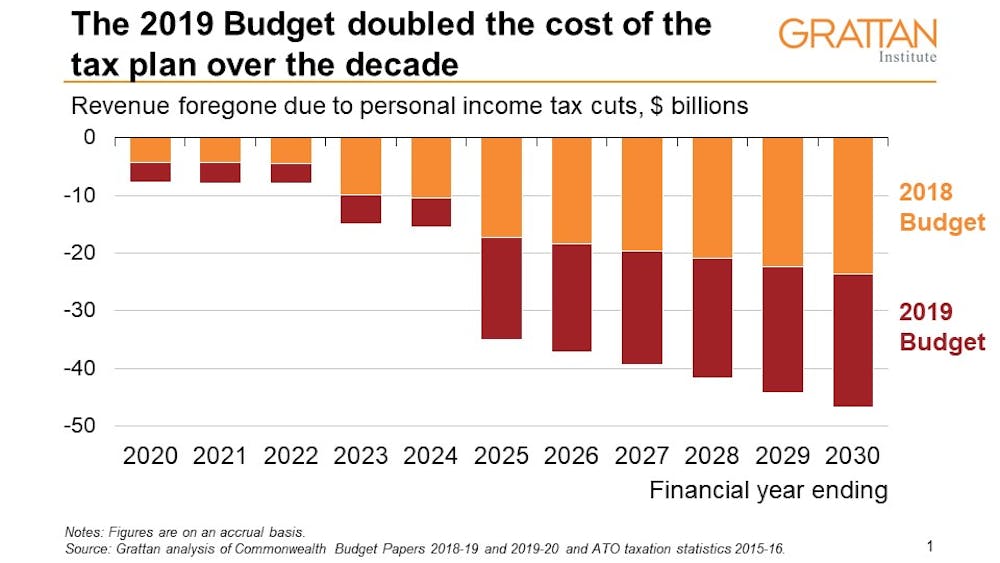
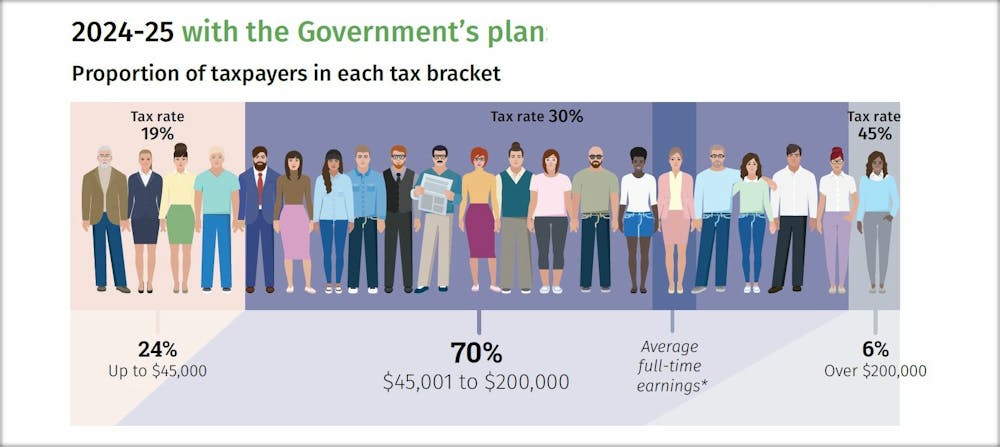
It is understood there was a mass exodus of voters from Honiara early this week heading out to provinces, among them doctors and medical practitioners, causing a crisis at the National Referral Hospital. This had also led to chaotic scenes with people scrambling to board overloaded ferries to travel home before polling day.

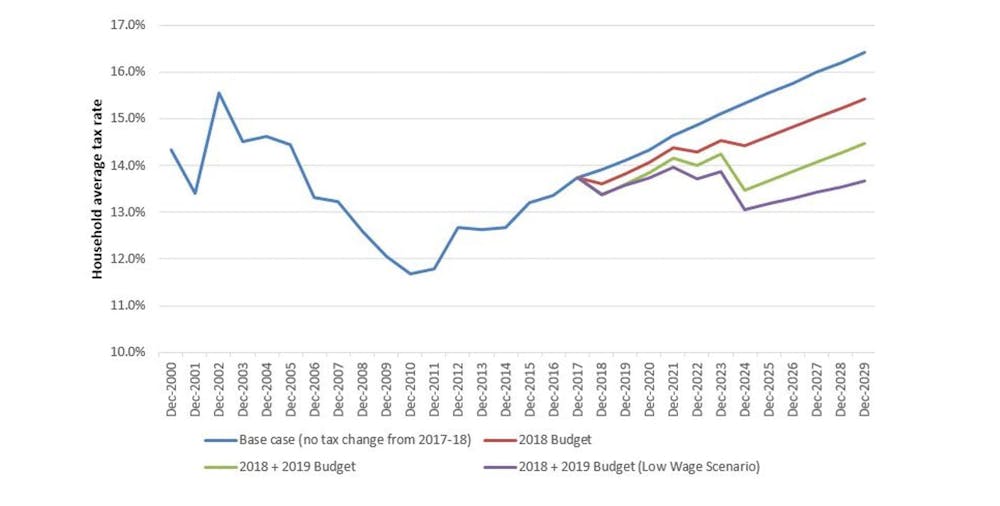
One of the notable changes applied in this election was the successful introduction of pre-polling voting under the Electoral Act 2018, trialed with police officers and electoral officials who worked on elections day.

The pre-poll voting was held on March 21, nearly two weeks before the National General Election.

Pre-polling minimal
A statement from the Electoral Commission said the current group of approved pre-poll applicants was minimal to start with, and from lessons learnt, pre-poll voting would be improved while the other class of electors prescribed by regulation would be given the equal opportunity in future elections.

Another notable change in this election was the newly-introduced campaign ban. For the first time in the political history of the country, media reports featuring campaign materials and political advertising were banned 24 hours before polling day.

With nine provinces and polling stations scattered across the country, counting was expected to be held in the provincial capital of each province with results to be announced as soon as counting of ballot papers for a particular constituency is complete.

Counting for all constituencies is in progress with results expected to be released today.

Police have banned victory float parades by winning contestants after the results have been announced – a common sight during past elections.

Rosalie Nongebatu of the Solomon Islands is a final-year journalism student at USP’s Laucala campus. She is also the editor of Wansolwara, the USP Journalism Programme’s student training print and online publications.

Print Friendly, PDF & Email

Article by AsiaPacificReport.nz