Newstalk ZB broadcaster Heather du Plessis-Allan has been censured for Pacific Island slurs in a ruling that contains uncharacteristically strong language from the official broadcasting watchdog.
It may end up costing NZME more than the $3000 the company must cough up in costs.
On her Newstalk ZB show Wellington Mornings this week, Heather du Plessis-Allan praised Jacinda Ardern for paying the grocery bill of someone without a wallet.
But about an hour earlier, the Broadcasting Standards Authority upheld complaints about Heather du Plessis-Allan telling listeners the government shouldn’t pay the bills of other Pacific Island nations.
“The Pacific Islands don’t matter. They are nothing but leeches on us,” she said.
-Partners-
Unsurprisingly that upset a lot of people who heard it at the time – or later on RNZ’s Mediawatch.
Some people who called Newstalk ZB to complain were initially told they should complain to RNZ instead because that’s where they heard it.
Proper context ZB’s owner NZME argued some complaints should not be considered from people who “saw other media reporting” of the comments without the proper context.
The context – by the way – was Heather du Plessis-Allan telling listeners the Pacific Islands did not deserve financial aid from New Zealand and Jacinda Ardern shouldn’t go to the Pacific Islands Forum in Nauru – which Heather du Plessis-Allan called “a hellhole”.
The BSA ruling said her comments breached the good taste and decency standards – and those for discrimination and denigration. ZB’s owner NZME has been ordered to pay $3000 in costs.
The comments were “inflammatory”, said the BSA, and “devalued the reputation of Pasifika people within New Zealand – including New Zealanders of Pacific origin”.
NZME had argued the host’s comments were not about specific individuals or organisations and the audience expect “a forthright manner” from a former political journalist.
“Her opinion is in line with the robust opinions offered in talkback … which has been recognised as a special category of radio by the Authority,” said NZME.
‘Went too far’ But the BSA decided that “even in the talkback context, these statements went too far”.
Things are said in the heat of the moment in talk radio to spark discussion – things callers and hosts alike may not say given more time for reflection.
But in this case, du Plessis-Allan re-affirmed them two days later.
“I will double down on this. I do not regret what I said because I was not talking about people living in this country or the people themselves. I was talking about the Pacific Islands and the people who run it [sic],” she told her listeners.
She also took a big swing at critics of her comments – including Privacy Commissioner John Edwards.
“Go back to university and do some more training. You are not good enough,” she said.
The Authority considered du Plessis-Allan was disingenuous in subsequently arguing that she had been referring to the Pacific Islands as leeches, not the people themselves.
“Countries are not just plots of land. They are the land and their people,” the Authority stated.
Deliberate choice The BSA said she was deliberate in her choice of words and coupled with her “dismissive tone” it “reflected a high level of condemnation towards the Pacific Islands … with an element of malice and nastiness and went beyond responsible broadcasting.”
The authority is not usually so strong in its condemnation of a broadcaster.
Underlying all this was Heather du Plessis-Allan’s view that New Zealand aid to the Pacific Islands has not been well spent – something worth discussing in light of the Pacific Reset policy.
But du Plessis-Allan misled her listeners when she seized on Niue as an example.
She told her listeners pension portability for Niueans amounted to “welfare sponging”.
But she didn’t say Niue is a self-governing territory affiliated to New Zealand and Niueans are also New Zealand citizens.
Niueans – or other Pacific people for that matter – wouldn’t get a pension if they were not entitled to one by living here in New Zealand in the first place – and incentivising pensioners to relocate could help reduce economic dependence on New Zealand that she seemed so worried about.
Employers using temporary migration work visas and the New Zealand companies exporting roughly 13 times as much as New Zealand imports from Pacific Island countries would also disagree with her claim “we get nothing from them”.
What’s the punishment? The award of $3000 in costs doesn’t sound a significant – but it is.
The BSA only awards costs up to a maximum of $5000 to signal serious breaches of standards.
“NZME is a large and experienced broadcaster, with staff who ought to be familiar with their obligations under broadcasting standards,” it said.
NZME has instead been ordered to broadcast a statement summarising the decision on the Wellington Mornings programme – and an apology from its host.
The BSA and du Plessis-Allan’s employers at NZME agreed on one thing: she has already been subjected to heavy public criticism for what she said in September last year.
Recently she tweeted from a vigil in Wellington that she was “standing with our Muslim community” after the Christchurch attacks. Some followers replied to remind her she hurt Pacific Islands communities with her comments.
After the attacks, NZME head of talk radio Jason Winstanley told Stuff several previously-published items had been pulled from ZB’s websites because they were “upsetting people.”
“Our priority is to do the best we can for all New Zealanders, and honour those who have lost their lives,” he said.
It remains to be seen what that means on air at Newstalk ZB and the other ZB hosts who have a habit of provoking people to engage – and enrage – the audience because it’s good for business.
It’s also an issue for NZME stablemate The New Zealand Herald which is preparing to ask readers to pay for “premium content” online.
The Herald publishes the opinions of du Plessis-Allan and other ZB hosts each week and the cost of embarrassments like this BSA ruling may be greater than $3000 in costs to the Crown.
This article is republished under the Pacific Media Centre’s content partnership with Radio New Zealand.
Former PM Sogavare back for sixth term in Solomon Islands poll
/
RSS Feed
Share
Link
Embed
A presiding officer assists elderly voter Artemas Maeta to cast his ballot in West Constituency in the Solomon Islands general election on Wednesday. Image: Solomon Star
By Ofani Eremae in Honiara
Former Solomon Islands prime minister Manasseh Sogavare has been returned for his sixth term in Parliament after retaining his East Choiseul seat in Wednesday’s general election as incumbents dominated the early declared provisional results.
Sogavare, the outgoing finance minister, was one of seven MPs in the last House who has secured his seat so far, according to early results.
Manasseh Sogavare … back for another term. Image: Solomon Star
Early results released also saw three newcomers.
They are former Clerk to Parliament Clezy Rore, former Ministry of Finance permanent secretary Harry Kuma and Robertson Galokale, a former senior public servant working in the Treasury department.
Rore has caused the biggest election upset so far when he unseated Milner Tozaka, the outgoing Foreign Affairs minister, who lost the seat after serving two terms.
Tozaka is the parliamentary wing leader of the People’s Alliance Party in the last House.
Sandakabatu out In North West Choiseul, Kuma polled 2948 votes to knock out Connelly Sandakabatu, who had held the seat for the last two terms.
In South Choiseul, Galokale ousted former MP Elijah Doromuala who came sixth.
Galokale is the managing director of the Takamako Holdings group of companies. He polled 999 votes, just ahead of Leokana Tozen with 965 votes.
Sogavare retained his seat after polling 1860 votes, more than a thousand ballots from the runner up Ezra Kukuti, who polled 755 votes.
In Ulawa/Ugi, Marau, the youngest MP in the last House, secured his second term by a landslide.
He received 1778 votes ahead of the former Archbishop of the Anglican Church of Melanesia, George Takeli, who polled only 476.
Fewer votes The other six candidates who contested the seat collected an even fewer number of votes.
In Central Makira Giro polled 3803 votes, ahead of Usumae Peter Thompson with 1,419.
In Gao/ Bugotu, Manetoali’s return for his fourth term in Parliament was a surprise.
Late last year, police arrested and charged Manetoali for alleged conversion of constituency funds.
The charge was a huge set-back to Mantoali’s election campaign and many doubted his chances of returning for another parliamentary term.
But on Wednesday, the people of Gao/Bugotu handed Mantoalia a resounding victory and a fourth term in Parliament.
He polled 2457 votes ahead of his runner up Adrian Toni, who received 1102 ballots.
Auckland University of Technology is 16th in the world in the newly released TimesHigher Education University Impact Rankings that assess the social impact of universities against the United Nations’ Sustainable Development Goals (SDGs).
Of the 17 goals, AUT ranked number two for Sustainable Cities and Communities (SDG 11) covering sustainable practices such as research promoting remote working, affordable housing, and investment in art and heritage.
In Gender Equality (SDG 5) AUT is ninth in the world, recognising the percentage of research by female academics, outreach to female students in areas including STEM (Science, Technology, Engineering and Mathematics) and policies implemented to enable gender equality.
New Zealand universities have excelled in the rankings with University of Auckland achieving first place and Massey University placing number 38.
The rankings support AUT’s commitment to the United Nations SDGs, highlighted by the launch of its Sustainability Roadmap in 2018.
-Partners-
Chair of the AUT Sustainability Taskforce, Professor Thomas Neitzert noted that work in the area of sustainability is ongoing and in line with AUT’s deliberate focus on technological transformation, external impact and industry connections.
“Our students, stakeholders and community expect sustainability to be a priority for AUT. We believe advancing knowledge and understanding of the issues and opportunities around creating a sustainable future is essential,” said Professor Neitzert.
The TimesHigher Education University Impact Rankings are the only global performance tables that assess universities against the United Nations’ Sustainable Development Goals.
They use carefully calibrated indicators to provide comprehensive and balanced comparisons across three broad areas: research, outreach, and stewardship.
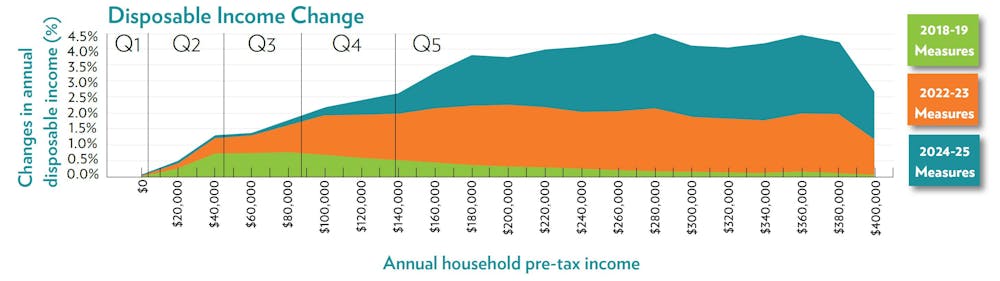
The 2018 budget contained big tax measures – worth A$143 billion over the next decade – initially targeted at lower and middle income Australians, but after five or so years to be heavily weighted towards higher income Australians. The 2019 Budget doubled down, including an extra $158 billion of measures, again heavily weighted towards higher income earners.
It’s possible to draw graphs showing that if the tax cuts came to pass, higher earners would be enormously better off compared to everyone else, but the graphs miss a really important point.
The point is that high end tax rates would have been wound back over time anyway to stop people moving into higher tax brackets as their income grew.
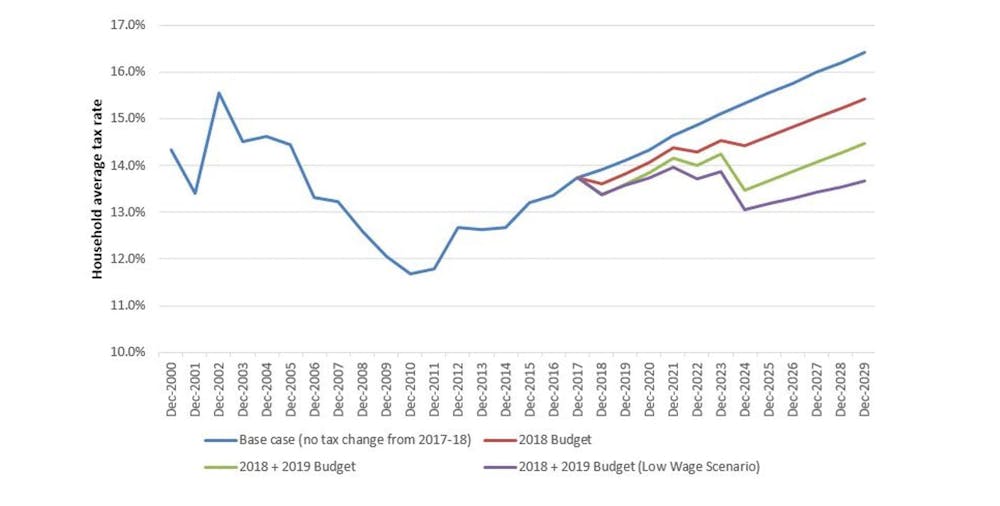
The graph below shows the average personal income tax rate paid by households since 2000 and projections of what they will be through to 2029 under four assumptions – the (unlikely) scenario of no tax change; the 2018-19 Budget change; the combined 2018-19 and 2029-20 Budget changes; and the same combined scenario but with lower than average wage growth (2.5% per year).
This tells a very interesting story. The average household tax rate reached a peak of 15.5% in 2002 and then declined to 11.7% in 2010. Since then it has climbed to reach 13.7% in 2017.
Our modelling finds that without the tax changes announced in the 2018 and 2019 budgets wage growth and bracket creep would push the average rate to a record high of 16.4% in 2029.
It is unlikely that either side of politics would let this happen. The effects of bracket creep would almost certainly be at least partly eliminated through adjustments to tax thresholds or rates much earlier.
Our analysis shows shows that the 2018 budget tax cuts would have reduced but not entirely eliminated the effects of bracket creep.
The tax cuts announced in the 2019 budget go further and mean that the average tax rate in 2024 would be much the same as in 2017, but that it would then start to grow again to be quite a bit higher at 14.5% by 2029 (assuming the wage increases projected in the Budget are correct).
They’d be bigger if wage growth was lower
While no one knows what wage growth will be over the next decade, the experience of the past decade suggests it could be substantially lower than the budget projection of 3.5% per year.
If it was 2.5% the average tax rate would be lower in 2024 than today and remain lower through to 2029.
Of course, projecting wages growth out that far is crystal ball territory and it is impossible to have much idea.
The biggest beneficiaries of the tax cuts are certainly households in the upper half of the income distribution. But this doesn’t mean their tax cuts weren’t necessary.
Welfare payments are largely “set-and-forget”. The rates increase over time with either prices or earnings. But tax rates need to be adjusted over time in order to stop more and more people being pushed into higher tax brackets.
Analysis of tax changes that ignores this will exaggerate their effects.
The question of whether technology is good or bad depends on how it’s developed and used. Nowhere is that more topical than in technolgies using artificial intelligence.
When developed and used appropriately, artificial intelligence (AI) has the potential to transform the way we live, work, communicate and travel.
Around the world, AI-enabled technology is increasingly being adopted by individuals, governments, organisations and institutions. But along with the vast potential to improve our quality of life, comes a risk to our basic human rights and freedoms.
Appropriate oversight, guidance and understanding of the way AI is used and developed in Australia must be prioritised.
AI gone wild may conjure images of The Terminator and Ex Machina movies, but it is much simpler, fundamental issues that need to be addressed at present, such as:
how data is used to develop AI
whether an AI system is being used fairly
in which situations should we continue to rely on human decision-making?
We have an AI ethics plan
That’s why, in partnership with government and industry, we’ve developed an ethics framework for AI in Australia. The aim is to catalyse the discussion around how AI should be used and developed in Australia.
The ethical framework looks at various case studies from around the world to discuss how AI has been used in the past and the impacts that it has had. The case studies help us understand where things went wrong and how to avoid repeating past mistakes.
We also looked at what was being done around the world to address ethical concerns about AI development and use.
Based on the core issues and impacts of AI, eight principles were identified to support the ethical use and development of AI in Australia.
Generates net benefits: The AI system must generate benefits for people that are greater than the costs.
Do no harm: Civilian AI systems must not be designed to harm or deceive people and should be implemented in ways that minimise any negative outcomes.
Regulatory and legal compliance: The AI system must comply with all relevant international, Australian local, state/territory and federal government obligations, regulations and laws.
Privacy protection: Any system, including AI systems, must ensure people’s private data is protected and kept confidential and prevent data breaches that could cause reputational, psychological, financial, professional or other types of harm.
Fairness: The development or use of the AI system must not result in unfair discrimination against individuals, communities or groups. This requires particular attention to ensure the “training data” is free from bias or characteristics which may cause the algorithm to behave unfairly.
Transparency and explainability: People must be informed when an algorithm is being used that impacts them and they should be provided with information about what information the algorithm uses to make decisions.
Contestability: When an algorithm impacts a person there must be an efficient process to allow that person to challenge the use or output of the algorithm.
Accountability: People and organisations responsible for the creation and implementation of AI algorithms should be identifiable and accountable for the impacts of that algorithm, even if the impacts are unintended.
In addition to the core principles various toolkit items are identified in the framework that could be used to help support these principles. These include impact assessments, ongoing monitoring and public consultation.
A plan, what about action?
But principles and ethical goals can only go so far. At some point we will need to get to work on deciding how we are going to implement and achieve them.
There are various complexities to consider when discussing the ethical use and development of AI. The vast reach of the technology has potential to impact every facet of our lives.
AI applications are already in use across households, businesses and governments, most Australians are already being impacted by them.
There is a pressing need to examine the effects that AI has on the vulnerable and on minority groups, making sure we protect these individuals and communities from bias, discrimination and exploitation. (Remember Tay, the racist chatbot?)
There is also the fact that AI used in Australia will often be developed in other countries, so how do we ensure it adheres to Australian standards and expectations?
Your say
The framework explores these issues and forms some of Australia’s first steps on the journey towards the positive development and use of AI. But true progress needs input from stakeholders across government, business, academia and broader society.
That’s why ethical framework discussion paper is now open to public comment. You have until May 31, 2019, to have your say in Australia’s digital future.
With a proactive approach to the ethical development of AI, Australia can do more than just mitigate against any risks. If we can build AI for a fairer go, we can secure a competitive advantage as well as safeguard the rights of Australians.
Source: The Conversation (Au and NZ) – By Jeremy Dean Wilson, Ph.D candidate, Department of Environment & Science, Griffith University, Griffith University
Several new species of trapdoor spiders found in Queensland are finally described in an article published this month in Invertebrate Systematics.
But each of the new species occurs in only its own single, isolated patch of rainforest in southeastern Queensland, and nowhere else.
Because these species have such tiny natural distributions, they are especially vulnerable to extinction.
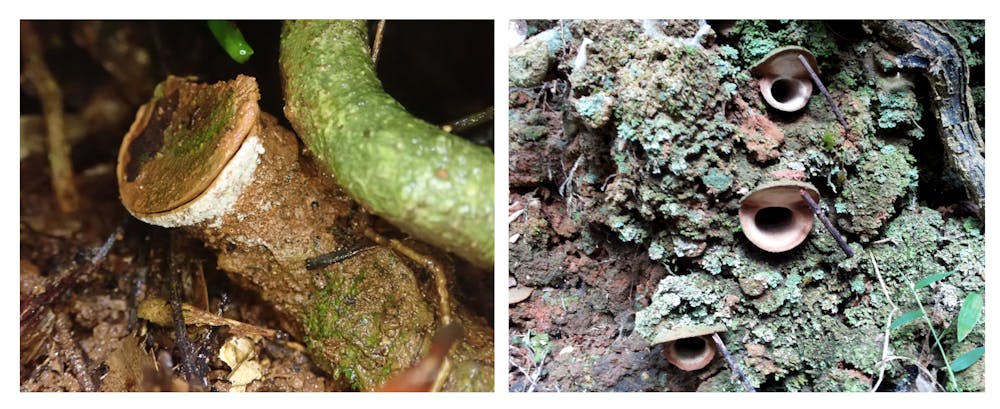
These newly described spiders have been given the common name palisade trapdoor spiders because of the strange and unique burrows they construct. The entrance to the burrow projects out from the surrounding soil like a miniature turret.
The remarkable palisade burrows constructed by two different species of palisade trapdoor spider. The burrow entrances project from the surrounding soil.Jeremy Wilson (left), Michael Rix (right)
Not only that, but each of the four new palisade trapdoor spider species constructs its own unique type of burrow.
One species, found in national parkland near Gympie and known scientifically as Euoplos crenatus, constructs a particularly elaborate burrow. The hinged door that covers the burrow entrance is adorned with several rounded lobes which project from the door’s circumference.
This marvel of natural architecture is constructed by the spider using silk and soil. No other spider species in the world constructs something similar.
This species was originally discovered by local naturalists Kelvin and Amelia Nielsen in 1999, who then guided researchers back to the discovery location in 2016 to collect specimens so the species could be formally named.
The burrow entrance of Euoplos crenatus, with its peculiar ‘crenate’ burrow door.Michael Rix
Another species, Euoplos thynnearum, constructs a burrow entrance with a thick lip within which the burrow door sits. It’s found in the Mary Cairncross Scenic Reserve, a 55-hectare patch of subtropical rainforest popular with visitors to the Sunshine Coast hinterland.
This species is named after Elizabeth, Mabel and Mary Thynne, who originally donated the reserve land to the local council in 1941 to honour their mother Mary Thynne (née Cairncross). Currently, this species is known to occur only within the reserve and in other rainforest patches in the immediate vicinity.
Burrow entrances of the new palisade trapdoor spider species Euoplos thynnearum. This species is largely restricted to a single rainforest patch, occurring within Mary Cairncross Scenic Reserve near Maleny.Michael Rix
Short-range species at risk
Species that only only occur in a very small area, like these new palisade trapdoor spider species, are known as short-range endemic species.
Although scientists are naming new species at a faster rate than ever before, estimates of the total number of species on Earth still suggest that most animal species have not been formally named. With so much work still to do, some scientists have chosen to prioritise work on particular types of animals that are especially vulnerable to extinction.
In 2002, Mark Harvey, an arachnologist from the Western Australian Museum, proposed that scientists should prioritise the discovery and description of short-range endemic species.
He reasoned that the small ranges of these species make them inherently vulnerable to extinction, and that identifying, naming and studying them is the first step to protecting them.
The strange burrows of the trapdoor spider species Euoplos crenatus project out from between the roots and leaf-litter on the bank of a creek in a rainforest patch near Gympie, Queensland.Jeremy Wilson
Staying local
For trapdoor spiders, short-range endemism is the rule, not the exception. These spiders live their entire lives in a burrow. Juvenile spiders walk only short distances from their mother’s burrow, before constructing a burrow of their own.
Usually, these spiders will then remain in the same burrow for the remainder of their lives, enlarging it as they grow.
Examples of different trapdoor spider species from eastern Australia. Top left, Arbanitis longipes; top right, Heteromigas sp.; bottom left, Cataxia sp.; bottom right, Namea sp.Jeremy Wilson
Adult male trapdoor spiders will also leave their burrow to breed, but will only travel relatively short distances. Over time, this extremely limited dispersal ability has led to the evolution of many different trapdoor spider species, each of which occurs in only a very small area.
Since 2012, a research team, led by Queensland Museum researcher Michael Rix, has been trying to discover and name all species of spiny trapdoor spider – this group includes the palisade trapdoor spiders, as well as other strange trapdoor spider species such as the shield-backed trapdoor spiders of Western Australia.
A shield-backed trapdoor spider from Western Australia, showing the distinctive hardened disk on its abdomen which the spider uses to ‘plug’ its burrow as a protection from predators.Mark Harvey
So far, this project has led to the description of more than 100 new species from throughout Australia, some of which are already classified as threatened by federal and state governments.
The most iconic of these is Idiosoma nigrum (also a shield-backed trapdoor spider), which is a listed threatened species.
The discovery of all these weird and wonderful spider species should remind us that Australia has some of the most remarkable invertebrate species in the world, and new species are waiting to be discovered in the national parks and reserves which occur around, and even within, our towns and cities – under our noses.
Next time you visit a national park, or drive past a patch of forest while commuting along Australia’s east coast, think to yourself, what might be living in there? Do those species occur anywhere else? And above all, if we lose that forest remnant, what unique species might disappear along with it?
University of Canberra Assistant Professor Caroline Fisher talks about the week in Australian politics with Michelle Grattan. They discuss the government’s pre-election budget, Bill Shorten’s strong budget reply, and the effect of these on the immanent election.
The comment sections on a range of New Zealand firearms community Facebook pages reveal that the culture of many gun users is more extreme than the gun lobby wants us to believe. There are disturbing norms operating in local gun culture.
On the day of the shooting, some people posting on firearms groups’ Facebook pages expressed shock and sorrow. Others were immediately concerned about how it would affect them as firearms users. Contributors on some sites openly discussed watching the shooter’s livestream. Some Kiwi Gun Blog Facebook posters were interested in what firearms he used.
One posted:
Started with shotgun, then uses his AR15 to do the rest.
Some contributors to the page mentioned the victims of the attack but many clearly prioritised the perceived harm to firearms owners.
Very sad day. My condolences go out to the families. Only one group of people going down after this … is licenced firearm owners unfortunately. Watch the sale of semi’s [sic] go through the roof before the ban is announced. Bury your semi’s now before they get taken off you.
Other users enthusiastically agreed. In response to a later post inquiring whether proposed gun law changes mean that “we would have to surrender our ar’s [firearms]”, a contributor replied “lose them in a safe place”.
Another said of police:
… they will need a lot of search warrants and a team of people with spades.
Yet another added, mixing an American NRA trope with The Lord Of The Rings:
They will have to pull mine out of my cold dead hands. They will never get my precious.
A privilege, not a right
The second amendment to the American Constitution has been interpreted as meaning that citizens have a right to bear arms, but in New Zealand owning guns is indisputably a privilege, not a right. The government has the right to ban high calibre semi-automatics, magazines and associated parts and to demand that owners surrender these weapons.
A parliamentary select committee will hear oral submissions to the Arms Amendment Bill this week, and the bill is expected to pass into law by the end of next week, with limited exemptions including pest control, theatricals and farming.
The use of NRA discourses on New Zealand firearms sites reveals confusion, or perhaps a state of denial, about what is legally possible in New Zealand.
I would rather see people with the right to carry for self-defence … . If a handful of those worshippers had been packing [carrying guns] that could have stopped this tragedy in the early minutes.
Owning a gun for self-defence purposes is not legal in New Zealand, but contributors frequently mention the concept along with variations on the right to own a gun.
When Prime Minister Jacinda Ardern announced the ban on semi-automatics, only days after the mosque shootings, the gun lobby responded quickly, expressing a sense of victimisation. The Facebook page of the Council of Licensed Firearms Owners (COLFO), a firearms umbrella organisation, carried a pastiche of Martin Niemöller’s poem, portraying firearms owners as needing to protect themselves in the face of oppression.
Since the shooting, new contributors arriving on the pages seem surprised by these discourses. One visitor unwittingly charged in with posts saying “ban all MSSAs [military style semi-automatics], cars need registration. Drivers need licences … why should guns be any different. What legitimate use do MSSAs have in civilian hands.”
The suggestion that guns should be registered just as their owners are licensed did not go down well with regular commenters, who responded:
STOP terrorizing firearms owners! You extremist … you’re a disgusting human being.
Most comments come from men, judging by the names. This is unsurprising, given that 93% of licensed firearms owners in New Zealand are male. Violent misogyny appears on some of the pages, including many remarks about Ardern.
Very few contributors make actual threats, but any threatening posts were rejected on grounds of the law, not because violent or misogynist suggestions were unacceptable.
After New Zealand Police Association President Chris Cahill referred to the “radical gun lobby”, one post said “if we were radical they’d be dead already”.
We did not find white supremacist sentiments, or overt racism on these public New Zealand Facebook pages. But there is almost no visible presence of Māori or non-Pākehā (non-white) people in the social media exchanges.
Senior gun lobbyists present licensed gun owners as sensible and responsible – the only legitimate voice on firearms. But these online posts reflect the culture within the group, whose voice has effectively stifled political debate and stymied changes to firearms law for decades.
In 2018, following a public outcry about defence personnel taking military firearms into a school, a Ministry of Education reference group developed guidelines for schools. The group initially included only government employees, educators and representatives from firearms groups. When challenged, one of us (Hera Cook) was added as a health representative and observed how firearms experts persuaded the ministry not to keep a list of schools with guns.
Gun owners’ social media posts show us that many firearms owners are not sensible and reasonable people. Faced with a tragedy, their response is to insist on a non-existent right to own firearms and to express willingness to break laws that do not suit them. It is past time that the desires of ordinary New Zealanders for peace and safety determined firearms policy.
Source: The Conversation (Au and NZ) – By Sarah Maddison, Professor, School of Social and Political Sciences, Co-Director, Indigenous-Settler Relations Collaboration, University of Melbourne
As the nation gears up for another federal election, both major parties are taking a position on Indigenous affairs. And it looks like First Nations peoples are set to be disappointed once again.
For the coalition it will mostly be business as usual: paternalism, intervention, and the disastrous Indigenous Advancement Strategy. Prime Minister Scott Morrison’s 2019 budget commitment to investigate models for the proposed Voice to parliament was met with scepticism, given Malcolm Turnbull’s claim the proposed Voice threatens parliamentary sovereignty.
The Uluru Statement called for the creation of a First Nations Voice to parliament and a Makarrata Commission. The Voice would be enshrined in the Australian Constitution, and the Makarrata Commission would supervise a truth-telling and agreement-making process formed between governments and Indigenous peoples.
Beyond this new budget allocation, there has been no sign of the Coalition acting on the Uluru Statement from the Heart.
Labor, on the other hand, has promised to establish the Voice to parliament and to then seek to enshrine the Voice in the Constitution. With seemingly more progressive policies in Indigenous affairs, Labor would appear to be the far better option for Aboriginal and Torres Strait Islander peoples.
But how much will really change for Australian First Nations under a Labor government? Aboriginal and Torres Strait Islander peoples have been disappointed before.
For instance, while the Rudd government did deliver the long-overdue apology to the stolen generations, Labor also continued the paternalistic approach to welfare quarantining, which started under Howard.
The reality for Aboriginal and Torres Strait Islander peoples is that no party will deliver on Indigenous aspirations. It’s time for radical change on Indigenous policy.
Resisting autonomy
Governments of all flavours in Australia have resisted the one thing Aboriginal and Torres Strait Islander people want, and the one thing that has made a difference elsewhere: the ability to control and manage their own lives.
The Uluru Statement demanded structural reform in the relationship between Indigenous peoples and the state. But the Voice to parliament proposal continues to centre the Australian parliament in the lives of Aboriginal and Torres Strait Islander peoples because it would have an advisory, rather than a decision-making, function.
This means while the demand for Indigenous advice might be constitutionally enshrined, there can be no promise any future government would follow that advice. Government would still be making the decisions that affect Aboriginal and Torres Strait Islander peoples’ lives and futures.
Many scholars, activists, and analysts – Indigenous and settler alike – maintain a degree of faith in liberal settler governments, or at least a belief that working with government is the only viable political option.
This is a view to which I subscribed for many years, but which I can no longer hold.
From the decade-long failings of the Closing the Gap approach to the soaring rates of incarceration and child-removal, it is clear the current system is not working and causing harm to Indigenous peoples.
Indigenous nationhood
As I’ve written in my new book, “The Colonial Fantasy”, meaningful change can only occur if future reforms consider a more radical restructuring of the relationships between Aboriginal and Torres Strait Islander peoples and the Australian state.
The future lies not in better policy, or even a new government, but in the exciting resurgence of Indigenous nationhood.
In lots of ways, big and small, First Nations in Australia are turning away from the state as the answer to their claims. They are instead drawing on revitalising culture and languages, prioritising connections to land, and nurturing their autonomy.
This is no small task. Replacing colonial authority with revitalised, self-governing relationships might seem to be an aspiration beyond reach.
How could such a radical restructuring take place? How could it be possible for Indigenous nations to reconstitute and govern themselves? Would the settler state simply abandon Indigenous nations to their own fates?
There are no easy answers to any of these questions, and they must be determined community by community, clan by clan, nation by nation, by Aboriginal and Torres Strait Islander peoples themselves. But there are answers to be found.
The crucial factor is that for First Nations peoples to recover from the multiple harms of settler colonialism, there must be change in the terms of the relationship. First Nations must take control of the structures, systems and services they need, free from the control and interference of the settler state.
This does not mean governments are off the hook. Treaties or other forms of agreement ought to see reparations made that will support greater Indigenous autonomy.
But decisions must be in Indigenous hands. We must let go of the idea that tweaking a policy, or changing a government or even creating a new voice in settler institutions, will come anywhere close to the radical rethink that First Nations so urgently need.
Curious Kids is a series for children. If you have a question you’d like an expert to answer, send it to curiouskids@theconversation.edu.au You might also like the podcast Imagine This, a co-production between ABC KIDS listen and The Conversation, based on Curious Kids.
Why do tigers have whiskers? – Valentina, age 4, London.
A tiger’s whiskers are not just for decoration. They help it find its way around small spaces even when it is completely dark and can send important messages to the tiger’s brain.
Just like how the hairs on your arm can feel a soft breeze blowing or a spider crawling on you, whiskers on a tiger’s face and chin give it messages about what is going on around him or her.
But whiskers are not just ordinary hairs. They are thicker and go deeper into the tiger’s skin. In fact, they are connected to its muscles and to something we call the “nervous system.”
The nervous system
Most animals (including you and me) have a nervous system in their body which sends messages to the brain about the world they feel and sense around them.
Whether it is a small paper cut or a tickle, the nervous system can feel it all!
At the end of a tiger’s whiskers is a small but important body part. Its official name is a “proprioceptor”, but you can think of it as an alarm.
This alarm sends messages to the tiger’s brain about what is around it.
Whiskers are so sensitive they can even feel a small change in the air or wind around it. That could be important information for a tiger – it may be a clue that an animal it would like to eat is rushing past it. In other words, it could help them hunt in the dark.
If the whiskers tell the tiger it is moving into a small space where it could get stuck, or towards something prickly, that will help the tiger can be more careful and decide where to put their next step.
Whiskers are handy helpers
Having whiskers can help a tiger guess the distance between two places. This is helpful to them when they need to jump, crouch or slide underneath a log or a cave. And did you know tigers even have whiskers on their legs?
As you can see, whiskers make life easier for tigers. They help them hunt, find their way in the dark and sense when danger or a tasty snack is nearby.
Over time, the tigers that had whiskers were more likely to live long enough to have babies (who also had whiskers). So the number of whiskery tigers grew and grew while the tigers with shorter or no whiskers may not have lived long enough to have babies, and their numbers fell.
That process – where certain features that help animals live longer get passed on to the next generation – is called evolution.
So I guess you could say a tiger has whiskers because of evolution!
Many criminal trials feature forensic evidence in the form of audio recordings, typically from bugging houses or cars, or intercepting phone calls.
Unfortunately, the audio is often of very poor quality, making it hard for the jury to discern what is said.
Here’s a quick example (you might like to jot down what you hear before reading on).
When indistinct audio is admitted as evidence, Australian (and other) courts allow the jury to be given an “enhanced” version to assist their hearing.
You might now be eager to hear the enhanced version of the audio you just listened to. Sorry to disappoint, but that actually was the enhanced version.
This example highlights how the misunderstanding of enhancing exacerbates the problem that inaccurate transcripts influence juries’ perception of indistinct audio.
What enhancing can and can’t do
There are no general techniques that can reliably and objectively make unintelligible audio intelligible. But this does not mean enhancing is ineffectual.
What enhancing can do is make audio sound “clearer”, in the sense of “less noisy”. Making it “clearer” in the sense of “more intelligible” requires a transcript.
A segment from the 2016 film The Case of: JonBenét Ramsey shows how a transcript and enhancing work together. The film revisits the unsolved 1996 murder of a six-year-old beauty queen in the USA. The audio you listened to is one of several pieces of evidence purporting to show that the child’s family was implicated in her murder.
The video below begins after 12 minutes, and the enhancing segment ends at 14 minutes and 37 seconds.
The Case Of: Jonbenét Ramsey.
Judging from public reaction, many viewers accept the four phrases were “revealed” by the “enhancing” – but is that really what happened?
At Step 1 of the experiment, the audio was played “cold” – with no contextual information – to 78 participants. Half listened to the film’s original and half to its enhanced version. No one in either group heard anything remotely like any of the phrases. Most didn’t even hear human speech (did you?).
This effect is demonstrated by Step 2 of the experiment, where participants were given a transcript. After failing to hear any of the four phrases while listening cold, nearly half now agreed they could hear at least one of them.
Here’s what’s important
Participants who were primed by the transcript while listening to the enhanced audio were more likely (63% vs 24%) to accept more of the phrases more confidently than those listening to the original.
That would show a good effect of enhancing if the transcript were a reliable account of what was actually said. But is it? To answer that, consider where the phrases came from.
The movie portrays the investigators spontaneously hearing the phrases as the audio is enhanced. But that is disingenuous.
There is good evidence the phrases originate from police in the 1990s listening to noises at the end of a cassette copy of the 911 call in which the child’s disappearance was reported.
So what are those noises?
Listening to the whole call (start at 6 minutes 34 seconds in the movie above), it seems likely they are the sound of the agent typing up information provided by the caller. Interestingly, some commentators provide evidence (not tested in court) suggesting, when the audio was transferred to the cassette during the investigation, it was processed in ways that make the typing sound more like speech.
Be that as it may, Step 1 of the experiment makes clear that the movie’s “enhancing” has no effect whatsoever in revealing the phrases. That effect is entirely the work of priming by their (misleading) transcript.
The same thing happens in real trials
The movie’s flashy visuals and sensational tone seem far removed from a courtroom. Yet, the way the movie presents the audio is very similar to how audio is presented in a trial.
In trials, as in the movie, listeners hear an enhanced version of indistinct audio with the “assistance” of a police transcript.
The problem with this can be explained via an analogy from forensic image enhancement. Consider the very indistinct number plate below, and an enhancement that looks “clearer”. Does it help you see DUN 150J?
Original and ‘enhanced’ images of a numberplate.UK Forensic Regulator
Knowing “ground truth” – the absolute, undisputed truth – about the real number plate makes it easy to see that, while the enhancing may have made the indistinct image look “clearer”, it has not thereby made it closer to reality.
The problem, of course, is that in a trial, ground truth is not known. The court has only an indistinct original and a “clearer” enhancement.
With no access to ground truth, it is impossible for the jury to discover that the apparently clearer enhancement is no closer to reality than the blurry original.
And all this is exactly true of audio
Does that mean enhancing is never effective?
Audio enhancing can sometimes be useful. It can also be ineffective – or even misleading. In the present case, for example, it misleadingly made typing sound like speech, at least to some listeners.
The point is that, in the absence of ground truth, the effectiveness of enhancing cannot be reliably determined simply by asking listeners whether the audio sounds clearer.
Yet that is the sole criterion used in our courts.
According to our legal system, evaluating the effectiveness of enhancing is a matter for the jury, who are invited to listen to the enhancement and use it if it sounds clearer to them.
But the experiment shows that making audio “clearer” can have the opposite effect to the one intended. That’s because less noisy audio makes an unreliable transcript seem more believable than it does in the original.
Jo Cameron came to the attention of researchers in her late 60s, after undergoing normally excruciating arthritis surgery with only paracetamol for post-recovery pain. Her life was full of more or less painless injury. Even childbirth barely fazed her.
Life without pain might seem like a blessing. But Cameron’s case – and how we understand what pain really means – is more complex than it first appears.
That’s no surprise. Pain plays a vital protective role. It protects us from injury. It limits our motion when parts of our body are damaged. Without that inbuilt system, the weight of unhealed injuries can eventually overwhelm us.
Cameron presents a striking challenge to this view.
But detailed testing of Cameron’s pain thresholds suggests that, outside of heat pain, she has some normal pain perception. She reports broken bones and numerous scars, suggesting that her longevity is at least partly a matter of luck.
Childbirth was easier on her, but she did receive gas analgesia. She does use paracetamol, though in situations that would make most of us reach for the morphine. Her pain perception, then, seems to be diminished in a great number of cases (and often to her detriment) – but not absent.
The key to her unusual experience may have to do with another striking fact about her experience: her lack of anxiety or fear. Even a recent car crash appears to have left her unmoved.
What contributes to pain
So what could be going on in a biological sense?
Sequencing of Cameron’s genes revealed she is deficient in the enzyme FAAH (fatty-acid amide hydrolase), which breaks down the neurotransmitter anandamide.
Neurotransmitters are chemicals that have effects on the signals between nerve cells, or neurons. Different drugs have different effects because they mimic different neurotransmitters: Prozac targets the neurotransmitter seratonin, for example, while cocaine targets dopamine.
Anandamide, named after the Sanskrit word for “bliss”, is the best studied of the neurotransmitter molecules known as cannabinoids that our bodies make.
As the name might suggest, the actions of cannabinoids can be mimicked by the active ingredients in marijuana. They appear to have similar effects, too. Elevated levels of anandamide reduce both pain and anxiety in lab animals.
Since Cameron doesn’t break down anandamide, it accumulates in her blood. So she not only feels less pain, she also feels less anxiety about the pain she does feel.
Many very serious injuries are initially painless. Injured soldiers and car crash victims often report that they felt no pain at all until they found safety. Pain scientist Patrick D Wall suggested this was an important evolutionary adaptation.
Pain limits motion, which is bad in emergencies: a system to dampen down pain and fear until you’re safe makes a lot of sense. Our inbuilt cannabinoid system may well play a crucial role in this circuit breaker for pain.
Certainly though, there’s a strong body of evidence supporting the idea that pain is about more than just tissue damage.
In one famous case, a builder presented in the emergency room in excruciating pain with a 15cm nail driven through his boot. When the doctors removed the boot, they found that the nail had passed between his toes. He was completely uninjured; the pain was completely psychologically driven.
Anticipation and fear are important drivers of pain.
Pain reflects more than just damage
The link between Cameron’s condition and cannabinoids made by our bodies adds fuel to a growing interest in using cannabis-based drugs to replace opioid drugs. Conversely, there is evidence that opioid abuse is often driven by the ability of opiates to moderate fear and anxiety as well as pain. Perhaps cannabanoid drugs might kill two birds with one stone by managing both pain and anxiety, but without the side-effects of opioids.
We are still a way off from that, though. Previous trials with FAAH-based drugs have shown mixed results.
Cameron herself reports “long-standing memory lapses”, which suggests that cannabanoids made in our bodies may share some side-effects with their recreational cousins.
Researchers once thought of pain as a simple signal of bodily damage. The past 75 years of pain science have emphasised the complexity of pain The interaction between pain and anxiety is a crucial part of this picture.
Individuals like Jo Cameron add yet another piece to a fascinating puzzle.
Although further charges relating to terrorism are possible, I argue, as I have previously, that it is time to reconsider the way in which murder is defined in New Zealand.
Murders are not all equal in terms of maliciousness.
At the moment there is only one “degree of murder” under the New Zealand Crimes Act, even if an offender is also charged with other terrorism offences. That means that someone who, say, kills their violent and abusive partner is labelled a murderer in the same way as someone who kills 50 innocent victims because of white supremacist views.
Under the Sentencing Act 2002, it is an aggravating factor when an offender commits an offence partly or wholly because of hostility towards a group of persons who have an enduring common characteristic such as race, colour, nationality, religion, gender identity, sexual orientation, age or disability.
Some might argue that taking this into account in sentencing allows us to distinguish different types of murder, but I disagree. Just as the media correctly refer to the attack in Christchurch as a terror attack rather than a mass shooting, how we label the killings in a legal context reflects condemnation of that conduct.
Also, sentencing doesn’t determine the moral blameworthiness of the offender, only the extent of their punishment.
Degrees of murder
Some other countries, such as the United States, do recognise that there are degrees of murder. While there are differences in approach across states, generally first-degree murder involves a specific intent to kill and premeditation and deliberation. Some first-degree murders involve killings committed during another serious offence, or where a police officer is killed, regardless of the level of premeditation.
Second-degree murder is usually murder without these aggravating features. Third-degree murder is often the same as New Zealand’s manslaughter offence.
In 1996, Brian Neeson proposed a “degrees of murder bill” for New Zealand which would have redefined culpable homicide by classifying murder in the first, second or third degree. Murder in the first degree would have consisted of killings that were “particularly sadistic, heinous, malicious or inhuman”. But this bill was defeated in parliament and the law remains unchanged.
The worst types of murder
Certain features of some murders automatically make them more morally repugnant: premeditation, hate crimes, killings during the commission of other serious crimes, and torturous killings.
At the other end of the spectrum are the less morally blameworthy killings, where a defendant acts with a genuinely altruistic motive (to end a loved one’s suffering, for example), or where the violent conduct of the victim provokes the killing. The question is, should the law apply the same label – murder – to all killings on the spectrum? Or are some killings so reprehensible that they ought to be stigmatised by a more serious offence?
As the law stands, murder is the most serious offence anyone who kills another person can be charged with, even if they were perpetrating a terror attack or hate crime. Regardless of what sentence that offender might end up with, they are in the same category of offender as someone like Donella Knox, who, in 2016, sedated her disabled 20-year-old daughter, Ruby, before suffocating her.
Ruby had severe autism spectrum disorder, was intellectually disabled and had other physical illnesses including spina bifida and hip pain. Before the killing Ruby had begun to act in violent and severely disruptive ways and was no longer being seen by the paediatric team because of her age. Knox was advised that nothing could be done for Ruby’s pain.
Knox pleaded guilty to murder and was sentenced to four years’ imprisonment. The sentencing judge thought that sentencing her to life imprisonment would be manifestly unjust and described the killing as part mercy and part self-defence.
There are several other cases where a defendant has been labelled a “murderer” for far less serious conduct, including some young offenders who killed others without necessarily appreciating the consequences of their actions. Killing someone recklessly is vastly different from a premeditated terrorist attack. But we still call it murder.
Whatever name we give to terror attack murders does not retrospectively change the nature of that conduct. But language is important because it reflects the stigma and social reaction associated with the conduct.
Armed police were outside as survivors and relatives of victims of the attack arrived at court.
Women in hijabs hugged one another as they arrived at the courtroom. Senior police officers, including Detective Inspectors Dave Lynch and Greg Murton, were seated in the front row of the public gallery.
-Partners-
The defendant was able to see the judge and lawyers and hear the proceeding but the camera was turned away from the public gallery.
His manner was calm thoughout the hearing as he intently listened to the proceedings; his screen was muted.
Single charge It is the defendant’s second court appearance, after briefly appearing in Christchurch District Court on March 16, the day after the mosque attacks. At that hearing police had laid a single charge of murder.
He now faces 50 charges of murder and 39 of attempted murder.
Justice Cameron Mander formally recorded that a further 49 charges of murder and 39 of attempted murder had been filed by the Crown.
He noted the initial murder charge, which named a woman who was in fact alive, was to be amended and suppressed that woman’s name.
The judge also suppressed the names of the attempted murder victims.
Two Auckland lawyers, Shane Tait and Jonathan Hudson, were to represent the accused. Tait issued a brief statement last night saying the right to consult and instruct a lawyer, and the right to a fair and public hearing, were protected rights in New Zealand law.
Justice Mander ordered that two mental health reports be completed to assess the defendant’s fitness to plead. He remanded him in custody without plea to next appear on June 14.
Victim families briefed The families of the victims of the mosque attack were briefed about the court appearance by court officials and victims’ advisors.
Media had the right to be present and report on the hearing – other than any discussions held in chambers, as is usual court procedure – but the judge had declined applications from New Zealand and overseas media to film, take photos and record sound.
The starting principle on such applications is open justice, but it is up to the judge to decide whether it is appropriate and in this case Justice Mander found it was not.
In a minute issued to media, he said he had taken into account a number of factors in reaching his decision, including the need to preserve the integrity of the trial, the role of the media, and the court’s obligations to the victims of the massacre.
This article is republished under the Pacific Media Centre’s content partnership with Radio New Zealand.
A voter casts his ballot during the 2019 Solomon Islands general election on Wednesday. Image: Island Sun/Wansolwara
By Rosalie Nongebatu
As Solomon Islanders headed to the polls on Wednesday to vote for leaders whom they trust will lead them in the next four years, some were not so lucky to have this choice.
Despite that fact that more than 359,000 people were registered to vote in the 2019 Solomon Islands general election with provisional results expected today, not everyone on the final voter list participated in the national exercise.
Solomon Islanders living abroad were not able to vote as there were no provisions under existing electoral laws to allow citizens to vote from outside the country.
More than 2000 Solomon Islanders in Fiji were among those who were not able to vote, including students at the University of the South Pacific’s Laucala campus in Suva.
RNZ Pacific reports that incumbent MPs are dominating early election results with seven of the 10 seats declared overnight being returned to their former occupants.
-Partners-
USP Solomon Islands Students Association president Adrian Neve said the rights of students to vote was being denied by the authorities and this needed to change.
“Solomon Islands is a democratic country and while we appreciate the reforms implemented by the Solomon Islands Electoral Commission, a good number of us living overseas are affected as we are not given the opportunity to vote for the leader of our choice,” he said.
‘Disappointing’ exclusion “There is a large number of Solomon Islands students at USP and other institutions in Fiji, and it is disappointing that we were not able to exercise our democratic right to carry out our civic duty as citizens in a democracy to cast our ballot paper.
“Electoral laws must be amended so that citizens abroad are included in this important process of choosing our leaders. I hope leaders who are voted into power today treat this as priority and work towards changing existing laws to ensure that elections are actually democratic and fair.”
The late passing of the Electoral Reform Act towards the end of 2017 had complicated the Electoral Commission’s preparation to ensure the 2019 election was credible.
The Act provides scope to amend procedures, but there was not enough time to implement these changes. As such, some of the proposed changes in the Act, such as allowing Honiara residents registered in rural areas to cast their votes in Honiara, were not implemented in this election.
Chaotic scenes at Honiara’s main wharf where passengers have tried to climb on departing ferries. Image: Evan Wasuka/ABC/Wansolwara
It is understood there was a mass exodus of voters from Honiara early this week heading out to provinces, among them doctors and medical practitioners, causing a crisis at the National Referral Hospital. This had also led to chaotic scenes with people scrambling to board overloaded ferries to travel home before polling day.
One of the notable changes applied in this election was the successful introduction of pre-polling voting under the Electoral Act 2018, trialed with police officers and electoral officials who worked on elections day.
The pre-poll voting was held on March 21, nearly two weeks before the National General Election.
Pre-polling minimal A statement from the Electoral Commission said the current group of approved pre-poll applicants was minimal to start with, and from lessons learnt, pre-poll voting would be improved while the other class of electors prescribed by regulation would be given the equal opportunity in future elections.
Another notable change in this election was the newly-introduced campaign ban. For the first time in the political history of the country, media reports featuring campaign materials and political advertising were banned 24 hours before polling day.
With nine provinces and polling stations scattered across the country, counting was expected to be held in the provincial capital of each province with results to be announced as soon as counting of ballot papers for a particular constituency is complete.
Counting for all constituencies is in progress with results expected to be released today.
Police have banned victory float parades by winning contestants after the results have been announced – a common sight during past elections.
Rosalie Nongebatu of the Solomon Islands is a final-year journalism student at USP’s Laucala campus. She is also the editor of Wansolwara, the USP Journalism Programme’s student training print and online publications.
Admittedly, Gleeson is sporting dark hair rather than Joffrey’s customary blond, but even so. If nothing else, Gleeson is male and Williams female.
This is just one of the failures we have seen when we used characters from Game of Thrones to develop a new test of human face recognition. Thanks to the series, our research shows that becoming familiar with a face and reliably recognising a person are complex processes.
Facial recognition feels deceptively easy
Humans are a social species and recognising people’s faces is a crucial skill. We seem to do it effortlessly, but there are immense individual differences. Some people are practically “face-blind” and can’t identify people in their own family, while others, dubbed “super-recognisers”, claim they never forget a face.
The latter seem so infallible that security and law enforcement agencies are now seeking to employ them. But it is critical to understand their limits, too.
As researchers, we noticed significant limitations in existing tests of face recognition. Some tests rely on people’s recognition of famous faces – politicians, athletes, actors, musicians. But people vary widely in how often they might encounter these people so it is difficult to know if mistaken identities are the result of poor face recognition ability, limited exposure or a mere lack of interest in one of these areas.
Other tests use strictly controlled faces of strangers – stripped of hair, glasses and other adornments – that people study in the lab. But this seems very unlike the way we become familiar with faces in the real world, where we encounter people in many different situations and without any real intent to study their facial features.
Which brings us to Game of Thrones. Fans of the show have been exposed to hundreds of characters over a period of years, while they aged, changed hairstyles (think Cersei Lannister) or became disfigured. One of us (Christel Devue) is supposedly good with faces, at least according to the standard lab-based tests, but noticed she kept mixing up similar-looking characters while watching the show.
Over the seasons of Game of Thrones, fans will have watched the same characters for several years.AAP, CC BY-SA
Game of Thrones as a research tool
When we conducted our test, Game of Thrones had been running for six seasons and had featured many hundreds of actors. Because the show has such a dedicated following, the internet provided us with a wealth of information to develop a very well-controlled experiment.
For example, some fans had calculated how long each actor was visible on screen. As well as being able to gauge actors’ exposure levels, we also knew how much time had elapsed since characters were last seen (before facing a gruesome death).
We tested 32 participants who had watched all six seasons only once, as each one was released. This way, we were sure everyone had had the same exposure to all the actors and at about the same time. Participants had not read George RR Martin’s original novels, so would not know the characters from a different source.
British actor Alfie Allen plays Theon Greyjoy, also known as Reek, in Game of Thrones. He sometimes has a beard and such simple changes can throw off recognition.AAP, CC BY-SA
We showed participants 90 headshots of actors (not in character) who had four different levels of exposure in the show (as main heroes, lead characters, support characters and bit parts), mixed with 90 strangers. They judged whether each face was familiar, rated their confidence in that judgement, and tried to identify and name the character or the actor.
Half of the participants were shown pictures in which actors’ headshots were similar to their character in the show, while the others saw pictures in which the actors’ appearance differed (for example, different hairstyle, facial hair, make-up, glasses).
Surprisingly, we discovered that simple changes in hairstyle or the mere passage of time throw off recognition of actors in all exposure levels, even those that participants saw repeatedly for years.
No one, including the best recognisers, recognised all faces. The best hit rate was about 80% of the actors, but from someone who also falsely recognised about 50% of strangers. Good recognisers were distinguished not because they recognised more faces than others, but by their ability to reject novel faces as unfamiliar.
Some participants were extremely confident while they were in fact reporting very inaccurate information. Others were uncertain about their responses but were spot-on most of the time. Some could not remember many names and gave really convoluted descriptions of characters.
Joffrey and Arya were not the only cross-gender mix-up. A photograph of a short-haired Sibel Kekilli (Tyrion Lannister’s mistress Shae) was identified by several participants as Isaac Hempstead Wright (Bran Stark). Such misidentifications and others were often based on superficial features like hair colour or style, facial hair or the shape of a head, showing how important these are.
Peter Dinklage as Tyrion Lannister. Some Game of Thrones fans have calculated how long each actor was visible on screen.AAP, CC BY-SA
Although recognition rates increased with greater levels of exposure, performance was far from what you’d expect of fans of a show. Identification errors occurred at all exposure levels. Only the most prominent actors were correctly identified and named more often than they were just recognised. As for bit parts, they were never correctly identified and only rarely recognised, even if their brief appearance was sometimes shattering (one of them was the cause of the Red Wedding). Familiarity judgements for these actors were barely higher than for strangers.
This research has important practical implications. Criminals know simple disguises make it possible to escape prosecution. Many innocent people are convicted based on errors in eyewitness testimony.
Our research confirms recognition based on brief encounters is likely to be wrong. Confidence of a witness in these conditions is not a good indicator of whom they have actually seen. Moreover, while super-recognisers have made useful contributions to law enforcement agencies, they are not infallible.
As for people planning to watch the final season of Game of Thrones, perhaps a refresher viewing is in order to avoid any confusion and ensure you really do know who’s who.
Scott Morrison needed the budget to change the game for the election. But its political impact has seemed tepid rather than transformative.
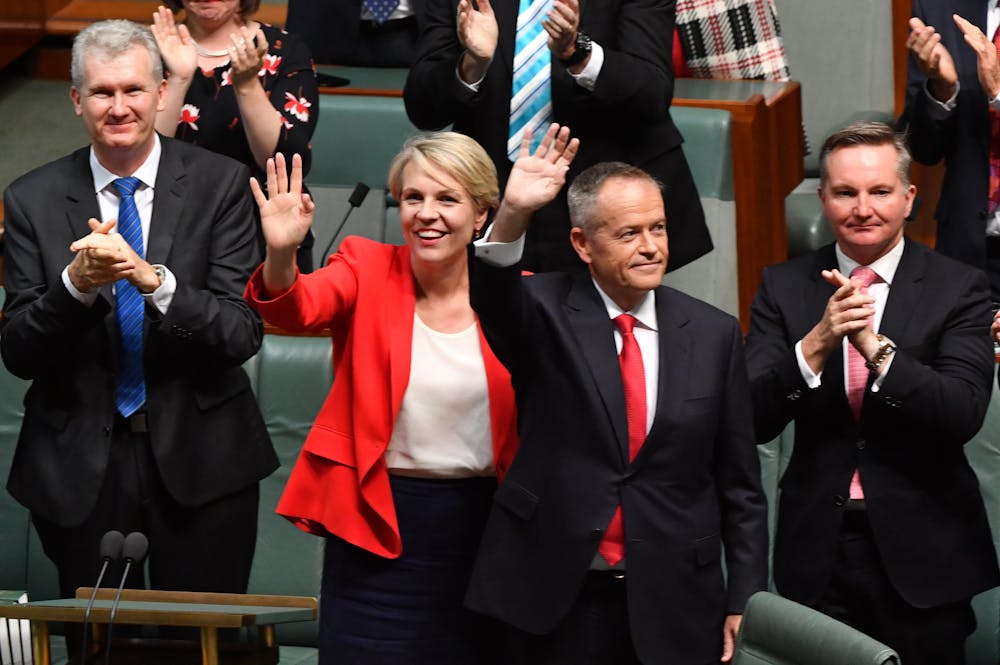
And Bill Shorten has shown that having the last parliamentary word in budget week can be used to grab the mic from your opponent.
By the time parliament broke on Thursday night, everything was in place for the election, except the announcement of the date, with the three options Morrison had earlier canvassed – May 11, 18 or 25 – hanging out there.
In his Thursday budget reply, Shorten delivered a carefully-targeted pitch to voters that invoked hope and promised fairness. He came up with a big Medicare initiative, and he outsmarted the government on its tax cuts, the budget’s centrepiece.
Shorten seeks to use what Labor dubs “the politics of hope” as a response to voters being switched off by all the cynicism. “We choose hope over fear. We choose the future over the past,” he said.
His $2.3 billion promise to slash out-of-pocket costs faced by cancer patients played to a traditional Labor strength – health policy – and should be popular.
The opposition aims to put Medicare at the forefront of its campaigning, as it did in 2016. But there is a notable difference.
Then it ran the negative “Mediscare” offensive. Now the emphasis is positive, with an ambitious pledge to extend Medicare, helping cancer sufferers, vulnerable and numerous, who often face financial burdens.
“One in two of us will be diagnosed with cancer at some stage in our life,” Shorten said, as he outlined “our vision for the most significant investment in Medicare in a generation”.
On tax, Shorten one-upped the Liberals, offering bigger immediate tax cuts to 3.6 million taxpayers who earn under $48,000.
Labor has more than neutralised the budget’s immediate income tax bait by matching the first tranche of tax cuts for most taxpayers, while bettering them at the bottom end.
This was always an obvious tactic available to the opposition, and it was canvassing that response even before seeing the numbers in the budget. Shadow treasurer Chris Bowen and Finance spokesman Jim Chalmers announced Labor’s position as Josh Frydenberg rose to deliver his budget speech.
Labor did not want a fight over the tax rebate the budget promised.AAP/Mick Tsikas
Labor did not want a fight over the tax rebate the budget promised taxpayers would receive when they put in their returns soon.
And by throwing in just over $1 billion for the low paid, it boosted its “fairness” bag of goods. This complements Labor’s other policies for these people, including its commitment to a “living wage” and the restoration of penalty rates.
Shorten has rejected the further tax cut tranches the government proposes for 2022-23 and 2024-25. The cost of those is about $143 billion of the government’s $158 billion package.
The risk for Labor in dismissing them is smaller than might appear at first glance.
Tax cuts promised for well into the future are likely to be viewed sceptically by the public. Although people want governments to have long term “plans”, they’re also aware nothing lasts in politics. And in the final tranche, the benefits are very skewed to the wealthy.
The budget’s tax cuts haven’t been legislated so Labor doesn’t even have to say it will repeal something set in legal stone (although it is committed to repealing the later stages of the 2018 tax cuts).
Devoid of nasties and containing tax relief while promising a $7.1 billion surplus in 2019-20, the budget might be tracking reasonably in the community.
But given the government’s circumstances, it had to seize and hold people’s attention. Tuesday’s effort didn’t seem to have the required horse power for such a heavy task.
Many voters have stopped listening to the government. A lot of hostility is now locked in, reinforced by the general disillusionment with politics. There is a feeling that people are just looking to move on from “this lot”.
As one Liberal – who praised the budget – put it, “the die is probably cast, in terms of trust and disunity”.
After two terms of chaos and infighting, a benign budget is not going to work a miracle.
Moreover, its content had been so widely foreshadowed that it had not even a small element of surprise.
One has to wonder about the political sense in the government dropping out so much ahead of the night.
This wasn’t even a case of getting bad news behind it. The government was pre-releasing the good stuff, including funding for regional projects.
Local factors are important in elections, and that’s where the budget’s infrastructure promises come in.
These initiatives, many directed to marginal Coalition seats, might help shore up some electorates. But whether that is enough to counter any strong anti-government swing in the pipeline is another matter. And besides, Labor, flush with money, has plenty of its own local promises.
All this is not to overlook that Shorten faces increasing challenges in the next few weeks as he confronts a desperate government that won’t follow the Malcolm Turnbull path of eschewing a heavily negative campaign.
The Coalition’s overarching scare homes in on Labor as the big taxers. Reacting to the Shorten’s budget reply, Finance Minister Mathias Cormann’s mantra was Labor $200 billion in extra tax.
Then there are the specific scares (in Coalition terminology) around Labor’s “retirement tax” and, with this week’s release of the climate policy, its “carbon tax”, as well as the crackdown on negative gearing.
Often scares work, and indeed the polls might tighten, as they usually do at the business end of the cycle.
But sometimes tried and trusted methods fail. John Howard knew handouts worked – until in 2007 they didn’t. It all depends on the mood of the electorate.
At the moment that mood seems as dark as Scott Morrison’s “back in the black” budget week portrait. That, incidentally, turned out to be a rip off of a campaign some years ago by then New Zealand Prime Minister John Key. Just as the 2019 tax splash reprised the Coalition’s 2007 pre-election promised one, which Labor mostly matched.
People experience philanthropy in Australia in a variety of ways, often without even realising it. It might be a new hospital wing that was constructed using funds from a generous donor, or an art exhibition made possible through the support of a group of philanthropic foundations.
From time to time we hear about big pledges in the news. This week, for example, we learned that a pledge by Clive Palmer made in 2008 to donate A$100 million to Indigenous communities has turned out to be an empty one.
But philanthropy can still be surrounded by an aura of mystery. Here’s a picture of what it looks like in Australia, and why we have an opportunity to improve our giving culture.
How much do we give?
Total giving to Australian charities in 2016 was A$10.5 billion, according to data from the Australian Charities and Not-for-profits Commission. Most of that is on the smaller end of the scale. The bulk comes from monthly donations people make to a favourite charity, or one-off donations in response to a Christmas or disaster appeal.
About A$1.5 billion is what’s called “structured philanthropy”. This is philanthropy at the larger end of the scale, which tends to be planned and strategic, and generally involves using some sort of dedicated legal structure to facilitate it, such as a philanthropic foundation.
Some individuals, families or businesses decide to establish a separate legal structure for a variety of reasons. For large-scale giving, they may wish to build a solid governance structure around it in order to enhance its effectiveness. They may want to involve their children more closely in the management of their giving. Or they may also want to build a legacy that can continue to contribute to the community after their death.
So, when it comes to deciding what kind of structure to use, what are the options available in Australia?
One option is what’s called the “private ancillary fund” (PAF). A PAF enables a donor to put aside an amount of money in a trust to support charities over the long term. Donations into the PAF are tax deductible, and are invested to generate a return over time. Every year, 5% of the PAF’s assets must be distributed as grants to what are called “Item 1 deductible gift recipients”.
Since their introduction in 2001, PAFs have grown relatively steadily. There are around 1,650 of them, according to data from the Australian Taxation Office (ATO). Together they hold upwards of A$8 billion in assets, and distribute more than A$450 million in grants per year.
One alternative to a PAF is to establish what is commonly referred to as a “sub-fund”. They can be thought of as a form of “giving account” that sits within a larger public foundation. There are a range of providers with whom a donor can establish a sub-fund. These include community foundations, wealth managers and trustee companies.
A donor makes tax deductible donations which are credited against their sub-fund. The assets credited against their name are invested together with the assets of all the other sub-funds managed by the provider, to generate a return. The donor can then make recommendations to the provider for grants to be made out of their sub-fund to “Item 1 deductible gift recipients”.
Until recently, there has been no data on sub-funds in Australia, but my recent research at Swinburne University found there were at least 1,995 sub-funds in Australia. They hold A$1 billion in assets, and distributed nearly A$57 million in 2017-18 via some 6,000 grants. There are indications that sub-funds are growing strongly, and the next iteration of this research in 2020 will provide more conclusive data on this.
There is also the option to establish a charitable trust. These are different from PAFs or sub-funds because you don’t get a tax deduction for any donations you make into them. But you can generally structure them to give to a much wider range of charities and other organisations.
According to one estimate, there were 2,005 charitable trusts in 2016. They held assets of A$7.7 billion, and distributed A$507 million in grants. Many charitable trusts are set up through people’s wills, and only come into existence when a person dies. Because we don’t have estate taxes in Australia, the lack of a tax deduction isn’t a problem.
There are some worrying trends in terms of our giving behaviour based on the latest data from the ATO. The proportion of taxpayers who claim a deduction for donating is in decline, although the average amount claimed is increasing. At the same time, 44% of taxpayers with a taxable income above A$1 million did not claim a single deduction for a donation to a “deductible gift recipient”.
Proportion of taxpayers claiming donations and the amount claimed.Australian Taxation Office, JBWere Philanthropic Services
Australia is about to witness the largest intergenerational wealth transfer in our history, with estimates that in the next two decades A$2.4 trillion will pass from “baby boomers” to the next generation. But giving through bequests made in wills is currently low.
One study estimated that in 2012, only 7.6% of wills had a charitable bequest, and they accounted for only 2.7% of the total value of estates. So, although Australians should be proud of the giving we do, there is clearly room for improvement. We really should have tens of thousands of PAFs, sub-funds and charitable trusts in Australia, not just a few thousand.
What will ultimately drive the growth of giving, both large and small, is the culture of giving we foster in Australia. Part of the solution, particularly at the larger end of the scale, is to ensure we have the right incentives and structures in place to encourage it. But we also need to look at other ways to inspire more giving – growing our culture of giving is not something you can do overnight.
CMV is a widespread virus which often causes only a mild illness. Most adults have been infected with it in the past, and are immune.
But it’s different in pregnancy. If a pregnant woman is not already immune to CMV, and if she catches the virus, it can sometimes infect her fetus. And when it does, sometimes this causes problems such as hearing loss, epilepsy or developmental delay.
Though previously thought to be rare, researchers now think congenital CMV is under-recognised. They estimate that one or two in every 1,000 infants may develop symptoms from being born with CMV – not rare, but uncommon.
The virus is spread through fluids such as saliva, snot and urine. Child-rearing is messy; if toddlers catch CMV, it’s easy for them to pass it on to non-immune parents.
The new guideline
So what are women now urged to do to avoid CMV? To quote from the new RANZCOG guideline:
Do not share food, drinks, or utensils used by children (under the age of three years)
Do not put a child’s dummy/soother in your mouth
Avoid contact with saliva when kissing a child (“kiss on the forehead not on the lips”)
Thoroughly wash your hands with soap and water for 15-20 seconds especially after changing nappies or feeding a young child or wiping a young child’s nose or saliva
Clean toys, countertops and other surfaces that come into contact with children’s urine or saliva.
Does that sound easy? If you think so, perhaps double-check with a friend who has young children. From my spot poll of parents, many feel that careful adherence to these rules would be unmanageable. Homes are not hospitals; interacting with our loved ones is not a sterile procedure.
I can’t help but feel that we are setting mothers up to fail by introducing these standards, and thereby compounding the guilt they carry. Early parenthood is a risky time of life for mental health issues like depression.
If we are to make new mothers feel guilty about such fundamental human interactions as sharing meals and kissing, won’t we intensify their stress at this vulnerable time?
If mothers feel they must respond to a joyful kiss from their toddler not with reciprocation, but with admonishment – “not on the lips, darling, only the cheek” – mightn’t this affect their bonding with their child?
Homes aren’t hospitals and interacting with kids will always be messy.Halfpoint/Shutterstock
What about the evidence?
The stresses above might be worth enduring if there was good evidence that these behavioural changes made a difference. But I’m unconvinced.
According to researchers who recently reviewed the world evidence, there are only three studies looking at whether hygiene and behaviour recommendations can prevent congenital CMV.
The largest was a study comparing how often women in a maternity hospital picked up CMV before and after hygiene advice. Infected proportions changed from 0.42% before the advice to 0.19% afterwards.
But “before-after” studies aren’t a reliable guide to cause-and-effect. The most susceptible women may just have caught CMV earlier, leaving only women at less risk left for the second phase of the study.
The best study design to establish cause-and-effect is a “randomised controlled trial”, in which women are randomly allocated to receive hygiene advice or not. There are two such trials.
One was tiny, and found no significant difference between the non-pregnant women it randomised to hygiene advice. Separately, they followed 14 pregnant women who were given hygiene advice, who all remained uninfected, but they weren’t randomised – there was no group of pregnant women without such advice to compare to.
The bigger trial randomised 166 non-immune mothers of young children to either receive hygiene advice or not. Despite providing free soap and gloves to the hygiene group, and visiting these women every three months to monitor their behaviour, exactly 7.8% of women in each group caught CMV – no difference.
Pregnant women who knew from special tests that their child was shedding CMV had a low infection rate – presumably this test result was a motivator for behaviour change. But this is evidence for the effect of testing, not of giving hygiene advice.
So I can’t see convincing evidence that routine hygiene advice works – not without the addition of tests of mothers’ immunity and children’s viral status. And doing such tests is not part of the new RANZCOG guideline – indeed, it explicitly advises against routine testing.
So what should we do?
I’m really torn on this issue. My heart aches for the families of children severely affected by congenital CMV. They must carry a heavy burden of guilt, wondering if they could have prevented the infection. I understand their motivation to prevent further harms. I share their desire for more research on CMV prevention.
But I am saddened, too, by the prospect of a generation of women taught to see their toddlers as dangerous, all in the name of preventive measures which remain unproven.
What do you think? Perhaps we need a community conversation about balancing the trade-offs here: the uncertain prevention of serious but uncommon outcomes versus widespread anxiety about normal family behaviours.
Meanwhile, it’s time for me to close my laptop, share a meal with my family, and, later, kiss my kids goodnight.
Amid all the usual items we expect to see in the federal budget was one that raised eyebrows: A$28.8 million for three ant eradication programs.
Yet amid the inevitable media puns about the government “upping the ant-e”, we should note that these funds are for the continuation of existing programs that have already attracted significant funding and made substantial progress. Stopping now would have meant previous funding was wasted.
The funds will go a long way towards protecting Australia’s economy and environment from the damage wrought by invasive ants. But despite the apparent cash splurge, it nevertheless falls short of what is really needed.
The Wet Tropics Management Authority, which runs the program, had requested $6 million per year for six years to continue removing the ant from in and around the Wet Tropics World Heritage Area. The federal funding is $3 million short of this, and the authority is still waiting to hear whether the Queensland government will provide the remainder.
Since 2013, the program has received $9.5 million from the federal government (and $3 million from the Queensland government). No yellow crazy ants have been observed in about half of the target area in more than a year. A yet-to-be published analysis estimates the benefit-cost ratio for the program as 178:1.
“It’s a mop-up operation… we’ve got our foot on the throat of this thing.”
A further $1.3 million was allocated to the Argentine Ant Eradication Strategy on Norfolk Island in the South Pacific. Argentine ants have invaded places with Mediterranean-type climates all over the world, including southwestern Western Australia and parts of southern Australia, and become firmly established. But unlike those areas, the population on Norfolk Island is still considered small enough to be eradicable, and federally funded efforts to remove them began in 2010.
Ant eradication means removing all individuals of a particular ant species from a given area.
The first step is to define the extent of that area. Depending on the species, this may involve visual searches and/or placing lures such as sausages, cat food, or jam to attract the ants. The public can help by notifying relevant authorities of unusual ants in their gardens, and by not transporting materials that have ants on them.
The second step is treatment. Currently, the only way to eradicate ants is with insecticidal baits. Ants’ social structure makes this particularly challenging: killing the queens is vital for eradication, but queens typically stay sheltered in the nest – the only ants we see out foraging are workers.
Some of the most problematic ant species can have hundreds of queens and tens of thousands of workers per nest. They can reach extraordinarily high densities, partly because invasive ant species, unlike most of our native ant species, do not fight one another for territories.
Yellow crazy ants, proving it is possible to feel sorry for a cockroach.Bradley Rentz/Wikimedia Commons, CC BY-SA
Beating ants means turning their biology against them. Bait needs to be attractive enough for workers to bring back to the colony and share, but not so deadly that they die before they get there. (And yes, this means if you’re spraying foraging ants in your kitchen you won’t get rid them for good, because the queens are somewhere hidden, laying more eggs and making more ants.)
Most ant eradication programs take three to four years to fine-tune their baiting regime because of a multitude of factors that need to be considered, such as seasonal changes in ant foraging behaviour and food preference, and the desire to avoid harming non-target species. Typically, two to six treatments are required, depending on the ant species, the size of the area, and the habitat type.
Beating the 1%
The hardest part of ant eradication is the end-game. Getting rid of the final 1% requires first finding them. This may mean painstaking searches through hundreds of hectares of bushland and residential areas, and the placement of hundreds of thousands of lures. Detector dogs can be very helpful, but they cannot be used in all environments and also need substantial resources for training, handling, and maintenance.
Ironically, it is at this stage that public and political support for eradication programs is most likely to wane, because ant numbers are too low to be seen as a threat to the public, economy or environment. Yet it is vital not to stop now, or else the remaining 1% will simply build up their numbers again. Experienced staff are also lost when programs suffer cuts or delays in their funding.
Disappointingly not mentioned in the budget was funding for eradicating electric ants. Like red imported fire ants, electric ants have a painful sting, and when left to multiply will eventually turn gardens and swimming pools into no-go zones. They also pose a significant threat to native animals such as the southern cassowary, and can blind animals as large as elephants.
They are currently only found in the Cairns region. The National Electric Ant Eradication Program, funded by federal and state governments, ran from 2006 until 2017 and had likely reduced numbers down to that last 1%. The program has been running on state funding with reduced staff since then, but several new detections in the past three months demonstrate the cost of the gap in funding.
In those inevitable “federal budget winners and losers” lists, invasive ants have found themselves firmly in the losers column for 2019. But it’s worth remembering that most of the world’s roughly 15,000 known ant species provide vital services for the functioning of our ecosystems.
They aerate soil and redistribute its nutrients, protect plants from herbivores, disperse seeds, and repurpose dead organisms. They may even help slow down the spread of those pesky invasive ants that are much less friendly.
Source: The Conversation (Au and NZ) – By Mark Nieuwenhuijsen, Professorial Fellow, ACU, and Research Professor ISGlobal, Instituto de Salud Global de Barcelona (ISGlobal)
For seven years, Melbourne boasted the title of “world’s most liveable city”, but recently lost the top spot to Vienna. The Economist Intelligence Unit awards the title each year when it publishes its Global Liveability Index. This ranks 140 cities for their urban quality of life based on assessments of stability, health care, culture and environment, education and infrastructure.
The rankings have their limitations, which have been criticised. To regain top spot, or indeed just to become a better place for the people who actually live in the city, perhaps Melbourne and other cities like it should go beyond the traditional indicators. This means considering other factors that affect not only liveability but also health and sustainability.
Urban and transport planning has a large impact on sustainability, liveability and health. A recent study in Barcelona estimated 3,000 people die prematurely each year (20% of total mortality) because of urban and transport planning-related environmental and lifestyle factors. The largest contributor to premature death was lack of physical activity, followed by air pollution, noise, heat island effects and lack of green space.
A city that makes walking more convenient has many benefits for health and well-being.fritz16/Shutterstock
On the other hand, an investment in infrastructure for active transport such as cycling and walking leads to reductions in air pollution, noise, CO2 emissions, stress, mental health problems and heat island effects, and increases in physical activity, social contacts and possibly green space.
Climate change is a real threat and motorised traffic is one of the large contributors to CO2 emissions. And motorised traffic takes up a lot of public space in a city – up to 60%-70%. This space could be used in much better ways to make a more pleasant living environment.
So how do we make Melbourne not only more liveable, but also more sustainable and healthy? We urgently need to reduce urban sprawl and car dependency, increase public space for people, increase public and active transport, and increase green space.
Resulting reductions in air pollution, noise and heat island effects and increased physical activity will improve health and well-being. Furthermore, the changes in transport modes and CO2 storage by greening will mitigate climate change effects.
There are no magic bullets to achieve these goals. It requires a package of measures, strong political leadership and large investments.
The following are seven strategies, with examples of specific measures:
1. Put people at the centre of public spaces
change the hierarchy of planning from car/motorbikes, public transport, cycling and pedestrians to pedestrians, cyclists, public transport and car/motorbikes
introduce a 30km/h speed limit for neighbourhoods.
2. Increase density and land-use mix
increase urban density (make the city more compact) and reduce sprawl, but do not build high-rises – limit buildings to 5-6 floors
increase the mix of housing, places of work or schooling and access to basic services and shopping, and improve walkability to reduce the need for travelling longer distances.
3. Reduce motorised traffic and move towards public and active transport
reduce the number of motorised vehicles circulating (50% reduction by 2030) with an overall aim of a car-free city, starting with making the CBD car-free
introduce levies for parking at work in the city (e.g. $500-1,000 per year) that can be used to fund public transport
introduce transport planning policies that result in the same travel time for cars and public transport from and to a given destination, by giving priority to public transport
make a shared delivery system for shops to reduce the number of vehicles
increase the cycling network with a segregated cycling lane on each road and make sure it is well connected
encourage and provide financial incentives for electric bicycles for long-distance cycling and/or cycling in hilly areas
create policies and infrastructure so all children can get to school by active and public transport.
4. Zero-emission motorised traffic by 2035
make all remaining buses, trucks, cars and motorbikes electric by 2035 – all new motorised vehicles should be electric from 2025 onward
use roof tops for a distributed solar power system (with solar panels) to provide renewable energy for electric vehicles and households.
5. Increase green space
create more green space with trees in every street, greening of vacant lots and tunnelling of roads with green space on top (target a green space of 1 hectare within 300 metres of every residence)
increase green roofs and walls on buildings
green school patios and make these areas accessible to the neighbourhood on weekends and holidays
connect existing green infrastructure by creating green corridors that are also suitable for active transport.
6. Control pollution emissions from other sources
stricter control on emissions from the port
stricter control on emissions from other sources, such as industry and rubbish
better insulation of buildings to reduce energy use for heating and cooling
aim for a low-carbon city with zero CO2 emissions by 2035.
7. Improve governance
strong political leadership to make changes
provide administrative structure within the metropolitan area that integrates urban and transport planning, environment and public health policies to promote sustainability, health and well-being
work more closely with regional authorities and councils on integrating the transport system
create genuine participatory processes and involve citizens.
We can make our cities more sustainable, liveable and healthy, but it requires a large joint effort and can only be achieved with a strong vision and commitment. However, the results can be highly rewarding.
Most people nowadays choose cities to live. These currently have detrimental effects on the environment, health and well-being, so let’s create more liveable cities that promote health and well-being.
Some of it involved tax cuts way out into the future, in 2022 and 2024, with which we needn’t concern ourselves – there’ll be two, maybe more, elections before then.
The bit that was to start in mid 2018 (and did) wasn’t a tax cut at all, strictly speaking. It was an “offset” with an ungainly name: LMITO – the Low and Middle Income Tax Offset.
A standard tax cut, applying to any rate, would save money to all taxpayers on that rate and rates above it, including those on very high incomes. It couldn’t be directed to just low and middle earners, which is what the Coalition wanted.
What’s on offer isn’t really a tax cut
So the Coalition designed an offset, to be paid as a lump sum after the end of each tax year, after returns had been submitted and only to those taxpayers whose returns showed they weren’t high earners.
The full offset was A$530 per year, paid only to taxpayers who earned between $48,000 and $90,000. Taxpayers who earned more than $90,000 would lose 1.5 cents of it for each dollar they earned above $90,000, meaning no-one who earned more than $125,333 would get any of it.
(Taxpayers earning more than $125,333 wouldn’t go home completely empty handed – they would benefit from an increase in the point at which the the second highest rate came in, worth a barely consequential $135 a year.)
Taxpayers who earned less than $37,000 would get $200 off their tax, climbing to $530 for taxpayers earning $48,000.
It was ungainly – it was better described as a series of annual lump some payments than a tax cut – and Labor embraced it entirely.
In 2018 Labor trumped it
Except that Labor supercharged it. Under Labor it was to operate in exactly the same way, except that each payment would be 75% bigger: the Coalition’s $200 became Labor’s $350, the Coalition’s $538 became Labor’s $928 and so on.
Labor outbid the Coalition.
And these things stayed, for almost a year, except that it was all a bit academic.
Labor wasn’t in government, and the leglislated offsets weren’t to put the lump sums in pockets until after the end of June 2019.
In 2019 the Coalition trumped Labor
It allowed the Coalition to sneak in before them in Tuesday’s budget and double the maximum lump sum: $538 became $1,080, a promise Bill Shorten matched in his budget reply speech on Thursday night.
But for some reason the Coalition didn’t double everything: $200 only became $255, rather than the $350 Labor had already promised.
On Thursday night Shorten confirmed the $350 promise.
He is able to offer the 3.6 million Australians earning less than $48,000 more than the Coalition – in most cases an extra $95 more: $350 instead of $255.
Now Labor has trumped the Coalition
Shorten says it’ll cost an extra $1 billion, which is a mere fraction of the money Labor believes it will have that the Coalition won’t, because of its crackdowns on negative gearing, capital gains tax concessions and dividend imputation.
As Shorten put it on Thursday night:
Labor will provide a bigger tax cut than the Liberals for 3.6 million Australians all-told, an extra $1 billion for low income earners in this country. Here’s the simple truth – 6.4 million working people will pay the same amount of income tax under Labor as the Liberals. Another 3.6 million will pay less tax under Labor.
In fact they’ll pay just as much tax from payday to payday, but they’ll get back more at the end of the year, in most cases $95 more.
Driving the 200-kilometre round trip from Broken Hill to Wilcannia, the country opens up before us; the sky fills most of the horizon, save for a few hills and in every direction, red dust devils, like mini-tornados, pepper the landscape.
Some whirl towards the bitumen strip, snatching at the car. The underbellies of the few high clouds are tinged pink by the swept-up dirt. Kangaroos, trampled and dragged by freight trucks, litter the road surface. Crows and eagles hover over their carcasses, parting only just in time for us to pass through.
In Wilcannia, we drive directly to see the much talked about Darling River. On the eastern side of town, we drive past the campsite caretaker cottage. It appears abandoned: the fence is missing panels and tall prickly weeds break through the bitumen and concrete drive.
Out of the car, the sun is scorching. The air is quiet and still, save for the black cockatoos sitting high in the river gums gulping out an occasional half-hearted and awkward squawk. One solo, sun weary, white Australian traveller is a surprising sight. He sits by the door of his caravan making the most of the short shadow it casts.
Heading towards the river bank, we step gingerly around tall weeds and fallen gum branches. Leaves crunch and snap at each move we make. We wave and shout out hello to the traveller. Shaking his head in resignation, as if to prepare us for the sight about to be revealed, he warns: “There’s no water.”
The sandy river bed is baked dry. Freshwater mussels, the size of your outstretched hand, have withered and died in their shells, weeds cover parts of the bed and bits of glass from the colonial heyday are exposed in the sand. We repeat, “Jeezus”, under our breath to no one in particular.
A sign of former times at Wilcannia: the Darling River recedes into the distance.John Janson-Moore
Bone dry
In March 2019 the Darling River at Wilcannia, once “Queen of the Desert”, colonised by merino, from where millions of wool bales travelled under steam to South Australia and onto the global market, is bone dry. The nation’s longest river system (at 2750 kms) and 15th largest in the world, is lifeless. This river, the equivalent of several storeys deep, has supported Barkandji people for thousands of generations; the last five or so alongside Europeans. They say the river Barka is mother.
Along the Barwon-Darling, at the top end of the river system, the majority Aboriginal-populated towns despair at the state of the river and its heavy impact on their health, recreation, future and sense of being.
An aerial shot of Menindee Lakes.John Janson-Moore
When we visited, those towns were without reliable, safe drinking water but had a keen register of their limited social capital, political voice or economic power to affect change.
In the far west of NSW, Aboriginal people have engaged with the settler political-economy for a period of 150 years and not been eliminated. Still, the impact of colonisation cannot be measured as a moment, but rather as an enduring process. As we came to understand from Barkandji people, the crisis on the Barwon-Darling represents the biggest threat to their continued survival on country since the sheep invaded. It calls for a new order of government, with alternative economies and a central role for the Barkandji world view.
Barkandji and the settler economy
Colonial invasion over Barkandji and these far western lands is sometimes described as “invisible” – like a disease – and “creeping” in the way that waves of station owners, miners, itinerant labourers, Catholic nuns, Chinese market gardeners and South Asian cameleers passed through. Stories of settler violence struck fear in areas yet to feel the full brunt of it. From the 1850s, a more organised settler capitalist order emerged with the large pastoral stations’ highly profitable wool production.
By the 1880s, Wilcannia was the third largest river port in NSW; many grand sandstone buildings from this era still stand in the town. After the 1890s drought and recession, struggling stations were portioned off. Later, the allocation of smaller soldier settlement grants, mostly family farmed, meant a shrinking demand for Aboriginal labour.
Wilcannia, has a population of around 745, mostly Barkandji people.John Janson-Moore
From the 1930s, Barkandji settled in more permanent camps and humpies, which stretched from Wilcannia for kilometres along the eastern (and lower, flood prone) side of the Darling, and to supervised government missions at Menindee. As anthropologist Jeremy Beckett has detailed, Aboriginal men and women continued to work in the region’s settler pastoral economy.
But from the 1970s, for-profit sheep farming collapsed in the region, and Wilcannia in particular. This was caused in part by land degradation, the advent of equal wages, mechanisation and a decline in state-funded enterprises. Along with the emergence of the Department of Commonwealth Aboriginal Affairs, these factors ushered in a welfare-based economy. From the 1970s, white people literally shifted to greener pastures. Aboriginal houses were built on the north-west edge of town (locally known as “the Mallee”). At the same time, government initiatives to “relocate” Aboriginal families meant many moved to Albury and Cobar.
Defending the Darling
In the last 18 months, Barkandji people have held three rallies during which they briefly blocked the Barrier Highway, which passes from the east through Wilcannia to Adelaide. But their campaign and concern for the river goes back decades (if not since 1850). In recent months they have grown increasingly despairing as they watch the water levels get lower and lower.
Banners from the day’s protest march at Wilcannia.John Janson-Moore
The mass fish kills downstream at Menindee Lakes in late January brought the horror to a national audience. Television images of cod fish cradled as if slain children in the arms of grieving farmers reverberated with a concerned public. But for Barkandji people, this underscored their powerlessness in the debate over their river.
Dead fish in the Menindee weir pool in January.Supplied by Graeme McCrabb/AAP
As Wilcannia Local Aboriginal Land Council’s Kevin Cattermole told us,
It’s so sad that it took a million or more fish to die for people to really listen, when we’ve been saying this, we’ve been fighting for this for a number of years now. Well before the fish kill in Menindee. Well before that we tried to get people to listen…
Interview with Kevin Cattermole.
He went on to say, “We have no water … there’s nothing there … All the water gets taken out of Bourke and us poor buggers in the middle, we’ve got nothing. That’s why we jumped up and down. We’re tired of having no water”.
Wilcannia has a population of around 745. The land council, and everyone we spoke to including workers at the petrol station, supermarket and café shared the same view as to the cause of this problem. They say upstream big irrigators are storing water on feeder rivers and over extracting. Low rainfall and record temperatures (48.5 degrees in January, 2019) were also cited as factors but secondary to water regulation. A “man-made disaster” was the shared view.
Interview with Jenny Thwaites.
Long-time Wilcannia resident and Local Aboriginal Land Council CEO, Jenny Thwaites observed that:
A few years back we had two years in a row where we had high rivers. In the time that I lived here, when we had a high river it used to last for months, now it’s up for a couple of weeks and then it’s gone. And since then, we’ve gradually seen the water getting lower and lower and lower …
Members of the King family from Wilcannia stand under a river gum beside the Darling River, which they may never see in flow again.John Janson-Moore
The impact on Barkandji worlds was explained as social and cultural.
Michael Kennedy, chair of Wilcannia Local Aboriginal Land Council, said:
… all along the river there were families. Every day of the week there were people fishing on the river… Everyone was happy. You had something to do, something that you loved… Traditional food, it was always eaten … it’s just not there anymore. It’s like … everything is dying out.
Both Kennedy and Cattermole are at pains to detail the non-human impact too. Kennedy said,
Everything’s dying with it … The fish, the mussels the yabbies; the bird life isn’t here anymore like it used to be. You hear a few birds chirping now but that’s nothing compared to what it used to be. Everything, it’s affecting everything. Kangaroos, emus, the people. Everything.
Cattermole says local parrots and kingfishers are gone now. “Even our kookaburras have gone quiet.”
Interview with Michael Kennedy.
Kennedy recalls the river when he was a child:
For me growing up, it always had … flowing water in it; you could always come down to the river and catch a feed of fish or yabbies or duck eggs. It was so easy to find duck eggs. But now, I haven’t had a feed of fish in probably 12 months.
He bows his head in grief as he recites, yet again, the conditions on the river. We stand in the dry river bed, pushing the coarse sand around with our feet. It is baking hot. We stand close, listening intently to each other. He gestures to the desolate chasm,
…our people lived here for thousands of years. They drank the water from out of this river, they lived off this river, this river fed us. It gave us water, it gave us life. And now, you know in the last 200 years, it’s gone to nothing, it’s just a dry, dead river bed.
Michael Kennedy, chairperson of the Wilcannia Local Aboriginal Land Council, on the Darling riverbed.John Janson-Moore
Kennedy regularly returns in our conversation to his memories of the river as a child. He explains how “heaps of us” would build fish traps and haul the fish out by hand at the weir, before and after school. He laments the inability to do this with his own son.
The Future
Cattermole fears for the future of the town and for the Barkandji. He says,
If nothing gets done with this river, I think this place will end up becoming a ghost town … If this river doesn’t get fixed a lot of people … they’ll just drift off to other places where they used to be before. Probably down to Lake Cargelligo or Broken Hill … What’s the good of staying here when there’s no water? You can’t live without water!
A view from the highway bridge at Wilcannia of the Aboriginal Tent Embassy on the Darling River, symbolically set up on the day of action in March this year.John Janson-Moore
And, on the impact on Aboriginal stories of place, Cattermole says,
It’ll die out. It’ll die. There will be no stories for the kids. All they’ll be hearing is how the white people destroyed our culture, our way of life, our self-being. There will be nothing for them. They won’t be able to pass stories on because they won’t have nothing to tell about the river.
A protest in Wilcannia on March 3.
The future for anyone living in Wilcannia today is uncertain. Still Kennedy, sensing the possibility of forced departure, was emphatic in saying, “We can’t move from here because this is our Country, this is where we belong, this is where we live. It breaks our heart.”
He connects the condition of the river to his own health, saying:
When you look at the river and you see how sick it is, and how disheartening it looks: that’s exactly how we feel. But when the river’s got plenty of water in it and it’s healthy and it’s flourishing, that’s how we feel. We feel happy, we feel good, we feel healthy.
Alternate economies
There are very few prospects of the Barwon-Darling river recovering any time soon. The collapse of the river system now almost certainly ends farming along the mid Darling and any remaining jobs. Surviving industries, cotton mostly, are largely mechanised and draw heavily on upstream water thereby exacerbating the mid-Darling water crisis.
Exposed water height markers on the Darling River reveal the depth of the crisis at Wilcannia.John Janson-Moore
Prospects of Aboriginal land repossession under the 1983 NSW Aboriginal Land Rights laws sustaining an economy in far western NSW are also limited. Properties held by the Wilcannia land council, including Weinteriga sheep station, were purchased in the late 1980s. With Darling River frontage it had been celebrated as offering employment and training opportunities and profitable enterprise, not unlike the old pastoral station days.
With no water in the river, the property has been emptied of sheep and the sole caretaker runs a feral goat enterprise. Tough and hardy, the goats will eat anything – and everything – and need little water. But their voracious and indiscriminate appetite carries environmental risks.
Says Kennedy:
It’s almost like when your mum or your dad is laying in hospital sick, ready to pass on and there is nothing you can do about it. And you just sit there with them and watch them pass on. It’s the same way we feel about the river. Our river is dying and we’re dying with it.
At the headwaters of the Barwon-Darling down to Wilcannia, the towns that sit along the river are majority Aboriginal populations: Mungindi, Walgett, Brewarrina, Bourke and Wilcannia.
At the recent NSW recent election, the electorate of Barwon, which includes these towns and covers some 44% of the state, was wrestled from the National Party by The Shooters, Fishers and Farmers with a swing of 17.8%. Within Barwon, Aboriginal people make up nearly 17% of the population.
In 2015, after 18 years of litigation, the Federal Court recognised Barkandji people’s connection to country in far western NSW covering 128,000 square kilometres. This Native Title determination, while significant, delivers limited land interest or repossession. But it does reference water rights and the potential to recognise a form of Aboriginal government and with the right resources and capacity, perhaps the ability to engage new economies on damaged landscapes.
The environmental catastrophe of the river holds in its grip the future of Barkandji people. The dystopia is now and they need the support of all Australians in order to survive with and on their Country.
Author Heidi Norman and filmmaker John Janson-Moore acknowledge the generous assistance of Barkandji people and Wilcannia Local Aboriginal Land Council and community.
Source: The Conversation (Au and NZ) – By Carol Johnson, Adjunct Professor, Department of Politics and International Relations, University of Adelaide
Bill Shorten’s 2019 budget reply speech has actually been years in the making.
Labor began to develop its economic policy arguments before the 2016 election campaign. Importantly, it aimed to reframe the conception of good economic management, so that it centred around producing fair and equitable outcomes.
Labor depicted itself as the party that would make the economy work for everyone, since even business would benefit from consumers having more money to spend. However, unlike the Liberals, Labor would stand up for ordinary working and middle class Australians against the big end of town.
Shorten’s budget reply speech reaffirmed those central messages, while painting a “big picture” (to use a Keating phrase) of the better future that Labor aimed to create if elected.
Admittedly, Labor’s argument about inequality was even easier to pitch when Scott Morrison, as Treasurer, argued that massive tax cuts for big business were urgently needed while delaying tax cuts to ordinary Australians. Since that time, a panicking Coalition government, facing consistently poor polls, has backed off on the big business tax cuts and brought forward tax cuts for lower and middle income Australians, as Labor had long advocated.
Nonetheless, Shorten still mounted a case that the government’s budget was unfair and inequitable. He argued that the Coalition’s projected tax rates would undermine Australia’s progressive tax system in the longer term, with a nurse ending up paying the same rate of tax as a surgeon. He added that the government’s proposed more immediate tax cuts do not give enough to people earning under $40,000 a year, many of whom were women.
Indeed, prior to his reply speech, Shorten reminded voters of the Coalition’s “woman problem” by branding the government’s tax proposals as “a Liberal party tax on working mums”. Here, as elsewhere, Shorten’s speech depicted Labor as the party that supported greater equality, including gender equality.
He also pointed out that the government’s budget had not reversed previous cuts to schools, TAFE, apprenticeships or hospitals, and had partly brought the budget back into a projected surplus by under-spending on the NDIS. By contrast, Labor planned to significantly expand expenditure in all these areas.
Shorten placed a particular focus on increasing expenditure on education and health. He offered substantial increases to spending on preschool education, universities, TAFE, and apprenticeships.
While focusing on fairness and equality, Shorten also aimed to defuse longstanding Coalition arguments that branded Labor as the party of “debt and deficits”. He argued that Labor had made the hard decisions necessary to ensure an adequate revenue base to fund its range of initiatives, making potentially unpopular decisions in areas from franking dividends to negative gearing and capital gains tax.
Once again, these were justified on the basis of equity and fairness – Shorten argued, for example, that under the Coalition, more money would be spent on tax concessions for franked dividends than on public schools.
Shorten’s pitch was therefore firmly to lower and middle income Australians. However, there were also some sweeteners to business, such as tax cuts for small and medium businesses and tax write-offs for business investments in equipment.
Indeed, unlike during the 2016 election campaign, Shorten has tried to court some sections of business while criticising others, such as the banks. However, Labor’s support for a “living wage”, restoring penalty rates and strengthening workers’ bargaining ability may require a difficult balancing act between the demands of the unions and business.
Overall, Shorten tried to counter his relatively poor public image by depicting himself as a caring and compassionate leader who aimed to build a better future for all Australians. He spoke passionately of the difference that better funding would make for those with disabilities, as well as the difference that Labor’s A$2.3 billion Medicare cancer plan would make for patients and their families.
He also made a particular pitch to younger Australians, arguing that Labor’s changes to negative gearing policy would make it easier for them to buy their own homes, while Labor’s climate change policies would generate new jobs and hand a better Australia to the next generations.
As I’ve argued in a recent book, Labor’s pitch on fairness and equality has a larger historical significance. It is a social democratic strategy designed for a period of rising economic inequality and poor wages growth, both nationally and internationally. Consequently, Labor now has much less faith in the ability of markets to produce equitable economic outcomes than it did during the Hawke and Keating years.
But I also argue that if it wins office, Labor faces major economic challenges that will impact on its ability to create a more equal and fairer society. These include the immediate economic risks identified in the budget papers, which Shorten claims Labor would counter by producing bigger surpluses than the Liberals.
They also include some more fundamental challenges. These relate to technological disruption and increasing competition from rising Asian economies.
Shorten’s speech suggests he believes Labor’s focus on education and training will play a major role in meeting such challenges. But as machines become smarter, as even skilled work is outsourced to lower wage countries, and as our competitors also focus on educating their own workforces, this may no longer be the case.
Labor governments from Whitlam to Rudd have tended to be elected in difficult economic times. How a Shorten government would weather such challenges, if elected, remains to be seen.
Nonetheless, at a time when social democracy in Europe is in electoral crisis, Australian Labor hopes to join its Antipodean sister party, New Zealand Labour, in showing a way forward for the centre left.
Thousands of New Zealanders do not believe the official version of the mosque terror attacks in Christchurch.
About 5 percent of the people are estimated to be hard core conspiracy theorists, some of whom have been spreading their theories online and over the airwaves, reaching a global audience, according to Victoria University professor of psychology Marc Wilson.
Professor Wilson, who has studied conspiracy theories, said it was no surprise that New Zealanders had been looking for alternative explanations for the Christchurch attacks.
Some New Zealand conspiracy theorists have been talking to American radio show host Alex Jones, who is well known for promoting various conspiracy theories.
For years he has argued the Sandy Hook school shooting in the United States was staged by actors to undermine gun ownership rights.
-Partners-
Families of the 20 children killed are suing him for defamation, and this week, in a court deposition, he finally conceded the attack was real and children died.
One of the people to talk to Jones was Sharee, a North Island woman who said there was a link between the recent measles outbreak in Christchurch and the terror attack.
No animosity Sharee went on to say the attack didn’t make sense, because there was no animosity towards New Zealand’s Muslim community.
Another woman, Mandy, called American right-wing talk show Newswars.
She said the United Nations orchestrated the attack, and she was disgusted by the government’s response.
Thousands of other New Zealanders are active on Facebook and other social media sites, discussing different theories for what happened in Christchurch.
Professor Wilson said up to 5 percent of people were prototypical conspiracy theorists, while many more believed in some conspiracy theories.
“I’ve done some large scale surveying of thousands and thousands of New Zealanders,” Professor Wilson said.
“What I’ve found is that something like 30 percent of New Zealanders argue that, for example, the bombing of the Rainbow Warrior was not conducted by agents of a foreign power.
‘Established fact’ “I find it kind of interesting, because I’m pretty sure it was the French actually. I mean, that’s a fairly well established fact.
“About a third of New Zealanders indicate that they think the All Blacks were poisoned before the 1995 World Cup final.”
Professor Wilson said the internet had fostered a dramatic increase in the number of conspiracy theories.
The flash point was 9/11, and now there are millions of people browsing websites which only strengthen their beliefs.
He cited confirmation bias, in which people surround themselves with online communities who shared the same views, and reinforced their beliefs.
Professor Wilson said conspiracy theorists seized upon any opportunity to question the official narrative, like the fact police charged the alleged gunman with killing someone who was still alive.
“Finding that police have identified someone as dead, who actually isn’t dead, then becomes the kind of information that someone who already has a predisposition to distrust the official point of view, then confirms that belief.”
‘Fake news’ phenomenon Professor Wilson said one of the most mainstream conspiracies was the fake news phenomenon, which was spread most famously by supporters of United States President Donald Trump.
The president has also appeared on programmes like Jones’ Infowars.
Professor Wilson said it was a relief New Zealand politicians had not gone down the American route, but it was something he watched closely.
This article is republished under the Pacific Media Centre’s content partnership with Radio New Zealand.
The laws focus on abhorrent violent material, capturing the terrorist incident in New Zealand, but also online content created by a person carrying out a murder, attempted murder, torture, rape or violent kidnapping.
The laws do not cover material captured by third parties who witness a crime, only content from an attacker, their accomplice, or someone who attempts to join the violence.
The aim is to prevent perpetrators of extreme violence from using the internet to glorify or publicise what they have done. This will reduce terrorists’ ability to spread panic and fear. It will reduce criminals’ ability to intimidate. This is about taking away the tools harmful actors use to damage society.
What the legislation aims to do
Section 474.33 of the Criminal Code makes it a criminal offence for any internet service provider, content service or hosting service to fail to notify the Australian Federal Police, within a reasonable time, once they become aware their service is being used to access abhorrent violent material that occurred or is occurring in Australia. Failing to comply can result in a fine of 800 penalty units (currently $128,952).
Section 474.34 makes it a criminal offence for a content service or hosting service, whether inside or outside Australia, to fail to expeditiously take down material made available through their service and accessible in Australia.
The criminal element of fault is not that the service provider deliberately makes the material available, but rather that they are reckless with regards to identifying such content or providing access to it. Reckless, however, has been given a rather special meaning.
We’ve moved away from the idea of technology companies of all types being part of a safe harbour that keeps the internet unregulated. That’s to be welcomed.
Penalties for companies that behave recklessly – failing to build suitable mechanisms to find and remove abhorrent violent material – are also to be welcomed. Such systems should indeed be expanded to cover credible threats of violence and major interference in a country’s sovereignty, such as efforts to manipulate elections or cause mass panics through fake news.
Recklessness as it is ordinarily understood – that is, failing to take the steps a reasonable person in the same position would take – allows the standard to slowly rise as technology and systems for responding to such incidents improve.
Also to be welcomed is the new ability for the eSafety Commissioner to issue a notice to a company identifying an item of abhorrent violent material and to demand its removal. When the government is aware of such content, there must be a way to require rapid action. The law does this.
Where we’ve fallen down
One potential problem with the legislation is the requirement for internet service providers (ISPs) to notify the Australian Federal Police if they are aware their service can be used to access any particular abhorrent violent material.
As ISPs provide access for consumers to everything on the internet, this seeks to turn ISPs into a national surveillance network. It has the potential to move us from an already problematic meta-data retention scheme into an expectation for ISPs to apply deep packet inspection monitoring of everything that is said.
Content services (including social media platforms such as Facebook, YouTube and Twitter, and regular websites) and hosting services (provided by companies such as Telsta, Microsoft and Amazon through to companies like Servers Australia and Synergy Wholesale) have a more serious problem.
Under the new laws, if content is online at the time a notice is issued by the eSafety Commissioner, the legal presumption will be that the company was behaving recklessly at that time. The notice is not a demand to respond, but rather a finding that the response is already too slow. The relevant section (s 474.35(5)) states (emphasis added) that if a notice has been correctly issued:
…then, in that prosecution, it must be presumed that the person was reckless as to whether the content service could be used to access the specified material at the time the notice was issued…
… the e-Safety Commissioner will have the power to issue notices that bring this type of material to the attention of social media companies. As soon as they receive a notice, they will be deemed to be aware of the material, meaning the clock starts ticking for the platform to remove the material or face extremely serious criminal penalties.
As the law is written, the notice is more of a notification that the clock has already run out of time. It’s like arguing that the occurrence of a terrorist act means “it must be presumed” the government was reckless with regards to prevention. That’s not a fair standard. The idea of the notice starting the clock would in fact be much fairer.
Under this law, a content service provider can be found to have been reckless and to have failed to expeditiously remove content even if no notice was ever issued. In some cases that may be a good thing, but what was passed as law, and what they say they intended, don’t appear to match.
Hosting services have the worse of it. They provide the space on servers that allows content to appear on the internet. It’s a little like the arrangement between a landlord and a tenant. With hosting plans starting from around $50 a year, there’s no margin to cover monitoring and complaints management.
The new laws suggest hosting services will be acting recklessly if they don’t monitor their clients so they can take action before the eSafety Commissioner issues a notice. They just aren’t in a position to do that.
A lot still needs to be done
As it stands, only the expeditious removal of content or suspension of a client’s account can avoid the new offence. The legislation does not define what expeditious removal means. There is nothing to suggest the clock would start only after the service provider becomes aware of the content, and the notice from the eSafety Commissioner doesn’t start a clock but says a response is already over due.
This law is designed to apply pressure on companies so they improve their response times and take preemptive action.
What’s missing too is a target with safe harbour protections, that is, a clear standard and a rule that says if companies can meet that standard they can enjoy an immunity from prosecution under this law. That would give companies both a goal and an incentive to reach it.
Also missing is a way to measure response times. If we can’t measure it, we can’t push for it to be continually improved.
Rapid removal should be required after a notice from the eSafety Commissioner, perhaps removal within an hour. Fast removal, for example within 24 hours, should be required when reports come from the public.
The exact time lines that are possible should be the subject of consultation with both industry and civil society. They need to be achievable, not merely aspirational.
Working together, government, industry and civil society can create systems to monitor and continually improve efforts to tackle online hate and extremism.
That includes the most serious content such as abhorrent violence and incitement to violent extremism.
Trust, consultation and goodwill are needed to keep people safe.
The Christchurch terrorist attacks have led to an important debate over the degree to which New Zealand society is characterised by intolerance and discrimination. Severe racism, Islamophobia, and general xenophobia appear to be the driving forces that led to the killing of 50 Muslims in Christchurch three weeks ago. It’s important to examine whether there are any connections between this extreme intolerance and wider prejudice in New Zealand society.
There have been many personal testimonies of discrimination, and analysis, highlighting religious and racial intolerance in New Zealand. But a debate needs more than anecdotes and assertions. Rigorous evidence and analysis is also required. In this regard, Simon Chapple of Victoria University of Wellington has just released some useful analysis of survey evidence about New Zealand attitudes and experiences of discrimination.
Chapple is a veteran social science researcher, and now heads the Institute of Governance and Policy Studies in Wellington. In a summary titled “How discriminatory and intolerant are New Zealanders?”, (not yet online), he explores a range of survey evidence about people’s experience of discrimination and how much tolerance New Zealanders have for others. Chapple concludes that, although discrimination exists, particularly towards ethnic and migrant communities, its occurrence can be seen as relatively small.
Looking at details from the most recent Statistics New Zealand General Social Survey, Chapple finds that levels of people reporting discrimination are relatively low, and don’t differ markedly between different ethnic groups: “Of New Zealand Europeans, 85.4 percent report no discrimination. Rates for Pacific (80.1 percent), Maori (74.4 percent) and Asian New Zealanders (73.4 percent) are lower, but still very high.”
Overall, “most New Zealanders – 83.1 percent – report no discrimination”. But what about different types of migrants? Chapple says: “there is little difference in reported discrimination between New Zealand-born people (83.5 percent report no discrimination) and long-term migrants (83.7 percent). However, while a large majority of recent migrants (74.3 percent) also report no discrimination, the figure was smaller.”
Looking at how comfortable people say they are about living amongst people with religions or ethnicities that differ from their own, the survey is also instructive: “In terms of acceptance of religious and ethnic diversity, the vast majority of New Zealanders indicate they are comfortable or very comfortable with a neighbour with a different religion (87.4 percent), and a neighbour from a different ethnic group (88.7 percent).”
Furthermore, the survey evidence suggests that there “is no notable difference in the tolerance expressed towards religious and ethnic groups as neighbours by migrant status, main ethnic category, or region.” Also, looking at the results for people living near where the Christchurch terrorist attacks took place, Chapple concludes, “Canterbury on this evidence is not a local hot-bed of discrimination and intolerance.”
Chapple then draws attention to the New Zealand Attitudes and Values Study, which is run out of the University of Auckland, and is specifically interested in attitudes to Muslims, Asians and Arabs. In this, respondents are asked to indicate their feelings towards people from this group on a 1-to-7 scale, in which 1 means “no anger”, 4 means “neutral”, and 7 is “anger”. The mean average results, according to Chapple, are: Muslims 2.93; Arabs 2.85; and Asians 2.55.
Obviously, there will be different interpretation of all this data. But according to Chapple, it clearly backs up Jacinda Ardern’s post-Christchurch message of inclusion: “This is not us”.
One of her most famous statements was: “We were not a target because we are a safe harbour for those who hate. We were not chosen for this act of violence because we condone racism, because we are an enclave for extremism. We were chosen for the very fact that we are none of these things.”
However, some have strongly objected to Ardern’s “This is not us” formulation, and proposed the exact opposite: “This IS us”. This was best illustrated by cartoonist Toby Morris in a very powerful comic strip – see: This is us. The cartoon concludes with a reply, seemingly directed at the prime minister for underplaying racism and separating New Zealanders from the killer: “But when we don’t say anything, we let a vile seed grow. This bullshit idea of US and THEM. But that’s wrong. There’s only us. All of us. This is us.”
For an even stronger reaction to Ardern’s “This is not us” statement, see Sahar Ghumkhor’s The hypocrisy of New Zealand’s ‘this is not us’ claim, which is published on the Al Jazeera news website. She says, “As a Muslim who grew up in New Zealand, this statement didn’t sit well with me”, and the statement itself reflects a ‘narcissistic self-view’ that actually arises out of racism itself.
Ghumkhor argues that the terrorist was neither an aberration nor an exception from New Zealand life, but instead “an integral part of the collective ‘we’ in New Zealand”. To suggest otherwise “is plain denialism and a cowardly flight into the white liberal sanctuary of the ‘third way’ from the discomfort of reality.”
She says Ardern’s words “signal that the majority is refusing and rejecting shame, the experience of which is key in the pursuit of restorative justice.” Instead, the reality is that “rampant Islamophobia in the political scene has been amplified by equally racist media which have systematically portrayed Muslims as inherently violent and ‘backward’ and Islam as an ideology justifying violence and the subjugation of women.”
A more mainstream version of this was also put forward by historian Anne Salmond: “After this terrible tragedy, let’s be honest, for once. White supremacy is a part of us, a dark power in the land. In its soft version, it looks bland and reasonable. Eminent New Zealanders assure their fellows that Māori were ‘lucky’ to be colonised by Europeans, that te reo Māori is worthless, that tikanga Māori have nothing to teach us” – see: Racist underbelly seethes just beneath surface.
Salmond elaborates on the extent of the problem, as she sees it: “After Māori, the indigenous people of this country, this sense of white superiority spills out over ‘other’ groups – Pasifika, Asian people, and now Muslims in Christchurch. Many of these people have been sworn at, punched and jostled, treated as aliens who have no place among us. Contempt breeds contempt, and hatred can breed hatred. Sometimes they strike back, as you would expect — although more often than not, at those close at hand.”
The argument is made by a number of commentators that racism and Islamophobia has been “normalised” in New Zealand in recent years, and this has in some way enabled the terrorist to carry out the atrocities in Christchurch.
For example, according to former Race Relations Conciliator, Susan Devoy, even those people who disagreed with her own controversial campaign around how to celebrate Christmas are complicit: “If you were one of those commentators: do not write an op-ed today crying about how shocking yesterday’s murders were. Because you helped make it happen. You helped normalise hatred in our country. You helped those murderers feel that they were representing the thoughts of ordinary New Zealanders” – see: Hatred lives in New Zealand.
Monica Carrer has put forward her problem with Ardern’s statement: “The danger, however, is to dismiss the fact that we do have a problem with race, and it is deeply entrenched in our society. We cannot simply hope that it was just the act of a mad bunch of people, and that once they are caught it will all be OK. We need to do something about this, we need to address the uncomfortable everyday reality of racism. Not just the open racism that ends up in violence, but also all those invisible everyday acts that silently hurt every single day” – see: We need to address everyday reality of racism to shut down acts of terror.
Some of the strongest recent statements about the extent of racism, have come from Green Party MPs. Co-leader Marama Davidson spoke at a vigil in Auckland in the week following the killings, where a number of those attending walked out, complaining the event was more focused on racism than mourning – see Michael Neilson’s Christchurch vigil or political rally? Why some people walked out of Auckland Domain event.
According to this report, “official speakers strongly challenged the rallying cry that last week’s atrocity that killed 50 Muslim worshippers and injured dozens more was ‘not us’. Muslim and tāngata whenua speakers covered experiences of everyday racism and violence they face, and spoke to New Zealand’s white settler history and colonial violence.”
Critics of the event said that the anti-racism campaigning and general politicisation was “too soon”, which led Marama Davidson to argue it was actually “too late” to be having these conversations. Furthermore: “A lot of people wanted to separate what happened in Christchurch from politics, but if we have any hope of truly honouring those who passed we need to listen to our Muslim, Māori, Pacific and migrant communities, all saying this is not just about a violent shooter, but about everyday racism.”
Finally, for some other recent evidence about tolerance and racial attitudes, Lincoln Tan reported last month on a survey, the Perceptions of Asia and Asian Peoples from a Te Ao Māori Perspective – see: Māori feel positive about Asians, but not if they’re immigrating – study. Here’s the main findings: “Māori feel a strong cultural connection with Asia and eight in 10 have positive feelings about Asians, a new study has found. But just three in 10 welcomed Asian immigration – with 38 per cent viewing it as negative and 32 per cent neutral.”
The role of dingoes in the Australian landscape is highly debated between ecologists, conservationists and graziers. They kill livestock, but also hunt introduced animals and keep kangaroo populations in check.
Now new research sheds more light on the benefits dingoes bring to the outback. For the first time, our research clearly shows that dingoes suppress feral cat numbers.
Our research, published recently in Ecosystems, used the world’s largest fence to compare essentially identical environments with and without dingoes. Over the course of the six-year study, dingoes drove down cat numbers – and kept them down.
Feral cats are a serious conservation threat. They have been linked to the extinction of at least 20 mammal species in Australia and threaten the ongoing survival of more than 100 native species.
For our study, we asked whether “top-down” pressure from dingoes (through direct killing and competition for food) had a greater influence on controlling cat numbers than “bottom-up” effects (the availability of shared food sources preyed on by cats).
Dingoes drive down the population of introduced animals.Kim/flickr, CC BY-SA
We conducted our study by comparing the numbers of dingoes, cats and their major prey species on either side of the dingo fence in the Strzelecki Desert. The fence runs along the borders of New South Wales and South Australia and was originally built to exclude dingoes from sheep grazing lands in NSW.
The state border follows the longitude line 141 east, so the fence does not demarcate any natural boundary. It simply cuts a straight line through sand dunes with similar landforms and vegetation on either side. Thus the dingo fence provides a unique opportunity to study apex predators’ effects on ecosystems: dingoes are common on the SA side, “outside” the fence, whereas on the NSW “inside” of the fence, dingoes are rare due to intensive persecution by humans.
We collected data from sites on either side of the fence in the Strzelecki Desert, at roughly four-month intervals between 2011 and 2017. Dingo and cat scat was collected at each site, to analyse and compare diets, and spotlight searches were used to record numbers of dingoes, feral cats, as well as two of their common shared food sources: rabbits and hopping mice.
Spotlight surveys revealed dingoes to be virtually absent from study areas inside the fence, with only four dingoes recorded during the study. Where dingoes were rare inside the fence, cat numbers closely followed fluctuations of their prey species consistently over the six-year span of our study. As prey numbers increased, cat numbers also increased, and similarly as prey numbers declined, cat numbers also declined.
Outside the fence, where dingoes were common, it was quite a different story. There, cat numbers were consistently lower, with numbers of both cats and dingoes following fluctuations in prey numbers across the first two years of the study. However, from 2013 onward, dingo numbers remained high and matched trends in their prey numbers for the remainder of the study.
During this time, cat numbers remained low, and by the end of 2015, cats had virtually disappeared from our study sites outside the fence and were not recorded during spotlight surveys between November 2015 and the end of our study in July 2017.
The most likely explanation for this drastic reduction in cat populations is through interference competition – either by dingoes killing some cats or by scaring others away from habitats in which they would usually hunt. Indeed, we occasionally found cat remains in dingo scats, which suggests dingoes prey on cats.
Although our scat analyses indicated that dingoes and cats eat similar foods, there was no evidence that competition for food was a major factor in how dingoes reduce cat populations. This is because prey were plentiful outside the fence, where dingoes were common and cats were rare.
This research show how dingoes can help conservation efforts by suppressing feral cat populations. It adds to previous work showing dingoes are important in maintaining healthy ecosystems, as they reduce and eradicate feral herbivores like pigs and goats, and stop kangaroos from overpopulating districts.
Fiji Prime Minister Voreqe Bainimarama has apologised to three New Zealand journalists detained overnight in Suva by a “group of rogue officers”
Newsroom co-editor Mark Jennings, investigations editor Melanie Reid and cameraman Hayden Aull were held overnight at the main Suva police station after Chinese developer Freesoul Real Estate accused them of criminal trespass.
They were in a holding room while waiting to be interviewed by the police this morning.
The prime minister condemned the police action in a statement in Parliament this morning.
-Partners-
“I have spoken with the Commissioner for Police who has assured me the detention of these journalists was an isolated incident undertaken by a small group of rogue officers,” Bainimarama said.
“A full investigation into why these officers would use such heavy-handed tactics will be undertaken, and any violations of protocol or undue influence will be met with appropriate action.”
Malolo reef damage in Fiji … target of prosecution of Fiji government, say local media reports. Image: FBC News
The news media had been an ally in accountability, helping to expose the company’s illegal environmental destruction, he said.
Punishing country’s image Fiji Media Association general secretary Stanley Simpson said the detention of foreign journalists overnight in police cells was very damaging and punishes the country’s image.
No one should be put in jail for asking questions or writing a story, he said.
Simpson said the media in Fiji had come through a very tough decade and to see this kind of mindset among certain police officers was shocking.
“We had the feeling that we are moving on and were free to do our work. But seeing this kind of action is, is really disturbing and disappointing and we want assurances from the government that this not happen again and must not happen even to any local journalist, or any journalist at all.
He said the New Zealand journalists should be free to finish off their story and do their job as journalists.
Earlier today, one of the detained reporters, Melanie Reid said the police chiefs decided after talking to the trio that they had no criminal intent.
They had spent around 13 hours in detention at the main police station after trying to interview the developer behind controversial environmental damage on the island of Malolo.
Parliament invitation Reid said the police chiefs passed on an invitation to the Newsroom team to meet Fijian parliamentarians later today.
“We look forward to discussing the situation at Malolo Island with them. We have serious concerns about freedom of speech issues in Fiji so we will also raise this at our meetings with MPs.”
The New Zealand High Commission in Suva provided consular assistance to three New Zealand citizens.
The journalists had visited Freesoul’s Suva offices seeking an interview but been told to leave. Hours later, while they interviewed a lawyer acting for villagers of the damaged Malolo Island, Fijian police located their rental car and arrived and escorted them to the police station for questioning.
Newsroom had earlier said it understood Freesoul claimed the team walked past a sign in its office that said “authorised staff only”.
Newsroom co-editor Tim Murphy told RNZ Morning Report the journalists went across to Suva to get feedback – or comment at least – from the developer and were told to leave.
Murphy said Freesoul was claiming there was a criminal trespass and were making a statement with the arrest, but he was not sure why.
This article is republished under the Pacific Media Centre’s content partnership with Radio New Zealand.
ABC’s Caroline Tiriman … “who were those people talking on the radio?” Image: ABC
PROFILE:By Scott Waide in Lae
For a Tolai girl growing up in Papua New Guinea between 1960 and 1970, career options were very limited. Forty years ago, that was part of the story for now veteran broadcaster Caroline Tiriman for the Australian public network ABC.
“My mother wanted me to get married,” Caroline says. “It was an arranged marriage. I didn’t know the guy. He was from the next village and I went to school with his sisters.”
Caroline Tiriman had just completed high school at the Our Lady of the Sacred Heart and her mother insisted that she ditch any plans for a job outside of the East New Britain Province.
While Tiriman was under a lot of pressure from her mother, her dad, George, was quietly supportive. George Tiriman was a cook who worked for the small community of foreign Catholic priests.
He encouraged his daughter to follow her heart.
-Partners-
“I was so unhappy and I ran away back to the school. I told the principal that my mother wanted me to get married and I didn’t want to do that.”
Through the school’s help, Caroline was assisted by a careers officer who found her a job with the old government Post and Telecommunications company as a clerk.
Found a job George Tiriman was very happy when Caroline told him that she had found a job in Port Moresby.
“He helped me run away to Port Moresby. He took me to town and then to the airport and saw me off.”
It wasn’t long before another opportunity presented itself. Caroline Tiriman applied for another clerical job with the National Broadcasting Commission (NBC), later corporation, which was set up by the ABC in 1973, two years before independence.
Her path towards broadcasting was largely due to a childhood fascination for radio broadcasting.
“I used to wonder: ‘Who were those people talking in the radio? When I was in grade eight or nine, the NBC had a programme called Ring for Record and it was wonderful. We also listened to news and current affairs in class.”
If there is one important lesson from Caroline’s life, it’s the willingness to seize opportunities even if the possibilities are seemingly impossible. While at the NBC in Port Moresby, her colleague and fellow veteran broadcaster, Kenya Kala, encouraged her to apply for a job with the ABC Tok Pisin service in Melbourne.
The job was advertised in The Age newspaper. She applied and within four months, her new boss, George Sivijs, called her up to welcome her to the ABC.
Tok Pisin translation “During the interview, he gave me a 10 minute bulletin to translate into Tok Pisin. And in Rabaul, we didn’t speak Tok Pisin. I learned a bit of Tok Pisin in school but I didn’t speak much of it.
“Here, I was expected to translate English into Tok Pisin. It took me about an hour to translate the bulletin.”
Within the next few months, Tiriman prepared for the biggest transition in her life – her move to Australia permanently. As she was about to leave for Melbourne, she called her dad who was in Lae, ill with cancer.
“I said I got a job with the ABC and I am going to Australia. He said: ‘That’s alright. You can go.’”
But within weeks, her brother called and asked her to delay her travel to Australia because her dad, her greatest supporter, had passed away. Instead of traveling to Australia, Caroline Tiriman spent the next month being with her mother and her family.
Over the next 40 years, Caroline Tiriman became one of the most recognised Melanesian voices in PNG, Vanuatu and the Solomon Islands.
Along with the small family of Australian-based PNG broadcasters, Caroline Tiriman, was among several others who set the standards for PNG’s Tok Pisin broadcasters.
Now, when she is asked what she was going to do after 40 years, she says: “I just want to take it easy… listen to the birds, go to the bush and look for galip nuts and just talk with family late into the night.”
This news should be welcomed alongside indications that the Crusaders will consult with the Muslim community. The mooted consultation followed fierce debate and criticism of the team’s current branding.
It seems scarcely conceivable the name and brand will survive careful scrutiny and reflection. Ideally, the consultation should extend to input from other religious communities, including Christians.
Disturbing connotations with branding
The Crusades were a series of military expeditions initiated by the Pope and western European Christian powers in 1095 with the aim of retaking control of the Holy Land and various territories held by Muslims that had previously been in Christian hands. These conflicts lasted until at least the end of the 13th century. Whatever nuanced studies of this period might reveal, the contemporary resonances of the Crusades remain steeped in images of violence and domination that are deeply disturbing and problematic.
Defenders of the name suggest the Crusader branding implies – or should imply – none of this, despite regular displays involving horses, knights and wielding of swords. In the wake of the Christchurch shootings, the club quickly declared its crusade was one of “peace, unity, inclusiveness and community spirit”.
Fortitude, determination and a daring spirit of adventure are touted among the aspirational Crusader rugby “virtues”. The club subsequently decided to distinguish its “crusade” from “the religious Crusades” by ceasing theatrical displays of sword-wielding horsemen replete with Christian religious insignia.
Use within Christian culture
As the public comes to terms with this debate, it is worth remembering that Crusader imagery used to be very widely employed within New Zealand society. It was invoked for similar reasons, with no implication of brutality or particular connection to the Muslim world in mind. A key group that did so were the Christian churches, yet even they had mainly abandoned such usage well before the Crusaders franchise was even created.
In the late 19th century, churches joined with others in advocating various crusades for social purity. Social improvement campaigns deployed similar terminology for years. There was also widespread Christian support for the first world war as a kind of crusade against Prussian barbarism.
Ormond Burton, who became a Christian pacifist after the war, claimed in 1923 that his peers entered the Great War “in much the same spirit as that in which the finest chivalry of Europe followed Peter the Hermit to the Holy Land”.
Numerous war memorials, particularly stained glass windows, picked up on this imagery, depicting returned servicemen as modern crusaders. In a broadly Christian culture, this represented the sanctification of the fallen through heroic service and sacrifice. This iconography was not favoured after the second world war.
Crusade metaphor for evangelists
Evangelical forms of Christianity advanced crusading as a metaphor for the battle for souls. Among children and youth, the imagery had a distinctly heroic quality. The Crusader Movement was an interdenominational evangelical youth movement that operated in New Zealand from the 1930s. It took its name from a group that had used it in England since the turn of the century.
The instigator of the Crusader Movement here, Howard Guinness – himself a product of the British Crusader Bible Class movement – milked the military metaphor for all it was worth. Bible reading was “sword drill”, the call to evangelise was a “call to arms” and keen members were “good soldiers of Jesus Christ”.
Other groups used Crusade metaphors in support of evangelistic activity that aimed to make converts of nominal Christians and unbelievers alike. One early Pentecostal church took the name National Revival Crusade before becoming the Christian Revival Crusade in the 1960s. From 1949 to 1952, Methodists ran an outreach programme dubbed the Crusade for Christ and His Kingdom that aimed to increase the church’s membership by 5,000.
Perhaps most famously, the Billy Graham Crusades of 1959 and 1969, led by the famed US evangelist, had a major impact (particularly the 1959 outreach) on New Zealand churches and society.
Taking leave of the brand
By 1973, the Crusader Movement had become the Inter-School Christian Fellowship, and in the 1990s, the Christian Revival Crusade rebranded to CRC. Even Billy Graham – by then elderly, but the exemplary revival preacher – began referring to his outreaches as “missions” in the wake of 9/11.
These changes were not merely a question of changing fashion. They occurred in large part because Christian communities became increasingly uncomfortable with Crusader language and motifs.
The reasons were manifold, but three are particularly notable. First, the image’s violent implications were seen as increasingly incommensurable with Christian ethical norms of peace and justice. Second, there was increased understanding of the offence of the language to many Muslims and people of other faiths. Third, a greater sensitivity to the harm and risk posed to Christian minorities in parts of the world where the Crusades were regarded not as past history but a symbol of ongoing Western (and by implication Christian) aggression and hostility to Islam.
In this context, Crusader language and imagery became positively embarrassing, if not repugnant. It was recognised as a significant impediment to improving relations between Christians and Muslims in many parts of the world.
While many supporters will use the Crusaders name with little thought to its origins and implications, it remains an anachronism and source of discomfort to many New Zealanders – Muslim, Christian, secular and others. If the Crusaders franchise and New Zealand Rugby chose, as they might, to consult with the Christian community, they are unlikely to find great enthusiasm for retaining the current name. Indeed, New Zealand Christians will probably be grateful to see it go.
On the 500th anniversary of his death, our series Leonardo da Vinci Revisited brings together scholars from different disciplines to re-examine his work, legacy and myth.
The artist and polymath Leonardo da Vinci was once famously named a “Master of Water” in the records of the Florentine government.
In this role, he explored diverting the river Arno away from Pisa so as to cut access to the city, then Florence’s enemy, from the sea. It was one of a number of jobs he held that were dedicated to controlling water as a way of wielding power.
But his notebooks reveal Leonardo’s wider preoccupations with the power of water. He wanted to understand the ebb and flow of tides, the origins of rivers and oceans and the water cycle, as well as the fearsome effects of water in erosion, floods, rain and storms. Water was a force to be reckoned with — as an idea and as a reality.
Model of hydraulic saw, a reconstruction of Leonardo’s design, in Milan’s National Museum of Science and Technology, 2011.Jakub Hałun via Wikimedia Commons
If humans could not control water, Leonardo argued, they could nonetheless work with it. Over his lifetime, he was commissioned for a range of projects to manipulate water, most often in canals, as a form of warfare.
When Leonardo wrote down his thoughts about how to depict a biblical deluge, central to his thinking was the destructive force of water: “The swollen waters will sweep round the pool which contains them striking in eddying whirlpools against the different obstacles, and leaping into the air in muddy foam; then, falling back, the beaten water will again be dashed into the air.”
His mindset was biblical but he shared with modern scientists an interest in great destructive forces such as tsunamis.
A deluge, c.1517–18, Pen and black ink with wash on paper, RCIN 912380 via Google Art Project.Wikimedia Commons
The beauty of water
For Leonardo, water could also be exquisitely beautiful in its flows, eddies and swirls. His illustrations of moving water were not really observations of a single moment in time though; they captured his thought process.
In the illustration below, of water passing obstacles, he depicted movement in time and space, as well as his conceptualisation of how fluids flow, in a single diagram.
Studies of water passing obstacles and falling, c. 1508-9.Wikimedia Commons
Leonardo was depicting the inherently three-dimensional nature of flowing water, and the idea that turbulent flows consist of a range of co-existing eddies, varying in scale from large to small. This concept was mathematically formalised in 1941 by A.N. Kolmogorov, and is known as the “cascade model of turbulence”.
Visualisation of flowing water remains a powerful and essential tool in modern research today. For instance, recent laboratory studies of the three-dimensional flow around islands in coastal ocean regions, have used tiny plastic spheres to observe the fluid motion (known as particle tracking) of the evolving wake downstream of an island.
Describing the complex nature of these wakes, and the vertical up-welling of water in them, is key to understanding how the ecological productivity of these marine systems is maintained.
Paul M. Branson et al, Visualisation of the instantaneous flow field in the ‘unsteady bubble’ wake at ?/?=4.2; Streamlines seeded close to the bed and coloured by elevation.Environmental Fluid Mechanics journal. DOI /10.1007/s10652-019-09661-5
For Leonardo, flowing water formed parallels with curling hair:
Observe the motion of the surface of the water which resembles that of hair, and has two motions, of which one goes on with the flow of the surface, the other forms the lines of the eddies; thus the water forms eddying whirlpools one part of which are due to the impetus of the principal current and the other to the incidental motion and return flow.
Study for the Head of Leda.Wikimedia Commons
Recently, scientists who study fluid mechanics have employed innovative ways to communicate the results of their experiments through creating a musical representation of the frequency content of the flow. These modern methods share with Leonardo a fascination with the beauty of flowing water.
He may once have held the title “Master of Water” but Leonardo realised that this was one element of the natural world over which he (like others) could only ever exercise limited control, except perhaps, in his art.
The corruption trial of Najib Tun Razak, the former prime minister of Malaysia, has finally begun following two postponements and an attempt on the opening day of the trial for a third. Many Malaysians were starting to wonder if Najib would ever get his day in court.
Najib’s lawyers have used every legal manoeuvre at their disposal to try to delay the trial as long as possible. These tactics verged on the ridiculous a month ago when Najib’s main lawyer claimed his pet dog had injured his wrist. The move worked – the former PM was granted another reprieve.
The trial over Najib’s role in a financial scam involving Malaysia’s 1MDB sovereign wealth fund will certainly not proceed smoothly, and the defence is sure to file new objections to higher courts to try to stop it again.
The reason Najib wants the trial delayed is simple: if he is found guilty, it will have a major impact on other upcoming trials.
His wife is also charged with money-laundering in connection with the scandal. (She’s accused of splurging on designer clothes and handbags during million-dollar shopping trips.) If Najib is found guilty, this would undoubtedly strengthen the case against her. Several ministers who served under Najib have also been charged with corruption.
Najib himself also faces several other trials related to the 1MDB scandal. For the government, the current trial is by far the simplest and easiest to prosecute. It involves 42 million Malaysian ringgit (A$14.5 million) that made its way from SRC International, a former unit of 1MDB, to Najib’s personal account. All these transactions occurred in Malaysia, unlike the other cases, which involve international transactions and multiple jurisdictions. The paper trial for this trial is straightforward.
Najib has pleaded not guilty to all charges and claimed the money in his accounts did not come from SRC International.
If Najib is found guilty, he will automatically lose his seat in parliament and face possible jail time. Being an MP gives him the platform to influence politics and say anything he likes against the current government, led by his political rival, Mahathir bin Mohamad.
Najib tried to bolster his image with video of him singing a Malay version of The Manhattans’ 1970s song, ‘Kiss and Say Goodbye’
How Malaysians are viewing the trial
Many Malaysians want the trial to proceed without any more interruptions, because it would show the accountability process is finally working in Malaysia. Najib and his government were ousted from power in last year’s election because voters wanted the PM (and his wife) to face trial over the corruption allegations. Previously, it was understood that if you held a high political office, you were likely to get away with corruption.
If Najib isn’t convicted, many will likely wonder if there was any point to the change in power. The new government knows this and must deliver a credible trial. There is no other political option.
If Najib and his expensive lawyers are able to continue delaying the trial, Malaysians may start to lose faith with the new administration. Mahathir has publicly pledged to jail Najib for corruption before he hands over power next year to party leader Anwar Ibrahim, and if he cannot deliver on this, it will damage his successor’s political capital.
Najib may even try to delay his trials until after the next election, due in 2023, so he can continue to mount his political comeback.
Far more important for Malaysia, however, is the issue of political immunity. No previous leader has ever been charged with corruption and it is vitally important the rule of law is applied here for future generations.
This has regional implications, as well. Many activists in countries such as Singapore, Indonesia and Thailand see the Najib trial as a benchmark for tackling corruption in their own countries.
In many Southeast Asian countries, a culture of impunity persists at the highest levels of government. There is a belief among many political leaders that once they leave office, the sins they committed while in power will not lead to jail. It is as if this is one of the benefits of being elected to office.
In the coming days, expect more delay tactics by Najib’s defence team. The case might even be halted again due to a legal challenge on a point of law.
But given the stakes involved, I have no doubt the new Malaysian Attorney-General, Tommy Thomas, will make sure Najib’s trial goes ahead. Malaysia as a nation cannot have closure over the 1MDB affair until he is called to answer for his alleged crimes.
The Fast Track to Health study is a year-long dietary trial in adolescents with obesity. Since it started in Sydney and Melbourne at the end of 2018, it has been criticised for increasing the risk of eating disorders in people who may be especially vulnerable to these conditions.
Sydney-based clinical psychologist Louise Adams started up an online petition to stop the trial. She also complained to the ethics committee that approved the research.
Fast Track’s investigators responded with a statement noting the health and mental well-being of participants was their first priority, and pledging to liaise with these groups to work through their concerns.
The Fast Track to Health trial is trying help Australian teenagers with obesity to lose weight, partly by going on a strict “intermittent fasting” diet for a year. Any weight loss could improve physical and mental health.
But the trial could also cause harm if the dietary restriction results in disordered eating behaviours or an eating disorder.
So the participants, researchers and others expressing concerns about the trial need to weigh up the potential benefits and risks.
The first diet is a type of intermittent fasting diet, called modified alternate-day fasting. This is where a very low-energy diet is followed for three days per week. On the remaining four days, a standard healthy diet is eaten.
On each of the three fasting days, about 2,500-3,000 kilojoules (600-700 calories) are consumed. This is about one-quarter of a child’s normal daily energy needs, although it aims to ensure their nutritional needs are being met. The calories are eaten or drunk in the form of three to four meal replacements (Optifast shakes, soups or bars) and then a small, low-carbohydrate meal.
The second diet is a reduced-calorie diet, which is low in energy with higher fibre foods. However, all children follow the alternate-day fasting diet for the first month.
The trial’s investigators include paediatricians, dietitians, and an eating disorder researcher. Each child has 10-13 appointments with trial staff over the year, with regular additional support via text message, email, phone and, optionally, Facebook.
Various aspects of physical and psychological health are monitored, including BMI, blood pressure, diet, physical activity, quality of life, self-esteem, and eating behaviours.
Potential benefits of the Fast Track research
Nearly one-quarter of children and adolescents are overweight or obese, conditions that increase the likelihood of developing a range of chronic diseases and early death.
Prevalence of overweight and obesity is higher in children in lower socioeconomic areas, including those around the Children’s Hospital at Westmead, where Sydney’s Fast Track research is taking place.
If a child lost weight during the trial, he or she would reduce the risk of being overweight or obese in adulthood, as well as lowering the current and future risk of chronic diseases such as heart disease and type 2 diabetes.
Overweight and obesity, and disordered eating behaviours and eating disorders, share factors that may increase the risk of any of them occurring. Dieting and body image dissatisfaction, for example, may be shared risk factors.
People with obesity may have some of the same risk factors as those with eating disorders, such as poor body image.Dmytro Zinkevych
It follows that a teenager who is overweight or obese may have disordered eating behaviours or an eating disorder. One US study found 40% of overweight adolescent girls and 20% of overweight boys binge ate.
Another study reported 6.3% of adolescents seeking treatment for overweight or obesity had a binge-eating disorder, 23.8% had recently binged, and 15% had lost control of their eating in the past.
The Fast Track website specifies that adolescents with significant medical or psychiatric illness or current treatment for a clinical eating disorder are not eligible to take part in the trial.
But it’s unclear whether disordered eating causes excess body weight and obesity, or whether excess body weight and obesity result in disordered eating – or both.
Potential risks of the Fast Track research
All adolescents in the study will experience the intermittent fasting diet; some for one month, some for one year.
The evidence on intermittent fasting for weight loss has only been collected among adults; professionals have advised against its use in adolescents.
In adults, intermittent fasting is usually found to be as effective for weight loss as other forms of dietary intervention, such as the continuous calorie restriction that occurs in the 11 months of the Fast Track reduced-calorie diet.
there is a risk for a young person to develop an eating disorder with exposure to restrictive diets, and in particular very restrictive diets.
But they note:
these risks can be justified by the likely benefits of the trial provided that the trial is adequately monitored with an appropriate risk management plan to minimise and communicate the risks associated with eating disorders.
Not everyone who diets will develop an eating disorder but it would be hard to find a person with an eating disorder who has not been on a diet themselves. Dieting is one of the most common forms of disordered eating.
In one study of US adolescents, those who dieted were more likely to be overweight and to binge-eat and purge (such as by self-induced vomiting) after five years, compared with those who did not diet.
Dieting may result in food preoccupation, irritability and tiredness. However, most of the evidence on dieting is on self-directed dieting; which is is different to that done under medical supervision, such as in the Fast Track trial.
The implications of restrictive dieting after the end of the trial’s main intervention period of one year, however, may need more attention.
There are alternatives to the Fast Track trial for helping a teenager with obesity to lose weight that may not increase the risk of disordered eating or an eating disorder. Approaches include Health at Every Size, increasing self-compassion, and focusing more on promoting a healthy body image.
It’s important to focus on the psychological health of a teen with obesity, including body image, disordered eating behaviours and mood. If you are a teen with obesity or the parent of one, a good first step towards optimal health may be to find a clinician who adopts a Health at Every Size approach to nutrition and body weight.
Source: The Conversation (Au and NZ) – By Craig O’Neill, Director of the Macquarie Planetary Research Centre/Associate Professor in Geodynamics, Macquarie University
A catastrophic event occurred on Earth 66 million years ago. A huge meteorite struck our planet in what is now Mexico, triggering mass extinctions of the dinosaurs and most other living creatures.
A new paper shows the first recorded victims of this impact were fish and other marine animals, stranded by a wave that left them high and dry in an ancient river in North Dakota, at a site called Tanis.
For scientists unpacking the evidence around the event, a full picture of the cataclysm has involved looking into the details of planetary surface physics during giant impacts.
But beyond the first layer of fascinating results – little glass impact beads stuck in the gills of fish, for example – one really interesting aspect of this work is around how water behaves when it’s exposed to extreme forces.
If you’ve never heard of a form of wave called a seiche, this is your chance to catch up.
This is a seiche – a standing wave – in a swimming pool, during a large earthquake in Nepal.
Waves of damage
The Chicxulub meteorite crater in coastal Mexico is strongly associated with the mass extinction of the dinosaurs (and 75% of all species), 66 million years ago.
The first victims were right at the site. Any marine creatures close to the point of impact would have been instantly vaporised (sadly leaving no fossil record), along with much of the surrounding rock.
Around the periphery, the energy of the impact melted and ejected tonnes of molten rock, which together with condensing rock vapour, formed little glass beads (“impact spherules”) that can be found in a layer around the world at this time.
The shock wave itself pulverised the adjacent rock enough to metamorphise it, forming features like “shocked quartz” – fractured quartz indicative of enormous pressures. It carried the energy equivalent of a magnitude 11 earthquake – 1,000 times more energy than the 2004 Boxing Day quake which killed almost 230,000 people.
Vast inland sea now gone
North Dakota is more than 3,000km away from the Chicxulub crater, and was a similar distance at the time of the meteorite impact event.
Separating them back then, however, was a vast inland sea that covered much of midwest USA, from Texas up to the Dakotas. Feeding into that inland sea was a river system upon which the Tanis site in North Dakota was formed. This site has preserved the earliest recorded deaths of the Chicxulub impact.
Different views of the Tanis site. A: Tanis (starred) within a regional context (large map) and on a national map (inset). B: Photo and interpretive overlay of an oblique cross-section through Tanis. C: Simplified schematic depicting the general deposits at the site (not to scale). Most fish carcasses were found at point 3.Robert A DePalma and colleagues
The site itself is unusual. The deposition of sediments can tell us about the flow of water in the river.
Most ripples (or flame structures) indicate a southerly flow of the river before and after the Tanis deposit. However, these flow indicators point the wrong way during the time the Tanis unit formed. Water was flowing upstream, fast.
At the site are also found the fossilised remains of species, like sharks and rays, that occupied brackish water, rather than the freshwater of the stream. These had to be brought inland from the sea by something, and left to die, smothered in sediment, on a riverbank.
Stranded in Dakota
The obvious candidate is an impact tsunami. Perhaps the impact of the meteorite hitting the ocean generated a huge wave that carried fish from the inland sea, and against the flow of fresh water, to leave the creatures stranded in Dakota?
But there are problems with this hypothesis. The tiny impact spherules that formed in Chicxulub can be found throughout the deposit (many clogging the gills of fish), and pockmarks in the sedimentary layers means rocks were still raining down. This means the surge of water occurred within around 15 minutes to two hours of the impact itself.
For a tsunami to travel the 3,000km from the point of impact, to the Tanis site across the inland sea, would have taken almost 18 hours. Something else killed these creatures.
The seismic waves from the impact would have travelled through the Earth much faster than a tsunami travelled across water – and arrived near Tanis between 6-13 minutes later. The authors of the Tanis study suggest these seismic waves may have triggered an unusual type of wave in the inland sea, called a seiche.
Standing waves
Seiches are standing waves in bodies of water, and are often found in large lake systems during strong winds. The winds themselves cause waves and water displacement, which can have a harmonic effect, causing the water to slosh side to side like an overfull bathtub.
However, earthquakes are also known to cause seiches. Particularly dramatic seiches are often seen in swimming pools during large quakes. The interaction of the seismic wave’s period (the time between two waves) with the timescale of waves sloshing in a pool can amplify their effect.
But seiches can affect larger bodies of water too.
During the 2011 Tohuku earthquake in Japan, seiches over 1m high were observed in Norwegian fjords more than 8,000km away. With an energy more than 1,000 times greater, the Chicxulub event could quite conceivably have generated bigger than 10 metre swells in the North American inland sea – the scale implied by the deposition of the Tanis site.
These waves in Norwegian fjords were created by seismic waves from the 2011 Tohoku earthquake in Japan.
Given a seiche can be driven by seismic waves, it’s conceivable that one drove the surge that stranded marine creatures at Tanis, resulting in the short time between the impact debris and the surge deposit.
Still lots of questions
But a lot remains unclear regarding exactly what did happen 66 million years ago.
Could the fish stranding have been driven by the first seismic activity to appear at Tanis (the P and S waves in science parlance, which travel through the interior of the Earth, arriving at Tanis 6 and 10 minutes after impact, respectively), or the more destructive but slower surface waves at the top of the Earth’s crust, which arrived 13 minutes after impact?
Would the period of sloshing of a seiche be consistent with the scale of the inland sea? (The inland sea was much larger than most lakes seiches are traditionally observed in – and may or may not have been open to the ocean). Given so little is really known about the dimensions of the inland sea, this is hard to constrain.
The Tanis site has given us an incredible window into the first few hours of a mass-extinction. But it has also highlighted how little we have probed into the fatal surface physics of these extreme events.
Three New Zealand journalists were detained by Fijian police in Suva last night after trying to interview a controversial Chinese resort developer.
Newsroom co-editor Mark Jennings, investigations editor Melanie Reid and cameraman Hayden Aull were held overnight at the main Suva police station after developer Freesoul Real Estate accused them of criminal trespass.
The journalists had visited Freesoul’s Suva offices seeking an interview but been told to leave.
Newsroom co-editor Mark Jennings and investigative journalist Melanie Reid … detained over probe of accused Chinese property developer. Image: RNZ File
Hours later, while they interviewed a lawyer acting for villagers of the damaged Malolo Island, Fijian police located their rental car and arrived and escorted them to the police station for questioning.
-Partners-
Newsroom co-editor Tim Murphy told RNZ’s Morning Report the journalists were looking at the environmental damage perpetrated by Freesoul at the island of Malolo.
“They went across to Suva to get feedback – or comment at least – from the developer and were told to leave. Several hours later, police pursued them to a lawyer’s office and took them to the jail cells.”
Murphy said Freesoul is claiming there was a criminal trespass and were making a statement with the arrest, but he was not sure why.
‘Wider power’ “It’s all tied up in the wider power of Freesoul in Fiji,” he said.
“Our guys would have talked to them openly and would’ve gone back there this morning to talk to them but instead were put in the cells and made to stew overnight.”
The group have a criminal lawyer representing them in Fiji and have engaged the New Zealand High Commission to take an interest in what’s happening.
Under Fijian law, they can be held for up to 48 hours without charge.
FBC News reports from Suva that on February 8, Environment Minister Dr Mahendra Reddy confirmed that the resort under construction on Malolo Island in Fiji’s Mamanuca Group had violated the terms of its development as clearly outlined by the Department of Environment.
The ministry is pursuing prosecution of Freesoul Real Estate Development (Fiji) Ptd Ltd.
This article is republished under the Pacific Media Centre’s content partnership with Radio New Zealand.
I visited the city of Christchurch on May 23, 2018, as part of a larger speaking tour in New Zealand that also took me to Auckland, Wellington, Hamilton and Dunedin.
New Zealand is an exceptional country, different from other countries that are often lumped under the generalised designation of the “Western world”. Almost immediately after my arrival in Auckland, New Zealand’s largest and most populous city, I was struck by the overt friendliness, hospitality and diversity.
This is not to downgrade the ongoing struggles in the country, lead among them being the campaign for land rights as championed by the Māori people, the original inhabitants of New Zealand; but, indeed, there was something refreshingly different about New Zealanders.
Just the fact that the Māori language, “Te Reo”, is one of the three official languages in the country, the others being English and Sign Language, immediately sets New Zealand apart from other colonised spaces, where indigenous peoples, cultures, languages and rights are, to various extents, inconsequential.
It is due to the empowered position of the indigenous Māori culture, that New Zealand is, compared to other countries, more inclusive and more accepting of refugees and immigrants. And that is likely why New Zealand – and Christchurch, in particular – was chosen as a target for the terrorist attacks carried out by an Australian national on March 15.
-Partners-
The Australian terrorist – whose name will not be mentioned here in honour of a call made by New Zealand Prime Minister Jacinda Ardern, as not to celebrate the infamy of the senseless murderer – wanted to send a message that immigrants, particularly Muslims, are not safe, not even in New Zealand.
But his attempt backfired. Not only will he live “the rest of his life in isolation in prison”, as promised by New Zealand’s Foreign Minister, Winston Peters, who was speaking at the Organisation for Islamic Cooperation (OIC) emergency conference in Turkey on March 22, but the horrific crime has brought New Zealanders even closer together.
Sorrowful, yet beautiful There is something sorrowful, yet beautiful, about Christchurch. This small, welcoming city, located on the east coast of New Zealand’s South Island, was devastated on February 22, 2011, by a massive earthquake that killed 185 people and destroyed much of the town.
Last May, I spoke at Christchurch’s Cardboard Cathedral, an innovative structure that was built as a temporary replacement to the Anglican Cathedral that was destroyed in the earthquake.
In my talk, I commended the people for their beautiful church, and for their own resilience in the face of hardship. The diversity, openness and solidarity of the audience reflected the larger reality throughout the city, in fact, throughout the country.
For me, Christchurch was not a place of tragedy, but a source of hope.
My audience, which also included members of the Muslim community, some coming from Al Noor Mosque – the main target of the recent attack – listened and engaged me as I argued that the genuine authentic voices of ordinary people should be placed at the core of our understanding of the past, and our hope for a better future.
While the focus of my talk was the history of the Palestinian people, the message exceeded the struggle for freedom in Palestine into the struggle and rights of all indigenous groups, guided by such uplifting experiences as that of the Māori people of New Zealand itself.
Unconditional solidarity I also had the chance to meet with Marama Davidson, co-leader of the Green Party, among other MPs. It was strange to be in a position where solidarity from politicians came across as genuine as that of the unconditional solidarity of ordinary activists – once again, highlighting the uniqueness of New Zealand’s progressive politics and leadership.
Experiencing that myself, it was no surprise to see the outpouring of genuine love and support by Prime Minister Ardern and many members of her cabinet and parliament following the mosque attack. The fact that she, along with numerous women throughout the country, wore symbolic head-scarves in order to send a message to Muslims that they are not alone, while countless thousands of New Zealanders mourned the victims who perished in Al Noor and Linwood mosques, was unprecedented in the recent history of Western-Muslim relationship.
In fact, on Friday, March 22, when all of New Zealand’s TV and radio stations transmitted the call for Muslim prayer, and as Muslims and non-Muslims rallied together in a massive display of human solidarity while mourning their dead, for a moment, all Muslims became New Zealanders and all New Zealanders became Muslims.
At the end of my talk, a group of Muslims from the mosque approached me with a gift, a box of dates to break my fast, as it was the month of Ramadan, the holy month of fasting and repentance for Muslims worldwide. With much gratitude, I took the box of dates and promised to visit Al Noor when I return to the country in the future.
A few months later, as I watched the horrific images on television of the terrorist attack that struck this peaceful city, I immediately thought of the Cardboard Cathedral, of the beautiful solidarity of the Māori, of the numerous embraces of so many New Zealanders, and, of the kindly Muslims and the box of dates.
Peaceful co-existence I also understood why the undeserving-to-be named terrorist chose to strike Christchurch, and the underlying message he wanted to send to Muslims, immigrants, New Zealanders and all of those who champion peaceful co-existence and tolerance worldwide.
But he failed. In fact, all other foot soldiers of racism and hate will continue to fail because tragedy often unites us. Collective pain helps us see each other as human beings first, where our differences, however great, can never be enough to justify or even explain why 3-year-old Mucad Ibrahim had to die, along with 49 other, beautiful and innocent people.
However, one can be comforted by the Māori saying, “Ka mate te kāinga tahi, ka ora te kāinga rua” – “when one house dies, the second lives”. It means that good things can always emerge from misfortune.
It will take much time for Christchurch, and the whole of New Zealand, to heal from this terrible misfortune. But the strength, will and courage of so many communities should be enough to turn a horrific terrorist act into an opportunity to heal our collective wounds, not just in New Zealand, but the world over.
Ramzy Baroud is a journalist, author and editor of Palestine Chronicle. His latest book is The Last Earth: A Palestinian Story (Pluto Press, London). He has a PhD in Palestine Studies from the University of Exeter (2015) and was a Non-Resident Scholar at Orfalea Center for Global and International Studies, University of California Santa Barbara. This article is republished with the permission of the author.
This week saw the closure of Google+, an attempt by the online giant to create a social media community to rival Facebook.
If the Australian usage of Google+ is anything to go by – just 45,000 users in March compared to Facebook’s 15 million – it never really caught on.
Google+ is no longer available to users.Google+/Screengrab
But the Google+ shutdown follows a string of organisations that have disabled or restricted community features such as reviews, user comments and message boards (forums).
So are we witnessing the decline of online communities and user comments?
Turning off online communities and user generated content
One of the most well-known message boards – which existed on the popular movie website IMDb since 2001 – was shut down by owner Amazon in 2017 with just two weeks’ notice for its users.
This is not only confined to online communities but mirrors a trend among organisations to restrict or turn off their user-generated content. Last year the subscription video-on-demand website Netflix said it no longer allowed users to write reviews. It subsequently deleted all existing user-generated reviews.
Organisations have a range of motivations for taking such actions, ranging from low uptake, running costs, the challenges of managing moderation, as well as the problem around divisive comments, conflicts and lack of community cohesion.
NPR explained its motivation to remove user comments by highlighting how in one month its website NPR.org attracted 33 million unique users and 491,000 comments. But those comments came from just 19,400 commenters; the number of commenters who posted in consecutive months was a fraction of that.
We’ve reached the point where we’ve realized that there are other, better ways to achieve the same kind of community discussion around the issues we raise in our journalism.
He said audiences had also moved to engage with NPR more on Facebook and Twitter.
Likewise, The Atlantic explained that its comments sections had become “unhelpful, even destructive, conversations” and was exploring new ways to give users a voice.
In the case of IMDB closing its message boards in 2017, the reason given was:
[…] we have concluded that IMDb’s message boards are no longer providing a positive, useful experience for the vast majority of our more than 250 million monthly users worldwide.
The organisation also nudged users towards other forms of social media, such as its Facebook page and Twitter account @IMDB, as the “(…) primary place they (users) choose to post comments and communicate with IMDb’s editors and one another”.
User backlash
Unsurprisingly, such actions often lead to confusion, criticism and disengagement by user communities, and in some cases petitions to have the features reinstated (such as this one for Google+) and boycotts of the organisations.
But most organisations take these aspects into their decision-making.
For fans of such community features these trends point to some harsh realities. Even though communities may self-organise and thrive, and users are co-creators of value and content, the functionality and governance are typically beyond their control.
Community members are at the mercy of hosting organisations, some profit-driven, which may have conflicting motivations to those of the users. It’s those organisations that hold the power to change or shut down what can be considered by some to be critical sources of knowledge, engagement and community building.
In the aftermath of shutdowns, my research shows that communities that existed on an organisation’s message boards in particular may struggle to reform.
This can be due to a number of factors, such as high switching costs, and communities can become fragmented because of the range of other options (Reddit, Facebook and other message boards).
So it’s difficult for users to preserve and maintain their communities once their original home is disabled. In the case of Google+, even its Mass Migration Group – which aims to help people, organisations and groups find “new online homes” – may not be enough to hold its online communities together.
The trend towards the closure of online communities by organisations might represent a means to reduce their costs in light of declining usage and the availability of other online options.
It’s also a move away from dealing with the reputational issues related to their use and controlling the conversation that takes place within their user bases. Trolling, conflicts and divisive comments are common in online communities and user comments spaces.
Lost community knowledge
But within online groups there often exists social and network capital, as well as the stock of valuable knowledge that such community features create.
Often these communities are made of communities of practice (people with a shared passion or concern) on topics ranging from movie theories to parenting.
They are go-to sources for users where meaningful interactions take place and bonds are created. User comments also allow people to engage with important events and debates, and can be cathartic.
Closing these spaces risks not only a loss of user community bases, but also a loss of this valuable community knowledge on a range of issues.



 Heather du Plessis-Alan’s tweets @HDPA



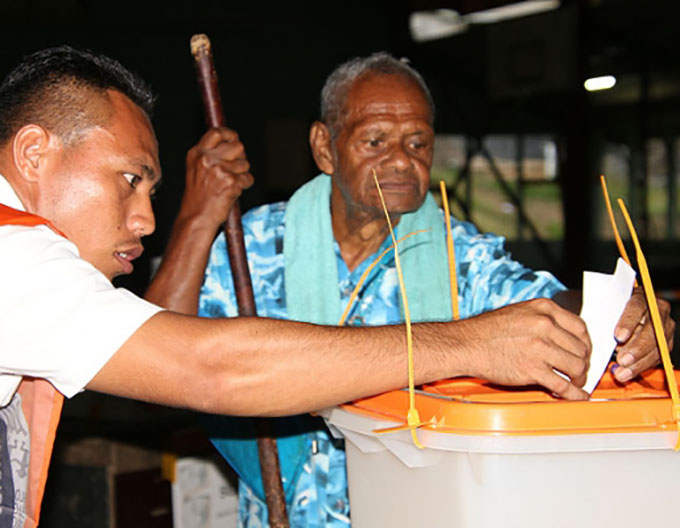
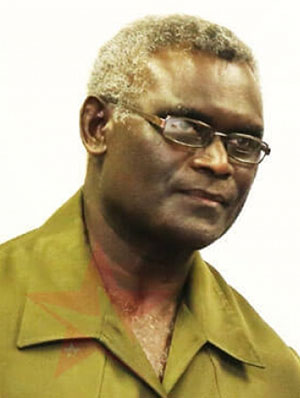 Manasseh Sogavare … back for another term. Image: Solomon Star






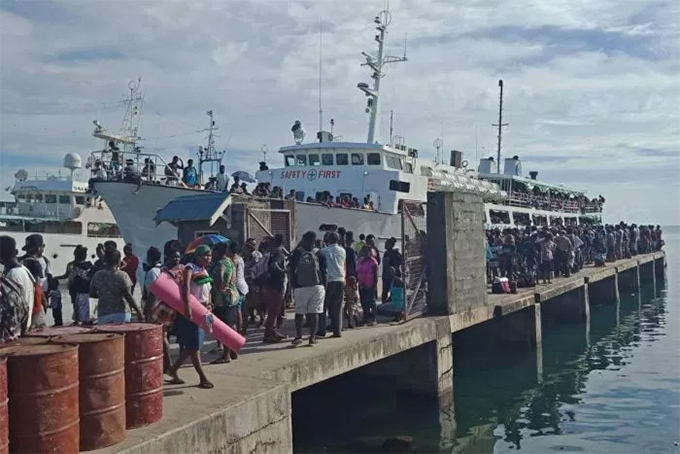 Chaotic scenes at Honiara’s main wharf where passengers have tried to climb on departing ferries. Image: Evan Wasuka/ABC/Wansolwara





 Malolo reef damage in Fiji … target of prosecution of Fiji government, say local media reports. Image: FBC News


 Newsroom co-editor Mark Jennings and investigative journalist Melanie Reid … detained over probe of accused Chinese property developer. Image: RNZ File
 Author Dr Ramzy Baroud … Christchurch terrorist’s act backfired. Image: Rahul Bhattarai/PMC