Page 1019

Logging is due to start in fire-ravaged forests this week. It’s the last thing our wildlife needs

Source: The Conversation (Au and NZ) – By David Lindenmayer, Professor, The Fenner School of Environment and Society, Australian National University

New South Wales’ Forestry Corporation will this week start “selective timber harvesting” from two state forests ravaged by bushfire on the state’s south coast.

The state-owned company says the operations will be “strictly managed” and produce timber for power poles, bridges, flooring and decking.

Similarly, the Victorian government’s logging company VicForests recently celebrated the removal of sawlogs from burnt forests in East Gippsland.

VicForests says it did not cut down the trees – they were cut or pushed over by the army, firefighters or road crews because they blocked the rood or were dangerous. The company said it simply removed the logs to put them “to good use”.

However the science on the impacts of post-fire logging is clear: it can significantly impair the recovery of burned ecosystems, badly affect wildlife and, for some animal species, prevent recovery.

We acknowledge that for safety reasons, some standing and fallen burnt trees must be removed after a fire. But wherever possible, they should remain in place.

Damaging effects

Hollows in fire-damaged trees and logs provide critical habitat for animal species trying to survive in, or recolonise, burned forests.

Detailed studies around the world over the past 20 years, including in Australia, have demonstrated the damage caused by post-fire logging.

Indeed, the research shows post-fire logging is the most damaging form of logging. Logging large old trees after a fire may make the forests unsuitable habitat for many wildlife species for up to 200 years.


Read more: Buzz off honey industry, our national parks shouldn’t be milked for money


Long-term monitoring data from extensive field surveys shows hollow-dependent mammals, such as the vulnerable greater glider, generally do not survive in areas burned and then logged. Research by the lead author, soon to be published, shows populations are declining rapidly in landscapes dominated by wood production.

Forests logged after a fire have the lowest bird biodiversity relative to other forests, including those that burned at high severity (but which remain unlogged). Critical plants such as tree ferns are all but eradicated from forests that have been burned and then logged.

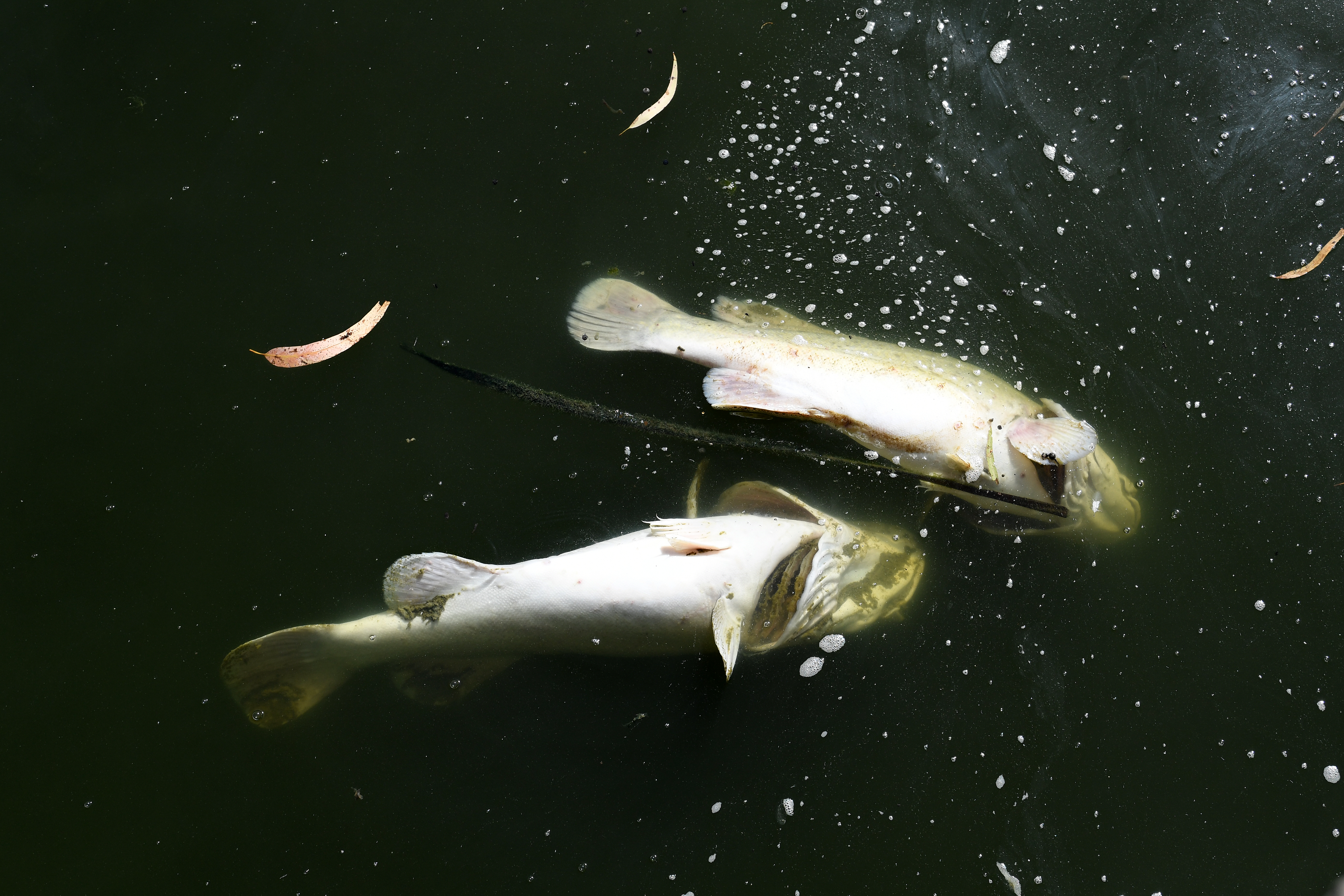
Soils remain extensively altered for many decades after post-fire logging. This is a major concern because runoff into rivers and streams damages aquatic ecosystems and kills organisms such as fish.
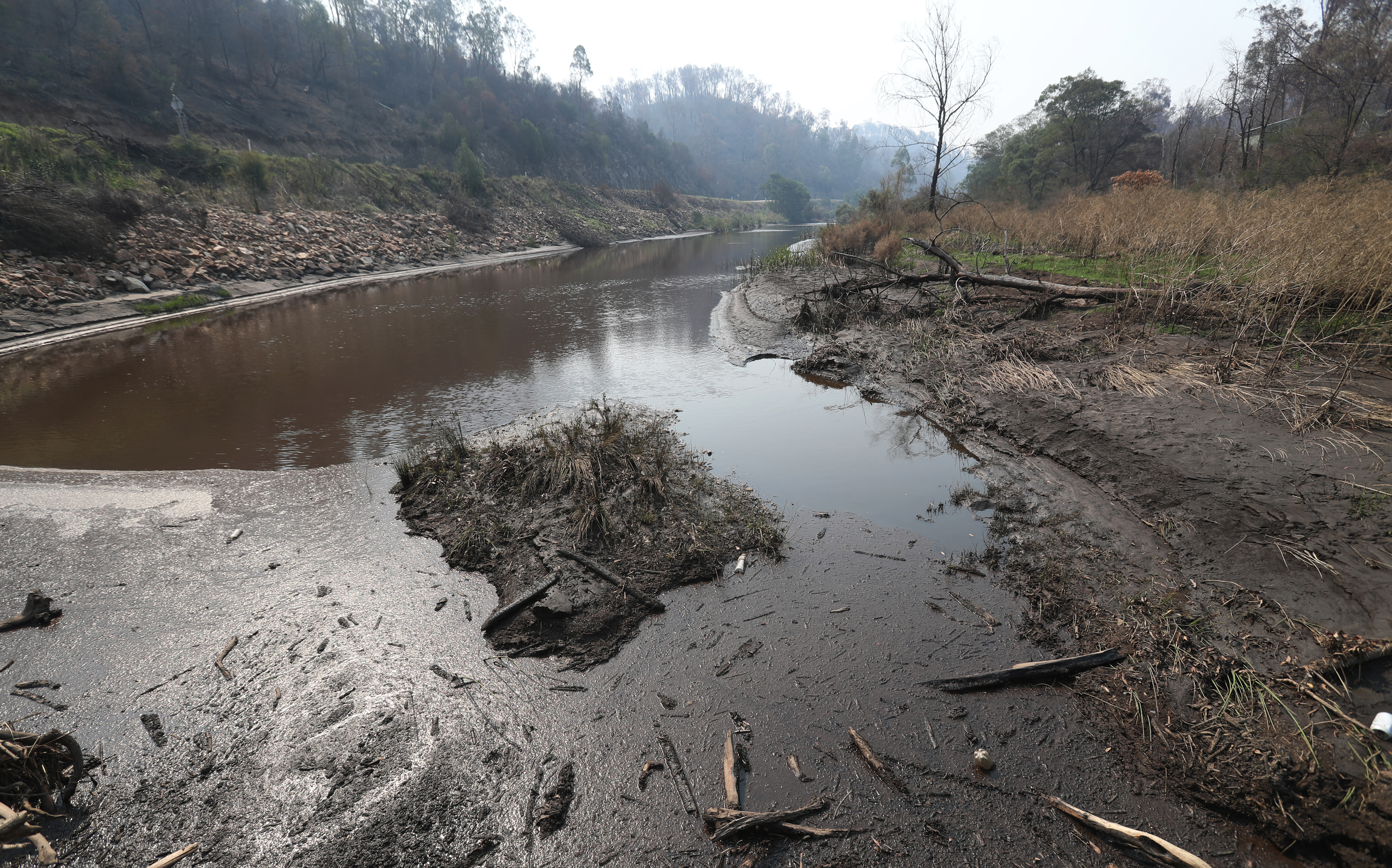
Soiled water after a bushfire is a major ecological problem. AAP

A double disturbance

Fire badly disrupts forest ecosystems. Animals and plants then begin recovering, but most forests and the biota they support simply cannot deal with the second intense disturbance of logging so soon after a first one.

For example, young germinating plants are highly vulnerable to being flattened and destroyed by heavy logging machinery. And in an Australian context, post-fire logging makes no sense in the majority of eucalypt-dominated ecosystems where many tree species naturally resprout. This is an essential part of forest recovery.

Logs provide shade, moisture and shelter for plants, and rotting timber is food for insects – which in turn provide food for mammals and birds.


Read more: Logged native forests mostly end up in landfill, not in buildings and furniture


Living and dead trees are also important for fungi — a food source for many animals, including bandicoots and potoroos which have been heavily impacted by the fires.

Similarly on burnt private land, removing damaged and fallen trees will only hinder natural recovery by removing important animal habitat and disturbing the soil. If left, fallen trees will provide refuge for surviving wildlife and enable the natural recovery of forests.

While the sight of burnt timber can be disheartening, landholders should resist the urge to “clean up”.
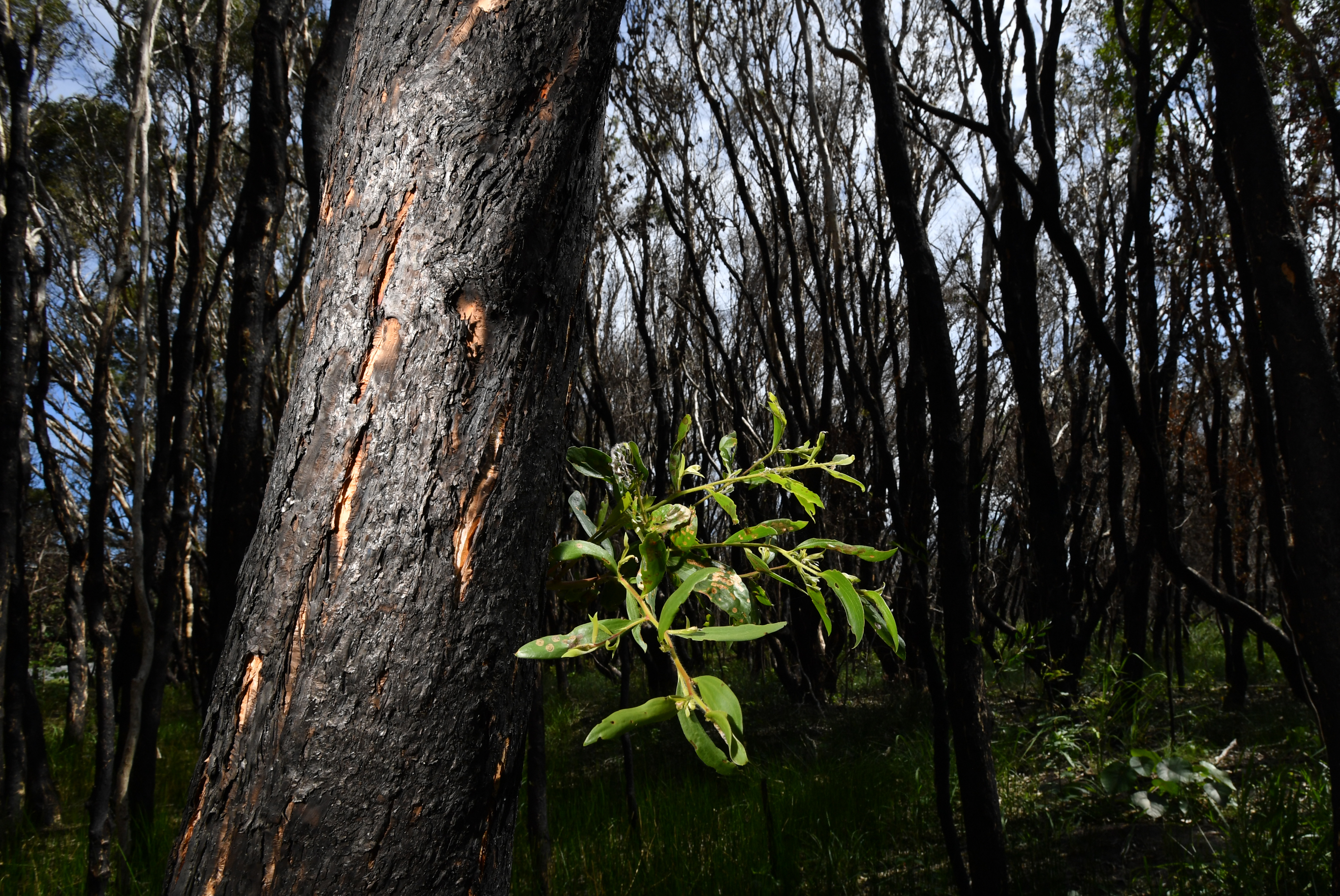
Some trees that appear dead may in fact be about to resprout. Darren England/AAP

It doesn’t add up

Research in North America suggests debris such as tree heads, branches and other vegetation left by post-fire logging not only hinders forest regeneration, but can make forests more prone to fire.

And the economics of logging, particular after a fire, is dubious at best. Many native forest logging operations, such as in Victoria’s East Gippsland, are unprofitable, losing millions of taxpayer dollars annually.


Read more: Yes, the Australian bush is recovering from bushfires – but it may never be the same


Timber is predominantly sold cheaply for use as woodchips and paper pulp and fire-damaged timber is of particularly poor quality. Even before the fires, 87% of all native forest logged in Victoria was for woodchips and paper pulp.

Post-fire logging certainly has no place in national parks. But for the reasons we’ve outlined, it should be avoided even in state forests and on private land. Million hectares of vegetation in Australia was damaged or destroyed this fire season. The last thing our forests need is yet more disturbance.


VicForests response: VicForests told The Conversation that timber currently being removed by VicForests, at the direction of the Chief Fire Officer, is from hazardous trees that were cut or knocked over to enable the Princes Highway to be re-opened.

It said the timber would be used for fence restoration, firewood and to support local mills “protecting jobs, incomes and families. It would otherwise be left in piles on the side of the highway”.

“Any further post-fire recovery harvesting will occur in consultation with government including biodiversity specialists and the conservation regulator, following careful assessment and protection of high conservation values,” VicForests said.

The company said post-fire recovery harvesting, particularly of fire-killed trees, does not increase fire risk.

“Sensitive harvesting including the retention of habitat trees and active re-seeding is more likely to result in a successfully regenerated forest and a supportive environment for threatened species. This regenerating forest will have the same fire risk as natural regeneration following bushfire.”


Forestry Corporation of NSW response: Forestry Corporation of NSW said in a statement that small-scale selective timber harvesting operation will begin on the south coast this week.

The company’s senior planning manager Dean Kearney said the Environment Protection Authority, with the input of scientific experts “has provided Forestry Corporation with site-specific conditions for selective timber harvesting operations in designated parts of Mogo and South Brooman State Forests. These areas were previously set aside for timber production this year but have now been impacted by fire.”

“Strictly-managed selective timber harvesting will help prevent the loss of some high-quality timber damaged by fire, including material that will be in high demand for rebuilding, while ensuring the right protections are in place for key environmental values, particularly wildlife habitat, as these forests begin regenerating,” he said.

“The harvesting conditions augment the already strict rule set in place for forest operations and include requirements to leave all unburnt forest untouched and establish even more stringent conditions to protect water quality, hollow-bearing trees and wildlife habitat.”

ref. Logging is due to start in fire-ravaged forests this week. It’s the last thing our wildlife needs – https://theconversation.com/logging-is-due-to-start-in-fire-ravaged-forests-this-week-its-the-last-thing-our-wildlife-needs-132347
Transport is letting Australia down in the race to cut emissions

Source: The Conversation (Au and NZ) – By Philip Laird, Honorary Principal Fellow, University of Wollongong

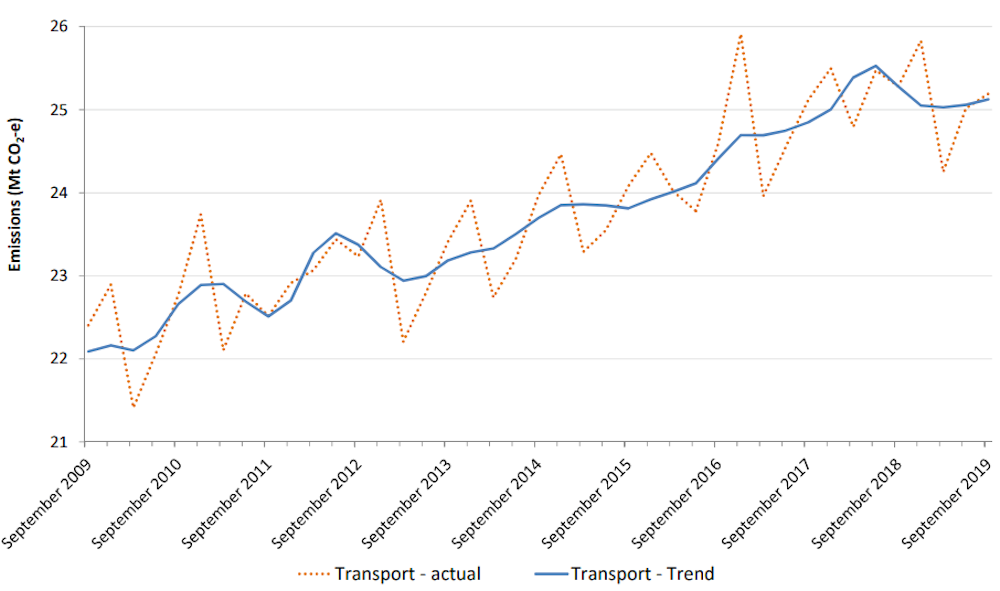
At a time Australia is meant to be reducing its greenhouse emissions, the upward trend in transport sector emissions continues. The latest National Greenhouse Gas Inventory report released last week shows the transport sector emitted 102 million tonnes (Mt) of carbon dioxide equivalent (MtCO₂-e) in the 12 months to September 2019. This was 18.9% of Australia’s emissions.

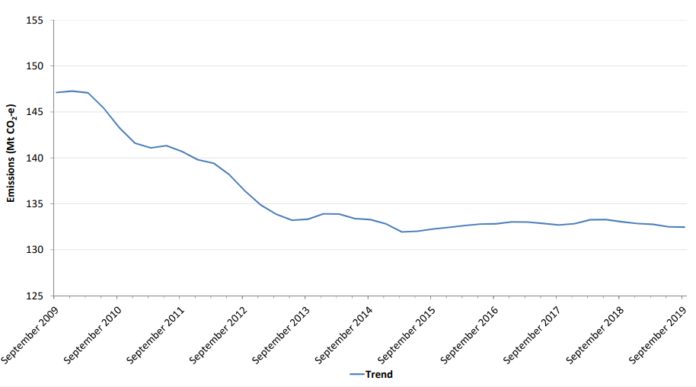
Overall, the trend in emissions from all sectors have been essentially flat since 2013. If Australia is to reduce emissions, all sectors including transport must pull their weight.


Read more: Four ways our cities can cut transport emissions in a hurry: avoid, shift, share and improve


Overall trend emissions, by quarter, September 2009 to September 2019. National Greenhouse Gas Inventory

Transport emissions have gone up 64% since 1990. That’s the largest percentage increase of any sector.

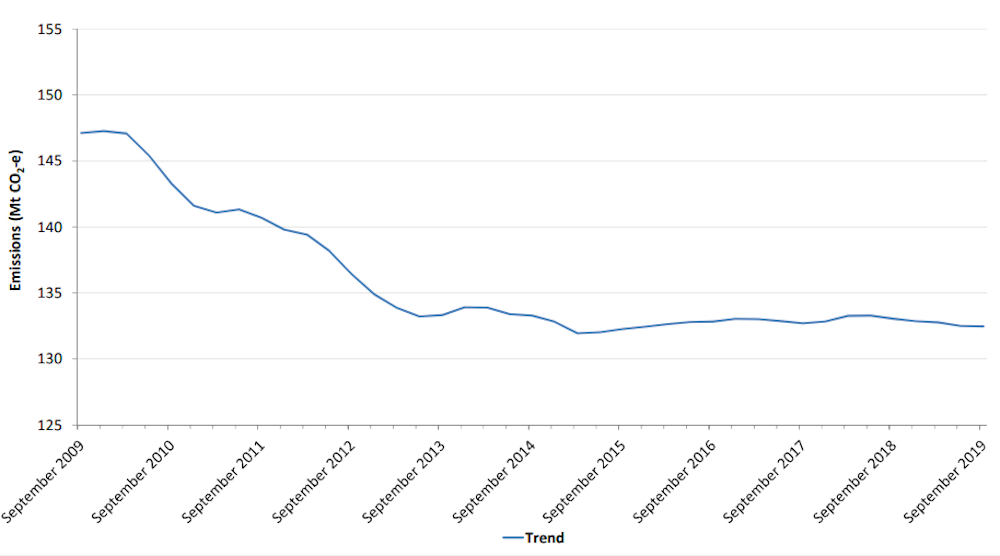
Transport emissions, actual and trend, by quarter, September 2009 to September 2019. Source: National Greenhouse Gas Inventory

Transport sector emissions include the direct burning of fuels for road, rail, domestic aviation and domestic shipping, but exclude electricity for electric trains.

Transport emissions are now equal second with stationary energy (fuels consumed in the manufacturing, construction and commercial sectors and heating) at 18.9%. The electricity sector produces 33.6% of all emissions. The main reasons for transport emissions trending upwards are an over-dependence on cars with high average fuel use and an over-reliance on energy-intensive road freight.

Inevitable results of policy failure

Increasing transport emissions are a result of long-standing government policies on both sides of politics. In 2018, the Climate Council noted:

Australia’s cars are more polluting; our relative investment in and use of public and active transport options is lower than comparable countries; and we lack credible targets, policies, or plans to reduce greenhouse gas pollution from transport.

John Quiggin and Robin Smit recently wrote about vehicle fuel efficiency for The Conversation. They cited new research that indicates emissions from road transport will accelerate. This is largely due to increased sales of heavier vehicles, such as four-wheel drives, and diesel cars.


Read more: We thought Australian cars were using less fuel. New research shows we were wrong


The government has ignored recommendations to adopt mandatory fuel-efficiency standards for road passenger vehicles. Australia is the only OECD country without such standards.

Research by Hugh Saddler found a marked increase in CO₂ emissions from burning diesel (up 21.7Mt between 2011 and 2018). A 2015 Turnbull government initiative to phase in from 2020 to 2025 a standard of 105g of CO₂ per kilometre for light vehicles was “shelved after internal opposition and criticism from the automotive lobby”.

At the same time, the uptake of electric vehicles is slow. Economist Ross Garnaut, in his 2019 book Superpower: Australia’s Low-Carbon Opportunity, sums it up:

Australia is late in preparation for and investment in electric road transport.


Read more: Clean, green machines: the truth about electric vehicle emissions


Australia’s low transport energy efficiency (and so high CO₂ emissions) has also attracted overseas attention. The American Council for an Energy-Efficient Economy rates the world’s 25 largest energy users for sectors including transportation. In 2018, Australia slipped two places to 18th overall. It was 20th for transportation with just 6.5 points out of a possible 25 on nine criteria.

On four of these criteria, Australia scored zero: fuel economy of passenger vehicles, having no fuel-efficiency standards for passenger vehicles and heavy trucks, and having no smart freight programs.

For vehicle travel per capita, the score was half a point. For three metrics – freight task per GDP, use of public transport, and investment in rail transit versus roads – Australia scored just one point each.

Only in one metric, energy intensity of freight transport, did Australia get full marks. This was a result of the very high energy efficiency of the iron ore railways in Western Australia’s Pilbara region.

The International Monetary Fund (IMF) has also questioned the Australian government’s preference for funding roads rather than more energy-efficient rail transport. The IMF says Australia should be spending more on infrastructure, but this should be on rail, airports and seaports, rather than roads.

What can be done

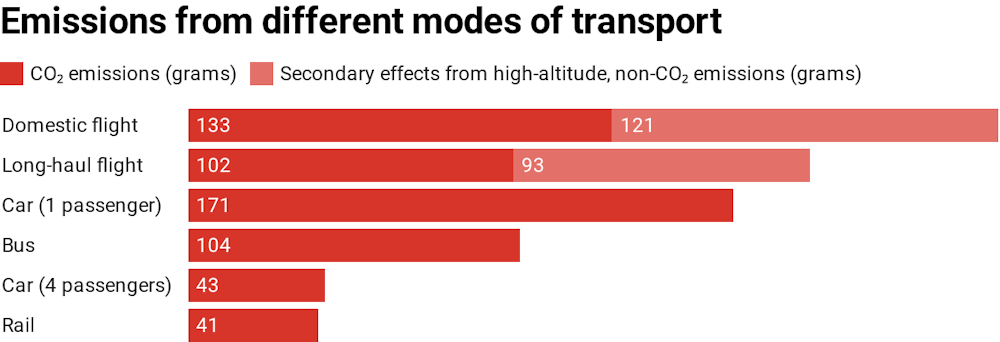
The first thing is to acknowledge that our preferred passenger transport modes of cars and planes cause more emissions than trains, buses, cycling and walking. For example, CO₂ emissions per passenger km can be 171 grams for a passenger car as against 41g for domestic rail.

Data source: Greenhouse gas reporting: conversion factors 2019

For freight, our high dependence on trucks rather than rail or sea freight increases emissions by a factor of three.


Read more: Labor’s plan for transport emissions is long on ambition but short on details


A 1996 report, Transport and Greenhouse, from what is now the federal Bureau of Infrastructure, Transport and Regional Economics (BITRE), reviewed no fewer than 16 measures (including five “no regrets” measures) to cut transport emissions. In a 2002 report, Greenhouse Policy Options for Transport, BITRE offered 11 measures to reduce vehicle kilometres travelled (VKT), nine measures to reduce emissions per VKT, and four road-pricing measures (mass-distance charges for heavy trucks, tolls, internalising transport externalities and emission charging).

BITRE last appeared to revisit this important issue in a 2009 report on transport emission projections to 2020. This report projected a total of 103.87Mt CO₂-e for 2019. Actual 2019 transport emissions will be about 102Mt.

It’s important to note that BITRE’s 2009 projection was on a business-as-usual basis. The current level of about 4 tonnes a year per person is where Australia was in 2000.

Clearly, Australia needs to do better. As well as the BITRE remedies, another remedy would be to adopt a 2002 National Action Plan approved by the Australian Transport Council in collaboration with the Commonwealth, state and territory governments. The plan included, within ten years, “programs that encourage people to take fewer trips by car” and a shift “from predominantly fixed to predominantly variable costs” to “ensure that transport users experience more of the true cost of their travel choices”. This did not proceed.

However, New Zealand has effectively adopted this approach for many years. Petrol excise is now 66.524 cents per litre (just 42.3c/l in Australia) and the revenue goes to the National Land Transport Fund for roads and alternatives to roads, resulting also in lower registration fees for cars. New Zealand has had mass distance pricing for heavy trucks for 40 years. These measures have not stopped its economy performing well.

Why do measures that would reduce transport emissions continue to be so elusive in Australia?

ref. Transport is letting Australia down in the race to cut emissions – https://theconversation.com/transport-is-letting-australia-down-in-the-race-to-cut-emissions-131905

Forget more compulsory super: here are 5 ways to actually boost retirement incomes

Source: The Conversation (Au and NZ) – By Brendan Coates, Program Director, Household Finances, Grattan Institute

This morning the Grattan Institute releases its submission to the government’s retirement incomes review, a review called in anticipation of five annual increases in compulsory superannuation contributions, scheduled to begin in July 2021.

Our research shows the super increases aren’t necessary. For most Australians, retirement incomes are already adequate. Since higher super contributions will come at the expense of wages, the scheduled increases should be abandoned.

But there are big problems the review will need to confront.

Here are five changes that would tackle them.

1. Boost rent assistance

While most Australians are comfortable in retirement, the system is failing too many poorer Australians, especially low-income women and retirees who rent.

Senior Australians who rent privately are more likely to suffer financial stress than homeowners or renters in public housing. And it will get worse because young Australians on lower incomes are less likely to own homes than in the past.

The government’s priority should be boosting rent assistance, which has not kept pace with rent increases. Raising rent assistance by 40%, or roughly A$1,400 a year for singles, would cost just $300 million a year if it applied to pensioners, and another $1 billion a year if extended to other renters.

A common concern is that boosting rent assistance would lead to higher rents. But that’s unlikely: households would not be required to spend any of the extra income on rent, and most would not.

2. Ease the age pension asset test

While retirement incomes are adequate for most retirees, the age pension assets test excessively penalises people who save more for their retirement.

Before January 1, 2017 retirees with assets above the threshold lost $1.50 of pension per fortnight for every $1,000 of assets above the threshold. In 2017 the Coalition lifted the threshold but also lifted the withdrawal rate to $3 of pension per fortnight for each $1,000 of assets.
The changes resulted in very high effective marginal tax rates on retirement savings, so much so that a typical worker who saves an extra $1000 at age 40 increases their retirement income by only $25 each year, or $658 over 26 years of retirement, which is a negative return on money saved for decades.


Read more: Why pensioners are cruising their way around budget changes


The age pension withdrawal rate should be cut to $2.25 per fortnight for each $1,000 of assets above the threshold. This would cost the budget about $750 million a year.

For middle and high-income workers, this change would have a bigger impact on retirement incomes per government dollar expended than boosting compulsory super.

3. Boost Newstart

Newstart, together with the disability support pension, provides an important safety net for Australians who are unable to work right through to retirement age.

Yet while the age pension and disability support pension are indexed to wages, Newstart is not. It only climbs in line with inflation. It should be increased by $75 a week and then indexed to wages going forward.

This would cost a lot but it would help the growing legions of older Australians, many of them women, who find themselves among the long-term unemployed in the years leading up to retirement, or are forced to retire early. And it would lift many more younger Australians out of poverty.

4. Include the home in the pension assets test

Falling rates of home ownership mean we are at risk of creating an underclass of retirees who rent.

And our retirement incomes system makes this worse by favouring homeowners over renters. Once a person is retired, their home is treated differently to their other assets. Which is why $6 billion in pension payments go to people with homes worth more than $1 million.

It’s time for more of the value of the family home to be included in the pension assets test. Counting more of the home above some threshold (such as $500,000) would be fairer and would save the budget up to $2 billion a year.

No pensioner would be forced to leave their home. Pensioners with valuable homes could continue to stay at home and receive the pension under the Government’s pension loans scheme, which recovers debts only when homes are eventually sold.

5. Fix super tax breaks

Superannuation tax breaks cost a lot – tens of billions each year in foregone revenue, with half the benefits flowing to the top one fifth of income earners, who already have enough resources to fund their retirements.

And the costs are set to climb further as super balances climb. The cost of the earnings concessions alone is set to climb from $17.4 billion to $20.8 billion over the next four years.

Three reforms would keep them in check.

  • Voluntary contributions from pretax income should be limited to $11,000 a year. This would save the budget about $1.7 billion a year.

  • Contributions from post-tax income should be limited to $250,000 over a lifetime, or to $50,000 a year. It won’t save the budget much in the short term, but in the longer term it will plug a large hole in the tax system.

  • Earnings in retirement – currently untaxed for people with superannuation balances less than $1.6 million – should be taxed at 15%, the same as super earnings before retirement. Doing so would save the budget about $2 billion per year at first, and much more in future.

These changes to super taxes free up money to help Australians who need help without hurting the retirement prospects of middle Australians.

Australia’s retirement incomes system works well, but there are things that need fixing.

The reforms we propose would make retirement fairer, save taxpayers’ money, and ensure that all Australians can enjoy a comfortable retirement free from poverty.


Read more: Think superannuation comes from employers’ pockets? It comes from yours


ref. Forget more compulsory super: here are 5 ways to actually boost retirement incomes – https://theconversation.com/forget-more-compulsory-super-here-are-5-ways-to-actually-boost-retirement-incomes-132655

Morrison government will use purchasing power to encourage plastics recycling

Source: The Conversation (Au and NZ) – By Michelle Grattan, Professorial Fellow, University of Canberra

The Morrison government will use its procurement policy to encourage the recycling of plastics, as well as committing financial assistance for upgrading infrastructure to boost the capacity for this waste to be reused.

Scott Morrison will announce the initiatives to a national conference in Canberra on Monday that is looking at the challenge of dealing with this escalating and environmentally destructive problem. The meeting is attended by industry, government and community representatives.

The prime minister, who has previously highlighted better management of plastics waste as a priority for his government, will emphasise that for major change “the only way forward is in partnership – working with our neighbours; state, territory and local governments; industry, our manufacturing sector and supermarkets; waste operators, and with consumers and communities”.

In a speech circulated ahead of delivery he proposes “three pillars” for tackling the problem: taking responsibility for the waste; encouraging demand for recycled products; and expanding industry capability.

Plastics “are choking our oceans. Scientists estimate that in just 30 years’ time the weight of plastics in our oceans will exceed the weight of fish in our oceans. That’s appalling.

“Taking responsibility means recognising the problems we are contributing to – and it also means keeping faith with the Australian people who recycle,” Morrison says.

“Only 12% of plastic put out in the yellow bin for recycling is actually recycled. Australians don’t expect their waste to be exported to someone’s village or waterway.”

Morrison will meet state and territory leaders at the Council of Australian Governments (COAG) next month to finalise a ban on the export of waste plastic, paper, glass and tyres.

He stresses this isn’t to ban the export of value-added recyclable materials.

Morrison says more investment is much needed in the recycling industry; this and collection systems are under “severe strain”. Investment is needed in “technological innovation that maximises the value of the recycled product and minimises the costs as well”. Only 8% of the $2.6 billion states and territories collected in waste levies over 2018-19 has been reinvested in infrastructure and technology.

“The Commonwealth stands ready to co-invest in these critical facilities with state and territory governments, and with industry”, he says. “We will invest with governments and with industry on a 1 to 1 to 1 basis.” Details will come closer to the May budget, Morrison said.

The waste sector employs 50,000 and generates more than $15 billion annually, Morrison says.

“For every 10,000 tonnes of waste sent to landfill, 2.8 direct jobs are created. But if we recycle the same waste, 9.2 direct jobs are created.

“According to the Australian Council of Recycling, recycling more domestically could create more than 5,000 new jobs.”

With a ban on waste plastic being exported, there will be more in Australia to reuse – which means finding ways of encouraging demand for recycled products. Both industry and government need to do this, Morrison says.

As the first of a number of measures the government will take, its procurement guidelines will be rewritten “to make sure every procurement undertaken by a Commonwealth agency considers environmental sustainability and use of recycled content as a factor in determining value for money”.

He instanced a number of examples of innovative recycling, These included “recycled plastic into asphalt … a one kilometre, two-lane stretch [of road] uses up to half a million plastic bags”, as well as into picnic tables, bollards and gardening products.

ref. Morrison government will use purchasing power to encourage plastics recycling – https://theconversation.com/morrison-government-will-use-purchasing-power-to-encourage-plastics-recycling-132742

Sun Yang ban shows world swimming body must establish an integrity commission

Source: The Conversation (Au and NZ) – By Jack Anderson, Professor of Sports Law, Melbourne Law School, University of Melbourne

With the announcement that China’s Sun Yang has been banned from swimming for eight years, FINA, the world governing swimming body, must take stock of how it oversees one of the most popular and high-profile of the Olympic sports ahead of this year’s Tokyo games.

It would now seem obvious that, taking the lead from athletics and tennis, FINA should establish an independent integrity unit to investigate and prosecute doping and similar offences.

In a decision announced Friday, the Court of Arbitration (CAS), sport’s self-styled world supreme court, confirmed that Sun would be banned from competitive swimming for eight years. His swimming future now rests largely on one final avenue of appeal to the Swiss Federal Tribunal.


Read more: Why drug cheats are still being caught seven years after the 2012 London Olympics


This has always been a big global story: Sun is one of the most successful swimmers of all time, and one of China’s most beloved sports stars. A three-time Olympic gold medallist, he has 11 world championship golds, and is second only to the legendary US swimmer Michael Phelps in men’s individual events.

It was at last year’s world championships in Korea that silver medallist, Australia’s Mack Horton, famously protested against Sun, during the podium ceremony for the 400 meters freestyle.

Mack Horton (left) protested Sun Yang’s win at the world championships in 2019. AAP/EPA/Patrick B. Kraemer

Horton’s protest related to the fact that Sun, having previously served a three-month ban for a doping infraction in 2014, had been involved in an incident with doping control officers in September 2018.

Having given a sample to the testers at his home, Sun became concerned about their conduct and accreditation. This concern eventually led to the vial containing Sun sample being smashed by one of the swimmer’s entourage.

Initially, Sun’s behaviour in this case merely attracted a reprimand. An investigation carried out by FINA concluded that, although Sun’s actions were incautious, they could be justified given the testers’ grave procedural errors and misconduct.

The World Anti-Doping Agency (WADA), the global body for anti-doping standards, later took the view that FINA’s approach was overly lenient. WADA appealed to CAS and a public hearing was held in Switzerland in November.

Having deliberated on what they heard at that eleventh-hour hearing, which was initially marred by poor translation, the three arbitrators delivered a summary of their verdict last week.

Basically, CAS held that the procedural concerns Sun had about the testing process in September 2018 either did not occur or were not sufficiently compelling to justify tampering with the sample container. Given this was his second anti-doping infraction, an eight-year sanction applied.

It must be remembered the charge against Sun is that of tampering with a sample – it is not a charge or “conviction” relating to doping. Sun’s sample taken in September 2018 was never tested, and this seems to be the reason why the arbitrators have not decided to strip him of the medals he obtained at the world championships in 2019. In this, as with other aspects of the Sun decision, we must await the publication of the arbitrators’ full, reasoned award.

Sun now has until the end of March to lodge an appeal at the Swiss Federal Tribunal (SFT) and has already indicated that he will take that option. As it happens, on various technical grounds – one relating to an unsubstantiated claim of bias against WADA’s chief lawyer – Sun’s lawyers have already been to the SFT on three separate occasions. They will now likely go for a fourth time, and it is likely to end in disappointment.

He will not get a full re-hearing at the SFT, and the grounds of appeal will be limited to narrow procedural issues only. An example would be whether the CAS hearing in some way unfair – ironically, the fact that it was held in public at Sun’s request may tell against him here. Another consideration may be whether the sanction was disproportionate – given the eight-year ban is mandated in the World Anti-Doping Code, this ground would likely not succeed. One final consideration may be whether the poor translation service at the CAS hearing might be a ground of appeal – again, unlikely, given that it was Sun’s legal team that hired the translator.


Read more: Snubbing Chinese swimmer Sun Yang ignores the flaws in the anti-doping system


Arguably, Sun’s strongest point has always been the general one, outlined in the seminal CAS case of Quigley v UIT. It is that, while the principle of strict liability applies to athletes in anti-doping control, it should equally apply to testers to strictly comply with all administrative aspects of the anti-doping process. Whether the SFT would entertain an argument that goes right to heart of the current anti-doping policy globally is unlikely.

While Sun grapples with an effective end to his career and WADA, unsurprisingly, feels vindicated, FINA must now reflect on its governance of its sport.

Lately, it has had a fractious relationship with some of its leading participants who sought successfully, on threat of litigation, to compete in a privately funded international swimming league. An integrity commission would seem a vital next step.

The reaction to the Sun ban on social media from China has been predictably ferocious. One knock-on effect of the Sun decision may be a greater focus from countries such as China and Russia on the fact that, in terms of the nationality of those appointed to hear cases, CAS, sport’s supreme court, appears to be systemically Eurocentric in nature.

It seems almost certain that Sun will not compete at Tokyo 2020. Attention now moves at CAS and on doping in sport to the case against Russia and its athletes.

The reaction to the Sun verdict will be a mere ripple in a pool compared to that which will greet a similar verdict against Russia.

ref. Sun Yang ban shows world swimming body must establish an integrity commission – https://theconversation.com/sun-yang-ban-shows-world-swimming-body-must-establish-an-integrity-commission-132738

New Philippine law gives ‘more teeth’ in anti-terror fight but lacks safeguards

OPINION: SunStar editorial in Cebu

So it goes. Nineteen senators in the Philippines Senate have approved on the third and final reading of Senate Bill (SB) 1083 this week, effectively giving more teeth to the Human Security Act of 2007, which was a watered down version of the 1996 Anti-Terror Act of Senator Juan Ponce Enrile.

SB 1083 is the Philippines’ response of commitment to international efforts in the fight against terror.

Authored by Senator Panfilo Lacson, the bill intends to fortify the legal backbone in the fight against terror, equip law enforcers with necessary tools to carry out operations, and safeguard the rights of those accused of the crime.

READ MORE: Senate approves anti-terrorism bill on final reading

SB 1083 defines terrorism as a crime “committed by any person who within or outside the Philippines, regardless of the stage of execution; engages in acts intended to cause death or serious bodily injury to any person, or endangers a person’s life; engages in acts intended to cause extensive damage or destruction to a government or public facility, public place or private property: engages in acts intended to cause extensive interference with, damage or destruction to critical infrastructure; develops, manufactures, possesses, acquires, transports, supplies or uses weapons, explosives or of biological, nuclear, radiological or chemical weapons; and release of dangerous substances, or causing fire, floods or explosions.”

The law allows the police or military to conduct a 60-day surveillance on suspected terrorists, although this can be lengthened to another non-extendable period of 30 days with judicial authority.

– Partner –

A suspected person can be detained without a warrant of arrest for 14 days, or 10 more days if authorities deem it necessary. This happens to be one of the provisions that angered Senator Francis Pangilinan, who voted with Senator Risa Hontiveros against the bill.

“The prolonged detention is an impingement of rights and liberty. Why 14 days? If security officials and law enforcers are doing their job, why will it take them long to file a case?” Pangilinan said.

‘Produce or invent evidence later?’
“Or, is the practice of arrest and detain now, produce or invent evidence later still prevalent, as it was when opposition leader Jovy Salonga was arrested, detained, and charged in 1981? The current law is not perfect, and, we, in Congress, should be working continuously to make it work for the people.”

Lacson, on the other hand, assures that the bill provides sufficient safeguard to ensure the basic human rights of the accused. The Commission on Human Rights (CHR) shall immediately be notified in case of detention of a suspected terrorist.

The measure also mandates the CHR to give highest priority to investigate and prosecute violations of civil and political rights of persons and to prosecute officials or law enforcers who violate the basic rights of the suspects or detained persons.

The catch, however, is that SB 1083 removed the provision of payment of P500,000 (NZ$15,500) damages for each day of detention of persons acquitted of terrorism charges.

Events, however, render the SB 1083 at once timely and yet ill-timed. Timely while extremist terror is breathing down the neck of countries, but ill-timed most especially while we have a government that, while publicly claiming openness, seems at heart intolerant to dissent, indulging itself in a spree of red-tagging, arresting students, academics, social workers, priests and activists.

SB 1083 also comes at a time when government holds the most expensive intelligence work there is as far as budget goes, at a whopping P4.9 billion (NZ$154 million). With that much arm, we now have a highly omnipresent Big Brother practically watching over its citizens’ shoulders at any given time of the day.

This tilts the balance of power entirely and, if the wrong hands take the rein, might easily endanger our democracy.

SunStar is an independent community newspaper and online portal based in Cebu, Philippines. This editorial was published on 27 February 2020.

Print Friendly, PDF & Email

Article by AsiaPacificReport.nz

Panic-buying hits headlines after first NZ coronavirus case

By Colin Peacock of RNZ Mediawatch

Authorities and the media alike knew it was just a matter of time before New Zealand had its first case of the new coronavirus. But panic-buying sparked by the breaking news prompted more headlines this weekend that undermined the message to keep calm and carry on.

“Please – if you’re feeling anxious, try and maintain some perspective. Channel your energy into prudence,” Jack Tame told his Newstalk ZB audience on Saturday morning.

“This morning, as supermarkets are apparently overwhelmed by people stressed out about … a looming threat we can’t see, I think it’s a good opportunity for us all to strike a balance between prudence and perspective,” he said.

READ MORE: Coronavirus ‘getting bigger’  – Al Jazeera updates and infections map

It wasn’t prudence and perspective that needed to be balanced – but facts and fears.

Moments before he said all that on air, ZB’s traffic report warned of car congestion around supermarkets.

– Partner –

The ZB news at the top of the hour began with reports of panic-buying in Auckland supermarkets that morning, quoting one shopper’s description of a “zombie apocalypse.”

“It’s just nuts,” Alexia Russell told ZB news after visiting Wairau’s crowded Pak ‘n Save for supplies for a party.

Alexia Russell is also the producer of daily news podcast The Detail for RNZ and Newsroom.co.nz.

Misinformation examined
Two days earlier an entire edition of it was devoted to misinformation about Covid-19 and how it could provoke fear.

Meanwhile, on RNZ National, Kim Hill told her listeners: “I’d be panic-buying in Auckland too if I’d seen the screaming front page of the Weekend Herald.”

The front page of the paper on sale in Auckland yesterday was indeed startling.

Under the banner headline ‘First NZ Coronavirus case: PANDEMONIUM’ there was a big photo of a man in protective gear washing down an underground train.

But it wasn’t taken at Britomart station in Auckland – it was from Tehran, the capital of Iran and the point of origin of the New Zealand citizen who’d tested positive in Auckland on Friday.

There was also a smaller photo at the bottom of the page showing empty shelves at an unnamed Auckland  supermarket. The caption claimed “shelves across Auckland” were being cleaned out.

“Panicked shoppers had descended on supermarkets across Auckland, stocking up for what one labelled ‘the apocalypse’,” said the Weekend Herald.  

Panic-buying – but how bad really?
Panic-buying in several locations was certainly newsworthy, but how bad was this really?

The Herald story quoted one resident as saying his local Pak ‘n Save was “weird” from the outset – as it was hard to find a park at 9.15pm.

“We have been doing our groceries on Friday evenings for the past four years. Never seen anything this bad,” said another.

Another told the Herald it was “worse than Christmas Eve” in the aisles – but the Christmas crush at Countdown doesn’t usually make the news.

Interestingly, that PANDEMONIUM headline didn’t appear on Weekend Herald editions on sale outside Auckland.

And the panic-buying didn’t feature at all on the front pages of the other weekend papers in The Herald’s stable around the North Island.

Further South the Otago Daily Times – which shares copy with the Herald – led with “First case of virus in NZ.”

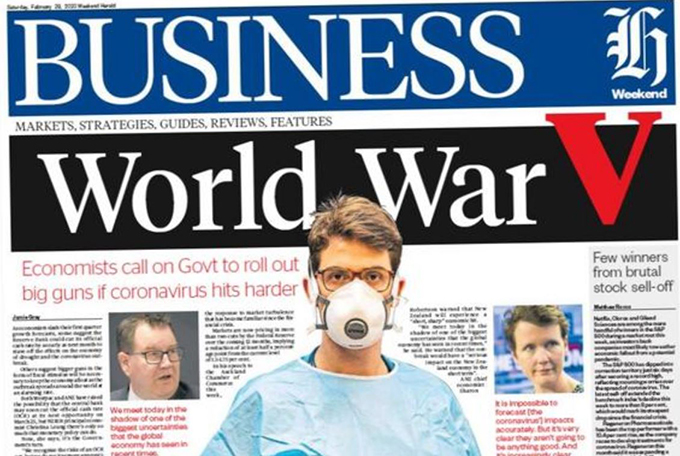
It’s war . . . in the business section of the Weekend Herald. Image: RNZ Mediawatch

But queues and car park crushes in Auckland shops weren’t part of the picture.

Dramatic stuff but misleading
The business section of the Weekend Herald had the banner headline “World War V” and a huge picture of a health worker in a gown and facemask.

Dramatic stuff, but the pic was from Turin, Italy – and the actual story was an otherwise sober – and sombre – assessment of what coronavirus might do to our economy in the coming months.

Just as health authorities here have been planning for a case of Covid-19 on our soil, news media were ready with “what you need to know”-type explainers which were rolled out online when the news broke.

Radio stations had public health experts on hand to go on air.

“It’s absolutely business as usual. Go out and enjoy yourselves and do your usual things,” Otago University’s professor of public health Michael Baker said on NewstalkZB on Friday soon after the news of the first case was confirmed.

He could have added we should stick with trusted sources of news and information – but take panicky headlines like PANDEMONIUM and WORLD WAR V with a pinch of salt.

Colin Peacock is presenter of the RNZ Mediawatch programme. This article is republished under the Pacific Media Centre’s content partnership with Radio New Zealand.

Print Friendly, PDF & Email

Article by AsiaPacificReport.nz

China’s ‘mixed messages’ in Asia recipe for distrust, says academic

China’s rise in the Asia-Pacific region has the entire globe assessing how the future of the region might look. Delegates at February’s QS Summit in Wellington got a first-hand analysis from some leading academics on the subject, with debates over the nature of the power transition that is underway, and the contours of a new regional order. Graeme Acton looked in on the keynote address.   


Professor of International Relations at Oxford University Rosemary Foot kicked off the QS Summit debate, arguing that while a power transition between the US and China is obviously underway, China’s new vision for the region is being held back by its own policy decisions.

“It’s a question of China’s use of its new power as dominance, or power as authority, using ideas of consent, or coercion ..which is it?” she asked.

“You need to look at how wisely China is conducting state-to state relations in the region … is it attracting followers or not?”

READ MORE: The QS Summit on power relationships

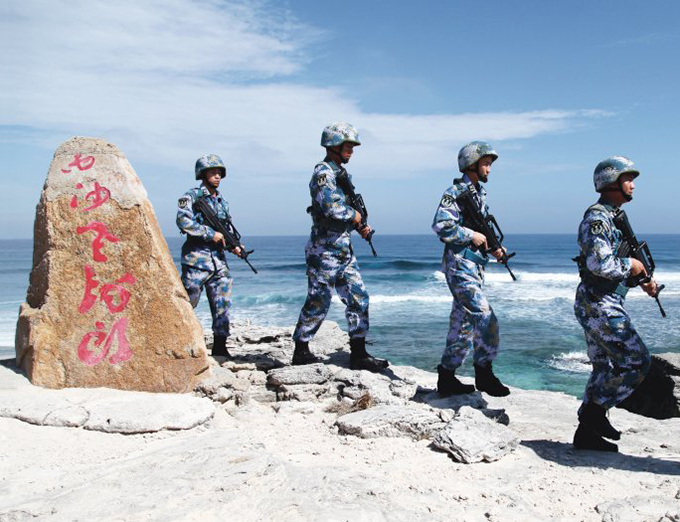
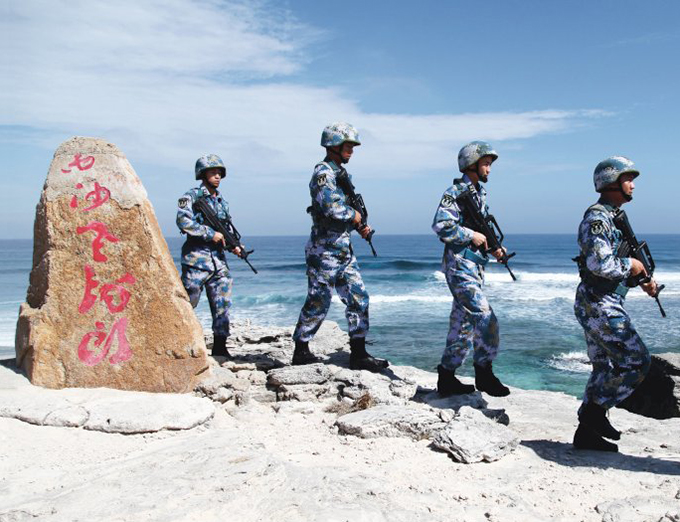
She says China has held itself back with a perception of heavy-handedness on issues like the South China Sea, where new military installations have been constructed on a number of small, uninhabited islands an rocky outcrops.

unnamed3
Professor Rosemary Foot … any new order has to be attentive to the norms that have kept the region stable in recent times. Image: Asia Media Centre

She says any new order has to be attentive to the norms that have kept the region stable in recent times, and China’s rise now means it has a role to play in establishing and maintaining a stable regional order, focused on something more than just military dominance.

– Partner –

“The signals that China sends are mixed – the South China Sea has been militarised – that is seen as a defensive strategy by China, but as an aggressive move by its neighbours to take control of marine resources – it implies use of force, or at least a willingness to use force, and that creates distrust”

China though, regards the US as fundamentally disruptive to region order, dividing it into friends and enemies

Belt and Road ambitions
Beijing has spent a lot of time emphasising its own willingness and commitment to public goods, like the hugely ambitious Belt and Road Initiative (BRI). But the challenge, according to Professor Foot, is whether China can bring stability and development, and replace the US security order with something more firmly rooted in Asian economic power.

So, is China’s vision resonating anywhere?

The disruption caused by Donald Trump’s administration and its unilateral approach to international relations surely gives China a chance to corral some support.

”But China’s policies put China first and many in the region find it hard to see China ‘doing the right thing’,” says Professor Foot.

“China’s claim to be the main stabiliser in the region is put under question by its current attitude to the US and Japan, and its behaviour in places like the South China Sea.”

“Why is it that China is finding it so hard to move into the role of benign hegemon in Asia …I’m not sure, but I think there is a sense of entitlement and a sense of victimhood that is drawn on frequently … Xi Jinping has argued that China is in a “unique space”, not the post-colonial situation its neighbours occupy.”

Potential flashpoint warning
Professor Yuen Foong Khong joined the debate with a warning that political tensions in East Asia are a potential flashpoint for conflict.

“Asia is moving fast from uni-polarity to bi-polarity .. and the competition between the US and China could be reminiscent of the Cold War, but perhaps even more severe and dangerous than that period.”

“There are a number of flashpoints in Asia – the South China Sea, North Korea, Taiwan – and these flashpoints do not involve proxies. If they flare up then China and the US will find themselves directly involved very quickly”

But Professor Khong doubts a war will erupt, given the amount of economic integration between the two, and the fact neither would want any kind of nuclear exchange.

“China sees the current order as constraining on a number of fronts… China wants equality with the US in the region … but the US is very unlikely to cede to that, as it has more economic power, and stronger alliances in the region.

“Also China’s one-party political system is s serious stumbling block to it being accepted as a credible equal in the region at present.

“Both will pressure states to align with them, even though most Asian nations would really rather not have to.

Allegiances up for grabs
“If push comes to shove I believe Japan, Australia and NZ will stand with the US, but it’s in Southeast Asia that some of the allegiances are up for grabs – maintaining the strength of ASEAN will become increasingly important in the coming years.”

Professor Xiaoming Huang from Victoria University of Wellington wrapped up the keynote with an alternative view on the bipolar outlook in the Asia-Pacific put forward by professors Foot and Khong.

His view was that the Asia-Pacific’s increasing instability could in fact result in a more pluralist future scenario, with no one power taking precedence over another.

“The bipolar scenario with China and the US may not eventuate. East Asia’s future may we be more diffusive and de-centralised than you might think.”

Graeme Acton, the new Asia New Zealand Foundation’s Asia Media Centre manager, is former foreign news editor of RNZ.

Print Friendly, PDF & Email

Article by AsiaPacificReport.nz

RSF concerned about ‘lack of evidence’ in US extradition case against Assange


By RSF in London

During the first week of Wikileaks founder Julian Assange’s US extradition hearing in London, Reporters Without Borders (RSF) was concerned by the clear lack of evidence from the US for its charges against Assange.

RSF also remains concerned about Assange’s wellbeing and inability to participate properly in his hearing, following reports of mistreatment at Belmarsh prison and the judge’s rejection of his application to sit with his lawyers in the courtroom.

The hearing will resume from May 18, when three weeks of evidence will be heard.

READ MORE: John Pilger: Julian Assange must be freed, not betrayed

Julian Assange featured in a work by street artist Banksy. Image: GreenLeft

RSF conducted an unprecedented international trial-monitoring mission to the UK for Julian Assange’s US extradition hearing from February 24-27, as the prosecution and defence presented their legal arguments at Woolwich Crown Court in London.

RSF secretary-general Christophe Deloire and RSF Germany director Christian Mihr joined RSF UK bureau director Rebecca Vincent for the hearing, and Vincent was able to systematically monitor each sitting over the four days.

– Partner –


RSF staff from London, Paris, and Berlin also staged an action outside the adjacent Belmarsh Prison – where Assange is being held – on February 23, and joined protests outside the court on February 24.

District judge Vanessa Baraitser presided over the hearing. James Lewis QC acted for the US government, and barristers Edward Fitzgerald QC and Mark Summers QC argued in Assange’s defence.

US government representatives were present, but did not speak during the hearing.

Judge interrupted Assange
Assange did not take the stand, and his several attempts to speak from the secure dock he was held in at the back of the courtroom were interrupted by the judge, who stated that as he was “well represented”, he must speak through his lawyers.

Assange is being pursued under a US indictment on the basis of 17 charges under the Espionage Act and one charge under the Computers Fraud and Abuse Act, related to Wikileaks’ publication in 2010 and 2011 of several hundred thousand military documents and diplomatic cables leaked by Chelsea Manning.

These charges carry a combined possible sentence of up to 175 years in prison. The publication of the leaked documents resulted in extensive media reporting on matters of serious public interest including actions of the US in Guantánamo Bay, Iraq and Afghanistan.

In the course of the prosecution’s argument, it became clear that the US still has no evidence for its claim that Assange had put sources at “serious and imminent risk,” but are pursuing the charges based on the risks that he is accused of knowingly causing.

At one point the prosecution said the publication of the leaked documents had led to the disappearance of some sources – but with no apparent evidence in support of this claim. The prosecution argued that Assange had damaged the US’ defence and intelligence capabilities and hurt US interests abroad.

However, the defence argued that these proceedings constitute an abuse of process as the case is being pursued for ulterior political motives and fundamentally misrepresents the facts.

They outlined that Wikileaks had worked for months with a partnership of professional media organisations to redact the leaked documents.

Unredacted dataset
The defence explained that as redaction was in progress, one of the media partners had published a book containing the password to the unredacted dataset, which led to its access and publication by other parties.

The defence outlined how Assange had attempted to mitigate any risk to sensitive sources by notifying the White House and State Department that publication outside of Wikileaks’ control was potentially forthcoming, imploring them to take action to protect the named individuals.

RSF secretary-general Christophe Deloire said:

“We were not surprised by the prosecution’s argument, which again confirmed the lack of evidence for the charges against Mr Assange. This week’s hearing confirmed our belief that he has been targeted for his contributions to public interest reporting. We call again for the UK not to extradite Mr Assange to the US, for the charges against him to be dropped, and for him to be released as a matter of urgent priority.” 

In arguments around extradition, the defence argued that the Anglo-US Extradition Treaty expressly prevents extradition on the basis of political offences, presenting a bar to Assange’s extradition.

They presented that these rights were protected by domestic law as they constituted a cornerstone of the constitution and were enshrined in the Magna Carta, and were further protected by international law, including the European Convention on Extradition, the Model United Nations Extradition Treaty and the Interpol Convention on Extradition.

The prosecution countered that the Extradition Act 2003 contains no provision for extradition to be barred on the basis of political offences – and that Assange’s actions could not be interpreted as political under English law.

They argued that as the Extradition Treaty had not been incorporated by Parliament, rights could not be derived from it, with James Lewis QC stating at one point that it might surprise other states to know that treaties meant very little when signed by the British government; parliamentary sovereignty meant the rights were only enforceable in a domestic context if ratified by Parliament.

RSF observers remain concerned for Assange’s wellbeing, as he appeared very pale and tired throughout the hearing, and complained several times that he could not follow proceedings properly or communicate easily with his legal team from the glass-partitioned dock.

On day two, Assange’s lawyer reported that he had been mistreated at Belmarsh prison; after the first day of the hearing, he was strip-searched twice, handcuffed 11 times, moved holding cells five times, and had his legally privileged documents confiscated on entering and exiting the prison.

The judge stated it was not a matter within her jurisdiction. On day four, she rejected his application to be allowed to sit with his lawyers in the courtroom when evidence is given in May, despite the fact that the prosecution did not object to the request.

RSF UK bureau director Rebecca Vincent said:

“We remain extremely concerned for Mr Assange’s treatment and wellbeing, as he was clearly not well this week and struggled to participate properly in his own hearing. The reports of mistreatment at Belmarsh prison are alarming, and we expect that to be addressed as a matter of urgent priority. We also call for Mr Assange to be allowed to sit next to his legal team in the courtroom in accordance with international standards, and not held in a glass cage like a violent criminal. He is in a vulnerable position and presents no physical threat to anyone, and his rights under the European Convention must be respected.”

Two short procedural hearings are scheduled in the coming weeks: a mandatory call-in on March 25 to be heard at Westminster Magistrates’ Court with Assange joining via video link; and a hearing at Woolwich Crown Court on April 7 where case management and the issue of anonymity of two witnesses will be discussed.

Assange will be required to attend the latter in person. Evidence is then expected to be heard over three weeks from May 18 at Woolwich Crown Court.

The UK and US are respectively ranked 33rd and 48th out of 180 countries on RSF’s 2019 World Press Freedom Index.

Pacific Media Watch is a research collaborator with Reporters Without Borders (RSF).

Print Friendly, PDF & Email

Article by AsiaPacificReport.nz

New Zealand confirms case of Covid-19 coronavirus – traveller from Iran

By RNZ News

Prime Minister Jacinda Ardern confirmed today that a suspected case of Covid-19 coronavirus has tested positive in New Zealand.

Ardern said the person was in their 60s, and was a citizen of New Zealand who had recently travelled from Iran via Bali. The person had previously tested negative for Covid-19 twice.

The person was in an improving condition in isolation in Auckland hospital after arriving on Wednesday night before going home in a private car.

READ MORE: Covid-19: What it is and how to protect yourself

Minister of Health David Clark said the person “followed all of the steps you would hope would be followed”.

Director-General of Health Ashley Bloomfield said the person arrived this week from Iran, where the virus had been rapidly spreading.

– Partner –

He said the first two samples which were taken from the throat, or nasopharynx, were negative but the patient’s symptoms were much more suggestive of a lung infection.

Dr Bloomfield said the risk of widespread infection was low at this point.

Close contacts
“Public health officials have begun tracing the patient’s other close contacts to ensure that appropriate measures are in place and this includes a group of people who were on the flight involved, particularly for the final leg from Bali to New Zealand.

“The people who the public health service will be contacting are the people who were in the same row as this individual or the two rows ahead or behind.”

He said they would be required to self-isolate for 14 days and that self-isolation would be under regular communication with the public health units.

The Ministry of Health spokesperson said anyone who was on the final leg of the person’s flight – Emirates EK450, which arrived in Auckland on February 26 – and is concerned should contact the Covid-19 Healthline number on 0800 358 5453.

He earlier said five people were being tested for the virus in New Zealand, but only this person fit the definition of a suspected case.

The New Zealand government earlier announced it was expanding its travel restrictions because of the virus to those travelling from Iran.

The restrictions mean non-New Zealanders travelling from Iran are barred from the country, while New Zealanders travelling from there would have to go into isolation for two weeks.

130 tests in one month
He said 130 tests for Covid-19 had been done this month, all of them negative except this one.

In a statement, the Ministry of Health said it received the test results about 4.15pm today.

The chances of community outbreak remained low, the ministry said, and public risk from the new infection was being well managed because of the public messaging, awareness of Covid-19 and public health response to managing cases and contacts.

However, there remained a “high likelihood of sporadic cases”, the statement said.

“Household contacts are in isolation as a precautionary measure,” it said.

“Public health officials have begun tracing the patient’s other close contacts to ensure appropriate protection measures are in place, including on the flight involved which originated in Tehran and came via Bali.”

The travel restrictions for Iran and China are reviewed every 48 hours.

This article is republished under the Pacific Media Centre’s content partnership with Radio New Zealand.

Print Friendly, PDF & Email

Article by AsiaPacificReport.nz

How a seasonal snarl-up in the mid-1500s gave us our strange rules for leap years

Source: The Conversation (Au and NZ) – By Jonti Horner, Professor (Astrophysics), University of Southern Queensland

Happy February 29! It doesn’t come round very often, so make sure you enjoy it.

But why do we have these extra days? Well, if we didn’t, the seasons would gradually move around the calendar. Rather than midsummer in the southern hemisphere falling around December 21, it would arrive in January, then February, and so on. After a few centuries, the Australian summer would end up be in July!

Fancy a December like this? Thought not. Alan Porritt/AAP

But what exactly is a year? The simplest answer is the amount of time it takes for Earth to orbit the Sun. At school, we all learn that that is 365 days. Nice and simple, right?

There’s just one problem: there are several different definitions of a year.


Read more: It’s going to be a long summer’s day today, seriously


The sidereal year

The “sidereal year” is the classic classroom definition. It’s the time it takes Earth to complete one lap of the Sun and return to exactly the same place in its orbit, judged by the position of the Sun relative to the background stars.

But one sidereal year doesn’t take 365 days. Rather, it takes 365.256 days.

Then there’s another problem. In addition to spinning on its axis (which gives us day and night), our planet also wobbles. More accurately, Earth’s axis “precesses”, spinning around once every 26,000 years or so, like a wobbling spinning top.

The precession of Earth’s equinoxes causes the direction of the pole in the sky to shift, and the ‘first point of Aries’, the location of the vernal equinox, to move through the zodiacal constellations.

This is important because the direction in which Earth’s axis points is what controls the seasons. When the southern hemisphere points away from the Sun, we experience our southern winter while the northern hemisphere sees summer, and then vice versa.

But the precession (wobbling) of Earth’s axis means that in 13,000 years’ time, the directions would be the opposite of today. Today, the South Pole is angled towards the Sun during the southern midsummer, but in 13,000 years it would be tilted away (midwinter) at the same place in Earth’s orbit.

This means that, over thousands of years, the location at which we would experience midwinter or midsummer in Earth’s orbit would change. In other words, if we tied our calendar to the sidereal year, the seasons would still shift through the calendar!

The seasons on Earth are the result of the tilt of Earth’s axis. When we tilt towards the Sun we get summer, and when we tilt away we get winter. Wikimedia Commons

The tropical year

Fortunately, we have another way to define a year that can fix this problem. Instead of measuring the exact time it takes to orbit the Sun, we can instead measure the time between the vernal equinox of one year and the next.

The vernal equinox is the point in Earth’s orbit where the Sun moves from the southern hemisphere of our sky to the northern one. Each year it falls on or around March 21.

The time between one equinox and the next is called the “tropical year”, and is slightly shorter than the sidereal year. It comes in at 365.24219 days.

This difference is pretty small (about 20 minutes), but it equates to the amount that Earth’s axis has precessed in that time – just under 1/26,000 of a full lap.

Leaping into the future

But what does all this have to do with leap years? Well, because the tropical year is not exactly 365 days long, the date of the vernal equinox (and midsummer, midwinter, and any other seasonal event you care to name) will gradually drift through the calendar. If every year had 365 days, those events would gradually fall later and later in the calendar – by 0.24219 days per year.

That doesn’t sound like much, but it would mount up. After 100 years, the dates of those events would be 24 days later. The calendar would fall out of alignment with the seasons.

To remedy this, we have leap years, in which we add a single day to the length of the year. If we take a single four-year period, and work out the average length of the year, we get 365.25 days, which is pretty close to the real thing. But it still isn’t close enough.

The Julian calendar

This approximation worked well enough for a long time. In 45BC, the predecessor to the modern calendar began. Known as the Julian calendar, it was introduced by Julius Caesar.

Julius Caesar introduced his new calendar in 45BC, a year before his death for presumably unrelated reasons. Wikimedia Commons

The Julian calendar implemented a process of leap years: every fourth year, without fail, there would be an extra day at the end of February.

There were some problems implementing this new calendar – and for a few decades, leap years were incorrectly added every three years. Things were sorted out by 12AD, and from then on, every fourth year had a leap year.

But by the mid-1500s, errors were again beginning to mount. Remember that this approach gives an average year length of 365.25 days, whereas the true tropical year is 365.24219 days.

After one and a half millennia, this small difference had resulted in the dates for the solstices drifting by ten days through the calendar.

The Gregorian calendar

To fix this very slow drift, a new calendar was devised in the second half of the 16th century. Named after Pope Gregory XIII, the Gregorian calendar was released in 1582.

Pope Gregory XIII launched the Gregorian calendar in 1582 to fix a ten-day error that had built up in the 1627 years of the Julian calendar’s primacy. Wikimedia Commons

It shifted the dates of the year, moving the solstices back to their intended place. It then tweaked the way leap years were handled, to ensure those dates didn’t drift again in the future.

The small change was that leap years that were ‘“century years” (years ending in 00) had to be divisible by both 100 and 400. If the year can be divided by 100, but not by 400, it’s not a leap year.

Let’s take the century years 1900 and 2000 as examples. 1900 is divisible by 100, but not by 400. So 1900 wasn’t a leap year.

By contrast, 2000 can be divided by both 100 and 400, so it remained a leap year, and is called a “century leap year”.

So at the end of the 19th century, the sequence of leap years went: 1892, 1896, 1904, 1908. But at the end of the 20th century, leap years continued without a break (1992, 1996, 2000, 2004).


Read more: Wait a moment: 2016 goes a little longer thanks to a leap second


What does this mean? In the old Julian calendar, there were 100 leap years in every 400 years. But in the Gregorian calendar, we have just 97 for every 400 years.

This gives a remarkably good fit to the length of the tropical year. The average length of one year in the 400-year Gregorian cycle is 365.2425 days. That is almost (but not quite) exactly one tropical year – in fact, the two differ by just 26.8 seconds.

In the distant future, we may live in places that require a very different calendar – but on Earth, the Gregorian calendar should be accurate for thousands of years to come! Donald Davis

That’s close enough that we don’t have to worry about our seasons shifting in the calendar for thousands of years to come.

ref. How a seasonal snarl-up in the mid-1500s gave us our strange rules for leap years – https://theconversation.com/how-a-seasonal-snarl-up-in-the-mid-1500s-gave-us-our-strange-rules-for-leap-years-132659

Leviathan review: Circa’s new production explores the ordinary, extraordinary mass of humanity

Source: The Conversation (Au and NZ) – By Leah Mercer, Associate Professor of Theatre Arts, Curtin University

Review: Leviathan, directed by Yaron Lifschitz. Circa in collaboration with Co:3 Australia, MAXIMA Circus and CircusWA for Perth Festival.

As the audience takes their seats, two feet poke out from beneath the curtain.

In hindsight, it’s the first trick they play on us, lulling us with this image of a human body involved in the ordinary business of lying down.

Things get complicated fast. The single figure is joined by a cast of about 40 on a vast stage filled with discarded party streamers. It’s as if we’ve arrived too late for a fancy dress party. There’s an astronaut, a king, an assortment of other costumes.

Just as quickly as it appears, the party is replaced by a stunning feat of physical derring-do: a body standing on top of a body, standing on top of another body.

A great height, and a stomach-dropping fall.

For the next 80 minutes, Leviathan progresses through a melange of bodies moving through space. Transforming shapes, they morph from humans to totems to mythical creatures (perhaps the leviathans of the title) back to humans. From extraordinary to ordinary and back again.

Each sequence stands on its own while also seeming to build on what came before. At its most basic level, Leviathan is a series of bodies climbing up and climbing down, falling and getting up again, but the work’s cumulative effect evokes an almost contemplative, trance-like reverie in the viewer.

Playing with scale

Directed by Yaron Lifschitz for Brisbane’s Circa Ensemble in collaboration with three West Australian companies – Co:3 Australia, MAXIMA Circus and CircusWA – Leviathan is a highly accomplished work and a one-of-a-kind collaboration.

Casts of this size are a rare treat and a great outcome for any festival. Leviathan – in process, form and content – speaks directly to Perth Festival’s celebration of “our town, our place and our Festival”. Bringing together four companies means the cast members range from children to young adults to adults, and the sense of on-stage community is palpable.

Leviathan speaks to Perth Festival’s celebration of ‘our place and our town’. Sergio Lordao/Perth Festival

Dressed in an eclectic array of contemporary streetwear they could have been any of the (mostly) young audience members. I could have sworn I’d seen one of them leaning against a street sign on my way into the theatre.

Community underpins Lifschitz’s vision for the piece. In the program he refers to the frontispiece of Thomas Hobbes’ book Leviathan as inspiration:

A monster king rising up out of the sea whose body is constituted by these tiny little people – the populace.

Taking Hobbes’ exploration of power, the individual and society, Lifschitz explores individual freedom and the responsibility each of us has to be part of a community by acknowledging our interdependence. He does so by creating a performance that moves between extraordinary individual feats and startling images of the mass at work.

It is a repeated motif, but one that stays vivid and fresh in the hands of this extraordinary creative team and cast.

Somewhere between contemporary circus and dance, Leviathan moves between exquisitely precise choreography and kinaesthetic improvisation, between union and seeming chaos.

When the party space transforms, it is possible to imagine a human chessboard that becomes a school playground that becomes a prison. The associations flow free and fast. At points throughout, an overhead perspective of the performers is provided via a live-feed projection at the top of the stage: the kaleidoscope of possibilities expands further.


Read more: Sequins and symphonies: how opera ran away with the circus


In a show full of many extraordinary physical feats of strength and dexterity there is an astonishing duet between a young woman in a fluoro-green tank top and a young man in fluoro-pink shoes.

Performed with physical and emotional intensity, he seems to lift and manipulate her with just his hands placed on her face. Just when our eyes tell us he’s lifting her it becomes apparent that her strength is doing just as much of the work. It is one of many tricks of light, time, space and physical ability that cause a literal gasp in the audience as it comes to a momentarily terrifying then stunning conclusion. The work of both performers here is truly mesmerising.

The cast is characterised by a compelling seriousness of purpose. For the majority of the performance they are an anonymous mass, as the lighting celebrates the imprint of their bodies in space, rather than their faces.

However, towards the end, there is a moment of direct eye-to-eye connection with the audience as each of them gives a final straight-to-camera curtain call.

It beautifully serves the work’s higher purpose.


Leviathan plays at the Regal Theatre until March 1.

ref. Leviathan review: Circa’s new production explores the ordinary, extraordinary mass of humanity – https://theconversation.com/leviathan-review-circas-new-production-explores-the-ordinary-extraordinary-mass-of-humanity-132270

Why do I sweat so much?

Source: The Conversation (Au and NZ) – By Tom Bailey, Research Fellow, The University of Queensland

If you’re hot and sticky even before your daily commute, you might ask why you sweat so much.

Sweating is usually the body’s way of stopping you overheating. But for some people, sweating becomes a problem. Either they sweat for no obvious reason or (as Prince Andrew admitted last year) not at all.

So why do some people sweat more than others? And what can you do about excess sweating?


Read more: Anhidrosis: why some people – apparently like Prince Andrew – just can’t sweat


Remind me again, why do we sweat?

Humans need to regulate their internal body temperature to keep it constant, even when the environmental temperature rises, perhaps on a hot day, sitting in a hot-tub or running for the bus.

That’s because a rise in internal body temperature can lead to our organs overheating, fatigue, heat exhaustion and heat stroke.

Preventing severe heat gain requires a careful balance between the heat our body produces (from everyday metabolism), heat from the environment and the heat our body loses.


Read more: The skin is a very important (and our largest) organ: what does it do?


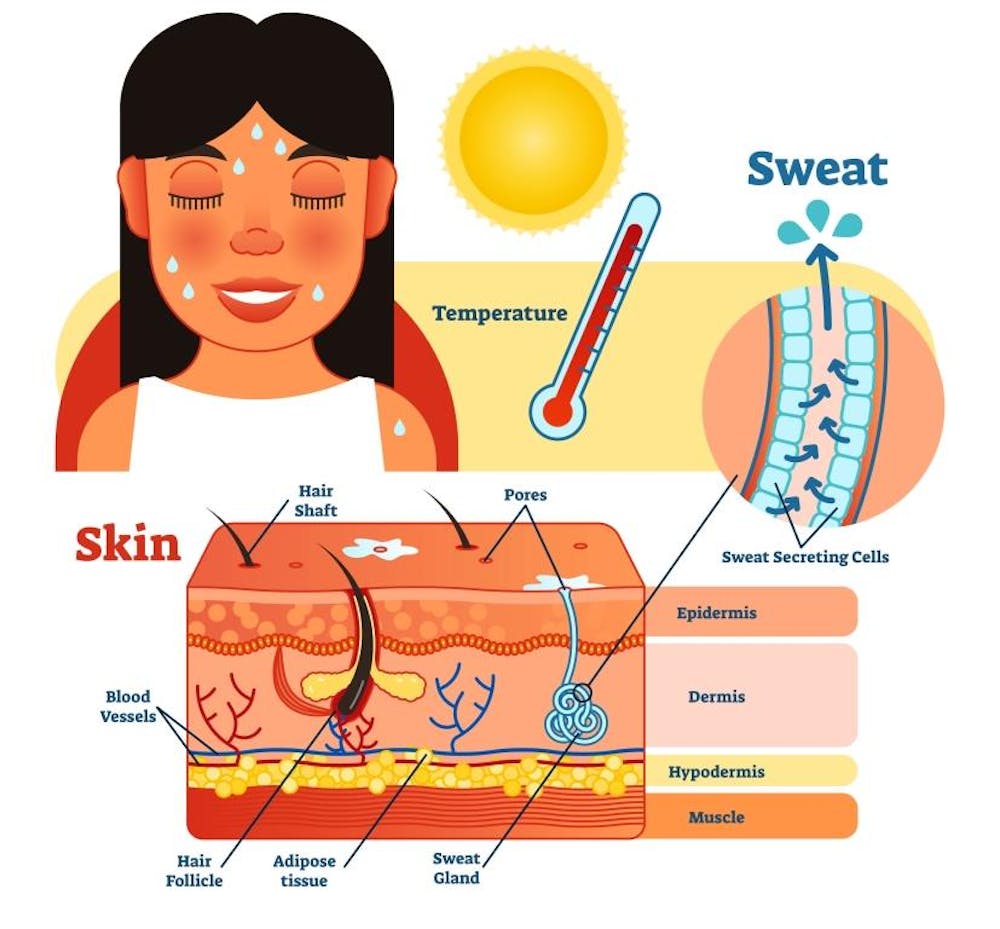
Our bodies are well-designed for this. We have special temperature sensors in our skin and central nervous system (brain and spinal cord) that send signals to the body’s thermostat in the brain to alert it to increases in body temperature.

The body’s largest organ, the skin, is also designed to remove heat from the body. The most noticeable way is losing heat via evaporating sweat.


Read more: Curious Kids: What happens in the body when we sweat?


How does sweating cool us down?

When our skin or core body temperature rises sufficiently, the thermostat in the brain sends impulses via our central nervous system to increase blood flow to the skin. The thermostat also activates the sweat glands.

Our sweat glands release droplets onto our skin that become vapour when the blood flowing through the skin passes underneath.

As the sweat vaporises, energy (in the form of heat) passes into the environment, cooling the blood. This cooled blood gets circulated back to the heart and brain, and cools our core body temperature.

The body loses excess heat via evaporation. from www.shutterstock.com

This is why a day in the sun can feel so draining. Your body is working much harder and using much more energy to keep you cool.

By preventing our organs from overheating, sweat not only keeps us healthy, it also allows us to enjoy (or tolerate) the hot Australian summer.

So it’s important to stay hydrated on a hot day so your body can produce and replace the volume of sweat necessary to keep you cool.

OK, but why do I sweat so much?

You might find yourself sweating more or less than usual for a number of reasons, other than it being a hot day.

Exercise

Exercise improves our ability to produce sweat and keep cool. People who exercise regularly (particularly in the heat) can produce more sweat during exercise. This helps our bodies perform longer, with less physiological strain.

So many of the Australian Olympic athletes will undergo a period of heat acclimatisation in the lead up to Tokyo 2020.


Read more: Why is Japan’s Olympic marathon shifting cities to avoid the heat? A sports physiologist explains


Stress

Ever notice you become sweaty when you are stressed? A different type of sweat gland, the apocrine sweat glands, are associated with hair follicles and often respond to emotional stress.

This type of sweat combines with bacteria on your skin and causes body odour.

Menopause

Up to 75% of women experience acute bouts of excessive sweating during menopause, called a hot flush.

The amount of sweat produced during a two to three minute hot flush can be similar to the amount produced during exercise.

Most people think hot flushes are caused by increases in core body temperature. But our research suggests this might not be the case.

Drinking alcohol

Having a couple of drinks with friends may also increase the sweat response. Alcohol raises your heart rate and causes the blood vessels in your skin to relax and widen. This increases skin redness and your sweat rate, which can actually lead to decreases in body temperature.

So, what can I do about it?

Excessive sweating (hyperhidrosis) can happen in unusual situations such as in a cooler climate or with seemingly no cause.

Although it can be embarrassing and uncomfortable, there are ways to treat it, which you can discuss with your doctor.

One option is to use an antiperspirant with aluminium or topical aluminium salts, which blocks the sweat glands from releasing sweat onto the skin.


Read more: Health Check: do men really sweat more than women?


A longer-term option may be injecting Botulinum toxin (commonly known as Botox) into the skin. This paralyses the injected area (such as the armpits, hands and feet) and prevents the activation of sweat glands.

Other options include using low frequency electrical stimulation (iontophoresis), prescription drugs and although controversial, surgery.

For menopausal women, we have shown closely supervised exercise training can improve temperature regulation, leading to fewer and less severe hot flushes.

This training involved 16 weeks of supervised, progressive moderate-intensity aerobic exercise, such as treadmill and cycling exercise, for up to one hour for three to five days a week.

In a nutshell

In the end, sweating is usually our body’s natural way to protect us from overheating. But if excess sweating is a problem, see your doctor who will outline which treatment options are best for you.

ref. Why do I sweat so much? – https://theconversation.com/why-do-i-sweat-so-much-131135

Dance Nation review: an outrageous depiction of girls grasping their emerging sexuality and power

Source: The Conversation (Au and NZ) – By Maggie Tonkin, Senior Lecturer, English and Creative Writing, University of Adelaide

Review: Dance Nation, directed by Imara Savage. State Theatre Company South Australia and Belvoir for the Adelaide Festival

Dance is at the heart of playwright Clare Barron’s Dance Nation, from the resolutely upbeat ensemble number that opens the show to the poignant solo that ends it.

We are in the hyper-competitive, vapid and vulgar pre-pubescent dance culture of the TV series Dance Moms, thankfully mostly absent from the Australian dance scene.

Larissa McGowan’s choreography mercilessly recreates the cut-throat world of American competition dance and is as pivotal in conveying the narrative arcs of its characters as Barron’s script and Imara Savage’s ebullient direction.

A finalist for the Pulitzer Prize for Drama in 2019, Dance Nation reveals Barron’s fearlessness in tackling the under-explored dramatic territory of young girls entering puberty, but is not without flaws.

Dance teacher Pat’s dance troupe is launching a campaign to win a national dance competition, and Pat’s claim to glory is a dance routine of jaw-dropping cheesiness: a jazz ballet paean to Mahatma Gandhi. The dancers, decked out in metallic pastel unitards, disport themselves around Gandhi seated on a glittery disco version of a golden lotus, to With Arms Wide Open.

Apart from bringing the house down with its conceptual incongruity, this hilarious number reveals Pat, with his delusions of artistic profundity, to be oblivious to the damage he is doing to his charges.

Pat urges his dancers to channel their inner Gandhi and meditate on the suffering of the world, while utterly blind to the suffering under his own nose. Played with a tense doggedness by Mitchell Butel in his first role since taking on the directorship of the State Theatre Company, Pat is the embodiment of the cliché-spouting coach who vicariously realises his own ambitions by pushing his students to win no matter what the cost.

It is the cost of this competitiveness that propels the action.

Only one dancer can be selected for the solo. When Pat unexpectedly bestows the role on Zuzu (always second to her bestie Amina), he opens up a repressed rivalry. Both girls dream of becoming dancers, but Amina is more gifted and more ambitious. When the opportunity arises, she usurps Zuzu’s place and wins the prize that will launch her professional career.

The secret lives of girls

One of the conceits of the play is the preteen girls are played by grown women. Chika Ikogwe owns the role of Zuzu, ably conveying her vulnerability and insightfulness.

Chika Ikogwe plays Zuzu with vulnerability and insightfulness. Chris Herzfeld/STCSA

Although she makes the most of the part, Yvette Lee’s Amina has to work with the weakest aspect of the script. According to Barron’s program notes, the play’s feminist intention is to validate female ambition, but the unlikeability of the only “successful” character undermines this.

While the other girls profess they “love” Amina, they obviously don’t like her much. In the flash-forward at the end it’s clear the one truly ambitious girl, the one who goes on “winning and winning”, is destined for a lonely life.

Barron’s writing of character is generally underdeveloped, and Amina’s success undercuts the play’s message. But this flaw is balanced by the play’s outrageous depiction of girls grappling with emerging sexuality and power.


Read more: Friday essay: scarlet ribbons – the huge history of big hair bows


In true adolescent fashion, the six girls and one dorky boy, Luke (nicely played by Tim Overton), are fixated on sex.

Verbal gags on menstrual blood are interspersed with earnest discussions of masturbation and circumcision. The language is defiantly crude. As Ashlee, Amber McMahon delivers a monologue about her own sexual power (and mathematical brilliance), morphing into an almost demonic possession. It’s a scene-stealer, in which McMahon is absolutely terrific, and the culmination of the play’s powerful celebration of girl power.

There is an undercutting of the real in several shifts from present to future, the girls carrying the victories and traumas of their pubescence into adulthood. This transition is nicely encapsulated as Connie (Emma Harvie) and Sofia (Tara Morice) admit their lifelong struggles with depression.

Jonathon Oxlade’s set comprises a dance studio with mirrored walls where daily reality merges with fantasy sequences. The mirrors become windows: revealing mother figures (all played by Elena Carapetis) urging on their progeny; revealing the trophies and triumphs of past teams.

Dance Nation is unsubtle and flawed, but the uniformly terrific cast and the exuberant energy of this production make it well worth seeing.


Dance Nation is at the Scott Theatre, Adelaide, until March 7. Then Belvoir St Theatre, Sydney, March 14 – April 12.

ref. Dance Nation review: an outrageous depiction of girls grasping their emerging sexuality and power – https://theconversation.com/dance-nation-review-an-outrageous-depiction-of-girls-grasping-their-emerging-sexuality-and-power-132350

VIDEO: Michelle Grattan on the government’s emergency plan, climate change, and Bettina Arndt

Source: The Conversation (Au and NZ) – By Michelle Grattan, Professorial Fellow, University of Canberra

Michelle Grattan talks with Assistant Professor Caroline Fisher about the week in politics, including the implementation of an emergency plan to tackle the spread of coronavirus, the major parties’ policies on climate change, national security and the Senate motion to strip Bettina Arndt of her Order of Australia.

ref. VIDEO: Michelle Grattan on the government’s emergency plan, climate change, and Bettina Arndt – https://theconversation.com/video-michelle-grattan-on-the-governments-emergency-plan-climate-change-and-bettina-arndt-132658

One little bandicoot can dig up an elephant’s worth of soil a year – and our ecosystem loves it

Source: The Conversation (Au and NZ) – By Euan Ritchie, Associate Professor in Wildlife Ecology and Conservation, Centre for Integrative Ecology, School of Life & Environmental Sciences, Deakin University

On Churchill Island, southeast of Melbourne, small cone-shaped, shallow holes (digs) puncture the grass. They’re widespread, and reveal moist soil below the surface. A soil heap at the entrance of a dig is a sign it was made recently.

Older digs are filled with leaves, grass, spiders, beetles and other invertebrates. They are made by hungry eastern barred bandicoots – small, roughly rabbit-sized digging marsupials – looking for a juicy worm or grub.


Read more: How you can help – not harm – wild animals recovering from bushfires


It turns out these bandicoot digs are far from just environmental curiosities – they can improve the properties and health of soils, and even reduce fire risk.

But eastern barred bandicoots are under threat from introduced predators like foxes and cats. In fact, they’re considered extinct in the wild on mainland Australia, so conservation biologists are releasing them on fox-free islands to help establish new populations and ensure the species is conserved long-term.

Our recent research on Churchill Island put a number on just how much the eastern barred bandicoot digs – and the results were staggering, showing how important they are for the ecosystem. But more on that later.

A dig from an eastern barred bandicoot. Amy Coetsee

Why you should dig marsupial diggers

Digging mammals – such as bettongs, potoroos, bilbies and bandicoots – were once abundant and widespread across Australia, turning over large amounts of soil every night with their strong front legs as they dig for food or create burrows for shelter.


Read more: Restoring soil can help address climate change


Their digs improve soil health, increase soil moisture and nutrient content, and decrease soil compaction and erosion. Digs also provide habitat for invertebrates and improve seed germination.

What’s more, by digging fuel loads (dry, flammable vegetation, such as leaves) into the soil, they can help bring down the risk of fire.

Rather than leaves and other plant matter accumulating on the soil surface and drying out, this material is turned over faster, entering the soil when the badicoots dig, which speeds up its decay. Research from 2016 showed there’s less plant material covering the soil surface when digging mammals are about. Without diggers, models show fire spread and flame height are bigger.

In fact, all their functions are so important ecologists have dubbed these mighty diggers “ecosystem engineers”.

How bandicoot digs affect soil. Leonie Valentine, Author provided

Losing diggers leads to poorer soil health

Of Australia’s 29 digging mammals, 23 are between 100 grams and 5 kilograms. Most are at risk of cat and fox predation, and many of these are officially listed as threatened species by the International Union for Conservation of Nature.

Since European settlement, six of Australia’s digging mammals have gone extinct, including the lesser bilby, desert rat kangaroo and pig-footed bandicoots. Many others have suffered marked population declines and extensive range contraction through habitat destruction and the introduction of foxes and cats.


Read more: Rockin’ the suburbs: bandicoots live among us in Melbourne


Tragically, the widespread decline and extinction of many digging mammals means soil and ecosystem health has suffered as well.

Soils that were once soft textured, easy to crumble, rich and fertile are now often compact, repel water and nutrient poor, impeding seed germination and plant growth. Fuel loads are also likely to be much higher now than in the past, as less organic matter is dug into the soil.

To date, most research on digging mammals has focused on arid environments, with much less known about how digging influences wetter (mesic) environments. But our recently published study on eastern barred bandicoots provides new insights.

Just how much do bandicoots dig anyway?

In 2015, 20 mainland eastern barred bandicoots were released onto Churchill Island in Victoria’s Westernport Bay.

When eastern barred bandicoots were released on Churchill Island.

On mainland Australia, fox predation has driven this species to near extinction, and it’s classified as extinct in the wild. All Victoria’s islands are beyond the historic range of eastern barred bandicoots, but fox-free islands could be how we recover them.

Introducing bandicoots on Churchill Island presented the perfect opportunity to quantify how they influence soil properties when digging for food.


Read more: The secret life of echidnas reveals a world-class digger vital to our ecosystems


To do this we recorded the number of digs bandicoots made each night and measured the volume of soil they displaced through digging. We also compared soil moisture and compaction within the digs, versus un-dug soil – and we didn’t expect what we found.

In one night on Churchill Island, one bandicoot can make 41 digs an hour. That’s nearly 500 digs a night, equating to around 13 kilograms of soil being turned over every night, or 4.8 tonnes a year. That’s almost as much as the average weight of a male African elephant.

Bandicoots turn over huge amounts of soil in their search for food. Amy Coetsee

So, an astonishing amount of soil is being turned over, especially considering these bandicoots typically weigh around 750 grams.

If you multiply this by the number of bandicoots on Churchill Island (up from 20 in 2015 to around 130 at the time of our study in 2017), there’s a staggering 1,690 kilos of soil being dug up every night. That’s some major earthworks!

However, we should note our study was conducted during the wetter months, when soils are typically easier to dig.

In summer, as soil becomes harder and drier on Churchill Island, digging may become more difficult. And bandicoots, being great generalists, feed more on surface invertebrates like beetles and crickets, resulting in fewer digs. So we expect in summer that soil is less disturbed.

Bandicoots might help agriculture too

All this digging was found to boost soil health on Churchill Island. This means eastern barred bandicoots may not only play an important role in ecosystem health and regeneration, but also potentially in agriculture by assisting pasture growth and condition, reducing topsoil runoff, and mitigating the effects of trampling and soil compaction from livestock.

One of 20 eastern barred bandicoots being released on Churchill Island. Zoos Victoria

The benefits bandicoot digs have across agricultural land is of particular importance now that eastern barred bandicoots have also been released on Phillip Island and French Island, and are expected to extensively use pasture for foraging.

These island releases could not just help to ensure eastern barred bandicoots avoid extinction, but also promote productive agricultural land for farmers.


Read more: To save these threatened seahorses, we built them 5-star underwater hotels


So, given the important ecological roles ecosystem engineers like bandicoots perform, it’s also important we try to reestablish their wild populations on the mainland and outside of fenced sanctuaries so we can all benefit from their digging, not just on islands.


Lauren Halstead is the lead author of the study reported, which stemmed from her honours research at Deakin University. She also contributed to the writing of this article.

ref. One little bandicoot can dig up an elephant’s worth of soil a year – and our ecosystem loves it – https://theconversation.com/one-little-bandicoot-can-dig-up-an-elephants-worth-of-soil-a-year-and-our-ecosystem-loves-it-132266

New Zealanders with disability in Australia treated as ‘second class’

By Stefan Armbruster of SBS News in Brisbane

Thousands of New Zealanders who are denied disability support are hoping Prime Minister Jacinda Ardern will take the issue up with her counterpart Scott Morrison when they meet today.

Despite paying taxes and the NDIS levy, New Zealanders who have come to Australia since 2001 cannot receive many social services and have taken the issue to the disability Royal Commission.

Some are so financially stressed they have been forced to return to New Zealand despite Australia being their home for many years – some for almost two decades – so they can receive support for their disability, or that of their child or relative.

READ MORE: ‘I was told to abort my son’

Australians moving to New Zealand qualify for support after two years.

New Zealander Julie Goble lives on Queensland’s Gold Coast with her husband and their second child, 14-month-old Mayley.

– Partner –

Mayley was born in Australia and has cerebral palsy.

“Last year was such a blur and we were in absolute shock,” Goble told SBS News.

“It was at the hospital that the pediatrician advised us that unfortunately due to us both being NZ citizens they can’t put in an application for the NDIS for Mayley.”

Despite living in Australia for 12 years, their story is a common one.

“At first we didn’t understand what all that meant, but now that we have to pay for all her therapy appointments, we understand. We were devastated enough, and to have this financial burden on top.”

Early intervention in cases like Mayley’s is considered critical for quality of life.

“We try to do everything we can for our little girl, she was born in Australia, she has an Australian birth certificate, Medicare card, but she’s being denied access that the professionals and experts keep telling us is going to give her the best outlook,” Ms Goble said.

“It’s quite hurtful; we have been paying taxes working and supporting ourselves and are still supporting ourselves in light of all this, with no financial assistance, the system seems broken.”

Benefits stripped
New Zealand-born Vicky Rose is a community worker at the Nerang Neighbourhood Centre on the Gold Coast. She says she is constantly helping New Zealanders denied a range of services by Australia.

“It’s about reciprocity. As an Australian, as soon as you get off the plane [in New Zealand] you’ll be classed as a permanent resident, after two years you can get benefits, after three years student loans, and after four years you can vote – no paperwork, no visa applications,” she said.

Those benefits were stripped from New Zealanders coming to Australia in 2001 onwards with legal changes to the ‘special category visas’ (SCV) introduced for them in 1994.

“They were introduced to stop ‘back-door’ migration by Pacific Islanders and Asians coming through New Zealand, and they [the Australian government] used old data and myths and legends of Kiwis being ‘dole bludgers’ back in the 80s,” Ms Rose said.

“Our people won’t talk about this because they’re constantly told, ‘Well you’re not Australian, go home’. They don’t want to cause trouble, don’t want to get in trouble.

“Being Kiwis we are acutely aware that Australia doesn’t even look after its Indigenous people properly, so what makes them think they’re going to look after us.”

Currently, there is at least a five-year waiting period from arrival after which New Zealanders on SCV visas can begin the process of applying for Australian permanent residency, their first step to citizenship.

‘Faster pathway needed’
“We are ending up with second-class citizens, we’d like a faster pathway to get citizenship,” Rose said.

Ahead of the federal election last May, the Coalition government said it had no plans to change the laws. Labor was open to discussion.

Rose this month took the issue to a forum in Logan, south of Brisbane, as part of the Royal Commission into Violence, Abuse, Neglect and Exploitation of People with Disability

Almost 300,000 New Zealanders have migrated to Australia since 2001 but Rose says there are no statistics available to assess the true number of those missing out on disability support.

‘We can just go pick fruit’
Thousands of Pacific Islanders, including from the Cook Islands and Niue in free association with New Zealand, and of Samoan and Tongan descent with New Zealand passports, are also languishing without services.

“We are socio-economically disadvantaged, we are bottom of the ladder,” said Ema Vueti, president of the Pacific Island Council of Queensland (PICQ).

“‘We can just go pick fruit’, that’s the sort of mentality [towards us], but we need both governments to work out a bipartisan arrangement.

“New Zealand’s government has tried, I’m not sure whether our Australian government wants to address the issues we are having with the trans-Tasman visa arrangement.

“We are also contributing to sectors like disability, where we have lots of workers, and that’s what PICQ will be submitting from our workers [to the Royal Commission].”

Disability royal commissioner Alastair McEwan is the former federal Disability Commissioner and knows the plight of many New Zealanders well.

“The Disability Royal Commission terms of reference are very broad, encompassing all forms of violence, abuse, neglect and exploitation,” he said.

‘Lot of frustrations’
“In my previous position, I heard a lot of frustrations from people moving from overseas not having the same kind of equity and same kind of rights for people with a disability.

“If the situation for an individual in Australia is that they’ve experienced inequity or experiencing barriers then technically it is discrimination, yes.

“Our terms of reference definitely include the ability to conduct this examination to ensure wherever systems are failing for people with a disability, that we ensure we make a recommendation to government to change laws.”

Despite being born in Australia, due to the waiting list for permanent residency, 14-month-old Mayley Goble will have to wait years before she has any chance of accessing disability services. But because of her cerebral palsy, she and her family may never acquire citizenship.

“We’ve been advised that we could be rejected because Mayley has a pre-existing condition,” her mother said.

“We just sit here and think, ‘Do we just pack up our family and go?’”

Stefan Armbruster is a senior SBS News journalist who also specialises in Pacific stories. This article is republished with permission.

Print Friendly, PDF & Email

Article by AsiaPacificReport.nz

Opposition senator challenges top Duterte aide in TV network row

By Felipe F. Salvosa II in Manila

Philippines Senate Minority Leader Franklin Drilon has dismissed comments by Senator Christopher Lawrence “Bong” Go that “politics” is behind the filing of a proposed concurrent resolution calling on regulators to temporarily allow television giant ABS-CBN to operate as Congress deliberates on its franchise application.

The Senate has the prerogative to pass a concurrent resolution expressing its “sense” on the matter, which does not have the force of law, unlike a joint resolution that needs to be passed by both the Senate and House of Representatives and signed by the president, Drilon told reporters on Wednesday.

“Being a neophyte senator, he (Go) may not be aware of our tradition and our rules. Precisely, a concurrent resolution does not go through the president because it has no force and effect of a law. It is just a sense of the Senate. There is no politics here,” Drilon said.

READ MORE: ‘Speak truth to power’ – Varsitarian reports

“We are not depriving the President of the right to veto or approve,” he added.

Drilon’s earlier proposed joint resolution seeks to extend ABS-CBN’s franchise until the end of 2022, prompting an accusation from Go that opposition senators did not want President Rodrigo Duterte to have a hand on the issue. Duterte steps down on June 30, 2022.

– Partner –

Go, on Monday’s Senate inquiry into the ABS-CBN franchise, gave an idea as to why the Duterte-controlled House of Representatives was stalling on the TV network’s licence renewal.

He said Duterte was displeased over ABS-CBN’s supposed refusal to air his 2016 campaign ad that was a response to an attack ad financed by an arch-critic, then senator Antonio Trillanes IV.

ABS-CBN on Monday said Commission on Election restrictions in the final stretch of the 2016 campaign prevented the Duterte ad from being aired, and that it returned the payment, but Duterte refused to accept it.

Go countered that it took a year for ABS-CBN to address the Duterte campaign’s grievance. “Remember, in an election campaign, especially in a presidential campaign, there is no tomorrow. Every second matters,” he said.

Guevarra vs Puno
Drilon, along with Senator Grace Poe, also dismissed comments by retired chief justice Reynato Puno that ABS-CBN cannot operate when its 25-year franchise expires, based on a 2003 court ruling.

The franchise expires on May 4, 2020, reckoned from the date of effectivity of 15 days after publication, which is April 19, 1995, according to the Department of Justice.

Drilon said Justice Secretary Menardo Guevarra’s opinion – that ABS-CBN could be allowed to operate on a provisional authority from the National Telecommunications Commission (NTC) given Congress’ lack of time to pass a new franchise – should be binding throughout the Executive Branch.

“Guevarra said that on grounds of equity, the ABS-CBN can continue. Again, this is an opinion expressed by no less than the secretary of justice, whose opinion is binding on the entire executive branch, so this must be extended due respect.”

Guevarra gave his opinion on the franchise issue during Monday’s Senate inquiry called by Poe.

Drilon said he was in favor of doing what was “necessary in order to allow an objective debate on the renewal of the franchise, without the threat of ABS-CBN being closed.”

In fact, even without the concurrent resolution, a provisional authority would still be valid, he said.

‘Man of wisdom’
“That is the view of Secretary Guevarra; that is the view of Speaker Cayetano; and that is the view of Senator Poe as chairman of the committee on public services,” Drilon said.

Poe said that while Puno is a “man of integrity and wisdom,” a lot had happened since the 2003 ruling that he penned.

“And in fact, hundreds of franchises go through both houses of Congress and because of that, the cure of Congress, because sometimes they don’t have enough time to deliberate on it, is to direct the NTC to grant the provisional license,” Poe told ABS-CBN’s Karen Davila.

Poe also said that even without any resolution from Congress, ABS-CBN should continue operating, “even just by precedents of the acts of Congress in recent years.”

Several companies have been given provisional licenses, she pointed out, citing PT&T, Globe, Smart, GMA Network, the Catholic Bishops’ Conference of the Philippines and Marine Broadcasting.

Felipe F. Salvosa is coordinator of the journalism programme at the University of Santo Tomas in the Philippines and a contributor to Asia Pacific Report.

Print Friendly, PDF & Email

Article by AsiaPacificReport.nz

Many Scots want independence from the United Kingdom. How might that play out in a post-Brexit world?

Source: The Conversation (Au and NZ) – By Simon Tormey, Professor of Politics, University of Bristol

Of the many issues thrown up by Brexit, one of the most pressing is the territorial integrity of the United Kingdom. Brexit was in large measure a revolt by a certain section of English and Welsh opinion against transnational elites, immigration and imagined loss of identity. Scotland and Northern Ireland voted to remain.

The Brexit vote reinforced the sense that the “interests of the UK” is a proxy for the interests of numerically larger England over other parts of the union. Surely Scotland, with its strong sense of national identity and separateness, would seek to challenge the union and return to the warm embrace of the European Union at the earliest opportunity?

This sentiment was further reinforced by the recent success in elections of the pro-EU Scottish National Party (SNP) led by Nicola Sturgeon. The SNP demolished the opposition in the 2019 election, winning 48 out of 59 possible seats.


Read more: The Brexit mess could lead to a break-up of a no longer United Kingdom


With Boris Johnson sweeping to power as UK prime minister on the back of a breakthrough in the Midlands and northern England (the “Red Wall”), the scene was set for a showdown over the issue of another referendum on Scottish independence. Some even speculated we would see a Catalonia-style challenge to the authority of Westminster. So what is the state of play, and what is likely to happen?

Recent opinion polls demonstrate growing support for Scottish independence, which has tipped past 50% of the electorate. More Scots now favour independence than at any time in recent history. In the 2014 referendum, the vote was 45-55 against independence.

But the fact that support for independence is growing doesn’t mean there is a consensus on when a new vote on the issue should take place. This is proving a key consideration.

While there is some support for a poll as soon as one can be organised, others want to wait for next year’s elections to the Scottish parliament to be held first. Still others feel the timing is not right and that clarification is needed on the nature of the UK’s future relationship with the EU, which has yet to be resolved.

Scottish independence is an urgent matter for some, particularly for nationalists, but is much less so for others, particularly remainers who may otherwise have been lukewarm on independence. This exposes a key faultline in the independence constituency itself: some want independence whatever the cost, the commitment of others to the cause might somewhat rest on the prospect of economic benefits for Scotland, which they may feel EU membership would offer.

All this poses a headache for Sturgeon. Does she seek a showdown with Johnson now, but at the risk of losing that part of her support that doesn’t want an immediate poll? Or does she wait until the middle of 2021, when an election might return yet more SNP members to the Scottish parliament, adding legitimacy for a vote on independence – but at the risk of a loss of momentum?

In addition to the vexed question of timing is the nature of the regime in Westminster. The SNP is a left-of-centre party, drawing support from those who wish to see increased funding for social services, housing and education.

Normally, the SNP would find itself in ideological opposition to a centre-right Conservative administration in Westminster. But part of Johnson’s election strategy was to promise to spend big on infrastructure across the UK. There is even talk of a bridge between Northern Ireland and Scotland.


Read more: Boris Johnson, ‘political Vegemite’, becomes the UK prime minister. Let the games begin


With the promise of such largesse, the feeling lingers that Scotland does quite well out of its partnership with Westminster. This is an intentional strategy on Johnson’s behalf. The calculation is that by using the superior resources available to him he can undermine the case for Scottish independence, which without EU support is likely to result in an economic hit to the Scottish economy. Vote for independence, in other words, and Scots will be poorer.

This is, as the Scots might say, a canny strategy. It certainly complicates the equation and has already served to dampen the ardour of those who might otherwise have been committed to an early poll.

What might dampen it further is the early panic in Brussels over who will pay the increased costs for the EU itself due to the departure of the UK. The semblance of technocratic modernity and cohesion the EU likes to paint of itself is coming under strain and so, therefore, is the SNP’s case for making a play to rejoin the EU.

Whether all this is enough to keep the Scots in the UK is a matter of speculation. There are lots of obstacles that might yet derail the Johnson strategy: a bad trade deal with the EU, a balance-of-payments crisis, together with loss of revenue for his grand strategy.

But what has become evident since Johnson took power is that he should not be underestimated. Or, rather, an administration underpinned by the Machiavellian cunning of his chief adviser, Dominic Cummings, should not be underestimated.

Sturgeon will need all her famed powers of persistence to prevent the independence issue being derailed by a combination of exhaustion with elections and referendums, a Johnsonite play for the centre ground of Scottish opinion, and a collapse in confidence in the viability of a life outside the UK.

ref. Many Scots want independence from the United Kingdom. How might that play out in a post-Brexit world? – https://theconversation.com/many-scots-want-independence-from-the-united-kingdom-how-might-that-play-out-in-a-post-brexit-world-131776

It’s now a matter of when, not if, for Australia. This is how we’re preparing for a jump in coronavirus cases

Source: The Conversation (Au and NZ) – By Katherine Gibney, NHMRC early career fellow, The Peter Doherty Institute for Infection and Immunity

While countries around the globe have been taking precautions to prevent the spread of COVID-19, the disease caused by the novel coronavirus, it has now been reported in 37 countries outside China.

As of February 26, close to 3,000 cases and 43 deaths had been recorded outside China. In Australia, we’ve so far seen 23 cases across five states.

The good news is currently there’s no evidence of “community transmission” of the virus in Australia. This means it’s not spreading locally. All cases have had travel connections to China or the Diamond Princess cruise ship, or very close contact with a confirmed case in Australia (being in the same family or tour group).

But as the list of countries with community transmission increases – it’s happening in South Korea, which has more than 1,200 cases, and Italy, which has 400 – so too does the risk of an escalation in Australia. It’s now a matter of “when” local transmission occurs, not “if”.


Read more: Is the coronavirus a pandemic, and does that matter? 4 questions answered


In this climate, the Australian government has developed a national emergency response plan, which takes us through three phases. Prime Minister Scott Morrison yesterday announced we are activating this plan.

Phase 1

The current “Initial Action” stage of the COVID-19 plan focuses on preventing introduction and establishment of the disease in Australia through border measures and social distancing. These are measures designed to keep infected (or potentially infected) people away from healthy people.

In an effort to contain COVID-19 and delay it becoming established in Australia, the Australian government banned the entry of foreign nationals (excluding permanent residents) who had been in mainland China in the last 14 days. This ban has now been extended to March 7.

The return of Australian residents from China, and more recently year 11 and 12 students studying in Australia, has been strictly controlled.

People returning are required to go into home quarantine for 14 days after they leave China.

And at this stage, university students from China must spend 14 days in a third country before arriving in Australia.

Other countries have imposed their own border restrictions, as well as screening people for illness before they enter. These measures have undoubtedly slowed the spread of COVID-19 throughout the world and delayed its progression to a pandemic.

The first stage of Australia’s emergency plan aims to keep coronavirus out of the country as much as possible. Shutterstock

Phase 2

The true clinical severity of this disease remains highly uncertain, but overall it appears less severe than the 1918–19 influenza pandemic or SARS and more severe than the pandemic flu in 2009.

Importantly though, compared to other epidemic and pandemic diseases, COVID-19 is considered highly transmissible, so a large number of cases is likely.


Read more: Yes, Australians on board the Diamond Princess need to go into quarantine again. It’s time to reset the clock


Given ongoing uncertainties, the plan doesn’t articulate the number of cases that would need to be diagnosed for the second phase, “Targeted Action”, to be enacted. The plan simply stipulates public health activities need to be balanced (or “proportionate”) to the magnitude and severity of the pandemic.

We would expect phase two to be put into place when we’re seeing community transmission occurring in Australia.

In this second phase, the current strict border measures and quarantine for arrivals will likely be relaxed as “keeping it out” becomes futile. The focus will shift to minimising spread within Australia and limiting the health, social and economic impact of the disease.

Australians might see a public health response like we’ve seen in Italy. This could include cancellation of large local gatherings (sporting matches and festivals), closure of schools, universities and some workplaces, and strict local travel restrictions.

Border control measures have been implemented in many countries in a bid to prevent the spread of the coronavirus. Dumitru Doru/EPA

Community members will be asked to take responsibility for their own “social distancing” if they have mild disease or have been in close contact with someone with the virus (by self-isolating or self-quarantining at home).

These measures, while disruptive to individuals and households, have been highly effective to date in preventing community transmission of COVID-19 in Australia and will remain very important throughout the response to this disease.

As case numbers rise, case management will need to be streamlined to make best use of finite resources within the health system, including personnel, primary care and hospital capacity and personal protective equipment. Options include greater use of fever assessment clinics, caring for COVID-19 patients together on wards, and keeping people out of hospitals and emergency departments if they don’t require that level of care.


Read more: There’s no evidence the new coronavirus spreads through the air – but it’s still possible


The government, public health experts and clinicians will actively review and be guided by new information to determine exactly which of these clinical and public health measures to put in place.

While many mild cases have been admitted to hospital during the containment phase, community-based care will be the reality for most people as we become more familiar with this disease and its usual course. This approach will allow us to provide higher levels of clinical care for those at greatest risk of poor outcomes, such as older people.

Phase 3

It’s likely, but not certain, that COVID-19 will remain in circulation beyond 2020 and become “endemic” in Australia – that is, here for good. But once the peak has passed (that’s when there’s a declining number of new infections and less demand on hospitals), the COVID-19 plan will move into the “Standdown” phase, which is essentially a return to “business as usual”.

We have a huge challenge ahead of us, but the measures we all take can make a big difference to how this plays out. Whether it’s isolation and quarantine or simply frequent handwashing and good cough etiquette, we can all help protect ourselves, our families, and the most vulnerable in society.


Read more: Here’s why the WHO says a coronavirus vaccine is 18 months away


ref. It’s now a matter of when, not if, for Australia. This is how we’re preparing for a jump in coronavirus cases – https://theconversation.com/its-now-a-matter-of-when-not-if-for-australia-this-is-how-were-preparing-for-a-jump-in-coronavirus-cases-132448

Last summer’s fish carnage sparked public outrage. Here’s what has happened since

Source: The Conversation (Au and NZ) – By Lee Baumgartner, Professor of Fisheries and River Management, Institute for Land, Water, and Society, Charles Sturt University

As this summer draws to a close, it marks just over a year since successive fish death events at Menindee in Lower Darling River made global headlines.

Two independent investigations found high levels of blue-green algae and low oxygen levels in the water caused the deaths. Basically, the fish suffocated.


Read more: We wrote the report for the minister on fish deaths in the lower Darling – here’s why it could happen again


The conditions were caused by a combination of water extraction and extremely dry conditions which effectively stopped the river from flowing. Both investigations concluded that until more water flowed in the Darling, in western New South Wales, further fish kills were very likely.

So what’s happened since, and does the recent rain mean the crisis won’t be repeated?

Low oxygen levels in the water caused the fish deaths. Dean Lewins/AAP

Federal and state government action

In April last year the federal government committed A$70 million to improve the river’s health and prevent more fish deaths. Let’s examine what’s been done so far:

– Native fish management and recovery strategy: Parts of a draft native fish management and recovery strategy have been released for public consultation. The plan has included governments, academics, the community and indigenous groups.

– Native fish hatchery: Government hatchery facilities at Narrandera in NSW will be upgraded to hold and breed more fish. But reintroducing fish into affected areas is challenging and could be a decades-long program.

– Research: The government committed to new research into hydrology and climate change. A panel has been formed and the oversight committee is scoping the most effective research outcomes to better manage water under a changed climate.

– Fish passage infrastructure: Fish ladders – structures that allow fish to travel around obstacles on a river – are needed at sites on the lower and upper Darling. Fish ladder concept designs have progressed and are also part of the NSW government’s Western Weirs project.

-In-stream cameras: Live-stream feeds of the Darling River are not yet available.

-Meter upgrades and water buybacks: Discussions have begun as part of a commitment to buy back A-class water licenses from farmers and return water to the rivers. Rollout of improved metering is due over the next five years.

Progress on these actions is welcome. But the investigation panels also recommended other actions to help fish populations recover over the long term, including ensuring fish habitat and good water quality.

Water flows since the rain have not reached the lower reaches of the Darling River. Dean Lewins/AAP

Further fish deaths

In 2003, basin native fish communities were estimated to be at 10% of pre-European levels and the spates of fish deaths will have reduced this further.

Over spring and summer in 2019, conditions in the Darling River deteriorated. A series of smaller, but significant, fish deaths prompted government agencies and communities to conduct emergency “fish translocations”.. Aerators were deployed in a bid to improve the de-oxygenation. Fish were moved to more suitable water bodies, or to hatcheries to create insurance populations.

By spring, once-mighty rivers such as the Darling and Macquarie had dried to shallow pools. As summer progressed, more than 30 fish die-offs occurred in the Macquarie, Namoi, Severn, Mehi and Cudgegong rivers and Tenterfield Creek.

What about the rain?

Strong recent rainfall means upper parts of the Darling catchment are now flowing for the first time in more than two years. Flows are passing over the Brewarrina Weir and associated fishway.

A flowing Darling is great, but it raises questions over future water management. Farmers have been waiting for years for the Darling to flow and will be eager to extract water for agricultural productivity. Likewise, the environment has been awaiting a “flush” to reset the system and restore ecological productivity.


Read more: Aboriginal voices are missing from the Murray-Darling Basin crisis


After the rains, the NSW government allowed irrigators to harvest floodwaters to reduce the threat of damage to private infrastructure. Now that threat has subsided, governments are working together to “actively manage” the event – meaning water rules will be decided as the flow progresses, in consultation with water users and environmental managers.

But there is still significant debate on how best to manage water over the longer term.

Water use on the Darling River remains highly contested. Dean Lewins/AAP

Is a flowing Darling a return to normal?

The current flows in the Darling are far from a return to normal conditions. NSW is still in drought, and the river flows are yet to reach the Lower Darling. Many children in the Menindee township have not seen a flowing Darling in their lifetime.

Indigenous elders and recreational fishers – those who remember when the river flowed freely and was full of fish – are lamenting the recent declines. In parts of the system, dry riverbeds and isolated pools are still begging to be connected so fish can move about, spawn, and naturally recover.


Read more: Friday essay: death on the Darling, colonialism’s final encounter with the Barkandji


River flows could take up to six weeks to reach the lower Darling, and follow-up rain is urgently needed to avoid another summer of fish carnage. Future water sharing strategies must protect both upstream and downstream communities. Some people are lobbying for the Menindee lakes to be listed as internationally important under the Ramsar Convention on Wetlands to ensure biodiversity and water management work together.

Undoing over 200 years of fish declines will require a sustained effort, with a significant investment in recovery actions over a long period. We must recognise Australia is a country of long droughts and flooding rains, and develop a proactive native fish strategy that reduces the probability of a similar disaster in future.

But unfortunately, as history has shown that when we transition from drought to flood, our memories can be short.

ref. Last summer’s fish carnage sparked public outrage. Here’s what has happened since – https://theconversation.com/last-summers-fish-carnage-sparked-public-outrage-heres-what-has-happened-since-132346

Vital Signs: a 3-point plan to reach net-zero emissions by 2050

Source: The Conversation (Au and NZ) – By Richard Holden, Professor of Economics, UNSW

Every January Larry Fink, the head of the world’s largest funds manager, BlackRock, sends a letter to the chief executives of major public companies.

This year’s letter focused on climate risk. “Climate change has become a defining factor in companies’ long-term prospects,” Fink wrote. To put sustainability at the centre of its investment approach, he said, BlackRock would stop investing in companies that “present a high sustainability-related risk”.


Read more: BlackRock is the canary in the coalmine. Its decision to dump coal signals what’s next


Now business leaders – even big money managers – express opinions all the time, and major companies keep doing what they are doing. But this was different.

Fink, who’s in charge of US$7 trillion (that’s not a typo – $7,000,000,000,000), says in his letter: “In the near future – and sooner than most anticipate – there will be a significant reallocation of capital.”

It’s emphasised in bold type. That’s something to which chief executives pay attention.

Even before the letter was sent – but knowing what was coming – major US companies like Amazon, Delta Air Lines and Microsoft announced new climate action plans.

These three companies are in different industries with different abilities to take action. But the plans they’ve outlined illuminate the three key strategies needed to achieve net-zero carbon emissions by 2050.

Delta Air Lines

Delta, being an airline, burns a lot of fossil fuels. Bar an extraordinary technological shift in aircraft, it will burn a lot of fossil fuels well into the future.


Read more: Flight shame won’t fix airline emissions. We need a smarter solution


The airline’s goal by 2050 is to cut its carbon emissions to half the levels they were in 2005. It plans to do this through a combination of fuel-efficiency measures and helping spur the development of more sustainable jet fuels. In the medium term (up to 2035), its goal is “carbon-neutral growth”, buying carbon offsets for any increases in emissions from jet fuel due to business growth.

Delta Air Lines operates about 5,000 flights a day. Jet fuel accounts for about 99% of its total emissions. Shutterstock

Let’s consider the economics of the Delta plan – at least up to 2035.

Buying carbon offsets increases the airline’s costs. These are passed on to customers – in which case it is simply a form of carbon tax – or paid for by shareholders through lower profits. I’m betting it’s not the shareholders who will pay.

So Delta is essentially imposing its own carbon tax in the hope customers who care about the environment will be more attracted to its brand or that other airlines follow suit.

Amazon

Amazon, which reported a carbon footprint of 44.4 million metric tons in 2018, is doing two broad things.

The company has a fleet of about 30,000 delivery vans. It plans to have 100,000 electric vehicles by 2024. This will reduce the company’s carbon footprint so long as the vans are charged with power from sustainable sources.

Amazon’s founder, Jeff Bezos, has also announced the Bezos Earth Fund, which will give away US$10 billion in grants to anyone with good ideas to address climate change or other environmental issues.

Again, let’s consider the basic economics at play here.

Moving to electric vehicles is a smart hedge against rising fuel costs from a price on carbon – something that already exists in California.

The Bezos Earth Fund, meanwhile, is an excellent example of taking money generated from maximising shareholder value – Amazon is valued at about US$1 trillion and Bezos’s personal fortune (pre-divorce) was about US$130 billion – and redistributing it to socially productive causes.

Microsoft

Finally, Microsoft – the least-carbon-intensive business of the three mentioned here – plans to be carbon-negative by 2030, and by 2050 to have offset all the emissions it has been responsible for (both directly and through electricity consumption) since its founding in 1975.

Since 2012 it has had an “internal carbon tax”, which in April 2019 was doubled to US$15 a tonne. This price mechanism is used to make Microsoft’s business divisions financially responsible for reducing emissions.

On top of this, Microsoft has developed the AI for Earth program, which provides cloud-computing tools for researchers working on sustainability issues to process data more effectively.

Lessons for Australia

Australia’s Coalition government and Labor opposition would do well to heed the lessons of these three companies.

Together they show three clear strategies:

  • a technological push to lower emissions
  • a price on carbon to drive technological innovation and uptake
  • clear goals to reduce emissions.

Our political parties both have one out of three. Right now Labor has announced a goal. The Coalition is promising a technology plan some time soon.

Prime Minister Scott Morrison is right to criticise Labor for not having a plan. Opposition Leader Anthony is right to criticise the Coalition for not having a suitable goal.

But neither of them advocates a price on carbon, without which neither technology road maps nor ambitious goals will translate into sufficient emissions reductions.


Read more: Carbon pricing: it’s a proven way to reduce emissions but everyone’s too scared to mention it


Technology investment, a carbon price and clear goals are all necessary to effectively reduce carbon emissions. Without all three we are bound to fail.

And we no longer have time for that, according to climate scientists.

ref. Vital Signs: a 3-point plan to reach net-zero emissions by 2050 – https://theconversation.com/vital-signs-a-3-point-plan-to-reach-net-zero-emissions-by-2050-132436

Requiring firms to only sell financial products we can use is good, but not enough

Source: The Conversation (Au and NZ) – By Kevin Davis, Professor of Finance, University of Melbourne

The government’s financial system inquiry, on which I sat, reported five years ago.

It recommended that the creators of financial products be subject to a design and distribution obligation (DDO), which would mean the products they sold had to not only make money for them, but also meet the needs of the people buying them.

An insurance policy that couldn’t be claimed on would fail the test, as would a product that charged fees for advice that wasn’t given, as would any number of products later detailed in the 2018 report of the financial services royal commission.

It’s the first half of 2020, and the Australian Securities and Investments Commission is seeking input into how the obligation will work. It has asked for comments by March 11.

Requiring products to be useful is good…

There ought to be nothing controversial about the idea. It reflects the fundamental premise upon which the free market economy is founded – that transactions should provide gains to both the seller and buyer.

Reputable financial institutions, seeking to meet community expectations, ought to already meet such obligations, although they are likely to incur some (hopefully minor) administrative costs.

However, as history and the royal commission have reminded us, even reputable institutions’ procedures can go awry and lead to badly designed products that exploit consumers.


Read more: CommInsure proves the need for a banking royal commission


Less reputable firms exploit consumers anyway, leading to a race to the bottom in terms of product quality.

…but not enough

Unfortunately, even if a financial product meets the DDO requirements, which means it is suitable for its intended consumers, it can be a bad purchase for consumers who aren’t aware of its true worth. Retail customers who overpay for a “suitable” product can lose just as much (if not more) as those being sold one that’s unsuitable.

Many financial products (actually, most financial products) have characteristics that make them hard to value accurately. When product outcomes depend on future events – as do insurance products – accurate valuations can be almost impossible even for customers who are financially literate.

For example a consumer might assume that there is a 10% chance of an event happening, when the true probability is less than 1%. Not only would they overpay on insurance (perhaps repeatedly), they would be unlikely to ever know about it.

It’s hard to tell when prices are bad

Suppose a producer can supply a financial product profitably for any price over $6. Suppose that buying it for any price under $8 would would benefit the consumer, but that the consumer is unable to tell what it is really worth.

Since the supplier’s profits increase as the selling price increases, what is there to stop the supplier increasing the price to more than $8 and harming consumers, in part because some would never get the product?

Standard answers talk about competition, disclosure, financial advice and financial education.

But if consumers don’t have the information they need (or the time they need) to do the calculations, what’s likely to happen instead is that competition will cut the worth of the products in ways that are not obvious to consumers.

As important as disclosure, advice and education are, they haven’t been able to stop this happening in the past.

What we are seeing are first steps

Plans by the Australian Prudential Regulation Authority to make banks and other deposit-taking institutions designate an accountable executive as responsible for the “end-to-end” creation and delivery of each product under a Bank Executive Accountability Regime (BEAR) would be an important step.

The government has announced plans to extend it to all financial institutions, making it a FAR (Financial Accountability Regime).

But there is nothing in either the BEAR or FAR rules that that would require the executives to price their products fairly.


Read more: HILDA Survey reveals striking gender and age divide in financial literacy. Test yourself with this quiz


DDO’s, together with the Securities and Investments Commission’s new temporary banning powers, should help to rid the financial sector of the most egregious types of consumer abuse. But will they do nothing to prevent profit seeking institutions setting prices for “suitable” products that cause poorly informed consumers harm.

It is not clear what could, short of instilling a sense of “fairness” into corporate cultures. While welcome, DDO’s are only the start.

ref. Requiring firms to only sell financial products we can use is good, but not enough – https://theconversation.com/requiring-firms-to-only-sell-financial-products-we-can-use-is-good-but-not-enough-131887

Friday essay: a real life experiment illuminates the future of books and reading

Source: The Conversation (Au and NZ) – By Andy Simionato, Lecturer, RMIT University

Books are always transforming. The book we hold today has arrived through a number of materials (clay, papyrus, parchment, paper, pixels) and forms (tablet, scroll, codex, kindle).

The book can be a tool for communication, reading, entertainment, or learning; an object and a status symbol.

The most recent shift, from print media to digital technology, began around the middle of the 20th century. It culminated in two of the most ambitious projects in the history of the book (at least if we believe the corporate hype): the mass-digitisation of books by Google and the mass-distribution of electronic books by Amazon.

The survival of bookshops and flourishing of libraries (in real life) defies predictions that the “end of the book” is near. But even the most militant bibliophile will acknowledge how digital technology has called the “idea” of the book into question, once again.

To explore the potential for human-machine collaboration in reading and writing, we built a machine that makes poetry from the pages of any printed book. Ultimately, this project attempts to imagine the future of the book itself.

Warning: these books were not made by humans. Peter Clarke, Author provided (No reuse)

A machine to read books

Our custom-coded reading-machine reads and interprets real book pages, to create a new “illuminated” book of poetry.

The reading-machine uses Computer Vision and Optical Character Recognition to identify the text on any open book placed under its dual cameras. It then uses Machine Learning and Natural Language Processing technology to “read” the text for meaning, in order to select a short poetic combination of words on the page which it saves by digitally erasing all other words on the page.

Armed with this generated verse, the reading-machine searches the internet for an image – often a doodle or meme, which someone has shared and which has been stored in Google Images – to illustrate the poem.

The reading-machine is fully automated. Peter Clarke, Author provided (No reuse)

Once every page in the book has been read, interpreted, and illustrated, the system publishes the results using an online printing service. The resulting volume is then added to a growing archive we call The Library of Nonhuman Books.

From the moment our machine completes its reading until the delivery of the book, our automated-art-system proceeds algorithmically – from interpreting and illuminating the poems, to pagination, cover design and finally adding the endmatter. This is all done without human intervention. The algorithm can generate a seemingly infinite number of readings of any book.

The poetry

The following poems were produced by the reading-machine from popular texts:

deep down men try there

he’s large naked she’s even

while facing anything.

from E.L. James’ Fifty Shades of Grey

how parties popcorn

jukebox bathrooms depressed

shrug, yeah? all.

from Bret Easton Ellis’ The Rules of Attraction

Oh and her bedroom

bathroom brushing sending it

garter too face hell.

from Truman Capote’s Breakfast at Tiffany’s

A page from Truman Capote’s Breakfast at Tiffany’s that has been read, extracted as poetry and illustrated by the reading-machine. Peter Clarke, Author provided (No reuse)

My algorithm, my muse

So what does all this have to do with the mass-digitisation of books?

Faced with growing resistance from authors and publishers concerned with Google’s management of copyright, the infoglomerate pivoted away from its primary goal of providing a free corpus of books (a kind of modern day Library of Alexandria) and towards a more modest index system used for searching inside the books Google had scanned. Google would now serve only short “snippets” of words highlighted on the original page.

Behind the scenes, Google had identified a different use for the texts. Millions of scanned books could be used in a field called Natural Language Processing. NLP allows computers to communicate with people using everyday language rather than code. The books originally scanned for humans were made available to machines for learning, and later imitating, human language.

Imagine infinite readings of the books we already have. Unsplash, CC BY

Algorithmic processes like NLP and Machine Learning hold the promise (or threat) of deferring much of our everyday reading to machines. History has shown that once machines know how to do something, we generally leave them to it. The extent to which we do this will depend on how much we value reading.

If we continue to defer our reading (and writing) to machines, we might make literature with our artificially intelligent counterparts. What will poetry become, with an algorithm as our muse?

We already have clues to this: from the almost obligatory use of emojis or Japanese Kaomoji (顔文字) as visual shorthand for the emotional intent of our digital communication, to the layered meanings of internet memes, to the auto-generation of “fake news” stories. These are the image-word hybrids we find in post-literate social media.

To hide a leaf

Take the book, my friend, and read your eyes out, you will never find there what I find.

Ralph Waldo Emerson’s Spiritual Laws

Emerson’s challenge highlights the subjectivity we bring to reading. When we started working on the reading-machine we focused on discovering patterns of words within larger bodies of texts that have always been there, but have remained “hidden in plain sight”. Every attempt by the reading-machine generated new poems, all of them made from words that remained in their original positions on the pages of books.

Another of the seemingly infinite poetic possibilities from Capote’s classic novella. Peter Clarke, Author provided (No reuse)

The notion of a single book consisting of infinite readings is not new. We originally conceived our reading-machine as a way of making a mythical Book of Sand, described by Jorge Luis Borges in his 1975 parable.

Borges’ story is about the narrator’s encounter with an endless book which continuously recombines its words and images. Many have compared this impossible book to the internet of today. Our reading-machine, with the turn of each page of any physical book, calculates combinations of words on that page which, until that moment, have been seen, but not consciously perceived by the reader.

The title of our early version of the work was To Hide a Leaf. It was generated by chance when a prototype of the reading-machine was presented with a page from a book of Borges’ stories. The complete sentence from which the words were taken is:

Somewhere I recalled reading that the best place to hide a leaf is in a forest.

The latent verse our machine attempts to reveal in books also hides in plain sight, like a leaf in a forest; and the idea is also a play on a page being generally referred to as a “leaf of a book”.

Like the Book of Sand, perhaps all books can be seen as combinatorial machines. We believed we could write an algorithm that could unlock new meanings in existing books, using only the text within that book as the key.

Philosopher Boris Groys described the result of the mass-digitisation of the book as Words Without Grammar, suggesting clouds of disconnected words.

Our reading-machine, and the Library of Nonhuman Books it is generating, is an attempt to imagine the book to come after these clouds of “words without grammar”. We have found the results are sometimes comical, often nonsensical, occasionally infuriating and, every now and then, even poetic.

Now that machines can read, will we defer the task to them?

The reading-machine will be on display at the Melbourne Art Book Fair in March and will collect a Tokyo Type Directors Club Award in April. Nonhuman Books are available via Atomic Activity Books.

ref. Friday essay: a real life experiment illuminates the future of books and reading – https://theconversation.com/friday-essay-a-real-life-experiment-illuminates-the-future-of-books-and-reading-131832

Angus Taylor sets down ‘markers’ to measure success of government’s technology roadmap

Source: The Conversation (Au and NZ) – By Michelle Grattan, Professorial Fellow, University of Canberra

The government would be looking for the private sector to put in four or five times as much as it invests in research and development of particular technologies to reduce emissions, Energy Minister Angus Taylor says.

In a speech on Friday, released in part ahead of delivery, Taylor lays the groundwork for the “technology investment roadmap” to be released soon.

Technologies attracting the government’s attention include hydrogen, carbon capture and storage, lithium and advanced livestock feed supplements to reduce emissions from farm animals.

The “roadmap” will provide the basis for the government’s work towards the next international climate change conference, in Glasgow late this year.

The government is resisting pressure to embrace the widely supported target of a carbon neutral economy by 2050, but focusing on a “strategy”.


Read more: Albanese pledges Labor government would have 2050 carbon-neutral target


“The Australian government will take a technology-based long-term emissions reduction strategy to Glasgow later this year. We want to lead the world on this.

“Our strategy will be based on a series of detailed pieces of work that we will complete over the rest of this year,” Taylor says.

“That work must look at our investments, it must evaluate the technology and then encourage prospective technologies to full commerciality and deployment without massive government subsidies.”

Taylor says under the roadmap, progress will be measured in two ways.

Economic goals will be set for technologies, so a clear signal can be given for when the technology is commercial.

“The goal for each technology is to approach economic parity or better, which means the shift to lower emissions is zero cost or low cost,” he says.

The other measurement would be on investment.

Government investment is important as a market signal and to give a lead, Taylor says. But success requires tracking “how much private-sector and other investment in R and D and early deployment follows our own investment.

“To measure the success of the overall portfolio I think we should be aiming for a four or five time multiplier.

“That is, for every dollar invested I want to see four or five dollars from the private sector following over the course of our investments.

“An important indicator of the success of a technology is the private sector and state government interest”.

Taylor says the government has already invested more than $10.4 billion in hundreds of clean technology projects with a value of $35 billion.

“But we are coming to an end of the value of these investments.

“Wind and solar are economic as a source of pure energy at least. And the Government should not crowd out private sector investment.

“We must move our investments to the next challenges.”

ref. Angus Taylor sets down ‘markers’ to measure success of government’s technology roadmap – https://theconversation.com/angus-taylor-sets-down-markers-to-measure-success-of-governments-technology-roadmap-132623

Grattan on Friday: Morrison looks to his messaging on coronavirus and climate

Source: The Conversation (Au and NZ) – By Michelle Grattan, Professorial Fellow, University of Canberra

Two issues are currently presenting the Morrison government with fast-moving targets.

One is the fallout from the coronavirus, where the picture has been altering on a near-daily basis. The other is very different – the now rapidly changing politics of the very long-running climate debate.

In such circumstances, “messaging” becomes critical, and Scott Morrison, a meister of that art, is hard at work.

As COVID-19 spread in Europe and elsewhere this week, the federal government on Thursday jumped ahead of the World Health Organisation, and activated its emergency plan in anticipation of a pandemic.

Announcing the move, Morrison declared: “The key message that I really want to get across to Australians today is: because of the actions we’ve taken on the coronavirus we’ve got ahead. We intend to stay ahead. And together we will get through this”.


Read more: Government triggers emergency plan for COVID-19 pandemic, and considers economic assistance


This feeds into the government’s wider narrative of “keeping Australians safe”, and having “plans”.

The virus’s local health impact are at this stage only potential, but the economic ones are already being felt. The unknown is how hard the ultimate impact on the economy will be. Treasury is looking at some relief measures, although Morrison underscores they would be “modest” and “targeted”.

Morrison’s news conference earlier in the week, featuring Treasurer Josh Frydenberg, had a purpose beyond reassuring the public the government was covering all bases on the virus.

It set up a narrative to say, if this means the economy falls in a hole and the budget’s “back in black” storyline morphs into a fairytale, it’s not our fault.

That might be true. As the government prepared its pre-election budget, no one could have anticipated the virus (or the extent of likely bushfires). But if you boast too loudly, if the Liberal party markets “back in black” mugs, there’s further to fall if you can’t deliver.

Nevertheless, just as the government should have been restrained with its self-applause, so critics should be wary now. Morrison and Frydenberg are trying to take our insurance against a deficit, but they’ll be pursuing every hollow log and accounting trick to avoid that. Those “back in black” mugs will become a collector’s item if the budget’s in the red, but they might end up just another bit of kitsch.

The challenge Morrison faces in his messaging on climate is more complex. Last election, while climate was an issue, Labor’s policy was vulnerable.

The present picture is different. The fires have elevated the climate debate. Where Labor’s policy previously could be painted as isolated or extreme, now the Coalition looks the odd one out.

This is clear on the 2050 target of zero net emissions, to which Anthony Albanese has committed (while putting off a decision on the medium term target). With all states and territories, the Business Council of Australia, and Britain’s Conservative PM Boris Johnson signing up to mid-century carbon neutrality, it’s hard to run the argument it’s some kooky idea.

Mick Tsikas/AAP

Of course this didn’t stop the Coalition piling onto Albanese. But for all the bluster, Morrison knows the usual crude attacks are unlikely to suit him beyond the short term.

There is a lot of government manoeuvring going on to readjust its climate rhetoric, as well as keep options open.

Talking about the bushfires, Morrison now routinely acknowledges the impact of the changing climate – without accepting a cause-and-effect argument. This is different from some of those in the Coalition who claim these fires were like all the others in our history.

On energy, while stressing the need for dispatchable power, Energy minister Angus Taylor is talking up, with greater enthusiasm than previously, Australia’s progress on renewables.

In relation to the controversial question of using carry over credits to get to Australia’s 2030 Paris target, the government is privately becoming confident they won’t be needed.

In relation to net zero, those around Morrison point out he’s not dissing the target itself, but the absence of a “plan” to get there.

He told the Coalition party room this week: “I won’t commit to anything I don’t know the cost of, if I don’t know the impact on jobs. It’s not about being for or against a target.”

On one school of thought, Morrison could be keeping open the possibility of supporting the 2050 target if that later looks the best political course. He will be under strong pressure to do so in the run up to the Glasgow climate conference late in the year.

Indeed, just the weight of business and public opinion will be formidable. An Essential poll published this week showed 75% of Australians supported “a zero-carbon pollution target for 2050 if it were adopted by the federal government”.


Read more: Albanese pledges Labor government would have 2050 carbon-neutral target


Morrison may be ensuring his messaging leaves him wriggle room, but there would be an obvious massive problem if he did decide he’d be better off to endorse the target.

He might be the ultimate pragmatist but it’s another matter with the Nationals. Michael McCormack’s precarious leadership means the hardliners in the Nationals (Matt Canavan, Barnaby Joyce) can drive that party’s position. McCormack can’t afford to deviate. He said bluntly this month, “Net zero emissions by 2050 equals net zero jobs growth by 2050”.

If Morrison tried to sign up to 2050 he would risk triggering an explosion in the Nationals.

On the other hand, if McCormack were replaced by his deputy David Littleproud, such a policy move might be possible.

In partisan terms, the downside for Morrison of adopting the 2050 target would be to knock out a line of attack on Albanese. But that attack threatens to become a lot less effective once we get past the knee-jerk reaction we’ve seen this week.

It can’t be predicted where Morrison might end up on the 2050 target. Perhaps he doesn’t know himself. Possibly he could nuance the message – recast it as a “goal”, for instance.

In the short term, watch out for the messaging when the government spruiks its technology investment road map in coming days. It will be a lot more positive about electric cars than in the election campaign, where Labor’s commitment to them was, apparently, a threat to the Aussie weekend.

Different circumstances, different message.

ref. Grattan on Friday: Morrison looks to his messaging on coronavirus and climate – https://theconversation.com/grattan-on-friday-morrison-looks-to-his-messaging-on-coronavirus-and-climate-132614

Government triggers emergency plan for COVID-19 pandemic, and considers economic assistance

Source: The Conversation (Au and NZ) – By Michelle Grattan, Professorial Fellow, University of Canberra

The federal government has activated its emergency response plan to deal with a spread of the coronavirus locally, in anticipation of it becoming a “pandemic”.

It is also considering limited assistance for those hardest hit by the economic fallout.

Prime Minister Scott Morrison told a news conference late Thursday Treasurer Josh Frydenberg and Treasury was working on possible measures to give some relief.

Morrison stressed any measures would be “targeted, modest and scalable” – that is, able to be built on if necessary.

“This is a health crisis, not a financial crisis, but it is a health crisis with very significant economic implications,” he said.

“We’re aware, particularly in the export industry, in the marine sector, there are particular issues there especially in North Queensland, but these problems are presenting in many other places,” he said.

The tourism and education sectors are being heavily affected as the crisis worsens. But the government has stressed universities have good liquidity to deal with the situation.

The travel ban on arrivals from China has been extended for at least another week. There will be no carve out for the tens of thousands of university students unable to reach Australia.

Treasury has not yet finalised an estimate of the economic impact of COVID-19.

Cabinet’s national security committee met for three hours on Thursday to discuss the latest information on the virus and what should be done now.

“What has occurred, in particular, in the last 24 hours or so as the data has come in is that the rate of transmission of the virus outside of China is fundamentally changing the way we need to now look at how this issue is being managed here in Australia,” Morrison said.

Stressing Australia had been ahead of the World Health Organisation in its previous response, he said “based on the expert medical advice we’ve received, there is every indication that the world will soon enter a pandemic phase of the coronavirus”.

“So while the WHO is yet to declare … it’s moved towards a pandemic phase, we believe that the risk of a global pandemic is very much upon us and as a result, as a government, we need to take the steps necessary to prepare for such a pandemic.”

The actions were “being taken in an abundance of caution,” Morrison said.

Health ministers will meet on Friday to discuss the emergency planning, to respond to a future situation where there is sustained transmission in Australia – in contrast to the present containment to a handful of cases. As the virus spreads internationally, the chances increase of a major spread in Australia.

The emergency plan covers special wards in hospitals, and ensuring key health workers have access to adequate protective equipment from the medical stockpile.

It includes provision for aged care facilities to be put into lock down if necessary.

There would also be contingency alternative staffing for key facilities if staff got the disease.

On another front, Border Force would if necessary extend screening to passengers arriving from multiple countries.

Morrison said consideration was being given to how school children would be protected.

The Prime Minister emphasised there was no cause to consider cancelling events or for people not to be out and about.

“You can still go to the football, you can still go to the cricket, you can still go and play with your friends down the street, you can go off to the concert, and you can go out for a Chinese meal.

“But to stay ahead of it, we need to now elevate our response to this next phase,” he said.

“There are some challenging months ahead and the government will continue to work closely based on the best possible medical advice to keep Australians safe.”

So far, Australia had had 15 cases who had come from Wuhan and all 15 had now been cleared, he said. Eight other cases had come from the Diamond Princess. There had been no community transmission in Australia.

ref. Government triggers emergency plan for COVID-19 pandemic, and considers economic assistance – https://theconversation.com/government-triggers-emergency-plan-for-covid-19-pandemic-and-considers-economic-assistance-132610

Let’s ‘declare war on type 2 diabetes’ – Australian of the year James Muecke on why we need to cut back on sugar

Source: The Conversation (Au and NZ) – By James Muecke, Clinical senior lecturer in Ophthalmology and Visual Sciences, University of Adelaide

Humans are physiologically hardwired to love and seek out sweet things. It’s an ancient survival mechanism that evolved to prepare our bodies for periods of fasting when food supplies were scarce.

Like nicotine, alcohol and other drugs, sugar activates the reward system in our brains, resulting in the release of the neurotransmitter dopamine. It feels good, so we want to do it again.

It can also give us solace when we’re down and can alleviate stress, as the dopamine hit counters cortisol, a stress hormone which is released during anxious times.


Read more: Fact or fiction – is sugar addictive?


The problem is, the more sugar we ingest, the more we need to make us feel good. It’s a vicious cycle that’s hard to break.

Excessive and sustained sugar consumption increases the risk of developing type 2 diabetes, a metabolic disorder where the body can’t maintain healthy levels of glucose (sugar) in the blood.

Globally, the number of adults with type 2 diabetes, which is related to diet and lifestyle, has quadrupled over the past 40 years. In 2017-18, one million Australians had type 2 diabetes and many more were at risk of developing the condition.

It’s not impossible to cut down on sugar. Some strategies require change on a personal level, while others must be taken on by industry and governments.

Personal strategies

At the personal level, it’s a matter of slowly winding down our addiction. Going cold turkey would be incredibly difficult, given 75% of our food and drinks have added sugar.

I started omitting the obvious products loaded with sugar – soft drinks, fruit juices, dried fruit, chocolate, candy, ice cream, cakes and sweet biscuits. I stopped sprinkling sugar on my cereal and stirring it into my tea and coffee.

Even these simple strategies gave me withdrawal symptoms such as irritability, headache, sluggish thoughts, and fatigue, which began on the very first day. These symptoms and the cravings were unpleasant but only lasted three days.

Progressing to the next level might include cutting out commercially produced foods that contain excessive amounts of added sugar such as jams, condiments, and most breakfast cereals.

It might also mean cutting out or down on heavily processed products that contain refined carbohydrates such as white flour (white bread, pastries and pasta), white rice, and white potatoes (especially fries and crisps). Such carbs are broken down to glucose in the gut, and are really just another form of sugar consumption.

Is it time to cut back on jams and sugary spreads? Shutterstock

It helps to be aware of the times we’re consuming sugar out of habit, such as eating a bag of sugary treats at the movies or a block of chocolate in front of the TV, or using sugar as a reward for a job well done.


Read more: If sugar is so bad for us, why is the sugar in fruit OK?


It’s also important to be aware of those times when we’re using sugar to make us feel better or alleviate stress. The brain doesn’t care where it gets its feel-good chemicals from, so try going for a walk, run or cycle, listen to your favourite music playlist, or try doing a good deed instead.

Government response

From a public health perspective, the government must play a pivotal role in helping Australians cut down on sugar.

Strategies at the government level should be aimed at accessibility, addition and advertising.

Making sweet products less obvious and accessible in supermarkets, delicatessens, post offices and service stations would be a good start. Moving them away from check-out counters means those reflex purchases are less likely to happen.

Lollies and chocolates should be moved away from supermarket checkouts. Shutterstock

Second, we need a levy (or a tax) on products containing high levels of added sugar, particularly on sugar-sweetened drinks. There is strong evidence a tax on such drinks would reduce consumption and result in a decline in type 2 diabetes.


Read more: Don’t believe the myths – taxing sugary drinks makes us drink less of it


Third, a more transparent system for labelling of the added sugar content of products should be implemented. The current health star rating system is only voluntary and is in need of reform.

Fourth, advertising time and space for sugary products should be restricted, as we have done for cigarettes, starting with ads targeting children on TV and social media.

Kids shouldn’t be exposed to ads for sugary foods. Shutterstock

Fifth, powerful and hard-hitting awareness campaigns should be introduced, as we have done for cigarettes. Who could forget those graphic TV adds of tar being poured over lungs or fat being squeezed out of an artery?

Finally, we need a multi-disciplinary think tank to raise awareness about the health dangers of sugar. Such a body could engage endocrinologists (medical doctors who treat diabetes), public health physicians, neuroscientists, nutritionists, marketers, PR experts, and government representatives to deliver clear and united messages.

The sugar industry and the food and beverage industries will need to be included in discussions about reform, but we can’t let commercial interests stop us from acting.

Type 2 diabetes is a growing epidemic and one of the nation’s biggest health challenges. It’s time for Australia to declare war on type 2 diabetes.


Read more: ABC Four Corners: five articles to get you informed on sugar and Big Sugar’s role in food policy


ref. Let’s ‘declare war on type 2 diabetes’ – Australian of the year James Muecke on why we need to cut back on sugar – https://theconversation.com/lets-declare-war-on-type-2-diabetes-australian-of-the-year-james-muecke-on-why-we-need-to-cut-back-on-sugar-131024

Juries will soon learn more about people accused of child sex crimes. Will it lead to fairer trials?

Source: The Conversation (Au and NZ) – By Marilyn McMahon, Deputy Dean, School of Law, Deakin University

The NSW government has just introduced a bill that will, among other significant reforms, make it easier for a jury to be informed about the prior convictions of a person on trial for a sex offence involving a child.

The governments of Victoria, Tasmania, the ACT, the NT and the Commonwealth are likely to introduce similar legislation.

Disclosing evidence of an accused’s prior convictions has always been a difficult area of criminal law, requiring a balance of conflicting interests.


Read more: All about juries: why do we actually need them and can they get it ‘wrong’?


Disclosure may demonstrate a propensity to offend in a particular way and therefore be helpful to the prosecution. But it may also prejudice a jury against the accused in an unfair manner.

The reforms proposed in NSW have widespread support among advocates and organisations working with victims of sexual abuse. They are also likely to be supported by the opposition.

But they have evoked a strong response from lawyers who view them as undermining fundamental principles in our legal system – the presumption of innocence and the right to a fair trial.

Why the changes?

Despite numerous changes to laws governing sexual offences in past decades, conviction rates for these offences remain substantially lower than for other types of crimes

There are many possible explanations for this, including the fact these cases often involve acts performed in secret, frequently do not have conclusive forensic evidence and ultimately come down to the word of the victim against the word of the accused.

When the victim is a child, difficulties in describing the assault and giving evidence are also significant.


Read more: To believe or not to believe: child witnesses and the sex abuse royal commission


Noting the low conviction rates – as well as the issue of offenders who have multiple victims – the Royal Commission into Institutional Responses to Child Sexual Abuse recommended that evidence law be amended so jurors could get a more complete understanding of an accused’s past. Achieving this goal required significant reform.

The royal commission recommended jurors in child abuse trials be permitted to hear about the accused’s past convictions for sex abuse. Royal Commission/PR handout

How evidence law works now

A jury in a criminal trial in Australia is not usually told about the criminal history of the accused. In cases where there is no jury, the judge or magistrate is also not permitted to take into account any prior offending when deciding guilt or innocence.

The justification for this restriction is that it prevents the jury, magistrate or judge from being improperly influenced by a defendant’s past. This ensures they restrict their considerations to the evidence presented in the present case.

However, some exceptions already exist relating to credibility and what is known as “tendency and coincidence evidence”.

Tendency evidence can show a person has a propensity to act in a certain way. Coincidence evidence can demonstrate that, because the person has acted in a very similar way in the past, they are likely to have committed the offence for which they are currently on trial.


Read more: We need better jury directions to ensure justice is done


In jurisdictions like NSW that have adopted the uniform evidence law, this type of evidence can only be admitted if it has “significant probative value” (that is, it is highly relevant to the current case) and its value “substantially outweighs” any prejudicial effect for the accused.

Given this high threshold, an accused’s prior offending is not commonly disclosed to a jury before it reaches a verdict.

What will the reforms do?

The reforms will allow more information about defendants to be admitted in trials involving child sex offences. Specifically, the changes will:

  • assist prosecutors to introduce evidence of past crimes by restricting matters that might previously have influenced judges and magistrates to exclude this evidence

  • allow evidence to be admitted if it simply “outweighs” the danger of unfair prejudice, a less demanding test than “substantially outweighs”

  • make it easier to have trials where multiple complainants make allegations (and present similar evidence) of child sexual abuse against the same person

  • create a legal presumption that evidence an accused is sexually interested in children and/or has acted on that interest this will be a very relevant matter in these trials.

Collectively, the reforms will strengthen the prosecution of these offences.

Concern about the changes

These changes are intended to make trials fairer for victims of child sexual abuse and increase the rate of convictions.

The royal commission referred to empirical research conducted on its behalf to support its view this type of reform could occur without unfair prejudice to a defendant.


Read more: Victims of child sex abuse still face significant legal barriers suing churches – here’s why


Some lawyers have endorsed reform. Others argue the changes will undermine the presumption of innocence, remove the task of proving guilt beyond reasonable doubt from the prosecution and may have the effect of denying the accused a fair trial.

They are concerned this could result in innocent people going to jail.

Defence lawyers are worried if juries know a person committed a similar crime in the past, they will assume he or she probably committed the crime for which they are currently on trial, as well.

Or a jury may simply believe the defendant deserves to be punished for past offending, irrespective of the evidence in the case before them. Critics think this is especially likely to occur in child sexual abuse cases, which evoke a strong community reaction.

Defence lawyers also believe the reforms will improperly shift the focus in a criminal trial from the prosecution having to prove all the elements of a crime to consideration of whether the accused is the sort of person likely to have committed the offence.

The proposed changes undoubtedly reflect a significant shift in the criminal law. They demonstrate that while concern about a fair trial traditionally focused on the rights of the accused, contemporary reforms are increasingly grounded in concern the criminal justice system be fair for victims.

ref. Juries will soon learn more about people accused of child sex crimes. Will it lead to fairer trials? – https://theconversation.com/juries-will-soon-learn-more-about-people-accused-of-child-sex-crimes-will-it-lead-to-fairer-trials-132517

Juries will soon learn more about people accused of child sex crimes. Will it lead to trials that are more fair?

Source: The Conversation (Au and NZ) – By Marilyn McMahon, Deputy Dean, School of Law, Deakin University

The NSW government has just introduced a bill that will, among other significant reforms, make it easier for a jury to be informed about the prior convictions of a person on trial for a sex offence involving a child.

The governments of Victoria, Tasmania, the ACT, the NT and the Commonwealth are likely to introduce similar legislation.

Disclosing evidence of an accused’s prior convictions has always been a difficult area of criminal law, requiring a balance of conflicting interests.


Read more: All about juries: why do we actually need them and can they get it ‘wrong’?


Disclosure may demonstrate a propensity to offend in a particular way and therefore be helpful to the prosecution. But it may also prejudice a jury against the accused in an unfair manner.

The reforms proposed in NSW have widespread support among advocates and organisations working with victims of sexual abuse. They are also likely to be supported by the opposition.

But they have evoked a strong response from lawyers who view them as undermining fundamental principles in our legal system – the presumption of innocence and the right to a fair trial.

Why the changes?

Despite numerous changes to laws governing sexual offences in past decades, conviction rates for these offences remain substantially lower than for other types of crimes

There are many possible explanations for this, including the fact these cases often involve acts performed in secret, frequently do not have conclusive forensic evidence and ultimately come down to the word of the victim against the word of the accused.

When the victim is a child, difficulties in describing the assault and giving evidence are also significant.


Read more: To believe or not to believe: child witnesses and the sex abuse royal commission


Noting the low conviction rates – as well as the issue of offenders who have multiple victims – the Royal Commission into Institutional Responses to Child Sexual Abuse recommended that evidence law be amended so jurors could get a more complete understanding of an accused’s past. Achieving this goal required significant reform.

The royal commission recommended jurors in child abuse trials be permitted to hear about the accused’s past convictions for sex abuse. Royal Commission/PR handout

How evidence law works now

A jury in a criminal trial in Australia is not usually told about the criminal history of the accused. In cases where there is no jury, the judge or magistrate is also not permitted to take into account any prior offending when deciding guilt or innocence.

The justification for this restriction is that it prevents the jury, magistrate or judge from being improperly influenced by a defendant’s past. This ensures they restrict their considerations to the evidence presented in the present case.

However, some exceptions already exist relating to credibility and what is known as “tendency and coincidence evidence”.

Tendency evidence can show a person has a propensity to act in a certain way. Coincidence evidence can demonstrate that, because the person has acted in a very similar way in the past, they are likely to have committed the offence for which they are currently on trial.


Read more: We need better jury directions to ensure justice is done


In jurisdictions like NSW that have adopted the uniform evidence law, this type of evidence can only be admitted if it has “significant probative value” (that is, it is highly relevant to the current case) and its value “substantially outweighs” any prejudicial effect for the accused.

Given this high threshold, an accused’s prior offending is not commonly disclosed to a jury before it reaches a verdict.

What will the reforms do?

The reforms will allow more information about defendants to be admitted in trials involving child sex offences. Specifically, the changes will:

  • assist prosecutors to introduce evidence of past crimes by restricting matters that might previously have influenced judges and magistrates to exclude this evidence

  • allow evidence to be admitted if it simply “outweighs” the danger of unfair prejudice, a less demanding test than “substantially outweighs”

  • make it easier to have trials where multiple complainants make allegations (and present similar evidence) of child sexual abuse against the same person

  • create a legal presumption that evidence an accused is sexually interested in children and/or has acted on that interest this will be a very relevant matter in these trials.

Collectively, the reforms will strengthen the prosecution of these offences.

Concerns about the changes

These changes are intended to make trials fairer for victims of child sexual abuse and increase the rate of convictions.

The royal commission referred to empirical research conducted on its behalf to support its view this type of reform could occur without unfair prejudice to a defendant.


Read more: Victims of child sex abuse still face significant legal barriers suing churches – here’s why


Some lawyers have endorsed reform. Others argue the changes will undermine the presumption of innocence, remove the task of proving guilt beyond reasonable doubt from the prosecution and may have the effect of denying the accused a fair trial.

They are concerned this could result in innocent people going to jail.

Defence lawyers are worried if juries know a person committed a similar crime in the past, they will assume he or she probably committed the crime for which they are currently on trial, as well.

Or a jury may simply believe the defendant deserves to be punished for past offending, irrespective of the evidence in the case before them. Critics think this is especially likely to occur in child sexual abuse cases, which evoke a strong community reaction.

Defence lawyers also believe the reforms will improperly shift the focus in a criminal trial from the prosecution having to prove all the elements of a crime to consideration of whether the accused is the sort of person likely to have committed the offence.

The proposed changes undoubtedly reflect a significant shift in the criminal law. They demonstrate that while concern about a fair trial traditionally focused on the rights of the accused, contemporary reforms are increasingly grounded in concern the criminal justice system be fair for victims.

ref. Juries will soon learn more about people accused of child sex crimes. Will it lead to trials that are more fair? – https://theconversation.com/juries-will-soon-learn-more-about-people-accused-of-child-sex-crimes-will-it-lead-to-trials-that-are-more-fair-132517

PM Jacinda Ardern pays tribute to Fijians killed in Christchurch attacks

By RNZ Pacific

Jacinda Ardern has paid tribute to the three Fijians who died in last year’s Christchurch mosque shootings.

Ardern spoke today at Lautoka Mosque as part of her trip to Fiji to remember Imam Hafiz Musa Patel, Ashraf Ali Razak and Ashraf Ali, who died almost a year ago.

She also thanked the Fijian community for their response in the aftermath.

READ MORE: A year from the Christchurch terror attacks, NZ intelligence records a surge in reports

“I want to place on record our deep appreciation for the many messages of support and sympathy we received from Fiji following the March 15 attacks, it gave us strength to know that you stood in solidarity with us,” she said.

“But it was especially moving to receive those messages when you faced your own grief.”

– Partner –


She said she still recalls visiting the hall the day after the attack where hundreds of members of the Muslim community were gathered.

“Amongst them was the wife of one of your fallen, I still remember talking with her as she desperately looked for her husband and feeling pained to leave her with the Red Cross.

‘Darkest of hours’
“In your darkest of hours I can tell you I will never forget your grief,” she said.

She said she has been so moved by the generosity of the muslim faith.

The prime minister has also put out a call to find “Heather from Papanui” – a woman who helped the wife of Imam Patel the morning after the attack.

“She drove Mrs Patel around Christchurch helping to find her husband with her… Mrs Patel would like to find Heather from Papanui.”

Ardern told her “being New Zealand, being the community we are, I’m sure that we can find her and pass on her deep gratitude”.

“She tells me that she just asked Heather to drive her around Christchurch until she found a crowd of people because she thought that she would find information amongst that crowd – and that is where I found Mrs Patel”.

And the message to Heather from Papanui: “Thank you for embodying the New Zealand generosity and kindness we saw in the moments after that attack and I hope we can reunite you with Mrs Patel.”

Emotion still raw
It had only been a year since the shootings so the emotion was still raw, Ardern said, but it was a chance for her to meet at least one of the family members she had met in the immediate aftermath of the tragedy.

The grandson of Ashraf Ali Razak, Mohammed Iftikar Ali said it was fate because his grandfather was not supposed to be in Christchurch that day, but he made a stop over on his way to Australia to visit a sick relative.

He appreciated the prime minister’s visit and said it was comforting.

“She was so warm in how she was explaining how sorry she was, it is none of our fault, but it was fate to be done and we are really thankful for her to be here,” he said.

“We really miss who we lost, he can’t be replaced.”

The niece, Saliman Bibi said Ardern told them she was sorry for their loss.

‘Lost with words’
“I was just lost with words I couldn’t say anything, I just felt great she is here, she is with us in our soul,” she said.

Ardern also spoke of the commitment to ensure these attacks never happen again.

She then spoke about the moves the government had taken to address weaknesses in gun legislation and to tackle extremist content online.

However, she added it is not just politicians or those in positions of power who can honour those who have died.

“Immediately after the attacks, Prime Minister Bainimarama called on all Fijians across all backgrounds and faiths to join him in making a pledge: whereever you encounter someone who says something racist and hateful, whether it is online or in person, say something.

He said, “Be the voice of love. Be the voice of change.”

Today marked the last day of the prime minister’s trip to Fiji, this evening she will be leaving for Australia where she will be meeting with Australian Prime Minister Scott Morrison on Friday.

This article is republished under the Pacific Media Centre’s content partnership with Radio New Zealand.

Print Friendly, PDF & Email

Article by AsiaPacificReport.nz

A year from the Christchurch terror attacks, NZ intelligence records a surge in reports

Source: The Conversation (Au and NZ) – By Alexander Gillespie, Professor of Law, University of Waikato

The Christchurch mosque attacks on March 15 last year have prompted a significant rise in tip-offs about people expressing extremist views, according to a report by New Zealand’s Security Intelligence Service (NZSIS).

During the three months following the terrorist attacks, NZSIS received 455 pieces of lead information about people who expressed racist, Nazi or white supremacist views.

The Australian Security Intelligence Organisation (ASIO) also released its annual threat assessment this week, warning right-wing groups are more organised than in previous years.

Right-wing extremism has been in ASIO’s sights for some time, but obviously this threat came into sharp, terrible focus last year in New Zealand. In Australia, the extreme right-wing threat is real and it is growing. In suburbs around Australia, small cells regularly meet to salute Nazi flags, inspect weapons, train in combat and share their hateful ideology.


Read more: Christchurch mosque shootings must end New Zealand’s innocence about right-wing terrorism


Different approaches

In New Zealand, a royal commission of inquiry is expected to report back in April about what intelligence agencies knew about the alleged perpetrator before the Christchurch attack and how they should be reorganised to prevent such incidents in the future.

I believe the mosque attacks represent a serious failure of intelligence services and any reorganisation should involve greater transparency with the public, so that people see the scale of the threat and how intelligence services are responding.


Read more: Explainer: how a royal commission will investigate Christchurch shootings


Terrorism is a risk for most countries, but intelligence agencies differ in the way they present the risks, their understanding of it and how they report on it.

The European Union (EU) does not report a generic threat level, but individual countries do. For example, the UK’s intelligence agency MI5 records the risk of a terror attack in England, Scotland and Wales as substantial (an attack is likely) and in Northern Ireland as severe (an attack is highly likely).

The Australian agency ASIO has listed the national terrorism threat level as probable since 2014.

In New Zealand, the threat level went from low to high following the Christchurch attacks, but is now medium, which means a terrorist attack is assessed as feasible and could well occur.

Reporting terrorism risk

In 2018, the NZSIS reported around 30 people of “particular interest”. Following the Christchurch attacks, “between 30 and 50 individuals have been under active investigation … in relation to violent extremism at any one time”.

Australian intelligence agencies do not report how many people are of particular interest. They report the number of attacks that have been disrupted (three in the past 12 months) and how many (12,478) counter-terrorism leads were resolved or investigated. The EU has a similar approach, recording the number of foiled, failed or completed attacks (129 for 2018), and the number of arrests (1,056).

Australian agencies rank their risk groups. Currently Sunni Islamist extremism, primarily from small groups and individuals inspired by extremist groups overseas, is listed as the “principal source of the terrorist threat”.

In Europe, risk reporting currently shows most attacks come from “ethno-nationalist and seperatist groups” (83), followed by jihadist (24), left-wing (19) and other groups.

Although right-wing terrorism is not a primary risk factor in Australia, intelligence agencies are more aware of it.

This threat is not something new, but current extreme right‑wing networks are better organised and more sophisticated than those of the past … any future extreme right-wing inspired attack in Australia would most likely be low capability and conducted by a lone actor or small group, although a sophisticated weapons attack is possible.

Similarly, in Europe, right-wing groups are not a dominant risk factor, but intelligence agencies note an increase.

The number of arrests linked to right-wing terrorism remained relatively low but increased for the third year in a row. Right-wing extremists prey on fears of perceived attempts to Islamicise society and loss of national identity.

More transparency needed

This month’s national security report notes the Christchurch attack made it clear that New Zealand is not immune to the threat of right-wing violent extremism.

But intelligence services do not gauge the scale of this domestic risk. Instead they paint the problem as “a growing threat internationally … that will … continue to be a challenge for security agencies around the world for the foreseeable future”.

Other countries’ agencies tell citizens more. Australian agencies reported seven terror attacks and 16 major counter-terrorism disruption operations since 2014, including where these incidents took place, what types of weapons were used and whether the targets were public spaces, military sites or infrastructure.

European agencies follow similar reporting, but provide their citizens with even more information. This covers everything from arrests, convictions and penalties, financing, weapons, use of propaganda and detail about people who travel to and return from war zones.

Australian agencies also map what they consider the most likely terror attacks in the future (low cost, locally financed, using readily acquired weapons and relatively simple tactics). They also note emerging themes, such as the risk of opportunistic violence or civil disobedience through counter protesters.

In contrast, New Zealand intelligence agencies don’t share any of these considerations with the public. Nor do they elaborate on the threat of right wing terrorism to the extent of their counterparts. The failure of the previous ten years not to mention the risk of right-wing terror cannot be repeated. While we now know the risk of extreme right terrorism exists, it is the responsibility of the security agencies to better monitor, analyse, prevent, and report on this risk than ever before.

After last year’s mosque shooting, if the intelligence agencies want to regain the trust of the public, they will have to do much better.

ref. A year from the Christchurch terror attacks, NZ intelligence records a surge in reports – https://theconversation.com/a-year-from-the-christchurch-terror-attacks-nz-intelligence-records-a-surge-in-reports-131895

Equinor has abandoned oil-drilling plans in the Great Australian Bight – so what’s next?

Source: The Conversation (Au and NZ) – By Madeline Taylor, Academic Fellow, University of Sydney

This week’s decision by Norwegian company Equinor to abandon a A$200 million plan to drill for oil in the Great Australian Bight surprised both its critics and backers.

Equinor says it abandoned the project off the remote South Australian coast because it was not “commercially competitive”.

But the plan was flawed from its inception. It was out of step with the investment community’s reduced appetite for frontier fossil fuel exploration, and growing concern about financial exposure to carbon risk. A broad section of the community opposed it on environmental grounds, including the potential for a possibly catastrophic oil spill.


Read more: Drilling for oil in the Great Australian Bight would be disastrous for marine life and the local community


Equinor is the third major oil company to abandon plans to drill in the bight, following BP and Chevron. But the company will remain active in Australia, pointing to an offshore exploration permit off Western Australia. There is also speculation that another company may take over its permit in the bight.

Equinor’s decision is an important win for many Australians, but we cannot rest on our laurels. Reform of Australia’s offshore petroleum laws is urgently required to permanently protect our precious marine environment.

The Great Australian Bight is a unique ecosystem and must be protected. Sascha Grant/Flickr, CC BY

A risky endeavour

In May last year, a group of multi-disciplinary experts, including the authors of this article, made a submission to the National Offshore Petroleum Safety and Environmental Management Authority (NOPSEMA), highlighting the risks inherent in Equinor’s proposal.

Exploratory drilling has taken place in the Bight since the 1960s. However, Equinor’s proposal involved drilling 370km off the coast in waters up to 2,500 metres deep. This brought extra technical complexity and made the proposal very expensive and environmentally risky.

Equinor’s well would have been located in the Ceduna sub-basin, off southern Australia. NOPSEMA

Equinor’s environment plan also made overly optimistic assumptions and was inadequate in many ways, including the following:

– Environmental risk

Equinor said it was committed to ecologically sustainable development and would adhere to relevant environment regulations.

However, we believe the company did not comprehensively demonstrate how it would mitigate impacts on endangered species found within its well area.

Many species listed as threatened may have been affected by the drilling activities. These include a total of 28 listed migratory species, 20 listed marine species (including the endangered southern right whale, sea lions, dolphins, southern bluefin tuna and sharks) and five listed cetacean species.

Among the shortcomings in the environment plan, it did not outline how drilling would indirectly and directly affect the capacity of listed threatened species to restore their poulations, as is required under the Commonwealth Environment Act.

A worst-case scenario oil spill in the bight may have rivalled the Deepwater Horizon disaster in 2011. US COAST GUARD

The Conversation contacted Equinor for a response to this criticism. Equinor said its environment plan “was accepted by the independent regulator in December 2019. The plan submitted and accepted demonstrated our ability to drill the exploration well safely”.

– Public consultation

Equinor conducted only limited public consultation – within a 40-kilometre radius of the well site. This excluded many relevant parties with a shared concern for the local environment.

The consultation approach also ignored the fact that if a significant accident occurred, such as the worst-case oil spill, there was a risk of harm to communities thousands of kilometres away.

It was particularly egregious that Equinor failed to consult any Indigenous organisations despite numerous Indigenous sea and land title claims that may have been affected by a spill.

Equinor also excluded 18 coastal councils from consultation, as well as conservation groups.

In response to this criticism, Equinor said it “engaged broadly with the community to provide information about our company and our plans for the Stromlo-1 exploration well, holding more than 400 meetings with stakeholders”. It said the consultation process complied with relevant legislation.

– Oil spill modelling

Equinor took a very conservative approach to oil spill modelling. Its modelling of the “worst case discharge scenario” predicted a far lower oil flow rate than modelling by BP in 2016 for the same well location.

But the scenarios Equinor developed would still have amounted to a catastrophic and unprecedented environmental event: a discharge of 42,387 barrels per day until the well was killed after 102 days, or 4,323,478 barrels of oil in total. This is a similar to the amount of oil estimated to have entered the Gulf of Mexico following the Deepwater Horizon disaster.

In response, Equinor said its oil spill maps “do not represent what a single spill would look like, or the area it would affect. To make sure we have planned for anything that could possibly happen, regardless of how unlikely it is, legislation requires us to form a single map by superimposing 100 different simulations of a worst-case oil spill under varying weather conditions”.

Anti-oil drilling protesters on the Gold Coast in November last year. AAP/Jason O’Brien

Why did Equinor jump ship?

Equinor says it abandoned its plans for commercial reasons – the same reason cited by BP and Chevron.

The company’s decision came just weeks after the federal regulator granted environmental approval to the company’s proposed Stromlo-1 well after three failed attempts.

So after pouring so much money and effort into the project, why would Equinor jump ship now? We believe other factors were also at play.


Read more: Noise from offshore oil and gas surveys can affect whales up to 3km away


First, the project failed to gain a social licence. Public surveys showed 60% of people nationally and 68% of people in South Australia opposed Equinor’s plans.

Second, it faced ongoing legal hurdles. The Wilderness Society had mounted a Federal Court challenge to the environmental approval over Equinor’s failure to consult relevant parties.

Third, and more broadly, much of the world is moving away from fossil fuels. The European Investment Bank is phasing out fossil fuel financing and the International Energy Agency has called on oil and gas companies to lower their emissions, warning that not doing so “could threaten their long-term social acceptability and profitability”.

Europe is moving away from oil, in a move that threatens the offshore petroleum industry. DIAMOND OFFSHORE DRILLING INTERNATIONAL

So what now?

Australia’s oil and gas industry is not going away. So in light of the risks, how do we protect marine life into the future? The answers may come from Equinor’s home country Norway.

The Norwegian government owns a two-thirds stake in Equinor. The government’s pension fund has announced plans to divest A$17 billion worth of fossil fuel stocks, and Equinor itself aims to reduce emissions from offshore fields and onshore plants in Norway by 40% by 2030, and to near zero by 2050.


Read more: It’s time to speak up about noise pollution in the oceans


In Norway, oil wells are operated in accordance with a standard requiring companies to demonstrate “fitness to drill” before work begins. This is not required under Australian regulations, which apply the lesser standard of “good oilfield practice”.

In developing petroleum resources, The Norwegian Petroleum Act requires titleholders to take “a long-term perspective for the benefit of Norwegian society as a whole”. This requires contributions to the welfare, employment and improved environment of the nation.

Australia’s Equinor experience has made one thing very clear: in protecting both our environment and the interests of future generations of Australians from the effects of fossil fuel extraction, this nation still has a lot to learn.

Greg Bourne contributed to this article.

ref. Equinor has abandoned oil-drilling plans in the Great Australian Bight – so what’s next? – https://theconversation.com/equinor-has-abandoned-oil-drilling-plans-in-the-great-australian-bight-so-whats-next-132435

Stocking up to prepare for a crisis isn’t ‘panic buying’. It’s actually a pretty rational choice

Source: The Conversation (Au and NZ) – By David A. Savage, Associate Professor of Behavioural Economics , Newcastle Business School, University of Newcastle

Recent days have brought reports of shoppers clearing out supermarket shelves from Wuhan and Hong Kong to Singapore and Milan in response to the spread of coronavirus. This behaviour is often described as “panic buying”.

However, the research shows that what’s going on here is nothing to do with panic. It’s a perfectly rational response to the situation.

Responding to disaster

Panic is one of the most misunderstood and misinterpreted of all human behaviours. The common, traditional understanding of the phenomenon is based on myth rather than reality.

If we understand panic as a state of uncontrollable fear that drives irrational behaviour, then how people usually respond in the face of disaster is something else entirely.

It’s a common belief that social law breaks down in a disaster. In the Hollywood version, chaos ensues and people act in illogical or unreasonable ways. The reality is very different.

Most research rejects the notion of a “disaster syndrome” described as a state of stunned shock or the occurrence of mass panic. In real disasters, people usually hold on to tenets of acceptable behaviour such as morality, loyalty, and respect for law and customs.

Planning ahead

If we are not seeing panic, what are we seeing? Unlike most animals, humans can perceive some future threats and prepare for them. In the case of something like the coronavirus, one important factor is the speed at which information can be shared around the world.

We see empty streets in Wuhan and other cities, where people are unable or unwilling to go outside for fear of contracting the virus. It is natural that we want to prepare for the perceived threat of similar disruption to our own communities.


Read more: Vital Signs: a connected world makes this coronavirus scarier, but also helps us deal with it


Stocking up on food and other supplies helps people feel they have some level of control over events. It is a logical thought process: if the virus comes to your area, you want to be able to reduce your contact with others but also ensure you can survive that withdrawal period.

The greater the perceived threat, the stronger the reaction will be. At this stage it is believed that virus has an incubation period of up to 14 days, so people want to be prepared for at least 14 days of isolation.

Bare supermarket shelves are often a sign of preparation, not panic. Andrea Canali / EPA

A reasonable response

Preparing for a period of isolation is not the result of an extreme or irrational fear but rather an expression of our ingrained survival mechanisms. Historically, we had to protect ourselves from things such as harsh winters, failing crops or infectious diseases, without the aid of modern social institutions and technologies.

Stocking up on supplies is a valid response. It indicates citizens are not helplessly reacting to an outside circumstance but instead are thinking forward and planning for a possible situation.

While part of this response is due to the urge for self-reliance, it may also be a herd behaviour to some extent. A herd behaviour is one driven by imitating what others do – these behaviours can be a kind of conditional cooperation with others (for example, yawning).

Erring on the side of caution

A lot of uncertainty surrounds disasters, which means all advanced decisions are made on the basis of perceived threats not the actual disaster itself. Because of this uncertainty, people tend to overreact. We are generally risk-averse and aim to prepare for the worst-case scenario rather than the best.

When it comes to stocking up (or hoarding) a large private collection of goods to see us through a disaster, we don’t know how much we will need because we don’t know how long the event will last.

Accordingly, we tend to err on the side of caution and buy too much rather than too little. This is the natural response of a rational person who faces future uncertainty and seeks to guarantee their family’s survival.


Read more: Coronavirus: how media coverage of epidemics often stokes fear and panic


The importance of emotions

Buying up large stores of supplies – which can lead to empty supermarket shelves – may seem like an irrational emotion response. But emotions are not irrational: they help us decide how to focus our attention.

Emotions allow individuals to attend to issues longer, to care about things harder and to show more resilience. They are an instinctual element of human behaviour that we often fail to include when trying to understand how people act.

Changes in individual behaviours can have large-scale implications. For example, a supermarket will normally organise its supply chain and stocks on the basis of average levels of consumption.

These systems do not handle big fluctuations in demand very well. So when demand surges – as it has in parts of China, Italy and elsewhere – the result is empty shelves.

Should I be stocking up?

In general Australians are not as well prepared for disaster as our kin across the ditch in New Zealand, who routinely have emergency kits in their homes due to the prevalence of earthquakes. However, the recent summer of fires, floods and disease should have given us all a wake-up call to be prepared.

You don’t need to rush out this very minute to buy several dozen tins of baked beans, but you might want to start assembling this kind of kit. Look through the ABC’s survival kit list, figure out what you already have and what you need to get.

Then you can make a shopping list and steadily gather the things you need. Done this way, it gives shops time to restock and won’t leave the shelves bare.

ref. Stocking up to prepare for a crisis isn’t ‘panic buying’. It’s actually a pretty rational choice – https://theconversation.com/stocking-up-to-prepare-for-a-crisis-isnt-panic-buying-its-actually-a-pretty-rational-choice-132437

Is cruising still safe? Will I be insured? What you need to know about travelling during the coronavirus crisis

Source: The Conversation (Au and NZ) – By David Beirman, Senior Lecturer, Tourism, University of Technology Sydney

The coronavirus outbreak (COVID-19) has now reached more than 80,000 recorded cases, largely concentrated in China, with a death toll over 2,700 and rising.

There are few signs the epidemic is abating. In fact, new cases have emerged in a host of European countries in recent days, while significant outbreaks have continued to grow in number in South Korea, Italy and Iran.

For the global tourism industry, the impact of the outbreak is likely to be severe. Many countries, including Australia and the US, are continuing their bans or severe restrictions on arrivals from China, which is having massive repercussions.

China accounts for one in 10 of the world’s international tourists, or about 150 million people per year. And Chinese tourists spent US$277 billion in outbound tourism in 2018, the highest in the world and nearly double the amount spent by American tourists at number two.


Read more: Coronavirus outbreak: a new mapping tool that lets you scroll through timeline


Many governments, including Australia and the US, have also had “do not travel” warnings in effect for China for weeks – the highest warning level possible.

Australia is also now advising travellers to take a high degree of caution when visiting other countries with outbreaks, including South Korea, Japan, Thailand and Hong Kong, and is advising people to reconsider travel to Iran. The warnings are updated frequently, so it’s best to check the Smart Traveller website before making plans.

The last significant disruption to global tourism on this scale occurred after the September 11 terror attacks, when a widespread fear of flying led to a major four-to-five-month decline in global aviation travel.

But despite the fears over coronavirus, travel is still generally safe at the moment provided you get the right advice and take sensible precautions.

A passenger gets her temperature taken after disembarking the Diamond Princess cruise ship. FRANCK ROBICHON/EPA

Is cruising still safe, and if so, where?

The recent quarantining of the Diamond Princess (Japan), the World Dream (Hong Kong) and the Westerdam (Cambodia) has raised concerns about the safety of cruising during the epidemic.

While the crisis is unprecedented in scale for the cruise sector, ship operators have extensive experience in dealing with the challenge of containing disease outbreaks. In fact, along with aviation, the cruising industry has the strictest health and safety controls of any tourism industry sector.


Read more: Memories overboard! What the law says about claiming compensation for a holiday gone wrong


The International Maritime Organisation has had a convention in place since 1914 known as SOLAS (Safety of Life at Sea), and updated versions now include a range of protocols for the cleaning of cabins and public areas of a ship and food hygiene.

It is standard practice in cruising to isolate passengers when a passenger is identified with an on-board illness. The difficulty with COVID-19 is that it may take up to 14 days and in some cases even longer for symptoms to develop after exposure.

The US$45bn cruise industry faces major challenges convincing passengers it’s still safe to take voyages. Frank Robichon/EPA

According to my contacts in Cruise Lines International Association, the industry’s global association representing over 90% of cruise ship operators, members are now developing a common approach to respond to the outbreak.

This involves informing passengers and training travel agencies about the measures that companies are taking to minimise risk and exposure to the virus. One measure being examined, for instance, is enhanced passenger reporting of medical vulnerabilities at the time of booking. This a top priority for CLIA.


Read more: We depend so much more on Chinese travellers now. That makes the impact of this coronavirus novel


But the good news is that apart from the three quarantined ships in Asia, no evidence of COVID-19 has been found on cruise liners thus far.

The global cruise industry also has a relatively small exposure to China, which should counter some concerns about the safety of cruising. According to CLIA, all of Asia accounted for just 10% of the world’s cruise deployments and about 15% of the world’s 30 million passengers in 2019.

About half of the world’s cruising passengers are from North America (mainly the US). Nearly a third of global cruising takes place in the Caribbean and 28% in the Mediterranean and the rest of Europe. (However, the new coronavirus outbreak in Italy is becoming a more serious concern for cruise operators there.)

Will you be covered for cancellations?

Many travellers are also concerned about the travel insurance implications of the COVID-19 outbreak.

According to CHOICE, the Australian consumer advocacy agency, less than half the travel insurers cover cancellation as a result of a pandemic or epidemic.

However, travellers who booked their trips prior to the announcement of the epidemic (what is called a “known event”) should be able to obtain cancellation coverage.

Allianz, for instance, says the virus became a known event on January 22 for travel to China. Cover More Travel Insurance, which issues over 80% of travel insurance policies in Australia, is using the date of January 23 for its policies.

However, travellers who booked and paid after the “known event” announcement may find themselves out of luck.

A man in Casalpusterlengo, one the Italian towns under lockdown due to the coronavirus outbreak. Andrea Fasani/EPA

Insurers also have different exclusions when it comes to epidemics. For instance, most (but not all) insurers will deny any coverage to travellers who visit a country their national government advises citizens not to visit, such as China at the moment for Australians.

However, some policies (especially those for corporate and government travellers) will offer coverage at a premium price for any loss not related to COVID-19 or standard travel insurance exclusions, such as injuries incurred while intoxicated.

Bottom line, travellers should research their travel insurance cover very carefully or seek professional advice to understand the full implications of the virus on their plans.

ref. Is cruising still safe? Will I be insured? What you need to know about travelling during the coronavirus crisis – https://theconversation.com/is-cruising-still-safe-will-i-be-insured-what-you-need-to-know-about-travelling-during-the-coronavirus-crisis-131900

4 myths about polycystic ovary syndrome – and why they’re wrong

Source: The Conversation (Au and NZ) – By Tessa Copp, PhD candidate, University of Sydney

Polycystic ovary syndrome (PCOS) is a common hormonal condition. When using the definition supported by the international guidelines, it affects just under one in six young Australian women.

To meet the diagnostic criteria of PCOS, women need to have two of the following three criteria:

  • irregular periods
  • signs of increased levels of androgens (hormones that give “male” characteristics) such as excess hair growth, acne or hair loss
  • enlarged ovaries with lots of small follicles containing immature eggs (known as polycystic ovaries).

But polycystic ovaries aren’t ovaries with cysts. And having polycystic ovaries doesn’t mean you have PCOS.


Read more: Explainer: what is polycystic ovary syndrome?


Our new research among women and clinicians found confusion over the name PCOS, limited evidence about the condition, and large amount of misinformation online fed into common misconceptions about PCOS.

These myths and assumptions are harming women and standing in the way of appropriate health care.

Myth #1: Single symptoms indicate you have PCOS

PCOS is a syndrome, or a group of symptoms, so just one sign or symptom is not enough for a diagnosis.

In our new study of 36 clinicians (GPs, endocrinologists and gynaecologists), many raised concerns about misdiagnosis and overdiagnosis of PCOS. They described seeing many women who had self-diagnosed or had been incorrectly diagnosed based on irregular cycles alone, or on an ultrasound showing polycystic ovaries.

But many young women have polycystic ovaries but don’t have PCOS.

Symptoms are also on a spectrum of severity, with no clear line separating normal from abnormal.

Women of different ethnicities, for example, have different amounts of facial and body hair.

Some women have more noticeable facial hair than others. Shutterstock

And acne is common. One study found 45% of women in their 20s had clinical acne, as well as 25% of women in their 30s and 12% of women in their 40s.

There are also several other factors and conditions that can mimic PCOS symptoms, such as stress, hormonal contraceptives such as the pill, obesity, thyroid issues (which can affect metabolism), over-exercising and disordered eating.

Mislabelling women with PCOS prevents them from receiving care for their actual issue. Some conditions can have serious health consequences if left untreated, such as hypothalamic amenorrhea (when periods stop because of stress, weight loss and/or excessive physical exercise), which can lead to bone loss.

Myth #2: Women with PCOS don’t need to use contraception

Some women with PCOS may have trouble conceiving naturally and may need medication to help them ovulate when they want to conceive. But many women with PCOS conceive spontaneously and achieve their desired family size. In fact, women with and without PCOS have similar numbers of children.

Despite this, many women with PCOS believe they won’t become pregnant. This can have life-changing consequences.


Read more: I have PCOS and I want to have a baby, what do I need to know?


In our recent study, women with PCOS talked about how fear of infertility caused long-lasting psychological distress. They felt pressure to conceive early, had difficult conversations with their partners, and a few even altered their parenthood goals and no longer planned to have children.

Many took risks with contraception and a few ended up with unintended pregnancies. Reduced contraceptive use has also been shown in other studies.

Women with PCOS need reassurance and accurate information about the likelihood of pregnancy so they know contraception is needed if they don’t want to get pregnant.

Women with PCOS still need to use contraception. Shutterstock

Myth #3: All women with PCOS are at risk of ‘metabolic complications’

PCOS is associated with an increased risk of developing insulin resistance (when the body doesn’t respond properly to the hormone insulin), type 2 diabetes and metabolic syndrome (a collection of factors such as high blood pressure and poor cholesterol levels).

Consequently, some women with PCOS report persisting anxiety about their long-term health.

However, the potential consequences are not the same for all women diagnosed. Women with no signs of androgen excess, so those who are diagnosed due to irregular menstrual cycles and polycystic ovaries, don’t have the same metabolic risks as women with androgen excess.

Yet most doctors we interviewed were unaware of this. As a result, some women with PCOS are being wrongly labelled as high risk, causing unnecessary anxiety.

Another assumption frequently stated online is that women with PCOS are more likely to get heart disease. However, the limited data to date suggests otherwise.

Myth #4: PCOS causes weight gain or prevents weight loss

Although women with PCOS are more likely to be overweight than women without the condition, the relationship between PCOS and weight remains unclear.

While many women with PCOS report difficulty losing weight and perceive a greater susceptibility to weight gain, weight management interventions, such as diet and behaviour change programs, have found women with and without PCOS lose the same amount of weight.

Women with PCOS can lose weight. Shutterstock

A recent analysis suggests a high body mass index (BMI) is one of the causes of PCOS, with weight gain making symptoms worse. But having PCOS does not appear to affect BMI. We need more research to understand these relationships more clearly.

Encouragingly, even a small amount of weight loss can improve PCOS symptoms.


Read more: Weight loss improves polycystic ovary symptoms. But don’t wait until middle age – start now


Optimising healthy lifestyle (eating healthily, being active and avoiding smoking) is first line management for women with PCOS. However, women with PCOS may face additional barriers to implementing these changes, such as higher levels of anxiety and depression, highlighting the importance of access to support.

We must be careful with assumptions and generalisations in the absence of high-quality data. Women with PCOS each have different contributing factors and therefore different levels of risk. Having truly patient-centred health care will help them better manage their condition, improve their outcomes and reduce unwarranted anxiety.

ref. 4 myths about polycystic ovary syndrome – and why they’re wrong – https://theconversation.com/4-myths-about-polycystic-ovary-syndrome-and-why-theyre-wrong-131908