Samoa’s Attorney-General has recalled a scathing media release questioning the integrity of the country’s judiciary.
The release demanded that the judges appointed to hear an election appeal be disqualified because of, it was claimed, the judges’ alleged potential conflicts of interest and potential favouritism.
“There is now substantive evidence before our office that is questioning the appearance of impartiality and integrity of the judiciary presiding over this matter,” the statement said.
The release added that it was also apparent that the FAST party leader was a close relative of the Chief Justice Satiu Simativa Perese.
But last evening, a brief statement was sent out in the Attorney-General’s name, which said the release was not authorised and apologised for what it called an unfortunate situation.
Tuila’epa offers dialogue with FAST – but still wants new poll Samoa’s caretaker prime minister said he and his Human Rights Protection Party had held out “an olive branch” to the majority Faatuatua I Le Atua Samoa ua Tasi (FAST) Party so that the political impasse could be resolved.
On his weekly TV3 programme, Tuila’epa Sa’ilele Malielegaoi reached out to FAST’s leadership for a dialogue to resolve matters.
But it came with a caveat – if the HRPP withdraws petitions in the courts, and FAST does so too, the country can go back to the polls.
“That is what it is now, and it is not hard trying to resolve what’s happening. We can easily withdraw our petitions from the court and we should go back to the polling booths,” said Tuila’epa.
That is despite FAST winning the April 9 election by a single seat.
Tuila’epa added that the last resort was the court, but with the recent judgements by the judiciary HRPP did not believe in their independence anymore.
This article is republished under a community partnership agreement with RNZ.
The International Energy Agency’s recent, landmark report put another glaring spotlight on Australia’s failure to act on climate change. On the same night the report was released, warning against any new fossil fuel projects, the federal government announced A$600 million for a new gas-fired power plant.
This announcement is disappointing, but not surprising.
It’s just the latest embarrassing incident from the Morrison government when it comes to climate change, as it fails to set any meaningful new targets, international climate summit after climate summit.
If we take a philosophical perspective on the issue, I believe there’s a cautious and strategic way for Australia to do its fair share, one that hasn’t been widely considered: adopting “conditional committents”.
Tackling a ‘collective action’ problem
Conditional commitments are promises to raise (or lower) emissions reduction efforts, depending on what others do. For example, imagine if Australia were to publicly affirm our Asian neighbours’ climate ambitions, and seize the opportunity to make these ambitions more concrete via a conditional offer: that we would introduce a carbon tax if China or Japan were to do so first.
So far, conditional commitments have been the domain of developing countries seeking international finance. We can see this in the “nationally determined contributions” — long-term goals under the Paris Agreement — of Angola, Nigeria and other countries, which involves raising their emissions reduction targets conditional on (typically unspecified) financial support from richer nations.
But let’s look at why conditional commitments can also work in a more effective way to boost the climate change mitigation efforts of richer countries.
The Morrison government continues to spruik technology advancements to tackle Australia’s emissions, rather than set new climate change mitigation goals.AAP Image/Mick Tsikas
Climate change has the structure of a “collective-action problem”, where many nations have an interest in jointly preventing harm. Yet the independent efforts of each are arguably not cost effective, even for relatively “altruistic” nations that place higher premium on global well-being, due to making little difference to the global outcome.
This is why Australia’s contribution to climate change is unexceptional, and yet our response to the problem significant.
If you take a “non-consequentialist” ethical stance towards collective harms, you might think the case for ambitious emissions reductions is straightforward: it’s not acceptable to contribute to a large harm, despite making a relatively small difference.
Such a strategy certainly guards against the risks of other nations free-riding off our possible climate efforts, rendering them costly and futile. In other words, we might spend big and yet make very little difference to the climate problem and hence the well-being of Australians and other global citizens.
Conditional commitments could extend to fossil fuel production around the world.Shutterstock
But will a concerted Australian effort to mitigate climate change necessarily achieve little good? It’s extremely risky to assume so.
Either Australia will be left out in the cold should an effective coalition of cooperating nations emerge, perhaps on the back of the slew of ambitions recently announced at US President Joe Biden’s global climate summit.
Or else the future will be as bleak for Australia, as for any other nation, should all cooperative efforts fail and we’re left to face an inhospitable climate.
Joining the climate club
Joining and enhancing an international coalition for climate action (or “climate club”) is a less risky way to negotiate a collective-action problem where much is at stake.
An important diplomatic strategy, to this end, are conditional commitments — pledges to undertake mitigation efforts in the event other nations fulfil similar obligations.
In this way, we can ensure when we buy one small “share” in a stable climate, we get many more shares for free. That is, while the direct effects of our emissions reduction on climate change would be small, the total indirect effects — the sum of all international emissions reductions in tandem with our own — would be substantial. And well and truly worth the punt.
US President Joe Biden has been setting ambitious climate policies and encouraging other nations to do the same.AP Photo/Evan Vucci
Let’s say there was a conditional commitment that extended to fossil fuel production: Australia would tax our coal production, if China were also to do so. If the free-rider problem is what prevents Australia from doing its fair share on climate change, this should be an attractive way forward.
Australia could then play a pivotal diplomatic role in extending the circle of conditional commitments to the other major coal producers in our region, such as India and Indonesia.
There would be no reason for countries genuinely concerned about the global climate, such as the US under the Biden administration, to defect from this “coal tax club”. But broadening membership beyond such countries would require incentives, including special trading benefits, among those in the climate club.
If the more reluctant members failed to follow through on their commitments, they would be expelled from the club. But provided the incentives were good enough, this would be unlikely. And even then, it woudn’t be devastating to the collective effort, if enough enthusiastic cooperators remained.
Like a stack of dominoes
Of course, conditional commitments must be credible — others must believe they’ll be followed through. And that’s not easy to establish.
But this is where international meetings and treaties can play a crucial role. The next major international summit, COP26, will be held in November this year, where world leaders will try to agree on a new plan to tackle climate change.
With so much at stake, there’s no reason not to make grand and far-sighted conditional commitments that reflect the kind of climate we want to collectively bring about.
With careful treaty design, nations can effectively hedge their bets: either others will come to the party and make it worthwhile to invest heavily in emissions reduction, or others will not come to the party and we make a terrible situation no worse by lack of investment.
In this way, the risks of high costs and no appreciable climate benefit are reduced for those at the vanguard of climate action. And, like a stack of dominoes, the risks are reduced for everyone else, including those yet to be born.
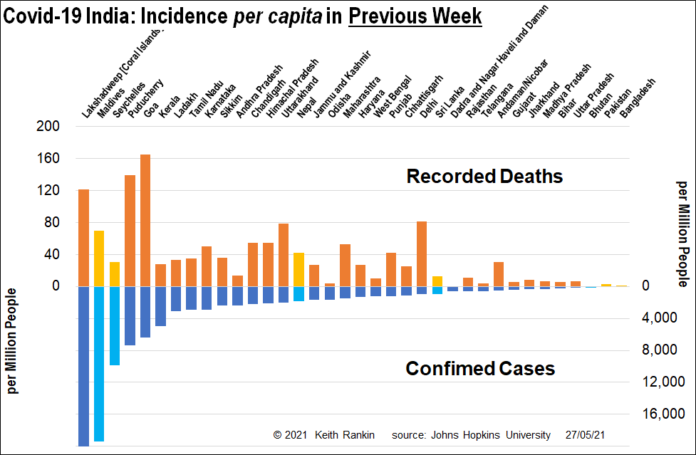
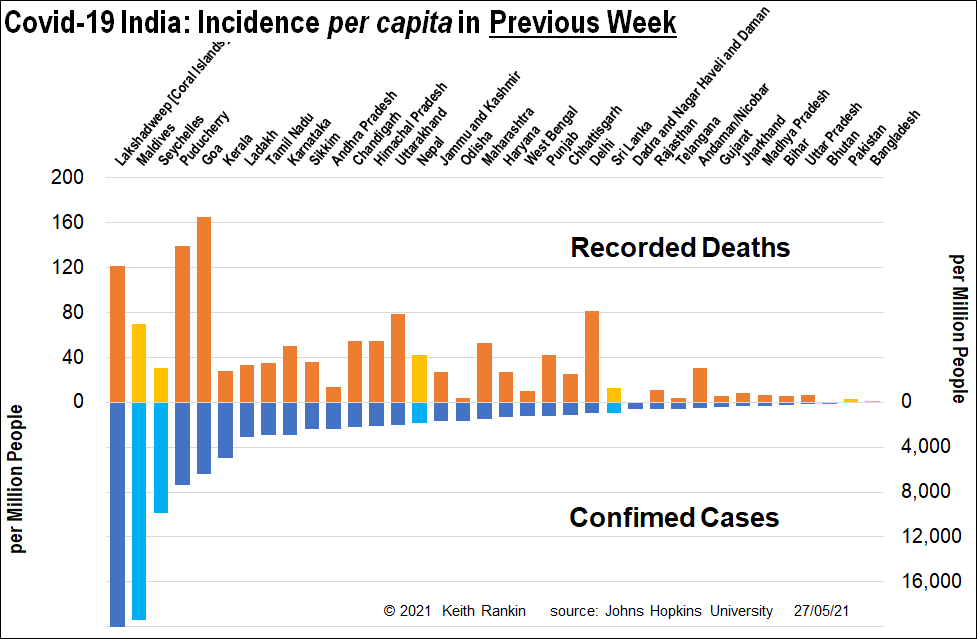
Nepal and Sri Lanka getting worse; Indian Ocean resorts much worse. Chart by Keith Rankin.
Covid-19: Covid19 India update – Analysis by Keith Rankin.
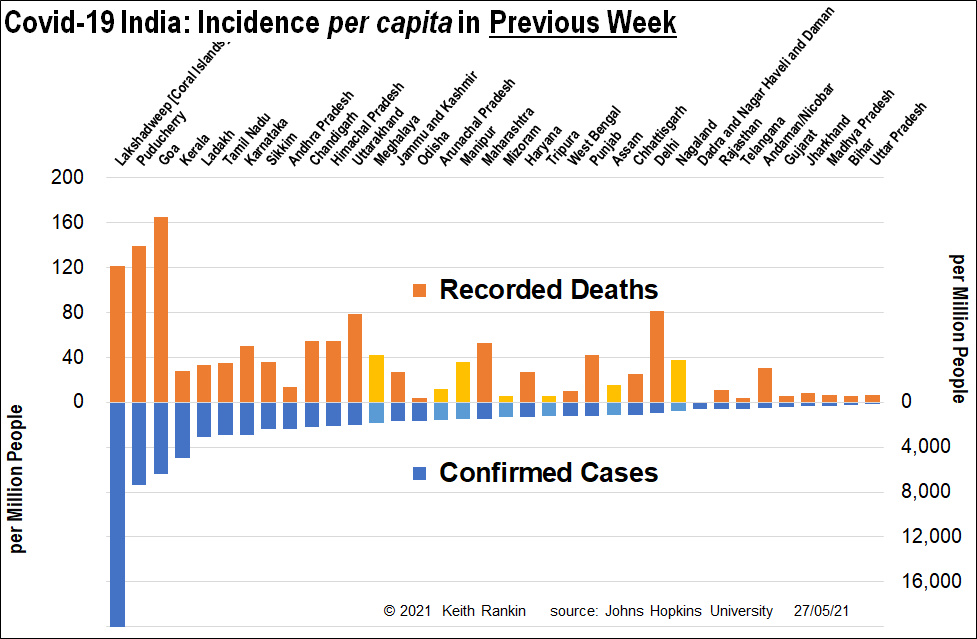
No sign of further spread to India’s rural heartlands; Tamil Nadu worse. Chart by Keith Rankin.
India’s reported cases of Covid19, though still high, are well down on early May (see my India charts from three weeks ago). Maharashtra (Mumbai) and Delhi have markedly fewer cases than at their peaks.
West Bengal (with Kolkata) is showing more cases, though not dramatically so given all the dire commentary earlier in the month. Tamil Nadu (with Chennai) is the big climber, along with Puducherry, which is an independent city surrounded by Tamil Nadu. Because Covid19 is essentially an urban disease (and a resort disease), the cases in West Bengal and Tamil Nadu will be concentrated in the cities of Kolkata and Chennai. (Most likely Darjeeling – in West Bengal – is also getting much worse; it is very close to both Sikkim and to Nepal.)
Also on the increase are the smaller states in the far northeast (ie beyond Bangladesh). These are shown in a lighter blue (cases) and gold (deaths). Three weeks ago they were the least affected parts of India.
The Himalaya states still have strong case numbers: Ladakh, Sikkim, Chandigarh, Himachal Pradesh, Uttarakhand, and Jammu/Kashmir. These are places that the rich people of New Delhi like to escape to in the very hot months from May to August.
India’s poor central rural heartland: Bihar, Jharkhand, Telangana, Madhya Pradesh, Uttar Pradesh – along with similar Gujarat – are if anything registering even fewer cases than they were in the beginning of the month. Unlike many other diseases, Covid19 is not a disease of the rural poor.
Nepal and Sri Lanka getting worse; Indian Ocean resorts much worse. Chart by Keith Rankin.
This chart replaces the far northeastern states with India’s geographical and cultural neighbours. The resort islands are much worse now; indeed, they have been worst covid places in the world for most of the month. Nepal now has four times as many recorded Covid19 deaths as it did three weeks ago, and its suffering is clearly much worse than is India.
Sri Lanka is experiencing easily its worst outbreak of Covid19. (Afghanistan, by the way, has also been hit hard over the last week or so, though it’s not on the chart.)
Pakistan and Bangladesh seem relatively immune from what is happening. While they almost certainly suffer from the worldwide problem of undercounting, there is no obvious reason why they should have a markedly different experience of undercounting; further both had significantly higher case numbers in April than in May. Ramadan may have helped these two countries to adopt physical isolation practices, and especially to not congregate in the cafes and similar where Covid19 has probably spread the most in most countries.
The pandemic is far from over, and the west’s recent obsession with India’s experience – or, more specifically, New Delhi’s experience – has distracted us from the bigger picture of what is still happening in the culturally western countries of the world. Despite its initial origins in China, Covid19 is quintessentially a western disease.
While the financial well-being of everyday Australians has been hit hard by COVID-19, it’s quite the opposite at the top end of town.
“Australia’s billionaires have thrived during the pandemic year”, is how the AFR puts it. But let’s not laud this as an achievement.
It’s a glaring signal the system is stacked. Through the worst economic crisis in a generation, the elite got richer while millions of Australians just hung on, or saw their slim assets evaporate.
COVID-19 inequalities
In 2020, as lockdowns were enforced across the country, unemployment and underemployment soared. Even for those in stable jobs, wages growth was stagnant.
Collectively the Australian people also took on a debt of A$311 billion through federal government spending to mitigate the effects of the pandemic. National debt is expected to grow to $1 trillion by the mid-2020s.
Meanwhile the wealthiest Australians got wealthier.
Again in top spot is mining heiress Gina Rhinehart (net worth $31.06 billion, up from $28.9 billion). Second is iron ore magnate Andrew “Twiggy” Forrest (net worth $27.25 billion, up from $23 billion).
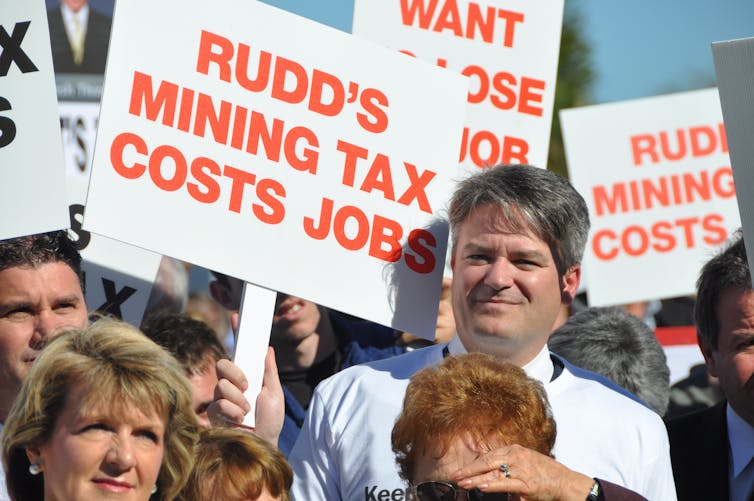
Their campaign a decade ago against the resources profits super tax has proved to be most profitable.
Then WA Liberal senator Mathias Cormann and deputy federal Liberal leader Julie Bishop join protesters in Perth opposing the Rudd government’s proposed mining super profit tax in June 2010.Josh Jerga/AAP
Clive Palmer is in seventh spot (A$13.01 billion, up from $9.8 billion).
Wealth from privatising the value of land, either by digging it up or building on it, accounts for almost half of the wealth of the top 200 – $107.8 billion for the resources sector and $105 billion for property.
Next comes the technology sector ($78.4 billion). The two co-founders of collaboration software company Atlassian accounted for half of that. Mike Cannon-Brooks is third spot with $20.18 billion and Scott Farquhar fifth with $20 billion.
Atlassian has courted controversy over how little tax it pays in Australia, with the AFR’s own columnist Joe Aston calling Cannon-Brooks an “epic freeloader” in February 2020 over Atlassian’s aggressive approach to tax avoidance.
The 2021 rich list shows the extent of economic inequality in this country, as well as the increasing prevalence of the wealthiest Australians. Internationally, Australia is the country with the fifth-highest number of “ultra-high-wealth” citizens.
The good fortune of Australia’s ultra-rich follows the same pattern elsewhere in the world.
A study by the US progressive think tank the Institute for Policy Studies has called 2020 a “billionaire bonanza”, with the long trend in growth in the ultra-rich uninterrupted by the pandemic. The Biden administration has proposed increasing taxes on the wealthy as a way of funding services such as child care and education.
In Australia, the Morrison government has no such plans.
But if COVID-19 has taught us anything, it is that with real political will governments have the power to intervene in the economy at a fundamental level. Lockdowns, border controls, wage subsidies and massive borrowing and expenditure to stimulate the economy have all been bold and unprecedented policies.
Yet when it comes to demanding that the ultra-rich pay a little more and address economic inequality, the same level of political will is nowhere to be seen.
If we really are all in this together, it’s time for that to change.
Imagine two doctors presented with identical information about the same patient giving very different diagnoses. Now imagine the reason for the difference is because the doctors have made their diagnosis in the morning or afternoon, or at the beginning or the end of the week.
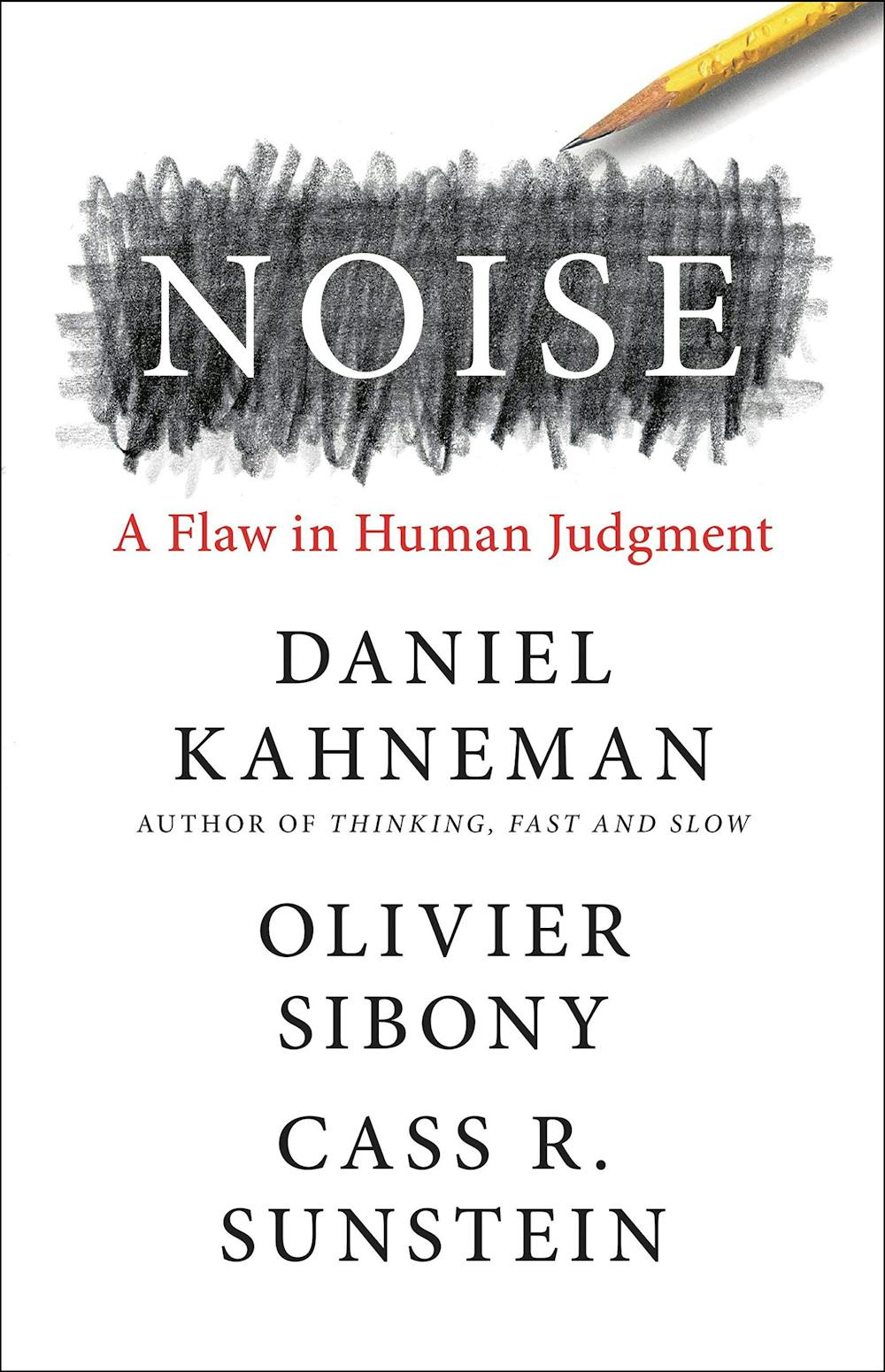
This is “noise” – the reason human judgements that should be identical vary – which Daniel Kahneman, one of the world’s best-known psychologists and winner of the 2002 Nobel Prize in Economics, tackles in his latest book, Noise: A Flaw in Human Judgment.
Kahneman won his Nobel prize for his pioneering work with fellow Israeli psychologist Amos Tversky on how cognitive biases shape judgement. Their work, beginning in the late 1960s, laid the foundation for the new field of behavioural economics, which challenged the economic orthodoxy that decisions are rational.
Kahneman’s previous book Thinking, Fast and Slow, published in 2011, brought much of this work to the attention of a broader audience and cemented his reputation as a foundational figure in the understanding of human behaviour.
In Noise, co-authored by Olivier Sibony and Cass Sunstein he explores a different phenomenon to cognitive bias.
Bias is a psychological process, and can be detected in individual judgement, the genial 87-year-old explained to me when I interviewed him (via video) for the UNSW Centre for Ideas. “But we cannot identify noise in a particular judgement.” Instead we must look at sets of judgements to identify noise.
Noise is a statistical concept
Kahneman’s new book presents several compelling cases from business, medicine, and criminal justice in which judgments appear to vary for no “good” reason.
Noise: A Flaw in Human Judgment, by Daniel Kahneman, Olivier Sibony & Cass R. Sunstein (William Collins, 2021)
One example is fingerprint analysis, with the same analyst making different judgements about the same print at different points in time. If the analyst has only the fingerprint to look at – and no other information about the case – and decides on one occasion it is a match and on another it is inconclusive, that’s noise.
If, on the other hand, the analyst changes their mind because of extra information (for example they are told ballistics evidence suggests a different conclusion), that’s bias.
Both are a problem, Kahneman says. But because noise can only be identified in statistics, it is more difficult to think about, and so tends to go undiscussed.
Noise in system judgements
Kahneman’s book discusses many different types of noise, but the most significant discussion relates to system noise – the variability in decisions arising in systems meant to produce uniform judgements.
There are lots of situations in which diversity of opinion is highly desirable. “Noise is the variability where you don’t want it,” Kahneman said.
Think of the judicial system producing sentences, or the underwriting system to set insurance premiums. Such systems are meant to speak with “one voice”. We want judicial sentences to reflect the crime, not the judge that happens to hear the case. We want two underwriters with exactly the same information to calculate the same or similar premiums.
The challenge, then, is to identify unwanted variability and then do something to mitigate it.
On this, the book offers a key insight that you can apply to your own decision making: resist “premature intuition” – the feeling you “know” something even if you are not sure why you know.
In some cases intuition is very useful for making instant decisions. In other, less time-critical situations, Kahneman says judgements based on intuitive feelings need to be disciplined and delayed.
Act on intuition only after you have made a balanced and careful consideration of evidence, he advised. As much as possible gather that evidence from diverse sources, and from people who have made their own independent judgement of the evidence.
Without this, Kahneman said, noise can easily be amplified.
Turning to artificial intelligence
One response to the prevalence of noise in judgements is to turn to machines, and let computers decide.
Kahneman is not yet an enthusiast. He believes artificial intelligence is going to “produce major problems for humanity in the next few decades” and is not ready for many of the domains in which judgement is required.
In the longer term, however, he does see a world in which we might “not need people” to make many decisions. Once it becomes possible to structure problems in regular ways and to accumulate sufficient data about those problems, human judges could become superfluous.
Until then there is plenty to do in reducing human error by improving human judgment, rather than eliminating it by outsourcing decisions to machines.
Knowing about noise (and bias) will help with that goal.
A recording of Daniel Kahneman’s full conversation with Ben Newell is avaiable on the UNSW Centre for Ideas’ website.
University of Canberra Professorial Fellow Michelle Grattan and University of Canberra Vice-Chancellor and President Professor Paddy Nixon discuss the week in politics.
This week Michelle and Paddy discuss the scrutiny faced by the government over the course of the parliamentary sitting week – in relation to the vaccine rollout, the fourth lockdown in Victoria, and the handling of the Brittany Higgins matter by the Department of Parliamentary Services and the Department of Prime Minister and Cabinet.
Source: The Conversation (Au and NZ) – By Asha Bowen, Program Head of Vaccines and Infectious Diseases, and Head of Skin Health, Telethon Kids Institute
Yesterday Victoria announced a snap lockdown to last at least seven days starting from 11:59pm last night.
As part of the lockdown, schools will close and move to remote learning, and today is a pupil-free day while schools prepare to teach online. Only the children of authorised workers and vulnerable kids will continue to be able to learn in person.
It’s another episode of schools being closed seemingly as par for the course in any COVID-19 outbreak. While communities are concerned about the outbreak, the inclusion of schools in the lockdown should be as an extension of controls if transmission is more widespread, rather than the immediate response.
Despite good evidence, the previously developed traffic light system isn’t being used for schools during outbreaks in Australia. There’s currently no national plan to guide states and territories on how to manage schools during COVID outbreaks, and to advise them on the evidence and best-practice. This needs to change.
We argue schools should be prioritised to remain open, with transmission mitigation strategies in place, during low levels of community transmission.
What’s more, if schools are a priority, then vaccinating all school staff is something we should be urgently doing as part of these strategies.
Schools should be a priority
As paediatricians and vaccine experts, we believe kids’ well-being and learning should be among the top priorities in any outbreak.
We advocate for strategies to reduce the risk of COVID transmission in schools during outbreaks, including measures like:
minimising parents and other adults on the school grounds, including dropping kids off at the school gate rather than entering the school
parents, teachers, other school staff, and high-school students wearing masks
focusing on hand hygiene
enhanced physical distancing
good ventilation in classrooms and school buildings.
On top of this, we believe if schools, teachers and kids are viewed as a priority by decision makers, then vaccinating all school staff should urgently be considered.
Vaccinating all school staff would reassure those who have concerns about being at work in a school environment during a lockdown, and potentially lower the risk of spread in schools even further. This would increase the confidence in schools remaining open.
Snap lockdowns have become the new norm in Australia for managing COVID transmission emerging from hotel quarantine. We strongly argue snap lockdowns shouldn’t automatically include schools. Data from overseas, where widespread community transmission is occurring, suggests schools remaining open with public health measures in place hasn’t changed transmission rates very much.
We advocate for schools to remain open, and if a student or teacher attends a school while infectious, the measures in place to test, trace, and isolate the primary and secondary contacts are activated. We have done it before. NSW was able to continue with face-to-face learning and had 88% attendance in term three 2020 even with low levels of community transmission.
When there’s rampant community spread like some countries overseas, this changes the risk-benefit equation and school closures may be needed. The traffic light system has been developed for exactly this scenario.
But with an outbreak of 30 cases so far, we don’t think Victoria is near the flexion point where school closures are necessary. If there were many more, the risk equation would change, and the traffic light system could be applied.
Also, there’s a different risk equation for primary and secondary school students. Primary school kids are much less likely to transmit the virus than secondary school students. Daycare and early childhood centres remain open in Victoria. The evidence supports at least primary schools remaining open too.
We need a national plan on schools
Our concern is that jurisdictions are reaching for school closures as an almost predictable part of lockdown, without relying on a national plan to guide these decisions. The only current guidelines are the Australian Health Protection Principal Committee’s (AHPPC) statement from February on reducing the risk of COVID spread in schools.
Only about 13% of Australians have received at least one COVID vaccine dose, and ongoing community COVID outbreaks are expected for at least the next year or more. So, we need a proper national plan on COVID and schools. States and territories would benefit from a national plan, as they could lean on it to make informed decisions on schools during outbreaks.
School closures cause enormous strain
Whenever school closures are announced, we hear many parents sigh and say things like “I won’t be able to get any work done!”. Indeed, school closures put enormous strain on families, especially working parents with pre-school or primary school aged children. Younger children require some supervision and are less likely to have the skills necessary to get value out of online learning, compared to older kids in the latter stages of high school who may be more independent.
Challenges might also include poor or no internet, not being able to have relevant supervision, or not having the right devices.
Home learning has a substantial impact on children’s well-being and mental health. Over 50% of Victorian parents who participated in a Royal Children’s Hospital poll in August 2020 reported homeschooling had a negative impact on their kids’ emotional well-being during the second wave in 2020. This was compared to 26.7% in other states. Jurisdictions keep playing into this risk if they keep closing schools.
It’s an absolute priority we find and use ways to support kids to continue face-to-face learning in times of low community transmission, especially primary schools. One important way to do this is to prioritise teachers and other school staff for COVID vaccines.
When lockdown was announced in Melbourne on Thursday, it came on the same morning as the opening of Rising, a large new cultural festival designed to “re-synchronise” and “re-energise” the city that spent much of 2020 in hibernation.
The festival has announced a “pause” on shows for the coming week.
The arts are again confronted with the total loss of ticket revenue, just as the sector was tentatively recovering. It is another terrible setback for a bruised industry.
Lockdowns and border closures in 2021 have already forced shows to cancel at the Sydney, Adelaide and Perth festivals, while Byron Bay Bluesfest was cancelled at the last minute. Reacting to the developing situation in Melbourne, Tasmania’s Dark Mofo — scheduled for June — has delayed ticket sales.
We need to do better in putting a floor under losses for the live-performance industry.
A publicly funded insurance scheme to compensate companies and their performers for COVID-19 related losses would give the sector planning confidence, and accelerate the return of cultural life to Australia’s cities.
Shutdowns without support
Some performance companies weathered the storm of 2020 well.
Last week, Victorian Opera reported a $2.5 million profit for 2020, and Sydney and Melbourne’s symphony orchestras have also reported healthy profits in large part due to the companies being eligible for various government schemes, and saving on production-related expenditure.
But 2021 will be a very different proposition.
During previous lockdowns, some artists and arts workers were eligible for JobKeeper. This support is no longer available.
Festivals, like Rising and Bluesfest, have been hit particularly hard. Festival seasons are compressed into as little as a few days or weeks, and when lockdowns occur at the eleventh hour, most costs are already committed.
While arts events are required to hold public liability insurance, many cannot afford insurance to cover losses from forced public-emergency closures — or insurance companies are now excluding closures due to pandemics and communicable diseases altogether.
Insuring the film industry
In 2020, the government introduced the Temporary Interruption Fund to insure the film industry against pauses to production caused by COVID-19. Last month, this scheme was extended until the end of 2021.
This scheme pays out on the basis of production budgets, with a cap of 60% of the total budget. Run on a rolling basis, with the insurance transferring between projects as they enter and conclude production, by April 2021 the scheme had reportedly enabled more than 12,000 production roles.
Both Labor and the Greens have now joined industry calls for the government to establish an insurance scheme covering live performance and entertainment in the case of COVID-19 related losses.
Such an arrangement would be particularly useful for events like festivals, when costs have mostly been paid before the curtain goes up and there can be particular difficulties in re-scheduling to a later date.
Catastrophic human and financial losses from bushfires, coastal erosion, flooding and other forms of climate risk have become increasingly common, and highlight the limitations of commercial insurance markets. Before COVID, Australia’s summer festivals were already struggling to pay bushfire-related insurance premiums.
There is a growing expectation that government will play a role when the commercial insurance market fails to provide the cover people need in the face of natural and health disasters.
What’s at stake
One reason some arts organisations achieved healthy profits in 2020 was because their forced hibernation dramatically reduced expenditure.
The risk we face in not providing a publicly funded insurance scheme is arts festivals could now choose to hibernate until we have better vaccination coverage, and an associated commitment to end lockdowns and state border closures.
Unfortunately artists and arts workers cannot hibernate in the same way as 2020: they need income now.
A publicly-funded insurance scheme to underwrite companies and their performers for COVID-19 related losses would provide more income stability for artists and arts workers.
It would give the producers of festivals and other cultural events the confidence to take on the risk of producing during the pandemic. And it would help to ensure these festivals and events survive for future generations of creators and audiences.
Eric Carle, author and illustrator of beloved children’s book, The Very Hungry Caterpillar, died on Sunday — the same day his famous caterpillar is born.
One Sunday morning, the warm sun came up — and pop! — out of the egg came a very tiny and hungry caterpillar.
But while a caterpillar’s life is spectacularly short, Carle lived for 91 years. He wrote more than 70 books. His most celebrated, The Very Hungry Caterpillar, is frequently cited as one of the best picture books of all time. With just 224 words, it has sold roughly a copy per minute since its publication in 1969.
Growing wings
Despite The Very Hungry Caterpillar’s success, Carle always seemed baffled by the persistent buzz.
In 2014, when asked about the book’s popularity, Carle responded, “I haven’t come up with an answer, but I think it’s a book of hope”.
I remember that as a child, I always felt I would never grow up and be big and articulate and intelligent. ‘Caterpillar’ is a book of hope: you, too, can grow up and grow wings.
Remarkably, Carle remained humble. In an interview he gave not long before his death, Carle quietly acknowledged the importance of his work.
“You know, now it’s sinking in,” he said. “It’s taken me a long time to realise, and it is sinking in.”
A glimmer of hope
Like many children’s authors, Carle enlists fantasy to serve the narrative. He speaks to children through animals and insects. In books like Brown Bear, Brown Bear, What Do You See? (written by Bill Martin) he gives agency to bugs and beetles, and situates the smallest creatures on the same continuum as humans. His work comforts us. The predictable and non-controversial behaviour of animals is reassuring.
Unlike humans, animals are consistent.
Carle’s caterpillar might be gluttonous, but at least he is true to himself. And he doesn’t apologise for his appetite. He is very hungry, after all.
(In fact, Carle reportedly fought his publisher over the inclusion of the punitive stomachache. Carle didn’t believe children should be concerned with such things. His publisher, worried the episode would promote gluttony, disagreed).
Both George W. Bush and Hilary Clinton read the book to children on their campaign trails — with Bush earning digs for refusing to read any other books, and naming Caterpillar as his favourite children’s book, even though it came out when he was 23.
The American Academy of Pediatrics uses the book as a learning tool to promote healthy eating and educate about the risks of obesity — even though Carle once said he didn’t “recognise childhood obesity […] no one should”.
A child of wartime trauma, with a background in graphic design and advertising, Carle was playing around with a hole punch when he had the idea for a story about a bookworm. The Very Hungry Caterpillar was originally titled A Week with Willi the Worm. But Carle’s first choice of critter was abandoned at the suggestion of his editor, Ann Beneduce, who insisted worms didn’t make likeable characters.
Despite his prolific publishing career, Carle didn’t think of himself as an author, preferring instead the term “picture writer”.
His style is distinct: minimalist text, vibrant illustrations and a multisensory reading experience that moves beyond the simple turning of a page.
The Very Lonely Firefly, for example, includes a set of battery-operated twinkling lights. Mister Seahorse, the story of a fish father who cares for his babies, contains transparent inserts printed with sea environments that can be overlayed as semi-opaque pages.
In Caterpillar, the page width is progressively increased to reflect the quantity of food consumed. Each image of food has a caterpillar-sized hole cutout, as if it has been chomped through.
Ultimately, after some mild abdominal pain and a medicinal green leaf, he transforms into a handsome butterfly.
‘On Monday, he ate through one apple, but he was still hungry…’
Carle’s multifaceted practice, combined with his distinctive visual language, transforms his books into objects of wonder and play, lending themselves to repeated readings.
Moreover, while Carle’s images are carefully constructed through technical processes, his work maintains a childlike quality.
His images reflect how children see their world — a series of bold shapes, exaggerated features and fields of moving colour (an effect achieved by collaging on hand-painted tissue).
Indeed, Carle’s bold and bright colours are particularly effective given what we know about the developmental stages of a child’s vision: younger children are better able to perceive and distinguish between bright colours than fainter shades.
Carle called his work “deceptively simple”, a great accomplishment for a man, who — in his words — tried “all his life to simplify things”.
How come the inside of your body is happy at 37 degrees but when the outside temperature is 37 degrees your body is very unhappy? — Patrick, aged 8.
Great question, Patrick!
You’re right. Most people’s bodies are happiest when their inside temperature sits around a nice 36.5-37.5℃. These temperatures allow your body to work the best.
But your body temperature does go through small changes. It can be a bit lower when you’re asleep. It can also change during the day when you feel hungry, tired or cold. And when you’re sick, your temperature can rise. That’s when you might have a fever.
It’s really important to keep your body temperature at around 37℃ otherwise you can overheat and get quite sick.
To do this, muscles, such as the ones in your arms and legs, tighten (or contract). This process generates, or “makes”, heat. Your blood then carries this heat around your body.
But to stop your inside temperature getting too high, for example when you’re exercising on a hot day, your body needs to lose some of that heat.
Running generates a lot of heat, which our body needs to get rid of to the air around us.Shutterstock
Warm blood travels through blood vessels close to your skin. This heat is then “lost” to the air around you.
If that’s not enough to cool you down, your body will also start sweating. This speeds up how you lose heat through your skin.
You usually feel the most comfortable when it’s around 18-24℃. This seems to be a nice temperature that allows any extra heat to escape into the air. But it’s also not so cold that you need to move around to keep warm.
Phew, it’s stinking hot!
Things that get in the way of losing heat through the skin can make you feel hot, such as wearing a woolly jumper in summer.
But you can also feel uncomfortable on a hot and humid day. That’s because the warm outside temperature makes it hard for you to lose heat from your skin to the air around you (because the air is already quite warm). And without a breeze, it’s even harder for the heat to be carried away.
PODCAST: Buchanan and Manning on the Israel-Palestine Conflict + Samoa
/
RSS Feed
Share
Link
Embed
A View from Afar: In this week’s podcast Selwyn Manning and Paul Buchanan discuss: The latest information on the Israel/Palestine conflict and consider; is the ceasefire likely to hold? What are the underlying causes of the most recent hostilities?
Is there a case of political opportunism in play by the Government of Israel? Is there a case of disproportional defence? If so, does this amount to crimes? And if so, what global body is able to consider such allegations?
And is Palestine’s Fatah a party of the past and will Hamas survive Israel’s intent to destroy it?
*** ALSO, Samoa and the political constitutional crisis. How did it get to this? And, where does Samoa stand now as a principled member of the PIF?
OK, let’s cross to Paul Buchanan to discuss all of this and more…
WE INVITE YOU TO PARTICIPATE WHILE WE ARE LIVE WITH COMMENTS AND QUESTIONS IN THE RECORDING OF THIS PODCAST:
You can comment on this debate by clicking on one of these social media channels and interacting in the social media’s comment area. Here are the links:
Threat.Technology placed A View from Afar at 9th in its 20 Best Defence Security Podcasts of 2021 category. You can follow A View from Afar via our affiliate syndicators.
More than 19,000 Australian children were recorded homeless on census night in 2016. That’s about one in six of the nation’s homeless population.
Many more children live in insecure housing, overcrowded spaces with a lack of privacy or security, or have to move often between accommodation, making it difficult to establish a routine.
Housing stress, spending more than 30% of the family budget on accommodation, can see families have utilities cut off. They may also not have the resources to buy or cook nutritious food, afford school uniforms or transport to school.
A large proportion of homeless children are affected by family breakdown and violence. In 2017-18, almost half (45% or 29,600) of children receiving help from specialist homelessness services did so for reasons related to family violence or breakdown.
Homelessness, inadequate housing and family violence can seriously impact a child’s well-being. And with the COVID-19 pandemic making it harder to keep a job, stay in secure housing and remain free of family violence, the situation is likely to get worse.
The impacts of homelessness and inappropriate shelter on Australian children are considerable.
Inappropriate shelter can result in poorer academic outcomes for children. Frequently moving home or schools, disturbed sleep, a lack of space to study and costs associated with transport, school supplies and uniforms are key issues for people who are homeless or suffering housing stress. These factors all reduce a child’s ability to engage with school.
Health care may be put off, or be piecemeal, due to the cost and ability to access services.
Our study from 2019-20 found 24% of children presenting for care had a severe health issue that required immediate treatment. Only 6% had a full vaccination history. And 62% of all children presented with some form of ill health.
This is due, in part, to waiting times for health services being longer than the period homeless services can secure accommodation for families in need.
In our study, for example, clients had been asked to wait 12 months for urgent medical/surgical care, but only had accommodation approved for three months. This means families may move on before an appointment is available.
By the time children have moved up the waiting list for surgery or medical care, they can have already moved.from www.shutterstock.com
This disengagement of children from social systems, such as health and education, when coupled with inappropriate shelter, results in poorer physical and mental health outcomes, as well as missed developmental milestones.
This all adds up to poorer outcomes across the life span.
Health impacts
Housing insecurity and homelessness are detrimental to children’s health. For example, the stress from frequent moves, lack of security and/or parent fighting can impact a child’s respiratory health and immune function.
Similarly, studies from the United States found up to 40% of homeless school-age children had a mental health condition requiring professional help.
To address these service gaps, we established a nurse practitioner-led model of care, in a metropolitan homelessness service, to allow quicker acccess to health care for children impacted by inappropriate shelter.
The nurse practitioner in our service performs an in-depth assessment of the child using standardised clinical appraisal tools, and can diagnose and prescribe medicines, within a defined area of speciality. The nurse practitioner partners with families to develop care plans and referrals, while bulk billing to eliminate costs.
Additional barriers to accessing health care such as transport are addressed by giving families travel vouchers or the nurse practitioner visiting them at home. The nurse practitioner also works with the homeless service to liaise directly with schools to address education concerns, such as attendance, equipment or homework.
Children remain an invisible part of Australia’s homeless population, and in its insecure housing community. Interventions, (like our nurse practitioner service) delivered at the first point of contact, such as specialist homeless services, help reduce further impact to the child. Nurse practitioner visits can also be cost effective when compared with attending the emergency department for health care.
Our research has also shown nurse practitioners integrate well with GPs to extend care options for the family. The nurse practitioner model of care is also designed to be easily expanded to similar services across Australia, with the aim of preventing the negative impact of homelessness and housing insecurity on Australian children.
Source: The Conversation (Au and NZ) – By Michael (Mike) Joy, Senior Researcher; Institute for Governance and Policy Studies, Te Herenga Waka — Victoria University of Wellington
As countries explore ways of decarbonising their economies, the mantra of “green growth” risks trapping us in a spiral of failures. Green growth is an oxymoron.
Growth requires more material extraction, which in turn requires more energy. The fundamental problem we face in trying to replace fossil energy with renewable energy is that all our renewable technologies are significantly less energy dense than fossil fuels.
This means much larger areas are required to produce the same amount of energy.
Earlier this year, data from the European Union showed renewable electricity generation has overtaken coal and gas in 2020. But previous research argued that to replace the total energy (not just electricity) use of the UK with the best available mix of wind, solar and hydroelectricity would require the entire landmass of the country. To do it for Singapore would require the area of 60 Singapores.
I am not in any way denying or diminishing the need to stop emitting fossil carbon. But if we don’t focus on reducing consumption and energy waste, and instead fixate on replacing fossil fuels with renewable energy, we are simply swapping one race to destruction with another.
The carbon causing our climate problem today came from fossilised biology formed through ancient carbon cycles, mostly over the 200 million years of the Mesozoic era (ending 66 million years ago).
Carbon reduction without consumption reduction is only possible through methods that have their own massive environmental impacts and resource limitations.
To make renewable energy, fossil energy is needed to mine the raw materials, to transport, to manufacture, to connect the energy capture systems and finally to produce the machines to use the energy.
The new renewable infrastructure requires rare earth minerals, which is a problem in itself. But most of the raw materials required to produce and apply new energy technology are also getting harder to find. The returns on mining them are reducing, and the dilemma of declining returns applies to the very fossil fuels needed to mine the declining metal ore.
Globally, despite building lots of renewable electricity infrastructure, we have not yet increased the proportion of renewable energy in our total energy consumption.
The problems with wanting to maintain industrial civilisation are many, but the starkest is that it is the actual cause of our climate crisis and other environmental crises.
If we carry on with life as usual — the underlying dream of the “green growth” concept — we will end up destroying the life-supporting capacity of our planet.
What happened to environmentalism?
The green growth concept is part of a broader and long-running trend to co-opt the words green and environmentalist.
Environmentalism emerged from the 1960s as a movement to save the natural world. Now it seems to have been appropriated to describe the fight to save industrial civilisation — life as we know it.
This shift has serious implications because the two concepts — green growth and environmentalism — are inherently incompatible.
Traditionally, environmentalists included people like Rachel Carson, whose 1962 book Silent Spring alerted Americans to the industrial poisons killing birds and insects and fouling drinking water, or environmental organisations like Greenpeace saving whales and baby seals.
In New Zealand, being green had its roots in movements like the Save Manapouri campaign, which fought to save ancient native forests from inundation when a hydropower dam was built. Environmentalism had a clear focus on saving the living world.
Now environmentalism has been realigned to reducing carbon emissions, as if climate change was our only impending crisis. Parliamentary Greens seem set to want to reach net zero carbon by 2050 at any cost.
The word “net” allows champions of industry-friendly environmentalism to avoid considering the critical need to reduce our energy consumption.
We must somehow drag ourselves away from our growth paradigm to tackle the multiple crises coming at us. Our only future is one where we consume less, do less, waste less and stop our obsession with accumulating.
If we keep trying to maintain our current growth trajectory, built on a one-off fossil bonanza, we will destroy the already stressed life-supporting systems that sustain us. Protecting these and their essential biotic components is true environmentalism — not attempting to maintain our industrial way of life, just without carbon.
We spent six years on the road tracing guitar-making across five continents, looking at the timber used — known in the industry as tonewoods for their acoustic qualities — and the industry’s environmental dilemmas. Our goal was to start with the finished guitar and trace it to its origin places, people and plants.
We first visited guitar factories in Australia, the United States, Japan and China. There we observed materials and manufacturing techniques. From factories, we visited the sawmills that supply them. And then we journeyed further, to forests, witnessing the trees from which guitars are made.
Our task proved more complicated than imagined. At Martin Guitars alone, based in the US, wood comes from countries on six continents and 30 different vendors.
We learnt about the guitar’s environmental footprint, while appreciating the skills and experiences of behind-the-scenes people, and the capacities of the forests and trees to adapt. And we saw how Australian guitar-makers, such as Maton and Cole Clark, are leading the way in embracing sustainable options, salvaging recycled wood, and sourcing native species from timber suppliers in Victoria, Tasmania and Queensland.
At Cole Clark’s Melbourne factory, CEO Miles Jackson explains the unlikely story behind salvaging California Redwood from Victoria for use in guitar-making.Paul Jones / UOW Media
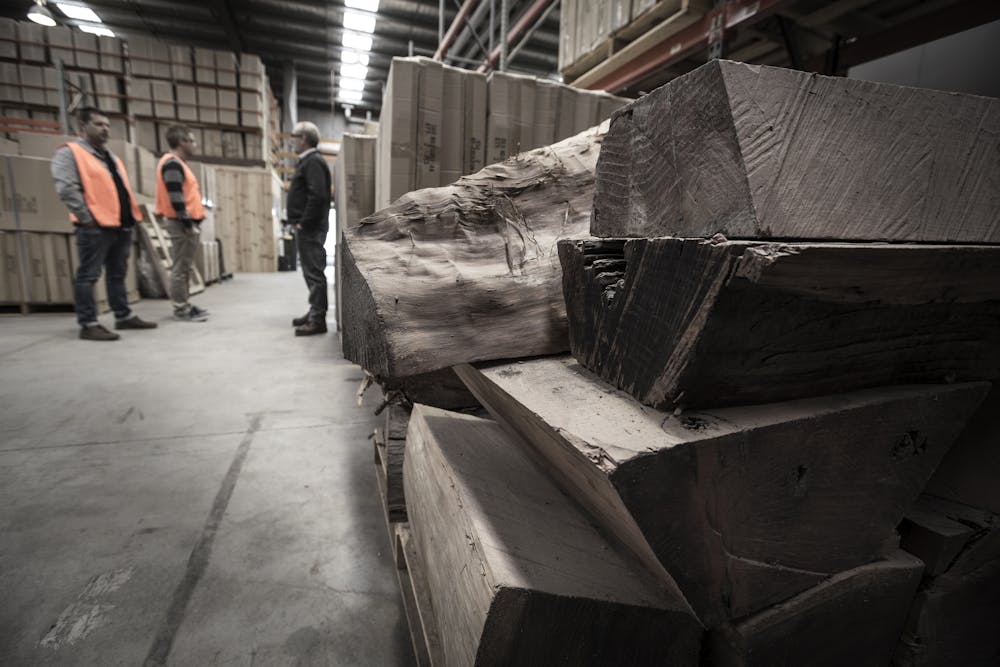
Unlike the timber used in construction or mass produced furniture — plantation species selected for fast growth and quick returns on investment — guitars use rare woods from old-growth trees. This is because the slices of wood used on guitars are quartersawn: cut perpendicular to the tree’s growth rings to ensure stability and sound wave projection. The slices have to be wide enough to become the front face, backs or sides of the instrument, hence large diameter logs are needed.
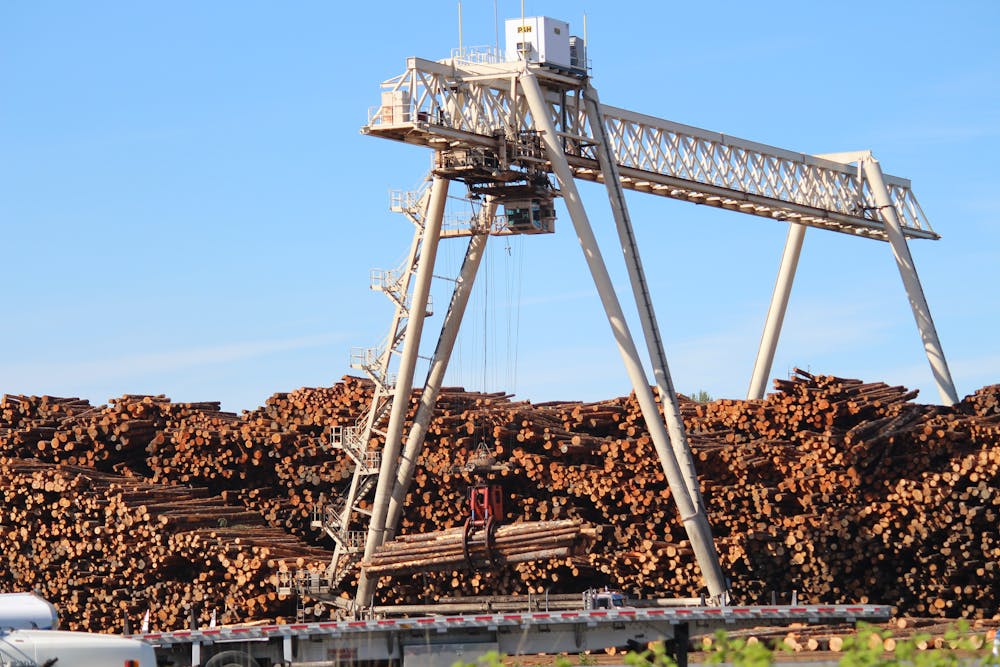
Industrial sawmilling in Washington state, USA. Guitar timbers do not come from such sawmills.Authors
From carefully cut timber, guitar parts are then carved (whether by hand or machine), sanded and assembled. The soundboard (the top) is most critical. The guitar is musical because the strings are pulled extremely tight.
With their solid bodies, electric guitars can withstand tension better than acoustics. On acoustic guitars, the soundboard must be strong, but also light, and reverberate responsively, its stiffness harnessed for tonal qualities.
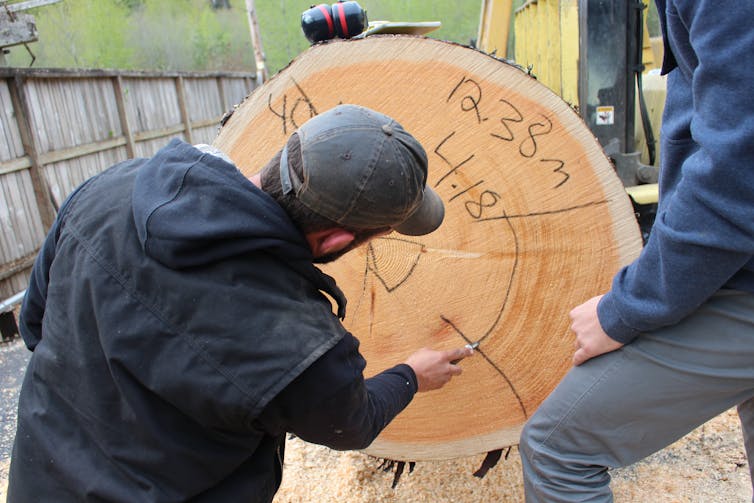
At Pacific Rim Tonewoods north of Seattle, a Sitka spruce log is prepared for splitting and quartersawing (cut radially) into thin, soundboard pieces.Authors
Until recently, a narrow range of timber species were considered suitable for guitars. Through centuries of European craft tradition, luthiers established spruces (Picea) worked best as acoustic and classical guitar soundboards.
For necks, guitar-makers use mahogany (Swietenia macrophylla) or maple (Acer species); for fretboards and bridges, ebony (Diospyros species) or rosewoods (Dalbergia species); and for acoustic guitar backs and sides, rosewoods and mahogany.
Since the inter-war Hawaiian music craze, koa (Acacia koa) has featured on acoustics, electrics and ukuleles.
At the C.F Martin & Co. factory in Nazareth, Pennsylvania, internal braces are shaved underneath the soundboard. Such braces provide the instrument with structural reinforcement, but also influence tone.Authors
Some of the woods used are plentiful and well managed. Leo Fender’s Telecaster captures the electric guitar’s rock ‘n’ roll sensibility: an unpretentious “slab” of swamp ash (Fraxinus species) and a one-piece, maple neck, bolted together in utilitarian simplicity. When we visited the Fender factory in California in 2018, Mike Born, head of wood technology explained:
We were fortunate that the old Fender designs used very easy-to-get American woods. Leo Fender was a very economical kind of guy looking to make inexpensive instruments, and developed them around woods that weren’t used for other things. Swamp ash is a good example: it was a throwaway product from furniture wood.
Other woods used in guitar making have more fraught histories and sustainability problems. Sitka spruce (Picea sitchensis), used on guitar soundboards, comes from trees at least 400 years old, but these are increasingly scarce. Ebony is threatened in its African habitat, with tightening restrictions on its use.
Habitat destruction for agriculture and urbanisation led to Brazilian rosewood — once considered the “gold standard” for guitars — being effectively banned from use since 1992. Guitar companies replaced it with similar species from other places, but they too were over-harvested.
Scandals have engulfed the industry since the Gibson Guitar factories in Nashville and Memphis were raided by US Fish and Wildlife marshals (in 2009 and again in 2011) over allegations of illegally sourcing and improperly verifying Madagascan ebony and rosewood.
Many acoustic guitar players insist on ‘traditional’ timbers such as rosewood.Authors
Attachments to “traditional” instrument woods have prevented heritage brands from switching to more sustainable options. As guitar historian Dick Boak explained, convincing guitarists to switch to instruments made from sustainable materials is difficult: “musicians, who represent some of the most savvy, ecologically minded people around, are resistant to anything about changing the tone of their guitars”.
But attitudes are shifting. Musicians are increasingly concerned about the provenance and environmental impact of their instruments, encouraging guitar brands to improve transparency and rethink their ecological entanglements.
One necessity will be to embrace a more diverse range of alternative timbers. These will include more plentiful plantation species, salvaged trees and urban forestry.
On this, Australian brands Maton and Cole Clark are among those leading the way. Decades ago, Maton pioneered the use of Australian native species. In recent times, it and Cole Clark have worked with specialist guitar timber suppliers Kirby Fine Timbers in Queensland, Otways Tonewoods in Victoria and Tasmanian Tonewoods to established bunya pine (Araucaria Bidwillii) as a credible, quality alternative for soundboards, Blackwood (Acacia melanoxylon) for backs and sides, and Queensland maple (Flindersia brayleyana) for necks.
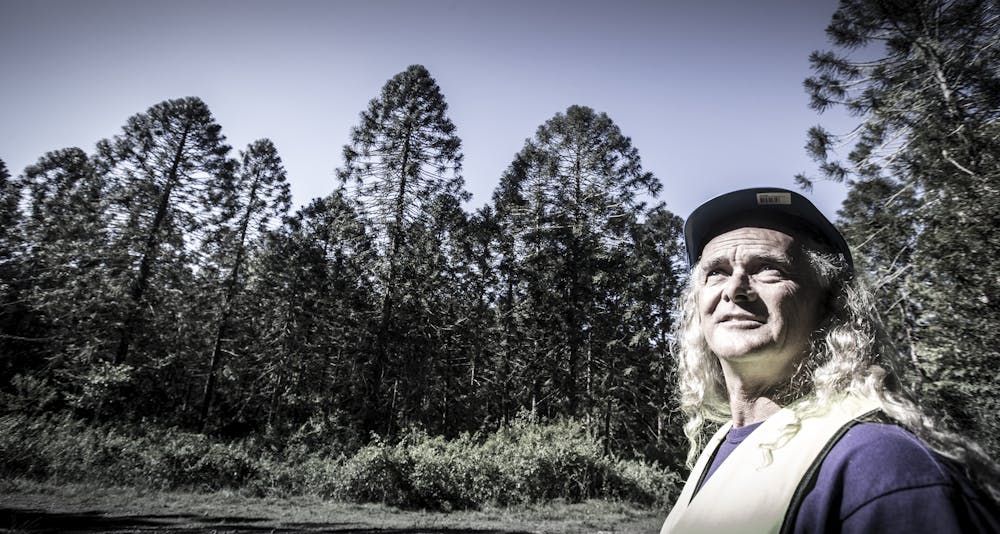
Tonewood specialist David Kirby, based on the Sunshine Coast, has been pivotal in supplying bunya pine to the guitar industry, harvested in limited quantities from legacy plantings dating to the 1920s.Paul Jones / UOW Media
Meanwhile, guitar-makers have salvaged timbers from urban trees. In 2018, Cole Clark’s head of wood technology, Karl Krauss, heard of a municipal council near Melbourne removing sycamore-maple trees (Acer pseudoplatanus) seen as a fire hazard. He recalled their historical use in Renaissance instruments and salvaged them for a limited run of guitars.
Other salvaged urban timbers have included California redwood (Sequoia sempervirens) planted in Victorian parks in the 1850’s by then colonial government botanist, Baron Ferdinand von Mueller, and southern silky oak (Grevillea robusta). Such urban recovery sources now constitute 30% of timbers on Cole Clark guitars.
Around the world, relationships between sawmills and forest resource managers are also shifting. Indigenous communities are asserting custodianship of trees. Commercial relationships are being forged between these communities, specialist companies supplying guitar tonewoods and guitar firms. There is considerable potential for working with Indigenous and ecological values rather than in spite of them.
Taking matters into their own hands, guitar timber people are also planting trees for future sustainable instrument-making on their properties, and in partnership on cattle ranches and Indigenous-owned and managed lands. These efforts are guided by an ethic of care for trees, forests, communities and guitars.
The goal is to ensure wood for future guitar-making well beyond individual lifetimes. As Born emphasised at Fender’s factory: “We don’t have a lot of choice in what was planted generations ago but we certainly do for the future”.
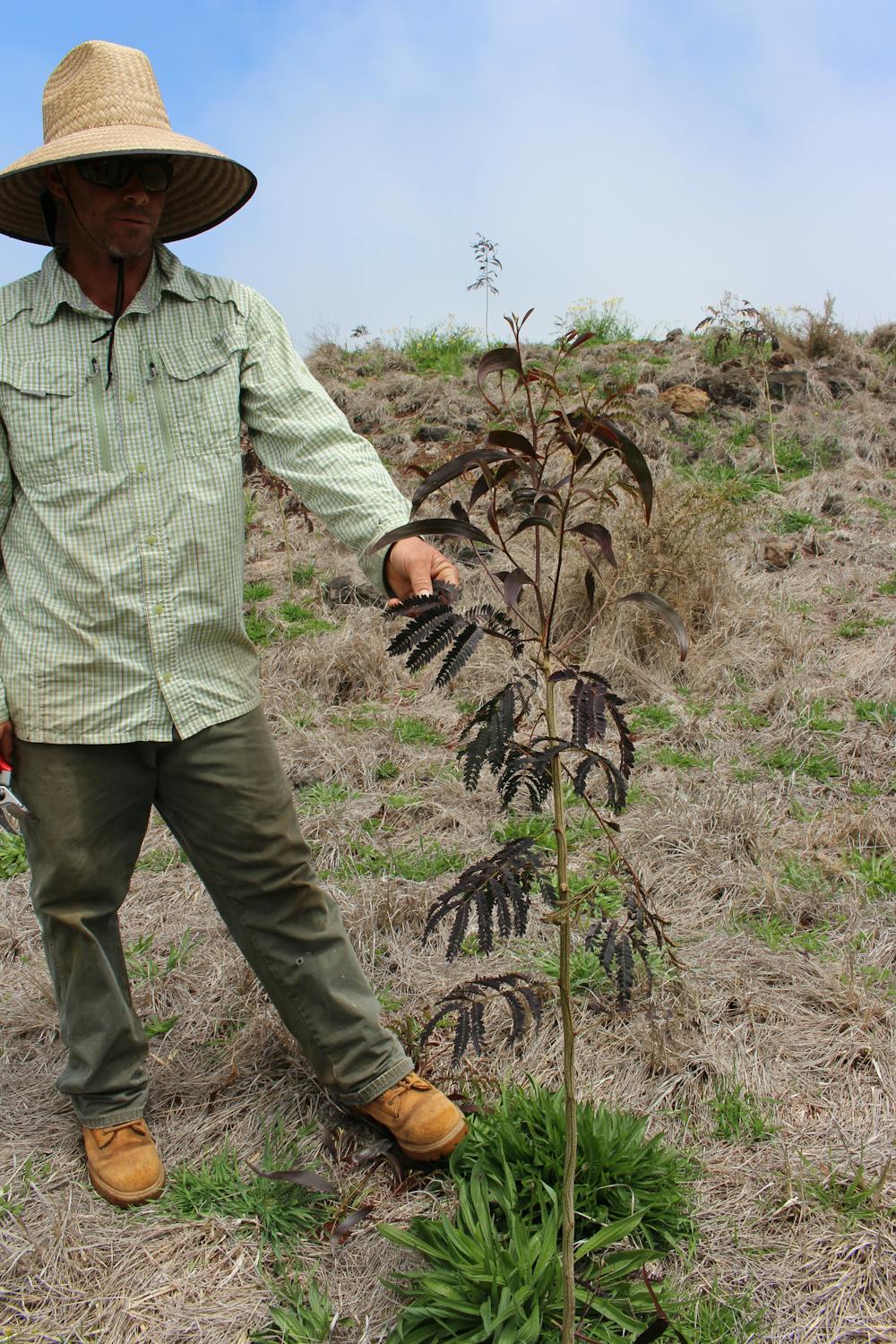
On the slopes of Maui’s Haleakalā volcano, land managers are replanting koa trees.Authors
On Maui’s volcanic slopes land managers are working with the US-firm Taylor Guitars and Pacific Rim Tonewoods (a US specialist wood supplier) to regrow koa forests.
In Washington state, Pacific Rim Tonewoods claims it is growing “the world’s first tonewood forest”, cultivating fiddleback maple in a 100-acre plot near its sawmill. Taylor also supports ebony replanting in Cameroon, in partnership with Spanish tonewood supplier, Madinter.
In the Sunshine Coast hinterland, specialist tonewood supplier David Kirby cultivates Queensland maple and bunya pine, as well as blue quandong (Elaeocarpus angustifolius) used by Maton in Melbourne for electric guitar models. He also manages century-old “legacy stands” on private land in the region.
Blue Quandong trees growing on old cattle ranches are being used by Maton.Paul Jones / UOW Media
Although these plantings are not large by forestry’s standards, once a certain density and diversity is achieved, they “take care of themselves”, in Kirby’s words, providing enough wood for small harvests annually without degrading ecological values. Still, access to suitable land for growing trees and skilled labour to care for them will determine future success.
Earlier in their careers, the guitar timber people we interviewed did not intend to become forest stewards — although all profess a life-long love for plants. They have assumed stewardship roles after personal experiences of industrial forestry’s inability to sustainably manage forests to supply high quality timbers from centuries old trees.
The guitar industry has breached the factory gates, extending its activities and influence upstream, into forests. As Steve McMinn from Pacific Rim Tonewoods put it,
the world’s primary forests are nearly mined out. If you want wood for a specific purpose, you need to grow it.
As we were on the road, insect pathogens surviving unprecedented warmer winters in the Rockies attacked and killed millions of Engelmann spruce trees (Picea engelmannii). The emerald ash borer (Agrilus planipennis) has killed millions of American ash — of Fender Telecaster fame. Environmental scientist Jared Beeton is now working with guitar companies to experiment with using the affected spruce for guitar-making.
Insect pathogens have attacked and killed millions of Engelmann spruce trees.Authors
In Queensland, David Kirby admits his planted trees may not survive:
It could be a massive screw up of everything I’ve done in my life. But at the end of the day, what if I don’t do it? If everybody planted trees for future generations, of course, that would help stop climate change. I can’t be the one to say I’m not going to plant trees because they might not survive.
Cities may prove vital future habitats for guitar trees too. Fender’s Mike Born outlined a new initiative between Fender, the US Forest Service and the Baseball Hall of Fame, to encourage tree replanting schemes in inner cities. Like Telecasters, baseball bats are made from American ash.
As the emerald ash borer annihilates trees across the continent, the two niche industries share the same problem of securing future resource supply. The idea is to replant a variety of urban street trees to disperse the genetic and geographic base of vulnerable species.
“We have a chance now”, Born explained, “to replant old street trees”. Instead of gearing management of forest resources towards short-term profit, “we could think a century down the road”.
Are there trees that at the end of their life cycles can have a future life? What should we be planting for the future? It’s a worldwide discussion we need to have.
Source: The Conversation (Au and NZ) – By Richard Oloruntoba, Associate Professor of Supply Chain Management & Supply Chain Management Lead, Curtin University
On May 7, a pipeline system carrying almost half the fuel used on the east coast of the United States was crippled by a major cyber attack. The five-day shutdown of the Colonial Pipeline resulted in widespread fuel shortages and panic-buying as Virginia, North Carolina and Florida declared a state of emergency.
The attack highlights how vulnerable critical infrastructure such as fuel pipelines are in an era of growing cyber security threats. In Australia, we believe the time has come to make it compulsory for critical infrastructure companies to implement serious cyber security measures.
Collateral damage
The risk of cyber attacks on critical infrastructure is not new. In the wake of the events of September 11, 2001, research demonstrated the need to address global security risks as we analysed issues of vulnerability and critical infrastructure protection. We also proposed systems to ensure security in critical supply chain infrastructure such as seaports and practices including container shipping management.
The rise of “ransomware” attacks, in which attackers seize important data from an organisation’s systems and demand a ransom for its return, has heightened the risk. These attacks may have unintended consequences.
Evidence suggests the Colonial shutdown was the result of such an attack, targeting its data. It appears the company shut down the pipeline network and some other operations to prevent the malicious software from spreading. This resulted in a cascade of unintended society-wide effects and collateral damage.
Indeed, the attackers may have been surprised by the extent of the damage they caused, and now appear to have shut down their own operations.
The Colonial Pipeline attack led to fuel shortages across the eastern United States.Will Oliver / EPA
We have seen how critical supply chain infrastructure can be severely disrupted as collateral damage. We must consider how severe the fallout might be from a direct attack.
The events in the US also raise another important question: how vulnerable is our critical supply chain infrastructure in Australia?
Critical infrastructure is an attractive target
Australian society is dependent on many international and domestic supply chains. These are underpinned by critical supply chain infrastructure that is often managed by advanced and interlinked information and communication systems. This makes them attractive targets for cyber attackers.
Cyber risk frameworks are often derived from traditional risk management approaches, addressing issues of a potential cyber attack asroutineconventionalrisk. These risk management approaches weigh up the costs of preventing a cyber attack against the costs and probability of a breach.
In some industries, this assessment will factor in the cost of a lost customer base who may never return. However, providers of critical services such as transportation, medical care, electricity, water, and food see little risk of losing customers.
After the Colonial incident, customers trooped back to petrol stations as soon as they could and went on buying fuel. Thus, critical industries may perceive less cost from a breach than companies in other industries because their customers will return.
Time for compliance
Australia’s national efforts in cyber security are coordinated by the Australian Cyber Security Centre (ACSC) under the auspices of the Australian Signals Directorate. The ACSC works with public and private sector organisations to share information about threats and guidance on best practices for security.
Lack of knowledge is not the problem. Security best practices are generally well understood and documented by the ACSC. The ACSC also provides specific guidance for critical sectors and industries, such as a security framework developed for the energy sector.
The challenge here is that these are guidelines only. Companies can choose whether to follow them or not.
What Australia needs is a cyber security compliance program. This would mean making it compulsory for companies that manage critical infrastructure such as ports or pipelines to follow some kind of rules.
A first step might be to demand these companies comply with the existing guidelines, and require certification of a baseline of cyber security.
Lessons from the United States
The US government responded to the Colonial cyber attack with an executive order to improve cyber security and federal government networks. The order proposes a raft of measures to modernise standards and improve information sharing and reporting requirements. These are valuable measures, many of which are already within the scope of the existing duties of Australia’s ACSC.
Another measure in the US order is the establishment of an independent Cyber Safety Review Board. Australia could likewise establish a partnership between government and industry to oversee cyber security. A similar body already regulates aviation: the Civil Aviation Safety Authority.
Such an organisation would provide robust analysis and reporting of cyber incidents. It would also share information with information technology managers, software and hardware developers, public administrators, crisis managers, and others.
Cyber security threats create high levels of uncertainty for the public and private sector. Attacks that disrupt critical supply chain infrastructure have widespread impacts on society and trade.
A cyber security compliance program may be financially costly, but would be a worthwhile investment given the societal impact of a successful cyber attack.
In Beijing, the secret trial on spying charges of Australian citizen Yang Hengjun will constitute another sour chapter in Australia-China relations, which remain locked in a downward spiral.
Yang’s trial is set to begin this week with no family, friends or Australian consular officials present. He will be represented by his lawyer.
Penalties under Chinese law for espionage range from three years to death. Acquittal rates in the Chinese court system are minuscule.
This will be the baleful reality for Yang when he is brought handcuffed into a Beijing intermediate court. The sentencing may take months, in which time the Australian citizen will remain in custody, and likely subject to further mistreatment.
In an eloquent note to his family, friends and supporters, Yang, a former diplomat turned writer and blogger, has denied all charges against him.
I have no fear now. I will never compromise […] I love you all and I know that I am loved.
In this latest jarring moment in Australia-China relations, Yang is a victim of a poisonous relationship that has developed between Beijing and Canberra since the Malcolm Turnbull era.
The Chinese-born Australian citizen is paying a price for Australia’s stumbling attempts to manage its relations with its largest trading partner and, until recently, fastest-growing source of foreign investment.
Chinese investment has fallen off a cliff as a consequence of the deteriorating relationship. Shipments of coal, wine, barley, rock lobster and other commodities have slowed to a trickle as China imposes a range a tariff and non-tariff barriers on Australian imports.
Record exports of iron ore have meant aggregate trade figures are holding up, but the situation is precarious because these numbers depend on a single commodity.
Under Turnbull, Australia enacted foreign interference laws that were aimed at China’s attempts to interfere in Australian domestic politics. These measures contributed to the souring of relations.
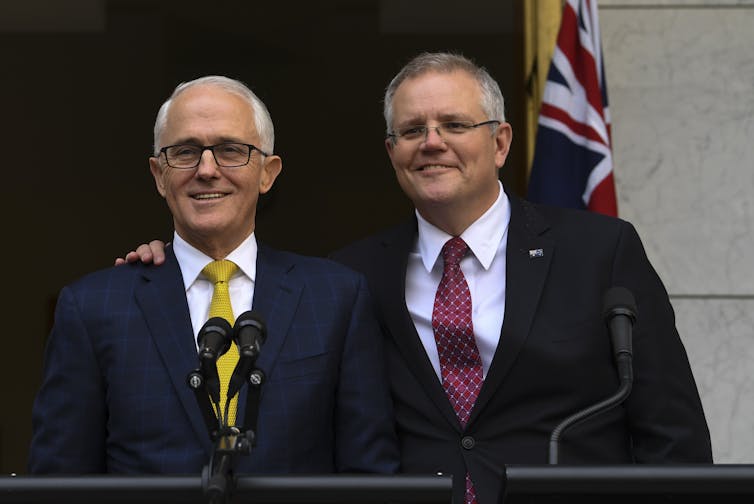
Turnbull’s successor, Scott Morrison, has not restored relations to a reasonable footing. In some ways they have got worse.
Not least of the Morrison government’s misjudgements was a closer than prudent alignment with the Trump administration in its up-and-down management of relations with China.
Under Malcolm Turnbull, Australia-China relations soured. Under Scott Morrison, they got even worse.AAP/Lukas Coch
Inevitably, Canberra got caught in the backwash of Chinese displeasure with the United States. In reprisals on the trade front, Australia has been made a scapegoat regionally, and further afield – an example of what might happen if a country incurs Beijing’s wrath.
Other countries have criticised China on a range of issues without experiencing a similar backlash. These include China’s mistreatment of its Uighur minority; its disregard for agreements with the United Kingdom over Hong Kong’s relative independence under a “one country, two systems” formula in place until 2047; its resort to hostage diplomacy to further its diplomatic ends; and its smash and grab approach to asserting itself in the disputed waters of the South China Sea.
Morrison and foreign minister Marise Payne have struggled to come to terms with the sort of statecraft that might be expected of custodians of Australia’s most important trading partnership and most crucial regional relationship.
For example, and at no discernible benefit to the country, it was Payne who got out in front of the international community in calls for an independent inquiry into the COVID-19 virus, which appears to have originated in the central Chinese city of Wuhan.
The Australian government provoked Beijing by calling for an independent inquiry into the origins of the COVID-19 virus.AAP/AP/Leah Millis
Such an intervention was unnecessary, in any case, because the World Health Organisation was already mounting its own inquiry, supported by much of the international community.
Australia’s clumsy attempts to force-feed an investigation will have looked to Beijing like Canberra was doing Washington’s bidding at a moment when Trump was referring to COVID-19 as the “Wuhan virus”, the “Chinese flu” or, crudely, “Kung-flu”.
None of this will be any comfort to Yang Hengjun, or journalist Cheng Lei, the other Australian in detention since last August on alleged breaches of national security. This charge could mean anything, from spying, to peddling state secrets, to criticising Communist Party rule.
Properly, Payne has criticised China’s handling of the Yang case as “lacking procedural fairness”. China’s embassy in Canberra then described her intervention as “deplorable”.
In these latest developments, the cases of Yang and Cheng cannot be separated from those of the Canadians Michael Kovrig and Michael Spavor, both of whom stood trial in March on spying charges. Sentences are pending.
These two cases are chilling examples of hostage diplomacy, given the Canadians’ arrest came on the heels of authorities in Vancouver detaining Meng Wanzhou, the daughter of the founder of Chinese telecommunications giant Huawei.
The US is seeking Meng’s extradition on charges of breaching its sanctions regime against Iran. Her removal to the US is being appealed in the Canadian court system.
In the meantime, there is no prospect of Kovrig, a former diplomat, and Spavor, a businessman, being released as they await sentencing. They are hostages to developments in the Vancouver courts and in Washington.
Kovrig’s employer, the International Crisis Group, has campaigned assiduously for his release. In a recent statement it said:
[…] his sole offence was to be a Canadian citizen who was at the wrong place at the wrong time.
Given the circumstances, it is impossible to put any other interpretation on his detention in 2018, along with that of Spavor.
In February, Australia joined an international coalition of 57 countries, led by Canada, in condemning the practice of hostage diplomacy. The US, the UK, Japan and most of the 27-member European Union endorsed a statement saying:
The arbitrary arrest or detention of foreign nationals to compel action or to exercise leverage over foreign Government is contrary to international law, undermines international relations, and has a negative impact on foreign nationals travelling, working and living abroad.
This might be regarded as an understatement.
A Beijing intermediate court in the Yang case will be paying scant attention to international criticism of the Chinese judicial system. China’s jurisprudence, shielded from public scrutiny, is a merciless process.
Australian prime minister Scott Morrison’s flying visit to Queenstown this weekend will be unlikely to include jet boating or bungee jumping. But, given what’s up for discussion, you might still call it a form of adventure tourism.
In fact, Morrison’s first overseas trip of 2021 takes place against a background of strained bilateral relations and wider international tension.
Despite his assertion that “Australia and New Zealand are family”, the vexed questions of dealing with China and trans-Tasman migration hang over his meeting with Jacinda Ardern.
While the two issues may seem quite separate, in the world of foreign affairs all things are connected. Resolving one could quite possibly help resolve the other — or at least go some way to improving the relationship.
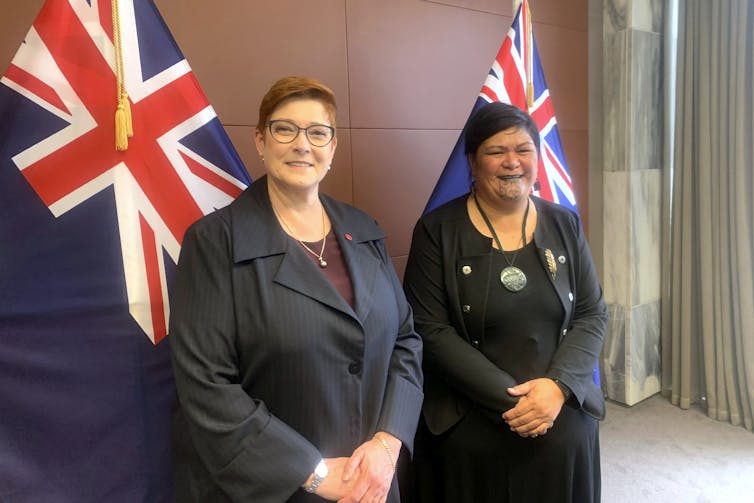
Offside with Five Eyes: Australian Foreign Minister Marise Payne and New Zealand Foreign Minister Nanaia Mahuta meeting in Wellington in April.AAP
China vs Australia at the WTO
It’s no secret Australia has problems with China, not least due to recent rhetoric in Canberra about the possibility of a war over Taiwan. For its part, New Zealand has been offside with its Five Eyes security partners by appearing to prioritise the trade relationship with China over security and human rights concerns.
Behind those headlines, however, lies a longer term and highly complex trade battle between Australia and China that is coming to a head at the World Trade Organisation (WTO).
The immediate issue is China’s imposition of tariffs on Australian barley, with wine exports next in line for resolution. In late April, China refused Australia’s request for a three-person independent panel to adjudicate, so the dispute has moved to the WTO’s Disputes Settlement Body (DSB).
The DSB meets today (May 28), just days before Morrison arrives in New Zealand. While the eventual process may play out over a year (depending on appeals), the question right now is where New Zealand stands.
Like it or not, New Zealand cannot avoid being involved. As foreign minister Nanaia Mahuta warned recently:
We cannot ignore, obviously, what’s happening in Australia with their relationship with China. And if they are close to an eye of the storm or in the eye of the storm, we’ve got to legitimately ask ourselves — it may only be a matter of time before the storm gets closer to us.
Australia would undoubtedly prefer New Zealand to become involved as an official third party to the dispute process. China will likely want the opposite.
The diplomatic question, then, is what could New Zealand ask for in return for supporting Australia at the WTO? And this is where the issue of trans-Tasman migration could come into play.
We can trace the current impasse back to the original 1973 Trans-Tasman Travel Arrangement that allowed for the free movement of citizens between the two countries.
The most recent pre-COVID figures show 31,300 people migrated from New Zealand to Australia in the year ended June 2019, while 27,600 migrated the other way. Kiwis now make up only a small fraction of net migration into Australia.
Despite this, Australian policy reflects that earlier time when hundreds of thousands of New Zealanders moved across the Tasman. From 2001, Australia began tightening its social security and benefit system for New Zealanders.
In 2016, Australia began prioritising skilled immigrants for permanent residency and closing off pathways to citizenship for others.
Perhaps most contentiously, in 2014 Australia amended its migration laws and ramped up deportation of non-citizens with criminal convictions under section 501 of its Immigration Act. From early 2015 to mid-2018, about 1,300 New Zealand ex-prisoners had been returned.
After a brief interlude, things reached something of a nadir during the height of COVID-19 restrictions when deportations resumed, with Australia’s then Home Affairs Minister Peter Dutton likening the process to “taking the trash out”.
On top of this, Australia cancelled the passports of dual citizens suspected of links to designated terrorist organisations, meaning they became New Zealand’s problem.
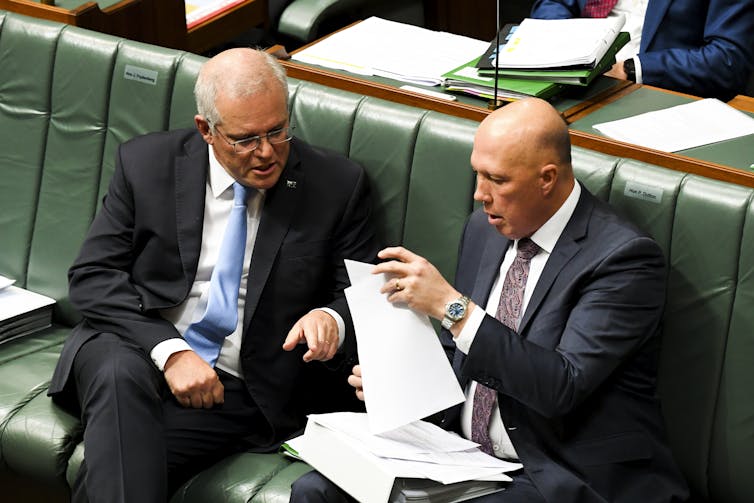
Scott Morrison with Defence Minister and former Home Affairs Minister Peter Dutton: talk of war and ‘taking out the trash’ have raised temperatures.AAP
A compromise on deportations
Meanwhile, New Zealand remained committed to the spirit of the original 1973 agreement, treating Australians more or less equally on residency and benefits. While New Zealand’s deportation rules are similar to Australia’s, Australians don’t feature much among the 5,972 people deported from New Zealand between 2011 and 2020.
However, if New Zealand wants a fairer deal from Australia on welfare and access to citizenship, it will need to give some ground too. A starting point would be agreeing to a prisoner exchange agreement, rather than simply reacting angrily to 501 deportations.
Part of the problem is that New Zealanders are over-represented in Australian jails (1,048 inmates, or 3% of the total prisoner population). There were only about 36 Australians in New Zealand jails (albeit including the Christchurch mosque terrorist) out of about 320 foreign inmates.
A mature compromise might be an arrangement whereby criminals sentenced above a certain threshold are sent back to their home country to serve their time. Australia’s International Transfer of Prisoners Act already allows for the transfer of prisoners with various other countries.
So far, however, New Zealand has shown little interest in such agreements, and this needs to change. By meeting Australia in the middle, New Zealand could open a broader dialogue over reciprocal pathways to citizenship and welfare treatment.
New Zealand should back Australia
While it can’t be a quid pro quo, an improved migration situation might help win New Zealand’s support at the WTO. Both countries need to compromise.
New Zealand will, of course, need to consider the merits of the WTO case and whether Chinese claims of Australia dumping barley in its market are valid.
But if New Zealand does stand for a robust, multilateral, rules-based trading system, it should join the WTO process as a third party. At a minimum, it should not be silent.
To speak out might mean stepping away from its carefully cultivated neutrality where China is concerned. And China will almost certainly not approve. But for two countries with such a long shared history, it is surely the right thing to do.
Just as caged canaries once warned coal miners of the risk of carbon monoxide poisoning, free-flying seabirds are now warning humanity about the deteriorating health of our oceans.
Seabirds journey vast distances across Earth’s seascapes to find food and to breed. This exposes them to changes in ocean conditions, climate and food webs. This means their biology, particularly their breeding successes, can reveal these changes to us on a rare, planet-wide scale.
We collated and analysed the world’s largest database on seabird breeding. Our findings reveal a key message: urgency in the Northern Hemisphere and opportunity in the south.
The Northern Hemisphere ocean systems are degraded and urgently need better management and restoration. Damage to Southern Hemisphere oceans from threats such as climate change and industrial fishing is accelerating, but opportunities remain there to avoid the worst.
Seabird breeding success is a good indicator of ocean health.Shutterstock
Oceans at a crossroads
Seabirds often travel far across the planet. For example, many sooty shearwaters breed in New Zealand, yet travel each year to the productive waters of the northeast Pacific. Arctic terns migrate even further, travelling each year between the Arctic and Antarctic.
Scientists often use satellite-derived data sets to determine, for example, how the oceans’ surfaces are warming or how ocean food webs are changing. Few such data sets span the globe, however, and this is where seabirds come in.
Over its long journey, a seabird eats fish and plankton. In doing so, it absorbs signals about ocean conditions, including the effects of pollution, marine heatwaves, ocean warming and other ecological changes.
Seabird breeding productivity (the number of chicks produced per female per year) depends on the food resources available. In this way, seabirds are sentinels of change in marine ecosystems. They can tell us which parts of oceans are healthy enough to support their breeding and which parts may be in trouble.
Many sooty shearwaters breed in New Zealand then migrate to the northeast Pacific.Shutterstock
Deciphering seabird messages
In some cases, seabirds tell us directly about major distress in the oceans. This was the case in 2015-16, when around a million emaciated common murres died, many washing up on beaches from California to Alaska. The seabirds experienced severe food shortages caused by an acute marine heatwave.
In other cases, seabird health can hint at longer-term and more subtle disruption of ocean ecosystems, and we are left to decipher these messages.
In this task, seabird breeding provides important clues about marine food webs that are otherwise difficult or impossible to measure directly, especially at global scales. Thankfully, seabird scientists around the world have consistently measured breeding productivity over decades.
Our research team included 36 of these scientists. We collated a database of breeding productivity for 66 seabird species from 46 sites around the world, from 1964 to 2018. We used the data to determine whether seabirds were producing relatively more or fewer chicks over the past 50 years, and whether the risk of breeding failure was increasing or decreasing.
In the Southern Hemisphere, there’s still time to reverse the oceans’ plight.Shutterstock
Striking findings
In the Northern Hemisphere, breeding productivity of plankton-eating birds such as storm petrels and auklets increased strongly over 50 years, but breeding productivity of fish-eating birds declined sharply.
In the Southern Hemisphere, by contrast, breeding productivity of plankton-eating seabirds declined weakly, but increased strongly for fish eaters.
In short, fish-eating seabirds in the north are in trouble. Decreasing breeding productivity leads to population declines, and the low breeding rate of seabirds (many species only have one chick per year) means populations recover slowly.
More worrying, though, were our findings on the risk of breeding failure.
In the Southern Hemisphere, the probability of breeding failure was low throughout the study period. The same was true for Northern Hemisphere plankton feeders. But fish eaters in the north showed dramatically increasing risk of breeding failure, most acutely in the years since 2000.
Importantly, increasing risk of breeding failure was also much higher for seabirds that feed at the ocean’s surface, such as black-legged kittiwakes, compared with those that feed at greater depths, such as puffins.
Unfortunately, these results match what we know about human-caused damage to the ocean.
First, many pollutants such as plastics collect close to the ocean surface. They are often eaten by surface-feeding seabirds, potentially hampering their ability to produce chicks.
Similarly, the rate of ocean warming has been more than three times faster, and the change in number of marine heatwave days twice as large, on average, in the Northern than Southern Hemisphere over the past 50 years.
Likewise, northern oceans have sustained industrial fisheries for far longer than those in the south. This has likely reduced food supplies to Northern Hemisphere fish-eating seabirds over longer periods, causing chronic disruptions in their breeding success.
But human impacts in the Southern Hemisphere are accelerating. Ocean warming and marine heatwaves are becoming more intense, and industrial fisheries and plastic pollution are ever-more pervasive.
Rate of warming of the surface ocean over the past 50 years.
We must heed the warnings from our seabird “canaries”. With careful planning and marine reserves that take account of projected climate change, the Southern Hemisphere might avoid the worst consequences of human activity. But without action, some seabird species may be lost and ocean food webs damaged.
In the Northern Hemisphere, there is no time to waste. Innovative management and restoration plans are urgently needed to avoid further deterioration in ocean health.
This story is part of Oceans 21 Watch for new articles ahead of the COP26 climate conference in Glasgow in November. Brought to you by The Conversation’s international network.
Last month, Federal Education Minister Alan Tudge launched a six month review into teacher education. The review aims to attract and select high quality candidates into teaching and prepare graduates to be more effective teachers.
The announcement was met with criticism from many in the sector. Some education experts have said the review’s focus on teacher education is too limited. Others found it offensive of the minister to suggest Australia’s teachers are not already effective.
But the review is necessary. Its focus complements and adds to the previous review into teacher education in 2014.
What’s happened since the previous review?
In 2008, prominent education academic William Louden noted there had been around 101 reviews or inquiries into teacher education since 1979. It’s understandable then, why many people believe another is unnecessary.
But the current review’s terms of reference don’t double up on the last review, in 2014. In fact, they continue its progress.
Since then, many universities offering teacher education and organisations such as the Australian Institute for Teaching and School Leadership (AITSL) have been engaged in implementing the report’s 30+ recommendations. These include:
ensuring higher education providers select the best candidates into teaching courses. (Guidelines were agreed to by all Australian education ministers in September 2015 and a document developed by the Australian Institute for Teaching and School Leadership)
for course providers to use a national literacy and numeracy test to demonstrate all pre-service teachers are in the top 30% of the population in personal literacy and numeracy. (The Australian government instituted the Literacy and Numeracy Test for Initial Teacher Education Students (LANTITE in 2016)
improved data on teacher supply and demand (The AITSL now hosts the Australian Teacher Workforce Data (ATWD), which connects data on teacher education and the workforce around Australia. Its first report came out in 2020)
help for graduate teachers starting their careers (such as AITSL’s My Induction app)
for course providers to equip all primary student teachers with at least one subject specialisation, prioritising science, maths or a language. (This became part of the accreditation standards for teacher education programs. AITSL requires course providers to publish specialisations available on their websites and report numbers of commencing, enrolled and completing graduates per specialisation annually).
Improvements such as those above can be credited to deans, teacher registration boards and education staff.
Overall, teacher education is improving. In Victoria, where the minimum ATAR to get into teaching has been 70 since 2019, average ATAR scores have risen. The percentage of students and school principals who argue graduates are well prepared for teaching has increased, and the number of teacher education programs across Australia has dropped (to 359 — a decrease from 425 in 2013).
We do have excellent teacher education programs across Australia. The aim now is to make more programs attain a high level of excellence.
Why we need this review
Despite what many critics and pundits may say, the current review is not a review of teaching in general. Rather, it’s specific to some of the issues that have arisen out of the implementation of the 2014 TMAG report.
One example of such an issue is how universities assess their student teachers as classroom ready.
A major recommendations of the 2014 review was for the Australian Institute for Teaching and School Leadership (AITSL) to develop a national assessment framework to help universities assess the classroom readiness of student teachers throughout the duration of their program.
The teaching institute did promote teacher performance assessments (or TPAs) which require student teachers to collect evidence of their positive impact on students during the final term of their study.
Universities must have their TPAs reviewed by an expert advisory group to ensure the quality of these is consistent across providers. While many universities have had their teacher performance assessments reviewed, some have yet to do so.
The teacher education review will be conducted by a panel chaired by former Education Department Secretary Lisa Paul (left).DIEGO FEDELE/AAP
The first half of the current review attends to issues of classroom readiness — particularly improving the teacher performance assessment process. It asks about the extent of evidenced-based teaching practices in the teacher education programs.
It invites discussion on how student teachers can get practise in schools (COVID highlighted some of the problems) and how school staff play a greater role in developing teacher education programs (and help reduce first year of teaching shock for some).
Giving up two years of earnings is a high price to pay, so finding ways to make programs attractive needs debate, as does ways to entice high performing and motivated school leavers to choose teaching as a career.
Teaching is a hard career to move into for mid to late career professionals. The announced review asks if there are ways to make this transition more feasible.
Almost half the students who enrol into teaching programs don’t complete their course (about 30,000 enter each year and 18,000 complete). Of the students who started an undergraduate teacher education program in 2012, 47% had completed their study after six years (the length of an undergraduate course is usually four years full time).
There is little evidence on who drops out and why.
The teacher workforce in many schools is mostly female and white. This does not reflect the school population. Are there ways we can attract a more diverse cohort into studying teaching so teachers better mirror the diversity in school and society?
The review aims to answer these questions. It’s a critical enquiry, aiming to build on the success teaching educators have built over the past seven years. It is focused, addressing unresolved issues from the last review, and it deserves submissions from as many people as possible representing a broad range of views.
We have a chance to be proactive, scale up success, and promote the high quality teacher education programs across Australia.
Despite Australian forces spending most of two decades in Afghanistan, at Tuesday’s Coalition parties meeting only one government backbencher questioned the closure of our embassy in Kabul.
When the Liberals’ Dave Sharma, a former ambassador to Israel, expressed concerns about the reported move – which had been flagged in The Australian that morning – Scott Morrison was firm. Cabinet’s national security committee had made the decision and a media release was going out, he said. That was that.
Subsequently, the announcement the resident embassy will be replaced after this week by fly-in-fly-out diplomacy has attracted very limited interest, and even less debate.
The opposition said the decision would harm Australia’s “ability to deliver and monitor our ongoing development partnership with Afghanistan” and called for interpreters and local staff to be provided quickly with visas. But Labor didn’t seek to elevate the issue of the closure.
A country that prime ministers from both sides of politics assured Australians was so important to us – donning body armour as they repeatedly visited Australian troops there – is now not significant enough to keep a handful of diplomats based in its capital.
The decision comes as the last Australian troops prepare to leave, following the United States giving notice it would pull out its forces.
Morrison and Foreign Minister Marise Payne in their announcement said the departure of international and Australian forces would mean “an increasingly uncertain security environment”.
“The government has been advised that security arrangements could not be provided to support our ongoing diplomatic presence,” they said.
The presence of coalition forces had been the back-up protection for the embassy, on top of the extensive – and very expensive – security arrangements for it.
But these security considerations should be put in perspective. The government doesn’t provide official figures but it’s understood we’ve had about 15-20 Australians in the embassy (plus support staff). They worked and lived in a compound.
Yes, it’s a dangerous posting, but so are postings in a number of other countries. Some risk goes with these jobs.
After the Australian announcement the Taliban told the AFP news service it would not pose any threats to foreign diplomats and staff of humanitarian organisations. “In the future, they don’t have to worry about running their business as usual,” a spokesman said.
While one is sceptical of anything the Taliban says, some sources believe the statement has a degree of credibility given the Taliban wants to run the country and knows it would need international funds including for humanitarian purposes.
The Afghanistan conflict was Australia’s longest war and there were 41 Australian soldiers killed. Very many more lives have been ruined, as we often hear from veterans.
Morrison accords those who serve, or have served, in the military a special place, acknowledging them, as he does indigenous Australians, when he makes speeches. What does this decision say to the many thousands who were deployed in Afghanistan?
Morrison and Payne said it was expected the embassy closure would be “be temporary and that we will resume a permanent presence in Kabul once circumstances permit”.
Sharma says that “having worked as a diplomat in dangerous overseas environments myself, I appreciate that the security of our people must be a first-order consideration.
“Nonetheless, I deeply hope that the removal of our embassy is a temporary measure only, and we will shortly find a way to restore a permanent diplomatic present in Kabul.”
Realistically, however, the chances of this happening are minimal. The general security situation in Afghanistan will only get worse, and it is hard to think the government will have any appetite to set up the embassy again. The “temporary” line in the statement looked like an attempt to put a softer edge on the decision.
Fly-in-fly-out arrangements are better than nothing but they’re of limited value, in terms of making and maintaining contacts, gathering information, and monitoring aid efforts delivered through international bodies.
Shaharzad Akbar is chair of the Afghanistan Independent Human Rights Commission and lives and works in Kabul. She tells The Conversation: “Closure of the embassy and the public messaging about it furthers the sense of uncertainty and anxiety about the next few weeks and months among Afghans. The public perceives this as certain foretelling of increased violence and chaos across the country and in Kabul.
“It reinforces the message that the world is leaving the Afghans behind with a war that was initiated and supported by the international military and Afghans, specially those who can’t leave, are left to bear the consequences that might be bloody and devastating,” she says.
The embassy closure is also likely to make more difficult the current Australian investigation of war crimes allegedly committed by Australian special forces. This is the follow up to the Brereton report and is directed to gathering material for possible prosecutions.
From the Afghan end, Akbar says: “For us in the AIHRC, we are concerned about what this means for our ability to pursue accountability and reparations for victims of alleged war crimes of Australian forces in Uruzgan.”
Wafiullah Kakar, an official in Afghanistan’s Ministry of Refugees and Repatriation, is scathing.
“Both as an Afghan and public servant, I believe that the decision is selfish in its entirety.”
He says it undermines the achievements made in the last two decades and also passes a very negative message to Afghans and to the country’s international partners.
“I find this decision lacking a holistic approach in evaluating its impact on the peace-process, Afghans in general and women rights in particular.
“If this decision was based on a wider consultation with Australia’s partners in the commonwealth, the NATO member states, particularly the US, we can only wonder what we shall expect next – other countries to follow? And what message does this convey to the Taliban who are determined to taking over Afghanistan militarily?
“Why did Australia choose to opt for the last resort at a stage where only basic precautions are required?” Kakar asks.
If the government had wanted more security for its diplomats, it could have sought to move in with the Americans, where our diplomats were located for a time some years ago.
The central driver of Australia’s entry to the war in Afghanistan was the American alliance. Post the war, our alliance considerations are turned elsewhere.
However much Australia declares it still cares about Afghanistan, its action in closing the embassy tells another story, which is not to the credit of this country.
Chief Medical Officer Paul Kelly on Thursday changed the medical advice as the government rushed to vaccinate those Victorian aged care residents and workers who remained unprotected.
Kelly said they should receive COVID shots even if they have just had their flu jabs.
The advice previously has been for a two week interval between the flu and COVID shots.
As Victoria goes into a seven day lockdown amid escalating cases, the federal government pulled out all stops to finalise the vaccination of the aged care sector in the state.
There are 598 residential aged care facilities in Victoria. On Wednesday the government said 569 facilities had received a first dose (with 361 fully vaccinated with both doses).
It said the remaining 29 facilities would be prioritised.
Health Minister Greg Hunt said on Thursday all Victorian facilities would be done by Friday.
He said 582 out of 598 facilities had been vaccinated. “So that’s significantly advanced on yesterday again. Seven further today, and the remaining nine tomorrow.”
Before the acceleration, the Victorian facilities would not have been finished until next week.
In a letter to aged care providers and health professionals, Kelly said while the Australian Technical Advisory Group on Immunisation had advised the preferred interval between the flu and COVID shots was 14 days, it had also said shortening the time was justified when circumstances required.
“This includes if there is an imminent need to administer either of these vaccines because of the prevailing local epidemiological situation, for example for protection from influenza or COVID-19,” Kelly said.
In light of the Victorian situation, he strongly recommended residents and workers in residential aged care receive their COVID-19 shots “as quickly as possible”. The shortened interval would not affect the effectiveness of the two vaccines, Kelly said.
In Victoria’s COVID second wave last year the residential aged care sector was hit disastrously, with hundreds of deaths.
The Victorian Aged Care Response Centre has been stood up again.
With businesses and citizens in Victoria bracing yet again for tough restrictions, the state’s acting premier James Merlino took a shot at the slow rollout. “If we had … the Commonwealth’s vaccine program effectively rolled out, we may well not be here today.”
The lockdown applies across the state, as some 10,000 primary and secondary contacts are traced.
Among the limited purposes for which people are allowed to leave their homes is to get vaccinated, and the outbreak is spurring many people to do so.
Merlino warned the outbreak could become uncontrollable unless quickly contained.
“We’re dealing with a highly infectious strain of the virus, a variant of concern which is running faster than we have ever recorded,” he said.
Australia and New Zealand are being urged to follow the lead of the Federated States of Micronesia, and recognise Fiame Naomi Mata’afa as Samoa’s Prime Minister, reports Pacnews.
But neither Australia nor New Zealand are showing any signs of making such a declaration, with both governments towing the diplomatic line of urging all parties to “uphold the rule of law and respect the democratic process”.
In a similar vein, Henry Puna’s first statement since taking over as Secretary-General of the Pacific Islands Forum, says the Forum family encourages all parties to pursue peaceful means to resolve their difficulties
— Federated States of Micronesia Public Information (@FSMPIO) May 24, 2021
“The FSM announced its support for the newly sworn-in Prime Minister Fiame for the same reasons that we denounce former US president Donald Trump for his embrace of fascism and rejection of democracy,” Panuelo said.
Pacnews reports that he urged other democratic countries to show their support for Samoa’s elected leader.
“Australia and New Zealand, and the Pacific Islands Forum for that matter, all have important economic and cultural ties with Samoa [but] I can disagree with them for being silent for now,” Panuelo said.
Senator Heine congratulates Fiame The Pacific’s first female head of state, Senator Hilda Heine of the Marshall Islands, has tweeted her congratulations to Fiame, calling her the duly elected PM of Samoa.
Congratulations PM Fiame Naomi Mata’afa! Stay strong and unwavering in your legitimacy as the duly elected Samoa PM! The facts of the election stand. Your win is a win for Pacific women. The political wrangling, fueled by entrenched resistance to change is sad but not surprising.
— Dr. Hilda C. Heine (@Senator_Heine) May 24, 2021
Solomon Islands’ Opposition leader Matthew Wale also tweeted his disappointment.
“PIF Leaders should be consulting re Biketawa and possible solutions. The longer this impasse drags, the higher the risk to the integrity of Samoa’s democratic institutions”.
Journalist and longtime editor of the Samoa Observer, Mata’afa Keni Lesa agrees, saying “it’s very important for the international community to not only keep an eye on what’s happening in Samoa but step in and say the right things”.
“They cannot be silent on what’s happening in Samoa, because otherwise we’ve seen the examples of what’s happening in other Pacific countries,” he told the ABC’s Pacific Beat.
“Despite what has happened, we are still peaceful and I think there’s still time…this situation can still be salvaged if the right pressure is applied from overseas, knowing how important aid and all the benefits that Samoa gains from the international community, he said.
UN calls for dialogue The United Nations has called for dialogue in Samoa, reports Pacnews.
UN Secretary-General António Guterres has been following developments since the elections, according to a statement issued by his spokesperson.
“He urges the leaders in Samoa to find solutions to the current political situation through dialogue in the best interest of the people and institutions of Samoa”, it said.
“The United Nations stands ready to provide support to Samoa if requested by the parties.”
Samoa’s deepening political crisis has taken yet another turn today after the Attorney-General’s office launched an astounding attack on the country’s judiciary.
The Supreme Court hearing over whether the swearing in of the FAST party outside Parliament was legitimate has been adjourned to next week after the Attorney-General’s office called for the withdrawal of all local judges, citing potential conflicts of interest.
In a media statement, the Attorney-General’s office said the actions of the judiciary was “concerning” after the Chief Justice had tried to open the locked doors of Parliament on Monday.
Hearing adjourned in Samoa over whether FAST Party’s ad hoc swearing in was constitutional. Video: TVNZ News
This came after the Supreme Court had ruled Parliament must sit on Monday but that was ignored by the Speaker of Parliament and incumbent Prime Minister Tuila’epa Sa’ilele Malielegaoi who ordered Parliament closed.
The Attorney-General’s office alleged Chief Justice Satiu Simativa Perese may be in contempt of Parliament and “as the Chief Justice, the caretaker Speaker and staff are not subject to court jurisdiction as per the law”.
Another case which was to be heard by the Court of Appeal over the extra creation of a seat to meet the minimum 10 percent requirement of women in Parliament is also on hold until next week.
Again the Attorney-General’s office said local judges had a “potential conflict of interest and potential favouritism” as all four cases between the FAST party and HRPP had been ruled against HRPP.
In court today, the Chief Justice asked on what authority the Attorney-General’s office had to dictate the work of the judiciary.
He said the Supreme Court would rule next week over whether there was any merit to the recusal or withdrawal of judges.
As the focus of Samoa’s political crisis shifts to the courtrooms of our Supreme and District Courts, and with Monday, 24 May 2021, going down in the history books as a tale of alternate realities, we are left wondering if there is something missing.
Wherever you stand and whoever you support, surely there can be some common ground to be found among all Samoans, in the simple question of – where is the Head of State?
The Head of State, Tuimalealiifano Vaaletoa Sualauvi II, has for all intents and purposes, gone AWOL.
The country has not heard from His Highness since the weekend, when issuing his Saturday night proclamation to suspend his Friday afternoon proclamation for Parliament to convene on Monday morning.
A promise to provide reasons for suspending the Friday proclamation was made, but four days later and the country is still waiting for answers as we uncoil ourselves from fetal positioning, after Monday’s events.
For the uninitiated: an ad-hoc Parliament was convened under a marquee outside Samoa’s hallowed Maota Fono. This was due to the fact that the doors of the Maota were locked and the Clerk of the Legislative Assembly’s refusal to adhere to a Supreme Court ruling.
The Head of State and the Clerk of the Legislative Assembly and staff were not in attendance for the late afternoon sitting of Parliament. Also conspicuously absent were the 25 elected MPs from the Human Rights Protection Party (HRPP), including their leader and caretaker Prime Minister Tuila’epa Sa’ilele Malielegaoi.
That the HRPP was not in attendance came as no surprise, because Tuila’epa had made it clear that they would not be attending.
That they would stoop to such levels to stop the convening of the 17th Parliament is reprehensible, but frankly, unsurprising.
Tuilaepa’s reach is long, and the Head of State’s absence from Monday’s convening, shows just how long.
So the majority of Parliament’s elected members (26) – all from Faatuatua i le Atua Samoa ua Tasi (FAST) – went ahead with their own swearing-in ceremony, swore their oaths and signed in as legislators of the 17th Parliament using collapsible tables, stackable plastic chairs and Chinese mats.
It was a woeful sight; and yet perfectly emblematic of what Samoa’s democracy has been reduced to.
OPINION: The Head of State’s previous edicts to delay Parliament denied 26 constituencies their right to see their elected members sworn-in and seated in our Maota Fono on Monday. It has added to the destructive trail on our already battered Constitution. https://t.co/mhUMY3XaBI
The Head of State’s absence from that watershed Parliament sitting on Monday may perhaps debunk any wholesale belief that his role is merely in title alone.
We say this because only he could have changed the course of Monday’s events, had he shown up and flouted the HRPP leader’s declaration that there would be no convening of Parliament.
By following his own Friday afternoon proclamation and allowing the 17th Parliament to convene, and by conducting the swearing-in of new members of the Legislative Assembly inside the Maota Fono, His Highness could have set our current political path back to where it should be.
And that is with the installation of our next government, which would have been FAST-led.
Whatever else that was set to come, such as petitions, would see their day in court and the outcome could have been dealt with accordingly.
Considering the significant number of election petitions filed with the courts, the final lineup of government could have changed over time.
Well, that was what we believe should have happened.
Whether that fits with a caretaker government’s timeline or party politics is irrelevant. That is what is enshrined in our constitution and the process we have always followed.
Stepping back and allowing another party to take the wheel, as the courts make their way through the petitions, may not be a desirable outcome for the HRPP, but that’s not their call to make.
How is it that a political party can stop the swearing in of another political party? The answer is they can’t.
Government is involved, to be sure, as we saw with the non-attendance of the Clerk of the Legislative Assembly, the locking of the Assembly doors and of course – the missing Head of State.
His absence has added to the destructive trail on our already battered constitution.
The Head of State’s previous edicts to delay Parliament denied 26 constituencies their right to see their elected members sworn-in and seated in our Maota Fono on Monday.
His absence leaves us with the caretaker government at the helm, refusing to step away; led by the caretaker Prime Minister, who appears to move seamlessly between his role as caretaker PM and HRPP party leader, as he continues to fulfill the duties of both, often simultaneously.
His absence leaves us with a Prime Minister-elect, Fiame Naomi Mata’afa, who was sworn-in under unprecedented circumstances.
What could have been a simple timeline moving from general elections to the swearing in of our complete Legislative Assembly has veered off in to uncharted territory.
We are now in the ugly position of having two parties claiming to be government.
Our supreme law is there to guide us in these times, and so our beacon of hope remains with the judiciary.
Any questions requiring the interpretation of law should never be left to the court of public opinion nor in the hands of politicians, because that is not their purview.
No one person should ever be judge, jury and executioner. This is pertinent when considering the current actions of the caretaker leader, who has levelled serious accusations at his political opponents and the judiciary.
The separation of these powers is what makes a democracy, and keeps everyone accountable.
When you attempt to circumvent that path by altering an electoral timeline that has been tried and true over previous elections and by undermining the integrity of the judiciary and denying elected Members of Parliament from being sworn in as others have been sworn for decades, we have to ask if there is something amiss in the house of HRPP. Or are all members of the party as complicit as their leader?
The sitting of our new Parliament, and adherence to the electoral process where petitions would ultimately decide the final makeup of seats in the Assembly should have been the path we follow.
The Samoa Observer editorial of 26 May 2021. Republished with permission.
Around 13% of Australians have now received at least one vaccine dose, compared to, for example, 56% in the United Kingdom. We’ve heard reports of mass vaccine hubs in Melbourne sitting largely empty — though the current COVID outbreak has brought Victorians through the doors in record numbers.
There are a range of reasons Australia’s vaccine rollout is broadly lagging. At the core is the issue of vaccine hesitancy, in a large part due to the very rare blood clots associated with the AstraZeneca vaccine.
While addressing vaccine hesitancy will be key, as the Victorian outbreak shows, we should be looking at all possible strategies to boost our vaccine rollout. It’s pleasing to see Victorian hubs will now offer the Pfizer vaccine to people aged 40-49.
Another way to speed things up would be to drop the phased approach to the vaccine rollout, and allow all Australians over 16 to come forward.
The rollout so far
At the outset, Australia’s vaccine rollout was broken up into phases to ensure those most vulnerable to being exposed to the virus and becoming very sick with COVID-19 would be prioritised.
We’re now up to phase 2a which includes all adults over 50. Unfortunately, many people eligible under phase 1a and 1b are still waiting. It’s particularly worrying to see residents in aged and disability care who haven’t yet received one dose.
So when we consider the idea of opening up vaccine access more broadly, it is important this doesn’t compromise vaccinating priority groups. Another challenge will be working within vaccine supply constraints.
But there are good reasons to invite younger adults to be vaccinated sooner rather than later.
Targeting younger people
If younger adults become infected with COVID-19, they’re more likely than older adults to have mild or no symptoms and therefore be less infectious.
But it gets more complicated when you factor in behaviours and the fact an absence of symptoms means there’s no signal to practise precautions or to test and isolate.
Asymptomatic transmission is estimated to contribute to at least 50% of all infections.
If we also consider the generally greater level of mixing among younger adults in social and essential work settings, all of this together increases the contribution they make to the spread of the virus.
In Victoria’s second wave, adults in their 20s represented the highest number of cases.
So vaccinating younger adults is crucial for population-level protection, especially if the virus is circulating in the community.
Pfizer for under 50s
Bringing forward vaccination of those under 50 not eligible under phases 1a and 1b would place more demand on Pfizer supplies.
But Pfizer vaccines are a finite resource and the capacity for different states to do this is dependent on supply.
Recent changes to the shipping and storage requirements — the Therapeutic Goods Administration has ruled the Pfizer vaccine can be stored for up to one month in a normal fridge — will make distributing this vaccine a bit easier. Nonetheless, logistical problems remain.
We could convert some underutilised hubs to dedicated Pfizer hubs targeting younger adults. But we would need to manage demand within supply constraints, ensuring people aren’t turning up only to be told there are no vaccines available.
Victoria’s decision to bring forward phase 2b, but only for those 40-49, is one way to keep this manageable.
Under 50s are not currently prohibited from having AstraZeneca, but Pfizer is preferred. This guidance is based on the very small risk of adverse reactions to the vaccine balanced against the benefits of protection against serious illness or death from COVID-19.
The benefits outweigh the risks for over 50s. But as you get into the younger age groups the gap between the benefits and risks narrows with their lower susceptibility to severe COVID-19.
This latest outbreak in Victoria shifts the equation somewhat. But I don’t think we’ve reached a point yet where we should throw away existing guidance and recommend the AstraZeneca vaccine for younger people.
While opening up the vaccine rollout to under 50s would boost coverage, it would be logistically challenging.James Gourley/AAP
If a younger person turns up to a vaccination centre and says they’d like to receive the AstraZeneca vaccine, that’s a personal choice. But if we’re going to expand the AstraZeneca rollout to under 50s, we would need to ensure we have the information, consent and accessibility completely worked out so it’s an informed choice.
Getting it done
The phased approach was the right idea at the start. But now, with complexities such as vaccine hesitancy and distribution challenges, this approach is holding us back. While not taking our attention off the urgent need for aged care and disability care residents to be vaccinated, I argue it’s time for a rethink.
Though information about vaccine supply is not entirely clear, there probably aren’t enough Pfizer doses to offer 16-49-year-olds across the country. Victoria’s decision to prioritise 40-49-year-olds is a good compromise, recognising this group stands to benefit the most of those under 50.
We likely do have enough AstraZeneca to offer it to people under 50 who want it, as long as we ensure the right checks and balances are in place.
We also might benefit from exploring other ways to improve vaccine coverage, such as shortening the interval between doses, or trying to cover more people with just one dose, or even mixing and matching different vaccines.
Once supply moves ahead of demand, we must have processes in place that make efficient use of our vaccine resources and facilities, minimise vaccine wastage, and ensure our population vaccine coverage builds quickly.
We want all Australians to have the chance to be vaccinated, and we should continue to prioritise those who have the most to gain. But we shouldn’t let vaccine hesitancy set the pace for our entire campaign and allow vaccine hubs to sit idle.
This morning, the Australian Federal Court delivered a landmark judgement on climate change, marking an important moment in our history.
The class action case was brought on behalf of all Australian children and teenagers, against Environment Minister Sussan Ley.
Their aim was to prevent Ley from possibly approving the Whitehaven coal mine extension project, near Gunnedah in New South Wales. They argued that approving this project would endanger their future because of climate hazards, including causing them injury, ill health, death or economic losses.
The court dismissed the application to stop the minister from approving the extension. But that’s just the beginning.
Before making those orders, the court found a new duty it never has before: the environment minister owes a duty of care to Australia’s young people not to cause them physical harm in the form of personal injury from climate change.
‘Australia will be lost’: the court’s moving findings
The court considered evidence in the case from the Intergovernmental Panel on Climate Change, CSIRO, the Bureau of Meteorology, and globally renowned ANU climate scientist Will Steffen.
In a tear-jerking moment during the Federal Court’s live-streamed summary, the court found that one million of today’s Australian children are expected to be hospitalised because of a heat-stress episode, that substantial economic loss will be experienced, and that the Great Barrier Reef and most of Australia’s eucalypt forest won’t exist when they grow up.
It found this harm is real, catastrophic, and – importantly from a legal perspective – “reasonably foreseeable”. In decades past, courts have considered climate change to be a “speculative”, “future problem”.
That is no longer the case. The court concluded, in a moving paragraph from the written judgment:
It is difficult to characterise in a single phrase the devastation that the plausible evidence presented in this proceeding forecasts for the children. As Australian adults know their country, Australia will be lost and the world as we know it gone as well.
The physical environment will be harsher, far more extreme and devastatingly brutal when angry. As for the human experience – quality of life, opportunities to partake in nature’s treasures, the capacity to grow and prosper – all will be greatly diminished.
Lives will be cut short. Trauma will be far more common and good health harder to hold and maintain.
None of this will be the fault of nature itself. It will largely be inflicted by the inaction of this generation of adults, in what might fairly be described as the greatest inter-generational injustice ever inflicted by one generation of humans upon the next.
To say that the children are vulnerable is to understate their predicament.
Establishing a new duty of care
The children took a novel route in asserting the federal environment minister owed them a duty of care. A duty of care means a responsibility not to take actions that could harm others. A duty of care is the first step in a claim of negligence.
Last week, students were striking in the name of climate action, calling on the federal government to stop using taxpayer money for fossil fuels.AAP Image/James Ross
A similar duty was found in the Netherlands in 2015, as a global first. In 2019, the Supreme Court upheld that duty – the Dutch government owed it citizens a duty to reduce emissions in order to protect human rights.
Other cases around the world were inspired by that success, including the one decided in Australia today.
The court today didn’t say the minister has a duty to stop all coal projects of any size, as it was only considering the Whitehaven extension project. But this is still hugely significant.
Australia has been repeatedly criticised on the global stage for its stance on new coal and climate change more generally. Now, we may find the decisions made by its environment ministers could amount to negligent conduct.
A few of the teen-aged plaintiffs outside the Federal Court.AAP Image/James Gourley
The buck doesn’t stop at governments
Back in the Netherlands, something else significant happened this week — the world learned the buck doesn’t stop at governments.
In what’s been described as “arguably the most significant climate change judgement yet”, a court in The Hague ordered Royal Dutch Shell, a global oil and gas company, to reduce its carbon dioxide emissions by 45% by 2030 compared with 2019 levels, via its corporate policy.
So now we have a dual momentum — governments need to be careful what they approve, and fossil fuels companies need be careful what they propose.
Putting the minister on notice
It’s important to recognise Ley hasn’t made a decision yet to approve the coal mine extension. The young Australians were seeking to stop her from approving it, and in that they didn’t succeed.
However, her responsibility to young people has now been formally recognised by the court.
Today’s children are vulnerable to climate change and they depend on the environment minister to protect their interests. We don’t know yet if the minister will approve the mine extension, or if she does, whether that means she has breached her duty to the children. But we do know how significant the harm from climate change will be.
Environment Minister Sussan Ley is now free to approve the Whitehaven’s Vickery coal mine expansion, if she chooses.AAP Image/Mick Tsikas
What’s more, in 2019, a NSW court confirmed now is not the time to be approving new coal, and every coal mine counts.
Today’s judgement opens the door for future litigation if the minister is not careful about approving projects that could harm the next generations of Australians.
But importantly, it puts the federal environment minister on notice — while political terms might be only short, decisions now have intergenerational consequences for the future.
Short-term financial gain can have detrimental consequences for the health and economic wellbeing of those who can’t vote yet.
This story is part of a series The Conversation is running on the nexus between disaster, disadvantage and resilience. You can read the rest of the stories here.
“Destroy them first. We will discuss human rights matters later.” These are the reported words of Bambang Soesatyo, chairman of the People’s Consultative Assembly to the Indonesian military (TNI), last month.
He was talking about the Indigenous people of the contested territory of West Papua, who are seeking independence from Indonesia. This has sparked concerns West Papua may again be on the brink of a violent crackdown — or worse — executed by Indonesia’s elite security forces, including the notorious Kopassus.
These have occurred before, for example, the well-documented massacres in the Baliem Valley in 1977-78 and on Biak Island in 1998.
The world said nothing about these events when they were happening — they were conducted out of public sight. If violence is committed again, the world cannot in clear conscience turn away.
Months of building tensions
The immediate catalyst for this latest military intervention was the fatal shooting of Brigadier General Gusti Putu Danny Karya Nugraha, head of Indonesian intelligence in Papua, on April 25. The act was claimed by members of the West Papua National Liberation Army, the TPN-PB.
Danny had been in the highlands region investigating the killing of two school teachers and a youth, who were accused by the TPN-PB of being Indonesian spies.
After the killing, President Joko “Jokowi” Widodo ordered state security forces “to chase and arrest” all armed militants and Bambang issued his threat to “crush” the rebels.
We know, from recent accounts, what such revenge can look like.
In February, an Indonesian soldier was shot and killed by separatist fighters in the central highlands of Papua, and security forces went on the hunt for his killer. During their interrogation of residents of a village, they shot a young man, Janius Bagau, in the arm, shattering his bone.
His brothers accompanied him to a health clinic to seek medical attention. While there, the three men were allegedly tortured and killed, according to Janius’s wife, who was interviewed by Reuters.
The military claimed the men were members of TPN-PB — the armed wing of the broader separatist group called the Free Papua Movement (OPM) — and had tried to take the soldiers’ weapons and escape. However, a spokesman for the group said none of the men were members.
The killing of Danny, the head of Indonesian intelligence in Papua, is certain to result in similar retribution. In the wake of the shooting, the government formally declared Papuan separatists “terrorists”, which human rights groups warned could lead to more abuses.
The military also deployed 400 elite soldiers known as “Satan’s forces” to the region, who had previously taken part in operations in Timor-Leste and Aceh.
And a leading independence figure, Victor Yeimo, was arrested for alleged treason, sparking widespread protests across the restive region. At least two cities have been without internet service for weeks.
Displacement in the guise of development
In 1971, Papuans comprised over 96% of the population in the two provinces of Papua and West Papua, on the western side of the island they share with Papua New Guinea. Now, Papuans in urban centres and coastal regions make up less than half the population due to the inward migration of non-Papuan settlers in recent years.
Many Papuans believe they are facing a slow-motion genocide as they are progressively marginalised and their lands are forcibly expropriated for military-backed logging, oil palm and mining operations.
One major reason for the escalation of the conflict in recent years has been the policies pursued by Jokowi. He believes economic development will trump Papuan nationalism and has pushed accelerated development as a cure for the conflict.
Chief among these projects is the construction of a highway through the highlands region to the coast that will “open up” the interior of Papua. These are the very regions where Papuans remain in the majority and retain some degree of control over their lives.
Where Jokowi sees economic development flowing from the road, the Papuans see more soldiers, logging and mining companies, and more Indonesian settlers. Three years ago, TPN-PB forces killed at least 24 Indonesian road workers whom they claimed to be Indonesian army spies in a bid to stop the construction of the road.
The area has been heavily occupied by the military ever since, resulting in the expulsion of some 45,000 people from their homes.
The Papuan fighters see the conflict as a legitimate war of national liberation against foreign invaders. The TPN-PB has reportedly signalled it may start targeting non-Papuan settlers if Papuan civilians are killed or injured in the military crackdown, which seems highly likely.
This opens up the horrifying possibility of inter-ethnic conflict between settlers and Papuans, which to date has been largely avoided.
Indonesia successfully, albeit with great difficulty, resolved the other two armed conflicts that had troubled the nation for decades: Aceh (which remains as part of Indonesia) and Timor-Leste (which became independent). Through dialogue and foreign involvement, however, peace was finally achieved.
There has been no substantial dialogue between leaders in Jakarta and independence advocates in West Papua to date. The UN has been ineffectual in resolving the conflict, and the world, with the exception of some of the Pacific nations, has turned a blind eye.
While global attention has been riveted on Palestine, Myanmar and the plight of the Uyghurs in China in recent months, it is time to speak out against the atrocities unfolding on Australia’s door step.
Ronny Kareni, a West Papua Project expert advisor at the University of Wollongong, contributed to this report.
Source: The Conversation (Au and NZ) – By Fiona Russell, Senior Principal Research Fellow; paediatrician; infectious diseases epidemiologist, The University of Melbourne
Victoria’s seven day lockdown, which begins tonight, is an attempt to stop transmission of the quick-spreading COVID-19 B.1.617.1 variant.
Victoria’s chief health officer Brett Sutton said the reproduction number of the strain was yet to be determined, but could be five or more, meaning one person would infect five others.
B.1.617.1 is one of three so-called “Indian” SARS-CoV-2 variant sub-types. Little is known about it but it’s likely to have similar characteristics to the sub-type dominating in India and emerging in the United Kingdom at the moment, B.1.617.2.
Remind me, what’s a variant of concern?
To be classified as a variant of concern, it must pose a risk to public health over and above the original Wuhan virus. This could be due to changes in transmissibility (how easily it spreads), disease severity, its ability to evade detection by viral diagnostic tests, reduced effectiveness of treatments, or an ability to evade natural or vaccine-induced immunity.
The World Health Organization is tracking four variants of concern, which are often referred to by the country in which they emerged:
The B.1.617 variant, which was classified as a variant of concern on May 6 2021, has three subtypes – B.1.617.1, B.1.617.2 and B.1.617.3 – each with small differences in their genetic make-up.
Information about B.1.617 is emerging, but early reports indicate it spreads more easily than the original strain. Although there is limited data specifically on B.1.617.1, it is likely to behave similarly to B.1.617.2 as it is genetically similar.
Early data from the UK’s NHS Test and Trace records showed B.1.617 spreads at least as easily as the UK strain (B.1.1.7). In fact, B.1.617.2 may be twice as likely to infect another person than the UK strain, which was already more infectious than the original Wuhan virus.
The relative disease severity of B.1.617 is still under investigation, however even if it is no more severe than the original virus, increased transmission leads to more cases, more hospital admissions and more deaths.
Laboratory tests also raise the possibility that reinfection might be more common with the B.1.617 variant, but this is yet to be confirmed by real-world data and for all sub-types.
How effective are vaccines and how long do they take to kick in?
For most variants of concern, vaccines are still effective, but are often less effective than they were against the original Wuhan virus.
So far, there are no data on how effective any of the COVID-19 vaccines are against B.1.617.1.
B.1.617.2 has one more mutation than B.1.617.1, so they are genetically similar. Therefore the vaccine effectiveness against B.1.617.1 and B.1.617.2 is likely be similar, but this is not known yet.
Data from the UK (non-peer reviewed) on vaccine effectiveness against the B.1.617.2 variant has recently been released. It found:
both Pfizer and AstraZeneca are 33% effective against symptomatic disease (COVID-19 symptoms such as fever, dry cough and tiredness) three weeks after the first dose
Pfizer vaccine is 88% effective against symptomatic disease two weeks after the second dose
AstraZeneca vaccine is 60% effective against symptomatic disease two weeks after the second dose.
The difference in effectiveness between the vaccines after two doses may be due to AstraZeneca taking longer to reach peak protection as this occurs after two weeks following the second dose.
Both vaccines are expected to provide even greater protection against COVID-19 hospitalisation and death than they do for symptomatic disease. As yet there are too few cases to do this analysis but this will take place over the coming weeks.
Lower vaccine effectiveness means even if you are vaccinated, you could still get infected. However, if an infection does occur, symptoms would be milder.
It’s also possible vaccination may not protect you for as long against this sub-type compared to other variants. But this is not known yet for B.1.617.1.
A recent study supported this decision, finding that extending the vaccine interval from three to 12 weeks for the second dose boosted the immune response in people over 80 by 3.5 times.
Australia delivers the AstraZeneca vaccine with a 12-week interval, while opting for three weeks for Pfizer.
Decisions on the timing between doses must balance providing greater protection earlier, against providing some protection to the maximum number of people. It’s too early to make those changes right now for Victoria but this option should be considered if the outbreak worsens.
Even though we don’t know how effective vaccines are against the B.1.617.1 sub-type, don’t delay getting vaccinated. This time our outbreak is due to B.1.617.1, but next time it could be another variant.
COVID-19 vaccines are equally effective against the original strain and B.1.1.7, and are also effective against the B.1.617.2 variant (albeit a bit lower).
During an outbreak, policymakers should also consider opportunistically increasing vaccine uptake, especially in the outbreak areas. Victoria has made progress in this area and from tomorrow all 40- to 49-year-old Victorians will be offered Pfizer.
But those responsible for the most COVID-19 transmission are aged 20 to 49 years. So vaccinating even younger Victorians – 20 to 39 year olds – would also prevent spread of the outbreak. Even if the vaccine was only 20% effective against transmission this may be a very important additional measure.
Even though there are many unknowns, it is still important to get vaccinated with the vaccine that is offered right now.
Private business investment is one of the key drivers of economic growth.
Business investment in equipment (and even in buildings) drives productivity, which the Nobel Prize winning economist Paul Krugman famously observed
isn’t everything, but in the long run it is almost everything
As he put it, a country’s ability to improve its standard of living over time “depends almost entirely on its ability to raise its output per worker”.
Which is why one of the forecasts in this month’s budget stood out.
The budget forecast non-mining business investment to grow 1.5% in the coming 2021-22 financial year, after falling last year and then to jump a huge 12.5% during 2022-23.
Thursday’s capital expenditure figures released by the Bureau of Statistics are important not only because they tell us what private firms have been spending on plant and equipment and buildings and structures, but also what they are planning to spend in the months and years ahead.
The survey that points to the future
Economists like me are pretty sceptical of surveys.
We like to see what people actually do (so-called “revealed preference”), rather than what they say they intend to do (“stated preference”).
But the bureau has a decent track record with this survey. In part that’s because the people surveyed are the chief financial officers of the major firms. They tend to report what they know is in train rather than “spin” grander visions.
And they usually understate what eventually happens.
On what has actually happened, their reports suggest that private non-mining business investment bounced back 7.1% in the first three months of this year.
In the six months to March (since September) it jumped 13.8%, after falling 11.4% in the previous six months of COVID restrictions leading up to September.
When it comes to what lies ahead, the estimates for 2021-22 are picking up.
The March estimate is up 11.3% from the estimate made in December.
It is still well down on the latest estimate for 2020-21, about 13% down. But actual non-mining investment is usually somewhere between 30% and 50% higher than what’s expected (the bureau calculates “realisation ratios”) meaning there’s a good chance it will meet the budget forecast for 2021-22.
Whether it will make it over the much larger bar of the 12.5% increase forecast for 2022-23 is an open question.
The point is, the figures published on Thursday give us no reason for thinking it couldn’t. The Bureau of Statistics has left open the possibility of very good news.
The bounce-back in investment exceeds market expectations.
Better, and better than expected
JP Morgan reports that the consensus of forecasts was for an overall increase in investment (mining and non-mining) of 2% in the March quarter. We got 6.3%.
It matters because it tells us businesses are feeling optimistic about the future — optimistic enough to expand, notwithstanding everpresent uncertainties.
We don’t know when our international borders will reopen. We don’t know how long Melbourne’s newest lockdown will last. We don’t know whether enough Australians will be vaccinated to reach herd immunity.
And the results also matter because more business investment will be needed if we are to drive unemployment down to the government’s new (and very welcome) target of somewhere below 5%.
The extra jobs will have to come from enterprises employing more people. They won’t do it unless they think it is worthwhile to invest.
Source: The Conversation (Au and NZ) – By Joanna Mendelssohn, Principal Fellow (Hon), Victorian College of the Arts, University of Melbourne. Editor in Chief, Design and Art of Australia Online, The University of Melbourne
In its centenary year, the 2021 Archibald Prize exhibition has been relocated to the Art Gallery of New South Wales’s spacious, second floor. Visitors thus enter the Archibald via the finalists for the Sulman Prize: sometimes regarded as a poor relation to the glamorous and newsworthy portrait prize.
Still, not a few artists have either begun or enhanced their public profile by entering the Sulman, which is judged by one individual rather than the gallery trustees who vote on the Archibald. This year’s Sulman entries are the usual mixed bunch, but Marisa Purcell’s That Time of Day is a witty riff on Yves Klein’s classic blue. Paul Selwood, meanwhile, has pulled off a coup with his finely beaten metal Construction Zone, which is in two dimensions while maintaining the illusion of being 3D.
Marisa Purcell’s finalist in the Sulman Prize, That time of day.AGNSW/Marisa Purcel
Some years there is an obvious candidate (or two) for the Archibald Prize. This is not one of those years. It is quite a strong field with many entries either by previous winners, or of them. The subjects range from self-portraits to fellow artists, actors and writers.
There are many portraits of public figures, including Grace Tame, Craig Foster and the biosecurity expert Professor Chandini Raina Macintyre — but no politicians.
If the Archibald reflects who Australians value as subjects to be honoured in some kind of immortality, this is another indication of the reduced standing of our political class.
Kirsty Neilson’s portrait of Grace Tame, Making noise.AGNSW/Kirsty Neilson
This being the centenary year, the trustees can be forgiven for showing some sentiment. Peter Wegner’s portrait of artist Guy Warren is not the strongest work in the exhibition, but his subject has the distinction of being both a former Archibald winner and the same age as the prize.
Karen Black’s portrait of Professor Chandini Raina Macintyre.AGNSW/Karen Black
It is, however, livelier than Mira Whale’s portrait of another winning artist, Ben Quilty, who is shown sleeping on a lounge.
In past years, artists have complained the trustees were biased towards large works when selecting their shortlist. There can be no such complaint this year. A delightful wall of almost miniature portraits includes (previous winner) Natasha Bieniek’s study of actor/director Rachel Griffiths and Xeni Kusumitra’s adrift — a portrait of Campbelltown Arts Centre’s Director, Michael Dagostino.
Some previous prize winners have put in very strong entries. Fiona Lowry’s Matthys, of the artist Matthys Gerber under the shower is both light-hearted and insightful.
Joan Ross, a previous Sulman Prize winner, has an unusual but muted self-portrait: Joan as a colonial woman looking at the future.
Joan Ross painted herself in Joan as a colonial woman looking at the future.AGNSW/Joan Ross
Marikit Santiago, who won the Sulman Prize last year, has entered what must be this year’s most intriguing entry. Filipiniana (self-portrait in collaboration with Maella Santiago Pearl) is a double portrait with two overlapping figures, both in traditional dress.
It is unusual not only in its tribute to older traditions of Philippine art but because the artist has chosen to paint on a large, flattened cardboard box. This has led to the painted surface appearing especially flat, emphasising the decorative nature of the composition.
Perhaps I am biased, but I do find artists’ portraits of fellow artists especially interesting. Jonathan Dalton has taken an unusual approach in his dual study of one of our most gloriously anarchic artists, Ramesh Nithiyendran.
Jonathan Dalton’s Ramesh and the artist Ramesh.AGNSW/Jonathan Dalton
Painted in an academic style far removed from the approach of his subject, the artist is shown as being identical twins, one with a camera scrutinising the viewer.
By way of contrast, Benjamin Aitken’s painting of the distinguished artist Gareth Sansom uses the texture of paint to evoke a sense of the artist’s interior life.
Benjamin Aitken’s portrait of Victorian artist Gareth Sansom.AGNSW/Benjamin Aitken
The same intelligent use of paint is seen in one of my personal favourites, Euan Macleod’s portrait of Blak Douglas. Macleod is a former Archibald winner, but to my mind this is a stronger work than the self-portrait awarded the prize in 1999.
Euan Macleod captures proud Dhungatti man Blak Douglas.AGNSW/Euan Macleod
Blak Douglas (aka Adam Hill) is a frequent Archibald finalist, sadly not hung this year. Macleod gives a sense of his height, his imposing presence, and the intensity of his persona.
This year’s Packing Room Prize has gone to Kathrin Longhurst’s portrait of singer Kate Ceberano. This is the second time a portrait of Ceberano has won this prize, so clearly the subject is a favourite of the packers.
What is intriguing about this year’s Archibald is not just the absence of politicians, but that many of the public figures celebrated by the art are, like Tame, O’Brien and Foster, openly critical of the behaviour of some of the political class. Perhaps the artists are speaking for many of us.
This year’s Archibald winner will be announced in a week’s time, on June 4.
New Zealand Finance Minister, Grant Robertson. Image courtesy of New Zealand Tertiary Education Union.
Analysis by Bryce Edwards.
Political scientist, Dr Bryce Edwards.
One week on from last Thursday’s Budget, the “Benefit Boost” is still being discussed and dissected from all sides, but especially by the political left, which is celebrating, questioning, and endeavouring to work out how significant the move is.
Today, for example, welfare economist Michael Fletcher has published his breakdown of the numbers involved in the boost. He argues that due to recent cost of living increases, the proposed benefit levels are entirely insufficient – see: Will the new benefit rates be enough to live on?.
Plaudits from progressives
It’s natural that progressives are celebrating the welfare boost. And some commentators certainly see the rise in benefits as being significant, especially given Finance Minister Grant Robertson’s explanation that the boost is a historic righting of wrongs on the 30th anniversary of Ruth Richardson’s benefit cuts of 1991.
Chris Trotter was delighted at the thought that Labour has finally come back to its democratic-socialist roots, rolling “out a genuinely left-wing budget” of the likes not seen for decades – see: Passing the torch.
Numerous other commentators were in agreement with Trotter. RNZ’s Tim Watkin argued that all of Labour’s recent compromises and capitulations have turned out to be worth it, to get this result. He declared the rise to be “a significant reset of what New Zealanders can expect from the welfare state”, which means Budget 2021 is “dyed the deepest red” – see: Labour gets to be Labour, delivering a step-change budget 30 years in the making.
Other commentators used similar phrases: Newshub’s political editor called it “a purist ruby-red Labour Budget”; a Newstalk ZB broadcaster quipped that the Budget “should have been printed in red ink”. And many newspaper headlines pushed the idea that the benefit increases made this a much more leftwing Budget than usual: “Labour rewards its faithful”, “A very Labour Budget in the time of Covid”, and “A Labour of love”.
Why did the Government increase benefits?
Writing for the Guardian on the afternoon of the announcement, I explained the increase was a result of the pressure Labour had been under to do something about a crisis which appeared to be getting considerably worse under their watch – see: A ‘righting of wrongs’ as Ardern finally tackles New Zealand’s inequality crisis. My conclusion was that “the rising anger and concern about inequality and poverty was eventually just too great for Labour to ignore.”
This followed on from my pre-Budget roundup column, Will the Government take the poverty crisis seriously?, in which I argued that the tide had turned, and it was now untenable for Labour not to raise benefits considerably.
Newshub’s political editor then reported on the increase the next day, explaining that Labour had been “bludgeoned for the last two years for failing to lift benefits” and finally had no other choice but to act – see: Blockbuster Beneficiary Booster Budget – bold but necessary. The embarrassment factor for the Minister of Child Poverty Reduction was just getting too much: “To have the stats consistently deliver abysmal results (albeit trend slightly in the right direction) for children was the ultimate black mark on her leadership. This is bold but necessary.”
The Herald’s Audrey Young had a similar explanation, saying Labour was facing a “revolt” from both the political left and the wider public over its inaction on poverty, and so a benefit rise couldn’t be denied any longer – see: If not now, then when for beneficiaries? (paywalled).
Young also points out that public consciousness had changed as a result of Covid, especially given how well the wealthy had fared from Government handouts: “With $57 billion having been spent in the past year on the Covid recovery fund, including expenditure on some pretty healthy companies, there has been an adjustment in the public’s mind as to what is deserving of state support. And for social welfare beneficiaries, if not now, then when?”
In another column, Young argues that the decision was ultimately “a political calculation”, and simply “had to happen, for several reasons other than alleviating suffering”. These were largely about the PM’s vulnerable reputation: “With Prime Minister Jacinda Ardern having created the Child Poverty Reduction portfolio in 2017, having put herself in charge of it, and having made underwhelming progress, it was clear something had to change this term to maintain her credibility, no matter what state the books were in” – see: This was the easy Budget for Grant Robertson (paywalled).
For the NBR’s Brent Edwards, the fact that Labour had not previously taken the opportunity to raise benefits speaks volumes about the motives behind the so-called “righting a wrong”, and it “is likely the government felt the political pressure to do something” – see: Budget 2021 benefit rises and the big debt mountain (paywalled).
Here’s his key point: “the more important question might be why has it taken Labour so long? While this budget is Robertson’s fourth, in total it is the 13th budget delivered by a Labour-led government since the 1991 benefit cuts. Despite slamming those cuts at the time, Labour never moved to restore benefits to pre-1991 levels even as the Helen Clark-led government banked large surpluses year after year. It is ironic this government has finally done it, as it banks large deficits year after year”.
The fact that Robertson felt pressured by the public to raise benefits was even discussed by Social Development Minister Carmel Sepuloni on Budget day, when she recounted that campaigners had had helped push them to act: “When we are… held to account then it actually does help with regards to the public narrative… I think it’s really important that we talk about it, it also helps behind the scenes because it puts pressure on the Finance Minister and others” – see Jo Moir’s Ex-beneficiary gets biggest Budget win.
In the same article, it’s said that although Sepuloni also claimed that she had the “political will to continue to do everything we can to reduce child poverty”, she believed “it’s for the Finance Minister to decide how much more will be invested in the welfare system”.
The fast-rising state of inequality since Covid was also a central factor in both necessitating a benefit rise and allowing Labour the social licence to do so according to Jenée Tibshraeny, writing on the Interest website – see: Asset owners are still receiving more support than beneficiaries.
In this, she outlines just how well the wealthy and property owners have done out of government decisions made since Covid hit – in terms of the wage subsidy for corporates, the Reserve Bank’s fuelling of house prices, and the fact that “The NZX 50 Index is 17% higher than it was a year ago”. Profits and asset prices are up, and “business confidence is the highest it’s been since Labour came into government in 2017”. Hence, according to Tibshraeny, the wealthy are in no position to complain about a small rise of income for those at the bottom, which still pales in comparison to what the rich have received under this Government.
But what about advocates for the poor? They also seem to see the benefit rise as a result of their campaigning, rather than due to any Labour Government altruism. For example, Auckland Action Against Poverty’s spokeswoman Brooke Fiafia is reported believing “the benefit increase is all due to the mounting pressure from fellow advocacy groups which have fought really hard for an increase” – see Te Rina Triponel’sBeneficiary advocacy group slams Govt, says benefit increase is ‘weak’.
Is the benefit boost enough?
In the article above, Fiafia is also severely critical of the Government’s package, essentially claiming that it’s too little and happening too late. She’s quoted saying “I think it’s weak”, the Government is “moving too slow”, and “They’re looking at small incremental changes that aren’t going to make much of a difference”.
The same article reports the Child Poverty Action Group questioning why the Government is delaying introducing some of the increases until next year. Spokesperson Janet McAllister has also written an opinion piece, in which she says the heavily-trumpeted increases don’t live up to the hype – see: Budget did not go far enough to fix child poverty.
According to McAllister, by failing to raise benefits to adequate levels, the Government are condemning the majority of New Zealanders in poverty to remain without liveable incomes. Here’s her general point about the limited change that will result: “Treasury predicts child poverty will only reduce from 18.4 per cent to 17 per cent in 2022-23 on a primary target indicator. That shift of 1.4 percentage points leaves a lot of children in distress. The Government will release around 20,000 children from poverty – but only after a further year or so of increasing family debt. What’s more, it will leave around 190,000 children under poverty lines”.
Inequality researcher Max Rashbrooke also has mixed views on the increases. His first reaction to the news of the increase was generally very positive, congratulating Labour – see: Labour’s years of caution are finally paying off. He argued that Labour can now feel “vindicated” for taking their approach of “radical incrementalism”.
A second column by Rashbrooke, for the Guardian, is less positive, saying “there is a real danger of celebrating too soon” and arguing that even with the latest changes, the Government isn’t on target to meet its own targets in terms of reducing child poverty – see:Jacinda Ardern’s budget made progress on poverty, but it’s not mission accomplished. He argues that on measures of “relative poverty” things are getting worse for the poor under Labour.
Business New Zealand have surprised many by suggesting the Government could have increased benefits more, and arguing that fixing poverty also helps business. On RNZ’s Morning Report, chief executive Kirk Hope said: “If you think about the impact on the business community by way of lost productivity where communities live in poverty – it’s massive… we would say it’s a substantial shift, but you could always help your more vulnerable communities more” – see: BusinessNZ supports welfare increases which ‘could have been more’.
The latest research published today by Michael Fletcher (Will the new benefit rates be enough to live on?), is especially worth taking note of. This is because Fletcher worked as a special economic advisor to the Welfare Expert Advisory Group, and he has updated the original figures that were the basis of the recommended increases.
Fletcher finds that once you consider the increases in the cost of living since the 2018 report, the new levels of welfare are inadequate, meaning that for beneficiaries, “making the budgets balance is going to require deep cuts and, unless you have savings or some other income to fall back on, serious hardship.”
In fact, it seems that the benefit rises are so modest that many figures in business and on the political right are comfortable with them, suggesting Labour could have raised benefits much higher. For example, Judith Collins has stated that National supports the increases and wouldn’t reverse them in Government. And other figures from the last National Government have also spoken out in support – for example, Paula Bennett has said the following: “I also support the benefit increases. Housing costs, particularly for the poor, have gotten so high so quickly that there has to be additional support for those who are struggling” – see the Herald’s The verdicts from Paula Bennett, Sue Bradford, Neale Jones and Jon Stokes.
Finally, for satire about the Budget and the benefit boost, see my blog post, Cartoons about Budget 2021.
“Destroy them first. We will discuss human rights matters later.” These are the reported words of Bambang Soesatyo, chairman of the People’s Consultative Assembly to the Indonesian military (TNI), last month.
He was talking about the Indigenous people of the contested territory of West Papua, who are seeking independence from Indonesia. This has sparked concerns West Papua may again be on the brink of a violent crackdown — or worse — executed by Indonesia’s elite security forces, including the notorious Kopassus.
These have occurred before, for example, the well-documented massacres in the Baliem Valley in 1977-78 and on Biak Island in 1998.
The world said nothing about these events when they were happening — they were conducted out of public sight. If violence is committed again, the world cannot in clear conscience turn away.
Months of building tensions
The immediate catalyst for this latest military intervention was the fatal shooting of Brigadier General Gusti Putu Danny Karya Nugraha, head of Indonesian intelligence in Papua, on April 25. The act was claimed by members of the West Papua National Liberation Army, the TPN-PB.
Danny had been in the highlands region investigating the killing of two school teachers and a youth, who were accused by the TPN-PB of being Indonesian spies.
After the killing, President Joko “Jokowi” Widodo ordered state security forces “to chase and arrest” all armed militants and Bambang issued his threat to “crush” the rebels.
We know, from recent accounts, what such revenge can look like.
In February, an Indonesian soldier was shot and killed by separatist fighters in the central highlands of Papua, and security forces went on the hunt for his killer. During their interrogation of residents of a village, they shot a young man, Janius Bagau, in the arm, shattering his bone.
His brothers accompanied him to a health clinic to seek medical attention. While there, the three men were allegedly tortured and killed, according to Janius’s wife, who was interviewed by Reuters.
The military claimed the men were members of TPN-PB — the armed wing of the broader separatist group called the Free Papua Movement (OPM) — and had tried to take the soldiers’ weapons and escape. However, a spokesman for the group said none of the men were members.
The killing of Danny, the head of Indonesian intelligence in Papua, is certain to result in similar retribution. In the wake of the shooting, the government formally declared Papuan separatists “terrorists”, which human rights groups warned could lead to more abuses.
The military also deployed 400 elite soldiers known as “Satan’s forces” to the region, who had previously taken part in operations in Timor-Leste and Aceh.
And a leading independence figure, Victor Yeimo, was arrested for alleged treason, sparking widespread protests across the restive region. At least two cities have been without internet service for weeks.
Displacement in the guise of development
In 1971, Papuans comprised over 96% of the population in the two provinces of Papua and West Papua, on the western side of the island they share with Papua New Guinea. Now, Papuans in urban centres and coastal regions make up less than half the population due to the inward migration of non-Papuan settlers in recent years.
Many Papuans believe they are facing a slow-motion genocide as they are progressively marginalised and their lands are forcibly expropriated for military-backed logging, oil palm and mining operations.
One major reason for the escalation of the conflict in recent years has been the policies pursued by Jokowi. He believes economic development will trump Papuan nationalism and has pushed accelerated development as a cure for the conflict.
Chief among these projects is the construction of a highway through the highlands region to the coast that will “open up” the interior of Papua. These are the very regions where Papuans remain in the majority and retain some degree of control over their lives.
Where Jokowi sees economic development flowing from the road, the Papuans see more soldiers, logging and mining companies, and more Indonesian settlers. Three years ago, TPN-PB forces killed at least 24 Indonesian road workers whom they claimed to be Indonesian army spies in a bid to stop the construction of the road.
The area has been heavily occupied by the military ever since, resulting in the expulsion of some 45,000 people from their homes.
The Papuan fighters see the conflict as a legitimate war of national liberation against foreign invaders. The TPN-PB has reportedly signalled it may start targeting non-Papuan settlers if Papuan civilians are killed or injured in the military crackdown, which seems highly likely.
This opens up the horrifying possibility of inter-ethnic conflict between settlers and Papuans, which to date has been largely avoided.
Indonesia successfully, albeit with great difficulty, resolved the other two armed conflicts that had troubled the nation for decades: Aceh (which remains as part of Indonesia) and Timor-Leste (which became independent). Through dialogue and foreign involvement, however, peace was finally achieved.
There has been no substantial dialogue between leaders in Jakarta and independence advocates in West Papua to date. The UN has been ineffectual in resolving the conflict, and the world, with the exception of some of the Pacific nations, has turned a blind eye.
While global attention has been riveted on Palestine, Myanmar and the plight of the Uyghurs in China in recent months, it is time to speak out against the atrocities unfolding on Australia’s door step.
Ronny Kareni, a West Papua Project expert advisor at the University of Wollongong, contributed to this report.
The report of the Senate committee inquiry into the ousting of Australia Post boss Christine Holgate over Cartier watches, published yesterday, pulls no punches. Some of its 25 recommendations are blistering (with the inquiry’s Coalition members dissenting).
There has been intense interest in the events involving the Morrison government pushing Holgate out of her job over rewarding four senior managers with luxury watches, worth about $20,000, for securing a deal the report says was worth more than $200 million in revenue.
The saga has touched on issues of corporate rewards, the role of public service providers, the relationship between boards and senior executives, and workplace bullying. The report castigates Australia Post’s board and its owner (the federal government) over their understanding and respect for the organisations’s charter and proper governance.
But beyond the politics of the Holgate affair, perhaps the most strategically important parts of the report are those that touch on the reason Holgate gifted those executives those watches in the first place.
Australia Post has long been caught between its role as a publicly owned corporation expected to compete with private corporations and as a community service provider delivering letters, a business in terminal decline.
The sections of the report dealing with this, and the organisation’s future, should be the most interesting. But they are also the least satisfying, since they fail to really address the fundamental issues and offer a way forward.
An example of where the report falls short is its discussion of the relaxation of Australia Post’s community service obligations for letter delivery.
The government granted a temporary exemption in April 2020 so it could put more resources into parcel deliveries. The main effect of this was letters being delivered every second day in metropolitan areas, rather than every day, and having more time to deliver interstate mail.
That exemption runs out on June 30. The report recommends it not be extended, noting “some evidence” the government and Australia Post are “actively looking for ways to entrench lower community service obligations” and that performance standards might be lowered “without adequate consultation and appropriate parliamentary oversight”.
Its point about consultation and oversight is fair enough. Nonetheless, opposing any extension is still arguably the least helpful of all its recommendations.
Daily letter delivery is already a loss-making business for Australia Post. Reduced letter service levels are an appropriate corporate response. It has been struggling with this for years. The crisis of 2020, and the huge surge in parcel delivery, simply acted as a catalyst for changes long overdue.
Former Australia Post chief executive Christine Holgate appears before the Senate inquiry on April 13 2021.Mick Tsikas/AAP
Australia Post is torn between being two organisations. On the one hand it is a public service organisation, with performance standards set by the parliament. On the other hand, its mandate is to be an effective corporate player in a competitive market.
It competes with others not only for customers but staff. Indeed, Holgate’s recruitment by parcel delivery competitor Global Express, the former division of Toll Holdings now owned by private equity company Allegro Funds, demonstrates this.
Part of attracting and incentivising managerial talent in a competitive market is through large salaries and rewards, in this case luxury watches. Bonuses are an accepted part of remuneration across the industry. If Australia Post is to attract talent it can’t afford to not to play this game.
Privatisation fears
Implicit in the inquiry report is concern of a long-term plan for Australia Post to abandon its public service role, and perhaps even be privatised. This appears to be why it wants the review of Australia Post commissioned from management consultancy Boston Consulting Group (BCG) made public.
BCG handed its report to the government in February 2020. The government has not released it. The inquiry report describes it as “secret”. There’s a clear imputation the reason is it contains political dynamite.
It is quite likely the BCG report does discuss lower mail service levels and privatisation. Any thorough review should cover all possibilities. But it is hard to see there being a compelling case to privatise Australia Post, or bits of it. No one is going to want to buy a loss-making letter-delivery business, and there’s no point selling the parcel business since it subsidises letter deliveries.
Reasons for confidentiality
It is more likely BCG focused on projections of demand in the parcel and letter businesses. It is clear Australia Post is at a tipping point with its business model. The parcels market is rapidly growing and the traditional letters market will be essentially wiped out in the next decade.
Any commercial organisation faced with such large technology and market changes, providing both threats and opportunities, needs a detailed understanding of its best way forward.
A report on such things will contain commercially sensitive information that a business operating in a commercial environment does not want to share – though in this case the horse has effectively bolted because Holgate has been forced out and taken all of her knowledge of the market, including insights from the BCG report, to a competitor.
Given this, and that these are topics of intense interest, perhaps the government should release the BCG report. The fallout from this debacle could hardly get much worse.
When Katy Gallagher joined the podcast this week, she was running between sessions of Senate estimates.
Among other issues, she and other Labor senators pressed (with mixed results) for answers about the handling of the Brittany Higgins matter.
Gallagher has another role in the pursuit of accountability. As Chair of the Senate’s Select Committee on COVID-19, she’s spearheading the quest for detail on what the government is doing on both the health and economic fronts.
As shadow minister for finance, she’s also been vocal in the opposition’s attack on the budget – in particular the government’s failure to increase real wages despite considerable spending.
Gallagher speaks about the difficulty in getting substantive information.
“We have had pretty critical information withheld from the [COVID] committee…”
“All of the modelling and assumptions that went into the economic rescue packages, you know, hundreds of billions of dollars going out the door. All the health advice that’s been provided to the government, the decisions that have been taken about border closures, about vaccinations, about why they went with certain companies and not others.
“The government has refused to provide that information. And I think that creates a problem for us in properly scrutinising it.”
The Federal Court today dismissed a bid by a group of Australian teenagers seeking to prevent federal environment minister Sussan Ley from approving a coalmine extension in New South Wales.
While the teens’ request for an injunction was unsuccessful, a number of important developments emerged during the court proceedings. This included new figures on the financial costs of climate change to young Australians over their lifetimes.
An independent expert witness put the loss at between A$125,000 and A$245,000 per person. The calculation was a conservative one, and did not include health impacts which were assessed separately.
The evidence was accepted by both the federal government’s legal team and the judge. That it was uncontested represents an important shift. No longer are the financial impacts of climate change a vague future loss – they’re now a tangible, quantifiable harm.
The Federal Court dismissed the teens’ request for an injunction against a mine.James Gourley/AAP
Calculating climate costs
The case involved a proposed extension to Whitehaven’s Vickery mine near Gunnedah in northwest NSW. The expansion would increase the total emissions over the life of the mine to 366 million tonnes.
To help in its deliberations, the court called on an independent expert witness, Dr Karl Mallon, to estimate the extent to which climate change would harm the eight young Australians aged 13 to 17, and by extension all children in Australia.
Mallon is chief executive of Climate Risk, a consultancy specialising in climate risk and adaptation software which advises governments and businesses around the world. This is the first time anywhere in the world this technique for quantifying harm in climate litigation has been applied and accepted.
Mallon first assumed a level of ongoing greenhouse gas emissions, with reference to standard scenarios used by the Intergovernmental Panel on Climate Change (IPCC). The scenarios range from futures with ambitious emissions reductions to those with very little.
So Mallon used the IPCC’s high-end emissions scenario known as RCP8.5 – the only one consistent with increasing coal production.
Second, Mallon drew on atmospheric modelling to provide projections for Australia on climate effects such as changes in temperature and rainfall. He then quantified the financial and health costs of those changes across three “epochs”, or time periods, in the futures of young people today.
The proposed mine expansion would mean increased coal production, and emissions.Shutterstock
Epoch 1: loss of property wealth
The first epoch spanned the decade to 2030. Mallon limited his analysis to how climate change will affect housing markets, leading to the loss of family property wealth.
Some homes are particularly vulnerable to extreme weather and climate risks such as bushfires, flooding, coastal inundation, cyclones and subsidence. Mallon’s modelling found about 5% of family homes would be affected damaged by climate change and associated extreme weather events this decade.
Already in some areas insurance premiums are becoming unaffordable and the problem will likely worsen as climate change unfolds. This will reduce the market value of high-risk properties.
Mallon estimated an average loss to the value of family homes by 2030 at about A$40-85,000 per child.
Fire risk will make some homes uninsurable.James Gourley/AAP
Epoch 2: reduced earnings
This epoch spanned the years 2040 to 2060, when the applicants would be aged between 20 and 58 years. This part of Mallon’s analysis focused first on loss to prosperity – how climate change would affect a young person’s ability to work.
On hot days, the body must expend extra energy dissipating heat (usually by sweating). As the International Labour Organisation has noted, exposure to these conditions for extended periods is risky, and to endure them people must drink water and take regular breaks, leading to lower productivity.
Rising temperatures under climate change will increase the number of days where the ability to work outside safely will be hampered. Mallon found around 30% of today’s children will work in climate-vulnerable jobs, such as agriculture and construction.
People in these jobs will be less productive, and the cost to employers will eventually be passed to employees through lower wages. Mallon estimated this means a loss of about A$75,000 over a young person’s working life.
Climate change and associated extreme weather will also disrupt the infrastructure businesses rely on, such as electricity, telecommunications and transport. Again, these productivity losses will eventually be reflected in employee wages.
In Mallon’s opinion, repeated extreme weather damage to business continuity will lead to an estimated average A$25,000 annual loss per person over the working life of a child today.
Climate change will also deliver general “hits” to the economy. Mallon’s analysis here focused only on agricultural and labour productivity, and drew on existing research to estimate losses of about A$60,000 per person over their lifetimes.
The bottom line? Mallon’s partial, conservative calculations found today’s children will forego between A$125,000 and A$245,000 each due to the climate impacts noted above. He puts the most likely cost at around A$170,000 for each child.
Natural disasters such as flood and fire will lead to economic disruption.Tracy Nearmy/AAP
Epoch 3: risks to health
The third epoch spanned 2070 to 2100, when today’s young people will be in the later stages of their lives. Here, Mallon’s analysis focused on the health impacts of higher temperatures. These will lead to increased heat stress, ambulance call outs, presentations to emergency departments and hospitalisations.
Older people are more vulnerable to the health effects of higher temperatures, and also more likely to die. Mallon found one in five of today’s children will likely be hospitalised due to heat stress in their senior years.
Act hard and fast
In Australia and around the world, people concerned about climate change are increasingly using litigation in a bid to force governments to act.
This means we can expect to quantification of the financial costs of climate change being presented more often in our courts.
Global emissions must urgently be cut to net-zero to avert the most disastrous climate change impacts. The arguments in favour of radical mitigation action, including the personal financial risks, grow ever-more compelling by the day.
This story is part of a series The Conversation is running on the nexus between disaster, disadvantage and resilience. You can read the rest of the stories here.
Source: The Conversation (Au and NZ) – By Adrian Beaumont, Honorary Associate, School of Mathematics and Statistics, The University of Melbourne
In Australia, the US and the UK, whites without a university education have trended to the right in the past decade, relative to overall election results. Scott Morrison in Australia, Donald Trump in the US, and Boris Johnson and Brexit in the UK have recently won elections owing to these trends.
I wrote about how Trump won the 2016 US election here. Although Trump lost the 2020 election, his defeat in the key Electoral College battleground states was very narrow (0.6% in the tipping-point state), and this was because his support with non-uni whites held up from 2016. See my 2020 US election report at The Poll Bludger.
In the UK, a YouGov poll, taken after the Conservative landslide at the December 2019 election from a sample of 42,000, gave the Conservatives bigger leads among low-income than high-income people. The Conservatives won by 58-25% among those with the lowest education level.
CNN analyst Harry Enten wrote in early April that in 2006, Democrats won 23 of the 50 federal US House seats with the highest population share of whites aged 25 or older without a university degree. In 2020, Democrats won just two of the top 50 such seats.
Democrats gained control of the House in 2006; they lost it in 2010, then regained it in 2018.
In the 2016 US election, non-uni whites were an important part of the ‘base’ that elected Donald Trump president.AAP/EPA/Michael Reynolds
In 2006, a Democrat won the seat with the second highest proportion of non-uni whites by 24 percentage points, winning his home county by 45 points. Trump won that county by 40 points in 2020.
Income is far less important than it was in 2006 in explaining how white people vote, with education level the dominant factor. Enten says that in 2020, non-uni whites below the median income level voted Republican by a 26-point margin, and those above voted Republican by 31 points. Democrats increased their margin by 39 points when shifting from non-uni whites to whites with a university degree.
In Australia, the regional Queensland federal seat of Capricornia was Labor-held for all but two terms from 1961 until 2013; those terms, in 1975 and 1996, were Coalition landslides. At the 2019 federal election, the LNP won Capricornia by a 62.4-37.6% margin, a massive 11.7% swing to the LNP from 2016, the highest of any seat.
From being pro-Labor relative to the national and Queensland results, Capricornia was 4% better for the Coalition in 2019 than Queensland overall (58.4-41.6% to LNP), and 10.9% better than the nation (51.5-48.5% to Coalition). According to the 2016 Census, just 11.3% of Capricornia’s population aged 16 and over had a Bachelor’s degree or higher, compared with 22% of Australia overall.
Australia 2016 and UK 2017 elections broke this trend
At the 2016 Australian federal election, the Coalition under Malcolm Turnbull’s leadership won only a bare majority of 76 of the 150 seats, losing 14 seats from the 2013 Coalition landslide.
The Coalition’s one gain from Labor occurred in the inner Melbourne seat of Chisholm (36% Bachelor’s degree or higher), while Labor gained the three northern Tasmanian seats of Bass (15% Bachelor’s), Braddon (9.5%) and Lyons (9.5%), Longman (9.3%) and Herbert (15.3%) in Queensland and seven seats including Lindsay (13.5%) in NSW.
Although there was an overall swing to Labor of 3.1% at the 2016 election for a two party result of 50.4-49.6% to the Coalition, the Liberals gained a 2.2% swing in the inner Melbourne seat of Melbourne Ports (44.6%), reducing Labor’s margin to 51.4-48.6%. In 2019, the same seat (renamed Macnamara) was one of Labor’s best in swing terms with a 5% swing to them.
At the 2017 UK election, both major parties increased their vote share from 2015, with the Conservatives up 5.5% to 42.4% and Labour up 9.6% to 40%. In a major upset, the Conservatives lost their parliamentary majority, winning 317 of the 650 seats (down 13). They were able to form a government with support from Northern Ireland’s Democratic Unionist Party.
In the 2017 UK election, the Conservatives under Theresa May, despite again forming government, lost their parliamentary majority. Johnson replaced May before the 2019 election.AAP/EPA/Facundo Arrizabalaga
In the 2017 YouGov post-election poll, Labour still lost the least-educated by 55-33%, but this 22-point margin was much better than the 33-point margin in 2019. Furthermore, Labour performed well in traditional heartland seats that voted heavily for Leave at the 2016 Brexit referendum.
In Hartlepool, which Labour had held continuously since its creation in 1974, Leave won by 69.6-30.4%, but Labour won 52.5% in 2017 (up 16.9% since 2015). The Conservatives won 34.2% (up 13.3%) and UKIP 11.5% (down 16.5%).
The 2021 UK Hartlepool byelection
Despite the Conservatives’ 2019 landslide, Labour held Hartlepool owing to vote splitting between the Conservatives and Brexit party. Labour won 37.7% (down 14.8% since 2017), the Conservatives 28.9% (down 5.3%), the Brexit party 25.8% and the Lib Dems 4.1% (up 2.3%). The UK uses first past the post.
A byelection was held on May 6. The Conservatives won 51.9% (up 23%), Labour 28.7% (down 9%) and an independent 9.7%. It was not shocking the Conservatives won as they were expected to consolidate the Brexit party vote.
What was shocking was Labour’s nine-point drop in support from what was already a bad loss nationally in 2019. I covered this byelection and the generally disappointing local government UK elections for Labour in a live blog for The Poll Bludger.
Non-uni whites are voting the opposite way to elite opinion
For this article, I am defining elite opinion as representing political journalists and opinion and editorial columns at organisations like The Conversation, The Guardian, the ABC, The Age and The Sydney Morning Herald.
In the US and UK, Trump, Brexit and Boris Johnson were hated by elite opinion, but non-uni whites voted heavily for all three.
When he deposed Tony Abbott as prime minister in September 2015, Turnbull was welcomed by elite opinion. I believe this welcome alienated non-uni whites, and led to Labor making many gains in seats with low levels of educational attainment at the 2016 election, while the Coalition gained in seats with high levels of educational attainment.
Elite opinion was never in favour of Morrison, and the 2016 pattern was reversed in 2019, with the Coalition making its strongest gains in regional Queensland. See this Poll Bludger post for the gory details of Labor’s collapse in regional Queensland.
Jeremy Corbyn was despised by UK elite opinion because he was pro-Brexit, and Labour was perceived as headed for a thrashing under Corbyn’s far-left policies. The 2017 surge for Labour nationally and in seats like Hartlepool probably reflected non-uni whites’ distrust of elite opinion.
By 2019, Corbyn had become associated with blocking Brexit, and so non-uni whites rejected him and Labour. Keir Starmer, who had been an ardent Remainer under Corbyn, then became Labour leader, and elite opinion welcomed him. However, the Hartlepool byelection result was utterly woeful for Starmer and Labour.
There are mitigating factors for Labour. The Conservatives have opened up a big poll lead as the result of the UK’s COVID vaccination program that has massively reduced deaths and cases from January peaks. However, the Conservative government is 11 years old, and Labour could only get into a near-tie late last year.
In the 2020 US presidential election, elite opinion was disdainful of Joe Biden owing to his age. It’s possible Trump would have gained further ground with non-uni whites and won the election in the Electoral College if not for this.
Left should attempt to dissociate from elite opinion
The above section implies that non-uni whites are voting contrarily to elite opinion. If left-wing parties want to regain the votes of non-uni whites, they should probably break with elite opinion on some issues.
I think political correctness is an area where the left could break with elite opinion without compromising its core values on supporting low-income people and the environment. As I wrote here, the right could gain with young voters from the political correctness issue.
At the very least, people from the left should be as condemnatory as those from the right about extreme politically correct jargon such as “chestfeeding”.
A danger for the right is being perceived as wanting to slash government services when in office. The 2014 Australian federal budget was very unpopular, with Labor’s lead blowing out by about three points to 55-45%. Trump was at his most unpopular during his first year in office, during which he attempted to gut Obamacare.
In the last year, there have been two massive victories for the left in New Zealand and Western Australia. The wins have been by such huge margins that Labo(u)r must have easily won non-uni whites.
Perhaps incumbent left-wing governments will be able to make progress with non-uni whites, but the difficulty is becoming an incumbent. Those two elections were strongly influenced by NZ and WA’s successful campaign against COVID.
If your child has been diagnosed with attention deficit hyperactivity disorder (ADHD), you might be wondering: what now? And how do I know if medication is warranted?
The answer will depend on circumstances and will change over time. It’s quite OK to leave medication as a last resort — but it can be a very useful last resort.
Here are some questions I typically work through with a parent and child negotiating this issue.
Five key questions for parents and children with ADHD
1. Is this child underachieving academically in relation to their ability?
Was the child bright as a preschooler but struggled at school for reasons unclear (not, for example, due to vision or hearing problems)? Did they cope OK early in school but didn’t achieve at the level expected when schoolwork got harder?
2. Is this child’s behaviour creating unreasonable levels of stress or disruption at school?
For a child with ADHD to complete a task, it must be sufficiently interesting, short or easy. If a child can’t concentrate in class, they get bored. They might talk in class, create distractions or disrupt class. Obviously, careful judgement is needed to differentiate typical child behaviour from problematic behaviour.
3. Is this child’s behaviour creating unreasonable levels of stress or disruption at home?
At home, is the child able to draw, construct with LEGO, do puzzles or play blocks for longish periods of time? Or do they find the sustained effort needed unachievable? Do they then annoy a sibling to make life more interesting, or constantly ask adults to play with them?
If a child is working on homework for half an hour, how much time is spent concentrating? Are they focused for only ten minutes and the remainder is spent guiding them back on track?
Is the parent tearing their hair out with countless reminders and finding every time they check, the child is distracted again?
Doctors, parents, teachers and the child must work together and regularly ask whether the current approach is actually providing benefit.Shutterstock
4. Is there a significant effect on peer relationships?
Children with ADHD don’t always have the patience to wait their turn or concentrate on what peers say. They may come across as bossy; they find it easier to focus on what’s happening in their own mind but more challenging to listen and process what others say. Their peers may eventually find someone else to play with.
5. Is there an impact on self esteem?
Is this a smart child who doesn’t think they’re smart because they struggle to concentrate long enough to get work done? Do they speak negatively about themselves? It’s important to take self esteem seriously.
Support strategies at home and in class
What other supports could help? Is the child sitting at the front of class? Is the teacher giving written instructions? Do they sit next to a good role model?
Has the parent done parenting classes? Have they tried home strategies rewarding good behaviour, or giving appropriate consequences for problematic behaviour?
Having a chart for the morning routine can be helpful. Many such strategies work nicely on children without ADHD. But children with ADHD often find the effort needed to earn a sticker isn’t worth it and may try to negotiate ever greater rewards.
If you’ve got to the end of that road and the child is still having problems, you might consider medication.
The first thing to know is these stimulants wear off reasonably quickly — after about four hours.Shutterstock
With ADHD, it’s like your brain is running on a half-charged battery. Your concentration keeps flicking off or winding down. Medication makes it more like your brain is running with a fully charged battery.
The active ingredient in medication is usually a stimulant such as dexamphetamine or methylphenidate. You might know it by the brand name Ritalin.
These stimulants wear off quickly — after about four hours. That may help the child get through the school morning; they may need another dose at lunch and perhaps a third dose if they have after-school activities. There are also capsules that release medication more slowly.
The medication is always wearing off and you are back to square one. On the one hand, that’s a nuisance. On the other, it means you can try medication, then stop and you’ll still have the same child you had at the beginning.
You start low and increase gradually until you find a dose that lasts about four hours. The teacher can help with feedback. The dosage may need to be adjusted as the child grows. These decisions are all made with the support of the clinician.
Generally, you get improvement up to a point where no further benefit is seen. If the dosage is too high, a child may seem aggressive, depressed or “zombie-like”. Nobody wants a dosage that is not leading to a better outcome.
If you decide to use medication, the dosage may need to be adjusted as the child grows.Shutterstock
What about side effects?
The most significant side effect is appetite suppression, so we monitor weight and height closely. Generally, weight stabilises in the long run.
Rebound hyperactivity as the medication wears off and difficulty sleeping can occur. Sometimes this can be managed by changing the dosage or by not medicating too late in the day.
The decision to give medication is made on a daily basis. If you aren’t happy, you can omit it and see how things go.
This medication improves anyone’s concentration, not just children with ADHD, so it’s also sometimes a drug of abuse (among university students, for example). When used for treating ADHD, the risk of addiction is minimal.
But if you have concentration problems, you have more scope for improvement. A child who is concentrating most of the time cannot experience much improvement.
Reviewing progress
I always ask the child: does the medication work? How do you know? I might find out from a teenager that their concentration has improved from 20% to 80% or 90% of classtime. A younger child who prefers to feel in control of their behaviour may actually remind the parent when the next dose is due.
Often I hear from parents the child is now keen to get homework done, has more friends and feels happier and more confident.
All parents want their child to feel they’re functioning and fulfilling their potential. Most will achieve this without medication. That’s plan A. Plan B is that they are fulfilling their potential and living a great life, helped by medication.
Doesn’t every child, every person, with ADHD deserve a plan B?
Source: The Conversation (Au and NZ) – By Megan Munsie, Head Ethics, Education & Policy in Stem Cell Science and Convener of Stem Cells Australia, The University of Melbourne
The International Society for Stem Cell Research (ISSCR) today released updated guidelines for stem cell research and its translation to medicine.
Developed in response to recent scientific and clinical advances, the revised guidelines provide a series of detailed and practical recommendations that set out global standards for how these emerging technologies should be harnessed.
Stem cell research has huge potential — it could help pave the way for new therapies for ailments ranging from Parkinson’s disease to childhood kidney failure. But scientific advances in this field can present unique ethical and policy issues beyond that seen in other areas of medical research.
The ISSCR has long recognised the need to set clear ethical boundaries for stem cell research. Previous guidelines have provided advice on techniques such as the use of human embryos to create stem cells, and set the required standards when using these technologies to create new medicines.
The 2021 guidelines — an update on the previous version, released in 2016 — aim to set standards for the many recent advances in stem cell and human embryo research. These include “chimeric” embryos containing cells from humans and other animals, “organoids” grown from stem cells to create tissue that resembles particular human organs, and “models” of human embryos — arrangements of human cells that mimic the early stages of embryo development.
So what’s new?
The guidelines contain a clear requirement for certain new stem cell research approaches only to be conducted after a specialised review process. This review should be independent of the researchers, and include community members as well as people with expertise in the relevant science, ethics and law.
This is beyond what is typically required by a university or research institute where medical research is conducted. Besides evaluating the merit of the proposed research, the new reviews should also consider whether there are alternative ways to do the research, the source of stem cells and how they were obtained, and the minimum time required to reach the research goals, particularly in relation to human embryo and related research.
The new guidelines call for a debate on whether to extend the current 14-day limit for experimentation on human embryos.Oregon Health Sciences/AP
Specialised review is not a new concept. The previous guidelines required it when researchers made stem cells from human embryos or sought to culture human embryos in the lab. But now researchers will now also be required to seek higher review when they create model embryos such as blastoids, or study the development of animal-human embryos in animal wombs.
Researchers developing new therapies for mitochondrial disease will also be required to seek higher-level review before attempting to transfer to the uterus of a woman human embryos in which affected mitochondria (a part of the cell’s energy-production apparatus) have been replaced.
Importantly, the revised guidelines also clearly rule out certain activities. These continue to include reproductive cloning and attempts to form a pregnancy in a woman from genetically “edited” human embryos or from model embryos made from stem cells. Prohibited activities also now include using eggs and sperm made from human stem cells for reproduction, or transferring a human-animal chimeric embryo into the uterus of a woman or an ape.
The guidelines also call for a public conversation about whether we should allow limited lab research on human embryos beyond the existing limit of 14 days’ development. Historically, it has not been possible to support human embryonic development outside the body beyond this stage. However, recent advances in human embryo culture raise the possibility that this may now be technically feasible.
Extending the amount of time in culture – in terms of days – could potentially yield new treatments for developmental conditions or infertility, but will also raise concerns about whether possible benefits justify this research. Any decisions to overturn this long-held signpost would need to be carefully deliberated and take into consideration existing law, community values and discussion around what the new limit should be.
The revised guidelines also reinforce the need for informed consent for the collection of human material and participation in stem cell clinical trials, and reiterate that no new stem cell treatment should be made available before it is tested for safety and effectiveness in well-designed and publicly visible clinical trials. The ISSCR continues to condemn the commercial use of unproven stem cell treatments.
Why do these guidelines matter?
While stem cell science holds much promise, it is paramount that research is scientifically and ethically rigorous, with appropriate oversight, transparency and public accountability.
The fact these guidelines are driven by experts – including stem cell scientists, doctors, ethicists, lawyers and industry representatives – from across 14 countries indicates a deep sense of responsibility and integrity within the research community, and a desire to ensure science remains in step with community values.
However, these guidelines are recommendations, not laws.
Researchers will need to abide by their respective national or state regulations and ethical standards. Some countries already have regulatory frameworks that are consistent with the new recommendations. In other places there is no national guidance around laboratory and clinical stem cell research at all, or existing law touches on some but not all of the emerging applications of stem cell research.
For example, in Australia there is already an established pathway for higher-level review of embryo models created from stem cells. However, the same legislation currently bans any attempt to use mitochondrial transfer techniques to create embryos for research or to achieve a pregnancy – both of which are permissible under the new ISSCR guidelines.
Rather than attempting to impose a set of hard-and-fast rules on an ever-evolving research field, the new guidelines attempt to address emerging issues and drive important discussions at domestic level. Ultimately, it is the public and the regulators who will need to set the standards.
We acknowledge the Bininj, Larrakia, Noongar, Ngarluma, Yindjibarndi and Yawuru peoples as the Traditional Owners of Country where this article, and our research, was conducted and written, and we pay our respects to Elders past and present.
In a reconciled Australia, Aboriginal and Torres Strait Islander rights, histories and cultures are recognised and valued as part of our shared national identity. In the 2021 State of Reconciliation in Australia report, Bundjalung woman Karen Mundine (CEO of Reconciliation Australia) says:
Reconciliation cannot just be about raising awareness and knowledge. The skills and knowledge gained should motivate us to ‘braver’ action.
The 2020 reconciliation barometer survey revealed we are at a tipping point in our nation’s reconciliation journey, with public support for reconciliation higher than ever. It is time to take tangible steps to walk together towards a more fair, equitable and sustainable nation.
However, many of us don’t quite know how. Too often, we are afraid of not “getting it right”, of not being able to do enough. We may feel paralysed, not knowing how to move forward. It may seem safer to not act at all.
Actual reconciliation is not a box-ticking exercise. It requires individuals and communities to have meaningful and shared visions of places and relationships.
To do this, we need to increase the visibility and recognition of Indigenous people as knowledge holders, as co-author Warumungu Luritja woman Dr Tracy Woodroffe explains:
My strength, and the strength of Indigenous people, is in who we are at the core. The core is our Indigenous knowledge. It is the foundation for our strength of character and our Indigenous perspectives are a uniting force.
Engaging in Indigenous tourism is one way to experience meaningful connections and hear stories of Indigenous perspectives. There are Aboriginal and Torres Strait Islander tourism operators across the country who are ready take visitors on a learning journey into the world’s oldest living culture.
How we can avoid “reconciliation paralysis”?
As Australia opens up, many people are taking the opportunity to “tour our own backyard”. In a time when we cannot travel overseas, many are rekindling their curiosity for local places. Who better to guide us than Aboriginal and Torres Strait Islander people who have intimate knowledge of this country and of the cultures that have sustained it – and been sustained by it – over millennia?
Aboriginal tourism operators are keen to meet visitors and share their knowledge of their Country and its stories, as Ngarluma and Yindjibarndi man Clinton Walker (Ngurrangga Tours in Karratha, WA) says:
I got into tourism so that I could preserve this knowledge and pass it on and teach others about it so that future generations can enjoy it too.
Participating in Aboriginal tourism is an accessible and enjoyable option. There are many ways to get involved, including guided nature walks, four-wheel drive tag-along tours, cooking classes, visiting art galleries, and being entertained by storytelling under the stars, as Noongar woman Marissa Verma, (Bindi Bindi Dreaming in Perth) says:
Business is fun and can take you anywhere and everywhere. I love what I do!
I want to try to get across to the locals, come and know a little bit about your own backyard before you go elsewhere.
Mick Hayden, Njaki Njaki Aboriginal Cultural Tours, Merredin, WA.Author provided
These activities are not mere entertainment. We argue they are precisely the types of actions required for us to experience reconciliation in practice.
It can take courage to leave our comfort zones and connect in this way, hence the theme for National Reconciliation Week 2021: “More than a word: Reconciliation takes action”.
“We are reconciliators”
Our recently published research “We are reconciliators”: When Indigenous tourism begins with agency shows how Aboriginal tourism operators from Western Australia and the Northern Territory have experience in three key elements of tourism: hosting, connecting and sharing.
Hosting is the act of creating culturally safe spaces for interactions between Indigenous and non-Indigenous Australians. Connecting is the practice of establishing common ground with visitors. And sharing involves stories of culture, people and places.
These aspects of Indigenous tourism proceed from the agency, or self-determination, of operators, as Whadjuk Nyungar woman Kerry-Ann Winmar (Nyungar Tours in Perth) describes:
We want to share our own culture. We want to tell our own story our own way.
Showing up and supporting Aboriginal people and their businesses is a part of reconciling, as Yawuru man Bart Pigram (Narlijia Experiences in Broome, WA) says in a powerful call to action:
I believe that reconciliation – because it’s about people coming together – I believe that we need to do it. Politicians don’t need to do it and sign a paper, each and every one of us need to do it. This is our lifestyle. That’s why I said, ‘we are reconciliators’, because that’s how we get paid, by practising reconciliation, not by talking about it.
Learning and unlearning
However, it is important Indigenous Australians are not left to bear the responsibility for reconciling. Reconciliation must be a reciprocal process. It requires non-Indigenous Australians to learn about and reflect on the stories of Indigenous cultures and peoples, and of our shared Australian history.
It also requires taking responsibility for so-called “white ignorance” and unlearning prejudices which may not be easily seen.
We need to be mindful that National Reconciliation Week can be challenging for Indigenous Australians because of the mental strain of attention being called to how much change is still needed.
The required change is not only about shifting individual attitudes or biases — systemic change is also needed. This is the difficulty. When systems “work” for the non-Indigenous majority, there is an underlying reluctance towards change. This can be seen in the inertia in decolonising the Australian education system. However, there is a way forward.
Indigenous voices can change Australian education for the better
There is much to be gained by listening to Indigenous voices. Indigenous voices, and an Indigenous standpoint, provide an opportunity to consider perceived problems holistically by identifying inadequacies in systems.
Walk with us in a movement of the Australian people for a better future.
Indigenous tourism operators are agents of reconciliation. They are showing us what reconciled interactions can look like. Through acting as educators and sharing their cultural, environmental and social knowledge and values with their visitors, they bring reconciliation into the present.
We are grateful to Aboriginal tourism operators Bart Pigram, Clinton Walker, Kerry-Ann Winmar, Marissa Verma, Mick Hayden and Roland Burrunali for sharing their stories with us. We appreciate their generosity in helping us to understand more about their Country and culture.
The European Union is preparing to harmonise regulations governing the trade in human milk, which sounds like a good thing. But it won’t be if it sidelines breastfeeding or makes informal human-to-human milk exchanges more difficult.
Women and their families have exchanged human milk informally (including for money) throughout history, and still do.
Until a century ago human milk was mainly delivered in person, breast-to-child, by friends, relatives or wet nurses if mothers couldn’t provide it.
Woman buying milk from nurse at counter, 1939.AP-HP Archives
As the paediatric profession developed, hospitals in Europe and the United States took over the process and began administering human milk by bottles, at first filled by volunteers, and later, in the lead-up to the second world war, by paid donors.
Higher women’s wages after the war made paying donors financially prohibitive, and most countries moved closer to a “gift economy” in which payment for products such as human milk and blood was seen as inappropriate, alongside a growing commercial market for formula and powder derived from cows milk.
Donor milk collected by charities and non-profit organisations from screened donors is mostly pasteurised and tested to minimise risks of disease.
Biotech discovers breast milk
Things changed in 1999 when an American company, Prolacta, developed human milk-based products for fortifying breast milk fed to premature infants.
At first Prolacta didn’t pay donors, but it now pays about US$4 per 100ml for milk it uses to make products that sell for up to US$250 per 100 ml.
In 2015 a not-for-profit Utah-based company, Ambrosia Labs established clinics in Cambodia to collect milk for exporting to the United States.
After the United Nations Children’s Fund condemned the practice saying breast milk could be considered “human tissue” the Cambodian government banned it. Some mothers despaired at losing crucial income.
A few years later in 2017 an Australian-Indian company Neolacta, was granted permission to sell milk collected from Indian mothers in Australia.
In 2019 a related company, NeoKare, established a “state-of-the-art” plant in Europe making freeze-dried fortifier sourced from UK donors.
These human milk product manufacturers are competing with cow-sourced product manufacturers such as Nestle and might soon be competing with start-ups growing new products that mimic human milk.
Industry backs new regulation
The harmonisation being considered by the European Union would extend to human milk the rules that already govern trade in blood, tissues and cells.
Some member states in the European Union already apply tissue and cell rules to human milk, others apply food legislation, and at least 11 don’t regulate it at all.
Australian regulators will be watching closely, because Australian states and territories have similarly diverse rules.
That formula companies are backing the idea provides cause for concern.
But it’s women who matter
Health authorities have already expressed disquiet about commerce-free internet-based milk sharing. The proposal would give them greater powers to act against it.
If these powers were applied heavily they could shut down the generally safe and self-regulated human-to-human trade.
And advancing the medical market for human milk products might delay the advances in social and employment protection policies needed to support breastfeeding at work, at home and in public.
Human milk is not simply a homogenised “commodity crop in a bottle”.
Breastfeeding creates connections that are important for women’s health and wellbeing and for their babies.
Ironically, where governments fail to adequately protect, promote and support breastfeeding, mothers are often forced to turn to commercial formula for a quick fix.
The proposals as drafted pay scant regard to the United Nations human rights commissioner’s view that “states should do more to support and protect breastfeeding, and end inappropriate marketing of breast-milk substitutes”.
A truly comprehensive set of laws would include protection from marketing and biomedical experiments and allow suitable recompense for donors. Serological testing would be easily available to donors along with guidance to support milk sharing outside of medical facilities.
Such comprehensive laws would impose levies on commercial substitutes in order to fund better breastfeeding support in maternity and newborn facilities.
They would have at their centre the needs and rights of women, who are both the main providers of human milk and (on their children’s behalf) its biggest users.