Page 1159

Curious Kids: How and why do magnets stick together?

]]>

Source: The Conversation (Au and NZ) – By Stephen Bosi, Senior Lecturer in Physics, University of New England

This is an article from Curious Kids, a series for children. The Conversation is asking kids to send in questions they’d like an expert to answer. All questions are welcome – serious, weird or wacky! You might also like the podcast Imagine This, a co-production between ABC KIDS listen and The Conversation, based on Curious Kids.


Hi my name is Dean and I am 7 years old. My question is: How and why do magnets stick together? – Dean, age 7, Vermont Sth.


Hi Dean!

This is a good question and a bit tricky to answer, but I’ll try my best.

Every magnet has two sides: a north pole and a south pole. We use these names because if you hang a magnet from a thread, the magnet’s north pole points (almost) towards the north direction.

This is because the Earth’s core (its centre) is a large, weak magnet. Your little, strong magnet lines up with Earth’s magnetic core, so it points north. That’s how a magnetic compass works.

If you sprinkle iron filings (a fine powder of iron) around a magnet, you can see an image of the magnetic field. from www.shutterstock.com

Magnets don’t always stick together.

If you hold two magnets the wrong way around, they push apart – they repel! In other words, if you hold two magnets together so that like-poles are close together (two norths OR two souths), they repel. Try it! It feels like the magnets are surrounded by an invisible rubber layer pushing them apart. That invisible layer is called a magnetic field.

Like-poles repel: We can use curvy arrows (called field lines) to draw the shape of the magnetic field around magnets. The arrows always start at the magnet’s north pole and point towards its south pole. When two like-poles point together, the arrows from the two magnets point in OPPOSITE directions and the field lines cannot join up. So the magnets will push apart (repel). Image credit: Author provided.

It’s only when you hold unlike-poles together (a north pointing to a south) that magnets stick together (they are attracted). Now, the magnetic field acts like a stretched rubber band pulling the magnets together. (Be careful; two strong magnets can pinch your skin).

Unlike-poles attract: When a north pole and south pole point together, the arrows point in the SAME direction so the field lines can join up and the magnets pull together (attract). Image credit: Author provided.

So, why do magnets attract or repel?

You have probably heard of energy. Energy is needed to create movement.

A car that’s sitting still will start to move when the petrol inside it burns. That’s because petrol contains stored-up energy which is released when it burns.

When this stored-up energy is released, some of it changes into movement energy. Scientists call this stored-up energy “potential energy” and call movement energy “kinetic energy”.

When you start running, it’s because energy stored in your food is released and some of it changes into movement energy.

What’s this got to do with magnets? Well, the magnetic field that surrounds all magnets contains stored-up energy. But there’s a way to change the amount of stored-up energy surrounding the magnet. And the way you change it will tell you which way the magnet will move.

A rule to remember

Everything in the universe follows a rule. I will tell you the rule in a moment, but first I have to say that it’s not easy to explain why the universe follows this rule without complicated mathematics. The best I can say is “that’s just how the universe behaves”. (I’m sorry. I don’t like answers like that either).

The rule is: wherever there is stored-up energy in an object (and the object is not tied down or stuck in place), then the object will be pushed in the direction that causes the stored-up energy to decrease. The stored-up energy will be reduced and replaced by movement energy.

So if two magnets are pointing with unlike-poles together (north pole to a south pole), then bringing them closer together decreases the energy stored up in the magnetic field. They will be pushed in the direction that decreases the amount of stored-up energy. That is, they are forced together (this is called attraction).

If two magnets are pointing with like-poles together (a south pole to a south pole OR north to north), then stored-up energy will decrease if they move apart.

So our rule says the magnets will be pushed in the direction that decreases the amount of stored-up energy. That is, they are forced apart (repelled).

I should also say that when dropped objects are attracted to Earth and fall down, it’s NOT because of magnetism. It’s because of gravity. Earth is also surrounded by a gravitational field which also contains stored up energy.

Unlike magnetism, gravity never repels because gravity only points one way. There are no north and south poles for gravity.


Read more: Earth’s magnetic heartbeat, a thinner past and new alien worlds


Can I keep taking stored-up energy from the magnetic field forever?

No.

Once two magnets stick together, you’ll need to put some stored-up energy back into the field by pulling the magnets apart again. You can’t get energy for nothing.

The energy needed to pull the magnets apart comes from you, and you get it from the food you eat. And the plants or animals you eat get their energy from other plants and animals, or from the Sun. All energy comes from somewhere.


Hello, curious kids! Have you got a question you’d like an expert to answer? Ask an adult to send your question to us. They can:

* Email your question to curiouskids@theconversation.edu.au
* Tell us on Twitter

CC BY-ND

Please tell us your name, age and which city you live in. You can send an audio recording of your question too, if you want. Send as many questions as you like! We won’t be able to answer every question but we will do our best.

ref. Curious Kids: How and why do magnets stick together? – http://theconversation.com/curious-kids-how-and-why-do-magnets-stick-together-101899]]>

Fiji Elections Office will monitor two-day blackout period

]]>

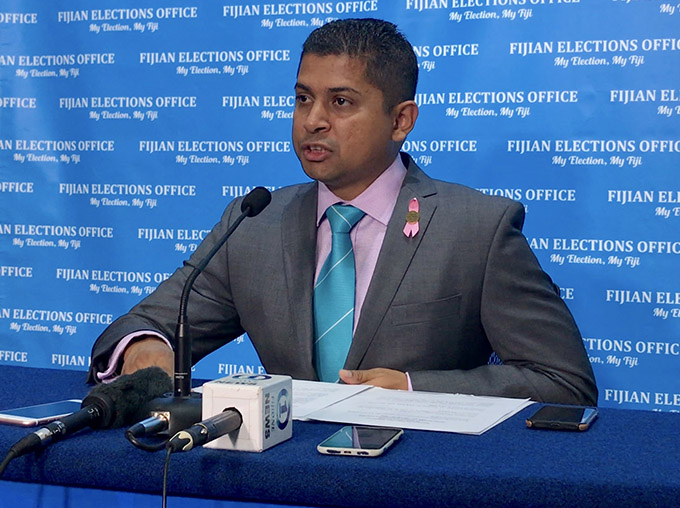
Fiji’s Supervisor of Elections Mohammed Saneem … monitoring the media blackout. Image: Jovesa Naisua/Fiji Times file photo

By Litia Cava in Suva

The Fijian Elections Office (FEO) will keep an eye to ensure that the blackout period is respected, says Supervisor of Elections Mohammed Saneem

During a press conference today, Saneem said people must take heed of the legal particulars in relation to the blackout period.

“We urge all Fijians to please take heed of the legal requirements, kindly read all the provisions and make sure that you are in compliance with it,” Saneem said.

“The FEO will be keeping a close eye on the usuals to ensure that the blackout period is respected and that Fijians get the opportunity to make their decision in the two days.”

Saneem also urged all political candidates to remove all their billboards and that all billboards under political parties must be removed.

This also included all the cards that have been distributed around by party supporters around the country.

-Partners-

The two-day blackout period is tomorrow and Tuesday with the election on Wednesday.

Litia Cava is a Fiji Times reporter.

Print Friendly, PDF & Email

Article by AsiaPacificReport.nz

]]>

FijiFirst expected to win Fiji general election – but by how much?

]]>

Taxi driver Tarun Chandra … “FijiFirst have done enough.” Image: Sri Krishnamurthi/PMC

By Sri Krishnamurthi in Suva

FijiFirst is expected to win Fiji’s second post-coup general election in eight years – but by what majority?

The opposition Social Democratic Liberal party (SODELPA) leader Sitiveni Rabuka is saying he expects to win 28 seats in the election on Wednesday, while FijiFirst leader Voreqe Bainimarama is confidently hoping to win “51 seats” – because he does not want SODELPA in Parliament.

National Federation Party (NFP), the only other party to have seats in Parliament after the 2014 elections, is taking optimistically about winning 10 seats.

“We can’t work with anyone” Bainimarama said on FijiVillage’s StraightTalk programme in a live debate with Sitiveni Rabuka on Facebook tonight.

While Rabuka extended the olive branch by saying his party would work with “anyone” in a coalition, not so for Bainimarama, who took a no-quarter-given stance.

But, as far as Tarun Chandra, 56, who has been driving a taxi and owns his company, said on the ride from Nausori into Suva, “FijiFirst have done enough”.

-Partners-

“They’ve been good for the country. Yes they may have done something wrong but by and large they have done well for the country,” he said.

‘Good enough for me’
“By my calculations they should win at least 29 seats, and that’s good enough for me.

“I don’t think SODELPA are going to do that well, maybe 15 seats. They will be lucky if Rabuka can beat the appeal by the anti-corruption authority,” he said.

That decision by the High Court is due tomorrow on the appeal by the Fiji Independent Commission Against Corruption (FICAC).

He is expecting NFP to do marginally better than the three seats they won the last time.
“NFP could win five seats but they are making big promises like the minimum wage and pensions scheme which is in their manifesto.”

Chandra pointed out the stability in the country as being a large factor in voting on Wednesday, with the stipulated media blackout beginning at midnight tonight.

“All the parties will have to takedown the billboards and banners tonight,” he said sagely.
Which was a far cry from a friendly woman of Indian ethnicity who greeted me at customs when I arrived in the country just hours before the media blackout was to begin.

“Elections, I don’t know about the elections” was all she offered smiling apologetically.
The same went for the people who graced a nearby mall, all going about their business and not wanting to talk about the elephant-in-the-room – the elections.

Sri Krishnamurthi is a journalist and Postgraduate Diploma in Communication Studies student at Auckland University of Technology. He is attached to the University of the South Pacific’s Journalism Programme, filing for USP’s Wansolwara News and the AUT Pacific Media Centre’s Asia Pacific Report.

Print Friendly, PDF & Email

Article by AsiaPacificReport.nz

]]>

A year since the marriage equality vote, much has been gained – and there is still much to be done

]]>

Source: The Conversation (Au and NZ) – By Timothy W. Jones, Senior Lecturer in History, La Trobe University

November 15, 2018 is the one-year anniversary of Australians voting “yes” to marriage equality. The survey was an unprecedented two-month exercise in engaging with current Australian community values around sexuality and relationships.

The survey returned a clear result, with 61.6% in favour of allowing same-sex couples to marry. Legislation recognising marriage equality passed into law on December 8.

In the six months after the legislation passed, almost 2,500 same-sex couples were married. That’s about 100 gay weddings a week.


Read more: The postal survey is both bizarre and typical in the history of Western marriage


LGBT people still have mixed and changing views about marriage. Former high court judge, Michael Kirby expressed these ambivalences well recently, when he and his partner, Johan van Vloten, announced their decision to marry:

we’ve been together now for 49 years and eight months. And so it just seemed a little artificial. It seemed a little late for the confetti. And it also seemed to us a little bit patriarchal… (but) we’ve ultimately decided that we are going to get married.

For very many LGBT people, the postal survey was a deeply traumatic time. Many still live with the ongoing grief of having had the dignity of their lives, and those of their children, up for debate.

A soon to be released collection of queer writing from the marriage equality survey period provides a sensitive and beautiful document of that experience (including a piece of mine).

But the passage of marriage equality legislation was not the end of this episode in our history. Our communities are still healing after the bruising campaign, and its aftermath has exposed a legal and social landscape in which the human rights of LGBT people are still not adequately valued and respected.

In what was presented at the time as a conciliatory gesture to the religious right, then Prime Minister Malcolm Turnbull convened an expert panel to “examine whether Australian law adequately protects the human right to freedom of religion”.

Far from placating conservative Christians, unsettled by the arrival of marriage equality, the Ruddock review brought into view the considerable exemptions from sexual discrimination legislation that Australian law grants religious bodies.

Australians were surprised and outraged to discover that, in most Australian jurisdictions, religious schools are permitted to expel students and fire teachers for the simple fact of their sexuality or gender identity. This is the case even if those students or teachers are people of faith and living in accordance with the tenets of their church.

When we launched the report of our three year study of LGBT conversion therapy last month, people were similarly surprised and horrified. These harmful and discredited practices – futile attempts to make LGBT people straight and cisgendered – are still present in many Australian religious communities, and remain legal.


Read more: As Australians say ‘yes’ to marriage equality, the legal stoush over human rights takes centre stage


Perhaps this moment of realisation of the magnitude of discrimination and harms that the law in Australia still permits is one of the most important outcomes of the marriage equality postal survey.

The postal survey forced the majority of Australian’s to reflect on their values around sexuality, relationships and humanity. The clear majority of Australians came to the conclusion LGBT people are just as human as all other Australians. We decided LGBT people deserve the same opportunities for joy and loss, commitment and recognition, and protection under the law, that marriage provides.

This recognition of the dignity and humanity of LGBT people has brought forward debate about the law in regard to religion and sex. Made aware of the ways current law permits religious bodies to discriminate on the basis of sex, the majority of Australians recognise the state of the law does not reflect their values.

It’s time to renegotiate the balance of rights between the protection of LGBT people from discrimination and the permission we give people of faith to discriminate on the basis of sex.

And this might not be a bad thing for religion in Australia. Religious communities might need to reflect on why they are so obsessed with sex. Sexual values are not present in any of the founding creeds of Australia’s major religions. And there is no consistent view in any religion regarding teachings about gender and sexuality.

A recent study on Faith and Belief in Australia showed only 20% of Australians are actively involved in religion. It also found the biggest block (31%) to Australians engaging with Christianity was the churches’ teaching and stance on homosexuality.

The postal survey has, ironically, made Australia come to grips with religion. Perhaps it’s now time for Australia’s religions to come to grips with sex.

ref. A year since the marriage equality vote, much has been gained – and there is still much to be done – http://theconversation.com/a-year-since-the-marriage-equality-vote-much-has-been-gained-and-there-is-still-much-to-be-done-106326]]>

Five food mistakes to avoid if you’re trying to lose weight

]]>

Source: The Conversation (Au and NZ) – By Yasmine Probst, Senior lecturer, School of Medicine, University of Wollongong

Many people wonder why they’re not losing weight when they follow a strict diet and exercise routine.

One possible reason is that what look like healthy options aren’t what they seem. Many foods and drinks contain hidden fats, sugars or salt, each of which will curb your weight loss efforts. In addition to the kilojoules, these flavoursome foods leave you wanting more.

Losing weight is largely about tipping the balance of kilojoules in and out. If you’re trying to lose weight or simply seeking a healthier lifestyle, here are five common traps that might be hindering you.


Read more: Health Check: what’s the best diet for weight loss?


1. All salads are good for you

Vegetables are good for you, absolutely. But salads often include other ingredients, which will hike up your kilojoule (kJ) count.

A Caesar salad looks green and leafy but is filled with hidden fats from the bacon (40g fat; 360kJ), parmesan cheese (6g fat; 340kJ) and creamy salad dressing lathered over the top (20g fat; 770kJ). Even the croutons are fried for added crunch. So a Caesar salad gives you your total daily fat intake for an average adult in one meal.

On par with this is a creamy pasta salad, often seen at family barbecues. A side serve of this comes in at almost 920 kilojoules.

Fats provide the highest kilojoules from food (followed closely by alcohol, but more on that later). So be wary of dressings, sauces, gravies and high fat foods that may be adding kilojoules to your meal.

2. I don’t eat junk food, just ‘healthy’ snacks

Australians consume more than 30% of their kilojoules from discretionary or “junk” foods, such as biscuits, chips and chocolate. None of these are providing us with any vital nutrients. These are the kilojoules we need to shift to lose weight.

But many people make the mistake of swapping junk food for seemingly “healthy snacks”, such as muesli bars and protein balls. While these can claim to be healthy and organic, they’re often processed and high in kilojoules.

While muesli bars are made up of healthy elements, it’s usually sugar holding them together. From shutterstock.com

Muesli bars do contain healthy ingredients such as oats, nuts and seeds. But sticking all the parts together to form a bar is usually achieved with a form of sugar. A yoghurt, fruit and nut bar can contain up to 4.6 teaspoons of sugar.

Next time you feel like a snack, why not substitute your muesli bar with a handful of nuts and seeds. This will provide you with useful vitamins and minerals – minus the sugar sticking them together.


Read more: Three charts on: how and what Australians eat (hint: it’s not good)


3. Natural sweeteners are better than sugar

There’s recently been a shift towards more natural forms of added sugar, but they contain no additional nutrients and no fewer kilojoules. Adding honey or agave syrup to your dish does not differ nutritionally from adding sugar to the same dish. It may taste different, but you’re still adding sugar.

Next time you feel like something sweet, try adding some fruit instead. It has a natural sweetness and will give you extra vitamins and minerals.

If you find your downfall is adding sugar to coffee, try using soy milk instead of cow’s milk. It has a sweeter taste (but one that may need some getting used to in the first instance).

Or try reducing the amount of sugar you add by half a teaspoon each week. You’ll find you barely notice the difference after a while.


Read more: White, brown, raw, honey: which type of sugar is best?


4. Anything fruit-based must be healthy

Think of the humble banana, mashed up into banana bread. This is not a bread at all, but a cake. If you’ve ever made banana bread you’ll realise just how much butter and extra sugar gets added to something nature has already made to be sweet and in its own convenient package.

Meanwhile, fruit drinks generally contain only 25% fruit juice and are very high in sugar. But even when drinking 100% fruit juice, you’re missing out on the important fibre that comes naturally from fruit and helps your body recognise it feels full. So whole fruit is best.

Fruit smoothies, although slightly better than fruit juices, are another one you can easily be caught out on. Smoothies are generally prepared in large servings and may have syrups or ice creams added to them, reducing their nutritional value by comparison.

Smoothies may have unhealthy ingredients added, while juices lose the good bits found in whole fruit. Element5 Digital/Unsplash

5. Drinks can’t have too many kilojoules… right?

If you’re trying to lose weight, you’ll know sugary soft drinks are a no-go. But some of the easiest mistakes to make are those in liquid form.

Many people aren’t aware how many kilojoules are in alcoholic drinks. An average restaurant serving of red wine is equivalent to 1.5 standard drinks and contains 480 kilojoules.

So after two glasses of wine, not only have you exceeded the recommended two standard drinks, but you’ve also consumed the equivalent kilojoules to eating two full cups of corn chips. The same applies for beer, where just one schooner equates to 1.6 standard drinks which is the same as 615 kilojoules.

Of course, many of us don’t stop at one.


Read more: Think before you drink: alcohol’s calories end up on your waistline


A final word

Probably the most common food mistake when trying to lose weight is eating too much. We need to choose the right foods but the amount is also important.

We need to listen to the signals our bodies send when when we’re getting full to stop eating. The best way to do this is to eat slowly, chewing carefully. By slowing our eating we are more likely to be sent the sign of fullness before feeling it at our waistband.

ref. Five food mistakes to avoid if you’re trying to lose weight – http://theconversation.com/five-food-mistakes-to-avoid-if-youre-trying-to-lose-weight-103678]]>

Climate change will make QLD’s ecosystems unrecognisable – it’s up to us if we want to stop that

]]>

Source: The Conversation (Au and NZ) – By Sarah Boulter, Research Fellow, National Climate Change Adaptation Research Facility, Griffith University

Climate change and those whose job it is to talk about current and future climate impacts are often classed as the “harbingers of doom”. For the world’s biodiversity, the predictions are grim – loss of species, loss of pollination, dying coral reefs.

The reality is that without human intervention, ecosystems will reshape themselves in response to climate change, what we can think of as “autonomous adaptation”. For us humans – we need to decide if we need or want to change that course.

For those who look after natural systems, our job description has changed. Until now we have scrambled to protect or restore what we could fairly confidently consider to be “natural”. Under climate change knowing what that should look like is hard to decide.

If the Great Barrier Reef still has a few pretty fish and coral in the future, and only scientists know they are different species to the past, does that matter? It’s an extreme example, but it is a good analogy for the types of decisions we might need to make.


Read more: Year-on-year bleaching threatens Great Barrier Reef’s World Heritage status


In Queensland, the government has just launched the Biodiversity and Ecosystem Climate Adaptation Plan for Queensland focused on what is considered important for making these decisions. The plan is high level, but is an important first step toward preparing the sector for the future.

Changing ecosystems

For the rest of Queensland’s ecosystems the story is much the same as the Great Barrier Reef. There are the obvious regions at risk. Our coastal floodplains and wetlands are potentially under threat from both sides, with housing and development making a landward march and the sea pushing in from the other side. These ecosystems literally have nowhere to go in the crush.

It’s a similar story for species and ecosystems that specialise on cool, high altitude mountaintops. These small, isolated populations rely on cool conditions. As the temperature warms, if they can’t change their behaviour (for instance, by taking refuge in cool spots or crevices during hot times), then it is unlikely they will survive without human intervention such as translocation.


Read more: Climate change could empty wildlife from Australia’s rainforests


We are all too familiar with the risk of coral reefs dying and becoming a habitat for algae, but some of our less high profile ecosystems face similar transformations. Our tropical savannah woodlands cover much of the top third of Queensland. An iconic ecosystem of the north, massive weed invasions and highly altered fire regimes might threaten to make them unrecognisable.

Changing fire patterns and invasive species could see dramatic changes in Queensland’s savannah woodlands. Shutterstock

So where to from here?

From the grim predictions we must rally to find a way forward. Critically for those who must manage our natural areas it’s about thinking about what we want to get out of our efforts.

Conservation property owners, both public (for instance, national parks) and private (for instance, not-for-profit conservation groups), must decide what their resources can achieve. Throwing money at a species we cannot save under climate change may be better replaced by focusing on making sure we have species diversity or water quality. It’s a hard reality to swallow, but pragmatism is part of the climate change equation.

We led the development of the Queensland plan, and were encouraged to discover a sector that had a great deal of knowledge, experience and willingness. The challenge for the Queensland government is to usefully channel that energy into tackling the problem.

Valuing biodiversity

One of the clearest messages from many of the people we spoke to was about how biodiversity and ecosystems are valued by the wider community. Or not. There was a clear sense that we need to make biodiversity and ecosystems a priority.

The Great Barrier Reef is already seeing major climate impacts, particularly bleaching. Shutterstock

It’s easy to categorise biodiversity and conservation as a “green” issue. But aside from the intrinsic value or personal health and recreation value that most of us place on natural areas, without biodiversity we risk losing things other than a good fishing spot.

Every farmer knows the importance of clean water and fertile soil to their economic prosperity. But when our cities bulge, or property is in danger from fire, we prioritise short-term economic returns, more houses or reducing fire risk over biodiversity almost every time.

Of course, this is not to say the balance should be flipped, but climate change is challenging our politicians, planners and us as the Queensland community to take responsibility for the effects our choices have on our biodiversity and ecosystems. As the pressure increases to adapt in other sectors, we should seek options that could help – rather than hinder – adaptation in natural systems.

Coastal residences may feel that investing in a seawall to protect their homes from rising sea levels is worthwhile even if it means sacrificing a scrap of coastal wetland, but there are opportunities to satisfy both human needs and biodiversity needs. We hope the Queensland plan can help promote those opportunities.

Cath Moran contributed to developing this article.

ref. Climate change will make QLD’s ecosystems unrecognisable – it’s up to us if we want to stop that – http://theconversation.com/climate-change-will-make-qlds-ecosystems-unrecognisable-its-up-to-us-if-we-want-to-stop-that-106679]]>

Explainer: what’s the difference between decodable and predictable books, and when should they be used?

]]>

Source: The Conversation (Au and NZ) – By Simmone Pogorzelski, PhD Candidate, Sessional Academic, Edith Cowan University

A child’s early experiences with books both at home and later in school have the potential to significantly affect future reading performance. Parents play a key role in building oral language and literacy skills in the years prior to school. But it’s teachers who are responsible for ensuring children become readers once at school.

While there’s much we know about how students learn to read, research on books used to support beginning reading development is sparse. Guidelines provided in the Australian Curriculum and the National Literacy Progressions complicate matters further. Teachers are required to use two types of texts: decodable and predictable books.


Read more: Explainer: what is phonics and why is it important?


Each book is underpinned by a different theory of reading, arguably in conflict. This contributes to uncertainty about when and how the books might be used.

The difference between decodable and predictable books

Predictable books and their associated instructional strategies align with a whole-language approach to reading.

In this approach, meaning is prioritised. Children are encouraged to draw on background knowledge, memorise a bank of the most common words found in print, and to use cues to guess or predict words based on pictures and the story. This method is not consistent with a phonics approach.

This is a good example of predictable text. Author provided, Author provided

At the earliest levels, predictable and repetitive sentences scaffold beginning readers’ attempts at unknown words. Word identification is supported by close text to picture matches and familiar themes for children in the early years (such as going to the doctor).

While there is some evidence the repetitive nature of predictable books facilitates the development of fluency, the features contained within disadvantage young readers as they do not align with the letter-sound correspondences taught as part of phonics lessons. This is particularly problematic for children who are at risk of later reading difficulties.

In comparison, decodable books consist of a high percentage of words in which the letters represent their most common sounds. Decodable books align with a synthetic phonics or code-based approach to reading. This approach teaches children to convert a string of letters (our written code) into sounds before blending them to produce a spoken word.

The reading video above is an example of a child reading one of the many widely available decodable books.

When reading decodable books, children draw on their accumulating knowledge of the alphabetic code to sound out any unknown words. Irregularly spelt words (for example was, said, the) are also included, and children receive support to read these words, focusing on the sounds if necessary.

There is mounting evidence for the use of decodable books to support the development of phonics in beginning readers and older kids who haven’t grasped the code easily. Decodable books have been found to promote self-teaching, helping children read with greater accuracy and independence. This leads to greater gains in reading development.

The role of books in early reading development

Children need lots of opportunities to practise reading words in books. Given research demonstrates a synthetic phonics approach provides young readers with the most direct route to skilled reading, there’s a strong logical argument for supporting early reading with decodable books.


Read more: As easy as ABC: the way to ensure children learn to read


Until the most recent version of the Australian Curriculum, only predictable books were included in the Foundation and Year one English curricula. The addition of decodable books recognises the critical support they provide beginning readers. But this places teachers in a difficult position because the elaborations in the curriculum documents place more emphasis on the strategies designed primarily for use with predictable books.

Using different books in the classroom

While reading is an extraordinarily complex process, a model of reading called the Simple View of Reading is very helpful from an educational perspective. It explains skilled reading as the product of both decoding and language comprehension. This helps us understand what we need to do when teaching children to read, and the types of books they need to support early reading development.

Before they enter school, the majority of children are considered to be in the “pre-alphabetic” stage of reading. In this stage, children have little or no understanding the written code represents the sounds of spoken language. They would not have the skills to use decodable books.

Instead, they recognise words purely by contextual clues and visual features. For example, children know the McDonalds sign because of the big yellow arches (the M) or can read the word “stop” when they see the sign, but not out of that context.

Predictable books would help the pre-alphabetic reader gain insight into the workings of texts, especially with regard to meaning. In particular making the connection between spoken words – which they are familiar with – and written words, which they are not.

After decodable books have been used to get children beyond beginning reading, real books provide broader vocabulary and language structure. from www.shutterstock.com

Beyond this stage, predictable texts become less useful because memorisation and meaning-based strategies aren’t sustainable long term. Once children have advanced to the partial and full alphabetic stages of reading, usually fairly quickly after starting formal reading instruction, they benefit more from decodable books which allow them to apply the alphabetic code.

So where to from here?

There is no evidence children benefit from the continued use of decodable books beyond the beginning stages of reading. In the absence of any empirical studies, we suspect it would be a good idea to move children on once they have sufficient letter-sound knowledge and decoding skills that they can apply independently. At this point, the introduction of real books would benefit students and provide access to more diverse language structures and vocabulary.


Read more: International study shows many Australian children are still struggling with reading


Given what we know about how reading works, it makes sense for children in the early stages of learning to read to be given decodable books to practise and generalise their developing alphabetic skills. At the same time, they will continue to benefit from hearing the rich vocabulary and language forms in the children’s books being read with (to) them.

It’s less clear what predictable texts contribute to beginning reading in schools when considering how reading skills develop. But there is evidence they might have a useful role to play in pre-school prior to the start of formal reading instruction.

ref. Explainer: what’s the difference between decodable and predictable books, and when should they be used? – http://theconversation.com/explainer-whats-the-difference-between-decodable-and-predictable-books-and-when-should-they-be-used-106531]]>

The promise and problems of including ‘big data’ in official government statistics

]]>

Source: The Conversation (Au and NZ) – By Fleur Johns, Professor of Law and Associate Dean (Research), UNSW

The Australian Bureau of Statistics (ABS) will soon announce the kinds of information it will collect in the next national census in 2021. If international trends are a guide, “big data” will comprise a growing part of ABS data collection and analysis.

This may promise greater timeliness and efficiency compared to the traditional paper-based census, but using big data to measure populations and economies is not without challenges.

Debates about how democratic governments should count the people they serve are ongoing in Australia, the US and in India. The use of digital technologies for state measurement seems likely to intensify these debates as significant questions emerge around the practice.


Read more: Is Facebook the future of the national census?


Public data gathering has high stakes

For centuries, states have counted and categorised people. Census data and other official statistics are used for government planning and budgeting, to determine political districts for elections, and for many other purposes. Official statistics also help to shape a population’s sense of itself. For these reasons, state counting practices have often been controversial.

In Australia, changing census practice has been a part of ongoing debate about ensuring First Nations people are properly representated. Historic undercounting of Aboriginal and Torres Strait Islander people was redressed by the abandonment of language in the census that referred to blood quantums – which are now widely accepted as racist – alongside other factors.

In the US, state counting is likewise a matter of intense dispute. California is among those states currently suing the US Federal Government because of a question about citizenship status the Trump administration has proposed adding to the 2020 Census. California argues fewer non-citizens will complete the census if the question is included. This would lead to a lower population count and reduced federal funding for states with high numbers of non-citizens.

India has also seen heated national debate about the gathering of caste data and the categorisation of “housewives” as non-workers.


Read more: Can the census ask if you’re a citizen? Here’s what’s at stake in court battles over the 2020 census


Big data use in official statistics is growing

New issues of this kind are likely to emerge as government statistics offices around the world introduce digital data into their work.

The UN is currently spearheading efforts by member states to explore the use of new, digital data sources and technologies for official statistics. The ABS is involved in this endeavour. Since late 2017, for example, the ABS has been analysing supermarket scanner data to try to improve CPI (inflation) measurement.

Other possibilities being explored for the use of digital data to improve state measurement include:

The promise and the problems

The aim of these efforts is to make official statistics more accurate, affordable to gather, and more attentive to geographically remote or otherwise marginalised communities. While there may be enormous potential to improve official statistics in these ways, big data use for state measurement raises thorny issues.

The first of these is the difficulty of auditing such data sources. All datasets come with blind spots and biases. Given the contentiousness of state counting, and the potentially high stakes of miscounting, it’s important the public maintains an overall sense of – and capacity to query – how, where, and why data is being collected. This may be difficult to ensure when data used for official measures are privately sourced.

While the ABS has the legal right to compel the provision of information, including from data providers, insight into how private companies collect and process data may be hard to obtain, and may not be shareable publicly.

Reliance on commercial data sources could also leave official statisticians dependent on privately owned infrastructure – cell tower infrastructure, for instance. The distribution and maintenance of this infrastructure is driven by commercial interests, potentially working against the needs of responsible public data collection.

Another problem with the use of big data in official statistics is that data gathered are often not fit for the kinds of purposes states are pursuing. Data of this kind are messy and unstructured, and it can be hard to separate information from noise in their analysis. Because machine-learning methods for unstructured data are never 100% accurate, any inferences drawn must be carefully validated.

Statisticians are well aware of these limitations, but face challenges communicating with policymakers and the general public about them.


Read more: Democracy is in danger when the census undercounts vulnerable populations


Enthusiasm must not outrun public engagement

There is a risk that because digital data are relatively abundant, those in charge of state measurement practices will make use of that data without due regard to questions of what should, and should not, be measured for particular purposes.

Without knowing when and how they are being counted, the public cannot be part of that discussion. It is incumbent on governments to bridge that gap, and incumbent on all Australians to take an active interest in these practices as they develop.

ref. The promise and problems of including ‘big data’ in official government statistics – http://theconversation.com/the-promise-and-problems-of-including-big-data-in-official-government-statistics-106440]]>

Smart mobility alone is no substitute for strong policy leadership

]]>

Source: The Conversation (Au and NZ) – By Marcus Foth, Professor of Urban Informatics, Queensland University of Technology

Transport, mobility and congestion continue to be hotly debated topics in politics, the media, academia and soon at the Urban Motion conference in Brisbane. And rightly so.

The Australian Bureau of Statistics counted 19.2 million registered motor vehicles in Australia as at January 31 2018. While the human population grew by 27% since the turn of the century, vehicle numbers increased by 43% and continue to grow in all states and territories.


Read more: Our new PM wants to ‘bust congestion’ – here are four ways he could do that


The Australian House of Representatives Standing Committee on Infrastructure, Transport and Cities recently released a comprehensive report, Building Up & Moving Out, on its inquiry into the Australian government’s role in the development of cities. The committee recommends:

… the Australian Government, in conjunction with State and Territory Governments, undertake the development of transport networks which allow for fast transit between cities and regions, and within cities and regions, with a view to developing a more sustainable pattern of settlement based on the principle of accessibility at a local, regional and national level. The Committee further recommends that the development of a fast rail or high speed rail network connecting the principal urban centres along the east coast of Australia be given priority, with a view to opening up the surrounding regions to urban development.

The committee further recommends the 30-minute city, active transport and a more sustainable urban form (Recommendation 11).


Read more: Cycling and walking are short-changed when it comes to transport funding in Australia


Global Mobility Index by the World Economic Forum and MIT Senseable City Lab, showing how people move in 100 cities around the world. Congestion levels calculated using real-time traffic-monitoring data, commuting time and the estimated percentage of trips that could be shared if citizens were willing to wait five minutes to share a trip.

Leading up to the report’s launch, many of the inquiry’s submissions and expert witness accounts stressed the need to arrest urban sprawl and heed well-established research advice. All levels of government often ignore this advice to appease voters, but more roads and more lanes make matters worse.

Transport research provides clear evidence that increasing road capacity is a shortsighted band-aid that increases car travel. It also promotes driving dependency and ultimately makes congestion worse.


Read more: Stuck in traffic: we need a smarter approach to congestion than building more roads


Many of the report’s transport-related aspirations point in the right direction. Yet many of them are not new and come with their own set of challenges.

Proposals to solve Australia’s mobility crisis appear to be dominated by technocentric optimism – a strong belief that new technology and disruptive innovation will somehow make it all better. Contenders for the transport panacea include car-sharing and ride-sharing platforms, electric vehicles, autonomous vehicles, trackless trams and more efficient traffic flow systems enabled by smart city investments in IoT (Internet of Things) sensors, big data analytics and urban science. Let’s debunk some of this.

More disruption?

The notion of disruptive innovation is often believed to bring about change for the better. One of the most commonly mentioned examples is Uber and similar commercial ride-sharing platforms. They certainly disrupted the established taxi industry. But cabs are no longer their main competitor.

Uber launched the “Pool” feature, which optimises routes so more than one rider can share the same car. As a result, the cost per ride now competes with public transport rather than just cabs. And this risks making inner-city traffic worse.

More driverless cars?

Another often-cited disruptive innovation involves autonomous vehicles and driverless cars. While they may come with economic and environmental benefits, there are as yet unresolved issues.


Read more: Driverless vehicles could bring out the best – or worst – in our cities by transforming land use


For example, the ethics in AI can cost people’s lives, road usage funding and taxation are unclear, and the average car occupancy can drop below one. As a result, without regulatory intervention, self-driving cars will not reduce congestion but add traffic to the roads.

More efficiency?

Transport offers vast room for improvement, so it is not surprising that optimisation is a low-hanging fruit. The Ellen MacArthur Foundation identified significant structural waste not only in fuel tank-to-wheel energy flow but also in road utilisation.

Ellen MacArthur Foundation, Growth Within: a circular economy vision for a competitive Europe, Author provided

Researchers at MIT and ETHZ propose a slot-based intersection that would double the usual capacity and herald the “death of the traffic light”.

MIT Senseable City Lab has developed slot-based intersections that could replace traditional traffic lights, greatly reducing queues and delays. Sensor-laden vehicles pass through intersections by communicating and remaining at a safe distance from each other, rather than grinding to a halt at the lights.

These efficiency gains are welcome. Yet, considering the ever-increasing demand for mobility, these measures on their own will not solve our mobility crisis.

Wanted: leadership!

What is seldom questioned is the need to travel in the first place. The right to mobility and freedom to move locally and globally are undoubted. But it is worth asking what regulatory instruments and economic shifts can produce sustainable mobility.

Some examples that have started making their way into the mobility debate include the impact of nomadic work practices on transport demand and distributed co-working spaces to reduce the need for CBD commutes.

Progressive policy interventions, such as road congestion charges and free public transport, lack the backing of political leadership in Australia.

Longer term, there is an urgent need to seriously consider even bolder policy innovation. We can learn from overseas examples, such as the six-hour work day, the four-day work week and the slow city movement, which is more about slowing down the “hamster wheel” of life than traffic. We should also evaluate new approaches to human settlement as well as what impact universal basic income or universal basic services can have on reducing traffic congestion.

There are opportunities to join this debate at the Urban Motion conference in Brisbane on November 19-20 2018. We also invite participants to support the Future Cities CRC bid recently shortlisted by the Australian government.


This article is based on the presentation “Smart Cities are Slow Cities” at the QUT Real World Conversation forum on August 2 2018.

ref. Smart mobility alone is no substitute for strong policy leadership – http://theconversation.com/smart-mobility-alone-is-no-substitute-for-strong-policy-leadership-105959]]>

Two birds with one stone. How better taxing super could fund aged care

]]>

Source: The Conversation (Au and NZ) – By Ben Spies-Butcher, Senior Lecturer in Economy and Society, Department of Sociology, Macquarie University

Getting aged care right is difficult. It involves staff training, qualifications and ratios, the entry of for-profit providers and ensuring access in regional areas – many of the issues highlighted in this year’s two-part Four Corners special.

A key challenge, from which must of the rest will flow, is increased funding.

Medicare – an Australian success story – provides one model.

Even the Medicare name works magic. The Medicare levy has been appropriated and boosted in order to brand and part-fund the National Disability Insurance Scheme.

We could do a Medicare

Medicare takes its features from both the public and the private sector. It is framed as an insurance levy, but unlike most insurance levies, it is linked to income. This means it reflects ability to pay rather than the likelihood of getting sick. As a result, it is affordable for everyone.

There have been many proposals to do something similar with aged care.

To date policymakers have instead opted for another common Australian funding model – combining user payments with a safety net of public funding for those without means or facing high costs.

The Productivity Commission has consistently plumped for this model over a more universal funding system, although there is little evidence that user fees are effective as a funding source.

So why not introduce an aged care levy on income?

But would that be right for aged care?

Oddly, the main argument against an income-based levy revolves around equity. Older people are income-poor but asset-rich. An income levy would set them back little even though they have been the primary beneficiaries of the enormous increase in house prices.

It would be paid instead by younger workers who are often facing insecure work, stagnant wages and expensive housing.

It’s a reasonable objection, and it drives much of the Productivity Commission’s thinking. The commission has focused instead on helping older people draw down their housing wealth to fund aged care payments.

But this too has problems. It can discourage preventive forms of care and it requires vulnerable people entering care to make complex financial decisions.

Tapping superannuation might be better

A third way, suggested by aged care expert Anna Howe, is to use superannuation.

After all, super is supposed to fund our post-work life, and aged care is a big part of that.

Despite more than $2.5 trillion being amassed in super, it does a poor job of providing either income security or security of care for older people. These responsibilities continue to fall on government.

Income within super is taxed unfairly

Super is also taxed very differently to other income. The rest of the income tax system is progressive, so those with higher incomes pay higher rates of tax. Income within super funds faces a flat tax.

For most people that matters little, but it creates enormous gains for those on very high incomes, which are made even bigger when they direct what extra income they can to super.


Read more: Why we should worry less about retirement – and leave super at 9.5%


The flat tax on super earnings costs the budget A$23.25 billion per year. The Treasury says that’s set to climb to A$28.95 billion in 2020-21, a growth rate that dwarfs the projected growth in the cost of the pension.

Efforts to curb the cost to the budget of super tax concessions have largely focused on limiting how much extra cash we put into it.

But most of the cost comes from the income earned by money already in super.

Taxing it better could fund aged care

A Medicare-style insurance levy applied to the income earned by money within super would in principle be no different to the insurance premiums already taken from super accounts.

And it wouldn’t be paid by the young while they are young. Given that younger workers can’t access super until retirement, it would effectively be a levy on their future super wealth.

And because older people have larger super accounts than younger people earning more income to be taxed, the levy would fall far more heavily on baby boomers than younger generations.

And address gender equity

This approach would also address another important justice question – gender equity. Men have much more super than women.

That partly reflects the gender pay gap, but also the unpaid work gap, in which women typically spend more of their working lives than men out of paid work caring for family members.

Ironically, it is women who then rely more heavily on paid care in older age, largely because they outlive their partners. Women provide men’s care for free, but then pay for their own.

A levy on (mainly) men’s super would help even the books.

But the details would matter

A fair way to do it would be to apply the levy to super fund income only when it climbed to a threshold of (say) A$5,000 a year. That way it would protect small accounts while helping close the tax loophole enjoyed by those on the highest incomes.

All of us have an interest in properly funded aged care. More properly taxing super fund income would be one way to do it.

ref. Two birds with one stone. How better taxing super could fund aged care – http://theconversation.com/two-birds-with-one-stone-how-better-taxing-super-could-fund-aged-care-103767]]>

FijiFirst scores head start on social media for election, says journalist

]]>

Pacific Media Centre journalist Sri Krishnamurthi … returning to Fiji for the general election after earlier special reporting with Wansolwara in Suva. Image: Rahul Bhattarai/PMC

By Rahul Bhattarai in Auckland

Fijians are counting down for their general election on Wednesday after early voting that started on November 5.

Prime Minister Voreqe Bainimarama’s ruling FijiFirst party is expected to win but with a reduced majority after a vigorous social media campaign to accumulate more votes before the media blackout which starts at midnight tonight.

Bainimarama has made “effective use of social media” to gain more supporters, says Pacific Media Centre journalist Sri Krishnamurthi, who returned to Fiji today to cover the election after doing a series of “preview” articles in September.

READ MORE: Krishnamurthi’s background briefing on the Fiji election

“Social media in Fiji has 85.1 percent use of Facebook and no other platform comes anywhere near close to that,” he said.

“FijiFirst is using Facebook very effectively as a tool. There is no control of the social media, whereas the Media Industry Development Decree curbs the media itself and that’s really strange.”

-Partners-

FijiFirst also uses Qorvis, a New York-based global corporate relations company that lobbies internationally for the Bainimarama government.

“I think FijiFirst will win having won more than 60 percent of the vote in 2014, but they also need a robust opposition, and that isn’t going to happen with [original coup leader in 1987] Sitiveni Rabuka back in court,” said Krishnamurthi.

Hampered by courts
“FijiFirst will have a majority but how much is debatable, as people once again get used to voting and exercising their democratic rights,” he said.

Another advantage for FijiFirst was that opposition leader Sitiveni Rabuka had been hampered in his election campaign by court action against him in an attempt to strip him of his eligibility to stand for Parliament.

People in Fiji were tired or frequent coups and an uncertain future.

“The people want stability, after 30 years of coups and uncertainty,” said Krishnamurthi.

Fiji-born Krishnamurthi will be in the country for the next five days to cover the 2018 Fiji election.

A former NZ Press Association news agency journalist, he is currently a digital media postgraduate student at Auckland University of Technology and will be reporting for the University of the South Pacific journalism programme newspaper Wansolwara and the PMC’s Asia Pacific Report.

Postgraduate student coverage
As well as the Fiji general election, postgraduate student journalists are also covering the Asia Pacific Economic Cooperation (APEC) leaders summit in Papua New Guinea next weekend with a team including Pauline Mago-King and Rahul Bhattarai.

Centre director Professor David Robie has just returned from New Caledonia where he covered last weekend’s historic independence referendum.

“This is quite unique in New Zealand journalism schools for coverage of this kind of major events happening in the Pacific,” said Dr Robie.

He praised the USP regional journalism programme and media organisations such as RNZ Pacific and SBS that enabled PMC partnerships in the region.

Sri Krishnamurthi (from left), Professor David Robie, Pauline Mago-King and Rahul Bhattarai at a Pacific Media Centre editorial meeting this week. Image: Stephanie Tapungu/PMC
Print Friendly, PDF & Email

Article by AsiaPacificReport.nz

]]>

Fiji PM rebukes journalist when challenged on media freedom laws

]]>

FijiFirst leader Voreqe Bainimarama … tops the pre-election polls. Image: David Robie/PMC

By Hannah Sinclair of SBS in Lautoka

Fiji Prime Minister Voreqe Bainimarama says the country’s restrictive media laws are not affecting next week’s general election.

Journalists are free to criticise the Fiji government in the lead up to the election on Wednesday, according to Bainimarama.

During his FijiFirst party’s final campaign rally in Lautoka over the weekend, Bainimarama told foreign journalists he had encouraged criticism of the government during the campaign.

“Media freedom is here in Fiji. [If] anybody wants to criticise the government, they can criticise the government,” Bainimarama told SBS.

Since leading a coup in 2006 and taking power, Bainimarama has overseen a strict tightening of Fiji’s media laws.

Almost no criticism of the government is published or broadcast in Fiji with journalists restricted by the draconian 2010 Media Industry Development Decree.

AUT Pacific Media Centre’s Sri Krishmamurthi arrived in Fiji today to report the elections with the Wansolwara team at the University of the South Pacific. SRI’s FIJI ELECTIONS FILE. Image: David Robie/PMC

-Partners-

Violations of the decree are punishable by up to two years in prison.

‘What the hell?’
“The media has been criticising the government, so what the hell are you talking about?” Bainimarama said when asked if media freedom laws inhibited the free and fair nature of the election.

Local journalists did not ask critical questions of the Prime Minister at the Lautoka rally.

Bainimarama was visibly irritated when asked by SBS if he was encouraging criticism during the campaign.

“I think you [can] go back to Australia,” Bainimarama told SBS.

“Go back to Australia and then come back to Fiji and see what life is all about in Fiji.”

The editor-in-chief, publisher and manager of one of the country’s most popular news outlets The Fiji Times, along with the editor of the vernacular sister publication, were acquitted of spurious sedition charges earlier this year for publishing a letter that contained controversial views about Muslims in Nai Lalakai.

Fiji’s election will be held on Wednesday with Bainimarama up against another former coup leader, Sitiveni Rabuka who is accused of starting off the “coup culture” with his own two coups in 1987 and is now leading the main opposition SODELPA party.

Media blackout
A 48-hour media blackout comes into force at midnight tonight until polls close, which will see all signage and campaign activities cease.

International media watchdog Reporters Without Borders ranks Fiji in 57th place – out of 180 nations – in its 2018 World Press Freedom Index. The group points in particular to the impact of the 2010 decree.

“Coverage of the 2018 parliamentary elections will be a decisive test for Fijian press freedom,” the organisation said in its index.

Hannah Sinclair is an SBS journalist covering the Fiji general election.

Print Friendly, PDF & Email

Article by AsiaPacificReport.nz

]]>

‘Victim blaming’ in latest Indonesian uni sex abuse case angers thousands

]]>

By Sri Wahyuni and Evi Mariani in Yogyakarta, Indonesia

An leading Indonesian university’s initial response to a recent sexual assault case allegedly involving two of its students has angered thousands of people, who have signed a petition demanding that the Yogyakarta institution punish the student perpetrator and the campus officials who had penalised the student victim.

In less than 24 hours, the online petition protesting against the 70-year-old Gadjah Mada University (UGM) on change.org had garnered more than 55,000 signatories by Wednesday morning, with more people signing every second to reach more than 167,000 signatories by mid-afternoon today.

“We demand that the UGM rector, the advisory board and the Research, Technology and Higher Education Ministry to strengthen regulations on preventing sexual assault and law enforcement against sex offenders,” the petition states as one of its demands.

READ MORE: An alumna at UGM appeals to the university to be a pioneer against sexual abuse

A separate call to a rally on Thursday has been circulating on social media to demand that the university thoroughly investigate the case and create a safe campus environment.

The call says that UGM is facing “a sexual violence emergency”, pointing out that the latest case was not the university’s first and that UGM has not been siding with victims.

-Partners-

On November 5, Balairung published an investigative report based on the testimony of a female student under the pseudonym Agni, who gave the UGM student magazine permission to publish the full details of her account.

Agni said that a fellow student had assaulted her during a community service project (KKN) at a Maluku village on June 30, 2017. The KKN is a kind of field school programme that lasts several months, during which the students live with local families in the target village.

Homestay lodging
Agni said she was visiting a villager until late evening at their home where fellow KKN student “HS” was staying, so she decided to spend the night at HS’ homestay and return to her own lodging in the morning.

They had to share a single room that night, Agni said, but that they were separated by some distance in the room. She also said she slept fully clothed and still in her headscarf.

Early the following morning, she said she felt HS groping her, opening her top, kissing her breasts and inserting his fingers in her genitalia. She froze in momentary shock until she felt pain that prompted her to yell at HS, “What are you doing!”

Agni said she immediately reported the incident to the KKN supervisor and the UGM Community Service Department (DKPM), which managed the programme. The university officials cut short HS’ programme and sent him back to Yogyakarta, but Agni said they also blamed her for the incident, with one official telling her to “repent”, reported Balairung.

Agni said that after the assault, she often felt scared at night and ended up staying awake all night. She also had suicidal thoughts, she said as quoted by Balairung.

In November 2017, Agni learned that she received a C for her KKN assignment, while her peers on the same programme received an A or a B. Agni said she asked about the reason for her low grade, and that the KKN management responded that she had to share the blame for the incident that “embarrassed UGM” in front of the local villagers.

In the Balairung article, a university official who declined to be named said that the student press should not be in a rush to call Agni a victim. “Like a cat given salted fish, it will at least sniff it and might even eat the fish, right?” Balairung quoted the official as saying in reference to Agni.

Low grade reported
In December 2017, Agni reported the C she received for her KKN assignment and the circumstances surrounding it to her academic department, the Social and Political Sciences Faculty (Fisipol).

The Fisipol’s cooperation, alumni and research deputy dean, Poppy Sulistyaning Winanti, and the deputy dean for academics and student affairs, Wawan Mas’udi, followed up on her case to the top administrative level.

An inter-departmental independent investigation team was formed that recommended Agni’s KKN grade be revise from C to A/B. The team also recommended that the perpetrator write an apology and attend a mandatory counseling session for sexual abusers.

On Tuesday, in response to the Balairung article, Fisipol UGM posted a statement on its Instagram account, @fisipolugm, reiterating its commitment to “side with victim”.

“With this, Fisipol UGM states that we side with the survivor to find justice and a thorough solution to the problem,” the statement said.

It also said that steps had been taken to deal with “Agni’s” case, including a letter it sent to the rector on December 22, 2017, that asked the university to manage the case thoroughly.

Fisipol said that the rector arranged a closed meeting with relevant parties in response to its letter, and agreed during the meeting to set up an investigation team that involved several departments. The rector also agreed to sanction the DKPM officials for their “ignorance” in their initial handling of the incident until “the survivor” reported the case to Fisipol.

Trauma counselling
During the same meeting, Fisipol said it agreed to engage psychologists to provide trauma counseling for “the survivor”.

The statement continued that, after an intensive investigation, the team submitted its recommendations to the rector on July 20, 2018, which included punishment for the perpetrator, protection and support for the victim and improvements to managing the KKN programme.

“This is why Fisipol UGM is pushing for a thorough and speedy management of the case by implementing the follow-up measures as recommended by the investigation team,” the statement said, ending with a call to all parties to create a campus that was free from sexual abuse.

Separately, UGM public relations and protocol head Ariani said the university would continue its work to make sure that the victim received protection and justice.

“Next, UGM will soon take the necessary real steps to take the case to the legal domain,” Ariana said in a statement issued on Tuesday.

Other UGM cases
In 2016, a sexual abuse case that involved several female victims among Fisipol students rocked the university. The perpetrator, EH, was a respected lecturer and the head of the international relations department at the time of the incident.

EH was stripped of his positions, but is still officially employed as a UGM lecturer.

The investigative report in the Balairung student magazine also cited other unresolved sexual assault cases at UGM.

Sexual assault at universities

Many commentators believe that the incidents of sexual assault at universities that have emerged in the public eye are a mere tip of the iceberg.

In 2008, the University of Indonesia (UI) Law School received sexual assault reports from several students on a lecturer, TN.

As in the case of UGM’s EH, TN also sexually assaulted his students during one-on-one thesis consultations. TN was later dismissed from UI but he was still being interviewed by the media.

Women’s empowerment and rights activist Damairia Pakpahan said she had represented a sexual assault victim of a humanities lecturer at UGM, but that the case did not go anywhere.

The reporters are Jakarta Post journalists.

#kitaAGNI

Print Friendly, PDF & Email

Article by AsiaPacificReport.nz

]]>

Amnesty calls on Fiji election parties, candidates to uphold human rights

]]>

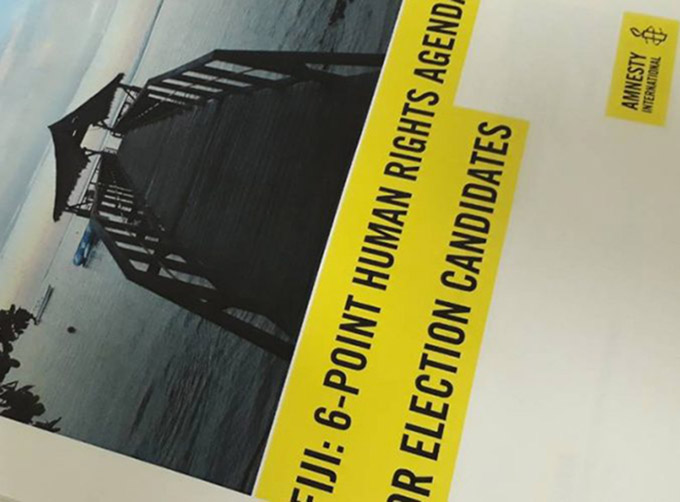
Amnesty International launches a Fiji: 6-Point Human Rights Agenda for Election Candidates document in Suva. Picture: Wansolwara

By Adi Anasseini Civavonovono

Amnesty International has called on political parties and candidates to respect, fulfill and promote human rights for all after revealing that the human rights situation in Fiji has remained under attack since the 2014 general election.

Launching Amnesty International’s Fiji: 6-Point Human Rights Agenda for Election Candidates document in Suva last week, Amnesty International’s Pacific researcher Roshika Deo said the organisation also called on political parties and candidates to openly make commitments to meeting Fiji’s international human rights obligation.

“Since the last general election in 2014, the human rights situation in Fiji has remained under attack – the right to freedom of expression and peaceful assembly has not been fully respected and protected,” she said.

“Torture and other ill-treatment by security forces has continued with no independent investigation process put in place.

“The LGBTIQ plus communities and human rights defenders also experience violation of their rights. Violence against girls and women remain widespread and the plight of the indigenous people to free, prior and informed consent is violated.

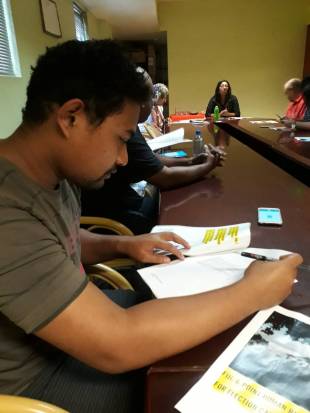
USP student journalist Koroi Tadulala reads the Amnesty International Fiji human rights agenda for election candidates at the launch. Image: Wansolwara

“Top of the new government’s agenda should be to address the status of human rights in Fiji and to address pressing concerns including those in the gender. For the 2014 general election, Amnesty International prepared a four-point human rights agenda.

-Partners-

“From thereon, we have monitored and documented the human rights situation and prepared for this general election a six-point human rights agenda for all political parties and candidates to take into account.”

Deo said the work of Amnesty International was independent of any government or religion and was aligned with international human rights laws, standards and norms.

She said the human rights agenda was a document that Amnesty International prepared for countries all over the world during elections.

“The document highlights the status of human rights in a particular country and implore all political parties and candidates to address the human rights situation,” she said.

“We also outline in the human rights agenda some of the policy areas that must be addressed by our country’s incoming and new government.

“We do not make comments on the electoral process or take a position on election related matters. However, our primary focus is always on human rights violations and abuses.”

Adi Anaseini Civavonovono is a final-year student journalist at the University of the South Pacific. USP’s journalism newspaper Wansolwara and the AUT Pacific Media Centre’s Asia Pacific Report are collaborating for coverage of the 2014 Fiji general election.

Print Friendly, PDF & Email

Article by AsiaPacificReport.nz

]]>

3 killed in West Papua clashes as military pursue elusive rebel leader

]]>

Indonesian military and West Papuan pro-independence militants in fresh clashes … new intensity in the Highlands fighting. Image: Victor Yeimo FB page

Pacific Media Centre Newsdesk

At least three people have been killed in a week of shooting clashes between the Indonesian military and police and  militants from the West Papua National Liberation Army (TPN-PB), say reports from the Jakarta-ruled Pacific territory.

The Victor Yeimo pro-independence social media page says the military are trying to capture Purom Wenda, a TPN-PB commander.

Victor Yeimo is chairman of the West Papua National Committee (KNPB).

News agency sources said two Papuan independence fighters and a third person had been killed during the clashes in the remote interior highlands of West Papua.

Wenda has eluded Indonesian security forces for 15 years.

Villagers have fled into the jungle because of the gunbattles, which have been intense since November 2.

-Partners-

Wenda said in a statement two of his fighters had been killed in a shootout with police and soldiers in the rugged Lanny Jaya district after his group shot dead a motorbike taxi driver they believed was spying for Indonesian forces.

“Indonesia said that they have given us special autonomy, infrastructure, and other excuses. We do not want all that. We only want freedom.”

Raising awareness
Meanwhile, RNZ Pacific reports that a group of around 200 people called the West Papua Interest Association had crossed over the border into PNG’s Western Province last week.

It wrote to local police notifying of plans to raise awareness about rights issues.

In response PNG’s police border commander, Samson Kua, advised them not to proceed with their plans.

He said he did not want people disturbing the peace around the time PNG is hosting next week’s APEC (Asia Pacific Economic Cooperation) leaders summit in Port Moresby.

“They will have to wait until APEC is over, and they can do their awareness on whatever they want to do. So actually they’re very peaceful,” Kua said.

“They’re not getting involved with any awareness at the moment, they’re very peaceful. They’re just laying low and staying in their own camps.”

The West Papuans are within their rights to be in PNG, as they hold Traditional Border Crossing cards which allow them to travel over the border into PNG.

This article is republished under the Pacific Media Centre’s content partnership with Radio New Zealand.

Print Friendly, PDF & Email

Article by AsiaPacificReport.nz

]]>

Luke Foley’s resignation is a disaster for Labor but may not bolster Berejiklian much either

]]>

Source: The Conversation (Au and NZ) – By Michael Hogan, Associate Professor and Honorary Associate, Department of Government and International Relations, University of Sydney

The resignation of Luke Foley as Labor opposition leader in New South Wales is a disaster for the party as it faces a March 23 general election – but it isn’t necessarily great news for the ailing Berejiklian government either.

To form a judgement about the impact of Foley’s resignation on Labor’s electoral chances, just take a look at the state of play about a month ago.

First, we need to look at how the government and opposition were travelling before Corrections Minister David Elliott accused Foley of sexual misconduct under parliamentary privilege on October 18, effectively setting off Labor’s leadership crisis.

Virtually all media attention was on the performance of the Berejiklian government and on the premier herself. Foley was little known and little regarded. However, he was steering the ship with some skill, albeit with occasional problems.

It says a great deal about the low political esteem in which the government was held that, even without a popular opposition leader, the Coalition was seen to be in electoral difficulty. Not that a wager on a Labor victory would have been a safe bet back then, either. Still, the Coalition was likely to lose seats and quite likely to lose majority status in parliament at the upcoming elections.

Nothing has changed on that side of politics. Berejiklian still faces discontent about her hasty policy decisions and frequent backtracking; uncompleted grand projects like the new tram network and WestConnex remain problems rather than achievements.


Read more: Privatising WestConnex is the biggest waste of public funds for corporate gain in Australian history


Add to that the difficulties over electoral support for the Coalition – especially for the National Party in regional New South Wales, and there is a flow-on from the disastrous performance of both Coalition parties at the federal level.

The unhappy picture only gets worse with the prospect of factional warfare in the Liberal Party as conservatives, led by Tony Abbott, attempt to take control of pre-selections and the state party machinery in the next few months.

Maybe the present crisis in the Labor Party will also have a negative effect on the Coalition, since David Elliott’s intervention smacks of the worst kind of “bear pit” politics that brings party politics into disrepute.

A mea culpa from Foley might have helped

Still, the Foley resignation is a disaster for the prospects of the Labor Party. Perhaps a quick transfer of power to a new leader, and apologies all round, might have left the party with a chance of winning the election. But Foley’s stated determination to fight the accusation with defamation proceedings makes the situation worse.

Foley can hope to remedy his plight only if he can prove that the allegations against him are false. As the likely new leader of the party, deputy leader Michael Daley, has pointed out, it is not politically (or ethically) acceptable for a political leader to blame his alleged victim.

Daley is also the shadow planning minister, and served as a former roads and police minister before Labor lost government. After Foley stood down, Daley quickly emerged as the most likely successor.

He was Foley’s main rival in the wake of the resignation of former Labor leader John Robertson in 2014.

Foley’s likely successor urges Foley to leave parliament

Daley, quite sensibly, has said that Foley should consider his position, and resign from parliament, and presumably drop his plan to sue for defamation. Foley has since said he will not re-contest his seat in the March 2019 election.

Presuming that Daley is the new leader, he will have little time to assert his authority and impress the electorate. He has ministerial experience, but that was in the disastrous last Labor administration, which was thrown out of office for the corruption that resulted in two of his ministerial colleagues going to prison.

His reputation in the party is of experience and competence, but he can expect to be reminded of his friends and colleagues, Eddie Obeid and Ian Macdonald. That is a lot of baggage to carry.

ref. Luke Foley’s resignation is a disaster for Labor but may not bolster Berejiklian much either – http://theconversation.com/luke-foleys-resignation-is-a-disaster-for-labor-but-may-not-bolster-berejiklian-much-either-106705]]>

Low-cost solar batteries key to cheap electricity for Polynesian countries

]]>

A report on innovative solar energy technology for the Pacific. Video: NZIPR

By Sri Krishnamurthi with Peter Wilson in Auckland

Solar-powered batteries are the key to a future without electricity grids for Polynesian countries in the Pacific (Samoa, Cook Islands and Tonga), a study has found.

The study is funded by the New Zealand Institute for Pacific Research (NZIPR) to assess the feasibility of a low-cost, energy future – titled “Polynesian pathways to a future without electricity grids”.

The first phase of the research, conducted by Peter Wilson (principal economist and head of Auckland business for the NZ Institute of Economic Research) and his team of Professor Basil Sharp (Auckland University professor and chair in energy economics) and Gareth William (head of Solar City Energy Services), queries whether distributed solar electricity is a practical alternative to grid-based electricity.

“The project is investigating the impact of new technologies on electricity sectors in the Pacific, we are looking at whether solar panels and batteries could augment or eventually replace electricity grids and large diesel generators,” says principal investigator Wilson.

“First phase is showing that the costs of both solar panels and batteries is diminishing very quickly and it won’t be very long before they will be economic in the Pacific and so that you have the potential to start radically changing how energy is delivered to Pacific nations.”

-Partners-

While he believes it is technologically feasible now, the prohibitive cost of the batteries at the moment – the leading provider of solar batteries being Elon Musk’s Tesla Powerwall – is something that has economically got to arrive yet, but the trend is towards costs being reduced significantly.

He says that within 10 years batteries and solar panels together could have a large impact on existing electricity sectors in the islands, and he sees that as a positive development because it will make it easier to extend electricity to people who don not currently have it at a cheap cost.

Decisions needed
However, he says, it does mean that the island governments must consider what they do with their existing generators and existing distribution assets if they are found to be non-competitive against the new technology.

“While it is not economically feasible yet, the trends are there and so it’s something that the Pacific governments should start thinking about,” says Wilson.

“At the moment they’re focusing very much on using solar panels to replace their electricity generation, they’re just connecting to their existing electricity grids and existing technologies.

“We think the batteries are going to change the equation and that is something that should be looked at, and the point is that this is not just something for the Pacific Islands, it’s happening around the world and a lot of countries and a lot of companies are trying to work out what to do, but they don’t really have a solution.”

He is expecting exciting new technological developments in batteries as a means of storing electricity into the future.

“The basic technology is not changing. What is changing is the cost of the batteries and their efficiency, how much power they can hold,” says Wilson.

“We’ve all seen how cell phones have become smaller and smaller over the few last years, and a large amount of that is because the batteries getting smaller and better, electric vehicles are doing the same thing. It is the same technology just using it for a different purpose.”

Hawai’ian benchmark
Hawai’i is an example they studied because it is like the South Pacific countries.

“Hawai’i which has a similar geography to the South Pacific, it’s North Pacific and tropical country with small islands and they too have moved to replace the diesel-fired generators with solar panels,” says Wilson.

“That’s a good benchmark to look at on the technological side but the economics are slightly different because it’s bigger Island, but what we particularly looked is that is an example of what could happen.”

The next phase is due to begin as soon as the NZIPR give it the greenlight.

Peter Wilson explains the way forward. “Hopefully it starts sometime this year and that involves going out to the islands and doing on-the-spot investigations, talking to people, at the moment phase one was desk research based in New Zealand.”

“So far the Ministry of Foreign Affairs and Trade (MFAT) has been very supportive of the project They’ve been funding quite large numbers of solar panels into the Pacific and they are quite keen to look at this next development which is adding batteries to that investment.”

He says the electricity generation industries are facing a major change in the evolution of the technology with what they do in their business.

‘Technological revolution’
“These industries are facing a technological revolution. They have choices, how do they respond? do they try to get ahead the curve, do they bury head in sand, do they try and make it someone else’s problem.

“We are seeing around the world this issue is being addressed, in some countries, some companies are very supportive and wanting to get to get on the bandwagon.”

Ultimately the goal is renewable energy to expand access to affordable, reliable and clean energy in the Pacific. Renewable energy targets feature prominently in all their Nationally Determined Contributions submitted under the Paris Agreement on climate change.

Already a change is underway in Australia and New Zealand with a slow but sure transformation to renewable energy.

“It’s starting to change now. You are seeing in Auckland the lines company Vector is starting to invest in large batteries (Tesla Powerwall batteries) rather than just look at extensions to the grid.

This is a project that can change the economies of scale of Pacific countries and Peter Wilson is banking on it to transform lives in Samoa, Cook Islands and Tonga.

The Pacific Media Centre shares content with the NZ Institute for Pacific Research as part of a collaboration agreement. The video was edited by Blessen Tom as part of the partnership.

Print Friendly, PDF & Email

Article by AsiaPacificReport.nz

]]>

Bryce Edwards’ Political Roundup: Is KiwiBuild becoming KiwiSpeculator?

Bryce Edwards’ Political Roundup: Is KiwiBuild becoming KiwiSpeculator? [caption id="attachment_18719" align="aligncenter" width="619"] Kiwibuild homes.[/caption] [caption id="attachment_13635" align="alignleft" width="150"] Dr Bryce Edwards.[/caption] When David Shearer proposed getting the state into the housing market and building and selling properties, his advisers came up with an excellent name for the scheme. KiwiBuild was meant to imply the same values and credibility of Jim Anderton’s KiwiBank. And various other Helen Clark-era Labour projects were given the same sort of nomenclature, such as KiwiSaver and KiwiRail.  As the faults in the KiwiBuild scheme are ever more apparent, Labour’s flagship housing project has attracted parodying versions of the name – including KiwiFarce, KiwiFail and KiwiGate.  Surely the most apt, however, is KiwiSpeculator – because it’s becoming clearer that the scheme is going to benefit a select few lucky ballot-winners who stand to make significant capital gains through buying the properties at below-market rates. The latest KiwiBuild development merely confirms this pro-speculator reputation. Newshub’s Jenna Lynch reported on Wednesday night that the Government has made yet another change to the scheme, which makes the deal even better for KiwiBuild buyers who might want to quickly onsell their houses for big gains – see: Housing Minister’s backdown on penalties for KiwiBuild property flippers. Here are the details: “Phil Twyford has secretly backed down on penalties for KiwiBuild buyers who sell up. When Labour announced the policy in 2016, its plan to stop buyers reaping windfall gains was they must not on-sell their home for five years – or else they had to hand all the money they made to the Government. That’s now changed to if buyers sell within three years, they must give up 30 percent of their profit.” And the same penalty applies to those that get permission to sell, and those that don’t but get caught. Opposition politicians and commentators are aghast. Here’s what Newstalk ZB’s Mike Hosking had to say: “So if you buy a house in Papakura, and the average price in Papakura rises from $569,000 to $700,000, so you make $131,000 in profit, once upon a time you needed to give that to the government, but now you only need to give 30 percent. So you would make more than $90,000. The government is essentially handing out $90,000 to the graduate doctors, and the marketing executives. The middle-class New Zealanders are looking at massive payouts on us, the taxpayer” – see: Kiwibuild scandal just gets bigger and bigger. It’s likely that the watering-down of the penalties has been forced on the Government by banks. Previously it was reported that mortgage lenders had complained to the Government about the stipulation that capital gains would go back to the state if the properly was sold within three years, because that meant the banks would be taking a larger risk and it would restrict their ability to deal with defaults. Another name change has been suggested for the scheme: KiwiAirBnb, because the rules have also now changed to make it easier for the new owners to rent KiwiBuild properties out. Previously owners were to be penalised if they did this, with the Government taking such proceeds off the landlords. But the new deal is that only 30% of that money would be taken, and that’s only if they get caught during the first three years of ownership – see Jenna Lynch’s ‘Is this Kiwi Airbnb?’: National slams Govt over KiwiBuild renting penalty. The consensus builds against KiwiBuild Yesterday the Otago Daily Times published an editorial that warns the Government’s main housing scheme – and indeed, “one of Labour’s primary policies” – is gathering a perception that it is something other than what was promised: “It was sold as a helping hand to those locked out of the housing market as well as a means to scale up housing supply and do so rapidly. The perception of it at the moment is very different” – see: Cracks appear in KiwiBuild. The first problem is that the scheme now looks like it’s “a lottery for yo pros (young professionals) who might be able to buy houses even in expensive places such as Auckland and Queenstown Lakes anyway”. The vast majority of those needing a house are immediately cut out because the houses are “expensive” and “It is also necessary to have loan financing in place before entering the ballot.” Second, KiwiBuild could be “seen as simply rebranding houses that would be built anyway”, and therefore “just spin” by the Government. Third, “It will be detrimental, too, if the view KiwiBuild is a useful hand-up for developers through guaranteed sales becomes the norm.” It’s not surprising, therefore, that the National Party’s eyes are starting to light up when Labour says the Government’s re-election will depend on the success of KiwiBuild. The NBR’s Brent Edwards reports that “National Party leader Simon Bridges believes the government’s KiwiBuild policy can help National win the next election” – see: KiwiBuild an election winner for Nats, Bridges says (paywalled). Bridges says KiwiBuild has “been dysfunctional and shambolic. It’s been more PR than reality.” He claims that large developers have told him that they’re reluctant to be involved: “The word some of them used, certainly one of them used, was ghettos and they don’t want to be part of that.” A PR disaster or triumph? The Listener’s Jane Clifton has written this week about How KiwiBuild turned into a PR disaster. Essentially the problem is that the Government has decided to help out failing property developers by rebranding their houses as KiwiBuild: “New-build supply in Auckland’s bonkers housing market has been stalling because some developments have fallen over. The Government, rightly thinking “waste not, want not”, took over some projects that happened to be at the upper-midpoint of the market, and has presented the early fruits of this as part of KiwiBuild. This has been hopelessly confusing. Housing Minister Phil Twyford’s bombast has helped stoke the impression that KiwiBuild was all about low-income battlers and starter homes, when some of the projects are a bit flasher than that.” It’s been a big PR mistake, Clifton says: “It would have saved a lot of misunderstanding and unpleasantness had the Government shelved the title KiwiBuild and called that particular avenue of its housing policy DeveloperRescue. This PR debacle is what happens when politicians get addicted to photo ops while boasting and swaggering under hard-hats on building sites.” Such house-building PR is nothing new according to Liam Hehir, who points to a long history of political leaders attempting to “pull the wool” over people’s eyes with fake or dubious housing construction. His prime example is the infamous fake “Potemkin villages” constructed in 1789 in the Crimea, which became the model utilised by leaders from Stalin’s Russia to North Korea today – see: Housing scheme’s morale-boosting propaganda doesn’t tackle crisis. He warns where this type of lottery scheme could go: “In the worst-case scenario, the programme could end up like the one run by Hugo Chavez, the late president of Venezuela, around 2012. When state socialism – somehow – failed to secure warm and adequate housing in the country, his government took to awarding new apartments to people from the slums by lottery. The whole thing was televised, with “El Commandante” handing over the keys to crying families. For the lucky few, it must have been life-changing. It made for great TV, but it wasn’t a solution to the tribulations of ordinary Venezuelans. They simply continued to suffer as their country slipped further and further behind.” Hehir concludes that there’s nothing necessarily wrong with “a bit of morale-boosting propaganda… but it probably needs to be executed with more competence”. In contrast, KiwiBuild should win awards, according former United Future leader Peter Dunne: “when the marketing awards are next given out Kiwibuild deserves first prize as a cunning plan, well marketed, but delivering very little and changing not very much” – see: Kiwibuild looks like one of Blackadder’s cunning plans. Dunne looks back to what was originally promised by Labour, and says it’s all changed. For example, in terms of what KiwiBuild was supposed to offer buyers, “no longer does ‘affordable’ mean $350-450,000, but $650,000.” Originally, he says, “The implication was unambiguous – Labour’s approach was going to be far more activist than National, and Kiwibuild would be Its primary policy to deal with homelessness and the housing crisis.” As a result, “in reality Kiwibuild is a very clever strategy of the government doing very little, but making it look like a lot, and all the while being able to milk many photo opportunities for Ministers as the still uncommon achievement of each house being completed happens. Meanwhile, the homeless Labour was so concerned about in the lead up to last year’s election remain homeless”. KiwiBuild needs to be bigger and better Perhaps the most interesting and surprising critiques of KiwiBuild have come from rightwing commentator Matthew Hooton, who suggests the KiwiBuild scheme needs to be big bigger and better. In his column on Kiwibuild last month, he strongly recommends to the Minister of Housing that he “rethinks his failing policy and commits to getting on with doing KiwiBuild properly” – see: KiwiBuild needs urgent rethink. Hooton’s complaint is not that the current scheme is “too socialist” or “interventionist” but that it’s not bold enough, and involves too much gimmicky tinkering. The column lays out his objections to the way KiwiBuild is currently operating, claiming it is going to be ineffective and will actually increase economic inequality, especially because it’s targeted at selling houses to the relatively wealthy, albeit through a lottery. Here’s Hooton’s key piece of advice to Phil Twyford, assuming he wants to continue with a state-led initiative: “He needs to accept he has wasted his first year and finally understand the magnitude of the KiwiBuild promise. It can only be delivered as the mass once-in-50-years public construction project Shearer’s original announcement envisaged. The Minister needs to forget about a few hundred houses here and there. He needs to lift his sights to imagine small cities being built from scratch to the south and north of Auckland, linked with Hamilton, Tauranga and Whangarei by ultra-fast rail. KiwiBuild must be transformed from the sort of limited initiative Wellington bureaucrats are comfortable with into something China consistently implements without much trouble.” For an update on this, see Hooton’s Friday column, KiwiBuild fiasco predicted right here. He criticises the PR-heavy approach being utilised at the moment: “Only a Government completely out of touch with the challenge it faces could have thought it was a good idea to proceed with last weekend’s ‘street party’ in Papakura, let alone allow Ardern to publicly compare herself with Michael Joseph Savage.” And like other critics, Hooton points to one of the buyers joking on Facebook that he stood to gain an instant $70k capital windfall. Finally, when defending KiwiBuild against criticisms from the left, the Government – and their defenders – keep pointing to state housing. Yet, sadly, the projected increase in state housing numbers is incredibly small – see my Newsroom column on this “fricken travesty”, and the need for a massive investment during a time of a severe crisis: Will state housing fix what KiwiBuild can’t?]]>

Newsletter: New Zealand Politics Daily – November 9 2018

Newsletter: New Zealand Politics Daily – November 9 2018 Editor’s Note: Here below is a list of the main issues currently under discussion in New Zealand and links to media coverage. [caption id="attachment_297" align="aligncenter" width="640"] The Beehive and Parliament Buildings.[/caption] Housing Jenna Lynch (Newshub): ‘Is this Kiwi Airbnb?’: National slams Govt over KiwiBuild renting penalty Pattrick Smellie (Newsroom): KiwiBuild homesellers who break the rules can keep 70% of any capital gain Susan Edmunds (Stuff): KiwiBuild buyers who sell or rent properties face 30pc bill Jason Walls (Herald): The Government changes the rules on KiwiBuild capital gain payback policy Newstalk ZB: Government changes the rules on KiwiBuild payback policy David Farrar: You can now sell your Kiwibuild house the next day for a huge capital gain! Heather Roy: Government Should Focus On The Hungry, Not The Peckish Thomas Coughlan (Newsroom): Reserve Bank backs KiwiBuild targets… mostly Tim Murphy (Newsroom): Govt accelerates big Tamaki housing project Joel Ineson (Stuff): Christchurch trust overcharging for dated, uninsulated council flats it claims are ‘A grade’ Libby Wilson (Stuff): Ōtorohanga reserve ruled out for Waikeria Prison workers’ camp Greg Ninness (Interest): Making landlords pay letting fees likely to encourage more competitive pricing by letting agencies Karel Sroubek residency decision Derek Cheng (Herald): Jacinda Ardern still has confidence in Immigration Minister and would not accept resignation John Armstrong (1News): Iain Lees-Galloway’s days as Immigration Minister are numbered due to his ‘ineptitude’ Craig McCulloch (RNZ): McPrime Minister Jacinda Ardern urged to sack immigration minister over drug smuggler case 1News: Bridges calls for Immigration Minister to be sacked over revelation he didn’t read entire Sroubek file Derek Cheng (Herald): Immigration Minister has no credibility and should be sacked, National says Mike Hosking (Newstalk ZB): Only one possible solution to immigration cock-up Martyn Bradbury (Daily Blog): Why calling for Iain Lees-Galloway to resign over Karel Sroubek is sophistry Matthew Rosenberg and Collette Devlin (Stuff): Minister made Karel Sroubek residency decision in less than an hour Craig McCulloch (RNZ): Immigration Minister made Sroubek decision in just one hour Derek Cheng (Herald): Immigration Minister Iain Lees-Galloway under pressure over Karel Sroubek decision RNZ: Peters says officials to blame in Sroubek case Ben Leahy (Herald): Remuera home linked to drug smuggler Karel Sroubek taken off the market Matthew Rosenberg and Edward Gay (Stuff): Convicted drug smuggler Karel Sroubek hits out at National Party from prison RNZ: Czech drug smuggler Karel Sroubek: ‘Much of what has been said does not present the true picture’ Herald: Controversial Czech Karel Sroubek hits back: I’m not a burglar Newshub: Karel Sroubek speaks out on immigration controversy Immigration and treatment of international students RNZ: Migrants not the answer to aged care workers shortage – nurses union Matt Brown (Stuff): Seasonal worker increase – good for business, bad for housing Hawkes Bay Today: Workers needed to avoid repeat of Hawke’s Bay’s ‘apple-picking crisis’ Michael Morrah (Newshub): Immigration fears foreigners using study in New Zealand to make weapons of mass destruction Dileepa Fonseka and Steve Kilgallon (Stuff): Crackdown on Iranian students in NZ: is US to blame? Lincoln Tan (Herald): Call for more transparency after Auckland’s Regent International Education Group is shut down for non-compliance National Party, Jami-Lee Ross proxy vote Newshub: New polling data shows another fall for National – Garner Herald: New Zealand First leader Winston Peters denies link with Simon Lusk Jason Walls (Herald): PM Jacinda Ardern would have tried to facilitate proxy vote for Jami-Lee Ross, if he had asked Martyn Bradbury (Daily Blog): NZ First plays with dirty politics Environment and conservation Jason Walls (Herald): The Government will undo ‘objectionable changes’ to the RMA introduced under National No Right Turn:Restoring the RMA Colin Williscroft (Stuff): Former PM accuses ECan of ‘gerrymandering’ to farming interests Tina Law (Press): Christchurch City Council opposes bottling company’s bid to take water from deep bore RNZ: Council votes for submission to oppose water bottling application Matthew Theunissen (RNZ): Decision allows development near sacred Māori site Alan Brent (Newsroom): Decarbonise, decentralise and digitalise Robin Martin (RNZ): Man accused of blackmailing DOC over 1080 programme named Tara Shaskey (Stuff): Taranaki man accused of sending DOC threatening letters appears in court Laine Moger (Stuff): Path illegally carved into pā site on Auckland mountain to be removed Mark Quinlivan (Stuff): Russell lupin: iconic to Mackenzie Country or invasive weed? James Allan, James Watson, Jasmine Lee, Kendall Jones (The Conversation): Last chance to save word’s wilderness Health Katie Fitzgerald (Newshub): All MPs should vote to ban smoking in cars with kids – Children’s Commissioner 1News:‘We need to be constantly vigilant’ – PM responds to damning tooth decay report 1News: Study calls for sugar tax in NZ – ‘Self-regulation is not working’ John Gibb (ODT): Sugary drinks ‘big problem for NZ’ Cate Broughton (Stuff): Fizzy drinks study shows labels will fail to fix obesity Emma Russell (Herald): One in eight Kiwi adults prescribed antidepressants Herald: Auckland DHB maternity ward out of action due to staffing shortages Lucy Warhurst (Newshub):‘We’ve had enough’: Doctors’ union threatens DHBs with legal action over rosters Eric Crampton: Have you considered using prices? Deena Coster (Stuff): Major service changes for ACC could impact Taranaki staff Jennifer Eder (Stuff): Mental health charity refuses grundy run-tainted donation Lead tap concerns Newshub:Lead found in brand-new tap bought on Trade Me Lisette Reymer (Newshub): Lead in plumbing products could have ‘severe effects’ on kids – expert Catherine Harris (Stuff): Building products review out soon, as lead tap concerns mount Mei Heron (1News): Concerns voiced over high levels of lead in some Kiwi households’ drinking water Government, Labour Party conference Barry Soper (Newstalk ZB): Government’s quick, quick, slow rhythm Beith Atkinson: Openness is essential to an atmosphere of trust Jo Moir (Stuff): Investigation fails to find leaker of Whaitiri report Herald: DIA fails to uncover source of leaked report on Meka Whaitiri incident Stacey Kirk (Stuff): Probe into leak of report on Meka Whaitiri comes up short Regan Paranihi (Māori TV): Investigation fails to find leaker of Whaitiri report Foreign Affairs Paul Spoonley (Herald): Australians don’t see Kiwis as immigrants and that’s a problem RNZ: New Zealand announces Pacific enabling fund RNZ: Australia expected to announce billion dollar loan fund for Pacific Nick Wilson, Michael Baker, Jennifer Summers, Matt Boyd, Ramona Tiatia (Public Health Expert): A 100 years ago today a Death Ship from NZ Arrived in Samoa: A Reminder of NZ’s Responsibilities to its South Pacific Neighbours RNZ: Surge in NZ Pacific Super portability expected Sam Sachdeva (Newsroom): Inter-agency ‘dialogue’ on harder China line Jono Edwards (ODT): US swing to left in House net positive for NZ: expert 1News: ‘Only time will tell’ what impact US midterm results will have on NZ trade – Jacinda Ardern Kirk Hope (Stuff): Trade picture remains cloudy after US midterm elections Rebecca Watson (Newshub): Jacinda Ardern must live up to her UN speech and stand up to China on Xinjiang Point of Order: Speculation builds on Brook Barrington’s successor to take charge at MFAT Police Matt Stewart (Stuff): Police Commissioner gets robust grilling over Wally Haumaha inquiry Gia Garrick (RNZ): Police Commissioner dodges questions on Haumaha inquiry Derek Cheng (Herald): Police Commissioner silent on Wally Haumaha appointment Laura Walters (Newsroom): Release of Haumaha report delayed 1News: Cop who hit 200kmh in pursuit which saw two people die after car hit tree drove dangerously, IPCA finds RNZ: Speeds of police in fatal pursuit should have been investigated – IPCA Scott Palmer and Laura Tupou (Newshub): Police officer should have been criminally investigated over fatal chase – IPCA RNZ: Speeds of police in fatal pursuit ‘clearly unjustified’ No Right Turn: Police look the other way on crime by their own Banking and finance sector Susan Edmund and Rob Stock (Stuff): Which bank offers the best value for customers? Susan Edmunds (Stuff): Scrutiny hits bank bosses in the pocket but ANZ, Westpac still make millions Rob Stock (Stuff): David Seymour slams ‘rogue’ banking review Tamsyn Parker (Herald): ANZ chief executive David Hisco’s pay revealed Beith Atkinson: Can you bank on that? Susan Edmunds (Stuff): Many borrowers don’t understand when they sink into debt, says Instant Finance CEO Mandy Te (Stuff): Debit card glitch sees Kiwibank customers charged multiple times Business, economy Anuja Nadkarni (Stuff): New Zealand has ‘productivity disease’, says Business Council chair, Air NZ CEO Chris Luxon Herald: Prime Minister Jacinda Ardern meets with her Business Advisory Council for the first time Mike Hosking (Newstalk ZB): Government can take praise for full steam ahead economy Melissa Nightingale (Herad): Kiwi businesses mistakenly believe NZ is safer from cyber crime Michael Reddell: Inching towards greater transparency Richard Harman (Politik): Don’t threaten our independence says Reserve Bank Governor Brian Fallow (Herald): Sunny numbers, cloudy outlook Michael Reddell: Some thoughts on the Monetary Policy Statement Brian Easton (Pundit): What If We Are On Our Own? Jason Walls (Herald): RBNZ Governor Adrian Orr has not taken the possibility of a rate cut off the table Rebecca Howard (BusinessDesk): RBNZ still firmly on hold despite increasing inflationary pressure 1News: OCR remains at 1.75 per cent, expected to stay unchanged to 2020 RNZ: Reserve Bank holds its cash rate steady at a record low 1.75% Aimee Shaw (Herald): Revealed: New Zealand’s strangest company name registration attempts Treaty of Waitangi Regan Paranihi (Māori TV): Little calls on Ngāpuhi to vote for Treaty mandate proposal Lois Williams (RNZ): Ngāpuhi settlement: ‘We’ve basically been steam-rolled’ Raniera Harrison (Māori TV): Ngāpuhi hapū anxious before Treaty settlement vote Morgan Godfery: Divisions deepen in Ngāpuhi as Kotahitanga chiefs are told to step down Graeme Everton (Spinoff): A 5G network is coming and Māori deserve a share Drug law reform Philip Matthews (Press Editorial): The dollars and sense of drug law reform 1News: Economist says treating drug addicts costs half as much as keeping them in prison 1News: ‘What if those drugs had killed us?’ Chloe Swarbrick implores MPs who have admitted cannabis use to back law change Zane Small (Newshub): Cannabis advocate’s impressive justification for legalisation Education Josephine Franks (Stuff): Teachers’ strike: What parents need to know Katy Jones (Stuff): Teachers snowed under with ‘unrealistic’ expectations as strike nears Jessica Long (Stuff): Union not ruling out strikes after urging secondary teachers to reject latest Government offers Kim Nutbrown (Stuff): North Canterbury’s Omihi School fundraising for a third teacher Elena McPhee (ODT): Plan to boost Maori academic staff numbers Point of Order: How the supernatural is being merged with science for Kiwi students Justice, corrections Matthew Hooton (Herald): Transparency important in Chief Justice appointment RNZ: Teen’s imprisonment raises questions over justice and punishment Anna Leask (Herald): West Auckland house targeted by ‘mob’ after high profile sex offender outed on Facebook Local government Simon Wilson (Herald): A councillor took a holiday to the Cook Islands. It was recorded as ‘council business’ John Tamihere (Herald): Shine a light on these costly creations Matthew Littlewood (Timaru Herald): Proposal to selldown shares in lines company Alpine Energy not linked to port expansion RNZ: Kaipara rates rebels lose appeal Welfare Aine Kelly-Costello (Newshub): New report calls for ‘reform and transformational change’ to the welfare system Meghan Lawrence (Herald): Survey shows four out of five people had negative experiences at WINZ Primary industries, Fonterra Rachael Kelly (Stuff): Passionate pleas over Otama water scheme ownership RNZ: Rodeo cowboy charged over use of electric shocker Andrea Fox (Herald): Fonterra chief Miles Hurrell earning ‘substantially less’ than predecessor Andrea Fox (Herald): Fonterra shareholders simmer while embattled company paints brighter future at AGM RNZ: Asset sale and debt reduction outlined at Fonterra AGM BusinessDesk: Fonterra under-performance since creation ‘unambiguous’ Tamsyn Parker (Herald): Report: Fonterra has failed to deliver ‘meaningful returns’ Jeremy Rees (RNZ): Fonterra hopes for collaboration in review of regulating law MIles Anderson (Newshub): The wool industry needs a revamp Piers Fuller (Stuff): Dung beetles being deployed in battle to fight farmers’ poo problem Oil and gas Kate Bromfield (Herald): Oil and gas can reduce their emissions Anna Whyte (1News); National vow to reverse ‘rammed through’ ban on new offshore oil and gas exploration permits Mike Watson (Stuff): Tamarind Resources enters marine consent hearings on back of TAG Oil buy out Charity boxing, death of Kain Parsons Holly Carran (Newshub): ‘All of us are devastated’: Charity boxer Kain Parsons’ family speak out on shock death Stuff: Emotional tribute to Christchurch boxing victim Kain Parsons from father-in-law 1News: Over $46,000 raised for children of Kain Parsons, who died after bout at charity boxing event Stuff: Tracey Martin seeks advice from Internal Affairs on charity boxing events Jessie Chiang (RNZ): Extra rules to govern boxing event after tragedy Georgina Campbell (Herald): Former light welterweight champ Billy Graham labels corporate boxing nights as dangerous Tracy Neal (RNZ): Professional boxing groups make moves to protect reputation Ben Leahy (Herald): Commentator Mark Watson says he could have been seriously hurt in charity boxing bout Electricity Andrew Crossland and Nick Bibby (Stuff): We need to diversify electricity supplies now to keep prices low Herald: Kiwis ‘being ripped off’: Independent power retailers urge action Stuff: Retailers take action over wholesale electricity market chaos Armistice centenary, war commemorations Carmen Parahi (Herald): Māori soldiers’ Great War battle for equality Ian Harris (ODT): Victory in the cause of peace begins in the mind Lloyd Burr: The Government should fund Le Quesnoy museum Alex Braae (Spinoff): Should ANZAC and the memory of war be such big business? RNZ: Big noise planned to mark WW1 Armistice Mary-Jo Tohill (Stuff): Catlins World War I soldiers honoured in book at Owaka launch Herald: All Blacks to wear embroidered poppy to commemorate Armistice Day James Croot (Stuff): They Shall Not Grow Old: Graphic content leads to RP16 rating for Sir Peter Jackson’s WWI doco Tourism, freedom camping RNZ: Tourism spending: Collaboration key to regional growth Tess Brunton (RNZ): Tourism industry faces up to pressure and challenges at summit Tina Law (Press): Freedom camping banned in most parts of Akaroa Transport, roading Thomas Coughlan (Newsroom): NZ’s love of diesels kills hundreds a year Phil Pennington (RNZ): NZTA takes tougher line on companies that import and test cars Anna Whyte (1News); ‘We need it done’ – Government urged to reconsider deadly strip of Tauranga road Gia Garrick (RNZ): Thousands sign ‘save the highways’ petition Janine Rankin (Manawatū Standard): New east-west highway ignores cyclists and pedestrians, for now Rātana Meriana Johnsen (RNZ): Rātana faith grows in spirit of social media innovation Leigh-Marama McLachlan (RNZ): Plaque unveiled at Rātana Other Susan St John (Daily Blog): The Listener is manipulating NZers over retirement Deena Coster (Stuff): Waitara hapū backs contentious land bill Herald: Gareth Morgan still funding The Opportunities Party Rob Stock (Stuff): Where in the world is your KiwiSaver? Collette Devlin (Stuff): Defence Force ramps up efforts to deal with inappropriate sexual behaviour and drugs misuse  RNZ: Public backing for gender and sexuality survey questions Thomas Manch (Stuff): Euthanasia pioneer warns of ‘beg and grovel’ legislation Nicholas Boyack (Stuff): Signs explaining quake-prone status of Queensgate mall ‘not prominent enough’ Laura Dooney (RNZ): Cost to fix St James Theatre balloons by $16m RNZ: Pasifika public servants awarded inaugural medals]]>

How to restore trust in governments and institutions

]]>

Source: The Conversation (Au and NZ) – By Grant Duncan, Associate Professor for the School of People, Environment and Planning, Massey University

Addressing the UN General Assembly in September, UN Secretary-General Antonio Guterres warned that the world is “suffering from a bad case of trust deficit disorder”.

Trust is at a breaking point. Trust in national institutions. Trust among states. Trust in the rules-based global order. Within countries, people are losing faith in political establishments, polarization is on the rise and populism is on the march.

Yet, it takes global collective action, and hence trust, to prevent proliferation of nuclear weapons, address climate change and uphold human rights. It takes trust across political parties and across generations to create a durable consensus to reduce economic inequality and poverty.


Read more: If politicians want more trust from voters, they need to start behaving with civility and respect


Decline in trust

Surveys of people’s trust in politicians and governments generally show a long-term decline, especially in the United States which has surveys dating back to 1958. As President Trump thrives on distrust, this trend is unlikely to reverse anytime soon.

Decline of trust is not uniform in all democracies, but, if you ask people whether they trust politicians, the answer is likely to be negative, even in countries like Norway. Furthermore, voter turnouts are in decline – another symptom of distrust. But, if we lack political trust, then we lack the foundation on which to negotiate collectively any sustainable solutions to the world’s most urgent problems.

In western political thought, trust is traditionally seen in two closely related dimensions. In John Locke’s version, trust is a gift from the people to those who rule, conditional upon powers being used for the people’s security and safety. In John Stuart Mill’s version, the elected representative is regarded as a trustee who acts on voters’ behalf rather than a delegate acting only at our behest.

Room for scepticism

In general, people who vote are more likely to express higher levels of trust in politicians and in government. But some may vote in order to defeat a candidate or party regarded as untrustworthy (on an “anyone but” basis) while others may not bother voting because they are highly, if not naively, trusting.

In any political system, it is not prudent to trust completely, however. We have constitutional checks and balances precisely because we trust no one at all with absolute and unaccountable powers. In a democracy, whether one votes or not, we have little choice but to entrust a relatively small number of representatives with powers to pass laws and to govern, but we are not called on to abandon scepticism or to have blind faith.

The big issue, though, is how to develop greater trustworthiness in the individuals whom we do elect, and how to build greater popular trust in decision-making systems, even when we disagree openly and strongly over particular concerns.

Trust in politics

Trust is not a thing that one can literally build, break and then rebuild. Political leaders cannot simply approve a policy and a budget to rebuild trust in the way that we rebuild worn-out infrastructure.

If we demand trust from people, they are likely to react with scepticism. Sledge Hammer’s famous “Trust me, I know what I’m doing” was funny for good reason.

Political and economic systems that are “rigged” (when they produce unfair outcomes or are downright corrupt) are unlikely to be trusted, moreover. Many people in affluent countries are finding that hard work for long hours is not providing a standard of living sufficient to achieve reasonable life goals.

Electoral systems often deliver disproportionate results. Politicians attack one another for short-term gain rather than work for the good of the country. Reducing economic inequality and reforming electoral systems or campaign finance laws may help to address the problem of political trust.


Read more: New Zealand politics: how political donations could be reformed to reduce potential influence


What to do

But there is a deeper “bootstraps” problem, as it takes political trust to gain the consensus to take the actions needed for such significant reforms. It takes trust to build trust. It would be morally unacceptable, however, to give up on the project of restoring political trust on the grounds that it’s too hard.

We need first to understand clearly the kinds of actions entailed in trustworthy conduct – for example, abstaining from taking advantage of the vulnerable, paying heed to people’s complaints, promising no more than one can deliver. If we adopt these characteristics in our own behaviour, then we are in a much better position to expect them of others.

Beyond individual conduct, we need to examine carefully our economic and political systems. The world will never be perceived by all as completely fair. But the difficult task of restoring political trust is inextricably entwined with the tasks of critically reflecting on our own behaviour as leaders in our communities and then working for significant reforms to social and economic policies and electoral systems.

ref. How to restore trust in governments and institutions – http://theconversation.com/how-to-restore-trust-in-governments-and-institutions-106547]]>

VIDEO: Michelle Grattan on Turnbull’s QandA appearance, Morrison’s bus tour, and antics in NSW

]]>

Source: The Conversation (Au and NZ) – By Michelle Grattan, Professorial Fellow, University of Canberra

Michelle Grattan speaks to University of Canberra Vice-Chancellor Deep Saini about the week in Australian politics. They discuss Malcolm Turnbull’s special interview on ABC’s QandA, Scott Morrison’s bus tour campaign in Queensland, former federal Labor opposition leader Mark Latham running as a One Nation candidate in the NSW upper house, and Luke Foley resigning as NSW opposition leader over alleged inappropriate behaviour.

ref. VIDEO: Michelle Grattan on Turnbull’s QandA appearance, Morrison’s bus tour, and antics in NSW – http://theconversation.com/video-michelle-grattan-on-turnbulls-qanda-appearance-morrisons-bus-tour-and-antics-in-nsw-106706]]>

Encouraging suicide or committing manslaughter?

]]>

Source: The Conversation (Au and NZ) – By Marilyn McMahon, Deputy Dean, School of Law, Deakin University

Jennifer Morant, 56, died of carbon monoxide poisoning in her car in November 2014. Last month, a jury found her husband, Graham Morant, 69, guilty of two crimes under section 311 of Queensland’s Criminal Code Act 1889: counselling her to commit suicide, and aiding her to do so. He had repeatedly encouraged Jennifer to commit suicide (counselling), and had even driven her to a hardware store to purchase the equipment she used to kill herself (aiding).

Jennifer Morant suffered from chronic illnesses, including depression, anxiety and back pain. But this was not a case where a loving husband helped his terminally-ill wife to end her suffering. Instead, the Court found that Morant had been motivated by greed, and that the self-styled religious leader wanted access to the $1.4 million from his wife’s life insurance policies so he could build a religious retreat.


Read more: Could long-distance bullies in Australia face up to 20 years in jail for encouraging suicide?


Justice Peter Davis of the Supreme Court of Queensland sentenced Morant to ten years in prison. He is believed to be the first person in Australia to be sentenced for counselling suicide.

The maximum penalty for this offence in Queensland is life, but in some other jurisdictions can be as low as five years’ imprisonment – so the same offence in NSW or Victoria would attract a much lighter penalty.

Morant was aware his wife was thinking about killing herself, and encouraged and helped her to do so, according to the Supreme Court of Queensland. So a key question is: should he have been charged with a more serious offence, such as murder or manslaughter?

The answer relates to the unusual status of suicide under the criminal law, and the extent to which the law assumes people act “voluntarily” and of their own free will.

The legal status of suicide

For half a century, suicide has not been a crime in Australia (though in practice, of course, only attempted suicide could be prosecuted). As a result, Morant could not be found guilty of complicity – often called “aiding and abetting” – in his wife’s suicide.

Mostly, telling someone else to commit a crime can mean both people are charged: the person who actually did the crime is the main offender, and the person who counselled them is an accessory.

But for a person to be an accessory, the other person must have committed a crime. Given that suicide has been decriminalised, Morant could not be charged as an accessory to his wife’s death; her behaviour was not a crime.

Suicide as a voluntary act

Another issue is the voluntariness of suicide. The criminal law is reluctant to assign responsibility to a person for the voluntary acts of another.

Justice Davis said Jennifer Morant “voluntarily sat in the car with the windows and doors all closed” and therefore caused her own death.

Although this was not a matter Justice Davis was required to adjudicate, he suggested that Graham Morant did not legally cause his wife’s death and could not, therefore, be responsible for manslaughter or murder.

However, there is precedent in Australia and other jurisdictions which suggests that a person could be found to be guilty of manslaughter in broadly analogous circumstances. We explore this issue in a recent article in the Alternative Law Journal, and it is illustrated in a couple of cases from the United States.

Encouraging suicide can constitute manslaughter

In 1961, a Massachusetts man was convicted of involuntary manslaughter after encouraging and helping his wife to commit suicide.

After he told her that he was going to obtain a divorce, she threatened suicide. He said she had tried twice before and was too “chicken”, then told her to get a rifle they owned, loaded it for her and told her how to position it so she could shoot herself. She did so, killing herself, and he was convicted of manslaughter.

In another US case, currently pending a decision by an appeal court, a woman, now 22, was found guilty last year of involuntary manslaughter after texting her suicidal boyfriend with messages encouraging him to take his life.


Read more: Will guilty verdict in teen texting suicide case lead to new laws on end-of-life issues?


Prosecuting someone like Graham Morant for manslaughter should not be dismissed as fanciful. According to court judgements in this case, the Morants had been married 14 years, and his wife had previously contemplated suicide and was thinking of it in the days before her death. The prosecution also argued that he had told her that she ‘was not strong enough to survive the raptures which were imminent’, a reference to his belief the end-times were coming.

When sentencing Morant, Justice Davis said that he “took advantage of her vulnerability as a sick, depressed woman”.

In short, the court found that Graham Morant exploited both his wife’s vulnerable mental state and the trust inherent in their intimate relationship in order to benefit financially from her death.

We as a society are becoming increasingly aware of the effects of psychological coercion in the context of family violence, and the extent to which a person can overbear the free will of their partner. Consequently, Justice Davis’ conclusion that it wasn’t necessary to make detailed findings about Jennifer Morant’s emotional state or mental health is perhaps surprising.

Greed versus compassion

There are, of course, numerous issues to be addressed before people are held responsible for manslaughter for causing someone else’s suicide.

For instance, one key issue concerns motivation. Should the law respond differently to financially-motivated offenders and altruistically motivated offenders whose behaviour is driven by love (such as Heinz Klinkermann in Victoria)?

In the United Kingdom, for example, prosecutors are expressly told to take into account whether the offender was “wholly motivated by compassion” when deciding whether to even prosecute someone for causing another person’s suicide.

Whatever approach we adopt, it is important that an accused’s criminal conviction is commensurate with their moral culpability.

* If this article raises any concerns for you, please contact Lifeline on 13 11 14 or BeyondBlue on 1300 22 4636.

ref. Encouraging suicide or committing manslaughter? – http://theconversation.com/encouraging-suicide-or-committing-manslaughter-106324]]>

Origins and implications of the caravan of Honduran migrants

]]>

Source: The Conversation (Au and NZ) – By Sharon McLennan, Lecturer in International Development, Massey University

Honduras is a wonderful place for a short visit, despite its reputation as a one of the most dangerous places on the planet. It is a small, beautiful country with an abundance of natural resources and a warm, welcoming culture. But it is a very hard place to live.

I first travelled there nearly 20 years ago to do volunteer work, meeting my Honduran husband in the process. I have visited multiple times since then, including living in Honduras for nearly a year while doing my PhD research. In September this year we visited for a month, spending time with family and friends, with discussions often revolving around politics, violence, and the difficulty of life in Honduras.

When news emerged two weeks after we left of a caravan of migrants making their way across Guatemala and Mexico to the United States, I wasn’t surprised. Here are five reflections on the origins and implications of the caravan.

Corruption as the operating system

The place migrants are leaving is more important and relevant than the place they are going to. Political corruption and repression, gangs, drug cartels, land pressures and climate change make life very difficult for most Hondurans, and impossible for some. Every Honduran has a story of violence.

Business owners sleep on the premises with a gun for protection, and drivers carry extra cash to pay corrupt police if pulled over. People avoid the centre of large cities wherever possible.

For those who have crossed paths with the gangs or drug cartels, dared to protest against the government, or tried to stand up for community rights in the face of mining corporations and dam builders, it is unimaginably difficult.

In 2017, the Carnegie Endowment for International Peace noted that in Honduras, “corruption is the operating system”, with “repression … carefully targeted for maximum psychological effect.”

When conditions are this bad, large-scale migration is inevitable, and many of these migrants are, in effect, refugees.

US complicit in crisis

Rather than being the victim of a migrant invasion, the United States is complicit. While local elites and politicians carry much of the blame for the chaos, decades of US meddling in the region has played a significant role.


Read more: How US policy in Honduras set the stage for today’s migration


Poverty and inequality in Honduras has roots in the activities of American fruit companies throughout the 19th and 20th centuries. The current instability can be traced to the 2009 coup, the success of which was partly attributable to US policy.

More recent meddling includes the endorsement of the fraudulent election of Honduran President Juan Orlando Hernández in 2017.

Since that election, there has been another major increase in political violence and repression. Through close ties with the Honduran business elites, US and transnational corporate interests are also linked to the repression of environmentalists and indigenous leaders.

Fewer migrants, but larger groups

Although the caravan seems huge to us, this is just a drop in the bucket. More than 300,000 individuals were apprehended crossing the border illegally from Mexico into the USA in 2017. This was an historic low, down from 1.6 million in 2000.


Read more: Today’s US-Mexico ‘border crisis’ in 6 charts


It is as also just a tiny fraction of the number of undocumented migrants, refugees and asylum seekers worldwide.

However, this caravan is part of a trend towards migrants and refugees travelling in larger groups. The journey through Mexico is dangerous. For example, rape is very common.

Amnesty International estimates that 60% of women and girls who attempt the journey individually or in small groups are raped en route, and girls as young as 12 take measures to avoid pregnancy.

Stories of hope

Individual stories often get lost in the numbers and rhetoric. Focusing on the numbers lends credence to the rhetoric of invasion. It is important to remember that each member of the caravan is a person, with a story, a family, and dreams for the future.

The caravan includes many young men, but rather than being criminals to be feared, many are escaping the gangs, planning to work hard to send money home to families in Honduras. Indeed, the remittances that will be sent by migrants and refugees is potentially of far greater value to Honduran development than any official aid, reducing poverty and increasing household spending across Honduras.

The key to reducing future migration may well be development stimulated by the money these migrants will send home.

A call for compassion

Finally, this caravan might seem far away and irrelevant to people in New Zealand and Australia. As my Honduran husband can attest, the number of Central Americans who make it here is tiny. However, we should take notice, because the global climate that has both led to the emergence of migrant caravans and the racist, anti-immigration rhetoric of US President Trump and others affects us too.

The rhetoric of Australian politicians and their refusal to show any compassion towards those who attempt to reach their shores should sound a warning. Generalising and stereotyping migrants and refugees is a dangerous step towards an even more insecure world, where those who already have the good life are protected, and those who don’t are stuck in a no-man’s land of poverty, violence and insecurity.

Compassion and recognition of the humanity of refugees and migrants is an important step towards building a more secure future and a peaceful world.

ref. Origins and implications of the caravan of Honduran migrants – http://theconversation.com/origins-and-implications-of-the-caravan-of-honduran-migrants-106443]]>

How tracking people moving together through time creates powerful data

]]>

Source: The Conversation (Au and NZ) – By Tiffany Gill, Senior Research Fellow, University of Adelaide

This article is part of the series This is research, where we ask academics to share and discuss open access articles that reveal important aspects of science. Today’s piece looks at a vital concept in medical studies: the cohort.


Are you in a cohort? Perhaps a posse of friends, a sporting team, the “class of 1989” Facebook group from your former school?

“Cohort” is collective term used to refer to people with something in common – historically it described a group of soldiers, but now is most often used in research contexts.

Cohort studies typically involve recruiting a group of people to look at causes of disease. Cohorts are followed over time, in longitudinal studies – imagine the people marching forward together through the years, like a group of soldiers.

One of the most well-known cohort studies – the Framingham Heart Study – first clearly identified something that most of us now take for granted: heart attacks and other forms of heart disease run in families.


Read more: Heart attacks more frequent in colder weather


The causes of heart disease

The Framingham Heart Study commenced in 1948, and was designed to understand why increasing numbers of people in the United States had heart disease. It was so named because the town of Framingham, Massachusetts, was chosen as the study site.

The main aim of the study was to determine risk factors for heart disease, and then use these to create public health programs.

To date, the study has been vital in identifying important risk factors in heart disease development, such as:

  • high blood pressure, weight gain and high cholesterol
  • male sex and increasing age
  • diabetes
  • smoking.

Initially, 5209 men and women took part in the study. But since then, researchers have recruited children of the original cohort, and a third generation cohort of grandchildren. The original recruits have now been examined over 30 times.

A 2015 snapshot of the time course of enrolment of the original and subsequent cohorts within the Framingham Heart Study. N refers to the number of people in each cohort. Reproduced from Benjamin I et al. Circulation 2015; 131: 100–12

The population of Framingham has also changed over the years, from predominantly white to a more diverse population – people of African American, Hispanic, Asian and Native American descent have been recruited.


Read more: Research Check: will a coffee a day really keep heart attacks at bay?


High quality data

Framingham is known for a very high rate of keeping people involved in the study. This is due to the constant follow up by the staff.

There are examination visits every two to six years, with staff members travelling to participants if they are unable to come to the measurement centres. There are follow up questionnaires and telephone calls between examinations, not only for local residents but also for participants who live in other parts of the United States or the world. Keeping participants in the study ensures that the quality of the data and research outcomes are maintained at a high level.

While Framingham originally focused on cardiovascular disease, it has now also examined diabetes, stroke, dementia, cancer, osteoporosis and osteoarthritis.

The Framingham Study involves regular follow up to take health measurements such as blood pressure. rawpixel/Unsplash, CC BY

A cohort study like Framingham follows individuals over time to investigate the causes of disease, record disease outcomes (such as illness and death) and establish links with disease risk factors. But such a study is also analytical: comparisons can be made between the general population and the cohort.

Cohort studies provide high quality evidence on the risk factors and causes of disease. Cohort studies can also describe the incidence of diseases – the number of new cases of a disease that occur in a specific timeframe.

However, these types of studies are observational: that is, they do not include a specific intervention or treatment to address a particular disease.


Read more: The curious case of the missing workplace teaspoons


Forward and back

The Framingham study design is “prospective” – it was planned in advance and the studies carried out moving forwards over a period of time. Other cohort studies are “retrospective” – looking at data that already exists.

In addition to Framingham, other cohort studies have provided a significant amount of information about:


Read more: Research Check: can you cut your cancer risk by eating organic?


Cohort studies are particularly important for examining diseases that take a long time to develop, and for exploring the effect of social and environmental factors on health. They are not useful for looking at rare, or sudden disease outbreaks. They are expensive and can take a long time to produce results.

But they have provided some of the most significant information on some of today’s biggest health problems.


The open access research paper for this analysis is Cohort Profile: The Framingham Heart Study (FHS): overview of milestones in cardiovascular epidemiology.

ref. How tracking people moving together through time creates powerful data – http://theconversation.com/how-tracking-people-moving-together-through-time-creates-powerful-data-103841]]>

Australia and China push the ‘reset’ button on an important relationship

]]>

Source: The Conversation (Au and NZ) – By Tony Walker, Adjunct Professor, School of Communications, La Trobe University

Australia can thank an erratic Donald Trump for the opportunity to “reset” its relationship with China after a chill engendered by what was interpreted as criticism from the then prime minister, Malcolm Turnbull, and foreign minister, Julie Bishop.

Turnbull had caused offence with his criticism of Chinese interference in Australian politics via Beijing’s front organisations. And in March 2017, Bishop had questioned China’s political model in a speech in Singapore.

A reset was already in the works before Turnbull was felled in August in a palace coup. The two countries had been reassessing shared interests in light of the wrecking ball US President Trump has taken to an international rules-based system.


Read more: Morrison and Shorten reveal their positions on key foreign policy questions


Former treasurer and new Prime Minister Scott Morrison’s elevation of Marise Payne to replace Bishop provided a pretext for an important diplomatic engagement in Beijing in the lead-up to what is being called the “summit season”.

This interaction may well have happened anyway, but a changing of the guard in Canberra helped get over any “face issues” that might have lingered after fairly trenchant criticism of Australia in Chinese official mouthpiece publications.

Payne’s arrival in the Chinese capital ahead of an East Asia Summit in Singapore, an Asia Pacific Economic Cooperation (APEC) forum in Port Moresby, and a G20 summit in Buenos Aires this month is not a coincidence.

Her presence in Beijing for the fifth Australia-China Foreign and Strategic Dialogue is the first visit by an Australian foreign minister in nearly three years.

After putting Australia in the freezer, Beijing has enabled a thaw ahead of these important events at which America’s behaviour will be under scrutiny, if not censure.

Beijing’s emollient words at a meeting between Foreign Minister Wang Yi and Payne could have hardly contrasted more sharply with criticism expressed over the past several years as debate about foreign interference disrupted the relationship.

This is what Wang had to say about a reset:

We are ready to step up our strategic dialogue and deepen strategic cooperation … in particular, rebuild and cement our political mutual trust.

These are Chinese diplomatic buzzwords, with an emphasis on “mutual trust”.

Payne described her two hours of talks – which ran overtime – as a “full and candid discussion”. Australia and China had agreed on a “respectful relationship”.

Pointedly, Wang had referred to a “new government” in Canberra, as if to say that a change of management had enabled a thaw.


Read more: The risks of a new Cold War between the US and China are real: here’s why


China’s conduct of its foreign policy, in which it alternately rewards and penalises those who fall out of favour, in some ways resembles a Beijing opera.

Melodrama is intrinsic to this Chinese art form.

China’s invitation to Payne for a long-delayed strategic dialogue is a calculated diplomatic move. It’s one that also suits Australia, anxious to gets its diplomatic relationship with China back on track.

It is in neither country’s interests – certainly not Australia’s – for an estrangement to persist at a time when uncertainty prevails due to an unpredictable American presidency.

Concerns in Beijing and Canberra about preserving open markets when American protectionism is threatening a liberalising trading environment have prompted this reset and determined its timing.

Beyond that, Canberra appears to have resolved that Australia’s interests are not well served by allowing an Australian security establishment possessed of a certain anti-China mindset to tilt policy in directions that do not serve the national interest.

It is one thing to exhibit scepticism about China’s behaviour and motivations. It is quite another to allow a “reds under the bed” mentality to drive policy.

No-one with more than passing knowledge believes China is a benign power. But nor is it the enemy. Its rise is a fact of life, whether Australian policymakers in thrall to a security establishment like it or not.

Interestingly, China sought to allay Australia’s concerns about its push into the southwest Pacific by offering “trilateral cooperation” in assisting Pacific island states build their infrastructure.

How this would work practically is not clear. But Wang appeared to be suggesting that Australia’s newly announced infrastructure fund for the Pacific could participate in joint projects with China’s Belt and Road Initiative.

Australia and China are not competitors, not rivals but cooperation partners, and we have agreed to combine and capitalise on our respective strengths to carry out trilateral cooperation involving Pacific Island states.

Significantly, Australia’s announcement on the eve of the Wang-Payne meeting that Canberra was blocking the takeover of the APA Group by Hong Kong’s CK Group on competition grounds was not an impediment to improving ties.

Pragmatism prevailed. “We hope a single case won’t affect Australia’s attitude to investment,” Wang said.

Payne’s visit took place against the background of overtures to China begun by Turnbull and Bishop in their efforts to restore certainty to the relationship.

A speech by Morrison to the Asia Society last week, in which he spoke of the importance of the Australia-China relationship, provided further impetus for a reset, propelled to a certain extent by Washington.

ref. Australia and China push the ‘reset’ button on an important relationship – http://theconversation.com/australia-and-china-push-the-reset-button-on-an-important-relationship-106428]]>

How a Sri Lankan student’s arrest on terror charges exposes a system built to suspect minorities

]]>

Source: The Conversation (Au and NZ) – By Randa Abdel Fattah, DECRA Research Fellow, Macquarie University

The war on terror has resulted in the gradual erosion of basic civil and human rights in the name of security. The latest casualty in Australia is Mohamed Kamer Nizamdeen, a 25-year-old PhD student, who was locked up in solitary confinement in a high-security prison for four weeks on the flimsiest of evidence.

Nizamdeen has now returned home to Sri Lanka, where he told a press conference that his life has been “shattered” and his future “clearly ruined”.

Nizamdeen was charged with making a document connected to the preparation of a terrorist act. The sole piece of evidence was a notebook found in his workplace desk at the University of New South Wales. Despite denying the handwriting in the notebook was his, and the fact Nizamdeen had not used the office space for a month, he was arrested, deprived of access to a lawyer for six days and denied communication with his family for a month.

He was also classified as an “AA extreme high risk restricted” inmate, the highest classification under NSW’s corrective services system.

Mick Sheehy, NSW police’s detective acting superintendent, told the media that Nizamdeen had “affiliated” with ISIS, but less than two months later, the charges were dropped.

Mohamed Kamer Nizamdeen has called the AFP investigation ‘irresponsible’ and ‘biased’. LinkedIn

How ‘extremist identities’ become motive

Nizamdeen was not released because he was proven innocent. He was released because the system could not prove him guilty. This is the logic of how counter-terrorism policing and the law works against Muslims and people of colour who are policed as suspect communities.

Under the law, one of the criteria of a terrorist act is:

it intends to coerce or influence the public or any government by intimidation to advance a political, religious or ideological cause.

In her book Traces of Terror, Victoria Sentas, a counter-terrorism law expert, argues that:

the requirement for an accused to advance a political, religious or ideological cause formally introduces a motive element to terrorism offences.

A person can also be convicted of preparing to carry out a terrorist act even without proof that he or she intended to commit such an offence. The prosecution only needs to prove motive – and in the context of the war on terror, proof of a Muslim “extremist identity” becomes evidence of motive.

This is why Nizamdeen’s belongings, such as his computer, mobile phone and residence were searched for evidence of extremist ideology. (None was found.)

Far-right extremists not treated the same

Those who have followed Australia’s unprecedented expansion of counter-terrorism laws, preventative detention and control orders, and intelligence, security and law enforcement powers will not be surprised by the travesty of justice suffered by Nizamdeen.

It has always been the case that the biggest casualties of counter-terrorism laws and policing practices are racialised minorities. Years of law reform, policy frameworks, political rhetoric and community partnerships have normalised the perception that Muslims and “ethnic” people, particularly young people, are part of a suspect community.

Despite the mainstreaming of white nationalist voices and the normalisation of far-right extremist rhetoric in recent years, Muslims and people of colour are still considered the preeminent threat to national security in the war on terror.


Read more: New laws make loss of citizenship a counter-terrorism tool


The 2014 case of convicted firebomber Daniel Fing is a case in point. Fing was caught with more than a notebook in an office desk – he had a stockpile of explosive materials and maps of targets in Sydney and Newcastle.

Police believed he was plotting a mass attack on the two cities. But not only was Fing not charged with any terrorism-related offences, NSW police “strongly reassured” the public that the plot had “absolutely no links to terrorism”. Then-Prime Minister Tony Abbott also remarked:

There are all sorts of people who do all sorts of weird and, at times, pretty dangerous things. But I haven’t been advised of any potential terrorist threat in respect of this particular issue.

Mohamed Kamer Nizamdeen’s lawyer, Moustafa Kheir (centre), has called the jailing of the Sri Lankan student in a Supermax prison ‘unforgivable’. Erik Anderson/AAP

A normalisation of racialised policies

The construction of Muslims and people of colour as “suspect communities” relies on a system that considers them the natural objects of counter-terrorism and countering violent extremism work. This normalises and justifies enhanced social controls and state power over minorities in the name of national security.

As such, a person like Nizamdeen becomes justified collateral damage in the “greater fight against terror”. Policymakers have also used this rationale to justify the curtailing of personal freedoms.

This is what led to the extension of control orders to children as young as 14 and the imprisonment of Junaid Thorne with an AA classification in Goulburn’s high-security facility for the crime of booking airline tickets under the fake name of Prince Bhopal.

We have seen arrests based on spurious evidence (Muhamed Haneef) and police misconduct (Izhar ul-Haque). Our televisions and social media feeds feature sensationalised home raids in Sydney neighbourhoods reported to be “incubators of terrorism”, where police seize “weapons” that are later discovered to be plastic swords and home-made fly swatters.

If Nizamdeen had been a Smith or Jones, it is highly likely he would have met a different fate. Since the September 11 terrorist attacks, the rhetoric of the war on terror has turned the term “terrorist” into an everyday codeword for Muslims and ethnic minorities.

This is the world in which the police, politicians, media and public have come to expect the potential terrorist to exist. This is why new grants and policies aimed at countering violent extremism (CVE) are announced on the steps of mosques and CVE operations target geographic areas and populations deemed “at risk”.

It also explains why Islamophobic attacks are condemned by politicians and the police because they might undermine relationships of “cooperation” between intelligence and law enforcement and the Muslim community.


Read more: How the Australian government is failing on countering violent extremism


Even the government’s Living Safe Together website, a community-based grants program introduced by Abbott’s government to counter violent extremism, reinforces the centrality of Muslims and ethnic minorities to its agenda.

In this context, a suspicious notebook in an office desk codes differently when it is connected with a young Muslim man.

Nizamdeen is the latest in a long line of ethnic minorities who have become victims of a miscarriage of justice in a racialised counter-terrorism regime. While whiteness seems to be a mitigating factor in terrorist offences, being Muslim or a person of colour appears to be evidence of motive.

ref. How a Sri Lankan student’s arrest on terror charges exposes a system built to suspect minorities – http://theconversation.com/how-a-sri-lankan-students-arrest-on-terror-charges-exposes-a-system-built-to-suspect-minorities-106613]]>

Don’t give up on politics. It’s where the fight for the fair go must be won

]]>

Source: The Conversation (Au and NZ) – By Marc Stears, Professor and Director, Sydney Policy Lab, University of Sydney

Deepening economic inequality is a scourge across most of the world’s democracies. For decades now, the gap between the wealthiest and the poorest has been widening. This has very real and very dangerous consequences for people’s mental and physical health and for the cohesion of our communities. So why isn’t anything serious being done about it?

Reversing this trend, or at least ameliorating it, would not be difficult. Economists around the world have spent the last few years laying out some fairly straightforward policy solutions. These range from reform of the rules governing how pay is set in the big corporations to sustained investment in the foundational social services that everyone but the very richest relies upon, including public education, health and housing.

Despite this clarity, very few of these initiatives are being pursued in any of the developed democracies. Instead, political action remains focused on tax cuts that favour the wealthy or big business, on immigration restrictions that can hinder economic growth, and on public subsidies for a handful of old industries, even where there are environmental reasons to be transitioning away from them.


Read more: The fair go is a fading dream, but don’t write it off


Why the inaction on inequality?

The question that matters more than almost any other when it comes to inequality right now, then, is not whether it is a problem or how to resolve it, but what is it that’s holding us back from doing what we need to do?

The answer to this question cannot lie in an absence of practice, knowledge or understanding. Most countries successfully initiated inequality-tackling reforms in previous generations. And they often did so in far more pressing political and economic circumstances, such as the Great Depression of the 1930s or the immediate aftermath of the second world war.

Joseph Stiglitz. Bengt Oberger/Wikimedia, CC BY-SA

Even where there is not previous experience to draw upon, politicians and their advisers can draw upon a host of more recent studies of the causes, consequences and potential responses to the rise of inequality. This includes the work of this year’s Sydney Peace Prize recipient, Joseph Stiglitz. There is no shortage of expertise for a new generation of egalitarian reformers to draw upon.

Nor does the answer lie in entrenched public unwillingness to tackle the problem. It is true that in the 1980s and 1990s, electorates the world over were often skittish about interventionist economic policy proposals. They favoured tax reductions over public service investment and were anxious about government’s efforts to “pick winners” in the economy.

But such anxiety has greatly lessened right now. Indeed, polling consistently suggests that even in countries without a sustained tradition of government action against inequality, a large public appetite now exists for measures to tackle it. Such measures, stretching from sharp increases in minimum wages to the nationalisation of major public utilities, enjoy majority support in many democracies.

We have also witnessed electorates across the world take bold and risky decisions in their voting behaviour. This includes support for extremist political movements motivated partly by a desire fundamentally to shift away from the status quo.

The problem lies with our politics

If the problem does not lie in knowledge or public support, it must lie somewhere that does not currently get enough attention: in our processes of policymaking – in short, our politics.

Political life in the developed democracies has been radically transformed in the last few decades. Usually this is told in a storybook version, with an endless rise of openness and inclusivity.

In the early decades of the 20th century, this narrative goes, women and the poorest won the vote. In the middle of the century, trade unions and civil society organisations exerted increasing influence on national political decision-making. And as the century aged, other groups including LGBTQI action groups, minority and indigenous populations began to find some long-denied political influence.

But there is another, far darker story to tell. The last few decades have witnessed the rise of another way of doing politics. The anthropologist Janine Wedel brilliantly describes that way in Unaccountable: How Elite Power Brokers Corrupt our Finances, Freedom, and Security (2014).

It is the world of the professional lobbyist, of the revolving door between global corporations and the highest levels of government, of uneasy relationships between public decision-making and private profit, and of the capture of elite thinking by norms and expectations that owe too much to the practices of the financial services sector.

Meet the New Influence Elites, a 2016 IPR Public Lecture by Professor Janine Wedel.

All of this has happened at the same time, of course, as a sharp decline in the organisations that used to do much to hold these tendencies back. Union membership has fallen rapidly in the advanced democracies, for instance. And formal mechanisms that guaranteed that governments had to explain their policy decisions to multiple stakeholders have been eroded across the world.


Read more: To tackle inequality, we must start in the labour market


As a result, the salience of issues such as “what the public thinks” and “what the public needs” when it comes to the economy have been significantly eroded as well.

What all of this means is that economic decision-making increasingly responds to a narrower and narrower section of society. In such circumstances, it is no wonder that almost no concerted action has been taken to halt the rise of inequality.

Fight for the fair go is political first

What it also means, though, is that the action we need to restore the fair go cannot begin with the economy. It must instead begin with policymaking and politics.

We need to make sure the voices of those affected by inequality are genuinely heard and heeded. This commitment should run through everything we do: from supporting our local trade union to opening up scholarly resources to those people in need, from demanding action to rein in corporate lobbying and special access to generating exciting and innovative ideas for using new technologies to accentuate the voice of those without access to formal power.

These ideas are where our energy needs to be. If we want to see greater equality, we need to spend time working out precisely how our political life can become truly responsive. And then we must campaign to make those changes real.


Read more: Why are unions so unhappy? An economic explanation of the Change the Rules campaign


ref. Don’t give up on politics. It’s where the fight for the fair go must be won – http://theconversation.com/dont-give-up-on-politics-its-where-the-fight-for-the-fair-go-must-be-won-105965]]>

How the open banking API could transform financial services to benefit consumers

]]>

Source: The Conversation (Au and NZ) – By Grace Borsellino, Lecturer in Corporate Law and Governance, Western Sydney University

Until recently, the idea of waiting a day or two for a bank transfer to reach your account was normal, however consumers are starting to demand immediate and seamless payment alternatives. With upcoming developments in the Australian financial services sector, we should start to see these demands met – if not by banks, then by FinTech firms aiming to transform the financial services industry.

Twelve months after the government announced the introduction of a Consumer Data Right (CDR) in Australia, Data61 has released a working draft of the standards that will underpin it.

The CDR will offer Australians control over the data held about them by service providers, and the right to share it with a third party provider – including competitors to the service that compiled it. The CDR will first be implemented in the financial services sector under the Open Banking framework from July 2019.

ACCC Chairman Rod Sims expects the framework to:

…encourage competition between service providers, leading not only to better prices for customers but also more innovation of products and services.

We’re already seeing new services emerge in this space, such as the ability to pay at checkouts via your mobile phone, but real disruption will take time to occur as FinTech firms are provided with access to consumer data to create products we haven’t yet heard of.


Read more: What we can do once the banks give us back our data


FinTech in Australia is growing

FinTech is a term used to describe the use of technology in financial services. FinTech firms are often startup businesses that use new business models to disrupt existing financial systems. They create financial tools for everyday people, serious investors and the banks themselves.

Their customer focus caters to the growing millennial and Gen Z population who have large digital appetites. The Australian startup Zip Money offers a cloud-based digital platform that allows retailers to offer a “buy now, pay later” service to customers for their products. In 2016, the company acquired Pocketbook, which syncs transaction data from bank accounts to help users track their spending and manage their money.

Services like these aren’t a replacement for traditional banking. Rather, they use your banking data to create new services to deliver a better experience for users.

FinTech is rapidly growing, both in Australia and internationally. According to a recent survey, Australian FinTech companies have seen a 200% increase in median revenue since 2016.

Open banking will lead to further innovation and growth in the industry. We may even see banks shifting into the backdrop as these businesses become the shopfronts of financial services, using customer data held by banks.

How Open Banking will work

The CDR is only useful to consumers if the data is available in a format that is machine readable. FinTechs in Australia are currently using a manual “screen scraping” approach to gaining access to data held by banks.

For example, the Pocketbook app, with your permission, periodically pulls your bank transactions into the app to help you manage your finances. The technology is read-only, so you can’t use the app to actually process transactions.


Read more: Restructuring alone won’t clean up the banks’ act


Open banking will force the four major banks to make data about their customer’s card, deposit and transaction accounts available to different services by 1 July 2019. Mortgage data will follow by 1 February 2020. But this data will only be made available to other services with the permission of customers, and that permission can be revoked at any time.

Under this framework, FinTechs will be able to access customer banking data using APIs.

APIs will transform the industry

An Application Program Interface (API) is like a universal power socket for the digital world, allowing multiple systems to work together and speak to each other.

APIs will revolutionise the efficiency and speed at which payments are made by giving FinTechs easier and cleaner access to user accounts, with real-time updates and the ability to process transactions.

PayPal, for example, uses a REST API. REST APIs enable merchants and developers to create applications that manage payments, payment pre-approvals and refunds.

Open Banking will allow businesses, such as Amazon or Whatsapp, to offer financial services and products directly through their platforms, rather than through banking sites. This already happens in China via the social networking platform WeChat.

Consumer data standards

Sharing data, especially confidential financial data, does give rise to important security issues. Data61 has been appointed by the government to develop standards that will underpin Open Banking and the CDR, a draft of which was recently released.

The standards are guided by a series of outcome principles stipulating that APIs will be secure, use open standards, provide a good customer experience and provide a good developer experience. Technical principles include that APIs will be RESTful, simple, consistent and backwards compatible. Data61 is currently seeking feedback on the draft rules.


Read more: Fintech firms freed to compete with banks, but disruption yet to come


It is no secret that millennials tend to trust the digital world more than they trust their banks. And, as a result of the banking inquiry, Australian banks are having their cultures questioned and their unethical business practices exposed. New waves of products offered by FinTechs are likely to spur banks to compete in a space where they have been slow to innovate.

The introduction of open APIs will help Australia keep up with global trends in the growing digital economy. Whether that means we’ll soon be seeing an Australian version of WeChat’s comprehensive payment system remains to be seen.

ref. How the open banking API could transform financial services to benefit consumers – http://theconversation.com/how-the-open-banking-api-could-transform-financial-services-to-benefit-consumers-99753]]>

It’s time Australia’s conscientious objectors of WW1 were remembered, too

]]>

Source: The Conversation (Au and NZ) – By Rick Sarre, Adjunct Professor of Law and Criminal Justice, University of South Australia

As we commemorate the centenary of the Armistice, it is appropriate that we pay tribute to the thousands of largely forgotten people who formed a significant social and political coalition at the time of the first world war: those who fought against conscription, and against the war, including a significant number of conscientious objectors.

Military registration and training for all Australian men aged 18 to 60 was compulsory from 1911. But there was no provision in Australian law that required men to enlist for active service overseas. Signing up for such service was voluntary, and with the promise of a short war, there was no difficulty for recruitment officers finding their men.


Read more: World politics explainer: The Great War (WWI)


However, as news of the horrendous losses at Gallipoli from April to December 1915 and the slaughter on the Western Front from mid-1916 filtered back to Australia, enthusiasm for overseas duties began to wane.

Australia was not meeting its recruitment target. Only about a third of eligible men were volunteering.

Labor Prime Minister Billy Hughes determined that the only way to increase enlistment numbers was to impose conscription. He decided to hold a plebiscite (sometimes referred to as the “conscription referendum”) to carry out what he saw as his obligation to the Empire, and to do so with the consent of the Australian people.

But there were many vociferous voices from the trade union movement, the Labor Party and an active women’s coalition campaigning for a “no” vote. Religious adherents, too, found themselves well represented in the “no” campaign, with many Catholics, Quakers, Christadelphians, Adventists and Jehovah’s Witnesses in the forefront of the pacifist movement.

Archbishop Daniel Mannix. National Museum of Australia

Archbishop Daniel Mannix was a leader in the Catholic Church in Melbourne. He took a strong stand against conscription, adding that the war was “just an ordinary trade war” driven by trade jealousy. Conscription, he maintained, would simply reinforce “class versus class” social injustices.

Remember, too, that the British had, in April 1916, put down with force the Easter Rising in Ireland. Almost 2,000 Irish were sent to internment camps. Most of the leaders of the Rising were executed in May 1916. Mannix was Irish-born.

Margaret Thorp, a Quaker, was another strong voice in opposition to the war, and critical of the support for the war by the mainstream churches. A member of the Anti-Military Service League, she later joined others to inaugurate a branch of the Women’s Peace Army in Australia and, later, a branch of the Sisterhood of International Peace that supported the international No-Conscription Fellowship.

On October 28, 1916, Prime Minister Hughes put the conscription ballot to the vote. It was defeated by a margin of 3%.

The following year, Britain sought a sixth Australian division for active service. Australia had to provide 7,000 men per month to meet this request. But voluntary recruitment continued to lag behind requirements. On December 20, 1917, Hughes put a second conscription ballot to the people. It, too, was defeated, this time by a larger margin (7%). The war continued to the Armistice with volunteers only.

By the end of the war, over 215,000 Australians had been killed, wounded or gassed. Only one out of every three Australian men who were sent abroad arrived home physically unscathed.

An anti-conscription poster. Parliament of Australia

During the 20th century, Australian law developed a variety of positions on conscientious objection. Such status today relies on an applicant meeting the requirements of the Defence Act 1903 as amended in 1939. Conscientious objectors need not have deeply held religious beliefs. But they must be able to ground their objection in moral beliefs, and be able to articulate them.

People who were not able to be officially recognised as conscientious objectors in Australia during the first world war were prosecuted when they failed to register. While historical records are impossible to collate accurately on this subject, some 27,749 prosecutions had been launched across the country by June 30, 1915. Stories of the tragic social consequences for these men, and for conscientious objectors, are legion. Objectors particularly were often maligned as cowards and self-seekers. But the historical records illustrate that theirs was not an easy path. They did not lack courage. In many respects, the choices made by conscientious objectors required a greater determination and certainty of belief than was needed by the men who enlisted voluntarily.


Read more: Only the conscription referendums made Australia’s Great War experience different


There is a permanent memorial for conscientious objectors in Tavistock Square, London, and one is planned for Edinburgh, Scotland. There is a tribute at the National World War I Museum and Memorial in Kansas City for the pacifists Joseph and Michael Hofer, who died in Leavenworth Prison in 1918 while incarcerated for refusing military service.

It is regrettable that Australia has no public memorial to our forebears who campaigned against compulsory military service, and the war itself, for reasons of conscience and faith. As we commemorate the centenary of the Armistice, there is no better time to remedy that oversight.

ref. It’s time Australia’s conscientious objectors of WW1 were remembered, too – http://theconversation.com/its-time-australias-conscientious-objectors-of-ww1-were-remembered-too-106169]]>

100 years since the WWI Armistice, Remembrance Day remains a powerful reminder of the cost of war

]]>

Source: The Conversation (Au and NZ) – By Romain Fathi, Lecturer, History, Flinders University

One hundred years ago – on November 11 1918, at the 11th hour of the 11th day of the 11th month – millions of men laid down their guns.

This was Armistice Day, the end of the first world war.

Germany, the last belligerent standing among the Central Powers, had collapsed militarily, economically and politically.

Armistice Day – later known as Remembrance Day – has since been commemorated every year.


Read more: World politics explainer: The Great War (WWI)


Ending the war

On November 11 1918, aboard Marshall Ferdinand Foch’s train carriage, a few plenipotentiaries of Germany and the main Allied nations signed a short document that ordered a ceasefire, effective from 11am. In doing so, they put an end to the global carnage that had started in August 1914 and had killed more than 10 million combatants and 6 million civilians.

French Marshal Ferdinand Foch (second from the right), in Compiègne Forest, minutes after the signature of the Armistice. Wikicommons

Notably, though this document stopped combat, it did not formally end the war. Indeed, Germany had sought an armistice in order to negotiate a formal peace treaty. This peace was secured eight months later, on June 28 1919, at the Paris Peace Conference.

The Armistice also didn’t resolve localised conflicts resulting from the war. These raged on in parts of Eastern Europe and the Middle East through to the early 1920s.

But for most nations involved in the first world war, the armistice of November 11 was the day the fighting finally stopped, which is why it has become a major commemorative event across the globe.

The first Armistice Day

On the first Armistice Day, November 11 1918, crowds cheered on the streets of Allied countries such as Britain, Canada, Australia, New Zealand, the US, France and Belgium. People rejoiced at the ending of a period of total mobilisation that had affected every aspect of their lives, inflicting unprecedented hardship on soldiers and civilians alike.

But for those who had lost the war, the news of the armistice came as a shock. While some were relieved the conflict had ended, the sudden collapse of the German, Austro-Hungarian and Ottoman empires provided a breeding ground for revolutionary movements and further internal conflicts. For them, Armistice Day was a moment of anguish and bitterness.

Cheering crowds on Armistice Day.

The second Armistice Day (1919)

After its first iteration, Armistice Day became a more formal and sombre commemoration, and was often held at war memorials. People were encouraged to remember the dead with respect and solemnity.

A dedicated time for silence became part of the ceremony and has been central to Remembrance Day commemorations ever since. In Britain, King George V requested a two-minute silence, which was observed from 1919 onward across the Commonwealth. In France, the minute de silence was instituted in 1922.

Silence meant time for contemplation, reflection, introspection and, above all, respect. In multifaith empires where atheism was progressing, the gesture could conveniently replace a prayer.

Remembrance Day was deemed a civic duty for many, and the veterans would often take a lead role in its commemoration.

From then on, Armistice Day increasingly became known as Remembrance Day. The focus was no longer on the armistice and the end of the war: it became a day to remember, grieve and honour those who had died.

Two-minute silence, Oxford Street, November 11 1919. Gallica, BNF

The notion of sacrifice became central to Remembrance Day, as those still alive tried to give meaning to, and cope with, the deaths of their loved ones. The language of memory honoured the deceased, acknowledging that they had not sacrificed themselves in vain but for institutions and values such as country, king, God, freedom and so on. However, as time passed, this language came to be increasingly contested.

Remembrance Day: the inter-wars and the second world war

Remembrance Day was also used to protest against war in general. Some mourners and veterans refused to attend official commemorations. In doing so, they showcased their anger at the state-sanctioned carnage that the first world war had been. In France and Belgium in the 1920s and 1930s, for instance, large pacifist movements used Remembrance Day and some war memorials to stress the futility of war and nationalism.

Such Remembrance Day protests were of openly political nature, and historical contexts altered the meaning of these demonstrations. Across Nazi-occupied Europe, clandestine Remembrance Day ceremonies were used as a sign of protest against German occupation during the second world war, and to remind them they had been defeated in the previous war.

Remembrance Day now

Today, the commemoration of the November 11 armistice is marked in many countries across the globe (mostly those on the “winning” side of the war) under various names: Armistice Day, Remembrance Day, Poppy Day, 11 Novembre, National Independence Day or Veterans Day. For some, the day is a public holiday.

Every state celebrating Remembrance Day grants different meanings to its commemoration. Speeches in France deplore the loss of lives and insist on the value of peace during official ceremonies. In Poland, however, the day marks the rebirth of the nation and a time to celebrate.

In the US, the commemoration is centred on the veterans of all wars, while in Australia few people attend Remembrance Day. The crowds prefer attending Anzac Day on April 25 – a more patriotic service and a public holiday.

Langemark German military cemetery, Belgium. Shutterstock

As the first world war fades further away in time, one way to keep remembering those who died in this conflict has been to progressively include the commemoration of the dead of more recent conflicts in Remembrance Day ceremonies, as is the case in the US, the UK and France. The commemoration therefore remains relevant to a larger population but also prevents the multiplication of special days for official state commemorations.

Today, as in the past, protests continue to be a component of Remembrance Day. Recently, a man was fined £50 in the UK for burning a poppy on Remembrance Day to protest against current deployment of British forces. The commemoration has also been mobilised by different far-right movements across Europe to advance their agendas.

A centenary of remembrance

A hundred years after the event, Remembrance Day and first world war memorials still provide a time and place to remember those who fought and fell in the conflict. For the most senior citizens among us, this is their parents’ generation; a past they still live with.

On November 11 2018, to mark the 100th anniversary of the end of one of the world’s deadliest conflicts, you may choose to attend a Remembrance Day service. You may choose not to, or not even notice that it is Remembrance Day.

During the minute of silence, you may reflect on the meaning of war and its long-lasting impacts, its futility or its glory, think about a family member, or the weather. This degree of versatility partly explains the endurance of Remembrance Day. An official and public event, but also a personal gesture that everyone can embed with their own meaning.

ref. 100 years since the WWI Armistice, Remembrance Day remains a powerful reminder of the cost of war – http://theconversation.com/100-years-since-the-wwi-armistice-remembrance-day-remains-a-powerful-reminder-of-the-cost-of-war-103232]]>

Before replacing a carer with a robot, we need to assess the pros and cons

]]>

Source: The Conversation (Au and NZ) – By Helen Dickinson, Associate Professor, Public Service Research Group, UNSW

If you have seen science fiction television series such as Humans or Westworld, you might be imagining a near future where intelligent, humanoid robots play an important role in meeting the needs of people, including caring for children or older relatives.

The reality is that current technologies in this sector are not yet very humanoid, but nonetheless, a range of robots are being used in our care services including disability, aged care, education, and health.

Our new research, published today by the Australia and New Zealand School of Government, finds that governments need to carefully plan for the inevitable expansion of these technologies to safeguard vulnerable people.

Care crisis and the rise of robots

Australia, like a number of other advanced liberal democracies, is anticipating a future with an older population, with a more complex mix of chronic illness and disease. A number of care organisations already operate under tight fiscal constraints and report challenges recruiting enough qualified staff.


Read more: Robots in health care could lead to a doctorless hospital


In the future, fewer numbers in the working-age population and increased numbers of retirees will compound this problem. If we then add to this equation the fact consumer expectations are increasing, it starts to look like future care services are facing a somewhat perfect storm.

Robots are increasingly becoming a feature of our care services, capable of fulfilling a number of roles from manual tasks through to social interaction. Their wider use has been heralded as an important tool in dealing with our impending care crisis. Countries such as Japan see robots playing a key role in filling their workforce gaps in care services.

A number of Australian residential aged care facilities are using Paro, a therapeutic robot that looks and sounds like a baby harp seal. Paro interacts by moving its head, heavily-lashed wide eyes and flippers, making sounds and responding to particular forms of touch on its furry coat.

Paro has been used extensively in aged care in the United States, Europe and parts of Asia, typically among people living with dementia.

Nao is an interactive companion robot developed in a humanoid form but standing just 58cm tall in height.

Nao acts as a little friend. By Veselin Borishev

Nao has gone through a number of different iterations and has been used for a variety of different applications worldwide, including to help children engaged in paediatric rehabilitation and in various educational and research institutes.


Read more: Robots can help young patients engage in rehab


The double-edged sword of technology

Robots are capable of enhancing productivity and improving quality and safety. But there is a potential for misuse or unintended consequences.

Concerns have been expressed about the use of robots potentially reducing privacy, exposing people to data hacking, or even inflicting physical harm.

We also lack evidence about the potential long-term implications of human-machine interactions.


Read more: We need robots that can improvise, but it’s not easy to teach them right from wrong


Our research explored the roles robots should and, even more critically, should not play in care delivery. We also investigated the role of government as a steward in shaping this framework through interviews with 35 policy, health care and academic experts from across Australia and New Zealand.

We found that despite these technologies already being in use in aged care facilities, schools and hospitals, government agencies don’t typically think strategically about their use and often aren’t aware of the risks and potential unintended consequences.

This means the sector is largely being driven by the interests of technology suppliers. Providers in some cases are purchasing these technologies to differentiate them in the market, but are also not always engaging in critical analysis.

Our study participants identified that robots were “leveraged” as something new and attractive to keep young people interested in learning, or as “a conversation starter” with prospective families exploring aged care providers.

Robots can help draw in potential clients. PaO_STUDIO/Shutterstock

But there are significant risks as the technologies become more developed. Drawing on research in other emerging technologies, our participants raised concerns about addiction and reliance on the robot. What would happen if the robot broke or became obsolete, and who would be responsible if a robot caused harm?

As artificial intelligence develops, robots will develop different levels of capabilities for “knowing” the human they are caring for. This raises concerns about potential hacking and security issues. On the flip side, it raises questions of inequity if different levels of care available at different price points.

Participants were also concerned about the unintended consequences of robot relationships on human relationships. Families may feel that the robot proxy is sufficient companionship, for instance, and leave their aged relative socially isolated.

What should governments do?

Government has an important role to play by regulating the rapidly developing market.

We suggest a responsive regulatory approach, which relies on the sector to self- and peer-regulate, and to escalate issues as they arise for subsequent regulation. Such engagement will require education, behaviour change, and a variety of regulatory measures that go beyond formal rules.


Read more: Asimov’s Laws won’t stop robots harming humans so we’ve developed a better solution


Government has an important role in helping providers understand the different technologies available and their evidence base. Care providers often struggle to access good evidence about technologies and their effectiveness. As such, they’re largely being informed by the market, rather than high quality evidence.

Many of the stakeholders we spoke to for our research also see a role for government in helping generate an evidence base that’s accessible to providers. This is particularly important where technologies may have been tested, but in a different national context.

Many respondents called for establishment of industry standards to protect against data and privacy threats, and the loss of jobs.

Finally, governments have a responsibility to ensure vulnerable people aren’t exploited or harmed by technologies. And they must also ensure robots don’t replace human care and lead to greater social isolation.

ref. Before replacing a carer with a robot, we need to assess the pros and cons – http://theconversation.com/before-replacing-a-carer-with-a-robot-we-need-to-assess-the-pros-and-cons-106160]]>

One in four Australians are lonely, which affects their physical and mental health

]]>

Source: The Conversation (Au and NZ) – By Michelle H Lim, Senior Lecturer and Clinical Psychologist, Swinburne University of Technology

One in four Australians are lonely, our new report has found, and it’s not just a problem among older Australians – it affects both genders and almost all age groups.

The Australian Loneliness Report, released today by my colleagues and I at the Australian Psychological Society and Swinburne University, found one in two (50.5%) Australians feel lonely for at least one day in a week, while more than one in four (27.6%) feel lonely for three or more days.

Our results come from a survey of 1,678 Australians from across the nation. We used a comprehensive measure of loneliness to assess how it relates to mental health and physical health outcomes.


Read more: Politics with Michelle Grattan: Andrew Giles on the growing issue of loneliness


We found nearly 55% of the population feel they lack companionship at least sometime. Perhaps unsurprisingly, Australians who are married or in a de facto relationship are the least lonely, compared to those who are single, separated or divorced.

While Australians are reasonably connected to their friends and families, they don’t have the same relationships with their neighbours. Almost half of Australians (47%) reported not having neighbours to call on for help, which suggests many of us feel disengaged in our neighbourhoods.

Impact on mental and physical health

Lonely Australians, when compared with their less lonely counterparts, reported higher social anxiety and depression, poorer psychological health and quality of life, and fewer meaningful relationships and social interactions.

Loneliness increases a person’s likelihood of experiencing depression by 15.2% and the likelihood of social anxiety increases by 13.1%. Those who are lonelier also report being more socially anxious during social interactions.

This fits with previous research, including a study of more than 1,000 Americans which found lonelier people reported more severe social anxiety, depression, and paranoia when followed up after three months.

Older Australians are less socially anxious than younger folks. Fabio Neo Amato

Interestingly, Australians over 65 were less lonely, less socially anxious, and less depressed than younger Australians.

This is consistent with previous studies that show older people fare better on particular mental health and well-being indicators.

(Though it’s unclear whether this is the case for adults over 75, as few participants in our study were aged in the late 70s and over).

Younger adults, on the other hand, reported significantly more social anxiety than older Australians.

The evidence outlining the negative effects of loneliness on physical health is also growing. Past research has found loneliness increases the likelihood of an earlier death by 26% and has negative consequences on the health of your heart, your sleep, and levels of inflammation.


Read more: Loneliness is a health issue, and needs targeted solutions


Our study adds to this body of research, finding people with higher rates of loneliness are more likely to have more headaches, stomach problems, and physical pain. This is not surprising as loneliness is associated with increased inflammatory responses.

What can we do about it?

Researchers are just beginning to understand the detrimental effects of loneliness on our health, social lives and communities but many people – including service providers – are unaware. There are no guidelines or training for service providers.

So, even caring and highly trained staff at emergency departments may trivialise the needs of lonely people presenting repeatedly and direct them to resources that aren’t right.

Increasing awareness, formalised training, and policies are all steps in the right direction to reduce this poor care.

For some people, simple solutions such as joining shared interest groups (such as book clubs) or shared experienced groups (such as bereavement or carers groups) may help alleviate their loneliness.

But for others, there are more barriers to overcome, such as stigma, discrimination, and poverty.

Shared interest groups can help some people feel less alone. Danielle Cerullo

Many community programs and social services focus on improving well-being and quality of life for lonely people. By tackling loneliness, they may also improve the health of Australians. But without rigorous evaluation of these health outcomes, it’s difficult to determine their impact.

We know predictors of loneliness can include genetics, brain functioning, mental health, physical health, community, work, and social factors. And we know predictors can differ between groups – for example, young versus old.

But we need to better measure and understand these different predictors and how they influence each other over time. Only with Australian data can we predict who is at risk and develop effective solutions.


Read more: The deadly truth about loneliness


There are some things we can do in the meantime.

We need a campaign to end loneliness for all Australians. Campaigns can raise awareness, reduce stigma, and empower not just the lonely person but also those around them.

Loneliness campaigns have been successfully piloted in the United Kingdom and Denmark. These campaigns don’t just raise awareness of loneliness; they also empower lonely and un-lonely people to change their social behaviours.

A great example of action arising from increased awareness comes from the Royal College of General Practitioners, which developed action plans to assist lonely patients presenting in primary care. The college encouraged GPs to tackle loneliness with more than just medicine; it prompted them to ask what matters to the lonely person rather than what is the matter with the lonely person.

Australia lags behind other countries but loneliness is on the agenda. Multiple Australian organisations have come together after identifying a need to generate Australian-specific data, increase advocacy, and develop an awareness campaign. But only significant, sustained government investment and bipartisan support will ensure this promising work results in better outcomes for lonely Australians.

ref. One in four Australians are lonely, which affects their physical and mental health – http://theconversation.com/one-in-four-australians-are-lonely-which-affects-their-physical-and-mental-health-106231]]>

The benefits – and pitfalls – of working in isolation

]]>

Source: The Conversation (Au and NZ) – By Agustin Chevez, Adjunct Research Fellow, Centre For Design Innovation, Swinburne University of Technology

In October a researcher at the remote Bellingshausen Station in Antarctica allegedly stabbed a colleague. Some reports attributed the incident to the victim giving away the endings of books the attacker was reading.

Other reports identify the cabin fever effect as a possible contributing factor. During extended periods in isolation and confined conditions, such as at a station in Antarctica, people can become restlessness, bored and irritated.

These effects, however, are not limited to the small number of scientists living in cabin-like environments in remote locations. Isolation can just as easily affect people on the move, such as the drivers of the 3.5 million freight vehicles registered in Australia. Studies cite social isolation as a recurring theme and a cause of mental health problems and dysfunctional family relationships for truck drivers.

Interestingly, knowledge workers are also increasingly prone to suffering from isolation. This is because the ability to work “anywhere, anytime” has led to the development of new organisational structures that have increased the effects of isolation by increasing the social distance within a distributed workforce.

Depression, stress, lack of motivation and eventually burnout are all possible consequences of isolation. Other effects include experiencing fears of missing out on crucial events or decisions being made by others elsewhere – colloquially known as the feeling of out of sight, out of mind.

The impact of isolation in health has been compared to the reduction in lifespan similar to that caused by smoking 15 cigarettes a day. If the sit-to-stand desk was the response to the “sitting is the new smoking” motto, co-working is the response to isolation.

The growth of the gig economy brought concerns of increased likelihood of people working in isolation beyond that of teleworkers already discussed above. In this regard, the proliferation of co-working environments should not be surprising. To a large extent it’s due to their ability to provide a social environment for sole practitioners who would otherwise be working in isolation.

In pursuit of solitude

Isolation is an interpretation of one’s sense of aloneness. It is a feeling independent of the condition of being alone. While aloneness is the objective state of not having anyone around, isolation can be experienced in the middle of a crowd – if, for example, you have nothing in common with them, or do not share a common language.

Isolation is the negative side of aloneness, which leads to loneliness.

On the other hand, solitude is the positive manifestation of aloneness. An important factor in converting aloneness into solitude is that it is voluntary, instead of imposed. As such, artists, writers and scientists have described solitude as their most creative and productive state.

The differences between loneliness and solitude can be subtle. One study has identified that our understanding of these nuances develops with age.

Agustin Chevez walked from Melbourne to Sydney to test the pros (and cons) of isolation. Agustin Chevez, Author provided (No reuse)

Aloneness as a thinking tool

I have a particular interest in aloneness, both as an academic and architect. I specialise in the study of work and the environments that contain it. Specifically, I am interested in aloneness as a mechanism to increase the diversity of ideas.

This might seem at odds with the thinking of times when the value of collaborative work in Australia has been estimated at A$46 billion per year. However, the message of “the more, the merrier” when it comes to collaboration is increasingly being qualified and the downside of collaboration overload discussed.

Inspired by the development of diversity in species attributed to isolation (see iguanas at the Galapagos Islands), I walked alone from Melbourne to Sydney in the hope that I could incubate an idea for the duration of the 42-day journey. I was incubating the idea of a new sense of purpose in a post-artificially intelligent world.

I carried two backpacks weighting up to 20kg, depending on the amount of food and water I needed, or if my tent got wet. I camped, or stayed in pubs, Airbnbs and roadside motels from a bygone era.

Camping between Melbourne and Sydney. Agustin Chevez, Author provided

Most people asked “why?” and what charity I was walking for (I wasn’t). What I learned is more complicated. But, yes, I did find that walking in solitude can be a great thinking tool. It is necessary, however, to be able to go past boredom – and that is not easy.

I mostly enjoyed my solitude, but I did experience loneliness during my trek. Interestingly, the literature suggests that isolation can also lead to lack of “social barometers”, making it difficult for people to determine how they should behave in work settings. I experienced a version of this as soon as I shared my first meal back in “civilisation” and realised how much I had relaxed my eating etiquette.

The nature of a specific job, like a scientist in Antarctica or a truck driver, might impose aloneness, or else it might be a side effect of mobile technologies or the emergence of the gig economy and other modern working styles. In such cases, the consequences of isolation must be managed.

At the same time, however, we should create opportunities for solitude in work settings, by the design of the space or of our jobs. In doing so, we might increase the diversity of ideas and ultimately our chances to innovate.

ref. The benefits – and pitfalls – of working in isolation – http://theconversation.com/the-benefits-and-pitfalls-of-working-in-isolation-105350]]>

Speaking with: Chris Ho and Edgar Liu about diversity and high density in our cities

]]>

Source: The Conversation (Au and NZ) – By Dallas Rogers, Program Director, Master of Urbanism, School of Architecture, Design and Planning, University of Sydney


This is a podcast discussing topics raised in our series, Australian Cities in the Asian Century. These articles draw on research, just published in a special issue of Geographical Research, into how Australian cities are being influenced by the rise of China and associated flows of people, ideas and capital between China and Australia.


Migration and population growth are hot-button issues in Australian politics at the moment. State and federal election campaigns have and will focus on them for probably years to come, and it’s not just a local phenomenon: by 2030 it’s estimated 60% of the world’s population will live in cities.

Most of the time discussions about the impacts are focused on external pressures – things like road congestion and infrastructure investment – but as more and more people are living in high-density housing, issues of cultural diversity and how we live together in such close proximity are just as important.

How do we make sure we can live comfortably and respect each other? And how could policy change the sense of ownership we have over ever smaller personal spaces?

Dallas Rogers speaks with Christina Ho and Edgar Liu about the changing ways we’re living in Australian cities, and how little attention has been given to what’s happening inside the apartment buildings of our cities.

Music

ref. Speaking with: Chris Ho and Edgar Liu about diversity and high density in our cities – http://theconversation.com/speaking-with-chris-ho-and-edgar-liu-about-diversity-and-high-density-in-our-cities-106352]]>

If Australia cares about Pacific nations, we should also invest in their care givers

]]>

Source: The Conversation (Au and NZ) – By Elizabeth Hill, Senior Lecturer, University of Sydney

Australia’s declaration of renewed interest in its Pacific Island neighbours, announced by Scott Morrison yesterday, needs to be expressed in more ways than building consulates, training military or funding grand infrastructure projects in telecommunications, transport and water.

Just as much priority should be given to investing in child care and elder care.

Why? Because just four months ago the Australian government introduced the Pacific Labour Scheme as a cornerstone of its foreign policy agenda to build stronger economic partnerships with Pacific nations.

The scheme currently allows 2,000 workers from Kiribati, Nauru, Samoa, Solomon Islands, Tuvalu and Vanuatu to work temporarily in Australia. That number may grow. It builds on the Seasonal Worker Programme, introduced in 2012, that allows in roughly the same number to work in agriculture and some areas of hospitality.


It is meant to be win-win. On the one hand, it helps meet demand for workers in rural and regional Australia. On the other, it provides jobs, skills and income for Pacific island workers. Theoretically it can promote economic development in workers’ home countries and deepen friendships between those nations and Australia.

But only if we heed the bitter lessons from other parts of the world about the high human cost of temporary labour migration schemes done badly.

Though organisations such as the World Bank and many academics advocate the benefits of labour mobility, careful attention should be paid to the families and communities temporary workers leave behind.

Caring for those left behind

The schemes that led to the Pacific Labour Scheme were primarily focused on providing jobs for seasonal farm workers.

This new scheme is meant to promote gender equality in Australia’s development program by also meeting demand for workers in non-seasonal, highly feminised sectors – such as aged, disability and child care, hospitality and tourism. It is open to workers aged between 21 and 45.

It is therefore likely that many of the migrant workers will be mothers and primary caregivers to young children.

Although there is no single model of good parenting, and many migrant workers find ways to maintain ties with their children, parental absence can affect the physical and emotional care for children, disrupt education and even contribute to familial breakdown.

There is extensive international evidence of the social and emotional implications for children who remain at home when their parents migrate for work.

The UN Convention on the Rights of the Child, ratified by Australia in 1990, commits governments to consider the best interests of children directly or indirectly affected by government policies and actions.

The International Labour Organisation’s Decent Work Agenda makes specific recommendations for member countries, such as Australia, about workers’ familial rights. It argues the potential social costs of fractured families and communities from labour migration “are without a doubt at least as significant as those related to the more measurable economic costs. The effects are almost never gender-neutral.”


No mistaking the optics: Australian prime minister Scott Morrison announces his Pacific pivot at Lavarack Barracks in Townsville on November 8. AAP Image/Michael Chambers

A policy blank slate

Australia has no significant history of temporary or “guest” worker programs. This means it effectively has a policy “blank slate”. We can learn from the well-documented pitfalls of programs elsewhere and develop a temporary labour migration program that is global best practice.


Read more: Why yet another visa for farm work makes no sense


The optimal policy solution is to permit families to accompany temporary workers. This would be consistent with Australia’s other labour migration visas.

Where separation does occur, the UN Convention on the Rights of the Child obliges governments to design workplace policies that limit the impact of family separation. These could include travel allowances for annual and emergency visits, carers leave and workplace support for regular communication with children and family.

Developing home communities

Temporary labour migration schemes should contribute to the development of migrant workers and their home countries.

The Australian government touts the Pacific Labour Scheme as a means to transfer skills to Pacific Island countries. But there is also potential for both “brain drain” and “care drain”.

Australia can address this by investing in child and elder care in Pacific countries.

Support for local care sectors would give relief to alternative caregivers (grandmothers, aunts, older siblings) when parents are away. It would mean jobs for returning migrants. It would be the basis for transferring skills to other workers. It would make more local workers ready to work in Australia.

If Australia wants to be a good neighbour it should seize this opportunity to develop a sustainable temporary labour migration scheme.

Putting Pacific Islander workers, their children, families and communities first will show Scott Morrison is serious about opening “a new chapter in relations with our Pacific family”.

This piece draws on research published in The Pacific Labour Scheme and Transnational Family Life: Policy Brief, by Elizabeth Hill, Matt Withers and Rasika Jayasuriya.

ref. If Australia cares about Pacific nations, we should also invest in their care givers – http://theconversation.com/if-australia-cares-about-pacific-nations-we-should-also-invest-in-their-care-givers-102780]]>

Vital Signs: Why we distrust the consumer price index

]]>

Source: The Conversation (Au and NZ) – By Richard Holden, Professor of Economics and PLuS Alliance Fellow, UNSW

Officially, Australia’s rate of inflation is 1.9%.

It’s the lowest it has been on a sustained basis since the 1950s and early 1960s.

But try to tell that to anyone and they will laugh at you, or worse.

The Bureau of Statistics is careful to say that the consumer price index isn’t a measure of living costs.

It creates that slightly differently, producing a collection of less-reported indexes that were updated this week.

On these measures, over the past year living costs have climbed 2% for households headed by an employee, 2.2% for households headed by Australians on most types of benefits, 2.3% for households headed by age pensioners, and also 2.3% for households headed by self-funded retirees.

The main difference between the consumer price index and the living cost indexes is that “living costs” include interest paid on mortgages whereas “consumer prices” do not.

Regardless, most of us would be pretty certain that even on these measures, what’s reported is too low.

We’re irrational

In part, this is because we are not rational. As Nobel Laureate Richard Thaler has pointed out, we often engage in “mental accounting”.

In general this means we notice losses more than gains. In this context, it means we focus more on the things that have gone up in price than on those that have gone down or remained unchanged.

Also, our mental basket of goods is generally not the same as the basket of goods the bureau measures, even though it should be.

It’s not our basket

Four times a year in multiple locations throughout each capital city the bureau attempts to collect information about the prices of the thousands of goods (and some services) that make the “basket” it thinks represent they typical household’s purchases.

The basket is divided into about 100 subgroups; things such as bread, milk, eggs, fruit, men’s footwear, women’s footwear, men’s clothes, women’s clothes, restaurant meals, electricity and so on.

Because it can’t price everything, it zeros in on a few representative items within each category.

For meat and fish the ABS includes beef sausages (1kg) and pink salmon (210g can). For processed fruit and vegetables it includes sliced pineapple (450g can) and frozen peas (500g pkt).

If you buy something different, the exact changes in the prices you pay won’t be fed into either the consumer price index or your living cost index, but the indexes are likely to move in line with your living costs in any case.

Things get left out

Many things are missing from the index, among them recreational drugs, gambling and prostitution.

Being bean counters, rather than priests, the bureau says it excludes these sorts of items on practical rather than moral grounds.

Gambling is excluded as it is difficult to establish the service or utility that households derive from gambling, and thus to determine an appropriate price measure. Recreational drugs and prostitution are both excluded as it is very difficult and indeed dangerous to obtain estimates of prices and expenditures, or to measure quality change.

Other things are excluded because their prices are deemed to be too volatile. The price of bank deposits and loans was removed from the main index a few years back.

And goods keep getting better

Where our views about prices are most likely to differ from the bureau’s is where goods get better.

The bureau factors quality improvements into the measures prices it reports. If, for instance, your next mobile phone costs as much as your last one but includes extra features such as more memory or an improved camera, the ABS will report that it has fallen in price.


Read more: Moore’s Law is 50 years old but will it continue?


This sort of adjustment for quality makes sense when adjusting down the price of a can of baked beans because it has been replaced by one slightly bigger, but is a grey area when it comes to improved features.

If the speed of the chip on your next laptop doubles, does that really mean the laptop is twice as good as the old one and should be said to have halved in price? Or should its price be recorded as having fallen by a lesser amount, or not at all seeing as the price hasn’t changed and it remains a standard laptop?

Often older models with lesser features are often no longer available. It’s impossible to buy a cheaper replacement.

The CPI is infrequent

The Reserve Bank is worried about the frequency of the index. It comes out only once a quarter, and up to a month after the quarter has finished.

Every developed country other than Australia and New Zealand releases its index monthly.

Given that the bank considers changing interest rates once every month, and given that the consumer price index is one of the two key measures it uses to guide its decisions (the other is the unemployment rate), a quarterly index leaves it somewhat in the dark and (when things are changing fast) potentially dangerously misled.

The bureau responds that it is prepared to release its index monthly, if it is paid to do it.

The ABS is persuaded there would be a significant benefit from more timely and responsive economic management if a CPI of equivalent quality to the current quarterly index were available monthly. Additional funding will be required to meet the costs involved in compiling a monthly index.

It’s just what we need – bureaucratic blackmail.

But it’s improving

On the positive side, new technologies have allowed more accurate price collection to make the index more precise. A key innovation is the rise of so-called “scanner data”, tracking expenditures at checkouts based on the prices people actually pay.

Scanner data has been used since 2014 and is now responsible for about one quarter of the prices reported. Field officers compile much of the rest using hand-held devices to type in prices they read off supermarket shelves.

The move to scanner data was spearheaded by the work of my UNSW School of Economics colleague Professor Kevin Fox.


Read more: A cashless society and the five forms of mobile payment that will get us there


There is a prospect of it becoming more widespread as more and more purchases are made with debit and credit cards and with point-of-sale software on devices such as tablets at coffee shops.

And important

Whether or not we like what it says, the consumer price index is important and lies behind much of what we do.

A whole range of government payments and duties are indexed to it – these change when the consumer price index changes. Benefits such as Newstart and family payments are indexed as are excise duties such as those on petrol and beer.

Even the private sector relies on the consumer price index to adjust payments under contracts such as rental agreements or construction charges.


Read more: Joe Hockey’s user pays plan for the ABS doesn’t add up


Collecting it is an enormous and painstaking exercise.

Governments of both stripes would do well to remember that when next they think of cutting the bureau’s budget.

ref. Vital Signs: Why we distrust the consumer price index – http://theconversation.com/vital-signs-why-we-distrust-the-consumer-price-index-106150]]>

Friday essay: how Australia’s war art scheme fed national mythologies of WW1

]]>

Source: The Conversation (Au and NZ) – By Margaret Hutchison, Lecturer in History, Australian Catholic University

War is often seen as a death knell for the arts, but during the first world war the Australian government mobilised some of the country’s most renowned expatriate artists to paint the conflict. Hired essentially as eyewitnesses to war, these men were stationed at the front and tasked with creating art on the battlefield.

Will Dyson, Coming Out on the Somme, 1916, charcoal, pencil, brush and wash on paper, 56 x 47.2 cm Australian War Memorial ART02276

The idea of using art to interpret and commemorate the war was first raised by Will Dyson, an Australian expatriate cartoonist working in Britain, who went to the Western Front as Australia’s first official war artist in late 1916. Dyson drew candid studies of Australian soldiers. In images such as Coming Out on the Somme (1916) he deftly captures the glazed detachment and vacant stares of the men who had just returned from, as he described it, “gazing on strange and terrible lands”.

Perhaps sensitive to the public at home, most Australian official artists avoided sketching the graphic violence of the war. But there were some exceptions. Will Longstaff’s sketchbook, for instance, contains an image of a dismembered leg, bone protruding from a mess of flesh and cloth. His composition shows the severed limb in the centre of the sketch with a grassy field of poppies in the background, an arrangement at odds with the human evidence of the impact of war.

Will Longstaff, Study of Dismembered Leg (detail), c. 1918. AWM ART19796.021

By 11 November 1918, the Australian art collection consisted of an eclectic array of images of the battlefield. But it represented a very narrow view of the Australian war experience. Most official artists had been sent to France and Belgium. The eyewitness role of artists – a position they did not challenge – meant they painted only what they observed at the front. As a result, the collection was dominated by paintings of the soldiers and battlefields in Europe. Other theatres of war, such as the Middle East where only George Lambert had been stationed, were represented by much fewer images.

Official artist James Quinn working among the debris of the war on Mont St Quentin, France, 7 September 1918. Australian War Memorial

The focus on the Western Front meant the army was privileged over other services, such as the Navy and Flying Corps. The absence of the Navy was particularly criticised by members of the Australian press at the time, who complained that while Britain and Canada had employed their best artists to paint naval pictures, the Australian Government had done nothing.

The Canadian and British art schemes also made concerted efforts to include the home front in their collections. And they employed women artists, albeit to paint women’s wartime labour, such as workers in factories. Additionally, the Canadian art scheme hired painters from a range of Allied countries, embracing diverse styles and interpretations of the conflict.

The Australian collection was more nationalistic in tone, employing only Australian artists. While some of the nation’s most eminent artists of the day painted for it, lesser known artists, many of whom had served in the Australian Imperial Force, were also commissioned.

Ellis Silas, Roll Call, 1920, oil on canvas, 131.8 x 183.5 cm. AWM

Often images that less skilfully portrayed the war were included because of their eyewitness value, such as works by Ellis Silas, who had served as a signaller on Gallipoli in 1915.

The Australian collection also stood alone in its neglect of the war experience at home and of women artists. Missing from the collection were images of the preparations for conflict, the training camps, the embarkation of troops, women’s wartime efforts and experience, (including their roles as nurses and volunteers in the warzone and as paid or unofficial workers at home), and of the bitter political disputes that divided Australia during the war.

These lacunae in the collection were addressed to some extent in the decades after the war. But even then, the focus remained largely on a battlefield narrative – more narrowly defining “war experience” than either the British or Canadian art.

Artistic liberties

George Lambert’s iconic painting of the Australians climbing the cliffs on Gallipoli at dawn on 25 April 1915 is a fascinating example of post-war mythologising. Despite travelling to the peninsula in early 1919 to study the battlefields and create as accurate a representation as possible, he took some artistic liberties with this canvas.

Veterans complained that the soldiers should be depicted in the peaked cap of the early uniform they had actually worn in 1915. But Lambert painted all the men wearing the slouch hat, which had become synonymous with the Australian soldier, consolidating the painting’s distinctly Australian character.

George Lambert, Anzac, the Landing 1915, 1920–22, oil on canvas, 199.8 x 370.2 cm. AWM ART02873

Other images also show an emerging national mythology. Dyson’s cartoons and sketches, many of which were a powerful indictment of the conduct of the war, represent ideas about an Australian type.

He portrayed the humour associated with the larrikin soldier in images such as Small Talk (1920). Depicting two soldiers in conversation in a bomb crater, he captures their droll joking: “No Brig., I says send me back to the boys – the transport’s no good to me I never joined the war to be a mule’s batman!”

Small Talk, 1920, oil on board, 53.4 x 69 cm. AWM ART02430

Arthur Streeton painted the battlefields where Australian soldiers fought. He saw in soldiering life a deeper and more meaningful example of the development of a particularly Australian masculinity: “It[̓s] extremely novel and exciting over here and it’s the only way in which to form any idea of Australian manhood.”

Arthur Streeton, The Somme Valley Near Corbie, 1919, oil on canvas, 153 x 245.5 cm AWM ART03497

Many official artists drew on the devastated landscape of the battlefield as an allegory for the destruction wrought by war. Taming the Australian bush, a trope popular with Australian audiences before the war, became survival on the battlefields of Europe and the Middle East.

Septimus Power, First Australian Artillery going into the 3rd Battle of Ypres, 1919, oil on canvas, 121.7 x 245 cm. AWM ART03330

George Lambert was the only official artist stationed in the Middle East during the war. He interpreted this theatre in terms of his experience painting the Australian landscape. The light and colours of Australia permeated much of his wartime work, framing the experience of the soldiers and their environment in familiar imagery that made the conflict appear more immediate for audiences at home.

George Lambert, Magdhaba, March 1918, oil on canvas, 51.2 x 61.8 cm. AWM ART09844

Australia did not employ any women as official painters during the war, but female artists created numerous images of their wartime experience, and their images show what the collection might have gained had they been commissioned. Australian born artist Iso Rae’s painting of the military camps in France was later acquired for the collection.

Iso Rae, Cinema Queue, 1916, France, pastel, gouache on grey paper, 47.8 x 60.6 cm. AWM ART19600

Australia’s first world war art collection has been revised and reshaped across the last century and now represents a broader experience of the conflict from a more diverse range of artists. But the works created during and immediately after the war fed into a national mythology that privileged a narrative of the Australian soldier on the battlefield, coming at the expense of a more nuanced story of Australia in the war.

The Australian war art collection is held at The Australian War Memorial.

ref. Friday essay: how Australia’s war art scheme fed national mythologies of WW1 – http://theconversation.com/friday-essay-how-australias-war-art-scheme-fed-national-mythologies-of-ww1-106454]]>

Grattan on Friday: Turnbull tells Liberals to answer that unanswerable question

]]>

Source: The Conversation (Au and NZ) – By Michelle Grattan, Professorial Fellow, University of Canberra

Malcolm Turnbull has delivered a hefty blow to the struggling Morrison government by refocusing attention on the one question it has desperately tried to smother.

That is: why was he sacked?

When he appeared on Thursday’s Q&A special, Turnbull was on a dual mission. His neat blue jacket told the story. There would be no reversion to the pre-prime ministerial free-wheeler dressed in leather.

He was there to hold his executioners to account, to ensure they have no escape, from him or from the public. And he was primed to defend his record, to write the history of his three years in office as a story of accomplishment and success. He wants to be defined by what he did, rather than by how badly things ended.

Essentially he presented himself simultaneously as the victim and the victor.

The opening question was predictable but central: “Why aren’t you still prime minister?”

Turnbull’s reply was rehearsed and targeted personally as well as generally.

This was “the question I can’t answer,” he said. “The only people that can answer that are the people that engineered the coup – people like Peter Dutton and TonyAbbott and Greg Hunt and Mathias Cormann – the people who voted for the spill.

“So, there are 45 of them…. They have to answer that question.”

He rammed home the message. People had to be “adults and be accountable”. Members of parliament “have to stand up and be prepared to say why they do things”.

So those who chose “to blow up the government, to bring my prime ministership to an end … they need to really explain why they did it. And none of them have.”


Read more: Grattan on Friday: Now Malcolm Turnbull is the sniper at the window


So much for Scott Morrison arguing the public have gone beyond the “Muppet show”, or defence industry minister Steve Ciobo claiming Australians didn’t care about what had happened.

Labor has kept pressing on the “why” question, even when commentators doubted the tactic, and now Turnbull has given the opposition a load of fresh ammunition.

This makes it harder for ministers to shrug off Labor’s harking back to the coup. To do so drags them into criticism of Turnbull, which is counterproductive.

Once again Bill Shorten is the beneficiary of his opponents’ self-destruction.

Turnbull saw a “fair prospect” of the issue resonating in next year’s election campaign because “Australians are entitled to know the answer”.

In wishing Morrison “all the best in the election”, Turnbull emphasised that he personally was out of parliament and he’d had little to say since he’d left – he’d wanted to give his successor “clear air”.

But there’s an ambivalence in Turnbull’s behaviour towards Morrison. When his own leadership was doomed he helped Morrison beat Dutton. But his intervention is now hurting his successor.

Of course Turnbull’s assertion he’s “out of politics” is disingenuous, or at least premature. What could be more political than Thursday night’s performance?

Apart from injecting new vigor into the issue of his sacking, his critique of the Liberal party’s move to the right was powerful and damaging, encapsulated in his observation about Liberal-minded voters installing like-minded crossbenchers.

He pointed to Mayo, Indi and Wentworth, seats previously solid Liberal. “They are now occupied by three Independents who are all women, who are all small-l liberals, and all of whom, in one way or another, have been involved in the Liberal Party in the past,” he said.

By electing these independents the voters were saying “we are concerned that the Liberal Party is not speaking for small-l liberal values”, he said.

This brings to mind the speculation about a possible high-profile independent emerging in Warringah who could give Tony Abbott a run for his money.

There was much else in the Turnbull hour that was challenging for the government, including his belief the Liberals would have held Wentworth but for the campaign’s “messy” final week, and his criticism of the “blokey” culture of parliament.

Turnbull talked up an extensive legacy for himself, highlighting the achievement of same-sex marriage (though some would give the praise to certain pesky backbenchers). Typically, he wouldn’t cede ground over standing back from the battle in his old seat.

As always with Turnbull, Thursday’s appearance will polarise Liberals, making it uncertain whether it will help or harm his reputation. Enemies will see it as being all about Malcolm. His comments will start another round of divisive debate in the ranks.

But his arguments were potent reminders of the stupidity of what happened in August and the present poor state and situation of the Liberal party.

Morrison this week had to deal with an early manifestation of the hung parliament he now must manage.

Crossbencher Bob Katter saw the opportunity to make some gains for his north Queensland electorate of Kennedy during Morrison’s tour of the state, so the maverick MP suggested he might consider supporting the referral of Liberal MP Chris Crewther to the High Court over a possible section 44 problem.

By Thursday Morrison had met Katter, and extracted a pledge of “ongoing support of the government”. Katter had extracted dollops of money for water projects.

Their respective performances this week emphasised the chalk-and-cheese contrast between the former and current prime ministers, a difference being accentuated by Morrison as he seeks to portray himself as a man of the people.


Read more: View from The Hill: Katter waves Section 44 stick in a ‘notice North Queensland’ moment


Turnbull was critical of the hard right wing media; Morrison in the past few days has done an interview with Alan Jones and a Sky people’s forum in Townsville hosted by Paul Murray.

Turnbull might have had a penchant for trams and trains with selfies but not the faux bus tour with cheesy videos.

But as Turnbull said of the man who’s inherited the fallout of the August “madness”: “He has dealt himself a very tough hand of cards, and now he has to play them … he has to get on with it.”

With Morrison it is not so matter of getting on with it – he’s hyperactive – but of precisely what it is that he’s getting on with.

ref. Grattan on Friday: Turnbull tells Liberals to answer that unanswerable question – http://theconversation.com/grattan-on-friday-turnbull-tells-liberals-to-answer-that-unanswerable-question-106668]]>

Kanaky independence campaign rolls on … encouraged by ballot result

]]>

David Robie, who reported from New Caledonia several times during the 1980s for Islands Business magazine, The Australian, New Zealand Times and other media, returned to the French Pacific possession to observe last weekend’s historic referendum. He was also on board the Rainbow Warrior, the Greenpeace environmental ship that was bombed by French secret agents during the height of “les évènements”. He reflects in the second of two articles.

PART 2: By David Robie in Nouméa

A cartoon published by Nouméa’s daily newspaper, Les Nouvelles Calédoniennes, on the eve of the historic independence referendum in New Caledonia at the weekend caught my eye. Noting that thanks to the referendum, people throughout the world – with the possible exception of at least New Zealand whose media was largely absent – were talking about New Caledonia.

“We’re demanding one referendum a month,” says a travel agent.

A touch cynical perhaps, but this caricatured sentiment contrasts with the anti-independence parties that want to scotch the next two referendums – due in 2020 and 2022 – provided for under the 1998 Nouméa Accord. This agreement was an updated version of the original Matignon Accord that ended the civil unrest of the 1980s and opened the door to long-term stability and progress.

NEW CALEDONIA INDEPENDENCE VOTE: WHAT NEXT?

The three anti-independence parties, Les Republicains led by Sonia Backès (New Caledonia’s version of Marine le Pen?), Rassemblement and Caledonie Ensemble, reckon that the people have spoken and there is now no need of further referendums.

They were shocked that the indépendantistes did so well given that they had already written off the “declining” demand for independence and were confidently predicting a crushing 70/30.

-Partners-

In the end, the vote was remarkably close, reflecting the success of the pro-independence Kanak and Socialist National Liberation Front (FLNKS) and its National Union for Independence (UNI) partner in mobilising voters, particularly the youth.

The referendum choice was simple and stark. Voters simply had to respond yes or no to the question: “Do you want New Caledonia to attain full sovereignty and become independent?”

Credible independence vote
The “no” response slipped to a 56.4 percent vote while the “yes” vote wrested a credible 43.6 percent share with a record 80 percent turnout.

The final vote count … an unexpectedly close result between the “no” and “yes” vote, offering hope for the Kanaks. Image: Caledonia TV
The encouraging yes vote is even more remarkable when it is taken into account the demographic gerrymandering by the French government that ensured the indigenous Kanaks – who have ruled by France for 165 years since New Caledonia was declared a penal colony in 1853   – would remain a minority in their homeland and in this vote.

More than 20,000 convicts were shipped to New Caledonia in the 19th and early 20th centuries, including Muslim rebels fighting against colonisation in Algeria, and dissidents from the 1870 Paris commune. Later migrants included Japanese, Javanese and Tonkinese (North Vietnamese) labourers in the nickel mines.

Japanese, Javanese and Tonkinese migrants among the early nickel mine workers and settlers as portrayed in Nouméa’s City Museum. Image: David Robie/PMC
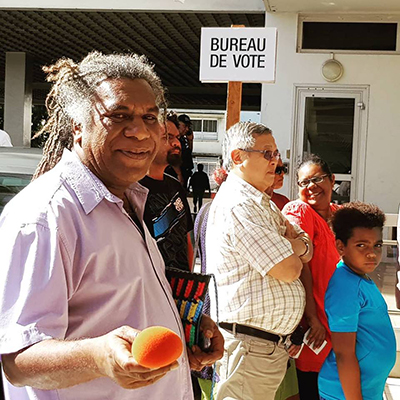
Of the 174,154 registered referendum voters, 80,120 were Kanak and 94,034 on the common civil role were also entitled to voted. In the end, a total of 141,099 people cast a vote.

Forty percent of the New Caledonian population are Melanesian Kanaks, 29 percent European, and 9 percent are Polynesians from Wallis and Futuna Islands. The rest are a mixture of Asian and Pacific communities.

Voter restrictions
The referendum voters were restricted under the Noumea accord to those eligible under these criteria:

  • Registered on the special referendum role (or fulfilled its requirements without being registered);
  • Born in New Caledonia and registered on the provincial electoral roles.
  • Lived in New Caledonia for a continuous 20 years;
  • Born before 1 January 1989 and lived in New Caledonia from 1988 to 1998;
  • Born after 1 January 1989 with a parent on the special electoral role; and
  • Born in New Caledonia with three years’ continuous residence (before 31 August 2018).
Pro-independence Radio Djiido’s editor-in-chief Romain Hneum takes the pulse of the voting mood at Noumea’s Hotel de Ville. Image: David Robie/PMC

The encouraging mobilisation of youth voters, a significant change since the 2014 provincial elections, and the emergence of a growing cadre of young multi-ethnic voters who are more open to a shared future than some of their conservative parents augurs well for the indépendantistes.

“This referendum was a victory for the youth. The loyalists’ predictions were thwarted, said FLNKS president Roch Wamytan. “This vote was a big leap forward. We will continue on our pathway, we will prepare the people in New Caledonia for independence.

“The struggle isn’t over until we are decolonised. One winner in the vote was fear. Over the past six months, we have tried to allay fears about retirement provisions, security and education. We clearly didn’t do enough. We will work harder on this for the next ballot.”

FLNKS official Alosio Sako said: “We’re a short step from victory, and there are still two more ballots to come.”

Independence inevitable
Some who voted against independence are resigned to the belief that one day New Caledonia will become independent.

“Silver fern” voters … Spanish-French father and son Arnaud and Manuel Fuentes are opposed to independence but are definitely fans of the All Blacks. Image: David Robie/PMC

Talking to a traveller, Sammy, a Lebanese-born New Caledonian with a French passport, and his Caldoche (settler) wife, who were on my flight back to Auckland and heading to Hanmer Springs for a holiday in “très jolie” New Zealand, gave me some interesting insights.

Ironically, Sammy migrated to New Caledonia after “les évènements” in the 1980s which led to the Matignon Accord in 1988 – to escape the civil war in Lebanon.

“Independence is inevitable,” he says. “I only wish they would get on with it and not have votes, delaying things. Build for the future instead of yet another vote.

“In spite of the vote against independence, it is the way it is going. One day New Caledonia will be independent so it is best to restart our future now. We have a chance to build something really new.”

“The indépendantistes are very determined.”

He seemed to be reflecting the view of Prime Minister Édouard Philippe, who flew to Nouméa from Vietnam for a day to meet political and civic leaders, and was whisked up to the Northern province stronghold “capital”Koné.

Philippe declared that a meeting would be held with the accord “signatories” next month and he hinted at some key policy changes to deal with social conditions and “balancing” the economic cleavage in this nickel rich and tourism booming territory.

Spread in Geo
What made Sammy choose New Caledonia? It was so far away from Lebanon – “it was just like Syria is today” – and he had read an article about New Caledonia in the French magazine Geo.

In fact, Geo has just published a cover story last month about New Caledonia headed “New Caledonia: So near, so far”, a 43-page spread dedicated to the beauty, culture, environment and flora and fauna of this “marvellous” archipelago. It would entice anyone.

The magazine quotes linguist and poet Emmanuel Tjibaou, one of six sons of the Kanak leader Jean-Marie Tjibaou assassinated in 1989 (see Part1), who has been director of the stunning Tjibaou Centre, a cultural memorial to his father, since 2012.

“Being ’Kanak’, or a ‘man’, isn’t a question of skin colour,” he says. “The centre introduces Melanesian culture to Western eyes that are not accustomed to it. Kanak traditions are oral, like elsewhere in Oceania. We live our culture – we discover it through singing, or dancing; we speak, or we weep.”

Independent Caledonia TV … making waves and telling the stories of all ethnicities. Image: Screen shots from NCTV

Another example of emerging “new wave” institutions is a small upstart digital television channel based at Koné. Funded largely by the Kanak-governed Northern province, it is a breath of fresh air compared with the dominant Premiere television (part state-run networks with six channels that look to Paris) and Les Nouvelles Calédoniennes, which has been very hostile to independence in the past, but is more subdued these days.

Caledonia TV making mark
Caledonia TV is already making its mark as an independent channel that is “telling our own stories” about Kanak culture, music and traditions and exploring all ethnicities in New Caledonia.

It played an important role in the referendum by setting up TV studios in the University of New Caledonia and providing balanced coverage and ready access for grassroots people to an engage in a dialogue about their future.

Caledonia TV reporter Duke Menango … telling stories with a difference. Image: David Robie/PMC

I caught up with one of the journalists involved in referendum coverage in the campus studios, Duke Menango, who did some of his early training as a journalist at Aoraki Polytechnic journalism school in Dunedin on a New Zealand aid scholarship.

“Caledonia TV started off as a web-based channel in 2012 and then became a fully fledged TV station the following year,” he said.

“It was important to give people a choice. Previously television was dominated by the state media monopoly with only one direction and one point of view. I don’t think we were being well represented as Kanaks and as Kanak reporters.

“With us, we are going out to the people – the grassroots, and we are giving them a voice. A voice for the different tribes. And it isn’t just the tribes, we are telling the stories of all ethnicities.

“We’re giving everybody a voice.”


Caledonia TV … culture and storytelling from a Pacific perspective. Video: PMC

Stiff challenge
But Caledonia faces a stiff challenge from the “mainstream” media, which is largely not sympathetic to independence.

On the weekend of the referendum, Les Nouvelles Calédoniennes devoted a full page for an editorial denouncing independence.

“France or the unknown?” warned editor-in-chief Olivier Poisson, who derided the FLNKS, claiming that it was presenting an unclear, even “confusing” platform, with contradictory objectives.

“In contrast, it’s a fact that we know New Caledonia is already independent. For sure, it isn’t a question of full sovereignty, but whether the country already decides its economic orientation, imposes its own taxes, leads education, runs health, and is able to enter into international accords and partnerships.”

Finally, his message was: “It’s too risky to take on powers that are too great for so little to gain.”

His message irked many indépendantistes, and drew criticism that the newspaper was illegally breaching the political blackout prior to the referendum

“What kind of bullshit is that again?” asked Magalie Tingal Lémé, a former news editor of the pro-independence Radio Djiido. “The editor-in-chief is not supposed to make any comments since the official campaign is over since last night. Some journalists should start being real journalists in this country.”

Print Friendly, PDF & Email

Article by AsiaPacificReport.nz

]]>

‘Rethink’ say ABC friends condemning Canberra’s Pacific media plan

]]>

Professional broadcasting in the Pacific depends on “two-way respectful communication” that enhances understanding of diverse perspectives in the region, says the ABC Friends group. Image: vizit.com

Pacific Media Watch Newsdesk

A public broadcasting advocacy group has condemned Australian Prime Minister Scott Morrison’s plan to commercialise Pacific broadcasting as not being able to provide quality public interest journalism to the country’s neighbours.

Supporters of Australian Broadcasting in Asia and the Pacific, a group linked to ABC Friends, has asked Morrison to rethink his plans.

“If Mr Morrison wants to restore a fresh initiative like the Australia Network he is dependent on the Australian Broadcasting Corporation which has the experience and professionalism to create strong partnerships with Pacific nations,” the supporters statement said.

READ MORE: Morrison to unveil broad suite of measures to boost Australia’s influence in the Pacific

“The voice of Australia through Radio Australia, and more recently via a wider range of ABC media platforms, has long been valued by people in the Pacific and many ABC broadcasters have become popular in the region.”

Australian foreign policy would not be enhanced by the “commercial news judgements of Fox or Sky News”, which did not provide independent analysis of complex issues.

-Partners-

Professional broadcasting in the Pacific depended on “two-way respectful communication” that enhanced understanding of diverse perspectives in the region, the advocacy group said.

Clear expectations
In recent months Pacific leaders had made clear their expectations of Australian/Pacific public broadcasting:

  • Vanuatu Prime Minister Charlot Salwal has called for rebuilding public interest broadcasting;
  • In a speech to the Lowy Institute, Samoan Prime Minister Tuilaepa Sa’ilele Malielegaoi had called for the Pacific voice to be heard in Australia; and
  • Other Pacific leaders had echoed this call, as well as Secretary-General of the South Pacific Forum.

“Significantly, if Australia were to accept this approach to Pacific broadcasting it would become the only nation to rely on the commercial sector to deliver its ‘soft power’ diplomacy.

“Just imagine Canada or Britain giving such a significant national task to commercial interests!” said the statement.

ABC Friends national president Margaret Reynolds urged Prime Minister Morrison to reconsider this public policy shift and take advice from the Department of Foreign Affairs which was more familiar with the needs of Pacific nations and managing diplomatic relations.

Print Friendly, PDF & Email

Article by AsiaPacificReport.nz

]]>