Page 1006

Viewpoints: should universities raise the ATAR required for entrance into teaching degrees?

]]>

The Conversation (Au and NZ) – By Anne-Marie Morgan, Professor and Associate Dean, Teaching and Learning, Faculty of Humanities, Arts and Social Sciences, and Education, University of New England

Shadow education minister Tanya Plibersek has announced a Labor government would raise the ATAR required for entrance into a teaching degree if elected at the next election. Plibersek said:

I don’t want people with ATARs of 35 going into teaching, I just don’t.

The effectiveness of ATAR as an entrance criteria has been heavily debated for some time. Some say to improve teacher quality, we need to raise the entrance criteria. Others argue ATAR doesn’t tell us all we need to know about a person’s suitability for teaching.

So is raising the ATAR for teachers a good idea, or will it simply exclude potentially great teachers?


The case for no minimum ATAR

Tania Aspland, Professor in Teacher Education, Dean, Education Policy and Strategy at Australian Catholic University and President, Australian Council of Deans of Education

We all want to attract and retain the best teachers and move away from the singular focus on ATAR scores. Earlier this year, the Mitchell Institute released a report which stated only one in four domestic undergraduate students was admitted to courses based on an ATAR. This does not match the message reinforced by schools, families and the media that ATAR is everything.

Many students with average or comparatively low senior secondary results also do well once at university. www.shutterstock.com

In 2014, the Teacher Education Ministerial Advisory Group report, which has underpinned the raft of recent reforms in teacher education, found:

  1. research indicates ATAR is a good predictor of success for students entering university with strong secondary school performance, but loses predictive capability for those entering university with lower scores. Many students with average or comparatively low senior secondary results also do well once at university

  2. while rankings are clearly a very good predictor of performance in engineering, agriculture and science, the relationship is low for education.

The argument about ATARs ignores the range of selection methods universities use to choose teacher education students with the right mix of academic and personal traits. These include looking at prior experience, interviews or psychometric tests.

It ignores the clearly defined professional teaching standards and the new numeracy and literacy test teaching students must pass before they graduate.


Read more: Why we need to review how we test for teacher quality


It also strikes at the heart of whether or not we want to provide multiple pathways to attract a diverse cohort to teach in our increasingly diverse classrooms. This includes those from marginalised and disadvantaged groups, such as students from rural or regional areas and Aboriginal and Torres Strait Islander students.

Teacher education students accepted with lower ATARs need to be viewed in context. They may be selected because:

  • they have gained further experience and qualifications that supersede their ATAR, as their ATAR may have been acquired years before their university entry
  • they’re given special consideration due to personal circumstances (such as the death of a parent) as their low ATAR doesn’t reflect prior academic performance
  • as a member of a disadvantaged group, they’re granted access to a pathway course during which they would have to prove they’re capable of undertaking teacher education.

Research does not support the move to mandate ATAR entry scores.


The case for setting benchmarks

Anne-Marie Morgan, Professor and Associate Dean, Teaching and Learning at the University of New England

ATARs provide a visible measure of standard to the public, prospective students and their families. They’re also used by politicians as an indicator of confidence in producing quality teachers. But the reliance on ATAR levels as a predictor of success is insufficient on its own, and is tied up with complex equity issues around location (especially for regional and rural students), socioeconomic status, family dynamics and unequal access to educational opportunities.

In the Teacher Education Ministerial Advisory Group report which has guided national education policy on initial teacher education, the relationship between ATARs and student success in education courses was acknowledged to be low, and is the reason why other processes are included for entry, within programs and at graduation.

There is research that indicates an ATAR of 70 supports successful outcomes. It found ATAR scores were significant, but scores on a scale which measured motivation and engagement were a much stronger predictor of first year marks results. This indicates students’ motivation and how they’re taught in their first year are more important than ATAR, but so is setting an appropriate benchmark for ATAR, for students who enter using this pathway.

Setting an ATAR benchmark is prudent, while also allowing for other entry pathways. www.shutterstock.com

UNE currently has an ATAR requirement of 77 for its education courses. Historically, competition for places in our teacher education programs has justified this level. This is higher than most NSW and interstate universities.

We are currently considering lowering this to 70 in line with confidence in our students’ results, the literature, and to open opportunities for teaching to a wider range of students and to compensate for pathways lost through changes such as removal of Principals’ recommendations of year 12 students considered to have the right attributes for teaching.

The Victorian state government currently requires an ATAR of 65 for teaching courses, which will be raised to 70 in 2019. This will be done so teacher education students in Victoria are from the top 30% of year 12 graduates, but there are also opportunities in this policy for entrance pathways other than ATAR.

So, setting an appropriate ATAR benchmark is prudent, while also ensuring there are other entry pathways that uphold our commitment to equity of access. The programs we provide, and how we teach students are other critical factors in ensuring we prepare great teachers.


Read more: How to get quality teachers in disadvantaged schools – and keep them there


Tania Aspland

I appreciate that we are both largely on the same page that the best research doesn’t supports the case for minimum ATARs. Setting minimum ATARs may make the public feel more confident, but that confidence stems largely from perceptions based on the narrow focus on ATARs by public figures.


Read more: Should we scrap the ATAR? What are the alternative options? Experts comment


I also appreciate the valuable contributions made by the diverse range of great teachers who have have come into teacher education through different pathways and graduated with high professional academic standards.

Anne-Marie Morgan

We agree on the conclusion that the research to date does not support the obsession with ATARs as the only source for entry to an initial teacher education course. But it will be important to continue to collect data to demonstrate this conclusion, and to show how both other entry pathways and what happens during a student’s preparation to be a teacher influence their chances of success, and suitability to be a great teacher.

As Tania says, governments, communities, parents, teacher educators, and the wider community all want to attract and retain the best teachers.


Read more: Your ATAR isn’t the only thing universities are looking at


Our teachers are recognised as some of the best in the world. We should continue to provide opportunities for our teachers to come from diverse communities and backgrounds to work with children who are also diverse. We need to talk about the complexity of the profession and the needs of students in more nuanced terms.

– Viewpoints: should universities raise the ATAR required for entrance into teaching degrees?
– http://theconversation.com/viewpoints-should-universities-raise-the-atar-required-for-entrance-into-teaching-degrees-102841]]>

RSF open letter plea to Suu Kyi for Myanmar journalists’ freedom

]]>

RSF open letter to Aung San Suu Kyi … “How are we to understand the sentence passed on these two journalists at the start of the week? What credibility can the rule of law and judicial independence have in Myanmar after this farce?” Image: Ye Aung Thu/AFP/RSF

Pacific Media Watch Newsdesk

Five days after Reuters reporters Wa Lone and Kyaw Soe Oo were sentenced to seven years in prison on a trumped-up charge, the Paris-based media freedom watchdog Reporters Without Borders (RSF) has written to the head of Myanmar’s government asking her to end her deafening silence and to intercede on behalf of the two journalists.

READ MORE: Massacre in Myanmar – the Reuters investigation

This is the open letter:

Daw Aung San Suu Kyi
State Counsellor
Minister of Foreign Affairs
Minister of the President’s Office
of the Republic of the Union of Myanmar
State Counsellor Office No 8
Naypyitaw, Myanmar

Paris, 6 September 2018

Dear State Counsellor,

-Partners-

An iniquitous sentence of seven years in prison on a trumped-up charge of violating the Official Secrets Acts was passed at the start of this week on Wa Lone and Kyaw Soe Oo, two reporters with the Reuters news agency who have already spent nearly nine months in detention.

Their only crime was to investigate the September 2017 massacre of 10 Rohingya civilians by members of Myanmar’s army. In the course of shedding light on the terrible reality of the ethnic cleansing carried out by the army and its auxiliaries in the north of Rakhine State, the news agency’s reporters discovered summary executions, mass graves, the torching of villages and systematic efforts to eliminate of all trace of the atrocities.

As you know, the two reporters were crudely framed by the police, as a police captain, Moe Yan Naing, acknowledged in court on 20 April. The thoroughness of their investigative reporting nonetheless forced the Tatmadaw, Myanmar armed forces, to recognise the reality of the Inn Dinn massacre and to sentence seven soldiers to 10 years in prison for their role.

We are deeply saddened by your only statement about the two journalists. In an interview for NHK in June, you simply said that “they were nor arrested for covering the Rakhine issue” but “because they broke the Official Secrets Act” and that it “will be up to judiciary, it is for the judiciary to decide.” Their innocence was nonetheless glaringly obvious.

RSF wrote to you on 7 September 2017 asking you to use your moral authority to ensure that journalists were free to work in Myanmar. Your response was silence. Your response to the appeals of Myanmar’s journalists and foreign journalists was silence. Your response to the international community’s appeals was silence.

How are we to understand the sentence passed on these two journalists at the start of the week? What credibility can the rule of law and judicial independence have in Myanmar after this farce? To those who have tried to raise the issue in your presence, you have responded with “fury,” as in January with former US diplomat Bill Richardson, one of your oldest supporters, who felt obliged to resign from your international panel of advisers after you described Wa Lone and Kyaw Soe Oo as “traitors.”

Were journalists traitors when they covered the military junta’s suppression of the 1988 democracy movement, in which you rose to political prominence? Were journalists traitors when they relayed your calls for democracy during the 15 years you spent under house arrest? Were journalists traitors when they hailed the advent of democracy with your party’s victory in 2015 and your appointment as head of government in 2016?

Awarded the Sakharov Prize in 1990 and the Nobel Peace Prize in 1991, you have long been hailed as resolute advocate of democracy and you have defended what is one of its foundations with a great deal of vision. Speaking when you were released in 2010, you said, “the basis of democratic freedom is freedom of speech.” The following year, you assured RSF of your commitment to press freedom.

Since the end of your time under house arrest, you have on several occasions said that you reject the status of icon and that you see yourself as a politician seeking concrete results for her people. We are aware of the political circumstances in Myanmar that force you to seek compromises with the Tatmadaw’s representatives.

But nothing, absolutely nothing, forces you, as the Union of Myanmar’s head of government, to observe this deafening silence. Nothing forces you to refer to journalists’ coverage of Rakhine State as “a huge iceberg of misinformation.” Nothing forces you to go down in history as someone who betrayed the ideals on which she built her reputation.

This is why we urge you to intercede immediately to obtain the release of these two Reuters journalists. One of your closest allies, President Win Myint, has the power to grant them a pardon.

You have the ability to take action today in support of the values that you defended with courage for so long.

Sincerely,

Christophe Deloire
Secretary-General
Reporters sans frontières / Reporters Without Borders / RSF
Paris, France

Nobel Peace prize winner, Aung San Suu Kyi under fire for not condemning the Rohingya’s prosecution in Myanmar. In April 2017, she said: “I don’t think there is ethnic cleansing going on.” She also refused to allow UN investigators access to the region. Video: Al Jazeera

Print Friendly, PDF & Email

Article by AsiaPacificReport.nz

]]>

Why AMP and IOOF went rogue

]]>

The Conversation (Au and NZ) – By Andrew Linden, Sessional Lecturer, PhD (Management) Candidate, School of Management, RMIT University

The ‘M’ in AMP stood for Mutual. Like another former mutual, IOOF, it was owned by, and set up to benefit, its members.

Both AMP and IOOF were presented with draft findings that they acted against the interests of their members at the conclusion of the round five hearings of the Royal Commission into Banking and Financial Services.

Although both are now purely commercial organisations, each has marketed itself as different from the others because of its cooperative history and founding ethos.

So what went wrong?

The early twentieth century German sociologist Max Weber argued the culture of an organisation was the product of its history, institutional structure and a consciously held shared ethos of its members. It was a different view to that of mainstream economists who these days assume organisations attempt to maximise profits and that of so-called behavioural economists who assume cognitive biases make decision making less rational.

In his book the Protestant Ethic and the Spirit of Capitalism Weber outlined the ways in which the ascetic sensibilities of the Protestant sects had influenced the growth of commerce in post reformation Northern Europe and 19th century America. They were concerned with thrift as much as with profit.

The ‘P’ in AMP stood for Providence. The AMP was set up to help its members save.

Disengagement, demutalisation and corporatisation changed AMP and IOOF forever

The move away from the government provision of services in the 1970s and Margaret Thatcher’s famous claim in the 1980s that there was “no such thing as society” saw a move away from mutuals and cooperatives in tandem with a move away from thrift.

In the 1990s AMP and IOOF ‘demutualised’, becoming companies listed on the sharemarket. Value that had been accumulated for generations was turned into tradable shares. Members who voted for the change were accused of intergenerational theft. Those who didn’t feel the least bit thrifty cashed-out by selling their shares.

Laws were changed to make it easier.

From a Weberian perspective the current governance problems of AMP and IOOF can in part be attributed to abandoning of the original founding ascetic ideal in favour of an unconstrained focus on profit maximisation for the benefit of shareholders rather than members.

The change in the culture of such organisations in Australia and overseas was accelerated by decisions to put independent directors and executives with “commercial savvy” on boards.

Turning back the clock won’t work

While Weber suggests organisations founded on a particular set of values can be highly disciplined the process of demutalisation/listing can create the conditions for misconduct. Appointing directors and outside managers who have no understanding of the mutual’s ideal allows an aggressive commercial culture to take root. The argument can be extended to former public sector corporations such as the Commonwealth Bank.

Despite calls to wind back the clock very few former cooperatives or public sector entities have. Once they have taken even a half step to corporatisation, as did Telstra, the Commonwealth Bank and the Murray Goulburn Cooperative, the die has been cast. The organisation and its ethos has changed.

Appointing high profile directors and executive directors with CVs that include community involvement is only going to paper over the change.

What might work

Mutual organisations are not misconduct and misstep free. They are vulnerable to ‘groupthink’ in which managers back each other up in order to aviod disharmony.

But commercial organisations that prioritise profits create incentives for managers to rationalise away breaking the law in order to lift short-term profitability or boost share prices and bonuses.

If he were alive today Weber might suggest subjecting such organisations to increased and more effective regulatory scrutiny and increased internal and external democratic accountability would be a necessary first step to improve governance.

Weber might very well argue the Banking Royal Commission itself is helping the community forge a new ethos grounded in community expectations about corporate conduct and purpose, buttressed by strong laws to back them up that will guide individual conduct and organisational governance.

– Why AMP and IOOF went rogue
– http://theconversation.com/why-amp-and-ioof-went-rogue-102569]]>

Pacific Climate Warriors rise for global day of ‘urgent action’

]]>

West Papua advocates talk about climate change and human rights. Video: Human Rights Watch

Pacific Media Centre Newsdesk

Pacific Islanders across the Pacific and within Pacific Island diaspora communities in Australia, New Zealand and the United States are joining more than 800 actions in 90 countries under the banner of Rise for Climate to demonstrate the urgency of the climate crisis.

From the September 8-10, these Pacific communities will shine a spotlight on the increasing impacts they are experiencing and demand stronger action to keep fossil fuels in the ground, reports the advocacy group 350 Pacific.

As part of these global mobilisations, the Pacific is leading the charge with creative events and actions that call for a swift and just transition to 100 percent renewable energy for all.

READ MORE: World has three years left to stop dangerous climate change, warn experts

Globally, people are rising to support urgent action before 2020 to accelerate to the rapid phase out of fossil fuels and a just transition to clean and fair energy systems for all.

-Partners-

“There is no time to lose. Climate change is a threat that is already here and now in the Pacific: inundation by sea level rise, the strongest cyclones ever recorded in the Southern Hemisphere, massive flooding, and droughts are some of the recent impacts of climate change being felt across the region,” says 350 Pacific.

Already this year the world has experienced:

  • Catastrophic heatwaves in North Africa, Europe, Japan, Pakistan, Australia and Argentina;
  • Deadly wildfires in Greece, Sweden, the USA and Russia;
  • Drought in Kenya and Somalia;
  • Major water shortages in Afghanistan and South Africa;
  • Extreme storms and flooding in Hawaii, India, Oman and Yemen;
  • Record melting of the Bering Sea ice; and
  • the 400th month in a row of above-average global temperatures.

This weekend’s Rise for Climate will demonstrate the growing strength and diversity of the climate movement and the people who will not wait for governments to act, but will lead by example and hold them to account.

Climate change affects the whole of the Pacific, including West Papua. 350 Pacific says:

“On top of dealing with the Indonesian occupation, our brothers and sisters in West Papua are also living with the impacts of climate change.”

West Papua … a struggle over climate change and for human rights. Image: 350 Pacific
Print Friendly, PDF & Email

Article by AsiaPacificReport.nz

]]>

No finding by Nationals in Barnaby Joyce sexual harassment case

]]>

The Conversation (Au and NZ) – By Michelle Grattan, Professorial Fellow, University of Canberra

The Nationals have been unable to make a finding on the claim by a woman that former deputy prime minister Barnaby Joyce sexually harassed her.

Catherine Marriott, former West Australian Rural Woman of the Year, made the allegation at the height of the controversy over Joyce’s affair with his former staffer (and now partner), Vikki Campion. He claimed at the time it was the tipping point that led him to quit the Nationals’ leadership, although he has said subsequently when Campion became pregnant, he always knew he would have to go.

Marriott, who made the complaint in confidence, was highly upset when her name was quickly leaked.

She said in a Friday statement expressing her frustration at the inconclusive result of the eight months investigation that “the outcome simply isn’t good enough”.

She had been told by email on Thursday that the NSW National Party “has been unable to make a determination … due to insufficient evidence”.

“This is despite the investigation finding I was ‘forthright, believable, open and genuinely upset’ by the incident.

“The result of this investigation has underpinned what is wrong with the process and the absolute dire need for change”, she said.

Joyce on Friday had no comment beyond standing by what he had said initially, when he described the accusation as “spurious and defamatory”.

Marriott said she was “extremely disappointed that after eight months of waiting, three trips to the east coast at my own expense to meet with the party, my name and confidential complaint being leaked to the national media, and my personal and professional life being upended, the National Party have reached a ‘no conclusion’ verdict.”

But she said she wasn’t surprised because the party hadn’t had an external process in place to deal with such a complaint “My complaint was handled internally by the NSW National Party executive with no professional external expert brought in at any stage.”

She said the only positive outcome from a “harrowing experience” had been “the development of much improved policy by the party”, which she had encouraged. She was heartened that people who found themselves in similar situations in future “will have a robust policy in place to assist them”.

The outcome of the investigation comes as the Liberal party has been rocked by allegations of bullying during the leadership battle. Several Liberal women have spoken out strongly against the bad behaviour, and MPs are waiting to see whether individuals are named in parliament next week.

– No finding by Nationals in Barnaby Joyce sexual harassment case
– http://theconversation.com/no-finding-by-nationals-in-barnaby-joyce-sexual-harassment-case-102850]]>

Wasps, aphids and ants: the other honey makers

]]>

The Conversation (Au and NZ) – By Manu Saunders, Research fellow, University of New England

There are seven species of Apis honey bee in the world, all of them native to Asia, Europe and Africa. Apis mellifera, the western honey bee, is the species recognised globally as “the honey bee”. But it’s not the only insect that makes honey.

Many other bee, ant and wasp species make and store honey. Many of these insects have been used as a natural sugar source for centuries by indigenous cultures around the world.


Read more: What is fake honey and why didn’t the official tests pick it up?


By definition, honey is a sweet, sticky substance that insects make by collecting and processing flower nectar. The commercial association between honey and honey bees has mostly developed alongside the long-term relationship between humans and domesticated honey bees.

This association is also supported by the Codex Alimentarius, the international food standards established by the United Nations and the World Health Organisation. The Honey Codex mentions only “honey bees” and states that honey sold as such should not have any food additives or other ingredients added.

Oh honey, honey

Biologically, there are other insect sources of honey. Stingless bees (Meliponini) are a group of about 500 bee species that are excellent honey producers and are also managed as efficient crop pollinators in some regions. Stingless bees are mostly found in tropical and subtropical regions of Australia, Africa, Southeast Asia and the Americas.


Read more: A bee economist explains honey bees’ vital role in growing tasty almonds


Their honey is different in taste and consistency to honey bee honey. It has a higher water content, so it’s a lot runnier and tastes quite tangy. Stingless bee honey is an important food and income source for many traditional communities around the world.

Harvesting “sugarbag”, as it’s known in Australia, is an important cultural tradition for indigenous communities in northern and eastern regions.

A sugarbag bee. James Niland/Flickr, CC BY

Stingless bee honey production hasn’t reached the commercial success of honey bee honey, mostly because stingless bee colonies produce a lot less honey than an Apis honey bee hive and are more complicated to harvest. But keeping stingless bees in their native range for honey, pollination services and human well-being is an increasing trend.

Bumblebees also make honey, albeit on a very small scale. The nectar they store in wax honey pots is mostly for the queen’s consumption, to maintain her energy during reproduction. Because very few bumblebee colonies establish permanently, they don’t need to store large quantities of honey. This makes it almost impossible to manage these bees for honey production.

Bees aren’t the only hymenopterans that make honey. Some species of paper wasps, particularly the Mexican honey wasps (Brachygastra spp.), also store excess nectar in their cardboard nests. Local indigenous communities value these wasps as a source of food, income and traditional medicine.

Mexican honey wasp. Wikimedia Commons

Ants have similar lifestyles to their bee and wasp cousins and are common nectar foragers. Some species also make honey.

“Honeypot ant” is a common name for the many species of ant with workers that store honey in their abdomen. These individuals, called repletes, can swell their abdomens many times the normal size with the nectar they gorge. They act as food reservoirs for their colony, but are also harvested by humans, particularly by indigenous communities in arid regions.

Close-up of three large replete honeypot ants (Myrmecocystus mimicus) at Oakland Zoo. via Wikimedia Commons

These ants don’t just collect nectar from flowers, but also sap leaks on plant stems (called extrafloral nectaries) and honeydew produced by hemipteran sap-suckers like aphids and scale insects.

Aphids and scale insects aren’t all bad – they produce a delicious sugary syrup called honeydew. We mostly know these insects as garden and crop pests: warty lumps huddled on plant stems, often coated in sticky honeydew and the black sooty mould that thrives on the sugar.

Males of these insect species are usually short-lived, but females can live for months, sucking plant sap and releasing sweet sticky honeydew as waste from their rears. The sugar composition varies greatly depending on both the plant and the sap-sucking species.

Honeydew has long been a valuable sugar source for indigenous cultures in many parts of the world where native honey-producing bees are scarce. Many other animals that seek out floral nectar, like bees, flies, butterflies, moths and ants, also feed on honeydew. It’s an especially valuable resource over winter or when floral resources are scarce, and not just for other insects; geckoes, honeyeaters, other small birds, possums and gliders are all known to feed on honeydew.

Honeydew on a leaf. Dmitri Don/Wikipedia, CC BY-SA

It’s also an indirect source of honey bee honey: plant sap that has been recycled through two different insect species! Honey bees are well-known honeydew collectors. In some parts of Europe, honeydew is an important forage resource for bee colonies.

Honeydew honeys have a unique flavour, depending on the host tree the scale insects were feeding on. Famous examples of this specialty honey are the German Black Forest honey and New Zealand’s Honeydew honey.


Read more: Unique pollen signatures in Australian honey could help tackle a counterfeit industry


So why not find out a bit more about what insects are producing honey in your local region?

– Wasps, aphids and ants: the other honey makers
– http://theconversation.com/wasps-aphids-and-ants-the-other-honey-makers-102838]]>

Media watchdog’s finding on Sunrise’s Indigenous adoption segment is justified

]]>

The Conversation (Au and NZ) – By Alana Schetzer, Sessional Tutor and Journalist, University of Melbourne

In March this year, Sunrise aired a panel discussion about the removal of Indigenous children from dangerous or abusive family situations.

It wrongly claimed that Indigenous children could not be fostered by non-Indigenous families and one panellist, commentator Prue MacSween, suggested that the Stolen Generation might need to be repeated in order to save children from physical and sexual abuse.

The reaction was swift and fierce: the segment was condemned as racist and insensitive, with many questioning why the panel featured no experts or Indigenous people. There were protests at the show’s Sydney studio, and multiple complaints were made to the Australian Communications and Media Authority.

This week, ACMA announced that the Channel Seven breakfast show did indeed breach the Commercial Television Industry Code of Practice in airing false claims that Indigenous children could not be placed with white families.

It was also found that the segment provoked “serious contempt on the basis of race in breach of the Code as it contained strong negative generalisations about Indigenous people as a group”.


Read more: Barnaby Joyce’s decision to sell his story is a breach of professional ethics


Seven has defended their actions, labelling the ACMA’s decision as “censorship” and “a direct assault on the workings of an independent media”. They are also considering seeking a judicial review of the decision.

However, it is not correct to assess ACMA’s decision, nor its role, as censorship. Rather, the ACMA monitors and enforces basic journalistic principles governing ethics and responsibility.

The decision is more symbolic than material – Channel Seven will not be forced to pull the segment from online; indeed, it is widely available. ACMA also has no power to order any compensation to be paid to a wronged party or fine the broadcaster; nor can it force Channel Seven to apologise or correct its error.

This dispute is but one of many examples that raises questions over the power of the media and what happens when media make a mistake, deliberately bend the truth or publish information that may cause harm to people, especially from marginalised groups.

In his research on the media portrayal of Indigenous people and issues, and the difference between sensitivity versus censorship, Michael Meadowsargues the media are resistant to admitting there is a problem with racist or insensitive coverage. He writes:

Aboriginal Australians have had to be content with a portrayal which is mostly stereotypical, sensational, emotional or exotic, with an ignorance of the historical and political context in which these images are situated.

While “censorship” is a label that is often used by the media in response to criticism, actual censorship in Australia by government or media watchdogs is thankfully rare to nonexistent. Other issue such as defamation law are greater sources of censorship.

In a 2018 report released by Reporters Without Borders, a worldwide organisation that advocates for a free press, Australia ranked 19th out of 180 countries on press freedom. This was a fall from ninth in 2017 due to of media restrictions on reporting on asylum seekers and refugees in offshore detention centres, not the role of ACMA. In fact, ACMA and the Australian Press Council were not even mentioned.

Australian journalists are expected, although not obliged, to abide by the Media, Entertainment and Arts Alliance’s Code of Ethics. This states that journalists should “report and interpret honestly, striving for accuracy, fairness and disclosure of all essential facts” and to “do your utmost to achieve fair correction of errors”.

ACMA’s finding on the Sunrise segment that featured sweeping claims such as “children left in Indigenous families would be abused and neglected”, is simply holding those responsible to the minimum standards expected, not just within the industry, but from the public, too.

In the era of “fake news”, it is not surprising that the public’s trust in journalists is low; a 2018 surveyfound only 20% of Australians deemed newspaper journalists as being “very” honest and ethical, with television reporters fairing even worse, at 17%.


Read more: New bill would make Australia worst in the free world for criminalising journalism


The ACMA was created in 2005 following the public outcry over the infamous “cash for comment” scandals in 1999 and 2004. At the time, the then-Australian Broadcasting Authority was criticised for being “too soft” and ineffective in response, the ABA was abolished and replaced by the ACMA.

It’s incorrect to label the ACMA’s role as playing “censor” when they do no such thing. In fact, there is criticism that ACMA, like its predecessor, is a “toothless tiger” that lacks any power to actually hold the media to account.

No media can operate without a basic framework that places public interest, a commitment to accuracy and responsibility to the public.

In a statement released on September 4, ACMA chairwoman Nerida O’Loughlin highlighted this important distinction:

Broadcasters can, of course, discuss matters of public interest, including extremely sensitive topics such as child abuse in Indigenous communities. However, such matters should be discussed with care, with editorial framing to ensure compliance with the Code.

With “clickbait” and inflammatory opinion increasingly finding a home in the media, it’s more important than ever that the media respect and abide by their responsibilities to fairness and the truth. And when they cannot or do not do this, regulatory bodies such as the ACMA are essential.

– Media watchdog’s finding on Sunrise’s Indigenous adoption segment is justified
– http://theconversation.com/media-watchdogs-finding-on-sunrises-indigenous-adoption-segment-is-justified-102722]]>

Considering surgery for endometriosis? Here’s what you need to know

]]>

The Conversation (Au and NZ) – By Martin Healey, Clinical Associate Professor in the Department of Obstetrics and Gynaecology, University of Melbourne

Between 1% and 10% of Australian women have endometriosis, a condition where the tissue that normally lines the uterus, the endometrium, grows outside the womb.

These days, incisions for endometriosis surgery are small. Medical Art Inc/Shutterstock

Since endometriosis was first identified in the second half of the 19th century, doctors have been treating it surgically. This initially involved an open cut in the woman’s abdomen and removing the endometriosis using a scalpel.

With progress in the last 100 years, most surgery for endometriosis is done with laparoscopy (key-hole surgery) and uses diathermy (electric current) or laser to either vaporise or cut out endometriosis.

The appearance of endometriosis varies. It can be clear, yellow, white, red or black. It can appear as a small bleb, a lump surrounded by scarring, or as an adhesion holding two organs together.

The level of experience of the operating gynaecologist at finding and recognising endometriosis is likely to have a direct impact on how much is identified and treated.

Endometriosis is considered a benign disease: it doesn’t kill. It varies from causing no symptoms, to causing debilitating pain and infertility.


Read more: I have painful periods, could it be endometriosis?


The surgical approach to endometriosis reflects this variability. For a woman with no symptoms, it’s often reasonable to not have any treatment. But for a woman with debilitating pain, surgery can be life-changing.

Endometriosis can grow on important organs such as the bowel and bladder. Surgical removal of the disease on these organs comes with extra risks of complications, so should only be performed when symptoms are severe.

When symptoms aren’t severe, the surgeon may leave residual endometriosis in the wall of the bowel or bladder.

If, however, a woman has severe symptoms such as pain when opening her bowels, she may opt for more aggressive surgery, such as the removal of the piece of bowel invaded by endometriosis and having all the disease cleared.

Success rates

After surgery to remove all visible endometriosis, the likelihood of the disease recurring is estimated as 21.5% at two years and 40-50% at five years. Of this, around one-third of cases will occur because some endometriosis has been missed at the original surgery. The other two-thirds will be due to new disease (recurrence).

The key-hole surgery to treat all endometriosis varies from being simple and lasting 20 minutes, through to complex work taking four to five hours and requiring a gynaecologist with advanced training.

Such surgery comes with risks. Rarely, an important organ such as the bowel or bladder can be damaged and need to be repaired. Infections involving the cuts, the bladder or the womb can also occur. Occasionally, women will initially be unable to pass urine and will need a catheter.

Five years after surgery, 40-50% of women will have the disease. Rawpixel

Unfortunately for some women, the surgery won’t alleviate their symptoms. The surgery may go very well, but at least 20% of women will return after surgery with the same levels of pain. Surgeons will discuss this possibility with patients before surgery.

Managing endometriosis

Most endometriosis is thought to occur because of retrograde menstruation, where menstrual blood and cells of the endometrium go backwards through the fallopian tubes and stick in the pelvis.

It therefore makes sense to stop this happening to prevent new endometriosis. This can be done in two ways.

The first is to use hormones (the combined contraceptive pill, high dose progesterone-like drugs, or menopause-inducing drugs) to stop periods. This delays recurrence (new disease) but may come with hormonal side effects, such as moodiness, bloating, weight gain, loss of libido, hair loss, pimples, hot flushes, night sweats and headaches.


Read more: What happens to endometriosis when you’re on the pill?


The second approach is to surgically prevent retrograde menstruation by either blocking the fallopian tubes (tubal clips), destroying the endometrium (endometrial ablation) or removing the uterus (hysterectomy).

These procedures in theory should be effective but have not been proven with research. They are only an option if women don’t want to have children or have finished having children. They also carry some risks, such as infections, damage to important organs such as the bowel, bladder or large blood vessels, and the development of scar tissue in the pelvis.

As with all health-care decisions, a woman’s choice of treatment for endometriosis will be based on her assessment of the risks and benefits. She will have her own experiences and knowledge, and these may have a greater impact than her doctor’s recommendation. Access to balanced, evidence-based information is therefore essential for women to make an informed decision.

Based on the evidence, women with minor symptoms may choose not to have active treatment but, rather, to watch and wait. For women with debilitating symptoms, the choice is more difficult, as we don’t currently have good evidence-based research to justify promoting surgery over hormonal treatment, or vice versa.


Read more: Can diet improve the symptoms of endometriosis? Sadly, there’s no clear answer


– Considering surgery for endometriosis? Here’s what you need to know
– http://theconversation.com/considering-surgery-for-endometriosis-heres-what-you-need-to-know-102254]]>

We’ve crunched the numbers in McDonald’s Monopoly challenge to find your chance of winning

]]>

The Conversation (Au and NZ) – By Sarah Belet, Postgraduate Student, Monash University

McDonald’s Monopoly competition is back this month offering a chance to win expensive prizes, all for the price of a Big Mac.

Given you could become tens of thousands of dollars richer by simply going on a Macca’s run, McDonald’s Monopoly games have in the past been subject to cheating and a multimillion-dollar scandal.

But for those who prefer to play fair, what are your chances of actually snaring a prize?

Prizes, prizes, prizes

To take part you need to buy certain McDonald’s food items that include peel-off Monopoly tickets. Each ticket has three different possible outcomes: an “Instant win”, a “Chance card” or a “Collect to win”.


Read more: Seven reasons we play lotto – even though we know we probably won’t win the jackpot


Instant prizes are either a McDonald’s food item such as a burger, or a non-food prize such as a movie ticket or a cash gift card, redeemed by entering the 12-digit code on the ticket into a phone app.

A “Chance card” ticket also provides a 12-digit code which, when entered into an app, provides another opportunity to nab an instant prize or a digital “Collect to win” ticket.

The “Collect to win” tickets are the real meat of the game, and yield the major prizes: sometimes a car or large amounts of money. To win one of these prizes, you need to collect all “Collect to win” tickets of the same colour, as you would playing the traditional Monopoly game.

For obvious reasons, McDonald’s doesn’t tell us much about how these tickets are distributed across Australia. But what it does tell us is the maximum number of prizes that can be awarded for each prize type.

Using some fairly basic number-crunching, we can get a better picture of what our chances are of winning a shiny new car just by purchasing a Big Mac meal.

What the numbers reveal

This year, McDonald’s says 136,634,083 tickets will be distributed across the fastfood giant’s restaurants, and lists the maximum number of prizes available.

While we have no way of determining whether or not this maximum is reached, we can still get a general idea of our chances of winning a prize by using these values.

McDonald’s says there is a one-in-five chance of winning an instant prize, which could either be a food prize or a non-food prize.

  • about 18 million tickets yield instant food prizes, which gives a roughly 13.2% chance of winning

  • about 11.8 million tickets yield instant non-food prizes, which gives a roughly 8.7% chance of winning

Of course, 13.2% plus 8.7% gives a 21.9% chance of winning an instant prize, on average, which roughly agrees with the one-in-five that McDonald’s claims.

The Gambler’s Fallacy

It’s important not fall for the Gambler’s Fallacy when trying to collect instant win tickets. Collecting five tickets does not mean that one of them will always be an instant win ticket.

McDonald’s simply promises an average rate of an instant win, owing to the fact that about 20% of physical tickets include a prize of some sort.

There are 3,415,852 “Chance” tickets available, so you have roughly a 2.5% chance of getting a “Chance” ticket with your purchase.

McDonald’s says one in five, or 20%, of Chance tickets will result in an instant win. Working the numbers means you have a 0.5% chance of obtaining a Chance ticket that will also get you a prize, so it’s not a strategy you should be banking on.

The bigger prize tickets

While we know how many “Instant win” and “Chance” tickets there are, the details around the “Collect to win” part of the McDonald’s Monopoly game are more closely guarded.

Going by previous observations, it seems that for each “Collect to win” ticket colour, all but one of each set will likely by very commonly distributed. The final one, not so common.

In this year’s game there are two prizes available of a year of free fuel by collecting the three red tickets: The Strand, Fleet Street and Trafalgar Square.

So it’s entirely possible that the probability of finding that final red ticket in the set could be as low as 2 in 136 million.

If you are planning on trying to win one of the major “Collect to win” prizes, these are the odds we think you should be expecting, even if you have collected all but one of the tickets needed, based on the number of prizes avaailable:

1 in 136 million (one prize each)

  • one year car rental
  • A$10,000 room makeover voucher

1 in 68 million (two prizes each)

  • A$5,000 travel gift card
  • one year of free fuel
  • car

1 in 45 million (three prizes each)

  • ultimate gaming package
  • home theatre

1 in 34 million (four prizes)

1 in 17 million (eight prizes)

  • A$1,000 shopping voucher

Can you hack the app?

Given each ticket has a 12-digit code you can enter into the app to see if you’ve won a prize, a cheeky idea might be to enter random codes to see if you can guess a winning number.

There are several reasons why this is a waste of time (not least the fact that you need to present a physical copy of a ticket to collect a prize), but let’s also get some mathematical perspective.

Every ticket code consists of a combination of letters and numbers. There are 9 possible numbers (1-9, ignoring 0 so as not to confuse with the letter O) and 26 possible letters (A-Z, capitals only) that can appear in a ticket code.

This means there are 35 possibilities for each of the 12 alphanumeric characters in a code. So how many possible 12-character codes are there? We can calculate that with:

= 35 × 35 × 35 × 35 × 35 × 35 × 35 × 35 × 35 × 35 × 35 × 35

= 3512

= 3,379,220,508,056,640,625

But there are only a maximum of 136,634,083 tickets in the game.

So the probability of entering a random 12-digit code into the app and having it recognised as a valid ticket code is given by:

= 136,634,083/(3512)

= 0.00000000004

In other words, a 0.000000004% chance that you would have randomly picked a valid ticket code.

Cracking codes takes time

A number this small is hard to imagine, so let’s think of it another way. If you wanted to increases your chance of randomly picking a valid ticket code to roughly 4% (still a very slim chance!), you should be prepared to pick about 1011, or 100 billion random 12-character codes first.

If we assume that picking, entering and checking a code into the app only took you one second, then entering a hundred billion codes would take you about 3,180 years. The competition ends next month.


Read more: The quick brown fox can help secure your passwords online


Incidentally, this is one of the reasons why websites and email services encourage you to choose passwords that are at least eight characters long, with a mixture of numbers, letters and special characters. It takes a long time for people with nefarious intentions to guess your password if it’s as long as a McDonald’s Monopoly ticket code, even if they get a computer to help them.

So what’s the best way to play?

If you remember that McDonald’s Monopoly is much like a regular lottery, you’ll be better off as you can relax and know that there’s next to no chance that you will win a major prize.

The instant win aspect is a nice bonus if you’re already planning on having a meal at McDonald’s, since it’s not all that unlikely that you could end up with some extra fries or a drink.

– We’ve crunched the numbers in McDonald’s Monopoly challenge to find your chance of winning
– http://theconversation.com/weve-crunched-the-numbers-in-mcdonalds-monopoly-challenge-to-find-your-chance-of-winning-102763]]>

Shark tourism can change your mind about these much-maligned predators

]]>

The Conversation (Au and NZ) – By Michele Barnes, Environmental Social Science Research Fellow, James Cook University

Shark ecotourism can change people’s attitudes about sharks and make them more likely to support conservation projects – even after allowing for the fact that ecotourists are more likely to be environmentally minded in the first place.

In our research, published in the journal Marine Policy, we surveyed 547 participants in a shark ecotourism program oriented towards education and conservation off the coast of Oahu, Hawaii.

We looked at participants’ knowledge of and attitudes towards sharks, and their intention to engage with shark conservation projects before and after the tour. We then compared these with the knowledge, attitudes, and conservation intentions of 488 members of the public who had not taken part in shark ecotourism.


Read more: Friday essay: The Meg is a horror story but our treatment of sharks is scarier


Even before taking part in the shark ecotourism program, participants were generally more environmentally minded, more knowledgeable about sharks, and had more positive attitudes towards sharks than the general public.

For example, 71% of participants had positive attitudes towards sharks before the tour, compared with only 45% of the general public. To a certain extent, therefore, the shark ecotourism program was attracting people who were already “converted” to environmentalism.

But, crucially, we also found that after the ecotourism program, participants had significantly more knowledge of the ecological role of sharks and a more favourable attitude towards them. There was a 39% increase in knowledge along our measured scale, and 97% of participants who held negative attitudes ended up changing their mind about sharks as a result of the tour.

Ultimately, the program had a significantly positive effect on people’s intentions to engage in shark conservation behaviour, despite them already being more environmentally minded than the general public. In other words, these programs are not just “preaching to the converted” – they really do improve people’s engagement with conservation.

Learning to love sharks? Juan Oliphant, Author provided

Sharks’ PR problem

Sharks are crucial to our marine ecosystems, yet many shark populations are in decline as a result of fishing (particularly for shark fin soup), fisheries bycatch, habitat destruction, and climate change.

To survive, sharks need a coordinated global conservation effort. And for that they need people to speak up for them.

Unfortunately, sharks have a PR problem. They are feared by many members of the public, demonised by the media, treated as human-hunting monsters, and cast as the villains in blockbuster movies like Jaws and The Meg. In many places, government-funded programs actively cull sharks in the name of beachgoers’ safety.


Read more: Feeding frenzy: public accuse the media of deliberately fuelling shark fear


Winning hearts and minds

Shark ecotourism provides an opportunity to learn about sharks’ role in ocean ecosystems, and to view and interact with them in their natural environment. Our research suggests it offers a way to counteract misconceptions and build support for shark conservation.

Not all programs marketed as shark ecotourism are equal, however. There are legitimate concerns about some forms of shark tourism, with important questions about animal welfare, ecological impacts, and public safety (particularly where chum or bait is used to attract sharks).

The conservation benefits of shark ecotourism are thus most likely to be realised when it is conducted responsibly, with trained staff, in areas that don’t conflict with other ocean uses.

Hopefully, our findings will encourage the development of responsible, environmentally friendly and educational shark ecotourism programs with specific conservation goals, which will allow people to engage with sharks in a positive way. In turn, that could help to build political and social pressure to conserve sharks.

– Shark tourism can change your mind about these much-maligned predators
– http://theconversation.com/shark-tourism-can-change-your-mind-about-these-much-maligned-predators-102766]]>

Joanne Wallis: Australia needs to sing from same song sheet as Pacific

]]>

Australian Foreign Minister Marise Payne … hamstrung at the PIF summit in Nauru this week by Australia’s hypocritical policies. Image: Pacific Islands Forum Secretariat

By Joanne Wallis in Nauru

Australia’s new Minister for Foreign Affairs Marise Payne probably envied New Zealand Prime Minister Jacinda Ardern’s welcome at this week’s Pacific Islands Forum leaders’ meeting in Nauru this week.

During the leaders’ retreat lunch break on Wednesday, Nauru President Baron Waqa joined a group of local elders to serenade Ardern with a song titled “Aotearoa our friend, Jacinda new star in the sky’”.

Payne was never going to be described in such warm terms. After just over a week in the job, she had to convince Pacific leaders that Australia remained committed to being the region’s “principal security partner” when the new prime minister, Scott Morrison, had chosen not to attend.

READ MORE: Australia to improve Pacific access to security information

49th PACIFIC ISLANDS FORUM COMMUNIQUE

Morrison’s absence, and his non-appearance at the April 2018 Forum Economic Ministers’ meeting, suggest that Australia’s continued claims about prioritising the region might be more hyperbole than fact.

The PM’s failure to attend this week’s gathering also undermines Australia’s claimed recognition of the importance of building people-to-people links.

-Partners-

Although Payne is the person in Cabinet most likely to continue Julie Bishop’s positive approach to the region as foreign minister, she was hamstrung at the meeting by Australia’s hypocritical policies.

The centrepiece of Wednesday’s leaders’ meeting was the signing of the Boe Declaration, designed to update the 2000 Biketawa Declaration on regional security.

The Boe Declaration articulates an “expanded concept of security inclusive of human security, humanitarian assistance, prioritising environmental security, and regional cooperation in building resilience to disasters and climate change”. It’s a sad irony that this commitment to “human security” was signed only kilometres from Australia’s offshore processing centre where the human rights of refugees are regularly violated.

This expanded concept of security also highlights the different priorities of Australia and its Pacific Island neighbours. Australia is focused on strategic concerns, particularly the increasingly crowded and complex geopolitics of the region, which has negative effects in the Pacific islands.

Samoan Prime Minister Tuilaepa Sailele Malielegaoi warned in a speech in Sydney last week that the region is “seeing invasion and interest in the form of strategic manipulation”.

“The big powers,” he declared, “are doggedly pursuing strategies to widen and extend their reach and inculcating a far-reaching sense of insecurity.”

The biggest challenge facing Payne was the reality of Australia’s climate change policies. The Boe Declaration identifies climate change as “the single greatest threat to the livelihoods, security and wellbeing of the peoples of the Pacific” and reaffirms forum members’ “commitment to progress the implementation of the Paris Agreement”.

Payne faced a tough job convincing Pacific leaders that Australia is genuinely committed to meaningful action on climate change when her prime minister is a known advocate for coal-fired power and the government refuses to adopt an explicit strategy to meet its Paris Agreement targets.

There is scope for Australia to improve its relationships in the region. For example, the Boe Declaration reaffirms forum members’ commitment to the idea of the “Blue Pacific”, which is intended to highlight the “collective potential of our shared stewardship of the Pacific Ocean”.

Australia already does valuable and valued work to help Pacific island states protect their ocean territories through its Pacific Maritime Security Programme, under which it provides patrol boats and personnel to regional states. It’s now looking to bolster that with expanded aerial surveillance, with a particular focus on fisheries and, increasingly, undersea natural resource management.

Prime Minister Jacinda Ardern … serenaded at the Pacific Islands Forum in Nauru. Image: RNZ/New Zealand Herald/Pool

The wider understanding of security outlined in the declaration also specifies “humanitarian assistance” as a priority. Australia is already the primary provider of humanitarian and disaster relief (alongside New Zealand), which it can continue and expand.

The declaration identifies “transnational crime” as another priority, an area in which Australia provides significant support and which is likely to be enhanced when the proposed Australia Pacific Security College is established to train security and law enforcement officials.

The declaration specifically mentions the need to “improve coordination among existing security mechanisms”, which is likely to be assisted by Australia’s proposed Pacific Fusion Centre to connect regional security agencies.

And the declaration highlights the need to promote the “prosperity of Pacific people”, to which Payne’s signing this week in Nauru of agreements with Samoa, Solomon Islands and Vanuatu to join the Pacific Labour Scheme (Kiribati, Nauru and Tuvalu are already members) will hopefully make a contribution.

However, this week’s forum leaders’ meeting again highlighted the counterproductive nature of Australia’s approach to the Pacific islands.

Bishop worked hard to build bridges with the region when she was foreign minister, and was instrumental in formulating Australia’s policy of “stepping up” its engagement with the Pacific islands, but those positive developments are undermined by Australia’s declared policy positions.

While it’s unlikely that Payne (or any Australian leader) will be serenaded by Pacific leaders soon, Australia at least needs to be singing from the same song sheet as the region, particularly when it comes to climate change.

Joanne Wallis is a senior lecturer at the Strategic and Defence Studies Centre at the Australian National University and the author of Pacific power? Australia’s strategy in the Pacific Islands.

Print Friendly, PDF & Email

Article by AsiaPacificReport.nz

]]>

Pacific Forum backs ‘constructive engagement’ over West Papua

]]>

Vanuatu’s Foreign Minister Ralph Regenvanu … support for West Papua at Pacific Islands Forum in Nauru encouraging. Image: PIFS

By Royson Willie in Port Vila

The Pacific Islands Forum has supported “constructive engagement” with Indonesia over “elections and human rights” at this week’s leaders summit in Nauru.

Just before the final communique was released by the Forum Secretariat, Vanuatu’s Foreign Affairs Minister, Ralph Regenvanu who was in Nauru, said in a telephone interview with Kizzy Kalsakau from 96 Buzz FM News that he hoped West Papua would be included.

Item 33 of the Forum Communique states:

“Leaders recognised the constructive engagement by Forum countries with Indonesia with respect to elections and human rights in West Papua (Papua) and to continue dialogue in an open and constructive manner.”

49th PACIFIC ISLANDS FORUM C0MMUNIQUE

Regenvanu said Vanuatu would be putting forward a resolution before the UN General Assembly next year for West Papua to be relisted on the agenda of the UN Decolonisation Committee.

He said for this to happen, it would need the support of the majority of the General Assembly, which means 100 countries would have to vote in support of the resolution.

-Partners-

“We are now putting up this resolution next year,” Regenvanu said.

“We have informed all Pacific Islands Forum member countries that we are doing this and we will be asking for their support when it comes to the UN General Assembly next year.

“Already, as minister of foreign affairs at the Pacific Islands Forum Foreign Ministers meeting in Apia last month, I informed all my colleague foreign ministers that Vanuatu was going to do this and I asked for their support,” Regenvanu said.

‘Eight or nine’ countries in support
He said it was already clear that the resolution would not get support from Australia, Fiji and Papua New Guinea but around eight or nine other countries in the Pacific were in support.

Regenvanu said Prime Minister Charlot Salwai had told him before the leaders’ retreat at the Forum meeting that he would raise the issue of West Papua with the Forum leaders.

Other regional priorities cited in the communique are:

  • Leaders recalled their 2017 decision on a regional security declaration and endorsed the Regional Security Declaration to be known as the Boe Declaration.
  • Climate change presents the single greatest threat to the livelihood, security and wellbeing of Pacific people.
  • Leaders reiterated their commitment to ensuring the long-term sustainability and viability of the region’s fisheries resources.
  • Leaders acknowledged the urgency and importance of securing the region’s maritime boundaries as a key issue for the development and security of the region, and
  • Leaders expressed their grave concern with the increasing incidence of non-communicable diseases (NCDs), noting that NCDs now represents the leading cause of premature deaths in the region.

Asia Pacific Report republishes selected Vanuatu Daily Post items with permission.

Print Friendly, PDF & Email

Article by AsiaPacificReport.nz

]]>

Mobile platforms can give refugees access to vital information when they arrive in Australia

]]>

The Conversation (Au and NZ) – By Walter Daniel Fernandez, Professor of Information Systems, UNSW

Waves of asylum seekers emerging from conflict zones in Myanmar, Syria, Sudan, Iraq, Yemen and elsewhere are expected to add more than one million people to global resettlement needs this year.

These refugees face a world of closing doors, but they also offer economic opportunities and cultural enrichment to countries that welcome them. While some refugees are integrating well in regional Australia, others still face significant challenges in the capital cities.

As concerned researchers, we are interested in how information technologies could help refugees resettle. Our work with organisations assisting refugees has shown that having access to timely information about Australian life is essential.


Read more: I teach refugees to map their world


We’re in the early stages of building an ecosystem of digital services that aggregates and delivers this kind of information to refugees – and to the organisations involved in supporting, employing, educating and caring for them. To guide our work, and avoid reinventing the wheel, we’ve looked at comparable experiences in Germany, which has a high intake of refugees.

Information chaos

In Germany, there are a number of national and international agencies that provide assistance for refugees, each with regulations and responsibilities that differ from region to region. Accessing basic services, such as the internet, money transfer, health care and schooling, presents a new challenge to already traumatised people.

The information refugees need is distributed among asylum counsellors, social assistance offices, youth welfare offices, local non-government organisations, volunteers and more. In some cases, this information is quickly outdated.

Information chaos faced by refugees. Schreieck et al. 2017 p.626, Author provided

Getting access to the right information in a timely manner is difficult given the multitude of information sources, language barriers and geographical complications. This situation encourages new refugees to seek information from those who have arrived earlier, leading to the spread of outdated or misinterpreted information.

Going mobile

One difference between this refugee crisis compared to earlier ones is the ubiquity of information technology. Because the overwhelming majority of refugees have access to smartphones, a number of mobile initiatives have emerged to provide support.

Hackathon volunteers in Germany built a mobile guide for refugees called Moin, as well as a tool that helps refugees with administrative processes called bureaucrazy. Unfortunately, these apps required volunteers to keep the information up to date, which was challenging over an extended period.

Still, some initiatives have produced sustainable outcomes by eliminating the need for third-party updates. Instead, these apps allow information providers to update information themselves.


Read more: How refugees overcome the odds to become entrepreneurs


For example, the Integreat project is a mobile application for refugees living in a particular German municipality. It provides information on the asylum process, local points of contact and aspects of daily life. The municipality and local NGOs maintain Integreat’s information through a content management system accessible via web browsers.

The platform’s design means it can easily be extended to other municipalities, which can mirror existing content and reuse translations into different languages. This further reduces the effort required to gather and maintain relevant information, providing a helpful addition to asylum programs.

Housing and employment matchmaking

While applications such as Integreat can help refugees during their first few months in the host country, things get more complicated when refugees try to relocate to permanent housing.

In Germany, language barriers, high demand for apartments among locals and resistance from some property owners who don’t want to rent to refugees has made finding accommodation a significant problem. Some German municipalities invested a substantial effort to house refugees by contacting landlords directly.

In some cases property owners would like to support refugees, but they do not know how to approach them. A digital platform that connects property owners and refugees, such as the Berlin-based digital platform Flüchtlinge-Willkommen (Refugees Welcome), could help alleviate such problems.

Similar matchmaking services have been built to match German employers who have difficulty finding qualified employees with refugees who are looking for work. Workeer is available in Germany, and refugeetalent is a similar initiative operating in Australia.

But matchmaking is only one side of the story. German and Australian labour regulations limit the options for refugees, who might not be legally eligible to work straight away or hold qualifications that aren’t recognised in their new homeland. So digital platforms should also offer information for employers and refugees on labour regulations, vocational training and how to transfer qualifications.

What else can be done?

Everyone can help contribute to refugee resettlement solutions. Our work suggests the following actions would be helpful:

  • governments should allocate more funding for IT projects that support the resettlement of refugees

  • researchers, organisations and volunteers should collaborate to create an ecosystem of digital services that connect and improve current solutions

  • information systems researchers should evaluate the impact of proposed solutions. The benefits of new technologies such as blockchain or machine learning, for example, could be evaluated with little risk

  • universities should engage with nonprofit refugee organisations to create opportunities for refugees who want to further their studies or skills

  • companies – particularly those in the IT industry – should engage in IT projects that support refugees, such as the Handbook Germany, which was initiated by German telecommunications company Deutsche Telekom.


Read more: How tech can bring dignity to refugees in humanitarian crises


We take inspiration from stories like what happened in Eltham. In this Melbourne suburb, residents welcomed the arrival of Syrian refugees and supported them in settling into a different culture, getting a job and learning English.

In doing so, Eltham’s residents created a positive experience for both the refugees and the Eltham community. There is room for hope in our humanitarian responses and we believe we can and should do more.

– Mobile platforms can give refugees access to vital information when they arrive in Australia
– http://theconversation.com/mobile-platforms-can-give-refugees-access-to-vital-information-when-they-arrive-in-australia-102612]]>

We’ve got apps and radars – but can ants predict rain?

]]>

The Conversation (Au and NZ) – By Tanya Latty, Senior lecturer, University of Sydney

It’s often said that ants can predict impending rain and respond by changing their behaviour.

Some people say that if you see ants building their mounds higher, or building them from different materials, this might signal the coming of rain.

But is there any scientific evidence to support this piece of folk wisdom?

The short answer is “no”, although it is a difficult question to answer partly because of the sheer diversity of ants – there are 13,000 named species on the planet!


Read more: In an ant’s world, the smaller you are the harder it is to see obstacles


Ants can deal with rain – but can they predict it?

Sensing rain

Ants are equipped with a full array of senses that could, in theory, give them clues about imminent rainfall.

Ant antennae are sensitive detectors capable of picking up minute chemical traces.

One species, the Florida carpenter ant (Camponotus floridanus), has more than 400 genes for detecting odours – the largest number of any known insect species.

Ant antennae can also detect tiny changes in temperature, which might allow them to sense and react to the drop in temperature that usually accompanies a rain storm.

Given the diversity of ant species and their well-developed sensory systems, it’s possible that some ant species have evolved a way to detect rain before it falls. But observational or experimental data showing that ants actually alter their behaviour in anticipation of rain is currently lacking.

Responding to rain

While the question of whether ants can predict rain remains unanswered, we do know that ants have evolved some astonishing ways of dealing with the risk of flooding.

One of the simplest ways ants can survive the flooding of their nest is by holding their breath.

When completely submerged in cool (5-7°C) water, workers of four coastal ant species were able to survive for an astonishing eight to nine days!


Read more: How ants walk backwards carrying a heavy load and still find home


Soldiers of the mangrove ant (Camponotus andersenii) use their large heads to block the nest entrance and prevent flooding. Other ant species block the nest entrance using rocks, dirt or twigs.

Clever architecture can also be used by ants to survive in areas of high flood risk.

Australian mangrove ants (Polyrhachis sokolova), which live in mangroves subject to daily flooding, build bell-shaped water tight chambers that trap bubbles of air.

During flooding, the ants rapidly relocate larvae and adults to the dry tunnels where they wait for the waters to recede.

Sir David Attenborough narrates the response of Australian mangrove ants to daily flooding.

Fire ants (Solenopsis invicta) form incredible living rafts by gripping on to one another.

These ants are naturally water repellent – a property that is enhanced when many are packed tightly together. Rafts are assembled rapidly and can stay afloat for days or even weeks.

Nat Geo WILD video of fire ants surviving flood waters.

Bamboo ants (Cataulacus muticus) have perhaps the most entertaining defence against rainwater.

As their name suggests, bamboo ants build their nests in bamboo twigs that are prone to flooding during heavy rain.

At the first sign of flooding, workers run inside the nest and drink as much of the encroaching water as they can. They then proceed outside en masse and collectively urinate, a process fittingly dubbed “communal peeing”.


Read more: In defence of the humble ant, champion of biodiversity


Contact with only a few drops of water causes worker ants of the (Pheidole) species to run around wildly alerting their nest mates to the oncoming threat. Other workers respond by rapidly and efficiently evacuating the nests, carrying the young and queen to safety.

Ant species living in a flood plain build functional levees by surrounding their nests with high earthen walls; these structures are built within 24 hours of a major rain event and prevent flooding by diverting water away from the nest entrance.

So while ants may not be able to predict the rain, they are well equipped to deal with it when it comes.

– We’ve got apps and radars – but can ants predict rain?
– http://theconversation.com/weve-got-apps-and-radars-but-can-ants-predict-rain-101986]]>

Pay to play: is participating in sport becoming too expensive for everyday Australians?

]]>

The Conversation (Au and NZ) – By Michelle Cull, Senior Lecturer in Accounting and Financial Planning, Western Sydney University

Australians spend nearly A$11 billion a year on sport and physical activity participation fees, according to the Australian Sports Commission.

Not surprisingly, many people believe these costs are becoming far too expensive. Retired football player and SBS sports analyst Craig Foster recently criticised the rising registration fees for football clubs across the country. He argued that elite-level sport leagues should increase their funding for grassroots participation.

Others agree that more needs to be done to reduce cost barriers and increase participation. Some experts are warning of a “growing grassroots divide between families able to afford junior sport” and those who cannot.


Read more: Our ‘sporting nation’ is a myth, so how do we get youngsters back on the field?


Our own newly conducted research shows the impact sports participation fees are having on families in one state – New South Wales. In our survey of 696 people, we found respondents were paying over A$1,100 on average to play a sport each season. On top of this, they were spending A$450 on transport, bringing the total sport participation cost to around A$1,500 per person per season.

Sixty-five percent of respondents reported that these costs had risen in the past year. As one participant noted:

A paradox seems evident: as a nation we are encouraged to be involved in sport. However, for some families, the cost of such involvement is prohibitive.

Breakdown of costs

Data from our study indicate that participation costs are rising across the board in a variety of sports.

The biggest expense for respondents in our survey was registration fees levied by sporting organisations. This amounted to A$225 a year on average. But many people reported additional costs on things like equipment (required to play many sports), coaching and lessons, and uniforms and footwear. Each of these categories cost participants over A$200 a year on average.

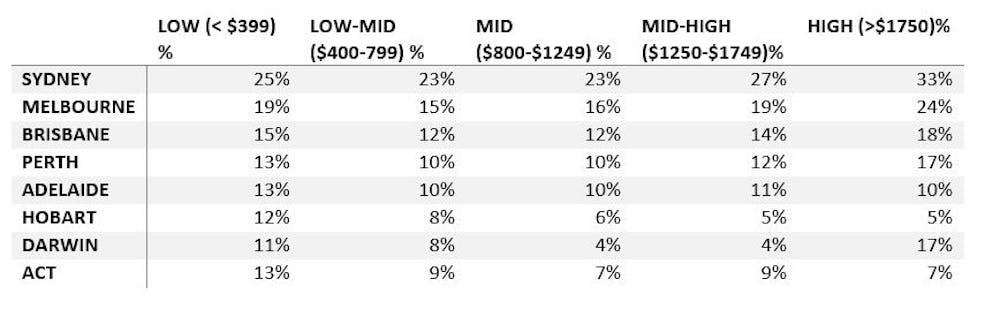
Current costs (including registration, club/facility fees, coaching and equipment) for the top 16 organised sports in NSW are shown in the following table:


Some NSW respondents believed junior clubs might have increased their fees after the government introduced its Active Kids program earlier this year. This allows families to apply for a A$100 voucher each year to offset sports fees for their children.

But other respondents said costs have been rising for years and government subsidies aren’t trickling down to many families or local sport clubs:

In rural/regional areas, facilities are poor to average. Local councils do not have the funds to adequately improve and refurbish existing facilities. In my area, new sporting facilities are too expensive for the local council to construct without major grants assistance. My local cricket club is relatively strong and well supported. However, at least one of the local clubs will fold due to the ever-increasing costs.

Cost as a barrier to sports participation

The impact of rising participation costs is being felt in a number of ways.

Our study showed that around 10% of respondents had borrowed money (not including credit cards) to participate in sports at an average of A$5,000 per person. Thirty-five percent of respondents also reported greater credit card debt due to sport fees.

Worryingly, participation costs were also found to be a major barrier for many children wanting to play sport. As one respondent told us:

We have two sons. Only the eldest gets to play sport because of the cost. There was absolutely no way we could find A$1,000 for rego two weeks after Xmas. The youngest just misses out. Totally unfair, but the fiscal reality. We have a mortgage to pay.

Nationally, sport participation rates increased slightly for school-aged children (15 years and under) outside school, from 20% in 2016 to 25% in 2017, according to AusPlay data released by the Australian Sports Commission.

But, again, income levels were a major factor when it came to participation rates. According to the AusPlay data, high-income families are far more likely to have children in sport programs (84%) compared to low-income families (58%).

AusPlay data also showed a slight decrease of 4% in adult participation in the 16 main organised sports across Australia from 2016-17.

More government funding needed

As has been argued many times before, investment in elite sport does not always drive grassroots participation.

Yet government funding is still being funnelled into major sport infrastructure projects at a disproportionate rate compared to grassroots funding.

Although the NSW government has backed down from its widely criticised plans to spend A$2 billion on a small number of elite stadiums, the revised budget only knocked A$500 million off the total cost.

Our survey respondents highlighted the cost to hire grounds as a contributing factor in increasing registration costs. On the positive side, the latest NSW budget includes an extra A$130 million in funding for Active Kids vouchers, along with A$100 million for regional sport infrastructure and A$100 million for facilities in greater Sydney. However, this funding seems insignificant when compared with the A$1.5 billion allocated to the major stadium development projects.


Read more: Sydney’s stadiums debate shows sport might not be the political winner it once was


Rather than increasing funding for elite sport, governments should invest more in subsidies to make sport participation more affordable. Rebates for children are a good start, but more subsidies are needed, particularly discounts or vouchers for larger families, those playing multiple sports and lower-income families. This will ensure that access to sport does not become a privilege reserved for the social elite and is open and accessible to all.

– Pay to play: is participating in sport becoming too expensive for everyday Australians?
– http://theconversation.com/pay-to-play-is-participating-in-sport-becoming-too-expensive-for-everyday-australians-101826]]>

Prisoners need drug and alcohol treatments but AA programs aren’t the answer

]]>

The Conversation (Au and NZ) – By Jarryd Bartle, Sessional Lecturer in Criminal Law, RMIT University

Prisons and drug use are closely linked. Two-thirds of Australian prisoners report using illicit drugs in the 12 months before they entered prison, compared with 12% of the general population in the previous 12 months. Around half of prisoners are likely to meet the criteria for substance dependence.

Some 18% of detainees reported alcohol and 32% reported illicit drugs directly contributed to their crime. The relationship is complex but there’s no doubt untreated alcohol and other drug problems are a key factor for reoffending.

Our report, What works in alcohol and other drug treatment in prison settings, published today, shows some interventions currently used in prisons have little evidence to support them.


Read more: Why Australian prisoners are smoking nicotine-infused tea leaves


Why is drug use so high among prisoners?

A causal link between alcohol and other drugs and offending has not been established.

It may be that people who are risky drinkers or who use illicit drugs are more likely to commit crimes. Or people who are at risk of criminal behaviour are more likely to be risky drinkers or use illicit drugs. Or there might be common underlying causal factors that make both more likely.

But there is a clear relationship between drug use and involvement in criminal activity, particularly:

  • offences related to illicit drug markets, such as illicit use, possession, selling or manufacturing
  • offences committed to acquire drugs, such as theft
  • offences related to being intoxicated on alcohol or other drugs, such as violent crimes.

Reducing harms

Harm reduction is one of the key strategies of Australia’s official drug policy. We know from history there will always be a small percentage of the population who use illicit drugs. Most do so for a short period and either stop on their own or go into treatment. Harm reduction aims to reduce harms to the person using and the community.


Read more: Women in prison: histories of trauma and abuse highlight the need for specialised care


Surveys indicate around 10% of prisoners use illicit drugs while in prison, and 6% use drugs by injection while in prison.

Harm-reduction measures, including prison needle and syringe programs and peer support, are effective in reducing overdoses. They also reduce the spread of blood-borne viruses, which in turn iprotects the public when prisoners are released.

Effective treatment

Individual or group cognitive behaviour therapy (CBT) that addresses both offending and substance use has had the most success in reducing reoffending. CBT programs can reduce the risk of recidivism among prison participants by around 25%.

Other well-supported interventions include:

  • therapeutic communities, which are live-in treatment settings
  • opioid substitution therapy such as methadone and buprenorphine
  • exit preparation programs such as pre-release centres, which gradually reintegrate offenders back into the community by helping them develop life skills and find work.

What’s less likely to work?

Twelve-step groups such as Alcoholics Anonymous (AA) and Narcotics Anonymous (NA) are often used in prisons but they do not have much evidence to support their use.

In the community, the success rate is as low as 8%.


Read more: Our $3b-a-year system is flying blind in supporting ex-prisoners


Contingency management, a behaviour therapy that focuses on the use of rewards for meeting treatment goals (the same principle behind star charts for kids), are used in some parts of the criminal justice system, such as drug courts.

Contingency management is effective in promoting abstinence in community settings, but there has been little evaluation of its success in prisons.

Other interventions with limited evidence for prison populations include mindfulness-based relapse prevention, and specialist treatment programs for alcohol-related offending.

The difficulty with treatment in prisons

Prisoners typically have many risk factors and therefore complex needs, making treatment more complex. Custodial sentences themselves increase an offender’s risk of recidivism. And prisoners have rates of mental health problems and personality disorders, and poor education levels.

Prison is a highly monitored and controlled setting. This creates an artificial environment during treatment and it’s difficult to know whether the skills learned in prison translate to the outside world, with its a broader range of temptations and stresses.

Many ex-prisoners experience periods of unemployment or homelessness after release, which drastically increases their risk of relapse. Post-release therapeutic support is therefore essential.

It’s in the community’s best interest to support people with alcohol and other drug problems in prison to reduce their substance use problems and their reoffending.


Linda Jenner, 360Edge principal consultant, contributed to this article.

– Prisoners need drug and alcohol treatments but AA programs aren’t the answer
– http://theconversation.com/prisoners-need-drug-and-alcohol-treatments-but-aa-programs-arent-the-answer-102268]]>

How the housing boom has driven rising inequality

]]>

The Conversation (Au and NZ) – By Ilan Wiesel, Senior Lecturer in Urban Geography, University of Melbourne

The Productivity Commission – the Australian government’s highly influential economic advisory body – released a report titled Rising Inequality? last week. The question mark indicates its scepticism about other research findings on rising inequality in Australia. The commission responded to its own question in the report’s very first heading: “Over nearly three decades, inequality has risen slightly in Australia”.

This conclusion has left commentators divided. Some have celebrated this finding. Others, such as Peter Whiteford and Ross Gittins, argued the true picture is more complex.


Read more: Don’t believe what they say about inequality. Some of us are worse off


We wish to point out one major flaw in the Productivity Commission’s conclusion. It ignores the deeply polarising impact of the housing boom on Australia in recent years. Our analysis shows that, once rent and mortgage costs are deducted, the rate of increase in average equivalised disposable income of the top 10% of households was 2.7 times faster than for the bottom 10% between 1988 and 2015.

On average, capital city house prices have doubled since 2003. This has benefited affluent homeowners and has disadvantaged lower-income households, especially those in long-term private rental.

Housing costs undermine gains for low-income households

We examined changes in income inequality using the same method and dataset that the Productivity Commission used, with only minimal technical differences. From 1988 to 2015, average equivalised incomes for households in the lowest 10% of incomes increased by 54%, compared with 85% in the highest decile. Such a difference is by no means “slight”.

However, to reveal the full extent of rising inequality, we conducted further analysis, deducting housing costs from income. This included both rent and mortgage repayments. The results were striking: from 1988 to 2015, average after-housing disposable incomes increased by only 30% in the lowest decile, compared with 81% in the highest decile.

This analysis shows that income inequality between the highest and lowest deciles nearly doubled once housing costs are taken into account. These costs hardly affected rising incomes for the top decile. For the bottom decile, housing costs nearly halved any gains in income over the same period.

Between these extremes, as the chart below shows, there is a very linear pattern across the spectrum. Housing cost impacts on disposable incomes decline as household incomes rise.

Rising gap in disposable income, before and after housing costs, 1988-2015. Authors’ estimates using:ABS Microdata: Household Expenditure, Income and Housing, 2015-16 (Cat. no. 6540.0, as at 3/08/18) and ABS HES Basic confidentialised unit record file for 1988-89 (as at 3/08/18)

Housing costs account for a much higher share of lower-income households’ income. Furthermore, at the bottom end of the distribution, renters have seen their rental costs increase. This has been fuelled by low vacancy rates and the absolute supply shortage of affordable rental housing.


Read more: Three charts on: poorer Australians bearing the brunt of rising housing costs


In contrast, at the upper end of the distribution, home buyers have seen their mortgage repayments decline. This is thanks to lower interest rates and the slow but typically steady reduction in housing costs across the life course as owners pay out mortgage debt. Outright owners have not been impacted by housing costs either way.

House price growth boosts gains for wealthier households

The housing boom also played a key role in the rise of wealth inequalities, which are more extreme than income inequalities.

The Productivity Commission’s report shows that, since the early 2000s, the wealth of households in the top 50% grew faster than the bottom half. The upper deciles experienced average annual growth close to 3%. In contrast, the bottom decile experienced negative growth.

By 2015-16, those in the top 10% owned 45% of wealth. The bottom half of the distribution owned just 11%.

Property ownership rates are higher in the middle and upper deciles. For these households, house price growth made a major contribution to rising wealth.

In contrast, property ownership rates are relatively low in the bottom deciles. These households saw little or no wealth gains from the housing boom.

The report’s headline claiming only a “slight” rise in inequality over three decades seems to ignore this widening wealth gap as a crucial aspect of the story.

A national affordable housing plan is needed

Over nearly three decades of economic growth, living standards have improved for Australians across the board. This is good news.

But inequality has also risen significantly, which is bad news. Inequality creates unfair advantage for wealthier households and is deeply damaging for the social fabric, democratic stability and economic drive of our society.


Read more: How rising inequality is stalling economies by crippling demand


Our analysis highlights the polarising impact of the housing boom, in two primary ways. Firstly, increasing housing costs undermined income gains for less affluent households. Secondly, house price growth increased wealth gains for more affluent households.

This analysis shows that rising inequality cannot be redressed without some redistribution of housing wealth and costs.

The Productivity Commission report commended the “equalising effect” of Australia’s progressive income tax. Including housing in our analysis, however, points to the polarising effect of taxation on wealth and housing. The tax system disproportionately benefits more affluent home owners and property owners.

An increased supply of affordable rental housing is crucial to reduce the gap in after-housing disposable income. Low-income private renters also need greater security of tenure, including more stringent controls on rent increases.

A renewed focus on affordable home purchase schemes for people on moderate incomes can help reduce the wealth gap. In addition, housing tax levers, used well, can help reduce both wealth and income inequalities over time.

– How the housing boom has driven rising inequality
– http://theconversation.com/how-the-housing-boom-has-driven-rising-inequality-102581]]>

Vital Signs: National accounts show past performance no guarantee of future results

]]>

The Conversation (Au and NZ) – By Richard Holden, Professor of Economics and PLuS Alliance Fellow, UNSW

Wednesday’s GDP figures were good. Growth was up 0.9% in the June quarter and 3.4% over the past 12 months.

As they say in baseball: “You can’t boo a home run.” But you can ask how likely the batter is to do it next time. The detail behind the figures raises further questions.

How good were they really?

Even before we get to that, it’s worth noting than GDP per capita was up 0.5% in the quarter, amounting to a 1.8% increase over the year. That’s good, but half as much as headline growth. Per capita growth is what drives living standards.

Even on an annual basis per capita growth bounces around. The following chart shows it is usually less than 2% and only occasionally reaches 3%, but never too far from zero – even excluding the GFC.

Growth per capita is volatile in no small part because immigration is volatile.

Standard economic theory tells us that in the long run immigration has very little impact on GDP per capita unless it drives a shift in the population’s mix of skills.

But in the short run it depresses GDP per capita because the fixed capital (such as buildings and machines) has to be shared between more workers.


Read more: Australia could house around 900,000 more migrants if we no longer let in tourists


Since immigration is somewhat lumpy, and the skill mix is neither obvious nor constant, there can be pretty substantial swings in GDP per capita in a high-immigration economy. At 1.6% per annum, Australia’s population growth is roughly double the OECD average, so it’s best not to get too hung up on the quarterly numbers.

Good for how long?

The larger and more pressing question in whether this quarter’s good numbers will last.

There are reasons to be sceptical. First, household expenditure was a key component of the recent growth numbers. As ABS chief economist Bruce Hockman put it:

Growth in domestic demand accounts for over half the growth in GDP, and reflected strength in household expenditure.

We’ve been sustaining strong household expenditure by saving less, but that’s unlikely to continue.

In an economy in which heavily indebted households face mortgage rate hikes from two of the big four banks (most likely to be four very soon) despite no official increase in interest rates, household spending will come under pressure.

Wages growth is still languishing at around 2% (the most recent wages price index came in at 2.1%), meaning that households aren’t earning much extra income.

Add to this a lower Australian dollar putting pressure on the price of imports –such as mobile phones, iPads and computers, to name a few – and it seems brave to predict continued robust consumer spending.

Special for how long?

It is also worth being a bit cautious about the case for Australian exceptionalism. Yes, we’ve had a run of 27 odd years of continuous economic growth. Yes, we weathered the financial crisis better than most.

But we are also part of a global economy that is yet to see the full effects of the Trump trade war. And we are subject to the same sort of pressures that other advanced economies are facing: stubbornly low wages growth despite historically low unemployment, inflation that won’t grow, and an uncertain outlook for China – our most important trading partner.

How Australia compares. Commonwealth Treasury

Can we really return to the trend growth rates of the 1990s while the countries we compare ourselves with struggle? I hope so, but I doubt it.

The newly minted treasurer, Josh Frydenberg, couldn’t help but take credit for this week’s good news. Fair enough. But he might want to be cautious. Quarterly numbers have a habit of reversing themselves. And with an election not too far away it’s politically risky to tie oneself too closely to the vagaries of the macroeconomy in general and the forecasts of Treasury and the Reserve Bank in particular.

Reserve Bank Governor Phil Lowe might have mentioned that to Frydenberg in their much photographed recent meeting.

– Vital Signs: National accounts show past performance no guarantee of future results
– http://theconversation.com/vital-signs-national-accounts-show-past-performance-no-guarantee-of-future-results-102717]]>

Friday essay: the rise of the ‘bin chicken’, a totem for modern Australia

]]>

The Conversation (Au and NZ) – By Paul Allatson, Associate Professor, Faculty of Arts and Social Sciences, University of Technology Sydney

A t-shirt with an ibis motif. Courtesy Michelle Andersen

In just a few decades, the Australian White Ibis (Threskiornis molucca) has made itself at home in many of Australia’s coastal and inland cities. And aside from the feathered birds we see daily (often foraging amongst garbage), representations of ibis have exploded in popular culture. The humble ibis, it seems, has gone viral.

From ibis tattoos to artworks to TV series, this often maligned bird has become a cultural phenomenon, bordering on a national obsession. This ibis juggernaut says a lot about Australian identity and culture in the 21st century – and human-animal relations in a time of environmental threat and uncertainty.

Ibis have entered the Australian English lexicon as “bin chickens”, “tip turkeys”, “sandwich snatchers” and “picnic pirates”, to name just four of their many nicknames.

They can be found splashed across clothing; probing human rubbish in cartoons and poetry; on cups and tea towels, in children’s books and the daily press. Hundreds of ibis-centred objects are for sale online, including gift cards and tote bags.

Ibis adorn murals, in Victoria, Sydney, and Perth. In Queensland, a baker recently made a cake depicting an ibis eating out of a garbage can commissioned for a 21st birthday.

Ibis mural by Scott Marsh in Teggs Lane, Chippendale, Sydney. Courtesy Ilaria Vanni

There is a new vogue for ibis tattoos, especially among schoolies in Surfers Paradise and nostalgic Australians. And a prototype for an inflatable ibis for swimming pools, created by a local designer and advertised as “an Aussie icon”, was crowd funded in early 2018.

Inflatable ibis. Courtesy Casey/Big Bird Designs, Queensland

Even the Sydney office of Alliance Francaise loves the bin chicken: in a witty 2017 marketing exercise it compared Paris and Sydney and the birds (pigeon and ibis respectively) that symbolised them.

Alliance Francaise Sydney ibis. Copyright Julvelyn Samson 2017

Not everyone loves an ibis. Almost 8000 people registered for the International Glare at Ibises Day in Sydney on December 21 2016. This event asked people to “gather in your local park and glare and show general distaste towards Ibises”.

More positively, the “bi” in bin-chicken was also enlisted in support of the same-sex marriage plebiscite in 2017 with an ibis-themed dance performance. And the ibis came second in a 2017 vote for Australia’s most popular bird, organised by Birdlife Australia and The Guardian. (It was pipped at the post by the Australian magpie.)

Ibis now flourish across digital media platforms, where there is a growing list of online pro and anti-ibis films and songs.

The expletive-laden Australian Song About Birds by the Van Vuuren Brothers finds the “bin-drinking”, “scabby” and “alien” ibis wanting. The song has had nearly three million YouTube views.

On the other hand, Songtourage’s gentle ballad, Song for My Daughter (Who is an Ibis), rejects violent, anti-ibis sentiment.

Australia is clearly embracing its White Ibis with passion, wit, and, in equal measure, affection and disgust. This phenomenon, we argue, has an intriguing environmental, genetic and historical backdrop.

The ‘sacred’ ibis

Often dismissed as an introduced vagrant, the Australian White Ibis is one of three ibis species found here. With that status comes legal protection. Many urban Australians are unhappy to learn about ibis nativity. They want local authorities to remove “immigrant” ibis from their neighbourhoods.

Gracius J. Broinowski, The three Australian species of ibis, in The Birds of Australia, 1890. Wikimedia Commons.

A generation ago it was rare to see ibis in Australia’s cities. Now they are thriving on the endless waste our cities provide. Small ibis colonies were established by conservationists in the early 1970s in places like Sydney’s Taronga Zoo and Healesville Sanctuary in Victoria.

Ibis also migrated from interior wetlands to the coasts of east and southeast Australia and the southwest. That migration was forced by drought and habitat loss, which have caused huge declines in inland ibis numbers. Sydney’s ibis population today is estimated at about 10,000. Brisbane’s population is less stable, hovering around 5,000. More research is needed to know the size and health of other urban populations.

Edwin Long, Alethe Attendant of the Sacred Ibis in the Temple of Isis at Memphis, 1888. Location unknown. Wikimedia commons.

Intriguingly, the migration of ibis from traditional wetlands parallelled changes in scientific thinking about the bird. Between the 1970s and the 1990s, the Australian White Ibis was classified as the Sacred Ibis, the same species worshipped in ancient Egypt as an emblem of Thoth. This God was responsible for maintaining the universe, judging the dead, and overseeing systems of magic, writing and science.

Mummified ibis © Australian Museum.

Thoth was often depicted with an ibis head. Because of this association, as Georges Cuvier wrote in 1831, Egyptians let ibis “stray unharmed through their cities”. Sacred Ibis were also mummified; there is a stunning example in the Australian Museum.

Today, however, the Australian White Ibis is regarded as its own species, close kin of the Sacred Ibis. Many older Australians still refer to our white ibis as sacred. A different order of sacredness inspires Indigenous representations of ibis, an example being ceramic work by the Queensland artist Thanakupi.

The ibis and the artist

In our research, we have been struck by how Australian artists work with the ibis backstory of sacredness, resilience and survival. These artists are commenting on the urban life and times of ibis, and the bird’s new, precarious, celebrity status.

Clive, Janice and Derek are the stars of the 2018 online TV animated series, Bin Chickens. Targets of human rage against ibis as abject and filthy, the trio struggles to survive in Sydney’s overly cemented Darling Harbour. In vain they also try to recover their lost God-head status. The series, funded by Screen Australia and the ABC, is a sardonic sendup of rampant urban development and its ecological costs. The first episode alone has had more than 30,000 viewers.

For many artists, ibis-human interactions are emblematic of Australia’s new multi-species urban ecologies. Sue Pedley’s installation “Rolling Musical Screech” (2017) featured street signs of birds, and celebrated the sensory contributions ibis make to the contemporary city.

Australian artists also regard ibis as a bellwether species that makes links between habitat loss, climate change and excess human consumption. Sydney-based Linden Braye literally channelled ibis when foraging for waste, and sending up human wastefulness, in her 2016 film, Ibis.

Excerpt from Linden Braye’s Ibis.

One artistic response to ibis has attracted millions of viewers across social media platforms: the 2017 mockumentary, Planet Earth: Bin Chicken, directed and produced by David Johns and Matt Eastwood. The film parodies the David Attenborough wildlife documentary, in which animals rarely live alongside humans.

Planet Earth: Bin Chicken cleverly shows how urban ibis challenge the myth of a city-wilderness divide. Here, moreover, urban Australia is facing a deadly rubbish overload. The winner in this tale of ecological ruin and over-consumption is the ibis, shown god-like at the film’s end as the new overlord of Planet Bin Chicken.

All this ibis anthropomorphism raises questions about how we interpret new human-animal relations in the Anthropocene: the current geological epoch forged by humans and our devastating environmental impact. The ibis is not alone among animals across the world that are adapting to life beside humans. But few species attract human attentions as ibis now do in Australia.

Ibis seem to have supplanted other once iconic species in the Australian imagination. Despite the plight of many koala populations due to deforestation, especially in Queensland, that animal is not featuring in our everyday cultural debates.

And the red kangaroo and emu of the national crest are also being overlooked, even in a time of severe drought that is now depleting inland populations.

A new coat of arms for Australia? Courtesy Fresh Baked Threads. Author provided (No reuse)

The Australian White Ibis is a native bird that is on the move. Ibis remind us everyday of the environmental challenges we all face. Their tenacity and fearlessness as environmental refugees mean that they attract intense visceral rejections and groundswells of affection alike.

Ibis have infiltrated our daily speech and our cultural consciousness. Indeed the ibis is fast becoming the new animal totem for thinking about the very idea of “Australia” today.

– Friday essay: the rise of the ‘bin chicken’, a totem for modern Australia
– http://theconversation.com/friday-essay-the-rise-of-the-bin-chicken-a-totem-for-modern-australia-100673]]>

Grattan on Friday: Morrison ticks the boxes but can’t hide the dysfunction

]]>

The Conversation (Au and NZ) – By Michelle Grattan, Professorial Fellow, University of Canberra

Scott Morrison is approaching a prime ministership that fell into his lap in the tactical manner you might expect from the NSW Liberal party director he once was. Take this week.

First, he seized the Howard barnacle scraper, dumping the plan to lift the pension eligibility age to 70. Not because it was bad policy, but because it could lose votes.

Then there was the “back to Menzies” speech. All Liberal leaders feel the need to touch those spiritual bones – this time that came with a pilgrimage to Albury, the site of one of the party’s founding conferences.

Invoking Menzies is a gesture to the faithful. But Morrison’s preacher-style stump speech sent some wider messages.

We heard again his mantra of “a fair go for those who have a go”. The exhortation to “make a contribution, not to seek one” is a version of Joe Hockey’s “lifters and leaners” (which Hockey got from Menzies).

“We’ve got to look after our mates”, Morrison said, to flag he believes in the social safety net and Medicare.

There was a pitch about inclusion: “you love all Australians if you love Australia” – whether they “rocked up” in chains like his forebears or arrived last week.

And as for the peskies who demand gestures like getting out of the Paris climate accord: don’t worry about Paris, he’s saying, “we’ll absolutely be able to deal with our present target out to 2030 with no impact on electricity prices at all.”

In his neat must-do list, Morrison has already visited both a drought area and our most important big neighbour. He spurned some little neighbours by bypassing the Pacific Islands Forum in Nauru, a difficult meeting, given their views about climate change, and the backdrop of refugees. But he’d reckon Australian voters wouldn’t care or even notice that he didn’t go.

In copybook terms, it’s hard to fault Morrison’s first fortnight, if you can get past his description of events that tore down a PM as “that Muppet Show”, and swallow any cynicism about his carefully crafted choreography.

But stand back, and you see a wider shambles.

The leaks this week have been prolific, distracting and damaging.

The Liberal women are seriously up in arms, about both bullying and female under-representation.

The blokes felt they could dismiss the complaints of backbenchers Julia Banks and Lucy Gichuhi, either by denying their substance or with platitudes. But the coup had blown the lid off longer-held grievances and created some fresh deep resentment.

The Minister for Women, Kelly O’Dwyer, weighed in, followed by Julie Bishop. If Bishop is on your political tail, be very afraid.

In a swingeing speech the former Liberal deputy condemned unacceptable behaviour in Canberra, flatly rejected the “nothing to see here, move on” line, and delivered a tough message on women.

“I say to my party … it is not acceptable for us to have in 2018 less than 25% of our parliamentarians as female. It is not acceptable for our party to contribute to the fall in Australia’s ratings from 15th in the world in terms of female parliamentarian representation in 1999, to 50th today”, Bishop said.

On another front, the controversy over Peter Dutton’s use of his ministerial discretion in granting visas to au pairs is spinning out of control. While he’s the one in the political dock, it is a collective problem because Dutton – the coup instigator – remains a senior minister.

The issue is whether Dutton’s decisions were responses to representations from people he knew. He had denied any personal links but information contradicting that denial has come out.

The au pair affair on Thursday burst into a bitter public fight between Dutton and his former Australian Border Force chief Roman Quaedvlieg.

Quaedvlieg wrote to the Senate inquiry into Dutton’s conduct claiming that in June 2015 he was called by Dutton’s chief of staff, Craig Maclachlan, who said “the boss’s mate in Brisbane” had run into a problem with a prospective au pair – she had been detained with a visa problem. The “boss’s mate” was a man Dutton had worked with in the Queensland police force.

In a blistering counter attack, Dutton accused Quaedvlieg of “fabrication of evidence to a Senate committee”. Dutton said Maclachlan didn’t even work for him at the time; he also suggested Quaedvlieg had mental health issues.

Apart from the au pair affair, a question mark remains over whether Dutton could be in breach of the constitution’s section 44, relating to pecuniary interests, because of a family trust that gets funds from a child care business, which in turn receives government moneys.

At a policy level, the Morrison government has a serious gap at the heart of its agenda.

A few weeks ago the Turnbull government was on the brink of clinching a National Energy Guarantee that commanded wide support from business and opened the prospect of providing investment certainty. Now energy policy is back to chaos.

The emerging policy is little more than a collection of “big sticks”, including threatened divestment and even a possible royal commission, designed to force companies to lower prices.

Some on the Liberal right and among the hardline commentariat continue to make withdrawal from Paris a benchmark. Morrison won’t do that but his attitude is, please let’s not talk emissions. At the Pacific Islands Forum, Australia sought to water down the climate language.

As for certainty, there is less than before and without doubt much less than the NEG promised.

Sarah McNamara, CEO of the Australian Energy Council, which represents generators and retailers, says recent events have “impacted negatively [on investment prospects] because the uncertainty we have been dealing with now looks set to continue.

“And it’s dawning on us that the critical bipartisanship that’s needed may be impossible to achieve even in the medium term”.

As we move towards an election, certainty on another front will come front and centre.

Morrison, the ultimate pragmatist, will throw everything at winning. But if he managed to do so, against the odds, how would he govern after the election?

In the early days of the Turnbull government, Morrison was casting himself as a reformer, including promoting changes to the GST. But he is not expected to go to next year’s election with a robust reform program.

If he has a small-target strategy, Labor will claim he’s the wolf in sheep’s clothing – a classic scare campaign. Morrison will have to convince voters his word is his bond.

Would a re-elected Morrison have a new tack post election? He wouldn’t be the first PM to say one thing pre poll and another afterwards. But on the other hand he saw what happened to Tony Abbott when he broke his pre-election promises. He never got over it. Malcolm Turnbull was always careful in sticking to his pledges.

If before the election Morrison locks himself out of a serious reform agenda, the hands of a post-election Coalition government would be tied – unless Morrison were willing to go back on his undertakings and risk the consequences.

– Grattan on Friday: Morrison ticks the boxes but can’t hide the dysfunction
– http://theconversation.com/grattan-on-friday-morrison-ticks-the-boxes-but-cant-hide-the-dysfunction-102805]]>

Climate change tops action at Forum in spite of Canberra’s resistance

]]>

Nauru … host nation of the 49th Pacific Islands Forum leaders summit. Image: John Pulu/Tagata Pasifika

Pacific Media Centre Newsdesk

Climate change, labour mobility and West Papua are some of the issues that Vanuatu played a key part in discussions during this week’s Pacific Islands Forum leaders summit meeting in Nauru.

Foreign Affairs Minister Ralph Regenvanu, who was part of Vanuatu’s delegation attending the just-ended Forum meeting, said the issue that was discussed more than anything else was climate change, reports the Vanuatu Daily Post.

He said there was a bit of tension as all Pacific Island Countries recognise that climate change is the single biggest threat to the survival of Pacific people but one member of the Forum does not recognise that it is a threat and is not taking any action on it.

READ MORE: Australia signs declaration on Pacific climate ‘threat’ – islands call on US to return to Paris deal

49th PACIFIC ISLANDS FORUM COMMUNIQUE

That member is Australia.

The United States, a dialogue partner of the Forum, has similar views on climate change to Australia in terms of not sticking to the Paris Agreement.

-Partners-

Regenvanu said Australia’s stand may be due largely to Australian domestic politics, the Daily Post reports.

He said all Pacific island countries in the Forum were moving in one direction on climate change – and Australia alone in the other direction.

Another issue Vanuatu was part of in Nauru were the agreements signed with Australia for the next stage of labour mobility to get semiskilled ni-Vanuatu to work in hospitality and aged care sectors as well as an agreement to allow Vanuatu to test certain medicines used in hospitals in Vanuatu in Australian laboratories.

On the issue of West Papua, Regenvanu said a resolution would be put before the UN General Assembly next year for West Papua – or what used to be called the Netherland New Guinea’s case – to be re-enlisted with the UN Decolonisation Committee.

He said he had informed his foreign affairs minister colleagues in Samoa last month that Vanuatu would be be tabling the resolution in the United Nations.

He called on Pacific Island countries to support the resolution.

Regenvanu said only Papua New Guinea, Fiji and Australia were not in support of the West Papua proposal.

Print Friendly, PDF & Email

Article by AsiaPacificReport.nz

]]>

Needless medical procedures: when is a colonoscopy necessary?

]]>

The Conversation (Au and NZ) – By Suzanne Mahady, Gastroenterologist & Clinical Epidemiologist, Senior Lecturer, Monash University

From time to time, we hear or read about medical procedures that can be ineffective and needlessly drive up the nation’s healthcare costs. This occasional series will explore such procedures individually and explain why they could cause more harm than good in particular circumstances.


A recent study found around 30% of all procedures performed in a New South Wales hospital were either unhelpful or harmful. Some of these, which included performing a colonoscopy for constipation, were becoming more prevalent.

A colonoscopy is a test where a small, flexible tube is inserted into the bowel to check for abnormalities such as growths on the bowel, which can lead to bowel cancer.

Around 600,000 colonoscopies were performed in Australia in 2013-2014. This figure is expected to rise to more than a million a year by 2020, equivalent to one in every 25 Australians.

A colonoscopy is an invasive procedure and comes with risks, including bowel perforation. So, it’s important to have the test only if you’re likely to benefit from it.

Why are colonoscopies performed?

Bowel cancer is the second-most-common cause of cancer-related death in Australia. Current evidence suggests colonoscopy significantly reduces the risk of bowel cancers. This is where colonoscopy’s greatest benefit lies. Colonoscopy can also be used to diagnose inflammatory bowel diseases.


Read more: Explainer: what is inflammatory bowel disease?


Bowel cancers start out as small growths in the bowel called polyps. These can be seen with a colonoscopy and cut out by doctors during the test.

A colonoscopy can check for polyps, which are small growths on the bowel. from shutterstock.com

So, colonoscopy is more worthwhile when done in people at an increased risk of bowel cancer. The most important risk factor is age, as cancer rates increase in people older than 50.

But some younger people can be at risk due to family history. And recent data suggest bowel cancer in young people is rising here and internationally, though we’re not sure why.

Who should have a colonoscopy?

A doctor will usually recommend a colonoscopy if patients are at increased risk of bowel cancer due to family history (particularly first-degree relatives who develop bowel cancer before the age of 55), if their “poo test” is positive for blood, or if they have concerning symptoms such as bleeding.


Read more: Pre-cancerous: warning sign or cause for panic?


An Australian study tried to determine which symptoms could best predict bowel cancer. The authors collected data on around 8,000 patients with a range of symptoms – including rectal bleeding and constipation – undergoing colonoscopy. They followed them to see who was diagnosed with a cancer (or a large polyp) during the colonoscopy.

They found that, apart from age, rectal bleeding was the strongest predictor of bowel cancer. Other common symptoms such as abdominal pain or constipation alone were not associated with bowel cancer, suggesting colonoscopy in these cases was unnecessary. These findings have been replicated in other studies.

When not to have a colonoscopy

Small polyps grow slowly and may take ten years or longer (if at all) to develop into bowel cancer. This is why it is considered inappropriate to continue screening in people aged over 75.

International speciality groups don’t recommend ongoing screening when life expectancy is less than ten years, because many people will not benefit. And they will be exposed to the risks of colonoscopy, including bowel perforation and major bleeding. Australian guidelines also recommend stopping colonoscopy in people aged around 75.


Read more: Costly and harmful: we need to tame the tsunami of too much medicine


In young people, colonoscopy is often performed to look for inflammatory bowel disease, but new non-invasive stool tests can select out people at higher risk. Young people with irritable bowel syndrome may also undergo repeated colonoscopies to try to find an alternative reason for their symptoms, but this strategy is usually unhelpful.

Why are colonoscopies on the rise?

Australia’s population is ageing and the number of people older than 55 is increasing.

Consumer demand can also drive unnecessary testing. Evidence shows that people frequently overestimate the benefits and underestimate the harms of tests such as colonoscopy. Often there’s a misconception that more tests and more health care leads to better health, when data suggest the opposite is true.

The global Choosing Wisely campaign aims to educate consumers about risks of over-testing. In the future, symptoms-based algorithms and new diagnostic tests might improve a doctor’s ability to identify those at increased risk of bowel cancer for colonoscopy.

In the meantime, prioritising colonoscopy for patients who are at higher risk should be the goal.

– Needless medical procedures: when is a colonoscopy necessary?
– http://theconversation.com/needless-medical-procedures-when-is-a-colonoscopy-necessary-102576]]>

World politics explainer: the assassination of John F. Kennedy

]]>

The Conversation (Au and NZ) – By Lloyd Cox, Lecturer, Department of Modern History, Politics and International Relations, Macquarie University

This is the third in our series of explainers on key moments in the past 100 years of world political history. In it, our authors examine how and why an event unfolded, its impact at the time, and its relevance to politics today. You can read parts one and two here.


At precisely 1pm on November 22, 1963, the 35th president of the United States was pronounced dead at Parkland Hospital Trauma Room 1 in Dallas, Texas.

John F Kennedy’s personal physician stated the cause of death was a gunshot wound to the head. This was officially announced to a stunned public half an hour later. The shock waves of the president’s assassination, the fourth in US history, continue to reverberate today.

What happened?

While the events of that day have been the subject of numerous conspiracy theories, the basic facts are now widely accepted. The president’s motorcade was making its way through Dealey Plaza in downtown Dallas when, five minutes from its destination, three shots rang out from behind and above the presidential limousine.

Two of those shots found their mark, with the second being fatal. Texas’s Democratic governor, John Connally, who was seated immediately in front of the president, was also hit, though he would recover from his injuries.

Kennedy funeral procession, November 1963. JFK Library/Wikicommons

Seventy minutes after the attack, Dallas police arrested Lee Harvey Oswald, a former US marine who had spent three years in the Soviet Union. However, before Oswald could be properly questioned on his motives, less than 48 hours after the assassination of the president, Oswald himself was also dead.

He was gunned down on live television by Jack Ruby, a Dallas nightclub owner with links to organised crime. This inspired generations of conspiracy theorists for whom the Kennedy assassination was an expression of unidentified malevolent forces threatening the United States.

The impact of the assassination – speculations about a second gunman?

One of the most ubiquitous and apparently plausible of the conspiracy theories floating around was that there was a second gunman, and that both he and Oswald were part of a wider circle of conspirators.

Despite the Warren Commission, which had been set up by new President Lyndon Johnson to investigate Kennedy’s murder, stating in September 1964 that Oswald was a “lone gunman” and was not part of any domestic or international conspiracy, this conclusion was not widely accepted until the mid 1970s.

Several developments that cast doubt on the lone gunman thesis include a Senate Select Committee established to investigate “Governmental Operations with Respect to Intelligence Activities” in 1975. It asserted that investigations of the assassination by both the FBI and CIA had been deficient, and that some fundamental evidence had not been forwarded to the original Warren Commission.

Furthermore, Abraham Zapruder’s now famous 26-second silent home movie of the killing was also released to public scrutiny in 1975.

The heavily scrutinised final moments of Kennedy’s life.

To the untrained eye, the film seems to show that the fatal second shot came from the front of the president’s car. His head snaps back and bodily matter is projected to the rear. Viewed in conjunction with conclusions from the Senate and House Committees, this was presumed by many to validate the claim that a second shooter had fired from the infamous “grassy knoll” to the right and front of the presidential cavalcade.

Subsequently, the theory that a second assassin fired a fourth shot was conclusively falsified. The United States House Select Committee on Assassinations (HSCA) had acquired a police radio channel dicta belt recording of a motorcycle officer who had been part of the cavalcade. When this evidence was reexamined by independent acoustic research experts, they unanimously agreed that the apparent fourth shot was not a shot at all.

Similarly, after reviewing the evidence, ballistic, forensic and medical experts have repeatedly drawn the conclusion that the entry and exit wounds on the president were consistent with having been shot from the rear rather than the front.

So we can conclude with a very high degree of certainty that Oswald was the sole gunman who shot Kennedy. But it does not follow that the conception and planning of the assassination was that of Oswald’s alone.

Michelle Obama (left), Barack Obama, Bill Clinton and Hillary Clinton laying a wreath on the 50th anniversary of Kennedy’s assassination. EPA/Pat Benic

The JFK Act

As a result of renewed interest generated by the Oliver Stone film, JFK, Congress passed the JFK Act in 1992. This led to the public release of over 4 million pages of documents pertaining to the assassination.

It was on the basis of an exhaustive analysis of this material, in conjunction with all of the earlier government reports and secondary literature, that David Kaiser published the first book about the assassination written by a professional historian with all of the archival evidence available to him.

The Road to Dallas: The Assassination of John F. Kennedy cites archival evidence that firmly links Oswald to a network of organised crime figures, anti-Castro Cubans and far-right political activists, all of whom had motives for wanting the president dead. While its conclusions are not watertight, the book’s judicious judgements provide the most compelling account yet that Oswald acted as part of a broader conspiracy.

Kaiser’s essential argument is that a cabal of organised crime figures and anti-Castro Cuban exiles most likely recruited Oswald to be the trigger man in an attempt on the president’s life.

The interests of organised crime figures, many of whom had had commercial operations in Cuba disrupted by the revolution, coincided with those of wealthy anti-Castro Cubans who had been exiled to the United States.

Robert (left), Ted and John Kennedy posing for a photo together. Wikicommons

Both groups were profoundly hostile to Kennedy and his brother, Attorney-General Robert Kennedy. Their administration had not only failed to invade Cuba and restore mob and Cuban private property, it had also waged a relentless campaign against particular organised crime figures.

There is solid evidence that Oswald had direct or indirect contact with at least two such figures, while also being in contact with a wider group of anti-Castro activists.

Kaiser surmises that the overlapping networks of mobsters and Cuban exiles hoped that the assassination of Kennedy, for which Oswald would be paid handsomely, would provoke a US invasion of Cuba and the restoration of their private property and commercial operations.

This, of course, did not happen. Instead, there was a very different set of short and long term consequences.

Contemporary relevance

In the short term, the new president, Johnson, seized the opportunity offered by a nation’s grief to crush the Republican challenge at the 1964 election. He used that result as a mandate to vigorously pursue his liberal, Great Society programme and civil rights agenda, which greatly expanded the role of government and advanced the rights of African-Americans and other ethnic minorities.

Longer term, it was Johnson’s liberal programme that provoked a conservative, white backlash that would gather strength under the presidencies of Richard Nixon and Ronald Reagan.

Lyndon Johnson taking the oath of office as Jacqueline Kennedy looks on. Wikicommons

In the 1968 and 1972 presidential elections, Nixon adopted his infamous “Southern strategy”. It deployed the coded racial language of “states’ rights” to split away white southerners from the Democratic Party whom they had traditionally supported.

Nixon’s law and order rhetoric simultaneously appealed to the anxieties of what he claimed was a “silent majority”, who had been shaken by urban turmoil and the assassinations of John and Robert Kennedy, and Martin Luther King Jr. Respectable fears and the politics of race converged with paranoia stoked by conspiracy theories involving all of these assassinations.

This white backlash and the realignment of many white working and middle class Americans to the Republican Party accelerated in the 1980s under President Reagan, and was consummated in the 2000s during the presidencies of George W. Bush and Barack Obama.

Donald Trump (left) and Barack Obama meeting in the Oval Office, 2016. EPA/Michael Reynolds

A significant sub-section of white America could not reconcile themselves to the legitimacy of a black president after 2008. This expressed itself in the “birther” backlash against Obama, and the generalised hatred that greeted the new president from the political right.

It is that same backlash, albeit taking new forms, that we today witness in the strange spectacle of Donald Trump’s presidency.

Trump had been a central protagonist in the birther controversy, and has consistently played on race-based fears and prejudice to energise his supporters.

Where once Nixon and Reagan spoke in the coded racial language of states’ rights, Trump now speaks in the forthright language of stopping Muslim immigration, kicking out Mexican murderers and rapists, and building walls between us and them.

The vindictive, emotional politics of fear and rage is his standard currency. He has concentrated in his rhetoric and actions the most noxious elements of American politics in the half century that has passed since Kennedy’s untimely death.

The political reverberations of the Kennedy assassination, then, continue to be felt in all sorts of unlikely ways.

The paranoid, racialised and faux anti-elitist politics of the American right did not begin with the backlash against Kennedy and his administration. But his presidency and assassination, and the anxious political forces it set in motion, are an important milestone in their development. The American right today, with Trump as its figurehead, is the direct political descendant of this dark chapter in American history.

– World politics explainer: the assassination of John F. Kennedy
– http://theconversation.com/world-politics-explainer-the-assassination-of-john-f-kennedy-100449]]>

Morrison’s return to surplus built on the back of higher tax – Parliamentary Budget Office

]]>

The Conversation (Au and NZ) – By Saul Eslake, Vice-Chancellor’s Fellow, University of Tasmania

First, the good news. The Parliamentary Budget Office’s latest medium-term budget projections provide independent reassurance that the government’s personal income tax cuts, announced in the May budget and passed through parliament in June, can be funded without pushing the budget back into deficit.

But they also sound warnings about the downside risks from weaker-than-assumed economic or wages growth, and from any relaxation of the spending restraint that successive governments have maintained since 2012.

More income tax

The PBO projects the federal government’s “underlying” cash balance to improve from 0.8% of GDP in 2021-22, the last year of the latest budget’s forward estimates period, to 1.3% of GDP in 2028-29.


Read more: Budget policy check: does Australia need personal income tax cuts?


That’s after allowing for the revenue forgone by the tax cuts. Without these, and in the absence of any other spending or revenue measures, the surplus would have reached 3.7% of GDP (my calculation, not the PBO’s), largely on the back of the “bracket creep” that would have occurred without some form of personal income tax cuts between now and then.

Even so, there’s an awful lot of bracket creep.

Projected change in average income tax rates by quintile. Parliamentary Budget Office, 2018-19 Budget: Medium-Term Projections (September 2018), CC BY

The average tax rate across all taxpayers is projected to increase from 22.9% to 25.2% – that is, by 2.3 percentage points. For taxpayers in the second and middle quintiles (the middle fifth and the second-to-bottom fifth) it’s even worse. They will see their average rates rise by more than 4 percentage points. The average tax rate for those in the top and bottom quintiles will climb by less than 1 percentage point.

The PBO’s projections allow for only slight additional relief; small reductions in 2027-28 and 2028-29, worth about 0.4% of GDP, to ensure tax receipts remain within the government’s “cap” of 23.9% of GDP in the final two years of the 10-year projection period.

A helpful backdown on company tax

The PBO’s forecasts don’t allow for the government’s recent decision to abandon the previously proposed cut in the corporate tax rate for companies with annual turnover exceeding $50 million, which it had been unable to pass through the Senate. That would add the equivalent of almost 0.5 of a percentage point of GDP to the surplus by 2028-29, unless offset by other measures (which it probably will be).


Read more: The full story on company tax cuts and your hip pocket


By law, the PBO is required to use the same economic assumptions in framing its medium-term projections as those used in the most recent federal budget.

Wishful economic thinking

These requirements mean the projections are conditioned on, among other things, “above-trend economic growth for much of the period” and “a return to close to trend wages growth” by 2021-22.

This week’s national accounts data lend some near-term support to the first of these assumptions, but they (and other data) cast further doubt on the likelihood of wages growth returning to trend in line with the budget assumptions.


Read more: This is what policymakers can and can’t do about low wage growth


The PBO notes that, as a direct result of the government’s personal income tax plan, any weakness in future tax receipts flowing from “weaker economic circumstances” will “flow through directly to the budget bottom line”.

A decade of tight spending

The report highlights the importance of policy decisions in stemming the flow of new spending decisions and tightening eligibility for benefit payments since 2012.

Much of the impact of these will show up more clearly over the next decade. Apart from three areas – the National Disability Insurance Scheme (NDIS), aged care and defence, on which spending is projected to rise by a little over 1 percentage point of GDP over the next decade – other government spending is projected to fall by around 2 percentage points of GDP between 2017-18 and 2028-29.


Read more: Government spending explained in 10 charts; from Howard to Turnbull


The PBO notes that “the spending restraint seen over the past few years … may be increasingly difficult to maintain with an improving budget outlook”.

(Unintentionally) highlighting that risk, the PBO explicitly notes that the proposed further increase in the pension eligibility age to 70 between 2023 and 2035 – which the government abandoned this week – was “projected to have a significant impact on Age Pension spending … over the next decade”.

– Morrison’s return to surplus built on the back of higher tax – Parliamentary Budget Office
– http://theconversation.com/morrisons-return-to-surplus-built-on-the-back-of-higher-tax-parliamentary-budget-office-102712]]>

Coal does not have an economic future in Australia

]]>

The Conversation (Au and NZ) – By Frank Jotzo, Director, Centre for Climate Economics and Policy, Crawford School of Public Policy, Australian National University

Renewables are stealing the march over coal in Australia, and the international outlook is for lower coal demand. Today the international Coal Transitions project released its findings, based on global coal scenarios and detailed case studies by teams in China, India, South Africa, Australia, Poland and Germany.

Our research on Australian coal transition – based on contributions by researchers at the Australian National University and the University of Melbourne – looks into the prospects for coal use in Australia and for exports, and the experiences with local transition in the case of the Hazelwood power station closure.


Read more: Hazelwood closure: what it means for electricity prices and blackouts


Coal exports

Coal production in Australia is likely to be on a long term declining trajectory. Almost all coking coal (coal used for making steel) mined in Australia is exported, as is around 70% of steam coal (for electricity generation). Australia supplies about a fifth of the global steam coal trade.

A question mark hangs over the future of steam coal exports. Economic, technological and policy developments in other countries all point to likely falling coal use over time. The international coal transitions synthesis report expects that global coal consumption will go into reverse by the early 2020s.

In most industrialising countries, there are big concerns about local air pollution, and renewable power alternatives are becoming cost-competitive with coal. Add to that the pressure to meet Paris emissions targets.

China and India, on which much of the hopes of Australia’s coal export industry are pinned, mine coal themselves. When overall coal use in these countries falls, imports may be curbed, if only because of pressures to prop up domestic coal mining.

Coal in Australia’s power sector

Most coal used in Australia is for power generation. We are at the start of a fundamental change in the system, where coal power will be replaced by renewables, with energy storage and flexible demand-side response to firm up the system.


Read more: Want energy storage? Here are 22,000 sites for pumped hydro across Australia


This change now reflects market economics. New wind farms and solar parks can now provide energy at much lower cost than any new fossil fuel powered generators. A new coal fired power plant would need subsidies, take a long time to build, and suffer exposure to future carbon policy.

The competition is now between renewables and existing coal fired power stations. Wind and solar power cost next to nothing to run once built, so they are dispatched first on the grid and tend to bring wholesale market prices down. In turn, the economics of coal power plants deteriorates. They will not be able to sell as much power, and get lower prices on average for every megawatt-hour of electricity produced. New wind and solar is now contracted at prices close to the operating cost of some existing coal plants, and renewables costs are falling further.

Coal plants will be less and less profitable. They will tend to be shut down earlier, typically when major repairs or overhauls are due. Major refurbishments will tend to become unattractive. And the system does not need coal plants to run reliably. A combination of regionally dispersed renewables, pumped hydro and battery storage, gas plants and demand response will do the job.

It is difficult to predict just when coal plants will shut down. The following graphic illustrates the difference between a flat 50-year retirement pattern (as used for example by the Australian Energy Market Operator), with plants retiring at 40 years of age, in line with the average retirement age of plants over the past decade, and two illustrative scenarios that capture the fact that coal plants will come under increasing economic pressure.

In our “moderate” scenario, remaining coal plants retire at 55 years in 2017 and progressively retire younger until they exit at age 30 by 2050. In our “faster” scenario, plants exit at 50 years now, then progressively younger until they exit at age 30 by 2030.

Coal closure scenarios from Coal Transitions Australia report.

Even more rapid closure scenarios are plausible if the cost of renewables and storage continue on their recent trends. We do not present them here, instead opting for relatively conservative assumptions.

The pace of closure makes a big difference to emissions. In the “moderate” scenario, cumulative emissions from coal use are around 2.6 gigatonnes of carbon dioxide (GtCO₂) during 2020-50, and in the “faster” scenario around 1.8 GtCO₂.

As a reference point, a “2 degree compatible” emissions budget for Australia proposed by Australia’s Climate Change Authority has a total national emissions budget of around 5.8 GtCO₂ from 2020-50. Our “moderate” scenario has coal emissions take up around 44% of that cumulative emissions budget, while the “faster” scenario takes up around 32%. By comparison, coal currently makes up around 30% of Australia’s annual net emissions.

It is no longer true that reducing emissions in the electricity sector necessarily means higher prices. These days, and in the future, having policy to guide the replacement of ageing coal capacity with cheap renewables is a win-win for consumers and the environment.

We had better get ready

We better put our efforts in preparing for the transition, rather than trying to stem the tide. That includes a meaningful policy treatment of carbon emissions, and mechanisms to allow more predictable exit pathways. The relatively sudden closures of the Hazelwood power station is an example of how not to manage the transition.

Wholesale prices jumped up because the replacement investment takes time, and governments scrambled to provide support to the local community after the fact.

We can do much better. Australia is well placed for a future built on renewable energy. The change can be painful if it’s not well managed, but the future looks bright.


Read more: Australia is not on track to reach 2030 Paris target (but the potential is there)


– Coal does not have an economic future in Australia
– http://theconversation.com/coal-does-not-have-an-economic-future-in-australia-102718]]>

Fiji stabilises, growth positive but still a big question over military role

]]>

The 4ha Carpenters Fiji waterfront development in downtown Suva … an example of urban renewal development. Image: Carpenters Fiji

As Fiji lurches towards stability and democracy, the military’s overwhelming presence is a reminder of what once was, and could happen again, as the Pacific Media Centre’s Sri Krishnamurthi talks to an academic who does not discount the possibility.

Fiji’s military has the backing of the elected government at the moment, but a clause reinserted from the 1990 Constitution making it “judge and jury” is cause for concern, argues Professor Vijay Naidu of the University of the South Pacific.

“There is a provision in the 2013 Constitution akin to the 1990 Constitution, which gives the military a blank cheque to interfere in the political process,’’ says the School of Governance and Development Studies academic.

He has witnessed the positives and negatives as Fiji heads towards its second election since the fourth coup in 2006.

FIJI PRE-ELECTION 2018 SPECIAL REPORTS

While there are pros and cons that have developed, one red light Professor Naidu can see in the distance is the military, whose role was sanctioned by the 2013 Constitution.

A clause from the 1990 Constitution is causing concern because of its ambiguity.

Professor Vijay Naidu … the 2013 military constitutional intervention clause is a worry, but not everything has been gloom and doom. Image: Sri Krishnamurthi/PMC/Wansolwara News

“The 1990 Constitution had a clause that says the security and well-being of the people of the country is in the hands of the Fiji Military Force and that has been reinserted in the 2013 Constitution,” Professor Naidu said.

-Partners-

“Giving that kind of responsibility to the military means that any time the military is not happy with the policies followed by the government, they can intervene under the guise of acting on behalf of the security and well-being of all citizens of the country.”

Common name
However, it hasn’t been all doom and gloom under Prime Minister Voreqe Bainimarama, Professor Naidu says.

“At the level of the economy, things have stabilised and there has been a pattern of growth over the last four years. We now have a common name (Fijian) for all Fiji citizens and, making Fiji citizenship available to our people who have gone abroad – nearly 200,000 since 1987. Those are good initiatives in my view,” he said.

There is still a long way to go in other aspects.

“In the area of human rights, we have a long way to go and there are issues around the nature of the 2013 Constitution: how more than 400 decrees that were promulgated between late 2006 to 2013 continue to be valid under the Constitution is a mystery.”

Taking in a bilingual stance and commonalty for all was another positive of the Bainimarama government, but it remains to be seen whether it will work or not.

“On one hand, we have a common name. There has been an attempt to introduce conversational “Bauan” Fijian and Fiji Hindi among primary schools but there have not been any reports indicating how that has gone,” Professor Naidu said.

“Prior to that, the governments have talked about it as a major hurdle – there are not enough language teachers so whether or not we suddenly address that is not something that is in the public domain.

Building bridges
“Also, there are attempts at building bridges between the different ethnic groups and the Government tries to push this at a national level – this idea of common citizenship, non-discrimination, social cohesion etc.”

Nonetheless, he feels that the government is going to be perceived as arrogant by its actions.

“The government had such a big majority (in the last election) it has not taken heed of the opposition, and the opposition does represent a significant proportion of Fiji’s citizens,” Professor Naidu said.

“We have not had any local government elections since late 2006 and this has serious implications for the democratisation of the country.

The lack of media freedom issue is seen as a negative also.

“There is strict media control and the media is dead scared with fines and prison sentences in store for editors and publishers. There are serious issues about freedom of expression,” the professor summed up.

Sri Krishnamurthi is a journalist and Postgraduate Diploma in Communication Studies student at Auckland University of Technology. He is attached to the University of the South Pacific’s Journalism Programme, filing for USP’s Wansolwara News and the AUT Pacific Media Centre’s Asia Pacific Report.

Print Friendly, PDF & Email

Article by AsiaPacificReport.nz

]]>

Pistols at dawn: why there’s more to duelling than what’s seen on our screens

]]>

The Conversation (Au and NZ) – By Ryna Ordynat, PhD Candidate in History, Monash University

Duelling has gone down in history as a rather quaint and misunderstood practice, a butt of the joke in historical comedies and references. However, duelling was once not only common but considered the pinnacle of honour and bravery, an event that could change one’s reputation – and indeed end one’s life – in a pull of a trigger.

Alexander Hamilton by John Trumbull: he famously died in a duel. Wikimedia Commons

It is extraordinary, and a little fantastical to our modern mind to think that some of the most famous and respected individuals in history, such as Alexander Hamilton, one of the Founding Fathers of the U.S. and the seventh President of the U.S. Andrew Jackson, both fought in many duels. Hamilton died in a duel in 1804. Jackson duelled over 100 times, was wounded in two and killed at least one man.

In our age of “trolling” and social media wars, the idea that one man may calmly, and according to proper social rules, kill another over an accusation of cheating at cards, or of being a corrupt or incompetent politician, seems utterly barbaric. This modern incomprehension frequently shows in popular media. Modern filmmakers and writers of TV series and musicals can’t help projecting their own feelings when interpreting duelling in their work.

Take, for example, the successful musical Hamilton based on Alexander Hamilton’s life. The Burr-Hamilton duel, which ended Hamilton’s life, is portrayed in several songs. In one song, founding father Aaron Burr sings, “Can we agree that duels are dumb and immature?” and declares that the whole affair is “absurd”. It must certainly have seemed so to Lin-Manuel Miranda, who wrote the lyrics, but Burr himself probably had very different feelings on the matter.

Recent TV shows set in the 18th and early 19th century, notably Poldark and the 2016 BBC mini-series adaptation of Tolstoy’s War and Peace, depict duels similarly.

In the duel between Pierre and Dolokhov in the miniseries of Tolstoy’s novel, the words “I know it’s stupid but I think I must go through with it” are put into Pierre’s mouth. They encompass what the creators probably understood about duels – that they are stupid, but must be fought, for some unknown reason.

And in season four of Poldark, the main character utters, “My only regret is that I apologised in the first place”, to drive home the point that his faulty pride regrettably caused the duel.

This is not to argue that duels were in any way positive affairs, and should be portrayed as such.

The duel was a highly ritualized activity practised mainly by the upper classes from about 1500 to 1900. It was held in private, usually at dawn, as duelling was illegal throughout Europe and America. It was seen as neither a recreational sport, nor an urge or uncontrollable male aggression – the duel was an affair of honour. In the words of Samuel Johnson:

In a state of highly polished society, an affront is held to be a serious injury. It must, therefore, be resented, or rather a duel must be fought upon it.

Honour was a most crucial concept for gentlemen, and ladies, tied up with one’s reputation. The importance placed on defending honour made refusing a duel challenge nearly impossible; the social consequences for doing so were severe. Indeed, gentlemen did not shoot each other over trivial matters, but rather over slander and accusations of falsehood or dishonesty.

Duels involving women were not fought to gain a woman’s love, as some modern adaptations try to show, but rather because men took responsibility for the protection of honour of certain women in their lives. The duel, therefore, was a way to honourably and privately resolve offences. Its causes varied from accusations of cheating to women’s infidelity.

Alexander Pushkin, considered by many to be Russia’s greatest poet, died in a duel in 1837, defending the accusations that his wife Natalya had been unfaithful. His death echoed in many ways the famous duel between Eugene Onegin and Vladimir Lensky in Pushkin’s Onegin.

Eugene Onegin and Vladimir Lensky’s duel, Ilya Repin, 1899, Pushkin Museum of Fine Arts. Wikimedia Commons

Scrupulous regulation

A duel was scrupulously regulated by an elaborate and detailed set of rules, though the specifics of the duelling code varied between countries. Many codes of duelling and help manuals were published throughout the 18th and 19th century, the most popular being the Irish code duello, published in 1777.

The duelling gentlemen would always have “seconds” – friends whose role was to negotiate a resolution of the dispute to avoid a potentially lethal confrontation, usually to very little success.

French cased duelling pistols circa 1794-1797. Wikimedia Commons

The high probability of death was, of course, ever present in duels, especially when pistols became more fashionable than rapiers. Pistols could misfire and rarely shot straight, and could also be deadly in the hands of incompetent seconds, whose task it was to provide and load them.

Doctors were also indispensible in duels. The Art of Duelling, published by “A Traveller” in 1836, warns the duellist to remember to “secure the services of his medical attendant, who will provide himself with all the necessary apparatus for tying up wounds and arteries, and extracting balls”.

Public opinion (and ridicule) eventually led to the death of the duel. By the late 19th century, it was successfully banned by most countries, heavily criticised in the press, and frowned upon by the public.

This was, of course, a good thing, as we can all agree there are far better ways of resolving disputes. But next time you watch a duel on television or in a film, it might be worth recalling the history and meaning of this very serious rite of honour.

– Pistols at dawn: why there’s more to duelling than what’s seen on our screens
– http://theconversation.com/pistols-at-dawn-why-theres-more-to-duelling-than-whats-seen-on-our-screens-101665]]>

A fresh opportunity to get regulation and engagement right – the case of synthetic biology

]]>

The Conversation (Au and NZ) – By Rachel A. Ankeny, Professor of History and Associate Dean Research (Faculty of Arts), University of Adelaide

From cells that manufacture chemicals, to better crops, environmental monitoring and tailored medicine, synthetic biology presents many opportunities for Australia.

Released this week, the Synthetic Biology – An Outlook to 2030 report by the Australian Council of Learned Academies (ACOLA) describes this promise, and appeals to scientists to conduct public consultation and engagement about synthetic biology.

But we are concerned that without the right regulation and engagement, we risk letting the promise of synthetic biology slip through our fingers.


Read more: The synthetic biology revolution is now – here’s what that means


Synthetic biology involves the application of engineering principles to biology. It allows living systems to be designed and built at the level of DNA.

As the report details, there have been limited studies on public awareness of and attitudes to synthetic biology, and what social values people may associate with it (such as feeling positive about the economic and medical promise, or seeing it as “tinkering” with nature, and something to be feared).

Without addressing this issue, Australia might be at risk of putting substantial resources behind technologies that create products nobody wants – or that some people actively reject (such as has occurred for some types of genetic modification research). Conversely, without knowing more about the social values in this context, we may not prioritise areas where synthetic technologies are most needed, and most likely to be accepted.

We strongly agree with the synthetic biology report that mistakes associated with past efforts at public engagement about genetic modification should be actively avoided.

The public should be involved in true deliberation over our shared futures for 2030 and beyond, and what synthetic biology might contribute.

What people think of synthetic biology

Data from 2017 demonstrate the general public has low awareness of the term “synthetic biology”. But once it is defined, 62% of people have positive attitudes about its potential to improve our lives.

More recent research indicates that a majority of Australians (88%) view science as having made life easier. But many of us have clear concerns about the use of animals for research and genetic modification.

Based on these studies, we anticipate that people will hold diverse perspectives and values in relation to synthetic biology, particularly about different types of applications. This has implications across scientific disciplines.

If synthetic biological approaches in health are seen to be good, but those in agriculture worrisome, for example, how will Australia generate a consistent response to these types of technologies?


Read more: Perceptions of genetically modified food are informed by more than just science


Small sector can present benefits

Australia hosts considerable biological and technological expertise relevant to synthetic biology – but it’s a small sector. Some see this as a disadvantage for innovation, especially with uncertain funding.

However, from the perspective of regulation, small size can be an advantage. Australian research currently occurs mostly in the public sector (that is, within universities and the CSIRO) rather than in more commercialised settings – as happens in countries such as the United States.

This means that scientists, social scientists and the public can come together to collaboratively shape future research agendas in Australia. They can communicate in a relatively open fashion, without concerns about “commercial in confidence” strictures.

The public nature of research here in Australia allows (or even forces) us to focus on and transparently debate as a society what we want to explore and build using synthetic biology. Such debates can occur at the level of institutional ethical review committees, via grant processes and even through public involvement in policy reviews.

For example, consultation and participation of the general public plus the medical and scientific communities was influential in recommending reforms to Australian laws around the use of human embryos in research.

Is existing regulation fit for purpose?

Synthetic biology is a diverse field, covering the design of viruses, bacteria, human and plant cells, as well as the engineering of cells integrated with technology.

This diversity makes the field different to the more familiar, if heavily contested, terrain of genetic modification.

Nevertheless, existing Australian regulation within the Gene Technology Act does address many of the concerns likely to arise in synthetic biology.

Where there are gaps, regulations can be refined and detailed to address them, as shown by a consultation process over 2017-18 that recommended amendments to the original act of 2001.

Other agencies such as the Therapuetic Goods Administration (TGA) may need to review the regulatory framework governing medical devices, and how therapeutic products are defined, as the technologies associated with synthetic biology evolve.


Read more: Proposed new regulations for 3D printed medical devices must go further


It’s also important to acknowledge that capability to work at the level of DNA could create the potential for development of bioweapons such as more virulent viruses or modified bacteria. These present challenges not only for biosafety but also biosecurity.

Such risks must be proactively addressed as the field evolves by the Office of the Gene Technology Regulator (OGTR) and the TGA, together with international players under the auspices of the Biological and Toxin Weapons Convention.

The activities of bio-hackers and others who operate outside of usual research settings present additional challenges for regulation.

We’re in a good position

Australia is recognised as having efficient pathways and internationally standardised approaches to biotechnology regulation. This puts us in a strong position to devise innovative and effective policy solutions for synthetic biology.

Early regulatory consideration of the likely impacts of emerging approaches in synthetic biology will be critical, including where existing regulation can be redeployed.

As is typically the case with emerging technologies, there are likely to be high hopes and even hype, along with questions and fears about how these approaches can be used to promote shared social goods.

If we don’t do this well, we risk alienating members of the public. We risk closing doors for scientists pursuing promising research.

Our futures are shared, and so too should be our approaches to synthetic biology.

– A fresh opportunity to get regulation and engagement right – the case of synthetic biology
– http://theconversation.com/a-fresh-opportunity-to-get-regulation-and-engagement-right-the-case-of-synthetic-biology-102190]]>

NZ welcomes new Boe Pacific security plus climate declaration

Prime Minister of New Zealand, Jacinda Ardern.

By RNZ Pacific

New Zealand Prime Minister Jacinda Ardern is describing the newly signed Boe Declaration as the most significant statement on regional security by Pacific leaders in a generation.

“All Pacific leaders recognise the security issues we face in our region are ever-changing. The Pacific is also becoming increasingly complex and crowded,” Ardern said.

Ardern arrives back in New Zealand today after a one-day trip to Nauru for the Pacific Islands Forum leaders’ retreat.

49th Pacific Islands Forum final communique

She said the security declaration addresses new challenges for the region, including cybercrime and transnational crime.

“The prosperity of New Zealand is intrinsically linked to the security of our region, which is why this declaration is so important,” Ardern said.

Climate change emphasis
The declaration also places emphasis on climate change.

-Partners-

“That is a new addition to the Boe Declaration. It hasn’t been present in security declarations before. But there is recognition from the members of this forum that if you are talking about threats to security climate change presents one of the most significant,” said Jacinda Ardern.

However, Pacific Media Watch reports that there was no significant response to Vanuatu’s call for the Forum to support its plan to submit the West Papua decolonisation issue to the United Nations next year.

The final communique “recognised the constructive engagement by Forum countries with Indonesia with respect to elections and human rights” and called for further dialogue.

This article is republished under the Pacific Media Centre’s content partnership with Radio New Zealand.

Pacific Islands Forum leaders gather for a group photo ahead of their retreat. Photo: Nauru Government

Article by AsiaPacificReport.nz

]]>

Police arrest 45 at Jayapura rally plea for PIF to raise West Papua at UN

]]>

Arrested Papuan self-determination protesters in Jayapura this week. Image: Tabloid Jubi

By Benny Mawel in Jayapura

Indonesian police have arrested scores of protesters at a demonstration organised by the United Liberation Movement for West Papua (ULMWP) as they were gathering at Sentani Post 7 in Jayapura.

“Forty-five of us are [being held] at the Jayapura Polres [district police] in Doyo,” Sentani regional action coordinator Samuel Wenda told Tabloid Jubi.

Wenda said that the arrests happened around 8am on Tuesday when protesters were gathering before heading off to Abepura.

READ MORE: NZ welcomes new Pacific security declaration

The arrests were made because police said that they did not have a permit for the rally from the Papua regional police chief, Wenda said.

-Partners-

Earlier, Papuan police chief Inspector General Martuani Somin said the ULMWP protest could not go ahead because under Indonesian law prior notification was required.

“On the demonstration it was just a problem with issuing a STTP [receipt of notification], namely issuing a notification on expressing an opinion in public”, Somin told Jubi on Monday.

Somin said that the protest action would be forcibly broken up if there was no notification from the organisers of the demonstration.

Protest action
“If they go ahead with the protest action without a notification then it can be broken up by Polri [Indonesian police],” said Somin.

The ULMWP action committee called for the Papuan people to mobilise today and for all the people in the land of Papua to hold joint prayers on Tuesday September 4.

“Whatever the form, we appeal to the ordinary people to hold actions, private and public meetings, seminars and prayers”, ULMWP action coordinator Boy Daby said at the Papuan Traditional Council (DAP) offices in Expo, Waena.

The demonstration, which was centred in Port Numbay (Jayapura), raised three issues:

  • Expressing support for the Republic of Vanuatu and other Pacific countries to raise the West Papua issue at the Pacific Island Forum (PIF) meeting in Nauru which ended yesterday.
  • Papuan people praying for Pacific nation leaders to deliberate a draft resolution on self-determination for West Papua (submitted by Vanuatu) in the interests of humanity and the suffering of the Papuan people and in the context of creating world peace.
  • Calling on the Indonesian government to acknowledge the Papuan people’s right to self-determination.

When Jubi sought confirmation on the arrests, Jayapura police chief Assistant Superintendent Victor Mackbon said that they had only been “secured”.

“We just secured [them]. We want to seek clarification because the permit for their demonstration was rejected as it did not fulfill the requirements.

“We’ll question them and explain things. They’ll be returned home this afternoon. We were just eliminating a threat to Kamtibmas [public law and security],” said Mackbon.

Translated by James Balowski for the Indoleft News Service. The original title of the article was “Demo ULMWP, 45 orang ditahan di Polres Jayapura”. Benny Mawel is a Tabloid Jubi reporter.

Print Friendly, PDF & Email

Article by AsiaPacificReport.nz

]]>

Dead as the moa: oral traditions show that early Māori recognised extinction

]]>

The Conversation (Au and NZ) – By Priscilla Wehi, Conservation biologist, Manaaki Whenua – Landcare Research

Museums throughout Aotearoa New Zealand feature displays of enormous articulated skeletons and giant eggs. The eggs are bigger than two hands put together. This is all that remains of the moa.

Tracing extinctions that happened centuries ago is difficult, but our collaborative analysis of ancestral sayings, or whakataukī, found that early Māori paid attention to their local fauna and environment and recognised the extinction of these giant, flightless birds that were an important food resource.

After Europeans arrived, some whakataukī used moa as a metaphor for the feared extinction of the indigenous Māori people themselves, which emphasises the powerful cultural impact the extinction of moa had.

Moa were an important food source for early Māori. Kane Fleury / Otago Museum, CC BY-ND

To go the way of the moa

Moa once walked the uplands and forests of Aotearoa New Zealand, before they were hunted to extinction some 500 years ago. Although moa belong to a time long gone, their story still packs a powerful punch. Especially as we attempt to save the many threatened species at risk of disappearing in our own time.


Read more: A sperm race to help save one of New Zealand’s threatened birds, the sugar-lapping hihi


Although we know when moa disappeared, and why, we know far less about how people alive then responded to the giant birds’ extinction. The loss of the world’s big animals – megafauna including mammoths, cave bears, giant kangaroos – is a repeating theme. These extinctions mostly happened so long ago that we can no longer flesh out the relationships humans had with these species, except in bare bones terms.

But New Zealand was one of the last places on earth that people settled (around AD 1280), and Māori oral traditions retain clues about the species these early settlers discovered, and the ecological relationships they forged.

E koekoe te tūī, e ketekete te kākā, e kūkū te kererū
The tui chatters, the parrot gabbles, the wood pigeon coos

It takes all kinds to study the past. Our team includes a conservation biologist, a linguist, a bioinformaticist and experts in Māori culture. Together, we delved into the wealth of ecological knowledge embedded in Māori oral traditions. We unpicked language cues, historical events and cultural contexts to understand habitats, animals, landscapes and the relationships between them.

Many whakataukī (pithy sayings like English proverbs) reveal intimate observations about nature. The link between flowering times and animal activity expose seasonal cycles. Whakataukī note the abundance of food resources.

Of those that refer to birds, a disproportionate number talk about moa. What they looked like. How they trampled through the forest with their heads in the air. How best to eat them.

Moa once walked the uplands and forests of Aotearoa New Zealand, before they were hunted to extinction. Kane Fleury / Otago Museum, CC BY-ND

He koromiko te wahie i taona ai te moa
The moa was cooked with the wood of the koromiko

Oral traditions can be highly practical. Māori whakataukī are no exception. Many refer to large birds that made excellent meals, from tītī (muttonbirds) to shags. This tallies with the abundance of bones from large bird species that are found in the rubbish dumps of New Zealand archaeological sites.

But whakataukī tell us more. Sometimes, what is missing from a body of knowledge reveals more than what is actually there. We searched the whakataukī for bird species that became extinct in the first few centuries after Māori arrived in New Zealand. There were none, apart from moa, and the giant eagle, or pouakai, that preyed on moa. Pouakai tracked moa on the highway to extinction.

The fossil bones of this South Island adzebill were found at Pyramid Valley, North Canterbury. Auckland Museum – Wikimedia Commons, CC BY

We know that many large bird species existed at this time – giant adzebills, a large goose, the New Zealand raven. But their Māori names are lost. Extinction is reflected in the whakataukī, but sometimes in the gaps.

Kua ngaro i te ngaro o te moa
Lost as the moa was lost

Losing the names of birds that died out centuries ago illustrates one powerful connection between language, culture and biodiversity. When a species goes extinct, the words and knowledge associated with that species start to disappear from the world, too. This extinction pattern is particularly acute in oral cultures.

In contrast, we still recall the birds that went extinct after European arrival – huia, piopio, koreke (the New Zealand quail), whekau (the laughing owl). The changes wreaked on our environment over the last two centuries remain abundantly clear.

Many whakataukī highlight the disappearance of the moa, a sign that moa represented more than just another extinction. They were a poster species. A hashtag. Many sayings lament the loss of the moa, using different words and different phrasing, but with an echo that repeats over and over.

Many sayings lament the loss of the moa. Kane Fleury / Otago Museum

Huna i te huna a te moa
Hidden as the moa hid

Māori recalled the moa after Europeans arrived, too. Māori were suffering badly from diseases and deprivation in the late 1800s. It was as though the Māori world was being felled along with the forests. There was a very real fear among both Māori and Europeans that Māori people and culture would also disappear, just like the moa.

Ka ngaro ā-moa te iwi nei
The people will disappear like the moa

Thankfully, of course, the Māori world is growing. Its whakataukī speak of ecology and history, but more than this, they highlight timeless issues, as relevant today as when they were written, framed as observations of the natural world. A recurrent underlying reminder is that our own future is directly interconnected with our environment. Let’s listen to the lessons in whakataukī, so we can create an enduring legacy for the future.

Whaowhia te kete mātauranga
Fill the basket of knowledge

– Dead as the moa: oral traditions show that early Māori recognised extinction
– http://theconversation.com/dead-as-the-moa-oral-traditions-show-that-early-maori-recognised-extinction-101738]]>

Media Files: Spotlight’s Walter V. Robinson and the Newcastle Herald’s Chad Watson on covering clergy abuse – and the threats that followed

]]>

The Conversation (Au and NZ) – By Andrew Dodd, Director of the Centre for Advancing Journalism, University of Melbourne

If you’ve seen the movie Spotlight, about the Boston Globe investigative reporters who uncovered the staggering extent of child sexual abuse in the Catholic Church in the US, you’re already familiar with the work of Walter V. Robinson. He’s the one played by Michael Keaton in the film.

In today’s episode of Media Files – a podcast about the media and how it works – Robinson shares some insights into where the Spotlight investigation began: from scratch.

“I mean, we made our living doing mostly stories about government corruption and malfeasance and we didn’t have a single file anywhere in all of our file cabinets that had the word ‘priest’ or ‘church’,” he says in today’s episode of Media Files.

“I said, look, let’s do this: let’s assemble a list of everybody we can think of who’s ever had anything to do with this sexual abuse of children in Massachusetts and let’s call them all and see what we can find out.”

The initial trickle of leads would soon turn into a flood.

“We had 300 victims just in Boston alone who contacted us in the first two or three weeks after we published,” he said, adding that, for many, “we were the first people they had ever told and they all thought that they were the only ones that this had ever happened to.”

The trailer for the film Spotlight.

Read more: Review: Spotlight’s revealing story of child abuse in my home town – and maybe yours


US actor Michael Keaton (L), who plays US journalist Walter V. Robinson (R) in the film Spotlight. EPA/ETTORE FERRARI

As Australia’s Royal Commission into Institutional Responses to Child Sexual Abuse has now made clear, the horrors the Spotlight team uncovered were not a uniquely US problem.

Australian journalist Chad Watson was editing the Newcastle Herald on the day investigative reporter Joanne McCarthy filed a column that contained a chillingly prescient line.

“Part of that column was the line, ‘There will be a royal commission into clergy abuse in Australia because there must be’. I remember reading that line before we went to print and I thought, ‘Yep, tomorrow I’ll talk to Joanne about that’,” Watson says on Media Files.

“And at that stage, Joanne had been writing about clergy abuse for 10 years; she had probably written 500 stories about it. And we thought, well, what are we going to do about it?”

McCarthy’s reporting, published while Watson was editor of the Newcastle Herald, lit the fuse that led to the Royal Commission into Institutional Responses to Child Sexual Abuse. Watson told Media Files there were endless challenges along the way.

“We had legal threats from the Catholic Church. We had priests from the pulpit mentioning the Newcastle Herald. I was actually in mass myself – and now I don’t go to church much anymore – when the priest mentioned that there was a statement at the back of the church to be collected about reports in the Newcastle Herald,” he said. “And I have had friendships fracture.”

In today’s episode of Media Files, we talk about the challenges in covering clergy abuse, how media outlets handle accusations against people who have since died and how journalists work with vulnerable survivors of abuse.


Read more: How investigative journalists are using social media to uncover the truth


Media Files is produced by a team of journalists and academics who have spent decades working in and reporting on the media industry. They’re passionate about sharing their understanding of the media landscape, especially how journalists operate, how media policy is changing, and how commercial manoeuvres and digital disruption are affecting the kinds of media and journalism we consume.

Media Files will be out every month, with occasional off-schedule episodes released when we’ve got fresh analysis we can’t wait to share with you. To make sure you don’t miss an episode, find us and subscribe on Apple Podcasts, in Pocket Casts or wherever you find your podcasts. And while you’re there, please rate and review us – it really helps others to find us.

You can find more podcast episodes from The Conversation here.


  • Suicide Call Back Service: 1300 659 467
  • Lifeline 24-hour counselling: 13 11 14
  • Mental Health Crisis Helpline in each state and territory.

Recorded at the University of Melbourne’s Centre for Advancing Journalism. Producer: Andy Hazel and Gavin Nebauer.

Additional audio

Theme music by Susie Wilkins.

– Media Files: Spotlight’s Walter V. Robinson and the Newcastle Herald’s Chad Watson on covering clergy abuse – and the threats that followed
– http://theconversation.com/media-files-spotlights-walter-v-robinson-and-the-newcastle-heralds-chad-watson-on-covering-clergy-abuse-and-the-threats-that-followed-102564]]>

50 shades whiter: what you should know about teeth whitening

]]>

The Conversation (Au and NZ) – By Alexander Holden, Lecturer in Dental Ethics, Law and Professionalism, University of Sydney

The effect of teeth whitening was discovered quite by accident. In the past, dentists tried to treat gum disease with mouth rinses containing hydrogen peroxide. They noticed teeth became whiter over time following use of these mouthwashes.

In modern-day Australia, teeth whitening is offered by dentists, other dental practitioners and by cosmetic businesses on the high street. Many teeth-whitening products are also available over the counter for home application, including gels and strips. So which option is best and safest?


Read more: Curious Kids: My tooth fell out. Why is it so spiky on the bottom?


How do they work?

Teeth whitening has also been commonly called teeth bleaching, mainly because the active ingredient in most products is hydrogen peroxide (or products that release hydrogen peroxide when mixed with water or air).

Teeth whitening is somewhat controversial; different countries have different rules regarding the permitted concentrations of hydrogen peroxide released by products and who may provide these.

In Australia, only a dental practitioner may provide products that release more than 6% hydrogen peroxide. In New Zealand, non-dentists may apply up to 12% hydrogen peroxide to whiten teeth. In the UK, it’s illegal for anyone other than dentists to use concentrations higher than 0.1%.

Despite lay practitioners in New Zealand using far higher concentrations of hydrogen peroxide, we don’t really have any evidence of harm to the public from this difference in policy.

Dentists in Australia are able to use high concentrations of hydrogen peroxide. Some in-chair whitening systems use 35% hydrogen peroxide. At this concentration, hydrogen peroxide can effectively permeate deep into the enamel structure. Weaker concentrations act only at the surface of the tooth enamel.

While hydrogen peroxide is the active ingredient in most whitening products, some teeth-whitening gels contain carbamide peroxide or sodium perborate. Both of these agents break down to release hydrogen peroxide.

What’s the difference?

So what’s the difference between teeth whitening by a dentist, in a cosmetic setting, and do-it-yourself home kits?

Recently, the lines between these categories have blurred somewhat. Many dentists now offer teeth-whitening treatments that are then taken home and used by consumers. Non-dentists are also offering “in-chair” whitening treatments, often with products that require light activation. Both of these methods work by releasing hydrogen peroxide, but in-chair systems tend to use products that release higher levels of hydrogen peroxide, especially those used by dentists.

Lab-based research suggests in-chair whitening by dentists increases the strength of enamel, making it more resistant to erosion from acid. In contrast, home whitening was shown to increase the loss of mineral content within enamel, which over time may lead to weakness.

The researchers suggest home systems should be used under the supervision of a dentist. Whitening products bought over the counter, when used excessively, could lead to damage to teeth over time.

The bleach can burn your gums if they come into contact. from www.shutterstock.com

Read more: Bad teeth? Here’s when you can and can’t blame your parents


The main difference is dentists will take a mould of your teeth and use that to make a whitening tray. This ensures the treatment touches your teeth only and not your gums. It’s important hydrogen peroxide isn’t left in contact with gums for a long time as this can cause burns.

Many outlets offering teeth whitening claim to use “peroxide-free” products. Consumers should ask what these actually contain. Products might be free of peroxide before use, but then release hydrogen peroxide when activated.

Products that genuinely don’t contain or release hydrogen peroxide are unlikely to be very effective in whitening teeth.

Enamel that is bleached by DIY whitening products may be vulnerable to damage from abrasive toothpastes. Prolonged use of home whitening products may weaken the surface of the enamel, making it more vulnerable to acid damage or wear.

Once teeth have been whitened, you don’t have to keep on whitening them, but the effects will gradually fade over time. These usually last 6-12 months, depending on brushing and diet.

It doesn’t take too much searching to find a huge range of home remedies for teeth whitening. From rubbing banana peel on your teeth, to brushing with a mixture of lemon juice and bicarbonate of soda, there are lots of quick-fix teeth-whitening solutions. While many of these home remedies simply don’t work, many contain acids, sugars and powerful abrasives, which may lead to tooth damage and poorer dental health if used routinely.

Toothpastes that contain charcoal have increased in popularity in recent times. Some promote these products as beneficial for oral health and teeth whitening. However, a recent review in the Journal of the American Dental Association found insufficient evidence to support these claims.


Read more: Explainer: what are wisdom teeth and should I get mine out?


Before you go

Before you undergo any course of teeth whitening, it would be a good idea to have a check-up to make sure your mouth is healthy. It’s quite common for teeth-whitening products to cause sensitivity. Usually this is temporary in effect. Identifying any dental health issues beforehand will reduce the risk of experiencing too many surprises.

One limitation of any type of whitening treatment is that dental restorations, such as tooth-coloured fillings, veneers and crowns (caps), won’t change colour, as the whitening only takes effect on natural teeth.

This can then result in a mismatch between the whitened natural teeth and any such restorations. It’s a factor to consider when having teeth whitened by someone without formal dental training as they might not be able to predictably identify which teeth will not whiten.

Treatment by dentists typically costs more, but comes with more assurances for patients. Dentists can use stronger products, are more likely to understand what is achievable with each type of whitening (office-based or home) and can also help more effectively if anything goes wrong.

– 50 shades whiter: what you should know about teeth whitening
– http://theconversation.com/50-shades-whiter-what-you-should-know-about-teeth-whitening-102474]]>

Australia is not on track to reach 2030 Paris target (but the potential is there)

]]>

The Conversation (Au and NZ) – By Anna Skarbek, CEO at ClimateWorks Australia, Monash University

While Australia is coming to terms with yet another new prime minister, one thing that hasn’t changed is the emissions data: Australia’s greenhouse gas emissions are not projected to fall any further without new policies.

Australia, as a signatory to the Paris Agreement on climate change, has committed to reduce its total emissions to 26-28% below 2005 levels by 2030, and reach net zero emissions by 2050.


Read more: Why is climate change’s 2 degrees Celsius of warming limit so important?


New analysis by ClimateWorks Australia has found Australia has three times the potential needed to reach the federal government’s current 2030 target, but this will not be achieved under current policy settings.

Energy is not the only sector

Australia’s emissions were actually falling for more than half a decade, but have been steadily increasing again since 2013. If Australia sustained the rate of emissions reduction we achieved between 2005 and 2013, we could meet the government’s 2030 target. But progress has stalled in most sectors, and reversed overall.

Emissions are still above 2005 levels in the industry, buildings and transport sectors, and only 3% below in the electricity sector. It is mainly because of land sector emissions savings that overall Australia’s emissions are on track to meet its 2020 target, and are currently 11% below 2005 levels.

Despite the current focus on the energy market, electricity emissions comprise about one-third of Australia’s total greenhouse emissions. So no matter what policies are proposed for electricity, other policies will be needed for the other major sectors of industry, buildings, transport and land.

Fortunately, Australia is blessed with opportunities for more emissions reductions in all sectors.


Read more: Keeping global warming to 1.5 degrees: really hard, but not impossible


ClimateWorks’ analysis assessed Australia’s progress on reducing emissions at the halfway point from the 2005 base year to 2030, looking across the whole of the economy as well as at key sectors.

We found emissions reductions since 2005 have been led by reduced land clearing and increased forestation, as well as energy efficiency and a slight reduction in power emissions as more renewable energy has entered the market. But while total emissions reduced at an economy-wide level, and in some sectors at certain times, none of the sectors improved consistently at the rate needed to achieve the Paris climate targets.

Interestingly, some sub-sectors were on track for some of the time. Non-energy emissions from industry and the land sector were both improving at a rate consistent with a net zero emissions pathway for around five years. The buildings sector energy efficiency and electricity for some years improved at more than half the rate of a net zero emissions pathway. These rates have all declined since 2014 (electricity resumed its rate of improvement again in 2016).

Looking forward

Looking forward to 2030, we studied what would happen to emissions under current policies and those in development, including the government’s original version of the National Energy Guarantee with a 26% emission target for the National Electricity Market. Our analysis shows emissions reductions would be led by a further shift to cleaner electricity and energy efficiency improvements in buildings and transport, but that this would be offset by population and economic growth.

As a result, emissions reductions are projected to stagnate at just 11% below 2005 levels by 2030. Australia needs to double its emissions reduction progress to achieve the federal government’s 2030 target and triple its progress in order to reach net zero emissions by 2050.

So, while Australia is not currently on track to meet 2030 target, our analysis found it is still possible to get there.


Read more: What is a pre-industrial climate and why does it matter?


The gap to the 2030 target could be more than covered by further potential for emissions reductions in the land sector alone, or almost be covered by the further potential in the electricity sector alone, or by the potential in the industry, buildings and transport sectors combined. Harnessing all sectors’ potential would put us back on track for the longer-term Paris Agreement goal of net zero emissions.

Essentially this involves increasing renewables and phasing out coal in the electricity sector; increasing energy efficiency and switching to low carbon fuels in industry; increasing standards in buildings; introducing vehicle emissions standards and shifting to electricity and low carbon fuels in transport; and undertaking more revegetation or forestation in the land sector.

The opportunities identified in each sector are the lowest-cost combination using proven technologies that achieve the Paris Agreement goal, while the economy continues to grow.


Read more: Australia can get to zero carbon emissions, and grow the economy


In the next two years, countries around the world, including Australia, will be required to report on the progress of their Paris Agreement targets and present their plans for the goal of net zero emissions. With so much potential for reducing emissions across all sectors of the Australian economy, we can do more to support all sectors to get on track – there is more than enough opportunity, if we act on it in time.

– Australia is not on track to reach 2030 Paris target (but the potential is there)
– http://theconversation.com/australia-is-not-on-track-to-reach-2030-paris-target-but-the-potential-is-there-102725]]>

Local councils put affordable housing supply in the too hard basket

]]>

The Conversation (Au and NZ) – By Alan Morris, Research Professor, University of Technology Sydney

Public concern about housing affordability in Australia is well documented. It would be reasonable to assume our local governments are giving the supply of affordable housing the attention it deserves. However, our national survey reveals that while it’s a growing concern for many local governments across the country, especially in metropolitan areas, most councils do not view the provision of affordable housing as a priority for them.

The survey results strongly suggest that local governments do not feel they have the capacity to intervene in a meaningful way.

The survey included a range of questions about local governments’ engagement with housing-related activities in their area. We asked about the priority given to housing issues, how important housing is relative to other council issues, and what kinds of policies and initiatives they plan to implement to help resolve the problem.

All 546 local governments in Australia were invited to participate in the survey. We received 213 responses. The majority, 72%, came from non-metropolitan areas (there are a lot more non-metropolitan local governments).

Do councils think it’s a problem in their area?

Almost all the metropolitan councils saw housing affordability as an issue (Figure 1). Half saw it as a very substantial or substantial issue. Only 13.5% said it was not an issue.

In contrast, only 26.6% of non-metropolitan councils responded that housing affordability is a substantial or very substantial issue.

Author provided

The responses to the question about what proportion of housing stock in the council area is affordable were remarkable (Figure 2).

Half of the metropolitan councils said only 5% of the housing in their local government area (LGA) was affordable. Three-quarters said 10% or less. Even in the non-metropolitan areas, 43% of councils said only 15% of housing was affordable.

Author provided

What are councils doing about it?

Despite recognising the problem, very few councils appear to be making the provision of affordable housing a priority. Just 13.5% of respondents from metropolitan areas and 15.5% from non-metropolitan LGAs said their councillors gave housing affordability a substantial or very substantial amount of attention (Figure 3).

Author provided

Linked to this lack of attention, few councils viewed “finding ways to provide adequate affordable housing” in their LGA as a priority (Figure 4). Not one metropolitan council answered to a “very substantial extent”. Only a quarter said to “a substantial extent”.

About four in ten metropolitan councils and over half of the non-metropolitan councils viewed finding ways to provide adequate affordable housing locally as a non-priority. These councils had put this on the far backburner.

Author provided

Local governments were also asked what priority had been given to housing relative to other council issues (Figure 5). Just 1.8% of respondents in metropolitan areas and 5.2% in non-metropolitan areas said housing had been given “very high” priority.

More encouraging was that about four in ten councils in metropolitan areas did say they had given it high priority relative to other issues. Very few non-metropolitan councils, about one in five, said housing was a high priority or very high priority relative to other issues.

Author provided

Do councils have policies, targets or strategies in place?

Fewer than half of those surveyed said they had a “housing policy, housing plan or housing strategy” in place (Figure 6).

Author provided

Those that reported having a formal policy said it focused on such issues as housing affordability, residential land development, population change, urban design, social and public housing, and energy efficiency.

However, our survey reveals that those policies are not perceived as being particularly extensive. Figure 7 shows just one in four local governments in metropolitan areas and 10% from non-metropolitan areas believe their council’s housing policies are “comprehensive” to a very substantial or substantial extent.

Author provided

The data suggest that having an explicit housing affordability target was viewed as unrealistic. Only 17.3% of metropolitan councils and 10.1% of non-metropolitan councils said they had an explicit target (Figure 8).

Author provided

Whose responsibility is it to provide affordable housing?

It’s noteworthy that, out of 213 councils, only one felt local government should be primarily responsible for “addressing the problems associated with housing in Australia” (Figure 9). The overwhelming sentiment was that state government or a combination of all levels of government should be responsible.

Author provided

The results suggest that improving housing affordability in a meaningful way is beyond the remit of local government. State and federal governments need to take the lead.

Although many councils are well aware that housing affordability is an issue in their area, they feel unable to respond in a meaningful way. An explanation for this is a unanimous view that Australia’s housing affordability problem is beyond the capacity of local governments to resolve. Almost all councils believe the provision of affordable housing is the responsibility of state and/or federal governments.

This is not surprising when we consider that local government accrues only 3.5% of all tax revenue. Local councils lack the fiscal capacity to develop affordable housing.

Further, state governments often override local governments’ efforts through the planning approvals to ensure all new developments have an affordable housing component.

– Local councils put affordable housing supply in the too hard basket
– http://theconversation.com/local-councils-put-affordable-housing-supply-in-the-too-hard-basket-97461]]>

- ADVERT -

MIL PODCASTS
Bookmark
| Follow | Subscribe Listen on Apple Podcasts

Foreign policy + Intel + Security

Subscribe | Follow | Bookmark
and join Buchanan & Manning LIVE Thursdays @ midday

MIL Public Webcast Service


- Advertisement -
- Advertisement -
- Advertisement -
- Advertisement -
- Advertisement -