Page 975

In remembering Christo, we remember what art once was

Source: The Conversation (Au and NZ) – By Adam Geczy, Senior Lecture, Sydney College of the Arts, University of Sydney

In 1995, after the fall of the Wall, Berlin had started to be rebuilt, but was still in a state of disrepair.

There, Christo and Jeanne-Claude, two of the world’s most important land artists, wrapped the entire Reichstag, the seat of German parliament, in over 100,000 square meters of fabric.

The wrapping expressed more than words ever could about the complex and harrowing culture of guilt, forgetting and memorisation still inextricable from German identity.

It was a swaddling of old wounds. At the same time, it offered the new Germany gift-wrapped to what would soon be the European Union. And knowing of the beleaguered state of the EU, the work – in memory and reproduction – speaks to us still.

Born in Bulgaria in 1935, Christo Vladimirov Javacheff began his career as a painter. But it was in land art where he made his name, alongside wife and longtime collaborator Jeanne-Claude.

Emerging in the 1960s, land art saw artists preoccupied with bringing art outside of the house, gallery, or museum to bridge the gap between art and nature. Land art is, more often than not, heroic in size, operating on a scale of energy and logistics at which most artists would balk.

Christo and Jeanne-Claude were responsible for a number of massive works that remain burned into the memories of many in reality and in reproduction: works of effort and massive gesture. Other works had an audacity tinged with witty and poignant politicisation.

Christo with his work Mastaba, built on The Serpentine lake in London, 18 June 2018. Andy Rain/AAP

Jeanne-Claude died in 2009, and Christo continued working under the name of their partnership until his death this weekend in New York City at the age of 84.

The starting place of a legacy

Christo’s work has a particular significance for Australia: the very first wrapped work was staged in 1968-1969 at Little Bay in Sydney.

An enormous swathe of the landscape was covered in tonnes of plastic tarp, and wrapped to the coastline. It was something the Australian art community and public had never seen before or since, offering previously unseen sense of ambition and scale. It also inspired Australian artists to be more active abroad to try their own interventions there, albeit more modestly.

But too often conveniently forgotten about the work is it was devastating to the region’s wildlife and local ecosystem. Hundreds of birds who depended on the region for their sustenance and habitat died during the life of the project.

Ironically then, given the present predicament we are in, Wrapped Coast gives us more to think about than we might previously have anticipated. It is certainly a work that would not have been sanctioned today. We might remember it as an example of excesses of spectacle that have precipitated many worse consequences.


Read more: The heady sense of being at the heart of public art: 50 years of the Kaldor Foundation


This does not discredit the work – far from it. Rather, it is a work of talismanic importance standing now not only as an example of the possibilities of scale in art, but also as a corrective that may speak to our future actions and attitudes afresh much as it spoke to the generation of artists who were able to experience it in all its hubristic glory.

Bigger than man

Following from Sydney, Christo and Jeanne-Claude would become known around the world for their work. They wrapped walkways in Kansas City, islands in Miami’s Biscayne Bay, trees in Basel, piers in Brescia, Italy. Their work played on other scales, too: placing 7,503 fabric gates throughout New York’s Central Park, and hundreds of umbrellas placed simultaneously in Japan and California.

The Floating Piers’ on Lake Iseo, northern Italy, 03 July 2016. Filippo Venezia/EPA

They encouraged the viewer to look on landscapes and buildings through new eyes. The absence of what was there causing the viewer to look deeper than they previously have. Their body of work is now firmly etched into 20th-century art.

It could be the nature and scale of their projects – given the logistics and art’s future due to the present – have receded faster into history than we had anticipated.

This may give us cause us to mourn more than the man, but what art had once been.

ref. In remembering Christo, we remember what art once was – https://theconversation.com/in-remembering-christo-we-remember-what-art-once-was-139766

Money for social housing, not home buyers grants, is the key to construction stimulus

Source: The Conversation (Au and NZ) – By Brendan Coates, Program Director, Household Finances, Grattan Institute

There’s no doubt Australia’s construction industry is facing tough times. COVID-19 has caused migration to slow to a trickle. Some 2.6 million Australians have either lost their jobs or had their hours cut in the past two months. Many economists expect property prices to fall.

It all adds up to fewer homes being built in the coming months. That means fewer jobs in the construction industry, which employs nearly one in 10 Australians. The sector has already lost nearly 7% of its workforce since March.

The Morrison Government is set to anounce a stimulus package for the construction sector as soon as this week. But what should it include?

More home-buyer grants on the way

The federal government has signalled it will offer cash grants of at least A$20,000 to buyers of newly built homes. Unlike past schemes that have targeted first home buyers, it seems these new grants will be available to everyone including upsizers and investors. Grants may also be extended to renovations.

Large handouts would prompt some more residential construction by encouraging some people to bring forward their home purchases. It’s why in 2008 the Rudd government tripled the first home buyer grant to A$21,000 for new homes in response to the Global Financial Crisis.

But under such schemes, governments also end up giving grants to people who would have bought a home anyway. Even the more pessimistic industry forecasts expect 110,000 homes to be built in Australia next year. Giving A$20,000 to all of these home buyers would cost A$2.2 billion without adding a single construction job. Grants of A$40,000 would double the bill.

That’s a lot of spending for little economic gain.

Nor do grants to home buyers actually make housing more affordable. They are typically passed through into higher house prices, which benefits sellers more than buyers. In this case, that is likely to include developers eager to clear their existing stock of both newly and nearly built homes.


Read more: The brutal truth on housing. Someone has to lose in order for first homebuyers to win


Cash grants for renovations would likely hit the economy quicker since they don’t necessarily require building approvals. But they bring their own problems. Grants will likely see in-demand tradies raise their prices, especially if the government is effectively paying for most of the work done. It will be also be harder for officials administering the scheme to determine if the work has been done before paying out the money.

Nor is it clear the renovation sector needs further stimulus: reports suggest COVID-19 is driving a renovation boom across many parts of Australia. Research by credit bureau Illion and economic consultancy AlphaBeta shows spending on home improvements is already 33% higher than pre-COVID levels.

There’s a better option

There’s a better way to support residential construction without providing such big windfalls to developers: fund the building of more social housing.

Social housing – where rents are typically capped at no more than 30% of household income – provides a safety net to vulnerable Australians.

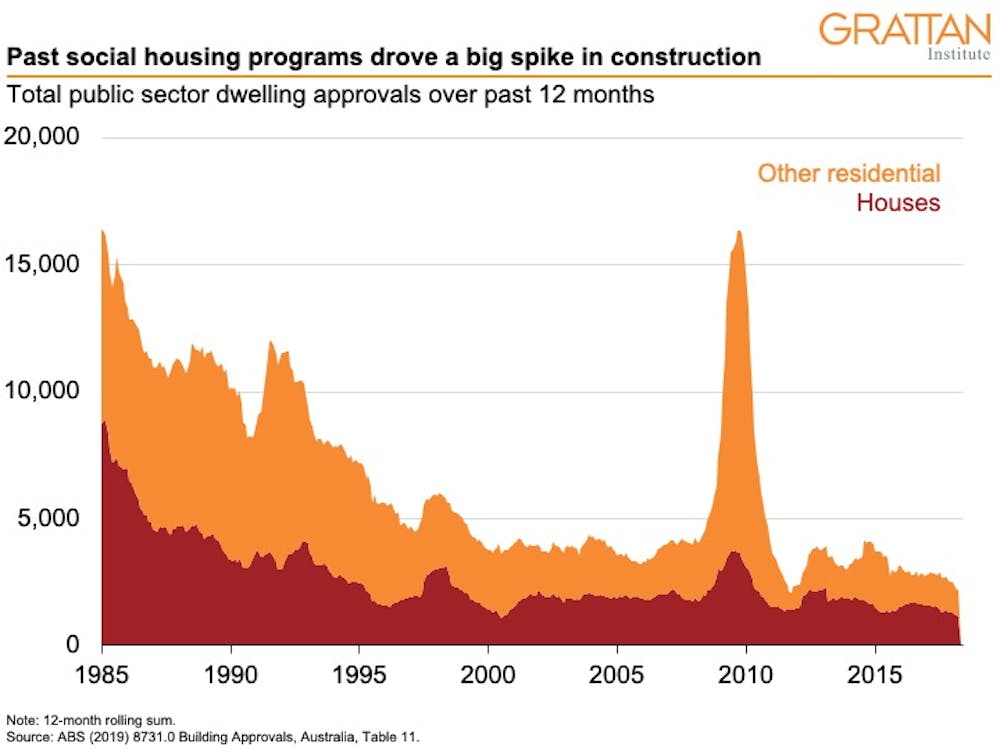
In particular, the Morrison government should repeat another GFC-era policy, the Social Housing Initiative, under which 19,500 social housing units were built and another 80,000 refurbished over two years, at a cost of A$5.2 billion.

Under the initiative the federal government funded the states to build social housing units directly or contract community housing providers to act as housing developers

Public residential construction approvals spiked within months of the announcement.


Building 30,000 new social housing units today would cost between A$10 billion an A$15 billion. Because state governments and community housing providers won’t have to worry about finance, marketing and sales, they’ll be able to get to work building homes much quicker than the private sector.

The boost to the economy would be pretty immediate.

Just as important, building social housing would also help tackle the growing scourge of homelessness. At the most recent Census (2016), more than 116,000 people were homeless, up from 90,000 a decade earlier. COVID-19 has shown us that if we let people live in unhealthy conditions it can help spread disease – affecting everybody’s health.


Read more: Coronavirus lays bare 5 big housing system flaws to be fixed


The drivers of homelessness are complex. Nonetheless the best Australian evidence and international experience shows social housing substantially reduces tenants’ risk of homelessness. But Australia’s stagnating social housing stock means there is little “flow” of social housing available for people whose lives take a big turn for the worse.

Funding social housing won’t boost house prices or provide windfalls for developers. It will do more to keep construction workers on the job, while also helping some of our most vulnerable Australians.

ref. Money for social housing, not home buyers grants, is the key to construction stimulus – https://theconversation.com/money-for-social-housing-not-home-buyers-grants-is-the-key-to-construction-stimulus-139743

Escape from Pretoria review: a film of anti-apartheid nostalgia for apartheid

Source: The Conversation (Au and NZ) – By Ari Mattes, Lecturer in Communications and Media, University of Notre Dame Australia

Review: Escape from Pretoria, directed by Francis Annan

There is something undeniably appealing about prison escape films. Who doesn’t want to watch a bunch of underdogs band together and escape the clutches of their gaolers?

We empathise with central characters whose imprisonment is usually unjust, if not illegal. We cringe, watching them tortured by cruel and psychopathic guards. We feel uplifted as we see – even in this context of absolute abasement – the fabled “human spirit” (whatever this thing is) able to soar above the misery of the situation and, through cunning and ingenuity, set the body free.

They are perfect examples, in other words, of the kind of cinematic escapist fodder that thankfully numbs our brains and bodies to the brutalities of reality.

Escape from Pretoria does its best to exploit both our disposition towards underdogs, and our historical knowledge of the barbarity of apartheid in South Africa.

Based on Tim Jenkin’s 2003 memoir Inside Out: Escape from Pretoria Central Prison, this is the first major feature film from UK-based director Francis Annan. Like so many low- to medium-budget films in the 21st century, it is a transnational production, with the investment (and therefore risk) spread between Australia and the UK. Indeed, it was shot on location in Adelaide and surrounding suburbs, and looks like it.

A film about mechanics

Formally, the film is uninspired. There is nothing notable about its technical construction. This seems to be a perennial problem with so-called “true story” films, which often depend on the interest generated by this label at the expense of dramaturgy and aesthetic quality.

(This, of course, is not always the case – the true story heist film American Animals was one of the most formally engaging films of 2018.)

What is interesting about Escape from Pretoria is the absolutely minor tenor of its narrative. It eschews melodrama and sentimentality, focusing on the mechanics of escape itself. The film goes into great detail in its examination of the design and manufacturing of the tools and technologies Jenkin and his crew use to get free, including nine different wooden keys, and their testing under tense conditions.

In this sense, the film is procedural rather than character driven. This suits the curious nature of the event on which it is based, and there is something refreshing about the narrative’s minimalist approach.

There is something refreshing about the narrative’s minimalism. Arclight Films

It doesn’t labour excessively to depict guards as disgusting demons, or prisoners as paragons of virtue. It doesn’t, in the style of American countercultural prison films like Cool Hand Luke and The Longest Yard, fetishise the eccentricities and idiosyncratic personas of different inmates.

Ex wizard Daniel Radcliffe gives an earnest if forgettable performance as Jenkin, managing to pull off a pretty convincing accent and sweating and frowning in the right places. His fellow escapees are solid, especially Australian Mark Leonard Winter as Leonard Fontaine. Nathan Page, as the particularly unpleasant guard Mongo, endows the role with a quality of Eichmann-esque understatement that stops it from descending into super-villain caricature.

Disappointment at history

Yet, like so much post-apartheid media about apartheid-era South Africa, the film exists as a kind of channel for profound disappointment regarding the African National Congress’s post-apartheid rule.

This is realised in the film’s background echoes of faint nostalgia and in the painfully banal platitudes that end the film, posturing about freedom and democracy, the ANC and Nelson Mandela.

This kind of nostalgia is becoming increasingly difficult to stomach in a post-Marikana massacre context, in which the ANC were implicated in the lethal repression of protests about mine workers’ rights.


Read more: Marikana tragedy must be understood against the backdrop of structural violence in South Africa


It seems that, in an age of increasing inequality in South Africa, the cultural spirit needs to return to the apartheid era to generate some semblance of hope about the future. In the era the film attempts to document, the name “ANC” was still synonymous with dreams of equality and a prosperous future for many South Africans.

In a current day South Africa of growing inequality – captured in films set in the present (Necktie Youth) and future (District 9) – it is an easy strategy to return to the apartheid era to leverage the emotional investment of the viewer.

In any case, Escape from Pretoria offered an engaging diversion from news about coronavirus and police brutality. It’s the kind of minor, visually uninteresting film one senses would feel like a flop if projected onto a cinema-sized screen. It is better suited to the small screens with which we’re all currently forced to make do.

Escape from Pretoria is now available in Australia through video on demand services.

ref. Escape from Pretoria review: a film of anti-apartheid nostalgia for apartheid – https://theconversation.com/escape-from-pretoria-review-a-film-of-anti-apartheid-nostalgia-for-apartheid-139475

The coronavirus crisis shows why New Zealand urgently needs a commissioner for older people

Source: The Conversation (Au and NZ) – By Claire Breen, Professor of Law, University of Waikato

New Zealand is often described as a great place to grow up. We must also ask ourselves whether it is a great place to grow old.

The question becomes increasingly urgent as the impact of COVID-19 becomes clearer. While New Zealand has been one of a small number of countries to have seemingly controlled the spread of the virus, it has been older people who have borne the brunt of the disease.

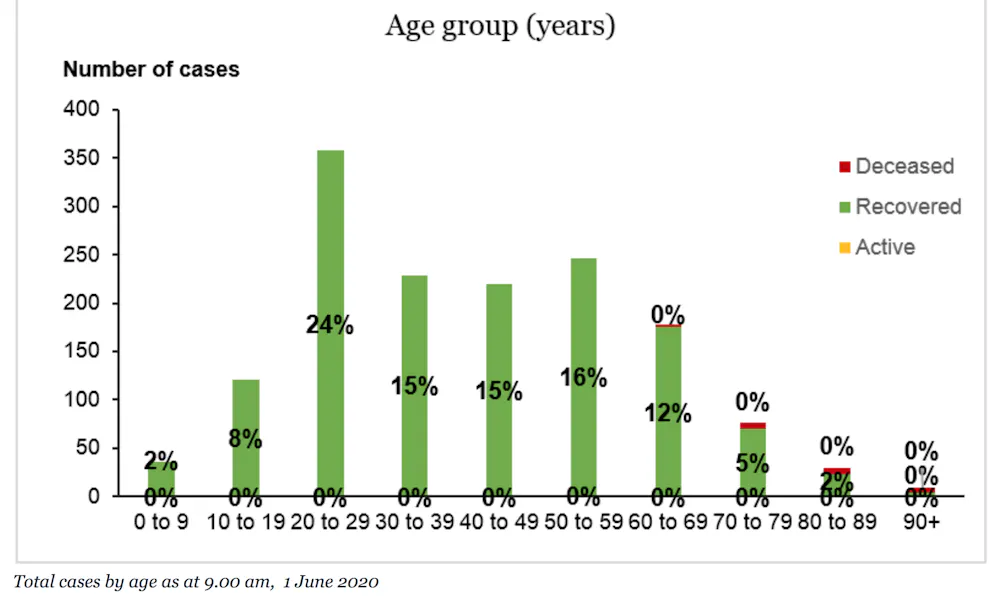
The elderly have not only died and become critically ill in greater numbers, as shown below, they have also suffered most under the stringent control measures adopted and from lapses in adequate health care.

New Zealand’s COVID-19 cases by age group. NZ Ministry of Health

There has been no shortage of debate about the impact of New Zealand’s strict lockdown on rights and liberties. But, given the burden of the disease has fallen mostly on older New Zealanders, their absence from that debate speaks volumes.

The establishment of an official advocate for the elderly is clearly overdue.

About 15% of the population is aged 65 or older and that will double in the next few decades. The 22 New Zealanders who died from COVID-19 were 60 and older. Many of those deaths occurred in residential care facilities that struggled to adequately test residents and staff or provide personal protective equipment (PPE) and training.


Read more: Low staff levels must be part of any reviews into the coronavirus outbreaks in NZ rest homes


New Zealand’s aged care has fallen behind

This situation is sadly ironic because New Zealand has been a world leader in passing laws to protect older people, starting with the Old Age Pensions Act in 1898. Nearly a century later, the Human Rights Act 1993 prohibited discrimination on the basis of age.

In fact, the United Nations was still unsure whether this type of discrimination applied to older people’s rights to health, housing, work and social security. It wasn’t until 2009 that it finally concluded it did.

More generally, the rights of older people are not enshrined in any dedicated global human rights treaty. There are longstanding plans of action and principles in this area, but these fall into the category of “soft law”. They do not create legally binding obligations for countries.

Nonetheless, the UN is now focusing more on the human rights of older people and is considering whether there should be a treaty. It has taken a further step by appointing a UN Independent Expert on the enjoyment of all human rights by older people.

Rosa Kornfeld-Matte, who held the role until recently, visited New Zealand at the invitation of the government just before we locked down due to COVID-19. Her findings suggest New Zealand’s leadership in protecting the rights and interests of older people has stalled.

Rosa Kornfeld-Matte, former UN independent expert on the enjoyment of all human rights by older persons.

UN expert’s call for a commissioner

Although there were things to be proud of in what Kornfeld-Matte found, including recent government strategies to cope with an ageing population, and our universal superannuation, there were also concerns.

Those included violence, poverty, affordable housing, availability of long-term care workers, structural biases in the health system that disproportionately affect Māori and Pasifika, and increasing rhetoric portraying the elderly as a burden.

To deal with these issues Kornfeld-Matte called for the establishment of “an independent national commissioner on the enjoyment of all human rights by older persons”.


Read more: Recession hits Māori and Pasifika harder. They must be part of planning New Zealand’s COVID-19 recovery


There is real merit in this recommendation. Although there is a minister and an Office for Seniors that has developed commendable strategies, there is still a risk this approach to advocacy will either be too timid or too tied to the views of whichever political party is in power.

NZ already has good models to copy

New Zealand already has a number of commissioners who are obliged to represent the interests of particular groups or concepts. Their advocacy role is based in legislation and they are independent of any political party or the partisan reach of any political cycle.

NZ Commissioner for Children, Judge Andrew Becroft.

The best example is the Commissioner for Children whose role it is to advocate for the youngest New Zealanders. In the nearly two decades since its establishment, the Office of the Commissioner has managed to develop a system of advocacy across a wide range of areas, including children in the judicial system, children’s welfare, with the placement of children into state care.

The commissioner has consistently highlighted the issue of child poverty and hailed the passing (with cross-party support) of the Child Poverty Reduction Act in 2018 as “a historic cause for celebration”. The commissioner has the support of an international legal framework that has been accepted by every UN member state except the US.

Fortunately, New Zealand has been spared the devastation COVID-19 has caused elsewhere. But our lives have still been changed dramatically. The challenge now is to ensure the voices of those most at risk from the disease (and from the current means of controlling it) are heard loudly and clearly.

The appointment of an independent national commissioner to advocate for older New Zealanders would be a significant step towards restoring this country’s reputation as a great place to live – at any age.

ref. The coronavirus crisis shows why New Zealand urgently needs a commissioner for older people – https://theconversation.com/the-coronavirus-crisis-shows-why-new-zealand-urgently-needs-a-commissioner-for-older-people-139383

What Australian birds can teach us about choosing a partner and making it last

Source: The Conversation (Au and NZ) – By Gisela Kaplan, Emeritus Professor in Animal Behaviour, University of New England

Love, sex and mate choice are topics that never go out of fashion among humans or, surprisingly, among some Australian birds. For these species, choosing the right partner is a driver of evolution and affects the survival and success of a bird and its offspring.

There is no better place than Australia to observe and study strategies for bird mate choice. Modern parrots and songbirds are Gondwanan creations – they first evolved in Australia and only much later populated the rest of the world.

Here, we’ll examine the sophisticated way some native birds choose a good mate, and make the relationship last.

Rainbow lorikeets form a lifetime bond. Bobbie Marchant

Single mothers and seasonal flings

For years, research has concentrated on studying birds in which sexual selection may be as simple as males courting females. Males might display extra bright feathers or patterns, perform a special song or dance or, like the bowerbird, build a sophisticated display mound.

In these species, females choose the best mate on the market. But the males do not stick around after mating to raise their brood.


Read more: How the Australian galah got its name in a muddle


These reproductive strategies apply only to about tiny proportion of birds worldwide.

Then there are “lovers for a season”, which account for another small percentage of songbirds. Males and females may raise a brood together for one season, then go their separate ways.

These are not real partnerships at all – they’re simply markets for reproduction.

Birds that stick together

But what about the other birds – those that raise offspring in pairs, just as humans often do? Those that form partnerships for more than a season, and in some cases, a lifetime?

More than 90% of birds worldwide fall into this “joint parenting” category – and in Australia, many of them stay together for a long time. Indeed, Australia is a hotspot for these cooperative and long-term affairs.

This staggering figure has no equal in the animal kingdom. Even among mammals, couples are rare; only 5% of all mammals, including humans, pair up and raise kids together.

So how do long-bonding Australian birds choose partners, and what’s their secret to relationship success?

A white headed pigeon pair. Credit: Gisela Kaplan

Lifelong attachment

The concept of assortative mating is often used to explain how humans form lasting relationships. As the theory goes, we choose mates with similar traits, lifestyle and background to our own.

In native birds that form long-lasting bonds, including butcherbirds, drongos and cockatoos, differences between the sexes are small or non-existent – that is, they are “monomorphic”. Males and females may look alike in size and plumage, or may both sing, build nests and provide equally for offspring.

So, how do they choose each other, if not by colour, song, dance or plumage difference? There’s some research to suggest their choices are based on personality.

Many bird owners and aviculturists would attest that birds have individual personalities. They may, for example, be gentle, tolerant, submissive, aggressive, confident, curious, fearful or sociable.


Read more: Magpies can form friendships with people – here’s how


Research has not conclusively established which bird personalities are mutually attractive. But so far it seems similarities or familiarity, rather than opposites, attract.

Cockatiel breeders now even use personality assessments similar to those used for show dogs.

There is practical and scientific proof to support this approach. In breeding contexts, seemingly incompatible birds may be forced together. In such cases, they are unlikely to reproduce and may not even interact with each other. For example, research on Gouldian finches has shown that in mismatched pairs, stress hormone levels were elevated over several weeks, which delayed egg laying.

Conversely, well-matched zebra finch pairs have been shown to have greater reproductive success. Well designed experiments have also shown these birds to change human-assigned partners once free to do so, suggesting firm partner preferences.

Zebra finches pair roosting together. Source Credit: Robyn Burgess

More than just sex

Now to some extraordinary, little-known facets of behaviour in some native birds.

Bird bonds are not always or initially about reproduction. Most cockatoos take five to seven years to mature sexually. Magpies, apostlebirds and white winged choughs can’t seriously think about reproducing until they are five or six years old.

In the interim, they form friendships. Some become childhood sweethearts long before they get “married” and reproduce.

Socially monogamous birds, such as most Australian cockatoos and parrots, pay meticulous attention to each other. They reaffirm bonds by preening, roosting and flying together in search of food and water.

Even not-so-cuddly native songbirds such as magpies or corvids have long term partnerships and fly, feed and roost closely together.

Sulphur-crested cockatoo friends or pair about to land. Source Robyn Burgess

All in the mind

Bird species that pair up for life, and devote the most time to raising offspring, are generally also the most intelligent (when measured by brain mass relative to body weight).

Such species tend to live for a long time as well – sometimes four times longer than birds of similar weight range in the northern hemisphere.

So why is this? The brain chews up lots of energy and needs the best nutrients. It also needs time to reach full growth. Parental care for a long period, as many Australian birds provide, is the best way to maximise brain development. It requires a strong bond between the parents, and a commitment to raising offspring over the long haul.


Read more: Bird-brained and brilliant: Australia’s avians are smarter than you think


Interestingly, bird and human brains have some similar architecture, and the same range of important neurotransmitters and hormones. Some of these may allow long-term attachments.

Powerful hormones that regulate stress and induce positive emotions are well developed in both humans and birds. These include oxytocin (which plays a part in social recognition and sexual behaviour) and serotonin (which helps regulate and modulate mood, sleep, anxiety, sexuality, and appetite).

The dopamine system also strongly influences the way pair bonds are formed and maintained in primates – including humans – and in birds.

Birds even produce the hormone prolactin, once associated only with mammals. This plays a role in keeping parents sitting on their clutch of eggs, including male birds that share in the brooding.

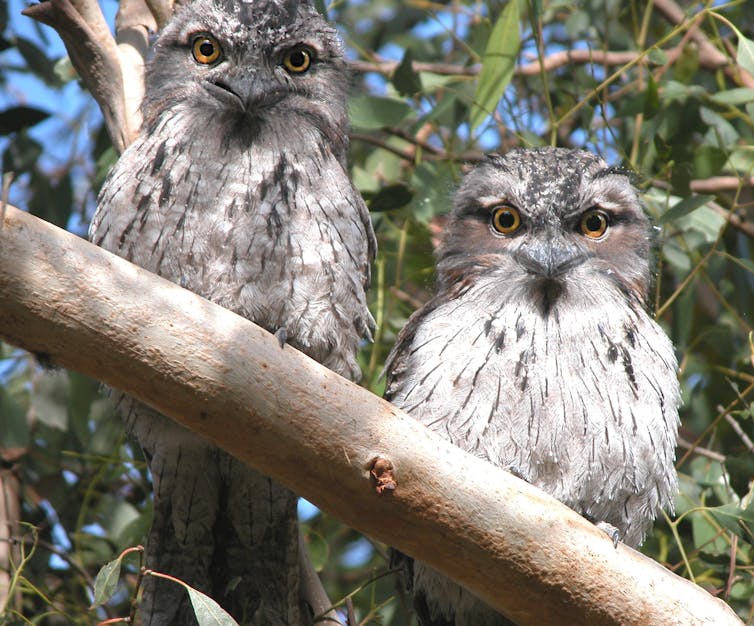
Australian songbirds, such as tawny frogmouths, form lasting relationships. Gisela Kaplan, Author provided (No reuse)

The power of love

Given the above, one is led to the surprising conclusion that cooperation, and long-term bonds in couples, is as good for birds as it is for humans. The strategy has arguably led both species to becoming the most successful and widely distributed on Earth.

With so many of Australia’s native birds declining in numbers, learning as much as possible about their behaviour, including how they form lasting relationships, is an urgent task.

Much of the information referred to in this article is drawn from Gisela Kaplan’s books Bird Bonds, Bird Minds and Tawny Frogmouth

ref. What Australian birds can teach us about choosing a partner and making it last – https://theconversation.com/what-australian-birds-can-teach-us-about-choosing-a-partner-and-making-it-last-125734

Pregnant in a pandemic? If you’re stressed, there’s help

Source: The Conversation (Au and NZ) – By Monique Robinson, NHMRC Early Career Fellow, Telethon Kids Institute

If you’re pregnant during the COVID-19 pandemic, you might be feeling a unique type of stress.

You might be uncertain about how an infection could affect your unborn baby. That’s over and above the stress you might be feeling about the pregnancy itself, and its impact on your relationship, job or lifestyle.

But there’s professional support to help you manage these stresses. And there’s lots you can do at home to ease your worries.


Read more: Coronavirus while pregnant or giving birth: here’s what you need to know


How will the coronavirus affect my unborn baby?

One of the first studies to look at the effect of coronavirus infection while pregnant found the health of unborn babies or newborns of women infected in their final trimester did not differ to those expected with uninfected pregnancies.

But this small study, from Wuhan in China, was rushed to publication and didn’t look at infection earlier in pregnancy.

A review of 41 pregnancies complicated by COVID-19, as well as another 38 complicated by other coronaviruses (SARS, severe acute respiratory syndrome and MERS, Middle East respiratory syndrome) gave us more information.

It found a small but significant increase in preterm birth (before 37 weeks’ gestation) in COVID-19 pregnancies.

However, the researchers couldn’t differentiate between spontaneous preterm birth and babies who were induced to arrive before 37 weeks.

So far, the evidence of harm to you or your unborn baby is limited, and should not cause concern.

Pregnancy can be stressful anyway

Separate to the fear of being infected with COVID-19 is the fear and stress related to simply living through the pandemic while pregnant.

Pregnancy can often be stressful as lifestyle, relationship and income changes create challenges for families.

Pregnancy can be stressful at the best of times. Shutterstock

Worries about the baby’s health are present in any pregnancy, but adding concerns of what infection would mean for the unborn child can exacerbate feelings of anxiety.

Before the pandemic, about 20% of women had a clinical anxiety disorder (for example, generalised anxiety, specific phobia) while pregnant.

We now have some early indicators of how the COVID-19 pandemic is affecting that statistic.


Read more: Health Check: can stress during pregnancy harm my baby?


And when you add the pandemic into the mix

Canadian researchers surveyed nearly 2,000 pregnant women in April 2020 (in research yet to be peer-reviewed). They found 57% of pregnant women showed anxiety symptoms but 68% reported an increase in pregnancy-specific anxiety.

Only one of the 1,987 participants had a confirmed case of COVID-19, with another 25 cases suspected but not confirmed. So, for most participants, just being pregnant during the pandemic (without being infected) led to three times as many women being anxious during the pandemic than before it.


Read more: Coronavirus with a baby: what you need to know to prepare and respond


Pregnant women are also concerned about how the pandemic will affect their maternity care, including who can visit them in hospital and after the birth of their baby.

A review of pregnancy stress during previous infectious disease outbreaks, including SARS, MERS, Ebola and Zika, found that as well as feeling vulnerable, pregnant women were anxious about disruption to pre- and postnatal care, and exposure to treatments not fully tested in pregnancy.

We can’t avoid stress, but we can manage it

We know stress during pregnancy has been linked to a range of poor outcomes for the child, such as pre-term birth, being more susceptible to disease, and behavioural problems through childhood.

Post-traumatic stress symptoms in pregnant women following the September 11 attacks and various natural disasters have significantly affected both emotional and cognitive development in children later in childhood.

But there is good news. While we cannot avoid the stress that comes with the COVID-19 pandemic, we can manage it.


Read more: Coronavirus is stressful. Here are some ways to cope with the anxiety


In fact, it’s not necessarily the stressful event itself that can lead to poor outcomes. It’s how a pregnant woman assesses the stress of the event and how she chooses to move forward that might determine what happens to her child.

So, if we can manage our stress and not let it overwhelm us, we may be able to avoid the negative consequences of stress in pregnancy with benefits right through our children’s lives.

Here’s what you can do

Social support is key for managing stress, but social distancing makes it harder to gather with the friends and loved ones who might typically provide that support.

Still, there are many online pregnancy support and birth groups targeted to particular stages of pregnancy. These could provide reassurance and a sense of belonging while the outside world looks different.

You can still exercise outside. But if you prefer to exercise at home, there are many online pregnancy yoga and pilates classes.

Yoga and pilates classes for pregnant women are available online. Shutterstock

You can practise guided relaxation and meditation with an app. And if you can work from home, this might give you some much-needed flexibility.

You can also use local, evidence-based telehealth to access mental health care. There are also many free, online programs providing self-guided mental health support.

As long as the COVID-19 pandemic is here, with its accompanying uncertainty, we can best focus on limiting the long-term effects of stress on our mothers, babies and families.

ref. Pregnant in a pandemic? If you’re stressed, there’s help – https://theconversation.com/pregnant-in-a-pandemic-if-youre-stressed-theres-help-138825

Riot or resistance? How media frames unrest in Minneapolis will shape public’s view of protest

ANALYSIS: By Danielle K. Kilgo of Indiana University

A teenager held her phone steady enough to capture the final moments of George Perry Floyd’s life as he apparently suffocated under the weight of a Minneapolis police officer’s knee on his neck. The video went viral.

What happened next has played out time and again in American cities after high-profile cases of alleged police brutality.

Vigils and protests were organised in Minneapolis and around the United States to demand police accountability. But while investigators and officials called for patience, unrest boiled over. News reports soon carried images of property destruction and police in riot gear.

READ MORE: US police seen as using excessive force as outrage over George Floyd’s death rises

The general public’s opinions about protests and the social movements behind them are formed in large part by what they read or see in the media. This gives journalists a lot of power when it comes to driving the narrative of a demonstration.

They can emphasiSe the disruption protests cause or echo the dog whistles of politicians that label protesters as “thugs.”

– Partner –

But they can also remind the public that at the heart of the protests is the unjust killing of another black person. This would take the emphasis away from the destruction of the protests and toward the issues of police impunity and the effects of racism in its many forms.

The role journalists play can be indispensable if movements are to gain legitimacy and make progress. And that puts a lot of pressure on journalists to get things right.

My research has found that some protest movements have more trouble than others getting legitimacy. My co-author Summer Harlow and I have studied how local and metropolitan newspapers cover protests. We found that narratives about the Women’s March and anti-Trump protests gave voice to protesters and significantly explored their grievances. On the other end of the spectrum, protests about anti-black racism and indigenous people’s rights received the least legitimizing coverage, with them more often seen as threatening and violent.

Forming the narrative
Decades ago, scholars James Hertog and Douglas McLeod identified how news coverage of protests contributes to the maintenance of the status quo, a phenomenon referred to as “the protest paradigm.” They held that media narratives tend to emphasize the drama, inconvenience and disruption of protests rather than the demands, grievances and agendas of protesters.

These narratives trivialise protests and ultimately dent public support.

Here’s how this theoretically plays out today:

Journalists pay little attention to protests that aren’t dramatic or unconventional.

Knowing this, protesters find ways to capture media and public attention. They don pink “pussy” hats or kneel during the national anthem. They might even resort to violence and lawlessness.

Now the protesters have the media’s attention, but what they cover is often superficial or delegitimising, focusing on the tactics and disruption caused and excluding discussion on the substance of the social movement.

We wanted to explore if this classic theory fit coverage from 2017 – a year of large-scale protests accompanying the first year of Donald Trump’s presidency.

To do so, we analysed the framing of protest reporting from newspapers in Texas. The state’s size and diversity made it a good proxy for the country at large.

In all, we identified 777 articles by searching for terms such as “protest,” “protester,” “Black Lives Matter” and “Women’s March.” This included reports written by journalists in 20 Texas newsrooms, such as the El Paso Times and the Houston Chronicle, as well as syndicated articles from sources like the Associated Press.

We looked at how articles framed the protests in the headline, opening sentence and story structure, and classified the reporting using four recognized frames of protest:

  • Riot: Emphasizing disruptive behavior and the use or threat of violence.
  • Confrontation: Describing protests as combative, focusing on arrests or “clashes” with police.
  • Spectacle: Focusing on the apparel, signs or dramatic and emotional behavior of protesters.
  • Debate: Substantially mentioning protester’s demands, agendas, goals and grievances.

We also kept an eye out for sourcing patterns to identify imbalances that often give more credence to authorities than protesters and advocates.

Overall, news coverage tended to trivialize protests by focusing most often on dramatic action. But some protests suffered more than others.

Reports focused on spectacle more often than substance. Much was made of what protesters were wearing, crowd sizes – large and smallcelebrity involvement and flaring tempers.

The substance of some marches got more play than others. Around half of the reports on anti-Trump protests, immigration rallies, women’s rights demonstrations and environmental actions included substantial information about protesters’ grievances and demands.

In contrast, Dakota Pipeline and anti-black racism-related protests got legitimising coverage less than 25 percent of the time and were more likely to be described as disruptive and confrontational.

In coverage of a St Louis protest over the acquittal of a police officer who killed a black man, violence, arrest, unrest and disruption were the leading descriptors, while concern about police brutality and racial injustice was reduced to just a few mentions.

Buried more than 10 paragraphs down was the broader context: “The recent St. Louis protests follow a pattern seen since the August 2014 killing of Michael Brown in nearby Ferguson: the majority of demonstrators, though angry, are law-abiding.”

As a consequence of variances in coverage, Texas newspaper readers may form the perception that some protests are more legitimate than others. This contributes to what we call a “hierarchy of social struggle,” in which the voices of some advocacy groups are lifted over others.

Lurking bias
Journalists contribute to this hierarchy by adhering to industry norms that work against less-established protest movements. On tight deadlines, reporters may default to official sources for statements and data.

This gives authorities more control of narrative framing. This practice especially becomes an issue for movements like Black Lives Matter that are countering the claims of police and other officials.

Implicit bias also lurks in such reporting. Lack of diversity has long plagued newsrooms.

In 2017, the proportion of white journalists at The Dallas Morning News and the Houston Chronicle was more than double the proportion of white people in each city.

Protests identify legitimate grievances in society and often tackle issues that affect people who lack the power to address them through other means. That’s why it is imperative that journalists do not resort to shallow framing narratives that deny significant and consistent space to air the afflicted’s concerns while also comforting the very comfortable status quo.
The Conversation

Dr Danielle K. Kilgo is an assistant professor of journalism at Indiana University. This article is republished from The Conversation under a Creative Commons licence. Read the original article.

Print Friendly, PDF & Email

Article by AsiaPacificReport.nz

Forget ‘murder hornets’, European wasps in Australia decapitate flies and bully dingoes

Source: The Conversation (Au and NZ) – By Emma Spencer, Ph.D. student, University of Sydney

The impacts of invasive mammals such as feral horses and feral cats have featured prominently in the media over the years.

But the recent discovery of the infamous “murder hornet” (or giant Asian hornet Vespa mandarinia) in the US has shone a spotlight on a similar invasive insect in Australia, the European wasp (Vespula germanica).


Read more: National parks are for native wildlife, not feral horses: federal court


Our recent study showed this aggressive insect swarming decayed corpses, decapitating its prey and picking fights with dingoes.

Invasive plants and animals can have catastrophic impacts on wildlife. And along with habitat loss and overexploitation, they are the greatest threat faced by native Australian species.

European wasps feed on meat. Thomas Bresson/flickr

The rise of European wasps

European wasps are native to Europe, Northern Africa and parts of Asia. But hibernating queens stowed unintentionally in ships or trucks can colonise new areas, and this is how they arrived in Australia.

They were first discovered in Tasmania in 1959, and by the 1970s had reached mainland Australia. Today, European wasps are found in every state and territory, and are considered an agricultural, urban and environmental pest. The species is firmly established in the eastern parts of the country, and constant vigilance is required to keep numbers down in other areas.

European wasps have no predators (other than humans) in Australia. And they tend to forage more efficiently than their native counterparts, such as the common paper wasp Polistes humilis.

Although they are typically most active in late summer and autumn, Australia’s warmer climate means not all European wasp queens hibernate over winter as they do in Europe. This allows some wasp colonies to build “super nests” of up to 100,000 individuals.

European wasps are commonly encountered in urban areas and, unlike bees, can sting multiple times. They also release a pheromone when threatened that quickly attracts more wasps. So if you bother a nest, you may have to contend with the whole hive.

European wasps can be found swarming animal carcasses.

Wasps as ruthless scavengers

Our research looks into the role of European wasps as scavengers.

In Australia, animal carcasses aren’t in short supply. Millions are produced each year due to culling, vehicle collision and drought. The recent bushfires also added to this.

Most carcasses are left to rot and provide perfect “free feed” stations for wasp colonies foraging for protein. For our study, we monitored 20 kangaroo carcasses at Kosciuszko National Park in New South Wales.

Wasps congregated in large numbers around each, and ruthlessly attacked blowflies that attempted to approach. We could sit next to a carcass and watch fly after fly tackled to the ground by wasps. Many flies showed signs of mutilation. To our surprise, some were even missing their heads.

This unlucky blowfly was decapitated by a European wasp. Emma Spencer, author provided

In an effort to protect “their” carcass, the European wasps were decapitating the flies. This may have simply been defensive behaviour, but they could have also been taking bits of flies back to their nest for larvae to feed on.

We also observed the wasps bothering animals much larger than them, and our camera trap images showed dingoes snapping at wasps circling carcasses. Many of these animals retreated without feeding on the resource, presumably because the wasps were stinging them.

A dingo snaps at European wasps swarming a carcass site. Emma Spencer, author provided

We can’t ignore the flow on effects

Our recent study is just the start of our investigations into European wasp impacts in Kosciuszko National Park. But it has raised important points about the fate of carcasses dominated by wasps.

For one, it seems the wasps are preventing blowflies and dingoes from doing their job of “cleaning up” carcasses in the landscape. Also, flies are major pollinators, and decapitation isn’t helpful for pollen transfer.

A European wasp attacks a blowfly.

Moreover, if European wasp numbers are supported by prevalent carcass resources (including those resulting from culling) this may suggest a need to cull pest species when the wasps are not active, such as during the coldest times of the year.

Are wasps and ‘murder hornets’ a danger to us?

Like the European wasp, the “murder hornet” also threatens insect pollinators. The hornets have raised alarms in the US because they decimate honeybee populations, and have a nasty sting.

Similarly in Australia, there has been a focus on the threat European wasps pose to humans. But as is the case in the US, this focus is largely misguided.


Read more: What are Asian giant hornets, and are they really dangerous? 5 questions answered


While both insects have painful stings that can result in severe allergic reactions, fatalities are rare. And we would do well to redirect our concerns towards the impacts such species have on our ecosystems.

ref. Forget ‘murder hornets’, European wasps in Australia decapitate flies and bully dingoes – https://theconversation.com/forget-murder-hornets-european-wasps-in-australia-decapitate-flies-and-bully-dingoes-139476

Smaller pack sizes from today: could new opioid restrictions stop leftover medicines causing harm?

Source: The Conversation (Au and NZ) – By Suzanne Nielsen, Associate Professor and Deputy Director, Monash Addiction Research Centre, Monash University

Several changes to the regulation of opioid supply in Australia come into effect today (June 1).

Opioids are strong medicines used for pain. The new rules – including reducing pack sizes and restrictions around prescribing – are part of a range of changes planned for prescription opioid medicines to be phased in over the next year or so.

This comes in response to the to the growing number of deaths involving opioids in Australia. From 2007 to 2016, opioid-related deaths nearly doubled – from 591 to 1,119 deaths per year.

Notably, most of these deaths involve prescription opioids used for pain, rather than illicit opioids like heroin.


Read more: Opioid dependence treatment saves lives. So why don’t more people use it?


What are the changes?

These changes will affect the quantity of opioids provided for short-term pain, limiting amounts to a single supply with a smaller quantity for each prescription. For example, smaller packs may contain 10 tablets rather than 20.

People requiring an additional supply for short-term pain will generally need to visit the doctor again (as opposed to receiving a repeat prescription).

There will also be new restrictions for patients starting on high-strength opioids for chronic pain, such as morphine and fentanyl. A person with chronic pain will need to try other types of pain relief, including lower-strength opioids, before being eligible for high-strength opioids.

Additionally, where opioid use exceeds, or is expected to exceed, 12 months the patient will need to seek a second opinion to approve ongoing prescriptions.

People who are using opioids for 12 months or more will need to get a second medical opinion. Shutterstock

Are these changes positive?

These changes reflect our improved understanding around the more limited role opioids should play in pain management.

Although opioids are effective for short-term severe pain, we know for every extra day of opioid medicines supplied, the risk the person will end up on opioids long-term increases.

Research in the United States showed the number of days’ worth of opioids given on the first opioid prescription was the strongest predictor of continued opioid use.

Australian research also found receiving a larger total quantity of opioids on the first prescription was associated with a greater chance of long-term use.

This suggests smaller initial supplies may be a critical step in preventing people from developing patterns of long-term use and potentially dependence or addiction.


Read more: 2,200 deaths, 32,000 hospital admissions, 15.7 billion dollars: what opioid misuse costs Australia in a year


Reassuringly, hospitals have been able to dramatically reduce the quantity of opioids supplied after surgery with no changes in the amount of pain patients reported, and no change in complications at follow-up.

These kinds of studies indicate we have probably been supplying many more opioids than are needed.

Smaller supplies could save lives

Supplying smaller quantities is also important because although opioids work well in the short term, we know when the duration of use extends beyond the short term, the harms can outweigh the benefits.

Opioids don’t work as well after the body adapts to their effects with long-term use. The dose is often increased to get the same effect, and with an increased dose comes an increased risk of harms, such as fatal overdose.

The other concern with larger supplies of opioids is that leftover medicine in the family home can become a source for non-medical use. Reducing supply of opioids will mean they’re less likely to be sitting around in the medicine cabinet, where they can potentially be misused.

One study showed the likelihood of experiencing an overdose was three times higher if someone in the person’s family was prescribed opioids.


Read more: How we can reduce dependency on opioid painkillers in rural and regional Australia


People with chronic pain

Some people using opioids for longer-term pain may find these new regulations challenging.

But the changes will hopefully help people in this group in the longer term, as opioids are not always appropriate for chronic pain. The need for second opinions may help facilitate appropriate use and discussions about alternative approaches to pain management.

However, second opinions might be hard to arrange in practice. Opioid use is higher in places where pain services are harder to access, most commonly outside metropolitan areas.

The large shifts towards telemedicine we’ve seen as a result of COVID-19 may be useful in addressing the disparity of service access in rural areas, if these changes are maintained.

Opioid use is higher in areas where pain services are less accessible. Shutterstock

The other issue that might occur is substitution towards less restricted medicines with the tightening of supply on opioid medicines. If alternative medicines are prescribed that are safer and clinically appropriate, this will be a good outcome. But we don’t want to see more dangerous or less effective medicines prescribed in place of opioids.

There have been concerns around increased and potentially inappropriate use of other pain medicines such as pregabalin – a medicine intended to be used for nerve pain.

We’ve seen a lot of focus on opioids, but these are not the only medicines that can cause harm. The challenge when using high-risk medicines like opioids for pain is with getting the right balance between benefits and harms. But these changes appear to be a step in the right direction.

What don’t we know?

Almost all the studies that help us predict the effects of these changes were conducted in the US. Opioid-related harm in the US is much more severe than in Australia, and the health-care system is vastly different.

That said, Australian trends in opioid-related harms are quite similar, though they are five to ten years behind the US.


Read more: Ambulance call-outs for pregabalin have spiked – here’s why


The aim is to use opioids for the shortest period at the lowest effective dose, rather than to avoid their use altogether. While we want to minimise their misuse, opioids are effective and important medicines for pain. In many countries, a lack of supply is a key health issue. We don’t want the pendulum to swing too far.

We will need to carefully monitor the outcomes of these changes to identify any unintended consequences.

ref. Smaller pack sizes from today: could new opioid restrictions stop leftover medicines causing harm? – https://theconversation.com/smaller-pack-sizes-from-today-could-new-opioid-restrictions-stop-leftover-medicines-causing-harm-139558

Turn off the porch light: 6 easy ways to stop light pollution from harming our wildlife

Source: The Conversation (Au and NZ) – By Emily Fobert, Research Associate, Flinders University

As winter approaches, marine turtle nesting in the far north of Australia will peak. When these baby turtles hatch at night, they crawl from the sand to the sea, using the relative brightness of the horizon and the natural slope of the beach as their guide.

But when artificial lights outshine the moon and the sea, these hatchlings become disorientated. This leaves them vulnerable to predators, exhaustion and even traffic if they head in the wrong direction.


Read more: Getting smarter about city lights is good for us and nature too


Baby turtles are one small part of the larger, often overlooked, story of how light pollution harms wildlife across the land and underwater.

Green Turtle’s Battle For Survival | Planet Earth | BBC Earth.

Today, more than 80% of people – and 99% of North American and European human populations – live under light-polluted skies. We have transformed the night-time environment over substantial portions of the Earth’s surface in a very short time, relative to evolutionary timescales. Most wildlife hasn’t had time to adjust.

In January, Australia released the National Light Pollution Guidelines for Wildlife. These guidelines provide a framework for assessing and managing the impacts of artificial light.

The guidelines also identify practical solutions that can be used globally to manage light pollution, both by managers and practitioners, and by anyone in control of a light switch.


Read more: Bright city lights are keeping ocean predators awake and hungry


The guidelines outline six easy steps anyone can follow to minimise light pollution without compromising our own safety.

Although light pollution is a global problem and true darkness is hard to come by, we can all do our part to reduce its impacts on wildlife by changing how we use and think about light at night.

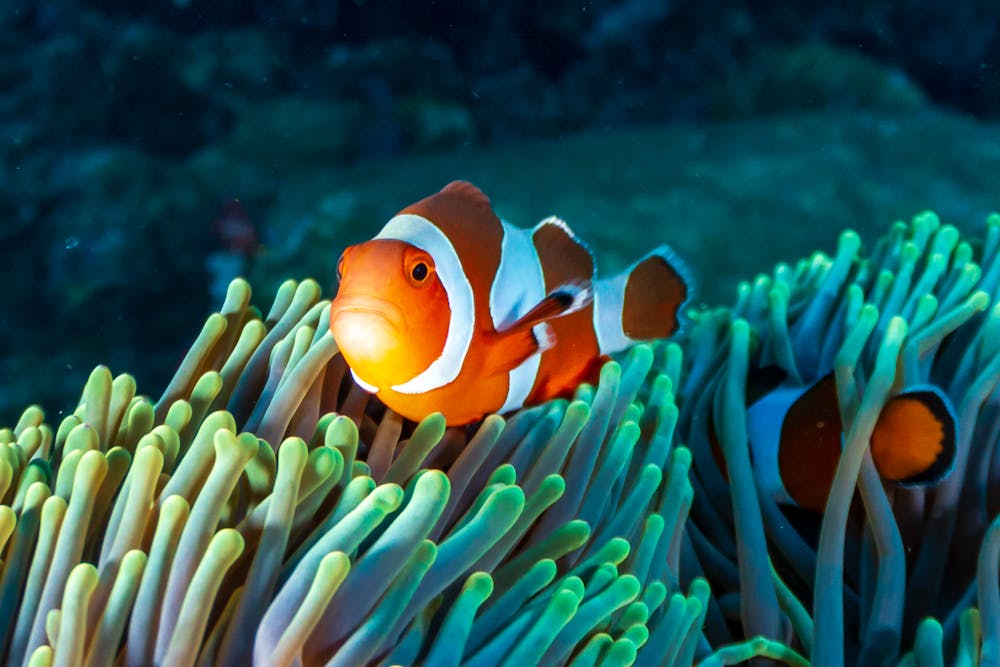
Light pollution can interfere with clownfish reproductive cycle. Shutterstock

1. Start with natural darkness. Only add light for a specific purpose

Natural darkness should be the default at night. Artificial light should only be used if it’s needed for a specific purpose, and it should only be turned on for the necessary period of time.

This means it’s okay to have your veranda light on to help you find your keys, but the light doesn’t need to stay on all night.

Similarly, indoor lighting can also contribute to light pollution, so turning lights off in empty office buildings at night, or in your home before you go to sleep, is also important.

2. Use smart lighting controls

Advances in smart control technology make it easy to manage how much light you use, and adaptive controls make meeting the goals of Step 1 more feasible.

Investing in smart controls and LED technology means you can remotely manage your lights, set timers or dimmers, activate motion sensor lighting, and even control the colour of the light emitted.

These smart controls should be used to activate artificial light at night only when needed, and to minimise light when not needed.

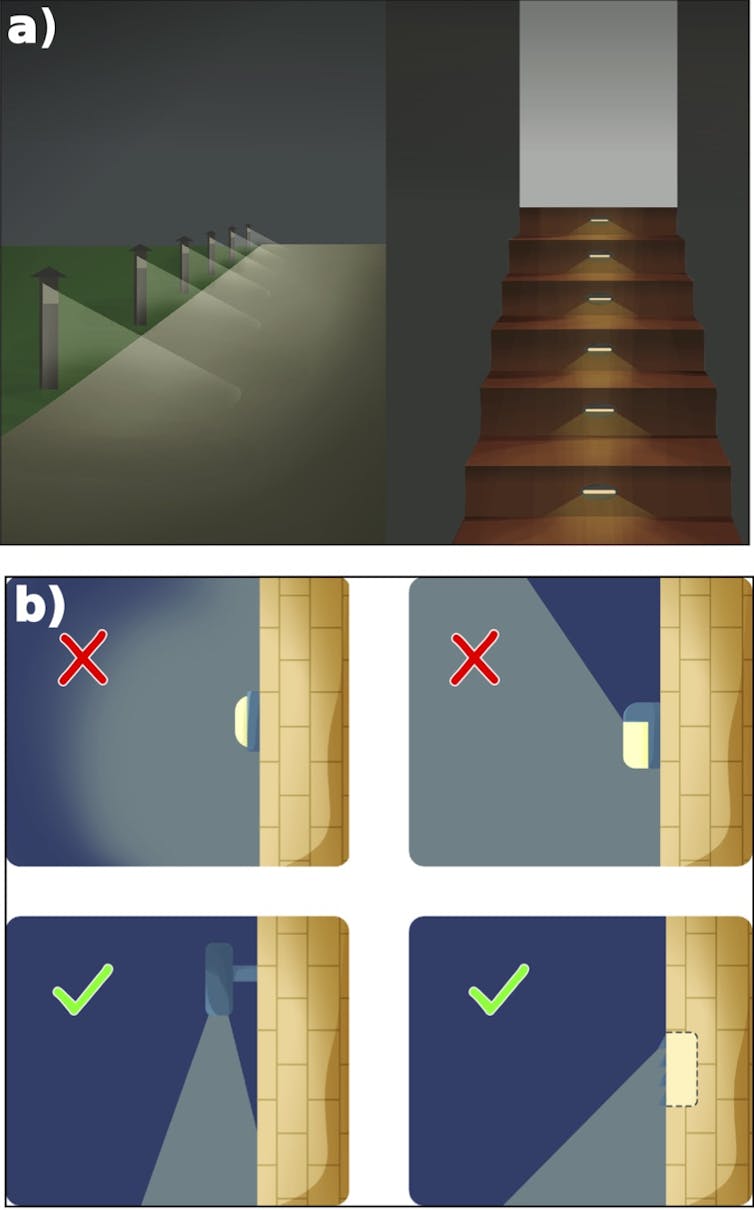
3. Keep lights close to the ground, directed and shielded

Any light that spills outside the specific area intended to be lit is unnecessary light.

Light spilling upward contributes directly to artificial sky glow – the glow you see over urban areas from cumulative sources of light. Both sky glow and light spilling into adjacent areas on the ground can disrupt wildlife.

Installing light shields allow you to direct the light downward, which significantly reduces sky glow, and to direct the light towards the specific target area. Light shields are recommended for any outdoor lighting installations.

Step 3: Keep lights close to ground (a) and use shields to light only the intended area (b) National Light Pollution Guidelines for Wildlife Including Marine Turtles, Seabirds and Migratory Shorebirds, Commonwealth of Australia 2020

4. Use the lowest intensity lighting

When deciding how much light you need, consider the intensity of the light produced (lumens), rather than the energy required to make it (watts).

LEDs, for example, are often considered an “environmentally friendly” option because they’re relatively energy efficient. But because of their energy efficiency, LEDs produce between two and five times as much light as incandescent bulbs for the same amount of energy consumption.


Read more: Darkness is disappearing and that’s bad news for astronomy


So, while LED lights save energy, the increased intensity of the light can lead to greater impacts on wildlife, if not managed properly.

5. Use non-reflective, dark-coloured surfaces.

Sky glow has been shown to mask lunar light rhythms of wildlife, interfering with the celestial navigation and migration of birds and insects.

Highly polished, shiny, or light-coloured surfaces – such as structures painted white, or polished marble – are good at reflecting light and so contribute more to sky glow than darker, non-reflective surfaces.

Choosing darker coloured paint or materials for outdoor features will help reduce your contribution to light pollution.

6. Use lights with reduced or filtered blue, violet and ultra-violet wavelengths

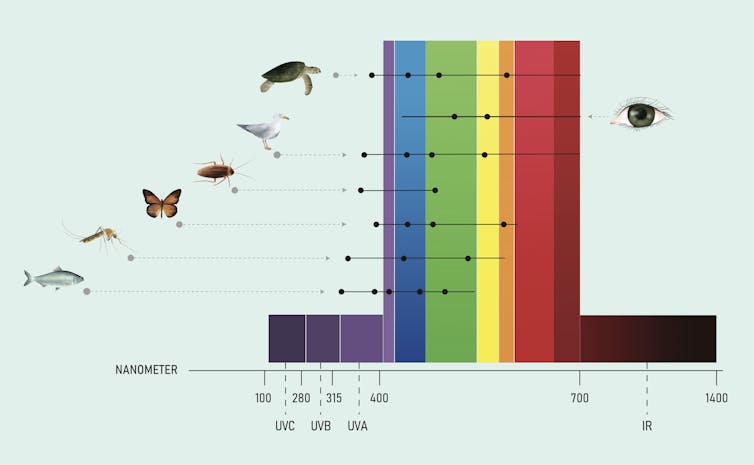
Wavelength perception in wildlife – most animals are sensitive to short-wavelength (blue/violet) light. National Light Pollution Guidelines for Wildlife Including Marine Turtles, Seabirds and Migratory Shorebirds, Commonwealth of Australia 2020

Most animals are sensitive to short-wavelength light, which creates blue and violet colours. These short wavelengths are known to suppress melatonin production, which is known to disrupt sleep and interfere with circadian rhythms of many animals, including humans.

Choosing lighting options with little or no short wavelength (400-500 nanometres) violet or blue light will help to avoid unintended harmful effects on wildlife.

For example, compact fluorescent and LED lights have a high amount of short wavelength light, compared low or high-pressure sodium, metal halide, and halogen light sources.


Read more: Sparkling dolphins swim off our coast, but humans are threatening these natural light shows


ref. Turn off the porch light: 6 easy ways to stop light pollution from harming our wildlife – https://theconversation.com/turn-off-the-porch-light-6-easy-ways-to-stop-light-pollution-from-harming-our-wildlife-132595

Lab experiments in the pandemic moved online or mailed home to uni students

Source: The Conversation (Au and NZ) – By Brian Abbey, Professor of Physics, La Trobe University

The COVID-19 pandemic has shaken university education, with most teaching moved off campus and students learning online at home.

But a cornerstone of undergraduate science education has been a challenge: the laboratory class.

The real joy of science is in discovery and the links between knowledge and understanding crystallise when conducting experiments in the laboratory.


Read more: No big packed lectures allowed if we’re to safely bring uni students back to campus


Lab classes solidify both the practical skills needed by future scientists and the intellectual culture of their discipline.

Labs put theory into practice

For many students, it’s only when they put theoretical concepts into physical practice in the lab that they really understand them.

Although restrictions are easing, the need to maintain social distancing in crowded laboratory classes creates a range of challenges for lab education.

How should university educators address this?

Some universities, including La Trobe, University of Technology Sydney, UNSW, Monash and Murdoch, have rolled out pilot projects trying to give students a laboratory experience off-campus.

The idea is attractive, not least because lab classes represent a significant cost to universities. Dedicated lab buildings, casual teaching assistants, technicians and safety compliance are all overheads unique to lab classes even before equipment is purchased and maintained.

So what are the options for students who want to gain a laboratory experience but are challenged with accessing the lab? Broadly speaking there are currently three models being trialled.

The mail order lab

The first and simplest idea is the mail order experiment model. In this approach, laboratory kits would be assembled at the university and sent direct to the students to conduct experiments in their own home.

This has the distinct advantage of providing students with a tactile lab experience with no specific time limits set on how long they get to learn with the equipment.

But sending equipment by post is expensive and who would cover the costs if things go wrong? For example, if equipment gets lost in the mail or accidentally damaged at home.

In addition, there are health and safety issues with trying to perform experiments without a trained demonstrator on hand to oversee the work.

The home lab

A second approach is to design experiments around what can be readily found at home. A huge amount of physics, chemistry and biology can be investigated using regular everyday items.

For example, students can measure the force of gravity with a simple pendulum, or find the latent heat of ice by observing the temperature change when added to a glass of water.

Flickr/Travis Nep Smith, CC BY

This has enormous appeal as it not only saves costs but also may improve learning outcomes for the students by making experiments more relatable to the world around us.

The downside is that some key experiments might require specialist, expensive apparatus, such as a decent optical microscope, well beyond what could be expected to be performed at home.

The online lab

The third and perhaps the most ambitious approach is to try to recreate the lab experience entirely online.

This would involve a combination of virtual reality and remote control over lab equipment that can be operated from the safety and comfort of a student’s home.

This approach enables key concepts to be explored in a practical way that can be live streamed to a student’s monitor or even to a virtual environment. It also maintains a high degree of interactivity since multiple students can be logged onto the same experiment at once.

But there are downsides to this approach too, even aside from the fact that the “hands on” element is removed.

Such online facilities are expensive to set up and maintain, involving expertise in engineering and computing as well as laboratory teaching. Academics need to carefully design and monitor the experiments.

The lab of the future

So what does the future hold for the lab class? Some of the experiments performed today have little changed for hundreds of years. For example, every physics student splits light with a prism, and every chemistry student neutralises an acid with a base.

It was perhaps only a matter of time until the way in which we educate our students in the laboratory received scrutiny.

One thing is certain: given how much financial pressure they are currently under, universities will be looking to cut costs wherever possible. Critical as it is to learning outcomes, the lab class will no doubt be examined closely.


Read more: Australian universities could lose $19 billion in the next 3 years. Our economy will suffer with them


Universities may be tempted to save money by adopting some of the new and exciting ways of teaching labs beyond the face-to-face model. But a better motivator should be achieving improved learning outcomes for all students.

Often changing to online delivery just moves costs from one sort of infrastructure to another rather than allowing simple cuts to jobs and buildings.

It’s the duty of academics to clearly articulate why the laboratory experience is central to teaching and learning, and be open to new and unconventional ways of achieving this experience.

ref. Lab experiments in the pandemic moved online or mailed home to uni students – https://theconversation.com/lab-experiments-in-the-pandemic-moved-online-or-mailed-home-to-uni-students-138794

A time to embrace the edge spaces that make our neighbourhoods tick

Source: The Conversation (Au and NZ) – By Rachel Iampolski, PhD Candidate, Centre for Urban Research RMIT, RMIT University

As we emerge from COVID-19 lockdowns, it is timely to reflect on how the design of our neighbourhoods and the ways we interact with them affect our lived experience.

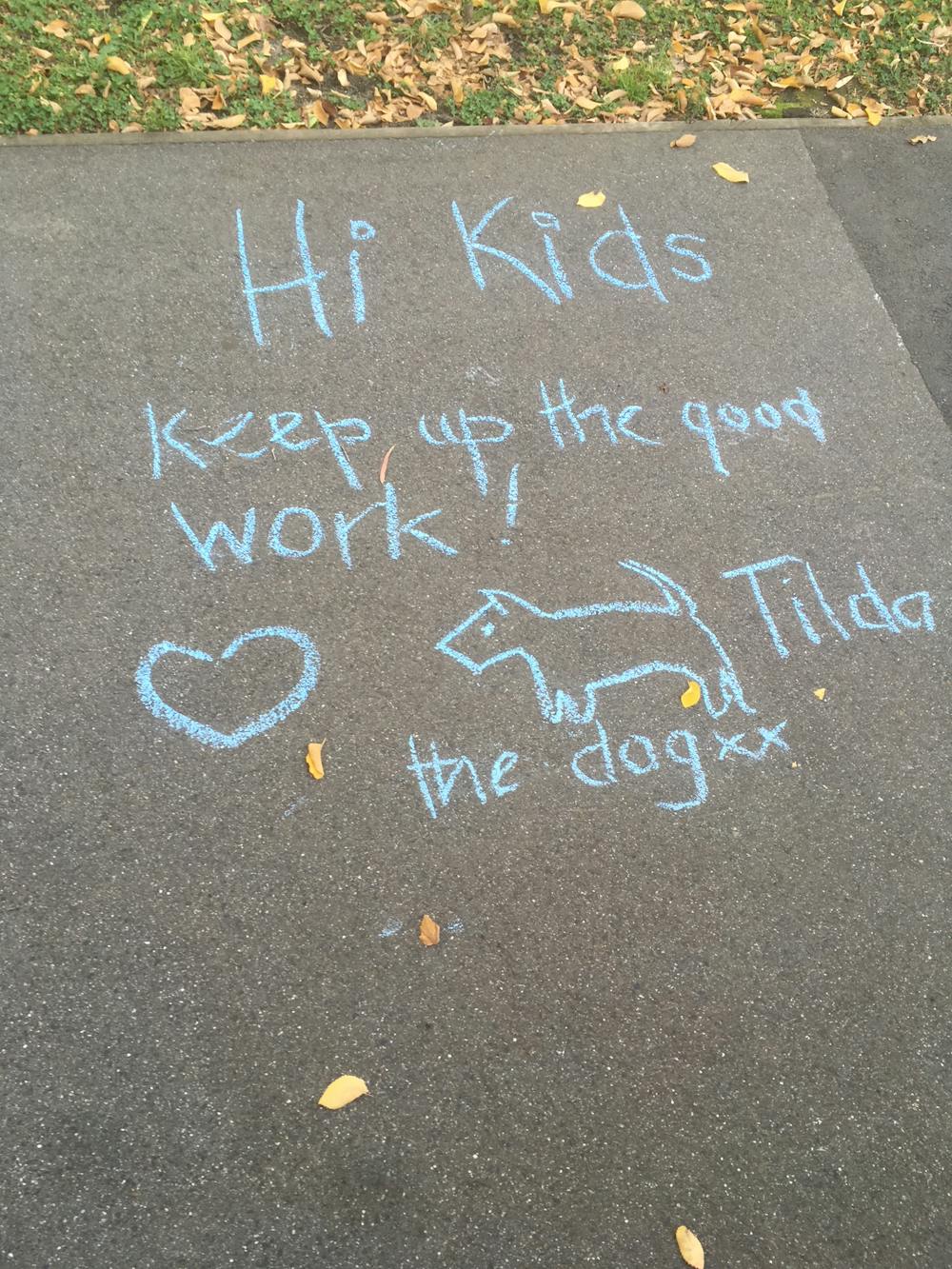
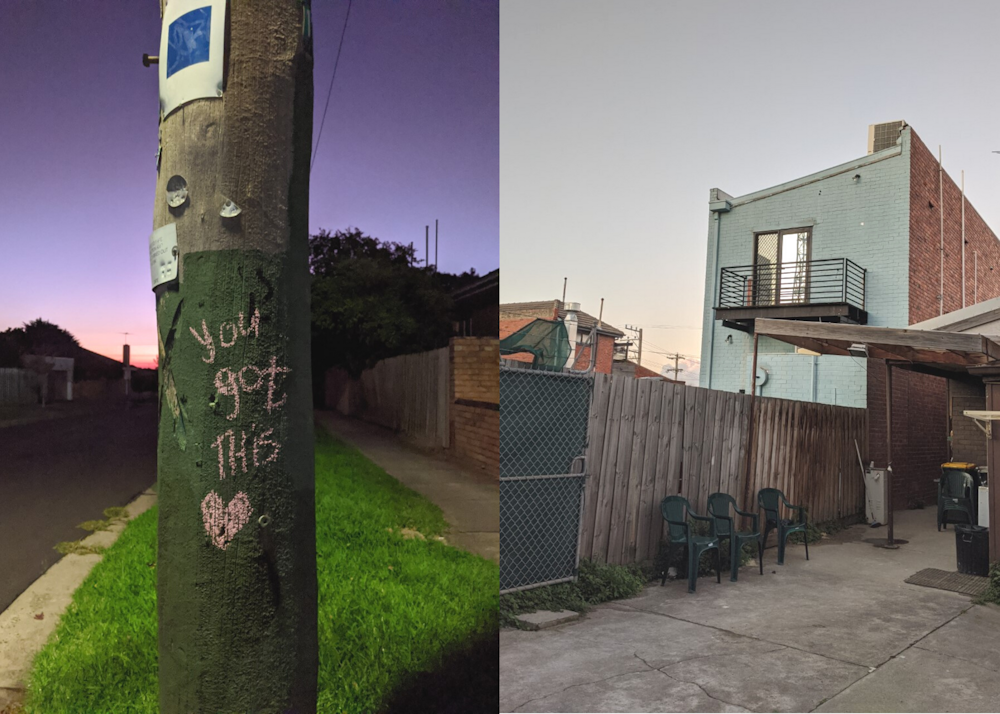
A clear lesson from the many conversations across fencelines, waves from porches, teddy bears in windows and chalk art on footpaths is the need for our cities to better embrace edge spaces between private property and the public realm.

These edge spaces, such as porches, balconies, front boundaries and footpaths, have been key to maintaining social connectedness amid physical distancing around the world; so much so that this week has been declared an international week dedicated to better activating them.


Read more: Reconnecting after coronavirus – 4 key ways cities can counter anxiety and loneliness


Australian cities and neighbourhoods have rarely embraced edge spaces well. This neglect is to all our detriment: many housing developments lack porches, front yards often seem like an afterthought, and most nature strips fail to live up to their name. As a result, talking to our neighbours can be a rarity.

Re-engaging with ‘living on the edge’

Action to embrace these spaces starts at the community level, through the practice of placemaking. It draws on the work of planners and designers and their understanding of the importance of “living on the edge”.

Typically, we regard our neighbourhoods as being divided between public and private spaces. But as many a front-yard conversation or colourful display on a wall has shown us during the recent lockdown, it’s the spaces of transition that bring us together, even when we are apart.

Compared to other types of urban space, edge spaces can provide more opportunity for people to build a sense of identity and community through creative expression.

Pedestrians and residents have re-envisaged the footpath as a canvas for chalk and a way to communicate with the street. Matt Novacevski. Author provided

Read more: Playing with the ‘new normal’ of life under coronavirus


Edge spaces are critical to the success of both public and private spaces, as urban designers and theorists like Christopher Alexander and Jan Gehl point out.

Edges that work can be described as “soft edges” or “active edges”. We can see through them and interact across them – they are comparatively porous. There is also life along them: plants, artwork or variations in colours or building materials.

Edges that are cold and unwelcoming, or comparatively “hard”, such as spaces dominated by tall fencing or blank walls, generate feelings of discord, coldness and even perceptions of danger.

Indeed, whole cities and neighbourhoods can succeed and fail at their edges, particularly at street level.


Read more: Contested spaces: living off the edge in a city mall where design fuels conflict


Even seemingly small interventions can turn a bland edge into a space that gives. Rachel Iampolski, Author provided

Reclaiming the edge through placemaking

So, what can we do about it? Well, quite a bit. Over recent weeks, many of us will have enjoyed the whimsy and wonder of chalk art on paths, teddy bears in windows and other warming trends that have lifted our neighbourhoods.

These visible expressions of joy create community in hard times. The edges between public and private space are reclaimed and made welcoming in ways that create conviviality and a sense of shared identity.

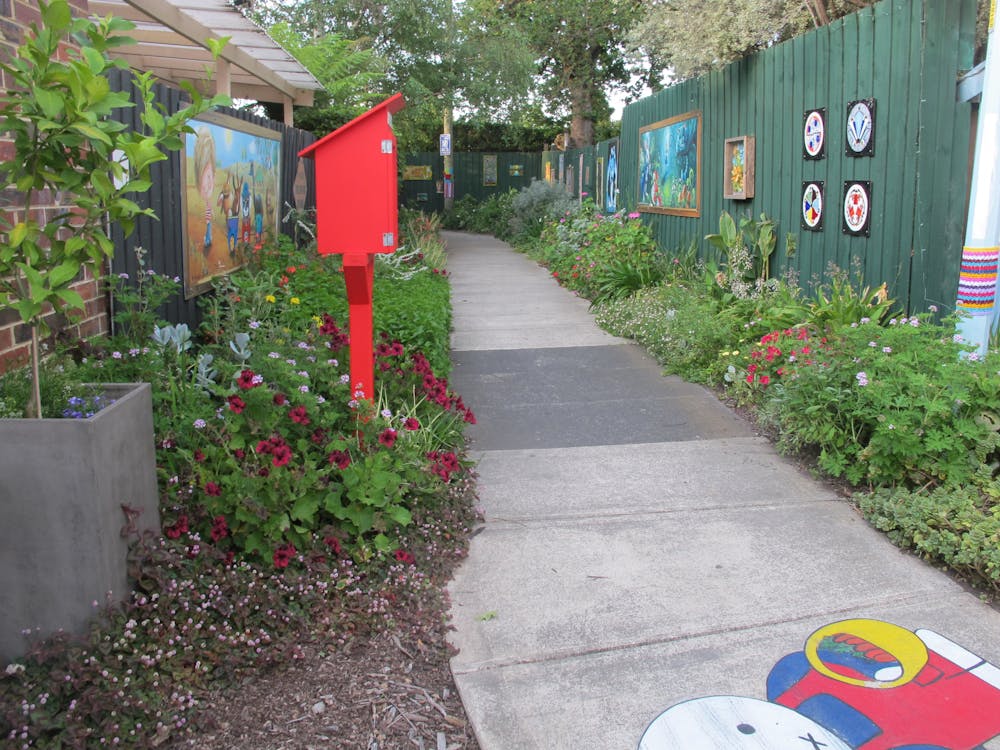
Residents in Carnegie have used art, plants and a street library to soften hard edges and make them more inviting. Rachel Iampolski, Author provided

These practices are an example of what is often described as citizen placemaking, where citizens create a sense of community through gestures of creativity and support.


Read more: Coronavirus has changed our sense of place, so together we must re-imagine our cities


Planning for welcoming, active edges

So why don’t we more often design our edges in ways that invite this kind of activity? For too long, policy, legislation and regulation have variously neglected the importance of edge spaces, or sought to actively limit activity within them.

In Victoria, for example, ResCode policies for housing design seek to regulate viewlines from balconies. These policies and others in Victorian planning schemes do little to encourage the return of the porch or balcony in housing or apartment design.

Chairs at the front of the house allow for contact with passersby – and the gnome is a friendly presence even when the chairs are empty. Matt Novacevski, Author provided

In the public realm, instances of over-zealous enforcement of regulation have closed down activities that bring life to footpaths and bring residents together. This risks promoting bland, homogenised streets that lead to social isolation.

We wonder how our neighbourhoods might change if planning policy, design and regulation were put to work, opening up possibilities to encourage softer and more active edges?


Read more: We can’t let coronavirus kill our cities. Here’s how we can save urban life


These opportunities bleed out from the front fence into the footpath and streets. As cities overseas have started to use tactical urbanism to promote safer social interaction, the task for government is two-fold: to enable tactical approaches that allow communities to shape spaces to meet their own needs, and to focus governance on making better places.

Whatever happens next, as citizens, we would all do well to use our imagination and remember the power and potential of the edge spaces where we live.

A map of projects being run around the world as part of Porch Placemaking Week, May 30-June 5.

ref. A time to embrace the edge spaces that make our neighbourhoods tick – https://theconversation.com/a-time-to-embrace-the-edge-spaces-that-make-our-neighbourhoods-tick-138826

Australia’s first service sector recession will be unlike those that have gone before it

Source: The Conversation (Au and NZ) – By Isaac Gross, Lecturer, Monash University

Australia is on the brink of its first recession in almost 30 years.

The Australian Bureau of Statistics will deliver the official economic growth figure for the March quarter on Wednesday.

If it is negative (as is likely because of the downturn and the bushfires, but not guaranteed because of the surge in spending as Australians stocked up on essentials in March) and is then followed by another negative result in the June quarter (which is all but certain) Australia will be in what some people regard as a technical recession.

But the technicalities don’t matter. Close to 20% of Australia’s labour force is either unemployed or underemployed, something that dwarfs previous recessions.

Data already released suggests it will be different in other ways; important ones with important implications.

It will be our first “service sector” recession.

Recessions are usually defined by large falls in investment; in new cars, new houses and new businesses.


Read more: Which jobs are most at risk from the coronavirus shutdown? 


As a result, in the early 1990s recession construction and manufacturing businesses were devastated. By contrast, employment in social services, education and food services continued to grow throughout the recession.

This time will be different.

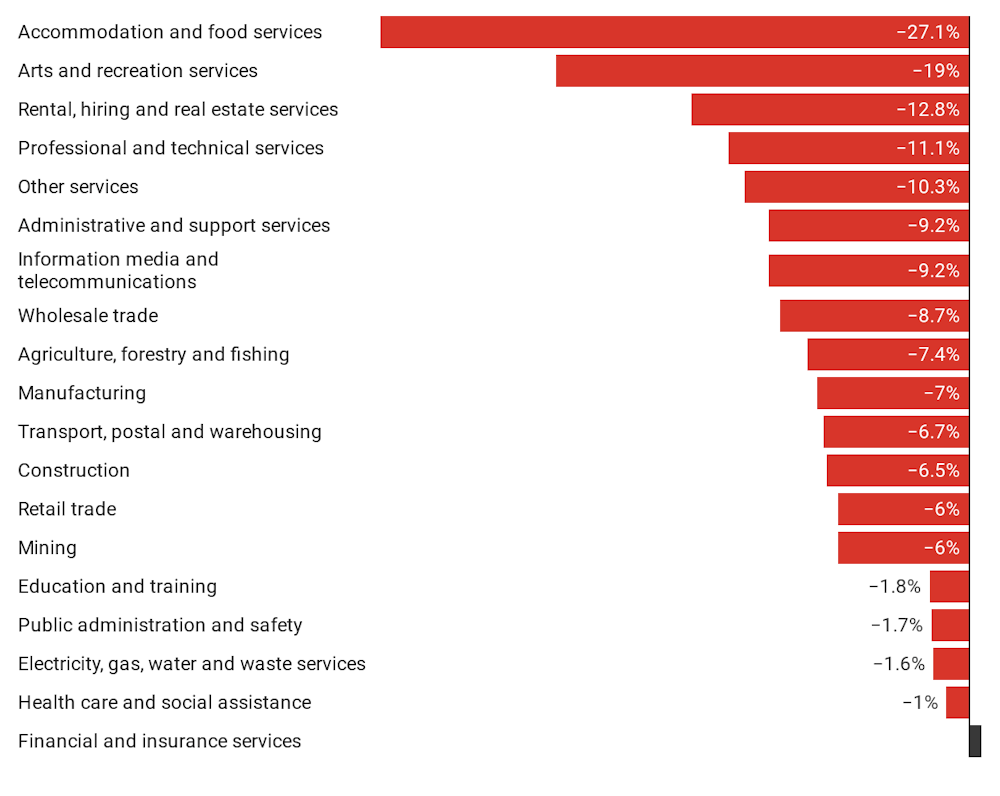
Between March 14 and May 2 some 27% of the jobs in the accommodation and food services industry vanished, 19% of the jobs in the arts and recreation industry, and 11% of the jobs in professional and technical services – all well above the 6.5% and 7% of jobs lost in construction and manufacturing.


Jobs lost by industry, March 14 to May 2 ,

6160.0.55.001 – Weekly Payroll Jobs and Wages in Australia, Week ending 2 May 2020

The closure of Australia’s borders coupled with the ongoing fear of infection, creates the risk that service sector job losses will continue to grow.

Even when the recession is over, they won’t bounce back in the way that manufacturing and construction jobs might have.

When previous recession temporarily slowed demand for things such as cars and buildings, the pent-up demand led to a surge in sales when incomes recovered.


Read more: Unlocking Australia: What can benefit-cost analysis tell us?


But services are harder to store over time. Someone who skips the hairdresser for a year won’t buy a year’s worth of haircuts when conditions improve.

Nor will someone who stops going to pubs (probably) buy six months worth of drinks when pubs reopen.

It means most service sector businesses can’t expect a quick rebound. Four out of every five employed Australians work in services.

Not your grandparent’s recession

The usual playbook for dealing with a recession is to target the sectors most affected. This has meant rolling out big infrastructure projects that can hire newly-unemployed construction workers, and cutting taxes to encourage businesses to expand and hire.

But that strategy won’t be as effective this time. The tour guides and massage therapists whose service sector jobs have been destroyed are ill-suited to building high-speed trains.

And a lot of infrastructure programs are designed on the basis that Australia’s population would continue to expand. With almost two thirds of Australia’s population growth driven by overseas migration and borders now closed, that is no longer certain. Many projects that were previously considered worthwhile may no longer stack up.

The government will have to focus its recovery programs on those sectors hardest hit. For some, this will be straightforward.


Read more: Look beyond a silver bullet train for stimulus


The government already plays a large role in the education industry. Universities could have their funding boosted to make up for the shortfall of international students, and domestic students should be encouraged to enrol in virtual courses to improve their skills.

For some other service industries, the government should extend JobKeeper to provide continuing assistance after it is due to end in September. Social distancing requirements are likely to limit the operations of businesses such as cinemas and theatres some time. Tourism will also remain depressed as long as our borders remains closed.

Despite the focus on mining and manufacturing in our economic discourse, Australia’s economy is overwhelmingly dominated by services.

If the government wants to stop this recession from turning into a depression, it will have to redirect its policy playbook toward services.

ref. Australia’s first service sector recession will be unlike those that have gone before it – https://theconversation.com/australias-first-service-sector-recession-will-be-unlike-those-that-have-gone-before-it-137994

A nice warm bowl of porridge: 3 ways plus a potted history

Source: The Conversation (Au and NZ) – By Donna Lee Brien, Professor, Creative Industries, CQUniversity Australia

As winter begins, porridge makes an excellent choice for breakfast. For many, porridge is redolent with memories of childhood. It is warm, filling, high in fibre and associated with lowering blood cholesterol.

It’s very reliability may also be comforting in unsettling times; as actor Stephen Fry once tweeted: “Nothing in this world is at it seems. Except, possibly, porridge”.

Although most commonly used to describe a breakfast dish made with oats boiled with water or milk, any grain so cooked in liquid can be described as porridge. The dish’s history is deep.

Not so paleo

Porridge has an ancient lineage as a staple food, including in Europe, Africa and the Middle East. In 2015, National Geographic magazine reported on an analysis of a Palaeolithic pestle from 33,000 years ago, revealing it was dusted with oat starch. This suggests ancient humans were grinding oats into flour – at odds with the popular Paleo diet trend that holds humans weren’t eating grains then. The oat remnants on the pestle, found in an Italian cave, may have been cooked into a porridge.

In her book, A History of Food, Maguelonne Toussaint-Samat writes early peoples might also have made something like thick pancakes by cooking various porridgey mixtures on hot stones placed on a fire’s embers.

Oats are traditionally associated with Scotland, although barley and a grain called bere were originally introduced by the Vikings. True to her roots, Scottish-born Australian cookbook writer Margaret Fulton decreed salt was essential for a proper porridge.


Read more: Health Check: five must-have foods for your shopping trolley


Gruel to be kind

Gruel is a thin porridge, which was served in English workhouses in the 19th century. Oliver Twist pleads “Please Sir, I want some more” in Charles Dickens’ second novel. The writer’s description led to gruel being thought of as unappetising.

Yet, gruel also features as a nutritious food in many 19th century cookbooks. In A Plain Cookery Book for the Working Classes (1852), Queen Victoria’s chef Charles Elmé Francatelli recommends restorative gruel made with oats or barley.

The 1893 edition of Mrs Beeton’s Every-day Cookery and Housekeeping Book boils just one tablespoon of oats in a pint of water to make a “dainty” dish for the ill. Mrs Beeton notes this digestible liquid can be flavoured with lemon peel or a little grated nutmeg. She notes some invalids will appreciate the addition of a good measure of sherry or port.

Gruel, glorious gruel. Oliver asked for more in the 1968 film. IMDB

Porridge time

The consumption of porridge in British jails led to the 1950s slang “doing porridge” for serving a custodial sentence. This, in turn, suggested the name of the classic 1970s British comedy starring Ronnie Barker.

Today, around the world, oats are grown for animal feed and human consumption. Although some recent reports have highlighted the possible presence of pesticides and weedkillers in widely marketed oat products, these have been refuted by producers.

In the late 1990s, savoury oaten porridge made gastronomic headlines with Heston Blumenthal’s Snail Porridge from his Michelin-starred Fat Duck restaurant. The dish of oats cooked in a stock flavoured with ham and snails, served with more snails and garlic butter and topped with a fennel salad, became one of his signature dishes.

Not all oats are equal. Melissa Di Rocco/Unsplash, CC BY

Choosing, and cooking with, oats

The most commonly available oat varieties are “rolled”, “quick” (or “quick cooking”) and “instant”.

The below recipes below use rolled oats. These are oat kernels that are steamed, then rolled.

Quick cooking oats have been steamed for longer, rolled more thinly and/or chopped into smaller pieces. Another way to reduce the cooking time is to soak rolled oats before boiling them.

Instant oats are more highly processed, so that they can be prepared by just adding boiling water or heating briefly in the microwave.

As rolled oats can be eaten raw (as in natural muesli), they are very forgiving in terms of cookery.

1. Traditional porridge

Mix 1 cup of rolled oats with 3 cups of cold water in a saucepan. Add a pinch of salt.

Bring to the boil, and then turn the heat down. Simmer gently for about 20 minutes, stirring more as it thickens. If too thick, loosen with a splash more boiling water. If too thin, boil a couple more minutes.

Top with golden syrup or brown sugar and serve with cold milk.

Variations:

  • using cow’s milk (or other varieties) instead of, or mixed with, the cooking water

  • fruit (apple, bananas, fresh or frozen berries are especially good) and seeds or nuts can be stirred into the cooked porridge or used as a topping

  • honey and maple syrup, and plain or flavoured yogurt, are also good toppings

2. Microwave porridge

Follow the proportions above. Depending on the microwave’s wattage, cook (covered) on high for around 4 to 5 minutes, stirring halfway.

Care needs to be taken to use a tall enough bowl so that the porridge does not boil over.

3. Savoury porridge

Oats are cooked as above, using salted water or vegetable or chicken stock, and treated as any other kind of soft grain (like polenta or risotto), with vegetables and other ingredients added before serving.

Savoury oats with toast. Shreyak Singh/Unsplash, CC BY

Variations:

  • stir in tasty cheese and top with sautéed mushrooms or capsicums, and a fried or poached egg

  • top with sliced avocado, and then drizzle with tahini and lemon juice

  • stir in shredded spinach, top with chopped fresh tomatoes and chilli, and drizzle with garlic-infused olive oil

  • ground black pepper or hot Sriracha sauce goes well with all of these.

ref. A nice warm bowl of porridge: 3 ways plus a potted history – https://theconversation.com/a-nice-warm-bowl-of-porridge-3-ways-plus-a-potted-history-137007

As Minneapolis burns, Trump’s presidency is sinking deeper into crisis. And yet, he may still be re-elected

Source: The Conversation (Au and NZ) – By Timothy J. Lynch, Associate Professor in American Politics, University of Melbourne

Violence has erupted across several US cities after the death of a black man, George Floyd, who was shown on video gasping for breath as a white police officer, Derek Chauvin, knelt on his neck. The unrest poses serious challenges for President Donald Trump and former Vice President Joe Biden as each man readies his campaign for the November 3 election.

If the coronavirus had not already posed a threat to civil discourse in the US, the latest flashpoint in American racial politics makes this presidential campaign potentially one of the most incendiary in history.

COVID-19 and Minneapolis may very well form the nexus within which the 2020 campaign will unfold. Trump’s critics have assailed his handling of both and questioned whether he can effectively lead the country in a moment of crisis.

And yet, he may not be any more vulnerable heading into the election.

A presidency in crisis?

As the incumbent, Trump certainly faces the most immediate challenges. Not since Franklin Roosevelt in the second world war has a US president presided over the deaths of so many Americans from a single cause.

The Axis powers and COVID-19 are not analogous, but any presidency is judged by its capacity to respond to enemies like these. With pandemic deaths now surpassing 100,000, Trump’s fortunes will be inexorably tied to this staggering (and still rising) figure.

Worse, the Minneapolis protests are showing how an already precarious social fabric has been frayed by the COVID-19 lockdowns.


Read more: Donald Trump blames everyone but himself for the coronavirus crisis. Will voters agree?


Americans have not come together to fight the virus. Rather, they have allowed a public health disaster to deepen divisions along racial, economic, sectional and ideological lines.

Trump has, of course, often sought to gain from such divisions. But the magnitude and severity of the twin crises he is now facing will make this very difficult. By numerous measures, his is a presidency in crisis.

And yet.

Trump, a ferocious campaigner, will try to find ways to use both tragedies to his advantage and, importantly, makes things worse for his challenger.

For starters, Trump did not cause coronavirus. And he will continue to insist that his great geo-strategic adversary, the Chinese Communist Party, did.

And his is not the first presidency to be marked by the conflagration of several US cities.

Before Minneapolis, Detroit (1967), Los Angeles (1992) and Ferguson, Missouri (2014) were all the scenes of angry protests and riots over racial tensions that still haven’t healed.

And in the 19th century, 750,000 Americans were killed in a civil war that was fought over whether the enslavement of African-Americans was constitutional.

Trump may not have healed racial tensions in the US during his presidency. But, like coronavirus, he did not cause them.

How Trump can blame Democrats for Minneapolis

Not unhappily for Trump, Minneapolis is a largely Democratic city in a reliably blue state. He will campaign now on the failure of Democratic state leaders to answer the needs of black voters.

Trump will claim that decades of Democratic policies in Minnesota – including the eight years of the Obama administration – have caused Minneapolis to be one of the most racially unequal cities in the nation.

In 2016, Trump famously asked African-Americans whether Democratic leaders have done anything to improve their lives.

What do you have to lose by trying something new, like Trump?

He will repeat this mantra in the coming months.

It also certainly helps that his support among Republican voters has never wavered, no matter how shocking his behaviour.

He has enjoyed a stable 80% approval rating with GOP voters throughout the coronavirus crisis. This has helped keep his approval rating among all voters steady as the pandemic has worsened, hovering between 40 and 50%.

These are not terrible numbers. Yes, Trump’s leadership has contributed to a series of disasters. But if the polls are correct, he has so far avoided the kinds of catastrophe that could imperil his chances of re-election.


Read more: In Trump we trust: why continual disasters fail to shake the president’s loyalists


Why this moment is challenging for Biden

Biden should be able to make a good case to the American people at this moment that he is the more effective leader.

But this has not yet been reflected in polls, most of which continue to give the Democrat only a lukewarm advantage over Trump in the election.

The other problem is that the Democratic party remains discordant. And Biden has not yet shown a capacity to heal it.


Read more: Third time’s the charm for Joe Biden: now he has an election to win and a country to save


Race has also long been a source of division within Biden’s party. Southern Democrats, for instance, were the key agents of slavery in the 19th century and the segregation that followed it into the 20th.

After the 1960s, Democrats sought to make themselves the natural home of African-American voters as the Republican party courted disaffected white Southern voters. The Democrats largely succeeded on that front – the party routinely gets around 85-90% of black votes in presidential elections.

The challenge for Biden now is how to retain African-American loyalty to his party, while evading responsibility for the socio-economic failures of Democratic policies in cities like Minneapolis.

He is also a white northerner (from Delaware). Between 1964 and 2008, only three Democrats were elected president. All of them were southerners.

To compensate, Biden has had to rely on racial politics to separate himself from his primary challenger – Bernie Sanders struggled to channel black aspirations – and from Republicans. And this has, at times, caused him to court controversy.

In 2012, he warned African-Americans that then-Republican presidential candidate Mitt Romney would put them “all back in chains”. And just over a week ago, he angered black voters by suggesting those who would support Trump in the election “ain’t black”.

Biden is far better than Trump on racial issues and should be able to use the current crises to present himself as a more natural “consoler-in-chief”, but instead, he has appeared somewhat flatfooted and derided for being racially patronising.

The opportunities COVID-19 and the Minneapolis unrest might afford his campaign remain elusive.

The protests over George Floyd’s death swiftly spread across the country. ETIENNE LAURENT/EPA

There is reason for hope

America enters the final months of the 2020 campaign in a state of despair and disrepair. The choice is between an opportunistic incumbent and a tin-eared challenger.

But the US has faced serious challenges before – and emerged stronger. Neither the civil war in the 19th century or the Spanish flu pandemic in the early 20th halted the extraordinary growth in power that followed both.

Moreover, the US constitution remains intact and federalism has undergone something of a rebirth since the start of the pandemic. And there is a new generation of younger, more diverse, national leaders being forged in the fire of crisis to help lead the recovery.

ref. As Minneapolis burns, Trump’s presidency is sinking deeper into crisis. And yet, he may still be re-elected – https://theconversation.com/as-minneapolis-burns-trumps-presidency-is-sinking-deeper-into-crisis-and-yet-he-may-still-be-re-elected-139739

Nicaragua battles COVID-19 and a Disinformation Campaign

Source: Council on Hemispheric Affairs – Analysis-Reportage

Support this progressive voice and be a part of it. Donate to COHA today. Click here

By John Perry
From Masaya, Nicaragua

Every country in the world is trying to balance its fight against the virus with the need to have a functioning economy, and there is plenty of debate about what the balance should be. The world’s poorer countries face the toughest challenge, because a high proportion of their populations engage in a daily struggle to earn enough to eat, whether in small businesses or the informal economy. In Nicaragua, around 80% of people make their living in this way.[1]

But there are two more problems uniquely affecting Nicaragua in tackling the pandemic. One is that its economy and social life had already been attacked only two years ago when a right-wing coup attempt closed much of the country down for nearly three months. Although the economy is recovering, it is inevitably weaker than it was prior to April 2018. Moreover, continuing US sanctions deprive Nicaragua of help towards its anti-poverty programs and also block much of the assistance other Central American countries are able to access, including medical supplies.

The second problem is that the opposition, thwarted in their coup attempt, have seized the COVID-19 epidemic as a new weapon with which to attack the government. Whereas in the US and Europe opposition political parties have generally combined criticism of their political rivals with overall support for their country’s efforts to defeat the epidemic, the Nicaraguan opposition has been not simply negative but contemptuous. Opposition spokespeople have poured scorn on the government’s efforts and encouraged the international media to accuse it of negligence or even that it is in denial about the epidemic.[2] Worse still, they have deliberately sown fear and suspicion among the Nicaraguan population, so that many people are not only scared of the virus but even of using the public health services that are there to help protect them from its effects.

This is the background to an unusual step taken by Nicaragua’s Sandinista government on May 25: it published a 75-page “white paper” describing its strategy to tackle COVID-19. Much of the strategy was already in place as early as January this year, but in the paper the different elements are set down clearly and the reasons for taking them are explained in detail.

The strategy to tackle COVID-19

Government recognition of the importance of confronting the virus was made clear at a press conference in mid-January, two months before Nicaragua even detected its first virus case, which was a passenger arriving at the international airport. Then on January 31, a day after the World Health Organization (WHO) declared a “public health emergency”, Nicaragua created a special commission to deal with the virus threat. By February 9 it had issued a joint protocol with the Pan-American Health Organization (the Americas branch of the WHO), setting out its strategy. At this early stage of the crisis, few countries outside Asia had done anything similar.

Nicaragua: progresive social policies and outcomes

Importantly, the White Paper makes clear that the real work had started a decade earlier. Since 2007 when the current Sandinista government took office, it has been making significant investments  in the public health service, increasing the number of doctors from 2,715 to 6,045, building 18 new hospitals, opening dozens of new health centers and creating new vaccination programs. By 2018, Nicaragua was spending 21% of its government budget on health, one of the highest proportions among less-developed countries.[3] Compared with 2006, infant mortality in 2019 had fallen by more than half; deaths in childbirth had fallen from 92.8 for every 1,000 live births to 29.9 over the same time period.[4]

Given this base, the government’s strategy to fight COVID-19 enabled it to designate 19 hospitals as specialist centers to receive patients; one, the Hospital Alemán Nicaragüense in Managua, has been dedicated entirely to dealing with respiratory infections during the outbreak. Among other resources, at the start of the crisis these hospitals counted with 562 intensive care beds and 449 ventilators (this last was similar to Costa Rica’s 450 ventilators, whereas neighboring Honduras and El Salvador had fewer than 200 each, for bigger populations).[5]

Strong public measures against the virus

The government also set about strengthening the defenses against the epidemic within the community. It intensified its vaccination program, so as to reduce the level of other respiratory diseases such as influenza and pneumonia that would make the fight against COVID-19 more difficult by using similar health resources. It trained 158,000 health brigadistas who have now carried out more than 4.6 million house-to-house visits, dispensing advice about the virus. It set up a free telephone helpline, which in its first month’s operation had 110,000 callers.[6] Schools, buses and markets are being regularly disinfected. Public buildings have safeguards to limit transmission of the virus and there has been general public education both through the brigadista visits and through the media.

A key part of the strategy has been to train the 9,000 people operating at the 19 points of entry to the country in dealing with visitors during the crisis. This has enabled some 42,000 travellers arriving in Nicaragua to be asked to self-isolate for 21 days, during which they receive follow-up visits and phone calls from officials to monitor their state of health and detect possible new cases of transmission.[7] Internationally, many countries set up such systems much later than Nicaragua and, in the UK for example, so-called “track and trace” arrangements will not be in place until later in June. The Nicaraguan government deliberately did not close its borders as it wanted returning travellers to use official crossing points, and it deployed the army to track down the many people who have made unofficial crossings, evading health controls.

Conservative NGO’s financed by the US make up data about COVID-19

As the White Paper concedes, there have been many criticisms of Nicaragua’s approach. These have far exceeded what the country should reasonably expect, given that it intensified its preparations as soon as the global emergency was officially recognised in January and kept the numbers of cases to double figures until early May. The reason for the heavy criticism is, of course, political.

One example is the way the official reports of numbers of cases and numbers of deaths are challenged on a daily basis. This is not simply a matter of questioning the accuracy of official figures, but an attempt to completely deny their legitimacy. A so-called “Citizens’ Observatory” has been set up, consisting of anonymous “experts,” who create their own figures which come from “civil society, networks, digital activists and affected families” and are “verified by the citizenry.” These are carried in official-looking twice-weekly reports, which say in small print that they are not government publications but which are treated by much of the media, including the international press, as if they have more credibility than official sources.[8] France 24 describes the body as “a prominent Nicaraguan NGO” even though it has no registered status and has only existed for a few weeks.[9]

Since it started in March it has produced vastly inflated figures. For example, when on May 26 the health ministry, MINSA, reported 759 proven cases of COVID-19, the “Observatory” was reporting over 2,600 cases with a further 2,000 as “suspicious.” Right-wing NGOs and media channels have produced even worse forecasts. A report by the notorious media channel 100% Noticias on April 2 predicted that 23,000 Nicaraguans would have died from the virus by early May.[10] The BBC carried a report which included a forecast by local NGO Funides that by June there would be at least 120,000 virus cases and 650 deaths. While the BBC cast doubt on the Nicaraguan government figures, it reproduced the Funides figures without questioning them.[11] Funides does not work in the health sector and in 2018 it received over $120,000 from the US-government supported agency, the National Endowment for Democracy, to promote “democracy” in Nicaragua.[12]

Other unfounded criticisms regarding Nicaragua’s pandemic situation

Another criticism has been to challenge Nicaragua’s approach of keeping the economy and daily life moving and not requiring the kinds of “lockdown” that have taken place in neighbouring countries and to varying degrees in the US and Europe. Ignoring the obvious need for a balanced judgment to be made that aims to avoid what the White Paper calls an economic “catastrophe,” critics have implied the need for more drastic measures without explaining how the majority of ordinary Nicaraguans will make a living if these are put into practice. The experience of adjoining countries’ lockdown strategies has been extremely mixed, as COHA has already shown.[13]

In recent weeks, criticisms of the lockdown measures in adjoining El Salvador[14] and Honduras have intensified.[15] While Costa Rica’s lockdown policy appears to have been more successful, it has come at the cost of severely affecting relations with every other Central American country, when it shut down its borders to commercial traffic giving no notice and causing both enormous queues and considerable economic hardship.[16] From nearby Colombia, The Guardian reports that “that strict quarantine measures have done little to flatten the curve [of numbers of virus cases],” even while the same newspaper repeatedly criticizes Nicaragua’s failure to adopt a lockdown policy.[17]

Proponents of lockdown for poor countries such as Nicaragua have also ignored the many criticisms of such policies. For example, the eminent epidemiologist Professor Sunetra Gupta, of Oxford University, describes lockdown as a “luxury” only available to the middle classes in developed economies.[18] Many other experts agree with this view, as do international NGOs such as Oxfam.[19]

But the worst attacks have been to accuse the government either of gross negligence, of having no strategy to confront the epidemic or even of deliberately wanting people to die. These have been detailed and sophisticated. For example, the government is alleged to be opposed to using facemasks, though in fact, it has been promoting their use. “Reliable sources” assert that hospitals are full, and incapable of helping prospective patients. False allegations have been made that victims of the virus are being secretly buried in communal graves (illustrated with photographs shown to have been taken in Ecuador).[20]

Inevitably, as COHA reported on April 17,[21]  these criticisms have been picked up and amplified by the international media. If anything, their coverage is even worse now than it was in early April. According to the BBC on April 20, for example, the Nicaraguan government “ignored messages from public health experts.”[22] In the UK, The Guardian has three times compared President Ortega with the right-wing President Bolsonaro in Brazil (who has cynically dismissed the seriousness of the virus), most recently on May 10.[23]

Propaganda that puts people in danger

The propaganda of course does have an important effect on international opinion about Nicaragua and – perhaps to a lesser extent – on opinion in Nicaragua itself. More importantly, however, it is clear that the aim of producing fear and even panic about the epidemic has partly succeeded, as it is confirmed by the experience of the Jubilee House Community in Ciudad Sandino.

Jubilee House’s Coordinator, Becca Mohally Renk, says that their staff have direct experience of the impact of the opposition propaganda on patients who come to the community run clinic. They have spoken with people whose family members have COVID-19 symptoms, and many are not only afraid to take them to an official MINSA (Health Ministry) clinic, they even fear calling the government’s special hotline number to report the case. They have been told that MINSA doesn’t have tests and isn’t really attending patients, so they don’t see a lot of point in bothering to report their case. But they’ve also heard that MINSA will come and take away their family member and they won’t see them again. With so many fake stories of secret burials and false accounts of MINSA hiding bodies and losing bodies, people don’t want to go to the hospital.

So, as a direct result of the propaganda, some people are effectively hiding cases from MINSA and making contact tracing impossible, possibly putting themselves and family members who are infected with COVID-19 in danger if they worsen suddenly and don’t go to the hospital in time out of fear. In Masaya, this author knows personally of a death which might have been avoided if the victim had gone to MINSA. Interviews with satisfied patients leaving the Masaya hospital after recovering from the virus, posted on social media locally, may to some extent help to counteract these false rumors.

The opposition’s response to the White Paper

Will the opposition give up its negative campaign now that it is even clearer than before what the government’s strategy is about? Of course not. It has already dismissed the white paper as “a confession of the enormous error which the government committed” in its approach to the epidemic.[24] It accuses the government of putting Nicaraguans at risk by promoting the theory of “herd immunity,” when this term (inmunidad del rebaño in Spanish) does not appear in the document. It criticizes the White Paper’s citing of experience in Sweden, yet the available data show that Sweden’s avoidance of a lockdown has in most respects resulted in a better response to the epidemic than those in the US, UK, Spain or Italy.[25]

What does the opposition advocate instead? Spokespeople such as Carlos Tünnermann, coordinator of the opposition Civic Alliance (described by news agency EFE as “one of Nicaragua’s most prestigious intellectuals”),[26] stop short of actually calling for a lockdown yet imply strongly that one is needed. Why do they want one? It may be because it would recommence the destruction of Nicaragua’s economy that they attempted in 2018, and also erode popular support for Daniel Ortega’s government. Why do they not actively call for a lockdown themselves?  It may be because they can see the reality of its disastrous effects in El Salvador and Honduras, and they know full well that some of their key political allies in the United States want lockdowns to be rescinded as soon as possible.

The authorities’ efforts are being complemented by the behaviour of the great majority of people and businesses in Nicaragua who are following the Health Ministry recommendations. In general, people are actually doing more to protect themselves, as well as workers and customers, by wearing masks, ensuring they keep physical distance and applying systematic hygiene measures. As a result of this combined national effort against the virus, the white paper is able to show that, so far, mortality in Nicaragua is very clearly remaining at levels below those of the previous five years.
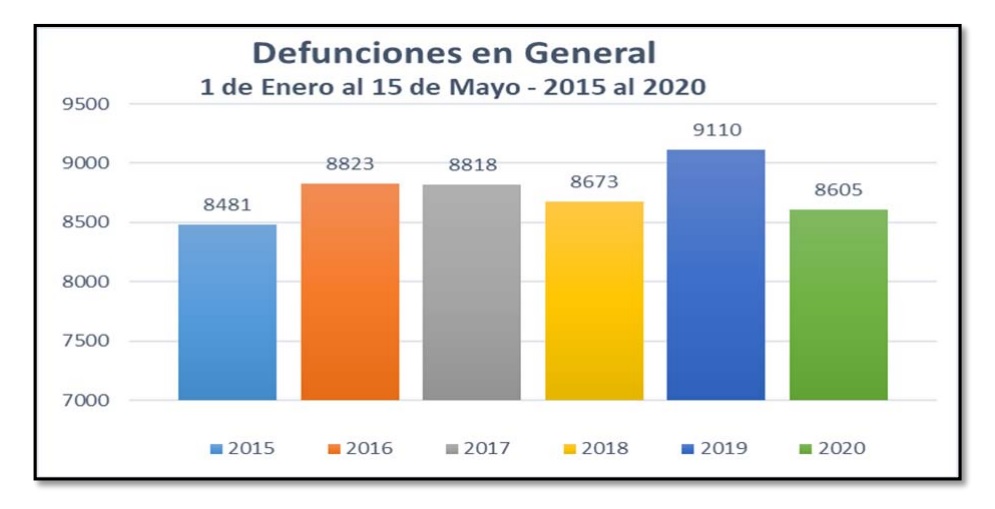
 Overall mortality in Nicaragua for January 1st to May 15th each year, 2015-2020 [27]

The outlook

For the moment it seems clear that Nicaragua is now well into the phase of community transmission of the virus. At this point trying to estimate the number of cases precisely is impossible because, as a WHO report indicates, data through March 2020 suggests “80% of infections are mild or asymptomatic.” [28]Nicaragua’s health authorities are focused on identifying patients with symptoms and ensuring they get the treatment they need while also monitoring those patients’ contacts and ensuring they isolate appropriately, a task made vastly more difficult by the opposition’s propaganda.

Nevertheless, the authorities’ efforts are being complemented by the great majority of people and businesses in Nicaragua following the Health Ministry recommendations. In general, Nicaraguans are actually doing more to protect themselves, as well as workers and customers, by wearing masks and ensuring they keep physical distance and applying systematic hygiene measures. As a result of this combined national effort against the virus, overall mortality in Nicaragua has – so far – very clearly remained at levels below those of the previous five years (see chart). Of course, the system now begins to face a huge test and the next 2-3 months are expected to be crucial.

[Credit Photo: “Members of the 300-strong sanitation squad who work for the Managua city council”, from https://www.el19digital.com/]


End notes

[1] “AL PUEBLO DE NICARAGUA Y AL MUNDO INFORME SOBRE EL COVID-19 Y UNA ESTRATEGIA SINGULAR – LIBRO BLANCO” p 3. https://www.el19digital.com/app/webroot/tinymce/source/2020/00-Mayo/25%20MAYO/AL%20PUEBLO%20DE%20NICARAGUA%20Y%20AL%20MUNDO-%20INFORME%20SOBRE%20EL%20COVID-19.pdf. An English translation, “To the People of Nicaragua and to the World: COVID-19, A Singular Strategy, White Book” is available at http://www.tortillaconsal.com/tortilla/node/9402. All references to the White Paper refer to the original Spanish edition page numbers, hereafter cited as “White Paper”.

[2] See “Nicaraguan Opposition Misrepresents Government Response to COVID-19,” http://www.coha.org/nicaraguan-right-wing-opposition-misrepresents-government-response-to-the-covid-19-pandemic/

[3] Data from https://datosmacro.expansion.com/estado/gasto/salud

[4] See http://www.tortillaconsal.com/tortilla/node/9402

[5] Costa Rica and other Central American countries have since been able to acquire more, given their stronger economies and freedom from US sanctions. See “Costa Rica tendrá 700 ventiladores para atender pacientes críticos por Covid-19,”  https://www.teletica.com/252364_costa-rica-tendra-700-ventiladores-para-atender-pacientes-criticos-por-covid-19

[6] See White Paper, pp 27-29.

[7] White Paper, p 5.

[8] The reports from the “Observatory” are published on Twitter, Facebook and at its sophisticated website https://observatorioni.org/

[9] “Under-fire Nicaragua reports significant rise in COVID-19 cases,” https://www.france24.com/en/20200526-under-fire-nicaragua-reports-significant-rise-in-covid-19-cases

[10] These and other rumours and predictions have been collated in a video by Juventud Presidente, “Falsas matemáticas sobre el Covid-19 en Nicaragua,” https://www.youtube.com/watch?v=bMJZK5U9VUo

[11] “5 insólitas cosas que ocurren en Nicaragua mientras los expertos advierten de la “grave” falta de medidas ante la pandemia,” https://www.bbc.com/mundo/52530594

[12] See https://www.ned.org/region/latin-america-and-caribbean/nicaragua-2018/

[13] “COVID-19 as Pretext for Repression in the Northern Triangle,” http://www.coha.org/covid-19-as-pretext-for-repression-in-the-northern-triangle/

[14] On El Salvador, see for example, CNN News (May 21) “¿Salvador o autoritario? El presidente ‘millennial’ de El Salvador desafía a las cortes y al Congreso en la respuesta al coronavirus,” https://cnnespanol.cnn.com/2020/05/21/salvador-o-autoritario-el-presidente-millennial-de-el-salvador-desafia-a-las-cortes-y-al-congreso-en-la-respuesta-al-coronavirus/; and earlier in COHA “ Bukele y uso político de pandemia en El Salvador: entre la ilegalidad y la violación de DDHH,” http://www.coha.org/bukele-y-uso-politico-de-pandemia-en-el-salvador-entre-la-ilegalidad-y-la-violacion-de-ddhh/

[15] On Honduras, see for example, “Del Mitch al golpe y de la pandemia al autoritarismo contra los derechos humanos,” https://defensoresenlinea.com/informe-2-del-mitch-al-golpe-y-de-la-pandemia-al-autoritarismo-contra-los-derechos-humanos/

[16] “Nicaragua-Costa Rica Coronavirus Dispute Stalls Hundreds of Trucks at Border,” https://www.usnews.com/news/world/articles/2020-05-22/nicaragua-costa-rica-coronavirus-dispute-stalls-hundreds-of-trucks-at-border

[17] “Colombian designers prepare cardboard hospital beds that double as coffins,” https://www.theguardian.com/world/2020/may/27/colombia-coronavirus-cardboard-hospital-beds-coffins

[18] See the interview on May 21 by Unherd: https://www.youtube.com/watch?v=DKh6kJ-RSMI&feature=youtu.be

[19] “Half a billion people could be pushed into poverty by coronavirus, warns Oxfam,” https://www.oxfam.org/en/press-releases/half-billion-people-could-be-pushed-poverty-coronavirus-warns-oxfam

[20] Examples are given in videos by Juventud Presidente, see https://www.juventudpresidente.com.ni/coronavirus-y-noticias-falsas-en-nicaragua/; and https://www.juventudpresidente.com.ni/las-falsas-noticias-sobre-el-covid-19-en-nicaragua/

[21] “Nicaraguan Opposition Misrepresents Government Response to COVID-19,” http://www.coha.org/nicaraguan-right-wing-opposition-misrepresents-government-response-to-the-covid-19-pandemic/

[22] “Coronavirus in Latin America: How bad could it get?” https://www.bbc.com/news/av/world-latin-america-52349439/coronavirus-in-latin-america-how-bad-could-it-get

[23] “Bolsonaro attends floating barbecue as Brazil’s Covid-19 toll tops 10,000,” https://www.theguardian.com/world/2020/may/10/bolsonaro-attends-floating-barbeque-as-brazils-covid-19-toll-tops-10000

[24] “Libro Blanco sobre COVID-19 aviva señalamientos contra Ortega en Nicaragua,” https://www.lavanguardia.com/vida/20200527/481430490140/libro-blanco-sobre-covid-19-aviva-senalamientos-contra-ortega-en-nicaragua.html

[25] See comparisons between Sweden and other countries at https://ourworldindata.org/coronavirus/country/sweden?country=~SWE

[26] See above (https://www.lavanguardia.com/vida/20200527/481430490140/libro-blanco-sobre-covid-19-aviva-senalamientos-contra-ortega-en-nicaragua.html)

[27] White Paper, p 18.

[28] “Coronavirus disease 2019 (COVID-19) Situation Report – 46” March 6, 2020. https://www.who.int/docs/default-source/coronaviruse/situation-reports/20200306-sitrep-46-covid-19.pdf?sfvrsn=96b04adf_2


Jakarta Six activists for Papua freedom convicted of treason set free

By Amanda Siddharta in Jakarta

Six activists charged with treason in Jakarta for organising a protest rally for independence last August outside the presidential palace have been freed from prison.

Five of the activists known as the Jakarta Six – Paulus Suryanta Ginting, Ambrosius Mulait, Charles Kosay, and Dano Anes Tabuni, along with the only woman in the group, Arina Elopere – were freed this past week.

Issay Wenda, the sixth person, was released April 28. He had been sentenced to eight months in prison, a month less than the others.

At the August 28 rally, a banned Morning Star independence flag was raised as activists protested over incident that occurred against Papuans earlier that month in Surabaya in East Java.

The Morning Star flag is a symbol of independence for West Papua.

More than 40 students taken
In mid-August, Indonesian authorities stormed a university dormitory in Surabaya, where Papuan students live, concerning allegations someone desecrated the Indonesian flag in the building and threw it into a sewer.

– Partner –

Police fired tear gas and took 43 students into custody, while an angry mob that had gathered outside the dormitory chanted, “Kick out Papua” and used racial slurs to describe the students.

The incident triggered nationwide protests and galvanised the pro-independence movement. The Ministry of Communication and Information responded by blocking the internet in Papua.

After that happened, some Papuans burned the office of Telkom Indonesia in Jayapura, the capital of Papua.

Ginting, the spokesperson for the Indonesian People’s Front for West Papua (FRI-WP), said their indictment was unfair.

“None of us has the initiative; it never crossed our minds that we want to commit treason. We were only protesting; it was a standard rally to make a statement.

“The only difference there was that flag on August 28. I assumed it was the initiative from the people at the rally,” he told Voice of America.

‘No intentions of treason’
Michael Hilman, a member of the legal team representing the activists, said that the facts and evidence presented in court proved they were only protesting because of the incident in Surabaya.

“There were no intentions of treason, or to attack the head of state, there was no violence whatsoever. But the judge’s decision did not take into account the facts,” he said in a statement.

Five of the six were supposed to be released three weeks earlier under a new decree by the Indonesian Ministry of Justice and Human Rights.

The decree initiated an assimilation program for prisoners who have served two-thirds of their prison sentences to be released early because of the covid-19 pandemic.

Ginting said they signed the release documents on May 11 and had been tested for the coronavirus, which causes the covid-19 disease. At the last minute, they were told they could not be granted an early release because they were charged of treason.

“We suspect political pressure or alleged abuse of power by the authorities,” Hilman said.

The Directorate General of Corrections at the Ministry of Justice and Human Rights has not responded to VOA’s requests for comments.

Repression in Papua ‘getting worse’
Indonesia annexed the region of West Papua in 1969, after some of the population was forced to vote in favor of joining Indonesia. Since then, the area has become a hot spot of conflict with the government’s crackdown of independence movements.

Veronica Koman, a human rights lawyer, said violations and impunity still occur in Papua.

“The repression in Papua is getting worse, because there’s a record of arrest in 2016. There were 5136 arrests; that’s already during Jokowi’s regime,” she said, referring to President Joko “Jokowi” Widodo.

The president made a promise to prioritise infrastructure development in Papua. But the president has never addressed the alleged human rights violations.

Koman said if the conflict in Papua was not resolved, it would be a ticking time bomb ahead of a violent uprising.

“In a couple of years, there could be a (violent) incident. And then they’d ask, ‘Why did it happen?’ or ‘Who was the provocateur.’ Well, you’re making them (the Papuans) victims repeatedly and robbing them of their dignity,” she said.

Meanwhile, Ginting said he would continue to speak out about the problems in Papua, but he acknowledged there was little he can do during the pandemic.

He said the arrests had created momentum for people to start a discussion on Papua.

“I think there are more people who are now curious. They want to find out what exactly is happening in Papua. A lot more people will be more open-minded,” he said.

Print Friendly, PDF & Email

Article by AsiaPacificReport.nz

‘Stay home, stay safe, be kind’: What NZ can teach the world about covid-19

New Zealand implemented one of the earliest lockdowns and has largely succeeded in eliminating the coronavirus under the leadership of Prime Minister Jacinda Ardern. Some of the country’s success has been attributed to her leadership, trust in science, and clear communication during the crisis. We get an update from Michael Baker, professor of public health at the University of Otago. He is an epidemiologist and a member of the New Zealand Ministry of Health’s Technical Advisory Group. Dr Baker has been advising the government on its response to the covid-19 pandemic. Their slogan is “Stay home, stay safe, and be kind.”

AMY GOODMAN: This is Democracy Now!, The Quarantine Report. I’m Amy Goodman, with Juan González, as we turn to New Zealand, which implemented one of the earliest lockdowns in response to the pandemic, has largely succeeded in eliminating the coronavirus, after the number of infections peaked in April. There was just a single confirmed covid-19 case reported in New Zealand last week [and there have been no new cases in the past seven days]. This comes as a 5.8 magnitude earthquake struck the capital Wellington on Monday while Prime Minister Jacinda Ardern was in the middle of a live TV interview.

PRIME MINISTER JACINDA ARDERN: We’re just having a bit of an earthquake here, Ryan. Quite a — quite a decent shake here, but if you see things moving behind me. The beehive moves a little more than most. Yep, no, it’s just stopped.

AMY GOODMAN: Starting last week, Prime Minister Ardern began transitioning New Zealand, a Pacific nation that’s home to more than 5 million people, from lockdown level 3 to level 2, allowing most shops, restaurants, schools and workplaces to reopen. Some of the country’s success has been attributed to Ardern’s leadership, trust in science, and clear communication during the crisis. Instead of launching a war, she urged people to unite against covid-19, and often calls the country, quote, “our team of 5 million.” In March, after putting her 21-month-old daughter to bed, Ardern hosted a Facebook Live session from her couch as New Zealanders submitted questions.

PRIME MINISTER JACINDA ARDERN: Excuse the casual attire. It can be messy business putting toddlers to bed, so I’m not in my work clothes. …

– Partner –

But some of the key things that I’ve been asked about are things like, you know, “Can we go for a walk?” Penny, you’ve asked — you’ve got four children. Can you walk with all of them, or should you just take two at a time? You can walk with the people that you will be with for the next month, the people that you’re living with. You can walk with them. They’re your — the people that will be in your life consistently over this period of time, and you can walk with them. But if, when you’re walking, you pass by someone, keep your — keep your distance. Keep two meters between everyone. I imagine New Zealanders are going to be doing a lot of long-distance waving while we’re out and about.

AMY GOODMAN: That was Jacinda Ardern in March. On Sunday, the prime minister thanked her nation for staying home during the covid-19 pandemic to break the chain of transmission and save lives.

PRIME MINISTER JACINDA ARDERN: Thank you for staying home and saving lives. Together, we have kept the virus under control and played our part to avoid the widespread devastation we’ve seen overseas. But I know it’s at times been really tough. So thank you for all the sacrifices you’ve made over the past few months. From the children who missed out on precious time with their grandparents to the families who have had to say goodbye to loved ones from afar, New Zealanders have given up a lot to keep each other safe.

AMY GOODMAN: Well, for more, we go to Wellington, New Zealand, where we’re joined by Dr Michael Baker, professor of public health at the University of Otago. He is an epidemiologist, a member of the New Zealand Ministry of Health’s Technical Advisory Group. He has been advising Prime Minister Ardern on the response to covid-19.

We welcome you to Democracy Now! Thank you for staying up so late. I’m holding The New York Times. Front page of this weekend, “US Deaths Near 100,000, an Incalculable Loss.” The whole front page lists hundreds and hundreds and hundreds of names. We have something — under 5 percent of the population, but more than a quarter of the deaths in the world. Can you talk about what New Zealand can teach not only the United States, Brazil and other far more populous countries, but what you recognised early on and what you did, Dr Baker?

MICHAEL BAKER: Well, greetings from Wellington. It’s a great pleasure to be on your programme.

I think there are several lessons when you look across the globe at how different countries have responded, but I think one of the main messages is to respond decisively and have that combination of good science and good leadership. And countries that have succeeded have done this.

And in the case of New Zealand, we had the same pandemic plan as many other countries, which was a good plan, but it was for a different virus. It was for influenza. And by late February, we realized this was more like a SARS virus, so we had to change our direction very rapidly.

And I think across the Western world, there was this strange idea of complacent exceptionalism, that somehow the virus might behave differently when it hit the Western world compared with how it was in Asia. But, in fact, we looked to Asia for examples of a good approach, and — for example, the way China contained the virus, and other Asian countries were managing it — we realised that elimination was possible, so we changed direction very quickly.

JUAN GONZÁLEZ: And, Dr Baker, this whole issue of, in most of the advanced West, the focus has been on flattening the curve or mitigating the virus. Could you talk about that discussion that went on in those early days about trying to eliminate it completely?

MICHAEL BAKER: Yeah. Well, that’s exactly right. I mean, the approach for dealing with influenza pandemics is a mitigation one. You cannot contain it. So, basically, the wave is going to wash over you, and the strategy is all about, as you say, flattening the curve, reducing demand on the healthcare system and not overwhelming it, trying to protect the most vulnerable. So, we are very familiar with those approaches.

But when we looked at the success of mainland China, and also Taiwan, in particular, with actually preventing the virus, stopping it at the borders, and also doing contact tracing to stamp out cases, we changed tack very quickly. And so, you do things in a different order, if you realise that. You actually throw everything at the pandemic early on. So, at the point that we had a hundred cases, no fatalities, around the 23rd of March, a decision was made to go for this elimination approach.

And that meant putting the whole country into a very intense lockdown for the best part of six weeks. And that did three things. It basically stamped out chains of transmission, because the whole country was effectively in home quarantine. It also enabled us to build up a lot of capabilities that we really didn’t have at that point. And that was to do a lot of testing, a lot of contact tracing, and also improve our board of quarantine. And the third thing it did, it basically just explained to the whole country what physical distancing was all about, because we had never experienced a pandemic before. We were barely affected by SARS. And so, at the end of that — it’s a pretty harsh approach, but at the end of that, there was very little virus being transmitted in New Zealand.

So, we’re now coming out of lockdown by degrees. And it’s very different from coming out of lockdown overseas, because we’re trying to come down into a virus-free New Zealand. And the evidence now, based on a huge amount of testing that we’re doing, is that there is not circulating virus in New Zealand. We’re just getting the very tail end of some of the outbreaks.

JUAN GONZÁLEZ: And could you talk about some of the particularities of New Zealand, number one, of being an island nation, to what degree that helped in your being able to stamp out the virus? And also, the role of your healthcare system, to what degree that made it easier or more difficult to deal with the pandemic?

MICHAEL BAKER: Yeah. Well, being an island, it’s much easier to manage your borders. And really, that’s the number one thing you have to do. But, actually, some countries with huge borders, like mainland China — in fact, Vietnam, Mongolia — appear to be succeeding very well with the same elimination approach. So, it doesn’t — you don’t have to be an island. And, of course, many Pacific islands have taken an even more extreme approach. They’ve just, if you like, lifted the drawbridge entirely and have excluded the virus. So, it’s not a necessity to be an island.

The second point about the healthcare system, I think it helps to have a socialized health system, because, obviously, you can deliver testing more easily. You can manage your hospitals more effectively. And so I think that’s helped in Australia, New Zealand and, I guess, also in some Asian countries that have a highly centralised healthcare system.

AMY GOODMAN: And can you talk about what you see the US has done wrong? I mean, it’s just astounding the richest country in the world is the epicenter of this pandemic. And if you can also talk about the racial disparities that we’ve seen, particularly African Americans, far greater death toll than their population in the United States should be, very disproportionate? What happened in New Zealand with the Māori, with the Indigenous population, with low-income New Zealanders? Most importantly, what do you think the US is doing wrong?

MICHAEL BAKER: Yeah, well, firstly, looking at the inequalities, unfortunately, that seems to be a feature of pandemics and infectious disease in general, is they magnify social inequalities. And with our current government, inequalities is one of the central driving concerns with the healthcare system and with the pandemic response. So equity has been a major driver. It was also one of the reasons we have put, obviously, a huge amount of resources into the elimination approach, because the most pro-equity thing we can do is to keep the virus out. And that is the situation now.

When I look at the United States, obviously, I’m very disappointed — or more than disappointed, because it is a tragic situation. And usually for leadership we look to the US, particularly the Centers for Disease Control, we look to the UK, Public Health England, and with this — and also the World Health Organisation — and, unfortunately, I think there was a severe error of judgment in assisting this pandemic, because there was a period when it was containable, but the advice was not to shut borders, and there was a complacent attitude. So, I think that’s the number one problem, is that our major health agencies in the Western world have really let us down — and, I think, governments, as well — because this was an entirely preventable global catastrophe. So I think that’s the number one requirement, is that science and leadership have to work together and recognise these threats and manage them accordingly.

JUAN GONZÁLEZ: And also, could you talk about the issue of the legitimacy of leadership in terms of being able to effectuate these kinds of severe or stringent policies? Obviously, in China, they had to call out the military to completely isolate Wuhan, but in New Zealand you didn’t really have to deal with any kind of a major enforcement, per se. Could you talk about that in the few seconds we have left?

MICHAEL BAKER: Yeah, I think really empathetic leadership, as we’ve seen in New Zealand, helps. But, actually, Australia has got a different style of government, and they’ve also succeeded. But really, the best-performing country on Earth has actually been Taiwan, I think, because they acted very early. They didn’t need a lockdown. And that was because they had a very strong public health agency, and they started managing their borders in January. And they did everything right. So, I think they’ve had a model response.

AMY GOODMAN: Michael Baker, we’re going to have to leave it there, but we’re going to continue with a post-show and post it online at democracynow.org, from New Zealand. I’m Amy Goodman, with Juan González. Be safe.

Article by AsiaPacificReport.nz

James Tapp: Confronting Pākehā Privilege as a white male student

It’s only been a year and half since I started university, but sometimes that’s enough time to realise more about the world than you could ever imagine. For me, the biggest thing, the one thing intertwined into every part of my life, is privilege.

I’m a white male, and if society loves anything, it’s straight white males. It was only when I left my all-boys high school that I became aware of the licence that my physicality held. It seemed so normal to me at the time, so much so that I never had the tendency to question or reflect on my own privilege.

But in my day to day life, I continued winning the lottery.

READ MORE: New Zealand as a village – our people

I think an important place to start on a topic like this is representation. Not just the statistics around what percentage of the population is Pākehā, Māori, Pasifika, Asian and Middle Eastern, along the many other ethnic backgrounds in Aotearoa, but also what we, as individuals represent, as well as how we present society.

Last year we saw Statistics New Zealand release a report that reflected NZ diversity in the form of a 112-person village. The village was composed of 17 individuals having a Māori ethnic background, 70 with European, 15 Asian, 8 Pacifica, and 2 from the rest of the world.

Of course, this representation is not going to be the same across all areas of society, but it could be a hell of a lot better.

– Partner –

When it comes to making change, for me it is in my career choices. I want to represent my country, whether it’s at an embassy, working as a journalist or even a business leader. Yet I remind myself that if New Zealand society is going to have good representation across the board, it probably shouldn’t be me. Because there’s 1001 white men in business suits already ‘representing’ New Zealand.

How many cared about Ihumātao?
You’ve got to ask, how many of them cared about Ihumātao, and if they were representing that struggle? Representation in New Zealand is always going to be difficult, especially in areas such as Auckland and Wellington which are melting pots of culture with so much to represent.

So, as students going into the workforce,remember you bring a new perspective, which also comes with great power. It is vital to keep both your privileges in check and that of your peers, while also putting in the effort to make sure diversity is celebrated.

While that is all about under representation, which is not amazing, the statistics around over representation are far more shocking. In 2019, 51.8 percent of the prison population was Māori, while they only make up 14.6 percent of the population.

Since the English arrived in New Zealand, anyone who they considered different has been on the backfoot, with a lack of acknowledgement of minority and indigenous ideology and way of life.

In saying this, it is important to remember these are not the only populations within Aotearoa; with our country being exposed to globalisation we have seen an influx of diversity and culture. One of these major ethnic groups is the Asian population, which includes a number of ethnicities, such as Chinese, Indian, Filipino, Sri Lankan, Singaporean and Malaysian among so many more.

The Chinese population particularly have a stronger representation in New Zealand in good light as well as not so good. With history in gold mining in Arrowtown, having the longest running produce stores in the country, as well as running so many other small businesses, it is truly saddening to see xenophobia still so present in New Zealand when they are part of the backbone that our country depends on.

With the Asian population expected to rise above 1 million by 2038, we will need to be able to embrace this past by eating sushi for lunch and going to the lantern festival, instead realising terms such as “token Asian” are outdated and inaccurate which instead facilitate casual racism.

Pride in being multicultural but …?
New Zealand may pride itself on being multicultural and accepting, but all it takes is a quick scroll down a New Zealand Herald article about welfare issues to see Pākehā Privilege. And many of you, including myself, realise these people are our grandparents or maybe even our parents.

If they’re as bad as my grandmother, they’ll say they can’t understand someone on the phone who has an accent which isn’t from a country where English is their first language. Racism is still very much a problem in New Zealand, whether it is ingrained into our history due to the land wars, or it’s taking clothing of traditional significance and incorporating it into everyday life without recognition (kimonos as dressing gowns, for example). These everyday events may seem harmless at the time, however research has shown these can slowly but surely build up to oppression, discrimination and violence without recognition and intervention.

This is how events such as the Christchurch attacks happen. While they weren’t an accurate representation of the Pākehā population, just imagine if he had been of any other ethnicity. Imagine what would have been different in the media. Imagine what my grandparents would have said. This can all go unchecked, and that’s what unrecognised white privilege can look like.

I think it’s also important to point out Pākehā Privilege is part of New Zealand culture, whether we like it or not, and because it’s part of daily life for many, it goes unrecognised as culture. And it’s not as simple as saying to someone “hey this is your culture, also guess what, it’s done a lot of damage.”

Culture among white people is thriving, but because of the dominance of Western society, we just don’t see it. Hence, we get the “white people have no culture” comments, but we also get ones about Karen’s and typical middle-class white dad jokes, and whether you like it or not, that’s part of it.

If society, particularly in New Zealand, is going to progress, we need to recognise where Pākehā stand in relation to the rest of New Zealand and why. But as many things go, small things at a young age will go far.

What would things look like if we looked past just Pākehā and Māori culture at school, but also a number of others which are now prominent in Aotearoa? What if we saw more incorporation of Māori schools of thought into business on a managerial level? What if this also applied to the government with a greater recognition of Te Tiriti o Waitangi?

We operate in systems that are westernised
We currently operate in systems that are westernised, because that was version 1.0 that was brought to Aotearoa by colonists. But with so much more here now, what is there to stop us from growing and expanding and reaching 2.0?

I’ve covered a miniscule amount of information surrounding society in New Zealand, but if there’s anything I want you to take away from reading this, it’s that if you are Pākehā, or even just have white skin, recognise your privilege on a constant basis, and use it to help others.

I’ve been given a lot of opportunities while I’ve been at university, and while I’ve worked hard, I still think about how other factors may have played a part. And while this has focused on Pākehā Privilege, think about what other privileges you may have and how they play a part in your life.

Talk with those who you consider “other” instead of the same, find out where people’s viewpoints stand and why. You never know, you might learn a thing or two.

James Tapp is a Bachelor of Communication Studies and Bachelor of Business conjoint student at Auckland University of Technology, majoring in international business and advertising creativity. He is also producer of the Pacific Media Centre’s Southern Cross radio programme on 95bFM. This article was first published in the AUT student publication Debate and is republished here with permission.

Article by AsiaPacificReport.nz

Digital-only local newspapers will struggle to serve the communities that need them most

Source: The Conversation (Au and NZ) – By Chrisanthi Giotis, Postdoctoral Research Fellow, School of Communication, University of Technology Sydney

This week News Corp Australia announced the end of the print editions of 112 suburban and regional mastheads – about one-fifth of all of Australia’s local newspapers. Of those, 36 will close and 76 become purely online publications.

Getting the chop entirely are small regional newspapers such as the Herbert Valley Express in far north Queensland (with a circulation of less than 3,000). Those going digital include free suburban papers such as Sydney’s Manly Daily, established in 1906. (Until as recently as 2017 it came out five times a week. Since 2018 is has been published twice a week.)

Whether the online-only papers can survive remains to be seen. But our research at the Centre for Media Transition suggests it will be hard for them to match what local print editions offered communities.

Losing readers and advertisers

Like print media in general, local newspapers have been squeezed by readers and advertisers moving online. Most of the revenue, even for those with a cover price, has come from advertising. This has been eroded by the likes of Google and Facebook as well as localised classified sites such as Gumtree.


Read more: Digital platforms. Why the ACCC’s proposals for Google and Facebook matter big time


While this has has happened at slower pace than the loss of the “rivers of gold” for metropolitan newspapers, the “desertification” of local news has progressed steadily. In the decade to 2018, 106 local and regional newspapers closed in Australia, leaving 21 local government areas – 16 in regional areas – without a local newspaper.

Those that have survived have seen their staff slashed, with reporters expected to produce more “content” at the cost of doing the serious reporting that made local newspapers so valuable to their communities.

Local media ‘keystones’

As Danish researcher Rasmus Kleis Nielsen notes in Local Journalism: The decline of newspapers and the rise of digital media (IB Taurus, 2016), local newspapers have been the “keystone” of “local news ecosystems”.

No other local media comes close to the local coverage they provide. “Most of the many stories about local politics produced by the local paper never appear anywhere else,” says Nielsen. Local radio and television have tended to piggyback on their work.


Read more: What a local newspaper means to a regional city like Newcastle


Without this reporting, local democracy suffers. Research in the United States shows local papers are essential to keep local government accountable.

Local news doesn’t scale

Given declining revenue for traditional print, and the cost of printing, moving to digital-only platforms was perhaps inevitable.

But the COVID-19 pandemic accelerated the move by killing off advertising from local businesses such as restaurants and pubs. In April News Corp suspended the print runs of 60 local papers. Just three – the Wentworth Courier, Mosman Daily and North Shore Times, serving Sydney’s most affluent suburbs – will resume, thanks to their lucrative property advertising.


Read more: Coronavirus is killing quality journalism – here’s one possible lifeline


Making the rest viable as digital-only local news services is going to be tricky for two reasons.

The first is to do with how online advertising works. The second is how readers in these areas relate to the news, and their willingness to pay for online news.

A key characteristic of the historical readership and advertising markets for local newspaper is their “bounded” nature. But the defining characteristics of online news and advertising is “scaleability”.

Once all newspapers could largely dictate prices to advertisers. This was particularly the case with local papers, often the only game in town. But the game has changed. What they can charge for online advertising is a fraction of what they once could for print.

Most metro newspapers responded with plans to grow their readership by providing their content free online. The idea was that more readers would help maintain them as an attractive advertising platform.

This has generally not proved the winning strategy they had hoped. So papers from The Age to The Daily Telegraph have been moving to paywalls, enticing their print buyers to online subscriptions.

Unwillingness to pay

Our research suggests doing the same with non-metropolitan newspapers is likely to be harder. Readers in rural and regional areas are less willing than those in cities to pay for online news services.

As part of our report Regional News Media: State of Play published in 2019, we surveyed 266 people living in regional and rural areas, demographically representative of the population of country Australia.

Just 14% indicated willingness to pay for news online, with 49% saying they would not (and 37% unsure).


The News and Media Research Centre at the University of Canberra has found similar reluctance to pay. The results of its Digital News Report Australia 2019 show just 12% of regional news consumers had paid for online news, compared with 16% of urban news consumers. More detailed research produced for our report shows the difference is starkest for subscriptions.


Poorest communities hurt the most

That unwillingness to pay for online content may change if it’s the only way to get local news. Attitudes to online subscriptions are shifting, and people do value local news. Research commissioned for the Australian Competition and Consumer Commission’s Digital Platforms Inquiry found 71% of the population rated it as important as national news for social participation.

But the portents aren’t great for quality local news coverage – particularly in regional areas. The likelihood is further desertification of the local news landscape, with poorer communities most affected.

This is confirmed by US research that shows the people with the least access to local news are often “the poorest, least educated and most isolated”.

As Matthew Hindman of Harvard’s Shorenstein Center on Media, Politics and Public Policy has noted: “Even the clearest local digital success stories employ only a few reporters – far less than the number laid off from the papers in their own cities.

“Worrisome, too, is the fact they have found the most traction in the affluent, social-capital rich communities that need them least.”

ref. Digital-only local newspapers will struggle to serve the communities that need them most – https://theconversation.com/digital-only-local-newspapers-will-struggle-to-serve-the-communities-that-need-them-most-139649

Scott Morrison strengthens his policy power, enshrining national cabinet and giving it “laser-like” focus on jobs

Source: The Conversation (Au and NZ) – By Michelle Grattan, Professorial Fellow, University of Canberra

Scott Morrison has won support for a major restructure of federal-state architecture which scraps the Council of Australian Governments, enshrines the “national cabinet” permanently, and pares down a plethora of ancillary ministerial bodies.

The Prime Minister is shaping the ongoing national cabinet around his government’s central priority of jobs, and strengthening the government’s grip on Commonwealth-state relations.

“The national cabinet will be driven by a singular agenda, and that is to create jobs,” Morrison said on Friday.

This would be its “laser-like” mission as the country came out of the COVID crisis and went into the years ahead. The national cabinet would “drive the reform process” between federal and state governments “to drive jobs.”

It would oversee ministerial cabinet subcommittees in key areas, such as skills, energy, housing, infrastructure, population, migration and transportation and “SScoty.”

The changes, agreed at Friday’s national cabinet meeting, follow the success of that body since it was set up to deal with the pandemic.

“By any measure, national cabinet has proven to be a much more effective body for taking decisions in the national interest than the COAG structure,” Morrison said.

Although like COAG the national cabinet includes federal and state leaders, it has not been hampered by so much bureaucracy. Whether what’s regarded as excessive bureaucracy can be prevented from accumulating when there’s not a crisis remains to be seen.

Nor is it clear whether partisan federal-state politicking, which has been missing at national cabinet despite some sharp disagreements, will get back to previous levels in normal times.

The national cabinet is bound by cabinet confidentiality, which likely will work to the federal government’s advantage.

It will continue to meet regularly – fortnightly at the moment and later monthly – and “initial reform areas” will be agreed by it.

But, unlike COAG, it won’t meeting in person but by “telepresence”. Morrison said the virtual meetings during the pandemic had worked incredibly well.

It will draw on a wider range of experts than just public servants.

Federal and state treasurers, who already meet regularly, will become a council of federal financial relations (CFFR). They will take responsibility for all funding agreements including national partnership agreements, and look to consolidating some of them.

The reshaped model cuts down the access of local government, the representative of which has been a permanent participant in COAG.

In the new system, once a year the national cabinet, the CFFR and the Australian Local Government Association will meet in person as the national federation reform council. This will discuss federation reform and “priority national federation issues such as Closing the Gap and women’s safety.”

Closing the Gap and women’s safety will also be on the agenda of national cabinet throughout the year.

Some 20 ministerial councils, which currently range from the regional ministerial forum to the ministerial forum on vehicle emissions, are to be consolidated. Another nine ministerial regulatory councils, presently ranging from energy to consumer affairs, are also to be reduced in number and streamlined; they are to focus on areas of key responsibilities.

Morrison said: “It’s important that ministers at state and federal level talk to each other but they don’t have to do it in such a bureaucratic form with a whole bunch of paperwork attached to it.

“They need to talk to each other, share ideas, but the congestion-busting process we’re engaged on here is simplifying that. They come together to solve problems, deal with issues and move on. They should talk to each other because they find value in it, not because of the requirements of some sort of bureaucratic process”.

ref. Scott Morrison strengthens his policy power, enshrining national cabinet and giving it “laser-like” focus on jobs – https://theconversation.com/scott-morrison-strengthens-his-policy-power-enshrining-national-cabinet-and-giving-it-laser-like-focus-on-jobs-139678

Trump’s Twitter tantrum may wreck the internet

Source: The Conversation (Au and NZ) – By Michael Douglas, Senior Lecturer in Law, University of Western Australia

US President Donald Trump, who tweeted more than 11,000 times in the first two years of his presidency, is very upset with Twitter.

Earlier this week Trump tweeted complaints about mail-in ballots, alleging voter fraud – a familiar Trump falsehood. Twitter attached a label to two of his tweets with links to sources that fact–checked the tweets, showing Trump’s claims were unsubstantiated.

Trump retaliated with the power of the presidency. On May 28 he made an “Executive Order on Preventing Online Censorship”. The order focuses on an important piece of legislation: section 230 of the Communications Decency Act 1996.


Read more: Can you be liable for defamation for what other people write on your Facebook page? Australian court says: maybe


What is section 230?

Section 230 has been described as “the bedrock of the internet”.

It affects companies that host content on the internet. It provides in part:

(2) Civil liability. No provider or user of an interactive computer service shall be held liable on account of

(A) any action voluntarily taken in good faith to restrict access to or availability of material that the provider or user considers to be obscene, lewd, lascivious, filthy, excessively violent, harassing, or otherwise objectionable, whether or not such material is constitutionally protected; or

(B) any action taken to enable or make available to information content providers or others the technical means to restrict access to material described in paragraph (1).

This means that, generally, the companies behind Google, Facebook, Twitter and other “internet intermediaries” are not liable for the content on their platforms.

For example, if something defamatory is written by a Twitter user, the company Twitter Inc will enjoy a shield from liability in the United States even if the author does not.


Read more: A push to make social media companies liable in defamation is great for newspapers and lawyers, but not you


Trump’s executive order

Within the US legal system, an executive order is a “signed, written, and published directive from the President of the United States that manages operations of the federal government”. It is not legislation. Under the Constitution of the United States, Congress – the equivalent of our Parliament – has the power to make legislation.

Trump’s executive order claims to protect free speech by narrowing the protection section 230 provides for social media companies.

The text of the order includes the following:

It is the policy of the United States that such a provider [who does not act in “good faith”, but stifles viewpoints with which they disagree] should properly lose the limited liability shield of subparagraph (c)(2)(A) and be exposed to liability like any traditional editor and publisher that is not an online provider …

To advance [this] policy … all executive departments and agencies should ensure that their application of section 230 (c) properly reflects the narrow purpose of the section and take all appropriate actions in this regard.

The order attempts to do a lot of other things too. For example, it calls for the creation of new regulations concerning section 230, and what “taken in good faith” means.

The reaction

Trump’s action has some support. Republican senator Marco Rubio said if social media companies “have now decided to exercise an editorial role like a publisher, then they should no longer be shielded from liability and treated as publishers under the law”.

Critics argue the order threatens, rather than protects, freedom of speech, thus threatening the internet itself.

The status of this order within the American legal system is an issue for American constitutional lawyers. Experts were quick to suggest the order is unconstitutional; it seems contrary to the separation of powers enshrined in the US Constitution (which partly inspired Australia’s Constitution).

Harvard Law School constitutional law professor Laurence Tribe has described the order as “totally absurd and legally illiterate”.

That may be so, but the constitutionality of the order is an issue for the US judiciary. Many judges in the United States were appointed by Trump or his ideological allies.

Even if the order is legally illiterate, it should not be assumed it will lack force.

What this means for Australia

Section 230 is part of US law. It is not in force in Australia. But its effects are felt around the globe.

Social media companies who would otherwise feel safe under section 230 may be more likely to remove content when threatened with legal action.

The order might cause these companies to change their internal policies and practices. If that happens, policy changes could be implemented at a global level.

Compare, for example, what happened when the European Union introduced its General Data Protection Regulation (GDPR). Countless companies in Australia had to ensure they were meeting European standards. US-based tech companies such as Facebook changed their privacy policies and disclosures globally – they did not want to meet two different privacy standards.

If section 230 is diminished, it could also impact Australian litigation by providing another target for people who are hurt by damaging content on social media, or accessible by internet search. When your neighbour defames you on Facebook, for example, you can sue both the neighbour and Facebook.

That was already the law in Australia. But with a toothless section 230, if you win, the judgement could be enforceable in the US.

Currently, suing certain American tech companies is not always a good idea. Even if you win, you may not be able to enforce the Australian judgement overseas. Tech companies are aware of this.

In 2017 litigation, Twitter did not even bother sending anyone to respond to litigation in the Supreme Court of New South Wales involving leaks of confidential information by tweet. When tech companies like Google have responded to Aussie litigation, it might be understood as a weird brand of corporate social responsibility: a way of keeping up appearances in an economy that makes them money.

A big day for ‘social media and fairness’?

When Trump made his order, he called it a big day for “fairness”. This is standard Trump fare. But it should not be dismissed outright.

As our own Australian Competition and Consumer Commission recognised last year in its Digital Platforms Inquiry, companies such as Twitter have enormous market power. Their exercise of that power does not always benefit society.

In recent years, social media has advanced the goals of terrorists and undermined democracy. So if social media companies can be held legally liable for some of what they cause, it may do some good.

As for Twitter, the inclusion of the fact check links was a good thing. It’s not like they deleted Trump’s tweets. Also, they’re a private company, and Trump is not compelled to use Twitter.

We should support Twitter’s recognition of its moral responsibility for the dissemination of information (and misinformation), while still leaving room for free speech.

Trump’s executive order is legally illiterate spite, but it should prompt us to consider how free we want the internet to be. And we should take that issue more seriously than we take Trump’s order.

ref. Trump’s Twitter tantrum may wreck the internet – https://theconversation.com/trumps-twitter-tantrum-may-wreck-the-internet-139660

Government to repay 470,000 unlawful robodebts in what might be Australia’s biggest-ever financial backdown

Source: The Conversation (Au and NZ) – By Terry Carney, Emeritus Professor of Law, University of Sydney

In a near-complete capitulation, the government will refund every alleged overpayment it has collected from welfare recipients under the discredited “robodebt” system of income averaging.

Unveiling the automated system in mid-2016 then treasurer Scott Morrison and social services minister Christian Porter promised more “accurate and appropriate income testing”.

They were going to work with the prime minister’s Digital Transformation Office to “cut red tape and ensure that mistakes are minimised”.

The man who headed Digital Transformation Office at the time later described what happened as “cataclysmic”.

Three quarters of a billion to be paid back

Almost half a million Australians received letters from Centrelink telling them they had been overpaid because the income their employer had reported to the Tax Office was more than the income they had reported to Centrelink.

Unless they explained why within 21 days, they would have an assessment made against them and be hit by a 10% recovery fee.

Many paid up, in part because the alleged overpayments went back six years or more, and the Centrelink website had only asked them to keep payslips for six months.

Hundreds of thousands of these assessments appear to have been wrong.

Rather than using the recipients’ actual in income in the fortnights for which benefits had been paid, Centrelink calculated an average fortnightly income over a longer period which often included fortnights they were in paid employment and not receiving Centrelink benefits.

November backdown

In November 2019 a week before it was due to defend a test case brought by a 33-year-old local government worker, and after press reports that its own lawyers had told it such collections were unlawful, the government conceded all points and abandoned income averaging.

A court order declared that the debt notice was not validly issued because the decision-maker could not have been satisfied that the debt was owed.


Read more: Robodebt failed its day in court, what now?


At the time the minister for government services Stuart Robert described the decision not to proceed with income averaging as “a refinement” that would affect a “small cohort”.

On Friday, ahead of the hearing of a larger class action, Mr Robert announced that the government would refund everything collected under the scheme, whether it was calculated using partial or whole income averaging.

The refunds will be paid to all 470,000 Australians who have had debts calculated using income averaging, whether they had paid up voluntarily or not.

Now the half a million repayments

Included in the refunds will be interest charged and collection fees charged, at an estimated total cost of A$721 million.

What the Government has not agreed to is damages for harm and suffering of supposed debtors, which were sought by the class action. Although liability for damages is more difficult to establish, the class action is unlikely to abandon the attempt to obtain compensation.

The harm suffered by many of those caught up by the Government’s illegal and immoral robodebt scheme is an injustice still to be rectified.

ref. Government to repay 470,000 unlawful robodebts in what might be Australia’s biggest-ever financial backdown – https://theconversation.com/government-to-repay-470-000-unlawful-robodebts-in-what-might-be-australias-biggest-ever-financial-backdown-139668

Jokowi deploys army, police to enforce Indonesia’s coronavirus ‘new normal’

By Marchio Irfan Gorbiano in Jakarta

President Joko “Jokowi” Widodo has announced that the Indonesian Military (TNI) and National Police will be deployed to guard crowded places in preparation for the so-called “new normal”.

During a visit to the Hotel Indonesia traffic circle MRT station with TNI commander Air Marshal Hadi Tjahjanto, National Police chief General Idham Azis and Jakarta Governor Anies Baswedan on Tuesday, Jokowi said security forces would help to ensure that residents abided by physical distancing rules.

“Starting today, TNI and police personnel will be deployed in crowded places to make sure society continues to abide by the health protocols,” he told a media conference after the visit, adding that the personnel would be deployed in four provinces and 25 regencies and cities.

READ MORE: Health minister issues ‘new normal’ guidelines for workplaces

Jokowi said the basic reproduction number (R0) of Covid-19 had fallen below one in several provinces, indicating a decline in the transmission rate in those areas, reports The Jakarta Post.

Tjahjanto said there were approximately 1800 places that would be guarded by TNI and police personnel, including shopping malls, traditional markets, tourism spots and other places with high traffic.

– Partner –

“What we will do is ensure that health protocols are carried out with discipline. Firstly, we will ensure that everyone is wearing face masks. Secondly, everyone has to maintain a safe distance. And third, we will prepare places to wash hands or provide hand sanitiser,” he said.

Last week, Jakarta Governor Anies Baswedan decided to prolong large-scale social restrictions (PSBB) in the city for the third time.

They will now last until June 4.

Complying with protocols
At the press conference, Baswedan said that the administration’s decision to stop or continue PSBB after that date would depend on how well Jakarta people complied with the protocols over the next two weeks.

“These two weeks are the two weeks that will determine whether this will be the last period of PSBB or whether there will be another extension of PSBB,” he said.

On Saturday, Health Minister Terawan Agus Putranto issued new health protocols for workplaces to usher in the “new normal”.

According to latest count, Indonesia had 24,538 confirmed Covid-19 cases with 1496 deaths as of today.

Print Friendly, PDF & Email

Article by AsiaPacificReport.nz

High Court ruling on ‘Palace letters’ case paves way to learn more about The Dismissal – and Australia’s Constitution

Source: The Conversation (Au and NZ) – By Anne Twomey, Professor of Constitutional Law, University of Sydney

The High Court has ruled that Sir John Kerr’s correspondence with the queen comprises “Commonwealth records”. This means access to them is now in Australian hands and can no longer be vetoed by the private secretary to the queen.

This correspondence, which includes Kerr’s briefings to the queen on the political crisis prior to the dismissal of the Whitlam government on November 11 1975, and his explanation to her afterwards of why he exercised this power, have so far been kept from public view.


Read more: Explainer: what is the ‘palace letters’ case and what will the High Court consider?


The High Court’s decision opens the possibility that we will finally see the last pieces of factual evidence about The Dismissal – revealing the concerns and reasoning of the governor-general, as events occurred, without the gloss of hindsight.

It could even allow this festering wound in our political history to be healed, once all the information has been revealed. But it depends now on what the National Archives does next.

How were these letters treated until now?

Until now, the National Archives has claimed all correspondence it holds between governors-general and the queen, even when written in their official capacities, is “personal” and not a “Commonwealth record”.

This means there was no legal obligation on the National Archives to provide public access to these letters. Instead, the National Archives had stated it could only release these documents in accordance with the conditions placed on them by the person who lodged them with the National Archives.

But it let those conditions be changed on the instructions of the queen in 1991 so that her private secretary and the secretary of the governor-general held a veto over the release of any such correspondence.


Read more: Australian politics explainer: Gough Whitlam’s dismissal as prime minister


Professor Jenny Hocking. AAP/James Ross

In the case brought by academic Jenny Hocking against the National Archives, the High Court held by a majority of six to one that the letters between Sir John Kerr and the queen were created, received and held as institutional documents by the “official establishment of the Governor-General” before being transferred to the National Archives by the official secretary to the governor-general in his official capacity. This level of official control over them was enough to make them “Commonwealth records”, even if the governor-general still held ownership rights over them (which the majority said it did not need to decide).

In their joint judgment, Chief Justice Kiefel and Justices Bell, Gageler and Keane said they could not see how the correspondence could be described, however “loosely”, as “private or personal records of the Governor-General”.

They said it could not be supposed that Kerr could have taken the correspondence from the governor-general’s official establishment and destroyed or sold it.

Justice Gordon thought even if Kerr did have property rights in the original documents, he gave up any claim to them when they were deposited with the National Archives. Justice Edelman agreed the correspondence between the governor-general and the queen was “created or received officially and kept institutionally”.

Only Justice Nettle concluded these letters were personal communications between Kerr and the Queen, and were not Commonwealth records.

Does this mean we get to see the letters now?

The court did not order that the letters be publicly released. Instead, it ordered the director-general of the National Archives reconsider Jenny Hocking’s request for access to the correspondence held by the archives, treating them as Commonwealth records.

Section 31 of the Archives Act 1983 requires the National Archives to give public access to any Commonwealth record that it holds that is within the open access period and is not an “exempt record”.

The correspondence between Kerr and the queen has been in the “open access period” since 2006/2007. The only question that remains is whether the director-general will now claim that the correspondence is comprised of “exempt records”.

Section 33 of the Act lists a number of exemptions. These include documents that could reasonably be expected to cause damage to international relations, or where disclosure of matters in the record would constitute a breach of confidence.

The damage that might be caused by the release of documents necessarily diminishes over time. So even if these exemptions are claimed, consideration would have to be given to whether they remain applicable, given the age of the documents.

The director-general of the National Archives responded to the High Court’s decision by stating the “National Archives is a pro-disclosure organisation” that operates on the basis of making records publicly available “unless there is a specific and compelling need to withhold it”.

It will be interesting to see what “compelling” needs it might identify.

Are there any wider implications of the decision?

The High Court’s decision will also affect the release of correspondence by other governors-general. The release of Lord Casey’s correspondence with the Queen was recently blocked by Buckingham Palace, which stated it would refuse access to any correspondence with the queen until at least five years after her death, and then only if the private secretary to the new monarch agrees. That veto has now been destroyed by the High Court.

So not only is Kerr’s correspondence with the queen liable to be opened, but also the correspondence by all other governors-general with the queen, when it is in the “open access period” and subject to any exemption.

That may mean we get a better idea of how the roles of the governor-general and the queen operate under our Constitution, which would be a good thing.

ref. High Court ruling on ‘Palace letters’ case paves way to learn more about The Dismissal – and our Constitution – https://theconversation.com/high-court-ruling-on-palace-letters-case-paves-way-to-learn-more-about-the-dismissal-and-our-constitution-139391

Whoever invents a coronavirus vaccine will control the patent – and, importantly, who gets to use it

Source: The Conversation (Au and NZ) – By Natalie Stoianoff, Professor, Faculty of Law, University of Technology Sydney

With research laboratories around the world racing to develop a coronavirus vaccine, a unique challenge has emerged: how to balance intellectual property rights with serving the public good.

Questions of patent protection and access to those patents has prompted an international group of scientists and lawyers to establish the Open COVID Pledge.

This movement calls on organisations to freely make available their existing patents and copyrights associated with vaccine research to create an open patent pool to solve a global problem.

The EU is leading the charge to create such a pool by drafting a resolution at the World Health Organisation. The US, UK and a few others have been opposed to this idea.


Read more: A secret reason Rx drugs cost so much: A global web of patent laws protects Big Pharma


For now, however, there are very few pharmaceutical and biotechnology corporations participating in the pledge, raising questions over whether the initiative will work.

Instead, universities, publicly funded research institutes and pharmaceutical and biotechnology corporations are working on vaccine research through international consortia or public-private partnerships.

If one group does develop a viable vaccine, this raises other questions that will soon need to be addressed:

  • who is funding the research, and who has the rights to any patents coming out of it?

  • can governments compel the owners of those patents to license other manufacturers to make the vaccines or medicines?

What are patent rights and why are they important?

Patent rights are a form of intellectual property rights. They provide creators of new inventions, like novel vaccines and medicines, with a limited-term monopoly over those inventions in the marketplace to help recover the costs of research and development.

In other words, patents are an incentive to invent or innovate.

Patents are granted by individual nations, but don’t apply across borders. To gain global protection, an inventor needs to apply for patents in every country – something that could be critical when it comes to vaccines. The Patent Cooperation Treaty helps to streamline the process, but it is still expensive and time-consuming.


Read more: Drug companies should drop their patents and collaborate to fight coronavirus


The limited-term monopoly on the market is balanced by the requirement that patent holders share information about their inventions in a register to make it available for anyone to use after the patent protection expires. The term of a standard patent is usually 20 years.

During the patent period, patent holders have exclusive rights to manufacture and sell their inventions. Or, they can choose to license the technology to others to manufacture and sell to the public.

Such licences include a specified time limit and geographical area to exploit the patent. In return, the patent holder receives royalties or licence fees, or both.

So, the race to develop a vaccine for COVID-19 is not just about saving lives during a pandemic, it’s also about owning the patent rights. This gives the owner control over the manufacturing and distribution of the vaccine in the countries where the patent rights are granted.

Who is currently researching a coronavirus vaccine?

The race currently includes universities, publicly funded research institutes and pharmaceutical and biotechnology companies, some working in partnership with government institutions.

The company that just announced early positive results on a vaccine is Moderna, a biotech company based in the US, which is working with the National Institutes of Health. A number of other developers are also doing human trials globally, including many in China.

When private companies and government institutions partner on developing a vaccine, it may result in joint ownership of a patent. This gives each owner the right to manufacture the vaccine, but only together they can license the manufacturing to third parties.

What about the rights of nations?

Even if patent ownership is in the hands of private companies, the state may still have the right to use them for its own purposes or in the case of emergencies. Many countries have specific laws to facilitate these arrangements.

In the US, the Bayh-Dole Act 1980 ensures the government retains sufficient rights to use patents resulting from federally supported research.

Under these rights, the government can be granted a free license to use the patent itself or the right to arrange for a third party to use the patent on its behalf.


Read more: Three simple things Australia should do to secure access to treatments, vaccines, tests and devices during the coronavirus crisis


In cases where the patent holder of a publicly funded invention refuses to licence it to third parties, the Bayh-Dole Act gives the government “march-in” rights.

Under specific guidelines, this means a forced licence can be granted to a third party on reasonable terms. This includes in cases when the “action is necessary to alleviate health or safety needs” or to ensure the patented invention is actually manufactured within a reasonable time.

In the case of COVID-19 research, this means the US government could order a corporation or university that invents a vaccine with federal funding to license the patent to others to make it.

In Australia, the government can exploit the patented inventions of others under right of “crown use”. In these cases, the patent holder is entitled to financial compensation from the government.

Like most other members of the World Trade Organisation, Australia also has compulsory licensing rules in its patent law that force inventors to license their patents to third parties on reasonable terms in specific circumstances.

In reality, though, such compulsory licences are under-utilised in countries like Australia, New Zealand, the UK and Japan, and rarely granted, if at all.

Working together for the common good

This brings us to the Open COVID Pledge, which is designed to make the relevant intellectual property freely available under an open licence.

Such open-access licensing has been used in the publishing industry for years, for example with Creative Commons publications online, and in the technology industry through open-source licences.

If more of the public-private partnerships working on a coronavirus vaccine do sign up to the pledge, perhaps it will be one of the positives to come out of the pandemic. It could allow open-access licences for lifesaving technologies to become accepted practice.

ref. Whoever invents a coronavirus vaccine will control the patent – and, importantly, who gets to use it – https://theconversation.com/whoever-invents-a-coronavirus-vaccine-will-control-the-patent-and-importantly-who-gets-to-use-it-138121

VIDEO: Michelle Grattan on JobKeeper, JobMaker, and Eden-Monaro

Source: The Conversation (Au and NZ) – By Michelle Grattan, Professorial Fellow, University of Canberra

Michelle Grattan talks with Professor Caroline Fisher (remotely) about the week in politics, including the treasury’s miscalculation on JobKeeper, the prime minister’s promise to “make the boat go faster”, and the limitations of the coronavirus debate in Eden-Monaro.

ref. VIDEO: Michelle Grattan on JobKeeper, JobMaker, and Eden-Monaro – https://theconversation.com/video-michelle-grattan-on-jobkeeper-jobmaker-and-eden-monaro-139664

Really Australia, it’s not that hard: 10 reasons why renewable energy is the future

Source: The Conversation (Au and NZ) – By Andrew Blakers, Professor of Engineering, Australian National University

Australia’s latest greenhouse gas figures released today show national emissions fell slightly last year. This was by no means an economy-wide effort – solar and wind energy did most of the heavy lifting.

Emissions fell 0.9% last year compared to 2018. The rapid deployment of solar and wind is slashing emissions in the electricity sector, offsetting increases from all other sectors combined.


Read more: How an Aussie invention could soon cut 5% of the world’s greenhouse gas emissions


Renewables (solar, wind and hydro) now comprise 26% of the mix in the National Electricity Market. In 2023, renewables will likely pass black coal to become the largest electricity source.

In an ideal world, all sectors of the economy – transport, agriculture, manufacturing and others – would pull in the same direction to cut emissions. But hearteningly, these figures show the huge potential for renewables.

Here are 10 reasons why renewable energy makes perfect sense for Australia.

Australia leads the world in rooftop solar installations. David Mariuz/AAP

1. It can readily eliminate fossil fuels

About 15 gigawatts of solar and wind farms will probably start operating over 2018-2021. That’s on top of more than 2 gigawatts of rooftop solar to be added each year.

It averages out at about 6 gigawatts of additional solar and wind power annually. Research from the Australian National University, which is under review, shows the rate only has to double to about 12 gigawatts to eliminate fossil fuels by 2050, including from electricity, transport, heating and industry.

Fossil fuel mining and use causes 85% of total national emissions – and doubling the renewables deployment rate would eliminate this.

The task becomes more than achievable when you consider the continual fall in renewables prices, which helped treble solar and wind deployment between 2017 and 2020.

2. Solar is already king

Solar is the top global energy technology in terms of new generation capacity added each year, with wind energy in second spot. Solar and wind energy are already huge industries globally, and employ 27,000 people in Australia – a doubling in just three years.

3. Solar and wind are getting cheaper

Solar and wind electricity in Australia already costs less than it would from new coal and gas plants.

The price is headed for A$30 per megawatt hour in 2030. This undercuts most existing gas and coal stations and competes with gas for industrial heating.

Renewable electricity is becoming cheaper than coal-fired power. Petr Josek/Reuters

4. Stable renewable electricity is not hard

Balancing renewables is a straightforward exercise using existing technology. The current high voltage transmission network must be strengthened so projects in regional areas can deliver renewable electricity into cities. And if wind and sun is not plentiful in one region, a stronger transmission network can deliver electricity from elsewhere. Electricity storage such as pumped hydro and batteries can also smooth out supplies.

5. There’s enough land

To eliminate all fossil fuel use, Australia would need about 60 square metres of solar panel per person, and one wind turbine per 2,000 people. Panels on rooftops take up no land, and wind turbines use very little. If global energy consumption per person increased drastically to reach Australian levels, solar farms on just 0.1% of Earth’s surface could meet this demand.

6. Raw materials won’t run out

A solar panel needs silicon, a glass cover, plastic, an aluminium panel frame, copper and aluminium electrical conductors and small amounts of other common materials. These materials are what our world is made of. Recycling panel materials at the end of their life adds only slightly to larger existing recycling streams.

Solar panel materials are relatively easy to obtain. Tim Winbourne/Reuters

7. Nearly every country has good sun or wind

Three-quarters of the global population lives in the planet’s sunbelt (lower than 35 degrees of latitude). This includes most developing countries, where most of the growth in energy consumption and greenhouse emissions is occurring.

8. We will never go to war over sunshine

Solar and wind power make energy systems much more robust in the face of a pandemic, disasters or war. They are difficult to misuse in any significant way for military, terrorist or criminal activities. And it is hard to destroy billions of solar panels spread over millions of square kilometres.


Read more: A single mega-project exposes the Morrison government’s gas plan as staggering folly


9. Solar accidents and pollution are small

Solar panel accidents pale in comparison to spilled radioactive material (like Fukushima or Chernobyl), an oil disaster (like BP’s Deepwater Horizon), or a coal mine fire (like Hazelwood in Victoria). Wind and solar electricity eliminates oil imports, oil-related warfare, fracking for gas, strip mining for coal, smokestacks, car exhausts and smog.

10. Payback time is short

For a sunny country like Australia, the time required to recover the energy invested in panel manufacture is less than two years, compared with a panel lifetime of 30 years. And when the world is solar powered, the energy required to produce more panels is non-polluting.

Renewable energy can do they heavy lifting on emissions reduction. Vincent West/Reuters

The future is bright

While COVID-19 triggered a significant fall in global emissions so far this year, they may bounce back. But if solar and wind deployment stay at current levels, Australia is tracking towards meeting its Paris target.

The Reserve Bank of Australia says investment in renewables may moderate in the near term, but “over the longer term, the transition towards renewable energy generation is expected to continue”.

But there are hurdles. In the short term, more transmission infrastructure is needed. Electrifying transport (with electric vehicles) and urban heating (with electric heat pumps) is straightforward. More difficult is eliminating fossil fuels from industries such as steel and fertilisers. This is a task for the 2030s.

But it’s clear that to get to net-zero carbon emissions by mid century, solar and wind are far and away Australia’s best option.


Read more: Australia is the runaway global leader in building new renewable energy


ref. Really Australia, it’s not that hard: 10 reasons why renewable energy is the future – https://theconversation.com/really-australia-its-not-that-hard-10-reasons-why-renewable-energy-is-the-future-130459

After a storm, microplastics in Sydney’s Cooks River increased 40 fold

Source: The Conversation (Au and NZ) – By James Hitchcock, Post-Doctoral Research Fellow, University of Canberra

Each year the ocean is inundated with 4.8 to 12.7 million tonnes of plastic washed in from land. A big proportion of this plastic is between 0.001 to 5 millimetres, and called “microplastic”.

But what happens during a storm, when lashings of rain funnel even more water from urban land into waterways? To date, no one has studied just how important storm events may be in polluting waterways with microplastics.


Read more: Microplastic pollution is everywhere, but scientists are still learning how it harms wildlife


So to find out, I studied my local waterway in Sydney, the Cooks River estuary. I headed out daily to measure how many microplastics were in the water, before, during, and after a major storm event in October, 2018.

The results, published on Wednesday, were startling. Microplastic particles in the river had increased more than 40 fold from the storm.

Particles of plastic found in rivers. They may be tiny, but they’re devastating to wildlife in waterways. Author provided

To inner west Sydneysiders, the Cooks River is known to be particularly polluted. But it’s largely similar to many urban catchments around the world.

If the relationship between storm events and microplastic I found in the Cooks River holds for other urban rivers, then the concentrations of microplastics we’re exposing aquatic animals to is far higher than previously thought.

14 million plastic particles

They may be tiny, but microplastics are a major concern for aquatic life and food webs. Animals such as small fish and zooplankton directly consume the particles, and ingesting microplastics has the potential to slow growth, interfere with reproduction, and cause death.

Determining exactly how much microplastic enters rivers during storms required the rather unglamorous task of standing in the rain to collect water samples, while watching streams of unwanted debris float by (highlights included a fire extinguisher, a two-piece suit, and a litany of tennis balls).

Back in the laboratory, a multi-stage process is used to separate microplastics. This includes floating, filtering, and using strong chemical solutions to dissolve non-plastic items, before identification and counting with specialised microscopes.

Litter caught in a trap in Cooks River. These traps aren’t effective at catching microplastic. Author provided

In the days before the October 2018 storm, there were 0.4 particles of microplastic per litre of water in the Cooks River. That jumped to 17.4 microplastics per litre after the storm.

Overall, that number averages to a total of 13.8 million microplastic particles floating around in the Cooks River estuary in the days after the storm.


Read more: Seafloor currents sweep microplastics into deep-sea hotspots of ocean life


In other urban waterways around the world scientists have found similarly high numbers of microplastic.

For example in China’s Pearl River, microplastic averages 19.9 particles per litre. In the Mississippi River in the US, microplastic ranges from 28 to 60 particles per litre.

Where do microplastics come from?

We know runoff during storms is one of the main ways pollutants such as sediments and heavy metals end up in waterways. But not much is known about how microplastic gets there.

However think about your street. Wherever you see litter, there are also probably microplastics you cannot see that will eventually work their way into waterways when it rains.


Read more: Sustainable shopping: how to stop your bathers flooding the oceans with plastic


Many other sources of microplastics are less obvious. Car tyres, for example, which typically contain more plastic than rubber, are a major source of microplastics in our waterways. When your tyres lose tread over time, microscopic tyre fragments are left on roads.

Did you know your car tyres can be a major source of microplastic pollution? Shutterstock

Microplastics may even build up on roads and rooftops from atmospheric deposition. Everyday, lightweight microplastics such as microfibres from synthetic clothing are carried in the wind, settling and accumulating before they’re washed into rivers and streams.

What’s more, during storms wastewater systems may overflow, contaminating waterways. Along with sewage, this can include high concentrations of synthetic microfibers from household washing machines.

And in regional areas, microplastics may be washing in from agricultural soils. Sewage sludge is often applied to soils as it is rich in nutrients, but the same sludge is also rich in microplastics.

What can be done?

There are many ways to mitigate the negative effects of stormwater on waterways.

Screens, traps, and booms can be fitted to outlets and rivers and catch large pieces of litter such as bottles and packaging. But how useful these approaches are for microplastics is unknown.

Raingardens and retention ponds are used to catch and slow stormwater down, allowing pollutants to drop to bottom rather than being transported into rivers. Artificial wetlands work in similar ways, diverting stormwater to allow natural processes to remove toxins from the water.

Almost 14 million plastic particles were floating in Cooks River after a storm two years ago. Shutterstock

But while mitigating the effects of stormwater carrying microplastics is important, the only way we’ll truly stop this pollution is to reduce our reliance on plastic. We must develop policies to reduce and regulate how much plastic material is produced and sold.

Plastic is ubiquitous, and its production around the world hasn’t slowed, reaching 359 million tonnes each year. Many countries now have or plan to introduce laws regulating the sale or production of some items such as plastic bags, single-use plastics and microbeads in cleaning products.


Read more: We have no idea how much microplastic is in Australia’s soil (but it could be a lot)


In Australia, most state governments have committed to banning plastic bags, but there are still no laws banning the use of microplastics in cleaning or cosmetic products, or single-use plastics.

We’ve made a good start, but we’ll need deeper changes to what we produce and consume to stem the tide of microplastics in our waterways.

ref. After a storm, microplastics in Sydney’s Cooks River increased 40 fold – https://theconversation.com/after-a-storm-microplastics-in-sydneys-cooks-river-increased-40-fold-139043

Politics with Michelle Grattan: Treasurer Josh Frydenberg on saving Australia’s tourism and construction industries

Source: The Conversation (Au and NZ) – By Michelle Grattan, Professorial Fellow, University of Canberra

As Australia slowly emerges from isolation, the nation’s economy is reopening, and even looking rather better than expected. But Australia still faces grim months ahead as unemployment numbers grow and the true extent of business survival rates emerge.

Treasurer Josh Frydenberg described the economic data as sobering when he recently gave an update to parliament. In this podcast, Frydenberg says there would be greater reason for optimism, especially for the tourism sector, if states were more willing open their borders.

“Now we need to see those state borders opened, whether it’s in Queensland or Western Australia, South Australia or Tasmania,” he says.

The Northern Territory will begin easing its border restrictions from June 15, scrapping mandatory quarantine for interstate arrivals. But both the Queensland and Western Australian governments say they will likely keep the measures in place for several months. Tasmania’s premier too is standing firm on his decision to keep the state’s borders closed.

Frydenberg says the government has reacted to COVID-19 “in an unprecedented way in terms of the scale and the size of our response” but reiterates that “the measures are temporary and targeted. And we want people to get back to work as soon as possible”.

However he acknowledges the housing construction and tourism sectors are in need of particular support.

On housing, “we recognise that there may be contracts in place to July or August, which is going to see the pipeline continue to then, but then we’re going to see probably a steady fall after that. And that’s the gap that we need to try to fill with particular measures.”

“It’s a watching brief, but certainly both areas are a focus for the government.”

Frydenberg also indicates that after the June review of the JobKeeper payment, some people could get less money than they are receiving now.

“There are a few issues we need to look at, including some workers within the JobKeeper programme getting paid more than they normally would otherwise get.”

New to podcasts?

Podcasts are often best enjoyed using a podcast app. All iPhones come with the Apple Podcasts app already installed, or you may want to listen and subscribe on another app such as Pocket Casts (click here to listen to Politics with Michelle Grattan on Pocket Casts).

You can also hear it on Stitcher, Spotify or any of the apps below. Just pick a service from one of those listed below and click on the icon to find Politics with Michelle Grattan.

Listen on Apple Podcasts

Stitcher Listen on TuneIn

Listen on RadioPublic

Additional audio

A List of Ways to Die, Lee Rosevere, from Free Music Archive.

Image:

Joel Carrett/AAP

ref. Politics with Michelle Grattan: Treasurer Josh Frydenberg on saving Australia’s tourism and construction industries – https://theconversation.com/politics-with-michelle-grattan-treasurer-josh-frydenberg-on-saving-australias-tourism-and-construction-industries-139656

The coronavirus pandemic is boosting the big tech transformation to warp speed

Source: The Conversation (Au and NZ) – By Zac Rogers, Research Lead, Jeff Bleich Centre for the US Alliance in Digital Technology, Security, and Governance, Flinders University

The coronavirus pandemic has sped up changes that were already happening across society, from remote learning and work to e-health, supply chains and logistics, policing, welfare and beyond. Big tech companies have not hesitated to make the most of the crisis.

In New York for example, former Google chief executive Eric Schmidt is leading a panel tasked with transforming the city after the pandemic, “focused on telehealth, remote learning, and broadband”. Microsoft founder Bill Gates has also been called in, to help create “a smarter education system”.

The government, health, education and defence sectors have long been prime targets for “digital disruption”. The American business expert Scott Galloway and others have argued they are irresistible pools of demand for the big tech firms.

As author and activist Naomi Klein writes, changes in these and other areas of our lives are about to see “a warp-speed acceleration”.

All these transformations will follow a similar model: using automated platforms to gather and analyse data via online surveillance, then using it to predict and intervene in human behaviour.


Read more: Explainer: what is surveillance capitalism and how does it shape our economy?


The control revolution

The changes now under way are the latest phase of a socio-technical transformation that sociologist James Beniger, writing in the 1980s, called a “control revolution”. This revolution began with the use of electronic systems for information gathering and communication to facilitate mass production and distribution of goods in the 19th century.

After World War II the revolution accelerated as governments and industry began to embrace cybernetics, the scientific study of control and communication. Even before COVID-19, we were already in the “reflexive phase” of the control revolution, in which big data and predictive technologies have been turned to the goal of automating human behaviour.

The next phase is what we might call the “uberisation of everything”: replacing existing institutions and processes of government with computational code, in the same way Uber replaced government-regulated taxi systems with a smartphone app.


Read more: The ‘Uberisation’ of work is driving people to co-operatives


Information economics

Beginning in the 1940s, the work of information theory pioneer Claude Shannon had a deep effect on economists, who saw analogies between signals in electrical circuits and many systems in society. Chief among these new information economists was Leonid Hurwicz, winner of a 2007 Nobel Prize for his work on “mechanism design theory”.

Information theorist Claude Shannon also conducted early experiments in artificial intelligence, including the creation of a maze-solving mechanical mouse. Bell Labs

Economists have pursued analogies between human and mechanical systems ever since, in part because they lend themselves to modelling, calculation and prediction.

These analogies helped usher in a new economic orthodoxy formed around the ideas of F.A. Hayek, who believed the problem of allocating resources in society was best understood in terms of information processing.

By the 1960s, Hayek had come to view thinking individuals as almost superfluous to the operation of the economy. A better way to allocate resources was to leave decisions to “the market”, which he saw as an omniscient information processor.

Putting information-processing first turned economics on its head. The economic historians Philip Mirowski and Edward Nik-Khah argue economists moved from “ensuring markets give people what they want” to insisting they can make markets produce “any desired outcome regardless of what people want”.

By the 1990s this orthodoxy was triumphant across much of the world. By the late 2000s it was so deeply enmeshed that even the global financial crisis – a market failure of catastrophic proportions – could not dislodge it.


Read more: We should all beware a resurgent financial sector


Market society

This orthodoxy holds that if information markets make for efficient resource allocation, it makes sense to put them in charge. We’ve seen many kinds of decisions turned over to automated data-driven markets, designed as auctions.

Online advertising illustrates how this works. First, the data generated by each visitor to a page is gathered, analysed and categorised, with each category acquiring a predictive probability of a given behaviour: buying a given product or service.

Then an automated auction occurs at speed as a web page is loading, matching these behavioural probabilities with clients’ products and services. The goal is to “nudge” the user’s behaviour. As Douglas Rushkoff explains, someone in a category that is 80% likely to do a certain thing might be manipulated up to 85% or 90% if they are shown the right ad.


Read more: Is it time to regulate targeted ads and the web giants that profit from them?


This model is being scaled up to treat society as a whole as a vast signalling device. All human behaviour can be taken as a bid in an invisible auction that aims to optimise resource allocation.

To gather the bids, however, the market needs ever greater awareness of human behaviour. That means total surveillance is here to stay, and will get more intense and pervasive.

Growing surveillance combined with algorithmic interventions in human behaviour constrain our choices to an ever greater extent. Being nudged from an 80% to an 85% chance of doing something might seem innocuous, but that diminishing 20% of unpredictability is the site of human creativity, learning, discovery and choice. Becoming more predictable also means becoming more fragile.

Videoconferencing has boomed in schools and workplaces, with software like Zoom and Microsoft teams reporting enormous increases in usership. Lukas Koch / AAP

In praise of obscurity

The pandemic has pushed many of us into doing even more by digital means, hitting fast-forward on the growth of surveillance and algorithmic influence, bringing more and more human behaviour into the realm of statistical probability and manipulation.

Concerns about total surveillance are often couched as discussions of privacy, but now is the time to think about the importance of obscurity. Obscurity moves beyond questions of privacy and anonymity to the issue, as Matthew Crawford identifies, of our “qualitative experience of institutional authority”. Obscurity is a buffer zone – a space to be an unobserved, uncategorised, unoptimised human – from which a citizen can enact her democratic rights.

The onrush of digitisation caused by the pandemic may have a positive effect, if the body politic senses the urgency of coming to terms with the widening gap between fast-moving technology and its institutions.

The algorithmic market, left to its optimisation function, may well eventually come to see obscurity an act of economic terrorism. Such an approach cannot form the basis of institutional authority in a democracy. It’s time to address the real implications of digital technology.


Read more: A ‘coup des gens’ is underway – and we’re increasingly living under the regime of the algorithm


ref. The coronavirus pandemic is boosting the big tech transformation to warp speed – https://theconversation.com/the-coronavirus-pandemic-is-boosting-the-big-tech-transformation-to-warp-speed-138537

There is no specific crime of catfishing. But is it illegal?

Source: The Conversation (Au and NZ) – By Marilyn McMahon, Deputy Dean, School of Law, Deakin University

Twenty-year-old Sydney woman Renae Marsden died by suicide after she was the victim of an elaborate catfishing scam.

A recent coronial investigation into her 2013 death found no offence had been committed by the perpetrator, revealing the difficulties of dealing with this new and emerging phenomenon.

While we wait for law reform in this area, we think police and prosecutors could make better use of our existing laws to deal with these sorts of behaviours.

What is catfishing?

“Catfishing” occurs when a person creates a fake profile on social media in order to deceive someone else and abuse them, take their money or otherwise manipulate and control them.

While statistics about the prevalence of catfishing are elusive, popular dating sites such as eHarmony and the Australian government’s eSafety Commission offer advice about spotting catfishers.


Read more: From catfish to romance fraud, how to avoid getting caught in any online scam


Catfishing is also the subject of an MTV reality series, major Hollywood films, and psychological research on why people do it.

Dangerous, damaging but not a specific crime

There is no specific crime of catfishing in Australia. But there are many different behaviours involved in catfishing, which can come under various existing offences.

One of these is financial fraud. In 2018, a Canberra woman pleaded guilty to 10 fraud offences after she created an elaborate and false online profile on a dating website. She befriended at least ten men online, then lied to them about having cancer and other illnesses and asked them to help her pay for treatment. She obtained more than $300,000.

Catfishers create fake online profiles to deceive others. www.shutterstock.com

Another crime associated with catfishing is stalking. In 2019, a Victorian woman was convicted of stalking and sentenced to two years and eight months jail after she created a Facebook page where she pretended to be Australian actor Lincoln Lewis. This case is currently subject to an appeal.

The grey area of psychological and emotional abuse

When catfishing doesn’t involve fraud or threats, but involves psychological and emotional manipulation, it can be more difficult to obtain convictions.

One of the most notorious cases occurred more than a decade ago in the United States. Missouri mother Lori Drew catfished a teenager she believed had been unkind to her daughter.


Read more: Have you caught a catfish? Online dating can be deceptive


With the help of her daughter and young employee, Drew created a fake MySpace profile as a teenage boy and contacted the 13-year-old victim. Online flirting took place until the relationship was abruptly ended. The victim was told that “the world would be a better place without her”. Later that day, she killed herself.

Because the harm suffered by the victim was not physical but psychological, and had been perpetrated online, prosecutors had trouble identifying an appropriate criminal charge.

Eventually, Drew was charged with computer fraud and found guilty. But the conviction was overturned in 2009 when an appeal court concluded the legislation was never meant to capture this type of behaviour.

Renae Marsden’s case

The harm done to Marsden was also psychological and emotional. She was deliberately deceived and psychologically manipulated through the creation of a fake online identity by one of her oldest female friends.

Marsden thought she had met a man online who would become her husband. For almost two years, they exchanged thousands of text and Facebook messages. Marsden ended an engagement to another man so that she could be with the man she met online. They planned their wedding.

When he abruptly ended the relationship, Marsden ended her life.

The coroner described the conduct of Marsden’s catfisher as “appalling” and an “extreme betrayal”, but found that no offence had been committed. She observed:

Where ‘catfishing’ is without threat or intimidation or is not for monetary gain, then the conduct appears to be committed with the intent to coerce and control someone for the purpose of a wish fulfilment or some other gratification. Though such conduct may cause the recipient mental and or physical harm because it is not conduct committed with the necessary intent it falls outside the parameters of a known State criminal offence.

Existing laws like manslaughter could apply

We disagree with the coroner’s conclusion. We think that existing state criminal offences might capture some of this behaviour.

In particular, deliberately deceptive and psychologically manipulative online conduct, resulting in the death of a victim by suicide, could potentially make a perpetrator liable for manslaughter.

This is because a perpetrator who commits the offence of recklessly causing grievous bodily harm (which may include psychological harm), in circumstances where a reasonable person would realise this exposed the victim to an appreciable risk of serious injury, could be liable for the crime of “manslaughter by unlawful and dangerous act”.

Such prosecutions can and should be contemplated as an appropriate response to the serious wrongdoing that has occurred.

Where to from here?

Marsden’s parents are pushing for catfishing to be made illegal.

Teresa and Mark Marsden want catfishing to be made illegal. Dean Lewis/AAP

The coroner chose not to recommend a specific offence of catfishing, noting:

there are complex matters which were not canvassed at the inquest which need to be taken into account before any coronial recommendation involving the introduction of criminal legislation.

But the report did recommend a closer look at making “coercive control” an offence.

Coercive control involves a wide range of controlling behaviours and could potentially criminalise the sort of psychologically and emotionally abusive conduct Marsden experienced.

It is also on the political agenda. In March, New South Wales Attorney-General Mark Speakman announced he would consult on possible new “coercive control” laws.


Read more: It’s time ‘coercive control’ was made illegal in Australia


We note, however, that the coercive control discussion is happening in the context of domestic violence. Whether prospective new laws can or should extend to catfishing will require careful consideration and drafting.

While we wait for a new offence, we should also ensure that we make use of the laws we already have to protect people from the devastating damage that can be done by catfishing.

ref. There is no specific crime of catfishing. But is it illegal? – https://theconversation.com/there-is-no-specific-crime-of-catfishing-but-is-it-illegal-139217

Could taking hydroxychloroquine for coronavirus be more harmful than helpful?

Source: The Conversation (Au and NZ) – By Andrew McLachlan, Head of School and Dean of Pharmacy, University of Sydney

A paper published in The Lancet has cast fresh controversy on the use of the malaria drug hydroxychloroquine as a potential treatment for COVID-19.

The study’s authors reported they were “unable to confirm a benefit” of using the drug, while also finding COVID-19 patients in hospital treated with hydroxychloroquine were more likely to die or suffer life-threatening heart rhythm complications.

The publication prompted the World Health Organisation to suspend its testing of hydroxychloroquine to treat COVID-19, while a similar Australian trial has paused recruitment.


Read more: Donald Trump is taking hydroxychloroquine to ward off COVID-19. Is that wise?


A bit of background

Hydroxychloroquine has been used since the 1940s to treat malaria, but has been making headlines as a potential treatment for COVID-19. US President Donald Trump recently declared he was taking it daily, while Australian businessman and politician Clive Palmer pledged to create a national stockpile of the drug.

The drug alters the human immune system (it’s an immunomodulator, not an immunosuppressant) and has an important role in helping people with rheumatoid arthritis and lupus.

It does have a range of serious possible side-effects, including eye damage and altered heart rhythm, which require monitoring.

We don’t know the patients in this study died because they took hydroxychloroquine. Shutterstock

Laboratory studies suggest hydroxychloroquine may disrupt replication of the SARS-CoV-2 virus that causes COVID-19. It’s also possible hydroxychloroquine could reduce “cytokine storm” – the catastrophic immune system overreaction that happens in some people with severe COVID-19.

A huge global effort is underway to investigate whether hydroxychloroquine is safe and effective for preventing or treating COVID-19, especially to improve recovery and reduce the risk of death. Previous studies have been inconclusive as they were anecdotal, observational or small randomised trials.


Read more: In the fight against coronavirus, antivirals are as important as a vaccine. Here’s where the science is up to


Doubts about hydroxychloroquine’s effectiveness have been increasing, with a large observational study from New York showing it had no benefit in treating people with COVID-19.

The new Lancet study, published last week, has found it could increase the risk of death among COVID-19 patients in hospital. But there’s more to the story.

What did the new study do?

The Lancet study collected real-world data on more than 96,000 hospitalised patients with COVID-19 from more than 600 hospitals across six continents.

About 15,000 patients were treated with hydroxychloroquine (or a closely related drug, chloroquine) alone or in combination with an antibiotic.

Using a global registry the researchers investigated the safety of these treatments. They looked at whether people died in hospital, as well as the risk of developing life-threatening heart rhythm problems (called ventricular arrhythmias).

What did the study find?

Treatment with hydroxychloroquine was associated with increased rates of death in people with COVID-19, even after the researchers adjusted for other factors (age, other health conditions, suppressed immune system, smoking, and severity of the COVID-19 infection) that might increase the risk of death.

About 18% of people who received hydroxychloroquine died in hospital, compared with 9% of people with COVID-19 who did not receive these treatments. The risk of death was even higher (24%) in people receiving hydroxychloroquine in combination with either of the antibiotics azithromycin or clarithromycin.

Hydroxychloroquine (6%) and chloroquine (4%) treatment was also associated with more cases of dangerous heart rhythm problems when compared with untreated people with COVID-19 (0.3%).

Any evidence of benefit, while not the focus of this study, was unclear.


Read more: Why are there so many drugs to kill bacteria, but so few to tackle viruses?


How can we interpret the results?

This was an observational study, so it can only explore the association between treatments and death – rather than telling us hydroxychloroquine caused these patients to die.

It is unclear why the death rate for patients treated with hydroxychloroquine and chloroquine was double that of those who weren’t, as the cause of death was not reported in this study.

Importantly, the study cannot account for all the factors that might contribute to death in these hospitalised patients and how these factors interact with each other. However, the researchers did a good job of “matching” the characteristics of people who were receiving hydroxychloroquine with those who were not receiving the drug, which makes the results more reliable.

But there may still be other factors, or medicines, that contributed to these findings. So there remains uncertainly about whether hydroxychloroquine causes, or even contributes to, the death of people with COVID-19.

While the Lancet study has seen some hydroxychloroquine trials halted, others are continuing under careful monitoring. Shutterstock

Further, it was not possible to have careful control over the hydroxychloroquine dose people received – or other medicines people might be taking such as antivirals or other medicines for heart conditions (which potentially interact in sick hospitalised patients).

The average dose of hydroxychloroquine in this study was at the upper end of the regular recommended dose range for rheumatoid arthritis and lupus. But the wide range of hydroxychloroquine (and chloroquine) doses in this study makes interpretation of the findings difficult, especially when we know harmful effects are associated with larger doses.

Broader implications

This study provides important information about the safety of hydroxychloroquine in treating vulnerable people with COVID-19 receiving hospital care.

While the implications for using hydroxychloroquine to treat COVID-19 in the community or for prevention of COVID-19 remain unclear, if nothing else this study highlights the need to carefully monitor people receiving the drug.

Some hydroxychloroquine trials are continuing, such as the very large RECOVERY trial in the UK.

This new information must be considered when balancing harm and potential benefit of these trials and will likely result in renewed safety monitoring.


Read more: Coronavirus: scientists promoting chloroquine and remdesivir are acting like sports rivals


We’ll need to see results from ongoing high-quality randomised controlled trials to truly know if hydroxychloroquine is effective and safe in treating or preventing COVID-19.

Further questions about what dose should be used, and which patients will benefit most, are topics under active investigation.

You should not take hydroxychloroquine for COVID-19 unless you’re part of a clinical trial. – Andrew McLachlan and Ric Day

Blind peer review

This is a fair and reasonable review of the Lancet paper, its relationship to previous studies, and its impact on ongoing clinical trials.

As stated in the review the Lancet article adds to the body of knowledge, including recent substantial studies in the New England Journal of Medicine and the British Medical Journal, that hydroxychloroquine is without significant effect in treatment trials.

The high death rate is concerning but not unprecedented, given that a clinical trial in Brazil was halted because of adverse effects on the heart. However, recent media reports suggest the data may have to be revised due to misclassification of the participating hospitals. – Ian Musgrave


Research Checks interrogate newly published studies and how they’re reported in the media. The analysis is undertaken by one or more academics not involved with the study, and reviewed by another, to make sure it’s accurate.

ref. Could taking hydroxychloroquine for coronavirus be more harmful than helpful? – https://theconversation.com/could-taking-hydroxychloroquine-for-coronavirus-be-more-harmful-than-helpful-139309

Predicting the pandemic’s psychological toll: why suicide modelling is so difficult

Source: The Conversation (Au and NZ) – By Jayashri Kulkarni, Professor of Psychiatry, Monash University

We’ve recently heard experts raise concerns about a looming mental health crisis, warning COVID-19’s psychological toll on Australians could be like a second wave of the pandemic.

Suicide modelling from the University of Sydney’s Brain and Mind Centre has predicted a potential 25-50% increase in the number of people taking their lives in Australia over the next five years. The researchers expect this projected increase to disproportionately affect younger people.

Any suicide is a tragedy and prevention must be a priority.

But the grim predictions from suicide modelling warrant analysis and exploration. They have significant implications for public health policy and funding decisions, as well as community concern.


Read more: The government will spend $48 million to safeguard mental health. Extending JobKeeper would safeguard it even more


The challenges of modelling in health

Models in health have to begin with questions about the basic assumptions underpinning them. They need to be built on reliable data, be clear on how they’ve dealt with uncertainty, and describe whether they are generalisable or not.

The best models for diseases are mechanistic models, not purely statistical ones. Mechanistic models are based on understanding how a system’s components interact with each other.

For example, the preferred mechanistic model for COVID-19 includes measures of actual viral infections and underlying transmission processes, plus testing how the pandemic may change under various conditions.

The complexities of mental illness mean suicide doesn’t fit neatly into a mathematical model. Shutterstock

Trying to emulate this in suicide modelling has many problems, starting with the basic assumptions. Mental illness and suicide are multifaceted, complex and fluctuating entities.

There is a spectrum from fleeting thoughts of suicide, through to planning or attempting suicide, to the final tragedy of completing suicide. These subtle but important phases are crucial to identify, intervene in and factor into a model.

But to date, existing suicide prediction tools have not been able to account for these factors, and have largely failed to generate accurate predictions.


Read more: We need to flatten the ‘other’ coronavirus curve, our looming mental health crisis


The recent modelling takes into account social factors such as homelessness, unemployment, domestic violence and substance use as causal factors for suicide. Importantly, psychological distress, a critical causal factor, can change rapidly and is very difficult to measure.

The lack of clear, objective tests for mental illness together with the many rapidly changing social and personal factors makes it very difficult to develop a reliable mechanistic model for suicide.

Add COVID-19, and it becomes even harder

Mental health during the coronavirus pandemic is impacted by many unique and variable factors which are difficult to model with reliability.

Suddenly Australians have had to be isolated from extended family and friends, contend with disrupted work and home routines, and manage the fear of becoming ill with a virus that has claimed more than 350,000 lives around the world to date.

These factors can create temporary psychological distress of varying severity, which changes with time and is difficult to measure.

All of this is quite different to mechanistic viral disease models, which include actual, stable measures of infection with nonlinear spread. This means one infected person can spread the virus to others who subsequently spread it – an exponential rise.

While viral disease models are not perfect either, we can’t track suicide in the same way.

Some people are at higher risk

International surveys show women of all ages are experiencing significantly higher rates of anxiety and depression than men during the pandemic.

Older citizens, (with a female majority due to their greater longevity), understandably have increased fears about their health and safety if infected, as well as their financial security. So they’re at greater risk of mental ill health too.


Read more: Is isolation a feeling?


People with pre-existing mental health conditions or physical illness are also likely to be struggling more with COVID-19-related mental health problems.

These disparities create further complexities that are difficult to model.

Some people will be at higher risk of mental ill health during COVID-19. Shutterstock

We need to act

For many of us, the fear and anxiety we felt during the early stages of COVID-19 will have improved as it’s become apparent Australia has been able to avoid the enormous toll seen elsewhere.

Nonetheless, past experience of financial crises and increased unemployment, such as during the great depression, show us the suicide rate does increase at such times.

Stressors such as rising household debt, increased social isolation and loneliness are key risk factors for suicide.


Read more: COVID lockdowns have human costs as well as benefits. It’s time to consider both


While we may not be able to predict accurately how significantly deaths from suicide will rise, we do need to take action to prevent or minimise any increase in suicides in the months and years following the pandemic.

Close monitoring of the nation’s mental health through repeated targeted and well-constructed surveys will be vital to inform how we go about this.

We need all sectors of our nation to unite to face this challenge. Governments must invest wisely and in a timely manner to enhance mental health care for the whole community, paying particular attention to groups at higher risk.

Tackling this while avoiding a national panic about suicide is imperative. Raising well-meaning concerns is of course important, but placing the country on “suicide watch” is alarmist and could potentially cause more anxiety.

ref. Predicting the pandemic’s psychological toll: why suicide modelling is so difficult – https://theconversation.com/predicting-the-pandemics-psychological-toll-why-suicide-modelling-is-so-difficult-138934

Why is there so much furore over China’s Belt and Road Initiative?

Source: The Conversation (Au and NZ) – By Michael Clarke, Associate Professor, National Security College, Australian National University

There were certainly questions asked when Victoria first signed a memorandum of understanding to join China’s Belt and Road Initiative (BRI) in 2018, but it wasn’t until the past week that the criticism reached a fever pitch.

The depth of the animosity over the deal shows the extent to which the BRI has become a faultline in the China-US competition.

And Australia, economically interdependent with China but a committed ally of the US, finds itself caught in the middle.

What is the BRI and what does China want?

There is a diverse array of projects encompassed under the BRI umbrella, focused on six main “economic corridors”.

These corridors link China to Central Asia, the Middle East and Europe by land (the “Silk Road Economic Belt”), and to Southeast Asia, the Indian subcontinent, the Pacific and east Africa by sea (the “Maritime Silk Road”).

To date, China has pledged an estimated US$1 trillion in investments in “hard” and “soft” infrastructure (from ports and high-speed rail to telecommunications and cyberspace) and signed memorandums of understanding with 138 countries.


Read more: China’s worldwide investment project is a push for more economic and political power


However, there is much debate about what is actually driving the project.

Some see it as a purely geopolitical gambit to break what Beijing perceives as American “encirclement” after the Obama administration’s “pivot to Asia”.

Others see it as President Xi Jinping and the Chinese Communist Party’s desire to shake the Chinese economy out of its recent slowdown and resolve some of its structural maladies.

From an economic standpoint, the initiative serves multiple purposes. It allows China to redress economic imbalances between its coastal and interior provinces, find outlets for excess production capacity and internationalise the Chinese currency.

Finally, some have dismissed the Belt and Road Initiative as a “soft power” vanity project to burnish China’s international image.

Indeed, the Chinese leadership views BRI as a way of both legitimising China’s model of government and economic development to the rest of the world, and positioning China as the leader of an alternative new world order from the one authored by the US after 1945.

In reality, BRI is about all of these things.

Xi Jinping and Vladimir Putin at the Belt and Road Forum in Beijing in 2017. ROMAN PILIPEY / POOL

What are the benefits and pitfalls of BRI?

In thinking about BRI’s global and regional reception, we need to recognise there is demand for what Beijing is offering.

Its commitment of US$1 trillion is a drop in the bucket of the estimated US$26 trillion needed by Asia’s economies for infrastructure investment, but it still surpasses anything put up by other major regional players.

The “blue-dot network” announced by the US, Australia and Japan in November as a response to the BRI, for instance, was trumpeted as promoting infrastructure investment that is “open and inclusive, transparent, economically viable”.

But the initiative is not an infrastructure funding mechanism itself. Rather, it merely certifies projects that “demonstrate and uphold global infrastructure principles”.

While this might be an admirable goal, there is a problem, as former Asian Development Bank executive director Peter McCawley points out:

A road is a road, whether it is built with US or Chinese money. At present, it seems that the Chinese are prepared to fund the construction of infrastructure in Asia, while the US is not.

Concerns about the nature of Chinese investments under BRI are valid. Many BRI projects are financed through Chinese public financial institutions such as the Export-Import Bank of China that enjoy low borrowing costs and interest rates.

This enables them to lend on favourable terms to Chinese companies, who can then significantly undercut foreign companies for infrastructure bids.

Another concern is that Beijing is engaging in “debt trap diplomacy” by extending excessive credit to countries that will struggle to pay it back.


Read more: Will an ambitious Chinese-built rail line through the Himalayas lead to a debt trap for Nepal?


The aim is then to extract political and economic concessions or physical assets, such as ports or land deals, from those countries.

Several studies have suggested the “debt trap” narrative has been exaggerated. But while a Lowy Institute report last year noted that China has not “deliberately” engaged in debt-trap diplomacy, it added

the sheer scale of China’s lending and its lack of strong institutional mechanisms to protect the debt sustainability of borrowing countries poses clear risks.

Victoria’s BRI agreement: storm in a teacup?

Beyond the economics, the Belt and Road Initiative carries clear political risks for Australia.

Australia’s attempt to balance its alliance with the US and economic interdependence with China has become even more difficult, as both have become “rude and nasty” in pursuit of their interests under Donald Trump and Xi Jinping.

Some analysts claim Victoria’s BRI agreement means Chinese firms will be

building chunks of national infrastructure, perhaps with tie-ups to Chinese state banks and other entities.

But the reality may be more prosaic. The memorandum of understanding and subsequent “framework agreement” speak of mutual commitments to “promote practical cooperation” of Chinese firms in Victorian infrastructure and Victorian firms in “China and third-party markets”.

They are also not legally binding and may be terminated by mutual agreement.

Meanwhile, Premier Daniel Andrews said this week Victoria would not agree to telecommunications projects under the BRI, a key security concern.


Read more: Why we should worry about Victoria’s China memorandum of understanding


BRI and the great power competition

The furore over Victoria’s agreement is due to the fact there is no Australian consensus on BRI or the broader issue of our relationship with Beijing. Debate on these issues is necessary if Australia is to chart a course between two great powers gearing up for confrontation.

Unfortunately, the debate on China has become toxic.

Those who recognise the risks of engaging with China, but still advocate for closer relations, are often lambasted as “craven” or worse. Those sounding the alarm bells about Beijing’s malign intentions are accused of sowing a “China panic”.

To say this is unhelpful is an understatement.

Some talk of a new Cold War between the US and China.

Yet, as the Cold War historian Odd Arne Westad, has noted, today’s China-US competition is not a replay of the past. The conflict between the two biggest powers will not lead to bipolarity, but rather

will make it easier for others to catch up, since there are no ideological compulsions, and economic advantage counts for so much more.

Tying ourselves ever more tightly to either protagonist is imprudent, as Westad says,

The more the US and China beat each other up, the more room for manoeuvre other powers will have.

ref. Why is there so much furore over China’s Belt and Road Initiative? – https://theconversation.com/why-is-there-so-much-furore-over-chinas-belt-and-road-initiative-139461

AJF renews call for media freedom law while welcoming Smethurst move

Pacific Media Watch

The Alliance for Journalists’ Freedom has welcomed the decision by the Australian Federal Police to drop charges against Newscorp journalist Annika Smethurst and has renewed its call for a media freedom law.

The announcement, coming more than a year after the raids, underscores the need for unambiguous protections for press freedom in Australian law, the AJF said in a statement.

The AFP were searching for evidence of the source of a story she published revealing secret plans by the government to expand the powers of the nation’s international electronic eavesdropping agency, the Australian Signals Directorate.

READ MORE: Australia’s global media freedom status – ‘investigative journalism in danger’

The raid, and a similar one the following day on the offices of the ABC, highlighted the precarious position of Australian journalists who are fulfilling their democratic duty to keep watch over our government.

It also appeared to send a message to both journalists and their sources exposing abuses of government authority – the police are prepared to come after you.

– Partner –

The AJF believes the damage the case has done to journalism, to the AFP’s reputation, and to Australia’s international standing as a champion of democratic values, could have been avoided if press freedom was clearly enshrined in our legal code.

AJF spokesperson Professor Peter Greste, the UNESCO chair in journalism and communication at the University of Queensland, said: “This decision is the right one, but the controversy would never have happened if we had a law in place that protects journalism in the public interest, while giving the security agencies the tools they need to go after genuine threats to the country.

“We can do that with a Media Freedom Act. Such an act would clearly establish the relationship between journalists holding government to account, and the security agencies trying to keep us safe.

“A Media Freedom Act would enshrine the public’s right to know, but also help the security forces from damaging the very thing they aim to protect, namely the health of one of the world’s most successful democracies.”

The AAJF first called for a Media Freedom Act in May 2019, three weeks before the raids.

Australia is ranked 21st out of 180 countries in RSF’s 2019 World Press Freedom Index.

Print Friendly, PDF & Email

Article by AsiaPacificReport.nz

Reconciliation Week: a time to reflect on strong Indigenous leadership and resiliency in the face of a pandemic

Source: The Conversation (Au and NZ) – By Bronwyn Fredericks, Pro Vice-Chancellor (Indigenous Engagement), The University of Queensland

National Reconciliation Week is a time of reflection, talking and sharing of histories, cultures and achievements. It is a time to think about our relationships as Indigenous and non-Indigenous Australians.

This year’s theme is “In This Together”, a phrase that has taken on extra meaning as the world grapples with the coronavirus pandemic.

We have seen a range of measures to manage the spread of coronavirus in Australia, including movement restrictions, closures of government- and community-based services and border controls.

Governments have also put forward specific measures to protect Aboriginal and Torres Strait Islander communities, including travel restrictions into and out of remote communities under the Biosecurity Act.


Read more: For First Nations people, coronavirus has meant fewer services, separated families and over-policing: new report


This “lock-down” has undoubtedly been essential and, to date, has prevented the pandemic from reaching remote communities. It has also been supported by the National Aboriginal Community Controlled Health Organisation.

But local Indigenous communities have also shown tremendous leadership in protecting their own peoples from the virus. And perhaps ironically, the federal government has shown a willingness to listen to and engage with the expertise of the Indigenous health sector.

One of the many things this crisis has highlighted is that while disease continues to threaten Indigenous communities, Indigenous peoples have maintained their strength, tenacity and determination.

The loss of communities to pandemics

The threat of the pandemic has affected Indigenous Australians in very different ways from the general population.

For example, the collective rights and identities of Indigenous peoples are bound to place via language and territory. So there’s a fear that even if you lose a small number of a community – through an event like a pandemic – you begin to lose the people.

We’ve lost Indigenous communities to pandemics before.

For instance, Norman Tindale’s iconic 1974 map, Tribal Boundaries of Australia, includes a language group in central Australia called Jumu. The country associated with this group on the map is Mount Liebig, Papunya and Haasts Bluff (today all located in the Haasts Bluff land trust, 250km northwest of Alice Springs).

However, the map of Indigenous languages created by the Institute of Aboriginal Development 30 years later, does not include the Jumu. Rather, the language group incorporating the lands of these three communities is Pintupi-Luritja.

Though language groups and their territories are dynamic, the fate of the Jumu has remained an unresolved question.

When one of this piece’s authors, Sarah Holcombe, undertook her PhD field research in the region in the mid-1990s, many senior community members had heard of them, but said they were mirri tjuta (all dead).

Tindale, rather blithely, recorded that several years after an anthropological expedition to the region in 1932, an “epidemic killed off many of the Jumu”. Little is known about this epidemic, but it was likely influenza.

Tragically, there are many other examples of entire groups of Indigenous peoples being decimated by diseases against which they had no defences. And the threat remains ever-present with communities across Australia today, due to their socio-economic disadvantage, poorer health outcomes and other vulnerabilities.

Such was the concern as the coronavirus pandemic was worsening in late March, for instance, that Sally Scales, deputy chairperson of the APY Land Council, even suggested evacuating all the senior Anangu from the lands to hospitals in Adelaide as a pre-emptive measure.

How Indigenous communities showed strong leadership

There are obvious parallels between the “protective and restrictive laws” that Indigenous Australians were subjected to in the colonial era and current measures to contain the pandemic.

Restrictions on movement within states and across borders, as well as into and out of remote communities, seem disturbingly resonant with this ugly history. One could say Indigenous Australians are no strangers to “lock-downs”.

However, Indigenous organisations have also shown leadership in this time of crisis. These include the network of representative bodies (such as land councils) and the 143 Aboriginal-managed health services and affiliates that are members of the National Aboriginal Community Controlled Health Organisation.

The Central Land Council acted early in central Australia by suspending all non-essential travel to remote communities and cancelling all mineral exploration permits.


Read more: Why self-determination is vital for Indigenous communities to beat coronavirus


Indigenous Australians have always had some form of agency, even if this was “passive resistance” against punitive laws. But the Indigenous response to the pandemic is driving home the importance of local-level decision-making.

Though it is early days, evidence emerging from remote communities shows just how strong and effective this local leadership has been.

In the Kimberley region, for instance, communities “locked the gates” themselves, only allowing essential services in.

The evacuation of “country-men and women” from regional towns back to remote communities, as happened in the Kimberley region, also provided opportunities to spend time with family, hunt, return to country and pass on inter-generational knowledge.


Read more: Friday essay: voices from the bush – how lockdown affects remote Indigenous communities differently


In far north Queensland, residents set up roadblocks outside their community – a move described by a local health official as being “well ahead of the rest of the country”.​

And some communities in central Australia put a fuel limit of $20 at the bowser to ensure community members would not be tempted to travel too far.

Is government finally ready to listen?

There have been signs of a shift in the federal government’s approach to working with Indigenous NGOs and representative bodies, as well.

According to NACCHO CEO Pat Turner, these groups have had “purposeful engagement” with the government over how to best respond to the crisis and protect vulnerable communities.

There is hope this may provide Indigenous peak body representatives with additional authority and leverage in the new Closing the Gap agreement negotiations. And that there will be scope to push towards greater structural change and give Indigenous communities greater power to manage their own affairs.

This would be in line with the UN Declaration on the Rights of Indigenous Peoples, which seeks to protect Indigenous peoples’ rights to participate in decision-making over matters affecting them.

These are also lessons Indigenous Australians have to share, and experiences non-Indigenous people can learn and benefit from. As Reconciliation Week comes to a close, we should reflect on this and ensure we don’t go back to what was “normal”, the status quo.

ref. Reconciliation Week: a time to reflect on strong Indigenous leadership and resiliency in the face of a pandemic – https://theconversation.com/reconciliation-week-a-time-to-reflect-on-strong-indigenous-leadership-and-resiliency-in-the-face-of-a-pandemic-139311