The announcement, coming more than a year after the raids, underscores the need for unambiguous protections for press freedom in Australian law, the AJF said in a statement.
The AFP were searching for evidence of the source of a story she published revealing secret plans by the government to expand the powers of the nation’s international electronic eavesdropping agency, the Australian Signals Directorate.
The raid, and a similar one the following day on the offices of the ABC, highlighted the precarious position of Australian journalists who are fulfilling their democratic duty to keep watch over our government.
It also appeared to send a message to both journalists and their sources exposing abuses of government authority – the police are prepared to come after you.
– Partner –
The AJF believes the damage the case has done to journalism, to the AFP’s reputation, and to Australia’s international standing as a champion of democratic values, could have been avoided if press freedom was clearly enshrined in our legal code.
AJF spokesperson Professor Peter Greste, the UNESCO chair in journalism and communication at the University of Queensland, said: “This decision is the right one, but the controversy would never have happened if we had a law in place that protects journalism in the public interest, while giving the security agencies the tools they need to go after genuine threats to the country.
“We can do that with a Media Freedom Act. Such an act would clearly establish the relationship between journalists holding government to account, and the security agencies trying to keep us safe.
“A Media Freedom Act would enshrine the public’s right to know, but also help the security forces from damaging the very thing they aim to protect, namely the health of one of the world’s most successful democracies.”
The AAJF first called for a Media Freedom Act in May 2019, three weeks before the raids.
National Reconciliation Week is a time of reflection, talking and sharing of histories, cultures and achievements. It is a time to think about our relationships as Indigenous and non-Indigenous Australians.
This year’s theme is “In This Together”, a phrase that has taken on extra meaning as the world grapples with the coronavirus pandemic.
We have seen a range of measures to manage the spread of coronavirus in Australia, including movement restrictions, closures of government- and community-based services and border controls.
Governments have also put forward specific measures to protect Aboriginal and Torres Strait Islander communities, including travel restrictions into and out of remote communities under the Biosecurity Act.
But local Indigenous communities have also shown tremendous leadership in protecting their own peoples from the virus. And perhaps ironically, the federal government has shown a willingness to listen to and engage with the expertise of the Indigenous health sector.
One of the many things this crisis has highlighted is that while disease continues to threaten Indigenous communities, Indigenous peoples have maintained their strength, tenacity and determination.
The loss of communities to pandemics
The threat of the pandemic has affected Indigenous Australians in very different ways from the general population.
For example, the collective rights and identities of Indigenous peoples are bound to place via language and territory. So there’s a fear that even if you lose a small number of a community – through an event like a pandemic – you begin to lose the people.
We’ve lost Indigenous communities to pandemics before.
For instance, Norman Tindale’s iconic 1974 map, Tribal Boundaries of Australia, includes a language group in central Australia called Jumu. The country associated with this group on the map is Mount Liebig, Papunya and Haasts Bluff (today all located in the Haasts Bluff land trust, 250km northwest of Alice Springs).
Though language groups and their territories are dynamic, the fate of the Jumu has remained an unresolved question.
When one of this piece’s authors, Sarah Holcombe, undertook her PhD field research in the region in the mid-1990s, many senior community members had heard of them, but said they were mirri tjuta (all dead).
Tindale, rather blithely, recorded that several years after an anthropological expedition to the region in 1932, an “epidemic killed off many of the Jumu”. Little is known about this epidemic, but it was likely influenza.
Tragically, there are many other examples of entire groups of Indigenous peoples being decimated by diseases against which they had no defences. And the threat remains ever-present with communities across Australia today, due to their socio-economic disadvantage, poorer health outcomes and other vulnerabilities.
Such was the concern as the coronavirus pandemic was worsening in late March, for instance, that Sally Scales, deputy chairperson of the APY Land Council, even suggested evacuating all the senior Anangu from the lands to hospitals in Adelaide as a pre-emptive measure.
How Indigenous communities showed strong leadership
There are obvious parallels between the “protective and restrictive laws” that Indigenous Australians were subjected to in the colonial era and current measures to contain the pandemic.
Restrictions on movement within states and across borders, as well as into and out of remote communities, seem disturbingly resonant with this ugly history. One could say Indigenous Australians are no strangers to “lock-downs”.
However, Indigenous organisations have also shown leadership in this time of crisis. These include the network of representative bodies (such as land councils) and the 143 Aboriginal-managed health services and affiliates that are members of the National Aboriginal Community Controlled Health Organisation.
Indigenous Australians have always had some form of agency, even if this was “passive resistance” against punitive laws. But the Indigenous response to the pandemic is driving home the importance of local-level decision-making.
Though it is early days, evidence emerging from remote communities shows just how strong and effective this local leadership has been.
The evacuation of “country-men and women” from regional towns back to remote communities, as happened in the Kimberley region, also provided opportunities to spend time with family, hunt, return to country and pass on inter-generational knowledge.
In far north Queensland, residents set up roadblocks outside their community – a move described by a local health official as being “well ahead of the rest of the country”.
And some communities in central Australia put a fuel limit of $20 at the bowser to ensure community members would not be tempted to travel too far.
Is government finally ready to listen?
There have been signs of a shift in the federal government’s approach to working with Indigenous NGOs and representative bodies, as well.
According to NACCHO CEO Pat Turner, these groups have had “purposeful engagement” with the government over how to best respond to the crisis and protect vulnerable communities.
There is hope this may provide Indigenous peak body representatives with additional authority and leverage in the new Closing the Gap agreement negotiations. And that there will be scope to push towards greater structural change and give Indigenous communities greater power to manage their own affairs.
This would be in line with the UN Declaration on the Rights of Indigenous Peoples, which seeks to protect Indigenous peoples’ rights to participate in decision-making over matters affecting them.
These are also lessons Indigenous Australians have to share, and experiences non-Indigenous people can learn and benefit from. As Reconciliation Week comes to a close, we should reflect on this and ensure we don’t go back to what was “normal”, the status quo.
As Australia re-opens, the bars, cafes and restaurants that give life to our streets face a tough ask: stay open and stay afloat with just a fraction of the customers.
From June 1 in Victoria, for example, the limit will be 20 patrons, with 1.5 metres between tables or four square metres per patron. If that goes well, it’ll be 50 patrons from June 22 – if they can be seated the required distance apart. Many smaller businesses won’t be able to do that.
With the Jobkeeper package due to expire in September, the next couple of months is a critical window for traders to find new ways to seat patrons. Fortunately, street space can help a lot with this.
Here are four proven ways to quickly reconfigure street space. We might even find them nice enough to keep. Have your say in the poll at the end of this article.
Footpath trade
Footpath dining already gives many iconic streets their character. Even two or three tables outside a small bar in the evenings can give life to a street.
Chairs on the footpath are part of the experience of dining out in Crossley Street, Melbourne.Alpha/Flickr, CC BY-SA
Putting out tables sounds simple, but the permit process is the real hurdle. It can take weeks or months of waiting and uncertainty while a small team assesses a long list of details.
Councils could employ more assessors to fast-track the process, but there is another option. In the post-COVID environment, it may be time to trust traders and embrace more of the informality we see in cities with great street food. Councils could trial a system where dining is permitted by default in front of each establishment, subject to a few simple rules.
Traders must understand that their permits depend on not blocking thoroughfare. Disability access in particular must be maintained.
However, many footpaths are wide and quiet enough that dining tables could be up and working well in a matter of days.
Parklets
One roadside parking space in front of a café or bar might mean one or two customers – assuming they come to that business. A car park can instead become a “parklet” with space for six to eight people, while looking a lot more inviting. Put two or three parking spaces together and you’ve got a miniature dining area or a parklet.
The parklet idea came out of San Francisco. Examples from there show how diverse and successful these can be. From weirdly sculptural to classically European to high-end and polished, they all add character to the places where they spring up.
In Melbourne, Moreland Council has one long-term parklet in Brunswick. Its simple, neat design fits plenty of patrons and includes a bit of greenery. Perth and Adelaide have examples too, but the potential seems to be mostly untapped in Australian cities.
And the benefits are significant. A recent parklet study in Perth found a 20-35% increase in local footfall, and 89% community support.
Grandview Hotel Parklet in Brunswick.Google Streetview
Again, a bit of sanctioned informality may be the best way to get parklets working quickly. Each trader could be allowed to use, say, one or two parking spaces outside their business if some simple criteria are met.
If we decide the approach is worth keeping, San Francisco shows how to go from pop-ups to something bigger and better. The city’s first parklet was a roll of astroturf, a park bench and a tree in a pot. It lasted just two hours. Now there are over 50 parklets, a “how to” manual, a clear application process and case studies of the benefits.
This parklet popped up for a day on Park(ing) Day 2009 in San Francisco.Tom Hilton/Flickr, CC BY
Roads are wide open spaces. Put bollards at the ends of a street that doesn’t need full vehicle access, carry out tables and chairs, and you’ve got a huge new seating area. It has been done and works well.
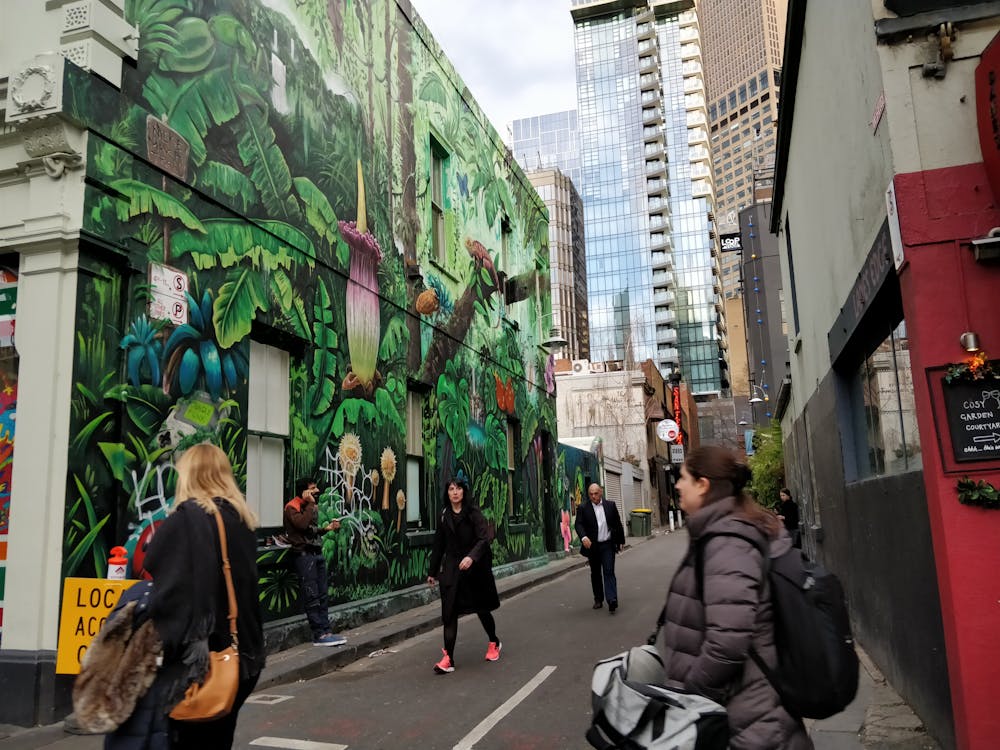
Meyers Place (above and below right), Melbourne, is closed to through traffic and open for pedestrians and dining.Alpha/Flickr, CC BY-NCBefore full closure.Aplha/Flickr, CC BY-NC
Of course, closing a street permanently is quite a process. I worked with the community to pedestrianise a Melbourne laneway called Meyers Place. Negotiating the legalities took about 18 months. Emergency, bin collection and disability access requirements had to be met.
The restaurants can now put tables on the former road space, surrounded by trees and murals under a green wall. The thing is, we started out by closing the street for just two weeks. Businesses rolled out temporary tables and chairs, astroturf and potted plants. The lane went beserk with activity; we went from tentative support to heavy pressure for a permanent pedestrian space.
We took our inspiration from a much larger closure in Ballarat Street, Yarraville. It was also temporary and got removed, but was brought back permanently with funding from traders and overwhelming community support.
Outside our inner suburbs, the areas dedicated to parking get bigger. But Copenhagen offers an example of how big an opportunity a large car park can be.
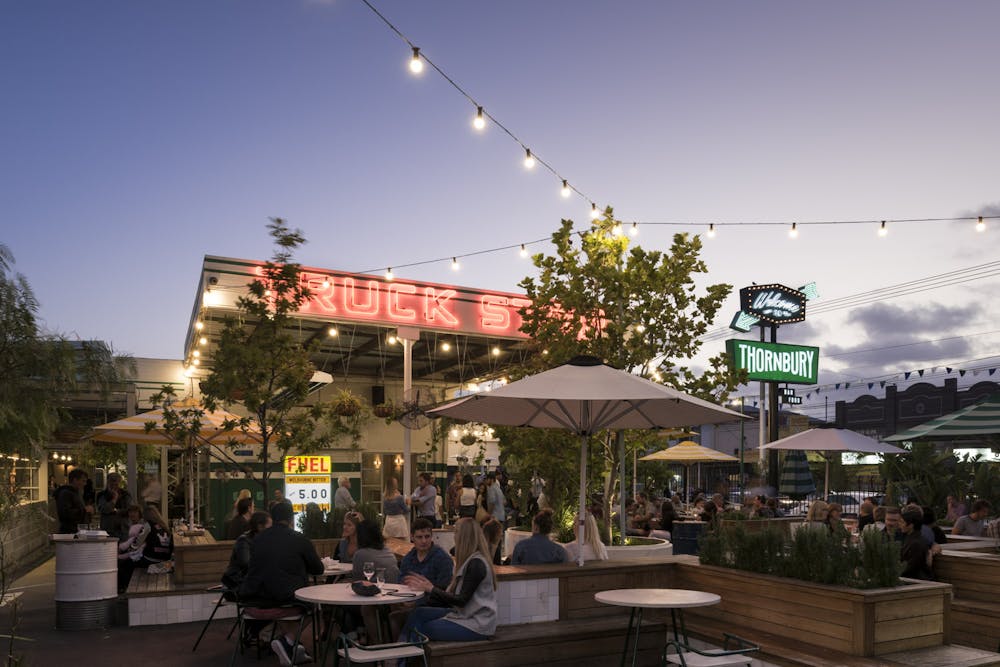
Kødbyen in Vesterbro, Copenhagen, has become a hub for fine dining, galleries and nightlife.thewavingcat/Flickr, CC BY-NC-SA
In the city’s former meatpacking district, you can find anything from high-end seafood to a craft beer pub that pumps heavy metal and barbecue smoke. The central car park serves as a giant dining area – when the weather’s good, chairs and benches come out and hundreds of locals turn up. This is super-simple stuff, mostly involving folding chairs and benches, plus lots of people. It’s adaptable, fun and very popular.
Now is the time to press ahead, because of what’s at stake – not just jobs and profits, but our collective identity and sense of place. Food and drink are a big part of city life and how we spend our time. The places we gathered with friends, nurtured romances and celebrated milestones are where memories live. Doing nothing could mean these experiences are replaced by numbing “For Lease” signs.
Luckily, taking action isn’t very risky. We can give our hospitality sector a boost right now by allowing businesses to trial a set of proven approaches. Everyone will then have a chance to experience the changes and decide what they’d like to keep.
Australian Prime Minister Scott Morrison this week announced plans for a potential “grand bargain” on industrial relations.
Speaking at the National Press Club, he framed the issue as one of boosting economic productivity:
We must enable our businesses to earn Australia’s way out of this crisis. And that means focusing on the things that can make their businesses go faster.
Rather than directly introducing legislation into the parliament, Morrison’s plan involves creating five “working groups” of union and business advocates to look at issues from simplifying awards and the enterprise bargaining system to the treatment of casual workers and “greenfields” agreements for new enterprises.
This is shrewd politics. If the working groups find agreement, the government can push the required legislation through parliament with a claim to a mandate. And claim the credit.
If it fails, Morrison can say nothing can happen without business and workers agreeing. So the government avoids blame.
But it may also be canny economics.
Going for broker
Perhaps Morrison has realised his real power is not as an advocate but a broker.
This process might have less in common with Australia’s prices and incomes accords of the 1980s, where unions agreed to limit wage claims, than with the Dayton Accords, the peace agreement that ended the Bosnian War in 1995.
The accords between the Australian Council of Trade Unions and the Hawke and Keating governments between 1983 and 1991 were a response to the wage-price spirals that plagued advanced economies in the 1970s and early 1980s.
High inflation led to large wage claims, which further fuelled inflation. The 1983 accord broke this spiral by guaranteeing wage increases every six months tied to the consumer price index. As I’ve noted previously:
Once people knew that wages weren’t going to gallop ahead of prices, there was less of a reason to raise prices, which put less pressure on wages, and so on.
The Dayton Accords (officially the: General Framework Agreement for Peace in Bosnia and Herzegovina) were brokered by the US administration in Dayton, Ohio, in November 1995 between the presidents of Bosnia, Croatia and Serbia.
Booking a room
The shadow minister for industrial relations, Tony Burke, reacted to Morrison’s announcement by saying:
Let’s be clear: all the government has done so far is book a room. This is not an IR agenda – it’s a series of meetings.
Burke meant this as a criticism, but in fact it might be a virtue. It’s hard to imagine a deal on industrial relations without representatives of employers and employees agreeing. That agreement may be better served by a government acting as a broker rather than pushing its own specific agenda.
There is an emerging school of thought in economics that coordinating beliefs plays a crucial role in reaching value-enhancing deals. Having the participants believe there can be a deal might be the heart of the issue.
That was arguably the role US chief negotiator Richard Holbrooke played in the Dayton Accords, and the role federal industrial relations minister Christian Porter will need to play in this rather different setting.
Very different starting points
That said, the parties don’t agree on all that much – at least as a starting point. ACTU secretary Sally McManus has emphasised that:
We can only secure a better, stronger Australia if working people have permanent, well-paid work and the entitlements that come with it.
The head of the Business Council of Australia (BCA), Jennifer Westacott, says the issue is needing:
… a system that delivers higher productivity, letting people work more effectively, produce more and find new and innovative ways to work.
Can permanence and job security be reconciled with effectiveness and innovation in the workplace? I’m an optimist. But we shall see.
Are the representatives representative?
This possible grand bargain needs to be between employers and employees. Those at the table will be representatives of those groups – namely unions and employer groups such as the BCA and Ai Group.
A crucial question is how representative these representatives are.
The vast majority of Australians aren’t members of unions, only 14% of people are. In this process, shouldn’t workers be represented by other voices that more likely speak for them?
In the private sector, union membership is even lower – about 10%.
One should ask similar questions of the BCA and Ai Group. For instance, do they represent the views of smaller businesses as faithfully as they do the big ones?
This is crucial because it affects the credibility of any potential deal, and how any benefits are spread. A cosy deal between big business and unions on greenfield construction sites is one thing. A grand bargain that helps workers not in unions and employers across the economy is quite another.
Will it work?
Morrison did frame the issue adeptly in his address. He was clear about the inputs needed to increase the economic pie:
The skilled labour businesses need to draw on, the affordable and reliable energy they need, the research and technology they can draw on and utilise, the investment capital and finance that they can access, the markets they can connect to, the economic infrastructure that supports and connects them, the amount of government regulation they must comply with, and the amount and the efficiency of the taxes they must pay.
Given all that, Australia’s industrial relations system does arguably need reform. And it won’t happen without the key players agreeing to it themselves.
Morrison’s gambit may not work, but it is certainly worth a shot.
The coronavirus pandemic has caused a massive surge in global unemployment. It has also highlighted the increasingly valuable role of automation in today’s world.
Although there are some jobs machines just can’t do, COVID-19 has left us wondering about the future of work and with this, the capacity of automation to step in where humans must step back.
Discussions about the “rise of the machines” first picked up significantly in 2013, after University of Oxford researchers published a paper about the potential to automate many jobs across sectors, including many so called office jobs such as administrative support workers, telemarketers and insurance claims clerks.
But does automation directly create unemployment? The answer is complicated.
Although some automation does replace human labour, other forms of it can help create new business, or help existing businesses prosper with benefits to employees.
The automation of Australia’s industries has been in the works for some time now. Australia is a world leader in adopting mining equipment automation – unsurprising given our reliance on mining exports.
Many of our mines are partially staffed from remote operation centres, where employees monitor largely automated pieces of equipment. This successful automation would have helped the mining industry deal with the effects of the pandemic.
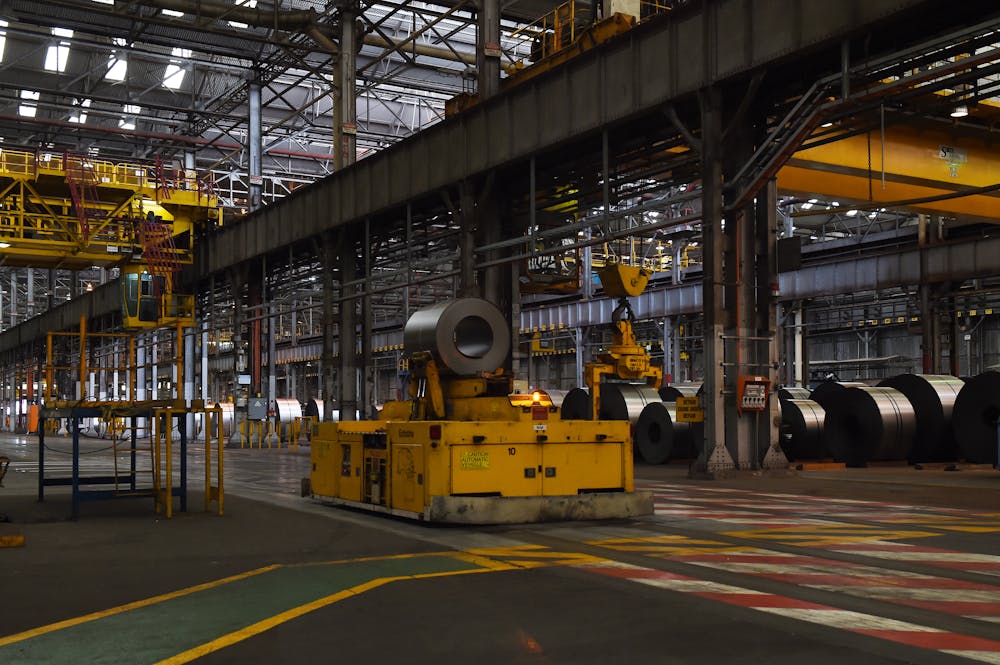
At the Bluescope Steelworks in Wollongong, an automated transport vehicle is used to move steel sheet rolls.DEAN LEWINS/AAP
Currently, there are two major drivers for considering a wider and faster shift to automation.
The first is a desire for Australia to become more self-sufficient in supplying goods and services, with local supply chains that are less susceptible to global shocks. This would require boosting the country’s manufacturing capability, and one way to do so would be by embracing new manufacturing methods using automation and robotics.
The second driver is a need to reduce the frequency and duration of human-to-human contact (social distancing), especially as experts warn of the increasing threat of future pandemics.
Research suggests COVID-19 can spread via surfaces and human-to-human contact.
Technology provides ways to avoid this. For instance, human contact while shopping was reduced drastically long before COVID-19 with the introduction of self-checkouts. While this itself isn’t automation (since the customer still does the work themselves), it could be considered a stepping stone to Amazon’s plans to soon roll out an automated purchasing system at physical US stores.
With the “Just Walk Out” technology, customers can take items off a store’s shelf, bag them, and walk straight out. An in-store sensing system automatically detects what was taken and initiates the purchase once the customer exits the store.
Is Amazon’s Just Walk Out technology the future of in-store purchasing?
What is skilled work?
According to the Reserve Bank of Australia’s Head of Economic Analysis, Alexandra Heat, employment for jobs requiring the highest level of skills has risen from 15% in the mid-1960s, to more than 30% now.
But how do we classify “skilled” work?
Many supposedly “low-skilled” jobs are far from it if viewed from the perspective of an engineer developing an automated (or robotic) equivalent. Take cleaning – a job of paramount importance during this pandemic.
While it isn’t traditionally considered high-skill, it’s still complex as it requires manual handling and time planning, and therefore isn’t suited to automation. In fact, a general-purpose robot cleaner remains the stuff of science fiction.
Another example is fruit picking, which is also a complex task when broken down. In the coming seasons, Australia may face a shortage of fruit pickers due to international travel restrictions, and robotic fruit picking and harvesting is now a hot topic in the robotics research world.
While progress has been made on this front, not many of the prototype systems are commercially available yet. And it’s unlikely robots will solve the industry’s labour shortage problems within the next few years.
Robotics researchers are on the cusp of developing reliable and highly-skilled fruit picking robots.
The costs of transition
When trying to predict which way automation will go in Australia, the critical issue to consider is our capacity to adopt it.
As we stare down the barrel of a recession, many businesses and organisations are struggling financially.
Changing business practice to adopt automation, if done effectively, would cost time and money in the near term. While time may be available, investing scarce cash may seem too risky for some at such a precarious time.
Source: The Conversation (Au and NZ) – By Hannah Dahlen, Professor of Midwifery, Associate Dean Research and HDR, Midwifery Discipline Leader, Western Sydney University
Group B streptococcal (GBS) is a common bacteria that likes to live in the human gut and migrate down the rectum, vagina and sometimes to the urinary tract. Not everyone has GBS but even if you do, you might not know it; it can cause illnesses in people of all ages and sex, but most of the time it doesn’t.
One group at particular risk of GBS, however, is newborn babies, who may pick up GBS from their mother’s vaginal tract during childbirth. For newborns, GBS is a major cause of meningitis (infection of the lining of the brain and spinal cord), sepsis (blood infection) and pneumonia (lung infection).
Most early onset GBS disease (90%) occurs in the first 24 hours and up to a week following birth. It affects around 1 in 2,000 babies. Some become very sick and, while rare, around 1 in 17,000 die of it.
Around 10-30% of pregnant women are colonised with GBS, meaning the bacteria live in or on the woman’s body without her necessarily feeling unwell.
It was once standard procedure in many Australian hospitals to administer intravenous antibiotics to such women early in labour in an effort to reduce risk to newborn babies.
However, other countries are pursing different approaches to attempt to reduce the disruption early exposure to antibiotics can cause to the newborn’s microbiome.
Two approaches to screening pregnant women for GBS
There are two approaches to GBS screening in pregnancy: universal screening and a risk-based strategy.
Universal screening involves a urine test and taking a swab of the pregnant woman’s vagina and around the anus (which women can do themselves) when they’re around 36 weeks pregnant. Under the universal approach, all women who test positive to GBS are recommended to have intravenous antibiotics during labour to reduce the risk of the baby developing a GBS infection soon after birth.
A risk-based strategy means only giving antibiotics to women who test positive to GBS and have other high risk factors such as:
the labour that starts before 37 weeks
the baby has a low birth weight
membranes (water surrounding the baby) are broken for longer than 18-24 hours
the mother has had a baby previously sick with GBS
the mother has a high temperature during labour.
So which approach delivers better outcomes? Unfortunately, it’s not yet possible to answer that question conclusively.
In the United Kingdom, Denmark, Netherlands and New Zealand universal screening is not recommended.
In the United States universal screening for GBS is recommended.
In Australia it’s up to health providers and hospitals to make a decision with women on whether to test. But this can also be very confusing.
For a newborn baby, the first super dose of microbes comes during the birth through the vagina.Shutterstock
GBS can come and go
The problem is that GBS can come and go. It may be present when a woman is screened late in pregnancy but not at the time of birth. And more than 60% of confirmed GBS sepsis (blood infection) cases in babies occur in mothers who tested negative for GBS when screened around 36 weeks.
In short: sometimes GBS testing has meant women (and their newborns) who don’t need antibiotics are getting them, while others who might benefit from antibiotics are missing out.
However, new rapid GBS screening takes around two hours to get the result, meaning women can be tested when they go into labour or their waters break. Unfortunately, these rapid tests are not yet available in all Australian hospitals.
What does the evidence say about antibiotics for GBS?
If antibiotics are given more than four hours before the birth, it prevents GBS in the baby in 91% of cases.
But antibiotics prevent GBS in babies in less than 50% of cases if given fewer than four hours before the birth.
And antibiotics during labour make no difference when it comes to reducing late-onset GBS disease (one week or more following birth).
A review of four randomised controlled trials involving 852 women found giving antibiotics to women who tested positive for GBS reduces the incidence of early onset GBS disease in babies, though not death from GBS infection or other bacterial infections.
However, there were some problems with these studies, including small numbers and poor reporting which makes these results unreliable.
This means automatically giving antibiotics to all women during labour is not supported by conclusive high-level evidence; however, it is widely recommended if GBS has been found.
As the baby passes through the vagina, it is coated in and ingests protective bacteria.Shutterstock
What about the impact of antibiotics on the microbiome?
For a newborn baby, the first super dose of microbes comes during the birth through the vagina, which contains around 200-300 bacteria.
These bacteria help seed the new baby’s microbiome, shaping its health and setting up an effective defence shield for infections.
The microbiome of the vagina changes through pregnancy. Halfway through pregnancy, hormonal shifts begin to stockpile glycogen (bacteria’s favourite food). As the bacteria turn this glycogen into lactic acid the PH level of the vagina lowers (more acid like) and this discourages harmful bacteria like GBS from growing.
As the baby passes through the vagina, it is coated in and ingests this protective bacteria (this process doesn’t occur with caesarean section). When the baby breastfeeds, they ingest components that are only found in breastmilk that feed the good bacteria and protect the baby.
Disturbance of this vulnerable early seeding of the microbiome with antibiotic use during labour and birth for GBS alter the balance of microbes in the baby’s intestines.
Weighing all this information up means a clear recommended pathway for GBS detection and treatment still evades us.
The most important thing for new parents to know is how to look out for an unwell baby and get help quickly. Signs of GBS infection include:
temperature that’s too high or low (get a thermometer)
poor feeding
irritability
sleeping more than normal or not moving much
rapid or noisy breathing (grunting or moaning)
skin colour changes (including looking blotchy)
any significant change in behaviour that does not resolve.
The quicker the treatment, the better the outcome. Breastfeeding can’t pass GBS infection to your baby and, in fact, is really important to help protect your baby from infections.
The MothersBabies Study
Our MothersBabies Study is investigating how the microbiome affects a woman’s health before pregnancy, during pregnancy, and in the first year of their child’s life.
This study can’t be conducted without the help of the community, so please get in touch if you want to know more or are interested in being included. You just need to be living in NSW and planning to get pregnant in the next 12 months. Email mothersbabies@unsw.edu.au to register your interest or find out more.
Each year the ocean is inundated with 4.8 to 12.7 million tonnes of plastic washed in from land. A big proportion of this plastic is between 0.001 to 5 millimetres, and called “microplastic”.
But what happens during a storm, when lashings of rain funnel even more water from urban land into waterways? To date, no one has studied just how important storm events may be in polluting waterways with microplastics.
So to find out, I studied my local waterway in Sydney, the Cooks River estuary. I headed out daily to measure how many microplastics were in the water, before, during, and after a major storm event in October, 2018.
The results, published on Wednesday, were startling. Microplastic particles in the river had increased more than 40 fold from the storm.
Particles of plastic found in rivers. They may be tiny, but they’re devastating to wildlife in waterways.Author provided
To inner west Sydneysiders, the Cooks River is known to be particularly polluted. But it’s largely similar to many urban catchments around the world.
If the relationship between storm events and microplastic I found in the Cooks River holds for other urban rivers, then the concentrations of microplastics we’re exposing aquatic animals to is far higher than previously thought.
14 million plastic particles
They may be tiny, but microplastics are a major concern for aquatic life and food webs. Animals such as small fish and zooplankton directly consume the particles, and ingesting microplastics has the potential to slow growth, interfere with reproduction, and cause death.
Determining exactly how much microplastic enters rivers during storms required the rather unglamorous task of standing in the rain to collect water samples, while watching streams of unwanted debris float by (highlights included a fire extinguisher, a two-piece suit, and a litany of tennis balls).
Back in the laboratory, a multi-stage process is used to separate microplastics. This includes floating, filtering, and using strong chemical solutions to dissolve non-plastic items, before identification and counting with specialised microscopes.
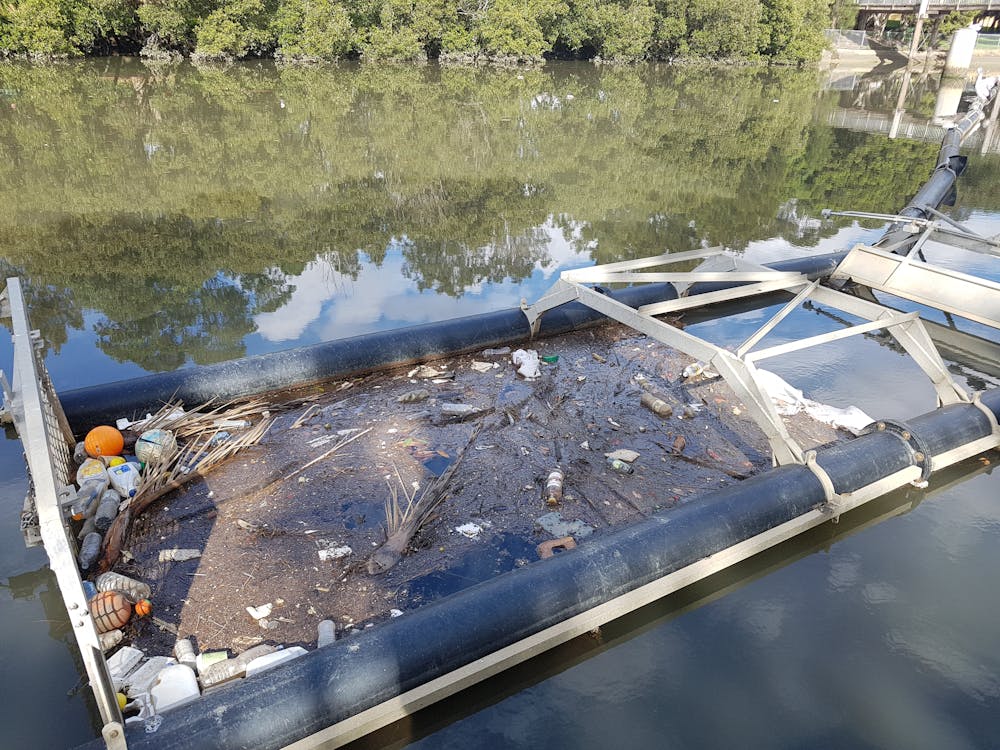
Litter caught in a trap in Cooks River. These traps aren’t effective at catching microplastic.Author provided
In the days before the October 2018 storm, there were 0.4 particles of microplastic per litre of water in the Cooks River. That jumped to 17.4 microplastics per litre after the storm.
Overall, that number averages to a total of 13.8 million microplastic particles floating around in the Cooks River estuary in the days after the storm.
We know runoff during storms is one of the main ways pollutants such as sediments and heavy metals end up in waterways. But not much is known about how microplastic gets there.
However think about your street. Wherever you see litter, there are also probably microplastics you cannot see that will eventually work their way into waterways when it rains.
Many other sources of microplastics are less obvious. Car tyres, for example, which typically contain more plastic than rubber, are a major source of microplastics in our waterways. When your tyres lose tread over time, microscopic tyre fragments are left on roads.
Did you know your car tyres can be a major source of microplastic pollution?Shutterstock
Microplastics may even build up on roads and rooftops from atmospheric deposition. Everyday, lightweight microplastics such as microfibres from synthetic clothing are carried in the wind, settling and accumulating before they’re washed into rivers and streams.
What’s more, during storms wastewater systems may overflow, contaminating waterways. Along with sewage, this can include high concentrations of synthetic microfibers from household washing machines.
And in regional areas, microplastics may be washing in from agricultural soils. Sewage sludge is often applied to soils as it is rich in nutrients, but the same sludge is also rich in microplastics.
What can be done?
There are many ways to mitigate the negative effects of stormwater on waterways.
Screens, traps, and booms can be fitted to outlets and rivers and catch large pieces of litter such as bottles and packaging. But how useful these approaches are for microplastics is unknown.
Raingardens and retention ponds are used to catch and slow stormwater down, allowing pollutants to drop to bottom rather than being transported into rivers. Artificial wetlands work in similar ways, diverting stormwater to allow natural processes to remove toxins from the water.
Almost 14 million plastic particles were floating in Cooks River after a storm two years ago.Shutterstock
But while mitigating the effects of stormwater carrying microplastics is important, the only way we’ll truly stop this pollution is to reduce our reliance on plastic. We must develop policies to reduce and regulate how much plastic material is produced and sold.
Plastic is ubiquitous, and its production around the world hasn’t slowed, reaching 359 million tonnes each year. Many countries now have or plan to introduce laws regulating the sale or production of some items such as plastic bags, single-use plastics and microbeads in cleaning products.
In Australia, most state governments have committed to banning plastic bags, but there are still no laws banning the use of microplastics in cleaning or cosmetic products, or single-use plastics.
We’ve made a good start, but we’ll need deeper changes to what we produce and consume to stem the tide of microplastics in our waterways.
In the not-so-distant past I commuted fairly hefty distances in a fairly garbage car. But you didn’t hear me complaining – I had an extensive library of podcasts (or “my stories” as I liked to call them) on my phone.
My ride was so basic it didn’t have a stereo that could connect to my phone, so my workaround was to place the phone in the little scooped-out area on the dash where the clock lived. I called it the “acoustic enhancement chamber” and it really did amplify the sound. Most people thought this was hilarious (and a little pathetic, I guess) but I didn’t mind. Podcasts are powerful narrative devices – they still work as transfixing storytellers in the lowest of tech situations.
We all like to fill our commutes with some sort of distraction – reading a book, making obnoxiously loud phone calls on the train, cramming in some work or study on our laptops, and of course consuming a bottomless ocean of media via our mobile devices – TV shows, movies, games, and “our stories”. During the COVID-19 lockdown, many will have missed the commute – a time just for getting there, a time when we’re between spaces and responsibilities.
So whatever it is we do on our commute, and however we do it – walking, running, driving, cycling, flying, training, bussing, or whichever other way you get from Point A to Point B – it’s useful to consider the commute as a space of its own.
The “interstitial time” commuting creates is actually a Point C: what sociologists like Cecile Sandten have called a “third place between home and work”.
While we may not think much about this interstitial time, what we choose to do in it affects us. It has been suggested by Shira Chess, who studied games and leisure styles, that “all of our lives are characterised by interstitial time, time that is not used for other purposes”. Geographer and academic David Bissell has underscored this:
… the journey to and from work is a strange, liminal sphere of everyday life, fizzing with all manner of events and encounters that, for good or ill, make a difference to who we are.
The commute has been pondered by creative types, either as the main focus, or as a plot device. Philosopher Alain de Botton’s 2009 book A Week At The Airport saw him become Heathrow airport’s writer in residence, where he focused on the interstitial time we grudgingly endure at airports, exploring “the stories that inhabit this strange ‘non-place’ that we are usually eager to leave”. He was so into it that he was delighted when his plane was delayed, as it meant he could spend even more time in the departure lounge.
Conversely, Jonathon Swan penned The Frustrated Commuter’s Companion: A survival guide for the bored and desperate in 2017, introducing readers to “seat etiquette” and “seat remorse” and underscoring the (often) solitary nature of commuting: “Whenever you see a fellow traveller with a copy [of his book], give them the secret sign of the commuter: ignore them completely”.
Plenty of films romanticise the usually peaceful interstitial nature of commuting, which can provide a handy contrast to the flip when things go wrong. Speed (1994) is about a normal commute gone mad, while Liam Neeson stars in 2018’s The Commuter, which is about another commute that goes even more mad.
The Eternal Sunshine Of The Spotless Mind (2004) is a film that sees the leads meet for the first time (a couple of first times, actually) in a dreamy kind of limbo train commute. Finally, there’s 2016’s The Girl On The Train, in which the main character fills her days with the commute because she’s lost her job but wants to keep up the pretence of going to work.
In Simon Webb’s 2016 book, Commuters: The History of a British Way Of Life, he describes commuting as a “reassuring routine which spelled security and safety from the spectre of poverty” -– meaning in most cases, if we are commuting, we’re doing so because we have a job to commute to.
The daily commute goes horribly wrong in Speed (1994) – but also a little bit right for Sandra Bullock.IMDB
So when we’re not being blown up for going under 50 miles an hour, the commute can be a time for us to zone out, to reflect on the day ahead, or the one just finished – and to simply “be” in a personal zone that is neither work nor home.
Though a train or a plane might not seem like a private space, we make it one by staring into the middle distance, losing our present selves in thought or remembrance, or diving into our digital storytelling devices. In so doing, we can recapture a shred of our own personal space, even if we are shoulder-to-shoulder with others.
What I, and many others, choose to do during the commute is listen to podcasts.
Podcasts (a portmanteau that combines “iPod” with “broadcast”) are essentially episodic media delivered via a subscription feed to our devices and consumed anytime we like. These travelling companions have introduced me to a diverse cast of players: from great thinkers, to creepy killers, to kindly givers of wildly inappropriate advice.
Podcasts can be extremely short like (Quote Of The Day) or the literally titled The Shortest Podcast Ever with the curiously opaque description: “It’s brief. It’s not much. It’s a small amount”. They can be stupendously long like Hardcore History with episodes regularly running over five hours in duration – and even those are mostly single episodes in multi-part narratives.
They can be studiously factual (the New York Times podcast The Daily is the news, updated daily – but with an oft-maddening Trump focus), or deliciously speculative (Conspiracy Theories is exactly what it sounds like, but is sharply researched, with sceptical hosts).
Strangers on a train meet for the first (and not first) time.
Podcast can be about grisly crimes (Australia’s Casefile is one of the best in the inexhaustible true crime genre) or delightfully batty like Dear Joan and Jericha, in which hilariously filthy agony aunts deliver the worst advice possible.
For me, podcasts are appealing because they offer delicious and varied escapes to suit your mood, and all in the palm of your hand. You don’t even need to give them your complete attention and still they wash over you. They take you to different places, introduce you to different lives, worlds and ideas. It’s learning without reading, exploration without effort.
It’s possible we have been consuming other forms of media at home as a replacement. Certainly, our Netflix binges have been a staple of Zoom discussions (Tiger King, anyone?).
Perhaps we are so preoccupied with the practicalities of being stuck at home that we have not engaged with podcasts. Or maybe they’re simply better suited to the space in between work and home, where we’ve left domesticity behind but we aren’t quite ready to clock on. These are the times when we want to turn to the little stories in our pockets for one more private escape before the business of the day takes over, and our time and thoughts belong to someone else.
It was Greg Combet, one-time ACTU secretary and former Labor minister, who got Christian Porter and Sally McManus together in the early days of the pandemic.
Recalling what happened, Porter told the Australian Financial Review he said to Combet he needed to “talk directly with people in the union movement”.
Porter knew union co-operation would be vital for the emergency measures the government would bring in. “I don’t necessarily speak their language,” the industrial relations minister told Combet.
“Greg suggested that [ACTU secretary] Sally was probably the one that I should talk to first. I … just picked up the phone two seconds after talking to Greg and spoke with her.”
From there, the Christian-Sally relationship blossomed. It can be seen now as a significant contributor to Scott Morrison’s bid, outlined this week, to seek a consensus approach to reforming the industrial relations landscape.
The personal link with McManus established, Porter convened a meeting with employer and union representatives on March 10, which opened with a briefing by chief medical officer Brendan Murphy to give the players an understanding of the (then) looming scale of the coronavirus crisis.
This was two weeks before major sectors of the economy started shutting down.
Porter and McManus agreed to speak every working day, as special arrangements were put in place to deal with the extraordinary circumstances. Their scheduled (virtual) meetings were recently wound back to two or three times a week (with other contact as required).
While McManus opposed making changes to the Fair Work Act as part of the JobKeeper program, when the government was determined she was pragmatic. She’d earlier assisted by enlisting unions to support employer moves to vary industrial awards to help key sectors cope with the immediate challenges of the crisis.
When she had gripes Porter listened and made the odd concession. She wasn’t happy, for instance, with Porter shortening the consultation period (from seven days to 24 hours) for an enterprise agreement being changed. McManus persuaded him to build in a review after two months of the measure (which lasts six months).
One government observer says, “I think they are both a bit surprised by each other, and how willing they are to have an open and frank discussion about issues”.
After all, this is the woman the government demonised when, new in her job, McManus condoned breaking what she considered bad laws. Senior minister Peter Dutton called her a “lunatic”.
But, as the observer added, “It was a relationship born of necessity, and it’s continued because of the trust established”.
On the face of it, they’re chalk and cheese. McManus has spent her whole career in the union movement, from when she was a trainee at the ACTU (Combet was a senior officer there at the time).
Porter was bred into a Liberal family (his grandfather served as a Queensland politician, his father as a party official); he became West Australian treasurer before moving to federal parliament. He’s now attorney-general as well IR minister.
Although she’s smart and sharp, McManus’s language draws on old-style union-speak (“working people” is her mantra). Porter, a former senior state prosecutor in WA, not infrequently reverts to legalese barely intelligible to the ordinary person.
But what helped them connect is that he’s a policy wonk, and she knows what she’s talking about. And they’ve found they can talk in confidence without their conversations leaking, or (so far) being weaponised by either of them.
McManus has greased wheels during the crisis – the government hopes it can now parlay the relationship with the ACTU into assisting Morrison’s attempt to land permanent industrial relations reforms.
When you want to build on a relationship, a show of respect never goes astray. Morrison invited McManus to Kirribilli House in Sydney as he developed his idea of a compact. It was a tough face-to-face encounter over tea in fancy cups.
This week Morrison announced Porter would chair five working groups (with employers, unions and other stakeholders) to consider award simplification; enterprise agreements; casuals and fixed term employment; compliance and enforcement, and greenfield agreements for new enterprises. Their deadline is September.
Morrison says he’s bringing parties to “the table”. But he’s putting nothing on the table. He took off the table the Ensuring Integrity legislation – which was stuck in the Senate and had been “paused” during the pandemic – but only after McManus forced the issue.
Comparisons with the Hawke government’s accords with the union movement have been false. Those were formal agreements between allies, in which both sides traded specifics (wage restraint in exchange for “social wage” policies.)
Neither the government nor the ACTU would see the present process of negotiations as a partnership.
McManus is buying into the process but she must be aware of its risks. Many in her constituency would be sceptical, if not appalled. Bring a long spoon to that table, they’d say.
On the other hand, the much-shrunken union movement has changed and become more feminised in recent years, and one would expect many among its members would welcome the bid for agreement.
Anyway, McManus has to join the play to defend the unions’ interests. Given the extra authority the pandemic has given Morrison, the government would potentially be able to ride roughshod over union opposition. The Senate’s (non-Green) crossbenchers are always fickle, but the unions wouldn’t want to be banking on support there. The government’s position would be even stronger if the unions were just negative.
To see McManus driven only by that however is, on the evidence, selling her short. She accepts there are areas that should be addressed, such as flaws in the enterprise bargaining system.
The government and the ACTU have been careful to narrow the agenda to the items before the groups. Morrison doesn’t want other issues to become matters for trading. The government is focusing deliberately on “known problems” – areas it says have been bugbears for employers and employees alike. Some commentators have seen its list as heavily directed to employers’ concerns, but the issues of casuals and enforcement are core to the unions.
McManus comes to the table with a stash of chips, albeit fewer than the employers or government. These include the goodwill established, and the advantage Morrison would get (not least over Labor) if he could go to the election as the “consensus” prime minister.
If the consultation process fails to produce anything of real value, many in the government and the union movement won’t be surprised. If something positive is achieved, thank the pandemic.
With swift and savage force, the COVID-19 pandemic has inadvertently attacked Australia’s local news media ecology, which was already battling a weakened immune system.
As a researcher working on Australia’s largest academic study into the future of local newspapers, the phones have been running hot in recent weeks. We’ve had calls from everyday people, journalists made redundant, cadets surviving on JobKeeper, and independent news proprietors, all navigating their way through the crisis.
News Corp has announced plans to close or suspend printing operations of more than 100 suburban and small community titles. Its more successful publications, such as the Geelong Advertiser, Gold Coast Bulletin, Hobart Mercury and the iconic Northern Territory News, will remain with print and digital editions.
Other independently-owned newspapers across rural and regional Australia are still breathing: they are gasping for air, but they are breathing. They’ve either temporarily suspended operations, cut back the number of print editions or shifted to a digital-only model to “see how it goes”.
The federal government has also announced plans to force Google and Facebook to share advertising revenue with producers of quality journalism in Australia. The Australian Competition and Consumer Commission is now seeking views on its new draft mandatory code that will address bargaining power imbalances between Australia’s news media businesses, and Google and Facebook.
This has been met with some initial concern from the Country Press Association of Australia amid fears the modelling may only benefit big companies and not the little players that serve small towns and cities.
The Victorian government has waded in to provide more than $4 million in additional advertising support for local and regional print publications. Our preliminary research indicates Victoria leads the way with this type of support for local news. Other states, such as South Australia and New South Wales, lag behind or have announced changes to legislation that provides government authorities freedom to advertise on their own sites or via social media.
The problem is, social media sites like Facebook don’t put the interests of local communities first, whereas local news outlets do (or at least they should). Facebook has gone to great lengths to distance itself from the types of local content posted on its platform. In the local news ecology, it tends to feed from traditional local news providers or the goodwill of citizens who moderate and upload content of local importance and reap the advertising rewards. One off, $10,000 grants from social media juggernauts to local news entrepreneurs won’t fix this systemic problem.
In some local areas, business owners are offering donations or advertising support to preserve the journal of record during COVID-19. JobKeeper is keeping many cadet journalists on the payroll, and there are some keen reporters doing their bit to report on the news, even if they are not getting paid.
There’s also stories of new start-ups emerging – like Matt Dunn in Victoria’s South Gippsland region. He was made redundant by the local newspaper, which is planning to close its doors permanently. He immediately set to work developing his own digital news platform, “The Paper”.
Dunn is confident elderly residents who have little experience with technology will come on board because they will be hungry for good quality local meaningful news. It’s about the content, not the platform.
However, digital-only publications are problematic in areas of rural and regional Australia that struggle with broadband connectivity. It’s even more worrisome for those areas with ageing populations, where reading the local paper is a daily or weekly ritual to maintain a sense of connection to their community.
I’ve spoken with several elderly residents in recent weeks who are distressed about the decline of Australian Community Media’s local content and the reduction of the print edition. Without the newspaper and technological capabilities, they feel “lost”. And importantly, they can’t read the death notices, so have no idea who has died.
Perhaps that is the key for policymakers, researchers and industry in a post COVID-19 world. Big news conglomerates around the world have been accused of building a plethora of zombie newspapers that are local in name only – full of syndicated content, without really being attuned to the needs and wants of a community or helping people to develop shared social connection and purpose to place.
My hunch is zombie papers will be the first to fall.
Audiences aren’t stupid. It’s the newspapers and community individuals determined to provide news that are the heart of their communities and should survive into the future. Policymakers, researchers and industry need to be acutely aware of the types of news outlets and individuals that best provide – or are willing to provide – real, credible and meaningful local news and information for their communities in areas of Australia big and small.
They are the ones that should be at the front of the queue for any type of media vaccine.
Source: The Conversation (Au and NZ) – By Michael (Mike) Joy, Senior Researcher; Institute for Governance and Policy Studies, Te Herenga Waka — Victoria University of Wellington
New Zealand’s government has been praised for listening to health experts in its pandemic response, but when it comes to dealing with pollution of the country’s waterways, scientific advice seems less important.
Today, the government released a long-awaited NZ$700 million package to address freshwater pollution. The new rules include higher standards around cleanliness of swimming spots, set controls for some farming practices and how much synthetic fertiliser is used, and require mandatory and enforceable farm environment plans.
But the package is flawed. It does not include any measurable limits on key nutrients (such as nitrogen and phosphorus) and the rules’ implementation is left to regional authorities. Over the 30 years they have been managing the environment, the health of lakes and rivers has continued to decline.
For full disclosure, I was part of the 18-person science technical advisory group that made the recommendations. Despite more than a year of consultation and evidence-based science, the government has deferred or ignored our advice on introducing measurable limits on nitrogen and phosphorus.
The declining state of rivers, lakes and wetlands was the most important environmental issue for 80% of New Zealanders in a recent survey. It was also an election issue in 2017, so there was a clear mandate for significant change.
But despite years of work from government appointed expert panels, including the technical advisory group I was part of, the Māori freshwater forum Kahui Wai Māori and the Freshwater Leaders groups, crucial advice was ignored.
The technical advisory group, supported by research, was unequivocal that specific nitrogen and phosphorus limits are necessary to protect the quality of people’s drinking water and the ecological health of waterways.
Instead, Minister for the Environment David Parker decided to postpone this discussion by another year – meaning New Zealand will continue to lag other nations in having clear, enforceable nutrient limits.
This delay will inevitably result in a continued decline of water quality, with a corresponding decline in a suite of ecological, cultural, social and economic values a healthy environment could support.
The government’s package includes a cap on the use of nitrogen fertiliser.Alexey Stiop/Shutterstock
Capping use of nitrogen fertiliser
The other main policy the expert panels pushed for was a cap on the use of nitrogen fertiliser. This was indeed part of the announcement, which is a positive and important step forward. But the cap is set at 190kg per hectare per year, which is too high. This is like telling someone they should reduce smoking from three to two and a half packets a day to be healthier.
I believe claims from the dairy industry that the tightening of environmental standards for freshwater would threaten New Zealand’s economic recovery are exaggerated. They also ignore the fact clean water and a healthy environment provide the foundation for our current and future economic well-being.
And they fly in the face of modelling by the Ministry for the Environment, which shows implementation of freshwater reforms would save NZ$3.8 billion.
Excess nitrogen is not just an issue for ecosystem health. Nitrate (which forms when nitrogen combines with oxygen) in drinking water has been linked to colon cancer, which is disproportionately high in many parts of New Zealand.
The New Zealand College of Public Health Medicine and the Hawkes Bay district health board both made submissions calling for a nitrate limit in rivers and aquifers to protect people’s health – at the same level the technical advisory group recommended to protect ecosystems.
Our dependence on synthetic nitrogen fertiliser is unsustainable, and it is adding to New Zealand’s greenhouse gas footprint through nitrous oxide emissions. There is growing evidence farmers can make more profit by reducing their use of artificial fertilisers.
Continued use will only further degrade soils across productive landscapes and reduce the farming sector’s resilience in a changing climate.
The irony is that for a century, New Zealand produced milk without synthetic nitrogen fertiliser. Instead, farmers grew clover which converts nitrogen from the air. If we want to strive for better water quality for future generations, we need to front up to the unsustainable use of artificial fertiliser and seek more regenerative farming practices.
On Project Syndicate – and in other places in recent months – orthodox US economist Kenneth Rogoff has presented the case for deeply negative interest rates. Another financial sacred cow falls; yes, interest rates can be negative, even substantially negative. It can take a while, though, for shot sacred cows to die. Keynes, in the 1930s, mortally wounded the ‘balanced budget’ bovine. And the experiences of Japan in the 1990s, and the United States in the Second Gulf War (when taxes were cut), dealt to the hallowed cow of ‘fiscal responsibility’. Yet those ghostly cattle-beasts still stalk the minds of politicians, bureaucrats, and journalists.
Interest as a Yield
Interest is a mystery to most of us. It’s actually two conceptually distinct – though related – things. Interest in nature is better referred to as ‘yield’. We may think of a herd of beef cattle. The gross yield is essentially the calves, with the net yield being the beef and leather produced, subject to the constraint that the herd is maintained over time at its usual size.
Thus, the concept of ‘yield’ is similar to the concept of ‘profit’. In a bad year for the farm, there may be a loss, for example because a natural disaster led to the death of all the calves. In that sense, the yield – or interest on capital – can be negative. Further, with this concept of interest, negative interest is unequivocally a bad thing, and the higher the interest (ie yield) the better.
When I was a boy, we had school ‘banking’, a basic saving account using the symbol of a squirrel, supposedly a creature that saves (nuts) due to an instinct of thrift. We received interest on our school savings, something those squirrels never did on their savings. The squirrels’ yields on their hoards of nuts are always negative; some of those nuts go missing or deteriorate. (For squirrels to gain a positive yield, they would have to plant most of their nuts, then wait until the new crop of nuts could be harvested.)
I also remember my mother explaining to me the difference between a ‘savings bank’ (such as the Post Office Savings Bank) and a ‘bank’ (such as the Bank of New Zealand). She said that interest was a ‘reward’ for saving money. And she said that money held in a bank account did not earn interest; actually, customers paid fees to hold their money there. But, she said, they could draw on their ‘money in the bank’ by writing cheques to other people. So I understood the ‘principle of convenience’. I cannot say that I really understood the reason for the ‘reward’, though. It was in another, later, conversation with my mother that I learned about lending; and it bothered me then – as it bothers many – to think that, if I had money in the bank, then somebody else might be spending it; hence a reward was justified. I eventually understood banking; indeed, in the days before banks became financial supermarkets. I had to study economics academically, however, before I had any real inkling about where money comes from.
My generation – and other generations – grew up to learn that interest is natural, and always positive. And we learned that the secret to wealth was restraint and compound interest. Thus, we came to see indefinite economic growth in the same way, as a process of accumulation rather than circulation. The idea that squirrels saving nuts indefinitely would become wealthy was always an illusion; likewise, economic growth as a process akin to compound interest was always an illusion.
I learned – when an adult, through financial economics – that interest can be a ‘price’, as well as a ‘yield’. (In fact, interest is two prices. One of these is the price of ‘risk’. Different borrowers have different risk profiles. Higher risk borrowers pay a higher price to borrow money. I am not particularly concerned here, however, about that price which is commonly called ‘risk premium’.) Interest is a price, that if set correctly, regulates economic life; it can facilitate growth when growth is needed, and facilitate slowth when slowth is needed. Very low interest rates penalise the pointless accumulation of money, and facilitate the circulation of money.
Interest as a Market Price
If we can imagine interest rates being three percent (as they usually were when I was a boy), and, the amount of money lenders wanted to lend being the same as the amount of money that borrowers wanted to borrow, then the ‘price of loanable funds’ would be three percent, and that market would be balanced.
If there was a shift in this ‘loanable funds’ market, with say more people wanting to borrow, then excess demand for loanable funds would require the interest rate to increase. Following that price increase, this market would establish a new balance.
What if there was a change in circumstances (other than a rise in interest rates) that caused fewer people to want to borrow money. Or caused people to repay loans more quickly? Or more people to want to lend money? Or people wanting to be repaid more slowly? Or more people wanting to relend money that has been repaid?
These situations would induce a fall in interest rates. And there is no necessary reason why that price fall should stop at zero.
However, if banks could lend money to the Reserve Bank and get one percent interest, they are unlikely to lend to anyone else unless the banks charge an interest rate above one percent. So, for the market to balance properly, the interest rate set by the Reserve Bank should reflect underlying conditions in the loanable funds market.
If underlying conditions require that the Reserve Bank set a negative ‘Official Cash Rate’, then so it should. It would mean that the Reserve Bank’s large wholesale customers – the banks and the central government – would be paid to borrow from the Reserve Bank.
Obviously, if borrowing from the Reserve Bank increased too quickly in response, the Reserve Bank would have to reset the rate back to positive or zero. But what if these customers were not sufficiently induced to borrow more by negative interest rates, then the Reserve Bank would have to ‘go more negative’; interest rates would keep dropping until balance is established in the loanable funds market.
If the interest rate (price) is set too high, there will be too little borrowing and spending, and many frustrated lenders. The result may be an economic recession. If the interest rate (price) is set too low, there will be too much borrowing and spending, and not enough people wanting to lend. The result may be some inflation.
It is worth noting that some economists in New Zealand – Eric Crampton (of the New Zealand Initiative) for one – favour negative interest rates (pure expansionary monetary policy) over an expansionary fiscal policy where governments borrow (and spend) enough to allow the interest rate to stay positive. This is the view generally favoured by economic liberals; economists and others who are sceptical of governments having too large a presence in the market economy. This scepticism is based partly on a general distrust of large government, and partly on a disbelief in the competence to bureaucrats to make the best spending decisions. Economic liberals generally see private spending as more efficient, at the margin, than government spending. (‘At the margin’ means considering ‘extra spending’ rather than ‘total spending’.)
Certainly, if governments fail to take on enough new debt this year, the case for negative interest rates will strengthen. And the case for deeply negative interest rates in countries more affected by Covid19 than New Zealand will be strong if governments in those countries run insufficiently large budget deficits.
Negative interest rates in the past
Except for the recent cases of Sweden, Denmark, Switzerland and Japan, I know of no historical cases of negative nominal interest rates. But negative real interest rates have been quite common. The last time we had substantial negative real interest rates in New Zealand was from the late 1960s to the early 1980s. Then, inflation rates were higher than interest rates, so saved money would buy less in the future than in the present. And repaid money could buy fewer goods and services than the money could have bought if it had been spent instead of lent.
While the capitalist world did not fall apart in the 1970s, many people felt that they were entitled to positive interest rates, without ever being able to say why. And those people instigated a revolution, called neoliberalism.
In today’s world, without inflation, negative real interest rates also mean negative nominal rates. (An interesting case, however, is Switzerland, which for a while had negative inflation and less negative interest rates, meaning that real interest rates were not negative.) Thus (unlike in the 1970s), the quoted (or ‘headline’) interest rates – at least in wholesale financial markets – would have to be negative. This is what makes some people very uneasy.
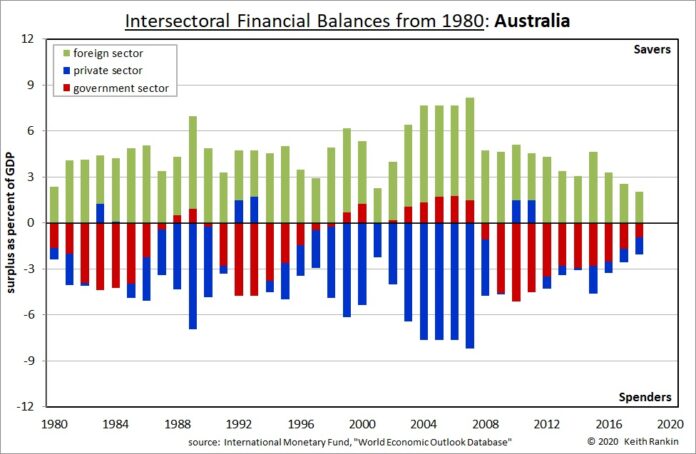
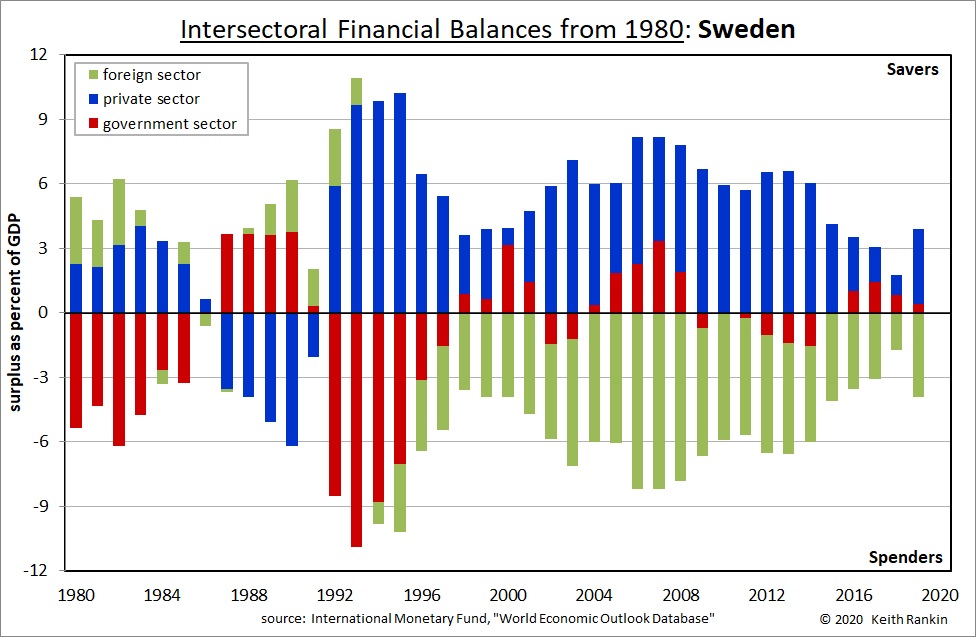
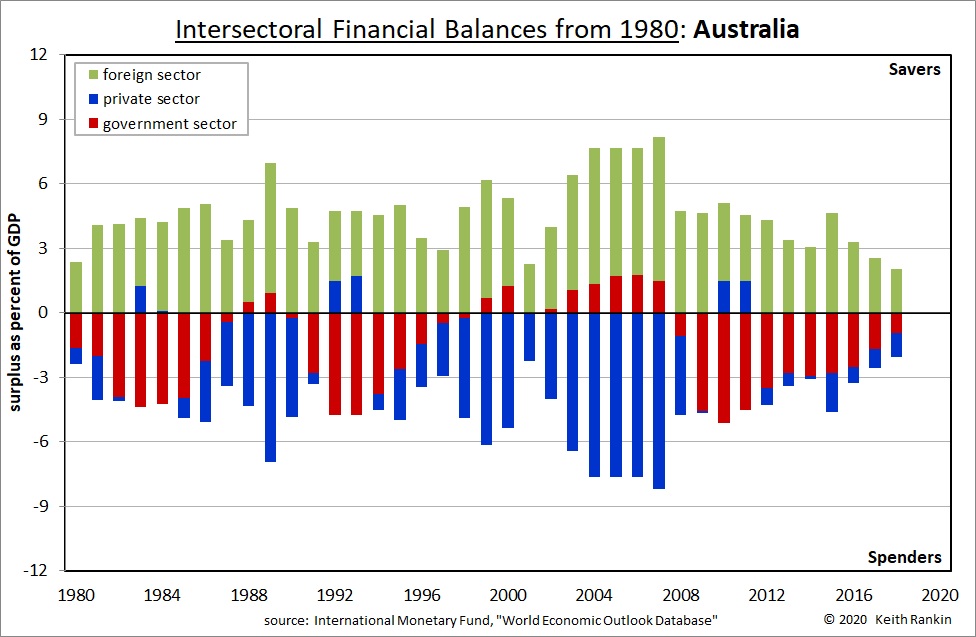
In my chart analysis of Sweden and Australia, I noted that there was a particular reason why Sweden, Denmark and Switzerland had to have negative interest rates. In order for these countries to have similar trade surpluses as their comparable countries inside the Eurozone (Germany, Netherlands and Austria), they had to avoid appreciations of their currencies. That meant they needed interest rates lower than in the Eurozone; and the Eurozone had a core wholesale rate of zero.
The Swiss Franc has been stable against the also-strong United States dollar since 2014. Many people prefer to hold money in Swiss Banks despite the negative interest they ‘receive’; to these people, it’s like paying a fee to keep their money in the best place for them; not unlike the situation my mother told me about in relation to banks in the 1960s.
Deeply Negative Interest Rates
It may well be necessary for interest rates in some countries to go deeply negative. That will mean negative retail interest rates (term deposits), and negative mortgage rates.
Imagine deposit rates and mortgage rates set at, say, minus two percent.
The situation would not be fundamentally different from that of the 1970s, when the incentive was to borrow and spend rather than to save and lend. But, the obvious new problem is that people will want to drain their interest-bearing bank accounts, as stashes of cash, and then bury this cash under the bed, or some such place.
Fortunately, the world now has an infrastructure for cashless transactions. It would not be necessary to ban cash – notes and coins – entirely, though fear of infection from paper money is probably precipitating the end of cash. While notes and coins are convenient for small day-to-day payments – especially when there are power cuts or other infrastructure failures (such as software virus pandemic) – we could still make promises (the oldest form of money ever). One benefit would be to abolish all banknotes worth more than $20, forcing the criminals with large stashes of cash to come to the bank, and explain how they acquired so many high-denomination banknotes.
Another advantage would be that, with no real alternative to electronic money, then fees charged to vendors using EFTPOS (and the like) would have to be abandoned.
The most important thing would be that we would understand that – at certain times – it is irresponsible to not spend our incomes, and that such anti-economic behaviour as money hoarding would incur a cost. It would mean that high-income frugal people would be incentivised to earn less in the market economy. There would no longer be an incentive for people to earn very high incomes, and there would be more space for today’s disadvantaged people to earn adequate incomes.
In other words, interest rates that at first sight should lead to more spending could in fact lead to sustainable living. In turn, as some people choose to earn less and lend less, then conditions would gradually come to favour a return to higher (zero or positive) interest rates.
Thinking outside the box
Even orthodox and conservative economists can think out of the box. They can apply their economics’ training to new situations, so long as they can free themselves from non-economic constraints on their thinking.
Too much of our policy chatter is conducted either by people unable to think like economists – most politicians, bureaucrats, journalists, businesspeople – or economists and financial analysts who have studied economics but whose cultural backgrounds have inhibited them from grasping the creative power that economic thinking can give them.
Substantially negative interest rates represent one very important thought experiment that well-taught students of economics can lead public discussion on.
Australia’s chief medical officer Brendan Murphy told a senate inquiry earlier this week our COVID-19 public health response had avoided about 14,000 deaths.
This is in contrast to his deputy Paul Kelly, who estimated on March 16 that Australia might have 50,000-150,000 deaths, depending on the percentage of Australians infected.
Then an article by Tony Blakely from the University of Melbourne and Nick Wilson from the University of Otago on March 23 used modelling from Imperial College, London, to estimate that even with “flattening the curve”, there would likely be 25,000-55,000 deaths.
It turns out this is an easy question to ask, but a complicated one to answer.
Unfortunately, just about every statistic quoted about COVID-19 either in Australia or elsewhere is either an educated guess, based on modelling, or is so full of caveats it’s difficult to interpret.
For example, even the simplest statistic, the number of new daily cases of COVID-19, depends on the diagnostic accuracy of the tests, and the number of tests undertaken.
As for COVID-19 deaths, some countries include a death in the official total if it is even likely the person died from the disease; others have not included deaths in aged care homes in their counts.
So, comparing outcomes in different countries is fraught with difficulty due to different ways of defining and calculating these statistics.
The UK National Health Service has been struggling well before the COVID-19 pandemic, mainly due to an ageing population, difficulty in recruiting staff, higher costs, and population pressure. And even with its higher number of deaths, the UK has still not closed its borders.
A much better comparison is with Sweden, which has a good health system, but took a very different approach to Australia.
Sweden did not put into place any formal social distancing measures. Instead of lockdowns, it encouraged citizens to use common sense, work from home if possible, and not gather in crowds of more than 50 people.
Primary schools are open, as are bars and restaurants and businesses. As a result, Sweden has had more than 35,000 cases and 4,220 deaths in a population of just over 10 million.
This is much higher than neighbouring Scandinavian countries, and in fact tops Europe on a per capita basis.
If we want to compare death rates between Australia and Sweden, we need to calculate the cause-specific mortality rate. The cause-specific mortality rate for COVID-19 is the number of deaths from COVID-19 divided by the population. For Sweden, the cause-specific mortality rate for COVID-19 is 4,220 divided by 10,343,403, which is equal to 40.8 per 100,000 population.
If we now apply this to the Australian population of 25,700,995, we arrive at 10,486 expected deaths from COVID-19, assuming we had taken the same approach as Sweden.
Take away the 103 deaths we actually have, and we have saved 10,383 COVID-19 deaths as a result of our strategy.
So, our chief medical officer wasn’t really too far off the mark.
So what was behind those earlier figures?
The earlier predictions were based on the premise that a significant proportion of our population would be infected, which simply has not happened.
In fact, with just 7,139 cases, only about 0.03% of our population has been diagnosed with COVID-19, compared with the 30-60% predicted in the previous estimates.
But it’s not quite so simple
Unfortunately, the story doesn’t end there. No matter which way we calculate these “avoided deaths”, we also need to factor in additional likely deaths from our public health response.
The impact of our business closures and massive job losses, as well as enforced isolation, might well have increased our rates of suicide and mental illness.
At the same time, many cancer patients and those with other chronic conditions have been staying away from medical check-ups and appointments.
These might lead to more deaths. However, I doubt these people’s death certificates will mention COVID-19.
On the plus side, fewer cars on the roads will almost certainly lead to fewer motor vehicle accidents, and because of social distancing, we are already seeing a huge drop in the number of Australians diagnosed with influenza.
Does it really matter if estimates of deaths saved are a bit out? Well, it probably does to economists. They can cost the value of someone’s life, add up the value of all the lives saved, and then demonstrate we have actually saved money from the billions spent. The government would obviously like the number of deaths saved to be as high as possible to justify its strategies and expenditure.
But for the ordinary person, probably not. For us, we are simply relieved our loved ones have been spared.
Homegrown Australian television shows to the tune of $17.1 million will be broadcast in the Pacific in a bid believed intended to stymie China’s diplomatic and media rise in the region.
Shows such as The Voice, Border Security, Neighbours and are to be offered as the main fare to people who barely understand Australian culture, although Border Security could cause some animosity to those Pacific people who are denied entry into Australia.
However, some of those critical of the move say the funds could have been better used to develop Pacific broadcasting capabilities, strengthen independent journalism in the region or showcase content more relevant to Pacific audiences.
At the 2018 Pacific Islands Forum (PIF) meeting in Nauru, New Zealand’s Deputy Prime Minister and Foreign Minister Winston Peters announced that New Zealand would spend $10 million on a Pasifika channel for the region over the next three years.
“The expansion of the Pasifika TV service will dramatically improve the way in which New Zealand content is delivered across the Pacific,” Peters said at the time.
“While the existing service has demonstrated its ability to lift broadcasting and journalism in the region, it is the natural next step to promote the production of more Pacific content, including news and current affairs.”
Minister for International Development and the Pacific Alex Hawke said the “PacificAus TV initiative is a terrific demonstration of shared cultural ties and links between Australia and the Pacific”, while Australia’s Foreign Minister, Senator Marise Payne, said: “Having the opportunity to watch the same stories on our screens will only deepen the connection with our Pacific family,” as ABC reported.
“Australia needs to talk ‘with’ not ‘to’ our region and include the rich diversity of Australian voices and voices from the region,” Garrett said.
“Watching rich, white people renovate their homes will not ‘deepen the connection’ with the Pacific or overcome perceptions that Australia can be paternalistic. Nor will providing Border Security in a region in which visa access is a sore point.
“If the PacificAus TV initiative is about building relationships, then co-productions made by Australian and Pacific media companies working together are the way to go.
“Currently the initiative does not provide for the involvement of Australia’s Pacific communities or for the involvement of the ABC, SBS or National Indigenous Television or independent producers with an interest in the region,” she said.
‘Lukewarm’ reaction in Fiji Meanwhile, Shailendra Singh, head of the journalism programme at the University of South Pacific in Fiji, said the reaction to the news in Fiji had been “lukewarm”.
“Money certainly would have been put to better use developing local content,” he said.
“Even if the strategy meets Australia’s geopolitical needs, does it meet the needs of Pacific Islanders? Is Australia putting its needs ahead of the Pacific? These are some of the questions that people are asking,” he said.
“There is already some grumbling about cultural imperialism through media. This on top of long held concerns about the ratio of local versus foreign content.
“Some feel media is already too commercialised. There is already too much sports and entertainment in comparison to news. In Fiji Rugby sevens had been called the opium of the people because of slavish coverage,” he said.
“So even if the strategy meets Australia’s geopolitical needs, does it meet the needs of Pacific Islanders? Is Australia putting its needs ahead of the Pacific?” he asked.
“Money certainly would have been put to better use developing local content. In developing local content one can also develop local journalists and journalism. The benefits are both visible and tangible.
‘Great local analysis’ “Some great analysis written by local journalists have been published. Why was this working model bypassed?” he asked.
“It is a bit baffling but no doubt the Australian government has thought over this carefully before unleashing this grand plan on us.
“It is not clear how the Chinese feel about it. They have reserved comment so far,” the academic said.
Dan McGarry, the former media director at the Vanuatu Daily Post newspaper, wrote that the announcement seemed “silly, seen from here”.
“Pacific islanders want news, they want weather updates, especially during cyclone season. But language and cultural differences make shows like Neighbours irrelevant to most islanders. Entertainment wasn’t what we asked for (except for The Voice – everyone loves that).”
The question is whether Australia was trying to curry favour as China is seen to be pandering to the Pacific media.
China regularly pays for Pacific journalists to visit China on see-for-themselves excursions as evidenced by nearly a dozen journalists from print media organisations in the Pacific going on a 10-day tour in Beijing in mid-2016.
Data is the new oil, and online platforms will siphon it off at any opportunity. Platforms increasingly demand our personal information in exchange for a service.
Avoiding online services altogether can limit your participation in society, so the advice to just opt out is easier said than done.
Here are some tricks you can use to avoid giving online platforms your personal information. Some ways to limit your exposure include using “alternative facts”, using guest check-out options, and a burner email.
Alternative facts
While “alternative facts” is a term coined by White House press staff to describe factual inaccuracies, in this context it refers to false details supplied in place of your personal information.
This is an effective strategy to avoid giving out information online. Though platforms might insist you complete a user profile, they can do little to check if that information is correct. For example, they can check whether a phone number contains the correct amount of digits, or if an email address has a valid format, but that’s about it.
When a website requests your date of birth, address, or name, consider how this information will be used and whether you’re prepared to hand it over.
There’s a distinction to be made between which platforms do or don’t warrant using your real information. If it’s an official banking or educational institute website, then it’s important to be truthful.
But an online shopping, gaming, or movie review site shouldn’t require the same level of disclosure, and using an alternative identity could protect you.
Secret shopper
Online stores and services often encourage users to set up a profile, offering convenience in exchange for information. Stores value your profile data, as it can provide them additional revenue through targeted advertising and emails.
But many websites also offer a guest checkout option to streamline the purchase process. After all, one thing as valuable as your data is your money.
So unless you’re making very frequent purchases from a site, use guest checkout and skip profile creation altogether. Even without disclosing extra details, you can still track your delivery, as tracking is provided by transport companies (and not the store).
Also consider your payment options. Many credit cards and payment merchants such as PayPal provide additional buyer protection, adding another layer of separation between you and the website.
Avoid sharing your bank account details online, and instead use an intermediary such as PayPal, or a credit card, to provide additional protection.
If you use a credit card (even prepaid), then even if your details are compromised, any potential losses are limited to the card balance. Also, with credit cards this balance is effectively the bank’s funds, meaning you won’t be charged out of pocket for any fraudulent transactions.
Burner emails
An email address is usually the first item a site requests.
They also often require email verification when a profile is created, and that verification email is probably the only one you’ll ever want to receive from the site. So rather than handing over your main email address, consider a burner email.
This is a fully functional but disposable email address that remains active for about 10 minutes. You can get one for free from online services including Maildrop, Guerilla Mail and 10 Minute Mail.
Just make sure you don’t forget your password, as you won’t be able to recover it once your burner email becomes inactive.
The 10 Minute Mail website offers free burner emails.screenshot
The risk of being honest
Every online profile containing your personal information is another potential target for attackers. The more profiles you make, the greater the chance of your details being breached.
A breach in one place can lead to others. Names and emails alone are sufficient for email phishing attacks. And a phish becomes more convincing (and more likely to succeed) when paired with other details such as your recent purchasing history.
Surveys indicate about half of us recycle passwords across multiple sites. While this is convenient, it means if a breach at one site reveals your password, then attackers can hack into your other accounts.
In fact, even just an email address is a valuable piece of intelligence, as emails are used as a login for many sites, and a login (unlike a password) can sometimes be impossible to change.
Obtaining your email could open the door for targeted attacks on your other accounts, such as social media accounts.
In “password spraying” attacks“, cybercriminals test common passwords against many emails/usernames in hopes of landing a correct combination.
The bottom line is, the safest information is the information you never release. And practising alternatives to disclosing your true details could go a long way to limiting your data being used against you.
New Zealand has reported no new cases of covid-19 coronavirus today, but the death toll has risen to 22 to include a woman who died after recovering from the disease.
Director-General of Health Dr Ashley Bloomfield said there were only eight active cases in the country and there was still nobody receiving hospital care for the coronavirus.
The eight active cases include five in Waitematā, two in Auckland, and one in Counties Manukau District health boards.
Dr Bloomfield said the death toll now included Eileen Hunter, a resident of St Margaret’s rest home who died on Sunday and whose family believed had died of Covid-19, despite her having been considered recovered.
He said Hunter had Covid-19 in mid-April who was sent to North Shore Hospital for care. Once recovered, with two negative test results, she returned to the rest home.
– Partner –
“It’s important to note that Eileen was regarded to having recovered from Covid-19 at the time of her death, and Covid-19 is not recorded as the primary cause of her death on her death certificate.
“However, after consideration, we have decided to include Eileen’s death in our overall tally of covid-19-related deaths, consistent with our inclusive approach to date, so we have a good idea of the full impact of this condition on our health and well-being in New Zealand.”
Long coronvirus tail The announcement of a further death from an earlier infection today showed the coronavirus had a long tail, he said.
The latest covid-19 media briefing today. Video: RNZ
“It shows just how long the impact of this disease can be there, and we have also seen that some people are testing positively quite a long way after they might have been originally infected.”
He said there were 4255 tests carried out yesterday and there had been 271,690 tests in total processed in New Zealand.
Dr Bloomfield said a second wave was still a possibility in New Zealand for “a number of months”, and the WHO had reminded countries to be cautious about relaxing restrictions.
“So we need to continue the hard work we’ve all put in to ensure we continue to maintain our zero cases, our ongoing downward trajectory, and that we don’t allow a second peak to occur.
“So heading into the coming long weekend, stay safe and well.”
Eradication of the coronavirus has to be a global effort, Dr Bloomfield said.
“It’s very hard for New Zealand to say we’re on a pathway to eradicate a virus that clearly is still incredibly prevalent and growing in prevalence offshore.
“We are very interested in opening up our borders more and more and in that case, elimination remains the strategy, because it’s going to be a prolonged effort.”
This article is republished by the Pacific Media Centre under a partnership agreement with RNZ.
If you havesymptomsof the coronavirus, call the NZ Covid-19 Healthline on 0800 358 5453 (+64 9 358 5453 for international SIMs) or call your GP – don’t show up at a medical centre.
When New Zealand Prime Minister Jacinda Ardern said recently, “I’ve heard lots of people suggesting we should have a four-day week”, she inevitably ignited debate.
Ardern was not, as some critics seemed to assume, just flying a kite. She was responding to various ideas about how to boost domestic tourism. Like the hospitality industry, tourism has been economically ravaged by the COVID-19 lockdown, so her remarks received a lot of coverage.
But Ardern added a caveat that received rather less attention: “Ultimately, that really sits between employers and employees.”
This suggests it is unlikely to become official government policy, but rather something businesses might choose to adopt if it made sense.
The idea has already gained traction in Australia and America, highlighting a widespread interest in new ways of organising work. Ultimately, Ardern was suggesting the end of lockdown might present organisations with a chance to do things differently.
But could it work? How would organisations do it? And what would be the benefits?
One company has shown the way already
In New Zealand, the four-day week was pioneered in 2018 by Andrew Barnes, now a champion of the concept after trialling and then adopting it for his finance company, Perpetual Guardian. Employees now work a four-day week on their previous five-day salary. They work normal eight-hour days, not simply longer hours to make up a normal 40-hour week.
Perpetual Guardian calls it the “100-80-100” model: 100% productivity for 80% time at 100% salary.
Research showed employees reported significantly better well-being than before the trial, including a better work-life balance and lower job stress. They were more engaged and reported higher job satisfaction.
Managers reported the same level of productivity. Furthermore, management found their teams were more creative, more helpful, and provided better customer service.
Overall it was a win for employees and their employer.
Perpetual Guardian’s Andrew Barnes.Author provided
From my own research I’ve identified a few key factors that determine success. Firstly, it needs leadership support. Having a leader who can champion the adoption of a four-day trial is vital.
Barnes recommends a trial as the first step to discovering whether it is an option for your organisation or not. As evidence of the benefits builds (for example, Microsoft in Japan reported a 40% increase in productivity), employees might want to lobby their managers to give it a go.
Employee engagement is vital
My research also showed employees are central to making a four-day week work. Ultimately they have to create better ways to work – for example, collectively identifying what was previously wasted time and seeking solutions. In one case, a team told me they reduced a two-hour weekly meeting to 30 minutes a fortnight.
How to reschedule the week is another factor: organisations might adopt a fixed day off – such as Melbourne firm Versa, which chose Wednesday. Or they might rotate the day off among team members.
The latter approach requires a strong creative focus on maintaining team productivity. But there is no one way to make it work. While Perpetual Guardian operates 32-hour weeks, Versa works a 37.5-hour week in four days.
What is most important is that workers are empowered to think about productivity and wastage and to make their work more efficient and effective. Even if an organisation trials the four-day week but chooses not to adopt it, it will still gain useful insights into working methods and productivity.
Beyond the benefits to employers (more focused and attentive staff, better customer relations) and employees (enhanced well-being and engagement), there are potentially wider social benefits too.
More leisure time equals greater opportunity
Reduced commuting times due to fewer days in the office mean fewer cars on the road, less congestion and lower CO₂ emissions. Offices use less power and, if an organisation is growing, potentially feel less pressure to expand if a rotating day off is in place.
Qantas planes grounded at Brisbane due to the COVID-19 travel bans: would more free time mean more seats filled?Darren England/AAP
If supporting tourism is the goal, business owners might be encouraged to close for one day a week, ideally a Friday or Monday, perhaps in split shifts if they need to remain operating five days a week. This would maximise people’s ability to plan a three-day weekend of travel – potentially within a “trans-Tasman bubble”.
Were Australian organisations to adopt a four-day week too it could significantly increase two-way traffic, enhancing both economies.
Paying workers 100% of their salary for 80% of a traditional working week while maintaining productivity would, in theory at least, increase opportunities for discretionary spending.
Combined with a patriotic call to use the extra time to support hospitality and tourism, it could align with the prime minister’s desire to find innovative ways to stimulate economic activity.
Healthier, happier and more productive workers helping other businesses stay viable? That sounds like a win-win for all.
Now we have fewer cases of COVID-19, and restrictions are lifting, many of us are thinking of rejuvenating our social lives by heading to our local cafe or favourite restaurant.
What can we do to reduce the risk of infection? And what should managers be doing to keep us safe?
COVID-19 is an infectious disease spread directly from person to person, carried in droplets from an infected person’s breath, cough or sneeze. If the droplets come into contact with another person’s eyes or are breathed in, that person may develop the disease.
Those droplets can also fall onto surfaces, where the virus can survive for up to 72 hours. If someone touches these surfaces, then touches their face, they can also become infected.
We know people around the world have become infected while eating out.
Back in late January and early February, three clusters of COVID-19 cases in China were connected to dining in a single restaurant. A total of 10 people became ill over the next three weeks.
The air-conditioning had apparently carried contaminated droplets from an infectious diner to nearby tables. This prompted the researchers to recommend restaurants increase their ventilation and sit customers at tables further apart.
In Queensland, more than 20 people connected with a private birthday party at a Sunshine Coast restaurant contracted the virus. Four were staff, the rest guests. We don’t know the source of infection.
When you open the door, you may have to put your hand on a door handle. If that handle has been touched by a person while infectious, they may leave behind thousands of individual virus particles. If you then touch your face, you run the risk of the virus entering your body and establishing an infection.
If you avoid the doorknob trap, you may pick up the virus when you take your seat at the table, by touching the chair or the tabletop. Again, if you touch your face, you are risking infection. Similarly, you risk exposure by touching the menu or the cutlery.
When the waiter comes to take your order, they will likely enter your breathing space. This is usually considered to be a circular zone of about 1.5 metres around your body.
If the waiter is infected but not yet showing symptoms, you may be exposed to droplets containing the virus on their breath or the breath may contaminate the tableware in front of you.
Now, your food is delivered and there’s good news. The virus is not transmitted through food.
But wait. The air-conditioning can help the virus travel through the air from the infected person at the next table who has just choked on a crumb and is coughing uncontrollably.
Later, on a quick trip to the bathroom, you again open yourself to the risk of infection by touching the door and other surfaces. However, this trip allows you to take one very important step to prevent infection. You wash your hands with soap, taking care to hum Happy Birthday twice as you scrub and rinse.
Unfortunately, you fail to dry your hands thoroughly. Wet hands are much more likely to pick up microbes, so you may recontaminate your hands as you open the door and go back to your table.
When you go to pay your bill, you may be worried that cash may be a source of infection. While there were concerns about this initially, there is no evidence to date of any cases linked to handling money. Just in case, you use your credit card, but inadvertently transfer the virus to your finger as you type in your PIN.
On your way out the door, you not only pick up more virus from the doorknob, but transfer some of the ones on your hand in return, ready for the next unwary diner.
How can I protect myself?
There are some simple (and familiar) things you can do to protect yourself as venues reopen.
Keep washing and drying your hands, thoroughly and regularly. If you don’t have access to soap and water, use alcohol-based hand sanitiser. Wash or sanitise after handling money, touching surfaces, before eating and after visiting the bathroom. Avoid touching your face, including wiping your eyes or licking juice off your fingers. If you must touch your face, use hand sanitiser first.
Maintain a distance of at least 1.5 metres from other people, unless they are people you share close contact with.
Sit outside if you can. Direct transmission is much more likely indoors.
Finally, think about using a credit or debit card with a contactless transaction, rather than having to enter a PIN.
To avoid infecting other people, stay home if you have any symptoms or suspect you might have been in contact with a person who has tested positive.
What should cafes and restaurants be doing?
Regulations about the number of patrons allowed in cafes and restaurants vary between states and territories. But there are certain common rules of thumb.
First, tables need to be spaced at reasonable distances. This allows patrons to be outside others’ 1.5-metre breathing zones and also takes into account the potential effect of air conditioning.
While COVID-19 doesn’t appear to be spread through air conditioning systems, they do boost air flow. This means droplets may travel a little further than 1.5 metres. This spacing will also reduce the number of people in the venue at the same time.
Some venues overseas are using plastic screens to separate diners to try to reduce the risk of person-to-person spread. This should not be used as a substitute for correct distancing if there is sufficient space.
Social distancing is important and will limit the number of people in a venue.from www.shutterstock.com
Cutlery and tableware cannot be left ready on the table. They must be stored to prevent contamination in the kitchen and brought to the patron with their meal. Afterward, they need to be cleaned and sanitised as usual.
Disposable cutlery should never be left out for self-service; it should only be provided with food or on request.
All frequently touched surfaces must be regularly sanitised – including door handles, refrigerator and freezer doors, taps, light switches, hand rails, PIN pads and touch screens.
Staff must maintain safe distances from patrons at all times and must never be allowed to work if they have respiratory symptoms or are suspected to have had contact with a COVID-19 positive person.
Coronavirus cases in most states and territories are now very low. So, the chance of coming into contact with an infectious person is unlikely and is why restrictions are now gradually being lifted.
However, we musn’t become complacent. We need to continue to take precautions to reduce the risk of infection via our cafes and restaurants. It only takes one instance of carelessness to start the viral ball rolling again.
COVID-19 has had a significant impact on all Australians, but there are very good reasons why the impact might be more keenly felt by people with disability and their carers.
Our new research on behalf of Children and Young People with Disability Australia (CYDA) provides insight into these issues, capturing the impacts at the height of the pandemic.
These findings throw the daily inequities people with disability face into sharp relief. Without urgent action, future emergencies will have similar impacts.
How have families found life in the pandemic?
As coronavirus reached crisis point in Australia, CYDA was concerned that we lacked a coherent national response to assist younger Australians with disabilities. So it launched a survey about families’ pandemic experiences.
This was designed to explore the specific impact of COVID-19, but also to help plan for future emergencies, including other pandemics, bushfires and floods.
The survey was launched in mid-March and stayed open for almost six weeks. Nearly 700 responses were received, mostly from family members of children and young people with disability.
Scared and uncertain
Our report, More than Isolated, shows families were confused about how to handle the crisis.
More than 80% of respondents said they lacked information about coronavirus and how it related to children with disability. This exacerbated their distress and uncertainty.
Households reported feeling scared and uncertain about the best ways to act to protect themselves and loved ones, and this was having an impact on the mental health of all family members.
Respondents also reported a great deal of uncertainty about schooling and school closures. As one parent said
Should we be waiting for school to close or should we keep him at home? Should we keep our other kids home from school to protect him? How serious is this?
Missing out on supplies, medication
More than 60% of respondents were unable to buy essential supplies (such as groceries, special dietary products and hygiene products). Almost 20% said they were unable to buy essential medication.
Panic buying was particularly hard on families of children with disability.James Gourley/AAP
While this was an issue for many Australians, often these products were especially necessary for the children and young people with disability.
Families with ASD [Autism Spectrum Disorder] children don’t meet criteria for special shopping times and so we have run out of essential items. In my spare time I’m running around all day looking for toilet paper and food that my child will eat. I’m exhausted.
The shortages also meant some children and young people went without food or continence supplies. Other families found themselves spending up to three times the usual budget on essential items, sometimes at the expense of paying their rent.
Less support, declining mental health
One in three respondents had to deal with the cancellation of support workers.
This was either because the family had to cancel because of concerns about people coming into the home, or the services themselves cancelled. This meant family members had increased support requirements, with some reporting they had to give up their own paid work to care for their kids.
Half of survey respondents reported a decline in mental health, either for themselves or for the child or young person with disability. This increased over the period of the survey.
As another parent reported:
I’m scared as a parent, I’m scared of failing my child, and I’m scared about the mental health impacts on me as a parent with absolutely no support.
Often the impacts were interconnected. For example, service cancellation led to parents’ reduced ability to work, which put stress on obtaining essential supplies.
Some people were unable to access pre-existing support networks, and unsure of what would happen in the days and weeks ahead. Many respondents expressed heartbreaking distress and worry.
I am struggling significantly to meet my children’s needs … I am completely isolated from any therapies, support workers and family support.
Families are struggling: what needs to change
Many of those who care for children and young people with disability are constantly beset by difficult decisions – balancing work, play, care and education to provide the best possible lives for their kids.
Many people can only manage these things when the world is operating as it normally does. But this pandemic (which was preceded by a summer of horrific bushfires) has thrown these carefully balanced routines off to such a degree that families are struggling to cope.
Families’ carefully balanced routines have been thrown off by recent disasters.Sean Davey/AAP
There are lessons that we can learn from this pandemic that can inform future emergency responses.
Our survey findings point to the importance of information that is tailored to children and young people with disability.
The fragmentation of national and state/territory responsibilities (especially around education) made for confusing messaging for these families, and this continues.
It is crucial the voices of children and young people with disability and their families are heard and responded to in emergency planning.
But improving messaging and ensuring a more coherent response will not solve many of the issues.
It is well established that people with disability face significant inequities in many facets of their lives (from health to work, education and social interaction). The only way we will prevent an impact like this again is to address the various inequities faced on a daily basis by children and young people with disability and their caregivers.
There is a richness in diversity and human experience and this needs to be valued and planned for.
During this period of the COVID-19 pandemic there was not enough recognition that some groups might require more support and intervention so that they can be viewed as equally valued members of society.
CYDA is a not-for-profit community-based organisation and receives its core funding from the Department of Social Services
The dramatic daily increase of covid-19 coronavirus cases in West Papua poses a “great threat” to Papua New Guinea, says the country’s deputy emergency chief.
State of Emergency Deputy Controller and Acting Secretary for Health Dr Paison Dakulala said the Indonesian-ruled Papua region had seen an increase of 65 new covid-19 cases in the previous 24-hours, bringing the total to 686 confirmed cases.
Dr Dakulala said in a statement that the “alarming increase” means that PNG was still in the danger zone and people must not be complacent, reports NBC News.
He said with the increase in the number of cases in West Papua, the PNG government is revisiting its strategies along the western border with Indonesia.
Dr Dakulala said that to date there had been no deaths in the country and the health team and security forces were on the ground ensuring that covid-19 transmission would not take place.
– Partner –
At this stage, PNG had had only eight confirmed cases of covid-19, the last case was reported about a month ago.
All eight people have since recovered.
Rising total of infections The Jakarta Post reports that the total number of infections nationwide in Indonesia yesterday was 23,851.
Speaking at a press conference, the Ministry of Health’s Disease Control and Prevention Director-General, Achmad Yurianto, said that 55 more people had died of the disease, taking the death toll to 1473.
“We want to emphasise that the people who shot the two medical workers were TNI [Indonesian Military] and National Police personnel. They are the culprits,” OPM spokesperson Sebby Sanbom said in a statement quoted by tempo.co.
“Indonesia must take responsibility.”
The two medical workers – identified as Amalek Bagau, 30, and Eniko Somou, 39 – were reportedly shot while delivering medical supplies to a remote area in Intan Jaya regency at about 4.30 pm local time last Friday.
Since last summer’s bushfire crisis, there’s been a quantum shift in public awareness of Aboriginal fire management. It’s now more widely understood that Aboriginal people used landscape burning to sustain biodiversity and suppress large bushfires.
The Morrison government’s bushfire royal commission, which began hearings this week, recognises the potential of incorporating Aboriginal knowledge into mainstream fire management.
Its terms of reference seek to understand ways “the traditional land and fire management practices of Indigenous Australians could improve Australia’s resilience to natural disasters”.
Incorporating Aboriginal knowledge is essential to tackling future bushfire crises. But it risks perpetuating historical injustices, by appropriating Aboriginal knowledge without recognition or compensation. So while the bushfire threat demands urgent action, we must also take care.
Accommodating traditional fire knowledge is a long-overdue accompaniment to recent advances in land rights and native title. It is an essential part of the unfinished business of post-colonial Australia.
Grant Stewart, a ranger from Kanyirninpa Jukurrpa. The benefits of Indigenous fire practices are becoming well-known.Louie Davis
A living record
Before 1788, Aboriginal cultures across Australia used fire to deliberately and skilfully manage the bush.
Broadly, it involved numerous, frequent fires that created fine-scale mosaics of burnt and unburnt patches. Developed over thousands of years, such burning made intense bushfires uncommon and made plant and animal foods more abundant. This benefited wildlife and sustained a biodiversity of animals and plants.
Following European settlement, Aboriginal people were dispossessed of their land and the opportunity to manage it with fire. Since then, the Australian bush has seen dramatic biodiversity declines, tree invasion of grasslands and more frequent and destructive bushfires.
In many parts of Australia, particularly densely settled areas, cultural burning practices have been severely disrupted. But in some regions, such as clan estates in Arnhem Land, unbroken traditions of fire management date back to the mid to late Pleistocene some 50,000 years ago.
Not all nations can draw on these living records of traditional fire management.
Indigenous people around the world, including in western Europe, used fire to manage flammable landscapes. But industrialisation, intensive agriculture and colonisation led to these practices being lost.
In most cases, historical records are the only way to learn about them.
Aborigines Using Fire to Hunt Kangaroos, by Joseph Lycett. Indigenous people have used cultural fire practices for thousands of years.National Library of Australia
Rising from the ashes
In Australia, many Aboriginal people are rekindling cultural practices, sometimes in collaboration with non-indigenous land managers. They are drawing on retained community knowledge of past fire practices – and in some cases, embracing practices from other regions.
Burning programs can be adapted to the challenges of a rapidly changing world. These include the need to protect assets, and new threats such as weeds, climate change, forest disturbances from logging and fire, and feral animals.
This process is outlined well in Victor Steffensen’s recent book Fire Country: How Indigenous Fire Management Could Help Save Australia. Steffensen describes how, as an Aboriginal man born into two cultures, he made a journey of self-discovery – learning about fire management while being guided and mentored by two Aboriginal elders.
Together, they reintroduced fire into traditional lands on Cape York. These practices had been prohibited after European-based systems of land tenure and management were imposed.
Steffensen extended his experience to cultural renewal and ecological restoration across Australia, arguing this was critical to addressing the bushfire crisis:
The bottom line for me is that we need to work towards a whole other division of fire managers on the land […] A skilled team of indigenous and non-indigenous people that works in with the entire community, agencies and emergency services to deliver an effective and educational strategy into the future. One that is culturally based and connects to all the benefits for the community.
Making it happen
So how do we realise this ideal? Explicit affirmative action policies, funded by state and federal governments, are a practical way to protect and extend Aboriginal burning cultures.
Specifically, such programs should provide ways for Aboriginal people and communities to:
develop their fire management knowledge and capacity
maintain and renew traditional cultural practices
enter mainstream fire management, including in leadership roles
enter a broad cross section of agencies, and community groups involved in fire management.
This will require rapidly building capacity to train and employ Aboriginal fire practitioners.
In some instances, where the impact of colonisation has been most intense, action is needed to support Aboriginal communities to re-establish relationships with forested areas, following generations of forced removal from their Country.
Importantly, this empowerment will enable Aboriginal communities to re-establish their own cultural priorities and practices in caring for Country. Where these differ from the Eurocentric values of mainstream Australia, we must understand and respect the wisdom of those who have been custodians of this flammable landscape for millennia.
Non-indigenous Australians should also pay for these ancient skills. Funding schemes could include training, and ensuring affirmative action programs are implemented and achieve their goals.
Involving Aboriginal people and communities in the development of fire management will ensure cultural knowledge is shared on culturally agreed terms.
Indigenous people should be employed in mainstream fire management.AAP/Darren Pateman
Fire people, fire country
In many ways, last summer’s fire season is a reminder of the brutal acquisition of land in Australia and its ongoing consequences for all Australians.
The challenges involved in helping to right this wrong, by enabling Aboriginal people to use their fire management practices, are complex. They span social justice, funding, legal liability, cultural rights, fire management and science.
Fundamentally, we must recognise that Aborigines are “fire people” who live on “fire country”. It’s time to embrace this ancient fact.
A return to face to face teaching at universities and technical colleges “where possible” is one of the goals of the Morrison government’s three step framework for a COVIDsafe Australia.
But nearly all tiered lecture theatres will not comply with the social distancing rule of staying 1.5m apart, assuming they are seated at capacity. Those lectures will have to remain online or the rules around class sizes will need to change.
Back to the campus
Universities moved teaching operations off campus to cope with the COVID-19 pandemic. Many lectures and tutorials are now done online.
But the teaching space data from eight Australian universities reveals a number of problems in returning to campus while meeting social distancing rules. Some of these can be overcome, but others, including the key goal of increasing face to face teaching, will be much harder.
Until we reach Step 3, when up to 100 people may be permitted to gather in one space, opening up a campus is impractical. Under Steps 1 and 2 only 20 people are allowed in one space.
Come up to the lab
It should be possible to reestablish most laboratory based teaching and research to meet Step 3 guidelines without too many complications. The space data shows most laboratories provide about 4m² per person on average, although space between benches in some older labs may pose issues.
Where open plan offices are being used, they will have to meet social distancing rules.
Most university open plan offices have a density that is significantly lower than the 4m² average set by the guidelines, although achieving the 1.5m distancing rule may require some adaptations, such as additional screens.
Staff will be needed on campus as students return, but simple provisions similar to that used in retail shops, including floor signs and barriers, will be adequate to achieve the distancing guidelines. The continuing trend to move student services online will also help.
Cramped lecture rooms
Teaching space is much more problematic. The space data shows it is not possible to deliver conventional lectures in most existing tiered auditoriums during Step 3 restrictions. The absolute limit of 100 students in one space, narrow seat aisles and close seat spacing make them difficult to adapt.
Online lectures will still be necessary for the foreseeable future.
It is possible to deliver small group teaching, in groups of 19 to 100, but the space data we examined show only about one-third of non-lecture and non-laboratory teaching hours could be delivered on campus across a typical 50-hour week.
The smallest room that could accommodate a group of 19 students and an academic is 80m² under Step 3 guidelines. Only about 20% of campus teaching spaces are big enough although this percentage does vary from campus to campus.
Successfully delivering small group teaching will probably require a lot of work on existing course structures and plenty of furniture relocation. But the opportunity to provide this type of teaching to the limit of capacity will be valuable in supporting retention and improving student experience.
Students love campus life
A campus is the largest capital investment a university makes and there are valid reasons why this is so. Attrition, retention and student experience data all suggest face to face teaching and other aspects of campus life are effective ways to attract, engage and retain undergraduate students.
A campus is also essential to deliver laboratory-based research. STEM research accounts for the majority of university research income and delivers many useful things, including perhaps a SARS-CoV-2 vaccine.
The timing of Step 3 is in the hands of state governments. For example, Queensland says it will move to Step 3 on July 10 while Tasmania has chosen July 13.
By the start of Semester 2 in late July or early August, it is probable that most states will have moved to Step 3.
UNSW, which moved to a three term model last year, will commence Term 2 on June 1, too early for Step 3.
Getting to campus
Another challenge though for universities is that of getting staff and students to campus on time. The capacity of public transport has been severely reduced by social distancing rules under Step 3.
In many cases it will not be practical to operate a campus with a full student or staff load.
Because campus populations are likely to be considerably reduced for a significant period of time, the challenges currently faced by on campus shops, food outlets and recreational facilities will continue.
The faint silver lining to all of this could be a long-term shift towards small group teaching, supplemented by high quality online materials, rather than reverting to the large lecture as we knew it.
Students will need to keep their distance at campus cafes and shops.Flickr/Kaya, CC BY-NC-ND
We’re building a lot of apartments in Australia. High-density precincts are being developed across our major cities. But these buildings and neighbourhoods are often not designed and managed in ways that meet the needs of lower-income residents.
Our research released today identifies five key problem areas. We also propose a broad range of solutions, including six outlined in this article. Some are easy to apply and others will require more effort and funding.
Business as usual, however, will result in increasing social and economic costs. This is because the proportion of Australians living in apartments, now one in ten, continues to increase. In recent years, we’ve been building bigger apartment complexes and creating more high-density precincts (buildings of four storeys or more).
Apartments house a broad cross-section of the population. However, they are more likely than other dwelling types to house people on lower incomes, especially in Sydney and Melbourne. Over 70% of Australia’s high-density dwellings are in these two cities.
Income distribution of households in high-density (HD) dwellings (4+ storeys) and in all other dwelling types (OD).Data from ABS Census 2016
Lower-income households have less choice about their living situation. This means they’re particularly affected if their building or neighbourhood is poorly designed or managed. It’s especially important, then, for our planning and development processes to consider their needs.
So how can we make sure the apartments and neighbourhoods we’re building meet the needs of lower-income households (the bottom 40% of incomes)?
What are the problem areas?
Our research investigates this issue. It included case studies across four high-density neighbourhoods in Sydney and Melbourne.
These four neighbourhoods house lower-income residents with varying degrees of success. We found notable differences between the outcomes of urban redevelopment that was co-ordinated and redevelopment that was ad hoc.
Residents of Upper Strathfield in Sydney were living next to an empty development site, without the street upgrades or park they’d been told was coming. The development had been delayed, which also delayed the contributions needed to provide this infrastructure. One grandmother we spoke with walks past the site with her grandchildren to catch a train to go to a park in another suburb.
Still waiting for the promised park: the vacant lot in Upper Strathfield.Gethin Davison, Author provided
In the same local government area, Rhodes West has fantastic local parks and a multipurpose community centre. It was designed with community input and funded through negotiated developer contributions.
These neighbourhoods provide a notably different quality of life, even though lower-income residents live in both precincts and both are in the same local government area. This highlights why improved policy responses, applied consistently across cities, are needed.
We identified five main points of tension in delivering high-density buildings and precincts that meet the needs of lower-income residents. These were:
competing incentives between the development and operational phases of a new development, including poor development decisions affecting building operations (such as unnecessarily inflating maintenance costs)
concerns over the boundaries between private buildings and the public domain, including unclear divisions of responsibilities for maintenance between private and public entities, challenges associated with privately owned public spaces, and a lack of street life when street-level shops remain empty
challenges in aligning infrastructure needs and delivery, such as ensuring developer contributions are used effectively to fund the local infrastructure that is actually needed
tensions between the roles of local and state government
difficulties meeting the needs of both current and future residents. In our Melbourne case studies in North and South Carlton, for example, gentrification created new challenges, such as some residents having to travel outside the area to get affordable groceries.
Implementing these recommendations will require strong co-ordination by government agencies in partnership with private developers. Ensuring developments are both publicly beneficial and privately profitable is challenging for planning authorities.
More funding for public infrastructure is essential. Lower-income residents rely greatly on services and facilities like community centres, libraries and parks.
Having a park nearby will greatly improve the quality of life for residents of these apartments in Melbourne.Shuang Li/Shutterstock
Relying on development contributions to provide these facilities can be risky. In some case studies we found developer contributions did fund parks and community centres. In others, stalled developments left residents with poor local services.
Some of our proposals are relatively easy to apply. Examples include:
giving residents clear and detailed information about their rights and responsibilities
focusing more on the needs of families and children in the design process
better co-ordinating neighbourhood services.
Others proposals will require significant effort and funding by both government and industry. Examples include:
building more affordable and social housing
hiring dedicated place managers to oversee neighbourhood redevelopments
The scale of the shift to high-density apartment living in Australia means not getting developments right creates significant costs.Brendan Esposito/AAP
We need to prioritise these changes to ensure our high-density neighbourhoods meet the needs of all residents, not just the wealthy. If we don’t, there will be social and economic costs.
Apartment living is growing fast, meaning more people will experience the pros and cons of high-density living in coming years. Failure to cater for this shift, and to reduce the inequities lower-income residents face, risks undermining the prosperity and social cohesion of our cities.
Source: The Conversation (Au and NZ) – By Sarah Kaine, Associate Professor UTS Centre for Business and Social Innovation, University of Technology Sydney
Workers everywhere are feeling the impact of COVID-19 and the restrictions necessitated by COVID-19.
In Australia, retail and hospitality workers have been particularly hard hit. In other countries, it’s manufacturing workers, hit by disruptions to value and supply chains.
A value chain is the process by which businesses start with raw materials and add value to them through manufacturing and other processes to create a finished product.
A supply chain is the steps taken to get a product to a consumer.
Most of the time we don’t think about them at all.
Cotton is complex
Our research project with the Cotton Research Development Corporation is investigating strategies for improving labour conditions in the value chain for Australian cotton.
This is the chain in which our cotton is spun into yarn, woven or knitted into fabric, and turned into garments and other items which are sold to consumers.
When we began our project in mid-2019 the world was a very different place.
The changes brought by COVID-19 have had a significant impact on those working throughout the chain – particularly in garment production, but with flow on effects to other tiers.
The first is Tier 4, where Australian cotton is grown and harvested. The next is Tier 3 where it is turned into yarn, usually overseas.
Tier 2 is the production of fabric, Tier 1 is the production of garments and other products, and Tier 0 is retailing and selling to retailers.
Alice Payne
Tier 0 (brands and retailers) has been hit by delays in shipments due to factory closures at Tiers 1 and 2.
However this has been matched by a decline in demand as social distancing and lock-down arrangements discourage or prevent consumers from shopping in person.
Globally, many multinationals have closed their doors.
Shocks along the chain…
Nike is expecting sales to drop by US$3.5 billion. While seemingly immune from some of the social distancing provisions, online retail is also likely to take a hit due to a drop in demand.
Tier 1 (garment manufacturing) has been hit by falling demand as retailers cancel orders or ask for delays in payment. It has also faced disruptions in the supply of fabric, especially from China.
Fabric producers in Tier 2 and cotton spinners in Tier 3 have had to contend with a decreased supply of raw materials and demands to retool to produce medical equipment.
For cotton growers in Tier 4, the fall in demand has pushed prices down from US 70 cents at the start of the year to US 50 cents, the lowest price in a decade, before a partial recovery to US 58 cents.
…with human costs
Reports of losses of tens of thousands of jobs in Myanmar and Cambodia paint a bleak picture.
In Bangladesh estimates have 1.92 million workers at risk of losing their jobs as factories receive notice of US$2.58 billion worth of export orders cancelled or on-hold.
Making things worse, many workers in Tiers 1-3 were receiving less than a living wage defined as the minimum needed to provide adequate shelter, food and necessities. This has made it hard for them to plan or save for emergencies.
The Accord on Fire and Building Safety in Bangladesh is a legally-binding agreement between brands and unions set up in the wake of the collapse of the the Rana Plaza factory in 2013 which killed 1,133 people and critically injuring thousands more.
Inspections under the program have been suspended, as have audits due to the closure of borders.
The problems are cumulative – delays in orders due to interruptions in supplies will need to be addressed when factories scale back up, creating demands from buyers that might result in pressure for workers to work unpaid and involuntary overtime, or even worse, subcontract to the informal market where there is a high risk of human rights violations.
Companies along the value chain have been asked to produce and supply medical equipment such as surgical gowns, face masks and materials and elastics.
Dozens of brands and retailers have donated funds and activated their logistics networks to support the effort.
As orders slowly start returning, cotton and textile associations have joined forces in calling for greater collaboration throughout the value chain. Governments have announced aid packages for their workers, and the European Union has provided an emergency fund to support the most vulnerable garment workers in Myanmar.
Longer term, the supply risks highlighted by the disruption might cause companies along the value chain to diversify their suppliers and even produce locally.
The crisis has demonstrated forcefully the importance for manufacturers and retailers to be agile. Yet this can best be done when workers have been well trained and have access to the best technology and equipment.
For now, we watch and see. Cotton is as good an indicator as any other of the brittleness of supply chains and the ways in which what we produce and consume affects the livelihoods of those further down the chain.
In the short-term, a best-case scenario would see a revaluing of garment work as “essential” in order to produce protective/medical equipment that we need in a way that benefits the people who help make them.
Prime Minister Scott Morrison this week proposed a new deal in industrial relations, bringing together the government, employers and unions to agree on reforms to create jobs and lift the economy in the post-CIVD-19 pandemic recovery phase.
“”We’ve booked the room, we’ve hired the hall, we’ve got the table ready,” he said on Tuesday. “We need people to get together and sort this stuff out.”
Comparisons have been made with the “accords” of the Hawke and Keating Labor years between 1983 and 1991.
It’s not the same.
The Morrison government is simply recasting an agenda that business groups have pushed for the past decade, and inviting unions (and other stakeholders) into the room.
The Hawke-Keating accord era
This is a long way from the seven accords agreed between the Hawke-Keating governments and the Australian Council of Trade Unions.
The agreements secured union support for the government’s economic reform program by promising improvements in the “social wage” in exchange for unions curbing claims for pay rises.
As a result, landmark social improvements, including the establishment of Medicare and guaranteed employer contributions to superannuation, were achieved for all Australians.
As the accords wore on, though, unions paid a heavy price as “efficiency” became an element in deciding the merits of claims for higher wages. The last accord, for example, ended centralised wage-fixing and ushered in enterprise bargaining. This did more for business productivity than for employee gains.
The WorkChoices era
The election of John Howard in 1996 buried the accord era. His government embraced an overtly anti-union posture, culminating in the 2006 “WorkChoices” legislation that allowed individual workplace agreements. Howard championed this as giving flexibility to both employers and employees. But it really shifted the balance in favour of employers. The backlash helped end Howard’s reign in 2007.
Firefighters protest in Sydney against the WorkChoices laws in 2007.Tracey Nearmy/AAP
The Labor government of Kevin Rudd then brought in the Fair Work Act, which reinstituted union-centred collective bargaining.
Since then the business lobby has fought back on two fronts: continuing to campaign for deregulation, and developing strategies (including through litigation) to enable employers to sidestep the Fair Work Act’s collective bargaining provisions.
The success of this approach for many employers largely explains the ACTU’s “Change the Rules” campaign before the 2019 election.
Industrial relations has therefore remained hotly contested. Prior to the COVID-19 crisis it was almost like a war of attrition. The Coalition’s Ensuring Integrity Bill exemplifies its aggressive agenda. It would have enabled union officials to be removed from office, and unions deregistered, for minor breaches of workplace laws.
Now the prime minister wants everyone to put down their weapons.
In fact this has already occurred in the past two months, with the government, businesses and unions co-operating over emergency measures to deal with the pandemic.
Unions have agreed, for example, to the removal of award restrictions, enabling changes to business operations and work-from-home arrangements. They pushed hard for the JobKeeper wage subsidy scheme.
But how much more will union leaders be prepared to concede when it comes to considering permanent changes to workplace regulation?
Battleground issues
The scope for consensus is limited, especially given four of the five items on the government’s agenda align with that of business organisations such as the Australian Industry Group.
First, casuals and fixed-term employees.
This will be the most hotly fought area. The federal government is likely to address business concerns about the Federal Court ruling last week that “permanent casuals” have a right to paid leave as well as their casual loading. The likely outcome is a new statutory definition of “casual” to prevent this.
For unions, the court decision shuts down the ability of employers to treat workers as casuals long-term. A possible compromise might involve ensuring casuals have a legal right to convert to permanent employment after 12 to 18 months.
Second, “greenfields” agreements for new projects.
Employers in the resources and construction sectors have long complained they are compelled to negotiate with a union for new project agreements. Unions are unlikely to be willing to give this up.
Third, enterprise bargaining.
Employer groups complain the Fair Work Commission’s strict approach to the “better off overall test” and other technical requirements make reaching enterprise agreements too difficult. The unions contend some employers have perverted enterprise bargaining through tactics such as getting carefully selected employees to vote for substandard agreements. There is little room for common ground here.
Fourth, award simplification.
Employer groups have argued that wage-theft scandals are really due to awards being too complex. Yet we have gone from several thousand federal and state awards to 122 awards (one for each industry).
It is hard to see unions agreeing to (for example) removing leave entitlements from awards when they are arguing in a case before the Fair Work Commission for pandemic leave to be included in awards.
Fifth, compliance and enforcement.
This is the one area where employee gains might be achieved, if the government makes good on its commitment to make systemic underpayment of workers a criminal offence.
Overall, however, the Morrison government’s agenda is skewed towards the reform ambitions of the business community without offering any equivalent of the social wage benefits of the original accord.
Unions may well regard his peace proposal as a request to surrender. They won’t, of course, and will try to ensure their concerns about wage stagnation and exploitation of workers in the gig economy form part of the coming discussions.
Business groups and unions will be brought together to try to change a system that Morrison says is “not fit for purpose”.
This is a positive step after years in which industrial relations has substantially divided interested parties. As Morrison told the ABC on Wednesday, “we’ve got to put down the weapons”.
But reaching meaningful agreement will not be simple or straightforward.
Accord 2.0?
Morrison’s move has invited comparisons with the Accord between the Labor Party and the ACTU when Bob Hawke became prime minister in 1983.
This was the basis for economic reform built on wide consensus between employers, unions and government.
However, there are many differences between the special circumstances of the Accord and now, which may indicate the chances of success for the current initiative.
Hawke had the advantage of high levels of trust from both unions and employers, based on his years as a successful negotiator as ACTU president and industrial officer.
While Morrison talked positively about to the “constructive approach” between unions and employers during the coronavirus pandemic, he does not have any such record of trust to build on.
Another difference with the Accord is that in the 1980s, the industrial relations system was more centralised. So, employer organisations and the ACTU enjoyed greater coverage and authority among their own constituents to bring them to an agreement.
One indication of that difference now is the recent Jobs Protection Framework negotiated between the National Tertiary Education Union and the Australian Higher Education Industrial Association.
It has fallen over as a sectoral agreement because many universities have refused to participate and it has attracted criticism among some union members.
What needs to be fixed in 2020
Unions, business and government all agree that reform of the current system is needed. Finding common ground on what those changes are will be more difficult.
ACTU secretary Sally McManus says she wants to make jobs more secure for workers.Joel Carrett/AAP
Morrison has announced five working groups, to be chaired by Industrial Relations Minister Christian Porter. The groups will look at award simplification, casual and fixed-term employment, greenfield projects, and compliance and enforcement for wages and conditions.
Most of the working group topics relate to employer groups’ reform agenda. The Business Council of Australia has advocated for greater flexibility and simplification of the award system for the economy to successfully rebuild.
Employment relations professor David Peetz warns that this is code for shrinking the award safety net. Unions are likely to interpret this similarly.
Unions may be more interested in simplification of the enterprise bargaining system to benefit workers. They are concerned with the ease with which employers have increasingly terminated agreements and moved employees onto lower paid awards.
Casual workers
The casual workforce is likely to be a contentious area for discussion.
The Australian Industry Group has called for tighter legislative definition of casual worker status, after recent court decisions granted leave for long-term casuals.
Ai Group chief executive Innes Willox is concerned about the definition of workers.Lukas Coch/AAP
Meanwhile, the ACTU has long sought a general right of conversion to permanent employment for long-term casuals of six to 12 months standing, whom they consider to be exploited.
Notwithstanding the casual loading for casual workers, they earn less on average than permanent employees.
There may be grounds for agreement on this issue. Employers would need to concede a formula for long term casuals’ easy conversion, if they choose, to permanent employment. Unions would need to concede no leave entitlements for employees who choose to remain casuals.
Greenfields sites
Greenfields sites – which involve a genuine new business, activity or project – have been a battleground in the Fair Work Commission for years.
Greenfields agreements on large construction sites have enabled employers to reach enterprise bargaining agreements with a small number of employees before most workers are hired. Workers who are hired when the project gets fully underway are then bound by the agreement.
Compliance and enforcement
There may be more common ground over improved compliance and enforcement for wages and conditions. Employers and unions have condemned major cases of underpayment recently uncovered by the Fair Work Ombudsman.
However, better compliance may be difficult to reconcile with the government and employers’ desire for less regulation.
Where to now?
Unions and employers have indicated willingness to participate in good faith, despite the huge challenges they face. But the omens are poor.
There is already disagreement over the Fair Work Commission’s annual minimum wage decision, due in July.
Industrial Relations Minister Christian Porter will chair five working groups to try and overhaul the IR system.Joel Carrett/AAP
The Australian Chamber of Commerce and Industry has argued the minimum wage should remain frozen until at least mid-2021. It has even cited a precedent of the 10% reduction awarded on the basis of capacity to pay during the Great Depression.
There is also a serious question as to whether industrial relations reform is the right place to be looking to reboot the economy.
Former top public servant Michael Keating was head of the Employment, Finance and Prime Minister’s departments during the Accords era.
Writing last month, he said Australia’s industrial relations regulation was more flexible than that in the United States, and the reforms of the past 25 years have had little substantial impact on productivity, labour market adjustment, wages growth or industrial disputation.
Keating also warned that industrial relations reform is mainly “camouflage for lower wages, which is the last thing this economy needs right now”.
The constraints of coronavirus isolation have closed down most recreational activities, but some creative industries are responding in innovative ways.
I have been researching “digital first personalities” – content producers who build massive (or highly engaged) audiences online first and then often make the jump to traditional media.
Online spaces and social media platforms including Twitch, Patreon, Streamlabs, OnlyFans, and SubStack are becoming more familiar to consumers. This new frontier of the creative industries has writers, comedians, gamers, musicians and even porn producers adopting new ways to make a buck online that could prove viable beyond lockdown.
Plamping the DJ
Zoom and TikTok have emerged as the go-to social platforms during isolation. Families share meals together online, colleagues enjoy drinks remotely after work, families perform micro-dance challenges together, and trivia has found a new audience.
DJs and their record labels) are providing an innovative model and keeping the good-time vibes rolling during isolation.
The recent phenomenon of “plamping” (a portmanteau of plant and lamp to describe the DJ’s classic background mise en scène) has emerged as a meme. When people are “plamped” they are ready to socially engage with others by tuning in to a live DJ set on Twitch TV and interacting with others in a “hosted” Zoom room.
This is the online equivalent of paying your entry fee to the club and hanging out with your mates. Once there, DJs and their labels encourage participants to donate to support the creators.
As users engage with each other via the chat functionality on the Twitch channel’s stream, they build relationships. Twitch has its own communication style – from platform-specific emojis to catch-cries. As the party kicks into gear, someone will likely ask: “Still plamped?”
New York club Nowadays is hosting virtual DJ sets and asking for financial contributions via Patreon. The highest level of support includes entry to a post-pandemic party.
DJ Khaled and Katy Perry are among high profile artists who will perform live concerts via BeApp, though the platform (sponsored by Coca Cola) will raise funds for International Red Cross.
What is new, however, is the evolution of Twitch (owned by Amazon) for other entertainment areas, including fundraising, house parties, and of course, plamping. It is estimated Twitch’s turnover was approximately US$1.54 billion in 2019 (A$2.32 billion), with creator revenue around US$600 million (A$900 million) per year.
Beyond Twitch, there are a number of other monetised streaming apps and platforms, established to enable creators to earn money while they “perform” their craft.
Patreon, Streamlabs, OnlyFans, and SubStack all have business models in place that enable creators to choose a plan and partner with the streaming app.
Started in 2013, Patreon now claims to be home to over 150,000 creators supported by more than 4 million patrons. A Patreon creator will select either a 5, 8, or 12% membership plan, with each level offering increased member benefits. As the artist earns more money, so does the streaming app.
But are these figures representative of online streamers more broadly?
As with all start-up platforms, there are varying degrees of success with typically only a few rising as top earners above the majority of creators. Most streaming creators generally offer branded merchandise alongside their stream to support their income. In the plamping space, DJs are digitally busking by asking punters to leave tips or contribute to their rent.
OnlyFans has been criticised for recent changes to referral bonuses that will cut into earnings.
Digital first personalities who integrate streaming apps are leading the way, but it remains to be seen whether they can sustain themselves this way. As with all disruptive technologies, they explode when they emerge, then settle in the larger media framework.
Still with the increased exposure to live streaming during COVID-19, it is likely we will see more integration of online activity even when live events return. And that is a space where more attention is required to ensure those who work in the industry are supported.
Back in the 1970s, scientists came up with a revolutionary idea about how Earth’s deep interior works. They proposed it is slowly churning like a lava lamp, with buoyant blobs rising as plumes of hot mantle rock from near Earth’s core, where rocks are so hot they move like a fluid.
According to the theory, as these plumes approach the surface they begin to melt, triggering massive volcanic eruptions. But evidence for the existence of such plumes proved elusive and geologists had all but rejected the idea.
Yet in a paper published today, we can now provide this evidence. Our results show that New Zealand sits atop the remains of such an ancient giant volcanic plume. We show how this process causes volcanic activity and plays a key role in the workings of the planet.
About 120 million years ago – during the time of dinosaurs in the Cretaceous period – vast volcanic eruptions under the ocean created an underwater plateau about the size of India. Over time, it was broken up by the movements of tectonic plates. One fragment now lies beneath New Zealand and forms the Hikurangi Plateau.
This map of the southwest Pacific and New Zealand shows the dispersed fragments of a once giant oceanic plateau. Red arrows show the directions of seafloor spreading. Straight black lines show the areas measured in our study.Simon Lamb
We measured the speed of seismic pressure waves – effectively soundwaves – and how they travel through mantle rocks beneath the Hikurangi Plateau. These vibrations were triggered either by earthquakes or deliberate explosions and reached speeds of 9 kilometres per second.
It’s well known these waves, known as P-waves, travel in the uppermost mantle of the Earth at a remarkably constant speed: around 8.1km per second (about 30,000km per hour). Even small deviations from this constant speed reveal important information about the state of the mantle rocks.
Since the late 1970s, fast P-wave speeds (8.7-9.0km/s) had been reported from a depth of about 30km under New Zealand’s eastern North Island. The seismic vibrations recorded in these early data were only travelling in one direction through a small part of the mantle, and the significance of the high speed was unclear.
Our new data is much more extensive, from a major seismic experiment in 2012 that spanned the southern North Island and offshore regions, including the Hikurangi Plateau.
It shows the speed of P-waves reached 9km/s, regardless of the horizontal direction in which they travelled. But a careful analysis of vibrations triggered by deep earthquakes showed unusually low speeds for vibrations travelling in the vertical direction.
This reveals crucial information about how the mantle rocks have been stretched or squeezed by the huge forces inside the Earth, and this turns out to confirm the existence of the elusive plumes.
A seismic pancake
The pattern of seismic speeds we observed requires the mantle rocks beneath the Hikurangi Plateau to have been stretched and squeezed in much the same way as one might produce a pancake shape by flattening a rubber ball.
Computer simulations of a plume of buoyant hot rock in the Earth’s mantle rising up towards the surface from the core-mantle boundary. In the later stages, the plume head collapses under gravity to form a pancake shape.James Moore
When we carried out computer simulations of rising plumes in the mantle, we found they reproduced exactly this pancake flattening pattern, as the mushroom-shaped head of the plume spreads sideways and collapses near the surface.
We also looked at data from seismic experiments by international teams on other oceanic plateaux in the south-west Pacific region. Remarkably, both the Manihiki and Ontong-Java plateaux showed the same pattern as we observed beneath the Hikurangi Plateau. P-waves travelled at the same high speeds regardless of the horizontal direction, but at significantly slower speeds in the vertical direction.
The major oceanic plateaux of the southwest Pacific are now dispersed, but we know how they once fitted together, about 120 million years ago. They formed a region underlain by a thick layer of volcanic rock, thousands of kilometres across.
This reconstruction of oceanic plateaux at 120 million years ago shows how they fitted together above the pancake-shaped head of a superplume.Simon Lamb, Author provided
Our analysis shows this entire region lay above the single head of a giant plume – a superplume – which melted to produce massive lava outbursts over a geologically brief period of a few million years.
Siberia is the only other place on Earth where this pattern of P-wave speeds has been observed in the upper mantle. And it turns out this was also the scene of widespread volcanic eruptions about 250 million years ago, thought to be caused by the rise of a superplume.
This volcanic activity may have changed Earth’s climate and triggered a mass extinction that affected the evolution of life.
New Zealand and some scattered islands in the southwest Pacific are perched on the remains of what was once an immensely powerful geological force. We don’t know whether this process is still ongoing today, but our new seismic technique for finding these superplume remnants may help us discover more – providing further insight into the many connections between the deep interior of our planet and what happens at the surface.
Recognised seasonal employee workers in New Zealand rarely have a voice in the New Zealand media, new research at Massey University has found.
Researcher Dr Angelynne Enoka said coverage of the RSE scheme by regional media tended to focus on official sources and employers’ views and almost never quoted workers.
Dr Enoka said she was inspired to research media coverage of the RSE scheme when, in her former role as a communication officer for the scheme, she noticed a disparity between what workers were telling her, from one Samoan to another, and what the media were publishing.
She examined 115 media articles from 2007 to 2012, in key regional newspapers in New Zealand’s busiest horticulture regions: Hawkes Bay, Marlborough, Nelson, Bay of Plenty and Southland.
Her research looked at coverage of the RSE in its first five years by regional media.
– Partner –
Dr Enoka said that even when workers were heard there appeared to be little understanding of the Pacific cultural values that would make it difficult for them to voice complaint or criticism.
Most articles quoted representatives of the horticulture and viticulture industries, who were predominantly European, she said.
Industry sources most frequent Industry-affiliated individuals were the most frequent sources in articles, followed by government officials.
She said the two most common themes found in regional media centred on the idea that there was a labour shortage which represented employers’ views that a shortage of labour was the key reason for needing the scheme and reports on government policy.
Dr Enoka said the media could have asked whether increased pay and better conditions could make the jobs more attractive to local workers. None of the articles she had seen quoted unemployed locals for other views on work and conditions.
Instead, regional media had “parroted the employer view that cheap imported labour was the only solution,” she said.
“With the closing of borders here and in the Pacific, we have an opportunity to hear all the relevant parties’ voices and ask the hard questions about whether it is fair to Pacific workers to expect them to come and work in New Zealand at pay rates and conditions that New Zealanders won’t accept.”
“It is an opportunity to speak to Pacific countries and Pacific workers, not just to employer and government officials in New Zealand.
“It is an opportunity to query what long-term benefits really go back to the Pacific, and whether there is any room to move in profit margins for horticulture and viticulture in order to make the work attractive to resident communities, including regional Māori and Pacific communities.”
Questions need asking Dr Enoka said questions needed to be asked about what skills RSE workers were able to develop that could help them when they returned home.
She also said consideration needed to be given to whether RSE work could lead opportunities for citizenship in New Zealand.
“Now that we have hit ‘pause’ on the flow of temporary workers over our borders, we have the opportunity to diversify the media coverage and encourage investigative journalism,” Dr Enoka said.
“This should open up a wider public debate that can help us evaluate who really benefits and how much, from temporary migrant worker schemes.”
The RSE scheme began in 2007 with a cap of 5000 workers from five eligible Pacific nations. It now has a cap of 14,400 workers from nine Pacific nations.
She said her research showed that important questions were not being asked about the scheme’s ethos.
“When the media don’t ask key questions, those questions typically don’t make it into public debate, either, so community understanding of an issue is limited.”
“These are the kinds of questions the media should have been asking all along, but with limited resources and limited diversity in print newsrooms, particularly regional newsrooms, this certainly wasn’t the case in the media coverage I sampled,” she said.
Media educator Dr Philip Cass is an adviser for Kaniva News.
Source: The Conversation (Au and NZ) – By Samantha Hepburn, Director of the Centre for Energy and Natural Resources Law, Deakin Law School, Deakin University
In the expansion of its iron ore mine in Western Pilbara, Rio Tinto blasted the Juukan Gorge 1 and 2 – Aboriginal rock shelters dating back 46,000 years. These sites had deep historical and cultural significance.
The shelters are the only inland site in Australia showing human occupation continuing through the last Ice Age.
The mining blast caused significant distress to the Puutu Kunti Kurrama traditional land owners. It’s an irretrievable loss for future generations.
Aboriginal cultural heritage is a fundamental part of Aboriginal community life and cultural identity. It has global significance, and forms an important component of the heritage of all Australians.
But the destruction of a culturally significant Aboriginal site is not an isolated incident. Rio Tinto was acting within the law.
In 2013, Rio Tinto was given ministerial consent to damage the Juukan Gorge caves. One year later, an archaeological dig unearthed incredible artefacts, such as a 4,000-year-old plait of human hair, and evidence that the site was much older than originally thought.
But state laws let Rio Tinto charge ahead nevertheless. This failure to put timely and adequate regulatory safeguards in place reveals a disregard and a disrespect for sacred Aboriginal sites.
The history of large developments destroying Indigenous heritage sites is, tragically, long.
A $2.1 billion light rail line in Sydney, completed last year, destroyed a site of considerable significance.
More than 2,400 stone artefacts were unearthed in a small excavated area. It indicated Aboriginal people had used the area between 1788 and 1830 to manufacture tools and implements from flint brought over to Australia on British ships.
Similarly, ancient rock art on the Burrup Peninsula in north-western Australia is under increasing threat from a gas project. The site contains more than one million rock carvings (petroglyphs) across 36,857 hectares.
This area is under the custodianship of Ngarluma people and four other traditional owners groups: the Mardudhunera, the Yaburara, the Yindjibarndi and the Wong-Goo-Tt-Oo.
But a Senate inquiry revealed emissions from adjacent industrial activity may significantly damage it.
The West Australian government is seeking world heritage listing to try to increase protection, as the regulatory frameworks at the national and state level aren’t strong enough. Let’s explore why.
Ancient Aborignal rock art coined ‘Climbing Men Panel’ found amongst thousands of drawings and carvings near the Burrup Peninsula in Western Australia.AAP Image/Robert G. Bednarik, File
What do the laws say?
The recently renamed federal Department of Agriculture, Water and the Environment is responsible for listing new national heritage places, and regulating development actions in these areas.
At the federal level, the Environment Protection and Biodiversity Conservation Act 1999 (EPBC Act) provides a legal framework for their management and protection. It is an offence to impact an area that has national heritage listing.
But many ancient Aboriginal sites have no national heritage listing. For the recently destroyed Juurkan gorge, the true archaeological significance was uncovered after consent had been issued and there were no provisions to reverse or amend the decision once this new information was discovered.
Where a site has no national heritage listing, and federal legislation has no application, state laws apply.
For the rock shelters in the Western Pilbara, Rio Tinto was abiding by Western Australia’s Aboriginal Heritage Act 1972 – which is now nearly 50 years old.
Section 17 of that act makes it an offence to excavate, destroy, damage, conceal or in any way alter any Aboriginal site without the ministerial consent.
But, Section 18 allows an owner of the land – and this includes the holder of a mining licence – to apply to the Aboriginal Cultural Material Committee for consent to proceed with a development action likely to breach section 17.
The committee then evaluates the importance and significance of the site, and makes a recommendation to the minister. In this case, the minister allowed Rio Tinto to proceed with the destruction of the site.
No consultation with traditional owners
The biggest concern with this act is there’s no statutory requirement ensuring traditional owners be consulted.
This means traditional owners are left out of vital decisions regarding the management and protection of their cultural heritage. And it confers authority upon a committee that, in the words of a discussion paper, “lacks cultural authority”.
There is no statutory requirement for an Indigenous person to be on the committee, nor is there a requirement that at least one anthropologist be on the committee. Worse still, there’s no right of appeal for traditional owners from a committee decision.
So, while the committee must adhere to procedural fairness and ensure traditional owners are given sufficient information about decisions, this doesn’t guarantee they have a right to consultation nor any right to provide feedback.
Weak in other jurisdictions
The WA Aboriginal Heritage Act 1972 is under review. The proposed reforms seek to abolish the committee, ensuring future decisions on Aboriginal cultural heritage give appropriate regard to the views of the traditional Aboriginal owners.
Rio Tinto destroyed the sites in their expansion of an iron ore mine.AAP Image/Mick Tsikas
NSW is the only state with no stand-alone Aboriginal heritage legislation. However, a similar regulatory framework to WA applies in NSW under the National Parks and Wildlife Act 1974.
There, if a developer is likely to impact cultural heritage, they must apply for an Aboriginal Heritage Impact Permit. The law requires “regard” to be given to the interests of Aboriginal owners of the land, but this vague provision does not mandate consultation.
What’s more, the burden of proving the significance of an Aboriginal object depends upon external statements of significance. But Aboriginal people, not others, should be responsible for determining the cultural significance of an object or area.
As in WA, the NSW regulatory framework is weak, opening up the risk for economic interests to be prioritised over damage to cultural heritage.
Outdated laws
The federal minister has discretion to assess whether state or territory laws are already effective.
But this act is also weak. It was first implemented as an interim measure, intended to operate for two years. It has now been in operation for 36 years.
In fact, a 1995 report assessed the shortcomings of the Aboriginal and Torres Strait Islander Heritage Protection Act.
It recommended minimum standards be put in place. This included ensuring any assessment of Aboriginal cultural significance be made by a properly qualified body, with relevant experience.
It said the role of Aboriginal people should be appropriately recognised and statutorily endorsed. Whether an area or site had particular significance according to Aboriginal tradition should be regarded as a subjective issue, determined by an assessment of the degree of intensity of belief and feeling of Aboriginal people.
In Australia, more than 1.1 million people currently have type 2 diabetes.
A host of potential complications associated with the disease mean a 45-year-old diagnosed with type 2 diabetes will live on average six years less than someone without type 2 diabetes.
This week we published a report bringing together the latest evidence on the health consequences of type 2 diabetes.
Aside from demonstrating the complications we know well – like the link between diabetes and heart disease risk – our report highlights some newer evidence that suggests type 2 diabetes is associated with an increased risk of cancer and dementia.
Type 2 diabetes, which typically develops after the age of 40, is usually due to a combination of the pancreas failing to produce enough of the hormone insulin, and the cells in the body failing to adequately respond to insulin.
Since insulin is the key regulator of blood glucose (sugar), this causes a rise in the blood sugar levels.
Being overweight is a risk factor for type 2 diabetes – but not all people with type 2 diabetes are overweight.Shutterstock
People with type 2 diabetes are about twice as likely to develop heart disease than people without type 2 diabetes.
While heart attacks, due to blockages in the coronary arteries, are perhaps the better recognised form of heart disease, heart failure, where the heart muscle is unable to pump enough blood around the body, is becoming more common, especially in people with type 2 diabetes.
This is due to a number of factors, including better treatment and prevention of heart attacks, which has allowed more people to survive long enough to develop heart failure.
People with type 2 diabetes are up to eight times more likely to develop heart failure compared to those without diabetes.
But beyond these common and familiar complications of diabetes, there’s mounting evidence to suggest type 2 diabetes increases the risk of other diseases.
Emerging complications of type 2 diabetes
People with type 2 diabetes are approximately two times more likely to develop pancreatic, endometrial and liver cancer, have a 30% higher chance of getting bowel cancer and a 20% increased risk of breast cancer.
Increased cancer risk is of particular concern for the growing number of people under 40 living with type 2 diabetes. In Australia, this group saw a significant increase in deaths from cancer between 2000 and 2011.
Dementia, too, is a recently recognised complication of type 2 diabetes. A meta-analysis involving data from two million people showed people with type 2 diabetes have a 60% greater risk of developing dementia compared to those without diabetes.
It’s important to acknowledge the studies we looked at are observational and can’t tell us diabetes necessarily caused these conditions. But they do suggest having diabetes is associated with an increased risk.
The two leading theories for why cancer risk is increased in people with type 2 diabetes relate to glucose and insulin.
Many types of cancer cells use glucose as a key fuel, so the more glucose in the blood, potentially, the more rapidly cancer will grow.
Alternatively, insulin can promote the growth of cells. And since in the early stages of type 2 diabetes insulin levels are elevated, this might also promote the development of cancer.
It’s especially important people with diabetes take up cancer screening programs.Shutterstock
There are several possible explanations for the link between diabetes and dementia. First, strokes are more common in people with type 2 diabetes, and both major and repeated mini-strokes can lead to dementia.
Second, diabetes affects the structure and function of the smallest blood vessels throughout the body (the capillaries), including in the brain. This may impair the delivery of nutrients to a person’s brain cells.
Third, high glucose levels and other metabolic disturbances associated with diabetes may, over time, directly affect the way certain types of brain cells function.
Room for improvement
Despite well-established recommendations for the management of type 2 diabetes, such as guidelines for medication use, healthy diet and regular physical activity, there remains a significant gap between the evidence and what happens in practice.
A study from the US showed only one in four patients with type 2 diabetes met all the recommended targets for healthy levels of glucose, cholesterol and blood pressure.
Australian data has shown having diabetes is associated with 14% increased likelihood of discontinuing cholesterol medication after one year.
In our report, we showed increasing the use of a range of effective medications would prevent many hundreds of people with diabetes developing heart disease, strokes and kidney failure each year.
With the burden of diabetes complications in our community casting such a large shadow in terms of death rates, disability and impact on the health system, we need greater education and support for people with living diabetes, as well as health professionals treating the condition.
For people with type 2 diabetes, close monitoring for other diseases such as cancer through screening programs is particularly important.
And alongside managing their blood sugar levels, it’s essential Australians with type 2 diabetes are supported to keep risk factors for complications, such as blood pressure and cholesterol, at healthy levels.
A healthy diet and regular physical activity is a good place to start.
During the frenzy of the past few months to secure resources for the fight against COVID-19, the demand for technologies that promise to detect symptomatic individuals has been sky-high. However, not all proposed solutions work as advertised.
Thermal cameras are already being implemented as a means of detecting people with fever-like symptoms in high-traffic areas such as hospital entrances, shopping centres and office buildings, and potentially mass-attendance sporting events when they resume.
People who show up as having high temperatures can then be directed to further assessment and encouraged to isolate to help curb the spread of COVID-19.
But the evidence suggests thermal cameras are far from a perfect solution, offering limited accuracy if set up incorrectly, and raising data privacy concerns.
Despite the urgency of the COVID-19 situation, we cannot abandon accuracy. If temperature screening incorrectly detects many people as having a fever, then healthcare services will be burdened by needless secondary assessments.
On the other hand, if the technology fails to detect many people who do have symptoms it may create a false sense of security and lead to future COVID-19 clusters. This is especially important in high-risk environments such as aged-care facilities or hospitals.
The most accurate tools for measuring temperatures are the ones used to assess hospital patients for fever, such as mouth, ear and rectal thermometers. However, these tools require training to use correctly, and bring patients into direct contact with a device which must then be cleaned before it can be used again.
The requirements for training and cleaning are a major drawback during a pandemic and are the reason these tools are not widely used for mass fever screening.
Why thermal cameras?
As a result, both government and industry are deploying automated systems involving infrared thermal cameras instead to perform fever-screening from facial temperature measurements. Many such systems have already been deployed in high-risk locations across the country.
These systems are sometimes seen as a magic bullet for mass fever screening. Measurements are almost instant, there is no contact, and data can be viewed at a distance, so there is minimal disruption in public places and little risk of cross-contamination or harm to the operator. And the system can be used with minimal training.
However, there is a glaring lack of clinical evidence for thermal camera-based fever screening solutions. So far there has been no multi-site, large-scale independent clinical trial to assess the accuracy of these systems. To our knowledge, no thermal imaging system has been approved as a medical device by the Australian Therapeutic Goods Administration.
This is concerning, particularly as these systems are being trusted to protect high-risk areas. It is possible that in the rush to find solutions to keep people safe, the limitations of such systems have been overlooked.
The limits of thermal cameras
The most crucial limitation of these technologies is biological. The skin on a person’s face is not one single temperature, and does not uniformly reflect their core body temperature, which is needed to assess fever.
After entering a building on a cold winter day, a person’s forehead temperature stays unusually low for minutes afterwards. This could potentially allow a feverish person to be incorrectly screened.
Research suggests the region of the face that best reflects core temperature is the inner corner of the eye. This is a very small target, so to measure this area an individual must be very close, and directly facing the camera. Even a small change in angle has been found to alter the readings.
Even if the system can measure the right part of the face, many other factors can change the reading, such as room temperature, airflow, wearing glasses, image background, and skin dampness.
In 2017, the International Organization for Standardization (ISO) released guidelines on how to deploy thermal camera systems to account for these factors. The recommendations include only measuring a single person at a time, keeping the subject and camera close, and ensuring each person pauses while directly facing the camera.
Significant questions remain over whether these organisations are up to date with the required security practices to collect and store this type of private information safely.
In places such as aged-care facilities and hospitals where the impact of an outbreak could be catastrophic, there is an ethical obligation to follow best-practice protocols, and the advice of experts.
Currently, in the case of thermal cameras for mass fever screening, the obligation would be to ensure the systems follow the recommendations put forward by the ISO, and avoid providers who don’t comply.
More research is needed to investigate this technology and begin developing a library of reliable independent research. This is necessary to make sure decisions about this technology can be made on the basis of firm evidence during COVID-19 and future pandemics.
Review: The Beach, created and directed by Warwick Thornton
Watching Warwick Thornton’s The Beach is a journey into place and self. It made me want to breathe deeper and smell the salty air. It made me want to walk barefoot among the mangrove trees. And it made me want to eat.
Thornton cooks food from the place he dwells in, the shack on the beach at Jilirr, on the Dampier Peninsula in far north Western Australia, on the land of the Baard people. You want to touch, smell and taste – and feel gratitude for how Country can provide.
Dressed in a flash black jacket and cowboy hat, Thornton arrives in his old Toyota jeep. From the start, the energetic elements of Country are apparent. Fire, water, earth and air are his constant companions – along with his three chooks (the Ladies and Man) and the spices and seeds he tenderly chops, grinds and nurtures with his hands.
Thornton’s combination of saltwater sustenance with oils and spices makes meal preparation ceremonial. As he hunts, catches and prepares the food, he transforms it – from liquid to solid to gas to artwork on (at times) extremely fancy plates. He gives us a sense of what that Country might taste like, how it might nourish your spirit.
The colours, sounds and smells of this patch of beach are alive and moving.
Energy of Country
The Beach was filmed by Thornton’s son Dylan River. And it’s beautiful. Every shot is a living, breathing piece of artwork. Country itself – this little piece of liminal space between land and sea with a one-room wood and tin shack – is as much the protagonist as Thornton himself. And the chooks. And Hermit Crabs – who pay no attention to Thornton’s requests, but carry on with their own business.
Near and far, with intimate close ups, wide panoramic views and aerial shots, River captures the colours of the land, sea and sky: their movements; the patterns they create.
Thornton’s interactions with Country are soundtracked by the sounds of the beach and its tin shack. Tin, wood, wire, glass, steel and cloth all contribute to the dialogue. Thornton’s skill at using the sound of silence – nowhere more evident than in his breathtaking and heartbreaking film Samson and Delihah – creates layered dialogues swirling in conversation with Thornton, much like the swirling tides that, at times, turn the shack into an island.
The Beach captures the dialogue between Thornton and his shack on the edge of the world.SBS/NITV
Sounds of Thornton chopping food, sharpening knives, whirling the handle of the cooker, sizzling in frypans and washing utensils are embedded in the sounds of water, wind and fire. These join with the musical notes of his guitar, sometimes played by him, sometimes played by the wind.
The kinetic energy created by Thornton’s use of tools and utensils feels like an extension of the potential energy manifesting from Country itself. It’s as if he taps into the energeticness of the place, harnessing this energy and then extending it from his own body back into place again as he holds his spear, his guitar or his pen.
Tracing patterns
Thornton’s presence and stories, River’s camera, and the beach each give glimpses into memory, time, scale and the aliveness of place.
The beach is ever shifting and changing with its tides and winds and the movement of Moon and Sun. The cloud formations are undeniable story tellers.
Amid the stories of and from Country that Thornton lives and River’s camera lens sees are the stories Thornton tells. Storytelling time with the Ladies and Man; the moments between him, his guitar and its musical notes; his long shadow stretched above him and his track of footprints behind him across the sand continually speak of the journey he is on.
With the stories come the patterns and the scars. Patterns in the sand and tides, patterns in the wood that abounds, patterns in the string of the fishing net, patterns he burns into his guitar.
The Beach captures the colours of the land, the sea and the sky.SBS/NITV
Thornton seems very aware of the patterns that surround him. The patterns in his life and himself he recognises and owns. The scars he carved into his arm; the Fibonacci-like spiral fractal tracks he carves in the sand with his car.
As he strips away the outer layers of a coconut he strips away layers of himself to find his centre, to regain his balance.
With his last feed of oysters, provided by Country and cooked among the mangrove trees, you see the transformation Thornton experiences. By the time he’s ready to leave, you can feel Thornton’s calm: his energy has moved through the extreme heat, from the dream to reality, with the big full Moon rising.
Watching Thornton pack up and leave, I remember something he said in one of his stories: “You gonna follow, or are you gonna create your own path?”
These words stay with me long after I watch him drive away.
The Beach premieres on NITV, SBS and SBS On Demand on Friday May 29 at 7.30pm.
Māori Party founder Dame Tariana Turia told RNZ she was “gobsmacked” by National’s new line-up given her experience working closely with the party in government.
“Here is a political party that I thought valued the Māori voice… It’s very disappointing to now see that in 2020 there is no Māori voice on the front bench,” she said.
However, Muller told RNZ Morning Report he went with who he believed were his best MPs.
– Partner –
“I looked at it through the lens of my shadow cabinet and I looked at it through the lens of the talent that I have at my disposal which is quite extraordinary in terms of my 55 MPs and the third thing I did, which is different to what has happened in the past, is rather than loading up the shadow cabinet with all the portfolios, I spread the critical and substantive portfolios across the whole team, including Dan Bidois for example who has Workplace Relations and Safety.
“When I put it (party list) forward I didn’t rank it and I also said this isn’t our final list ranking.”
Māori MPs in shadow cabinet Muller pointed out that his shadow cabinet does contain Māori MPs.
“From my perspective the shadow cabinet is what counts,” he said.
“In that shadow cabinet I have Dr Shane Reti who I brought beside me when I won the leadership as someone who I rate highly and think is already a huge contributor to the National Party and the country and will be a substantive senior minister in my government, and of course Paula Bennett … then beyond that a caucus with Māori representation that is connected hugely in the Māori community.”
Dame Tariana also acknowledged the likes of Dr Reti, ranked 17th, and Harete Hipango, ranked 39th, and believes they deserve a promotion.
“One thing I know about politics – everything is about votes. And if they think that the Māori vote is not going to go their way, are they going to choose any Māori people to be in their top 10? Doesn’t look like it.”
Māori Party founder Dame Tariana Turia … “gobsmacked” by opposition National’s new line-up. Image: RNZ
Muller said he didn’t consider Goldsmith Māori when sorting out his front bench.
‘That was an error’ “That was an error and we admitted that yesterday,” he said.
“She (Nikki Kaye) obviously wasn’t 100 percent clear on his whakapapa. Mistakes happen and that was acknowledged at the time.
“Certainly from my perspective I am very comfortable with the team we have, I think it is remarkable talent.
“I think my shadow cabinet bests this government’s cabinet in terms of person for person contribution, capacity life experience, lived experience and the ability to help frame up with the wider team a recovery plan for this country that will have substance.”
Dr Shane Reti … rated highly but ranked only 17th. Image: RNZ
Muller’s front bench was not only criticised by those outside his party but inside as well.
National list MP and Māori development spokesperson Jo Hayes publicly critiqued Muller’s front bench on Radio Waatea.
“This is not good. We need to remedy this or you need to front it and take it head on and say why. You need to give a better explanation,” she said.
Muller would not say whether he was happy with Hayes voicing her concerns but said he had a conversation with her last night about the issue.
“She was passionate and she obviously shared a view and we talked about it.”
Muller would not disclose if he told her not to speak about the issues in the future.
This article is republished by the Pacific Media Centre under a partnership agreement with RNZ.
If you havesymptomsof the coronavirus, call the NZ Covid-19 Healthline on 0800 358 5453 (+64 9 358 5453 for international SIMs) or call your GP – don’t show up at a medical centre.
Has National Party leader, Todd Muller's leadership team placed a political hit-job ahead of the public interest?
National Party leader, Todd Muller.
Is Todd Muller the Ned Flanders of the National Party? This is how he’s been characterised by political commentator Gordon Campbell, who suggests the change in leadership is, in Simpsons terms, akin to swapping the scary and cruel Monty Burns for Homer Simpson’s compassionate but conservative neighbour.
There’s almost a consensus amongst political commentators that the leadership coup will push National towards the centre of the political spectrum, and away from the more economic rightwing and socially conservative direction of recent years.
Harman argues that, like his closest party supporters, Muller is relatively liberal, despite having voted conservatively in the past: “you will find Todd Muller is more liberal than Simon Bridges, and I’m thinking of issues here like Treaty settlements, climate change, the environment generally, and possibly even some economic issues… Muller positioned himself at the centre, rather than Bridges, who was more right-wing.”
On Amy Adams taking up the number three ranking in the National caucus, Harman points out: “She is a liberal, during the abortion law reform debate, she attacked the Christian conservatives in her party, and that was seen as highly significant, so she is yet another liberal part of this party”.
Harman has written that, overall, the change in leadership last week “represents a return by National to its centrist roots” and “At its heart, the Muller team was an echo of the Bolger/Key/English governments with deep roots in the party and by instinct centrists rather than ideologues. Bridges has deep roots in the party too, but he is from the right and seemed to be moving closer to a small right-wing faction within the Caucus” – see: Adams’ return signals what really lay behind Muller’s campaign.
This column explains how Bridges had deliberately shifted National into much more conservative territory, especially in order to try to outflank rival conservative party NZ First, with the hope of destroying its chances of re-election later this year. This meant Bridges “nailed his political colours to the right of his party” and “then he went on the rampage with a hardline law and order anti-gang policy designed to make inroads into the NZ First vote.” But according to Harman, “it led Simon Bridges down some dark alleyways; none more so than the cynical decision in late 2018 to join fringe right groups and oppose the UN Compact on Migration.”
Previously, Harman has also characterised Muller as “a centrist with an aversion to hardline doctrinaire politics” in contrast to Bridges who “comes from the right of the party” – see: How Bridges flushed out Muller.
Leftwing commentator Chris Trotter also paints Muller’s victory as a win for the more moderate and traditional wing of National, who he says have been trying to reclaim the party from a Trumpist-style drift: “Over the course of the 27 months Bridges led the National Opposition, the sense of unease among both party members and supporters regarding its direction of travel was palpable. Moderate conservatives across the country became convinced that the Simon Bridges-Paula Bennett-led National Party was veering further and further to the right” – see: National’s army is on the move.
Trotter thinks the more moderate repositioning under Muller is likely to be electorally successful, drawing back traditional National supporters: “For a great many of them it will also seem as if their party, the party of Keith Holyoake, Jim Bolger, John Key and Bill English, has ‘come home’ to its core values. Over the course of the next 120 days, the chances that tens-of-thousands of National’s erstwhile supporters will follow suit must be regarded as very high.”
On the political right there has been discomfort with Muller’s more moderate views. Economically, he has previously been described by Jordan Williams, director of the rightwing Taxpayer Union, as “wetter than a puddle” – meaning that he’s not austere enough for many on the right.
But David Farrar, who knew Muller from his Young Nat days notes the new leader was known by the nickname “moisty”, because on economic issues he was neither a “wet” nor a “dry”, but a bit of both – see: Todd Muller, the new National leader.
Another National-aligned commentator, Liam Hehir, also sees Muller as sitting in the middle of the party politically: “Muller’s voting record shows him to be mildly but not aggressively conservative. That may reflect that he represents a conservative electorate more than anything else. Nevertheless, it puts him almost bang at the centre of the National Party. He also had the unanimous support of the party’s liberals” – see: #Mullmentum: Key reasons for guarded optimism.
Hehir sees him as being somewhat akin to John Key: “in many ways, what you have is a similar dynamic to the one that brought about the election of John Key. Not that they’re the same person. Muller strikes me as a bit more serious and a lot less goofy than the former reigning champ. But the overall dynamic is the same.”
Muller himself says Bill English is the politician he most admires, and a number of commentators have suggested they share some similarities.
Not all commentators see the change of leadership representing a change of political direction for the party. Writing before the vote on Friday, Stuff political editor Luke Malpass argued that Bridges and Muller were very similar, and ideology wasn’t part of the leadership coup: “Make no mistake: there is no great point of principle at stake here. The party and most of its MPs are not unhappy at the philosophical direction the party has taken under Bridges. Sure, some are temperamentally uncomfortable with some of the attacks on gangs and some of the tougher law and order rhetoric, but nothing outside the normal realms of a broad church party. This is about a lot of the Nats thinking that people have just tuned out” – see: National had better be sure if Simon Bridges is to be axed.
Pragmatism and blandness
Certainly, it seems that Muller himself is extremely non-ideological, and it’s difficult to discern any particularly strong principles that mark him out as distinct. This could result in a more pragmatic but bland way of operating.
Gordon Campbell characterises him as “a middle manager whose key credential for the job seems to be his affable inoffensiveness” – see: On not buying what Todd Muller is selling. He also complains that “Muller has failed the Hooton Test by managing to be almost invisible – without legislative initiatives of his own and devoid of a public profile”. He points out that “Todd Muller has spent twice as long in Parliament as Swarbrick and yet – until last week – no one beyond his immediate family and friends had ever heard of him.”
The most critical and severe evaluation of Muller’s lack of ideology or principles is by libertarian Damien Grant, who eviscerated the leader in a column labelling him an “uninteresting middle manager devoid of vision or the ability to inspire” – see: Todd Muller: The uninteresting middle manager lacking charm and zing.
Grant argues that as well as being “a wooden performer in front of the camera”, Muller has achieved very little in Parliament and holds no strong views at all, but instead just spouts platitudes: “He’s dull. He has nothing interesting to say. And after reading his maiden speech in full the reason for this becomes clear. He doesn’t appear to hold any strong political views. He declared his belief in the family, individual enterprise, education and constant self-improvement. These are the platitudinal talking points of someone whose understanding of political theory comes reading book covers and not the pages within.”
A more positive spin on this is put by former prime minister Jim Bolger, who says Muller shows “a commitment to ‘what works’ over ideology” – see Thomas Coughlan and Henry Cooke’s Todd Muller, the man who could be prime minister. Here’s what Bolger said: “He’s a bit like me. What works is important. I think the world has seen enough of ideologues who believe if you repeat and chant the same slogans everything will work”.
A socially conservative leader
The new-look National Party is being portrayed as more socially liberal than the Bridges-Bennett one, especially due to the central involvement of MPs Nikki Kaye, Amy Adams, Chris Bishop, and Nicola Willis.
Muller is somewhat defensive about how his Catholicism has shaped his voting record. He makes it clear that he doesn’t wish to campaign on these conservative views. He says: “But one thing you’ll never, ever, ever hear from me – and you would have seen that if you looked back in the Parliament over that debate – this is a personally held view, but I didn’t stand up and speak to convince anybody else in that Parliament they should change their view because it’s a privately held view and I respect all views” – see Dan Satherley’s Where Todd Muller stands on cannabis, same-sex marriage, abortion and euthanasia.
Australia happy to spend foreigners' savings (someone has to do it!). Chart by Keith Rankin.
Analysis by Keith Rankin.
Sweden reverting to type. Chart by Keith Rankin.Australia happy to spend foreigners’ savings (someone has to do it!). Chart by Keith Rankin.
1980s: Sweden like New Zealand and Australia
Sweden in the 1980s, financially speaking, looked something like New Zealand and Australia. It was a period of stress from high oil prices, and global inflation. Governments ‘took up the slack’, running deficit balances. In Sweden, the slack was caused mainly by private-sector surpluses. In Australia it was due to an absence of private-sector deficits. So, in both countries, ‘the slack’ was due to less-than-normal private sector spending.
All three countries drew on foreign savings in the early 1980s, as shown by the green foreign-sector surpluses. This largely reflected high oil prices; the main creditor countries were then oil-exporting countries.
The above charts compare and contrast the financial experiences of Sweden and Australia. (Note that, for technical reasons, Australia’s chart only goes to 2018. The problem is that the Australian figure for 2019 is an estimate that makes use of government budget forecasts to June 2020. Thus, the IMF statistic for 2019 is distorted by the impact of the coronavirus pandemic in 2020.)
Changes took place in the mid-1980s, as financial markets freed up in the wake of neoliberal reforms, and as oil price falls in 1986 entrenched an optimistic mood in financial markets. New Zealand led the liberalising way in 1985, followed by Sweden in 1986, and Australia towards the end of 1986. This is shown for Sweden and Australia by the switch to substantial private sector deficits; these private deficits then enabled their governments to run budget surpluses in the late 1980s. These private deficits involved much speculation in financial and real estate assets. High interest rates at the time discouraged normal business borrowing.
At this point New Zealand was different, having its financial crisis in 1987. Sweden and Australia had their financial crashes in 1991. While in Sweden it was worse than Australia, both countries had banking crises; banks failed.
Sweden in the 1990s: from one panic to another
In the early 1990s, in both Sweden and Australia, government budget deficits ran high, as governments accommodated private sector surpluses by running balancing deficits. Australia took a relaxed approach through the decade, continuing its historically normal willingness to borrow from overseas, running government budget deficits consistent with its historical practice (though quite different from the late 1980s).
The financial panic spooked Sweden’s policymakers. The government had to run very large deficits in the early 1990s, in response to the greater level of insolvency and panic in Sweden’s private sector. Further, this new government debt added to debt from in the early 1980s’ deficits (and presumably the late 1970s, though the IMF data source does not go back that far).
Sweden went on to a policy to repay debt. From 1994, Sweden started to repay its external debt, as shown by the ‘green’ foreign sector balance moving into deficit. This meant that Swedes were now earning more than they were spending (exporting more than they were importing), a situation that they were more culturally comfortable with than the situation they were in, in the 1980s.
From 1996 the Swedish government moved to a strong public austerity policy, to repay its public debt. In doing so, they were disadvantaging the career prospects of the generation born in the early 1970s. When there is a government-sector austerity programme in place, it is always the generation born around 25 years earlier who suffer.
The Swedish economy went into a second contraction in 1996, with unemployment in 1997 exceeding its highs from the financial crisis at the beginning of that decade.
The Swedes adopted an ongoing mercantilist policy of export-led growth. By 1998, both Sweden’s government and private sectors were running surplus balances, with the unspent surplus income being invested outside of Sweden; indeed spent in countries like Australia which continued to spend surplus incomes generated in countries like Sweden which were reticent to spend.
Twenty-first Century Sweden: classic mercantilist signature
Sweden’s economic pattern looks very stable this century; persistent private sector surpluses and foreign sector deficits. Further, unemployment stabilised between six and eight percent, albeit in a country which represents the epitome of the protestant work ethic. At the same time, Australia’s unemployment stabilised in the four to six percent range.
In the period from 1980 to 1992, Sweden’s and Australia’s charts look similar (though Sweden’s balances were more accentuated). From the mid-1990s, however, their charts look opposite, though both being dominated by the private and foreign sectors. Sweden adopted a mercantilist strategy, while Australia happily accepted an anti-mercantilist signature. This is not to say that Australia doesn’t care about exports; it’s just that Australia spends its export earnings (and more), while Sweden wants others to spend Sweden’s export earnings.
This want of Sweden is able to be satisfied, because not all countries share that ‘want’. The signatures of Sweden and Australia, this century, are complementary to each other.
Neither country has anything that could be regarded as a debt problem – neither external debt nor government debt. Sweden, this century, is very much a creditor economy, while Australia is a debtor economy. It just means that Australia spends more than it earns and Sweden spends less than it earns. Both countries’ peoples seem happy with that arrangement.
Re government debt, we see that Australia has been relaxed about running budget deficits in the 2010s; more so than New Zealand and far more so than Sweden.
Sweden’s undervalued exchange rate
Sweden runs its mercantilist economy by having an undervalued currency (Swedish krona); to do this Sweden has had to have negative wholesale interest rates from 2015.
Sweden has been running large trade surpluses (exports exceeding imports; shown in the chart as foreign sector deficits) since the mid-1990s. So have the northern Eurozone countries, since 2000. In the 2000s the northern Eurozone countries ran their trade surpluses within the Eurozone. Since 2010 they have been competing with Sweden to run trade surpluses with the non-European world. These northern Eurozone countries use the Euro as a means to have an undervalued currency; this mean that – had they retained the Deutschmark, Guilder and Shilling – those currencies would have been trading at higher rates against the US dollar.
This Euro effect – which gives Germany an undervalued currency – has been a godsend to countries like Germany and Netherlands, with their mercantilist economic cultures. But it has placed pressure on the other northern European countries – also with mercantilist economic cultures – which are not in the Eurozone: Sweden, Denmark, and Switzerland. Thus, it is no coincidence that these are the countries which have had negative interest rates since around 2014. (Norway has not needed negative interest rates; it has been an oil exporter.) They do this to stop their exchange rate appreciating against the Euro.
To Finish
Sweden reverted to its cultural type this century – a type that extends back at least to Viking times – as a country that feels most comfortable when accumulating treasure; that is, gaining foreign credits which could be spent on imports, but probably never will be. (The Vikings hoarded much of their ill-gotten treasure.) Further, Sweden has gone to the extent of having negative interest rates for five consecutive years, as a way of ensuring its ongoing export ‘competitiveness’.
If too many other countries behave in the same way as Sweden, we could see an ‘interesting’ (in the Chinese sense of ‘interesting times’) ‘race to the [global] bottom’. The biggest danger here is that the United States – under overtly mercantilist leadership from 2017 – will make a serious attempt to abstain from its cultural type, and try to run financial balances akin to those of Sweden and Germany.
Fortunately, these overtly mercantilist tendencies are countered by the much more relaxed financial strategies of countries like Australia. The most important feature of Australia’s chart is the willingness of the Australian private and government sectors to run deficit balances.
For major economic data on all countries, go to tradingeconomics.com for a matrix table. To generate a chart for any indicator for any country, click on any data item from the table.
Source: The Conversation (Au and NZ) – By Kylie Quinn, Vice-Chancellor’s Research Fellow, School of Health and Biomedical Sciences, RMIT University
A new trial has begun in Victoria this week to evaluate a potential vaccine against COVID-19.
The vaccine is called NVX-CoV2373 and is from a US biotech company, Novavax.
The trial will be carried out across Melbourne and Brisbane, and is the first human trial of a vaccine specifically for COVID-19 to take place in Australia.
This vaccine is actually based on a vaccine that was already in development for influenza. But how might it work against SARS-CoV-2, the coronavirus that causes COVID-19?
Vaccines trigger an immune response by introducing the cells of our immune system to a virus in a safe way, without any exposure to the pathogen itself.
All vaccines have to do two things. The first is make our immune cells bind to and “eat up” the vaccine. The second is to activate these immune cells so they’re prepared to fight the current and any subsequent threats from the virus in question.
We often add molecules called adjuvants to vaccines to deliver a danger signal to the immune system, activate immune cells and trigger a strong immune response.
The Novavax vaccine is what we call a “subunit” vaccine because, instead of delivering the whole virus, it delivers only part of it. The element of SARS-CoV-2 in this vaccine is the spike protein, which is found on the surface of the virus.
By targeting a particular protein, a subunit vaccine is a great way to focus the immune response.
However, protein by itself is not very good at binding to and activating the cells of our immune system. Proteins are generally soluble, which doesn’t appeal to immune cells. They like something they can chew on.
So instead of soluble protein, Novavax has assembled the SARS-CoV-2 spike protein into very small particles, called nanoparticles. To immune cells, these nanoparticles look like little viruses, so immune cells can bind to these pre-packaged chunks of protein, rapidly engulfing them and becoming activated.
The Novavax vaccine also contains an adjuvant called Matrix-M. While the nanoparticles deliver a modest danger signal, Matrix-M can be added to deliver a much stronger danger signal and really wake up the immune system.
The spike protein is formed into nanoparticles to attract immune cells, and Matrix-M is added as an adjuvant to further activate immune cells.Author provided
Rethinking an influenza vaccine
The Novavax vaccine for SARS-CoV-2 is based on a vaccine the company was already developing for influenza, called NanoFlu.
The NanoFlu vaccine contains similar parts – nanoparticles with the Matrix-M adjuvant. But it uses a different protein in the nanoparticle (hemagglutinin, which is on the outside of the influenza virus).
In October last year, Novavax started testing NanoFlu in a phase III clinical trial, the last level of clinical testing before a vaccine can be licensed. This trial had 2,650 volunteers and researchers were comparing whether NanoFlu performed as well as Fluzone, a standard influenza vaccine.
An important feature of this trial is participants were over the age of 65. Older people tend to have poorer responses to vaccines, because immune cells become more difficult to activate as we age.
This trial is ongoing, with volunteers to be followed until the end of the year. However, early results suggest NanoFlu can generate significantly higher levels of antibodies than Fluzone – even given the older people in the trial.
Antibodies are small proteins made by our immune cells which bind strongly to viruses and can stop them from infecting cells in the nose and lungs. So increased antibodies with NanoFlu should result in lower rates of infection with influenza.
These results were similar to those released after the phase I trial of NanoFlu, and suggest NanoFlu would be the superior vaccine for influenza.
So the big question is – will the same strategy work for SARS-CoV-2?
The Novavax vaccine is one of several potential COVID-19 vaccines being trialled around the world.Shutterstock
The Australian clinical trial
The new phase I/II trial will enrol around 131 healthy volunteers aged between 18 and 59 to assess the vaccine’s safety and measure how it affects the body’s immune response.
Some volunteers will not receive the vaccine, as a placebo control. The rest will receive the vaccine, in a few different forms.
The trial will test two doses of protein nanoparticles – a low (5 microgram) or a high (25 microgram) dose. Both doses will be delivered with Matrix-M adjuvant but the higher dose will also be tested without Matrix-M.
All groups will receive two shots of the vaccine 21 days apart, except one group that will just get one shot.
This design enables researchers to ask four important questions:
While it’s not yet clear how the vaccine will perform for SARS-CoV-2, Novavax has reported it generated strong immune responses in animals.
And we know NanoFlu performed well and had a good safety profile for influenza. NanoFlu also seemed to work well in older adults, which would be essential for a vaccine for COVID-19.
We eagerly await the first set of results, expected in a couple of months – an impressive turnaround time for a clinical trial. If this initial study is successful, the phase II portion of the trial will begin, with more participants.
Six South Pacific journalists have been awarded grants by the Internews’ Earth Journalism Network (EJN) to strengthen environmental reporting in the region, reports Internews.
The awardees include three Fiji journalists – Mai TV journalist and chief executive Stanley Simpson, who hosts the investigative current affairs programme Simpson@Eight, Sheldon Chanel and Luke Rawalai.
Both Simpson, founding editor of Wansolwara and who has hosted three Fiji television programmes and has wide media exoperience, and Chanel are past graduates of the University of the South Pacific journalism programme.
Charley Piringy and Alfred Evapitu of the Solomon Islands and Benjamin Kedoga make up the six.
They have received story grants to explore the importance of mangrove ecosystems for bay conservation, the impacts of logging on biodiversity, the problems with capturing undersized fish, the displacement of marine life due to sea level rise, challenges faced by climate migrants, and the illegal export of endangered and protected tree species.
– Partner –
Six other grants have been awarded as part of EJN’s Asia-Pacific project and will cover reporting projects in Bhutan, China, Indonesia, India and Vietnam.
Their investigations are wide-ranging, seeking to expose issues such as the environmental impacts of mega hydropower projects, the pollution and resultant health risks posed by reckless disposal of hazardous industrial waste, and how a lack of regulation and transparency combined with geopolitics are undermining efforts to tackle air pollution and its health consequences.
Second batch of grants This is EJN Asia-Pacific’s second batch of investigative story grantees in 2020, and follows a round of grants awarded to a further five journalists from India, Indonesia, Vietnam and the Cook Islands.
Those grants were awarded at the beginning of this year and the reporters are currently working on their stories, despite travel restrictions during the covid-19 pandemic.
As a result, some grantees have not been able to conduct field reporting as planned, and have been focusing on online research and phone interviews instead. EJN staff are working closely with them to provide the flexibility and support they need.
The Pacific grantees:
Name of Grantee
Country of Residence
1. Benjamin Kedoga
Papua New Guinea
2. Alfred Pagepitu Evapitu
Solomon Islands
3. Sheldon Chanel
Fiji
4. Luke Rawalai
Fiji
5. Stanley Ian Simpson
Fiji
6. Charles Noel Piringi (Charley Piringi)
Solomon Islands
The Asia-Pacific grantees:
Name of Grantee
Country of Residence
1. Chencho Dema
Bhutan
2. Michael Standaert
United States /China
3. Mochammad Asad
Indonesia
4. Mukta Patil
United States / India
5. Neha Thirani Bagri
India
6. Viola Gaskell
Hong Kong SAR China
7. Adi Renaldi
Indonesia
8. Mustafa SIlalahi
Indonesia
9. Ishan Kukreti
India
10. Rachel Reeves
Cook Islands
11. Nguyen Thi Mai Lan
Vietnam
Reported as part of the Pacific Media Centre’s partnership with the Earth Journalism Network.
The Jerusalem District Court has ruled that Malka Leifer is fit to stand trial on charges of child sexual abuse. This is a significant ruling in a very long process seeking Leifer’s extradition to Australia.
Leifer was employed from Israel to be headmistress of Melbourne’s Adass Israel Girls School in 2000. She is accused of 74 counts of child sexual abuse against former students of the school.
Her alleged victims – sisters Dassi Erlich, Nicole Meyer and Elly Sapper – have described their relief at this ruling, in a “bruising” six-year court battle involving 66 hearings to date.
The sisters had a difficult home life within an ultra-orthodox Jewish community, and for many years did not disclose their alleged abuse to anyone, even each other.
A 2018 ABC Australian Story report used Dassi Erlich’s childhood diary entries to help relate the sisters’ story of abuse in the early to mid-2000s.
Sisters Elly Sapir, Dassi Erlich and Nicole Meyer.AAP/James Ross
When allegations against Leifer emerged in 2008, the Adass Israel School funded her flights to flee with her family to Israel. Australia issued an extradition request in 2013, which Israel eventually acted on by arresting Leifer in 2014.
Leifer has by turns been bailed and imprisoned in Israel since that time. She has repeatedly claimed she suffers from mental illness to the extent that she is unfit to face trial on the charges against her. Government minister Yaakov Litzman has been accused of altering medical documents in Leifer’s favour to influence the outcome of court hearings regarding her health and fitness. Israeli police have recommended Litzman’s indictment.
One result of the delays and twists in the case is that no Israeli court has yet considered the substantive issues that are key to Australia’s extradition request.
In January this year, an expert psychiatric panel determined Leifer had been feigning her claimed mental illness to avoid extradition. In this week’s District Court ruling, Judge Chana Miriam Lomp accepted the panel’s opinion and decided Leifer was fit to stand trial.
Where to next for Leifer?
Judge Lomp has scheduled an extradition hearing for July 20. Leifer’s lawyers stand prepared to appeal a decision of that hearing.
This means Leifer’s alleged victims are hopefully at last close to the point where an Israeli court will make decisions central to the extradition process. The court will need to be convinced a clear case exists against Leifer to justify her extradition.
The point of extradition is to facilitate Leifer’s trial for crimes allegedly committed within Australia, which fall within the state of Victoria’s jurisdiction to prosecute. Although extradition is a concept emerging from international law, it is not governed by a multilateral treaty obliging one country to accept another country’s jurisdiction over its national.
Where Australia believes extradition is justified – and that a request fits within the framework of the Extradition Act 1988 – it can request but not expect extradition to occur.
Israeli law will govern the process followed in Israel. This may mean Israel would only permit Leifer’s extradition to Australia on the proviso she be returned to Israel to serve any prison sentence delivered to her by an Australian court.
Any appeal against an extradition ruling will delay the process further. Prosecuting authorities in Israel may challenge a successful appeal, but it is impossible to say what prospects of success would be. Although the most recent ruling is a very positive development for the alleged victims, it by no means secures the outcome they and the Australian government are seeking.
High-level political advocacy
The lengthy history of this case has strained relations between Australia and Israel. Several Australian politicians have directly approached Israeli officials to seek an expedited process.
Even Israel’s ambassador to Australia publicly celebrated the latest ruling.
Attorney-General Christian Porter also welcomed the decision:
The allegations against Ms Leifer are very serious and the Australian Government remains strongly committed to ensuring that justice is served in this case. To achieve that, it is appropriate and remains the Government’s strong view that Ms Leifer is ultimately extradited to stand trial in Australia on the 74 counts of child sexual abuse against her and I travelled to Israel last year to make that case to Israel’s Attorney-General.
At this time, the thoughts of the Australian Government are very much with alleged victims and hopefully this positive development will give them some confidence that proceedings in Israel are moving towards their aim of seeing proceedings commence in Australia within the Australian justice system.“
Such high-level representations between governments reflect the extent to which Australia is committed to seeing Leifer tried in the Victorian courts.
Australia’s willingness to advocate for the rights of Leifer’s alleged victims vindicates the sisters’ long-standing commitment to pursuing this matter publicly, despite the inordinate toll the process has taken.