Page 622

Here’s how a new AI tool may predict early signs of Parkinson’s disease

Source: The Conversation (Au and NZ) – By Diana Zhang, Fulbright and Scientia PhD Scholar, UNSW Sydney

AP Photo/George Walker IV

In 1991, the world was shocked to learn actor Michael J. Fox had been diagnosed with Parkinson’s disease.

He was just 29 years old and at the height of Hollywood fame, a year after the release of the blockbuster Back to the Future III. This week, documentary Still: A Michael J. Fox Movie will be released. It features interviews with Fox, his friends, family and experts.

Parkinson’s is a debilitating neurological disease characterised by motor symptoms including slow movement, body tremors, muscle stiffness, and reduced balance. Fox has already broken his arms, elbows, face and hand from multiple falls.

It is not genetic, has no specific test and cannot be accurately diagnosed before motor symptoms appear. Its cause is still unknown, although Fox is among those who thinks chemical exposure may play a central role, speculating that “genetics loads the gun and environment pulls the trigger”.

In research published today in ACS Central Science, we built an artificial intelligence (AI) tool that can predict Parkinson’s disease with up to 96% accuracy and up to 15 years before a clinical diagnosis based on the analysis of chemicals in blood.

While this AI tool showed promise for accurate early diagnosis, it also revealed chemicals that were strongly linked to a correct prediction.

Fox woke up one morning to notice his pinky finger was ‘auto-animated’.

More common than ever

Parkinson’s is the world’s fastest growing neurological disease with 38 Australians diagnosed every day.

For people over 50, the chance of developing Parkinson’s is higher than many cancers including breast, colorectal, ovarian and pancreatic cancer.

Symptoms such as depression, loss of smell and sleep problems can predate clinical movement or cognitive symptoms by decades.

However, the prevalence of such symptoms in many other medical conditions means early signs of Parkinson’s disease can be overlooked and the condition may be mismanaged, contributing to increased hospitalisation rates and ineffective treatment strategies.


Read more:
Drooling is a common symptom of Parkinson’s. Could a workout for the swallowing muscles help?


Our research

At UNSW we collaborated with experts from Boston University to build an AI tool that can analyse mass spectrometry datasets (a technique that detects chemicals) from blood samples.

For this study, we looked at the Spanish European Prospective Investigation into Cancer and Nutrition (EPIC) study which involved over 41,000 participants. About 90 of them developed Parkinson’s within 15 years.

To train the AI model we used a subset of data consisting of a random selection of 39 participants who later developed Parkinson’s. They were matched to 39 control participants who did not. The AI tool was given blood data from participants, all of whom were healthy at the time of blood donation. This meant the blood could provide early signs of the disease.

Drawing on blood data from the EPIC study, the AI tool was then used to conduct 100 “experiments” and we assessed the accuracy of 100 different models for predicting Parkinson’s.

Overall, AI could detect Parkinson’s disease with up to 96% accuracy. The AI tool was also used to help us identify which chemicals or metabolites were likely linked to those who later developed the disease.


Read more:
Does methamphetamine use cause Parkinson’s? And what do pizza boxes have to do with it?


Key metabolites

Metabolites are chemicals produced or used as the body digests and breaks down things like food, drugs, and other substances from environmental exposure.

Our bodies can contain thousands of metabolites and their concentrations can differ significantly between healthy people and those affected by disease.

Our research identified a chemical, likely a triterpenoid, as a key metabolite that could prevent Parkinson’s disease. It was found the abundance of triterpenoid was lower in the blood of those who developed Parkinson’s compared to those who did not.

Triterpenoids are known neuroprotectants that can regulate oxidative stress – a leading factor implicated in Parkinson’s disease – and prevent cell death in the brain. Many foods such as apples and tomatoes are rich sources of triterpenoids.

A synthetic chemical (a polyfluorinated alkyl substance) was also linked as something that might increase the risk of the disease. This chemical was found in higher abundances in those who later developed Parkinson’s.

More research using different methods and looking at larger populations is needed to further validate these results.

man holds water but hand is shaking so it spills out
AI could be used to detect Parkinson’s Disease years before symptoms develop.
Shutterstock


Read more:
Bad dreams in children linked to a higher risk of dementia and Parkinson’s disease in adulthood – new study


A high financial and personal burden

Every year in Australia, the average person with Parkinson’s spends over A$14,000 in out-of-pocket medical costs.

The burden of living with the disease can be intolerable.

Fox acknowledges the disease can be a “nightmare” and a “living hell”, but he has also found that “with gratitude, optimism is sustainable”.

As researchers, we find hope in the potential use of AI technologies to improve patient quality of life and reduce health-care costs by accurately detecting diseases early.

We are excited for the research community to try our AI tool, which is publicly available.


This research was performed with Mr Chonghua Xue and A/Prof Vijaya Kolachalama (Boston University).

The Conversation

Diana Zhang completed this research while undertaking a Fulbright Future Scholarship funded by the Kinghorn Foundation. She is supported by a Scientia PhD and RTP scholarship from the University of New South Wales.

William Alexander Donald receives funding from the Australian Research Council (FT200100798).

ref. Here’s how a new AI tool may predict early signs of Parkinson’s disease – https://theconversation.com/heres-how-a-new-ai-tool-may-predict-early-signs-of-parkinsons-disease-205221

No, music doesn’t cause crime – not even ‘drill rap’

Source: The Conversation (Au and NZ) – By Murray Lee, Professor of Criminology, University of Sydney

Kumehani. K, Author provided

The Royal Easter Show and the NSW Police recently announced a ban on “rapper music” following the murder of Pacific young person, Uati “Pele” Faletolu last year.

The Royal Easter Show’s general manager Murray Wilton said:

If you look at the psychology of music … there is scientific fact the type of music that is played actually predicts somebody’s behaviour… There will be no music played [at the show] that is rapper music, or has swearing words through it, or has any offensive language.

This rather comic invention of a new genre “rapper music” was actually aimed at banning, we suspect, “drill” or “drill rap”. This is entirely in chorus with NSW Police Strike Force Raptor, which has spent a disproportionate amount of taxpayer money pursuing, disrupting and generally harassing drill musicians under the premise that their lyrics incite violence or help recruit gang members.

As we point out in our recent paper, drill is a variant of hip-hop. It is musically innovative, lyrically inventive and globally popular. It is also particularly popular among young people in Western Sydney. Its lyrics do often deal with street life and sometimes violent crime, using a particular street vernacular.

But drill is not alone in exploring violent themes. Country music, for example, also has a long tradition of dealing in murder. In popular music, Nick Cave cemented his international reputation with an album of murder ballads.

In fact, there is virtually no evidence to support the claim that music causes crime. What research has shown is that policing music and musicians often criminalises or marginalises young people, particularly young people of colour. It also pushes particular musical genres underground, away from legitimate venues. Moreover, for many artists seeking to emphasis their authentic street-cred, being pursued by police is not really so bad for business.

Two days after the media reports of a ban, in something of an embarrassing backflip, the Royal Agricultural Society of NSW chief executive Brock Gilmour said organisers, not police, had decided to prohibit music containing swearwords:

If there’s rap music that’s quite pleasant and there’s no offensive language, they can play it, that’s not an issue.

What is drill music?

Drill is a subgenre of hip-hop that originated in Chicago in the early 2010s. It is characterised by its aggressive, trap-style beats and lyrics that often focus on themes of violence, crime and life on the streets. The music is often associated with gang culture and has been subject to controversy and criminalisation due to its perceived links to real-life violence and criminal activity.

Drill in Australia was largely pioneered by ONEFOUR, a group of five core members with Pacific Islander background from the Western Sydney suburb of Mt Druitt. They have gained international success and broad popularity, despite having encountered significant obstacles to performing in their own country.

Police have systematically scrutinised their music and excluded them from performing at, among other venues, the Sydney Opera House for the Vivid Festival in 2021, claiming one of their songs could incite violence. The story of ONEFOUR has turned police into musicologists and musicians into criminals.

Music as a crime

The criminalisation of rap and hip-hop is not new, as it has long been perceived as a threat to social order and public safety. Artists such as Cypress Hill, Snoop Dogg, and even Rage Against the Machine have faced surveillance, censorship and curtailment.

N.W.A’s song Fuck Tha Police was for a time banned on Australian national youth network triple j, and Akon and Eminem’s performances have been banned due to violence and offensive lyrics. Jazz and punk genres played by marginalised people have also been policed.

Today, hip-hop has become mainstream and respectable, yet criminal justice agencies have become more even proactive in policing and prosecuting particular artists, and there has been an increase in the use of lyrics as evidence in the United States and United Kingdom. The fact is, though, as hip-hop become more popular around the world, crime rates have meanwhile dropped, even in major cities like New York or Los Angeles, the home of gangsta rap. Does this mean hip-hop prevents crime? Well, no, but it does highlight the fallacy of drawing such causal links.

Musicriminology

We know music can touch us emotionally, make us cry, encourage us to dance, and even provide a soundtrack to social change. Scholars have long studied music’s role in protest and resistance – even its role in redemption in correctional settings.

The confusion between rap music and the so-called street gangs has been studied, and the salacious pleasures and desires wrapped up in violent or crime storytelling have been analysed by researchers. One of us (Murray) coined the term “musicriminology” to describe these fields of research and scholarship. We have further suggested that police targeting of drill artists constitutes a form of aesthetic policing – the pursuit of rappers police don’t like the sounds, symbols or looks of.


Read more:
Prophets of pain: the art of NWA’s F*** tha Police


While we can clearly point to the fact that policing practices and social reactions to music can criminalise and stigmatise artists, the link between music and offending behaviour is far more complex. Counterintuitively, for example, researchers found listeners attracted to extreme music (such as certain types of death metal and rap) report positive psychosocial outcomes such as empowerment, joy and peacefulness.

We are not suggesting all music is suitable for all occasions. Most parents would want to keep their young children from watching horror films, just as they might not want them to listen to drill music.

Drill could be best described as a form of music that reflects the lives and street codes of marginalised groups of youth, and does it in a way that fictionalises, embellishes and overemphasises their “gangsta” credentials. It sometimes provides a platform for goading other groups through rhymes.

However, it is unlikely to turn anyone to crime. That is not to say those involved in crime might not also like to listen to it – just as they might like to hear Johnny Cash croon that he “shot a man just to watch him die”.

In anything, blanket bans on musical styles are likely to work against the wellbeing of already marginalised groups, stoking social and cultural division, and providing the context for further criminalisation.

The Conversation

The authors do not work for, consult, own shares in or receive funding from any company or organization that would benefit from this article, and have disclosed no relevant affiliations beyond their academic appointment.

ref. No, music doesn’t cause crime – not even ‘drill rap’ – https://theconversation.com/no-music-doesnt-cause-crime-not-even-drill-rap-203912

White-collar criminals benefit from leniency provisions in NZ law – why the disparity with other kinds of crime?

Source: The Conversation (Au and NZ) – By Lisa Marriott, Professor of Taxation, Te Herenga Waka — Victoria University of Wellington

GettyImages Getty Images

If you look at the justice policies of the main political parties you’ll see references to gangs (ACT), violent criminals (National), greater investment in policing (Labour), social justice (Green Party) and problems with the criminal justice system (Te Pāti Māori).

What you won’t see is any reference to white-collar crime. This could perhaps be because New Zealand doesn’t have a lot of it. But a more realistic view is that we don’t invest in detecting, deterring or punishing white-collar crime. We don’t even really talk about it.

Take cartels as an example. Cartels are essentially where two or more businesses agree not to compete. This affects competitive markets and hurts consumers, causing increased prices (via price fixing) or decreased supply (by restricting output).

But cartels are notoriously difficult to detect due to an absence of formal arrangements and their inherent secrecy.

Leniency for whistleblowers

Cartel activity was criminalised in 2021 in Aotearoa New Zealand. Anyone found guilty can now face a prison sentence, along with substantial financial penalties.
However, the rules offer generous leniency and immunity provisions for cartel participants who reveal the existence of the cartel to the Commerce Commission. The commission won’t take legal action against the whistleblower if they cooperate in the prosecution of the other cartel members.


Read more:
Threat of jail could help prevent the next bank-led financial crisis


The aim of these provisions is to destabilise cartels by encouraging whistleblowing. They serve as a deterrent because they make joining a cartel riskier by increasing the likelihood of getting caught. Requiring the whistleblower to cooperate in a prosecution increases the likelihood of successful cases due to the evidence that can be presented to the court.

Along with this leniency, the whistleblowing firm may remain anonymous and not suffer the reputational damage attached to other cartel participants. The disclosing individual or firm also retains all the benefits of the offending.

Where a firm is involved in cartel behaviour, any leniency or immunity granted is typically extended to directors, officers and employees involved in the conduct.

By the numbers

Such provisions have existed since 2004. Before criminalisation in 2021, leniency was automatic for self-reported cartel activity where there was no existing investigation, if the whistleblower met certain conditions, including admitting and stopping the bad behaviour and providing evidence for any prosecution.

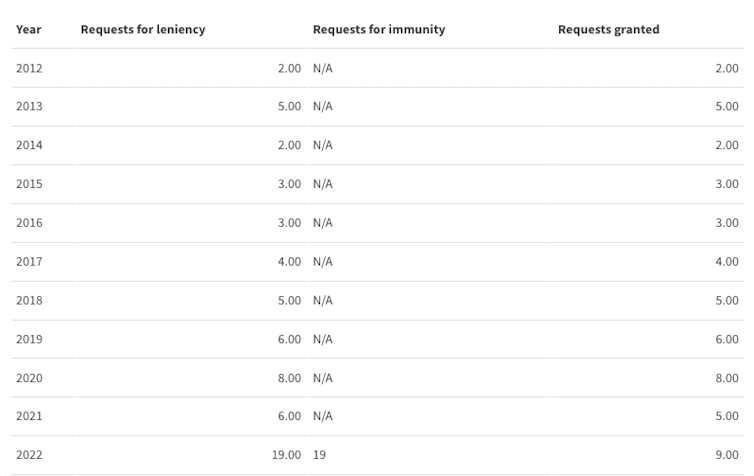
Since 2012, 106 firms or individuals have been charged with anti-competitive conduct.

Figures for 2022 include applications for leniency and criminal immunity.
Author provided

Our data shows an upward trend in leniency applications and a significant increase in applications for leniency and immunity in 2022 after criminalisation. Requests for leniency averaged 4.4 per year prior to 2022 but increased to 19 in 2022. We found that 43 of the 44 requests for leniency prior to 2022 were granted, while nine of the 19 requests in 2022 were granted.

A further concession made to cartels is the adjustment of penalties when it’s decided firms can’t pay the financial penalty that would otherwise apply. While not unique to cartels, four of ten recent anti-competitive cases had penalties reduced when the company claimed it couldn’t pay.

In one case, potential financial penalties ranged between NZ$400,000 and $650,000. In the end this was reduced to $62,500 based on what it was determined the company could pay.

The problem with leniency

The situation raises several questions and issues. First, the messaging is problematic. Offering leniency implies a certain level of acceptance by the community.

As cartel activity is often described as the most serious form of anti-competitive conduct, it’s difficult to reconcile this with an absence of sanctions for those who admit participating in it.

Secondly, there’s the question of equality of treatment in our justice system. Is it fair that only certain (white-collar) offenders enjoy leniency provisions? Anyone participating in cartel conduct can apply for immunity or leniency. This is not the case for those engaged in other criminal activity.

Third, is justice served when a firm can retain the benefits from the historic cartel activity and incur no formal sanction? This can mean the party that engages in the most serious misconduct, such as instigating the cartel, can avoid sanction. Meanwhile, less culpable participants are punished.


Read more:
Shocking yet not surprising: wage theft has become a culturally accepted part of business


Fourth, there’s the problem of reducing or removing financial penalties. We acknowledge the Sentencing Act requires the court to consider the ability of an offender to pay. But we also suggest a market outcome is achieved if a financial sanction results in an offending firm ceasing to trade.

Finally, while it can be argued that leniency provisions help detect cartels, it can also be argued that an absence of leniency provisions deters cartel activity due to the potential for sanctions.

What appears to be a focus on detection rather than deterrence is inconsistent with the approach taken with most other criminal activity. There may well be responses to these questions and issues that prove satisfactory to the community. But they are not obvious.

We need a public debate about why certain types of white-collar criminals have a standing offer of immunity or leniency for confessing to their bad behaviour and divulging the details of others who may be complicit. Justice is challenged when people engaging in the same activity receive different sanctions, and any pretence of getting tough on cartel crime is undermined.

The Conversation

The authors do not work for, consult, own shares in or receive funding from any company or organisation that would benefit from this article, and have disclosed no relevant affiliations beyond their academic appointment.

ref. White-collar criminals benefit from leniency provisions in NZ law – why the disparity with other kinds of crime? – https://theconversation.com/white-collar-criminals-benefit-from-leniency-provisions-in-nz-law-why-the-disparity-with-other-kinds-of-crime-205283

Fun, community activism and Rotuman language on the airwaves

Asia Pacific Report

Pacific Media Network broadcaster and community activist Ernestina Maro (left) and Auckland Rotuman Fellowship Group chair Rachael Mario share the microphone to talk up Rotuman Language Week events.

Cultural and social justice events feature in the eight day programme.

Last night the Titiri o Waitangi legacy and Rotuman community responses were aired at the Rotuman Community Centre and Whānau Hub in Auckland’s Mount Roskill.

Tonight Polynesian Panthers co-founder Will ‘Ilolahia spoke about the 1970s Dawn Raids era and the latest “raids’ controversy.

Among the interesting insights that ‘Ilolahia shared about the legacy of the Polynesian Panthers in education, human rights and social justice was the philosophy about the “panthers” themselves.

“The nature of the panther is that he never attacks,” ‘Ilolahia said.

“But if anyone attacks him or backs him into a corner, the panther somes up to wipe that aggressor or attacker out — absolutely, resolutely, wholly, thoroughly and completely!”

A slide from Will 'Ilolahia's talk tonight
A slide from Will ‘Ilolahia’s talk tonight as part of the Auckland Rotuman Friendship Group’s Rotuman Language Week. Image: Will ‘Ilolahia
Print Friendly, PDF & Email

Article by AsiaPacificReport.nz

Budget spends big on welfare but this will not make a significant difference to poverty in Australia

Source: The Conversation (Au and NZ) – By Ben Phillips, Associate Professor, Centre for Social Research and Methods, Director, Centre for Economic Policy Research (CEPR), Australian National University

The 2023 federal budget has a strong emphasis on the cost-of-living, with a A$14.6 billion plan designed to help Australians who are “under the pump”.

The headline measure is a $40 per fortnight increase in the JobSeeker payment. But it also includes expanding the eligibility for parenting payment (single), providing a moderately more generous JobSeeker payment for those aged between 55 and 60 and a 15% increase to rent assistance.

These measures on an annual basis put around $2 billion a year into low and middle income families. Of these, 95% go to low and middle income families and around 70% go to the lowest 40%.

But despite the investment, my analysis shows they will not make a significant difference to poverty in Australia.


Read more:
View from The Hill: Chalmers’ budget delivers modestly to the vulnerable while keeping the inflation ogre in mind


What is the increase in the welfare spend?

There are a range of other measures such as an energy rebate, age care worker pay increases and health-related benefits such as Medicare changes that will also assist lower income households. However, the focus of this piece is on permanent changes to the tax and cash welfare system from this budget.

While the welfare payment increases are welcome, they represent a less than 2% increase in the welfare budget each year. As such, they can only be expected to make a small impact on the living standards of the lowest income households and only a very modest impact on poverty.

The federal government’s Economic Inclusion Advisory Committee found an increase in the JobSeeker payment of around $256 per fortnight was required to bring the payment in line with 90% of the age pension.

The $40 per fortnight increase is only 16% of that recommended increase. So the increase in this year’s budget falls well below what the committee found was required to significantly improve adequacy of the payment.

The budget does go much harder for single parents, by raising the age at which the parenting payment cuts out from 8 to 14. This was very close to the committee’s finding on the level of JobSeeker payment for this group.

It also said a substantial increase in rent assistance was required, given the many years of indexation that did not keep up with low income rents.

This budget provides a modest, rather than substantial increase. However, a 15% increase is still very welcome.


Read more:
Jim Chalmers hands down a budget for Anthony Albanese’s battlers


What happens to the poverty rate?

The budget provides around $1.5 billion per year in increases to working age payments compared to the committee recommending around $5.7 billion per year. This leaves the government substantial work to do to bridge the significant gap that exists between JobSeeker and the age pension.

When we take the budget measures into account, the poverty rate in Australia lowers fractionally from around 13.6% to 13.3% of the population (around 80,000 people).

Of more interest perhaps is poverty for specific lower income households. For those households whose main source of income is JobSeeker their poverty rate remains at 86%. Their poverty gap does shift down by 10% from around $10,500 to $9,400 per annum on a per adult basis. But they are so far below the poverty line, this budget doesn’t do enough to shift them out of poverty.

The other group to shift on poverty is single parents. The poverty rate has shifted down from 34.2% to 30.8%. Their poverty gap has lowered from $2,171 to $1,818 per year – a reduction of 16%. Renters will also experience a modest reduction in their poverty rate from 29.6% to 28.6%.

When you look the budget, it is evident that making significant inroads to poverty is not cheap. This budget makes a useful start and probably the best seen in many years. But future budgets will need to push much harder to make a more significant difference to poverty and cost-of-living pressures for those in greatest need.


Read more:
Budgeting for difficult times is hard – just ask Jim Chalmers


The Conversation

Ben Phillips was a member of the interim economic inclusion advisory committee that reported to the government on the adequacy of JobKeepr and other payments.

ref. Budget spends big on welfare but this will not make a significant difference to poverty in Australia – https://theconversation.com/budget-spends-big-on-welfare-but-this-will-not-make-a-significant-difference-to-poverty-in-australia-205219

Budgeting for difficult times is hard – just ask Jim Chalmers

Source: The Conversation (Au and NZ) – By Peter Martin, Visiting Fellow, Crawford School of Public Policy, Australian National University

Wes Mountain

Surplus or not, the budget papers show us living through pretty awful times.

Living standards measured by the buying power of wages are set to go backwards in 2023-24 as wages are expected to grow by 3.75% while prices rise by 6%.


Made with Flourish

Separate figures released by the Bureau of Statistics as Treasurer Jim Chalmers was preparing to deliver his speech show the volume of goods and services bought from Australian retailers has shrunk for the past six months.

Living standards measured by gross domestic product are set to go backwards in 2023-24 as total GDP grows by an unusually low 1.5% while Australia’s population grows by 1.7%, producing a so-called “per capita recession”.

The good news on the government’s finances is largely historical.

The budget position for 2023-24 was improved by $42.15 billion because of measures largely outside the government’s control (so-called “parameter and other variations”).

Chief among these has been an unexpectedly big increase in the number of Australians in work and subject to income tax (as the unemployment rate has fallen to a half-century low), and much higher prices for exports than expected in the last budget (roughly twice as high in the case of iron ore), producing much higher profits to tax.

The government has chosen to spend just $12 billion of the $42.15 billion bounty, which has allowed the rest of the bounty to produce a (small) budget surplus of $4.2 billion in 2023-24.


Made with Flourish

After 2023-24, it will be deficits again for at least a decade on the budget’s projections, as the unusual circumstances that delivered the unexpected $42.15 billion fall away.

The unemployment rate is set to climb from its long-term low of 3.5% to 4.25% by mid next year and to 4.5% by mid-2025. The number of Australians in work and in the income tax system is expected to grow by just 1% in 2023-24 and 2024-25 after growing by 2.5% in 2022-23. The iron ore price is expected to halve within a year.

Government income is set to grow 8.8% in 2022-23 and 5.1% in 2023-24. After that, it is scheduled to barely grow in 2024-25, climbing just 0.5%, before returning to growth of 4.4% and 4.9 in 2025-26 and 2026-27.

Given that the costs of some government programs are expected to grow by a lot (the cost of National Disability Insurance Scheme is expected to grow by an average of 10.4% per year and the cost of funding hospitals by 6.5% per year), it looks as if the government is going to have to find more money.

Spending on defence is set to climb 22% over the next four years, and doubtless by more beyond, as spending on building and buying the nuclear-powered submarines under the AUKUS agreement ramps up.


Made with Flourish

Chalmers has sensibly abandoned the Coalition’s quaint commitment to keep the tax to GDP ratio to 23.9%, which is just as well because the influx of revenue scheduled for 2023-24 will to take it to 23.9% (25.9% including non-tax revenue) before it falls back.


Made with Flourish

Longer term, Chalmers will have to raise more tax or cut government services. The increases in the tax on large superannuation balances, tobacco excise and the petroleum resource rent tax are a sign of what’s to come.

The ultra-expensive Stage 3 income tax cuts deliver a hard-to-defend $2,000 per year to high earners on $120,000 per year. Although legislated back before COVID, they are not due to take effect until mid next year, meaning there’s still time (and another budget) in which to wind them back and reorientate them to Australians who need them more.


Read more:
View from The Hill: Chalmers’ budget delivers modestly to the vulnerable while keeping the inflation ogre in mind


Where Chalmers has supported Australians hit by ultra-high inflation in this budget, he has tried to do it cheaply.

Boosting JobSeeker and related payments by the $128 per week Chalmers’s economic inclusion advisory committee wanted would have cost $5.7 billion per year. Instead, Chalmers will lift it by $20 per week (and slightly more for most Australians on it aged 55 and over) at a cost of $1.3 billion per year.

As important as extending parenting payments to single parents with children up to 14 years of age will be those who need it. The measure is budgeted to cost just half a billion per year.

Boosting Commonwealth rent assistance by up to $16 per week (the “largest increase in more than 30 years”, Chalmers says) will cost a tad more, around $700 million per year.

The cost of the energy package (which the treasurer says will take $500 per year off some power bills and three-quarters of a percentage point off inflation) is marked in the budget as “not for publication”, presumably in deference to negotiations with the states which will co-fund it.

Chalmers said during his press conference this budget had been much harder to put together than his first. What he could have added is that his next budget is shaping up to be even harder.

Economic growth has been revised down. So convinced are financial markets the economy is weakening, that ahead of the budget they were pricing in no further Reserve Bank interest rate increases in this year and one interest rate cut, by December.

The economic forecasts in the budget suggest the coming per-capital recession won’t turn into an actual recession. Economic growth is expected to climb from an ultra-low 1.5% in 2023-24 to a still-low 2.25% in 2024-25 and then to 2.75%.


Made with Flourish

Inflation, which was 7% in the year to March, is forecast to fall to 6% in the year to June, and then to a less-worrying 3.25% by June 2024.

Although the forecasts move in the right direction, they are not good. Chalmers said getting things right this time required a “fine balance”. Future budgets are shaping up to require just as much.


Made with Flourish


Made with Flourish


Made with Flourish


Made with Flourish


Made with Flourish

The Conversation

Peter Martin does not work for, consult, own shares in or receive funding from any company or organisation that would benefit from this article, and has disclosed no relevant affiliations beyond their academic appointment.

ref. Budgeting for difficult times is hard – just ask Jim Chalmers – https://theconversation.com/budgeting-for-difficult-times-is-hard-just-ask-jim-chalmers-205209

Jim Chalmers hands down a budget for Anthony Albanese’s battlers

Source: The Conversation (Au and NZ) – By Michelle Grattan, Professorial Fellow, University of Canberra

Mick Tsikas/AAP

A big incentive for doctors to bulk bill, a modest $40 a fortnight rise in JobSeeker and extra rent assistance are highlights of a Labor budget that juggles targeted cost-of-living relief with containing inflation.

The government will triple the incentive paid to GPs to bulk bill for families with children under 16, pensioners and Commonwealth concession card holders.

The government says this will cover 11.6 million Australians and cost $3.5 billion over the forward estimates. It is part of an injection of $5.7 billion into the problem-ridden Medicare system.

The budget is aimed firmly at the most vulnerable and has a significant focus on women. However, those on middle incomes receive little – although families with children can benefit from the extra bulk billing.

The government has bowed to pressure for an across-the-board rise in JobSeeker. But the $40 a fortnight increase falls far short of the fortnightly $256 recommended by its Economic Inclusion Advisory Committee.

Those 55 and over who have been on the payment nine months will get a slightly larger increase, as people over 60 do now.

Delivering his second budget, Treasurer Jim Chalmers said inflation remained “our primary economic challenge.

“It drives rate rises, it erodes real wages. Which is why this budget is carefully calibrated to alleviate inflationary pressures, not to add to them.”


Read more:
View from The Hill: Chalmers’ budget delivers modestly to the vulnerable while keeping the inflation ogre in mind


Chalmers said the budget’s suite of measures to ease pressure on households would take 0.75 of a percentage point off inflation in 2023-24.

Inflation is expected to fall from 6% in 2022-23 to 3.25% in 2023-24, before returning to the Reserve Bank target range (between 2% and 3%) in 2024-25.

Unemployment will increase to 4.25% in 2023-24, and 4.5% the following year. Real wages are expected to start rising early next year.


Read more:
Budget 2023 at a glance: major measures, cuts and spends


The budget forecasts that this financial year will see the first surplus – $4.2 billion – in 15 years.

This will be followed by a string of deficits: $13.9 billion in 2023-24, $35.1 billion in 2024-25; $36.6 billion in 2025-26, $28.5 billion in 2026-27, with a cumulative total across the budget period of $109.9 billion. The deficits are lower, however, than earlier forecasts.

Revenue next financial year will be 26.4% of GDP while spending will be 26.6%. Net debt will be 22.3% of GDP.


Read more:
Budget spends big on welfare but this will not make a significant difference to poverty in Australia


The targeted $14.6 billion cost-of-living package over the forward estimates will see, in a federal-state deal, more than 500,000 households have up to $500 deducted from their power bill in the next financial year. Small businesses will also get relief.

The government is also investing $1 billion in assistance for low-cost loans for double glazing, solar panels and other improvements for homes to contain energy costs.

The increase in JobSeeker, Youth Allowance, Austudy and other income support payments will cost $4.9 billion and go to about 1.1 million people.

Eligibility for the parenting payment (single) is being liberalised, going to parents (overwhelmingly mothers) until their youngest child is aged 14, rather than the present age of eight. This will cost $1.9 billion over the budget period.


Read more:
Budgeting for difficult times is hard – just ask Jim Chalmers


A 15% increase in the maximum rates of Commonwealth rent assistance will mean an extra $31 a fortnight for those renting in the private market and community housing. Chalmers said this was the largest increase in more than 30 years.

Tax increases and measures to improve the budget position include rises in the tobacco excise ($3 billion over the budget period), changes to the Petroleum Resource Rent Tax ($2.4 billion), and a four-year extension of the GST compliance program ($3.8 billion).

As part of a bid to make Australia “a renewable energy superpower”, the budget allocates a further $4 billion. There will be a $2 billion investment in a new Hydrogen Headstart program.

The Conversation

Michelle Grattan does not work for, consult, own shares in or receive funding from any company or organisation that would benefit from this article, and has disclosed no relevant affiliations beyond their academic appointment.

ref. Jim Chalmers hands down a budget for Anthony Albanese’s battlers – https://theconversation.com/jim-chalmers-hands-down-a-budget-for-anthony-albaneses-battlers-205210

View from The Hill: Chalmers’ budget delivers modestly to the vulnerable while keeping the inflation ogre in mind

Source: The Conversation (Au and NZ) – By Michelle Grattan, Professorial Fellow, University of Canberra

This budget is the culmination of a tug of war between the government’s imperative to fight inflation and the siren call from Labor’s base to help people who are struggling.

The government has delivered measures to ease cost-of-living pressures on the most vulnerable, including on income support and rent assistance. The critics, especially but not only from the left, will say it hasn’t done enough.

Treasurer Jim Chalmers says it’s a balance between “doing what we can for the people doing it tough and keeping the pressure on inflation”. He told his news conference that on cost-of-living relief, “we’ve genuinely put in our best effort”.

But another bunch of critics, loud among them the opposition, will insist the budget wasn’t responsible enough – that it in fact squibs the inflation fight.

The rises in JobSeeker and rent assistance are modest. Indeed $40 a fortnight for JobSeeker is smaller than the Morrison government’s $50 increase.

But a big boost would have been inflationary, and thus ultimately counter-productive for those it was supposed to help, and many others, too.

While Chalmers insists his cost-of-living measures are restrained, some economists will maintain they’ll in fact add to the inflation problem.

Prime Minister’s Anthony Albanese decision last year to establish the Economic Inclusion Advisory Committee (as part of a deal with crossbencher David Pocock to pass industrial relations legislation) can be seen as crucial in the budget process in the last few weeks.

That committee’s report set a benchmark by which the government could be held to account. The $40 looks punier when compared to the committee’s advice for a $256 increase in JobSeeker.

When that committee produced its report, Chalmers hosed down expectations of what the government could do. But the welfare lobby had loud voices, and a lot of allies outside its ranks. And Labor backbenchers decided it was time to say their piece.

The campaign for compassion became intense. Minimalism became untenable.

And then the latest revenue upgrades arrived from Treasury. They both increased the pressure to do more, and made it possible.

Meanwhile those revenue numbers (driven by high employment and high commodity prices) imposed another pressure – to deliver a surplus in this financial year.

This served the economic purpose of demonstrating the government’s fiscal credentials. It also sent a powerful political “up yours” to the Coalition, who came to the brink of surplus only to have it snatched away by COVID.

It’s true the projected surplus is followed by the budget plunging back into the red over the next several years. And indeed, given the poor economic outlook it outlines, with its forecast of declining economic growth, that might be what happens.

But recent history shows how things can change in a budget’s out years. There is another possible scenario. Chalmers can use the looming deficit numbers in his bid to drive cost savings in expensive programs, notably the National Disability Insurance Scheme. This may (together with some assistance on the revenue side) help contain those deficits in later years.

Some will criticise the budget for a lack of ambition. Why didn’t it get rid of part of those Stage 3 tax cuts? Why did it confine its changes to the Petroleum Resource Rent Tax to tinkering? Couldn’t it have gone further with superannuation tax breaks? Doesn’t the government realise that this was the budget calling for boldness, because the next one will already have the election in mind? Why be the tortoise rather than the hare?

The answers lie in the nature of the Albanese government and its prime minister. Albanese wants to change things, but to minimise the risk in doing so and to maximise the government’s longevity.

While a second term for Labor looks a very good bet, given the government’s popularity and the parlous state of the Liberals, there is never certainty in politics.

Albanese lived at the heart of the disorderly Rudd-Gillard-Rudd era. He puts a high value on process, order, maintaining public confidence and delivering to the base (albeit less than some demand), while not provoking swinging voters.

Those in the centre of the income scale, feeling squeezed by escalating interest rates, may feel left out in this budget. This is despite Chalmers declaring there is “a lot […] for middle Australians”, such as the bulk billing changes for families with children. But if the budget doesn’t deliver much to these people, not does it overtly poke them in the eye.

If this budget has plenty of critics around its edges, they will probably find it hard to deliver a killer blow to its core.

The Conversation

Michelle Grattan ne travaille pas, ne conseille pas, ne possède pas de parts, ne reçoit pas de fonds d’une organisation qui pourrait tirer profit de cet article, et n’a déclaré aucune autre affiliation que son organisme de recherche.

ref. View from The Hill: Chalmers’ budget delivers modestly to the vulnerable while keeping the inflation ogre in mind – https://theconversation.com/view-from-the-hill-chalmers-budget-delivers-modestly-to-the-vulnerable-while-keeping-the-inflation-ogre-in-mind-205208

HECS for farmers? Nature repair loans could help biodiversity recover – and boost farm productivity

Source: The Conversation (Au and NZ) – By Bruce Chapman, Director, Policy Impact, College of Business and Economics, Australian National University

Almost three billion hectares of farmland is in poor condition worldwide – an area the size of Russia. Biodiversity is in freefall. Extinctions are rising. Wild animal populations have fallen almost 70% since 1970.

Restoring damaged land and bringing back ecosystems is phenomenally expensive, estimated at A$21 trillion globally.

The sheer scale of the problem is beyond the capacity of traditional approaches to funding repair. That’s one reason why the Australian government is looking to alternatives such as a nature repair market. This, the government hopes, would boost biodiversity – especially on private land such as farms.

To make this market work, the government might consider creating a new version of Australia’s well-known HECS higher education loans. Call it FECS – Farm Environment Contribution Scheme.

The lead author of this article, Bruce Chapman, helped create HECS – the world’s first national income-contingent loan for higher education. Co-author David Lindemayer, ecologist and conservation biologist, has spent decades exploring ways to preserve biodiversity on farmland.

We have shown how farmers could access loans similar to HECS but based on annual revenue, not income to undertake work helping both their business and restoration of nature. This work will boost farm productivity and biodiversity with farmers repaying the loan when their revenues permit.

Why is this needed?

Australia has large swathes of degraded land and at least 100 species have gone extinct since European colonisation. To prevent further extinctions, the government announced it would introduce a new nature repair market.

This market could, if done well, tackle some of the drivers of biodiversity loss and land degradation – particularly on our farmland. Protecting habitat and waterways, preventing erosion and improving drought resilience would all be eligible.

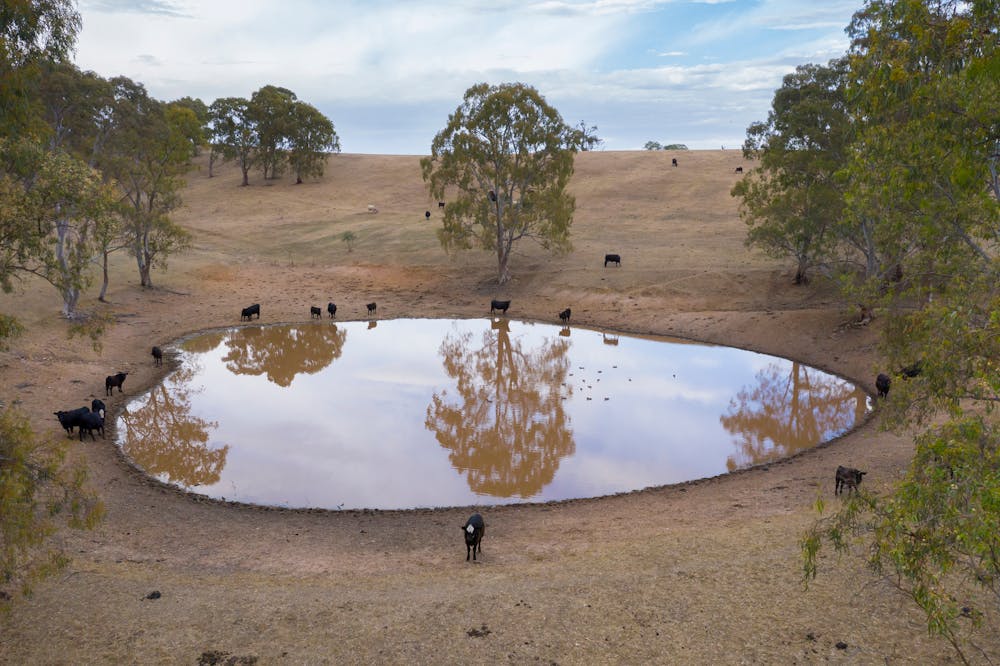
Take farm dams. The vast majority of the 650,000 dams in the Murray-Darling Basin are in poor condition. To renovate one by fencing and re-vegetating around it costs about $9000.


Read more:
We must look past short-term drought solutions and improve the land itself


But farmers can make this money back. Livestock with access to better quality drinking water gains weight more quickly, giving farmers more cow to sell. There’s a climate benefit too, as renovated dams change rapidly from carbon sources to carbon sinks. Plus, healthier dams provide habitat for more birds, frogs and dragonflies.

The question is – how do you fund this market? Creating tradeable certificates is one way but could be complicated. Another option is to create a rolling fund, where biodiversity loans are given to farmers to do nature repair work such as dam upgrades which help their bottom line – and wildlife.

farm dam
Farm dams can be rich habitats for many species – but only if managed well.
Shutterstock

How would this work with the nature repair scheme?

The federal government has pitched its planned nature repair market as an offset scheme: farmers and landholders do repair work and get biodiversity certificates which can be bought by, say, another farmer wanting to clear land.

But there’s a complementary, parallel approach. All farms experience large swings in annual revenues from forces outside a farmer’s control, such as rain, drought, floods and commodity price shocks. The best financial tool to help farmers undertake nature repair is the type which smooths their income. That’s where revenue-dependent loans could work.

Farmers would get the money needed for work on restoration and biodiversity recovery, and incur a debt to be repaid only when future revenue makes it possible. During bad years when farm income is low, repayments would be low or zero. During good years, more debt would be repaid to the government.

eroded gully
Tackling erosion is expensive, but could bring benefits to farmers and nature.
Shutterstock

This isn’t wholly new. We already have policies allowing farmers to draw on savings from good years to help cope with poor years, coupled with associated tax benefits. By and large, this works well.

Loans like HECS have this vital income-smoothing feature – you only pay it back when you are in a position to do so. This scheme has worked well to share the cost of university education between the recipient, who will benefit directly from it, and society more broadly, which benefits from highly educated doctors, lawyers, business owners and so on.

With this type of loan, you don’t risk losing your farm if you can’t repay the debt. They’re better than extending your bank loan, because they don’t add to repayments until you’re in a position to make them.

If these loans were added to our nature market, it could get much more traction than a grant scheme. This is because most of the money outlaid by government would be returned as the loans are repaid. It creates a revolving fund, allowing the government to finance many more projects with many more farms than with a grant which, when spent, is gone.

What about the transparency problem?

Government schemes can attract people trying to game the system for their own financial benefit.

To avoid this, projects tied to a FECS loan would have ensure plantings, shelterbelts and dam renovations are effective and meet standards.

We could borrow from decades of monitoring hundreds of sustainable farms in endangered temperate woodlands to create robust standards.

These will be crucial to avoid perverse effects, such as the risk of promoting populations of the wrong species. Replanting along narrow strips can simply create habitat for damaging hyper-aggressive native birds like the noisy miner while introduced trees can harbour pests such as starlings. Robust monitoring will be needed to ensure restoration projects actually do produce more biodiversity.

We’ll need three types of monitoring:

  1. Compliance monitoring – did a landowner do what they said they would?
  2. Inputs monitoring – how much of the loan or grant was actually invested in fencing, planting trees or improving dams?
  3. Outcomes monitoring – what was the end result? Did we get more species of native animals and invertebrates (including species of conservation concern)?

As we wrestle with the best way forward for Australia’s first nature repair market, we should seriously consider rolling out revenue-dependent loans for farmers.

It could make life easier for farmers at little cost to the government – and get the ball rolling on the ever more urgent issue of restoring land and the species that rely on it.


Read more:
Can a ‘nature repair market’ really save Australia’s environment? It’s not perfect, but it’s worth a shot


The Conversation

David Lindenmayer received funding from The Australian Government, the NSW and Victorian Governments, the Australian Research Council, and a series of private foundations interested in enhancing biodiversity conservation on farms and integrating conservation and agricultural production. He is a member of Birds Australia that seeks to boost bird conservation outcomes on farms

Bruce Chapman does not work for, consult, own shares in or receive funding from any company or organisation that would benefit from this article, and has disclosed no relevant affiliations beyond their academic appointment.

ref. HECS for farmers? Nature repair loans could help biodiversity recover – and boost farm productivity – https://theconversation.com/hecs-for-farmers-nature-repair-loans-could-help-biodiversity-recover-and-boost-farm-productivity-204040

Indonesia sends disaster aid supplies to Vanuatu – warning over West Papua

Indonesia has sent 30 tonnes of relief supplies to aid the Vanuatu government’s recovery efforts post three major natural disasters earlier this year.

The humanitarian aid has been delivered on a My Indo Airline B737-800 cargo aircraft that departed from Soekarno-Hatta International Airport and landed at Vanuatu’s Bauerfield International Airport today.

A representative of the Indonesian embassy in Canberra, Doddy, said the relief consisted mainly of food, tents and agricultural tools.

According to BBN Breaking News, Indonesia is also sending a 14-member humanitarian mission to Vanuatu.

“The team will include representatives from the Coordinating Ministry for Cultural Affairs, Foreign Affairs Ministry, the National Disaster Mitigation Agency (BNPB), and the State Intelligence Agency (BIN),” BNN Breaking reported.

“They will work closely with local authorities and international organisations to ensure that the aid is distributed effectively and efficiently.”

“Indonesia’s commitment to providing aid to Vanuatu showcases its strong ties to the Pacific region and its continued efforts to promote regional cooperation and support.

It also highlights the importance of international solidarity and cooperation in addressing global challenges.”

However, the vice president of the Vanuatu Free West Papua Association, Lai Sakita, who was at the airport this morning, said the arrival of the relief supplies was “suspicious”.

He warned that the Vanuatu government needed to be very careful of the Indonesian assistance with the Melanesian Spearhead Group (MSG) leaders summit due to be held in July this year.

The Free West Papua movement wants the MSG leaders to approve West Papua’s application to become a full member of the sub-regional agency at this summit.

30 tons of Indonesian relief supplies landed at Vanuatu's Bauerfield International Airport on 9 May 2023.
Indonesian relief supplies at Vanuatu’s Bauerfield International Airport today . . . warning by West Papua supporters over July meeting of the Melanesian Spearhead Group. Image: Hilaire Bule/RNZ Pacific

Article by AsiaPacificReport.nz

Heavy rain, thunderstorms spark local emergency in Auckland

RNZ News

A state of local emergency has been declared in Aotearoa New Zealand’s largest city Auckland today as heavy rain and thunderstorms affect the region.

Auckland’s Emergency Management duty controller said a band of heavy rain was expected to come across the Auckland region between now and 7pm.

Controller Parul Sood said that while there had been a lull in the rain further downfalls were possible with localised downpours of around 20 to 33 mm expected.

She said Auckland Council had received about 490 stormwater related calls, the majority of which were to do with surface flooding, and only about 18 to do with flooding in homes.

Fire and Emergency has received 277 weather-related call outs today, most from Auckland.

Its on-call commander for Tāmaki Makaurau, Brad Mosby, said that about one third of the calls were urgent.

He urged people to avoid unnecessary travel and stay clear of floodwaters.

Meanwhile, thunderstorms continued to roll across the top half of the North Island.

Metservice said severe thunderstorm warnings were in place for South Waikato, Matamata Piako, Western Bay Of Plenty, Taupo and Rotorua until just before 4.30pm.

A severe thunderstorm Watch was also in force for Auckland, Coromandel Peninsula and the rest of Waikato and Bay Of Plenty.

This article is republished under a community partnership agreement with RNZ.

Print Friendly, PDF & Email

Article by AsiaPacificReport.nz

French Polynesia’s economy on ‘good path’, says Paris-based institute

By Walter Zweifel, RNZ Pacific reporter

The French Polynesian economy has been given a positive assessment in the aftermath of the covid-19 pandemic by the body issuing the French Pacific franc.

The Overseas Emission Institute said it expected French Polynesia should return to its pre-crisis level of GDP in the first quarter of 2023.

It noted that tourism has rebounded, and hotels had restored their profitability.

Over the 2022 financial year, the overall turnover of the hotel industry reached US$540 million over US$289 million in 2021.

However, the report said inflation last year rose to 6.6 percent, with food prices alone going up by 12 percent.

Costs for housing rose 8.8 percent and for transport 8.2 percent, with fuel costs going up almost 28 percent.

Labour market picked up
The report also said the labour market had picked up again with a 5.1 percent increase in the workforce.

It said in the first 10 months of last year, the salary mass grew by seven percent.

It said sectors such as energy, transport and the hotel industry carried out large-scale projects requiring significant loans, which were up by almost 60 percent from 2021 to last year.

The report credits the investment to the government’s economic relaunch programme for the period 2021 to 2023.

The institute added that the territorial elections and the geopolitical risks in the Pacific constitute factors of uncertainty likely to weigh on the behaviour of economic actors.

Unions sceptical
However, the secretary-general of the main union group CSTP-FO doubts the figures are accurate.

Patrick Galenon told Tahiti-infos there were about 80,000 unemployed people.

“We are told that there is only nine percent unemployment and that people do not want to work. But that is not the situation,” he said.

Galenon added: “They want to work, unfortunately they can’t find any [jobs]. The extremists will say that many come from outside and that they find a job”.

He said what was needed was a real local employment law on which work had been done for 10 years.

“In the form of a joke, I said that when I go to Paris, I try to adapt to Paris. I put on a tie or a coat when I’m cold.

“If they come from outside, it’s not for our good looks but to earn money by setting up a business”, he said.

Galenon asked why none of the managers of the big hotels were Polynesian.

“We are also going to talk about land because it is linked: 80 percent of land is presumed to be state property.

“Where are the lands of the Polynesians? Afterwards, we are told, don’t worry, we are returning the land to the Polynesians.

“But we don’t give them anything back, it’s their land!,” he said.

He added that “on the other hand, we give back to people who are not the real owners. This will create even more problems”.

Galenon said home ownership had now slipped out of reach for many because almost US$500,000 was now needed to buy a house.

Election a “social revolution”
In his view, last month’s election victory of the Tavini Huira’atira wasn’t a vote for independence, likening the result instead to a “social revolution”.

In an interview with Tahiti Nui TV, Galenon said he was “convinced that there are many people who were not for independence or for the blue party [Tavini’s party colours] but who voted blue because socially, the country was going very badly.”

Galenon said it was inconceivable to have products that had increased in price by 35 to 40 percent.

Measuring against the figures in France, Galenon said the monthly minimum wage was US$1563 while in France it was US$1940.

“In France it’s 35 hours [a week], here it’s 39 hours and unfortunately life here is 40 percent more expensive. So, we have a real problem,” he said.

This article is republished under a community partnership agreement with RNZ.

Print Friendly, PDF & Email

Article by AsiaPacificReport.nz

‘Regenerative agriculture’ is all the rage – but it’s not going to fix our food system

Source: The Conversation (Au and NZ) – By Anja Bless, PhD Candidate, University of Technology Sydney

Shutterstock

Decades of industrial agriculture have caused environmental and social damage across the globe. Soils have deteriorated and plant and animal species are disappearing. Landscapes are degraded and small-scale farmers are struggling. It’s little wonder we’re looking for more sustainable and just ways of growing food and fibre.

Regenerative agriculture is one alternative creating a lot of buzz, especially in rich, industrially developed countries.

The term “regenerative agriculture” was coined in the 1970s. It’s generally understood to mean farming that improves, rather than degrades, landscape and ecological processes such as water, nutrient and carbon cycles.

Today, regenerative agriculture is promoted strongly by multinational food companies, advocacy groups and some parts of the farming community. And the Netflix documentary Kiss the Ground features celebrity activists promoting the regenerative agriculture movement.

But as our new research shows, regenerative agriculture may not be the transformation our global food system needs.

machines harvest soybean crop
Industrial farming has left vast swathes of land degraded.
Shutterstock

Farming must change

About 20-40% of the global land area is degraded. Agriculture caused 80% of global deforestation in recent decades and comprises 70% of freshwater use. It is the biggest driver of biodiversity loss on land and contributes significantly to greenhouse gas emissions.

Global corporations such as Nestlé, PepsiCo, Cargill and Bayer dominate the food system. Some 70% of the global agrochemicals market is owned by just four companies and 90% of global grain trade is dominated by four businesses. This gives these corporations immense power.

Many small-scale farmers struggle to compete in global markets – especially those in poorer, less developed countries in Asia, Africa and Latin America. In an effort to keep up, these farmers also often go into debt to buy chemicals and expensive machinery to boost production.

What’s regenerative agriculture?

Regenerative agriculture is proposed as a more sustainable alternative to industrial agriculture. It can include practices such as:

  • integrating livestock into cropping systems to replenish soil and reduce the cost of animal feed and fertiliser
  • leaving soil undisturbed and covered with plants to retain carbon, moisture and nutrients and reduce erosion
  • regularly moving livestock between paddocks to give pasture a chance to recover
  • using less synthetic chemicals in farming.

But can regenerative agriculture transform the global food system? Our research examined this question.

cows grazing in field
Regenerative agriculture can involve rotating livestock between pastures to increase soil health.
Shutterstock

Our research findings

We explored the origins and current status of regenerative agriculture. We then compared this to other sustainable farming approaches: organic agriculture, conservation agriculture, sustainable intensification, and agroecology.

We found regenerative agriculture shares many similarities with the first three movements listed above. Most importantly, it originated in the rich, industrially developed Global North, primarily North America, Australia, New Zealand and the United Kingdom.


Read more:
Land of opportunity: more sustainable Australian farming would protect our lucrative exports (and the planet)


This means the movement often fails to credit Indigenous practices it draws from. It also tends to overlook the needs of farmers in the Global South and broader power inequality in the food system.

Like some other movements, regenerative agriculture is increasingly being embraced by corporations. Nestlé, for instance, aims to source 50% of its key ingredients through regenerative agriculture by 2030.

There are concerns companies may be using regenerative agriculture to “greenwash” their image. For example, experts warn corporations could be using the term to repackage existing commitments, rather than substantially improving their systems.

Agroecology: a different path

We also found that regenerative agriculture is threatening to marginalise another promising sustainable farming movement: agroecology.

Agroecology combines agronomy (agricultural science) and ecology, and also seeks to address injustice and inequity in food systems.

The movement is associated with the world’s largest smallholder farmer organisation, La Via Campesina, and has been endorsed by the United Nations.

people march in protest holding sign in Spanish
Agroecology is a global movement endorsed by the UN.
Shutterstock

Agroecology advocates for Indigenous knowledge and land rights, and support for small-scale farmers. It seeks to challenge neoliberalism, corporate dominance, and globalisation of food systems.

Some researchers question if agroecology alone can produce enough food for a growing global population. But 80% of the world’s food, in value terms, is produced by small family farms. And globally, we already grow enough food to feed ten billion people. The problem is how that food is distributed and wasted, and how much is made into ultra-processed foods and other products such as bio-fuels.

Agroecology brings many benefits to farmers and communities. An agroecology project in Chololo village in Tanzania, for example, saw the number of households eating three meals per day rise from 29% to 62%. Average household income increased by 18%. The average period of food shortage shortened by 62% and agricultural yields increased by up to 70%.

But the origins of the agroecology movement in the Global South, and its resistance to corporatisation, mean it is often marginalised. At events such as the UN Food Systems Summit, for example, corporate stakeholders guide policy decisions while vulnerable farmers can feel sidelined.

two men prepare soil
Agroecology focuses on both ecological and social principles.
Shutterstock

Transforming our food systems

Despite regenerative agriculture’s popularity and its focus on sustainable food production, it fails to tackle systemic social and political issues. As a result, the movement may perpetuate business-as-usual in the food system, rather than transform it.

But our food system includes many landscapes and cultures. That means regenerative agriculture could still support more sustainable farming in some settings – though it’s not a catch-all solution.

And voices in regenerative agriculture have called for a shift in the movement’s agenda, putting more emphasis on equity, justice and diversity. So there is hope yet that the movement may help turn the tide against industrial agriculture.


Read more:
Cotton on: one of Australia’s most lucrative farming industries is in the firing line as climate change worsens


The Conversation

Anja Bless receives funding from the Australian Government research training program.

ref. ‘Regenerative agriculture’ is all the rage – but it’s not going to fix our food system – https://theconversation.com/regenerative-agriculture-is-all-the-rage-but-its-not-going-to-fix-our-food-system-203922

Why exercising your ‘good arm’ can also help the one in a sling

Source: The Conversation (Au and NZ) – By Ken Nosaka, Professor of Exercise and Sports Science, Edith Cowan University

Shutterstock

Injured limbs need rest. They are often kept in a sling or cast to immobilise them as a way to promote healing. But that can mean smaller and weaker muscles several weeks later. It takes a long time to rehabilitate these muscles and muscle strength and function may not be fully restored for some people.

Experts are learning more and more about the “cross-education effect” where training one side of the body results in an increased strength of the opposite side of the body. Our recent study shows it can also stop muscle wasting in the “unused” arm.

So, how can we harness that effect?

How it works

First discovered 100 years ago, the mechanisms underpinning the cross-education effect have not been fully clarified yet. But it is likely associated with neural adaptations in the motor cortex of the brain that controls movement in the body.

Researchers have reviewed almost 100 studies and showed the average cross-body transfer ratio between the strength gain in the trained muscle to non-trained muscle ranged from 48% to 77%. So, if your trained arm strength increased by 20% after training the same muscle of your non-trained arm strength might increase by 10% even though you did nothing with that arm.

Such changes could be due to increased cortical excitability (the brain activity to control movement), reduced cortical inhibition (the signal to stop movements), reduced inter-hemispheric inhibition (the signals that direct movement instructions to one side of the body but not the other), changes in voluntary activation or new brain regions getting switched on.

It appears the type of muscle contraction in the training affects the extent of the cross-education effect.

There are three types of muscle contractions:

  • isometric (static) where the force produced by a muscle is equal to the load to the muscle, such as holding a dumbbell
  • concentric (shortening) in which force is greater than load, such as lifting a dumbbell
  • eccentric (lengthening) in which force is less than load, such as lowering a dumbbell.

Muscles can produce greater force during eccentric than isometric or concentric contractions. And less fatigue is induced during eccentric than other contractions. Resistance exercises – when muscles work against a weight or force – increase muscular strength and endurance using these types of muscle contractions.

Several studies report exercise consisting of eccentric-only muscle contractions (say, lowering a dumbbell but not lifting it) produces greater cross-education effect than exercise consisting of concentric-only (lifting only) or concentric-eccentric contractions (lifting and lowering).

One study showed eccentric exercise training affected brain-spine responses and stopping (inhibition) signals of the untrained limb to a greater extent than concentric training.

woman in gym setting holding dumbbell in one hand
Lowering a dumbbell is an example of an eccentric exercise.
Shutterstock


Read more:
Is foam rolling effective for muscle pain and flexibility? The science isn’t so sure


What we studied

In 2021, we compared eccentric and concentric resistance exercise training for cross-education effect in which 18 young people (aged 20–23) performed progressive elbow flexor resistance training with one arm twice a week for five weeks using a dumbbell.

Both eccentric (lengthening) and concentric (shortening) training groups increased muscle strength similarly after the training (by 23 to 26%) for the trained arm. But the non-trained arm showed greater strength increase after eccentric (23%) than concentric training (12%). The cross-body transfer ratio (the correspondence between the strength gain in both sides) was much greater (91%) for eccentric training when participants lowered a dumbbell only compared to concentric training (49%) when they lifted it.

This tallies with our previous study that showed greater strength gains and cross-education effect from eccentric training.

Published in February, our most recent study involved 12 young men and showed how training one arm can prevent weakening of the other. No training saw muscle strength and size of the inactive arm reduced by up to 17%. Concentric training reduced the loss to to 4%. But eccentric training increased the immobilised arm strength by 4% and completely abolished atrophy (muscle wasting).


Read more:
Four reasons swimming should be your next workout


What to ask your physio

These findings support the recommendation of resistance training using eccentric or lengthening movements of the non-immobilised limb to prevent muscle strength loss and atrophy in real injuries such as ligament sprains and tears or bone fractures and after surgery.

This type of training has not been used extensively in rehabilitation so far. Further investigation into the mechanisms at play is needed but our findings could inform changes to how rehabilitation is implemented.

If you’re injured and or have had surgery and have an arm or leg immobilised, it’s worth discussing with your doctor, surgeon or physio whether exercising the corresponding limb on your good side – especially with lengthening movements against resistance or with a weight – could be worth trying.


Read more:
Hot pack or cold pack: which one to reach for when you’re injured or in pain


The Conversation

Ken Nosaka does not work for, consult, own shares in or receive funding from any company or organization that would benefit from this article, and has disclosed no relevant affiliations beyond their academic appointment.

ref. Why exercising your ‘good arm’ can also help the one in a sling – https://theconversation.com/why-exercising-your-good-arm-can-also-help-the-one-in-a-sling-200167

How Alone Australia can help us understand and appreciate our place in nature

Source: The Conversation (Au and NZ) – By Lily van Eeden, Research fellow, Monash University

Alone Australia/SBS

More than a million Australians have tuned in to Alone Australia, SBS’s highest-rating series for 2023 to date. What is it about this program that’s got us so hooked? And what can it tell us about our own relationships with nature?

The series started with ten contestants dropped off in a remote area of Lutruwita/Tasmania. The aim is to survive alone for as long as possible. Each contestant is relying on their ability to find food, create adequate shelter and contend with isolation from people.

Each contestant’s experiences have been shaped, in part, by their unique relationship with nature. We all value and experience nature in different ways.

As armchair experts watching from home, we may reflect on how we would act if we had to survive alone in a remote place. How might our own relationship with nature shape our actions?


Read more:
Alone Australia contestants are grappling with isolation and setbacks. Here’s what makes a winner


Nature is everywhere

Watching Alone Australia may generate the sense that nature, and nature experiences, happen “out there” away from urban places and other people. This narrative has been fuelled by media, including David Attenborough’s awe-inspiring nature documentaries, which paint nature and humans as separate. While this kind of media can inspire fascination with nature, it can be damaging if it perpetuates an idea that humans are separate from nature.

Nature is all around us, including in our cities. Indeed, one-third of Australia’s threatened species live in cities.

This means that what urban residents (that’s most of us) actually do is important for helping nature to survive and thrive. And there are many easy things we can do.


Read more:
Nature is in crisis. Here are 10 easy ways you can make a difference


We shape nature, and nature shapes us

Your relationship with nature is part of your identity. This relationship is shaped by values, attitudes, beliefs and behaviours. It’s personal and it’s cultural.

Alone Australia demonstrates how humans value nature in different ways. The show helps us widen our view of valuing nature from what it provides for us (instrumental/utilitarian values) to seeing beauty and worth in nature itself (intrinsic values).

Some contestants value nature from an even broader perspective (relational values) as they reveal their deep, caring, reciprocal and even spiritual relationship with the natural world.

Previous overseas seasons of Alone have highlighted utilitarian nature relationships, with most contestants being white male survivalists. This season, the first in Australia, includes people from different cultures and genders, including First Nations peoples. This has highlighted different types of human-nature relationships, including spiritual and nature-as-kin relationships.

Experiences in nature early in life shape these relationships. In their “flashback” footage, several contestants express gratitude to their parents for early experiences of nature.

For those of us with children, this might inspire us to help shape our child’s “nature identity”. Meaningful nature experiences can include looking after nature (gardening, indoor plants), bushwalks, visiting botanical gardens, or getting up close and personal with wildlife at your local zoo.

Nature as medicine

Being in nature is good for us. It might seem like the moments of awe and self-discovery in nature that we have seen Alone Australia contestants experience can only happen in these “out there” places. But these experiences can happen anywhere – if we seek them out.

This will be apparent to many of us who sought solace in nature during COVID lockdowns. Connecting with nature, including in urban places, can help people feel less lonely and support their wellbeing in many ways.

For two Alone Australia contestants, in particular, their experiences of post-traumatic stress disorder (Chris) and the loss of a child (Gina) have been harrowing. Both describe how nature provides them with solace and healing.

For several contestants, craving connection with people was the reason to head home. Others seek kinship with nature. For example, ecologist Kate befriends her local possum family and Gina delights in regular visits by a platypus.

For First Nations man Duane, the experience strengthened his connection to Country, but experiencing that connection with family was critical:

It’s about oneness with nature, but sharing it collectively – kindness, actions towards others, not being alone out there.


Read more:
What Alone Australia tells us about fear, and why we need it


Learning about nature

TV nature content like Alone Australia is educational. As the remaining contestants find food and other resources, we learn about plant and animal species and their use by the Palawa people, the Traditional Custodians of the land.

This might prompt viewers to find out more about the plants and animals in their own local environments. Indeed, recent renewed interest in urban foraging has been touted as cementing our connections to place and sense of belonging.

We need nature, and nature needs us

Alone Australia highlights our complete interdependence with nature. Ultimately, everything we need for survival, including clean water, shelter and food, is derived from nature, even when we live in a city. The “successes” of the contestants are determined by their ability to understand their relationship to the land and how to meet their basic survival needs.

If we broaden our view of nature and see ourselves as interwoven in nature’s rich tapestry, as many of the contestants do, we can gain more than basic survival. We can improve our wellbeing while feeling kinship with the more-than-human, and a sense of responsibility to care for it.

Nature is in crisis, and that matters for all of us.

People who feel connected to nature are more likely to protect it. If TV nature content such as Alone Australia encourages us to reflect on our relationship with nature and seek meaningful moments with nature and nature knowledge, then perhaps it might lead us to strengthen our environmental identities and act as nature stewards. And that’s a great outcome for people and the planet.

The Conversation

Lily van Eeden receives funding from the Victorian Department of Energy, Environment, and Climate Action. She is affiliated with Arthur Rylah Institute for Environmental Research, BehaviourWorks Australia (Monash University), and ICON Science (RMIT University).

Christina Renowden receives funding from the Victorian Department of Energy, Environment and Climate Action. She is affiliated with Arthur Rylah Institute for Environmental Research and BehaviourWorks Australia (Monash University).

Fern Hames receives funding from the Victorian Department of Energy, Environment and Climate Action (DEECA). She is affiliated with the Arthur Rylah Institute for Enviromental Research in DEECA, and Monash University.

Kate Lee receives funding from the Victorian Department of Energy, Environment, and Climate Action. She is affiliated with Arthur Rylah Institute for Environmental Research and the University of Melbourne.

Melissa Hatty receives funding from the Victorian Department of Energy, Environment and Climate Action (DEECA) and the NSW Office of Energy and Climate Change through her affiliation with BehaviourWorks Australia (Monash University). She has previously received funding from DEECA, the Biodiversity Council, Melbourne Water, and WWF Australia.

Sarah Bekessy receives funding from the Australian Research Council, the National Health and Medical Research Council, the Ian Potter Foundation and the European Commission. Research cited in this article was undertaken by the Threatened Species Recovery Hub with funding from the Australian Government’s National Environmental Science Program (Phase 1) and the Victorian Department of Land, Water, Environment and Planning. She is a Lead Councillor of the Biodiversity Council, a Board Member of Bush Heritage Australia, a member of WWF’s Eminent Scientists Group and a member of the Advisory Group for Wood for Good.

ref. How Alone Australia can help us understand and appreciate our place in nature – https://theconversation.com/how-alone-australia-can-help-us-understand-and-appreciate-our-place-in-nature-205115

With independence off the table for now, what’s next for New Caledonia’s push for self-determination?

Source: The Conversation (Au and NZ) – By Justin Wastnage, Adjunct Industry Fellow, Griffith Institute for Tourism, Griffith University

Mathurin Derel/AP

Australian Foreign Minister Penny Wong’s visit to New Caledonia a few weeks ago made few headlines. In fact, it barely made the news.

Yet, her visit came at a crucial juncture for the French overseas territory, which is trying to negotiate a viable path towards a lasting self-determination, which balances the rights of New Caledonia’s Indigenous populations with the political reality of three failed independence referendums.

A new country is still emerging just off Australia’s coast, albeit in a slow path towards decolonisation in a process guided, but not governed, by France.

Self-determination is not a straightforward path

Officially, the subject of sovereignty has been put to bed for a while, with the defeat of the most recent referendum on full independence in late 2021. A large majority voted to remain part of France, albeit with a very low turnout rate.

However, the main pro-independence group, the Kanak and Socialist National Liberation Front (FLNKS) refused to recognise the result, as most Indigenous New Caledonians had boycotted the poll due to the traditional burial and mourning rituals following a high number of COVID deaths in the community.

Talks resumed in Paris last month around the validity of the third independence referendum in 2021 and on ways to devolve powers further.

Even the fact the Ministry of Overseas France, which oversees France’s vast remaining colonial holdings, is still talking about these things is in stark contrast to the Anglo-Saxon, winner-takes-all approach to referendums.

Compare, for example, the United Kingdom government’s refusal to authorise a new independence referendum in Scotland, despite 62% of Scots having voted to remain in the European Union in the Brexit vote. Nationalists there contend that conditions have fundamentally changed since the failed 2014 independence referendum.

In the case of New Caledonia and other former French possessions, there is an understanding that issues as complex as Indigenous rights take time and patience to explain and execute. And that systems and institutions need time to gain trust.

Before Wong became the first Australian minister ever to address New Caledonia’s Congress, she first met representatives of the Customary Senate, a 16-member Indigenous body that consults with the government on issues related to the Indigenous Kanak people.

As Wong diplomatically put it in her address to the legislature, “New Caledonia is at a complex, historic juncture”. Its path to decolonisation is not a straightforward question of restoring power to the traditional owners of the land.


Read more:
Why New Caledonia’s final independence vote could lead to instability and tarnish France’s image in the region


A unique power structure

Indigenous Melanesians, who reclaimed the once-pejorative term “canaques” and adopted the word Kanak for themselves, make up 40% of the population. A further 10% is made up of Polynesians (largely from Tahiti or another French Pacific territory, Wallis and Futuna).

Despite a long colonial history – first as a penal colony, and later as a destination for French free settlers – New Caledonia’s European population has only ever accounted for 40% of the population. Today, around a quarter of the 270,000 New Caledonians identify as having European heritage.


Read more:
Why New Caledonia’s instability is not just a problem for France


But almost as large as the European population are those of mixed heritage. A legacy of colonisation, workers from Vietnam, Vanuatu, Algeria and other former French colonies settled in New Caledonia, married and had children. These New Caledonians often hold the balance of power in the political process.

As a result, a complex web of power-sharing structures has emerged over the past 20 years to give a voice to all New Caledonians. There are three provincial governments. One, called South Province, is centred around the capital, Nouméa, on the main island and is home to two-thirds of the population and the majority of the economic activity.

To balance out the disproportionate power of Greater Nouméa, two other provinces, North and Loyalty Islands, were established. Both have Kanak majority populations.

This seemingly unwieldy power structure has been designed from the bottom up. The basic law of New Caledonia, as enshrined in an amendment to the French constitution, is referred to as “organic law” because it is not prescriptive, but rather, flexible.

For example, while some local councils hold elections for the Customary Senate seats, others do not. This is true to the spirit of the organic law – that each Kanak tribe can determine its own system, under a broad umbrella.

Charting a path forward

The French state has progressively devolved power to New Caledonia since the historic Nouméa Accord of May 1998. Its predecessor, the Matignon Accord, was essentially a peace agreement that ended an occasionally bloody campaign for independence from France, led by the the Kanak and Socialist National Liberation Front.

Today, the coalition holds 20 of the 54 seats in the quasi-federal parliament that Wong addressed. And, in December, Louis Mapou became the first independence politician to hold the post of president of New Caledonia.

The coalition’s mission remains a sovereign, independent New Caledonia, or Kanaky (the group’s preferred name for the new country). Yet, given the complex demographics, it has failed to win a majority in three referendums.

For now, the country remains a French territory, albeit one with substantial autonomy. France maintains responsibility for defence, internal security and currency controls.

But New Caledonia now has many of the rights associated with statehood, including a New Caledonian citizenship that sits alongside French. It now has the right to conduct foreign policy and trade talks with its Pacific neighbours. Japan recently opened a consulate in Nouméa and other countries are beefing up their presence to counter Chinese influence in the region.

This most recent devolution of powers made Nouméa an obvious stop for Wong, who also visited Tuvalu on the same trip, completing her pledge to visit every member of the 17-member Pacific Islands Forum in her first year.

In doing so, on Djubéa-Kaponé land, she pledged deeper partnership with a key regional ally and one of the world’s largest nickel producers. And she gained insight into one of the world’s most ambitious power-sharing structures created since the fall of apartheid in South Africa.

The Conversation

Justin Wastnage has previously received funding from the French Ministry of Overseas France and has written a tourism guide to New Caledonia funded by the South Province government of New Caledonia.

ref. With independence off the table for now, what’s next for New Caledonia’s push for self-determination? – https://theconversation.com/with-independence-off-the-table-for-now-whats-next-for-new-caledonias-push-for-self-determination-204536

With independence off the table for now, what’s next for New Caledonia’s push toward self-determination?

Source: The Conversation (Au and NZ) – By Justin Wastnage, Adjunct Industry Fellow, Griffith Institute for Tourism, Griffith University

Mathurin Derel/AP

Australian Foreign Minister Penny Wong’s visit to New Caledonia a few weeks ago made few headlines. In fact, it barely made the news.

Yet, her visit came at a crucial juncture for the French overseas territory, which is trying to negotiate a viable path towards a lasting self-determination, which balances the rights of New Caledonia’s Indigenous populations with the political reality of three failed independence referendums.

A new country is still emerging just off Australia’s coast, albeit in a slow path towards decolonisation in a process guided, but not governed, by France.

Self-determination is not a straightforward path

Officially, the subject of sovereignty has been put to bed for a while, with the defeat of the most recent referendum on full independence in late 2021. A large majority voted to remain part of France, albeit with a very low turnout rate.

However, the main pro-independence group, the Kanak and Socialist National Liberation Front (FLNKS) refused to recognise the result, as most Indigenous New Caledonians had boycotted the poll due to the traditional burial and mourning rituals following a high number of COVID deaths in the community.

Talks resumed in Paris last month around the validity of the third independence referendum in 2021 and on ways to devolve powers further.

Even the fact the Ministry of Overseas France, which oversees France’s vast remaining colonial holdings, is still talking about these things is in stark contrast to the Anglo-Saxon, winner-takes-all approach to referendums.

Compare, for example, the United Kingdom government’s refusal to authorise a new independence referendum in Scotland, despite 62% of Scots having voted to remain in the European Union in the Brexit vote. Nationalists there contend that conditions have fundamentally changed since the failed 2014 independence referendum.

In the case of New Caledonia and other former French possessions, there is an understanding that issues as complex as Indigenous rights take time and patience to explain and execute. And that systems and institutions need time to gain trust.

Before Wong became the first Australian minister ever to address New Caledonia’s Congress, she first met representatives of the Customary Senate, a 16-member Indigenous body that consults with the government on issues related to the Indigenous Kanak people.

As Wong diplomatically put it in her address to the legislature, “New Caledonia is at a complex, historic juncture”. Its path to decolonisation is not a straightforward question of restoring power to the traditional owners of the land.


Read more:
Why New Caledonia’s final independence vote could lead to instability and tarnish France’s image in the region


A unique power structure

Indigenous Melanesians, who reclaimed the once-pejorative term “canaques” and adopted the word Kanak for themselves, make up 40% of the population. A further 10% is made up of Polynesians (largely from Tahiti or another French Pacific territory, Wallis and Futuna).

Despite a long colonial history – first as a penal colony, and later as a destination for French free settlers – New Caledonia’s European population has only ever accounted for 40% of the population. Today, around a quarter of the 270,000 New Caledonians identify as having European heritage.


Read more:
Why New Caledonia’s instability is not just a problem for France


But almost as large as the European population are those of mixed heritage. A legacy of colonisation, workers from Vietnam, Vanuatu, Algeria and other former French colonies settled in New Caledonia, married and had children. These New Caledonians often hold the balance of power in the political process.

As a result, a complex web of power-sharing structures has emerged over the past 20 years to give a voice to all New Caledonians. There are three provincial governments. One, called South Province, is centred around the capital, Nouméa, on the main island and is home to two-thirds of the population and the majority of the economic activity.

To balance out the disproportionate power of Greater Nouméa, two other provinces, North and Loyalty Islands, were established. Both have Kanak majority populations.

This seemingly unwieldy power structure has been designed from the bottom up. The basic law of New Caledonia, as enshrined in an amendment to the French constitution, is referred to as “organic law” because it is not prescriptive, but rather, flexible.

For example, while some local councils hold elections for the Customary Senate seats, others do not. This is true to the spirit of the organic law – that each Kanak tribe can determine its own system, under a broad umbrella.

Charting a path forward

The French state has progressively devolved power to New Caledonia since the historic Nouméa Accord of May 1998. Its predecessor, the Matignon Accord, was essentially a peace agreement that ended an occasionally bloody campaign for independence from France, led by the the Kanak and Socialist National Liberation Front.

Today, the coalition holds 20 of the 54 seats in the quasi-federal parliament that Wong addressed. And, in December, Louis Mapou became the first independence politician to hold the post of president of New Caledonia.

The coalition’s mission remains a sovereign, independent New Caledonia, or Kanaky (the group’s preferred name for the new country). Yet, given the complex demographics, it has failed to win a majority in three referendums.

For now, the country remains a French territory, albeit one with substantial autonomy. France maintains responsibility for defence, internal security and currency controls.

But New Caledonia now has many of the rights associated with statehood, including a New Caledonian citizenship that sits alongside French. It now has the right to conduct foreign policy and trade talks with its Pacific neighbours. Japan recently opened a consulate in Nouméa and other countries are beefing up their presence to counter Chinese influence in the region.

This most recent devolution of powers made Nouméa an obvious stop for Wong, who also visited Tuvalu on the same trip, completing her pledge to visit every member of the 17-member Pacific Islands Forum in her first year.

In doing so, on Djubéa-Kaponé land, she pledged deeper partnership with a key regional ally and one of the world’s largest nickel producers. And she gained insight into one of the world’s most ambitious power-sharing structures created since the fall of apartheid in South Africa.

The Conversation

Justin Wastnage has previously received funding from the French Ministry of Overseas France and has written a tourism guide to New Caledonia funded by the South Province government of New Caledonia.

ref. With independence off the table for now, what’s next for New Caledonia’s push toward self-determination? – https://theconversation.com/with-independence-off-the-table-for-now-whats-next-for-new-caledonias-push-toward-self-determination-204536

Australia has a National Quantum Strategy. What does that mean?

Source: The Conversation (Au and NZ) – By Jarryd Daymond, Lecturer, University of Sydney

Dynamic Wang / Unsplash

Imagine a world where computers can solve complex problems in seconds, making our current devices seem like mere typewriters. These supercomputers would revolutionise industries, create new medicines, and even help combat climate change.

Imagine as well we could observe the workings of our own bodies in unprecedented detail, and communicate online without fear of hacking. This may be starting to sound like a sci-fi novel, but quantum technologies have the potential to make it all real.

Australia has just unveiled its first National Quantum Strategy. The strategy aims to make Australia “a leader of the global quantum industry” by 2030, by encouraging research, applications and commercialisation.

So what does that actually mean?

What are quantum technologies?

Quantum technologies build on the science of quantum mechanics, which studies the behaviour of subatomic particles at a microscopic scale.

At this level, particles behave strangely: they can exist in multiple states simultaneously (called superposition), and be “entangled” with each other. When particles are entangled, their properties are linked together regardless of the distance between them.

Quantum technologies make use of these counterintuitive properties to achieve things that might otherwise be impossible. Three main areas of quantum technology are gaining the most attention: quantum sensing, quantum communications, and quantum computing.


Read more:
Explainer: quantum computation and communication technology


Quantum sensing can detect tiny changes in the environment, measuring things like gravity, magnetic fields and temperature with incredible accuracy. This technology could have a huge impact on industries like healthcare, mining and navigation.

For instance, quantum sensors may be able to help us detect early signs of diseases in our bodies and locate valuable minerals hidden deep underground.

Unlike traditional computers, which store and process information using bits (zeroes and ones), quantum computers use “qubits”, which can exist as zeroes, ones, or combinations of both at once.

A photo of the brass coils and circuitry of a quantum computer.
Quantum computers may be able to crack problems that are currently impossible to solve.
Shutterstock

Fully functioning quantum computers don’t exist yet – but scientists believe they will be able to perform certain kinds of calculations at lightning speed, solving some problems that would take today’s computers millions of years to crack. This would have huge implications for fields including cryptography, AI, drug discovery, and climate modelling.

Researchers are also working on super-secure quantum communication networks that are almost impossible to hack or eavesdrop on. On networks like these, attempts to intercept messages would be instantly detectable to the sender and the receiver.

The quantum race

Australia’s National Quantum Strategy sees us join other countries and regions, racing to unlock the potential of quantum technology and dominate the market. The United States, China, and Europe are investing billions of dollars in quantum research and development.

If Australia wants to keep up, it needs to act now. But why is keeping up so important?

First, we don’t want to be left behind in the rapidly growing quantum technology industry. According to CSIRO projections, the quantum industry could be worth A$4.6 billion by the end of the decade. By 2045, it might employ as many people as the oil and gas sector does today, with revenues of $6 billion and 19,400 direct jobs.


Read more:
Better AI, unhackable communication, spotting submarines: the quantum tech arms race is heating up


As other nations push forward, Australia risks missing out on the potential economic benefits. We could also lose talented workers to countries that are investing more in quantum research. Projects like the ambitious attempt to build the world’s first complete quantum computer aim to provide local opportunities and funding alongside their top-line goals.

Moreover, Australia has a responsibility to ensure quantum technologies are developed and used ethically, and their risks managed.

For example, quantum computers could enable hackers to break existing encryption protocols, leaving internet services vulnerable. Data harvesting by companies is already a concern, and quantum computing could exacerbate this issue. Even national security could be jeopardised by quantum decryption.

Responsible innovation

To make the most of the power of quantum technology, we need to be proactive, focus on the public good, and think about it from many perspectives to ensure “responsible innovation”.

Collaboration and broad dialogue will be necessary. Conversations between experts in fields like quantum computing, cybersecurity, ethics and social sciences – perhaps via regular conferences or workshops – will help us tackle the technical and ethical risks.

Engaging with society and focusing on the public good will also be essential. The public must be involved in discussions to ensure new quantum technologies benefit everyone, not just businesses. Town hall meetings, public forums or online chats can help scientists, policymakers and citizens share views.


Read more:
The ‘second quantum revolution’ is almost here. We need to make sure it benefits the many, not the few


And we must make sure that “responsibility” always sits right alongside “innovation” in quantum technologies. Organisations working on quantum tech could have “responsible quantum committees” to address risks and involve stakeholders, ensuring responsible innovation in quantum technology.

Success in quantum technology will be all about striking the right balance: encouraging both innovation and responsibility. By investing in quantum technology and working together to ensure its responsible development, Australia can continue to be a leader in scientific innovation while benefiting from these emerging technologies’ transformative potential.

Australia’s National Quantum Strategy is a step in this direction.

The Conversation

Jarryd Daymond is an associate researcher on a project funded by the Medical Research Future Fund (MRFF) Targeted Translation Research Accelerator (TTRA).

ref. Australia has a National Quantum Strategy. What does that mean? – https://theconversation.com/australia-has-a-national-quantum-strategy-what-does-that-mean-205232

Supercomputers have revealed the giant ‘pillars of heat’ funnelling diamonds upwards from deep within Earth

Source: The Conversation (Au and NZ) – By Ömer F. Bodur, Honorary Fellow, University of Wollongong

Shutterstock

Most diamonds are formed deep inside Earth and brought close to the surface in small yet powerful volcanic eruptions of a kind of rock called “kimberlite”.

Our supercomputer modelling, published in Nature Geoscience, shows these eruptions are fuelled by giant “pillars of heat” rooted 2,900 kilometres below ground, just above our planet’s core.

Understanding Earth’s internal history can be used to target mineral reserves – not only diamonds, but also crucial minerals such as nickel and rare earth elements.

Kimberlite and hot blobs

Kimberlite eruptions leave behind a characteristic deep, carrot-shaped “pipe” of kimberlite rock, which often contains diamonds. Hundreds of these eruptions that occurred over the past 200 million years have been discovered around the world. Most of them were found in Canada (178 eruptions), South Africa (158), Angola (71) and Brazil (70).

Between Earth’s solid crust and molten core is the mantle, a thick layer of slightly goopy hot rock. For decades, geophysicists have used computers to study how the mantle slowly flows over long periods of time.

In the 1980s, one study showed that kimberlite eruptions might be linked to small thermal plumes in the mantle – feather-like upward jets of hot mantle rising due to their higher buoyancy – beneath slowly moving continents.


Read more:
Volcanoes, diamonds, and blobs: a billion-year history of Earth’s interior shows it’s more mobile than we thought


It had already been argued, in the 1970s, that these plumes might originate from the boundary between the mantle and the core, at a depth of 2,900km.

Then, in 2010, geologists proposed that kimberlite eruptions could be explained by thermal plumes arising from the edges of two deep, hot blobs anchored under Africa and the Pacific Ocean.

And last year, we reported that these anchored blobs are more mobile than we thought.

However, we still didn’t know exactly how activity deep in the mantle was driving kimberlite eruptions.

Pillars of heat

Geologists assumed that mantle plumes could be responsible for igniting kimberlite eruptions. However, there was still a big question remaining: how was heat being transported from the deep Earth up to the kimberlites?

A snapshot of the global mantle convection model centred on subduction underneath the South American plate.
Ömer F. Bodur, Author provided

To address this question, we used supercomputers in Canberra, Australia to create three-dimensional geodynamic models of Earth’s mantle. Our models account for the movement of continents on the surface and into the mantle over the past one billion years.

We calculated the movements of heat upward from the core and discovered that broad mantle upwellings, or “pillars of heat”, connect the very deep Earth to the surface. Our modelling shows these pillars supply heat underneath kimberlites, and they explain most kimberlite eruptions over the past 200 million years.

A schematic representation of Earth’s heat pillars and how they bring heat to kimberlites, based on output from our geodynamic model.
Ömer F. Bodur, Author provided

The model successfully captured kimberlite eruptions in Africa, Brazil, Russia and partly in the United States and Canada. Our models also predict previously undiscovered kimberlite eruptions occurred in East Antarctica and the Yilgarn Craton of Western Australia.

Earth’s “pillars of heat” in a global mantle convection model can be used to predict kimberlite eruptions. Credit: Ömer F. Bodur.

Towards the centre of the pillars, mantle plumes rise much faster and carry dense material across the mantle, which may explain chemical differences between kimberlites in different continents.

Our models do not explain some of the kimberlites in Canada, which might be related to a different geological process called “plate subduction”. We have so far predicted kimberlites back to one billion years ago, which is the current limit of reconstructions of tectonic plate movements.

The Conversation

Ömer Bodur was supported by funding from the Australian Research Council and from De Beers.

Nicolas Flament receives funding from the Australian Research Council and from De Beers.

ref. Supercomputers have revealed the giant ‘pillars of heat’ funnelling diamonds upwards from deep within Earth – https://theconversation.com/supercomputers-have-revealed-the-giant-pillars-of-heat-funnelling-diamonds-upwards-from-deep-within-earth-204905

Australia’s housing crisis is deepening. Here are 10 policies to get us out of it

Source: The Conversation (Au and NZ) – By Dorina Pojani, Associate Professor in Urban Planning, The University of Queensland

Homeless tents in Musgrave Park, Brisbane Photo: Dorina Pojani, Author provided

As Australia’s housing crisis deepens, governments at all levels are being called on to help. The federal budget will be handed down today, and housing will be a key talking point.

The current public debate about housing is focused on “silver bullet” solutions. What is needed instead is a comprehensive package of bold interventions, coordinated between all levels of government and the private sector.

While home ownership has been the Australian tradition, it should not be the only option for secure and affordable housing. Tenants, particularly long-term or life-long tenants, must be supported as much as aspiring home owners. Rental housing policies, as opposed to policies aimed at construction, have an immediate widespread impact on housing affordability and security of tenure.

5 policies for rental housing

Here are five key measures for the rental market:

1. Caps on annual rent increases. These have been common in Western Europe and parts of North America. Allowable increases should be tied to the inflation rate. This will provide owners with adequate income to maintain the property while providing security for renters.

2. No-fault eviction controls. Such policies typically accompany caps on annual rent increases. They protect long-term tenants from many risks, including revenge evictions of tenants who make a complaint and disruptive digital platforms such as Airbnb. Exceptions could be made in cases in which owners and tenants are living on the same properties, since such transactions may be personal as well as financial.

3. Rent assistance. This can be in the form of housing vouchers delivered directly to tenants. The National Rental Affordability Scheme approach of working with landlords is also effective. The amounts of rental assistance should be adjusted to reflect the actual rental cost trends of recent years.

4. Social and public housing rentals. These include apartments built by the public or non-profit sectors to rent at affordable prices. To avoid stigmatisation and ghettoisation, social housing should house people on a range of incomes. Some buildings may even offer rent-to-own options.

5. Student housing. While education is Australia’s third-largest export, students – both domestic and international – receive little accommodation help. This puts them at risk of exploitation and increases the overall housing pressure. Universities must be required to provide affordable dormitories on campus for the students they enrol.

5 policies for home ownership

Assistance for people who wish to buy a home but have low incomes and lack access to the “bank of mum and dad” must be guided by the principle that affordable housing is a necessity, just like healthcare and schooling. With that in mind, the government should prioritise the following measures:

6. Increases in market-rate housing supply. If enough housing is built to meet buyer demand, and the population remains stable in an area, house prices at the metropolitan level will reduce. That’s the law of supply and demand.

Height bonuses and tax incentives should be provided to developers who build dense housing – especially in inner cities and next to public transport stations. New housing should be in the form of townhouses, condominium towers of varied sizes, and even tiny houses and co-housing compounds where households live as a community with shared spaces.

The negative phenomenon of NIMBYism should be resisted. It stems from upper-income classes who cast themselves as progressives defending the local character while in fact they seek exclusivity.

7. Auxiliary units. Where larger lots cannot be assembled for higher-density housing, the construction of small secondary units next to (or even within) existing houses should be encouraged. To this end, requirements around minimum lot sizes and parking provision should be relaxed. Auxiliary units can serve, among other things, to house older home owners who wish to downsize – hence their traditional name “granny flat”.

8. Inclusionary units. These are units in new developments that are sold at below-market rates to qualifying lower-income households. Offering a percentage of inclusionary units in large-scale developments should be required nationwide. Inclusionary housing would lead to adjustments in land values rather than making projects unviable.

9. Transition housing. This type of housing is for people in crisis situations, such as victims of domestic violence, or who are homeless. It must be free and combined with support services. It largely pays for itself because it offsets the social costs of homelessness and offers major benefits for the beneficiaries.

10. Financial sticks and carrots. Governments should offer assistance with both down payments and loans for first-time buyers. At the same time, investment properties and inheritance properties should be taxed at a higher rate to avoid market distortions and property hoarding by small-scale speculators. Tax rules such as negative gearing should be abolished.

The risks of sticking to the status quo

Why haven’t the problems with our housing system been fixed yet? Why was the crisis allowed to develop in the first place? Because many profit a great deal from a broken housing system – disregarding the inequalities and gentrification waves that come about as a result.

Australian society should come to share an understanding that a dwelling is a space needed for living. It is not a vehicle to store and showcase wealth and extract excessive rents from the “houseless”. Nor is its purpose to sustain class divisions from one generation to the next.

Ignoring the housing crisis will result in the Brazilianization of Australia, changing us into a country of high inequality and exclusion in our lifetime. This represents a dark future in which Australia’s long-held myth of a classless society will be shattered.

The Conversation

Dorina Pojani has received funding from the ARC, AURIN, the EFL Foundation, and the AAD Foundation.

ref. Australia’s housing crisis is deepening. Here are 10 policies to get us out of it – https://theconversation.com/australias-housing-crisis-is-deepening-here-are-10-policies-to-get-us-out-of-it-204026

Perfect perfume or eau de cat’s bum? Why scents smell different and 4 fragrance tips

Source: The Conversation (Au and NZ) – By Magdalena Wajrak, Senior lecturer, Chemistry, Edith Cowan University

Pexels/Ron Lach

Mother’s Day is coming up in Australia and that means a surge in perfume sales. Of course, scents are purchased year-round and not just for mothers. Fragrance sales in Australia will amount to over A$1 billion this year.

The word “perfume” is derived from the Latin per fumus, meaning “through smoke”. The very first account of using perfumes dates back to 1200 BC when a woman called Tapputi mixed flowers, oils and various plants with water or solvents, then extracted their fragrance. The basis of this technique for making perfume is still used today.

But how do we smell? What makes perfume appealing? And why does it smell differently on different people?


Read more:
‘Smell like a woman, not a rose’: Chanel No. 5 100 years on, an iconic fragrance born from an orphanage


The science of smell

A sense of smell is vital to all species on Earth. One study identified African elephants as having the “best noses” in the animal kingdom, not to mention the longest ones. It can help animals sniff out danger, food and mates.

For humans, too, being able to smell is not just for the enjoyment of pleasant odours. It can also protect us from toxic chemicals with noxious smells, such as hydrogen cyanide.

When something has an odour, it means it is chemically volatile – vaporising from a liquid to a gas. When we smell a scent, gas molecules enter our nose and stimulate specialised nerve cells called olfactory sensory neurons. When these neurons are triggered, they send a signal to the brain to identify the chemicals.

Humans have around 10 million of those neurons and around 400 scent receptors. The human nose can distinguish at least 1 trillion different odours, from freshly brewed coffee to wet dog to mouldy cheese.

The more volatile a compound is the lower its boiling point and, from a chemical perspective, the weaker the forces holding the molecules together. When this is the case, more molecules enter the gaseous state and the smell is more intense.

two women try perfumes
Certain classes of chemical compounds smell better than others.
Pexels/Ron Lach, CC BY


Read more:
Curious Kids: How do we smell?


What makes things smell good though?

Different classes of chemical compounds can have more pleasant or offensive scents.

Fish and decaying animal cells, for example, release chemicals called amines, which don’t smell appealing.

Fruits, on the other hand, are composed of chemicals in a class of organic compounds called aldehydes, esters and ketones, which have sweeter and more pleasant odours.

Chemists have been able to identify the specific chemical smells released by substances we encounter in everyday life.

Smells different

So it makes sense that pleasant-smelling aldehydes, ketones and esters are used to create perfumes. However, some perfumes also contain unusual ingredients that don’t smell nice on their own.

For example, Chanel No. 5 perfume – the iconic 100-year-old favourite – contains civet as one of its base chemical notes. Civet is used by perfumers for its long-lasting, musky scent. It is traditionally extracted from the anal glands of civet cats but Chanel has used a synthetic form of civet since 1998.

civet cat at night in the wild
Today, perfumers can use synthetic civet in place of the real thing.
Shutterstock


Read more:
Civet musk, a precious perfume ingredient, is under threat. Steps to support Ethiopian producers and protect the animals


Tips for choosing and using perfumes

Our ability to smell a perfume will depend on two factors: how well our olfactory sensory neurons are performing (a virus or infection could affect function, for example) and the volatility of the chemicals in the perfume.

1. Try before you buy

You can’t really do much about your sensory neurons, but you can increase the intensity of perfumes, such as by warming up the perfume on your skin or applying to pulse points. This will help to give molecules more energy and increase the number of molecules entering the gaseous state.

Specific perfumes will not smell the same on different people’s skin because the chemicals in them can be affected by the skin’s type and condition (dry or oily, acidic or base) and even their diet. Some foods we eat, such as garlic, are released from our bodies through our skin. Those chemicals can mask perfume chemicals.

So, it is better to buy someone their tried and true favourite scent rather than risking a new one. And those department store sample sprays can be useful to try before you buy.

2. Moisturise before use

When you spray perfume on very dry skin, some of the perfume’s chemicals – the large organic ones that are similar to skin’s natural oils – are absorbed by the skin and then into the sebaceous glands. When some notes in a perfume are absorbed this way, it can take on a different smell. That’s also why it’s better to moisturise skin before spraying perfume, so perfume chemicals stay on the skin for longer.

Try before you buy – scents smell different on different people.
Pexels/Ron Lach, CC BY

3. Experiment with spraying techniques

To avoid changes in the scent of your favourite perfume and increase the time the perfume stays on you, you could spray your hair instead. Your hair is porous so perfume molecules might remain there longer. However, most perfumes contain alcohol, which dries out hair. Spraying perfume directly onto a hairbrush first, then brushing your hair, might prevent some of this drying effect.

Spraying then walking through a mist of perfume so the chemicals settle on your hair, skin and clothes might work – but you risk losing a lot of precious perfume with that technique.

4. Keep it cool

Temperature will affect volatility. To keep perfumes lasting longer in the bottle, keep them in the fridge or cool dark place and tightly sealed to prevent your expensive, heat-sensitive scent evaporating into thin air.

The Conversation

Magdalena Wajrak does not work for, consult, own shares in or receive funding from any company or organisation that would benefit from this article, and has disclosed no relevant affiliations beyond their academic appointment.

ref. Perfect perfume or eau de cat’s bum? Why scents smell different and 4 fragrance tips – https://theconversation.com/perfect-perfume-or-eau-de-cats-bum-why-scents-smell-different-and-4-fragrance-tips-203905

The end of offshore oil and gas exploration in NZ was hard won – but it remains politically fragile

Source: The Conversation (Au and NZ) – By Amanda Thomas, Lecturer in Environmental Studies, Te Herenga Waka — Victoria University of Wellington

Getty Images

Recent news that the New Zealand government has granted an offshore oil and gas exploration permit it had earlier declined demonstrates how fragile the current ban on such activity still is.

The permit was eventually granted because the application was lodged just before the government’s 2018 offshore exploration ban was in place. The High Court ruled it should therefore have been considered under the previous system.

It’s simply the latest twist in a long contest of ideas and ideologies. Between 2008 and 2017, Aotearoa New Zealand’s offshore environment was opened up for further oil and gas exploration on the promise of economic growth and energy independence.

The dominant narrative from the government and from industry was, at its core, that economic growth is essential, that oil was an untapped resource, and it would be irresponsible not to make use of it to generate capital and contribute to Aotearoa New Zealand’s economic development. During these nine years, the government sought to “secure” this resource.

The government took action to provide certainty and therefore security for overseas investors by cultivating ties with the fossil fuel industry. For example, when protest sought to disrupt oil and gas exploration activities, the government introduced legislation to curtail at-sea protest and offered only limited Māori and community engagement about commercial extraction activities in ocean spaces.

The story of the anti-deep sea oil campaign begins with increased efforts to entice transnational petroleum corporations to explore the country’s extensive Exclusive Economic Zone (EEZ). Aotearoa New Zealand was among the first countries to embrace wholesale neoliberal reforms in the 1980s, and this approach to governance, economic, social and environmental policy and practice has become embedded over subsequent decades.

In 2008, John Key’s National-led government established what was described as a “Business Growth Agenda”, which included the sale of state assets, and the development of extractive industries. The orientation toward extractive industries was demonstrated through media that referred to an increasing need to catch up with Australia, and government ministers commenting on the need to make the “most use of the wealth hidden in our hills, under the ground and in our oceans”.

Deep Water Horizon and the Rena

The government’s agenda for the oil and gas sector described in its Business Growth Agenda didn’t go unnoticed by climate justice and environmental activists, nor iwi (tribal) groups, many of whom were already active against coal mining.

In Aotearoa New Zealand, as the government sought to deliver on its Business Growth Agenda, two further events sensitised the public to the risks of engaging in extractive industry in ocean environments and the power of corporates to elude their responsibilities.


Read more:
The Bay of Plenty oil spill: loading the dice against disaster


First, the Rena disaster occurred in Tauranga, off the east coast of the North Island. The Rena was a container ship that ran aground on the Ōtāiti/Astrolabe reef in October 2011 while on its way into Tauranga Harbour. The ship broke up over a period of months, leaving fuel and debris from containers littered across the ocean and local beaches.

The second event, the Deepwater Horizon oil spill in the Gulf of Mexico, sensitised the public to the risks of offshore oil extraction. This disaster was a direct precursor to the emergence of the Oil Free campaign across Aotearoa New Zealand.

The Waiho Papa Moana hikoi protesting against deep sea drilling at the New Zealand Petroleum Summit in 2014.
Phil Walter/Getty Images

Petrobras and the Raukūmara Basin

On the east coast of the North Island of Aotearoa New Zealand, the iwi of Te Whānau-ā-Apanui, with support from Greenpeace New Zealand, disrupted a large Brazilian petroleum company, Petrobras, from seismic surveying of the Raukūmara Basin in the EEZ.

The EEZ is an area over which a nation-state has partial sovereignty, including to extract resources, demarcated under the United Nations Convention of the Law of the Sea. It extends to approximately 200 nautical miles from the coastline. Petrobras had secured a five-year permit to explore for oil and gas under block offers released in 2010.

Te Whānau-ā-Apanui had requested that no exploration for oil and gas be undertaken in their area. Nevertheless, Petrobras informed Te Whānau-ā-Apanui that they would begin their seismic survey work in early 2011 and began work in April using the large survey vessel, the Orient Explorer.


Read more:
Why New Zealand should not explore for more natural gas reserves


Opposition to Petrobras began quickly both onshore and offshore, demanding “no drill, no spill”. A flotilla of five vessels sailed out to the seismic survey vessel to attempt to halt its work over a period of seven weeks, where actions included sailing in front of the survey vessel.

Following these events, a number of meetings were reportedly held between government agencies and industry representatives concerned by the lack of a regulatory regime in the EEZ and the risk of protesters disrupting lawful permitted activities. Petrobras warned the government that they would withdraw if community action continued.

Subsequently, a major piece of legislation was enacted as an amendment to the Crown Minerals Act 1991. This amendment criminalised protest at sea near a vessel engaged in oil and gas exploration or drilling.

The ‘Andarko amendment’

The amendment to the Crown Minerals Act was dubbed the “Anadarko amendment” after the Texan oil corporation that was active in Aotearoa New Zealand at the time. It was also a silent partner to the Deep Water Horizon rig responsible for the massive spill in the Gulf of Mexico.

The amendment contravened international human rights law, and went against a long tradition of protest at sea in Aotearoa New Zealand, by banning activists from coming within 500 metres of an oil and gas vessel. The Minister for Energy and Resources at the time said the protesters shouldn’t be trying to stop other people going about their lawful business.

While the Anadarko Amendment sought to provide assurances and security to fossil fuel companies, activists changed the financial equation by disrupting exploration, blockading banks who refused to divest from oil and gas, and protesting annual fossil fuel conferences.

Activists sought to secure a future that was not dependent on fossil fuels, and that both demanded and demonstrated a sense of responsibility and care for the impacts of continuing business as usual.

National Party leader Christopher Luxon has said his party will repeal the offshore oil and gas exploration ban if elected in 2023.
Kerry Marshall/Getty Images

Change and uncertainty

In 2018, a newly elected government enacted legislation that banned all new oil and gas exploration permits in Aotearoa’s EEZ, with the exception of an area of active production off the west coast of the North Island in Taranaki.

At the time, media debate was polemical, either decrying the lost revenue and the impact it would have on the economy, or arguing it didn’t go far enough because it did not apply to existing permits.

At the beginning of 2021, the last existing exploration permit outside Taranaki was surrendered, with companies claiming a combination of the pandemic and pricing uncertainties as the primary reasons for withdrawal.


Read more:
To fight the climate crisis, we need to stop expanding offshore drilling for oil and gas


While we don’t suggest that these actions, or those of the current government in relation to climate change, are anywhere near enough, the Oil Free campaign successfully disrupted efforts to explore and extract from the “blue frontier” of Aotearoa New Zealand’s EEZ.

The campaign made it challenging for fossil fuel companies to do business here, and contested the government’s narratives about the need for exploration and production. Campaigners also narrated what a hopeful, climate-just world might look like.

But such a “win” could be precarious, with the opposition National Party claiming it will repeal the ban on new oil and gas exploration if elected in 2023. Indeed, the court case from earlier this year that revived an exploration permit demonstrates how messy and precarious stopping oil will be.


This is an edited extract from Stopping Oil: Climate Justice and Hope by Sophie Bond, Amanda Thomas and Gradon Diprose (Melbourne University Press).


The Conversation

Amanda Thomas has recevied funding from Deep South National Science challenge in the past to research community responses to climate change. She has also been involved with climate justice community groups.

Gradon Diprose has received funding from Deep South National Science Challenge to research adaptation to climate change in Aotearoa New Zealand.

Sophie Bond has received funding from the Deep South National Science Challenge for research on climate change adaptation, community engagement and local governance. She has also been involved with climate justice groups and research on community responses to climate change

ref. The end of offshore oil and gas exploration in NZ was hard won – but it remains politically fragile – https://theconversation.com/the-end-of-offshore-oil-and-gas-exploration-in-nz-was-hard-won-but-it-remains-politically-fragile-203396

Welcome to May 9 – the true Australia Day

Source: The Conversation (Au and NZ) – By Anna Howe, Honorary Professor, Department of Sociology, Macquarie University, Macquarie University

Shutterstock

We missed out on a holiday for the king’s coronation.

Early next month we are about to get one for his birthday in most states of Australia, on a day that isn’t actually his birthday.

That holiday was Australia’s first, declared by NSW Governor Arthur Phillip in 1788 to mark the birthday of George III. It must have seemed as strange to the new arrivals as to the Australians on whose land they had arrived.

It didn’t mark their safe arrival, it didn’t mark the raising of the Union Jack on Australian shores and it didn’t mark the founding of Sydney. Nor did it acknowledge the first peoples already on the continent.

These days the king’s birthday is even less relevant than it was.

The king no longer has the power to enact laws governing Australia. That finished when his mother Queen Elizabeth signed the Australia Act 1986, which ended the ability of the United Kingdom to make laws with respect to Australian states and the ability of Australian states to take disputes to the UK Privy Council.

But hiding in plain sight, just a month before the king’s birthday holiday, is a date most of us have a much better reason to celebrate – it’s May 9, which this year also happens to be budget day.

May 9 is the real Australia Day

Australia’s constitution was proclaimed on January 1 1901, but only had full effect when our first federal parliament met on May 9 1901, in the Exhibition Building in Melbourne.

The Opening, Commonwealth Parliament, Charles Nuttall, oil, 1901-1902.
Museums Victoria

When the parliament moved to Canberra in 1927, the new temporary parliament house was again opened on May 9.

Six decades later, when the new and permanent parliament house was opened on Canberra’s Capital Hill in 1988, the date chosen was again May 9.

It is not simply these events that make May 9 the real Australia Day.

In his speech on May 9 1988, Prime Minister Bob Hawke said the new building would

become for our nation both the forum for our differences and the instrument of our unity – a building for all Australians, a parliament reflecting the diversity of our entire society and responding to the needs of the whole community.

And it has. In parliament, our local members and Senators take up issues that concern us and debate and resolve them. The legislation they have created ranges from the everyday to the extraordinary.

The 1918 Electoral Act required all electors to vote. The 1973 Medicare Act gave us the healthcare card we take for granted.

More exceptionally, the 2017 Marriage Amendment Act gave same-sex couples the right to marry, in accordance with the wishes of the majority of the population.

The 1967 referendum allowed the parliament to legislate for Indigenous Australians for the first time. If the Voice Referendum is passed, Indigenous Australians will get a constitutionally enshrined mechanism for making representations to it.

Our parliament is worth celebrating

What legitimates decisions made in Australia is that they come from a process that involves the Australian people, through the Australian parliament, rather than a structure outside Australia or beyond the ability of Australians to control.

We have changed the political complexion of the parliament many times, yet through it all the parliament has become more representative of us over time.

The first two women were elected in 1943. By 2022, we had 58 women in the House of Representatives, including 19 elected for the first time, and a female majority in the Senate.

The first Indigenous senator, Neville Bonner, was elected in 1971. By 2022, eight senators and three members of the House of Representatives identified as being Aboriginal or Torres Strait Islander.

Ten of our members of parliament are first-generation migrants, including government ministers Tanya Plibersek and Penny Wong. Among the children of immigrants is Prime Minister Anthony Albanese.


Read more:
White, male and straight – how 30 years of Australia Day speeches leave most Australians out


I was born a British subject in 1945, in Sydney, to Australian-born parents. The 1948 Citizenship Act made me an Australian citizen alongside all British subjects living in Australia.

The Act also opened the way for “aliens” – those born outside the Commonwealth – to become naturalised Australian citizens. The king’s birthday can have little meaning for them or their locally born children.

Most migrants become citizens, and what has made this possible is an act of the Australian parliament.

How to make it happen

Making May 9 a public holiday is easy. It doesn’t require legislation and doesn’t require a referendum. January 26 was only proclaimed a national holiday in 1994.

May 9 has a much longer, more illustrious history. It is a date “made in Australia” and demonstrates our commitment to our democracy like no other day can.

By May 9 2026, our parliament will have been in place for 125 years. That makes 2026 a good year to become a republic. Should a referendum be successful, the first parliament of the Australian republic could meet on May 9 2026.

If it takes another year, the first parliament of the Australian republic could meet on the centenary of the opening of the first parliament house in Canberra, on May 9 2027.

I hope I live to celebrate that day. In the meantime, I’ll forego this year’s king’s birthday holiday and instead celebrate on May 9. The weather in most places should be okay for a barbecue, so why not join me, before it becomes official?

The Conversation

Anna Howe is a member of the Australian Labor Party and the Australian Republican Movement

ref. Welcome to May 9 – the true Australia Day – https://theconversation.com/welcome-to-may-9-the-true-australia-day-204555

More than ‘model minorities’: in Netflix’s Beef, Asian migrants are allowed to have real emotions

Source: The Conversation (Au and NZ) – By Sukhmani Khorana, Associate Professor, Faculty of Arts, Design and Architecture, UNSW Sydney

Netflix

If you ever watched the Korean-Canadian television show Kim’s Convenience or the Taiwanese-American Fresh off the Boat, you would have felt seemingly content with the progress of Asian diasporic representation on mainstream screens.

These drama series may have been occasionally peppered with stereotypes, but at least they centred on migrant stories. Both shows were subsequently criticised for the lack of diversity behind the scenes, particularly in the writers’ rooms.

More recently, there has been growing interest in the representation of cultural diversity on our screens and more broadly in our cultural institutions in the wake of #OscarsSoWhite and the Black Lives Matter movement. Despite controversy and some limitations, the Netflix series Beef is more complex and nuanced than many other onscreen renderings of first and second-generation migrants in the Global North.

This success can be attributed to the fact that it humanises migrants by focusing on their inner lives and not just on their cultural difference. It also helps that most of its directing and writing crew have lived experience of being othered.

New migrant tales

In 2023, Asian-American-themed content and creators have become even more central to the most powerful media industry, with the film Everything Everywhere All at Once sweeping several Oscars at the 95th Academy Awards.

Then, in April of this year, came a dark comedy called Beef produced by Netflix and A24, and starring Asian-American talent like Ali Wong and Steven Yeun in leading roles. What is new about these migrant tales is that their lead characters are as flawed, and have as much agency as those in an average drama series or psychological thriller with a majority white cast.


Read more:
Oscars 2023: The philosophy of Everything Everywhere All at Once explained


Why is the emotional heft of the series a talking point for both white and non-white audiences across the globe? Research on racial minorities and emotions suggests that those seen as socially less powerful are rarely allowed to be angry in the public domain.

Beef breaks this stigma by basing the fued between Yeun and Wong’s characters on a road rage incident in a parking lot in Southern California. As the anger escalates, it ruins their lives, but also serves as a valve for their repressed emotions as children of migrants who worked hard and were told not to complain.

Steven Yuen in Beef.
Netflix

Emotion and inadequacy

What is also specific to the Asian-American condition, as writer Cathy Park Hong explores in her book of essays, Minor Feelings, is being seen as “emotionless functionaries” and having persistent feelings of inadequacy.

This is largely due to Asian-Americans and other racialised groups being cast as “model minorities” and often internalising this characterisation. Justifying immigration for economic reasons in most immigrant nations also drives a wedge between groups such as Asian-Americans and African-Americans.

The undercurrent of anger in Beef is shame that both Amy (Wong) and Danny (Yeun) have experienced since their respective childhoods due to personal and systemic circumstances. In the wake of the COVID-19 pandemic and the accompanying rise in anti-Asian racism in countries like the US and Australia, anxiety in these diverse communities has amplified and ally-ship initiatives with Black Lives Matter organisers have also come about.

In the creative realm, we have seen the desire for self-expression] to resist racism and hate.

Empathy, aspiration and belonging

While there is ample interest in anger, fear and hate in relation to race, politics and representation, my own work explores more ambivalent and complex emotions like empathy, aspiration and belonging in relation to migration.

It is in the exploration of these grey zones that Beef excels, showing us what is both universal and culturally specific about intergenerational trauma.

There is now some recognition that migrants who move from the Global South to the Global North for economic reasons aspire for more that just social mobility.

However, we see very little of their underlying emotions and how they shift over time in most screen drama. In Beef, when Amy visits her parents after a fight with her Japanese-American husband, her mother is both reticent to talk about the past and enjoying her present life of travelling. Danny undoes racial and masculine typecasting in one powerful scene where he breaks down in the middle of Korean church choir.

Amy and Danny belong to starkly different social milieus, with the latter working as a contractor and struggling to save for a house for his parents and the former owning a lifestyle small business on the verge of a multi-million dollar acquisition deal.

This small detail itself is noteworthy as it depicts the vast range of Asian-American class experiences, including Amy’s husband’s family who have cultural capital, hailing from the art world. This means that the characters’ economic aspirations look very different from one another and often mask a deeper desire for belonging.

Ali Wong in Beef.
Netflix

A desire for belonging

Without giving away the final episode that is part surrealism and part culturally attuned therapy session, what is clear is that Beef gives permission to its feuding central characters and racial minority audience members to feel. These are feelings of wanting to be at home, to be loved unconditionally, to not be bullied, and ultimately to belong to wherever they happen to have been planted.

The overwhelming desire for belonging explored in Beef may resonate more with the children of migrants, or the second generation as they are sometimes referred to, but is has proven to be cathartic for a surprisingly broad range of viewers.

It works because it is a contemporary yet specific take on anger as an outlet for other emotions. It neither exoticises anger, nor does it render belonging colour-blind.

The Conversation

Sukhmani Khorana has received funding from the Australia Research Council, Diversity Arts Australia, the University of Wollongong and Western Sydney University for research on migration and mediated emotions.

ref. More than ‘model minorities’: in Netflix’s Beef, Asian migrants are allowed to have real emotions – https://theconversation.com/more-than-model-minorities-in-netflixs-beef-asian-migrants-are-allowed-to-have-real-emotions-204372

Viktor Yeimo denounces Jakata’s ‘systemic racism’ in Papua in his treason case defence

Jubi News

A West Papuan leader, defending himself against treason charges, has denounced “systemic racism” by Indonesian authorities in the Melanesian region in a court hearing.

Viktor Yeimo, the international spokesperson of the West Papua National Committee (KNPB), presented his defence statement — pledoi — in a hearing at the Jayapura Class 1A District Court in Papua Province last Thursday.

He claimed that the treason charge against him was discriminatory and had political undertones.

Yeimo also argued that the trial conducted at the Jayapura District Court had failed to provide evidence of any wrongdoing or violation of the law — let alone treason — on his part.

The accusation of treason against Yeimo was linked to his alleged involvement in the anti-racism protests in Jayapura City on August 19 and 29, 2019.

These protests were made to condemn derogatory remarks made towards Papuan students at the Kamasan III Student Dormitory in Surabaya on August 16, 2019.

On August 12, 2021, the Jayapura District Court registered the alleged treason case under the case number 376/Pid.Sus/2021/PN Jap. The trial was presided over by chief judge Mathius and member judges Andi Asmuruf and Linn Carol Hamadi.

Witnesses ‘proved innocence’
When reading his defence statement, Yeimo said that all witnesses presented by the prosecutor had actually proven the fact that he did not plan or coordinate the demonstrations against Papuan racism that took place in Jayapura City.


Video of Viktor Yeimo’s defence presentation.  Video: Jubi TV

“At the August 19, 2019 action, I participated as a participant in the action against racism, and took part in securing the peaceful action at the request of students until it was over,” Yeimo said.

During the hearing, Yeimo argued that the witnesses produced by the prosecutor had actually corroborated his innocence. Their testimony had shown that he did not organise the protests in question.

Yeimo maintained that he had simply participated in the protests as a supporter of the cause and had helped ensure their peaceful conduct.

“During the protest on August 19, 2019, I merely acted as a participant and helped maintain a peaceful demonstration until it ended,” Yeimo said in his defence.

Yeimo highlighted the testimony of Feri Kombo, the former head of the Cenderawasih University Student executive board in 2019, who affirmed that Yeimo was not involved in the planning or coordination of the anti-racism protests.

Kombo was summoned as a witness on February 7, 2023, and testified that Yeimo had only given a speech at the event when requested by the protesters, and that the speech was intended to maintain order among them.

Delivered speeches
“I delivered speeches expressing my disappointment with the acts of racism in Surabaya. This aspiration is protected by the country’s laws as a constitutional right,” Yeimo said.

“As stated by the state administration expert witness and the philosophy expert witness, this right has a scientific basis.”

In addition, Yeimo stressed that he had never been involved in participating, let alone planning, in the protest that occurred on August 29, 2019, which was confirmed by all the witnesses presented in the trial.

Yeimo admitted that he had taken photos and videos in front of the Papuan People’s Assembly (MRP) office and the Governor’s Office, but did not join the protest.

Yeimo clarified that he captured photos and videos to share with journalists and the public outside of Papua since the internet network was cut off by the central government at the time.

He added that President Joko Widodo had been found guilty of unlawful acts by a judge in the State Administrative Court in relation to the internet blackout.

Response to racism
Yeimo said that the anti-racism demonstration was a spontaneous action taken by both Papuan and non-Papuan people in response to the racial insults that had been directed at Papuan students in Surabaya.

“The 2019 anti-racism protest that spread throughout Papua was a spontaneous response by Papuans and non-Papuan sympathizers from various backgrounds including private sector workers, students, farmers, military and police, and others.

“Everyone was reacting to the racist remarks in Surabaya. The demonstration in Jayapura was organised by students and the Cipayung group, and there was no planning, conspiracy, or treason as alleged.

“My speech was to represent the Papuan people who felt outraged by the racist insults. I deny all accusations that link me to my organizational background and other activities that have no direct connection to the facts of the anti-racism protest,” Yeimo said.

Yeimo stated that during the protest on August 19, 2019, he spoke about the issue of racism and discrimination in Indonesia. He emphasised that these problems were not merely personal issues but rather systematic problems that were perpetuated for the benefit of the ruling economic powers.

“It is evident that racist views have led to Papuans being treated differently in all aspects of their lives. The negative stigma attached to Papuans is what led the mass organisation and state apparatus to attack the Papuan Student Dormitory in Surabaya.”

In his statement, Yeimo’s arguments revolved around the issue of racial discrimination that Papuans have faced and how it is seen as a normal occurrence that the State tolerates.

Papuans standing up to injustices
He highlighted that when Papuans stood up against these injustices, they were met with accusations of provocation and charged with treason.

“This trial case proves it. Racism really exists in all these accusations and charges. Could the State explain why the Papuan race is a minority, with only 2.9 million people remaining, while in Papua New Guinea there are already 17 million Papuans?” Yeimo asked.

In his pledoi, Yeimo not only defended himself against the treason allegations but also criticised Indonesia’s lack of development in Papua.

He raised questions about why the poverty rate in Papua remained the highest among all provinces in Indonesia and why the Human Development Index in the region had consistently been the lowest.

Yeimo pointed out the contrasting approaches taken by the Indonesian government in resolving the conflict in Aceh and in Papua.

Differences with Aceh
While the Aceh conflict was resolved through peace talks, Papua’s aspirations for independence have been met with violence and imprisonment.

Yeimo questioned why the government treats the two regions so differently.

Yeimo said that although Indonesia had enacted several laws to address issues of discrimination, freedom of expression, and special autonomy for Papua, these laws do not seem to be enforced in Papua, and their implementation did not benefit the indigenous Papuans.

“Isn’t that a structured crime against us Papuans? Can the government answer these questions? Or do the answers have to come from the muzzle of a gun?” asked Yeimo.

“Why is the government avoiding solutions recommended by state institutions such as the Indonesian Institute of Sciences, the National Research and Innovation Agency, and others who present the studies on Papua problems?”

Linguist witness competence in Yeimo’s trial questioned
During the hearing, Viktor Yeimo’s legal team, represented by the Papua Law Enforcement and Human Rights Coalition, presented a defence read by advocate Emanuel Gobay.

Gobay argued that the prosecutor’s conclusion that Yeimo had committed treason relied solely on the testimony of a linguist witness who lacked the necessary expertise to prove the elements of the crime of treason as outlined in Article 106 jo Article 55 paragraph (1) to 1 of the Criminal Code, which Yeimo had been charged with.

“As a matter of fact, during the trial, the prosecutor never presented a criminal expert witness. Instead, the prosecutor relied on a linguist and then concluded that Viktor Yeimo was guilty of treason,” said Gobay.

According to Gobay, Yeimo’s legal team had presented multiple expert witnesses who explained the components of the treason offence, which included the elements of intent, territorial separation, and participation.

“All elements mentioned in Article 106 are not proven based on the testimony of both the prosecutor’s witnesses and the expert witnesses we presented,” Gobay said.

Gobay expressed the hope that the judges would review all the facts presented in Yeimo’s trial.

He asked the judges to re-examine the data provided by legal philosophy expert Tristam Pascal Moeliono, human rights expert Herlambang P Wiratraman, conflict resolution expert in Papua Cahyo Pamungkas, and criminal law expert Amira Paripurna.

Ultimately, Gobay made a plea to the judges to exonerate Viktor Yeimo, stating there was no proof of the alleged offences.

He requested restoration of Yeimo’s reputation and the State to bear the trial costs.

Republished from Jubi with permission.

Print Friendly, PDF & Email

Article by AsiaPacificReport.nz

Now it’s Labor promising the budget will be (briefly) back in black

Source: The Conversation (Au and NZ) – By Michelle Grattan, Professorial Fellow, University of Canberra

Tuesday’s budget will forecast a surplus of about $4 billion for this financial year – the first Commonwealth budget surplus in a decade and a half.

The budget projects an improvement of more than $143 billion over four years to 2025-26 compared to the Coalition’s final budget, brought down in March last year by Josh Frydenberg.

The budget was last in surplus in Coalition Prime Minister John Howard’s final year – 2007-2008. After the global financial crisis threw it into deficit, in 2019 Frydenberg declared the budget “back in black”, but the COVID support measures meant the promised surplus was never achieved.

While the budget is forecast to be in deficit over the remaining years of the forward estimates, the deficits will be smaller in each year than previously forecast.

Revenue will be boosted by stronger than expected employment growth and record-high commodity prices, both of which are expected to ease off in future years.

The government will return to the bottom line 82% of revenue upgrades in this budget and 87% across its first two budgets. It says this compares to an average of about 40% under the former government and 30% under the Howard government.

Immediately after landing back in Australia after his trip to the coronation, Prime Minister Anthony Albanese confirmed the budget will widen access to the parenting payment (single) by raising the cut off point from when the parent’s youngest child is eight to the age of 14.

At present these parents – overwhelmingly women, and often victims of domestic violence – have to move to the lower JobKeeper payment when their youngest turns eight. The change will mean eligible single parents now on JobSeeker will receive an increase of $176.90 a fortnight.

The issue has been personally important to Albanese, who was raised by a single mother on the disability pension. Albanese was opposed to the Gillard’s government’s decision to tighten eligibility, which followed an earlier decision to restrict parenting payments by the Howard government.

Albanese said the government’s action “will make a big and immediate difference for tens of thousands of mums, dads and children right around Australia”.


Read more:
View from The Hill: Budget ‘centrepiece’ will be $14.6 billion cost-of-living package


The change, which requires legislation, is due to start from September 20. It will cost $1.9 billion through to 2026-27. Some 57,000 single principal carers will benefit, including 52,000 women.

The government last week announced it would scrap from next year the controversial ParentsNext program which imposed obligations for mothers with very young children.


Read more:
Controversial ParentsNext program to be scrapped next year


Among the budget’s welfare decisions, JobSeeker is expected to be raised by a modest amount.

The budget will contain $17.8 billion in savings and re-purposing. This will take total savings across Labor’s first two budgets to $40 billion.

The budget’s centrepiece is a package of measures designed to ease cost-of-living pressures, costing a $14.6 billion over four years, including assistance for more than 500,000 households with their energy bills.

In an upbeat address to an enthusiastic Labor caucus meeting Albanese said the budget would be “in the best tradition of the Australian Labor Party”.

It would deal with immediate challenges, “but always with the eye on the future, on the medium and long term, to make sure that we’re delivering, laying those foundations for a better future that we promised”.

He said as well as not leaving people behind, the budget would be about the “aspiration of people for a better life”.

The caucus welcomed the new member for Aston, Mary Doyle, who took the seat from the opposition at the April 1 byelection.

The government is focused on minimising the inflationary effect of budget measures, with Albanese telling caucus inflation was “a tax on the poor”. The opposition is preparing to make a central argument against the budget that it is inflationary.

Shadow finance minister Jane Hume said tackling inflation should be the number one priority. “If they really wanted to tackle the cost of living, they would tackle inflation first and foremost” by reining in spending.

Deputy Liberal leader Sussan Ley said any surplus the government delivered would be “because of the strong economic book that they inherited from us”.

The Conversation

Michelle Grattan does not work for, consult, own shares in or receive funding from any company or organization that would benefit from this article, and has disclosed no relevant affiliations beyond their academic appointment.

ref. Now it’s Labor promising the budget will be (briefly) back in black – https://theconversation.com/now-its-labor-promising-the-budget-will-be-briefly-back-in-black-205205

‘Time is right for reconciliation’ – Fiji’s Methodist Church seeks to mend race relations

By Rachael Nath, RNZ Pacific journalist

The Methodist Church of Fiji is seeking forgiveness from the descendants of Indian indentured labourers, or Girmitiyas, for the transgressions of the last 36 years.

The racially motivated violent coups of 1987 and 2000 and the military coup d’état of December 2006 have left a permanent scar on race relations within the country.

The 1987 and 2000 coups were supported by the church’s then-leadership.

But in a historic move, the church is launching a 10-year campaign to heal the wounds of the past — starting with an apology to coincide with the inaugural Girmit Day celebrations next Sunday.

Reverend Ili Vunisuwai is leading the official apology at the national reconciliation service on May 14 as the head of the largest Christian denomination in Fiji.

“The time is right to launch a campaign for national reconciliation and give the people of all races a chance to confess their weaknesses,” Reverend Vunisuwai said.

“Let’s seek forgiveness from those they regard as their enemies. We strongly believe that by confession with pure hearts and humility, our transgression can be forgiven,” he said.

“As we look back, the dark days of social upheavals of coups of 1987, 2000 as well as 2006, and then, unfolding events of hatred and discrimination, which resulted in fear and uncertainties, I think there’s a lot to be done by the church to bring the two races together.”

The timing of the event has much significance as the country of under a million people marks 144 years since the arrival of the first of more than 60,000 indentured labourers or Girmitiyas as they later came to be known.

Girmitiyas were brought to Fiji between 1879 to 1916 by British colonial rulers to work in plantations across the island.

As a result of the indentured labour system, Fijians of Indian descent make up the second largest ethnic population in Fiji today — slightly over 34 percent, while the iTaukei or indigenous people comprise 62 percent.

Chair to the Girmit Celebrations, Assistant Minister for Women Sashi Kiran, is calling the apology efforts a start of a peaceful future for the nation.

‘We acknowledge the pain’
‘I’m very humbled, and I’m very, very touched at the strength of the Committee and of the leadership of the Methodist Church,” Kiran told RNZ Pacific.

“They’re willing to look at the problem in the eye and say, ‘Well, let’s talk about it. We apologise, we can’t change the past, but we are sorry for the hurt that we have caused’.”

But while Kiran accepts the apology from the church, she acknowledges that many in the Indo-Fijian community may not be ready.

“Any pain cannot be underrated,” she said. “What people went through was their pain, and it’s their journey so by no means can we judge what people are feeling or going through”

“We acknowledge the pain. We acknowledge the pain of the past,” she added.

Methodist Church of Fiji and Fiji's Assistant Minister for Women Sashi Kiran
Methodist Church of Fiji’s Apisalome Tudreu and Fiji’s Assistant Minister for Women Sashi Kiran . . . “We ask you to please open your hearts and open your inner feelings” plea to Fijians . . . “Let’s work on healing.” Image: Methodist Church In Fiji and Rotuma/RNZ Pacific

However, she admits that events of the past cannot be undone, and the way forward is through healing.

“In the interest of healing the nation, in the interest of future generations that they born into a healed nation…we ask you to please open your hearts and open your inner feelings,” she appealed to Fijians.

“Let’s talk about it [past atrocities], and let’s work on healing and come into that space.”

She said it was also “okay” for those people who still “need time” to heal from the racial troubles, adding “at least we begin to talk about this.”

Prime Minister Sitiveni Rabuka, who has publicly apologised for his actions in 1987 repeatedly, accepts that many will still remember the dark past that made him notorious worldwide.

“The man that we did not want to know about, we shied away from his name, addressed us…and he does not bite, he’s not an angry young man,” Rabuka told the 12th World Hindi Conference in Nadi in February.

“He is just an old man who understands the feelings of the descendants of the Girmitiyas who are now his age, looking at their grandchildren and children growing up in the land they now call home.”

RNZ Pacific asked Reverend Vunisuwai why it has taken the Methodist Church of Fiji 35 years to apologise to the Indo-Fijian community?

“The current government has allowed the celebration of the Girmitiyas, and that’s probably a good time for national reconciliation regarding all the upheavals of the past 30 years or so.”

This article is republished under a community partnership agreement with RNZ.

Print Friendly, PDF & Email

Article by AsiaPacificReport.nz

What Australia’s new gas tax will mean for new projects, the economy and the climate

Source: The Conversation (Au and NZ) – By Samantha Hepburn, Professor, Deakin Law School, Deakin University

AP/Koji Sasahara

Treasurer Jim Chalmers has announced higher taxes on gas industry profits, which he says will give Australians a “fairer return” on their natural resources.

On Sunday Chalmers flagged changes to the petroleum resource rent tax – a tax on the profits from oil and gas exports – that he says will mean the offshore LNG industry “pays more tax, sooner”.

Many profitable LNG projects are not paying tax under the current regime. Indeed, it has been predicted that most LNG projects will never pay tax.

Changes to the tax are long overdue. As an economic “rent tax”, the mechanism seeks to capture revenue from resource extraction minus the costs of supply. Good resource tax design is a social investment that allows profits to be subject to taxes without those taxes operating as a disincentive on investment. Bad resource tax design works against this because it means those resource profits are immune from tax.


Read more:
Australia already has a UK-style windfall profits tax on gas – but we’ll give away tens of billions of dollars unless we fix it soon


Dusting off review recommendations

The changes come in response to recommendations from two reviews: the Callaghan Petroleum Resource Rent Tax review released in 2017 by then-treasurer Scott Morrison; and a subsequent Treasury review released on Sunday.

The Callaghan report recommended changes to the tax only be applied to new projects, to maintain the stability of the sector.

It said the tax was more effective for oil rather than gas projects because, under the existing scheme, profits are taxed after deducting earlier losses.

Currently, an entity’s liability is levied at 40% of the taxable profit made from its interest in the project. This 40% is levied on offshore oil and gas projects once they start making profits.

The level of deductions that oil and gas projects can carry forward is known as the uplift rate. Australia applies two uplift rates: the long-term bond rate plus 5% (for general losses), and the long-term bond rate plus 15% (for exploration losses).

The long-term bond rate can grow over time, so it effectively doubles every four years. This has meant relatively moderate exploration deductions can accumulate into significant amounts over time. This is not as much of an issue for oil projects because they start making profits relatively quickly. Gas projects accumulate deductions because they take much longer to make a return.

The Callaghan report found if a direct “netback” method was implemented (that is, profit minus extraction/liquefaction costs), an additional A$89 billion could be raised between 2023 and 2050 including an extra $68 billion between 2027 and 2039 at the higher prices.

The LNG (liquefied natural gas) ship, Attalos, arrives at the Isle of Grain terminal, east of London, after travelling from Australia
Australia is a major exporter of LNG (liquefied natural gas)
Gareth Fuller/AP

Changes to the PRRT began in April 2019 when the uplift rate was reduced. Subsequently, onshore gas projects were removed from the scope of the tax, meaning offshore companies could no longer use them as deductions. No further amendments were implemented until now.

On Sunday, Chalmers finally released a final Treasury report of the tax scheme.

His government accepted eight of the 11 recommendations from that review and eight recommendations from the Callaghan Review (recommendations accepted but not implemented by the previous government).


Read more:
The ‘gas trigger’ won’t be enough to stop our energy crisis escalating. We need a domestic reservation policy


Modest, balanced or weak reform?

Labor’s proposed changes are too modest and are only expected to net the government about $2.4 billion over the next four years. The proposed tax scheme will cap deductions to limit the proportion of PRRT assessable income that can be offset by deductions to 90%. It will also mean that producers will start paying PRRT immediately rather than in 2030 as is the current expectation.

How have the reforms been received?

Samantha McCulloch, chief executive of industry peak body the Australian Petroleum Production and Exploration Association, said the announcement provided greater investment certainty for industry. She went on:

The changes aim to get the balance right between the undeniable need for a strong gas sector to support reliable electricity and domestic manufacturing for decades to come and the need for a more sustainable budget.

She called on the government “to work constructively and cooperatively with the opposition”.

The alternative is negotiating with The Greens and the teals. The Greens want the government to eliminate the $284bn of accumulated credits that allow gas companies to reduce their tax liability.

The teals want to further strengthen the tax. Independent Member for Goldstein Zoe Daniel says that while increasing the revenue take from the PRRT is a good start, “lowballing it is a wasted opportunity”.

LNG exports are worth more than $90 billion per year, yet this step will yield only $600 million annually. These are Australian resources, and this is a weak step towards a fair return.

There have been claims the tax hike may threaten new gas projects.

West Australian energy giant Woodside Energy is expected to be hit the hardest. Local liquified natural gas producer Santos and multinationals including Shell, Chevron, and ConocoPhillips may also be affected, media reports suggest.

Real change is desperately needed

Significant change to the PRRT is desperately needed to address budget repair and blowouts.

In the decade before the Gladstone LNG port opened, when Australia’s gas exports soared, company taxes and the resource tax paid by the industry were approximately 15% of revenue. Since then, it has averaged 6%, and in 2019-20 was just 3.3%.

In 2022, Australia exported a record 81.4 million metric tonnes of LNG, earning the industry $92.8 billion (when expected revenue was $44 billion). If all of these windfall benefits were taxed, the revenue could be used to completely rewire the nation and accelerate the shift to a clean energy future.

This has not happened and the weak reform proposals by Labor do little more than scratch the surface.

The Conversation

Samantha Hepburn does not work for, consult, own shares in or receive funding from any company or organisation that would benefit from this article, and has disclosed no relevant affiliations beyond their academic appointment.

ref. What Australia’s new gas tax will mean for new projects, the economy and the climate – https://theconversation.com/what-australias-new-gas-tax-will-mean-for-new-projects-the-economy-and-the-climate-205197

Rotuman communities in NZ celebrate their language week 2023

Asia Pacific Report

Rotuman people and communities in Aotearoa New Zealand launched their Rotuman Language Week 2023 celebrations yesterday.

The event by the NZ Rotuman Collective began with a blessing and service at the Kingsland Rotuman Methodist Church — where the congregation began more than 30 years ago — and will showcase the language and culture of Rotuma.

“Each day of the week has been allocated a different theme with the elders, youth, children, community and religious leaders hosting their days,” said chairperson Rachael Mario.

NZ Rotuman Collective chair Rachael Mario
NZ Rotuman Collective chair Rachael Mario at the Language Week opening lunch yesterday . . . “It is extremely important for our migrant communities to connect with Māori as people of this land.” Image: RFG

In addition to language and culture, the Rotuman Language Collective also focuses on key social justice areas that communities need more awareness about. These issues being presented at the NZ Rotuman Community Centre in Mt Roskill and other venues include:

  • Te Tirirti o Waitangi presentation (Monday, May 8, 7.30am)
  • Dawn Raids and Pasifika people’s advocacy for social justice (Tuesday, May 9, 7.30am)
  • Health and wellbeing with Hula Fit exercise (Wednesday, May 10, 10.30am, 11.30am)
  • Seniors lunch and storytelling (on Wednesday, May 10, 12 noon)
  • Home ownership workshop (Wednesday, May 10, 7pm)
  • Art classes for wellness (Thursday, May 11, 4pm)
  • Serving our communities by continuing weekly distribution of food parcels (Friday, May, 12, 7pm)
  • Education Hub launch (Friday, May 12, 7.30pm)
  • Rotuman cultural show and community engagement (Saturday, May 13, Kingsland Trinity Methodist Church, 5.30pm)
  • Mother’s Day acknowledging mothers and family (Sunday, May 14, 2pm)

“It is extremely important for our migrant communities to connect with Māori as people of this land, and be aware of colonisation and displacement,” Mario said.

‘Understanding colonisation
“This will also help Rotuman people understand our own colonisation by the British and Fiji.”

The Rotuman Language Week, a New Zealand-led initiative started in 2018 by the Auckland Rotuman Fellowship Group Incorporated (ARFGI), has now grown to include many groups across the world.

The feature event will be on Rotuma Day, including the Rotuman Showcase with a traditional dance and fashion show.

This will be followed by Community Engagement with chief guest MP Teanau Tuiono, Green Party spokesperson for Pacific peoples.

This year is also the continuation of the UN International Decade of Indigenous Languages, making this Language Week even more important.

The theme for this year’s Language Week is: “Vetḁkia ‘os Fäega ma Ag fak hanua” (Sustaining our language and culture).

Rotuman people are a separate ethnic group with their own distinct Polynesian language, culture, and identity.

‘Untouched paradise’
Rotuma is described by commentators as an “untouched paradise” with some of the world’s most pristine and beautiful beaches.

“Language is what makes us who we are, and is part of our culture and identity,” Mario said. “And it is our duty to preserve this invaluable taonga”.

The group hopes the week’s activities will help bring people together, and showcase Rotuman culture.

“We invite everyone to join us and celebrate being Rotuman,” Mario said.

“It has not been easy for our community to keep our language alive in Aotearoa.”

“We pay tribute to our elders and leaders, who for the last 40 years, have continued to celebrate our culture in New Zealand, and for helping keep our customs and traditions relevant.”

Rotuma consists of the island of Rotuma and its nearby islets, and is located in the middle of the Pacific Ocean, about 500 kms north of Fiji, and 500 kms west of the French-ruled territory of Wallis and Futuna.

Rotuma was annexed by the British on 13 May 1881 (“Rotuma Day”). Although Rotuma is its own “nation”, it is currently administered by Fiji as a dependency.

The Rotuman language is listed on the UNESCO List of Endangered Languages as “Definitely endangered”.

The Rotuman Language Week 2023 programme
The Rotuman Language Week 2023 programme. Image: RFG
Print Friendly, PDF & Email

Article by AsiaPacificReport.nz

Our tropical fruits are vulnerable to climate change. Can we make them resilient in time?

Source: The Conversation (Au and NZ) – By Rajeev Varshney, Professor, Murdoch University

Author provided

Plants provide almost every calorie of food we eat. Grains like rice, wheat and corn make civilisation possible. For millennia, farmers have bred grains, fruit and vegetable varieties to get larger harvests and plants better able to tolerate different climates.

But climate change is going to bring enormous disruption to the plants we rely on. A hotter world. Drier in some places. Wetter in others. Intensified droughts. More fire. Sudden torrential rain.

We’re going to need plants with even greater resilience. But can it be done?

We believe so. Our team has been working to climate-proof five popular fruits – banana, the single most commonly bought item in supermarkets, as well as pineapple, passionfruit, custard apples and paw paw. We’ve already done this with chickpeas to produce new, more resilient varieties.

pineapple farm
Pineapple plants like tropical conditions. Their genome may hold the secrets of climate resilience But they have limits.
Author provided

What does climate change mean for horticulture?

Australia, the driest inhabited continent, has already seen weather patterns shift. Droughts have become more severe, heatwaves and fire have intensified, and intense rainfall and floods are more common. In some areas, there’s less winter rainfall, and the ocean temperature is rising.

Fruit and vegetable growing is one of Australia’s most important agricultural sectors, with an annual production value (excluding wine grapes) exceeding A$11 billion in 2021–2022.

But this could change. The warping climate and heightened instability make it harder for fruit farmers to plan.

Already, the Australian fruit industry has seen large-scale losses of young fruit trees, or seasons where fruit develops poorly.

As winters get warmer, we could see lower apple, pear, cherry and nut yields. That’s because these trees usually go dormant during cold periods. If the weather isn’t cold enough, they don’t grow and develop normally.


Read more:
Farms are adapting well to climate change, but there’s work ahead


What can we do?

Fruit farmers have to play a long game. It takes years for apple tree saplings planted today to begin bearing saleable fruit.

These long times to a payoff can make it hard to respond quickly to climate challenges.

Custard apples are a popular tropical fruit.
Author provided

But there are new methods we are trying. Modern tools such as whole genome sequencing and allele mining are letting us get better at finding how vital traits are coded on a tree’s genome. This, in turn, can help us target traits like drought and heat tolerance which will be valuable in the future. With this knowledge, we can manipulate these genes to get stronger effects, or transfer them to other plants using modern breeding techniques.

We have already used these techniques to find genes in chickpeas that code for better drought resistance. Plants with these genes can survive temperatures of up to 38℃ and produce better yields to boot. After we isolated these genes, breeders in India and African nations used this knowledge to produce new, more drought tolerant varieties.

You might think drought tolerance is about retaining water better. Not necessarily. In these new and improved varieties, we see deeper roots, more vigorous growth and better leaf growth. This vigour safeguards their yields under drought stress.

chickpea plant
New chickpea varieties can cope with heat and drought better.
Shutterstock

Now we are using these techniques to mine the genomes of popular tropical fruit such as bananas and pineapples. We want to do the same as for chickpeas: create climate resilient cultivars.

What worked for chickpeas may not work for pawpaw and other fruit species. What we want is to find any characteristics which will boost survival rates in extreme conditions.

What would make these fruit trees and plants resilient to climate change? High tolerance to stress is vital. If you’re a gardener, you’ll know some plants can take a lot of punishment – while others are finicky and can die easily. Finding genes to promote robustness will help.

But there are other genes we’re looking for – those which code for improved yields and better fruit quality.

We are also working on accurate forecasting of climate resilience traits against the predicted changes to climates in our fruit growing regions. We can map the usefulness of these traits for specific regions by statistically testing correlations between different genes and measurements of plant traits.

Once we have greater ability to reliably forecast crop performance, we’ll avoid the long time needed to repeatedly grow and test new cultivars in field conditions and wait for the intense conditions needed to test how they respond.

The climate is changing, rapidly. We need to adapt our food sources just as quickly.


Read more:
From field to store to plate, our farmers are increasingly worried about climate change


We are grateful to Vanika Garg, Anu Chitikineni, Robert Henry, Natalie Dillon, David Innes, Rebecca Ford, Parwinder Kaur and Ben Callaghan for their collaboration and support

The Conversation

Rajeev Varshney receives funding from Hort Innovation Australia for establishing the Advanced Genomics Platform mentioned in this article

Abhishek Bohra receives funding from Hort Innovation Australia

ref. Our tropical fruits are vulnerable to climate change. Can we make them resilient in time? – https://theconversation.com/our-tropical-fruits-are-vulnerable-to-climate-change-can-we-make-them-resilient-in-time-199978

Bold and innovative planning is delivering Australia’s newest city. But it will be hot – and can we ditch the colonial name?

Source: The Conversation (Au and NZ) – By Tooran Alizadeh, Associate Professor in Urbanism and Infrastructure, ARC Future Fellow, University of Sydney

A massive project is unfolding in Sydney’s Western Parkland region. The building of a new city from the ground up is central to an infrastructure-led restructuring of metropolitan Sydney. The catalysts are the Western Sydney City Deal and the Western Sydney Airport being built alongside the new Bradfield City.

Bradfield city is being developed on unceded Aboriginal land with complex ongoing settler-colonial legacies and high stakes for diverse First Nations communities – including the largest urban Indigenous population in Australia. Yet it is named after a colonial figure with no connection to the land.

Our case study research acknowledges what is happening in the Western Parkland development as being at the forefront of urban and infrastructure governance across Australia. It’s particularly notable how all three tiers of government – federal, state and local – have come together in this massive project.

Yet we have also identified a range of concerns, including public consultation, project funding, urban heat and water demand, the need for affordable and public housing, and other social equity issues.

The new Western Parkland city and airport lie about 55km west of the Sydney CBD.


Read more:
3 planning strategies for Western Sydney jobs, but do they add up?


City’s name is not a good start

The case study is part of a three-year (2020-2023) research project, the Infrastructure Governance Incubator, across three universities – Sydney, Melbourne and Monash. Our study includes 55 interviews with key stakeholders from all tiers of government, as well as non-government and community voices.

Participants from across the board have seen the “Bradfield” naming as a shameful decision. It’s in stark contrast to the positive steps towards supporting Indigenous voices throughout the project. These steps include the award-winning Recognise Country guidelines, Indigenous-led design projects, a Koori Perspectives Circle, and new Indigenous roles within government authorities to support engagement efforts.

In Australian cities, it is critical we explore the role of infrastructure in perpetuating settler-coloniality and in making space for Indigenous-led futures. The complex challenges of a case like this can inform important discussions about how we might improve infrastructure planning to produce just and sustainable approaches.

Our research participants saw a need for governments to give meaningful attention to building relationships and developing cross-cultural understandings. This involves early conversations with Aboriginal groups and adequate resourcing for engagement. Too often, these groups are brought on late in processes after key decisions are already made.

Interviewees stressed the importance of governments “learning to listen”. This requires having the openness to hear what is being said even if inconvenient. Many participants wanted to see Indigenous voices empowered in decision-making, not simply advisory.

“Listening” also means “listening to Country”. Part of demonstrating commitment to relationship building involves sustainably protecting Country. Early and ongoing public scrutiny is essential to ensure the project’s short-term approaches align with long-term perspectives on sustainable outcomes. It may also mean taking steps more slowly and carefully to get it right.


Read more:
Indigenous peoples across the globe are uniquely equipped to deal with the climate crisis – so why are we being left out of these conversations?


The state government could take some key actions. These include committing resources to advancing the many Indigenous land claims and applying exemptions to development barriers such as biodiversity offset obligations. These currently treat First Nation stakeholders like a developer, ignoring their long and ongoing care for Country.

Many participants also raised serious environmental concerns, including water management and extreme heat in the new city. Heatwaves can be 5-10℃ hotter there than the rest of Sydney.

Some fundamentally questioned a massive greenfield development in such a vulnerable environment. Others saw this as a chance to make much-needed transformational changes to our planning systems.


Read more:
Why Western Sydney is feeling the heat from climate change more than the rest of the city


Focus on jobs overshadows other issues

The political focus is on creating jobs in Western Sydney. Participants generally agreed it’s important to rebalance the metropolitan job market and economy.

However, many were concerned this focus has come at the expense of attention to other aspects of inequity, including access to affordable and public housing, public health and social services.

In terms of metropolitan planning, the centralised way the new strategy was adopted is a problem. The concept came from the then Greater Sydney Commission and was supported by the region’s councils.

The communities of the wider Sydney region, however, were not given strategic alternatives to consider. In particular, the concept was not put to traditional Indigenous custodians before being adopted.

One of the alternatives might have acknowledged the outer west as the hottest part of Sydney. It could instead have considered development in cooler parts such as Dural or the Central Coast. These sites might have been better placed to manage global warming challenges.

A Western Sydney Parkland Authority video outlines the plans for Australia’s newest city.


Read more:
Half of Western Sydney foodbowl land may have been lost to development in just 10 years


Governance is still a work in progress

Our participants agreed the complexity of urban challenges requires a concerted effort to better integrate infrastructure decision-making. Part of the challenge is to overcome legacies of fragmented urban governance. It’s a result of divisions of responsibilities between tiers of government and siloed decision-making across and within these tiers.

The Western Sydney City Deal is generally seen as a major step towards better integration of all levels of government. Nevertheless, participants note important shortfalls.

City Deal funding committed to date is likely too little, given the major place-making ambitions. While it’s useful for short-term projects, local governments need solutions for their major long-term funding issues, especially in the face of new growth pressures. Lack of funding fuels existing cultures of competition between authorities.

The Western Sydney City Deal has had some welcome successes in improving collaboration between the three levels of government. Local governments have secured “seats at the table”, where they have been able to renegotiate the terms of collaboration and governance.

However, important questions remain about how governments collaborate with community infrastructure sectors, non-government organisations and community advocates. Many have raised concerns about lack of meaningful inclusion or being engaged too late for meaningful impact.


Read more:
As Western Sydney residents grapple with climate change, they want political action


An example of these issues is the three-year review required under the Western Sydney City Deal signed in 2018. An independent university group completed the review in 2021. It has never been released to the public.

Interviewees told us the review was productive and made useful governance recommendations. However, some suggested it was not released due to state government discomfort with the findings.

We strongly urge the newly elected state government to make the review public and commit to a timely release of all similar documents in future. This will help build trust with the community.

The Conversation

Tooran Alizadeh receives funding from Henry Halloran Research Trust and Australian Research Council. The Infrastructure Governance Incubator is funded by the trust and partnered by the Planning Institute of Australia.

Glen Searle receives funding from the Australian Housing and Urban Research Institute.

Rebecca Clements receives funding from the Henry Halloran Research Trust.

ref. Bold and innovative planning is delivering Australia’s newest city. But it will be hot – and can we ditch the colonial name? – https://theconversation.com/bold-and-innovative-planning-is-delivering-australias-newest-city-but-it-will-be-hot-and-can-we-ditch-the-colonial-name-203932

Australia now has its own grand mosque: a brief history of how these buildings fold into the urban landscape

Source: The Conversation (Au and NZ) – By Majdi Faleh, Academic Fellow in Cultural Heritage, Nottingham Trent University

Sheikh Zayed Grand Mosque, Abu Dhabi Daniel Olah/Unsplash

A referee’s whistle pierces the air. A player dribbles a ball across a court; goal! Cheers erupt.

These are the familiar sounds of Australian life. Children squeal with laughter. The barbecue sizzles. The muezzin calls the faithful to prayer.

Opened in 2022, Melbourne’s Grand Mosque and the Werribee Islamic Centre offer a host of facilities that connect with the multicultural community of Tarneit, 25 kilometres west of Melbourne’s CBD.

Grand mosques mark the urban space of major historical cities such as Mecca, Medina, Cordoba and Tunis. More recently, these buildings have been built in cities like Algiers and Abu Dhabi.

The notion of a “grand mosque” has been shaped by the location of the mosque, its scale and its historical importance.

But what makes a grand mosque “grand”?

Building the grand mosques

Historically, ruling and social elites such as religious leaders, monarchs, princes and princesses financed and built mosques for their communities.

This charitable act was an important legacy, and mosques were also a reflection of the powers of dynasties.

There was great community involvement with the mosque, primarily through attending daily prayers. But mosques also provided civic, educational and cultural spaces to provide for extensive community involvement. These buildings were intellectual, scientific and literary centres, playing a crucial role in Arab-Islamic civilisation.

The University of al-Qarawiyyin was founded as a mosque in the ninth century.
Shutterstock

The idea of a “civic mosque” dates back to the early days of Islamic civilisation, with universities attached to mosques, such as the University of al-Qarawiyyin in Fez, Morocco.

The most famous mosque in the world is the Great Mosque of Mecca, or the al-Masjid al-Ḥarām. Located in Saudi Arabia and first built in 638 AD, it can be called a grand mosque because of its historical significance, its capacity of 2.5 million and the way it intersects with the global Muslim community.

Al-Masjid Al-Haram, Mecca, Saudi Arabia has a capacity of 2.5 million.
Ishan @seefromthesky/Unsplash

The Sheikh Zayed Grand Mosque in Abu Dhabi is a centre of science and knowledge which can accommodate 40,000 worshippers. The largest mosque in the UAE, its design includes references from Pakistani, Egyptian, Moorish, Arab and Indo-Islamic architecture.

Completed in 2019, Djamaa El Djazair in Algiers, Algeria, is the third-largest mosque in the world, with a capacity of 120,000 worshippers.

A “grand mosque” doesn’t need to have a capacity in the tens of thousands. With a capacity of 1,000 worshippers, the Grande Mosquee de Paris is the largest in France and the third-largest in Europe.

Constructed in the 1920s, the mosque’s unique architecture and the provision of social and communal spaces all testify to the important role Islam plays in the diversity of Paris.

Through a combination of scale and architectural design, these grand mosques make their mark in the urban landscape.

Grande Mosquee de Paris in the 5th arrondissement of Paris is the third-largest mosque in Europe.
Shutterstock


Read more:
French row over mosque isn’t simply about state financing – it runs deep into Islamophobia and French secularism


An Australian grand mosque

The first contact of Muslims with Australia dates back to the 18th century, when Macassan fishermen travelled to the Kimberley region and Arnhem Land to collect sea cucumbers.

Muslims began to settle in Australia from the 1860s, largely working as cameleers and pearlers. The first mosque in Australia was completed in 1882 in Maree, 600 kilometres north of Adelaide. Since then, mosques have been built in cities, towns and suburbs throughout Australia.

Now, Australia has its own grand mosque.

Melbourne’s Grand Mosque opened its doors last year.

Planning, fundraising and building by the community are pillars of the new design processes and identity of mosques in Australia. The prayer hall can fit 2,000 worshippers. The building also includes a sporting centre, a community hall and a childcare centre.

Built for A$8.5 million, the community raised the funds to realise their vision over a period of ten years. The community wanted to make a grand architectural statement which would meet the spiritual and social needs of Australia’s Muslim community.

Melbourne Grand Mosque
Melbourne Grand Mosque, Tarneit, Victoria, Australia.
Afif Rashid

Eventually the complex will incorporate a library, sports facilities, childcare, educational spaces and hospitality.

Architecturally, the mosque respects traditions of a central dome above the prayer hall, bringing light into the most sacred space. However, the dome is smaller than in traditional mosques and is set back into the building, allowing it to not dominate the streetscape.

This allows the building to play a social role in a suburb where there are multiple religious groups of similar size.

A mosque for the community

The “grand mosque” is not just about the scale of architectural features – the minarets, arches and calligraphy.

The grand mosque of today is about community: their involvement in the design processes and its openness as a hub for diverse communities of the 21st century.

Grand mosques have long punctuated the urban space in major cities. Today, the realisation of a grand mosque such as the one in Melbourne transforms the idea of “grand” to a level of social interaction and community aspirations.


Read more:
Graffiti, arson, death threats: new research finds widespread violence against Australian mosques


The Conversation

Majdi Faleh receives funding from Australian Research Council. Special Research Initiatives – Grant ID: SR200200989

Dijana Alic receives funding from Australian Research Council. Special Research Initiatives – Grant ID: SR200200989

Md Mizanur Rashid receives funding from Australian Research Council. Special Research Initiatives – Grant ID: SR200200989

ref. Australia now has its own grand mosque: a brief history of how these buildings fold into the urban landscape – https://theconversation.com/australia-now-has-its-own-grand-mosque-a-brief-history-of-how-these-buildings-fold-into-the-urban-landscape-189554

People are complaining about Mercury in retrograde. But what does it actually mean?

Source: The Conversation (Au and NZ) – By Laura Nicole Driessen, Postdoctoral researcher in radio astronomy, University of Sydney

SolarSystemScope.com

Mercury is the closest planet to the Sun, whipping around our star every 88 days compared to Earth’s 365.25 days. Mercury will also be the first planet destroyed when the Sun expands on its way to becoming a red giant in about 5 billion years.

So it seems a bit rough that we blame Mercury for all our problems three to four times a year when it’s in retrograde. But what does it mean when we say Mercury is “in retrograde”?

An image of Mercury - a partially obscured dark grey sphere with lots of texture created by many craters on its surface, on a black background
Image of Mercury from MESSENGER’s Wide Angle Camera.
NASA/Johns Hopkins University Applied Physics Laboratory/Carnegie

A matter of orbits

Retrograde motion means a planet is moving in the opposite direction to normal around the Sun. However, the planets never actually change direction. What we are talking about is apparent retrograde motion, when to us on Earth it looks like a planet is moving across the sky in the opposite direction to its usual movement.

Because Mercury is closest to the Sun and has the fastest orbit, it appears to move backwards in the sky more often than any other planet.

Let’s use my dog Astro to help explain what’s happening when we see a planet in retrograde. Astro is a whippet, or a mini-greyhound, and he has a need for speed. If I take Astro for a run on my local cricket oval, he does super-speed laps on the inside while I run much more slowly around the outside.

If we’re both going anti-clockwise around the cricket pitch, when Astro is on the opposite side of the oval to me it looks like he’s going left while I’m jogging right. But when he gets to the same side of the oval as me, it suddenly looks like he’s running right instead of left (retrograde).

This happens because Astro is going much faster than me, and is inside my “orbit” of the oval.

Diagram of me (Laura) and Astro running around the oval, from my point of view. At the top we can see the top-down view of the oval. At the bottom we can see the side-on view. From my point of view it looks like Astro is running right-to-left when he’s on the opposite side of the oval to me, but it looks like he’s running left-to-right when he’s on the same side of the oval to me.
Laura Driessen (author provided)

Because Mercury’s orbit is inside Earth’s orbit, seeing it from our planet is like me watching Astro run.

But Mercury isn’t the only planet to do this. Venus also orbits inside our orbit of the Sun, zipping around once every 224.7 days. This means Venus is in retrograde twice every three years.

Diagram of the concentric rings around the Sun showing the orbits of all the planets (and Pluto).
Diagram of the orbits of the planets (and dwarf planet Pluto) in the Solar System. The dwarf planet Ceres orbits between Mars and Jupiter.
NASA Space Place

The other retrograde

It works the other way around, too. The planets outside our orbit (Mars, Jupiter, Saturn, Uranus, and Neptune) also go into retrograde.

To work this out, we need to swap our perspective. Astro is definitely not a deep thinker, but let’s imagine for a moment that he is and think about what he sees as he runs around the oval.

He’s running around the oval and he starts catching me up from behind. At this moment it seems like we’re both going the same direction, to the right. But as he starts to pass me, it seems like I’m going backwards or left (retrograde) while he continues to run forwards to the right.

This is what happens when we look up at the sky and see one of the outer planets in retrograde.

Mars is in retrograde once every two years. The other planets are so far from the Sun and travelling so slowly compared to Earth that it’s almost like they’re standing still. So we see them in retrograde approximately once a year as we whip around the Sun so much faster than they do.

Artist's impression of retrograde motion from Astro the whippet's perspective.
Diagram of me (Laura) and Astro running around the oval, this time from Astro’s perspective. At the top we can see the top-down view of the oval. At the bottom we can see the side-on view. From Astro’s view, it appears that I’m going backwards as he overtakes me.
Laura Driessen (author provided)

A well-known illusion

Retrograde motion bamboozled ancient astronomers since humans started looking up in space, and we only officially figured it out when Copernicus proposed in 1543 that the planets are orbiting the Sun (though he wasn’t the first astronomer to propose this heliocentric model).

Before Copernicus, many astronomers thought Earth was the centre of the universe and the planets were spinning around us. Astronomers like Apollonius around 300 BCE saw the planets going backwards, and explained this by adding more circles called epicycles.

So, humans found out retrograde motion was an optical illusion 500 years ago. However, the pseudoscientific practice of astrology continues to ascribe a deeper meaning to this illusion.

Diagram with coloured lines spanning the dates in 2023 that each planet is in retrograde.
Diagram of the dates in 2023 that each planet (and the two dwarf planets Pluto and Ceres) will be in retrograde.
Laura Driessen (author provided)

There’s a retrograde most of the time

If we consider the seven planets other than Earth, at least one planet is in retrograde for 244 days of 2023 – that’s around two-thirds of the year.

A white dog with a brown patch over his eye is wearing a yellow jacket and sitting in from of a dam
Astro the whippet thinking about all the possums he’s going to bark at later.
Laura Driessen (author provided)

If we include the dwarf planets Pluto and Ceres (and exclude the other seven dwarf planets in the Solar System), at least one planet or dwarf planet is in retrograde for 354 days of 2023, leaving only 11 days without any retrograde motion.

I like to think the biggest impact the planets have on Earth is bringing wonder and joy every time we turn our eyes (and our telescopes) to the night sky. Astro, on the other hand, is happy as long as he gets to run around the oval and bark at possums.


Read more:
From platypus to parsecs and milliCrab: why do astronomers use such weird units?


The Conversation

Laura Nicole Driessen is part of MeerTRAP, which is supported by the European Research Council (ERC) under the European Union’s Horizon 2020 research and innovation programme (grant agreement No 694745).

ref. People are complaining about Mercury in retrograde. But what does it actually mean? – https://theconversation.com/people-are-complaining-about-mercury-in-retrograde-but-what-does-it-actually-mean-205032

Turkey’s Erdogan is facing re-election to hold onto power – can a divided opposition oust the strongman?

Source: The Conversation (Au and NZ) – By Khalid Al Bostanji, PhD candidate, Australian National University

Sedat Suna/ AP

As Turkish voters head to polls for the presidential and parliamentary elections on May 14, the biggest question is whether President Recep Tayyip Erdogan’s two-decade-long grip on power can be challenged.

Turkey’s main opposition parties have made a range of promises that include boosting the economy, democratising the political system, separating religion from state affairs and improving the country’s ties with the West.

However, it is increasingly clear there are significant differences in the positions of each party in the opposition coalition. Serious questions remain as to how much change one can expect to see, even if Erdogan is defeated.

Many Turkish citizens would like to see new policies to lift Turkey out of one of the most severe economic crises it has experienced in the last two decades. But the political issues are even more complex. Any issues related to the political system, secularism and foreign relations have become more polarised as Erdogan has consolidated his power in recent years.

Kemal Kilicdaroglu is the presidential candidate representing the Nation Alliance, an election coalition made up of six opposition parties.
Erdem Sahin/ EPA

A divided opposition

Turkey’s largest opposition party is the Republican People’s Party (the Turkish acronym for which is CHP). Formed by the founder of Turkey’s secular republic, Mustafa Kemal Ataturk, this party remains loyal to the ideology of Turkish nationalism and is considered to be in the centre-left of politics.

CHP has aligned itself with other nationalist and conservative forces in a coalition called the Nation Alliance, whose combined shares of the vote might be enough to defeat Erdogan’s Justice and Development Party (also known as the AK Party).


Read more:
Will the Turkish earthquakes affect how the country is governed?


While there is widespread scepticism about polling in Turkey, the most recent surveys have showed that CHP’s position is relatively strong in the presidential race. In the parliamentary elections, however, Erdogan’s conservative policies seem to be serving the AK Party well.

This is a problem for the opposition, which has not done enough to counter the conservative politics of the ruling alliance.

The leader of the opposition is Kemal Kilicdaroglu, whom the Nation Alliance has nominated as its presidential candidate. This is despite Kilicdaroglu’s relatively low credibility with the public, as compared to other CHP figures.

Kilicdaroglu has pledged to deport the large number of refugees who have sought shelter in Turkey since 2011 when the war began in Syria. The opposition has argued this is a primary reason why Turkey is suffering economically, despite the widely acknowledged role of Erdogan’s disastrous monetary policy.


Read more:
Turkey’s currency crisis is a textbook example of what not to do with interest rates


However, other nationalist and left-leaning forces with significant public support have decided to stay outside the Nation Alliance.

On the nationalist side, the opposition candidate for the 2018 presidential elections (Muharrem Ince) is running on behalf of his new Homeland Party. Ultra-nationalists are also being represented by the Ancestral Alliance coalition, led by Sinan Ogan.

Parties on the left, on the other hand, have only been able to run in the parliamentary elections. Potential candidates from Turkey’s large Kurdish minority have faced particular difficulty in nominating themselves for the presidential race. Many of them have been imprisoned on charges of being linked to the outlawed Kurdistan Workers’ Party. Their only option is to back Kilicdaroglu, which some have done.

Erdogan is, of course, the AK Party’s candidate for president. The party has been in power since 2002 when it won a majority of seats in the parliamentary elections for the first time. Erdogan became prime minister in 2003, and then won the presidential election in 2014 before being reelected in 2018. If he is elected, this would be his final term.

The AK Party is a conservative party with Islamist origins, currently in a coalition with the far-right Nationalist Movement that has become fragmented and unpopular. Despite this unpopular coalition, Erdogan himself has managed to maintain somewhat favourable ratings with the public.

No checks on the president

One of the biggest pledges the Nation Alliance has made is to return Turkey’s presidential political system back to a parliamentary system. Since Erdogan pushed through a referendum in 2017 to abolish the prime minister’s office, the president has been able to exercise an unprecedented level of power.

President Recep Tayyip Erdogan is believed to have forged strong ties with his Russian counterpart, President Vladimir Putin.
Alexander Zemlianichenko/ AP

Many observers blame the referendum for removing crucial checks on presidential power.

In addition, the opposition has also assured voters it will mend fences with Europe after ties deteriorated sharply under Erdogan’s rule. It would try to unfreeze Turkey’s European Union accession talks, which have been stalled since 2018 due to the country’s democratic backsliding. Turkey’s economic and political partnerships with Russia have also been an issue for the EU.

Perhaps more importantly, in terms of foreign policy, the opposition is promising to foster better relations with countries in the Middle East. These ties have frayed because of Turkey’s aggressive foreign policy and incidents like the murder of journalist Jamal Khashoggi at the Saudi consulate in Istanbul in 2018, which caused a rift between Turkey and Saudi Arabia.

The opposition is also pledging to expedite the country’s rapprochement with Israel, the Gulf states, Egypt and Syria.

Erdogan has yet to fully normalise relations with these states, as they are still wary of Turkey’s regional influence under the AK Party’s rule. Erdogan has positioned Turkey as a middle power with strategic influence in the Middle East and the wider region, particularly after the Arab Spring. This influence is unlikely to fade soon, regardless of the elections.

So, will a change in Turkish leadership transform Turkey and the region?

The answer is not simple. But it’s likely much will stay the same. Many key institutions in Turkey like the parliament, judicial system and press have lost their independence during the Erdogan era.

Erodgan’s party has become very influential in both domestic and foreign policy, which means his footprint will not disappear immediately, even if he is not re-elected. Rather, Erdogan will have a lasting social, economic and political legacy for both Turkey and its neighbours.

The Conversation

Khalid Al Bostanji does not work for, consult, own shares in or receive funding from any company or organization that would benefit from this article, and has disclosed no relevant affiliations beyond their academic appointment.

ref. Turkey’s Erdogan is facing re-election to hold onto power – can a divided opposition oust the strongman? – https://theconversation.com/turkeys-erdogan-is-facing-re-election-to-hold-onto-power-can-a-divided-opposition-oust-the-strongman-203563

A cancer centre is the latest victim of cyber attacks. Why health data hacks keep happening

Source: The Conversation (Au and NZ) – By Mohiuddin Ahmed, Senior Lecturer of Computing and Security, Edith Cowan University

Shutterstock

It seems hardly a day goes by without another report of a cyber crime incident. With Medibank still fresh in our minds, the latest attack is on a Sydney-based cancer treatment facility, Crown Princess Mary Cancer Centre in Westmead Hospital.

The cyber criminal group Medusa claims to have stolen thousands of files and is holding them to ransom.

Screenshot of Medusa Blog from Dark Web Site
Screenshot of Medusa Blog from Dark Web Site.
Author provided

In what has become a common practice, the criminal gang seems to be using double extortion. In such scenarios, criminals typically demand a fee to “release” the data back to the organisation – often with a “sample” made available to verify their claims.

The gangs then double-down with threats to publicise the data via their websites if payment isn’t made – in this case, a deadline of seven days.

Medusa is offering a range of options to delay the public release of data by 24 hours (US$10,000), to download and/or delete the data from the gang for US$100,000.

It’s currently unclear what will happen on Friday morning if the ransom is not paid. However, the Medusa Blog offers free access to data stolen from previous victims who did not pay the ransom by the deadline.

Victims data published on Medusa Blog
Victims data published on Medusa Blog.
Author provided

According to CyberCX, Medusa is the “second-most active cyber extortion group in the Pacific”. Medusa has been trying to compromise organisations in Australia and New Zealand since the beginning of 2023.


Read more:
Why are there so many data breaches? A growing industry of criminals is brokering in stolen data


Why target health services?

Any cyber attacks on the health sector are dangerous. While some cyber criminals have previously avoided schools and health-care organisations, it seems these are now fair game.

Knowing the services and data held by these organisations are critical, it’s not surprising to see so many ransomware attacks are launched against critical health-care infrastructure.

Some notable incidents targeting the Australian health systems have included Medibank, Melbourne Heart Group and Eastern Health which operates four hospitals in Melbourne’s east – an attack which resulted in elective surgeries needing to be postponed.

According to tech giant Microsoft, the health-care sector (and aligned industries) is one of the top targets for cyber criminals.

Ransomware incident and recovery engagements by industry.
Microsoft Digital Defense Report 2022


Read more:
Australian hospitals are under constant cyber attack. The consequences could be deadly


What are the impacts?

The health sector deals with our most private data – none of us want this data in criminal hands. Apart from the privacy issues, the inability to continue regular activities in any health-care facility poses life-threatening risks.

A recent study showed from 2016-2021, US health-care providers experienced 374 ransomware attacks that exposed the private health information of nearly 42 million patients.

Nearly half of these ransomware attacks disrupted the health-care services, with impacts including electronic system downtime, cancellations of scheduled care, and ambulance diversions.

Why do they keep happening?

Technical advances in the health industries have undoubtedly improved treatment and overall patient care. While this growth in technology is a positive for health care, it exposes health systems to cyber criminals.

With each passing year there is increased connectivity between clinical systems and medical devices. The health-care sector needs to be more staffed and heavily reliant on internet-connected systems also known as digital health. This inter-connectivity makes health systems more complex and harder to secure.

With the exception of state-sponsored groups, cyber criminals are primarily motivated by financial gain. Health care is undoubtedly one of the most promising targets as, if compromised, the organisations are more likely to pay the ransom – ultimately, because lives are at stake.

Cyber criminals capitalise on this and, even after good governance and enhanced cybersecurity within the sector, these incidents are likely to continue.


Read more:
Is Australia a sitting duck for ransomware attacks? Yes, and the danger has been growing for 30 years


Living with cyber criminals around us

So far, reports about the Cancer Centre at Westmead have not indicated that operations have been significantly impacted. This may imply no computing devices have actually been compromised and locked – this could be seen as a positive.

However, those who have examined the samples of data published on the Medusa Blog have suggested it seems genuine.

As Robert Mueller, former Director of the FBI, famously said:

There are only two types of companies: those that have been hacked and those that will be hacked.

Cyber crime has become a global industry with estimates predicting the impact at more than US$8 trillion in 2023. With such potentially lucrative benefits, we have to accept we will be sharing cyberspace with criminals for the foreseeable future.

There are, of course, actions that can improve our cybersecurity preparedness, regardless of the sector. While nothing will completely eliminate the risk, making ourselves a less attractive target helps to reduce the likelihood of being a victim. So it’s important to:

  • protect your systems: apply patches to all devices (including mobile phones); educate users to segregate personal and business activities; use strong and unique passwords for all systems/services
  • include all systems: don’t forget the internet of things and operational technology (all the devices and software we use that connect to the internet); check default settings (changing any default passwords); and plan the disposal of old systems
  • protect your data: data collected from all sources need to be kept in appropriate locations; think about how long you will keep data; and ensure data is protected from creation to destruction.
  • protect your people: educate all staff on basic cyber hygiene; vet new staff; and think about your off-boarding practices
  • seek advice: when things go wrong bring in the experts and liaise with law enforcement or other government agencies as appropriate.

And, finally, do not pay the ransom – it may be a difficult decision, but it only encourages the criminals behind the ransomware campaigns to keep going.


Read more:
Medibank won’t pay hackers ransom. Is it the right choice?


The Conversation

The authors do not work for, consult, own shares in or receive funding from any company or organisation that would benefit from this article, and have disclosed no relevant affiliations beyond their academic appointment.

ref. A cancer centre is the latest victim of cyber attacks. Why health data hacks keep happening – https://theconversation.com/a-cancer-centre-is-the-latest-victim-of-cyber-attacks-why-health-data-hacks-keep-happening-205131

NZ’s winter health plan fails to stem shortages, burnout, say frontline staff

By Stephen Forbes, Local Democracy Reporter

Te Whatu Ora’s new winter health plan fails to address workforce shortages and staff burnout in Aotearoa New Zealand, frontline healthcare workers say.

The organisation launched its 24-point plan on Wednesday, saying it would help hospitals and GPs cope with an expected surge in patient demand over the coming months.

Under the plan, people with minor ailments will be able to be assessed by a pharmacist and given free or subsidised medication in line with if they had visited their GP.

Local Democracy Reporting
LOCAL DEMOCRACY REPORTING: Winner 2022 Voyager Awards Best Reporting Local Government (Feliz Desmarais) and Community Journalist of the Year (Justin Latif)

Family doctors will also be able to refer patients for X-rays and ultrasounds in a bid to reduce hospital admissions.

Regional and national escalation plans will be in place to help improve hospital capacity by “diverting resources and patients within and across regions to support under-pressure facilities”.

But a doctor from Middlemore Hospital’s emergency department, who spoke on condition of anonymity, said while diverting patients and resources sounded “good in theory”, there needed to be the staff available to deliver that plan.

There was so much burnout among doctors and nurses, she said.

“You can’t flog a dead horse.

Staff ‘not available’
“In practice these escalation plans involve going through a checklist of different resources that can be provided to help, but you then find out they aren’t available — due to staffing issues.”

A nurse from the hospital’s ED agreed chronic workforce shortages would prevent many of the proposals ever working.

“It all sounds all great, but where is Te Whatu Ora finding all the staff to do these things and how are they going to do it in a healthcare system that is already understaffed and in crisis?”

Giving pharmacists a greater role to play could also be problematic as they were also busy and were not trained to diagnose patient ailments, the nurse said.

In February, Te Whatu Ora identified Middlemore Hospital as one of eight national ‘hotspots’ needing extra support before the winter flu season.

Former chairperson Rob Campbell admitted the workforce shortages plaguing Middlemore’s ED would not be addressed in time for the flu season.

It followed comments from frontline healthcare workers who said the hospital’s ED was haemorrhaging staff and they were concerned about its ability to function during winter.

‘Doing what we can’
In a statement, Te Whatu Ora (Counties Manukau) interim lead of hospital and specialist services Dr Vanessa Thornton said while there had been growth in staffing numbers nationally, it needed to continue to grow its workforce.

“We know that pressure from shortages across our workforce is being felt on the frontlines of our health system. We can’t fix those shortages quickly – but are doing what we can to alleviate pressure and get more staff into our hospitals and other services.”

She said that includes making it easier for internationally qualified staff to work here and assisting qualified nurses to return to practice.

Local Democracy Reporting is Public Interest Journalism funded through NZ On Air. It is published by Asia Pacific Report in collaboration.

Print Friendly, PDF & Email

Article by AsiaPacificReport.nz

How removing parenting payments when children turned 8 harmed rather than helped single mothers

Source: The Conversation (Au and NZ) – By Kristen Sobeck, Research Fellow, Tax and Transfer Policy Institute, Crawford School of Public Policy, Australian National University

As the government weighs up whether to extend single parenting payments to parents of children older than the present cutoff age of eight in this week’s budget, new information has come to light about what happened when the rules were tightened in 2013.

When then-Treasurer Peter Costello reduced the cutoff age from 16 in 2006, forcing single parents who hadn’t found work onto (much lower) unemployment benefits, he said it would “help them with higher incomes and better participation in mainstream economic life”.

A few years later when then-Prime Minister Julia Gillard announced plans to remove a loophole that had allowed some parents with children over eight to continue receiving the payments, her treasurer Wayne Swan said it would “encourage re-entry into the workforce”.

Did the cutoff improve or harm lives?

Only now does recently available administrative data allow us to evaluate how single mothers fared after losing the payment when their children turned eight. Did they secure employment? Did they get higher incomes as a result of being pushed into work, or did their incomes sink?

Research Bob Breunig and I conducted on the changes enacted in 2013 finds that when taken together, the single mothers (they were overwhelmingly mothers) lost income.

On one hand, the change shifted a sizeable minority (about one-third) of single mothers off income support and into employment, boosting their incomes.

On the other hand, it left the majority on income support and on lower incomes – an effect that overwhelmed the increased incomes for those who left the payment and found jobs.

Multiple barriers to returning to work

What differentiates the (reduced income) majority from the (increased income) minority? While our particular dataset cannot identify characteristics that distinguish them from each other, there are two likely explanations.

First, individuals who have been on income support for long times tend to face multiple barriers to getting back to work, including illness and/or disability. In the case of single mothers, that illness or disability can also apply to their children.

Second is something more pernicious: domestic violence.

As prime minister, Julia Gillard tightened the rules removing single parenting payments when children turned eight.
Dean Lewins/AAP

A personal safety survey conducted shortly after the Gillard changes found 60% of single mothers who had ever had a partner had experienced partner violence in their lifetimes – an astonishingly high figure.

If domestic violence underlies welfare dependence among single mothers (and it likely does), it doesn’t take rocket science to appreciate the difficulty of getting those mothers into work.

Single parents face greater financial constraints relative to dual-income households and greater constraints on their time, in terms of school pick-ups, drop-offs, sick days and things such as help with homework.

Domestic violence tightens these constraints, adding to demands on time and resources the need to find safe lodging, attend court hearings, and especially, as victims of trauma, care for their own (as well as their children’s) mental and physical health.

The trauma engendered by domestic violence can also be very difficult to escape when it is triggered at every custodial hearing, divorce proceeding, non-custodial parental visitation or on the days child support payments are due.

So what are the policy solutions?

First, increases in employment, unaccompanied by increases in income, appear to have deleterious impacts on children. Insofar as mutual obligations lead to unstable and poorly remunerated employment, they are counterproductive and detrimental.

Our research shows that additional mutual obligations did little to improve the employment outcomes of single mothers.

Second, individuals facing multiple barriers need tailored support that identifies and helps address multidimensional challenges.

The effect of domestic violence is hard to pin down

Scaling up individualised support can prove challenging, which is where case management experiments at the local level can help. The new treasury evaluation unit will be in a good position to ensure these policies are designed to be evaluated and assess their results.

As importantly, we need to be able to measure the impact of domestic violence on the economic security, employment and health outcomes of survivors and their children over time, as is done in countries like Finland.


Read more:
Already badly off, single parents went dramatically backwards during COVID. They are raising our future adults


The datasets needed to do this in Australia already exist, but so far the government has not allowed the linkage of longitudinal data on domestic violence and labour market outcomes.

Without the information that would come from putting these datasets together, Australia risks introducing policies, including those designed to assist single mothers who are victims of domestic violence, without a means of evaluating their effectiveness.

Single mothers – whether in paid employment or not – are among the hardest-working members of our society. They deserve better.

The Conversation

Kristen Sobeck and Robert Breunig received funding from the Department of Social Services to conduct this research.

ref. How removing parenting payments when children turned 8 harmed rather than helped single mothers – https://theconversation.com/how-removing-parenting-payments-when-children-turned-8-harmed-rather-than-helped-single-mothers-204927

What’s the latest on GMOs and gene-edited foods – and what are the concerns? An expert explains

Source: The Conversation (Au and NZ) – By Karen Massel, Research Fellow, Centre for Crop Science, The University of Queensland

Shutterstock

Advances in genetic engineering have given rise to an era of foods – including genetically modified organisms (GMOs) and gene-edited foods – that promise to revolutionise the way we eat.

Critics argue these foods could pose risks to human health and the environment. Proponents point to their potential for enhancing yields, reducing food waste, and even combating climate change.

What are GMOs and gene-edited foods? And how are they shaping the future of our food systems?

GMOs and gene-edited foods aren’t the same

GMOs are organisms whose genetic material has been artificially altered by inserting a piece of foreign DNA. This DNA may be synthetic in origin or sourced from other organisms.

Gene editing involves making precise changes to an organism’s genome without the integration of foreign DNA elements. Using techniques such as CRISPR/Cas, scientists make precise “cuts” in the DNA to create new genetic variation. Unlike with GMOs, this introduces only minor modifications, which are indistinguishable from natural mutations.

Although GMOs and gene-edited foods have been in circulation for almost three decades, research in this space continues to deliver breakthroughs. These technologies are being applied to provide a range of benefits, from improved nutrition in food, to reduced food waste and increased crop tolerance against climate stresses.


Read more:
What is CRISPR, the gene editing technology that won the Chemistry Nobel prize?


What are the concerns?

The major criticisms of GMOs are related to the overuse of specific herbicides.

GMOs are mainly used to produce crops that are herbicide-resistant or produce pesticides. Farmers can then use herbicides on those crops to control weeds more effectively, without the plants themselves dying. This leads to higher yields on less land, and often with less chemicals used overall.

However, these crops rely on the use of said lab-made chemicals. And although the government regulates them, ethical and safety debates continue. People raise concerns over potential long-term health impacts, impacts on biodiversity and ecosystems, and the increased corporate control over agriculture.

Concerns generally aren’t related to the actual manipulation of the plants’ DNA.

Is genetic modification itself unsafe?

When it comes to the food we eat, how much do we really know about its DNA? Even among experts with genome-sequencing information, most have only one or a few sequenced “reference” varieties, and these often aren’t the same as the plants we eat.

The fact is, we don’t really understand the genomes of many plants and animals we eat. So there’s no reason to suggest tweaking their gene sequences will make consumption harmful. Moreover, there’s currently no evidence regulator-approved GMOs or gene-edited foods aren’t safe for human consumption.

In regards to food safety, one valid concern would be the potential creation of new allergens: proteins within the crop the body recognises and creates an immune response to.

But it’s important to remember many foods we eat are already allergenic. Common examples include wheat, peanuts, soy, milk and eggs. Some common foods are even toxic if consumed in large quantities or without appropriate preparation, such as rhubarb leaves, raw cassava, raw kidney beans and raw cashews.

Ironically, researchers are using gene editing to work towards eliminating proteins that cause allergies and intolerances. Gluten-free wheat is one example.

GMOs and gene-edited foods are widespread

Due to inconsistent rules about labelling GMOs and gene-edited foods around the world, many consumers may not realise they’re already eating them.

For example, the most widely used enzyme in cheese-making, rennet, is produced from a GMO bacterium. GMO microbial rennet produces a specific enzyme called chymosin, which helps coagulate milk and form curds. Historically, chymosin was extracted from young cow stomachs, but in the 1990s scientists managed to genetically engineer a bacterium to synthesise it.

GMOs and gene-edited cereal and oilseed products are also widely used in stockfeeds. There is ongoing research to improve feed through enhanced nutrition, and produce crops that will decrease methane emissions from cattle.

When it comes to modifying animals themselves, ethical considerations must be balanced alongside potential benefits.

In Australia, about 70% of cattle are genetically polled (hornless). Having polled cows improves meat quality through less injury to meat, and is considered better for animal welfare. In the US, fast-growing genetically modified salmon has been approved for consumption.

In a horticultural context, the genetically modified rainbow papaya stands out. It was developed in the late 1990s in response to a ringspot virus outbreak that nearly wiped out the global papaya industry. Researchers created the virus-resistant “transgenic” papaya, which now makes up the majority of papayas consumed worldwide.

Scientists in the US developed the rainbow papaya to be resistant to the papaya ringspot virus. It was commercialised in 1998.

In terms of boosting nutritional content, “golden rice” biofortified with Vitamin A (GMO) is being cultivated in the Philippines, as are tomatoes biofortified with Vitamin D (GE) in the United Kingdom, and GABA-enriched tomatoes (GE) in Japan.

Research is also being done to create non-browning mushrooms, apples and potatoes. A simple gene edit can help inhibit the browning oxidation reaction, leading to a longer shelf-life and less food waste.

Regulation in Australia and New Zealand

So why don’t you see non-browning mushrooms at your local supermarket?

In Australia, the Office of the Gene Technology Regulator regulates GMOs. It has approved four GMO crops for cultivation: cotton, canola, safflower and Indian mustard. However, many more are imported for food ingredients (including modified soy, cottonseed oil, corn and sugar beet) and stockfeed (canola, maize and soy).

Gene-edited foods can be cultivated without any regulatory restrictions or labelling in Australia. The Gene Technology Act 2000 deregulated these products in 2019.

On the other hand, New Zealand’s Environmental Protection Authority has maintained regulatory restrictions on both gene-edited foods and GMOs. Divergent definitions have led the bi-national agency Food Standards Australia New Zealand (FSANZ) to adopt a cautious approach, regulating gene-edited foods and feeds as GMOs.

The lack of alignment in definitions in Australian has confused producers and consumers alike. FSANZ has said it will continue to monitor developments in gene-editing technology, and will consider reviewing its regulatory approach.

Responsible research

Both GMOs and gene-edited foods offer great promise. Of course there are valid concerns, such as the potential to create new allergens, unintended consequences for ecosystems, and growing corporate control over food. But these can be addressed through responsible research and regulatory frameworks.

Ultimately, the development of future foods must be guided by a commitment to sustainability, social justice and scientific rigour.

The Conversation

Karen Massel does not work for, consult, own shares in or receive funding from any company or organisation that would benefit from this article, and has disclosed no relevant affiliations beyond their academic appointment.

ref. What’s the latest on GMOs and gene-edited foods – and what are the concerns? An expert explains – https://theconversation.com/whats-the-latest-on-gmos-and-gene-edited-foods-and-what-are-the-concerns-an-expert-explains-204275